WO2016186140A1 - 新規な細胞膜透過性ペプチド - Google Patents
新規な細胞膜透過性ペプチド Download PDFInfo
- Publication number
- WO2016186140A1 WO2016186140A1 PCT/JP2016/064767 JP2016064767W WO2016186140A1 WO 2016186140 A1 WO2016186140 A1 WO 2016186140A1 JP 2016064767 W JP2016064767 W JP 2016064767W WO 2016186140 A1 WO2016186140 A1 WO 2016186140A1
- Authority
- WO
- WIPO (PCT)
- Prior art keywords
- peptide
- seq
- amino acid
- cell membrane
- acid sequence
- Prior art date
- Legal status (The legal status is an assumption and is not a legal conclusion. Google has not performed a legal analysis and makes no representation as to the accuracy of the status listed.)
- Ceased
Links
Images





Classifications
-
- A—HUMAN NECESSITIES
- A61—MEDICAL OR VETERINARY SCIENCE; HYGIENE
- A61K—PREPARATIONS FOR MEDICAL, DENTAL OR TOILETRY PURPOSES
- A61K38/00—Medicinal preparations containing peptides
- A61K38/16—Peptides having more than 20 amino acids; Gastrins; Somatostatins; Melanotropins; Derivatives thereof
- A61K38/17—Peptides having more than 20 amino acids; Gastrins; Somatostatins; Melanotropins; Derivatives thereof from animals; from humans
- A61K38/22—Hormones
- A61K38/28—Insulins
-
- A—HUMAN NECESSITIES
- A61—MEDICAL OR VETERINARY SCIENCE; HYGIENE
- A61K—PREPARATIONS FOR MEDICAL, DENTAL OR TOILETRY PURPOSES
- A61K31/00—Medicinal preparations containing organic active ingredients
- A61K31/70—Carbohydrates; Sugars; Derivatives thereof
- A61K31/7088—Compounds having three or more nucleosides or nucleotides
- A61K31/711—Natural deoxyribonucleic acids, i.e. containing only 2'-deoxyriboses attached to adenine, guanine, cytosine or thymine and having 3'-5' phosphodiester links
-
- A—HUMAN NECESSITIES
- A61—MEDICAL OR VETERINARY SCIENCE; HYGIENE
- A61K—PREPARATIONS FOR MEDICAL, DENTAL OR TOILETRY PURPOSES
- A61K31/00—Medicinal preparations containing organic active ingredients
- A61K31/70—Carbohydrates; Sugars; Derivatives thereof
- A61K31/7088—Compounds having three or more nucleosides or nucleotides
- A61K31/713—Double-stranded nucleic acids or oligonucleotides
-
- A—HUMAN NECESSITIES
- A61—MEDICAL OR VETERINARY SCIENCE; HYGIENE
- A61K—PREPARATIONS FOR MEDICAL, DENTAL OR TOILETRY PURPOSES
- A61K45/00—Medicinal preparations containing active ingredients not provided for in groups A61K31/00 - A61K41/00
- A61K45/06—Mixtures of active ingredients without chemical characterisation, e.g. antiphlogistics and cardiaca
-
- A—HUMAN NECESSITIES
- A61—MEDICAL OR VETERINARY SCIENCE; HYGIENE
- A61K—PREPARATIONS FOR MEDICAL, DENTAL OR TOILETRY PURPOSES
- A61K47/00—Medicinal preparations characterised by the non-active ingredients used, e.g. carriers or inert additives; Targeting or modifying agents chemically bound to the active ingredient
- A61K47/30—Macromolecular organic or inorganic compounds, e.g. inorganic polyphosphates
- A61K47/36—Polysaccharides; Derivatives thereof, e.g. gums, starch, alginate, dextrin, hyaluronic acid, chitosan, inulin, agar or pectin
- A61K47/40—Cyclodextrins; Derivatives thereof
-
- A—HUMAN NECESSITIES
- A61—MEDICAL OR VETERINARY SCIENCE; HYGIENE
- A61K—PREPARATIONS FOR MEDICAL, DENTAL OR TOILETRY PURPOSES
- A61K9/00—Medicinal preparations characterised by special physical form
- A61K9/10—Dispersions; Emulsions
- A61K9/127—Synthetic bilayered vehicles, e.g. liposomes or liposomes with cholesterol as the only non-phosphatidyl surfactant
-
- A—HUMAN NECESSITIES
- A61—MEDICAL OR VETERINARY SCIENCE; HYGIENE
- A61P—SPECIFIC THERAPEUTIC ACTIVITY OF CHEMICAL COMPOUNDS OR MEDICINAL PREPARATIONS
- A61P3/00—Drugs for disorders of the metabolism
- A61P3/08—Drugs for disorders of the metabolism for glucose homeostasis
- A61P3/10—Drugs for disorders of the metabolism for glucose homeostasis for hyperglycaemia, e.g. antidiabetics
-
- C—CHEMISTRY; METALLURGY
- C07—ORGANIC CHEMISTRY
- C07K—PEPTIDES
- C07K19/00—Hybrid peptides, i.e. peptides covalently bound to nucleic acids, or non-covalently bound protein-protein complexes
-
- C—CHEMISTRY; METALLURGY
- C07—ORGANIC CHEMISTRY
- C07K—PEPTIDES
- C07K7/00—Peptides having 5 to 20 amino acids in a fully defined sequence; Derivatives thereof
- C07K7/04—Linear peptides containing only normal peptide links
- C07K7/06—Linear peptides containing only normal peptide links having 5 to 11 amino acids
-
- C—CHEMISTRY; METALLURGY
- C07—ORGANIC CHEMISTRY
- C07K—PEPTIDES
- C07K7/00—Peptides having 5 to 20 amino acids in a fully defined sequence; Derivatives thereof
- C07K7/64—Cyclic peptides containing only normal peptide links
-
- C—CHEMISTRY; METALLURGY
- C12—BIOCHEMISTRY; BEER; SPIRITS; WINE; VINEGAR; MICROBIOLOGY; ENZYMOLOGY; MUTATION OR GENETIC ENGINEERING
- C12N—MICROORGANISMS OR ENZYMES; COMPOSITIONS THEREOF; PROPAGATING, PRESERVING, OR MAINTAINING MICROORGANISMS; MUTATION OR GENETIC ENGINEERING; CULTURE MEDIA
- C12N15/00—Mutation or genetic engineering; DNA or RNA concerning genetic engineering, vectors, e.g. plasmids, or their isolation, preparation or purification; Use of hosts therefor
- C12N15/09—Recombinant DNA-technology
- C12N15/11—DNA or RNA fragments; Modified forms thereof; Non-coding nucleic acids having a biological activity
- C12N15/113—Non-coding nucleic acids modulating the expression of genes, e.g. antisense oligonucleotides; Antisense DNA or RNA; Triplex- forming oligonucleotides; Catalytic nucleic acids, e.g. ribozymes; Nucleic acids used in co-suppression or gene silencing
-
- C—CHEMISTRY; METALLURGY
- C12—BIOCHEMISTRY; BEER; SPIRITS; WINE; VINEGAR; MICROBIOLOGY; ENZYMOLOGY; MUTATION OR GENETIC ENGINEERING
- C12N—MICROORGANISMS OR ENZYMES; COMPOSITIONS THEREOF; PROPAGATING, PRESERVING, OR MAINTAINING MICROORGANISMS; MUTATION OR GENETIC ENGINEERING; CULTURE MEDIA
- C12N7/00—Viruses; Bacteriophages; Compositions thereof; Preparation or purification thereof
-
- C—CHEMISTRY; METALLURGY
- C12—BIOCHEMISTRY; BEER; SPIRITS; WINE; VINEGAR; MICROBIOLOGY; ENZYMOLOGY; MUTATION OR GENETIC ENGINEERING
- C12N—MICROORGANISMS OR ENZYMES; COMPOSITIONS THEREOF; PROPAGATING, PRESERVING, OR MAINTAINING MICROORGANISMS; MUTATION OR GENETIC ENGINEERING; CULTURE MEDIA
- C12N2795/00—Bacteriophages
- C12N2795/00011—Details
- C12N2795/14011—Details ssDNA Bacteriophages
- C12N2795/14111—Inoviridae
- C12N2795/14121—Viruses as such, e.g. new isolates, mutants or their genomic sequences
-
- C—CHEMISTRY; METALLURGY
- C12—BIOCHEMISTRY; BEER; SPIRITS; WINE; VINEGAR; MICROBIOLOGY; ENZYMOLOGY; MUTATION OR GENETIC ENGINEERING
- C12N—MICROORGANISMS OR ENZYMES; COMPOSITIONS THEREOF; PROPAGATING, PRESERVING, OR MAINTAINING MICROORGANISMS; MUTATION OR GENETIC ENGINEERING; CULTURE MEDIA
- C12N2795/00—Bacteriophages
- C12N2795/00011—Details
- C12N2795/14011—Details ssDNA Bacteriophages
- C12N2795/14111—Inoviridae
- C12N2795/14131—Uses of virus other than therapeutic or vaccine, e.g. disinfectant
Definitions
- the present invention relates to a novel cell membrane-permeable peptide.
- Oral administration is a method that allows the drug to be taken relatively safely because it can be taken naturally and easily in daily life and is non-invasive.
- the gastrointestinal tract has a structure suitable for drug absorption and has a large absorption surface area, it is desired to develop an oral preparation as a pharmaceutical preparation.
- absorption promoters and additives that temporarily increase the permeability of biological membranes.
- the absorption promoter include surfactants, fatty acids, alcohols and the like.
- absorption promoters and additives cannot increase their ability to absorb gastrointestinal tract non-specifically by opening / closing tight junctions (tight junctions), and are not effective enough to undergo dilution with moisture in the body.
- safety such as mucosal damage in the local area is a problem. Therefore, practical application is limited to suppositories. Further, even though these methods can be applied to improve the absorption efficiency of low molecular weight drugs, the improvement of the absorption efficiency of high molecular weight drugs is insufficient.
- Non-patent Document 1 chitosan-modified liposomes have been developed (Non-patent Document 1).
- the transport mechanism is mainly permeation through the cell space, acts on F-actin, and attenuates tight junctions.
- transcytosis is also an adsorptive endocytosis through interaction with mucin. This also has not reached clinical application.
- Non-patent Document 2 As a method for improving the small intestine absorption of a polymer drug, a method combining a proteolytic enzyme inhibitor and a drug carrier has been proposed (Non-patent Document 2).
- the degradation of insulin which is a peptide / protein preparation, can be suppressed 100% by a protease inhibitor.
- bioavailability at the time of oral administration to rats was improved to 10% by encapsulating insulin in smart hydrogel which is a drug carrier (Non-patent Document 3).
- the drug reaches the small intestine, the absorption rate is still not sufficient. Therefore, there has been a demand for a more excellent drug carrier that can be administered orally and is intended to improve absorption in the small intestine.
- An object of the present invention is to provide a novel membrane permeability improving agent that can be applied to a polymer drug. More specifically, an object of the present invention is to provide a drug carrier capable of improving the absorption efficiency of a polymer drug in the small intestine, and a membrane permeation improving agent containing the carrier.
- the present invention includes the following.
- Cell membrane permeation comprising an amino acid sequence selected from the group consisting of the following amino acid sequences: amino acid sequence DNPGN (SEQ ID NO: 1), SRPAF (SEQ ID NO: 2), NDPRN (SEQ ID NO: 3), and MSVAN (SEQ ID NO: 4) Sex peptide.
- SEQ ID NO: 1 amino acid sequence DNPGN (SEQ ID NO: 1), SRPAF (SEQ ID NO: 2), NDPRN (SEQ ID NO: 3), and MSVAN (SEQ ID NO: 4) Sex peptide.
- the cell membrane permeable peptide according to the above [1] comprising at least one unnatural amino acid (preferably a D-type amino acid or N-methyl amino acid).
- [3] The above peptide comprising an amino acid sequence selected from the group consisting of the amino acid sequences DNPGNET (SEQ ID NO: 5), TVSRPAF (SEQ ID NO: 6), HSNDPRN (SEQ ID NO: 7), and PFMSVAN (SEQ ID NO: 8) [1] ] Or the cell membrane-permeable peptide according to [2].
- [4] The cell membrane permeable peptide according to the above [1] or [2], wherein the peptide comprises the amino acid sequence DNPGN (SEQ ID NO: 1) or DNPGNE (SEQ ID NO: 9).
- a peptide comprising an amino acid sequence selected from the group consisting of the following amino acid sequences: DNPGN (SEQ ID NO: 1), SRPAF (SEQ ID NO: 2), NDPRN (SEQ ID NO: 3), and MSVAN (SEQ ID NO: 4), and physiological A composition comprising an active substance, wherein the peptide is permeable to a cell membrane forming a bond or complex with the physiologically active substance or an active substance carrier comprising the physiologically active substance.
- the peptide comprises at least one unnatural amino acid (preferably a D-amino acid or N-methyl amino acid).
- [10] The above peptide comprising an amino acid sequence selected from the group consisting of the amino acid sequences DNPGNET (SEQ ID NO: 5), TVSRPAF (SEQ ID NO: 6), HSNDPRN (SEQ ID NO: 7), and PFMSVAN (SEQ ID NO: 8) [8] ] Or the composition according to [9].
- [11] The composition described in [8] or [9] above, wherein the peptide comprises the amino acid sequence DNPGN (SEQ ID NO: 1) or DNPGNE (SEQ ID NO: 9).
- [12] The composition according to any one of [8] to [11] above, wherein the peptide is a cyclic peptide.
- composition according to [12] above, wherein the cyclic peptide is a cyclic peptide containing a Cys-Cys disulfide bond.
- the polymer comprises a physiologically active peptide or protein.
- the polymer comprises a nucleic acid.
- nucleic acid is antisense DNA, siRNA or shRNA.
- a novel cell membrane-permeable peptide that efficiently penetrates the small intestine, which is the main tissue of gastrointestinal absorption is provided.
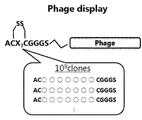
- FIG. 1 shows the cyclic amino acid structure displayed on the phage
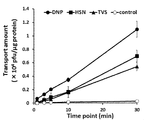
- FIG. 2 shows the results of confirming the permeability of each phage presenting a screened peptide having a 7 amino acid sequence using Caco-2 cells.
- FIG. 3 shows the results of confirming the permeability of the screened cyclic peptide in the small intestine by in situ closed loop method using the digestive tract loop of ICR mice.
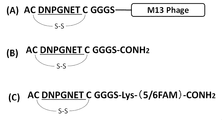
- FIG. 4 shows the amino acid sequence and structure of the synthetic peptide.
- A shows the structure of a DNP-displayed M13 phage
- B shows a synthetic unlabeled DNP peptide
- C shows a synthetic FAM-labeled DNP peptide.
- FIG. 1 shows the cyclic amino acid structure displayed on the phage
- FIG. 2 shows the results of confirming the permeability of each phage presenting a screened peptide having a 7 amino acid sequence using Caco-2 cells.
- FIG. 3 shows the results of confirming the
- FIG. 5 shows the results of measuring DNP-displayed phages that permeate Caco-2 cells in the presence and absence of unlabeled DNP.
- FIG. 6 shows the results of measurement of FAM-labeled DNP peptide that permeates Caco-2 cells in the presence and absence of unlabeled DNP.
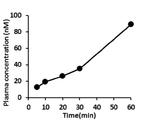
- FIG. 7 shows the results of confirming the intestinal permeability of a synthetic FAM-labeled DNP peptide by in situ closed loop method using the digestive tract loop of ICR mice.
- FIG. 8 shows the results of alignment analysis of the four identified peptides using M-Coffe web server. It is the result of having confirmed the insulin absorption by co-administration of the cyclic DNP peptide of this invention by measuring a blood glucose level.
- cell membrane-permeable peptide examples include L-form and D-form peptides having an amino acid sequence of DNPGN, SRPAF, NDPRN, or MSVAN.
- non-natural amino acids such as derivatives obtained by partially modifying the structure of natural amino acids can also be used.
- the unnatural amino acid is not particularly limited, and any known amino acid can be used.
- D-form amino acids and N-methylamino acids can be effectively used in the peptides of the present invention because they are less susceptible to degradation by proteolytic enzymes.
- at least a part of the amino acid sequence may be a non-natural amino acid such as D-form or N-methylamino acid.
- the cell membrane permeable peptide of the present invention is a cell membrane permeable peptide comprising the amino acid sequence of DNPGN (SEQ ID NO: 1), SRPAF (SEQ ID NO: 2), NDPRN (SEQ ID NO: 3), or MSVAN (SEQ ID NO: 4), Is a peptide comprising the amino acid sequence of DNPGN, DNPGNE (SEQ ID NO: 9), DNPGNET (SEQ ID NO: 5), TVSRPAF (SEQ ID NO: 6), HSNDPRN (SEQ ID NO: 7), or PFMSVAN (SEQ ID NO: 8), more preferably Is a peptide comprising the amino acid sequence of DNPGN, DNPGN, or DNPNET.
- the cell membrane-permeable peptide is meant to include L-form or D-form represented by the above sequence, a peptide in which they are mixed, and a reverse peptide thereof.
- a peptide including the amino acid sequence DNPGN is a peptide including the sequence in the order of (N-terminal) -DNPGN- (C-terminal) and a peptide including the sequence in the order of (N-terminal) -NGGPND- (C-terminal). It is meant to include both.
- amino acid sequence may have the above-mentioned sequence, for example, having only 5 amino acid sequences represented by DNPGN, or optionally at the C-terminal side and / or the N-terminal side of the amino acid of the above-mentioned sequence
- the amino acid may have one or a plurality of amino acids in combination, preferably 1 to 4 amino acids each independently.
- the peptide portion comprising the above sequence may be a reverse peptide sequence.
- the cell membrane-permeable peptide of the present invention has the above-described sequence, and can transport macromolecules such as, but not limited to, bioactive peptides, proteins or nucleic acids into cells, preferably into cells of the small intestine. it can.
- the peptide of the present invention can be prepared according to a known peptide synthesis method. Further, by using non-natural amino acids in addition to natural amino acids as materials, the cell membrane-permeable peptide of the present invention in which at least a part of the peptide is composed of non-natural amino acids can be produced. As an example, there can be mentioned a peptide consisting of a partly D-form or N-methylated amino acid. Examples of peptide synthesis methods include solid phase synthesis and liquid phase synthesis. After the synthesis reaction, purification methods commonly used in the field of peptides such as solvent extraction, distillation, column chromatography, liquids, etc. The peptide of the present invention can be isolated and purified by using a combination of techniques such as chromatography and recrystallization.
- the peptide of the present invention is preferably a cyclic peptide, particularly preferably a cyclic peptide containing a Cys-Cys disulfide bond.
- the cyclic peptide of the present invention can be produced using a known method for producing a cyclic peptide.
- a method of forming a cyclization by forming a bridge using a disulfide bond between two Cys residues a method of forming a cyclization by forming an intramolecular bridge using olefin metathesis, an amino acid
- examples thereof include a method of cyclization by cross-linking side chain functional groups of residues, a method of cyclization by forming a cyclic thioether between cysteine residues, and the like.
- One embodiment of the peptide of the present invention is a cyclic peptide comprising a sequence selected from one of the above sequences as a sequence in the cycle.
- the number of amino acids in the ring is not particularly limited, but is preferably 5 to 15, more preferably 5 to 9, including the above sequence, except for amino acids that form a bridge.
- the cell membrane-permeable peptide of the present invention containing a Cys-Cys disulfide bond includes an amino acid sequence containing a sequence selected from one of the above sequences as an internal sequence in the ring, A first Cys located outside the N-terminal direction of the sequence and a second Cys located outside the C-terminal direction of the inner sequence, wherein these Cys form a disulfide bond with each other to form a cyclic peptide It has become.
- the physiologically active substance means that it includes both a low molecular weight compound and a high molecular substance that exhibit physiological activity when administered to a living body.
- the low molecular compound contained as an active ingredient in the pharmaceutical used for the treatment and / or prevention of various diseases, or the low molecular compound which has various physiological activity Can give.
- the polymer substance include, but are not limited to, proteins, peptides, nucleic acids, and analogs thereof.
- the protein include a protein having physiological activity, such as a protein used for treatment and / or prevention of a disease.
- an enzyme, an antibody, a transcription factor, or a specific part constituting them can be mentioned.
- Specific examples include albumin and antibodies.
- the peptide include physiologically active peptides, and examples include peptides used for treatment and / or prevention of diseases.
- Specific examples include insulin, glucagon-like peptide-1 and derivatives thereof for the treatment of diabetes.
- the nucleic acid include nucleic acids used for treatment and / or prevention of diseases.
- antisense DNA, siRNA and shRNA for treatment of various diseases by gene knockdown method using antisense DNA or RNA interference can be mentioned.
- Specific examples include, but are not limited to, NF-kb target siRNA for fulminant hepatitis, transthyretin target siRNA for anti-familial amyloid angiopathy, and antisense DNA.
- the cell membrane permeable peptide of the present invention may be bound to these active substances, or a complex may be formed between these active substances.
- the bond between the peptide and the active substance (for example, covalent bond or non-covalent interaction) can be performed by a known method, and the method can be appropriately selected according to the type of the active substance to be used.
- the peptide of the present invention can be bound directly or via a linker to the end of a physiologically active peptide or nucleic acid that is an active substance, and a technique for binding a short peptide to a peptide or nucleic acid is performed using a known method. Can do. Formation of the complex of a peptide and an active substance can also be performed by a well-known method, and a method can be selected suitably according to the kind of active substance to be used.
- the active substance carrier in the composition of the present invention includes a carrier capable of binding to the active substance or having the active substance disposed therein.
- the active substance carrier include, but are not limited to, liposomes, cyclodextrins and derivatives thereof, nanoparticles, and micelles. Techniques for incorporating active substances into such carriers are known and these known methods can also be used in the present invention.
- Various carriers are also known, including their production methods and acquisition routes, and can be used.
- examples of the carrier that can promote absorption in the digestive tract by adding the cell membrane-permeable peptide of the present invention include liposomes and cyclodextrins.
- the cell membrane permeable peptide of the present invention may be bound to an active substance carrier (for example, liposome or cyclodextrin) containing these physiologically active substances, or contains these active substances.
- a complex may be formed with the carrier.
- the bond between the peptide and the carrier (for example, covalent bond or non-covalent interaction) can be performed by a known method, and the method can be appropriately selected according to the type of the carrier to be used. Formation of a complex of a peptide and a carrier can also be performed by a known method, and a method can be appropriately selected according to the type of active substance to be used.
- a liposome in the case of a liposome, it can be inserted into the liposome membrane by adding a fatty acid to the C-terminus of the cell membrane-permeable peptide of the present invention (see WO2013 / 140643).
- the cell-penetrating peptide of the present invention can be bound and presented on the surface of a liposome or cyclodextrin in which an active substance can be encapsulated using a known method. In this way, for example, a highly versatile small intestine permeable drug delivery system can be constructed.
- the cell membrane-permeable peptide of the present invention contains no or only one basic amino acid arginine in the 5-7 amino acid sequence portion described above. Therefore, it has the characteristics that it is excellent in solubility in water and is easily solubilized. Therefore, the cell membrane permeable peptide of the present invention has high applicability to various active substances, and the composition of the present invention is easy to prepare. Further, the cell membrane-permeable peptide of the present invention can transport a very large molecule called M13 phage. Therefore, the composition of the present invention is excellent for transporting large active substances.
- the composition of the present invention can be used as a medicine.
- a pharmaceutical comprising the composition of the present invention can be formulated and administered according to known methods. For example, it can be administered orally or parenterally to mammals including humans as it is as a liquid or as a pharmaceutical composition of an appropriate dosage form, but the pharmaceutical composition containing the composition of the present invention is Preferably it is administered orally.
- arbitrary components can be appropriately blended as long as the effects of the active substance and the cell membrane-permeable peptide of the present invention are not impaired.
- optional components include, but are not limited to, cross-linking agents, solubilizers, emulsifiers, moisturizers, cooling agents, inorganic powders, antioxidants, preservatives, colorants, flavoring agents, pH adjusters, and stability agents. An agent can be given.
- the dose of the composition of the present invention to humans is appropriately determined according to the type of active substance contained, the age, weight, condition, sex, administration method, and other conditions of the administration target.
- the amount of the active substance may be about 0.01 mg / kg to about 10 mg / kg per day.
- Example 1 Screening of human small intestine penetrating peptide
- a phage library (1 ⁇ 10 9 types) in which 7 amino acids are randomly displayed and Caco-2 cells widely used as human small intestine model cells were used.
- phage library Ph. D. (Registered trademark) -C7C Page Display Peptide Library Kit (BioLab) was purchased to obtain a phage library.
- the cyclic amino acid structure displayed on the phage is shown in FIG.
- the time point was 1, 3, 5, 10, 30 min.
- the basal (BA) side sample at each time point was kept on ice.
- the transwell was transferred to a new 6-well plate, and after aspirating the AP-side HBSS buffer, the cells were collected in a centrifuge tube.
- the titer on the BL side and the titer in the supernatant at each time point were measured by qPCR.
- the phages that permeated the BA side as described above were collected and propagated over time three times in total, and phages that displayed peptides that permeate Caco-2 cells were selected.
- 49 types of cyclic peptides were identified.
- 49 types of amino acid sequences consisting of 7 types of amino acids identified 45 types appeared only once, whereas the four amino acid sequences shown in Table 1 below showed 2 in 3 experiments. Appearance frequency was 3 times or 3 times.
- Example 2 Permeability of identified amino acid sequence peptides
- the above-mentioned three identified peptides (peptides: DNP, HSN, TVS) that appeared three times were selected, and the transport characteristics of each peptide-displayed phage were analyzed.
- the Caco-2 cells permeated over time and the permeation amount up to 30 minutes was 39 times, 26 times, and 21 times higher than that of the peptide non-presenting phage (control), respectively.
- the results are shown in FIG. Cyclic peptide DNP, the peptide with the highest permeation activity, was used to confirm its effects on Caco-2 cell cytotoxicity and tight junctions.
- Cytotoxicity was confirmed by adding 100 ⁇ L of 0-10 ⁇ M DNP peptide to Caco-2 cells cultured in a 96-well plate, and confirming cell viability after 1, 6 and 24 hours using Cell Counting kit 8 (Dojin Chemical). did.
- the effect on tight junctions was determined by culturing Coca-2 cells in transwells, adding 2 mL of 0-10 ⁇ M peptide DNP to the apical (AP) side, 1, 2, 3, 6, 12, 24 hours after addition.
- the electrical resistance value (TEER) was measured and confirmed using Millicell ERS-2.
- Example 3 Confirmation of Small Intestinal Permeability in Mice
- the small intestine permeability of the cyclic peptide screened in Example 1 was analyzed by the in situ closed loop method using the digestive tract loop of ICR mice as follows. From the cannula, 1.0 ⁇ 10 11 pfu (in 1 m LHBSS buffer) of each peptide-displayed phage of 3 peptides (peptide: DNP, HSN, TVS) was injected. This time is set to 0 min. Subsequently, 100 ⁇ L of blood was collected from the jugular vein at 10, 20, and 30 min, and the titer in the blood was measured by the plaque count method.
- peptide non-displaying phage As a control, peptide non-displaying phage (control) was used. The results are shown in FIG. Cyclic peptide DNP, HSN, and TVS-displaying phage permeated through the mouse small intestine over time, and the plasma phage concentration 30 minutes after administration was 1271 times, 138 times, and 17 times higher than control. From the above results, a cyclic peptide having permeability to the small intestine was identified.
- M13 phage (about 16 MDa) used in the above experiment is a macromolecule and has been successfully permeated by the cell-permeable peptide of the present invention, the cell-membrane-permeable peptide of the present invention is a polymer. It can be applied to the absorption of gastrointestinal tracts of drugs and liposomes.
- Example 4 Competitive Inhibition by Synthetic Peptides Cyclic peptide having the same amino acid sequence as that of the cyclic peptide DNP-displaying phage (referred to as “unlabeled DNP peptide: unlabeled DNP”), and its C-terminal via Lys Then, FAM-labeled DNP peptide bound with a fluorescent dye was commissioned to Scrum Co., Ltd. and synthesized. The respective structures are shown in FIGS. 4B and 4C.
- FIG. 4A shows the structure of the DNP-displayed M13 phage. In the same manner as in Example 1, DNP-displayed phages that permeated Caco-2 cells were measured in the presence and absence of unlabeled DNP.
- the unlabeled DNP concentration used is 10 ⁇ M. The results are shown in FIG. It was confirmed that competitive inhibition occurred with the synthetic unlabeled DNP peptide. Subsequently, FAM-labeled DNP peptides that permeate Caco-2 cells were measured in the presence and absence of unlabeled DNP in the same manner as in the Caco-2 cell permeation experiment used in Example 1. The unlabeled DNP concentration used was 10 ⁇ M, and the FAM-labeled DNP concentration was 10 ⁇ M. The results are shown in FIG.
- Example 5 Confirmation of small intestine permeability of synthetic peptide in mouse Using the synthesized FAM-labeled DNP peptide, the small intestinal permeability of the mouse was confirmed in the same manner as in Example 3. The results are shown in FIG. It was confirmed that the synthetic FAM-labeled DNP peptide permeated through the small intestine of the mouse over time, and the plasma concentration increased over time.
- Example 6 Alignment analysis of four identified peptides
- M-Coffe web server (Moretti et al., Nucleic Acids Research, 2007, vol 35, Web Server Issue). W645-648) was used for alignment analysis. The results are shown in FIG. Enclosed with a solid line frame are amino acids whose consensus is GOOD as a result of alignment analysis. There was a very high match score between the four sequences.
- Example 7 Confirmation of promotion of insulin absorption by co-administration of cyclic peptide The effect on the insulin absorption by co-administration of the cyclic peptide of the present invention was confirmed by measuring blood glucose level.
- the cyclic peptide shown in FIG. 4B containing the sequence of DNPGNET (SEQ ID NO: 5) was purchased from GenScript Corporation for synthesis and purchased.
- 100 ⁇ L of hot HBSS solution was prepared so as to be insulin 10 IU / kg and DNPGNET 5 mM, and incubated at 37 ° C. for 1 hour.
- the cell-penetrating peptide of the present invention can be applied to polymer drugs and is useful as a permeable peptide.
- the cell membrane-permeable peptide of the present invention is further applicable to the promotion of gastrointestinal absorption of polymer drugs and liposomes, and is useful as a polymer drug that efficiently penetrates the small intestine, which is the main tissue of gastrointestinal absorption.
Landscapes
- Health & Medical Sciences (AREA)
- Chemical & Material Sciences (AREA)
- Life Sciences & Earth Sciences (AREA)
- General Health & Medical Sciences (AREA)
- Medicinal Chemistry (AREA)
- Organic Chemistry (AREA)
- Public Health (AREA)
- Pharmacology & Pharmacy (AREA)
- Animal Behavior & Ethology (AREA)
- Veterinary Medicine (AREA)
- Engineering & Computer Science (AREA)
- Genetics & Genomics (AREA)
- Biochemistry (AREA)
- Epidemiology (AREA)
- Molecular Biology (AREA)
- Bioinformatics & Cheminformatics (AREA)
- Diabetes (AREA)
- Zoology (AREA)
- Wood Science & Technology (AREA)
- Proteomics, Peptides & Aminoacids (AREA)
- Biomedical Technology (AREA)
- Biophysics (AREA)
- General Engineering & Computer Science (AREA)
- Biotechnology (AREA)
- Endocrinology (AREA)
- Immunology (AREA)
- Microbiology (AREA)
- Hematology (AREA)
- Chemical Kinetics & Catalysis (AREA)
- Inorganic Chemistry (AREA)
- Gastroenterology & Hepatology (AREA)
- Emergency Medicine (AREA)
- Dispersion Chemistry (AREA)
- Obesity (AREA)
- Nuclear Medicine, Radiotherapy & Molecular Imaging (AREA)
- General Chemical & Material Sciences (AREA)
- Virology (AREA)
- Physics & Mathematics (AREA)
- Plant Pathology (AREA)
- Peptides Or Proteins (AREA)
Abstract
本発明は、高分子医薬品にも適用できる新規な膜透過性改善剤を提供することを目的とする。より具体的には、小腸における高分子の薬剤の吸収効率を改善できる薬剤キャリア、およびそのキャリアを含む膜透過改善剤を提供することを目的とする。本発明により、 下記のアミノ酸配列:アミノ酸配列DNPGN(配列番号1)、SRPAF(配列番号2)、NDPRN(配列番号3)、およびMSVAN(配列番号4)からなる群より選ばれるアミノ酸配列を含む細胞膜透過性ペプチドが提供される。本発明によりまた、該ペプチドおよび生理活性物質を含む細胞膜透過性組成物が提供される。
Description
本発明は、新規な細胞膜透過性ペプチドに関する。
経口投与は普段の生活において自然で簡便に服用ができ非侵襲的であることから比較的安全に医薬品を服用することができる方法である。また、消化管が薬物吸収に適した構造をとり、吸収表面積が大きいことから、医薬品製剤として経口製剤の開発が望まれている。しかし、薬物の経口投与を可能とするためには克服しなければならないいくつかの問題がある。
一つは、薬物が全身循環に移行する前に消化管内の酵素により分解されてしまう可能性である。そのための解決策として、腸溶性製剤技術等により胃での薬物の失活を防ぎ、腸管まで薬物を送達することが可能となっている。
他の問題点は、薬物が腸管粘膜、上皮を十分に透過しないことである。消化管での吸収性は経口投与における医薬品の体内動態や薬理活性の重要な決定因子のひとつである。しかし、次世代医薬品として期待されている核酸などの水溶性高分子医薬品は消化管吸収性が極めて低いため、臨床では、経口投与ではなく静脈内注射による投与方法に限られている。
他の問題点は、薬物が腸管粘膜、上皮を十分に透過しないことである。消化管での吸収性は経口投与における医薬品の体内動態や薬理活性の重要な決定因子のひとつである。しかし、次世代医薬品として期待されている核酸などの水溶性高分子医薬品は消化管吸収性が極めて低いため、臨床では、経口投与ではなく静脈内注射による投与方法に限られている。
これまでに、医薬品の消化管吸収性改善を達成するために、一時的に生体膜の物質透過性を増加させる吸収促進剤や添加剤などを用いた研究が行われてきた。吸収促進剤としては、界面活性剤、脂肪酸、アルコールなどをあげることができる。しかし、吸収促進剤や添加剤は、密着結合(タイトジャンクション)の開閉などによって非特異的に消化管吸収を増加させること、生体内の水分等で希釈を受けるために十分に効果が発揮できないこと、そして、局所における粘膜障害等の安全性が問題となっている。そのため、実用化が座剤に限定されている。また、これらの方法は、低分子医薬品の吸収効率の改善には適用できても、高分子医薬品の吸収効率の改善は不充分である。
また、ヒト免疫不全ウィルス(HIV)-1 Tatペプチド、HIV-1 Levペプチド、ペネトラチン、トランスポータン、アルギニンオリゴマーなどの細胞膜透過ペプチドを用いて消化管吸収を増加させる研究も行われてきた。しかしながら、基礎研究においてはインスリンの消化管からの吸収を促進させたものがあるが、まだその効率は20%程度であり、臨床応用されたものはなく、さらに効率のよい配列が模索されている。
さらに、細胞膜透過ペプチドを基剤である幹高分子に結合して共存する薬剤の吸収を改善した経上皮吸収促進剤も提案されている(特許文献1)。
さらに、細胞膜透過ペプチドを基剤である幹高分子に結合して共存する薬剤の吸収を改善した経上皮吸収促進剤も提案されている(特許文献1)。
他に、キトサン修飾したリポソームが開発されている(非特許文献1)。その輸送機構は細胞間隙の透過が主であり、F-アクチンに作用し、タイトジャンクションを減弱する。しかし、経細胞輸送に関しても、ムチンとの相互作用を介した吸着性エンドサイトーシスではないかと言われている。これも臨床応用には至っていない。
高分子医薬品の小腸吸収を改善する方法として、タンパク質分解酵素阻害剤とドラッグキャリアとを組み合わせた方法が提案されている(非特許文献2)。そこでは、タンパク質分解酵素阻害剤によりペプチド・タンパク質製剤であるインスリンの分解が100%抑制できている。そして、ドラッグキャリアであるスマートハイドロゲルにインスリンを封入することで、ラット経口投与時のバイオアベイラビリティが10%まで改善されたと報告されている(非特許文献3)。しかし、薬物が小腸まで到達するが吸収率としてはまだ十分ではない。
そのため、経口投与が可能で、小腸での吸収改善を目的としたさらに優れた薬物キャリアが望まれていた。
そのため、経口投与が可能で、小腸での吸収改善を目的としたさらに優れた薬物キャリアが望まれていた。
J Control Release. 2003 Jan 17;86(2-3):235-42
Int J Pharm. 2001 Aug 28;225(1-2):31-9
Journal of Controlled Release 97(2004)115-124
本発明は、高分子医薬品にも適用できる新規な膜透過性改善剤を提供することを目的とする。より具体的には、小腸における高分子の薬剤の吸収効率を改善できる薬剤キャリア、およびそのキャリアを含む膜透過改善剤を提供することを目的とする。
本発明者らは、上記課題を解決するために鋭意検討を重ねた結果、特定のアミノ酸配列を含む短いペプチドを持つ高分子が小腸透過性であることを見出し、本発明を完成した。
本発明は以下を含むものである。
[1]下記のアミノ酸配列:アミノ酸配列DNPGN(配列番号1)、SRPAF(配列番号2)、NDPRN(配列番号3)、およびMSVAN(配列番号4)からなる群より選ばれるアミノ酸配列を含む細胞膜透過性ペプチド。
[2]少なくとも一つの非天然型アミノ酸(好ましくは、D型アミノ酸またはN-メチルアミノ酸)を含む上記[1]に記載の細胞膜透過性ペプチド。
[3]前記ペプチドが、アミノ酸配列DNPGNET(配列番号5)、TVSRPAF(配列番号6)、HSNDPRN(配列番号7)、およびPFMSVAN(配列番号8)からなる群より選ばれるアミノ酸配列を含む上記[1]または[2]に記載の細胞膜透過性ペプチド。
[4]前記ペプチドが、アミノ酸配列DNPGN(配列番号1)またはDNPGNE(配列番号9)を含む上記[1]または[2]に記載の細胞膜透過性ペプチド。
[5]前記ペプチドが環状ペプチドである上記[1]~[4]のいずれか一つに記載の細胞膜透過性ペプチド。
[6]前記環状ペプチドがCys-Cysジスルフィド結合を含む環状ペプチドである、上記[5]に記載の細胞膜透過性ペプチド。
[7]前記ペプチドが、哺乳動物細胞の小腸上皮細胞を透過するペプチドである上記[1]~[6]のいずれか一つに記載の細胞膜透過性ペプチド。
本発明は以下を含むものである。
[1]下記のアミノ酸配列:アミノ酸配列DNPGN(配列番号1)、SRPAF(配列番号2)、NDPRN(配列番号3)、およびMSVAN(配列番号4)からなる群より選ばれるアミノ酸配列を含む細胞膜透過性ペプチド。
[2]少なくとも一つの非天然型アミノ酸(好ましくは、D型アミノ酸またはN-メチルアミノ酸)を含む上記[1]に記載の細胞膜透過性ペプチド。
[3]前記ペプチドが、アミノ酸配列DNPGNET(配列番号5)、TVSRPAF(配列番号6)、HSNDPRN(配列番号7)、およびPFMSVAN(配列番号8)からなる群より選ばれるアミノ酸配列を含む上記[1]または[2]に記載の細胞膜透過性ペプチド。
[4]前記ペプチドが、アミノ酸配列DNPGN(配列番号1)またはDNPGNE(配列番号9)を含む上記[1]または[2]に記載の細胞膜透過性ペプチド。
[5]前記ペプチドが環状ペプチドである上記[1]~[4]のいずれか一つに記載の細胞膜透過性ペプチド。
[6]前記環状ペプチドがCys-Cysジスルフィド結合を含む環状ペプチドである、上記[5]に記載の細胞膜透過性ペプチド。
[7]前記ペプチドが、哺乳動物細胞の小腸上皮細胞を透過するペプチドである上記[1]~[6]のいずれか一つに記載の細胞膜透過性ペプチド。
[8]下記のアミノ酸配列:DNPGN(配列番号1)、SRPAF(配列番号2)、NDPRN(配列番号3)、およびMSVAN(配列番号4)からなる群より選ばれるアミノ酸配列を含むペプチド、および生理活性物質を含む組成物であって、該ペプチドは、該生理活性物質または該生理活性物質を含む活性物質担体と結合または複合体を形成している細胞膜透過性である組成物。
[9]前記ペプチドが、少なくとも一つの非天然型アミノ酸(好ましくは、D型アミノ酸またはN-メチルアミノ酸)を含む上記[8]に記載の組成物。
[10]前記ペプチドが、アミノ酸配列DNPGNET(配列番号5)、TVSRPAF(配列番号6)、HSNDPRN(配列番号7)、およびPFMSVAN(配列番号8)からなる群より選ばれるアミノ酸配列を含む上記[8]または[9]に記載の組成物。
[11]前記ペプチドが、アミノ酸配列DNPGN(配列番号1)またはDNPGNE(配列番号9)を含む上記[8]または[9]に記載の組成物。
[12]前記ペプチドが環状ペプチドである上記[8]~[11]のいずれか一つに記載の組成物。
[13]前記環状ペプチドがCys-Cysジスルフィド結合を含む環状ペプチドである、上記[12]に記載の組成物。
[14]前記生理活性物質が高分子を含む上記[8]~[13]のいずれか一つに記載の組成物。
[15]前記高分子が、生理活性ペプチドまたはタンパク質を含む上記[14]に記載の組成物。
[16]前記生理活性ペプチドがインスリンである上記[15]に記載の組成物。
[17]前記高分子が核酸を含む上記[14]に記載の組成物。
[18]前記核酸が、アンチセンスDNA、siRNAまたはshRNAである上記[17]に記載の組成物。
[19]前記生理活性物質を含む活性物質担体が、リポソームである上記[8]~[18]のいずれか一つに記載の組成物。
[20]前記生理活性物質を含む活性物質担体が、シクロデキストリンである上記[8]~[18]のいずれか一つに記載の組成物。
[9]前記ペプチドが、少なくとも一つの非天然型アミノ酸(好ましくは、D型アミノ酸またはN-メチルアミノ酸)を含む上記[8]に記載の組成物。
[10]前記ペプチドが、アミノ酸配列DNPGNET(配列番号5)、TVSRPAF(配列番号6)、HSNDPRN(配列番号7)、およびPFMSVAN(配列番号8)からなる群より選ばれるアミノ酸配列を含む上記[8]または[9]に記載の組成物。
[11]前記ペプチドが、アミノ酸配列DNPGN(配列番号1)またはDNPGNE(配列番号9)を含む上記[8]または[9]に記載の組成物。
[12]前記ペプチドが環状ペプチドである上記[8]~[11]のいずれか一つに記載の組成物。
[13]前記環状ペプチドがCys-Cysジスルフィド結合を含む環状ペプチドである、上記[12]に記載の組成物。
[14]前記生理活性物質が高分子を含む上記[8]~[13]のいずれか一つに記載の組成物。
[15]前記高分子が、生理活性ペプチドまたはタンパク質を含む上記[14]に記載の組成物。
[16]前記生理活性ペプチドがインスリンである上記[15]に記載の組成物。
[17]前記高分子が核酸を含む上記[14]に記載の組成物。
[18]前記核酸が、アンチセンスDNA、siRNAまたはshRNAである上記[17]に記載の組成物。
[19]前記生理活性物質を含む活性物質担体が、リポソームである上記[8]~[18]のいずれか一つに記載の組成物。
[20]前記生理活性物質を含む活性物質担体が、シクロデキストリンである上記[8]~[18]のいずれか一つに記載の組成物。
本発明によれば、消化管吸収の主要組織である小腸を効率的に透過する新規な細胞膜透過性ペプチドが提供される。本発明によればまた、高分子を効率良く小腸上皮細胞へと輸送できる細胞膜透過性ペプチドおよび該ペプチドを含む高分子医薬品が提供できる。
以下、本発明を、例示的な実施態様を例として、本発明の実施において使用することができる好ましい方法および材料とともに説明する。なお、文中で特に断らない限り、本明細書で用いるすべての技術用語及び科学用語は、本発明が属する技術分野の当業者に一般に理解されるのと同じ意味をもつ。また、本明細書に記載されたものと同等または同様の任意の材料および方法は、本発明の実施において同様に使用することができる。
また、本明細書に記載された発明に関連して本明細書中で引用されるすべての刊行物および特許は、例えば、本発明で使用できる方法や材料その他を示すものとして、本明細書の一部を構成するものである。
また、本明細書に記載された発明に関連して本明細書中で引用されるすべての刊行物および特許は、例えば、本発明で使用できる方法や材料その他を示すものとして、本明細書の一部を構成するものである。
(1)細胞膜透過性ペプチド
本発明において細胞膜透過性ペプチドとは、DNPGN、SRPAF、NDPRN、またはMSVANのアミノ酸配列を有するL体またはD体のペプチドをあげることができる。天然に存在するアミノ酸である立体配置がL体であるアミノ酸の他に、天然のアミノ酸の構造を一部改変した誘導体など非天然のアミノ酸も使用されうる。非天然アミノ酸としては、特に制限されず、公知の任意のアミノ酸を用いることができる。例えば、立体配置がD体のアミノ酸やN-メチルアミノ酸は、蛋白分解酵素による分解を受けにくいことから本発明のペプチドに有効に使用されうる。本発明のペプチドは、そのアミノ酸配列のうち、少なくとも一部がD体やN-メチルアミノ酸などの非天然型アミノ酸であってもよい。
本発明において細胞膜透過性ペプチドとは、DNPGN、SRPAF、NDPRN、またはMSVANのアミノ酸配列を有するL体またはD体のペプチドをあげることができる。天然に存在するアミノ酸である立体配置がL体であるアミノ酸の他に、天然のアミノ酸の構造を一部改変した誘導体など非天然のアミノ酸も使用されうる。非天然アミノ酸としては、特に制限されず、公知の任意のアミノ酸を用いることができる。例えば、立体配置がD体のアミノ酸やN-メチルアミノ酸は、蛋白分解酵素による分解を受けにくいことから本発明のペプチドに有効に使用されうる。本発明のペプチドは、そのアミノ酸配列のうち、少なくとも一部がD体やN-メチルアミノ酸などの非天然型アミノ酸であってもよい。
本発明の細胞膜透過性ペプチドは、DNPGN(配列番号1)、SRPAF(配列番号2)、NDPRN(配列番号3)、またはMSVAN(配列番号4)のアミノ酸配列を含む細胞膜透過性ペプチドであり、好ましくは、DNPGN、DNPGNE(配列番号9)、DNPGNET(配列番号5)、TVSRPAF(配列番号6)、HSNDPRN(配列番号7)、またはPFMSVAN(配列番号8)のアミノ酸配列を含むペプチドであり、より好ましくは、DNPGN、DNPGNE、またはDNPGNETのアミノ酸配列を含むペプチドである。
本発明において細胞膜透過性ペプチドとは、上記配列で示されるL体またはD体あるいはそれらが混合したペプチド、およびその逆鎖ペプチドを含む意味である。例えば、アミノ酸配列DNPGNを含むペプチドとは、(N末端)-DNPGN-(C末端)の順にその配列を含むペプチドと、(N末端)-NGPND-(C末端)の順にその配列を含むペプチドのいずれをも含む意味である。
本発明において細胞膜透過性ペプチドとは、上記配列で示されるL体またはD体あるいはそれらが混合したペプチド、およびその逆鎖ペプチドを含む意味である。例えば、アミノ酸配列DNPGNを含むペプチドとは、(N末端)-DNPGN-(C末端)の順にその配列を含むペプチドと、(N末端)-NGPND-(C末端)の順にその配列を含むペプチドのいずれをも含む意味である。
上記のアミノ酸配列を有するとは、上記配列、例えば、DNPGNで示される5個のアミノ酸配列のみのアミノ酸を有することでもよく、または上記配列のアミノ酸のC末端側および/またはN末端側に任意にアミノ酸を、それぞれあるいは合わせて1個あるいは複数個、好ましくはそれぞれ独立に1~4個有するものでもよい。
ここで、上記配列のアミノ酸のC末端側および/またはN末端側に任意にアミノ酸を有する場合は、上記配列からなるペプチド部分は逆鎖ペプチド配列であってもよい。例えば、DNPGNのアミノ酸配列の場合は、例えばアミノ酸のC末端側に1個のアミノ酸を有するとは、(N末端)-DNPGNX-(C末端)(Xは任意のアミノ酸)であっても、(N末端)-NGPNDX-(C末端)(Xは任意のアミノ酸)であってもよい。
本発明の細胞膜透過性ペプチドとは、上記配列を有することにより、高分子、例えば、これに限定しないが、生理活性ペプチド、タンパク質または核酸を細胞内、好ましくは小腸の細胞内に輸送することができる。
ここで、上記配列のアミノ酸のC末端側および/またはN末端側に任意にアミノ酸を有する場合は、上記配列からなるペプチド部分は逆鎖ペプチド配列であってもよい。例えば、DNPGNのアミノ酸配列の場合は、例えばアミノ酸のC末端側に1個のアミノ酸を有するとは、(N末端)-DNPGNX-(C末端)(Xは任意のアミノ酸)であっても、(N末端)-NGPNDX-(C末端)(Xは任意のアミノ酸)であってもよい。
本発明の細胞膜透過性ペプチドとは、上記配列を有することにより、高分子、例えば、これに限定しないが、生理活性ペプチド、タンパク質または核酸を細胞内、好ましくは小腸の細胞内に輸送することができる。
本発明のペプチドは、公知のペプチド合成方法に従って作製することができる。また、材料として、天然アミノ酸に加えて非天然アミノ酸を用いることにより、少なくともペプチドの一部が非天然アミノ酸からなる本発明の細胞膜透過性ペプチドを作製できる。例として、一部がD体やN-メチル化されたアミノ酸からなるペプチドをあげることができる。ペプチドの合成方法としては、例えば、固相合成法、液相合成法等があげられ、合成反応後は、ペプチドの分野において通常用いられる精製法、例えば、溶媒抽出、蒸留、カラムクロマトグラフィー、液体クロマトグラフィー、再結晶等の技術を組み合わせて用いることにより、本発明のペプチドを単離・精製できる。
本発明のペプチドは、好ましくは環状ペプチド、特に好ましくはCys-Cysジスルフィド結合を含む環状ペプチドである。本発明の環状ペプチドは、環状ペプチドを作製するための公知の方法を用いて作製することができる。これに限定されないが、例えば、2つのCys残基間のジスルフィド結合を利用して架橋を形成して環状化する方法、オレフィンメタセシスを利用して分子内架橋を形成して環状化する方法、アミノ酸残基の側鎖官能基同士を架橋して環状化する方法、システイン残基との間に環状チオエーテルを形成させて環状化する方法等をあげあることができる。
本発明のペプチドの一つの態様は、環状ペプチドであってその環状内の配列として上記配列のうちの一つから選択される配列を含むペプチドである。環状内のアミノ酸の数は特に限定されないが、好ましくは、架橋を形成するアミノ酸を除いて、上記配列を含む5~15、より好ましくは5~9である。
これに限定されないが、例えば、Cys-Cysジスルフィド結合を含む本発明の細胞膜透過性ペプチドは、上記配列のうちの一つから選択される配列を環状内の内部配列として含むアミノ酸配列を含み、内部配列のN末端方向の外部に位置する第一のCysと、内配列のC末端方向の外部に位置する第二のCysとをさらに含み、これらのCysが互いにジスルフィド結合を形成して環状ペプチドとなったものである。
本発明のペプチドの一つの態様は、環状ペプチドであってその環状内の配列として上記配列のうちの一つから選択される配列を含むペプチドである。環状内のアミノ酸の数は特に限定されないが、好ましくは、架橋を形成するアミノ酸を除いて、上記配列を含む5~15、より好ましくは5~9である。
これに限定されないが、例えば、Cys-Cysジスルフィド結合を含む本発明の細胞膜透過性ペプチドは、上記配列のうちの一つから選択される配列を環状内の内部配列として含むアミノ酸配列を含み、内部配列のN末端方向の外部に位置する第一のCysと、内配列のC末端方向の外部に位置する第二のCysとをさらに含み、これらのCysが互いにジスルフィド結合を形成して環状ペプチドとなったものである。
(2)生理活性物質
本発明において生理活性物質(以下、単に活性物質という場合もある)とは、生体に投与した場合に、生理的活性を示す低分子量化合物および高分子物質のいずれも含む意味で用いられる。
上記低分子量化合物とは、これに限定されないが、種々の疾患の治療および/または予防のために用いられる医薬品に有効成分として含まれている低分子化合物、または種々の生理活性を有する低分子化合物をあげることができる。
上記高分子物質としては、これに限定されないが、例えば、タンパク質、ペプチド、核酸、およびこれらの類似体をあげることができる。
タンパク質としては、生理活性を有するタンパク質をあげることができ、疾患の治療および/または予防のために用いられるタンパク質等をあげることができる。例えば、これに限定されないが、酵素、抗体、転写因子、あるいはそれらを構成する特定の部分をあげることができる。具体的には、アルブミンや抗体をあげることができる。
上記ペプチドとしては、生理活性ペプチドをあげあることができ、疾患の治療および/または予防のために用いられるペプチド等をあげることができる。具体的には、これに限定されないが、糖尿病治療に対するインスリン、グルカゴン様ペプチド-1およびその誘導体をあげることができる。
上記核酸としては、疾患の治療および/または予防のために用いられる核酸をあげることができる。例えば、アンチセンスDNAやRNA干渉を用いた遺伝子ノックダウン法による各種疾患の治療のためのアンチセンスDNAやsiRNAやshRNAをあげることができる。具体的には、これに限定されないが、劇症肝炎に対するNF-kb標的siRNAや家族性アミロイドアンジオパシーに対するトランスサイレチン標的siRNAおよびアンチセンスDNAをあげることができる。
本発明において生理活性物質(以下、単に活性物質という場合もある)とは、生体に投与した場合に、生理的活性を示す低分子量化合物および高分子物質のいずれも含む意味で用いられる。
上記低分子量化合物とは、これに限定されないが、種々の疾患の治療および/または予防のために用いられる医薬品に有効成分として含まれている低分子化合物、または種々の生理活性を有する低分子化合物をあげることができる。
上記高分子物質としては、これに限定されないが、例えば、タンパク質、ペプチド、核酸、およびこれらの類似体をあげることができる。
タンパク質としては、生理活性を有するタンパク質をあげることができ、疾患の治療および/または予防のために用いられるタンパク質等をあげることができる。例えば、これに限定されないが、酵素、抗体、転写因子、あるいはそれらを構成する特定の部分をあげることができる。具体的には、アルブミンや抗体をあげることができる。
上記ペプチドとしては、生理活性ペプチドをあげあることができ、疾患の治療および/または予防のために用いられるペプチド等をあげることができる。具体的には、これに限定されないが、糖尿病治療に対するインスリン、グルカゴン様ペプチド-1およびその誘導体をあげることができる。
上記核酸としては、疾患の治療および/または予防のために用いられる核酸をあげることができる。例えば、アンチセンスDNAやRNA干渉を用いた遺伝子ノックダウン法による各種疾患の治療のためのアンチセンスDNAやsiRNAやshRNAをあげることができる。具体的には、これに限定されないが、劇症肝炎に対するNF-kb標的siRNAや家族性アミロイドアンジオパシーに対するトランスサイレチン標的siRNAおよびアンチセンスDNAをあげることができる。
本発明の組成物において生理活性物質として好ましく使用できる薬剤は、例えば、これに限定されないが、例えば、インスリンおよびインスリン分泌促進剤などのペプチド・タンパク質医薬品、ステロイドホルモン、非ステロイド系鎮痛抗炎症剤、抗ヒスタミン剤、抗アレルギー薬、抗喘息薬、抗パーキンソン病薬、抗痴呆薬、向精神薬、抗高血圧薬、心疾患治療薬、循環器改善薬、制吐剤、利尿剤、抗血栓薬、抗腫瘍薬をあげることができる。本発明の細胞膜透過性ペプチドは、小腸での透過を促進するものであるので、消化管からの吸収促進に基づいてより有効な薬効を示す物質は本発明の対象の範囲である。
本発明の組成物においては、本発明の細胞膜透過性ペプチドをこれらの活性物質と結合させても良く、あるいは、これらの活性物質との間で複合体を形成させてもよい。ペプチドと活性物質との結合(例えば、共有結合や非共有結合的相互作用)は、公知の方法により行うことができ、用いる活性物質の種類に応じて、適宜方法を選択できる。例えば、活性物質である生理活性ペプチドや核酸の末端に本発明のペプチドを直接またはリンカーを介して結合させることができ、ペプチドや核酸に短いペプチドを結合する技術は公知の方法を用いて行うことができる。ペプチドと活性物質の複合体の形成も、公知の方法により行うことができ、用いる活性物質の種類に応じて、適宜方法を選択できる。
(3)活性物質担体
本発明の組成物における活性物質担体とは、上記活性物質と結合できる、あるいは上記活性物質をその中に配置できる担体をあげることができる。活性物質担体とは、これに限定されないが、例えば、リポソーム、シクロデキストリンおよびその誘導体、ナノ粒子、ミセルをあげることができる。活性物質をこのような担体に組み込むための手法は公知であり、それらの公知の方法を本発明においても用いることができる。また、各担体についても、種々のものがその製法や入手経路も含めて公知であり、それらを用いることができる。
例えば、これに限定されないが、本発明の細胞膜透過性ペプチドを付加することによって消化管での吸収を促進することができる担体としては、リポソームやシクロデキストリンをあげることができる。
本発明の組成物における活性物質担体とは、上記活性物質と結合できる、あるいは上記活性物質をその中に配置できる担体をあげることができる。活性物質担体とは、これに限定されないが、例えば、リポソーム、シクロデキストリンおよびその誘導体、ナノ粒子、ミセルをあげることができる。活性物質をこのような担体に組み込むための手法は公知であり、それらの公知の方法を本発明においても用いることができる。また、各担体についても、種々のものがその製法や入手経路も含めて公知であり、それらを用いることができる。
例えば、これに限定されないが、本発明の細胞膜透過性ペプチドを付加することによって消化管での吸収を促進することができる担体としては、リポソームやシクロデキストリンをあげることができる。
本発明の組成物においては、本発明の細胞膜透過性ペプチドを、これらの生理活性物質を含む活性物質担体(例えば、リポソームやシクロデキストリン)と結合させても良く、あるいは、これらの活性物質を含む担体との間で複合体を形成させてもよい。ペプチドと担体との結合(例えば、共有結合や非共有結合的相互作用)は、公知の方法により行うことができ、用いる担体の種類に応じて、適宜、方法を選択できる。ペプチドと担体の複合体の形成も、公知の方法により行うことができ、用いる活性物質の種類に応じて、適宜、方法を選択できる。例えば、リポソームとの場合は本発明の細胞膜透過性ペプチドのC末端に脂肪酸を付加させることでリポソーム膜に挿入させることができる(WO2013/140643号公報参照)。加えて、公知の方法を用いて、活性物質を封入できるリポソームやシクロデキストリンの表面に本発明の細胞透過性ペプチドを結合させて提示させることもできる。
このようにして、例えば、汎用性の高い小腸透過性ドラッグデリバリーシステムの構築が可能である。
このようにして、例えば、汎用性の高い小腸透過性ドラッグデリバリーシステムの構築が可能である。
(4)組成物
本発明の細胞膜透過性ペプチドは、上記した5~7アミノ酸配列部分において、塩基性アミノ酸であるアルギニンを全く含まないか、あるいは含むとして一塩基である。そのため、水への溶解性に優れ、可溶化が容易であるという特徴を有する。よって、本発明の細胞膜透過性ペプチドは様々な活性物質に対する適用性が高く、本発明の組成物は調製が容易である。
また、本発明の細胞膜透過性ペプチドは、M13ファージという非常に大きな分子を輸送可能である。従って、本発明の組成物は、大きな活性物質を輸送するのに優れている。
本発明の組成物は医薬として利用が可能である。本発明の組成物を含む医薬品は、公知の方法に従って製剤化し、投与することができる。例えば、そのまま液剤としてまたは適当な剤型の医薬組成物として、ヒトを含む哺乳動物に対して経口的または非経口的に投与することができるが、本発明の組成物を含む医薬組成物は、好ましくは経口的に投与される。
本発明の細胞膜透過性ペプチドは、上記した5~7アミノ酸配列部分において、塩基性アミノ酸であるアルギニンを全く含まないか、あるいは含むとして一塩基である。そのため、水への溶解性に優れ、可溶化が容易であるという特徴を有する。よって、本発明の細胞膜透過性ペプチドは様々な活性物質に対する適用性が高く、本発明の組成物は調製が容易である。
また、本発明の細胞膜透過性ペプチドは、M13ファージという非常に大きな分子を輸送可能である。従って、本発明の組成物は、大きな活性物質を輸送するのに優れている。
本発明の組成物は医薬として利用が可能である。本発明の組成物を含む医薬品は、公知の方法に従って製剤化し、投与することができる。例えば、そのまま液剤としてまたは適当な剤型の医薬組成物として、ヒトを含む哺乳動物に対して経口的または非経口的に投与することができるが、本発明の組成物を含む医薬組成物は、好ましくは経口的に投与される。
本発明の組成物を含む医薬組成物は、活性物質および本発明の細胞膜透過性ペプチドの効果を損なわない範囲で任意の成分を適宜配合できる。任意成分としては、これに限定されないが、例えば、架橋剤、溶解剤、乳化剤、保湿剤、清涼化剤、無機粉体、酸化防止剤、防腐剤、着色剤、香味剤、pH調整剤、安定化剤をあげることができる。
本発明の組成物のヒトに対する投与量は、含まれている活性物質の種類、投与対象の年齢、体重、状態、性別、投与方法、その他の条件に応じて適宜決定される。例えば、活性物質の量として、投与量は、1日あたり、約0.01mg/kg~約10mg/kgがあげられる。
以下、本発明を、実施例をもとに説明するが、本発明は以下に記載の実施例に限定されるものではない。
(実施例1)ヒト小腸透過ペプチドのスクリーニング
消化管吸収の主要組織である小腸を効率的に透過する高分子医薬品の輸送が可能な環状ペプチドの同定を目的として、ヒト小腸透過ペプチドのスクリーニングを行った。
環状ペプチド同定は、7アミノ酸がランダムに提示されるファージライブラリー(1x10⁹種類)とヒト小腸モデル細胞として汎用されるCaco-2細胞を用いた。
(1)ファージライブラリーの作製
Ph.D.(登録商標)-C7C Phage Display Peptide Library Kit(BioLab社)を購入し、ファージライブラリーを取得した。ファージにディスプレイされる環状アミノ酸構造を図1に示す。
(実施例1)ヒト小腸透過ペプチドのスクリーニング
消化管吸収の主要組織である小腸を効率的に透過する高分子医薬品の輸送が可能な環状ペプチドの同定を目的として、ヒト小腸透過ペプチドのスクリーニングを行った。
環状ペプチド同定は、7アミノ酸がランダムに提示されるファージライブラリー(1x10⁹種類)とヒト小腸モデル細胞として汎用されるCaco-2細胞を用いた。
(1)ファージライブラリーの作製
Ph.D.(登録商標)-C7C Phage Display Peptide Library Kit(BioLab社)を購入し、ファージライブラリーを取得した。ファージにディスプレイされる環状アミノ酸構造を図1に示す。
(2)透過ペプチドのスクリーニング
Caco-2細胞を用いた透過実験は、Ohuraらの報告(J. Pharm. Sci. Vol 100, No.9, 2011)に従って行った。各phage stockをHBSS緩衝液で5×10¹¹pfu/mLとなるように希釈調製した。トランスウェル(transwell:Corning社)に入れたCoca-2細胞を培養し、十分な密着結合(タイトジャンクション)が形成されていることを確認した後、新しい6ウェルプレートに移した。細胞のapical(AP)側にphage調製液 2mLを加え、37℃でインキュベーションした(この時点をt=0 minとする)。各タイムポイントに達したらトランスウェルを新しい6ウェルプレートに移した。タイムポイントは1,3,5,10,30 minとした。各タイムポイントにおけるbasal(BA)側のサンプルを氷上に保持した。30 minに達したらトランスウェルを新しい6ウェルプレートに移し、AP側のHBSS緩衝液をアスピレートした後、細胞を遠沈チューブに回収した。各タイムポイントにおけるBL側の力価および上清中の力価をqPCRにより測定した。
Caco-2細胞を用いた透過実験は、Ohuraらの報告(J. Pharm. Sci. Vol 100, No.9, 2011)に従って行った。各phage stockをHBSS緩衝液で5×10¹¹pfu/mLとなるように希釈調製した。トランスウェル(transwell:Corning社)に入れたCoca-2細胞を培養し、十分な密着結合(タイトジャンクション)が形成されていることを確認した後、新しい6ウェルプレートに移した。細胞のapical(AP)側にphage調製液 2mLを加え、37℃でインキュベーションした(この時点をt=0 minとする)。各タイムポイントに達したらトランスウェルを新しい6ウェルプレートに移した。タイムポイントは1,3,5,10,30 minとした。各タイムポイントにおけるbasal(BA)側のサンプルを氷上に保持した。30 minに達したらトランスウェルを新しい6ウェルプレートに移し、AP側のHBSS緩衝液をアスピレートした後、細胞を遠沈チューブに回収した。各タイムポイントにおけるBL側の力価および上清中の力価をqPCRにより測定した。
上記のようにしてBA側へ透過したファージを経時的に回収・増殖させることを合計3回行い、Caco-2細胞を透過するペプチドを提示するファージを選択した。Caco-2細胞を透過したファージに提示されているペプチドを同定するためにDNAシークエンス解析を行った結果、49種類の環状ペプチドが同定された。同定された49種類の7アミノ酸からなるアミノ酸配列のうち、45種類は1回のみの出現であったのに対し、以下の表1に記載の4つのアミノ酸配列は、3回の実験において、2回または3回の出現頻度を示した。

(実施例2)同定アミノ酸配列ペプチドの透過性
出現頻度が3回であった同定された上記3つペプチド(ペプチド:DNP、HSN、TVS)を選択し、それぞれのペプチド提示ファージの輸送特性を解析したところ、経時的にCaco-2細胞を透過し、30分までの透過量はペプチド非提示phage(control)と比べてそれぞれ39倍、26倍、21倍高かった。結果を図2に示す。
最も透過活性が高かったペプチドである環状ペプチドDNPを用い、Caco-2細胞への細胞毒性および密着結合に対する影響を確認した。
細胞毒性は、96ウェルプレートに培養したCaco-2細胞に0-10μMのDNPペプチドを100μL添加し、1、6および24時間後における細胞生存率をCell Counting kit 8 (同仁化学)を用いて確認した。
密着結合に対する影響は、Coca-2細胞をトランスウェルで培養後に、0-10 μMのペプチドDNPをapical(AP)側に2 mL添加し、添加後1、2、3、6、12、24時間における電気抵抗値(TEER)をMillicell ERS-2を用いて測定し確認した。
最も透過した環状ペプチドDNPを用いて、10μMの濃度でCaco-2細胞を24時間処理しても細胞毒性や密着結合の減弱は観察されなかった。透過経路として細胞内を透過する経transcellular routeと細胞と細胞の間を通り抜けるparacellular routeがあるが、以上の結果から、この同定された環状ペプチドは細胞内を介して透過し、細胞障害性は低いことが示唆された。
出現頻度が3回であった同定された上記3つペプチド(ペプチド:DNP、HSN、TVS)を選択し、それぞれのペプチド提示ファージの輸送特性を解析したところ、経時的にCaco-2細胞を透過し、30分までの透過量はペプチド非提示phage(control)と比べてそれぞれ39倍、26倍、21倍高かった。結果を図2に示す。
最も透過活性が高かったペプチドである環状ペプチドDNPを用い、Caco-2細胞への細胞毒性および密着結合に対する影響を確認した。
細胞毒性は、96ウェルプレートに培養したCaco-2細胞に0-10μMのDNPペプチドを100μL添加し、1、6および24時間後における細胞生存率をCell Counting kit 8 (同仁化学)を用いて確認した。
密着結合に対する影響は、Coca-2細胞をトランスウェルで培養後に、0-10 μMのペプチドDNPをapical(AP)側に2 mL添加し、添加後1、2、3、6、12、24時間における電気抵抗値(TEER)をMillicell ERS-2を用いて測定し確認した。
最も透過した環状ペプチドDNPを用いて、10μMの濃度でCaco-2細胞を24時間処理しても細胞毒性や密着結合の減弱は観察されなかった。透過経路として細胞内を透過する経transcellular routeと細胞と細胞の間を通り抜けるparacellular routeがあるが、以上の結果から、この同定された環状ペプチドは細胞内を介して透過し、細胞障害性は低いことが示唆された。
(実施例3)マウスにおける小腸透過性の確認
実施例1でスクリーニングした環状ペプチドの小腸透過性を、ICRマウスの消化管ループを用いたin situ closed loop法により以下のようにして解析した。
カニューレから、3つペプチド(ペプチド:DNP、HSN、TVS)のそれぞれのペプチド提示ファージ 1.0x10¹¹pfu(in 1m LHBSS緩衝液)を注入した。この時点を0 minとする。次いで、10、20、30 minに頸静脈から100μLずつ採血を行い、血中の力価をプラークカウント法にて測定した。コントロールとして、ペプチド非提示phage(control)を用いた。
結果を図3に示す。環状ペプチドDNP、HSN、TVS提示ファージはマウス小腸を経時的に透過し、投与後30分における血漿中ファージ濃度はcontrolの1271倍、138倍、17倍高かった。
以上の結果から、小腸透過性をもつ環状ペプチドが同定された。また、上記実験で使用した、M13 phage(約16 MDa)は巨大分子であり、本発明の細胞透過性ペプチドによりそれを透過させることに成功したことから、本発明の細胞膜透過性ペプチドは高分子医薬品やリポソームの消化管吸収促進に適用可能である。
実施例1でスクリーニングした環状ペプチドの小腸透過性を、ICRマウスの消化管ループを用いたin situ closed loop法により以下のようにして解析した。
カニューレから、3つペプチド(ペプチド:DNP、HSN、TVS)のそれぞれのペプチド提示ファージ 1.0x10¹¹pfu(in 1m LHBSS緩衝液)を注入した。この時点を0 minとする。次いで、10、20、30 minに頸静脈から100μLずつ採血を行い、血中の力価をプラークカウント法にて測定した。コントロールとして、ペプチド非提示phage(control)を用いた。
結果を図3に示す。環状ペプチドDNP、HSN、TVS提示ファージはマウス小腸を経時的に透過し、投与後30分における血漿中ファージ濃度はcontrolの1271倍、138倍、17倍高かった。
以上の結果から、小腸透過性をもつ環状ペプチドが同定された。また、上記実験で使用した、M13 phage(約16 MDa)は巨大分子であり、本発明の細胞透過性ペプチドによりそれを透過させることに成功したことから、本発明の細胞膜透過性ペプチドは高分子医薬品やリポソームの消化管吸収促進に適用可能である。
(実施例4)合成ペプチドによる競合阻害
環状ペプチドDNP提示ファージのアミノ酸配列部分と同じアミノ酸配列を有する環状ペプチド(”非標識DNPペプチド:unlabeled DNP”とよぶ)、および、そのC末端にLysを介して蛍光色素を結合したFAM標識DNPペプチドを、株式会社スクラムに依頼して合成した。それぞれの構造を図4Bおよび4Cに示す。図4Aは、DNP提示M13ファージの構造を示す。
実施例1と同様にして、非標識DNPの存在下、非存在下で、Caco-2細胞を透過するDNP提示ファージを測定した。用いた非標識DNP濃度は、10μMである。結果を図5に示す。合成非標識DNPペプチドにより競合阻害が起こることが確認された。
次いで、実施例1で用いたCaco-2細胞の透過実験と同様にして、非標識DNPの存在下、非存在下で、Caco-2細胞を透過するFAM標識DNPペプチドを測定した。用いた非標識DNP濃度は10μM、FAM標識DNP濃度は10μMとした。結果を図6に示す。
環状ペプチドDNP提示ファージのアミノ酸配列部分と同じアミノ酸配列を有する環状ペプチド(”非標識DNPペプチド:unlabeled DNP”とよぶ)、および、そのC末端にLysを介して蛍光色素を結合したFAM標識DNPペプチドを、株式会社スクラムに依頼して合成した。それぞれの構造を図4Bおよび4Cに示す。図4Aは、DNP提示M13ファージの構造を示す。
実施例1と同様にして、非標識DNPの存在下、非存在下で、Caco-2細胞を透過するDNP提示ファージを測定した。用いた非標識DNP濃度は、10μMである。結果を図5に示す。合成非標識DNPペプチドにより競合阻害が起こることが確認された。
次いで、実施例1で用いたCaco-2細胞の透過実験と同様にして、非標識DNPの存在下、非存在下で、Caco-2細胞を透過するFAM標識DNPペプチドを測定した。用いた非標識DNP濃度は10μM、FAM標識DNP濃度は10μMとした。結果を図6に示す。
(実施例5)合成ペプチドのマウスにおける小腸透過性の確認
合成したFAM標識DNPペプチドを用いて、実施例3と同様にして、マウスの小腸透過性の確認を行った。結果を図7に示す。合成FAM標識DNPペプチドがマウスの小腸を経時的に透過し、血漿中の濃度が経時的に上昇していることが確認できた。
合成したFAM標識DNPペプチドを用いて、実施例3と同様にして、マウスの小腸透過性の確認を行った。結果を図7に示す。合成FAM標識DNPペプチドがマウスの小腸を経時的に透過し、血漿中の濃度が経時的に上昇していることが確認できた。
(実施例6)同定された4つのペプチドのアライメント解析
実施例1により同定された4つのペプチドのアミノ酸配列について、M-Coffe web server(Morettiら、Nucleic Acids Research,2007,vol 35,Web Server Issue W645-648)を用いてアライメント解析を行った。結果を図8に示す。実線枠で囲ってあるのは、アライメント解析の結果、一致(cons)がGOODとなったアミノ酸である。4つの配列間で非常に高い一致スコアを示した。
実施例1により同定された4つのペプチドのアミノ酸配列について、M-Coffe web server(Morettiら、Nucleic Acids Research,2007,vol 35,Web Server Issue W645-648)を用いてアライメント解析を行った。結果を図8に示す。実線枠で囲ってあるのは、アライメント解析の結果、一致(cons)がGOODとなったアミノ酸である。4つの配列間で非常に高い一致スコアを示した。
(実施例7)環状ペプチド共投与によるインスリン吸収の促進の確認
本発明の環状ペプチドの共投与によるインスリン吸収への影響を血糖値を測定することにより確認した。
DNPGNET(配列番号5)の配列を含む図4Bに示される環状ペプチドを、GenScript社に合成依頼し購入した。
共投与群にはインスリン 10 IU/kg、DNPGNET 5 mMとなるようにhot HBSS solution 100 μLを用いて調製し、37℃で1時間インキュベートしたものを用いた。インスリン単独投与群にはインスリン 10 IU/kgとなるようにhot HBSS solution 100 μLを用いて調製し、37℃で1時間インキュベートしたものを用いた。実施例6と同様にして、マウス小腸 closed loopを作成後、調製しておいたDNPGNET+インスリン溶液またはインスリン溶液をループ内に投与した。投与時を0分とし、60分にわたって経時的に血糖値をACCU-CHEK(登録商標)Aviva Nanoを用いて測定した。結果を図9に示す。本発明のペプチドの共投与によりインスリンの吸収が促進されていることが確認された。
本発明の環状ペプチドの共投与によるインスリン吸収への影響を血糖値を測定することにより確認した。
DNPGNET(配列番号5)の配列を含む図4Bに示される環状ペプチドを、GenScript社に合成依頼し購入した。
共投与群にはインスリン 10 IU/kg、DNPGNET 5 mMとなるようにhot HBSS solution 100 μLを用いて調製し、37℃で1時間インキュベートしたものを用いた。インスリン単独投与群にはインスリン 10 IU/kgとなるようにhot HBSS solution 100 μLを用いて調製し、37℃で1時間インキュベートしたものを用いた。実施例6と同様にして、マウス小腸 closed loopを作成後、調製しておいたDNPGNET+インスリン溶液またはインスリン溶液をループ内に投与した。投与時を0分とし、60分にわたって経時的に血糖値をACCU-CHEK(登録商標)Aviva Nanoを用いて測定した。結果を図9に示す。本発明のペプチドの共投与によりインスリンの吸収が促進されていることが確認された。
上記の詳細な記載は、本発明の目的及び対象を単に説明するものであり、添付の特許請求の範囲を限定するものではない。添付の特許請求の範囲から離れることなしに、記載された実施態様に対しての、種々の変更及び置換は、本明細書に記載された教示より当業者にとって明らかである。
本発明の細胞透過性ペプチドは、高分子医薬品にも適用できるものであり、透過性ペプチドとして有用である。本発明細胞膜透過性ペプチドはさらには、高分子医薬品やリポソームの消化管吸収促進に適用可能であり、消化管吸収の主要組織である小腸を効率的に透過する高分子医薬品として有用である。
Claims (20)
- 下記のアミノ酸配列:アミノ酸配列DNPGN(配列番号1)、SRPAF(配列番号2)、NDPRN(配列番号3)、およびMSVAN(配列番号4)からなる群より選ばれるアミノ酸配列を含む細胞膜透過性ペプチド。
- 少なくとも一つの非天然型アミノ酸を含む請求項1に記載の細胞膜透過性ペプチド。
- 前記ペプチドが、アミノ酸配列DNPGNET(配列番号5)、TVSRPAF(配列番号6)、HSNDPRN(配列番号7)、およびPFMSVAN(配列番号8)からなる群より選ばれるアミノ酸配列を含む請求項1または2に記載の細胞膜透過性ペプチド。
- 前記ペプチドが、アミノ酸配列DNPGN(配列番号1)またはDNPGNE(配列番号9)を含む請求項1または2に記載の細胞膜透過性ペプチド。
- 前記ペプチドが環状ペプチドである請求項1~4のいずれか一つに記載の細胞膜透過性ペプチド。
- 前記環状ペプチドがCys-Cysジスルフィド結合を含む環状ペプチドである、請求項5に記載の細胞膜透過性ペプチド。
- 前記ペプチドが、哺乳動物細胞の小腸上皮細胞を透過するペプチドである請求項1~6のいずれか一つに記載の細胞膜透過性ペプチド。
- 下記のアミノ酸配列:DNPGN(配列番号1)、SRPAF(配列番号2)、NDPRN(配列番号3)、およびMSVAN(配列番号4)からなる群より選ばれるアミノ酸配列を含むペプチド、および生理活性物質を含む組成物であって、該ペプチドは、該生理活性物質または該生理活性物質を含む活性物質担体と結合または複合体を形成している細胞膜透過性である組成物。
- 前記ペプチドが、少なくとも一つの非天然型アミノ酸を含む請求項8に記載の組成物。
- 前記ペプチドが、アミノ酸配列DNPGNET(配列番号5)、TVSRPAF(配列番号6)、HSNDPRN(配列番号7)、およびPFMSVAN(配列番号8)からなる群より選ばれるアミノ酸配列を含む請求項8または9に記載の組成物。
- 前記ペプチドが、アミノ酸配列DNPGN(配列番号1)またはDNPGNE(配列番号9)を含む請求項8または9に記載の組成物。
- 前記ペプチドが環状ペプチドである請求項8~11のいずれか一つに記載の組成物。
- 前記環状ペプチドがCys-Cysジスルフィド結合を含む環状ペプチドである、請求項12に記載の組成物。
- 前記生理活性物質が高分子を含む請求項8~13のいずれか一つに記載の組成物。
- 前記高分子が、生理活性ペプチドまたはタンパク質を含む請求項14に記載の組成物。
- 前記生理活性ペプチドがインスリンである請求項15に記載の組成物。
- 前記高分子が核酸を含む請求項14に記載の組成物。
- 前記核酸が、アンチセンスDNA、siRNAまたはshRNAである請求項17に記載の組成物。
- 前記生理活性物質を含む活性物質担体が、リポソームである請求項8~18のいずれか一つに記載の組成物。
- 前記生理活性物質を含む活性物質担体が、シクロデキストリンである請求項8~18のいずれか一つに記載の組成物。
Priority Applications (2)
| Application Number | Priority Date | Filing Date | Title |
|---|---|---|---|
| US15/575,331 US10736941B2 (en) | 2015-05-19 | 2016-05-18 | Cell membrane-permeating peptide |
| JP2017519383A JP6857875B2 (ja) | 2015-05-19 | 2016-05-18 | 新規な細胞膜透過性ペプチド |
Applications Claiming Priority (2)
| Application Number | Priority Date | Filing Date | Title |
|---|---|---|---|
| JP2015-101497 | 2015-05-19 | ||
| JP2015101497 | 2015-05-19 |
Publications (1)
| Publication Number | Publication Date |
|---|---|
| WO2016186140A1 true WO2016186140A1 (ja) | 2016-11-24 |
Family
ID=57320130
Family Applications (1)
| Application Number | Title | Priority Date | Filing Date |
|---|---|---|---|
| PCT/JP2016/064767 Ceased WO2016186140A1 (ja) | 2015-05-19 | 2016-05-18 | 新規な細胞膜透過性ペプチド |
Country Status (3)
| Country | Link |
|---|---|
| US (1) | US10736941B2 (ja) |
| JP (1) | JP6857875B2 (ja) |
| WO (1) | WO2016186140A1 (ja) |
Cited By (5)
| Publication number | Priority date | Publication date | Assignee | Title |
|---|---|---|---|---|
| WO2020017496A1 (ja) * | 2018-07-17 | 2020-01-23 | 国立大学法人熊本大学 | 血液脳関門透過性ペプチド |
| JP7523012B1 (ja) | 2023-05-17 | 2024-07-26 | 東亞合成株式会社 | ペプチドフラグメント及びその利用 |
| WO2025009503A1 (ja) * | 2023-07-03 | 2025-01-09 | メスキュージェナシス株式会社 | 細胞膜透過性を有するペプチドおよびそのスクリーニング方法 |
| WO2025063100A1 (ja) * | 2023-09-19 | 2025-03-27 | 東亞合成株式会社 | ペプチドフラグメント及びその利用 |
| WO2026034435A1 (ja) * | 2024-08-09 | 2026-02-12 | 東亞合成株式会社 | ペプチドフラグメント及びその利用 |
Citations (2)
| Publication number | Priority date | Publication date | Assignee | Title |
|---|---|---|---|---|
| JP2006304619A (ja) * | 2005-04-26 | 2006-11-09 | Kumamoto Univ | Caco−2細胞を用いたエステル含有化合物の消化管吸収性の予測方法 |
| JP2010100781A (ja) * | 2008-10-27 | 2010-05-06 | Josho Gakuen | 高分子、経上皮吸収促進剤、及び医薬用製剤 |
Family Cites Families (2)
| Publication number | Priority date | Publication date | Assignee | Title |
|---|---|---|---|---|
| CL2007001736A1 (es) * | 2006-06-14 | 2008-03-24 | Verenium Corp | Polinucleotido aislado que codifica una tripsina de lepeophtherius salmonis y al menos un epitopo de celula t promiscuo; polipeptido codificado; composiciones que comprenden dichos polinucleotido y polipeptido; y metodo de modulacion de una respuesta |
| AU2010215761B2 (en) * | 2009-02-23 | 2017-04-06 | Cytomx Therapeutics, Inc | Proproteins and methods of use thereof |
-
2016
- 2016-05-18 US US15/575,331 patent/US10736941B2/en active Active
- 2016-05-18 WO PCT/JP2016/064767 patent/WO2016186140A1/ja not_active Ceased
- 2016-05-18 JP JP2017519383A patent/JP6857875B2/ja active Active
Patent Citations (2)
| Publication number | Priority date | Publication date | Assignee | Title |
|---|---|---|---|---|
| JP2006304619A (ja) * | 2005-04-26 | 2006-11-09 | Kumamoto Univ | Caco−2細胞を用いたエステル含有化合物の消化管吸収性の予測方法 |
| JP2010100781A (ja) * | 2008-10-27 | 2010-05-06 | Josho Gakuen | 高分子、経上皮吸収促進剤、及び医薬用製剤 |
Non-Patent Citations (2)
| Title |
|---|
| AKIRA YAMAMOTO: "Improvement of Transmucosal Delivery of Peptide and Protein Drugs", JOURNAL OF PHARMACEUTICAL SCIENCE AND TECHNOLOGY, vol. 74, no. 1, 2014, Japan, pages 19 - 26, XP055331151 * |
| OHURA K ET AL.: "Evaluation of Transport Mechanism of Prodrugs and Parent Drugs Formed by Intracellular Metabolism in Caco-2 Cells with Modified Carboxylesterase Activity: Temocapril as a Model Case", JOURNAL OF PHARMACEUTICAL SCIENCES, vol. 100, no. 9, 2011, pages 3985 - 3994, XP055331153 * |
Cited By (8)
| Publication number | Priority date | Publication date | Assignee | Title |
|---|---|---|---|---|
| WO2020017496A1 (ja) * | 2018-07-17 | 2020-01-23 | 国立大学法人熊本大学 | 血液脳関門透過性ペプチド |
| JPWO2020017496A1 (ja) * | 2018-07-17 | 2021-08-02 | 国立大学法人 熊本大学 | 血液脳関門透過性ペプチド |
| JP7378046B2 (ja) | 2018-07-17 | 2023-11-13 | 国立大学法人 熊本大学 | 血液脳関門透過性ペプチド |
| US12384816B2 (en) | 2018-07-17 | 2025-08-12 | National University Corporation Kumamoto University | Blood-brain barrier permeable peptide |
| JP7523012B1 (ja) | 2023-05-17 | 2024-07-26 | 東亞合成株式会社 | ペプチドフラグメント及びその利用 |
| WO2025009503A1 (ja) * | 2023-07-03 | 2025-01-09 | メスキュージェナシス株式会社 | 細胞膜透過性を有するペプチドおよびそのスクリーニング方法 |
| WO2025063100A1 (ja) * | 2023-09-19 | 2025-03-27 | 東亞合成株式会社 | ペプチドフラグメント及びその利用 |
| WO2026034435A1 (ja) * | 2024-08-09 | 2026-02-12 | 東亞合成株式会社 | ペプチドフラグメント及びその利用 |
Also Published As
| Publication number | Publication date |
|---|---|
| US20190054148A1 (en) | 2019-02-21 |
| JPWO2016186140A1 (ja) | 2018-03-08 |
| US10736941B2 (en) | 2020-08-11 |
| JP6857875B2 (ja) | 2021-04-14 |
Similar Documents
| Publication | Publication Date | Title |
|---|---|---|
| US10772934B2 (en) | Highly active polypeptides and methods of making and using the same | |
| JP6857875B2 (ja) | 新規な細胞膜透過性ペプチド | |
| De Martini et al. | Cell-penetrating peptides as valuable tools for nose-to-brain delivery of biological drugs | |
| US10287581B2 (en) | Cell penetrating peptides for intracellular delivery of molecules | |
| US10800817B2 (en) | Compositions and methods for treating diseases by inhibiting exosome release | |
| US20140051628A1 (en) | Composition for long-acting peptide analogs | |
| JP2019520408A (ja) | 細胞透過性ペプチド(cpp)を介したev充填 | |
| CN112823025A (zh) | 用于通过抑制胞外体释放以治疗疾病的组成物及方法 | |
| IE904292A1 (en) | Pharmaceutical for subcutaneous administration containing polypeptides | |
| Zhang et al. | Improving intestinal insulin absorption efficiency through coadministration of cell-penetrating peptide and hydroxypropyl-β-cyclodextrin | |
| Kim et al. | Peptide permeation enhancers for improving oral bioavailability of macromolecules | |
| JP2023503797A (ja) | 分子ガイドシステムペプチド及びその使用 | |
| WO2016035820A1 (ja) | 中枢作用性ペプチド誘導体及び医薬組成物 | |
| JP6009154B2 (ja) | 細胞膜透過型ホウ素ペプチド | |
| JP5212492B2 (ja) | 経鼻投与用医薬組成物 | |
| Jun Tan et al. | The current status and challenges in the development of fusion inhibitors as therapeutics for HIV-1 infection | |
| Szabó et al. | Cellular uptake mechanism of cationic branched polypeptides with Poly [l-Lys] Backbone | |
| US12384816B2 (en) | Blood-brain barrier permeable peptide | |
| JP2025534459A (ja) | 細胞透過性ペプチド及びその使用 | |
| CN104945514A (zh) | 一种胰高血糖样素肽-1的融合蛋白、其制备方法及其药物组合物 | |
| JP5103748B2 (ja) | 医薬組成物 | |
| CN102558308B (zh) | 一种用于形成药物复合物的载体多肽、制备方法及其用途 | |
| WO2023060483A1 (zh) | 多肽-rbd免疫偶联物及其用途 | |
| JP6320469B2 (ja) | 細胞膜透過型ホウ素ペプチド | |
| KR102274877B1 (ko) | 신규한 세포 투과성 펩타이드 및 이의 용도 |
Legal Events
| Date | Code | Title | Description |
|---|---|---|---|
| 121 | Ep: the epo has been informed by wipo that ep was designated in this application |
Ref document number: 16796533 Country of ref document: EP Kind code of ref document: A1 |
|
| ENP | Entry into the national phase |
Ref document number: 2017519383 Country of ref document: JP Kind code of ref document: A |
|
| NENP | Non-entry into the national phase |
Ref country code: DE |
|
| 122 | Ep: pct application non-entry in european phase |
Ref document number: 16796533 Country of ref document: EP Kind code of ref document: A1 |