WO2016186127A1 - 液晶表示素子用シール剤、上下導通材料、及び、液晶表示素子 - Google Patents
液晶表示素子用シール剤、上下導通材料、及び、液晶表示素子 Download PDFInfo
- Publication number
- WO2016186127A1 WO2016186127A1 PCT/JP2016/064719 JP2016064719W WO2016186127A1 WO 2016186127 A1 WO2016186127 A1 WO 2016186127A1 JP 2016064719 W JP2016064719 W JP 2016064719W WO 2016186127 A1 WO2016186127 A1 WO 2016186127A1
- Authority
- WO
- WIPO (PCT)
- Prior art keywords
- liquid crystal
- crystal display
- meth
- agent
- acrylate
- Prior art date
- Legal status (The legal status is an assumption and is not a legal conclusion. Google has not performed a legal analysis and makes no representation as to the accuracy of the status listed.)
- Ceased
Links
Classifications
-
- C—CHEMISTRY; METALLURGY
- C09—DYES; PAINTS; POLISHES; NATURAL RESINS; ADHESIVES; COMPOSITIONS NOT OTHERWISE PROVIDED FOR; APPLICATIONS OF MATERIALS NOT OTHERWISE PROVIDED FOR
- C09K—MATERIALS FOR MISCELLANEOUS APPLICATIONS, NOT PROVIDED FOR ELSEWHERE
- C09K3/00—Materials not provided for elsewhere
- C09K3/10—Materials in mouldable or extrudable form for sealing or packing joints or covers
-
- G—PHYSICS
- G02—OPTICS
- G02F—OPTICAL DEVICES OR ARRANGEMENTS FOR THE CONTROL OF LIGHT BY MODIFICATION OF THE OPTICAL PROPERTIES OF THE MEDIA OF THE ELEMENTS INVOLVED THEREIN; NON-LINEAR OPTICS; FREQUENCY-CHANGING OF LIGHT; OPTICAL LOGIC ELEMENTS; OPTICAL ANALOGUE/DIGITAL CONVERTERS
- G02F1/00—Devices or arrangements for the control of the intensity, colour, phase, polarisation or direction of light arriving from an independent light source, e.g. switching, gating or modulating; Non-linear optics
- G02F1/01—Devices or arrangements for the control of the intensity, colour, phase, polarisation or direction of light arriving from an independent light source, e.g. switching, gating or modulating; Non-linear optics for the control of the intensity, phase, polarisation or colour
- G02F1/13—Devices or arrangements for the control of the intensity, colour, phase, polarisation or direction of light arriving from an independent light source, e.g. switching, gating or modulating; Non-linear optics for the control of the intensity, phase, polarisation or colour based on liquid crystals, e.g. single liquid crystal display cells
- G02F1/133—Constructional arrangements; Operation of liquid crystal cells; Circuit arrangements
- G02F1/1333—Constructional arrangements; Manufacturing methods
- G02F1/1339—Gaskets; Spacers; Sealing of cells
Definitions
- the present invention relates to a sealant for a liquid crystal display element that is excellent in storage stability and can suppress liquid crystal contamination due to insertion into a sealant by liquid crystal or liquid crystal. Moreover, this invention relates to the vertical conduction material and liquid crystal display element which are manufactured using this sealing compound for liquid crystal display elements.
- a liquid crystal dropping method called a dropping method using a photothermal combined curing type sealing agent containing a polymerization initiator and a thermosetting agent is used.
- a rectangular seal pattern is formed on one of the two substrates with electrodes by dispensing.
- liquid crystal microdrops are dropped into the sealing frame of the substrate in a state where the sealing agent is uncured, the other substrate is superposed under vacuum, and the sealing portion is irradiated with light such as ultraviolet rays to perform temporary curing. Thereafter, heating is performed to perform main curing, and a liquid crystal display element is manufactured.
- this dripping method has become the mainstream method for manufacturing liquid crystal display elements.
- a narrow frame of the liquid crystal display unit can be cited.
- the position of the seal portion is arranged under the black matrix (hereinafter also referred to as a narrow frame design).
- the sealing agent is arranged directly under the black matrix, when the dripping method is performed, the light irradiated when photocuring the sealing agent is blocked, and it is difficult for the light to reach the inside of the sealing agent.
- the conventional sealant is insufficiently cured. As described above, when the sealant is insufficiently cured, there is a problem in that the uncured sealant component is eluted in the liquid crystal and easily causes liquid crystal contamination.
- the liquid crystal flows when heated and is inserted into the sealant part in the middle of curing, and the seal pattern is broken.
- the liquid crystal is contaminated by a sealing agent that is generated or is reduced in viscosity by heating.
- the width of the sealing agent to be dispensed is narrowed, and the cross-sectional area of the sealing agent portion after bonding is reduced. Therefore, the seal pattern is easily broken.
- thermosetting agent or a curing accelerator having a low melting point it is conceivable to use a thermosetting agent or a curing accelerator having a low melting point, but when using a thermosetting agent or a curing accelerator having a low melting point, There was a problem that the sealant was inferior in storage stability.
- An object of the present invention is to provide a sealing agent for a liquid crystal display element that is excellent in storage stability and can suppress liquid crystal contamination due to insertion into a sealing agent by liquid crystal and liquid crystal contamination by the sealing agent. Moreover, an object of this invention is to provide the vertical conduction material and liquid crystal display element which are manufactured using this sealing compound for liquid crystal display elements.
- the present invention contains a curable resin, a thermal radical polymerization initiator, and a thermosetting agent, and the thermosetting agent contains a particulate amine adduct type curing agent at 25 ° C. It is.
- the present invention is described in detail below.
- the present inventor uses a combination of a thermal radical polymerization initiator and a particulate amine adduct curing agent at 25 ° C. as a thermosetting agent, so that the storage stability is excellent, and the liquid crystal is inserted into a sealing agent or sealed.
- the present inventors have found that a sealing agent for liquid crystal display elements that can suppress liquid crystal contamination due to the agent can be obtained, and have completed the present invention.
- the effect of suppressing the insertion of the liquid crystal into the sealing agent and the liquid crystal contamination by the sealing agent in the sealing agent for a liquid crystal display element of the present invention is particularly remarkable when the sealing agent is cured only by heat.
- the sealing agent for liquid crystal display elements of the present invention which uses a combination of a thermal radical polymerization initiator and a particulate amine adduct curing agent at 25 ° C. as a thermosetting agent, is sufficient even when heated at a low temperature in a short time. Can be cured.
- the sealing agent for liquid crystal display elements of this invention contains curable resin.
- the curable resin preferably contains a (meth) acrylic compound and an epoxy compound.
- (meth) acrylic compound for example, (meth) acrylic acid ester compound obtained by reacting (meth) acrylic acid with a compound having a hydroxyl group, (meth) acrylic acid and epoxy compound are reacted.
- examples include epoxy (meth) acrylates obtained, urethane (meth) acrylates obtained by reacting an isocyanate compound with a (meth) acrylic acid derivative having a hydroxyl group. Of these, epoxy (meth) acrylate is preferable.
- the (meth) acrylic compound preferably has two or more (meth) acryloyl groups in the molecule because of its high reactivity.
- the “(meth) acryl” means acryl or methacryl
- the “(meth) acryl compound” means an acryloyl group or a methacryloyl group (hereinafter referred to as “(meth) acryloyl group”). Also referred to as).
- the “(meth) acrylate” means acrylate or methacrylate
- the “epoxy (meth) acrylate” is a compound obtained by reacting all epoxy groups in the epoxy compound with (meth) acrylic acid. Represents that.
- Examples of the monofunctional compounds among the (meth) acrylic acid ester compounds include, for example, methyl (meth) acrylate, ethyl (meth) acrylate, propyl (meth) acrylate, n-butyl (meth) acrylate, and isobutyl (meth) acrylate.
- Examples of the bifunctional compound among the (meth) acrylic acid ester compounds include 1,3-butanediol di (meth) acrylate, 1,4-butanediol di (meth) acrylate, and 1,6-hexane.
- those having three or more functions include, for example, trimethylolpropane tri (meth) acrylate, ethylene oxide-added trimethylolpropane tri (meth) acrylate, propylene oxide-added trimethylolpropane tri ( (Meth) acrylate, caprolactone-modified trimethylolpropane tri (meth) acrylate, ethylene oxide-added isocyanuric acid tri (meth) acrylate, glycerin tri (meth) acrylate, propylene oxide-added glycerin tri (meth) acrylate, pentaerythritol tri (meth) acrylate, Tris (meth) acryloyloxyethyl phosphate, ditrimethylolpropane tetra (meth) acrylate, pentaerythritol tetra Meth) acrylate, dipentaerythritol pen
- Examples of the epoxy (meth) acrylate include those obtained by reacting an epoxy compound and (meth) acrylic acid in the presence of a basic catalyst according to a conventional method.
- Examples of the epoxy compound as a raw material for synthesizing the epoxy (meth) acrylate include bisphenol A type epoxy resin, bisphenol F type epoxy resin, bisphenol S type epoxy resin, and 2,2′-diallyl bisphenol A type epoxy resin. , Hydrogenated bisphenol type epoxy resin, propylene oxide added bisphenol A type epoxy resin, resorcinol type epoxy resin, biphenyl type epoxy resin, sulfide type epoxy resin, diphenyl ether type epoxy resin, dicyclopentadiene type epoxy resin, naphthalene type epoxy resin, phenol Novolac epoxy resin, orthocresol novolac epoxy resin, dicyclopentadiene novolac epoxy resin, biphenyl novolac epoxy resin, naphtha Ren phenol novolak type epoxy resin, glycidyl amine type epoxy resin, alkyl polyol type epoxy resin, rubber-modified epoxy resins, glycidyl ester compounds.
- Examples of commercially available diphenyl ether type epoxy resins include YSLV-80DE (manufactured by Nippon Steel & Sumikin Chemical Co., Ltd.).
- Examples of commercially available dicyclopentadiene type epoxy resins include EP-4088S (manufactured by ADEKA).
- Examples of commercially available naphthalene type epoxy resins include Epicron HP4032, Epicron EXA-4700 (both manufactured by DIC) and the like.
- Examples of commercially available phenol novolac epoxy resins include Epicron N-770 (manufactured by DIC).
- Examples of the ortho-cresol novolac type epoxy resin that are commercially available include epiclone N-670-EXP-S (manufactured by DIC).
- Examples of commercially available glycidylamine type epoxy resins include jER630 (manufactured by Mitsubishi Chemical), Epicron 430 (manufactured by DIC), and TETRAD-X (manufactured by Mitsubishi Gas Chemical).
- Examples of commercially available alkyl polyol type epoxy resins include ZX-1542 (manufactured by Nippon Steel & Sumikin Chemical Co., Ltd.), Epiklon 726 (manufactured by DIC), Epolite 80MFA (manufactured by Kyoeisha Chemical Co., Ltd.), Denacol EX-611. (Manufactured by Nagase ChemteX Corporation).
- Examples of commercially available rubber-modified epoxy resins include YR-450, YR-207 (both manufactured by Nippon Steel & Sumikin Chemical Co., Ltd.), Epolide PB (manufactured by Daicel Corporation), and the like.
- Examples of commercially available glycidyl ester compounds include Denacol EX-147 (manufactured by Nagase ChemteX Corporation).
- epoxy compounds include, for example, YDC-1312, YSLV-80XY, YSLV-90CR (all manufactured by Nippon Steel & Sumikin Chemical Co., Ltd.), XAC4151 (manufactured by Asahi Kasei Co., Ltd.), jER1031, jER1032 (all Also, Mitsubishi Chemical Corporation), EXA-7120 (DIC Corporation), TEPIC (Nissan Chemical Corporation) and the like.
- Examples of commercially available epoxy (meth) acrylates include EBECRYL860, EBECRYL3200, EBECRYL3201, EBECRYL3412, EBECRYL3600, EBECRYL3700, EBECRYL3701, EBECRYL3702, EBECRY370R ), EA-1010, EA-1020, EA-5323, EA-5520, EA-CHD, EMA-1020 (all manufactured by Shin-Nakamura Chemical Co., Ltd.), epoxy ester M-600A, epoxy ester 40EM, epoxy ester 70PA, Epoxy ester 200PA, Epoxy ester 80MF Epoxy ester 3002M, Epoxy ester 3002A, Epoxy ester 1600A, Epoxy ester 3000M, Epoxy ester 3000A, Epoxy ester 200EA, Epoxy ester 400EA (all manufactured by Kyoeisha Chemical Co., Ltd.), Denacol acrylate DA-141, Denacol acrylate DA-3
- the urethane (meth) acrylate is obtained, for example, by reacting 2 equivalents of a (meth) acrylic acid derivative having a hydroxyl group with 1 equivalent of an isocyanate compound having two isocyanate groups in the presence of a catalytic amount of a tin-based compound. be able to.
- isocyanate compound used as the raw material for the urethane (meth) acrylate examples include isophorone diisocyanate, 2,4-tolylene diisocyanate, 2,6-tolylene diisocyanate, hexamethylene diisocyanate, trimethylhexamethylene diisocyanate, and diphenylmethane-4,4.
- MDI '-Diisocyanate
- hydrogenated MDI polymeric MDI, 1,5-naphthalene diisocyanate, norbornane diisocyanate, tolidine diisocyanate, xylylene diisocyanate (XDI), hydrogenated XDI, lysine diisocyanate, triphenylmethane triisocyanate, tris (isocyanate) Phenyl) thiophosphate, tetramethylxylylene diisocyanate, 1,6,11-undecantrie Cyanate, and the like.
- MDI '-Diisocyanate
- XDI xylylene diisocyanate
- XDI hydrogenated XDI
- lysine diisocyanate triphenylmethane triisocyanate
- tris (isocyanate) Phenyl) thiophosphate tetramethylxylylene diisocyanate, 1,6,11-und
- the isocyanate compound is obtained by, for example, reacting a polyol such as ethylene glycol, propylene glycol, glycerin, sorbitol, trimethylolpropane, carbonate diol, polyether diol, polyester diol, polycaprolactone diol and an excess isocyanate compound. It is also possible to use chain-extended isocyanate compounds.
- Examples of the (meth) acrylic acid derivative having a hydroxyl group as a raw material for the urethane (meth) acrylate include 2-hydroxyethyl (meth) acrylate, 2-hydroxypropyl (meth) acrylate, and 2-hydroxybutyl (meth).
- Hydroxyalkyl mono (meth) acrylates such as acrylate, 4-hydroxybutyl (meth) acrylate, ethylene glycol, propylene glycol, 1,3-propanediol, 1,3-butanediol, 1,4-butanediol, polyethylene glycol Mono (meth) acrylates of dihydric alcohols such as mono (meth) acrylates or di (meth) acrylates of trivalent alcohols such as trimethylolethane, trimethylolpropane and glycerin, and bisphenol A type epoxy Epoxy (meth) acrylates such as acrylate and the like.
- Examples of commercially available urethane (meth) acrylates include M-1100, M-1200, M-1210, M-1600 (all manufactured by Toagosei Co., Ltd.), EBECRYL210, EBECRYL220, EBECRYL230, EBECRYL270, EBECRYL1290, EBECRYL2220, EBECRYL4827, EBECRYL4842, EBECRYL4858, EBECRYL5129, EBECRYL6700, EBECRYL8402, EBECRYL8803, EBECRYL8804, EBECRYL8804 , Art resin N-1255, Art Resin UN-3320HB, Art Resin UN-7100, Art Resin UN-9000A, Art Resin UN-9000H (all manufactured by Negami Industrial Co., Ltd.), U-2HA, U-2PHA, U-3HA, U- 4HA, U-6H, U-6HA, U-6LPA, U-10H, U-15HA, U
- combining the said epoxy (meth) acrylate, a partial (meth) acryl modified epoxy resin, etc. are mentioned, for example.
- the partial (meth) acryl-modified epoxy resin means a compound having one or more epoxy groups and (meth) acryloyl groups in one molecule, for example, two in one molecule. It can be obtained by reacting a part of the epoxy group having an epoxy group with (meth) acrylic acid.
- UVACURE1561 made by Daicel Ornex
- the sealing agent for liquid crystal display elements of the present invention contains the (meth) acryl compound and the epoxy compound
- the ratio of the (meth) acryloyl group to the epoxy group is 30:70 to 95: 5. It is preferable to blend the (meth) acrylic compound and the epoxy compound.
- the ratio of the (meth) acryloyl group is 30% or more, the obtained sealing agent for liquid crystal display elements is more excellent in low liquid crystal contamination.
- the ratio of the (meth) acryloyl group is 95% or less, the obtained sealing agent for liquid crystal display elements is more excellent in adhesiveness.
- the curable resin preferably has a hydrogen bondable unit such as —OH group, —NH— group, —NH 2 group, etc. from the viewpoint of suppressing liquid crystal contamination.
- the sealing agent for liquid crystal display elements of the present invention contains a thermal radical polymerization initiator.
- a thermal radical polymerization initiator what consists of an azo compound, an organic peroxide, etc. is mentioned, for example.
- an initiator composed of an azo compound hereinafter also referred to as “azo initiator”
- an initiator composed of a polymer azo compound hereinafter referred to as “polymer azo initiator”. More preferred).
- the “polymer azo compound” means a compound having an azo group and generating a radical capable of curing a (meth) acryloyl group by heat and having a number average molecular weight of 300 or more. To do.
- the preferable lower limit of the number average molecular weight of the polymeric azo initiator is 1000, and the preferable upper limit is 300,000.
- the more preferable lower limit of the number average molecular weight of the polymeric azo initiator is 5000, the more preferable upper limit is 100,000, the still more preferable lower limit is 10,000, and the still more preferable upper limit is 90,000.
- the said number average molecular weight is a value calculated
- polymer azo initiator examples include those having a structure in which a plurality of units such as polyalkylene oxide and polydimethylsiloxane are bonded via an azo group.
- polymer azo initiator having a structure in which a plurality of units such as polyalkylene oxide are bonded via the azo group those having a polyethylene oxide structure are preferable.
- Examples of such a polymer azo initiator include polycondensates of 4,4′-azobis (4-cyanopentanoic acid) and polyalkylene glycol, and 4,4′-azobis (4-cyanopentanoic acid) Examples thereof include polycondensates of polydimethylsiloxane having a terminal amino group, such as VPE-0201, VPE-0401, VPE-0601, VPS-0501, VPS-1001 (all of which are Wako Pure Chemical Industries, Ltd.) Manufactured) and the like.
- Examples of the azo initiator other than the polymer azo initiator include V-65 and V-501 (both manufactured by Wako Pure Chemical Industries, Ltd.).
- organic peroxide examples include ketone peroxide, peroxyketal, hydroperoxide, dialkyl peroxide, peroxyester, diacyl peroxide, and peroxydicarbonate.
- the content of the thermal radical polymerization initiator is preferably 0.05 parts by weight and preferably 10 parts by weight with respect to 100 parts by weight of the curable resin.
- the content of the thermal radical polymerization initiator is within this range, the liquid crystal display element sealant obtained is more excellent in thermosetting while suppressing liquid crystal contamination by the unreacted thermal radical polymerization initiator.
- the minimum with more preferable content of the said thermal radical polymerization initiator is 0.1 weight part, and a more preferable upper limit is 5 weight part.
- the sealing agent for liquid crystal display elements of the present invention may contain a photo radical polymerization initiator in addition to the thermal radical polymerization initiator, but as described above, in the sealing agent for liquid crystal display elements of the present invention, The effect of suppressing the insertion of the liquid crystal into the sealant and the liquid crystal contamination due to the sealant is particularly remarkable when the sealant is cured only by heat.
- photo radical polymerization initiator examples include benzophenone compounds, acetophenone compounds, acylphosphine oxide compounds, titanocene compounds, oxime ester compounds, benzoin ether compounds, benzyl, thioxanthone, and the like.
- Examples of commercially available radical photopolymerization initiators include IRGACURE 184, IRGACURE 369, IRGACURE 379, IRGACURE 651, IRGACURE 819, IRGACURE 907, IRGACURE 2959, IRGACURE OXE01, and Lucin TPO (both BASF-IN, Ether)
- Examples include benzoin ethyl ether and benzoin isopropyl ether (both manufactured by Tokyo Chemical Industry Co., Ltd.).
- the content of the photo radical polymerization initiator is preferably 0.1 parts by weight and preferably 10 parts by weight with respect to 100 parts by weight of the curable resin.
- the content of the photo radical polymerization initiator is 0.1 parts by weight or more, the obtained sealing agent for liquid crystal display elements is more excellent in photocurability.
- the content of the radical photopolymerization initiator is 10 parts by weight or less, a large amount of unreacted radical photopolymerization initiator does not remain, and the resulting sealant for a liquid crystal display element has superior weather resistance.
- the minimum with more preferable content of the said radical photopolymerization initiator is 0.2 weight part, and a more preferable upper limit is 8 weight part.
- the sealing agent for liquid crystal display elements of this invention contains a thermosetting agent.
- the said thermosetting agent contains a particulate amine adduct type hardening
- amine adduct curing agent examples include adducts obtained by reacting amine compounds such as imidazole and primary to tertiary amines with compounds having unsaturated double bonds such as acrylonitrile, epoxy compounds, and the like. Can be mentioned.
- curing agent is 70 degreeC, and a preferable upper limit is 140 degreeC.
- the melting point of the amine adduct curing agent is within this range, the obtained sealing agent for liquid crystal display elements is excellent in low-temperature curability while maintaining excellent storage stability.
- curing agent is 80 degreeC, and a more preferable upper limit is 130 degreeC.
- amine adduct type curing agents include, for example, Amicure PN-23, Amicure PN-23J, Amicure PN-H, Amicure PN-31, Amicure PN-31J, Amicure PN-40, and Amicure PN. -40J, Amicure PN-50, Amicure PN-F, Amicure MY-24, Amicure MY-H (Ajinomoto Fine Techno Co., Ltd.), P-0505 (Shikoku Kasei Co., Ltd.), P-200 (Mitsubishi Chemical Co., Ltd.) ) And the like.
- a preferable upper limit of the average particle diameter of the amine adduct curing agent is 3 ⁇ m.
- the average particle diameter of the amine adduct curing agent is 3 ⁇ m or less, the effect of preventing the occurrence of a gap defect in the obtained liquid crystal display element is excellent.
- an average particle diameter can be 3 micrometers or less by performing processes, such as a grinding
- the average particle diameter of the amine adduct curing agent and the maximum particle diameter described later are measured using a laser diffraction particle size distribution measuring device for the amine adduct curing agent before blending with the sealant. The value obtained by doing.
- a laser diffraction type distribution measuring device Mastersizer 2000 (manufactured by Malvern) or the like can be used.
- a preferable upper limit of the maximum particle size of the amine adduct curing agent is 5.0 ⁇ m.
- the maximum particle size of the amine adduct curing agent is 5.0 ⁇ m or less, the effect of preventing the occurrence of a gap defect in the obtained liquid crystal display element is excellent.
- a more preferable upper limit of the maximum particle size of the amine adduct curing agent is 4.5 ⁇ m.
- the content ratio of particles having a particle diameter of 3.0 ⁇ m or less in the particle size distribution of the amine adduct curing agent measured by the laser diffraction type distribution measuring device is 99% or more by volume frequency. It is preferable that When the content ratio of the particles having a particle size of 3.0 ⁇ m or less is 99% or more by volume frequency, the effect of preventing the occurrence of a gap defect in the obtained liquid crystal display element is excellent.
- the content ratio of the particles having a particle diameter of 3.0 ⁇ m or less is most preferably 100%.
- a preferable lower limit is 0.05 parts by weight and a preferable upper limit is 40 parts by weight with respect to 100 parts by weight of the curable resin.
- the content of the amine adduct curing agent is 0.05 parts by weight or more, the low-temperature curability of the obtained sealing agent for liquid crystal display elements is improved, and liquid crystal contamination due to insertion into the sealing agent by liquid crystal or sealing agent is achieved. It is excellent in the effect which suppresses.
- the content of the amine adduct curing agent is 40 parts by weight or less, the obtained sealing agent for liquid crystal display elements is more excellent in low liquid crystal contamination.
- curing agent is 0.1 weight part, and a more preferable upper limit is 30 weight part.
- the thermosetting agent may contain other thermosetting agents in addition to the amine adduct curing agent.
- curing agent an imidazole type hardening
- hydrazide-based curing agents are preferably used.
- hydrazide-based curing agent examples include 1,3-bis (hydrazinocarboethyl-5-isopropylhydantoin), sebacic acid dihydrazide, isophthalic acid dihydrazide, adipic acid dihydrazide, malonic acid dihydrazide, and the like.
- examples thereof include Amicure VDH, Amicure UDH (all manufactured by Ajinomoto Fine Techno Co.), SDH, IDH, ADH (all manufactured by Otsuka Chemical Co., Ltd.), MDH (manufactured by Nippon Finechem Co., Ltd.), and the like.
- fusing point of the said other thermosetting agent is 140 degreeC, and a preferable upper limit is 200 degreeC.
- the melting point of the other thermosetting agent is within this range, the obtained sealing agent for liquid crystal display elements is more excellent in thermosetting and low liquid crystal contamination.
- fusing point of the said other thermosetting agent is 150 degreeC, and a more preferable upper limit is 190 degreeC.
- curing agent with respect to 100 weight part of said other thermosetting agents is 0.3 weight part, and a preferable upper limit is 200 weight part.
- the content of the amine adduct curing agent with respect to 100 parts by weight of the other thermosetting agent is within this range, so that the obtained sealing agent for liquid crystal display elements maintains excellent storage stability and low liquid crystal contamination. , It becomes more excellent at low temperature curability.
- curing agent with respect to 100 weight part of said other thermosetting agents is 0.5 weight part, and a more preferable upper limit is 150 weight part.
- the total content of the thermosetting agent is preferably 1 part by weight with respect to 100 parts by weight of the curable resin, and 50 parts by weight with respect to the preferable upper limit.
- the content of the whole thermosetting agent is 1 part by weight or more, the obtained sealing agent for liquid crystal display elements is more excellent in thermosetting.
- the content of the entire thermosetting agent is 50 parts by weight or less, the viscosity of the obtained sealing agent does not become too high, and the coating property is excellent.
- the upper limit with more preferable content of the said whole thermosetting agent is 30 weight part.
- the sealing agent for liquid crystal display elements of the present invention may contain a filler for the purpose of improving the viscosity, improving the adhesiveness due to the stress dispersion effect, improving the linear expansion coefficient, and further improving the moisture resistance of the cured product. Good.
- Examples of the filler include talc, asbestos, silica, diatomaceous earth, smectite, bentonite, calcium carbonate, magnesium carbonate, alumina, montmorillonite, zinc oxide, iron oxide, magnesium oxide, tin oxide, titanium oxide, magnesium hydroxide, water Inorganic fillers such as aluminum oxide, glass beads, silicon nitride, barium sulfate, gypsum, calcium silicate, sericite, activated clay, aluminum nitride, polyester fine particles, polyurethane fine particles, vinyl polymer fine particles, acrylic polymer fine particles, core shell acrylate Examples include organic fillers such as copolymer fine particles. These fillers may be used alone or in combination of two or more.
- the preferable lower limit of the content of the filler in 100 parts by weight of the sealant for liquid crystal display elements of the present invention is 10 parts by weight, and the preferable upper limit is 70 parts by weight.
- the content of the filler is within this range, an effect such as improvement in adhesiveness can be achieved while suppressing deterioration in applicability and the like.
- the minimum with more preferable content of the said filler is 20 weight part, and a more preferable upper limit is 60 weight part.
- the sealing agent for liquid crystal display elements of the present invention may contain a silane coupling agent.
- the silane coupling agent mainly has a role as an adhesion assistant for favorably bonding the sealing agent and the substrate.
- As said silane coupling agent since it is excellent in the effect which improves adhesiveness with a board
- silane coupling agents may be used alone or in combination of two or more.
- the minimum with preferable content of the said silane coupling agent in 100 weight part of sealing agents for liquid crystal display elements of this invention is 0.1 weight part, and a preferable upper limit is 20 weight part.
- a preferable upper limit is 20 weight part.
- the minimum with more preferable content of the said silane coupling agent is 0.5 weight part, and a more preferable upper limit is 10 weight part.
- the sealing agent for liquid crystal display elements of the present invention may contain a light shielding agent.
- the sealing compound for liquid crystal display elements of this invention can be used suitably as a light shielding sealing agent.
- Examples of the light-shielding agent include iron oxide, titanium black, aniline black, cyanine black, fullerene, carbon black, and resin-coated carbon black. Of these, titanium black is preferable.
- Titanium black is a substance having a higher transmittance in the vicinity of the ultraviolet region, particularly for light having a wavelength of 370 to 450 nm, compared to the average transmittance for light having a wavelength of 300 to 800 nm. That is, the above-described titanium black sufficiently shields light having a wavelength in the visible light region, thereby providing a light shielding property to the sealing agent for liquid crystal display elements of the present invention, while transmitting light having a wavelength in the vicinity of the ultraviolet region.
- a shading agent is a substance having a higher transmittance in the vicinity of the ultraviolet region, particularly for light having a wavelength of 370 to 450 nm, compared to the average transmittance for light having a wavelength of 300 to 800 nm. That is, the above-described titanium black sufficiently shields light having a wavelength in the visible light region, thereby providing a light shielding property to the sealing agent for liquid crystal display elements of the present invention, while transmitting light having a wavelength in the vicinity of the ultraviolet region.
- a photocatalyst for the sealing agent for liquid crystal display elements of the present invention can be used by using a photo initiator capable of initiating the reaction with light having a wavelength (370 to 450 nm) at which the transmittance of titanium black is high. Curability can be further increased.
- the light shielding agent contained in the liquid crystal display element sealant of the present invention is preferably a highly insulating material, and titanium black is also preferred as the highly insulating light shielding agent.
- the titanium black preferably has an optical density (OD value) per ⁇ m of 3 or more, more preferably 4 or more. The higher the light-shielding property of the titanium black, the better.
- the OD value of the titanium black is not particularly limited, but is usually 5 or less.
- the above-mentioned titanium black exhibits a sufficient effect even if it is not surface-treated, but the surface is treated with an organic component such as a coupling agent, silicon oxide, titanium oxide, germanium oxide, aluminum oxide, oxidized Surface-treated titanium black such as those coated with an inorganic component such as zirconium or magnesium oxide can also be used. Especially, what is processed with the organic component is preferable at the point which can improve insulation more.
- the liquid crystal display element produced using the sealing agent for liquid crystal display elements of the present invention containing the above-described titanium black as a light-shielding agent has sufficient light-shielding properties, and therefore has high contrast without light leakage. A liquid crystal display element having excellent image display quality can be realized.
- titanium black examples include 12S, 13M, 13M-C, 13R-N (all manufactured by Mitsubishi Materials Corporation), Tilak D (manufactured by Ako Kasei Co., Ltd.), and the like.
- the preferable lower limit of the specific surface area of the titanium black is 13 m 2 / g, the preferable upper limit is 30 m 2 / g, the more preferable lower limit is 15 m 2 / g, and the more preferable upper limit is 25 m 2 / g.
- the preferred lower limit of the volume resistance of the titanium black is 0.5 ⁇ ⁇ cm, the preferred upper limit is 3 ⁇ ⁇ cm, the more preferred lower limit is 1 ⁇ ⁇ cm, and the more preferred upper limit is 2.5 ⁇ ⁇ cm.
- the primary particle diameter of the light-shielding agent is not particularly limited as long as it is not more than the distance between the substrates of the liquid crystal display element, but the preferred lower limit is 1 nm and the preferred upper limit is 5 ⁇ m. When the primary particle diameter of the light-shielding agent is within this range, the light-shielding property can be improved without deteriorating the applicability of the obtained sealing agent for liquid crystal display elements.
- the more preferable lower limit of the primary particle diameter of the light shielding agent is 5 nm
- the more preferable upper limit is 200 nm
- the still more preferable lower limit is 10 nm
- the still more preferable upper limit is 100 nm.
- the primary particle size of the light shielding agent can be measured by using NICOMP 380ZLS (manufactured by PARTICS SIZING SYSTEMS) and dispersing the light shielding agent in a solvent (water, organic solvent, etc.).
- the preferable lower limit of the content of the light-shielding agent in 100 parts by weight of the sealant for liquid crystal display elements of the present invention is 5 parts by weight, and the preferable upper limit is 80 parts by weight.
- the content of the light-shielding agent is 5 parts by weight or more, the obtained sealing agent for liquid crystal display elements is more excellent in light-shielding properties.
- the content of the light-shielding agent is 80 parts by weight or less, the obtained sealing agent for liquid crystal display elements is excellent in adhesion to the substrate, strength after curing, and drawing properties.
- the more preferable lower limit of the content of the light shielding agent is 10 parts by weight, the more preferable upper limit is 70 parts by weight, the still more preferable lower limit is 30 parts by weight, and the still more preferable upper limit is 60 parts by weight.
- the sealing agent for liquid crystal display elements of the present invention further comprises a reactive diluent for adjusting the viscosity, a spacer such as polymer beads for adjusting the panel gap, 3-P-chlorophenyl-1,1- You may contain additives, such as hardening accelerators, such as a dimethyl urea and isocyanuric carboxylic acid, an antifoamer, a leveling agent, a polymerization inhibitor, and another coupling agent.
- a reactive diluent for adjusting the viscosity
- a spacer such as polymer beads for adjusting the panel gap
- 3-P-chlorophenyl-1,1- You may contain additives, such as hardening accelerators, such as a dimethyl urea and isocyanuric carboxylic acid, an antifoamer, a leveling agent, a polymerization inhibitor, and another coupling agent.
- a method for producing the sealing agent for liquid crystal display elements of the present invention for example, using a mixer such as a homodisper, a homomixer, a universal mixer, a planetary mixer, a kneader, or a three roll, a curable resin and a heat
- a mixer such as a homodisper, a homomixer, a universal mixer, a planetary mixer, a kneader, or a three roll, a curable resin and a heat
- the sealing agent for a liquid crystal display element of the present invention was obtained by applying 0.1 g of a sealing agent in a dotted manner to a glass substrate with ITO, and heating the glass substrate at 120 ° C. for 5 minutes in a state inclined by 45 degrees with respect to a horizontal plane. It is preferable that the maximum moving distance of the sealing agent from the subsequent application position is 20 mm or less. When the moving distance is 20 mm or less, the shape retention during heating is excellent, and the liquid crystal can be sufficiently suppressed from being inserted into the sealing agent by the liquid crystal or from the liquid crystal by the sealing agent.
- a sealant for liquid crystal display elements having a maximum value of 20 mm or less is also one aspect of the present invention.
- a vertical conduction material can be produced by blending conductive fine particles with the sealing agent for liquid crystal display elements of the present invention.
- Such a vertical conduction material containing the sealing agent for liquid crystal display elements of the present invention and conductive fine particles is also one aspect of the present invention.
- electroconductive fine particles what formed the conductive metal layer on the surface of a metal ball, resin microparticles
- the one in which the conductive metal layer is formed on the surface of the resin fine particles is preferable because the conductive connection is possible without damaging the transparent substrate due to the excellent elasticity of the resin fine particles.
- the liquid crystal display element which has the sealing compound for liquid crystal display elements of this invention or the vertical conduction material of this invention is also one of this invention.
- a liquid crystal dropping method is preferably used.
- the liquid crystal display element of the present invention is provided on one of two transparent substrates having electrodes such as an ITO thin film.
- the method etc. which have the process of heating and hardening a sealing compound are mentioned.
- the sealing agent for liquid crystal display elements which can suppress the liquid crystal contamination by the insertion to the sealing agent by a liquid crystal, or a sealing agent.
- the vertical conduction material and liquid crystal display element which are manufactured using this sealing compound for liquid crystal display elements can be provided.
- Examples 1 to 14, Comparative Examples 1 to 6 According to the mixing ratios described in Tables 1 and 2, after mixing each material using a planetary stirrer (“Shinky Co., Ltd.,“ Awatori Netaro ”), by further mixing using three rolls Sealants for liquid crystal display elements of Examples 1 to 14 and Comparative Examples 1 to 6 were prepared.
- PN-23J and “PN-40J” in the table used as amine adduct curing agents are in a particulate form at 25 ° C. The average particle diameter is changed to “PN” by grinding and classification treatment.
- “-23J” was 1.2 ⁇ m
- “PN-40J” was 1.1 ⁇ m.
- the substrate was peeled off using a cutter, the spectrum of the sealing agent was measured by a microscopic IR method, and the conversion rate of the acryloyl group and the conversion rate of the epoxy group in the sealing agent were determined from each spectrum by the following method.
- the peak area of 815 to 800 cm ⁇ 1 is the peak area of the acryloyl group
- the peak area of 920 to 910 cm ⁇ 1 is the peak area of the epoxy group
- the peak area of 845 to 820 cm ⁇ 1 is the reference peak area
- the conversion ratio of the acryloyl group and the conversion ratio of the epoxy group were calculated, and the light-curing part curability was evaluated by setting the average value of 80% or more as “ ⁇ ” and the average value of less than 80% as “X”. .
- Conversion ratio of acryloyl group ⁇ 1- (peak area of acryloyl group after UV irradiation / reference peak area after UV irradiation) / (peak area of acryloyl group before UV irradiation / reference peak area before UV irradiation) ⁇ ⁇ 100
- Conversion rate of epoxy group ⁇ 1- (peak area of epoxy group after UV irradiation / reference peak area after UV irradiation) / (peak area of epoxy group before UV irradiation / reference peak area before UV irradiation) ⁇ ⁇ 100
- a fine drop of TN liquid crystal (manufactured by Chisso Corporation, “JC-5001LA”) is dropped onto the entire surface of the sealant frame with a liquid crystal dropping device, and the other glass substrate is immediately bonded to obtain a cell. It was. The obtained cell was heated at 120 ° C. for 1 hour to thermally cure the sealing agent, and a liquid crystal display element (cell gap 5 ⁇ m) was obtained.
- a liquid crystal display element sealants obtained in Examples 8 to 14 and Comparative Examples 4 to 6 use a metal halide lamp before heating the sealant at 120 ° C. for 1 hour to thermally cure the sealant.
- the sealing agent was temporarily cured by irradiating with 100 mW / cm 2 of ultraviolet rays for 30 seconds.
- sticker part was observed.
- ⁇ indicates that the shape of the seal portion was not disturbed by the internal liquid crystal
- ⁇ indicates that the shape of the seal pattern was slightly disturbed, and the shape of the seal portion was significantly disturbed.
- the insertion prevention property was evaluated with “ ⁇ ” as the object.
- the liquid crystal display element obtained in the above “(insertion prevention)” was driven with a voltage of AC 3.5 V, and the presence or absence of display unevenness (color unevenness) was visually observed. “ ⁇ ” indicates that no display unevenness is observed at the periphery of the liquid crystal display element, “ ⁇ ” indicates that display is slightly thin, and “ ⁇ ” indicates that there is clear dark display unevenness.
- the display performance of the liquid crystal display element was evaluated as “x” when the dark display unevenness was extended not only to the peripheral part but also to the central part. Note that the liquid crystal display elements with the evaluations “ ⁇ ” and “ ⁇ ” are at a level that causes no problem in practical use.
- the sealing agent for liquid crystal display elements which can suppress the liquid crystal contamination by the insertion to the sealing agent by a liquid crystal, or a sealing agent.
- the vertical conduction material and liquid crystal display element which are manufactured using this sealing compound for liquid crystal display elements can be provided.
Landscapes
- Physics & Mathematics (AREA)
- Chemical & Material Sciences (AREA)
- Nonlinear Science (AREA)
- Crystallography & Structural Chemistry (AREA)
- Organic Chemistry (AREA)
- Mathematical Physics (AREA)
- Materials Engineering (AREA)
- Engineering & Computer Science (AREA)
- General Physics & Mathematics (AREA)
- Optics & Photonics (AREA)
- Sealing Material Composition (AREA)
- Liquid Crystal (AREA)
- Epoxy Resins (AREA)
Abstract
Description
滴下工法では、まず、2枚の電極付き基板の一方に、ディスペンスにより長方形状のシールパターンを形成する。次いで、シール剤が未硬化の状態で液晶の微小滴を基板のシール枠内に滴下し、真空下で他方の基板を重ね合わせ、シール部に紫外線等の光を照射して仮硬化を行う。その後、加熱して本硬化を行い、液晶表示素子を作製する。現在この滴下工法が液晶表示素子の製造方法の主流となっている。
特に近年、パネルの狭額縁化につれ、ディスペンスするシール剤の幅も細くなり、貼り合わせた後のシール剤部の断面積が小さくなっている。そのため、シールパターンの破れ等が発生しやすくなっている。
以下に本発明を詳述する。
本発明の液晶表示素子用シール剤における、液晶によるシール剤への差し込みやシール剤による液晶汚染を抑制する効果は、シール剤を熱のみによって硬化させる場合に特に顕著となる。
また、熱ラジカル重合開始剤と、熱硬化剤として25℃で粒子状のアミンアダクト系硬化剤とを組み合わせて用いる本発明の液晶表示素子用シール剤は、低温かつ短時間で加熱しても充分に硬化させることができる。
上記硬化性樹脂は、(メタ)アクリル化合物とエポキシ化合物とを含有することが好ましい。
なお、本明細書において、上記「(メタ)アクリル」とは、アクリル又はメタクリルを意味し、上記「(メタ)アクリル化合物」とは、アクリロイル基又はメタクリロイル基(以下、「(メタ)アクリロイル基」ともいう)を有する化合物を意味する。また、上記「(メタ)アクリレート」とは、アクリレート又はメタクリレートを意味し、上記「エポキシ(メタ)アクリレート」とは、エポキシ化合物中の全てのエポキシ基を(メタ)アクリル酸と反応させた化合物のことを表す。
上記ビスフェノールF型エポキシ樹脂のうち市販されているものとしては、例えば、jER806、jER4004(いずれも三菱化学社製)等が挙げられる。
上記ビスフェノールS型エポキシ樹脂のうち市販されているものとしては、例えば、エピクロンEXA1514(DIC社製)等が挙げられる。
上記2,2’-ジアリルビスフェノールA型エポキシ樹脂のうち市販されているものとしては、例えば、RE-810NM(日本化薬社製)等が挙げられる。
上記水添ビスフェノール型エポキシ樹脂のうち市販されているものとしては、例えば、エピクロンEXA7015(DIC社製)等が挙げられる。
上記プロピレンオキシド付加ビスフェノールA型エポキシ樹脂のうち市販されているものとしては、例えば、EP-4000S(ADEKA社製)等が挙げられる。
上記レゾルシノール型エポキシ樹脂のうち市販されているものとしては、例えば、EX-201(ナガセケムテックス社製)等が挙げられる。
上記ビフェニル型エポキシ樹脂のうち市販されているものとしては、例えば、jER YX-4000H(三菱化学社製)等が挙げられる。
上記スルフィド型エポキシ樹脂のうち市販されているものとしては、例えば、YSLV-50TE(新日鉄住金化学社製)等が挙げられる。
上記ジフェニルエーテル型エポキシ樹脂のうち市販されているものとしては、例えば、YSLV-80DE(新日鉄住金化学社製)等が挙げられる。
上記ジシクロペンタジエン型エポキシ樹脂のうち市販されているものとしては、例えば、EP-4088S(ADEKA社製)等が挙げられる。
上記ナフタレン型エポキシ樹脂のうち市販されているものとしては、例えば、エピクロンHP4032、エピクロンEXA-4700(いずれもDIC社製)等が挙げられる。
上記フェノールノボラック型エポキシ樹脂のうち市販されているものとしては、例えば、エピクロンN-770(DIC社製)等が挙げられる。
上記オルトクレゾールノボラック型エポキシ樹脂のうち市販されているものとしては、例えば、エピクロンN-670-EXP-S(DIC社製)等が挙げられる。
上記ジシクロペンタジエンノボラック型エポキシ樹脂のうち市販されているものとしては、例えば、エピクロンHP7200(DIC社製)等が挙げられる。
上記ビフェニルノボラック型エポキシ樹脂のうち市販されているものとしては、例えば、NC-3000P(日本化薬社製)等が挙げられる。
上記ナフタレンフェノールノボラック型エポキシ樹脂のうち市販されているものとしては、例えば、ESN-165S(新日鉄住金化学社製)等が挙げられる。
上記グリシジルアミン型エポキシ樹脂のうち市販されているものとしては、例えば、jER630(三菱化学社製)、エピクロン430(DIC社製)、TETRAD-X(三菱ガス化学社製)等が挙げられる。
上記アルキルポリオール型エポキシ樹脂のうち市販されているものとしては、例えば、ZX-1542(新日鉄住金化学社製)、エピクロン726(DIC社製)、エポライト80MFA(共栄社化学社製)、デナコールEX-611(ナガセケムテックス社製)等が挙げられる。
上記ゴム変性型エポキシ樹脂のうち市販されているものとしては、例えば、YR-450、YR-207(いずれも新日鉄住金化学社製)、エポリードPB(ダイセル社製)等が挙げられる。
上記グリシジルエステル化合物のうち市販されているものとしては、例えば、デナコールEX-147(ナガセケムテックス社製)等が挙げられる。
上記エポキシ化合物のうちその他に市販されているものとしては、例えば、YDC-1312、YSLV-80XY、YSLV-90CR(いずれも新日鉄住金化学社製)、XAC4151(旭化成社製)、jER1031、jER1032(いずれも三菱化学社製)、EXA-7120(DIC社製)、TEPIC(日産化学社製)等が挙げられる。
なお、本明細書において上記部分(メタ)アクリル変性エポキシ樹脂とは、1分子中にエポキシ基と(メタ)アクリロイル基とをそれぞれ1つ以上有する化合物を意味し、例えば、1分子中に2つ以上のエポキシ基を有するエポキシ化合物の一部分のエポキシ基を(メタ)アクリル酸と反応させることによって得ることができる。
上記熱ラジカル重合開始剤としては、例えば、アゾ化合物や有機過酸化物等からなるものが挙げられる。なかでも、液晶汚染を抑制する観点から、アゾ化合物からなる開始剤(以下、「アゾ開始剤」ともいう)が好ましく、高分子アゾ化合物からなる開始剤(以下、「高分子アゾ開始剤」ともいう)がより好ましい。
なお、本明細書において上記「高分子アゾ化合物」とは、アゾ基を有し、熱によって(メタ)アクリロイル基を硬化させることができるラジカルを生成する、数平均分子量が300以上の化合物を意味する。
なお、本明細書において、上記数平均分子量は、ゲルパーミエーションクロマトグラフィー(GPC)で測定を行い、ポリスチレン換算により求められる値である。GPCによってポリスチレン換算による数平均分子量を測定する際のカラムとしては、例えば、Shodex LF-804(昭和電工社製)等が挙げられる。
上記アゾ基を介してポリアルキレンオキサイド等のユニットが複数結合した構造を有する高分子アゾ開始剤としては、ポリエチレンオキサイド構造を有するものが好ましい。このような高分子アゾ開始剤としては、例えば、4,4’-アゾビス(4-シアノペンタン酸)とポリアルキレングリコールの重縮合物や、4,4’-アゾビス(4-シアノペンタン酸)と末端アミノ基を有するポリジメチルシロキサンの重縮合物等が挙げられ、具体的には例えば、VPE-0201、VPE-0401、VPE-0601、VPS-0501、VPS-1001(いずれも和光純薬工業社製)等が挙げられる。
また、高分子アゾ開始剤以外のアゾ開始剤の例としては、例えば、V-65、V-501(いずれも和光純薬工業社製)等が挙げられる。
上記熱硬化剤は、25℃で粒子状のアミンアダクト系硬化剤を含有する。上記アミンアダクト系硬化剤を含有することにより、シール剤を加熱する際に、上記熱ラジカル重合開始剤が反応を開始するまでの温度においてもシール剤の硬化を進行させることができ、加熱によるシール剤の粘度の低下を抑制することができる。
なお、市販の平均粒子径が3μmを超えるアミンアダクト系硬化剤を用いる場合、粉砕や分級等の処理を行うことにより、平均粒子径を3μm以下とすることができる。
なお、本明細書において、上記アミンアダクト系硬化剤の平均粒子径及び後述する最大粒子径は、シール剤に配合する前のアミンアダクト系硬化剤について、レーザー回折式粒度分布測定装置を用いて測定することにより得られる値を意味する。上記レーザー回折式分布測定装置としては、マスターサイザー2000(マルバーン社製)等を用いることができる。
上記その他の熱硬化剤としては、例えば、ヒドラジド系硬化剤、イミダゾール系硬化剤、多価フェノール系硬化剤、酸無水物系硬化剤等が挙げられる。なかでも、ヒドラジド系硬化剤が好適に用いられる。
上記シランカップリング剤としては、基板等との接着性を向上させる効果に優れ、硬化性樹脂と化学結合することにより液晶中への硬化性樹脂の流出を抑制することができることから、例えば、N-フェニル-3-アミノプロピルトリメトキシシラン、3-アミノプロピルトリメトキシシラン、3-メルカプトプロピルトリメトキシシラン、3-グリシドキシプロピルトリメトキシシラン、3-イソシアネートプロピルトリメトキシシラン等が好適に用いられる。これらのシランカップリング剤は単独で用いてもよいし、2種以上を組み合わせて用いてもよい。
上記チタンブラックは、1μmあたりの光学濃度(OD値)が、3以上であることが好ましく、4以上であることがより好ましい。上記チタンブラックの遮光性は高ければ高いほどよく、上記チタンブラックのOD値に好ましい上限は特にないが、通常は5以下となる。
また、遮光剤として上記チタンブラックを配合した本発明の液晶表示素子用シール剤を用いて製造した液晶表示素子は、充分な遮光性を有するため、光の漏れ出しがなく高いコントラストを有し、優れた画像表示品質を有する液晶表示素子を実現することができる。
また、上記チタンブラックの体積抵抗の好ましい下限は0.5Ω・cm、好ましい上限は3Ω・cmであり、より好ましい下限は1Ω・cm、より好ましい上限は2.5Ω・cmである。
なお、上記遮光剤の一次粒子径は、NICOMP 380ZLS(PARTICLE SIZING SYSTEMS社製)を用いて、上記遮光剤を溶媒(水、有機溶媒等)に分散させて測定することができる。
ITO付きガラス基板に0.1gのシール剤を点状に塗布し、該ガラス基板を水平面に対して45度傾けた状態で120℃で5分間加熱した後の塗布位置からのシール剤の移動距離の最大値が20mm以下である液晶表示素子用シール剤もまた、本発明の1つである。
本発明の液晶表示素子を製造する方法としては、液晶滴下工法が好適に用いられ、具体的には例えば、ITO薄膜等の電極を有する2枚の透明基板の一方に、本発明の液晶表示素子用シール剤をスクリーン印刷、ディスペンサー塗布等により枠状のシールパターンを形成する工程、液晶の微小滴をシールパターンの枠内全面に滴下塗布し、真空下で他方の基板を重ね合わせる工程、及び、加熱してシール剤を硬化させる工程を有する方法等が挙げられる。また、加熱してシール剤を硬化させる工程の前に、光照射によりシール剤を仮硬化させる工程を行ってもよい。
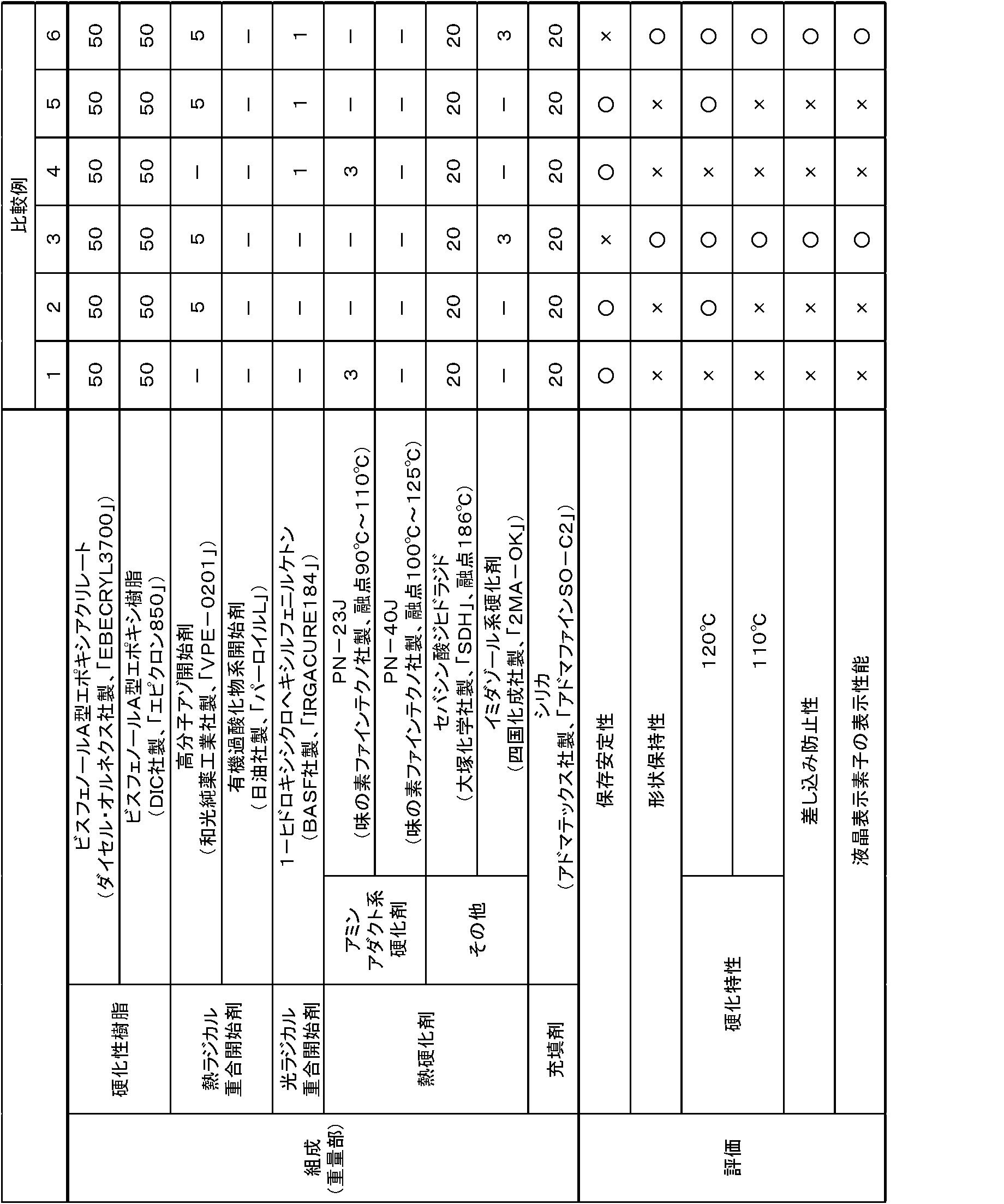
表1、2に記載された配合比に従い、各材料を、遊星式撹拌機(シンキー社製、「あわとり練太郎」)を用いて混合した後、更に3本ロールを用いて混合することにより実施例1~14、比較例1~6の各液晶表示素子用シール剤を調製した。
なお、アミンアダクト系硬化剤として用いた表中の「PN-23J」及び「PN-40J」は、25℃で粒子状であり、粉砕及び分級処理を行うことにより、平均粒子径を、「PN-23J」は1.2μm、「PN-40J」は1.1μmとしたものを用いた。
実施例及び比較例で得られた各液晶表示素子用シール剤について以下の評価を行った。結果を表1、2に示した。
実施例及び比較例で得られた各液晶表示素子用シール剤について、製造直後の初期粘度と、25℃で3日間保管したときの粘度とを測定し、(25℃、3日間保管後の粘度)/(初期粘度)を粘度変化率とし、粘度変化率が1.5未満であったものを「○」、1.5以上であったものを「×」として保存安定性を評価した。
なお、シール剤の粘度は、E型粘度計(BROOK FIELD社製、「DV-III」)を用い、25℃において回転速度1.0rpmの条件で測定した。
実施例及び比較例で得られた各液晶表示素子用シール剤0.1gをITO付きガラス基板に点状に塗布し、該ガラス基板を水平面に対して45度傾けた状態で120℃のオーブンに投入し、5分間加熱した後のガラス基板を観察し、塗布位置からのシール剤の移動距離を測定した。塗布位置からのシール剤の移動距離の最大値が20mm以下であった場合を「○」、20mmを超えた場合を「×」として形状保持性を評価した。
実施例及び比較例で得られた各液晶表示素子用シール剤100重量部に対して平均粒子径5μmのスペーサー粒子(積水化学工業社製、「ミクロパールSP-2050」)1重量部を遊星式撹拌装置によって均一に分散させ、得られたシール剤をITO付きガラス基板に塗布して貼り合わせてからシール剤を充分に押し潰し、120℃又は110℃のオーブンに投入した。
その後、カッターを用いて基板を剥がし、顕微IR法によってシール剤のスペクトルを測定し、それぞれのスペクトルからシール剤中のアクリロイル基の転化率とエポキシ基の転化率とを以下の方法により求めた。即ち、815~800cm-1のピーク面積をアクリロイル基のピーク面積、920~910cm-1のピーク面積をエポキシ基のピーク面積とし、845~820cm-1のピーク面積をリファレンスピーク面積として、下記式によりアクリロイル基の転化率とエポキシ基の転化率を算出し、その平均値が80%以上であったものを「○」、80%未満であったものを「×」として遮光部硬化性を評価した。
アクリロイル基の転化率={1-(紫外線照射後のアクリロイル基のピーク面積/紫外線照射後のリファレンスピーク面積)/(紫外線照射前のアクリロイル基のピーク面積/紫外線照射前のリファレンスピーク面積)}×100
エポキシ基の転化率={1-(紫外線照射後のエポキシ基のピーク面積/紫外線照射後のリファレンスピーク面積)/(紫外線照射前のエポキシ基のピーク面積/紫外線照射前のリファレンスピーク面積)}×100
実施例及び比較例で得られた各液晶表示素子用シール剤100重量部に対して平均粒子径5μmのスペーサー粒子(積水化学工業社製、「ミクロパールSP-2050」)1重量部を遊星式撹拌装置によって均一に分散させ、得られたシール剤をディスペンス用のシリンジ(武蔵エンジニアリング社製、「PSY-10E」)に充填し、脱泡処理を行ってから、ディスペンサー(武蔵エンジニアリング社製、「SHOTMASTER300」)にて、2枚のラビング済み配向膜及びITO付きガラス基板の一方に、線幅が1mmの枠状になるようにしてシール剤を塗布した。続いて、液晶滴下装置にてTN液晶(チッソ社製、「JC-5001LA」)の微小滴をシール剤の枠内全面に滴下塗布し、すぐにもう一方のガラス基板を貼り合わせ、セルを得た。得られたセルを120℃で1時間加熱してシール剤を熱硬化させ、液晶表示素子(セルギャップ5μm)を得た。実施例8~14及び比較例4~6で得られた各液晶表示素子用シール剤を用いたものについては、120℃で1時間加熱してシール剤を熱硬化させる前に、メタルハライドランプを用いて100mW/cm2の紫外線を30秒照射してシール剤を仮硬化させた。
得られた各液晶表示素子について、シール部の形状観察を行った。その結果、内部の液晶によりシール部の形状が乱されていなかったものを「○」、シールパターンの形状が僅かに乱されていたものを「△」、シール部の形状がかなり乱されていたものを「×」として差し込み防止性を評価した。
上記「(差し込み防止性)」にて得られた液晶表示素子を、AC3.5Vの電圧駆動をさせ、表示むら(色むら)の有無を目視で観察した。液晶表示素子の周辺部に表示むらが全く見られなかった場合を「◎」、少し薄い表示むらが見えた場合を「○」、はっきりとした濃い表示むらがあった場合を「△」、はっきりとした濃い表示むらが周辺部のみではなく、中央部まで広がっていた場合を「×」として液晶表示素子の表示性能を評価した。
なお、評価が「◎」、「○」の液晶表示素子は実用に全く問題のないレベルである。

Claims (8)
- 硬化性樹脂と、熱ラジカル重合開始剤と、熱硬化剤とを含有し、
前記熱硬化剤は、25℃で粒子状のアミンアダクト系硬化剤を含有することを特徴とする液晶表示素子用シール剤。 - アミンアダクト系硬化剤は、平均粒子径が3μm以下であることを特徴とする請求項1記載の液晶表示素子用シール剤。
- アミンアダクト系硬化剤は、融点が70℃~140℃であることを特徴とする請求項1又は2記載の液晶表示素子用シール剤。
- 熱硬化剤として、更に、ヒドラジド系硬化剤を含有することを特徴とする請求項1、2又は3記載の液晶表示素子用シール剤。
- 熱ラジカル重合開始剤は、アゾ開始剤であることを特徴とする請求項1、2、3又は4記載の液晶表示素子用シール剤。
- ITO付きガラス基板に0.1gのシール剤を点状に塗布し、該ガラス基板を水平面に対して45度傾けた状態で120℃で5分間加熱した後の塗布位置からのシール剤の移動距離の最大値が20mm以下であることを特徴とする液晶表示素子用シール剤。
- 請求項1、2、3、4、5又は6記載の液晶表示素子用シール剤と、導電性微粒子とを含有することを特徴とする上下導通材料。
- 請求項1、2、3、4、5若しくは6記載の液晶表示素子用シール剤又は請求項7記載の上下導通材料を有することを特徴とする液晶表示素子。
Priority Applications (3)
| Application Number | Priority Date | Filing Date | Title |
|---|---|---|---|
| JP2016535076A JP6046868B1 (ja) | 2015-05-20 | 2016-05-18 | 液晶滴下工法用シール剤、上下導通材料、及び、液晶表示素子 |
| KR1020177010502A KR102606399B1 (ko) | 2015-05-20 | 2016-05-18 | 액정 표시 소자용 시일제, 상하 도통 재료 및 액정 표시 소자 |
| CN201680004880.7A CN107111193A (zh) | 2015-05-20 | 2016-05-18 | 液晶显示元件用密封剂、上下导通材料及液晶显示元件 |
Applications Claiming Priority (2)
| Application Number | Priority Date | Filing Date | Title |
|---|---|---|---|
| JP2015-102904 | 2015-05-20 | ||
| JP2015102904 | 2015-05-20 |
Publications (1)
| Publication Number | Publication Date |
|---|---|
| WO2016186127A1 true WO2016186127A1 (ja) | 2016-11-24 |
Family
ID=57320076
Family Applications (1)
| Application Number | Title | Priority Date | Filing Date |
|---|---|---|---|
| PCT/JP2016/064719 Ceased WO2016186127A1 (ja) | 2015-05-20 | 2016-05-18 | 液晶表示素子用シール剤、上下導通材料、及び、液晶表示素子 |
Country Status (5)
| Country | Link |
|---|---|
| JP (1) | JP6046868B1 (ja) |
| KR (1) | KR102606399B1 (ja) |
| CN (1) | CN107111193A (ja) |
| TW (2) | TW202108730A (ja) |
| WO (1) | WO2016186127A1 (ja) |
Cited By (1)
| Publication number | Priority date | Publication date | Assignee | Title |
|---|---|---|---|---|
| WO2018128158A1 (ja) * | 2017-01-04 | 2018-07-12 | 積水化学工業株式会社 | 液晶表示素子用シール剤、上下導通材料、及び、液晶表示素子 |
Families Citing this family (4)
| Publication number | Priority date | Publication date | Assignee | Title |
|---|---|---|---|---|
| CN113661438B (zh) * | 2019-05-10 | 2024-06-28 | 三井化学株式会社 | 液晶密封剂、使用其的液晶显示面板、及其制造方法 |
| KR102860788B1 (ko) * | 2020-08-28 | 2025-09-16 | 세키스이가가쿠 고교가부시키가이샤 | 액정 표시 소자용 시일제, 상하 도통 재료, 및, 액정 표시 소자 |
| JP7687960B2 (ja) * | 2020-09-29 | 2025-06-03 | 古河電気工業株式会社 | 透明接着剤用組成物及びフィルム状透明接着剤、並びに、透明接着剤硬化層付部材の製造方法、電子部品及びその製造方法 |
| TW202313920A (zh) * | 2021-06-03 | 2023-04-01 | 日商積水化學工業股份有限公司 | 液晶顯示元件用密封劑及液晶顯示元件 |
Citations (4)
| Publication number | Priority date | Publication date | Assignee | Title |
|---|---|---|---|---|
| JPH103084A (ja) * | 1996-06-18 | 1998-01-06 | Sumitomo Bakelite Co Ltd | 液晶表示素子用シール材組成物及びそれを用いた液晶表示素子 |
| WO2006016507A1 (ja) * | 2004-08-11 | 2006-02-16 | Nippon Kayaku Kabushiki Kaisha | 液晶シール剤およびそれを用いた液晶表示セル |
| WO2008102550A1 (ja) * | 2007-02-20 | 2008-08-28 | Mitsui Chemicals, Inc. | 液晶シール用硬化性樹脂組成物および、これを使用した液晶表示パネルの製造方法 |
| WO2014199853A1 (ja) * | 2013-06-11 | 2014-12-18 | 積水化学工業株式会社 | 液晶滴下工法用シール剤、上下導通材料、及び、液晶表示素子 |
Family Cites Families (8)
| Publication number | Priority date | Publication date | Assignee | Title |
|---|---|---|---|---|
| JP3583326B2 (ja) | 1999-11-01 | 2004-11-04 | 協立化学産業株式会社 | Lcdパネルの滴下工法用シール剤 |
| JP3795459B2 (ja) | 2001-05-16 | 2006-07-12 | 積水化学工業株式会社 | 硬化性樹脂組成物、表示素子用シール剤及び表示素子用封口剤 |
| WO2007083397A1 (ja) * | 2006-01-17 | 2007-07-26 | Somar Corporation | 液状エポキシ樹脂組成物及びこれを用いた接着剤 |
| CN101501560B (zh) * | 2006-08-04 | 2012-01-11 | 三井化学株式会社 | 液晶密封剂、使用其的液晶显示面板的制造方法及液晶显示面板 |
| KR101109906B1 (ko) * | 2007-02-20 | 2012-02-08 | 미쓰이 가가쿠 가부시키가이샤 | 액정 밀봉용 경화성 수지 조성물 및 이를 사용한 액정 표시 패널의 제조 방법 |
| KR20100128144A (ko) * | 2009-05-27 | 2010-12-07 | 동우 화인켐 주식회사 | 경화성 수지 조성물 및 이를 사용한 액정 표시 장치 |
| JP5490726B2 (ja) * | 2009-07-13 | 2014-05-14 | 株式会社Adeka | 液晶滴下工法用シール剤 |
| KR101393761B1 (ko) * | 2011-10-20 | 2014-05-12 | 세키스이가가쿠 고교가부시키가이샤 | 액정 적하 공법용 시일제, 상하 도통 재료, 및 액정 표시 소자 |
-
2016
- 2016-05-18 CN CN201680004880.7A patent/CN107111193A/zh active Pending
- 2016-05-18 WO PCT/JP2016/064719 patent/WO2016186127A1/ja not_active Ceased
- 2016-05-18 JP JP2016535076A patent/JP6046868B1/ja active Active
- 2016-05-18 KR KR1020177010502A patent/KR102606399B1/ko active Active
- 2016-05-19 TW TW109134089A patent/TW202108730A/zh unknown
- 2016-05-19 TW TW105115418A patent/TW201710460A/zh unknown
Patent Citations (4)
| Publication number | Priority date | Publication date | Assignee | Title |
|---|---|---|---|---|
| JPH103084A (ja) * | 1996-06-18 | 1998-01-06 | Sumitomo Bakelite Co Ltd | 液晶表示素子用シール材組成物及びそれを用いた液晶表示素子 |
| WO2006016507A1 (ja) * | 2004-08-11 | 2006-02-16 | Nippon Kayaku Kabushiki Kaisha | 液晶シール剤およびそれを用いた液晶表示セル |
| WO2008102550A1 (ja) * | 2007-02-20 | 2008-08-28 | Mitsui Chemicals, Inc. | 液晶シール用硬化性樹脂組成物および、これを使用した液晶表示パネルの製造方法 |
| WO2014199853A1 (ja) * | 2013-06-11 | 2014-12-18 | 積水化学工業株式会社 | 液晶滴下工法用シール剤、上下導通材料、及び、液晶表示素子 |
Cited By (2)
| Publication number | Priority date | Publication date | Assignee | Title |
|---|---|---|---|---|
| WO2018128158A1 (ja) * | 2017-01-04 | 2018-07-12 | 積水化学工業株式会社 | 液晶表示素子用シール剤、上下導通材料、及び、液晶表示素子 |
| CN109219772A (zh) * | 2017-01-04 | 2019-01-15 | 积水化学工业株式会社 | 液晶显示元件用密封剂、上下导通材料和液晶显示元件 |
Also Published As
| Publication number | Publication date |
|---|---|
| TW201710460A (zh) | 2017-03-16 |
| JP6046868B1 (ja) | 2016-12-21 |
| JPWO2016186127A1 (ja) | 2017-06-22 |
| TW202108730A (zh) | 2021-03-01 |
| CN107111193A (zh) | 2017-08-29 |
| KR20180011040A (ko) | 2018-01-31 |
| KR102606399B1 (ko) | 2023-11-24 |
Similar Documents
| Publication | Publication Date | Title |
|---|---|---|
| JP5827752B2 (ja) | 液晶滴下工法用シール剤、上下導通材料、及び、液晶表示素子 | |
| JP6114893B1 (ja) | 液晶表示素子用シール剤、上下導通材料及び液晶表示素子 | |
| WO2017119406A1 (ja) | 液晶表示素子用シール剤、上下導通材料、及び、液晶表示素子 | |
| WO2015072415A1 (ja) | 液晶表示素子用シール剤、上下導通材料、及び、液晶表示素子 | |
| JP6046868B1 (ja) | 液晶滴下工法用シール剤、上下導通材料、及び、液晶表示素子 | |
| JP6313698B2 (ja) | 液晶表示素子用シール剤、及び、上下導通材料、及び、液晶表示素子 | |
| WO2016181840A1 (ja) | 液晶表示素子用シール剤、及び、上下導通材料、及び、液晶表示素子 | |
| JP5340502B2 (ja) | 液晶滴下工法用シール剤、上下導通材料、及び、液晶表示素子 | |
| JP6408983B2 (ja) | 液晶滴下工法用シール剤、上下導通材料、及び、液晶表示素子 | |
| JP6216260B2 (ja) | 液晶表示素子用シール剤、上下導通材料、及び、液晶表示素子 | |
| JP6235766B1 (ja) | 液晶表示素子用シール剤、上下導通材料、及び、液晶表示素子 | |
| JP6126756B1 (ja) | 液晶表示素子用シール剤、上下導通材料、及び、液晶表示素子 | |
| JP6918693B2 (ja) | 液晶表示素子用遮光シール剤、上下導通材料、及び、液晶表示素子 | |
| JP6609164B2 (ja) | 液晶滴下工法用シール剤、上下導通材料、及び、液晶表示素子 | |
| JP6802147B2 (ja) | 液晶表示素子用シール剤、上下導通材料、及び、液晶表示素子 | |
| JP6078698B1 (ja) | 液晶滴下工法用シール剤、上下導通材料、及び、液晶表示素子 | |
| JP6378970B2 (ja) | 硬化性樹脂組成物、液晶表示素子用シール剤、上下導通材料、及び、液晶表示素子 | |
| TW202003623A (zh) | 液晶顯示元件用密封劑、上下導通材料、及液晶顯示元件 | |
| JP6630871B1 (ja) | 電子材料用組成物、液晶表示素子用シール剤、上下導通材料、及び、液晶表示素子 | |
| TWI717446B (zh) | 液晶顯示元件用密封劑、上下導通材料及液晶顯示元件 | |
| JP2017003989A (ja) | 液晶表示素子用シール剤、上下導通材料、及び、液晶表示素子 |
Legal Events
| Date | Code | Title | Description |
|---|---|---|---|
| ENP | Entry into the national phase |
Ref document number: 2016535076 Country of ref document: JP Kind code of ref document: A |
|
| 121 | Ep: the epo has been informed by wipo that ep was designated in this application |
Ref document number: 16796520 Country of ref document: EP Kind code of ref document: A1 |
|
| ENP | Entry into the national phase |
Ref document number: 20177010502 Country of ref document: KR Kind code of ref document: A |
|
| NENP | Non-entry into the national phase |
Ref country code: DE |
|
| 122 | Ep: pct application non-entry in european phase |
Ref document number: 16796520 Country of ref document: EP Kind code of ref document: A1 |