WO2016161903A1 - 锇杂稠环化合物及其制备方法、含有该化合物的组合物以及应用 - Google Patents
锇杂稠环化合物及其制备方法、含有该化合物的组合物以及应用 Download PDFInfo
- Publication number
- WO2016161903A1 WO2016161903A1 PCT/CN2016/077311 CN2016077311W WO2016161903A1 WO 2016161903 A1 WO2016161903 A1 WO 2016161903A1 CN 2016077311 W CN2016077311 W CN 2016077311W WO 2016161903 A1 WO2016161903 A1 WO 2016161903A1
- Authority
- WO
- WIPO (PCT)
- Prior art keywords
- formula
- compound
- group
- iii
- fused ring
- Prior art date
- Legal status (The legal status is an assumption and is not a legal conclusion. Google has not performed a legal analysis and makes no representation as to the accuracy of the status listed.)
- Ceased
Links
- FOQJHZPURACERJ-UHFFFAOYSA-N CB1OC(C)(C)C(C)(C)O1 Chemical compound CB1OC(C)(C)C(C)(C)O1 FOQJHZPURACERJ-UHFFFAOYSA-N 0.000 description 1
Images


Classifications
-
- A—HUMAN NECESSITIES
- A61—MEDICAL OR VETERINARY SCIENCE; HYGIENE
- A61K—PREPARATIONS FOR MEDICAL, DENTAL OR TOILETRY PURPOSES
- A61K41/00—Medicinal preparations obtained by treating materials with wave energy or particle radiation ; Therapies using these preparations
-
- A—HUMAN NECESSITIES
- A61—MEDICAL OR VETERINARY SCIENCE; HYGIENE
- A61K—PREPARATIONS FOR MEDICAL, DENTAL OR TOILETRY PURPOSES
- A61K49/00—Preparations for testing in vivo
-
- C—CHEMISTRY; METALLURGY
- C07—ORGANIC CHEMISTRY
- C07F—ACYCLIC, CARBOCYCLIC OR HETEROCYCLIC COMPOUNDS CONTAINING ELEMENTS OTHER THAN CARBON, HYDROGEN, HALOGEN, OXYGEN, NITROGEN, SULFUR, SELENIUM OR TELLURIUM
- C07F15/00—Compounds containing elements of Groups 8, 9, 10 or 18 of the Periodic Table
Definitions
- the present invention relates to the field of metal organic chemistry and biomedicine, and in particular to a doped fused ring compound, a process for the preparation thereof, a composition containing the same, and use in the preparation of a medicament for the treatment of tumors and photoacoustic imaging.
- Photothermal therapy is the use of a photosensitive material that absorbs certain light (near-infrared), converts the absorbed light energy into heat, which leads to local high temperatures, and ultimately to the treatment of killing tumor cells.
- Photothermal therapy requires the photosensitizer to have strong absorption in the near-infrared region, the strong penetrating ability of the near-infrared laser to the biological tissue, and the background interference of the biological tissue to absorb the near-infrared light.
- the photosensitizer is required to have high photothermal conversion efficiency, light stability, low biotoxicity and good tumor targeting properties.
- thermotherapy photosensitizers including precious metal (such as Au, Ag, Pt) nanomaterials with different morphologies, carbon nanomaterials, transition metal sulfides or oxide nanoparticles, and organic polymers. Wait.
- precious metal such as Au, Ag, Pt
- organometallic compounds to photothermal therapy has not been reported.
- Photodynamic therapy is a new technique for the diagnosis and treatment of diseases using photodynamic effects. Its role is based on the photodynamic effect. This is a photosensitization reaction with the involvement of biological effects of aerobic molecules. The process is that a specific wavelength of laser irradiation causes the photosensitizer absorbed by the tissue to be excited, and the photosensitizer in an excited state transfers energy to the oxygen in the surrounding environment to generate a highly active singlet oxygen. The oxidation of singlet oxygen and adjacent biomacromolecules produces cytotoxic effects, which in turn leads to cell damage and even death. Compared with conventional treatments such as surgery, chemotherapy, and radiotherapy, photodynamic therapy has the advantages of minimal trauma, good selectivity, and low toxicity. As a method of local treatment, the main target of photodynamic therapy is the diseased tissue in the illumination area, and the damage to the normal tissue surrounding the lesion is slight. Photodynamic therapy has an effective and reproducible treatment for cancerous tissues of different cell types.
- Photoacoustic imaging technology is a non-destructive medical imaging technology based on photoacoustic effect that has just been developed in recent years.
- the light-emitting material is irradiated with a light beam, which is thermally expanded to generate ultrasonic waves. This phenomenon is called a photoacoustic effect, and the generated ultrasonic wave is called a photoacoustic signal.
- Photoacoustic imaging combines the high contrast properties of pure optical imaging with the high penetration depth of pure ultrasound imaging to provide high resolution and high contrast tissue imaging. Compared with traditional imaging techniques (such as X-ray imaging, magnetic resonance imaging), photoacoustic imaging technology has the advantages of no damage to the tissue, significantly improved imaging depth, high spatial resolution, and high contrast.
- the wavelength of absorbed light is preferably located in the near-infrared region, and the photosensitizer absorption for photothermal therapy is usually also in the near-infrared region, which is photoacoustic imaging technology.
- the combination of surgery and photothermal therapy provides convenience.
- Metal organic chemistry is a cutting-edge discipline in the study of the synthesis, structure, reaction, bonding, properties and applications of organometallic compounds. It is the study of chemistry containing carbon-metal bonds. As an important branch of chemistry, it is closely related to energy, materials, environment and life sciences, and has become one of the frontiers of modern chemistry. With the development of metal organic chemistry, transition metal heterocyclic compounds have also attracted worldwide attention. These compounds are widely used and widely used. They are a very important compound in metal organic chemistry and an intermediate in many metal-catalyzed organic reactions.
- aryl fused ring compounds such as benzene, naphthalene, anthracene, and pentacene
- benzene, naphthalene, anthracene, and pentacene have important applications in the fields of medicine, energy, and materials.
- Thorn and Hoffmann proposed on the basis of Hückel's molecular orbital theory that transition metals can also participate as heteroatoms in aromatic ring conjugation (Thorn D L, Hoffmann R. Nouv. J. Chim. 1979, 3, 39-45).
- the metal heterocyclic ring system is also aromatic.
- the Roper team reported the first synthesis of metal benzene-nonylbenzene (Elliott G P, Roper W R, Waters J M. J. Chem. Soc. Chem.
- metal heteroaromatic compounds such as metal benzene, metal benzyne, metal pyridine, metal pyridinium, metal pyrrole, metal furan, metal heteropentyne, metal heteropentene, and the like are synthesized.
- the metal can simultaneously participate in the conjugate of a plurality of aromatic rings, which can significantly improve the performance of the compound.
- compounds in which the metal is located at the center of the polycyclic ring are rare (C. Zhu, Q. Zhu, J. Fan, J. Zhu, X. He, X.-Y. Cao, H. Xia, Angew. Chem. Int. Ed. 2014, 53, 6232-6236.).
- Metal heterocyclic compounds are a class of emerging metal organic species that formally correspond to products in which carbon atoms on the organic fused ring backbone are replaced by metals. Due to the structural characteristics of metal heterocyclic compounds and organic aromatic systems and metal complexes, it is foreseen that it will likely have new properties. At present, the performance and application research of metal hetero-fused ring systems are still in their infancy. Although a small number of studies have found that some metal hetero-fused ring compounds have unique optical, electrical and magnetic properties, systematic research on the relationship between their structure and properties is still rare. The application of metal hetero-fused ring compounds in bioimaging, photoacoustic imaging, tumor photothermal therapy, and photodynamic therapy has not been reported.
- the metal heteroaromatic compound has the spectral characteristics of ultraviolet and visible broadband absorption. Through structural modification, the main absorption peak wavelength is adjustable, and the absorption performance in the near infrared is good. At the same time, the metal hetero-fused ring compound has good stability and stable structure. When different batches are synthesized, the structure, size and properties are determined, which can overcome the disadvantages that the size and performance of the nanomedicine materials in the repeated synthesis cannot be completely consistent. Therefore, in the synthesis of metal hetero-fused ring compounds, innovative design, synthesis and synthesis of a variety of metal hetero-fused ring systems with better stability, can provide a solid foundation and rich materials for performance research.
- the present invention proposes a doped fused ring.
- the doped fused ring compound provided by the present invention and the composition containing the same are used in the preparation of a medicament for treating a tumor, a drug having the advantages of minimal invasiveness, high selectivity, simple process, quick recovery, and the like can be obtained; It has the advantages of no damage to the tissue when applied to photoacoustic imaging, and can also significantly improve the depth of imaging, and the resulting image also has the advantages of high spatial resolution and high contrast.
- the metal ruthenium is located at the center of the plurality of conjugated rings.
- the absorption spectrum of the fused ring compound is gradually red-shifted.
- This type of compound has a broad-band absorption spectrum of ultraviolet-visible-near-infrared.
- the obtained drug is photothermographic therapy for tumor treatment.
- the method and/or photodynamic therapy have the advantages of minimal invasiveness, high selectivity, simple process and quick recovery; when used for photoacoustic imaging, it has the advantages of no damage to the tissue, and can also be significant
- the invention has been completed by increasing the depth of imaging, the resulting image also having the advantages of high spatial resolution and high contrast.
- the present invention provides a doped fused ring compound having the structure shown in any one of the following formulae I-III and I'-III':
- [Os] is OsXL 2
- [Os]' is OsL 2
- X is any one of H, halogen, SCN and CN
- L is a phosphine ligand, a CO ligand, a pyridine ligand, a nitrogen heterocycle Any one of a carbene ligand, a nitrile ligand and an isocyanide two-electron ligand
- Y is any one of carbon, oxygen, sulfur, selenium, nitrogen and phosphorus
- Z - is Cl - , BF 4 - Any one of PF 6 - and BPh 4 -
- R 1 + is a cationic substituent on any of the positions of the formula I-III marked with the number 1-5, and R 1 + is 3-27 a quaternary phosphonium cation of one carbon atom or a quaternary ammonium cation of 4 to 24 carbon atoms
- R' 1 is at least one of the positions
- the present invention provides a method for preparing the above doped fused ring compound, the method comprising:
- the compound of formula I is prepared by a cycloaddition reaction using a compound of formula IV and a compound of formula V in the presence of a hetero atom donor reagent;
- the compound of formula I' is prepared by a cycloaddition reaction using a compound of formula IV' and a compound of formula V' in the presence of a heteroatom donor reagent, or by formulating a compound of formula I Hydrolysis in an aqueous solution of a strong base to prepare a compound of formula I';
- Formula II' can be prepared by ring-opening reaction using a compound of formula VII' with a compound of formula VIII', or by hydrolyzing a compound of formula II in an aqueous solution of a strong base.
- the compound of the formula VII' and the compound of the formula V' or the formula VI' are used to prepare a compound of the formula III' by ring-opening reaction, or by hydrolyzing a compound of the formula III in an aqueous solution of a strong base. Preparing a compound of formula III';
- the hetero atom donor reagent is any one of water, sulfur elemental substance, selenium elemental substance, phosphorus elemental substance and ammonia; preferably any one of water, sulfur powder, selenium powder, red phosphorus, white phosphorus and liquid ammonia. ;
- R' 2 and R 2 are the same or different, and the substituent which R' 2 can select has the same range as R 2 ; R' 4 is the same or different from R 4 , and R' 4 can be selected as a substituent The range is the same as R 4 .
- the present invention provides a pharmaceutical composition comprising the above-mentioned doped fused ring compound and an amphiphilic wrapping material.
- the present invention provides the use of the above doped fused ring compound or the above pharmaceutical composition for the preparation of a medicament for treating a tumor.
- the present invention provides the use of the above doped fused ring compound or the above pharmaceutical composition in photoacoustic imaging.
- the doped fused ring compound provided by the invention has high heat, air, water and light stability and is harmless to the living body, and the absorption property of the doped fused ring compound to infrared light, especially near-infrared light.
- it when it is used for photothermal therapy and/or photodynamic therapy of tumors, it has the advantages of simple use process, high selectivity to tumor cells, minimally invasiveness and rapid postoperative recovery;
- the photoacoustic imaging there is no damage to the tissue, and at the same time, the depth of imaging can be significantly improved, and the resulting image also has high spatial resolution. Rate and high contrast.
- Fig. 1 is a chart showing the ultraviolet-visible-near-infrared absorption spectrum of the doped fused ring compound of the formula I-2 prepared in Preparation Example 2 of the present invention.
- Fig. 2 is a chart showing the ultraviolet-visible-near-infrared absorption spectrum of the doped fused ring compound of the formula II-1 prepared in Preparation Example 3 of the present invention.
- Fig. 3 is a chart showing the ultraviolet-visible-near-infrared absorption spectrum of the doped fused ring compound of the formula III-1 prepared in Preparation Example 5 of the present invention.
- FIG. 4 is a photoacoustic imaging diagram of the doped fused ring compound prepared in Preparation Example 2 and Preparation Example 3 measured in Example 1 of the present invention, wherein the upper three figures are the ones prepared in the above Preparation Example 2.
- the photoacoustic imaging diagram of the doped fused ring compound shown by I-2, and the lower three figures are photoacoustic images of the doped fused ring compound of the formula II-1 prepared in the above Preparation Example 3.
- Figure 5 is a photoacoustic image of the doped fused ring compound of Formula III-1 prepared in Preparation Example 5 in Example 1 of the present invention.
- Figure 6 is a diagram showing the photothermal action of the doped fused ring compound of the formula III-1 prepared in Preparation Example 5 of the present invention, wherein A is a photothermal treatment using DMSO as a solvent.
- the figure B shows the photothermal action when an aqueous solution of ethanol having a volume fraction of 5% is used as a solvent.
- Fig. 7 is a graph showing the results of a cytotoxicity test of the pharmaceutical composition containing the doped fused ring compound of the formula III-1 obtained in Preparation Example 5 obtained in Test Example 3 of the present invention.
- Fig. 8 is a graph showing the results of photothermal treatment of a pharmaceutical composition containing the doped fused ring compound of the formula III-1 prepared in Preparation Example 5 obtained in Example 2 of the present invention.
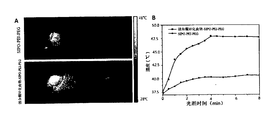
- Figure 9 is a diagram showing the photodynamic therapeutic effect of the pharmaceutical composition containing the doped fused ring compound of Formula III-1 prepared in Preparation Example 5 obtained in Example 3, wherein A is a drug Thermal sensor imaging of nude mice after treatment, and the above figure is a thermal sensing imaging image using SPIO-PEI-PEG complex. The following figure shows the heat transfer using the doped fused ring compound-SPIO-PEI-PEG complex. Sensing image, B is the temperature rise curve of the tumor site of nude mice.
- a doped fused ring compound having the structure shown in any one of the following formulae I-III and I'-III':
- [Os] is OsXL 2 and [Os]' is OsL 2 ; and X may be any of H, halogen, SCN and CN.
- the halogen may be F, Cl, Br or I.
- L may be, but not limited to, any one of a phosphine ligand, a CO ligand, a pyridine ligand, a N-Heterocyclic Carbenes (NHC) ligand, a nitrile ligand, and an isocyanide double electron ligand.
- the phosphine ligand may be an alkylphosphine, a cycloalkylphosphine, and an arylphosphine of 3 to 27 carbon atoms.
- the phosphine ligand is any one of trimethylphosphine, triethylphosphine, tripropylphosphine, triisopropylphosphine, tri-tert-butylphosphine, tricyclohexylphosphine and triphenylphosphine.
- the pyridine ligand may be a compound containing a pyridine or bipyridine structural unit.
- the pyridine ligand is methyl pyridine, ethyl pyridine, 1,4-bipyridine, 1,2-bis(4-pyridyl)ethylene, vinyl pyridine, ethynyl pyridine, pyridine boronic acid, amino group.
- the nitrogen heterocyclic carbene ligand can be any compound containing a nitrogen heterocyclic carbene structural unit.
- the nitrogen heterocyclic carbene ligand is any one of an imidazole type nitrogen heterocyclic carbene, an imidazoline type nitrogen heterocyclic carbene, a thiazole type nitrogen heterocyclic carbene, and a triazole type nitrogen heterocyclic carbene.
- the nitrile ligand may be a compound containing a nitrile group structural unit.
- the nitrile ligand is any one of acetonitrile, propionitrile and benzonitrile.
- the isocyanide-based two-electron ligand may be a compound containing an isocyanato structural unit.
- the isocyanide two-electron ligand is any one of cyclohexyl isocyanide, t-butyl isocyanide and phenyl isocyanide.
- L 2 can be considered as a whole.
- L 2 is any one selected from the group consisting of a bidentate nitrogen ligand, a bidentate phosphine ligand, a bidentate carbon-nitrogen ligand, and a bidentate oxygen-nitrogen ligand.
- the bidentate nitrogen ligand refers to a ligand having a bidentate nitrogen atom as a coordinating atom, and may be, for example, any one of ethylenediamine, 2,2'-bipyridine, and 1,10-phenanthroline.
- the bidentate phosphine ligand refers to a ligand having a bidentate phosphorus atom as a coordinating atom, and may be, for example, DPPM (Bis-(diphenylphosphino)methane, bisdiphenylphosphinomethane), DPPE (1,2-Bis ( Diphenylphosphino)ethane, 1,2-bis(diphenylphosphino)ethane) and DPPP (1,3-Bis(diphenylphosphino)propane, 1,3-bis(diphenylphosphino)propane).
- DPPM Bis-(diphenylphosphino)methane, bisdiphenylphosphinomethane
- DPPE 1,2-Bis ( Diphenylphosphino)ethane, 1,2-bis(diphenylphosphino)ethane)
- DPPP 1,3-Bis(diphenylphosphino)propan
- the bidentate carbon-nitrogen ligand refers to a ligand having a bidentate carbon-nitrogen atom as a coordinating atom, and may be, for example, o-phenylpyridine.
- the bidentate oxygen-nitrogen ligand refers to a ligand having a bidentate oxygen-nitrogen atom as a coordinating atom, and may be, for example, 8-hydroxyquinoline.
- XL 2 can be considered as a whole.
- XL 2 is a terpyridine or a tridentate Pincer ligand.
- the tridentate Pincer ligand may be, for example, any of PPP, PNP, PCP, NNN, NCN, NPN, ONO, OPO, OCO, SCS, and CCC.
- Y may be any one of carbon, oxygen, sulfur, selenium, nitrogen, and phosphorus.
- Z - may be any of Cl - , BF 4 - , PF 6 - and BPh 4 - .
- R 1 + is a cationic substituent located on any of the positions on the formula I-III labeled with the number 1-5, and R 1 + is a quaternary phosphonium cation of 3 to 27 carbon atoms or 4 to 24 carbon atoms Quaternary ammonium cation.
- R 1 + is a cationic substituent on any of the positions on the formula I-III labeled with the number 1-3, more preferably, R 1 + is a number 2 on the formula I-III a cationic substituent at the position.
- the quaternary phosphonium cation may be any one of an alkyl quaternary phosphonium having 3 to 27 carbon atoms, a cycloalkyl quaternary phosphonium, and an aryl quaternary phosphonium cation.
- the quaternary phosphonium cation is any one of trimethylphosphine, triethylphosphine, tripropylphosphine, triisopropylphosphine, tri-tert-butylphosphine, tricyclohexylphosphine and triphenylphosphine cation.
- the quaternary phosphonium cation is any one of trimethylphosphine, triethylphosphine, tripropylphosphine, triisopropylphosphine, tri-tert-butylphosphine, tricyclohexylphosphine and triphenylphosphine c
- the quaternary ammonium cation is a cation formed by substituting four H in NH 4 + with a hydrocarbon group.
- the quaternary ammonium cation is any one of tetramethylammonium, tetraethylammonium, trimethylmonoethylamine, tetrapropylammonium, tetraisopropylammonium and tetra-tert-butylammonium cation.
- R' 1 is at a position on the formula I-III marked with the number 1-5, preferably at least one of the positions marked with the number 3-5, more preferably the position marked with the number 5, and different from the position of R 1 + Substituents on.
- R 2 is at a position on the formula I-III marked with the number 6-9, preferably the position on the formula I is numbered 6 and/or 7, the position on the formula II is numbered 7 and/or 8 and on the formula III Substituents at positions marked with the numbers 7 and/or 9.
- R 3 is at least one of the positions on the formula I'-III' marked with the numbers 1-5, preferably at least one of the positions marked with the numbers 1-3, more preferably the substituent at the position marked with the number 2. .
- R 4 is a position on the formula I'-III' marked with the number 6-9, preferably the position of the formula I' is marked with the number 6 and/or 7, and the position of the formula II' is marked with the number 7 and/or 8. And substituents on the formula III' where the numbers 7 and/or 9 are indicated.
- R' 1 , R 2 , R 3 and R 4 may each independently be selected from H, halogen, SCN, CN, substituted or unsubstituted aryl group, alkyl group of 1 to 10 carbon atoms, alkoxy group An acyl group, an ester group, an amine group, an alkenyl group of 2 to 10 carbon atoms, an alkynyl group, and a substituent capable of improving water solubility.
- the halogen may be F, Cl, Br or I.
- the aryl group may be any one of a phenyl group, a naphthyl group, an anthracenyl group, a phenanthryl group, a fluorenyl group, a thienyl group, a furyl group, a pyridyl group, and a pyrrolyl group.
- the substituent of the aryl group may be any one of a hydrocarbon group of 1 to 10 carbon atoms, an alkoxy group, an acyl group, an ester group, an amine group, a nitro group, a cyano group and a halogen.
- the hydrocarbon group, alkoxy group, acyl group, ester group or amine group of 1 to 10 carbon atoms may be methyl group, ethyl group, propyl group, n-octyl group, vinyl group, ethynyl group, methoxy group or ethoxy group. Any one of n-octyloxy, acetyl, n-butyryl, methyl ester, ethyl ester, methylamino and ethylamine.
- the alkyl group, alkoxy group, acyl group, ester group or amine group of 1 to 10 carbon atoms may be methyl, ethyl, n-butyl, isobutyl, sec-butyl, tert-butyl, n-pentyl.
- the alkenyl group or alkynyl group of 2 to 10 carbon atoms may be any of a vinyl group, an ethynyl group, a propynyl group and a butynyl group.
- the substituent capable of improving water solubility may be any one of a polyethylene glycol residue, a hyaluronic acid residue, and a saccharide derivative residue.
- the polyethylene glycol residue refers to a portion after the hydroxyl group at one end of the polyethylene glycol is removed from H.
- the hyaluronic acid residue refers to a portion of the hyaluronic acid D-glucuronic acid or N-acetylglucosamine which has one of the hydroxyl groups removed from H, or the carboxyl group of the hyaluronic acid D-glucuronic acid is removed from the OH. part.
- the saccharide derivative residue means a moiety in which any one of the hydroxy groups of the saccharide derivative is removed from H.
- the polyethylene glycol may have a number average molecular weight of 200 to 200,000.
- the hyaluronic acid may have a number average molecular weight of from 2,000 to 2,000,000.
- the saccharide derivative may be any one of derivatives of glucose, sucrose, maltose, galactose, lactose, fructose, and sialic acid.
- the saccharide derivative may be, for example, any one of glucuronic acid, glucose acetal, glucose hemiacetal, and carboxymethyl lactose.
- the substituents R 1 + , R′ 1 , R 2 , R 3 and R 4 may each be one or more; if plural, a plurality of R 1 on the same molecule + , R' 1 , R 2 , R 3 and R 4 may each be the same or different, and may be within the above range.
- At least one of the 5,6-position, the 6,7-position, and the 7,8-position may have a cyclic substituent.
- the cyclic substituent may be, but not limited to, a three-membered ring, a four-membered ring, a five-membered ring, a six-membered ring, a seven-membered ring or an eight-membered ring substituent composed entirely of carbon atoms, or contains oxygen, sulfur, A three-membered ring, a four-membered ring, a five-membered ring, a six-membered ring, a seven-membered ring or an eight-membered ring substituent of a hetero atom such as selenium, nitrogen, phosphorus or arsenic.
- a hetero atom such as selenium, nitrogen, phosphorus or arsenic.
- the cyclic substituent may be, for example, a cyclopropyl group, a cyclobutyl group, a cyclopentyl group, a cyclohexyl group, a cycloheptyl group, a cyclooctyl group, a furyl group, a thienyl group or a pyridyl group.
- the doped fused ring compound is any one of the following compounds:
- [Os] is OsX(PPh 3 ) 2
- X is Cl or Br
- [Os]' is both Os(PPh 3 ) 2 .
- Ph is a phenyl group
- Py is a fluorenyl group
- Cy is a cyclohexyl group.
- BF 4 - is a tetrafluoroborate anion
- Me is a methyl group
- Et is an ethyl group
- Ac is an acetyl group.
- the compound of formula I is prepared by a cycloaddition reaction using a compound of formula IV and a compound of formula V in the presence of a hetero atom donor reagent.
- the compound of the formula II is produced by a ring expansion reaction using a compound represented by the formula VII and a compound represented by the formula VIII.
- the compound of the formula III is produced by a ring expansion reaction using a compound represented by the formula VII and a compound represented by the formula V or the formula VI.
- the compound of formula I' is prepared by a cycloaddition reaction using a compound of formula IV' and a compound of formula V' in the presence of a heteroatom donor reagent, or by formulating a compound of formula I
- the compound of formula I' is prepared by hydrolysis in an aqueous solution of a strong base.
- Formula II' can be prepared by ring-opening reaction using a compound of formula VII' with a compound of formula VIII', or by hydrolyzing a compound of formula II in an aqueous solution of a strong base. The compound shown.
- the compound of the formula VII' and the compound of the formula V' or the formula VI' are used to prepare a compound of the formula III' by ring-opening reaction, or by hydrolyzing a compound of the formula III in an aqueous solution of a strong base. A compound of the formula III' is prepared.
- the hetero atom donor reagent is a substance containing a Y atom, and may be, for example, water, sulfur simple substance, selenium elemental substance, phosphorus elemental substance, and ammonia. Any one.
- the hetero atom donor reagent is any one of water, sulfur powder, selenium powder, red phosphorus, white phosphorus and liquid ammonia.
- the strong base can be NaOH and/or KOH.
- the concentration of the aqueous solution of the strong base may be from 0.01 to 10 moles per liter.
- R' 2 is the same as or different from R 2 , and the substituent which R' 2 can select has the same range as R 2 .
- R' 4 is the same as or different from R 4 , and the substituent which R' 4 can select has the same range as R 4 .
- the reaction can be carried out in an organic solvent.
- the organic solvent may be at least one of dichloromethane, dichloroethane, chloroform, methanol, ethanol, acetone, methyl ethyl ketone, tetrahydrofuran, dimethyl sulfoxide, N, N-dimethylformamide, and acetonitrile.
- the reaction conditions may include a reaction temperature of from minus 100 ° C to above 200 ° C, preferably from 10 to 60 ° C, further preferably room temperature (ie, about 25 ° C); the reaction time is from 1 minute to 20 days, preferably 3 hours to 3 days, further preferably 24 hours.
- the obtained reaction mixture can be concentrated and precipitated to obtain a solid substance, and the obtained solid substance is separated by filtration, washing and column chromatography to obtain the hydrazine. Heterofused ring compounds.
- a pharmaceutical composition comprising the above-mentioned doped fused ring compound and an amphiphilic wrapping material.
- the amphiphilic wrapping material may be an amphiphilic compound and/or an amphiphilic hyperbranched polymer.
- the weight ratio of the doped fused ring compound to the amphiphilic wrapping material may be from 1:0.01 to 100, preferably from 1:0.1 to 1.
- the amphiphilic wrapping material is an amphiphilic compound and an amphiphilic hyperbranched polymer, and the weight ratio of the amphiphilic compound to the amphiphilic hyperbranched polymer is 1:0.01-100. Preferably, it is 1:0.1-1.
- the amphiphilic wrapping material is used to encapsulate the doped fused ring compound.
- the amphiphilic compound may be cetyltrimethylammonium bromide, sodium dodecyl dimethyl octadecyl dimethylammonium bromide, dioctadecyl dimethyl ammonium chloride, double Cetyldimethylammonium bromide, dihexadecyldimethylammonium chloride, octadecyltrimethylammonium bromide, tetradecyltrimethylammonium bromide, dodecyl three At least one of methyl ammonium bromide and polyoxyethylene.
- the amphiphilic hyperbranched polymer may be at least one of glycidol, poly(ethyleneimine), polyethyleneimine-polyethylene glycol, and poly(ester-amine).
- the degree of polymerization of the amphiphilic hyperbranched polymer may each be 1 x 10-1 x 10 6 .
- the pharmaceutical composition may further contain one or more other drugs which can be used for tumor treatment.
- the other drug that can be used for tumor treatment may be at least one of doxorubicin, paclitaxel, cisplatin, carboplatin, and platinum oxalate.
- the weight ratio of the doped fused ring compound to other drugs which can be used for tumor treatment may be from 1:0.01 to 100, preferably from 1:0.1 to 1.
- the pharmaceutical composition may further contain other properties having special functions, or may improve the properties and therapeutic effects of the doped fused ring compound, or compensate for defects of the doped fused ring compound, or
- the doped fused ring compound binds to a substance that achieves certain therapeutic effects.
- the pharmaceutical composition may further comprise SPIO (Superparamagnetic Iron Oxide) to achieve a combination of treatment and magnetic resonance imaging; or may contain a fluorescent dye molecule such as rhodamine to achieve treatment and fluorescence.
- the combination of imaging it can also contain medical scaffolds to achieve the effect of fixed-point treatment.
- the weight ratio of the doped fused ring compound to SPIO may be from 1:0.01 to 100, preferably from 1:0.1 to 1.
- the weight ratio of the doped fused ring compound to rhodamine may be from 1:0.01 to 100, preferably from 1:0.1 to 1.
- the present invention provides the use of the above doped fused ring compound or the above pharmaceutical composition for the preparation of a medicament for treating a tumor.
- the use of a doped fused ring compound or pharmaceutical composition according to the present invention for the preparation of a medicament for treating a tumor wherein the process of treating a tumor may be photothermal therapy and/or photodynamic therapy.
- the photothermal therapy may comprise selecting a laser having a wavelength of from 600 to 1000 nm, preferably a laser having a wavelength of from 680 to 1000 nm, and most preferably a laser having a wavelength of 810 nm in combination with the doped fused ring compound or pharmaceutical composition for treating a tumor.
- the doped fused ring compound has a high photothermal conversion efficiency at these wavelengths.
- the photodynamic therapy may comprise the use of a laser having a wavelength of from 600 to 680 nm, preferably a laser having a wavelength of from 615 to 635 nm, most preferably a laser having a wavelength of from 620 to 630 nm in combination with the doped fused ring compound or pharmaceutical composition. Treat tumors.
- a doped fused ring compound or pharmaceutical composition according to the present invention for the preparation of a medicament for treating a tumor, which may be formulated into any suitable galenic form, and may be applied by any suitable The route is applied to the individual in need.
- the medicament for treating a tumor can be formulated into a form of a solution, a suspension, an emulsion, or a lyophilized preparation for injection (including but not limited to intra-arterial, intravenous, intramuscular, subcutaneous, and intraperitoneal injection, etc.
- the drug for treating a tumor may also be formulated into a tablet, a solution, a capsule for oral administration; and the drug for treating a tumor may also be formulated into an ointment.
- the form of the agent, cream, suppository or patch is for topical administration; the drug for treating a tumor can also be formulated for administration by inhalation in the form of an aerosol, spray or powder.
- the photodynamic therapy may comprise calculating the drug for treating a tumor with a doped fused ring compound
- concentration is from 0.01 to 1000 ⁇ g/mL, preferably from 1 to 100 ⁇ g/mL, more preferably 10 ⁇ g/mL.
- the present invention provides the use of the above doped fused ring compound or the above pharmaceutical composition in photoacoustic imaging.
- the application in photoacoustic imaging may comprise selecting a laser having a wavelength of 680-950 nm, preferably a laser having a wavelength of 680-850 nm, and most preferably a laser having a wavelength of 810 nm in combination with the doped fused ring compound.
- the use in photoacoustic imaging may include, calculated as a doped fused ring compound, the concentration of the doped fused ring compound or pharmaceutical composition may be from 0.01 to 100 mg/mL, preferably from 0.1 to 10 mg/mL, more It is preferably 1 mg/mL.
- Compound B was prepared as follows:
- Preparation Examples 1-10 are used to illustrate the preparation of the doped fused ring compounds of Formulas I-III and Formula I'-III'.
- [Os] is OsCl(PPh 3 ) 2 , It is a triphenylphosphine cation, BF 4 - is a tetrafluoroborate anion, Ph is a phenyl group, and Me is a methyl group.
- [Os] is OsCl(PPh 3 ) 2
- Is a triphenylphosphine cation
- BF 4 - is a tetrafluoroborate anion
- Py is a fluorenyl group
- Me is a methyl group.
- [Os] is OsCl(PPh 3 ) 2 and [Os]' is Os(PPh 3 ) 2
- Is a triphenylphosphine cation
- BF 4 - is a tetrafluoroborate anion
- Me is a methyl group.
- [Os] is OsCl(PPh 3 ) 2 and [Os]' is Os(PPh 3 ) 2
- Is a triphenylphosphine cation
- BF 4 - is a tetrafluoroborate anion
- Ph is a phenyl group
- Me is a methyl group.
- [Os] is OsCl(PPh 3 ) 2 and [Os]' is Os(PPh 3 ) 2
- Is a triphenylphosphine cation
- BF 4 - is a tetrafluoroborate anion
- Ph is a phenyl group
- Me is a methyl group.
- [Os] is OsCl(PPh 3 ) 2 and [Os]' is Os(PPh 3 ) 2
- It is a triphenylphosphine cation
- BF 4 - is a tetrafluoroborate anion
- Cy is a cyclohexyl group.
- [Os] is OsCl(PPh 3 ) 2
- Is a triphenylphosphine cation
- BF 4 - is a tetrafluoroborate anion
- Ph is a phenyl group
- Me is a methyl group.
- 0.1 mmol of the compound I-1 was dissolved in 15 mL of chloroform, and then 0.50 mmol of sodium hydroxide (NaOH) and 0.1 mL of water were added to obtain a mixed solution, and the mixture was stirred at room temperature for 1 day, filtered, and the filtrate was concentrated to 2 mL, and then added. 30 mL of n-hexane was used as a precipitant.
- 31 P NMR (202.5 MHz, CDCl 3 ): ⁇ -17.31 ppm (s, OsPPh 3 ).
- [Os]' is Os(PPh 3 ) 2
- Is a triphenylphosphine cation
- BF 4 - is a tetrafluoroborate anion
- Me is a methyl group.
- 0.1 mmol of the compound II-1 was dissolved in 15 mL of chloroform, and then 0.50 mmol of sodium hydroxide (NaOH) and 0.1 mL of water were added to obtain a mixed liquid, and the mixture was stirred at room temperature for 1 day, then filtered, and the filtrate was concentrated to 2 mL, and then added. 30 mL of n-hexane was used as a precipitant.
- 31 P NMR (202.5 MHz, CDCl 3 ): ⁇ -15.65 ppm (s, OsPPh 3 ).
- [Os]' is Os(PPh 3 ) 2
- Is a triphenylphosphine cation
- BF 4 - is a tetrafluoroborate anion
- Ph is a phenyl group.
- 31 P NMR (202.5 MHz, CDCl 3 ): ⁇ -15.42 (s, OsPPh 3 ).
- This test example is used to illustrate the ultraviolet-visible-near-infrared absorption spectrum of the doped fused ring compound represented by Formula I-III.
- Representative compounds of the formulae I-III obtained in the above preparation examples were subjected to ultraviolet-visible-near-infrared absorption spectroscopy using a SHIMADZU UV2550 spectrometer.
- the conditions tested were as follows: A representative compound of the above formula I-III was diluted to 1.0 ⁇ 10 -5 mol/L using dichloromethane, and the test was carried out at room temperature.
- Fig. 1 is an ultraviolet-visible-near-infrared absorption spectrum of the doped fused ring compound represented by the formula I-2 prepared in the above Preparation Example 2.
- the doped fused ring compound has maximum absorption at a low energy position at a wavelength of 600 nm.
- Fig. 2 is an ultraviolet-visible-near-infrared absorption spectrum of the doped fused ring compound of the formula II-1 prepared in the above Preparation Example 3.
- the doped fused ring compound has maximum absorption at a low energy position at a wavelength of 650 nm.
- FIG. 3 is an ultraviolet-visible-near-infrared absorption spectrum of the doped fused ring compound represented by Formula III-1 prepared in the above Preparation Example 5.
- the doped fused ring compound has maximum absorption at a low energy position at a wavelength of 810 nm.
- This example is intended to illustrate the use of the doped fused ring compounds of Formulas I-III in photoacoustic imaging.
- Representative compounds of the formulae I-III obtained in the above Preparations 1-6 were subjected to photoacoustic imaging tests using an Endra Nexus 128, Ann Arbor, MI test system.
- the test conditions were as follows: the solvent used was DMSO (dimethyl sulfoxide), the representative compound of the formula I-II used a laser light source having a wavelength of 680 nm, and the representative compound of the formula III used a laser light source having a wavelength of 800 nm.
- FIG. 4 the upper three figures are photoacoustic images of the doped fused ring compound represented by the above formula I-2 prepared in the above Preparation Example 2, and the lower three figures are the above preparation examples.
- 3 Photoacoustic imaging diagram of the obtained doped fused ring compound represented by Formula II-1. As can be seen from Fig. 4, as the concentration was increased to 1 mg/mL, the photoacoustic imaging effect of the doped fused ring compounds I and II in DMSO solvent was remarkable.
- Fig. 5 is a photoacoustic image of the doped fused ring compound of the formula III-1 prepared in the above Preparation Example 5. As can be seen from Fig. 5, as the concentration was increased to 1 mg/mL, the photoacoustic imaging effect of the doped fused ring compound III in DMSO solvent was remarkable.
- This test example is used to illustrate the photothermal action of the doped fused ring compound represented by Formula I-III.
- the representative compound of the formula III-1 obtained in the above Preparation Example 5 was subjected to an in vitro photothermographic test using an apparatus of Beijing Sitong Boyuan Laser Technology Co., Ltd. under the designation STL808T1-4.0W-15W.
- the test conditions were as follows: the solvent used was DMSO or an aqueous solution of 5% by volume of ethanol, using a laser light source having a wavelength of 808 nm, a power of 1 W/cm 2 , and a concentration of the doped fused ring compound of 25 ppm, 50 ppm, and 75 ppm, respectively. And 100 ppm, the solution volume is 100 ⁇ L.
- Fig. 6 shows the photothermal action of the doped fused ring compound represented by the formula III-1 prepared in the above Preparation Example 5. It can be seen from Fig. 6 that in the aqueous solution of DMSO or ethanol having a volume fraction of 5%, the photothermal action of the compound III-1 is not much different, indicating that the solvent has no influence on the photothermal action of the compound III-1. As can be seen from the graph (B) of Fig. 6, in the aqueous solution of ethanol having a volume fraction of 5%, 100 ppm of the doped fused ring compound obtained in Preparation Example 5 was increased by 28 ° C in 6 min, and finally the temperature was raised. Stable at 56 ° C.
- the photothermal action of the doped fused ring compound represented by Formula I-2 prepared in Preparation Example 2 is as shown in Formula I-2 of Preparation Example 2 in an aqueous solution of ethanol having a volume fraction of 5%.
- the doped fused ring compound increased by 25 ° C in 6 min, and finally the temperature stabilized at 56 ° C.
- the photothermal action of the doped fused ring compound represented by Formula II-1 prepared in Preparation Example 3 was as follows: 100 ppm of the doped fused ring compound obtained in Preparation Example 3 in an aqueous solution of ethanol having a volume fraction of 5% In 6 minutes, the temperature was increased by 26 ° C, and finally the temperature was stabilized at 58 ° C.
- This test example is intended to illustrate the cytotoxicity of the doped fused ring compounds of Formulas I-III.
- the doped fused ring compounds prepared in the above Preparations 2, 3 and 5 were respectively made of PEI-PEG (Polyethyleneimine-Polyethylene glycol, polyethyleneimine-polyethylene glycol, wherein PEI was purchased from Sigma Company under the designation P3143.
- the product, PEG is commercially available from Sigma under the designation 02393, and the weight ratio of PEI to PEG is 1:1), and the method of encapsulation is as follows: in the dichloromethane solution of the doped fused ring compound, the above is added.
- the PEI-PEG compound was doped with three times the weight of the fused ring compound, and after stirring at room temperature for 3 hours, it was filtered and washed to obtain a doped fused ring compound wrapped with an amphiphilic material.
- MTT(3-(4,5-dimethyl-2-thiazolyl)-2,5-diphenyl-2-H-tetrazolium bromide was subjected to the above-mentioned doped fused ring compound coated with amphiphilic material using 4T1 cells and A549 cells.
- 3-(4,5-Dimethylthiazole-2)-2,5-diphenyltetrazolium bromide) assay to detect cellular activity as follows:
- the above cells were plated in a 96-well plate at 1 ⁇ 10 5 cells per well, and cultured overnight.
- the above doped fused ring compounds coated with amphiphilic materials were separately added to a 96-well plate, and the drug concentrations calculated by the doped fused ring compounds were 1, 5, 10, 30, 50, and 100 ⁇ g/mL, respectively, and incubated for 24 hours. .
- MTT was added to a 96-well plate to achieve a final concentration of MTT of 5 mg/mL and incubation for 4 hours.
- the liquid in the well was aspirated, 100 ⁇ L of DMSO was added to each well, and after shaking uniformly, the absorbance was measured at a wavelength of 570 nm.
- the MTT test results of the pharmaceutical composition containing the doped fused ring compound of the formula III-1 prepared in Preparation Example 5 are shown in Fig. 7. As can be seen from Fig. 7, when the concentration of the drug calculated by the doped fused ring compound reaches 50 ⁇ g/mL, 4T1 cells and A549 are fine. The activity of the cells can still reach 90%.
- the MTT test results of the pharmaceutical composition containing the doped fused ring compound represented by Formula 1-2 or II-1 prepared in Preparation Example 2 or 3 were substantially the same as those shown in Fig. 7. This indicates that the doped fused ring compound represented by the formula I-III has substantially no effect on the cells and is substantially cytotoxic.
- This example is intended to illustrate the photothermotherapy effect of the doped fused ring compounds of Formulas I-III on tumor cells.
- the doped fused ring compound represented by Formula I-III which is encapsulated with an amphiphilic material, is combined with SPIO nanoparticles and PEI-PEG to form a doped fused ring compound-SPIO-PEI-PEG according to the method in Test Example 3 above. Things.
- 4T1 cells were cultured in a 96-well plate at 5-10 ⁇ 10 3 cells/well, and the cells were divided into the following three groups for testing:
- Control group 1 except for laser irradiation, the other treatment operations were the same as the experimental group;
- Control group 2 except for the same amount of DMEM cell culture medium instead of the doped fused ring compound-SPIO-PEI-PEG complex, the other treatment operations were the same as the experimental group;
- the 4T1 cells treated by the above three groups of operations were subjected to an MTT assay according to the method of Test Example 3, and the activity of the cells was examined.
- the MTT test results of the pharmaceutical composition containing the doped fused ring compound of the formula III-1 prepared in Preparation Example 5 are shown in Fig. 8.
- the control group 1 using only the doped fused ring compound-SPIO-PEI-PEG complex without laser irradiation was also toxic to about 4T1 cells (about 20%).
- Cell death rate in the experimental group using the doped fused ring compound-SPIO-PEI-PEG complex and irradiated with a laser, when the drug concentration calculated by the doped fused ring compound reached 10 ⁇ g/mL and above, Its effect on killing cells is very significant (more than 90% of cell death rates).
- This example is intended to illustrate the in vivo photodynamic therapeutic effect of the doped fused ring compounds of Formulas I-III on tumor cells.
- the doped fused ring compound coated with the amphiphilic material and the SPIO nanoparticle and PEI-PEG will form a doped fused ring compound-SPIO-PEI-PEG complex, and the SPIO nanoparticle will be prepared according to the method in Test Example 3 above. And PEI-PEG forms a SPIO-PEI-PEG complex.
- Control group After injecting 100 ⁇ L of the SPIO-PEI-PEG complex in situ on the tumor, it was irradiated with a laser having a wavelength of 808 nm and a power of 1 W/cm 2 for 10 minutes.
- the experimental results of the pharmaceutical composition containing the doped fused ring compound of the formula III-1 prepared in Preparation Example 5 are shown in Fig. 9.
- Fig. 9 in the control group using the SPIO-PEI-PEG complex, the temperature rise of the tumor site was not significant, and the experimental group using the doped fused ring compound-SPIO-PEI-PEG complex was used. The temperature of the tumor site increased significantly, reaching nearly 48 ° C, making tumor cells difficult to survive.
- the experimental results of the pharmaceutical composition containing the doped fused ring compound of Formula I-2 or II-1 prepared in Preparation Example 2 or 3 were substantially the same as those shown in Fig. 9. This demonstrates that the doped fused ring compounds of Formula I-III have good in vivo photodynamic therapeutic effects on tumor cells.
Landscapes
- Health & Medical Sciences (AREA)
- Chemical & Material Sciences (AREA)
- Epidemiology (AREA)
- Life Sciences & Earth Sciences (AREA)
- Animal Behavior & Ethology (AREA)
- General Health & Medical Sciences (AREA)
- Public Health (AREA)
- Veterinary Medicine (AREA)
- Organic Chemistry (AREA)
- Medicinal Chemistry (AREA)
- Pharmacology & Pharmacy (AREA)
- Pharmaceuticals Containing Other Organic And Inorganic Compounds (AREA)
Abstract
本发明涉及金属有机化学和生物医药领域,公开了一种具有如下式I-III和I'-III'中的任意一个所示结构的锇杂稠环化合物。本发明还公开了上述化合物的制备方法,含有该化合物的组合物,以及该化合物和组合物在制备用于治疗肿瘤的药物和光声成像中的应用。
Description
本发明涉及金属有机化学和生物医药领域,具体地,涉及锇杂稠环化合物及其制备方法、含有该化合物的组合物以及在制备用于治疗肿瘤的药物和光声成像中的应用。
近年来,肿瘤已经成为导致人类死亡的主要疾病之一。最新统计数据显示,到2020年,全球肿瘤发病率将增加50%,即每年将增加1500万肿瘤患者。肿瘤的死亡率呈现逐年递增的趋势,因此开发有效治疗肿瘤的新药物和治疗方法至关重要。
肿瘤的传统治疗手段有手术治疗、化学治疗、放射治疗等。但传统的治疗手段存在着诸多不足:如手术治疗不易根除肿瘤,化学治疗和放射治疗的毒副作用较大。与传统的治疗手段相比,光热治疗法具有微创性、高选择性、过程简单、恢复较快等优点,因此近年来备受关注。
光热治疗法是利用能吸收某种光(近红外)的光敏材料,将吸收的光能量转化为热能,从而导致局部高温,最终达到杀死肿瘤细胞的治疗方法。光热治疗要求光敏剂在近红外区具有强吸收,利用近红外激光对生物组织的强穿透能力,以及生物组织对近红外光的吸收背景干扰小等优势。同时,要求光敏剂具有较高的光热转换效率、光稳定性及较低的生物毒性和较好的肿瘤靶向性等性能。近年来,各类纳米材料作为热疗光敏剂被广泛研究,包括不同形貌的贵金属(如Au、Ag、Pt)纳米材料、碳纳米材料、过渡金属硫化物或氧化物纳米颗粒、有机聚合物等。然而,金属有机化合物应用于光热治疗尚未见诸报道。
光动力学治疗法是利用光动力效应进行疾病诊断和治疗的一种新技术。其作用基础是光动力效应。这是一种有氧分子参与的伴随生物效应的光敏化反应。其过程是特定波长的激光照射使组织吸收的光敏剂受到激发,处于激发态的光敏剂把能量传递给周围环境中的氧气,生成活性很强的单线态氧。单线态氧和相邻的生物大分子发生氧化反应产生细胞毒性作用,进而导致细胞受损乃至死亡。与手术、化疗、放疗等常规治疗手段相比,光动力学疗法具有创伤很小、选择性好、毒性低微等优点。作为一种局部治疗的方法,光动力学疗法的主要攻击目标是光照区的病变组织,对病灶周边的正常组织损伤轻微。光动力学疗法对不同细胞类型的癌组织都具有有效可重复的治疗。
光声成像技术是近几年刚刚发展起来的一种基于光声效应的无损医学成像技术。采用光束照射光敏材料,其受热膨胀而产生超声波,这种现象称为光声效应,产生的超声波称为光声信号。光声成像技术结合了纯光学成像的高对比度特性和纯超声成像的高穿透深度特性,可提供高分辨率和高对比度的组织成像。与传统的成像技术(譬如X射线成像、磁共振成像)相比,光声成像技术具有对组织无损害、显著提高的成像深度、高的空间分辨率、高对比度等优点。为了保证足够的组织渗透深度,吸收光的波长最好位于近红外区,而应用于光热治疗的光敏剂吸收通常也在近红外区,这为光声成像技
术与光热治疗相结合提供了便捷。
金属有机化学是研究金属有机化合物的合成、结构、反应、成键、性能及应用的一门前沿学科,是研究含有碳-金属键的化学。作为化学的一个重要分支学科,其与能源、材料、环境和生命科学密切相关,成为近代化学前沿领域之一。随着金属有机化学的发展,过渡金属杂环化合物也受到世人的瞩目。这类化合物品种繁多,应用广泛,是金属有机化学中一类非常重要的化合物,也是众多金属催化有机反应的中间体。
在有机化学中,芳基稠环化合物,如苯、萘、蒽、并五苯等在医药、能源、材料等领域具有重要的应用价值。1979年,Thorn和Hoffmann在Hückel分子轨道理论基础上提出过渡金属也可以作为杂原子参与芳环共轭(Thorn D L,Hoffmann R.Nouv.J.Chim.1979,3,39-45),得到的金属杂环体系同样具有芳香性。三年后,Roper课题组报道了首例金属苯-锇苯的合成(Elliott G P,Roper W R,Waters J M.J.Chem.Soc.Chem.Commun.1982,811-813.)。此后,一系列金属杂芳香化合物,如金属苯、金属苯炔、金属吡啶、金属吡啶炔、金属吡咯、金属呋喃、金属杂戊搭炔、金属杂戊搭烯等均被合成得到。在金属杂稠环化合物中,金属可以同时参与多个芳香环共轭,可显著改善化合物的性能。在已合成的金属杂稠环化合物中金属位于多环中心位置的化合物并不多见(C.Zhu,Q.Zhu,J.Fan,J.Zhu,X.He,X.-Y.Cao,H.Xia,Angew.Chem.Int.Ed.2014,53,6232-6236.)。
金属杂稠环化合物是一类新兴的金属有机物种,形式上相当于有机稠环骨架上的碳原子被金属所取代而得的产物。由于金属杂稠环化合物兼具有机芳香体系和金属配合物的结构特性,可以预见它将可能具有全新的性能。目前,对金属杂稠环体系的性能和应用研究仍处于起步阶段。虽然陆续有少量研究发现一些金属杂稠环化合物具有独特的光、电、磁等性能,但对其结构与性能关系的系统研究仍很少。金属杂稠环化合物在生物成像、光声成像、肿瘤光热治疗、光动力学治疗方面的应用还未见报道。
与经典的稠环芳香体系相比,因金属的引入,可大大提高金属杂稠环体系结构的多样性、光谱性能的可调节性、化合物的稳定性及水溶性等。金属杂芳香化合物具有紫外、可见宽频吸收的光谱特性,通过结构修饰,主要吸收峰波长可调,在近红外的吸收性能好。同时,金属杂稠环化合物的稳定性好,结构稳定,不同批次合成时,结构、大小、性质确定,可以克服纳米医药材料在重复合成时存在的尺寸、性能无法完全一致的弊端。因此,在金属杂稠环化合物的合成方法上不断创新,设计并合成多种具有更好稳定性的金属杂稠环体系,可为开展性能研究提供坚实的基础和丰富的素材。
发明内容
为了解决肿瘤的传统治疗手段中手术治疗不易根除肿瘤,化学治疗和放射治疗的毒副作用较大的缺陷,以及传统的成像技术对人体组织损伤大的缺陷,本发明提出了一种锇杂稠环化合物及其制备方法、含有该化合物的组合物以及在制备用于治疗肿瘤的药物和光声成像中的应用。本发明提供的锇杂稠环化合物以及含有该化合物的组合物应用于制备用于治疗肿瘤的药物中时,可以获得具有微创性、高选择性、过程简单、恢复较快等优点的药物;应用于光声成像时具有对组织无损害的优点,同时还能显著提高成像的深度、所成的像还具有高的空间分辨率和高对比度的优点。
本发明的发明人经研究后发现,随着共轭体系的增大,金属锇位于多个共轭环的中心位置的杂桥
位稠环化合物的吸收光谱逐渐红移,这类化合物具有紫外-可见-近红外的宽频吸收光谱,当将其用于制备用于治疗肿瘤的药物时,获得的药物在肿瘤治疗的光热治疗法和/或光动力学治疗法上具有微创性、高选择性、过程简单、恢复较快等优点;当将其用于光声成像时,具有对组织无损害的优点,同时还能显著提高成像的深度、所成的像还具有高的空间分辨率和高对比度的优点,从而完成了本发明。
第一方面,本发明提供一种锇杂稠环化合物,该化合物具有如下式I-III和I'-III'中的任意一个所示的结构:

其中,[Os]为OsXL2,[Os]'为OsL2;X为H、卤素、SCN和CN中的任意一种;L为膦配体、CO配体、吡啶类配体、氮杂环卡宾配体、腈类配体和异氰类双电子配体中的任意一种;Y为碳、氧、硫、硒、氮和磷中的任意一种;Z-为Cl-、BF4
-、PF6
-和BPh4
-中的任意一种;R1
+为位于式I-III上标有数字1-5的位置中的任意一个上的阳离子取代基,且R1
+为3-27个碳原子的季鏻阳离子或4-24个碳原子的季铵阳离子;R'1为位于式I-III上标有数字1-5的位置中不同于R1
+所在位置的至少一个上的取代基;R2为位于式I-III上标有数字6-9的位置中的至少一个上的取代基;R3为位于式I'-III'上标有数字1-5的位置中的至少一个上的取代基;R4为位于式I'-III'上标有数字6-9的位置中的至少一个上的取代基;并且,R'1、R2、R3和R4均分别独立地选自H,卤素,SCN,CN,取代或未取代的芳基,1-10个碳原子的烷基、烷氧基、酰基、酯基、胺基和2-10个碳原子的烯基、炔基和能提高水溶性的取代基中的任意一种。
第二方面,本发明提供上述锇杂稠环化合物的制备方法,该方法包括:
使用式IV所示的化合物与式V所示的化合物在杂原子供体试剂存在的条件下通过环加成反应制备式I所示的化合物;
使用式VII所示的化合物与式VIII所示的化合物通过扩环反应制备式II所示的化合物;
使用式VII所示的化合物与式V或式VI所示的化合物通过扩环反应制备式III所示的化合物;
使用式IV'所示的化合物与式V'所示的化合物在杂原子供体试剂存在的条件下通过环加成反应制备式I'所示的化合物,或者通过将式I所示的化合物在强碱的水溶液中水解来制备式I'所示的化合物;
使用式VII'所示的化合物与式VIII'所示的化合物通过扩环反应制备式II'所示的化合物,或者通过将式II所示的化合物在强碱的水溶液中水解来制备式II'所示的化合物;
使用式VII'所示的化合物与式V'或式VI'所示的化合物通过扩环反应制备式III'所示的化合物,或者通过将式III所示的化合物在强碱的水溶液中水解来制备式III'所示的化合物;
其中,所述杂原子供体试剂为水、硫单质、硒单质、磷单质和氨中的任意一种;优选为水、硫粉、硒粉、红磷、白磷和液氨中的任意一种;

其中,R'2与R2相同或不相同,且R'2能选择的取代基的范围与R2相同;R'4与R4相同或不相同,且R'4能选择的取代基的范围与R4相同。
第三方面,本发明提供一种药物组合物,该药物组合物含有上述锇杂稠环化合物和两亲性包裹材料。
第四方面,本发明提供上述锇杂稠环化合物或上述的药物组合物在制备用于治疗肿瘤的药物中的应用。
第五方面,本发明提供上述锇杂稠环化合物或上述的药物组合物在光声成像中的应用。
本发明提供的锇杂稠环化合物由于具有高的热、空气、水和光照稳定性以及对生物体无害的特点,同时该锇杂稠环化合物对红外光、尤其是近红外光的吸收性能好,当将其用于肿瘤的光热治疗和/或光动力学治疗时,具有使用过程简单、对肿瘤细胞的高选择性以及微创性和术后恢复较快等优点;当将其用于光声成像时,对组织无损害,同时还能显著提高成像的深度,所成的像还具有高的空间分辨
率和高对比度。
本发明的其他特征和优点在随后的具体实施方式部分予以详细说明。
图1为本发明测试例1中测得的制备例2制备得到的式I-2所示的锇杂稠环化合物的紫外-可见-近红外吸收光谱图。
图2为本发明测试例1中测得的制备例3制备得到的式II-1所示的锇杂稠环化合物的紫外-可见-近红外吸收光谱图。
图3为本发明测试例1中测得的制备例5制备得到的式III-1所示的锇杂稠环化合物的紫外-可见-近红外吸收光谱图。
图4为本发明实施例1中测得的制备例2和制备例3制备得到的锇杂稠环化合物的的光声成像图,其中,上部的三幅图为上述制备例2制备得到的式I-2所示的锇杂稠环化合物的光声成像图,下部的三幅图为上述制备例3制备得到的式II-1所示的锇杂稠环化合物的光声成像图。
图5为本发明实施例1中测得的制备例5制备得到的式III-1所示的锇杂稠环化合物的光声成像图。
图6为本发明测试例2中测得的制备例5制备得到的式III-1所示的锇杂稠环化合物的光热作用情况图,其中,A图为使用DMSO为溶剂时的光热作用情况,B图为使用体积分数为5%的乙醇的水溶液为溶剂时的光热作用情况。
图7为本发明测试例3中得到的含有制备例5制备得到的式III-1所示的锇杂稠环化合物的药物组合物的细胞毒性试验结果图。
图8为本发明实施例2中得到的含有制备例5制备得到的式III-1所示的锇杂稠环化合物的药物组合物的光热治疗结果图。
图9为本发明实施例3中得到的含有制备例5制备得到的式III-1所示的锇杂稠环化合物的药物组合物的光动力学治疗效果情况图,其中,A图为经药物治疗后裸鼠的热传感成像图,且上图为使用SPIO-PEI-PEG复合物的热传感成像图,下图为使用锇杂稠环化合物-SPIO-PEI-PEG复合物的热传感成像图,B图为裸鼠肿瘤部位的温度上升曲线图。
根据本发明的第一个方面,本发明提供了一种锇杂稠环化合物,该化合物具有如下式I-III和I'-III'中的任意一个所示的结构:

其中,[Os]为OsXL2,[Os]'为OsL2;X可以为H、卤素、SCN和CN中的任意一种。
所述卤素可以为F、Cl、Br或I。
L可以为但不限于膦配体、CO配体、吡啶类配体、氮杂环卡宾(N-Heterocyclic Carbenes,NHC)配体、腈类配体和异氰类双电子配体中的任意一种。所述膦配体可以为3-27个碳原子的烷基膦、环烷基膦和芳基膦。优选地,所述膦配体为三甲基膦、三乙基膦、三丙基膦、三异丙基膦、三叔丁基膦、三环己基膦和三苯基膦中的任意一种。所述吡啶类配体可以为含有吡啶或联吡啶结构单元的化合物。优选地,所述吡啶类配体为甲基吡啶、乙基吡啶、1,4-联吡啶、1,2-二(4-吡啶基)乙烯、乙烯基吡啶、乙炔基吡啶、吡啶硼酸、氨基吡啶、氰基吡啶、巯基吡啶、二甲胺基吡啶、苯基吡啶和1,2-双(4-吡啶基)乙烷中的任意一种。所述氮杂环卡宾配体可以为任何含有氮杂环卡宾结构单元的化合物。优选地,所述氮杂环卡宾配体为咪唑型氮杂环卡宾、咪唑啉型氮杂环卡宾、噻唑型氮杂环卡宾和三唑型氮杂环卡宾中的任意一种。所述腈类配体可以为含有腈基结构单元的化合物。优选地,所述腈类配体为乙腈、丙腈和苯腈中的任意一种。所述异氰类双电子配体可以为含有异氰基结构单元的化合物。优选地,所述异氰类双电子配体为环己基异氰、叔丁基异氰和苯基异氰中的任意一种。
L2可视为一个整体。优选地,L2为选自双齿氮配体、双齿膦配体、双齿碳-氮配体和双齿氧-氮配体中的任意一种。所述双齿氮配体是指以双齿氮原子作为配位原子的配体,例如可以为乙二胺、2,2'-联吡啶和1,10-菲罗啉中的任意一种。所述双齿膦配体是指以双齿磷原子作为配位原子的配体,例如可以为DPPM(Bis-(diphenylphosphino)methane,双二苯基膦甲烷)、DPPE(1,2-Bis(diphenylphosphino)ethane,1,2-双(二苯基膦)乙烷)和DPPP(1,3-Bis(diphenylphosphino)propane,1,3-双(二苯基膦)丙烷)中的任意一种。所述双齿碳-氮配体是指以双齿碳-氮原子作为配位原子的配体,例如可以为邻苯基吡啶。所述双齿氧-氮配体是指以双齿氧-氮原子作为配位原子的配体,例如可以为8-羟基喹啉。
XL2可视为整体。优选地,XL2为三联吡啶或三齿Pincer(钳形)配体。所述三齿Pincer配体例
如可以为PPP、PNP、PCP、NNN、NCN、NPN、ONO、OPO、OCO、SCS和CCC中的任意一种。
Y可以为碳、氧、硫、硒、氮和磷中的任意一种。
Z-可以为Cl-、BF4
-、PF6
-和BPh4
-中的任意一种。
R1
+为位于式I-III上标有数字1-5的位置中的任意一个上的阳离子取代基,且R1
+为3-27个碳原子的季鏻阳离子或4-24个碳原子的季铵阳离子。优选地,R1
+为位于式I-III上标有数字1-3的位置中的任意一个上的阳离子取代基,更优选地,R1
+为位于式I-III上标有数字2的位置上的阳离子取代基。
所述季鏻阳离子可以为3-27个碳原子的烷基季膦、环烷基季膦和芳基季膦阳离子中的任意一种。优选地,所述季鏻阳离子为三甲基膦、三乙基膦、三丙基膦、三异丙基膦、三叔丁基膦、三环己基膦和三苯基膦阳离子中的任意一种。所述季铵阳离子为NH4
+中的四个H分别被烃基取代后形成的阳离子。优选地,所述季铵阳离子为四甲基铵、四乙基铵、三甲基一乙基胺、四丙基铵、四异丙基铵和四叔丁基铵阳离子中的任意一种。
R'1为位于式I-III上标有数字1-5的位置,优选标有数字3-5的位置中的至少一个,更优选标有数字5的位置,且不同于R1
+所在位置上的取代基。
R2为位于式I-III上标有数字6-9的位置,优选式I上标有数字6和/或7的位置、式II上标有数字7和/或8的位置以及式III上标有数字7和/或9的位置上的取代基。
R3为位于式I'-III'上标有数字1-5的位置中的至少一个,优选标有数字1-3的位置中的至少一个,更优选标有数字2的位置上的取代基。
R4为位于式I'-III'上标有数字6-9的位置,优选式I'上标有数字6和/或7的位置、式II'上标有数字7和/或8的位置以及式III'上标有数字7和/或9的位置上的取代基。
并且,R'1、R2、R3和R4均可以分别独立地选自H,卤素,SCN,CN,取代或未取代的芳基,1-10个碳原子的烷基、烷氧基、酰基、酯基、胺基,2-10个碳原子的烯基、炔基和能提高水溶性的取代基中的任意一种。其中,所述卤素可以为F、Cl、Br或I。所述芳基可以为苯基、萘基、蒽基、菲基、芘基、噻吩基、呋喃基、吡啶基和吡咯基中的任意一种。所述芳基的取代基可以为1-10个碳原子的烃基、烷氧基、酰基、酯基、胺基,硝基,氰基和卤素中的任意一种。所述1-10个碳原子的烃基、烷氧基、酰基、酯基、胺基可以为甲基、乙基、丙基、正辛基、乙烯基、乙炔基、甲氧基、乙氧基、正辛氧基、乙酰基、正丁酰基、甲酯基、乙酯基、甲胺基和乙胺基中的任意一种。所述1-10个碳原子的烷基、烷氧基、酰基、酯基、胺基可以为甲基、乙基、正丁基、异丁基、仲丁基、叔丁基、正戊基、异戊基、新戊基、仲戊基、叔戊基、正己基、异己基、新己基、仲己基、叔己基、正庚基、异庚基、新庚基、仲庚基、叔庚基、正辛基、异辛基、新辛基、仲辛基、叔辛基、甲氧基、乙氧基、正丙氧基、异丙氧基、正丁氧基、异丁氧基、仲丁氧基、叔丁氧基、正戊氧基、异戊氧基、新戊氧基、仲戊氧基、叔戊氧基、正己氧基、异己氧基、新己氧基、仲己氧基、叔己氧基、正庚氧基、异庚氧基、新庚氧基、仲庚氧基、叔庚氧基、正辛氧基、异辛氧基、新辛氧基、仲辛氧基、叔辛氧基、甲酰基、乙酰基、甲酯基、乙酯基、叔丁酯基、甲胺基和乙胺基中的任意一种。所述2-10个碳原子的烯基、
炔基可以为乙烯基、乙炔基、丙炔基和丁炔基中的任意一种。所述能提高水溶性的取代基可以为聚乙二醇残基、透明质酸残基和糖类衍生物残基中的任意一种。所述聚乙二醇残基是指聚乙二醇的其中一个末端上的羟基去掉H后的部分。所述透明质酸残基是指透明质酸的D-葡萄糖醛酸或N-乙酰葡糖胺的任意一个羟基去掉H后的部分,或透明质酸的D-葡萄糖醛酸的羧基去掉OH后的部分。所述糖类衍生物残基是指糖类衍生物的任意一个羟基去掉H后的部分。所述聚乙二醇的数均分子量可以为200-200000。所述透明质酸的数均分子量可以为2000-2000000。所述糖类衍生物可以为葡萄糖、蔗糖、麦芽糖、半乳糖、乳糖、果糖和唾液酸的衍生物中的任意一种。所述糖类衍生物例如可以为葡萄糖醛酸、葡萄糖缩醛、葡萄糖半缩醛和羧甲基乳糖中的任意一种。
需要说明的是,在本发明中,取代基R1
+、R'1、R2、R3和R4均可以为一个或多个;如果为多个,同一个分子上的多个R1
+、R'1、R2、R3和R4各自可以相同或不同,只要在上述范围内即可。
根据本发明所述的化合物,式I-III和I'-III'中,标有数字1-9的1,2-位置、2,3-位置、3,4-位置、4,5-位置、5,6-位置、6,7-位置、7,8-位置处中的至少一个位置处可以有环状取代基。所述环状取代基可以为但不限于全部由碳原子组成的三元环、四元环、五元环、六元环、七元环或八元环取代基,或者由含有氧、硫、硒、氮、磷和砷等杂原子的三元环、四元环、五元环、六元环、七元环或八元环取代基。所述环状取代基例如可以为环丙基、环丁基、环戊基、环己基、环庚基、环辛基、呋喃基、噻吩基或吡啶基。
根据本发明,优选地,所述锇杂稠环化合物为如下化合物中的任意一种:


以上化合物中,[Os]均为OsX(PPh3)2,且X为Cl或Br,[Os]'均为Os(PPh3)2。
Ph为苯基,Py为芘基,Cy为环己基, 为三苯基膦阳离子,BF4
-为四氟硼酸阴离子,Me为甲基,Et为乙基,Ac为乙酰基。
为三苯基膦阳离子,BF4
-为四氟硼酸阴离子,Me为甲基,Et为乙基,Ac为乙酰基。
根据本发明的第二个方面,本发明提供了上述锇杂稠环化合物的制备方法,该方法包括:
使用式IV所示的化合物与式V所示的化合物在杂原子供体试剂存在的条件下通过环加成反应制备式I所示的化合物。
使用式VII所示的化合物与式VIII所示的化合物通过扩环反应制备式II所示的化合物。
使用式VII所示的化合物与式V或式VI所示的化合物通过扩环反应制备式III所示的化合物。
使用式IV'所示的化合物与式V'所示的化合物在杂原子供体试剂存在的条件下通过环加成反应制备式I'所示的化合物,或者通过将式I所示的化合物在强碱的水溶液中水解来制备式I'所示的化合物。
使用式VII'所示的化合物与式VIII'所示的化合物通过扩环反应制备式II'所示的化合物,或者通过将式II所示的化合物在强碱的水溶液中水解来制备式II'所示的化合物。
使用式VII'所示的化合物与式V'或式VI'所示的化合物通过扩环反应制备式III'所示的化合物,或者通过将式III所示的化合物在强碱的水溶液中水解来制备式III'所示的化合物。
所述杂原子供体试剂为含有Y原子的物质,例如可以为水、硫单质、硒单质、磷单质和氨中的
任意一种。优选地,所述杂原子供体试剂为水、硫粉、硒粉、红磷、白磷和液氨中的任意一种。所述强碱可以为NaOH和/或KOH。强碱的水溶液的浓度可以为0.01-10摩尔/升。

其中,R'2与R2相同或不相同,且R'2能选择的取代基的范围与R2相同。R'4与R4相同或不相同,且R'4能选择的取代基的范围与R4相同。
式IV-IX和式IV'-IX'中,[Os]、[Os]'、X、Y、Z-、R1
+、R'1、R2、R3和R4均与上述相同。
根据本发明所述的方法,所述反应可以在有机溶剂中进行。所述有机溶剂可以为二氯甲烷、二氯乙烷、氯仿、甲醇、乙醇、丙酮、丁酮、四氢呋喃、二甲基亚砜、N,N-二甲基甲酰胺和乙腈中的至少一种。
根据本发明所述的方法,所述反应的条件可以包括反应温度为零下100℃至零上200℃,优选为10-60℃,进一步优选室温(即25℃左右);反应时间为1分钟至20天,优选为3小时至3天,进一步优选为24小时。
根据本发明所述的方法,所述反应完成后,可以将获得的反应后混合物进行浓缩、沉淀后获得固体物质,再将获得的固体物质经过滤、洗涤和柱色谱分离后获得所述的锇杂稠环化合物。
根据本发明的第三个方面,本发明提供了一种药物组合物,所述药物组合物含有上述的锇杂稠环化合物和两亲性包裹材料。
根据本发明的药物组合物,所述两亲性包裹材料可以为两亲性化合物和/或两亲性超支化聚合物。所述锇杂稠环化合物与所述两亲性包裹材料的重量比可以为1:0.01-100,优选为1:0.1-1。优选地,所述两亲性包裹材料为两亲性化合物和两亲性超支化聚合物,且所述两亲性化合物与所述两亲性
超支化聚合物的重量比为1:0.01-100,优选为1:0.1-1。所述两亲性包裹材料用于包裹所述锇杂稠环化合物。所述两亲性化合物可以为十六烷基三甲基溴化铵、十二烷基硫酸钠双十八烷基二甲基溴化铵、双十八烷基二甲基氯化铵、双十六烷基二甲基溴化铵、双十六烷基二甲基氯化铵、十八烷基三甲基溴化铵、十四烷基三甲基溴化铵、十二烷基三甲基溴化铵和聚氧乙烯中的至少一种。所述两亲性超支化聚合物可以为缩水甘油、聚(乙烯亚胺)、聚乙烯亚胺-聚乙二醇和聚(酯-胺)中的至少一种。所述两亲性超支化聚合物的聚合度均可以为1×10-1×106。
根据本发明的药物组合物,所述药物组合物还可以含有一种或多种其他的能够用于肿瘤治疗的药物。所述其他的能够用于肿瘤治疗的药物可以为阿霉素、紫杉醇、顺铂、卡铂和草酸铂中的至少一种。所述锇杂稠环化合物与其他的能够用于肿瘤治疗的药物的重量比可以为1:0.01-100,优选为1:0.1-1。
根据本发明的药物组合物,所述药物组合物还可以含有其他具有特殊功能、或可提高所述锇杂稠环化合物的性能和疗效、或弥补所述锇杂稠环化合物的缺陷、或与所述锇杂稠环化合物结合可实现某些治疗效果的物质。例如,所述药物组合物还可以含有SPIO(Superparamagnetic Iron Oxide,超顺磁性氧化铁),从而实现治疗与核磁共振造影成像的结合;也还可以含有罗丹明等荧光染料分子,从而实现治疗与荧光成像的结合;也还可以含有医药支架,从而达到定点治疗的效果。所述锇杂稠环化合物与SPIO的重量比可以为1:0.01-100,优选为1:0.1-1。所述锇杂稠环化合物与罗丹明的重量比可以为1:0.01-100,优选为1:0.1-1。
根据本发明的第四个方面,本发明提供了上述的锇杂稠环化合物或上述的药物组合物在制备用于治疗肿瘤的药物中的应用。
根据本发明所述的锇杂稠环化合物或药物组合物在制备用于治疗肿瘤的药物中的应用,其中,治疗肿瘤的过程可以为光热治疗法和/或光动力学治疗法。所述光热治疗法可以包括选用波长为600-1000nm的激光,优选波长为680-1000nm的激光,最优选波长为810nm的激光配合所述锇杂稠环化合物或药物组合物用于治疗肿瘤。在这些波长处所述锇杂稠环化合物具有较高的光热转换效率。所述光动力学治疗法可以包括选用波长为600-680nm的激光,优选波长为615-635nm的激光,最优选波长为620-630nm的激光配合所述锇杂稠环化合物或药物组合物用于治疗肿瘤。
根据本发明所述的锇杂稠环化合物或药物组合物在制备用于治疗肿瘤的药物中的应用,所述用于治疗肿瘤的药物可以配制成任何适宜的盖仑形式,并且可通过任何适宜的途径施用到需要的个体。例如,可以将所述用于治疗肿瘤的药物配制成溶液、混悬剂、乳剂或冻干制剂的形式用于注射(包括但不限于动脉内、静脉内、肌内、皮下和腹膜内注射等形式)或输注到需要的个体;还可以将所述用于治疗肿瘤的药物配制成片剂、溶液、胶囊剂的形式用于口服;还可以将所述用于治疗肿瘤的药物配制成软膏剂、乳膏剂、栓剂或贴剂的形式用于局部施用;还可以将所述用于治疗肿瘤的药物配制成气雾剂、喷雾剂或粉末的形式用于吸入施用。
根据本发明,所述光动力学治疗法可以包括以锇杂稠环化合物计算,所述用于治疗肿瘤的药物的
浓度为0.01-1000μg/mL,优选为1-100μg/mL,更优选为10μg/mL。
根据本发明的第五个方面,本发明提供了上述的锇杂稠环化合物或上述的药物组合物在在光声成像中的应用。
根据本发明,所述在光声成像中的应用可以包括选用波长为680-950nm的激光,优选波长为680-850nm的激光,最优选波长为810nm的激光配合所述锇杂稠环化合物进行光声成像。所述在光声成像中的应用可以包括,以锇杂稠环化合物计算,所述锇杂稠环化合物或药物组合物的浓度可以为0.01-100mg/mL,优选为0.1-10mg/mL,更优选为1mg/mL。
以下将通过具体的实施例对本发明进行详细描述。
以下制备例和实施例中,化合物A按照如下方法制备得到:
称取4g氯锇酸铵((NH4)2OsCl6)(购自百灵威公司,商品号为93-7611)和16.7g三苯基膦(PPh3)(购自百灵威公司,商品号为110246)于500mL反应瓶中。然后加入160mL异丙醇,加热使固体全部溶解(约70℃)。加入96mL去离子水,将温度调至100℃,开始回流12小时。然后在80℃条件下过滤得到OsCl2(PPh3)3。在氮气氛围中,加入10mL四氢呋喃,使OsCl2(PPh3)3溶解。称取168.9mg的1,4-戊二炔-3-醇(购自湖北巨胜科技有限公司)溶解在2mL的THF中,然后注入上述溶液。搅拌10min,有黄色沉淀析出,用针桥过滤,将获得的固体先用THF洗一次,再用无水乙醚洗一次,抽干得黄色固体。将获得的黄色固体与0.5mL丙炔酸甲酯室温下反应5min,浓缩、柱色谱(柱色谱填料为三氧化二铝,洗脱剂的体积比为:二氯甲烷/丙酮=1/1)分离后,加入浓度为40重量%的氟硼酸(购自上海金穗生物科技有限公司)水溶液0.1mL,反应3h。洗涤(其中,使用的洗涤剂的体积比为二氯甲烷:无水乙醚=1:10,洗涤4次)处理得到化合物A。
化合物B按照如下方法制备得到:
称取4g(NH4)2OsCl6(购自百灵威公司,商品号为93-7611)和16.7g的PPh3于500mL反应瓶中。然后加入160mL异丙醇,加热至固体全部溶解(约70℃)。加入96mL去离子水,将温度调至100℃,开始回流12小时。然后在80℃条件下过滤得到OsCl2(PPh3)3。在氮气氛围中,加入10mL四氢呋喃,使OsCl2(PPh3)3溶解。称取168.9mg的1,4-戊二炔-3-醇溶解在2mL的THF中,然后注入上述溶液。搅拌10min,有黄色沉淀析出,过滤,将获得的固体先用THF洗一次,再用无水乙醚洗一次,抽干得黄色固体。将获得的黄色固体与联烯硼酸酯(购自安耐吉公司,商品号为A060102)在室温下反应30min后,柱色谱分离(柱色谱填料为三氧化二铝,洗脱剂的体积比为:二氯甲烷/丙酮=1/1)得到化合物B。
制备例1-10用以说明式I-III以及式I'-III'所示的锇杂稠环化合物的制备方法。
制备例1

其中,[Os]为OsCl(PPh3)2, 为三苯基膦阳离子,BF4
-为四氟硼酸阴离子,Ph为苯基,Me为
甲基。
为三苯基膦阳离子,BF4
-为四氟硼酸阴离子,Ph为苯基,Me为
甲基。
将0.16mmol的化合物A溶入15mL二氯甲烷中,然后加入0.80mmol芳基炔烃 和0.16mmol水混合均匀获得混合液,将获得的混合液在室温下反应1天后浓缩至2mL,然后加入30mL乙醚作为沉淀剂。将析出的固体经过滤、洗涤(其中,使用的洗涤剂的体积比为二氯甲烷:无水乙醚=1:10,洗涤4次)和柱色谱分离(柱色谱填料为三氧化二铝,洗脱剂的体积比为:二氯甲烷/丙酮=1/1)得到式I-1所示的锇杂稠环化合物。
式I-1所示化合物的波谱数据如下:δ=13.85(d,JP-H=14.9Hz,1H,H1),8.28(s,1H,H8),7.76(s,1H,H3),7.72(s,1H,H5),3.64(s,3H,COOCH3),8.03–6.94ppm(m,50H).31P NMR(202.5MHz,CDCl3):δ=10.84(s,CPPh3),–17.31ppm(s,OsPPh3).HRMS(ESI):m/z计算值1277.2814;测量值为1277.2826.
制备例2

其中,[Os]为OsCl(PPh3)2, 为三苯基膦阳离子,BF4
-为四氟硼酸阴离子,Py为芘基,Me为甲基。
为三苯基膦阳离子,BF4
-为四氟硼酸阴离子,Py为芘基,Me为甲基。
将0.16mmol的化合物A溶入15mL氯仿中,然后加入0.80mmol芳基炔烃 和0.16mmol水混合均匀获得混合液,将获得的混合液在室温下反应1天后浓缩至2mL,然后加入30mL正己烷作为沉淀剂。将析出的固体经过滤、洗涤(其中,使用的洗涤剂的体积比为二氯甲烷:无水乙醚=1:10,洗涤4次)和柱色谱分离(柱色谱填料为三氧化二铝,洗脱剂的体积比为:二氯甲烷/丙酮=1/1)得到式I-2所示的锇杂稠环化合物。
式I-2所示化合物的波谱数据如下:1H NMR和HSQC(500.1MHz,CDCl3):δ=13.86(d,JP-H=14.4Hz,1H,H1),8.74(s,1H,H8),7.71(s,1H,H3),7.69(s,1H,H5),3.70(s,3H,COOCH3),8.47–6.88ppm(m,54H).31P NMR(202.5MHz,CDCl3):δ=10.24(s,CPPh3),–17.97ppm(s,OsPPh3).HRMS(ESI):m/z计算值1401.3137;测量值1401.3161。
制备例3

其中,[Os]为OsCl(PPh3)2,[Os]'为Os(PPh3)2, 为三苯基膦阳离子,BF4
-为四氟硼酸阴离子,Me为甲基。
为三苯基膦阳离子,BF4
-为四氟硼酸阴离子,Me为甲基。
将0.17mmol的化合物B溶入15mL二氯甲烷中,然后加入0.85mmol端基炔酮 以及0.51mmol的脱氯试剂(AgBF4)混合均匀获得混合液,将获得的混合液在室温下反应24小时后经过滤、浓缩至2mL,然后加入30mL乙醚作为沉淀剂。将析出的固体经过滤、洗涤((其中,使用的洗
涤剂的体积比为二氯甲烷:无水乙醚=1:10,洗涤4次)和柱色谱分离(柱色谱填料为三氧化二铝,洗脱剂的体积比为:二氯甲烷/丙酮=1/1)得到式II-1所示的锇杂稠环化合物。
以及0.51mmol的脱氯试剂(AgBF4)混合均匀获得混合液,将获得的混合液在室温下反应24小时后经过滤、浓缩至2mL,然后加入30mL乙醚作为沉淀剂。将析出的固体经过滤、洗涤((其中,使用的洗
涤剂的体积比为二氯甲烷:无水乙醚=1:10,洗涤4次)和柱色谱分离(柱色谱填料为三氧化二铝,洗脱剂的体积比为:二氯甲烷/丙酮=1/1)得到式II-1所示的锇杂稠环化合物。
式II-1化合物的波谱数据为:1H NMR和HSQC(500MHz,CD2Cl2):δ=11.50(d,JP-H=20.6Hz,1H,H1),8.23(s,1H,H9),7.50(s,1H,H5),7.41(s,1H,H3),7.06(s,1H,H6),6.64(s,1H,H8),0.95(s,3H,H12),7.68–6.68ppm(m,45H,PPh3).31P NMR(202MHz,CD2Cl2):δ=12.25(s,CPPh3),–5.99ppm(s,OsPPh3).13C NMR和DEPT-135,HMBC和HSQC(126MHz,CD2Cl2):δ=217.5(t,JP-C=5.8Hz,C7),215.4(br,C1),189.4(dt,JP-C=26.6Hz,JP-C=3.8Hz,C4),188.9(s,C11),153.4(t,JP-C=6.8Hz,C10),153.0(s,C5),150.6(s,C6),147.8(s,C9),136.3(s,C8),131.7(d,JP-C=24.8Hz,C3),121.0(d,JP-C=87.5Hz,C2),26.8(s,C12),134.3–124.8ppm(m,PPh3).HRMS(ESI):m/z计算值1147.3002;测量值1147.3003.
制备例4

其中,[Os]为OsCl(PPh3)2,[Os]'为Os(PPh3)2, 为三苯基膦阳离子,BF4
-为四氟硼酸阴离子,Ph为苯基,Me为甲基。
为三苯基膦阳离子,BF4
-为四氟硼酸阴离子,Ph为苯基,Me为甲基。
将0.17mmol的化合物B溶入15mL氯仿中,然后加入0.85mmol端基炔酮 以及0.51mmol的脱氯试剂(AgBF4)混合均匀获得混合液,将获得的混合液在室温下反应1天后经过滤、浓缩至2mL,然后加入30mL正己烷作为沉淀剂。将析出的固体经过滤、洗涤(其中,使用的洗涤剂的体积比为二氯甲烷:无水乙醚=1:10,洗涤4次)和柱色谱分离(柱色谱填料为三氧化二铝,洗脱剂的体积比为:二氯甲烷/丙酮=1/1)得到式II-2所示的锇杂稠环化合物。
式II-2化合物的波谱数据如下:1H NMR和HSQC(500MHz,CD2Cl2):δ=11.65(d,JP-H=20.3Hz,1H,H1),7.62(s,1H,H5),7.70(s,1H,H3),7.16(s,1H,H6),7.20(s,1H,H8),1.05(s,3H,H12),7.87–6.87ppm(m,50H).31P NMR(202MHz,CD2Cl2):δ=11.96(s,CPPh3),–6.70ppm(s,OsPPh3).HRMS(ESI):m/z计算值1223.3315;理论值1223.3309.
制备例5

其中,[Os]为OsCl(PPh3)2,[Os]'为Os(PPh3)2, 为三苯基膦阳离子,BF4
-为四氟硼酸阴离子,Ph为苯基,Me为甲基。
为三苯基膦阳离子,BF4
-为四氟硼酸阴离子,Ph为苯基,Me为甲基。
将0.17mmol的化合物B溶入15mL二氯甲烷中,然后加入0.85mmol芳基炔烃 以及0.51mmol的脱氯试剂(AgBF4)混合均匀获得混合液,将获得的混合液在室温下反应1天后经过滤、浓缩至2mL,然后加入30mL正己烷作为沉淀剂。将析出的固体经过滤、洗涤(其中,使用的洗涤剂的体积比为二氯甲烷:无水乙醚=1:10,洗涤4次)和柱色谱分离(柱色谱填料为三氧化二铝,洗脱剂的体积比为:二氯甲烷/丙酮=1/1)得到式III-1所示的锇杂稠环化合物。
式III-1所示化合物的波谱数据如下:1H NMR和1H-13C HSQC(500.1MHz,CDCl3):δ=13.22(d,JP-H=21.1Hz,1H,H1),8.71(s,1H,H3),8.11(s,1H,H8),7.76(s,1H,H10),7.65(s,1H,H5),7.55(s,1H,H6),1.26(s,1H,H12),8.10–6.60ppm(m,55H).31P NMR(202.5MHz,CDCl3):δ=9.24(t,JP-P=6.7Hz,CPPh3),-8.45(dd,JP-P=254.7Hz,JP-P=6.7Hz,OsPPh3),-19.22(dd,JP-P=254.7Hz,JP-P=6.7Hz,OsPPh3).HRMS(ESI):m/z计算值1283.3683;测量值1283.3680.
制备例6

其中,[Os]为OsCl(PPh3)2,[Os]'为Os(PPh3)2, 为三苯基膦阳离子,BF4
-为四氟硼酸阴离子,Cy为环己基。
为三苯基膦阳离子,BF4
-为四氟硼酸阴离子,Cy为环己基。
将0.17mmol的化合物B溶入15mL二氯甲烷中,然后加入0.85mmol芳基炔烃 以及0.51mmol的脱氯试剂(如AgBF4)混合均匀获得混合液,将获得的混合液在室温下反应24小时后经过滤、浓缩至2mL,然后加入30mL乙醚作为沉淀剂。将析出的固体经过滤、洗涤(其中,使用的洗涤剂的体积比为二氯甲烷:无水乙醚=1:10,洗涤4次)和柱色谱分离(柱色谱填料为三氧化二铝,洗脱剂的体积比为:二氯甲烷/丙酮=1/1)得到式III-2所示的锇杂稠环化合物。
式III-2化合物的波谱数据如下:1H NMR和1H-13C HSQC(500.1MHz,CDCl3):δ=14.01(d,JP-H=22.4Hz,1H,H1),8.69(s,1H,H3),7.95(s,1H,H5),7.58(s,1H,H6),7.37(s,1H,H10),7.35(s,1H,H8),5.23(s,1H,H12),3.20–1.05(m,22H,C6H11),8.04–6.67ppm(m,45H).31P NMR(202.5MHz,CDCl3):δ=9.77(t,JP-P=6.7Hz,CPPh3),-11.98(d,JP-P=6.7Hz,OsPPh3),-12.17(d,JP-P=6.7Hz,OsPPh3).HRMS(ESI):m/z计算值1295.4618;测量值1295.4622.
制备例7

其中,[Os]为OsCl(PPh3)2,[Os]'为Os(PPh3)2, 为三苯基膦阳离子,BF4
-为四氟硼酸阴离子,B(pin)为
为三苯基膦阳离子,BF4
-为四氟硼酸阴离子,B(pin)为
将0.17mmol的化合物B溶入15mL氯仿中,然后加入0.85mmol联烯硼酸酯 以及0.51mmol的脱氯试剂(AgBF4)混合均匀获得混合液,将获得的混合液在室温下反应24小时后经过滤、浓缩至2mL,然后加入30mL正己烷作为沉淀剂。将析出的固体经过滤、洗涤(其中,使用的洗涤剂的体积比为二氯甲烷:无水乙醚=1:10,洗涤4次)和柱色谱分离(柱色谱填料为三氧化二铝,洗脱剂的体积比为:二氯甲烷/丙酮=1/1)得到式III-3所示的锇杂稠环化合物。
式III-3化合物的波谱数据如下:1H NMR和1H-13C HSQC(500.1MHz,CDCl3):δ=14.21(d,JP-H=21.3Hz,1H,H1),8.78(s,1H,H3),7.99(s,1H,H5),7.65(s,1H,H6),7.42(s,1H,H10),7.39(s,1H,H8),5.34(s,1H,H12),1.85(m,6H,CH3),8.14–6.78ppm(m,45H).31P NMR(202.5MHz,CDCl3):δ=9.55(t,
JP-P=6.9Hz,CPPh3),-10.88(d,JP-P=6.9Hz,OsPPh3).HRMS(ESI):m/z计算值1159.3366;测量值1159.3369。
制备例8

其中,[Os]为OsCl(PPh3)2, 为三苯基膦阳离子,BF4
-为四氟硼酸阴离子,Ph为苯基,Me为甲基。
为三苯基膦阳离子,BF4
-为四氟硼酸阴离子,Ph为苯基,Me为甲基。
将0.1mmol的化合物I-1溶入15mL氯仿中,然后加入0.50mmol氢氧化钠(NaOH)和0.1mL水获得混合液,将混合液在室温下搅拌1天后过滤,滤液浓缩至2mL,然后加入30mL正己烷作为沉淀剂。将析出的固体经过滤、洗涤(其中,使用的洗涤剂的体积比为二氯甲烷:无水乙醚=1:10,洗涤4次)和柱色谱分离(柱色谱填料为三氧化二铝,洗脱剂的体积比为:二氯甲烷/丙酮=20/1)得到式I'-1所示的锇杂稠环化合物。
式I'-1化合物的波谱数据如下:δ=13.25(s,1H,H1),8.08(s,1H,H8),7.40(s,1H,H3),7.31(s,1H,H5),7.12(s,1H,H2)3.54(s,3H,COOCH3),7.08–6.54ppm(m,30H).31P NMR(202.5MHz,CDCl3):δ=–17.31ppm(s,OsPPh3).
制备例9

其中,[Os]'为Os(PPh3)2, 为三苯基膦阳离子,BF4
-为四氟硼酸阴离子,Me为甲基。
为三苯基膦阳离子,BF4
-为四氟硼酸阴离子,Me为甲基。
将0.1mmol的化合物II-1溶入15mL氯仿中,然后加入0.50mmol氢氧化钠(NaOH)和0.1mL水获得混合液,将混合液在室温下搅拌1天后过滤,滤液浓缩至2mL,然后加入30mL正己烷作为沉淀剂。将析出的固体经过滤、洗涤(其中,使用的洗涤剂的体积比为二氯甲烷:无水乙醚=1:10,洗涤4次)和柱色谱分离(柱色谱填料为三氧化二铝,洗脱剂的体积比为:二氯甲烷/丙酮=50/1)得到式II'-1所示的锇杂稠环化合物。
式II'-1化合物的波谱数据如下:δ=11.28(s,1H,H1),7.93(s,1H,H9),7.56(s,1H,H8),7.34(s,1H,H3),7.05(s,1H,H2),6.63(s,1H,H5),6.61(s,1H,H6),1.85(s,3H,H12),7.45–6.32ppm(m,30H,PPh3).31P NMR(202.5MHz,CDCl3):δ=–15.65ppm(s,OsPPh3).
制备例10


其中,[Os]'为Os(PPh3)2, 为三苯基膦阳离子,BF4
-为四氟硼酸阴离子,Ph为苯基。
为三苯基膦阳离子,BF4
-为四氟硼酸阴离子,Ph为苯基。
将0.1mmol的化合物III-1溶入15mL二氯甲烷中,然后加入0.50mmol氢氧化钠(NaOH)和0.1mL水(H2O)获得混合液,将混合液在室温下搅拌24小时后过滤,滤液浓缩至2mL,然后加入30mL正己烷作为沉淀剂。将析出的固体经过滤、洗涤(其中,使用的洗涤剂的体积比为二氯甲烷:无水乙醚=1:10,洗涤4次)和柱色谱分离(柱色谱填料为三氧化二铝,洗脱剂的体积比为:二氯甲烷/丙酮=20/1)得到式III'-1所示的锇杂稠环化合物。
式III'-1化合物的波谱数据如下:δ=13.45(s,1H,H1),8.54(s,1H,H3),8.33(s,1H,H8),8.07(s,1H,H2),7.54(s,1H,H10),7.35(s,1H,H5),7.26(s,1H,H6),1.26(s,1H,H12),7.70–6.40ppm(m,40H).31P NMR(202.5MHz,CDCl3):δ=-15.42(s,OsPPh3).
测试例1
本测试例用来说明式I-III所示的锇杂稠环化合物的紫外-可见-近红外吸收光谱情况。
使用SHIMADZU UV2550光谱仪对上述制备例中获得的式I-III的代表性化合物进行紫外-可见-近红外吸收光谱测试。测试的条件为:使用二氯甲烷将上述式I-III的代表性化合物稀释到1.0×10⁻⁵mol/L,在室温下进行测试。
如图1所示,图1为上述制备例2制备得到的式I-2所示的锇杂稠环化合物的紫外-可见-近红外吸收光谱图。由图1可以看出,该锇杂稠环化合物在低能量位置、波长600nm处具有最大吸收。
如图2所示,图2为上述制备例3制备得到的式II-1所示的锇杂稠环化合物的紫外-可见-近红外吸收光谱图。由图2可以看出,该锇杂稠环化合物在低能量位置、波长650nm处具有最大吸收。
如图3所示,图3为上述制备例5制备得到的式III-1所示的锇杂稠环化合物的紫外-可见-近红外吸收光谱图。由图3可以看出,该锇杂稠环化合物在低能量位置、波长810nm处具有最大吸收。
实施例1
本实施例用来说明式I-III所示的锇杂稠环化合物在光声成像中的应用。
使用Endra Nexus 128,Ann Arbor,MI测试系统对上述制备例1-6中获得的式I-III的代表性化合物进行光声成像测试。测试的条件为:使用的溶剂为DMSO(二甲基亚砜),式I-II的代表性化合物使用的激光光源波长为680nm,式III的代表性化合物使用的激光光源波长为800nm。
如图4所示,图4中,上部的三幅图为上述制备例2制备得到的式I-2所示的锇杂稠环化合物的光声成像图,下部的三幅图为上述制备例3制备得到的式II-1所示的锇杂稠环化合物的光声成像图。由图4可以看出,随着浓度增加至1mg/mL,锇杂稠环化合物I和II在DMSO溶剂中的光声成像效果显著。
如图5所示,图5为上述制备例5制备得到的式III-1所示的锇杂稠环化合物的光声成像图。由图5可以看出,随着浓度增加至1mg/mL,锇杂稠环化合物III在DMSO溶剂中的光声成像效果显著。
测试例2
本测试例用来说明式I-III所示的锇杂稠环化合物的光热作用。
使用北京思通博远激光科技有限公司牌号为STL808T1-4.0W~15W的仪器对上述制备例5中获得的式III-1的代表性化合物进行体外光热作用测试。测试的条件为:使用的溶剂为DMSO或体积分数为5%的乙醇的水溶液,使用的激光光源波长为808nm,功率为1W/cm2,锇杂稠环化合物的浓度分别为25ppm、50ppm、75ppm和100ppm,溶液体积为100μL。
如图6所示,图6为上述制备例5制备得到的式III-1所示的锇杂稠环化合物的光热作用情况。由图6可以看出,在DMSO或体积分数为5%的乙醇的水溶液中,化合物III-1的光热作用差别不大,说明溶剂对化合物III-1的光热作用没有影响。从图6的(B)图中可以看出,在体积分数为5%的乙醇的水溶液中,100ppm的制备例5得到的锇杂稠环化合物在6min时间内,升高了28℃,最后温度稳定在56℃。
制备例2制备得到的式I-2所示的锇杂稠环化合物的光热作用情况为:在体积分数为5%的乙醇的水溶液中,100ppm的制备例2得到的式I-2所示的锇杂稠环化合物在6min时间内,升高了25℃,最后温度稳定在56℃。
制备例3制备得到的式II-1所示的锇杂稠环化合物的光热作用情况为:在体积分数为5%的乙醇的水溶液中,100ppm的制备例3得到的锇杂稠环化合物在6min时间内,升高了26℃,最后温度稳定在58℃。
测试例3
本测试例用来说明式I-III所示的锇杂稠环化合物的细胞毒性。
将上述制备例2、3和5制备得到的锇杂稠环化合物分别采用PEI-PEG(Polyethyleneimine-Polyethylene glycol,聚乙烯亚胺-聚乙二醇,其中,PEI为购自Sigma公司牌号为P3143的商品,PEG为购自Sigma公司牌号为02393的商品,且PEI和PEG的重量比为1:1)进行包裹,包裹的方法如下:在锇杂稠环化合物的二氯甲烷溶液中,加入所述锇杂稠环化合物三倍重量的PEI-PEG化合物,室温下搅拌3小时后,经过滤、洗涤得到用两亲性材料包裹的锇杂稠环化合物。
使用4T1细胞和A549细胞对上述用两亲性材料包裹的锇杂稠环化合物进行MTT(3-(4,5-dimethyl-2-thiazolyl)-2,5-diphenyl-2-H-tetrazolium bromide,3-(4,5-二甲基噻唑-2)-2,5-二苯基四氮唑溴盐)试验以检测细胞活性,方法如下:
将上述细胞按照每孔1×10⁵个细胞分别铺于96孔板中,培养过夜。
将上述用两亲性材料包裹的锇杂稠环化合物分别加入96孔板中,使以锇杂稠环化合物计算的药物浓度分别达到1、5、10、30、50和100μg/mL,孵育24h。
向96孔板中加入MTT,使MTT的终浓度达到5mg/mL,孵育4h。
将孔内液体吸出,向每孔中加入100μL的DMSO,振荡均匀后,570nm波长处测吸光度。
含有制备例5制备得到的式III-1所示的锇杂稠环化合物的药物组合物的MTT实验结果如图7所示。从图7中可以看出,当以锇杂稠环化合物计算的药物浓度达到50μg/mL时,4T1细胞和A549细
胞的活性仍然能达到90%。含有制备例2或3制备得到的式I-2或II-1所示的锇杂稠环化合物的药物组合物的MTT实验结果和图7所示的结果基本相同。这说明用式I-III所示的锇杂稠环化合物对细胞基本没有影响,基本不具有细胞毒性。
实施例2
本实施例用来说明式I-III所示的锇杂稠环化合物对肿瘤细胞的光热治疗作用。
将按照上述测试例3中的方法将用两亲性材料包裹的式I-III所示的锇杂稠环化合物与SPIO纳米颗粒以及PEI-PEG形成锇杂稠环化合物-SPIO-PEI-PEG复合物。
将4T1细胞以5-10×103个/孔培养在96孔板中,再将细胞分成以下三组进行测试:
实验组:将上述锇杂稠环化合物-SPIO-PEI-PEG复合物加入到培养细胞的96孔板中,使得以锇杂稠环化合物计算的药物浓度依次为1、5、10、30、50和100μg/mL。将4T1细胞培养6小时后,用PBS(磷酸盐缓冲液)洗涤3-5次,再在每孔中加入100μL的DMEM细胞培养基,然后立即使用波长为808nm,功率为1W/cm2的激光照射10分钟;
对照组1:除了不使用激光照射外,其他处理操作同实验组;
对照组2:除了用等量的DMEM细胞培养基代替锇杂稠环化合物-SPIO-PEI-PEG复合物外,其他处理操作同实验组;
将经上述三组操作处理的4T1细胞按照测试例3的方法进行MTT试验,检测细胞的活性。
含有制备例5制备得到的式III-1所示的锇杂稠环化合物的药物组合物的MTT实验结果如图8所示。从图8中可以看出,与对照组2相比,只使用锇杂稠环化合物-SPIO-PEI-PEG复合物而不用激光照射的对照组1对4T1细胞也具有一定的毒性(20%左右的细胞死亡率),而使用了锇杂稠环化合物-SPIO-PEI-PEG复合物并且用激光照射的实验组中,当以锇杂稠环化合物计算的药物浓度达到10μg/mL以及以上时,其杀死细胞的效果非常明显(90%以上的细胞死亡率)。含有制备例2或3制备得到的式I-2或II-1所示的锇杂稠环化合物的药物组合物的MTT实验结果和图8所示的结果基本相同。这说明用式I-III所示的锇杂稠环化合物对肿瘤细胞具有良好的光热治疗作用。
实施例3
本实施例用来说明式I-III所示的锇杂稠环化合物对肿瘤细胞的活体光动力学治疗作用。
将按照上述测试例3中的方法将用两亲性材料包裹的锇杂稠环化合物与SPIO纳米颗粒以及PEI-PEG形成锇杂稠环化合物-SPIO-PEI-PEG复合物,以及将SPIO纳米颗粒以及PEI-PEG形成SPIO-PEI-PEG复合物。
将5×10⁶个U87MG人神经胶质瘤细胞(来源于美国标准生物品收藏中心(ATCC))用PBS悬浮后,接种到6-8周龄的成年雄性Balb/c裸鼠(体重16-24g)皮下,当肿瘤体积达到100mm3时,将荷瘤小鼠随机分成两组(每组6只),分别进行进行下述测试:
实验组:在肿瘤上原位注射100μL的锇杂稠环化合物-SPIO-PEI-PEG复合物(含100μg锇杂稠环
化合物)后,使用波长为808nm,功率为1W/cm2的激光照射10分钟;
对照组:在肿瘤上原位注射100μL的SPIO-PEI-PEG复合物后,使用波长为808nm,功率为1W/cm2的激光照射10分钟。
含有制备例5制备得到的式III-1所示的锇杂稠环化合物的药物组合物的实验结果如图9所示。从图9中可以看出,使用了SPIO-PEI-PEG复合物的对照组中,肿瘤部位的温度上升不显著,而使用了锇杂稠环化合物-SPIO-PEI-PEG复合物的实验组中,肿瘤部位的温度明显上升,达到将近48℃,使得肿瘤细胞难以存活。含有制备例2或3制备得到的式I-2或II-1所示的锇杂稠环化合物的药物组合物的实验结果和图9所示的结果基本相同。这说明用式I-III所示的锇杂稠环化合物对肿瘤细胞具有良好的活体光动力学治疗作用。
以上详细描述了本发明的优选实施方式,但是,本发明并不限于上述实施方式中的具体细节,在本发明的技术构思范围内,可以对本发明的技术方案进行多种简单变型,这些简单变型均属于本发明的保护范围。
此外,本发明的各种不同的实施方式之间也可以进行任意组合,只要其不违背本发明的思想,其同样应当视为本发明所公开的内容。
Claims (12)
- 一种锇杂稠环化合物,其特征在于,该化合物具有如下式I-III和式I'-III'中的任意一个所示的结构:
 其中,[Os]为OsXL2,[Os]'为OsL2,且X为H、卤素、SCN和CN中的任意一种,以及L为膦配体、CO配体、吡啶类配体、氮杂环卡宾配体、腈类配体和异氰类双电子配体中的任意一种;在式I-III和式I'-III'中,Y各自独立地为碳、氧、硫、硒、氮和磷中的任意一种,Z-各自独立地为Cl-、BF4 -、PF6 -和BPh4 -中的任意一种;在式I-III中,R1 +各自独立地为位于式I-III上标有数字1-5的位置中的任意一个上的阳离子取代基,且R1 +为3-27个碳原子的季鏻阳离子或4-24个碳原子的季铵阳离子,R'1各自独立地为位于式I-III上标有数字1-5的位置中不同于R1 +所在位置的至少一个上的取代基,R2各自独立地为位于式I-III上标有数字6-9的位置中的至少一个上的取代基;在式I'-III'中,R3各自独立地为位于式I'-III'上标有数字1-5的位置中的至少一个上的取代基,R4各自独立地为位于式I'-III'上标有数字6-9的位置中的至少一个上的取代基;以及R'1、R2、R3和R4各自独立地选自H,卤素,SCN,CN,取代或未取代的芳基,1-10个碳原子的烷基、烷氧基、酰基、酯基、胺基和2-10个碳原子的烯基、炔基和能够提高水溶性的取代基中的任意一种。
 - 根据权利要求1所述的化合物,其中,在式I-III中,R1 +各自独立地为位于式I-III上标有数字1-3的位置中的任意一个上的阳离子取代基,优选地,R1 +各自独立地为位于式I-III上标有数字2的位置上的阳离子取代基,R'1各自独立地为位于式I-III上标有数字3-5的位置中的至少一个,优选标有数字5的位置,且不同于R1 +所在位置 上的取代基,R2分别为位于式I上标有数字6和/或7的位置、式II上标有数字7和/或8的位置以及式III上标有数字7和/或9的位置上的取代基;在式I'-III'中,R3各自独立地为位于式I'-III'上标有数字1-3的位置中的至少一个上的取代基,优选地,R3为位于式I'-III'上标有数字2的位置上的取代基,R4分别为位于式I'上标有数字6和/或7的位置、式II'上标有数字7和/或8的位置以及式III'上标有数字7和/或9的位置上的取代基;优选地,所述膦配体为3-27个碳原子的烷基膦、环烷基膦或芳基膦;优选为三甲基膦、三乙基膦、三丙基膦、三异丙基膦、三叔丁基膦、三环己基膦和三苯基膦中的任意一种;所述吡啶类配体为含有吡啶或联吡啶结构单元的化合物;优选为甲基吡啶、乙基吡啶、1,4-联吡啶、1,2-二(4-吡啶基)乙烯、乙烯基吡啶、乙炔基吡啶、吡啶硼酸、氨基吡啶、氰基吡啶、巯基吡啶、二甲胺基吡啶、苯基吡啶和1,2-双(4-吡啶基)乙烷中的任意一种;所述氮杂环卡宾配体为咪唑型氮杂环卡宾、咪唑啉型氮杂环卡宾、噻唑型氮杂环卡宾和三唑型氮杂环卡宾中的任意一种;所述腈类配体为乙腈、丙腈和苯腈中的任意一种;所述异氰类双电子配体为环己基异氰、叔丁基异氰和苯基异氰中的任意一种;进一步优选地,所述季鏻阳离子为3-27个碳原子的烷基季膦、环烷基季膦和芳基季膦阳离子中的任意一种;优选为三甲基膦、三乙基膦、三丙基膦、三异丙基膦、三叔丁基膦、三环已基膦和三苯基膦阳离子中的任意一种;所述季铵阳离子为四甲基铵、四乙基铵、三甲基一乙基胺、四丙基铵、四异丙基铵和四叔丁基铵阳离子中的任意一种;所述卤素为F、Cl、Br或I;所述芳基为苯基、萘基、蒽基、菲基、芘基、噻吩基、呋喃基、吡啶基和吡咯基中的任意一种;所述芳基的取代基为1-10个碳原子的烃基、烷氧基、酰基、酯基、胺基,硝基,氰基和卤素中的任意一种;所述能提高水溶性的取代基为聚乙二醇残基、透明质酸残基和糖类衍生物残基中的任意一种;优选地,所述聚乙二醇的分子量为200-200000,所述透明质酸的分子量为2000-2000000;优选地,所述糖类衍生物为葡萄糖、蔗糖、麦芽糖、半乳糖、乳糖、果糖和唾液酸的衍生物中的任意一种;进一步优选地,所述糖类衍生物为葡萄糖醛酸、葡萄糖缩醛、葡萄糖半缩醛和羧甲基乳糖中的任意一种。
- 根据权利要求1所述的化合物,其中,所述锇杂稠环化合物为如下化合物中的任意一种:
 以上化合物中,[Os]均为OsX(PPh3)2,且X为Cl或Br,[Os]'均为Os(PPh3)2。
 - 权利要求1-3中任意一项所述化合物的制备方法,其特征在于,所述方法包括:使用式IV所示的化合物与式V所示的化合物在杂原子供体试剂存在的条件下通过环加成反应制备式I所示的化合物;使用式VII所示的化合物与式VIII所示的化合物通过扩环反应制备式II所示的化合物;使用式VII所示的化合物与式V或式VI所示的化合物通过扩环反应制备式III所示的化合物;使用式IV'所示的化合物与式V'所示的化合物在杂原子供体试剂存在的条件下通过环加成反应制备式I'所示的化合物,或者通过将式I所示的化合物在强碱的水溶液中水解来制备式I'所示的化合物;使用式VII'所示的化合物与式VIII'所示的化合物通过扩环反应制备式II'所示的化合物,或者通过将式II所示的化合物在强碱的水溶液中水解来制备式II'所示的化合物;使用式VII'所示的化合物与式V'或式VI'所示的化合物通过扩环反应制备式III'所示的化合物,或者通过将式III所示的化合物在强碱的水溶液中水解来制备式III'所示的化合物;其中,所述杂原子供体试剂为水、硫单质、硒单质、磷单质和氨中的任意一种;优选为水、硫粉、硒粉、红磷、白磷和液氨中的任意一种;
 其中,R'2与R2相同或不相同,且R'2能选择的取代基的范围与R2相同;R'4与R4相同或不相同,且R'4能选择的取代基的范围与R4相同。
 - 一种药物组合物,其特征在于,该药物组合物含有权利要求1-3中任意一项所述的锇杂稠环化合物和两亲性包裹材料;优选地,所述两亲性包裹材料为两亲性化合物和/或两亲性超支化聚合物。
- 根据权利要求5所述的药物组合物,其中,所述锇杂稠环化合物与所述两亲性包裹材料的重量比为1:0.01-100,优选为1:0.1-1;优选地,所述两亲性包裹材料为两亲性化合物和两亲性超支化聚合物,且所述两亲性化合物与所述两亲性超支化聚合物的重量比为1:0.01-100,优选为1:0.1-1。
- 根据权利要求5或6所述的药物组合物,其中,所述药物组合物还含有一种或多种其他的能够用于肿瘤治疗的药物;优选地,所述其他的能够用于肿瘤治疗的药物为阿霉素、紫杉醇、顺铂、卡铂和草酸铂中的至少一种;优选地,所述锇杂稠环化合物与其他的能够用于肿瘤治疗的药物的重量比为1:0.01-100,优选为1:0.1-1。
- 根据权利要求5或6所述的药物组合物,其中,所述药物组合物还含有超顺磁性氧化铁和/或罗丹明;优选地,所述锇杂稠环化合物与超顺磁性氧化铁的重量比为1:0.1-1;优选地,所述锇杂稠环化合物与罗丹明的重量比为1:0.1-1。
- 权利要求1-3中任意一项所述的锇杂稠环化合物或权利要求5-8中任意一项所述的药物组合物在制备用于治疗肿瘤的药物中的应用。
- 根据权利要求9所述的应用,其中,治疗肿瘤的过程采用光热治疗法和/或光动力学治疗法。
- 权利要求1-3中任意一项所述的锇杂稠环化合物或权利要求5-8中任意一项所述的药物组合物在光声成像中的应用。
- 根据权利要求11所述的应用,其中,所述在光声成像中的应用包括选用波长为680-950nm的激光,优选波长为680-850nm的激光配合所述锇杂稠环化合物或药物组合物进行光声成像;优选地,以锇杂稠环化合物计算,所述锇杂稠环化合物或药物组合物的浓度为0.01-100mg/mL,进一步优选为0.1-10mg/mL。
Applications Claiming Priority (2)
| Application Number | Priority Date | Filing Date | Title |
|---|---|---|---|
| CN201510162692.4A CN106146566A (zh) | 2015-04-08 | 2015-04-08 | 锇杂稠环化合物及其制备方法、含有该化合物的组合物以及应用 |
| CN201510162692.4 | 2015-04-08 |
Publications (1)
| Publication Number | Publication Date |
|---|---|
| WO2016161903A1 true WO2016161903A1 (zh) | 2016-10-13 |
Family
ID=57073060
Family Applications (1)
| Application Number | Title | Priority Date | Filing Date |
|---|---|---|---|
| PCT/CN2016/077311 Ceased WO2016161903A1 (zh) | 2015-04-08 | 2016-03-25 | 锇杂稠环化合物及其制备方法、含有该化合物的组合物以及应用 |
Country Status (2)
| Country | Link |
|---|---|
| CN (1) | CN106146566A (zh) |
| WO (1) | WO2016161903A1 (zh) |
Families Citing this family (5)
| Publication number | Priority date | Publication date | Assignee | Title |
|---|---|---|---|---|
| CN108503672B (zh) * | 2017-10-18 | 2020-01-10 | 厦门大学 | 锇过氧配合物及其制备方法和应用 |
| CN110684050B (zh) * | 2019-08-28 | 2021-04-20 | 厦门大学 | 一种7号位乙烯基取代锇杂戊搭炔的制备方法及其应用 |
| CN112592465B (zh) * | 2020-11-06 | 2022-02-18 | 厦门大学 | 一种主链含锇杂戊搭炔共轭聚合物及其制备方法与应用 |
| WO2021143690A1 (zh) * | 2020-01-16 | 2021-07-22 | 厦门大学 | 一种含锇共轭聚合物及其制备方法与应用 |
| CN119552198A (zh) * | 2024-07-10 | 2025-03-04 | 武汉大学 | 一类新型光活性铁-氮杂环卡宾系列化合物作为光声造影剂的用途 |
Citations (2)
| Publication number | Priority date | Publication date | Assignee | Title |
|---|---|---|---|---|
| WO1996025514A1 (en) * | 1995-02-14 | 1996-08-22 | Boehringer Mannheim Corporation | Osmium-containing redox mediator |
| JP2014210742A (ja) * | 2013-04-19 | 2014-11-13 | 株式会社Ihi | 持続性磁性抗がん剤 |
Family Cites Families (1)
| Publication number | Priority date | Publication date | Assignee | Title |
|---|---|---|---|---|
| CN102861334B (zh) * | 2012-10-11 | 2014-07-30 | 南京大学 | 肿瘤信号响应的主动治疗纳米光动力药物载体及制法 |
-
2015
- 2015-04-08 CN CN201510162692.4A patent/CN106146566A/zh active Pending
-
2016
- 2016-03-25 WO PCT/CN2016/077311 patent/WO2016161903A1/zh not_active Ceased
Patent Citations (2)
| Publication number | Priority date | Publication date | Assignee | Title |
|---|---|---|---|---|
| WO1996025514A1 (en) * | 1995-02-14 | 1996-08-22 | Boehringer Mannheim Corporation | Osmium-containing redox mediator |
| JP2014210742A (ja) * | 2013-04-19 | 2014-11-13 | 株式会社Ihi | 持続性磁性抗がん剤 |
Non-Patent Citations (2)
| Title |
|---|
| HAN, FEIFEI ET AL.: "Study on the Reaction of Osmium Heterocyclic Cyclopentene Derivatives", PROCEEDINGS OF THE SIXTEENTH NATIONAL ACADEMIC SYMPOSIUM ON ORGANOMETALLIC CHEMISTRY, 31 December 2010 (2010-12-31), pages 373 * |
| ZHU, CONGQING ET AL.: "Stabilizing Two Classical Antiaromatic Frameworks: Demonstration of Photoacoustic Imaging and the Photothermal Effect in Metalla-aromatics", ANGEWANDTE CHEMIE INTERNATIONAL EDITION, vol. 54, no. 21, 30 March 2015 (2015-03-30), pages 6181 - 6185, XP055262690 * |
Also Published As
| Publication number | Publication date |
|---|---|
| CN106146566A (zh) | 2016-11-23 |
Similar Documents
| Publication | Publication Date | Title |
|---|---|---|
| Hu et al. | Rational Design of IR820‐and Ce6‐Based Versatile Micelle for Single NIR Laser–Induced Imaging and Dual‐Modal Phototherapy | |
| Yang et al. | A folate-conjugated platinum porphyrin complex as a new cancer-targeting photosensitizer for photodynamic therapy | |
| Toubia et al. | Synthesis and anticancer activity of gold porphyrin linked to malonate diamine platinum complexes | |
| WO2016161903A1 (zh) | 锇杂稠环化合物及其制备方法、含有该化合物的组合物以及应用 | |
| Wu et al. | Metalloporphyrin–indomethacin conjugates as new photosensitizers for photodynamic therapy | |
| JP2001501596A (ja) | バイオコンジュゲートおよび生物学的活性剤の送達 | |
| AU771292B2 (en) | Palladium-substituted bacteriochlorophyll derivatives and use thereof | |
| Rovira et al. | Exploring structure–activity relationships in photodynamic therapy anticancer agents based on Ir (III)-COUPY conjugates | |
| JP2003515538A (ja) | クロロフィル及びバクテリオクロロフィルのエステル類、その調製及びそれを含む医薬組成物 | |
| Gao et al. | The photodynamic activities of dimethyl 131-[2-(guanidinyl) ethylamino] chlorin e6 photosensitizers in A549 tumor | |
| Liu et al. | Single-chromophore-based therapeutic agent enables green-light-triggered chemotherapy and simultaneous photodynamic therapy to cancer cells | |
| Chen et al. | A mitochondria-localized iridium (III)–chlorin E6 conjugate for synergistic sonodynamic and two-photon photodynamic therapy against melanoma | |
| CN111939124B (zh) | 一种金属聚合物、金属聚合物纳米胶束及其制备方法和应用 | |
| CN111662333A (zh) | 一类双三联吡啶铱(ⅲ)配合物及其合成方法 | |
| KR102413027B1 (ko) | 고강도집중초음파 감응성 나노구조체 및 이를 이용한 일산화질소 전달 시스템 | |
| Xie et al. | Development of novel β-carboline/furylmalononitrile hybrids as type I/II photosensitizers with chemo-photodynamic therapy and minimal toxicity | |
| Xie et al. | Synthesis of DA-type groups modified aza-BODIPY fluorescent dye encapsulated by amphiphilic polypeptide nanoparticles for NIR-II phototheranostics | |
| KR101842633B1 (ko) | 카텝신 b에 의해 활성화되는 암의 진단 또는 치료용 조성물, 이를 이용한 암의 근적외선 형광 이미징 및 광선 치료 | |
| Weng et al. | Hypoxia-activated prodrug combining site-specific chemotherapy and light-driven photothermal therapy | |
| CN108624080A (zh) | 一种近红外染料 | |
| CN113967255A (zh) | 波长可调的bodipy纳米颗粒及制备方法和应用 | |
| KR101194486B1 (ko) | 형광 염료와 종양 친화성 테트라피롤의 부가물 | |
| CN113603698A (zh) | 具有i型光敏反应和光热协同效应的酞菁-奋乃静偶联物与在制药领域的应用 | |
| Karanlık et al. | Advanced method for increased singlet oxygen quantum yield for diaxially chalcone derivative silicon (IV) phthalocyanines | |
| CN116768874A (zh) | 一种基于苯并吲哚的i型aie光敏剂及其制备方法和应用 |
Legal Events
| Date | Code | Title | Description |
|---|---|---|---|
| 121 | Ep: the epo has been informed by wipo that ep was designated in this application |
Ref document number: 16776078 Country of ref document: EP Kind code of ref document: A1 |
|
| NENP | Non-entry into the national phase |
Ref country code: DE |
|
| 122 | Ep: pct application non-entry in european phase |
Ref document number: 16776078 Country of ref document: EP Kind code of ref document: A1 |