WO2016158523A1 - 組成物 - Google Patents
組成物 Download PDFInfo
- Publication number
- WO2016158523A1 WO2016158523A1 PCT/JP2016/058816 JP2016058816W WO2016158523A1 WO 2016158523 A1 WO2016158523 A1 WO 2016158523A1 JP 2016058816 W JP2016058816 W JP 2016058816W WO 2016158523 A1 WO2016158523 A1 WO 2016158523A1
- Authority
- WO
- WIPO (PCT)
- Prior art keywords
- epoxy compound
- compound
- aromatic
- composition
- glycidyl
- Prior art date
- Legal status (The legal status is an assumption and is not a legal conclusion. Google has not performed a legal analysis and makes no representation as to the accuracy of the status listed.)
- Ceased
Links
Classifications
-
- C—CHEMISTRY; METALLURGY
- C08—ORGANIC MACROMOLECULAR COMPOUNDS; THEIR PREPARATION OR CHEMICAL WORKING-UP; COMPOSITIONS BASED THEREON
- C08G—MACROMOLECULAR COMPOUNDS OBTAINED OTHERWISE THAN BY REACTIONS ONLY INVOLVING UNSATURATED CARBON-TO-CARBON BONDS
- C08G59/00—Polycondensates containing more than one epoxy group per molecule; Macromolecules obtained by polymerising compounds containing more than one epoxy group per molecule using curing agents or catalysts which react with the epoxy groups
- C08G59/18—Macromolecules obtained by polymerising compounds containing more than one epoxy group per molecule using curing agents or catalysts which react with the epoxy groups ; e.g. general methods of curing
- C08G59/20—Macromolecules obtained by polymerising compounds containing more than one epoxy group per molecule using curing agents or catalysts which react with the epoxy groups ; e.g. general methods of curing characterised by the epoxy compounds used
-
- C—CHEMISTRY; METALLURGY
- C08—ORGANIC MACROMOLECULAR COMPOUNDS; THEIR PREPARATION OR CHEMICAL WORKING-UP; COMPOSITIONS BASED THEREON
- C08G—MACROMOLECULAR COMPOUNDS OBTAINED OTHERWISE THAN BY REACTIONS ONLY INVOLVING UNSATURATED CARBON-TO-CARBON BONDS
- C08G65/00—Macromolecular compounds obtained by reactions forming an ether link in the main chain of the macromolecule
- C08G65/02—Macromolecular compounds obtained by reactions forming an ether link in the main chain of the macromolecule from cyclic ethers by opening of the heterocyclic ring
- C08G65/04—Macromolecular compounds obtained by reactions forming an ether link in the main chain of the macromolecule from cyclic ethers by opening of the heterocyclic ring from cyclic ethers only
- C08G65/06—Cyclic ethers having no atoms other than carbon and hydrogen outside the ring
- C08G65/16—Cyclic ethers having four or more ring atoms
- C08G65/18—Oxetanes
-
- C—CHEMISTRY; METALLURGY
- C08—ORGANIC MACROMOLECULAR COMPOUNDS; THEIR PREPARATION OR CHEMICAL WORKING-UP; COMPOSITIONS BASED THEREON
- C08L—COMPOSITIONS OF MACROMOLECULAR COMPOUNDS
- C08L63/00—Compositions of epoxy resins; Compositions of derivatives of epoxy resins
-
- C—CHEMISTRY; METALLURGY
- C09—DYES; PAINTS; POLISHES; NATURAL RESINS; ADHESIVES; COMPOSITIONS NOT OTHERWISE PROVIDED FOR; APPLICATIONS OF MATERIALS NOT OTHERWISE PROVIDED FOR
- C09J—ADHESIVES; NON-MECHANICAL ASPECTS OF ADHESIVE PROCESSES IN GENERAL; ADHESIVE PROCESSES NOT PROVIDED FOR ELSEWHERE; USE OF MATERIALS AS ADHESIVES
- C09J11/00—Features of adhesives not provided for in group C09J9/00, e.g. additives
- C09J11/02—Non-macromolecular additives
- C09J11/06—Non-macromolecular additives organic
-
- C—CHEMISTRY; METALLURGY
- C09—DYES; PAINTS; POLISHES; NATURAL RESINS; ADHESIVES; COMPOSITIONS NOT OTHERWISE PROVIDED FOR; APPLICATIONS OF MATERIALS NOT OTHERWISE PROVIDED FOR
- C09J—ADHESIVES; NON-MECHANICAL ASPECTS OF ADHESIVE PROCESSES IN GENERAL; ADHESIVE PROCESSES NOT PROVIDED FOR ELSEWHERE; USE OF MATERIALS AS ADHESIVES
- C09J163/00—Adhesives based on epoxy resins; Adhesives based on derivatives of epoxy resins
Definitions
- the present invention relates to a composition and an adhesive comprising the composition.
- Cationic polymerizable compositions are used in the fields of inks, paints, various coating agents, adhesives, optical members and the like.
- Patent Documents 1 to 4 disclose various photocurable adhesives.
- An object of the present invention is to provide a composition having excellent curability, adhesion and heat resistance.
- an aromatic epoxy compound (1-1) As a cationically polymerizable organic substance mixture, an aromatic epoxy compound (1-1); an alicyclic epoxy compound (1-2A) or an aliphatic epoxy compound (1-2B); and a polyfunctional aliphatic oxetane compound (1-3), the composition comprising the aromatic epoxy compound (1-1) as a main component. Is achieved.
- the present invention also provides an adhesive comprising the above composition.
- composition of the present invention is particularly useful as an adhesive because it is excellent in curability and adhesiveness.
- composition of the present invention and the adhesive comprising the composition will be described in detail.
- the cation polymerizable organic substance constituting the mixture is a compound that causes polymerization or crosslinking reaction by a cationic polymerization initiator activated by light irradiation. is there.
- an aromatic epoxy compound (1-1) an alicyclic epoxy compound (1-2A) and / or an aliphatic epoxy compound (1-2B); A functional aliphatic oxetane compound (1-3) is used.
- the aromatic epoxy compound (1-1) refers to an epoxy compound having an aromatic ring, and specific examples of the aromatic epoxy compound include 1 having at least one aromatic ring such as phenol, cresol, butylphenol and the like. Glycidyl etherified products of monohydric phenols or alkylene oxide adducts thereof, such as bisphenol A, bisphenol F, or glycidyl etherified products of compounds in which alkylene oxide is further added to these, or epoxy novolac resins; two or more of resorcinol, hydroquinone, catechol, etc.
- Glycidyl ether of an aromatic compound having a phenolic hydroxyl group glycidyl etherified product of an aromatic compound having two or more alcoholic hydroxyl groups such as benzenedimethanol, benzenediethanol, benzenedibutanol; Glycidyl esters of polybasic aromatic compounds having two or more carboxylic acids such as taric acid, terephthalic acid, trimellitic acid, glycidyl esters of benzoic acids such as benzoic acid, toluic acid, naphthoic acid, styrene oxide or divinylbenzene And epoxidized products thereof.
- aromatic epoxy compound (1-1) glycidyl ethers of phenols, glycidyl ethers of aromatic compounds having two or more alcoholic hydroxyl groups, glycidyl ethers of polyhydric phenols, glycidyl esters of benzoic acids It is preferable to contain at least one selected from the group of epoxidized products of glycidyl esters of polybasic acids, styrene oxide or divinylbenzene because the Tg of the composition becomes high.
- aromatic epoxy compound (1-1) those having an epoxy equivalent of 80 to 500 are preferable because of excellent curability.
- the aromatic epoxy compound (1-1) commercially available products can be used.
- the aromatic epoxy compound (1-1) contains at least one polyfunctional epoxy compound.
- the composition of the present invention preferably comprises (1) 30 to 70 parts by mass of the polyfunctional aromatic epoxy compound (1-1) in 100 parts by mass of the cationically polymerizable organic substance mixture, and 35 to 60 More preferably, it is contained in parts by mass.
- alicyclic epoxy compound (1-2A) examples include epoxidizing a polyglycidyl etherified product of polyhydric alcohol having at least one alicyclic ring or a cyclohexene or cyclopentene ring-containing compound with an oxidizing agent. And cyclopentene oxide-containing compounds obtained by the following.
- alicyclic epoxy compound (1-2A) Commercially available products can be used as the alicyclic epoxy compound (1-2A), and examples thereof include Celoxide 2021P, Celoxide 2081, Celoxide 2000, and Celoxide 3000 (manufactured by Daicel).
- the aliphatic epoxy compound (1-2B) refers to an epoxy compound that is not classified as the aromatic epoxy compound (1-1) or the alicyclic epoxy compound (1-2A).
- Specific examples of the aliphatic epoxy compound Examples thereof include monofunctional epoxy compounds such as glycidyl ethers of aliphatic alcohols and glycidyl esters of alkyl carboxylic acids, polyglycidyl ethers of aliphatic polyhydric alcohols or alkylene oxide adducts thereof, and polycyclic aliphatic long-chain polybasic acids.
- a polyfunctional epoxy compound such as glycidyl ester is exemplified.
- Representative compounds include allyl glycidyl ether, butyl glycidyl ether, 2-ethylhexyl glycidyl ether, C12-13 mixed alkyl glycidyl ether, 1,4-butanediol diglycidyl ether, 1,6-hexanediol diglycidyl ether, glycerin Multivalents such as triglycidyl ether, triglycidyl ether of trimethylolpropane, tetraglycidyl ether of sorbitol, hexaglycidyl ether of dipentaerythritol, neopentyl glycol diglycidyl ether, diglycidyl ether of polyethylene glycol, diglycidyl ether of polypropylene glycol Glycidyl ether of alcohol and aliphatic such as propylene glycol, trimethylolpropane, glycerin
- monoglycidyl ethers of higher aliphatic alcohols glycidyl esters of higher fatty acids
- epoxidized soybean oil octyl epoxy stearate
- butyl epoxy stearate epoxidized soybean oil
- epoxidized polybutadiene epoxidized polybutadiene
- aliphatic epoxy compound (1-2B) those having an epoxy equivalent of 80 to 500 are preferable.
- aliphatic epoxy compound (1-2B) commercially available products can be used.
- the composition of the present invention preferably contains at least one polyfunctional epoxy compound as the alicyclic epoxy compound (1-2A) or the aliphatic epoxy compound (1-2B).
- the composition of the present invention comprises a total of the polyfunctional alicyclic epoxy compound (1-2A) and / or the polyfunctional aliphatic epoxy compound (1-2B) in 100 masses of the cationically polymerizable organic substance mixture (1).
- the amount is preferably 10 to 65 parts by mass, particularly 20 to 50 parts by mass.
- the content of the polyfunctional alicyclic epoxy compound (1-2A) in 100 parts by mass of the cation polymerizable organic substance mixture (1) is preferably 0 to 10 parts by mass, and the polyfunctional aliphatic The content of the epoxy compound (1-2B) is preferably 10 to 45 parts by mass.
- the polyfunctional aliphatic oxetane compound (1-3) is preferably used for obtaining a high Tg.
- the polyfunctional aliphatic oxetane compound (1-3) 3,7-bis (3-oxetanyl) is used.
- polyfunctional aliphatic oxetane compound (1-3) commercially available products mainly composed of a cationic polymerizable monomer can be used.
- a cationic polymerizable monomer for example, Aron oxetane OXT-221, Aron oxetane OXT-121 (Toagosei Co., Ltd.) Etanacol OXBP, Etanacol OXTP, Etanacol OXIPA (manufactured by Ube Industries), and the like.
- the aromatic epoxy compound (1-1), alicyclic epoxy compound (1-2A), aliphatic epoxy compound (1-2B), and polyfunctional aliphatic oxetane compound in the cationically polymerizable organic substance mixture The proportion of (1-3) used is as follows: (1) 35 to 80 parts by mass of the aromatic epoxy compound (1-1) and alicyclic epoxy compound (1-2A) in 100 parts by mass of the cationically polymerizable organic substance mixture.
- the main component refers to a substance in which several kinds of cationically polymerizable organic substances are mixed and the total mass of the same kind of compound is the largest.
- the composition of Example 4 to be described later includes 45 parts by mass of an aromatic epoxy compound (1-1-1), 5 parts by mass of an alicyclic epoxy compound (1-2A-1) as a cationically polymerizable organic substance, 30 parts by mass of an aliphatic epoxy compound (1-2B-2) and 20 parts by mass of a polyfunctional aliphatic oxetane compound (1-3-1) are contained.
- the aromatic epoxy compound having the largest content in the composition is the main component of the composition.
- Example 4 instead of 45 parts by mass of the aromatic epoxy compound (1-1-1), 25 parts by mass of the aromatic epoxy compound (1-1-1) and the aromatic epoxy compound (1-1 -2) Even when 20 parts by mass of two types of aromatic epoxy compounds are contained, the total content of the same types of aromatic epoxy compounds 1-1-1 and 1-1-2 is the composition. In the product, the aromatic epoxy compound is the main component of the composition.
- cation polymerizable organic substance mixture as the cation polymerizable organic substance constituting the mixture, a vinyl ether compound, a high molecular weight body having a cation polymerizable group, and the like can also be used.
- the composition of the present invention may further contain a cationic polymerization initiator (2).
- the cationic polymerization initiator (2) used in the present invention may be any compound that can generate an acid upon irradiation with energy rays. It is a double salt that is an onium salt that releases an acid, or a derivative thereof. Representative examples of such compounds include the following general formula: p [A] q + ⁇ s [B] t ⁇ (A represents a cationic species, B represents an anionic species, q and t each independently represents 1 or 2, and p and s represent charges. Represents a neutral coefficient.) - And cation and anion salts represented by the formula:
- the cation [A] q + is preferably onium, and the structure thereof is, for example, the following general formula: [(R 10 ) a Q] q + Can be expressed as
- R 10 is an organic group having 1 to 60 carbon atoms and may contain any number of atoms other than carbon atoms.
- a is an integer of 1 to 5.
- the a R 10 s are independent and may be the same or different.
- at least one is preferably an organic group as described above having an aromatic ring.
- the anion [B] t- is preferably a halide complex, and the structure thereof is, for example, the following general formula: [LX b ] t- Can be expressed as
- L is a metal or metalloid which is a central atom of a halide complex
- B P, As, Sb, Fe, Sn, Bi, Al, Ca, In, Ti, Zn, Sc, V, Cr, Mn, Co and the like.
- X is a halogen atom.
- b is an integer of 3 to 7.
- anion [LX b ] t- of the above general formula examples include tetrakis (pentafluorophenyl) borate, tetra (3,5-difluoro-4-methoxyphenyl) borate, tetrafluoroborate (BF 4 ) ⁇ , Examples include hexafluorophosphate (PF 6 ) ⁇ , hexafluoroantimonate (SbF 6 ) ⁇ , hexafluoroarsenate (AsF 6 ) ⁇ , hexachloroantimonate (SbCl 6 ) ⁇ and the like.
- the anion [B] t ⁇ is represented by the following general formula: [LX b-1 (OH)] t-
- L, X, and b are the same as described above.
- Other anions that can be used include perchlorate ion (ClO 4 ) ⁇ , trifluoromethyl sulfite ion (CF 3 SO 3 ) ⁇ , fluorosulfonate ion (FSO 3 ) ⁇ , and toluenesulfonate anion.
- Trinitrobenzenesulfonic acid anion camphor sulfonate, nonafluorobutane sulfonate, hexadecafluorooctane sulfonate, tetraarylborate, tetrakis (pentafluorophenyl) borate and the like.
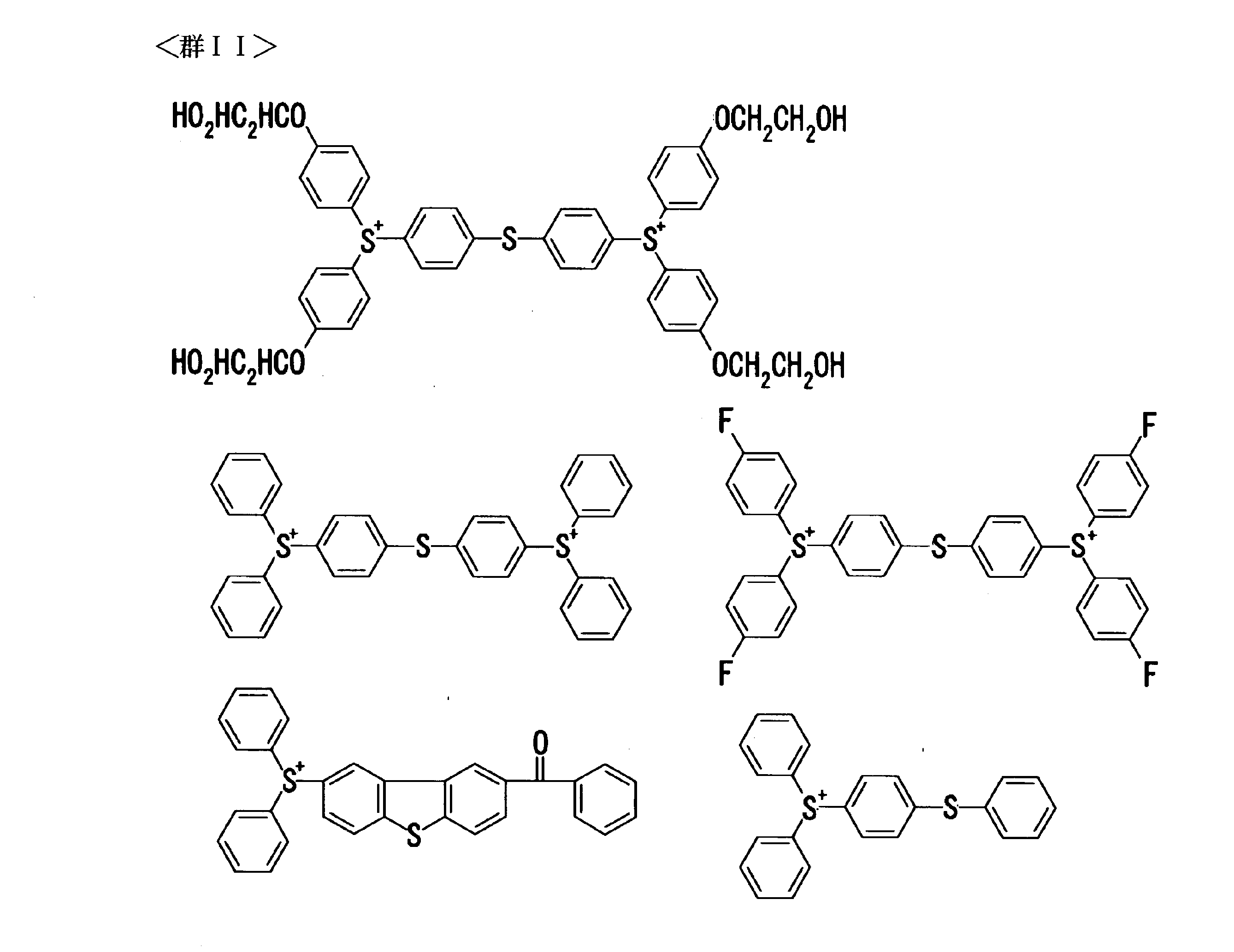
- onium salts it is particularly effective to use the following aromatic onium salts (a) to (c).
- aromatic onium salts (a) to (c) one of them can be used alone, or two or more can be mixed and used.
- Aryldiazonium salts such as phenyldiazonium hexafluorophosphate, 4-methoxyphenyldiazonium hexafluoroantimonate, 4-methylphenyldiazonium hexafluorophosphate
- Diaryls such as diphenyliodonium hexafluoroantimonate, di (4-methylphenyl) iodonium hexafluorophosphate, di (4-tert-butylphenyl) iodonium hexafluorophosphate, and tricumyliodonium tetrakis (pentafluorophenyl) borate Iodonium salt
- (C) sulfonium salts such as sulfonium cations represented by the following group I or group II, hexafluoroantimony ions, tetrakis (pentafluorophenyl) borate ions
- preferable examples include ( ⁇ 5 -2,4-cyclopentadien-1-yl) [(1,2,3,4,5,6- ⁇ )-(1-methylethyl) benzene] -iron.
- -Iron-arene complexes such as hexafluorophosphate
- aluminum complexes such as tris (acetylacetonato) aluminum, tris (ethylacetonatoacetato) aluminum, tris (salicylaldehyde) aluminum, and silanols such as triphenylsilanol
- silanols such as triphenylsilanol
- aromatic iodonium salts aromatic sulfonium salts, and iron-arene complexes are preferably used from the viewpoints of practical use and photosensitivity.
- the use ratio of the (2) cationic polymerization initiator to the (1) cationic polymerizable organic substance mixture is not particularly limited, and may be used at a generally normal use ratio within a range not impairing the object of the present invention.
- the cationic polymerization initiator can be used in an amount of 0.5 to 20 parts by weight, preferably 1.0 to 10 parts by weight, based on 100 parts by weight of the cationically polymerizable organic substance mixture. If the amount is too small, curing tends to be insufficient, and if the amount is too large, various physical properties such as the water absorption rate and the strength of the cured product may be adversely affected.
- a silane coupling agent can be used as necessary.
- the silane coupling agent include dimethyldimethoxysilane, dimethyldiethoxysilane, methylethyldimethoxysilane, methylethyldiethoxysilane, methyltrimethoxysilane, methyltriethoxysilane, ethyltrimethoxysilane, and ethyltrimethoxysilane.
- the amount of the silane coupling agent used is not particularly limited, but is usually in the range of 1 to 20 parts by mass with respect to 100 parts by mass of the total amount of solids in the composition.
- thermal polymerization initiator is a compound that generates a cationic species or Lewis acid by heating, such as a salt of sulfonium salt, thiophenium salt, thiolanium salt, benzylammonium, pyridinium salt, hydrazinium salt; diethylenetriamine, triethylenetriamine, tetraethylenepenta Polyalkylpolyamines such as min; alicyclic polyamines such as 1,2-diaminocyclohexane, 1,4-diamino-3,6-diethylcyclohexane, isophoronediamine; m-xylylenediamine, diaminodiphenylmethane, diaminodiphenylsulfone Aromatic polyamines such as; such polyamines; phenyl glycidyl ether, butyl glycidyl ether, bisphenol
- Mannich-modified products produced by reacting phenols having sex sites by a conventional method polyvalent carboxylic acids (oxalic acid, malonic acid, succinic acid, glutaric acid, adipic acid, pimelic acid, suberic acid, azelain Acid, sebacic acid, Decanedioic acid, 2-methylsuccinic acid, 2-methyladipic acid, 3-methyladipic acid, 3-methylpentanedioic acid, 2-methyloctanedioic acid, 3,8-dimethyldecanedioic acid, 3,7-dimethyldecane Aliphatic dicarboxylic acids such as diacid, hydrogenated dimer acid and dimer acid; aromatic dicarboxylic acids such as phthalic acid, terephthalic acid, isophthalic acid and naphthalenedicarboxylic acid; alicyclic dicarboxylic acids such as cyclohexanedicarboxylic acid; trimellitic acid, Tri
- thermal polymerization initiator Commercially available products may be used as the thermal polymerization initiator.
- Adeka Opton® CP77 Adeka Opton CP66 (manufactured by ADEKA), CI-2539, CI-2624 (manufactured by Nippon Soda Co., Ltd.), Sun-Aid® SI-60L, Sun-Aid SI -80L, Sun Aid SI-100L (manufactured by Sanshin Chemical Industry Co., Ltd.) and the like.
- the amount of the thermal polymerization initiator used is not particularly limited, but is usually in the range of 0.001 to 10 parts by mass with respect to 100 parts by mass of the total solids in the composition.
- the composition of the present invention is preferably heated at 130 to 180 ° C. for 20 minutes to 1 hour when it is cured.
- thermoplastic organic polymer examples include polystyrene, polymethyl methacrylate, methyl methacrylate-ethyl acrylate copolymer, poly (meth) acrylic acid, styrene- (meth) acrylic acid copolymer, (meth) acrylic acid- Examples include methyl methacrylate copolymer, glycidyl (meth) acrylate-polymethyl (meth) acrylate copolymer, polyvinyl butyral, cellulose ester, polyacrylamide, and saturated polyester.
- any solvent that can dissolve or disperse the components (1) and (2) can be used without any particular limitation.
- methyl ethyl ketone, methyl amyl ketone, diethyl ketone, acetone, methyl Ketones such as isopropyl ketone, methyl isobutyl ketone, cyclohexanone, 2-heptanone; ethyl ether, dioxane, tetrahydrofuran, 1,2-dimethoxyethane, 1,2-diethoxyethane, propylene glycol monomethyl ether, dipropylene glycol dimethyl ether, etc.
- Ether solvents such as methyl acetate, ethyl acetate, acetic acid-n-propyl, isopropyl acetate, n-butyl acetate, cyclohexyl acetate, ethyl lactate, dimethyl succinate, texanol; ethylene glycol monomethyl Cellosolve solvents such as ether and ethylene glycol monoethyl ether; alcohol solvents such as methanol, ethanol, iso- or n-propanol, iso- or n-butanol and amyl alcohol; ethylene glycol monomethyl acetate, ethylene glycol monoethyl acetate, Ether ester solvents such as propylene glycol-1-monomethyl ether-2-acetate (PGMEA), dipropylene glycol monomethyl ether acetate, 3-methoxybutyl acetate and ethoxyethyl propionate; BTX solvents such as benzen
- Aliphatic hydrocarbon solvents such as chlorobenzene; propylene carbonate, carbitol solvents, aniline, triethylamine, pyridine, acetic acid, acetonitrile, carbon disulfide, N, N-dimethylformamide, N, N-dimethylacetamide, N-methylpyrrolidone, dimethyl sulfoxide, water and the like can be mentioned, and these solvents can be used as one or a mixture of two or more.
- the water content of the composition of the present invention is preferably 5% or less, and more preferably 3% or less from the viewpoints of curability, adhesiveness, and liquid storage stability. Too much moisture is not preferable because it may cause cloudiness or components may precipitate.
- composition of the present invention is applied onto a supporting substrate by a known means such as a roll coater, a curtain coater, various types of printing, and immersion. Moreover, after once applying on support bases, such as a film, it can also transfer on another support base
- the material for the support substrate is not particularly limited and may be any commonly used material, such as inorganic materials such as glass; diacetyl cellulose, triacetyl cellulose (TAC), propionyl cellulose, butyryl cellulose, acetylpropionyl.
- inorganic materials such as glass
- Cellulose esters such as cellulose and nitrocellulose; polyamide; polyimide; polyurethane; epoxy resin; polycarbonate; polyethylene terephthalate, polyethylene naphthalate, polybutylene terephthalate, poly-1,4-cyclohexanedimethylene terephthalate, polyethylene-1,2-diphenoxy Polyester such as ethane-4,4′-dicarboxylate, polybutylene terephthalate, etc .; polystyrene; polyethylene, polypropylene, polymethylpentene, etc.
- Polyolefins vinyl compounds such as polyvinyl acetate, polyvinyl alcohol (PVA), polyvinyl chloride, and polyvinyl fluoride; acrylic resins such as polymethyl methacrylate and polyacrylate; polysulfone; polyethersulfone; polyetherketone; Ether imide; polymer materials such as polyoxyethylene, norbornene resin, cycloolefin polymer (COP), and the like.
- the support substrate may be subjected to surface activation treatment such as corona discharge treatment, flame treatment, ultraviolet treatment, high frequency treatment, glow discharge treatment, active plasma treatment, laser treatment and the like.
- the composition of the present invention is cured by irradiation with active energy rays.
- active energy rays include ultraviolet rays, electron beams, X-rays, radiation, and high frequencies, and ultraviolet rays are the most economically preferable.
- the ultraviolet light source include an ultraviolet laser, a mercury lamp, a xenon laser, and a metal halide lamp.
- composition of the present invention include glasses, optical materials represented by imaging lenses, paints, coating agents, lining agents, inks, resists, liquid resists, adhesives, printing plates, insulating varnishes, insulating materials. Sheets, laminates, printed circuit boards, semiconductor devices, LED packages, liquid crystal injection ports, organic ELs, optical elements, electrical insulation, electronic components, separation membranes, sealing materials, molding materials, putty Glass fiber impregnating agent, sealing agent, passivation film for semiconductors and solar cells, interlayer insulating film, protective film, prism lens sheet used for backlight of liquid crystal display device, screen for projection TV etc.
- My lens parts of lens sheets such as Fresnel lens sheets and lenticular lens sheets, or backlights using such sheets, etc.
- Examples include optical lenses such as Lolens, optical elements, optical connectors, optical waveguides, casting agents for optical modeling, etc.
- substrates that can be used as coating agents include metals, wood, rubber, plastics, glass, ceramics Product etc. can be mentioned. Since the composition of this invention is excellent in sclerosis
- composition of the present invention and the cured product obtained by curing the composition will be specifically described with reference to Examples, Evaluation Examples, and Comparative Examples.
- “part” means “part by mass”.
- Example 1 to 24 Comparative Examples 1 to 3
- the components shown in [Table 1] to [Table 4] below were mixed thoroughly to obtain Example Compositions 1 to 24 and Comparative Compositions 1 to 3, respectively.
- Example Compositions 1 to 24 and Comparative Compositions 1 to 3 were applied to a single TAC (triacetyl cellulose) film subjected to corona discharge treatment, and then the film was laminated using a laminator.
- a test piece was obtained by bonding to another COP (cycloolefin polymer) film that had been subjected to corona discharge treatment, and using a metal halide lamp to irradiate with 800 mJ / cm 2 of energy.
- the obtained test piece was subjected to a 90 degree peel test. The results are shown in [Table 1] to [Table 4].
- composition of the present invention is excellent in curability, adhesiveness and heat resistance.
Landscapes
- Chemical & Material Sciences (AREA)
- Organic Chemistry (AREA)
- Health & Medical Sciences (AREA)
- Chemical Kinetics & Catalysis (AREA)
- Medicinal Chemistry (AREA)
- Polymers & Plastics (AREA)
- Epoxy Resins (AREA)
- Adhesives Or Adhesive Processes (AREA)
Abstract
Description
中でも、上記芳香族エポキシ化合物(1-1)として、フェノール類のグリシジルエーテル、アルコール性水酸基を2個以上有する芳香族化合物のグリシジルエーテル化物、多価フェノール類のグリシジルエーテル化物、安息香酸類のグリシジルエステル、多塩基酸類のグリシジルエステル、スチレンオキサイド又はジビニルベンゼンのエポキシ化物の群から選ばれる少なくとも一種含有することが、組成物のTgが高くなるので好ましい。
上記芳香族エポキシ化合物(1-1)としては、エポキシ当量が80~500であるものが、硬化性に優れるため好ましい。
脂環式エポキシ化合物(1-2A)としては、エポキシ当量が80~500であるものが好ましい。
脂肪族エポキシ化合物(1-2B)としては、エポキシ当量が80~500であるものが好ましい。
ここで、主成分とは、カチオン重合性有機物質を数種類混ぜて、同じ種類の化合物の合計質量が一番多いものを言う。例えば、後述する実施例4の組成物は、カチオン重合性有機物質として、芳香族エポキシ化合物(1-1-1)45質量部、脂環式エポキシ化合物(1-2A-1)5質量部、脂肪族エポキシ化合物(1-2B-2)30質量部、多官能脂肪族オキセタン化合物(1-3-1)20質量部含有している。この場合、組成物中の含有量が最も多い芳香族エポキシ化合物が、該組成物の主成分となる。また、仮に実施例4が、芳香族エポキシ化合物(1-1-1)45質量部の代わりに、芳香族エポキシ化合物(1-1-1)25質量部と、芳香族エポキシ化合物(1-1-2)20質量部との2種類の芳香族エポキシ化合物を含有している場合も、同じ種類の芳香族エポキシ化合物である1-1-1と1-1-2との合計含有量が組成物において最も多いので、芳香族エポキシ化合物が該組成物の主成分となる。
本発明に使用する上記カチオン重合開始剤(2)とは、エネルギー線照射により酸を発生することが可能な化合物であればどのようなものでも差し支えないが、好ましくは、エネルギー線の照射によってルイス酸を放出するオニウム塩である複塩、又はその誘導体である。かかる化合物の代表的なものとしては、下記一般式、
p[A]q+・s[B]t-(Aは陽イオン種を表し、Bは陰イオン種を表し、q及びtは、それぞれ独立に1又は2を表し、p及びsは、電荷を中性に保つ係数を表す。)-
で表される陽イオンと陰イオンの塩を挙げることができる。
[(R10)aQ]q+
で表すことができる。
[LXb]t-
で表すことができる。
[LXb-1(OH)]t-
で表される構造のものも好ましく用いることができる。L,X,bは上記と同様である。また、その他用いることのできる陰イオンとしては、過塩素酸イオン(ClO4)-、トリフルオロメチル亜硫酸イオン(CF3SO3)-、フルオロスルホン酸イオン(FSO3)-、トルエンスルホン酸陰イオン、トリニトロベンゼンスルホン酸陰イオン、カンファースルフォネート、ノナフルオロブタンスルフォネート、ヘキサデカフルオロオクタンスルフォネート、テトラアリールボレート、テトラキス(ペンタフルオロフェニル)ボレート等を挙げることができる。

シランカップリング剤としては、例えば、ジメチルジメトキシシラン、ジメチルジエトキシシラン、メチルエチルジメトキシシラン、メチルエチルジエトキシシラン、メチルトリメトキシシラン、メチルトリエトキシシラン、エチルトリメトキシシラン、エチルトリメトキシシランなどのアルキル官能性アルコキシシラン、ビニルトリクロロシラン、ビニルトリメトキシシラン、ビニルトリエトキシシラン、アリルトリメトキシシランなどのアルケニル官能性アルコキシシラン、3-メタクリロキシブロピルトリエトキシシラン、3-メタクリロキシブロピルトリメトキシシラン、3-メタクリロキシプロピルメチルジエトキシシラン、3-メタクリロキシプロピルメチルジメトキシシラン、2-メタクリロキシプロピルトリメトキシシラン、γ-グリシドキシプロピルトリメトキシシラン、γ-グリシドキシプロピルメチルジエトキシシラン、β-(3,4-エポキシシクロヘキシル)エチルトリメトキシシラン等のエポキシ官能性アルコキシシラン、N-β(アミノエチル)-γ-アミノプロピルトリメトキシシラン、γ-アミノプロピルトリエトキシシラン、N-フェニル-γ-アミノプロピルトリメトキシシラン等のアミノ官能性アルコキシシラン、γ-メルカプトプロピルトリメトキシシラン等のメルカプト官能性アルコキシシラン、チタンテトライソプロポキシド、チタンテトラノルマルブトキシドなどのチタンアルコキシド類、チタンジオクチロキシビス(オクチレングリコレート)、チタンジイソプロポキシビス(エチルアセトアセテート)などのチタンキレート類、ジルコウニウムテトラアセチルアセトネート、ジルコニウムトリブトキシモノアセチルアセトネートなどのジルコニウムキレート類、ジルコニウムトリブトキシモノステアレートなどのジルコニウムアシレート類、メチルトリイソシアネートシランなどのイソシアネートシラン類等を用いることができる。
熱重合開始剤とは、加熱によりカチオン種又はルイス酸を発生する化合物として、スルホニウム塩、チオフェニウム塩、チオラニウム塩、ベンジルアンモニウム、ピリジニウム塩、ヒドラジニウム塩等の塩;ジエチレントリアミン、トリエチレントリアミン、テトラエチレンペンタミン等のポリアルキルポリアミン類;1,2-ジアミノシクロヘキサン、1,4-ジアミノ-3,6-ジエチルシクロヘキサン、イソホロンジアミン等の脂環式ポリアミン類;m-キシリレンジアミン、ジアミノジフェニルメタン、ジアミノジフェニルスルホン等の芳香族ポリアミン類;前記ポリアミン類と、フェニルグリシジルエーテル、ブチルグリシジルエーテル、ビスフェノールA-ジグリシジルエーテル、ビスフェノールF-ジグリシジルエーテル等のグリシジルエーテル類又はカルボン酸のグリシジルエステル類等の各種エポキシ樹脂とを常法によって反応させることによって製造されるポリエポキシ付加変性物;前記有機ポリアミン類と、フタル酸、イソフタル酸、ダイマー酸などのカルボン酸類とを常法によって反応させることによって製造されるアミド化変性物;前記ポリアミン類とホルムアルデヒド等のアルデヒド類及びフェノール、クレゾール、キシレノール、第三ブチルフェノール、レゾルシン等の核に少なくとも一個のアルデヒド化反応性場所を有するフェノール類とを常法によって反応させることによって製造されるマンニッヒ化変性物;多価カルボン酸(シュウ酸、マロン酸、コハク酸、グルタル酸、アジピン酸、ピメリン酸、スベリン酸、アゼライン酸、セバシン酸、ドデカン二酸、2-メチルコハク酸、2-メチルアジピン酸、3-メチルアジピン酸、3-メチルペンタン二酸、2-メチルオクタン二酸、3,8-ジメチルデカン二酸、3,7-ジメチルデカン二酸、水添ダイマー酸、ダイマー酸等の脂肪族ジカルボン酸類;フタル酸、テレフタル酸、イソフタル酸、ナフタレンジカルボン酸等の芳香族ジカルボン酸類;シクロヘキサンジカルボン酸等の脂環式ジカルボン酸類;トリメリト酸、トリメシン酸、ひまし油脂肪酸の三量体等のトリカルボン酸類;ピロメリット酸等のテトラカルボン酸類等)の酸無水物;ジシアンジアミド、イミダゾール類、カルボン酸エステル、スルホン酸エステル、アミンイミド等を挙げることができる。
尚、上記支持基体に、コロナ放電処理、火炎処理、紫外線処理、高周波処理、グロー放電処理、活性プラズマ処理、レーザー処理等の表面活性化処理を行ってもよい。
本発明の組成物は、硬化性及び接着性に優れるため、接着剤として特に好適に用いることができる。
下記の[表1]~[表4]に示す配合で各成分を十分に混合して、各々実施組成物1~24、比較組成物1~3を得た。
化合物1-1-1:アデカレジンEP-4100L(ビスフェノールAエポキシ:ADEKA社製)
化合物1-1-2:アデカレジンEP-4901L(ビスフェノールAエポキシ:ADEKA社製)
化合物1-2A-1:セロキサイド2021P(脂環式エポキシ;ダイセル社製)
化合物1-2A-2:(4R)-1,2-エポキシ-4-(2-メチルオキシラニル)-1-メチルシクロヘキサンメチル 3,4-エポキシシクロヘキサンカルボキシレート
化合物1-2B-1: 1,4-ブタンジオールジグリシジルエーテル
化合物1-2B-2: アデカグリシロールED-523T(ADEKA社製)
化合物1-2B-3:1,6-ヘキサンジオールジグリシジルエーテル
化合物1-3-1:アロンオキセタンOXT-221(東亞合成社製)
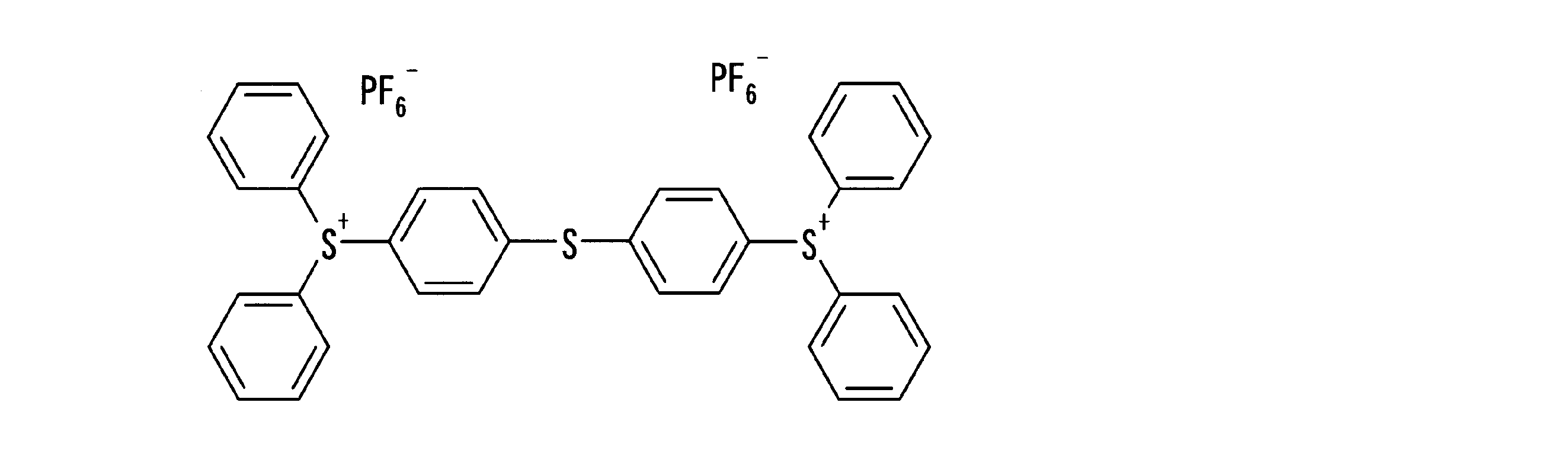
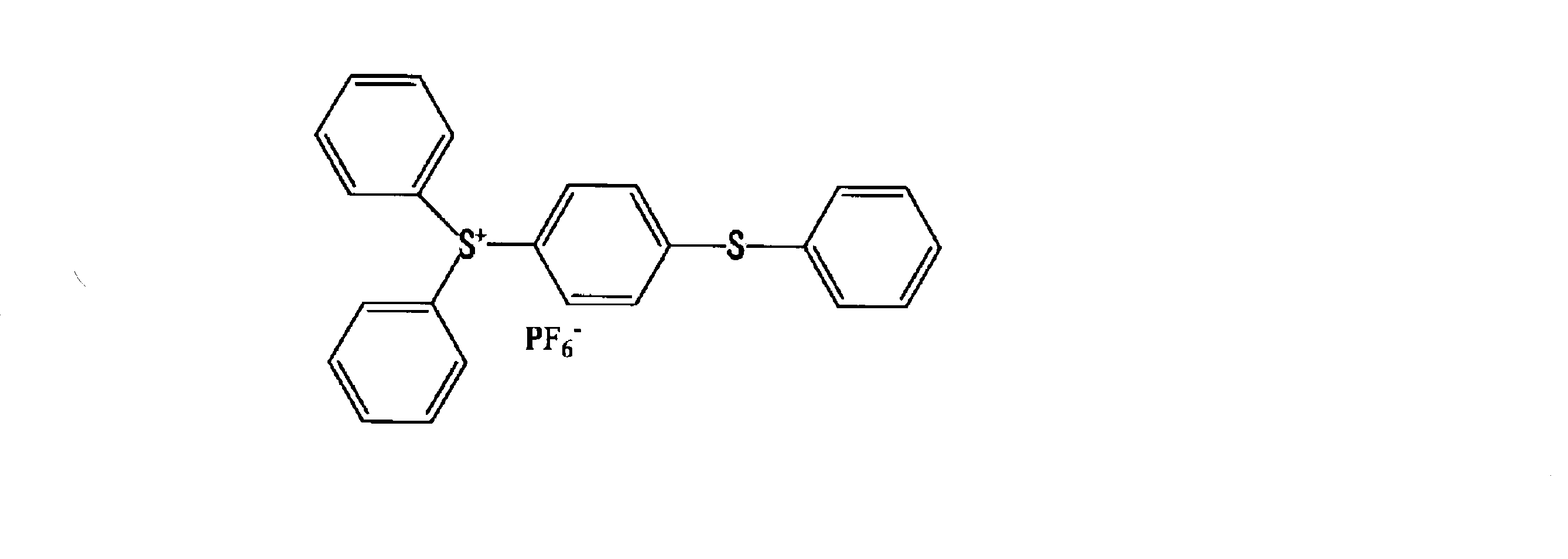
化合物2-1:[化3]で表される化合物及び[化4]で表される化合物の混合物のプロピレンカーボネート50%溶液
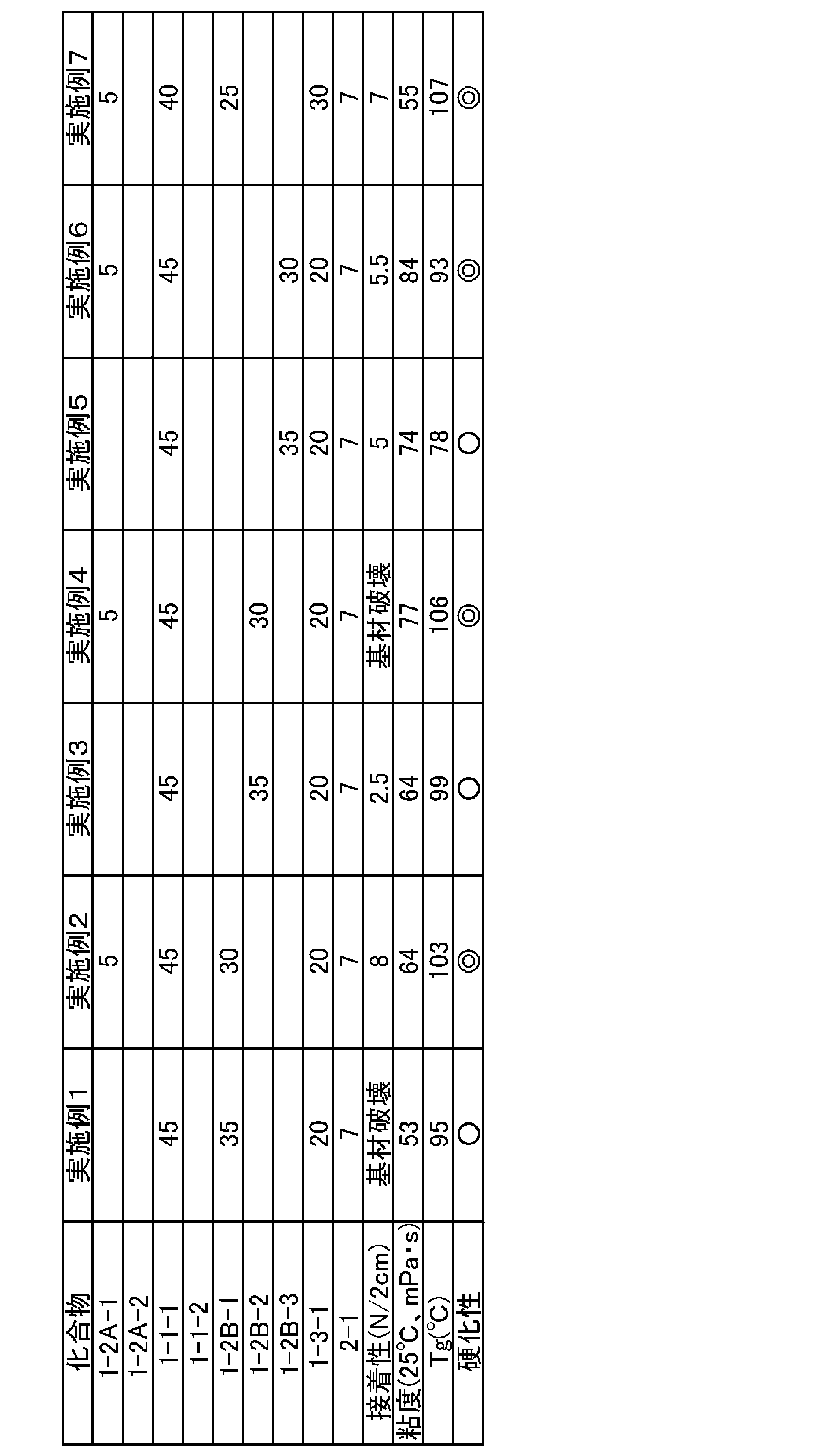
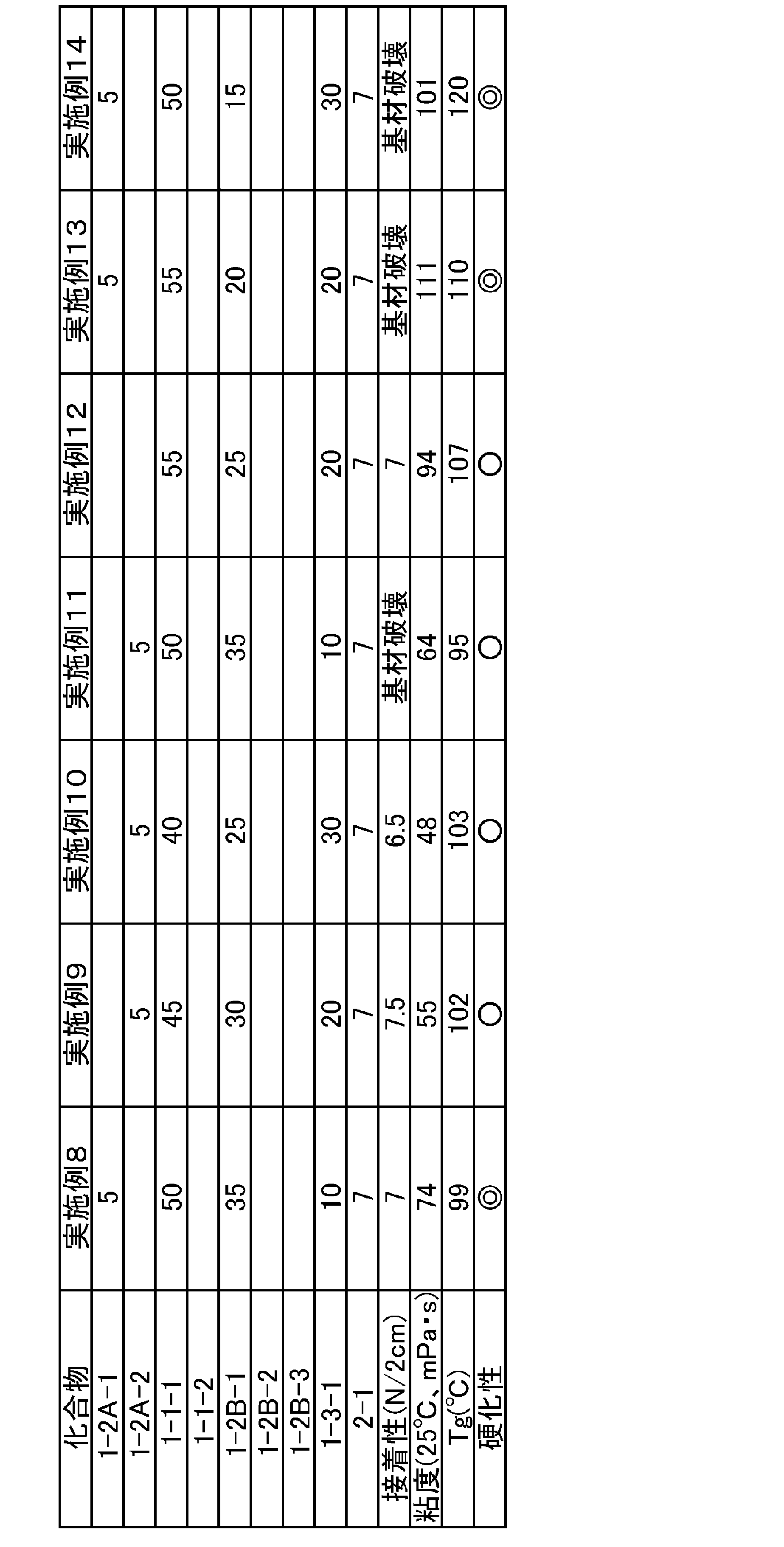

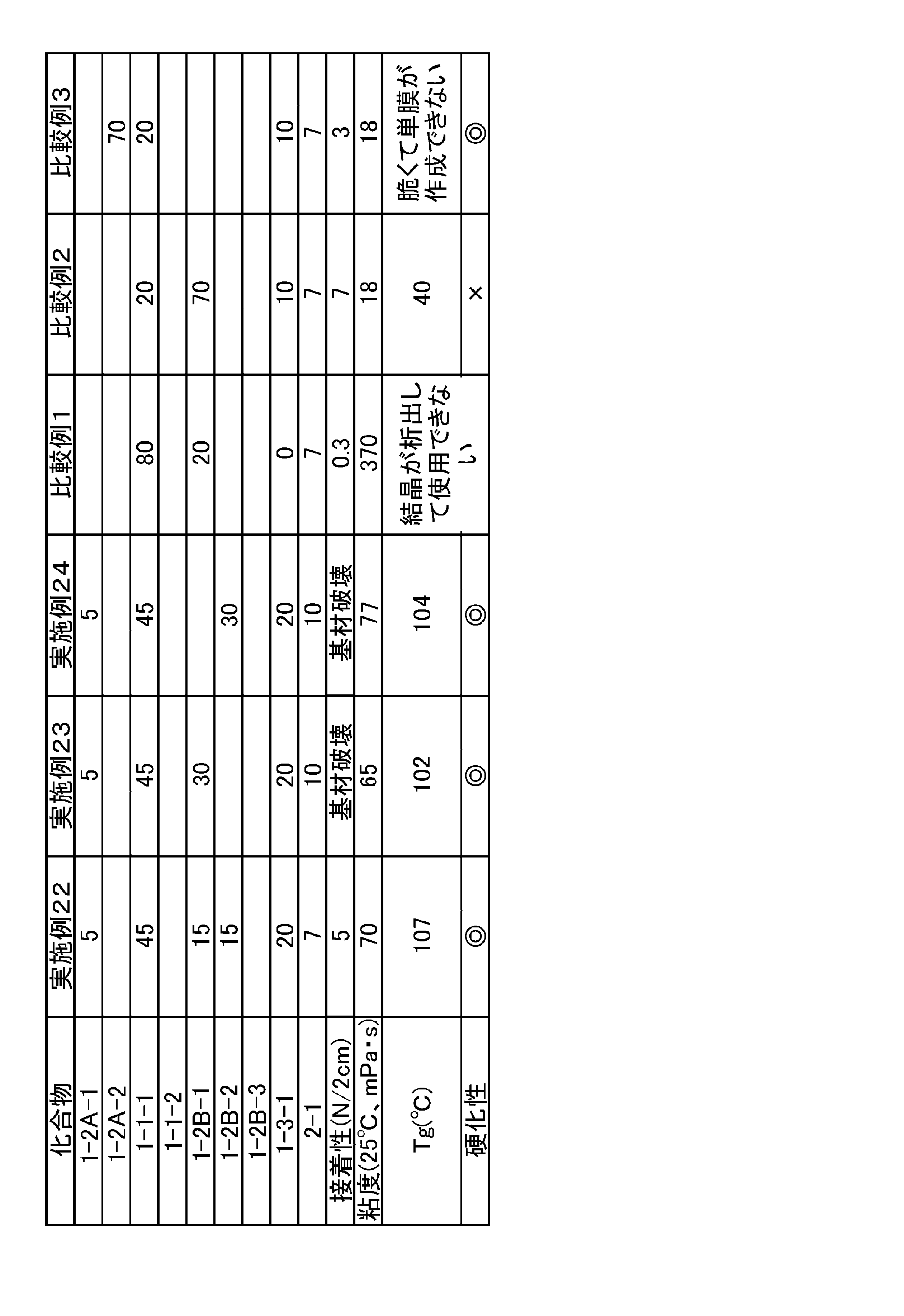
上記実施例1~24で得られた実施組成物及び比較例1~3で得られた比較組成物について、下記評価を行った。結果を上記[表1]~[表4]に示す。
(粘度)
得られた実施組成物の1~24、比較組成物の1~3のそれぞれを25℃においてE型粘度計で粘度を測定した。結果を[表1]~[表4]に示す。
(Tg)
得られた実施組成物1~24、比較組成物の1~3のそれぞれをPETフィルム上にバーコーターで30μmの厚さに塗布し、メタルハライドランプを用いて3000mJ/cm2のエネルギーを照射した。24時間後にフィルムから接着剤硬化物を取り出し、(株)日立ハイテクサイエンス製の粘弾性測定装置(DMA7100)を用いTgを測定した。結果を[表1]~[表4]に示す。
(硬化性)
Tgの試験片を作る際に硬化性についても合わせて確認を行った。照射直後に塗布面がタックフリーになっているものを◎、5分後にタックフリーになっているものを○、15分後でもタックが残っているものを×として評価した。結果を[表1]~[表4]に示す。
(接着性)
得られた実施組成物1~24、比較組成物の1~3のそれぞれを、一枚のコロナ放電処理を施したTAC(トリアセチルセルロース)フィルムに塗布した後、該フィルムを、ラミネーターを用いてコロナ放電処理を施したもう一枚のCOP(シクロオレフィンポリマー)フィルムと貼り合わせ、メタルハライドランプを用いて800mJ/cm2のエネルギーを照射して接着して試験片を得た。得られた試験片の90度ピール試験を行った。結果を[表1]~[表4]に示す。
Claims (7)
- カチオン重合性有機物質混合物(1)として、芳香族エポキシ化合物(1-1);脂環式エポキシ化合物(1-2A)又は脂肪族エポキシ化合物(1-2B);及び多官能脂肪族オキセタン化合物(1-3)を含み、芳香族エポキシ化合物(1-1)が主成分であることを特徴とする組成物。
- 上記芳香族エポキシ化合物(1-1)が、一価フェノール類のグリシジルエーテル、アルコール性水酸基を2個以上有する芳香族化合物のグリシジルエーテル化物、多価フェノール類のグリシジルエーテル化物、安息香酸類のグリシジルエステル、多塩基酸類のグリシジルエステル、スチレンオキサイド又はジビニルベンゼンのエポキシ化物の群から選ばれる少なくとも一種含有することを特徴とする請求項1記載の組成物。
- 上記芳香族エポキシ化合物(1-1)が、多官能エポキシ化合物を少なくとも一種含有することを特徴とする請求項1又は2に記載の組成物。
- 上記芳香族エポキシ化合物(1-1)のエポキシ当量が80~500であることを特徴とする請求項1~3のいずれか一項に記載の組成物。
- 上記カチオン重合性有機物質混合物(1)100質量部に対し、カチオン重合開始剤(2)を0.5~20質量部含むことを特徴とする請求項1~4のいずれか一項に記載の組成物。
- 上記カチオン重合開始剤(2)が、p[A]q+・s[B]t-(式中、Aは陽イオン種を表し、Bは陰イオン種を表し、q及びtは、それぞれ独立に1又は2を表し、p及びsは、電荷を中性に保つ係数を表す。)で表される陽イオンと陰イオンの塩である請求項1~5のいずれか一項に記載の組成物。
- 請求項1~6のいずれか一項に記載の組成物からなることを特徴とする接着剤。
Priority Applications (3)
| Application Number | Priority Date | Filing Date | Title |
|---|---|---|---|
| CN201680003422.1A CN107075083A (zh) | 2015-03-30 | 2016-03-18 | 组合物 |
| KR1020177011649A KR20170133312A (ko) | 2015-03-30 | 2016-03-18 | 조성물 |
| JP2017509805A JPWO2016158523A1 (ja) | 2015-03-30 | 2016-03-18 | 組成物 |
Applications Claiming Priority (2)
| Application Number | Priority Date | Filing Date | Title |
|---|---|---|---|
| JP2015-069632 | 2015-03-30 | ||
| JP2015069632 | 2015-03-30 |
Publications (1)
| Publication Number | Publication Date |
|---|---|
| WO2016158523A1 true WO2016158523A1 (ja) | 2016-10-06 |
Family
ID=57004809
Family Applications (1)
| Application Number | Title | Priority Date | Filing Date |
|---|---|---|---|
| PCT/JP2016/058816 Ceased WO2016158523A1 (ja) | 2015-03-30 | 2016-03-18 | 組成物 |
Country Status (5)
| Country | Link |
|---|---|
| JP (1) | JPWO2016158523A1 (ja) |
| KR (1) | KR20170133312A (ja) |
| CN (1) | CN107075083A (ja) |
| TW (1) | TW201706328A (ja) |
| WO (1) | WO2016158523A1 (ja) |
Cited By (2)
| Publication number | Priority date | Publication date | Assignee | Title |
|---|---|---|---|---|
| JP2018184504A (ja) * | 2017-04-24 | 2018-11-22 | 株式会社トクヤマデンタル | 接着性ポリアリールエーテルケトン樹脂材料の製造方法、及びポリアリールエーテルケトン樹脂材料と被着体との接着方法 |
| WO2019043778A1 (ja) | 2017-08-29 | 2019-03-07 | 三菱重工業株式会社 | 硬化性組成物、硬化性ペースト材、硬化性シート材、硬化性型取り材、硬化方法および硬化物 |
Families Citing this family (1)
| Publication number | Priority date | Publication date | Assignee | Title |
|---|---|---|---|---|
| KR102729446B1 (ko) * | 2021-08-06 | 2024-11-13 | (주)이녹스첨단소재 | 유기발광소자의 봉지재용 열경화성 액상 조성물 |
Citations (7)
| Publication number | Priority date | Publication date | Assignee | Title |
|---|---|---|---|---|
| JP2004352980A (ja) * | 2003-05-07 | 2004-12-16 | Mitsui Chemicals Inc | 光カチオン重合性樹脂組成物及び光ディスク表面保護用材料 |
| JP2004359769A (ja) * | 2003-06-03 | 2004-12-24 | Sekisui Chem Co Ltd | 液晶パネル用光硬化性接着剤組成物、液晶パネルの接着方法、偏光板の貼付方法および液晶パネル素子 |
| WO2012060449A1 (ja) * | 2010-11-05 | 2012-05-10 | 株式会社日本触媒 | カチオン硬化性樹脂組成物 |
| JP2012153891A (ja) * | 2012-02-28 | 2012-08-16 | Kyoritsu Kagaku Sangyo Kk | 密封中空構造体製造用の光硬化性接着樹脂組成物及びそれを用いる密封中空構造体の製造方法 |
| JP2012241053A (ja) * | 2011-05-17 | 2012-12-10 | Dic Corp | カチオン重合性接着剤及びそれを用いて得られた偏光板 |
| WO2015005211A1 (ja) * | 2013-07-09 | 2015-01-15 | 株式会社Adeka | カチオン重合性組成物 |
| JP2016030821A (ja) * | 2014-07-30 | 2016-03-07 | 積水化学工業株式会社 | 硬化性樹脂組成物およびそれを用いた補強構造物 |
Family Cites Families (2)
| Publication number | Priority date | Publication date | Assignee | Title |
|---|---|---|---|---|
| WO2004099286A1 (ja) * | 2003-05-07 | 2004-11-18 | Mitsui Chemicals, Inc. | 光カチオン重合性樹脂組成物及び光ディスク表面保護用材料 |
| KR101053764B1 (ko) * | 2010-11-05 | 2011-08-02 | 마지현 | 무체인 자전거용 기어변속장치 |
-
2016
- 2016-03-18 KR KR1020177011649A patent/KR20170133312A/ko not_active Ceased
- 2016-03-18 WO PCT/JP2016/058816 patent/WO2016158523A1/ja not_active Ceased
- 2016-03-18 CN CN201680003422.1A patent/CN107075083A/zh active Pending
- 2016-03-18 JP JP2017509805A patent/JPWO2016158523A1/ja active Pending
- 2016-03-28 TW TW105109749A patent/TW201706328A/zh unknown
Patent Citations (7)
| Publication number | Priority date | Publication date | Assignee | Title |
|---|---|---|---|---|
| JP2004352980A (ja) * | 2003-05-07 | 2004-12-16 | Mitsui Chemicals Inc | 光カチオン重合性樹脂組成物及び光ディスク表面保護用材料 |
| JP2004359769A (ja) * | 2003-06-03 | 2004-12-24 | Sekisui Chem Co Ltd | 液晶パネル用光硬化性接着剤組成物、液晶パネルの接着方法、偏光板の貼付方法および液晶パネル素子 |
| WO2012060449A1 (ja) * | 2010-11-05 | 2012-05-10 | 株式会社日本触媒 | カチオン硬化性樹脂組成物 |
| JP2012241053A (ja) * | 2011-05-17 | 2012-12-10 | Dic Corp | カチオン重合性接着剤及びそれを用いて得られた偏光板 |
| JP2012153891A (ja) * | 2012-02-28 | 2012-08-16 | Kyoritsu Kagaku Sangyo Kk | 密封中空構造体製造用の光硬化性接着樹脂組成物及びそれを用いる密封中空構造体の製造方法 |
| WO2015005211A1 (ja) * | 2013-07-09 | 2015-01-15 | 株式会社Adeka | カチオン重合性組成物 |
| JP2016030821A (ja) * | 2014-07-30 | 2016-03-07 | 積水化学工業株式会社 | 硬化性樹脂組成物およびそれを用いた補強構造物 |
Cited By (3)
| Publication number | Priority date | Publication date | Assignee | Title |
|---|---|---|---|---|
| JP2018184504A (ja) * | 2017-04-24 | 2018-11-22 | 株式会社トクヤマデンタル | 接着性ポリアリールエーテルケトン樹脂材料の製造方法、及びポリアリールエーテルケトン樹脂材料と被着体との接着方法 |
| WO2019043778A1 (ja) | 2017-08-29 | 2019-03-07 | 三菱重工業株式会社 | 硬化性組成物、硬化性ペースト材、硬化性シート材、硬化性型取り材、硬化方法および硬化物 |
| US11667748B2 (en) | 2017-08-29 | 2023-06-06 | Mitsubishi Heavy Industries, Ltd. | Curable composition, curable paste material, curable sheet material, curable modeling material, curing method, and cured product |
Also Published As
| Publication number | Publication date |
|---|---|
| KR20170133312A (ko) | 2017-12-05 |
| JPWO2016158523A1 (ja) | 2018-01-25 |
| TW201706328A (zh) | 2017-02-16 |
| CN107075083A (zh) | 2017-08-18 |
Similar Documents
| Publication | Publication Date | Title |
|---|---|---|
| JP6400006B2 (ja) | カチオン重合性組成物 | |
| JP6400005B2 (ja) | カチオン重合性組成物 | |
| KR102563226B1 (ko) | 조성물 | |
| JP7071262B2 (ja) | 硬化性組成物、硬化物の製造方法、およびその硬化物 | |
| JP6284721B2 (ja) | エネルギー線感受性組成物 | |
| WO2017170882A1 (ja) | 硬化性組成物、硬化物の製造方法、およびその硬化物 | |
| JPWO2017170879A1 (ja) | 硬化性組成物、硬化物の製造方法、およびその硬化物 | |
| WO2016158523A1 (ja) | 組成物 | |
| JP2017179202A (ja) | 硬化性組成物、硬化物の製造方法、およびその硬化物 | |
| JP6817702B2 (ja) | 硬化性組成物、その硬化方法、これにより得られる硬化物および接着剤 | |
| JP6251894B2 (ja) | エネルギー線感受性組成物 | |
| JP2018012765A (ja) | 硬化性組成物、硬化物の製造方法、その硬化物および接着剤 | |
| JP2017179161A (ja) | 硬化性組成物、硬化物の製造方法、およびその硬化物 | |
| KR102278179B1 (ko) | 경화성 조성물, 경화물의 제조 방법, 및 그 경화물 | |
| JP6163043B2 (ja) | エネルギー線感受性組成物 | |
| JPWO2017170881A1 (ja) | 硬化性組成物、硬化物の製造方法、およびその硬化物 | |
| JP2017008165A (ja) | カチオン重合性組成物 | |
| JP2017179163A (ja) | 硬化性組成物、硬化物の製造方法、およびその硬化物 | |
| JP2018012766A (ja) | 硬化性組成物、硬化物の製造方法、およびその硬化物 |
Legal Events
| Date | Code | Title | Description |
|---|---|---|---|
| 121 | Ep: the epo has been informed by wipo that ep was designated in this application |
Ref document number: 16772405 Country of ref document: EP Kind code of ref document: A1 |
|
| ENP | Entry into the national phase |
Ref document number: 2017509805 Country of ref document: JP Kind code of ref document: A |
|
| ENP | Entry into the national phase |
Ref document number: 20177011649 Country of ref document: KR Kind code of ref document: A |
|
| NENP | Non-entry into the national phase |
Ref country code: DE |
|
| 122 | Ep: pct application non-entry in european phase |
Ref document number: 16772405 Country of ref document: EP Kind code of ref document: A1 |