WO2016158295A1 - バナジウムレドックス電池 - Google Patents
バナジウムレドックス電池 Download PDFInfo
- Publication number
- WO2016158295A1 WO2016158295A1 PCT/JP2016/057602 JP2016057602W WO2016158295A1 WO 2016158295 A1 WO2016158295 A1 WO 2016158295A1 JP 2016057602 W JP2016057602 W JP 2016057602W WO 2016158295 A1 WO2016158295 A1 WO 2016158295A1
- Authority
- WO
- WIPO (PCT)
- Prior art keywords
- vanadium
- positive electrode
- negative electrode
- surfactant
- electrode
- Prior art date
- Legal status (The legal status is an assumption and is not a legal conclusion. Google has not performed a legal analysis and makes no representation as to the accuracy of the status listed.)
- Ceased
Links
Images


Classifications
-
- H—ELECTRICITY
- H01—ELECTRIC ELEMENTS
- H01M—PROCESSES OR MEANS, e.g. BATTERIES, FOR THE DIRECT CONVERSION OF CHEMICAL ENERGY INTO ELECTRICAL ENERGY
- H01M50/00—Constructional details or processes of manufacture of the non-active parts of electrochemical cells other than fuel cells, e.g. hybrid cells
- H01M50/40—Separators; Membranes; Diaphragms; Spacing elements inside cells
- H01M50/409—Separators, membranes or diaphragms characterised by the material
-
- H—ELECTRICITY
- H01—ELECTRIC ELEMENTS
- H01M—PROCESSES OR MEANS, e.g. BATTERIES, FOR THE DIRECT CONVERSION OF CHEMICAL ENERGY INTO ELECTRICAL ENERGY
- H01M10/00—Secondary cells; Manufacture thereof
- H01M10/36—Accumulators not provided for in groups H01M10/05-H01M10/34
-
- H—ELECTRICITY
- H01—ELECTRIC ELEMENTS
- H01M—PROCESSES OR MEANS, e.g. BATTERIES, FOR THE DIRECT CONVERSION OF CHEMICAL ENERGY INTO ELECTRICAL ENERGY
- H01M4/00—Electrodes
- H01M4/02—Electrodes composed of, or comprising, active material
-
- H—ELECTRICITY
- H01—ELECTRIC ELEMENTS
- H01M—PROCESSES OR MEANS, e.g. BATTERIES, FOR THE DIRECT CONVERSION OF CHEMICAL ENERGY INTO ELECTRICAL ENERGY
- H01M4/00—Electrodes
- H01M4/02—Electrodes composed of, or comprising, active material
- H01M4/36—Selection of substances as active materials, active masses, active liquids
- H01M4/58—Selection of substances as active materials, active masses, active liquids of inorganic compounds other than oxides or hydroxides, e.g. sulfides, selenides, tellurides, halogenides or LiCoFy; of polyanionic structures, e.g. phosphates, silicates or borates
-
- H—ELECTRICITY
- H01—ELECTRIC ELEMENTS
- H01M—PROCESSES OR MEANS, e.g. BATTERIES, FOR THE DIRECT CONVERSION OF CHEMICAL ENERGY INTO ELECTRICAL ENERGY
- H01M8/00—Fuel cells; Manufacture thereof
- H01M8/20—Indirect fuel cells, e.g. fuel cells with redox couple being irreversible
-
- Y—GENERAL TAGGING OF NEW TECHNOLOGICAL DEVELOPMENTS; GENERAL TAGGING OF CROSS-SECTIONAL TECHNOLOGIES SPANNING OVER SEVERAL SECTIONS OF THE IPC; TECHNICAL SUBJECTS COVERED BY FORMER USPC CROSS-REFERENCE ART COLLECTIONS [XRACs] AND DIGESTS
- Y02—TECHNOLOGIES OR APPLICATIONS FOR MITIGATION OR ADAPTATION AGAINST CLIMATE CHANGE
- Y02E—REDUCTION OF GREENHOUSE GAS [GHG] EMISSIONS, RELATED TO ENERGY GENERATION, TRANSMISSION OR DISTRIBUTION
- Y02E60/00—Enabling technologies; Technologies with a potential or indirect contribution to GHG emissions mitigation
- Y02E60/10—Energy storage using batteries
-
- Y—GENERAL TAGGING OF NEW TECHNOLOGICAL DEVELOPMENTS; GENERAL TAGGING OF CROSS-SECTIONAL TECHNOLOGIES SPANNING OVER SEVERAL SECTIONS OF THE IPC; TECHNICAL SUBJECTS COVERED BY FORMER USPC CROSS-REFERENCE ART COLLECTIONS [XRACs] AND DIGESTS
- Y02—TECHNOLOGIES OR APPLICATIONS FOR MITIGATION OR ADAPTATION AGAINST CLIMATE CHANGE
- Y02E—REDUCTION OF GREENHOUSE GAS [GHG] EMISSIONS, RELATED TO ENERGY GENERATION, TRANSMISSION OR DISTRIBUTION
- Y02E60/00—Enabling technologies; Technologies with a potential or indirect contribution to GHG emissions mitigation
- Y02E60/30—Hydrogen technology
- Y02E60/50—Fuel cells
Definitions
- the present invention relates to a vanadium redox battery using an electrode including an active material containing a vanadium ion whose oxidation number changes by a redox reaction or a cation containing vanadium.
- Secondary batteries are widely used in digital home appliances, electric vehicles using motor power, hybrid vehicles, and the like.
- a vanadium redox battery including an active material containing vanadium ions whose oxidation number changes by an oxidation-reduction reaction or a cation containing vanadium is known.
- a redox flow battery is known (Patent Document 1). The redox flow battery performs charge / discharge by changing the valence of ions using two sets of redox pairs (redox pairs) that generate redox reactions in an electrolyte solution.
- Examples of redox flow battery redox pairs include +2 and +3 oxidation state vanadium ions (V 2+ and V 3+ ) and +4 and +5 valence oxidation state vanadium ions (V 4+ and V 5+ ).
- a liquid flow type redox flow battery can be exemplified as one form of the redox flow battery.
- the liquid flow type redox flow battery supplies and discharges a vanadium sulfuric acid solution stored in a tank to a liquid flow type cell.
- Liquid flow type redox flow batteries are used in the field of large-scale power storage.
- a liquid flow type redox flow battery has an electrolyte solution tank containing a positive electrode active material, an electrolyte solution tank containing a negative electrode active material, a stack for charging and discharging, and a pump for supplying an electrolyte solution for each electrode to the stack. .
- the electrolyte is sent from the tank to the stack and circulates between the tank and the stack.
- the stack has a structure in which an ion exchange membrane is sandwiched between a positive electrode and a negative electrode.
- the redox flow battery exhibits the following reactions at the positive electrode and the negative electrode.
- Patent Document 2 a liquid static redox battery that does not circulate the electrolyte has also been proposed (Patent Document 2).
- This liquid static redox battery does not have an electrolyte tank.
- the liquid stationary redox battery has a positive electrode electrolytic cell and a negative electrode electrolytic cell.
- This liquid static redox battery has a structure in which an electrolytic solution containing vanadium ions as an active material and a conductive material such as carbon powder are filled in an electrolytic cell.
- some vanadium redox batteries have an electrode using an active material containing vanadium ions whose oxidation number changes by oxidation-reduction reaction or a cation containing vanadium in a slurry or gel-like semi-solid form.
- vanadium redox battery As the vanadium redox battery, a vanadium solid salt battery containing a solid vanadium compound in the positive electrode or the negative electrode has also been proposed (Patent Document 3).
- the vanadium solid salt battery is also referred to as “VSSB (Vanadium Solid-Salt Battery)”.
- the vanadium redox battery is partitioned by a diaphragm through which hydrogen ions can pass through an area including a positive electrode and an area including a negative electrode.
- a small amount of ions may pass through the diaphragm and be present in the area of the counter electrode, thereby promoting self-discharge.
- An object of the present invention is to provide a vanadium redox battery that can suppress self-discharge.
- the vanadium redox battery has a vanadium ion whose oxidation number changes between pentavalent and tetravalent by oxidation-reduction reaction or between pentavalent and tetravalent.
- the vanadium redox battery is a positive electrode including a first electrode including a positive electrode active material and a first current collector, and the positive electrode active material is oxidized.
- the positive electrode comprising a vanadium solid salt containing a vanadium ion whose oxidation number changes between pentavalent and tetravalent or a cation containing vanadium whose oxidation number changes between pentavalent and tetravalent by a reduction reaction;
- a negative electrode including a second electrode containing a negative electrode active material and a second current collector, wherein the negative electrode active material is a vanadium ion whose oxidation number changes between divalent and trivalent by an oxidation-reduction reaction or Comparting the negative electrode, the vanadium solid salt containing a cation containing vanadium whose oxidation number changes between divalent and trivalent, into a zone containing the positive electrode and a zone containing the negative electrode, and allowing hydrogen ions to pass through Including a diaphragm and the positive electrode An electrolyte solution included in each of the region and the region including the negative electrode, and at least one of the electrolyte solution included in the region including
- the surfactant may be an anionic surfactant.
- the surfactant is an alkylsulfonic acid having a linear or branched alkyl group having 1 to 12 carbon atoms, a straight chain having 1 to 12 carbon atoms, or Alkyl sulfonates having branched alkyl groups, alkyl benzene sulfonic acids having linear or branched alkyl groups having 1 to 12 carbon atoms, and alkyl benzenes having linear or branched alkyl groups having 1 to 12 carbon atoms It may be at least one selected from the group consisting of sulfonates.
- the content of the surfactant is 0.0067 to 67 g with respect to 1 mol of vanadium ion or cation containing vanadium contained in the positive electrode or the negative electrode. May be.
- the content of the surfactant is 0.027 mmol to 694 mmol with respect to 1 mol of vanadium ion or cation containing vanadium contained in the positive electrode or the negative electrode. May be.
- the content of the surfactant may be 0.0067 to 67 g with respect to 1 L of the electrolytic solution.
- the electrolytic solution may be a 2 mol / L sulfuric acid aqueous solution.
- the present invention relates to a vanadium redox battery, and by containing a surfactant in the electrolytic solution, a plurality of surfactants gather in the electrolytic solution to form an aggregate (micelle).
- the hydrophilic group of the surfactant that forms micelles in the electrolytic solution separates the counter ion, and instead of the separated counter ion, a vanadium ion or a cation containing vanadium is adsorbed to the hydrophilic group.
- the vanadium ion or the cation containing vanadium constituting the active material of the battery becomes a molecule larger than the single vanadium ion or the single vanadium cation by being adsorbed by the micelle.
- Vanadium ions or cations containing vanadium adsorbed on the micelles are adsorbed on the micelles to become large molecules, the passage of the diaphragm is suppressed in the battery, and the self-discharge generated with the passage of the ions can be suppressed.
- FIG. 1 shows schematic structure of a vanadium solid salt battery. It is a flowchart which shows the manufacturing method of a vanadium solid salt battery. Vanadium ions that passed through the ion exchange membrane with respect to each addition amount (g) of each surfactant when the H-type cells of Examples 1 to 15 and Reference Example 1 were allowed to stand for 1 day, 3 days, and 7 days Or it is a graph which shows the density
- a vanadium redox battery has a positive electrode active material containing a cation containing vanadium ions whose oxidation number changes between pentavalent and tetravalent or vanadium whose oxidation number changes between pentavalent and tetravalent by an oxidation-reduction reaction.
- a positive electrode active material containing a cation containing vanadium ion whose oxidation number changes between divalent and trivalent or vanadium whose oxidation number changes between divalent and trivalent by oxidation-reduction reaction An electrolyte is included in each of the area including the positive electrode, the area including the positive electrode, and the area including the negative electrode, allowing the hydrogen ions to pass through, the area including the positive electrode, and the area including the negative electrode.
- the vanadium redox battery includes a liquid flow type redox flow battery, a redox flow battery in which a liquid containing vanadium is in a slurry state, a liquid static redox battery in which the electrolyte is not circulated, vanadium ions or a salt containing a cation containing vanadium.
- a vanadium solid salt battery including the precipitated solid salt as an active material is exemplified.
- the vanadium redox battery includes a positive electrode active material containing a vanadium ion or a cation containing vanadium whose oxidation number changes between pentavalent and tetravalent by an oxidation-reduction reaction. .
- the vanadium redox battery includes a negative electrode active material containing a vanadium ion or a cation containing vanadium whose oxidation number changes between divalent and trivalent by an oxidation-reduction reaction. .
- the following reaction occurs in the negative electrode and the positive electrode.
- Negative electrode VX 3 ⁇ nH 2 O (s) + H + + e ⁇ ⁇ VX 2 ⁇ nH 2 O (s) + HX (4)
- X represents a monovalent anion.
- the coupling coefficient (1 / m) may be considered.
- ⁇ means equilibrium, but in the above formula, equilibrium means a state in which the amount of change in the product of the reversible reaction matches the amount of change in the starting material.
- n indicates that various values can be taken.
- the oxidation-reduction reaction proceeds at the positive electrode and the negative electrode, and the battery is charged. Further, by connecting an electrical load between the positive electrode and the negative electrode of the battery, a reduction oxidation reaction proceeds at the positive electrode and the negative electrode, and the battery is discharged.
- the vanadium redox battery includes an electrode and a current collector in any type of battery.
- the current collector serves as a terminal for taking out electrons to the outside.
- Examples of the current collector include a thin sheet made of metal such as copper whose surface is covered with a conductive layer such as a graphite sheet, a graphite coat layer, or a conductive resin.
- the electrode includes an active material and an electrolytic solution.
- the active material includes a vanadium compound.
- the electrode includes an active material, an electrolytic solution, a conductive support, and a binder.
- an electrode obtained by rolling a mixture containing an active material, an electrolytic solution, a powdery conductive support and a binder can be used.
- the electrode of the vanadium solid salt battery may be obtained by applying a slurry containing an active material, an electrolytic solution, and a binder on a flat conductive support.
- the electrode of the vanadium solid salt battery an electrode obtained by applying and drying a slurry containing an active material, an electrolytic solution, a powdery conductive carrier and a binder on a flat conductive carrier can be used.
- the conductive support is preferably a carbon material.
- Carbon powder can be used as the powdery conductive carrier. Examples of the carbon powder include carbon powder such as graphite powder, carbon black, carbon nanotube, porous carbon, and glassy carbon (registered trademark).
- Examples of the flat conductive support include carbon felts and carbon sheets made of carbon fibers.
- the vanadium redox battery is divided into an area including a positive electrode and an area including a negative electrode in any type of battery, and includes a diaphragm that allows hydrogen ions to pass therethrough.
- Any membrane can be used as long as it can pass hydrogen ions (protons).
- a porous membrane, a nonwoven fabric, or an ion exchange membrane capable of selectively permeating hydrogen ions can be used.
- the porous membrane include a polyethylene microporous membrane (manufactured by Asahi Kasei Corporation).
- NanoBase made by Mitsubishi Paper Industries
- the ion exchange membrane include SELEMION (registered trademark) APS (manufactured by Asahi Glass Co., Ltd.).
- the vanadium redox battery includes an electrolytic solution in each of a region including a positive electrode and a region including a negative electrode.
- the type of electrolyte may vary depending on the type of vanadium redox battery. Electrolyte, H 2 SO 4, K 2 SO 4, Na 2 SO 4, H 3 PO 4, H 4 P 2 O 7, K 2 HPO 4, Na 3 PO 4, K 3 PO 4, HNO 3, KNO 3 , and an aqueous solution containing HCl and NaNO 3 is preferable.
- the concentration of sulfuric acid contained in the electrolytic solution is not particularly limited.
- the amount of electrolyte used in the vanadium redox battery varies depending on the type of vanadium redox battery.
- the electrolytic solution is preferably a sulfuric acid aqueous solution.
- the aqueous sulfuric acid solution for example, dilute sulfuric acid having a sulfuric acid concentration of less than 90% by mass is preferably used.
- the vanadium redox battery of the present invention is included in either the electrolyte solution included in the region including the positive electrode or the electrolyte solution included in the region including the negative electrode, or the region including the electrolyte solution and the negative electrode included in the region including the positive electrode.
- Both electrolytes contain a surfactant. That is, a surfactant is included in at least one of the electrolytic solution included in the area including the positive electrode and the electrolytic solution included in the area including the negative electrode.
- the surfactant is preferably an anionic surfactant.
- anionic surfactant include a sulfonic acid having an alkyl group or a salt thereof, a benzenesulfonic acid having an alkyl group, or a salt thereof.
- vanadium ions contained in the positive electrode or the negative electrode or cations containing vanadium may pass through the diaphragm together with hydrogen ions and enter the compartment including the counter electrode.
- vanadium ions or cations containing vanadium contained in the positive electrode or the negative electrode pass through the diaphragm and enter the counter electrode, the vanadium ions may be oxidized or reduced by a chemical reaction to cause self-discharge.
- tetravalent vanadium ions or cations containing vanadium lose electrons in the positive electrode and are oxidized to pentavalent vanadium ions or cations containing vanadium.
- trivalent vanadium ions or cations containing vanadium obtain electrons and are reduced to cations containing divalent vanadium or vanadium at the negative electrode.
- the divalent vanadium ions or vanadium cations in the negative electrode become electrons. Is oxidized to trivalent vanadium ions and self-discharge occurs.
- the present invention can suppress vanadium ions or cations containing vanadium from passing through the diaphragm by containing a surfactant in the electrolytic solution, thereby suppressing self-discharge.
- a plurality of surfactants contained in the electrolytic solution gather in the electrolytic solution to form an aggregate (micelle).
- the hydrophilic group of the surfactant that forms micelles in the electrolyte separates the counter ions.
- the surfactant for forming micelles adsorbs a vanadium ion or a cation containing vanadium to the hydrophilic group instead of the separated counter ion.
- the vanadium ion or the cation containing vanadium constituting the active material of the battery becomes a molecule larger than the single vanadium ion or the single vanadium cation by being adsorbed by the micelle.
- Vanadium ions or cations containing vanadium adsorbed on the micelles are adsorbed on the micelles to become large molecules, and the passage of the diaphragm in the battery is suppressed.
- self-discharge can be suppressed.
- the surfactant is an alkylsulfonic acid having a linear or branched alkyl group having 1 to 12 carbon atoms, an alkyl sulfonic acid salt having a linear or branched alkyl group having 1 to 12 carbon atoms, It is at least one selected from the group consisting of alkylbenzene sulfonic acid having 12 linear or branched alkyl groups and alkyl benzene sulfonate having linear or branched alkyl groups having 1 to 12 carbon atoms. Is preferred.
- the alkylsulfonic acid preferably has a linear or branched alkyl group having 1 to 12 carbon atoms, and more preferably has a linear or branched alkyl group having 6 to 12 carbon atoms.
- Specific examples of the alkyl sulfonic acid include methane sulfonic acid, ethane sulfonic acid, 1-propane sulfonic acid, 1-butane sulfonic acid, 1-heptane sulfonic acid, 1-hexane sulfonic acid, 1-heptane sulfonic acid, 1- Examples include octanesulfonic acid, 1-nonanesulfonic acid, 1-decanesulfonic acid, 1-undecylsulfonic acid, and 1-dodecylsulfonic acid.
- the alkyl sulfonate is preferably a sodium salt or potassium salt of alkyl sulfonic acid.
- the alkyl sulfonate preferably has a linear or branched alkyl group having 1 to 12 carbon atoms, and more preferably has a linear or branched alkyl group having 6 to 12 carbon atoms.
- Specific examples of the alkyl sulfonic acid include sodium methane sulfonate, potassium methane sulfonate, sodium ethane sulfonate, potassium ethane sulfonate, sodium 1-propane sulfonate, potassium 1-propane sulfonate, and sodium 1-butane sulfonate.
- 1-butane sulfonate potassium 1-heptane sulfonate sodium, 1-heptane sulfonate potassium, 1-hexane sulfonate sodium, 1-hexane sulfonate potassium, 1-heptane sulfonate sodium, 1-heptane sulfonate potassium, Sodium 1-octanesulfonate, potassium 1-octanesulfonate, sodium 1-nonanesulfonate, potassium 1-nonanesulfonate, sodium 1-decanesulfonate, potassium 1-decanesulfonate, 1-un Sodium Shirusuruhon acid, 1-potassium undecyl sulfonate, sodium 1-dodecyl sulfonate, and potassium 1-dodecyl sulfonic acid.
- the alkylbenzenesulfonic acid preferably has a linear or branched alkyl group having 1 to 12 carbon atoms, and more preferably has a linear or branched alkyl group having 6 to 12 carbon atoms.
- Specific examples of the alkylbenzene sulfonic acid include 4-methylbenzenesulfonic acid, 4-ethylbenzenesulfonic acid, 4-propylbenzenesulfonic acid, 2-butylbenzenesulfonic acid, 4-butylbenzenesulfonic acid, and 4-tert-butylbenzene.
- Sulfonic acid 2-tert-pentylbenzenesulfonic acid, 2-sec-pentylbenzenesulfonic acid, 4-hexylbenzenesulfonic acid, 4-octylbenzenesulfonic acid, 2-nonylbenzenesulfonic acid, 3-nonylbenzenesulfonic acid, Examples include 4-nonylbenzenesulfonic acid, 4-decylbenzenesulfonic acid, 4-undecylbenzenesulfonic acid, 4-dodecylbenzenesulfonic acid, and the like.
- alkylbenzene sulfonate examples include sodium salt, potassium salt, calcium salt, and magnesium salt of alkylbenzene sulfonic acid.
- the alkylbenzene sulfonate preferably has a linear or branched alkyl group having 1 to 12 carbon atoms, and more preferably has a linear or branched alkyl group having 6 to 12 carbon atoms.
- alkylbenzene sulfonate examples include sodium 4-methylbenzenesulfonate, potassium 4-methylbenzenesulfonate, sodium 4-ethylbenzenesulfonate, potassium 4-ethylbenzenesulfonate, sodium 4-decylbenzenesulfonate, 4 -Potassium decylbenzenesulfonate, calcium 4-decylbenzenesulfonate, sodium 4-undecylbenzenesulfonate, potassium 4-undecylbenzenesulfonate, sodium 4-dodecylbenzenesulfonate, potassium 4-dodecylbenzenesulfonate, 4 -Potassium dodecylbenzenesulfonate and the like.
- the amount (content) of the surfactant is preferably 0.0067 to 67 g with respect to 1 mol (mol) of vanadium ion or cation containing vanadium contained in the positive electrode or the negative electrode.
- the surfactant is more preferably 0.0067 to 6.67 g, still more preferably 0.0067 to 0.67 g with respect to 1 mol of vanadium ion or cation containing vanadium contained in the positive electrode or the negative electrode. Particularly preferred is 0.067 to 0.67 g.
- the amount (content) of the surfactant is 1 mol (mole) of vanadium ion or cation containing vanadium contained in the positive electrode.
- it is preferably 0.0067 to 67 g.
- the amount (content) of the surfactant is 1 mol (mol) of vanadium ions or cations containing vanadium contained in the negative electrode. 0.0067 to 67 g is preferable.
- the surfactant When the surfactant is 0.0067 to 67 g with respect to 1 mol of vanadium ion or vanadium cation contained in the positive electrode or the negative electrode, charging of vanadium ion or cation containing vanadium through the diaphragm is suppressed. The speed of self-discharge when left in the state can be reduced. Further, when the amount of the surfactant is 0.0067 to 67 g with respect to 1 mol of vanadium ion or vanadium cation contained in the positive electrode or the negative electrode, cross contamination is prevented when charging / discharging is repeated for a long time. The battery can be used for a long time.
- vanadium ions have different ionic radii depending on the valence, the permeability of the ion exchange membrane, which is a diaphragm, differs depending on the valence.
- vanadium pentavalent ions having a small ion radius can easily pass at a rate of about one digit or more with respect to ions of other valences.
- vanadium pentavalent ions gradually move from the positive electrode to the negative electrode during use, changing the valence balance at each electrode and the amount (molar number) of vanadium at each electrode, and self-discharge. And cycle (life) characteristics.
- the present invention can suppress the permeability of vanadium pentavalent ions by adding a surfactant to the electrolytic solution, and is effective in improving self-discharge and cycle (life) characteristics of vanadium ion batteries.
- the present invention may include a surfactant in either the electrolyte solution contained in the area containing the positive electrode or the electrolyte solution contained in the area containing the negative electrode, but the electrolyte solution contained in the area containing the positive electrode containing vanadium pentavalent ions. It is effective to improve the self-discharge and cycle (life) characteristics of the vanadium ion battery.
- the surfactant may be included only in the electrolytic solution included in the area including the positive electrode.
- the surfactant When the surfactant is less than 0.0067 g with respect to 1 mol of vanadium ion or vanadium cation contained in the positive electrode or the negative electrode, the amount of the surfactant is too small and it becomes difficult to form micelles. It becomes difficult to suppress passage of cations containing ions or vanadium through the diaphragm.
- the surfactant exceeds 67 g with respect to 1 mol of vanadium ions or vanadium cations contained in the positive electrode or the negative electrode, the proportion of vanadium ions as the active material may be relatively decreased, and the energy density may be decreased. is there.
- the amount (content) of the surfactant is preferably 0.027 mmol to 694 mmol with respect to 1 mol (mol) of vanadium ion or cation containing vanadium contained in the positive electrode or the negative electrode.
- the surfactant is more preferably from 0.027 mmol to 27 mmolg, still more preferably from 0.027 mmol to 2.7 mmol, particularly preferably from 1 mol of vanadium ions or cations containing vanadium contained in the positive electrode or the negative electrode. Is from 0.27 mmol to 2.7 mmol.
- the amount (content) of the surfactant is 1 mol (mole) of vanadium ion or cation containing vanadium contained in the positive electrode.
- it is preferably 0.027 mmol to 694 mmol.
- the amount (content) of the surfactant is 1 mol (mol) of vanadium ions or cations containing vanadium contained in the negative electrode. 0.027 mmol to 694 mmol is preferable.
- Surfactant suppresses the passage of vanadium ions or vanadium-containing cations through the diaphragm, with respect to 1 mol of vanadium ions or vanadium-containing cations contained in the positive electrode or negative electrode.
- the speed of self-discharge when left in the state can be reduced.
- the amount of the surfactant is 0.027 mmol to 694 mmol with respect to 1 mol of vanadium ion or vanadium cation contained in the positive electrode or the negative electrode, cross contamination is prevented when charging / discharging is repeated for a long time.
- the battery can be used for a long time.
- the surfactant When the surfactant is less than 0.027 mmol with respect to 1 mol of vanadium ion or vanadium cation contained in the positive electrode or the negative electrode, the amount of the surfactant is too small and it becomes difficult to form micelles. It becomes difficult to suppress passage of cations containing ions or vanadium through the diaphragm.
- the surfactant exceeds 69 mmol with respect to 1 mol of vanadium ion or vanadium cation contained in the positive electrode or the negative electrode, the proportion of vanadium ions as an active material may be relatively decreased, and the energy density may be decreased. is there.
- the amount (content) of the surfactant is preferably 0.0067 to 67 g, more preferably 0.0067 to 6.67 g, and still more preferably 0.0067 to 0 with respect to 1 L of the electrolytic solution. .67 g, particularly preferably 0.067 to 0.67 g.
- the surfactant is 0.0067 to 67 g with respect to 1 L of the electrolytic solution, the surfactant forms micelles in the electrolytic solution, and the positive electrode containing vanadium ions or vanadium on the surface of the micelles instead of the counter ions.
- the electrolytic solution is a 2M (mol / L) sulfuric acid aqueous solution
- the content of the surfactant is preferably 0.0067 to 67 g with respect to 1 L of the electrolytic solution.
- the liquid flow type vanadium redox flow battery includes a positive electrode current collector, a positive electrode including a positive electrode active material, a negative electrode current collector and a negative electrode including a negative electrode active material, and a diaphragm that allows hydrogen ions to pass between the positive electrode and the negative electrode.
- the positive electrode active material or the negative electrode active material is contained in the electrolytic solution, and the positive electrode or the negative electrode includes a container having a volume capable of storing a certain volume of the electrolytic solution.
- the liquid flow type vanadium redox flow battery includes a positive electrode tank for storing a positive electrode electrolyte and a negative electrode tank for storing a negative electrode electrolyte.
- a positive electrode tank and a positive electrode are connected via a first pipe.
- a negative electrode tank and a negative electrode are connected via a second pipe.
- the first pipe and the second pipe are provided with a pump that circulates electrolytes of both electrodes.
- the liquid flow type vanadium redox flow battery may include a cell laminate in which one cell is constituted by a positive electrode, a negative electrode, and a diaphragm, and a plurality of cells are laminated.
- the liquid flow type vanadium redox flow battery includes a circulation mechanism by a tank, a pipe, and a pump in order to supply an electrolytic solution to each cell constituting the cell stack.
- the vanadium solid salt battery includes a vanadium solid containing a cation containing vanadium ions whose oxidation number changes between pentavalent and tetravalent or vanadium whose oxidation number changes between pentavalent and tetravalent by an oxidation-reduction reaction.
- An electrolyte is included in each of the partition that is divided into zones and allows hydrogen ions to pass therethrough, the zone that includes the negative electrode, and the zone that includes the positive electrode.
- FIG. 1 shows an embodiment of a vanadium solid salt battery and is a diagram showing a schematic configuration of the vanadium solid salt battery.
- the vanadium solid salt battery 1 includes a first electrode 2 including a positive electrode active material containing a cation containing vanadium whose oxidation number changes between pentavalent and tetravalent by an oxidation-reduction reaction.
- the vanadium solid salt battery 1 has the 2nd electrode 5 containing the negative electrode active material containing the vanadium ion from which oxidation number changes between bivalence and trivalence by oxidation-reduction reaction.
- the vanadium solid salt battery 1 includes a diaphragm 8 that partitions the first electrode 2 including the positive electrode active material and the second electrode 5 including the negative electrode active material and allows hydrogen ions to pass therethrough.
- the positive electrode 4 has a configuration in which a first current collector 3 that draws electrons so as to come into contact with the first electrode 2 containing a positive electrode active material is disposed.
- the negative electrode 7 has a configuration in which a second current collector 6 that draws electrons so as to be in contact with the second electrode 5 containing the negative electrode active material is disposed.
- the vanadium solid salt battery 1 includes a first current collector 3, a first electrode 2 including a positive electrode active material, a diaphragm 8, a second electrode 5 including a negative electrode active material, and a second current collector 6 stacked in this order. Includes one stack.
- the battery members constituting the single stack include a positive electrode 4 composed of a first current collector 3 and a first electrode 2 including a positive electrode active material, a second electrode 5 including a negative electrode active material, and a second current collector. It consists of a negative electrode 7 composed of the electric body 6 and a diaphragm 8 disposed between the first electrode 2 and the second electrode 5.
- the vanadium solid salt battery 1 has a structure in which a single stack is accommodated in an exterior material 9. Further, in the vanadium solid salt battery 1, the first current collector 3 has a first tab portion 10 extending from the exterior material 9 as a lead electrode for the positive electrode. In addition, the second current collector 6 has a second tab portion 11 extending from the exterior material 9 as a lead electrode for the negative electrode.
- Vanadium is an element that can take several different oxidation states including bivalent, trivalent, tetravalent, and pentavalent. Vanadium is an element having a potential difference that is useful for batteries.
- the electrode of the vanadium solid salt battery uses a rolled mixture of a compound containing vanadium ions having an arbitrary oxidation number of 2 to 5 valence, an electrolytic solution, a powdered conductive support, and a binder. be able to.
- the electrode of the vanadium solid salt battery is obtained by rolling a mixture containing a compound containing a cation containing vanadium having an arbitrary oxidation number of 2 to 5 valence, an electrolytic solution, a powdered conductive agent, and a binder. Things can be used.
- a vanadium solid salt battery can produce a battery that is 0% charged in the initial state or a battery that is 100% charged in the initial state.
- the conductive support used for the electrode of the vanadium solid salt battery is preferably a carbon material.
- the carbon material constituting the conductive support include carbon powder, carbon felt, and carbon sheet.
- carbon felt is used as the carbon material constituting the conductive support, a carbon material having a diameter of 10 to 20 ⁇ m is preferable.
- the carbon felt preferably has a basis weight of 200 to 500 g / m 2 . More preferably, the carbon felt has a basis weight of 250 to 450 g / m 2 and particularly preferably a basis weight of 300 to 400 g / m 2 .
- the carbon powder examples include graphite powder, carbon black, carbon nanotube, porous carbon, and glassy carbon (registered trademark).
- the carbon powder is preferably in the form of particles having an average particle diameter of 5 to 20 ⁇ m.
- the average particle diameter refers to a volume-based median diameter measured by laser diffraction / scattering particle size distribution measurement.
- Fluorine binder or rubber binder can be used as the binder.
- Fluorine binders include polytetrafluoroethylene (PTFE), tetrafluoroethylene-hexafluoropropylene copolymer (EFP), tetrafluoroethylene-perfluoroalkyl vinyl ether copolymer (PFA), and ethylene / tetrafluoroethylene (ETFE).
- PTFE polytetrafluoroethylene
- EFP tetrafluoroethylene-hexafluoropropylene copolymer
- PFA tetrafluoroethylene-perfluoroalkyl vinyl ether copolymer
- ETFE ethylene / tetrafluoroethylene
- ECTFE ethylene chlorotrifluoro-ethylene copolymer
- PVdF-HFP polyvinylidene fluoride-hexafluoropropylene
- the rubber binder examples include styrene-butadiene rubber and ethylene-propylene rubber. Of these, polytetrafluoroethylene and styrene-butadiene rubber are preferable as the binder.
- a binder may be used individually by 1 type and may use 2 or more types together.
- conductive rubber, graphite sheet, a combination of conductive rubber and metal foil, a combination of graphite sheet and metal foil, graphite coated foil, or the like can be used.
- a combination of conductive rubber and metal foil, a combination of graphite sheet and metal foil, or graphite-coated foil is preferably used.
- a combination of a conductive rubber and a metal foil, a combination of a graphite sheet and a metal foil, and a graphite-coated foil can be preferably used for the reason that the resistance can be reduced as compared with the case without a metal foil.
- the conductive rubber is preferably in the form of a sheet.
- the vanadium solid salt battery includes a diaphragm that partitions a positive electrode and a negative electrode and that allows hydrogen ions (protons) to pass therethrough. Any membrane can be used as long as it can pass hydrogen ions (protons).
- a porous membrane, a nonwoven fabric, or an ion exchange membrane capable of selectively permeating hydrogen ions can be used.
- the porous membrane include a polyethylene microporous membrane (manufactured by Asahi Kasei Corporation).
- NanoBase made by Mitsubishi Paper Industries
- the ion exchange membrane include SELEMION (registered trademark) APS (manufactured by Asahi Glass Co., Ltd.).
- the vanadium solid salt battery includes a precipitate deposited from a vanadium compound or a vanadium compound added with an aqueous sulfuric acid solution as an active material.
- An example of the precipitate deposited from the vanadium compound contained in the active material of the positive electrode or the vanadium compound added with an aqueous sulfuric acid solution is vanadium oxide (IV) sulfate (VOSO 4 ⁇ nH 2 O).
- a vanadium compound contained in the active material of the negative electrode or a precipitate formed by adding a sulfuric acid aqueous solution to the vanadium compound can be exemplified by vanadium (III) sulfate (V 2 (SO 4 ) 3 ⁇ nH 2 O).
- n represents 0 or an integer of 1 to 10.
- the electrolytic solution is preferably a sulfuric acid aqueous solution.
- aqueous sulfuric acid solution for example, dilute sulfuric acid having a sulfuric acid concentration of less than 90% by mass is preferably used.
- concentration of the sulfuric acid aqueous solution is, for example, 4 M (mol / L) or less, preferably 2 M (mol / L) or less, more preferably 1 M (mol / L) to 2 M (mol / L), Even more preferably, it is 2M (mol / L).
- SOC State of charge
- the amount of the sulfuric acid aqueous solution added to the vanadium compound may be an amount that is not excessive or deficient so that the SOC can be taken up to 20 to 80%.
- the amount of the electrolyte solution that is sufficient to allow the battery to take SOC of 0 to 100% is, for example, 300 to 500 mL of 2M (mol / L) sulfuric acid with respect to 100 g of the vanadium compound.
- the exterior material is preferably a sheet-like material.
- the exterior material include a laminate film having a three-layer structure including an inner surface layer, an intermediate layer, and an outer surface layer.
- a thermoplastic resin excellent in electrolytic solution resistance and heat sealability such as polyethylene, polypropylene, and polyamide can be used.
- a metal foil having excellent flexibility and strength, such as aluminum foil and stainless steel foil can be used.
- an insulating resin excellent in electrical insulation such as a polyamide resin or a polyester resin can be used.
- FIG. 2 is a flowchart showing a method for producing a vanadium solid salt battery.
- Steps S1 to S10 are included as steps for manufacturing the vanadium solid salt battery.
- Steps S1 to S3 are steps for manufacturing a first electrode for a positive electrode
- steps S4 to S8 are steps for manufacturing a second electrode for a negative electrode
- step S9 is a first current collector that is a battery member.
- the body, the first electrode, the diaphragm, the second electrode, and the second current collector are assembled, and step S10 is a process of housing the battery member in the exterior material.
- Step S1 is a step of preparing a positive electrode active material.
- a tetravalent vanadium ion or a compound containing a cation containing vanadium in a tetravalent state was used as the positive electrode active material.
- the "cation containing tetravalent vanadium ions or vanadium in a tetravalent state", V 4+, and VO 2+ can be exemplified.
- Examples of “a tetravalent vanadium ion or a compound containing a cation containing vanadium in a tetravalent state” include vanadium oxide (IV) oxide (VOSO 4 ⁇ nH 2 O) powder.
- n represents 0 or an integer of 1 to 10.
- Step S2 is a step of mixing vanadium oxide sulfate (IV) (VOSO 4 ⁇ nH 2 O) powder, electrolytic solution, carbon powder, and binder to obtain a mixture.
- Step S3 is a step of rolling a mixture of vanadium oxide oxide (IV) (VOSO 4 ⁇ nH 2 O) powder, electrolytic solution, carbon powder, and binder to form a positive electrode. .
- Step S4 is a step of preparing a compound containing a tetravalent vanadium ion or a cation containing vanadium in a tetravalent state, as in step S1.
- step S5 the compound prepared in step S4 is dissolved in a solution containing sulfuric acid to prepare a solution for electrolytic reduction, and this tetravalent vanadium ion or a compound containing a cation containing vanadium in a tetravalent state is prepared.
- This is a step of electrolytic reduction of a solution in which is dissolved in sulfuric acid.
- the electrolytic reduction is performed, for example, by applying a constant current of 1 A for 5 hours to a solution for electrolytic reduction containing a tetravalent vanadium ion or a compound containing a cation containing vanadium in a tetravalent state. Next, it is confirmed that the color of the solution has completely changed from blue to green, and a solution containing trivalent vanadium ions or cations containing vanadium in a trivalent state is obtained. This solution is green.
- the electrolytic reduction may be performed under noble gas bubbling such as argon. Further, the electrolytic reduction may be performed while keeping the temperature of the solution at a constant temperature.
- the constant temperature is preferably 10 to 30 ° C.
- a platinum plate can be used as an electrode when performing electrolytic reduction.
- an ion exchange membrane such as SELEION (registered trademark) APS (manufactured by Asahi Glass Co., Ltd.) can be used as the diaphragm that partitions the two electrodes.
- Step S6 is a step of obtaining a compound containing a trivalent vanadium ion or a cation containing vanadium in a trivalent state by the electrolytic reduction in step S5.
- the compound containing a trivalent vanadium ion or a cation containing vanadium in a trivalent state include vanadium (III) sulfate (V 2 (SO 4 ) 3 .nH 2 O).
- n represents 0 or an integer of 1 to 10.
- Step S7 is a step in which vanadium sulfate (III) (V 2 (SO 4 ) 3 .nH 2 O) powder, an electrolytic solution, carbon powder, and a binder are mixed to obtain a mixture.
- Step S8 is to roll a mixture of vanadium sulfate (III) (V 2 (SO 4 ) 3 .nH 2 O) powder, electrolytic solution, carbon powder, and binder to form an electrode for a negative electrode It is a step to do.
- Step S9 is a step of assembling members constituting the battery.
- the battery assembles a first current collector, a first electrode containing a positive electrode active material, a diaphragm, a second electrode containing a negative electrode active material, and a second current collector in this order.
- the battery member includes a first current collector, a first electrode, a diaphragm, a second electrode, and a second current collector.
- As the current collector for example, a graphite sheet bonded with a copper foil can be used.
- the first current collector and the first electrode are arranged so that the electrode and the graphite sheet are in contact with each other.
- the second current collector and the second electrode are arranged so that the electrode and the graphite sheet are in contact with each other.
- the current collector has a tab portion extended from a graphite sheet to which a part of copper foil is bonded.
- Step S10 is a step of accommodating the assembled battery member in the exterior material.
- the battery member is accommodated such that the tab portion of the current collector extends from the exterior material.
- the vanadium solid salt battery can be electrically connected to the outside of the battery by a tab portion.
- the manufacturing method of the vanadium solid salt battery shown in FIG. 2 demonstrated above is an example, and a manufacturing method is not limited to this.
- the vanadium solid salt battery of the present invention is not limited to the vanadium solid salt battery manufactured by the above manufacturing method.
- Examples 1 to 15 (Production of H-type cells of Examples 1 to 15) As an electrolytic solution used for the vanadium electrode, an electrolytic solution in which each surfactant shown in Table 1 was added in 2M (mol / L) sulfuric acid with the formulation shown in Table 1 was used.
- the test solution of Examples 1 to 15 was the same as the standard H-type cell of Reference Example 1 except that the electrolyte solution added to each surfactant shown in Table 1 was used as the electrolyte solution used for the vanadium electrode.
- An H-type cell was manufactured. The following surfactants were used.
- FIG. 3 shows the concentration of vanadium ions or cations containing vanadium that have passed through the ion exchange membrane (ppm) with respect to the addition amount (g) of each surfactant when allowed to stand for 1 day, 3 days, and 7 days. ).
- each addition amount of each surfactant shown in FIG. 4 is the amount (g) of the surfactant with respect to 1 mol of a cation containing vanadium ions or vanadium.
- the H-type cells of Examples 1 to 15 were compared with the H-type cell of Reference Example 1 with vanadium ions or vanadium that passed through the ion-exchange membrane of the H-type cell. The concentration (ppm) of the cation containing was reduced. From these results, in the H-type cells of Examples 1 to 15, vanadium ions or cations containing vanadium are adsorbed on the micelles formed by the surfactant by containing the surfactant in the electrolyte, and ion exchange is performed. The passage of the membrane is suppressed.
- the H-type cells of Examples 4 to 12 have an alkyl sulfonic acid having a linear or branched alkyl group having 6 to 12 carbon atoms or a salt thereof, or a straight chain having 6 to 12 carbon atoms in the electrolyte solution. Alkylbenzenesulfonic acid having a branched alkyl group or a salt thereof.
- the concentration (ppm) of vanadium measured at the counter electrode was lower than that of the H type cells of Examples 1 to 3.
- the vertical axis represents the vanadium concentration (ppm).
- the surfactant has vanadium ions or vanadium cation contained in the positive electrode or the negative electrode in an amount of 0.0067 g to 67 g with respect to 1 mol of the cation containing vanadium. Suppressing and slowing down the self-discharge speed when left in a charged body.
- vanadium solid salt batteries were prepared and their characteristics were evaluated.
- Comparative Example 1 (Standard electrode for positive electrode)
- As the tetravalent vanadium compound 5 g (0.022 mol) of vanadium oxide sulfate (IV) ⁇ nH 2 O (VOSO 4 ⁇ nH 2 O) (VOSO 4 content: 72%) was prepared.
- the trivalent vanadium compound contains 5.8 g (0.013 mol) of vanadium sulfate (III) .nH 2 O (V 2 (SO 4 ) 3 .nH 2 O) (V 2 (SO 4 ) 3 content: 87%). ) was prepared.
- the powdery conductive support 11.7 g of carbon black was prepared.
- Denka black (powder) manufactured by Denki Kagaku Kogyo Co., Ltd. was used as the carbon black.
- a binder 0.22 g of polytetrafluoroethylene (6-J, manufactured by Mitsui DuPont Fluorochemical Co., Ltd.) was prepared.
- a mixed powder was obtained by mixing a tetravalent vanadium compound, a trivalent vanadium compound, carbon black and a binder.
- As the electrolytic solution 2M (mol / L) sulfuric acid was prepared.
- the mixture was further kneaded while degassing to obtain a kneaded product.
- the kneading method include a method using Awatori Nertaro ARE-310 manufactured by Shinky Corporation.
- the kneaded product was taken out from the container, rolled into a sheet, and a standard electrode was produced.
- the electrode rolled into a sheet has a thickness of 130 ⁇ m.
- Examples of a method for rolling the kneaded product include a method using a roll press manufactured by Pressure Motion.
- a binder 0.22 g of polytetrafluoroethylene (6-J, manufactured by Mitsui DuPont Fluorochemical Co., Ltd.) was prepared. A mixed powder was obtained by mixing a tetravalent vanadium compound, a trivalent vanadium compound, carbon black and a binder. As the electrolyte, 1 M (mol / L) sulfuric acid was prepared. After adding 0.54 mL of electrolyte to 2 g of the obtained mixed powder, the mixture was further kneaded while degassing to obtain a kneaded product. Examples of the kneading method include a method using Awatori Nertaro ARE-310 manufactured by Shinky Corporation.
- the kneaded product was taken out from the container, rolled into a sheet, and a standard electrode was produced.
- the electrode rolled into a sheet has a thickness of 130 ⁇ m.
- Examples of a method for rolling the kneaded product include a method using a roll press manufactured by Pressure Motion.
- the current collector was prepared by integrating a graphite sheet and a copper foil.
- the current collector has a tab portion extended from a graphite sheet to which a part of copper foil is bonded.
- a laminate film manufactured by Showa Denko having a three-layer structure of inner layer: PP (polypropylene), intermediate layer: aluminum, and outer layer: nylon was used.
- a vanadium solid salt battery of Comparative Example 1 was prepared as follows.
- a first current collector, a positive electrode standard electrode, a diaphragm, a negative electrode standard electrode, and a second current collector were arranged in this order.
- the 1st electrical power collector was arrange
- the second current collector was disposed so that the graphite sheet and the negative electrode standard electrode were in contact with each other.
- the standard electrode for positive electrode and the standard electrode for negative electrode are 25 mm long ⁇ 25 mm wide ⁇ 130 ⁇ m thick.
- the density of the positive electrode standard electrode and the negative electrode standard electrode is 1.6 to 1.9 g / cm 3 .
- the battery member was inserted into a bag-shaped exterior material having one side of a rectangular shape formed of an exterior material of 55 mm length ⁇ 55 mm width.
- the bag-shaped exterior material is heat-sealed on one open side in a state where the first tab portion of the first current collector and the second tab portion of the second current collector are extended from the bag-shaped exterior material. did.
- the obtained vanadium solid salt battery was 55 mm long ⁇ 55 mm wide ⁇ 1 mm thick except for the first tab portion and the second tab portion extended from the exterior material.
- the vanadium compound contained in the positive electrode becomes a vanadium compound whose oxidation number changes between pentavalent and tetravalent
- the vanadium compound contained in the negative electrode is divalent and It becomes a vanadium compound in which the oxidation number changes between trivalent.
- Examples 16 to 19 Standard for positive electrode of Comparative Example 1 except that each surfactant shown in Table 2 was included in the electrolyte solution of the positive electrode in an amount (g) with respect to 1 mol of vanadium ion or cation containing vanadium contained in the positive electrode.
- the first electrode for the positive electrode and the second electrode for the negative electrode of Examples 16 to 19 were produced.
- 1-sodium decanosulfonate (DSS, carbon number of alkyl group: 10) was reduced to 0.54 mL of 2M (mol / L) sulfuric acid which is the electrolyte solution of the positive electrode.
- Example 16 contains 0.007 g of sodium 1-decanosulfonate per 1 mol of vanadium ions or cations containing vanadium contained in the positive electrode.
- a vanadium solid salt battery was produced in the same manner as the vanadium solid salt battery of Comparative Example 1 using the first electrode for the positive electrode and the second electrode for the negative electrode.
- FIG. 5 is a graph showing the transition of the open circuit voltage for 100 hours of the vanadium solid salt batteries of Examples 17 to 19 and Comparative Example 1.
- Table 3 shows that the vanadium solid salt batteries of Examples 16 to 19 and Comparative Example 1 were charged to 1.45 V at a charging rate of 1.5 C, and the potential after standing for 100 hours was regarded as the potential after standing according to the following formula. The results of calculating the potential maintenance rate are shown.
- Potential maintenance rate (%) (Battery after 100 hours (V) /1.45 V) ⁇ 100
- the vanadium solid salt batteries of Examples 16 to 19 contained a surfactant in the electrolytic solution as compared with the results of the vanadium solid salt battery of Comparative Example 1, the open-circuit voltage maintenance rate High results were obtained.
- the vanadium solid salt batteries of Examples 17 to 19 exhibited a better self-discharge characteristic as compared with Comparative Example 1, in which the decrease in open-circuit potential was suppressed. This is because the vanadium solid salt batteries of Examples 16 to 19 contain a surfactant in the electrolytic solution, whereby a plurality of surfactants gather in the electrolytic solution to form aggregates (micelles).
- the hydrophilic group of the surfactant that forms micelles in the electrolytic solution separates the counter ion, and instead of the separated counter ion, a vanadium ion or a cation containing vanadium is adsorbed to the hydrophilic group.
- the vanadium ion or the cation containing vanadium constituting the active material of the battery becomes a molecule larger than the single vanadium ion or the single vanadium cation by being adsorbed by the micelle.
- Vanadium ions adsorbed on micelles or cations containing vanadium are adsorbed on micelles to become large molecules, and the result is that the passage through the diaphragm is suppressed in the battery and the self-discharge that occurs with the passage of ions can be suppressed. it is conceivable that.
- the vanadium redox battery of the present invention can suppress self-discharge. Since the vanadium redox battery of the present invention can suppress self-discharge, not only the large power storage field, but also a personal computer, a personal digital assistant (PDA), a digital camera, a digital media player, a digital recorder, a game, It can be widely used in electrical appliances, vehicles, wireless devices, mobile phones and the like, and is industrially useful.
- PDA personal digital assistant
Landscapes
- Chemical & Material Sciences (AREA)
- Chemical Kinetics & Catalysis (AREA)
- Electrochemistry (AREA)
- General Chemical & Material Sciences (AREA)
- Manufacturing & Machinery (AREA)
- Engineering & Computer Science (AREA)
- Life Sciences & Earth Sciences (AREA)
- Sustainable Development (AREA)
- Sustainable Energy (AREA)
- Inorganic Chemistry (AREA)
- Fuel Cell (AREA)
- Secondary Cells (AREA)
- Battery Electrode And Active Subsutance (AREA)
- Cell Separators (AREA)
Abstract
バナジウムレドックス電池であって、酸化還元反応によって、5価及び4価の間で酸化数が変化するバナジウムイオン又は5価及び4価の間で酸化数が変化するバナジウムを含む陽イオンを含有する正極活物質を含む正極と、酸化還元反応によって、2価及び3価の間で酸化数が変化するバナジウムイオン又は2価及び3価の間で酸化数が変化するバナジウムを含む陽イオンを含有する負極活物質を含む負極と、正極を含む区域と負極を含む区域とに区画し、水素イオンを通過させる隔膜と、前記正極を含む区域及び前記負極を含む区域のそれぞれに含まれる電解液とを含み、前記正極を含む区域に含まれる電解液及び前記負極を含む区域に含まれる電解液の少なくとも一方に、界面活性剤を含む。
Description
本発明は、酸化還元反応によって、酸化数が変化するバナジウムイオン又はバナジウムを含む陽イオンを含有する活物質を含む電極を用いたバナジウムレドックス電池に関する。
二次電池は、デジタル家電製品、モーター動力を用いた電気自動車、ハイブリッド自動車等に広く使用される。このような二次電池の中で、酸化還元反応によって酸化数が変化するバナジウムイオン又はバナジウムを含む陽イオンを含有する活物質を含むバナジウムレドックス電池が知られている。バナジウムレドックス電池の中では、例えばレドックスフロー電池が知られている(特許文献1)。レドックスフロー電池は、電解質溶液中において酸化還元(Reduction/Oxidation、レドックス)反応を生じる2組の酸化還元対(レドックス対)を利用して、イオンの価数変化によって充放電を行う。
レドックスフロー電池の酸化還元対は、+2価及び+3価の酸化状態のバナジウムイオン(V2+及びV3+)と、+4価及び+5価の酸化状態のバナジウムイオン(V4+及びV5+)が例示できる。レドックスフロー電池の一つの形態として、液流通型のレドックスフロー電池が例示できる。液流通型のレドックスフロー電池は、タンクに貯留していたバナジウムの硫酸溶液を液流通型セルに供給して充放電させる。液流通型のレドックスフロー電池は、大型電力貯蔵分野で使用されている。
液流通型のレドックスフロー電池は、正極活物質を含む電解液タンクと、負極活物質を含む電解液タンクと、充放電を行うスタックと、スタックに各電極用電解質溶液を供給するポンプとを有する。電解液は、タンクからスタックに送られ、タンクとスタックの間を循環する。スタックは、イオン交換膜を正極及び負極で挟んだ構造を有する。レドックスフロー電池は、正極及び負極において以下の反応を示す。
正極:VO2+(aq)+H2O⇔VO2
+(aq)+e-+2H+ (1)
負極:V3+(aq)+e-⇔V2+(aq) (2)
上述の式中、「⇔」は化学平衡を示す。また、イオンに付与された添示の(aq)は、そのイオンが溶液中に存在することを示す。本明細書中の他の式においても「⇔」及び「(aq)」は同様の意味である。
バナジウムレドックス電池は、電解液を循環させない液静止型レドックス電池も提案されている(特許文献2)。この液静止型レドックス電池は、電解液タンクを有していない。液静止型のレドックス電池は、正極電解槽と負極電解槽とを有する。この液静止型レドックス電池は、電解槽中に活物質であるバナジウムイオンを含む電解液と、例えば炭素粉末等の導電性物質とを充填した構造を有する。その他に、バナジウムレドックス電池は、酸化還元反応によって酸化数が変化するバナジウムイオン又はバナジウムを含む陽イオンを含有する活物質をスラリーやゲル状の半固体の形態で用いた電極を有する電池もある。
バナジウムレドックス電池は、正極又は負極に、固体状のバナジウム化合物を含むバナジウム固体塩電池も提案されている(特許文献3)。バナジウム固体塩電池は、「VSSB(Vanadium Solid-Salt Battery)」ともいう。
バナジウムレドックス電池は、正極を含む区域と負極を含む区域を水素イオンが通過可能な隔膜によって区画される。活物質に含まれるバナジウムイオン又はバナジウムを含む陽イオンのうち、少量のイオンは隔膜を通過し、対極の区域に存在することによって、自己放電が促進する場合がある。
本発明は、自己放電を抑制することのできるバナジウムレドックス電池を提供することを課題とする。
[1]本発明の第1の態様に従えば、バナジウムレドックス電池であって、酸化還元反応によって、5価及び4価の間で酸化数が変化するバナジウムイオン又は5価及び4価の間で酸化数が変化するバナジウムを含む陽イオンを含有する正極活物質を含む正極と、酸化還元反応によって、2価及び3価の間で酸化数が変化するバナジウムイオン又は2価及び3価の間で酸化数が変化するバナジウムを含む陽イオンを含有する負極活物質を含む負極と、正極を含む区域と負極を含む区域とに区画し、水素イオンを通過させる隔膜と、前記正極を含む区域及び前記負極を含む区域のそれぞれに含まれる電解液とを含み、前記正極を含む区域に含まれる電解液及び前記負極を含む区域に含まれる電解液の少なくとも一方に、界面活性剤を含む、バナジウムレドックス電池が提供される。
[2]本発明の第2の態様に従えば、バナジウムレドックス電池であって、正極活物質を含む第1電極と、第1集電体とを含む正極であり、前記正極活物質が、酸化還元反応によって、5価及び4価の間で酸化数が変化するバナジウムイオン又は5価及び4価の間で酸化数が変化するバナジウムを含む陽イオンを含有するバナジウム固体塩を含む、前記正極と、負極活物質を含む第2電極と、第2集電体とを含む負極であり、前記負極活物質が、酸化還元反応によって、2価及び3価の間で酸化数が変化するバナジウムイオン又は2価及び3価の間で酸化数が変化するバナジウムを含む陽イオンを含有するバナジウム固体塩を含む、前記負極と、正極を含む区域と負極を含む区域とに区画し、水素イオンを通過させる隔膜と、前記正極を含む区域及び前記負極を含む区域のそれぞれに含まれる電解液とを含み、前記正極を含む区域に含まれる電解液及び前記負極を含む区域に含まれる電解液の少なくとも一方に、界面活性剤を含む、バナジウムレドックス電池が提供される。
[3]本発明の第1及び第2の態様においては、界面活性剤が、陰イオン性界面活性剤であってもよい。
[4]本発明の第1及び第2の態様においては、界面活性剤が、炭素数1~12の直鎖又は分岐鎖のアルキル基を有するアルキルスルホン酸、炭素数1~12の直鎖又は分岐鎖のアルキル基を有するアルキルスルホン酸塩、炭素数1~12の直鎖又は分岐鎖のアルキル基を有するアルキルベンゼンスルホン酸、及び炭素数1~12の直鎖又は分岐鎖のアルキル基を有するアルキルベンゼンスルホン酸塩からなる群より選択される少なくとも1種であってもよい。
[5]本発明の第1及び第2の態様においては、界面活性剤の含有量が、正極又は負極に含まれるバナジウムイオン又はバナジウムを含む陽イオン1molに対して、0.0067~67gであってもよい。
[6]本発明の第1及び第2の態様においては、界面活性剤の含有量が、正極又は負極に含まれるバナジウムイオン又はバナジウムを含む陽イオン1molに対して、0.027mmol~694mmolであってもよい。
[7]本発明の第1及び第2の態様においては、界面活性剤の含有量が、電解液1Lに対して、0.0067~67gであってもよい。
[8]本発明の第1及び第2の態様においては、電解液が、2mol/Lの硫酸水溶液であってもよい。
[2]本発明の第2の態様に従えば、バナジウムレドックス電池であって、正極活物質を含む第1電極と、第1集電体とを含む正極であり、前記正極活物質が、酸化還元反応によって、5価及び4価の間で酸化数が変化するバナジウムイオン又は5価及び4価の間で酸化数が変化するバナジウムを含む陽イオンを含有するバナジウム固体塩を含む、前記正極と、負極活物質を含む第2電極と、第2集電体とを含む負極であり、前記負極活物質が、酸化還元反応によって、2価及び3価の間で酸化数が変化するバナジウムイオン又は2価及び3価の間で酸化数が変化するバナジウムを含む陽イオンを含有するバナジウム固体塩を含む、前記負極と、正極を含む区域と負極を含む区域とに区画し、水素イオンを通過させる隔膜と、前記正極を含む区域及び前記負極を含む区域のそれぞれに含まれる電解液とを含み、前記正極を含む区域に含まれる電解液及び前記負極を含む区域に含まれる電解液の少なくとも一方に、界面活性剤を含む、バナジウムレドックス電池が提供される。
[3]本発明の第1及び第2の態様においては、界面活性剤が、陰イオン性界面活性剤であってもよい。
[4]本発明の第1及び第2の態様においては、界面活性剤が、炭素数1~12の直鎖又は分岐鎖のアルキル基を有するアルキルスルホン酸、炭素数1~12の直鎖又は分岐鎖のアルキル基を有するアルキルスルホン酸塩、炭素数1~12の直鎖又は分岐鎖のアルキル基を有するアルキルベンゼンスルホン酸、及び炭素数1~12の直鎖又は分岐鎖のアルキル基を有するアルキルベンゼンスルホン酸塩からなる群より選択される少なくとも1種であってもよい。
[5]本発明の第1及び第2の態様においては、界面活性剤の含有量が、正極又は負極に含まれるバナジウムイオン又はバナジウムを含む陽イオン1molに対して、0.0067~67gであってもよい。
[6]本発明の第1及び第2の態様においては、界面活性剤の含有量が、正極又は負極に含まれるバナジウムイオン又はバナジウムを含む陽イオン1molに対して、0.027mmol~694mmolであってもよい。
[7]本発明の第1及び第2の態様においては、界面活性剤の含有量が、電解液1Lに対して、0.0067~67gであってもよい。
[8]本発明の第1及び第2の態様においては、電解液が、2mol/Lの硫酸水溶液であってもよい。
本発明は、バナジウムレドックス電池に関し、電解液中に界面活性剤を含むことによって、界面活性剤が電解液中で複数集まり会合体(ミセル)を形成する。電解液中のミセルを形成した界面活性剤の親水性基は、対イオンを分離し、この分離した対イオンの代わりに、バナジウムイオン又はバナジウムを含む陽イオンが親水性基に吸着される。電池の活物質を構成するバナジウムイオン又はバナジウムを含む陽イオンは、ミセルに吸着されることによって、単独のバナジウムイオン又は単独のバナジウムを含む陽イオンよりも大きな分子となる。ミセルに吸着されたバナジウムイオン又はバナジウムを含む陽イオンは、ミセルに吸着されて大きな分子となり、電池において隔膜の通過が抑制され、イオンの通過に伴って生じる自己放電を抑制することができる。
バナジウムレドックス電池は、酸化還元反応によって、5価及び4価の間で酸化数が変化するバナジウムイオン又は5価及び4価の間で酸化数が変化するバナジウムを含む陽イオンを含有する正極活物質を含む正極と、酸化還元反応によって、2価及び3価の間で酸化数が変化するバナジウムイオン又は2価及び3価の間で酸化数が変化するバナジウムを含む陽イオンを含有する負極活物質を含む負極と、正極を含む区域と負極を含む区域とに区画し、水素イオンを通過させる隔膜と、正極を含む区域及び負極を含む区域のそれぞれに電解液を含む。
バナジウムレドックス電池は、液流通型のレドックスフロー電池、バナジウムを含む液をスラリー状としたレドックスフロー電池、電解液を循環させない液静止型のレドックス電池、バナジウムイオン又はバナジウムを含む陽イオンを含む塩を析出させた固体塩を活物質として含むバナジウム固体塩電池が挙げられる。
バナジウムレドックス電池は、いずれの種類の電池においても、正極に、酸化還元反応によって、5価及び4価の間で酸化数が変化するバナジウムイオン又はバナジウムを含む陽イオンを含有する正極活物質を含む。
バナジウムレドックス電池は、いずれの種類の電池においても、負極に、酸化還元反応によって、2価及び3価の間で酸化数が変化するバナジウムイオン又はバナジウムを含む陽イオンを含有する負極活物質を含む。
本発明のバナジウムレドックス電池は、負極及び正極において、次のような反応が生じる。
正極:VOX2・nH2O(s)⇔VO2X・(n-1)H2O(s)+HX+H++e- (3)
負極:VX3・nH2O(s)+H++e-⇔VX2・nH2O(s)+HX (4)
正極及び負極において生じる反応式において、Xは1価の陰イオンを表す。ただし、Xがm価の陰イオンであっても、結合係数(1/m)が考慮されても良い。またここでは、「⇔」は平衡を意味するが、上述の式において平衡とは可逆反応の生成物の変化量と出発物質の変化量が合致した状態を意味する。また、上述の反応式において、nは様々な値をとり得ることを示す。
バナジウムレドックス電池は、いずれの種類の電池も電圧を印加することによって、正極及び負極において、酸化還元反応が進行して、電池は充電する。また、電池の正極と負極の間に電気的負荷を接続することによって、正極及び負極において、還元酸化反応が進行して、電池は放電をする。
バナジウムレドックス電池は、いずれの種類の電池においても、電極及び集電体を備える。集電体は、電子を外部に取り出す端子の役割を有する。集電体としては、例えば、グラファイトシート、黒鉛コート層、導電性樹脂等の導電層で表面を覆った銅等の金属製の薄板等が挙げられる。
電極は、活物質及び電解液を含む。活物質は、バナジウム化合物を含む。
バナジウムレドックス電池が、バナジウム固体塩電池である場合には、電極は、活物質、電解液、導電性担持体、及びバインダーを含む。バナジウム固体塩電池の電極は、活物質、電解液、粉末状の導電性担持体及びバインダーを含む混合物を圧延し、電極としたものを用いることができる。また、バナジウム固体塩電池の電極は、活物質、電解液及びバインダーを含むスラリーを、平板状の導電性担持体に塗布乾燥したものを用いることができる。バナジウム固体塩電池の電極は、活物質、電解液、粉末状の導電性担持体及びバインダーを含むスラリーを、平板状の導電性担持体に塗布乾燥したものを用いることができる。導電性担持体は、炭素材料であることが好ましい。粉末状の導電性担持体としては、カーボン粉末を用いることができる。カーボン粉末としては、黒鉛粉末、カーボンブラック、カーボンナノチューブ、多孔質カーボン、グラッシーカーボン(登録商標)等の炭素粉末が挙げられる。平板状の導電性担持体としては、炭素繊維からなる炭素フェルト、炭素シート等が挙げられる。
バナジウムレドックス電池が、バナジウム固体塩電池である場合には、電極は、活物質、電解液、導電性担持体、及びバインダーを含む。バナジウム固体塩電池の電極は、活物質、電解液、粉末状の導電性担持体及びバインダーを含む混合物を圧延し、電極としたものを用いることができる。また、バナジウム固体塩電池の電極は、活物質、電解液及びバインダーを含むスラリーを、平板状の導電性担持体に塗布乾燥したものを用いることができる。バナジウム固体塩電池の電極は、活物質、電解液、粉末状の導電性担持体及びバインダーを含むスラリーを、平板状の導電性担持体に塗布乾燥したものを用いることができる。導電性担持体は、炭素材料であることが好ましい。粉末状の導電性担持体としては、カーボン粉末を用いることができる。カーボン粉末としては、黒鉛粉末、カーボンブラック、カーボンナノチューブ、多孔質カーボン、グラッシーカーボン(登録商標)等の炭素粉末が挙げられる。平板状の導電性担持体としては、炭素繊維からなる炭素フェルト、炭素シート等が挙げられる。
バナジウムレドックス電池は、いずれの種類の電池においても、正極を含む区域と負極を含む区域とに区画し、水素イオンを透過させる隔膜とを備える。この隔膜は、水素イオン(プロトン)を通過させることができるものであれば、どのようなものを用いることも可能である。隔膜は、多孔膜、不織布、又は水素イオンの選択的な透過が可能なイオン交換膜を用いることができる。多孔膜は、例えばポリエチレン微多孔膜(旭化成社製)等が例示できる。また、不織布は、例えばNanoBase(三菱製紙社製)等が例示できる。また、イオン交換膜は、例えばSELEMION(登録商標)APS(旭硝子社製)等が例示できる。
バナジウムレドックス電池は、正極を含む区域と、負極を含む区域のそれぞれに電解液を備える。電解液の種類は、バナジウムレドックス電池の種類によって異なっていてもよい。電解液は、H2SO4、K2SO4、Na2SO4、H3PO4、H4P2O7、K2HPO4、Na3PO4、K3PO4、HNO3、KNO3、HCl、NaNO3を含む水溶液であることが好ましい。電解液中に含まれる硫酸の濃度は特に限定されない。バナジウムレドックス電池に用いられる電解液の量は、バナジウムレドックス電池の種類によって異なる。電解液の中でも、電解液は、硫酸水溶液であることが好ましい。硫酸水溶液は、例えば硫酸の濃度が90質量%未満の希硫酸等を用いることが好ましい。
本発明のバナジウムレドックス電池は、正極を含む区域に含まれる電解液若しくは負極を含む区域に含まれる電解液のいずれか一方、又は正極を含む区域に含まれる電解液及び負極を含む区域に含まれる電解液の両方に、界面活性剤を含む。即ち、正極を含む区域に含まれる電解液及び負極を含む区域に含まれる電解液の少なくとも一方に、界面活性剤を含む。
界面活性剤は、陰イオン性界面活性剤であることが好ましい。陰イオン性界面活性剤は、アルキル基を有するスルホン酸又はその塩、アルキル基を有するベンゼンスルホン酸又はその塩等が挙げられる。
バナジウムレドックス電池は、正極又は負極に含まれるバナジウムイオン又はバナジウムを含む陽イオンが、水素イオンと共に、隔膜を通過して、対極を含む区画内に侵入する場合がある。正極又は負極に含まれるバナジウムイオン又はバナジウムを含む陽イオンが、隔膜を通過して、対極に侵入すると、化学反応によって、バナジウムイオンが酸化又は還元され、自己放電を生じる場合がある。例えば、充電時に、正極では4価のバナジウムイオン又はバナジウムを含む陽イオンが電子を失って、5価のバナジウムイオン又はバナジウムを含む陽イオンに酸化される。充電時に、負極では3価のバナジウムイオン又はバナジウムを含む陽イオンが電子を得て2価のバナジウム又はバナジウムを含む陽イオンに還元される。充電状態において、5価のバナジウムイオン又はバナジウムを含む陽イオンが、水素イオンと共に隔膜を通過して、負極の区域内に侵入すると、負極において2価のバナジウムイオン又はバナジウムを含む陽イオンが、電子を放出して3価のバナジウムイオンに酸化され、自己放電が生じる。
本発明は、バナジウムレドックス電池において、電解液に界面活性剤を含むことによって、バナジウムイオン又はバナジウムを含む陽イオンが隔膜を通過することを抑制し、自己放電を抑制することができる。
電解液中に含まれる界面活性剤は、電解液中で複数集まり会合体(ミセル)を形成する。電解液中のミセルを形成した界面活性剤の親水性基は、対イオンを分離する。ミセルを形成した界面化活性剤は、分離した対イオンの代わりに、バナジウムイオン又はバナジウムを含む陽イオンを親水性基に吸着する。電池の活物質を構成するバナジウムイオン又はバナジウムを含む陽イオンは、ミセルに吸着されることによって、単独のバナジウムイオン又は単独のバナジウムを含む陽イオンよりも大きな分子となる。ミセルに吸着されたバナジウムイオン又はバナジウムを含む陽イオンは、ミセルに吸着されて大きな分子となり、電池において隔膜の通過が抑制される。バナジウムレドックス電池においてバナジウムイオン又はバナジウムを含む陽イオンの隔膜の通過が抑制されると、自己放電を抑制することができる。
電解液中に含まれる界面活性剤は、電解液中で複数集まり会合体(ミセル)を形成する。電解液中のミセルを形成した界面活性剤の親水性基は、対イオンを分離する。ミセルを形成した界面化活性剤は、分離した対イオンの代わりに、バナジウムイオン又はバナジウムを含む陽イオンを親水性基に吸着する。電池の活物質を構成するバナジウムイオン又はバナジウムを含む陽イオンは、ミセルに吸着されることによって、単独のバナジウムイオン又は単独のバナジウムを含む陽イオンよりも大きな分子となる。ミセルに吸着されたバナジウムイオン又はバナジウムを含む陽イオンは、ミセルに吸着されて大きな分子となり、電池において隔膜の通過が抑制される。バナジウムレドックス電池においてバナジウムイオン又はバナジウムを含む陽イオンの隔膜の通過が抑制されると、自己放電を抑制することができる。
界面活性剤は、炭素数1~12の直鎖又は分岐鎖のアルキル基を有するアルキルスルホン酸、炭素数1~12の直鎖又は分岐鎖のアルキル基を有するアルキルスルホン酸塩、炭素数1~12の直鎖又は分岐鎖のアルキル基を有するアルキルベンゼンスルホン酸、及び炭素数1~12の直鎖又は分岐鎖のアルキル基を有するアルキルベンゼンスルホン酸塩からなる群より選択される少なくとも1種であることが好ましい。
アルキルスルホン酸は、好ましくは炭素数1~12の直鎖又は分岐鎖のアルキル基を有し、より好ましくは炭素数6~12の直鎖又は分岐鎖のアルキル基を有する。アルキルスルホン酸は、具体的には、メタンスルホン酸、エタンスルホン酸、1-プロパンスルホン酸、1-ブタンスルホン酸、1-ヘプタンスルホン酸、1-ヘキサンスルホン酸、1-ヘプタンスルホン酸、1-オクタンスルホン酸、1-ノナンスルホン酸、1-デカンスルホン酸、1-ウンデシルスルホン酸、1-ドデシルスルホン酸等が挙げられる。
アルキルスルホン酸塩は、アルキルスルホン酸のナトリウム塩又はカリウム塩であることが好ましい。アルキルスルホン酸塩は、好ましくは炭素数1~12の直鎖又は分岐鎖のアルキル基を有し、より好ましくは炭素数6~12の直鎖又は分岐鎖のアルキル基を有する。アルキルスルホン酸は、具体的には、メタンスルホン酸ナトリウム、メタンスルホン酸カリウム、エタンスルホン酸ナトリウム、エタンスルホン酸カリウム、1-プロパンスルホン酸ナトリウム、1-プロパンスルホン酸カリウム、1-ブタンスルホン酸ナトリウム、1-ブタンスルホン酸カリウム、1-ヘプタンスルホン酸ナトリウム、1-ヘプタンスルホン酸カリウム、1-ヘキサンスルホン酸ナトリウム、1-ヘキサンスルホン酸カリウム、1-ヘプタンスルホン酸ナトリウム、1-ヘプタンスルホン酸カリウム、1-オクタンスルホン酸ナトリウム、1-オクタンスルホン酸カリウム、1-ノナンスルホン酸ナトリウム、1-ノナンスルホン酸カリウム、1-デカンスルホン酸ナトリウム、1-デカンスルホン酸カリウム、1-ウンデシルスルホン酸ナトリウム、1-ウンデシルスルホン酸カリウム、1-ドデシルスルホン酸ナトリウム、1-ドデシルスルホン酸カリウム等が挙げられる。
アルキルベンゼンスルホン酸は、好ましくは炭素数1~12の直鎖又は分岐鎖のアルキル基を有し、より好ましくは炭素数6~12の直鎖又は分岐鎖のアルキル基を有する。アルキルベンゼンスルホン酸は、具体的には、4-メチルベンゼンスルホン酸、4-エチルベンゼンスルホン酸、4-プロピルベンゼンスルホン酸、2-ブチルベンゼンスルホン酸、4-ブチルベンゼンスルホン酸、4-tert-ブチルベンゼンスルホン酸、2-tert-ペンチルベンゼンスルホン酸、2-sec-ペンチルベンゼンスルホン酸、4-ヘキチルベンゼンスルホン酸、4-オクチルベンゼンスルホン酸、2-ノニルベンゼンスルホン酸、3-ノニルベンゼンスルホン酸、4-ノニルベンゼンスルホン酸、4-デシルベンゼンスルホン酸、4-ウンデシルベンゼンスルホン酸、4-ドデシルベンゼンスルホン酸等が挙げられる。
アルキルベンゼンスルホン酸塩は、アルキルベンゼンスルホン酸のナトリウム塩、カリウム塩、カルシウム塩、マグネシウム塩等が挙げられる。アルキルベンゼンスルホン酸塩は、好ましくは炭素数1~12の直鎖又は分岐鎖のアルキル基を有し、より好ましくは炭素数6~12の直鎖又は分岐鎖のアルキル基を有する。
アルキルベンゼンスルホン酸塩は、具体的には、4-メチルベンゼンスルホン酸ナトリウム、4-メチルベンゼンスルホン酸カリウム、4-エチルベンゼンスルホン酸ナトリウム、4-エチルベンゼンスルホン酸カリウム、4-デシルベンゼンスルホン酸ナトリウム、4-デシルベンゼンスルホン酸カリウム、4-デシルベンゼンスルホン酸カルシウム、4-ウンデシルベンゼンスルホン酸ナトリウム、4-ウンデシルベンゼンスルホン酸カリウム、4-ドデシルベンゼンスルホン酸ナトリウム、4-ドデシルベンゼンスルホン酸カリウム、4-ドデシルベンゼンスルホン酸カリウム等が挙げられる。
アルキルベンゼンスルホン酸塩は、具体的には、4-メチルベンゼンスルホン酸ナトリウム、4-メチルベンゼンスルホン酸カリウム、4-エチルベンゼンスルホン酸ナトリウム、4-エチルベンゼンスルホン酸カリウム、4-デシルベンゼンスルホン酸ナトリウム、4-デシルベンゼンスルホン酸カリウム、4-デシルベンゼンスルホン酸カルシウム、4-ウンデシルベンゼンスルホン酸ナトリウム、4-ウンデシルベンゼンスルホン酸カリウム、4-ドデシルベンゼンスルホン酸ナトリウム、4-ドデシルベンゼンスルホン酸カリウム、4-ドデシルベンゼンスルホン酸カリウム等が挙げられる。
界面活性剤の量(含有量)は、正極又は負極に含まれるバナジウムイオン又はバナジウムを含む陽イオン1mol(モル)に対して、0.0067~67gであることが好ましい。界面活性剤は、正極又は負極に含まれるバナジウムイオン又はバナジウムを含む陽イオン1molに対して、より好ましくは0.0067~6.67gであり、さらに好ましくは0.0067~0.67gであり、特に好ましくは0.067~0.67gである。
即ち、界面活性剤が正極を含む区域に含まれる電解液に含まれる場合には、界面活性剤の量(含有量)は、正極に含まれるバナジウムイオン又はバナジウムを含む陽イオン1mol(モル)に対して、0.0067~67gであることが好ましい。界面活性剤が負極を含む区域に含まれる電解液に含まれる場合には、界面活性剤の量(含有量)は、負極に含まれるバナジウムイオン又はバナジウムを含む陽イオン1mol(モル)に対して、0.0067~67gであることが好ましい。
界面活性剤は、正極又は負極に含まれるバナジウムイオン又はバナジウムを含む陽イオン1molに対して、0.0067~67gであると、バナジウムイオン又はバナジウムを含む陽イオンの隔膜の通過を抑制し、充電状態で放置した時の自己放電の速度を遅くすることができる。また、界面活性剤の量が、正極又は負極に含まれるバナジウムイオン又はバナジウムを含む陽イオン1molに対して0.0067~67gであると、長期間充放電を繰り返した時にクロスコンタミネーションを防ぐことができ、電池を長期間使用することができる。
バナジウムイオンは価数によってイオン半径が異なることから、隔膜であるイオン交換膜の透過性は価数によってそれぞれ異なる。特にイオン半径が小さなバナジウム5価イオンは他の価数のイオンに対して約一桁以上の割合で通りやすい事がわかっている。一般的なバナジウムレドックス電池は使用中にバナジウム5価イオンが徐々に正極から負極に移動することで、各極における価数バランスや各極のバナジウムの物質量(モル数)が変化し、自己放電やサイクル(寿命)特性の劣化につながる。本発明は、電解液中に界面活性剤を添加することによって、バナジウム5価イオンの透過性を抑制することができ、バナジウムイオン電池の自己放電やサイクル(寿命)特性の改善に効果的である。
本発明は、正極を含む区域に含まれる電解液、負極を含む区域に含まれる電解液のどちらに界面活性剤を含んでもよいが、バナジウム5価イオンを含む正極を含む区域に含まれる電解液に界面活性剤を含むことが、バナジウムイオン電池の自己放電やサイクル(寿命)特性の改善に効果的である。また、本発明は、正極を含む区域に含まれる電解液にのみ、界面活性剤を含んでもよい。
界面活性剤が、正極又は負極に含まれるバナジウムイオン又はバナジウムを含む陽イオン1molに対して、0.0067g未満であると、界面活性剤の量が少なく過ぎて、ミセルを形成し難くなり、バナジウムイオン又はバナジウムを含む陽イオンの隔膜の通過を抑制し難くなる。界面活性剤が、正極又は負極に含まれるバナジウムイオン又はバナジウムを含む陽イオン1molに対して、67gを超えると活物質であるバナジウムイオンの割合が相対的に減少し、エネルギー密度が低下する場合がある。
即ち、界面活性剤が正極を含む区域に含まれる電解液に含まれる場合には、界面活性剤の量(含有量)は、正極に含まれるバナジウムイオン又はバナジウムを含む陽イオン1mol(モル)に対して、0.0067~67gであることが好ましい。界面活性剤が負極を含む区域に含まれる電解液に含まれる場合には、界面活性剤の量(含有量)は、負極に含まれるバナジウムイオン又はバナジウムを含む陽イオン1mol(モル)に対して、0.0067~67gであることが好ましい。
界面活性剤は、正極又は負極に含まれるバナジウムイオン又はバナジウムを含む陽イオン1molに対して、0.0067~67gであると、バナジウムイオン又はバナジウムを含む陽イオンの隔膜の通過を抑制し、充電状態で放置した時の自己放電の速度を遅くすることができる。また、界面活性剤の量が、正極又は負極に含まれるバナジウムイオン又はバナジウムを含む陽イオン1molに対して0.0067~67gであると、長期間充放電を繰り返した時にクロスコンタミネーションを防ぐことができ、電池を長期間使用することができる。
バナジウムイオンは価数によってイオン半径が異なることから、隔膜であるイオン交換膜の透過性は価数によってそれぞれ異なる。特にイオン半径が小さなバナジウム5価イオンは他の価数のイオンに対して約一桁以上の割合で通りやすい事がわかっている。一般的なバナジウムレドックス電池は使用中にバナジウム5価イオンが徐々に正極から負極に移動することで、各極における価数バランスや各極のバナジウムの物質量(モル数)が変化し、自己放電やサイクル(寿命)特性の劣化につながる。本発明は、電解液中に界面活性剤を添加することによって、バナジウム5価イオンの透過性を抑制することができ、バナジウムイオン電池の自己放電やサイクル(寿命)特性の改善に効果的である。
本発明は、正極を含む区域に含まれる電解液、負極を含む区域に含まれる電解液のどちらに界面活性剤を含んでもよいが、バナジウム5価イオンを含む正極を含む区域に含まれる電解液に界面活性剤を含むことが、バナジウムイオン電池の自己放電やサイクル(寿命)特性の改善に効果的である。また、本発明は、正極を含む区域に含まれる電解液にのみ、界面活性剤を含んでもよい。
界面活性剤が、正極又は負極に含まれるバナジウムイオン又はバナジウムを含む陽イオン1molに対して、0.0067g未満であると、界面活性剤の量が少なく過ぎて、ミセルを形成し難くなり、バナジウムイオン又はバナジウムを含む陽イオンの隔膜の通過を抑制し難くなる。界面活性剤が、正極又は負極に含まれるバナジウムイオン又はバナジウムを含む陽イオン1molに対して、67gを超えると活物質であるバナジウムイオンの割合が相対的に減少し、エネルギー密度が低下する場合がある。
界面活性剤の量(含有量)は、正極又は負極に含まれるバナジウムイオン又はバナジウムを含む陽イオン1mol(モル)に対して、0.027mmol~694mmolであることが好ましい。界面活性剤は、正極又は負極に含まれるバナジウムイオン又はバナジウムを含む陽イオン1molに対して、より好ましくは0.027mmol~27mmolgであり、さらに好ましくは0.027mmol~2.7mmolであり、特に好ましくは0.27mmol~2.7mmolである。
即ち、界面活性剤が正極を含む区域に含まれる電解液に含まれる場合には、界面活性剤の量(含有量)は、正極に含まれるバナジウムイオン又はバナジウムを含む陽イオン1mol(モル)に対して、0.027mmol~694mmolであることが好ましい。界面活性剤が負極を含む区域に含まれる電解液に含まれる場合には、界面活性剤の量(含有量)は、負極に含まれるバナジウムイオン又はバナジウムを含む陽イオン1mol(モル)に対して、0.027mmol~694mmolであることが好ましい。
界面活性剤は、正極又は負極に含まれるバナジウムイオン又はバナジウムを含む陽イオン1molに対して、0.027mmol~694mmolであると、バナジウムイオン又はバナジウムを含む陽イオンの隔膜の通過を抑制し、充電状態で放置した時の自己放電の速度を遅くすることができる。また、界面活性剤の量が、正極又は負極に含まれるバナジウムイオン又はバナジウムを含む陽イオン1molに対して0.027mmol~694mmolであると、長期間充放電を繰り返した時にクロスコンタミネーションを防ぐことができ、電池を長期間使用することができる。
界面活性剤が、正極又は負極に含まれるバナジウムイオン又はバナジウムを含む陽イオン1molに対して、0.027mmol未満であると、界面活性剤の量が少なく過ぎて、ミセルを形成し難くなり、バナジウムイオン又はバナジウムを含む陽イオンの隔膜の通過を抑制し難くなる。界面活性剤が、正極又は負極に含まれるバナジウムイオン又はバナジウムを含む陽イオン1molに対して、69mmolを超えると活物質であるバナジウムイオンの割合が相対的に減少し、エネルギー密度が低下する場合がある。
即ち、界面活性剤が正極を含む区域に含まれる電解液に含まれる場合には、界面活性剤の量(含有量)は、正極に含まれるバナジウムイオン又はバナジウムを含む陽イオン1mol(モル)に対して、0.027mmol~694mmolであることが好ましい。界面活性剤が負極を含む区域に含まれる電解液に含まれる場合には、界面活性剤の量(含有量)は、負極に含まれるバナジウムイオン又はバナジウムを含む陽イオン1mol(モル)に対して、0.027mmol~694mmolであることが好ましい。
界面活性剤は、正極又は負極に含まれるバナジウムイオン又はバナジウムを含む陽イオン1molに対して、0.027mmol~694mmolであると、バナジウムイオン又はバナジウムを含む陽イオンの隔膜の通過を抑制し、充電状態で放置した時の自己放電の速度を遅くすることができる。また、界面活性剤の量が、正極又は負極に含まれるバナジウムイオン又はバナジウムを含む陽イオン1molに対して0.027mmol~694mmolであると、長期間充放電を繰り返した時にクロスコンタミネーションを防ぐことができ、電池を長期間使用することができる。
界面活性剤が、正極又は負極に含まれるバナジウムイオン又はバナジウムを含む陽イオン1molに対して、0.027mmol未満であると、界面活性剤の量が少なく過ぎて、ミセルを形成し難くなり、バナジウムイオン又はバナジウムを含む陽イオンの隔膜の通過を抑制し難くなる。界面活性剤が、正極又は負極に含まれるバナジウムイオン又はバナジウムを含む陽イオン1molに対して、69mmolを超えると活物質であるバナジウムイオンの割合が相対的に減少し、エネルギー密度が低下する場合がある。
界面活性剤の量(含有量)は、電解液1Lに対して、好ましくは、0.0067~67gであり、より好ましくは0.0067~6.67gであり、さらに好ましくは0.0067~0.67gであり、特に好ましくは0.067~0.67gである。
界面活性剤が、電解液1Lに対して、0.0067~67gであると、電解液中で界面活性剤がミセルを形成し、対イオンの代わりにミセルの表面にバナジウムイオン又はバナジウムを含む陽イオンを吸着して、バナジウムイオン又はバナジウムを含む陽イオンの隔膜の通過を抑制することができ、自己放電を抑制することができる。例えば、電解液が2M(mol/L)の硫酸水溶液であり、この電解液1Lに対して、界面活性剤の含有量は0.0067~67gであることが好ましい。
界面活性剤が、電解液1Lに対して、0.0067~67gであると、電解液中で界面活性剤がミセルを形成し、対イオンの代わりにミセルの表面にバナジウムイオン又はバナジウムを含む陽イオンを吸着して、バナジウムイオン又はバナジウムを含む陽イオンの隔膜の通過を抑制することができ、自己放電を抑制することができる。例えば、電解液が2M(mol/L)の硫酸水溶液であり、この電解液1Lに対して、界面活性剤の含有量は0.0067~67gであることが好ましい。
バナジウムレドックス電池の一例として、液流通型のバナジウムレドックスフロー電池の構成について説明する。
液流通型のバナジウムレドックスフロー電池は、正極集電体と正極活物質を含む正極と、負極集電体と負極活物質を含む負極と、正極と負極間に水素イオンを透過させる隔膜とを有する。正極活物質又は負極活物質は電解液中に含まれ、正極又は負極は、一定の容量の電解液を貯留できる容積を有する容器を含む。液流通型のバナジウムレドックスフロー電池は、正極電解液を貯留する正極用タンクと、負極用電解液を貯留する負極用タンクとを備える。液流通型のバナジウムレドックスフロー電池は、正極用タンクと正極が第1の配管を介して接続される。液流通型のバナジウムレドックスフロー電池は、負極用タンクと負極が第2の配管を介して接続される。第1の配管と第2の配管には、両極の電解液を循環させるポンプを備える。
液流通型のバナジウムレドックスフロー電池は、正極と負極と隔膜で1つのセルを構成し、複数のセルを積層したセル積層体を備えていてもよい。液流通型のバナジウムレドックスフロー電池は、セル積層体を構成する各セルに電解液を供給するために、タンク、配管及びポンプによって循環機構を備える。
液流通型のバナジウムレドックスフロー電池は、正極集電体と正極活物質を含む正極と、負極集電体と負極活物質を含む負極と、正極と負極間に水素イオンを透過させる隔膜とを有する。正極活物質又は負極活物質は電解液中に含まれ、正極又は負極は、一定の容量の電解液を貯留できる容積を有する容器を含む。液流通型のバナジウムレドックスフロー電池は、正極電解液を貯留する正極用タンクと、負極用電解液を貯留する負極用タンクとを備える。液流通型のバナジウムレドックスフロー電池は、正極用タンクと正極が第1の配管を介して接続される。液流通型のバナジウムレドックスフロー電池は、負極用タンクと負極が第2の配管を介して接続される。第1の配管と第2の配管には、両極の電解液を循環させるポンプを備える。
液流通型のバナジウムレドックスフロー電池は、正極と負極と隔膜で1つのセルを構成し、複数のセルを積層したセル積層体を備えていてもよい。液流通型のバナジウムレドックスフロー電池は、セル積層体を構成する各セルに電解液を供給するために、タンク、配管及びポンプによって循環機構を備える。
次に、バナジウムレドックス電池の他の例として、バナジウム固体塩電池について説明する。バナジウム固体塩電池は、酸化還元反応によって、5価及び4価の間で酸化数が変化するバナジウムイオン又は5価及び4価の間で酸化数が変化するバナジウムを含む陽イオンを含有するバナジウム固体塩を含む正極活物質を含む第1電極と、第1集電体とを含む正極と、酸化還元反応によって、2価及び3価の間で酸化数が変化するバナジウムイオン又は2価及び3価の間で酸化数が変化するバナジウムを含む陽イオンを含有するバナジウム固体塩を含む負極活物質を含む第2電極と、第2集電体とを含む負極と、負極を含む区域と正極を含む区域とに区画し、水素イオンを通過させる隔膜と、負極を含む区域及び正極を含む区域のそれぞれに電解液を含む。
図1は、バナジウム固体塩電池の一実施形態を示し、バナジウム固体塩電池の概略構成を示す図である。
図1に示すように、バナジウム固体塩電池1は、酸化還元反応によって、5価及び4価の間で酸化数が変化するバナジウムを含む陽イオンを含有する正極活物質を含む第1電極2を有する。また、バナジウム固体塩電池1は、酸化還元反応によって、2価及び3価の間で酸化数が変化するバナジウムイオンを含有する負極活物質を含む第2電極5を有する。さらに、バナジウム固体塩電池1は、正極活物質を含む第1電極2と負極活物質を含む第2電極5とを区画し、水素イオンを通過させることができる隔膜8とを含む。
正極4は、正極活物質を含む第1電極2に接触するように電子を引き出す第1集電体3を配置した構成を有する。また、負極7は、負極活物質を含む第2電極5に接触するように電子を引き出す第2集電体6を配置した構成を有する。バナジウム固体塩電池1は、第1集電体3、正極活物質を含む第1電極2、隔膜8、負極活物質を含む第2電極5、第2集電体6をこの順序で積層した単一スタックを含む。単一のスタックを構成する電池の部材は、第1集電体3と正極活物質を含む第1電極2とから構成される正極4と、負極活物質を含む第2電極5と第2集電体6とから構成される負極7と、第1電極2と第2電極5の間に配置される隔膜8とからなる。バナジウム固体塩電池1は、単一スタックを外装材9に収容した構造を有する。さらにバナジウム固体塩電池1は、第1集電体3は、正極用の引出し電極として、外装材9から延出される第1タブ部10を有する。また、第2集電体6は、負極用の引出し電極として、外装材9から延出される第2タブ部11を有する。
バナジウムは、2価、3価、4価、及び5価を含む異なる数種の酸化状態を取り得る元素である。また、バナジウムは、電池に有用な程度の電位差を有する元素である。
バナジウム固体塩電池の電極は、2~5価の任意の酸化数を有するバナジウムイオンを含む化合物と、電解液と、粉末状の導電性担持体と、バインダーとを含む混合物を圧延したものを用いることができる。また、バナジウム固体塩電池の電極は、2~5価の任意の酸化数を有するバナジウムを含む陽イオンを含む化合物と、電解液と、粉末状の導電剤と、バインダーとを含む混合物を圧延したものを用いることができる。バナジウム固体塩電池は、初期状態において0%充電状態である電池を製造することも、初期状態において100%充電状態である電池を製造することもできる。
バナジウム固体塩電池の電極に用いられる導電性担持体は、炭素材料であることが好ましい。導電性担持体を構成する炭素材料としては、カーボン粉末、炭素フェルト、炭素シート等が挙げられる。導電性担持体を構成する炭素材料として、炭素フェルトを用いる場合には、直径10~20μmの炭素短繊維からなるものが好ましい。また、炭素フェルトは、好ましくは目付200~500g/m2である。さらに好ましくは、炭素フェルトは、目付250~450g/m2であり、特に好ましくは目付300~400g/m2である。
カーボン粉末は、黒鉛粉末、カーボンブラック、カーボンナノチューブ、多孔質カーボン、グラッシーカーボン(登録商標)等が挙げられる。カーボン粉末は、平均粒子径5~20μmの粒子状のものであることが好ましい。ここで平均粒子径は、レーザー回折・散乱式粒度分布測定により測定される体積基準のメジアン径をいう。
バインダーは、フッ素系バインダーやゴム系バインダーを用いることができる。フッ素系バインダーとしては、ポリテトラフルオロエチレン(PTFE)、テトラフルオロエチレン-ヘキサフルオロプロピレン共重合体(EFP)、テトラフルオロエチレン-ペルフルオロアルキルビニルエーテル共重合体(PFA)、エチレン/テトラフルオロエチレン(ETFE)、エチレンクロロトリフルオロ-エチレン共重合体(ECTFE)、フッ化ポリビニリデン又はフッ化ポリビニリデン-ヘキサフルオロプロピレンの共重合体(PVdF-HFP)等が挙げられる。ゴム系バインダーとしては、スチレン-ブタジエンゴム、エチレン-プロピレンゴム等が挙げられる。中でも、バインダーとしては、ポリテトラフルオロエチレン、スチレン-ブタジエンゴムが好ましい。バインダーは1種を単独で使用してもよく、2種以上を併用してもよい。
集電体は、導電性ゴム、グラファイトシート、導電性ゴムと金属箔を組み合わせたもの、又は、グラファイトシートと金属箔を組み合わせたもの、黒鉛コート箔等を用いることができる。集電体は、特に導電性ゴムと金属箔を組み合わせたもの、グラファイトシートと金属箔を組み合わせたもの、黒鉛コート箔を用いることが好ましい。導電性ゴムと金属箔を組み合わせたもの、グラファイトシートと金属箔を組み合わせたもの、黒鉛コート箔は、金属箔のない場合に比べて抵抗を低減できるという理由により、好適に用いることができる。導電性ゴムは、シート状であることが好ましい。集電体がグラファイトシートと金属箔とを組み合わせたものである場合には、集電体は、グラファイトシートと貼り合せた金属箔の一部をグラファイトシートから延出させたタブ部を有する。
バナジウム固体塩電池は、正極と負極とを区画する、水素イオン(プロトン)を通過させることができる隔膜とを含む。この隔膜は、水素イオン(プロトン)を通過させることができるものであれば、どのようなものを用いることも可能である。隔膜は、多孔膜、不織布、又は水素イオンの選択的な透過が可能なイオン交換膜を用いることができる。多孔膜は、例えばポリエチレン微多孔膜(旭化成社製)等が例示できる。また、不織布は、例えばNanoBase(三菱製紙社製)等が例示できる。また、イオン交換膜は、例えばSELEMION(登録商標)APS(旭硝子社製)等が例示できる。
バナジウム固体塩電池は、活物質としてバナジウム化合物又はバナジウム化合物に硫酸水溶液を加えたものから析出された析出物を含む。正極の活物質に含まれるバナジウム化合物又はバナジウム化合物に硫酸水溶液を加えたものから析出された析出物は、酸化硫酸バナジウム(IV)(VOSO4・nH2O)が例示できる。負極の活物質に含まれるバナジウム化合物又はバナジウム化合物に硫酸水溶液を加えたものから析出された析出物は、硫酸バナジウム(III)(V2(SO4)3・nH2O)が例示できる。ここでnは、0又は1~10の整数を示す。
電解液は、硫酸水溶液であることが好ましい。硫酸水溶液は、例えば硫酸の濃度が90質量%未満の希硫酸等を用いることが好ましい。硫酸水溶液の濃度は、例えば、4M(mol/L)以下であり、好ましくは2M(mol/L)以下であり、より好ましくは、1M(mol/L)~2M(mol/L)であり、更により好ましくは、2M(mol/L)である。電解液の量は、電池が充放電状態(以下、SOC(State of Charge)ともいう)0~100%まで取り得るのに過不足のない量を加える。バナジウム化合物に加える硫酸水溶液の量は、SOCが20~80%まで取り得るのに過不足のない量であってもよい。電池がSOC0~100%まで取り得るのに過不足のない量の電解液とは、例えばバナジウム化合物100gに対して、2M(mol/L)の硫酸300~500mLである。
外装材は、シート状の材料であることが好ましい。外装材は、例えば、内面層、中間層及び外面層の3層構造のラミネートフィルム等が挙げられる。内面層には、ポリエチレン、ポリプロピレン、ポリアミド等の耐電解液性及びヒートシール性に優れた熱可塑性樹脂を使用することができる。中間層には、アルミ箔やステンレス箔等の可撓性及び強度に優れた金属箔を使用することができる。外面層には、ポリアミド系樹脂やポリエステル系樹脂等の電気絶縁性に優れた絶縁樹脂を使用することができる。
図2は、バナジウム固体塩電池の製造方法を示すフロー図である。バナジウム固体塩電池を作製する工程として、ステップS1~S10を含む。ステップS1~S3は、正極用の第1電極を製造する工程であり、ステップS4~S8は、負極用の第2電極を製造する工程であり、ステップS9は電池の部材である第1集電体、第1電極、隔膜、第2電極、第2集電体を組み立てる工程であり、ステップS10は電池の部材を外装材に収容する工程である。
(ステップS1~S3)
ステップS1は、正極の活物質を準備するステップである。正極活物質として、4価のバナジウムイオン又はバナジウムを4価の状態で含む陽イオンを含む化合物を用いた。「4価のバナジウムイオン又はバナジウムを4価の状態で含む陽イオン」としては、V4+、VO2+を例示できる。「4価のバナジウムイオン又はバナジウムを4価の状態で含む陽イオンを含む化合物」としては、酸化硫酸バナジウム(IV)(VOSO4・nH2O)の粉末が例示できる。ここでnは、0又は1~10の整数を示す。
ステップS1は、正極の活物質を準備するステップである。正極活物質として、4価のバナジウムイオン又はバナジウムを4価の状態で含む陽イオンを含む化合物を用いた。「4価のバナジウムイオン又はバナジウムを4価の状態で含む陽イオン」としては、V4+、VO2+を例示できる。「4価のバナジウムイオン又はバナジウムを4価の状態で含む陽イオンを含む化合物」としては、酸化硫酸バナジウム(IV)(VOSO4・nH2O)の粉末が例示できる。ここでnは、0又は1~10の整数を示す。
ステップS2は、酸化硫酸バナジウム(IV)(VOSO4・nH2O)の粉末と、電解液と、カーボン粉末と、バインダーとを混合し、混合物を得るステップである。
ステップS3は、酸化硫酸バナジウム(IV)(VOSO4・nH2O)の粉末と、電解液と、カーボン粉末と、バインダーとを混合した混合物を圧延し、正極用の電極を形成するステップである。
ステップS3は、酸化硫酸バナジウム(IV)(VOSO4・nH2O)の粉末と、電解液と、カーボン粉末と、バインダーとを混合した混合物を圧延し、正極用の電極を形成するステップである。
(ステップS4~S8)
ステップS4は、ステップS1と同様に、4価のバナジウムイオン又はバナジウムを4価の状態で含む陽イオンを含む化合物を準備するステップである。
ステップS4は、ステップS1と同様に、4価のバナジウムイオン又はバナジウムを4価の状態で含む陽イオンを含む化合物を準備するステップである。
ステップS5は、ステップS4で準備した化合物を、硫酸を含む溶液に溶解して、電解還元用の溶液を準備し、この4価のバナジウムイオン又はバナジウムを4価の状態で含む陽イオンを含む化合物を硫酸に溶解した溶液を電解還元するステップである。
電解還元は、例えば、4価のバナジウムイオン又はバナジウムを4価の状態で含む陽イオンを含む化合物を含む電解還元用の溶液に1Aの定電流を5時間通電することによって行う。次に、溶液の色が青色から緑色に完全に変化したことを確認し、3価のバナジウムイオン又はバナジウムを3価の状態で含む陽イオンを含む溶液が得られる。この溶液は緑色である。電解還元は、アルゴン等の希ガスバブリング下で行ってもよい。さらに電解還元は、溶液の温度を一定温度に保ちながら行ってもよい。一定温度としては、10~30℃であることが好ましい。また、電解還元を行う際の電極としては、白金板を用いることができる。電解還元を行う際に、2つの電極の間を区画する隔膜としては、例えばSELEMION(登録商標) APS(旭硝子社製)等のイオン交換膜を用いることができる。
ステップS6は、ステップS5の電解還元によって、3価のバナジウムイオン又はバナジウムを3価の状態で含む陽イオンを含む化合物を得るステップである。3価のバナジウムイオン又はバナジウムを3価の状態で含む陽イオンを含む化合物は、硫酸バナジウム(III)(V2(SO4)3・nH2O)が例示できる。ここでnは、0又は1~10の整数を示す。
ステップS7は、硫酸バナジウム(III)(V2(SO4)3・nH2O)の粉末と、電解液と、カーボン粉末と、バインダーとを混合し、混合物を得るステップである。
ステップS8は、硫酸バナジウム(III)(V2(SO4)3・nH2O)の粉末と、電解液と、カーボン粉末と、バインダーとを混合した混合物を圧延し、負極用の電極を形成するステップである。
ステップS8は、硫酸バナジウム(III)(V2(SO4)3・nH2O)の粉末と、電解液と、カーボン粉末と、バインダーとを混合した混合物を圧延し、負極用の電極を形成するステップである。
(ステップS9)
ステップS9は、電池を構成する部材を組み立てるステップである。電池は、第1集電体、正極活物質を含む第1電極、隔膜、負極活物質を含む第2電極、第2集電体をこの順序で組み立てる。電池部材は、第1集電体、第1電極、隔膜、第2電極、第2集電体とから構成される。集電体としては、例えば、グラファイトシートに銅箔を貼り合せたものを使用することができる。第1集電体と第1電極は、電極とグラファイトシートが接触するように配置する。第2集電体と第2電極は、電極とグラファイトシートが接触するように配置する。電極と銅箔等の金属箔の間にグラファイトシートを配置すると、電解液等による金属箔の腐食を抑制することができる。集電体は、銅箔の一部が貼り合せたグラファイトシートから延出されたタブ部を有する。
ステップS9は、電池を構成する部材を組み立てるステップである。電池は、第1集電体、正極活物質を含む第1電極、隔膜、負極活物質を含む第2電極、第2集電体をこの順序で組み立てる。電池部材は、第1集電体、第1電極、隔膜、第2電極、第2集電体とから構成される。集電体としては、例えば、グラファイトシートに銅箔を貼り合せたものを使用することができる。第1集電体と第1電極は、電極とグラファイトシートが接触するように配置する。第2集電体と第2電極は、電極とグラファイトシートが接触するように配置する。電極と銅箔等の金属箔の間にグラファイトシートを配置すると、電解液等による金属箔の腐食を抑制することができる。集電体は、銅箔の一部が貼り合せたグラファイトシートから延出されたタブ部を有する。
(ステップS10)
ステップS10は、組み立てた電池部材を外装材に収容するステップである。電池部材は、集電体のタブ部が外装材から延出されるように収容される。バナジウム固体塩電池は、タブ部によって電池の外部と電気的に接続することができる。
尚、以上説明した、図2に示すバナジウム固体塩電池の製造方法は、一例であり、製造方法はこれに限定されない。また、本発明のバナジウム固体塩電池は上記製造方法により製造されたバナジウム固体塩電池に限定されない。
ステップS10は、組み立てた電池部材を外装材に収容するステップである。電池部材は、集電体のタブ部が外装材から延出されるように収容される。バナジウム固体塩電池は、タブ部によって電池の外部と電気的に接続することができる。
尚、以上説明した、図2に示すバナジウム固体塩電池の製造方法は、一例であり、製造方法はこれに限定されない。また、本発明のバナジウム固体塩電池は上記製造方法により製造されたバナジウム固体塩電池に限定されない。
次に実施例により本発明の具体的態様を説明するが、本発明はこれらの例によって限定されるものではない。
まず、参考例1及び実施例1~15において、H型セルを製造し、H型セルにおけるバナジウムイオンの移動について評価した。
[参考例1]
(標準H型セルの作成)
H型セルはイーシーフロンティア社製のVB-9を用いた。H型セルのフランジガラスセル同士の間に、隔膜としてイオン交換膜 SELEMION(登録商標)APS(旭硝子社製)を挟み込み、フランジ用固定クランプでフランジガラスセルを固定した。フランジガラスセルの片方の極に1M(mol/L)のバナジウム5価イオンと、2M(mol/L)硫酸とを含む溶液15mLを入れ、対極に2M(mol/L)硫酸を含む溶液を15mL入れて、試験用のH型セルを製造した。以下、バナジウム5価イオンを含む溶液を入れた極を「バナジウム極」、もう一方の極を単に「対極」と記す。
[参考例1]
(標準H型セルの作成)
H型セルはイーシーフロンティア社製のVB-9を用いた。H型セルのフランジガラスセル同士の間に、隔膜としてイオン交換膜 SELEMION(登録商標)APS(旭硝子社製)を挟み込み、フランジ用固定クランプでフランジガラスセルを固定した。フランジガラスセルの片方の極に1M(mol/L)のバナジウム5価イオンと、2M(mol/L)硫酸とを含む溶液15mLを入れ、対極に2M(mol/L)硫酸を含む溶液を15mL入れて、試験用のH型セルを製造した。以下、バナジウム5価イオンを含む溶液を入れた極を「バナジウム極」、もう一方の極を単に「対極」と記す。
[実施例1~15]
(実施例1~15のH型セル作製)
バナジウム極に用いる電解液として、2M(mol/L)の硫酸中に、表1に示した各界面活性剤を表1に示す配合で添加した電解液を用いた。バナジウム極に用いる電解液として、表1に示す各界面活性剤を添加した電解液を用いたこと以外は、参考例1の標準H型セルと同様にして、実施例1~15の試験用のH型セルを製造した。界面活性剤は、以下のものを使用した。
<界面活性剤>
メタンスルホン酸(和光純薬工業社製、商品名:メタンスルホン酸)
ドデシルベンゼンスルホン酸(花王ケミカル社製、商品名:ネオペレックスGS、以下「NPL」と略記する場合がある。)
1-ヘキサンスルホン酸ナトリウム(関東化学社製、商品名:1-ヘキサンスルホン酸ナトリウム、以下「HSS」と略記する場合がある。)
1-デカンスルホン酸ナトリウム(関東化学社製、商品名:1-デカンスルホン酸ナトリウム、以下「DSS」と略記する場合がある。)
(実施例1~15のH型セル作製)
バナジウム極に用いる電解液として、2M(mol/L)の硫酸中に、表1に示した各界面活性剤を表1に示す配合で添加した電解液を用いた。バナジウム極に用いる電解液として、表1に示す各界面活性剤を添加した電解液を用いたこと以外は、参考例1の標準H型セルと同様にして、実施例1~15の試験用のH型セルを製造した。界面活性剤は、以下のものを使用した。
<界面活性剤>
メタンスルホン酸(和光純薬工業社製、商品名:メタンスルホン酸)
ドデシルベンゼンスルホン酸(花王ケミカル社製、商品名:ネオペレックスGS、以下「NPL」と略記する場合がある。)
1-ヘキサンスルホン酸ナトリウム(関東化学社製、商品名:1-ヘキサンスルホン酸ナトリウム、以下「HSS」と略記する場合がある。)
1-デカンスルホン酸ナトリウム(関東化学社製、商品名:1-デカンスルホン酸ナトリウム、以下「DSS」と略記する場合がある。)
(H型セルの対極のバナジウム濃度(ppm)の測定方法)
標準電極を用いたH型セルと、実施例1~12のH型セルを用いて、これらのH型セルをそれぞれ1日、3日、7日の間静置し、標準電極又は実施例1~12のバナジウム5価イオンを含む区域(バナジウム極)から、H型セルの対向する区域(対極)にイオン交換膜を通過したバナジウムイオン又はバナジウムを含む陽イオンの濃度を測定した。実施例13~15に関しては、これらのH型セルをそれぞれ7日の間静置して、実施例1~12と同様の方法により、H型セルの対極のバナジウム濃度を測定した。測定は、ICP発光分析装置(島津製作所社製ICPE-9000)により行った。具体的には、H型セルのバナジウム5価イオンを含む区域に対向する区域(対極)から溶液を取り出し、40倍に希釈した後、バナジウム5価イオン濃度(ppm)を測定した。結果を表1に示す。図3は、1日、3日、7日静置した場合の各界面活性剤の各添加量(g)に対して、イオン交換膜を通過したバナジウムイオン又はバナジウムを含む陽イオンの濃度(ppm)を示すグラフである。図4は、7日間静置した場合の各界面活性剤の各添加量(g/mol)と、イオン交換膜を通過したバナジウムイオン又はバナジウムを含む陽イオンの濃度(ppm)を示すグラフである。尚、図4に示す各界面活性剤の各添加量は、バナジウムイオン又はバナジウムを含む陽イオン1molに対する界面活性剤の量(g)である。
標準電極を用いたH型セルと、実施例1~12のH型セルを用いて、これらのH型セルをそれぞれ1日、3日、7日の間静置し、標準電極又は実施例1~12のバナジウム5価イオンを含む区域(バナジウム極)から、H型セルの対向する区域(対極)にイオン交換膜を通過したバナジウムイオン又はバナジウムを含む陽イオンの濃度を測定した。実施例13~15に関しては、これらのH型セルをそれぞれ7日の間静置して、実施例1~12と同様の方法により、H型セルの対極のバナジウム濃度を測定した。測定は、ICP発光分析装置(島津製作所社製ICPE-9000)により行った。具体的には、H型セルのバナジウム5価イオンを含む区域に対向する区域(対極)から溶液を取り出し、40倍に希釈した後、バナジウム5価イオン濃度(ppm)を測定した。結果を表1に示す。図3は、1日、3日、7日静置した場合の各界面活性剤の各添加量(g)に対して、イオン交換膜を通過したバナジウムイオン又はバナジウムを含む陽イオンの濃度(ppm)を示すグラフである。図4は、7日間静置した場合の各界面活性剤の各添加量(g/mol)と、イオン交換膜を通過したバナジウムイオン又はバナジウムを含む陽イオンの濃度(ppm)を示すグラフである。尚、図4に示す各界面活性剤の各添加量は、バナジウムイオン又はバナジウムを含む陽イオン1molに対する界面活性剤の量(g)である。
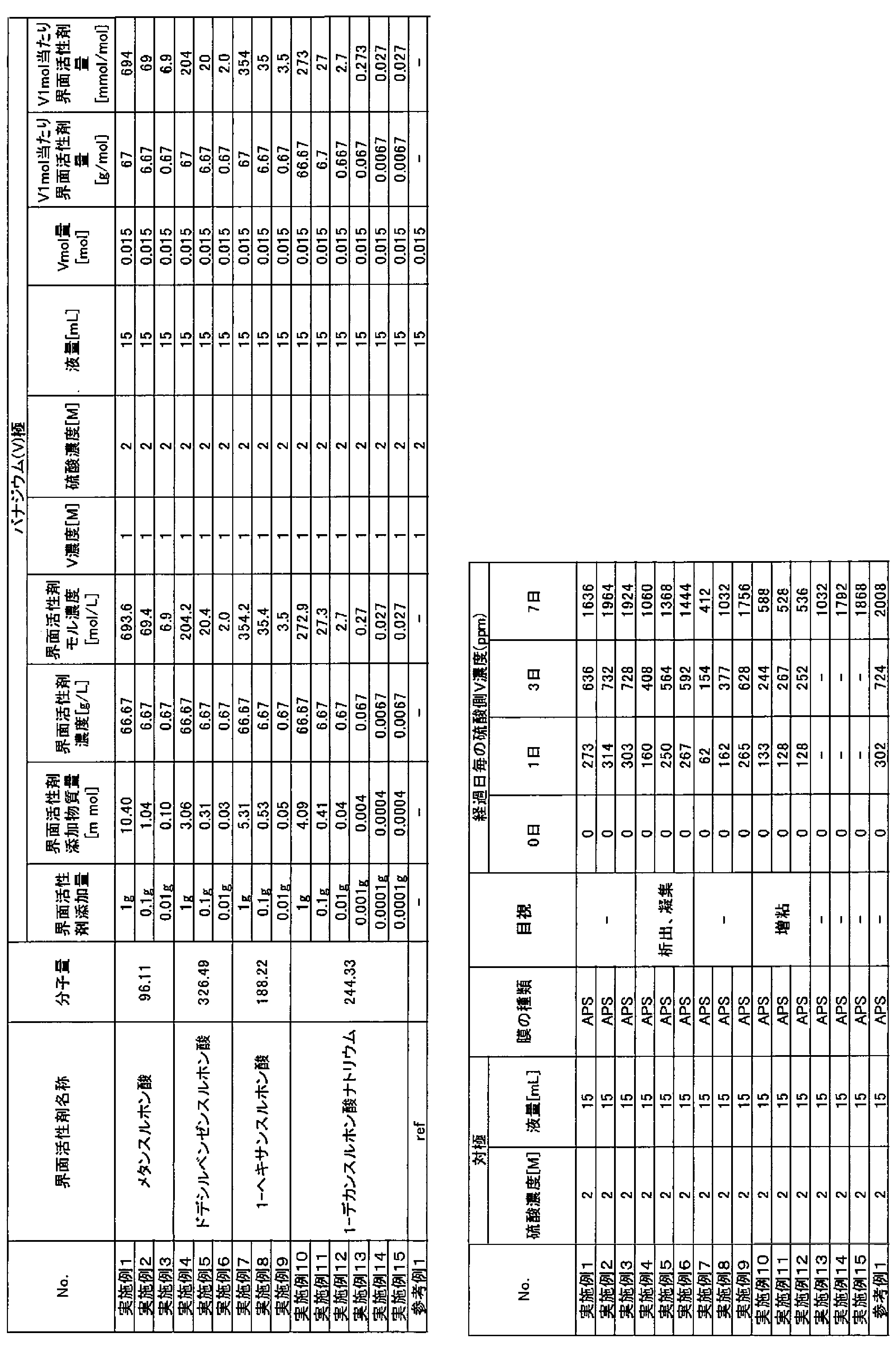
表1、図3及び図4に示すように、実施例1~15のH型セルは、参考例1のH型セルと比較して、H型セルのイオン交換膜を通過したバナジウムイオン又はバナジウムを含む陽イオンの濃度(ppm)が低下した。この結果から、実施例1~15のH型セルは、電解液に界面活性剤を含むことによって、バナジウムイオン又はバナジウムを含む陽イオンが、界面活性剤によって形成されたミセルに吸着され、イオン交換膜の通過が抑制される。実施例4~12のH型セルは、電解液中に、炭素数6~12の直鎖又は分岐鎖のアルキル基を有するアルキルスルホン酸又はその塩、若しくは、炭素数6~12の直鎖又は分岐鎖のアルキル基を有するアルキルベンゼンスルホン酸又はその塩を含む。実施例4~12のH型セルは、実施例1~3のH型セルよりも、対極において測定されるバナジウムの濃度(ppm)が低下した。なお、図3において、縦軸はバナジウムの濃度(ppm)である。
図4に示すように、7日静置した実施例1~15のH型セルにおいて、電解液中の界面活性剤の量が多くなると、対極において測定されるバナジウムの濃度(ppm)が低下する傾向が確認できた。実施例10~15に示すように、バナジウムイオン又はバナジウムを含む陽イオン1molに対して、1-デカンスルホン酸ナトリウムの量が0.0067g~67gでは、対極において測定されるバナジウムイオンの濃度(ppm)が低下した。この結果から、界面活性剤は、正極又は負極に含まれるバナジウムイオン又はバナジウムを含む陽イオン1molに対して、0.0067g~67gであると、バナジウムイオン又はバナジウムを含む陽イオンの隔膜の通過を抑制し、充電状体で放置した時の自己放電の速度を遅くすることができる。
次に、比較例1及び実施例16~19において、バナジウム固体塩電池を作製して、その特性を評価した。
[比較例1]
(正極用標準電極)
4価のバナジウム化合物は、酸化硫酸バナジウム(IV)・nH2O(VOSO4・nH2O)(VOSO4含有率:72%)5g(0.022mol)を準備した。
3価のバナジウム化合物は、硫酸バナジウム(III)・nH2O(V2(SO4)3・nH2O)(V2(SO4)3含有率:87%)5.8g(0.013mol)を準備した。
粉末状の導電性担持体は、カーボンブラックを11.7g準備した。カーボンブラックは、電気化学工業社製のデンカブラック(粉状)を用いた。
バインダーは、ポリテトラフルオロエチレン(6-J、三井デュポンフロロケミカル社製)を0.22g準備した。
4価のバナジウム化合物及び3価バナジウム化合物、カーボンブラック及びバインダーを混合して混合粉を得た。
電解液は、2M(mol/L)の硫酸を準備した。
得られた混合粉2gに対して電解液を0.54mL加えた後、脱泡しつつさらに混練して混練物を得た。混練方法としては、シンキー社製のあわとり練太郎ARE-310を用いる方法が挙げられる。
混練物は、容器から取り出し、圧延してシート状にして標準電極を製造した。シート状に圧延した電極の厚さは、130μmである。混練物を圧延する方法としては、圧力モーション社製のロールプレスを用いる方法が挙げられる。
(負用標準電極)
4価のバナジウム化合物は、酸化硫酸バナジウム(IV)・nH2O(VOSO4・nH2O)(VOSO4含有率:72%)5g(0.022mol)を準備した。
3価のバナジウム化合物は、硫酸バナジウム(III)・nH2O(V2(SO4)3・nH2O)(V2(SO4)3含有率:87%)5.8g(0.013mol)を準備した。
粉末状の導電性担持体は、カーボンブラックを11.7g準備した。カーボンブラックは、電気化学工業社製のデンカブラック(粉状)を用いた。
バインダーは、ポリテトラフルオロエチレン(6-J、三井デュポンフロロケミカル社製)を0.22g準備した。
4価のバナジウム化合物及び3価バナジウム化合物、カーボンブラック及びバインダーを混合して混合粉を得た。
電解液は、1M(mol/L)の硫酸を準備した。
得られた混合粉2gに対して電解液を0.54mL加えた後、脱泡しつつさらに混練して混練物を得た。混練方法としては、シンキー社製のあわとり練太郎ARE-310を用いる方法が挙げられる。
混練物は、容器から取り出し、圧延してシート状にして標準電極を製造した。シート状に圧延した電極の厚さは、130μmである。混練物を圧延する方法としては、圧力モーション社製のロールプレスを用いる方法が挙げられる。
[比較例1]
(正極用標準電極)
4価のバナジウム化合物は、酸化硫酸バナジウム(IV)・nH2O(VOSO4・nH2O)(VOSO4含有率:72%)5g(0.022mol)を準備した。
3価のバナジウム化合物は、硫酸バナジウム(III)・nH2O(V2(SO4)3・nH2O)(V2(SO4)3含有率:87%)5.8g(0.013mol)を準備した。
粉末状の導電性担持体は、カーボンブラックを11.7g準備した。カーボンブラックは、電気化学工業社製のデンカブラック(粉状)を用いた。
バインダーは、ポリテトラフルオロエチレン(6-J、三井デュポンフロロケミカル社製)を0.22g準備した。
4価のバナジウム化合物及び3価バナジウム化合物、カーボンブラック及びバインダーを混合して混合粉を得た。
電解液は、2M(mol/L)の硫酸を準備した。
得られた混合粉2gに対して電解液を0.54mL加えた後、脱泡しつつさらに混練して混練物を得た。混練方法としては、シンキー社製のあわとり練太郎ARE-310を用いる方法が挙げられる。
混練物は、容器から取り出し、圧延してシート状にして標準電極を製造した。シート状に圧延した電極の厚さは、130μmである。混練物を圧延する方法としては、圧力モーション社製のロールプレスを用いる方法が挙げられる。
(負用標準電極)
4価のバナジウム化合物は、酸化硫酸バナジウム(IV)・nH2O(VOSO4・nH2O)(VOSO4含有率:72%)5g(0.022mol)を準備した。
3価のバナジウム化合物は、硫酸バナジウム(III)・nH2O(V2(SO4)3・nH2O)(V2(SO4)3含有率:87%)5.8g(0.013mol)を準備した。
粉末状の導電性担持体は、カーボンブラックを11.7g準備した。カーボンブラックは、電気化学工業社製のデンカブラック(粉状)を用いた。
バインダーは、ポリテトラフルオロエチレン(6-J、三井デュポンフロロケミカル社製)を0.22g準備した。
4価のバナジウム化合物及び3価バナジウム化合物、カーボンブラック及びバインダーを混合して混合粉を得た。
電解液は、1M(mol/L)の硫酸を準備した。
得られた混合粉2gに対して電解液を0.54mL加えた後、脱泡しつつさらに混練して混練物を得た。混練方法としては、シンキー社製のあわとり練太郎ARE-310を用いる方法が挙げられる。
混練物は、容器から取り出し、圧延してシート状にして標準電極を製造した。シート状に圧延した電極の厚さは、130μmである。混練物を圧延する方法としては、圧力モーション社製のロールプレスを用いる方法が挙げられる。
(集電体)
集電体は、グラファイトシートと銅箔を一体化させたものを準備した。集電体は、銅箔の一部が貼り合せたグラファイトシートから延出されたタブ部を有する。
集電体は、グラファイトシートと銅箔を一体化させたものを準備した。集電体は、銅箔の一部が貼り合せたグラファイトシートから延出されたタブ部を有する。
(隔膜:多孔膜)
隔膜は、イオン交換膜 VX-10(Fumatech社製)を用いた。
隔膜は、イオン交換膜 VX-10(Fumatech社製)を用いた。
(外装材)
外装材は、内面層:PP(ポリプロピレン)、中間層:アルミ、外面層:ナイロンの3層構造のラミネートフィルム(昭和電工社製)を用いた。
外装材は、内面層:PP(ポリプロピレン)、中間層:アルミ、外面層:ナイロンの3層構造のラミネートフィルム(昭和電工社製)を用いた。
(バナジウム固体塩電池の作成)
正極用標準電極及び負極用標準電極を用いて、以下のようにして比較例1のバナジウム固体塩電池を作成した。
電池の部材は、第1集電体、正極用標準電極、隔膜、負極用標準電極、第2集電体をこの順序で配置した。第1集電体は、グラファイトシートと正極用標準電極が接触するように配置した。第2集電体は、グラファイトシートと負極用標準電極が接触するように配置した。正極用標準電極及び負極用標準電極は、縦25mm×横25mm×厚さ130μmである。正極用標準電極及び負極用標準電極の密度は1.6~1.9g/cm3である。
電池の部材は、縦55mm×横55mmの大きさの外装材で形成した矩形状の一辺が開放されている袋状の外装材に挿入した。袋状の外装材は、第1集電体の第1タブ部及び第2集電体の第2タブ部を袋状の外装材から延出させた状態で、開放されている一辺をヒートシールした。得られたバナジウム固体塩電池は、外装材から延出された第1タブ部及び第2タブ部を除き、縦55mm×横55mm×厚さ1mmのサイズであった。
製造したバナジウム固体塩電池は、充電を行うことにより、正極に含まれるバナジウム化合物が、5価及び4価の間で酸化数が変化するバナジウム化合物となり、負極に含まれるバナジウム化合物が、2価及び3価の間で酸化数が変化するバナジウム化合物となる。
正極用標準電極及び負極用標準電極を用いて、以下のようにして比較例1のバナジウム固体塩電池を作成した。
電池の部材は、第1集電体、正極用標準電極、隔膜、負極用標準電極、第2集電体をこの順序で配置した。第1集電体は、グラファイトシートと正極用標準電極が接触するように配置した。第2集電体は、グラファイトシートと負極用標準電極が接触するように配置した。正極用標準電極及び負極用標準電極は、縦25mm×横25mm×厚さ130μmである。正極用標準電極及び負極用標準電極の密度は1.6~1.9g/cm3である。
電池の部材は、縦55mm×横55mmの大きさの外装材で形成した矩形状の一辺が開放されている袋状の外装材に挿入した。袋状の外装材は、第1集電体の第1タブ部及び第2集電体の第2タブ部を袋状の外装材から延出させた状態で、開放されている一辺をヒートシールした。得られたバナジウム固体塩電池は、外装材から延出された第1タブ部及び第2タブ部を除き、縦55mm×横55mm×厚さ1mmのサイズであった。
製造したバナジウム固体塩電池は、充電を行うことにより、正極に含まれるバナジウム化合物が、5価及び4価の間で酸化数が変化するバナジウム化合物となり、負極に含まれるバナジウム化合物が、2価及び3価の間で酸化数が変化するバナジウム化合物となる。
[実施例16~19]
正極の電解液に表2に示す各界面活性剤を、正極に含まれるバナジウムイオン又はバナジウムを含む陽イオン1molに対して、各量(g)含んだこと以外は、比較例1の正極用標準電極及び負極用標準電極と同様にして、実施例16~19の正極用の第1電極及び負極用の第2電極を製造した。例えば、実施例16の電解液は、正極の電解液である2M(mol/L)の硫酸0.54mLに対して、1-デカンスルホン酸ナトリウム(DSS、アルキル基の炭素数10)を0.03g含む。この結果、実施例16では、正極に含まれるバナジウムイオン又はバナジウムを含む陽イオン1molに対して、1-デカンスルホン酸ナトリウムを0.007g含む。
これらの正極用の第1電極及び負極用の第2電極を用いて比較例1のバナジウム固体塩電池と同様にして、バナジウム固体塩電池を製造した。
正極の電解液に表2に示す各界面活性剤を、正極に含まれるバナジウムイオン又はバナジウムを含む陽イオン1molに対して、各量(g)含んだこと以外は、比較例1の正極用標準電極及び負極用標準電極と同様にして、実施例16~19の正極用の第1電極及び負極用の第2電極を製造した。例えば、実施例16の電解液は、正極の電解液である2M(mol/L)の硫酸0.54mLに対して、1-デカンスルホン酸ナトリウム(DSS、アルキル基の炭素数10)を0.03g含む。この結果、実施例16では、正極に含まれるバナジウムイオン又はバナジウムを含む陽イオン1molに対して、1-デカンスルホン酸ナトリウムを0.007g含む。
これらの正極用の第1電極及び負極用の第2電極を用いて比較例1のバナジウム固体塩電池と同様にして、バナジウム固体塩電池を製造した。
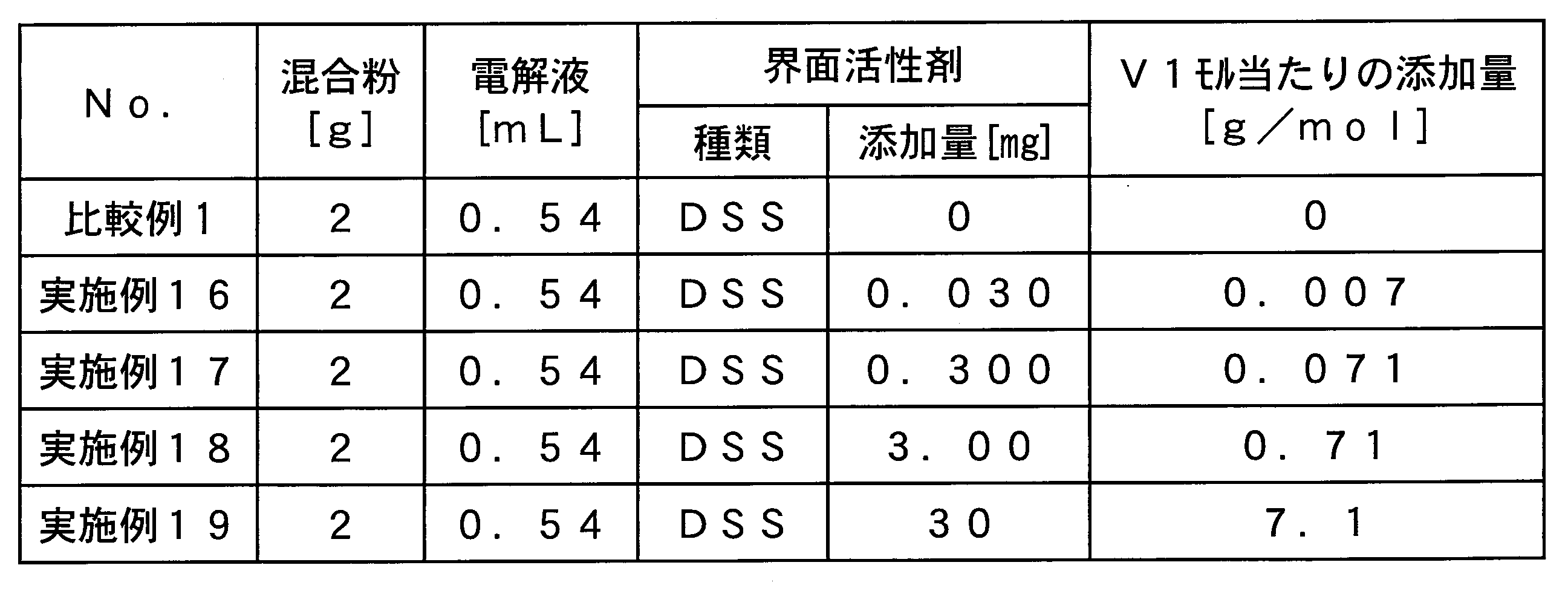
作製したバナジウム固体塩電池を1.5Cの充電レートで1.45Vまで充電した後100時間放置し、開放電圧がどの様に推移するかを測定した。測定には東洋システム社製の充放電評価装置(TOSCAT-3000)を用いた。図5は、実施例17~19及び比較例1のバナジウム固体塩電池の100時間の開放電圧の推移を示すグラフである。また、表3は、実施例16~19及び比較例1のバナジウム固体塩電池を1.5Cの充電レートで1.45Vまで充電した後、100時間放置後の電位を放置後電位として下記式に従って、電位維持率を算出した結果を示す。
電位維持率(%)=(100時間後電池(V)/1.45V)×100
電位維持率(%)=(100時間後電池(V)/1.45V)×100
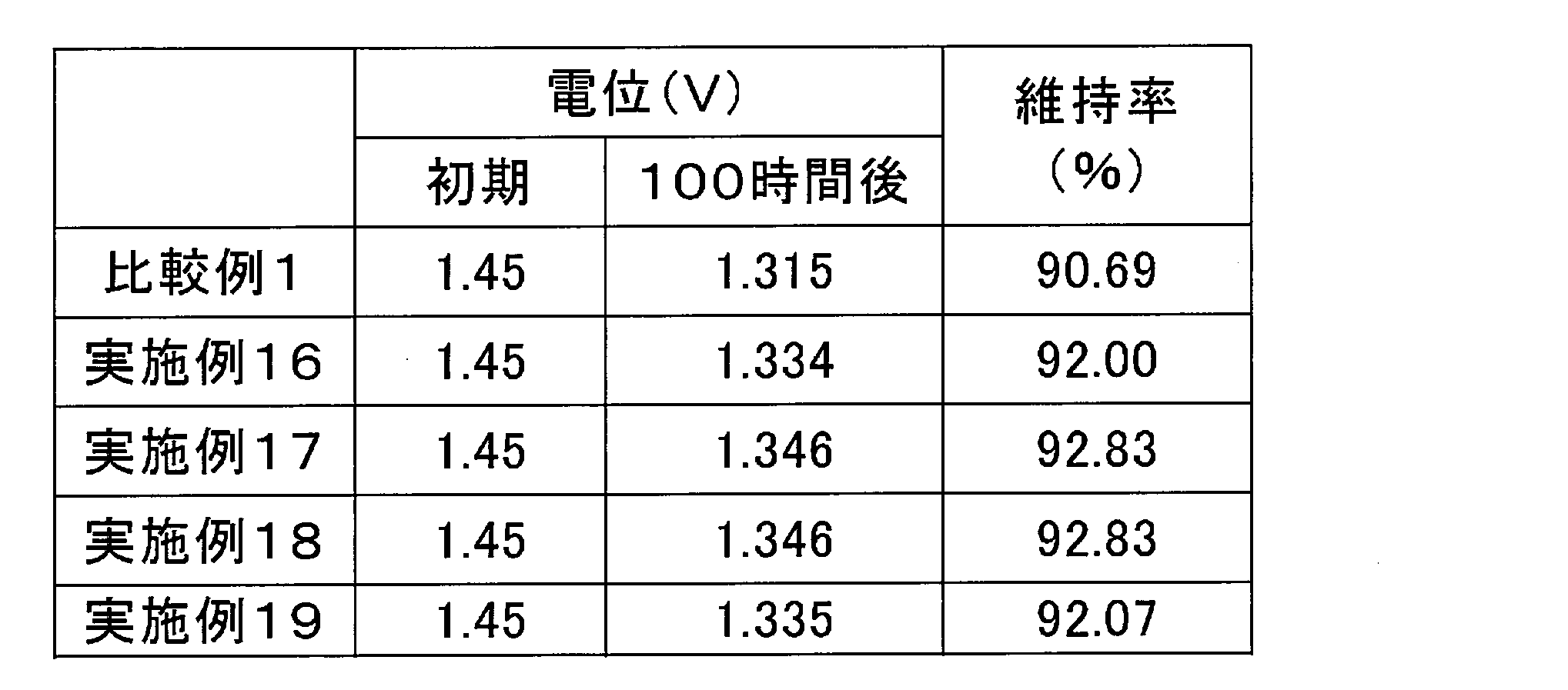
表3に示すように、実施例16~19のバナジウム固体塩電池は、比較例1のバナジウム固体塩電池の結果と比較して、電解液中に界面活性剤を含むため、開放電圧の維持率が高い結果が得られた。また、図5に示すように、実施例17~19のバナジウム固体塩電池は、比較例1と比べて、開放電位の低下が抑制され、自己放電特性が良好な結果となった。これは、実施例16~19のバナジウム固体塩電池は、電解液中に界面活性剤を含むことによって、界面活性剤が電解液中で複数集まり会合体(ミセル)を形成する。電解液中のミセルを形成した界面活性剤の親水性基は、対イオンを分離し、この分離した対イオンの代わりに、バナジウムイオン又はバナジウムを含む陽イオンが親水性基に吸着される。電池の活物質を構成するバナジウムイオン又はバナジウムを含む陽イオンは、ミセルに吸着されることによって、単独のバナジウムイオン又は単独のバナジウムを含む陽イオンよりも大きな分子となる。ミセルに吸着されたバナジウムイオン又はバナジウムを含む陽イオンは、ミセルに吸着されて大きな分子となり、電池において隔膜の通過が抑制され、イオンの通過に伴って生じる自己放電を抑制することができた結果と考えられる。
本発明のバナジウムレドックス電池は、自己放電を抑制することができる。本発明のバナジウムレドックス電池は、自己放電を抑制することができるため、大型電力貯蔵分野のみならず、パーソナルコンピュータ、個人用携帯情報端末(PDA)、デジタルカメラ、デジタルメディアプレーヤー、デジタルレコーダ、ゲーム、電化製品、車両、無線装置、携帯電話等に広く用いることができ、産業上有用である。
1 バナジウム固体塩電池
2 正極用の第1電極
3 第1集電体
4 正極
5 負極用の第2電極
6 第2集電体
7 負極
8 隔膜
9 外装材
10 正極用の引出し電極用の第1タブ部
11 負極用の引出し電極用の第2タブ部
2 正極用の第1電極
3 第1集電体
4 正極
5 負極用の第2電極
6 第2集電体
7 負極
8 隔膜
9 外装材
10 正極用の引出し電極用の第1タブ部
11 負極用の引出し電極用の第2タブ部
Claims (14)
- バナジウムレドックス電池であって、
酸化還元反応によって、5価及び4価の間で酸化数が変化するバナジウムイオン又は5価及び4価の間で酸化数が変化するバナジウムを含む陽イオンを含有する正極活物質を含む正極と、
酸化還元反応によって、2価及び3価の間で酸化数が変化するバナジウムイオン又は2価及び3価の間で酸化数が変化するバナジウムを含む陽イオンを含有する負極活物質を含む負極と、
正極を含む区域と負極を含む区域とに区画し、水素イオンを通過させる隔膜と、
前記正極を含む区域及び前記負極を含む区域のそれぞれに含まれる電解液とを含み、
前記正極を含む区域に含まれる電解液及び前記負極を含む区域に含まれる電解液の少なくとも一方に、界面活性剤を含むバナジウムレドックス電池。 - バナジウムレドックス電池であって、
正極活物質を含む第1電極と、第1集電体とを含む正極であり、前記正極活物質が、酸化還元反応によって、5価及び4価の間で酸化数が変化するバナジウムイオン又は5価及び4価の間で酸化数が変化するバナジウムを含む陽イオンを含有するバナジウム固体塩を含む、前記正極と、
負極活物質を含む第2電極と、第2集電体とを含む負極であり、前記負極活物質が、酸化還元反応によって、2価及び3価の間で酸化数が変化するバナジウムイオン又は2価及び3価の間で酸化数が変化するバナジウムを含む陽イオンを含有するバナジウム固体塩を含む、前記負極と、
正極を含む区域と負極を含む区域とに区画し、水素イオンを通過させる隔膜と、
前記正極を含む区域及び前記負極を含む区域のそれぞれに含まれる電解液とを含み、
前記正極を含む区域に含まれる電解液及び前記負極を含む区域に含まれる電解液の少なくとも一方に、界面活性剤を含むバナジウムレドックス電池。 - 前記界面活性剤が、陰イオン性界面活性剤である、請求項1又は2記載のバナジウムレドックス電池。
- 前記界面活性剤が、炭素数1~12の直鎖又は分岐鎖のアルキル基を有するアルキルスルホン酸、炭素数1~12の直鎖又は分岐鎖のアルキル基を有するアルキルスルホン酸塩、炭素数1~12の直鎖又は分岐鎖のアルキル基を有するアルキルベンゼンスルホン酸、及び炭素数1~12の直鎖又は分岐鎖のアルキル基を有するアルキルベンゼンスルホン酸塩からなる群より選択される少なくとも1種である、請求項1~3のいずれか一項記載のバナジウムレドックス電池。
- 前記界面活性剤の含有量が、正極又は負極に含まれるバナジウムイオン又はバナジウムを含む陽イオン1molに対して、0.0067~67gである、請求項1~4のいずれか一項記載のバナジウムレドックス電池。
- 前記界面活性剤の含有量が、正極又は負極に含まれるバナジウムイオン又はバナジウムを含む陽イオン1molに対して、0.027mmol~694mmolである、請求項1~5のいずれか一項記載のバナジウムレドックス電池。
- 前記界面活性剤の含有量が、電解液1Lに対して、0.0067~67gである、請求項1~6のいずれか一項記載のバナジウムレドックス電池。
- 前記電解液が、硫酸濃度4M(mol/L)以下の硫酸水溶液である、請求項1~7のいずれか一項記載のバナジウムレドックス電池。
- 前記電解液が、硫酸濃度2mol/Lの硫酸水溶液である、請求項8記載のバナジウムレドックス電池。
- 前記界面活性剤が、炭素数6~12の直鎖又は分岐鎖のアルキル基を有するアルキルスルホン酸、炭素数6~12の直鎖又は分岐鎖のアルキル基を有するアルキルスルホン酸塩、炭素数6~12の直鎖又は分岐鎖のアルキル基を有するアルキルベンゼンスルホン酸、及び炭素数6~12の直鎖又は分岐鎖のアルキル基を有するアルキルベンゼンスルホン酸塩からなる群より選択される少なくとも1種である、請求項1~9のいずれか一項記載のバナジウムレドックス電池。
- 前記界面活性剤が、ドデシルベンゼンスルホン酸、1-ヘキサンスルホン酸及び1-デカンスルホン酸ナトリウムからなる群から選択される1種である請求項1~9のいずれか一項記載のバナジウムレドックス電池。
- 前記正極を含む区域に含まれる電解液に、前記界面活性剤を含む請求項1~11のいずれか一項記載のバナジウムレドックス電池。
- 前記界面活性剤の含有量が、前記正極に含まれるバナジウムイオン又はバナジウムを含む陽イオン1molに対して、0.0067~67gである、請求項12に記載のバナジウムレドックス電池。
- 前記界面活性剤の含有量が、前記正極に含まれるバナジウムイオン又はバナジウムを含む陽イオン1molに対して、0.027mmol~694mmolである、請求項12又は13に記載のバナジウムレドックス電池。
Applications Claiming Priority (2)
| Application Number | Priority Date | Filing Date | Title |
|---|---|---|---|
| JP2015-069924 | 2015-03-30 | ||
| JP2015069924A JP2016189318A (ja) | 2015-03-30 | 2015-03-30 | バナジウムレドックス電池 |
Publications (1)
| Publication Number | Publication Date |
|---|---|
| WO2016158295A1 true WO2016158295A1 (ja) | 2016-10-06 |
Family
ID=57007035
Family Applications (1)
| Application Number | Title | Priority Date | Filing Date |
|---|---|---|---|
| PCT/JP2016/057602 Ceased WO2016158295A1 (ja) | 2015-03-30 | 2016-03-10 | バナジウムレドックス電池 |
Country Status (2)
| Country | Link |
|---|---|
| JP (1) | JP2016189318A (ja) |
| WO (1) | WO2016158295A1 (ja) |
Cited By (2)
| Publication number | Priority date | Publication date | Assignee | Title |
|---|---|---|---|---|
| EP4498461A3 (en) * | 2023-07-04 | 2025-03-26 | Standard Energy Inc. | Aqueous electrolyte containing vanadium ion and vanadium ion battery including the same |
| CN119706931A (zh) * | 2024-12-21 | 2025-03-28 | 大连融科储能集团股份有限公司 | 一种气体强化还原反萃制备voso4电解液的方法 |
Families Citing this family (2)
| Publication number | Priority date | Publication date | Assignee | Title |
|---|---|---|---|---|
| US11394084B2 (en) | 2016-11-18 | 2022-07-19 | Lg Energy Solution, Ltd. | Separator and electrochemical device including the same |
| JP7855158B2 (ja) * | 2022-02-28 | 2026-05-08 | 河村電器産業株式会社 | フローレスレドックス電池 |
Citations (5)
| Publication number | Priority date | Publication date | Assignee | Title |
|---|---|---|---|---|
| JP2002216833A (ja) * | 2001-01-19 | 2002-08-02 | Kansai Electric Power Co Inc:The | レドックス電池 |
| WO2011049103A1 (ja) * | 2009-10-20 | 2011-04-28 | 国立大学法人東北大学 | バナジウム電池 |
| WO2014126179A1 (ja) * | 2013-02-18 | 2014-08-21 | ブラザー工業株式会社 | バナジウム固体塩電池及びその製造方法 |
| WO2014125662A1 (ja) * | 2013-02-18 | 2014-08-21 | 株式会社ギャラキシー | 高濃度バナジウム電解液、その製造方法及びその製造装置 |
| JP2014235946A (ja) * | 2013-06-04 | 2014-12-15 | 旭化成イーマテリアルズ株式会社 | 電解液及びレドックスフロー電池 |
-
2015
- 2015-03-30 JP JP2015069924A patent/JP2016189318A/ja active Pending
-
2016
- 2016-03-10 WO PCT/JP2016/057602 patent/WO2016158295A1/ja not_active Ceased
Patent Citations (7)
| Publication number | Priority date | Publication date | Assignee | Title |
|---|---|---|---|---|
| JP2002216833A (ja) * | 2001-01-19 | 2002-08-02 | Kansai Electric Power Co Inc:The | レドックス電池 |
| WO2011049103A1 (ja) * | 2009-10-20 | 2011-04-28 | 国立大学法人東北大学 | バナジウム電池 |
| JP2014017267A (ja) * | 2009-10-20 | 2014-01-30 | Tohoku Univ | バナジウム電池 |
| WO2014126179A1 (ja) * | 2013-02-18 | 2014-08-21 | ブラザー工業株式会社 | バナジウム固体塩電池及びその製造方法 |
| WO2014125662A1 (ja) * | 2013-02-18 | 2014-08-21 | 株式会社ギャラキシー | 高濃度バナジウム電解液、その製造方法及びその製造装置 |
| JP2014157793A (ja) * | 2013-02-18 | 2014-08-28 | Galaxy Corp | 高濃度バナジウム電解液、その製造方法及びその製造装置 |
| JP2014235946A (ja) * | 2013-06-04 | 2014-12-15 | 旭化成イーマテリアルズ株式会社 | 電解液及びレドックスフロー電池 |
Cited By (2)
| Publication number | Priority date | Publication date | Assignee | Title |
|---|---|---|---|---|
| EP4498461A3 (en) * | 2023-07-04 | 2025-03-26 | Standard Energy Inc. | Aqueous electrolyte containing vanadium ion and vanadium ion battery including the same |
| CN119706931A (zh) * | 2024-12-21 | 2025-03-28 | 大连融科储能集团股份有限公司 | 一种气体强化还原反萃制备voso4电解液的方法 |
Also Published As
| Publication number | Publication date |
|---|---|
| JP2016189318A (ja) | 2016-11-04 |
Similar Documents
| Publication | Publication Date | Title |
|---|---|---|
| Hao et al. | Advanced cathodes for aqueous Zn batteries beyond Zn 2+ intercalation | |
| CN102668224B (zh) | 钒电池 | |
| KR101638595B1 (ko) | 레독스 플로우 전지 | |
| Zhang et al. | Aqueous lithium/air rechargeable batteries | |
| JP6668414B2 (ja) | 適合するアイオノマー膜を含むレドックスフロー電池 | |
| US20140050947A1 (en) | Hybrid Electrochemical Energy Storage Devices | |
| CN104854731B (zh) | 特征为高开路电压的电化学储能系统 | |
| US20130337348A1 (en) | Alkali metal-air flow batteries | |
| JP2014130778A (ja) | 静止型バナジウムレドックス電池 | |
| CN108701829A (zh) | 含有单磺化儿茶酚酸配体的配合物及其制备方法 | |
| CN104054210A (zh) | 二次电池 | |
| WO2014018615A1 (en) | Optimal membrane electrochemical energy storage systems | |
| CN107690723A (zh) | 水性全铜氧化还原液流蓄电池 | |
| US20150357653A1 (en) | Vanadium Solid-Salt Battery and Method for Producing Same | |
| WO2017132348A1 (en) | Improved electrolyte system for rechargeable flow battery | |
| KR20240048540A (ko) | 금속 공기 전지에 대한 개선 | |
| JP2016189318A (ja) | バナジウムレドックス電池 | |
| CN104854732B (zh) | 特征为大的负极半电池电势的电化学储能系统和方法 | |
| WO2014156595A1 (ja) | バナジウム固体塩電池及びその製造方法 | |
| US11799154B2 (en) | Hybrid energy storage device | |
| JP5720947B2 (ja) | 鉛蓄電池 | |
| WO2016158217A1 (ja) | バナジウムレドックス電池 | |
| JP2016186853A (ja) | バナジウムレドックス電池 | |
| JP2017212104A (ja) | バナジウムレドックス二次電池、及びバナジウムレドックス二次電池の製造方法 | |
| JP6083566B2 (ja) | バナジウム固体塩電池及びその製造方法 |
Legal Events
| Date | Code | Title | Description |
|---|---|---|---|
| 121 | Ep: the epo has been informed by wipo that ep was designated in this application |
Ref document number: 16772179 Country of ref document: EP Kind code of ref document: A1 |
|
| NENP | Non-entry into the national phase |
Ref country code: DE |
|
| 122 | Ep: pct application non-entry in european phase |
Ref document number: 16772179 Country of ref document: EP Kind code of ref document: A1 |