WO2016152706A1 - 腎機能改善剤 - Google Patents
腎機能改善剤 Download PDFInfo
- Publication number
- WO2016152706A1 WO2016152706A1 PCT/JP2016/058461 JP2016058461W WO2016152706A1 WO 2016152706 A1 WO2016152706 A1 WO 2016152706A1 JP 2016058461 W JP2016058461 W JP 2016058461W WO 2016152706 A1 WO2016152706 A1 WO 2016152706A1
- Authority
- WO
- WIPO (PCT)
- Prior art keywords
- renal function
- amount
- improving agent
- function improving
- per
- Prior art date
- Legal status (The legal status is an assumption and is not a legal conclusion. Google has not performed a legal analysis and makes no representation as to the accuracy of the status listed.)
- Ceased
Links
Classifications
-
- A—HUMAN NECESSITIES
- A23—FOODS OR FOODSTUFFS; TREATMENT THEREOF, NOT COVERED BY OTHER CLASSES
- A23L—FOODS, FOODSTUFFS OR NON-ALCOHOLIC BEVERAGES, NOT OTHERWISE PROVIDED FOR; PREPARATION OR TREATMENT THEREOF
- A23L33/00—Modifying nutritive qualities of foods; Dietetic products; Preparation or treatment thereof
-
- A—HUMAN NECESSITIES
- A61—MEDICAL OR VETERINARY SCIENCE; HYGIENE
- A61K—PREPARATIONS FOR MEDICAL, DENTAL OR TOILETRY PURPOSES
- A61K31/00—Medicinal preparations containing organic active ingredients
- A61K31/70—Carbohydrates; Sugars; Derivatives thereof
-
- A—HUMAN NECESSITIES
- A61—MEDICAL OR VETERINARY SCIENCE; HYGIENE
- A61K—PREPARATIONS FOR MEDICAL, DENTAL OR TOILETRY PURPOSES
- A61K33/00—Medicinal preparations containing inorganic active ingredients
-
- A—HUMAN NECESSITIES
- A61—MEDICAL OR VETERINARY SCIENCE; HYGIENE
- A61K—PREPARATIONS FOR MEDICAL, DENTAL OR TOILETRY PURPOSES
- A61K38/00—Medicinal preparations containing peptides
-
- A—HUMAN NECESSITIES
- A61—MEDICAL OR VETERINARY SCIENCE; HYGIENE
- A61K—PREPARATIONS FOR MEDICAL, DENTAL OR TOILETRY PURPOSES
- A61K45/00—Medicinal preparations containing active ingredients not provided for in groups A61K31/00 - A61K41/00
Definitions
- the present invention relates to a renal function improving agent.
- the state of renal function is judged based on the blood urea nitrogen concentration. Then, when the blood urea nitrogen concentration or the like is out of the normal value range, for example, a reexamination further examines the state of the renal function to determine whether or not the renal function needs to be treated.
- Patent Document 1 discloses that a composition having a protein content of 0.5 to 1.5 g per 100 kcal of energy, a phosphorus content of 10 to 40 mg, a sodium content of 10 to 30 mg, and a potassium content of 5 to 50 mg is A, and the protein content is energy.
- a composition of 3.0 to 4.0 g per 100 kcal, phosphorus content 10 to 40 mg, sodium content 50 to 70 mg, potassium content 5 to 50 mg as B, and these A and B are mixed in a ratio of 4: 1 to 1: 4.
- It is a fluid nutritional composition for conservative kidney disease patients or dialysis kidney disease patients, and is mixed for conservative kidney disease patients or dialysis kidney disease patients.
- a fluid nutritional composition for patients with kidney disease which is labeled as being used.
- improving the diet is only to maintain the health of the person It is also beneficial to curb the increase in medical expenses for the entire population.
- As a method for improving eating habits for example, when blood urea nitrogen concentration is outside the normal range, change from eating habits concentrated on meat eating to eating habits mainly consisting of vegetables, and intake of protein Reduction. However, it is often difficult or impossible in practice to completely change each meal in order to prevent or suppress deterioration of kidney function.
- the present invention provides a renal function improving agent that can be used for preventing or suppressing the deterioration of renal function without drastically and drastically changing the conventional diet, and the renal function improving agent,
- An object of the present invention is to provide a nutritional preparation for improving renal function.
- the inventor has an abnormally high value for one or more of blood urea nitrogen concentration, blood creatinine concentration, and urinary albumin excretion per day.
- the amount of protein is 0.5-4 g
- the amount of phosphorus is 10-40 mg
- the amount of sodium is 10-70 mg
- the amount of potassium is 5
- a renal function improving agent of ⁇ 50 mg is taken as part of a meal, blood urea nitrogen concentration, blood creatinine concentration, urinary albumin per day without greatly changing the conventional diet It has been found that the further increase in the excretion amount can be suppressed and the deterioration of the renal function can be prevented or suppressed, and the present invention has been completed.
- the present invention provides the following [1] to [8].
- [1] For those who show abnormal values (oral) to take (administer) one or more of blood urea nitrogen concentration, blood creatinine concentration, and urinary albumin excretion per day
- a renal function improving agent An agent for improving renal function, wherein the amount of protein is 0.5 to 4 g, the amount of phosphorus is 10 to 40 mg, the amount of sodium is 10 to 70 mg, and the amount of potassium is 5 to 50 mg per 100 kcal of energy.
- [2] Ingested by those who satisfy at least one of blood urea nitrogen concentration of 25 mg / dL or more, blood creatinine concentration of 1.2 mg / dL or more, and urinary albumin excretion per day of 30 mg or more
- the above [1] to [4] are for suppressing further increase of one or more of blood urea nitrogen concentration, blood creatinine concentration and urinary albumin excretion per day.
- the renal function improving agent in any one of.
- a nutritional preparation for improving renal function comprising a combination of the renal function improving agent according to any one of [1] to [5] above and a nutritional composition other than the renal function improving agent, A nutritional preparation for improving renal function, wherein the protein is 2 to 16%, the lipid is 15 to 37%, the sugar is 55 to 83%, and the dietary fiber is 0 to 3% per 100% of the energy ratio.
- the nutritional composition other than the above-mentioned renal function improving agent is 0.5 to 4 g of protein, 50 mg or more of phosphorus, 20 mg or more of sodium, and 60 mg or more of potassium per 100 kcal of energy.
- the nutritional preparation for improving renal function according to the above [6].
- the weight ratio of the above renal function improving agent and the nutritional composition other than the above renal function improving agent is 0.1 to 10.
- the nutritional preparation for improving renal function according to the above [6] or [7].
- Renal function wherein the amount of protein is 0.5 to 4 g, the amount of phosphorus is 10 to 40 mg, the amount of sodium is 10 to 70 mg, and the amount of potassium is 5 to 50 mg per 100 kcal of energy Improver, Renal function including the step of (orally) administering (ingesting) one or more of blood urea nitrogen concentration, blood creatinine concentration, and urinary albumin excretion per day to a person who shows abnormal values How to improve.
- a pharmaceutical product comprising a composition in which the amount of protein is 0.5 to 4 g, the amount of phosphorus is 10 to 40 mg, the amount of sodium is 10 to 70 mg, and the amount of potassium is 5 to 50 mg per 100 kcal of energy ( Used for addition to pharmaceutical compositions, nutritional pharmaceutical compositions, drugs, etc.) or food and drink (food composition, nutritional composition, special-purpose food, nutritional functional food, health food, etc.), and blood urea nitrogen concentration A composition used for improving renal function of a person who exhibits abnormal values for one or more of creatinine concentration in blood and excretion amount per day of albumin in urine.
- Medicinal products medicine for ingestion (administration)) of those who show abnormal values for one or more of blood urea nitrogen concentration, blood creatinine concentration, and daily excretion of urinary albumin
- a composition, a nutritional pharmaceutical composition, a drug, etc.) or a food or drink (a food / beverage composition, a nutritional composition, a special-purpose food, a nutritional functional food, a health food, etc.), A method of imparting a renal function improving effect to the drug or the food or drink.
- the renal function By gradually reducing the intake of the nutritional composition other than the improving agent and gradually increasing the intake of the renal function improving agent of the present invention, the deterioration of renal function can be prevented without greatly changing the conventional diet. Can be suppressed. That is, abrupt or extreme switching from a normal (conventional) diet to a diet for a kidney disease patient is mentally ill for those who actually take it (such as those with only a slight decrease in kidney function) There were cases where it was difficult or impossible to realize due to a heavy burden.
- a normal diet is reduced to about 2/3, and a portion corresponding to about 1/3 of the remaining meal is supplemented with the renal function improving agent of the present invention.
- reducing the normal diet to about 1/2, and supplementing the portion corresponding to about 1/2 of the remaining diet with the renal function improving agent of the present invention
- the renal function improving agent of the present invention has an abnormal value (abnormally high value) for one or more of blood urea nitrogen concentration, blood creatinine concentration, and urinary albumin excretion per day. It is a renal function improving agent for ingestion, and per 100 kcal of energy, the amount of protein is 0.5-4 g, the amount of phosphorus is 10-40 mg, the amount of sodium is 10-70 mg, the amount of potassium is 5-50 mg It is a renal function improving agent.
- the actual intake person (subject who takes the renal function improving agent of the present invention) is abnormal in one or more of blood urea nitrogen concentration, blood creatinine concentration, and daily excretion of urinary albumin. The person who shows the value.
- the actual ingestor is preferably a person who satisfies the following conditions from the viewpoint of increasing the effect and action of ingesting the renal function improving agent of the present invention.
- the actual intaker preferably has a blood urea nitrogen concentration of 25 mg / dL or more, more preferably 28 mg / dL or more, and further preferably 30 mg / dL or more.
- the actual intaker preferably has a blood creatinine concentration of 1.2 mg / dL or more, more preferably 1.4 mg / dL or more, and further preferably 1.6 mg / dL or more.
- the actual intake of the urinary albumin per day is preferably 30 mg or more, more preferably 40 mg or more, and even more preferably 50 mg or more.
- the actual ingestor is more preferable among blood urea nitrogen concentration, blood creatinine concentration, and urinary albumin excretion per day.
- two items (variables) satisfy the above conditions, and more preferably, three items (all items) satisfy the above conditions.
- the renal function improving agent of the present invention contains protein, phosphorus, sodium, and potassium.
- it is necessary to restrict intake of phosphorus, sodium, and potassium in patients with kidney disease, and it is also necessary to restrict intake of protein in patients with kidney disease in the preservation period (chronic).
- phosphorus, sodium, and potassium are essential elements of the human body. If protein, including protein, is not consumed at all, deficiency may occur, and health may be adversely affected. Therefore, in the renal function improving agent of the present invention, the lower limit of the content of protein, phosphorus, sodium, and potassium is set to avoid the risk of deficiency, the upper limit is set to avoid the risk of overdose, and the upper limit and In the content of the lower limit range, the improvement effect of renal function is shown.
- the renal function improving agent of the present invention can contain lipids, carbohydrates, other minerals (other than phosphorus, sodium, potassium), vitamins, and dietary fiber. That is, a nutritionally balanced composition can be prepared by containing lipids and sugars. And the composition which provided the health function derived from each component can be prepared by including another mineral (things other than phosphorus, sodium, potassium), a vitamin, and a dietary fiber.
- the protein preferably includes milk proteins such as casein and whey protein, and more preferably casein.
- the amount of protein per 100 kcal of energy is, for example, 0.5 to 4 g, preferably 0.5 to 3 g, more preferably 0.5 to 2 g, still more preferably 0.5. ⁇ 1.5 g.
- the amount of phosphorus (P) per 100 kcal of energy is, for example, 8 to 45 mg, preferably 10 to 40 mg, more preferably 10 to 38 mg, and further preferably 10 to 35 mg.
- the amount of sodium (Na) per 100 kcal of energy is, for example, 8 to 75 mg, preferably 10 to 70 mg, more preferably 10 to 65 mg, and further preferably 10 to 60 mg.
- the amount of potassium (K) per 100 kcal of energy is, for example, 5 to 50 mg, preferably 5 to 45 mg, more preferably 5 to 40 mg, and further preferably 5 to 35 mg.
- the amount of each component of protein, phosphorus, sodium, and potassium is below the lower limit of the above numerical range, it becomes difficult to give each of these components sufficiently to the actual ingestor. It may cause harmful effects due to shortage.
- lipids include medium chain fatty acid triglycerides and long chain fatty acid triglycerides.
- the amount of lipid per 100 kcal of energy is, for example, 0.5-6 g, preferably 1-5 g, more preferably 1.5-4.5 g, still more preferably 2 ⁇ 4g.
- preferable examples of the carbohydrate include soluble polysaccharides (for example, starches such as dextrin and corn starch, and oligosaccharides).
- the amount of carbohydrate per 100 kcal of energy is, for example, 8 to 24 g, preferably 10 to 22 g, more preferably 12 to 20 g, still more preferably 14 to 18 g.
- the amount of each component of lipid and carbohydrate is below the lower limit of the above numerical range, it will be difficult to give these components sufficiently to the actual ingestor, and there will be an adverse effect due to the lack of these components. May be incurred.
- the amount of each component of lipid and carbohydrate exceeds the upper limit of the above numerical range, it will be difficult to provide the actual intake with sufficient nutrients that are well-balanced. May cause harmful effects.
- the renal function improving agent of the present invention includes calcium, magnesium, iron, zinc and the like as other minerals (other than phosphorus, sodium and potassium).
- the amount of calcium (Ca) per 100 kcal of energy is, for example, 5 to 55 mg, preferably 10 to 50 mg, more preferably 15 to 45 mg, and further preferably 20 to 40 mg.
- the amount of magnesium (Mg) per 100 kcal of energy is, for example, 1 to 35 mg, preferably 3 to 30 mg, more preferably 5 to 25 mg, and still more preferably 10 to 20 mg.
- the amount of iron (Fe) per 100 kcal of energy is, for example, 0.1 to 2.5 mg, preferably 0.2 to 2 mg, more preferably 0.3 to 1.5 mg. More preferably, it is 0.5 to 1.2 mg.
- the amount of zinc (Zn) per 100 kcal of energy is, for example, 0.1 to 2.5 mg, preferably 0.2 to 2 mg, more preferably 0.3 to 1.5 mg. More preferably, it is 0.5 to 1.2 mg.
- the amount of each component of these minerals is below the lower limit of the above numerical range, it will be difficult to give these components sufficiently to the actual ingestor, and the disadvantage caused by the lack of these components will be adversely affected. There is a possibility of inviting.
- the amount of each component of these minerals exceeds the upper limit of the above numerical range, it will be difficult to give the actual intake sufficient necessary minerals that are well-balanced. It may cause harmful effects.
- examples of vitamins include vitamin A, vitamin D, vitamin E, vitamin B1, vitamin B2, and vitamin C.
- the amount of vitamin A per 100 kcal of energy is, for example, 5 to 120 ⁇ g RE (retinol equivalent), preferably 10 to 100 ⁇ g RE, more preferably 20 to 90 ⁇ g RE, still more preferably 40 to 80 ⁇ g RE. is there.
- the amount of vitamin A is below the lower limit of the above numerical range, there is a possibility of causing adverse effects due to lack of vitamin A.
- the amount of vitamin D per 100 kcal of energy is, for example, 0.03 to 0.7 ⁇ g, preferably 0.05 to 0.5 ⁇ g, more preferably 0.07 to 0.3 ⁇ g. More preferably, it is 0.1 to 0.2 ⁇ g.
- the amount of vitamin D is below the lower limit of the above numerical range, there is a possibility that a harmful effect due to lack of vitamin D may be caused.
- the degree of improvement in renal function or the like in cases where the actual intake person is a renal failure patient whose vitamin D intake is restricted, etc. May be lower.
- the amount of vitamin E, vitamin B1, vitamin B2, vitamin C, etc. per 100 kcal of energy may be appropriately determined with reference to normal amounts considered necessary for the human body. .
- the amount of vitamin E per 100 kcal of energy is, for example, 0.5 to 2 mg.
- the amount of vitamin B1 per 100 kcal of energy is, for example, 0.05 to 0.2 mg.
- the amount of vitamin B2 per 100 kcal of energy is, for example, 0.05 to 0.2 mg.
- the amount of vitamin C per 100 kcal of energy is, for example, 2 to 20 mg.
- the renal function improving agent of the present invention may further contain carnitine, a sweetener, dietary fiber, an emulsifier, and the like as necessary as a component constituting the solid content.
- Carnitine is a nutrient contained in meat and has effects such as promotion of fat burning.
- the amount of protein blended is small, and the nutritional composition that can be used in combination with the renal function improving agent of the present invention also tends to lack carnitine because the blended amount of protein is small. For this reason, carnitine is preferably used in the renal function improving agent of the present invention.
- the amount of carnitine per 100 kcal of energy is, for example, 0.5 to 70 mg, preferably 1 to 50 mg, more preferably 3 to 40 mg, and further preferably 5 to 40 mg.
- the amount of carnitine falls below the lower limit of the above numerical range, it is difficult to sufficiently give an actual intaker effects such as promotion of fat burning.
- the amount of carnitine exceeds the upper limit of the above numerical range, there is a possibility that it will be disadvantageous in price competition from the viewpoint of increasing the production cost of the renal function improving agent of the present invention.
- preferred dietary fibers include indigestible dextrin, reduced indigestible dextrin, and cellulose, and more preferred are indigestible dextrin and cellulose.
- dietary fiber is an indigestible component contained in food.
- indigestible dextrin is known to have an action of suppressing a rapid increase in blood glucose level after meals and an action of suppressing absorption of cholesterol.
- the amount of dietary fiber per 100 kcal of energy is, for example, 0.1 to 5 g, preferably 0.2 to 2 g, more preferably 0.3 to 1.8 g, still more preferably. 0.5 to 1.5 g.
- the amount of dietary fiber is below the lower limit of the above numerical range, it is difficult to sufficiently give the actual intake person the health promoting effect caused by dietary fiber.
- the amount of dietary fiber exceeds the upper limit of the above numerical range, there is a possibility that it is disadvantageous in terms of price from the viewpoint of increasing the manufacturing cost of the renal function improving agent of the present invention.
- the protein is 2 to 6%
- the lipid is 15 to 37%
- the sugar is 55 to 83%
- the dietary fiber is 0 to 3% per 100% of the energy ratio.
- renal function improving agents include renal function improving agents.
- the renal function improving agent of the present invention can be made into a property that can be taken as, for example, a liquid food or an enteral nutrient.
- the volume of a single dose of the renal function improving agent of the present invention (dose for each administration) is preferably 50 to 1000 mL, more preferably 100 to 250 mL, still more preferably 100 to 200 mL, and particularly preferably 100 to 200 mL. 150 mL. If the volume is less than 50 mL, the amount of water may be too small for patients with renal failure whose water intake is limited, and it may be difficult to maintain good body function. When the volume exceeds 1000 mL, the burden on the kidney is increased for patients with renal insufficiency in which the amount of water intake is restricted, which may not be preferable for improving the medical condition.
- the renal function-improving agent of the present invention can be administered to the intake person at one time or in divided doses (dose for each administration) at any time before meal, after meal, between meals, and before going to bed. Alternatively, it can be administered at two or more times selected from these (for example, before meals and before going to bed).
- the dosage of the renal function improving agent of the present invention can be determined individually according to the age and weight of the intaker.
- the renal function improving agent of the present invention can be administered preferably for 1 week or longer, more preferably for 1 month or longer, and still more preferably for 1 year or longer.
- the renal function improving agent of the present invention can be packaged in a unit amount per meal from the viewpoint of hygiene during intake and ease of handling during transportation and storage. Therefore, this invention can provide the renal function improving agent which consists of a unit package form per meal.
- the “renal function improving agent consisting of a unit package form per meal” means a renal function improving agent packaged in a unit amount per meal. Specifically, for example, a package produced by using a four-side seal packaging machine or the like, in which the edges of two films are fixed together, or a package in which the opening of a cup-shaped soft container is closed with a film.
- the unit amount per serving of the renal function improving agent of the present invention is preferably 50 to 1000 mL, more preferably 100 to 250 mL, still more preferably 100 to 200 mL, and particularly preferably 100 to 150 mL.
- the “unit amount per meal” means a predetermined amount (a single intake) that is assumed to be ingested once.
- the “predetermined amount that is supposed to be ingested at one time” may be an amount that is expected to complete the entire amount in a relatively short time, for example, oral ingestion. In the case of, it is not limited to the amount that can be ingested in one mouth or continuously.
- the “unit amount per meal” may be, for example, the volume of one administration of the renal function improving agent of the present invention (the dose for each administration), or the one administration dose. May be divided into small amounts (for example, 1/2 to 1/10 of the volume of a single dose).
- the renal function improving agent of the present invention is preferably ingested by a person who shows an abnormal value of blood urea nitrogen concentration, so that further increase in the blood urea nitrogen concentration of the intake person is preferably suppressed compared to before intake. More preferably, the blood urea nitrogen concentration of the intake person is reduced by 3% or more, more preferably, the blood urea nitrogen concentration of the intake person is reduced by 5% or more, and particularly preferably, the blood concentration of the intake person is reduced. The urea nitrogen concentration is reduced by 7% or more.
- the renal function improving agent of the present invention is preferably ingested by a person who exhibits an abnormal value of blood creatinine concentration, compared to before ingestion, preferably further increasing the blood creatinine concentration of the user, Preferably, the blood creatinine concentration of the intake person is reduced by 3% or more, more preferably the blood creatinine concentration of the intake person is reduced by 5% or more, and particularly preferably, the blood creatinine concentration of the intake person is 7 % Is reduced.
- the renal function-improving agent of the present invention is preferably ingested by a person who shows an abnormal excretion amount of urinary albumin per day, as compared with that before ingestion.
- the daily excretion of urinary albumin of the intake person is reduced by 3% or more, and further preferably, the daily intake of urinary albumin of the intake person is reduced.
- the amount of excretion of urinary albumin is reduced by 5% or more, and particularly preferably, the daily excretion of urinary albumin of the intake person is reduced by 7% or more.
- the renal function improving agent of the present invention can be produced by a known method in the field of liquid food or enteral nutrition.
- it can be manufactured by appropriately combining a raw material mixing step (preparation step), a sterilization step, a cooling step, a homogenization step, a packaging step, and the like.
- a raw material mixing step preparation step
- sterilization step sterilization step
- cooling step a homogenization step
- packaging step and the like.
- aseptically for example, a can container or the above-described soft package.
- UHT sterilization method about 120 to 145 ° C., about 1 to 10 seconds and aseptic packaging method
- a method for example, a retort method, an autoclave method, etc.
- a method such as heat sterilization can be used as necessary after the container is cooled and filled into a container.
- a nutritional preparation for improving renal function can be prepared by combining the above-mentioned renal function improving agent and a nutritional composition other than the above renal function improving agent.
- the nutritional preparation for improving renal function of the present invention has a protein amount of preferably 0 in a nutritional composition other than the renal function improving agent per 100 kcal of energy.
- 0.5 to 4 g, more preferably 0.5 to 3 g the amount of phosphorus is preferably 50 mg or more, more preferably 60 to 150 mg, and the amount of sodium is preferably 20 mg or more, more preferably 25 to 50 mg.
- the amount of potassium is preferably 60 mg or more, more preferably 70 to 160 mg.
- the nutritional adjustment product for improving kidney function as a whole may cause adverse effects due to the lack of these components. Conversely, if the amount of each component such as protein exceeds the upper limit of the above numerical range, it will be difficult to sufficiently prevent or suppress the decrease in renal function to the actual ingestor. May cause harmful effects due to excess.
- the nutritional preparation for improving renal function of the present invention is a weight ratio of the above renal function improving agent and a nutritional composition other than the above renal function improving agent (renal function improving agent).
- / Nutrient composition other than the renal function improving agent is preferably 0.1 to 10, more preferably 0.3 to 5, and still more preferably 0.5 to 3. If this weight ratio falls below the lower limit of the above numerical range, it will be difficult to give the actual intake sufficient prevention and suppression effects on renal function, which may cause adverse effects due to the lack of these components. There is. If this weight ratio exceeds the upper limit of the above numerical range, it will be difficult to prevent or suppress the deterioration of renal function without greatly changing the dietary habits so far, and it may cause adverse effects due to excess of each of these components There is sex.
- renal function with 2 to 16% protein, 15 to 37% lipid, 55 to 83% carbohydrate, and 0 to 3% dietary fiber per 100% of the energy ratio Mention nutritional preparations for improvement.
- nutritional adjustments for improving renal function are not limited to 2 to 16% protein, 15 to 37% lipid, 55 to 83% carbohydrate, and 0 to 3% dietary fiber per 100% of the energy ratio.
- the renal function improving agent of the present invention is for ingestion by a person showing an abnormal value, for example, about one or more of blood urea nitrogen concentration, blood creatinine concentration, and urinary albumin excretion per day.
- An agent for improving or preventing renal failure, an agent for improving or preventing nephritis, an agent for improving or preventing diabetic nephropathy, and the amount of protein is 0 per 100 kcal of energy.
- renal failure includes acute renal failure and chronic renal failure
- nephritis includes glomerulonephritis, interstitial nephritis, and the like.
- Non-diabetic model As a non-diabetic model mouse, the wild type “C57BLKS / JInvent-m + / m + mouse” (hereinafter abbreviated as “m + / m + mouse”) of db / db mouse was used.
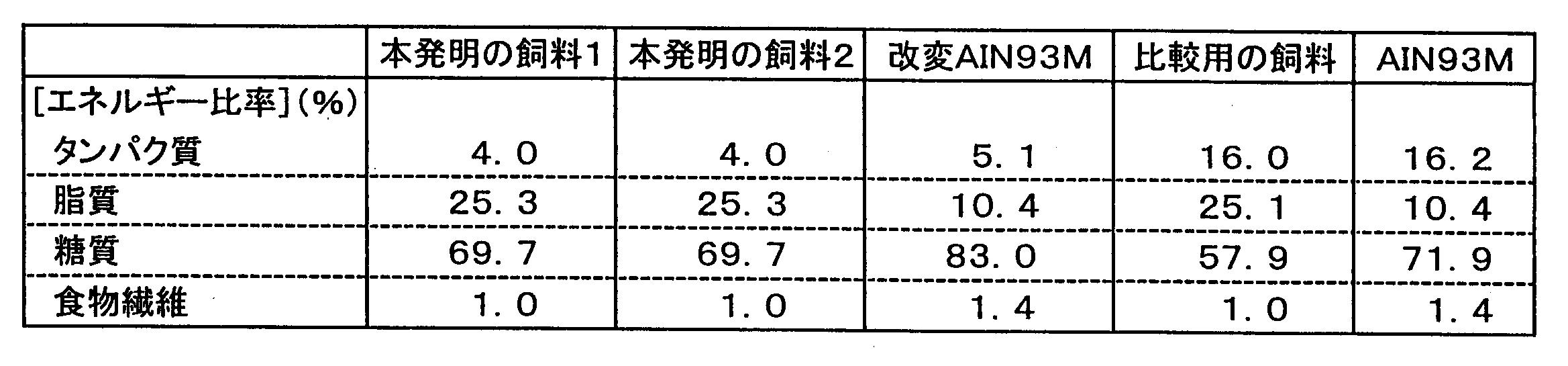
- Feed 1 to 2 of the present invention As a feed having a low protein content corresponding to the present invention, a feed having the composition shown in Table 1 (the feeds 1 and 2 of the present invention) was used.
- B Modified standard feed (modified AIN93M) A feed (modified AIN 93M) having the composition shown in Table 1 was used as a feed having a low protein content to be used in combination with the feeds 1 and 2 of the present invention.
- C Comparative feed A feed having a composition shown in Table 1 (a comparative feed) was used as a feed having a high protein content not corresponding to the present invention.
- Standard feed (AIN93M) A feed (AIN93M) having the composition shown in Table 1 was used as a feed having a high protein content to be used in combination with a comparative feed.
- the energy ratio of nutrients (protein, lipid, carbohydrate, dietary fiber) in each feed in Table 1 is as shown in Table 2.
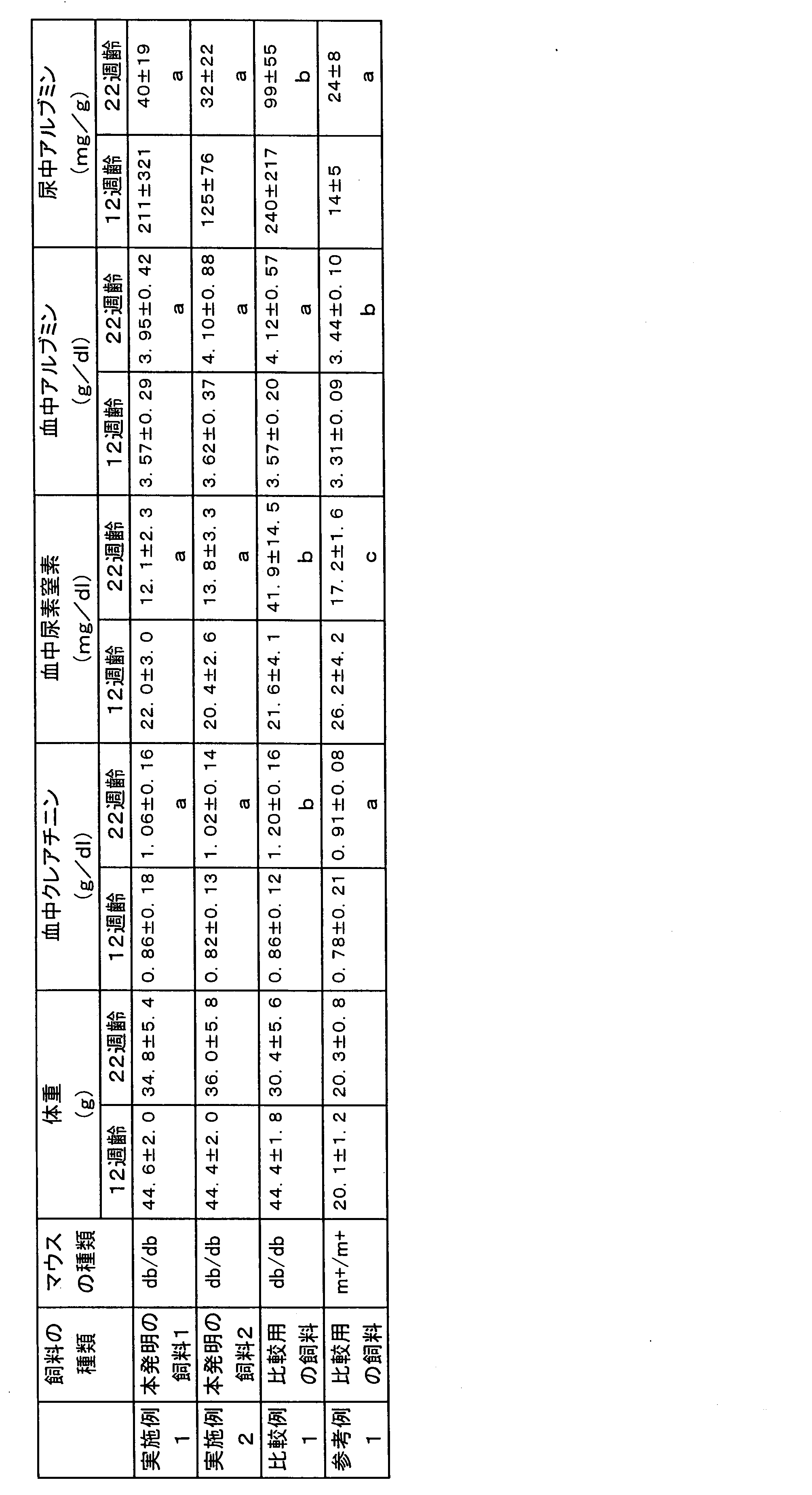
- mice Eight week old female db / db mice (12) were used. For 4 weeks from 8 weeks to 12 weeks of age, the mice were acclimated with a standard diet (AIN93M) ad libitum. At 12 weeks of age, each value such as body weight shown in Table 3 was measured. At the age of 12 weeks, the mice were fed with a feed prepared by mixing “the feed 1 of the present invention” and “modified AIN93M” at a weight ratio of 1: 2, and then for 4 days, A feed prepared by mixing Inventive Feed 1 ”and“ Modified AIN 93M ”at a weight ratio of 1: 1 was fed.
- AIN93M standard diet
- the measuring method of each item of Table 3 is as follows.
- Example 2 An experiment was conducted in the same manner as in Example 1 except that “Feed 2 of the present invention” was used instead of “Feed 1 of the present invention”.
- “Comparative Example 1] Implemented except that “feed for comparison” was used instead of “feed 1 of the present invention”, “AIN 93M” was used instead of “modified AIN 93M”, and the number of mice was changed from 12 to 10 The experiment was performed in the same manner as in Example 1. In each of the groups of Examples 1 and 2 and Comparative Example 1, each feed was fed so that the intake amount was the same.
- Example 1 and 2 the evaluation of the renal function of the intake person is excellent in all of the blood creatinine concentration, blood urea nitrogen concentration and urine albumin concentration as compared with Comparative Example 1. I understand. Also, in Examples 1 and 2, compared with Reference Example 1, the renal function of the intake person is evaluated very well to some extent in the blood urea nitrogen concentration, and the blood creatinine concentration and urine concentration are significantly higher. It can be seen that the evaluation of the renal function of the intake person is excellent to the extent that there is no significant difference in the albumin concentration. Further, in Examples 1 and 2, the blood albumin concentration is comparable to that in Comparative Example 1, and the blood albumin concentration is higher than that in Reference Example 1, so that the nutritional state of the intake person is excellent. You can see that
- the present invention is excellent in the effect of improving renal function, and in particular, among the urea urea concentration in blood, the blood creatinine concentration, and the excretion amount of urinary albumin per day.
- the present invention provides a renal function for a person (subject) showing an abnormal value to ingest one or more of blood urea nitrogen concentration, blood creatinine concentration, and urinary albumin excretion per day.
- an improving agent an improving agent, a preventive agent or a therapeutic agent for renal failure, an improving agent, a preventive agent or a therapeutic agent for nephritis, an improving agent, a preventive agent or a therapeutic agent for diabetic nephropathy.
Landscapes
- Health & Medical Sciences (AREA)
- Life Sciences & Earth Sciences (AREA)
- Chemical & Material Sciences (AREA)
- Public Health (AREA)
- General Health & Medical Sciences (AREA)
- Veterinary Medicine (AREA)
- Medicinal Chemistry (AREA)
- Pharmacology & Pharmacy (AREA)
- Epidemiology (AREA)
- Animal Behavior & Ethology (AREA)
- Engineering & Computer Science (AREA)
- Molecular Biology (AREA)
- Proteomics, Peptides & Aminoacids (AREA)
- Immunology (AREA)
- Bioinformatics & Cheminformatics (AREA)
- Mycology (AREA)
- Nutrition Science (AREA)
- Food Science & Technology (AREA)
- Polymers & Plastics (AREA)
- Inorganic Chemistry (AREA)
- Medicines That Contain Protein Lipid Enzymes And Other Medicines (AREA)
- Pharmaceuticals Containing Other Organic And Inorganic Compounds (AREA)
- Acyclic And Carbocyclic Compounds In Medicinal Compositions (AREA)
- Coloring Foods And Improving Nutritive Qualities (AREA)
Abstract
Description
例えば、特許文献1には、たんぱく質含量がエネルギー100kcalあたり0.5~1.5g、りん含量10~40mg、ナトリウム含量10~30mg、カリウム含量5~50mgの組成物をAとし、たんぱく質含量がエネルギー100kcalあたり3.0~4.0g、りん含量10~40mg、ナトリウム含量50~70mg、カリウム含量5~50mgの組成物をBとして、これらA、Bを4:1~1:4の割合で混合することにより、保存期の腎臓病患者用または透析期の腎臓病患者用の流動性栄養組成物としてなることを特徴とし、保存期の腎臓病患者または透析期の腎臓病患者のために混合して用いられるものである旨の表示を付した腎臓病患者用の流動性栄養組成物が記載されている。
食生活を改善する方法としては、例えば、血中尿素窒素濃度が正常値の範囲を外れた場合において、肉食に偏重した食生活から、野菜を主とする食生活に変更し、タンパク質の摂取量を削減することなどを挙げられる。しかし、腎機能の悪化を防止や抑制するために、毎回の食事を完全に変更することは、実際上で困難や不可能な場合が多い。
[1] 血中尿素窒素濃度、血中クレアチニン濃度、尿中アルブミンの1日あたりの排泄量のうちの一つ以上について、異常値を示す者が(経口)摂取する(投与される)ための腎機能改善剤であって、
エネルギーの100kcalあたり、タンパク質の量が0.5~4g、リンの量が10~40mg、ナトリウムの量が10~70mg、カリウムの量が5~50mgであることを特徴とする腎機能改善剤。
[2] 血中尿素窒素濃度が25mg/dL以上、血中クレアチニン濃度が1.2mg/dL以上、尿中アルブミンの1日あたりの排泄量が30mg以上のうちの一つ以上を満たす者が摂取するためのものである、上記[1]に記載の腎機能改善剤。
[3] エネルギー比率の100%あたり、タンパク質が2~16%、脂質が15~37%、糖質が55~83%、食物繊維が0~3%である、上記[1]または[2]に記載の腎機能改善剤。
[4] 流動食または経腸栄養剤として摂取可能な性状を有し、かつ、1回の投与分の容量が50~1000mLである、上記[1]~[3]のいずれかに記載の腎機能改善剤。
[5] 血中尿素窒素濃度、血中クレアチニン濃度、尿中アルブミンの1日あたりの排泄量のうちの一つ以上について、さらなる上昇を抑制するためのものである、上記[1]~[4]のいずれかに記載の腎機能改善剤。
[6] 上記[1]~[5]のいずれかに記載の腎機能改善剤と、上記の腎機能改善剤以外の栄養組成物を組み合わせてなる腎機能改善用の栄養調整物であって、
エネルギー比率の100%あたり、タンパク質が2~16%、脂質が15~37%、糖質が55~83%、食物繊維が0~3%である、腎機能改善用の栄養調整物。
[7] 上記の腎機能改善剤以外の栄養組成物がエネルギーの100kcalあたり、タンパク質の量が0.5~4g、リンの量が50mg以上、ナトリウムの量が20mg以上、カリウムの量が60mg以上のものである、上記[6]に記載の腎機能改善用の栄養調整物。
[8] 上記の腎機能改善剤と、上記の腎機能改善剤以外の栄養組成物の重量比(腎機能改善剤/腎機能改善剤以外の栄養組成物)が0.1~10である、上記[6]または[7]に記載の腎機能改善用の栄養調整物。
[9]エネルギーの100kcalあたり、タンパク質の量が0.5~4g、リンの量が10~40mg、ナトリウムの量が10~70mg、カリウムの量が5~50mgであることを特徴とする腎機能改善剤を、
血中尿素窒素濃度、血中クレアチニン濃度、尿中アルブミンの1日あたりの排泄量のうちの一つ以上について、異常値を示す者に(経口)投与する(摂取させる)工程を含む、腎機能の改善方法。
[10]血中尿素窒素濃度、血中クレアチニン濃度、尿中アルブミンの1日あたりの排泄量のうちの一つ以上について、異常値を示す者が(経口)摂取する(投与される)ための腎機能改善剤の製造における、エネルギーの100kcalあたり、タンパク質の量が0.5~4g、リンの量が10~40mg、ナトリウムの量が10~70mg、カリウムの量が5~50mgである組成物の使用。
[11]血中尿素窒素濃度、血中クレアチニン濃度、尿中アルブミンの1日あたりの排泄量のうちの一つ以上について、異常値を示す者の腎機能改善における、エネルギーの100kcalあたり、タンパク質の量が0.5~4g、リンの量が10~40mg、ナトリウムの量が10~70mg、カリウムの量が5~50mgである組成物の使用。
[12]エネルギーの100kcalあたり、タンパク質の量が0.5~4g、リンの量が10~40mg、ナトリウムの量が10~70mg、カリウムの量が5~50mgである組成物と、薬学的に許容される担体を配合する工程を含む、血中尿素窒素濃度、血中クレアチニン濃度、尿中アルブミンの1日あたりの排泄量のうちの一つ以上について、異常値を示す者が(経口)摂取する(投与される)ための腎機能改善剤の製造方法。
[13]エネルギーの100kcalあたり、タンパク質の量が0.5~4g、リンの量が10~40mg、ナトリウムの量が10~70mg、カリウムの量が5~50mgである組成物を含む、医薬品(医薬組成物、栄養医薬組成物、薬剤など)または飲食品(飲食組成物、栄養組成物、特別用途食品、栄養機能食品、健康食品など)への添加に用いられ、かつ、血中尿素窒素濃度、血中クレアチニン濃度、尿中アルブミンの1日あたりの排泄量のうちの一つ以上について、異常値を示す者の腎機能改善に用いられる組成物。
[14]エネルギーの100kcalあたり、タンパク質の量が0.5~4g、リンの量が10~40mg、ナトリウムの量が10~70mg、カリウムの量が5~50mgである組成物を、
血中尿素窒素濃度、血中クレアチニン濃度、尿中アルブミンの1日あたりの排泄量のうちの一つ以上について、異常値を示す者が(経口)摂取する(投与される)ための医薬品(医薬組成物、栄養医薬組成物、薬剤など)または飲食品(飲食組成物、栄養組成物、特別用途食品、栄養機能食品、健康食品など)に添加する工程を含む、
当該医薬品または当該飲食品に、腎機能改善効果を付与する方法。
実際の摂取者(本発明の腎機能改善剤を摂取する対象者)は、血中尿素窒素濃度、血中クレアチニン濃度、尿中アルブミンの1日あたりの排泄量のうちの一つ以上について、異常値を示す者である。
実際の摂取者は、血中尿素窒素濃度としては、好ましくは25mg/dL以上、より好ましくは28mg/dL以上、さらに好ましくは30mg/dL以上である。
実際の摂取者は、血中クレアチニン濃度としては、好ましくは1.2mg/dL以上、より好ましくは1.4mg/dL以上、さらに好ましくは1.6mg/dL以上である。
実際の摂取者は、尿中アルブミンの1日あたりの排泄量としては、好ましくは30mg以上、より好ましくは40mg以上、さらに好ましくは50mg以上である。
実際の摂取者は、本発明の腎機能改善剤を摂取する効果や作用が大きくなる観点から、血中尿素窒素濃度、血中クレアチニン濃度、尿中アルブミンの1日あたりの排泄量のうち、より好ましくは2項目(変数)が上記の条件を満たす者であり、さらに好ましくは3項目(全項目)が上記の条件を満たす者である。
本発明の腎機能改善剤は、脂質、糖質、他のミネラル(リン、ナトリウム、カリウム以外のもの)、ビタミン、食物繊維を含むことができる。つまり、脂質や糖質を含むことで、栄養学的にバランスのとれた組成物を調製することができる。そして、他のミネラル(リン、ナトリウム、カリウム以外のもの)、ビタミン、食物繊維を含むことで、それぞれの成分に由来する健康機能を付与した組成物を調製することができる。
本発明の腎機能改善剤は、エネルギーの100kcalあたり、タンパク質の量としては、例えば0.5~4g、好ましくは0.5~3g、より好ましくは0.5~2g、さらに好ましくは0.5~1.5gである。
本発明の腎機能改善剤は、エネルギーの100kcalあたり、リン(P)の量としては、例えば8~45mg、好ましくは10~40mg、より好ましくは10~38mg、さらに好ましくは10~35mgである。
本発明の腎機能改善剤は、エネルギーの100kcalあたり、ナトリウム(Na)の量としては、例えば8~75mg、好ましくは10~70mg、より好ましくは10~65mg、さらに好ましくは10~60mgである。
本発明の腎機能改善剤は、エネルギーの100kcalあたり、カリウム(K)の量としては、例えば5~50mg、好ましくは5~45mg、より好ましくは5~40mg、さらに好ましくは5~35mgである。
ここで、タンパク質、リン、ナトリウムおよびカリウムの各成分の各量が上記の数値範囲の下限を下回ると、これらの各成分を十分に実際の摂取者に与えることが困難となり、これらの各成分の不足による弊害を招く可能性がある。逆に、タンパク質、リン、ナトリウムおよびカリウムの各成分の各量が上記の数値範囲の上限を上回ると、腎機能の悪化の防止や抑制の効果を十分に実際の摂取者に与えることが困難となり、これらの各成分の過剰による弊害を招く可能性がある。
本発明の腎機能改善剤は、糖質としては、好ましくは、可溶性多糖類(例えば、デキストリン、コーンスターチ等のデンプン類や、オリゴ糖)などを挙げられる。そして、本発明の腎機能改善剤は、エネルギーの100kcalあたり、糖質の量としては、例えば8~24g、好ましくは10~22g、より好ましくは12~20g、さらに好ましくは14~18gである。
ここで、脂質および糖質の各成分の各量が上記の数値範囲の下限を下回ると、これらの各成分を十分に実際の摂取者に与えることが困難となり、これらの各成分の不足による弊害を招く可能性がある。逆に、脂質および糖質の各成分の各量が上記の数値範囲の上限を上回ると、バランスが良い必要な栄養を十分に実際の摂取者に与えることが困難となり、これらの各成分の過剰による弊害を招く可能性がある。
本発明の腎機能改善剤は、エネルギーの100kcalあたり、カルシウム(Ca)の量としては、例えば5~55mg、好ましくは10~50mg、より好ましくは15~45mg、さらに好ましくは20~40mgである。
本発明の腎機能改善剤は、エネルギーの100kcalあたり、マグネシウム(Mg)の量としては、例えば1~35mg、好ましくは3~30mg、より好ましくは5~25mg、さらに好ましくは10~20mgである。
本発明の腎機能改善剤は、エネルギーの100kcalあたり、亜鉛(Zn)の量としては、例えば0.1~2.5mg、好ましくは0.2~2mg、より好ましくは0.3~1.5mg、さらに好ましくは0.5~1.2mgである。
ここで、これらのミネラルの各成分の各量が上記の数値範囲の下限を下回ると、これらの各成分を十分に実際の摂取者に与えることが困難となり、これらの各成分の不足による弊害を招く可能性がある。逆に、これらのミネラルの各成分の各量が上記の数値範囲の上限を上回ると、バランスが良い必要なミネラルを十分に実際の摂取者に与えることが困難となり、これらの各成分の過剰による弊害を招く可能性がある。
本発明の腎機能改善剤は、エネルギーの100kcalあたり、ビタミンAの量としては、例えば5~120μgRE(レチノール当量)、好ましくは10~100μgRE、より好ましくは20~90μgRE、さらに好ましくは40~80μgREである。
ここで、ビタミンAの量が上記の数値範囲の下限を下回ると、ビタミンAの不足による弊害を招く可能性がある。逆に、ビタミンAの量が上記の数値範囲の上限を上回ると、実際の摂取者がビタミンAの摂取量を制限されている腎不全患者などである場合において、腎機能などの改善の程度が低くなる可能性がある。
本発明の腎機能改善剤は、エネルギーの100kcalあたり、ビタミンDの量としては、例えば0.03~0.7μg、好ましくは0.05~0.5μg、より好ましくは0.07~0.3μg、さらに好ましくは0.1~0.2μgである。
ここで、ビタミンDの量が上記の数値範囲の下限を下回ると、ビタミンDの不足による弊害を招く可能性がある。逆に、ビタミンDの量が上記の数値範囲の上限を上回ると、実際の摂取者がビタミンDの摂取量を制限されている腎不全患者などである場合において、腎機能などの改善の程度が低くなる可能性がある。
本発明の腎機能改善剤は、エネルギーの100kcalあたり、ビタミンEの量としては、例えば0.5~2mgである。
本発明の腎機能改善剤は、エネルギーの100kcalあたり、ビタミンB1の量としては、例えば0.05~0.2mgである。
本発明の腎機能改善剤は、エネルギーの100kcalあたり、ビタミンB2の量としては、例えば0.05~0.2mgである。
本発明の腎機能改善剤は、エネルギーの100kcalあたり、ビタミンCの量としては、例えば2~20mgである。
カルニチンは肉類に含まれる栄養素であり、脂肪の燃焼の促進等の効果を有する。本発明の腎機能改善剤では、タンパク質の配合量が小さく、本発明の腎機能改善剤と併用可能な栄養組成物も、タンパク質の配合量が小さいため、カルニチンが不足する傾向がある。このため、本発明の腎機能改善剤では、好ましくはカルニチンが用いられる。
本発明の腎機能改善剤は、エネルギーの100kcalあたり、カルニチンの量としては、例えば0.5~70mg、好ましくは1~50mg、より好ましくは3~40mg、さらに好ましくは5~40mgである。
ここで、カルニチンの量が上記の数値範囲の下限を下回ると、脂肪の燃焼の促進などの効果を十分に実際の摂取者に与えることが困難である。カルニチンの量が上記の数値範囲の上限を上回ると、本発明の腎機能改善剤における製造費が増加するなどの観点から価格競争で不利になる可能性がある。
本発明の腎機能改善剤は、エネルギーの100kcalあたり、食物繊維の量としては、例えば0.1~5g、好ましくは0.2~2g、より好ましくは0.3~1.8g、さらに好ましくは0.5~1.5gである。
ここで、食物繊維の量が上記の数値範囲の下限を下回ると、食物繊維に起因する健康増進効果などを十分に実際の摂取者に与えることが困難である。食物繊維の量が上記の数値範囲の上限を上回ると、本発明の腎機能改善剤における製造費が増加するなどの観点から価格面で不利になる可能性がある。
本発明の腎機能改善剤は、血中クレアチニン濃度が異常値を示す者に摂取させることで、摂取前と比較して、好ましくは、摂取者の血中クレアチニン濃度のさらなる上昇が抑制され、より好ましくは、摂取者の血中クレアチニン濃度が3%以上で低減され、さらに好ましくは、摂取者の血中クレアチニン濃度が5%以上で低減され、とくに好ましくは、摂取者の血中クレアチニン濃度が7%以上で低減される。
本発明の腎機能改善剤は、尿中アルブミンの1日あたりの排泄量が異常値を示す者に摂取させることで、摂取前と比較して、好ましくは、摂取者の尿中アルブミンの1日あたりの排泄量のさらなる上昇が抑制され、より好ましくは、摂取者の尿中アルブミンの1日あたりの排泄量が3%以上で低減され、さらに好ましくは、摂取者の尿中アルブミンの1日あたりの排泄量が5%以上で低減され、とくに好ましくは、摂取者の尿中アルブミンの1日あたりの排泄量が7%以上で低減される。
これらタンパク質などの各成分の各量が上記の数値範囲の下限を下回ると、腎機能改善用の栄養調整物の全体として、これらの各成分の不足による弊害を招く可能性がある。逆に、これらタンパク質などの成分の各量が上記の数値範囲の上限を上回ると、腎機能の低下の防止や抑制の効果を十分に実際の摂取者に与えることが困難となり、これらの各成分の過剰による弊害を招く可能性がある。
この重量比が上記の数値範囲の下限を下回ると、腎機能の低下の防止や抑制の効果を十分に実際の摂取者に与えることが困難となり、これらの各成分の不足による弊害を招く可能性がある。この重量比が上記の数値範囲の上限を上回ると、今までの食生活を大きく変えることなく、腎機能の悪化を防止や抑制することが困難となり、これらの各成分の過剰による弊害を招く可能性がある。
[モデル動物]
(1)糖尿病性腎症の発症モデル
糖尿病性腎症の発症モデルのマウスとして、「C57BLKS/J Iar-+Leprdb/+Leprdbマウス」(以下、「db/dbマウス」と略す。)を用いた。ここで、db/dbマウスでは、レプチン受容体が欠失しているため、摂食が抑制されておらず、そのようなモデル動物として知られている。
(2)非糖尿病モデル
非糖尿病モデルのマウスとして、db/dbマウスの野生型である「C57BLKS/J Iar-m+/m+マウス」(以下、「m+/m+マウス」と略す。)を用いた。
(a)本発明の飼料1~2
本発明に該当するタンパク質の含量が低い飼料として、表1に示す組成の飼料(本発明の飼料1~2)を用いた。
(b)改変した標準飼料(改変AIN93M)
本発明の飼料1~2と併用するタンパク質の含量が低い飼料として、表1に示す組成の飼料(改変AIN93M)を用いた。
(c)比較用の飼料
本発明に該当しないタンパク質の含量が高い飼料として、表1に示す組成の飼料(比較用の飼料)を用いた。
(d)標準飼料(AIN93M)
比較用の飼料と併用するタンパク質の含量が高い飼料として、表1に示す組成の飼料(AIN93M)を用いた。

8週齢の雌のdb/dbマウス(12匹)を用いた。8週齢から12週齢までの4週間に亘り、前記のマウスに標準飼料(AIN93M)を自由摂取させて、馴化した。12週齢において、表3に示す体重などの各値を測定した。
12週齢において3日間に亘り、前記のマウスに「本発明の飼料1」と「改変AIN93M」を1:2の重量比で混合してなる飼料を給餌し、次いで4日間に亘り、「本発明の飼料1」と「改変AIN93M」を1:1の重量比で混合してなる飼料を給餌した。
13週齢以降において9週間に亘り(22週齢まで)、「本発明の飼料1」と「改変AIN93M」を3:1の重量比で混合してなる飼料を給餌した。22週齢において、再度、表3に示す体重などの各値を測定した。
(i)血中クレアチニン濃度
クレアチニン-テストワコー(和光純薬工業社製)を用いて、血中クレアチニン濃度を測定した。
(ii)血中尿素窒素濃度
尿素窒素B-テストワコー(和光純薬工業社製)を用いて、血中尿素窒素濃度を測定した。
(iii)血中アルブミン濃度
フジドライケム7000I(富士フィルム社製)を用いて、血中アルブミン濃度を測定した。
(iv)尿中アルブミン濃度
「Mouse Albumin ELISA Quantitation Kit」(BETHYL社製)を用いて、尿中アルブミン濃度を測定した。
「本発明の飼料1」に代えて、「本発明の飼料2」を用いた以外は、実施例1と同様にして、実験した。
[比較例1]
「本発明の飼料1」に代えて、「比較用の飼料」を用い、「改変AIN93M」に代えて、「AIN93M」を用い、マウスの数を12匹から10匹に変更した以外は、実施例1と同様にして、実験した。
なお、実施例1~2および比較例1の各群において、それぞれの飼料を摂取量が同じになるように給餌した。
[参考例1]
8週齢の雌のdb/dbマウス(12匹)に代えて、8週齢の雌のm+/m+マウス(5匹)を用い、「本発明の飼料1」に代えて、「比較用の飼料」を用い、「改変AIN93M」に代えて、「AIN93M」を用いた以外は、実施例1と同様にして、実験した。
なお、参考例1において、それぞれの飼料を自由摂取によって給餌した。
よって、本発明は、血中尿素窒素濃度、血中クレアチニン濃度、尿中アルブミンの1日あたりの排泄量のうちの一つ以上について、異常値を示す者(対象)が摂取するための腎機能改善剤、腎不全の改善剤や予防剤や治療剤、腎炎の改善剤や予防剤や治療剤、糖尿病性腎症の改善剤や予防剤や治療剤として、非常に有用である。
Claims (8)
- 血中尿素窒素濃度、血中クレアチニン濃度、尿中アルブミンの1日あたりの排泄量のうちの一つ以上について、異常値を示す者が摂取するための腎機能改善剤であって、
エネルギーの100kcalあたり、タンパク質の量が0.5~4g、リンの量が10~40mg、ナトリウムの量が10~70mg、カリウムの量が5~50mgであることを特徴とする腎機能改善剤。 - 血中尿素窒素濃度が25mg/dL以上、血中クレアチニン濃度が1.2mg/dL以上、尿中アルブミンの1日あたりの排泄量が30mg以上のうちの一つ以上を満たす者が摂取するためのものである、請求項1に記載の腎機能改善剤。
- エネルギー比率の100%あたり、タンパク質が2~16%、脂質が15~37%、糖質が55~83%、食物繊維が0~3%である、請求項1または2に記載の腎機能改善剤。
- 流動食または経腸栄養剤として摂取可能な性状を有し、かつ、1回の投与分の容量が50~1000mLである、請求項1~3のいずれか1項に記載の腎機能改善剤。
- 血中尿素窒素濃度、血中クレアチニン濃度、尿中アルブミンの1日あたりの排泄量のうちの一つ以上について、さらなる上昇を抑制するためのものである、請求項1~4のいずれか1項に記載の腎機能改善剤。
- 請求項1~5のいずれか1項に記載の腎機能改善剤と、上記の腎機能改善剤以外の栄養組成物を組み合わせてなる腎機能改善用の栄養調整物であって、
エネルギー比率の100%あたり、タンパク質が2~16%、脂質が15~37%、糖質が55~83%、食物繊維が0~3%である、腎機能改善用の栄養調整物。 - 上記の腎機能改善剤以外の栄養組成物がエネルギーの100kcalあたり、タンパク質の量が0.5~4g、リンの量が50mg以上、ナトリウムの量が20mg以上、カリウムの量が60mg以上のものである請求項6に記載の腎機能改善用の栄養調整物。
- 上記の腎機能改善剤と上記の腎機能改善剤以外の栄養組成物の重量比が0.1~10である請求項6または7に記載の腎機能改善用の栄養調整物。
Priority Applications (3)
| Application Number | Priority Date | Filing Date | Title |
|---|---|---|---|
| SG11201704105SA SG11201704105SA (en) | 2015-03-20 | 2016-03-17 | Renal function improving agent |
| CN201680005207.5A CN107106684A (zh) | 2015-03-20 | 2016-03-17 | 肾功能改善剂 |
| JP2017508281A JPWO2016152706A1 (ja) | 2015-03-20 | 2016-03-17 | 腎機能改善剤 |
Applications Claiming Priority (2)
| Application Number | Priority Date | Filing Date | Title |
|---|---|---|---|
| JP2015-057374 | 2015-03-20 | ||
| JP2015057374 | 2015-03-20 |
Publications (1)
| Publication Number | Publication Date |
|---|---|
| WO2016152706A1 true WO2016152706A1 (ja) | 2016-09-29 |
Family
ID=56978441
Family Applications (1)
| Application Number | Title | Priority Date | Filing Date |
|---|---|---|---|
| PCT/JP2016/058461 Ceased WO2016152706A1 (ja) | 2015-03-20 | 2016-03-17 | 腎機能改善剤 |
Country Status (5)
| Country | Link |
|---|---|
| JP (1) | JPWO2016152706A1 (ja) |
| CN (1) | CN107106684A (ja) |
| SG (1) | SG11201704105SA (ja) |
| TW (1) | TW201701773A (ja) |
| WO (1) | WO2016152706A1 (ja) |
Citations (4)
| Publication number | Priority date | Publication date | Assignee | Title |
|---|---|---|---|---|
| JPH1066541A (ja) * | 1996-08-27 | 1998-03-10 | Meiji Milk Prod Co Ltd | 腎臓病患者の各症状に適応した液状調整 栄養組成物 |
| WO2006019187A1 (ja) * | 2004-08-18 | 2006-02-23 | The University Of Tokyo | 腎障害治療剤 |
| JP2008063234A (ja) * | 2006-09-04 | 2008-03-21 | Pharma Foods International Co Ltd | 慢性腎不全予防・改善組成物 |
| JP2012236820A (ja) * | 2011-04-28 | 2012-12-06 | Sakai Chem Ind Co Ltd | 慢性腎臓病の予防又は治療用組成物 |
Family Cites Families (8)
| Publication number | Priority date | Publication date | Assignee | Title |
|---|---|---|---|---|
| JP2000264844A (ja) * | 1999-01-11 | 2000-09-26 | Otsuka Pharmaceut Factory Inc | 腎疾患患者用栄養組成物 |
| US8647660B2 (en) * | 2004-12-29 | 2014-02-11 | Hill's Pet Nutrition, Inc. | Combination of limited nutrients and enhanced dietary antioxidants to impart improved kidney health |
| AU2006242463A1 (en) * | 2005-04-29 | 2006-11-09 | Hill's Pet Nutrition, Inc. | Methods for prolonging feline life |
| EP1896070A4 (en) * | 2005-06-29 | 2009-04-29 | Hills Pet Nutrition Inc | METHODS AND COMPOSITIONS FOR THE PREVENTION AND TREATMENT OF RENAL DISEASE |
| CN101287460B (zh) * | 2005-08-17 | 2012-04-25 | 希尔氏宠物营养品公司 | 预防和治疗肾病的组合物 |
| EP2462815B1 (en) * | 2006-01-19 | 2020-11-11 | Hill's Pet Nutrition, Inc. | Compositions and methods for treating feline chronic kidney disease |
| JP6449648B2 (ja) * | 2012-06-28 | 2019-01-09 | 株式会社明治 | 栄養組成物 |
| SG11201601734XA (en) * | 2013-09-13 | 2016-04-28 | Meiji Co Ltd | Agent for reducing catabolism or promoting assimilation of protein |
-
2016
- 2016-03-17 JP JP2017508281A patent/JPWO2016152706A1/ja active Pending
- 2016-03-17 TW TW105108276A patent/TW201701773A/zh unknown
- 2016-03-17 SG SG11201704105SA patent/SG11201704105SA/en unknown
- 2016-03-17 CN CN201680005207.5A patent/CN107106684A/zh active Pending
- 2016-03-17 WO PCT/JP2016/058461 patent/WO2016152706A1/ja not_active Ceased
Patent Citations (4)
| Publication number | Priority date | Publication date | Assignee | Title |
|---|---|---|---|---|
| JPH1066541A (ja) * | 1996-08-27 | 1998-03-10 | Meiji Milk Prod Co Ltd | 腎臓病患者の各症状に適応した液状調整 栄養組成物 |
| WO2006019187A1 (ja) * | 2004-08-18 | 2006-02-23 | The University Of Tokyo | 腎障害治療剤 |
| JP2008063234A (ja) * | 2006-09-04 | 2008-03-21 | Pharma Foods International Co Ltd | 慢性腎不全予防・改善組成物 |
| JP2012236820A (ja) * | 2011-04-28 | 2012-12-06 | Sakai Chem Ind Co Ltd | 慢性腎臓病の予防又は治療用組成物 |
Also Published As
| Publication number | Publication date |
|---|---|
| TW201701773A (zh) | 2017-01-16 |
| JPWO2016152706A1 (ja) | 2017-12-28 |
| SG11201704105SA (en) | 2017-06-29 |
| CN107106684A (zh) | 2017-08-29 |
Similar Documents
| Publication | Publication Date | Title |
|---|---|---|
| RU2598630C2 (ru) | Жидкие питательные композиции, содержащие свободные аминокислоты | |
| US9872515B2 (en) | Low-concentration nutritional composition | |
| CN102026661B (zh) | 能够调整能量、含水量及食盐换算量的营养组合物 | |
| US10064835B2 (en) | Combination of beta-hydroxy-beta-methylbutyrate, arginine and glutamine for use in treating diabetic ulcers | |
| JPWO2009096579A1 (ja) | 高血糖抑制用栄養組成物 | |
| JP2008247748A (ja) | 透析患者用栄養組成物 | |
| JP6449648B2 (ja) | 栄養組成物 | |
| TW201332555A (zh) | 在妊娠期間使用特定碳水化合物系統以降低後代後續生命中之不利健康效應 | |
| EP1616570A1 (en) | Food for improving clinical conditions capable of lowering the concentration of low-molecular weight nitrogen-containing compounds in blood | |
| WO2016152706A1 (ja) | 腎機能改善剤 | |
| JP2022056677A (ja) | 貧血の予防又は治療用組成物、血中ヘモグロビン濃度の増加又は低下予防用組成物、及び血中赤血球数の増加又は低下予防用組成物 | |
| HK1235294A1 (en) | Renal function improving agent | |
| Esenamanova et al. | Nutrition in coronavirus infection (COVID-19) | |
| JP2022144737A (ja) | 安静時エネルギー消費量の上昇用又は低下予防用組成物及び呼吸商の低下用又は上昇予防用組成物 | |
| HK1203822B (en) | Combination of beta-hydroxy-beta-methylbutyrate, arginine and glutamine for use in treating diabetic ulcers | |
| HK1205001B (zh) | 营养组合物 | |
| HK1155672B (en) | Nutrient composition capable of adjusting energy amount, water amount and salt equivalent | |
| WO2016104671A1 (ja) | 食物繊維を含む補充液 |
Legal Events
| Date | Code | Title | Description |
|---|---|---|---|
| 121 | Ep: the epo has been informed by wipo that ep was designated in this application |
Ref document number: 16768609 Country of ref document: EP Kind code of ref document: A1 |
|
| ENP | Entry into the national phase |
Ref document number: 2017508281 Country of ref document: JP Kind code of ref document: A |
|
| WWE | Wipo information: entry into national phase |
Ref document number: 11201704105S Country of ref document: SG |
|
| NENP | Non-entry into the national phase |
Ref country code: DE |
|
| 122 | Ep: pct application non-entry in european phase |
Ref document number: 16768609 Country of ref document: EP Kind code of ref document: A1 |