WO2016152254A1 - ゲル粒子の水分散物及びその製造方法、並びに画像形成方法 - Google Patents
ゲル粒子の水分散物及びその製造方法、並びに画像形成方法 Download PDFInfo
- Publication number
- WO2016152254A1 WO2016152254A1 PCT/JP2016/052963 JP2016052963W WO2016152254A1 WO 2016152254 A1 WO2016152254 A1 WO 2016152254A1 JP 2016052963 W JP2016052963 W JP 2016052963W WO 2016152254 A1 WO2016152254 A1 WO 2016152254A1
- Authority
- WO
- WIPO (PCT)
- Prior art keywords
- group
- formula
- aqueous dispersion
- gel particles
- polymer
- Prior art date
- Legal status (The legal status is an assumption and is not a legal conclusion. Google has not performed a legal analysis and makes no representation as to the accuracy of the status listed.)
- Ceased
Links
Classifications
-
- C—CHEMISTRY; METALLURGY
- C09—DYES; PAINTS; POLISHES; NATURAL RESINS; ADHESIVES; COMPOSITIONS NOT OTHERWISE PROVIDED FOR; APPLICATIONS OF MATERIALS NOT OTHERWISE PROVIDED FOR
- C09D—COATING COMPOSITIONS, e.g. PAINTS, VARNISHES OR LACQUERS; FILLING PASTES; CHEMICAL PAINT OR INK REMOVERS; INKS; CORRECTING FLUIDS; WOODSTAINS; PASTES OR SOLIDS FOR COLOURING OR PRINTING; USE OF MATERIALS THEREFOR
- C09D11/00—Inks
- C09D11/02—Printing inks
- C09D11/10—Printing inks based on artificial resins
- C09D11/101—Inks specially adapted for printing processes involving curing by wave energy or particle radiation, e.g. with UV-curing following the printing
-
- B—PERFORMING OPERATIONS; TRANSPORTING
- B41—PRINTING; LINING MACHINES; TYPEWRITERS; STAMPS
- B41J—TYPEWRITERS; SELECTIVE PRINTING MECHANISMS, i.e. MECHANISMS PRINTING OTHERWISE THAN FROM A FORME; CORRECTION OF TYPOGRAPHICAL ERRORS
- B41J2/00—Typewriters or selective printing mechanisms characterised by the printing or marking process for which they are designed
- B41J2/005—Typewriters or selective printing mechanisms characterised by the printing or marking process for which they are designed characterised by bringing liquid or particles selectively into contact with a printing material
- B41J2/01—Ink jet
-
- B—PERFORMING OPERATIONS; TRANSPORTING
- B41—PRINTING; LINING MACHINES; TYPEWRITERS; STAMPS
- B41M—PRINTING, DUPLICATING, MARKING, OR COPYING PROCESSES; COLOUR PRINTING
- B41M5/00—Duplicating or marking methods; Sheet materials for use therein
-
- B—PERFORMING OPERATIONS; TRANSPORTING
- B41—PRINTING; LINING MACHINES; TYPEWRITERS; STAMPS
- B41M—PRINTING, DUPLICATING, MARKING, OR COPYING PROCESSES; COLOUR PRINTING
- B41M5/00—Duplicating or marking methods; Sheet materials for use therein
- B41M5/0082—Digital printing on bodies of particular shapes
- B41M5/0088—Digital printing on bodies of particular shapes by ink-jet printing
-
- C—CHEMISTRY; METALLURGY
- C08—ORGANIC MACROMOLECULAR COMPOUNDS; THEIR PREPARATION OR CHEMICAL WORKING-UP; COMPOSITIONS BASED THEREON
- C08F—MACROMOLECULAR COMPOUNDS OBTAINED BY REACTIONS ONLY INVOLVING CARBON-TO-CARBON UNSATURATED BONDS
- C08F2/00—Processes of polymerisation
- C08F2/46—Polymerisation initiated by wave energy or particle radiation
- C08F2/48—Polymerisation initiated by wave energy or particle radiation by ultraviolet or visible light
- C08F2/50—Polymerisation initiated by wave energy or particle radiation by ultraviolet or visible light with sensitising agents
-
- C—CHEMISTRY; METALLURGY
- C08—ORGANIC MACROMOLECULAR COMPOUNDS; THEIR PREPARATION OR CHEMICAL WORKING-UP; COMPOSITIONS BASED THEREON
- C08F—MACROMOLECULAR COMPOUNDS OBTAINED BY REACTIONS ONLY INVOLVING CARBON-TO-CARBON UNSATURATED BONDS
- C08F283/00—Macromolecular compounds obtained by polymerising monomers on to polymers provided for in subclass C08G
- C08F283/006—Macromolecular compounds obtained by polymerising monomers on to polymers provided for in subclass C08G on to polymers provided for in C08G18/00
-
- C—CHEMISTRY; METALLURGY
- C08—ORGANIC MACROMOLECULAR COMPOUNDS; THEIR PREPARATION OR CHEMICAL WORKING-UP; COMPOSITIONS BASED THEREON
- C08G—MACROMOLECULAR COMPOUNDS OBTAINED OTHERWISE THAN BY REACTIONS ONLY INVOLVING UNSATURATED CARBON-TO-CARBON BONDS
- C08G18/00—Polymeric products of isocyanates or isothiocyanates
-
- C—CHEMISTRY; METALLURGY
- C09—DYES; PAINTS; POLISHES; NATURAL RESINS; ADHESIVES; COMPOSITIONS NOT OTHERWISE PROVIDED FOR; APPLICATIONS OF MATERIALS NOT OTHERWISE PROVIDED FOR
- C09D—COATING COMPOSITIONS, e.g. PAINTS, VARNISHES OR LACQUERS; FILLING PASTES; CHEMICAL PAINT OR INK REMOVERS; INKS; CORRECTING FLUIDS; WOODSTAINS; PASTES OR SOLIDS FOR COLOURING OR PRINTING; USE OF MATERIALS THEREFOR
- C09D11/00—Inks
- C09D11/02—Printing inks
- C09D11/03—Printing inks characterised by features other than the chemical nature of the binder
- C09D11/033—Printing inks characterised by features other than the chemical nature of the binder characterised by the solvent
-
- C—CHEMISTRY; METALLURGY
- C09—DYES; PAINTS; POLISHES; NATURAL RESINS; ADHESIVES; COMPOSITIONS NOT OTHERWISE PROVIDED FOR; APPLICATIONS OF MATERIALS NOT OTHERWISE PROVIDED FOR
- C09D—COATING COMPOSITIONS, e.g. PAINTS, VARNISHES OR LACQUERS; FILLING PASTES; CHEMICAL PAINT OR INK REMOVERS; INKS; CORRECTING FLUIDS; WOODSTAINS; PASTES OR SOLIDS FOR COLOURING OR PRINTING; USE OF MATERIALS THEREFOR
- C09D11/00—Inks
- C09D11/02—Printing inks
- C09D11/10—Printing inks based on artificial resins
- C09D11/102—Printing inks based on artificial resins containing macromolecular compounds obtained by reactions other than those only involving unsaturated carbon-to-carbon bonds
-
- C—CHEMISTRY; METALLURGY
- C09—DYES; PAINTS; POLISHES; NATURAL RESINS; ADHESIVES; COMPOSITIONS NOT OTHERWISE PROVIDED FOR; APPLICATIONS OF MATERIALS NOT OTHERWISE PROVIDED FOR
- C09D—COATING COMPOSITIONS, e.g. PAINTS, VARNISHES OR LACQUERS; FILLING PASTES; CHEMICAL PAINT OR INK REMOVERS; INKS; CORRECTING FLUIDS; WOODSTAINS; PASTES OR SOLIDS FOR COLOURING OR PRINTING; USE OF MATERIALS THEREFOR
- C09D11/00—Inks
- C09D11/02—Printing inks
- C09D11/10—Printing inks based on artificial resins
- C09D11/106—Printing inks based on artificial resins containing macromolecular compounds obtained by reactions only involving carbon-to-carbon unsaturated bonds
- C09D11/107—Printing inks based on artificial resins containing macromolecular compounds obtained by reactions only involving carbon-to-carbon unsaturated bonds from unsaturated acids or derivatives thereof
-
- C—CHEMISTRY; METALLURGY
- C09—DYES; PAINTS; POLISHES; NATURAL RESINS; ADHESIVES; COMPOSITIONS NOT OTHERWISE PROVIDED FOR; APPLICATIONS OF MATERIALS NOT OTHERWISE PROVIDED FOR
- C09D—COATING COMPOSITIONS, e.g. PAINTS, VARNISHES OR LACQUERS; FILLING PASTES; CHEMICAL PAINT OR INK REMOVERS; INKS; CORRECTING FLUIDS; WOODSTAINS; PASTES OR SOLIDS FOR COLOURING OR PRINTING; USE OF MATERIALS THEREFOR
- C09D11/00—Inks
- C09D11/30—Inkjet printing inks
- C09D11/38—Inkjet printing inks characterised by non-macromolecular additives other than solvents, pigments or dyes
Definitions
- the present invention relates to an aqueous dispersion of gel particles, a method for producing the same, and an image forming method.
- an image forming method for forming an image on a recording medium there are an electrophotographic method, a sublimation type thermal transfer method, a melt type thermal transfer method, and an ink jet method.
- the ink jet image forming method has advantages that it can be carried out with an inexpensive apparatus and that the running cost is low because ink can be used efficiently.
- an image forming method using an inkjet ink that can be cured by irradiation with an active energy ray such as ultraviolet rays there is an image forming method using an inkjet ink that can be cured by irradiation with an active energy ray such as ultraviolet rays.
- an inkjet ink that can be cured by irradiation with active energy rays may be referred to as a “photo-curable ink”.
- photocurable compositions not only inkjet inks, but also compositions that can be cured by irradiation with active energy rays are sometimes referred to as “photocurable compositions”.
- a solvent-based composition for example, solvent-based ink
- water is used as a solvent or dispersion medium.
- a water-based composition containing water for example, water-based ink may be used.
- water-based photocurable compositions for example, the following compositions are known.
- a resin comprising water, a colorant, and a compound having a radical polymerizable group as an inkjet ink composition having excellent ejection stability while maintaining curability by ultraviolet irradiation in the presence of water or a solvent
- An ink-jet ink composition containing an emulsion, an inorganic particle dispersion, and a photoradical initiator is known (for example, see JP2013-199602A).
- an aqueous emulsion containing a vinyl polymer having a specific acrylic functional group at at least one end is known as an aqueous emulsion that can be cured by heat or light and can be suitably used for a coating agent or the like.
- an aqueous emulsion that can be cured by heat or light can be suitably used for a coating agent or the like.
- compositions are known as a photocurable composition which is not limited to an aqueous composition, for example.
- a photocurable composition which is not limited to an aqueous composition, for example.
- a color-forming photosensitive composition that has good color stability after exposure by infrared laser exposure and that can provide high color development even after exposure over time
- a coloring photosensitive composition containing a microgel encapsulating a dye and a binder polymer is known (see, for example, JP 2011-213114 A).
- Ink jet printing ink that cures upon irradiation includes at least one radiation curable monomer, at least one inert thermoplastic resin, at least one radical photoinitiator, and at least one colorant at 25 ° C.
- Inkjet inks are known having a viscosity of less than 100 mPas, at least one inert resin being present at 2 to 15% by weight relative to the total weight and having a molecular weight of 1,500 to 70,000 (See, for example, JP-T-2009-542833).
- a cured film having excellent adhesion to various substrates including non-absorbable substrates (for example, plastic substrates, metal substrates, etc.).
- non-absorbable substrates for example, plastic substrates, metal substrates, etc.
- an image (cured film) having excellent adhesion can be formed not only on paper as an absorbent recording medium but also on a non-absorbent recording medium. It has been demanded.
- the ink-jet ink composition described in JP2013-199602A the aqueous emulsion described in JP2000-136211, and the color developing photosensitive composition described in JP2011-213114A.
- the sensitivity to light tends to be insufficient, and in all cases, the adhesion of the cured film (image) tends to be insufficient.
- paragraph 0009 of JP-T-2009-542833 states that “The ink-jet ink of the present invention is dried mainly by curing, that is, by polymerization of monomers present as described above, and is therefore a curable ink.
- the ink does not require the presence of water or a volatile organic solvent to dry, but such components may be present, but preferably the ink-jet ink of the present invention is substantially water and volatile organic. It does not contain solvent.
- each component of the inkjet ink described in JP-T-2009-542833 is considered to be a component that is difficult to dissolve or disperse in water. Therefore, it is considered difficult to prepare the ink-jet ink described in JP-T-2009-542833 as a water-based ink composition.
- an object of one embodiment of the present invention is to provide an aqueous dispersion of gel particles that can form a film having excellent adhesion to a substrate and a method for producing the same.
- Another object of an embodiment of the present invention is to provide an image forming method capable of forming an image having excellent adhesion to a recording medium.
- ⁇ 1> It has a three-dimensional crosslinked structure including at least one of the polymer structure represented by the following formula (1) and the polymer structure represented by the following formula (2), and has a hydrophilic group and a polymerizable group.
- P 1 represents a polymer chain having a number average molecular weight of 500 or more, which is made of polyester, polycarbonate, polycaprolactone, polybutadiene, polyisoprene, or polyolefin.
- Z 11 represents an (n 1 +1) -valent organic group
- Z 12 represents an (m 1 +1) -valent organic group
- n 1 and m 1 each independently represents 1 It represents the above integer.
- P 2 represents a polymer chain having a number average molecular weight of 500 or more composed of polyurethane, polyester, polycarbonate, polycaprolactone, polybutadiene, polyisoprene, or polyolefin.
- X 1 represents a single bond, —CH 2 — group, or —NH— group
- R 1 represents a hydrocarbon group that may contain a hetero atom
- Z 21 represents ( n 2 +1) a valent organic group
- n 2 represents an integer of 1 or more.
- * represents a bonding position.
- the number average molecular weight of the polymer chain represented by P 1 is 1000 to 40000
- the number average molecular weight of the polymer chain represented by P 2 is 1000-40000 aqueous dispersion of gel particles according to ⁇ 1>.
- ⁇ 3> The aqueous dispersion of gel particles according to ⁇ 1> or ⁇ 2>, wherein R 1 in the formula (2) is a group represented by the following formula (2R).
- L 1 represents a divalent organic group
- R 2 represents a hydrogen atom or an alkyl group
- * represents a bonding position
- ⁇ 4> The aqueous dispersion of gel particles according to any one of ⁇ 1> to ⁇ 3>, wherein the gel particles include a polymerizable monomer.
- ⁇ 5> The aqueous dispersion of gel particles according to ⁇ 4>, wherein the polymerizable monomer is a (meth) acrylate monomer.
- ⁇ 6> The aqueous dispersion of gel particles according to ⁇ 4> or ⁇ 5>, wherein the polymerizable monomer is a trifunctional or higher functional acrylate monomer.
- ⁇ 7> The water dispersion of gel particles according to any one of ⁇ 1> to ⁇ 6>, wherein the photopolymerization initiator has a solubility in water of 1.0% by mass or less at 25 ° C.
- ⁇ 8> The aqueous dispersion of gel particles according to any one of ⁇ 1> to ⁇ 7>, wherein the photopolymerization initiator is an acylphosphine oxide compound.
- the gel particles include a sensitizer.
- the hydrophilic group is a carboxyl group, a salt of a carboxyl group, a sulfo group, a salt of a sulfo group, a sulfate group, a salt of a sulfate group, a phosphonic acid group, a salt of a phosphonic acid group, a phosphoric acid group, or a phosphoric acid group.
- the aqueous dispersion of gel particles according to any one of ⁇ 1> to ⁇ 9>, which is at least one selected from the group consisting of a salt, an ammonium base, a betaine group, and an alkyleneoxy group.
- ⁇ 11> The aqueous dispersion of gel particles according to any one of ⁇ 1> to ⁇ 10>, which is used for inkjet recording.
- ⁇ 12> The aqueous dispersion of gel particles according to any one of ⁇ 1> to ⁇ 11>, wherein the total solid content of the gel particles is 50% by mass or more based on the total solid content of the aqueous dispersion.
- the polymer structure represented by the formula (1) is a structure derived from an isocyanate group-containing polymer represented by the following formula (1P), The water of the gel particle according to any one of ⁇ 1> to ⁇ 12>, wherein the polymer structure represented by the formula (2) is a structure derived from an isocyanate group-containing polymer represented by the following formula (2P) Dispersion.
- P 1 represents a polymer chain composed of polyester, polycarbonate, polycaprolactone, polybutadiene, polyisoprene, or polyolefin having a number average molecular weight of 500 or more.
- Z 11 represents an (n 1 +1) -valent organic group
- Z 12 represents an (m 1 +1) -valent organic group
- n 1 and m 1 each independently represents 1 It represents the above integer.
- P 2 represents a polymer chain having a number average molecular weight of 500 or more composed of polyurethane, polyester, polycarbonate, polycaprolactone, polybutadiene, polyisoprene, or polyolefin.
- X 1 represents a single bond, —CH 2 — group, or —NH— group
- R 1 represents a hydrocarbon group that may contain a hetero atom
- Z 21 represents ( n 2 +1) a valent organic group
- n 2 represents an integer of 1 or more.
- a method for producing an aqueous dispersion of gel particles according to ⁇ 13> A preparation step of preparing at least one of an isocyanate group-containing polymer represented by the formula (1P) and an isocyanate group-containing polymer represented by the formula (2P); An oil phase component containing at least one of an isocyanate group-containing polymer represented by the formula (1P) and an isocyanate group-containing polymer represented by the formula (2P), a photopolymerization initiator, and an organic solvent, and an aqueous phase component containing water And emulsifying step of mixing and emulsifying to obtain an emulsion, By heating the emulsion, at least one of the isocyanate group-containing polymer represented by the formula (1P) and the isocyanate group-containing polymer represented by the formula (2P) is reacted with water to form gel particles.
- a gelation step for obtaining an aqueous dispersion A method for producing an aqueous dispersion of gel particles.
- the one-end-capped polymer represented by the following formula (2PO) is obtained, and then the one-end-capped polymer and the polyfunctional isocyanate compound represented by the following formula (ZC) are reacted to be represented by the formula (2P).
- P 1 represents a polymer chain having a number average molecular weight of 500 or more composed of polyester, polycarbonate, polycaprolactone, polybutadiene, polyisoprene, or polyolefin.
- P 2 represents a polymer chain having a number average molecular weight of 500 or more composed of polyurethane, polyester, polycarbonate, polycaprolactone, polybutadiene, polyisoprene, or polyolefin.
- ZC represents a n c-valent organic group, n c represents an integer of 2 or more.
- X 1 represents a single bond, a —CH 2 — group, or a —NH— group.
- R 1 represents a hydrocarbon group that may contain a hetero atom.
- An image forming method comprising:
- an aqueous dispersion of gel particles capable of forming a film having excellent adhesion to a substrate and a method for producing the same are provided.
- an image forming method capable of forming an image having excellent adhesion to a recording medium is provided.
- a numerical range indicated by using “to” indicates a range including the numerical values described before and after “to” as the minimum value and the maximum value, respectively.
- the amount of each component in the composition is the total amount of the plurality of substances present in the composition unless there is a specific indication when there are a plurality of substances corresponding to each component in the composition. Means.
- the term “process” is not limited to an independent process, and is included in this term if the intended purpose of the process is achieved even when it cannot be clearly distinguished from other processes. It is.
- light is a concept including active energy rays such as ⁇ rays, ⁇ rays, electron rays, ultraviolet rays, visible rays, and infrared rays.
- active energy rays such as ⁇ rays, ⁇ rays, electron rays, ultraviolet rays, visible rays, and infrared rays.
- UV light ultraviolet (Ultra Violet) is sometimes referred to as “UV light”.
- LED Light Emitting Diode
- (meth) acrylic acid is a concept including both acrylic acid and methacrylic acid
- (meth) acrylate is a concept including both acrylate and methacrylate
- (meth) acryloyl group is a concept including both an acryloyl group and a methacryloyl group.
- “*” in a chemical formula indicates a bonding position.
- aqueous dispersion of gel particles An aqueous dispersion of gel particles of the present disclosure (hereinafter sometimes referred to as “aqueous dispersion of the present disclosure” or simply “aqueous dispersion”) has a polymer structure represented by the following formula (1) (hereinafter “ A polymer structure (1) ”) and a polymer structure represented by the following formula (2) (hereinafter also referred to as” polymer structure (2) "), and a hydrophilic group
- the gel particle which has a polymeric group and includes the photoinitiator is the water dispersion disperse
- P 1 represents a polymer chain having a number average molecular weight of 500 or more, which is made of polyester, polycarbonate, polycaprolactone, polybutadiene, polyisoprene, or polyolefin.
- Z 11 represents an (n 1 +1) -valent organic group
- Z 12 represents an (m 1 +1) -valent organic group
- n 1 and m 1 each independently represents 1 It represents the above integer.
- P 2 represents a polymer chain having a number average molecular weight of 500 or more composed of polyurethane, polyester, polycarbonate, polycaprolactone, polybutadiene, polyisoprene, or polyolefin.
- X 1 represents a single bond, —CH 2 — group, or —NH— group
- R 1 represents a hydrocarbon group that may contain a hetero atom
- Z 21 represents ( n 2 +1) a valent organic group
- n 2 represents an integer of 1 or more.
- * represents a bonding position.
- the gel particles have a polymerizable group and include a photopolymerization initiator, whereby a conventional photocurable composition (for example, a photocurable composition) Since the distance between the polymerizable group and the photopolymerization initiator is shorter than that of the ink), the curing sensitivity (hereinafter also simply referred to as “sensitivity”) with respect to irradiation with active energy rays is improved. As a result, the adhesion of the formed film is improved.
- sensitivity curing sensitivity
- the gel particles have a three-dimensional crosslinked structure including at least one of the polymer structure (1) and the polymer structure (2).
- This three-dimensional cross-linked structure is a firm structure as compared with the three-dimensional cross-linked structure containing neither the polymer structure (1) nor the polymer structure (2). Since the gel particles have such a strong three-dimensional cross-linked structure, curing shrinkage of the film during photocuring is suppressed. Thereby, the fall of the adhesiveness accompanying hardening shrinkage
- the resin emulsion in the inkjet ink composition described in JP2013-199602A and the aqueous emulsion described in JP2000-136211A are both three-dimensionally crosslinked. It has no structure and is not a gel particle.
- the microgel in the color developing photosensitive composition described in JP2011-213114A does not have a polymerizable group.
- this microgel does not contain any of the polymer structure (1) and the polymer structure (2). Therefore, it is thought that the cured film formed by the technique of any literature is inferior to adhesiveness with a base material compared with the cured film formed using the aqueous dispersion of this indication.
- the aqueous dispersion of the present disclosure includes, in particular, polyvinyl chloride (PVC), polystyrene (PS), polycarbonate (PC), polyethylene terephthalate (PET), glycol-modified PET, polypropylene.
- PVC polyvinyl chloride
- PS polystyrene
- PC polycarbonate
- PET polyethylene terephthalate
- glycol-modified PET polypropylene.
- aqueous dispersion of the present disclosure has an advantage that the selection range of the substrate is wide.
- Preferable combinations include a combination of PS as a base material and polycaprolactone, polybutadiene, polyisoprene, or polyolefin as a material of a polymer chain represented by P 1 or P 2 .
- a combination of PET as the material of the base material and polyester, polycarbonate, or polyprolacton as the material of the polymer chain represented by P 1 or P 2 can be mentioned.
- a combination of glycol-modified PET as a base material and polyester as a polymer chain material represented by P 1 or P 2 can be mentioned.
- a combination of polypropylene as the material of the base material and polyester, polycarbonate, or polycaprolactone as the material of the polymer chain represented by P 1 or P 2 can be mentioned.
- a combination of an acrylic resin as a material of the base material and a polyester, polycarbonate, or polycaprolactone (more preferably, polyester or polycarbonate) as a material of the polymer chain represented by P 1 or P 2 Is mentioned.
- excellent adhesion can be obtained regardless of the material of the polymer chain represented by P 1 or P 2 .
- a film excellent in hardness (for example, pencil hardness) can be formed.
- the reason is considered that the gel particles have a polymerizable group and include a photopolymerization initiator, so that the curing sensitivity is improved.
- the three-dimensional crosslinked structure is a strong structure including at least one of the polymer structure (1) and the polymer structure (2), which contributes to the hardness of the film (for example, pencil hardness).
- the aqueous dispersion of the present disclosure is excellent in curing sensitivity, the aqueous dispersion of the present disclosure can form a film having excellent fixability to a substrate and excellent water resistance and solvent resistance.
- film fixability is a property that is evaluated by the amount of exposure until film stickiness is eliminated when a film formed on a substrate is exposed.
- redispersibility may be required for the aqueous dispersion of particles.
- “redispersibility” means solidification by supplying an aqueous liquid (for example, water, aqueous solution, aqueous dispersion, etc.) to a solidified product formed by evaporation of water in the aqueous dispersion. It refers to the property that particles in a product are dispersed again in an aqueous liquid.
- the solidified product include a solidified product of an aqueous dispersion formed on a coating head or an inkjet head. According to the aqueous dispersion of the present disclosure, the redispersibility described above is also improved.
- the particles have a three-dimensional cross-linked structure (that is, gel particles), whereby the structure of the individual particles becomes strong, and as a result, aggregation or coalescence of the particles is suppressed. It is done. For this reason, even when water in the water dispersion evaporates to form a solidified product, by supplying an aqueous liquid (for example, water, aqueous dispersion, aqueous solution) to the solidified product, It is believed that the particles can be easily redispersed in the aqueous liquid. Naturally, the hydrophilic group contained in the gel particles also contributes to the dispersibility and redispersibility of the gel particles.
- aqueous liquid for example, water, aqueous dispersion, aqueous solution
- aqueous dispersion of the present disclosure as described above, aggregation of particles (gel particles) is suppressed, so the aqueous dispersion of the present disclosure is excellent in storage stability.
- the inclusion of the photopolymerization initiator in the gel particles means that the photopolymerization initiator is a photopolymerization initiator having low solubility in water (for example, the solubility in water is 1.0% by mass or less at 25 ° C.
- the photopolymerization initiator is also easy to use. That is, the inclusion of the photopolymerization initiator in the gel particles also has an advantage that the range of selection of the photopolymerization initiator to be used is wide.
- Examples of the photopolymerization initiator having low solubility in water include acylphosphine oxide compounds (for example, monoacylphosphine oxide compounds, bisacylphosphine oxide compounds, preferably bisacylphosphine oxide compounds; the same applies hereinafter).
- Acylphosphine oxide compounds are photopolymerization initiators that are particularly excellent in curing sensitivity to irradiation with active energy rays.
- acylphosphine oxide compounds have low solubility in water, conventionally, there has been a problem that they are difficult to contain in an aqueous composition (for example, they cannot be contained in a large amount even if they are contained). It was.
- an acylphosphine oxide compound that has excellent sensitivity to light but low solubility in water can be selected as the photopolymerization initiator by including the photopolymerization initiator in the gel particles. it can.
- the photopolymerization initiator is an acylphosphine oxide compound, sensitivity to light, particularly sensitivity to LED light, is improved.
- the wavelength of the LED light is preferably 355 nm, 365 nm, 385 nm, 395 nm, or 405 nm.
- the gel particles can also contain components (polymerizable monomer, sensitizer, etc.) other than the photopolymerization initiator.
- the aqueous dispersion of the present disclosure can be contained in an aqueous dispersion which is an aqueous composition by encapsulating a substance having low solubility in water in gel particles. This is one of the advantages of the aqueous dispersion of the present disclosure.
- the photopolymerization initiator is encapsulated in the gel particles
- the photopolymerization initiator is contained in the gel particles.
- the “inside of the gel particle” here means a void having a three-dimensional crosslinked structure.
- the encapsulation rate (% by mass) of the photopolymerization initiator is preferably 10% by mass or more, more preferably 50% by mass or more, from the viewpoint of film curing sensitivity.
- the encapsulation rate of at least one photopolymerization initiator is in the above range.
- the encapsulation rate (% by mass) of the photopolymerization initiator means the amount of the photopolymerization initiator encapsulated in the gel particles with respect to the total amount of the photopolymerization initiator in the aqueous dispersion. Indicates the value obtained.
- encapsulation rate (% by mass) of photopolymerization initiator-
- the following operation is performed under the condition of a liquid temperature of 25 ° C.
- the following operations are carried out using the aqueous dispersion as it is when the aqueous dispersion does not contain a pigment, and from the aqueous dispersion by centrifugation when the aqueous dispersion contains a pigment. The pigment is removed and the water dispersion from which the pigment has been removed is carried out.
- sample 1 two samples having the same mass
- sample 2 two samples having the same mass
- sample 1 100 mass times tetrahydrofuran (THF) is added to the total solid content of sample 1 and mixed to prepare a diluted solution.
- the obtained diluted solution is centrifuged at 80,000 rpm (round per minute; the same applies hereinafter) for 40 minutes.
- a supernatant liquid produced by centrifugation (hereinafter referred to as “supernatant liquid 1”) is collected.
- the sample 1 is extracted into the supernatant liquid 1.
- the mass of the photopolymerization initiator contained in the collected supernatant liquid 1 is measured by liquid chromatography (for example, a liquid chromatography apparatus manufactured by Waters).
- the mass of the obtained photopolymerization initiator is defined as “total amount of photopolymerization initiator”.
- the sample 2 is subjected to centrifugal separation under the same conditions as the centrifugal separation performed on the diluent.
- a supernatant liquid produced by centrifugation hereinafter referred to as “supernatant liquid 2”) is collected.
- the photopolymerization initiator that was not included in the gel particles (that is, free) was extracted into the supernatant liquid 2.
- the mass of the photopolymerization initiator contained in the collected supernatant liquid 2 is measured by liquid chromatography (for example, a liquid chromatography device manufactured by Shimadzu Corporation). Let the mass of the obtained photoinitiator be "the free amount of a photoinitiator.”
- the total amount of the two or more kinds of photopolymerization initiators is defined as “total amount of photopolymerization initiators” and two or more kinds of photopolymerization initiators are liberated.
- the total amount of the photopolymerization initiator may be determined by using the total amount as “free amount of photopolymerization initiator”, and the amount of any one photopolymerization initiator
- the inclusion amount of any one of the photopolymerization initiators may be determined by setting “the total amount” and the free amount of any one of the above photopolymerization initiators as “the free amount of the photopolymerization initiator”.
- Whether or not components other than the photopolymerization initiator are encapsulated in the gel particles in the aqueous dispersion can also be confirmed by a method similar to the method for examining whether or not the photopolymerization initiator is encapsulated.
- the mass of the compound contained in the supernatant liquid 1 and the supernatant liquid 2 was measured by gel permeation chromatography (GPC). The amount of inclusion (mass%) of the compound is determined.
- the “three-dimensional crosslinked structure” refers to a three-dimensional network structure formed by crosslinking.
- gel particles are formed by forming a three-dimensional crosslinked structure in the particles. That is, in the present specification, it is synonymous that the particles have a three-dimensional cross-linking structure and that the particles are gel particles.
- the content of the three-dimensional crosslinked structure in the gel particles is preferably 20% by mass to 98% by mass, more preferably 20% by mass to 95% by mass, and more preferably 30% by mass to 90% by mass with respect to the total solid content of the gel particles. Is more preferable, and 35% by mass to 85% by mass is more preferable.
- the aqueous dispersion of the present disclosure contains gel particles having a three-dimensional crosslinked structure.
- the following operation is performed under the condition of a liquid temperature of 25 ° C.
- the following operations are performed using the aqueous dispersion as it is when the aqueous dispersion does not contain a pigment.
- the aqueous dispersion is first centrifuged by centrifugation. The pigment is removed from the aqueous dispersion, and this is performed on the aqueous dispersion from which the pigment is removed.
- a sample is taken from the aqueous dispersion.
- 100 mass times tetrahydrofuran (THF) with respect to the total solid content in the sample is added and mixed to prepare a diluted solution.
- the obtained diluted solution is centrifuged at 80,000 rpm for 40 minutes. After centrifugation, visually check for residue.
- the residue is re-dispersed with water to prepare a re-dispersion, and the obtained re-dispersion is obtained using a wet particle size distribution analyzer (LA-910, manufactured by Horiba, Ltd.).
- LA-910 manufactured by Horiba, Ltd.
- the three-dimensional crosslinked structure is not particularly limited as long as it includes the polymer structure (1) and the polymer structure (2), but is represented by the isocyanate group-containing polymer represented by the formula (1P) described later and the formula (2P) described later. It preferably contains a structure derived from at least one of the isocyanate group-containing polymers.
- the polymer structure (1) is preferably a structure derived from an isocyanate group-containing polymer represented by the formula (1P) described later.
- the polymer structure (2) is preferably a structure derived from an isocyanate group-containing polymer represented by the formula (2P) described later. These isocyanate group-containing polymers will be described later.
- the gel particle having a polymerizable group means a gel particle having at least one of a polymerizable group contained in the three-dimensional crosslinked structure and a polymerizable group not contained in the three-dimensional crosslinked structure. . That is, in the gel particles, the polymerizable group may exist as a part of the three-dimensional crosslinked structure or may exist as a part other than the three-dimensional crosslinked structure.
- the polymerizable group exists as a part other than the three-dimensional crosslinked structure
- the gel particle has a polymerizable group (hereinafter, also referred to as “polymerizable monomer”) separately from the three-dimensional crosslinked structure. ) Is included.
- the polymerizable group is preferably present on the surface part of the gel particle (contact part with water). Whether or not the gel particles have a polymerizable group can be confirmed, for example, by Fourier transform infrared spectroscopy (FT-IR) analysis. Specific examples of the polymerizable monomer will be described later.
- FT-IR Fourier transform infrared spectroscopy
- a group containing an ethylenic double bond is preferable, and a group containing at least one of a vinyl group and a 1-methylvinyl group is more preferable.
- a (meth) acryloyl group is particularly preferable from the viewpoint of film hardness, film flexibility, fixability (that is, reactivity during photocuring), and the like.
- the gel particle having a hydrophilic group means a gel particle having at least one of a hydrophilic group contained in the three-dimensional crosslinked structure and a hydrophilic group not contained in the three-dimensional crosslinked structure. . That is, in the gel particles, the hydrophilic group may exist as a part of the three-dimensional crosslinked structure or may exist as a part other than the three-dimensional crosslinked structure.
- “the hydrophilic group exists as a part other than the three-dimensional crosslinked structure” means that the gel particle contains a compound having a hydrophilic group, separately from the three-dimensional crosslinked structure. In any case, it is preferable that the hydrophilic group is present on the surface part of the gel particle (contact part with water). Whether or not the gel particles have a hydrophilic group can be confirmed by, for example, Fourier transform infrared spectroscopy (FT-IR) analysis.
- FT-IR Fourier transform infrared spectroscopy
- the hydrophilic groups contained in the gel particles include carboxyl groups, carboxyl group salts, sulfo groups, sulfo group salts, sulfate groups, sulfate groups, from the viewpoint of the dispersibility of the gel particles and the storage stability of the aqueous dispersion.
- a salt, a phosphonic acid group, a salt of a phosphonic acid group, a phosphoric acid group, a salt of a phosphoric acid group, an ammonium base, a betaine group, or an alkyleneoxy group is preferred.
- the gel particles may have only one kind of hydrophilic group or two or more kinds.
- carboxyl group salt, sulfo group salt, sulfate group salt, phosphonic acid group salt, and phosphoric acid group salt are salts formed by neutralization in the production process of the gel particles. Also good.
- carboxyl group salt, the sulfo group salt, the sulfate group salt, the phosphonic acid group salt, and the phosphoric acid group salt are alkali metal salts (for example, sodium salt and potassium salt), respectively. Is preferred.
- the hydrophilic group contained in the gel particles is a group consisting of a carboxyl group salt, a sulfo group salt, a sulfate group salt, and an alkyleneoxy group from the viewpoint of the dispersibility of the gel particles and the storage stability of the aqueous dispersion.
- Particularly preferred is at least one group selected from:
- the volume average particle diameter of the gel particles is preferably 0.05 ⁇ m to 0.60 ⁇ m.
- the volume average particle diameter of the gel particles is 0.05 ⁇ m or more, the gel particles are more easily produced, and the storage stability of the aqueous dispersion is further improved.
- the volume average particle diameter of the gel particles is more preferably 0.10 ⁇ m or more.
- the volume average particle diameter of the gel particles is 0.60 ⁇ m or less, the redispersibility, dischargeability, and storage stability of the aqueous dispersion are further improved.
- the volume average particle diameter of the gel particles is more preferably 0.50 ⁇ m or less, further preferably 0.40 ⁇ m or less, and 0.30 ⁇ m or less. It is particularly preferred.
- the volume average particle diameter of gel particles refers to a value measured by a light scattering method.
- the measurement of the volume average particle diameter of the gel particles by the light scattering method is performed using, for example, LA-910 (manufactured by Horiba, Ltd.).
- the aqueous dispersion of the present disclosure can be suitably used as a liquid for forming a film (for example, an image) on a substrate (for example, a recording medium).
- the liquid include an ink composition (for example, an ink composition for ink jet recording) for forming an image on a base material as a recording medium, and a coating liquid for forming a coating film on the base material. It is done.
- the aqueous dispersion of the present disclosure is particularly preferably used for inkjet recording (that is, the aqueous dispersion of the present disclosure is an ink composition for inkjet recording). As a result, an image having excellent adhesion to the recording medium and hardness is formed.
- An ink composition (preferably an ink composition for inkjet recording) that is one of the uses of the aqueous dispersion of the present disclosure includes a transparent ink that does not contain a color material, even if the ink composition contains a color material. It may be a composition (sometimes referred to as “clear ink” or the like). The same applies to a coating liquid that is another application of the aqueous dispersion of the present disclosure.
- a well-known base material can be used.
- the substrate include paper, paper laminated with plastic (eg, polyethylene, polypropylene, polystyrene, etc.), metal plate (eg, metal plate such as aluminum, zinc, copper, etc.), plastic film (eg, polychlorinated).
- Vinyl (PVC) resin cellulose diacetate, cellulose triacetate, cellulose propionate, cellulose butyrate, cellulose acetate butyrate, cellulose nitrate, polyethylene terephthalate (PET), polyethylene (PE), polystyrene (PS), polypropylene (PP), polycarbonate (PC), films such as polyvinyl acetal, acrylic resin), paper on which the above-mentioned metal is laminated or vapor-deposited, plastic film on which the above-mentioned metal is laminated or vapor-deposited, or the like.
- PET polyethylene terephthalate
- PE polyethylene
- PS polystyrene
- PP polypropylene
- PC polycarbonate
- films such as polyvinyl acetal, acrylic resin
- the aqueous dispersion of the present disclosure can form a film having excellent adhesion to a substrate, it is particularly suitable for use in forming a film on a non-absorbable substrate.
- a plastic substrate such as a PVC substrate, a PS substrate, a PC substrate, a PET substrate, a glycol-modified PET substrate, a PE substrate, a PP substrate, or an acrylic resin substrate is preferable. .
- the aqueous dispersion of the present disclosure includes gel particles dispersed in water.
- the gel particles have a three-dimensional crosslinked structure including at least one of a polymer structure represented by the following formula (1) and a polymer structure represented by the following formula (2), and have a hydrophilic group and a polymerizable group. And a photopolymerization initiator.
- the three-dimensional crosslinked structure is either one or both of a polymer structure represented by the following formula (1) (polymer structure (1)) and a polymer structure represented by the following formula (2) (polymer structure (2)). including. Thereby, a three-dimensional crosslinked structure becomes strong.
- P 1 represents a polymer chain having a number average molecular weight (Mn) of 500 or more, which is made of polyester, polycarbonate, polycaprolactone, polybutadiene, polyisoprene, or polyolefin.
- Z 11 represents an (n 1 +1) -valent organic group
- Z 12 represents an (m 1 +1) -valent organic group
- n 1 and m 1 each independently represents 1 It represents the above integer.
- * represents a bonding position.
- n 1 and m 1 are each independently preferably an integer of 2 or more, preferably an integer of 2 to 9, more preferably an integer of 2 to 7, and still more preferably an integer of 2 to 5 .
- Z 11 and Z 12 in the formula (1) each independently have 2 to 100 carbon atoms (more preferably 4 to 80 carbon atoms, more preferably 6 to 50 carbon atoms, and more preferably may contain hetero atoms). Is preferably an organic group having 6 to 20 carbon atoms. As a hetero atom, an oxygen atom, a nitrogen atom, or a sulfur atom is preferable, and an oxygen atom or a nitrogen atom is more preferable.
- Z 11 and Z 12 in the formula (1) may be the same group or different from each other, but are the same group from the viewpoint of ease of formation (productivity) of the three-dimensional crosslinked structure. Preferably there is.
- the more preferable range of Z 12 is the same as the more preferable range of Z 11 .
- Z 11 in the formula (1) is a trivalent or higher group represented by the following formula (Z-101) or formula (Z-102) (hereinafter referred to as “group (Z-101)” and “group”, respectively).
- group (Z-102) (Also referred to as (Z-102) ") is more preferred, and among them, the group (Z-101) is more preferred.
- the group (Z-101) and the group (Z-102) are residues obtained by removing an isocyanate group (—NCO group) from the structure of an adduct-type polyfunctional isocyanate compound. The adduct type polyfunctional isocyanate compound will be described later.
- X represents an (l + m + n) -valent organic group
- l, m, and n are each an integer of 0 or more
- l + m + n is an integer of 3 or more
- l + m + n is preferably an integer of 3 to 10, more preferably an integer of 3 to 8, and still more preferably an integer of 3 to 6.
- Y 1 to Y 5 each independently represents an oxygen atom, a sulfur atom, or an —NH— group, preferably an oxygen atom or a sulfur atom, Is more preferable.
- Z represents a divalent organic group.
- R 1 to R 5 each represents a divalent organic group.
- * represents a bonding position.
- the divalent organic groups represented by R 1 to R 5 and Z are respectively An alkylene group having 2 to 100 carbon atoms (more preferably 4 to 80 carbon atoms, still more preferably 6 to 50 carbon atoms, still more preferably 6 to 20 carbon atoms) (that is, a chain alkylene group or a cyclic alkylene group), An arylene group having 6 to 100 carbon atoms (more preferably 6 to 80 carbon atoms, still more preferably 6 to 50 carbon atoms, still more preferably 6 to 20 carbon atoms), An alkylene arylene group having 7 to 100 carbon atoms (more preferably 7 to 80 carbon atoms, still more preferably 7 to 50 carbon atoms, still more preferably 7 to 20 carbon atoms), An alkylenearylene alkylene group having 8 to 100 carbon atoms (more preferably 8 to 80 carbon atoms, still more preferably 8 to 50 carbon atoms, still more preferably 8 to 20 carbon atom
- the divalent organic group represented by R 1 to R 5 and Z is more preferably a group represented by any one of the following formulas (Z-1) to (Z-20) (hereinafter referred to as a group). (Z-1) to group (Z-20)). In formulas (Z-1) to (Z-20), * represents a bonding position.
- the divalent organic group represented by R 1 to R 5 and Z is particularly preferably a group (Z-1) which is a group derived from m-xylylene diisocyanate (XDI), dicyclohexylmethane 4, 4 ′.
- Z-2 diisocyanate
- IPDI isophorone diisocyanate
- Z-3 a group derived from 1,3-bis (isocyanatomethyl) cyclohexane
- Z-4 a group (Z-5) or group (Z-6) which is a group derived from trimethylhexamethylene diisocyanate (TMHDI), or a group derived from hexamethylene diisocyanate (HDI).
- TMHDI trimethylhexamethylene diisocyanate
- HDI hexamethylene diisocyanate
- X represents a group represented by any one of the following formulas (X-1) to (X-13) (hereinafter referred to as a group (X— 1) to the group (X-13)) are particularly preferable.
- X— 1 represents a bonding position.
- n represents an integer of 1 to 200 (preferably an integer of 1 to 50, more preferably an integer of 1 to 15).
- Z 11 in the formula (1) a trivalent or higher group represented by the following formula (Z-103) or the formula (Z-104) (hereinafter referred to as “group (Z-103)” and It is also preferably “group (also referred to as Z-104)”.
- group (Z-103) is a residue obtained by removing an isocyanate group (NCO group) from the structure of a biuret type polyfunctional isocyanate compound.
- group (Z-104) is a residue obtained by removing an isocyanate group (NCO group) from an isocyanurate type polyfunctional isocyanate compound.
- the biuret type polyfunctional isocyanate compound and the isocyanurate type polyfunctional isocyanate compound will be described later.
- R 6 to R 11 each represent a divalent organic group.
- a preferable range of the divalent organic group represented by R 6 to R 11 in the formula (Z-103) and the formula (Z-104) is the formula (Z-101) and the formula (Z-102). This is the same as the preferred range of the divalent organic group represented by R 1 to R 5 and Z.
- Z 11 in the formula (1) may be a divalent organic group.
- a preferred range of Z 11 is preferably a divalent organic group represented by R 1 to R 5 and Z in the formulas (Z-101) and (Z-102). Similar to range.
- P 1 represents a polymer chain having a number average molecular weight (Mn) of 500 or more made of polyester, polycarbonate, polycaprolactone, polybutadiene, polyisoprene, or polyolefin.
- the number average molecular weight (Mn) of the polymer chain represented by P 1 is preferably 500 to 50000, more preferably 1000 to 40000, and still more preferably 1000 to 30000.
- Mn is 500 or more, the film has excellent adhesion and hardness.
- Mn is 50000 or less, the productivity is excellent.
- the number average molecular weight (Mn) and the weight average molecular weight (Mw) mean values calculated in terms of polystyrene by gel permeation chromatography (GPC).
- GPC gel permeation chromatography
- the polymer chain represented by P 1 is preferably a residue obtained by removing two hydroxyl groups from a polymer diol represented by the following formula (1PD) (hereinafter also referred to as “polymer diol (1PD)”).
- P 1 in the formula (1PD) has the same meaning as P 1 in the formula (1).
- the number average molecular weight (Mn) of the polymer diol represented by the formula (1PD) is preferably 500 or more, preferably 500 to 50000, more preferably 1000 to 40000, and 1000 to 30000. More preferably it is.
- the hydroxyl value (mgKOH / g) of the polymer diol represented by the formula (1PD) is preferably 1 mgKOH / g to 500 mgKOH / g, more preferably 2 mgKOH / g to 300 mgKOH / g, and further 3 mgKOH / g to 250 mgKOH / g. preferable.
- the hydroxyl value (mgKOH / g) refers to a value measured according to JIS K1557-1 (2007).
- the glass transition point of the polymer diol represented by (1PD) (Tg) is preferably from -100 ° C. ⁇ 100 ° C. -70 ° C to 80 ° C is more preferable, and 0 ° C to 80 ° C is particularly preferable.
- polymer diol (1PD) As the polymer diol (1PD), a synthesized product or a commercially available product may be used. Commercial products will be described later (see Table 1).
- P 2 represents a polymer chain having a number average molecular weight of 500 or more composed of polyurethane, polyester, polycarbonate, polycaprolactone, polybutadiene, polyisoprene, or polyolefin.
- X 1 represents a single bond, —CH 2 — group, or —NH— group
- R 1 represents a hydrocarbon group that may contain a hetero atom
- Z 21 represents ( n 2 +1) a valent organic group
- n 2 represents an integer of 1 or more.
- * represents a bonding position.
- N 2 in formula (2) has the same meaning as n 1 in the formula (1), and preferred ranges are also the same.
- Z 21 in formula (2) has the same meaning as Z 11 in formula (1), and the preferred range is also the same.
- P 2 in the formula (2) is synonymous with P 1 in the formula (2) except that it may be a polymer chain composed of polyurethane and having a number average molecular weight of 500 or more, and the number average molecular weight (Mn) The preferable range is also the same.
- R 1 represents a hydrocarbon group which may contain a hetero atom.
- a hetero atom an oxygen atom, a nitrogen atom, or a sulfur atom is preferable, and an oxygen atom or a nitrogen atom is more preferable.
- the hydrocarbon group which may contain a hetero atom represented by R 1 preferably has 1 to 30 carbon atoms, more preferably 1 to 25 carbon atoms, and particularly preferably 1 to 18 carbon atoms.
- R 1 in the formula (2) is a group represented by the following formula (2R) (hereinafter also referred to as “group (2R)”) from the viewpoint of further improving the hardness and adhesion (particularly hardness) of the film.
- group (2R) contains a polymerizable group in the structure. That is, when R 1 in the formula (2) is a group (2R), the three-dimensional crosslinked structure contains a polymerizable group. For this reason, in this case, the effects (for example, the effect of improving the adhesion of the film, the effect of improving the hardness of the film, etc.) due to the inclusion of the photopolymerization initiator in the gel particles are more effectively exhibited.
- L 1 represents a divalent organic group
- R 2 represents a hydrogen atom or an alkyl group
- * represents a bonding position
- L 1 is preferably an alkyleneoxy group having 1 to 20 carbon atoms (more preferably 1 to 10 carbon atoms, still more preferably 1 to 6 carbon atoms, particularly preferably 1 to 3 carbon atoms). This alkyleneoxy group is preferably bonded to the carbonyl carbon atom in the formula (2R) on the oxygen atom (oxy group) side.
- the alkylene group represented by L 1, and more preferably a methylene group or an ethylene group, an ethylene group is particularly preferred.
- R 2 is preferably a hydrogen atom or an alkylene group having 1 to 20 carbon atoms (more preferably 1 to 10 carbon atoms, still more preferably 1 to 6 carbon atoms, particularly preferably 1 to 3 carbon atoms), a hydrogen atom, A methyl group or an ethyl group is more preferable, and a hydrogen atom or a methyl group is still more preferable.
- R 1 in the formula (2) is not limited to the group (2R), but is a group having no polymerizable group (for example, 1 to 30 carbon atoms (preferably 1 to 25 carbon atoms, more preferably 1 to carbon atoms). 18) alkyl group).
- the polymer chain represented by P 2 is a residue obtained by removing two hydroxyl groups from a polymer diol represented by the following formula (2PD) (hereinafter also referred to as “polymer diol (2PD)”) It is preferable that
- P 2 in formula (2PD) has the same meaning as P 2 in the formula (2).
- the preferred range of the polymer diol (2PD) is the same as the preferred range of the polymer diol (1PD) except that P 2 may be a polymer chain made of polyurethane.
- polymerdiol As the polymer diol (that is, the polymer diol (1PD) and the polymer diol (2PD)), which are raw materials for the polymer structure (1) and the polymer structure (2), known ones can be used.
- the polymer diol is sometimes referred to as polyester diol, polycarbonate diol, polycaprolactone diol, polybutadiene diol, polyisoprene diol, or polyolefin diol, depending on the type of P 1 or P 2 .
- Commercially available products shown in Table 1 below may be used as the polymer diol.
- polyurethane diol As the polymer diol (2PD), one in which P 2 is a polymer chain made of polyurethane (also referred to as “polyurethane diol”) can also be used.
- the polyurethane diol can be synthesized according to a known synthesis method. Hereinafter, synthesis examples of polyurethane diols PU-1 to PU-10 will be shown.
- Neostan (registered trademark) U-600 manufactured by Nitto Kasei Co., Ltd., inorganic bismuth catalyst; hereinafter sometimes simply referred to as “U-600”
- U-600 inorganic bismuth catalyst
- the obtained polymer solution was allowed to cool to room temperature, and the cooled reaction solution was poured into 2000 ml of hexane, purified by reprecipitation, and vacuum dried to obtain 110 g of polymer diol PU-2 as a polyurethane diol.
- the polyurethane diols PU-1 and PU-3 to PU-10 can be synthesized by changing the amount of each component as shown in Table 2.
- the isocyanate compounds in Table 2 are all bifunctional isocyanate compounds, and details are as follows.
- XDI m-xylylene diisocyanate
- TDI 2,4-tolylene diisocyanate
- HXDI 1,3-bis (isocyanatomethyl) cyclohexane
- HDI hexamethylene diisocyanate
- IPDI isophorone diisocyanate
- the polymer structure (1) is preferably a structure derived from an isocyanate group-containing polymer represented by the following formula (1P) (hereinafter also referred to as “isocyanate group-containing polymer (1P)”).
- the method for forming the three-dimensional crosslinked structure including the polymer structure (1) is not particularly limited, but at least a method for forming the polymer by reacting the isocyanate group-containing polymer (1P) with water is preferable.
- the polymer structure (2) is preferably a structure derived from an isocyanate group-containing polymer represented by the following formula (2P) (hereinafter also referred to as “isocyanate group-containing polymer (2P)”).
- the method for forming the three-dimensional crosslinked structure including the polymer structure (2) is not particularly limited, but a method in which at least the isocyanate group-containing polymer (2P) is reacted with water is preferable.
- This reaction may be a reaction between the isocyanate group-containing polymer (2P) and water, or the isocyanate group-containing polymer (2P), water, and other isocyanate compounds that may be used as necessary (for example, It may be a reaction with an isocyanate compound to which a hydrophilic group is added, which will be described later).
- (1P), P 1, Z 11, Z 12, n 1, and m 1 are each, in the formula (1), P 1, Z 11, Z 12, n 1, and m 1 and interchangeably The preferred range is also the same.
- (2P), P 2, X 1, R 1, Z 21, and n 2, respectively, in formula (2), with P 2, X 1, R 1 , Z 21, and n 2 as defined The preferred range is also the same.
- an isocyanate group (—NCO group) in a specific molecule of the isocyanate group-containing polymer is used regardless of whether the isocyanate group-containing polymer (1P) or the isocyanate group-containing polymer (2P) is used.
- a urea bond is formed by the reaction of water with other —NCO groups present in the reaction system.
- the other —NCO groups present in the reaction system include —NCO groups in another molecule of the isocyanate group-containing polymer.
- the isocyanate group-containing polymer (1P) can be produced by reacting a polymer diol (1PD) with a polyfunctional isocyanate compound represented by the following formula (ZC) (hereinafter also referred to as “isocyanate compound (ZC)”).
- ZC polyfunctional isocyanate compound
- the isocyanate group-containing polymer (2P) is obtained by reacting a one-end-capped polymer represented by the following formula (2PO) (hereinafter also referred to as “one-end-capped polymer (2PO)”) with an isocyanate compound (ZC).
- ZC polyfunctional isocyanate compound
- the one-end capping polymer (2PO) reacts with a polymer diol (2PD) and an end capping agent represented by the following formula (M1) (hereinafter also referred to as “end capping agent (M1)”). Can be manufactured.
- the one-end capping polymer (2PO) is composed of a polymer diol (2PD) and a terminal capping agent represented by the following formula (M2) (hereinafter also referred to as “terminal capping agent (M2)”) or anhydrous It can also be produced by reacting a product.
- M2 a terminal capping agent represented by the following formula
- terminal capping agent (M2) hereinafter also referred to as “terminal capping agent (M2)”
- Z C represents a n c-valent organic group
- n c represents an integer of 2 or more.
- Z C and n c in the formula (ZC), respectively, have the same meanings as Z 11 and in the formula (1) "n 1 +1", the preferred range is also the same.
- X 1 in the formula (M2) and Formula (2PO) are all the same meaning as X 1 in the formula (2).
- Formula (M1), the formula (M2), and R 1 in formula (2PO) are all the same meaning as R 1 in the formula (2).
- the gel particles contain a photopolymerization initiator.
- the inner packaging is as described above.
- the aqueous dispersion of the present disclosure may contain only one type of photopolymerization initiator, or may contain two or more types.
- the gel particles may include only one type of photopolymerization initiator, or may include two or more types.
- a preferable range of the amount of the photopolymerization initiator is as described above.
- the photopolymerization initiator is a compound that absorbs active energy rays and generates radicals that are polymerization initiation species.
- active energy rays include ⁇ rays, ⁇ rays, electron beams, ultraviolet rays, visible rays, and infrared rays.
- photopolymerization initiator known compounds can be used.
- Preferred photopolymerization initiators include (a) carbonyl compounds such as aromatic ketones, (b) acylphosphine oxide compounds, and (c) aromatic onium salts.
- photopolymerization initiators may be used alone or in combination of two or more of the above compounds (a) to (m).
- Preferred examples of (a) carbonyl compounds, (b) acylphosphine oxide compounds, and (e) thio compounds include “RADIATION CURING IN POLYMER SCIENCE AND TECHNOLOGY”, J. MoI. P. FOUASSIER, J.A. F. RABEK (1993), pp. And compounds having a benzophenone skeleton or a thioxanthone skeleton described in 77-117.
- More preferred examples include ⁇ -thiobenzophenone compounds described in JP-B-47-6416, benzoin ether compounds described in JP-B-47-3981, ⁇ -substituted benzoin compounds described in JP-B-47-22326, Benzoin derivatives described in JP-B-47-23664, aroylphosphonic acid esters described in JP-A-57-30704, dialkoxybenzophenones described in JP-B-60-26483, JP-B-60-26403, Benzoin ethers described in JP-A-62-81345, JP-B-1-34242, US Pat. No.
- a carbonyl compound and (b) an acylphosphine oxide compound are more preferable.
- bis (2,4,6-trimethylbenzoyl) -phenylphosphine oxide for example, IRGACURE (Registered trademark) 819: manufactured by BASF
- 2- (dimethylamine) -1- (4-morpholinophenyl) -2-benzyl-1-butanone for example, IRGACURE® 369: manufactured by BASF
- 2 -Methyl-1- (4-methylthiophenyl) -2-morpholinopropan-1-one eg IRGACURE® 907: manufactured by BASF
- 1-hydroxy-cyclohexyl-phenyl-ketone eg IRGACURE (eg (Registered trademark) 184: manufactured by BASF
- 2,4,6-trimethyl Nzoiru - diphenyl - phosphine oxide e.g., DAROCUR
- acylphosphine oxide compounds are preferable, and monoacylphosphine oxide compounds (particularly preferably 2,4,6-trimethylbenzoyl-diphenyl).
- a phosphine oxide eg DAROCUR TPO or LUCIRIN TPO
- a bisacylphosphine oxide compound particularly preferably bis (2,4,6-trimethylbenzoyl) -phenylphosphine oxide (eg IRGACURE 819) preferable.
- the preferable range of the amount of the photopolymerization initiator encapsulated is as described above, but is 0.5% by mass to 12% by mass with respect to the total solid content of the gel particles. preferable.
- the amount of the photopolymerization initiator to be included is 0.5% by mass or more, the sensitivity is further improved, and as a result, the fixing property and the like are further improved.
- the amount of the photopolymerization initiator encapsulated is more preferably 2.0% by mass or more, further preferably 4.0% by mass or more, and more preferably 5.0% by mass or more from the viewpoint of fixability and the like.
- the amount of the photopolymerization initiator is 12% by mass or less, the dispersion stability of the gel particles is further improved, and as a result, the storage stability of the aqueous dispersion is improved.
- the amount of the photopolymerization initiator is more preferably 10% by mass or less, and preferably 8.0% by mass or less from the viewpoint of storage stability and the like.
- the gel particles have a polymerizable group.
- the aspect in which the gel particles have a polymerizable group and the preferred range of the polymerizable group are as described above.
- the gel particles preferably include a polymerizable monomer (that is, a monomer having a polymerizable group). Even when the three-dimensional crosslinked structure does not have a polymerizable group as a part of the structure, the gel particles encapsulate the polymerizable monomer, so that the polymerizable group of the encapsulated polymerizable monomer becomes a gel. Functions as a polymerizable group of particles.
- the polymerizable monomer encapsulated in the gel particles (hereinafter also referred to as “encapsulated monomer”) can be selected from polymerizable monomers having radically polymerizable ethylenically unsaturated bonds.
- Examples of the polymerizable monomer having an ethylenically unsaturated bond capable of radical polymerization used as an inclusion polymerizable monomer include compounds having an ethylenically unsaturated group, acrylonitrile, styrene, various unsaturated polyesters, and unsaturated polyethers. And radical polymerizable monomers such as unsaturated polyamide and unsaturated urethane.
- the inclusion polymerizable monomer is preferably a compound having an ethylenically unsaturated group.
- the inclusion polymerizable monomer may be used alone or in combination of two or more.
- a (meth) acrylate monomer is preferable from the viewpoints of photocuring reactivity (curing sensitivity), film adhesion, and film hardness.
- (Meth) acrylate monomers include 2-hydroxyethyl acrylate, butoxyethyl acrylate, carbitol acrylate, cyclohexyl acrylate, tetrahydrofurfuryl acrylate, benzyl acrylate, tridecyl acrylate, 2-phenoxyethyl acrylate, bis (4-acryloxypoly) Ethoxyphenyl) propane, polyethylene glycol diacrylate, polypropylene glycol diacrylate, dipentaerythritol tetraacrylate, trimethylolpropane triacrylate (for example, A-TMPT manufactured by Shin-Nakamura Chemical Co., Ltd.), pentaerythritol triacrylate (for example, new) Nakamura Chemical Co., Ltd.
- A-TMM-3L pentaerythritol tetraacrylate
- A-TMMT manufactured by Shin-Nakamura Chemical Co., Ltd.
- ditrimethylolpropane tetraacrylate for example, AD-TMP manufactured by Shin-Nakamura Chemical Co., Ltd.
- dipentaerythritol pentaacrylate for example, SR-manufactured by Sartomer 399E
- dipentaerythritol hexaacrylate for example, A-DPH manufactured by Shin-Nakamura Chemical Co., Ltd.
- oligoester acrylate N-methylol acrylamide, diacetone acrylamide, epoxy acrylate, isobornyl acrylate, dicyclopentenyl acrylate, di Cyclopentenyloxyethyl acrylate, dicyclopentanyl acrylate, neopentyl glycol propylene oxide adduct diacrylate (NPGPODA)
- D (R) DPEA-12 manufactured by Osaka Organic Chemical Industry Ltd. Viscoat (TM) # 802 such as acrylate monomers; Methyl methacrylate, n-butyl methacrylate, allyl methacrylate, glycidyl methacrylate, benzyl methacrylate, dimethylaminomethyl methacrylate, polyethylene glycol dimethacrylate, polypropylene glycol dimethacrylate, 2,2-bis (4-methacryloxypolyethoxyphenyl) propane, trimethylol Methacrylate monomers such as propanetrimethacrylate (eg, TMPT manufactured by Shin-Nakamura Chemical Co., Ltd.); Etc.
- propanetrimethacrylate eg, TMPT manufactured by Shin-Nakamura Chemical Co., Ltd.
- trimethylolpropane triacrylate trimethylolpropane triacrylate, pentaerythritol triacrylate, ditrimethylolpropane tetraacrylate, dipentaerythritol pentaacrylate, dipentaerythritol hexaacrylate, and neopentyl glycol propylene oxide adduct diacrylate are preferable.
- Dipentaerythritol pentaacrylate is more preferable.
- the inclusion polymerizable monomer is preferably a polyfunctional polymerizable monomer from the viewpoint of crosslinkability and film strength (for example, film hardness; the same applies hereinafter), and is preferably a trifunctional or higher functional monomer (preferably a trifunctional or higher functional monomer.
- (Meth) acrylate monomer) is more preferable, and a tetrafunctional or higher functional polymerizable monomer (preferably a tetrafunctional or higher functional (meth) acrylate monomer) is more preferable.
- an acrylate monomer is preferable from the viewpoint of reactivity (curing sensitivity) during photocuring.
- a trifunctional or higher acrylate monomer is preferable, and a tetrafunctional or higher acrylate monomer is more preferable.
- Examples of the encapsulating polymerizable monomer include, for example, JP-A-7-159983, JP-B-7-31399, JP-A-8-224982, JP-A-10-863, JP-A-9-134011, and JP-T-2004.
- Photocurable polymerizable monomers used in the photopolymerizable compositions described in each publication such as 5114014 are known, and these can also be applied to the gel particles in the present disclosure.
- encapsulated polymerizable monomer commercially available products may be used, for example, AH-600, AT-600, UA-306H, UA-306T, UA-306I, UA-510H, UF-8001G.
- DAUA-167 (manufactured by Kyoeisha Chemical Co., Ltd.), UV-1700B, UV-6300B, UV-7550B, UV7600B, UV-7605B, UV-7620EA, UV-7630B, UV-7640B, UV-7650B, UV-6630B, UV7000B, UV-7510B, UV-7461TE, UV-2000B, UV-2750B, UV-3000B, UV-3200B, UV-3210EA, UV-3300B, UV-3310B, UV-3500BA, UV-3520TL, UV-3700B, UV-6640 Urethane acrylates such as SR415, SR444, SR454, SR492, SR499, CD501, SR502, SR9020, CD9021, SR9035, SR494 (manufactured by Sartomer), etc. And isocyanuric monomers such as -9300 and A-9300-1CL (manufactured by Shin-Nakamura Chemical Co., Ltd.).
- the molecular weight of the encapsulating polymerizable monomer is preferably 100 to 100,000, more preferably 100 to 30,000, still more preferably 100 to 10,000, and still more preferably 100 to 1,000 as a weight average molecular weight. More preferably, it is 100-900, More preferably, it is 100-800, More preferably, it is 150-750.
- the content of the encapsulating polymerizable monomer is preferably 0.1% by mass to 75% by mass, more preferably 1% by mass with respect to the total solid content of the gel particles. % To 65% by mass, more preferably 10% to 60% by mass, and still more preferably 20% to 50% by mass. By setting it as the said range, crosslinkability and film
- the gel particles have a hydrophilic group.
- the hydrophilic group includes a carboxyl group, a carboxyl group salt, a sulfo group, a sulfo group salt, a sulfate group, and a sulfate group salt from the viewpoint of the dispersibility of the gel particles and the storage stability of the aqueous dispersion.
- the hydrophilic group may be a group represented by the following formula (W), which is a monovalent group containing an alkyleneoxy group (hereinafter also referred to as “group (W)”). *-(R W1 O) nw -R W2 group Formula (W)
- R W1 represents an alkylene group having 1 to 10 carbon atoms
- R W2 represents an alkyl group having 1 to 10 carbon atoms
- nw represents an integer of 1 to 200
- * is Represents the binding position.
- the carbon number of the alkylene group having 1 to 10 carbon atoms represented by R W1 is preferably 1 to 8, more preferably 2 to 4, and particularly preferably 2 or 3.
- the number of carbon atoms of the alkyl group having 1 to 10 carbon atoms represented by R W2 is preferably 1 to 8, more preferably 1 or 2, and particularly preferably 1.
- nw is more preferably an integer of 2 to 150, and particularly preferably an integer of 50 to 150.
- the hydrophilic group of the gel particle can be introduced by a compound having a hydrophilic group.
- the compound having a hydrophilic group may or may not react with at least one of an isocyanate group-containing polymer and water, which are raw materials for a three-dimensional crosslinked structure. Good.
- a three-dimensional crosslinked structure having a hydrophilic group is formed.
- a compound having a hydrophilic group is present in the gel particles in addition to the three-dimensional crosslinked structure.
- a surfactant having a long-chain hydrophobic group in addition to the hydrophilic group is preferable.
- the surfactant for example, the surfactant described in “Surfactant Handbook” (Nishiichiro et al., Published by Sangyo Tosho (1980)) can be used.
- the surfactant includes an alkyl sulfate having a sulfate group salt as a hydrophilic group, an alkyl sulfonate having a sulfo group salt as a hydrophilic group, and a sulfo group salt as a hydrophilic group. Alkylbenzene sulfonate, and the like.
- alkyl sulfates are preferable, alkyl sulfates having an alkyl group having 8 to 20 carbon atoms (more preferably 12 to 18) are more preferable, and sodium dodecyl sulfate (SDS) or sodium hexadecyl sulfate (SCS) is more preferable.
- SDS sodium dodecyl sulfate
- SCS sodium hexadecyl sulfate
- an isocyanate compound to which a hydrophilic group has been added can also be used as the compound having a hydrophilic group.
- an isocyanate compound to which a hydrophilic group is added is used as the compound having a hydrophilic group, a three-dimensional crosslinked structure containing the hydrophilic group can be formed.
- TMP trimethylolpropane
- XDI xylene diisocyanate
- EO polyethylene glycol monomethyl ether
- DMPA 2,2-bis (hydroxymethyl) propionic acid
- IPDI isophorone diisocyanate
- the carboxyl group in the reaction product may be neutralized during the production process of the gel particles.
- Examples of the compound having a hydrophilic group include the following compounds in addition to the above.
- Examples of the compound having a hydrophilic group include (meth) acrylic acid or a salt thereof; 2-acrylamido-2-methylpropanesulfonic acid (hereinafter also referred to as “AMPS”), vinylsulfonic acid, vinyl sulfate, sulfopropyl acrylate, and the like. And a sulfonic acid compound having a polymerizable group or a salt thereof; polyalkylene glycol (meth) acrylate; and the like.
- AMPS 2-acrylamido-2-methylpropanesulfonic acid
- polyalkylene glycol (meth) acrylate polyalkylene glycol mono (meth) acrylate, polyalkylene glycol di (meth) acrylate, or alkoxy polyalkylene glycol mono (meth) acrylate is preferable.
- polyalkylene glycol (meth) acrylate any compound in which the number of repeating alkyleneoxy groups is 1 to 200 (more preferably 2 to 150, more preferably 50 to 150) is preferable.
- the number of carbon atoms of the alkyleneoxy group in the polyalkylene glycol (meth) acrylate is preferably 1 to 10, more preferably 1 to 8, more preferably 2 to 4, and 2 or 3 (that is, the alkyleneoxy group is an ethyleneoxy group).
- the number of carbon atoms of the alkoxy group in the alkoxy polyalkylene glycol mono (meth) acrylate is preferably 1 to 10, more preferably 1 to 8, more preferably 1 to 2, and 1 (that is, the alkoxy group is a methoxy group). Is particularly preferred.
- polyalkylene glycol (meth) acrylate methoxypolyethylene glycol methacrylate is particularly preferable.
- a commercially available product can also be used as the polyalkylene glycol (meth) acrylate.
- Examples of commercially available products include NOF Corporation's Blemmer (registered trademark) series.
- the total solid content of the gel particles in the aqueous dispersion of the present disclosure is preferably 1% by mass to 50% by mass, more preferably 3% by mass to 40% by mass with respect to the total amount of the aqueous dispersion. More preferred is mass%.
- the total solid content of the gel particles is 1% by mass or more, the adhesion and hardness of the film are further improved. Storage stability improves more that the total amount of solid content of a gel particle is 50 mass% or less.
- the total solid content of the gel particles is a value including components such as a photopolymerization initiator existing in the gel particles (voids having a three-dimensional crosslinked structure).
- the total solid content of the gel particles in the aqueous dispersion of the present disclosure is preferably 50% by mass or more, more preferably 60% by mass or more with respect to the total solid content of the aqueous dispersion. More preferably, it is 70 mass% or more, More preferably, it is 80 mass% or more, More preferably, it is 85 mass% or more.
- the upper limit of the total solid content of the gel particles may be 100% by mass with respect to the total solid content of the aqueous dispersion. When the aqueous dispersion contains solid components other than the gel particles, 99% by mass or less is preferable, and 95% by mass. The following is more preferable.
- the aqueous dispersion of the present disclosure contains water as a dispersion medium for gel particles. That is, since the aqueous dispersion of the present disclosure is an aqueous composition, it is superior in terms of environmental load reduction, workability, and the like as compared with a solvent-based composition.
- the amount of water in the aqueous dispersion of the present disclosure is not particularly limited, but is preferably 10% by mass to 99% by mass and more preferably 20% by mass to 95% by mass with respect to the total amount of the aqueous dispersion. More preferably 30% to 95% by weight, still more preferably 50% to 95% by weight, still more preferably 60% to 95% by weight, and particularly preferably 70% to 90% by weight. %.
- the aqueous dispersion of the present disclosure may contain at least one coloring material.
- the color material may be included in the gel particles or may not be included in the gel particles.
- a coloring material It can select from well-known coloring materials, such as a pigment, a water-soluble dye, a disperse dye, and can use it. Among these, it is more preferable to include a pigment from the viewpoint of excellent weather resistance and rich color reproducibility.
- the pigment is not particularly limited and may be appropriately selected depending on the purpose. Examples thereof include known organic pigments and inorganic pigments. Resin particles dyed with dyes, commercially available pigment dispersions and surfaces Treated pigments (for example, pigments dispersed in water, liquid compounds, insoluble resins, etc., and pigment surfaces treated with resins, pigment derivatives, etc.) are also included. Examples of organic pigments and inorganic pigments include yellow pigments, red pigments, magenta pigments, blue pigments, cyan pigments, green pigments, orange pigments, purple pigments, brown pigments, black pigments, and white pigments. When a pigment is used as the color material, a pigment dispersant may be used as necessary when preparing the pigment particles.
- a pigment dispersant may be used as necessary when preparing the pigment particles.
- paragraphs 0180 to 0200 in JP-A No. 2014-040529 can be appropriately referred to.
- the aqueous dispersion of the present disclosure may contain a sensitizer.
- the sensitizer is preferably encapsulated in gel particles.
- disassembly of the photoinitiator by active energy ray irradiation may be accelerated
- a sensitizer is a substance that absorbs specific active energy rays and enters an electronically excited state. The sensitizer brought into the electronically excited state comes into contact with the photopolymerization initiator and produces effects such as electron transfer, energy transfer, and heat generation. This promotes chemical changes of the photopolymerization initiator, that is, decomposition, generation of radicals, acids or bases, and the like.
- Sensitizers include benzophenone, thioxanthone, 2,4-diethylthioxanthone, isopropylthioxanthone, anthraquinone, 9,10-dibutoxyanthracene, 3-acylcoumarin derivatives, terphenyl, styryl ketone, 3- (aroylmethylene) thiazoline , Camphorquinone, eosin, rhodamine, erythrosine, and the like.
- Examples of the sensitizer include compounds represented by general formula (i) described in JP 2010-24276 A, and compounds represented by general formula (I) described in JP 6-107718 A. Can also be suitably used.
- the sensitizer benzophenone, thioxanthone, isopropylthioxanthone, 2,4-diethylthioxanthone, or 9,10-dibutoxyanthracene is preferable.
- the sensitizer is preferably benzophenone, thioxanthone, or isopropylthioxanthone, more preferably thioxanthone or isopropylthioxanthone, and particularly preferably isopropylthioxanthone from the viewpoint of compatibility with LED light and reactivity with a photopolymerization initiator. .
- the amount of the sensitizer is preferably 0.1% by mass to 25% by mass with respect to the total solid content of the gel particles.
- the mass is more preferably from 20% by mass to 20% by mass, further preferably from 0.1% by mass to 15% by mass, and more preferably from 0.1% by mass to 5% by mass.
- the amount of the sensitizer is more preferably 0.3% by mass or more, further preferably 0.5% by mass or more, and 0.8% by mass or more from the viewpoint of fixability and the like. Is particularly preferred.
- the amount of the sensitizer is 25% by mass or less (more preferably 20% by mass or less, further preferably 15% by mass or less, particularly preferably 5% by mass or less), the dispersion stability of the gel particles is further improved. As a result, the storage stability of the aqueous dispersion is improved.
- the amount of the sensitizer is more preferably 4% by mass or less, and preferably 3% by mass or less from the viewpoint of storage stability and the like.
- the aqueous dispersion of the present disclosure may contain other components other than those described above. Other components may be contained in the gel particles or may not be contained in the gel particles.
- the aqueous dispersion of the present disclosure may contain a polymerization inhibitor.
- the aqueous dispersion of the present disclosure contains a polymerization inhibitor, the storage stability of the aqueous dispersion can be further improved.
- Polymerization inhibitors include p-methoxyphenol, quinones (hydroquinone, benzoquinone, methoxybenzoquinone, etc.), phenothiazine, catechols, alkylphenols (dibutylhydroxytoluene (BHT), etc.), alkylbisphenols, zinc dimethyldithiocarbamate, dimethyl Copper dithiocarbamate, copper dibutyldithiocarbamate, copper salicylate, thiodipropionic esters, mercaptobenzimidazole, phosphites, 2,2,6,6-tetramethylpiperidine-1-oxyl (TEMPO), 2,2, 6,6-tetramethyl-4-hydroxypiperidine-1-oxyl (TEMPOL), cuperon Al, tris (N-nitroso-N-phenylhydroxylamine) aluminum salt, and the like.
- quinones hydroquinone, benzoquinone, methoxybenzoquinone, etc.
- p-methoxyphenol, catechols, quinones, alkylphenols, TEMPO, TEMPOL, cuperon Al, or tris (N-nitroso-N-phenylhydroxylamine) aluminum salt are preferable, p-methoxyphenol, hydroquinone, benzoquinone, BHT, TEMPO, TEMPOL, cuperon Al, tris (N-nitroso-N-phenylhydroxylamine) aluminum salt, and the like are more preferable.
- the aqueous dispersion of the present disclosure may contain an ultraviolet absorber.
- an ultraviolet absorber When the aqueous dispersion of the present disclosure contains an ultraviolet absorber, the weather resistance and the like of the film can be further improved.
- the ultraviolet absorber include known ultraviolet absorbers such as benzotriazole compounds, benzophenone compounds, triazine compounds, and benzoxazole compounds.
- the aqueous dispersion of the present disclosure may contain a solvent.
- the aqueous dispersion of the present disclosure contains a solvent, the adhesion between the film and the substrate can be further improved.
- the aqueous dispersion of the present disclosure contains a solvent, the content of the solvent is preferably 0.1% by mass to 10% by mass and more preferably 1% by mass to 10% by mass with respect to the total amount of the aqueous dispersion. Specific examples of the solvent are as follows.
- Alcohols eg, methanol, ethanol, propanol, isopropanol, butanol, isobutanol, secondary butanol, tertiary butanol, pentanol, hexanol, cyclohexanol, benzyl alcohol, etc.
- Polyhydric alcohols for example, ethylene glycol, diethylene glycol, triethylene glycol, polyethylene glycol, propylene glycol, dipropylene glycol, polypropylene glycol, butylene glycol, hexanediol, pentanediol, glycerin, hexanetriol, thiodiglycol, 2- Methylpropanediol, etc.
- Polyhydric alcohol ethers for example, ethylene glycol monomethyl ether, ethylene glycol monoethyl ether, ethylene glycol monobutyl ether, diethylene glycol monoethyl ether, diethylene glycol mono
- the aqueous dispersion of the present disclosure is a surfactant having a long-chain hydrophobic group exemplified in the aforementioned “compound having a hydrophilic group” (for example, alkyl sulfate, alkyl sulfonate, and alkyl benzene sulfonate).
- Other surfactants other than may be contained. Examples of other surfactants include those described in JP-A Nos. 62-173463 and 62-183457.
- nonionic surfactants such as polyoxyethylene alkyl ethers, polyoxyethylene alkyl allyl ethers, acetylene glycols, and polyoxyethylene / polyoxypropylene block copolymers.
- An organic fluoro compound may be used as the surfactant.
- the organic fluoro compound is preferably hydrophobic.
- examples of the organic fluoro compound include fluorine surfactants, oily fluorine compounds (eg, fluorine oil) and solid fluorine compound resins (eg, tetrafluoroethylene resin). (Columns 8 to 17) and those described in JP-A Nos. 62-135826.
- the aqueous dispersion of the present disclosure includes a photopolymerization initiator, a polymerizable compound, a water-soluble resin, water dispersibility, as needed, outside the gel particles, from the viewpoint of controlling film physical properties, adhesion, and dischargeability. It may contain a resin or the like.
- the aqueous dispersion contains a photopolymerization initiator outside the gel particles means that the aqueous dispersion contains a photopolymerization initiator that is not included in the gel particles. The same applies when a polymerizable compound, a water-soluble resin, a water-dispersible resin, or the like is contained outside the gel particles.
- photopolymerization initiator that can be contained outside the gel particles examples include the same photopolymerization initiators as those described above (the photopolymerization initiator included in the gel particles).
- the photopolymerization initiator that can be contained outside the gel particles is preferably a water-soluble or water-dispersible photopolymerization initiator.
- DAROCUR registered trademark 1173
- IRGACURE registered) (Trademark) 2959
- IRGACURE registered trademark 754
- DAROCUR registered trademark MBF
- IRGACURE registered trademark 819DW
- IRGACURE registered trademark 500 (manufactured by BASF), and the like.
- the “water-soluble” in the photopolymerization initiator that can be contained outside the gel particles refers to the property that the amount dissolved in 100 g of distilled water at 25 ° C. exceeds 1 g when dried at 105 ° C. for 2 hours.
- water dispersibility in the photopolymerization initiator that can be contained outside the gel particles refers to the property of being water-insoluble and being dispersed in water.
- water-insoluble refers to the property that the amount dissolved in 100 g of distilled water at 25 ° C. is 1 g or less when dried at 105 ° C. for 2 hours.
- Polymerizable compound that can be contained outside the gel particles examples include radically polymerizable compounds such as compounds having an ethylenically unsaturated group, acrylonitrile, styrene, unsaturated polyester, unsaturated polyether, unsaturated polyamide, and unsaturated urethane. Can be mentioned. Among these, a compound having an ethylenically unsaturated group is preferable, and a compound having a (meth) acryloyl group is particularly preferable.
- the polymerizable compound that can be contained outside the gel particles is preferably a water-soluble or water-dispersible polymerizable compound.
- Water-soluble in the polymerizable compound that can be contained outside the gel particles is synonymous with “water-soluble” in the above-mentioned “photopolymerization initiator that can be contained outside the gel particles”, and is contained outside the gel particles.
- the “water dispersibility” in the polymerizable compound that can be used is the same as the “water dispersibility” in the “photopolymerization initiator that can be contained outside the gel particles” described above.
- the polymerizable compound is preferably a compound having at least one selected from an amide structure, a polyethylene glycol structure, a polypropylene glycol structure, a carboxyl group, and a carboxyl group salt.
- Examples of the polymerizable compound that can be contained outside the gel particles include (meth) acrylic acid, sodium (meth) acrylate, potassium (meth) acrylate, N, N— from the viewpoint of water solubility or water dispersibility.
- Water-soluble resin or water-dispersible resin that can be contained outside the gel particles There is no restriction
- Examples of the structure of the water-soluble resin or water-dispersible resin include a chain structure, a branched (branched) structure, a star structure, a crosslinked structure, and a network structure.
- Water-soluble” in the water-soluble resin that can be contained outside the gel particles is synonymous with “water-soluble” in the above-mentioned “photopolymerization initiator that can be contained outside the gel particles”, and is contained outside the gel particles.
- water dispersibility in the water dispersible resin that can be used is the same as the “water dispersibility” in the “photopolymerization initiator that can be contained outside the gel particles” described above.
- water-soluble resins or water-dispersible resins include carboxyl groups, carboxyl group salts, sulfo groups, sulfo group salts, sulfuric acid groups, sulfuric acid group salts, phosphonic acid groups, phosphonic acid group salts, phosphoric acid groups, phosphoric acid groups.
- a resin having a functional group selected from the group consisting of a salt of an acid group, an ammonium base, a hydroxyl group, a carboxylic acid amide group, and an alkyleneoxy group is preferable.
- an alkali metal cation such as sodium or potassium, an alkaline earth metal cation such as calcium or magnesium, an ammonium cation, or a phosphonium cation is preferable, and an alkali metal cation is particularly preferable.
- the alkyl group contained in the ammonium group of the ammonium base is preferably a methyl group or an ethyl group.
- the counter anion of the ammonium base is preferably a halogen anion such as chlorine or bromine, a sulfate anion, a nitrate anion, a phosphate anion, a sulfonate anion, a carboxylate anion, or a carbonate anion, and a halogen anion, a sulfonate anion, or Carboxylic acid anions are particularly preferred.
- a substituent on the nitrogen atom of the carboxylic acid amide group an alkyl group having 8 or less carbon atoms is preferable, and an alkyl group having 6 or less carbon atoms is particularly preferable.
- the resin having an alkyleneoxy group preferably has an alkyleneoxy chain composed of repeating alkyleneoxy groups. The number of alkyleneoxy groups contained in the alkyleneoxy chain is preferably 2 or more, and particularly preferably 4 or more.
- the aqueous dispersion of the present disclosure preferably has a viscosity of 3 mPa ⁇ s to 15 mPa ⁇ s, more preferably 3 mPa ⁇ s to 13 mPa ⁇ s, when the aqueous dispersion is 25 ° C. to 50 ° C. preferable.
- the viscosity of the aqueous dispersion at 25 ° C. is preferably 50 mPa ⁇ s or less.
- the viscosity of the aqueous dispersion is a value measured using a viscometer: VISCOMETER TV-22 (manufactured by Toki Sangyo Co., Ltd.).
- the method for producing an aqueous dispersion of the present disclosure includes a three-dimensional cross-linking structure including at least one of the polymer structure (1) and the polymer structure (2), a hydrophilic group and a polymerizable group, and photopolymerization.
- a method for producing the aqueous dispersion of the present disclosure the method for producing an aqueous dispersion of gel particles of the present embodiment described below is preferable from the viewpoint of easily obtaining the aqueous dispersion of the present disclosure.
- the method for producing an aqueous dispersion of gel particles of the present embodiment includes at least the isocyanate group-containing polymer (1P) and the isocyanate group-containing polymer (2P) described above.
- a preparation step for preparing one (hereinafter also simply referred to as “isocyanate group-containing polymer”);
- the manufacturing method of this embodiment may have another process as needed.
- the above-described aqueous dispersion of the present disclosure can be easily manufactured.
- gel particles containing the photopolymerization initiator can be produced by including both the isocyanate group-containing polymer and the photopolymerization initiator in the oil phase component.
- a preparation process is a process prescribed
- the isocyanate group-containing polymer (1P) and the isocyanate group-containing polymer (2P) are as already described as raw materials for the three-dimensional crosslinked structure.
- an isocyanate group-containing polymer prepared in advance may be used in the production of the aqueous dispersion, or an isocyanate group-containing polymer may be produced each time the aqueous dispersion is produced. That is, the preparation process may include a step of manufacturing the isocyanate group-containing polymer. The step of producing the isocyanate group-containing polymer will be described later.
- the oil phase component includes an isocyanate group-containing polymer, a photopolymerization initiator, and an organic solvent.
- the organic solvent contained in the oil phase component include ethyl acetate, methyl ethyl ketone, and acetone.
- the isocyanate group-containing polymer contained in the oil phase component may be one type or two or more types.
- the content of the isocyanate group-containing polymer (the total content in the case of two or more) is the total amount (total solid content) excluding the organic solvent and water from the oil phase component and the aqueous phase component. ) Is preferably 20% by mass to 98% by mass, more preferably 20% by mass to 95% by mass, still more preferably 30% by mass to 90% by mass, and further preferably 35% by mass to 85% by mass.
- the total amount is 25% by mass, it is easier to form a three-dimensional crosslinked structure. It is easy to ensure content, such as a photoinitiator, as the said content is 95 mass% or less.
- the total amount (total solid content) excluding the organic solvent and water from the oil phase component and the aqueous phase component corresponds to the total solid content of the gel particles to be produced.
- the photopolymerization initiator is a component included in the gel particles, which is the object of the production method of the present embodiment, and is contained in the oil phase component at the raw material stage. Thereby, manufacture of the gel particle which includes a photoinitiator becomes easier.
- the preferred range of the photopolymerization initiator is as described above.
- the photopolymerization initiator contained in the oil phase component may be one type or two or more types.
- the preferable range of the content of the photopolymerization initiator with respect to the total solid content of the oil phase component and the aqueous phase component (the total content in the case of two or more) is the above-described total solid content of the gel particles. This is the same as the preferred range of the content of the photopolymerization initiator (the total content in the case of two or more).
- the above components are preferably contained in the oil phase component.
- the polymerizable monomer when producing gel particles encapsulating a polymerizable monomer, it is preferable to contain the polymerizable monomer in the oil phase component.
- the preferred range of the polymerizable monomer content (total content in the case of two or more) with respect to the total solid content of the oil phase component and the aqueous phase component is based on the total solid content of the gel particles described above. This is the same as the preferred range of the content of the polymerizable monomer (encapsulated polymerizable monomer) (the total content in the case of 2 or more types).
- the sensitizer when producing gel particles containing a sensitizer, it is preferable to contain the sensitizer in the oil phase component.
- the preferred range of the content of the sensitizer (the total content in the case of two or more) with respect to the total solid content of the oil phase component and the aqueous phase component is based on the total solid content of the gel particles described above. It is the same as the preferable range of the content of the sensitizer (the total content in the case of 2 or more types).
- the oil phase component may contain the component which can form a three-dimensional crosslinked structure other than at least one of an isocyanate group containing polymer (1P) and the isocyanate group containing polymer (2P) mentioned above.
- examples of such components include compounds having other isocyanate groups other than at least one of the isocyanate group-containing polymer (1P) and the above-described isocyanate group-containing polymer (2P) (for example, the above-described isocyanate compounds having a hydrophilic group added thereto). It is done.
- the compound which has another isocyanate group may correspond to the compound which has a hydrophilic group (that is, the isocyanate compound which added the hydrophilic group may be sufficient).
- the content of compounds having other isocyanate groups relative to the total solid content of the oil phase component and the aqueous phase component is 1 %
- the content in the case of two or more is 1 %
- 3% by mass to 20% by mass is more preferable, and 5% by mass to 15% by mass is particularly preferable.
- the oil phase component may contain a catalyst.
- the catalyst include triethylamine, diisopropylethylamine, 1,4-diazabicyclo [2.2.2] octane, dimethylbenzylamine, bis (dimethylaminoethyl) ether, N, N-dimethylethanolamine, triethylenediamine, N, N— Dimethylcyclohexylamine, pentamethyldiethylenetriamine, N, N, N ′, N ′, N ′′ -pentamethyldipropylenetriamine, N-ethylmorpholine, N-methylmorpholine, diaminoethoxyethanol, trimethylaminoethylethanolamine, dimethylaminopropyl And amines, dimorpholino dimethyl ether, 1,3,5-tris (3- (dimethylamino) propyl) -hexahydro-2-
- the aqueous phase component is not particularly limited as long as it contains water.
- the water phase component may be water alone.
- Examples of components that can be contained in the aqueous phase component include compounds having a hydrophilic group (hereinafter, also referred to as “hydrophilic group-containing compound”) other than water.
- the oil phase component and the water phase component contains a hydrophilic group-containing compound.
- the hydrophilic group-containing compound may be only one type or two or more types. However, when the isocyanate group-containing polymer itself has a hydrophilic group (for example, when it has a group (W)), the hydrophilic group-containing compound may not be contained in either the oil phase component or the aqueous phase component. .
- the hydrophilic group-containing compound used in the present embodiment may be only one type or two or more types. Further, the first hydrophilic group-containing compound may be contained in the oil phase component, and the second hydrophilic group-containing compound different from the first hydrophilic group-containing compound may be contained in the aqueous phase component. Each of the first hydrophilic group-containing compound and the second hydrophilic group-containing compound may be only one type or two or more types.
- the content of the hydrophilic group-containing compound (the total content when there are two or more types) is the oil phase component and the water phase.
- the content is preferably 0.5% by mass to 20% by mass with respect to the total solid content of the components.
- the amount of the hydrophilic group-containing compound is 0.5% by mass or more, dispersibility, redispersibility, and storage stability are further improved.
- the amount of the hydrophilic group-containing compound is 20% by mass or less, the hardness of the formed film is further improved.
- the amount of the hydrophilic group-containing compound is more preferably 1% by mass to 20% by mass, and still more preferably 5% by mass to 20% by mass with respect to the total solid content.
- the aqueous phase component may contain a neutralizing agent.
- the carboxyl group, sulfo group, sulfuric acid group, phosphonic acid group, or phosphoric acid group is neutralized by mixing the oil phase component and the aqueous phase component, and the carboxyl group salt, sulfo group salt, sulfate group Salts, phosphonic acid group salts, or phosphoric acid group salts are formed.
- These salts also function as hydrophilic groups of the gel particles. These salts are particularly excellent in the effect of dispersing the gel particles in water.
- the neutralizing agent include sodium hydroxide and potassium hydroxide.
- the emulsification step is a step in which an oil phase component and an aqueous phase component are mixed and emulsified to obtain an emulsion.
- Mixing of the oil phase component and the aqueous phase component and emulsification of the mixture obtained by mixing can be performed by a usual method.
- Emulsification can be performed by a disperser such as a homogenizer.
- Examples of the rotation speed in emulsification include 5000 rpm to 20000 rpm, and preferably 10,000 rpm to 15000 rpm.
- Examples of the rotation time in emulsification include 1 minute to 120 minutes, preferably 3 minutes to 60 minutes, more preferably 3 minutes to 30 minutes, and particularly preferably 5 minutes to 15 minutes.
- the gelation step is a step of obtaining an aqueous dispersion of gel particles by reacting at least the isocyanate group-containing polymer and water by heating the emulsion. By this reaction, a urea bond is formed, and a three-dimensional crosslinked structure including at least one of the polymer structure (1) and the polymer structure (2) is formed.
- the heating temperature (reaction temperature) of the emulsion in the gelation step is preferably 35 ° C to 70 ° C, more preferably 40 ° C to 60 ° C.
- the heating time (reaction time) in the gelation step is preferably 6 hours to 50 hours, more preferably 12 hours to 40 hours, and particularly preferably 15 hours to 35 hours.
- the gelation step preferably includes a step of distilling off the organic solvent from the emulsion. Further, the step of reacting the isocyanate group-containing polymer with water may also serve as the step of distilling off the organic solvent from the emulsion. Further, the gelation step can include a step of adding a catalyst to the emulsion. Examples of the catalyst are as described above.
- the manufacturing method of this embodiment may have other processes other than a preparation process, an emulsification process, and a gelatinization process as needed.
- a preparation process an emulsification process
- a gelatinization process a gelatinization process
- the process of adding other components, such as a coloring material, with respect to the aqueous dispersion of the gel particle obtained by the gelatinization process is mentioned.
- the other components to be added are as already described as other components that can be contained in the aqueous dispersion.
- the preparation step in the manufacturing method of the present embodiment may include a step of manufacturing an isocyanate group-containing polymer (at least one of the isocyanate group-containing polymer (1P) and the isocyanate group-containing polymer (2P)). .
- the preparation step is easy to obtain an isocyanate group-containing polymer
- a step of reacting a polymer diol (1PD) with an isocyanate compound (ZC) to obtain an isocyanate group-containing polymer (1P) (hereinafter also referred to as “step 1”), and
- the polymer diol (2PD) is reacted with the end-capping agent (M1) or the end-capping agent (M2) or its anhydride to obtain a one-end capping polymer (2PO), and then the one-end capping polymer (2PO) and an isocyanate compound (ZC) are reacted to obtain an isocyanate group-containing polymer (2P) (hereinafter also referred to as “stage 2”).
- the amount of the isocyanate compound (ZC) used relative to the amount of the polymer diol (1PD) used is such that the number of hydroxyl groups in the polymer diol (1PD) is “OH group number (1PD)” and the amount in the isocyanate compound (ZC)
- the isocyanate group number is “NCO group number (ZC)”
- the ratio of the NCO group number (ZC) to the OH group number (1PD) [NCO group number (ZC) / OH group number (1PD)] is an amount that exceeds 1.0 (
- the ratio [number of NCO groups (ZC) / number of OH groups (1PD)] is preferably 1.1 or more, more preferably 1.5 or more, and further preferably 2.0 or more.
- the upper limit of the ratio [NCO group number (ZC) / OH group number (1PD)] is not particularly limited, but the ratio [NCO group number (ZC) / OH group number (1PD)] is a reduction in the amount of isocyanate compound (ZC) used. From the viewpoint, it is preferably 5.0 or less, and more preferably 4.0 or less.
- the reaction temperature of the reaction in Step 1 is preferably 35 ° C. to 70 ° C., more preferably 40 ° C. to 60 ° C.
- the reaction time of the reaction in Step 1 is preferably 1 to 10 hours, more preferably 1 to 5 hours, and particularly preferably 2 to 4 hours.
- the amount of the terminal blocking agent (M1) used relative to the amount of the polymer diol (2PD) used is the number of hydroxyl groups in the polymer diol (2PD) expressed as “ The ratio [number of NCO groups (M1) / number of OH groups (2PD)] is 0.00 when the number of isocyanate groups in the terminal blocking agent (M1) is “NCO group number (M1)”.
- the amount is preferably 10 to 0.80 (more preferably 0.15 to 0.70, particularly preferably 0.25 to 0.60).
- Step 2 when the terminal blocking agent (M2) or its anhydride is used, the amount of the terminal blocking agent (M2) or its anhydride used relative to the amount of the polymer diol (2PD) used is the polymer diol.
- the number of hydroxyl groups in (2PD) is defined as “OH group number (2PD)”, and the number of carboxyl groups in the end-capping agent (M2) and the number of carboxyl groups generated from the anhydride of the end-capping agent (M2) are both “COOH group numbers”.
- M2) the ratio [COOH group number (M2) / OH group number (2PD)] is 0.10 to 0.80 (more preferably 0.15 to 0.70, particularly preferably 0.25). It is preferable that the amount be ⁇ 0.60).
- the reaction temperature of the polymer diol (2PD) and the end capping agent (M1) or the end capping agent (M2) or its anhydride is preferably 35 ° C. to 70 ° C., preferably 40 ° C. to 60 degreeC is more preferable.
- the reaction time of the polymer diol (2PD) and the end capping agent (M1) or the end capping agent (M2) or an anhydride thereof is preferably 1 hour to 10 hours, preferably 1 hour to 5 hours is more preferable, and 2 hours to 4 hours is particularly preferable.
- the amount of the isocyanate compound (ZC) used relative to the amount of the one-end capping polymer (2PO) is such that the number of hydroxyl groups in the one-end capping polymer (2PO) is “OH group number (2PO)”,
- the ratio of NCO group number (ZC) to OH group number (2PO) [NCO group number (ZC) / OH group number (2PO)] is 1.
- the amount is preferably more than 0.0 (hereinafter also referred to as “excess amount” in this reaction).
- the ratio [number of NCO groups (ZC) / number of OH groups (2PO)] is preferably 1.1 or more, and more preferably 1.5 or more.
- the upper limit of the ratio [NCO group number (ZC) / OH group number (2PO)] is not particularly limited, but the ratio [NCO group number (ZC) / OH group number (2PO)] is a reduction in the amount of isocyanate compound (ZC) used. From the viewpoint, it is preferably 5.0 or less, and more preferably 4.0 or less.
- the reaction temperature of the reaction between the one-end-capped polymer (2PO) and the isocyanate compound (ZC) in Step 2 is preferably 35 ° C. to 70 ° C., more preferably 40 ° C. to 60 ° C.
- the reaction time of the reaction between the one-end-capped polymer (2PO) and the isocyanate compound (ZC) in Step 2 is preferably 1 hour to 10 hours, more preferably 1 hour to 5 hours, and particularly preferably 2 hours to 4 hours. .
- the isocyanate compound (ZC) used in Step 1 and Step 2 will be described.
- the isocyanate compound (ZC) is a polyfunctional isocyanate compound as shown in the following formula (ZC).
- Z C represents a n c-valent organic group
- n c represents an integer of 2 or more.
- Z C and n c in the formula (ZC), respectively, have the same meanings as Z 11 and in the formula (1) "n 1 +1", the preferred range is also the same.
- Isocyanate compound (ZC) is 3 it is functional or more isocyanate compounds (i.e., n c in the formula (ZC) is an integer of 3 or greater) are preferred.
- the trifunctional or higher functional isocyanate compound is preferably a compound derived from a bifunctional isocyanate compound (a compound having two isocyanate groups in the molecule).
- the trifunctional or higher functional isocyanate compound is selected from isophorone diisocyanate, hexamethylene diisocyanate, trimethylhexamethylene diisocyanate, 1,3-bis (isocyanatomethyl) cyclohexane, m-xylylene diisocyanate, and dicyclohexylmethane 4,4′-diisocyanate. More preferably, it is an isocyanate compound derived from at least one kind. “Induced” means that the above compound is used as a raw material and includes a structure derived from the raw material.
- trifunctional or higher functional isocyanate compound examples include bifunctional or higher functional isocyanate compounds (compounds having two or more isocyanate groups in the molecule) and trifunctional or higher functional polyols, polyamines, and polythiols.
- a trifunctional or higher functional isocyanate compound (adduct type), a bifunctional or higher functional isocyanate compound (biuret type or isocyanurate type) as an adduct (adduct) with a compound having two or more active hydrogen groups, and
- a compound having three or more isocyanate groups in the molecule such as a formalin condensate of benzene isocyanate is also preferable.
- These trifunctional or more isocyanate compounds may be a mixture that includes a plurality of compounds, an isocyanate compound (ZC) (where formula (ZC) n c is an integer of 3 or more in) the main of these mixtures It is preferably a component and may contain other components.
- ZC isocyanate compound
- R 1 to R 5 are groups (5-3) derived from isophorone diisocyanate (IPDI), groups derived from hexamethylene diisocyanate (HDI) ( 5-7), a group derived from trimethylhexamethylene diisocyanate (TMHDI) (5-5), a group derived from 1,3-bis (isocyanatomethyl) cyclohexane (5-4), m-xylylene diisocyanate ( More preferred are a group (5-1) derived from XDI) and a group (5-2) derived from dicyclohexylmethane 4,4′-diisocyanate.
- IPDI isophorone diisocyanate
- HDI hexamethylene diisocyanate
- TMHDI trimethylhexamethylene diisocyanate
- m-xylylene diisocyanate More preferred are a group (5-1) derived from XDI) and a group (5-2) derived from dicyclohex
- the synthesis of an adduct-type trifunctional or higher functional isocyanate compound can be performed by reacting a compound having three or more active hydrogen groups in a molecule described later with a bifunctional or higher functional isocyanate compound described later.
- the active hydrogen group means a hydroxyl group, a primary amino group, a secondary amino group, and a mercapto group.
- the adduct-type trifunctional or higher functional isocyanate compound is, for example, a compound having three or more active hydrogen groups in the molecule and a bifunctional or higher functional isocyanate compound heated in an organic solvent with stirring (50 ° C. to 100 ° C. Or by stirring at a low temperature (0 ° C. to 70 ° C.) while adding a catalyst such as stannous octylate (see Synthesis Scheme 1 below).
- a catalyst such as stannous octylate
- the number of moles (number of molecules) of a bifunctional or higher functional isocyanate compound to be reacted with a compound having three or more active hydrogen groups in the molecule is the active hydrogen group in the compound having three or more active hydrogen groups in the molecule.
- a bifunctional or higher functional isocyanate compound having a mole number (number of molecules) of 0.6 times or more is used with respect to the number of moles (equivalent number of active hydrogen groups).
- the number of moles of the bifunctional or higher isocyanate compound is preferably 0.6 to 5 times, more preferably 0.6 to 3 times, and more preferably 0.8 to 2 times the number of moles of the active hydrogen group. Further preferred.
- Each sign of the synthesis scheme 1 and in 2 (Y 1, R 1, etc.) are as defined for formula (Z-101) and the symbols in the formula (Z-102) (Y 1 , R 1, etc.) .
- An adduct-type trifunctional or higher functional isocyanate compound is prepared by synthesizing an adduct (prepolymer) of a compound having two active hydrogen groups in the molecule and a bifunctional or higher functional isocyanate compound. It can also be obtained by reacting a compound having three or more active hydrogen groups (synthetic scheme 2 below).
- bifunctional or higher isocyanate compound examples include a bifunctional or higher aromatic isocyanate compound and a bifunctional or higher aliphatic isocyanate compound.
- bifunctional or higher isocyanate compound examples include isophorone diisocyanate (IPDI), m-phenylene diisocyanate, p-phenylene diisocyanate, 2,6-tolylene diisocyanate, 2,4-tolylene diisocyanate (TDI), naphthalene-1 , 4-diisocyanate, diphenylmethane-4,4′-diisocyanate (MDI), 3,3′-dimethoxy-biphenyl diisocyanate, 3,3′-dimethyldiphenylmethane-4,4′-diisocyanate, m-xylylene diisocyanate (XDI) P-xylylene diisocyanate, 4-chloroxylylene-1,3-diisocyanate, 2-methylxylylene-1,3-diisocyanate, 4,4′-diphenylpropane diisocyanate, 4,4′-dipheni Hexafluoride
- IPDI isophorone diisocyanate
- HDI hexamethylene diisocyanate
- TMHDI trimethylhexamethylene diisocyanate
- HXDI 1,3-bis (isocyanatomethyl) cyclohexane
- XDI m-xylylene diene Isocyanate
- dicyclohexylmethane-4,4′-diisocyanate is preferred.
- bifunctional or higher functional isocyanate compound a bifunctional isocyanate compound derived from the above compound can also be used.
- Duranate registered trademark
- D101, D201, A101 (manufactured by Asahi Kasei Corporation) and the like can be mentioned.
- the compound having three or more active hydrogen groups in the molecule is a compound having three or more groups in the molecule selected from hydroxyl group, primary amino group, secondary amino group, and mercapto group.
- Examples thereof include compounds having a structure represented by any one of the following formulas (9-1) to (9-13).
- n represents an integer of 1 to 200, preferably an integer of 1 to 50, and more preferably an integer of 1 to 20.
- adduct-type trifunctional or higher functional isocyanate compound it is preferable to use a compound obtained by reacting a compound having two or more active hydrogen groups in the molecule with a bifunctional or higher functional isocyanate compound in the combinations shown in Table 3 below.
- NCO102 to NCO105, NCO107, NCO108, NCO111, and NCO113 are more preferable.
- adduct type trifunctional or higher functional isocyanate compound commercially available products may be used.
- D-102, D-103, D-103H, D-103M2, P49-75S D-110N, D-120N, D-140N, D-160N Mitsubishi Chemicals, Inc.
- Death Module registered trademark
- L75 UL57SP (Sumika Bayer Urethane, Ltd.)
- Coronate (Registered) Trademarks) HL, HX, L (above, manufactured by Nippon Polyurethane Co., Ltd.), P301-75E (above, manufactured by Asahi Kasei Corporation)
- D-110N, D-120N, D-140N, D-160N are more preferable.
- the polyfunctional isocyanate compound in an embodiment in which Z C in the formula (ZC) is a group represented by the above formula (Z-103) is a biuret type isocyanate compound.
- the polyfunctional isocyanate compound in an embodiment in which Z C in the formula (ZC) is a group represented by the above formula (Z-104) is an isocyanurate type isocyanate compound.
- biuret type trifunctional or higher functional isocyanate compound commercially available products may be used.
- D-165N, NP1100 manufactured by Mitsui Chemicals
- Desmodur registered trademark
- N3200 Sud Bayer
- Duranate registered trademark
- 24A-100 manufactured by Asahi Kasei Corporation
- isocyanurate type trifunctional or higher functional isocyanate compound commercially available products may be used.
- D-127N, D-170N, D-170HN, D-172N, D-177N Mitsubishi Chemical Co., Ltd.
- Duranate registered trademark
- 24A-100 manufactured by Asahi Kasei Co., Ltd.
- D-127 manufactured by Mitsui Chemicals, Inc.
- TKA-100 manufactured by Asahi Kasei Corporation
- TSE -100 manufactured by Asahi Kasei Corporation
- the image forming method of the present embodiment uses the aqueous dispersion of the present disclosure described above as an ink, an application step of applying the aqueous dispersion as an ink on a recording medium, and an aqueous dispersion applied on the recording medium. Irradiating with active energy rays. By performing these steps, an image having excellent adhesion is formed on the recording medium. This image is excellent in hardness, fixability, water resistance, and solvent resistance.
- the aforementioned base material plastic base material or the like
- a preferable combination of the material of the substrate and the material of the polymer chain represented by P 1 or P 2 from the viewpoint of adhesion between the substrate and the film is described in the section “Aqueous dispersion of gel particles”. Just as you did.
- the applying step is a step of applying the aqueous dispersion of the present disclosure onto the recording medium.
- the aspect provided by the inkjet method is preferable.
- the application of the aqueous dispersion by the ink jet method can be performed using a known ink jet recording apparatus.
- a known ink jet recording apparatus There is no restriction
- the well-known inkjet recording device which can achieve the target resolution can be selected arbitrarily and can be used. That is, any known inkjet recording apparatus including a commercially available product can discharge the aqueous dispersion onto the recording medium in the image forming method of the present embodiment.
- Examples of the ink jet recording apparatus include an apparatus including an ink supply system, a temperature sensor, and a heating unit.
- the ink supply system includes, for example, an original tank containing the aqueous dispersion of the present disclosure, a supply pipe, an ink supply tank immediately before the inkjet head, a filter, and a piezo-type inkjet head.
- the piezo-type inkjet head preferably has a multi-size dot of 1 pl to 100 pl, more preferably 8 pl to 30 pl, preferably 320 dpi ⁇ 320 dpi to 4000 dpi ⁇ 4000 dpi (dot per inch), more preferably 400 dpi ⁇ 400 dpi to 1600 dpi ⁇ 1600 dpi. More preferably, it can be driven so that ejection can be performed at a resolution of 720 dpi ⁇ 720 dpi. Note that dpi (dot per inch) in the present embodiment represents the number of dots per 2.54 cm (1 inch).
- the irradiation step is a step of irradiating the aqueous dispersion applied on the recording medium with active energy rays.
- UV light ultraviolet rays
- visible rays visible rays
- electron beams electron beams
- the peak wavelength of the active energy ray (light) is preferably 200 nm to 405 nm, more preferably 220 nm to 390 nm, still more preferably 220 nm to 385 nm, and still more preferably 220 nm to 365 nm. Also, it is preferably 200 nm to 310 nm, and preferably 200 nm to 280 nm.
- Exposure surface illuminance when the active energy ray (light) is irradiated for example, 10mW / cm 2 ⁇ 2000mW / cm 2, preferably 20mW / cm 2 ⁇ 1000mW / cm 2.
- a mercury lamp As a light source for generating active energy rays (light), a mercury lamp, a metal halide lamp, a UV fluorescent lamp, a gas laser, a solid laser, and the like are widely known. Further, replacement of the light source exemplified above with a semiconductor ultraviolet light emitting device is very useful industrially and environmentally.
- LEDs Light Emitting Diodes
- LDs Laser Diodes
- LEDs Light Emitting Diodes
- LDs Laser Diodes
- a metal halide lamp an ultra high pressure mercury lamp, a high pressure mercury lamp, a medium pressure mercury lamp, a low pressure mercury lamp, an LED, or a blue-violet laser is preferable.
- an ultrahigh pressure mercury lamp capable of irradiating light having a wavelength of 365 nm, 405 nm, or 436 nm an ultrahigh pressure mercury lamp capable of irradiating light having a wavelength of 365 nm, 405 nm, or 436 nm, or a wavelength of 355 nm, 365 nm, 385 nm, 395 nm, or 405 nm
- the LED capable of irradiating light with a wavelength of 355 nm, 365 nm, 385 nm, 395 nm, or 405 nm is most preferable.
- the irradiation time of the active energy ray with respect to the aqueous dispersion applied on the recording medium is, for example, 0.01 seconds to 120 seconds, preferably 0.1 seconds to 90 seconds.
- the conditions disclosed in JP-A-60-132767 can be appropriately referred to.
- an active energy ray irradiation method specifically, a light source is provided on both sides of a head unit including an ink ejection device, and the head unit and the light source are scanned by a so-called shuttle method, or another light source that is not driven is used.
- a method of performing irradiation with active energy rays is preferable.
- the irradiation with active energy rays is preferably performed after landing on the aqueous dispersion and heating and drying, followed by a certain time (for example, 0.01 seconds to 120 seconds, preferably 0.01 seconds to 60 seconds). .
- the image forming method of the present exemplary embodiment may further include a heat drying step of heating and drying the aqueous dispersion on the recording medium after the applying step and before the irradiation step, if necessary.
- the heating means for performing the heat drying is not particularly limited, and examples thereof include a heat drum, hot air, an infrared lamp, a heat oven, and a heat plate.
- the heating temperature is preferably 40 ° C. or higher, more preferably 40 ° C. to 150 ° C.
- 40 ° C to 80 ° C is more preferable.
- the heating time can be appropriately set in consideration of the composition of the aqueous dispersion, the printing speed, and the like.
- Neostan registered trademark
- U-600 manufactured by Nitto Kasei Co., Ltd., inorganic bismuth catalyst
- the “excess amount with respect to the amount of OH groups of D7110” is specifically an amount such that the ratio [number of NCO groups of D-120N / number of OH groups of D7110] is 3.0.
- Excess amount relative to the amount of OH groups in polymer PO-17 specifically means that the ratio [number of NCO groups in D-120N / number of OH groups in polymer PO-17] is 2.0. Is the amount.
- the amount of ODI used (9.66 g) is such that the ratio [number of NCO groups in ODI / number of OH groups in D7110] is 0.33.
- Isocyanate group-containing polymers P-18 to P-34 were synthesized in the same manner as the synthesis of isocyanate group-containing polymer P-17, except that the type of polymer diol was changed as shown in Table 4 below.
- Polymer PO-35 (101 g) blocked at one end and 386.9 g of methyl ethyl ketone were weighed into a 1000 ml three-necked flask equipped with a condenser, and 74.89 g of D-120N (the amount of OH groups in polymer PO-35) The excess was added to the mixture and heated to 50 ° C. Thereto was added 0.562 g of U-600, and the mixture was heated and stirred at 50 ° C. for 3 hours to obtain a 30% by mass solution of the target isocyanate group-containing polymer P-35.
- “excess amount relative to the amount of OH groups in polymer PO-35” specifically means that the ratio [number of NCO groups in D-120N / number of OH groups in polymer PO-35] is 2.0. Is the amount.
- the amount of AA used (3.34 g) is such that the ratio [number of COOH groups generated from AA / number of OH groups in D7110] is 0.33.
- Excess amount relative to the amount of OH groups in polymer PO-37 specifically means that the ratio [number of NCO groups in D-120N / number of OH groups in polymer PO-37] is 2.0. Is the amount.
- the amount of AOI used (4.61 g) is such that the ratio [number of NCO groups in AOI / number of OH groups in D7110] is 0.33.
- Isocyanate group-containing polymers P-38 to P-45 were synthesized in the same manner as the synthesis of isocyanate group-containing polymer P-37 except that the type of polymer diol was changed as shown in Table 4 below.
- Comparative polymers C-1 to C-4 used in the comparative examples were synthesized. Comparative polymers C-1 to C-4 are all polymers that do not contain isocyanate groups.
- Comparative polymer C-1 was synthesized according to the following scheme.
- Comparative polymer C-2 was synthesized according to the following scheme.
- Comparative polymer C-3 (“urethane acrylate (a)” in the publication) was synthesized according to paragraph 0183 of JP2013-199602A. While charging 444.6 parts of isophorone diisocyanate (IPDI) and 202.3 parts of 1,12-dodecanediol in a reaction vessel equipped with a stirrer, a cooling pipe, a dropping funnel, and an air introduction pipe, 0.26 parts of stannous octylate was added, and the temperature in the reaction vessel was raised to 90 ° C. and reacted for 1.5 hours.
- IPDI isophorone diisocyanate
- Comparative Polymer C-4 (Urethane Acrylate (b))> Comparative polymer C-4 (“urethane acrylate (b)” in the same publication) was synthesized according to paragraph 0184 of JP2013-199602A.
- the reaction vessel is then charged with 1051.6 parts pentaerythritol triacrylate, 1.01 parts methoquinone, and 0.81 parts stannous octylate, mixed, and mixed in the reaction vessel under air bubbling.
- the temperature was raised to 80 ° C., reacted for 2 hours, and then cooled to obtain comparative polymer C-4 (urethane acrylate (b)).
- the comparative polymer C-4 (urethane acrylate (b)) is a urethane acrylate having an acryloyl group at one end and a trifunctional isocyanate.
- Example 1 ⁇ Preparation of aqueous dispersion> (Emulsification process) -Preparation of oil phase components- 22.3 g of a solution of the isocyanate group-containing polymer P-1 (solid content 30% by mass), 50% by mass ethyl acetate solution of an adduct of trimethylolpropane, xylene diisocyanate and polyethylene glycol monomethyl ether (compound having an ethyleneoxy group as a hydrophilic group) (manufactured by Mitsui Chemicals, Takenate (registered trademark) D-116N) 3.5g, SR-399E (dipentaerythritol pentaacrylate; manufactured by Sartomer) as a polymerizable monomer 7 g, IRGACURE (registered trademark) 819 (manufactured by BASF) as a photopolymerization initiator (1.07 g) and ethyl acetate (16 g) were mixed, and each
- the oil phase component and the water phase component were mixed, and the resulting mixture was emulsified at 12000 rpm for 10 minutes using a homogenizer to obtain an emulsion.
- the temperature of the obtained liquid was raised to 50 ° C., and the liquid was stirred at 50 ° C. for 24 hours to form particles in the liquid.
- An aqueous dispersion of particles was obtained by diluting the liquid containing particles with distilled water so that the solid content (that is, the content of particles) was 20% by mass.
- the particle size distribution was measured by a light scattering method using a wet particle size distribution measuring device (LA-910, Horiba, Ltd.). Based on the results of the above operations, whether or not the particles are gelled (that is, whether or not the particles are gel particles) was determined according to the following criteria. The results are shown in Table 4.
- volume average particle size (hereinafter, also simply referred to as “particle size”) of the gel particles in the obtained aqueous dispersion was measured by the light scattering method using the LA-910. The results are shown in Table 4.
- the following components were mixed to prepare an ink composition.
- the obtained ink composition is also an embodiment of an aqueous dispersion of gel particles.
- the evaluation of adhesion was performed by the following evaluation sample (PVC), evaluation sample (PS), evaluation sample (PC), evaluation sample (PET), evaluation sample (G-modified PET), evaluation sample (PP ) And a sample for evaluation (Acryl).
- the sample for evaluation (PVC) was obtained by applying the ink composition obtained above to a polyvinyl chloride (PVC) sheet as a base material, with a K hand coater No. of RK PRINT COAT INSTRUMENTS. It was prepared by coating with a thickness of 12 ⁇ m using 2 bars, and drying the resulting coating film by heating at 60 ° C. for 3 minutes.
- the evaluation sample (PS) was prepared in the same manner as the evaluation sample (PVC) except that the base material was changed to a polystyrene (PS) sheet.
- the evaluation sample (PC) was prepared in the same manner as the evaluation sample (PVC) except that the substrate was changed to a polycarbonate (PC) sheet.
- the evaluation sample (PET) was prepared in the same manner as the evaluation sample (PVC) except that the base material was changed to a polyethylene terephthalate (PET) sheet.
- the evaluation sample (G-modified PET) was prepared in the same manner as the evaluation sample (PVC) except that the base material was changed to a glycol-modified polyethylene terephthalate (G-modified PET) sheet.
- the evaluation sample (PP) was prepared in the same manner as the evaluation sample (PVC) except that the base material was changed to a polypropylene (PP) sheet.
- the evaluation sample (Acryl) was prepared in the same manner as the evaluation sample (PVC) except that the base material was changed to an acrylic resin sheet.
- -PVC sheet "AVERY (registered trademark) 400 GLOSS WHITE PERMANENT” manufactured by Avery Dennison PS sheet: “falcon hi impact polystyrene” manufactured by Robert Horne -PC sheet: “PC1600-2” manufactured by Takiron Co., Ltd.
- PP sheet “Correx” manufactured by Robert Horne ⁇ PET sheet: PET sheet manufactured by Robert Horne ⁇ G-modified PET sheet: “VIVAK (registered trademark)” manufactured by Bayer -Acrylic resin sheet: "Acryase (registered trademark) UV” manufactured by JSP Corporation
- the coating film of each evaluation sample was irradiated with UV light (ultraviolet rays) using the above exposure apparatus, thereby curing the coating film to obtain a cured film.
- the cured film was subjected to a cross hatch test in accordance with ISO 2409 (cross cut method) and evaluated according to the following evaluation criteria. In this cross-hatch test, the cut interval was 1 mm, and 25 square grids of 1 mm square were formed. In the following evaluation criteria, 0 and 1 are practically acceptable levels.
- the pencil hardness of the cured film was evaluated using the evaluation sample (PVC).
- the coating film of the sample for evaluation (PVC) was irradiated with UV light and cured to obtain a cured film.
- a pencil hardness test was performed on the cured film based on JIS K5600-5-4 (1999) using UNI (registered trademark) manufactured by Mitsubishi Pencil Co., Ltd. as a pencil. In this test result, the allowable range of pencil hardness is HB or more, and preferably H or more.
- a printed material having a pencil hardness of 2B or less is not preferred because scratches may occur when the printed material is handled.
- the ink composition obtained above was ejected from the head of an inkjet printer (Roland DG, SP-300V) for 30 minutes, and then ejection was stopped. After a lapse of 5 minutes from the stop of the discharge, the ink composition was again discharged from the head onto the vinyl chloride (PVC) sheet, and a solid image of 5 cm ⁇ 5 cm was formed. These images were visually observed to confirm the presence or absence of missing dots due to the occurrence of non-ejection nozzles, and the ejection properties of the ink composition were evaluated according to the following evaluation criteria. In the following evaluation criteria, the ink composition having the highest dischargeability is A.
- Residual ratio of gel particles (Intensity of peak derived from gel particle in coating film after rubbing with sponge / Intensity of peak derived from gel particle in coating film before rubbing with sponge) ⁇ 100
- the peak derived from a gel particle is a peak derived from a urea bond.
- Examples 2 to 72, Comparative Examples 1 and 2 The same operation as in Example 1 was performed except that the following points were changed. The results are shown in Tables 4-7.
- Example 1 changes from Example 1 will be described.
- the combination of the type of isocyanate group-containing polymer, the type of compound having a hydrophilic group, the type of polymerizable monomer, and the type of photopolymerization initiator (“initiator” in Tables 4 and 5) The combinations shown in Tables 4 and 5 were used.
- Examples 46 to 48 (examples where the polymerizable monomer column is “-” in Table 4), the oil phase component does not contain the polymerizable monomer (SR-399E) and ethyl acetate, and the oil phase component The amount of the isocyanate group-containing polymer solution (22.3 g) was changed to 45.6 g.
- Examples 46 to 48 are examples in which a polymerizable monomer is not included, but the three-dimensional crosslinked structure itself has a polymerizable group.
- the oil phase component further contained a sensitizer (0.3 g) shown in Table 5.
- the oil phase component further contains a sensitizer (0.3 g) shown in Table 5, D-116N (3.5 g) in the oil phase component was changed to the following component (A) (3.4 g),
- component (A) 3.4 g
- the amount of ethyl acetate (16 g) was changed to 15 g
- the amount of the isocyanate group-containing polymer (22.3 g) was changed to 24.1 g.
- the aqueous phase component further contains 0.054 g of sodium hydroxide
- the amount of distilled water (46 g) in the aqueous phase component was changed to 45.76 g, and the amount of SCS (0.493 g) was changed to 0.400 g.
- SCS was changed to SDS.
- Ingredient (A) used in Examples 68 to 72 was 2,2-bis (hydroxymethyl) propionic acid (DMPA) and isophorone diisocyanate (IPDI).
- DMPA 2,2-bis (hydroxymethyl) propionic acid
- IPDI isophorone diisocyanate
- Component (A) was synthesized as follows. To a three-necked flask, 45 g of 2,2-bis (hydroxymethyl) propionic acid (DMPA), 223.72 g of isophorone diisocyanate (IPDI), and 499.05 g of ethyl acetate (AcOEt) were added and heated to 50 ° C., where U-600 was added and reacted for 3 hours to obtain a 35 mass% ethyl acetate solution of isocyanate compound A (isocyanate compound having a carboxyl group as a hydrophilic group) as component (A).
- DMPA 2,2-bis (hydroxymethyl) propionic acid
- IPDI isophorone diisocyanate
- AcOEt ethyl acetate
- Example 1 the same operation as Example 1 was performed except having changed the water dispersion into the said comparison emulsion of the same mass. The results are shown in Tables 4-7.
- SR-399E manufactured by Sartomer (dipentaerythritol pentaacrylate; pentafunctional polymerizable monomer)
- DA1 Diacrylate of neopentyl glycol propylene oxide adduct (NPGPODA; bifunctional polymerizable monomer) TMM3L A-TMM-3L (pentaerythritol triacrylate; trifunctional polymerizable monomer) manufactured by Shin-Nakamura Chemical Co., Ltd.
- DPH Shin-Nakamura Chemical Co., Ltd.
- A-DPH dipentaerythritol hexaacrylate; hexafunctional polymerizable monomer
- # 802 Biscoat # 802 (polypentaerythritol polyacrylate; octafunctional polymerizable monomer) manufactured by Osaka Organic Chemical Industry Co., Ltd.
- “Initiator” means a photopolymerization initiator.
- the photopolymerization initiator is as follows. 819: IRGACURE (registered trademark) 819 (bis (2,4,6-trimethylbenzoyl) -phenylphosphine oxide; manufactured by BASF) 907 ...
- IRGACURE (registered trademark) 907 (2-methyl-1- (4-methylthiophenyl) -2-morpholinopropan-1-one; manufactured by BASF)
- TPO LUCIRIN (registered trademark) TPO (2,4,6-trimethylbenzoyl-diphenyl-phosphine oxide; manufactured by BASF)
- Sensitizers are as follows. 1331 ... Photocation sensitizer manufactured by Kawasaki Kasei Kogyo Co., Ltd. Anthracure (registered trademark) UVS-1331 (9,10-dibutoxyanthracene) ITX ... 2-isopropylthioxanthone DETX ...
- 2,4-diethylthioxanthone and compounds having a hydrophilic group are as follows.
- SCS Sodium hexadecyl sulfate (compound having a sulfate sodium salt as a hydrophilic group)
- SDS sodium dodecyl sulfate (a compound having a sodium salt of a sulfate group as a hydrophilic group)
- 116N Takenate (registered trademark) D-116N manufactured by Mitsui Chemicals, Inc.
- the polymer structure represented by the formula (1) or the three-dimensional crosslinked structure including the polymer structure represented by the formula (2) has a hydrophilic group and a polymerizable group.
- the ink compositions of Examples 1 to 72 aqueous dispersion of gel particles in which the gel particles encapsulating the photopolymerization initiator are dispersed in water, adhesion to various substrates, An image (that is, a film) excellent in pencil hardness could be formed.
- the ink compositions of Examples 1 to 72 were excellent in ejection properties, redispersibility, and storage stability.
- the aqueous dispersion before preparation of the ink composition (that is, the aqueous dispersion used as the raw material of the ink composition; the same shall apply hereinafter) was applied to the photopolymerization initiator by the method described above.
- the encapsulation rate (mass%) was measured.
- the encapsulation rate (% by mass) of the photopolymerization initiator was 99% by mass or more.
- the inclusion rate of the polymerizable monomer Mass%.
- the encapsulation rate (% by mass) of the polymerizable monomer was 99% by mass or more.
- the inclusion ratio (mass%) of the sensitizer was determined by the method described above. It was measured. As a result, the inclusion ratio (% by mass) of the sensitizer was 99% by mass or more.
- any gel particles in the aqueous dispersions (specifically, the aqueous dispersion before the preparation of the ink composition) in Examples 1 to 72 were all. It was confirmed that they were gel particles having a polymerizable group.
Landscapes
- Chemical & Material Sciences (AREA)
- Organic Chemistry (AREA)
- Chemical Kinetics & Catalysis (AREA)
- Life Sciences & Earth Sciences (AREA)
- Wood Science & Technology (AREA)
- Materials Engineering (AREA)
- Engineering & Computer Science (AREA)
- Polymers & Plastics (AREA)
- Health & Medical Sciences (AREA)
- Medicinal Chemistry (AREA)
- General Chemical & Material Sciences (AREA)
- Inks, Pencil-Leads, Or Crayons (AREA)
- Macromonomer-Based Addition Polymer (AREA)
- Polymerisation Methods In General (AREA)
- Ink Jet Recording Methods And Recording Media Thereof (AREA)
- Polyurethanes Or Polyureas (AREA)
Abstract
ポリマー構造(1)及びポリマー構造(2)の少なくとも一方を含む三次元架橋構造を有し、親水性基及び重合性基を有し、光重合開始剤を内包しているゲル粒子が、水に分散されているゲル粒子の水分散物、上記水分散物の製造方法、及び上記水分散物を用いた画像形成方法である。P1及びP2は、ポリエステル等からなる数平均分子量500以上のポリマー鎖を表し、Z11は(n1+1)価の基を表し、Z12は(m1+1)価の基を表し、m1、n1及びn2は1以上の整数を表し、X1は、単結合、-CH2-基又は-NH-基を表し、Z21は(n2+1)価の基を表し、R1はヘテロ原子を含んでいてもよい炭化水素基を表す。
Description
本発明は、ゲル粒子の水分散物及びその製造方法、並びに画像形成方法に関する。
記録媒体に画像を形成する画像形成方法の方式として、電子写真方式、昇華型熱転写方式、溶融型熱転写方式、及びインクジェット方式などがある。
インクジェット方式の画像形成方法は、安価な装置で実施可能である、インクを効率良く使用できるのでランニングコストが安い、といった利点を有する。
インクジェット方式の画像形成方法は、安価な装置で実施可能である、インクを効率良く使用できるのでランニングコストが安い、といった利点を有する。
インクジェット方式の一つとして、紫外線等の活性エネルギー線の照射によって硬化可能なインクジェット用インクを用いた画像形成方法がある。
以下、活性エネルギー線の照射によって硬化可能なインクジェット用インクを、「光硬化性インク」ということがある。また、インクジェット用インクに限らず、活性エネルギー線の照射によって硬化可能な組成物を、「光硬化性組成物」ということがある。
以下、活性エネルギー線の照射によって硬化可能なインクジェット用インクを、「光硬化性インク」ということがある。また、インクジェット用インクに限らず、活性エネルギー線の照射によって硬化可能な組成物を、「光硬化性組成物」ということがある。
また、近年では、環境負荷低減、作業性向上等の観点から、溶媒又は分散媒として有機溶剤を含む溶剤系の組成物(例えば、溶剤系のインク)に代えて、溶媒又は分散媒として水を含む水系の組成物(例えば、水系インク)が用いられることがある。
水系の光硬化性組成物として、例えば、以下の組成物が知られている。
例えば、水や溶剤の存在下での紫外線照射による硬化性を維持しつつ、吐出安定性に優れたインクジェット用インク組成物として、水と、色材と、ラジカル重合性基を有する化合物からなる樹脂エマルションと、無機粒子ディスパージョンと、光ラジカル開始剤と、を含むインクジェット用インク組成物が知られている(例えば、特開2013-199602号公報参照)。
また、熱硬化又は光硬化が可能で、コーティング剤等に好適に使用できる水性エマルションとして、少なくとも一つの末端に特定のアクリル官能性基を有するビニル系重合体を含有する水性エマルションが知られている(例えば、特開2000-136211号公報参照)。
例えば、水や溶剤の存在下での紫外線照射による硬化性を維持しつつ、吐出安定性に優れたインクジェット用インク組成物として、水と、色材と、ラジカル重合性基を有する化合物からなる樹脂エマルションと、無機粒子ディスパージョンと、光ラジカル開始剤と、を含むインクジェット用インク組成物が知られている(例えば、特開2013-199602号公報参照)。
また、熱硬化又は光硬化が可能で、コーティング剤等に好適に使用できる水性エマルションとして、少なくとも一つの末端に特定のアクリル官能性基を有するビニル系重合体を含有する水性エマルションが知られている(例えば、特開2000-136211号公報参照)。
また、水系の組成物には限定されない光硬化性組成物として、例えば、以下の組成物が知られている。
例えば、赤外線レーザー露光によって露光後発色安定性がよく、経時後露光しても高発色が得られる発色感光性組成物として、ガラス転移温度が50℃以上であるポリマー、光開始剤、及び赤外線吸収染料を内包したミクロゲルと、バインダーポリマーと、を含有する発色感光性組成物が知られている(例えば、特開2011-213114号公報参照)。
照射によって硬化するインクジェットプリント用インクとして、少なくとも1つの照射硬化型モノマーと、少なくとも1つの不活性熱可塑性樹脂と、少なくとも1つのラジカル光開始剤と、少なくとも1つの着色剤とを含み、25℃で100mPas未満の粘度を有し、少なくとも1つの不活性樹脂が、全重量に対して2から15重量%で存在し、1,500から70,000の分子量を有する、インクジェット用インクが知られている(例えば、特表2009-542833号公報参照)。
例えば、赤外線レーザー露光によって露光後発色安定性がよく、経時後露光しても高発色が得られる発色感光性組成物として、ガラス転移温度が50℃以上であるポリマー、光開始剤、及び赤外線吸収染料を内包したミクロゲルと、バインダーポリマーと、を含有する発色感光性組成物が知られている(例えば、特開2011-213114号公報参照)。
照射によって硬化するインクジェットプリント用インクとして、少なくとも1つの照射硬化型モノマーと、少なくとも1つの不活性熱可塑性樹脂と、少なくとも1つのラジカル光開始剤と、少なくとも1つの着色剤とを含み、25℃で100mPas未満の粘度を有し、少なくとも1つの不活性樹脂が、全重量に対して2から15重量%で存在し、1,500から70,000の分子量を有する、インクジェット用インクが知られている(例えば、特表2009-542833号公報参照)。
近年では、非吸収性の基材(例えば、プラスチック製の基材、金属製の基材、等)を含む様々な基材に対し、密着性に優れた硬化膜を形成することが求められている。
例えば、インクジェット方式の画像形成の分野においても、吸収性の記録媒体である紙だけでなく、非吸収性の記録媒体に対しても、密着性に優れた画像(硬化膜)を形成することが求められている。
例えば、インクジェット方式の画像形成の分野においても、吸収性の記録媒体である紙だけでなく、非吸収性の記録媒体に対しても、密着性に優れた画像(硬化膜)を形成することが求められている。
上述の点に関し、特開2013-199602号公報に記載のインクジェット用インク組成物、特開2000-136211号公報に記載の水性エマルション、及び、特開2011-213114号公報に記載の発色感光性組成物では、光に対する感度が不足する傾向があり、いずれも硬化膜(画像)の密着性が不足する傾向がある。
また、特表2009-542833号公報の段落0009には、「本発明のインクジェット用インクは主に硬化により、すなわち上記のように存在するモノマーの重合により乾燥し、従って硬化型インクである。そのためインクは乾燥するために水または揮発性有機溶媒の存在を必要としないが、このような成分が存在していてもよい。しかし好ましくは本発明のインクジェット用インクは実質的に水および揮発性有機溶媒を含まない。」との記載がある。
この点に関し、特表2009-542833号公報に記載のインクジェット用インクの各成分は、水に溶解又は分散させることが難しい成分であると考えられる。従って、特表2009-542833号公報に記載のインクジェット用インクを、水系のインク組成物として調製することは困難であると考えられる。
この点に関し、特表2009-542833号公報に記載のインクジェット用インクの各成分は、水に溶解又は分散させることが難しい成分であると考えられる。従って、特表2009-542833号公報に記載のインクジェット用インクを、水系のインク組成物として調製することは困難であると考えられる。
本発明の一実施形態は上記事情に鑑みてなされたものであり、以下の目的を達成することを課題とする。
即ち、本発明の一実施形態の目的は、基材との密着性に優れた膜を形成できるゲル粒子の水分散物及びその製造方法を提供することである。
また、本発明の一実施形態の目的は、記録媒体との密着性に優れた画像を形成できる画像形成方法を提供することである。
即ち、本発明の一実施形態の目的は、基材との密着性に優れた膜を形成できるゲル粒子の水分散物及びその製造方法を提供することである。
また、本発明の一実施形態の目的は、記録媒体との密着性に優れた画像を形成できる画像形成方法を提供することである。
上記課題を解決するための具体的手段には、以下の態様が含まれる。
<1> 下記式(1)で表されるポリマー構造及び下記式(2)で表されるポリマー構造の少なくとも一方を含む三次元架橋構造を有し、親水性基及び重合性基を有し、光重合開始剤を内包しているゲル粒子が、水に分散されているゲル粒子の水分散物。
<1> 下記式(1)で表されるポリマー構造及び下記式(2)で表されるポリマー構造の少なくとも一方を含む三次元架橋構造を有し、親水性基及び重合性基を有し、光重合開始剤を内包しているゲル粒子が、水に分散されているゲル粒子の水分散物。

式(1)中、P1は、ポリエステル、ポリカーボネート、ポリカプロラクトン、ポリブタジエン、ポリイソプレン、又はポリオレフィンからなる数平均分子量500以上のポリマー鎖を表す。
式(1)中、Z11は、(n1+1)価の有機基を表し、Z12は、(m1+1)価の有機基を表し、n1及びm1は、それぞれ独立に、1以上の整数を表す。
式(2)中、P2は、ポリウレタン、ポリエステル、ポリカーボネート、ポリカプロラクトン、ポリブタジエン、ポリイソプレン、又はポリオレフィンからなる数平均分子量500以上のポリマー鎖を表す。
式(2)中、X1は、単結合、-CH2-基、又は-NH-基を表し、R1は、ヘテロ原子を含んでいてもよい炭化水素基を表し、Z21は、(n2+1)価の有機基を表し、n2は、1以上の整数を表す。
式(1)及び式(2)中、*は、結合位置を表す。
式(1)中、Z11は、(n1+1)価の有機基を表し、Z12は、(m1+1)価の有機基を表し、n1及びm1は、それぞれ独立に、1以上の整数を表す。
式(2)中、P2は、ポリウレタン、ポリエステル、ポリカーボネート、ポリカプロラクトン、ポリブタジエン、ポリイソプレン、又はポリオレフィンからなる数平均分子量500以上のポリマー鎖を表す。
式(2)中、X1は、単結合、-CH2-基、又は-NH-基を表し、R1は、ヘテロ原子を含んでいてもよい炭化水素基を表し、Z21は、(n2+1)価の有機基を表し、n2は、1以上の整数を表す。
式(1)及び式(2)中、*は、結合位置を表す。
<2> P1で表されるポリマー鎖の数平均分子量が1000~40000であり、
P2で表されるポリマー鎖の数平均分子量が1000~40000である<1>に記載のゲル粒子の水分散物。
<3> 式(2)中のR1が、下記式(2R)で表される基である<1>又は<2>に記載のゲル粒子の水分散物。
P2で表されるポリマー鎖の数平均分子量が1000~40000である<1>に記載のゲル粒子の水分散物。
<3> 式(2)中のR1が、下記式(2R)で表される基である<1>又は<2>に記載のゲル粒子の水分散物。
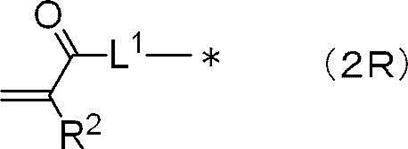
式(2R)中、L1は、2価の有機基を表し、R2は、水素原子又はアルキル基を表し、*は、結合位置を表す。
<4> ゲル粒子が、重合性モノマーを内包している<1>~<3>のいずれか1つに記載のゲル粒子の水分散物。
<5> 重合性モノマーが、(メタ)アクリレートモノマーである<4>に記載のゲル粒子の水分散物。
<6> 重合性モノマーが、3官能以上のアクリレートモノマーである<4>又は<5>に記載のゲル粒子の水分散物。
<7> 光重合開始剤は、水への溶解度が25℃において1.0質量%以下である<1>~<6>のいずれか1つに記載のゲル粒子の水分散物。
<8> 光重合開始剤が、アシルホスフィンオキシド化合物である<1>~<7>のいずれか1つに記載のゲル粒子の水分散物。
<9> ゲル粒子が、増感剤を内包している<1>~<8>のいずれか1つに記載のゲル粒子の水分散物。
<10> 親水性基が、カルボキシル基、カルボキシル基の塩、スルホ基、スルホ基の塩、硫酸基、硫酸基の塩、ホスホン酸基、ホスホン酸基の塩、リン酸基、リン酸基の塩、アンモニウム塩基、ベタイン基、及びアルキレンオキシ基からなる群から選択される少なくとも1種である<1>~<9>のいずれか1つに記載のゲル粒子の水分散物。
<11> インクジェット記録に用いられる<1>~<10>のいずれか1つに記載のゲル粒子の水分散物。
<12> ゲル粒子の全固形分量が、水分散物の全固形分量に対し、50質量%以上である<1>~<11>のいずれか1つに記載のゲル粒子の水分散物。
<13> 式(1)で表されるポリマー構造が、下記式(1P)で表されるイソシアネート基含有ポリマーに由来する構造であり、
式(2)で表されるポリマー構造が、下記式(2P)で表されるイソシアネート基含有ポリマーに由来する構造である<1>~<12>のいずれか1つに記載のゲル粒子の水分散物。
<5> 重合性モノマーが、(メタ)アクリレートモノマーである<4>に記載のゲル粒子の水分散物。
<6> 重合性モノマーが、3官能以上のアクリレートモノマーである<4>又は<5>に記載のゲル粒子の水分散物。
<7> 光重合開始剤は、水への溶解度が25℃において1.0質量%以下である<1>~<6>のいずれか1つに記載のゲル粒子の水分散物。
<8> 光重合開始剤が、アシルホスフィンオキシド化合物である<1>~<7>のいずれか1つに記載のゲル粒子の水分散物。
<9> ゲル粒子が、増感剤を内包している<1>~<8>のいずれか1つに記載のゲル粒子の水分散物。
<10> 親水性基が、カルボキシル基、カルボキシル基の塩、スルホ基、スルホ基の塩、硫酸基、硫酸基の塩、ホスホン酸基、ホスホン酸基の塩、リン酸基、リン酸基の塩、アンモニウム塩基、ベタイン基、及びアルキレンオキシ基からなる群から選択される少なくとも1種である<1>~<9>のいずれか1つに記載のゲル粒子の水分散物。
<11> インクジェット記録に用いられる<1>~<10>のいずれか1つに記載のゲル粒子の水分散物。
<12> ゲル粒子の全固形分量が、水分散物の全固形分量に対し、50質量%以上である<1>~<11>のいずれか1つに記載のゲル粒子の水分散物。
<13> 式(1)で表されるポリマー構造が、下記式(1P)で表されるイソシアネート基含有ポリマーに由来する構造であり、
式(2)で表されるポリマー構造が、下記式(2P)で表されるイソシアネート基含有ポリマーに由来する構造である<1>~<12>のいずれか1つに記載のゲル粒子の水分散物。

式(1P)中、P1は、ポリエステル、ポリカーボネート、ポリカプロラクトン、ポリブタジエン、ポリイソプレン、又はポリオレフィンからなる数平均分子量500以上のポリマー鎖を表す。
式(1P)中、Z11は、(n1+1)価の有機基を表し、Z12は、(m1+1)価の有機基を表し、n1及びm1は、それぞれ独立に、1以上の整数を表す。
式(2P)中、P2は、ポリウレタン、ポリエステル、ポリカーボネート、ポリカプロラクトン、ポリブタジエン、ポリイソプレン、又はポリオレフィンからなる数平均分子量500以上のポリマー鎖を表す。
式(2P)中、X1は、単結合、-CH2-基、又は-NH-基を表し、R1は、ヘテロ原子を含んでいてもよい炭化水素基を表し、Z21は、(n2+1)価の有機基を表し、n2は、1以上の整数を表す。
式(1P)中、Z11は、(n1+1)価の有機基を表し、Z12は、(m1+1)価の有機基を表し、n1及びm1は、それぞれ独立に、1以上の整数を表す。
式(2P)中、P2は、ポリウレタン、ポリエステル、ポリカーボネート、ポリカプロラクトン、ポリブタジエン、ポリイソプレン、又はポリオレフィンからなる数平均分子量500以上のポリマー鎖を表す。
式(2P)中、X1は、単結合、-CH2-基、又は-NH-基を表し、R1は、ヘテロ原子を含んでいてもよい炭化水素基を表し、Z21は、(n2+1)価の有機基を表し、n2は、1以上の整数を表す。
<14> <13>に記載のゲル粒子の水分散物を製造する方法であって、
式(1P)で表されるイソシアネート基含有ポリマー及び式(2P)で表されるイソシアネート基含有ポリマーの少なくとも一方を準備する準備工程と、
式(1P)で表されるイソシアネート基含有ポリマー及び式(2P)で表されるイソシアネート基含有ポリマーの少なくとも一方、光重合開始剤、並びに有機溶媒を含む油相成分と、水を含む水相成分と、を混合し、乳化させて乳化物を得る乳化工程と、
乳化物を加熱することにより、少なくとも、式(1P)で表されるイソシアネート基含有ポリマー及び式(2P)で表されるイソシアネート基含有ポリマーの少なくとも一方と、水と、を反応させてゲル粒子の水分散物を得るゲル化工程と、
を有するゲル粒子の水分散物の製造方法。
式(1P)で表されるイソシアネート基含有ポリマー及び式(2P)で表されるイソシアネート基含有ポリマーの少なくとも一方を準備する準備工程と、
式(1P)で表されるイソシアネート基含有ポリマー及び式(2P)で表されるイソシアネート基含有ポリマーの少なくとも一方、光重合開始剤、並びに有機溶媒を含む油相成分と、水を含む水相成分と、を混合し、乳化させて乳化物を得る乳化工程と、
乳化物を加熱することにより、少なくとも、式(1P)で表されるイソシアネート基含有ポリマー及び式(2P)で表されるイソシアネート基含有ポリマーの少なくとも一方と、水と、を反応させてゲル粒子の水分散物を得るゲル化工程と、
を有するゲル粒子の水分散物の製造方法。
<15> 式(1P)で表されるイソシアネート基含有ポリマー及び式(2P)で表されるイソシアネート基含有ポリマーの少なくとも一方を準備する準備工程は、
下記式(1PD)で表されるポリマージオールと下記式(ZC)で表される多官能イソシアネート化合物とを反応させて式(1P)で表されるイソシアネート基含有ポリマーを得る段階、及び、
下記式(2PD)で表されるポリマージオールと、下記式(M1)で表される末端封止剤又は下記式(M2)で表される末端封止剤若しくはその無水物と、を反応させて下記式(2PO)で表される片末端封止ポリマーを得、次いで片末端封止ポリマーと下記式(ZC)で表される多官能イソシアネート化合物とを反応させて式(2P)で表されるイソシアネート基含有ポリマーを得る段階
の少なくとも一方を有する<14>に記載のゲル粒子の水分散物の製造方法。
下記式(1PD)で表されるポリマージオールと下記式(ZC)で表される多官能イソシアネート化合物とを反応させて式(1P)で表されるイソシアネート基含有ポリマーを得る段階、及び、
下記式(2PD)で表されるポリマージオールと、下記式(M1)で表される末端封止剤又は下記式(M2)で表される末端封止剤若しくはその無水物と、を反応させて下記式(2PO)で表される片末端封止ポリマーを得、次いで片末端封止ポリマーと下記式(ZC)で表される多官能イソシアネート化合物とを反応させて式(2P)で表されるイソシアネート基含有ポリマーを得る段階
の少なくとも一方を有する<14>に記載のゲル粒子の水分散物の製造方法。
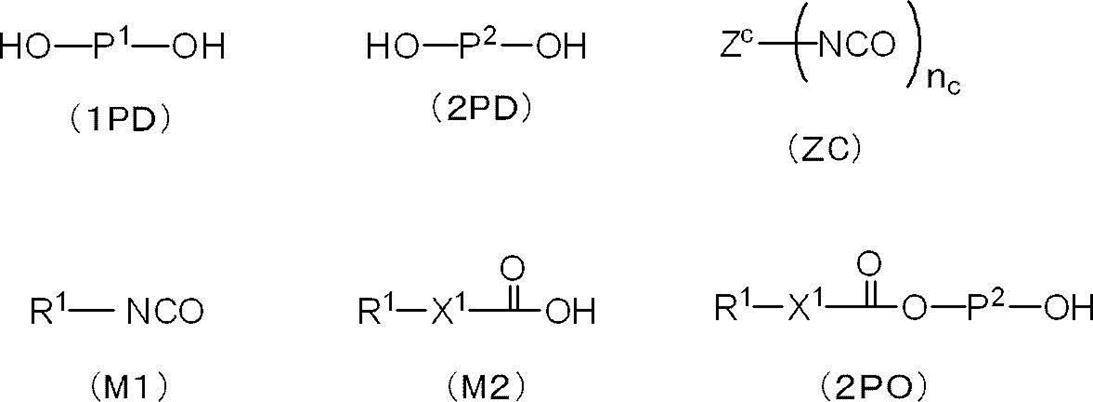
式(1PD)中、P1は、ポリエステル、ポリカーボネート、ポリカプロラクトン、ポリブタジエン、ポリイソプレン、又はポリオレフィンからなる数平均分子量500以上のポリマー鎖を表す。
式(2PD)及び式(2PO)中、P2は、ポリウレタン、ポリエステル、ポリカーボネート、ポリカプロラクトン、ポリブタジエン、ポリイソプレン、又はポリオレフィンからなる数平均分子量500以上のポリマー鎖を表す。
式(ZC)中、ZCは、nc価の有機基を表し、ncは、2以上の整数を表す。
式(M2)及び式(2PO)中、X1は、単結合、-CH2-基、又は-NH-基を表す。
式(M1)、式(M2)、及び式(2PO)中、R1は、ヘテロ原子を含んでいてもよい炭化水素基を表す。
式(2PD)及び式(2PO)中、P2は、ポリウレタン、ポリエステル、ポリカーボネート、ポリカプロラクトン、ポリブタジエン、ポリイソプレン、又はポリオレフィンからなる数平均分子量500以上のポリマー鎖を表す。
式(ZC)中、ZCは、nc価の有機基を表し、ncは、2以上の整数を表す。
式(M2)及び式(2PO)中、X1は、単結合、-CH2-基、又は-NH-基を表す。
式(M1)、式(M2)、及び式(2PO)中、R1は、ヘテロ原子を含んでいてもよい炭化水素基を表す。
<16> <1>~<13>のいずれか1つに記載のゲル粒子の水分散物を、記録媒体上に付与する付与工程と、
記録媒体上に付与されたゲル粒子の水分散物に、活性エネルギー線を照射する照射工程と、
を有する画像形成方法。
記録媒体上に付与されたゲル粒子の水分散物に、活性エネルギー線を照射する照射工程と、
を有する画像形成方法。
本発明の一実施形態によれば、基材との密着性に優れた膜を形成できるゲル粒子の水分散物及びその製造方法が提供される。
また、本発明の一実施形態によれば、記録媒体との密着性に優れた画像を形成できる画像形成方法が提供される。
また、本発明の一実施形態によれば、記録媒体との密着性に優れた画像を形成できる画像形成方法が提供される。
以下、本発明の具体的な実施形態について詳細に説明するが、本発明は、以下の実施形態に何ら限定されるものではない。
本明細書において、「~」を用いて示された数値範囲は、「~」の前後に記載される数値をそれぞれ最小値及び最大値として含む範囲を示す。
本明細書において、組成物中の各成分の量は、組成物中に各成分に該当する物質が複数存在する場合は、特に断らない限り、組成物中に存在する当該複数の物質の合計量を意味する。
本明細書において、「工程」との用語は、独立した工程だけではなく、他の工程と明確に区別できない場合であってもその工程の所期の目的が達成されれば、本用語に含まれる。
本明細書において、組成物中の各成分の量は、組成物中に各成分に該当する物質が複数存在する場合は、特に断らない限り、組成物中に存在する当該複数の物質の合計量を意味する。
本明細書において、「工程」との用語は、独立した工程だけではなく、他の工程と明確に区別できない場合であってもその工程の所期の目的が達成されれば、本用語に含まれる。
本明細書において、「光」は、γ線、β線、電子線、紫外線、可視光線、赤外線といった活性エネルギー線を包含する概念である。
本明細書では、紫外線(Ultra Violet)を、「UV光」ということがある。
本明細書では、LED(Light Emitting Diode)光源から生じた光を、「LED光」ということがある。
本明細書において、「(メタ)アクリル酸」は、アクリル酸及びメタクリル酸の両方を包含する概念であり、「(メタ)アクリレート」は、アクリレート及びメタクリレートの両方を包含する概念であり、「(メタ)アクリロイル基」は、アクリロイル基及びメタクリロイル基の両方を包含する概念である。
本明細書において、化学式中の「*」は、結合位置を示す。
本明細書では、紫外線(Ultra Violet)を、「UV光」ということがある。
本明細書では、LED(Light Emitting Diode)光源から生じた光を、「LED光」ということがある。
本明細書において、「(メタ)アクリル酸」は、アクリル酸及びメタクリル酸の両方を包含する概念であり、「(メタ)アクリレート」は、アクリレート及びメタクリレートの両方を包含する概念であり、「(メタ)アクリロイル基」は、アクリロイル基及びメタクリロイル基の両方を包含する概念である。
本明細書において、化学式中の「*」は、結合位置を示す。
〔ゲル粒子の水分散物〕
本開示のゲル粒子の水分散物(以下、「本開示の水分散物」又は単に「水分散物」と称することがある)は、下記式(1)で表されるポリマー構造(以下、「ポリマー構造(1)」ともいう)及び下記式(2)で表されるポリマー構造(以下、「ポリマー構造(2)」ともいう)の少なくとも一方を含む三次元架橋構造を有し、親水性基及び重合性基を有し、光重合開始剤を内包しているゲル粒子が、水に分散されている水分散物である。
本開示のゲル粒子の水分散物(以下、「本開示の水分散物」又は単に「水分散物」と称することがある)は、下記式(1)で表されるポリマー構造(以下、「ポリマー構造(1)」ともいう)及び下記式(2)で表されるポリマー構造(以下、「ポリマー構造(2)」ともいう)の少なくとも一方を含む三次元架橋構造を有し、親水性基及び重合性基を有し、光重合開始剤を内包しているゲル粒子が、水に分散されている水分散物である。

式(1)中、P1は、ポリエステル、ポリカーボネート、ポリカプロラクトン、ポリブタジエン、ポリイソプレン、又はポリオレフィンからなる数平均分子量500以上のポリマー鎖を表す。
式(1)中、Z11は、(n1+1)価の有機基を表し、Z12は、(m1+1)価の有機基を表し、n1及びm1は、それぞれ独立に、1以上の整数を表す。
式(2)中、P2は、ポリウレタン、ポリエステル、ポリカーボネート、ポリカプロラクトン、ポリブタジエン、ポリイソプレン、又はポリオレフィンからなる数平均分子量500以上のポリマー鎖を表す。
式(2)中、X1は、単結合、-CH2-基、又は-NH-基を表し、R1は、ヘテロ原子を含んでいてもよい炭化水素基を表し、Z21は、(n2+1)価の有機基を表し、n2は、1以上の整数を表す。
式(1)及び式(2)中、*は、結合位置を表す。
式(1)中、Z11は、(n1+1)価の有機基を表し、Z12は、(m1+1)価の有機基を表し、n1及びm1は、それぞれ独立に、1以上の整数を表す。
式(2)中、P2は、ポリウレタン、ポリエステル、ポリカーボネート、ポリカプロラクトン、ポリブタジエン、ポリイソプレン、又はポリオレフィンからなる数平均分子量500以上のポリマー鎖を表す。
式(2)中、X1は、単結合、-CH2-基、又は-NH-基を表し、R1は、ヘテロ原子を含んでいてもよい炭化水素基を表し、Z21は、(n2+1)価の有機基を表し、n2は、1以上の整数を表す。
式(1)及び式(2)中、*は、結合位置を表す。
本開示の水分散物によれば、基材との密着性に優れた膜を形成できる。
より詳細には、本開示の水分散物では、ゲル粒子が、重合性基を有し、かつ、光重合開始剤を内包していることにより、従来の光硬化性組成物(例えば光硬化性インク)と比較して、重合性基と光重合開始剤との距離が近いので、活性エネルギー線の照射に対する硬化感度(以下、単に「感度」ともいう)が向上する。その結果、形成される膜の密着性が向上する。
更に、ゲル粒子は、ポリマー構造(1)及びポリマー構造(2)の少なくとも一方を含む三次元架橋構造を有している。この三次元架橋構造は、ポリマー構造(1)及びポリマー構造(2)のいずれも含まない三次元架橋構造と比較して、強固な構造である。ゲル粒子が、かかる強固な三次元架橋構造を有していることにより、光硬化時における膜の硬化収縮が抑制される。これにより、硬化収縮に伴う密着性の低下が抑制される。補足すると、光硬化時における膜の硬化収縮が顕著であると、膜と基材との密着性が低下する傾向となる。
更に、本開示の水分散物では、ゲル粒子が親水性基を有することにより、ゲル粒子の水に対する分散性が確保されている。
より詳細には、本開示の水分散物では、ゲル粒子が、重合性基を有し、かつ、光重合開始剤を内包していることにより、従来の光硬化性組成物(例えば光硬化性インク)と比較して、重合性基と光重合開始剤との距離が近いので、活性エネルギー線の照射に対する硬化感度(以下、単に「感度」ともいう)が向上する。その結果、形成される膜の密着性が向上する。
更に、ゲル粒子は、ポリマー構造(1)及びポリマー構造(2)の少なくとも一方を含む三次元架橋構造を有している。この三次元架橋構造は、ポリマー構造(1)及びポリマー構造(2)のいずれも含まない三次元架橋構造と比較して、強固な構造である。ゲル粒子が、かかる強固な三次元架橋構造を有していることにより、光硬化時における膜の硬化収縮が抑制される。これにより、硬化収縮に伴う密着性の低下が抑制される。補足すると、光硬化時における膜の硬化収縮が顕著であると、膜と基材との密着性が低下する傾向となる。
更に、本開示の水分散物では、ゲル粒子が親水性基を有することにより、ゲル粒子の水に対する分散性が確保されている。
本開示の水分散物に対し、特開2013-199602号公報に記載のインクジェット用インク組成物中の樹脂エマルション、及び、特開2000-136211号公報に記載の水性エマルションは、いずれも三次元架橋構造を有しておらず、ゲル粒子ではない。
また、特開2011-213114号公報に記載の発色感光性組成物中のミクロゲルは、重合性基を有していない。また、このミクロゲルは、ポリマー構造(1)及びポリマー構造(2)のいずれも含まない。
従って、いずれの文献の技術によって形成された硬化膜も、本開示の水分散物を用いて形成された硬化膜と比較して、基材との密着性に劣ると考えられる。
また、特開2011-213114号公報に記載の発色感光性組成物中のミクロゲルは、重合性基を有していない。また、このミクロゲルは、ポリマー構造(1)及びポリマー構造(2)のいずれも含まない。
従って、いずれの文献の技術によって形成された硬化膜も、本開示の水分散物を用いて形成された硬化膜と比較して、基材との密着性に劣ると考えられる。
また、本開示の水分散物は、特に、ポリ塩化ビニル(PVC;Polyvinyl Chloride)、ポリスチレン(PS;Polystyrene)、ポリカーボネート(PC;Polycarbonate)、ポリエチレンテレフタレート(PET;Polyethylene Terephthalate)、グリコール変性PET、ポリプロピレン(PP;polypropylene)、アクリル樹脂等のプラスチック素材を含む基材に膜を形成する場合において、基材の材質に応じてP1又はP2で表されるポリマー鎖の材質を選択することにより、基材との密着性をより向上させることができるという利点を有する。即ち、本開示の水分散物は、基材の選択の幅が広いという利点を有する。
基材と膜との密着性の観点からみた、基材の材質と、P1又はP2で表されるポリマー鎖の材質と、の好ましい組み合わせとして、以下の組み合わせが例示される。
好ましい組み合わせとして、基材の材質としてのPSと、P1又はP2で表されるポリマー鎖の材質としての、ポリカプロラクトン、ポリブタジエン、ポリイソプレン、又はポリオレフィンと、の組み合わせが挙げられる。
また、好ましい組み合わせとして、基材の材質としてのPETと、P1又はP2で表されるポリマー鎖の材質としての、ポリエステル、ポリカーボネート、又はポリ化プロラクトンと、の組み合わせが挙げられる。
また、好ましい組み合わせとして、基材の材質としてのグリコール変性PETと、P1又はP2で表されるポリマー鎖の材質としてのポリエステルと、の組み合わせが挙げられる。
また、好ましい組み合わせとして、基材の材質としてのポリプロピレンと、P1又はP2で表されるポリマー鎖の材質としての、ポリエステル、ポリカーボネート、又はポリカプロラクトンと、の組み合わせが挙げられる。
また、好ましい組み合わせとして、基材の材質としてのアクリル樹脂と、P1又はP2で表されるポリマー鎖の材質としてのポリエステル、ポリカーボネート、又はポリカプロラクトン(より好ましくはポリエステル又はポリカーボネート)と、の組み合わせが挙げられる。
なお、PVC又はPCを含む基材に対しては、P1又はP2で表されるポリマー鎖の材質がいずれの材質であっても、優れた密着性が得られる。
好ましい組み合わせとして、基材の材質としてのPSと、P1又はP2で表されるポリマー鎖の材質としての、ポリカプロラクトン、ポリブタジエン、ポリイソプレン、又はポリオレフィンと、の組み合わせが挙げられる。
また、好ましい組み合わせとして、基材の材質としてのPETと、P1又はP2で表されるポリマー鎖の材質としての、ポリエステル、ポリカーボネート、又はポリ化プロラクトンと、の組み合わせが挙げられる。
また、好ましい組み合わせとして、基材の材質としてのグリコール変性PETと、P1又はP2で表されるポリマー鎖の材質としてのポリエステルと、の組み合わせが挙げられる。
また、好ましい組み合わせとして、基材の材質としてのポリプロピレンと、P1又はP2で表されるポリマー鎖の材質としての、ポリエステル、ポリカーボネート、又はポリカプロラクトンと、の組み合わせが挙げられる。
また、好ましい組み合わせとして、基材の材質としてのアクリル樹脂と、P1又はP2で表されるポリマー鎖の材質としてのポリエステル、ポリカーボネート、又はポリカプロラクトン(より好ましくはポリエステル又はポリカーボネート)と、の組み合わせが挙げられる。
なお、PVC又はPCを含む基材に対しては、P1又はP2で表されるポリマー鎖の材質がいずれの材質であっても、優れた密着性が得られる。
更に、本開示の水分散物によれば、硬度(例えば鉛筆硬度)に優れた膜を形成できる。
この理由は、前述のとおり、ゲル粒子が、重合性基を有し、かつ、光重合開始剤を内包していることにより、硬化感度が向上するためと考えられる。
更に、三次元架橋構造がポリマー構造(1)及びポリマー構造(2)の少なくとも一方を含む強固な構造であることも、膜の硬度(例えば鉛筆硬度)に寄与していると考えられる。
この理由は、前述のとおり、ゲル粒子が、重合性基を有し、かつ、光重合開始剤を内包していることにより、硬化感度が向上するためと考えられる。
更に、三次元架橋構造がポリマー構造(1)及びポリマー構造(2)の少なくとも一方を含む強固な構造であることも、膜の硬度(例えば鉛筆硬度)に寄与していると考えられる。
更に、本開示の水分散物は硬化感度に優れるため、本開示の水分散物によれば、基材に対する定着性に優れ、耐水性及び耐溶剤性にも優れた膜を形成することができる。
ここで、「膜の定着性」は、基材に形成された膜を露光する場合における、膜のべたつきがなくなるまでの露光量によって評価される性質である。
ここで、「膜の定着性」は、基材に形成された膜を露光する場合における、膜のべたつきがなくなるまでの露光量によって評価される性質である。
また、粒子の水分散物に関し、再分散性が求められることがある。
ここで、「再分散性」とは、水分散物中の水が蒸発して形成された固化物に対し、水系液体(例えば、水、水溶液、水分散物等)を供給することにより、固化物中の粒子が水系液体中に再び分散する性質を指す。上記固化物の例として、塗布ヘッド又はインクジェットヘッドに形成された水分散物の固化物が挙げられる。
本開示の水分散物によれば、上述した再分散性も向上する。この理由は、粒子が三次元架橋構造を有すること(即ち、ゲル粒子であること)により、個々の粒子の構造が強固となり、その結果、粒子同士の凝集又は合一が抑制されるためと考えられる。
このため、水分散物中の水が蒸発して固化物が形成された場合でも、固化物に対して水系液体(例えば、水、水分散物、水溶液)を供給することにより、固化物中の粒子を水系液体中に容易に再分散させることができると考えられる。
なお、ゲル粒子の分散性及び再分散性には、ゲル粒子に含まれる親水性基も当然に寄与している。
ここで、「再分散性」とは、水分散物中の水が蒸発して形成された固化物に対し、水系液体(例えば、水、水溶液、水分散物等)を供給することにより、固化物中の粒子が水系液体中に再び分散する性質を指す。上記固化物の例として、塗布ヘッド又はインクジェットヘッドに形成された水分散物の固化物が挙げられる。
本開示の水分散物によれば、上述した再分散性も向上する。この理由は、粒子が三次元架橋構造を有すること(即ち、ゲル粒子であること)により、個々の粒子の構造が強固となり、その結果、粒子同士の凝集又は合一が抑制されるためと考えられる。
このため、水分散物中の水が蒸発して固化物が形成された場合でも、固化物に対して水系液体(例えば、水、水分散物、水溶液)を供給することにより、固化物中の粒子を水系液体中に容易に再分散させることができると考えられる。
なお、ゲル粒子の分散性及び再分散性には、ゲル粒子に含まれる親水性基も当然に寄与している。
また、本開示の水分散物では、上述したとおり、粒子同士(ゲル粒子同士)の凝集が抑制されるので、本開示の水分散物は、保存安定性にも優れる。
また、ゲル粒子が光重合開始剤を内包することは、光重合開始剤として、水に対する溶解性が低い光重合開始剤(例えば、水への溶解度が25℃において1.0質量%以下である光重合開始剤)を使いやすいという利点も有する。
即ち、ゲル粒子が光重合開始剤を内包することは、使用する光重合開始剤の選択の幅が広いという利点も有する。
即ち、ゲル粒子が光重合開始剤を内包することは、使用する光重合開始剤の選択の幅が広いという利点も有する。
水に対する溶解性が低い光重合開始剤として、アシルホスフィンオキシド化合物(例えば、モノアシルホスフィンオキシド化合物、ビスアシルホスフィンオキシド化合物、好ましくはビスアシルホスフィンオキシド化合物。以下同じ。)が挙げられる。
アシルホスフィンオキシド化合物は、活性エネルギー線の照射に対する硬化感度に特に優れた光重合開始剤である。しかし、アシルホスフィンオキシド化合物は水に対する溶解性が低いため、従来は、水系の組成物には含有させにくい(例えば、含有させるにしてもあまり多くの量を含有させることができない)という問題があった。
本開示の水分散物では、ゲル粒子が光重合開始剤を内包することにより、光重合開始剤として、光に対する感度に優れるが水への溶解性が低い、アシルホスフィンオキシド化合物を選択することができる。
光重合開始剤が、アシルホスフィンオキシド化合物である場合、光に対する感度、特に、LED光に対する感度が向上する。
LED光の波長としては、355nm、365nm、385nm、395nm、又は405nmが好ましい。
アシルホスフィンオキシド化合物は、活性エネルギー線の照射に対する硬化感度に特に優れた光重合開始剤である。しかし、アシルホスフィンオキシド化合物は水に対する溶解性が低いため、従来は、水系の組成物には含有させにくい(例えば、含有させるにしてもあまり多くの量を含有させることができない)という問題があった。
本開示の水分散物では、ゲル粒子が光重合開始剤を内包することにより、光重合開始剤として、光に対する感度に優れるが水への溶解性が低い、アシルホスフィンオキシド化合物を選択することができる。
光重合開始剤が、アシルホスフィンオキシド化合物である場合、光に対する感度、特に、LED光に対する感度が向上する。
LED光の波長としては、355nm、365nm、385nm、395nm、又は405nmが好ましい。
また、ゲル粒子は、光重合開始剤以外の成分(重合性モノマー、増感剤、等)を内包することもできる。
本開示の水分散物は、水に対する溶解性が低い物質をゲル粒子に内包させることにより、水系の組成物である水分散液中に含有させることができる。このことが本開示の水分散物の利点の一つである。
本開示の水分散物は、水に対する溶解性が低い物質をゲル粒子に内包させることにより、水系の組成物である水分散液中に含有させることができる。このことが本開示の水分散物の利点の一つである。
<内包>
本明細書中において、「光重合開始剤がゲル粒子に内包されている」とは、光重合開始剤がゲル粒子の内部に含まれていることを意味する。ここでいう「ゲル粒子の内部」とは、三次元架橋構造の空隙を意味する。
本開示の水分散液では、膜の硬化感度の観点から、光重合開始剤の内包率(質量%)が、10質量%以上であることが好ましく、50質量%以上であることがより好ましく、70質量%以上が更に好ましく、80質量%以上が更に好ましく、90質量%以上が更に好ましく、95質量%以上が更に好ましく、97質量%以上が更に好ましく、99質量%以上が特に好ましい。
水分散液に光重合開始剤が2種以上含まれる場合、少なくとも1種類の光重合開始剤の内包率が上記の範囲であることが好ましい。
ここで、光重合開始剤の内包率(質量%)とは、水分散物中の光重合開始剤の全量に対する、ゲル粒子に内包されている光重合開始剤の量を意味し、以下のようにして求められた値を指す。
本明細書中において、「光重合開始剤がゲル粒子に内包されている」とは、光重合開始剤がゲル粒子の内部に含まれていることを意味する。ここでいう「ゲル粒子の内部」とは、三次元架橋構造の空隙を意味する。
本開示の水分散液では、膜の硬化感度の観点から、光重合開始剤の内包率(質量%)が、10質量%以上であることが好ましく、50質量%以上であることがより好ましく、70質量%以上が更に好ましく、80質量%以上が更に好ましく、90質量%以上が更に好ましく、95質量%以上が更に好ましく、97質量%以上が更に好ましく、99質量%以上が特に好ましい。
水分散液に光重合開始剤が2種以上含まれる場合、少なくとも1種類の光重合開始剤の内包率が上記の範囲であることが好ましい。
ここで、光重合開始剤の内包率(質量%)とは、水分散物中の光重合開始剤の全量に対する、ゲル粒子に内包されている光重合開始剤の量を意味し、以下のようにして求められた値を指す。
-光重合開始剤の内包率(質量%)の測定方法-
以下の操作を、液温25℃の条件で行う。
以下の操作は、水分散物が顔料を含有していない場合には、この水分散物をそのまま用いて行い、水分散物が顔料を含有している場合には、遠心分離によって水分散物から顔料を除去し、顔料が除去された水分散物に対して行う。
以下の操作を、液温25℃の条件で行う。
以下の操作は、水分散物が顔料を含有していない場合には、この水分散物をそのまま用いて行い、水分散物が顔料を含有している場合には、遠心分離によって水分散物から顔料を除去し、顔料が除去された水分散物に対して行う。
まず、光重合開始剤の内包率(質量%)の測定対象である水分散物から、同質量の試料を2つ(以下、「試料1」及び「試料2」とする)採取する。
試料1に対し、この試料1中の全固形分に対して100質量倍のテトラヒドロフラン(THF)を加えて混合し、希釈液を調製する。得られた希釈液に対し、80000rpm(round per minute;以下同じ。)、40分の条件の遠心分離を施す。遠心分離によって生じた上澄み液(以下、「上澄み液1」とする)を採取する。この操作により、試料1に含まれていた全ての光重合開始剤が、上澄み液1中に抽出されると考えられる。採取された上澄み液1中に含まれる光重合開始剤の質量を、液体クロマトグラフィー(例えば、Waters社製の液体クロマトグラフィー装置)によって測定する。得られた光重合開始剤の質量を、「光重合開始剤の全量」とする。
また、試料2に対し、上記希釈液に施した遠心分離と同じ条件の遠心分離を施す。遠心分離によって生じた上澄み液(以下、「上澄み液2」とする)を採取する。この操作により、試料2において、ゲル粒子に内包されていなかった(即ち、遊離していた)光重合開始剤が、上澄み液2中に抽出されると考えられる。採取された上澄み液2中に含まれる光重合開始剤の質量を、液体クロマトグラフィー(例えば、株式会社島津製作所製の液体クロマトグラフィー装置)によって測定する。得られた光重合開始剤の質量を、「光重合開始剤の遊離量」とする。
上記「光重合開始剤の全量」及び上記「光重合開始剤の遊離量」に基づき、下記式に従って、光重合開始剤の内包率(質量%)を求める。
光重合開始剤の内包率(質量%) = ((光重合開始剤の全量-光重合開始剤の遊離量)/光重合開始剤の全量)×100
試料1に対し、この試料1中の全固形分に対して100質量倍のテトラヒドロフラン(THF)を加えて混合し、希釈液を調製する。得られた希釈液に対し、80000rpm(round per minute;以下同じ。)、40分の条件の遠心分離を施す。遠心分離によって生じた上澄み液(以下、「上澄み液1」とする)を採取する。この操作により、試料1に含まれていた全ての光重合開始剤が、上澄み液1中に抽出されると考えられる。採取された上澄み液1中に含まれる光重合開始剤の質量を、液体クロマトグラフィー(例えば、Waters社製の液体クロマトグラフィー装置)によって測定する。得られた光重合開始剤の質量を、「光重合開始剤の全量」とする。
また、試料2に対し、上記希釈液に施した遠心分離と同じ条件の遠心分離を施す。遠心分離によって生じた上澄み液(以下、「上澄み液2」とする)を採取する。この操作により、試料2において、ゲル粒子に内包されていなかった(即ち、遊離していた)光重合開始剤が、上澄み液2中に抽出されると考えられる。採取された上澄み液2中に含まれる光重合開始剤の質量を、液体クロマトグラフィー(例えば、株式会社島津製作所製の液体クロマトグラフィー装置)によって測定する。得られた光重合開始剤の質量を、「光重合開始剤の遊離量」とする。
上記「光重合開始剤の全量」及び上記「光重合開始剤の遊離量」に基づき、下記式に従って、光重合開始剤の内包率(質量%)を求める。
光重合開始剤の内包率(質量%) = ((光重合開始剤の全量-光重合開始剤の遊離量)/光重合開始剤の全量)×100
水分散物が2種以上の光重合開始剤を含む場合には、2種以上の光重合開始剤の合計量を「光重合開始剤の全量」とし、2種以上の光重合開始剤の遊離量の合計を「光重合開始剤の遊離量」として2種以上の光重合開始剤全体の内包率を求めてもよく、いずれか1種の光重合開始剤の量を「光重合開始剤の全量」とし、上記いずれか1種の光重合開始剤の遊離量を「光重合開始剤の遊離量」として上記いずれか1種の光重合開始剤の内包率を求めてもよい。
水分散物中において、光重合開始剤以外の成分がゲル粒子に内包されているか否かについても、光重合開始剤が内包されているか否かを調べる方法と同様の方法によって確認することができる。
但し、分子量1000以上の化合物については、上記の上澄み液1及び上澄み液2に含まれる化合物の質量を、ゲルパーミエーションクロマトグラフィー(GPC)によって測定し、それぞれ「化合物の全量」及び「化合物の遊離量」とし、化合物の内包率(質量%)を求める。
但し、分子量1000以上の化合物については、上記の上澄み液1及び上澄み液2に含まれる化合物の質量を、ゲルパーミエーションクロマトグラフィー(GPC)によって測定し、それぞれ「化合物の全量」及び「化合物の遊離量」とし、化合物の内包率(質量%)を求める。
<三次元架橋構造>
本開示において、「三次元架橋構造」とは、架橋によって形成された立体的な網目構造を指す。本開示の水分散物では、粒子内で三次元架橋構造が形成されることにより、ゲル粒子が形成されている。
即ち、本明細書中において、粒子が三次元架橋構造を有することと、粒子がゲル粒子であることとは同義である。
本開示において、「三次元架橋構造」とは、架橋によって形成された立体的な網目構造を指す。本開示の水分散物では、粒子内で三次元架橋構造が形成されることにより、ゲル粒子が形成されている。
即ち、本明細書中において、粒子が三次元架橋構造を有することと、粒子がゲル粒子であることとは同義である。
ゲル粒子中における三次元架橋構造の含有量は、ゲル粒子の全固形分量に対し、20質量%~98質量%が好ましく、20質量%~95質量%がより好ましく、30質量%~90質量%が更に好ましく、35質量%~85質量%が更に好ましい。
本開示の水分散物が三次元架橋構造を有するゲル粒子を含むことは、以下のようにして確認する。以下の操作を、液温25℃の条件で行う。以下の操作は、水分散物が顔料を含有していない場合にはこの水分散物をそのまま用いて行い、水分散物が顔料を含有している場合には、まず、遠心分離によって水分散物から顔料を除去し、顔料が除去された水分散物に対して行う。
まず、水分散物から試料を採取する。採取した試料に対し、この試料中の全固形分に対して100質量倍のテトラヒドロフラン(THF)を加えて混合し、希釈液を調製する。得られた希釈液に対し、80000rpm、40分の条件の遠心分離を施す。遠心分離後に、残渣があるかどうかを目視で確認する。残渣がある場合、この残渣を水で再分散させて再分散液を調製し、得られた再分散液について、湿式粒度分布測定装置(LA-910、(株)堀場製作所製)を用い、光散乱法によって粒度分布を測定する。
以上の操作によって粒度分布が確認できた場合を、水分散物が三次元架橋構造を有するゲル粒子を含むと判断する。
以上の操作によって粒度分布が確認できた場合を、水分散物が三次元架橋構造を有するゲル粒子を含むと判断する。
三次元架橋構造は、ポリマー構造(1)及びポリマー構造(2)を含む限りにおいて特に制限はないが、後述する式(1P)で表されるイソシアネート基含有ポリマー及び後述する式(2P)で表されるイソシアネート基含有ポリマーの少なくとも一方に由来する構造を含むことが好ましい。
ポリマー構造(1)は、後述する式(1P)で表されるイソシアネート基含有ポリマーに由来する構造であることが好ましい。
ポリマー構造(2)は、後述する式(2P)で表されるイソシアネート基含有ポリマーに由来する構造であることが好ましい。
これらのイソシアネート基含有ポリマーについては後述する。
ポリマー構造(1)は、後述する式(1P)で表されるイソシアネート基含有ポリマーに由来する構造であることが好ましい。
ポリマー構造(2)は、後述する式(2P)で表されるイソシアネート基含有ポリマーに由来する構造であることが好ましい。
これらのイソシアネート基含有ポリマーについては後述する。
また、本開示において、重合性基を有するゲル粒子とは、三次元架橋構造に含まれる重合性基、及び、三次元架橋構造に含まれない重合性基の少なくとも一方を有するゲル粒子を意味する。
即ち、ゲル粒子において、重合性基は、三次元架橋構造の一部として存在していてもよいし、三次元架橋構造以外の部分として存在していてもよい。
即ち、ゲル粒子において、重合性基は、三次元架橋構造の一部として存在していてもよいし、三次元架橋構造以外の部分として存在していてもよい。
ここで、「重合性基が三次元架橋構造以外の部分として存在する」とは、ゲル粒子に、三次元架橋構造とは別に、重合性基を有するモノマー(以下、「重合性モノマー」ともいう)が含まれていることを指す。
いずれの場合においても、重合性基は、ゲル粒子の表面部分(水との接触部分)に存在していることが好ましい。
ゲル粒子が重合性基を有するか否かは、例えば、フーリエ変換赤外線分光測定(FT-IR)分析によって確認することができる。
重合性モノマーの具体例については後述する。
いずれの場合においても、重合性基は、ゲル粒子の表面部分(水との接触部分)に存在していることが好ましい。
ゲル粒子が重合性基を有するか否かは、例えば、フーリエ変換赤外線分光測定(FT-IR)分析によって確認することができる。
重合性モノマーの具体例については後述する。
重合性基としては、エチレン性二重結合を含む基が好ましく、ビニル基及び1-メチルビニル基の少なくとも一方を含む基がより好ましい。
重合性基としては、膜の硬度、膜の柔軟性、及び、定着性(即ち、光硬化時の反応性)等の観点から、(メタ)アクリロイル基が特に好ましい。
重合性基としては、膜の硬度、膜の柔軟性、及び、定着性(即ち、光硬化時の反応性)等の観点から、(メタ)アクリロイル基が特に好ましい。
また、本開示において、親水性基を有するゲル粒子とは、三次元架橋構造に含まれる親水性基、及び、三次元架橋構造に含まれない親水性基の少なくとも一方を有するゲル粒子を意味する。
即ち、ゲル粒子において、親水性基は、三次元架橋構造の一部として存在していてもよいし、三次元架橋構造以外の部分として存在していてもよい。
ここで、「親水性基が三次元架橋構造以外の部分として存在する」とは、ゲル粒子に、三次元架橋構造とは別に、親水性基を有する化合物が含まれていることを指す。
いずれの場合においても、親水性基は、ゲル粒子の表面部分(水との接触部分)に存在していることが好ましい。
ゲル粒子が親水性基を有するか否かは、例えば、フーリエ変換赤外線分光測定(FT-IR)分析によって確認することができる。
即ち、ゲル粒子において、親水性基は、三次元架橋構造の一部として存在していてもよいし、三次元架橋構造以外の部分として存在していてもよい。
ここで、「親水性基が三次元架橋構造以外の部分として存在する」とは、ゲル粒子に、三次元架橋構造とは別に、親水性基を有する化合物が含まれていることを指す。
いずれの場合においても、親水性基は、ゲル粒子の表面部分(水との接触部分)に存在していることが好ましい。
ゲル粒子が親水性基を有するか否かは、例えば、フーリエ変換赤外線分光測定(FT-IR)分析によって確認することができる。
ゲル粒子に含まれる親水性基としては、ゲル粒子の分散性及び水分散物の保存安定性の観点から、カルボキシル基、カルボキシル基の塩、スルホ基、スルホ基の塩、硫酸基、硫酸基の塩、ホスホン酸基、ホスホン酸基の塩、リン酸基、リン酸基の塩、アンモニウム塩基、ベタイン基、又はアルキレンオキシ基が好ましい。
ゲル粒子は、親水性基を1種のみ有していてもよいし、2種以上有していてもよい。
また、上述のカルボキシル基の塩、スルホ基の塩、硫酸基の塩、ホスホン酸基の塩、及びリン酸基の塩は、ゲル粒子の製造過程で、中和によって形成された塩であってもよい。
また、上述のカルボキシル基の塩、スルホ基の塩、硫酸基の塩、ホスホン酸基の塩、及びリン酸基の塩は、それぞれ、アルカリ金属塩(例えば、ナトリウム塩、カリウム塩)であることが好ましい。
ゲル粒子は、親水性基を1種のみ有していてもよいし、2種以上有していてもよい。
また、上述のカルボキシル基の塩、スルホ基の塩、硫酸基の塩、ホスホン酸基の塩、及びリン酸基の塩は、ゲル粒子の製造過程で、中和によって形成された塩であってもよい。
また、上述のカルボキシル基の塩、スルホ基の塩、硫酸基の塩、ホスホン酸基の塩、及びリン酸基の塩は、それぞれ、アルカリ金属塩(例えば、ナトリウム塩、カリウム塩)であることが好ましい。
ゲル粒子に含まれる親水性基としては、ゲル粒子の分散性及び水分散物の保存安定性の観点から、カルボキシル基の塩、スルホ基の塩、硫酸基の塩、及びアルキレンオキシ基からなる群から選択される少なくとも1種の基であることが特に好ましい。
本開示の水分散物において、ゲル粒子の体積平均粒子径は、0.05μm~0.60μmであることが好ましい。
ゲル粒子の体積平均粒子径が0.05μm以上であると、ゲル粒子をより製造し易く、また、水分散物の保存安定性もより向上する。
ゲル粒子の体積平均粒子径は、0.10μm以上であることがより好ましい。
一方、ゲル粒子の体積平均粒子径が0.60μm以下であると、水分散物の、再分散性、吐出性、及び保存安定性がより向上する。
ゲル粒子の体積平均粒子径は、水分散物の再分散性をより向上させる観点から、0.50μm以下であることがより好ましく、0.40μm以下であることが更に好ましく、0.30μm以下であることが特に好ましい。
ゲル粒子の体積平均粒子径が0.05μm以上であると、ゲル粒子をより製造し易く、また、水分散物の保存安定性もより向上する。
ゲル粒子の体積平均粒子径は、0.10μm以上であることがより好ましい。
一方、ゲル粒子の体積平均粒子径が0.60μm以下であると、水分散物の、再分散性、吐出性、及び保存安定性がより向上する。
ゲル粒子の体積平均粒子径は、水分散物の再分散性をより向上させる観点から、0.50μm以下であることがより好ましく、0.40μm以下であることが更に好ましく、0.30μm以下であることが特に好ましい。
本明細書中において、ゲル粒子の体積平均粒子径は、光散乱法によって測定された値を指す。
光散乱法によるゲル粒子の体積平均粒子径の測定は、例えば、LA-910(株式会社堀場製作所製)を用いて行う。
光散乱法によるゲル粒子の体積平均粒子径の測定は、例えば、LA-910(株式会社堀場製作所製)を用いて行う。
本開示の水分散物は、基材(例えば記録媒体)に対して膜(例えば画像)を形成するための液体として好適に用いることができる。
かかる液体としては、記録媒体としての基材に対して画像を形成するためインク組成物(例えばインクジェット記録用インク組成物)、基材に対して塗膜を形成するための塗布液、等が挙げられる。
本開示の水分散物は、特に、インクジェット記録に用いられること(即ち、本開示の水分散物が、インクジェット記録用インク組成物であること)が好ましい。これにより、記録媒体との密着性及び硬度に優れた画像が形成される。
本開示の水分散物の用途の一つであるインク組成物(好ましくはインクジェット記録用インク組成物)としては、色材を含有するインク組成物であっても、色材を含有しない透明のインク組成物(「クリアインク」等と呼ばれることもある)であってもよい。
本開示の水分散物の別の用途である塗布液についても同様である。
かかる液体としては、記録媒体としての基材に対して画像を形成するためインク組成物(例えばインクジェット記録用インク組成物)、基材に対して塗膜を形成するための塗布液、等が挙げられる。
本開示の水分散物は、特に、インクジェット記録に用いられること(即ち、本開示の水分散物が、インクジェット記録用インク組成物であること)が好ましい。これにより、記録媒体との密着性及び硬度に優れた画像が形成される。
本開示の水分散物の用途の一つであるインク組成物(好ましくはインクジェット記録用インク組成物)としては、色材を含有するインク組成物であっても、色材を含有しない透明のインク組成物(「クリアインク」等と呼ばれることもある)であってもよい。
本開示の水分散物の別の用途である塗布液についても同様である。
膜を形成するための基材としては特に限定されず、公知の基材を使用することができる。
基材としては、例えば、紙、プラスチック(例えば、ポリエチレン、ポリプロピレン、ポリスチレン等)がラミネートされた紙、金属板(例えば、アルミニウム、亜鉛、銅等の金属の板)、プラスチックフィルム(例えば、ポリ塩化ビニル(PVC)樹脂、二酢酸セルロース、三酢酸セルロース、プロピオン酸セルロース、酪酸セルロース、酢酸酪酸セルロース、硝酸セルロース、ポリエチレンテレフタレート(PET)、ポリエチレン(PE)、ポリスチレン(PS)、ポリプロピレン(PP)、ポリカーボネート(PC)、ポリビニルアセタール、アクリル樹脂等のフィルム)、上述した金属がラミネートされ又は蒸着された紙、上述した金属がラミネートされ又は蒸着されたプラスチックフィルム等が挙げられる。
基材としては、例えば、紙、プラスチック(例えば、ポリエチレン、ポリプロピレン、ポリスチレン等)がラミネートされた紙、金属板(例えば、アルミニウム、亜鉛、銅等の金属の板)、プラスチックフィルム(例えば、ポリ塩化ビニル(PVC)樹脂、二酢酸セルロース、三酢酸セルロース、プロピオン酸セルロース、酪酸セルロース、酢酸酪酸セルロース、硝酸セルロース、ポリエチレンテレフタレート(PET)、ポリエチレン(PE)、ポリスチレン(PS)、ポリプロピレン(PP)、ポリカーボネート(PC)、ポリビニルアセタール、アクリル樹脂等のフィルム)、上述した金属がラミネートされ又は蒸着された紙、上述した金属がラミネートされ又は蒸着されたプラスチックフィルム等が挙げられる。
本開示の水分散物は、基材に対する密着性に優れた膜を形成できるため、非吸収性の基材に対して膜を形成する用途に好適に特に好適である。
非吸収性の基材としては、PVC基材、PS基材、PC基材、PET基材、グリコール変性PET基材、PE基材、PP基材、アクリル樹脂基材等のプラスチック基材が好ましい。
非吸収性の基材としては、PVC基材、PS基材、PC基材、PET基材、グリコール変性PET基材、PE基材、PP基材、アクリル樹脂基材等のプラスチック基材が好ましい。
以下、本開示の水分散物の各成分について説明する。
<ゲル粒子>
本開示の水分散物は、水に分散されたゲル粒子を含む。
ゲル粒子は、下記式(1)で表されるポリマー構造及び下記式(2)で表されるポリマー構造の少なくとも一方を含む三次元架橋構造を有し、親水性基及び重合性基を有し、光重合開始剤を内包している。
本開示の水分散物は、水に分散されたゲル粒子を含む。
ゲル粒子は、下記式(1)で表されるポリマー構造及び下記式(2)で表されるポリマー構造の少なくとも一方を含む三次元架橋構造を有し、親水性基及び重合性基を有し、光重合開始剤を内包している。
以下、三次元架橋構造の構成要素について説明する。
三次元架橋構造は、下記式(1)で表されるポリマー構造(ポリマー構造(1))及び下記式(2)で表されるポリマー構造(ポリマー構造(2))のいずれか一方、又は両方を含む。これにより、三次元架橋構造が強固となる。
三次元架橋構造は、下記式(1)で表されるポリマー構造(ポリマー構造(1))及び下記式(2)で表されるポリマー構造(ポリマー構造(2))のいずれか一方、又は両方を含む。これにより、三次元架橋構造が強固となる。
(式(1)で表されるポリマー構造)

式(1)中、P1は、ポリエステル、ポリカーボネート、ポリカプロラクトン、ポリブタジエン、ポリイソプレン、又はポリオレフィンからなる数平均分子量(Mn)500以上のポリマー鎖を表す。
式(1)中、Z11は、(n1+1)価の有機基を表し、Z12は、(m1+1)価の有機基を表し、n1及びm1は、それぞれ独立に、1以上の整数を表す。
式(1)中、*は、結合位置を表す。
式(1)中、Z11は、(n1+1)価の有機基を表し、Z12は、(m1+1)価の有機基を表し、n1及びm1は、それぞれ独立に、1以上の整数を表す。
式(1)中、*は、結合位置を表す。
式(1)中、n1及びm1としては、それぞれ独立に、2以上の整数が好ましく、2~9の整数が好ましく、2~7の整数がより好ましく、2~5の整数がさらに好ましい。
式(1)中におけるZ11及びZ12としては、それぞれ独立に、ヘテロ原子を含んでもよい炭素数2~100(より好ましくは炭素数4~80、更に好ましくは炭素数6~50、更に好ましくは炭素数6~20)の有機基が好ましい。
ヘテロ原子としては、酸素原子、窒素原子、又は硫黄原子が好ましく、酸素原子又は窒素原子がより好ましい。
式(1)中におけるZ11及びZ12は、同一の基であっても互いに異なる基であってもよいが、三次元架橋構造の形成容易性(生産性)の観点からは同一の基であることが好ましい。
ヘテロ原子としては、酸素原子、窒素原子、又は硫黄原子が好ましく、酸素原子又は窒素原子がより好ましい。
式(1)中におけるZ11及びZ12は、同一の基であっても互いに異なる基であってもよいが、三次元架橋構造の形成容易性(生産性)の観点からは同一の基であることが好ましい。
以下、Z11の更に好ましい範囲を説明する。
Z12の更に好ましい範囲も、Z11の更に好ましい範囲と同様である。
Z12の更に好ましい範囲も、Z11の更に好ましい範囲と同様である。
式(1)中のZ11としては、下記式(Z-101)又は式(Z-102)で表される3価以上の基(以下、それぞれ、「基(Z-101)」及び「基(Z-102)」ともいう)が更に好ましく、その中でも、基(Z-101)が更に好ましい。
基(Z-101)及び基(Z-102)は、アダクト型の多官能イソシアネート化合物の構造からイソシアネート基(-NCO基)を除いた残基である。アダクト型の多官能イソシアネート化合物については後述する。
基(Z-101)及び基(Z-102)は、アダクト型の多官能イソシアネート化合物の構造からイソシアネート基(-NCO基)を除いた残基である。アダクト型の多官能イソシアネート化合物については後述する。
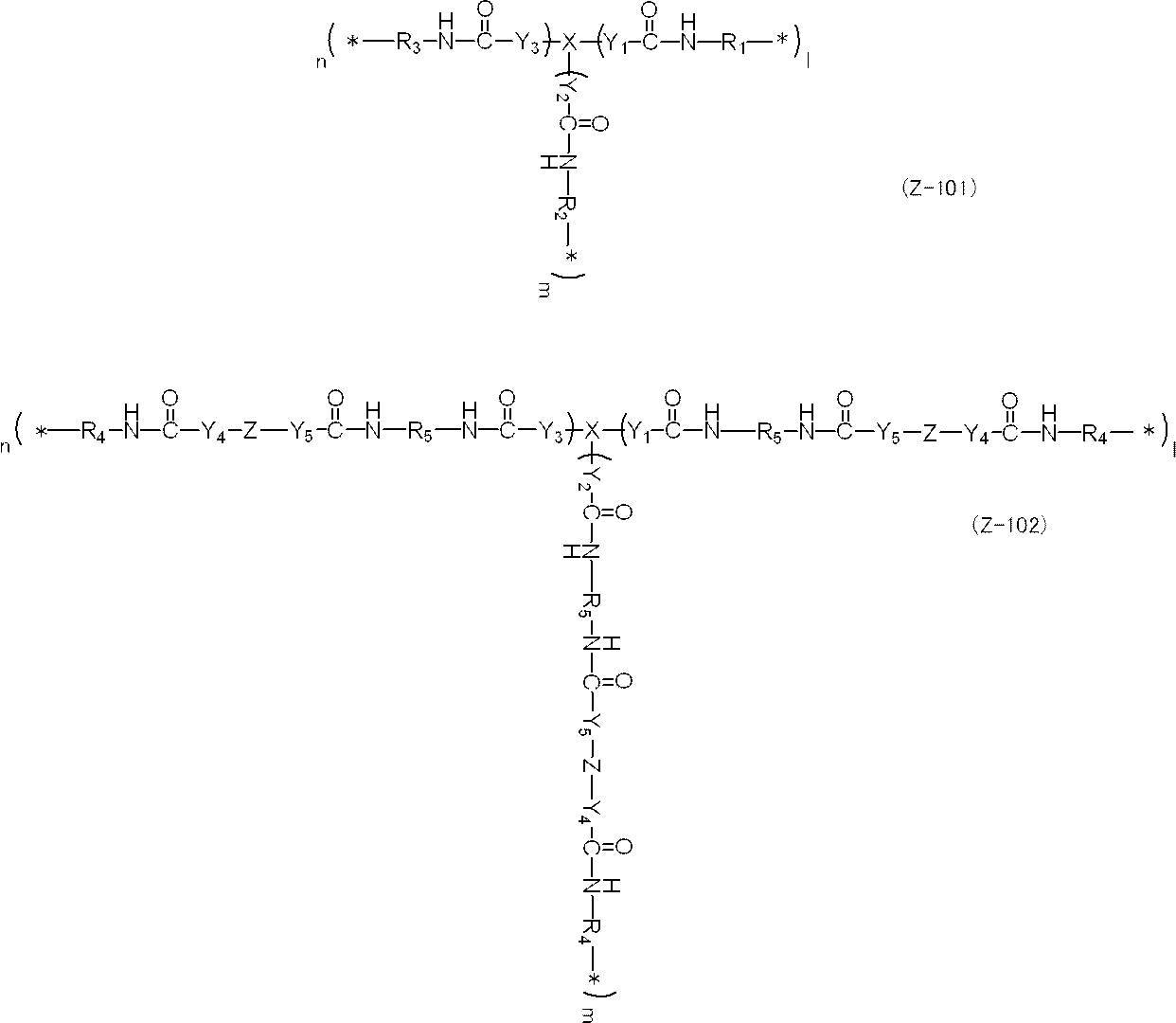
式(Z-101)及び式(Z-102)中、Xは、(l+m+n)価の有機基を表し、l、m、及びnは、それぞれ0以上の整数であり、l+m+nは3以上の整数である。l+m+nとしては、3~10の整数が好ましく、3~8の整数がより好ましく、3~6の整数がさらに好ましい。
式(Z-101)及び式(Z-102)中、Y1~Y5は、それぞれ独立に、酸素原子、硫黄原子、又は-NH-基を表し、酸素原子又は硫黄原子が好ましく、酸素原子がより好ましい。
式(Z-101)及び式(Z-102)中、Zは2価の有機基を表す。
式(Z-101)及び式(Z-102)中、R1~R5は2価の有機基を表す。
式(Z-101)及び式(Z-102)中、*は、結合位置を表す。
式(Z-101)及び式(Z-102)中、Y1~Y5は、それぞれ独立に、酸素原子、硫黄原子、又は-NH-基を表し、酸素原子又は硫黄原子が好ましく、酸素原子がより好ましい。
式(Z-101)及び式(Z-102)中、Zは2価の有機基を表す。
式(Z-101)及び式(Z-102)中、R1~R5は2価の有機基を表す。
式(Z-101)及び式(Z-102)中、*は、結合位置を表す。
式(Z-101)及び式(Z-102)中、R1~R5及びZで表される2価の有機基としては、それぞれ、
炭素数2~100(より好ましくは炭素数4~80、更に好ましくは炭素数6~50、更に好ましくは炭素数6~20)のアルキレン基(即ち、鎖状アルキレン基又は環状アルキレン基)、
炭素数6~100(より好ましくは炭素数6~80、更に好ましくは炭素数6~50、更に好ましくは炭素数6~20)のアリーレン基、
炭素数7~100(より好ましくは炭素数7~80、更に好ましくは炭素数7~50、更に好ましくは炭素数7~20)のアルキレンアリーレン基、
炭素数8~100(より好ましくは炭素数8~80、更に好ましくは炭素数8~50、更に好ましくは炭素数8~20)のアルキレンアリーレンアルキレン基、又は、
炭素数13~100(より好ましくは炭素数13~80、更に好ましくは炭素数13~50、更に好ましくは炭素数13~20)のアリーレンアルキレンアリーレン基であることが好ましい。
炭素数2~100(より好ましくは炭素数4~80、更に好ましくは炭素数6~50、更に好ましくは炭素数6~20)のアルキレン基(即ち、鎖状アルキレン基又は環状アルキレン基)、
炭素数6~100(より好ましくは炭素数6~80、更に好ましくは炭素数6~50、更に好ましくは炭素数6~20)のアリーレン基、
炭素数7~100(より好ましくは炭素数7~80、更に好ましくは炭素数7~50、更に好ましくは炭素数7~20)のアルキレンアリーレン基、
炭素数8~100(より好ましくは炭素数8~80、更に好ましくは炭素数8~50、更に好ましくは炭素数8~20)のアルキレンアリーレンアルキレン基、又は、
炭素数13~100(より好ましくは炭素数13~80、更に好ましくは炭素数13~50、更に好ましくは炭素数13~20)のアリーレンアルキレンアリーレン基であることが好ましい。
R1~R5及びZで表される2価の有機基として、より好ましくは、下記式(Z-1)~式(Z-20)のいずれか1つで表される基(以下、基(Z-1)~基(Z-20)ともいう)である。式(Z-1)~式(Z-20)中、*は、結合位置を示す。
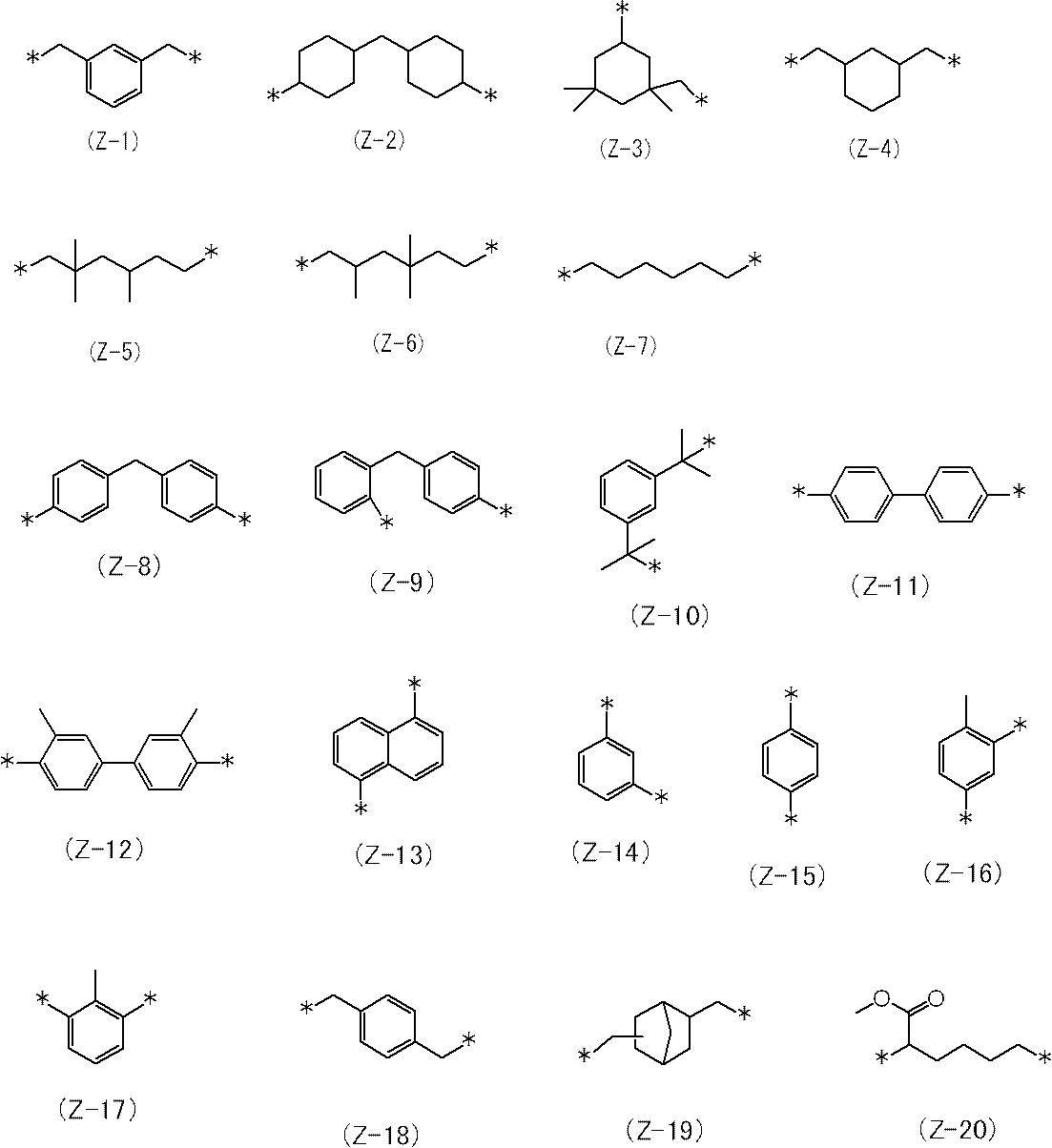
R1~R5及びZで表される2価の有機基として、特に好ましくは、m-キシリレンジイソシアネート(XDI)から誘導される基である基(Z-1)、ジシクロヘキシルメタン4,4’-ジイソシアネートから誘導される基である基(Z-2)、イソホロンジイソシアネート(IPDI)から誘導される基である基(Z-3)、1,3-ビス(イソシアネートメチル)シクロヘキサンから誘導される基である基(Z-4)、トリメチルヘキサメチレンジイソシアネート(TMHDI)から誘導される基である基(Z-5)若しくは基(Z-6)、又はヘキサメチレンジイソシアネート(HDI)から誘導される基である基(Z-7)である。
式(Z-101)及び式(Z-102)中、Xとしては、下記式(X-1)~式(X-13)のいずれか1つで表される基(以下、基(X-1)~基(X-13)ともいう)であることが特に好ましい。
式(X-1)~式(X-13)中、*は、結合位置を示す。
式(X-1)~式(X-13)中、nは、1~200の整数(好ましくは1~50の整数、より好ましくは1~15の整数)を表す。
式(X-1)~式(X-13)中、*は、結合位置を示す。
式(X-1)~式(X-13)中、nは、1~200の整数(好ましくは1~50の整数、より好ましくは1~15の整数)を表す。
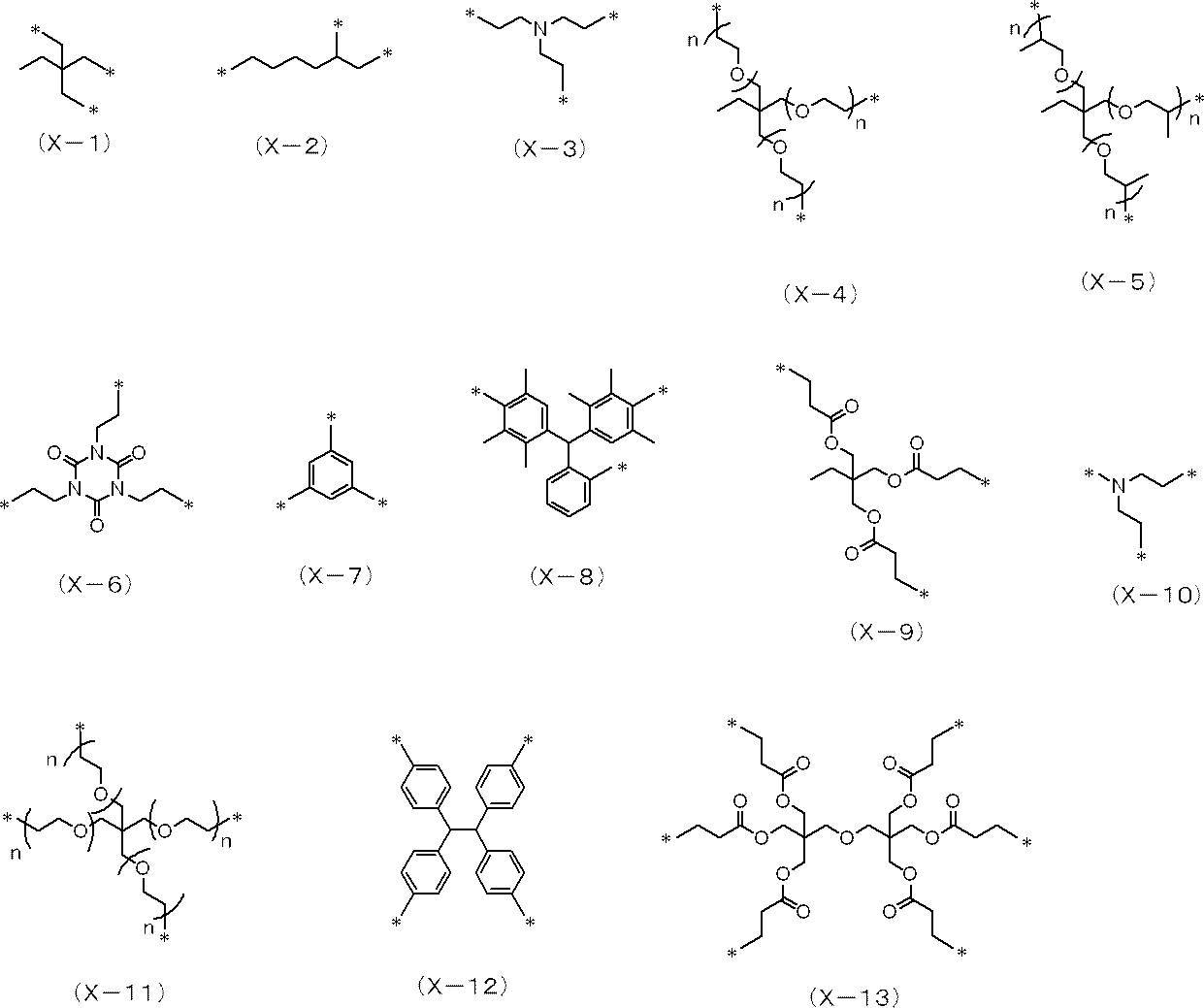
また、式(1)中のZ11としては、下記式(Z-103)又は式(Z-104)で表される3価以上の基(以下、それぞれ、「基(Z-103)」及び「基(Z-104)」ともいう)であることも好ましい。
基(Z-103)は、ビウレット型の多官能イソシアネート化合物の構造からイソシアネート基(NCO基)を除いた残基である。
基(Z-104)は、イソシアヌレート型の多官能イソシアネート化合物からイソシアネート基(NCO基)を除いた残基である。
ビウレット型の多官能イソシアネート化合物及びイソシアヌレート型の多官能イソシアネート化合物については後述する。
基(Z-103)は、ビウレット型の多官能イソシアネート化合物の構造からイソシアネート基(NCO基)を除いた残基である。
基(Z-104)は、イソシアヌレート型の多官能イソシアネート化合物からイソシアネート基(NCO基)を除いた残基である。
ビウレット型の多官能イソシアネート化合物及びイソシアヌレート型の多官能イソシアネート化合物については後述する。
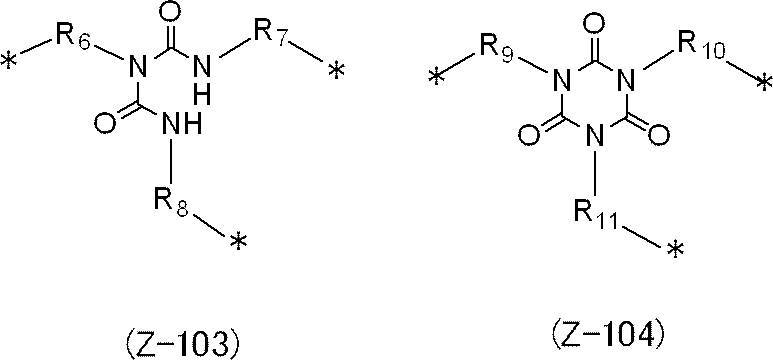
式(Z-103)及び式(Z-104)において、R6~R11は2価の有機基を表す。
式(Z-103)及び式(Z-104)中におけるR6~R11で表される2価の有機基の好ましい範囲は、式(Z-101)及び式(Z-102)中における、R1~R5及びZで表される2価の有機基の好ましい範囲と同様である。
式(Z-103)及び式(Z-104)中におけるR6~R11で表される2価の有機基の好ましい範囲は、式(Z-101)及び式(Z-102)中における、R1~R5及びZで表される2価の有機基の好ましい範囲と同様である。
また、式(1)中のZ11は、2価の有機基であってもよい。
2価の有機基である場合のZ11の好ましい範囲は、式(Z-101)及び式(Z-102)中における、R1~R5及びZで表される2価の有機基の好ましい範囲と同様である。
2価の有機基である場合のZ11の好ましい範囲は、式(Z-101)及び式(Z-102)中における、R1~R5及びZで表される2価の有機基の好ましい範囲と同様である。
また、式(1)中、P1は、ポリエステル、ポリカーボネート、ポリカプロラクトン、ポリブタジエン、ポリイソプレン、又はポリオレフィンからなる数平均分子量(Mn)500以上のポリマー鎖を表す。
P1で表されるポリマー鎖の数平均分子量(Mn)は、500~50000であることが好ましく、1000~40000であることがより好ましく、1000~30000であることが更に好ましい。
Mnが500以上であると、膜の密着性及び硬度に優れる。
Mnが50000以下であると、生産性に優れる。
P1で表されるポリマー鎖の数平均分子量(Mn)は、500~50000であることが好ましく、1000~40000であることがより好ましく、1000~30000であることが更に好ましい。
Mnが500以上であると、膜の密着性及び硬度に優れる。
Mnが50000以下であると、生産性に優れる。
本明細書中において、数平均分子量(Mn)及び重量平均分子量(Mw)は、ゲルパーミエーションクロマトグラフィー(GPC)によりポリスチレン換算で算出された値を意味する。使用カラムとしては、例えば、TSKgel(登録商標) SuperHZM-H、TSKgel(登録商標) SuperHZ4000、及びTSKgel(登録商標) SuperHZ200(以上、東ソー社製)を用いる。
P1で表されるポリマー鎖は、下記式(1PD)で表されるポリマージオール(以下、「ポリマージオール(1PD)」ともいう)から、2つの水酸基を除いた残基であることが好ましい。
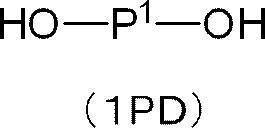
式(1PD)中のP1は、式(1)中のP1と同義である。
式(1PD)で表されるポリマージオールの数平均分子量(Mn)は、500以上であることが好ましく、500~50000であることが好ましく、1000~40000であることがより好ましく、1000~30000であることが更に好ましい。
式(1PD)で表されるポリマージオールの水酸基価(mgKOH/g)は、1mgKOH/g~500mgKOH/gが好ましく、2mgKOH/g~300mgKOH/gがより好ましく、3mgKOH/g~250mgKOH/gが更に好ましい。
ここで、水酸基価(mgKOH/g)は、JIS K 1557-1(2007)に準じて測定された値を指す。
ここで、水酸基価(mgKOH/g)は、JIS K 1557-1(2007)に準じて測定された値を指す。
式(1PD)で表されるポリマージオールのガラス転移点(Tg)(特に、P1で表されるポリマー鎖がポリエステルからなるポリマー鎖である場合のTg)は、-100℃~100℃が好ましく、-70℃~80℃がより好ましく、0℃~80℃が特に好ましい。
ポリマージオール(1PD)としては、合成されたものを用いてもよいし、市販品を用いてもよい。市販品については後述する(表1参照)。
(式(2)で表されるポリマー構造)

式(2)中、P2は、ポリウレタン、ポリエステル、ポリカーボネート、ポリカプロラクトン、ポリブタジエン、ポリイソプレン、又はポリオレフィンからなる数平均分子量500以上のポリマー鎖を表す。
式(2)中、X1は、単結合、-CH2-基、又は-NH-基を表し、R1は、ヘテロ原子を含んでいてもよい炭化水素基を表し、Z21は、(n2+1)価の有機基を表し、n2は、1以上の整数を表す。
式(2)中、*は、結合位置を表す。
式(2)中、X1は、単結合、-CH2-基、又は-NH-基を表し、R1は、ヘテロ原子を含んでいてもよい炭化水素基を表し、Z21は、(n2+1)価の有機基を表し、n2は、1以上の整数を表す。
式(2)中、*は、結合位置を表す。
式(2)中のn2は、式(1)中のn1と同義であり、好ましい範囲も同様である。
式(2)中のZ21は、式(1)中のZ11と同義であり、好ましい範囲も同様である。
式(2)中のP2は、ポリウレタンからなる数平均分子量500以上のポリマー鎖であってもよいことを除けば式(2)中のP1と同義であり、数平均分子量(Mn)の好ましい範囲も同様である。
式(2)中のZ21は、式(1)中のZ11と同義であり、好ましい範囲も同様である。
式(2)中のP2は、ポリウレタンからなる数平均分子量500以上のポリマー鎖であってもよいことを除けば式(2)中のP1と同義であり、数平均分子量(Mn)の好ましい範囲も同様である。
式(2)中、R1は、ヘテロ原子を含んでいてもよい炭化水素基を表す。
ヘテロ原子としては、酸素原子、窒素原子、又は硫黄原子が好ましく、酸素原子又は窒素原子がより好ましい。
R1で表されるヘテロ原子を含んでいてもよい炭化水素基の炭素数は、1~30が好ましく、1~25がより好ましく、1~18が特に好ましい。
ヘテロ原子としては、酸素原子、窒素原子、又は硫黄原子が好ましく、酸素原子又は窒素原子がより好ましい。
R1で表されるヘテロ原子を含んでいてもよい炭化水素基の炭素数は、1~30が好ましく、1~25がより好ましく、1~18が特に好ましい。
式(2)中のR1は、膜の硬度及び密着性(特に硬度)をより向上させる観点から、下記式(2R)で表される基(以下、「基(2R)」ともいう)であることが好ましい。
詳細には、基(2R)は、構造中に重合性基を含んでいる。即ち、式(2)中のR1が基(2R)である場合には、三次元架橋構造が重合性基を含んでいることとなる。このため、この場合には、ゲル粒子に光重合開始剤を内包させたことによる効果(例えば、膜の密着性向上効果、膜の硬度向上の効果、等)がより効果的に奏される。
詳細には、基(2R)は、構造中に重合性基を含んでいる。即ち、式(2)中のR1が基(2R)である場合には、三次元架橋構造が重合性基を含んでいることとなる。このため、この場合には、ゲル粒子に光重合開始剤を内包させたことによる効果(例えば、膜の密着性向上効果、膜の硬度向上の効果、等)がより効果的に奏される。

式(2R)中、L1は、2価の有機基を表し、R2は、水素原子又はアルキル基を表し、*は、結合位置を表す。
L1としては、炭素数1~20(より好ましくは炭素数1~10、更に好ましくは炭素数1~6、特に好ましくは炭素数1~3)のアルキレンオキシ基が好ましい。このアルキレンオキシ基は、酸素原子(オキシ基)側で、式(2R)中のカルボニル炭素原子に結合していることが好ましい。
L1で表されるアルキレンオキシ基としては、メチレンオキシ基又はエチレンオキシ基がより好ましく、エチレンオキシ基が特に好ましい。
L1で表されるアルキレンオキシ基としては、メチレンオキシ基又はエチレンオキシ基がより好ましく、エチレンオキシ基が特に好ましい。
R2としては、水素原子又は炭素数1~20(より好ましくは炭素数1~10、更に好ましくは炭素数1~6、特に好ましくは炭素数1~3)のアルキレン基が好ましく、水素原子、メチル基、又はエチル基がより好ましく、水素原子又はメチル基が更に好ましい。
式(2)中のR1は、基(2R)には限られず、重合性基を有しない基(例えば、炭素数1~30(好ましくは炭素数1~25、より好ましくは炭素数1~18)のアルキル基)であってもよい。
式(2)中、P2で表されるポリマー鎖は、下記式(2PD)で表されるポリマージオール(以下、「ポリマージオール(2PD)」ともいう)から、2つの水酸基を除いた残基であることが好ましい。

式(2PD)中のP2は、式(2)中のP2と同義である。
ポリマージオール(2PD)の好ましい範囲は、P2がポリウレタンからなるポリマー鎖であってもよいことを除けば、ポリマージオール(1PD)の好ましい範囲と同様である。
ポリマージオール(2PD)の好ましい範囲は、P2がポリウレタンからなるポリマー鎖であってもよいことを除けば、ポリマージオール(1PD)の好ましい範囲と同様である。
次に、ポリマー構造(1)及びポリマー構造(2)の原料について説明する。
(ポリマージオール)
ポリマー構造(1)及びポリマー構造(2)の原料である、ポリマージオール(即ち、ポリマージオール(1PD)及びポリマージオール(2PD))としては、公知のものを用いることができる。
ポリマージオールは、P1又はP2の種類に合わせ、ポリエステルジオール、ポリカーボネートジオール、ポリカプロラクトンジオール、ポリブタジエンジオール、ポリイソプレンジオール、又はポリオレフィンジオールと呼ばれることがある。
ポリマージオールとしては、下記表1に示す市販品を用いてもよい。
ポリマー構造(1)及びポリマー構造(2)の原料である、ポリマージオール(即ち、ポリマージオール(1PD)及びポリマージオール(2PD))としては、公知のものを用いることができる。
ポリマージオールは、P1又はP2の種類に合わせ、ポリエステルジオール、ポリカーボネートジオール、ポリカプロラクトンジオール、ポリブタジエンジオール、ポリイソプレンジオール、又はポリオレフィンジオールと呼ばれることがある。
ポリマージオールとしては、下記表1に示す市販品を用いてもよい。
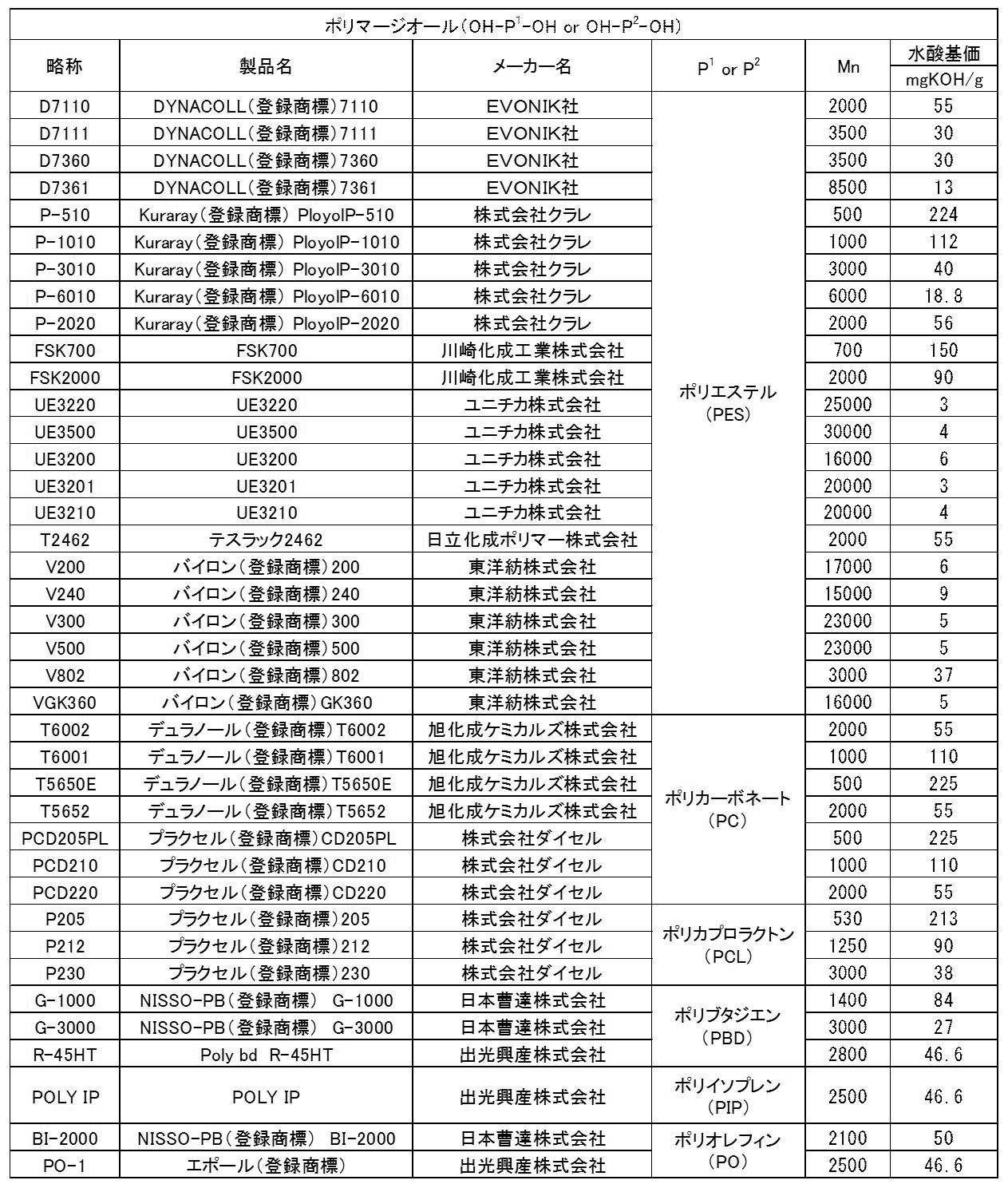
ポリマージオール(2PD)としては、P2がポリウレタンからなるポリマー鎖であるもの(「ポリウレタンジオール」とも呼ばれている)を用いることもできる。
ポリウレタンジオールは、公知の合成方法に従って合成できる。
以下、ポリウレタンジオールPU-1~PU-10の合成例を示す。
ポリウレタンジオールは、公知の合成方法に従って合成できる。
以下、ポリウレタンジオールPU-1~PU-10の合成例を示す。
-ポリマージオールPU-2の合成-
イソシアネート化合物(表2中では「イソシアネート」)としてのm-キシリレンジイソシアネート(XDI)(50g)、ジオール化合物(表2中では「ジオール」)としてのペルヒドロビスフェノールA(70.3g)、及びメチルエチルケトン(280.6g)を、冷却管を備えた500mlの三口フラスコに秤量し、窒素気流下、50℃で加熱攪拌した。そこにネオスタン(登録商標)U-600(日東化成株式会社製、無機ビスマス触媒;以下、単に「U-600」と称することがある)を0.401g添加し、50℃で6時間加熱攪拌した。得られたポリマー溶液を室温まで放冷し、放冷後の反応液をヘキサン2000ml中へ注ぎ、再沈殿精製後、真空乾燥し、ポリウレタンジオールであるポリマージオールPU-2を110g得た。
ポリマージオールPU-2の合成において、各成分の量を表2に示すように変更することにより、ポリウレタンジオールPU-1及びPU-3~PU-10を合成することができる。
イソシアネート化合物(表2中では「イソシアネート」)としてのm-キシリレンジイソシアネート(XDI)(50g)、ジオール化合物(表2中では「ジオール」)としてのペルヒドロビスフェノールA(70.3g)、及びメチルエチルケトン(280.6g)を、冷却管を備えた500mlの三口フラスコに秤量し、窒素気流下、50℃で加熱攪拌した。そこにネオスタン(登録商標)U-600(日東化成株式会社製、無機ビスマス触媒;以下、単に「U-600」と称することがある)を0.401g添加し、50℃で6時間加熱攪拌した。得られたポリマー溶液を室温まで放冷し、放冷後の反応液をヘキサン2000ml中へ注ぎ、再沈殿精製後、真空乾燥し、ポリウレタンジオールであるポリマージオールPU-2を110g得た。
ポリマージオールPU-2の合成において、各成分の量を表2に示すように変更することにより、ポリウレタンジオールPU-1及びPU-3~PU-10を合成することができる。
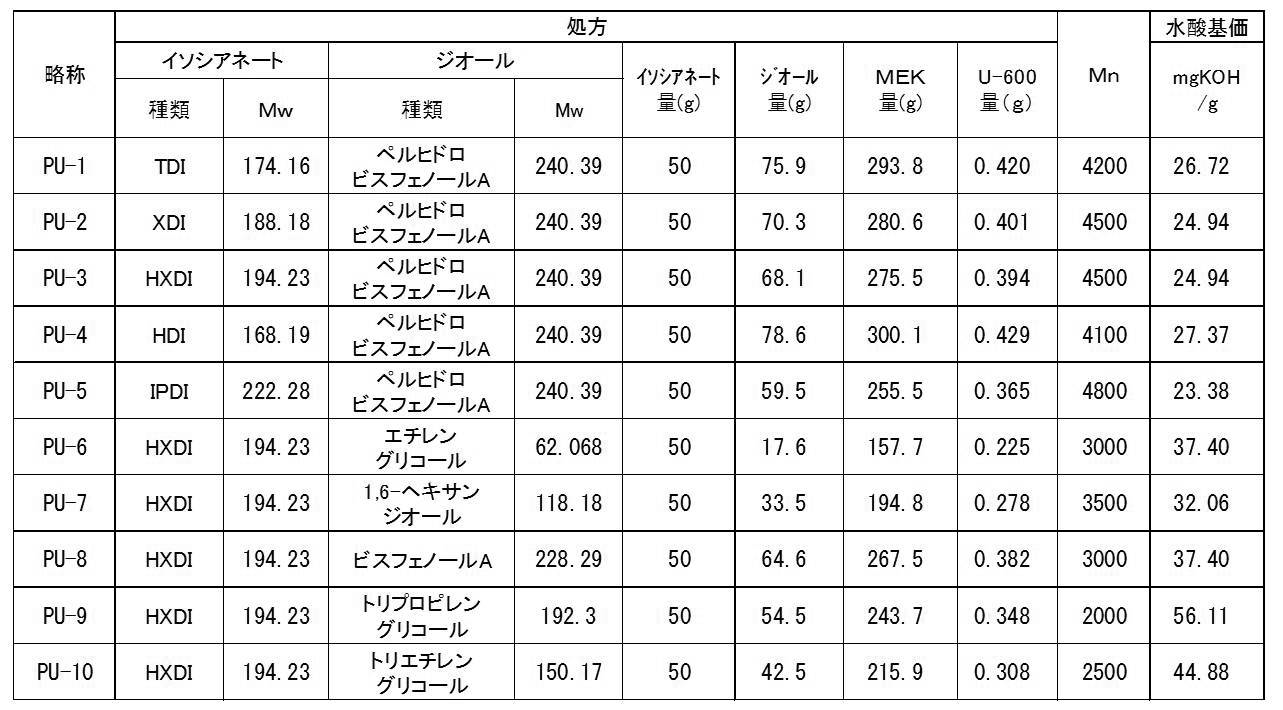
表2中のイソシアネート化合物はいずれも2官能のイソシアネート化合物であり、詳細は以下のとおりである。
XDI … m-キシリレンジイソシアネート
TDI … 2,4-トリレンジイソシアネート
HXDI … 1,3-ビス(イソシアネートメチル)シクロヘキサン
HDI … ヘキサメチレンジイソシアネート
IPDI … イソホロンジイソシアネート
XDI … m-キシリレンジイソシアネート
TDI … 2,4-トリレンジイソシアネート
HXDI … 1,3-ビス(イソシアネートメチル)シクロヘキサン
HDI … ヘキサメチレンジイソシアネート
IPDI … イソホロンジイソシアネート
(イソシアネート基含有ポリマー)
ポリマー構造(1)は、下記式(1P)で表されるイソシアネート基含有ポリマー(以下、「イソシアネート基含有ポリマー(1P)」ともいう)に由来する構造であることが好ましい。
ポリマー構造(1)を含む三次元架橋構造を形成する方法には特に制限はないが、少なくとも、イソシアネート基含有ポリマー(1P)と水とを反応させて形成する方法が好適である。この反応は、イソシアネート基含有ポリマー(1P)と水との反応であってもよいし、イソシアネート基含有ポリマー(1P)と、水と、必要に応じ用いられることがある他のイソシアネート化合物(例えば、後述する、親水性基を付加したイソシアネート化合物、等)と、の反応であってもよい。
また、ポリマー構造(2)は、下記式(2P)で表されるイソシアネート基含有ポリマー(以下、「イソシアネート基含有ポリマー(2P)」ともいう)に由来する構造であることが好ましい。
ポリマー構造(2)を含む三次元架橋構造を形成する方法には特に制限はないが、少なくともイソシアネート基含有ポリマー(2P)と水とを反応させて形成する方法が好適である。この反応は、イソシアネート基含有ポリマー(2P)と水との反応であってもよいし、イソシアネート基含有ポリマー(2P)と、水と、必要に応じ用いられることがある他のイソシアネート化合物(例えば、後述する、親水性基を付加したイソシアネート化合物、等)と、の反応であってもよい。
ポリマー構造(1)は、下記式(1P)で表されるイソシアネート基含有ポリマー(以下、「イソシアネート基含有ポリマー(1P)」ともいう)に由来する構造であることが好ましい。
ポリマー構造(1)を含む三次元架橋構造を形成する方法には特に制限はないが、少なくとも、イソシアネート基含有ポリマー(1P)と水とを反応させて形成する方法が好適である。この反応は、イソシアネート基含有ポリマー(1P)と水との反応であってもよいし、イソシアネート基含有ポリマー(1P)と、水と、必要に応じ用いられることがある他のイソシアネート化合物(例えば、後述する、親水性基を付加したイソシアネート化合物、等)と、の反応であってもよい。
また、ポリマー構造(2)は、下記式(2P)で表されるイソシアネート基含有ポリマー(以下、「イソシアネート基含有ポリマー(2P)」ともいう)に由来する構造であることが好ましい。
ポリマー構造(2)を含む三次元架橋構造を形成する方法には特に制限はないが、少なくともイソシアネート基含有ポリマー(2P)と水とを反応させて形成する方法が好適である。この反応は、イソシアネート基含有ポリマー(2P)と水との反応であってもよいし、イソシアネート基含有ポリマー(2P)と、水と、必要に応じ用いられることがある他のイソシアネート化合物(例えば、後述する、親水性基を付加したイソシアネート化合物、等)と、の反応であってもよい。

式(1P)中、P1、Z11、Z12、n1、及びm1は、それぞれ、式(1)中の、P1、Z11、Z12、n1、及びm1と同義であり、好ましい範囲も同様である。
式(2P)中、P2、X1、R1、Z21、及びn2は、それぞれ、式(2)中の、P2、X1、R1、Z21、及びn2と同義であり、好ましい範囲も同様である。
式(2P)中、P2、X1、R1、Z21、及びn2は、それぞれ、式(2)中の、P2、X1、R1、Z21、及びn2と同義であり、好ましい範囲も同様である。
三次元架橋構造を形成するにあたり、イソシアネート基含有ポリマー(1P)及びイソシアネート基含有ポリマー(2P)のいずれを用いる場合においても、イソシアネート基含有ポリマーの特定の一分子中のイソシアネート基(-NCO基)と、反応系に存在する他の-NCO基と、水と、の反応によってウレア結合が形成される。このウレア結合の形成により、式(1)又は式(2)で表されるポリマー構造を含む三次元架橋構造が形成される。
ここで、反応系に存在する他の-NCO基としては、イソシアネート基含有ポリマーの別の一分子中の-NCO基が挙げられる。また、反応系に存在する他の-NCO基としては、反応系にイソシアネート基含有ポリマー(1P)及びイソシアネート基含有ポリマー(2P)以外の他のイソシアネート化合物(例えば、後述する、親水性基を付加したイソシアネート化合物、等)が含まれる場合には、他のイソシアネート化合物中の-NCO基も挙げられる。
三次元架橋構造を形成するにあたり、イソシアネート基含有ポリマー(1P)及びイソシアネート基含有ポリマー(2P)の両方を用いることで、式(1)で表されるポリマー構造と式(2)で表されるポリマー構造との両方を含む三次元架橋構造を形成することもできる。
なお、イソシアネート基と水との反応によってウレア結合が形成されること自体は公知であるため、本明細書中では、上記反応の詳細な機構の説明を省略する。
ここで、反応系に存在する他の-NCO基としては、イソシアネート基含有ポリマーの別の一分子中の-NCO基が挙げられる。また、反応系に存在する他の-NCO基としては、反応系にイソシアネート基含有ポリマー(1P)及びイソシアネート基含有ポリマー(2P)以外の他のイソシアネート化合物(例えば、後述する、親水性基を付加したイソシアネート化合物、等)が含まれる場合には、他のイソシアネート化合物中の-NCO基も挙げられる。
三次元架橋構造を形成するにあたり、イソシアネート基含有ポリマー(1P)及びイソシアネート基含有ポリマー(2P)の両方を用いることで、式(1)で表されるポリマー構造と式(2)で表されるポリマー構造との両方を含む三次元架橋構造を形成することもできる。
なお、イソシアネート基と水との反応によってウレア結合が形成されること自体は公知であるため、本明細書中では、上記反応の詳細な機構の説明を省略する。
イソシアネート基含有ポリマー(1P)は、ポリマージオール(1PD)と下記式(ZC)で表される多官能イソシアネート化合物(以下、「イソシアネート化合物(ZC)」ともいう)とを反応させることによって製造できる。
イソシアネート基含有ポリマー(2P)は、下記式(2PO)で表される片末端封止ポリマー(以下、「片末端封止ポリマー(2PO)」ともいう)とイソシアネート化合物(ZC)とを反応させることによって製造できる。
ここで、片末端封止ポリマー(2PO)は、ポリマージオール(2PD)と下記式(M1)で表される末端封止剤(以下、「末端封止剤(M1)」ともいう)とを反応させることによって製造できる。
また、片末端封止ポリマー(2PO)は、ポリマージオール(2PD)と、下記式(M2)で表される末端封止剤(以下、「末端封止剤(M2)」ともいう)若しくはその無水物と、を反応させることによっても製造できる。
イソシアネート基含有ポリマー(1P)及びイソシアネート基含有ポリマー(2P)の製造方法の詳細は後述する。
イソシアネート基含有ポリマー(2P)は、下記式(2PO)で表される片末端封止ポリマー(以下、「片末端封止ポリマー(2PO)」ともいう)とイソシアネート化合物(ZC)とを反応させることによって製造できる。
ここで、片末端封止ポリマー(2PO)は、ポリマージオール(2PD)と下記式(M1)で表される末端封止剤(以下、「末端封止剤(M1)」ともいう)とを反応させることによって製造できる。
また、片末端封止ポリマー(2PO)は、ポリマージオール(2PD)と、下記式(M2)で表される末端封止剤(以下、「末端封止剤(M2)」ともいう)若しくはその無水物と、を反応させることによっても製造できる。
イソシアネート基含有ポリマー(1P)及びイソシアネート基含有ポリマー(2P)の製造方法の詳細は後述する。

式(ZC)中、ZCは、nc価の有機基を表し、ncは、2以上の整数を表す。
式(ZC)中のZC及びncは、それぞれ、式(1)中のZ11及び「n1+1」と同義であり、好ましい範囲も同様である。
式(M2)及び式(2PO)中のX1は、いずれも式(2)中のX1と同義である。
式(M1)、式(M2)、及び式(2PO)中のR1は、いずれも式(2)中のR1と同義である。
式(ZC)中のZC及びncは、それぞれ、式(1)中のZ11及び「n1+1」と同義であり、好ましい範囲も同様である。
式(M2)及び式(2PO)中のX1は、いずれも式(2)中のX1と同義である。
式(M1)、式(M2)、及び式(2PO)中のR1は、いずれも式(2)中のR1と同義である。
(光重合開始剤)
ゲル粒子は、光重合開始剤を内包している。
内包については前述したとおりである。
本開示の水分散物は、光重合開始剤を1種のみ含んでいてもよいし、2種以上含んでいてもよい。例えば、ゲル粒子は、光重合開始剤を1種のみ内包していてもよいし、2種以上内包していてもよい。
光重合開始剤の量の好ましい範囲は前述したとおりである。
ゲル粒子は、光重合開始剤を内包している。
内包については前述したとおりである。
本開示の水分散物は、光重合開始剤を1種のみ含んでいてもよいし、2種以上含んでいてもよい。例えば、ゲル粒子は、光重合開始剤を1種のみ内包していてもよいし、2種以上内包していてもよい。
光重合開始剤の量の好ましい範囲は前述したとおりである。
光重合開始剤は、活性エネルギー線を吸収して重合開始種であるラジカルを生成する化合物である。
活性エネルギー線として、γ線、β線、電子線、紫外線、可視光線、赤外線が例示できる。
活性エネルギー線として、γ線、β線、電子線、紫外線、可視光線、赤外線が例示できる。
光重合開始剤としては、公知の化合物を使用できるが、好ましい光重合開始剤としては、(a)芳香族ケトン類等のカルボニル化合物、(b)アシルホスフィンオキシド化合物、(c)芳香族オニウム塩化合物、(d)有機過酸化物、(e)チオ化合物、(f)ヘキサアリールビイミダゾール化合物、(g)ケトオキシムエステル化合物、(h)ボレート化合物、(i)アジニウム化合物、(j)メタロセン化合物、(k)活性エステル化合物、(l)炭素ハロゲン結合を有する化合物、並びに(m)アルキルアミン化合物等が挙げられる。
これらの光重合開始剤は、上記(a)~(m)の化合物を1種単独もしくは2種以上を組み合わせて使用してもよい。
(a)カルボニル化合物、(b)アシルホスフィンオキシド化合物、及び、(e)チオ化合物の好ましい例としては、”RADIATION CURING IN POLYMER SCIENCE AND TECHNOLOGY”,J.P.FOUASSIER,J.F.RABEK(1993)、pp.77~117に記載のベンゾフェノン骨格又はチオキサントン骨格を有する化合物等が挙げられる。
より好ましい例としては、特公昭47-6416号公報記載のα-チオベンゾフェノン化合物、特公昭47-3981号公報記載のベンゾインエーテル化合物、特公昭47-22326号公報記載のα-置換ベンゾイン化合物、特公昭47-23664号公報記載のベンゾイン誘導体、特開昭57-30704号公報記載のアロイルホスホン酸エステル、特公昭60-26483号公報記載のジアルコキシベンゾフェノン、特公昭60-26403号公報、特開昭62-81345号公報記載のベンゾインエーテル類、特公平1-34242号公報、米国特許第4,318,791号パンフレット、ヨーロッパ特許0284561A1号公報に記載のα-アミノベンゾフェノン類、特開平2-211452号公報記載のp-ジ(ジメチルアミノベンゾイル)ベンゼン、特開昭61-194062号公報記載のチオ置換芳香族ケトン、特公平2-9597号公報記載のアシルホスフィンスルフィド、特公平2-9596号公報記載のアシルホスフィン、特公昭63-61950号公報記載のチオキサントン類、特公昭59-42864号公報記載のクマリン類等を挙げることができる。
また、特開2008-105379号公報又は特開2009-114290号公報に記載の重合開始剤も好ましい。
より好ましい例としては、特公昭47-6416号公報記載のα-チオベンゾフェノン化合物、特公昭47-3981号公報記載のベンゾインエーテル化合物、特公昭47-22326号公報記載のα-置換ベンゾイン化合物、特公昭47-23664号公報記載のベンゾイン誘導体、特開昭57-30704号公報記載のアロイルホスホン酸エステル、特公昭60-26483号公報記載のジアルコキシベンゾフェノン、特公昭60-26403号公報、特開昭62-81345号公報記載のベンゾインエーテル類、特公平1-34242号公報、米国特許第4,318,791号パンフレット、ヨーロッパ特許0284561A1号公報に記載のα-アミノベンゾフェノン類、特開平2-211452号公報記載のp-ジ(ジメチルアミノベンゾイル)ベンゼン、特開昭61-194062号公報記載のチオ置換芳香族ケトン、特公平2-9597号公報記載のアシルホスフィンスルフィド、特公平2-9596号公報記載のアシルホスフィン、特公昭63-61950号公報記載のチオキサントン類、特公昭59-42864号公報記載のクマリン類等を挙げることができる。
また、特開2008-105379号公報又は特開2009-114290号公報に記載の重合開始剤も好ましい。
これらの光重合開始剤の中でも、(a)カルボニル化合物及び(b)アシルホスフィンオキシド化合物がより好ましく、具体的には、ビス(2,4,6-トリメチルベンゾイル)-フェニルホスフィンオキシド(例えば、IRGACURE(登録商標)819:BASF社製)、2-(ジメチルアミン)-1-(4-モルホリノフェニル)-2-ベンジル-1-ブタノン(例えば、IRGACURE(登録商標)369:BASF社製)、2-メチル-1-(4-メチルチオフェニル)-2-モルフォリノプロパン-1-オン(例えば、IRGACURE(登録商標)907:BASF社製)、1-ヒドロキシ-シクロヘキシル-フェニル-ケトン(例えば、IRGACURE(登録商標)184:BASF社製)、2,4,6-トリメチルベンゾイル-ジフェニル-ホスフィンオキシド(例えば、DAROCUR(登録商標)TPO、LUCIRIN(登録商標)TPO:いずれもBASF社製)などが挙げられる。
これらの中でも、感度向上の観点及びLED光への適合性の観点からは、(b)アシルホスフィンオキシド化合物が好ましく、モノアシルホスフィンオキシド化合物(特に好ましくは、2,4,6-トリメチルベンゾイル-ジフェニル-ホスフィンオキシド(例えば、DAROCUR TPO又はLUCIRIN TPO))、又は、ビスアシルホスフィンオキシド化合物(特に好ましくは、ビス(2,4,6-トリメチルベンゾイル)-フェニルホスフィンオキシド(例えば、IRGACURE 819))がより好ましい。
これらの中でも、感度向上の観点及びLED光への適合性の観点からは、(b)アシルホスフィンオキシド化合物が好ましく、モノアシルホスフィンオキシド化合物(特に好ましくは、2,4,6-トリメチルベンゾイル-ジフェニル-ホスフィンオキシド(例えば、DAROCUR TPO又はLUCIRIN TPO))、又は、ビスアシルホスフィンオキシド化合物(特に好ましくは、ビス(2,4,6-トリメチルベンゾイル)-フェニルホスフィンオキシド(例えば、IRGACURE 819))がより好ましい。
本開示の水分散物において、内包される光重合開始剤の量の好ましい範囲は前述したとおりであるが、ゲル粒子の全固形分量に対し、0.5質量%~12質量%であることが好ましい。
内包される光重合開始剤の量が0.5質量%以上であると、感度がより向上し、その結果、定着性等がより向上する。
内包される光重合開始剤の量は、定着性等の観点から、2.0質量%以上であることがより好ましく、4.0質量%以上であることが更に好ましく、5.0質量%以上であることが特に好ましい。
上記光重合開始剤の量が12質量%以下であると、ゲル粒子の分散安定性がより向上し、その結果、水分散液の保存安定性が向上する。
上記光重合開始剤の量は、保存安定性等の観点から、10質量%以下であることがより好ましく、8.0質量%以下であることが好ましい。
内包される光重合開始剤の量が0.5質量%以上であると、感度がより向上し、その結果、定着性等がより向上する。
内包される光重合開始剤の量は、定着性等の観点から、2.0質量%以上であることがより好ましく、4.0質量%以上であることが更に好ましく、5.0質量%以上であることが特に好ましい。
上記光重合開始剤の量が12質量%以下であると、ゲル粒子の分散安定性がより向上し、その結果、水分散液の保存安定性が向上する。
上記光重合開始剤の量は、保存安定性等の観点から、10質量%以下であることがより好ましく、8.0質量%以下であることが好ましい。
(重合性基)
ゲル粒子は、重合性基を有する。
ゲル粒子が重合性基を有する態様、及び重合性基の好ましい範囲については前述のとおりである。
ゲル粒子は、重合性基を有する。
ゲル粒子が重合性基を有する態様、及び重合性基の好ましい範囲については前述のとおりである。
(重合性モノマー)
ゲル粒子は、重合性モノマー(即ち、重合性基を有するモノマー)を内包していることが好ましい。
三次元架橋構造が当該構造の一部として重合性基を有していない場合であっても、ゲル粒子が重合性モノマーを内包することにより、内包された重合性モノマーの重合性基が、ゲル粒子の重合性基として機能する。
ゲル粒子に内包される重合性モノマー(以下、「内包重合性モノマー」ともいう)としては、ラジカル重合可能なエチレン性不飽和結合を有する重合性モノマーから選択できる。
ゲル粒子は、重合性モノマー(即ち、重合性基を有するモノマー)を内包していることが好ましい。
三次元架橋構造が当該構造の一部として重合性基を有していない場合であっても、ゲル粒子が重合性モノマーを内包することにより、内包された重合性モノマーの重合性基が、ゲル粒子の重合性基として機能する。
ゲル粒子に内包される重合性モノマー(以下、「内包重合性モノマー」ともいう)としては、ラジカル重合可能なエチレン性不飽和結合を有する重合性モノマーから選択できる。
内包重合性モノマーとして用いられるラジカル重合可能なエチレン性不飽和結合を有する重合性モノマーの例としては、エチレン性不飽和基を有する化合物、アクリロニトリル、スチレン、さらに種々の不飽和ポリエステル、不飽和ポリエーテル、不飽和ポリアミド、不飽和ウレタン等のラジカル重合性モノマーが挙げられる。
内包重合性モノマーは、エチレン性不飽和基を有する化合物が好ましい。
内包重合性モノマーは、1種単独で用いてもよく、2種以上を併用してもよい。
内包重合性モノマーは、エチレン性不飽和基を有する化合物が好ましい。
内包重合性モノマーは、1種単独で用いてもよく、2種以上を併用してもよい。
内包重合性モノマーとしては、光硬化時の反応性(硬化感度)、膜の密着性、及び膜の硬度の観点から、(メタ)アクリレートモノマーが好ましい。
(メタ)アクリレートモノマーとしては、2-ヒドロキシエチルアクリレート、ブトキシエチルアクリレート、カルビトールアクリレート、シクロヘキシルアクリレート、テトラヒドロフルフリルアクリレート、ベンジルアクリレート、トリデシルアクリレート、2-フェノキシエチルアクリレート、ビス(4-アクリロキシポリエトキシフェニル)プロパン、ポリエチレングリコールジアクリレート、ポリプロピレングリコールジアクリレート、ジペンタエリスリトールテトラアクリレート、トリメチロールプロパントリアクリレート(例えば、新中村化学工業株式会社製のA-TMPT)、ペンタエリスリトールトリアクリレート(例えば、新中村化学工業株式会社製のA-TMM-3L)、ペンタエリスリトールテトラアクリレート(例えば、新中村化学工業株式会社製のA-TMMT)、ジトリメチロールプロパンテトラアクリレート(例えば、新中村化学工業株式会社製のAD-TMP)、ジペンタエリスリトールペンタアクリレート(例えば、サートマー社製のSR-399E)ジペンタエリスリトールヘキサアクリレート(例えば、新中村化学工業株式会社製のA-DPH)、オリゴエステルアクリレート、N-メチロールアクリルアミド、ジアセトンアクリルアミド、エポキシアクリレート、イソボルニルアクリレート、ジシクロペンテニルアクリレート、ジシクロペンテニルオキシエチルアクリレート、ジシクロペンタニルアクリレート、ネオペンチルグリコールプロピレンオキシド付加物ジアクリレート(NPGPODA)、日本化薬株式会社製のKAYARAD(登録商標) DPEA-12、大阪有機化学工業株式会社製のビスコート(登録商標)#802等のアクリレートモノマー;
メチルメタクリレート、n-ブチルメタクリレート、アリルメタクリレート、グリシジルメタクリレート、ベンジルメタクリレート、ジメチルアミノメチルメタクリレート、ポリエチレングリコールジメタクリレート、ポリプロピレングリコールジメタクリレート、2,2-ビス(4-メタクリロキシポリエトキシフェニル)プロパン、トリメチロールプロパントリメタクリレート(例えば、新中村化学工業株式会社製のTMPT)等のメタクリレートモノマー;
等が挙げられる。
(メタ)アクリレートモノマーとしては、2-ヒドロキシエチルアクリレート、ブトキシエチルアクリレート、カルビトールアクリレート、シクロヘキシルアクリレート、テトラヒドロフルフリルアクリレート、ベンジルアクリレート、トリデシルアクリレート、2-フェノキシエチルアクリレート、ビス(4-アクリロキシポリエトキシフェニル)プロパン、ポリエチレングリコールジアクリレート、ポリプロピレングリコールジアクリレート、ジペンタエリスリトールテトラアクリレート、トリメチロールプロパントリアクリレート(例えば、新中村化学工業株式会社製のA-TMPT)、ペンタエリスリトールトリアクリレート(例えば、新中村化学工業株式会社製のA-TMM-3L)、ペンタエリスリトールテトラアクリレート(例えば、新中村化学工業株式会社製のA-TMMT)、ジトリメチロールプロパンテトラアクリレート(例えば、新中村化学工業株式会社製のAD-TMP)、ジペンタエリスリトールペンタアクリレート(例えば、サートマー社製のSR-399E)ジペンタエリスリトールヘキサアクリレート(例えば、新中村化学工業株式会社製のA-DPH)、オリゴエステルアクリレート、N-メチロールアクリルアミド、ジアセトンアクリルアミド、エポキシアクリレート、イソボルニルアクリレート、ジシクロペンテニルアクリレート、ジシクロペンテニルオキシエチルアクリレート、ジシクロペンタニルアクリレート、ネオペンチルグリコールプロピレンオキシド付加物ジアクリレート(NPGPODA)、日本化薬株式会社製のKAYARAD(登録商標) DPEA-12、大阪有機化学工業株式会社製のビスコート(登録商標)#802等のアクリレートモノマー;
メチルメタクリレート、n-ブチルメタクリレート、アリルメタクリレート、グリシジルメタクリレート、ベンジルメタクリレート、ジメチルアミノメチルメタクリレート、ポリエチレングリコールジメタクリレート、ポリプロピレングリコールジメタクリレート、2,2-ビス(4-メタクリロキシポリエトキシフェニル)プロパン、トリメチロールプロパントリメタクリレート(例えば、新中村化学工業株式会社製のTMPT)等のメタクリレートモノマー;
等が挙げられる。
これらの(メタ)アクリレートモノマーの中でも、トリメチロールプロパントリアクリレート、ペンタエリスリトールトリアクリレート、ジトリメチロールプロパンテトラアクリレート、ジペンタエリスリトールペンタアクリレート、ジペンタエリスリトールヘキサアクリレート、ネオペンチルグリコールプロピレンオキシド付加物ジアクリレートが好ましく、ジペンタエリスリトールペンタアクリレートがさらに好ましい。
また、内包重合性モノマーは、架橋性及び膜強度(例えば膜硬度。以下同じ。)の観点から、多官能の重合性モノマーが好ましく、3官能以上の重合性モノマー(好ましくは、3官能以上の(メタ)アクリレートモノマー)がより好ましく、4官能以上の重合性モノマー(好ましくは、4官能以上の(メタ)アクリレートモノマー)がさらに好ましい。
(メタ)アクリレートモノマーとしては、光硬化時の反応性(硬化感度)の観点から、アクリレートモノマーが好ましい。
即ち、光硬化時の反応性(硬化感度)、膜の密着性、及び膜の硬度の観点から、3官能以上のアクリレートモノマーが好ましく、4官能以上のアクリレートモノマーがより好ましい。
(メタ)アクリレートモノマーとしては、光硬化時の反応性(硬化感度)の観点から、アクリレートモノマーが好ましい。
即ち、光硬化時の反応性(硬化感度)、膜の密着性、及び膜の硬度の観点から、3官能以上のアクリレートモノマーが好ましく、4官能以上のアクリレートモノマーがより好ましい。
上記に挙げた内包重合性モノマーの他にも、山下晋三編、「架橋剤ハンドブック」、(1981年大成社);加藤清視編、「UV・EB硬化ハンドブック(原料編)」(1985年、高分子刊行会);ラドテック研究会編、「UV・EB硬化技術の応用と市場」、79頁、(1989年、シーエムシー);滝山栄一郎著、「ポリエステル樹脂ハンドブック」、(1988年、日刊工業新聞社)等に記載の市販品若しくは業界で公知のラジカル重合性乃至架橋性のモノマーを用いることができる。
また、内包重合性モノマーとしては、例えば、特開平7-159983号、特公平7-31399号、特開平8-224982号、特開平10-863号、特開平9-134011号、特表2004-514014公報等の各公報に記載されている光重合性組成物に用いられる光硬化性の重合性モノマーが知られており、これらも本開示におけるゲル粒子に適用することができる。
また、内包重合性モノマーとしては、上市されている市販品を用いてもよく、例えば、AH-600、AT-600、UA-306H、UA-306T、UA-306I、UA-510H、UF-8001G、DAUA-167(共栄社化学株式会社製)、UV-1700B、UV-6300B、UV-7550B、UV7600B、UV-7605B、UV-7620EA、UV-7630B、UV-7640B、UV-7650B、UV-6630B、UV7000B、UV-7510B、UV-7461TE、UV-2000B、UV-2750B、UV-3000B、UV-3200B、UV-3210EA、UV-3300B、UV-3310B、UV-3500BA、UV-3520TL、UV-3700B、UV-6640B(日本合成化学工業株式会社製)等のウレタンアクリレート、SR415、SR444、SR454、SR492、SR499、CD501、SR502、SR9020、CD9021、SR9035、SR494(サートマー社製)等のエトキシ化又はプロポキシ化アクリレート、A-9300、A-9300-1CL(新中村化学工業株式会社製)等のイソシアヌルモノマーなどが挙げられる。
本開示における、内包重合性モノマーの分子量としては、重量平均分子量として、好ましくは100~100000であり、より好ましくは100~30000であり、さらに好ましくは100~10000であり、さらに好ましくは100~1000であり、さらに好ましくは100~900であり、さらに好ましくは100~800であり、さらに好ましくは150~750である。
ゲル粒子が内包重合性モノマーを内包する場合、内包重合性モノマーの含有量は、ゲル粒子の全固形分量に対し、0.1質量%~75質量%であることが好ましく、より好ましくは1質量%~65質量%であり、さらに好ましくは10質量%~60質量%であり、さらに好ましくは20質量%~50質量%である。上記範囲とすることで架橋性及び膜強度がより向上する。
(親水性基)
ゲル粒子は、親水性基を有する。
親水性基としては、前述のとおり、ゲル粒子の分散性及び水分散物の保存安定性の観点から、カルボキシル基、カルボキシル基の塩、スルホ基、スルホ基の塩、硫酸基、硫酸基の塩、ホスホン酸基、ホスホン酸基の塩、リン酸基、リン酸基の塩、アンモニウム塩基、ベタイン基、及びアルキレンオキシ基からなる群から選択される少なくとも1種の基が好ましく、カルボキシル基の塩、スルホ基の塩、硫酸基の塩、及びアルキレンオキシ基からなる群から選択される少なくとも1種の基がより好ましい。
ゲル粒子は、親水性基を有する。
親水性基としては、前述のとおり、ゲル粒子の分散性及び水分散物の保存安定性の観点から、カルボキシル基、カルボキシル基の塩、スルホ基、スルホ基の塩、硫酸基、硫酸基の塩、ホスホン酸基、ホスホン酸基の塩、リン酸基、リン酸基の塩、アンモニウム塩基、ベタイン基、及びアルキレンオキシ基からなる群から選択される少なくとも1種の基が好ましく、カルボキシル基の塩、スルホ基の塩、硫酸基の塩、及びアルキレンオキシ基からなる群から選択される少なくとも1種の基がより好ましい。
親水性基としては、アルキレンオキシ基を含む1価の基である、下記式(W)で表される基(以下、「基(W)」ともいう)であってもよい。
*-(RW1O)nw-RW2基 … 式(W)
式(W)において、RW1は、炭素数1~10のアルキレン基を表し、RW2は、炭素数1~10のアルキル基を表し、nwは、1~200の整数を表し、*は、結合位置を表す。
RW1で表される、炭素数1~10のアルキレン基の炭素数は、1~8が好ましく、2~4がより好ましく、2又は3が特に好ましい。
RW2で表される、炭素数1~10のアルキル基の炭素数は、1~8が好ましく、1又は2が更に好ましく、1が特に好ましい。
nwとして、より好ましくは2~150の整数であり、特に好ましくは50~150の整数である。
*-(RW1O)nw-RW2基 … 式(W)
式(W)において、RW1は、炭素数1~10のアルキレン基を表し、RW2は、炭素数1~10のアルキル基を表し、nwは、1~200の整数を表し、*は、結合位置を表す。
RW1で表される、炭素数1~10のアルキレン基の炭素数は、1~8が好ましく、2~4がより好ましく、2又は3が特に好ましい。
RW2で表される、炭素数1~10のアルキル基の炭素数は、1~8が好ましく、1又は2が更に好ましく、1が特に好ましい。
nwとして、より好ましくは2~150の整数であり、特に好ましくは50~150の整数である。
(親水性基を有する化合物)
ゲル粒子の親水性基は、親水性基を有する化合物によって導入され得る。
ゲル粒子の水分散物の製造過程において、親水性基を有する化合物は、三次元架橋構造の原料である、イソシアネート基含有ポリマー及び水の少なくとも一方と反応してもよいし、反応しなくてもよい。
ゲル粒子の水分散物の製造過程において、上記反応が生じた場合には、親水性基を有する三次元架橋構造が形成される。
ゲル粒子の水分散物の製造過程において、上記反応が生じなかった場合には、ゲル粒子中に、三次元架橋構造とは別に親水性基を有する化合物が存在することとなる。
本開示の水分散物では、要するに、ゲル粒子の構造中のどこか(好ましくは表面)に、親水性基が存在していればよい。
ゲル粒子の親水性基は、親水性基を有する化合物によって導入され得る。
ゲル粒子の水分散物の製造過程において、親水性基を有する化合物は、三次元架橋構造の原料である、イソシアネート基含有ポリマー及び水の少なくとも一方と反応してもよいし、反応しなくてもよい。
ゲル粒子の水分散物の製造過程において、上記反応が生じた場合には、親水性基を有する三次元架橋構造が形成される。
ゲル粒子の水分散物の製造過程において、上記反応が生じなかった場合には、ゲル粒子中に、三次元架橋構造とは別に親水性基を有する化合物が存在することとなる。
本開示の水分散物では、要するに、ゲル粒子の構造中のどこか(好ましくは表面)に、親水性基が存在していればよい。
親水性基を有する化合物としては、親水性基に加え、長鎖の疎水基を有する界面活性剤が好ましい。
上記界面活性剤としては、例えば、「界面活性剤便覧」(西一郎他、産業図書発行(1980))に記載の界面活性剤を用いることができる。
上記界面活性剤として、具体的には、親水性基として硫酸基の塩を有するアルキル硫酸塩、親水性基としてスルホ基の塩を有するアルキルスルホン酸塩、親水性基としてスルホ基の塩を有するアルキルベンゼンスルホン酸塩、等が挙げられる。
中でも、アルキル硫酸塩が好ましく、炭素数8~20(より好ましくは12~18)のアルキル基を有するアルキル硫酸塩がより好ましく、ドデシル硫酸ナトリウム(SDS)又はヘキサデシル硫酸ナトリウム(SCS)が更に好ましい。
上記界面活性剤としては、例えば、「界面活性剤便覧」(西一郎他、産業図書発行(1980))に記載の界面活性剤を用いることができる。
上記界面活性剤として、具体的には、親水性基として硫酸基の塩を有するアルキル硫酸塩、親水性基としてスルホ基の塩を有するアルキルスルホン酸塩、親水性基としてスルホ基の塩を有するアルキルベンゼンスルホン酸塩、等が挙げられる。
中でも、アルキル硫酸塩が好ましく、炭素数8~20(より好ましくは12~18)のアルキル基を有するアルキル硫酸塩がより好ましく、ドデシル硫酸ナトリウム(SDS)又はヘキサデシル硫酸ナトリウム(SCS)が更に好ましい。
また、親水性基を有する化合物としては、親水性基を付加したイソシアネート化合物を用いることもできる。親水性基を有する化合物として親水性基を付加したイソシアネート化合物を用いた場合には、親水性基を含む三次元架橋構造が形成され得る。
親水性基を付加したイソシアネート化合物としては、
トリメチロールプロパン(TMP)とキシレンジイソシアネート(XDI)とポリエチレングリコールモノメチルエーテル(EO)との付加物(例えば、三井化学株式会社製タケネート(登録商標)D-116N)(親水性基としてアルキレンオキシ基(より詳細には基(W))を含むイソシアネート化合物)、
2,2-ビス(ヒドロキシメチル)プロピオン酸(DMPA)とイソホロンジイソシアネート(IPDI)との反応物(親水性基としてカルボキシル基を含むイソシアネート化合物)、等が挙げられる。この反応物中のカルボキシル基は、ゲル粒子の製造過程で、中和されてもよい。
親水性基を付加したイソシアネート化合物としては、
トリメチロールプロパン(TMP)とキシレンジイソシアネート(XDI)とポリエチレングリコールモノメチルエーテル(EO)との付加物(例えば、三井化学株式会社製タケネート(登録商標)D-116N)(親水性基としてアルキレンオキシ基(より詳細には基(W))を含むイソシアネート化合物)、
2,2-ビス(ヒドロキシメチル)プロピオン酸(DMPA)とイソホロンジイソシアネート(IPDI)との反応物(親水性基としてカルボキシル基を含むイソシアネート化合物)、等が挙げられる。この反応物中のカルボキシル基は、ゲル粒子の製造過程で、中和されてもよい。
親水性基を有する化合物としては、上記以外にも、下記の化合物も挙げられる。

親水性基を有する化合物としては、(メタ)アクリル酸又はその塩;2-アクリルアミド-2-メチルプロパンスルホン酸(以下、「AMPS」ともいう)、ビニルスルホン酸、硫酸ビニル、アクリル酸スルホプロピル等の重合性基を有するスルホン酸化合物又はこれらの塩;ポリアルキレングリコール(メタ)アクリレート;等も挙げられる。
ポリアルキレングリコール(メタ)アクリレートとしては、ポリアルキレングリコールモノ(メタ)アクリレート、ポリアルキレングリコールジ(メタ)アクリレート、又はアルコキシポリアルキレングリコールモノ(メタ)アクリレートが好ましい。
ポリアルキレングリコール(メタ)アクリレートとしては、いずれも、アルキレンオキシ基の繰り返し数が1~200(より好ましくは2~150、より好ましくは50~150)である化合物が好ましい。
ポリアルキレングリコール(メタ)アクリレート中のアルキレンオキシ基の炭素数は、1~10が好ましく、1~8がより好ましく、2~4がより好ましく、2又は3(即ち、アルキレンオキシ基が、エチレンオキシ基又はプロピレンオキシ基であること)が特に好ましい。
また、アルコキシポリアルキレングリコールモノ(メタ)アクリレート中のアルコキシ基の炭素数は、1~10が好ましく、1~8がより好ましく、1~2がより好ましく、1(即ち、アルコキシ基がメトキシ基であること)が特に好ましい。
ポリアルキレングリコール(メタ)アクリレートとしては、いずれも、アルキレンオキシ基の繰り返し数が1~200(より好ましくは2~150、より好ましくは50~150)である化合物が好ましい。
ポリアルキレングリコール(メタ)アクリレート中のアルキレンオキシ基の炭素数は、1~10が好ましく、1~8がより好ましく、2~4がより好ましく、2又は3(即ち、アルキレンオキシ基が、エチレンオキシ基又はプロピレンオキシ基であること)が特に好ましい。
また、アルコキシポリアルキレングリコールモノ(メタ)アクリレート中のアルコキシ基の炭素数は、1~10が好ましく、1~8がより好ましく、1~2がより好ましく、1(即ち、アルコキシ基がメトキシ基であること)が特に好ましい。
ポリアルキレングリコール(メタ)アクリレートとして、特に好ましくは、メトキシポリエチレングリコールメタクリレートである。
ポリアルキレングリコール(メタ)アクリレートとしては、市販品を用いることもできる。
市販品としては、日油株式会社製のブレンマー(登録商標)シリーズ等が挙げられる。
市販品としては、日油株式会社製のブレンマー(登録商標)シリーズ等が挙げられる。
<ゲル粒子の全固形分量>
本開示の水分散物中におけるゲル粒子の全固形分量は、水分散物の全量に対し、1質量%~50質量%が好ましく、3質量%~40質量%がより好ましく、5質量%~30質量%がさらに好ましい。
ゲル粒子の全固形分量が1質量%以上であると、膜の密着性及び硬度がより向上する。
ゲル粒子の全固形分量が50質量%以下であると、保存安定性がより向上する。
なお、ゲル粒子の全固形分量は、ゲル粒子の内部(三次元架橋構造の空隙)に存在する光重合開始剤等の成分も含めた値である。
本開示の水分散物中におけるゲル粒子の全固形分量は、水分散物の全量に対し、1質量%~50質量%が好ましく、3質量%~40質量%がより好ましく、5質量%~30質量%がさらに好ましい。
ゲル粒子の全固形分量が1質量%以上であると、膜の密着性及び硬度がより向上する。
ゲル粒子の全固形分量が50質量%以下であると、保存安定性がより向上する。
なお、ゲル粒子の全固形分量は、ゲル粒子の内部(三次元架橋構造の空隙)に存在する光重合開始剤等の成分も含めた値である。
また、本開示の水分散物中におけるゲル粒子の全固形分量は、水分散物の全固形分量に対して、50質量%以上であることが好ましく、60質量%以上であることがより好ましく、70質量%以上であることが更に好ましく、80質量%以上であることが更に好ましく、85質量%以上であることが更に好ましい。
ゲル粒子の全固形分量の上限は、水分散物の全固形分に対して100質量%でもよく、水分散物がゲル粒子以外の固形成分を含む場合、99質量%以下が好ましく、95質量%以下がより好ましい。
ゲル粒子の全固形分量の上限は、水分散物の全固形分に対して100質量%でもよく、水分散物がゲル粒子以外の固形成分を含む場合、99質量%以下が好ましく、95質量%以下がより好ましい。
<水>
本開示の水分散物は、ゲル粒子の分散媒として水を含む。
即ち、本開示の水分散物は水系の組成物であるため、溶剤系の組成物と比較して、環境負荷低減、作業性などの面で優れている。
本開示の水分散物中の水の量には特に制限はないが、水分散物の全量に対し、好ましくは10質量%~99質量%であり、より好ましくは20質量%~95質量%であり、更に好ましくは30質量%~95質量%であり、更に好ましくは50質量%~95質量%であり、更に好ましくは60質量%~95質量%であり、特に好ましくは70質量%~90質量%である。
本開示の水分散物は、ゲル粒子の分散媒として水を含む。
即ち、本開示の水分散物は水系の組成物であるため、溶剤系の組成物と比較して、環境負荷低減、作業性などの面で優れている。
本開示の水分散物中の水の量には特に制限はないが、水分散物の全量に対し、好ましくは10質量%~99質量%であり、より好ましくは20質量%~95質量%であり、更に好ましくは30質量%~95質量%であり、更に好ましくは50質量%~95質量%であり、更に好ましくは60質量%~95質量%であり、特に好ましくは70質量%~90質量%である。
<色材>
本開示の水分散物は、色材を少なくとも1種含んでいてもよい。
水分散物が色材を含む場合、色材は、ゲル粒子に含まれていてもよいし、ゲル粒子に含まれていなくてもよい。
色材としては、特に制限はなく、顔料、水溶性染料、分散染料等の公知の色材から任意に選択して使用することができる。この中でも、耐候性に優れ、色再現性に富む点から、顔料を含むことがより好ましい。
本開示の水分散物は、色材を少なくとも1種含んでいてもよい。
水分散物が色材を含む場合、色材は、ゲル粒子に含まれていてもよいし、ゲル粒子に含まれていなくてもよい。
色材としては、特に制限はなく、顔料、水溶性染料、分散染料等の公知の色材から任意に選択して使用することができる。この中でも、耐候性に優れ、色再現性に富む点から、顔料を含むことがより好ましい。
顔料としては、特に制限はなく、目的に応じて適宜選択することができ、例えば、公知の有機顔料及び無機顔料などが挙げられ、また、染料で染色した樹脂粒子、市販の顔料分散体や表面処理された顔料(例えば、顔料を分散媒として水、液状化合物や不溶性の樹脂等に分散させたもの、及び、樹脂や顔料誘導体等で顔料表面を処理したもの等)も挙げられる。
有機顔料及び無機顔料としては、例えば、黄色顔料、赤色顔料、マゼンタ顔料、青色顔料、シアン顔料、緑色顔料、橙色顔料、紫色顔料、褐色顔料、黒色顔料、白色顔料等が挙げられる。
色材として顔料を用いる場合には、顔料粒子を調製する際に、必要に応じて顔料分散剤を用いてもよい
有機顔料及び無機顔料としては、例えば、黄色顔料、赤色顔料、マゼンタ顔料、青色顔料、シアン顔料、緑色顔料、橙色顔料、紫色顔料、褐色顔料、黒色顔料、白色顔料等が挙げられる。
色材として顔料を用いる場合には、顔料粒子を調製する際に、必要に応じて顔料分散剤を用いてもよい
顔料等の色材及び顔料分散剤については、特開2014-040529号公報の段落0180~0200を適宜参照することができる。
<増感剤>
本開示の水分散物は、増感剤を含有していてもよい。
増感剤は、ゲル粒子に内包されていることが好ましい。
本開示の水分散物が増感剤を含有すると、活性エネルギー線照射による光重合開始剤の分解がより促進され得る。
増感剤は、特定の活性エネルギー線を吸収して電子励起状態となる物質である。
電子励起状態となった増感剤は、光重合開始剤と接触して、電子移動、エネルギー移動、発熱などの作用を生じる。これにより、光重合開始剤の化学変化、即ち、分解、ラジカル、酸又は塩基の生成、等が促進される。
本開示の水分散物は、増感剤を含有していてもよい。
増感剤は、ゲル粒子に内包されていることが好ましい。
本開示の水分散物が増感剤を含有すると、活性エネルギー線照射による光重合開始剤の分解がより促進され得る。
増感剤は、特定の活性エネルギー線を吸収して電子励起状態となる物質である。
電子励起状態となった増感剤は、光重合開始剤と接触して、電子移動、エネルギー移動、発熱などの作用を生じる。これにより、光重合開始剤の化学変化、即ち、分解、ラジカル、酸又は塩基の生成、等が促進される。
増感剤としては、ベンゾフェノン、チオキサントン、2,4-ジエチルチオキサントン、イソプロピルチオキサントン、アントラキノン、9,10-ジブトキシアントラセン、3-アシルクマリン誘導体、ターフェニル、スチリルケトン、3-(アロイルメチレン)チアゾリン、ショウノウキノン、エオシン、ローダミン、エリスロシン、等が挙げられる。
また、増感剤としては、特開2010-24276号公報に記載の一般式(i)で表される化合物や、特開平6-107718号公報に記載の一般式(I)で表される化合物も、好適に使用できる。
増感剤としては、ベンゾフェノン、チオキサントン、イソプロピルチオキサントン、2,4-ジエチルチオキサントン、又は9,10-ジブトキシアントラセン、が好ましい。
また、増感剤としては、LED光への適合性及び光重合開始剤との反応性の観点から、ベンゾフェノン、チオキサントン、又はイソプロピルチオキサントンが好ましく、チオキサントン又はイソプロピルチオキサントンがより好ましく、イソプロピルチオキサントンが特に好ましい。
また、増感剤としては、特開2010-24276号公報に記載の一般式(i)で表される化合物や、特開平6-107718号公報に記載の一般式(I)で表される化合物も、好適に使用できる。
増感剤としては、ベンゾフェノン、チオキサントン、イソプロピルチオキサントン、2,4-ジエチルチオキサントン、又は9,10-ジブトキシアントラセン、が好ましい。
また、増感剤としては、LED光への適合性及び光重合開始剤との反応性の観点から、ベンゾフェノン、チオキサントン、又はイソプロピルチオキサントンが好ましく、チオキサントン又はイソプロピルチオキサントンがより好ましく、イソプロピルチオキサントンが特に好ましい。
本開示の水分散物が増感剤を含有する場合において、増感剤の量は、ゲル粒子の全固形分量に対し、0.1質量%~25質量%であることが好ましく、0.1質量%~20質量%であることがより好ましく、0.1質量%~15質量%であることが更に好ましく、0.1質量%~5質量%であることが好ましい。
上記増感剤の量が0.1質量%以上であると、感度がより向上し、その結果、定着性等がより向上する。
上記増感剤の量は、定着性等の観点から、0.3質量%以上であることがより好ましく、0.5質量%以上であることが更に好ましく、0.8質量%以上であることが特に好ましい。
上記増感剤の量が25質量%以下(より好ましくは20質量%以下、更に好ましくは15質量%以下、特に好ましくは5質量%以下)であると、ゲル粒子の分散安定性がより向上し、その結果、水分散液の保存安定性が向上する。
上記増感剤の量は、保存安定性等の観点から、4質量%以下であることが更に好ましく、3質量%以下であることが好ましい。
上記増感剤の量が0.1質量%以上であると、感度がより向上し、その結果、定着性等がより向上する。
上記増感剤の量は、定着性等の観点から、0.3質量%以上であることがより好ましく、0.5質量%以上であることが更に好ましく、0.8質量%以上であることが特に好ましい。
上記増感剤の量が25質量%以下(より好ましくは20質量%以下、更に好ましくは15質量%以下、特に好ましくは5質量%以下)であると、ゲル粒子の分散安定性がより向上し、その結果、水分散液の保存安定性が向上する。
上記増感剤の量は、保存安定性等の観点から、4質量%以下であることが更に好ましく、3質量%以下であることが好ましい。
<その他の添加剤>
本開示の水分散物は、上記以外のその他の成分を含有していてもよい。
その他の成分は、ゲル粒子に含まれていてもよいし、ゲル粒子に含まれていなくてもよい。
本開示の水分散物は、上記以外のその他の成分を含有していてもよい。
その他の成分は、ゲル粒子に含まれていてもよいし、ゲル粒子に含まれていなくてもよい。
(重合禁止剤)
本開示の水分散物は、重合禁止剤を含有していてもよい。
本開示の水分散物が重合禁止剤を含有すると、水分散物の保存安定性がより向上し得る。
重合禁止剤としては、p-メトキシフェノール、キノン類(ハイドロキノン、ベンゾキノン、メトキシベンゾキノンなど)、フェノチアジン、カテコール類、アルキルフェノール類(ジブチルヒドロキシトルエン(BHT)など)、アルキルビスフェノール類、ジメチルジチオカルバミン酸亜鉛、ジメチルジチオカルバミン酸銅、ジブチルジチオカルバミン酸銅、サリチル酸銅、チオジプロピオン酸エステル類、メルカプトベンズイミダゾール、ホスファイト類、2,2,6,6-テトラメチルピペリジン-1-オキシル(TEMPO)、2,2,6,6-テトラメチル-4-ヒドロキシピペリジン-1-オキシル(TEMPOL)、クペロンAl、トリス(N-ニトロソ-N-フェニルヒドロキシルアミン)アルミニウム塩、等が挙げられる。
中でも、p-メトキシフェノール、カテコール類、キノン類、アルキルフェノール類、TEMPO、TEMPOL、クペロンAl、又はトリス(N-ニトロソ-N-フェニルヒドロキシルアミン)アルミニウム塩が好ましく、p-メトキシフェノール、ハイドロキノン、ベンゾキノン、BHT、TEMPO、TEMPOL、クペロンAl、又はトリス(N-ニトロソ-N-フェニルヒドロキシルアミン)アルミニウム塩、等がより好ましい。
本開示の水分散物は、重合禁止剤を含有していてもよい。
本開示の水分散物が重合禁止剤を含有すると、水分散物の保存安定性がより向上し得る。
重合禁止剤としては、p-メトキシフェノール、キノン類(ハイドロキノン、ベンゾキノン、メトキシベンゾキノンなど)、フェノチアジン、カテコール類、アルキルフェノール類(ジブチルヒドロキシトルエン(BHT)など)、アルキルビスフェノール類、ジメチルジチオカルバミン酸亜鉛、ジメチルジチオカルバミン酸銅、ジブチルジチオカルバミン酸銅、サリチル酸銅、チオジプロピオン酸エステル類、メルカプトベンズイミダゾール、ホスファイト類、2,2,6,6-テトラメチルピペリジン-1-オキシル(TEMPO)、2,2,6,6-テトラメチル-4-ヒドロキシピペリジン-1-オキシル(TEMPOL)、クペロンAl、トリス(N-ニトロソ-N-フェニルヒドロキシルアミン)アルミニウム塩、等が挙げられる。
中でも、p-メトキシフェノール、カテコール類、キノン類、アルキルフェノール類、TEMPO、TEMPOL、クペロンAl、又はトリス(N-ニトロソ-N-フェニルヒドロキシルアミン)アルミニウム塩が好ましく、p-メトキシフェノール、ハイドロキノン、ベンゾキノン、BHT、TEMPO、TEMPOL、クペロンAl、又はトリス(N-ニトロソ-N-フェニルヒドロキシルアミン)アルミニウム塩、等がより好ましい。
(紫外線吸収剤)
本開示の水分散物は、紫外線吸収剤を含有していてもよい。
本開示の水分散物が紫外線吸収剤を含有すると、膜の耐候性等がより向上し得る。
紫外線吸収剤としては、公知の紫外線吸収剤、例えばベンゾトリアゾール系化合物、ベンゾフェノン系化合物、トリアジン系化合物、ベンズオキサゾール系化合物等が挙げられる。
本開示の水分散物は、紫外線吸収剤を含有していてもよい。
本開示の水分散物が紫外線吸収剤を含有すると、膜の耐候性等がより向上し得る。
紫外線吸収剤としては、公知の紫外線吸収剤、例えばベンゾトリアゾール系化合物、ベンゾフェノン系化合物、トリアジン系化合物、ベンズオキサゾール系化合物等が挙げられる。
(溶剤)
本開示の水分散物は、溶剤を含有していてもよい。
本開示の水分散物は、溶剤を含有すると、膜と基材との密着性がより向上し得る。
本開示の水分散物が溶剤を含有する場合、溶剤の含有量は、水分散物の全量に対し、0.1質量%~10質量%が好ましく、1質量%~10質量%がより好ましい。
溶剤の具体例は以下のとおりである。
・アルコール類(例えば、メタノール、エタノール、プロパノール、イソプロパノール、ブタノール、イソブタノール、セカンダリーブタノール、ターシャリーブタノール、ペンタノール、ヘキサノール、シクロヘキサノール、ベンジルアルコール等)、
・多価アルコール類(例えば、エチレングリコール、ジエチレングリコール、トリエチレングリコール、ポリエチレングリコール、プロピレングリコール、ジプロピレングリコール、ポリプロピレングリコール、ブチレングリコール、ヘキサンジオール、ペンタンジオール、グリセリン、ヘキサントリオール、チオジグリコール、2-メチルプロパンジオール等)、
・多価アルコールエーテル類(例えば、エチレングリコールモノメチルエーテル、エチレングリコールモノエチルエーテル、エチレングリコールモノブチルエーテル、ジエチレングリコールモノエチルエーテル、ジエチレングリコールモノメチルエーテル、ジエチレングリコールモノブチルエーテル、プロピレングリコールモノメチルエーテル、プロピレングリコールモノブチルエーテル、トリプロピレングリコールモノメチルエーテル、ジプロピレングリコールモノメチルエーテル、ジプロピレングリコールジメチルエーテル、エチレングリコールモノメチルエーテルアセテート、トリエチレングリコールモノメチルエーテル、トリエチレングリコールモノエチルエーテル、トリエチレングリコールモノブチルエーテル、エチレングリコールモノフェニルエーテル、プロピレングリコールモノフェニルエーテル等)、
・アミン類(例えば、エタノールアミン、ジエタノールアミン、トリエタノールアミン、N-メチルジエタノールアミン、N-エチルジエタノールアミン、モルホリン、N-エチルモルホリン、エチレンジアミン、ジエチレンジアミン、トリエチレンテトラミン、テトラエチレンペンタミン、ポリエチレンイミン、ペンタメチルジエチレントリアミン、テトラメチルプロピレンジアミン等)、
・アミド類(例えば、ホルムアミド、N,N-ジメチルホルムアミド、N,N-ジメチルアセトアミド等)、
・複素環類(例えば、2-ピロリドン、N-メチル-2-ピロリドン、シクロヘキシルピロリドン、2-オキサゾリドン、1,3-ジメチル-2-イミダゾリジノン、γ-ブチロラクトン等)、
・スルホキシド類(例えば、ジメチルスルホキシド等)、
・スルホン類(例えば、スルホラン等)、
・その他(尿素、アセトニトリル、アセトン等)
本開示の水分散物は、溶剤を含有していてもよい。
本開示の水分散物は、溶剤を含有すると、膜と基材との密着性がより向上し得る。
本開示の水分散物が溶剤を含有する場合、溶剤の含有量は、水分散物の全量に対し、0.1質量%~10質量%が好ましく、1質量%~10質量%がより好ましい。
溶剤の具体例は以下のとおりである。
・アルコール類(例えば、メタノール、エタノール、プロパノール、イソプロパノール、ブタノール、イソブタノール、セカンダリーブタノール、ターシャリーブタノール、ペンタノール、ヘキサノール、シクロヘキサノール、ベンジルアルコール等)、
・多価アルコール類(例えば、エチレングリコール、ジエチレングリコール、トリエチレングリコール、ポリエチレングリコール、プロピレングリコール、ジプロピレングリコール、ポリプロピレングリコール、ブチレングリコール、ヘキサンジオール、ペンタンジオール、グリセリン、ヘキサントリオール、チオジグリコール、2-メチルプロパンジオール等)、
・多価アルコールエーテル類(例えば、エチレングリコールモノメチルエーテル、エチレングリコールモノエチルエーテル、エチレングリコールモノブチルエーテル、ジエチレングリコールモノエチルエーテル、ジエチレングリコールモノメチルエーテル、ジエチレングリコールモノブチルエーテル、プロピレングリコールモノメチルエーテル、プロピレングリコールモノブチルエーテル、トリプロピレングリコールモノメチルエーテル、ジプロピレングリコールモノメチルエーテル、ジプロピレングリコールジメチルエーテル、エチレングリコールモノメチルエーテルアセテート、トリエチレングリコールモノメチルエーテル、トリエチレングリコールモノエチルエーテル、トリエチレングリコールモノブチルエーテル、エチレングリコールモノフェニルエーテル、プロピレングリコールモノフェニルエーテル等)、
・アミン類(例えば、エタノールアミン、ジエタノールアミン、トリエタノールアミン、N-メチルジエタノールアミン、N-エチルジエタノールアミン、モルホリン、N-エチルモルホリン、エチレンジアミン、ジエチレンジアミン、トリエチレンテトラミン、テトラエチレンペンタミン、ポリエチレンイミン、ペンタメチルジエチレントリアミン、テトラメチルプロピレンジアミン等)、
・アミド類(例えば、ホルムアミド、N,N-ジメチルホルムアミド、N,N-ジメチルアセトアミド等)、
・複素環類(例えば、2-ピロリドン、N-メチル-2-ピロリドン、シクロヘキシルピロリドン、2-オキサゾリドン、1,3-ジメチル-2-イミダゾリジノン、γ-ブチロラクトン等)、
・スルホキシド類(例えば、ジメチルスルホキシド等)、
・スルホン類(例えば、スルホラン等)、
・その他(尿素、アセトニトリル、アセトン等)
(その他の界面活性剤)
本開示の水分散物は、前述の「親水性基を有する化合物」において例示した、長鎖の疎水基を有する界面活性剤(例えば、アルキル硫酸塩、アルキルスルホン酸塩、及びアルキルベンゼンスルホン酸塩)以外のその他の界面活性剤を含有していてもよい。
その他の界面活性剤としては、特開昭62-173463号、同62-183457号の各公報に記載されたものが挙げられる。例えば、ポリオキシエチレンアルキルエーテル類、ポリオキシエチレンアルキルアリルエーテル類、アセチレングリコール類、ポリオキシエチレン・ポリオキシプロピレンブロックコポリマー類等のノニオン性界面活性剤が挙げられる。
また、界面活性剤として、有機フルオロ化合物を用いてもよい。
有機フルオロ化合物は、疎水性であることが好ましい。有機フルオロ化合物としては、例えば、フッ素系界面活性剤、オイル状フッ素系化合物(例、フッ素油)及び固体状フッ素化合物樹脂(例、四フッ化エチレン樹脂)が含まれ、特公昭57-9053号(第8~17欄)、特開昭62-135826号の各公報に記載されたものが挙げられる。
本開示の水分散物は、前述の「親水性基を有する化合物」において例示した、長鎖の疎水基を有する界面活性剤(例えば、アルキル硫酸塩、アルキルスルホン酸塩、及びアルキルベンゼンスルホン酸塩)以外のその他の界面活性剤を含有していてもよい。
その他の界面活性剤としては、特開昭62-173463号、同62-183457号の各公報に記載されたものが挙げられる。例えば、ポリオキシエチレンアルキルエーテル類、ポリオキシエチレンアルキルアリルエーテル類、アセチレングリコール類、ポリオキシエチレン・ポリオキシプロピレンブロックコポリマー類等のノニオン性界面活性剤が挙げられる。
また、界面活性剤として、有機フルオロ化合物を用いてもよい。
有機フルオロ化合物は、疎水性であることが好ましい。有機フルオロ化合物としては、例えば、フッ素系界面活性剤、オイル状フッ素系化合物(例、フッ素油)及び固体状フッ素化合物樹脂(例、四フッ化エチレン樹脂)が含まれ、特公昭57-9053号(第8~17欄)、特開昭62-135826号の各公報に記載されたものが挙げられる。
また、本開示の水分散物は、膜物性、密着性、及び吐出性制御の観点から、必要に応じ、ゲル粒子の外部に、光重合開始剤、重合性化合物、水溶性樹脂、水分散性樹脂等を含有していてもよい。
ここで、「水分散物がゲル粒子の外部に光重合開始剤を含有している」とは、水分散物がゲル粒子に内包されない光重合開始剤を含有していることを意味する。重合性化合物、水溶性樹脂、水分散性樹脂等をゲル粒子の外部に含有している場合も同様である。
ここで、「水分散物がゲル粒子の外部に光重合開始剤を含有している」とは、水分散物がゲル粒子に内包されない光重合開始剤を含有していることを意味する。重合性化合物、水溶性樹脂、水分散性樹脂等をゲル粒子の外部に含有している場合も同様である。
(ゲル粒子の外部に含有され得る光重合開始剤)
ゲル粒子の外部に含有され得る光重合開始剤としては、前述の光重合開始剤(ゲル粒子に内包されている光重合開始剤)と同様のものが挙げられる。ゲル粒子の外部に含有され得る光重合開始剤としては、水溶性又は水分散性の光重合開始剤であることが好ましく、このような観点から、例えば、DAROCUR(登録商標)1173、IRGACURE(登録商標)2959、IRGACURE(登録商標)754、DAROCUR(登録商標)MBF、IRGACURE(登録商標)819DW、IRGACURE(登録商標)500(以上、BASF社製)、等が好ましいものとして挙げられる。
なお、ゲル粒子の外部に含有され得る光重合開始剤における「水溶性」とは、105℃で2時間乾燥させた場合に、25℃の蒸留水100g対する溶解量が1gを超える性質を指す。
また、ゲル粒子の外部に含有され得る光重合開始剤における「水分散性」とは、水不溶性であって、かつ、水中に分散される性質を指す。ここで、「水不溶性」とは、105℃で2時間乾燥させた場合に、25℃の蒸留水100gに対する溶解量が1g以下である性質を指す。
ゲル粒子の外部に含有され得る光重合開始剤としては、前述の光重合開始剤(ゲル粒子に内包されている光重合開始剤)と同様のものが挙げられる。ゲル粒子の外部に含有され得る光重合開始剤としては、水溶性又は水分散性の光重合開始剤であることが好ましく、このような観点から、例えば、DAROCUR(登録商標)1173、IRGACURE(登録商標)2959、IRGACURE(登録商標)754、DAROCUR(登録商標)MBF、IRGACURE(登録商標)819DW、IRGACURE(登録商標)500(以上、BASF社製)、等が好ましいものとして挙げられる。
なお、ゲル粒子の外部に含有され得る光重合開始剤における「水溶性」とは、105℃で2時間乾燥させた場合に、25℃の蒸留水100g対する溶解量が1gを超える性質を指す。
また、ゲル粒子の外部に含有され得る光重合開始剤における「水分散性」とは、水不溶性であって、かつ、水中に分散される性質を指す。ここで、「水不溶性」とは、105℃で2時間乾燥させた場合に、25℃の蒸留水100gに対する溶解量が1g以下である性質を指す。
(ゲル粒子の外部に含有され得る重合性化合物)
ゲル粒子の外部に含有され得る重合性化合物としては、エチレン性不飽和基を有する化合物、アクリロニトリル、スチレン、不飽和ポリエステル、不飽和ポリエーテル、不飽和ポリアミド、不飽和ウレタン等のラジカル重合性化合物が挙げられる。
これらの中でも、エチレン性不飽和基を有する化合物が好ましく、(メタ)アクリロイル基を有する化合物が特に好ましい。
ゲル粒子の外部に含有され得る重合性化合物としては、エチレン性不飽和基を有する化合物、アクリロニトリル、スチレン、不飽和ポリエステル、不飽和ポリエーテル、不飽和ポリアミド、不飽和ウレタン等のラジカル重合性化合物が挙げられる。
これらの中でも、エチレン性不飽和基を有する化合物が好ましく、(メタ)アクリロイル基を有する化合物が特に好ましい。
また、ゲル粒子の外部に含有され得る重合性化合物としては、水溶性又は水分散性の重合性化合物が好ましい。
ゲル粒子の外部に含有され得る重合性化合物における「水溶性」は、前述した「ゲル粒子の外部に含有され得る光重合開始剤」における「水溶性」と同義であり、ゲル粒子の外部に含有され得る重合性化合物における「水分散性」は、前述した「ゲル粒子の外部に含有され得る光重合開始剤」における「水分散性」と同義である。
水溶性又は水分散性の観点から、上記重合性化合物としては、アミド構造、ポリエチレングリコール構造、ポリプロピレングリコール構造、カルボキシル基、及びカルボキシル基の塩から選ばれる少なくとも1種を有する化合物が好ましい。
ゲル粒子の外部に含有され得る重合性化合物における「水溶性」は、前述した「ゲル粒子の外部に含有され得る光重合開始剤」における「水溶性」と同義であり、ゲル粒子の外部に含有され得る重合性化合物における「水分散性」は、前述した「ゲル粒子の外部に含有され得る光重合開始剤」における「水分散性」と同義である。
水溶性又は水分散性の観点から、上記重合性化合物としては、アミド構造、ポリエチレングリコール構造、ポリプロピレングリコール構造、カルボキシル基、及びカルボキシル基の塩から選ばれる少なくとも1種を有する化合物が好ましい。
ゲル粒子の外部に含有され得る重合性化合物としては、水溶性又は水分散性の観点から、例えば、(メタ)アクリル酸、(メタ)アクリル酸ナトリウム、(メタ)アクリル酸カリウム、N,N-ジメチルアクリルアミド、N,N-ジエチルアクリルアミド、モルホリンアクリルアミド、N-2-ヒドロキシエチル(メタ)アクリルアミド、N-ビニルピロリドン、N-ビニルカプロラクタム、2-ヒドロキシエチル(メタ)アクリレート、3-ヒドロキシプロピル(メタ)アクリレート、2-ヒドロキシプロピル(メタ)アクリレート、グリセリンモノメタクリレート、N-[トリス(3-アクリロイルアミノプロピルオキシメチレン)メチル]アクリルアミド、ジエチレングリコールビス(3-アクリロイルアミノプロイル)エーテル、ポリエチレングリコールジ(メタ)アクリレート、又はポリプロピレングリコールジ(メタ)アクリレートが好ましく;(メタ)アクリル酸、N,N-ジメチルアクリルアミド、N-2-ヒドロキシエチル(メタ)アクリルアミド、2-ヒドロキシエチル(メタ)アクリレート、グリセリンモノメタクリレート、N-[トリス(3-アクリロイルアミノプロピルオキシメチレン)メチル]アクリルアミド、ジエチレングリコールビス(3-アクリロイルアミノプロイル)エーテル、ポリエチレングリコールジ(メタ)アクリレート、又はポリプロピレングリコールジ(メタ)アクリレートが好ましい。
(ゲル粒子の外部に含有され得る、水溶性樹脂又は水分散性樹脂)
ゲル粒子の外部に含有され得る、水溶性樹脂又は水分散性樹脂の構造については、特に制限はなく、任意の構造であればよい。
水溶性樹脂又は水分散性樹脂の構造としては、例えば、鎖状構造、枝分かれ(分岐)構造、星型構造、架橋構造、網状構造などが挙げられる。
ゲル粒子の外部に含有され得る水溶性樹脂における「水溶性」は、前述した「ゲル粒子の外部に含有され得る光重合開始剤」における「水溶性」と同義であり、ゲル粒子の外部に含有され得る水分散性樹脂における「水分散性」は、前述した「ゲル粒子の外部に含有され得る光重合開始剤」における「水分散性」と同義である。
水溶性樹脂又は水分散性樹脂としては、カルボキシル基、カルボキシル基の塩、スルホ基、スルホ基の塩、硫酸基、硫酸基の塩、ホスホン酸基、ホスホン酸基の塩、リン酸基、リン酸基の塩、アンモニウム塩基、水酸基、カルボン酸アミド基、及びアルキレンオキシ基からなる群から選ばれる官能基を有する樹脂であることが好ましい。
上述した塩の対カチオンとしては、ナトリウム、カリウム等のアルカリ金属カチオン、カルシウム、マグネシウム等のアルカリ土類金属カチオン、アンモニウムカチオン、又はホスホニウムカチオンが好ましく、アルカリ金属カチオンが特に好ましい。
アンモニウム塩基のアンモニウム基に含まれるアルキル基としては、メチル基又はエチル基が好ましい。
また、アンモニウム塩基の対アニオンとしては、塩素、臭素等のハロゲンアニオン、硫酸アニオン、硝酸アニオン、リン酸アニオン、スルホン酸アニオン、カルボン酸アニオン、又は炭酸アニオンが好ましく、ハロゲンアニオン、スルホン酸アニオン、又はカルボン酸アニオンが特に好ましい。
カルボン酸アミド基の窒素原子上の置換基としては、炭素数8以下のアルキル基が好ましく、炭素数6以下のアルキル基が特に好ましい。
アルキレンオキシ基を有する樹脂は、アルキレンオキシ基の繰り返しからなるアルキレンオキシ鎖を有することが好ましい。アルキレンオキシ鎖に含まれるアルキレンオキシ基の数は、2以上が好ましく、4以上が特に好ましい。
ゲル粒子の外部に含有され得る、水溶性樹脂又は水分散性樹脂の構造については、特に制限はなく、任意の構造であればよい。
水溶性樹脂又は水分散性樹脂の構造としては、例えば、鎖状構造、枝分かれ(分岐)構造、星型構造、架橋構造、網状構造などが挙げられる。
ゲル粒子の外部に含有され得る水溶性樹脂における「水溶性」は、前述した「ゲル粒子の外部に含有され得る光重合開始剤」における「水溶性」と同義であり、ゲル粒子の外部に含有され得る水分散性樹脂における「水分散性」は、前述した「ゲル粒子の外部に含有され得る光重合開始剤」における「水分散性」と同義である。
水溶性樹脂又は水分散性樹脂としては、カルボキシル基、カルボキシル基の塩、スルホ基、スルホ基の塩、硫酸基、硫酸基の塩、ホスホン酸基、ホスホン酸基の塩、リン酸基、リン酸基の塩、アンモニウム塩基、水酸基、カルボン酸アミド基、及びアルキレンオキシ基からなる群から選ばれる官能基を有する樹脂であることが好ましい。
上述した塩の対カチオンとしては、ナトリウム、カリウム等のアルカリ金属カチオン、カルシウム、マグネシウム等のアルカリ土類金属カチオン、アンモニウムカチオン、又はホスホニウムカチオンが好ましく、アルカリ金属カチオンが特に好ましい。
アンモニウム塩基のアンモニウム基に含まれるアルキル基としては、メチル基又はエチル基が好ましい。
また、アンモニウム塩基の対アニオンとしては、塩素、臭素等のハロゲンアニオン、硫酸アニオン、硝酸アニオン、リン酸アニオン、スルホン酸アニオン、カルボン酸アニオン、又は炭酸アニオンが好ましく、ハロゲンアニオン、スルホン酸アニオン、又はカルボン酸アニオンが特に好ましい。
カルボン酸アミド基の窒素原子上の置換基としては、炭素数8以下のアルキル基が好ましく、炭素数6以下のアルキル基が特に好ましい。
アルキレンオキシ基を有する樹脂は、アルキレンオキシ基の繰り返しからなるアルキレンオキシ鎖を有することが好ましい。アルキレンオキシ鎖に含まれるアルキレンオキシ基の数は、2以上が好ましく、4以上が特に好ましい。
<水分散物の好ましい物性>
本開示の水分散物は、水分散物を25℃~50℃とした場合に、粘度が、3mPa・s~15mPa・sであることが好ましく、3mPa・s~13mPa・sであることがより好ましい。特に、本開示の水分散物として、25℃における水分散物の粘度が50mPa・s以下であることが好ましい。水分散物の粘度が上記の範囲であると、インクジェット記録に適用した場合に優れた吐出安定性を実現することができる。
なお、水分散物の粘度は、粘度計:VISCOMETER TV-22(東機産業株式会社製)を用いて測定された値である。
本開示の水分散物は、水分散物を25℃~50℃とした場合に、粘度が、3mPa・s~15mPa・sであることが好ましく、3mPa・s~13mPa・sであることがより好ましい。特に、本開示の水分散物として、25℃における水分散物の粘度が50mPa・s以下であることが好ましい。水分散物の粘度が上記の範囲であると、インクジェット記録に適用した場合に優れた吐出安定性を実現することができる。
なお、水分散物の粘度は、粘度計:VISCOMETER TV-22(東機産業株式会社製)を用いて測定された値である。
本開示の水分散物を製造する方法としては、ポリマー構造(1)及びポリマー構造(2)の少なくとも一方を含む三次元架橋構造を有し、親水性基及び重合性基を有し、光重合開始剤を内包しているゲル粒子を、水に分散させることができる方法であれば特に制限はない。
本開示の水分散物を製造する方法としては、本開示の水分散物を得やすい観点から、以下で説明する、本実施形態のゲル粒子の水分散物の製造方法が好ましい。
本開示の水分散物を製造する方法としては、本開示の水分散物を得やすい観点から、以下で説明する、本実施形態のゲル粒子の水分散物の製造方法が好ましい。
〔ゲル粒子の水分散物の製造方法〕
本実施形態のゲル粒子の水分散物の製造方法(以下、「本実施形態の製造方法」ともいう)は、上述したイソシアネート基含有ポリマー(1P)及び上述したイソシアネート基含有ポリマー(2P)の少なくとも一方(以下、単に「イソシアネート基含有ポリマー」ともいう)を準備する準備工程と、
上記イソシアネート基含有ポリマー、光重合開始剤、及び有機溶媒を含む油相成分と、水を含む水相成分と、を混合し、乳化させて乳化物を得る乳化工程と;
乳化物を加熱することにより、上記イソシアネート基含有ポリマーと、水と、を反応させてゲル粒子の水分散物を得るゲル化工程と;
を有する。
本実施形態の製造方法は、必要に応じ、その他の工程を有していてもよい。
本実施形態のゲル粒子の水分散物の製造方法(以下、「本実施形態の製造方法」ともいう)は、上述したイソシアネート基含有ポリマー(1P)及び上述したイソシアネート基含有ポリマー(2P)の少なくとも一方(以下、単に「イソシアネート基含有ポリマー」ともいう)を準備する準備工程と、
上記イソシアネート基含有ポリマー、光重合開始剤、及び有機溶媒を含む油相成分と、水を含む水相成分と、を混合し、乳化させて乳化物を得る乳化工程と;
乳化物を加熱することにより、上記イソシアネート基含有ポリマーと、水と、を反応させてゲル粒子の水分散物を得るゲル化工程と;
を有する。
本実施形態の製造方法は、必要に応じ、その他の工程を有していてもよい。
本実施形態の製造方法によれば、上述した本開示の水分散物を容易に製造することができる。特に、油相成分に、上記イソシアネート基含有ポリマーと光重合開始剤との両方を含有させることにより、光重合開始剤を内包しているゲル粒子を製造できる。
<準備工程>
本実施形態において、準備工程は、便宜上規定した工程であり、上記イソシアネート基含有ポリマー(イソシアネート基含有ポリマー(1P)及びイソシアネート基含有ポリマー(2P)の少なくとも一方)を準備する工程である。
イソシアネート基含有ポリマー(1P)及びイソシアネート基含有ポリマー(2P)については、三次元架橋構造の原料として既に説明したとおりである。
本実施形態では、水分散物の製造にあたり、予め用意してあったイソシアネート基含有ポリマーを用いてもよいし、水分散物の製造の度に、イソシアネート基含有ポリマーを製造してもよい。
即ち、準備工程は、上記イソシアネート基含有ポリマーを製造する段階を有していてもよい。上記イソシアネート基含有ポリマーを製造する段階については後述する。
本実施形態において、準備工程は、便宜上規定した工程であり、上記イソシアネート基含有ポリマー(イソシアネート基含有ポリマー(1P)及びイソシアネート基含有ポリマー(2P)の少なくとも一方)を準備する工程である。
イソシアネート基含有ポリマー(1P)及びイソシアネート基含有ポリマー(2P)については、三次元架橋構造の原料として既に説明したとおりである。
本実施形態では、水分散物の製造にあたり、予め用意してあったイソシアネート基含有ポリマーを用いてもよいし、水分散物の製造の度に、イソシアネート基含有ポリマーを製造してもよい。
即ち、準備工程は、上記イソシアネート基含有ポリマーを製造する段階を有していてもよい。上記イソシアネート基含有ポリマーを製造する段階については後述する。
<油相成分>
油相成分は、イソシアネート基含有ポリマー、光重合開始剤、及び有機溶媒を含む。
油相成分に含まれる有機溶媒としては、酢酸エチル、メチルエチルケトン、アセトン、等が挙げられる。
油相成分は、イソシアネート基含有ポリマー、光重合開始剤、及び有機溶媒を含む。
油相成分に含まれる有機溶媒としては、酢酸エチル、メチルエチルケトン、アセトン、等が挙げられる。
油相成分に含まれるイソシアネート基含有ポリマーは、1種のみであっても2種以上であってもよい。
本実施形態の製造方法において、イソシアネート基含有ポリマーの含有量(2種以上である場合には総含有量)は、油相成分及び水相成分から有機溶媒及び水を除いた全量(全固形分量)に対し、20質量%~98質量%が好ましく、20質量%~95質量%がより好ましく、30質量%~90質量%が更に好ましく、35質量%~85質量%が更に好ましい。
上記合計量が25質量%であると、三次元架橋構造をより形成させ易い。
上記含有量が95質量%以下であると、光重合開始剤などの含有量を確保し易い。
本実施形態の製造方法において、イソシアネート基含有ポリマーの含有量(2種以上である場合には総含有量)は、油相成分及び水相成分から有機溶媒及び水を除いた全量(全固形分量)に対し、20質量%~98質量%が好ましく、20質量%~95質量%がより好ましく、30質量%~90質量%が更に好ましく、35質量%~85質量%が更に好ましい。
上記合計量が25質量%であると、三次元架橋構造をより形成させ易い。
上記含有量が95質量%以下であると、光重合開始剤などの含有量を確保し易い。
本明細書中において、油相成分及び水相成分から有機溶媒及び水を除いた全量(全固形分量)は、製造されるゲル粒子の全固形分量に対応する。
光重合開始剤は、本実施形態の製造方法の目的物であるゲル粒子に内包される成分であり、原料の段階では、油相成分に含有される。これにより、光重合開始剤を内包するゲル粒子の製造がより容易となる。
光重合開始剤の好ましい範囲は前述のとおりである。
油相成分に含まれる光重合開始剤は、1種のみであっても2種以上であってもよい。
また、油相成分及び水相成分の全固形分量に対する、光重合開始剤の含有量(2種以上である場合には総含有量)の好ましい範囲は、前述した、ゲル粒子の全固形分量に対する光重合開始剤の含有量(2種以上である場合には総含有量)の好ましい範囲と同様である。
光重合開始剤の好ましい範囲は前述のとおりである。
油相成分に含まれる光重合開始剤は、1種のみであっても2種以上であってもよい。
また、油相成分及び水相成分の全固形分量に対する、光重合開始剤の含有量(2種以上である場合には総含有量)の好ましい範囲は、前述した、ゲル粒子の全固形分量に対する光重合開始剤の含有量(2種以上である場合には総含有量)の好ましい範囲と同様である。
目的物であるゲル粒子に、光重合開始剤以外の成分を内包させる場合にも、上記成分は油相成分に含有させることが好ましい。
例えば、重合性モノマーを内包しているゲル粒子を製造する場合には、重合性モノマーを油相成分に含有させることが好ましい。この場合、油相成分及び水相成分の全固形分量に対する、重合性モノマーの含有量(2種以上である場合には総含有量)の好ましい範囲は、前述した、ゲル粒子の全固形分量に対する重合性モノマー(内包重合性モノマー)の含有量(2種以上である場合には総含有量)の好ましい範囲と同様である。
例えば、重合性モノマーを内包しているゲル粒子を製造する場合には、重合性モノマーを油相成分に含有させることが好ましい。この場合、油相成分及び水相成分の全固形分量に対する、重合性モノマーの含有量(2種以上である場合には総含有量)の好ましい範囲は、前述した、ゲル粒子の全固形分量に対する重合性モノマー(内包重合性モノマー)の含有量(2種以上である場合には総含有量)の好ましい範囲と同様である。
また、増感剤を内包しているゲル粒子を製造する場合には、増感剤を油相成分に含有させることが好ましい。この場合、油相成分及び水相成分の全固形分量に対する、増感剤の含有量(2種以上である場合には総含有量)の好ましい範囲は、前述した、ゲル粒子の全固形分量に対する増感剤の含有量(2種以上である場合には総含有量)の好ましい範囲と同様である。
また、油相成分は、イソシアネート基含有ポリマー(1P)及び上述したイソシアネート基含有ポリマー(2P)の少なくとも一方以外にも、三次元架橋構造を形成し得る成分を含んでいてもよい。かかる成分としては、イソシアネート基含有ポリマー(1P)及び上述したイソシアネート基含有ポリマー(2P)の少なくとも一方以外のその他のイソシアネート基を有する化合物(例えば、上述した親水性基を付加したイソシアネート化合物)が挙げられる。
その他のイソシアネート基を有する化合物は、親水性基を有する化合物に該当していてもよい(即ち、親水性基を付加したイソシアネート化合物であってもよい)。
その他のイソシアネート基を有する化合物を用いる場合、油相成分及び水相成分の全固形分量に対する、その他のイソシアネート基を有する化合物の含有量(2種以上である場合には総含有量)は、1質量%~30質量%が好ましく、3質量%~20質量%がより好ましく、5質量%~15質量%が特に好ましい。
その他のイソシアネート基を有する化合物は、親水性基を有する化合物に該当していてもよい(即ち、親水性基を付加したイソシアネート化合物であってもよい)。
その他のイソシアネート基を有する化合物を用いる場合、油相成分及び水相成分の全固形分量に対する、その他のイソシアネート基を有する化合物の含有量(2種以上である場合には総含有量)は、1質量%~30質量%が好ましく、3質量%~20質量%がより好ましく、5質量%~15質量%が特に好ましい。
また、油相成分は、触媒を含んでいてもよい。
油相成分が触媒を含むことで、ゲル化工程における反応がより効率良く進行する。
触媒としては、トリエチルアミン、ジイソプロピルエチルアミン、1,4-ジアザビシクロ[2.2.2]オクタン、ジメチルベンジルアミン、ビス(ジメチルアミノエチル)エーテル、N,N-ジメチルエタノールアミン、トリエチレンジアミン、N,N-ジメチルシクロヘキシルアミン、ペンタメチルジエチレントリアミン、N,N,N’,N’,N”-ペンタメチルジプロピレントリアミン、N-エチルモルホリン、N-メチルモルホリン、ジアミノエトキシエタノール、トリメチルアミノエチルエタノールアミン、ジメチルアミノプロピルアミン、ジモルホリノジメチルエーテル、1,3,5-トリス(3-(ジメチルアミノ)プロピル)-ヘキサヒドロ-2-トリアジン、等が挙げられる。
また、触媒としては、サンアプロ株式会社製の、U-CAT(登録商標) SA 102及びU-CAT(登録商標) SA 1102も挙げられる。
油相成分が触媒を含むことで、ゲル化工程における反応がより効率良く進行する。
触媒としては、トリエチルアミン、ジイソプロピルエチルアミン、1,4-ジアザビシクロ[2.2.2]オクタン、ジメチルベンジルアミン、ビス(ジメチルアミノエチル)エーテル、N,N-ジメチルエタノールアミン、トリエチレンジアミン、N,N-ジメチルシクロヘキシルアミン、ペンタメチルジエチレントリアミン、N,N,N’,N’,N”-ペンタメチルジプロピレントリアミン、N-エチルモルホリン、N-メチルモルホリン、ジアミノエトキシエタノール、トリメチルアミノエチルエタノールアミン、ジメチルアミノプロピルアミン、ジモルホリノジメチルエーテル、1,3,5-トリス(3-(ジメチルアミノ)プロピル)-ヘキサヒドロ-2-トリアジン、等が挙げられる。
また、触媒としては、サンアプロ株式会社製の、U-CAT(登録商標) SA 102及びU-CAT(登録商標) SA 1102も挙げられる。
<水相成分>
水相成分は、水を含む限り、特に制限はない。水相成分は、水のみであってもよい。
水相成分に含有され得る成分としては、水以外では、親水性基を有する化合物(以下、「親水性基含有化合物」ともいう)が挙げられる。
水相成分は、水を含む限り、特に制限はない。水相成分は、水のみであってもよい。
水相成分に含有され得る成分としては、水以外では、親水性基を有する化合物(以下、「親水性基含有化合物」ともいう)が挙げられる。
本実施形態の製造方法では、油相成分及び水相成分の少なくとも一方が、親水性基含有化合物を含むことが好ましい。親水性基含有化合物は、1種のみであっても2種以上であってもよい。
但し、イソシアネート基含有ポリマー自身が親水性基を有する場合(例えば、基(W)を有する場合)には、親水性基含有化合物を、油相成分にも水相成分にも含有させないこともできる。
但し、イソシアネート基含有ポリマー自身が親水性基を有する場合(例えば、基(W)を有する場合)には、親水性基含有化合物を、油相成分にも水相成分にも含有させないこともできる。
本実施形態で用いる親水性基含有化合物は、1種のみであっても2種以上であってもよい。
また、第1の親水性基含有化合物を油相成分に含有させ、第1の親水性基含有化合物とは異なる第2の親水性基含有化合物を水相成分に含有させてもよい。
第1の親水性基含有化合物及び第2の親水性基含有化合物は、それぞれ、1種のみであっても2種以上であってもよい。
また、第1の親水性基含有化合物を油相成分に含有させ、第1の親水性基含有化合物とは異なる第2の親水性基含有化合物を水相成分に含有させてもよい。
第1の親水性基含有化合物及び第2の親水性基含有化合物は、それぞれ、1種のみであっても2種以上であってもよい。
油相成分及び水相成分の少なくとも一方が親水性基含有化合物を含む場合において、親水性基含有化合物の含有量(2種以上である場合には総含有量)は、油相成分及び水相成分の全固形分量に対し、0.5質量%~20質量%であることが好ましい。
親水性基含有化合物の量が0.5質量%以上であると、分散性、再分散性、及び保存安定性がより向上する。
親水性基含有化合物の量が20質量%以下であると、形成される膜の硬度がより向上する。
親水性基含有化合物の量は、全固形分量に対し、1質量%~20質量%であることがより好ましく、5質量%~20質量%であることが更に好ましい。
親水性基含有化合物の量が0.5質量%以上であると、分散性、再分散性、及び保存安定性がより向上する。
親水性基含有化合物の量が20質量%以下であると、形成される膜の硬度がより向上する。
親水性基含有化合物の量は、全固形分量に対し、1質量%~20質量%であることがより好ましく、5質量%~20質量%であることが更に好ましい。
油相成分が、親水性基含有化合物として、カルボキシル基、スルホ基、硫酸基、ホスホン酸基、又はリン酸基を有する化合物を含む場合、水相成分は、中和剤を含んでいてもよい。この場合、油相成分と水相成分との混合により、カルボキシル基、スルホ基、硫酸基、ホスホン酸基、又はリン酸基が中和され、カルボキシル基の塩、スルホ基の塩、硫酸基の塩、ホスホン酸基の塩、又はリン酸基の塩が形成される。これらの塩も、ゲル粒子の親水性基として機能する。これらの塩は、ゲル粒子を水中に分散させる効果に特に優れる。
中和剤としては、水酸化ナトリウム、水酸化カリウム、等が挙げられる。
中和剤としては、水酸化ナトリウム、水酸化カリウム、等が挙げられる。
<乳化工程>
乳化工程は、油相成分と水相成分とを混合し、乳化させて乳化物を得る工程である。
油相成分と水相成分との混合、及び、混合によって得られた混合物の乳化は、通常の方法によって行うことができる。
乳化は、ホモジナイザー等の分散機によって行うことができる。
乳化における回転数としては、5000rpm~20000rpmが挙げられ、10000rpm~15000rpmが好ましい。
乳化における回転時間としては、1分間~120分間が挙げられ、3分間~60分間が好ましく、3分間~30分間がより好ましく、5分間~15分間が特に好ましい。
乳化工程は、油相成分と水相成分とを混合し、乳化させて乳化物を得る工程である。
油相成分と水相成分との混合、及び、混合によって得られた混合物の乳化は、通常の方法によって行うことができる。
乳化は、ホモジナイザー等の分散機によって行うことができる。
乳化における回転数としては、5000rpm~20000rpmが挙げられ、10000rpm~15000rpmが好ましい。
乳化における回転時間としては、1分間~120分間が挙げられ、3分間~60分間が好ましく、3分間~30分間がより好ましく、5分間~15分間が特に好ましい。
<ゲル化工程>
ゲル化工程は、上記乳化物を加熱することにより、少なくともイソシアネート基含有ポリマーと水とを反応させてゲル粒子の水分散物を得る工程である。
この反応によってウレア結合が形成され、ポリマー構造(1)及びポリマー構造(2)の少なくとも一方を含む三次元架橋構造が形成される。
ゲル化工程は、上記乳化物を加熱することにより、少なくともイソシアネート基含有ポリマーと水とを反応させてゲル粒子の水分散物を得る工程である。
この反応によってウレア結合が形成され、ポリマー構造(1)及びポリマー構造(2)の少なくとも一方を含む三次元架橋構造が形成される。
ゲル化工程における乳化物の加熱温度(反応温度)は、35℃~70℃が好ましく、40℃~60℃がより好ましい。
ゲル化工程における加熱時間(反応時間)は、6時間~50時間が好ましく、12時間~40時間がより好ましく、15時間~35時間が特に好ましい。
ゲル化工程における加熱時間(反応時間)は、6時間~50時間が好ましく、12時間~40時間がより好ましく、15時間~35時間が特に好ましい。
ゲル化工程は、乳化物から有機溶媒を留去する段階を含むことが好ましい。
また、イソシアネート基含有ポリマーと水とを反応させる段階が、乳化物から有機溶媒を留去する段階を兼ねていてもよい。
また、ゲル化工程は、乳化物に触媒を添加する段階を含むことができる。触媒の例は前述のとおりである。
また、イソシアネート基含有ポリマーと水とを反応させる段階が、乳化物から有機溶媒を留去する段階を兼ねていてもよい。
また、ゲル化工程は、乳化物に触媒を添加する段階を含むことができる。触媒の例は前述のとおりである。
本実施形態の製造方法は、必要に応じ、準備工程、乳化工程、及びゲル化工程以外のその他の工程を有していてもよい。
その他の工程としては、ゲル化工程によって得られたゲル粒子の水分散物に対し、色材等のその他の成分を添加する工程が挙げられる。
添加されるその他の成分については、水分散物に含有され得るその他の成分として既に説明したとおりである。
その他の工程としては、ゲル化工程によって得られたゲル粒子の水分散物に対し、色材等のその他の成分を添加する工程が挙げられる。
添加されるその他の成分については、水分散物に含有され得るその他の成分として既に説明したとおりである。
<イソシアネート基含有ポリマーの製造>
前述のとおり、本実施形態の製造方法における準備段階は、イソシアネート基含有ポリマー(イソシアネート基含有ポリマー(1P)及びイソシアネート基含有ポリマー(2P)の少なくとも一方)を製造する段階を有していてもよい。
例えば、準備工程は、イソシアネート基含有ポリマーを得やすい点で、
ポリマージオール(1PD)とイソシアネート化合物(ZC)とを反応させてイソシアネート基含有ポリマー(1P)を得る段階(以下、「段階1」ともいう)、及び、
ポリマージオール(2PD)と、末端封止剤(M1)又は末端封止剤(M2)若しくはその無水物と、を反応させて片末端封止ポリマー(2PO)を得、次いで、片末端封止ポリマー(2PO)とイソシアネート化合物(ZC)とを反応させてイソシアネート基含有ポリマー(2P)を得る段階(以下、「段階2」ともいう)
の少なくとも一方を有していてもよい。
前述のとおり、本実施形態の製造方法における準備段階は、イソシアネート基含有ポリマー(イソシアネート基含有ポリマー(1P)及びイソシアネート基含有ポリマー(2P)の少なくとも一方)を製造する段階を有していてもよい。
例えば、準備工程は、イソシアネート基含有ポリマーを得やすい点で、
ポリマージオール(1PD)とイソシアネート化合物(ZC)とを反応させてイソシアネート基含有ポリマー(1P)を得る段階(以下、「段階1」ともいう)、及び、
ポリマージオール(2PD)と、末端封止剤(M1)又は末端封止剤(M2)若しくはその無水物と、を反応させて片末端封止ポリマー(2PO)を得、次いで、片末端封止ポリマー(2PO)とイソシアネート化合物(ZC)とを反応させてイソシアネート基含有ポリマー(2P)を得る段階(以下、「段階2」ともいう)
の少なくとも一方を有していてもよい。


上記スキーム中の式及び符号については、前述したとおりである。
段階1において、ポリマージオール(1PD)の使用量に対するイソシアネート化合物(ZC)の使用量は、ポリマージオール(1PD)の中の水酸基数を「OH基数(1PD)」とし、イソシアネート化合物(ZC)中のイソシアネート基数を「NCO基数(ZC)」としたときに、OH基数(1PD)に対するNCO基数(ZC)の比〔NCO基数(ZC)/OH基数(1PD)〕が1.0超となる量(以下、この反応における「過剰量」ともいう)であることが好ましい。これにより、反応後には、理論上、ポリマージオール(1PD)の中の全ての水酸基がウレタン結合に変化する一方で、イソシアネート化合物(ZC)由来のイソシアネート基は残存するので、イソシアネート基含有ポリマー(1P)が形成され易い。
比〔NCO基数(ZC)/OH基数(1PD)〕は、1.1以上であることが好ましく、1.5以上であることがより好ましく、2.0以上であることが更に好ましい。
比〔NCO基数(ZC)/OH基数(1PD)〕の上限には特に制限はないが、比〔NCO基数(ZC)/OH基数(1PD)〕は、イソシアネート化合物(ZC)の使用量低減の観点からは、5.0以下であることが好ましく、4.0以下であることがより好ましい。
比〔NCO基数(ZC)/OH基数(1PD)〕は、1.1以上であることが好ましく、1.5以上であることがより好ましく、2.0以上であることが更に好ましい。
比〔NCO基数(ZC)/OH基数(1PD)〕の上限には特に制限はないが、比〔NCO基数(ZC)/OH基数(1PD)〕は、イソシアネート化合物(ZC)の使用量低減の観点からは、5.0以下であることが好ましく、4.0以下であることがより好ましい。
段階1における反応の反応温度は、35℃~70℃が好ましく、40℃~60℃がより好ましい。
段階1における反応の反応時間は、1時間~10時間が好ましく、1時間~5時間がより好ましく、2時間~4時間が特に好ましい。
段階1における反応の反応時間は、1時間~10時間が好ましく、1時間~5時間がより好ましく、2時間~4時間が特に好ましい。
段階2において、末端封止剤(M1)を用いる場合には、ポリマージオール(2PD)の使用量に対する末端封止剤(M1)の使用量は、ポリマージオール(2PD)の中の水酸基数を「OH基数(2PD)」とし、末端封止剤(M1)中のイソシアネート基数を「NCO基数(M1)」としたときに、比〔NCO基数(M1)/OH基数(2PD)〕、が0.10~0.80(より好ましくは0.15~0.70、特に好ましくは0.25~0.60)となる量であることが好ましい。
また、段階2において、末端封止剤(M2)又はその無水物を用いる場合には、ポリマージオール(2PD)の使用量に対する末端封止剤(M2)又はその無水物の使用量は、ポリマージオール(2PD)の中の水酸基数を「OH基数(2PD)」とし、末端封止剤(M2)中のカルボキシル基数及び末端封止剤(M2)の無水物から生じるカルボキシル基数をいずれも「COOH基数(M2)」としたときに、比〔COOH基数(M2)/OH基数(2PD)〕が、0.10~0.80(より好ましくは0.15~0.70、特に好ましくは0.25~0.60)となる量であることが好ましい。
末端封止剤(M1)又は末端封止剤(M2)若しくはその無水物の使用量を上述した量とすることにより、片末端封止ポリマー(2PO)が形成され易い。
また、段階2において、末端封止剤(M2)又はその無水物を用いる場合には、ポリマージオール(2PD)の使用量に対する末端封止剤(M2)又はその無水物の使用量は、ポリマージオール(2PD)の中の水酸基数を「OH基数(2PD)」とし、末端封止剤(M2)中のカルボキシル基数及び末端封止剤(M2)の無水物から生じるカルボキシル基数をいずれも「COOH基数(M2)」としたときに、比〔COOH基数(M2)/OH基数(2PD)〕が、0.10~0.80(より好ましくは0.15~0.70、特に好ましくは0.25~0.60)となる量であることが好ましい。
末端封止剤(M1)又は末端封止剤(M2)若しくはその無水物の使用量を上述した量とすることにより、片末端封止ポリマー(2PO)が形成され易い。
段階2における、ポリマージオール(2PD)と、末端封止剤(M1)又は末端封止剤(M2)若しくはその無水物と、の反応の反応温度は、35℃~70℃が好ましく、40℃~60℃がより好ましい。
段階2における、ポリマージオール(2PD)と、末端封止剤(M1)又は末端封止剤(M2)若しくはその無水物と、の反応の反応時間は、1時間~10時間が好ましく、1時間~5時間がより好ましく、2時間~4時間が特に好ましい。
段階2における、ポリマージオール(2PD)と、末端封止剤(M1)又は末端封止剤(M2)若しくはその無水物と、の反応の反応時間は、1時間~10時間が好ましく、1時間~5時間がより好ましく、2時間~4時間が特に好ましい。
また、段階2において、片末端封止ポリマー(2PO)の量に対するイソシアネート化合物(ZC)の使用量は、片末端封止ポリマー(2PO)の中の水酸基数を「OH基数(2PO)」とし、イソシアネート化合物(ZC)中のイソシアネート基数を「NCO基数(ZC)」としたときに、OH基数(2PO)に対するNCO基数(ZC)の比〔NCO基数(ZC)/OH基数(2PO)〕が1.0超となる量(以下、この反応における「過剰量」ともいう)であることが好ましい。これにより、反応後には、理論上、片末端封止ポリマー(2PO)の中の全ての水酸基がウレタン結合に変化する一方で、イソシアネート化合物(ZC)由来のイソシアネート基は残存するので、イソシアネート基含有ポリマー(2P)が形成され易い。
比〔NCO基数(ZC)/OH基数(2PO)〕は、1.1以上であることが好ましく、1.5以上であることがより好ましい。
比〔NCO基数(ZC)/OH基数(2PO)〕の上限には特に制限はないが、比〔NCO基数(ZC)/OH基数(2PO)〕は、イソシアネート化合物(ZC)の使用量低減の観点からは、5.0以下であることが好ましく、4.0以下であることがより好ましい。
比〔NCO基数(ZC)/OH基数(2PO)〕は、1.1以上であることが好ましく、1.5以上であることがより好ましい。
比〔NCO基数(ZC)/OH基数(2PO)〕の上限には特に制限はないが、比〔NCO基数(ZC)/OH基数(2PO)〕は、イソシアネート化合物(ZC)の使用量低減の観点からは、5.0以下であることが好ましく、4.0以下であることがより好ましい。
段階2における片末端封止ポリマー(2PO)とイソシアネート化合物(ZC)との反応の反応温度は、35℃~70℃が好ましく、40℃~60℃がより好ましい。
段階2における片末端封止ポリマー(2PO)とイソシアネート化合物(ZC)との反応の反応時間は、1時間~10時間が好ましく、1時間~5時間がより好ましく、2時間~4時間が特に好ましい。
段階2における片末端封止ポリマー(2PO)とイソシアネート化合物(ZC)との反応の反応時間は、1時間~10時間が好ましく、1時間~5時間がより好ましく、2時間~4時間が特に好ましい。
<イソシアネート化合物(ZC)>
段階1及び段階2に用いられるイソシアネート化合物(ZC)について説明する。
イソシアネート化合物(ZC)は、下記式(ZC)に示すとおり、多官能イソシアネート化合物である。
段階1及び段階2に用いられるイソシアネート化合物(ZC)について説明する。
イソシアネート化合物(ZC)は、下記式(ZC)に示すとおり、多官能イソシアネート化合物である。

式(ZC)中、ZCは、nc価の有機基を表し、ncは、2以上の整数を表す。
式(ZC)中のZC及びncは、それぞれ、式(1)中のZ11及び「n1+1」と同義であり、好ましい範囲も同様である。
式(ZC)中のZC及びncは、それぞれ、式(1)中のZ11及び「n1+1」と同義であり、好ましい範囲も同様である。
イソシアネート化合物(ZC)は、3官能以上のイソシアネート化合物であること(即ち、式(ZC)中のncが3以上の整数であること)が好ましい。
3官能以上のイソシアネート化合物は、2官能のイソシアネート化合物(分子中に2つのイソシアネート基を有する化合物)から誘導された化合物であることが好ましい。3官能以上のイソシアネート化合物は、イソホロンジイソシアネート、ヘキサメチレンジイソシアネート、トリメチルヘキサメチレンジイソシアネート、1,3-ビス(イソシアネートメチル)シクロヘキサン、m-キシリレンジイソシアネート、及びジシクロヘキシルメタン4,4’-ジイソシアネートから選択される少なくとも1種から誘導されたイソシアネート化合物であることがより好ましい。
なお、「誘導された」とは、原料に上記の化合物を用い、原料に由来する構造を含むことを意味する。
なお、「誘導された」とは、原料に上記の化合物を用い、原料に由来する構造を含むことを意味する。
また、3官能以上のイソシアネート化合物としては、例えば、2官能以上のイソシアネート化合物(分子中に2つ以上のイソシアネート基を有する化合物)と3官能以上のポリオール、ポリアミン、及びポリチオールなどの分子中に3つ以上の活性水素基を有する化合物とのアダクト体(付加物)として3官能以上としたイソシアネート化合物(アダクト型)、2官能以上のイソシアネート化合物の3量体(ビウレット型又はイソシアヌレート型)、及びベンゼンイソシアネートのホルマリン縮合物などの分子内に3つ以上のイソシアネート基を有する化合物も好ましい。
これらの3官能以上のイソシアネート化合物は、複数の化合物が含まれる混合物であってもよく、イソシアネート化合物(ZC)(但し、式(ZC)中のncは3以上の整数)がこれら混合物の主成分であることが好ましく、他の成分を含んでいてもよい。
これらの3官能以上のイソシアネート化合物は、複数の化合物が含まれる混合物であってもよく、イソシアネート化合物(ZC)(但し、式(ZC)中のncは3以上の整数)がこれら混合物の主成分であることが好ましく、他の成分を含んでいてもよい。
式(ZC)中のZCが前述の式(Z-101)又は式(Z-102)で表される基である態様の多官能イソシアネート化合物は、アダクト型のイソシアネート化合物である。
前述の(Z-201)又は(Z-202)中、R1~R5は、イソホロンジイソシアネート(IPDI)から誘導される基(5-3)、ヘキサメチレンジイソシアネート(HDI)から誘導される基(5-7)、トリメチルヘキサメチレンジイソシアネート(TMHDI)から誘導される基(5-5)、1,3-ビス(イソシアネートメチル)シクロヘキサンから誘導される基(5-4)、m-キシリレンジイソシアネート(XDI)から誘導される基(5-1)、及びジシクロヘキシルメタン4,4’-ジイソシアネートから誘導される基(5-2)であることがより好ましい。
アダクト型の3官能以上のイソシアネート化合物の合成は、後述の分子中に3つ以上の活性水素基を有する化合物と後述の2官能以上のイソシアネート化合物とを反応させることで行うことができる。なお、活性水素基とはヒドロキシル基、1級アミノ基、2級アミノ基、及びメルカプト基を意味する。
アダクト型の3官能以上のイソシアネート化合物は、例えば、分子中に3つ以上の活性水素基を有する化合物と2官能以上のイソシアネート化合物とを有機溶剤中で、攪拌しながら加熱(50℃~100℃)することにより、又はオクチル酸第1錫等の触媒を添加しながら低温(0℃~70℃)で攪拌することで得ることができる(下記合成スキーム1参照)。
一般に、分子中に3つ以上の活性水素基を有する化合物と反応させる2官能以上のイソシアネート化合物のモル数(分子数)は、分子中に3つ以上の活性水素基を有する化合物における活性水素基のモル数(活性水素基の当量数)に対し、0.6倍以上のモル数(分子数)の2官能以上のイソシアネート化合物が使用される。2官能以上のイソシアネート化合物のモル数は、上記の活性水素基のモル数の0.6倍~5倍が好ましく、0.6倍~3倍がよりに好ましく、0.8倍~2倍がさらに好ましい。
一般に、分子中に3つ以上の活性水素基を有する化合物と反応させる2官能以上のイソシアネート化合物のモル数(分子数)は、分子中に3つ以上の活性水素基を有する化合物における活性水素基のモル数(活性水素基の当量数)に対し、0.6倍以上のモル数(分子数)の2官能以上のイソシアネート化合物が使用される。2官能以上のイソシアネート化合物のモル数は、上記の活性水素基のモル数の0.6倍~5倍が好ましく、0.6倍~3倍がよりに好ましく、0.8倍~2倍がさらに好ましい。
合成スキーム1及び2中の各符号(Y1、R1、等)は、式(Z-101)及び式(Z-102)中の各符号(Y1、R1、等)と同義である。

また、アダクト型の3官能以上のイソシアネート化合物は、分子中に2つの活性水素基を有する化合物と2官能以上のイソシアネート化合物との付加物(プレポリマー)を合成後、このプレポリマーと分子中に3つ以上の活性水素基を有する化合物を反応させることにより得ることもできる(下記合成スキーム2)。
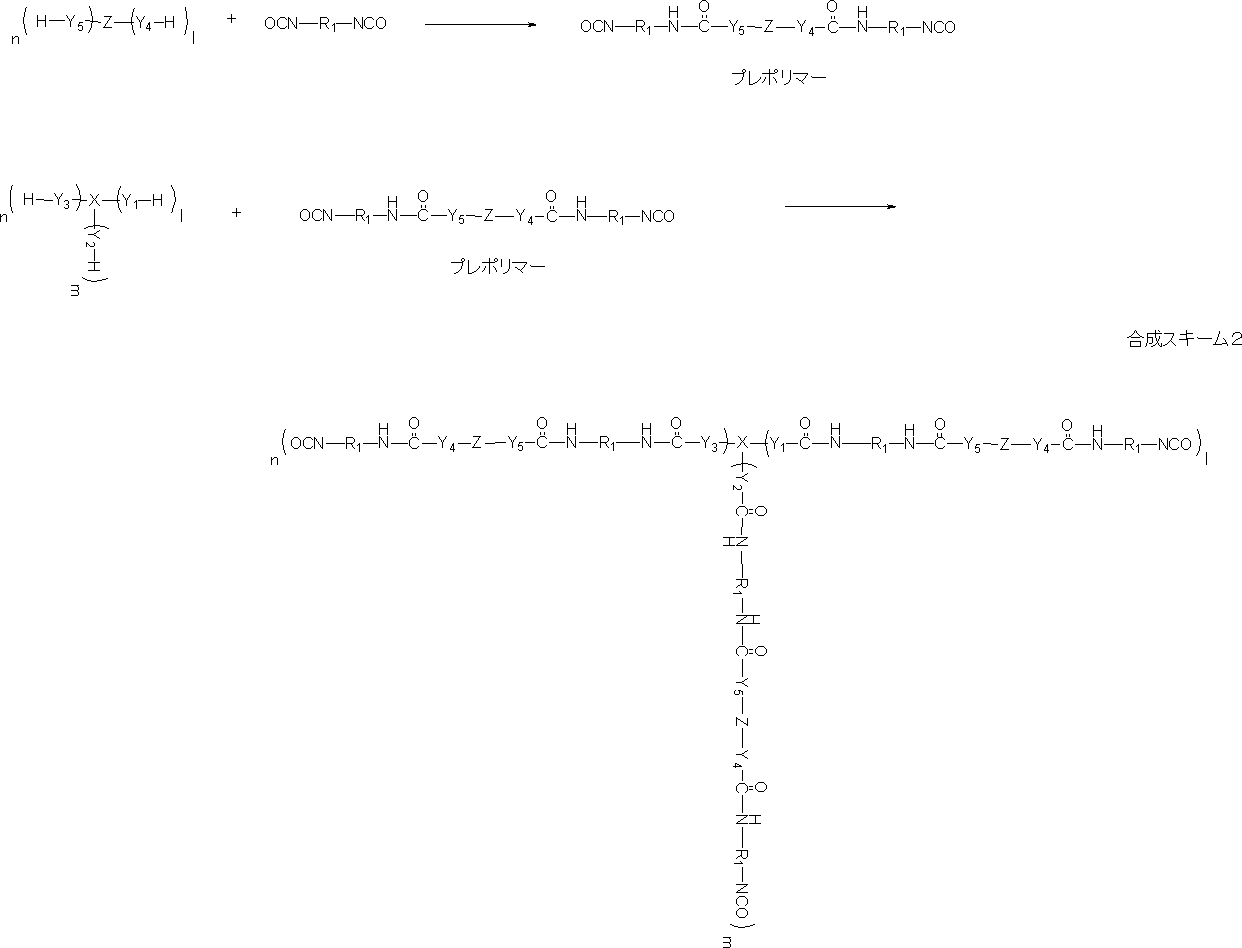
2官能以上のイソシアネート化合物としては、例えば、2官能以上の芳香族イソシアネート化合物、2官能以上の脂肪族イソシアネート化合物などを挙げることができる。
2官能以上のイソシアネート化合物の具体例としては、イソホロンジイソシアネート(IPDI)、m-フェニレンジイソシアネート、p-フェニレンジイソシアネート、2,6-トリレンジイソシアネート、2,4-トリレンジイソシアネート(TDI)、ナフタレン-1,4-ジイソシアネート、ジフェニルメタン-4,4’-ジイソシアネート(MDI)、3,3’-ジメトキシ-ビフェニルジイソシアネート、3,3’-ジメチルジフェニルメタン-4,4’-ジイソシアネート、m-キシリレンジイソシアネート(XDI)、p-キシリレンジイソシアネート、4-クロロキシリレン-1,3-ジイソシアネート、2-メチルキシリレン-1,3-ジイソシアネート、4,4’-ジフェニルプロパンジイソシアネート、4,4’-ジフェニルヘキサフルオロプロパンジイソシアネート、トリメチレンジイソシアネート、ヘキサメチレンジイソシアネート(HDI)、プロピレン-1,2-ジイソシアネート、ブチレン-1,2-ジイソシアネート、シクロヘキシレン-1,2-ジイソシアネート、シクロヘキシレン-1,3-ジイソシアネート、シクロヘキシレン-1,4-ジイソシアネート、ジシクロヘキシルメタン-4,4’-ジイソシアネート、1,4-ビス(イソシアネートメチル)シクロヘキサン、1,3-ビス(イソシアネートメチル)シクロヘキサン(HXDI)、ノルボルネンジイソシアネート(NBDI)、トリメチルヘキサメチレンジイソシアネート(TMHDI)、リジンジイソシアネート、1,3-ビス(2-イソシアネート2-プロピル)ベンゼンなどが挙げられる。
2官能以上のイソシアネート化合物としては、下記(8-1)~(8-24)に示す構造の化合物が好ましい。
2官能以上のイソシアネート化合物としては、下記(8-1)~(8-24)に示す構造の化合物が好ましい。

これらの2官能以上のイソシアネート化合物の中でも、イソホロンジイソシアネート(IPDI)、ヘキサメチレンジイソシアネート(HDI)、トリメチルヘキサメチレンジイソシアネート(TMHDI)、1,3-ビス(イソシアネートメチル)シクロヘキサン(HXDI)、m-キシリレンジイソシアネート(XDI)、又はジシクロヘキシルメタン-4,4’-ジイソシアネートが好ましい。
また、2官能以上のイソシアネート化合物としては、上記の化合物から誘導される2官能のイソシアネート化合物も使用することができる。例えば、デュラネート(登録商標)D101、D201、A101(旭化成株式会社製)などが挙げられる。
分子中に3つ以上の活性水素基を有する化合物は、ヒドロキシル基、1級アミノ基、2級アミノ基、及びメルカプト基から選ばれる少なくとも1種の基を分子中に3つ以上有する化合物であり、例えば、下記式(9-1)~(9-13)のいずれか1つで表される構造の化合物が挙げられる。式(9-1)~(9-13)中、nは、1~200の整数を表し、好ましくは1~50の整数であり、より好ましくは1~20の整数である。

アダクト型の3官能以上のイソシアネート化合物は、下記表3に示す組み合わせで分子中に2つ以上の活性水素基を有する化合物と2官能以上のイソシアネート化合物とを反応させた化合物を用いることが好ましい。
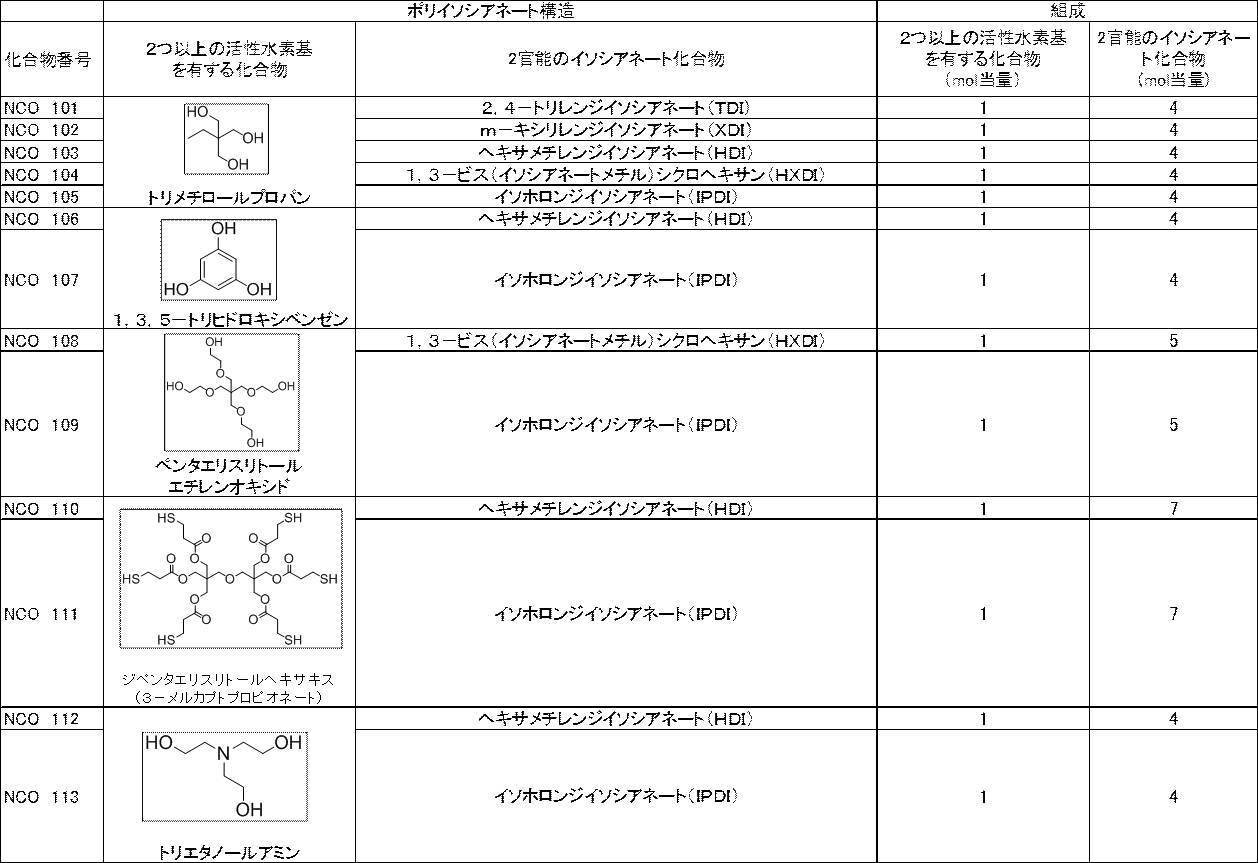
アダクト型の3官能以上のイソシアネート化合物としては、上記表3に示した化合物の中で、NCO102~NCO105、NCO107、NCO108、NCO111、及びNCO113がより好ましい。
アダクト型の3官能以上のイソシアネート化合物としては、上市されている市販品を用いてもよく、例えば、タケネート(登録商標)D-102、D-103、D-103H、D-103M2、P49-75S、D-110N、D-120N、D-140N、D-160N(以上、三井化学株式会社製)、デスモジュール(登録商標)L75、UL57SP(以上、住化バイエルウレタン株式会社製)、コロネート(登録商標)HL、HX、L(以上、日本ポリウレタン株式会社製)、P301-75E(以上、旭化成株式会社製)などが挙げられる。
これらのアダクト型の3官能以上のイソシアネート化合物の中でも、D-110N、D-120N、D-140N、D-160N(以上、三井化学株式会社製)がより好ましい。
式(ZC)中のZCが前述の式(Z-103)で表される基である態様の多官能イソシアネート化合物は、ビウレット型のイソシアネート化合物である。
式(ZC)中のZCが前述の式(Z-104)で表される基である態様の多官能イソシアネート化合物は、イソシアヌレート型のイソシアネート化合物である。
式(ZC)中のZCが前述の式(Z-104)で表される基である態様の多官能イソシアネート化合物は、イソシアヌレート型のイソシアネート化合物である。
ビウレット型の3官能以上のイソシアネート化合物としては、上市されている市販品を用いてもよく、例えば、D-165N、NP1100(三井化学株式会社製)、デスモジュール(登録商標)N3200(住化バイエルウレタン)、デュラネート(登録商標)24A-100(旭化成株式会社製)などが挙げられる。
また、イソシアヌレート型の3官能以上のイソシアネート化合物としては、上市されている市販品を用いてもよく、例えば、D-127N、D-170N、D-170HN、D-172N、D-177N(三井化学株式会社製)、スミジュールN3300、デスモジュール(登録商標)N3600、N3900、Z4470BA(住化バイエルウレタン)、コロネート(登録商標)HX、HK(日本ポリウレタン株式会社製)、デュラネート(登録商標)TPA-100、TKA-100、TSA-100、TSS-100、TLA-100、TSE-100(旭化成株式会社製)などが挙げられる。
また、イソシアヌレート型の3官能以上のイソシアネート化合物としては、上市されている市販品を用いてもよく、例えば、D-127N、D-170N、D-170HN、D-172N、D-177N(三井化学株式会社製)、スミジュールN3300、デスモジュール(登録商標)N3600、N3900、Z4470BA(住化バイエルウレタン)、コロネート(登録商標)HX、HK(日本ポリウレタン株式会社製)、デュラネート(登録商標)TPA-100、TKA-100、TSA-100、TSS-100、TLA-100、TSE-100(旭化成株式会社製)などが挙げられる。
これらのビウレット型及びイソシアヌレート型の3官能以上のイソシアネート化合物の中でも、デュラネート(登録商標)24A-100(旭化成株式会社製)、D-127(三井化学株式会社製)、TKA-100、及びTSE-100(旭化成株式会社製)がより好ましい。
〔画像形成方法〕
本実施形態の画像形成方法は、上述した本開示の水分散物をインクとして用い、インクとしての水分散物を記録媒体上に付与する付与工程と、記録媒体上に付与された水分散物に、活性エネルギー線を照射する照射工程と、を有する。
これらの工程を行うことで、記録媒体上に、密着性に優れる画像が形成される。この画像は、硬度、定着性、耐水性、及び耐溶剤性にも優れる、
記録媒体としては、前述した基材(プラスチック基材等)を用いることができる。
基材と膜との密着性の観点からみた、基材の材質とP1又はP2で表されるポリマー鎖の材質との好ましい組み合わせについては、「ゲル粒子の水分散物」の項で説明したとおりである。
本実施形態の画像形成方法は、上述した本開示の水分散物をインクとして用い、インクとしての水分散物を記録媒体上に付与する付与工程と、記録媒体上に付与された水分散物に、活性エネルギー線を照射する照射工程と、を有する。
これらの工程を行うことで、記録媒体上に、密着性に優れる画像が形成される。この画像は、硬度、定着性、耐水性、及び耐溶剤性にも優れる、
記録媒体としては、前述した基材(プラスチック基材等)を用いることができる。
基材と膜との密着性の観点からみた、基材の材質とP1又はP2で表されるポリマー鎖の材質との好ましい組み合わせについては、「ゲル粒子の水分散物」の項で説明したとおりである。
<付与工程>
付与工程は、本開示の水分散物を記録媒体上に付与する工程である。
記録媒体上に水分散物を付与する態様としては、インクジェット法によって付与する態様が好ましい。
付与工程は、本開示の水分散物を記録媒体上に付与する工程である。
記録媒体上に水分散物を付与する態様としては、インクジェット法によって付与する態様が好ましい。
インクジェット法による水分散物の付与は、公知のインクジェット記録装置を用いて行うことができる。
インクジェット記録装置としては、特に制限はなく、目的とする解像度を達成し得る公知のインクジェット記録装置を任意に選択して使用することができる。
すなわち、市販品を含む公知のインクジェット記録装置であれば、いずれも、本実施形態の画像形成方法における記録媒体への水分散物の吐出を実施することができる。
インクジェット記録装置としては、特に制限はなく、目的とする解像度を達成し得る公知のインクジェット記録装置を任意に選択して使用することができる。
すなわち、市販品を含む公知のインクジェット記録装置であれば、いずれも、本実施形態の画像形成方法における記録媒体への水分散物の吐出を実施することができる。
インクジェット記録装置としては、例えば、インク供給系、温度センサー、加熱手段を含む装置が挙げられる。
インク供給系は、例えば、本開示の水分散物を含む元タンク、供給配管、インクジェットヘッド直前のインク供給タンク、フィルター、ピエゾ型のインクジェットヘッドからなる。ピエゾ型のインクジェットヘッドは、好ましくは1pl~100pl、より好ましくは8pl~30plのマルチサイズドットを、好ましくは320dpi×320dpi~4000dpi×4000dpi(dot per inch)、より好ましくは400dpi×400dpi~1600dpi×1600dpi、さらに好ましくは720dpi×720dpiの解像度で吐出できるよう駆動することができる。なお、本実施形態でいうdpi(dot per inch)とは、2.54cm(1inch)当たりのドット数を表す。
インク供給系は、例えば、本開示の水分散物を含む元タンク、供給配管、インクジェットヘッド直前のインク供給タンク、フィルター、ピエゾ型のインクジェットヘッドからなる。ピエゾ型のインクジェットヘッドは、好ましくは1pl~100pl、より好ましくは8pl~30plのマルチサイズドットを、好ましくは320dpi×320dpi~4000dpi×4000dpi(dot per inch)、より好ましくは400dpi×400dpi~1600dpi×1600dpi、さらに好ましくは720dpi×720dpiの解像度で吐出できるよう駆動することができる。なお、本実施形態でいうdpi(dot per inch)とは、2.54cm(1inch)当たりのドット数を表す。
<照射工程>
照射工程は、記録媒体上に付与された水分散物に、活性エネルギー線を照射する工程である。
記録媒体上に付与された水分散物に活性エネルギー線を照射することで、水分散物中のゲル粒子の架橋反応が進行し、画像を定着させ、画像の膜強度等を向上させることができる。
照射工程は、記録媒体上に付与された水分散物に、活性エネルギー線を照射する工程である。
記録媒体上に付与された水分散物に活性エネルギー線を照射することで、水分散物中のゲル粒子の架橋反応が進行し、画像を定着させ、画像の膜強度等を向上させることができる。
照射工程で用いることができる活性エネルギー線としては、紫外線(以下、UV光とも称する)、可視光線、電子線等が挙げられ、中でも、UV光が好ましい。
活性エネルギー線(光)のピーク波長は、200nm~405nmであることが好ましく、220nm~390nmであることがより好ましく、220nm~385nmであることが更に好ましく、220nm~365nmであることが更に好ましい。
また、200nm~310nmであることも好ましく、200nm~280nmであることも好ましい。
また、200nm~310nmであることも好ましく、200nm~280nmであることも好ましい。
活性エネルギー線(光)が照射される際の露光面照度は、例えば10mW/cm2~2000mW/cm2、好ましくは20mW/cm2~1000mW/cm2である。
活性エネルギー線(光)を発生させるための光源としては、水銀ランプ、メタルハライドランプ、UV蛍光灯、ガスレーザー、固体レーザー等が広く知られている。
また、上記で例示された光源の、半導体紫外発光デバイスへの置き換えは、産業的、環境的に非常に有用である。
半導体紫外発光デバイスの中でも、LED(Light Emitting Diode)及びLD(Laser Diode)は、小型、高寿命、高効率、低コストであり、光源として期待されている。
光源としては、メタルハライドランプ、超高圧水銀ランプ、高圧水銀ランプ、中圧水銀ランプ、低圧水銀ランプ、LED、又は青紫レーザーが好ましい。
中でも、波長365nm、405nm、若しくは436nmの光照射が可能な超高圧水銀ランプ、波長365nm、405nm、若しくは436nmの光照射が可能な高圧水銀ランプ、又は、波長355nm、365nm、385nm、395nm、若しくは405nmの光照射が可能なLEDがより好ましく、波長355nm、365nm、385nm、395nm、若しくは405nmの光照射が可能なLEDが最も好ましい。
また、上記で例示された光源の、半導体紫外発光デバイスへの置き換えは、産業的、環境的に非常に有用である。
半導体紫外発光デバイスの中でも、LED(Light Emitting Diode)及びLD(Laser Diode)は、小型、高寿命、高効率、低コストであり、光源として期待されている。
光源としては、メタルハライドランプ、超高圧水銀ランプ、高圧水銀ランプ、中圧水銀ランプ、低圧水銀ランプ、LED、又は青紫レーザーが好ましい。
中でも、波長365nm、405nm、若しくは436nmの光照射が可能な超高圧水銀ランプ、波長365nm、405nm、若しくは436nmの光照射が可能な高圧水銀ランプ、又は、波長355nm、365nm、385nm、395nm、若しくは405nmの光照射が可能なLEDがより好ましく、波長355nm、365nm、385nm、395nm、若しくは405nmの光照射が可能なLEDが最も好ましい。
照射工程おいては、記録媒体上に付与された水分散物に対する活性エネルギー線の照射時間は、例えば0.01秒間~120秒間であり、好ましくは0.1秒間~90秒間である。
活性エネルギー線の照射条件及び基本的な照射方法については、特開昭60-132767号公報に開示されている条件を適宜参照できる。
活性エネルギー線の照射方式として、具体的には、インクの吐出装置を含むヘッドユニットの両側に光源を設け、いわゆるシャトル方式でヘッドユニット及び光源を走査する方式、又は、駆動を伴わない別光源によって活性エネルギー線の照射を行う方式が好ましい。
活性エネルギー線の照射は、水分散物を着弾して加熱乾燥を行った後、一定時間(例えば0.01秒間~120秒間、好ましくは0.01秒間~60秒間)をおいて行うことが好ましい。
活性エネルギー線の照射条件及び基本的な照射方法については、特開昭60-132767号公報に開示されている条件を適宜参照できる。
活性エネルギー線の照射方式として、具体的には、インクの吐出装置を含むヘッドユニットの両側に光源を設け、いわゆるシャトル方式でヘッドユニット及び光源を走査する方式、又は、駆動を伴わない別光源によって活性エネルギー線の照射を行う方式が好ましい。
活性エネルギー線の照射は、水分散物を着弾して加熱乾燥を行った後、一定時間(例えば0.01秒間~120秒間、好ましくは0.01秒間~60秒間)をおいて行うことが好ましい。
<加熱乾燥工程>
本実施形態の画像形成方法は、必要に応じ、付与工程後であって照射工程前に、更に、記録媒体上の水分散物を加熱乾燥する加熱乾燥工程を有していてもよい。
加熱乾燥を行うための加熱手段としては特に限定されないが、ヒートドラム、温風、赤外線ランプ、熱オーブン、ヒート版などが挙げられる
加熱温度は、40℃以上が好ましく、40℃~150℃がより好ましく、40℃~80℃が更に好ましい。
なお、加熱時間は、水分散物の組成、印刷速度等を加味し、適宜設定することができる。
本実施形態の画像形成方法は、必要に応じ、付与工程後であって照射工程前に、更に、記録媒体上の水分散物を加熱乾燥する加熱乾燥工程を有していてもよい。
加熱乾燥を行うための加熱手段としては特に限定されないが、ヒートドラム、温風、赤外線ランプ、熱オーブン、ヒート版などが挙げられる
加熱温度は、40℃以上が好ましく、40℃~150℃がより好ましく、40℃~80℃が更に好ましい。
なお、加熱時間は、水分散物の組成、印刷速度等を加味し、適宜設定することができる。
以下、本発明を実施例により具体的に説明するが、本発明はその主旨を越えない限り、以下の実施例に限定されるものではない。
なお、特に断りのない限り、「部」は質量基準である。
なお、特に断りのない限り、「部」は質量基準である。
〔ポリマージオールの準備〕
後述の各実施例(表4及び表5)における三次元架橋構造の原料として、表4及び表5に示すポリマージオール(ポリマージオール(1PD)又はポリマージオール(2PD))を準備した。表4及び表5中のポリマージオールの詳細については、前述の表1又は表2を参照することができる。
後述の各実施例(表4及び表5)における三次元架橋構造の原料として、表4及び表5に示すポリマージオール(ポリマージオール(1PD)又はポリマージオール(2PD))を準備した。表4及び表5中のポリマージオールの詳細については、前述の表1又は表2を参照することができる。
〔イソシアネート基含有ポリマーの合成〕
上記で準備したポリマージオールを用い、後述の各実施例(表4及び表5)に示す、三次元架橋構造の原料であるイソシアネート基含有ポリマーP-1~P-45の合成を行った。
後述の各実施例では、ゲル化工程において、少なくともイソシアネート基含有ポリマーP-1~P-45のイソシアネート基と水との反応によってウレア結合が形成され、これにより、ウレア結合を有する三次元架橋構造(ポリマー構造(1)又はポリマー構造(2))が形成される。
上記で準備したポリマージオールを用い、後述の各実施例(表4及び表5)に示す、三次元架橋構造の原料であるイソシアネート基含有ポリマーP-1~P-45の合成を行った。
後述の各実施例では、ゲル化工程において、少なくともイソシアネート基含有ポリマーP-1~P-45のイソシアネート基と水との反応によってウレア結合が形成され、これにより、ウレア結合を有する三次元架橋構造(ポリマー構造(1)又はポリマー構造(2))が形成される。
<イソシアネート基含有ポリマーP-1の合成>
下記スキームに従い、イソシアネート基含有ポリマーP-1の合成を行った。
下記スキームに従い、イソシアネート基含有ポリマーP-1の合成を行った。
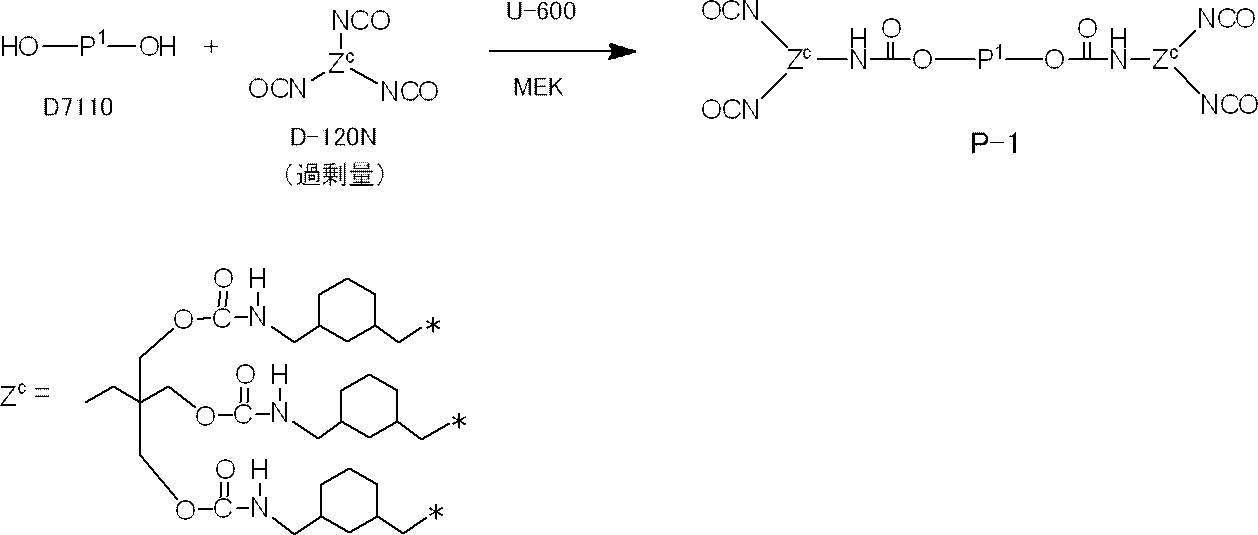
上記スキームの詳細な操作は以下のとおりである。
ポリマージオール(1PD)としてのD7110(表1参照)(100g)、イソシアネート化合物(ZC)としての三井化学株式会社製タケネート(登録商標)D-120N(「Zc」は上記スキーム中に記載した3価の有機基。以降、D-120Nの「Zc」の詳細な構造は省略する。)(112.33g)(D7110のOH基の量に対する過剰量)、及びメチルエチルケトン(MEK)(429.9g)を、冷却管を備えた1000mlの三口フラスコに秤量し、窒素気流下、50℃で加熱攪拌した。そこにネオスタン(登録商標)U-600(日東化成株式会社製、無機ビスマス触媒)を0.642g添加し、50℃で3時間加熱攪拌し、目的のイソシアネート含有ポリマーP-1の30質量%溶液を得た。
ここで、「D7110のOH基の量に対する過剰量」とは、具体的には、比〔D-120NのNCO基数/D7110のOH基数〕が、3.0となる量である。
ポリマージオール(1PD)としてのD7110(表1参照)(100g)、イソシアネート化合物(ZC)としての三井化学株式会社製タケネート(登録商標)D-120N(「Zc」は上記スキーム中に記載した3価の有機基。以降、D-120Nの「Zc」の詳細な構造は省略する。)(112.33g)(D7110のOH基の量に対する過剰量)、及びメチルエチルケトン(MEK)(429.9g)を、冷却管を備えた1000mlの三口フラスコに秤量し、窒素気流下、50℃で加熱攪拌した。そこにネオスタン(登録商標)U-600(日東化成株式会社製、無機ビスマス触媒)を0.642g添加し、50℃で3時間加熱攪拌し、目的のイソシアネート含有ポリマーP-1の30質量%溶液を得た。
ここで、「D7110のOH基の量に対する過剰量」とは、具体的には、比〔D-120NのNCO基数/D7110のOH基数〕が、3.0となる量である。
<イソシアネート基含有ポリマーP-2~P-16の合成>
ポリマージオールの種類及びイソシアネート化合物(ZC)の種類を後述の表4に示すように変更したこと以外はイソシアネート基含有ポリマーP-1の合成と同様にして、イソシアネート基含有ポリマーP-2~P-16を合成した。
後述の表4及び表5中の「(ZC)」欄は、イソシアネート基含有ポリマーの原料の一つであるイソシアネート化合物(ZC)の種類を示している。「(ZC)」欄中の各物質の構造は以下のとおりである。101A中のXは、三価の基である。
ポリマージオールの種類及びイソシアネート化合物(ZC)の種類を後述の表4に示すように変更したこと以外はイソシアネート基含有ポリマーP-1の合成と同様にして、イソシアネート基含有ポリマーP-2~P-16を合成した。
後述の表4及び表5中の「(ZC)」欄は、イソシアネート基含有ポリマーの原料の一つであるイソシアネート化合物(ZC)の種類を示している。「(ZC)」欄中の各物質の構造は以下のとおりである。101A中のXは、三価の基である。
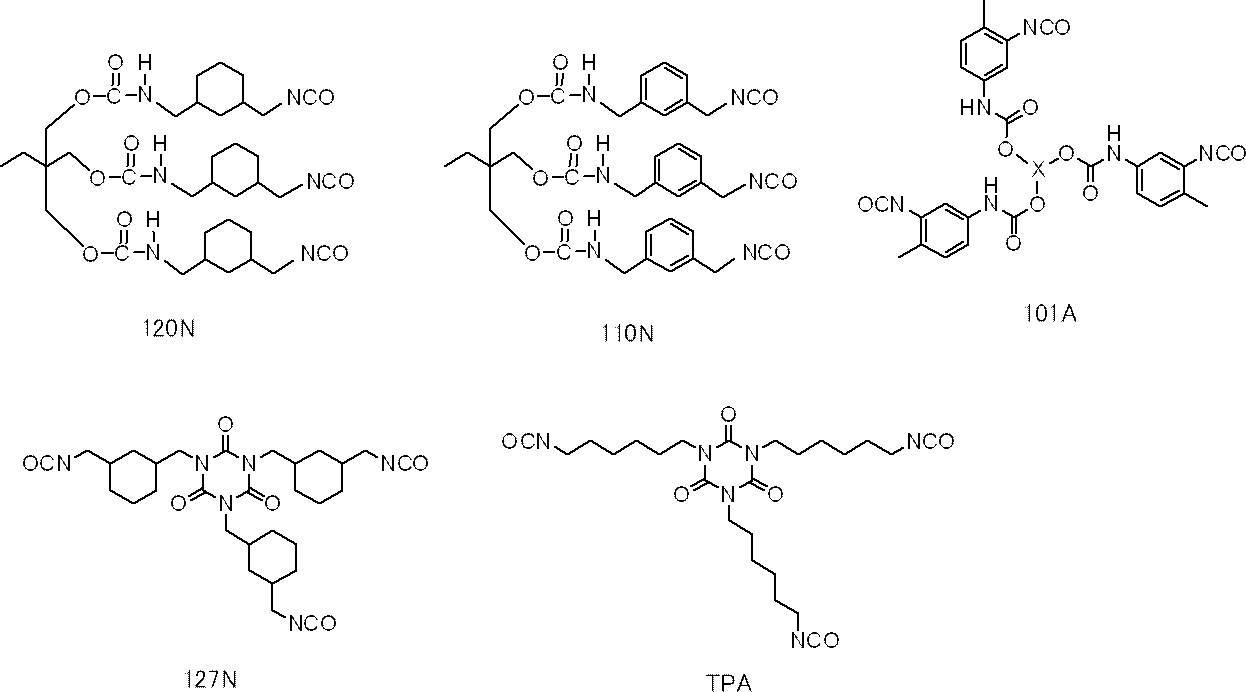
上記各物質は、詳細には、以下の市販品である。
120N … 三井化学株式会社製のタケネート(登録商標)D-120N
110N … 三井化学株式会社製のタケネート(登録商標)D-110N
101A … 三井化学株式会社製のタケネート(登録商標)D-101A
127N … 三井化学株式会社製のタケネート(登録商標)D-127N
TPA … 旭化成株式会社製のデュラネート(登録商標)TPA-100
120N … 三井化学株式会社製のタケネート(登録商標)D-120N
110N … 三井化学株式会社製のタケネート(登録商標)D-110N
101A … 三井化学株式会社製のタケネート(登録商標)D-101A
127N … 三井化学株式会社製のタケネート(登録商標)D-127N
TPA … 旭化成株式会社製のデュラネート(登録商標)TPA-100
<イソシアネート基含有ポリマーP-17の合成>
下記スキームに従い、イソシアネート基含有ポリマーP-17の合成を行った。
下記スキームに従い、イソシアネート基含有ポリマーP-17の合成を行った。
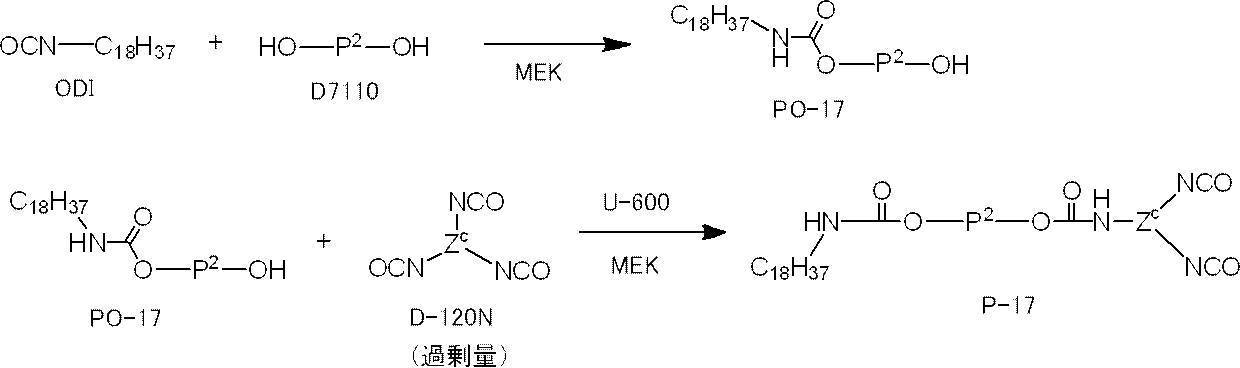
上記スキームの詳細な操作は以下のとおりである。
ポリマージオール(2PD)としてのD7110(100g)、末端封止剤(1M)としてのODI(オクタデシルイソシアネート(別名ステアリルイソシアネート))(9.66g)、及びメチルエチルケトン(MEK)(386.9g)を、冷却管を備えた1000mlの三口フラスコに秤量し、窒素気流下、50℃にした後、そこにU-600を0.459g添加し3時間加熱攪拌し、片末端封止ポリマー(2PO)としての片末端封止ポリマーPO-17の溶液を得た。室温に放冷後、D-120Nを74.89g(ポリマーPO-17のOH基の量に対して過剰量)添加しさらに50℃で3時間加熱攪拌し、目的のイソシアネート基含有ポリマーP-17の30質量%溶液を得た。
ここで、「ポリマーPO-17のOH基の量に対して過剰量」とは、具体的には、比〔D-120NのNCO基数/ポリマーPO-17のOH基数〕が、2.0となる量である。
また、上記合成において、ODIの使用量(9.66g)は、比〔ODI中のNCO基数/D7110中のOH基数〕が、0.33となる量である。
ポリマージオール(2PD)としてのD7110(100g)、末端封止剤(1M)としてのODI(オクタデシルイソシアネート(別名ステアリルイソシアネート))(9.66g)、及びメチルエチルケトン(MEK)(386.9g)を、冷却管を備えた1000mlの三口フラスコに秤量し、窒素気流下、50℃にした後、そこにU-600を0.459g添加し3時間加熱攪拌し、片末端封止ポリマー(2PO)としての片末端封止ポリマーPO-17の溶液を得た。室温に放冷後、D-120Nを74.89g(ポリマーPO-17のOH基の量に対して過剰量)添加しさらに50℃で3時間加熱攪拌し、目的のイソシアネート基含有ポリマーP-17の30質量%溶液を得た。
ここで、「ポリマーPO-17のOH基の量に対して過剰量」とは、具体的には、比〔D-120NのNCO基数/ポリマーPO-17のOH基数〕が、2.0となる量である。
また、上記合成において、ODIの使用量(9.66g)は、比〔ODI中のNCO基数/D7110中のOH基数〕が、0.33となる量である。
<イソシアネート基含有ポリマーP-18~P-34>
ポリマージオールの種類を後述の表4に示すように変更したこと以外はイソシアネート基含有ポリマーP-17の合成と同様にして、イソシアネート基含有ポリマーP-18~P-34を合成した。
ポリマージオールの種類を後述の表4に示すように変更したこと以外はイソシアネート基含有ポリマーP-17の合成と同様にして、イソシアネート基含有ポリマーP-18~P-34を合成した。
<イソシアネート基含有ポリマーP-35の合成>
下記スキームに従い、イソシアネート基含有ポリマーP-35の合成を行った。
下記スキームに従い、イソシアネート基含有ポリマーP-35の合成を行った。
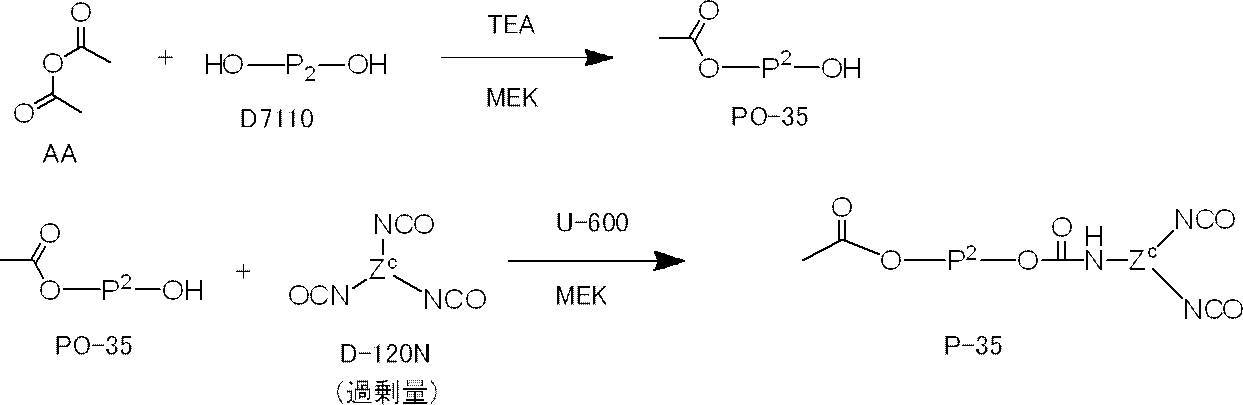
上記スキームの詳細な操作は以下のとおりである。
ポリマージオール(2PD)としての上記D7110を100g、末端封止剤(M2)の無水物としての無水酢酸(AA)を3.34g、メチルエチルケトン(MEK)250.57gを、冷却管を備えた500mlの三口フラスコに秤量し、窒素気流下、室温で攪拌した。そこにトリエチルアミン(TEA)を3.96g滴下し、さらに3時間攪拌した。得られた溶液に酢酸エチルを100g添加し、飽和炭酸水素ナトリウム水溶液で1回洗浄し、さらに蒸留水で2回洗浄した。蒸留水による2回の洗浄後の溶液を、無水硫酸マグネシウムで乾燥し、次いで溶媒を留去することにより、片末端封止ポリマー(2PO)としてのポリマーPO-35を101g得た。
片末端が封鎖されたポリマーPO-35(101g)及びメチルエチルケトン386.9gを、冷却管を備えた1000mlの三口フラスコに秤量し、D-120Nを74.89g(ポリマーPO-35のOH基の量に対して過剰量)添加し50℃に加熱した。そこにU-600を0.562g添加し、50℃で3時間加熱攪拌し、目的のイソシアネート基含有ポリマーP-35の30質量%溶液を得た。
ここで、「ポリマーPO-35のOH基の量に対して過剰量」とは、具体的には、比〔D-120NのNCO基数/ポリマーPO-35のOH基数〕が、2.0となる量である。
また、上記合成において、AAの使用量(3.34g)は、比〔AAから生じるCOOH基数/D7110中のOH基数〕が、0.33となる量である。
ポリマージオール(2PD)としての上記D7110を100g、末端封止剤(M2)の無水物としての無水酢酸(AA)を3.34g、メチルエチルケトン(MEK)250.57gを、冷却管を備えた500mlの三口フラスコに秤量し、窒素気流下、室温で攪拌した。そこにトリエチルアミン(TEA)を3.96g滴下し、さらに3時間攪拌した。得られた溶液に酢酸エチルを100g添加し、飽和炭酸水素ナトリウム水溶液で1回洗浄し、さらに蒸留水で2回洗浄した。蒸留水による2回の洗浄後の溶液を、無水硫酸マグネシウムで乾燥し、次いで溶媒を留去することにより、片末端封止ポリマー(2PO)としてのポリマーPO-35を101g得た。
片末端が封鎖されたポリマーPO-35(101g)及びメチルエチルケトン386.9gを、冷却管を備えた1000mlの三口フラスコに秤量し、D-120Nを74.89g(ポリマーPO-35のOH基の量に対して過剰量)添加し50℃に加熱した。そこにU-600を0.562g添加し、50℃で3時間加熱攪拌し、目的のイソシアネート基含有ポリマーP-35の30質量%溶液を得た。
ここで、「ポリマーPO-35のOH基の量に対して過剰量」とは、具体的には、比〔D-120NのNCO基数/ポリマーPO-35のOH基数〕が、2.0となる量である。
また、上記合成において、AAの使用量(3.34g)は、比〔AAから生じるCOOH基数/D7110中のOH基数〕が、0.33となる量である。
<イソシアネート基含有ポリマーP-36の合成>
ポリマージオールの種類を後述の表4に示すように変更したこと以外はイソシアネート基含有ポリマーP-35の合成と同様にして、イソシアネート基含有ポリマーP-36を合成した。
ポリマージオールの種類を後述の表4に示すように変更したこと以外はイソシアネート基含有ポリマーP-35の合成と同様にして、イソシアネート基含有ポリマーP-36を合成した。
<イソシアネート基含有ポリマーP-37の合成>
下記スキームに従い、イソシアネート基含有ポリマーP-37の合成を行った。
下記スキームに従い、イソシアネート基含有ポリマーP-37の合成を行った。
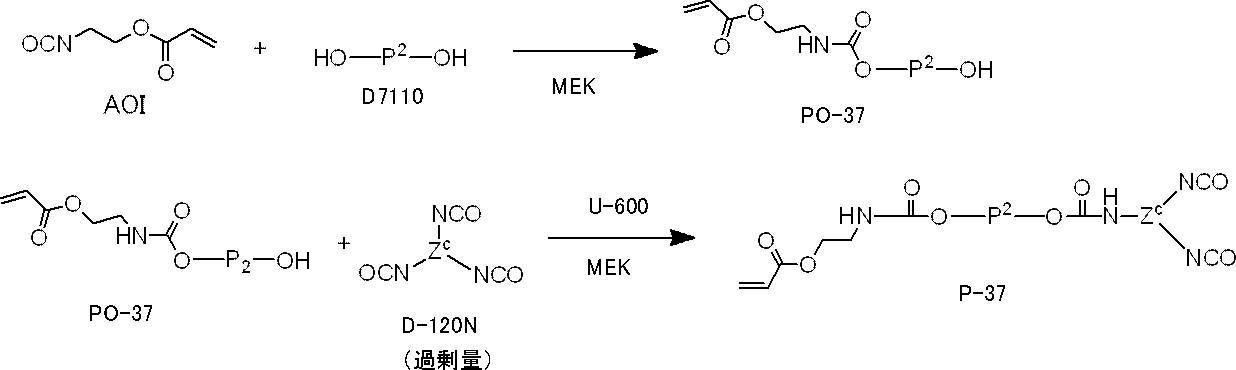
上記スキームの詳細な操作は以下のとおりである。
ポリマージオール(2PD)としての上記D7110(100g)、末端封止剤(M1)としてのAOI(昭和電工株式会社製「カレンズAOI」(登録商標)、化合物名2-アクリロイルオキシエチルイソシアネート)(4.61g)、及びメチルエチルケトン(375.1g)を、冷却管を備えた1000mlの三口フラスコに秤量し、50℃に加熱し、そこにネオスタンU-600を0.550g添加し3時間加熱攪拌し、片末端封止ポリマー(2PO)としてのポリマーPO-37の溶液を得た。室温に放冷後、D-120Nを74.89g(ポリマーPO-37のOH基の量に対して過剰量)添加しさらに50℃で3時間加熱攪拌し、目的のイソシアネート基含有ポリマーP-37の30質量%溶液を得た。
ここで、「ポリマーPO-37のOH基の量に対して過剰量」とは、具体的には、比〔D-120NのNCO基数/ポリマーPO-37のOH基数〕が、2.0となる量である。
また、上記合成において、AOIの使用量(4.61g)は、比〔AOI中のNCO基数/D7110中のOH基数〕が、0.33となる量である。
ポリマージオール(2PD)としての上記D7110(100g)、末端封止剤(M1)としてのAOI(昭和電工株式会社製「カレンズAOI」(登録商標)、化合物名2-アクリロイルオキシエチルイソシアネート)(4.61g)、及びメチルエチルケトン(375.1g)を、冷却管を備えた1000mlの三口フラスコに秤量し、50℃に加熱し、そこにネオスタンU-600を0.550g添加し3時間加熱攪拌し、片末端封止ポリマー(2PO)としてのポリマーPO-37の溶液を得た。室温に放冷後、D-120Nを74.89g(ポリマーPO-37のOH基の量に対して過剰量)添加しさらに50℃で3時間加熱攪拌し、目的のイソシアネート基含有ポリマーP-37の30質量%溶液を得た。
ここで、「ポリマーPO-37のOH基の量に対して過剰量」とは、具体的には、比〔D-120NのNCO基数/ポリマーPO-37のOH基数〕が、2.0となる量である。
また、上記合成において、AOIの使用量(4.61g)は、比〔AOI中のNCO基数/D7110中のOH基数〕が、0.33となる量である。
<イソシアネート基含有ポリマーP-38~P-45の合成>
ポリマージオールの種類を後述の表4に示すように変更したこと以外はイソシアネート基含有ポリマーP-37の合成と同様にして、イソシアネート基含有ポリマーP-38~P-45を合成した。
ポリマージオールの種類を後述の表4に示すように変更したこと以外はイソシアネート基含有ポリマーP-37の合成と同様にして、イソシアネート基含有ポリマーP-38~P-45を合成した。
〔比較ポリマーの合成〕
比較例に用いる比較ポリマーC-1~C-4の合成を行った。
比較ポリマーC-1~C-4は、いずれもイソシアネート基を含有しないポリマーである。
比較例に用いる比較ポリマーC-1~C-4の合成を行った。
比較ポリマーC-1~C-4は、いずれもイソシアネート基を含有しないポリマーである。
<比較ポリマーC-1の合成>
下記スキームに従い、比較ポリマーC-1を合成した。
下記スキームに従い、比較ポリマーC-1を合成した。

上記スキームの詳細な操作は以下のとおりである。
メチルエチルケトン75.1gを、冷却管を備えた500mlの三口フラスコに秤量し、窒素気流下、75℃で加熱攪拌した。
これとは別に、メチルエチルケトン175.2g、メタクリル酸メチル90g、1,2-エタンジオール1-アクリレート2-(N-ブチルカルバメート)10g、メタクリル酸10g及びV-601(ジメチル2,2’-アゾビス(2-メチルプロピオネート)、和光純薬工業(株)製)6.65gを混合して調製した混合溶液を、上記のフラスコに2時間かけて滴下した。滴下を終了し、75℃で4時間加熱した後、V-601 0.211gを追加し、90℃で更に2時間攪拌し、反応させた。得られた反応液を放冷し、室温まで冷却した。得られた反応液の濃度をメチルエチルケトンを用いて調整し、比較ポリマーC-1(重量平均分子量(Mw)40000)の溶液(固形分量30質量%)を得た。
メチルエチルケトン75.1gを、冷却管を備えた500mlの三口フラスコに秤量し、窒素気流下、75℃で加熱攪拌した。
これとは別に、メチルエチルケトン175.2g、メタクリル酸メチル90g、1,2-エタンジオール1-アクリレート2-(N-ブチルカルバメート)10g、メタクリル酸10g及びV-601(ジメチル2,2’-アゾビス(2-メチルプロピオネート)、和光純薬工業(株)製)6.65gを混合して調製した混合溶液を、上記のフラスコに2時間かけて滴下した。滴下を終了し、75℃で4時間加熱した後、V-601 0.211gを追加し、90℃で更に2時間攪拌し、反応させた。得られた反応液を放冷し、室温まで冷却した。得られた反応液の濃度をメチルエチルケトンを用いて調整し、比較ポリマーC-1(重量平均分子量(Mw)40000)の溶液(固形分量30質量%)を得た。
<比較ポリマーC-2の合成>
下記スキームに従い、比較ポリマーC-2を合成した。
下記スキームに従い、比較ポリマーC-2を合成した。

上記スキームの詳細な操作は以下のとおりである。
メチルエチルケトン75.1gを、冷却管を備えた500mlの三口フラスコに秤量し、窒素気流下、75℃で加熱攪拌した。これとは別に、メチルエチルケトン175.2g、メタクリル酸ブチル90g、メタクリル酸10g及びV-601(ジメチル2,2’-アゾビス(2-メチルプロピオネート)、和光純薬工業(株)製)6.612gを混合して調製した混合溶液を、上記のフラスコに2時間かけて滴下した。滴下を終了し、75℃で4時間加熱した後、V-601 0.17gを追加し、90℃で更に2時間攪拌し、反応させた。得られた反応液を放冷し、室温まで冷却した。得られた反応液の濃度をメチルエチルケトンを用いて調整し、30質量%の比較ポリマーC-2(重量平均分子量(Mw)35000)の溶液(固形分量30質量%)を得た。
メチルエチルケトン75.1gを、冷却管を備えた500mlの三口フラスコに秤量し、窒素気流下、75℃で加熱攪拌した。これとは別に、メチルエチルケトン175.2g、メタクリル酸ブチル90g、メタクリル酸10g及びV-601(ジメチル2,2’-アゾビス(2-メチルプロピオネート)、和光純薬工業(株)製)6.612gを混合して調製した混合溶液を、上記のフラスコに2時間かけて滴下した。滴下を終了し、75℃で4時間加熱した後、V-601 0.17gを追加し、90℃で更に2時間攪拌し、反応させた。得られた反応液を放冷し、室温まで冷却した。得られた反応液の濃度をメチルエチルケトンを用いて調整し、30質量%の比較ポリマーC-2(重量平均分子量(Mw)35000)の溶液(固形分量30質量%)を得た。
<比較ポリマーC-3(ウレタンアクリレート(a))の合成>
特開2013-199602号公報の段落0183に従い、比較ポリマーC-3(同公報中の「ウレタンアクリレート(a)」)を合成した。
攪拌装置、冷却管、滴下ロート、及び空気導入管を備えた反応容器に、444.6部のイソホロンジイソシアネート(IPDI)及び202.3部の1,12-ドデカンジオールを仕込み、攪拌を行いながら、0.26部のオクチル酸第1錫加え、反応容器内の温度を90℃まで昇温し、1.5時間反応させた。その後、700.0部のメトキシPEG1000(メトキシポリエチレングリコール、東邦化学工業株式会社製)及び0.54部のオクチル酸第1錫を加え、さらに1.5時間反応させた。次いで、当該反応容器に、1300.0部のジペンタエリスリトールペンタアクリレート、1.32部のメトキノン、及び1.06部のオクチル酸第1錫を仕込み、混合し、空気のバブリング下で反応容器内の温度を85℃まで昇温し、3時間反応させた後、冷却して、比較ポリマーC-3(ウレタンアクリレート(a))を得た。
上記比較ポリマーC-3の合成では、IPDI中のイソシアネート基が全て反応し、ウレタン結合が生成されていると考えられる。即ち、比較ポリマーC-3中には、イソシアネート基が残存していないと考えられる。
特開2013-199602号公報の段落0183に従い、比較ポリマーC-3(同公報中の「ウレタンアクリレート(a)」)を合成した。
攪拌装置、冷却管、滴下ロート、及び空気導入管を備えた反応容器に、444.6部のイソホロンジイソシアネート(IPDI)及び202.3部の1,12-ドデカンジオールを仕込み、攪拌を行いながら、0.26部のオクチル酸第1錫加え、反応容器内の温度を90℃まで昇温し、1.5時間反応させた。その後、700.0部のメトキシPEG1000(メトキシポリエチレングリコール、東邦化学工業株式会社製)及び0.54部のオクチル酸第1錫を加え、さらに1.5時間反応させた。次いで、当該反応容器に、1300.0部のジペンタエリスリトールペンタアクリレート、1.32部のメトキノン、及び1.06部のオクチル酸第1錫を仕込み、混合し、空気のバブリング下で反応容器内の温度を85℃まで昇温し、3時間反応させた後、冷却して、比較ポリマーC-3(ウレタンアクリレート(a))を得た。
上記比較ポリマーC-3の合成では、IPDI中のイソシアネート基が全て反応し、ウレタン結合が生成されていると考えられる。即ち、比較ポリマーC-3中には、イソシアネート基が残存していないと考えられる。
<比較ポリマーC-4(ウレタンアクリレート(b))の合成>
特開2013-199602号公報の段落0184に従い、比較ポリマーC-4(同公報中の「ウレタンアクリレート(b)」)を合成した。
攪拌装置、冷却管、滴下ロート、及び空気導入管を備えた反応容器に、578.0部のヘキサメチレンジイソシアネート(HDI)の3量体(コロネート(登録商標)HXR、日本ポリウレタン株式会社製)、200.0部のメトキシPEG400(メトキシポリエチレングリコール、東邦化学工業株式会社製)、及び200.0部のメトキシPEG1000を仕込み、攪拌を行いながら、0.39部のオクチル酸第1錫を加え、反応容器内の温度を75℃まで昇温し、1.5時間反応させた。次いで、当該反応容器に、1051.6部のペンタエリスリトールトリアクリレート、1.01部のメトキノン、及び0.81部のオクチル酸第1錫を仕込み、混合し、空気のバブリング下で反応容器内の温度を80℃まで昇温し、2時間反応させた後、冷却して、比較ポリマーC-4(ウレタンアクリレート(b))を得た。
なお、この比較ポリマーC-4(ウレタンアクリレート(b))は、片末端がアクリロイル基で、かつ、3官能のイソシアネートを用いたウレタンアクリレートである。
上記比較ポリマーC-4の合成では、HDI中のイソシアネート基が全て反応し、ウレタン結合が生成されていると考えられる。即ち、比較ポリマーC-4中には、イソシアネート基が残存していないと考えられる。
特開2013-199602号公報の段落0184に従い、比較ポリマーC-4(同公報中の「ウレタンアクリレート(b)」)を合成した。
攪拌装置、冷却管、滴下ロート、及び空気導入管を備えた反応容器に、578.0部のヘキサメチレンジイソシアネート(HDI)の3量体(コロネート(登録商標)HXR、日本ポリウレタン株式会社製)、200.0部のメトキシPEG400(メトキシポリエチレングリコール、東邦化学工業株式会社製)、及び200.0部のメトキシPEG1000を仕込み、攪拌を行いながら、0.39部のオクチル酸第1錫を加え、反応容器内の温度を75℃まで昇温し、1.5時間反応させた。次いで、当該反応容器に、1051.6部のペンタエリスリトールトリアクリレート、1.01部のメトキノン、及び0.81部のオクチル酸第1錫を仕込み、混合し、空気のバブリング下で反応容器内の温度を80℃まで昇温し、2時間反応させた後、冷却して、比較ポリマーC-4(ウレタンアクリレート(b))を得た。
なお、この比較ポリマーC-4(ウレタンアクリレート(b))は、片末端がアクリロイル基で、かつ、3官能のイソシアネートを用いたウレタンアクリレートである。
上記比較ポリマーC-4の合成では、HDI中のイソシアネート基が全て反応し、ウレタン結合が生成されていると考えられる。即ち、比較ポリマーC-4中には、イソシアネート基が残存していないと考えられる。
〔実施例1〕
<水分散物の作製>
(乳化工程)
-油相成分の作製-
イソシアネート基含有ポリマーP-1の溶液(固形分30質量%)22.3g、
トリメチロールプロパンとキシレンジイソシアネートとポリエチレングリコールモノメチルエーテルとの付加物(親水性基としてエチレンオキシ基を有する化合物)の50質量%酢酸エチル溶液(三井化学株式会社製、タケネート(登録商標)D-116N)3.5g、
重合性モノマーとしてのSR-399E(ジペンタエリスリトールペンタアクリレート;サートマー社製)7g、
光重合開始剤としてのIRGACURE(登録商標)819(BASF社製)1.07g、及び
酢酸エチル16gを混合し、各成分を溶解させて油相成分を得た。
なお、表4及び表5中では、光重合開始剤を、単に「開始剤」と表記する。
<水分散物の作製>
(乳化工程)
-油相成分の作製-
イソシアネート基含有ポリマーP-1の溶液(固形分30質量%)22.3g、
トリメチロールプロパンとキシレンジイソシアネートとポリエチレングリコールモノメチルエーテルとの付加物(親水性基としてエチレンオキシ基を有する化合物)の50質量%酢酸エチル溶液(三井化学株式会社製、タケネート(登録商標)D-116N)3.5g、
重合性モノマーとしてのSR-399E(ジペンタエリスリトールペンタアクリレート;サートマー社製)7g、
光重合開始剤としてのIRGACURE(登録商標)819(BASF社製)1.07g、及び
酢酸エチル16gを混合し、各成分を溶解させて油相成分を得た。
なお、表4及び表5中では、光重合開始剤を、単に「開始剤」と表記する。
-水相成分の作製-
親水性基(硫酸基のナトリウム塩)を有する化合物としてのヘキサデシル硫酸ナトリウム(SCS)0.493gを蒸留水46gに溶解させ、水相成分を得た。
親水性基(硫酸基のナトリウム塩)を有する化合物としてのヘキサデシル硫酸ナトリウム(SCS)0.493gを蒸留水46gに溶解させ、水相成分を得た。
上記油相成分と上記水相成分とを混合し、得られた混合物を、ホモジナイザーを用いて12000rpmで10分間乳化させて乳化物を得た。
(ゲル化工程)
上記乳化物を加熱することにより、イソシアネート基含有ポリマーP-1と水とを反応させてゲル粒子の水分散物を得た。この反応では、イソシアネート基含有ポリマーP-1のイソシアネート基と水とが反応してウレア結合が形成され、式(1)で表されるポリマー構造を有する三次元架橋構造が形成される。詳細な操作を以下に示す。
上記乳化物に蒸留水16.3gを添加し、次いで攪拌しながら40℃で5時間加熱することにより、乳化物から酢酸エチル及びメチルエチルケトンを留去した。得られた液体の温度を50℃に上昇させ、液体を50℃で24時間攪拌することにより、液体中に粒子を形成させた。粒子を含む液体を、固形分含有量(即ち、粒子の含有量)が20質量%となるように蒸留水で希釈することにより、粒子の水分散物を得た。
上記乳化物を加熱することにより、イソシアネート基含有ポリマーP-1と水とを反応させてゲル粒子の水分散物を得た。この反応では、イソシアネート基含有ポリマーP-1のイソシアネート基と水とが反応してウレア結合が形成され、式(1)で表されるポリマー構造を有する三次元架橋構造が形成される。詳細な操作を以下に示す。
上記乳化物に蒸留水16.3gを添加し、次いで攪拌しながら40℃で5時間加熱することにより、乳化物から酢酸エチル及びメチルエチルケトンを留去した。得られた液体の温度を50℃に上昇させ、液体を50℃で24時間攪拌することにより、液体中に粒子を形成させた。粒子を含む液体を、固形分含有量(即ち、粒子の含有量)が20質量%となるように蒸留水で希釈することにより、粒子の水分散物を得た。
<ゲル化の判断>
以下の操作を、液温25℃の条件で行った。
上記水分散物から試料を採取した。採取した試料に対し、この試料中の全固形分(本実施例では粒子)の100質量倍のテトラヒドロフラン(THF)を加えて混合し、水分散物の希釈液を調製した。得られた希釈液に対し、80000rpm、40分の条件の遠心分離を施した。遠心分離後、目視によって残渣の有無を確認し、残渣が確認された場合には、この残渣に水を加え、スターラーを用いて1時間攪拌することにより、残渣を水で再分散させて再分散液を得た。得られた再分散液について、湿式粒度分布測定装置(LA-910、(株)堀場製作所)を用い、光散乱法によって粒度分布を測定した。
以上の操作の結果に基づき、以下の判断基準に従い、粒子がゲル化しているか否か(即ち、粒子がゲル粒子であるか否か)を判断した。
結果を表4に示す。
以下の操作を、液温25℃の条件で行った。
上記水分散物から試料を採取した。採取した試料に対し、この試料中の全固形分(本実施例では粒子)の100質量倍のテトラヒドロフラン(THF)を加えて混合し、水分散物の希釈液を調製した。得られた希釈液に対し、80000rpm、40分の条件の遠心分離を施した。遠心分離後、目視によって残渣の有無を確認し、残渣が確認された場合には、この残渣に水を加え、スターラーを用いて1時間攪拌することにより、残渣を水で再分散させて再分散液を得た。得られた再分散液について、湿式粒度分布測定装置(LA-910、(株)堀場製作所)を用い、光散乱法によって粒度分布を測定した。
以上の操作の結果に基づき、以下の判断基準に従い、粒子がゲル化しているか否か(即ち、粒子がゲル粒子であるか否か)を判断した。
結果を表4に示す。
-ゲル化の判断基準-
Y: 遠心分離後に残渣が確認され、かつ、残渣の再分散液について粒度分布が確認され、粒子がゲル化していること(即ち、粒子がゲル粒子であること)が確認された。
N: 遠心分離後に残渣が確認されないか、または、残渣が確認されても残渣の再分散液について粒度分布が確認されず、ゲル化が確認されなかった。
Y: 遠心分離後に残渣が確認され、かつ、残渣の再分散液について粒度分布が確認され、粒子がゲル化していること(即ち、粒子がゲル粒子であること)が確認された。
N: 遠心分離後に残渣が確認されないか、または、残渣が確認されても残渣の再分散液について粒度分布が確認されず、ゲル化が確認されなかった。
<ゲル粒子の体積平均粒子径の測定>
得られた水分散物中のゲル粒子の体積平均粒子径(以下、単に「粒径」ともいう)を、上記LA-910を用い、光散乱法によって測定した。
結果を表4に示す。
得られた水分散物中のゲル粒子の体積平均粒子径(以下、単に「粒径」ともいう)を、上記LA-910を用い、光散乱法によって測定した。
結果を表4に示す。
<インク組成物の作製>
下記成分を混合し、インク組成物を作製した。
なお、得られたインク組成物も、ゲル粒子の水分散物の一態様である。
下記成分を混合し、インク組成物を作製した。
なお、得られたインク組成物も、ゲル粒子の水分散物の一態様である。
-インク組成物の成分-
・上記水分散物 … 82部
・顔料分散液(Pro-jet Cyan APD1000(登録商標)(FUJIFILM Imaging Colorants社製) … 13部
・フッ素系界面活性剤(DuPont社製、Zonyl FS300) … 0.7部
・2-メチルプロパンジオール … 4.3部
・上記水分散物 … 82部
・顔料分散液(Pro-jet Cyan APD1000(登録商標)(FUJIFILM Imaging Colorants社製) … 13部
・フッ素系界面活性剤(DuPont社製、Zonyl FS300) … 0.7部
・2-メチルプロパンジオール … 4.3部
<評価>
ゲル粒子の水分散物の一態様である上記インク組成物を用い、以下の評価を行った。
結果を表6に示す。
ゲル粒子の水分散物の一態様である上記インク組成物を用い、以下の評価を行った。
結果を表6に示す。
(硬化膜の密着性(クロスハッチテスト))
密着性の評価は、下記の評価用試料(PVC)、評価用試料(PS)、評価用試料(PC)、評価用試料(PET)、評価用試料(G変性PET)、評価用試料(PP)、及び評価用試料(Acryl)のそれぞれを用いて行った。
評価用試料(PVC)は、基材としてのポリ塩化ビニル(PVC)シートに対し、上記で得られたインク組成物を、RK PRINT COAT INSTRUMENTS社製 KハンドコーターのNo.2バーを用いて12μmの厚みで塗布し、得られた塗膜を60℃で3分間加熱して乾燥させることによって作製した。
評価用試料(PS)は、基材をポリスチレン(PS)シートに変更したこと以外は評価用試料(PVC)の作製と同様にして作製した。
評価用試料(PC)は、基材をポリカーボネート(PC)シートに変更したこと以外は評価用試料(PVC)の作製と同様にして作製した。
評価用試料(PET)は、基材をポリエチレンテレフタレート(PET)シートに変更したこと以外は評価用試料(PVC)の作製と同様にして作製した。
評価用試料(G変性PET)は、基材をグリコール変性ポリエチレンテレフタレート(G変性PET)シートに変更したこと以外は評価用試料(PVC)の作製と同様にして作製した。
評価用試料(PP)は、基材をポリプロピレン(PP)シートに変更したこと以外は評価用試料(PVC)の作製と同様にして作製した。
評価用試料(Acryl)は、基材をアクリル樹脂シートに変更したこと以外は評価用試料(PVC)の作製と同様にして作製した。
密着性の評価は、下記の評価用試料(PVC)、評価用試料(PS)、評価用試料(PC)、評価用試料(PET)、評価用試料(G変性PET)、評価用試料(PP)、及び評価用試料(Acryl)のそれぞれを用いて行った。
評価用試料(PVC)は、基材としてのポリ塩化ビニル(PVC)シートに対し、上記で得られたインク組成物を、RK PRINT COAT INSTRUMENTS社製 KハンドコーターのNo.2バーを用いて12μmの厚みで塗布し、得られた塗膜を60℃で3分間加熱して乾燥させることによって作製した。
評価用試料(PS)は、基材をポリスチレン(PS)シートに変更したこと以外は評価用試料(PVC)の作製と同様にして作製した。
評価用試料(PC)は、基材をポリカーボネート(PC)シートに変更したこと以外は評価用試料(PVC)の作製と同様にして作製した。
評価用試料(PET)は、基材をポリエチレンテレフタレート(PET)シートに変更したこと以外は評価用試料(PVC)の作製と同様にして作製した。
評価用試料(G変性PET)は、基材をグリコール変性ポリエチレンテレフタレート(G変性PET)シートに変更したこと以外は評価用試料(PVC)の作製と同様にして作製した。
評価用試料(PP)は、基材をポリプロピレン(PP)シートに変更したこと以外は評価用試料(PVC)の作製と同様にして作製した。
評価用試料(Acryl)は、基材をアクリル樹脂シートに変更したこと以外は評価用試料(PVC)の作製と同様にして作製した。
ここで、PVCシート、PSシート、PCシート、PETシート、PPシート、G変性PETシート、及びアクリル樹脂シートとしては、それぞれ、以下のシートを用いた。
・PVCシート:エイブリィ・デニソン社製の「AVERY(登録商標) 400 GLOSS WHITE PERMANENT」
・PSシート:Robert Horne社製の「falcon hi impact polystyrene」
・PCシート:タキロン(株)製の「PC1600-2」
・PPシート:Robert Horne社製の「Correx」
・PETシート:Robert Horne社製のPETシート
・G変性PETシート:Bayer社製の「VIVAK(登録商標)」
・アクリル樹脂シート:(株)JSP製の「アクリエース(登録商標)UV」
・PVCシート:エイブリィ・デニソン社製の「AVERY(登録商標) 400 GLOSS WHITE PERMANENT」
・PSシート:Robert Horne社製の「falcon hi impact polystyrene」
・PCシート:タキロン(株)製の「PC1600-2」
・PPシート:Robert Horne社製の「Correx」
・PETシート:Robert Horne社製のPETシート
・G変性PETシート:Bayer社製の「VIVAK(登録商標)」
・アクリル樹脂シート:(株)JSP製の「アクリエース(登録商標)UV」
また、この密着性の評価では、露光装置として、オゾンレスメタルハライドランプMAN250Lを搭載し、コンベアスピード35m/分、露光強度2.0W/cm2に設定した実験用UVミニコンベア装置CSOT((株)ジーエス・ユアサパワーサプライ製)を用いた。
各評価用試料の塗膜に対し、上記露光装置を用いてUV光(紫外線)を照射することにより、塗膜を硬化させて硬化膜とした。
硬化膜に対し、ISO2409(クロスカット法)に準拠してクロスハッチテストを実施し、以下の評価基準に従って評価した。
このクロスハッチテストでは、カット間隔を1mmとし、1mm角の正方形の格子を25個形成した。
下記評価基準において、0及び1が、実用上許容されるレベルである。
下記評価基準において、格子が剥がれた割合(%)は、下記式によって求められた値である。下記式における全格子数は25である。
格子が剥がれた割合(%)=〔(剥がれが生じた格子数)/(全格子数)〕×100
硬化膜に対し、ISO2409(クロスカット法)に準拠してクロスハッチテストを実施し、以下の評価基準に従って評価した。
このクロスハッチテストでは、カット間隔を1mmとし、1mm角の正方形の格子を25個形成した。
下記評価基準において、0及び1が、実用上許容されるレベルである。
下記評価基準において、格子が剥がれた割合(%)は、下記式によって求められた値である。下記式における全格子数は25である。
格子が剥がれた割合(%)=〔(剥がれが生じた格子数)/(全格子数)〕×100
-硬化膜の密着性の評価基準-
0: 格子が剥がれた割合(%)が0%であった。
1: 格子が剥がれた割合(%)が0%超5%以下であった。
2: 格子が剥がれた割合(%)が5%超15%以下であった。
3: 格子が剥がれた割合(%)が15%超35%以下であった。
4: 格子が剥がれた割合(%)が35%超65%以下であった。
5: 格子が剥がれた割合(%)が65%超であった。
0: 格子が剥がれた割合(%)が0%であった。
1: 格子が剥がれた割合(%)が0%超5%以下であった。
2: 格子が剥がれた割合(%)が5%超15%以下であった。
3: 格子が剥がれた割合(%)が15%超35%以下であった。
4: 格子が剥がれた割合(%)が35%超65%以下であった。
5: 格子が剥がれた割合(%)が65%超であった。
(硬化膜の鉛筆硬度)
硬化膜の鉛筆硬度の評価は、上記評価用試料(PVC)を用いて行った。
硬化膜の密着性の評価と同様にして、評価用試料(PVC)の塗膜にUV光を照射して硬化させ、硬化膜とした。
硬化膜に対し、鉛筆として三菱鉛筆株式会社製のUNI(登録商標)を用い、JIS K5600-5-4(1999年)に基づき、鉛筆硬度試験を行った。
この試験結果において、鉛筆硬度の許容範囲はHB以上であり、H以上であることが好ましい。鉛筆硬度が2B以下である印刷物は印刷物の取り扱い時に傷が生じる可能性があり好ましくない。
硬化膜の鉛筆硬度の評価は、上記評価用試料(PVC)を用いて行った。
硬化膜の密着性の評価と同様にして、評価用試料(PVC)の塗膜にUV光を照射して硬化させ、硬化膜とした。
硬化膜に対し、鉛筆として三菱鉛筆株式会社製のUNI(登録商標)を用い、JIS K5600-5-4(1999年)に基づき、鉛筆硬度試験を行った。
この試験結果において、鉛筆硬度の許容範囲はHB以上であり、H以上であることが好ましい。鉛筆硬度が2B以下である印刷物は印刷物の取り扱い時に傷が生じる可能性があり好ましくない。
(インク組成物の吐出性)
上記で得られたインク組成物をインクジェットプリンタ(ローランド ディー.ジー.社製、SP-300V)のヘッドから30分間吐出し、次いで吐出を停止した。
吐出の停止から5分間経過した後、上述の塩化ビニル(PVC)シート上に、再び上記ヘッドから上記インク組成物を吐出させ、5cm×5cmのベタ画像を形成した。
これらの画像を目視で観察し、不吐出ノズルの発生等によるドット欠けの有無を確認し、下記評価基準に従ってインク組成物の吐出性を評価した。
下記評価基準において、インク組成物の吐出性が最も優れるものは、Aである。
上記で得られたインク組成物をインクジェットプリンタ(ローランド ディー.ジー.社製、SP-300V)のヘッドから30分間吐出し、次いで吐出を停止した。
吐出の停止から5分間経過した後、上述の塩化ビニル(PVC)シート上に、再び上記ヘッドから上記インク組成物を吐出させ、5cm×5cmのベタ画像を形成した。
これらの画像を目視で観察し、不吐出ノズルの発生等によるドット欠けの有無を確認し、下記評価基準に従ってインク組成物の吐出性を評価した。
下記評価基準において、インク組成物の吐出性が最も優れるものは、Aである。
-吐出性の評価基準-
A:不吐出ノズルの発生等によるドット欠けの発生が認められず、良好な画像が得られた。
B:不吐出ノズルの発生等によるドット欠けの発生がわずかに認められたが、実用上支障を来さない程度であった。
C:不吐出ノズルの発生等によるドット欠けの発生があり、実用に耐えない画像であった。
D:ヘッドから吐出できなかった。
A:不吐出ノズルの発生等によるドット欠けの発生が認められず、良好な画像が得られた。
B:不吐出ノズルの発生等によるドット欠けの発生がわずかに認められたが、実用上支障を来さない程度であった。
C:不吐出ノズルの発生等によるドット欠けの発生があり、実用に耐えない画像であった。
D:ヘッドから吐出できなかった。
(インク組成物の再分散性)
イエローランプ下で以下の操作を行い、インク組成物の再分散性を評価した。
RK PRINT COAT INSTRUMENTS社製のKハンドコーターのNo.2バーを用い、上記インク組成物をアルミプレートに12μmの厚みで塗布して塗膜を形成した。得られた塗膜を、60℃で3分間加熱して乾燥させた。乾燥後の塗膜の表面を、水を含浸したスポンジでこすった。
スポンジでこする前の塗膜及びこすった後の塗膜のそれぞれについて、フーリエ変換赤外線分光測定(FT-IR)を実施した。得られた結果から、下記式に基づき、ゲル粒子の残存率を算出した。
ゲル粒子の残存率 = (スポンジでこすった後の塗膜におけるゲル粒子由来のピークの強度/スポンジでこする前の塗膜におけるゲル粒子由来のピークの強度)×100
ここで、ゲル粒子由来のピークとは、ウレア結合由来のピークである。
イエローランプ下で以下の操作を行い、インク組成物の再分散性を評価した。
RK PRINT COAT INSTRUMENTS社製のKハンドコーターのNo.2バーを用い、上記インク組成物をアルミプレートに12μmの厚みで塗布して塗膜を形成した。得られた塗膜を、60℃で3分間加熱して乾燥させた。乾燥後の塗膜の表面を、水を含浸したスポンジでこすった。
スポンジでこする前の塗膜及びこすった後の塗膜のそれぞれについて、フーリエ変換赤外線分光測定(FT-IR)を実施した。得られた結果から、下記式に基づき、ゲル粒子の残存率を算出した。
ゲル粒子の残存率 = (スポンジでこすった後の塗膜におけるゲル粒子由来のピークの強度/スポンジでこする前の塗膜におけるゲル粒子由来のピークの強度)×100
ここで、ゲル粒子由来のピークとは、ウレア結合由来のピークである。
-インク組成物の再分散性の評価基準-
A:ゲル粒子の残存率が1%以下であり、再分散性に優れていた。
B:ゲル粒子の残存率が1%超5%以下であり、再分散性が実用上許容される範囲内であった。
C:ゲル粒子の残存率が5%超10%以下であり、再分散性が実用上許容される範囲を外れていた。
D:ゲル粒子の残存率が10%超であり、再分散性が極めて悪かった。
A:ゲル粒子の残存率が1%以下であり、再分散性に優れていた。
B:ゲル粒子の残存率が1%超5%以下であり、再分散性が実用上許容される範囲内であった。
C:ゲル粒子の残存率が5%超10%以下であり、再分散性が実用上許容される範囲を外れていた。
D:ゲル粒子の残存率が10%超であり、再分散性が極めて悪かった。
(インク組成物の保存安定性)
上記インク組成物を容器に密封し、60℃で2週間経時させた後、上記の吐出性の評価と同様の評価を実施し、同様の評価基準に従い、インク組成物の保存安定性を評価した。
評価基準において、インク組成物の保存安定性が最も優れるものは、Aである。
上記インク組成物を容器に密封し、60℃で2週間経時させた後、上記の吐出性の評価と同様の評価を実施し、同様の評価基準に従い、インク組成物の保存安定性を評価した。
評価基準において、インク組成物の保存安定性が最も優れるものは、Aである。
〔実施例2~72、比較例1及び2〕
以下の点を変更したこと以外は実施例1と同様の操作を行った。結果を表4~表7に示す。
以下の点を変更したこと以外は実施例1と同様の操作を行った。結果を表4~表7に示す。
以下、実施例1からの変更点を示す。
全ての例を通じ、イソシアネート基含有ポリマーの種類、親水性基を有する化合物の種類、重合性モノマーの種類、及び光重合開始剤(表4及び表5中では「開始剤」)の種類の組み合わせを、表4及び表5に示す組み合わせとした。
全ての例を通じ、イソシアネート基含有ポリマーの種類、親水性基を有する化合物の種類、重合性モノマーの種類、及び光重合開始剤(表4及び表5中では「開始剤」)の種類の組み合わせを、表4及び表5に示す組み合わせとした。
実施例46~48(表4中、重合性モノマー欄が「-」である例)では、油相成分に重合性モノマー(SR-399E)及び酢酸エチルを含有させず、かつ、油相成分中のイソシアネート基含有ポリマーの溶液の量(22.3g)を45.6gに変更した。実施例46~48は、重合性モノマーを内包しないが、三次元架橋構造自身が重合性基を有している例である。
実施例58~67では、油相成分に、表5に示す増感剤(0.3g)を更に含有させた。
実施例68~72では、
油相成分に表5に示す増感剤(0.3g)を更に含有させ、
油相成分中のD-116N(3.5g)を下記成分(A)(3.4g)に変更し、
油相成分中の、酢酸エチルの量(16g)を15gに、イソシアネート基含有ポリマーの量(22.3g)を24.1gに、それぞれ変更し、
水相成分に水酸化ナトリウム0.054gを更に含有させ、
水相成分中の、蒸留水の量(46g)を45.76gに、SCSの量(0.493g)を0.400gに、それぞれ変更した。実施例68~70では、SCSをSDSに変更した。
実施例58~67では、油相成分に、表5に示す増感剤(0.3g)を更に含有させた。
実施例68~72では、
油相成分に表5に示す増感剤(0.3g)を更に含有させ、
油相成分中のD-116N(3.5g)を下記成分(A)(3.4g)に変更し、
油相成分中の、酢酸エチルの量(16g)を15gに、イソシアネート基含有ポリマーの量(22.3g)を24.1gに、それぞれ変更し、
水相成分に水酸化ナトリウム0.054gを更に含有させ、
水相成分中の、蒸留水の量(46g)を45.76gに、SCSの量(0.493g)を0.400gに、それぞれ変更した。実施例68~70では、SCSをSDSに変更した。
実施例68~72で用いた成分(A)(表5中では、単に「(A)」と表記する)は、2,2-ビス(ヒドロキシメチル)プロピオン酸(DMPA)とイソホロンジイソシアネート(IPDI)とを、DMPA/IPDI=1/3(モル比)の割合で反応させた反応生成物(下記イソシアネート化合物A(親水性基としてカルボキシル基を有するイソシアネート化合物))の35質量%酢酸エチル溶液である。
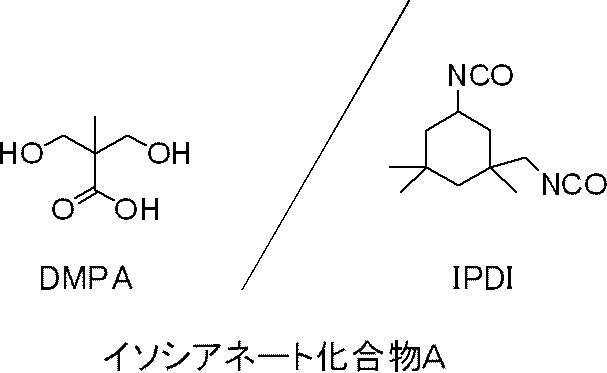
成分(A)は、以下のようにして合成した。
三口フラスコに2,2-ビス(ヒドロキシメチル)プロピオン酸(DMPA)45g、イソホロンジイソシアネート(IPDI)223.72g、酢酸エチル(AcOEt)499.05gを加え、50℃に加熱し、そこにU-600を0.7677g添加し、3時間反応させ、成分(A)として、イソシアネート化合物A(親水性基としてカルボキシル基を有するイソシアネート化合物)の35質量%酢酸エチル溶液を得た。
三口フラスコに2,2-ビス(ヒドロキシメチル)プロピオン酸(DMPA)45g、イソホロンジイソシアネート(IPDI)223.72g、酢酸エチル(AcOEt)499.05gを加え、50℃に加熱し、そこにU-600を0.7677g添加し、3時間反応させ、成分(A)として、イソシアネート化合物A(親水性基としてカルボキシル基を有するイソシアネート化合物)の35質量%酢酸エチル溶液を得た。
〔比較例3~4〕
特開2013-199602号公報の段落0187及び段落0188に従い、上述した各実施例における水分散物との比較用のエマルション(比較用エマルション)を作製した。
攪拌装置、冷却管、滴下ロート、及び空気導入管を備えた反応容器に、比較ポリマー(比較ポリマー3又は比較ポリマー4)27.5部、ポリペンタエリスリトールポリアクリレート(大阪有機化学工業株式会社製のビスコート(登録商標)#802)9.2部、及び光ラジカル重合開始剤(TPO)3.3部を仕込み、攪拌を行いながら容器内の温度を80℃に昇温し、2時間保温した。
次に、容器内の温度を50℃まで冷却した後、攪拌しながら60部の脱イオン水を加え、40℃で1時間保温することにより、不揮発分(比較ポリマー、ポリペンタエリスリトールポリアクリレート、及び光ラジカル重合開始剤(TPO))が40質量%の分散液を得た。得られた分散液に蒸留水を加え、固形分含有量が20質量%の比較用エマルションを得た。
特開2013-199602号公報の段落0187及び段落0188に従い、上述した各実施例における水分散物との比較用のエマルション(比較用エマルション)を作製した。
攪拌装置、冷却管、滴下ロート、及び空気導入管を備えた反応容器に、比較ポリマー(比較ポリマー3又は比較ポリマー4)27.5部、ポリペンタエリスリトールポリアクリレート(大阪有機化学工業株式会社製のビスコート(登録商標)#802)9.2部、及び光ラジカル重合開始剤(TPO)3.3部を仕込み、攪拌を行いながら容器内の温度を80℃に昇温し、2時間保温した。
次に、容器内の温度を50℃まで冷却した後、攪拌しながら60部の脱イオン水を加え、40℃で1時間保温することにより、不揮発分(比較ポリマー、ポリペンタエリスリトールポリアクリレート、及び光ラジカル重合開始剤(TPO))が40質量%の分散液を得た。得られた分散液に蒸留水を加え、固形分含有量が20質量%の比較用エマルションを得た。
実施例1において、水分散物を、同質量の上記比較用エマルションに変更したこと以外は実施例1と同様の操作を行った。
結果を表4~表7に示す。
結果を表4~表7に示す。


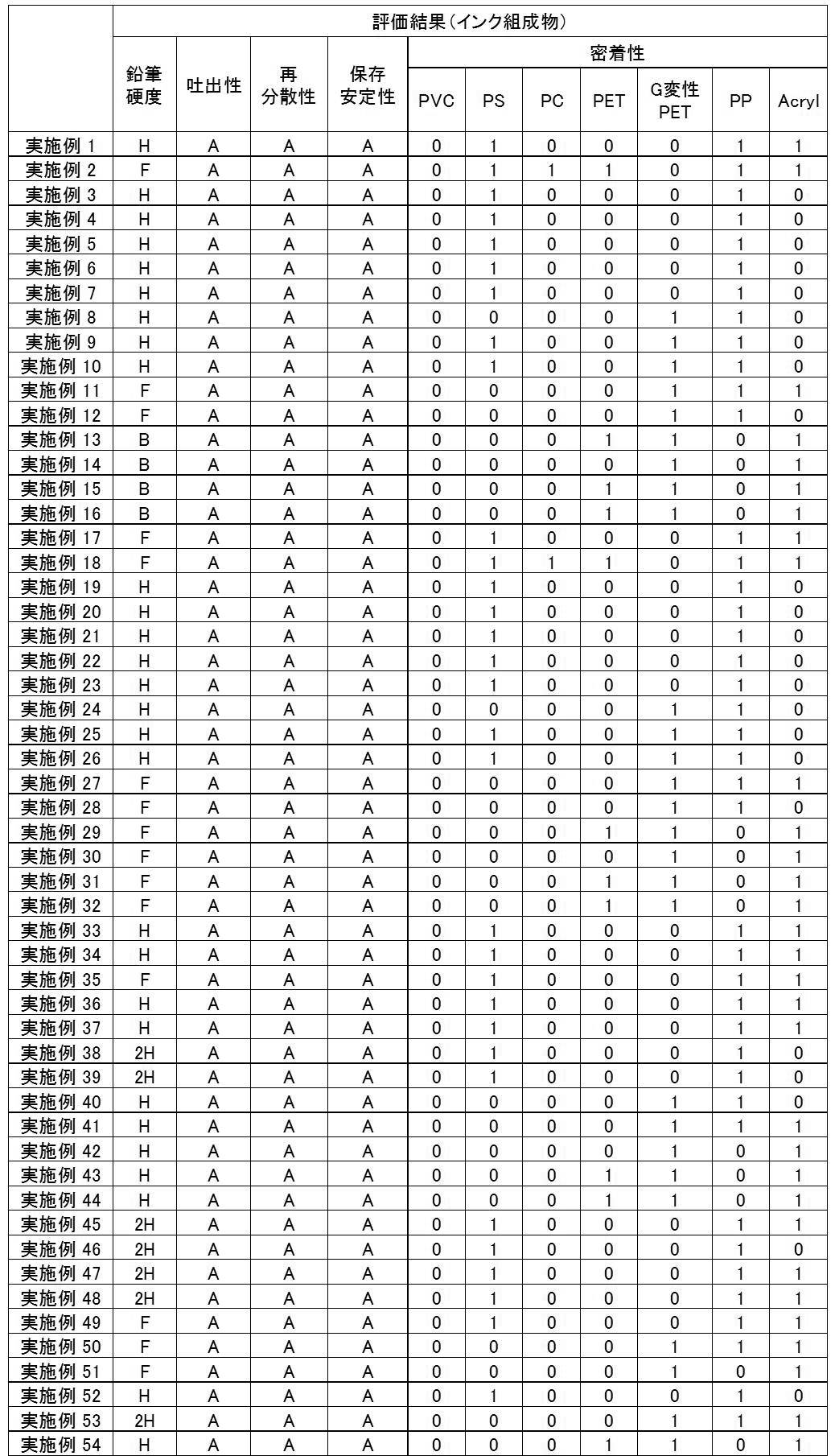
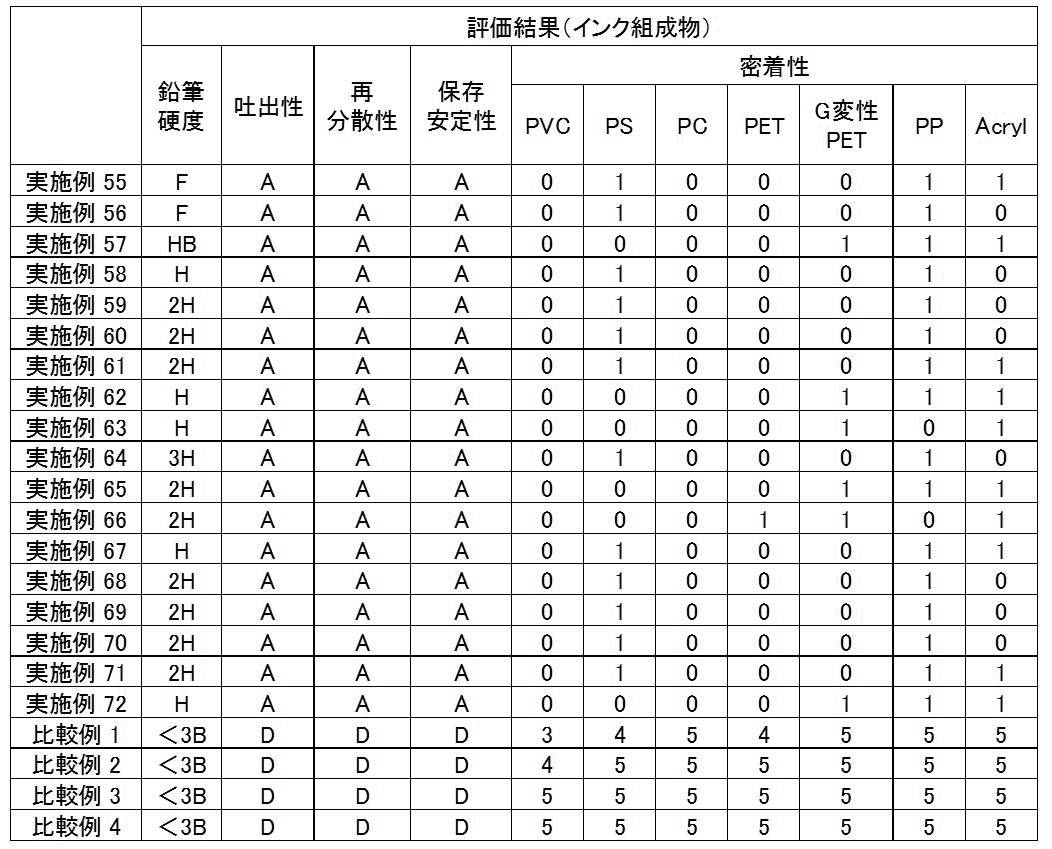
-表4及び表5の説明-
・「構造」欄中、「(1)」は、ポリマー構造(1)を示し、「(2)」は、ポリマー構造(2)を示している。
・「P1 or P2」欄には、ポリマー鎖の種類を略称で示している。略称の意味は、表1に示したとおりである。
・「基(2R)」欄では、式(2)で表されるポリマー構造のR1が、式(2R)で表される基である場合を「Y」、式(2R)で表される基ではない場合を「N」とした。
・重合性モノマーは以下のとおりである。
399E … サートマー社製のSR-399E(ジペンタエリスリトールペンタアクリレート;5官能の重合性モノマー)
DA1 … ネオペンチルグリコールプロピレンオキシド付加物のジアクリレート(NPGPODA;2官能の重合性モノマー)
TMM3L … 新中村化学工業株式会社製のA-TMM-3L(ペンタエリスリトールトリアクリレート;3官能の重合性モノマー)
DPH … 新中村化学工業株式会社製のA-DPH(ジペンタエリスリトールヘキサアクリレート;6官能の重合性モノマー)
#802 … 大阪有機化学工業株式会社製のビスコート#802(ポリペンタエリスリトールポリアクリレート;8官能の重合性モノマー)
・「開始剤」は、光重合開始剤を意味する。光重合開始剤は以下のとおりである。
819 … IRGACURE(登録商標) 819(ビス(2,4,6-トリメチルベンゾイル)-フェニルホスフィンオキシド;BASF社製)
907 … IRGACURE(登録商標) 907(2-メチル-1-(4-メチルチオフェニル)-2-モルフォリノプロパン-1-オン;BASF社製)
TPO … LUCIRIN(登録商標) TPO(2,4,6-トリメチルベンゾイル-ジフェニル-ホスフィンオキシド;BASF社製)
・増感剤は以下のとおりである。
1331 … 川崎化成工業株式会社製の光カチオン増感剤 アントラキュアー(登録商標)UVS-1331(9,10-ジブトキシアントラセン)
ITX … 2-イソプロピルチオキサントン
DETX … 2,4-ジエチルチオキサントン
・親水性基を有する化合物は、以下のとおりである。
SCS … ヘキサデシル硫酸ナトリウム(親水性基として硫酸基のナトリウム塩を有する化合物)
SDS … ドデシル硫酸ナトリウム(親水性基として硫酸基のナトリウム塩を有する化合物)
116N … 三井化学株式会社製のタケネート(登録商標)D-116N〔トリメチロールプロパン(TMP)とキシレンジイソシアネート(XDI)とポリエチレングリコールモノメチルエーテル(EO90)との付加物(親水性基としてエチレンオキシ基を有する化合物;構造を以下に示す)の50質量%酢酸エチル溶液〕
・「構造」欄中、「(1)」は、ポリマー構造(1)を示し、「(2)」は、ポリマー構造(2)を示している。
・「P1 or P2」欄には、ポリマー鎖の種類を略称で示している。略称の意味は、表1に示したとおりである。
・「基(2R)」欄では、式(2)で表されるポリマー構造のR1が、式(2R)で表される基である場合を「Y」、式(2R)で表される基ではない場合を「N」とした。
・重合性モノマーは以下のとおりである。
399E … サートマー社製のSR-399E(ジペンタエリスリトールペンタアクリレート;5官能の重合性モノマー)
DA1 … ネオペンチルグリコールプロピレンオキシド付加物のジアクリレート(NPGPODA;2官能の重合性モノマー)
TMM3L … 新中村化学工業株式会社製のA-TMM-3L(ペンタエリスリトールトリアクリレート;3官能の重合性モノマー)
DPH … 新中村化学工業株式会社製のA-DPH(ジペンタエリスリトールヘキサアクリレート;6官能の重合性モノマー)
#802 … 大阪有機化学工業株式会社製のビスコート#802(ポリペンタエリスリトールポリアクリレート;8官能の重合性モノマー)
・「開始剤」は、光重合開始剤を意味する。光重合開始剤は以下のとおりである。
819 … IRGACURE(登録商標) 819(ビス(2,4,6-トリメチルベンゾイル)-フェニルホスフィンオキシド;BASF社製)
907 … IRGACURE(登録商標) 907(2-メチル-1-(4-メチルチオフェニル)-2-モルフォリノプロパン-1-オン;BASF社製)
TPO … LUCIRIN(登録商標) TPO(2,4,6-トリメチルベンゾイル-ジフェニル-ホスフィンオキシド;BASF社製)
・増感剤は以下のとおりである。
1331 … 川崎化成工業株式会社製の光カチオン増感剤 アントラキュアー(登録商標)UVS-1331(9,10-ジブトキシアントラセン)
ITX … 2-イソプロピルチオキサントン
DETX … 2,4-ジエチルチオキサントン
・親水性基を有する化合物は、以下のとおりである。
SCS … ヘキサデシル硫酸ナトリウム(親水性基として硫酸基のナトリウム塩を有する化合物)
SDS … ドデシル硫酸ナトリウム(親水性基として硫酸基のナトリウム塩を有する化合物)
116N … 三井化学株式会社製のタケネート(登録商標)D-116N〔トリメチロールプロパン(TMP)とキシレンジイソシアネート(XDI)とポリエチレングリコールモノメチルエーテル(EO90)との付加物(親水性基としてエチレンオキシ基を有する化合物;構造を以下に示す)の50質量%酢酸エチル溶液〕
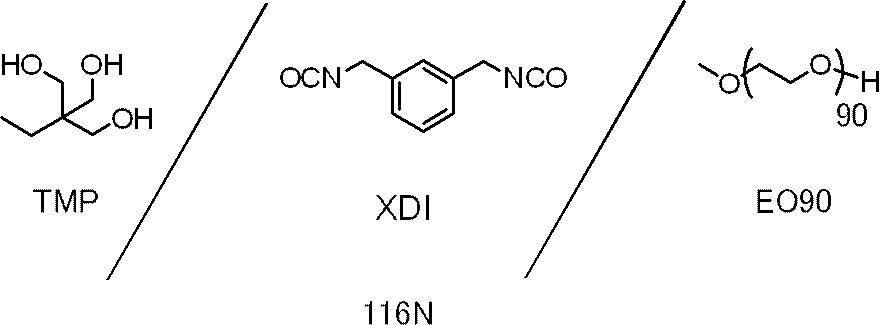
表4~表7に示すように、式(1)で表されるポリマー構造又は式(2)で表されるポリマー構造を含む三次元架橋構造を有し、親水性基及び重合性基を有し、光重合開始剤を内包しているゲル粒子が、水に分散されている実施例1~72のインク組成物(ゲル粒子の水分散物)によれば、各種基材との密着性、及び、鉛筆硬度に優れた画像(即ち、膜)を形成することができた。更に、実施例1~72のインク組成物は、吐出性、再分散性、及び保存安定性にも優れていた。
これに対し、ゲル粒子を含まない(即ち、粒子がゲル化していない)比較例1~4のインク組成物を用いて形成された膜は、基材との密着性、及び、鉛筆硬度が低下した。比較例1~4のインク組成物は、吐出性、再分散性、及び保存安定性にも劣っていた。
これに対し、ゲル粒子を含まない(即ち、粒子がゲル化していない)比較例1~4のインク組成物を用いて形成された膜は、基材との密着性、及び、鉛筆硬度が低下した。比較例1~4のインク組成物は、吐出性、再分散性、及び保存安定性にも劣っていた。
また、実施例1~72において、インク組成物の調製前の水分散物(即ち、インク組成物の原料として用いた水分散物。以下同じ。)について、前述した方法により、光重合開始剤の内包率(質量%)を測定した。その結果、光重合開始剤の内包率(質量%)はいずれも99質量%以上であった。
また、実施例1~45及び49~72において、インク組成物の調製前の水分散物(インク組成物の原料として用いた水分散物)について、前述した方法により、重合性モノマーの内包率(質量%)を測定した。その結果、重合性モノマーの内包率(質量%)はいずれも99質量%以上であった。
また、実施例58~72において、インク組成物の調製前の水分散物(インク組成物の原料として用いた水分散物)について、前述した方法により、増感剤の内包率(質量%)を測定した。その結果、増感剤の内包率(質量%)は99質量%以上であった。
また、実施例1~45及び49~72において、インク組成物の調製前の水分散物(インク組成物の原料として用いた水分散物)について、前述した方法により、重合性モノマーの内包率(質量%)を測定した。その結果、重合性モノマーの内包率(質量%)はいずれも99質量%以上であった。
また、実施例58~72において、インク組成物の調製前の水分散物(インク組成物の原料として用いた水分散物)について、前述した方法により、増感剤の内包率(質量%)を測定した。その結果、増感剤の内包率(質量%)は99質量%以上であった。
また、フーリエ変換赤外線分光測定(FT-IR)分析の結果により、実施例1~72における水分散物(詳細には、インク組成物の調製前の水分散物)中のゲル粒子は、いずれも、重合性基を有するゲル粒子であることが確認された。
<LEDを用いた評価>
下記表8に示す各実施例のインク組成物について、LEDを用いた評価を行った。
詳細には、各実施例における、上述の鉛筆硬度及び密着性(PS、PC、PET、G変性PET、PP、及びAcrylに対する密着性)の評価において、露光光源を、実験用385nmUV-LED照射器(CCS株式会社製)に変更し、露光エネルギーを300mJ/cm2に変更したこと以外は同様の操作を行った。
結果を表8に示す。
下記表8に示す各実施例のインク組成物について、LEDを用いた評価を行った。
詳細には、各実施例における、上述の鉛筆硬度及び密着性(PS、PC、PET、G変性PET、PP、及びAcrylに対する密着性)の評価において、露光光源を、実験用385nmUV-LED照射器(CCS株式会社製)に変更し、露光エネルギーを300mJ/cm2に変更したこと以外は同様の操作を行った。
結果を表8に示す。
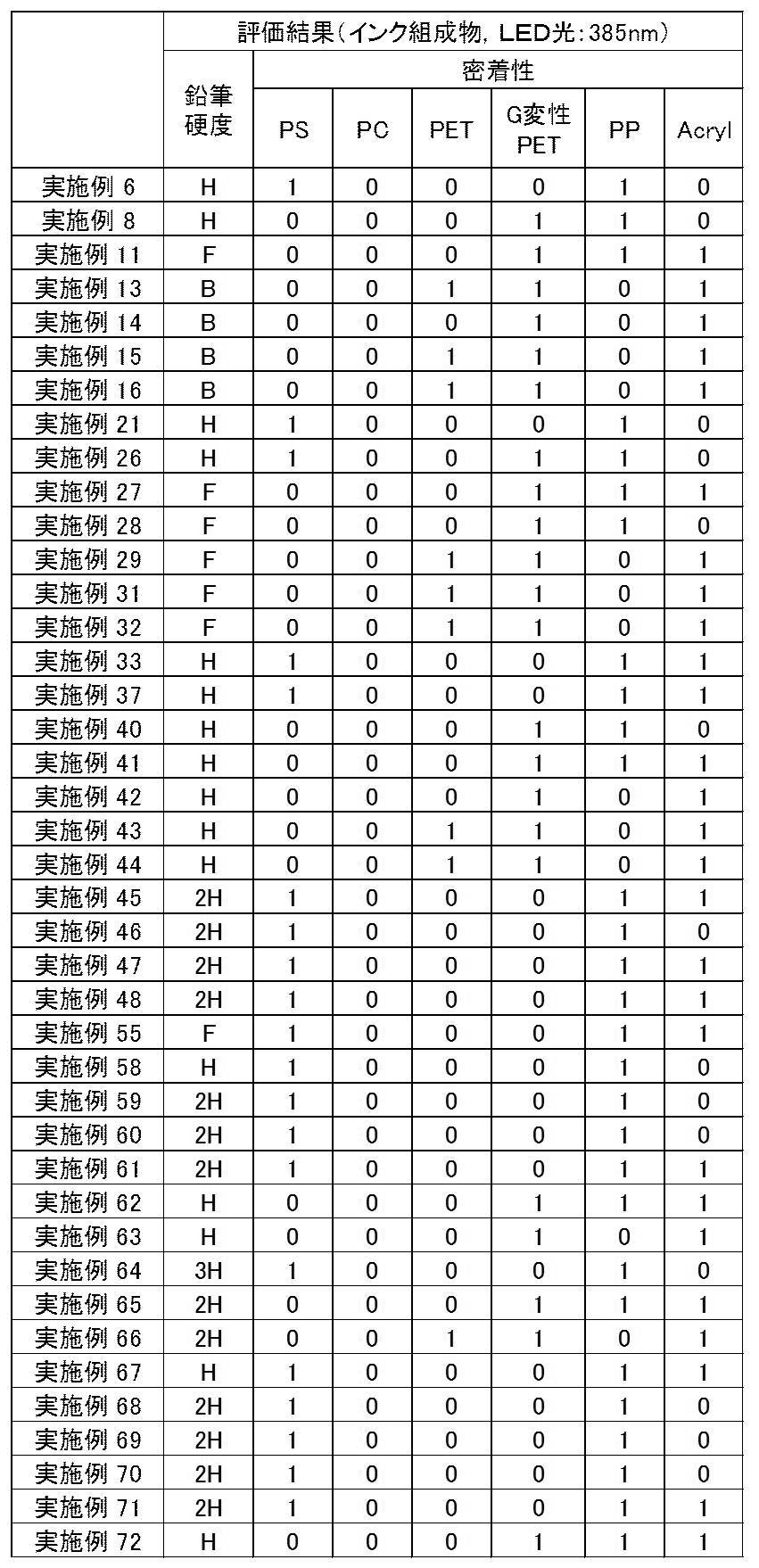
表8に示すように、これらの実施例のインク組成物では、LED光を用いた鉛筆硬度及び密着性の評価においても、優れた結果が得られた。
<塗布液の評価>
実施例1~72及び比較例1~4で作製した水分散物を用いて以下の成分の塗布液を作製し、作製された塗布液を用い、前述した方法により、鉛筆硬度及び密着性(PVC及びAcryl)の評価を行った。結果を表9及び表10に示す。
実施例1~72及び比較例1~4で作製した水分散物を用いて以下の成分の塗布液を作製し、作製された塗布液を用い、前述した方法により、鉛筆硬度及び密着性(PVC及びAcryl)の評価を行った。結果を表9及び表10に示す。
-塗布液の成分-
・上記水分散物 … 82部
・フッ素系界面活性剤(DuPont社製、Zonyl FS300) … 0.7部
・2-メチルプロパンジオール … 4.3部
・水 … 全体で100部となる残部
・上記水分散物 … 82部
・フッ素系界面活性剤(DuPont社製、Zonyl FS300) … 0.7部
・2-メチルプロパンジオール … 4.3部
・水 … 全体で100部となる残部
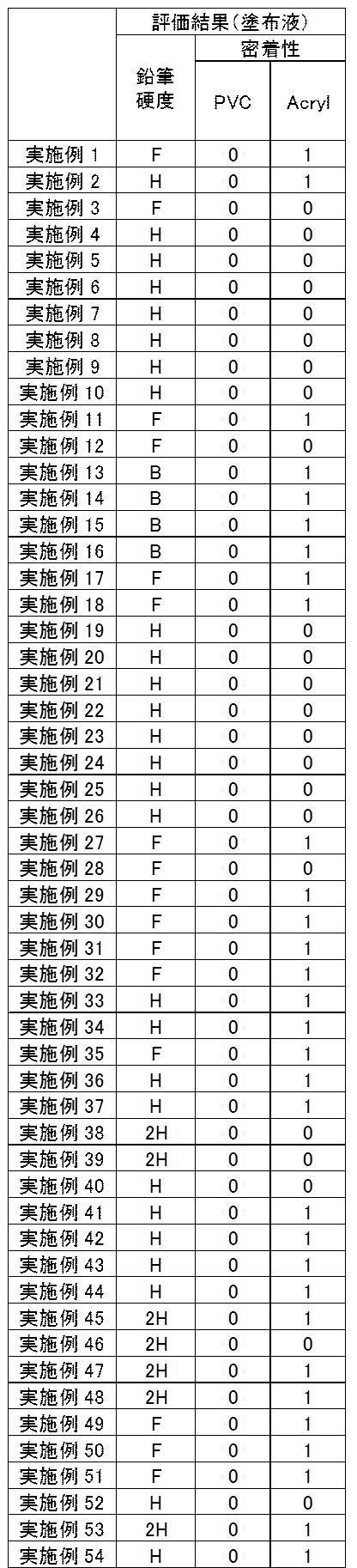

表9及び表10に示すように、実施例1~72の水分散物を用いた塗布液によれば、各種基材との密着性、及び、鉛筆硬度に優れた画像(即ち、膜)を形成することができた。
これに対し、ゲル粒子を含まない(即ち、粒子がゲル化していない)比較例1~4のエマルションを用いた塗布液を用いて形成された膜は、基材との密着性、及び、鉛筆硬度が低下した。
これに対し、ゲル粒子を含まない(即ち、粒子がゲル化していない)比較例1~4のエマルションを用いた塗布液を用いて形成された膜は、基材との密着性、及び、鉛筆硬度が低下した。
2015年3月24日に出願された日本国特許出願2015-061721号の開示はその全体が参照により本明細書に取り込まれる。
本明細書に記載された全ての文献、特許出願、及び技術規格は、個々の文献、特許出願、及び技術規格が参照により取り込まれることが具体的かつ個々に記された場合と同程度に、本明細書に参照により取り込まれる。
本明細書に記載された全ての文献、特許出願、及び技術規格は、個々の文献、特許出願、及び技術規格が参照により取り込まれることが具体的かつ個々に記された場合と同程度に、本明細書に参照により取り込まれる。
Claims (16)
- 下記式(1)で表されるポリマー構造及び下記式(2)で表されるポリマー構造の少なくとも一方を含む三次元架橋構造を有し、親水性基及び重合性基を有し、光重合開始剤を内包しているゲル粒子が、水に分散されているゲル粒子の水分散物。

式(1)中、P1は、ポリエステル、ポリカーボネート、ポリカプロラクトン、ポリブタジエン、ポリイソプレン、又はポリオレフィンからなる数平均分子量500以上のポリマー鎖を表す。
式(1)中、Z11は、(n1+1)価の有機基を表し、Z12は、(m1+1)価の有機基を表し、n1及びm1は、それぞれ独立に、1以上の整数を表す。
式(2)中、P2は、ポリウレタン、ポリエステル、ポリカーボネート、ポリカプロラクトン、ポリブタジエン、ポリイソプレン、又はポリオレフィンからなる数平均分子量500以上のポリマー鎖を表す。
式(2)中、X1は、単結合、-CH2-基、又は-NH-基を表し、R1は、ヘテロ原子を含んでいてもよい炭化水素基を表し、Z21は、(n2+1)価の有機基を表し、n2は、1以上の整数を表す。
式(1)及び式(2)中、*は、結合位置を表す。 - 前記P1で表されるポリマー鎖の数平均分子量が1000~40000であり、
前記P2で表されるポリマー鎖の数平均分子量が1000~40000である請求項1に記載のゲル粒子の水分散物。 - 前記式(2)中の前記R1が、下記式(2R)で表される基である請求項1又は請求項2に記載のゲル粒子の水分散物。
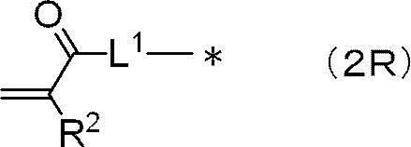
式(2R)中、L1は、2価の有機基を表し、R2は、水素原子又はアルキル基を表し、*は、結合位置を表す。 - 前記ゲル粒子が、重合性モノマーを内包している請求項1~請求項3のいずれか1項に記載のゲル粒子の水分散物。
- 前記重合性モノマーが、(メタ)アクリレートモノマーである請求項4に記載のゲル粒子の水分散物。
- 前記重合性モノマーが、3官能以上のアクリレートモノマーである請求項4又は請求項5に記載のゲル粒子の水分散物。
- 前記光重合開始剤は、水への溶解度が25℃において1.0質量%以下である請求項1~請求項6のいずれか1項に記載のゲル粒子の水分散物。
- 前記光重合開始剤が、アシルホスフィンオキシド化合物である請求項1~請求項7のいずれか1項に記載のゲル粒子の水分散物。
- 前記ゲル粒子が、増感剤を内包している請求項1~請求項8のいずれか1項に記載のゲル粒子の水分散物。
- 前記親水性基が、カルボキシル基、カルボキシル基の塩、スルホ基、スルホ基の塩、硫酸基、硫酸基の塩、ホスホン酸基、ホスホン酸基の塩、リン酸基、リン酸基の塩、アンモニウム塩基、ベタイン基、及びアルキレンオキシ基からなる群から選択される少なくとも1種である請求項1~請求項9のいずれか1項に記載のゲル粒子の水分散物。
- インクジェット記録に用いられる請求項1~請求項10のいずれか1項に記載のゲル粒子の水分散物。
- 前記ゲル粒子の全固形分量が、水分散物の全固形分量に対し、50質量%以上である請求項1~請求項11のいずれか1項に記載のゲル粒子の水分散物。
- 前記式(1)で表されるポリマー構造が、下記式(1P)で表されるイソシアネート基含有ポリマーに由来する構造であり、
前記式(2)で表されるポリマー構造が、下記式(2P)で表されるイソシアネート基含有ポリマーに由来する構造である請求項1~請求項12のいずれか1項に記載のゲル粒子の水分散物。
式(1P)中、P1は、ポリエステル、ポリカーボネート、ポリカプロラクトン、ポリブタジエン、ポリイソプレン、又はポリオレフィンからなる数平均分子量500以上のポリマー鎖を表す。
式(1P)中、Z11は、(n1+1)価の有機基を表し、Z12は、(m1+1)価の有機基を表し、n1及びm1は、それぞれ独立に、1以上の整数を表す。
式(2P)中、P2は、ポリウレタン、ポリエステル、ポリカーボネート、ポリカプロラクトン、ポリブタジエン、ポリイソプレン、又はポリオレフィンからなる数平均分子量500以上のポリマー鎖を表す。
式(2P)中、X1は、単結合、-CH2-基、又は-NH-基を表し、R1は、ヘテロ原子を含んでいてもよい炭化水素基を表し、Z21は、(n2+1)価の有機基を表し、n2は、1以上の整数を表す。 - 請求項13に記載のゲル粒子の水分散物を製造する方法であって、
前記式(1P)で表されるイソシアネート基含有ポリマー及び前記式(2P)で表されるイソシアネート基含有ポリマーの少なくとも一方を準備する準備工程と、
前記式(1P)で表されるイソシアネート基含有ポリマー及び前記式(2P)で表されるイソシアネート基含有ポリマーの少なくとも一方、前記光重合開始剤、並びに有機溶媒を含む油相成分と、水を含む水相成分と、を混合し、乳化させて乳化物を得る乳化工程と、
前記乳化物を加熱することにより、少なくとも、前記式(1P)で表されるイソシアネート基含有ポリマー及び前記式(2P)で表されるイソシアネート基含有ポリマーの少なくとも一方と、前記水と、を反応させて前記ゲル粒子の水分散物を得るゲル化工程と、
を有するゲル粒子の水分散物の製造方法。 - 前記式(1P)で表されるイソシアネート基含有ポリマー及び前記式(2P)で表されるイソシアネート基含有ポリマーの少なくとも一方を準備する準備工程は、
下記式(1PD)で表されるポリマージオールと下記式(ZC)で表される多官能イソシアネート化合物とを反応させて前記式(1P)で表されるイソシアネート基含有ポリマーを得る段階、及び、
下記式(2PD)で表されるポリマージオールと、下記式(M1)で表される末端封止剤又は下記式(M2)で表される末端封止剤若しくはその無水物と、を反応させて下記式(2PO)で表される片末端封止ポリマーを得、次いで前記片末端封止ポリマーと下記式(ZC)で表される多官能イソシアネート化合物とを反応させて前記式(2P)で表されるイソシアネート基含有ポリマーを得る段階
の少なくとも一方を有する請求項14に記載のゲル粒子の水分散物の製造方法。
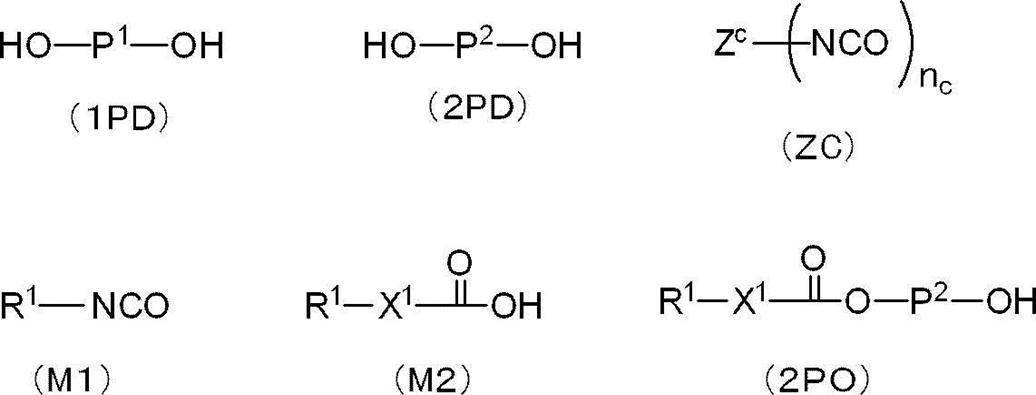
式(1PD)中、P1は、ポリエステル、ポリカーボネート、ポリカプロラクトン、ポリブタジエン、ポリイソプレン、又はポリオレフィンからなる数平均分子量500以上のポリマー鎖を表す。
式(2PD)及び式(2PO)中、P2は、ポリウレタン、ポリエステル、ポリカーボネート、ポリカプロラクトン、ポリブタジエン、ポリイソプレン、又はポリオレフィンからなる数平均分子量500以上のポリマー鎖を表す。
式(ZC)中、ZCは、nc価の有機基を表し、ncは、2以上の整数を表す。
式(M2)及び式(2PO)中、X1は、単結合、-CH2-基、又は-NH-基を表す。
式(M1)、式(M2)、及び式(2PO)中、R1は、ヘテロ原子を含んでいてもよい炭化水素基を表す。 - 請求項1~請求項13のいずれか1項に記載のゲル粒子の水分散物を、記録媒体上に付与する付与工程と、
前記記録媒体上に付与された前記ゲル粒子の水分散物に、活性エネルギー線を照射する照射工程と、
を有する画像形成方法。
Priority Applications (4)
| Application Number | Priority Date | Filing Date | Title |
|---|---|---|---|
| CN201680017251.8A CN107406531B (zh) | 2015-03-24 | 2016-02-01 | 凝胶粒子的水分散物及其制造方法、以及图像形成方法 |
| JP2017507554A JP6305631B2 (ja) | 2015-03-24 | 2016-02-01 | ゲル粒子の水分散物及びその製造方法、並びに画像形成方法 |
| EP16768157.6A EP3275905B1 (en) | 2015-03-24 | 2016-02-01 | Water dispersion of gel particles, producing method thereof, and image forming method |
| US15/686,164 US10208216B2 (en) | 2015-03-24 | 2017-08-25 | Water dispersion of gel particles, producing method thereof, and image forming method |
Applications Claiming Priority (2)
| Application Number | Priority Date | Filing Date | Title |
|---|---|---|---|
| JP2015061721 | 2015-03-24 | ||
| JP2015-061721 | 2015-03-24 |
Related Child Applications (1)
| Application Number | Title | Priority Date | Filing Date |
|---|---|---|---|
| US15/686,164 Continuation US10208216B2 (en) | 2015-03-24 | 2017-08-25 | Water dispersion of gel particles, producing method thereof, and image forming method |
Publications (1)
| Publication Number | Publication Date |
|---|---|
| WO2016152254A1 true WO2016152254A1 (ja) | 2016-09-29 |
Family
ID=56977255
Family Applications (1)
| Application Number | Title | Priority Date | Filing Date |
|---|---|---|---|
| PCT/JP2016/052963 Ceased WO2016152254A1 (ja) | 2015-03-24 | 2016-02-01 | ゲル粒子の水分散物及びその製造方法、並びに画像形成方法 |
Country Status (5)
| Country | Link |
|---|---|
| US (1) | US10208216B2 (ja) |
| EP (1) | EP3275905B1 (ja) |
| JP (1) | JP6305631B2 (ja) |
| CN (1) | CN107406531B (ja) |
| WO (1) | WO2016152254A1 (ja) |
Cited By (12)
| Publication number | Priority date | Publication date | Assignee | Title |
|---|---|---|---|---|
| CN106800630A (zh) * | 2016-12-27 | 2017-06-06 | 中蓝晨光化工研究设计院有限公司 | 一种柔性气凝胶材料及其制备方法 |
| JP2017226741A (ja) * | 2016-06-21 | 2017-12-28 | 株式会社リコー | インク、インクジェット印刷方法、インクジェット印刷装置および印刷物 |
| WO2018070536A1 (ja) * | 2016-10-14 | 2018-04-19 | 旭化成株式会社 | ポリイソシアネート組成物、ブロックポリイソシアネート組成物、親水性ポリイソシアネート組成物、塗料組成物、および塗膜 |
| EP3412694A4 (en) * | 2016-02-05 | 2018-12-26 | FUJIFILM Corporation | Aqueous dispersion, production method for same, and image formation method |
| WO2019021639A1 (ja) * | 2017-07-26 | 2019-01-31 | 富士フイルム株式会社 | インク組成物及びその製造方法、並びに画像形成方法 |
| WO2019058990A1 (ja) * | 2017-09-25 | 2019-03-28 | 富士フイルム株式会社 | インク組成物及びその製造方法、並びに画像形成方法 |
| WO2021065250A1 (ja) | 2019-09-30 | 2021-04-08 | 富士フイルム株式会社 | 着色樹脂粒子分散物、インク、インクセット、インクジェット捺染方法、油溶性染料の製造方法、及び捺染物 |
| JPWO2021112192A1 (ja) * | 2019-12-06 | 2021-06-10 | ||
| WO2023153230A1 (ja) | 2022-02-14 | 2023-08-17 | 富士フイルム株式会社 | インクジェットインク用前処理液、インクセット、画像記録方法、ラミネート体の製造方法、画像記録物、及びラミネート体 |
| JP2023131636A (ja) * | 2022-03-09 | 2023-09-22 | 三井化学株式会社 | 硬化性樹脂組成物、3dプリンター用硬化性樹脂組成物および樹脂硬化物 |
| WO2024203413A1 (ja) | 2023-03-27 | 2024-10-03 | 富士フイルム株式会社 | インクジェットインク用前処理液、インクセット、画像記録方法、ラミネート体の製造方法、画像記録物、及びラミネート体 |
| WO2024252807A1 (ja) | 2023-06-08 | 2024-12-12 | 富士フイルム株式会社 | 非浸透性基材用インクジェットインク、インクセット、画像記録方法、及びラミネート体の製造方法 |
Families Citing this family (1)
| Publication number | Priority date | Publication date | Assignee | Title |
|---|---|---|---|---|
| CA3084352A1 (en) * | 2018-04-18 | 2019-10-24 | Encapsys, Llc | Aqueous polyurethane microgel dispersion |
Citations (8)
| Publication number | Priority date | Publication date | Assignee | Title |
|---|---|---|---|---|
| JPH05224404A (ja) * | 1992-02-07 | 1993-09-03 | Toyo Ink Mfg Co Ltd | 平版印刷版の製造方法 |
| JPH05239152A (ja) * | 1991-08-22 | 1993-09-17 | Ciba Geigy Ag | 親水性重合体の骨格構造から誘導された架橋ヒドロゲル |
| JPH08259888A (ja) * | 1995-03-24 | 1996-10-08 | Dainippon Ink & Chem Inc | 活性エネルギー線硬化性水分散体 |
| JPH10158410A (ja) * | 1996-12-04 | 1998-06-16 | Dainippon Ink & Chem Inc | エネルギー線硬化性樹脂組成物の製造方法 |
| JPH10191973A (ja) * | 1997-01-06 | 1998-07-28 | Kansai Paint Co Ltd | 酵素又は微生物菌体固定化用大粒径担体の製造方法 |
| JP2000336128A (ja) * | 1999-06-01 | 2000-12-05 | Dainippon Ink & Chem Inc | 分散安定性に優れた活性エネルギー線硬化性水性ポリウレタン組成物 |
| JP2002000265A (ja) * | 2000-06-20 | 2002-01-08 | Kansai Paint Co Ltd | 酵素又は微生物固定化担体組成物 |
| JP2007023178A (ja) * | 2005-07-19 | 2007-02-01 | Dainippon Ink & Chem Inc | 活性エネルギー線硬化型水性ウレタン樹脂分散体 |
Family Cites Families (5)
| Publication number | Priority date | Publication date | Assignee | Title |
|---|---|---|---|---|
| JP2000136211A (ja) | 1998-08-27 | 2000-05-16 | Kanegafuchi Chem Ind Co Ltd | 水性エマルジョン |
| GB0613583D0 (en) | 2006-07-05 | 2006-08-16 | Sericol Ltd | A printing ink |
| EP2549331B1 (en) | 2010-03-19 | 2015-11-11 | FUJIFILM Corporation | Color developing photosensitive composition, lithographic printing original plate, and method for producing same |
| CN101838457B (zh) * | 2010-05-11 | 2011-12-28 | 陕西科技大学 | 高固含量交联聚氨酯水分散体的制备方法 |
| JP5949031B2 (ja) | 2012-03-26 | 2016-07-06 | セイコーエプソン株式会社 | インクジェット用インク組成物及びインクジェット記録方法 |
-
2016
- 2016-02-01 JP JP2017507554A patent/JP6305631B2/ja active Active
- 2016-02-01 CN CN201680017251.8A patent/CN107406531B/zh active Active
- 2016-02-01 WO PCT/JP2016/052963 patent/WO2016152254A1/ja not_active Ceased
- 2016-02-01 EP EP16768157.6A patent/EP3275905B1/en active Active
-
2017
- 2017-08-25 US US15/686,164 patent/US10208216B2/en active Active
Patent Citations (8)
| Publication number | Priority date | Publication date | Assignee | Title |
|---|---|---|---|---|
| JPH05239152A (ja) * | 1991-08-22 | 1993-09-17 | Ciba Geigy Ag | 親水性重合体の骨格構造から誘導された架橋ヒドロゲル |
| JPH05224404A (ja) * | 1992-02-07 | 1993-09-03 | Toyo Ink Mfg Co Ltd | 平版印刷版の製造方法 |
| JPH08259888A (ja) * | 1995-03-24 | 1996-10-08 | Dainippon Ink & Chem Inc | 活性エネルギー線硬化性水分散体 |
| JPH10158410A (ja) * | 1996-12-04 | 1998-06-16 | Dainippon Ink & Chem Inc | エネルギー線硬化性樹脂組成物の製造方法 |
| JPH10191973A (ja) * | 1997-01-06 | 1998-07-28 | Kansai Paint Co Ltd | 酵素又は微生物菌体固定化用大粒径担体の製造方法 |
| JP2000336128A (ja) * | 1999-06-01 | 2000-12-05 | Dainippon Ink & Chem Inc | 分散安定性に優れた活性エネルギー線硬化性水性ポリウレタン組成物 |
| JP2002000265A (ja) * | 2000-06-20 | 2002-01-08 | Kansai Paint Co Ltd | 酵素又は微生物固定化担体組成物 |
| JP2007023178A (ja) * | 2005-07-19 | 2007-02-01 | Dainippon Ink & Chem Inc | 活性エネルギー線硬化型水性ウレタン樹脂分散体 |
Cited By (30)
| Publication number | Priority date | Publication date | Assignee | Title |
|---|---|---|---|---|
| EP3412694A4 (en) * | 2016-02-05 | 2018-12-26 | FUJIFILM Corporation | Aqueous dispersion, production method for same, and image formation method |
| JP2017226741A (ja) * | 2016-06-21 | 2017-12-28 | 株式会社リコー | インク、インクジェット印刷方法、インクジェット印刷装置および印刷物 |
| JPWO2018070536A1 (ja) * | 2016-10-14 | 2019-04-11 | 旭化成株式会社 | ポリイソシアネート組成物、ブロックポリイソシアネート組成物、親水性ポリイソシアネート組成物、塗料組成物、および塗膜 |
| WO2018070536A1 (ja) * | 2016-10-14 | 2018-04-19 | 旭化成株式会社 | ポリイソシアネート組成物、ブロックポリイソシアネート組成物、親水性ポリイソシアネート組成物、塗料組成物、および塗膜 |
| EP4137523A1 (en) * | 2016-10-14 | 2023-02-22 | Asahi Kasei Kabushiki Kaisha | Polyisocyanate composition, blocked polyisocyanate composition, hydrophilic polyisocyanate composition, coating material composition, and coating film |
| EP4134384A1 (en) * | 2016-10-14 | 2023-02-15 | Asahi Kasei Kabushiki Kaisha | Polyisocyanate composition, blocked polyisocyanate composition, hydrophilic polyisocyanate composition, coating material composition, and coating film |
| US11021562B2 (en) | 2016-10-14 | 2021-06-01 | Asahi Kasei Kabushiki Kaisha | Polyisocyanate composition, blocked polyisocyanate composition, hydrophilic polyisocyanate composition, coating material composition, and coating film |
| EP4122967A1 (en) * | 2016-10-14 | 2023-01-25 | Asahi Kasei Kabushiki Kaisha | Polyisocyanate composition, blocked polyisocyanate composition, hydrophilic polyisocyanate composition, coating material composition, and coating film |
| CN109843952A (zh) * | 2016-10-14 | 2019-06-04 | 旭化成株式会社 | 多异氰酸酯组合物、封端多异氰酸酯组合物、亲水性多异氰酸酯组合物、涂料组合物和涂膜 |
| EP3527594A4 (en) * | 2016-10-14 | 2019-11-06 | Asahi Kasei Kabushiki Kaisha | POLYISOCYANATE COMPOSITION, BLOCK POLYISOCYANATE COMPOSITION, HYDROPHILIC POLYISOCYANATE COMPOSITION, COATING MATERIAL COMPOSITION AND COATING FILM |
| EP4122966A1 (en) * | 2016-10-14 | 2023-01-25 | Asahi Kasei Kabushiki Kaisha | Polyisocyanate composition, blocked polyisocyanate composition, hydrophilic polyisocyanate composition, coating material composition, and coating film |
| EP4122968A1 (en) * | 2016-10-14 | 2023-01-25 | Asahi Kasei Kabushiki Kaisha | Polyisocyanate composition, blocked polyisocyanate composition, hydrophilic polyisocyanate composition, coating material composition, and coating film |
| CN109843952B (zh) * | 2016-10-14 | 2021-11-12 | 旭化成株式会社 | 多异氰酸酯组合物、封端多异氰酸酯组合物、亲水性多异氰酸酯组合物、涂料组合物和涂膜 |
| CN106800630B (zh) * | 2016-12-27 | 2019-04-30 | 中蓝晨光化工研究设计院有限公司 | 一种柔性气凝胶材料及其制备方法 |
| CN106800630A (zh) * | 2016-12-27 | 2017-06-06 | 中蓝晨光化工研究设计院有限公司 | 一种柔性气凝胶材料及其制备方法 |
| JPWO2019021639A1 (ja) * | 2017-07-26 | 2020-07-09 | 富士フイルム株式会社 | インク組成物及びその製造方法、並びに画像形成方法 |
| WO2019021639A1 (ja) * | 2017-07-26 | 2019-01-31 | 富士フイルム株式会社 | インク組成物及びその製造方法、並びに画像形成方法 |
| JP7048616B2 (ja) | 2017-07-26 | 2022-04-05 | 富士フイルム株式会社 | インク組成物及びその製造方法、並びに画像形成方法 |
| US11518897B2 (en) | 2017-07-26 | 2022-12-06 | Fujifilm Corporation | Ink composition, method for producing the same, and image-forming method |
| WO2019058990A1 (ja) * | 2017-09-25 | 2019-03-28 | 富士フイルム株式会社 | インク組成物及びその製造方法、並びに画像形成方法 |
| JPWO2019058990A1 (ja) * | 2017-09-25 | 2020-07-09 | 富士フイルム株式会社 | インク組成物及びその製造方法、並びに画像形成方法 |
| WO2021065250A1 (ja) | 2019-09-30 | 2021-04-08 | 富士フイルム株式会社 | 着色樹脂粒子分散物、インク、インクセット、インクジェット捺染方法、油溶性染料の製造方法、及び捺染物 |
| JPWO2021112192A1 (ja) * | 2019-12-06 | 2021-06-10 | ||
| WO2021112192A1 (ja) * | 2019-12-06 | 2021-06-10 | Agc株式会社 | 樹脂組成物及び樹脂硬化物 |
| JP7622646B2 (ja) | 2019-12-06 | 2025-01-28 | Agc株式会社 | 樹脂組成物及び樹脂硬化物 |
| WO2023153230A1 (ja) | 2022-02-14 | 2023-08-17 | 富士フイルム株式会社 | インクジェットインク用前処理液、インクセット、画像記録方法、ラミネート体の製造方法、画像記録物、及びラミネート体 |
| JP2023131636A (ja) * | 2022-03-09 | 2023-09-22 | 三井化学株式会社 | 硬化性樹脂組成物、3dプリンター用硬化性樹脂組成物および樹脂硬化物 |
| WO2024203413A1 (ja) | 2023-03-27 | 2024-10-03 | 富士フイルム株式会社 | インクジェットインク用前処理液、インクセット、画像記録方法、ラミネート体の製造方法、画像記録物、及びラミネート体 |
| EP4691788A1 (en) | 2023-03-27 | 2026-02-11 | FUJIFILM Corporation | Pretreatment liquid for inkjet ink, ink set, image recording method, laminate manufacturing method, image recorded matter, and laminate |
| WO2024252807A1 (ja) | 2023-06-08 | 2024-12-12 | 富士フイルム株式会社 | 非浸透性基材用インクジェットインク、インクセット、画像記録方法、及びラミネート体の製造方法 |
Also Published As
| Publication number | Publication date |
|---|---|
| EP3275905A4 (en) | 2018-01-31 |
| JPWO2016152254A1 (ja) | 2017-08-17 |
| EP3275905B1 (en) | 2020-12-02 |
| CN107406531B (zh) | 2019-08-27 |
| EP3275905A1 (en) | 2018-01-31 |
| US10208216B2 (en) | 2019-02-19 |
| CN107406531A (zh) | 2017-11-28 |
| US20170349771A1 (en) | 2017-12-07 |
| JP6305631B2 (ja) | 2018-04-04 |
Similar Documents
| Publication | Publication Date | Title |
|---|---|---|
| JP6305631B2 (ja) | ゲル粒子の水分散物及びその製造方法、並びに画像形成方法 | |
| JP6559295B2 (ja) | ゲル粒子 | |
| JP6584677B2 (ja) | インクジェットインク組成物及び画像形成方法 | |
| JP6602384B2 (ja) | インクジェット記録用インク組成物及びその製造方法、並びにインクジェット記録方法 | |
| JP6559297B2 (ja) | ゲル粒子 | |
| JP6333991B2 (ja) | ゲル粒子、感光性組成物、インク組成物、ゲル粒子の水分散物の製造方法、及び画像形成方法 | |
| WO2017135084A1 (ja) | 水分散物及びその製造方法、並びに画像形成方法 | |
| WO2017038243A1 (ja) | 水分散物及びその製造方法、並びに画像形成方法 | |
| WO2016151904A1 (ja) | ゲル粒子の水分散物及びその製造方法、並びに画像形成方法 | |
| JPWO2017135088A1 (ja) | 水分散物及びその製造方法、並びに画像形成方法 | |
| JP6639687B2 (ja) | 水分散物及びその製造方法、並びに画像形成方法 | |
| JPWO2017135085A1 (ja) | 水分散物及びその製造方法、並びに画像形成方法 | |
| JP7505015B2 (ja) | インクジェットインク及びインクジェット記録方法 | |
| JP6334054B2 (ja) | ゲル粒子の水分散物及びその製造方法、並びに画像形成方法 | |
| JP6678737B2 (ja) | 水分散物及びその製造方法、並びに画像形成方法 | |
| CN116249728A (zh) | 水分散物及图像记录方法 |
Legal Events
| Date | Code | Title | Description |
|---|---|---|---|
| 121 | Ep: the epo has been informed by wipo that ep was designated in this application |
Ref document number: 16768157 Country of ref document: EP Kind code of ref document: A1 |
|
| ENP | Entry into the national phase |
Ref document number: 2017507554 Country of ref document: JP Kind code of ref document: A |
|
| REEP | Request for entry into the european phase |
Ref document number: 2016768157 Country of ref document: EP |
|
| NENP | Non-entry into the national phase |
Ref country code: DE |