WO2016147277A1 - 可搬無線通信装置、無線通信方法及びプログラム - Google Patents
可搬無線通信装置、無線通信方法及びプログラム Download PDFInfo
- Publication number
- WO2016147277A1 WO2016147277A1 PCT/JP2015/057594 JP2015057594W WO2016147277A1 WO 2016147277 A1 WO2016147277 A1 WO 2016147277A1 JP 2015057594 W JP2015057594 W JP 2015057594W WO 2016147277 A1 WO2016147277 A1 WO 2016147277A1
- Authority
- WO
- WIPO (PCT)
- Prior art keywords
- communication device
- wireless communication
- portable wireless
- counterpart
- portable
- Prior art date
- Legal status (The legal status is an assumption and is not a legal conclusion. Google has not performed a legal analysis and makes no representation as to the accuracy of the status listed.)
- Ceased
Links
Images



Classifications
-
- H—ELECTRICITY
- H04—ELECTRIC COMMUNICATION TECHNIQUE
- H04W—WIRELESS COMMUNICATION NETWORKS
- H04W76/00—Connection management
- H04W76/10—Connection setup
- H04W76/14—Direct-mode setup
-
- H—ELECTRICITY
- H04—ELECTRIC COMMUNICATION TECHNIQUE
- H04M—TELEPHONIC COMMUNICATION
- H04M1/00—Substation equipment, e.g. for use by subscribers
- H04M1/72—Mobile telephones; Cordless telephones, i.e. devices for establishing wireless links to base stations without route selection
- H04M1/724—User interfaces specially adapted for cordless or mobile telephones
- H04M1/72448—User interfaces specially adapted for cordless or mobile telephones with means for adapting the functionality of the device according to specific conditions
- H04M1/72454—User interfaces specially adapted for cordless or mobile telephones with means for adapting the functionality of the device according to specific conditions according to context-related or environment-related conditions
-
- H—ELECTRICITY
- H04—ELECTRIC COMMUNICATION TECHNIQUE
- H04W—WIRELESS COMMUNICATION NETWORKS
- H04W4/00—Services specially adapted for wireless communication networks; Facilities therefor
- H04W4/80—Services using short range communication, e.g. near-field communication [NFC], radio-frequency identification [RFID] or low energy communication
-
- H—ELECTRICITY
- H04—ELECTRIC COMMUNICATION TECHNIQUE
- H04M—TELEPHONIC COMMUNICATION
- H04M1/00—Substation equipment, e.g. for use by subscribers
- H04M1/72—Mobile telephones; Cordless telephones, i.e. devices for establishing wireless links to base stations without route selection
- H04M1/724—User interfaces specially adapted for cordless or mobile telephones
- H04M1/72448—User interfaces specially adapted for cordless or mobile telephones with means for adapting the functionality of the device according to specific conditions
- H04M1/72463—User interfaces specially adapted for cordless or mobile telephones with means for adapting the functionality of the device according to specific conditions to restrict the functionality of the device
-
- H—ELECTRICITY
- H04—ELECTRIC COMMUNICATION TECHNIQUE
- H04M—TELEPHONIC COMMUNICATION
- H04M2250/00—Details of telephonic subscriber devices
- H04M2250/12—Details of telephonic subscriber devices including a sensor for measuring a physical value, e.g. temperature or motion
Definitions
- the present invention relates to a portable wireless communication device, a wireless communication method, and a program, and more particularly to establishment of a communication connection of the portable wireless communication device.
- IEEE Institute of Electrical and Electronics Electronics
- Bluetooth registered trademark
- a wireless communication device to be a communication partner is selected by a user manually selecting one from a list presented on a display.
- the user in order for the user to manually select a wireless communication device from the list in this way, the user must know in advance identification information such as the SSID (Service Set Identifier) and name of the wireless communication device to be communicated with. I must.
- SSID Service Set Identifier
- the present invention has been made in view of the above problems, and its object is to provide a portable radio communication device, a radio communication method, and a program capable of establishing radio communication with the portable radio communication device of the intended counterpart user without fail. There is to do.
- a portable wireless communication device includes first posture information acquisition means for acquiring first posture information indicating a roll angle or a pitch angle of the portable wireless communication device.
- Second attitude information receiving means for receiving second attitude information indicating the roll angle or pitch angle from the counterpart communication apparatus by radio communication, each orientation of the portable radio communication apparatus and the counterpart communication apparatus, and the first attitude Determination means for determining whether to establish a communication connection with the counterpart communication device based on the information and the second attitude information.
- a wireless communication method includes a first posture information acquisition step of acquiring first posture information indicating a roll angle or a pitch angle of a portable wireless communication device, and the roll angle or A second attitude information receiving step of receiving second attitude information indicating a pitch angle by wireless communication; each direction of the portable radio communication apparatus and the counterpart communication apparatus; the first attitude information; and the second attitude information.
- a program includes a first attitude information acquisition step for acquiring first attitude information indicating a roll angle or a pitch angle of a portable wireless communication apparatus, and the roll angle or pitch angle from the counterpart communication apparatus. Based on a second attitude information receiving step for receiving second attitude information indicating wireless communication, each orientation of the portable radio communication device and the counterpart communication device, the first attitude information, and the second attitude information. And a determination step of determining whether or not to establish a communication connection with the counterpart communication device.
- This program may be stored in a computer-readable information storage medium.
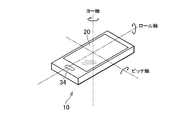
- FIG. 1 is an external perspective view of a portable wireless communication device according to an embodiment of the present invention. It is a figure which shows the operation
- FIG. 1 is a configuration diagram of a portable wireless communication apparatus according to an embodiment of the present invention.
- the portable wireless communication device 10 shown in the figure is configured as a smartphone, and includes a mobile phone communication unit 12, a memory 14, a processor 16, a power / audio LSI 18, a display panel 20, a camera 22, a wireless LAN communication unit 24, A distance wireless communication unit 26, a triaxial gyro sensor 28, a triaxial acceleration sensor 30, an electronic compass 32, and an input unit 34 are provided.
- the portable wireless communication device 10 has, for example, a thin rectangular housing, and a flat display panel 20 and buttons that are a part of the input unit 34 are provided on the surface of the housing. ing.
- a mobile phone communication unit 12 includes a modem and a wireless communication unit, and performs mobile phone wireless communication in accordance with various communication standards of the mobile phone.
- the memory 14 includes a volatile memory and a nonvolatile memory, and is accessed by the processor 16.
- the processor 16 includes a CPU and a built-in memory, and controls the portable wireless communication device 10 by executing a program.
- the display panel 20 is configured by a liquid crystal panel, an organic EL panel, or the like, and outputs display data supplied by the processor 16.
- the camera 22 captures still images and moving images.
- the wireless LAN communication unit 26 performs wireless LAN communication according to the IEEE 802.11 standard.
- the short-range wireless communication unit 26 performs power-saving wireless communication with a relatively short-distance device, and performs short-range wireless communication using Bluetooth, for example.
- the three-axis gyro sensor 28 has a roll angular velocity of the casing centered on the roll axis set in the vertical direction of the display panel 20 and a casing centered on the pitch axis set in the left-right direction.
- the pitch angular velocity and the yaw angular velocity of the casing around the yaw axis set in the normal direction are detected.
- the processor 16 can obtain posture information such as a roll angle, a pitch angle, and a yaw angle by time-integrating these values.
- the triaxial acceleration sensor 30 detects the acceleration of the casing in the three axial directions shown in FIG. Based on the accelerations in these three directions, the processor 16 can determine in which direction the casing is held with respect to the horizontal direction and how much it has moved in which direction.
- the electronic compass 32 outputs the direction in which the roll axis (see FIG. 2) set in the housing is directed by detecting the direction of geomagnetism.
- the electronic compass 32 can correctly acquire the orientation if the pitch angle and roll angle of the housing are less than a certain angle with respect to the horizontal. In order to obtain a more accurate azimuth, the azimuth output by the electronic compass 32 may be corrected by the output value of the gyro sensor 28.
- the input unit 34 includes a button provided on the surface of the housing and a touch panel provided on the surface of the display panel 20.
- short-range wireless communication is performed by the short-range wireless communication unit 26 between two or more portable wireless communication devices 10.
- a communication connection procedure called pairing must be performed manually between the two portable wireless communication devices 10.
- this procedure is intuitively performed as follows.
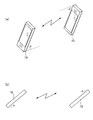
- FIG. 3 is a diagram illustrating a procedure of wireless communication connection of the portable wireless communication device 10 according to the present embodiment
- FIG. 3A is a perspective view illustrating two portable wireless communication devices 10 during the connection procedure.
- FIG. (B) is a side view thereof.
- each user of the two portable wireless communication devices 10 holds the portable wireless communication device 10 in their hands and brings them close to each other.
- each user further increases the pitch angle ⁇ of the housing so that the distance between the two portable wireless communication devices 10 approaches and the housings face each other while looking at the other portable wireless communication device 10.
- the position and posture of the portable radio communication device 10 are moved so that the directions are positive and negative.
- Each portable wireless communication device 10 acquires its own pitch angle ⁇ from the output of the gyro sensor 28, and acquires the direction in which it is facing from the electronic compass 32. Further, the short-range wireless communication unit 26 receives the pitch angle ⁇ acquired by the counterpart device from the output of the gyro sensor 28 and the orientation obtained from the electronic compass 32 from the counterpart device. Furthermore, each portable radio communication device 10 acquires the reception level (RSSI: Received Signal Strength Indicator) of the radio signal from the counterpart device from the short-range radio communication unit 26.
- RSSI Received Signal Strength Indicator
- the pitch angle ⁇ and direction of the two portable radio communication devices 10 and the reception level of the radio signal from the counterpart device it is determined whether or not to establish a communication connection with the counterpart device. More specifically, when the value obtained by subtracting 180 degrees from the difference in azimuth is less than a predetermined value, the sum of pitch angles is less than a predetermined value, and the reception level is greater than or equal to a certain level (here, RSSI is “Immediate” ), The terminal ID of the counterpart device is added to the monitoring table, and the pitch angle ⁇ , direction, and reception level are acquired over a certain period of time.
- RSSI is “Immediate”
- the sum of the pitch angles ⁇ indicates a deviation from the state in which the pitch angles ⁇ of the two portable wireless communication devices 10 are opposite to each other.
- wireless communication apparatus 10 mutually faced is shown.
- the reception level indicates the proximity of the two portable wireless communication devices 10. Then, an evaluation value that is a decreasing function of the sum of pitch angles, a decreasing function of a value obtained by subtracting 180 degrees from a difference in azimuth, and an increasing function of a reception level is sequentially calculated, and monitoring is performed based on this evaluation value.
- the portable wireless communication device 10 that establishes the communication connection is selected from the devices included in the table.
- the evaluation value indicates the degree to which communication connection with the counterpart device should be established.
- each user further observes the portable radio communication device 10 of the other party so that the distance between the two portable radio communication devices 10 becomes closer and the casing faces each other.
- Establishing the communication connection of the portable wireless communication device 10 by an intuitive operation of moving the position and posture of the portable wireless communication device 10 so that the pitch angle ⁇ of the housing is in the opposite direction. Can do.
- the pitch angle ⁇ of the portable radio communication device 10 of the other party is directed in the opposite direction while looking at the pitch angle ⁇ of the counterpart portable radio communication device 10. Therefore, it is possible to more reliably connect to the intended portable radio communication device 10.
- the two portable wireless communication devices 10 are required to have the pitch angle ⁇ in the positive and negative directions.
- the short-range wireless communication unit 26 performs data communication by Bluetooth here.
- Two or more portable wireless communication devices 10 are connected directly or indirectly by Bluetooth to constitute a network as a whole.
- the portable wireless communication device 10 has a data relay function, and transfers various data transmitted from other portable wireless communication devices 10 to another portable wireless communication device 10. Thereby, data can be transmitted to any portable wireless communication device 10 included in the network. Further, data can be shared by all the portable wireless communication devices 10 as necessary.
- FIG. 5 is a flowchart showing communication connection in the portable wireless communication device 10.
- the processes (S101 to S109) shown in the figure are repeatedly executed at predetermined time intervals when the communication function is activated in the portable wireless communication device 10. This process is realized by the processor 16 executing the communication connection program.
- the communication connection program may be downloaded from a communication network such as a mobile phone network, or may be installed from various memory cards.
- the portable radio communication device 10 always broadcasts an advertisement packet by Bluetooth LE (Low Energy), and the advertisement packet includes the terminal ID of the portable radio communication device 10 and the direction output from the electronic compass 32.
- the pitch angle ⁇ (posture information) obtained by time integration of the output of the gyro sensor 28 is included.
- the portable wireless communication device 10 When the portable wireless communication device 10 is connected to another portable wireless communication device 10, the portable wireless communication device 10 first reads the terminal ID, direction, and orientation from the reception buffer included in the short-range wireless communication unit 26. These data are obtained from an advertisement packet transmitted from another portable wireless communication device 10. Further, the portable wireless communication device 10 acquires the reception level of the received advertisement packet from the short-range wireless communication unit 26 (S101).
- the portable radio communication device 10 acquires the direction from the electronic compass 32, and a value obtained by subtracting 180 degrees from the difference between the acquired direction and the direction received from another portable radio communication device 10 is predetermined. It is determined whether the value is less than ⁇ .
- FIG. 6 shows the structure of the monitoring table.
- the monitoring table includes records for all other portable wireless communication devices 10 that once satisfy the condition of S102.
- Each record includes a terminal ID, a direction D and a pitch angle P received from the portable wireless communication device 10 specified by the terminal ID, and a reception level R thereof, a current evaluation value that is the latest evaluation value, maximum evaluation value information, A counter and a list registration time are included.
- the evaluation value is updated each time the azimuth D and the pitch angle P are received from the portable wireless communication device 10, and can be obtained by substituting them into a function of the evaluation value.
- the evaluation value function is a decreasing function of the sum of pitch angles, a decreasing function of a value obtained by subtracting 180 degrees from the difference in azimuth, and an increasing function of the reception level.
- the evaluation value function is the product of the reciprocal of the sum of pitch angles, the reciprocal of the value obtained by subtracting 180 degrees from the azimuth difference, and a step function that becomes 1 when the reception level is equal to or higher than a predetermined value. It's okay.
- the maximum evaluation value increase is the maximum width of the time variation of the evaluation value per certain time in the past (here, the monitoring list update cycle).
- the counter is the number of times that the data acquired in S101 satisfies the condition in S102.
- the counter stored in the monitoring table may be a weighted counter.
- the integrated value of the current evaluation value can be used as a weighted counter.
- the list registration time is the time when a new record is added to the monitoring table in S103.
- the monitoring table is updated based on the data acquired in S101. That is, the direction D, the pitch angle P, and the reception level R are added and stored in association with the terminal ID, and the current evaluation value is updated based on the latest data. Further, the difference between the evaluation value calculated immediately before and the current evaluation value is calculated, and the maximum evaluation value increase is updated. Further, it is determined whether or not the latest data satisfies the condition of S102. If the latest data is satisfied, the counter is incremented by one.
- position used when calculating an evaluation value may be each average value of the azimuth
- a portable wireless communication device 10 whose counter is equal to or greater than a predetermined value (S105). If there is such a portable wireless communication device 10, it is determined whether there is a portable wireless communication device having a current evaluation value equal to or greater than the first threshold value (S106). The first threshold value is larger than a second threshold value described later. If the current evaluation value is equal to or greater than the first threshold value, a communication connection is established with one of such portable wireless communication devices 10. For example, a communication connection is established with the portable wireless communication device 10 having the maximum current evaluation value (S108). For example, mutual link keys that are personal identification information are exchanged to enable encryption communication with each other.
- the current evaluation value is equal to or higher than the above-described second threshold value and the maximum evaluation value increases in the portable wireless communication device 10 that satisfies the condition of S105. It is determined whether there is a portable wireless communication terminal 10 having a predetermined value or more (S107). And if there exists such a portable radio
- the process proceeds to S109, and the old record is deleted from the monitoring table. That is, the portable wireless communication device 10 acquires the current time and deletes the record if a predetermined time has elapsed from the list registration time. Thereafter, the processing after S101 is executed again.
- the communication connection is limited to the portable wireless communication device 10 whose counter is a predetermined value or more.
- the longer the time for satisfying the condition of S102 relating to the availability of communication connection the higher priority is given to communication connection with the counterpart communication device. By doing so, it is possible to prevent a communication connection from being accidentally and instantaneously established with the portable wireless communication device 10 that satisfies the conditions.
- whether or not the attitude of another portable wireless communication device 10 has changed over a predetermined time may be further determined based on the data in the monitoring table. If there is such a portable wireless communication device 10 that does not move for a predetermined time, it is desirable not to establish communication connection with such portable wireless communication device 10.
- S101 if the value of the acceleration sensor 30 is also received from another portable radio communication device 10, it can be determined from the value whether the portable radio communication device 10 has not moved for a predetermined time. In this way, communication connection can be prevented when there is no active user operation for communication connection.
- the communication connection may be disconnected when the reception level of the wireless signal transmitted from the connected portable wireless communication device 10 falls below a predetermined value.
Landscapes
- Engineering & Computer Science (AREA)
- Computer Networks & Wireless Communication (AREA)
- Signal Processing (AREA)
- Environmental & Geological Engineering (AREA)
- Human Computer Interaction (AREA)
- Telephone Function (AREA)
- Mobile Radio Communication Systems (AREA)
Abstract
Description
Claims (11)
- 可搬無線通信装置であって、
前記可搬無線通信装置のロール角又はピッチ角を示す第1姿勢情報を取得する第1姿勢情報取得手段と、
相手通信装置からそのロール角又はピッチ角を示す第2姿勢情報を無線通信により受信する第2姿勢情報受信手段と、
前記可搬無線通信装置及び前記相手通信装置の各方位、前記第1姿勢情報、及び前記第2姿勢情報に基づいて、前記相手通信装置と通信接続を確立するか否かを判断する判断手段と、
を含む可搬無線通信装置。 - 請求項1に記載の可搬無線通信装置において、
前記第1姿勢情報及び前記第2姿勢情報は、それぞれ、表示パネルの左右方向に平行であるピッチ軸に対するピッチ角を示す、可搬無線通信装置。 - 請求項1又は2に記載の可搬無線通信装置において、
前記第1姿勢情報及び第2姿勢情報は、それぞれ、表示パネルの上下方向に平行であるロール軸に対するロール角を示す、可搬無線通信装置。 - 請求項1乃至3のいずれかに記載の可搬無線通信装置において、
前記判断手段は、前記相手通信装置から送信される無線信号の受信レベルにさらに基づいて、前記相手通信装置と通信接続を確立するか否かを判断する、可搬無線通信装置。 - 請求項1乃至4のいずれかに記載の可搬無線通信装置において、
前記判断手段は、前記相手通信装置と通信接続を確立すべき程度を示す評価値を算出する評価値算出手段を含み、前記評価値に基づいて、前記相手通信装置と通信接続を確立するか否かを判断する、可搬無線通信装置。 - 請求項5に記載の可搬無線通信装置において、
前記判断手段は、通信接続に関する条件を満足する時間が長いほど、前記相手通信装置と優先して通信接続する、可搬無線通信装置。 - 請求項5又は6に記載の可搬無線通信装置において、
前記判断手段は、前記評価値の時間変化に基づいて、前記相手通信装置と通信接続するか否かを判断する、可搬無線通信装置。 - 請求項1乃至7のいずれかに記載の可搬無線通信装置において、
前記判断手段は、前記相手通信装置の位置又は姿勢が動いていない場合に、前記相手通信装置との通信接続の確立を制限する、可搬無線通信装置。 - 請求項1乃至8のいずれかに記載の可搬無線通信装置において、
前記相手通信装置から送信される無線信号の受信レベルに基づいて、前記相手通信装置との通信接続を切断する切断手段をさらに含む、可搬無線通信装置。 - 可搬無線通信装置のロール角又はピッチ角を示す第1姿勢情報を取得する第1姿勢情報取得ステップと、
相手通信装置からそのロール角又はピッチ角を示す第2姿勢情報を無線通信により受信する第2姿勢情報受信ステップと、
前記可搬無線通信装置及び前記相手通信装置の各方位、前記第1姿勢情報、及び前記第2姿勢情報に基づいて、前記相手通信装置と通信接続を確立するか否かを判断する判断ステップと、
を含む無線通信方法。 - 可搬無線通信装置のロール角又はピッチ角を示す第1姿勢情報を取得する第1姿勢情報取得ステップと、
相手通信装置からそのロール角又はピッチ角を示す第2姿勢情報を無線通信により受信する第2姿勢情報受信ステップと、
前記可搬無線通信装置及び前記相手通信装置の各方位、前記第1姿勢情報、及び前記第2姿勢情報に基づいて、前記相手通信装置と通信接続を確立するか否かを判断する判断ステップと、
をコンピュータに実行させるためのプログラム。
Priority Applications (3)
| Application Number | Priority Date | Filing Date | Title |
|---|---|---|---|
| US15/557,505 US10251207B2 (en) | 2015-03-13 | 2015-03-13 | Wireless mobile communication apparatus, wireless communication method and program |
| PCT/JP2015/057594 WO2016147277A1 (ja) | 2015-03-13 | 2015-03-13 | 可搬無線通信装置、無線通信方法及びプログラム |
| JP2015532995A JP5828060B1 (ja) | 2015-03-13 | 2015-03-13 | 可搬無線通信装置、無線通信方法及びプログラム |
Applications Claiming Priority (1)
| Application Number | Priority Date | Filing Date | Title |
|---|---|---|---|
| PCT/JP2015/057594 WO2016147277A1 (ja) | 2015-03-13 | 2015-03-13 | 可搬無線通信装置、無線通信方法及びプログラム |
Publications (1)
| Publication Number | Publication Date |
|---|---|
| WO2016147277A1 true WO2016147277A1 (ja) | 2016-09-22 |
Family
ID=54776837
Family Applications (1)
| Application Number | Title | Priority Date | Filing Date |
|---|---|---|---|
| PCT/JP2015/057594 Ceased WO2016147277A1 (ja) | 2015-03-13 | 2015-03-13 | 可搬無線通信装置、無線通信方法及びプログラム |
Country Status (3)
| Country | Link |
|---|---|
| US (1) | US10251207B2 (ja) |
| JP (1) | JP5828060B1 (ja) |
| WO (1) | WO2016147277A1 (ja) |
Citations (3)
| Publication number | Priority date | Publication date | Assignee | Title |
|---|---|---|---|---|
| JP2005323091A (ja) * | 2004-05-07 | 2005-11-17 | Sony Corp | 携帯電子機器及びその無線接続制御方法 |
| JP2010217938A (ja) * | 2009-03-13 | 2010-09-30 | Nikon Corp | データ通信システム |
| JP2011101302A (ja) * | 2009-11-09 | 2011-05-19 | Panasonic Corp | 携帯端末装置及び通信方法 |
Family Cites Families (9)
| Publication number | Priority date | Publication date | Assignee | Title |
|---|---|---|---|---|
| US7986917B2 (en) * | 2006-07-10 | 2011-07-26 | Sony Ericsson Mobile Communications Ab | Method and system for data transfer from a hand held device |
| US8000721B2 (en) | 2008-02-29 | 2011-08-16 | Sony Ericsson Mobile Communications Ab | Wireless communication terminals and methods that display relative direction and distance therebetween responsive to acceleration data |
| JP5441619B2 (ja) | 2009-10-30 | 2014-03-12 | ソニーモバイルコミュニケーションズ, エービー | 近距離無線通信装置、近距離無線通信システム、近距離無線通信装置の制御方法、近距離無線通信装置の制御プログラム、及び、携帯電話端末 |
| EP2348383B1 (en) | 2009-12-31 | 2017-07-12 | Sony Computer Entertainment Europe Limited | System and method of virtual interaction |
| JP2012059090A (ja) | 2010-09-10 | 2012-03-22 | Panasonic Corp | 無線通信装置および通信装置 |
| WO2013124851A1 (en) | 2012-02-23 | 2013-08-29 | Giladi, Ran | A system and method of transmitting data between mobile devices |
| US9801004B2 (en) * | 2012-06-29 | 2017-10-24 | Intel Corporation | Device, method, and system for securely pairing mobile communication devices using movement |
| US20150236922A1 (en) * | 2012-09-24 | 2015-08-20 | Yulong Computer Telecommunication Scientific (Shenzhen) Co., Ltd. | System and Method for Interface Content Transfer and Display, and Terminal |
| US9241360B2 (en) * | 2013-11-22 | 2016-01-19 | Brian Mullin Friedman | Systems, apparatus, and methods for programmatically associating nearby users |
-
2015
- 2015-03-13 US US15/557,505 patent/US10251207B2/en active Active
- 2015-03-13 JP JP2015532995A patent/JP5828060B1/ja active Active
- 2015-03-13 WO PCT/JP2015/057594 patent/WO2016147277A1/ja not_active Ceased
Patent Citations (3)
| Publication number | Priority date | Publication date | Assignee | Title |
|---|---|---|---|---|
| JP2005323091A (ja) * | 2004-05-07 | 2005-11-17 | Sony Corp | 携帯電子機器及びその無線接続制御方法 |
| JP2010217938A (ja) * | 2009-03-13 | 2010-09-30 | Nikon Corp | データ通信システム |
| JP2011101302A (ja) * | 2009-11-09 | 2011-05-19 | Panasonic Corp | 携帯端末装置及び通信方法 |
Also Published As
| Publication number | Publication date |
|---|---|
| US20180054844A1 (en) | 2018-02-22 |
| JPWO2016147277A1 (ja) | 2017-04-27 |
| US10251207B2 (en) | 2019-04-02 |
| JP5828060B1 (ja) | 2015-12-02 |
Similar Documents
| Publication | Publication Date | Title |
|---|---|---|
| CN108111995B (zh) | 可佩戴设备、信息终端装置、通信系统、电子设备及通信控制方法 | |
| JP5953005B2 (ja) | 通信システム、情報処理装置、プログラム及び情報処理方法 | |
| JP6488754B2 (ja) | 情報処理装置、制御方法およびプログラム | |
| CN103959750A (zh) | 用于无线对接的配置和控制的方法和装置 | |
| US20190373541A1 (en) | Electronic device supporting multiple wireless communication protocols and method therefor | |
| JP6804130B2 (ja) | 撮影方向ずれ検出方法、装置、デバイス及び記憶媒体 | |
| KR20190095784A (ko) | 연결 정보에 기반하여 외부 장치들과 연결하는 전자 장치 및 그 동작 방법 | |
| US10623901B2 (en) | Wireless mobile communication apparatus, wireless communication method and program | |
| US11496618B2 (en) | Mobile terminal device with function limitation, function limitation method thereof, and processing program used in same | |
| TW201935909A (zh) | 車輛之事故管理系統及方法,及相關電腦程式產品 | |
| KR102686229B1 (ko) | 랜덤 접속 방법 및 단말 | |
| CN105930700A (zh) | 一种数据处理方法、电子终端及数据处理系统 | |
| JP2017118233A (ja) | 情報処理装置、情報処理方法、およびプログラム | |
| CN107885987A (zh) | 一种解锁方法、终端及计算机可读存储介质 | |
| CN110621034B (zh) | 一种传输控制方法、装置及系统 | |
| JP5828060B1 (ja) | 可搬無線通信装置、無線通信方法及びプログラム | |
| CN108494946B (zh) | 移动终端中电子罗盘的校正方法与装置 | |
| CN109981238A (zh) | 信息传输方法、设备及系统 | |
| US11640453B2 (en) | User authentication facilitated by an additional device | |
| CN111132187A (zh) | 确定方法、终端设备及网络设备 | |
| CN111107589B (zh) | 配置参数协商方法、终端设备、系统和存储介质 | |
| KR20160144973A (ko) | 악수를 감지하는 시스템 및 방법 | |
| JP2017138116A (ja) | 位置推定システム、受信装置、及び、制御方法 | |
| CN107818247B (zh) | 一种移动终端解锁方法和移动终端 | |
| CN107995150A (zh) | 身份验证方法及装置 |
Legal Events
| Date | Code | Title | Description |
|---|---|---|---|
| ENP | Entry into the national phase |
Ref document number: 2015532995 Country of ref document: JP Kind code of ref document: A |
|
| 121 | Ep: the epo has been informed by wipo that ep was designated in this application |
Ref document number: 15885375 Country of ref document: EP Kind code of ref document: A1 |
|
| WWE | Wipo information: entry into national phase |
Ref document number: 15557505 Country of ref document: US |
|
| NENP | Non-entry into the national phase |
Ref country code: DE |
|
| 122 | Ep: pct application non-entry in european phase |
Ref document number: 15885375 Country of ref document: EP Kind code of ref document: A1 |