WO2016136991A1 - 唾液中マーカータンパク質を用いた低栄養状態の判定方法、及びそれに使用する診断薬 - Google Patents
唾液中マーカータンパク質を用いた低栄養状態の判定方法、及びそれに使用する診断薬 Download PDFInfo
- Publication number
- WO2016136991A1 WO2016136991A1 PCT/JP2016/055940 JP2016055940W WO2016136991A1 WO 2016136991 A1 WO2016136991 A1 WO 2016136991A1 JP 2016055940 W JP2016055940 W JP 2016055940W WO 2016136991 A1 WO2016136991 A1 WO 2016136991A1
- Authority
- WO
- WIPO (PCT)
- Prior art keywords
- protein
- undernutrition
- saliva
- amino acid
- content
- Prior art date
- Legal status (The legal status is an assumption and is not a legal conclusion. Google has not performed a legal analysis and makes no representation as to the accuracy of the status listed.)
- Ceased
Links
Images


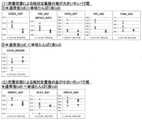
Classifications
-
- C—CHEMISTRY; METALLURGY
- C07—ORGANIC CHEMISTRY
- C07K—PEPTIDES
- C07K16/00—Immunoglobulins [IG], e.g. monoclonal or polyclonal antibodies
- C07K16/18—Immunoglobulins [IG], e.g. monoclonal or polyclonal antibodies against material from animals or humans
- C07K16/28—Immunoglobulins [IG], e.g. monoclonal or polyclonal antibodies against material from animals or humans against receptors, cell surface antigens or cell surface determinants
-
- C—CHEMISTRY; METALLURGY
- C07—ORGANIC CHEMISTRY
- C07K—PEPTIDES
- C07K16/00—Immunoglobulins [IG], e.g. monoclonal or polyclonal antibodies
- C07K16/40—Immunoglobulins [IG], e.g. monoclonal or polyclonal antibodies against enzymes
-
- G—PHYSICS
- G01—MEASURING; TESTING
- G01N—INVESTIGATING OR ANALYSING MATERIALS BY DETERMINING THEIR CHEMICAL OR PHYSICAL PROPERTIES
- G01N33/00—Investigating or analysing materials by specific methods not covered by groups G01N1/00 - G01N31/00
- G01N33/48—Biological material, e.g. blood, urine; Haemocytometers
- G01N33/50—Chemical analysis of biological material, e.g. blood, urine; Testing involving biospecific ligand binding methods; Immunological testing
- G01N33/53—Immunoassay; Biospecific binding assay; Materials therefor
Definitions
- the present invention relates to a method for determining an undernutrition state, a diagnostic agent used for the method, and the like. Specifically, the present invention relates to a method for determining an undernutrition using a marker protein present in saliva, and a diagnostic agent for determining an undernutrition including an antibody that specifically recognizes the marker protein Etc.
- the undernutrition state is a state in which a person has a lack of nutrition, especially energy and / or protein, necessary for maintaining life and living daily life. There is no sudden weight loss but protein is deficient, serum albumin levels are reduced (quasi-color type), muscle and body fat are reduced, and weight is lost (malasmus type). There is a condition (Kwasiokor Marasmus type). The presence or absence of such a risk of undernutrition is evaluated and determined by the serum albumin level, which is a nutritional index indicating a deficiency of protein and energy, and BMI and weight loss.
- Non-patent Document 1 The most commonly used test specimen is blood.
- saliva can be mentioned as a non-invasive test sample that is easier to collect and painless than blood.
- saliva does not contain cellular components such as red blood cells, white blood cells, and platelets and does not coagulate, so that a collected specimen can be easily measured (Non-patent Document 1).
- the disadvantages of saliva include that saliva secreted from the salivary line is mixed with food and substances derived from bacteria in the oral cavity, and the amount of secretion is not always constant and individual differences are severe. Therefore, when searching for biomarkers such as amino acids, metabolites, and proteins, they must be analyzed separately from amino acids, metabolites, or proteins derived from food, oral bacteria, or oral bleeding. In addition, even when a biomarker is found, some standardization is required for changes in salivary secretion.
- saliva tests in dental clinics are related to caries (saliva volume and buffering capacity), periodontal diseases (occult blood volume and enzyme level in saliva), stress (amylase, chromogranin A, Cortisol).
- saliva tests in dental clinics are related to caries (saliva volume and buffering capacity), periodontal diseases (occult blood volume and enzyme level in saliva), stress (amylase, chromogranin A, Cortisol).
- saliva saliva tests in dental clinics are related to caries (saliva volume and buffering capacity), periodontal diseases (occult blood volume and enzyme level in saliva), stress (amylase, chromogranin A, Cortisol).
- saliva markers in saliva can be easily measured in recent years due to the fact that measurement kits are commercially available (Non-Patent Document 2).
- Non-patent Document 3 It has been reported that amylase activity in saliva decreases due to chronic protein deficiency.
- the present invention is to provide an undernutrition diagnosis technique with less burden on a patient, using saliva, which is one of non-invasive specimens that can be easily collected.
- the present inventors have searched for a protein marker in saliva having a correlation with an undernutrition state. Since saliva secreted from the salivary line is mixed with food or substances derived from oral bacteria, it is necessary to distinguish and analyze only saliva-derived proteins. Moreover, the amount of saliva secretion is not always constant, and individual differences are severe. Therefore, in order to solve these problems, the protein marker in saliva was searched with the following strategy. (1) In order to avoid the influence of food, etc., quantitative proteomic analysis using saliva collected directly from the saliva line of a model animal (rat) is performed, and an appropriate standardization method for reducing individual differences is determined. (Amount of saliva used, total protein concentration, etc.).
- the type and amount of protein in rat saliva fed with a normal diet or a low protein diet are compared to search for a marker candidate of a malnutrition state.
- a test method for risk of undernutrition including the following steps: (1) measuring the content of at least one protein selected from the group consisting of acidic mammalian chitinase and polymeric immunoglobulin receptor or peptide fragments thereof in saliva isolated from a human subject; and (2) (1) Correlate the content measured in step 1 with the risk of undernutrition of the subject.
- the test method according to [1] or [2], wherein the content of the protein or peptide fragment thereof in step (1) is measured by an immunological measurement method.
- step (1) at least the content of a protein consisting of amino acids 22 to 476 of the amino acid sequence represented by SEQ ID NO: 1 or a peptide fragment thereof is measured, [1] to [3] Either inspection method.
- step (1) at least the content of the protein consisting of the 19th to 603rd amino acids of the amino acid sequence represented by SEQ ID NO: 2 or the peptide fragment thereof is measured, [1] to [3] Either inspection method.
- a diagnostic agent for the risk of undernutrition comprising an antibody that specifically binds to at least one protein selected from the group consisting of Acidic mammalian chitinase and Polymeric immunoglobulin receptor.
- a malnutrition treatment kit comprising the following (A) and (B): (A) The diagnostic agent according to [6] or [7]; and (B) a protein-supplemented food, a comprehensive amino acid preparation, or a branched-chain amino acid-containing amino acid preparation. [9] The kit according to [8], wherein the undernutrition state is due to insufficient protein intake. [10] An antibody that specifically binds to at least one protein selected from the group consisting of acidic mammalian chitinase and polymeric immunoglobulin receptor for use in diagnosis of risk of malnutrition.
- a combination comprising the following (A) and (B) for use in the treatment of undernutrition: (A) the diagnostic agent of [6] or [7]; and (B) a protein-supplemented food, a comprehensive amino acid preparation, or a branched-chain amino acid-containing amino acid preparation.
- [15] The combination of [14], wherein the undernutrition is due to insufficient protein intake.
- [16] Use of a combination comprising the following (A) and (B) for the manufacture of a malnutrition treatment kit: (A) the diagnostic agent of [6] or [7]; and (B) a protein-supplemented food, a comprehensive amino acid preparation, or a branched-chain amino acid-containing amino acid preparation.
- [17] The use of [16], wherein the undernutrition is due to insufficient protein intake.
- a method for improving undernutrition including the following steps: (1) measuring the content of at least one protein selected from the group consisting of Acidic mammalian chitinase and Polymeric immunoglobulin receptor or peptide fragments thereof in saliva isolated from a human subject; (2) correlating the content measured in (1) with the subject's risk of undernutrition; and (3) if it is determined that the subject is likely to be undernutrition, And give nutrition therapy. [19] The method of [18], wherein the nutritional therapy is performed by administering an effective amount of a protein-supplemented food, a comprehensive amino acid preparation, or a branched chain amino acid-containing amino acid preparation. [20] The method of [18], wherein the undernutrition state is due to a lack of protein intake.
- the present invention it is possible to determine whether a subject is in a poor nutritional state, particularly a poor nutritional state due to insufficient protein intake, without invasion such as blood sampling. According to the present invention, after confirming whether a subject is undernutrition, particularly undernutrition due to insufficient protein intake, protein supplemented food, administration of a comprehensive amino acid preparation or amino acid preparation containing a branched chain amino acid, meat, soybean It is possible to take appropriate measures such as intake of foods rich in protein such as dairy products, dietary guidance and the like.
- Cysteine-rich secretory protein 1 CRIS1_RAT
- Parotid secretory protein PSP_RAT
- Acidic mammalian chitinase CHIA_RAT
- Prolactin-inducible protein homolog PGP_RAT
- PolyGR ceptor Relative quantitative values of Carbonic anhydrase 6 CAH6_RAT
- Deoxyribonuclease-1 DNAS1_RAT
- Kalikrein-1 KLK1_RAT
- Ribonuclease pancreatic beta-type RNS1B_RAT
- the present invention provides an undernutrition state risk inspection method comprising the following steps: (1) Measuring the content of at least one (1 or 2) marker protein or peptide fragment thereof selected from the group consisting of Acidic mammalian chitinase and polymeric immunoglobulin receptor in saliva isolated from a subject; And (2) Correlating the content measured in (1) with the risk of malnutrition of the subject.
- Undernutrition refers to a state in which animals are deficient in nutrients, especially energy and / or protein, necessary for maintaining their lives and living their daily lives. In the undernutrition state, there is no sudden weight loss but protein deficiency, serum albumin levels are reduced (quasi-color type), muscle and body fat are decreased, and weight is lost (malasmus Type) and both (Kwasiokor Marasmus type).
- the test method of the present invention is particularly excellent for testing the risk of undernutrition due to insufficient protein intake (i.e., Kwasiocol-type or Kwasiocol-Marasmus-type undernutrition).
- the subject in the method of the present invention is a human.
- a human who may fall into an undernutrition state or a human who is suspected of being undernutrition can be a subject.
- specific examples of humans who are likely to be undernourished or suspected to be undernourished include the elderly (for example, 65 years of age and older); patients with mental illness such as dementia and depression; patients who are bedridden Patients with anorexia; patients with withdrawal; patients with pressure ulcers; patients with reduced eating or swallowing function; humans (especially women) who have been on an extreme diet; infants and the like.
- examples of humans who are likely to fall into an undernutrition state or suspected to be undernutrition include those who meet at least one of the following criteria indicated by the Ministry of Health, Labor and Welfare as indicators of undernutrition.
- BMI weight ⁇ height 2
- serum albumin level is 3.5g / dl or less
- Meal intake is poor (75% or less)
- saliva refers to oral fluid, and it does not matter where saliva is secreted or collected in the oral cavity.
- the oral fluid is a secretion from a salivary gland (parotid gland, submandibular gland, sublingual gland, accessory gland, etc.) or oral mucosa (gingival mucosa, buccal mucosa, etc.), or a mixture thereof.
- Saliva includes resting saliva and stimulated saliva.
- the saliva at rest can be collected by, for example, the vomiting saliva method, the Watte method or the like.
- Stimulation saliva can be collected, for example, by the gum method.
- a method for collecting saliva has been established in the art, and can be appropriately selected by those skilled in the art.
- the content of at least one (1 or 2) marker protein or peptide fragment thereof selected from the group consisting of Acidic mammalian chitinase and Polymer immunoglobulin receptor in saliva isolated from a subject is used. Measure (Step (1)).
- a typical amino acid sequence of human Acidic mammalian chitinase is shown in SEQ ID NO: 1 (mature protein: 22nd to 476th amino acids).
- a typical amino acid sequence of human Polymeroimmunoglobulin receptor is shown in SEQ ID NO: 2 (secretory protein: 19th to 603rd amino acids).
- the length of the peptide fragment to be measured is not particularly limited as long as the marker protein from which the peptide fragment is derived can be identified, but is usually 7 amino acids or more, preferably 10 amino acids or more. .
- the region containing the peptide fragment is not particularly limited, but when measuring a fragment of Polymerlyimmunoglobulin receptor, it is within the region of amino acids 19 to 603 in the amino acid sequence represented by SEQ ID NO: 2 in human saliva. Therefore, it is preferable to measure the peptide fragment in the region.
- the saliva content of the full-length mature protein is measured for Acidic mammalian chitinase and the full-length secretory protein is measured for Polymer immunoglobulin receptor.
- the method for measuring the content of the marker protein or peptide fragment thereof is not particularly limited, but after treating a saliva sample with an endopeptidase such as trypsin, various molecular weight measurement methods such as gel electrophoresis, Separation and purification (eg, ion exchange chromatography, hydrophobic chromatography, affinity chromatography, reverse phase chromatography, etc.), ionization (eg, electron impact ionization, field desorption, secondary ionization, fast atomization) Collision methods, matrix-assisted laser desorption ionization (MALDI), electrospray ionization, etc.), mass spectrometers (eg, double-focusing mass spectrometer, quadrupole analyzer, time-of-flight mass spectrometer, Fourier transform) Combining mass spectrometers, ion cyclotron mass spectrometers, etc.) Subjected to, it can be performed by detecting a band or spot or peak, consistent with the mo
- the marker protein or a peptide fragment thereof can be measured by quantifying the marker protein or a peptide fragment thereof by an immunological technique using an antibody that specifically binds to the marker protein.
- immunological techniques the amount of antibody, antigen or antibody-antigen complex corresponding to the amount of antigen in a test sample is detected by chemical or physical means, and a standard solution containing a known amount of antigen is used. It calculates from the standard curve produced using it.
- an immunological technique is preferably used from the viewpoint of measuring the full-length saliva content of the mature protein of each marker protein that has been confirmed to have a good correlation in humans.
- immunological methods include a sandwich method, a competitive method, an immunometric method, a neftometry method, western blotting, and an agglutination method.
- the sandwich method uses two types of antibodies that specifically bind to the antigen to be measured. For example, a sample solution is reacted with one antibody immobilized on a solid phase such as a plate or bead, After binding the antigen in it to the antibody on the solid phase, the other antibody labeled with enzyme, biotin, radioisotope, fluorescent substance, etc. is reacted to further bind the antigen bound to the antibody on the solid phase. There is a method in which a labeled antibody is bound, the binding amount of the labeled antibody is measured using a labeling substance, and the antigen is quantified from the binding amount.
- an antigen solution having a concentration of 5 to 10 points is prepared, and when this solution is used as a sample solution, the binding amount to the labeled antibody is measured, and the antigen concentration and the binding amount of the label are plotted.
- the antigen in the sample solution can be quantified.
- the antigen in the test sample and the labeled antigen are reacted competitively with the antibody, and then the unreacted labeled antigen (F) and the labeled antigen (B) bound to the antibody are separated. (B / F separation), the amount of labeled B or F is measured, and the amount of antigen in the test sample is quantified.
- a soluble antibody is used as an antibody
- B / F separation is performed using polyethylene glycol
- a liquid phase method using a second antibody against the antibody and a solid-phased antibody is used as the first antibody
- a soluble method is used, and a solid phase method using a solid phase antibody as the second antibody is used.
- the antigen of the test sample and the immobilized antigen are subjected to a competitive reaction with a certain amount of labeled antibody, and then the solid phase and the liquid phase are separated, or the antigen in the test sample is separated from the antigen. After reacting with an excess amount of labeled antibody and then adding a solid phased antigen to bind unreacted labeled antibody to the solid phase, the solid phase and the liquid phase are separated. Next, the amount of label in any phase is measured to quantify the amount of antigen in the test sample.
- the amount of insoluble precipitate produced as a result of antigen-antibody reaction in gel or solution is measured.
- laser nephrometry using laser scattering is preferably used.
- proteins and peptides contained in a sample are separated by SDS-polyacrylamide gel, and then the proteins and peptides are blotted from the gel onto a polyvinylidene fluoride (PVDF) membrane, nitrocellulose membrane, etc.
- PVDF polyvinylidene fluoride
- the antibody is detected using a labeling substance to detect an antigen on the membrane.
- particles such as latex with immobilized antibodies are reacted with a sample solution, and the aggregation of particles caused by binding of antibodies on the particles to antigens in the sample is detected or quantified by measuring absorbance. It is a method to do.
- binding of an antibody to an antigen Ag means that the affinity of the antibody for the antigen Ag in the antigen-antibody reaction is stronger than the affinity for the control (eg, BSA).
- the antigen-antibody reaction, the antigen of the antibody used in the present invention i.e., human Acidic mammalian chitinase or human Polymeric immunoglobulin receptor
- K D values for binding affinity for of 1 ⁇ 10 -7 M or less e.g., 1 ⁇ 10 ⁇ 8 M or less, 1 ⁇ 10 ⁇ 9 M or less, 1 ⁇ 10 ⁇ 10 M or less, 1 ⁇ 10 ⁇ 11 M or less.
- the epitope recognized by the antibody that specifically binds to the marker protein is not particularly limited as long as the marker protein or a peptide fragment thereof can be quantified by an immunological method.
- an antibody having an epitope in the following region used.
- Acidic mammalian chitinase Nos. 22 to 50, 25 to 75, 50 to 100, 75 to 125, 100 to 150, 125 to 175 in the amino acid sequence represented by SEQ ID NO: 1. 150-200, 175-225, 200-250, 225-275, 250-300, 275-325, 300-350, 325-375, 350-400, 375-425, 400-450, or 425-476 amino acids.
- Polymeric immunoglobulin receptor 19th to 50th, 25th to 75th, 50th to 100th, 75th to 125th, 100th to 150th, 125th to 175th in the amino acid sequence represented by SEQ ID NO: 2 150-200, 175-225, 200-250, 225-275, 250-300, 275-325, 300-350, 325-375, 350-400, 375-425, 400-450, 425-476, 450-500, 475-525, 500-550, 525-575, 550- 603, or amino acids 575-603.
- each epitope is used for capturing antigens and detecting captured antigens. It is preferable to use a combination of antibodies that recognize. For example, each epitope exists in a different region in the region described above. From the viewpoint of detecting the full length of each marker protein and eliminating the influence of the degradation fragment on the measurement result as much as possible, it is preferable that the epitopes recognized by the two antibodies exist as far apart as possible.
- the distance between epitopes is, for example, 50 amino acids or more, preferably 100 amino acids or more, 200 amino acids or more, 300 amino acids or more, or 400 amino acids or more.
- the distance between epitopes is, for example, 50 amino acids or more, preferably 100 amino acids or more, 200 amino acids or more, 300 amino acids or more, 400 amino acids or more, 500 amino acids or more, or 550 amino acids or more.
- the antibody that specifically binds to the marker protein may be either a polyclonal antibody or a monoclonal antibody, and can be prepared by a known method.
- the antibody includes not only a complete antibody molecule but also a binding fragment thereof.
- binding fragment is meant a partial region of the aforementioned antibody having specific binding activity. Examples of the binding fragment include F (ab ′) 2 , Fab ′, Fab, Fv, sFv, dsFv, sdAb and the like.
- the polyclonal antibody may be a commercially available adjuvant using the above protein or a partial peptide thereof (if necessary, a complex cross-linked to a carrier protein such as bovine serum albumin or KLH (Keyhole Limetic Hemocyanin)) as an antigen.
- a carrier protein such as bovine serum albumin or KLH (Keyhole Limetic Hemocyanin)
- complete or incomplete Freund's adjuvant and administered subcutaneously or intraperitoneally to the animal about 2 to 4 times every 2 to 3 weeks (the antibody titer of the partially collected serum is measured by a known antigen-antibody reaction, The increase can be confirmed), and it can be obtained by collecting whole blood about 3 to about 10 days after the final immunization and purifying the antiserum.
- animals to which the antigen is administered include mammals such as rats, mice, rabbits, goats, guinea pigs, and hamsters.
- a monoclonal antibody can be prepared by a cell fusion method or the like.
- the above protein or a partial peptide thereof is administered subcutaneously or intraperitoneally to a mouse 2-4 times together with a commercially available adjuvant, and spleen or lymph nodes are collected about 3 days after the final administration, and leukocytes are collected.
- This leukocyte and myeloma cells (for example, NS-1, P3X63Ag8, etc.) are fused to obtain a hybridoma that produces a monoclonal antibody against the peptide.
- Cell fusion can be performed by the PEG method, the voltage pulse method, or the like.
- a hybridoma producing a desired monoclonal antibody can be selected by detecting an antibody that specifically binds to an antigen from the culture supernatant using a well-known EIA or RIA method.
- the culture of the hybridoma producing the monoclonal antibody can be performed in vitro or in vivo such as mouse or rat, or preferably mouse ascites, and the antibody can be obtained from the culture supernatant of the hybridoma and the ascites of the animal, respectively.
- a monoclonal antibody is preferably used.
- the total length of a specific marker protein or peptide fragment thereof contained in saliva is included so that the total amount of the marker protein can be measured with high sensitivity (for example, the full length of a mature protein or a full length of a secreted protein).
- Polyclonal antibodies obtained by immunizing polypeptides are employed in immunological measurement methods.
- step (1) the content measured in step (1) is correlated with the test subject's malnutrition risk.
- Standards for correction include (i) total protein concentration, (ii) saliva used saliva, (iii) saliva total protein concentration and saliva used, (iv) saliva content of marker protein with little variation due to nutrition status, etc. However, it is preferably corrected based on the total protein concentration. For example, by dividing the concentration of the marker protein or peptide fragment thereof in the saliva sample measured in step (1) by the total protein concentration of the sample, the relative content per unit protein amount is calculated, and this relative Correlates the physical content with the subject's risk of undernutrition. Therefore, when correcting based on the total protein concentration, it is preferable to measure the total protein concentration of each saliva sample in step (1).
- the measured content of the marker protein or peptide fragment thereof is compared with the content of the marker protein or peptide fragment thereof in a healthy person (human having a good nutritional state).
- the content of the marker protein or the peptide fragment thereof is obtained in advance, the average value of the content of the marker protein or the peptide fragment thereof in a human with good nutrition, the marker protein or the You may compare with the average value of the content of the peptide fragment, the correlation between the nutritional status and the content of the marker protein or the peptide fragment.
- the comparison of the content of the marker protein or peptide fragment thereof is preferably performed based on the presence or absence of a significant difference.
- the subject when the saliva content of at least one marker protein selected from the group consisting of Acidic mammalian chitinase and Polymeric immunoglobulin receptor or a peptide fragment thereof is relatively high, the subject is in an undernutrition state (preferably It is possible to determine that there is a high possibility of being in a low nutritional state due to insufficient protein intake.
- a cut-off value of the saliva content of each marker protein or peptide fragment thereof may be set in advance, and the measured content may be compared with the cut-off value.
- the saliva content of the marker protein or its peptide fragment exceeds the cut-off value, the subject is in a low nutrient state (preferably due to lack of protein intake It can be determined that there is a high possibility of being in an undernutrition state.
- “Cutoff value” is a value that can satisfy both high diagnostic sensitivity and high diagnostic specificity when the effectiveness of treatment is determined based on the value.
- the saliva content of a marker protein or a peptide fragment thereof which shows a high positive rate in undernutrition humans and a high negative rate in humans with good nutritional status, can be set as a cut-off value .
- the calculation method of the cut-off value is well known in this field. For example, by measuring the saliva content of each marker protein or peptide fragment of humans with low nutritional status and humans with good nutritional status, the diagnostic sensitivity and diagnostic specificity in the measured values are determined, and these values are calculated. Based on this, a commercially available analysis software is used to create a ROC (Receiver-Operating-Characteristic) curve. Then, a value when the diagnostic sensitivity and diagnostic specificity are as close to 100% as possible is obtained, and the value can be used as a cutoff value.
- ROC Receiveiver-Operating-Characteristic
- the diagnostic efficiency of the detected values (cases in which undernourished humans are correctly determined as “undernutrition” and humans in good nutritional state are correctly determined as “good in nutrition” for the total number of cases.
- the ratio of the total number of cases that have been diagnosed) is calculated, and the value at which the highest diagnostic efficiency is calculated can be used as the cutoff value.
- the content of at least one marker protein or peptide fragment thereof selected from the group consisting of Acidic mammalian chitinase and Polymer immunoglobulin ⁇ ⁇ receptor in the saliva of the subject By measuring the content of both marker proteins and correlating with the risk of undernutrition, the risk of undernutrition can be determined with higher accuracy.
- the determination is different based on the other marker. Even if the determination is made, the determination that “the subject is likely to be undernourished” is given priority.
- the subject when the saliva content of both the marker protein of the Acidic mammalian chitinase and Polymeric immunoglobulin receptor or its peptide fragment is relatively high, the subject is in a low nutritional state (preferably low due to insufficient protein intake). It can be determined that there is a higher possibility of being in (nutrient state).
- Acidic ammamammalian tinchitinase and Polymeric immunoglobulin ceptreceptor proteins or peptide fragments thereof in saliva other proteins in saliva (e.g., alpha amylase, Cysteine- rich secretory protein 1, Parotid secretory protein, Prolactin-inducible protein homolog, Carbonic anhydrase 6) or its peptide fragments, other indicators of malnutrition (eg, BMI, nutritional assessment (MNA, etc.), blood albumin In combination with the prealbumin concentration), the risk of undernutrition can be expected with higher accuracy.
- saliva e.g., alpha amylase, Cysteine- rich secretory protein 1, Parotid secretory protein, Prolactin-inducible protein homolog, Carbonic anhydrase 6
- other indicators of malnutrition eg, BMI, nutritional assessment (MNA, etc.
- MNA nutritional assessment
- blood albumin In combination with the prealbumin concentration
- the present invention provides such a method for improving undernutrition.
- nutritional therapy means supplementing missing nutrients.
- the test method of the present invention is particularly excellent in the examination of the risk of undernutrition due to lack of protein intake (i.e., quasi-color type or quasi-color malasmus type undernutrition).
- General amino acid preparations are generally L-leucine, L-isoleucine, L-valine, L-lysine, L-threonine, L-tryptophan, L-methionine, L-phenylalanine, L-cystine, L-cysteine , L-tyrosine, L-arginine, L-histidine, L-alanine, L-proline, aminoacetic acid, L-aspartic acid, L-glutamic acid (eg, 11, 12, 13, 14, 15) 16, 17 or 18) (preferably essential amino acids (L-tryptophan, L-lysine, L-methionine, L-phenylalanine, L-threonine, L-valine, L-leucine, L-isoleucine, and L-) Means a formulation containing all of histidine).
- the general amino acid preparation is generally a parenteral preparation such as an injection or infusion.
- the amino acid content of the comprehensive amino acid preparation is preferably 5% by weight or more, more preferably 9% by weight or more.
- the amino acid content when the comprehensive amino acid preparation is dried is preferably 90% by weight or more, more preferably 95% by weight or more.
- Examples of the synthetic amino acid preparation include, but are not limited to, Moriamine S, Moripron F, Aminic, Neo Amyu (above, Ajinomoto Co., Inc.) and the like.
- the branched chain amino acid-containing amino acid preparation means an amino acid preparation containing L-leucine, L-isoleucine and L-valine.
- the dosage form of the branched chain amino acid-containing amino acid preparation is generally an oral preparation such as a granule, powder or jelly.
- the amino acid content of the branched chain amino acid-containing amino acid preparation is preferably 3% by weight or more, more preferably 5% by weight or more.
- the amino acid content when the comprehensive amino acid preparation is dried is preferably 80% by weight or more, more preferably 90% by weight or more.
- the ratio of the branched-chain amino acid is preferably 20% by weight or more, more preferably 25% by weight or more among all the amino acids contained.
- the amino acids contained in the branched chain amino acid-containing amino acid preparation are only L-leucine, L-isoleucine and L-valine.
- branched chain amino acid-containing amino acid preparations include, but are not limited to, Amino Vital Series (Ajinomoto Co., Inc.); Rebact Granules, Rebact Jelly (Ajinomoto Pharmaceutical Co., Ltd.) and the like.
- Protein supplemented food refers to food intended to supplement those who are deficient in protein.
- the protein content in the protein supplement is preferably 3% by weight or more, more preferably 4% by weight or more.
- the protein content of the protein supplement when dried is preferably 10% by weight or more, more preferably 15% by weight or more.
- protein supplements include, but are not limited to, Mediev Back (Ajinomoto Co., Inc.).
- the present invention comprises an antibody that specifically binds to at least one (1 or 2) marker protein selected from the group consisting of acidic mammalian chitinase and polymeric immunoglobulin receptor. It provides diagnostic agents for undernutrition risk. If the diagnostic agent of this invention is used, it will become possible to test
- each term including each marker protein and antibody is the same as those described in 1 and 2 above unless otherwise specified.
- the epitope recognized by the antibody is not particularly limited as long as the marker protein or a peptide fragment thereof can be quantified by an immunological method.
- an antibody that recognizes an epitope contained in each region described above is used.
- immunizing a polypeptide comprising the full length of the marker protein for example, the full length of the mature protein
- the polyclonal antibody obtained by the above is used.
- the antibody contained in the diagnostic agent of the present invention may be labeled with a labeling agent.
- the labeling agent include radioisotopes, enzymes, fluorescent substances, luminescent substances, biotin, and the like.
- the radioisotope for example, 125 I, 131 I, 3 H, 14 C and the like are used.
- the enzyme is preferably stable and has a large specific activity.
- ⁇ -galactosidase, ⁇ -glucosidase, alkaline phosphatase, peroxidase, malate dehydrogenase and the like are used.
- the fluorescent substance for example, fluorescamine, fluorescein isothiocyanate and the like are used.
- the luminescent substance for example, luminol, luminol derivatives, luciferin, lucigenin and the like are used.
- the antibody may be provided by immobilizing it on an appropriate support.
- the support is not particularly limited as long as it is a support usually used in the art, and examples thereof include a microplate (eg, 96-well plate), beads, a membrane (eg, nylon membrane), and an array chip. It is done.
- the diagnostic agent of the present invention may further contain chewing gum, paraffin wax, roll watte, gauze, saliva collecting device and the like used for collecting saliva.
- the diagnostic agent of the present invention can further contain a labeled secondary antibody, a chromogenic substrate, a blocking solution, a washing buffer, an ELISA plate, a blotting membrane and the like depending on the type of immunological measurement method.
- Each component contained in the diagnostic agent of the present invention has an appropriate concentration in water or in an appropriate buffer (eg, TE buffer, PBS, etc.), as appropriate, separately (or in a mixed state if possible). Or dissolved in a lyophilized state and placed in a suitable container.
- an appropriate buffer eg, TE buffer, PBS, etc.
- Kit for Treatment of Undernutrition State The present invention also provides a kit comprising a combination of the diagnostic agent of the present invention and a protein-supplemented food, a comprehensive amino acid preparation, or a branched chain amino acid-containing amino acid preparation.
- the kit of the present invention may be a treatment kit for undernutrition.
- the risk of undernutrition of a subject is predicted by the test method of the present invention, and there is a possibility of being in a low nutritional state (preferably a low nutritional state due to insufficient protein intake). It is possible to treat a patient judged to be high by administering a protein supplement, a comprehensive amino acid preparation, or a branched chain amino acid-containing amino acid preparation.
- the trachea was cannulated and pilocarpine (nonselective muscarinic receptor agonist, 5 mg / kg, ip) and isoproterenol (adrenergic agonist,
- pilocarpine nonselective muscarinic receptor agonist, 5 mg / kg, ip
- isoproterenol adrenergic agonist
- the parotid saliva and submandibular / sublingual saliva secreted by stimulation (5 mg / kg, ip) were collected (30 minutes).
- Protease inhibitors were added to saliva immediately after collection.
- Parotid saliva was collected from left and right parotid saliva by inserting Teflon tubes (unique medical UT-02) into the salivary gland ducts on both sides.
- submandibular / sublingual saliva For submandibular / sublingual saliva, the saliva secreted into the oral cavity was collected with a pipette. Therefore, submandibular / sublingual saliva is a general term for saliva other than parotid saliva including small salivary glands.
- blood was collected from the heart, and the rats were euthanized by Nembutal deep anesthesia. The blood was centrifuged at 3000 rpm for 15 minutes after addition of an anticoagulant (non-clot) to separate plasma. The albumin level in plasma was measured using Fuji Dry Chem. Animals that died during 30 minutes of saliva collection after stimulation with pilocarpine isoprotenol were excluded.
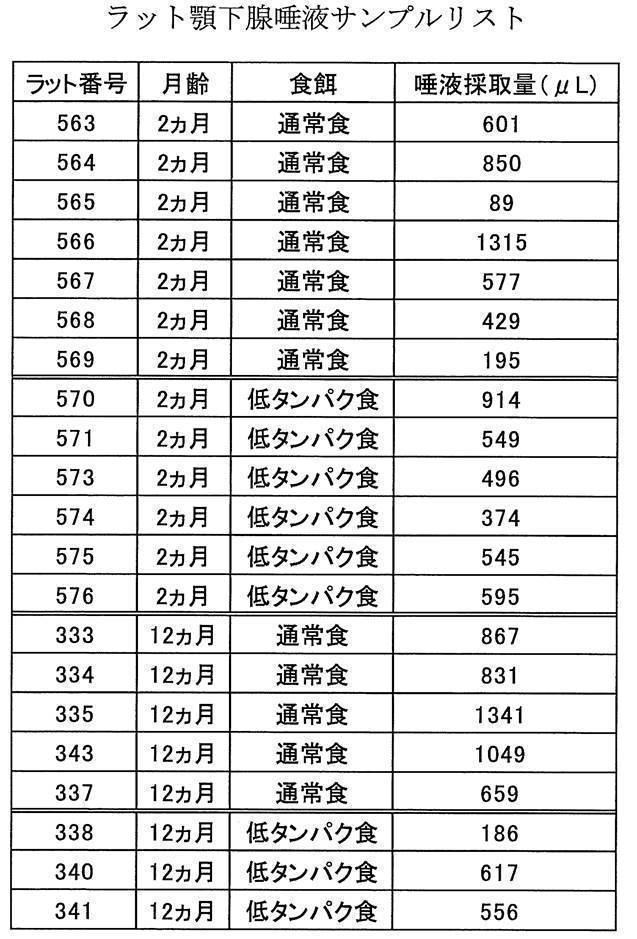
- Tables 2 and 3 show the list of rat saliva samples actually used.
- Parotid saliva 14 samples at 2 months (normal condition), 7 samples at 2 months (undernutrition), 6 samples at 12 months (normal condition), 3 samples at 12 months (undernutrition) total 30 Specimens used
- Submandibular gland saliva 2 samples at 2 months (normal condition), 6 samples at 2 months (undernutrition), 5 samples at 12 months (normal condition), 12 months (under nutrition) 3 (A total of 21 samples are used.)
- iTRAQ modification 70 ⁇ l of ethanol was dissolved in each container of 4 types of iTRAQ reagents (114, 115, 116, 117), and dispensed into 0.6 mL test tubes. Thereafter, 6.5 ⁇ l of Tris-HCl buffer solution, 8.5 ⁇ l of ultrapure water, and 35 ⁇ l of saliva sample subjected to trypsin digestion after reductive carboxymethylation were added and reacted at room temperature for 2 hours.
- Quantitative data analysis method of iTRAQ method 5.1 Preparation of a list of biomarker candidate proteins in rat saliva Database search results are summarized for each type of rodent (rat, mouse, etc.). When there was no rat-derived protein, mouse-derived was left, and when neither rat nor mouse-derived protein was found, the protein with the highest Protein Score value was left. The protein score is a value indicating the accuracy of protein identification, and the higher the accuracy, the higher the accuracy.
- Biomarker candidate proteins identified by comprehensive analysis of proteins contained in rat parotid saliva, submandibular gland saliva, and sublingual gland saliva digested with trypsin after reductive carboxymethylation were used for identification as well. The resulting peptide sequences were listed. 3) The above two analysis results were collected and used as a peptide list of rat saliva-derived biomarker candidate-derived proteins.
- the amount of saliva equivalent to 0.05 mg of total protein in the saliva sample with the lowest protein concentration is defined as the sample amount for proteome analysis, and it is the same for all parotid gland or submandibular gland saliva samples. Reductive carboxymethylation and trypsin digestion were performed. For rat parotid saliva, 8 ⁇ l was used based on the protein concentration of rat number 570L, and for rat submandibular saliva, 77 ⁇ l was used based on rat number 570.
- FIG. 2 summarizes the relative quantitative values of the proteins that showed differences in nutritional status in rat parotid saliva.
- Fig. 2 shows that there are 6 types of proteins (No. 2, 5, 9, 10, 18, 21 in Table 6) that have a particularly large difference in relative quantitative values depending on nutritional status, and 3 types of proteins that have a small difference (in Table 6). No. 6, 13, 14) It was found that it exists.
- FIG. 3 shows a summary of the relative quantitative values of 12-month-old rat parotid saliva for each protein. From Fig.
- Test Example 2 Measurement of undernutrition biomarker protein in human saliva In elderly people (humans), the relationship between the content of salivary biomarker protein candidates identified in Test Example 1 and the existing undernutrition index We examined and verified the possibility as an undernutrition marker.
- Method 1 Target people (1) Selection criteria Targeting elderly volunteers aged 65 and over who have been judged as undernourished (0-7 points) or in good nutritional status (12-14 points) on the Simple Nutrition Status Assessment Form (MNA-SF) As a test. (2) Exclusion criteria Persons who meet any of the following criteria were excluded from the study: (a) Those who have 13 or fewer remaining teeth and the dentist finds that the meshing is poor; (Since the number of remaining teeth is low, saliva secretion is small and difficult to collect) (b) A person whose blood is mixed with the collected saliva; (c) currently undergoing dental treatment; (d) Person with fever or acute infection such as a cold; and (e) Those who are deemed inappropriate by the person in charge of the test except the above
- Saliva was collected at 10-12 o'clock after 2 hours. Two hours before collection were fasted and drunk water. Saliva collection was performed using a salivat saliva collection tube. Salivat absorbent cotton was included in the mouth, chewed for 1 minute, and after 3 minutes or longer, the tube was collected, and saliva contained in the absorbent cotton was centrifuged to collect saliva. Saliva in the second tube was used for the test. The concentrations of acidic mammalian chitinase and polymeric immunoglobulin receptor in saliva were measured by ELISA. The ELISA kit used is as follows.
- Acidic mammalian chitinase CUSABIO EL005348HU
- Polymeric immunoglobulin receptor USCN Life Science SEB074Hu
- the saliva sample was diluted 5-fold and then subjected to ELISA.
- Polymeric immunoglobulin receptor was subjected to ELISA without diluting the saliva sample.
- Each marker protein concentration measured in saliva was corrected with the total protein (TP) concentration in saliva.
- TP total protein
- MNA Marker protein and malnutrition
- the saliva content of Acidic mammalian chitinase showed a significant difference between undernourished subjects and subjects with good nutrition. Surprisingly, the saliva content of this marker protein decreased in rats under low nutrition (Test Example 1), but conversely increased in human under nutrition. When MNA was used as an indicator of undernutrition, there was no significant difference for the Polymer immunoglobulin receptor.
- the salivary content of Acidic® mammalian® chitinase and Polymeric® immunooglobulin® receptor showed a significant difference between undernourished subjects and subjects with good nutritional status.
- the salivary content of these marker proteins decreased in rats under low nutrition (Test Example 1), but conversely increased in human under nutrition.
- Acidic mammalian chitinase and Polymer immunoglobulin receptor in saliva showed a negative correlation with each nutrient index (blood albumin concentration, blood prealbumin concentration, and MNA).
- the present invention it is possible to determine whether a subject is in a poor nutritional state, particularly a poor nutritional state due to insufficient protein intake, without invasion such as blood sampling. According to the present invention, after confirming whether a subject is undernutrition, particularly undernutrition due to insufficient protein intake, protein supplemented food, administration of a comprehensive amino acid preparation or amino acid preparation containing a branched chain amino acid, meat, soybean It is possible to take appropriate measures such as intake of foods rich in protein such as dairy products, dietary guidance and the like.
Landscapes
- Health & Medical Sciences (AREA)
- Chemical & Material Sciences (AREA)
- Immunology (AREA)
- Life Sciences & Earth Sciences (AREA)
- Molecular Biology (AREA)
- Organic Chemistry (AREA)
- Engineering & Computer Science (AREA)
- Medicinal Chemistry (AREA)
- General Health & Medical Sciences (AREA)
- Biochemistry (AREA)
- Hematology (AREA)
- Proteomics, Peptides & Aminoacids (AREA)
- Biophysics (AREA)
- Biomedical Technology (AREA)
- Urology & Nephrology (AREA)
- Genetics & Genomics (AREA)
- Microbiology (AREA)
- Cell Biology (AREA)
- Biotechnology (AREA)
- Food Science & Technology (AREA)
- Physics & Mathematics (AREA)
- Analytical Chemistry (AREA)
- General Physics & Mathematics (AREA)
- Pathology (AREA)
- Medicines That Contain Protein Lipid Enzymes And Other Medicines (AREA)
- Acyclic And Carbocyclic Compounds In Medicinal Compositions (AREA)
- Investigating Or Analysing Biological Materials (AREA)
Abstract
本発明は、以下の工程を含む、低栄養状態リスクの検査方法を提供する: (1)ヒト被験者から単離された唾液における、Acidic mammalian chitinase及びPolymeric immunoglobulin receptorからなる群から選択される少なくとも1つのタンパク質又はそのペプチド断片の含有量を測定すること;並びに (2)(1)において測定した含有量と、被験者の低栄養状態リスクとを相関付けること。
Description
本発明は、低栄養状態の判定方法、及びそれに使用する診断薬等に関する。具体的には、本発明は、唾液中に存在するマーカータンパク質を用いた低栄養状態の判定方法、及び当該マーカータンパク質を特異的に認識する抗体を含む、低栄養状態を判定するための診断薬等に関する。
低栄養状態とは、人が生命を維持し、日常生活を営むために必要な栄養、特にエネルギー及び/又はタンパク質が不足している状態である。急激な体重の減少はみられないがタンパク質が欠乏し、血清アルブミン値が低下した状態(クワシオコル型)、筋肉や体脂肪の減少が見られ、体重が減少した状態(マラスムス型)、その両方がみられる状態(クワシオコル・マラスムス型)がある。このような低栄養状態のリスクの有無は、タンパク質及びエネルギーの欠乏状態を示す栄養指標である血清アルブミン値及び、BMIや体重の減少によって評価・判定される。
低栄養状態については統一された基準はないが、厚生労働省より以下の指標が出されている。
(1)BMI(体重÷身長2)が18.5未満
(2)6ヶ月以内に3%以上又は2~3kgの体重減少がある
(3)血液検査の結果、血清アルブミン値が3.5g/dl以下
(4)食事摂取量が不良(75%以下)
(5)その他低栄養状態にある又はそのおそれが認められる者
(1)BMI(体重÷身長2)が18.5未満
(2)6ヶ月以内に3%以上又は2~3kgの体重減少がある
(3)血液検査の結果、血清アルブミン値が3.5g/dl以下
(4)食事摂取量が不良(75%以下)
(5)その他低栄養状態にある又はそのおそれが認められる者
このような状態は、不十分な食事摂取量に起因するものである。また、関連する問題として、(a)口腔及び摂食・嚥下機能、(b)生活機能の低下、(c)褥瘡、(d)食欲の低下、(e)閉じこもり、(f)認知症、(g)うつ等が挙げられており、これらの問題が把握される場合にも、適宜低栄養状態のリスクの確認をする必要がある。
低栄養は本人も周囲も気づきにくいものであり、現在、栄養状態の把握には健康診断等で体重の変化やBMI(体格指数)、血液検査の血清アルブミン値が有効な指標として用いられている。しかし、高齢者にとって血液検査は負担が大きいため、非侵襲の簡便な健康状態診断法が必要とされている。
検査検体として、最も一般的に用いられるのは血液である。一方、血液と比較して、採取が容易で且つ痛みを伴わない非侵襲性の検査検体として唾液を挙げることができる。唾液は、血液と異なり、赤血球、白血球、血小板などの細胞性の成分を含まず、凝固することがないので、採取した検体を容易に測定できる(非特許文献1)。
一方、唾液の欠点としては、唾液線から分泌された唾液は、食物や口腔内細菌由来の物質と混合されること、分泌量が必ずしも一定ではなく、個人差が激しいことが挙げられる。したがって、アミノ酸や代謝物、タンパク質などのバイオマーカーを探索する場合においては、食物や口腔内細菌由来、口腔内出血由来のアミノ酸、代謝物あるいはタンパク質と区別して、分析しなくてはならない。また、バイオマーカーが見いだされた場合においても、唾液分泌量の変動に対して、何らかの規格化が必要となる。
現在、歯科臨床で行われている唾液検査は、う蝕に関するもの(唾液量と緩衝能)、歯周病に関するもの(唾液中の潜血量、酵素量)、ストレスに関するもの(アミラーゼ、クロモグラニンA、コルチゾール)がある。正確なストレス評価を行うためには、血中や組織のストレスマーカーを計測することが必要であるが、被験者への精神的なストレスの少ない、唾液や尿、汗などの検体が望まれている。特に、唾液中のストレスマーカーは、近年、その測定キットが市販されたことにより、容易に測定できるようになってきた(非特許文献2)。
このように非侵襲の検体である唾液を対象として、心疾患や癌などの疾患に関わるバイオマーカーの探索が近年積極的に行われている。例えば、心疾患の危険度をモニタリングすることを目的として唾液中のアポリポプロテインA-1およびBのレベルを検出するための方法(特許文献1)や乳癌の診断予後判定をすることを目的として、VEGF、CEAおよびEGFを検出する方法がある(特許文献2)。これらは、血中で見出されたタンパク質マーカーを唾液に適用した例である。
近年、質量分析をもちいたタンパク質の網羅的解析法であるプロテオミクスという分析手法を用いたタンパク質バイオマーカーの探索研究が盛んであり、唾液中のタンパク質の網羅的解析により、疾患マーカーの探索研究もおこなわれているが、前述のとおり、食物、口腔内細菌および潜血由来タンパク質が多く存在することが、真の疾患マーカー探索の妨げとなっている。
慢性的なタンパク質不足により、唾液中のアミラーゼ活性が低下することが報告されている(非特許文献3)。
歯科における唾液検査 兼平孝、「日本口腔検査学会雑誌」、3(1):13-20(2011)
:ストレスマーカーの迅速アッセイ、脇田慎一ら、「ぶんせき」、6、309-316(2004)
R. R. Watson et al., J. Nutr. 110: 771-777, 1980
本発明は、採取が容易な非侵襲検体のひとつである唾液を用いた、患者に対する負担の少ない低栄養状態の診断技術を提供することである。
本発明者らは上記課題を解決すべく、低栄養状態との相関性を有する唾液中のタンパク質マーカーの探索を行った。唾液線から分泌された唾液は食物や口腔内細菌由来の物質と混合されるため、唾液由来のタンパク質のみを区別して分析する必要がある。また、唾液分泌量は必ずしも一定ではなく、個人差が激しい。そこで、これらの問題を解決するために、次のストラテジーで唾液中の上記タンパク質マーカーの探索を行った。
(1)食物等の影響を回避するために、モデル動物(ラット)の唾液線から直接採取した唾液を用いた定量プロテオーム解析を行い、個体差を軽減するための適切な規格化法を決定する(使用する唾液量、総タンパク質濃度等)。
(2)(1)の方法を用いて、通常食または低タンパク食を摂取させたラット唾液中タンパク質の種類及び量を比較し、低栄養状態のマーカー候補を探索する。
(3)選択されたマーカー候補が、ヒトにおいても低栄養状態のマーカーとなり得るか試験する。
(1)食物等の影響を回避するために、モデル動物(ラット)の唾液線から直接採取した唾液を用いた定量プロテオーム解析を行い、個体差を軽減するための適切な規格化法を決定する(使用する唾液量、総タンパク質濃度等)。
(2)(1)の方法を用いて、通常食または低タンパク食を摂取させたラット唾液中タンパク質の種類及び量を比較し、低栄養状態のマーカー候補を探索する。
(3)選択されたマーカー候補が、ヒトにおいても低栄養状態のマーカーとなり得るか試験する。
その結果、唾液中の含有量が低栄養状態と良好に相関するタンパク質マーカーを抽出することに成功した。抽出されたタンパク質マーカーと、低栄養状態との関連性については、未だ報告がない。これらの知見に基づき、更に検討を進め、本発明を完成した。
即ち、本発明は以下に関する。
[1]以下の工程を含む、低栄養状態リスクの検査方法:
(1)ヒト被験者から単離された唾液における、Acidic mammalian chitinase及びPolymeric immunoglobulin receptorからなる群から選択される少なくとも1つのタンパク質又はそのペプチド断片の含有量を測定すること;並びに
(2)(1)において測定した含有量と、被験者の低栄養状態リスクとを相関付けること。
[2]低栄養状態が、タンパク質摂取量の不足によるものである、[1]の検査方法。
[3]工程(1)におけるタンパク質又はそのペプチド断片の含有量の測定を、免疫学的測定方法により行う、[1]又は[2]の検査方法。
[4]工程(1)において、配列番号1で表されるアミノ酸配列の第22番~第476番アミノ酸からなるタンパク質又はそのペプチド断片の含有量を少なくとも測定する、[1]~[3]のいずれか記載の検査方法。
[5]工程(1)において、配列番号2で表されるアミノ酸配列の第19番~第603番アミノ酸からなるタンパク質又はそのペプチド断片の含有量を少なくとも測定する、[1]~[3]のいずれか記載の検査方法。
[6]Acidic mammalian chitinase及びPolymeric immunoglobulin receptorからなる群から選択される少なくとも1つのタンパク質に特異的に結合する抗体を含む、低栄養状態リスクの診断薬。
[7]低栄養状態が、タンパク質摂取量の不足によるものである、[6]の診断薬。
[8]以下の(A)及び(B)を含む、低栄養状態の治療用キット:
(A)[6]又は[7]に記載の診断薬;及び
(B)タンパク質補給食品、総合アミノ酸製剤又は分岐鎖アミノ酸含有アミノ酸製剤。
[9]低栄養状態が、タンパク質摂取量の不足によるものである、[8]のキット。
[10]低栄養状態リスクの診断に使用するための、Acidic mammalian chitinase及びPolymeric immunoglobulin receptorからなる群から選択される少なくとも1つのタンパク質に特異的に結合する抗体。
[11]低栄養状態が、タンパク質摂取量の不足によるものである、[10]の抗体。
[12]低栄養状態リスクの診断薬の製造のための、Acidic mammalian chitinase及びPolymeric immunoglobulin receptorからなる群から選択される少なくとも1つのタンパク質に特異的に結合する抗体の使用。
[13]低栄養状態が、タンパク質摂取量の不足によるものである、[12]の使用。
[14]低栄養状態の治療に使用するための、以下の(A)及び(B)を含む組み合わせ:
(A)[6]又は[7]の診断薬;及び
(B)タンパク質補給食品、総合アミノ酸製剤又は分岐鎖アミノ酸含有アミノ酸製剤。
[15]低栄養状態が、タンパク質摂取量の不足によるものである、[14]の組み合わせ。
[16]低栄養状態の治療用キットの製造のための、以下の(A)及び(B)を含む組み合わせの使用:
(A)[6]又は[7]の診断薬;及び
(B)タンパク質補給食品、総合アミノ酸製剤又は分岐鎖アミノ酸含有アミノ酸製剤。
[17]低栄養状態が、タンパク質摂取量の不足によるものである、[16]の使用。
[18]以下の工程を含む、低栄養状態の改善方法:
(1)ヒト被験者から単離された唾液における、Acidic mammalian chitinase及びPolymeric immunoglobulin receptorからなる群から選択される少なくとも1つのタンパク質又はそのペプチド断片の含有量を測定すること;
(2)(1)において測定した含有量と、被験者の低栄養状態リスクとを相関付けること;及び
(3)被験者が低栄養状態にある可能性が高いと判定された場合、当該被験者に対して、栄養療法を施すこと。
[19]栄養療法が、タンパク質補給食品、総合アミノ酸製剤又は分岐鎖アミノ酸含有アミノ酸製剤の有効量の投与により行われる、[18]の方法。
[20]低栄養状態が、タンパク質摂取量の不足によるものである、[18]の方法。
[1]以下の工程を含む、低栄養状態リスクの検査方法:
(1)ヒト被験者から単離された唾液における、Acidic mammalian chitinase及びPolymeric immunoglobulin receptorからなる群から選択される少なくとも1つのタンパク質又はそのペプチド断片の含有量を測定すること;並びに
(2)(1)において測定した含有量と、被験者の低栄養状態リスクとを相関付けること。
[2]低栄養状態が、タンパク質摂取量の不足によるものである、[1]の検査方法。
[3]工程(1)におけるタンパク質又はそのペプチド断片の含有量の測定を、免疫学的測定方法により行う、[1]又は[2]の検査方法。
[4]工程(1)において、配列番号1で表されるアミノ酸配列の第22番~第476番アミノ酸からなるタンパク質又はそのペプチド断片の含有量を少なくとも測定する、[1]~[3]のいずれか記載の検査方法。
[5]工程(1)において、配列番号2で表されるアミノ酸配列の第19番~第603番アミノ酸からなるタンパク質又はそのペプチド断片の含有量を少なくとも測定する、[1]~[3]のいずれか記載の検査方法。
[6]Acidic mammalian chitinase及びPolymeric immunoglobulin receptorからなる群から選択される少なくとも1つのタンパク質に特異的に結合する抗体を含む、低栄養状態リスクの診断薬。
[7]低栄養状態が、タンパク質摂取量の不足によるものである、[6]の診断薬。
[8]以下の(A)及び(B)を含む、低栄養状態の治療用キット:
(A)[6]又は[7]に記載の診断薬;及び
(B)タンパク質補給食品、総合アミノ酸製剤又は分岐鎖アミノ酸含有アミノ酸製剤。
[9]低栄養状態が、タンパク質摂取量の不足によるものである、[8]のキット。
[10]低栄養状態リスクの診断に使用するための、Acidic mammalian chitinase及びPolymeric immunoglobulin receptorからなる群から選択される少なくとも1つのタンパク質に特異的に結合する抗体。
[11]低栄養状態が、タンパク質摂取量の不足によるものである、[10]の抗体。
[12]低栄養状態リスクの診断薬の製造のための、Acidic mammalian chitinase及びPolymeric immunoglobulin receptorからなる群から選択される少なくとも1つのタンパク質に特異的に結合する抗体の使用。
[13]低栄養状態が、タンパク質摂取量の不足によるものである、[12]の使用。
[14]低栄養状態の治療に使用するための、以下の(A)及び(B)を含む組み合わせ:
(A)[6]又は[7]の診断薬;及び
(B)タンパク質補給食品、総合アミノ酸製剤又は分岐鎖アミノ酸含有アミノ酸製剤。
[15]低栄養状態が、タンパク質摂取量の不足によるものである、[14]の組み合わせ。
[16]低栄養状態の治療用キットの製造のための、以下の(A)及び(B)を含む組み合わせの使用:
(A)[6]又は[7]の診断薬;及び
(B)タンパク質補給食品、総合アミノ酸製剤又は分岐鎖アミノ酸含有アミノ酸製剤。
[17]低栄養状態が、タンパク質摂取量の不足によるものである、[16]の使用。
[18]以下の工程を含む、低栄養状態の改善方法:
(1)ヒト被験者から単離された唾液における、Acidic mammalian chitinase及びPolymeric immunoglobulin receptorからなる群から選択される少なくとも1つのタンパク質又はそのペプチド断片の含有量を測定すること;
(2)(1)において測定した含有量と、被験者の低栄養状態リスクとを相関付けること;及び
(3)被験者が低栄養状態にある可能性が高いと判定された場合、当該被験者に対して、栄養療法を施すこと。
[19]栄養療法が、タンパク質補給食品、総合アミノ酸製剤又は分岐鎖アミノ酸含有アミノ酸製剤の有効量の投与により行われる、[18]の方法。
[20]低栄養状態が、タンパク質摂取量の不足によるものである、[18]の方法。
本発明によれば、採血等の侵襲なしに、被験者が低栄養状態、特にタンパク質摂取量の不足による低栄養状態にあるか、判定することが可能である。
本発明によれば、被験者が低栄養状態、特にタンパク質摂取量の不足による低栄養状態にあるかを確認した上で、タンパク質補給食品、総合アミノ酸製剤や分岐鎖アミノ酸含有アミノ酸製剤投与、肉、大豆、乳製品等のタンパク質が豊富な食品の摂取、食事指導等の適切な対処をとることが可能である。
本発明によれば、被験者が低栄養状態、特にタンパク質摂取量の不足による低栄養状態にあるかを確認した上で、タンパク質補給食品、総合アミノ酸製剤や分岐鎖アミノ酸含有アミノ酸製剤投与、肉、大豆、乳製品等のタンパク質が豊富な食品の摂取、食事指導等の適切な対処をとることが可能である。
1.低栄養状態リスクの検査方法
本発明は、以下の工程を含む、低栄養状態リスクの検査方法を提供するものである:
(1)被験者から単離された唾液における、Acidic mammalian chitinase及びPolymeric immunoglobulin receptorからなる群から選択される少なくとも1つ(1又は2つ)のマーカータンパク質又はそのペプチド断片の含有量を測定すること;並びに
(2)(1)において測定した含有量と、被験者の低栄養状態リスクとを相関付けること。
本発明は、以下の工程を含む、低栄養状態リスクの検査方法を提供するものである:
(1)被験者から単離された唾液における、Acidic mammalian chitinase及びPolymeric immunoglobulin receptorからなる群から選択される少なくとも1つ(1又は2つ)のマーカータンパク質又はそのペプチド断片の含有量を測定すること;並びに
(2)(1)において測定した含有量と、被験者の低栄養状態リスクとを相関付けること。
低栄養状態とは、動物が生命を維持し、日常生活を営むために必要な栄養、特にエネルギー及び/又はタンパク質が不足している状態をいう。低栄養状態には、急激な体重の減少はみられないがタンパク質が欠乏し、血清アルブミン値が低下した状態(クワシオコル型)、筋肉や体脂肪の減少が見られ、体重が減少した状態(マラスムス型)、その両方がみられる状態(クワシオコル・マラスムス型)がある。本発明の検査方法は、特にタンパク質摂取量の不足による低栄養状態(即ち、クワシオコル型又はクワシオコル・マラスムス型の低栄養状態)のリスクの検査に優れる。
本発明の方法における被験者は、ヒトである。特に、低栄養状態に陥る可能性があるヒト又は低栄養状態が疑われるヒトが、被験者となり得る。低栄養状態に陥る可能性があるヒト又は低栄養状態が疑われるヒトとしては、具体的には、高齢者(例えば65歳以上);認知症、うつ病等の精神疾患の患者;寝たきりの患者;食欲不振の患者;引きこもりの患者;褥瘡の患者;摂食又は嚥下機能が低下した患者;過激なダイエットを行ったヒト(特に女性);乳幼児等が挙げられる。また、低栄養状態に陥る可能性があるヒト又は低栄養状態が疑われるヒトとしては、厚生労働省より低栄養状態の指標として示された以下の基準のうちの少なくとも1つを満たすヒトが挙げられる。
(1) BMI(体重÷身長2)が18.5未満
(2) 6ヶ月以内に3%以上又は2~3kgの体重減少がある
(3) 血液検査の結果、血清アルブミン値が3.5g/dl以下
(4) 食事摂取量が不良(75%以下)
(1) BMI(体重÷身長2)が18.5未満
(2) 6ヶ月以内に3%以上又は2~3kgの体重減少がある
(3) 血液検査の結果、血清アルブミン値が3.5g/dl以下
(4) 食事摂取量が不良(75%以下)
本明細書において、唾液とは、口腔液を指し、唾液が口腔中のどの部分で分泌されるか、またはどのように集められるかを問わない。口腔液は、唾液腺(耳下腺、顎下腺、舌下腺、副腺等)又は口腔粘膜(歯肉粘膜、頬粘膜等)からの分泌物、又はこれらの混合物である。唾液には、安静時唾液及び刺激時唾液が包含される。安静時唾液は、例えば、吐唾法、ワッテ法等により採取することができる。刺激時唾液は、例えば、ガム法により採取することができる。唾液の採取方法は、当該技術分野において確立されており、当業者であれば、適宜選択することが可能である。
本発明の方法においては、被験者から単離された唾液における、Acidic mammalian chitinase及びPolymeric immunoglobulin receptorからなる群から選択される少なくとも1つ(1又は2つ)のマーカータンパク質又はそのペプチド断片の含有量を測定する(工程(1))。
ヒトAcidic mammalian chitinaseの代表的なアミノ酸配列を、配列番号1(成熟タンパク質:第22~第476番アミノ酸)に示す。
ヒトPolymeric immunoglobulin receptorの代表的なアミノ酸配列を、配列番号2(分泌型タンパク質:第19~第603番アミノ酸)に示す。
ペプチド断片の含有量を測定する場合、測定対象のペプチド断片の長さは、当該ペプチド断片が由来するマーカータンパク質を同定可能な限り特に限定されないが、通常7アミノ酸以上、好ましくは10アミノ酸以上である。
ペプチド断片が含まれる領域は、特に限定されないが、Polymeric immunoglobulin receptorの断片を測定する場合、ヒト唾液中には、配列番号2で表されるアミノ酸配列中の第19~第603番アミノ酸の領域内のペプチド断片が検出されることが知られているため、当該領域内のペプチド断片を測定することが好ましい。
好適には、Acidic mammalian chitinaseについては成熟タンパク質の全長、Polymeric immunoglobulin receptorについては分泌型タンパク質の全長の唾液中含有量が測定される。
上記マーカータンパク質又はそのペプチド断片の含有量の測定方法は、特に限定されないが、唾液試料を、トリプシン等のエンドペプチダーゼで処理した上で、各種の分子量測定法、例えば、ゲル電気泳動や、各種の分離精製法(例:イオン交換クロマトグラフィー、疎水性クロマトグラフィー、アフィニティークロマトグラフィー、逆相クロマトグラフィーなど)、イオン化法(例:電子衝撃イオン化法、フィールドディソープション法、二次イオン化法、高速原子衝突法、マトリックス支援レーザー脱離イオン化(MALDI)法、エレクトロスプレーイオン化法など)、質量分析計(例:二重収束質量分析計、四重極型分析計、飛行時間型質量分析計、フーリエ変換質量分析計、イオンサイクロトロン質量分析計など)を組み合わせる方法等に供し、上記マーカータンパク質又はそれ由来のペプチド断片の分子量と一致するバンドもしくはスポット、あるいはピークを検出することにより行うことができる。あるいは、上記マーカータンパク質に特異的に結合する抗体を用いた免疫学的手法により、上記マーカータンパク質又はそのペプチド断片を定量することにより測定することができる。免疫学的手法においては、被検試料中の抗原量に対応した抗体、抗原もしくは抗体-抗原複合体の量を化学的または物理的手段により検出し、これを既知量の抗原を含む標準液を用いて作製した標準曲線より算出する。
後述する試験例に示すように、ラットにおいて、質量分析を用いてマーカータンパク質を断片化し、マーカータンパク質の全長とペプチド断片の総和を測定した場合、低栄養状態においては、Acidic mammalian chitinase及びPolymeric immunoglobulin receptorの唾液中含有量は減少したが、ヒトにおいて、免疫学的手法によりマーカータンパク質(成熟型又は分泌型)の全長を測定した場合には、逆に低栄養状態においてAcidic mammalian chitinase及びPolymeric immunoglobulin receptorの唾液中含有量は上昇したことから、マーカータンパク質の測定方法により、各マーカータンパク質と低栄養状態との相関関係に差異が生じる可能性がある。理論に束縛されるものではないが、この原因として、低栄養状態と良好な栄養状態との間で、これらのマーカータンパク質の分解度合が異なり、全長タンパク質は、良好な栄養状態よりも低栄養状態において、唾液中含有量が増加するが、分解断片は、低栄養状態よりも良好な栄養状態において、唾液中含有量が増加している可能性が考えられる。本発明の方法においては、ヒトにおいて良好な相関関係が確認された、各マーカータンパク質の成熟タンパク質の全長の唾液中含有量を測定する観点から、免疫学的手法が好適に用いられる。
免疫学的手法としては、サンドイッチ法、競合法、イムノメトリック法、ネフメトリー法、ウェスタンブロッティング、凝集法等を挙げることができる。
サンドイッチ法は測定対象の抗原と特異的に結合する2種類の抗体を使用する方法であり、例えば、片方の抗体をプレートやビーズ等の固相に固定化したものに試料溶液を反応させ、試料中の抗原を固相上の抗体と結合させた後、酵素、ビオチン、放射性同位元素、蛍光物質等で標識したもう一方の抗体を反応させて、固相上の抗体と結合した抗原にさらに該標識抗体を結合させ、該標識抗体の結合量を標識物質を利用して測定し、その結合量から本抗原を定量する方法があげられる。例えば、5~10点の濃度を決めた抗原の溶液を調製し、この溶液を試料溶液とした場合の、標識抗体への結合量を測定して、抗原の濃度と標識の結合量をプロットした検量線を作成し、抗原を定量する試料溶液についての、標識抗体の結合量を検量線にあてはめることにより、試料溶液の抗原を定量することができる。
競合法では、被検試料中の抗原と標識抗原とを抗体に対して競合的に反応させた後、未反応の標識抗原(F)と、抗体と結合した標識抗原(B)とを分離し(B/F分離)、B、Fいずれかの標識量を測定し、被検試料中の抗原量を定量する。本反応法には、抗体として可溶性抗体を用い、B/F分離をポリエチレングリコール、前記抗体に対する第2抗体などを用いる液相法、および、第1抗体として固相化抗体を用いるか、あるいは、第1抗体は可溶性のものを用い第2抗体として固相化抗体を用いる固相化法とが用いられる。
イムノメトリック法では、被検試料の抗原と固相化抗原とを一定量の標識化抗体に対して競合反応させた後固相と液相を分離するか、あるいは、被検試料中の抗原と過剰量の標識化抗体とを反応させ、次に固相化抗原を加え未反応の標識化抗体を固相に結合させた後、固相と液相を分離する。次に、いずれかの相の標識量を測定し被検試料中の抗原量を定量する。
ネフロメトリーでは、ゲル内あるいは溶液中で抗原抗体反応の結果生じた不溶性の沈降物の量を測定する。被検試料中の抗原量が僅かであり、少量の沈降物しか得られない場合には、レーザーの散乱を利用するレーザーネフロメトリーなどが好適に用いられる。
ウェスタンブロットは、試料に含まれるタンパク質およびペプチドをSDS-ポリアクリルアミドゲルで分離した後、ゲルからポリフッ化ビニリデン(PVDF)膜、ニトロセルロース膜等にタンパク質およびペプチドをブロットし、酵素、ビオチン、放射性同位元素等で標識した抗体を反応させた後、標識物質を利用して抗体を検出し、膜上の抗原を検出する方法である。
凝集法は、抗体を固定化したラテックス等の粒子と、試料溶液とを反応させて、試料中の抗原に粒子上の抗体が結合することにより生ずる粒子の凝集を、吸光度の測定により検出または定量する方法である。
本明細書において、抗体の抗原Agへの「特異的な結合」とは、抗原抗体反応における、抗体の抗原Agに対するアフィニティが、コントロール(例、BSA)に対するアフィニティよりも強いことを意味する。
一態様において、抗原抗体反応における、本発明において使用する抗体の抗原(即ち、ヒトAcidic mammalian chitinase又はヒトPolymeric immunoglobulin receptor)に対する結合親和性についてのKD値が1×10⁻⁷M以下(例えば、1×10⁻⁸M以下、1×10⁻⁹M以下、1×10⁻¹⁰M以下、1×10-11M以下)である。
上記マーカータンパク質へ特異的に結合する抗体が認識するエピトープは、当該マーカータンパク質又はそのペプチド断片を免疫学的方法により定量可能な限り特に限定されないが、例えば、以下の領域内にエピトープを有する抗体が使用される。
Acidic mammalian chitinase:配列番号1で表されるアミノ酸配列における、第22~50番、第25~75番、第50~100番、第75~125番、第100~150番、第125~175番、第150~200番、第175~225番、第200~250番、第225~275番、第250~300番、第275~325番、第300~350番、第325~375番、第350~400番、第375~425番、第400~450番、又は第425~476番アミノ酸。
Polymeric immunoglobulin receptor:配列番号2で表されるアミノ酸配列における、第19~50番、第25~75番、第50~100番、第75~125番、第100~150番、第125~175番、第150~200番、第175~225番、第200~250番、第225~275番、第250~300番、第275~325番、第300~350番、第325~375番、第350~400番、第375~425番、第400~450番、第425~476番、第450~500番、第475~525番、第500~550番、第525~575番、第550~603番、又は第575~603番アミノ酸。
Acidic mammalian chitinase:配列番号1で表されるアミノ酸配列における、第22~50番、第25~75番、第50~100番、第75~125番、第100~150番、第125~175番、第150~200番、第175~225番、第200~250番、第225~275番、第250~300番、第275~325番、第300~350番、第325~375番、第350~400番、第375~425番、第400~450番、又は第425~476番アミノ酸。
Polymeric immunoglobulin receptor:配列番号2で表されるアミノ酸配列における、第19~50番、第25~75番、第50~100番、第75~125番、第100~150番、第125~175番、第150~200番、第175~225番、第200~250番、第225~275番、第250~300番、第275~325番、第300~350番、第325~375番、第350~400番、第375~425番、第400~450番、第425~476番、第450~500番、第475~525番、第500~550番、第525~575番、第550~603番、又は第575~603番アミノ酸。
各マーカータンパク質の全長を好感度で検出し、測定結果への分解断片の影響をできる限り排除する観点から、免疫学的手法においては、抗原の捕捉と、捕捉した抗原の検出に、それぞれ異なるエピトープを認識する抗体を組み合わせて用いることが好ましい。例えば、各エピトープは、上述した領域中、それぞれ異なる領域内に存在する。各マーカータンパク質の全長を検出し、測定結果への分解断片の影響をできる限り排除する観点から、2つの抗体が認識するエピトープはできる限り離れて存在していることが好ましい。Acidic mammalian chitinaseを測定する場合、エピトープ間の距離は、例えば、50アミノ酸以上、好ましくは100アミノ酸以上、200アミノ酸以上、300アミノ酸以上、又は400アミノ酸以上である。Polymeric immunoglobulin receptorを測定する場合、エピトープ間の距離は、例えば、50アミノ酸以上、好ましくは100アミノ酸以上、200アミノ酸以上、300アミノ酸以上、400アミノ酸以上、500アミノ酸以上、又は550アミノ酸以上である。
上記マーカータンパク質に特異的に結合する抗体は、ポリクローナル抗体、モノクローナル抗体のいずれであってもよく、周知の方法により作製することができる。また、該抗体には完全抗体分子だけでなくその結合性断片も包含される。結合性断片とは、特異的結合活性を有する前述の抗体の一部分の領域を意味する。結合性断片としては例えばF(ab’)2、Fab’、Fab、Fv、sFv、dsFv、sdAb等が挙げられる。例えば、ポリクローナル抗体は、上記タンパク質又はその部分ペプチド(必要に応じて、ウシ血清アルブミン、KLH(Keyhole Limpet Hemocyanin)等のキャリアータンパク質に架橋した複合体とすることもできる)を抗原として、市販のアジュバント(例えば、完全または不完全フロイントアジュバント)とともに、動物の皮下あるいは腹腔内に2~3週間おきに2~4回程度投与し(部分採血した血清の抗体価を公知の抗原抗体反応により測定し、その上昇を確認しておく)、最終免疫から約3~約10日後に全血を採取して抗血清を精製することにより取得できる。抗原を投与する動物としては、ラット、マウス、ウサギ、ヤギ、モルモット、ハムスターなどの哺乳動物が挙げられる。
また、モノクローナル抗体は、細胞融合法等により作成することができる。例えば、上記タンパク質もしくはその部分ペプチドを市販のアジュバントと共にマウスに2~4回皮下あるいは腹腔内に投与し、最終投与の約3日後に脾臓あるいはリンパ節を採取し、白血球を採取する。この白血球と骨髄腫細胞(例えば、NS-1,P3X63Ag8など)を細胞融合して該ペプチドに対するモノクローナル抗体を産生するハイブリドーマを得る。細胞融合はPEG法、電圧パルス法等により実施することができる。所望のモノクローナル抗体を産生するハイブリドーマは、周知のEIAまたはRIA法等を用いて抗原と特異的に結合する抗体を、培養上清中から検出することにより選択できる。モノクローナル抗体を産生するハイブリドーマの培養は、インビトロ、またはマウスもしくはラット、このましくはマウス腹水中等のインビボで行うことができ、抗体はそれぞれハイブリドーマの培養上清および動物の腹水から取得することができる。測定系の安定性の観点からは、モノクローナル抗体が好適に用いられる。
一態様において、唾液中に含まれる特定のマーカータンパク質又はそのペプチド断片の総量を高感度で測定可能なように、当該マーカータンパク質の全長(例えば、成熟タンパク質の全長又は分泌型タンパク質の全長)を含むポリペプチドを免疫することにより得られるポリクローナル抗体が、免疫学的測定方法において採用される。
次に、工程(1)において測定した含有量と、被験者の低栄養状態リスクとを相関付ける。
唾液サンプルは、サンプル間の総タンパク質濃度の変動が大きいので、相関付けに際しては、工程(1)において測定した含有量を補正することが好ましい。補正の基準としては、(i)総タンパク質濃度、(ii) 使用唾液量、(iii) 総タンパク質濃度及び使用唾液量、(iv) 栄養状態による変動の少ないマーカータンパク質の唾液中含有量等を挙げることができるが、好ましくは、総タンパク質濃度を基準に補正する。例えば、工程(1)において測定した唾液サンプル中のマーカータンパク質又はそのペプチド断片の濃度を、当該サンプルの総タンパク質濃度で除することにより、単位タンパク質量あたりの相対的含有量を算出し、この相対的含有量と被験者の低栄養状態リスクとを相関付ける。従って、総タンパク質濃度を基準に補正する場合、工程(1)においては、各唾液サンプルの総タンパク質濃度を併せて測定することが好ましい。
例えば、測定したマーカータンパク質又はそのペプチド断片の含有量を、健常者(栄養状態が良好なヒト)における当該マーカータンパク質又はそのペプチド断片の含有量と比較する。あるいは、マーカータンパク質又はそのペプチド断片の含有量を、あらかじめ求めておいた、栄養状態が良好なヒトにおける当該マーカータンパク質又はそのペプチド断片の含有量の平均値、低栄養状態の患者における当該マーカータンパク質又はそのペプチド断片の含有量の平均値、栄養状態とマーカータンパク質又はそのペプチド断片の含有量の相関図などと比較してもよい。マーカータンパク質又はそのペプチド断片の含有量の比較は、好ましくは、有意差の有無に基づいて行われる。
後述の実施例に示すように、低栄養状態にあるヒトにおいては、栄養状態が良好なヒトと比較して、Acidic mammalian chitinase、及びPolymeric immunoglobulin receptorの唾液中の含有量が高かった。即ち、Acidic mammalian chitinase、及びPolymeric immunoglobulin receptorの唾液中の含有量と、栄養状態との間の負の相関に基づき、低栄養状態のリスクを検査することができる。例えば、Acidic mammalian chitinase、及びPolymeric immunoglobulin receptorからなる群から選択される少なくとも1つのマーカータンパク質又はそのペプチド断片の唾液中含有量が、相対的に高い場合には、被験者は、低栄養状態(好ましくは、タンパク質摂取量の不足による低栄養状態)にある可能性が高いと判定することができる。
また、上記各マーカータンパク質又はそのペプチド断片の唾液中含有量のカットオフ値をあらかじめ設定しておき、測定した含有量とこのカットオフ値とを比較してもよい。例えば、Acidic mammalian chitinase、及びPolymeric immunoglobulin receptorについては、当該マーカータンパク質又はそのペプチド断片の唾液中含有量が、前記カットオフ値を上回る場合、被験者が低栄養状態(好ましくは、タンパク質摂取量の不足による低栄養状態)にある可能性が高いと判定することができる。
「カットオフ値」は、その値を基準として治療の有効性の判定をした場合に、高い診断感度及び高い診断特異度の両方を満足できる値である。例えば、低栄養状態のヒトで高い陽性率を示し、かつ、栄養状態が良好なヒトで高い陰性率を示す、マーカータンパク質又はそのペプチド断片の唾液中含有量をカットオフ値として設定することが出来る。
カットオフ値の算出方法は、この分野において周知である。例えば、低栄養状態のヒト及び栄養状態が良好なヒトの、各マーカータンパク質又はそのペプチド断片の唾液中含有量を測定し、測定された値における診断感度および診断特異度を求め、これらの値に基づき、市販の解析ソフトを使用してROC(Receiver Operating Characteristic)曲線を作成する。そして、診断感度と診断特異度が可能な限り100%に近いときの値を求めて、その値をカットオフ値とすることができる。また、例えば、検出された値における診断効率(全症例数に対する、低栄養状態のヒトを「低栄養状態」と正しく判定した症例と、栄養状態が良好なヒトを「栄養状態良好」と正しく判定した症例との合計数の割合)を求め、最も高い診断効率が算出される値をカットオフ値とすることができる。
尚、本発明の方法においては、被験者の唾液中の、Acidic mammalian chitinase、及びPolymeric immunoglobulin receptorからなる群から選択される少なくとも1つマーカータンパク質又はそのペプチド断片の含有量を測定すれば足りるが、これらのマーカータンパク質の両方の含有量を測定し、低栄養状態リスクと相関付けることにより、より高い精度での、低栄養状態リスクの判定が期待できる。複数マーカーを測定する場合、少なくとも1つのマーカーの測定結果に基づき、被験者が低栄養状態にある可能性が高いとの判定がなされた場合には、仮に他方のマーカーに基づき、これとは異なる判定がなされたとしても、「被験者が低栄養状態にある可能性が高い」との判定が優先される。また、Acidic mammalian chitinase及びPolymeric immunoglobulin receptorの両方のマーカータンパク質又はそのペプチド断片の唾液中含有量が、相対的に高い場合には、被験者は、低栄養状態(好ましくは、タンパク質摂取量の不足による低栄養状態)にある可能性がより高いと判定することができる。
更に、唾液中のAcidic mammalian chitinase及びPolymeric immunoglobulin receptorタンパク質又はそのペプチド断片の含有量に加えて、低栄養と有意な相関を示す可能性のある唾液中の他のタンパク質(例、アルファアミラーゼ、Cysteine-rich secretory protein 1、Parotid secretory protein、Prolactin-inducible protein homolog、Carbonic anhydrase 6等)又はそのペプチド断片の含有量や、他の低栄養の指標(例、BMI、栄養アセスメント(MNA等)、血中アルブミン又はプレアルブミン濃度)と組み合わせて、低栄養状態リスクと相関付けることにより、より高い精度での、低栄養状態リスクの判定が期待できる。
2.低栄養状態の改善方法
上記本発明の検査方法において、被験者が低栄養状態にある可能性が高いと判定された場合、当該被験者に対して、栄養療法を施すことにより、低栄養状態を改善することができる。従って、本発明は、このような低栄養状態の改善方法をも提供するものである。本明細書において、栄養療法とは、不足している栄養素を補充することを意味する。上記本発明の検査方法は、特にタンパク質摂取量の不足による低栄養状態(即ち、クワシオコル型又はクワシオコル・マラスムス型の低栄養状態)のリスクの検査に優れているので、当該検査において、被験者が、タンパク質摂取量の不足による低栄養状態にある可能性が高いと判定された場合、当該被験者に対して、例えば、タンパク質補給食品、総合アミノ酸製剤、分岐鎖アミノ酸(BCAA)(L-ロイシン、L-イソロイシン及びL-バリン)含有アミノ酸製剤の有効量の投与、肉、大豆、乳製品等のタンパク質が豊富な食品の摂取、食事指導等の適切な対処を行う。総合アミノ酸製剤とは、一般的には、L-ロイシン、L-イソロイシン、L-バリン、L-リジン、L-トレオニン、L-トリプトファン、L-メチオニン、L-フェニルアラニン、L-シスチン、L-システイン、L-チロシン、L-アルギニン、L-ヒスチジン、L-アラニン、L-プロリン、アミノ酢酸、L-アスパラギン酸、L-グルタミン酸のうち、少なくとも11種(例えば、11、12、13、14、15、16、17又は18種)(好ましくは、必須アミノ酸(L-トリプトファン、L-リジン、L-メチオニン、L-フェニルアラニン、L-トレオニン、L-バリン、L-ロイシン、L-イソロイシン、及びL-ヒスチジン)をすべて含む)を含有する製剤を意味する。総合アミノ酸製剤の剤型は、注射剤、輸液等の非経口製剤が一般的である。総合アミノ酸製剤のアミノ酸含有量は、好ましくは、5重量%以上、より好ましくは9重量%以上である。総合アミノ酸製剤の乾燥時のアミノ酸含有量は、好ましくは90重量%以上、より好ましくは95重量%以上である。総合アミノ酸製剤としては、モリアミンS、モリプロンF、アミニック、ネオアミユー(以上、味の素社)等が挙げられるが、これらに限定されない。分岐鎖アミノ酸含有アミノ酸製剤とは、L-ロイシン、L-イソロイシン及びL-バリンを含有するアミノ酸製剤を意味する。分岐鎖アミノ酸含有アミノ酸製剤の剤型は、顆粒、粉末、ゼリー等の経口製剤が一般的である。分岐鎖アミノ酸含有アミノ酸製剤のアミノ酸含有量は、好ましくは、3重量%以上、より好ましくは5重量%以上である。総合アミノ酸製剤の乾燥時のアミノ酸含有量は、好ましくは80重量%以上、より好ましくは90重量%以上である。分岐鎖アミノ酸含有アミノ酸製剤においては、含有される全てのアミノ酸のうち、分岐鎖アミノ酸の割合が、好ましくは20重量%以上、より好ましくは25重量%以上である。一態様において、分岐鎖アミノ酸含有アミノ酸製剤に含有されるアミノ酸は、L-ロイシン、L-イソロイシン及びL-バリンのみである。分岐鎖アミノ酸含有アミノ酸製剤としては、アミノバイタルシリーズ(味の素社);リーバクト顆粒、リーバクトゼリー(味の素製薬)等が挙げられるが、これらに限定されない。タンパク質補給食品とは、タンパク質が不足している者に対してこれを補うことを目的とする食品をいう。タンパク質補給食品中のタンパク質含有量は、好ましくは3重量%以上、より好ましくは4重量%以上である。タンパク質補給食品の乾燥時のタンパク質含有量は、好ましくは10重量%以上、より好ましくは15重量%以上である。タンパク質補給食品としては、メディエフバック(味の素社)等が挙げられるが、これに限定されない。
上記本発明の検査方法において、被験者が低栄養状態にある可能性が高いと判定された場合、当該被験者に対して、栄養療法を施すことにより、低栄養状態を改善することができる。従って、本発明は、このような低栄養状態の改善方法をも提供するものである。本明細書において、栄養療法とは、不足している栄養素を補充することを意味する。上記本発明の検査方法は、特にタンパク質摂取量の不足による低栄養状態(即ち、クワシオコル型又はクワシオコル・マラスムス型の低栄養状態)のリスクの検査に優れているので、当該検査において、被験者が、タンパク質摂取量の不足による低栄養状態にある可能性が高いと判定された場合、当該被験者に対して、例えば、タンパク質補給食品、総合アミノ酸製剤、分岐鎖アミノ酸(BCAA)(L-ロイシン、L-イソロイシン及びL-バリン)含有アミノ酸製剤の有効量の投与、肉、大豆、乳製品等のタンパク質が豊富な食品の摂取、食事指導等の適切な対処を行う。総合アミノ酸製剤とは、一般的には、L-ロイシン、L-イソロイシン、L-バリン、L-リジン、L-トレオニン、L-トリプトファン、L-メチオニン、L-フェニルアラニン、L-シスチン、L-システイン、L-チロシン、L-アルギニン、L-ヒスチジン、L-アラニン、L-プロリン、アミノ酢酸、L-アスパラギン酸、L-グルタミン酸のうち、少なくとも11種(例えば、11、12、13、14、15、16、17又は18種)(好ましくは、必須アミノ酸(L-トリプトファン、L-リジン、L-メチオニン、L-フェニルアラニン、L-トレオニン、L-バリン、L-ロイシン、L-イソロイシン、及びL-ヒスチジン)をすべて含む)を含有する製剤を意味する。総合アミノ酸製剤の剤型は、注射剤、輸液等の非経口製剤が一般的である。総合アミノ酸製剤のアミノ酸含有量は、好ましくは、5重量%以上、より好ましくは9重量%以上である。総合アミノ酸製剤の乾燥時のアミノ酸含有量は、好ましくは90重量%以上、より好ましくは95重量%以上である。総合アミノ酸製剤としては、モリアミンS、モリプロンF、アミニック、ネオアミユー(以上、味の素社)等が挙げられるが、これらに限定されない。分岐鎖アミノ酸含有アミノ酸製剤とは、L-ロイシン、L-イソロイシン及びL-バリンを含有するアミノ酸製剤を意味する。分岐鎖アミノ酸含有アミノ酸製剤の剤型は、顆粒、粉末、ゼリー等の経口製剤が一般的である。分岐鎖アミノ酸含有アミノ酸製剤のアミノ酸含有量は、好ましくは、3重量%以上、より好ましくは5重量%以上である。総合アミノ酸製剤の乾燥時のアミノ酸含有量は、好ましくは80重量%以上、より好ましくは90重量%以上である。分岐鎖アミノ酸含有アミノ酸製剤においては、含有される全てのアミノ酸のうち、分岐鎖アミノ酸の割合が、好ましくは20重量%以上、より好ましくは25重量%以上である。一態様において、分岐鎖アミノ酸含有アミノ酸製剤に含有されるアミノ酸は、L-ロイシン、L-イソロイシン及びL-バリンのみである。分岐鎖アミノ酸含有アミノ酸製剤としては、アミノバイタルシリーズ(味の素社);リーバクト顆粒、リーバクトゼリー(味の素製薬)等が挙げられるが、これらに限定されない。タンパク質補給食品とは、タンパク質が不足している者に対してこれを補うことを目的とする食品をいう。タンパク質補給食品中のタンパク質含有量は、好ましくは3重量%以上、より好ましくは4重量%以上である。タンパク質補給食品の乾燥時のタンパク質含有量は、好ましくは10重量%以上、より好ましくは15重量%以上である。タンパク質補給食品としては、メディエフバック(味の素社)等が挙げられるが、これに限定されない。
3.低栄養状態リスクの診断薬
本発明は、Acidic mammalian chitinase、及びPolymeric immunoglobulin receptorからなる群から選択される少なくとも1つ(1又は2つ)のマーカータンパク質に対して特異的に結合する抗体を含む、低栄養状態リスクの診断薬を提供するものである。本発明の診断薬を用いれば、上記本発明の検査方法により、低栄養状態リスクを検査することが可能となる。
本発明は、Acidic mammalian chitinase、及びPolymeric immunoglobulin receptorからなる群から選択される少なくとも1つ(1又は2つ)のマーカータンパク質に対して特異的に結合する抗体を含む、低栄養状態リスクの診断薬を提供するものである。本発明の診断薬を用いれば、上記本発明の検査方法により、低栄養状態リスクを検査することが可能となる。
各マーカータンパク質、抗体を含む各用語の定義は、特に言及しない限り、上記1及び2に記載したものと同一である。
当該抗体が認識するエピトープは、上記マーカータンパク質又はそのペプチド断片を免疫学的方法により定量可能な限り特に限定されない。例えば、上述の各領域内に含まれるエピトープを認識する抗体が用いられる。
上述のように、各マーカータンパク質の全長を好感度で検出し、測定結果への分解断片の影響をできる限り排除する観点から、抗原の捕捉と、捕捉した抗原の検出のために、それぞれ異なるエピトープを認識する抗体を組み合わせて用いることが好ましい。
一態様において、唾液中に含まれる特定のマーカータンパク質又はそのペプチド断片の総量を高感度で測定可能なように、当該マーカータンパク質の全長(例えば、成熟タンパク質の全長)を含むポリペプチドを免疫することにより得られるポリクローナル抗体が用いられる。
本発明の診断薬に含まれる抗体は、標識剤により標識されていてもよい。標識剤としては、例えば、放射性同位元素、酵素、蛍光物質、発光物質、ビオチンなどが用いられる。放射性同位元素としては、例えば、125I、131I、3H、14Cなどが用いられる。上記酵素としては、安定で比活性の大きなものが好ましく、例えば、β-ガラクトシダーゼ、β-グルコシダーゼ、アルカリフォスファターゼ、パーオキシダーゼ、リンゴ酸脱水素酵素などが用いられる。蛍光物質としては、例えば、フルオレスカミン、フルオレッセンイソチオシアネートなどが用いられる。発光物質としては、例えば、ルミノール、ルミノール誘導体、ルシフェリン、ルシゲニンなどが用いられる。
上記抗体は、適切な支持体の上に固相化して提供してもよい。支持体としては、当該分野で通常用いられている支持体であれば特に限定されず、例えば、マイクロプレート(例、96穴プレート)、ビーズ、メンブレン(例えば、ナイロン膜)、アレイチップなどが挙げられる。
本発明の診断薬は、唾液採取に用いるチューインガム、パラフィンワックス、ロールワッテ、ガーゼ、採唾器等更に含んでいてもよい。
本発明の診断薬は、免疫学的測定方法の種類に応じて、標識二次抗体、発色基質、ブロッキング液、洗浄緩衝液、ELISAプレート、ブロッティング膜等をさらに含むことができる。
本発明の診断薬に含まれる各構成要素は、適宜、各々別個に(あるいは可能であれば混合した状態で)水もしくは適当な緩衝液(例:TEバッファー、PBSなど)中に適当な濃度となるように溶解されるか、あるいは凍結乾燥された状態で、適切な容器中に収容される。
4.低栄養状態の治療用キット
また、本発明は、上記本発明の診断薬、及びタンパク質補給食品、総合アミノ酸製剤又は分岐鎖アミノ酸含有アミノ酸製剤を組み合わせて含む、キットを提供するものである。本発明のキットは、低栄養状態の治療用キットであり得る。本発明のキットを用いることにより、被験者の低栄養状態リスクを上記本発明の検査方法により予測した上で、低栄養状態(好ましくは、タンパク質摂取量の不足による低栄養状態)にある可能性が高いと判断された患者に対してタンパク質補給食品、総合アミノ酸製剤、又は分岐鎖アミノ酸含有アミノ酸製剤投与による治療を施すことが可能である。
また、本発明は、上記本発明の診断薬、及びタンパク質補給食品、総合アミノ酸製剤又は分岐鎖アミノ酸含有アミノ酸製剤を組み合わせて含む、キットを提供するものである。本発明のキットは、低栄養状態の治療用キットであり得る。本発明のキットを用いることにより、被験者の低栄養状態リスクを上記本発明の検査方法により予測した上で、低栄養状態(好ましくは、タンパク質摂取量の不足による低栄養状態)にある可能性が高いと判断された患者に対してタンパク質補給食品、総合アミノ酸製剤、又は分岐鎖アミノ酸含有アミノ酸製剤投与による治療を施すことが可能である。
本発明のキットに関連する各用語の定義は、上記1、2及び3の項で述べた通りである。
本明細書中で挙げられた特許及び特許出願明細書を含む全ての刊行物に記載された内容は、本明細書での引用により、その全てが明示されたと同程度に本明細書に組み込まれるものである。
以下、実施例を示して本発明をより具体的に説明するが、本発明は以下に示す実施例によって何ら限定されるものではない。
[試験例1] 低栄養モデルラットを用いた低栄養状態の唾液中バイオマーカータンパク質候補の同定
(I.実験方法)
1. 唾液採取
1.1. ラット唾液採取
SD雄性ラットを日本チャールス・リバー(株)より購入し、九州歯科大学内動物施設にて、飼育した。6週齢および12ヵ月齢のラットに、AIN93Gを一部改変した通常食、または通常食のタンパク質含量を20%から1%に変更した低タンパク食をそれぞれ2週間給餌した(表1, 各n=7)。飼育終了後、ネンブタール(60mg/kg, i.p.)麻酔下にて、気管にカニューレを装着し、ピロカルピン(非選択的ムスカリン受容体刺激薬, 5mg/kg, i.p.)およびイソプロテレノール(アドレナリン作動薬, 5mg/kg, i.p.)刺激により分泌された耳下腺唾液および顎下腺/舌下腺唾液を採取した(30分間)。唾液には採取後すぐに、プロテアーゼインヒビターを添加した。耳下腺唾液は、両側の唾液腺導管にテフロンチューブ(ユニークメディカルUT-02)を挿入し、左右の耳下腺唾液からそれぞれ採取した。また、顎下腺/舌下腺唾液は、口腔内に分泌された唾液をピペットで吸い取り採取した。したがって、顎下腺/舌下腺唾液は、小唾液腺も含む耳下腺唾液以外の唾液の総称である。唾液採取終了後、心臓より採血し、ネンブタール深麻酔によりラットを安楽死させた。血液は、抗血液凝固薬(ノンクロット)を添加後に、3000rpmで15分間遠心し、血漿を分離した。富士ドライケムを用いて、血漿中のアルブミン値を測定した。ピロカルピン・イソプロテノールによる刺激後、30分間の唾液採取中に死亡した動物は、除外した。
(I.実験方法)
1. 唾液採取
1.1. ラット唾液採取
SD雄性ラットを日本チャールス・リバー(株)より購入し、九州歯科大学内動物施設にて、飼育した。6週齢および12ヵ月齢のラットに、AIN93Gを一部改変した通常食、または通常食のタンパク質含量を20%から1%に変更した低タンパク食をそれぞれ2週間給餌した(表1, 各n=7)。飼育終了後、ネンブタール(60mg/kg, i.p.)麻酔下にて、気管にカニューレを装着し、ピロカルピン(非選択的ムスカリン受容体刺激薬, 5mg/kg, i.p.)およびイソプロテレノール(アドレナリン作動薬, 5mg/kg, i.p.)刺激により分泌された耳下腺唾液および顎下腺/舌下腺唾液を採取した(30分間)。唾液には採取後すぐに、プロテアーゼインヒビターを添加した。耳下腺唾液は、両側の唾液腺導管にテフロンチューブ(ユニークメディカルUT-02)を挿入し、左右の耳下腺唾液からそれぞれ採取した。また、顎下腺/舌下腺唾液は、口腔内に分泌された唾液をピペットで吸い取り採取した。したがって、顎下腺/舌下腺唾液は、小唾液腺も含む耳下腺唾液以外の唾液の総称である。唾液採取終了後、心臓より採血し、ネンブタール深麻酔によりラットを安楽死させた。血液は、抗血液凝固薬(ノンクロット)を添加後に、3000rpmで15分間遠心し、血漿を分離した。富士ドライケムを用いて、血漿中のアルブミン値を測定した。ピロカルピン・イソプロテノールによる刺激後、30分間の唾液採取中に死亡した動物は、除外した。

実際に使用したラット唾液サンプルのリストを表2、3に示す。(耳下腺唾液は、2ヵ月齢(通常状態)14検体、2ヵ月齢(低栄養状態)7検体、12ヵ月齢(通常状態)6検体、12ヵ月齢(低栄養状態)3検体 計30検体を使用。顎下腺唾液は、2ヵ月齢(通常状態)7検体、2ヵ月齢(低栄養状態)6検体、12ヵ月齢(通常状態)5検体、12ヵ月齢(低栄養状態)3検体 計21検体を使用。)

2. タンパク質定量
唾液中のタンパク質濃度の定量は、一般的なBradford法を用いて実施した。
唾液中のタンパク質濃度の定量は、一般的なBradford法を用いて実施した。
3. 唾液タンパク質のプロテオーム解析:
3.1. 還元カルボキシメチル化及びトリプシン消化
約0.05mgのタンパク質を含む唾液サンプルを1.5mLテストチューブに分注し、減圧遠心濃縮機にて乾固させた。その後、0.05% SDS、5mM EDTA、8M 尿素を含む200mMトリス-塩酸緩衝液(pH 8.5、以下“トリス-塩酸緩衝液”) 18.7μlに溶解し、40mM DTT溶液(トリス-塩酸緩衝液に溶解) 1.3μl( 8.0μg、52.0nmol )を加えて55℃で15分、続いて超純水7.5μl、60mMモノヨード酢酸水溶液 2.5μl(27.9μg、150pmol)を添加し遮光下、室温で30分間反応させた。その後、トリス-塩酸緩衝液 17μl、超純水35.5μlを加えた後、トリプシン水溶液(200μg/ ml) 2.5μlを添加し、37℃で24時間酵素消化した。消化後サンプルは分注後-80℃で保存し、iTRAQ修飾直前に溶解した。
3.1. 還元カルボキシメチル化及びトリプシン消化
約0.05mgのタンパク質を含む唾液サンプルを1.5mLテストチューブに分注し、減圧遠心濃縮機にて乾固させた。その後、0.05% SDS、5mM EDTA、8M 尿素を含む200mMトリス-塩酸緩衝液(pH 8.5、以下“トリス-塩酸緩衝液”) 18.7μlに溶解し、40mM DTT溶液(トリス-塩酸緩衝液に溶解) 1.3μl( 8.0μg、52.0nmol )を加えて55℃で15分、続いて超純水7.5μl、60mMモノヨード酢酸水溶液 2.5μl(27.9μg、150pmol)を添加し遮光下、室温で30分間反応させた。その後、トリス-塩酸緩衝液 17μl、超純水35.5μlを加えた後、トリプシン水溶液(200μg/ ml) 2.5μlを添加し、37℃で24時間酵素消化した。消化後サンプルは分注後-80℃で保存し、iTRAQ修飾直前に溶解した。
3.2. iTRAQ修飾
iTRAQ試薬4種(114, 115, 116, 117)の各容器にエタノール70μlを加えて溶解し、0.6mLテストチューブに分注した。その後、トリス-塩酸緩衝液6.5μl、超純水8.5μl、及び還元カルボキシメチル化後トリプシン消化を行った唾液サンプルを35μl加えて室温で2時間反応させた。反応後、iTRAQ修飾を行った唾液サンプル4種類(114, 115, 116, 117)の溶液を別の0.6mLテストチューブにて混合し、その内18.2μlに0.01%TFA/2%アセトニトリル溶液1281.8μlを加え、2次元ナノLC-MS/MS測定(島津製作所 Prominence nanoシステム)に使用した。質量分析は、エレクトロスプレーイオン化法により行った。
iTRAQ試薬4種(114, 115, 116, 117)の各容器にエタノール70μlを加えて溶解し、0.6mLテストチューブに分注した。その後、トリス-塩酸緩衝液6.5μl、超純水8.5μl、及び還元カルボキシメチル化後トリプシン消化を行った唾液サンプルを35μl加えて室温で2時間反応させた。反応後、iTRAQ修飾を行った唾液サンプル4種類(114, 115, 116, 117)の溶液を別の0.6mLテストチューブにて混合し、その内18.2μlに0.01%TFA/2%アセトニトリル溶液1281.8μlを加え、2次元ナノLC-MS/MS測定(島津製作所 Prominence nanoシステム)に使用した。質量分析は、エレクトロスプレーイオン化法により行った。
4. 質量分析結果を用いたタンパク質同定
サンプル毎に2次元ナノLC-MS/MS測定を3回ずつ実施し、得られた各MSスペクトル、CIDスペクトルについて、タンパク質同定ソフトMascot ver2.4.1を用いてデータベース検索を行った。
サンプル毎に2次元ナノLC-MS/MS測定を3回ずつ実施し、得られた各MSスペクトル、CIDスペクトルについて、タンパク質同定ソフトMascot ver2.4.1を用いてデータベース検索を行った。
5. iTRAQ法の定量データ解析手法
5.1. ラット唾液中のバイオマーカー候補タンパク質リストの作成
データベース検索の結果をげっ歯類の種類毎にまとめ(ラット、マウス等)、同じタンパク質名がある場合は、ラット由来のものを残した。ラット由来タンパク質がない場合はマウス由来を、ラット、マウス由来タンパク質共にない場合はProtein Score値の最も大きい由来のものを残した。Protein Scoreとは、タンパク質同定の確度を示す値をいい、高いほど確度が高い。
5.1. ラット唾液中のバイオマーカー候補タンパク質リストの作成
データベース検索の結果をげっ歯類の種類毎にまとめ(ラット、マウス等)、同じタンパク質名がある場合は、ラット由来のものを残した。ラット由来タンパク質がない場合はマウス由来を、ラット、マウス由来タンパク質共にない場合はProtein Score値の最も大きい由来のものを残した。Protein Scoreとは、タンパク質同定の確度を示す値をいい、高いほど確度が高い。
5.2. ラット唾液中のバイオマーカー候補タンパク質の定量結果まとめ
1)全ての実験で、2ヵ月齢の通常食摂取ラット唾液の混合サンプルの値を基準にして、各唾液サンプルのタンパク質相対定量値(iTRAQリポーターイオン強度比)を基準化した。
2)さらに、上記相対定量値について、(i)総タンパク質濃度、(ii)使用唾液量、(iii)総タンパク質濃度及び使用唾液量の3種で補正し、結果を比較し、最適な補正法を検討した。
3)規格化・補正したタンパク質相対定量値の月齢間の比較(2ヵ月齢、12ヵ月齢)、及び栄養状態の比較(通常食摂取、低タンパク食摂取)を行い、個体差に関わらず強度比の差の大きい(変動の大きい)タンパク質と強度比の差の小さい(変動の小さい)タンパク質をバイオマーカー候補として抽出した。
1)全ての実験で、2ヵ月齢の通常食摂取ラット唾液の混合サンプルの値を基準にして、各唾液サンプルのタンパク質相対定量値(iTRAQリポーターイオン強度比)を基準化した。
2)さらに、上記相対定量値について、(i)総タンパク質濃度、(ii)使用唾液量、(iii)総タンパク質濃度及び使用唾液量の3種で補正し、結果を比較し、最適な補正法を検討した。
3)規格化・補正したタンパク質相対定量値の月齢間の比較(2ヵ月齢、12ヵ月齢)、及び栄養状態の比較(通常食摂取、低タンパク食摂取)を行い、個体差に関わらず強度比の差の大きい(変動の大きい)タンパク質と強度比の差の小さい(変動の小さい)タンパク質をバイオマーカー候補として抽出した。
5.3. ラット唾液中に含まれるバイオマーカー候補タンパク質由来ペプチドの絞り込み
決定したバイオマーカー候補タンパク質について、実際に存在しているペプチド配列部分を絞り込むために、実験で観測されたペプチドを以下の手順で抽出した。
1)ラット耳下腺唾液、及び顎下腺唾液サンプルについてiTRAQ法にてタンパク質が同定されたペプチド配列の中から、バイオマーカー候補タンパク質のUniprot IDを持つペプチドのみを抽出し、同じ配列のペプチドが存在する場合は1つにまとめた。
2)還元カルボキシメチル化後トリプシン消化したラット耳下腺唾液、顎下腺唾液、及び舌下腺唾液に含まれるタンパク質の網羅的解析で同定されたバイオマーカー候補タンパク質について、同様に、同定に用いられたペプチド配列をリスト化した。
3)上記、2つの解析結果をまとめ、ラット唾液由来バイオマーカー候補由来タンパク質のペプチドリストとした。
決定したバイオマーカー候補タンパク質について、実際に存在しているペプチド配列部分を絞り込むために、実験で観測されたペプチドを以下の手順で抽出した。
1)ラット耳下腺唾液、及び顎下腺唾液サンプルについてiTRAQ法にてタンパク質が同定されたペプチド配列の中から、バイオマーカー候補タンパク質のUniprot IDを持つペプチドのみを抽出し、同じ配列のペプチドが存在する場合は1つにまとめた。
2)還元カルボキシメチル化後トリプシン消化したラット耳下腺唾液、顎下腺唾液、及び舌下腺唾液に含まれるタンパク質の網羅的解析で同定されたバイオマーカー候補タンパク質について、同様に、同定に用いられたペプチド配列をリスト化した。
3)上記、2つの解析結果をまとめ、ラット唾液由来バイオマーカー候補由来タンパク質のペプチドリストとした。
(II.結果)
1. 唾液サンプルのタンパク質定量
ラット耳下腺、顎下腺より摂取した唾液サンプル中の総タンパク質濃度をBradford法により定量した(表4、5)。
1. 唾液サンプルのタンパク質定量
ラット耳下腺、顎下腺より摂取した唾液サンプル中の総タンパク質濃度をBradford法により定量した(表4、5)。


表4、5より、最もタンパク質濃度の低い唾液サンプルの総タンパク質量0.05mgに相当する唾液量をプロテオーム解析のサンプル量と規定し、全ての耳下腺、または顎下腺唾液サンプルについて等量で還元カルボキシメチル化、及びトリプシン消化を行った。ラット耳下腺唾液ではラット番号570Lのタンパク質濃度を元に8μl、ラット顎下腺唾液ではラット番号570を元に77μlを使用した。
2. ラット唾液中タンパク質の相対定量値補正法の検討
ラット耳下腺唾液に含まれる5種類のタンパク質(Acidic mammalian chitinase(CHIA_RAT)、Carbonic anhydrase 6 (C4H6_RAT)、Cysteine-rich secretory protein 1(CRIS1_RAT)、 Parotid secretory protein(PSP_RAT)、及びDeoxyribonuclease-1(DNAS1_RAT))の相対定量値を用いて、(i) 総タンパク質濃度、(ii) 使用唾液量、(iii) 総タンパク質濃度及び使用唾液量の3種で最適な補正法を検討した。その結果を図1に示す。
ラット耳下腺唾液に含まれる5種類のタンパク質(Acidic mammalian chitinase(CHIA_RAT)、Carbonic anhydrase 6 (C4H6_RAT)、Cysteine-rich secretory protein 1(CRIS1_RAT)、 Parotid secretory protein(PSP_RAT)、及びDeoxyribonuclease-1(DNAS1_RAT))の相対定量値を用いて、(i) 総タンパク質濃度、(ii) 使用唾液量、(iii) 総タンパク質濃度及び使用唾液量の3種で最適な補正法を検討した。その結果を図1に示す。
図1の結果より、個体によるばらつきの最も小さい補正法は“(i)総タンパク質濃度”であることが分かった。従って、これ以降、唾液サンプルの相対定量値は総タンパク質濃度で補正を行うこととした。
3. ラット耳下腺唾液中タンパク質の相対定量値を用いた栄養状態の比較
ラット耳下腺唾液中タンパク質の相対定量値を規格化・補正後、栄養状態の比較を行った。結果より、ラット耳下腺唾液において栄養状態の違いで相対定量値に差の見られたタンパク質を表6に示す。
ラット耳下腺唾液中タンパク質の相対定量値を規格化・補正後、栄養状態の比較を行った。結果より、ラット耳下腺唾液において栄養状態の違いで相対定量値に差の見られたタンパク質を表6に示す。

ラット耳下腺唾液において栄養状態で差の見られたタンパク質の相対定量値を図2にまとめた。図2より、栄養状態による相対定量値の差が特に大きいタンパク質が6種(表6中のNo.2、5、9、10、18、21)、差が小さいタンパク質が3種(表6中のNo.6、13、14)存在することが分かった。それぞれのタンパク質について、12ヵ月齢ラット耳下腺唾液の相対定量値をまとめたものを図3に示す。図3より、栄養状態による差の大きいタンパク質6種(Cysteine-rich secretory protein 1、Parotid secretory protein、Acidic mammalian chitinase、Prolactin-inducible protein homolog、Polymeric immunoglobulin receptor、Carbonic anhydrase 6)、及び差の小さいタンパク質3種(Deoxyribonuclease-1、Kalikrein-1及びRibonuclease pancreatic beta-type)の相対定量値は、個体差に関わらず同じ挙動を示すことが確認された。従って、これらのタンパク質は低栄養状態の唾液バイオマーカータンパク質として有用であると考えられた。
[試験例2] ヒト唾液中の低栄養バイオマーカータンパク質の測定
高齢者(ヒト)における、試験例1で同定されたバイオマーカータンパク質候補の唾液中の含有量と既存の低栄養指標との関連を検討し、低栄養マーカーとしての可能性を検証した。
高齢者(ヒト)における、試験例1で同定されたバイオマーカータンパク質候補の唾液中の含有量と既存の低栄養指標との関連を検討し、低栄養マーカーとしての可能性を検証した。
I.方法
1.対象者
(1)選択基準
簡易栄養状態評価票(MNA-SF)で低栄養(0-7ポイント) または栄養状態良好(12-14ポイント)と判定された、65歳以上の高齢者ボランティアを対象として試験を行った。
(2)除外基準
以下のいずれかの基準に該当する者は、試験対象から除外した:
(a) 残歯が13本以下で、歯科医がかみ合わせ不良と認めた者;
(残歯数の者は、唾液分泌量が少なく、採取が困難なため)
(b) 採取した唾液に血液が混じっている者;
(c) 現在歯科治療中の者;
(d) 発熱のある者、又は風邪などの急性感染症にかかっている者;及び
(e) 上記以外で試験担当者が不適当と認めた者。
1.対象者
(1)選択基準
簡易栄養状態評価票(MNA-SF)で低栄養(0-7ポイント) または栄養状態良好(12-14ポイント)と判定された、65歳以上の高齢者ボランティアを対象として試験を行った。
(2)除外基準
以下のいずれかの基準に該当する者は、試験対象から除外した:
(a) 残歯が13本以下で、歯科医がかみ合わせ不良と認めた者;
(残歯数の者は、唾液分泌量が少なく、採取が困難なため)
(b) 採取した唾液に血液が混じっている者;
(c) 現在歯科治療中の者;
(d) 発熱のある者、又は風邪などの急性感染症にかかっている者;及び
(e) 上記以外で試験担当者が不適当と認めた者。
2.調査項目
(1)全唾液
朝食後に歯磨き又は口腔ケアを行った。2時間後の10~12時に唾液を採取した。採取前2時間は、絶食及び絶飲水とした。
唾液の採取は、サリベットの唾液採取用チューブを用いて行った。サリベットの脱脂綿を口に含み、1分間咀嚼し、3分以上経過後、チューブを回収し、脱脂綿中に含まれる唾液を遠心分離することにより、唾液を採取した。2本目のチューブ中の唾液を試験に使用した。
唾液中のAcidic mammalian chitinase及びPolymeric immunoglobulin receptorの濃度をELISAにより測定した。使用したELISAキットは以下の通りである。
Acidic mammalian chitinase:CUSABIO EL005348HU
Polymeric immunoglobulin receptor:USCN Life Science SEB074Hu
Acidic mammalian chitinaseについては、唾液サンプルを5倍に希釈してから、ELISAに供した。Polymeric immunoglobulin receptorについては、唾液サンプルを希釈せずに、ELISAに供した。
測定した唾液中の各マーカータンパク質濃度を、唾液中総タンパク質(TP)濃度で補正した。
(2)血液
試験前日の夕食後から絶食し、試験当日の朝食前に採血した。血液中のアルブミン及びプレアルブミン濃度の測定は、歯科医師会の検査担当部へ依頼した。
(3)栄養アセスメント
各対象者について、簡易栄養状態評価表(MNA)を用いて栄養状態を評価した。
(1)全唾液
朝食後に歯磨き又は口腔ケアを行った。2時間後の10~12時に唾液を採取した。採取前2時間は、絶食及び絶飲水とした。
唾液の採取は、サリベットの唾液採取用チューブを用いて行った。サリベットの脱脂綿を口に含み、1分間咀嚼し、3分以上経過後、チューブを回収し、脱脂綿中に含まれる唾液を遠心分離することにより、唾液を採取した。2本目のチューブ中の唾液を試験に使用した。
唾液中のAcidic mammalian chitinase及びPolymeric immunoglobulin receptorの濃度をELISAにより測定した。使用したELISAキットは以下の通りである。
Acidic mammalian chitinase:CUSABIO EL005348HU
Polymeric immunoglobulin receptor:USCN Life Science SEB074Hu
Acidic mammalian chitinaseについては、唾液サンプルを5倍に希釈してから、ELISAに供した。Polymeric immunoglobulin receptorについては、唾液サンプルを希釈せずに、ELISAに供した。
測定した唾液中の各マーカータンパク質濃度を、唾液中総タンパク質(TP)濃度で補正した。
(2)血液
試験前日の夕食後から絶食し、試験当日の朝食前に採血した。血液中のアルブミン及びプレアルブミン濃度の測定は、歯科医師会の検査担当部へ依頼した。
(3)栄養アセスメント
各対象者について、簡易栄養状態評価表(MNA)を用いて栄養状態を評価した。
II.結果
1.対象者の特性
全部で39名の高齢者を評価した。対照者の特性を以下の表に示す。
1.対象者の特性
全部で39名の高齢者を評価した。対照者の特性を以下の表に示す。
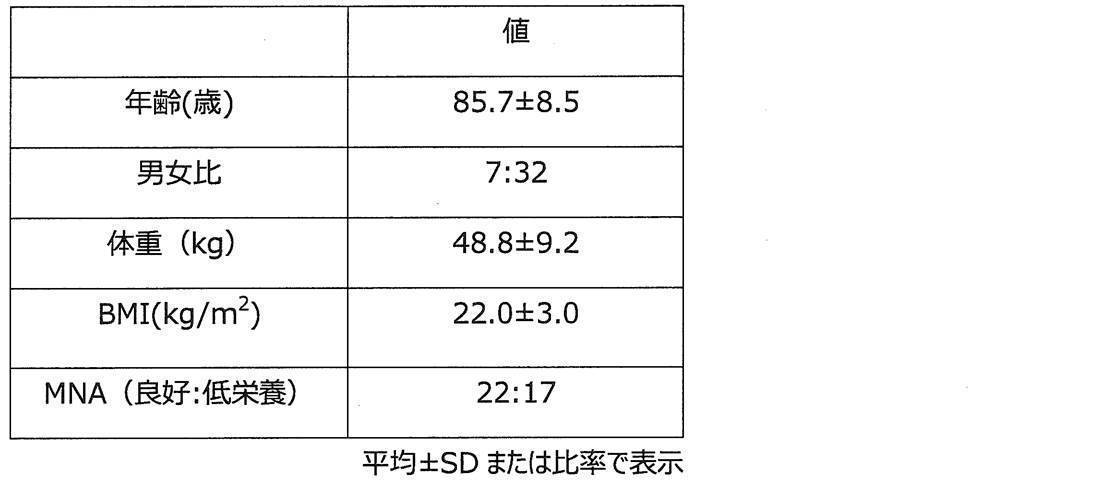
2.マーカータンパク質と低栄養(MNA)
唾液中のAcidic mammalian chitinase及びPolymeric immunoglobulin receptorの含有量を、低栄養の対象者(MNA≦7)と、栄養状態が良好な対象者(MNA≧12)との間で比較した。結果を以下の表に示す。
唾液中のAcidic mammalian chitinase及びPolymeric immunoglobulin receptorの含有量を、低栄養の対象者(MNA≦7)と、栄養状態が良好な対象者(MNA≧12)との間で比較した。結果を以下の表に示す。

表8に示す通り、Acidic mammalian chitinaseの唾液中含有量は、低栄養の対象者と栄養状態が良好な対象との間で、有意な差を示した。意外なことに、このマーカータンパク質の唾液中含有量は、ラットにおいては、低栄養状態において低下したが(試験例1)、ヒトにおいては、低栄養状態において逆に上昇した。MNAを低栄養の指標とした場合、Polymeric immunoglobulin receptorについては有意な差が認められなかった。
3.マーカータンパク質と低栄養(血中アルブミン濃度)
唾液中のAcidic mammalian chitinase及びPolymeric immunoglobulin receptorの含有量を、低栄養の対象者(Alb<3.5g/dL)と、栄養状態が良好な対象者(Alb≧3.5g/dL)との間で比較した。結果を以下の表に示す。
唾液中のAcidic mammalian chitinase及びPolymeric immunoglobulin receptorの含有量を、低栄養の対象者(Alb<3.5g/dL)と、栄養状態が良好な対象者(Alb≧3.5g/dL)との間で比較した。結果を以下の表に示す。

表9に示す通り、Acidic mammalian chitinase及びPolymeric immunoglobulin receptorの唾液中含有量は、低栄養の対象者と栄養状態が良好な対象との間で、有意な差を示した。意外なことに、これらのマーカータンパク質の唾液中含有量は、ラットにおいては、低栄養状態において低下したが(試験例1)、ヒトにおいては、低栄養状態において逆に上昇した。
4.マーカータンパク質と栄養指標との相関
唾液中のAcidic mammalian chitinase及びPolymeric immunoglobulin receptorの含有量と、各栄養指標(血中アルブミン濃度、血中プレアルブミン濃度、及びMNA)との相関を調べた。結果を以下の表に示す。
唾液中のAcidic mammalian chitinase及びPolymeric immunoglobulin receptorの含有量と、各栄養指標(血中アルブミン濃度、血中プレアルブミン濃度、及びMNA)との相関を調べた。結果を以下の表に示す。

唾液中のAcidic mammalian chitinase及びPolymeric immunoglobulin receptorの含有量は、各栄養指標(血中アルブミン濃度、血中プレアルブミン濃度、及びMNA)と負の相関を示した。
本発明によれば、採血等の侵襲なしに、被験者が低栄養状態、特にタンパク質摂取量の不足による低栄養状態にあるか、判定することが可能である。
本発明によれば、被験者が低栄養状態、特にタンパク質摂取量の不足による低栄養状態にあるかを確認した上で、タンパク質補給食品、総合アミノ酸製剤や分岐鎖アミノ酸含有アミノ酸製剤投与、肉、大豆、乳製品等のタンパク質が豊富な食品の摂取、食事指導等の適切な対処をとることが可能である。
本発明によれば、被験者が低栄養状態、特にタンパク質摂取量の不足による低栄養状態にあるかを確認した上で、タンパク質補給食品、総合アミノ酸製剤や分岐鎖アミノ酸含有アミノ酸製剤投与、肉、大豆、乳製品等のタンパク質が豊富な食品の摂取、食事指導等の適切な対処をとることが可能である。
本出願は、日本で出願された特願2015-039357(出願日:2015年2月27日)を基礎としており、その内容は本明細書に全て包含されるものである。
Claims (20)
- 以下の工程を含む、低栄養状態リスクの検査方法:
(1)ヒト被験者から単離された唾液における、Acidic mammalian chitinase及びPolymeric immunoglobulin receptorからなる群から選択される少なくとも1つのタンパク質又はそのペプチド断片の含有量を測定すること;並びに
(2)(1)において測定した含有量と、被験者の低栄養状態リスクとを相関付けること。 - 低栄養状態が、タンパク質摂取量の不足によるものである、請求項1記載の検査方法。
- 工程(1)におけるタンパク質又はそのペプチド断片の含有量の測定を、免疫学的測定方法により行う、請求項1又は2に記載の検査方法。
- 工程(1)において、配列番号1で表されるアミノ酸配列の第22番~第476番アミノ酸からなるタンパク質又はそのペプチド断片の含有量を少なくとも測定する、請求項1~3のいずれか1項記載の検査方法。
- 工程(1)において、配列番号2で表されるアミノ酸配列の第19番~第603番アミノ酸からなるタンパク質又はそのペプチド断片の含有量を少なくとも測定する、請求項1~3のいずれか1項記載の検査方法。
- Acidic mammalian chitinase及びPolymeric immunoglobulin receptorからなる群から選択される少なくとも1つのタンパク質に特異的に結合する抗体を含む、低栄養状態リスクの診断薬。
- 低栄養状態が、タンパク質摂取量の不足によるものである、請求項6記載の診断薬。
- 以下の(A)及び(B)を含む、低栄養状態の治療用キット:
(A)請求項6又は7に記載の診断薬;及び
(B)タンパク質補給食品、総合アミノ酸製剤又は分岐鎖アミノ酸含有アミノ酸製剤。 - 低栄養状態が、タンパク質摂取量の不足によるものである、請求項8記載のキット。
- 低栄養状態リスクの診断に使用するための、Acidic mammalian chitinase及びPolymeric immunoglobulin receptorからなる群から選択される少なくとも1つのタンパク質に特異的に結合する抗体。
- 低栄養状態が、タンパク質摂取量の不足によるものである、請求項10記載の抗体。
- 低栄養状態リスクの診断薬の製造のための、Acidic mammalian chitinase及びPolymeric immunoglobulin receptorからなる群から選択される少なくとも1つのタンパク質に特異的に結合する抗体の使用。
- 低栄養状態が、タンパク質摂取量の不足によるものである、請求項12記載の使用。
- 低栄養状態の治療に使用するための、以下の(A)及び(B)を含む組み合わせ:
(A)請求項6又は7に記載の診断薬;及び
(B)タンパク質補給食品、総合アミノ酸製剤又は分岐鎖アミノ酸含有アミノ酸製剤。 - 低栄養状態が、タンパク質摂取量の不足によるものである、請求項14記載の組み合わせ。
- 低栄養状態の治療用キットの製造のための、以下の(A)及び(B)を含む組み合わせの使用:
(A)請求項6又は7に記載の診断薬;及び
(B)タンパク質補給食品、総合アミノ酸製剤又は分岐鎖アミノ酸含有アミノ酸製剤。 - 低栄養状態が、タンパク質摂取量の不足によるものである、請求項16記載の使用。
- 以下の工程を含む、低栄養状態の改善方法:
(1)ヒト被験者から単離された唾液における、Acidic mammalian chitinase及びPolymeric immunoglobulin receptorからなる群から選択される少なくとも1つのタンパク質又はそのペプチド断片の含有量を測定すること;
(2)(1)において測定した含有量と、被験者の低栄養状態リスクとを相関付けること;及び
(3)被験者が低栄養状態にある可能性が高いと判定された場合、当該被験者に対して、栄養療法を施すこと。 - 栄養療法が、タンパク質補給食品、総合アミノ酸製剤又は分岐鎖アミノ酸含有アミノ酸製剤の有効量の投与により行われる、請求項18記載の方法。
- 低栄養状態が、タンパク質摂取量の不足によるものである、請求項18記載の方法。
Priority Applications (1)
| Application Number | Priority Date | Filing Date | Title |
|---|---|---|---|
| JP2017502536A JPWO2016136991A1 (ja) | 2015-02-27 | 2016-02-26 | 唾液中マーカータンパク質を用いた低栄養状態の判定方法、及びそれに使用する診断薬 |
Applications Claiming Priority (2)
| Application Number | Priority Date | Filing Date | Title |
|---|---|---|---|
| JP2015-039357 | 2015-02-27 | ||
| JP2015039357 | 2015-02-27 |
Publications (1)
| Publication Number | Publication Date |
|---|---|
| WO2016136991A1 true WO2016136991A1 (ja) | 2016-09-01 |
Family
ID=56788559
Family Applications (1)
| Application Number | Title | Priority Date | Filing Date |
|---|---|---|---|
| PCT/JP2016/055940 Ceased WO2016136991A1 (ja) | 2015-02-27 | 2016-02-26 | 唾液中マーカータンパク質を用いた低栄養状態の判定方法、及びそれに使用する診断薬 |
Country Status (2)
| Country | Link |
|---|---|
| JP (1) | JPWO2016136991A1 (ja) |
| WO (1) | WO2016136991A1 (ja) |
Cited By (1)
| Publication number | Priority date | Publication date | Assignee | Title |
|---|---|---|---|---|
| JP7233665B1 (ja) | 2022-09-02 | 2023-03-07 | 株式会社サリバテック | 疾患リスク判定システム及び疾患リスク判定方法 |
Citations (2)
| Publication number | Priority date | Publication date | Assignee | Title |
|---|---|---|---|---|
| JP2006508014A (ja) * | 2001-07-24 | 2006-03-09 | イエール・ユニバーシテイ | キチナーゼおよびキチナーゼ様分子、ならびに炎症性疾患に関する方法、組成物およびキット |
| WO2014126207A1 (ja) * | 2013-02-15 | 2014-08-21 | 味の素株式会社 | 試料中の有機酸の検出方法 |
-
2016
- 2016-02-26 WO PCT/JP2016/055940 patent/WO2016136991A1/ja not_active Ceased
- 2016-02-26 JP JP2017502536A patent/JPWO2016136991A1/ja active Pending
Patent Citations (2)
| Publication number | Priority date | Publication date | Assignee | Title |
|---|---|---|---|---|
| JP2006508014A (ja) * | 2001-07-24 | 2006-03-09 | イエール・ユニバーシテイ | キチナーゼおよびキチナーゼ様分子、ならびに炎症性疾患に関する方法、組成物およびキット |
| WO2014126207A1 (ja) * | 2013-02-15 | 2014-08-21 | 味の素株式会社 | 試料中の有機酸の検出方法 |
Non-Patent Citations (2)
| Title |
|---|
| HA,CHOI-LAN ET AL.: "Reduction in the Quantity of the Polymeric Immunoglobulin Receptor Is Sufficient to Account for the Low Concentration of Intestinal Secretory Immunoglobulin A in a Weanling Mouse Model of Wasting Protein-Energy Malnutrition", JOURNAL OF NUTRITION, vol. 127, no. 3, 1997, pages 427 - 435 * |
| WATSON,R.R. ET AL.: "Effect of Moderate Chronic Protein Deficiency on Rat Salivary Components", JOURNAL OF NUTRITION, vol. 110, 1980, pages 771 - 777 * |
Cited By (2)
| Publication number | Priority date | Publication date | Assignee | Title |
|---|---|---|---|---|
| JP7233665B1 (ja) | 2022-09-02 | 2023-03-07 | 株式会社サリバテック | 疾患リスク判定システム及び疾患リスク判定方法 |
| JP2024035256A (ja) * | 2022-09-02 | 2024-03-14 | 株式会社サリバテック | 疾患リスク判定システム及び疾患リスク判定方法 |
Also Published As
| Publication number | Publication date |
|---|---|
| JPWO2016136991A1 (ja) | 2017-12-07 |
Similar Documents
| Publication | Publication Date | Title |
|---|---|---|
| US10866248B2 (en) | Methods and materials for monitoring myeloma using quantitative mass spectrometry | |
| EP1689288B1 (en) | Immunosorbent blood tests for assessing paroxysmal cerebral discharges | |
| JP2013178286A (ja) | オートタキシン測定による慢性肝疾患の検査方法および検査薬 | |
| TW201723186A (zh) | 肝癌的檢查方法 | |
| US20160116489A1 (en) | Lateral flow immunoassay method of simultaneously detecting hemoglobin s, hemoglobin c, and hemoglobin a in newborns, infants, children, and adults | |
| JP4834839B2 (ja) | 悪性黒色腫(メラノーマ)の新規な診断キット | |
| RU2745751C2 (ru) | Способ прогнозирования риска развития ожирения у субъекта | |
| Skopek et al. | Detection of autoantibodies against thyroid peroxidase in serum samples of hypothyroid dogs | |
| US6372440B2 (en) | Method for detecting deficient cellular membrane tightly bound magnesium for disease diagnoses | |
| JP5156997B2 (ja) | Iv型コラーゲン様免疫活性ペプチド | |
| CN115398237B (zh) | 将破坏性甲状腺炎与其他病理状态鉴别的方法 | |
| CN102300875B (zh) | 肾病相关的生物标记 | |
| JPWO2016136991A1 (ja) | 唾液中マーカータンパク質を用いた低栄養状態の判定方法、及びそれに使用する診断薬 | |
| JP2017538786A (ja) | 抗アセトアミノフェン抗体及びアセトアミノフェンタンパク質付加物 | |
| JP2016206074A (ja) | 血清中アルブミン濃度の測定方法、低アルブミン血症の診断方法、及びこれらに使用する試薬 | |
| JP5229789B2 (ja) | 新規ストレスバイオマーカー及びその用途 | |
| WO2018220106A1 (en) | Biomarker molecules for sarcopenia and uses thereof | |
| KR101391464B1 (ko) | HPαR을 유효성분으로 포함하는 폐암 진단용 마커 | |
| US20140349956A1 (en) | Materials and methods for detecting and/or predicting necrotizing enterocolitis in infants | |
| TW201030337A (en) | Method and kit for detecting cancers | |
| JP2020139901A (ja) | スティーブンス・ジョンソン症候群及び/又は中毒性表皮壊死症の評価方法、評価のためのデータ取得方法、及び評価用キット | |
| US20200408780A1 (en) | Diagnostic for sjorgren's syndrome based on a biomarker | |
| JP2024009473A (ja) | 筋炎/皮膚筋炎やそれに併発する間質性肺炎を発症するモデル動物 | |
| WO2024014426A1 (ja) | 筋炎/皮膚筋炎に伴うリスクを検出する方法 | |
| JP2010271295A (ja) | 測定試薬 |
Legal Events
| Date | Code | Title | Description |
|---|---|---|---|
| 121 | Ep: the epo has been informed by wipo that ep was designated in this application |
Ref document number: 16755735 Country of ref document: EP Kind code of ref document: A1 |
|
| ENP | Entry into the national phase |
Ref document number: 2017502536 Country of ref document: JP Kind code of ref document: A |
|
| NENP | Non-entry into the national phase |
Ref country code: DE |
|
| 122 | Ep: pct application non-entry in european phase |
Ref document number: 16755735 Country of ref document: EP Kind code of ref document: A1 |