WO2016135991A1 - 粘着シート及び粘着シート付き透明基板 - Google Patents
粘着シート及び粘着シート付き透明基板 Download PDFInfo
- Publication number
- WO2016135991A1 WO2016135991A1 PCT/JP2015/065376 JP2015065376W WO2016135991A1 WO 2016135991 A1 WO2016135991 A1 WO 2016135991A1 JP 2015065376 W JP2015065376 W JP 2015065376W WO 2016135991 A1 WO2016135991 A1 WO 2016135991A1
- Authority
- WO
- WIPO (PCT)
- Prior art keywords
- adhesive sheet
- acrylic polymer
- pressure
- sensitive adhesive
- adherend
- Prior art date
- Legal status (The legal status is an assumption and is not a legal conclusion. Google has not performed a legal analysis and makes no representation as to the accuracy of the status listed.)
- Ceased
Links
Classifications
-
- G—PHYSICS
- G06—COMPUTING OR CALCULATING; COUNTING
- G06F—ELECTRIC DIGITAL DATA PROCESSING
- G06F3/00—Input arrangements for transferring data to be processed into a form capable of being handled by the computer; Output arrangements for transferring data from processing unit to output unit, e.g. interface arrangements
- G06F3/01—Input arrangements or combined input and output arrangements for interaction between user and computer
- G06F3/03—Arrangements for converting the position or the displacement of a member into a coded form
- G06F3/041—Digitisers, e.g. for touch screens or touch pads, characterised by the transducing means
-
- C—CHEMISTRY; METALLURGY
- C09—DYES; PAINTS; POLISHES; NATURAL RESINS; ADHESIVES; COMPOSITIONS NOT OTHERWISE PROVIDED FOR; APPLICATIONS OF MATERIALS NOT OTHERWISE PROVIDED FOR
- C09J—ADHESIVES; NON-MECHANICAL ASPECTS OF ADHESIVE PROCESSES IN GENERAL; ADHESIVE PROCESSES NOT PROVIDED FOR ELSEWHERE; USE OF MATERIALS AS ADHESIVES
- C09J133/00—Adhesives based on homopolymers or copolymers of compounds having one or more unsaturated aliphatic radicals, each having only one carbon-to-carbon double bond, and at least one being terminated by only one carboxyl radical, or of salts, anhydrides, esters, amides, imides, or nitriles thereof; Adhesives based on derivatives of such polymers
-
- C—CHEMISTRY; METALLURGY
- C09—DYES; PAINTS; POLISHES; NATURAL RESINS; ADHESIVES; COMPOSITIONS NOT OTHERWISE PROVIDED FOR; APPLICATIONS OF MATERIALS NOT OTHERWISE PROVIDED FOR
- C09J—ADHESIVES; NON-MECHANICAL ASPECTS OF ADHESIVE PROCESSES IN GENERAL; ADHESIVE PROCESSES NOT PROVIDED FOR ELSEWHERE; USE OF MATERIALS AS ADHESIVES
- C09J7/00—Adhesives in the form of films or foils
- C09J7/20—Adhesives in the form of films or foils characterised by their carriers
-
- G—PHYSICS
- G02—OPTICS
- G02B—OPTICAL ELEMENTS, SYSTEMS OR APPARATUS
- G02B5/00—Optical elements other than lenses
- G02B5/30—Polarising elements
Definitions
- the present invention relates to an adhesive sheet and a transparent substrate with an adhesive sheet.
- various devices including display devices such as a television, a personal computer, a portable terminal, an electronic notebook, an OA device, a game machine, a PDA, a bank terminal (cash dispenser), and a ticket machine are known.
- display devices such as a television, a personal computer, a portable terminal, an electronic notebook, an OA device, a game machine, a PDA, a bank terminal (cash dispenser), and a ticket machine.
- display devices such as a television, a personal computer, a portable terminal, an electronic notebook, an OA device, a game machine, a PDA, a bank terminal (cash dispenser), and a ticket machine.
- a protective film for preventing scratches on the display surface is affixed
- a protective film, a touch panel, or the like is attached to the surface of the display device, it is often performed to attach both using a pressure sensitive adhesive sheet.
- Patent Document 1 an adhesive sheet rich in so-called reworkability (reusability) is disclosed in Patent Document 1.
- the pressure-sensitive adhesive sheet disclosed in Patent Document 1 it is possible to peel the pressure-sensitive adhesive sheet from the adherend without leaving the pressure-sensitive adhesive on the adherend even after being attached to the adherend for a long time. Thus, it has an excellent effect from the viewpoint of reworkability.
- the pressure-sensitive adhesive sheet disclosed in Patent Document 1 is recognized as a useful pressure-sensitive adhesive sheet because it has the property of excellent reworkability. When applied to products distributed in the market, there has been a problem that members such as a protective sheet and a touch panel are easily peeled off from the display device during distribution and use.
- the present invention has been made in order to solve such a problem, and has excellent reworkability within a predetermined time after sticking, and a pressure-sensitive adhesive sheet that exhibits strong adhesiveness after a predetermined time has elapsed and the pressure-sensitive adhesive sheet It aims at providing the transparent substrate with an adhesive sheet which has these.
- the above object of the present invention is a pressure-sensitive adhesive sheet containing a first acrylic polymer having a reactive functional group and a second acrylic polymer having no reactive functional group, which is applied to an adherend.
- a pressure-sensitive adhesive sheet having a ratio (B / A) of an adhesive force (A) at the time of 20 minutes after application and an adhesive force (B) after 24 hours of application to the adherend of 1.5 or more Is achieved.
- Another object of the present invention is a pressure-sensitive adhesive sheet containing a first acrylic polymer having a reactive functional group and a second acrylic polymer having no reactive functional group, which is applied to an adherend. After 20 minutes have elapsed from the pasting of the adhesive (A), and after 20 minutes from pasting to the adherend, pressurization / heating treatment for 20 minutes at a temperature of 60 ° C. and a pressure of 0.5 MPa is performed. The ratio (B / A) to the adhesive strength (B) after the treatment is achieved by an adhesive sheet having a ratio of 1.5 or more.
- the weight average molecular weight of the second acrylic polymer is preferably 2000 to 9000, and the viscosity of the second acrylic polymer is preferably 3000 to 25000 mPa ⁇ s. .
- the weight average molecular weight of the first acrylic polymer is preferably 200,000 to 600,000.
- the adhesive strength (A) at the initial stage of application when applied to the polarizing plate is 6.5 N / 25 mm or less as measured by a 180-degree peeling adhesive strength measurement method according to JIS JZ 0237 (2000). Is preferred.
- the above object of the present invention is achieved by a transparent substrate with an adhesive sheet comprising the above adhesive sheet and a transparent substrate provided on at least one surface of the adhesive sheet.
- a touch panel may be used as the transparent substrate.
- a pressure-sensitive adhesive sheet that is excellent in reworkability within a predetermined time after pasting and exhibits strong adhesiveness after a predetermined time has passed, and a transparent substrate with a pressure-sensitive adhesive sheet having the pressure-sensitive adhesive sheet.
- the pressure-sensitive adhesive sheet according to the present invention is composed of a pressure-sensitive adhesive composed mainly of a first acrylic polymer having a reactive functional group and a second acrylic polymer having no reactive functional group as an additive.
- the ratio between the adhesive strength (A) at the initial stage of application to an adherend such as the display surface of a liquid crystal display device and the adhesive strength (B) after a predetermined time has elapsed after being applied to the adherend. (B / A) is a pressure-sensitive adhesive sheet having a value of 1.5 or more.
- the initial stage of pasting means a period from the pasting of the pressure-sensitive adhesive sheet to the adherend until 20 minutes have elapsed, and after the predetermined time has passed after pasting to the adherend, It means after 24 hours have passed since the adhesive sheet was attached to the body.
- the first acrylic polymer a relatively high molecular weight polymer is used. By constituting the first acrylic polymer with such a relatively high molecular weight polymer, it becomes possible to form a three-dimensional network structure by cross-linking, and a strong adhesive force after a predetermined time has elapsed after being attached to the adherend. Contributes to grant.
- the weight average molecular weight of the first acrylic polymer is preferably 200,000 to 600,000, more preferably 300,000 to 500,000, and even more preferably 350,000 to 450,000. When the weight average molecular weight is less than 200,000, the cohesive force is too low and it is difficult to form a pressure-sensitive adhesive sheet. On the other hand, if it exceeds 600,000, the pressure-sensitive adhesive sheet becomes too hard and the adhesion to an adherend and the like is deteriorated.
- the first acrylic polymer is preferably a copolymer of an acrylic acid alkyl ester and a monomer having a reactive functional group.
- the first acrylic polymer may be used alone or in combination with other polymers.
- alkyl acrylate ester examples include methyl (meth) acrylate, ethyl (meth) acrylate, propyl (meth) acrylate, n-butyl (meth) acrylate, n-pentyl (meth) acrylate, (meth ) N-hexyl acrylate, cyclohexyl (meth) acrylate, 2-ethylhexyl (meth) acrylate, isooctyl (meth) acrylate, n-decyl (meth) acrylate, n-dodecyl (meth) acrylate, (meth) ) Myristyl acrylate, palmityl (meth) acrylate, stearyl (meth) acrylate, and the like. These may be used alone or in combination of two or more.
- examples of the monomer having a reactive functional group include a hydroxyl group-containing monomer, a carboxyl group-containing monomer, and an amino group-containing monomer, and among them, a hydroxyl group-containing monomer is preferable.
- examples of the hydroxyl group-containing monomer include 2-hydroxyethyl (meth) acrylate, 2-hydroxypropyl (meth) acrylate, 3-hydroxypropyl (meth) acrylate, 2-hydroxybutyl (meth) acrylate, (meth And (meth) acrylic acid hydroxyalkyl esters such as 3-hydroxybutyl acrylate and 4-hydroxybutyl (meth) acrylate. These may be used alone or in combination of two or more.
- the second acrylic polymer a relatively low molecular weight polymer having no reactive functional group is used. Since the second acrylic polymer does not have a reactive functional group, it is incorporated into a three-dimensional crosslinked structure formed by the first acrylic polymer via a crosslinking agent when added to the first acrylic polymer. In addition, since the second acrylic polymer has higher fluidity than the first acrylic polymer, it is not uniformly dispersed in the first acrylic polymer at room temperature and normal pressure. It is thought that aggregates are formed (so-called unishima structure). Furthermore, since the second acrylic polymer is a polymer having a relatively low molecular weight, the single acrylic polymer does not have an adhesive force by itself.
- a pressure-sensitive adhesive (adhesive composition) formed by adding the second acrylic polymer having such characteristics to the first acrylic polymer is part of the bonding interface when bonded to the adherend. Is occupied by the second acrylic polymer aggregate, it is possible to inhibit the adhesion with the adherend and to exhibit a decrease in the adhesive strength within a certain time after the application.
- the second acrylic polymer is formed by the first acrylic polymer after a predetermined time has elapsed in the bonded state of the adhesive composition and the adherend, or when a pressure / heat treatment is applied.
- the addition amount of the second acrylic polymer is about 0.1 to 10 parts by mass with respect to 100 parts by mass of the first acrylic polymer, although it depends on the characteristics of the first acrylic polymer as the main agent. 0.3 to 5 parts by mass is more preferable, and 0.5 to 1 part by mass is particularly preferable.
- the weight average molecular weight of the second acrylic polymer is preferably 2000 to 9000, more preferably 2500 to 8500, and particularly preferably 3000 to 8000.
- the weight average molecular weight is less than 2000, the initial adhesive strength (adhesive strength until 20 minutes after pasting) when the adhesive sheet to be formed is attached to the adherend increases, There is a risk that it may be difficult to ensure reworkability at the initial stage of application to the body.
- it exceeds 9000 the compatibility with the first acrylic polymer becomes poor, and it may be difficult to ensure a uniform mixed state with the first acrylic polymer.
- the viscosity of the second acrylic polymer is preferably 3000 to 25000 mPa ⁇ s, more preferably 4000 to 10000 mPa ⁇ s, and even more preferably 5000 to 8000 mPa ⁇ s.
- the second acrylic polymer is preferably a copolymer of an acrylic acid alkyl ester and a monomer having no reactive functional group.
- alkyl acrylate ester examples include methyl (meth) acrylate, ethyl (meth) acrylate, propyl (meth) acrylate, n-butyl (meth) acrylate, n-pentyl (meth) acrylate, (meth ) N-hexyl acrylate, cyclohexyl (meth) acrylate, 2-ethylhexyl (meth) acrylate, isooctyl (meth) acrylate, n-decyl (meth) acrylate, n-dodecyl (meth) acrylate, (meth) ) Myristyl acrylate, palmityl (meth) acrylate, stearyl (meth) acrylate, and the like. These may be used alone or in combination of
- (meth) acrylic acid ester which has aliphatic rings such as (meth) acrylic acid cyclohexyl
- (meth) acrylic acid which has aliphatic rings such as (meth) acrylic acid phenyl
- Non-crosslinkable tertiary amino groups such as non-crosslinkable acrylamide such as acid ester, acrylamide and methacrylamide, N, N-dimethylaminoethyl (meth) acrylate, N, N-dimethylaminopropyl (meth) acrylate (Meth) acrylic acid ester, vinyl acetate, styrene and the like having These may be used alone or in combination of two or more.
- the pressure-sensitive adhesive sheet may be configured to further contain a crosslinking agent.
- the crosslinking agent include an isocyanate crosslinking agent, an epoxy crosslinking agent, an aziridine crosslinking agent, and a metal chelate crosslinking agent.
- one type may be used alone, or two or more types may be used in combination.
- the addition amount of the crosslinking agent is about 0.1 to 5 parts by mass with respect to 100 parts by mass of the first acrylic polymer, although it depends on the characteristics of the first acrylic polymer as the main agent, and 0.3 -3 parts by mass is more preferable, and 0.5-2 parts by mass is particularly preferable.
- the pressure-sensitive adhesive sheet according to the present invention comprises a pressure-sensitive adhesive formed by mixing the first acrylic polymer and the second acrylic polymer (mixing a cross-linking agent as necessary) and stirring sufficiently. It can be produced by dissolving in a solvent and coating and then removing the solvent.
- the coating method can be appropriately selected from methods such as a knife coater, micro bar coater, air knife coater, reverse roll coater, reverse gravure coater, bario gravure coater, die coater, curtain coater and the like.
- the pressure-sensitive adhesive sheet is produced by disposing release sheets (release sheets) on both sides thereof.
- a pressure-sensitive adhesive sheet is formed on a release sheet provided with a release agent layer on a substrate such as a polymer film. It is preferable that the pressure-sensitive adhesive sheet is formed by applying and drying the pressure-sensitive adhesive, and another release sheet is stacked on the pressure-sensitive adhesive sheet.
- a base material of a peeling sheet it can form using a conventionally well-known material as base material materials of a peeling sheet, such as a polyethylene film (PET), a polypropylene film (PP), a polybutene film, for example.
- a conventionally well-known material as base material materials of a peeling sheet such as a polyethylene film (PET), a polypropylene film (PP), a polybutene film, for example.
- PET polyethylene film
- PP polypropylene film
- a polybutene film for example.
- the material for the release agent layer provided on the substrate include conventionally known release agents such as alkyd, silicone, fluorine, unsaturated polyester, polyolefin, and wax.
- a transparent substrate with a pressure-sensitive adhesive sheet may be formed by attaching a transparent substrate constituting the protective film to one side of the pressure-sensitive adhesive sheet.
- a transparent substrate it is not limited to the said protective film,
- a touch panel is employ
- the adhesive strength (A) at the initial stage of application is pulled 180 degrees in accordance with JIS Z 0237 (2000). It is 6.5N / 25mm or less as measured by peeling adhesive strength, and the adhesive strength (A) at the initial stage of application is small.
- the attachment position of the adhesive sheet or the attachment position of the protective film with the adhesive sheet, etc. Even if it is out of alignment with the adherend such as a device, it is possible to easily re-peel (rework) the adhesive sheet (such as a protective film with an adhesive sheet) without damaging the adherend. It becomes.
- the adhesive strength (B) after a predetermined time has elapsed after pasting is 1.5 times or more of the initial adhesive strength (A), an adhesive sheet (such as a protective film with an adhesive sheet) is adhered. After affixing to the substrate, when a predetermined time elapses, strong adhesiveness is exhibited, and it is possible to extremely effectively prevent the adhesive sheet from being easily peeled off from the adherend.
- the inventors prepared four types of pressure-sensitive adhesive sheet samples (Comparative Example 1, Examples 1 to 3) and attached them to adherends.
- a sensory evaluation test on reworkability in the initial stage was conducted.
- the adhesive force measurement test which measures the adhesive force (A) of the initial stage of sticking to a to-be-adhered body, and the adhesive force (B) after progress for a predetermined time after sticking to a to-be-adhered body was done.
- the sensory evaluation test, the adhesive strength measurement test, and the results of each test will be described.
- the viscosities listed in Table 1 below are the viscosities measured in accordance with JIS Z 8803-1991 (Liquid Viscosity—Measurement Method) for 100% active ingredient (without solvent) of the second acrylic polymer. Specifically, the viscosity was measured under a temperature condition of 25.0 ⁇ 0.5 ° C. using an E-type viscometer using a low viscosity rotor.
- the pressure-sensitive adhesive sheet sample After preparing the first acrylic polymer liquid, 1.0 part by mass with respect to 100 parts by weight of the first acrylic polymer liquid was used as a crosslinking agent (model number: L- manufactured by Soken Chemical Co., Ltd.). 45) is further mixed with each second acrylic polymer liquid diluted with ethyl acetate at 0.75 parts by mass with respect to 100 parts by weight of the first acrylic polymer liquid. ) To prepare various pressure-sensitive adhesive solutions, and the above-mentioned pressure-sensitive adhesive solution was applied onto a substrate film (used as a release sheet; manufactured by Nipper, model number: PET38 ⁇ 1-V0). Thereafter, it was dried at 90 ° C.
- a crosslinking agent model number: L- manufactured by Soken Chemical Co., Ltd. 45
- each adhesive sheet sample has a thickness (after drying) of 100 ⁇ m.
- a release sheet manufactured by Toyobo Co., Ltd., model number: E7006-38 ⁇ m was bonded onto the exposed surface of each pressure-sensitive adhesive sheet sample, and an aging treatment was performed for 3 days in a 40 ° C. environment.
- the pseudo liquid crystal display formed by bonding a polarizing plate (model number: AQW252A manufactured by Sumitomo Chemical Co., Ltd.) to a 0.7 mm thick glass plate
- a polarizing plate model number: AQW252A manufactured by Sumitomo Chemical Co., Ltd.
- the pseudo touch panel with an adhesive sheet was bonded with a hand roller. After 20 minutes from pasting, the touch panel could be easily peeled without cracking, and when it was peeled off, it was visually observed whether there was adhesive residue or dirt on the polarizing surface of the pseudo LCD.
- the adhesive strength measurement test contents for measuring the adhesive strength (A) at the time when 20 minutes have elapsed after being attached to the adherend and the adhesive strength (B) after the predetermined time has elapsed after being attached to the adherend explain.
- the release sheet was removed from the produced PET film with an adhesive sheet, and the adherend (polarized light of a pseudo LCD in which a polarizing plate (manufactured by Sumitomo Chemical Co., Ltd., model number: AQW252A) was bonded to a bare glass plate having a thickness of 1.1 mm) Surface) using a 2 kg rubber roll, and left for 20 minutes, and one of the two is used as a sample for measuring the adhesive strength (A) when 20 minutes have elapsed after being pasted. The remaining one is subjected to a pressurizing / heating treatment (autoclave treatment) for 20 minutes under the conditions of a temperature of 60 ° C.
- a pressurizing / heating treatment autoclave treatment
- Table 2 shows the results of the sensory evaluation test and the adhesive strength measurement test.
- the “rework feeling” column of the reworkability in Table 2 the case where peeling is easily performed is indicated as “ ⁇ ”, and the case where peeling is not easy is indicated as “X”.
- the “glue residue” column a case where there is no glue residue or dirt is indicated as “ ⁇ ”, and a case where there is glue residue or dirt is indicated as “X”.
- Example 1 in which the weight average molecular weight of the second acrylic polymer is 2500
- Example 2 in which the weight is 6000
- Example 3 in which the weight is 8000
- 20 minutes have elapsed after being attached to the adherend.
- the adhesive strength (A) at the time is 5.1 N / 25 mm, 6.2 N / 25 mm, and 5 N / 25 mm, respectively, and all are 6.5 N / 25 mm or less.
- the rework feeling of rework property evaluation is favorable, and adhesive residue and stain
- the pressure-sensitive adhesive sheets according to Examples 1 to 3 correspond to the pressure-sensitive adhesive sheet according to the present invention
- an adherend such as a liquid crystal display device (LCD) can be damaged at the initial stage of application. It can be seen that the adhesive sheet can be easily and neatly peeled (reworked).
- LCD liquid crystal display device
- Comparative Example 1 resulted in a high adhesive force (A) at the time of 20 minutes after being attached to the adherend, as high as 8.3 N / 25 mm, and poor reworkability.
- the weight average molecular weight of the second acrylic polymer is 1600, and the weight average molecular weight is 2500.
- the weight average molecular weight is 1600 to 2500. It can be considered that there is a quality boundary regarding reworkability in the range, and the numerical value is considered to be about 2000.
- the viscosity of the second acrylic polymer is 550 mPa ⁇ s
- the viscosity is 3500 mPa ⁇ s. Therefore, the viscosity is 550 to 3500 mPa ⁇ s.
- -It can be considered that there is a good / bad boundary regarding the reworkability of the viscosity in the range of s, and the numerical value is considered to be about 3000 mPa ⁇ s.
- Example 1 is 9.2N / 25mm about Example 1 about the adhesive force (B) after performing pressurization and heat processing for 20 minutes.
- 2 is 9.3 N / 25 mm
- Example 3 is 8.1 N / 25 mm. Both have an adhesive strength of 8 N / 25 mm or more, and a protective film or touch panel is provided on the surface of a liquid crystal display (LCD) or the like. It can be seen that after sticking, after a predetermined time has elapsed, it exhibits strong adhesiveness that does not easily peel off.
- LCD liquid crystal display
- Example 1 the adhesive strength (A) at the time when 20 minutes had elapsed after being attached to the adherend, and the adhesive strength (B) after further pressing and heating treatment for 20 minutes were applied. It can be seen that the ratio (B / A) to 1.5) or more is secured. Also from this, in Examples 1 to 3 according to the present invention, the adhesive strength at the time when 20 minutes have elapsed after being attached to the adherend is greatly increased after the lapse of a predetermined time, and the strong adhesiveness is increased with the passage of time. You can see that it is demonstrating. In Comparative Example 1, the adhesive strength (B) is 9.6 N / 25 mm, and the ratio of adhesive strength: B / A is 1.2. The adhesive strength is so large when a predetermined time has elapsed after pasting. There is no increase.
- a sample for measuring the adhesive strength (B) is subjected to a pressurization / heating treatment (autoclave treatment) for 20 minutes under the conditions of a temperature of 60 ° C. and a pressure of 0.5 MPa.
- autoclave treatment autoclave treatment
- the sample for measuring the adhesive force (B) prepared by pasting a PET film with an adhesive sheet on the adherend without applying such pressure and heat treatment, the sample was allowed to stand for 24 hours. It was confirmed that the adhesive strength (B) equivalent to the result shown in FIG.
- the pressure-sensitive adhesive of the present invention is excellent in reworkability and adhesiveness particularly when film members are bonded to each other, such as when a protective film or a touch panel is bonded to the surface of a polarizing plate of a liquid crystal display (LCD). It can be used when a film member is used as a glass substitute for thinning a display device or the like.
- LCD liquid crystal display
Landscapes
- Engineering & Computer Science (AREA)
- Physics & Mathematics (AREA)
- Chemical & Material Sciences (AREA)
- Organic Chemistry (AREA)
- General Physics & Mathematics (AREA)
- General Engineering & Computer Science (AREA)
- Theoretical Computer Science (AREA)
- Optics & Photonics (AREA)
- Human Computer Interaction (AREA)
- Adhesive Tapes (AREA)
- Adhesives Or Adhesive Processes (AREA)
Abstract
貼り付け後所定時間内においてリワーク性に優れ、所定時間経過後には強固な粘着性を発揮する粘着シート及びこの粘着シートを有する粘着シート付き透明基板を提供する。 反応性官能基を有する第1のアクリル系ポリマーと、反応性官能基を有しない第2のアクリル系ポリマーとを含有する粘着シートであって、被着体への貼り付け後20分経過時点の粘着力(A)と前記被着体への貼り付け後24時間経過後の粘着力(B)との比(B/A)が、1.5以上である粘着シート。
Description
本発明は、粘着シート及び粘着シート付き透明基板に関する。
従来から、テレビ、パソコン、携帯端末、電子手帳、OA機器、ゲーム機、PDA、銀行端末(キャッシュディスペンサー)、券売機等といった表示装置を備える各種装置が知られている。これらの装置においては、例えば、ディスプレイ表面の傷付き防止のための保護フィルムが貼り付けられるものや、タッチ位置検出用のタッチパネルが貼り付けられるものなどが存在する。保護フィルムやタッチパネル等を表示装置表面に貼り付ける場合には、粘着シートを用いて両者を貼着することが良く行われるが、例えば、粘着シートの貼付位置がずれた場合や保護フィルム等の位置がずれた場合には、当該粘着シートごと保護フィルム等を剥離して、再度新しい粘着シートで貼付する必要がある。しかしながら、粘着シートを剥離する際に、粘着剤が被着体に残存する糊残りが発生したり、或いは、粘着シートを引き剥がす際に、液晶表示装置等の表示装置が破損するといった問題があった。
このような問題に鑑み、いわゆるリワーク性(再利用性)に富む粘着シートが特許文献1に開示されている。この特許文献1に開示の粘着シートによれば、長時間被着体に貼り付けた後でも、被着体に粘着剤を残存させることなく、当該被着体から粘着シートを剥離することが可能となり、リワーク性という観点からは優れた効果を奏する。
上記特許文献1に開示される粘着シートは、リワーク性に優れるという特性を有することから有用な粘着シートであると認められるが、この粘着シートは、長時間経過しても被着体から粘着シートを剥離することができるものであり、市場に流通する製品に適用する場合、流通過程や使用過程で、保護シートやタッチパネルといった部材が表示装置から剥離しやすいという問題があった。
本発明は、このような問題を解決するためになされたものであって、貼り付け後所定時間内においてリワーク性に優れ、所定時間経過後には強固な粘着性を発揮する粘着シート及びこの粘着シートを有する粘着シート付き透明基板を提供することを目的とする。
本発明の上記目的は、反応性官能基を有する第1のアクリル系ポリマーと、反応性官能基を有しない第2のアクリル系ポリマーとを含有する粘着シートであって、被着体への貼り付け後20分経過時点の粘着力(A)と前記被着体への貼り付け後24時間経過後の粘着力(B)との比(B/A)が、1.5以上である粘着シートにより達成される。
また、本発明の上記目的は、反応性官能基を有する第1のアクリル系ポリマーと、反応性官能基を有しない第2のアクリル系ポリマーとを含有する粘着シートであって、被着体への貼り付け後20分経過時点の粘着力(A)と、前記被着体への貼り付け後20分経過後、温度60℃、圧力0.5MPaの条件で20分間の加圧・加熱処理を行った後の粘着力(B)との比(B/A)が、1.5以上である粘着シートにより達成される。
この粘着シートにおいて、前記第2のアクリル系ポリマーの重量平均分子量が、2000~9000であることが好ましい、また、前記第2のアクリル系ポリマーの粘度が、3000~25000mPa・sであることが好ましい。
また、前記第1のアクリル系ポリマーの重量平均分子量が、20万~60万であることが好ましい。
また、前記第1のアクリル系ポリマーの重量平均分子量が、20万~60万であることが好ましい。
また、偏光板に貼りつけた際の前記貼り付け初期の粘着力(A)が、JIS Z 0237(2000)に準じた180度引きはがし粘着力測定法で、6.5N/25mm以下であることが好ましい。
また、本発明の上記目的は、上記の粘着シートと、当該粘着シートの少なくとも一方面に設けた透明基板とを備える粘着シート付き透明基板により達成される。また、前記透明基板として、タッチパネルを用いてもよい。
本発明によれば、貼り付け後所定時間内においてリワーク性に優れ、所定時間経過後には強固な粘着性を発揮する粘着シート及びこの粘着シートを有する粘着シート付き透明基板を提供することができる。
以下、本発明の実施形態にかかる粘着シートについて説明する。本発明に係る粘着シートは、反応性官能基を有する第1のアクリル系ポリマーを主剤とし、反応性官能基を有しない第2のアクリル系ポリマーを添加剤として構成される粘着剤により構成される粘着シートであり、液晶表示装置のディスプレイ表面等の被着体への貼り付け初期の粘着力(A)と、被着体への貼り付け後所定時間経過後の粘着力(B)との比(B/A)が、1.5以上である粘着シートである。ここで、貼り付け初期とは、被着体に粘着シートを貼り付けてから20分経過するまでの期間を意味し、また、被着体への貼り付け後所定時間経過後とは、被着体に粘着シートを貼り付けてから24時間経過以降を意味する。
上記第1のアクリル系ポリマーとしては、比較的高分子量のポリマーを用いる。このような比較的高分子量のポリマーにより第1のアクリル系ポリマーを構成することにより、架橋による三次元網目構造が形成され可能となり、被着体への貼り付け後所定時間経過後の強い粘着力付与に寄与する。第1のアクリル系ポリマーの重量平均分子量は、好ましく20万~60万であり、30万~50万がより好ましく、特に35万~45万が更により好ましい。重量平均分子量が20万未満であると、凝集力が低すぎて、粘着シートを形成することが困難となる。また、60万を超えると、粘着シートが硬くなりすぎて、被着体等に対する密着性が悪くなる。
また、第1のアクリル系ポリマーは、アクリル酸アルキルエステルと反応性官能基を有するモノマーとの共重合体が好ましい。なお、第1のアクリル系ポリマーは1種単独でもよいし、他のポリマーと組み合わせて用いてもよい。
アクリル酸アルキルエステルとしては、例えば、(メタ)アクリル酸メチル、(メタ)アクリル酸エチル、(メタ)アクリル酸プロピル、(メタ)アクリル酸n-ブチル、(メタ)アクリル酸n-ペンチル、(メタ)アクリル酸n-ヘキシル、(メタ)アクリル酸シクロヘキシル、(メタ)アクリル酸2-エチルヘキシル、(メタ)アクリル酸イソオクチル、(メタ)アクリル酸n-デシル、(メタ)アクリル酸n-ドデシル、(メタ)アクリル酸ミリスチル、(メタ)アクリル酸パルミチル、(メタ)アクリル酸ステアリル等が挙げられる。これらは単独で用いてもよく、或いは、2種以上を組み合わせて用いてもよい。
また、反応性官能基を有するモノマーとしては、水酸基含有モノマー、カルボキシル基含有モノマー、アミノ基含有モノマーなどが挙げられ、中でも水酸基含有モノマーが好ましい。水酸基含有モノマーとしては、例えば、(メタ)アクリル酸2-ヒドロキシエチル、(メタ)アクリル酸2-ヒドロキシプロピル、(メタ)アクリル酸3-ヒドロキシプロピル、(メタ)アクリル酸2-ヒドロキシブチル、(メタ)アクリル酸3-ヒドロキシブチル、(メタ)アクリル酸4-ヒドロキシブチルなどの(メタ)アクリル酸ヒドロキシアルキルエステル等が挙げられる。これらは単独で用いてもよいし、2種以上を組み合わせて用いてもよい。
第2のアクリル系ポリマーとしては、反応性官能基を有しない比較的低分子量のポリマーを用いる。第2のアクリル系ポリマーは、反応性官能基を持たないことから、第1のアクリル系ポリマーに添加した際に、第1のアクリル系ポリマーが架橋剤を介して形成する3次元架橋構造に組み込まれないと考えられ、また、第2のアクリル系ポリマーは第1のアクリル系ポリマーと比較して流動性が高いことから、常温常圧下においては第1のアクリル系ポリマー中で均一分散せずに、凝集体を形成していると考えられる(いわゆるウミシマ構造)。更に、第2のアクリル系ポリマーは比較的低分子量のポリマーであることから、それ単体では粘着力を有さないものである。このような特性を有する第2のアクリル系ポリマーを第1のアクリル系ポリマーに添加して形成される粘着剤(粘着組成物)は、被着体に貼合した際、貼着界面の一部を第2のアクリル系ポリマー凝集体が占有することで、被着体との密着を阻害し、貼り付け後の一定時間において、粘着力の低下を発現することが可能となる。また、上記粘着組成物と被着体の貼合状態で、所定時間経過した後、或いは、加圧・加熱処理を施した場合、第2のアクリル系ポリマーは第1のアクリルポリマーが形成する3次元架橋構造の内部に入り込むように分散していき、貼着界面における第2のアクリル系ポリマーの存在に起因する粘着力低下効果が消失すると同時に、入り込んだ第2のアクリル系ポリマーが可塑剤としての効果を示すことで、被着体との密着が促進される結果、被着体との粘着力が大幅に上昇する特性を発揮することができると考えられる。
第2のアクリル系ポリマーの添加量は、主剤である第1のアクリル系ポリマーの特性にもよるが、第1のアクリル系ポリマーの重量100質量部に対し0.1~10質量部程度であり、0.3~5質量部がより好ましく、0.5~1質量部が特に好ましい。
また、第2のアクリル系ポリマーの重量平均分子量は、好ましく2000~9000であり、2500~8500がより好ましく、特に3000~8000が更に好ましい。重量平均分子量が2000未満であると、形成される粘着シートを被着体に貼り付けた際の初期の粘着力(貼り付け後20分経過するまでの粘着力)が、大きくなってしまい、被着体への貼り付け初期段階でのリワーク性を確保することが困難になるおそれがある。また、9000を超えると、第1のアクリル系ポリマーとの相溶性が悪くなり当該第1のアクリル系ポリマーとの均一な混合状態を確保することが困難になるおそれがある。
また、第2のアクリル系ポリマーの粘度は、3000~25000mPa・sであることが好ましく、4000~10000mPa・sがより好ましく、特に5000~8000mPa・sが更に好ましい。
第2のアクリル系ポリマーは、アクリル酸アルキルエステルと反応性官能基を有しないモノマーとの共重合体が好ましい。アクリル酸アルキルエステルとしては、例えば、(メタ)アクリル酸メチル、(メタ)アクリル酸エチル、(メタ)アクリル酸プロピル、(メタ)アクリル酸n-ブチル、(メタ)アクリル酸n-ペンチル、(メタ)アクリル酸n-ヘキシル、(メタ)アクリル酸シクロヘキシル、(メタ)アクリル酸2-エチルヘキシル、(メタ)アクリル酸イソオクチル、(メタ)アクリル酸n-デシル、(メタ)アクリル酸n-ドデシル、(メタ)アクリル酸ミリスチル、(メタ)アクリル酸パルミチル、(メタ)アクリル酸ステアリル等が挙げられる。これらは単独で用いてもよく、或いは、2種以上を組み合わせて用いてもよい。
また、反応性官能基を有しないモノマーとしては、(メタ)アクリル酸シクロヘキシル等の脂肪族環を有する(メタ)アクリル酸エステル、(メタ)アクリル酸フェニル等の芳香族環を有する(メタ)アクリル酸エステル、アクリルアミド、メタクリルアミド等の非架橋性のアクリルアミド、(メタ)アクリル酸N,N-ジメチルアミノエチル、(メタ)アクリル酸N,N-ジメチルアミノプロピル等の非架橋性の3級アミノ基を有する(メタ)アクリル酸エステル、酢酸ビニル、スチレンなどが挙げられる。これらは単独で用いてもよいし、2種以上を組み合わせて用いてもよい。
また、粘着シートの耐久性の向上を図るために、架橋剤をさらに含有するようにして粘着シートを構成してもよい。架橋剤としては、イソシアネート系架橋剤、エポキシ系架橋剤、アジリジン系架橋剤、金属キレート系架橋剤などが例示することができる。なお、これら各種架橋剤に関して、1種を単独で用いてもよいし、2種以上を組み合わせて用いてもよい。架橋剤の添加量は、主剤である第1のアクリル系ポリマーの特性にもよるが、第1のアクリル系ポリマーの重量100質量部に対し0.1~5質量部程度であり、0.3~3質量部がより好ましく、0.5~2質量部が特に好ましい。
本発明に係る粘着シートは、上記第1のアクリル系ポリマーと、第2のアクリル系ポリマーとを混合し(必要に応じて架橋剤も混合して)、十分に撹拌して形成した粘着剤を溶剤に溶解し、塗工した後に溶媒を除去することにより製造することができる。塗工方法としては、ナイフコータ、マイクロバーコータ、エアナイフコータ、リバースロールコータ、リバースグラビアコータ、バリオグラビアコータ、ダイコータ、カーテンコータ等といった方法から適宜選択することができる。通常、粘着シートは、その両側に剥離シート(離型シート)を配設して製造されるものであるため、例えば、高分子フィルムなどの基材上に剥離剤層を設けた剥離シート上に、上記粘着剤の塗工及び乾燥を行うことにより粘着シートを形成し、当該粘着シート上に他の剥離シートを重ねるようにして構成することが好ましい。
なお、剥離シートの基材としては、例えば、ポリエチレンフィルム(PET)、ポリプロピレンフィルム(PP)、ポリブテンフィルム等、剥離シートの基材用材料として従来から公知な材料を用いて形成することができる。また、基材上に設けられる剥離剤層の材料としては、例えば、アルキッド系、シリコーン系、フッ素系、不飽和ポリエステル系、ポリオレフィン系、ワックス系の従来から公知な剥離剤を挙げることができる。
また、粘着シートの両面に剥離シートを配設する代わりに、粘着シートの一方面に、保護フィルムを構成する透明基板を貼り付けて粘着シート付き透明基板を構成してもよい。なお、このような構成の場合、粘着シートの他方面に剥離シートを配設することが好ましい。また、透明基板としては、上記保護フィルムに限定されるものではなく、例えば、透明基板としてタッチパネルを採用し、粘着シートの一方面にタッチパネルを貼り付けて粘着シート付き透明基板を構成してもよい。
また、本発明に係る粘着シートは、液晶表示装置のディスプレイ表面等の被着体に貼り付けたとき、貼り付け初期の粘着力(A)が、JIS Z 0237(2000)に準じた180度引きはがし粘着力測定法で、6.5N/25mm以下となり、貼り付け初期の粘着力(A)が小さく、例えば、粘着シートの貼り付け位置や粘着シート付き保護フィルム等の貼り付け位置が、液晶表示装置等の被着体に対してずれた場合であっても、当該被着体を破損させることなく、粘着シート(粘着シート付き保護フィルム等)の再剥離(リワーク)を容易に行うことが可能となる。
また、貼り付け後所定時間経過後の粘着力(B)は、貼り付け初期の粘着力(A)の1.5倍以上であるため、粘着シート(粘着シート付き保護フィルム等)を被着体に貼り付けた後、所定時間経過した際には強固な粘着性を発揮し、被着体から粘着シートが簡単に剥離することを極めて効果的に防止することが可能となる。
本発明者らは、本発明に係る粘着シートの上記効果を確認するために、4種類の粘着シートサンプル(比較例1、実施例1~3)を作成すると共に、被着体への貼り付け初期におけるリワーク性に関する官能評価試験を行った。また、被着体への貼り付け初期の粘着力(A)と、被着体への貼り付け後所定時間経過後の粘着力(B)とを測定する粘着力測定試験を行った。以下、官能評価試験及び粘着力測定試験、並びに、各試験の結果について説明する。
まず、作成した4種類の粘着シートサンプル(比較例1、実施例1~3)について説明する。全ての粘着シートサンプルにおいて、主剤である第1のアクリル系ポリマーとして、綜研化学社製の型番:SKダイン1811Lを使用し、添加剤である第2アクリル系ポリマーについては、比較例1用として、東亜合成社製の型番:UP‐1061を用い、実施例1用として、同社型番:UP‐1110を用いた。また、実施例2用としては、同社型番:UP‐1080を用い、実施例3用としては、同社型番:UP‐1171を用いた。なお、下記表1に、比較例1、実施例1~3において用いた第2アクリル系ポリマーの物性を示す。下記表1に記載の粘度は、第2アクリル系ポリマーの有効成分100%(溶媒を含まない)について、JIS Z 8803-1991(液体の粘度-測定方法)に準じて測定した粘度を示す。具体的には、低粘度用ローターを使用したE型粘度計を用い、25.0±0.5℃の温度条件で粘度測定を行った。

粘着シートサンプルについては、上記第1のアクリル系ポリマー液を調製した後、第1のアクリル系ポリマー液100重量部に対して1.0質量部で架橋剤(綜研化学社製の型番:L-45)を、更に、第1のアクリル系ポリマー液100重量部に対して0.75質量部で各第2のアクリル系ポリマー液を酢酸エチルで希釈してそれぞれ混合し、十分に撹拌(手撹拌)して各種粘着剤溶液を作製した後、基材フィルム(剥離シートとして利用;ニッパ社製、型番:PET38×1-V0)の上に、上記粘着剤溶液を塗工した。その後、オーブン(アドバンテック社製の型番:DRD620DA)で90℃、2分間乾燥させ、4種類の粘着シートサンプルを作製した。各粘着シートサンプルの厚み(乾燥後)は、100μmである。次いで、各粘着シートサンプルの露出面上に、剥離シート(東洋紡績社製、型番:E7006-38μm)を貼合し、40℃環境にて、3日間エージング処理を行った。
次に、被着体への貼り付け初期におけるリワーク性に関する官能評価試験の内容について説明する。まず、擬似タッチパネル(10cm×12cm、PETフィルム(厚み250μm)/粘着層(厚み75μm)/PETフィルム(厚み250μm)にて貼り合わせたもの)の貼合面(PETフィルム面)に対して、作製した粘着シートサンプルから基材フィルムを取り外して全面に貼合する。次いで、厚さ0.7mmの素ガラス板に偏光板(住友化学社製 型番:AQW252A)を貼合して形成した擬似液晶表示装置(LCD)の偏光面に対して、剥離シートを取り外した後、上記粘着シート付き擬似タッチパネルをハンドローラーで貼合した。貼合後、20分経過してから、割れることなく容易にタッチパネルの剥離が可能か、剥離できた場合に、擬似LCDの偏光面上に糊残りや汚れがあるかを目視観察した。
次いで、被着体への貼り付け後20分経過時点の粘着力(A)と、被着体への貼り付け後所定時間経過後の粘着力(B)とを測定する粘着力測定試験内容について説明する。まず、作製した各粘着シートサンプルに関して、25mm幅にカットしたものを2つずつ準備し、それぞれについて、基材フィルムを取り外して、粘着剤評価用のPETフィルム(厚さ25μm)にハンドローラーを用いて貼合する。その後、作製した粘着シート付きPETフィルムから剥離シートを取り外して、被着体(厚さ1.1mmの素ガラス板に偏光板(住友化学社製、型番:AQW252A)を貼合した擬似LCDの偏光面)に対して、2kgゴムロールを用いて貼合した後、20分放置し、2つのうち1つを貼り付け後20分経過時点の粘着力(A)測定用のサンプルとする。残りの1つについては、温度60℃、圧力0.5MPaの条件で20分間の加圧・加熱処理(オートクレーブ処理)を実施し、粘着力(B)測定用のサンプルとする。また、粘着力測定に際しては、JIS Z 0237(2000)の180度引きはがし粘着力測定法に準じ、擬似LCDの偏光面(偏光板)から粘着シート付きPETフィルムを引きはがす際の粘着力を測定した。
上記官能評価試験及び粘着力測定試験の結果を表2に示す。なお、表2のリワーク性の「リワーク感」欄において、容易に剥離ができた場合を○とし、剥離が容易でない場合を×としている。同様に「糊残り」欄において、糊残りや汚れが無い場合を○とし、糊残りや汚れがある場合を×としている。
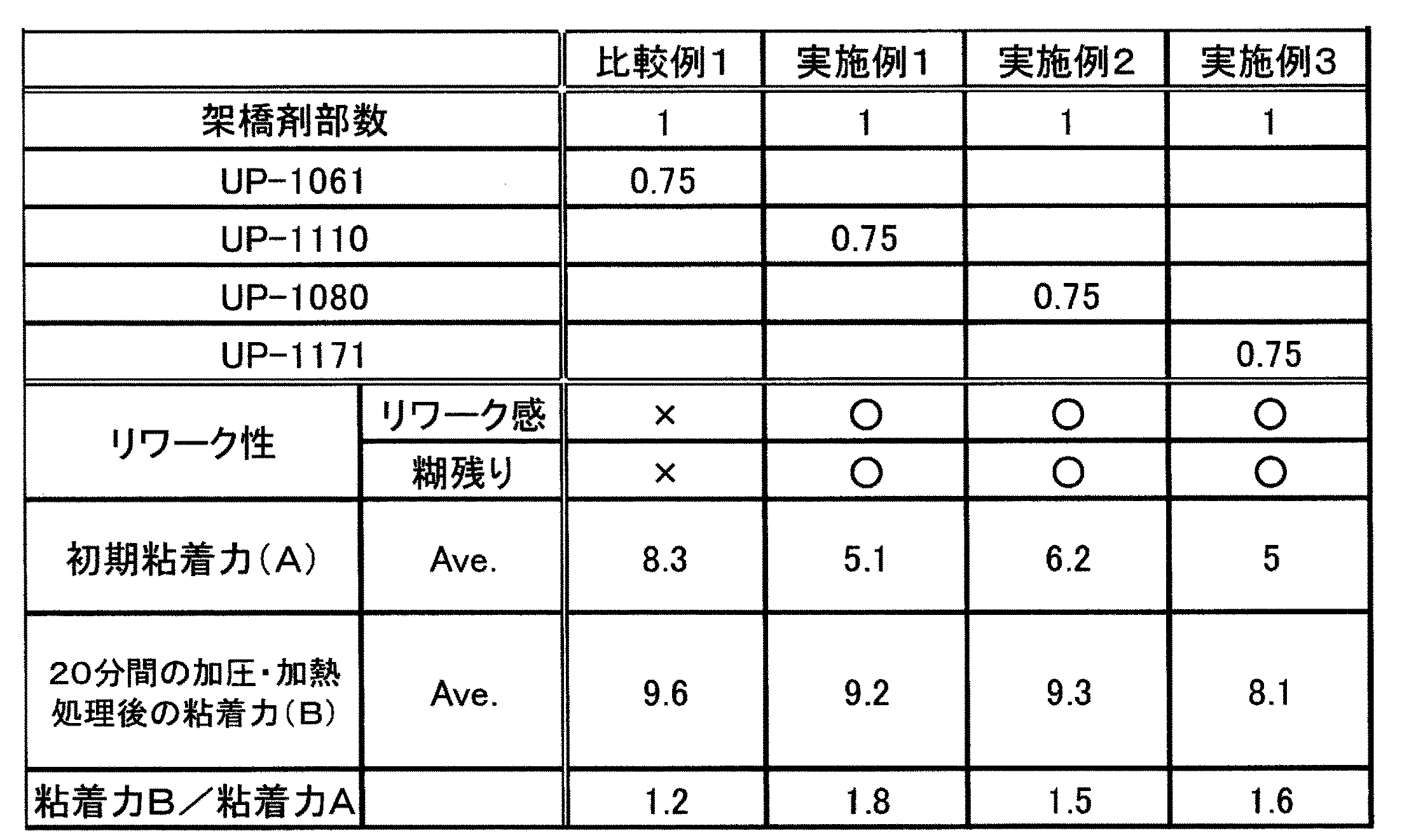
上記表2から、第2のアクリル系ポリマーの重量平均分子量が2500である実施例1、6000である実施例2、8000である実施例3については、被着体への貼り付け後20分経過時点の粘着力(A)が、それぞれ、5.1N/25mm、6.2N/25mm、5N/25mmであり、いずれも、6.5N/25mm以下となっている。また、これらについては、リワーク性評価のリワーク感が良好であり、また、糊残りや汚れが発生しておらず、被着体への貼り付け初期におけるリワーク性に優れていることが分かる。これら実施例1~3に係る粘着シートは、本発明に係る粘着シートに対応することから、本発明によれば、貼り付け初期において、液晶表示装置(LCD)等の被着体を破損させることなく、容易にかつ綺麗に粘着シートを剥離(リワーク)することが可能であることが分かる。
これに対し、比較例1は、被着体への貼り付け後20分経過時点の粘着力(A)が、8.3N/25mmと高く、また、リワーク性が悪いという結果となった。この比較例1は、第2のアクリル系ポリマーの重量平均分子量が1600であり、重量平均分子量が2500である実施例1は、リワーク性が良好であることから、重量平均分子量が1600~2500の範囲に、リワーク性に関する良否の境界が存在するものと考えることができ、その数値は、2000程度であると考えられる。また、リワーク性が悪い比較例1は、第2のアクリル系ポリマーの粘度が550mPa・sであり、リワーク性に優れる実施例1は、粘度が3500mPa・sであることから、粘度が550~3500mPa・sの範囲に、粘度についてのリワーク性に関する良否の境界が存在するものと考えることができ、その数値は、3000mPa・s程度であると考えられる。
また、被着体への貼り付け後20分経過後、更に加圧・加熱処理を20分間行った後の粘着力(B)については、実施例1が9.2N/25mmであり、実施例2が9.3N/25mm、実施例3が8.1N/25mmとなっており、いずれも、粘着力が8N/25mm以上であり、液晶表示装置(LCD)等の表面に保護フィルムやタッチパネルを貼り付けた後、所定時間経過後には容易に剥離しない程度の強固な粘着性を発揮していることが分かる。
また、実施例1~3は、いずれも、被着体への貼り付け後20分経過時点の粘着力(A)と、その後更に加圧・加熱処理を20分間行った後の粘着力(B)との比(B/A)が、1.5以上を確保していることが分かる。このことからも、本発明に係る実施例1~3は、被着体への貼り付け後20分経過時点の粘着力が、所定時間経過後に大幅に増大し、強固な粘着性を時間経過とともに発揮していることが分かる。なお、比較例1は、粘着力(B)が、9.6N/25mmであり、粘着力の比:B/Aが1.2となり、貼り付け後所定時間経過した際に粘着力のそれほど大きな増大が認められない。
以上の官能評価試験及び粘着力測定試験結果から、本発明に係る実施例1~3については、被着体への貼り付け初期段階においては、その粘着力がリワーク可能な程度の低い粘着性を有する一方、貼り付け後、所定時間経過した段階においては強固な粘着性を発揮し、被着体から剥離することを防止することができるという極めて優れた特質を有するものであることが分かる。
ここで、上記粘着力測定試験においては、粘着力(B)測定用のサンプルについて、温度60℃、圧力0.5MPaの条件で20分間の加圧・加熱処理(オートクレーブ処理)を施しているが、このような加圧・加熱処理を施さずに、被着体に粘着シート付きPETフィルムを貼り付けた後、24時間放置して作成した粘着力(B)測定用のサンプルについても、上記表2に示す結果と同等の粘着力(B)を示すことが確認された。
本発明の粘着剤は、液晶表示装置(LCD)の偏光板表面に保護フィルムやタッチパネルを貼着する場合など、特にフィルム部材同士を貼り合せた時のリワーク性及び粘着性に優れている。表示装置等の薄型化のため、ガラス代替としてフィルム部材が用いられる場合などに利用することができる。
Claims (9)
- 反応性官能基を有する第1のアクリル系ポリマーと、反応性官能基を有しない第2のアクリル系ポリマーとを含有する粘着シートであって、
被着体への貼り付け後20分経過時点の粘着力(A)と、前記被着体への貼り付け後24時間経過後の粘着力(B)との比(B/A)が、1.5以上である粘着シート。 - 反応性官能基を有する第1のアクリル系ポリマーと、反応性官能基を有しない第2のアクリル系ポリマーとを含有する粘着シートであって、
被着体への貼り付け後20分経過時点の粘着力(A)と、前記被着体への貼り付け後20分経過後、温度60℃、圧力0.5MPaの条件で20分間の加圧・加熱処理を行った後の粘着力(B)との比(B/A)が、1.5以上である粘着シート。 - 前記第2のアクリル系ポリマーの重量平均分子量が、2000~9000である請求項1又は2に記載の粘着シート。
- 前記第2のアクリル系ポリマーの粘度が、3000~25000mPa・sである請求項1から3のいずれかに記載の粘着シート。
- 前記第1のアクリル系ポリマーの重量平均分子量が、20万~60万である請求項1から4のいずれかに記載の粘着シート。
- 前記第2のアクリル系ポリマーは、前記第1のアクリル系ポリマー重量100質量部に対して、0.1~10質量部含有されている請求項1から5のいずれかに記載の粘着シート。
- 偏光板に貼りつけた際の前記貼り付け初期の粘着力(A)が、JIS Z 0237(2000)に準じた180度引きはがし粘着力測定法で、6.5N/25mm以下である請求項1から6のいずれかに記載の粘着シート。
- 請求項1から7のいずれかに記載の粘着シートと、前記粘着シートの少なく
とも一方面に設けた透明基板とを備える粘着シート付き透明基板。 - 前記透明基板がタッチパネルである請求項8に記載の粘着シート付き透明基板。
Priority Applications (1)
| Application Number | Priority Date | Filing Date | Title |
|---|---|---|---|
| JP2017501827A JP6618522B2 (ja) | 2015-02-24 | 2015-05-28 | 粘着シート及び粘着シート付き透明基板 |
Applications Claiming Priority (2)
| Application Number | Priority Date | Filing Date | Title |
|---|---|---|---|
| JP2015033913 | 2015-02-24 | ||
| JP2015-033913 | 2015-02-24 |
Publications (1)
| Publication Number | Publication Date |
|---|---|
| WO2016135991A1 true WO2016135991A1 (ja) | 2016-09-01 |
Family
ID=56788262
Family Applications (1)
| Application Number | Title | Priority Date | Filing Date |
|---|---|---|---|
| PCT/JP2015/065376 Ceased WO2016135991A1 (ja) | 2015-02-24 | 2015-05-28 | 粘着シート及び粘着シート付き透明基板 |
Country Status (3)
| Country | Link |
|---|---|
| JP (1) | JP6618522B2 (ja) |
| TW (1) | TWI557205B (ja) |
| WO (1) | WO2016135991A1 (ja) |
Citations (3)
| Publication number | Priority date | Publication date | Assignee | Title |
|---|---|---|---|---|
| JP2004002782A (ja) * | 2002-04-05 | 2004-01-08 | Nippon Carbide Ind Co Inc | 偏光フィルム用感圧接着剤組成物及び偏光フィルム |
| JP2005082775A (ja) * | 2003-09-11 | 2005-03-31 | Nitto Denko Corp | アクリル系粘着剤組成物およびアクリル系粘着シート |
| JP2011219587A (ja) * | 2010-04-07 | 2011-11-04 | Lintec Corp | 粘着性組成物、粘着剤および粘着シート |
Family Cites Families (2)
| Publication number | Priority date | Publication date | Assignee | Title |
|---|---|---|---|---|
| JP5651073B2 (ja) * | 2011-06-14 | 2015-01-07 | 綜研化学株式会社 | 粘着剤、粘着シートおよびタッチパネル用積層体 |
| JP6381950B2 (ja) * | 2013-06-25 | 2018-08-29 | 日東電工株式会社 | 粘着剤組成物、表面保護フィルム、及び、光学部材 |
-
2015
- 2015-05-28 JP JP2017501827A patent/JP6618522B2/ja active Active
- 2015-05-28 WO PCT/JP2015/065376 patent/WO2016135991A1/ja not_active Ceased
- 2015-05-29 TW TW104117405A patent/TWI557205B/zh active
Patent Citations (3)
| Publication number | Priority date | Publication date | Assignee | Title |
|---|---|---|---|---|
| JP2004002782A (ja) * | 2002-04-05 | 2004-01-08 | Nippon Carbide Ind Co Inc | 偏光フィルム用感圧接着剤組成物及び偏光フィルム |
| JP2005082775A (ja) * | 2003-09-11 | 2005-03-31 | Nitto Denko Corp | アクリル系粘着剤組成物およびアクリル系粘着シート |
| JP2011219587A (ja) * | 2010-04-07 | 2011-11-04 | Lintec Corp | 粘着性組成物、粘着剤および粘着シート |
Also Published As
| Publication number | Publication date |
|---|---|
| JP6618522B2 (ja) | 2019-12-11 |
| TW201631075A (zh) | 2016-09-01 |
| JPWO2016135991A1 (ja) | 2017-11-09 |
| TWI557205B (zh) | 2016-11-11 |
Similar Documents
| Publication | Publication Date | Title |
|---|---|---|
| TWI625244B (zh) | 附雙面黏著劑之光學薄膜、及使用其之圖像顯示裝置之製造方法 | |
| TWI679457B (zh) | 雙面附黏著劑之光學膜、及使用其之圖像顯示裝置之製造方法、以及雙面附黏著劑之光學膜之捲曲抑制方法 | |
| KR101613111B1 (ko) | 대전 방지 표면 보호 필름의 제조 방법 및 대전 방지 표면 보호 필름 | |
| JP5015648B2 (ja) | 光学用粘着剤組成物および光学機能性フィルム | |
| JP6663628B2 (ja) | 粘着シート、粘着層付き光学フィルム、および画像表示装置 | |
| WO2018092905A1 (ja) | 粘着シート | |
| TWI593766B (zh) | 黏接劑組成物、黏接片及光學用疊層片 | |
| TW200416265A (en) | Double-sided pressure-sensitive adhesive sheet and touch panel-provided display device | |
| JP6168347B2 (ja) | 粘着テープ | |
| KR20130110071A (ko) | 점착성 조성물, 점착제 및 점착 시트 | |
| JP7803324B2 (ja) | 粘着フィルム | |
| CN113242987B (zh) | 带粘合剂层的偏振膜 | |
| JP2020095206A (ja) | 粘着剤層付き偏光フィルム | |
| TW201529775A (zh) | 接著劑組成物、附設接著劑之偏光板及顯示裝置 | |
| JP6168350B2 (ja) | 粘着テープ | |
| TWI726923B (zh) | 表面保護膜及貼有該膜之光學元件 | |
| CN108267803A (zh) | 带表面保护膜的偏振膜及带表面保护膜的光学构件 | |
| JP7783365B2 (ja) | 表面保護フィルム | |
| CN111349413A (zh) | 耐弯折的光学膜用胶 | |
| JP6655682B2 (ja) | 帯電防止表面保護フィルム用剥離フィルム | |
| JP6618522B2 (ja) | 粘着シート及び粘着シート付き透明基板 | |
| JP2016216684A (ja) | 水性粘着剤および粘着シート | |
| KR102050235B1 (ko) | 표면 보호 필름용 박리 필름 | |
| CN108307641A (zh) | 着色粘合带及便携电子设备部件固定用着色粘合带 | |
| JP6655681B2 (ja) | 帯電防止表面保護フィルム用剥離フィルム |
Legal Events
| Date | Code | Title | Description |
|---|---|---|---|
| 121 | Ep: the epo has been informed by wipo that ep was designated in this application |
Ref document number: 15883282 Country of ref document: EP Kind code of ref document: A1 |
|
| ENP | Entry into the national phase |
Ref document number: 2017501827 Country of ref document: JP Kind code of ref document: A |
|
| NENP | Non-entry into the national phase |
Ref country code: DE |
|
| 122 | Ep: pct application non-entry in european phase |
Ref document number: 15883282 Country of ref document: EP Kind code of ref document: A1 |