WO2016133169A1 - 非水電解液電池用電解液、及びこれを用いた非水電解液電池 - Google Patents
非水電解液電池用電解液、及びこれを用いた非水電解液電池 Download PDFInfo
- Publication number
- WO2016133169A1 WO2016133169A1 PCT/JP2016/054748 JP2016054748W WO2016133169A1 WO 2016133169 A1 WO2016133169 A1 WO 2016133169A1 JP 2016054748 W JP2016054748 W JP 2016054748W WO 2016133169 A1 WO2016133169 A1 WO 2016133169A1
- Authority
- WO
- WIPO (PCT)
- Prior art keywords
- group
- carbon atoms
- electrolyte
- compound
- electrolyte battery
- Prior art date
- Legal status (The legal status is an assumption and is not a legal conclusion. Google has not performed a legal analysis and makes no representation as to the accuracy of the status listed.)
- Ceased
Links
Classifications
-
- H—ELECTRICITY
- H01—ELECTRIC ELEMENTS
- H01M—PROCESSES OR MEANS, e.g. BATTERIES, FOR THE DIRECT CONVERSION OF CHEMICAL ENERGY INTO ELECTRICAL ENERGY
- H01M10/00—Secondary cells; Manufacture thereof
- H01M10/05—Accumulators with non-aqueous electrolyte
- H01M10/056—Accumulators with non-aqueous electrolyte characterised by the materials used as electrolytes, e.g. mixed inorganic/organic electrolytes
- H01M10/0564—Accumulators with non-aqueous electrolyte characterised by the materials used as electrolytes, e.g. mixed inorganic/organic electrolytes the electrolyte being constituted of organic materials only
- H01M10/0566—Liquid materials
- H01M10/0567—Liquid materials characterised by the additives
-
- C—CHEMISTRY; METALLURGY
- C07—ORGANIC CHEMISTRY
- C07C—ACYCLIC OR CARBOCYCLIC COMPOUNDS
- C07C307/00—Amides of sulfuric acids, i.e. compounds having singly-bound oxygen atoms of sulfate groups replaced by nitrogen atoms, not being part of nitro or nitroso groups
- C07C307/02—Monoamides of sulfuric acids or esters thereof, e.g. sulfamic acids
-
- C—CHEMISTRY; METALLURGY
- C07—ORGANIC CHEMISTRY
- C07C—ACYCLIC OR CARBOCYCLIC COMPOUNDS
- C07C317/00—Sulfones; Sulfoxides
- C07C317/24—Sulfones; Sulfoxides having sulfone or sulfoxide groups and doubly-bound oxygen atoms bound to the same carbon skeleton
-
- C—CHEMISTRY; METALLURGY
- C07—ORGANIC CHEMISTRY
- C07F—ACYCLIC, CARBOCYCLIC OR HETEROCYCLIC COMPOUNDS CONTAINING ELEMENTS OTHER THAN CARBON, HYDROGEN, HALOGEN, OXYGEN, NITROGEN, SULFUR, SELENIUM OR TELLURIUM
- C07F7/00—Compounds containing elements of Groups 4 or 14 of the Periodic Table
- C07F7/02—Silicon compounds
- C07F7/08—Compounds having one or more C—Si linkages
- C07F7/0803—Compounds with Si-C or Si-Si linkages
- C07F7/0805—Compounds with Si-C or Si-Si linkages comprising only Si, C or H atoms
-
- C—CHEMISTRY; METALLURGY
- C07—ORGANIC CHEMISTRY
- C07F—ACYCLIC, CARBOCYCLIC OR HETEROCYCLIC COMPOUNDS CONTAINING ELEMENTS OTHER THAN CARBON, HYDROGEN, HALOGEN, OXYGEN, NITROGEN, SULFUR, SELENIUM OR TELLURIUM
- C07F7/00—Compounds containing elements of Groups 4 or 14 of the Periodic Table
- C07F7/02—Silicon compounds
- C07F7/08—Compounds having one or more C—Si linkages
- C07F7/12—Organo silicon halides
-
- C—CHEMISTRY; METALLURGY
- C07—ORGANIC CHEMISTRY
- C07F—ACYCLIC, CARBOCYCLIC OR HETEROCYCLIC COMPOUNDS CONTAINING ELEMENTS OTHER THAN CARBON, HYDROGEN, HALOGEN, OXYGEN, NITROGEN, SULFUR, SELENIUM OR TELLURIUM
- C07F9/00—Compounds containing elements of Groups 5 or 15 of the Periodic Table
- C07F9/02—Phosphorus compounds
-
- C—CHEMISTRY; METALLURGY
- C07—ORGANIC CHEMISTRY
- C07F—ACYCLIC, CARBOCYCLIC OR HETEROCYCLIC COMPOUNDS CONTAINING ELEMENTS OTHER THAN CARBON, HYDROGEN, HALOGEN, OXYGEN, NITROGEN, SULFUR, SELENIUM OR TELLURIUM
- C07F9/00—Compounds containing elements of Groups 5 or 15 of the Periodic Table
- C07F9/02—Phosphorus compounds
- C07F9/06—Phosphorus compounds without P—C bonds
- C07F9/22—Amides of acids of phosphorus
- C07F9/26—Amides of acids of phosphorus containing P-halide groups
-
- C—CHEMISTRY; METALLURGY
- C07—ORGANIC CHEMISTRY
- C07F—ACYCLIC, CARBOCYCLIC OR HETEROCYCLIC COMPOUNDS CONTAINING ELEMENTS OTHER THAN CARBON, HYDROGEN, HALOGEN, OXYGEN, NITROGEN, SULFUR, SELENIUM OR TELLURIUM
- C07F9/00—Compounds containing elements of Groups 5 or 15 of the Periodic Table
- C07F9/02—Phosphorus compounds
- C07F9/28—Phosphorus compounds with one or more P—C bonds
-
- H—ELECTRICITY
- H01—ELECTRIC ELEMENTS
- H01M—PROCESSES OR MEANS, e.g. BATTERIES, FOR THE DIRECT CONVERSION OF CHEMICAL ENERGY INTO ELECTRICAL ENERGY
- H01M10/00—Secondary cells; Manufacture thereof
- H01M10/05—Accumulators with non-aqueous electrolyte
- H01M10/052—Li-accumulators
-
- H—ELECTRICITY
- H01—ELECTRIC ELEMENTS
- H01M—PROCESSES OR MEANS, e.g. BATTERIES, FOR THE DIRECT CONVERSION OF CHEMICAL ENERGY INTO ELECTRICAL ENERGY
- H01M10/00—Secondary cells; Manufacture thereof
- H01M10/05—Accumulators with non-aqueous electrolyte
- H01M10/052—Li-accumulators
- H01M10/0525—Rocking-chair batteries, i.e. batteries with lithium insertion or intercalation in both electrodes; Lithium-ion batteries
-
- H—ELECTRICITY
- H01—ELECTRIC ELEMENTS
- H01M—PROCESSES OR MEANS, e.g. BATTERIES, FOR THE DIRECT CONVERSION OF CHEMICAL ENERGY INTO ELECTRICAL ENERGY
- H01M10/00—Secondary cells; Manufacture thereof
- H01M10/05—Accumulators with non-aqueous electrolyte
- H01M10/054—Accumulators with insertion or intercalation of metals other than lithium, e.g. with magnesium or aluminium
-
- H—ELECTRICITY
- H01—ELECTRIC ELEMENTS
- H01M—PROCESSES OR MEANS, e.g. BATTERIES, FOR THE DIRECT CONVERSION OF CHEMICAL ENERGY INTO ELECTRICAL ENERGY
- H01M10/00—Secondary cells; Manufacture thereof
- H01M10/05—Accumulators with non-aqueous electrolyte
- H01M10/056—Accumulators with non-aqueous electrolyte characterised by the materials used as electrolytes, e.g. mixed inorganic/organic electrolytes
- H01M10/0564—Accumulators with non-aqueous electrolyte characterised by the materials used as electrolytes, e.g. mixed inorganic/organic electrolytes the electrolyte being constituted of organic materials only
- H01M10/0566—Liquid materials
- H01M10/0568—Liquid materials characterised by the solutes
-
- H—ELECTRICITY
- H01—ELECTRIC ELEMENTS
- H01M—PROCESSES OR MEANS, e.g. BATTERIES, FOR THE DIRECT CONVERSION OF CHEMICAL ENERGY INTO ELECTRICAL ENERGY
- H01M10/00—Secondary cells; Manufacture thereof
- H01M10/05—Accumulators with non-aqueous electrolyte
- H01M10/056—Accumulators with non-aqueous electrolyte characterised by the materials used as electrolytes, e.g. mixed inorganic/organic electrolytes
- H01M10/0564—Accumulators with non-aqueous electrolyte characterised by the materials used as electrolytes, e.g. mixed inorganic/organic electrolytes the electrolyte being constituted of organic materials only
- H01M10/0566—Liquid materials
- H01M10/0569—Liquid materials characterised by the solvents
-
- H—ELECTRICITY
- H01—ELECTRIC ELEMENTS
- H01M—PROCESSES OR MEANS, e.g. BATTERIES, FOR THE DIRECT CONVERSION OF CHEMICAL ENERGY INTO ELECTRICAL ENERGY
- H01M2220/00—Batteries for particular applications
- H01M2220/20—Batteries in motive systems, e.g. vehicle, ship, plane
-
- H—ELECTRICITY
- H01—ELECTRIC ELEMENTS
- H01M—PROCESSES OR MEANS, e.g. BATTERIES, FOR THE DIRECT CONVERSION OF CHEMICAL ENERGY INTO ELECTRICAL ENERGY
- H01M2220/00—Batteries for particular applications
- H01M2220/30—Batteries in portable systems, e.g. mobile phone, laptop
-
- H—ELECTRICITY
- H01—ELECTRIC ELEMENTS
- H01M—PROCESSES OR MEANS, e.g. BATTERIES, FOR THE DIRECT CONVERSION OF CHEMICAL ENERGY INTO ELECTRICAL ENERGY
- H01M2300/00—Electrolytes
- H01M2300/0017—Non-aqueous electrolytes
- H01M2300/0025—Organic electrolyte
-
- H—ELECTRICITY
- H01—ELECTRIC ELEMENTS
- H01M—PROCESSES OR MEANS, e.g. BATTERIES, FOR THE DIRECT CONVERSION OF CHEMICAL ENERGY INTO ELECTRICAL ENERGY
- H01M2300/00—Electrolytes
- H01M2300/0017—Non-aqueous electrolytes
- H01M2300/0025—Organic electrolyte
- H01M2300/0028—Organic electrolyte characterised by the solvent
-
- Y—GENERAL TAGGING OF NEW TECHNOLOGICAL DEVELOPMENTS; GENERAL TAGGING OF CROSS-SECTIONAL TECHNOLOGIES SPANNING OVER SEVERAL SECTIONS OF THE IPC; TECHNICAL SUBJECTS COVERED BY FORMER USPC CROSS-REFERENCE ART COLLECTIONS [XRACs] AND DIGESTS
- Y02—TECHNOLOGIES OR APPLICATIONS FOR MITIGATION OR ADAPTATION AGAINST CLIMATE CHANGE
- Y02E—REDUCTION OF GREENHOUSE GAS [GHG] EMISSIONS, RELATED TO ENERGY GENERATION, TRANSMISSION OR DISTRIBUTION
- Y02E60/00—Enabling technologies; Technologies with a potential or indirect contribution to GHG emissions mitigation
- Y02E60/10—Energy storage using batteries
Definitions
- the present invention relates to a non-aqueous electrolyte battery electrolyte containing a specific silane compound and a salt having a fluorophosphoryl structure and / or a fluorosulfonyl structure, and a non-aqueous electrolyte battery using the same.
- Patent Document 1 proposes to improve battery characteristics by adding vinylene carbonate to an electrolytic solution.
- the battery characteristics at high temperature are improved, the increase in internal resistance is remarkably deteriorated at low temperature.
- studies have been made to add a silicon compound to an electrolytic solution.
- Patent Documents 2 to 6 disclose that non-aqueous electrolytes include silicon compounds such as silicone compounds and fluorosilane compounds. A method for improving the high-temperature storage characteristics and the low-temperature characteristics by suppressing the increase in cycle characteristics and internal resistance of the electrolyte battery has been proposed. Patent Document 7 discloses the addition of a fluorosilane compound or a difluorophosphate compound. A method for improving the low temperature characteristics of a nonaqueous electrolyte battery has been proposed. In addition, studies have been made to add a salt having a phosphoryl group or a sulfonyl group to the electrolytic solution.
- Patent Document 8 For example, by combining a specific sulfonimide salt or phosphorylimide salt with an oxalato complex, high temperature cycle characteristics and high temperature storage characteristics can be obtained.
- a method (Patent Document 8) for improving the cycle characteristics and output characteristics by combining a specific fluorophosphate and a sulfonimide salt has been proposed (Patent Document 8).
- a specific silane compound By containing at least one selected from the group consisting of a fluorine-containing compound having a specific structure (a fluorophosphate having a specific structure, a fluorophosphoryl structure having a specific structure and / or an imide salt having a fluorosulfonyl structure)
- a fluorine-containing compound having a specific structure a fluorophosphate having a specific structure, a fluorophosphoryl structure having a specific structure and / or an imide salt having a fluorosulfonyl structure
- the inventors have found that when the electrolyte is used in a non-aqueous electrolyte battery, excellent low-temperature characteristics, high-temperature cycle characteristics, and high-temperature storage characteristics can be exhibited, leading to the present invention.
- the present invention At least one non-aqueous solvent, solute, and at least one silane compound represented by the following general formula (1) as the first compound, and at least one of the following general formulas (2) to (9) as the second compound
- R 1 's each independently represent a group having a carbon-carbon unsaturated bond.
- R 2 each independently represents a linear or branched alkyl group having 1 to 10 carbon atoms, and these groups may have a fluorine atom and / or an oxygen atom.
- a is 2-4.
- R 3 to R 6 are each independently a fluorine atom or a linear or branched alkoxy group having 1 to 10 carbon atoms.
- X 1 and X 2 are each independently a fluorine atom, a linear or branched alkyl group having 1 to 10 carbon atoms, An alkenyl group having 2 to 10 carbon atoms, an alkynyl group having 2 to 10 carbon atoms, a cycloalkyl group having 3 to 10 carbon atoms, a cycloalkenyl group having 3 to 10 carbon atoms, and an aryl having 6 to 10 carbon atoms A straight chain or branched alkoxy group having 1 to 10 carbon atoms, an alkenyloxy group having 2 to 10 carbon atoms, an alkynyloxy group having 2 to 10 carbon atoms, or a cycloalkoxy group having 3 to 10 carbon atoms An organic group selected from a cycloalkenyloxy group having 3 to 10 carbon atoms and an aryloxy group having 6 to 10 carbon atoms, and a fluorine atom,
- the electrolyte for a non-aqueous electrolyte battery of the present invention it is important that both the first compound and the second compound are included. Only when these compounds are contained together, when the electrolyte is used in a non-aqueous electrolyte battery, has a high average discharge voltage at ⁇ 30 ° C. or lower, excellent low-temperature output characteristics, and 50 ° C. or higher. This is because excellent cycle characteristics and storage characteristics at high temperatures can be exhibited.
- the amount of the second compound added is preferably in the range of 0.001 to 10.0% by mass with respect to the total amount of the electrolyte for nonaqueous electrolyte batteries.
- the groups represented by R 1 in the general formula (1) are each independently composed of a vinyl group, an allyl group, a 1-propenyl group, a 2-propenyl group, an ethynyl group, and a 2-propynyl group.
- a group selected from the group is preferred.
- the groups represented by R 2 in the general formula (1) are each independently of each other a methyl group, an ethyl group, a propyl group, a 2,2,2-trifluoroethyl group, 2,2,3,
- a group selected from the group consisting of a 3-tetrafluoropropyl group, a 1,1,1-trifluoroisopropyl group, and a 1,1,1,3,3,3-hexafluoroisopropyl group is preferable.
- R 3 to R 6 are each a linear or branched alkoxy having a fluorine atom or a fluorine atom having 1 to 10 carbon atoms.
- An organic group selected from the group consisting of a group, an alkenyloxy group having 2 to 10 carbon atoms, and an alkynyloxy group having 2 to 10 carbon atoms is preferable.
- M 1 and M 2 are at least one cation selected from the group consisting of lithium ions, sodium ions, potassium ions, tetraalkylammonium ions, and tetraalkylphosphonium ions. Preferably there is.
- the solutes are lithium hexafluorophosphate (LiPF 6 ), lithium tetrafluoroborate (LiBF 4 ), bis (trifluoromethanesulfonyl) imidolithium (LiN (CF 3 SO 2 ) 2 ), bis (fluorosulfonyl).
- the non-aqueous solvent is at least one non-aqueous solvent selected from the group consisting of cyclic carbonates, chain carbonates, cyclic esters, chain esters, cyclic ethers, chain ethers, sulfone compounds, sulfoxide compounds, and ionic liquids. It is preferable that
- the average discharge voltage at ⁇ 30 ° C. or less is high and has excellent low-temperature output characteristics, and excellent cycle characteristics and storage characteristics at high temperatures of 50 ° C. or higher. It is possible to provide an electrolyte for a non-aqueous electrolyte battery and a non-aqueous electrolyte battery using the same.
- the non-aqueous electrolyte battery electrolyte of the present invention includes at least a non-aqueous solvent, a solute, and a first compound, at least one silane compound represented by the general formula (1), and a second compound.
- An electrolyte solution for a non-aqueous electrolyte battery comprising at least one selected from the group consisting of fluorine-containing compounds represented by the general formulas (2) to (9).
- Each of the first compounds has an effect of forming a stable film by decomposing on the positive electrode and the negative electrode and suppressing the deterioration of the battery.
- the first compound and the second compound are not used in combination.
- the film formed on the electrode has an extremely high resistance to the movement of lithium ions accompanying charging and discharging, and the low-temperature characteristics of the resulting nonaqueous electrolyte battery are significantly reduced. There is a problem of end.
- the high-temperature cycle characteristics and high-temperature storage characteristics at a high temperature of 50 ° C. or higher are not sufficient.
- the electrolyte solution for a non-aqueous electrolyte battery of the present invention by using the first compound and the second compound in combination, the high temperature at a high temperature of 50 ° C. or higher as compared with the case where the first compound group is added alone. Cycle characteristics, high temperature storage characteristics, and low temperature characteristics are improved, and the object of the present invention can be achieved.
- the details of the mechanism are not clear, when the first compound and the second compound coexist, the second compound is positively decomposed on the positive electrode and the negative electrode together with the first compound, and more ionic conductivity is obtained. It is considered that a film having higher durability and higher durability is formed.
- the second compound contains a site having a high electron-withdrawing property (for example, a fluorine atom or a fluorine-containing alkoxy group), the bias of the charge becomes larger, and the film with lower resistance (the film with better output characteristics) ) Is considered to be formed.
- a site having a high electron-withdrawing property for example, a fluorine atom or a fluorine-containing alkoxy group
- the average discharge voltage (output characteristics) at ⁇ 30 ° C. or lower and the high temperature of 50 ° C. or higher as compared with the case where each is used alone. It is estimated that cycle characteristics and storage characteristics are improved.
- the non-aqueous electrolyte battery electrolyte of the present invention contains a first compound, a second compound, a non-aqueous organic solvent, and a solute. If necessary, other commonly known additives can be used in combination.
- each component of the electrolyte solution for nonaqueous electrolyte batteries of this invention is demonstrated in detail.
- the above group may have a fluorine atom and / or an oxygen atom.
- a group containing a carbon-carbon unsaturated bond having 6 or less carbon atoms is preferable. When the number of carbon atoms is more than 6, the resistance when a film is formed on the electrode tends to be relatively large.
- a group selected from the group consisting of a vinyl group, an allyl group, a 1-propenyl group, a 2-propenyl group, an ethynyl group, and a 2-propynyl group is preferable.
- the number of groups having a carbon-carbon unsaturated bond represented by a needs to be 2 to 4 in order to form a film on the electrode, and thus to achieve the object of the present invention, In order to form a stronger film, it is preferably 3 to 4.
- the alkyl group represented by R 2 includes a methyl group, an ethyl group, a propyl group, an isopropyl group, an n-butyl group, a sec-butyl group, an isobutyl group, and a tert-butyl group.
- an alkyl group having 1 to 12 carbon atoms such as a pentyl group.
- the above group may have a fluorine atom and / or an oxygen atom (in the case where it has an oxygen atom, it means a structure other than an alkoxy group. That is, it is bonded to a silicon atom in the general formula (1)).
- methyl group, ethyl group, propyl group, 2,2,2-trifluoroethyl group, 2,2,3,3-tetrafluoropropyl group, 1,1,1-trifluoroisopropyl group, And a group selected from the group consisting of 1,1,1,3,3,3-hexafluoroisopropyl groups are more excellent in high temperature cycle characteristics and high temperature storage characteristics without increasing the internal resistance of the battery. This is preferable because a nonaqueous electrolyte battery can be obtained.
- the “total amount of the electrolyte for a non-aqueous electrolyte battery” means the total amount of the non-aqueous solvent, the solute, the first compound, and the second compound.
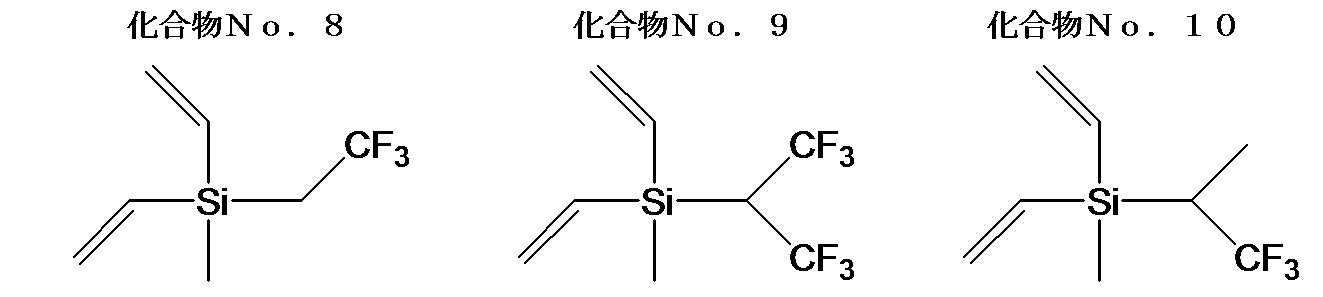
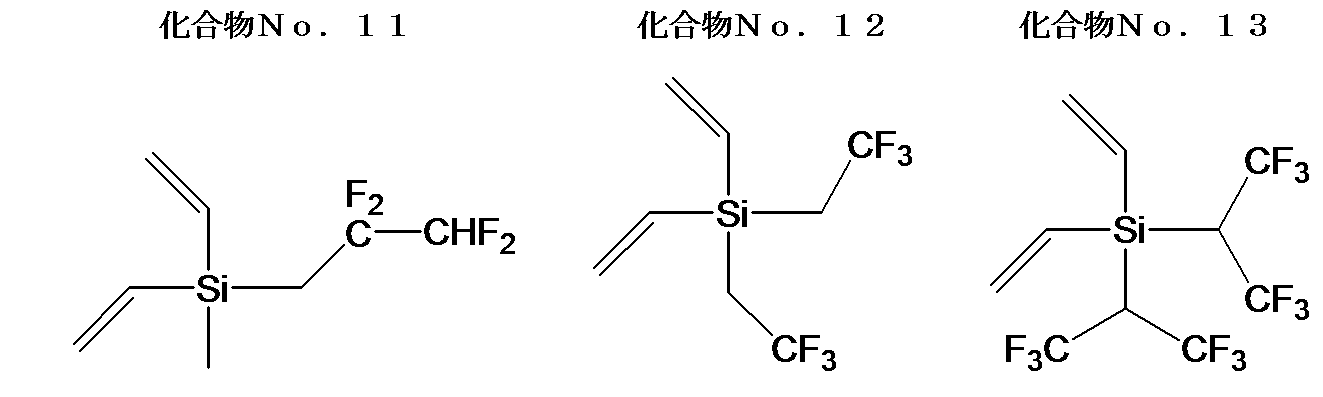
- examples of the silane compound represented by the general formula (1) include the following compound Nos. 1-No. 13 etc. are mentioned.
- the silane compound used in the present invention is not limited by the following examples.
- the silane compound represented by the general formula (1) includes, for example, a silicon compound having a silanol group or a hydrolyzable group and a carbon-carbon unsaturated bond-containing organic metal as described in Patent Document 10 and Non-Patent Document 1. It can be produced by a method in which a silanol group or a hydrolyzable group in the silicon compound is substituted with a carbon-carbon unsaturated bond group by reacting with a reagent to produce a silicon compound containing a carbon-carbon unsaturated bond.
- examples of the cation represented by M 1 and M 2 include protons, metal cations, and onium cations.
- the type is not particularly limited, and various ones can be selected from the above. Specific examples include metal cations such as lithium, sodium, potassium, rubidium, cesium, magnesium, calcium, barium, silver, copper, and iron, and onium cations such as tetraalkylammonium, tetraalkylphosphonium, and imidazolium derivatives.
- lithium ion, sodium ion, potassium ion, tetramethylammonium ion, tetraethylammonium ion, tetrabutylphosphonium ion, and the like are preferable from the viewpoint of assisting ion conduction in the nonaqueous electrolyte battery.
- alkynyloxy group examples include an ethynyloxy group, 2- Examples thereof include alkynyloxy groups having 2 to 10 carbon atoms such as propynyloxy group and 1,1-dimethyl-2-propynyloxy group, and fluorinated alkynyloxy groups.
- alkynyloxy groups examples include cyclopentyloxy group, And a cycloalkoxy group having 3 to 10 carbon atoms such as a cyclohexyloxy group and a fluorinated cycloalkoxy group, and examples of the cycloalkenyloxy group include a cyclopentenyloxy group and a cyclohexenyloxy group.
- aryloxy group examples include aryloxy groups having 6 to 10 carbon atoms such as phenyloxy group, tolyloxy group, and xylyloxy group, and fluorine-containing aryloxy groups.
- R 3 to R 6 in the general formulas (2) to (4) and (6) to (8) are a fluorine atom or an alkoxy group having a fluorine atom
- the degree of ion dissociation due to its strong electron withdrawing property This improvement is preferable because the ionic conductivity in the solution and the composition is increased.
- R 3 to R 6 in the general formulas (2) to (4) and (6) to (8) are fluorine atoms
- the effect of improving the mobility due to the reduction of the anion size is reduced. It is more preferable because the ionic conductivity in the inside and in the composition becomes very high. Accordingly, it is considered that the low temperature characteristics are further improved as the number of PF bonds in the general formulas (2) to (9) increases.
- R 3 to R 6 are preferably organic groups selected from the group consisting of alkenyloxy groups and alkynyloxy groups. Unlike the above alkenyloxy groups and alkynyloxy groups, hydrocarbon groups that do not intervene oxygen atoms have a low electron withdrawing property and a low ion dissociation degree, and the ionic conductivity in a solution or composition is low. Since it falls, it is not preferable. In addition, a group having an unsaturated bond such as the above alkenyloxy group and alkynyloxy group is preferable because it can be actively decomposed on the positive electrode and the negative electrode to form a film having higher durability.
- the carbon number of R 3 to R 6 is preferably 6 or less. It is preferable that the number of carbon atoms is 6 or less because the ionic conductivity tends to be relatively high.
- a 1-propenyloxy group, a 2-propenyloxy group, a 3-butenyloxy group, a 2-propynyloxy group, 1, A group selected from the group consisting of 1-dimethyl-2-propynyloxy groups is preferred because the anion size is relatively small.
- examples of the alkyl group represented by X 1 and X 2 include a methyl group, an ethyl group, a propyl group, an isopropyl group, and butyl.
- alkenyl groups include vinyl groups, 1 -An alkenyl group having 2 to 10 carbon atoms such as a propenyl group, a 2-propenyl group, an isopropenyl group, a 2-butenyl group, a 3-butenyl group, and a 1,3-butadienyl group, and a fluorine-containing alkenyl group.
- alkynyl group include alkynyl groups having 2 to 10 carbon atoms such as ethynyl group, 2-propynyl group, and 1,1-dimethyl-2-propynyl group, and fluorinated alkynyl groups.
- Examples of the group include a cycloalkyl group having 3 to 10 carbon atoms such as a cyclopentyl group and a cyclohexyl group, and a fluorine-containing cycloalkyl group.
- Examples of the cycloalkenyl group include a cyclopentenyl group and a cyclohexenyl group.
- a cycloalkenyl group having 3 to 10 carbon atoms such as a fluorine-containing cycloalkenyl group.
- Examples of the aryl group include aryl groups having 6 to 10 carbon atoms such as a phenyl group, a tolyl group, and a xylyl group. A fluorine-containing aryl group is mentioned.
- alkenyloxy group examples include, for example, a vinyloxy group, a 1-propenyloxy group, a 2-propenyloxy group, an isopropenyloxy group, a 2-butenyloxy group, and a 3-butenyloxy group.
- alkenyloxy groups having 2 to 10 carbon atoms such as 1,3-butadienyloxy group and fluorine-containing groups.
- alkynyloxy group examples include alkynyloxy groups having 2 to 10 carbon atoms such as ethynyloxy group, 2-propynyloxy group, and 1,1-dimethyl-2-propynyloxy group, and the like.
- cycloalkoxy group examples include a cycloalkoxy group having 3 to 10 carbon atoms such as a cyclopentyloxy group and a cyclohexyloxy group, and a fluorine-containing cycloalkoxy group.
- Examples of the group include a cycloalkenyloxy group having 3 to 10 carbon atoms such as a cyclopentenyloxy group and a cyclohexenyloxy group, and a fluorine-containing cycloalkenyloxy group.
- Examples of the aryloxy group include phenyloxy Group, tolyloxy group, and xyl Aryloxy aryloxy group or a fluorine-containing aryl group having 6 to 10 carbon atoms such as a group.
- X 1 and X 2 in the general formulas (4), (5), (8) and (9) are fluorine atoms, the degree of ion dissociation is improved due to their strong electron withdrawing property and the anion size is reduced. This is preferable because the ionic conductivity in the solution or the composition becomes very high due to the effect of improving the mobility.
- X 1 and X 2 are preferably organic groups selected from the group consisting of alkoxy groups, alkenyloxy groups, and alkynyloxy groups.
- alkoxy group alkenyloxy group, and alkynyloxy group
- the electron withdrawing property is small and the degree of ionic dissociation is reduced, so that ions in solution or in the composition This is not preferable because the conductivity decreases.
- the carbon number of said X is 6 or less.
- the number of carbon atoms is 6 or less because the ionic conductivity tends to be relatively high, and in particular, a methoxy group, an ethoxy group, a propoxy group, a 1-propenyloxy group, a 2-propenyloxy group, and a 3-butenyloxy group.
- a group selected from the group consisting of 2-propynyloxy group and 1,1-dimethyl-2-propynyloxy group is preferable because the anion size is relatively small.
- R 3 to R 5 and X 1 are all hydrocarbon groups having an oxygen atom (alkoxy group, alkenyloxy group, alkynyloxy group).
- Cycloalkoxy group, cycloalkenyloxy group, aryloxy group) that is, a compound containing no PF bond or SF bond at all has very low solubility in a non-aqueous electrolyte. Therefore, it is difficult to achieve the object of the present invention by adding it to the non-aqueous electrolyte.
- the lower limit is 0.001% by mass or more, more preferably 0.01% by mass or more, and still more preferably 0.1% by mass with respect to the total amount of the electrolyte for non-aqueous electrolyte batteries.
- the upper limit is 10.0% by mass or less, more preferably 5.0% by mass or less, and still more preferably 2.0% by mass or less. If it is less than 0.001% by mass, the effect of improving the output characteristics of the nonaqueous electrolyte battery at low temperature may not be sufficiently obtained.
- examples of the anion of the phosphate represented by the general formula (2) include the following compound Nos. 14 etc. are mentioned.
- the phosphate used in the present invention is not limited by the following examples.
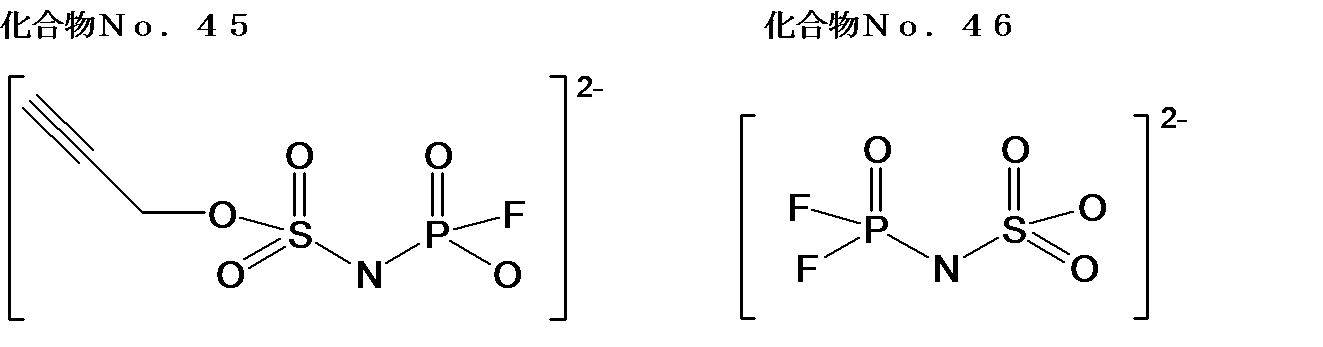
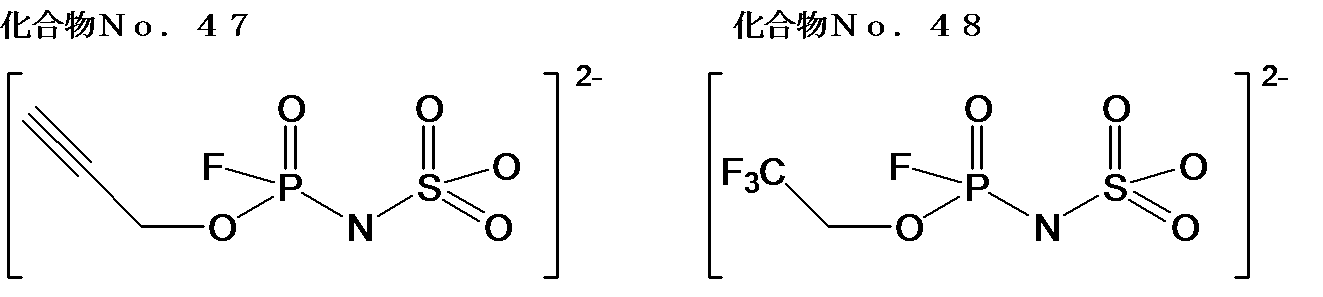
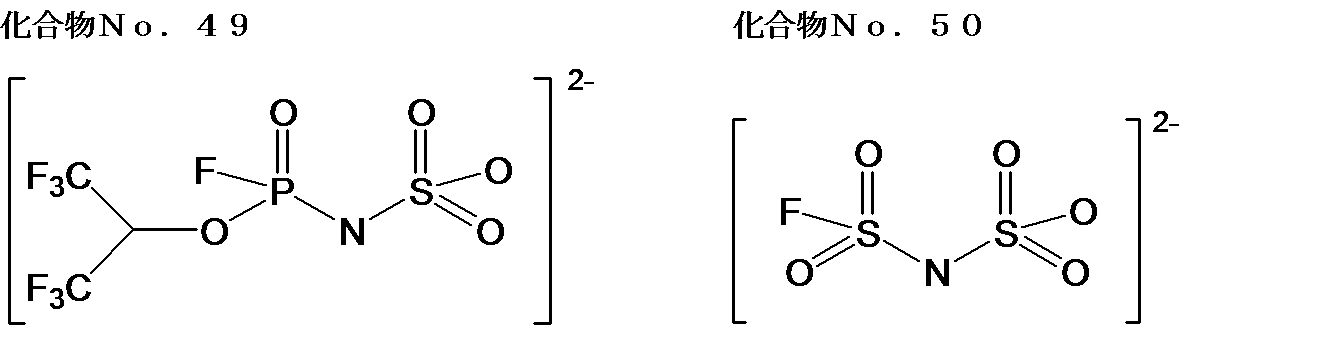
- examples of the anion of the imide salt represented by the general formulas (3) to (9) include, for example, the following compound Nos. 15-No. 50 etc. are mentioned.
- the imide salt used in the present invention is not limited by the following examples.
- the salt having an imide anion represented by the general formula (3) can be produced by various methods.
- the salt having an imide anion represented by the general formula (4) can be produced by various methods.
- the production method is not limited.
- the corresponding phosphoryl chloride (P ( ⁇ O) R 3 R 4 Cl) and sulfonamide (H 2 NSO 2 X 1 ) are present in the presence of an organic base or an inorganic base. It can obtain by making it react under.
- the salt having an imide anion represented by the general formula (5) can be produced by various methods.
- the production method is not limited, but for example, the corresponding sulfonyl chloride (X 1 SO 2 Cl) and the corresponding sulfonamide (H 2 NSO 2 X 2 ) in the presence of an organic base or an inorganic base. It can be obtained by reacting.
- the salt having an imide anion represented by the general formula (6) can be produced by various methods.
- the production method is not limited.
- the corresponding phosphoryl chloride (P ( ⁇ O) R 3 R 4 Cl) and the corresponding phosphoric acid amide (H 2 NP ( ⁇ O) R 5 O ⁇ are used.
- the corresponding phosphoryl chloride (P ( ⁇ O) R 3 R 4 Cl) and the corresponding phosphoric acid amide (H 2 NP ( ⁇ O) R 5 O ⁇ are used.
- the salt having an imide anion represented by the general formula (7) can be produced by various methods.
- the production method is not limited, but for example, the corresponding phosphoryl chloride (P ( ⁇ O) R 3 R 4 Cl) and sulfamic acid (H 2 NSO 3 ⁇ ) are present in the presence of an organic base or an inorganic base. It can obtain by making it react under.
- the salt having an imide anion represented by the general formula (8) can be produced by various methods.
- the production method is not limited.
- the corresponding sulfonyl chloride (X 1 SO 2 Cl) and the corresponding phosphoric acid amide (H 2 NP ( ⁇ O) R 3 O ⁇ ) are mixed with an organic base or It can be obtained by reacting in the presence of an inorganic base.
- the salt having an imide anion represented by the general formula (9) can be produced by various methods.
- the production method is not limited.
- the corresponding sulfonyl chloride (X 1 SO 2 Cl) and the corresponding sulfamic acid (H 2 NSO 3 ⁇ ) are reacted in the presence of an organic base or an inorganic base. Can be obtained.
- Non-aqueous solvent The kind of nonaqueous solvent used for the electrolyte solution for nonaqueous electrolyte batteries of the present invention is not particularly limited, and any nonaqueous solvent can be used. Specific examples include cyclic carbonates such as propylene carbonate, ethylene carbonate, butylene carbonate, fluoroethylene carbonate, chain carbonates such as diethyl carbonate, dimethyl carbonate, and ethyl methyl carbonate, cyclic esters such as ⁇ -butyrolactone, ⁇ -valerolactone, Examples include chain esters such as methyl acetate and methyl propionate, cyclic ethers such as tetrahydrofuran, 2-methyltetrahydrofuran and dioxane, chain ethers such as dimethoxyethane and diethyl ether, sulfone compounds such as dimethyl sulfoxide and sulfolane, and sulfoxide compounds.
- cyclic carbonates such as propy
- the nonaqueous solvent used for this invention may be used individually by 1 type, and may mix and use two or more types by arbitrary combinations and a ratio according to a use.
- the kind of solute used for the electrolyte solution for non-aqueous electrolyte batteries of the present invention is not particularly limited, and any electrolyte salt can be used.
- any electrolyte salt can be used.
- a sodium ion battery such as CF 3 ) 4
- LiBF 3 (C 2 F 5 ) 2 LiN (POF 2 ) 2
- NaPF 6 , NaBF 4 , NaCF 3 SO 3 , NaN (CF 3 SO 2 ) 2 examples thereof include electrolyte salts typified
- the concentration of these solutes is not particularly limited, but the lower limit of the preferred concentration range is 0.5 mol / L or more, more preferably 0.7 mol / L or more, still more preferably 0.9 mol / L or more.
- the upper limit is 2.5 mol / L or less, more preferably 2.0 mol / L or less, and still more preferably 1.5 mol / L or less. If it is less than 0.5 mol / L, the ionic conductivity may decrease, and the cycle characteristics and output characteristics of the nonaqueous electrolyte battery may be decreased.
- the liquid temperature when dissolving the solute in the non-aqueous solvent is not particularly limited, but is preferably ⁇ 20 to 80 ° C., more preferably 0 to 60 ° C.
- non-aqueous electrolyte battery electrolyte in a quasi-solid state with a gelling agent or a crosslinked polymer as used in a non-aqueous electrolyte battery called a lithium polymer battery.
- the non-aqueous electrolyte battery according to the present invention is characterized by using the above-described electrolyte for a non-aqueous electrolyte battery according to the present invention, and the other components are those used in general non-aqueous electrolyte batteries. Is used. That is, it comprises a positive electrode and a negative electrode capable of occluding and releasing cations, a current collector, a separator, a container, and the like.
- the positive electrode material is not particularly limited.
- lithium-containing transition metal composite oxides such as LiCoO 2 , LiNiO 2 , LiMnO 2 , LiMn 2 O 4 , and lithium-containing transition metals A composite oxide in which a plurality of transition metals such as Co, Mn, Ni, etc.
- transition metal in the lithium-containing transition metal composite oxide is replaced with a metal other than the transition metal, olivine and LiFePO 4, LiCoPO 4, phosphoric acid compound of a transition metal such as LiMnPO 4 called, oxides such as TiO 2, V 2 O 5, MoO 3, TiS 2, sulfides such as FeS, or polyacetylene, polyparaphenylene, polyaniline , And conductive polymers such as polypyrrole, activated carbon, polymers that generate radicals, carbon materials, etc. It is use.
- Acetylen black, ketjen black, carbon fiber, graphite as a conductive material, polytetrafluoroethylene, polyvinylidene fluoride, SBR resin, etc. as a binder are added to the positive electrode and negative electrode materials and molded into a sheet shape.
- an electrode sheet can be obtained.
- a mixed solvent of ethylene carbonate, propylene carbonate, dimethyl carbonate, and ethyl methyl carbonate in a volume ratio of 2: 1: 4: 3 is used as the nonaqueous solvent, and LiPF 6 is used as a solute in the solvent to have a concentration of 1.0 mol / L. Dissolved. Thereafter, the above compound No. 1 was used as the first compound. As a second compound, the above compound No. 2 was used so that the concentration of 2 was 0.5% by mass. 15 lithium salt was added and stirred to a concentration of 1.0% by mass. 1 was prepared. In addition, said preparation was performed maintaining a liquid temperature at 25 degreeC. Electrolyte No.
- Electrolyte No. 1 instead of the electrolyte No.
- a cell similar to that of Example 1-1 was prepared using 2 to 129, and the high temperature cycle characteristics, the high temperature storage characteristics, and the low temperature output characteristics were similarly evaluated. The evaluation results are shown in Tables 3 and 4.
- R 2 of the first compound represented by the general formula (1) is not a linear or branched alkyl group having 1 to 10 carbon atoms as in Comparative Examples 1-52 and 1-53 (Comparative Example 1-52 has a fluorine group and Comparative Example 1-53 has a methoxy group) the low-temperature output characteristics deteriorated, and no improvement in high-temperature cycle characteristics and high-temperature storage characteristics could be confirmed. Further, as in Comparative Example 1-54, when the number of groups having a carbon-carbon unsaturated bond was 1 or less, improvement in high temperature cycle characteristics, high temperature storage characteristics, and low temperature output characteristics could not be confirmed.
- Example 2-1 to 2-43, Comparative Examples 2-1 to 2-20 In Examples 2-1 to 2-43 and Comparative Examples 2-1 to 2-20, as shown in Table 6, except that the negative electrode body and the electrolytic solution were changed, non-water was the same as in Example 1-1. An electrolyte solution for an electrolyte battery was prepared, a cell was prepared, and the battery was evaluated. In Examples 2-1 to 2-13 and Comparative Examples 2-1 to 2-5 in which the negative electrode active material is Li 4 Ti 5 O 12 , the negative electrode body is 90% by mass of Li 4 Ti 5 O 12 powder.
- the negative electrode active material is graphite (silicon-containing)
- the negative electrode body is composed of 81% by mass of graphite powder and 9% by mass of silicon powder.
- Example 1-1 5% by mass of PVDF as a binder, 5% by mass of acetylene black as a conductive material, N-methylpyrrolidone is added, and the obtained paste is applied onto a copper foil and dried.
- the end-of-charge voltage and end-of-discharge voltage during battery evaluation were the same as in Example 1-1.
- the negative electrode body is composed of 90% by mass of hard carbon powder and 5% by mass of PVDF as a binder.
- the above compound No. 1 was used as the first compound.
- the above compound No. 2 was used so that the concentration of 2 was 0.5% by mass.
- 15 lithium salt was added and stirred to a concentration of 1.0% by mass.
- 130 was prepared. In addition, said preparation was performed maintaining a liquid temperature at 25 degreeC. Electrolyte No.
- the preparation conditions of 130 are shown in Table 5.
- the types of the first compound and the second compound are changed as shown in Table 5, and the other steps are performed in the same manner as described above. 131-138 were prepared.
- Table 6 shows the evaluation results of the high temperature cycle characteristics, the high temperature storage characteristics, and the low temperature output characteristics.
- Example 1 except that the positive electrode body, the negative electrode body, and the electrolytic solution were changed.
- a non-aqueous electrolyte battery electrolyte was prepared, a cell was prepared, and the battery was evaluated.
- the positive electrode body in which the positive electrode active material is LiCoO 2 is obtained by mixing 90% by mass of LiCoO 2 powder with 5% by mass of PVDF as a binder and 5% by mass of acetylene black as a conductive material, and further adding N-methylpyrrolidone, The obtained paste was applied on an aluminum foil and dried.
- Example 4-1 to 4-39, Comparative examples 4-1 to 4-15 In Examples 4-1 to 4-39 and Comparative Examples 4-1 to 4-15, as shown in Table 9, the nonaqueous solution was the same as Example 1-1 except that the positive electrode body and the electrolytic solution were changed. An electrolyte solution for an electrolyte battery was prepared, a cell was prepared, and the battery was evaluated. In Examples 4-1 to 4-13 and Comparative Examples 4-1 to 4-5 in which the positive electrode active material is LiNi 0.8 Co 0.15 Al 0.05 O 2 , the positive electrode body is LiNi 0.8 Co 0.15 Al 0.05 O 2 powder.
- the positive electrode active material is LiFePO 4
- the positive electrode body is made up of 90% by mass of LiFePO 4 powder coated with amorphous carbon.
- the battery was prepared by mixing 5% by mass of PVDF as a binder and 5% by mass of acetylene black as a conductive material, adding N-methylpyrrolidone, and applying the resulting paste onto an aluminum foil and drying.
- the nonaqueous electrolyte battery of the present invention is used in any of the examples using LiCoO 2 , LiNi 0.8 Co 0.15 Al 0.05 O 2 , LiMn 2 O 4 , and LiFePO 4 as the positive electrode active material. It was confirmed that the high temperature cycle characteristics, the high temperature storage characteristics, and the low temperature output characteristics were improved by using the electrolytic solution for use compared with the corresponding comparative examples. Therefore, by using the electrolyte for a non-aqueous electrolyte battery of the present invention, a non-aqueous electrolyte battery exhibiting excellent high-temperature cycle characteristics, high-temperature storage characteristics, and low-temperature output characteristics can be obtained regardless of the type of the positive electrode active material. It was shown that.
- Example 5-1 A mixed solvent of ethylene carbonate and diethyl carbonate having a volume ratio of 1: 1 was used as a non-aqueous solvent, and NaPF 6 was dissolved in the solvent so as to have a concentration of 1.0 mol / L. Thereafter, the above compound No. 1 was used as the first compound. As a second compound, the above compound No. 2 was used so that the concentration of 2 was 0.5% by mass. 15 sodium salt was added and stirred to a concentration of 1.0% by mass. 139 was prepared. Table 10 shows the conditions for preparing the electrolytic solution.
- a cell was prepared in the same manner as in Example 1-1 except that NaFe 0.5 Co 0.5 O 2 was used as the positive electrode material and hard carbon was used as the negative electrode material. Evaluation of high temperature storage characteristics and low temperature output characteristics was carried out.
- a positive electrode body in which the positive electrode active material is NaFe 0.5 Co 0.5 O 2 is a mixture of 90% by mass of NaFe 0.5 Co 0.5 O 2 powder with 5% by mass of PVDF as a binder and 5% by mass of acetylene black as a conductive material, N-methylpyrrolidone was added, and the resulting paste was applied on an aluminum foil and dried to produce a charge end voltage of 3.8 V and a discharge end voltage of 1.5 V during battery evaluation. .
- the evaluation results are shown in Table 11.
- Comparative Example 5-4 when R 2 of the first compound represented by the general formula (1) is not a linear or branched alkyl group having 1 to 10 carbon atoms (Comparative Example 5) -4 has a fluorine group), the low-temperature output characteristics deteriorated, and the high-temperature cycle characteristics and high-temperature storage characteristics could not be confirmed. Further, as in Comparative Example 5-5, when the PF bond or SF bond is not included in the second compound, improvement in high temperature cycle characteristics, high temperature storage characteristics and low temperature output characteristics cannot be confirmed. It was.
- the second compound contains a PF bond, a hydrocarbon group (for example, an alkoxy group or the like) having an oxygen atom interposed as a substituent bonded to the P atom.
- a hydrocarbon group for example, an alkyl group, etc.
- the low-temperature output characteristics deteriorated, and the high-temperature cycle characteristics and high-temperature storage characteristics could not be confirmed.
Landscapes
- Chemical & Material Sciences (AREA)
- Engineering & Computer Science (AREA)
- Chemical Kinetics & Catalysis (AREA)
- Organic Chemistry (AREA)
- General Chemical & Material Sciences (AREA)
- Electrochemistry (AREA)
- Manufacturing & Machinery (AREA)
- Inorganic Chemistry (AREA)
- Physics & Mathematics (AREA)
- General Physics & Mathematics (AREA)
- Condensed Matter Physics & Semiconductors (AREA)
- Materials Engineering (AREA)
- Health & Medical Sciences (AREA)
- Life Sciences & Earth Sciences (AREA)
- Biochemistry (AREA)
- General Health & Medical Sciences (AREA)
- Molecular Biology (AREA)
- Secondary Cells (AREA)
Abstract
本発明は、-30℃以下での平均放電電圧が高く優れた低温出力特性を有し、かつ50℃以上の高温での優れたサイクル特性や貯蔵特性を発揮することができる非水電解液電池用電解液、及びこれを用いた非水電解液電池を提供する。本発明の非水電解液電池用電解液は、非水溶媒、溶質、第1の化合物として、下記一般式(1)で示される少なくとも1種のシラン化合物、及び、第2の化合物として、例えば、下記一般式(3)で示される含フッ素化合物を含有する。 Si(R1)a(R2)4-a (1)
Description
本発明は、特定のシラン化合物とフルオロホスホリル構造及び/又はフルオロスルホニル構造を有する塩を含有する非水電解液電池用電解液及びそれを用いた非水電解液電池に関するものである。
近年、情報関連機器、又は通信機器、即ちパソコン、ビデオカメラ、デジタルスチールカメラ、携帯電話等の小型機器で、かつ高エネルギー密度を必要とする用途向けの蓄電システムや電気自動車、ハイブリッド車、燃料電池車補助電源、電力貯蔵等の大型機器で、かつパワーを必要とする用途向けの蓄電システムが注目を集めている。その一つの候補としてリチウムイオン電池、リチウム電池、リチウムイオンキャパシタ、ナトリウムイオン電池等の非水電解液電池が盛んに開発されている。
これらの非水電解液電池は既に実用化されているものも多いが、各特性に於いて種々の用途で満足できるものではない。特に、電気自動車等の車載用途等の場合、寒冷時期においても高い入出力特性が要求されるため、低温特性の向上が重要である。また、低温特性以外にも高温環境下で繰り返し充放電させた場合においても容量の低下が少ない(高温サイクル特性)、満充電状態で高温環境下に長期間置かれた場合においても自己放電が少ない(高温貯蔵特性)といった特性も要求される。
これまで非水電解液電池の高温特性及び充放電を繰り返した場合の電池特性(サイクル特性)を改善する手段として、正極や負極の活物質をはじめとする様々な電池構成要素の最適化が検討されてきた。非水電解液関連技術もその例外ではなく、活性な正極や負極の表面で電解液が分解することによる劣化を種々の添加剤で抑制することが提案されている。例えば、特許文献1には、電解液にビニレンカーボネートを添加することにより、電池特性を向上させることが提案されている。しかしながら、高温での電池特性は向上するものの内部抵抗の上昇が著しく低温特性が低下してしまうことが課題となっている。また、電解液にケイ素化合物を添加する検討も行われており、例えば、特許文献2~6には、シリコーン化合物、フルオロシラン化合物などのケイ素化合物を非水電解液に添加することにより、非水電解液電池のサイクル特性や、内部抵抗の増加を抑制して高温貯蔵特性や低温特性を向上させる方法が提案されており、特許文献7には、フルオロシラン化合物やジフロロリン酸化合物を添加することによって、非水電解液電池の低温特性を向上させる方法が提案されている。また、電解液にホスホリル基やスルホニル基を有する塩を添加する検討も行われており、例えば、特定のスルホンイミド塩やホスホリルイミド塩とオキサラト錯体とを組み合わせることで高温サイクル特性や高温貯蔵特性を向上する方法(特許文献8)、特定のフルオロリン酸塩とスルホンイミド塩とを組み合わせることでサイクル特性や出力特性を向上する方法(特許文献9)等が提案されている。
Tetrahedron,42(11),2821-2829(1986)
Journal of the American Chemical Society,72,4956-4958,(1950)
Faraday Discussion,145,281-299,(2010)
先行技術文献に開示されている電池により得られる低温出力特性や高温サイクル特性、及び高温貯蔵特性には、依然として改善の余地があった。特に、低温では、電池の内部抵抗の上昇により放電時の電圧降下が大きく、充分な放電電圧が得られ難いといった問題があった。さらに、シラン化合物中にSi-F結合やSi-O結合を有すると、電池の内部抵抗の増加が極めて大きく、出力特性が大きく低下するという問題があった。本発明は、-30℃以下での平均放電電圧が高く優れた低温出力特性を有し、かつ50℃以上の高温での優れたサイクル特性や貯蔵特性を発揮することができる非水電解液電池用電解液、及びこれを用いた非水電解液電池を提供するものである。
本発明者らは、かかる問題を解決するために鋭意検討した結果、非水溶媒と溶質とを含む非水電解液電池用非水電解液において、
特定のシラン化合物と、
特定の構造の含フッ素化合物(特定の構造のフルオロリン酸塩、特定の構造のフルオロホスホリル構造及び/又はフルオロスルホニル構造を有するイミド塩)からなる群から選ばれる少なくとも1種とを含有させることにより、該電解液を非水電解液電池に用いた場合に、優れた低温特性や高温サイクル特性、及び高温貯蔵特性を発揮することができることを見出し、本発明に至った。
特定のシラン化合物と、
特定の構造の含フッ素化合物(特定の構造のフルオロリン酸塩、特定の構造のフルオロホスホリル構造及び/又はフルオロスルホニル構造を有するイミド塩)からなる群から選ばれる少なくとも1種とを含有させることにより、該電解液を非水電解液電池に用いた場合に、優れた低温特性や高温サイクル特性、及び高温貯蔵特性を発揮することができることを見出し、本発明に至った。
すなわち本発明は、
少なくとも、非水溶媒、溶質、第1の化合物として、下記一般式(1)で示される少なくとも1種のシラン化合物、及び、第2の化合物として、下記一般式(2)~(9)で示される含フッ素化合物からなる群から選ばれる少なくとも1種を含有することを特徴とする、非水電解液電池用電解液(以降、単純に「非水電解液」又は「電解液」と記載する場合がある)を提供するものである。
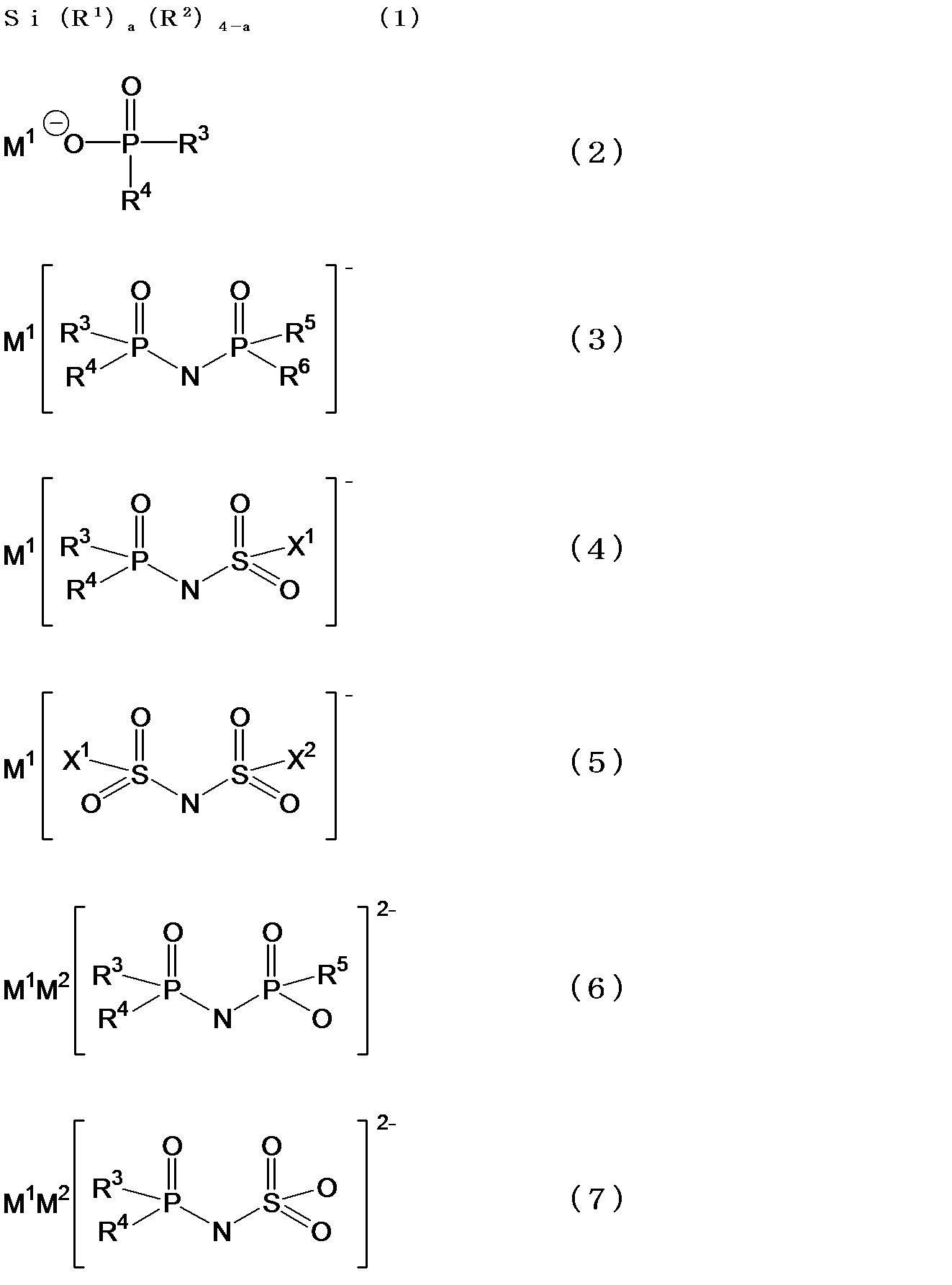
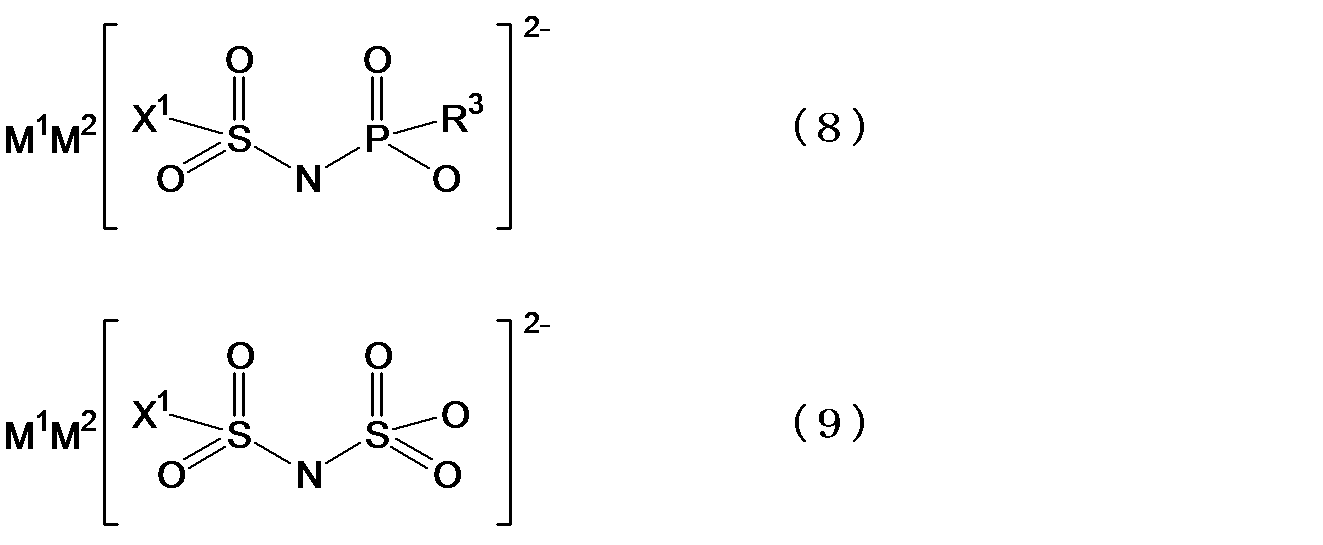
[一般式(1)中、R1はそれぞれ互いに独立して炭素-炭素不飽和結合を有する基を表す。R2はそれぞれ互いに独立して炭素数が1~10の直鎖あるいは分岐状のアルキル基を示し、これらの基はフッ素原子及び/又は酸素原子を有していても良い。aは2~4である。一般式(2)~(4)、及び(6)~(8)中、R3~R6 はそれぞれ互いに独立して、フッ素原子、炭素数が1~10の直鎖あるいは分岐状のアルコキシ基、炭素数が2~10のアルケニルオキシ基、炭素数が2~10のアルキニルオキシ基、炭素数が3~10のシクロアルコキシ基、炭素数が3~10のシクロアルケニルオキシ基、及び、炭素数が6~10のアリールオキシ基から選ばれる有機基であり、その有機基中にフッ素原子、酸素原子、不飽和結合が存在することもできる。一般式(4)、(5)、(8)及び(9)中、X1及びX2はそれぞれ互いに独立して、フッ素原子、炭素数が1~10の直鎖あるいは分岐状のアルキル基、炭素数が2~10のアルケニル基、炭素数が2~10のアルキニル基、炭素数が3~10のシクロアルキル基、炭素数が3~10のシクロアルケニル基、炭素数が6~10のアリール基、炭素数が1~10の直鎖あるいは分岐状のアルコキシ基、炭素数が2~10のアルケニルオキシ基、炭素数が2~10のアルキニルオキシ基、炭素数が3~10のシクロアルコキシ基、炭素数が3~10のシクロアルケニルオキシ基、及び、炭素数が6~10のアリールオキシ基から選ばれる有機基であり、その有機基中にフッ素原子、酸素原子、不飽和結合が存在することもできる。また、一般式(2)~(9)中には少なくとも一つのP-F結合及び/又はS-F結合を含む。M1、M2はそれぞれ互いに独立して、プロトン、金属カチオン又はオニウムカチオンである。]
少なくとも、非水溶媒、溶質、第1の化合物として、下記一般式(1)で示される少なくとも1種のシラン化合物、及び、第2の化合物として、下記一般式(2)~(9)で示される含フッ素化合物からなる群から選ばれる少なくとも1種を含有することを特徴とする、非水電解液電池用電解液(以降、単純に「非水電解液」又は「電解液」と記載する場合がある)を提供するものである。
[一般式(1)中、R1はそれぞれ互いに独立して炭素-炭素不飽和結合を有する基を表す。R2はそれぞれ互いに独立して炭素数が1~10の直鎖あるいは分岐状のアルキル基を示し、これらの基はフッ素原子及び/又は酸素原子を有していても良い。aは2~4である。一般式(2)~(4)、及び(6)~(8)中、R3~R6 はそれぞれ互いに独立して、フッ素原子、炭素数が1~10の直鎖あるいは分岐状のアルコキシ基、炭素数が2~10のアルケニルオキシ基、炭素数が2~10のアルキニルオキシ基、炭素数が3~10のシクロアルコキシ基、炭素数が3~10のシクロアルケニルオキシ基、及び、炭素数が6~10のアリールオキシ基から選ばれる有機基であり、その有機基中にフッ素原子、酸素原子、不飽和結合が存在することもできる。一般式(4)、(5)、(8)及び(9)中、X1及びX2はそれぞれ互いに独立して、フッ素原子、炭素数が1~10の直鎖あるいは分岐状のアルキル基、炭素数が2~10のアルケニル基、炭素数が2~10のアルキニル基、炭素数が3~10のシクロアルキル基、炭素数が3~10のシクロアルケニル基、炭素数が6~10のアリール基、炭素数が1~10の直鎖あるいは分岐状のアルコキシ基、炭素数が2~10のアルケニルオキシ基、炭素数が2~10のアルキニルオキシ基、炭素数が3~10のシクロアルコキシ基、炭素数が3~10のシクロアルケニルオキシ基、及び、炭素数が6~10のアリールオキシ基から選ばれる有機基であり、その有機基中にフッ素原子、酸素原子、不飽和結合が存在することもできる。また、一般式(2)~(9)中には少なくとも一つのP-F結合及び/又はS-F結合を含む。M1、M2はそれぞれ互いに独立して、プロトン、金属カチオン又はオニウムカチオンである。]
本発明の非水電解液電池用電解液において、上記第1の化合物と、上記第2の化合物とを共に含むことが重要である。これらの化合物を共に含有することではじめて、該電解液を非水電解液電池に用いた場合に、-30℃以下での平均放電電圧が高く優れた低温出力特性を有し、かつ50℃以上の高温での優れたサイクル特性や貯蔵特性を発揮することができるためである。
上記第1の化合物の添加量は非水電解液電池用電解液の総量に対して0.001~10.0質量%の範囲であることが好ましい。
また、上記第2の化合物の添加量は非水電解液電池用電解液の総量に対して0.001~10.0質量%の範囲であることが好ましい。
また、上記一般式(1)のR1で表される基が、それぞれ互いに独立して、ビニル基、アリル基、1-プロペニル基、2-プロペニル基、エチニル基、及び2-プロピニル基からなる群から選ばれる基であることが好ましい。
また、上記一般式(1)のR2で表される基が、それぞれ互いに独立して、メチル基、エチル基、プロピル基、2,2,2-トリフルオロエチル基、2,2,3,3-テトラフルオロプロピル基、1,1,1-トリフルオロイソプロピル基、及び1,1,1,3,3,3-ヘキサフルオロイソプロピル基からなる群から選ばれる基であることが好ましい。
また、上記一般式(2)~(4)、及び(6)~(8)のR3~R6が、フッ素原子、炭素数が1~10のフッ素原子を有する直鎖あるいは分岐状のアルコキシ基、炭素数が2~10のアルケニルオキシ基、及び炭素数が2~10のアルキニルオキシ基からなる群から選ばれる有機基であることが好ましい。
また、上記アルコキシ基が、2,2,2-トリフルオロエトキシ基、2,2,3,3-テトラフルオロプロポキシ基、1,1,1-トリフルオロイソプロポキシ基、及び1,1,1,3,3,3-ヘキサフルオロイソプロポキシ基からなる群から選択され、上記アルケニルオキシ基が、1-プロペニルオキシ基、2-プロペニルオキシ基、及び3-ブテニルオキシ基からなる群から選択され、上記アルキニルオキシ基が、2-プロピニルオキシ基、及び1,1-ジメチル-2-プロピニルオキシ基からなる群から選ばれることがより好ましい。
また、上記アルコキシ基が、2,2,2-トリフルオロエトキシ基、2,2,3,3-テトラフルオロプロポキシ基、1,1,1-トリフルオロイソプロポキシ基、及び1,1,1,3,3,3-ヘキサフルオロイソプロポキシ基からなる群から選択され、上記アルケニルオキシ基が、1-プロペニルオキシ基、2-プロペニルオキシ基、及び3-ブテニルオキシ基からなる群から選択され、上記アルキニルオキシ基が、2-プロピニルオキシ基、及び1,1-ジメチル-2-プロピニルオキシ基からなる群から選ばれることがより好ましい。
また、上記一般式(4)、(5)、(8)及び(9)のX1及びX2が、フッ素原子、炭素数が1~10の直鎖あるいは分岐状のアルコキシ基、炭素数が2~10のアルケニルオキシ基、及び炭素数が2~10のアルキニルオキシ基からなる群から選ばれる有機基であることが好ましい。
また、上記アルコキシ基が、メトキシ基、エトキシ基、及びプロポキシ基からなる群から選択され、上記アルケニルオキシ基が、1-プロペニルオキシ基、2-プロペニルオキシ基、及び3-ブテニルオキシ基からなる群から選択され、上記アルキニルオキシ基が、2-プロピニルオキシ基、及び1,1-ジメチル-2-プロピニルオキシ基からなる群から選ばれる基であることが好ましい。
また、上記アルコキシ基が、メトキシ基、エトキシ基、及びプロポキシ基からなる群から選択され、上記アルケニルオキシ基が、1-プロペニルオキシ基、2-プロペニルオキシ基、及び3-ブテニルオキシ基からなる群から選択され、上記アルキニルオキシ基が、2-プロピニルオキシ基、及び1,1-ジメチル-2-プロピニルオキシ基からなる群から選ばれる基であることが好ましい。
また、上記一般式(2)~(9)のM1及びM2が、リチウムイオン、ナトリウムイオン、カリウムイオン、テトラアルキルアンモニウムイオン、及びテトラアルキルホスホニウムイオンからなる群から選ばれる少なくとも一つのカチオンであることが好ましい。
また、上記溶質が、ヘキサフルオロリン酸リチウム(LiPF6)、テトラフルオロホウ酸リチウム(LiBF4)、ビス(トリフルオロメタンスルホニル)イミドリチウム(LiN(CF3SO2)2)、ビス(フルオロスルホニル)イミドリチウム(LiN(FSO2)2)、ビス(ジフルオロホスホリル)イミドリチウム(LiN(POF2)2)、ヘキサフルオロリン酸ナトリウム(NaPF6)、テトラフルオロホウ酸ナトリウム(NaBF4)、ビス(トリフルオロメタンスルホニル)イミドナトリウム(NaN(CF3SO2)2)、ビス(フルオロスルホニル)イミドナトリウム(NaN(FSO2)2)、及びビス(ジフルオロホスホリル)イミドナトリウム(NaN(POF2)2)からなる群から選ばれる少なくとも一つの溶質であることが好ましい。
また、上記非水溶媒が、環状カーボネート、鎖状カーボネート、環状エステル、鎖状エステル、環状エーテル、鎖状エーテル、スルホン化合物、スルホキシド化合物、及びイオン液体からなる群から選ばれる少なくとも一つの非水溶媒であることが好ましい。
また、本発明は、少なくとも正極と、負極と、セパレータと、上記の非水電解液電池用電解液とを含む非水電解液電池(以降、単純に「非水電池」又は「電池」と記載する場合がある)を提供するものである。
本発明により、非水電解液電池に用いた場合に、-30℃以下での平均放電電圧が高く優れた低温出力特性を有し、かつ50℃以上の高温での優れたサイクル特性や貯蔵特性を発揮することができる、非水電解液電池用電解液、及びこれを用いた非水電解液電池を提供することができる。
以下、本発明について詳細に説明するが、以下に記載する構成要件の説明は本発明の実施形態の一例であり、これらの具体的内容に限定はされない。その要旨の範囲内で種々変形して実施することができる。
本発明の非水電解液電池用電解液は、少なくとも、非水溶媒、溶質、第1の化合物として、上記一般式(1)で示される少なくとも1種のシラン化合物、及び、第2の化合物として、上記一般式(2)~(9)で示される含フッ素化合物からなる群から選ばれる少なくとも1種を含有することを特徴とする、非水電解液電池用電解液である。
上記第1の化合物は、いずれも正極、及び負極上で分解することにより安定な皮膜を形成し、電池の劣化を抑制する効果があるが、第1の化合物と第2の化合物を併用せずに、第1の化合物のみを用いた場合、電極上に形成した皮膜は充放電に伴うリチウムイオンの移動に対して極めて高い抵抗となり、得られる非水電解液電池の低温特性が著しく低下してしまうという問題がある。また、50℃以上の高温での高温サイクル特性及び高温貯蔵特性も十分ではない。
上記第2の化合物も一部が正極、及び負極上で分解し、イオン伝導性の良い皮膜を正極、及び負極表面に形成する。この皮膜は、非水溶媒や溶質と電極活物質との間の直接の接触を抑制して非水溶媒や溶質の分解を防ぎ、電池性能の劣化を抑制する。しかし、第1の化合物と第2の化合物を併用せずに、第2の化合物のみを用いた場合、形成される皮膜成分が少なく、得られる非水電解液電池の50℃以上の高温での高温サイクル特性及び高温貯蔵特性や低温特性は十分ではない。
本発明の非水電解液電池用電解液において、第1の化合物と第2の化合物を併用することにより、第1の化合物群を単独で添加した場合に比べて50℃以上の高温での高温サイクル特性及び高温貯蔵特性、低温特性が向上し、本発明の目的を達成することができる。そのメカニズムの詳細は明らかでないが、第1の化合物と第2の化合物が共存することで、第1の化合物と共に第2の化合物が積極的に正極、負極上で分解し、よりイオン伝導性が高く、より耐久性に優れた皮膜が形成されると考えられる。このことから、高温での溶媒や溶質の分解が抑制され、かつ低温での抵抗増加を抑制していると考えられる。特に、皮膜中に多くのフルオロホスホリル構造及び/又はフルオロスルホニル構造が取り込まれることで、形成した皮膜の電荷に偏りが生じ、リチウム導電性の高い、すなわち抵抗の小さい皮膜(出力特性が良好な皮膜)となっていると考えられる。さらに、第1の化合物及び第2の化合物中に不飽和結合を含む部位が多く含まれるほど、より正極、負極上で分解されやすくなり、耐久性に優れた皮膜が形成されやすいため、上記の効果はより良好なものとなると思われる。また、第2の化合物中に電子吸引性の高い部位(例えばフッ素原子や含フッ素アルコキシ基)が含まれることで電荷の偏りがより大きくなり、より抵抗の小さい皮膜(出力特性がより良好な皮膜)が形成されると考えられる。
以上の理由から、第1の化合物と第2の化合物を併用すると、それぞれを単独で用いる場合に比べて、-30℃以下での平均放電電圧(出力特性)、及び50℃以上の高温でのサイクル特性や貯蔵特性が向上すると推測される。
本発明の非水電解液電池用電解液は、第1の化合物と、第2の化合物と、非水有機溶媒と、溶質とを含有する。また、必要であれば一般に良く知られている別の添加剤の併用も可能である。以下、本発明の非水電解液電池用電解液の各構成要素について詳細に説明する。
(第一化合物について)
上記一般式(1)において、R1で表される炭素-炭素不飽和結合を有する基としては、ビニル基、アリル基、1-プロペニル基、2-プロペニル基、イソプロペニル基、2-ブテニル基、1,3-ブタジエニル基等の炭素原子数2~8のアルケニル基及びこれらの基から誘導されるアルケニルオキシ基、エチニル基、2-プロピニル基、1,1-ジメチル-2-プロピニル基等の炭素原子数2~8のアルキニル基及びこれらの基から誘導されるアルキニルオキシ基、フェニル基、トリル基、キシリル基等の炭素原子数6~12のアリール基及びこれらの基から誘導されるアリールオキシ基が挙げられる。また、上記の基はフッ素原子及び/又は酸素原子を有していても良い。それらの中でも、炭素数が6以下の炭素-炭素不飽和結合を含有する基が好ましい。上記炭素数が6より多いと、電極上に皮膜を形成した際の抵抗が比較的大きい傾向がある。具体的には、ビニル基、アリル基、1-プロペニル基、2-プロペニル基、エチニル基、及び2-プロピニル基からなる群から選択される基が好ましい。
上記一般式(1)において、R1で表される炭素-炭素不飽和結合を有する基としては、ビニル基、アリル基、1-プロペニル基、2-プロペニル基、イソプロペニル基、2-ブテニル基、1,3-ブタジエニル基等の炭素原子数2~8のアルケニル基及びこれらの基から誘導されるアルケニルオキシ基、エチニル基、2-プロピニル基、1,1-ジメチル-2-プロピニル基等の炭素原子数2~8のアルキニル基及びこれらの基から誘導されるアルキニルオキシ基、フェニル基、トリル基、キシリル基等の炭素原子数6~12のアリール基及びこれらの基から誘導されるアリールオキシ基が挙げられる。また、上記の基はフッ素原子及び/又は酸素原子を有していても良い。それらの中でも、炭素数が6以下の炭素-炭素不飽和結合を含有する基が好ましい。上記炭素数が6より多いと、電極上に皮膜を形成した際の抵抗が比較的大きい傾向がある。具体的には、ビニル基、アリル基、1-プロペニル基、2-プロペニル基、エチニル基、及び2-プロピニル基からなる群から選択される基が好ましい。
また、aで表される炭素-炭素不飽和結合を有する基の数は、電極上に皮膜を形成させるために、ひいては本発明の目的を達成するために、2~4である必要があり、より強固な皮膜を形成させるためには、3~4であることが好ましい。
また、上記一般式(1)において、R2で表されるアルキル基としては、メチル基、エチル基、プロピル基、イソプロピル基、n-ブチル基、sec-ブチル基、イソブチル基、tert-ブチル基、ペンチル基等の炭素原子数1~12のアルキル基が挙げられる。また、上記の基はフッ素原子及び/又は酸素原子を有していても良い(なお、酸素原子を有する場合は、アルコキシ基以外の構造を意味する。すなわち一般式(1)のケイ素原子に結合する原子が酸素原子ではない構造を意味する。)。それらの中でも、特に、メチル基、エチル基、プロピル基、2,2,2-トリフルオロエチル基、2,2,3,3-テトラフルオロプロピル基、1,1,1-トリフルオロイソプロピル基、及び1,1,1,3,3,3-ヘキサフルオロイソプロピル基からなる群から選択される基であると、電池の内部抵抗を大きくすることなく高温サイクル特性及び高温貯蔵特性に、より優れた非水電解液電池を得られるため好ましい。
第1の化合物の好適添加量は、非水電解液電池用電解液の総量に対して下限は、0.001質量%以上、より好ましくは0.01質量%以上、さらに好ましくは0.1質量%以上であり、また、上限は10.0質量%以下、より好ましくは5.0質量%以下、さらに好ましくは2.0質量%以下の範囲である。0.001質量%未満であると非水電解液電池の高温貯蔵特性を向上させる効果が十分に得られない恐れがある。一方、10.0質量%を越えると電池の内部抵抗が大きく増加することで、低温出力特性が低下するという問題が起こる恐れがある。なお、第1の化合物を1種類添加してもよいし、複数種類添加してもよい。なお、本発明において、「非水電解液電池用電解液の総量」とは、非水溶媒、溶質、第1の化合物、及び、第2の化合物の合計量を意味する。
上記一般式(1)で表されるシラン化合物としては、より具体的には、例えば以下の化合物No.1~No.13等が挙げられる。但し、本発明で用いられるシラン化合物は、以下の例示により何ら制限を受けるものではない。


上記一般式(1)で示されるシラン化合物は、例えば、特許文献10、非特許文献1に記載のように、シラノール基又は加水分解性基を有するケイ素化合物と炭素-炭素不飽和結合含有有機金属試薬とを反応させて、該ケイ素化合物中のシラノール基又は加水分解性基を炭素-炭素不飽和結合基に置換し、炭素-炭素不飽和結合含有ケイ素化合物を製造する方法により製造できる。
(第二化合物について)
上記一般式(2)~(9)において、P-F結合及び/又はS-F結合を少なくとも一つ含むことが本発明の目的を達成する上で重要である。P-F結合やS-F結合を含まない場合、低温特性を向上することができない。P-F結合やS-F結合の数が多いほど、より優れた低温特性が得られるため好ましい。
上記一般式(2)~(9)において、P-F結合及び/又はS-F結合を少なくとも一つ含むことが本発明の目的を達成する上で重要である。P-F結合やS-F結合を含まない場合、低温特性を向上することができない。P-F結合やS-F結合の数が多いほど、より優れた低温特性が得られるため好ましい。
上記一般式(2)~(9)において、M1及びM2で表されるカチオンとしては、プロトン、金属カチオンやオニウムカチオンが挙げられる。本発明の非水電解液電池用電解液及び非水電解液電池の性能を損なうものでなければその種類に特に制限はなく上記の中から様々なものを選択することができる。具体例としては、リチウム、ナトリウム、カリウム、ルビジウム、セシウム、マグネシウム、カルシウム、バリウム、銀、銅、鉄、等の金属カチオン、テトラアルキルアンモニウム、テトラアルキルホスホニウム、イミダゾリウム誘導体、等のオニウムカチオンが挙げられるが、特に非水電解液電池中でのイオン伝導を助ける役割をするという観点から、リチウムイオン、ナトリウムイオン、カリウムイオン、テトラメチルアンモニウムイオン、テトラエチルアンモニウムイオン、テトラブチルホスホニウムイオン等が好ましい。
上記一般式(2)~(4)、及び(6)~(8)のR3~R6で表される、アルコキシ基としては、例えば、メトキシ基、エトキシ基、プロポキシ基、イソプロポキシ基、ブトキシ基、第二ブトキシ基、第三ブトキシ基、ペンチルオキシ基、トリフルオロメトキシ基、2,2-ジフルオロエトキシ基、2,2,2-トリフルオロエトキシ基、2,2,3,3-テトラフルオロプロポキシ基、1,1,1-トリフルオロイソプロポキシ基、及び1,1,1,3,3,3-ヘキサフルオロイソプロポキシ基等の炭素原子数1~10のアルコキシ基や含フッ素アルコキシ基が挙げられ、アルケニルオキシ基としては、例えば、ビニルオキシ基、1-プロペニルオキシ基、2-プロペニルオキシ基、イソプロペニルオキシ基、2-ブテニルオキシ基、3-ブテニルオキシ基、及び1,3-ブタジエニルオキシ基等の炭素原子数2~10のアルケニルオキシ基や含フッ素アルケニルオキシ基が挙げられ、アルキニルオキシ基としては、例えば、エチニルオキシ基、2-プロピニルオキシ基、及び1,1-ジメチル-2-プロピニルオキシ基等の炭素原子数2~10のアルキニルオキシ基や含フッ素アルキニルオキシ基が挙げられ、シクロアルコキシ基としては、例えば、シクロペンチルオキシ基、及びシクロヘキシルオキシ基等の炭素数が3~10のシクロアルコキシ基や含フッ素シクロアルコキシ基が挙げられ、シクロアルケニルオキシ基としては、例えば、シクロペンテニルオキシ基、及びシクロヘキセニルオキシ基等の炭素数が3~10のシクロアルケニルオキシ基や含フッ素シクロアルケニルオキシ基が挙げられ、アリールオキシ基としては、例えば、フェニルオキシ基、トリルオキシ基、及びキシリルオキシ基等の炭素原子数6~10のアリールオキシ基や含フッ素アリールオキシ基が挙げられる。
上記一般式(2)~(4)、及び(6)~(8)のR3~R6が、フッ素原子又はフッ素原子を有するアルコキシ基であると、その強い電子吸引性によるイオン解離度の向上により、溶液中や組成物中でのイオン伝導度が高くなるため好ましい。さらに、上記一般式(2)~(4)、及び(6)~(8)のR3~R6がフッ素原子であると、アニオンサイズが小さくなることによる移動度の向上の効果により、溶液中や組成物中でのイオン伝導度が非常に高くなるためより好ましい。これにより、上記一般式(2)~(9)におけるP-F結合の数が多いほど低温特性がさらに向上されると考えられる。また、上記R3~R6が、アルケニルオキシ基、及びアルキニルオキシ基からなる群から選ばれる有機基であることが好ましい。上記のアルケニルオキシ基、及びアルキニルオキシ基とは異なり、酸素原子を介在しない炭化水素基であると、電子吸引性が小さくイオン解離度が低下し、溶液中や組成物中でのイオン伝導度が低下してしまうため好ましくない。また、上記のアルケニルオキシ基、及びアルキニルオキシ基のように、不飽和結合を有する基であると、正極、負極上で積極的に分解し、より耐久性に優れた皮膜を形成できるため好ましい。また、炭素数が多いとアニオンサイズが大きくなり、溶液中や組成物中でのイオン伝導度が低下する傾向があるため、上記R3~R6の炭素数が6以下であることが好ましい。炭素数が6以下であると、上記イオン伝導度が比較的高い傾向があるため好ましく、特に、1-プロペニルオキシ基、2-プロペニルオキシ基、3-ブテニルオキシ基、2-プロピニルオキシ基、1,1-ジメチル-2-プロピニルオキシ基からなる群から選択される基であると、比較的アニオンサイズが小さいため、好ましい。
上記一般式(4)、(5)、(8)及び(9)において、X1及びX2で表される、アルキル基としては、例えば、メチル基、エチル基、プロピル基、イソプロピル基、ブチル基、第二ブチル基、第三ブチル基、ペンチル基、トリフルオロメチル基、2,2-ジフルオロエチル基、2,2,2-トリフルオロエチル基、2,2,3,3-テトラフルオロプロピル基、及び1,1,1,3,3,3-ヘキサフルオロイソプロピル基等の炭素原子数1~10のアルキル基や含フッ素アルキル基が挙げられ、アルケニル基としては、例えば、ビニル基、1-プロペニル基、2-プロペニル基、イソプロペニル基、2-ブテニル基、3-ブテニル基、及び1,3-ブタジエニル基等の炭素原子数2~10のアルケニル基や含フッ素アルケニル基が挙げられ、アルキニル基としては、例えば、エチニル基、2-プロピニル基、及び1,1-ジメチル-2-プロピニル基等の炭素原子数2~10のアルキニル基や含フッ素アルキニル基が挙げられ、シクロアルキル基としては、例えば、シクロペンチル基、及びシクロヘキシル基等の炭素数が3~10のシクロアルキル基や含フッ素シクロアルキル基が挙げられ、シクロアルケニル基としては、例えば、シクロペンテニル基、及びシクロヘキセニル基等の炭素数が3~10のシクロアルケニル基や含フッ素シクロアルケニル基が挙げられ、アリール基としては、例えば、フェニル基、トリル基、及びキシリル基等の炭素原子数6~10のアリール基や含フッ素アリール基が挙げられる。また、アルコキシ基としては、例えば、メトキシ基、エトキシ基、プロポキシ基、イソプロポキシ基、ブトキシ基、第二ブトキシ基、第三ブトキシ基、ペンチルオキシ基、トリフルオロメトキシ基、2,2-ジフルオロエトキシ基、2,2,2-トリフルオロエトキシ基、2,2,3,3-テトラフルオロプロポキシ基、及び1,1,1,3,3,3-ヘキサフルオロイソプロポキシ基等の炭素原子数1~10のアルコキシ基や含フッ素アルコキシ基が挙げられ、アルケニルオキシ基としては、例えば、ビニルオキシ基、1-プロペニルオキシ基、2-プロペニルオキシ基、イソプロペニルオキシ基、2-ブテニルオキシ基、3-ブテニルオキシ基、及び1,3-ブタジエニルオキシ基等の炭素原子数2~10のアルケニルオキシ基や含フッ素アルケニルオキシ基が挙げられ、アルキニルオキシ基としては、例えば、エチニルオキシ基、2-プロピニルオキシ基、及び1,1-ジメチル-2-プロピニルオキシ基等の炭素原子数2~10のアルキニルオキシ基や含フッ素アルキニルオキシ基が挙げられ、シクロアルコキシ基としては、例えば、シクロペンチルオキシ基、及びシクロヘキシルオキシ基等の炭素数が3~10のシクロアルコキシ基や含フッ素シクロアルコキシ基が挙げられ、シクロアルケニルオキシ基としては、例えば、シクロペンテニルオキシ基、及びシクロヘキセニルオキシ基等の炭素数が3~10のシクロアルケニルオキシ基や含フッ素シクロアルケニルオキシ基が挙げられ、アリールオキシ基としては、例えば、フェニルオキシ基、トリルオキシ基、及びキシリルオキシ基等の炭素原子数6~10のアリールオキシ基や含フッ素アリールオキシ基が挙げられる。
上記一般式(4)、(5)、(8)及び(9)のX1及びX2が、フッ素原子であると、その強い電子吸引性によるイオン解離度の向上と、アニオンサイズが小さくなることによる移動度の向上の効果により、溶液中や組成物中でのイオン伝導度が非常に高くなるため好ましい。また、上記X1及びX2が、アルコキシ基、アルケニルオキシ基、及びアルキニルオキシ基からなる群から選ばれる有機基であることが好ましい。上記のアルコキシ基、アルケニルオキシ基、及びアルキニルオキシ基とは異なり、酸素原子を介在しない炭化水素基であると、電子吸引性が小さくイオン解離度が低下し、溶液中や組成物中でのイオン伝導度が低下してしまうため好ましくない。また、炭素数が多いとアニオンサイズが大きくなり、溶液中や組成物中でのイオン伝導度が低下する傾向があるため、上記Xの炭素数が6以下であることが好ましい。炭素数が6以下であると、上記イオン伝導度が比較的高い傾向があるため好ましく、特に、メトキシ基、エトキシ基、プロポキシ基、1-プロペニルオキシ基、2-プロペニルオキシ基、3-ブテニルオキシ基、2-プロピニルオキシ基、1,1-ジメチル-2-プロピニルオキシ基からなる群から選択される基であると、比較的アニオンサイズが小さいため、好ましい。
なお、上記一般式(2)、(6)、(7)及び(8)のR3~R5及びX1がすべて酸素原子を介在する炭化水素基(アルコキシ基、アルケニルオキシ基、アルキニルオキシ基、シクロアルコキシ基、シクロアルケニルオキシ基、アリールオキシ基)であるような構造の化合物、即ち、P-F結合やS-F結合を全く含まない化合物は、非水電解液中の溶解度が極めて低い(例えば、0.001質量%未満)ため、非水電解液に添加し、本発明の目的を達成することは困難である。
第2の化合物の好適添加量は、非水電解液電池用電解液の総量に対して下限は、0.001質量%以上、より好ましくは0.01質量%以上、さらに好ましくは0.1質量%以上であり、また、上限は10.0質量%以下、より好ましくは5.0質量%以下、さらに好ましくは2.0質量%以下の範囲である。0.001質量%未満であると非水電解液電池の低温での出力特性を向上させる効果が十分に得られない恐れがある。一方、10.0質量%を越えると、それ以上の効果は得られずに無駄であるだけでなく、電解液の粘度が上昇しイオン伝導度が低下する傾向があり、抵抗が増加し電池性能の劣化を引き起こし易いため好ましくない。なお、第2の化合物を1種類添加してもよいし、複数種類添加してもよい。
上記一般式(2)で表されるリン酸塩の陰イオンとしては、より具体的には、例えば以下の化合物No.14等が挙げられる。但し、本発明で用いられるリン酸塩は、以下の例示により何ら制限を受けるものではない。
化合物No.14

上記一般式(3)~(9)で表されるイミド塩の陰イオンとしては、より具体的には、例えば以下の化合物No.15~No.50等が挙げられる。但し、本発明で用いられるイミド塩は、以下の例示により何ら制限を受けるものではない。

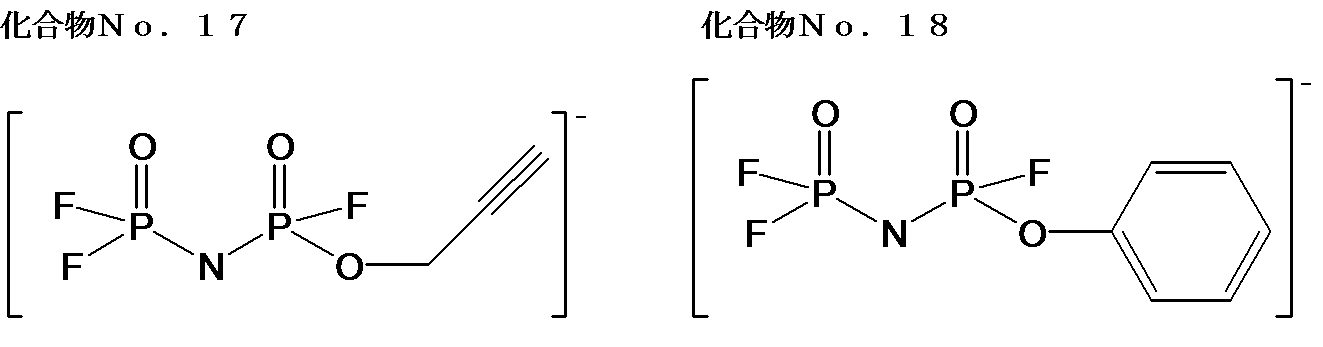

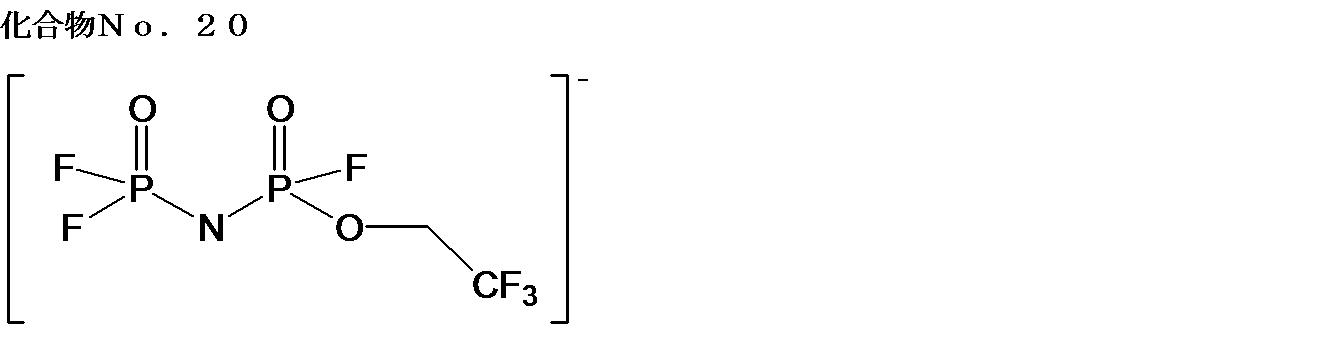


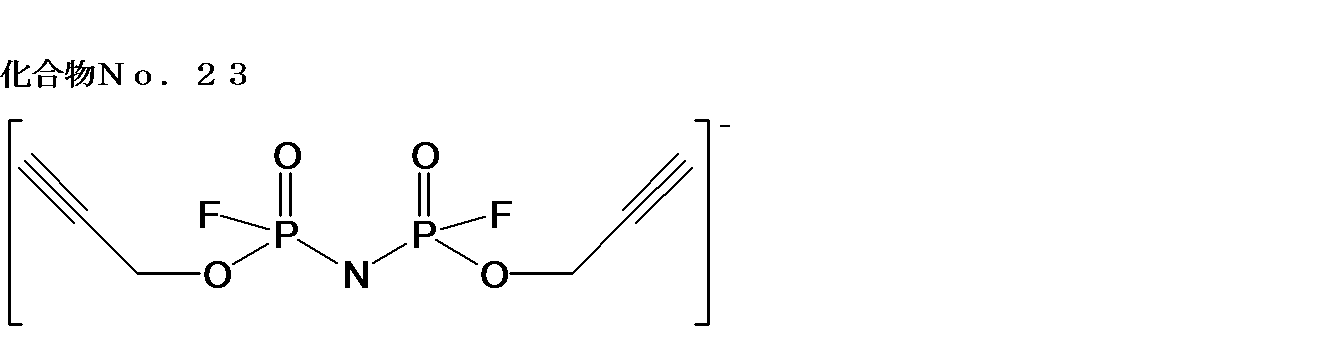
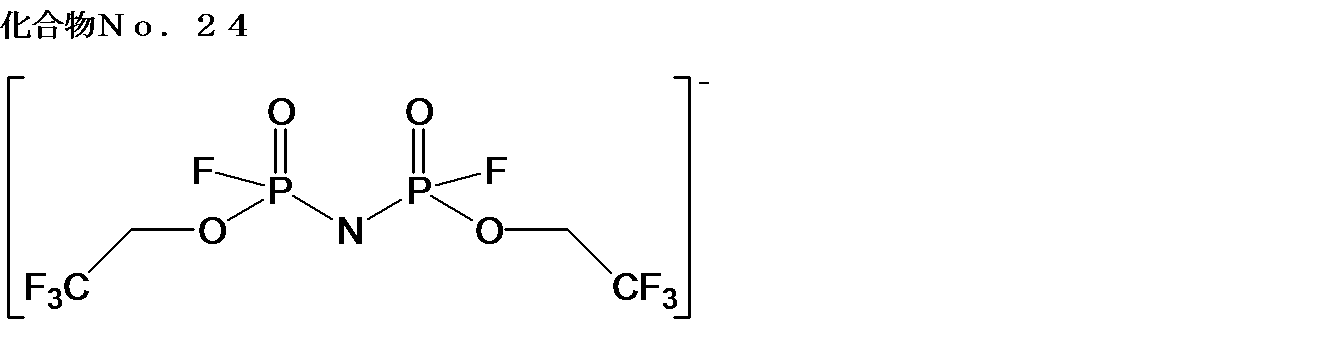
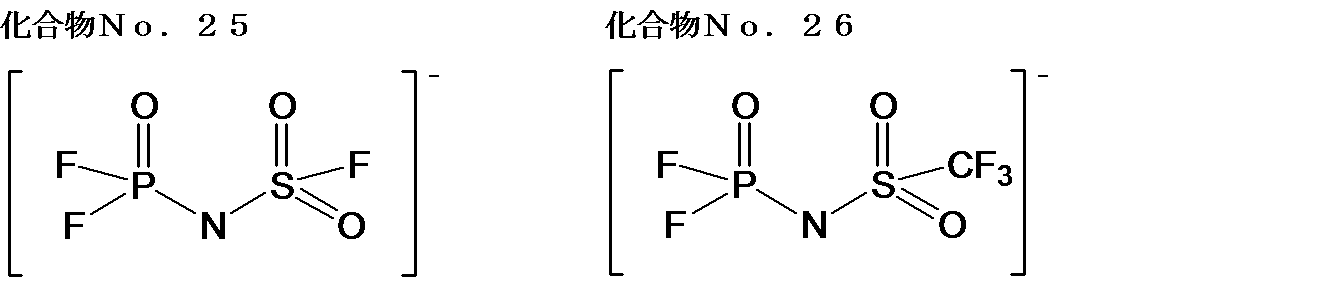
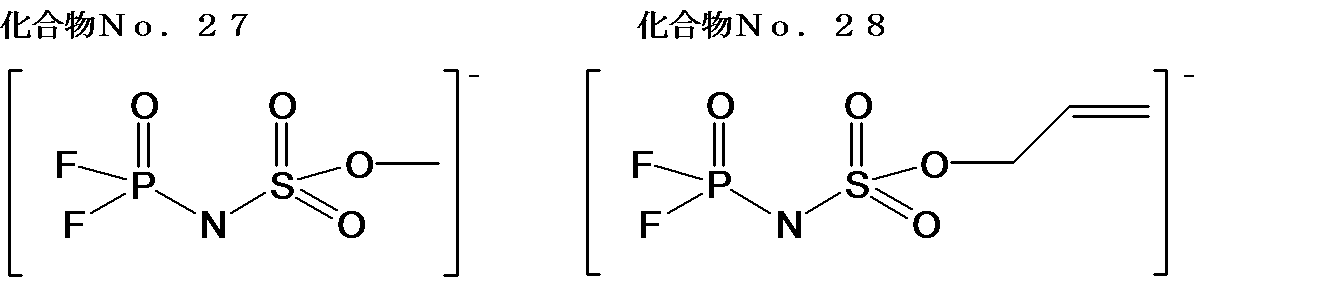


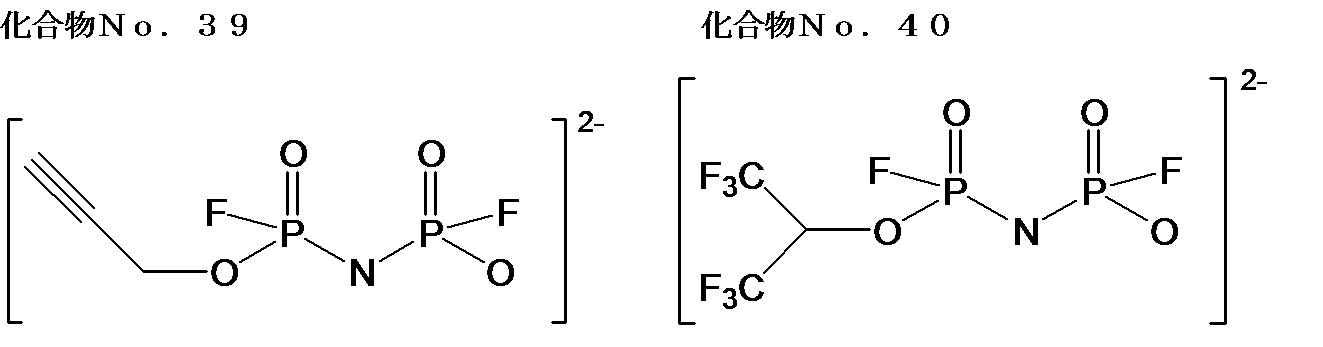
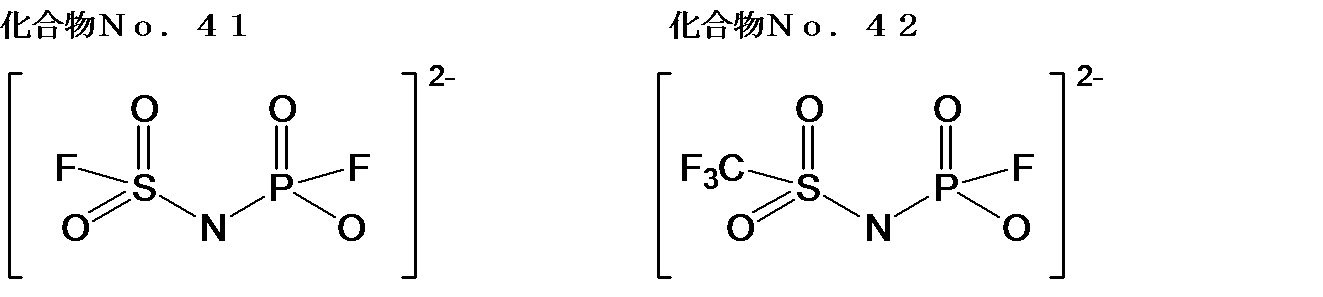

上記一般式(2)で示されるリン酸塩の陰イオンを有する塩は、例えば、特許文献11、非特許文献2及び非特許文献3に記載のように、フッ化物以外のハロゲン化物とLiPF6と水とを非水溶媒中で反応させる方法や、対応するアルコキシ基を有するピロリン酸エステルとフッ化水素を反応させる方法により製造できる。
上記一般式(3)で示されるイミドアニオンを有する塩は種々の方法により製造できる。製造法としては、限定されることはないが、例えば、対応するホスホリルクロリド(P(=O)R3R4Cl)とリン酸アミド(H2NP(=O)R5R6)を有機塩基又は無機塩基の存在下で反応させることで得ることができる。
上記一般式(4)で示されるイミドアニオンを有する塩は種々の方法により製造できる。製造法としては、限定されることはないが、例えば、対応するホスホリルクロリド(P(=O)R3R4Cl)とスルホンアミド(H2NSO2X1)を有機塩基又は無機塩基の存在下で反応させることで得ることができる。
上記一般式(5)で示されるイミドアニオンを有する塩は種々の方法により製造できる。製造法としては、限定されることはないが、例えば、対応するスルホニルクロリド(X1SO2Cl)と、対応するスルホンアミド(H2NSO2X2)を有機塩基又は無機塩基の存在下で反応させることで得ることができる。
上記一般式(6)で示されるイミドアニオンを有する塩は種々の方法により製造できる。製造法としては、限定されることはないが、例えば、対応するホスホリルクロリド(P(=O)R3R4Cl)と、対応するリン酸アミド(H2NP(=O)R5O-)を有機塩基又は無機塩基の存在下で反応させることで得ることができる。
上記一般式(7)で示されるイミドアニオンを有する塩は種々の方法により製造できる。製造法としては、限定されることはないが、例えば、対応するホスホリルクロリド(P(=O)R3R4Cl)と、スルファミン酸(H2NSO3
-)を有機塩基又は無機塩基の存在下で反応させることで得ることができる。
上記一般式(8)で示されるイミドアニオンを有する塩は種々の方法により製造できる。製造法としては、限定されることはないが、例えば、対応するスルホニルクロリド(X1SO2Cl)と、対応するリン酸アミド(H2NP(=O)R3O-)を有機塩基又は無機塩基の存在下で反応させることで得ることができる。
上記一般式(9)で示されるイミドアニオンを有する塩は種々の方法により製造できる。製造法としては、限定されることはないが、例えば、対応するスルホニルクロリド(X1SO2Cl)と、対応するスルファミン酸(H2NSO3
-)を有機塩基又は無機塩基の存在下で反応させることで得ることができる。
また、上述のような、一般式(2)~(9)の塩の製法において、適宜カチオン交換を行ってもよい。
(非水溶媒について)
本発明の非水電解液電池用電解液に用いる非水溶媒の種類は、特に限定されず、任意の非水溶媒を用いることができる。具体例としては、プロピレンカーボネート、エチレンカーボネート、ブチレンカーボネート、フルオロエチレンカーボネート等の環状カーボネート、ジエチルカーボネート、ジメチルカーボネート、エチルメチルカーボネート等の鎖状カーボネート、γ-ブチロラクトン、γ-バレロラクトン等の環状エステル、酢酸メチル、プロピオン酸メチル等の鎖状エステル、テトラヒドロフラン、2-メチルテトラヒドロフラン、ジオキサン等の環状エーテル、ジメトキシエタン、ジエチルエーテル等の鎖状エーテル、ジメチルスルホキシド、スルホラン等のスルホン化合物やスルホキシド化合物等が挙げられる。また、非水溶媒とはカテゴリーが異なるがイオン液体等も挙げることができる。また、本発明に用いる非水溶媒は、一種類を単独で用いても良く、二種類以上を用途に合わせて任意の組み合わせ、比率で混合して用いても良い。これらの中ではその酸化還元に対する電気化学的な安定性と熱や溶質との反応に関わる化学的安定性の観点から、特にプロピレンカーボネート、エチレンカーボネート、フルオロエチレンカーボネート、ジエチルカーボネート、ジメチルカーボネート、エチルメチルカーボネートが好ましい。
本発明の非水電解液電池用電解液に用いる非水溶媒の種類は、特に限定されず、任意の非水溶媒を用いることができる。具体例としては、プロピレンカーボネート、エチレンカーボネート、ブチレンカーボネート、フルオロエチレンカーボネート等の環状カーボネート、ジエチルカーボネート、ジメチルカーボネート、エチルメチルカーボネート等の鎖状カーボネート、γ-ブチロラクトン、γ-バレロラクトン等の環状エステル、酢酸メチル、プロピオン酸メチル等の鎖状エステル、テトラヒドロフラン、2-メチルテトラヒドロフラン、ジオキサン等の環状エーテル、ジメトキシエタン、ジエチルエーテル等の鎖状エーテル、ジメチルスルホキシド、スルホラン等のスルホン化合物やスルホキシド化合物等が挙げられる。また、非水溶媒とはカテゴリーが異なるがイオン液体等も挙げることができる。また、本発明に用いる非水溶媒は、一種類を単独で用いても良く、二種類以上を用途に合わせて任意の組み合わせ、比率で混合して用いても良い。これらの中ではその酸化還元に対する電気化学的な安定性と熱や溶質との反応に関わる化学的安定性の観点から、特にプロピレンカーボネート、エチレンカーボネート、フルオロエチレンカーボネート、ジエチルカーボネート、ジメチルカーボネート、エチルメチルカーボネートが好ましい。
(溶質について)
本発明の非水電解液電池用電解液に用いる溶質の種類は、特に限定されず、任意の電解質塩を用いることができる。具体例としては、リチウム電池及びリチウムイオン電池の場合には、LiPF6、LiBF4、LiClO4、LiAsF6、LiSbF6、LiCF3SO3、LiN(CF3SO2)2、LiN(FSO2)2、LiN(C2F5SO2)2、LiN(CF3SO2)(C4F9SO2)、LiC(CF3SO2)3、LiPF3(C3F7)3、LiB(CF3)4、LiBF3(C2F5)、LiN(POF2)2など、ナトリウムイオン電池の場合には、NaPF6、NaBF4、NaCF3SO3、NaN(CF3SO2)2、NaN(FSO2)2、NaN(POF2)2などに代表される電解質塩が挙げられる。これらの溶質は、一種類を単独で用いても良く、二種類以上を用途に合わせて任意の組み合わせ、比率で混合して用いても良い。中でも、電池としてのエネルギー密度、出力特性、寿命等から考えると、LiPF6、LiBF4、LiN(CF3SO2)2、LiN(FSO2)2、LiN(C2F5SO2)2、LiN(POF2)2、NaPF6、NaBF4、NaN(CF3SO2)2、NaN(FSO2)2、NaN(POF2)2が好ましい。
本発明の非水電解液電池用電解液に用いる溶質の種類は、特に限定されず、任意の電解質塩を用いることができる。具体例としては、リチウム電池及びリチウムイオン電池の場合には、LiPF6、LiBF4、LiClO4、LiAsF6、LiSbF6、LiCF3SO3、LiN(CF3SO2)2、LiN(FSO2)2、LiN(C2F5SO2)2、LiN(CF3SO2)(C4F9SO2)、LiC(CF3SO2)3、LiPF3(C3F7)3、LiB(CF3)4、LiBF3(C2F5)、LiN(POF2)2など、ナトリウムイオン電池の場合には、NaPF6、NaBF4、NaCF3SO3、NaN(CF3SO2)2、NaN(FSO2)2、NaN(POF2)2などに代表される電解質塩が挙げられる。これらの溶質は、一種類を単独で用いても良く、二種類以上を用途に合わせて任意の組み合わせ、比率で混合して用いても良い。中でも、電池としてのエネルギー密度、出力特性、寿命等から考えると、LiPF6、LiBF4、LiN(CF3SO2)2、LiN(FSO2)2、LiN(C2F5SO2)2、LiN(POF2)2、NaPF6、NaBF4、NaN(CF3SO2)2、NaN(FSO2)2、NaN(POF2)2が好ましい。
これら溶質の濃度については、特に制限はないが、好適濃度範囲の、下限は0.5mol/L以上、より好ましくは0.7mol/L以上、さらに好ましくは0.9mol/L以上であり、また、上限は2.5mol/L以下、より好ましくは2.0mol/L以下、さらに好ましくは1.5mol/L以下の範囲である。0.5mol/Lを下回るとイオン伝導度が低下することにより非水電解液電池のサイクル特性、出力特性が低下する恐れがある。一方、2.5mol/Lを超えると非水電解液電池用電解液の粘度が上昇することにより、やはりイオン伝導度を低下させる恐れがあり、非水電解液電池のサイクル特性、出力特性を低下させる恐れがある。
一度に多量の該溶質を非水溶媒に溶解すると、溶質の溶解熱のため液温が上昇することがある。該液温が著しく上昇すると、フッ素を含有した電解質塩の分解が促進されてフッ化水素が生成する恐れがある。フッ化水素は電池性能の劣化の原因となるため好ましくない。このため、該溶質を非水溶媒に溶解する際の液温は特に限定されないが、-20~80℃が好ましく、0~60℃がより好ましい。
以上が本発明の非水電解液電池用電解液の基本的な構成成分として少なくとも含有すべき成分についての説明であるが、本発明の要旨を損なわない限りにおいて、本発明の非水電解液電池用電解液に一般的に用いられる添加剤を任意の比率で添加しても良い。具体例としては、シクロヘキシルベンゼン、ビフェニル、t-ブチルベンゼン、ビニレンカーボネート、ビニルエチレンカーボネート、ジフルオロアニソール、フルオロエチレンカーボネート、プロパンサルトン、スクシノニトリル、ジメチルビニレンカーボネート等の過充電防止効果、負極皮膜形成効果、正極保護効果を有する化合物が挙げられる。また、リチウムポリマー電池と呼ばれる非水電解液電池に使用される場合のように非水電解液電池用電解液をゲル化剤や架橋ポリマーにより擬固体化して使用することも可能である。
次に本発明の非水電解液電池の構成について説明する。本発明の非水電解液電池は、上記の本発明の非水電解液電池用電解液を用いることが特徴であり、その他の構成部材には一般の非水電解液電池に使用されているものが用いられる。即ち、カチオンの吸蔵及び放出が可能な正極及び負極、集電体、セパレータ、容器等から成る。
負極材料としては、特に限定されないが、リチウム電池及びリチウムイオン電池の場合、リチウム金属、リチウム金属と他の金属との合金や金属間化合物、種々の炭素材料(人造黒鉛、天然黒鉛など)、金属酸化物、金属窒化物、スズ(単体)、スズ化合物、ケイ素(単体)、ケイ素化合物、活性炭、導電性ポリマー等が用いられる。
炭素材料とは、例えば、易黒鉛化炭素や、(002)面の面間隔が0.37nm以上の難黒鉛化炭素(ハードカーボン)や、(002)面の面間隔が0.34nm以下の黒鉛などである。より具体的には、熱分解性炭素、コークス類、ガラス状炭素繊維、有機高分子化合物焼成体、活性炭あるいはカーボンブラック類などがある。このうち、コークス類にはピッチコークス、ニードルコークスあるいは石油コークスなどが含まれる。有機高分子化合物焼成体とは、フェノール樹脂やフラン樹脂などを適当な温度で焼成して炭素化したものをいう。炭素材料は、リチウムの吸蔵及び放出に伴う結晶構造の変化が非常に少ないため、高いエネルギー密度が得られると共に優れたサイクル特性が得られるので好ましい。なお、炭素材料の形状は、繊維状、球状、粒状あるいは鱗片状のいずれでもよい。また、非晶質炭素や非晶質炭素を表面に被覆した黒鉛材料は、材料表面と電解液との反応性が低くなるため、より好ましい。
正極材料としては、特に限定されないが、リチウム電池及びリチウムイオン電池の場合、例えば、LiCoO2、LiNiO2、LiMnO2、LiMn2O4等のリチウム含有遷移金属複合酸化物、それらのリチウム含有遷移金属複合酸化物のCo、Mn、Ni等の遷移金属が複数混合したもの、それらのリチウム含有遷移金属複合酸化物の遷移金属の一部が他の遷移金属以外の金属に置換されたもの、オリビンと呼ばれるLiFePO4、LiCoPO4、LiMnPO4等の遷移金属のリン酸化合物、TiO2、V2O5、MoO3等の酸化物、TiS2、FeS等の硫化物、あるいはポリアセチレン、ポリパラフェニレン、ポリアニリン、及びポリピロール等の導電性高分子、活性炭、ラジカルを発生するポリマー、カーボン材料等が使用される。
正極や負極の材料には、導電材としてアセチレンブラック、ケッチェンブラック、炭素繊維、黒鉛、結着材としてポリテトラフルオロエチレン、ポリフッ化ビニリデン、SBR樹脂等が加えられ、シート状に成型されることにより電極シートにすることができる。
正極と負極の接触を防ぐためのセパレータとしては、ポリプロピレン、ポリエチレン、紙、及びガラス繊維等で作られた不織布や多孔質シートが使用される。
以上の各要素からコイン形、円筒形、角形、アルミラミネートシート型等の形状の非水電解液電池が組み立てられる。
以下、実施例により本発明を具体的に説明するが、本発明はかかる実施例により限定されるものではない。
[非水電解液の調製]
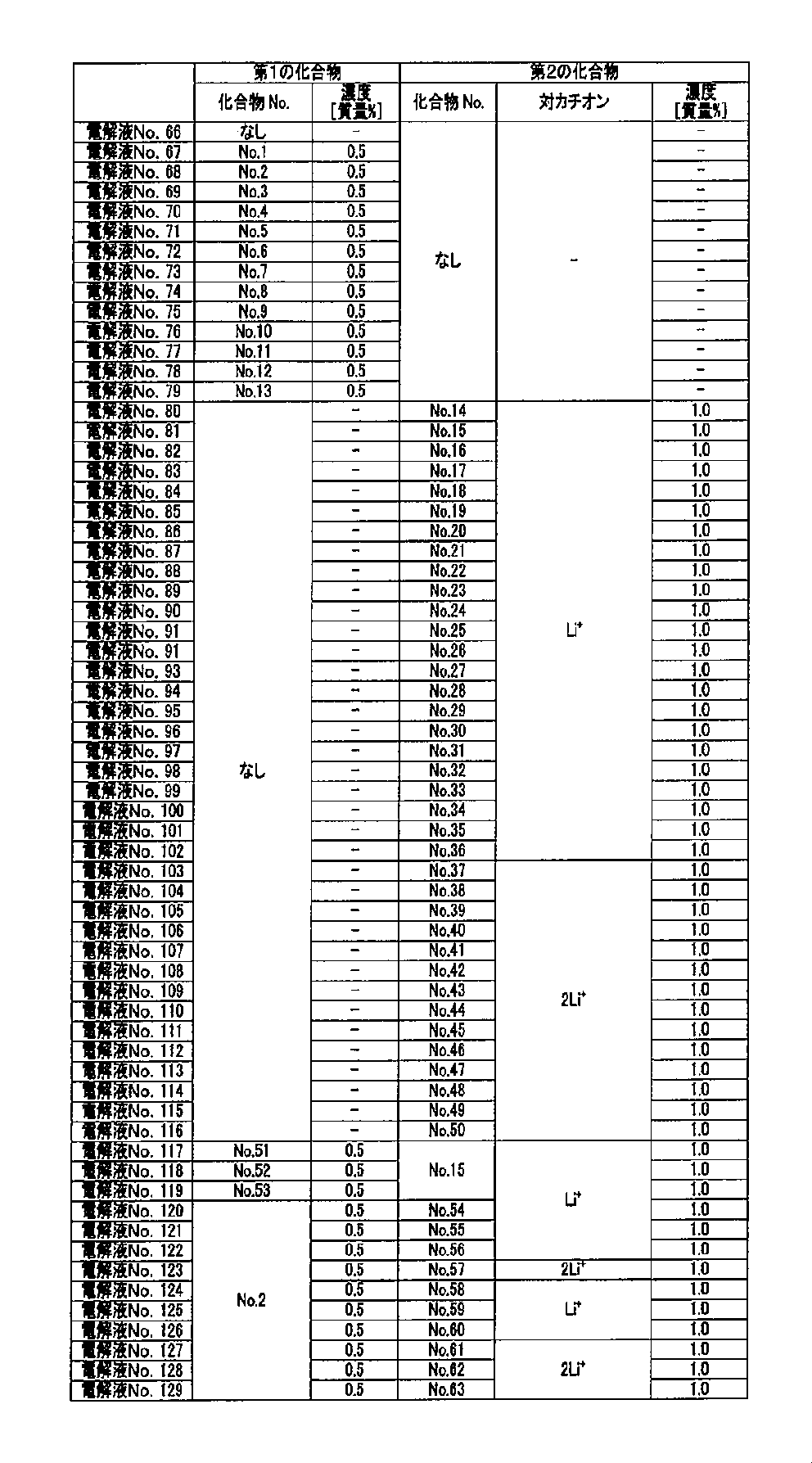
非水溶媒としてエチレンカーボネート、プロピレンカーボネート、ジメチルカーボネート、エチルメチルカーボネートの体積比2:1:4:3の混合溶媒を用い、該溶媒中に溶質としてLiPF6を1.0mol/Lの濃度となるように溶解した。その後、第1の化合物として上記化合物No.2を0.5質量%の濃度となるように、第2の化合物として上記化合物No.15のリチウム塩を1.0質量%の濃度となるように添加、撹拌し、電解液No.1を調製した。なお、上記の調製は、液温を25℃に維持しながら行った。電解液No.1の調製条件を表1に示す。
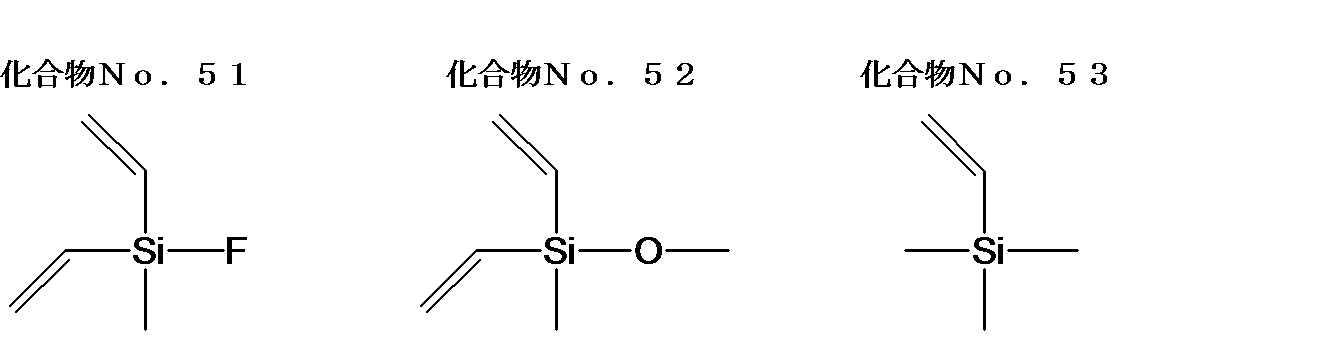
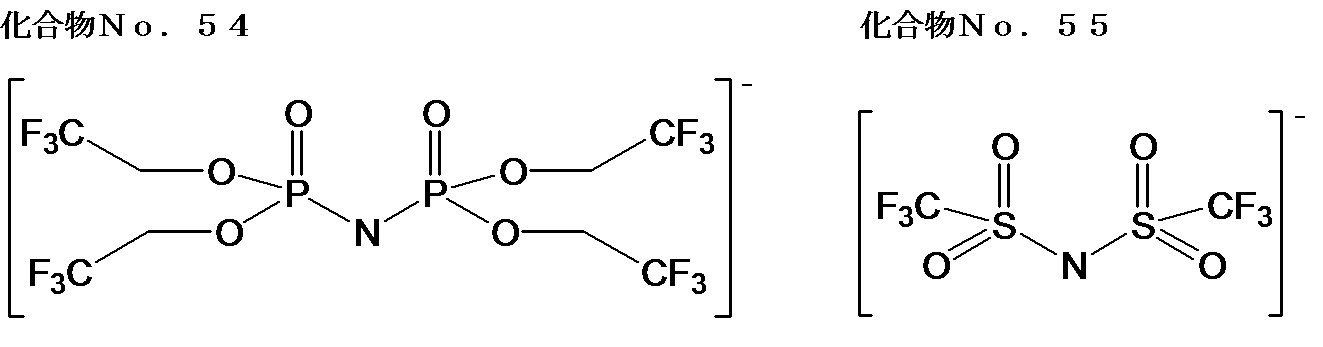
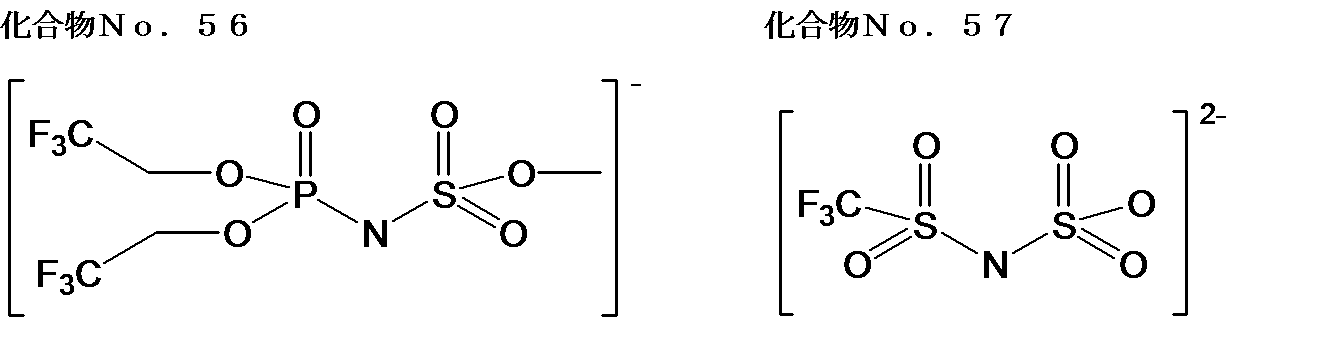
また、第1の化合物の種類や濃度、第2の化合物の種類や濃度、及び対カチオンを表1、及び表2のように変えて、それ以外は上記と同様の手順で電解液No.2~129を調製した。なお、電解液No.117~119の調製で第1の化合物として用いた化合物No.51~53、及び、電解液No.120~129の調製で第2の化合物として用いた化合物No.54~63の陰イオンを以下に示す。
非水溶媒としてエチレンカーボネート、プロピレンカーボネート、ジメチルカーボネート、エチルメチルカーボネートの体積比2:1:4:3の混合溶媒を用い、該溶媒中に溶質としてLiPF6を1.0mol/Lの濃度となるように溶解した。その後、第1の化合物として上記化合物No.2を0.5質量%の濃度となるように、第2の化合物として上記化合物No.15のリチウム塩を1.0質量%の濃度となるように添加、撹拌し、電解液No.1を調製した。なお、上記の調製は、液温を25℃に維持しながら行った。電解液No.1の調製条件を表1に示す。
また、第1の化合物の種類や濃度、第2の化合物の種類や濃度、及び対カチオンを表1、及び表2のように変えて、それ以外は上記と同様の手順で電解液No.2~129を調製した。なお、電解液No.117~119の調製で第1の化合物として用いた化合物No.51~53、及び、電解液No.120~129の調製で第2の化合物として用いた化合物No.54~63の陰イオンを以下に示す。


[実施例1-1]
非水電解液として電解液No.1を用いて、LiNi1/3Mn1/3Co1/3O2を正極材料、黒鉛を負極材料としてセルを作製し、実際に電池の高温サイクル特性、高温貯蔵特性、及び低温出力特性を評価した。試験用セルは以下のように作製した。
非水電解液として電解液No.1を用いて、LiNi1/3Mn1/3Co1/3O2を正極材料、黒鉛を負極材料としてセルを作製し、実際に電池の高温サイクル特性、高温貯蔵特性、及び低温出力特性を評価した。試験用セルは以下のように作製した。
LiNi1/3Mn1/3Co1/3O2粉末90質量%にバインダーとして5質量%のポリフッ化ビニリデン(PVDF)、導電材としてアセチレンブラックを5質量%混合し、さらにN-メチルピロリドンを添加し、ペースト状にした。このペーストをアルミニウム箔上に塗布して、乾燥させることにより、試験用正極体とした。また、黒鉛粉末90質量%に、バインダーとして10質量%のPVDFを混合し、さらにN-メチルピロリドンを添加し、スラリー状にした。このスラリーを銅箔上に塗布して、150℃で12時間乾燥させることにより、試験用負極体とした。そして、ポリエチレン製セパレータに電解液を浸み込ませてアルミラミネート外装の100mAhセルを組み立てた。
以上のような方法で作製したセルを用いて充放電試験を実施し、後述の方法で高温サイクル特性、高温貯蔵特性、及び低温出力特性を評価した。評価結果を表3に示す。
以上のような方法で作製したセルを用いて充放電試験を実施し、後述の方法で高温サイクル特性、高温貯蔵特性、及び低温出力特性を評価した。評価結果を表3に示す。
[高温サイクル特性試験]
50℃の環境温度での充放電試験を実施し、サイクル特性を評価した。充電は4.3Vまで、放電は3.0Vまで行い、電流密度1.9mA/cm2で充放電サイクルを繰り返した。そして、200サイクル後の放電容量維持率でセルの劣化の具合を評価した(サイクル特性評価)。放電容量維持率は下記式で求めた。
<200サイクル後の放電容量維持率>
放電容量維持率(%)=(200サイクル後の放電容量/初放電容量)×100
なお、表3に記載の200サイクル後の放電容量維持率の数値は、比較例1-1の200サイクル後の放電容量維持率を100とした場合の相対値である。
50℃の環境温度での充放電試験を実施し、サイクル特性を評価した。充電は4.3Vまで、放電は3.0Vまで行い、電流密度1.9mA/cm2で充放電サイクルを繰り返した。そして、200サイクル後の放電容量維持率でセルの劣化の具合を評価した(サイクル特性評価)。放電容量維持率は下記式で求めた。
<200サイクル後の放電容量維持率>
放電容量維持率(%)=(200サイクル後の放電容量/初放電容量)×100
なお、表3に記載の200サイクル後の放電容量維持率の数値は、比較例1-1の200サイクル後の放電容量維持率を100とした場合の相対値である。
[高温貯蔵特性試験]
上記サイクル試験後、25℃の環境温度において充電上限電圧4.3Vまで定電流定電圧法で、電流密度0.38mA/cm2で充電した後、50℃の環境温度で10日間保存した。その後、放電終止電圧3.0Vまで電流密度0.38mA/cm2の定電流で放電し、この放電容量の初期の放電容量(上記サイクル試験後50℃保存前に測っておいた放電容量)に対する割合を残存容量比とし、セルの貯蔵特性を評価した。なお、表3に記載の残存容量比の数値は、比較例1-1の残存容量比を100とした場合の相対値である。
上記サイクル試験後、25℃の環境温度において充電上限電圧4.3Vまで定電流定電圧法で、電流密度0.38mA/cm2で充電した後、50℃の環境温度で10日間保存した。その後、放電終止電圧3.0Vまで電流密度0.38mA/cm2の定電流で放電し、この放電容量の初期の放電容量(上記サイクル試験後50℃保存前に測っておいた放電容量)に対する割合を残存容量比とし、セルの貯蔵特性を評価した。なお、表3に記載の残存容量比の数値は、比較例1-1の残存容量比を100とした場合の相対値である。
[低温出力特性試験]
上記貯蔵試験後、25℃の環境温度において充電上限電圧4.3Vまで定電流定電圧法で、電流密度0.38mA/cm2で充電した後、-30℃の環境温度で放電下限電圧3.0Vまで定電流法で、電流密度9.5mA/cm2で放電し、その際の平均放電電圧を測定した。なお、表2に記載の平均放電電圧の数値は、比較例1-1の平均放電電圧を100とした場合の相対値である。
上記貯蔵試験後、25℃の環境温度において充電上限電圧4.3Vまで定電流定電圧法で、電流密度0.38mA/cm2で充電した後、-30℃の環境温度で放電下限電圧3.0Vまで定電流法で、電流密度9.5mA/cm2で放電し、その際の平均放電電圧を測定した。なお、表2に記載の平均放電電圧の数値は、比較例1-1の平均放電電圧を100とした場合の相対値である。
[実施例1-2~1-65、比較例1-1~1-64]
電解液No.1の代わりに、それぞれ、電解液No.2~129を用いて、実施例1-1と同様のセルを作製し、同様に高温サイクル特性、高温貯蔵特性、及び低温出力特性を評価した。評価結果を表3、及び表4に示す。
電解液No.1の代わりに、それぞれ、電解液No.2~129を用いて、実施例1-1と同様のセルを作製し、同様に高温サイクル特性、高温貯蔵特性、及び低温出力特性を評価した。評価結果を表3、及び表4に示す。


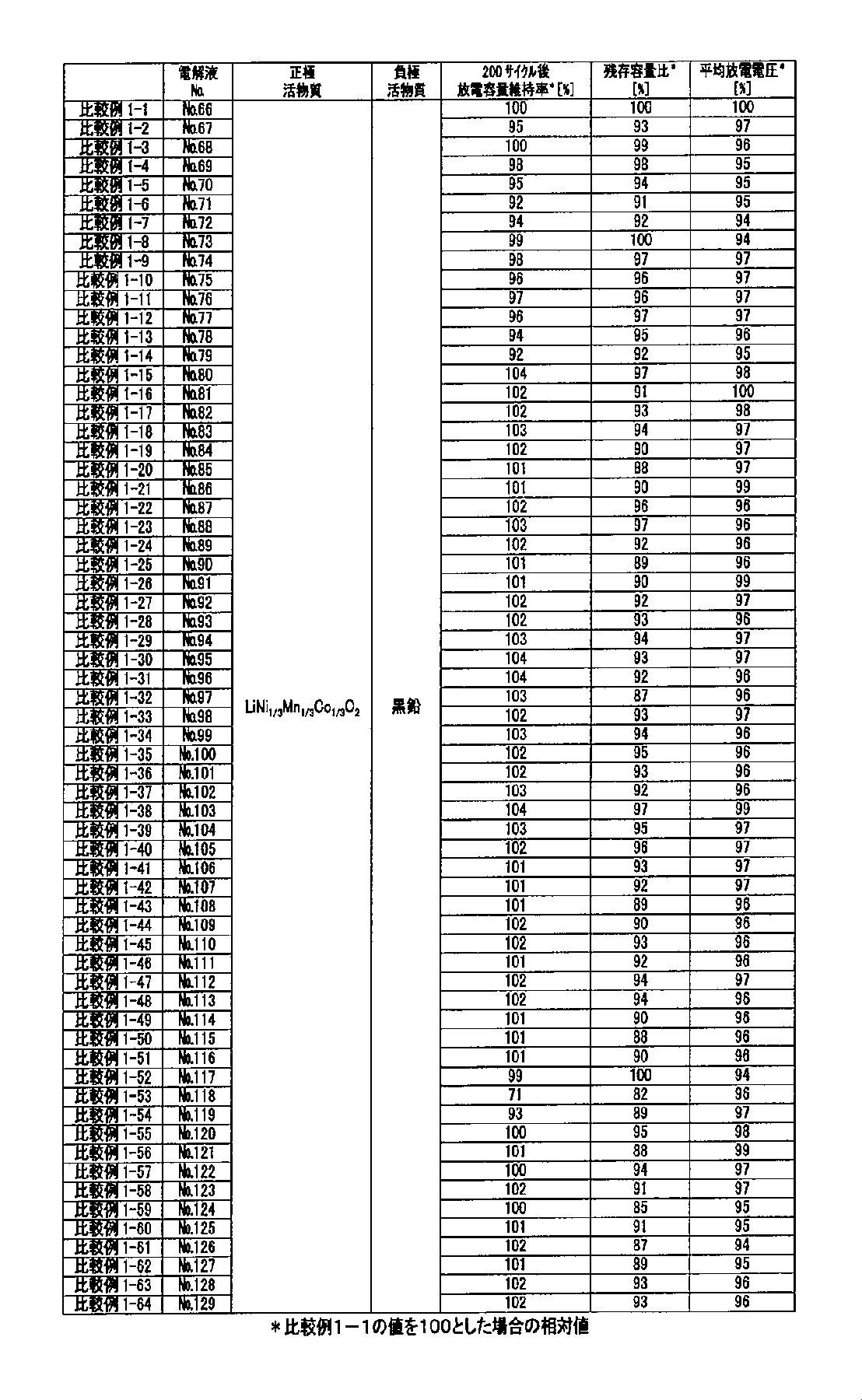
以上の結果を比較すると、第1の化合物と第2の化合物を併用することで、第1の化合物を単独で用いる比較例1-2~1-14に対し、高温サイクル特性、高温貯蔵特性および低温出力特性が向上していることが確認できた。また同様に、第2の化合物を単独で用いる比較例1-15~1-51に対し、高温サイクル特性、高温貯蔵特性および低温出力特性が向上していることが確認できた。
一方、比較例1-52、1-53のように、一般式(1)で表される第1の化合物のR2が、炭素数が1~10の直鎖あるいは分岐状のアルキル基でない場合(比較例1-52ではフッ素基を有し、比較例1-53ではメトキシ基を有する)は、低温出力特性が低下し、高温サイクル特性及び高温貯蔵特性の向上も確認できなかった。また、比較例1-54のように、炭素-炭素不飽和結合を有する基が1つ以下では高温サイクル特性、高温貯蔵特性および低温出力特性の向上は確認できなかった。
また、比較例1-55~1-58のように、第2の化合物中にP-F結合やS-F結合を含まない場合には、高温サイクル特性、高温貯蔵特性および低温出力特性の向上は確認できなかった。また、比較例1-59~1-64のように、第2の化合物が、P-F結合やS-F結合を含むものの、P原子に結合する置換基として、酸素原子を介在する炭化水素基(例えば、アルコキシ基等)を含む構造ではなく、酸素原子を介在しない炭化水素基(例えば、アルキル基等)を含む構造である場合には、低温出力特性が低下し、高温サイクル特性及び高温貯蔵特性の向上も確認できなかった。
一方、比較例1-52、1-53のように、一般式(1)で表される第1の化合物のR2が、炭素数が1~10の直鎖あるいは分岐状のアルキル基でない場合(比較例1-52ではフッ素基を有し、比較例1-53ではメトキシ基を有する)は、低温出力特性が低下し、高温サイクル特性及び高温貯蔵特性の向上も確認できなかった。また、比較例1-54のように、炭素-炭素不飽和結合を有する基が1つ以下では高温サイクル特性、高温貯蔵特性および低温出力特性の向上は確認できなかった。
また、比較例1-55~1-58のように、第2の化合物中にP-F結合やS-F結合を含まない場合には、高温サイクル特性、高温貯蔵特性および低温出力特性の向上は確認できなかった。また、比較例1-59~1-64のように、第2の化合物が、P-F結合やS-F結合を含むものの、P原子に結合する置換基として、酸素原子を介在する炭化水素基(例えば、アルコキシ基等)を含む構造ではなく、酸素原子を介在しない炭化水素基(例えば、アルキル基等)を含む構造である場合には、低温出力特性が低下し、高温サイクル特性及び高温貯蔵特性の向上も確認できなかった。
以降、第1の化合物と第2の化合物について代表的な組合せ及び濃度の電解液を用い、正極の種類、負極の種類、第2の化合物の対カチオンの種類等を変えて評価を行った結果について説明する。なお、以降で記載する第1の化合物と第2の化合物の組合せ及び濃度以外の電解液についても、上述と同様の傾向を示すことが確認されている。
[実施例2-1~2-43、比較例2-1~2-20]
実施例2-1~2-43及び比較例2-1~2-20においては、表6に示すように、負極体及び電解液を変えたこと以外は実施例1-1と同様に非水電解液電池用電解液を調製し、セルを作製し、電池の評価を実施した。なお、負極活物質がLi4Ti5O12である実施例2-1~2-13及び比較例2-1~2-5において、負極体は、Li4Ti5O12粉末90質量%に、バインダーとして5質量%のPVDF、導電剤としてアセチレンブラックを5質量%混合し、さらにN-メチルピロリドンを添加し、得られたペーストを銅箔上に塗布して、乾燥させることにより作製し、電池評価の際の充電終止電圧を2.8V、放電終止電圧を1.5Vとした。また、負極活物質が黒鉛(ケイ素含有)である実施例2-14~2-30及び比較例2-6~2-15において、負極体は、黒鉛粉末81質量%、ケイ素粉末9質量%に、バインダーとして5質量%のPVDF、導電材としてアセチレンブラックを5質量%混合し、さらにN-メチルピロリドンを添加し、得られたペーストを銅箔上に塗布して、乾燥させることにより作製し、電池評価の際の充電終止電圧と放電終止電圧は実施例1-1と同様とした。また、負極活物質がハードカーボンである実施例2-31~2-43及び比較例2-16~2-20において、負極体は、ハードカーボン粉末90質量%に、バインダーとして5質量%のPVDF、導電剤としてアセチレンブラックを5質量%混合し、さらにN-メチルピロリドンを添加し、得られたペーストを銅箔上に塗布して、乾燥させることにより作製し、電池評価の際の充電終止電圧を4.2V、放電終止電圧を2.2Vとした。
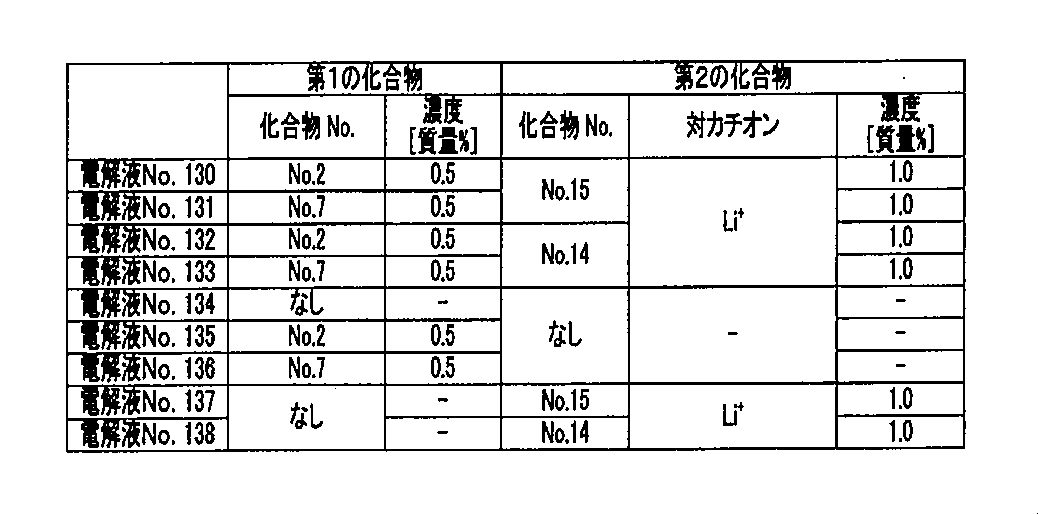
また、実施例2-27において使用した電解液は以下のように調製した。非水溶媒としてエチレンカーボネート、フルオロエチレンカーボネート、ジメチルカーボネート、エチルメチルカーボネートの体積比2.5:0.5:4:3の混合溶媒を用い、該溶媒中に溶質としてLiPF6を1.0mol/Lの濃度となるように溶解した。その後、第1の化合物として上記化合物No.2を0.5質量%の濃度となるように、第2の化合物として上記化合物No.15のリチウム塩を1.0質量%の濃度となるように添加、撹拌し、電解液No.130を調製した。なお、上記の調製は、液温を25℃に維持しながら行った。電解液No.130の調製条件を表5に示す。また、第1の化合物、第2の化合物の種類等を表5のように変えて、それ以外は上記と同様の手順で電解液No.131~138を調製した。
高温サイクル特性、高温貯蔵特性、及び低温出力特性の評価結果を表6に示す。なお、表6において、実施例2-1~2-26、実施例2-31~2-43、比較例2-1~2-10、比較例2-16~2-20の評価結果(200サイクル後の放電容量維持率の数値、残存容量比の数値、平均放電電圧の数値)は、各電極構成において、電解液No.66の電解液を用いた比較例の評価結果を100とした場合の相対値である。また、表6において、実施例2-27~2-30、比較例2-11~2-15の評価結果(200サイクル後の放電容量維持率の数値、残存容量比の数値、平均放電電圧の数値)は、電解液No.134の電解液を用いた比較例の評価結果を100とした場合の相対値である。
実施例2-1~2-43及び比較例2-1~2-20においては、表6に示すように、負極体及び電解液を変えたこと以外は実施例1-1と同様に非水電解液電池用電解液を調製し、セルを作製し、電池の評価を実施した。なお、負極活物質がLi4Ti5O12である実施例2-1~2-13及び比較例2-1~2-5において、負極体は、Li4Ti5O12粉末90質量%に、バインダーとして5質量%のPVDF、導電剤としてアセチレンブラックを5質量%混合し、さらにN-メチルピロリドンを添加し、得られたペーストを銅箔上に塗布して、乾燥させることにより作製し、電池評価の際の充電終止電圧を2.8V、放電終止電圧を1.5Vとした。また、負極活物質が黒鉛(ケイ素含有)である実施例2-14~2-30及び比較例2-6~2-15において、負極体は、黒鉛粉末81質量%、ケイ素粉末9質量%に、バインダーとして5質量%のPVDF、導電材としてアセチレンブラックを5質量%混合し、さらにN-メチルピロリドンを添加し、得られたペーストを銅箔上に塗布して、乾燥させることにより作製し、電池評価の際の充電終止電圧と放電終止電圧は実施例1-1と同様とした。また、負極活物質がハードカーボンである実施例2-31~2-43及び比較例2-16~2-20において、負極体は、ハードカーボン粉末90質量%に、バインダーとして5質量%のPVDF、導電剤としてアセチレンブラックを5質量%混合し、さらにN-メチルピロリドンを添加し、得られたペーストを銅箔上に塗布して、乾燥させることにより作製し、電池評価の際の充電終止電圧を4.2V、放電終止電圧を2.2Vとした。
また、実施例2-27において使用した電解液は以下のように調製した。非水溶媒としてエチレンカーボネート、フルオロエチレンカーボネート、ジメチルカーボネート、エチルメチルカーボネートの体積比2.5:0.5:4:3の混合溶媒を用い、該溶媒中に溶質としてLiPF6を1.0mol/Lの濃度となるように溶解した。その後、第1の化合物として上記化合物No.2を0.5質量%の濃度となるように、第2の化合物として上記化合物No.15のリチウム塩を1.0質量%の濃度となるように添加、撹拌し、電解液No.130を調製した。なお、上記の調製は、液温を25℃に維持しながら行った。電解液No.130の調製条件を表5に示す。また、第1の化合物、第2の化合物の種類等を表5のように変えて、それ以外は上記と同様の手順で電解液No.131~138を調製した。
高温サイクル特性、高温貯蔵特性、及び低温出力特性の評価結果を表6に示す。なお、表6において、実施例2-1~2-26、実施例2-31~2-43、比較例2-1~2-10、比較例2-16~2-20の評価結果(200サイクル後の放電容量維持率の数値、残存容量比の数値、平均放電電圧の数値)は、各電極構成において、電解液No.66の電解液を用いた比較例の評価結果を100とした場合の相対値である。また、表6において、実施例2-27~2-30、比較例2-11~2-15の評価結果(200サイクル後の放電容量維持率の数値、残存容量比の数値、平均放電電圧の数値)は、電解液No.134の電解液を用いた比較例の評価結果を100とした場合の相対値である。

[実施例3-1~3-52、比較例3-1~3-20]
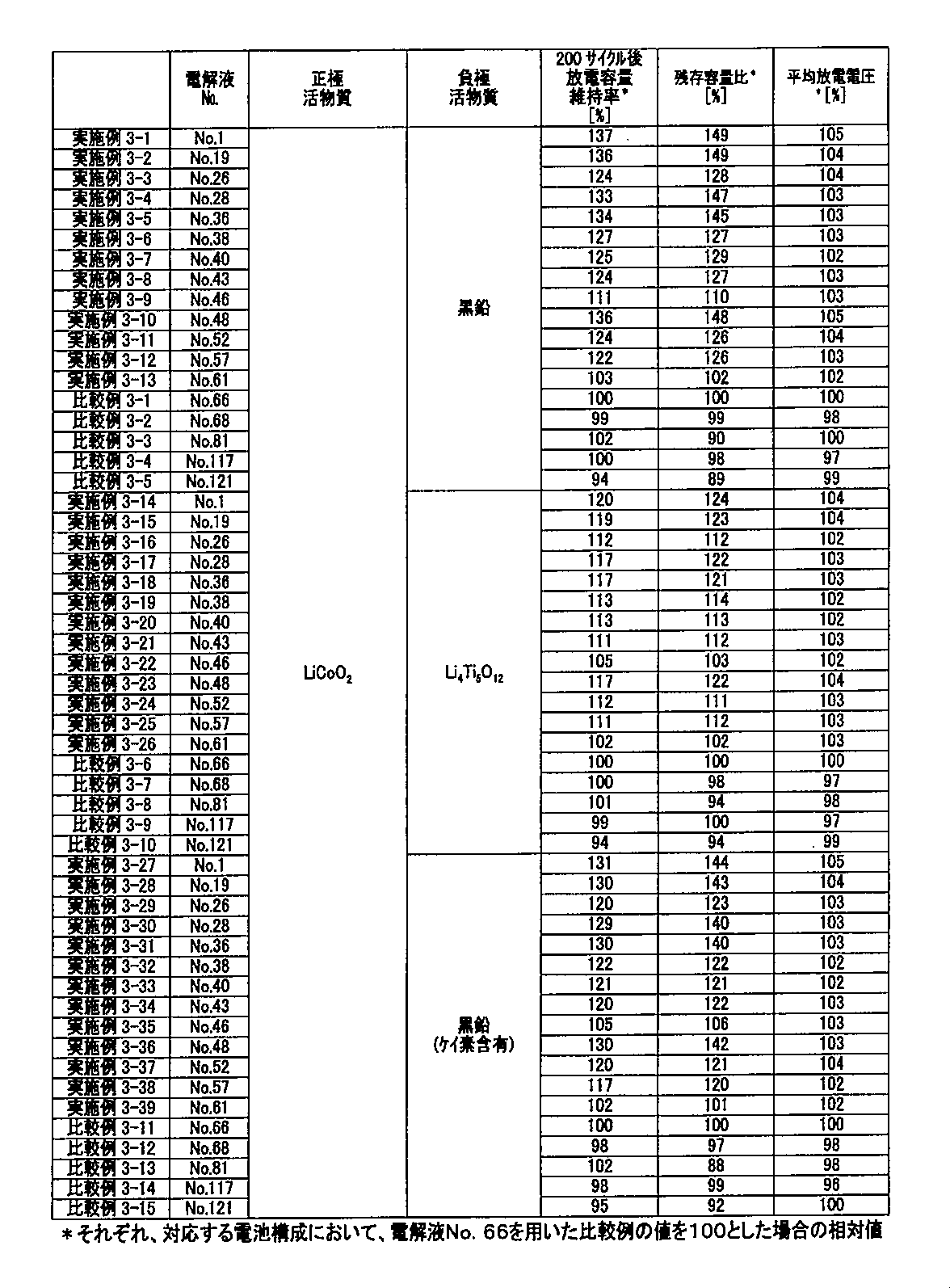
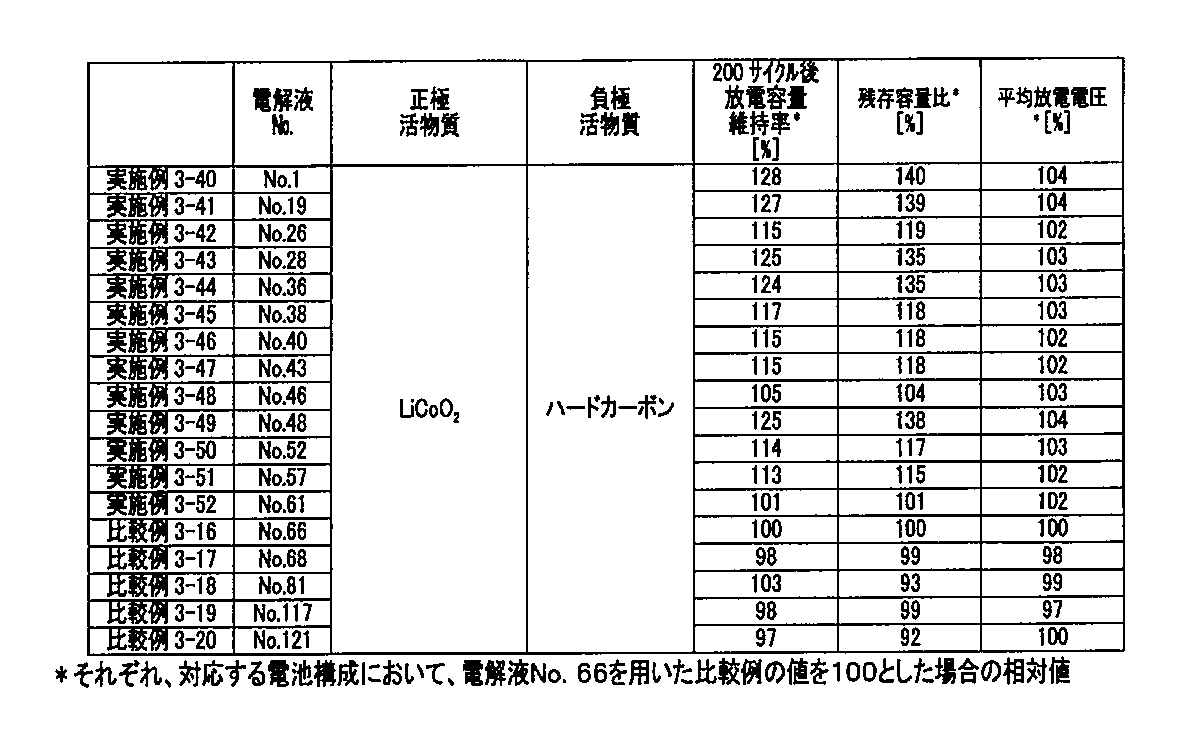
実施例3-1~3-52及び比較例3-1~3-20においては、表7及び表8に示すように、正極体、負極体及び電解液を変えたこと以外は実施例1-1と同様に非水電解液電池用電解液を調製し、セルを作製し、電池の評価を実施した。なお、正極活物質がLiCoO2である正極体は、LiCoO2粉末90質量%にバインダーとして5質量%のPVDF、導電材としてアセチレンブラックを5質量%混合し、さらにN-メチルピロリドンを添加し、得られたペーストをアルミニウム箔上に塗布して、乾燥させることにより作製した。実施例1-1と同様に負極活物質が黒鉛である実施例3-1~3-13及び比較例3-1~3-5において、電池評価の際の充電終止電圧を4.2V、放電終止電圧を3.0Vとした。実施例2-1と同様に負極活物質がLi4Ti5O12である実施例3-14~3-26及び比較例3-6~3-10において、電池評価の際の充電終止電圧を2.7V、放電終止電圧を1.5Vとした。実施例2-14と同様に負極活物質が黒鉛(ケイ素9質量%含有)である実施例3-27~3-39及び比較例3-11~3-15において、電池評価の際の充電終止電圧を4.2V、放電終止電圧を3.0Vとした。実施例2-31と同様に負極活物質がハードカーボンである実施例3-40~3-52及び比較例3-16~3-20において、電池評価の際の充電終止電圧を4.1V、放電終止電圧を2.2Vとした。高温サイクル特性、高温貯蔵特性、及び低温出力特性の評価結果を表7及び表8に示す。なお、表7及び表8中の評価結果(200サイクル後の放電容量維持率の数値、残存容量比の数値、平均放電電圧の数値)は、各電極構成において、電解液No.66の電解液を用いた比較例の評価結果を100とした場合の相対値である。
実施例3-1~3-52及び比較例3-1~3-20においては、表7及び表8に示すように、正極体、負極体及び電解液を変えたこと以外は実施例1-1と同様に非水電解液電池用電解液を調製し、セルを作製し、電池の評価を実施した。なお、正極活物質がLiCoO2である正極体は、LiCoO2粉末90質量%にバインダーとして5質量%のPVDF、導電材としてアセチレンブラックを5質量%混合し、さらにN-メチルピロリドンを添加し、得られたペーストをアルミニウム箔上に塗布して、乾燥させることにより作製した。実施例1-1と同様に負極活物質が黒鉛である実施例3-1~3-13及び比較例3-1~3-5において、電池評価の際の充電終止電圧を4.2V、放電終止電圧を3.0Vとした。実施例2-1と同様に負極活物質がLi4Ti5O12である実施例3-14~3-26及び比較例3-6~3-10において、電池評価の際の充電終止電圧を2.7V、放電終止電圧を1.5Vとした。実施例2-14と同様に負極活物質が黒鉛(ケイ素9質量%含有)である実施例3-27~3-39及び比較例3-11~3-15において、電池評価の際の充電終止電圧を4.2V、放電終止電圧を3.0Vとした。実施例2-31と同様に負極活物質がハードカーボンである実施例3-40~3-52及び比較例3-16~3-20において、電池評価の際の充電終止電圧を4.1V、放電終止電圧を2.2Vとした。高温サイクル特性、高温貯蔵特性、及び低温出力特性の評価結果を表7及び表8に示す。なお、表7及び表8中の評価結果(200サイクル後の放電容量維持率の数値、残存容量比の数値、平均放電電圧の数値)は、各電極構成において、電解液No.66の電解液を用いた比較例の評価結果を100とした場合の相対値である。
[実施例4-1~4-39、比較例4-1~4-15]
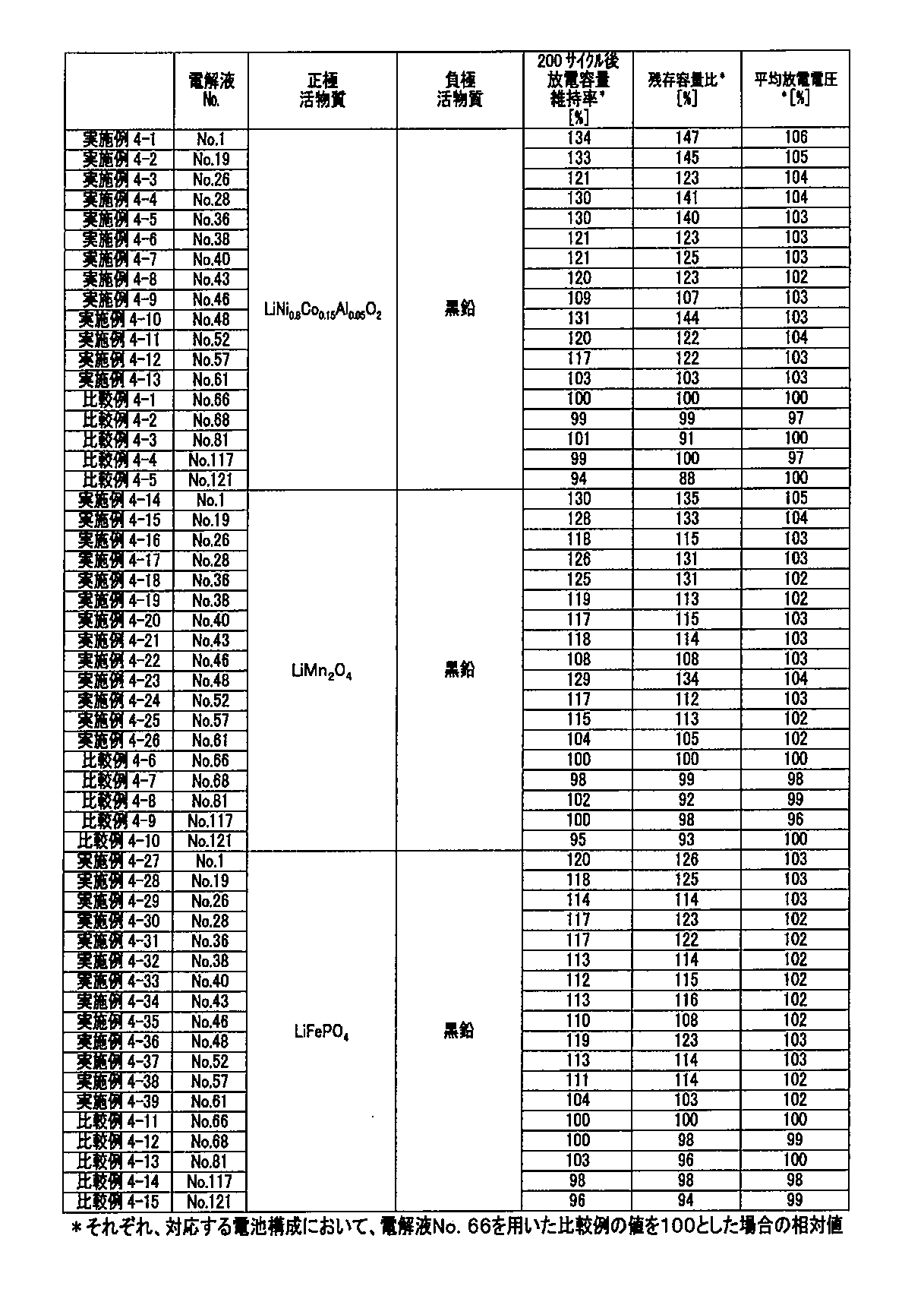
実施例4-1~4-39及び比較例4-1~4-15においては、表9に示すように、正極体及び電解液を変えたこと以外は実施例1-1と同様に非水電解液電池用電解液を調製し、セルを作製し、電池の評価を実施した。なお、正極活物質がLiNi0.8Co0.15Al0.05O2である実施例4-1~4-13及び比較例4-1~4-5において、正極体は、LiNi0.8Co0.15Al0.05O2粉末90質量%にバインダーとして5質量%のPVDF、導電材としてアセチレンブラックを5質量%混合し、さらにN-メチルピロリドンを添加し、得られたペーストをアルミニウム箔上に塗布して、乾燥させることにより作製し、電池評価の際の充電終止電圧を4.3V、放電終止電圧を3.0Vとした。また、正極活物質がLiMn2O4である実施例4-14~4-26及び比較例4-6~4-10において、正極体は、LiMn2O4粉末90質量%にバインダーとして5質量%のPVDF、導電材としてアセチレンブラックを5質量%混合し、さらにN-メチルピロリドンを添加し、得られたペーストをアルミニウム箔上に塗布して、乾燥させることにより作製し、電池評価の際の充電終止電圧を4.2V、放電終止電圧を3.0Vとした。また、正極活物質がLiFePO4である実施例4-27~4-39及び比較例4-11~4-15において、正極体は、非晶質炭素で被覆されたLiFePO4粉末90質量%にバインダーとして5質量%のPVDF、導電材としてアセチレンブラックを5質量%混合し、さらにN-メチルピロリドンを添加し、得られたペーストをアルミニウム箔上に塗布して、乾燥させることにより作製し、電池評価の際の充電終止電圧を4.2V、放電終止電圧を2.5Vとした。高温サイクル特性、高温貯蔵特性、及び低温出力特性の評価結果を表9に示す。なお、表9中の評価結果(200サイクル後の放電容量維持率の数値、残存容量比の数値、平均放電電圧の数値)は、各電極構成において、電解液No.66の電解液を用いた比較例の評価結果を100とした場合の相対値である。
実施例4-1~4-39及び比較例4-1~4-15においては、表9に示すように、正極体及び電解液を変えたこと以外は実施例1-1と同様に非水電解液電池用電解液を調製し、セルを作製し、電池の評価を実施した。なお、正極活物質がLiNi0.8Co0.15Al0.05O2である実施例4-1~4-13及び比較例4-1~4-5において、正極体は、LiNi0.8Co0.15Al0.05O2粉末90質量%にバインダーとして5質量%のPVDF、導電材としてアセチレンブラックを5質量%混合し、さらにN-メチルピロリドンを添加し、得られたペーストをアルミニウム箔上に塗布して、乾燥させることにより作製し、電池評価の際の充電終止電圧を4.3V、放電終止電圧を3.0Vとした。また、正極活物質がLiMn2O4である実施例4-14~4-26及び比較例4-6~4-10において、正極体は、LiMn2O4粉末90質量%にバインダーとして5質量%のPVDF、導電材としてアセチレンブラックを5質量%混合し、さらにN-メチルピロリドンを添加し、得られたペーストをアルミニウム箔上に塗布して、乾燥させることにより作製し、電池評価の際の充電終止電圧を4.2V、放電終止電圧を3.0Vとした。また、正極活物質がLiFePO4である実施例4-27~4-39及び比較例4-11~4-15において、正極体は、非晶質炭素で被覆されたLiFePO4粉末90質量%にバインダーとして5質量%のPVDF、導電材としてアセチレンブラックを5質量%混合し、さらにN-メチルピロリドンを添加し、得られたペーストをアルミニウム箔上に塗布して、乾燥させることにより作製し、電池評価の際の充電終止電圧を4.2V、放電終止電圧を2.5Vとした。高温サイクル特性、高温貯蔵特性、及び低温出力特性の評価結果を表9に示す。なお、表9中の評価結果(200サイクル後の放電容量維持率の数値、残存容量比の数値、平均放電電圧の数値)は、各電極構成において、電解液No.66の電解液を用いた比較例の評価結果を100とした場合の相対値である。
上記のように、負極活物質として、Li4Ti5O12、黒鉛(ケイ素含有)、及びハードカーボンを用いたいずれの実施例においても、本発明の非水電解液電池用電解液を用いることによって、それぞれの対応する比較例に比べて、高温サイクル特性、高温貯蔵特性および低温出力特性を向上させることが確認された。したがって、本発明の非水電解液電池用電解液を用いることで、負極活物質の種類によらず、優れた高温サイクル特性、高温貯蔵特性および低温出力特性を示す非水電解液電池を得られることが示された。
また、上記のように、正極活物質として、LiCoO2、LiNi0.8Co0.15Al0.05O2、LiMn2O4、及びLiFePO4を用いたいずれの実施例においても、本発明の非水電解液電池用電解液を用いることによって、それぞれの対応する比較例に比べて、高温サイクル特性、高温貯蔵特性および低温出力特性を向上させることが確認された。したがって、本発明の非水電解液電池用電解液を用いることで、正極活物質の種類によらず、優れた高温サイクル特性、高温貯蔵特性および低温出力特性を示す非水電解液電池を得られることが示された。
また、上記のように、正極活物質として、LiCoO2、LiNi0.8Co0.15Al0.05O2、LiMn2O4、及びLiFePO4を用いたいずれの実施例においても、本発明の非水電解液電池用電解液を用いることによって、それぞれの対応する比較例に比べて、高温サイクル特性、高温貯蔵特性および低温出力特性を向上させることが確認された。したがって、本発明の非水電解液電池用電解液を用いることで、正極活物質の種類によらず、優れた高温サイクル特性、高温貯蔵特性および低温出力特性を示す非水電解液電池を得られることが示された。
[実施例5-1]
非水溶媒としてエチレンカーボネートとジエチルカーボネートの体積比1:1の混合溶媒を用い、該溶媒中に、溶質としてNaPF6を1.0mol/Lの濃度となるように溶解した。その後、第1の化合物として上記化合物No.2を0.5質量%の濃度となるように、第2の化合物として上記化合物No.15のナトリウム塩を1.0質量%の濃度となるように添加、撹拌し、電解液No.139を調製した。電解液の調製条件を表10に示す。
この電解液を用いてNaFe0.5Co0.5O2を正極材料、ハードカーボンを負極材料とした以外は実施例1-1と同様にセルの作製を行い、実施例1-1と同様に高温サイクル特性、高温貯蔵特性、及び低温出力特性の評価を実施した。なお、正極活物質がNaFe0.5Co0.5O2である正極体は、NaFe0.5Co0.5O2粉末90質量%にバインダーとして5質量%のPVDF、導電材としてアセチレンブラックを5質量%混合し、さらにN-メチルピロリドンを添加し、得られたペーストをアルミニウム箔上に塗布して、乾燥させることにより作製し、電池評価の際の充電終止電圧を3.8V、放電終止電圧を1.5Vとした。評価結果を表11に示す。
非水溶媒としてエチレンカーボネートとジエチルカーボネートの体積比1:1の混合溶媒を用い、該溶媒中に、溶質としてNaPF6を1.0mol/Lの濃度となるように溶解した。その後、第1の化合物として上記化合物No.2を0.5質量%の濃度となるように、第2の化合物として上記化合物No.15のナトリウム塩を1.0質量%の濃度となるように添加、撹拌し、電解液No.139を調製した。電解液の調製条件を表10に示す。
この電解液を用いてNaFe0.5Co0.5O2を正極材料、ハードカーボンを負極材料とした以外は実施例1-1と同様にセルの作製を行い、実施例1-1と同様に高温サイクル特性、高温貯蔵特性、及び低温出力特性の評価を実施した。なお、正極活物質がNaFe0.5Co0.5O2である正極体は、NaFe0.5Co0.5O2粉末90質量%にバインダーとして5質量%のPVDF、導電材としてアセチレンブラックを5質量%混合し、さらにN-メチルピロリドンを添加し、得られたペーストをアルミニウム箔上に塗布して、乾燥させることにより作製し、電池評価の際の充電終止電圧を3.8V、放電終止電圧を1.5Vとした。評価結果を表11に示す。
[実施例5-2~5-13、比較例5-1~5-6]
実施例5-2~5-13及び比較例5-1~5-6においては、表10に示すように、第1の化合物及び第2の化合物の種類を変えたこと以外は実施例5-1と同様に非水電解液電池用電解液を調製し、セルを作製し、電池の評価を実施した。高温サイクル特性、高温貯蔵特性、及び低温出力特性の評価結果を表11に示す。なお、表11中の評価結果(200サイクル後の放電容量維持率の数値、残存容量比の数値、平均放電電圧の数値)は、比較例5-1の評価結果を100とした場合の相対値である。
実施例5-2~5-13及び比較例5-1~5-6においては、表10に示すように、第1の化合物及び第2の化合物の種類を変えたこと以外は実施例5-1と同様に非水電解液電池用電解液を調製し、セルを作製し、電池の評価を実施した。高温サイクル特性、高温貯蔵特性、及び低温出力特性の評価結果を表11に示す。なお、表11中の評価結果(200サイクル後の放電容量維持率の数値、残存容量比の数値、平均放電電圧の数値)は、比較例5-1の評価結果を100とした場合の相対値である。


以上の結果を比較すると、ナトリウムイオン電池においても、第1の化合物と第2の化合物を併用することで、第1の化合物を単独で用いる比較例5-2に対し、高温サイクル特性、高温貯蔵特性および低温出力特性が向上していることが確認できた。また同様に、第2の化合物を単独で用いる比較例5-3に対し、高温サイクル特性、高温貯蔵特性および低温出力特性が向上していることが確認できた。また、比較例5-4のように、一般式(1)で表される第1の化合物のR2が、炭素数が1~10の直鎖あるいは分岐状のアルキル基でない場合(比較例5-4ではフッ素基を有する)は、低温出力特性が低下し、高温サイクル特性及び高温貯蔵特性の向上も確認できなかった。
また、比較例5-5のように、第2の化合物中にP-F結合やS-F結合を含まない場合には、高温サイクル特性、高温貯蔵特性および低温出力特性の向上は確認できなかった。
また、比較例5-6のように、第2の化合物が、P-F結合を含むものの、P原子に結合する置換基として、酸素原子を介在する炭化水素基(例えば、アルコキシ基等)を含む構造ではなく、酸素原子を介在しない炭化水素基(例えば、アルキル基等)を含む構造である場合には、低温出力特性が低下し、高温サイクル特性及び高温貯蔵特性の向上も確認できなかった。
また、比較例5-5のように、第2の化合物中にP-F結合やS-F結合を含まない場合には、高温サイクル特性、高温貯蔵特性および低温出力特性の向上は確認できなかった。
また、比較例5-6のように、第2の化合物が、P-F結合を含むものの、P原子に結合する置換基として、酸素原子を介在する炭化水素基(例えば、アルコキシ基等)を含む構造ではなく、酸素原子を介在しない炭化水素基(例えば、アルキル基等)を含む構造である場合には、低温出力特性が低下し、高温サイクル特性及び高温貯蔵特性の向上も確認できなかった。
Claims (13)
- 少なくとも、非水溶媒、溶質、第1の化合物として、下記一般式(1)で示される少なくとも1種のシラン化合物、及び、第2の化合物として、下記一般式(2)~(9)で示される含フッ素化合物からなる群から選ばれる少なくとも1種を含有することを特徴とする、非水電解液電池用電解液。

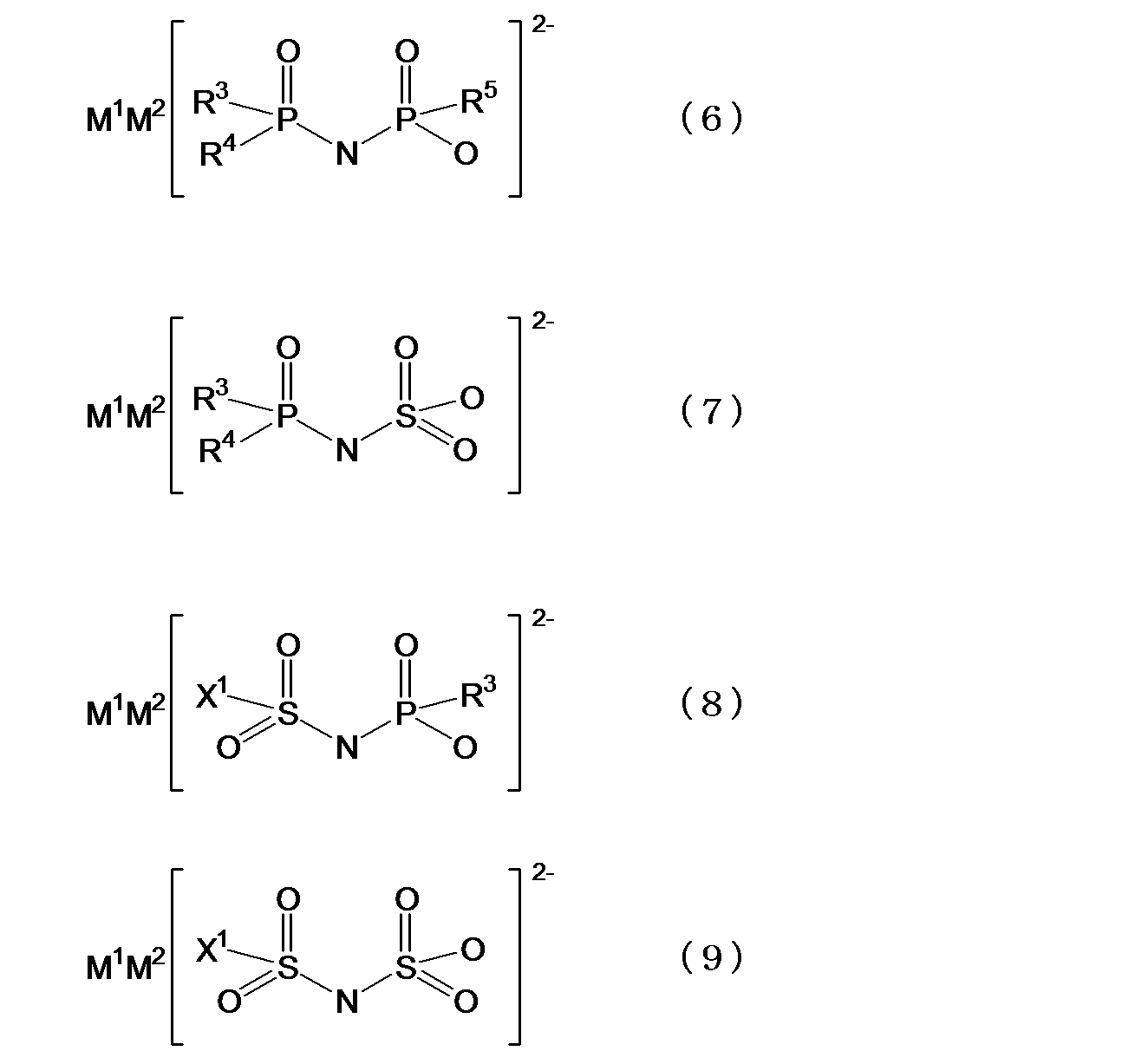
[一般式(1)中、R1はそれぞれ互いに独立して炭素-炭素不飽和結合を有する基を表す。R2はそれぞれ互いに独立して炭素数が1~10の直鎖あるいは分岐状のアルキル基を示し、これらの基はフッ素原子及び/又は酸素原子を有していても良い。aは2~4である。一般式(2)~(4)、及び(6)~(8)中、R3~R6 はそれぞれ互いに独立して、フッ素原子、炭素数が1~10の直鎖あるいは分岐状のアルコキシ基、炭素数が2~10のアルケニルオキシ基、炭素数が2~10のアルキニルオキシ基、炭素数が3~10のシクロアルコキシ基、炭素数が3~10のシクロアルケニルオキシ基、及び、炭素数が6~10のアリールオキシ基から選ばれる有機基であり、その有機基中にフッ素原子、酸素原子、不飽和結合が存在することもできる。一般式(4)、(5)、(8)及び(9)中、X1及びX2はそれぞれ互いに独立して、フッ素原子、炭素数が1~10の直鎖あるいは分岐状のアルキル基、炭素数が2~10のアルケニル基、炭素数が2~10のアルキニル基、炭素数が3~10のシクロアルキル基、炭素数が3~10のシクロアルケニル基、炭素数が6~10のアリール基、炭素数が1~10の直鎖あるいは分岐状のアルコキシ基、炭素数が2~10のアルケニルオキシ基、炭素数が2~10のアルキニルオキシ基、炭素数が3~10のシクロアルコキシ基、炭素数が3~10のシクロアルケニルオキシ基、及び、炭素数が6~10のアリールオキシ基から選ばれる有機基であり、その有機基中にフッ素原子、酸素原子、不飽和結合が存在することもできる。また、一般式(2)~(9)中には少なくとも一つのP-F結合及び/又はS-F結合を含む。M1、M2はそれぞれ互いに独立して、プロトン、金属カチオン又はオニウムカチオンである。] - 前記第1の化合物の添加量が非水電解液電池用電解液の総量に対して0.001~10.0質量%の範囲であることを特徴とする、請求項1に記載の非水電解液電池用電解液。
- 前記第2の化合物の添加量が非水電解液電池用電解液の総量に対して0.001~10.0質量%の範囲であることを特徴とする、請求項1又は2に記載の非水電解液電池用電解液。
- 前記一般式(1)のR1で表される基が、それぞれ互いに独立して、ビニル基、アリル基、1-プロペニル基、2-プロペニル基、エチニル基、及び2-プロピニル基からなる群から選択される基であることを特徴とする、請求項1~3のいずれかに記載の非水電解液電池用電解液。
- 前記一般式(1)のR2で表される基が、それぞれ互いに独立して、メチル基、エチル基、プロピル基、2,2,2-トリフルオロエチル基、2,2,3,3-テトラフルオロプロピル基、1,1,1-トリフルオロイソプロピル基、及び1,1,1,3,3,3-ヘキサフルオロイソプロピル基からなる群から選択される基であることを特徴とする、請求項1~4のいずれかに記載の非水電解液電池用電解液。
- 前記一般式(2)~(4)、及び(6)~(8)のR3~R6が、フッ素原子、炭素数が1~10のフッ素原子を有する直鎖あるいは分岐状のアルコキシ基、炭素数が2~10のアルケニルオキシ基、及び炭素数が2~10のアルキニルオキシ基からなる群から選ばれる有機基であることを特徴とする、請求項1~5のいずれかに記載の非水電解液電池用電解液。
- 前記アルコキシ基が、2,2,2-トリフルオロエトキシ基、2,2,3,3-テトラフルオロプロポキシ基、1,1,1-トリフルオロイソプロポキシ基、及び1,1,1,3,3,3-ヘキサフルオロイソプロポキシ基からなる群から選択され、前記アルケニルオキシ基が、1-プロペニルオキシ基、2-プロペニルオキシ基、及び3-ブテニルオキシ基からなる群から選択され、前記アルキニルオキシ基が、2-プロピニルオキシ基、及び1,1-ジメチル-2-プロピニルオキシ基からなる群から選択されることを特徴とする、請求項6に記載の非水電解液電池用電解液。
- 前記一般式(4)、(5)、(8)及び(9)のX1及びX2が、フッ素原子、炭素数が1~10の直鎖あるいは分岐状のアルコキシ基、炭素数が2~10のアルケニルオキシ基、及び炭素数が2~10のアルキニルオキシ基からなる群から選ばれる有機基であることを特徴とする、請求項1~7のいずれかに記載の非水電解液電池用電解液。
- 前記アルコキシ基が、メトキシ基、エトキシ基、及びプロポキシ基からなる群から選択され、前記アルケニルオキシ基が、1-プロペニルオキシ基、2-プロペニルオキシ基、及び3-ブテニルオキシ基からなる群から選択され、前記アルキニルオキシ基が、2-プロピニルオキシ基、及び1,1-ジメチル-2-プロピニルオキシ基からなる群から選択されることを特徴とする、請求項8に記載の非水電解液電池用電解液。
- 前記一般式(2)~(9)のM1及びM2が、リチウムイオン、ナトリウムイオン、カリウムイオン、テトラアルキルアンモニウムイオン、及びテトラアルキルホスホニウムイオンからなる群から選ばれる少なくとも一つのカチオンであることを特徴とする、請求項1~9のいずれかに記載の非水電解液電池用電解液。
- 前記溶質が、ヘキサフルオロリン酸リチウム(LiPF6)、テトラフルオロホウ酸リチウム(LiBF4)、ビス(トリフルオロメタンスルホニル)イミドリチウム(LiN(CF3SO2)2)、ビス(フルオロスルホニル)イミドリチウム(LiN(FSO2)2)、ビス(ジフルオロホスホリル)イミドリチウム(LiN(POF2)2)、ヘキサフルオロリン酸ナトリウム(NaPF6)、テトラフルオロホウ酸ナトリウム(NaBF4)、ビス(トリフルオロメタンスルホニル)イミドナトリウム(NaN(CF3SO2)2)、ビス(フルオロスルホニル)イミドナトリウム(NaN(FSO2)2)、及びビス(ジフルオロホスホリル)イミドナトリウム(NaN(POF2)2)からなる群から選ばれる少なくとも一つの溶質であることを特徴とする、請求項1~10のいずれかに記載の非水電解液電池用電解液。
- 前記非水溶媒が、環状カーボネート、鎖状カーボネート、環状エステル、鎖状エステル、環状エーテル、鎖状エーテル、スルホン化合物、スルホキシド化合物、及びイオン液体からなる群から選ばれる少なくとも一つの非水溶媒であることを特徴とする、請求項1~11のいずれかに記載の非水電解液電池用電解液。
- 少なくとも正極と、負極と、セパレータと、請求項1~12のいずれかに記載の非水電解液電池用電解液とを含む非水電解液電池。
Priority Applications (11)
| Application Number | Priority Date | Filing Date | Title |
|---|---|---|---|
| EP19194558.3A EP3598560B1 (en) | 2015-02-19 | 2016-02-18 | Electrolyte solution for non-aqueous-electrolyte battery, and non-aqueous electrolyte battery using the same |
| EP16752555.9A EP3261166B1 (en) | 2015-02-19 | 2016-02-18 | Electrolyte for nonaqueous-electrolyte cell, and non-aqueous electrolyte cell in which same is used |
| US15/549,210 US10553904B2 (en) | 2015-02-19 | 2016-02-18 | Electrolyte solution for non-aqueous electrolyte battery, and non-aqueous electrolyte battery using the same |
| PL16752555T PL3261166T3 (pl) | 2015-02-19 | 2016-02-18 | Elektrolit do niewodnego ogniwa elektrolitowego i ogniwo z niewodnym elektrolitem, w którym jest on stosowany |
| KR1020197018403A KR102262373B1 (ko) | 2015-02-19 | 2016-02-18 | 비수전해액 전지용 전해액, 및 이것을 이용한 비수전해액 전지 |
| CN201911249839.8A CN110880619B (zh) | 2015-02-19 | 2016-02-18 | 非水电解液电池用电解液和使用其的非水电解液电池 |
| CN201680010967.5A CN107251310B (zh) | 2015-02-19 | 2016-02-18 | 非水电解液电池用电解液和使用其的非水电解液电池 |
| KR1020177026392A KR101995044B1 (ko) | 2015-02-19 | 2016-02-18 | 비수전해액 전지용 전해액, 및 이것을 이용한 비수전해액 전지 |
| PL19194558T PL3598560T3 (pl) | 2015-02-19 | 2016-02-18 | Roztwór elektrolitu do akumulatora z elektrolitem niewodnym i akumulator z elektrolitem bezwodnym, który go stosuje |
| US16/717,000 US11171361B2 (en) | 2015-02-19 | 2019-12-17 | Electrolyte solution for non-aqueous electrolyte battery, and non-aqueous electrolyte battery using the same |
| US16/717,049 US11145904B2 (en) | 2015-02-19 | 2019-12-17 | Electrolyte solution for non-aqueous electrolyte battery, and non-aqueous electrolyte battery using the same |
Applications Claiming Priority (4)
| Application Number | Priority Date | Filing Date | Title |
|---|---|---|---|
| JP2015-030411 | 2015-02-19 | ||
| JP2015030411 | 2015-02-19 | ||
| JP2015254114A JP6665396B2 (ja) | 2015-02-19 | 2015-12-25 | 非水電解液電池用電解液、及びこれを用いた非水電解液電池 |
| JP2015-254114 | 2015-12-25 |
Related Child Applications (3)
| Application Number | Title | Priority Date | Filing Date |
|---|---|---|---|
| US15/549,210 A-371-Of-International US10553904B2 (en) | 2015-02-19 | 2016-02-18 | Electrolyte solution for non-aqueous electrolyte battery, and non-aqueous electrolyte battery using the same |
| US16/717,000 Continuation US11171361B2 (en) | 2015-02-19 | 2019-12-17 | Electrolyte solution for non-aqueous electrolyte battery, and non-aqueous electrolyte battery using the same |
| US16/717,049 Continuation US11145904B2 (en) | 2015-02-19 | 2019-12-17 | Electrolyte solution for non-aqueous electrolyte battery, and non-aqueous electrolyte battery using the same |
Publications (1)
| Publication Number | Publication Date |
|---|---|
| WO2016133169A1 true WO2016133169A1 (ja) | 2016-08-25 |
Family
ID=56689338
Family Applications (1)
| Application Number | Title | Priority Date | Filing Date |
|---|---|---|---|
| PCT/JP2016/054748 Ceased WO2016133169A1 (ja) | 2015-02-19 | 2016-02-18 | 非水電解液電池用電解液、及びこれを用いた非水電解液電池 |
Country Status (2)
| Country | Link |
|---|---|
| CN (1) | CN110880619B (ja) |
| WO (1) | WO2016133169A1 (ja) |
Cited By (5)
| Publication number | Priority date | Publication date | Assignee | Title |
|---|---|---|---|---|
| WO2018190304A1 (ja) * | 2017-04-10 | 2018-10-18 | セントラル硝子株式会社 | ホスホリルイミド塩の製造方法、該塩を含む非水電解液の製造方法及び非水二次電池の製造方法 |
| CN108808087A (zh) * | 2018-05-04 | 2018-11-13 | 惠州市大道新材料科技有限公司 | 一种含有磷酰亚胺锂的电解液及使用该电解液的电池 |
| CN111786020A (zh) * | 2020-07-20 | 2020-10-16 | 香河昆仑化学制品有限公司 | 一种含氟代磷酸酰胺盐的非水电解液和锂离子电池 |
| WO2024253162A1 (ja) | 2023-06-08 | 2024-12-12 | セントラル硝子株式会社 | 非水電解液二次電池用電解液、及びこれを用いた非水電解液二次電池 |
| WO2026079154A1 (ja) * | 2024-10-07 | 2026-04-16 | Muアイオニックソリューションズ株式会社 | 電解液とその製造方法、電池、及び車両 |
Citations (6)
| Publication number | Priority date | Publication date | Assignee | Title |
|---|---|---|---|---|
| JP2002134169A (ja) * | 2000-10-30 | 2002-05-10 | Denso Corp | 非水電解液及び該電解液を用いた非水電解液二次電池 |
| JP2007180015A (ja) * | 2005-11-29 | 2007-07-12 | Mitsubishi Chemicals Corp | リチウム二次電池用非水系電解液及びそれを用いたリチウム二次電池 |
| JP2008181831A (ja) * | 2007-01-26 | 2008-08-07 | Denso Corp | 非水電解液及び該電解液を用いた二次電池 |
| JP2010257616A (ja) * | 2009-04-22 | 2010-11-11 | Central Glass Co Ltd | 電気化学ディバイス用電解質、これを用いる電解液および非水電解液電池 |
| WO2014039886A1 (en) * | 2012-09-07 | 2014-03-13 | Silatronix, Inc. | Symmetrical and unsymmetrical organosilicon molecules and electrolyte compositions |
| WO2014163055A1 (ja) * | 2013-04-01 | 2014-10-09 | 宇部興産株式会社 | 非水電解液及びそれを用いた蓄電デバイス |
Family Cites Families (12)
| Publication number | Priority date | Publication date | Assignee | Title |
|---|---|---|---|---|
| JP2000243440A (ja) * | 1999-02-19 | 2000-09-08 | Mitsui Chemicals Inc | 非水電解液およびそれを用いた二次電池 |
| US8076032B1 (en) * | 2004-02-04 | 2011-12-13 | West Robert C | Electrolyte including silane for use in electrochemical devices |
| JP5636623B2 (ja) * | 2005-11-29 | 2014-12-10 | 三菱化学株式会社 | 二次電池用非水系電解液及びそれを用いた非水系電解液二次電池 |
| JP4931489B2 (ja) * | 2006-06-21 | 2012-05-16 | 株式会社デンソー | 非水電解液および該電解液を用いた二次電池 |
| JP2008001672A (ja) * | 2006-06-26 | 2008-01-10 | Toyota Motor Corp | リチウム塩およびその製造方法 |
| JP5277550B2 (ja) * | 2007-03-12 | 2013-08-28 | セントラル硝子株式会社 | ジフルオロリン酸リチウムの製造方法及びこれを用いた非水電解液電池 |
| JP2008300081A (ja) * | 2007-05-29 | 2008-12-11 | Toyota Motor Corp | リチウム二次電池用電解液 |
| KR20120132811A (ko) * | 2011-05-30 | 2012-12-10 | 파낙스 이텍(주) | 디플루오로 인산염을 포함하는 전지용 비수 전해액 |
| JP5796417B2 (ja) * | 2011-08-31 | 2015-10-21 | セントラル硝子株式会社 | 非水電解液電池用電解液及び非水電解液電池 |
| CN102617414B (zh) * | 2012-03-02 | 2014-12-17 | 苏州氟特电池材料有限公司 | 含氯磺酰/磷酰亚胺碱金属盐和含氟磺酰/磷酰亚胺碱金属盐的制备方法 |
| JP2014035929A (ja) * | 2012-08-09 | 2014-02-24 | Sanyo Electric Co Ltd | 非水電解質二次電池 |
| JP6044842B2 (ja) * | 2013-07-30 | 2016-12-14 | トヨタ自動車株式会社 | 非水電解液二次電池の製造方法 |
-
2016
- 2016-02-18 CN CN201911249839.8A patent/CN110880619B/zh active Active
- 2016-02-18 WO PCT/JP2016/054748 patent/WO2016133169A1/ja not_active Ceased
Patent Citations (6)
| Publication number | Priority date | Publication date | Assignee | Title |
|---|---|---|---|---|
| JP2002134169A (ja) * | 2000-10-30 | 2002-05-10 | Denso Corp | 非水電解液及び該電解液を用いた非水電解液二次電池 |
| JP2007180015A (ja) * | 2005-11-29 | 2007-07-12 | Mitsubishi Chemicals Corp | リチウム二次電池用非水系電解液及びそれを用いたリチウム二次電池 |
| JP2008181831A (ja) * | 2007-01-26 | 2008-08-07 | Denso Corp | 非水電解液及び該電解液を用いた二次電池 |
| JP2010257616A (ja) * | 2009-04-22 | 2010-11-11 | Central Glass Co Ltd | 電気化学ディバイス用電解質、これを用いる電解液および非水電解液電池 |
| WO2014039886A1 (en) * | 2012-09-07 | 2014-03-13 | Silatronix, Inc. | Symmetrical and unsymmetrical organosilicon molecules and electrolyte compositions |
| WO2014163055A1 (ja) * | 2013-04-01 | 2014-10-09 | 宇部興産株式会社 | 非水電解液及びそれを用いた蓄電デバイス |
Non-Patent Citations (1)
| Title |
|---|
| See also references of EP3261166A1 * |
Cited By (13)
| Publication number | Priority date | Publication date | Assignee | Title |
|---|---|---|---|---|
| US11230564B2 (en) | 2017-04-10 | 2022-01-25 | Central Glass Co., Ltd. | Method for producing phosphoryl imide salt, method for producing nonaqueous electrolyte solution containing said salt, and method for producing nonaqueous secondary battery |
| KR20190132509A (ko) * | 2017-04-10 | 2019-11-27 | 샌트랄 글래스 컴퍼니 리미티드 | 포스포릴이미드염의 제조방법, 당해 염을 포함하는 비수전해액의 제조방법 및 비수 이차 전지의 제조방법 |
| JPWO2018190304A1 (ja) * | 2017-04-10 | 2020-04-02 | セントラル硝子株式会社 | ホスホリルイミド塩の製造方法、該塩を含む非水電解液の製造方法及び非水二次電池の製造方法 |
| US10851124B2 (en) | 2017-04-10 | 2020-12-01 | Central Glass Co., Ltd. | Method for producing phosphoryl imide salt, method for producing nonaqueous electrolyte solution containing said salt, and method for producing nonaqueous secondary battery |
| WO2018190304A1 (ja) * | 2017-04-10 | 2018-10-18 | セントラル硝子株式会社 | ホスホリルイミド塩の製造方法、該塩を含む非水電解液の製造方法及び非水二次電池の製造方法 |
| KR102396198B1 (ko) * | 2017-04-10 | 2022-05-10 | 샌트랄 글래스 컴퍼니 리미티드 | 포스포릴이미드염의 제조방법, 당해 염을 포함하는 비수전해액의 제조방법 및 비수 이차 전지의 제조방법 |
| JP7128422B2 (ja) | 2017-04-10 | 2022-08-31 | セントラル硝子株式会社 | ホスホリルイミド塩の製造方法、該塩を含む非水電解液の製造方法及び非水二次電池の製造方法 |
| CN108808087A (zh) * | 2018-05-04 | 2018-11-13 | 惠州市大道新材料科技有限公司 | 一种含有磷酰亚胺锂的电解液及使用该电解液的电池 |
| CN108808087B (zh) * | 2018-05-04 | 2022-06-10 | 常德市大度新材料有限公司 | 一种含有磷酰亚胺锂的电解液及使用该电解液的电池 |
| CN111786020A (zh) * | 2020-07-20 | 2020-10-16 | 香河昆仑化学制品有限公司 | 一种含氟代磷酸酰胺盐的非水电解液和锂离子电池 |
| CN111786020B (zh) * | 2020-07-20 | 2022-11-29 | 香河昆仑新能源材料股份有限公司 | 一种含氟代磷酸酰胺盐的非水电解液和锂离子电池 |
| WO2024253162A1 (ja) | 2023-06-08 | 2024-12-12 | セントラル硝子株式会社 | 非水電解液二次電池用電解液、及びこれを用いた非水電解液二次電池 |
| WO2026079154A1 (ja) * | 2024-10-07 | 2026-04-16 | Muアイオニックソリューションズ株式会社 | 電解液とその製造方法、電池、及び車両 |
Also Published As
| Publication number | Publication date |
|---|---|
| CN110880619A (zh) | 2020-03-13 |
| CN110880619B (zh) | 2023-04-21 |
Similar Documents
| Publication | Publication Date | Title |
|---|---|---|
| JP7016019B2 (ja) | 非水電解液電池用電解液、及びこれを用いた非水電解液電池 | |
| JP6361486B2 (ja) | 非水電解液電池用電解液、及びこれを用いた非水電解液電池 | |
| KR102085879B1 (ko) | 비수전해액 전지용 전해액, 및 이것을 이용한 비수전해액 전지 | |
| CN113782817B (zh) | 非水电解液电池用电解液和使用其的非水电解液电池 | |
| JP6255722B2 (ja) | 非水電解液電池用電解液、及びこれを用いた非水電解液電池 | |
| CN114175340B (zh) | 非水电解液、非水电解液电池及化合物 | |
| WO2013187380A1 (ja) | 非水電解液電池用電解液、及びこれを用いた非水電解液電池 | |
| CN113906530B (zh) | 非水电解液和非水电解液电池 | |
| WO2019146705A1 (ja) | 非水電解液電池用電解液、及びこれを用いた非水電解液電池 | |
| JP2019053984A (ja) | 非水電解液用添加剤、非水電解液、及び非水電解液電池 | |
| CN110880619B (zh) | 非水电解液电池用电解液和使用其的非水电解液电池 | |
| CN121970170A (zh) | 非水电解液及非水电解液电池 |
Legal Events
| Date | Code | Title | Description |
|---|---|---|---|
| 121 | Ep: the epo has been informed by wipo that ep was designated in this application |
Ref document number: 16752555 Country of ref document: EP Kind code of ref document: A1 |
|
| NENP | Non-entry into the national phase |
Ref country code: DE |
|
| REEP | Request for entry into the european phase |
Ref document number: 2016752555 Country of ref document: EP |
|
| ENP | Entry into the national phase |
Ref document number: 20177026392 Country of ref document: KR Kind code of ref document: A |