WO2016132859A1 - パリレン透水膜及びその製造方法、水の分離方法 - Google Patents
パリレン透水膜及びその製造方法、水の分離方法 Download PDFInfo
- Publication number
- WO2016132859A1 WO2016132859A1 PCT/JP2016/052615 JP2016052615W WO2016132859A1 WO 2016132859 A1 WO2016132859 A1 WO 2016132859A1 JP 2016052615 W JP2016052615 W JP 2016052615W WO 2016132859 A1 WO2016132859 A1 WO 2016132859A1
- Authority
- WO
- WIPO (PCT)
- Prior art keywords
- parylene
- water
- membrane
- permeable
- film
- Prior art date
- Legal status (The legal status is an assumption and is not a legal conclusion. Google has not performed a legal analysis and makes no representation as to the accuracy of the status listed.)
- Ceased
Links
Images

Classifications
-
- B—PERFORMING OPERATIONS; TRANSPORTING
- B01—PHYSICAL OR CHEMICAL PROCESSES OR APPARATUS IN GENERAL
- B01D—SEPARATION
- B01D69/00—Semi-permeable membranes for separation processes or apparatus characterised by their form, structure or properties; Manufacturing processes specially adapted therefor
- B01D69/12—Composite membranes; Ultra-thin membranes
- B01D69/1213—Laminated layers
-
- B—PERFORMING OPERATIONS; TRANSPORTING
- B01—PHYSICAL OR CHEMICAL PROCESSES OR APPARATUS IN GENERAL
- B01D—SEPARATION
- B01D71/00—Semi-permeable membranes for separation processes or apparatus characterised by the material; Manufacturing processes specially adapted therefor
- B01D71/06—Organic material
- B01D71/72—Macromolecular compounds obtained otherwise than by reactions only involving carbon-to-carbon unsaturated bonds, not provided for in a single one of the groups B01D71/46 - B01D71/70 and B01D71/701 - B01D71/702
-
- B—PERFORMING OPERATIONS; TRANSPORTING
- B01—PHYSICAL OR CHEMICAL PROCESSES OR APPARATUS IN GENERAL
- B01D—SEPARATION
- B01D71/00—Semi-permeable membranes for separation processes or apparatus characterised by the material; Manufacturing processes specially adapted therefor
- B01D71/06—Organic material
- B01D71/76—Macromolecular material not specifically provided for in a single one of groups B01D71/08 - B01D71/74
- B01D71/82—Macromolecular material not specifically provided for in a single one of groups B01D71/08 - B01D71/74 characterised by the presence of specified groups, e.g. introduced by chemical after-treatment
Definitions
- the present invention relates to a parylene permeable membrane and a method for producing the same, and a water separation method using the parylene permeable membrane or a composite membrane thereof.
- parylene polyparaxylylene
- Parylene is also used in a method for controlling the pore diameter by vapor deposition on the surface of a porous membrane filter (Patent Document 1).
- Patent Document 2 In recent years, attempts have been made to use parylene as a gas sensor in order to search for new forms of use of parylene (Patent Document 2).
- the present invention is an invention contrary to the conventional common sense that a parylene membrane has a property of not allowing liquid to permeate, and a parylene permeable membrane capable of transmitting water, a method for producing the same, and the parylene permeable membrane or a composite thereof. It is an object of the present invention to provide a method for separating water from water in which a substance is dissolved and / or dispersed using a membrane.
- the present invention provides a parylene permeable membrane characterized by having a polar group.
- the present invention also provides the above-described parylene permeable membrane, wherein the polar group is a cyano group.
- the present invention provides the above-mentioned parylene permeable membrane, wherein the parylene permeable membrane has a pore diameter of 0.1 to 10 nm.
- the present invention also provides the above-described parylene permeable membrane, wherein the parylene permeable membrane has a thickness of 10 nm to 10 ⁇ m.
- the present invention provides a composite membrane characterized by having the above-described parylene permeable membrane.
- the present invention provides a water separation method characterized by allowing water in which a substance is dissolved and / or dispersed to pass through the parylene permeable membrane or a composite membrane thereof to separate the water.
- parylene is vapor-deposited by the CVD method on the surface of a porous support containing a deposition target liquid or polymer that does not evaporate during the thin film formation process by the CVD method and can deposit parylene.
- the process for producing a parylene water permeable membrane is provided by the method described above. Note that CVD is an abbreviation for chemical vapor deposition, and CVD is one of vapor deposition methods for forming thin films of various substances.
- the present invention also provides a method for depositing parylene by the CVD method on the surface of a porous film containing a deposition target liquid or polymer that does not evaporate during the thin film formation process by the CVD method and on which parylene can be deposited.
- the present invention provides a method for producing the above-described composite membrane.
- the present invention provides the above-mentioned composite characterized in that it is obtained by peeling a parylene water permeable film obtained by vapor-depositing parylene on the surface of the substrate by a CVD method and bonding it to the surface of the porous film.
- a method for producing a film is provided.
- the present invention provides a resin sheet having a parylene water permeable film obtained by vapor-depositing parylene on the surface of the resin sheet by a CVD method, and then bonding the resin film to the surface of the porous film.
- the present invention provides a method for producing the above-mentioned composite membrane, which is obtained by removing a sheet.
- the present invention provides a method for producing the above composite membrane, wherein the resin sheet is removed from the porous membrane by dissolving it in a liquid.
- the present invention provides the method for producing a composite membrane described above, wherein the resin sheet is a water-soluble polymer, and the resin sheet bonded to the surface of the porous membrane is removed by dissolving in water or an aqueous solution. It is to provide.
- a water permeable membrane made of parylene can be provided. That is, since the parylene permeable membrane of the present invention has a characteristic that the conventional parylene membrane does not have such that water can permeate, the parylene membrane can be used for a new use of the permeable membrane. Therefore, it can be used as a parylene film for water treatment. For example, water in which a substance is dissolved and / or dispersed can be permeated through a parylene water permeable membrane or a composite membrane having the water permeable membrane to separate the water.
- the parylene permeable membrane referred to in the present invention means a parylene membrane having water permeability, and is intended mainly for use in the technical field of water treatment.
- a cyclophane compound having a polar group is usually used. It is obtained by thermal decomposition by the method. More specifically, when a cyclophane compound having a polar group is thermally decomposed, a radical intermediate is formed, and when this is vapor-deposited on the support, surface polymerization occurs on the support. As a result, the parylene permeable membrane of the present invention is deposited on the support.
- the thermal decomposition temperature of the cyclophane compound having a polar group is preferably 500 ° C. to 750 ° C., more preferably 550 ° C. to 690 ° C.
- the support is not limited as long as the parylene permeable membrane can be deposited.
- a flat glass plate, a stainless steel plate, various resin sheets (the resin sheet is also referred to as a resin film), a nonwoven fabric, a silicon wafer, a porous film, and the like can be given.
- These supports are preferably subjected to various surface treatments so that the parylene film can be easily deposited.
- the parylene permeable film deposited on the support can be peeled off depending on the film thickness and used as a single film.
- a composite membrane obtained by using a porous membrane such as a microfiltration membrane as the porous support and depositing a parylene water permeable membrane on the surface of the porous membrane.
- a resin sheet having a parylene water permeable membrane obtained by vapor-depositing parylene on the surface of the resin sheet is bonded to the surface of various porous membranes (for example, microfiltration membranes), and then the porous It is also preferable to use a “composite film obtained by removing the resin sheet from the conductive film”.
- the pores of the porous support for example, the through-holes of the microfiltration membrane are ions whose vapor pressure is substantially zero as shown in the schematic diagram of FIG.
- the ionic liquid it may be filled with a polymer. If the pores of the porous support are not filled with an ionic liquid or polymer, a uniform thin film cannot be formed on the support. However, if the pores are filled with an ionic liquid or polymer, A uniform thin film can be formed on the surface.
- the ionic liquid is not limited, for example, N-Methyl-N-butylpyrrolidinium bis (trifluoromethanesulfonyl) imide can be used.
- the polymer is preferably a water-soluble polymer.
- the pores of the porous support are filled with an aqueous solution of a water-soluble polymer, but the porous support does not damage the porous support.
- a parylene permeable film of the present invention deposited on a water-soluble polymer is not damaged.
- damage may be caused when the porous support is made of an organic material.
- water-soluble polymer is not limited, for example, polyvinyl alcohol, polyvinyl pyrrolidone and the like can be used.
- parylene permeable membrane When the parylene permeable membrane is used as a porous composite deposited on a porous support or a porous composite deposited on a porous membrane such as a microfiltration membrane, these pores are filled.
- the ionic liquid or polymer is removed by a conventional method.
- the parylene permeable membrane of the present invention is a porous support containing a vapor-deposited liquid (for example, an ionic liquid) or a polymer that does not evaporate during the thin film formation process by the CVD method and can deposit parylene. Is obtained by vapor-depositing parylene on the surface by the CVD method. And if a liquid to be vapor-deposited or a polymer is removed from the porous support, a porous composite having a parylene water permeable membrane and a porous support can be obtained.
- the porous support is a porous membrane such as a microfiltration membrane, a porous composite membrane comprising a parylene water permeable membrane and a porous membrane can be obtained.
- a composite membrane that is, a composite membrane having a parylene permeable membrane in which a parylene permeable membrane and an arbitrary membrane are combined is also one embodiment of the present invention.
- the manufacturing method has an advantage that it is not necessary to use an expensive ionic liquid. Furthermore, there is an advantage that a plurality of cleaning processes necessary for removing the ionic liquid or polymer filled in the pores of the porous support such as the porous support membrane are not necessary.
- a vapor deposition film peeling agent etc. can be used, for example.
- a water-soluble polymer sheet for the substrate, dissolve the parylene permeable film deposited on the surface of the sheet in water or an aqueous solution, and peel off the parylene permeable film, which is one of the preferred methods.
- the water-soluble polymer for example, polyvinyl alcohol, polyvinyl pyrrolidone and the like are preferably used.
- dissolves in an organic solvent for a resin sheet melt
- the polymer dissolved in the organic solvent for example, polymethyl methacrylate dissolved in acetone, polystyrene dissolved in toluene, or the like is preferably used.
- parylene is vapor-deposited on the surface of the resin sheet to obtain a parylene water permeable membrane.
- a resin sheet having a parylene water permeable membrane is bonded to the surface of an arbitrary porous membrane.
- the said resin sheet is removed from the said porous film, and the composite film which has a parylene water permeable film on the surface of a porous film is manufactured.
- This manufacturing method also has an advantage that it is not necessary to use an expensive ionic liquid. Furthermore, there is an advantage that a plurality of cleaning processes necessary for removing the ionic liquid or polymer filled in the pores of the porous support such as the porous support membrane are not necessary.
- the resin sheet side it is preferable to bond the resin sheet side to the surface of a porous film in the process of bonding the resin sheet which has a parylene water permeable film on the surface to the surface of a porous film. This is because there is no fear that the parylene permeable membrane will be damaged when bonded.
- the resin sheet can be easily removed by water permeation, and a composite membrane in which the parylene water permeable membrane is in close contact with the surface of the porous membrane can be obtained.
- the water-soluble polymer for example, polyvinyl alcohol, polyvinyl pyrrolidone and the like are preferably used. It is also possible to use a polymer sheet that dissolves in an organic solvent as the resin sheet, and dissolve and remove it in an organic solvent.
- the polymer dissolved in the organic solvent for example, polymethyl methacrylate dissolved in acetone, polystyrene dissolved in toluene, or the like is preferably used.
- water in which a substance is dissolved and / or dispersed is an aqueous solution in which the water-soluble compound is dissolved
- the water in which the substance is dispersed is a dispersion liquid in which, for example, sludge is dispersed.
- aqueous solutions or dispersions can separate water when the substance is larger than the pore size of the parylene permeable membrane. That is, water can be separated by removing these substances from water in which various substances are dissolved and / or dispersed depending on the pore size of the parylene permeable membrane.
- the pore size of the parylene permeable membrane of the present invention is preferably 0.1 to 10 nm.
- the film thickness of the parylene permeable membrane of the present invention is preferably 10 nm to 10 ⁇ m.
- the hole diameter and film thickness of the parylene permeable membrane can be adjusted to various hole diameters and film thicknesses by appropriately changing the film forming conditions such as the thermal decomposition temperature.
- the parylene permeable membrane of the present invention is obtained, for example, by thermally decomposing a cyclophane compound having a polar group.
- R represents an arbitrary polar group.
- R is CN
- COOR 1 R 1 represents CH 3 or CH 2 CH 3
- CONR 2 R 3 R 2 and R 3 are H, CH 3 or CH 2 CH 3 , respectively.
- R 2 and R 3 may be the same or different.
- Particularly preferred is a cyano group in which R is CN.
- cyclophane compounds those having the following structural formula are particularly preferred.
- Synthesis example 1 Synthesis of Pseudo-meta-dibromo [2.2] paracyclophane (compound 1) and Pseudo-para-dibromo [2.2] paracyclophane (compound 2) The following operations were carried out in the draft and in the atmosphere.
- [2.2] Paracyclophane 600 mg (2.88 mmol) is added with ClCl 4 8.2 mL and stirred at 55 ° C.
- a mixed solution of 0.9 mL (17.5 mmol) bromine and 1.0 mL carbon tetrachloride was slowly added dropwise using a liquefaction funnel, and the mixture was stirred at 55 ° C. for 2 hours.
- Synthesis example 4 Synthesis of 4-Bromo [2.2] paracyclophane (Compound 6) The following operations were carried out in the draft and in the atmosphere. 1 mL of a mixed solution of Bromine 250 ⁇ L (4.80 mmol) and CCl 4 7.5 mL was added to Iron powder 15 mg (0.27 mmol) with a liquefaction funnel and stirred for 15 minutes. Thereto, 20 mL of CH 2 Cl 2 and 1.0 g (4.8 mmol) of [2.2] paracyclophane were added, and the remaining mixed solution was added little by little with a liquefaction funnel and stirred for 2 hours. Thereafter, saturated aqueous Na 2 SO 3 solution was added, was performed three times was extracted with CH 2 Cl 2. It was dried over MgSO 4 and concentrated in vacuo. Silica gel chromatography was performed using n-hexane, and this was concentrated under reduced pressure to obtain Compound 6 as a white solid.
- Example 1 A porous support membrane (Isopore, manufactured by Merck Milpore) was immersed in an ionic liquid (N-Methyl-N-butylpyrrolidinium bis (trifluoromethanesulfonyl) imide), and the pores in the porous membrane were filled with the ionic liquid. The filling rate is tracked by weight change, and it is confirmed that each porous support membrane is filled with an equal weight of ionic liquid, and the porous support membrane containing the ionic liquid is placed in the chamber in the parylene coating apparatus. Left at rest.
- an ionic liquid N-Methyl-N-butylpyrrolidinium bis (trifluoromethanesulfonyl) imide
- Example 2 A composite membrane of a parylene permeable membrane and a microfiltration membrane was produced in the same manner as in Example 1 except that the thermal decomposition temperature was 650 ° C.
- Example 3 A composite membrane of a parylene permeable membrane and a microfiltration membrane was produced in the same manner as in Example 1 except that the thermal decomposition temperature was 600 ° C.
- Example 4 A porous support membrane (Isopore, manufactured by Merck Milpore) was immersed in an ionic liquid (N-Methyl-N-butylpyrrolidinium bis (trifluoromethanesulfonyl) imide), and the pores in the porous membrane were filled with the ionic liquid. The filling rate is tracked by weight change, and it is confirmed that each porous support membrane is filled with an equal weight of ionic liquid, and the porous support membrane containing the ionic liquid is placed in the chamber in the parylene coating apparatus. Left at rest.
- an ionic liquid N-Methyl-N-butylpyrrolidinium bis (trifluoromethanesulfonyl) imide
- a parylene permeable membrane As a result, a composite membrane was obtained in which a parylene permeable membrane was deposited on a microfiltration membrane (pore diameter 210 nm, film thickness 20 ⁇ m).
- Example 5 A porous support membrane (Isopore, manufactured by Merck Milpore) was immersed in an ionic liquid (N-Methyl-N-butylpyrrolidinium bis (trifluoromethanesulfonyl) imide), and the pores in the porous membrane were filled with the ionic liquid. The filling rate is tracked by weight change, and it is confirmed that each porous support membrane is filled with an equal weight of ionic liquid, and the porous support membrane containing the ionic liquid is placed in the chamber in the parylene coating apparatus. Left at rest.
- an ionic liquid N-Methyl-N-butylpyrrolidinium bis (trifluoromethanesulfonyl) imide
- a parylene permeable membrane As a result, a composite membrane was obtained in which a parylene permeable membrane was deposited on a microfiltration membrane (pore diameter 210 nm, film thickness 20 ⁇ m).
- Example 6 A polyvinyl alcohol film (Hi-Rhythm M) manufactured by Nippon Synthetic Chemical Co., Ltd. was placed in a chamber in a parylene coating apparatus. 150 mg of 4-Cyano [2.2] paracyclophane (Compound 7) obtained in Synthesis Example 5 is placed in the vaporization section in a parylene coating apparatus manufactured by Parylene Japan, and sublimated by heating under reduced pressure. The sublimated gas is thermally decomposed into a monomer state when passing through a 650 ° C. pyrolysis furnace. The monomer was introduced into the deposition chamber and polymerized on the surface of the polyvinyl alcohol film placed in the chamber to form a thin film on the surface.
- Example 7 A polyvinyl alcohol film (Hi-Rhythm M) manufactured by Nippon Synthetic Chemical Co., Ltd. was placed in a chamber in a parylene coating apparatus. 150 mg of 4-Cyano [2.2] paracyclophane (Compound 7) obtained in Synthesis Example 5 is placed in the vaporization section in a parylene coating apparatus manufactured by Parylene Japan, and sublimated by heating under reduced pressure. The sublimated gas is thermally decomposed into a monomer state when passing through a 650 ° C. pyrolysis furnace. The monomer was introduced into the deposition chamber and polymerized on the surface of the polyvinyl alcohol film placed in the chamber to form a thin film on the surface.
- the parylene permeable membrane of the present invention and the microfiltration membrane efficiently eliminate the dye in the aqueous solution as compared with the composite membrane of the comparative example. I understand that. Moreover, it can be understood that the water flow rate and dye exclusion rate of the composite membrane can be adjusted by the production conditions (thermal decomposition temperature) of the parylene permeable membrane.
- Example 3 Using the composite membranes of Example 1 with different thicknesses of the parylene permeable membrane existing on the surface of the microfiltration membrane (pore diameter 210 nm, thickness 20 ⁇ m), water from an aqueous solution (concentration: 10 ⁇ M) in which rose bengal was dissolved was used. Separation was performed. The results are shown in “Table 3”. From the results shown in Table 3, it can be understood that an excellent dye exclusion rate is exhibited without depending on the film thickness of the parylene permeable membrane.
- a water permeable membrane made of parylene can be provided.
- the present invention is an invention contrary to the common sense that a parylene film does not allow liquid to pass through, and provides a new application of the parylene film.
- it can be used as a nanofilter in the technical field of water treatment.
Landscapes
- Chemical & Material Sciences (AREA)
- Chemical Kinetics & Catalysis (AREA)
- Separation Using Semi-Permeable Membranes (AREA)
Abstract
【課題】パリレンからなる透水膜及びその製造方法、当該透水膜又はその複合膜を使用する水の分離方法を提供することである。 【解決手段】極性基を有することを特徴とするパリレン透水膜である。また、パリレン透水膜及びその複合膜の特定の製造方法である。さらにパリレン透水膜又はその複合膜に、物質が溶解及び/又は分散した水を透過させて水を分離することを特徴とする水の分離方法である。
Description
本発明は、パリレン透水膜及びその製造方法、パリレン透水膜又はその複合膜を使用する水の分離方法に関する。
従来、パリレン(ポリパラキシリレン)膜は気体や液体を透過させない特性から、電子部品などの封止コーティング膜として使用されてきた。
また、パリレンは、多孔質膜フィルターの表面に蒸着させてその孔径を制御する方法等にも使用されている(特許文献1)。
近年、パリレンの新たな使用形態を模索するため、パリレンを気体センサーに使用する試みがなされている(特許文献2)。
しかしながら、上述したようにパリレン膜は液体を透過させない特性から、これを透水膜として使用する発想は全く存在しなかった。
本発明は、パリレン膜が液体を透過させないという特性を有するという従来の常識に反した発明であり、水を透過させることが可能なパリレン透水膜、その製造法、並びに当該パリレン透水膜又はその複合膜を使用して物質が溶解及び/又は分散した水から水を分離する方法を提供することを目的とするものである。
すなわち、本発明は、極性基を有することを特徴とするパリレン透水膜を提供するものである。
また、本発明は、前記極性基がシアノ基であることを特徴とする上記のパリレン透水膜を提供するものである。
さらに、本発明は、前記パリレン透水膜の孔径が0.1~10nmであることを特徴とする上記のパリレン透水膜を提供するものである。
また、本発明は、前記パリレン透水膜の膜厚が10nm~10μmであることを特徴とする上記のパリレン透水膜を提供するものである。
さらに、本発明は、上記のパリレン透水膜を有することを特徴とする複合膜を提供するものである。
また、本発明は、上記のパリレン透水膜又はその複合膜に、物質が溶解及び/又は分散した水を透過させて、水を分離することを特徴とする水の分離方法を提供するものである
さらに、本発明は、CVD法による薄膜形成過程の際に蒸発せず、かつパリレンが蒸着可能な被蒸着液体若しくは高分子を含む多孔性支持体の表面に、前記CVD法によってパリレンを蒸着させることにより得られることを特徴とする上記パリレン透水膜の製造方法を提供するものである。
なお、CVDとはchemical vapor depositionの略であり、CVD法とは種々の物質の薄膜を形成する蒸着法の一つである。
なお、CVDとはchemical vapor depositionの略であり、CVD法とは種々の物質の薄膜を形成する蒸着法の一つである。
また、本発明は、CVD法による薄膜形成過程の際に蒸発せず、かつパリレンが蒸着可能な被蒸着液体若しくは高分子を含む多孔性膜の表面に、前記CVD法によってパリレンを蒸着させることにより得られることを特徴とする上記の複合膜の製造方法を提供するものである。
さらに、本発明は、CVD法により、基板の表面にパリレンを蒸着させて得られるパリレン透水膜を基板から剥がし、これを多孔性膜の表面に貼り合わせて得られることを特徴とする上記の複合膜の製造方法を提供するものである。
また、本発明は、CVD法により、樹脂シートの表面にパリレンを蒸着させて得られるパリレン透水膜を有する樹脂シートを、多孔性膜の表面に貼り合わせ、次に、当該多孔性膜から前記樹脂シートを取り除いて得られることを特徴とする上記の複合膜の製造方法を提供するものである。
さらに、本発明は、前記樹脂シートを多孔性膜から液体に溶解させて取り除くことを特徴とする上記の複合膜の製造方法を提供するものである。
さらに、本発明は、前記樹脂シートが水溶性高分子であり、多孔性膜の表面に貼り合わせた樹脂シートを水又は水溶液に溶解させて取り除くことを特徴とする上記の複合膜の製造方法を提供するものである。
本発明によりパリレンからなる透水膜を提供することができる。すなわち、本発明のパリレン透水膜は水を透過させ得るという従来のパリレン膜が有しない特性を有しているので、透水膜という新たな用途にパリレン膜を使用できる。
したがって、水処理用のパリレン膜として使用することが可能となる。
例えば、物質が溶解及び/又は分散した水を、パリレン透水膜又はその透水膜を有する複合膜に透過させて、水を分離することが可能となる。
したがって、水処理用のパリレン膜として使用することが可能となる。
例えば、物質が溶解及び/又は分散した水を、パリレン透水膜又はその透水膜を有する複合膜に透過させて、水を分離することが可能となる。
以下に本発明を詳述する。
本発明でいうパリレン透水膜とは透水性を有するパリレン膜を意味し、主に水処理の技術分野に使用することを目的とするものであって、例えば、極性基を有するシクロファン化合物を常法により熱分解させて得られるものである。
より具体的には、極性基を有するシクロファン化合物を熱分解するとラジカル中間体が形成され、これを支持体上に蒸着させると支持体上で表面重合が起こる。その結果、本発明のパリレン透水膜が支持体上に蒸着される。
より具体的には、極性基を有するシクロファン化合物を熱分解するとラジカル中間体が形成され、これを支持体上に蒸着させると支持体上で表面重合が起こる。その結果、本発明のパリレン透水膜が支持体上に蒸着される。
本発明において、極性基を有するシクロファン化合物の熱分解温度は500℃~750℃が好ましく、さらに好ましくは550℃~690℃である。
支持体はパリレン透水膜が蒸着可能な限り限定されない。例えば、平坦なガラス板やステンレス板、各種樹脂シート(樹脂シートは樹脂フィルムとも言う)、不織布、シリコンウエハー、多孔性膜などを挙げることが出来る。
これらの支持体はパリレン膜が蒸着しやすいように各種表面処理がなされていても好ましい。
これらの支持体はパリレン膜が蒸着しやすいように各種表面処理がなされていても好ましい。
支持体上に蒸着したパリレン透水膜は、膜厚によりこれを剥離して単膜として使用することもできるが、
水処理用として使用する場合には、「(1)パリレン透水膜を多孔性支持体に蒸着させた複合体」を使用することが好ましい。
例えば、多孔性支持体として精密ろ過膜等の多孔性膜を用いて、当該多孔性膜の表面にパリレン透水膜を蒸着して得られる複合膜を使用することが好ましい。
また、「(2)支持体として平滑な基板を使用し、その表面に蒸着したパリレン透水膜を剥がし、これを種々の多孔性膜(例えば精密ろ過膜等)に貼り合わせて得られる複合膜」を使用することも好ましい。
さらに、「(3)樹脂シートの表面にパリレンを蒸着させて得られるパリレン透水膜を有する樹脂シートを、種々の多孔性膜(例えば精密ろ過膜等)の表面に貼り合わせ、次に、当該多孔性膜から前記樹脂シートを取り除いて得られる複合膜」を使用することも好ましい。
水処理用として使用する場合には、「(1)パリレン透水膜を多孔性支持体に蒸着させた複合体」を使用することが好ましい。
例えば、多孔性支持体として精密ろ過膜等の多孔性膜を用いて、当該多孔性膜の表面にパリレン透水膜を蒸着して得られる複合膜を使用することが好ましい。
また、「(2)支持体として平滑な基板を使用し、その表面に蒸着したパリレン透水膜を剥がし、これを種々の多孔性膜(例えば精密ろ過膜等)に貼り合わせて得られる複合膜」を使用することも好ましい。
さらに、「(3)樹脂シートの表面にパリレンを蒸着させて得られるパリレン透水膜を有する樹脂シートを、種々の多孔性膜(例えば精密ろ過膜等)の表面に貼り合わせ、次に、当該多孔性膜から前記樹脂シートを取り除いて得られる複合膜」を使用することも好ましい。
上記(1)の複合膜の製造では、最初に、多孔支持体が有する孔、例えば、精密ろ過膜が有する貫通孔は、「図1」の模式図に示すように蒸気圧がほぼ零のイオン性液体で満たされている必要がある。イオン性液体の代わりに高分子で満たされていてもよい。
多孔性支持体の孔にイオン性液体若しくは高分子が満たされていない場合は当該支持体上に均一な薄膜を形成することはできないが、イオン性液体乃至高分子で満たされている場合はこれらの表面に均一な薄膜の形成が可能となる。
多孔性支持体の孔にイオン性液体若しくは高分子が満たされていない場合は当該支持体上に均一な薄膜を形成することはできないが、イオン性液体乃至高分子で満たされている場合はこれらの表面に均一な薄膜の形成が可能となる。
イオン性液体は限定されないが、例えば、N-Methyl-N-butylpyrrolidinium bis(trifluoromethanesulfonyl)imideなどを使用することが出来る。
一方、高分子は水溶性高分子が好ましい。多孔性支持体の孔は水溶性高分子の水溶液を充填するが、水溶液であれば多孔性支持体にダメージを与えることがないからである。また、水溶性高分子上に蒸着される本発明のパリレン透水膜にダメージを与えることがないからである。
一方、有機溶媒に溶解する高分子を充填する場合は多孔性支持体が有機系物質で構成されている場合に、ダメージを与える場合がある。
一方、有機溶媒に溶解する高分子を充填する場合は多孔性支持体が有機系物質で構成されている場合に、ダメージを与える場合がある。
水溶性高分子は限定されないが、例えば、ポリビニルアルコール、ポリビニルピロリドンなどを使用することが出来る。
パリレン透水膜を、多孔性支持体上に蒸着させた多孔性複合体、若しくは精密ろ過膜などの多孔性膜上に蒸着させた多孔性複合膜として使用する場合には、これらの孔に充填したイオン性液体乃至高分子を常法により除去する。
上述したように、本発明のパリレン透水膜は、CVD法による薄膜形成過程の際に蒸発せず、かつパリレンが蒸着可能な被蒸着液体(例えばイオン性液体)若しくは高分子を含む多孔性支持体の表面に、前記CVD法によってパリレンを蒸着させることにより得られる。そして、多孔性支持体から被蒸着液体若しくは高分子を除去すれば、パリレン透水膜と多孔性支持体とを有する多孔性複合体を得ることが出来る。
多孔性支持体が精密ろ過膜などの多孔性膜の場合にはパリレン透水膜と多孔性膜とからなる多孔性複合膜を得ることが出来る。
また、パリレン透水膜と任意の膜とを組み合わせた複合膜(すなわちパリレン透水膜を有する複合膜)も本発明の実施態様の一つである。
多孔性支持体が精密ろ過膜などの多孔性膜の場合にはパリレン透水膜と多孔性膜とからなる多孔性複合膜を得ることが出来る。
また、パリレン透水膜と任意の膜とを組み合わせた複合膜(すなわちパリレン透水膜を有する複合膜)も本発明の実施態様の一つである。
なお、支持体から被蒸着液体若しくは高分子を除去しなくても、これらの表面にはパリレン透水膜は生成しているので、これを剥離し、単膜として各種用途に使用することも可能である。
一方、上記(2)の複合膜の製造では、最初に、支持体に平滑な基板を用いてその表面にパリレンを蒸着させてパリレン透水膜を得る。次に、基板表面からパリレン透水膜を剥がし取る。そして、これを任意の多孔性膜(例えば精密ろ過膜等)に貼り合わせて、多孔性膜の表面にパリレン透水膜を有する複合膜が製造される。
当該製造方法においては、高価なイオン性液体を使用する必要がないという利点を有する。
さらに、多孔性支持膜等の多孔性支持体の孔に充填されたイオン性液体や高分子を取り除くために必要となる、複数の洗浄プロセスが必要ないという利点を有する。
上記製造方法において、基板表面からパリレン透水膜を剥がし取るためには、例えば、蒸着膜剥離剤等を用いることが出来る。
また、基板に水溶性高分子シートを用い、当該シートの表面に蒸着したパリレン透水膜を水又は水溶液に溶解させて、パリレン透水膜を剥がし取ることも可能であり、好ましい方法の一つである。
水溶性高分子としては、例えば、ポリビニルアルコール、ポリビニルピロリドン等が好ましく使用される。
なお、樹脂シートに有機溶媒に溶解する高分子シートを使用し、これを有機溶媒に溶解して、基板表面からパリレン透水膜を剥がし取ることも可能である。
有機溶媒に溶解する高分子としては、例えば、アセトンに溶解するポリメタクリル酸メチル、トルエンに溶解するポリスチレン等が好ましく使用される。
当該製造方法においては、高価なイオン性液体を使用する必要がないという利点を有する。
さらに、多孔性支持膜等の多孔性支持体の孔に充填されたイオン性液体や高分子を取り除くために必要となる、複数の洗浄プロセスが必要ないという利点を有する。
上記製造方法において、基板表面からパリレン透水膜を剥がし取るためには、例えば、蒸着膜剥離剤等を用いることが出来る。
また、基板に水溶性高分子シートを用い、当該シートの表面に蒸着したパリレン透水膜を水又は水溶液に溶解させて、パリレン透水膜を剥がし取ることも可能であり、好ましい方法の一つである。
水溶性高分子としては、例えば、ポリビニルアルコール、ポリビニルピロリドン等が好ましく使用される。
なお、樹脂シートに有機溶媒に溶解する高分子シートを使用し、これを有機溶媒に溶解して、基板表面からパリレン透水膜を剥がし取ることも可能である。
有機溶媒に溶解する高分子としては、例えば、アセトンに溶解するポリメタクリル酸メチル、トルエンに溶解するポリスチレン等が好ましく使用される。
上記(3)の複合膜の製造では、最初に、樹脂シートの表面にパリレンを蒸着させてパリレン透水膜を得る。次に、パリレン透水膜を有する樹脂シートを、任意の多孔性膜の表面に貼り合わる。そして、当該多孔性膜から前記樹脂シートを取り除いて、多孔性膜の表面にパリレン透水膜を有する複合膜が製造される。
当該製造方法においても、高価なイオン性液体を使用する必要がないという利点を有する。
さらに、多孔性支持膜等の多孔性支持体の孔に充填されたイオン性液体や高分子を取り除くために必要となる、複数の洗浄プロセスが必要ないという利点も有する。
上記製造方法において、パリレン透水膜を表面に有する樹脂シートを多孔性膜の表面に貼り合わる工程では、樹脂シート側を多孔性膜の表面に貼り合わせることが好ましい。貼り合わせるときに、パリレン透水膜が損傷する恐れがないからである。
多孔性膜から樹脂シートを取り除くには、樹脂シートを液体に溶解させて取り除くことが可能である。
工業的観点からは、樹脂シートに水溶性高分子を用い、当該樹脂シートを水又は水溶液に溶解させて取り除くことが好ましい。
なぜなら、透水することによって、当該樹脂シートを容易に取り除くことが可能となり、多孔性膜の表面にパリレン透水膜が密着した複合膜が得られるからである。
水溶性高分子としては、例えば、ポリビニルアルコール、ポリビニルピロリドン等が好ましく使用される。
また、樹脂シートに有機溶媒に溶解する高分子シートを使用し、これを有機溶媒に溶解して取り除くことも可能である。
有機溶媒に溶解する高分子としては、例えば、アセトンに溶解するポリメタクリル酸メチル、トルエンに溶解するポリスチレン等が好ましく使用される。
当該製造方法においても、高価なイオン性液体を使用する必要がないという利点を有する。
さらに、多孔性支持膜等の多孔性支持体の孔に充填されたイオン性液体や高分子を取り除くために必要となる、複数の洗浄プロセスが必要ないという利点も有する。
上記製造方法において、パリレン透水膜を表面に有する樹脂シートを多孔性膜の表面に貼り合わる工程では、樹脂シート側を多孔性膜の表面に貼り合わせることが好ましい。貼り合わせるときに、パリレン透水膜が損傷する恐れがないからである。
多孔性膜から樹脂シートを取り除くには、樹脂シートを液体に溶解させて取り除くことが可能である。
工業的観点からは、樹脂シートに水溶性高分子を用い、当該樹脂シートを水又は水溶液に溶解させて取り除くことが好ましい。
なぜなら、透水することによって、当該樹脂シートを容易に取り除くことが可能となり、多孔性膜の表面にパリレン透水膜が密着した複合膜が得られるからである。
水溶性高分子としては、例えば、ポリビニルアルコール、ポリビニルピロリドン等が好ましく使用される。
また、樹脂シートに有機溶媒に溶解する高分子シートを使用し、これを有機溶媒に溶解して取り除くことも可能である。
有機溶媒に溶解する高分子としては、例えば、アセトンに溶解するポリメタクリル酸メチル、トルエンに溶解するポリスチレン等が好ましく使用される。
上述したパリレン透水膜を有する複合体若しくは複合膜、単膜は、水処理の用途に使用することが好ましい。
パリレン透水膜または当該透水膜を有する複合膜に、物質が溶解及び/又は分散した水を透過させて、水を分離することが可能である。
物質が溶解した水とは水溶性化合物が溶解した水溶液であり、物質が分散した水とは、例えば汚泥などが分散した分散液のことである。
これらの水溶液若しくは分散液は、パリレン透水膜の孔径よりも物質が大きい場合に水の分離が可能となる。
すなわち、パリレン透水膜の孔径により各種物質が溶解及び/又は分散した水から、これらの物質を排除して水の分離が可能となる。
物質が溶解した水とは水溶性化合物が溶解した水溶液であり、物質が分散した水とは、例えば汚泥などが分散した分散液のことである。
これらの水溶液若しくは分散液は、パリレン透水膜の孔径よりも物質が大きい場合に水の分離が可能となる。
すなわち、パリレン透水膜の孔径により各種物質が溶解及び/又は分散した水から、これらの物質を排除して水の分離が可能となる。
本発明のパリレン透水膜の孔径は0.1~10nmであることが好ましい。
また、本発明のパリレン透水膜の膜厚は10nm~10μmであることが好ましい。
パリレン透水膜の孔径及び膜厚は、熱分解温度などの製膜条件を適宜変えることにより種々の孔径及び膜厚に調整することが出来る。
上述したように、本発明のパリレン透水膜は、例えば、極性基を有するシクロファン化合物を熱分解して得られる。
極性基を有するシクロファン化合物としては下記の構造を有するダイマーが好ましい。当該構造式においてRは任意の極性基を表している。

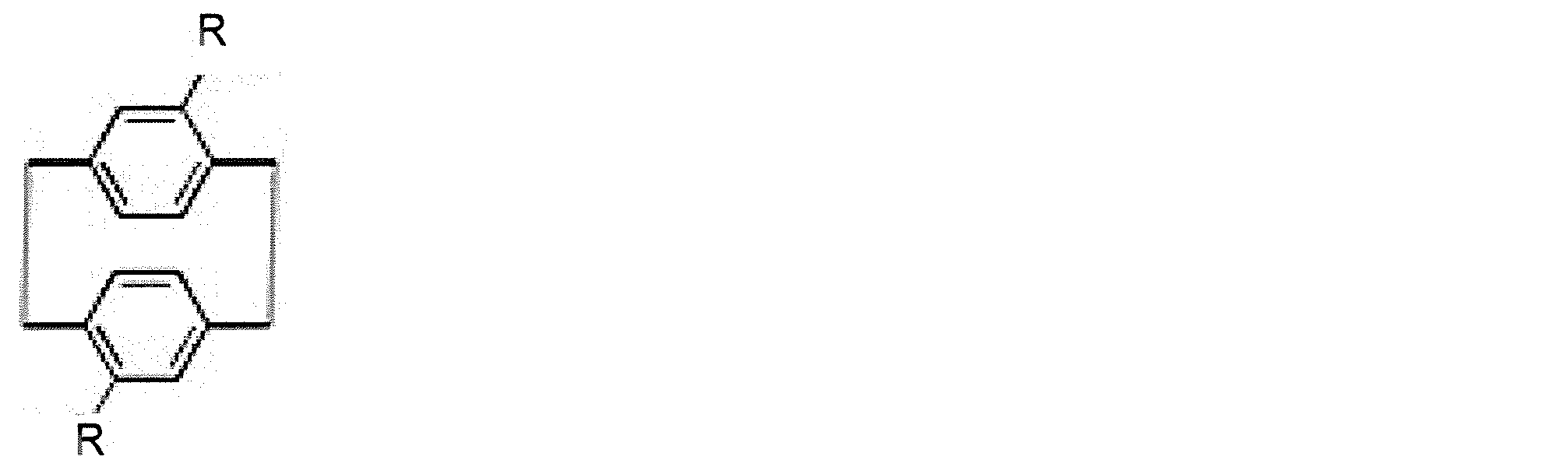
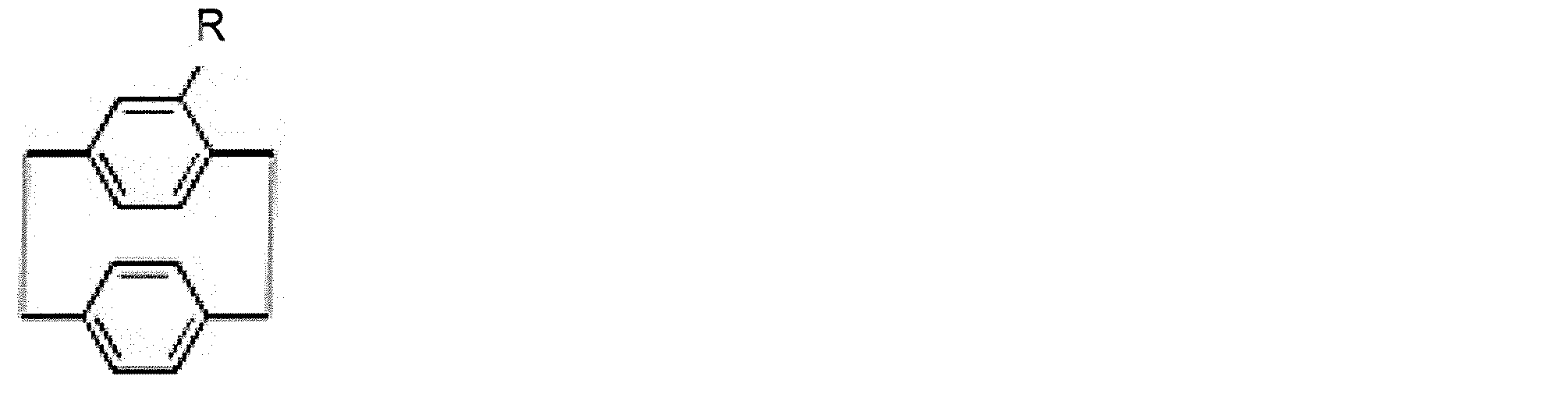
極性基としては、上記Rが、CN、COOR1(R1はCH3又はCH2CH3を表す)、CONR2R3(R2、R3は、それぞれH又はCH3又はCH2CH3を表す。R2、R3は同一であっても異なっていてもよい)などが挙げられる。特にRがCNのシアノ基が好ましい。
上記シクロファン化合物のうち下記の構造式を有するものシクロファン化合物が特に好ましい。


最初に本発明に使用するシクロファン化合物の合成例を記載する。
合成例1
Pseudo-meta-dibromo[2.2]paracyclophane (化合物1)、Pseudo-para-dibromo[2.2]paracyclophane (化合物2)の合成
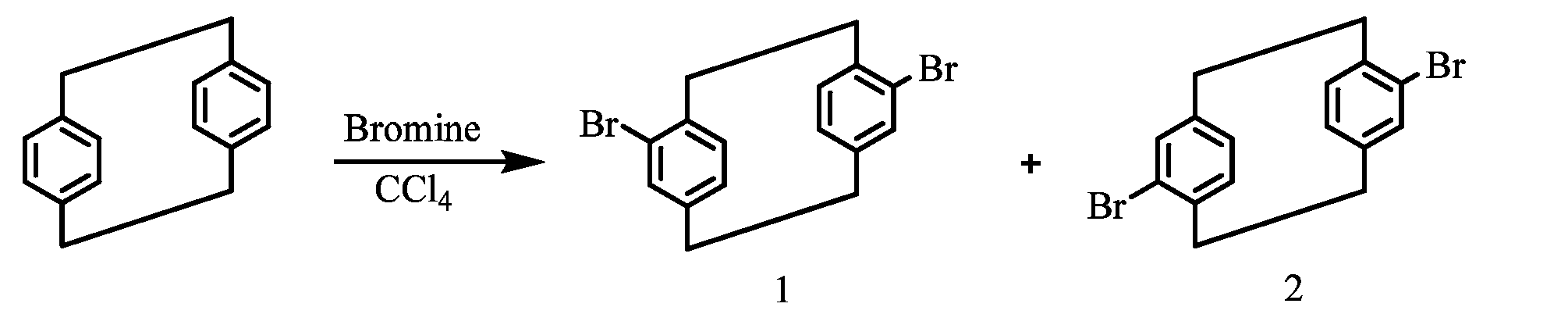
ドラフト内、大気下で次の操作を行った。[2.2]Paracyclophane 600 mg(2.88 mmol)にCCl4 8.2 mLを加え55 ℃で撹拌する。液化漏斗で臭素 0.9 mL(17.5 mmol)、四塩化炭素 1.0 mLの混合溶液をゆっくり滴下し、55 ℃で2時間撹拌した。放冷し、飽和Na2SO3水溶液を加え、ジクロロメタンで抽出し3回分液を行った。それをMgSO4で脱水し、減圧濃縮した。得られた固体をジエチルエーテルでろ過し、得られた個体を減圧乾燥した。ヘキサンを用いてシリカゲルクロマトグラフィーを行い、これを減圧濃縮した。得られた固体を再度ジエチルエーテルでろ過し、得られた個体を減圧乾燥し白色固体の化合物2を得た。
ろ液を減圧濃縮し、n-ヘキサンを用いてシリカゲルクロマトグラフィーを行い、これを減圧濃縮し白色固体の化合物1を得た。
Pseudo-meta-dibromo[2.2]paracyclophane (化合物1)、Pseudo-para-dibromo[2.2]paracyclophane (化合物2)の合成
ろ液を減圧濃縮し、n-ヘキサンを用いてシリカゲルクロマトグラフィーを行い、これを減圧濃縮し白色固体の化合物1を得た。
Pseudo-meta-dibromo[2.2]paracyclophane (化合物1)
Yield 0.42 g (40.3 %)
1H-NMR(CDCl3, 400.13 MHz) : δ = 7.16 (d, J = 7.6 Hz, 2H, ArH), 6.58 (d, J = 2.0 Hz, 2H, ArH), 6.47 (dd, J = 2.0 Hz, 8.0 Hz, 2H, ArH), 3.34-3.27 (m, 2H, -CH2-), 3.10-3.02 (m, 2H, -CH2-), 2.94-2.87 (m, 4H, -CH2-); Crude (化合物1: 化合物2 = 10 : 1)
Yield 0.42 g (40.3 %)
1H-NMR(CDCl3, 400.13 MHz) : δ = 7.16 (d, J = 7.6 Hz, 2H, ArH), 6.58 (d, J = 2.0 Hz, 2H, ArH), 6.47 (dd, J = 2.0 Hz, 8.0 Hz, 2H, ArH), 3.34-3.27 (m, 2H, -CH2-), 3.10-3.02 (m, 2H, -CH2-), 2.94-2.87 (m, 4H, -CH2-); Crude (化合物1: 化合物2 = 10 : 1)
Pseudo-para-dibromo[2.2]paracyclophane(化合物2)
Yield 0.22 g (20.9 %)
1H-NMR(CDCl3, 400.13 MHz) : δ = 7.14 (dd, J = 2.0 Hz, 8.0 Hz, 2H, ArH), 6.51 (d, J = 2.0 Hz, 2H, ArH), 6.44 (d, J = 7.6 Hz, 2H, ArH), 3.52-3.46 (m, 2H, -CH2-), 3.19-3.12 (m, 2H, -CH2-), 2.98-2.81 (m, 4H, -CH2-)
Yield 0.22 g (20.9 %)
1H-NMR(CDCl3, 400.13 MHz) : δ = 7.14 (dd, J = 2.0 Hz, 8.0 Hz, 2H, ArH), 6.51 (d, J = 2.0 Hz, 2H, ArH), 6.44 (d, J = 7.6 Hz, 2H, ArH), 3.52-3.46 (m, 2H, -CH2-), 3.19-3.12 (m, 2H, -CH2-), 2.98-2.81 (m, 4H, -CH2-)
合成例2
Pseudo-meta-dicyano[2.2]paracyclophane (化合物3)の合成
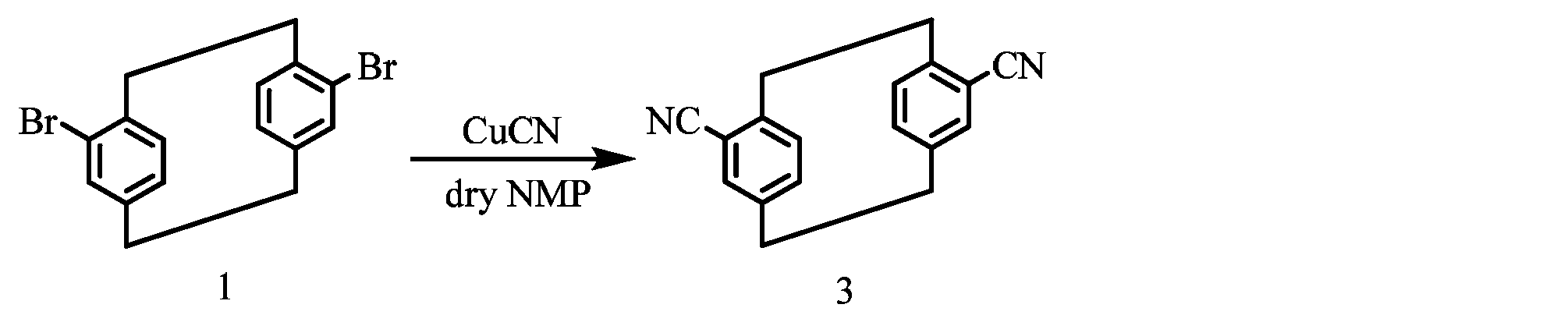
ドラフト内、Ar気流下で次の操作を行った。化合物1 425 mg(1.16 mmol)、CuCN 1.04 g(10.2mmol)にdry N-メチルピロリドン3.6 mLを加え215 ℃で20時間撹拌した。放冷し、20 %NH3水溶液を5 mL加えCH2Cl2で抽出し3回分液を行った。それをMgSO4で脱水し、減圧濃縮した。ジクロロメタン : n-ヘキサン = 2:1の混合溶媒を用いシリカゲルクロマトグラフィーを行い、これを減圧濃縮し白色固体の化合物3を得た。
Pseudo-meta-dicyano[2.2]paracyclophane (化合物3)の合成
Pseudo-meta-dicyano[2.2]paracyclophane (化合物3)
Yield 0.14 g (46.7 %)
1H-NMR(CDCl3, 400.13 MHz) : δ = 7.05 (d, J = 8.0 Hz, 2H, ArH), 6.81 (d, J = 2.0 Hz, 2H, ArH), 6.75 (dd, J = 2.0 Hz, 8.0 Hz, 2H, ArH), 3.60-3.53 (m, 2H, -CH2-), 3.34-3.06 (m, 6H, -CH2-) ; Crude (compound 3: compound 4 = 10 : 1) ; 13C-NMR (CDCl3, 100.61 MHz) : δ = 144.2, 141.4, 137.0, 132.7, 118.8, 116.1, 35.2, 33.4
FT-IR : 2218.14 cm-1 (ν: -CN)
Yield 0.14 g (46.7 %)
1H-NMR(CDCl3, 400.13 MHz) : δ = 7.05 (d, J = 8.0 Hz, 2H, ArH), 6.81 (d, J = 2.0 Hz, 2H, ArH), 6.75 (dd, J = 2.0 Hz, 8.0 Hz, 2H, ArH), 3.60-3.53 (m, 2H, -CH2-), 3.34-3.06 (m, 6H, -CH2-) ; Crude (compound 3: compound 4 = 10 : 1) ; 13C-NMR (CDCl3, 100.61 MHz) : δ = 144.2, 141.4, 137.0, 132.7, 118.8, 116.1, 35.2, 33.4
FT-IR : 2218.14 cm-1 (ν: -CN)
合成例3
Pseudo-para-dicyano[2.2]paracyclophane (化合物4)、Pseudo-ortho-dicyano[2.2]paracyclophane(化合物5)の合成

ドラフト内、Ar気流下で次の操作を行った。化合物2 100 mg(0.27 mmol)、CuCN 245 mg(2.73mmol)にdry NMP3.0 mLを加え215 ℃で20時間撹拌した。放冷し、20 %NH3水溶液を5 mL加えCH2Cl2で抽出し3回分液を行った。それをMgSO4で脱水し、減圧濃縮した。ジクロロメタン : n-ヘキサン = 2:1の混合溶媒を用いシリカゲルクロマトグラフィーを行い、これを減圧濃縮し白色固体の化合物4、化合物5を得た。
Pseudo-para-dicyano[2.2]paracyclophane (化合物4)、Pseudo-ortho-dicyano[2.2]paracyclophane(化合物5)の合成
Pseudo-para-dicyano[2.2]paracyclophane (化合物4)
Yield 0.02 g (29.7 %)
1H-NMR(CDCl3, 400.13 MHz) : δ = 7.15 (dd, J = 2.0 Hz, 8.0 Hz, 2H, ArH), 6.80 (d, J = 2.0 Hz, 2H, ArH), 6.64 (d, J = 8.0 Hz, 2H, ArH), 3.61-3.53 (m, 2H, -CH2-), 3.37-3.28 (m, 2H, -CH2-), 3.19-3.07 (m, 4H, -CH2-) ; 13C-NMR (CDCl3, 100.61 MHz) : δ =144.5, 140.9, 137.6, 135.4, 134.5, 118.9, 115.6, 34.3, 34.2
FT-IR : 2216.21 cm-1 (ν: -CN)
Yield 0.02 g (29.7 %)
1H-NMR(CDCl3, 400.13 MHz) : δ = 7.15 (dd, J = 2.0 Hz, 8.0 Hz, 2H, ArH), 6.80 (d, J = 2.0 Hz, 2H, ArH), 6.64 (d, J = 8.0 Hz, 2H, ArH), 3.61-3.53 (m, 2H, -CH2-), 3.37-3.28 (m, 2H, -CH2-), 3.19-3.07 (m, 4H, -CH2-) ; 13C-NMR (CDCl3, 100.61 MHz) : δ =144.5, 140.9, 137.6, 135.4, 134.5, 118.9, 115.6, 34.3, 34.2
FT-IR : 2216.21 cm-1 (ν: -CN)
Pseudo-ortho-dicyano[2.2]paracyclophane (化合物5)
Yield 0.01 g (17.0 %)
1H-NMR(CDCl3, 400.13 MHz) : δ = 7.17 (d, J = 2.0 Hz, 2H, ArH), 6.78 (dd, J = 1.6 Hz, 8.0 Hz, 2H, ArH), 6.67 (d, J = 8.0 Hz, 2H, ArH), 3.63-3.56 (m, 2H, -CH2-), 3.32-3.17 (m, 2H, -CH2-), 3.09-3.02 (m, 4H, -CH2-)
FT-IR : 2218.14 cm-1 (ν: -CN)
Yield 0.01 g (17.0 %)
1H-NMR(CDCl3, 400.13 MHz) : δ = 7.17 (d, J = 2.0 Hz, 2H, ArH), 6.78 (dd, J = 1.6 Hz, 8.0 Hz, 2H, ArH), 6.67 (d, J = 8.0 Hz, 2H, ArH), 3.63-3.56 (m, 2H, -CH2-), 3.32-3.17 (m, 2H, -CH2-), 3.09-3.02 (m, 4H, -CH2-)
FT-IR : 2218.14 cm-1 (ν: -CN)
合成例4
4-Bromo[2.2]paracyclophane (化合物6)の合成

ドラフト内、大気下で次の操作を行った。Iron powder 15 mg (0.27 mmol)にBromine 250 μL (4.80 mmol)とCCl4 7.5 mLの混合溶液を液化漏斗で1 mL加え15分撹拌した。そこに、CH2Cl2 20 mLと[2.2]paracyclophane 1.0 g (4.8 mmol)加え、残りの混合溶液を液化漏斗で少量ずつ加え2時間撹拌した。その後、飽和Na2SO3水溶液を加え、CH2Cl2で抽出し3回分液を行った。それをMgSO4で脱水し、減圧濃縮した。n-ヘキサンを用いてシリカゲルクロマトグラフィーを行い、これを減圧濃縮し白色固体の化合物6を得た。
4-Bromo[2.2]paracyclophane (化合物6)の合成
4-Bromo[2.2]paracyclophane (化合物6)
Yield 1.20 g (86 %)
1H-NMR (CDCl3, 400.13 MHz) : δ = 7.16 (dd, J = 1.6 Hz, 7.6 Hz, 1H, ArH), 6.56 (dd, J = 1.6 Hz, 7.6 Hz, 1H, ArH), 6.52 (d, J = 7.62 Hz, 1H, ArH), 6.53- 6.46 (m, 3H,ArH), 6.44 (s, 1H, ArH), 3.49- 3.42 (m, 1H, -CH2-), 3.23- 3.16 (m, 1H, -CH2-), 3.09- 3.03 (m, 4H, -CH2-), 2.93- 2.78 (m, 2H, -CH2-)
Yield 1.20 g (86 %)
1H-NMR (CDCl3, 400.13 MHz) : δ = 7.16 (dd, J = 1.6 Hz, 7.6 Hz, 1H, ArH), 6.56 (dd, J = 1.6 Hz, 7.6 Hz, 1H, ArH), 6.52 (d, J = 7.62 Hz, 1H, ArH), 6.53- 6.46 (m, 3H,ArH), 6.44 (s, 1H, ArH), 3.49- 3.42 (m, 1H, -CH2-), 3.23- 3.16 (m, 1H, -CH2-), 3.09- 3.03 (m, 4H, -CH2-), 2.93- 2.78 (m, 2H, -CH2-)
合成例5
4-Cyano[2.2]paracyclophane (化合物7)の合成
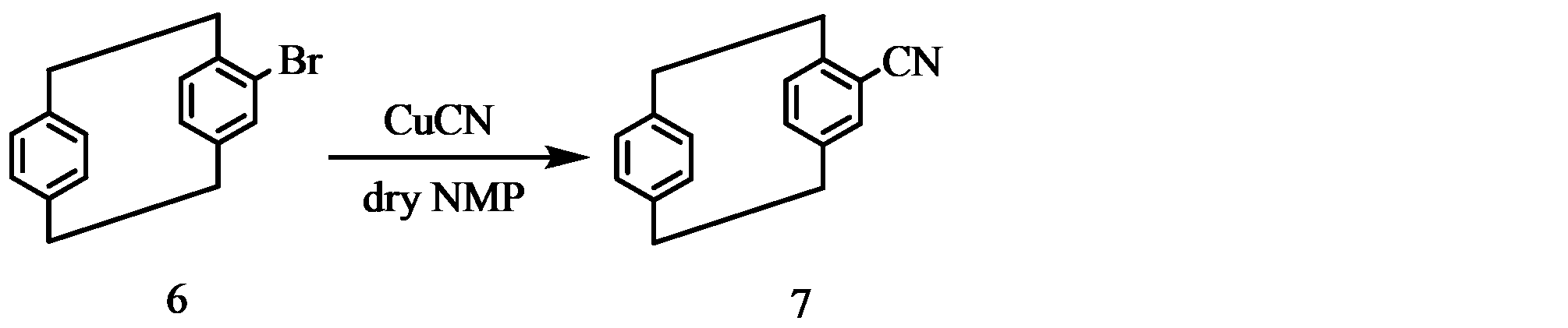
ドラフト内、窒素気流下で次の操作を行った。化合物6 0.25 g (8.70×10⁻⁴ mol)にdry NMP 3 mLを加え、15分撹拌した。そこに、CuCN 0.10 g (4.80×10⁻⁴ mol)を加え、215℃で20時間撹拌した。その後、20 % NH3水溶液を加え、CH2Cl2で抽出し3回分液を行った。それをMgSO4で脱水し、減圧濃縮した。シリカゲルクロマトグラフィー(CH2Cl2 : Hexane = 1 : 1)を行い、これを減圧濃縮した。得られた固体を昇華精製し(120℃、1.3 Pa)、白色固体の化合物7を得た。
4-Cyano[2.2]paracyclophane (化合物7)の合成
4-Cyano[2.2]paracyclophane (化合物7)
Yield 0.10 g (50.2 %)
1H-NMR (CDCl3, 400.13 MHz) : δ = 6.90 (d, J = 8.4 Hz, 1H, ArH), 6.75 (d, J = 2.0 Hz, 1H, ArH), 6.52 (dd, J = 1.6 Hz, 8.0 Hz, 1H, ArH), 6.57 (d, J = 8.0 Hz, 1H, ArH), 6.52 (t, J = 1.2 Hz, 2H, ArH), 6.48 (d, J = 7.6 Hz, 1H, ArH), 3.54- 3.47 (m, 1H, -CH2-), 3.32- 3.26 (m, 1H, -CH2-), 3.16- 2.99 (m, 6H, -CH2-)
13C-NMR (CDCl3, 100.61 MHz) : δ = 143.2, 139.9, 138.5, 138.0, 136.1, 135.7, 133.5, 132.5, 131.8, 131.6, 129.9, 117.9, 113.8, 34.3, 34.0, 33.4, 33.2
FT-IR : 2220.07 cm-1 (ν : -CN)
Yield 0.10 g (50.2 %)
1H-NMR (CDCl3, 400.13 MHz) : δ = 6.90 (d, J = 8.4 Hz, 1H, ArH), 6.75 (d, J = 2.0 Hz, 1H, ArH), 6.52 (dd, J = 1.6 Hz, 8.0 Hz, 1H, ArH), 6.57 (d, J = 8.0 Hz, 1H, ArH), 6.52 (t, J = 1.2 Hz, 2H, ArH), 6.48 (d, J = 7.6 Hz, 1H, ArH), 3.54- 3.47 (m, 1H, -CH2-), 3.32- 3.26 (m, 1H, -CH2-), 3.16- 2.99 (m, 6H, -CH2-)
13C-NMR (CDCl3, 100.61 MHz) : δ = 143.2, 139.9, 138.5, 138.0, 136.1, 135.7, 133.5, 132.5, 131.8, 131.6, 129.9, 117.9, 113.8, 34.3, 34.0, 33.4, 33.2
FT-IR : 2220.07 cm-1 (ν : -CN)
次に本発明のパリレン透水膜の製造について記載する。
実施例1
多孔質支持膜(アイソポア、メルクミルポア社製)をイオン性液体(N-Methyl-N-butylpyrrolidinium bis(trifluoromethanesulfonyl)imide)に浸し、多孔質膜内の細孔にイオン性液体を充填した。充填率は重量変化によって追跡を行い、各多孔質支持膜内に同等重量のイオン性液体が充填されていることを確認し、イオン性液体を含む多孔質支持膜をパリレンコーティング装置内のチャンバー内に静置した。日本パリレン社製パリレンコーティング装置内の気化部に合成例5で得られた4-Cyano[2.2]paracyclophane(化合物7)150mgを入れ、減圧下で加熱し昇華させる。昇華した気体は690℃熱分解炉を通過する際に熱分解されモノマー状態になる。モノマーは蒸着チャンバー内に導かれ、チャンバー内に置かれた多孔質支持膜表面で重合し表面に薄膜を形成した。得られたパリレン膜をコーティングした多孔質支持膜は、メタノール中に浸漬し多孔質膜内の細孔内のイオン性液体を除去した。その後、真空乾燥しパリレン透水膜を得た。
これにより、精密ろ過膜(孔径 210nm 膜厚 20μm)上にパリレン透水膜が蒸着された複合膜を得た。
多孔質支持膜(アイソポア、メルクミルポア社製)をイオン性液体(N-Methyl-N-butylpyrrolidinium bis(trifluoromethanesulfonyl)imide)に浸し、多孔質膜内の細孔にイオン性液体を充填した。充填率は重量変化によって追跡を行い、各多孔質支持膜内に同等重量のイオン性液体が充填されていることを確認し、イオン性液体を含む多孔質支持膜をパリレンコーティング装置内のチャンバー内に静置した。日本パリレン社製パリレンコーティング装置内の気化部に合成例5で得られた4-Cyano[2.2]paracyclophane(化合物7)150mgを入れ、減圧下で加熱し昇華させる。昇華した気体は690℃熱分解炉を通過する際に熱分解されモノマー状態になる。モノマーは蒸着チャンバー内に導かれ、チャンバー内に置かれた多孔質支持膜表面で重合し表面に薄膜を形成した。得られたパリレン膜をコーティングした多孔質支持膜は、メタノール中に浸漬し多孔質膜内の細孔内のイオン性液体を除去した。その後、真空乾燥しパリレン透水膜を得た。
これにより、精密ろ過膜(孔径 210nm 膜厚 20μm)上にパリレン透水膜が蒸着された複合膜を得た。
実施例2
熱分解温度を650℃にした以外は実施例1と同様の方法にてパリレン透水膜と精密ろ過膜との複合膜を製造した。
熱分解温度を650℃にした以外は実施例1と同様の方法にてパリレン透水膜と精密ろ過膜との複合膜を製造した。
実施例3
熱分解温度を600℃にした以外は実施例1と同様の方法にてパリレン透水膜と精密ろ過膜との複合膜を製造した。
熱分解温度を600℃にした以外は実施例1と同様の方法にてパリレン透水膜と精密ろ過膜との複合膜を製造した。
実施例4
多孔質支持膜(アイソポア、メルクミルポア社製)をイオン性液体(N-Methyl-N-butylpyrrolidinium bis(trifluoromethanesulfonyl)imide)に浸し、多孔質膜内の細孔にイオン性液体を充填した。充填率は重量変化によって追跡を行い、各多孔質支持膜内に同等重量のイオン性液体が充填されていることを確認し、イオン性液体を含む多孔質支持膜をパリレンコーティング装置内のチャンバー内に静置した。日本パリレン社製パリレンコーティング装置内の気化部に合成例2で得られたPseudo-meta-dicyano[2.2]paracyclophane(化合物3)150mgを入れ、減圧下で加熱し昇華させる。昇華した気体は650℃熱分解炉を通過する際に熱分解されモノマー状態になる。モノマーは蒸着チャンバー内に導かれ、チャンバー内に置かれた多孔質支持膜表面で重合し表面に薄膜を形成した。得られたパリレン膜をコーティングした多孔質支持膜は、メタノール中に浸漬し多孔質膜内の細孔内のイオン性液体を除去した。その後、真空乾燥しパリレン透水膜を得た。
これにより、精密ろ過膜(孔径 210nm 膜厚 20μm)上にパリレン透水膜が蒸着された複合膜を得た。
多孔質支持膜(アイソポア、メルクミルポア社製)をイオン性液体(N-Methyl-N-butylpyrrolidinium bis(trifluoromethanesulfonyl)imide)に浸し、多孔質膜内の細孔にイオン性液体を充填した。充填率は重量変化によって追跡を行い、各多孔質支持膜内に同等重量のイオン性液体が充填されていることを確認し、イオン性液体を含む多孔質支持膜をパリレンコーティング装置内のチャンバー内に静置した。日本パリレン社製パリレンコーティング装置内の気化部に合成例2で得られたPseudo-meta-dicyano[2.2]paracyclophane(化合物3)150mgを入れ、減圧下で加熱し昇華させる。昇華した気体は650℃熱分解炉を通過する際に熱分解されモノマー状態になる。モノマーは蒸着チャンバー内に導かれ、チャンバー内に置かれた多孔質支持膜表面で重合し表面に薄膜を形成した。得られたパリレン膜をコーティングした多孔質支持膜は、メタノール中に浸漬し多孔質膜内の細孔内のイオン性液体を除去した。その後、真空乾燥しパリレン透水膜を得た。
これにより、精密ろ過膜(孔径 210nm 膜厚 20μm)上にパリレン透水膜が蒸着された複合膜を得た。
実施例5
多孔質支持膜(アイソポア、メルクミルポア社製)をイオン性液体(N-Methyl-N-butylpyrrolidinium bis(trifluoromethanesulfonyl)imide)に浸し、多孔質膜内の細孔にイオン性液体を充填した。充填率は重量変化によって追跡を行い、各多孔質支持膜内に同等重量のイオン性液体が充填されていることを確認し、イオン性液体を含む多孔質支持膜をパリレンコーティング装置内のチャンバー内に静置した。日本パリレン社製パリレンコーティング装置内の気化部に合成例3で得られたPseudo-para-dicyano[2.2]paracyclophane (化合物4) 150mgを入れ、減圧下で加熱し昇華させる。昇華した気体は650℃熱分解炉を通過する際に熱分解されモノマー状態になる。モノマーは蒸着チャンバー内に導かれ、チャンバー内に置かれた多孔質支持膜表面で重合し表面に薄膜を形成した。得られたパリレン膜をコーティングした多孔質支持膜は、メタノール中に浸漬し多孔質膜内の細孔内のイオン性液体を除去した。その後、真空乾燥しパリレン透水膜を得た。
これにより、精密ろ過膜(孔径 210nm 膜厚 20μm)上にパリレン透水膜が蒸着された複合膜を得た。
多孔質支持膜(アイソポア、メルクミルポア社製)をイオン性液体(N-Methyl-N-butylpyrrolidinium bis(trifluoromethanesulfonyl)imide)に浸し、多孔質膜内の細孔にイオン性液体を充填した。充填率は重量変化によって追跡を行い、各多孔質支持膜内に同等重量のイオン性液体が充填されていることを確認し、イオン性液体を含む多孔質支持膜をパリレンコーティング装置内のチャンバー内に静置した。日本パリレン社製パリレンコーティング装置内の気化部に合成例3で得られたPseudo-para-dicyano[2.2]paracyclophane (化合物4) 150mgを入れ、減圧下で加熱し昇華させる。昇華した気体は650℃熱分解炉を通過する際に熱分解されモノマー状態になる。モノマーは蒸着チャンバー内に導かれ、チャンバー内に置かれた多孔質支持膜表面で重合し表面に薄膜を形成した。得られたパリレン膜をコーティングした多孔質支持膜は、メタノール中に浸漬し多孔質膜内の細孔内のイオン性液体を除去した。その後、真空乾燥しパリレン透水膜を得た。
これにより、精密ろ過膜(孔径 210nm 膜厚 20μm)上にパリレン透水膜が蒸着された複合膜を得た。
実施例6
日本合成化学社製ポリビニルアルコールフィルム(ハイセロンM)をパリレンコーティング装置内のチャンバー内に静置した。日本パリレン社製パリレンコーティング装置内の気化部に合成例5で得られた4-Cyano[2.2]paracyclophane(化合物7)150mgを入れ、減圧下で加熱し昇華させる。昇華した気体は650℃熱分解炉を通過する際に熱分解されモノマー状態になる。モノマーは蒸着チャンバー内に導かれ、チャンバー内に置かれたポリビニルアルコールフィルム表面で重合し表面に薄膜を形成した。
これにより、ポリビニルアルコールフィルム(面積5x5cm、膜厚20μm)上にパリレン透水膜が蒸着されたポリビニルアルコールフィルムを得た。
得られたパリレン透水膜付きポリビニルアルコールフィルムを40℃の温水中に浸漬することによって、ポリビニルアルコールフィルム部のみを溶かしだしパリレン膜を剥がし、多孔質支持膜(デュラポア、メルクミルポア社製)に移しとることによって複合膜を得た。
日本合成化学社製ポリビニルアルコールフィルム(ハイセロンM)をパリレンコーティング装置内のチャンバー内に静置した。日本パリレン社製パリレンコーティング装置内の気化部に合成例5で得られた4-Cyano[2.2]paracyclophane(化合物7)150mgを入れ、減圧下で加熱し昇華させる。昇華した気体は650℃熱分解炉を通過する際に熱分解されモノマー状態になる。モノマーは蒸着チャンバー内に導かれ、チャンバー内に置かれたポリビニルアルコールフィルム表面で重合し表面に薄膜を形成した。
これにより、ポリビニルアルコールフィルム(面積5x5cm、膜厚20μm)上にパリレン透水膜が蒸着されたポリビニルアルコールフィルムを得た。
得られたパリレン透水膜付きポリビニルアルコールフィルムを40℃の温水中に浸漬することによって、ポリビニルアルコールフィルム部のみを溶かしだしパリレン膜を剥がし、多孔質支持膜(デュラポア、メルクミルポア社製)に移しとることによって複合膜を得た。
実施例7
日本合成化学社製ポリビニルアルコールフィルム(ハイセロンM)をパリレンコーティング装置内のチャンバー内に静置した。日本パリレン社製パリレンコーティング装置内の気化部に合成例5で得られた4-Cyano[2.2]paracyclophane(化合物7)150mgを入れ、減圧下で加熱し昇華させる。昇華した気体は650℃熱分解炉を通過する際に熱分解されモノマー状態になる。モノマーは蒸着チャンバー内に導かれ、チャンバー内に置かれたポリビニルアルコールフィルム表面で重合し表面に薄膜を形成した。
これにより、ポリビニルアルコールフィルム(面積5x5cm、膜厚20μm)上にパリレン透水膜が蒸着されたポリビニルアルコールフィルムを得た。
得られたパリレン透水膜付きポリビニルアルコールフィルムを多孔質支持膜(デュラポア、メルクミルポア社製)に密着させ、上部より水を透過させることによりポリビニルアルコールフィルムを溶かし出すことによって複合膜を得た。
日本合成化学社製ポリビニルアルコールフィルム(ハイセロンM)をパリレンコーティング装置内のチャンバー内に静置した。日本パリレン社製パリレンコーティング装置内の気化部に合成例5で得られた4-Cyano[2.2]paracyclophane(化合物7)150mgを入れ、減圧下で加熱し昇華させる。昇華した気体は650℃熱分解炉を通過する際に熱分解されモノマー状態になる。モノマーは蒸着チャンバー内に導かれ、チャンバー内に置かれたポリビニルアルコールフィルム表面で重合し表面に薄膜を形成した。
これにより、ポリビニルアルコールフィルム(面積5x5cm、膜厚20μm)上にパリレン透水膜が蒸着されたポリビニルアルコールフィルムを得た。
得られたパリレン透水膜付きポリビニルアルコールフィルムを多孔質支持膜(デュラポア、メルクミルポア社製)に密着させ、上部より水を透過させることによりポリビニルアルコールフィルムを溶かし出すことによって複合膜を得た。
比較例
以下の構造を有する極性基を有しないシクロファン化合物を使用した以外は実施例1と同様の方法にてParylene C(ユニオンカーバイド社製)と精密ろ過膜との複合膜を製造した。
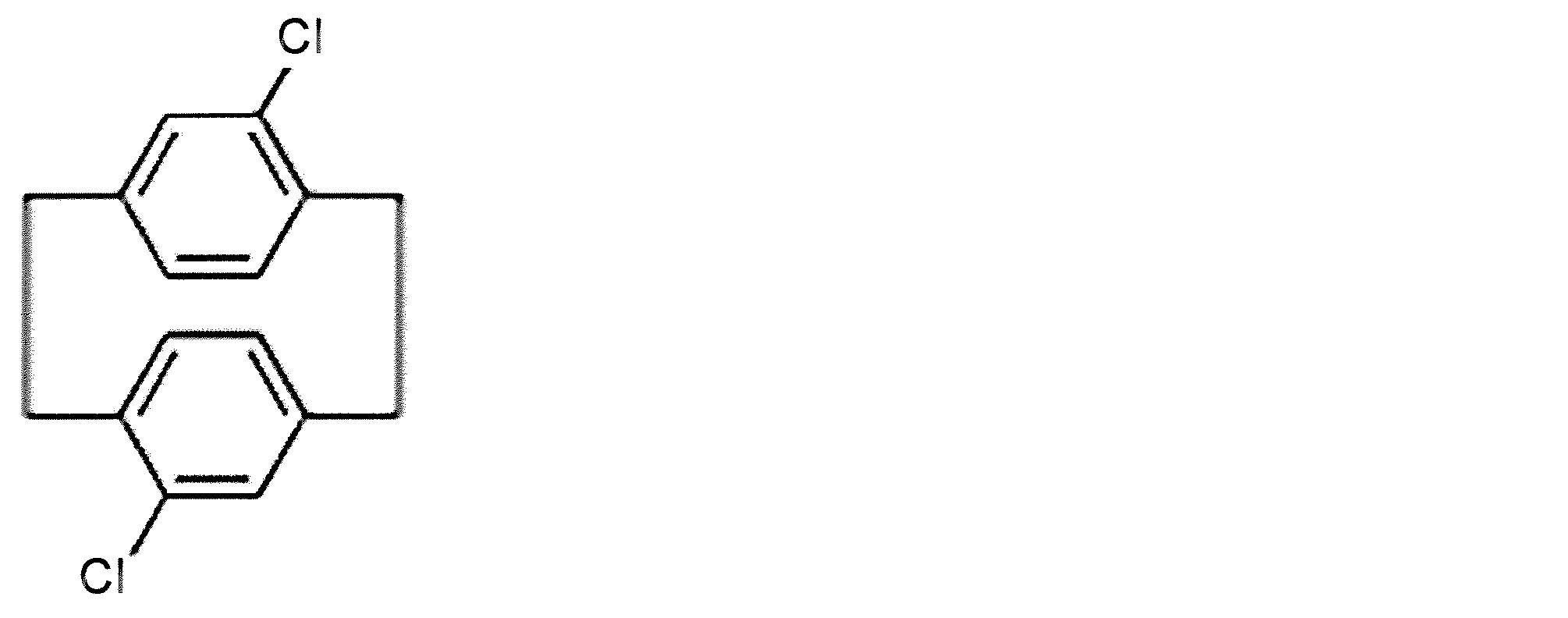
以下の構造を有する極性基を有しないシクロファン化合物を使用した以外は実施例1と同様の方法にてParylene C(ユニオンカーバイド社製)と精密ろ過膜との複合膜を製造した。
上記実施例1~7及び比較例の複合膜を使用して、以下の構造を有する染料(ローズベンガル)が溶解した水溶液から水の分離を行った。
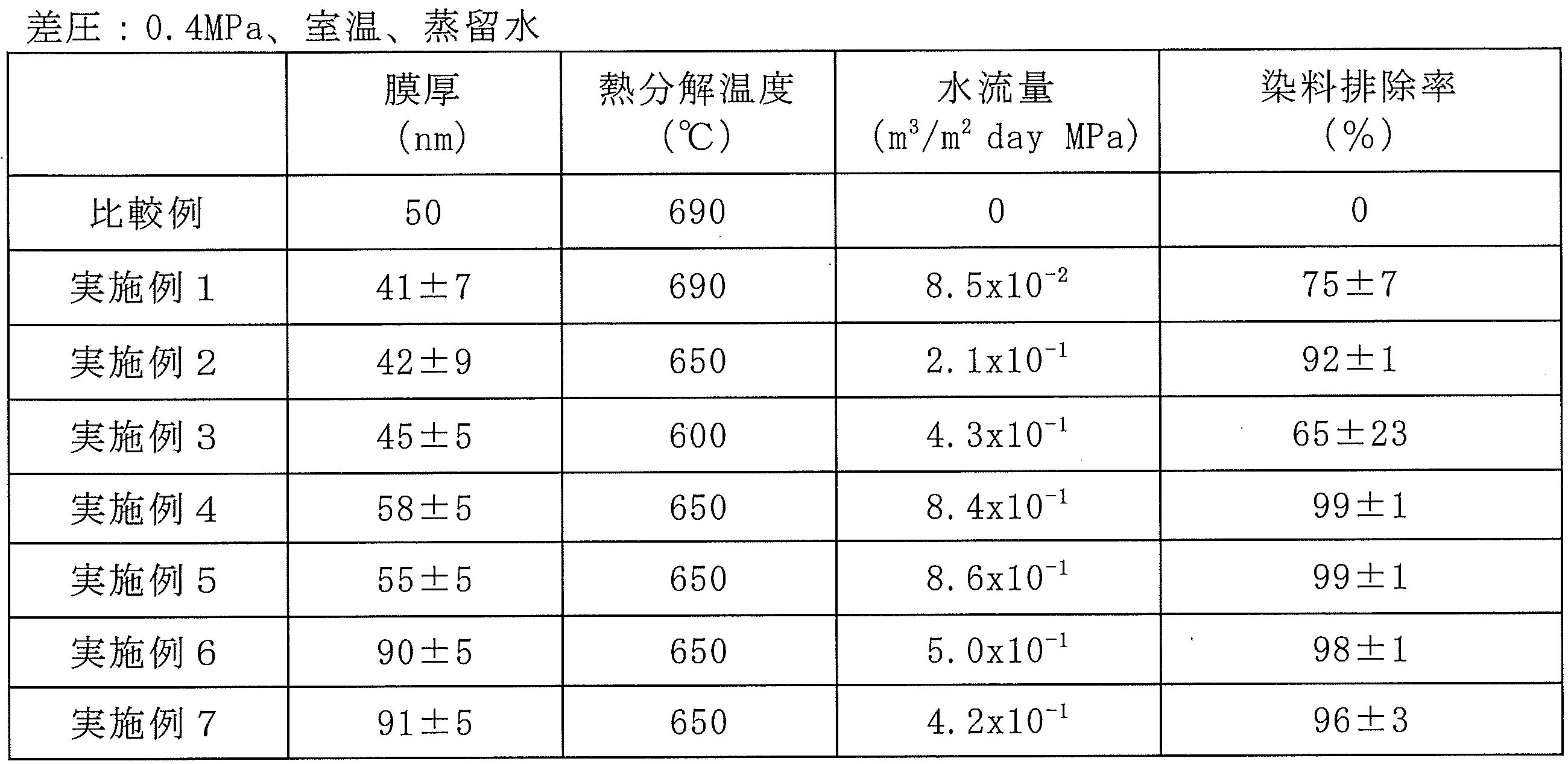
その結果を「表1」に示す。
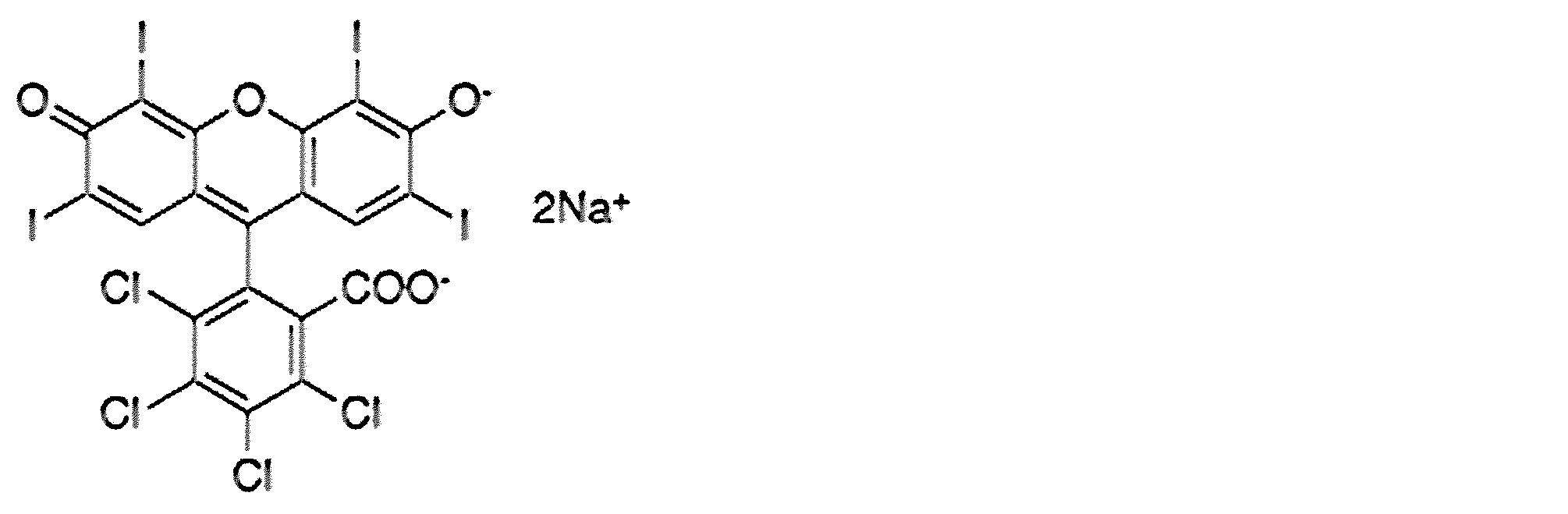
染料:ローズベンガル 濃度:10μM
「表1」の結果から、本発明のパリレン透水膜と精密ろ過膜との複合膜(実施例1~7)は、比較例の複合膜に比べ、水溶液中の染料を効率よく排除していることが理解できる。
また、パリレン透水膜の製造条件(熱分解温度)によって、複合膜の水流量並びに染料排除率を調整できることが理解できる。
また、パリレン透水膜の製造条件(熱分解温度)によって、複合膜の水流量並びに染料排除率を調整できることが理解できる。
実施例1の複合膜を使用して、各種染料が溶解した水溶液から水の分離を行った。その結果を「表2」に示す。「表2」の結果より、水溶液中のそれぞれの染料を効率良く排除していることが理解できる。

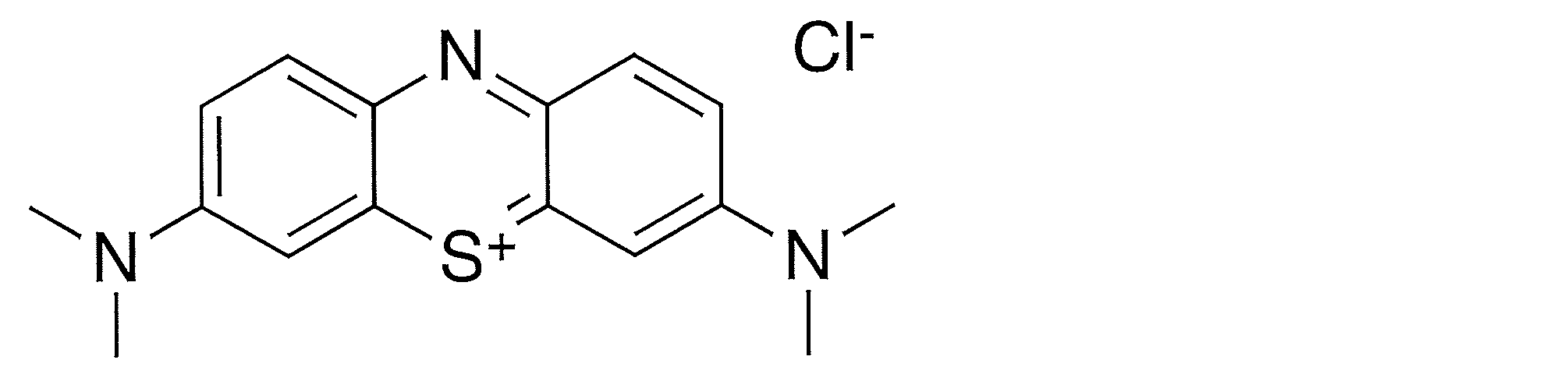
メチレンブルー 濃度:10μM

ローダミン6G 濃度:10μM
それぞれ、精密ろ過膜(孔径 210nm 膜厚 20μm)の表面に存在するパリレン透水膜の膜厚の異なる実施例1の複合膜を使用して、ローズベンガルが溶解した水溶液(濃度:10μM)から水の分離を行った。
その結果を「表3」示す。
「表3」結果より、パリレン透水膜の膜厚に依存することなく、優れた染料排除率を発揮することが理解できる。
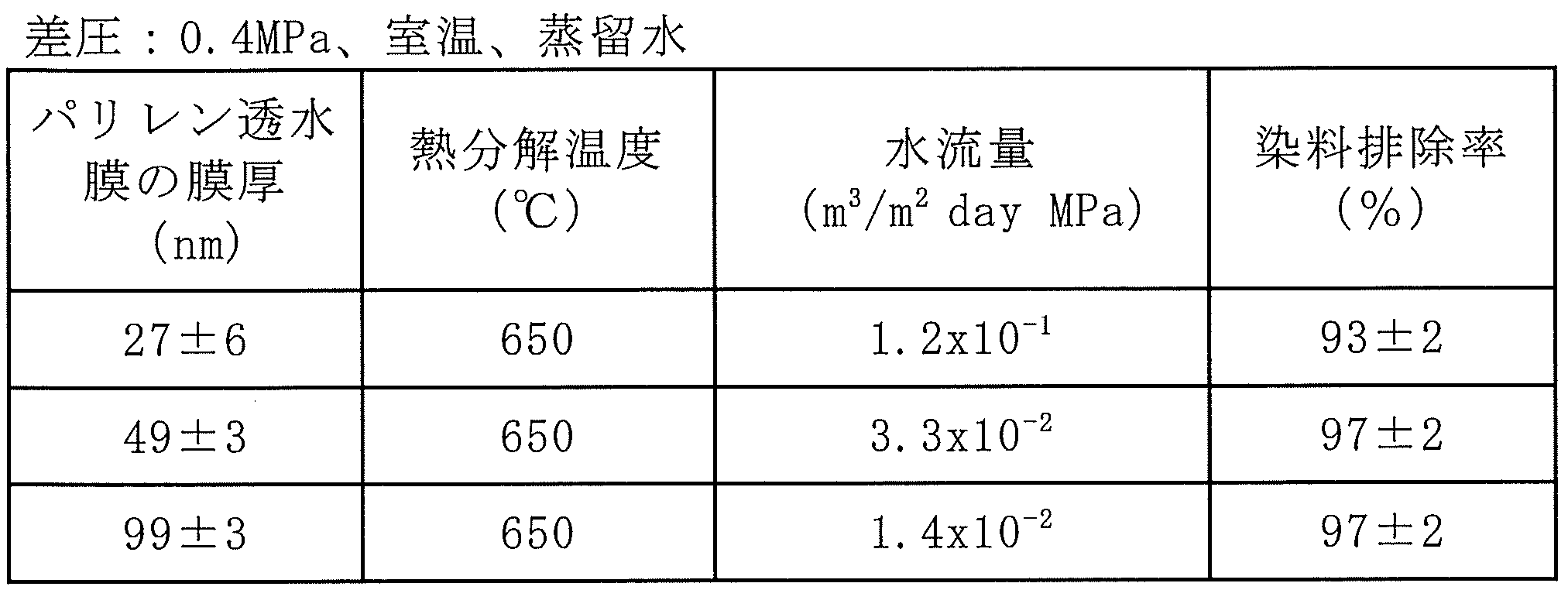
その結果を「表3」示す。
「表3」結果より、パリレン透水膜の膜厚に依存することなく、優れた染料排除率を発揮することが理解できる。
本発明によれば、パリレンからなる透水膜を提供できる。本発明は、パリレン膜は液体を通さないという常識に反する発明でありパリレン膜の新たな用途を提供する。例えば、水処理の技術分野においてナノフィルターとして利用できる。
Claims (12)
- 極性基を有することを特徴とするパリレン透水膜。
- 前記極性基がシアノ基であることを特徴とする請求項1記載のパリレン透水膜。
- 前記パリレン透水膜の孔径が0.1~10nmであることを特徴とする請求項1又は2記載のパリレン透水膜。
- 前記パリレン透水膜の膜厚が10nm~10μmであることを特徴とする請求項1~3の何れか1項記載のパリレン透水膜。
- 請求項1~請求項4の何れか1項記載のパリレン透水膜を有することを特徴とする複合膜。
- 請求項1~請求項4の何れか1項記載のパリレン透水膜又は請求項5記載の複合膜に、物質が溶解及び/又は分散した水を透過させて、水を分離することを特徴とする水の分離方法。
- CVD法による薄膜形成過程の際に蒸発せず、かつパリレンが蒸着可能な被蒸着液体若しくは高分子を含む多孔性支持体の表面に、前記CVD法によってパリレンを蒸着させることにより得られることを特徴とする請求項1~4の何れか1項記載のパリレン透水膜の製造方法。
- CVD法による薄膜形成過程の際に蒸発せず、かつパリレンが蒸着可能な被蒸着液体若しくは高分子を含む多孔性膜の表面に、前記CVD法によってパリレンを蒸着させることにより得られることを特徴とする請求項5記載の複合膜の製造方法。
- CVD法により、基板の表面にパリレンを蒸着させて得られるパリレン透水膜を基板から剥がし、これを多孔性膜の表面に貼り合わせて得られることを特徴とする請求項5記載の複合膜の製造方法。
- CVD法により、樹脂シートの表面にパリレンを蒸着させて得られるパリレン透水膜を有する樹脂シートを、多孔性膜の表面に貼り合わせ、次に、当該多孔性膜から前記樹脂シートを取り除いて得られることを特徴とする請求項5記載の複合膜の製造方法。
- 前記樹脂シートを多孔性膜から液体に溶解させて取り除くことを特徴とする請求項10記載の複合膜の製造方法。
- 前記樹脂シートが水溶性高分子であり、多孔性膜の表面に貼り合わせた樹脂シートを水又は水溶液に溶解させて取り除くことを特徴とする請求項10記載の複合膜の製造方法。
Priority Applications (1)
| Application Number | Priority Date | Filing Date | Title |
|---|---|---|---|
| JP2017500579A JP6381772B2 (ja) | 2015-02-19 | 2016-01-29 | パリレン透水膜及びその製造方法、水の分離方法 |
Applications Claiming Priority (2)
| Application Number | Priority Date | Filing Date | Title |
|---|---|---|---|
| JP2015030225 | 2015-02-19 | ||
| JP2015-030225 | 2015-02-19 |
Publications (1)
| Publication Number | Publication Date |
|---|---|
| WO2016132859A1 true WO2016132859A1 (ja) | 2016-08-25 |
Family
ID=56689322
Family Applications (1)
| Application Number | Title | Priority Date | Filing Date |
|---|---|---|---|
| PCT/JP2016/052615 Ceased WO2016132859A1 (ja) | 2015-02-19 | 2016-01-29 | パリレン透水膜及びその製造方法、水の分離方法 |
Country Status (2)
| Country | Link |
|---|---|
| JP (1) | JP6381772B2 (ja) |
| WO (1) | WO2016132859A1 (ja) |
Cited By (8)
| Publication number | Priority date | Publication date | Assignee | Title |
|---|---|---|---|---|
| JP2018131520A (ja) * | 2017-02-15 | 2018-08-23 | 国立大学法人信州大学 | 新規パリレン、架橋パリレン透水膜、及びこれらの製造方法 |
| WO2018237212A1 (en) * | 2017-06-22 | 2018-12-27 | The Procter & Gamble Company | FILMS COMPRISING A WATER-SOLUBLE LAYER AND AN ORGANIC COATING DEPOSITED IN STEAM PHASE |
| JP2019150778A (ja) * | 2018-03-05 | 2019-09-12 | Kisco株式会社 | アミド側鎖を有するパリレン膜 |
| JP2019150779A (ja) * | 2018-03-05 | 2019-09-12 | Kisco株式会社 | イミダゾール側鎖を有するパリレン膜 |
| US10450119B2 (en) | 2017-06-22 | 2019-10-22 | The Procter & Gamble Company | Films including a water-soluble layer and a vapor-deposited inorganic coating |
| US10604632B2 (en) | 2017-04-07 | 2020-03-31 | The Procter & Gamble Company | Water-soluble films |
| WO2020161254A1 (de) * | 2019-02-06 | 2020-08-13 | Fostag Formenbau Ag | Wasserlöslicher kunststoffartikel |
| JP2021530351A (ja) * | 2018-07-19 | 2021-11-11 | ダブリュ.エル.ゴア アンド アソシエイツ, インコーポレイティドW.L. Gore & Associates, Incorporated | 多孔質ポリパラキシリレン膜又は多孔質ポリパラキシリレン/ポリテトラフルオロエチレン複合膜を含むハイフロー液体ろ過デバイス |
Citations (6)
| Publication number | Priority date | Publication date | Assignee | Title |
|---|---|---|---|---|
| JPS6018749A (ja) * | 1983-07-11 | 1985-01-30 | Murata Mfg Co Ltd | 湿度センサ |
| JPH078725A (ja) * | 1993-06-23 | 1995-01-13 | Nippon Pariren Kk | フィルター |
| JP2001224680A (ja) * | 2000-02-17 | 2001-08-21 | Terumo Corp | 血液浄化用膜 |
| JP2008538509A (ja) * | 2005-04-21 | 2008-10-30 | カリフォルニア インスティチュート オブ テクノロジー | パリレンメンブレンフィルターの使用 |
| JP2012509966A (ja) * | 2008-11-26 | 2012-04-26 | 東レバッテリーセパレータフィルム合同会社 | 微多孔膜、かかるフィルムの製造方法、および電池セパレータフィルムとしてのかかるフィルムの使用 |
| US20130143326A1 (en) * | 2011-12-05 | 2013-06-06 | University Of Southern California | Ultrathin parylene-c semipermeable membranes for biomedical applications |
-
2016
- 2016-01-29 WO PCT/JP2016/052615 patent/WO2016132859A1/ja not_active Ceased
- 2016-01-29 JP JP2017500579A patent/JP6381772B2/ja active Active
Patent Citations (6)
| Publication number | Priority date | Publication date | Assignee | Title |
|---|---|---|---|---|
| JPS6018749A (ja) * | 1983-07-11 | 1985-01-30 | Murata Mfg Co Ltd | 湿度センサ |
| JPH078725A (ja) * | 1993-06-23 | 1995-01-13 | Nippon Pariren Kk | フィルター |
| JP2001224680A (ja) * | 2000-02-17 | 2001-08-21 | Terumo Corp | 血液浄化用膜 |
| JP2008538509A (ja) * | 2005-04-21 | 2008-10-30 | カリフォルニア インスティチュート オブ テクノロジー | パリレンメンブレンフィルターの使用 |
| JP2012509966A (ja) * | 2008-11-26 | 2012-04-26 | 東レバッテリーセパレータフィルム合同会社 | 微多孔膜、かかるフィルムの製造方法、および電池セパレータフィルムとしてのかかるフィルムの使用 |
| US20130143326A1 (en) * | 2011-12-05 | 2013-06-06 | University Of Southern California | Ultrathin parylene-c semipermeable membranes for biomedical applications |
Non-Patent Citations (2)
| Title |
|---|
| E. SACHER: "Water Permeation in Polymer Films. V. Parylene D", JOURNAL OF APPLIED POLYMER SCIENCE, vol. 28, no. 4, 1983, pages 1535 - 1536 * |
| P. R. MENON: "CHARACTERIZATION OF WATER VAPOR PERMEATION THROUGH THIN FILM PARYLENE C", TRANSDUCERS 2009 - 2009 INTERNATIONAL SOLID- STATE SENSORS, ACTUATORS AND MICROSYSTEMS CONFERENCE, vol. W3P.036, 2009, pages 1892 - 1895, XP031545598 * |
Cited By (16)
| Publication number | Priority date | Publication date | Assignee | Title |
|---|---|---|---|---|
| JP2018131520A (ja) * | 2017-02-15 | 2018-08-23 | 国立大学法人信州大学 | 新規パリレン、架橋パリレン透水膜、及びこれらの製造方法 |
| US10604632B2 (en) | 2017-04-07 | 2020-03-31 | The Procter & Gamble Company | Water-soluble films |
| US10604631B2 (en) | 2017-04-07 | 2020-03-31 | The Procter & Gamble Company | Water-soluble films |
| US11473190B2 (en) | 2017-06-22 | 2022-10-18 | The Procter & Gamble Company | Films including a water-soluble layer and a vapor-deposited inorganic coating |
| US10450119B2 (en) | 2017-06-22 | 2019-10-22 | The Procter & Gamble Company | Films including a water-soluble layer and a vapor-deposited inorganic coating |
| US11192139B2 (en) | 2017-06-22 | 2021-12-07 | The Procter & Gamble Company | Films including a water-soluble layer and a vapor-deposited organic coating |
| US11208246B2 (en) | 2017-06-22 | 2021-12-28 | The Procter & Gamble Company | Films including a water-soluble layer and a vapor-deposited inorganic coating |
| WO2018237212A1 (en) * | 2017-06-22 | 2018-12-27 | The Procter & Gamble Company | FILMS COMPRISING A WATER-SOLUBLE LAYER AND AN ORGANIC COATING DEPOSITED IN STEAM PHASE |
| US11738367B2 (en) | 2017-06-22 | 2023-08-29 | The Procter & Gamble Company | Films including a water-soluble layer and a vapor-deposited organic coating |
| JP2019150779A (ja) * | 2018-03-05 | 2019-09-12 | Kisco株式会社 | イミダゾール側鎖を有するパリレン膜 |
| JP2019150778A (ja) * | 2018-03-05 | 2019-09-12 | Kisco株式会社 | アミド側鎖を有するパリレン膜 |
| JP7105436B2 (ja) | 2018-03-05 | 2022-07-25 | Kisco株式会社 | イミダゾール側鎖を有するパリレン膜 |
| JP2021530351A (ja) * | 2018-07-19 | 2021-11-11 | ダブリュ.エル.ゴア アンド アソシエイツ, インコーポレイティドW.L. Gore & Associates, Incorporated | 多孔質ポリパラキシリレン膜又は多孔質ポリパラキシリレン/ポリテトラフルオロエチレン複合膜を含むハイフロー液体ろ過デバイス |
| JP7343567B2 (ja) | 2018-07-19 | 2023-09-12 | ダブリュ.エル.ゴア アンド アソシエイツ,インコーポレイティド | 多孔質ポリパラキシリレン膜又は多孔質ポリパラキシリレン/ポリテトラフルオロエチレン複合膜を含むハイフロー液体ろ過デバイス |
| US12090449B2 (en) | 2018-07-19 | 2024-09-17 | W. L. Gore & Associates, Inc. | High flow liquid filtration device including a porous polyparaxylylene membrane or a porous polyparaxylylene/polytetrafluoroethylene composite membrane |
| WO2020161254A1 (de) * | 2019-02-06 | 2020-08-13 | Fostag Formenbau Ag | Wasserlöslicher kunststoffartikel |
Also Published As
| Publication number | Publication date |
|---|---|
| JPWO2016132859A1 (ja) | 2018-02-01 |
| JP6381772B2 (ja) | 2018-09-05 |
Similar Documents
| Publication | Publication Date | Title |
|---|---|---|
| JP6381772B2 (ja) | パリレン透水膜及びその製造方法、水の分離方法 | |
| Su et al. | Facile fabrication of COF-LZU1/PES composite membrane via interfacial polymerization on microfiltration substrate for dye/salt separation | |
| KR101432218B1 (ko) | 염제거율 및 투과유량 특성이 우수한 역삼투 분리막 및 그 제조방법 | |
| CN102131570B (zh) | 由有机聚硅氧烷共聚物制成的多孔膜 | |
| TW201544453A (zh) | 使用多孔性非犧牲型支撐層以形成具有二維材料的複合結構體之方法 | |
| KR102293090B1 (ko) | 복합 반투막 | |
| JP2021510625A (ja) | グラフェン系膜 | |
| CN108295666A (zh) | 一种自组装褶皱状rGO复合膜的制备方法 | |
| WO2016171622A1 (en) | Functionalized single-layer graphene-based thin film composite and method of producing the same | |
| Tin et al. | Carbon molecular sieve membranes for biofuel separation | |
| KR20160026070A (ko) | 기체분리막의 제조 방법 | |
| Wang et al. | A robust COF@ MXene membrane for ultra-high flux of water-in-oil emulsion separation | |
| JP6857349B2 (ja) | 新規パリレン、架橋パリレン透水膜、及びこれらの製造方法 | |
| KR20190083118A (ko) | 수처리 분리막의 제조 방법 및 이에 의하여 제조된 수처리 분리막 | |
| JP2019150778A (ja) | アミド側鎖を有するパリレン膜 | |
| KR102054544B1 (ko) | 수처리 분리막의 제조방법 및 이에 의하여 제조된 수처리 분리막 및 수처리 분리막을 포함하는 수처리 모듈 | |
| KR102067861B1 (ko) | 역삼투막 제조용 조성물, 이를 이용한 역삼투막 제조방법, 역삼투막 및 수처리 모듈 | |
| JP7105436B2 (ja) | イミダゾール側鎖を有するパリレン膜 | |
| KR102182178B1 (ko) | 수처리 분리막의 제조 방법 및 이에 의하여 제조된 수처리 분리막 | |
| KR102786115B1 (ko) | 폴리아미드 계면중합용 조성물 및 이를 이용한 수처리 분리막의 제조 방법 | |
| KR102157930B1 (ko) | 수처리 분리막 활성층 형성용 조성물, 수처리 분리막의 제조방법 및 이에 의하여 제조된 수처리 분리막 | |
| KR102010402B1 (ko) | 분자 첨가제, 이를 이용한 수처리 분리막의 제조방법, 이를 포함하는 수처리 분리막 | |
| TWI829925B (zh) | 形成分離膜活性層之組成物、製備分離膜之方法、分離膜以及水處理模組 | |
| KR102859868B1 (ko) | 수처리 분리막의 제조 방법 및 이에 의하여 제조된 수처리 분리막 | |
| WO2019151075A1 (ja) | 複合半透膜及びその製造方法 |
Legal Events
| Date | Code | Title | Description |
|---|---|---|---|
| 121 | Ep: the epo has been informed by wipo that ep was designated in this application |
Ref document number: 16752248 Country of ref document: EP Kind code of ref document: A1 |
|
| DPE1 | Request for preliminary examination filed after expiration of 19th month from priority date (pct application filed from 20040101) | ||
| ENP | Entry into the national phase |
Ref document number: 2017500579 Country of ref document: JP Kind code of ref document: A |
|
| NENP | Non-entry into the national phase |
Ref country code: DE |
|
| 122 | Ep: pct application non-entry in european phase |
Ref document number: 16752248 Country of ref document: EP Kind code of ref document: A1 |