WO2016121517A1 - 硬化性樹脂組成物 - Google Patents
硬化性樹脂組成物 Download PDFInfo
- Publication number
- WO2016121517A1 WO2016121517A1 PCT/JP2016/051068 JP2016051068W WO2016121517A1 WO 2016121517 A1 WO2016121517 A1 WO 2016121517A1 JP 2016051068 W JP2016051068 W JP 2016051068W WO 2016121517 A1 WO2016121517 A1 WO 2016121517A1
- Authority
- WO
- WIPO (PCT)
- Prior art keywords
- component
- group
- mass
- meth
- resin composition
- Prior art date
- Legal status (The legal status is an assumption and is not a legal conclusion. Google has not performed a legal analysis and makes no representation as to the accuracy of the status listed.)
- Ceased
Links
- 0 CCCCOC(CCSCCC(OCC(COCC(COC(CCN)=O)(COC(CCS)=O)COC(CCS)=O)(COC(CCS)=*)COC(CCS)=O)=O)=* Chemical compound CCCCOC(CCSCCC(OCC(COCC(COC(CCN)=O)(COC(CCS)=O)COC(CCS)=O)(COC(CCS)=*)COC(CCS)=O)=O)=* 0.000 description 1
Classifications
-
- C—CHEMISTRY; METALLURGY
- C08—ORGANIC MACROMOLECULAR COMPOUNDS; THEIR PREPARATION OR CHEMICAL WORKING-UP; COMPOSITIONS BASED THEREON
- C08G—MACROMOLECULAR COMPOUNDS OBTAINED OTHERWISE THAN BY REACTIONS ONLY INVOLVING UNSATURATED CARBON-TO-CARBON BONDS
- C08G59/00—Polycondensates containing more than one epoxy group per molecule; Macromolecules obtained by polymerising compounds containing more than one epoxy group per molecule using curing agents or catalysts which react with the epoxy groups
- C08G59/18—Macromolecules obtained by polymerising compounds containing more than one epoxy group per molecule using curing agents or catalysts which react with the epoxy groups ; e.g. general methods of curing
- C08G59/40—Macromolecules obtained by polymerising compounds containing more than one epoxy group per molecule using curing agents or catalysts which react with the epoxy groups ; e.g. general methods of curing characterised by the curing agents used
- C08G59/66—Mercaptans
-
- C—CHEMISTRY; METALLURGY
- C08—ORGANIC MACROMOLECULAR COMPOUNDS; THEIR PREPARATION OR CHEMICAL WORKING-UP; COMPOSITIONS BASED THEREON
- C08G—MACROMOLECULAR COMPOUNDS OBTAINED OTHERWISE THAN BY REACTIONS ONLY INVOLVING UNSATURATED CARBON-TO-CARBON BONDS
- C08G59/00—Polycondensates containing more than one epoxy group per molecule; Macromolecules obtained by polymerising compounds containing more than one epoxy group per molecule using curing agents or catalysts which react with the epoxy groups
- C08G59/18—Macromolecules obtained by polymerising compounds containing more than one epoxy group per molecule using curing agents or catalysts which react with the epoxy groups ; e.g. general methods of curing
- C08G59/40—Macromolecules obtained by polymerising compounds containing more than one epoxy group per molecule using curing agents or catalysts which react with the epoxy groups ; e.g. general methods of curing characterised by the curing agents used
- C08G59/50—Amines
-
- C—CHEMISTRY; METALLURGY
- C08—ORGANIC MACROMOLECULAR COMPOUNDS; THEIR PREPARATION OR CHEMICAL WORKING-UP; COMPOSITIONS BASED THEREON
- C08K—Use of inorganic or non-macromolecular organic substances as compounding ingredients
- C08K5/00—Use of organic ingredients
- C08K5/04—Oxygen-containing compounds
- C08K5/10—Esters; Ether-esters
- C08K5/101—Esters; Ether-esters of monocarboxylic acids
- C08K5/103—Esters; Ether-esters of monocarboxylic acids with polyalcohols
-
- C—CHEMISTRY; METALLURGY
- C08—ORGANIC MACROMOLECULAR COMPOUNDS; THEIR PREPARATION OR CHEMICAL WORKING-UP; COMPOSITIONS BASED THEREON
- C08K—Use of inorganic or non-macromolecular organic substances as compounding ingredients
- C08K5/00—Use of organic ingredients
- C08K5/16—Nitrogen-containing compounds
- C08K5/17—Amines; Quaternary ammonium compounds
-
- C—CHEMISTRY; METALLURGY
- C08—ORGANIC MACROMOLECULAR COMPOUNDS; THEIR PREPARATION OR CHEMICAL WORKING-UP; COMPOSITIONS BASED THEREON
- C08K—Use of inorganic or non-macromolecular organic substances as compounding ingredients
- C08K5/00—Use of organic ingredients
- C08K5/36—Sulfur-, selenium-, or tellurium-containing compounds
- C08K5/37—Thiols
-
- C—CHEMISTRY; METALLURGY
- C08—ORGANIC MACROMOLECULAR COMPOUNDS; THEIR PREPARATION OR CHEMICAL WORKING-UP; COMPOSITIONS BASED THEREON
- C08L—COMPOSITIONS OF MACROMOLECULAR COMPOUNDS
- C08L63/00—Compositions of epoxy resins; Compositions of derivatives of epoxy resins
Definitions
- the present invention relates to a curable resin composition having excellent adhesion to a substrate even in a cold region and having a flexible cured film.
- Patent Document 2 proposes a curable resin composition in which a polyfunctional thiol compound and a specific thioether-containing alkoxysilane derivative are mixed with an epoxy resin and an amine compound.
- This curable resin composition does not need to add other adhesion assistants and the like as in the case of using a silane coupling agent, and can exhibit excellent adhesion to an inorganic substrate. .
- Patent Document 2 a curable resin composition in which a polyfunctional thiol compound and a specific thioether-containing alkoxysilane derivative are mixed with an epoxy resin and an amine compound is excellent in adhesion to an inorganic base material and is stable in storage. Although it is excellent, it has been found that in cold regions, the cured film has poor flexibility, so that cracks are likely to occur during bending, and further, there is a problem of poor adhesion.
- the present invention has been accomplished in view of the above circumstances, and an object of the present invention is to provide a material having excellent adhesion to a substrate even in a cold region and the obtained cured film having flexibility. .
- the curable resin composition of the present invention includes (A) a thioether-containing (meth) acrylate derivative represented by the following formula 1, (B) a polyfunctional epoxy resin having a weight average molecular weight of 200 to 50,000, and (C) An amine compound having a weight average molecular weight of 90 to 700, and a mass ratio ((A) / (B)) of the component (A) to the component (B) is 0.05 to 30; The component (C) is blended in an amount of 0.01 to 50 parts by mass with respect to a total mass of 100 parts by mass of the component (A) and the component (B).
- R 1 is A methylene group, an ethylene group or an isopropylene group
- R 2 is a divalent functional group represented by the following formula 2 or the following formula 3.
- R 3 is a methyl group or an ethyl group
- R 4 is And a hydrocarbon group having 1 to 12 carbon atoms
- R 6 is a hexavalent functional group represented by the following formula 4.
- R 5 is a hydrogen atom or a methyl group.
- Formulamula 3 (R 5 is a hydrogen atom or a methyl group.)
- the curable resin composition of the present invention further comprises (D) a polyfunctional (meth) acrylate having a weight average molecular weight of 200 to 50,000, and a total mass of 100 parts by mass of the component (A) and the component (B).
- the content may be 2 to 300 parts by mass.
- the curable resin composition of the present invention further comprises (E) a photopolymerization initiator in an amount of 0.01 to 10 parts by mass with respect to 100 parts by mass as a total mass of the component (A) and the component (D). You may do it.
- (meth) acrylate means a generic name including both acrylate and methacrylate.
- Terms such as “(meth) acrylic acid” and “(meth) acryloxy group” are also used as a generic term.
- XX to XX indicating a numerical range is a concept including a lower limit (“XX”) and an upper limit (“XX”). In other words, it means “more than XX and less than xx”.
- molecular weight means a weight average molecular weight unless otherwise specified.
- curable resin composition of the present invention while (A) a specific thioether-containing (meth) acrylate derivative is an effective component for improving adhesion, (B) a polyfunctional epoxy resin having a specific molecular weight, and (C ) A specific molecular weight amine compound is blended in a balanced manner. Thereby, even if it does not contain other adhesion assistants or the like as in the case of using a conventional silane coupling agent, it has excellent adhesion to the substrate. In particular, the curable resin composition using a conventional polyfunctional thiol compound is inadequate, has excellent adhesion to a substrate under cold conditions, and the obtained cured film has flexibility.
- the curable resin composition of the present invention includes the following components (A), (B), and (C) as essential components, and optionally further includes a component (D) and a component (E).
- the (A) thioether-containing (meth) acrylate derivative of the present invention is a compound represented by the following formula 1.
- a is an integer of 1 to 5
- b is an integer of 0 to 2
- c is an integer of 1 to 5
- the sum of a, b, and c is 6.
- R 1 is A methylene group, an ethylene group or an isopropylene group
- R 2 is a divalent functional group represented by the following formula 2 or the following formula 3.
- R 3 is a methyl group or an ethyl group
- R 4 is And a hydrocarbon group having 1 to 12 carbon atoms
- R 6 is a hexavalent functional group represented by the following formula 4.)
- R 5 is a hydrogen atom or a methyl group.
- Formula 3 (R 5 is a hydrogen atom or a methyl group.)
- Examples of the hydrocarbon group having 1 to 12 carbon atoms, which is R 4 in the above formula 1, include a linear alkyl group, an alkyl group having a side chain, and a cyclic alkyl group.
- R 1 in the above formula 1 is a methylene group, an ethylene group, an isopropylene group, since the adhesion improving effect is high, an ethylene group, isopropylene group is particularly preferred.
- the thioether-containing (meth) acrylate derivative represented by the above formula 1 When the thioether-containing (meth) acrylate derivative represented by the above formula 1 is blended in a paint or the like, it has a high adhesion improvement effect on a substrate without an adhesion aid even in a cold environment such as ⁇ 10 ° C. It exhibits and is excellent in the effect of imparting flexibility to the resulting coating film. Furthermore, the thioether-containing (meth) acrylate derivative represented by the above formula 1 has excellent solubility in other components because of its low molecular weight. Therefore, since the thioether-containing (meth) acrylate derivative represented by the above formula 1 has high compatibility with many resins, it can be used for a wide range of paints and has high versatility.
- the polyfunctional epoxy resin as the component (B) is an organic compound having two or more epoxy groups (oxirane rings).
- the weight average molecular weight of the polyfunctional epoxy resin is 200 to 50000, preferably 200 to 48000, and more preferably 200 to 46000. Even if the weight average molecular weight is less than 200, there is no problem with the adhesion, but the volatility of the polyfunctional epoxy resin tends to increase and the odor tends to increase. On the other hand, when the weight average molecular weight is larger than 50000, the solubility in other components is lowered, and the adhesion to the substrate may be lowered.
- the epoxy equivalent of the polyfunctional epoxy resin is 80 to 6000 g / mol, preferably 85 to 5500 g / mol, more preferably 90 to 5000 g / mol.
- the epoxy equivalent is less than 80 g / mol, the epoxy group per unit volume becomes excessive, and a large amount of (A) thioether-containing (meth) acrylate derivative thiol groups and unreacted epoxy groups remain, thereby curing. There is a possibility that the toughness of the cured film made of the adhesive resin composition is lowered and the adhesiveness is lowered.
- the epoxy equivalent is larger than 6000 g / mol, the epoxy group concentration is remarkably low, so that the reaction efficiency with the thiol group of the (A) thioether-containing (meth) acrylate derivative is lowered, and thus the curable resin composition is formed. There is a possibility that the toughness of the cured film is lowered and the adhesion to the substrate is lowered.
- a glycidyl ether type epoxy resin, a glycidyl ester type epoxy resin, a glycidyl amine type epoxy resin, or a double bond of a double bond-containing compound is oxidized with a peroxide.
- examples thereof include an obtained oxidized epoxy resin.
- glycidyl ether type epoxy resins and glycidyl ester type epoxy resins are preferred because of low reactivity at room temperature and high storage stability.
- a polyfunctional epoxy resin can also be used individually by 1 type, and 2 or more types can also be mixed and used for it.
- glycidyl ether type epoxy resin a reaction product of epichlorohydrin and a compound represented by the following formula 5 is preferable.
- R 7 is composed of a hydrocarbon group ( ⁇ 1) having 2 to 200 carbon atoms, ether oxygen (—O—) having 2 to 300 carbon atoms and a hydrocarbon group only.
- a compound ( ⁇ 2-1) in which R 7 is a group consisting of a hydrocarbon group having 2 to 150 carbon atoms and ether oxygen (—O—) is preferred because of its high solubility with other components.
- Examples of ( ⁇ 1-1) include alkylene diols having 2 to 10 carbon atoms, glycerin, pentaerythritol, trimethylolpropane, phenol novolac, bisphenol A, and the like.
- Examples of ( ⁇ 2-1) include polyethylene glycol, polypropylene glycol, or dipentaerythritol.
- the glycidyl ether type epoxy resin may be an epoxy resin obtained by ring-opening polymerization of a part of the epoxy group of the epoxy resin obtained after the ring-closing reaction.
- the reaction product of epichlorohydrin and the compound represented by the above formula 5 has the structure of the following formula 6.
- R 7 is composed of a hydrocarbon group ( ⁇ 1) having 2 to 200 carbon atoms, ether oxygen (—O—) having 2 to 300 carbon atoms and a hydrocarbon group only.
- the glycidyl ester type epoxy resin is a polymer or epithelial having a weight average molecular weight of 3000 to 20000 obtained by copolymerizing a monomer having an epoxy group such as glycidyl (meth) acrylate alone or with an alkyl (meth) acrylate having 4 to 25 carbon atoms.
- R 8 is composed of a hydrocarbon group having 2 to 20 carbon atoms ( ⁇ 5), ether oxygen having 2 to 30 carbon atoms (—O—) and a hydrocarbon group alone.
- the compound ( ⁇ 8-1) which is a group consisting of only a group is preferred because of its high solubility.
- Examples of ( ⁇ 5-1) include hydrophthalic acid and trimellitic acid.
- Examples of ( ⁇ 6-1) include a reaction product of pentaerythritol and trimellitic anhydride.
- Examples of ( ⁇ 8-1) include 1,3,5-tris (2-carboxyethyl) isocyanurate.
- the reaction product of epichlorohydrin and the compound represented by the above formula 7 has the structure of the following formula 8.
- R 8 is composed of a hydrocarbon group having 2 to 20 carbon atoms ( ⁇ 5), ether oxygen having 2 to 30 carbon atoms (—O—) and a hydrocarbon group alone.
- the amine compound as component (C) include monofunctional amines and polyamines having a plurality of amino groups having a weight average molecular weight of 90 to 700, preferably 100 to 690, more preferably 110 to 680. If the weight average molecular weight of the amine compound is less than 90, the amine compound becomes highly volatile and not only causes odors and voids, but also has a low amine concentration at the time of heat curing, so that the crosslinking reaction is difficult to proceed and adhesion Tends to decrease. When the weight average molecular weight of an amine compound exceeds 700, water resistance will become low and adhesiveness will fall easily.
- Monofunctional amines include primary amines, secondary amines, and tertiary amines.
- polyamines include primary amines, secondary amines, tertiary amines, and complex amines.
- a complex amine is an amine having two or more of a primary amino group, a secondary amino group, and a tertiary amino group. Examples of such complex amines include imidazoline compounds, imidazole compounds, N-substituted piperazine compounds, and N, N-dimethylurea derivatives.
- an amine compound can also be used individually by 1 type, and 2 or more types can also be mixed and used for it.
- the amine compound may form a salt with an organic acid in advance in order to adjust the catalytic activity.
- the organic acid to be reacted in advance with the amine compound include aliphatic carboxylic acids such as stearic acid and 2-ethylhexanoic acid having 1 to 20 carbon atoms and 1 to 5 carboxyl groups in the molecule, and carboxyl groups having 1 to 20 carbon atoms.
- examples thereof include aromatic carboxylic acids such as pyromellitic acid, trimellitic acid and benzoic acid having 1 to 10 groups in the molecule, or isocyanuric acid.
- the amine compound which is (C) component may be mix
- imidazole compound Among amine compounds, imidazole compounds are most suitable for achieving both storage stability and curing in a short time under low temperature conditions. Further, an imidazole compound coated with a phenol resin or the like can also be used.
- the imidazole compound is a compound represented by the following formula 9. (R 10 is a cyano group, a hydrocarbon group having 1 to 10 carbon atoms, a hydrocarbon group having 1 to 10 carbon atoms substituted with 2,3-diaminotriazine, an alkoxy group having 1 to 4 carbon atoms, or a hydrogen atom.
- R 9 , R 11 and R 12 are each a hydrocarbon group having 1 to 20 carbon atoms, an alkoxy group having 1 to 4 carbon atoms, or a hydrogen atom, and R 9 to R 12 are bonded to form a ring. If it is, it is a hydrocarbon group having 2 to 8 carbon atoms.
- the imidazole compound examples include 2-methylimidazole, 2-undecylimidazole, 2-heptadecylimidazole, 2-phenylimidazole, 1,2-dimethylimidazole, 2-phenyl-4-methylimidazole, 1-benzyl- 2-methylimidazole, 1-benzyl-2-phenylimidazole, 2-ethyl-4-methylimidazole, 1- (2-cyanoethyl) -2-methylimidazole, 1- (2-cyanoethyl) -2-undecylimidazole, 1- (2-cyanoethyl) -2-ethyl-4-methylimidazole, 1- (2-cyanoethyl-2-phenylimidazole), 1- (2-cyanoethyl) -2-ethyl-4-methylimidazole, 2,3- Dihydro-1H-pyrrolo [1,2-a] benzimidazole, , 4-Diamino-6- [
- the curable resin composition of the present invention containing (A) a thioether-containing (meth) acrylate derivative, (B) a polyfunctional epoxy resin, and (C) an amine compound can be cured by heating. Photocurability or photothermal two-stage curability can be imparted by further adding (D) polyfunctional (meth) acrylate to the curable resin composition.
- polyfunctional (meth) acrylates include compounds represented by the following formula 10.
- the polyfunctional (meth) acrylate which is (D) component can also be used individually by 1 type, and 2 or more types can also be mixed and used for it.
- f is an integer of 2 to 30
- R 13 is composed of a hydrocarbon group having 2 to 200 carbon atoms ( ⁇ 1), ether oxygen having 2 to 300 carbon atoms (—O—) and a hydrocarbon group.
- R 14 is a hydrogen atom or a methyl group.
- the (D) polyfunctional (meth) acrylate a polymer type can also be suitably used.
- a polymer type polyfunctional (meth) acrylate a (meth) acrylate having an epoxy group such as glycidyl (meth) acrylate or a copolymer has a group that reacts with an epoxy group such as (meth) acrylic acid.
- the polyfunctional (meth) acrylate has a weight average molecular weight of 200 to 50000, preferably 220 to 40000, and more preferably 240 to 30000.
- the weight average molecular weight of the polyfunctional (meth) acrylate is smaller than 200, there is no problem with the adhesion, but the volatility tends to increase and the odor tends to increase. On the other hand, if the weight average molecular weight is larger than 50000, the solubility in other components may be lowered.
- the (D) polyfunctional (meth) acrylate has a (meth) acrylate equivalent of 80 to 6000 g / mol, preferably 80 to 4500, and more preferably 85 to 3000.
- the (meth) acrylate equivalent is less than 80 g / mol, the (meth) acryloxy group per unit volume becomes excessive, and the (A) thioether-containing (meth) acrylate derivative thiol group and the unreacted (meth) acryloxy group
- the toughness of the cured film made of the curable resin composition is lowered, and the adhesion may be lowered.
- the (meth) acrylate equivalent is larger than 6000 g / mol, the (meth) acryloxy group concentration is extremely low, so that the reaction efficiency with the thiol group of the (A) thioether-containing (meth) acrylate derivative is reduced, thereby curing. There is a possibility that the toughness of the cured film made of the adhesive resin composition is lowered and the adhesiveness is lowered.
- the photoinitiator which is a component is added in order to accelerate
- the photopolymerization initiator include a photo radical initiator, a photo cation initiator, and a photo anion initiator.
- the photo radical initiator is preferably used for shortening the reaction time
- the photo cation initiator is preferably used for reducing curing shrinkage
- the photo anion initiator is used for bonding in the field of electronic circuits and the like. It is preferable to use when imparting property.
- photo radical initiator examples include 2,2-dimethoxy-1,2-diphenylethane-1-one, 1-hydroxy-cyclohexyl-phenyl-ketone, 2-hydroxy-2-methyl-1-phenyl-propane- 1-one, 1- [4- (2-hydroxyethoxy) -phenyl] -2-hydroxy-2-methyl-1-propan-1-one, 2-hydroxy-1- [4- [4- (2- Hydroxy-2-methyl-propionyl) -benzyl] -phenyl] -2-methyl-propan-1-one, 2-methyl-1- [4- (methylthio) phenyl] -2-morpholinopropan-1-one, Bis (2,4,6-trimethylbenzoyl) -phenylphosphine oxide, 2,4,6-trimethylbenzoyl-diphenyl-phosphine oxide, etc. That.
- photocation initiator examples include bis (4-tert-butylphenyl) iodonium hexafluorophosphate, bis (4-tert-butylphenyl) iodonium trifluoromethanesulfonate, cyclopropyldiphenylsulfonium tetrafluoroborate, and diphenyliodonium.
- Hexafluorophosphate diphenyliodonium hexafluoroarsenate, 2- (3,4-dimethoxystyryl) -4,6-bis (trichloromethyl) -1,3,5-triazine, triphenylsulfonium tetrafluoroborate, tri Examples thereof include phenylsulfonium bromide, tri-p-tolylsulfonium hexafluorophosphate, and tri-p-tolylsulfonium trifluoromethanesulfonate.
- photoanion initiator examples include acetophenone o-benzoyloxime, nifedipine, 2- (9-oxoxanthen-2-yl) propionic acid 1,5,7-triazabicyclo [4.4.0] deca-5. -Ene, 2-nitrophenylmethyl 4-methacryloyloxypiperidine-1-carboxylate, 1,2-diisopropyl-3- [bis (dimethylamino) methylene] guanidinium 2- (3-benzoylphenyl) propionate, 1,2- Examples include dicyclohexyl-4,4,5,5-tetramethylbiguanidinium n-butyltriphenylborate.
- the curable resin composition of the present invention has a mass ratio ((A) / (B)) of (A) a thioether-containing (meth) acrylate derivative and (B) a polyfunctional epoxy resin of 0.05 to 30.
- “(A) / (B)” is a value obtained by dividing the mass of (A) the thioether-containing (meth) acrylate derivative by the mass of (B) the polyfunctional epoxy resin.
- the optimum value of (A) / (B) depends on the characteristics required for the curable resin composition, (A) a thioether-containing (meth) acrylate derivative, (B) a polyfunctional epoxy resin, and optionally added (D ) Varies depending on the structure of the polyfunctional (meth) acrylate. Strictly speaking, the characteristics after curing the curable resin composition are (thiol group number) / (epoxy group number + (meth) acryloxy group number) (hereinafter referred to as thiol / (epoxy + ene)) in the unit weight of the curable resin composition. It is influenced by the value of the ratio.
- the thiol / (epoxy + ene) ratio is in the range of 0.5 to 1.5, it is easy to form dense crosslinks and to become a tough cured product.
- the thiol / (epoxy + ene) ratio is 0.1 or more and less than 0.5, or more than 1.5 and 2.0 or less, a flexible and sticky cured product can be obtained. If the thiol / (epoxy + ene) ratio is less than 0.1 or exceeds 2.0, gelation is difficult and adhesion tends to decrease.
- the curable resin composition of this invention is (A) thioether containing (meth) acrylate derivative and (B) polyfunctional epoxy resin total mass ((A) + (B)) 100 mass parts with respect to (mass).
- C) The amine compound is blended in an amount of 0.01 to 50 parts by mass, preferably 0.01 to 45 parts by mass. ((A) + (B)) When the blending amount of the component (C) is less than 0.01 parts by mass with respect to 100 parts by mass, it takes time for the reaction between the thiol group and the epoxy group to proceed, resulting in poor curing. If the amount exceeds 50 parts by mass, the storage stability may be lowered.
- the total mass of (A) thioether containing (meth) acrylate derivative and (B) polyfunctional epoxy resin is 2 to 300 parts by mass, preferably 2 to 250 parts by mass, per 100 parts by mass of ((A)) + (B)).
- ((A) + (B)) When the blending amount of the component (D) is less than 2 parts by mass with respect to 100 parts by mass, it is difficult to impart photocurability, and when it exceeds 300 parts by mass, the adhesion decreases. Tend to.
- the curable resin composition of the present invention can form a cured film by coating on a substrate and curing.
- the curable resin composition of the present invention exhibits adhesion to the substrate due to the thioether group of the (A) thioether-containing (meth) acrylate derivative. Therefore, as a base material, a base material that forms a chemical bond with a thioether group (high chemical affinity), such as a transition metal or an alloy thereof, a silicon compound, a phosphorus compound, a sulfur compound, or a boron compound, etc.
- an organic substance having an unsaturated bond including an aromatic ring
- an organic substance having a hydroxyl group or a carboxyl group or an organic substance treated with plasma or UV ozone.
- the inorganic base material include glass, silicon, and various metals.
- PET polyethylene terephthalate
- PET polyethylene terephthalate
- PET polybutylene terephthalate
- polycarbonate resins polyimide resins
- polyolefins such as polyethylene and polypropylene
- Preferable examples include resin, polycarbonate, polyimide, ABS resin, polyvinyl alcohol, vinyl chloride resin, and polyacetal.
- a cured film is excellent in a softness
- the curable resin composition of the present invention can be cured by heating.
- the heating temperature is about 25 to 250 ° C.
- a curable resin composition contains (D) component, it can also be hardened
- the curable resin composition contains the component (D)
- it can be cured through a two-stage process including a curing process by irradiation of light and a curing process by heating.
- the curable resin composition of the present invention may be used after diluting with an organic solvent in order to make the reaction system uniform and facilitate coating.
- organic solvents include alcohol solvents, aromatic hydrocarbon solvents, ether solvents, ester solvents, ether ester solvents, ketone solvents, and phosphate ester solvents. These organic solvents are preferably suppressed to a blending amount of less than 10000 parts by mass with respect to 100 parts by mass of the curable resin composition, but basically the solvent is volatilized at the time of becoming a cured film. It does not have a big influence on the physical properties. However, the compound having a functional group that reacts with a thiol group, an epoxy group, or a (meth) acryloyl group, and an amine compound may impair the effects of the present invention when used as a solvent.
- the curable resin composition of the present invention may contain a viscosity modifier such as silica powder for the purpose of adjusting the viscosity.
- a viscosity modifier such as silica powder for the purpose of adjusting the viscosity.
- These viscosity modifiers are preferably suppressed to a blending amount of less than 300 parts by mass with respect to 100 parts by mass of the curable resin composition. When the blending amount of the viscosity modifier exceeds 300 parts by mass, the adhesion may be lowered.
- the curable resin composition of the present invention may contain various additives such as those used in ordinary paints and adhesives.
- additives include surfactants for smoothing the coated surface, aluminum salts for extending the usable time, photoradical generators for improving photoreactivity, photobase generators, light An acid generator etc. are mentioned.
- These additives are preferably suppressed to a blending amount of less than 80 parts by mass with respect to 100 parts by mass of the curable resin composition. When the compounding amount of these additives exceeds 80 parts by mass, the adhesion may be lowered.
- ⁇ Amine compound (component (C))> (C-1, Mw: 110) (C-2, Mw: 102) N, N-dimethyl-1,3-propanediamine (C-3, Mw: 680) (N1, n2, n3 are integers of 1 to 5, and the average is 3.5)
- ⁇ Curable resin composition Components (A) to (E) were mixed in the compositions and blending amounts shown in Tables 1 to 4 below, and stirred with a spatula until uniform to obtain curable resin compositions of the examples and comparative examples. .
- adhesion 1 room temperature adhesion
- adhesion 2 cold region adhesion
- adhesion 3 photocurability
- flexibility and storage stability were evaluated. went. The results are shown in Tables 1 to 4.
- Test pieces for evaluation of adhesion 1, adhesion 2, and flexibility were obtained as follows. Each curable resin composition was coated on a 25 mm width PET film with a die coater to a thickness of 100 microns, and another PET film was overlaid thereon, followed by curing at 150 ° C. for 1 hour for evaluation. A test piece 1 was obtained. Note that Lumirror U46-100 manufactured by Toray Industries, Inc. was used as the PET film.
- test piece 2 for evaluation A test piece for evaluation of adhesion 3 was obtained as follows. Each curable resin composition was applied to a PET film having a width of 25 mm and a length of 150 mm with a die coater to a thickness of 100 microns, and another PET film was stacked thereon, and then a high pressure mercury lamp (i-line conversion) light irradiation amount of light: the 500 mJ / cm 2 irradiated to a test piece for evaluation 2A, was 3000 mJ / cm 2 irradiated to obtain a specimen for evaluation 2B. Note that Lumirror U46-100 manufactured by Toray Industries, Inc. was used as the PET film.
- Adhesion 1 room temperature adhesion
- the test piece for evaluation 1 was allowed to stand at 25 ° C. for 24 hours, then measured according to the T-type peeling method defined in JIS K6854-3, and evaluated as follows.
- Comparative Examples 1-5 to 1-8 using a compound not corresponding to Formula 1 as the component (A) lack adhesiveness and flexibility under cold conditions.
- Comparative Examples 1-1 and 1-2 in which the amount of the component (A) is too small or too large relative to the component (B) the adhesion is inferior at room temperature as well as in the cold condition.
- the comparative example 1-1 in which the amount of the component (A) is too small relative to the component (B) lacks flexibility.
- Comparative Example 1-3 in which the component (C) is not blended the adhesion is insufficient.
- Comparative Example 1-4 in which the component (C) is excessively added to the component (A) and the component (B), the storage stability is poor. Further, it was confirmed that the photocurability can be imparted by adding the component (D) in Examples 2-1 to 2-10. In Examples 3-1 to 3-5, it was confirmed that the addition of the component (E) can be cured with less light irradiation.
Landscapes
- Chemical & Material Sciences (AREA)
- Health & Medical Sciences (AREA)
- Chemical Kinetics & Catalysis (AREA)
- Medicinal Chemistry (AREA)
- Polymers & Plastics (AREA)
- Organic Chemistry (AREA)
- Epoxy Resins (AREA)
- Compositions Of Macromolecular Compounds (AREA)
Abstract
寒冷条件においても基材に対する密着性が優れ、且つ、得られた硬化膜が柔軟性を有する材料を提供する。 (A)特定構造のチオエーテル含有(メタ)アクリレート誘導体と、(B)重量平均分子量が200~50000である多官能エポキシ樹脂と、(C)重量平均分子量が90~700であるアミン化合物と、を含有する硬化性樹脂組成物である。(A)成分と(B)成分との質量比((A)/(B))は0.05~30であり、(A)成分と(B)成分との合計質量100質量部に対し、(C)成分は0.01~50質量部配合される。
Description
本発明は、寒冷地においても基材に対する密着性が優れ、且つ、得られた硬化膜が柔軟性を有する硬化性樹脂組成物に関するものである。
従来、エポキシ樹脂を主成分とする塗料等の無機基材に対する密着性を向上させるために、シランカップリング剤を添加する技術がある(例えば特許文献1)。しかしながら、シランカップリング剤の多くは沸点が低く、熱硬化樹脂に対しては多量に添加する必要があった。また、密着性向上効果も充分とは言えず、例えばチタン・ジルコニウム等の塩や、リン酸エステル、ウレタン樹脂等の密着性助剤も同時に添加することによって初めて実用レベルで求められる密着性を達成できる場合も多かった。この場合、これら密着性助剤の配合は工程数が増加するだけでなく、塗料特性を損なわないような密着性助剤の選定や、その添加量の厳密な最適化作業も必要であるという問題点があった。
そこで、特許文献2には、多官能チオール化合物と特定のチオエーテル含有アルコキシシラン誘導体とを、エポキシ樹脂及びアミン化合物に混合した硬化性樹脂組成物が提案されている。この硬化性樹脂組成物は、シランカップリング剤を使用する場合のように、その他の密着性助剤等を添加する必要が無く、無機基材に対して優れた密着性を発揮することができる。
しかしながら、特許文献2のように多官能チオール化合物及び特定のチオエーテル含有アルコキシシラン誘導体を、エポキシ樹脂及びアミン化合物と混合した硬化性樹脂組成物は、無機基材に対する密着性に優れ、貯蔵安定性に優れるものの、寒冷地においては、硬化膜が柔軟性に乏しいため屈曲時にクラックが生じやすく、更に、密着性に乏しいといった課題があることが判明した。
本発明は上記実状に鑑みて成し遂げられたものであり、その目的は、寒冷地においても基材に対する密着性が優れ、且つ、得られた硬化膜が柔軟性を有する材料を提供することにある。
本発明の硬化性樹脂組成物は、(A)下記式1で表されるチオエーテル含有(メタ)アクリレート誘導体と、(B)重量平均分子量が200~50000である多官能エポキシ樹脂と、(C)重量平均分子量が90~700であるアミン化合物と、を含有し、前記(A)成分と前記(B)成分との質量比((A)/(B))が0.05~30であり、前記(A)成分と前記(B)成分との合計質量100質量部に対し、前記(C)成分が0.01~50質量部配合されてなることを特徴とする。
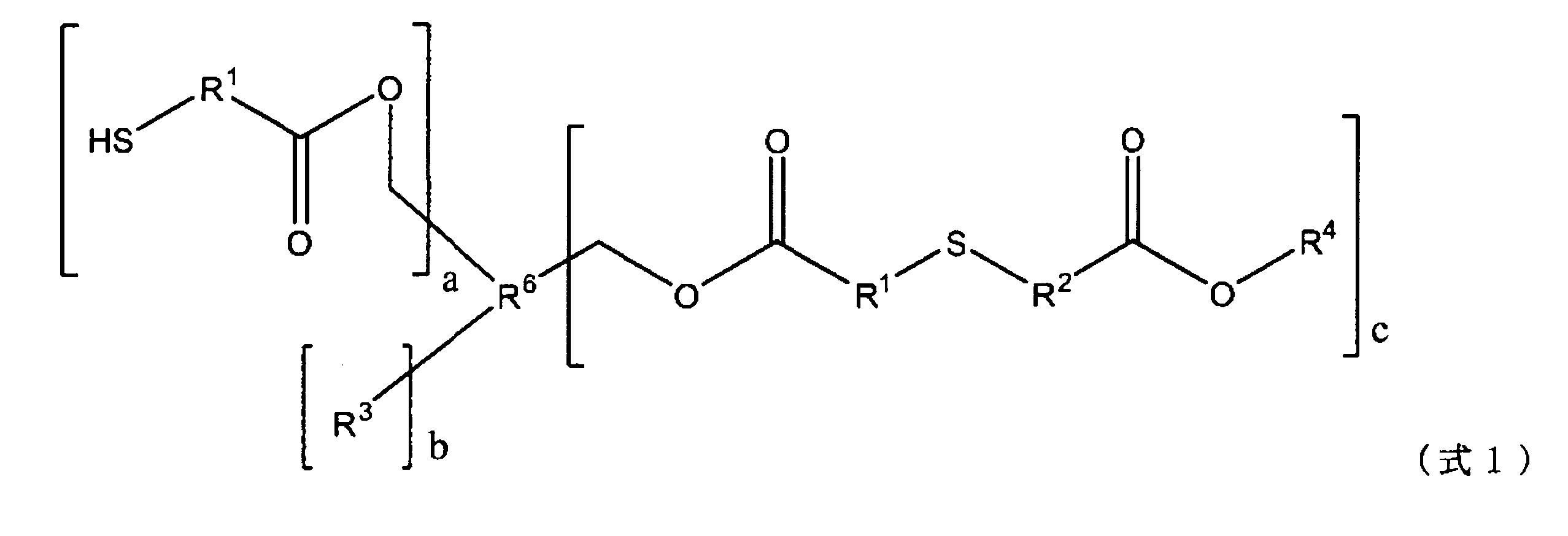
(式中のaは1~5の整数であり、bは0~2の整数であり、cは1~5の整数であり、aとbとcの和は6である。R1は、メチレン基、エチレン基またはイソプロピレン基である。R2は、下記式2または下記式3で表される2価の官能基である。R3は、メチル基またはエチル基である。R4は、炭素数が1~12の炭化水素基である。R6は下記式4で表される6価の官能基である。)

(R5は水素原子またはメチル基である。)

(式3)
(R5は水素原子またはメチル基である。)

(R5は水素原子またはメチル基である。)
(R5は水素原子またはメチル基である。)
本発明の硬化性樹脂組成物は、さらに、(D)重量平均分子量が200~50000である多官能(メタ)アクリレートを、前記(A)成分と前記(B)成分との合計質量100質量部に対し、2~300質量部含有しても良い。
本発明の硬化性樹脂組成物は、さらに、(E)光重合開始剤を、前記(A)成分と前記(D)成分との合計質量100質量部に対し、0.01~10質量部含有しても良い。
なお、本発明において「(メタ)アクリレート」とは、アクリレートとメタクリレートの双方を含む総称を意味する。「(メタ)アクリル酸」及び「(メタ)アクリロキシ基」等の用語も同様に総称として用いられる。また、本発明において数値範囲を示す「○○~××」とは、その下限値(「○○」)や上限値(「××」)を含む概念である。すなわち、正確には「○○以上××以下」を意味する。また、本発明において「分子量」とは、別途記載が無い限り、重量平均分子量を意味する。
本発明の硬化性樹脂組成物によれば、(A)特定のチオエーテル含有(メタ)アクリレート誘導体を密着性向上作用の有効成分としながら、(B)特定の分子量の多官能エポキシ樹脂と、(C)特定の分子量のアミン化合物とがバランス良く配合されている。それにより、従来のシランカップリング剤を使用する場合のようにその他の密着性助剤等を含有しなくても、基材に対する優れた密着性を有する。特に、従来の多官能チオール化合物を使用した硬化性樹脂組成物では不十分であった、寒冷条件における基材に対する密着性にも優れ、且つ、得られた硬化膜が柔軟性を有する。
以下に、本発明について詳しく説明する。本発明の硬化性樹脂組成物は、下記(A)、(B)、及び(C)成分を必須成分とし、任意に(D)成分、(E)成分もさらに含有する。
<チオエーテル含有(メタ)アクリレート誘導体((A)成分)>
本発明の(A)チオエーテル含有(メタ)アクリレート誘導体は、下記式1で表される化合物である。
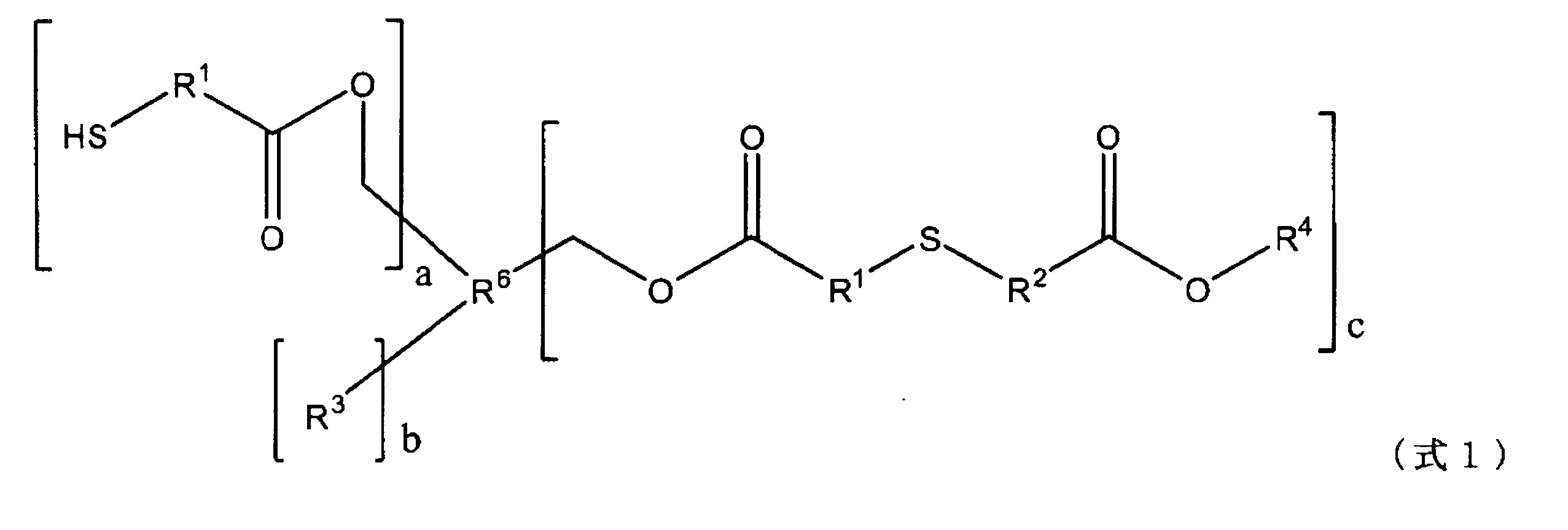
(式中のaは1~5の整数であり、bは0~2の整数であり、cは1~5の整数であり、aとbとcの和は6である。R1は、メチレン基、エチレン基またはイソプロピレン基である。R2は、下記式2または下記式3で表される2価の官能基である。R3は、メチル基またはエチル基である。R4は、炭素数が1~12の炭化水素基である。R6は下記式4で表される6価の官能基である。)

(R5は水素原子またはメチル基である。)

(式3)
(R5は水素原子またはメチル基である。)

本発明の(A)チオエーテル含有(メタ)アクリレート誘導体は、下記式1で表される化合物である。
(式中のaは1~5の整数であり、bは0~2の整数であり、cは1~5の整数であり、aとbとcの和は6である。R1は、メチレン基、エチレン基またはイソプロピレン基である。R2は、下記式2または下記式3で表される2価の官能基である。R3は、メチル基またはエチル基である。R4は、炭素数が1~12の炭化水素基である。R6は下記式4で表される6価の官能基である。)
(R5は水素原子またはメチル基である。)
(R5は水素原子またはメチル基である。)
上記式1中のR4である炭素数が1~12の炭化水素基としては、直鎖のアルキル基、側鎖を持つアルキル基、環状のアルキル基が挙げられる。上記式1中のR1は、メチレン基、エチレン基、イソプロピレン基であり、密着性向上効果が高くなることから、エチレン基、イソプロピレン基が特に好ましい。
上記式1で表されるチオエーテル含有(メタ)アクリレート誘導体は、塗料等に配合された場合、例えば-10℃といった寒冷環境下においても、密着性助剤無しで基材に対する高い密着性向上効果を発揮し、且つ、得られる塗膜に柔軟性を付与する効果に優れる。更に、上記式1で表されるチオエーテル含有(メタ)アクリレート誘導体は、分子量が小さいことから他の成分に対する溶解性に優れる。従って、上記式1で表されるチオエーテル含有(メタ)アクリレート誘導体は、多くの樹脂に対して高い相溶性を有することから、幅広い塗料に対して使用可能であり、汎用性が高い。
<多官能エポキシ樹脂((B)成分)>
(B)成分である多官能エポキシ樹脂とは、2個以上のエポキシ基(オキシラン環)を有する有機化合物である。多官能エポキシ樹脂の重量平均分子量は200~50000、好ましくは200~48000、より好ましくは200~46000である。重量平均分子量が200より小さくても密着性に関しては問題ないが、多官能エポキシ樹脂の揮発性が高くなり、臭気が強くなる傾向がある。一方、重量平均分子量が50000より大きいと、他の成分に対する溶解性が低くなって、基材に対する密着性が低下する可能性がある。
(B)成分である多官能エポキシ樹脂とは、2個以上のエポキシ基(オキシラン環)を有する有機化合物である。多官能エポキシ樹脂の重量平均分子量は200~50000、好ましくは200~48000、より好ましくは200~46000である。重量平均分子量が200より小さくても密着性に関しては問題ないが、多官能エポキシ樹脂の揮発性が高くなり、臭気が強くなる傾向がある。一方、重量平均分子量が50000より大きいと、他の成分に対する溶解性が低くなって、基材に対する密着性が低下する可能性がある。
多官能エポキシ樹脂のエポキシ当量は80~6000g/mol、好ましくは85~5500g/mol、より好ましくは90~5000g/molとする。エポキシ当量が80g/molより小さいと、単位体積あたりのエポキシ基が過剰になって、(A)チオエーテル含有(メタ)アクリレート誘導体のチオール基と未反応のエポキシ基が多量に残存することで、硬化性樹脂組成物からなる硬化膜の靭性が低下し、密着性が低下するおそれがある。一方、エポキシ当量が6000g/molより大きいと、エポキシ基濃度が著しく低いことから(A)チオエーテル含有(メタ)アクリレート誘導体のチオール基との反応効率が低下することで、硬化性樹脂組成物からなる硬化膜の靭性が低下し、基材に対する密着性が低下するおそれがある。
(B)成分である多官能エポキシ樹脂としては、例えばグリシジルエーテル型エポキシ樹脂、グリシジルエステル型エポキシ樹脂、グリシジルアミン型エポキシ樹脂、又は二重結合含有化合物の二重結合を過酸化物で酸化して得られる酸化型エポキシ樹脂などが挙げられる。これら中でも、室温での反応性が低く保存安定性が高くなることから、グリシジルエーテル型エポキシ樹脂やグリシジルエステル型エポキシ樹脂が好ましい。なお、多官能エポキシ樹脂は、1種のみを単独で使用することもできるし、2種以上を混合使用することもできる。
<グリシジルエーテル型エポキシ樹脂>
グリシジルエーテル型エポキシ樹脂としては、エピクロロヒドリンと下記式5で表される化合物との反応生成物が好ましい。

(式中のdは2~30の整数であり、R7は炭素数2~200の炭化水素基(β1)、炭素数2~300のエーテル酸素(-O-)と炭化水素基のみからなる基(β2)、イソシアヌレート環(β3)、又はイソシアヌレート環と炭化水素基のみからなる基(β4)である。)
上記式5で表される化合物の中でも、dが2~20であり、且つR7が炭素数2~150の炭化水素基である化合物(β1-1)、又はdが2~20であり、且つR7が炭素数2~150の炭化水素基とエーテル酸素(-O-)のみからなる基である化合物(β2-1)が、他の成分との溶解性が高いという理由で好ましい。(β1-1)としては、例えば炭素数2~10のアルキレンジオール、グリセリン、ペンタエリスリトール、トリメチロールプロパン、フェノールノボラック、ビスフェノールA等が挙げられる。(β2-1)としては、例えばポリエチレングリコール、ポリプロピレングリコール、又はジペンタエリスリトール等が挙げられる。
グリシジルエーテル型エポキシ樹脂としては、エピクロロヒドリンと下記式5で表される化合物との反応生成物が好ましい。
(式中のdは2~30の整数であり、R7は炭素数2~200の炭化水素基(β1)、炭素数2~300のエーテル酸素(-O-)と炭化水素基のみからなる基(β2)、イソシアヌレート環(β3)、又はイソシアヌレート環と炭化水素基のみからなる基(β4)である。)
上記式5で表される化合物の中でも、dが2~20であり、且つR7が炭素数2~150の炭化水素基である化合物(β1-1)、又はdが2~20であり、且つR7が炭素数2~150の炭化水素基とエーテル酸素(-O-)のみからなる基である化合物(β2-1)が、他の成分との溶解性が高いという理由で好ましい。(β1-1)としては、例えば炭素数2~10のアルキレンジオール、グリセリン、ペンタエリスリトール、トリメチロールプロパン、フェノールノボラック、ビスフェノールA等が挙げられる。(β2-1)としては、例えばポリエチレングリコール、ポリプロピレングリコール、又はジペンタエリスリトール等が挙げられる。
エピクロロヒドリンと上記式5で表される化合物とを反応させることで、エピクロロヒドリンと上記式5で表される化合物の水酸基とが付加反応してクロロヒドリンが得られ、得られたクロロヒドリンを酸化ナトリウム等の塩基で閉環することでエポキシ樹脂を得ることができる。また、グリシジルエーテル型エポキシ樹脂は前記の閉環反応の後得られたエポキシ樹脂のエポキシ基の一部を開環重合させたエポキシ樹脂でもよい。
エピクロロヒドリンと上記式5で表される化合物の反応生成物は、下記式6の構造となる。

(式中のdは2~30の整数であり、R7は炭素数2~200の炭化水素基(β1)、炭素数2~300のエーテル酸素(-O-)と炭化水素基のみからなる基(β2)、イソシアヌレート環(β3)、又はイソシアヌレート環と炭化水素基のみからなる基(β4)である。)
〔グリシジルエステル型エポキシ樹脂〕
グリシジルエステル型エポキシ樹脂は、グリシジル(メタ)アクリレート等のエポキシ基を有するモノマーを単独あるいは炭素数4~25のアルキル(メタ)アクリレートと共重合して得られる重量平均分子量3000~20000のポリマー又はエピクロロヒドリンと下記式7で表される化合物との反応生成物などである。

(式中のeは2~8の整数であり、R8は炭素数2~20の炭化水素基(β5)、炭素数2~30のエーテル酸素(-O-)と炭化水素基のみからなる基(β6)、イソシアヌレート環(β7)、又はイソシアヌレート環と炭化水素基のみからなる基(β8)である。)
グリシジルエステル型エポキシ樹脂は、グリシジル(メタ)アクリレート等のエポキシ基を有するモノマーを単独あるいは炭素数4~25のアルキル(メタ)アクリレートと共重合して得られる重量平均分子量3000~20000のポリマー又はエピクロロヒドリンと下記式7で表される化合物との反応生成物などである。
エピクロロヒドリンと上記式7で表される化合物とを反応させることで、エピクロロヒドリンと上記式7の化合物のカルボキシル基とが付加反応してクロロヒドリンが得られ、得られたクロロヒドリンを水酸化ナトリウム等の塩基で閉環しグリシジルエステル型エポキシ樹脂を得ることができる。また、グリシジルエステル型エポキシ樹脂のエポキシ基の一部を開環重合させたエポキシ樹脂も使用することができる。
上記式7で表される化合物の中でも、eが2~4であり、且つR8が炭素数2~10の炭化水素基である化合物(β5-1)、eが2~6であり、且つR8が炭素数2~30のエーテル酸素(-O-)と炭化水素基のみからなる基である化合物(β6-1)、又はeが3であり、且つR8がイソシアヌレート環と炭化水素基のみからなる基である化合物(β8-1)が、溶解性が高いという理由で好ましい。
(β5-1)としては、例えばヒドロフタル酸やトリメリット酸等が挙げられる。(β6-1)としては、例えばペンタエリスリトールと無水トリメリット酸との反応物が挙げられる。(β8-1)としては、例えば1,3,5-トリス(2-カルボキシエチル)イソシアヌレート等が挙げられる。
エピクロロヒドリンと上記式7で表される化合物の反応生成物は、下記式8の構造となる。

(式中のeは2~8の整数であり、R8は炭素数2~20の炭化水素基(β5)、炭素数2~30のエーテル酸素(-O-)と炭化水素基のみからなる基(β6)、イソシアヌレート環(β7)、又はイソシアヌレート環と炭化水素基のみからなる基(β8)である。)
<アミン化合物((C)成分)>
(C)成分であるアミン化合物は、チオール基とエポキシ基との反応を促進(触媒)する。(C)成分であるアミン化合物としては、重量平均分子量が90~700、好ましくは100~690、より好ましくは110~680の、単官能アミンや複数個のアミノ基を有するポリアミンが挙げられる。アミン化合物の重量平均分子量が90未満では、アミン化合物の揮発性が高くなり、臭気やボイドの原因となるだけではなく、加熱硬化時のアミン濃度が低くなるため架橋反応が進行し難くなり密着性が低下し易くなる。アミン化合物の重量平均分子量が700を超えると、耐水性が低くなり密着性が低下し易くなる。
(C)成分であるアミン化合物は、チオール基とエポキシ基との反応を促進(触媒)する。(C)成分であるアミン化合物としては、重量平均分子量が90~700、好ましくは100~690、より好ましくは110~680の、単官能アミンや複数個のアミノ基を有するポリアミンが挙げられる。アミン化合物の重量平均分子量が90未満では、アミン化合物の揮発性が高くなり、臭気やボイドの原因となるだけではなく、加熱硬化時のアミン濃度が低くなるため架橋反応が進行し難くなり密着性が低下し易くなる。アミン化合物の重量平均分子量が700を超えると、耐水性が低くなり密着性が低下し易くなる。
単官能アミンとしては、1級アミン、2級アミン、又は3級アミンが挙げられる。ポリアミンとしては、1級アミン、2級アミン、3級アミン、複合アミンが挙げられる。複合アミンとは、1級アミノ基、2級アミノ基、3級アミノ基のうち2種以上を有するアミンのことである。このような複合アミンとしては、イミダゾリン化合物、イミダゾール化合物、N置換ピペラジン化合物、N,N-ジメチル尿素誘導体等が挙げられる。なお、アミン化合物は、1種のみを単独で使用することもできるし、2種以上を混合使用することもできる。
また、アミン化合物は、触媒活性を調整するために予め有機酸との塩を形成していても良い。アミン化合物と予め反応させる有機酸としては、炭素数1~20でカルボキシル基を分子中に1~5個有するステアリン酸や2-エチルヘキサン酸等の脂肪族カルボン酸、炭素数1~20でカルボキシル基を分子中に1~10個有するピロメリット酸、トリメリット酸、安息香酸等の芳香族カルボン酸、又はイソシアヌル酸が挙げられる。また、(C)成分であるアミン化合物は、触媒活性を調整するために(B)成分である多官能エポキシ樹脂とのアダクトを形成した後に配合されても良い。
〔イミダゾール化合物〕
アミン化合物の中でも、イミダゾール化合物が最も保存安定性と低温条件における短時間での硬化の両立に適している。また、フェノール樹脂等でコーティングしたイミダゾール化合物も用いることができる。当該イミダゾール化合物は、下記式9で表される化合物である。

(R10はシアノ基、炭素数1~10の炭化水素基、2,3-ジアミノトリアジンで置換された炭素数1~10の炭化水素基、炭素数1~4のアルコキシ基、又は水素原子であり、R9、R11、R12は炭素数1~20の炭化水素基、炭素数1~4のアルコキシ基、又は水素原子であり、R9~R12が結合して環を形成している場合には炭素数2~8の炭化水素基である。)
アミン化合物の中でも、イミダゾール化合物が最も保存安定性と低温条件における短時間での硬化の両立に適している。また、フェノール樹脂等でコーティングしたイミダゾール化合物も用いることができる。当該イミダゾール化合物は、下記式9で表される化合物である。
イミダゾール化合物の具体例としては、2-メチルイミダゾール、2-ウンデシルイミダゾール、2-ヘプタデシルイミダゾール、2-フェニルイミダゾール、1,2-ジメチルイミダゾール、2-フェニル-4-メチルイミダゾール、1-ベンジル-2-メチルイミダゾール、1-ベンジル-2-フェニルイミダゾール、2-エチル-4-メチルイミダゾール、1-(2-シアノエチル)-2-メチルイミダゾール、1-(2-シアノエチル)-2-ウンデシルイミダゾール、1-(2-シアノエチル)-2-エチル-4-メチルイミダゾール、1-(2-シアノエチル-2-フェニルイミダゾール、1-(2-シアノエチル)-2-エチル-4-メチルイミダゾール、2,3-ジヒドロ-1H-ピロロ[1,2-a]ベンズイミダゾール、2,4-ジアミノ-6-[2-メチルイミダゾリル-(1)]エチル-s-トリアジン、2,4-ジアミノ-6-[2’-ウンデシルイミダゾリル-(1’)]-エチル-s-トリアジン、2,4-ジアミノ-6-[2’-エチル-4'-メチルイミダゾリル-(1')]-エチル-s-トリアジン、2-フェニル-4,5-ジヒドロキシメチルイミダゾール、2-フェニル-4-メチル-5-ヒドロキシメチルイミダゾールが挙げられる。
<多官能(メタ)アクリレート((D)成分)>
(A)チオエーテル含有(メタ)アクリレート誘導体、(B)多官能エポキシ樹脂、及び(C)アミン化合物を含む本発明の硬化性樹脂組成物は、加熱により硬化することができる。この硬化性樹脂組成物にさらに(D)多官能(メタ)アクリレートを加えることによって、光硬化性あるいは光熱二段階硬化性を付与することができる。
(A)チオエーテル含有(メタ)アクリレート誘導体、(B)多官能エポキシ樹脂、及び(C)アミン化合物を含む本発明の硬化性樹脂組成物は、加熱により硬化することができる。この硬化性樹脂組成物にさらに(D)多官能(メタ)アクリレートを加えることによって、光硬化性あるいは光熱二段階硬化性を付与することができる。
多数ある二重結合含有化合物の中でも、(D)成分として多官能(メタ)アクリレートを用いる利点として、本発明の硬化性樹脂組成物における(A)チオエーテル含有(メタ)アクリレート誘導体と室温では反応しにくいため可使用時間を長く、すなわち保存安定性を高く設定できること、(A)チオエーテル含有(メタ)アクリレート誘導体と反応した際に強靭な硬化物を形成すること、(A)チオエーテル含有(メタ)アクリレート誘導体と(D)多官能(メタ)アクリレートとの反応が(C)アミン化合物により触媒されにくいこと、(B)多官能エポキシ樹脂と反応しないこと等が挙げられる。
このような多官能(メタ)アクリレートの好ましい例としては、下記式10で表される化合物が挙げられる。なお、(D)成分である多官能(メタ)アクリレートは、1種のみを単独で使用することもできるし、2種以上を混合使用することもできる。

(式中のfは2~30の整数であり、R13は炭素数2~200の炭化水素基(ε1)、炭素数2~300のエーテル酸素(-O-)と炭化水素基のみからなる基(ε2)、イソシアヌレート環(ε3)、又はイソシアヌレート環と炭化水素基のみからなる基(ε4)であり、R14は水素原子またはメチル基である。)
また、(D)多官能(メタ)アクリレートとしては、ポリマータイプのものも好適に用いることができる。ポリマータイプの多官能(メタ)アクリレートとしては、グリシジル(メタ)アクリレート等のエポキシ基を有する(メタ)アクリレート単独あるいは共重合体に、(メタ)アクリル酸のようにエポキシ基と反応する基を有する(メタ)アクリレートを反応させて得られるポリマー、ヒドロキシエチル(メタ)アクリレート等の水酸基を有する(メタ)アクリレート単独あるいは共重合体に、2-メチルプロペン酸2-イソシアナトエチルのように水酸基と反応する基を有する(メタ)アクリレートを反応させて得られるポリマー、(メタ)アクリル酸等のカルボキシル基を有する(メタ)アクリレート単独あるいは共重合体に、グリシジル(メタ)アクリレートのようにカルボキシル基と反応する基を有する(メタ)アクリレートを反応させて得られるポリマー等が挙げられる。
(D)多官能(メタ)アクリレートの重量平均分子量は200~50000、好ましくは220~40000、より好ましくは240~30000である。(D)多官能(メタ)アクリレートの重量平均分子量が200より小さくても密着性に関しては問題ないが、揮発性が高くなり臭気が強くなる傾向がある。一方、重量平均分子量が50000より大きいと、他の成分に対する溶解性が低くなる可能性がある。
また、(D)多官能(メタ)アクリレートの(メタ)アクリレート当量は80~6000g/mol、好ましくは80~4500、より好ましくは85~3000とする。(メタ)アクリレート当量が80g/molより小さいと、単位体積あたりの(メタ)アクリロキシ基が過剰になり、(A)チオエーテル含有(メタ)アクリレート誘導体のチオール基と未反応の(メタ)アクリロキシ基が多量に残存することで、硬化性樹脂組成物からなる硬化膜の靭性が低下し、密着性が低下するおそれがある。一方、(メタ)アクリレート当量が6000g/molより大きくなると、(メタ)アクリロキシ基濃度が著しく低いことから(A)チオエーテル含有(メタ)アクリレート誘導体のチオール基との反応効率が低下することで、硬化性樹脂組成物からなる硬化膜の靭性が低下し、密着性が低下するおそれがある。
<光重合開始剤((E)成分)>
(E)成分である光重合開始剤は、チオール基と(メタ)アクリロキシ基との反応を促進するために添加される。光重合開始剤としては、光ラジカル開始剤、光カチオン開始剤、光アニオン開始剤等である。光ラジカル開始剤は、反応時間を短縮する際に用いることが好ましく、光カチオン開始剤は、硬化収縮を小さくする際に用いることが好ましく、光アニオン開始剤は、電子回路等の分野での接着性を付与する際に用いることが好ましい。
(E)成分である光重合開始剤は、チオール基と(メタ)アクリロキシ基との反応を促進するために添加される。光重合開始剤としては、光ラジカル開始剤、光カチオン開始剤、光アニオン開始剤等である。光ラジカル開始剤は、反応時間を短縮する際に用いることが好ましく、光カチオン開始剤は、硬化収縮を小さくする際に用いることが好ましく、光アニオン開始剤は、電子回路等の分野での接着性を付与する際に用いることが好ましい。
光ラジカル開始剤としては、例えば、2,2-ジメトキシ-1,2-ジフェニルエタン-1-オン、1-ヒドロキシ-シクロヘキシル-フェニル-ケトン、2-ヒドロキシ-2-メチル-1-フェニル-プロパン-1-オン、1-[4-(2-ヒドロキシエトキシ)-フェニル]-2-ヒドロキシ-2-メチル-1-プロパン-1-オン、2-ヒドロキシ-1-[4-[4-(2-ヒドロキシ-2-メチル-プロピオニル)-ベンジル]-フェニル]-2-メチル-プロパン-1-オン、2-メチル-1-[4-(メチルチオ)フェニル]-2-モルフォリノプロパン-1-オン、ビス(2,4,6-トリメチルベンゾイル)-フェニルフォスフィンオキサイド、2,4,6-トリメチルベンゾイル-ジフェニル-フォスフィンオキサイド等が挙げられる。
光カチオン開始剤としては、例えば、ビス(4-tert-ブチルフェニル)ヨードニウムヘキサフルオロホスファート、ビス(4-tert-ブチルフェニル)ヨードニウムトリフルオロメタンスルホナート、シクロプロピルジフェニルスルホニウムテトラフルオロボラート、ジフェニルヨードニウムヘキサフルオロホスファート、ジフェニルヨードニウムヘキサフルオロアルセナート、2-(3,4-ジメトキシスチリル)-4,6-ビス(トリクロロメチル)-1,3,5-トリアジン、トリフェニルスルホニウムテトラフルオロボラート、トリフェニルスルホニウムブロミド、トリ-p-トリルスルホニウムヘキサフルオロホスファート、トリ-p-トリルスルホニウムトリフルオロメタンスルホナート等が挙げられる。
光アニオン開始剤としては、例えば、アセトフェノンo-ベンゾイルオキシム、ニフェジピン、2-(9-オキソキサンテン-2-イル)プロピオン酸1,5,7-トリアザビシクロ[4.4.0]デカ-5-エン、2-ニトロフェニルメチル4-メタクリロイルオキシピペリジン-1-カルボキシラート、1,2-ジイソプロピル-3-〔ビス(ジメチルアミノ)メチレン〕グアニジウム2-(3-ベンゾイルフェニル)プロピオナート、1,2-ジシクロヘキシル-4,4,5,5-テトラメチルビグアニジウム n-ブチルトリフェニルボラート等が挙げられる。
<組成比(配合バランス)>
本発明の硬化性樹脂組成物は、(A)チオエーテル含有(メタ)アクリレート誘導体と(B)多官能エポキシ樹脂との質量比((A)/(B))が0.05~30となるように配合する。ここで、「(A)/(B)」とは、(A)チオエーテル含有(メタ)アクリレート誘導体の質量を(B)多官能エポキシ樹脂の質量で除した値である。最適な(A)/(B)の値は、硬化性樹脂組成物に求められる特性や、(A)チオエーテル含有(メタ)アクリレート誘導体や(B)多官能エポキシ樹脂および任意に添加される(D)多官能(メタ)アクリレートの構造によって異なる。硬化性樹脂組成物を硬化した後の特性は、厳密には硬化性樹脂組成物単位重量中の(チオール基数)/(エポキシ基数+(メタ)アクリロキシ基数)(以下、チオール/(エポキシ+エン)比と称す)の値に影響を受ける。例えば、チオール/(エポキシ+エン)比が0.5~1.5の範囲にあれば、密な架橋を形成し易く、且つ強靭な硬化物になり易い。一方、チオール/(エポキシ+エン)比が0.1以上0.5未満、あるいは1.5を超え2.0以下であれば、柔軟で粘着質な硬化物を得ることができる。チオール/(エポキシ+エン)比が0.1未満、あるいは2.0を超えるとゲル化し難くなり、密着性が低下する傾向がある。
本発明の硬化性樹脂組成物は、(A)チオエーテル含有(メタ)アクリレート誘導体と(B)多官能エポキシ樹脂との質量比((A)/(B))が0.05~30となるように配合する。ここで、「(A)/(B)」とは、(A)チオエーテル含有(メタ)アクリレート誘導体の質量を(B)多官能エポキシ樹脂の質量で除した値である。最適な(A)/(B)の値は、硬化性樹脂組成物に求められる特性や、(A)チオエーテル含有(メタ)アクリレート誘導体や(B)多官能エポキシ樹脂および任意に添加される(D)多官能(メタ)アクリレートの構造によって異なる。硬化性樹脂組成物を硬化した後の特性は、厳密には硬化性樹脂組成物単位重量中の(チオール基数)/(エポキシ基数+(メタ)アクリロキシ基数)(以下、チオール/(エポキシ+エン)比と称す)の値に影響を受ける。例えば、チオール/(エポキシ+エン)比が0.5~1.5の範囲にあれば、密な架橋を形成し易く、且つ強靭な硬化物になり易い。一方、チオール/(エポキシ+エン)比が0.1以上0.5未満、あるいは1.5を超え2.0以下であれば、柔軟で粘着質な硬化物を得ることができる。チオール/(エポキシ+エン)比が0.1未満、あるいは2.0を超えるとゲル化し難くなり、密着性が低下する傾向がある。
また、本発明の硬化性樹脂組成物は、(A)チオエーテル含有(メタ)アクリレート誘導体と(B)多官能エポキシ樹脂との合計質量((A)+(B))100質量部に対し、(C)アミン化合物が0.01~50質量部、好ましくは0.01~45質量部となるように配合する。((A)+(B))100質量部に対して(C)成分の配合量が0.01質量部未満では、チオール基とエポキシ基の反応が進行するのに時間を要するため硬化不良を起こし、50質量部を超えると保存安定性が低くなる恐れがある。
また、本発明の硬化性樹脂組成物に対して(D)多官能(メタ)アクリレートも配合する場合は、(A)チオエーテル含有(メタ)アクリレート誘導体と(B)多官能エポキシ樹脂との合計質量((A))+(B))100質量部に対し、(D)多官能(メタ)アクリレートが2~300質量部、好ましくは2~250質量部となるように配合する。((A)+(B))100質量部に対して(D)成分の配合量が2質量部未満では、光硬化性を付与することが難しく、300質量部を超えると、密着性が低下する傾向がある。
また、本発明の硬化性樹脂組成物に対して(E)光重合開始剤も配合する場合は、(A)チオエーテル含有(メタ)アクリレート誘導体と(D)多官能(メタ)アクリレートとの合計質量((A)+(D))100質量部に対し、(E)光重合開始剤が0.01~10質量部、好ましくは0.01~5質量部となるように配合する。((A)+(D))100質量部に対して(E)成分の配合量が0.01質量部未満では、光硬化を促進することが難しく、10質量部を超えると、不必要に多くなり好ましくない。
<硬化膜の形成>
本発明の硬化性樹脂組成物は、基材上に塗工し、硬化させることで、硬化膜を形成することができる。本発明の硬化性樹脂組成物は、(A)チオエーテル含有(メタ)アクリレート誘導体のチオエーテル基に起因して基材に対して密着性を発揮する。したがって、基材としては、チオエーテル基と化学的な結合を形成する(化学的な親和力の高い)基材、例えば、遷移金属あるいはその合金や珪素化合物、リン化合物、硫黄化合物、又はホウ素化合物等の無機基材、不飽和結合(芳香環を含む)を有する有機物、水酸基やカルボキシル基を有する有機物、又はプラズマやUVオゾン処理された有機物等への密着性向上効果に優れる。具体的には、無機基材としては、ガラス、シリコン、各種金属などが挙げられる。有機基材として、ポリ(メタ)アクリル系樹脂、トリアセテートセルロース(TAC)系樹脂、ポリエチレンテレフタレート(PET)やポリブチレンテレフタレート等のポリエステル系樹脂、ポリカーボネート系樹脂、ポリイミド系樹脂、ポリエチレンやポリプロピレン等のポリオレフィン系樹脂、ポリカーボネート、ポリイミド、ABS樹脂、ポリビニルアルコール、塩化ビニル系樹脂、ポリアセタールなどが好ましく挙げられる。また、本発明の硬化性樹脂組成物は、(A)チオエーテル含有(メタ)アクリレート誘導体が特定の炭化水素基を有することで、硬化膜が柔軟性に優れる。そのため、寒冷条件下でも硬化膜が基材に追従しやすく、基材に対する密着性に優れる。したがって、特に、寒冷条件下で使用され得るフレキシブルな基材のコーティングに特に好適に使用することができる。
本発明の硬化性樹脂組成物は、基材上に塗工し、硬化させることで、硬化膜を形成することができる。本発明の硬化性樹脂組成物は、(A)チオエーテル含有(メタ)アクリレート誘導体のチオエーテル基に起因して基材に対して密着性を発揮する。したがって、基材としては、チオエーテル基と化学的な結合を形成する(化学的な親和力の高い)基材、例えば、遷移金属あるいはその合金や珪素化合物、リン化合物、硫黄化合物、又はホウ素化合物等の無機基材、不飽和結合(芳香環を含む)を有する有機物、水酸基やカルボキシル基を有する有機物、又はプラズマやUVオゾン処理された有機物等への密着性向上効果に優れる。具体的には、無機基材としては、ガラス、シリコン、各種金属などが挙げられる。有機基材として、ポリ(メタ)アクリル系樹脂、トリアセテートセルロース(TAC)系樹脂、ポリエチレンテレフタレート(PET)やポリブチレンテレフタレート等のポリエステル系樹脂、ポリカーボネート系樹脂、ポリイミド系樹脂、ポリエチレンやポリプロピレン等のポリオレフィン系樹脂、ポリカーボネート、ポリイミド、ABS樹脂、ポリビニルアルコール、塩化ビニル系樹脂、ポリアセタールなどが好ましく挙げられる。また、本発明の硬化性樹脂組成物は、(A)チオエーテル含有(メタ)アクリレート誘導体が特定の炭化水素基を有することで、硬化膜が柔軟性に優れる。そのため、寒冷条件下でも硬化膜が基材に追従しやすく、基材に対する密着性に優れる。したがって、特に、寒冷条件下で使用され得るフレキシブルな基材のコーティングに特に好適に使用することができる。
本発明の硬化性樹脂組成物は、加熱により硬化させることができる。加熱温度は、25~250℃程度である。また、硬化性樹脂組成物が(D)成分を含む場合には、光を照射することにより硬化させることもできる。照射する光としては、UV(紫外線)やEB(電子線)などの活性エネルギー線等が挙げられる。硬化性樹脂組成物が(D)成分を含む場合には、光の照射による硬化工程と、加熱による硬化工程との二段階の工程を経て硬化させることもできる。
本発明の硬化性樹脂組成物は、反応系を均一にし、塗工を容易にするために有機溶媒で希釈して使用してもよい。そのような有機溶媒としては、アルコール系溶剤、芳香族炭化水素系溶剤、エーテル系溶剤、エステル系溶剤及びエーテルエステル系溶剤、ケトン系溶剤、リン酸エステル系溶剤が挙げられる。これらの有機溶媒は硬化性樹脂組成物100質量部に対して、10000質量部未満の配合量に抑えることが好ましいが、基本的に溶剤は硬化膜になる時点では揮発しているため、硬化膜の物性に大きな影響は与えない。ただし、チオール基、エポキシ基、又は(メタ)アクリロイル基と反応する官能基を有する化合物、及びアミン化合物は溶剤として用いることで本発明の効果を損なうおそれがある。
また、本発明の硬化性樹脂組成物は、粘度を調整する目的でシリカ粉末等の粘度調整剤を配合しても良い。これらの粘度調整剤は、硬化性樹脂組成物100質量部に対して、300質量部未満の配合量に抑えることが好ましい。粘度調整剤の配合量が300質量部を超えると、密着性が低下する可能性がある。
また、本発明の硬化性樹脂組成物は、通常の塗料や接着剤に用いられるような各種添加剤を添加しても良い。このような添加剤としては、塗工面を平滑にするための界面活性剤、可使用時間を長くするためのアルミニウム塩、光反応性を向上させるための光ラジカル発生剤、光塩基発生剤、光酸発生剤等が挙げられる。これらの添加剤は、硬化性樹脂組成物100質量部に対して、80質量部未満の配合量に抑えることが好ましい。これらの添加剤の配合量が80質量部を超えると、密着性が低下する可能性がある。
次に、実施例及び比較例を挙げて、本発明をさらに具体的に説明するが、本発明はこれに限られるものではない。本実施例及び比較例で用いた試薬は、次のとおりである。なお、Mwは重量平均分子量を示す。
<(A)成分>
(A-1:チオエーテル含有(メタ)アクリレート誘導体)
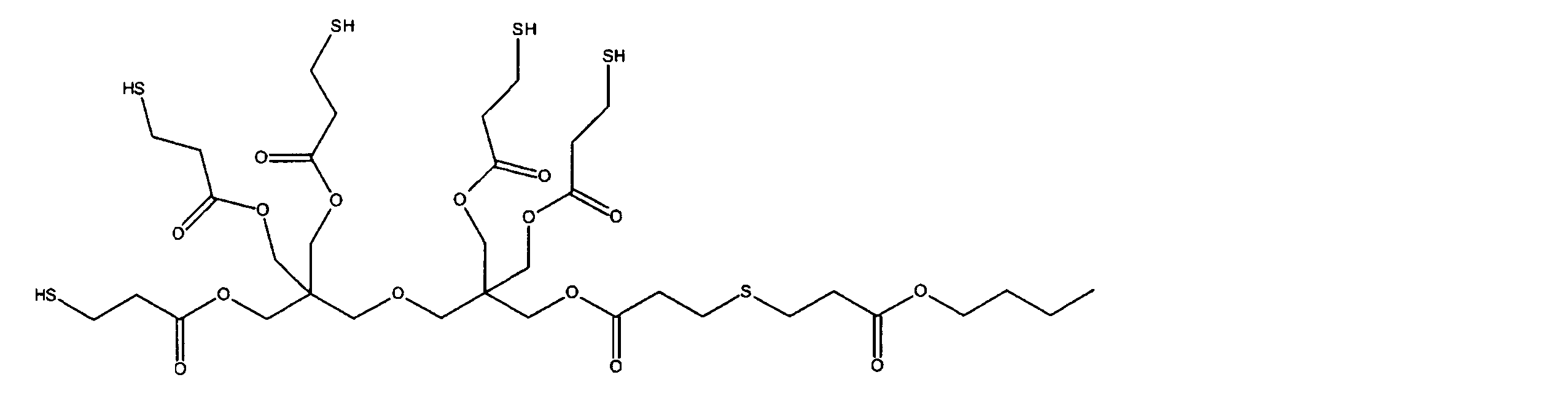
(A-2:チオエーテル含有(メタ)アクリレート誘導体)
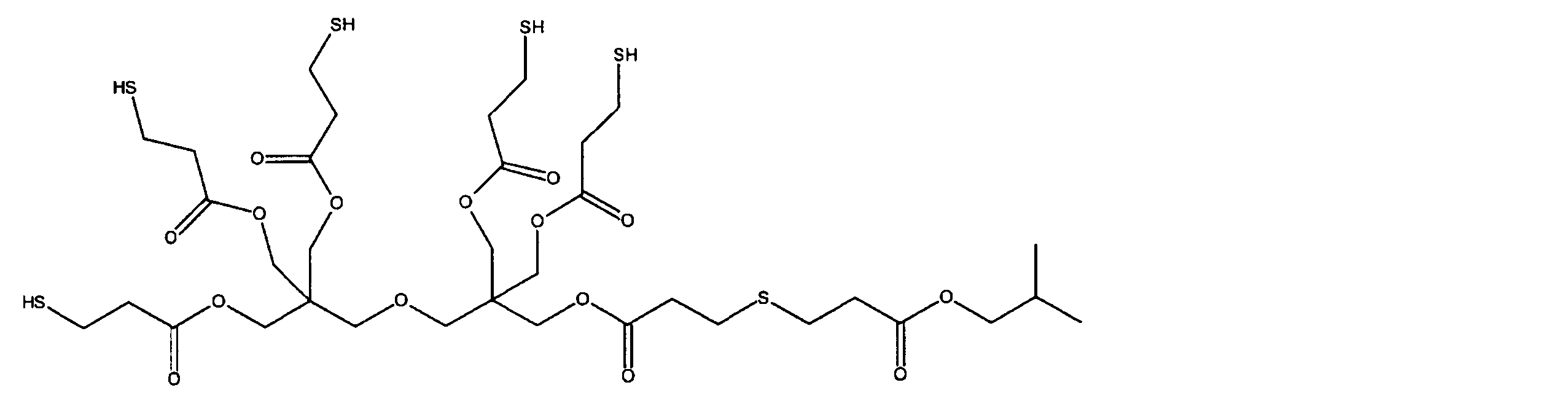
(A-3:チオエーテル含有(メタ)アクリレート誘導体)
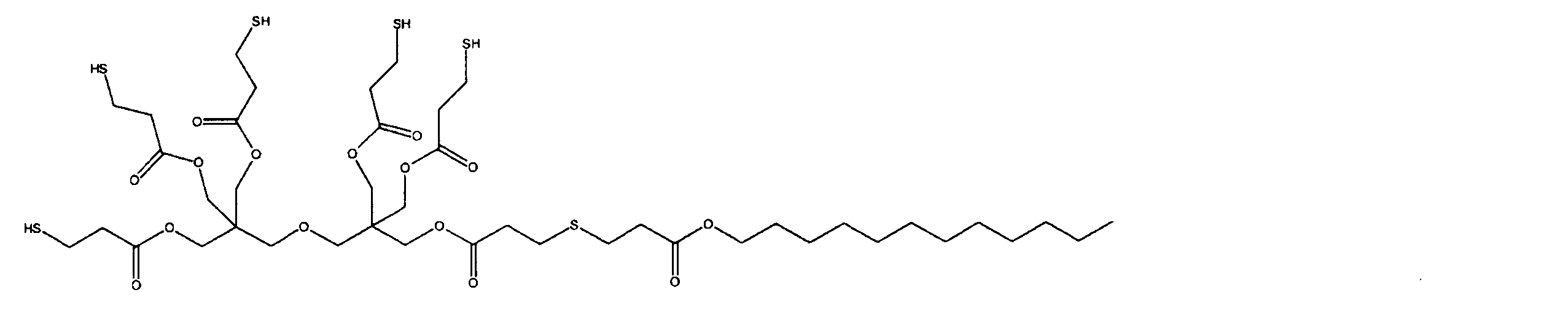
(A-4:チオエーテル含有(メタ)アクリレート誘導体)

(A’-1:多価チオール)

(A’-2:チオエーテル含有アルコキシシラン誘導体)

(A’-3:チオエーテル含有アルコキシシラン誘導体)
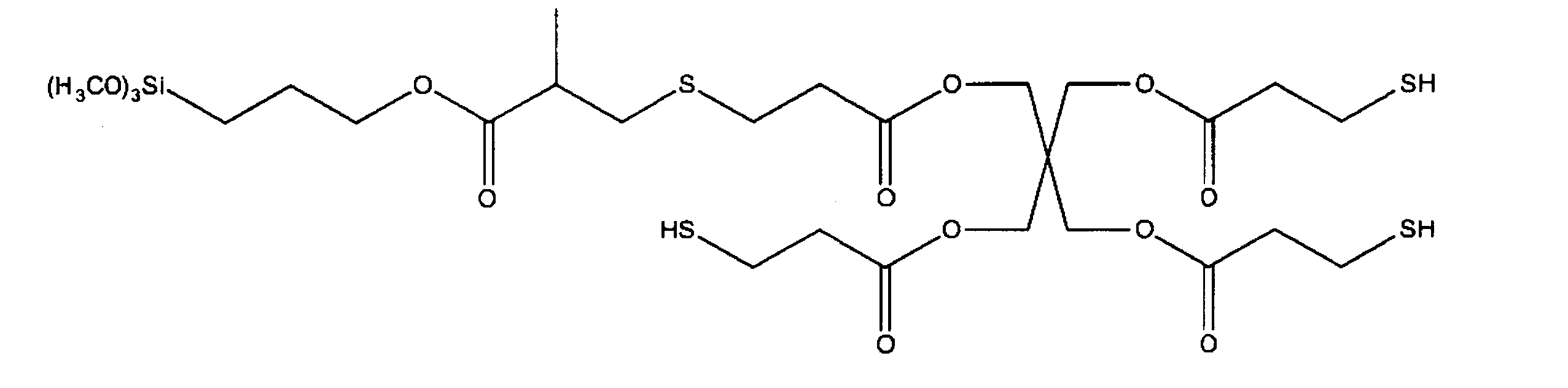
(A’-4:チオエーテル含有(メタ)アクリレート誘導体)
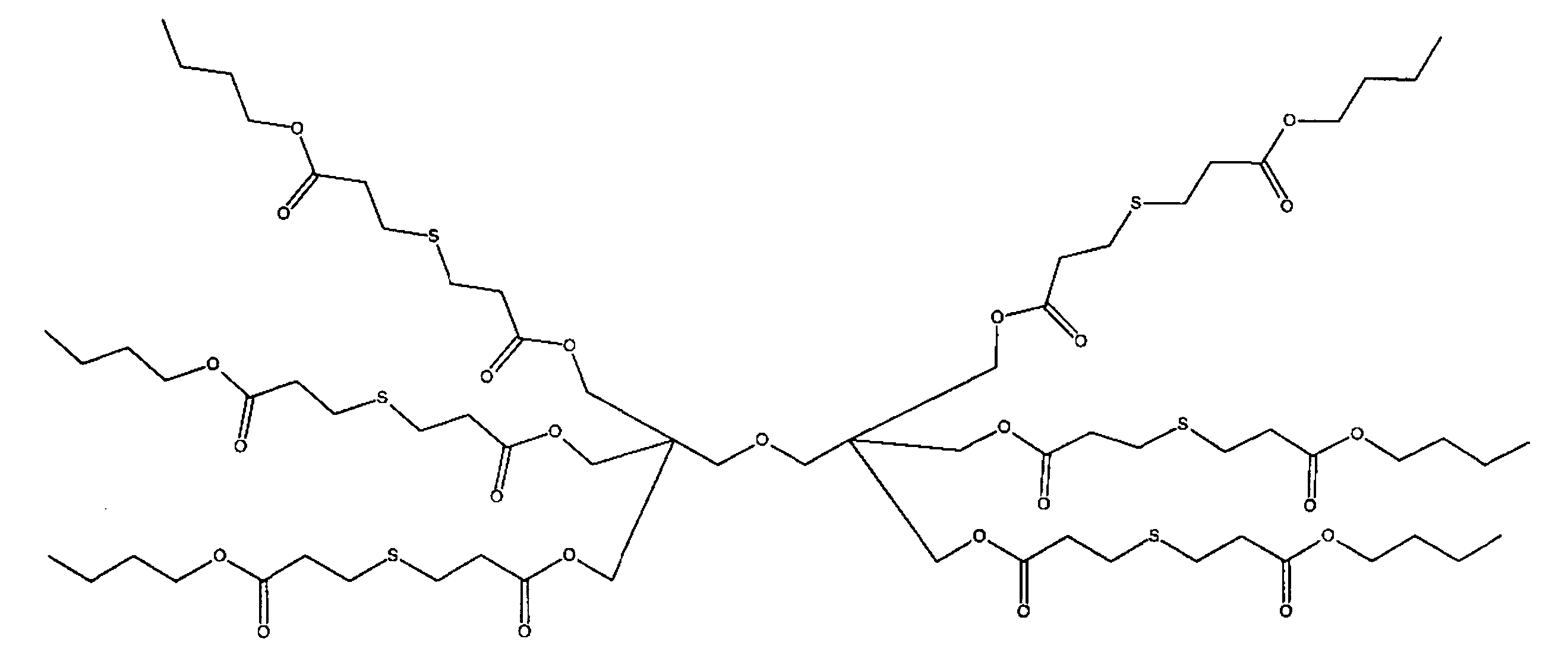
<(A)成分>
(A-1:チオエーテル含有(メタ)アクリレート誘導体)
(A-2:チオエーテル含有(メタ)アクリレート誘導体)
(A’-1:多価チオール)
(A’-2:チオエーテル含有アルコキシシラン誘導体)
(A’-3:チオエーテル含有アルコキシシラン誘導体)
<多官能エポキシ樹脂((B)成分)>
(B-1、Mw:5500)

(B-2、Mw:220)

(B-3、Mw:18000)
グリシジルメタクリレートとシクロヘキシルメタクリレート(官能基比1:1)の共重合体(50wt%メチルイソブチルケトン溶液をヘキサンで再沈した白色固体)
(B-4、Mw:45000)
グリシジルメタクリレートとシクロヘキシルメタクリレート(官能基比1:1)の共重合体(50wt%メチルイソブチルケトン溶液をヘキサンで再沈した白色固体)
(B-1、Mw:5500)
グリシジルメタクリレートとシクロヘキシルメタクリレート(官能基比1:1)の共重合体(50wt%メチルイソブチルケトン溶液をヘキサンで再沈した白色固体)
(B-4、Mw:45000)
グリシジルメタクリレートとシクロヘキシルメタクリレート(官能基比1:1)の共重合体(50wt%メチルイソブチルケトン溶液をヘキサンで再沈した白色固体)
<アミン化合物((C)成分)>
(C-1、Mw:110)

(C-2、Mw:102)
N,N-ジメチル-1,3-プロパンジアミン
(C-3、Mw:680)

(n1、n2、n3は1~5の整数であり、平均が3.5である混合物)
(C-1、Mw:110)
N,N-ジメチル-1,3-プロパンジアミン
(C-3、Mw:680)
<多官能(メタ)アクリレート((D)成分)>
(D-1、Mw:352)

(D-2、Mw:246)

(D-3、Mw:5000)

nは平均13
(D-4、Mw:22000)
グリシジルメタクリレートとシクロヘキシルメタクリレートの共重合体に上記C-3を触媒としメタクリル酸を当モル付加したポリマー(50wt%メチルイソブチルケトン溶液をヘキサンで再沈した白色固体)
(D-5、Mw:45000)
グリシジルメタクリレートとシクロヘキシルメタクリレートの共重合体に上記C-3を触媒としメタクリル酸を当モル付加したポリマー(50wt%メチルイソブチルケトン溶液をヘキサンで再沈した白色固体)
(D-1、Mw:352)
(D-4、Mw:22000)
グリシジルメタクリレートとシクロヘキシルメタクリレートの共重合体に上記C-3を触媒としメタクリル酸を当モル付加したポリマー(50wt%メチルイソブチルケトン溶液をヘキサンで再沈した白色固体)
(D-5、Mw:45000)
グリシジルメタクリレートとシクロヘキシルメタクリレートの共重合体に上記C-3を触媒としメタクリル酸を当モル付加したポリマー(50wt%メチルイソブチルケトン溶液をヘキサンで再沈した白色固体)
<光重合開始剤((E)成分)>
(E-1、Mw:204)
1-ヒドロキシ-シクロヘキシル-フェニル-ケトン
(E-2、Mw:348)
2,4,6-トリメチルベンゾイル-ジフェニル-フォスフィンオキサイド
(E-3、Mw:407)
2-(9-オキソキサンテン-2-イル)プロピオン酸1,5,7-トリアザビシクロ[4.4.0]デカ-5-エン
(E-1、Mw:204)
1-ヒドロキシ-シクロヘキシル-フェニル-ケトン
(E-2、Mw:348)
2,4,6-トリメチルベンゾイル-ジフェニル-フォスフィンオキサイド
(E-3、Mw:407)
2-(9-オキソキサンテン-2-イル)プロピオン酸1,5,7-トリアザビシクロ[4.4.0]デカ-5-エン
<硬化性樹脂組成物>
下記表1~表4に示す組成及び配合量で(A)~(E)成分をそれぞれ混合し、スパチュラで均一になるまで撹拌し、各実施例及び比較例の硬化性樹脂組成物を得た。得られた硬化性樹脂組成物を用いて以下の密着性1(室温密着性)、密着性2(寒冷地密着性)、密着性3(光硬化性)、柔軟性及び保存安定性の評価を行った。その結果を表1~表4に示す。
下記表1~表4に示す組成及び配合量で(A)~(E)成分をそれぞれ混合し、スパチュラで均一になるまで撹拌し、各実施例及び比較例の硬化性樹脂組成物を得た。得られた硬化性樹脂組成物を用いて以下の密着性1(室温密着性)、密着性2(寒冷地密着性)、密着性3(光硬化性)、柔軟性及び保存安定性の評価を行った。その結果を表1~表4に示す。
[評価用試験片1の作製]
密着性1、密着性2、柔軟性の評価用試験片は、次のように得た。各硬化性樹脂組成物を、25mm幅のPETフィルム上にダイコーターで100ミクロンの厚みに塗布し、その上に別のPETフィルムを重ねた後、150℃、1時間の条件で硬化させて評価用試験片1を得た。なお、PETフィルムとしては、東レ(株)製、ルミラーU46-100を用いた。
密着性1、密着性2、柔軟性の評価用試験片は、次のように得た。各硬化性樹脂組成物を、25mm幅のPETフィルム上にダイコーターで100ミクロンの厚みに塗布し、その上に別のPETフィルムを重ねた後、150℃、1時間の条件で硬化させて評価用試験片1を得た。なお、PETフィルムとしては、東レ(株)製、ルミラーU46-100を用いた。
[評価用試験片2の作製]
密着性3の評価用試験片は、次のように得た。各硬化性樹脂組成物を、幅25mm、長さ150mmのPETフィルム上にダイコーターで100ミクロンの厚みに塗布し、その上に別のPETフィルムを重ねた後、高圧水銀灯(i線換算)の光を光照射量:500mJ/cm2照射して評価用試験片2Aを、3000mJ/cm2照射して評価用試験片2Bを得た。なお、PETフィルムとしては、東レ(株)製、ルミラーU46-100を用いた。
密着性3の評価用試験片は、次のように得た。各硬化性樹脂組成物を、幅25mm、長さ150mmのPETフィルム上にダイコーターで100ミクロンの厚みに塗布し、その上に別のPETフィルムを重ねた後、高圧水銀灯(i線換算)の光を光照射量:500mJ/cm2照射して評価用試験片2Aを、3000mJ/cm2照射して評価用試験片2Bを得た。なお、PETフィルムとしては、東レ(株)製、ルミラーU46-100を用いた。
[密着性1(室温密着性)]
上記評価用試験片1を、25℃で24時間静置した後、JIS K6854-3に規定されるT型はく離法に準じて測定し、以下の通り評価した。
◎:引っ張り強度が5N/25mm以上(PETフィルムが破断)
○:引っ張り強度が5N/25mm以上(PETフィルムは破断せず)
×:5N/25mm未満
上記評価用試験片1を、25℃で24時間静置した後、JIS K6854-3に規定されるT型はく離法に準じて測定し、以下の通り評価した。
◎:引っ張り強度が5N/25mm以上(PETフィルムが破断)
○:引っ張り強度が5N/25mm以上(PETフィルムは破断せず)
×:5N/25mm未満
[密着性2(寒冷地密着性)]
上記評価用試験片1を、-10℃で24時間静置した後、JIS K6854-3に規定されるT型はく離法に準じて測定し、以下の通り評価した。
◎:引っ張り強度が5N/25mm以上(PETフィルムが破断)
○:引っ張り強度が5N/25mm以上(PETフィルムは破断せず)
×:5N/25mm未満
上記評価用試験片1を、-10℃で24時間静置した後、JIS K6854-3に規定されるT型はく離法に準じて測定し、以下の通り評価した。
◎:引っ張り強度が5N/25mm以上(PETフィルムが破断)
○:引っ張り強度が5N/25mm以上(PETフィルムは破断せず)
×:5N/25mm未満
[密着性3(光硬化性)]
上記評価用試験片2A及び2Bのそれぞれにおいて、評価用試験片を両手で保持した状態で一方のPETフィルムを幅方向に引っ張り、他方のPETフィルムに対する相対的な変位(幅方向のズレ)を目視にて観察して評価した。
◎:評価用試験片2A及び2B共にズレ無し
○:評価用試験片2Bのみズレ無し
×:評価用試験片2A及び2B共にズレ有り
上記評価用試験片2A及び2Bのそれぞれにおいて、評価用試験片を両手で保持した状態で一方のPETフィルムを幅方向に引っ張り、他方のPETフィルムに対する相対的な変位(幅方向のズレ)を目視にて観察して評価した。
◎:評価用試験片2A及び2B共にズレ無し
○:評価用試験片2Bのみズレ無し
×:評価用試験片2A及び2B共にズレ有り
[柔軟性]
上記評価用試験片1を、-10℃で24時間静置した後、直径8mmの棒に1分間巻きつけ、目視にて観察し、以下の通り評価した。
○:クラック無し
×:クラック有り
上記評価用試験片1を、-10℃で24時間静置した後、直径8mmの棒に1分間巻きつけ、目視にて観察し、以下の通り評価した。
○:クラック無し
×:クラック有り
[保存安定性]
各実施例及び比較例の硬化性樹脂組成物について、混合した直後に25℃における粘度(混合後の粘度)を測定するとともに、40℃で12時間加熱した後再度粘度(加熱後の粘度)を測定し、加熱後の粘度を混合直後の粘度で除して増粘率を算出し、以下の通り評価した。なお、粘度は、東機産業株式会社製のR型粘度計を用い、下記条件にて測定した。
使用ロータ:1°34′×R24s
測定範囲:0.5183~103.7 Pa・s
◎:増粘率1.0~1.8
○:増粘率1.8~10
×:増粘率上記範囲外
各実施例及び比較例の硬化性樹脂組成物について、混合した直後に25℃における粘度(混合後の粘度)を測定するとともに、40℃で12時間加熱した後再度粘度(加熱後の粘度)を測定し、加熱後の粘度を混合直後の粘度で除して増粘率を算出し、以下の通り評価した。なお、粘度は、東機産業株式会社製のR型粘度計を用い、下記条件にて測定した。
使用ロータ:1°34′×R24s
測定範囲:0.5183~103.7 Pa・s
◎:増粘率1.0~1.8
○:増粘率1.8~10
×:増粘率上記範囲外


実施例1-1~1-17の硬化性樹脂組成物において、室温及び寒冷条件下における高い密着性、良好な柔軟性、及び優れた保存安定性がみられる。一方、(A)成分として上記式1に該当しない化合物を用いた比較例1-5~1-8では、寒冷条件下における密着性と柔軟性に欠ける。(B)成分に対して(A)成分が少なすぎる又は多すぎる比較例1-1及び1-2では、寒冷条件下のみならず常温でも密着性が劣る。このうち、(B)成分に対して(A)成分が少なすぎる比較例1-1では、柔軟性も欠ける。(C)成分が配合されていない比較例1-3では密着性に欠ける。(A)成分及び(B)成分に対して(C)成分が過剰に配合されている比較例1-4では、保存安定性に乏しい。また、実施例2-1~2-10にて(D)成分を添加することで光硬化性を付与できることが確認された。また、実施例3-1~3-5にて、(E)成分を添加するとより少ない光照射で硬化できることが確認された。
Claims (3)
- (A)下記式1で表されるチオエーテル含有(メタ)アクリレート誘導体と、
(B)重量平均分子量が200~50000である多官能エポキシ樹脂と、
(C)重量平均分子量が90~700であるアミン化合物とを含有し、
前記(A)成分と前記(B)成分との質量比((A)/(B))が0.05~30であり、
前記(A)成分と前記(B)成分との合計質量100質量部に対し、前記(C)成分が0.01~50質量部配合されてなる、硬化性樹脂組成物。

(式中のaは1~5の整数であり、bは0~2の整数であり、cは1~5の整数であり、aとbとcの和は6である。R1は、メチレン基、エチレン基またはイソプロピレン基である。R2は、下記式2または下記式3で表される2価の官能基である。R3は、メチル基またはエチル基である。R4は、炭素数が1~12の炭化水素基である。R6は下記式4で表される6価の官能基である。)



- (D)重量平均分子量が200~50000である多官能(メタ)アクリレートを、前記(A)成分と前記(B)成分との合計質量100質量部に対し、2~300質量部配合してなる、請求項1に記載の硬化性樹脂組成物。
- (E)光重合開始剤を、前記(A)成分と前記(D)成分との合計質量100質量部に対し、0.01~10質量部配合してなる、請求項2に記載の硬化性樹脂組成物。
Priority Applications (3)
| Application Number | Priority Date | Filing Date | Title |
|---|---|---|---|
| CN201680000403.3A CN106029731B (zh) | 2015-01-28 | 2016-01-15 | 固化性树脂组合物 |
| KR1020177004408A KR101841894B1 (ko) | 2015-01-28 | 2016-01-15 | 경화성 수지 조성물 |
| TW105112894A TWI586728B (zh) | 2015-01-28 | 2016-04-26 | 固化性樹脂組合物 |
Applications Claiming Priority (2)
| Application Number | Priority Date | Filing Date | Title |
|---|---|---|---|
| JP2015013903A JP6467946B2 (ja) | 2015-01-28 | 2015-01-28 | 硬化性樹脂組成物 |
| JP2015-013903 | 2015-01-28 |
Publications (1)
| Publication Number | Publication Date |
|---|---|
| WO2016121517A1 true WO2016121517A1 (ja) | 2016-08-04 |
Family
ID=56543136
Family Applications (1)
| Application Number | Title | Priority Date | Filing Date |
|---|---|---|---|
| PCT/JP2016/051068 Ceased WO2016121517A1 (ja) | 2015-01-28 | 2016-01-15 | 硬化性樹脂組成物 |
Country Status (5)
| Country | Link |
|---|---|
| JP (1) | JP6467946B2 (ja) |
| KR (1) | KR101841894B1 (ja) |
| CN (1) | CN106029731B (ja) |
| TW (1) | TWI586728B (ja) |
| WO (1) | WO2016121517A1 (ja) |
Families Citing this family (5)
| Publication number | Priority date | Publication date | Assignee | Title |
|---|---|---|---|---|
| JP6609993B2 (ja) * | 2015-05-22 | 2019-11-27 | 日油株式会社 | 硬化性樹脂組成物 |
| TWI761598B (zh) * | 2017-09-20 | 2022-04-21 | 美商片片堅俄亥俄州工業公司 | 雙成份結構之黏著劑及其使用方法 |
| CN114207023A (zh) * | 2019-11-11 | 2022-03-18 | 东丽精细化工株式会社 | 环氧树脂组合物 |
| JP7426608B2 (ja) * | 2020-04-17 | 2024-02-02 | パナソニックIpマネジメント株式会社 | 光硬化性組成物 |
| EP4317234A4 (en) * | 2021-03-30 | 2025-04-09 | Namics Corporation | Curable resin composition |
Citations (4)
| Publication number | Priority date | Publication date | Assignee | Title |
|---|---|---|---|---|
| JP2012246463A (ja) * | 2011-05-31 | 2012-12-13 | Nof Corp | 硬化性樹脂組成物 |
| JP2012246464A (ja) * | 2011-05-31 | 2012-12-13 | Nof Corp | 硬化性樹脂組成物 |
| WO2015002301A1 (ja) * | 2013-07-05 | 2015-01-08 | 味の素株式会社 | チオール基含有化合物および一液性エポキシ樹脂組成物 |
| WO2015186617A1 (ja) * | 2014-06-04 | 2015-12-10 | 日油株式会社 | チオエーテル含有(メタ)アクリレート誘導体、およびこれを含有する密着性向上剤 |
Family Cites Families (3)
| Publication number | Priority date | Publication date | Assignee | Title |
|---|---|---|---|---|
| JPH07300491A (ja) | 1994-05-02 | 1995-11-14 | Nippon Unicar Co Ltd | シランカップリング剤組成物 |
| JP2004315753A (ja) | 2003-04-18 | 2004-11-11 | Kyocera Chemical Corp | 封止用樹脂組成物および半導体装置 |
| JP2011136985A (ja) * | 2009-12-03 | 2011-07-14 | Nof Corp | チオエーテル含有アルコキシシラン誘導体および用途 |
-
2015
- 2015-01-28 JP JP2015013903A patent/JP6467946B2/ja active Active
-
2016
- 2016-01-15 KR KR1020177004408A patent/KR101841894B1/ko active Active
- 2016-01-15 WO PCT/JP2016/051068 patent/WO2016121517A1/ja not_active Ceased
- 2016-01-15 CN CN201680000403.3A patent/CN106029731B/zh active Active
- 2016-04-26 TW TW105112894A patent/TWI586728B/zh active
Patent Citations (4)
| Publication number | Priority date | Publication date | Assignee | Title |
|---|---|---|---|---|
| JP2012246463A (ja) * | 2011-05-31 | 2012-12-13 | Nof Corp | 硬化性樹脂組成物 |
| JP2012246464A (ja) * | 2011-05-31 | 2012-12-13 | Nof Corp | 硬化性樹脂組成物 |
| WO2015002301A1 (ja) * | 2013-07-05 | 2015-01-08 | 味の素株式会社 | チオール基含有化合物および一液性エポキシ樹脂組成物 |
| WO2015186617A1 (ja) * | 2014-06-04 | 2015-12-10 | 日油株式会社 | チオエーテル含有(メタ)アクリレート誘導体、およびこれを含有する密着性向上剤 |
Non-Patent Citations (2)
| Title |
|---|
| KWISNEK,L. ET AL.: "Oxygen Transport Properties of Thiol-Ene Networks", MACROMOLECULES, vol. 42, no. 18, 2009, pages 7031 - 7041 * |
| SHIN,J. ET AL.: "Effects of Chemical Modification of Thiol-Ene Networks on Enthalpy Relaxation", MACROMOLECULES, vol. 42, no. 17, 2009, pages 6549 - 6557 * |
Also Published As
| Publication number | Publication date |
|---|---|
| KR101841894B1 (ko) | 2018-03-23 |
| JP2016138191A (ja) | 2016-08-04 |
| CN106029731B (zh) | 2017-12-15 |
| JP6467946B2 (ja) | 2019-02-13 |
| KR20170036718A (ko) | 2017-04-03 |
| CN106029731A (zh) | 2016-10-12 |
| TW201725232A (zh) | 2017-07-16 |
| TWI586728B (zh) | 2017-06-11 |
Similar Documents
| Publication | Publication Date | Title |
|---|---|---|
| JP5790155B2 (ja) | 硬化性樹脂組成物 | |
| JP5828225B2 (ja) | 硬化性樹脂組成物 | |
| JP5772235B2 (ja) | 硬化性樹脂組成物 | |
| JP5772231B2 (ja) | 硬化性樹脂組成物 | |
| JP6467946B2 (ja) | 硬化性樹脂組成物 | |
| JPWO2017110472A1 (ja) | 剥離シート用硬化性樹脂組成物、剥離シート、これを用いた工程基材、及び基材を保護する方法 | |
| JP6710892B2 (ja) | 硬化性樹脂組成物 | |
| JP6609993B2 (ja) | 硬化性樹脂組成物 | |
| JP6531400B2 (ja) | 硬化性樹脂組成物 | |
| WO2016114268A1 (ja) | 硬化性樹脂組成物 | |
| WO2016117385A1 (ja) | 硬化性樹脂組成物 | |
| JP5772229B2 (ja) | 硬化性樹脂組成物 | |
| WO2016190157A1 (ja) | 硬化性樹脂組成物 |
Legal Events
| Date | Code | Title | Description |
|---|---|---|---|
| 121 | Ep: the epo has been informed by wipo that ep was designated in this application |
Ref document number: 16743121 Country of ref document: EP Kind code of ref document: A1 |
|
| ENP | Entry into the national phase |
Ref document number: 20177004408 Country of ref document: KR Kind code of ref document: A |
|
| NENP | Non-entry into the national phase |
Ref country code: DE |
|
| 122 | Ep: pct application non-entry in european phase |
Ref document number: 16743121 Country of ref document: EP Kind code of ref document: A1 |