WO2016121042A1 - 情報処理装置、情報処理方法及び情報処理プログラム - Google Patents
情報処理装置、情報処理方法及び情報処理プログラム Download PDFInfo
- Publication number
- WO2016121042A1 WO2016121042A1 PCT/JP2015/052433 JP2015052433W WO2016121042A1 WO 2016121042 A1 WO2016121042 A1 WO 2016121042A1 JP 2015052433 W JP2015052433 W JP 2015052433W WO 2016121042 A1 WO2016121042 A1 WO 2016121042A1
- Authority
- WO
- WIPO (PCT)
- Prior art keywords
- authentication
- input
- cost
- unit
- user
- Prior art date
- Legal status (The legal status is an assumption and is not a legal conclusion. Google has not performed a legal analysis and makes no representation as to the accuracy of the status listed.)
- Ceased
Links
Images




















Classifications
-
- G—PHYSICS
- G06—COMPUTING OR CALCULATING; COUNTING
- G06F—ELECTRIC DIGITAL DATA PROCESSING
- G06F21/00—Security arrangements for protecting computers, components thereof, programs or data against unauthorised activity
- G06F21/30—Authentication, i.e. establishing the identity or authorisation of security principals
- G06F21/31—User authentication
Definitions
- the present invention relates to a technical field of an apparatus and a method for authenticating a user based on contents of a user operation on an input unit.
- Patent Document 1 discloses an authentication method for the purpose of making it difficult for others to guess pattern input on the display surface afterwards.
- the authentication device determines that the indicator has passed through the recognition area based on a specific condition even if the indicator such as a finger does not correctly pass through the recognition area displayed on the display surface. Then, the input pattern is determined.
- Patent Document 1 has a problem that when another person sees the user inputting a pattern, the input pattern is easily guessed from the movement of the user's finger.
- the present invention has been made in view of the above points, and information processing that makes it difficult for others to understand the operation of operating the input unit without complicating the operation of the input unit for authentication.
- An object is to provide an apparatus, an information processing method, and the like.
- the invention according to claim 1 includes an order acquisition unit that acquires an operation order of two or more input units operated by a user in an input unit group used for input operation, and an input Operation cost that is spent on the operation of the input unit, the operation cost that changes according to the operation content of the input unit is acquired for each input unit that is operated, and acquired by the order acquisition unit
- the first condition that the operation order matches the reference order stored in the storage means, and the sum of the operation costs acquired by the cost acquisition means matches the reference cost, or the sum of the operation costs is
- an authentication unit that determines permission of authentication when the second condition of being equal to or higher than the reference cost is satisfied.
- the information processing apparatus permits authentication when the actual operation order of the input unit matches the reference order and the total operation cost matches the reference cost.
- the information processing apparatus permits authentication when the actual operation order of the input unit matches the reference order and the total operation cost is equal to or higher than the reference cost. Therefore, the user needs to operate the input unit according to the reference order.
- the user may operate the input unit so that the total operation cost matches the reference cost or is equal to or higher than the reference cost. Therefore, the user can quickly operate the input unit. Therefore, it is possible to make it difficult for others to understand the operation of operating the input unit without complicating the operation of the input unit.
- the authentication unit when the first condition and the second condition are satisfied, the authentication unit includes the operated two or more input units.
- the authorization is determined regardless of whether or not the operation cost of the input unit operated in a predetermined order matches a specific cost.
- the authentication unit is configured to receive a character string input by the user's operation on the input unit group used for character input operation.
- the condition that it matches a specific character string is not used as a condition for permitting authentication.
- the user does not need to remember a specific character string necessary for authentication.
- a classification determining unit that randomly determines a classification of characters that can be input by the input unit group, and the classification determination unit Display control means for displaying together with a plurality of characters of the category determined by means, and the order acquisition means and the cost acquisition means are operated by the user in the displayed input unit group An operation order of two or more input units and an operation cost spent for the operation are acquired.
- the classification of characters that can be input is randomly determined, even if the user operates the input unit in the same order every time, the input character string may change. Therefore, it is difficult for others to estimate the operation content for authentication from the input unit group displayed at the time of authentication. Therefore, safety can be further improved.
- the information processing apparatus rejects authentication. Even if another person inputs the same character string by stealing the input operation of the character string by the user himself, the authentication is rejected. Thereby, safety can be further improved.
- the information processing apparatus further includes a specifying unit that specifies a character input environment using the input unit group, and the cost acquisition The means acquires an operation cost for each character input by the user's operation based on a cost determination rule for the input environment specified by the specifying means.
- the information processing apparatus can acquire an appropriate operation cost for the input environment used for the character input operation.
- the cost acquisition unit can switch the classification of characters that can be input by the input unit group.
- the operation cost of the input unit is acquired based on the number of times of switching for switching the character segment that can be input to the character segment input by the operation of the input unit.
- the information processing apparatus can acquire an appropriate input cost for an input environment in which the character categories that can be input can be switched.
- the invention according to claim 8 is the information processing apparatus according to any one of claims 1 to 7, wherein the reference cost is calculated based on a predetermined condition each time an operation of the input unit group for authentication is required.
- the present invention there is a possibility that the standard cost is changed for each authentication, so the second condition is changed accordingly. Therefore, safety can be further improved.
- the invention according to claim 9 is the information processing apparatus according to claim 8, further comprising status acquisition means for acquiring the situation where the user is placed, wherein the cost determination means is acquired by the situation acquisition means.
- the reference cost is determined based on the situation.
- the information processing apparatus can determine a reference cost considering safety based on the user's situation.
- a tenth aspect of the present invention is the information processing apparatus according to the eighth or ninth aspect, further comprising presentation control means for presenting information indicating the reference cost determined by the cost determining means. .
- the information processing apparatus can make the user recognize the total operation cost to be spent on the operation of the input unit.
- the invention according to claim 11 is the information processing apparatus according to any one of claims 1 to 10, wherein the authentication unit is operated by the first condition, the second condition, and the user.
- the operation cost of the input units operated in a predetermined order among the two or more input units is equal to the second reference cost, or the operation cost of the input units operated in the predetermined order is equal to or higher than the second reference cost. If the third condition is satisfied, authentication permission is determined.
- the operation cost that the user should spend on the operation of the input units in a predetermined order is added as a condition for permitting authentication. Therefore, safety can be further improved.
- the cost acquisition unit acquires the operation cost of the input unit based on the number of operations of the input unit. It is characterized by doing.
- the information processing apparatus when the input unit can be operated a plurality of times, the information processing apparatus can appropriately acquire the operation cost.
- the cost acquisition means operates the operation cost of the input unit based on the duration of the operation on the input unit. It is characterized by acquiring.
- the information processing apparatus when the operation on the input unit can be continued, the information processing apparatus can appropriately acquire the operation cost.
- the invention according to claim 14 is an information processing method executed by a computer, and an order acquisition for acquiring an operation order of two or more input units operated by a user in an input unit group used for an input operation.
- a cost acquisition step of acquiring, for each operated input unit, an operation cost that is spent on the operation of the input unit and that changes depending on the operation content of the input unit, and the order acquisition The first condition that the operation order acquired by the step and the reference order stored in the storage means match, and the total of the operation costs acquired by the cost acquisition step matches the reference cost or the operation
- an order acquisition means for acquiring an operation order of two or more input units operated by a user in an input unit group used for an input operation, and an operation of the input unit.
- a cost acquisition unit that acquires an operation cost that varies depending on the operation content of the input unit for each operated input unit, and the operation order acquired by the order acquisition unit.
- the authentication unit is configured to function as an authentication unit that determines permission of authentication.
- the information processing apparatus permits authentication when the actual operation order of the input unit matches the reference order and the total operation cost matches the reference cost.
- the information processing apparatus permits authentication when the actual operation order of the input unit matches the reference order and the total operation cost is equal to or higher than the reference cost. Therefore, the user needs to operate the input unit according to the reference order.
- the user may operate the input unit so that the total operation cost matches the reference cost or is equal to or higher than the reference cost. Therefore, the user can quickly operate the input unit. Therefore, it is possible to make it difficult for others to understand the operation of operating the input unit without complicating the operation of the input unit.
- FIG. 3 is a diagram illustrating an example of an authentication screen 100.
- FIG. 3 is a diagram illustrating a configuration example of an input unit group 110.
- 3 is an example of an input unit determination table corresponding to an input unit group 110.
- 3 is an example of an input cost table corresponding to an input unit group 110. It is a figure which shows the example of 1st authentication conditions and 2nd authentication conditions.
- the example of the character string for authentication actually input by operation of the input part group 110, the operation order, and the operation cost is shown.
- the example of the character string for authentication actually input by operation of the input part group 110, the operation order, and the operation cost is shown.
- the example of the character string for authentication actually input by operation of the input part group 110, the operation order, and the operation cost is shown.
- the example of the character string for authentication actually input by operation of the input part group 110, the operation order, and the operation cost is shown.
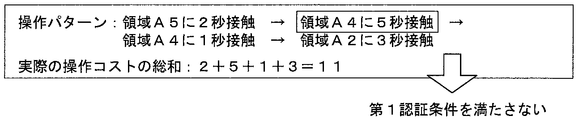
- FIG. 5 is a diagram showing an example of a pattern input screen 140.
- An example of operation patterns and operation costs actually input by operating the pattern input screen 140 is shown.
- An example of operation patterns and operation costs actually input by operating the pattern input screen 140 is shown.
- An example of operation patterns and operation costs actually input by operating the pattern input screen 140 is shown.
- the authentication device is a computer that authenticates the user based on the user's operation on the authentication device or a device separate from the authentication device.
- the authentication device may be a server device or a terminal device.
- the authentication device authenticates a user who uses a terminal device that can be connected to the authentication device via a network, for example.
- the authentication device is a terminal device, the authentication device authenticates a user who uses the authentication device, for example.
- FIG. 1A is a diagram illustrating an example of a schematic configuration of an information processing system SA when the authentication device 1 is applied to a server device.
- the information processing system SA includes an authentication device 1 as a server device and a plurality of user terminals 2. And the authentication apparatus 1 and each user terminal 2 can mutually transmit / receive data via the network NW, for example using TCP / IP etc. as a communication protocol.
- the network NW is constructed by, for example, the Internet, a dedicated communication line (for example, a CATV (CommunityCommunAntenna Television) line), a mobile communication network (including a base station, etc.), a gateway, and the like.
- the authentication device 1 may be, for example, a server device that performs processing for providing a predetermined service to a user who uses the information processing system SA.
- the authentication device 1 may be an authentication server that performs user authentication for a user to receive a service provided by the information processing system SA, for example.
- the authentication device 1 is configured to be accessible to the user information DB 3.
- the authentication device 1 itself may store the user information DB 3.
- the user information DB 3 may be stored in a device separate from the authentication device 1, such as a network storage or a server device.
- stores the authentication apparatus 1 and user information DB3 may be connected via a network.
- the user information DB 3 is a database in which user information related to users registered as members in the information processing system SA is registered.
- the user information includes at least a user ID.
- the user ID is user identification information.
- the user terminal 2 is a terminal device used by a user who intends to use the information processing system SA.
- the user can use the information processing system SA only by using a specific type of terminal device.
- types of terminal devices include smartphones, tablet computers, mobile phones, personal computers, PDAs (Personal Digital Assistants), STBs (Set Top Boxes), and the like.
- the types of terminal devices may be classified according to model, product series, and the like. For example, software such as a browser and an e-mail client is installed in the user terminal 2.
- the user terminal 2 includes, for example, a CPU, ROM, RAM, flash memory, hard disk drive, and the like. Furthermore, the user terminal 2 includes a display unit and an operation unit.
- the display unit displays information such as images and characters. Examples of the display unit 14 include a liquid crystal display and a CRT display.
- the operation unit accepts an operation by the user and outputs a signal corresponding to the operation content to the CPU. Examples of the operation unit include a key, a button, a switch, a keyboard, a mouse, a touch panel, and a remote controller.
- the user terminal 2 provides an input unit group to the user through the operation unit or a combination of the operation unit and the display unit.
- the input unit group includes a plurality of input units.
- the input unit is a component that can be operated by the user, and is a minimum component for inputting instructions, control, information, and the like from the user to the CPU.
- the input unit may be a real object, for example, or may be a virtual object displayed on the display unit. Examples of the input unit include a key, a button, a switch, a lever, and a slide bar. However, the input unit is not limited to these. Examples of the input unit group include an actual keyboard and a software keyboard. However, the input unit group is not limited to these.
- the operation unit may be the input unit group itself.
- the operation unit and the input unit group may be a keyboard.
- the input unit group may be provided by the operation unit and the display unit.
- a touch panel may be comprised by an operation part and a display part, and an input part group may be displayed on a touch panel.
- the operation on the input unit may be, for example, a user action including bringing the input unit into contact with the user's instruction.
- the pointing object include a hand, a finger, a stylus pen, a mouse cursor, and the like.
- Examples of operation contents for the input unit include pressing, tapping, flicking, swiping, sliding, clicking, double-clicking, dragging, and the like.
- the operation content for the input unit is not limited to these.
- the user terminal 2 provides the user with a character input environment through the input unit group.
- the character input environment is, for example, a user interface for inputting characters.
- the character input environment may include, for example, the configuration and layout of the input unit group, the operation method of the input unit group, and the like. In the present embodiment, it is assumed that the input environment is the same among a plurality of user terminals 2 using the information processing system SA, and only a single input environment is used.
- the authentication device 1 authenticates the user based on the user's operation content for the input unit group provided by the user terminal 2. Specifically, the authentication device 1 performs authentication based on the operation order of two or more input units operated by the user in the input unit group and the operation cost spent on the operation of the two or more input units. I do.
- the operation cost may indicate, for example, at least one of the user's effort and time spent for operating the input unit.
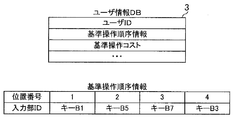
- FIG. 2 is a diagram illustrating an example of contents registered in the user information DB 3 and contents registered in the reference operation order information.
- User information for each user is registered in the user information DB 3.
- user information may be registered when a user registers as a member in the information processing system SA.
- the reference operation order information is information indicating the reference operation order.
- the reference operation order is an operation order of two or more input units to be operated by the user at the time of user authentication. That is, the reference operation order information indicates the correct answer of the operation order.
- the reference operation order is an example of the reference order in the present invention.
- a position number and an input unit ID are registered in association with each input unit to be operated.
- the position number is one number in the number group indicating the operation order. That is, the position number is a number indicating the position of a certain input unit in two or more input units arranged in the operation order.
- the number of input units to be operated may be individually determined for each user, for example.
- the input unit ID is identification information of the input unit.
- the input unit ID may be a sequence number assigned to each input unit, for example.
- the reference operation cost is an operation cost that the user should spend on the operation of the input unit group at the time of user authentication.
- the standard operation cost is an example of the standard cost in the present invention.
- the user may determine the reference operation order information and the reference operation cost.
- the authentication device 1 may determine the standard operation order information and the standard operation cost for each user. Then, the authentication device 1 may notify the user of the determined reference operation order information and the reference operation cost by, for example, an e-mail or a web page.
- FIG. 3A is a block diagram illustrating an example of a schematic configuration of the authentication device 1 according to the present embodiment.
- the authentication device 1 includes a communication unit 11, a storage unit 12, an operation unit 13, a display unit 14, an input / output interface 15, and a system control unit 16.
- the system control unit 16 and the input / output interface 15 are connected via a system bus 17.
- the communication unit 11 is connected to the network NW and controls the communication state with the user terminal 2 and the like.
- the storage unit 12 stores data and programs. Examples of the storage unit 12 include a hard disk drive and a flash memory.
- the user information DB 3 may be stored in the storage unit 12.
- the storage unit 12 is an example of each of a storage unit and a character string storage unit in the present invention.
- the storage unit 12 stores an input unit determination table, an input cost table, and the like.
- the input unit determination table is a table for determining an input unit operated by the user in order to input the character from the characters input by the user.
- the input unit determination table is a table that stores an input unit ID and one or more characters that can be input in association with each input unit that can input characters.
- the input cost table is information indicating an operation cost determination rule for inputting characters that can be input during user authentication.
- the input cost table is a table that stores an input cost for each character.
- the input cost is an operation cost for inputting characters.
- input costs are stored in association with at least characters or character types that can be input.
- the character type is an example of character classification.
- a configuration example of the input cost table will be described later.
- the storage unit 12 stores an input unit determination table and an input cost table corresponding to the input environment of the user terminal 2.
- the storage unit 12 further stores programs such as an operating system and an authentication processing program.
- the authentication processing program is a program for performing processing related to user authentication.
- the authentication processing program is an example of an information processing program in the present invention.
- the authentication processing program may be a program product, for example.
- the various programs may be acquired from other server devices or the like via the network NW, for example, or may be recorded on a recording medium such as an optical disk, a magnetic tape, or a memory card, and via the drive device. It may be read.
- the operation unit 13 accepts an operation by the operator and outputs a signal corresponding to the operation content to the system control unit 16.
- Examples of the operation unit 13 include a key, a button, a switch, a keyboard, a mouse, a touch panel, and a remote controller.
- the authentication device 1 may not include the operation unit 13.
- the authentication device 1 may be connected to the operation unit 13 by wire or wireless.
- the display unit 14 displays information such as images and characters under the control of the system control unit 16. Examples of the display unit 14 include a liquid crystal display, a CRT display, and an LED. Note that the authentication device 1 may not include the display unit 14. For example, the authentication device 1 may be connected to the display unit 14 by wire or wireless.
- the input / output interface 15 performs interface processing between the communication unit 11 and the storage unit 12 and the system control unit 16.
- the system control unit 16 includes a CPU (Central Processing Unit) 16a, a ROM (Read Only Memory) 16b, a RAM (Random Access Memory) 16c, and the like.
- the CPU 16a is an example of a processor.
- the present invention can also be applied to various processors different from the CPU.
- Each of the storage unit 12, the ROM 16b, and the RAM 16c is an example of a memory.
- the present invention can also be applied to various memories different from the hard disk, ROM, and RAM.
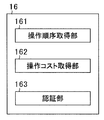
- FIG. 3B is a diagram illustrating an example of functional blocks of the system control unit 16 of the authentication device 1 according to the present embodiment.
- the system control unit 16 functions as an operation order acquisition unit 161, an operation cost acquisition unit 162, an authentication unit 163, and the like as illustrated in FIG. 3B when the CPU 16a reads and executes a program such as an authentication processing program.
- the operation order acquisition unit 161 is an example of each of an order acquisition unit, a segment determination unit, and a display control unit in the present invention.
- the operation cost acquisition unit 162 is an example of each of cost acquisition means, identification means, cost determination means, and presentation control means in the present invention.
- the authentication unit 163 is an example of each of an authentication unit and a storage control unit in the present invention.
- the operation order acquisition unit 161 displays an authentication screen on the display unit of the user terminal 2.
- the authentication screen is a screen displayed when the user performs an operation for authentication.
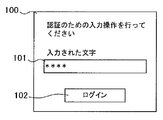
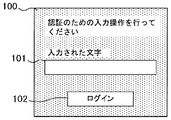
- FIG. 4 is a diagram illustrating an example of the authentication screen 100.
- the authentication screen 100 includes an input character display area 101 and an authentication button 102.
- the input character display area 101 is an area in which a predetermined character is displayed instead of a character input for authentication by an operation on the input unit group.
- the predetermined character may be an asterisk, for example, or may be another character.
- the predetermined number of characters displayed in the input character display area 101 indicates the number of characters input so far. That is, the number of input units operated up to the present time is shown.
- the authentication button 102 is a button for requesting authentication from the authentication apparatus 1 after the user operates the input unit group.
- the authentication screen 100 may further include a user ID input area.
- the user ID input area is an area where a user ID is input.
- the user ID input area is displayed on the authentication screen 100 when the authentication device 1 cannot specify the user ID of the user who requests authentication.
- a user ID input area is displayed in the authentication screen 100.
- the authentication screen 100 may not include a user ID input area.
- the operation order acquisition unit 161 acquires the operation order of two or more input units operated by the user for authentication in the input unit group provided by the user terminal 2.
- the operation order acquisition unit 161 may acquire operation order information from the user terminal 2.
- the operation order information indicates the operation order of the input unit actually operated.
- the structure of the operation order information is the same as the reference operation order information.
- the operation order acquisition unit 161 may acquire a character string input by operating the input unit group, for example. This character string is called an authentication character string.
- a character string composed of predetermined characters is displayed instead of the character string input by the user as at least a part of the authentication character string.
- the operation order acquisition unit 161 may acquire the operation order based on the authentication character string.
- the operation order acquisition unit 161 acquires characters from the authentication character string according to the order in which the characters are input. Then, the operation order acquisition unit 161 acquires, for each acquired character, the input unit ID corresponding to the character from the input unit determination table in association with the position number indicating the position of the character in the authentication character string. .
- the operation cost acquisition unit 162 acquires the operation cost spent on the operation of the input unit for each of two or more input units operated by the user in the input unit group provided by the user terminal 2. Even if the operation is performed on the same input unit, the operation cost may change depending on the operation content.
- the operation cost acquisition unit 162 may acquire, for example, the operation cost for each operated input unit from the user terminal 2.
- the operation cost acquisition unit 162 may acquire information indicating the operation content for each operated input unit from the user terminal 2.
- the operation cost acquisition part 162 may determine the operation cost of each input part based on the information which shows operation content.
- the operation cost acquisition part 162 may acquire the input cost of each character contained in the character string input by operation of the input part group, for example as an operation cost.
- the operation cost acquisition unit 162 acquires characters from the authentication character string according to the order in which the characters are input. Then, the operation cost acquisition unit 162 acquires, for each acquired character, the input cost corresponding to the character from the input cost table in association with the position number indicating the position of the character in the authentication character string. Note that the input cost of a certain character or character type may or may not change depending on the character or character type input immediately before the character or character type. When the input cost varies depending on the immediately preceding character or character type, for example, the operation cost acquisition unit 162 acquires the immediately preceding character or character type and the input cost corresponding to the next character or character type from the input cost table.
- the authentication unit 163 determines whether the first authentication condition and the second authentication condition are satisfied based on the operation order acquired by the operation order acquisition unit 161 and the operation cost acquired by the operation cost acquisition unit 162. .
- the first authentication condition and the second authentication condition are conditions for permitting authentication. When both the first authentication condition and the second authentication condition are satisfied, the authentication unit 163 permits user authentication. Permitting authentication may be, for example, permitting login or permitting use of a predetermined service. If at least one of the first authentication condition and the second authentication condition is not satisfied, the authentication unit 163 rejects the user authentication. For example, denying the authentication may be, for example, denying login or denying the use of a predetermined service.
- the first authentication condition is that the actual operation order acquired by the operation order acquisition unit 161 and the reference operation order indicated by the reference order information stored in the user information DB 3 in association with the user ID of the user who operated the input unit group Is a match.
- the first authentication condition is an example of a first condition in the present invention.
- the second authentication condition is, for example, the reference operation cost stored in the user information DB 3 in which the sum of the actual operation costs acquired by the operation cost acquisition unit 162 is associated with the user ID of the user who operated the input unit group. It may be coincident. Alternatively, the second authentication condition may be, for example, that the sum of actual operation costs is equal to or higher than a reference operation cost.
- the total operation cost is the sum of the operation costs of all operated input units.
- the second authentication condition is an example of a second condition in the present invention. When the second authentication condition is that the actual total operation cost matches the standard operation cost, the standard operation cost needs to be larger than the minimum total operation cost of two or more input units operated according to the standard order. There is. When the second authentication condition is that the actual operation cost sum is equal to or greater than the reference operation cost, the reference operation cost needs to be equal to or more than the sum of the minimum operation costs of two or more input units operated according to the reference order. There is.
- the authentication unit 163 does not use a condition that a character string input by a user operation on the input unit group matches a specific character string as a condition for permitting authentication. This is the difference between the authentication of this embodiment and the password authentication. Therefore, the user does not need to memorize a specific character string such as a password.
- the user may operate two or more input units in the order according to the reference order of the first authentication condition. At this time, the user may operate each input unit so that the sum of the operation costs of all input units to be operated matches the reference operation cost or is equal to or higher than the reference operation cost. In the present embodiment, the actual operation cost of each operation unit does not need to match a specific cost. The user can freely determine the operation cost spent on the operation of each operation unit.
- the standard operation order indicates that specific three input units are sequentially operated, and the standard operation cost is 12.
- the second authentication condition is that the actual operation cost sum matches the reference operation cost of 12.
- the user may operate the first to third input units at operation costs of 4, 4, and 4, for example, and may operate at operation costs of 1, 6, and 5, for example.
- the second authentication condition is that the actual operation cost sum is 12 or more of the reference operation cost, it becomes easier for the user to operate the input unit so that the operation looks complicated to others.
- the user may operate the first to third input units at operation costs of 5, 9, and 7, for example, and may operate at operation costs of 11, 3, and 4, for example.
- FIG. 5 is a diagram illustrating a configuration example of the input unit group 110.
- the input unit group 110 is an input unit group in an input environment in which the number of operations of the input unit varies depending on the input characters.
- the input unit group 110 may be an input unit group when the user terminal 2 is a predetermined mobile phone.
- the user terminal 2 includes an input unit group 110 as an operation unit.
- the input unit group 110 may be displayed on the display unit of the user terminal 2 as a software keyboard.
- the input unit group 110 includes character keys B1 to B10, a confirmation key B11, and the like.
- Character keys B1 to B10 are keys for inputting characters.
- Each of the character keys B1 to B10 is an example of an input unit.
- One or more characters that can be input are assigned to each of the character keys B1 to B10.
- the input character may change depending on the number of times the user continuously presses the same character key. For example, when the user taps the key B1, “1” is input. Further, for example, each time the user taps the key B2, the input characters change as “a”, “b”, “c”, “A”, “B”, “C”, “2”. Further, when the user taps the key B2, the input character returns to “a”.
- the confirmation key B11 is a key for confirming character input. For example, when inputting “pa”, the user may tap the key B2 once after tapping the key B7 once. On the other hand, when inputting “aa”, the user taps the key B2 once, taps the confirmation key B11 once, and then taps the key B2 once. Also, for example, when the user taps the key B2 once and a predetermined time elapses, the input of the first “a” is confirmed, and then when the user taps the key B2 once, “aa” is input. Also good.
- FIG. 6A is an example of an input unit determination table corresponding to the input unit group 110.
- this input unit determination table for example, “1” is stored in association with the input unit ID of the key B1. Further, for example, “a, b, c, A, B, C, 2” is stored in association with the input part ID of the key B2. Further, for example, “p, q, r, s, P, Q, R, S, 7” is stored in association with the input part ID of the key B7.
- the input cost table stores the input cost based on the number of operations for inputting each of a plurality of characters included in the password. Also good.
- the operation cost acquisition unit 162 acquires an operation cost based on the number of operations of the input unit based on the input cost table.
- the number of times the character key is tapped is an example of the number of operations of the input unit.
- the operation for obtaining the number of operations as the operation cost is not limited to the tap.
- FIG. 6B is an example of an input cost table corresponding to the input unit group 110. As shown in FIG. 6B, in the input unit group 110, the number of input operations varies depending on characters.
- the number of operations for inputting “a” is 1, and the number of operations for inputting “2” is 7.
- the input cost table stores the input cost of the next character corresponding to the number of input operations in association with the immediately preceding character and the current character. In the example of FIG. 6B, it is assumed that one input cost is required for each key operation. For example, the cost for inputting “a” first is 1.
- the input cost of “2” is 7.
- the input cost for inputting “a” this time is 2.
- the input cost for inputting “d” this time is 1. That is, the cost of pressing the enter key 132 or waiting for a predetermined time is reflected in the input cost of the next character.
- the input costs of the characters “c” to “6” are 3, 6, 2, 10, 4, and 7, respectively. Therefore, the password input cost is 32.
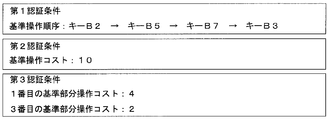
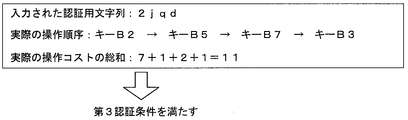
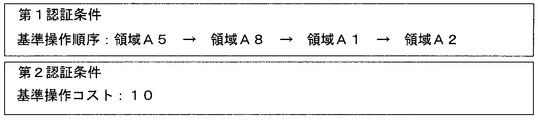
- FIG. 7A is a diagram illustrating an example of the first authentication condition and the second authentication condition.
- the character keys to be operated are, in order from the first, key B2, key B5, key B7, and key B3.
- the standard operation cost is assumed to be 10.
- the second authentication condition is that the actual operation cost is 10 or more, which is the reference operation cost.
- FIG. 7B to 7E show examples of the authentication character string, the operation order, and the operation cost that are actually input by the operation of the input unit group 110.
- FIG. 7B the authentication character string is “blDs”.
- the authentication character string is “bjre”.
- the operation order in this case is key B2, key B5, key B7, and key B3. Accordingly, the first authentication condition is satisfied.
- the authentication character string is “aJsd”.
- the operation order in this case is key B2, key B5, key B7, and key B3. Accordingly, the first authentication condition is satisfied.
- the authentication character string is “2kPF”.
- the operation order in this case is key B2, key B5, key B7, and key B3. Accordingly, the first authentication condition is satisfied.
- FIG. 8A is a diagram illustrating an example of an input environment when the user terminal 2 is a predetermined smartphone.
- a certain smart phone displays a software keyboard on a screen.
- the software keyboard includes a plurality of keys.
- the user terminal 2 can display a lowercase keyboard 120-1, an uppercase keyboard 120-2, and a numeric keyboard 120-3 as software keyboards, for example, as shown in FIG. 8A.
- Each software keyboard includes a plurality of character keys capable of inputting characters. Inputable characters are displayed on each character key.
- the lowercase keyboard 120-1, the uppercase keyboard 120-2, and the numeric keyboard 120-3 are basically the same input unit group except that the characters that can be input are different.
- the same input unit group means that, for example, the arrangement of input units used for inputting characters is the same.
- the character key 123-1 in the lowercase keyboard 120-1, the character key 123-2 in the uppercase keyboard 120-2, and the character key 123-3 in the numeric keyboard 120-3 are the same key.
- the character keys 123-1 to 120-3 differ in the characters that can be input.
- the user terminal 2 switches and displays a software keyboard used for input based on a user operation.
- one character that can be input is basically assigned to each character key of each software keyboard.
- the lowercase keyboard 120-1 is a keyboard for inputting English lowercase letters. Accordingly, the lowercase keyboard 120-1 includes a plurality of character keys each assigned an English lowercase letter. Further, the small letter keyboard 120-1 includes switching keys 121-1 and 122-1.
- the switch key 121-1 When the user presses the switch key 121-1, the user terminal 2 switches the software keyboard to the capital letter keyboard 120-2.
- the switch key 122-1 the user terminal 2 switches the software keyboard to the numeric keyboard 120-3.
- the capital letter keyboard 120-2 is a keyboard for inputting English capital letters.
- the uppercase keyboard 120-2 includes a plurality of character keys each assigned an English uppercase letter.
- the capital letter keyboard 120-2 includes switching keys 121-2 and 122-2.
- the switch key 121-2 the user terminal 2 switches the software keyboard to the lowercase keyboard 120-1.
- the switch key 122-2 the user terminal 2 switches the software keyboard to the numeric keyboard 120-3.
- the numeric keyboard 120-3 is a keyboard for inputting numbers and symbols. Accordingly, the numeric keyboard 120-3 includes a plurality of character keys each assigned a number or symbol. Furthermore, the numeric keyboard 120-3 includes a switching key 122-3. When the user presses the switch key 122-3, the user terminal 2 switches the software keyboard to the lowercase keyboard 120-1.
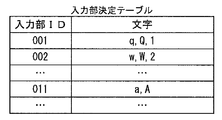
- FIG. 8B is a diagram showing an example of the input unit determination table corresponding to the software keyboards 120-1 to 120-3.
- “q, Q, 1” is stored in the input unit determination table in association with the input unit ID “001”.
- “a, A, ⁇ ” is stored in association with the input unit ID “011”.
- the input cost table may store an input cost based on the number of times of switching for switching the character category that can be entered into the character category entered by the operation of the input unit.
- the number of times of switching is an example of the operation content.
- the operation cost acquisition unit 162 acquires an operation cost based on the number of times of switching of character segments that can be input.
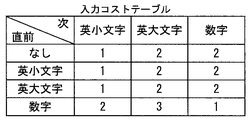
- FIG. 8C is a diagram showing an example of an input cost table corresponding to the software keyboards 120-1 to 120-3.
- the input cost of each character varies depending on the software keyboard used for inputting the character and the software keyboard used for inputting the immediately preceding character. Specifically, the number of times the software keyboard is switched is different. Therefore, for example, in the input cost table, a cost corresponding to the number of times of switching the software keyboard for inputting a character is stored as the input cost of the character.
- the input cost of the next character changes depending on the character type of the character input immediately before and the character type of the character input next. Thus, for example, as shown in FIG.
- the input cost table is a two-dimensional array in which the input cost of the character type of the next character is stored in association with the character type of the immediately preceding character and the character type of the next character. May be.
- the immediately preceding character type corresponds to a row and the next character type corresponds to a column.
- the immediately preceding character type may correspond to a column, and the next character type may correspond to a row.
- the user when inputting lowercase letters, the user may perform an operation of pressing a desired character key on the lowercase keyboard 120-1. Therefore, the input cost of lowercase letters in this case is 1.
- the user when inputting uppercase letters or numbers, the user needs to select the desired key after switching the software keyboard by operating the switch key 121-1 or 122-1. Therefore, the input cost of English capital letters and numbers is 2, respectively.
- the lowercase keyboard 120-1 is displayed on the screen. Therefore, the input costs of lowercase letters, uppercase letters, and numbers in this case are 1, 2, and 2, respectively. If the character entered immediately before is an uppercase letter, the uppercase keyboard 120-2 is switched to the lowercase keyboard 120-1 when the uppercase letter is entered.
- the input costs of lowercase letters, uppercase letters, and numbers in this case are 1, 2, and 2, respectively.
- a numerical keyboard 120-3 is displayed on the screen. Therefore, when inputting a lower case letter, the user needs to select the desired character key after operating the switching key 122-2 to switch to the software keyboard lower case keyboard 120-1. Therefore, the input cost of lowercase letters is 2.
- the user When inputting uppercase letters, the user operates the switch key 121-2 to switch to the software keyboard lowercase keyboard 120-1, and further operates the switch key 121-1 to operate the software keyboard uppercase keyboard 120-2. It is necessary to select a desired key after switching to. Therefore, the input cost of capital letters is 3. Also, the number input cost is 1.
- the input cost table may store the input cost in association with the character input immediately before and the character input next.
- the authentication character string is “oJ3X70c”.
- the input costs of characters from “o” to “c” are 1, 2, 2, 3, 2, 1, 2 respectively. Therefore, the total operation cost is 13.
- Example 3 of input environment Another example of an environment in which the input environment differs in the number of operations of the input unit depending on the input characters will be described.
- FIG. 9A is a diagram showing an example of the software keyboards 130-1 and 130-2.
- the user terminal 2 can display a lowercase / numeric keyboard 130-1 and an uppercase keyboard 130-2 as software keyboards, for example, as shown in FIG. 9A.
- a plurality of characters are assigned to each character key of the lowercase / numeric keyboard 130-1 and the uppercase keyboard 130-2.
- the lowercase / numeric keyboard 130-1 and the uppercase keyboard 130-2 are basically the same software keyboard except that the characters that can be entered are different.
- the lowercase / numeric keyboard 130-1 and uppercase keyboard 130-2 include character keys K1 to K10, a switching key K11, and the like, respectively.
- the lowercase / numeric keyboard 130-1 is a keyboard for inputting lowercase letters and numbers.
- One or more characters that can be input are displayed on each character key. For example, when the user taps the character key K1 of the lowercase / numeric keyboard 130-1, “a” is input.
- a tap is an operation of pressing and releasing a key with a finger.
- a flick is an operation of pressing a key with a finger and then paying the pressed finger in any direction. For example, when the user taps the character key K1 in the left direction, “b” is input. When the user taps the character key K1 upward, “c” is input.
- the capital letter keyboard 130-2 is a keyboard for inputting English capital letters.
- the same operation as that of the lowercase / numeric keyboard 130-1 can be performed on the uppercase keyboard 130-2.
- “A” is input.
- “B” is input.
- “C” is input.
- the user presses the switching key K11 of the uppercase keyboard 130-2 the user terminal 2 switches the software keyboard to the lowercase / numeric keyboard 130-1.
- FIG. 9B is a diagram showing an example of the input unit determination table corresponding to the software keyboards 130-1 and 130-2.
- “a, b, c, A, B, C, 2” are stored in the input unit determination table in association with the input unit ID of the key K2.
- “p, q, r, s, P, Q, R, S, 7” is stored in association with the input part ID of the key K7.
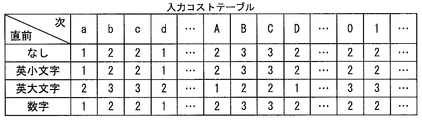
- FIG. 9C is a diagram showing an example of an input cost table corresponding to the software keyboards 130-1 and 130-2.
- the number of operations differs depending on the character. Specifically, in the case of a tap, the user may perform an operation of pressing a key for a moment. That is, the tap includes only one operation. On the other hand, in the case of flicking, the user needs to perform an operation of pressing a key and an operation of paying off the pressed finger. That is, a flick may be considered to include two operations. The greater the number of operations, the greater the input cost. Also, whether or not a software keyboard switching operation is necessary differs depending on the character type of the immediately preceding character and the next character. Therefore, for example, as illustrated in FIG.
- the input cost of the next character may be stored in the input cost table in association with the character type of the immediately preceding character and the next character. For example, when the switching operation of the software keyboard is unnecessary, the input cost of characters input by tapping is 1, and the input cost of characters input by flick is 2. When the switching operation of the software keyboard is necessary, the input cost of the character input by tapping is 2, and the input cost of the character input by flicking is 3.
- the authentication character string is “jZx9ra”.
- the input costs of characters from “j” to “a” are 1, 3, 3, 2, 2, 1, respectively. Therefore, the total input cost is 12.
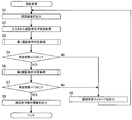
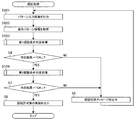
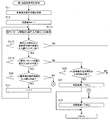
- FIG. 10 is a flowchart showing an example of authentication processing of the system control unit 16 of the authentication device 1 of the information processing system SA according to the present embodiment.
- a login request from the user terminal 2 is transmitted to the authentication device 1.
- the authentication device 1 transmits a request for a specific service that requires re-authentication to the authentication device 1.
- the system control unit 16 executes an authentication process.
- the operation order acquisition unit 161 outputs (transmits) the web page of the authentication screen 100 to the user terminal 2 (step S1).
- the authentication screen 100 includes, for example, a login ID input area, an input character display area 101, and an authentication button 102.
- the authentication screen 100 includes an input character display area 101 and an authentication button 102, for example.
- the user terminal 2 displays the authentication screen 100 based on the web page.
- the input unit group is a software keyboard or the like
- the user terminal 2 displays a software keyboard or the like together with the authentication screen 100.
- the user In the case of login, the user inputs the user ID and the authentication character string by operating the input unit group.
- the user terminal 2 transmits the input user ID and authentication character string to the authentication device 1, and the operation order acquisition unit 161 acquires the user ID and authentication character string via the communication unit 11.
- the user In the case of re-authentication, the user inputs an authentication character string by operating the input unit group.
- the user terminal 2 transmits the session ID and the input authentication character string to the authentication device 1, and the operation order acquisition unit 161 acquires the session ID and the authentication character string via the communication unit 11 (step S2).
- the session ID is identification information of a login session.
- the system control unit 16 When the login to the information processing system SA is successful, the system control unit 16 generates a session ID, and stores the session ID and the input user ID in association with each other in the RAM 16c. Then, the system control unit 16 transmits a cookie including the generated session ID to the user terminal 2. Thereby, the request transmitted from the user terminal 2 to the authentication device 1 includes the session ID.
- FIG. 11 is a flowchart illustrating an example of a first authentication condition determination process of the system control unit 16 of the authentication device 1 of the information processing system SA according to the present embodiment.
- the authentication unit 163 acquires reference operation order information corresponding to the user ID acquired from the user terminal 2 from the user information DB 3.
- the authentication unit 163 acquires a user ID corresponding to the session ID acquired from the user terminal 2 from the RAM 16c.
- the authentication part 163 acquires the reference
- the reference operation order acquisition unit 161 sets the position number i to 1 (step S12).
- the reference operation order acquisition unit 161 acquires the character (i) from the authentication input character string acquired from the user terminal 2 (step S13).
- Character (i) is the i-th character among the characters included in the authentication input character string.
- the reference operation order acquisition unit 161 acquires the input unit ID corresponding to the character (i) from the input unit determination table (step S14).
- the authentication unit 163 determines whether or not the acquired input unit ID matches the input unit ID (i) of the reference operation order information (step S15).
- the input unit ID (i) is the i-th input unit ID among the input unit IDs included in the reference operation order information.
- step S15: NO If the authentication unit 163 determines that the acquired input unit ID does not match the input unit ID (i) of the reference operation order information (step S15: NO), the authentication unit 163 proceeds to step S16. In step S16, the authentication unit 163 sets the determination result to “NG” and ends the first authentication condition determination process. On the other hand, if the authentication unit 163 determines that the acquired input unit ID matches the input unit ID (i) of the reference operation order information (step S15: YES), the authentication unit 163 proceeds to step S17.
- step S17 the authentication unit 163 determines whether or not the position number i is less than the value of the number of characters in the authentication input character string. At this time, if the authentication unit 163 determines that the position number i is less than the number of characters in the authentication input character string (step S17: YES), the authentication unit 163 proceeds to step S18. On the other hand, if the authentication unit 163 determines that the position number i is not less than the number of characters in the authentication input character string (step S17: NO), the authentication unit 163 proceeds to step S20.
- step S18 the authentication unit 163 determines whether or not the position number i is less than the number of input unit IDs included in the reference operation order information. At this time, if the authentication unit 163 determines that the position number i is less than the value of the number of input unit IDs included in the reference operation order information (step S18: YES), the authentication unit 163 proceeds to step S19. In step S19, the authentication unit 163 adds 1 to the position number i and proceeds to step S13. On the other hand, if the authentication unit 163 determines that the position number i is not less than the value of the number of input unit IDs included in the reference operation order information (step S18: NO), the authentication unit 163 proceeds to step S16.
- step S20 the authentication unit 163 determines whether the position number i matches the value of the number of input unit IDs included in the reference operation order information. At this time, if the authentication unit 163 determines that the position number i does not match the value of the number of input unit IDs included in the reference operation order information (step S20: NO), the authentication unit 163 proceeds to step S16. On the other hand, if the authentication unit 163 determines that the position number i matches the value of the number of input unit IDs included in the reference operation order information (step S20: YES), the authentication unit 163 proceeds to step S21. In step S21, the authentication unit 163 sets the determination result to “OK” and ends the first authentication condition determination process.
- the authentication unit 163 determines whether or not the determination result is “OK” as shown in FIG. 10 (step S4). At this time, if the authentication unit 163 determines that the determination result is not “OK” (step S4: NO), the authentication unit 163 proceeds to step S5. In step S5, the authentication unit 163 determines to reject authentication. And the authentication part 163 transmits the message which refuses authentication to the user terminal 2, and progresses to step S1. On the other hand, if the authentication unit 163 determines that the determination result is “OK” (step S4: YES), the authentication unit 163 proceeds to step 6.
- step S6 the authentication unit 163 executes a second authentication condition determination process.
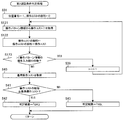
- FIG. 12 is a flowchart illustrating an example of the second authentication condition determination process of the system control unit 16 of the authentication device 1 of the information processing system SA according to the present embodiment.
- the operation cost acquisition unit 162 sets the position number i to 1.
- the operation cost acquisition unit 162 sets the total operation cost to 0 (step S31).
- the operation cost acquisition unit 162 determines whether or not the position number i is 1 (step S32). At this time, if the operation cost acquisition unit 162 determines that the position number i is 1 (step S32: YES), the operation cost acquisition unit 162 proceeds to step S33.
- step S33 the operation cost acquisition unit 162 sets the immediately preceding character to “not applicable”, and proceeds to step S35.
- the character input cost acquisition unit 162 proceeds to step S34.
- step S34 the operation cost acquisition unit 162 acquires the character (i-1) from the authentication character string. Then, the operation cost acquisition unit 162 stores the character (i-1) as the immediately preceding character, and proceeds to step S35.
- step S35 the operation cost acquisition unit 162 acquires the character (i) from the authentication character string. Then, the operation cost acquisition unit 162 stores the character (i) in the next character. Next, the operation cost acquisition unit 162 acquires the input cost corresponding to the character type of the immediately preceding character or the immediately preceding character and the character type of the next character or the next character as the input cost of the next character from the input cost table (step S36). . Next, the operation cost acquisition unit 162 adds the acquired input cost to the total operation cost (step S37).
- the authentication unit 163 determines whether or not the position number i is less than the number of characters in the authentication input character string (step S38). At this time, if the authentication unit 163 determines that the position number i is less than the number of characters in the authentication input character string (step S38: YES), the authentication unit 163 proceeds to step S39. In step S39, the authentication unit 163 adds 1 to the position number i and proceeds to step S32. On the other hand, if the authentication unit 163 determines that the position number i is not less than the value of the number of characters in the authentication input character string (step S38: NO), the authentication unit 163 proceeds to step S40.
- step S ⁇ b> 40 the authentication unit 163 acquires the reference operation cost corresponding to the user ID acquired from the user terminal 2 from the user information DB 3.
- the authentication unit 163 acquires a user ID corresponding to the session ID acquired from the user terminal 2 from the RAM 16c.
- the authentication part 163 acquires the reference
- the authentication unit 163 determines whether or not the total operation cost is equal to or greater than the acquired reference operation cost (step S41). At this time, if the authentication unit 163 determines that the total operation cost is equal to or higher than the reference operation cost (step S41: YES), the authentication unit 163 proceeds to step S42. In step S42, the authentication unit 163 sets the determination result to “OK” and ends the second authentication condition determination process. On the other hand, if the authentication unit 163 determines that the total operation cost is not equal to or higher than the reference operation cost (step S41: NO), the authentication unit 163 proceeds to step S43. In step S43, the authentication unit 163 sets the determination result to “NG”, and ends the second authentication condition determination process.
- the authentication unit 163 determines whether or not the determination result is “OK” as shown in FIG. 10 (step S7). At this time, if the authentication unit 163 determines that the determination result is not “OK” (step S7: NO), the authentication unit 163 proceeds to step S5. On the other hand, if the authentication unit 163 determines that the determination result is “OK” (step S4: YES), the authentication unit 163 proceeds to step 8. In step S8, the authentication unit 163 determines permission for authentication. And the authentication apparatus 1 outputs the web page of the screen after authentication is permitted to the user terminal 2, and complete
- FIG. 1B is a diagram illustrating an example of a schematic configuration of an information processing system SB when the authentication device 1 is applied to a terminal device.
- the information processing system SB includes an authentication device 1 as a terminal device.
- the authentication device 1 in this case may be connectable to a network, for example. Two or more authentication devices 1 may exist.
- the authentication device 1 may be, for example, a smartphone, a tablet computer, a mobile phone, a personal computer, a PDA, an STB, or the like.
- the authentication device 1 is used by a user.
- the configuration of the authentication device 1 when the authentication device 1 is a terminal device may be the configuration shown in FIG. 3A.
- the system control unit 16 may function as each unit illustrated in FIG. 3B.
- the authentication device 1 may be configured so that the user can set the reference operation order information and the reference operation cost for using the authentication device 1.
- user information DB3 may be memorized by storage part 12.
- the input unit group operated for user authentication is the operation unit 13, or the input unit group is provided by the operation unit 13 and the display unit 14.
- the character input environment in the authentication device 1 is single.
- the storage unit 12 stores an input unit determination table and an input cost table corresponding to the input environment.
- the authentication device 1 acquires the operation order of the input unit group based on the input unit determination table, and acquires the total operation cost of the authentication character string based on the input cost table. Then, the authentication device 1 determines whether or not the first authentication condition and the second authentication condition are satisfied.
- the processing when the authentication device 1 is a terminal device is basically the same as the processing shown in the flowcharts of FIGS.
- the system control unit 16 outputs the authentication screen and the screen after the authentication is permitted to the display unit 14. Further, the system control unit 16 acquires an authentication character string input based on the operation of the operation unit 13. Further, the system control unit 16 may not generate a session ID when a login session is started. In this case, the system control unit 16 may store the input user ID, for example, in the RAM 16c or the like as the user ID of the user during the login session.
- the user who can use the authentication device 1 may be limited to only one user. In this case, for example, even when logging in, the user does not need to input a user ID.
- the user information DB 3 may not be stored in the storage unit 12. For example, the reference operation order information and the reference operation cost for one person may be stored in the storage unit 12.
- the system control unit 16 acquires the operation order of two or more input units operated by the user in the input unit group. Further, the system control unit 16 acquires, for each input unit that has been operated, an operation cost that has been spent on the operation of the input unit and varies depending on the operation content of the input unit. And the system control part 16 says that the 1st authentication condition that the acquired operation order and the reference
- the system control part 16 says that the sum total of the 1st authentication condition that the acquired operation order and the reference
- the second authentication condition is satisfied, authentication permission is determined. Therefore, the user can quickly operate the input unit. Therefore, it is possible to make it difficult for others to understand the operation of operating the input unit without complicating the operation of the input unit.
- the operation cost of the input unit operated in a predetermined order among the two or more input units operated by the system control unit 16 matches the specific cost. Whether or not to perform authentication is determined. Therefore, it is possible to provide variations in the cost that the user spends on the operation of the input units in a predetermined order.
- system control unit 16 does not use the condition that the authentication character string input by the user's operation on the input unit group used for the character input operation matches the specific character string as the condition for permitting the authentication. . Therefore, the user does not need to remember a specific character string necessary for authentication.
- system control unit 16 may acquire the operation cost of the input unit based on the number of times of switching for switching the character segment that can be input to the character segment input by the operation of the input unit. In this case, it is possible to calculate an appropriate input cost for an input environment in which the character categories that can be input can be switched.
- system control unit 16 may acquire the operation cost of the input unit based on the number of operations of the input unit. In this case, the operation cost can be appropriately acquired when the input unit can be operated a plurality of times.
- the present embodiment is applied to an environment in which the input environment can switch the character types that can be input by operating the input unit group.
- An example of such an input unit group may be a software keyboard as shown in FIGS. 8A and 9A. Except as described below, the second embodiment is basically the same as the first embodiment.
- the authentication device 1 may be a server device or a terminal device, for example.
- the operation order information acquisition unit 161 randomly determines a character type that can be input by an operation of the input unit group when user authentication is required.
- the operation order information acquisition unit 161 displays the input unit group together with a plurality of characters of a character type determined at random.
- the operation order information acquisition unit 161 displays each of the plurality of characters of the determined character type on or in association with the input unit capable of inputting the character.
- the operation order information acquisition unit 161 and the operation cost acquisition unit 162 respectively acquire the operation order and operation cost of two or more input units operated by the user in the input unit group displayed in this way.
- the operation order information acquisition unit 161 randomly determines the software keyboard to be displayed from the lowercase / numeric keyboard 130-1 and the uppercase keyboard 130-2. In other words, the operation order information acquisition unit 161 randomly determines whether input characters are lowercase letters and numbers or uppercase letters.
- FIG. 13A is a screen example when the lowercase / numeric keyboard 130-1 is determined.
- the operation order information acquisition unit 161 determines the lowercase / numeric keyboard 130-1.
- the operation order information acquisition unit 161 displays a lowercase / numeric keyboard 130-1 on the screen together with the authentication screen.
- FIG. 13B shows an example of a character string, operation order, and operation cost actually input by operating the lowercase / numeric keyboard 130-1. It is assumed that the user inputs the authentication character string “8ane9” by operating the lowercase / numeric keyboard 130-1.
- the operation order in this case is key K8, key K2, key K6, key K3, and key K9.
- FIG. 14A is a screen example when the capital letter keyboard 130-2 is determined.
- the operation order information acquisition unit 161 determines the capital letter keyboard 130-2.
- the operation order information acquisition unit 161 displays the capital letter keyboard 130-2 on the screen together with the authentication screen.
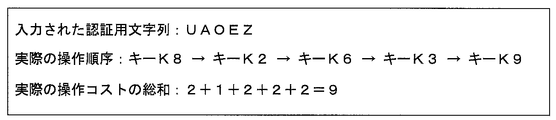
- FIG. 14B shows an example of a character string, operation order, and operation cost actually input by operating the capital letter keyboard 130-2. It is assumed that the user inputs the authentication character string “UAOEZ” by operating this capital letter keyboard 130-2.
- the user when inputting the authentication character string, the user can switch the character type that can be input.
- the operation order information acquisition unit 161 may perform control such that, for example, the character type that can be input cannot be changed from the character type that is initially determined.
- FIG. 15 is a flowchart showing an example of authentication processing of the system control unit 16 of the authentication device 1 of the information processing system SA according to the present embodiment.
- the operation order information acquisition unit 161 randomly determines inputable character types (step S51).
- the operation order acquisition unit 161 outputs the web page of the authentication screen 100 to the user terminal 2 (step S1).
- the operation order information acquisition unit 161 displays a software keyboard capable of inputting the determined character type on the user terminal 2 (step S52).
- the operation order information acquisition unit 161 may transmit software keyboard identification information to the user terminal 2.
- the user terminal 2 displays an authentication screen 100 and a software keyboard corresponding to the identification information received from the authentication device 1.
- the operation order information acquisition unit 161 causes the user terminal 2 to display the input unit group together with a plurality of characters of the character type determined at random.
- the user inputs an authentication character string by operating the displayed input unit group.
- the user terminal 2 transmits the input authentication character string to the authentication device 1, and the operation order acquisition unit 161 acquires the authentication character string (step S2). Then, the system control unit 16 executes steps S3 to S8 in the same manner as in the first embodiment, using the acquired authentication character string.
- the operation order information acquisition unit 161 displays a software keyboard capable of inputting the determined character type on the display unit 14 in step S52.
- the system control unit 16 randomly determines the character categories that can be input by the input unit group. Further, the system control unit 16 displays the input unit group together with a plurality of characters of the determined section. Then, the system control unit 16 acquires the operation order of two or more input units operated by the user in the displayed input unit group and the operation cost spent for the operation. Therefore, it is difficult for another person to estimate the operation content for authentication from the input unit group displayed at the time of authentication. Therefore, safety can be further improved.
- FIG. 16A is a diagram illustrating an example of a schematic configuration of an information processing system SC when the authentication device 1 is applied to a server device.
- the information processing system SC is different from the information processing system SA shown in FIG. 1A in that the authentication device 1 is configured to be able to access the character string input history DB 4 in addition to the user information DB 3.
- the character string input history DB 4 may be stored in the storage unit 12 of the authentication device 1.
- history DB4 may be connected via a network.
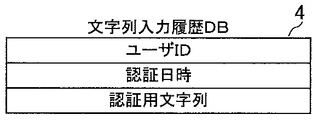
- the character string input history DB 4 is a database in which the input history of the authentication character string by the user is registered.
- FIG. 16B is a diagram illustrating an example of contents registered in the character string input history DB 4.
- the character string input history DB 4 an input history including the input authentication character string is registered every time authentication is permitted.
- a user ID, an authentication date and time, and an authentication character string are registered in the character string input history DB 4 in association with each other as an input history.
- the user ID indicates the user who has input the authentication character string.
- the date and time of authentication indicates the date and time when authentication is permitted.
- the authentication unit 163 stores an input history including an authentication character string acquired from the user terminal 2 in the character string input history DB 4 when the user authentication permission is determined. Further, the authentication unit 163 determines to reject authentication when the authentication character string input this time matches the authentication character string stored in the character string input history DB 4 at the time of past authentication during user authentication. As a result, the same authentication character string as the authentication character string that has been input in the past cannot be input. Therefore, even if another person steals an input operation of the authentication character string by the user, even if the same authentication character string is input, the authentication is rejected. Thereby, safety can be improved.
- the authentication unit 163 may determine to reject authentication only when, for example, the authentication character string input this time matches any of the authentication character strings input within a predetermined period in the past. Alternatively, for example, the authentication unit 163 may determine to reject authentication only when the authentication character string input this time matches one of the authentication character strings input during the most recent predetermined number of authentications. .
- FIG. 17 is a flowchart showing an example of authentication processing of the system control unit 16 of the authentication device 1 of the information processing system SC according to this embodiment.
- the processing example illustrated in FIG. 17 is a processing example when authentication is rejected when the authentication character string input this time matches any of the authentication character strings input within the past predetermined period.
- processes similar to those in FIG. 10 are given the same reference numerals.
- step S7 the authentication unit 163 calculates a reference date and time by subtracting a predetermined number of days stored in the storage unit 12 from the current date and time.
- the authentication unit 163 acquires one or more past authentication character strings whose authentication date and time are after the reference date and time from the character string input history DB 4 (step S62). Specifically, the authentication unit 163 searches the character string input history DB 4 for an authentication character string corresponding to the user ID acquired from the user terminal 2. Alternatively, the authentication unit 163 acquires a user ID corresponding to the session ID acquired from the user terminal 2 from the RAM 16c. And the authentication part 163 searches the character string for authentication corresponding to the acquired user ID from character string input log
- the authentication unit 163 determines whether the authentication character string acquired from the user terminal 2 this time matches any of the past one or more authentication character strings acquired in step S62 (step S62). S63). At this time, if the authentication unit 163 determines that the authentication character string acquired this time matches one of the past one or more authentication character strings (step S63: YES), the authentication unit 163 proceeds to step S5. On the other hand, if the authentication unit 163 determines that the authentication character string acquired this time does not match any of the past one or more authentication character strings (step S63: NO), the process proceeds to step S64.
- step S64 the authentication unit 163 determines the current date and time as the authentication date and time.
- the authentication unit 163 registers the acquired user ID, authentication input character string, and authentication date and time in the character string input history DB 4 in association with each other.
- the authentication device 1 outputs the web page on the screen after the authentication is permitted to the user terminal 2 (step S8), and ends the authentication process.
- processing when the authentication device 1 is a terminal device may be the same as the processing described above.
- the system control unit 16 when authentication permission is determined, stores the authentication character string input by the user's operation in the character string input history DB 4. Then, when the authentication character string input this time by the system control unit 16 matches the authentication character string stored in the character string input history DB 4 at the time of past authentication, authentication rejection is determined. Therefore, even if another person steals the input operation of the authentication character string by the user himself, even if the same authentication character string is input, the authentication is rejected. Thereby, safety can be further improved.
- the character input environment is limited to one.
- the present embodiment there are a plurality of input environments. Except as described below, the fourth embodiment is basically the same as the first to third embodiments.
- the authentication device 1 is a server device
- a plurality of types of terminal devices can use the information processing system SA as the user terminal 2 in the information processing system SA.
- the input environment may vary depending on the type of the user terminal 2.
- the operation cost acquisition unit 162 identifies an input environment that is actually used for inputting an authentication character string from a plurality of input environments. For example, when the authentication device 1 and the user terminal 2 communicate with each other by HTTP, the operation cost acquisition unit 162 may use user agent information included in a request from the user terminal 2. In this case, the authentication device 1 specifies an input environment corresponding to the user agent information.
- the operation cost acquisition unit 162 may request the input environment information from the user terminal 2, for example.
- the user terminal 2 transmits, for example, an input environment ID indicating the input environment to the authentication device 1.
- the operation cost acquisition unit 162 specifies the input environment of the user terminal 2 by receiving the input environment ID.
- the operation cost acquisition unit 162 specifies the input environment in the authentication device 1 based on this information.
- the storage unit 12 stores a plurality of sets of input unit determination tables and input cost tables. Each set is stored in association with an input environment ID indicating an input environment corresponding to the set, for example.
- the storage unit 12 may store a user agent / input environment conversion table conversion table.
- the user agent / input environment conversion table is a table that stores user agent information and an input environment ID corresponding to the type of the user terminal 2 indicated by the user agent information in association with each other.
- FIG. 18 is a flowchart showing an example of authentication processing of the system control unit 16 of the authentication device 1 according to this embodiment. 18, processes similar to those in FIG. 10 are denoted by the same reference numerals.
- the operation cost acquisition unit 162 identifies the input environment for the authentication character string (step S71).
- the authentication device 1 is a server device
- the operation cost acquisition unit 162 may acquire user agent information from a request received from the user terminal 2, for example.
- the operation cost acquisition unit 162 acquires the input environment ID corresponding to the user agent information from the user agent / input environment conversion table.
- the operation cost acquisition unit 162 may transmit a request for an input environment ID to the user terminal 2 that has transmitted the request, for example.
- the user terminal 2 transmits an input environment ID indicating the input environment to the authentication device 1.
- the operation cost acquisition unit 162 may acquire information indicating the input environment from the storage unit 12, for example. Then, the operation cost acquisition unit 162 may acquire an input environment ID corresponding to the acquired information.
- step S71 the operation cost acquisition unit 162 determines an input unit determination table and an input cost table corresponding to the input environment (step S72). Specifically, the operation cost acquisition unit 162 specifies an input unit determination table and an input cost table corresponding to the acquired input environment ID from the storage unit 12. Next, the system control unit 16 executes S1 to S8 as in the first embodiment.
- step S14 of the first authentication condition determination process shown in FIG. 11 the operation order information acquisition unit 161 acquires the input unit ID corresponding to the character (i) from the input unit determination table determined in step S72.
- step S36 of the second authentication condition determination process shown in FIG. 12 the operation cost acquisition unit 162 acquires the input cost of the next character from the input cost table determined in step S72.
- the system control unit 16 specifies the character input environment using the input unit group. And the system control part 16 acquires the operation cost for every character input by the user's operation based on the input cost table which shows the decision rule of the cost with respect to the specified input environment. Therefore, even when the input environment is not predetermined, it is possible to calculate an operation cost appropriate for the input environment used for character input operation.
- the authentication device 1 determines a reference operation cost based on a predetermined condition for each authentication. As a result, the authentication device 1 can change the reference operation cost. Except as described below, the fifth embodiment is basically the same as the first to fourth embodiments.
- the operation cost acquisition unit 162 may determine the reference operation cost at random every time, for example. That is, the condition for determining the reference operation cost is to determine at random.
- the condition for determining the standard operation cost may be a situation of a user who requires authentication.
- the operation cost acquisition unit 162 may specify, for example, the situation of the user that requires authentication. Then, the operation cost acquisition unit 162 may determine a reference operation cost based on the specified situation. The operation cost acquisition unit 162 may determine the safety of the specified situation. The safety in this case may be, for example, a low probability that other users can see how the user operates the input unit group.
- the operation cost acquisition unit 162 determines a larger reference operation cost as the probability that a user operates the input unit group is likely to be seen by others. The probability that the person who operates the input unit group is the user himself / herself may be high. In this case, the operation cost acquisition unit 162 determines a larger reference operation cost as the probability that the person who operates the input unit group is the user is lower.
- Examples of the user situation include the position of the user, the position of the user terminal 2 used by the user, the moving speed of the user and the user terminal 2, the time, and the like.
- Examples of the position of the user or the user terminal 2 include an absolute position and a relative position.
- Examples of the user status information indicating the absolute position include the geographical position of the user or the user terminal 2, the IP address assigned to the user terminal 2, and the like.
- Examples of the user status information indicating the relative position include a distance from a specific device, a distance from someone different from the user, and the like.
- the operation cost acquisition unit 162 may specify only one situation or may specify a plurality of situations.
- the user terminal 2 when the user terminal 2 includes a GPS (Global Positioning System), the user terminal 2 can acquire position information indicating the longitude and latitude of the place where the user terminal 2 is located.
- the user terminal 2 when the user terminal 2 is a mobile communication terminal such as a smartphone or a mobile phone, the position information of the user terminal 2 can be acquired based on the position information of the base station.
- the operation cost acquisition unit 162 may acquire position information from the user terminal 2 as user status information. Further, the operation cost acquisition unit 162 can acquire the IP address of the user terminal 2 as user status information from the header of the packet transmitted from the user terminal 2 to the authentication device 1. In some cases, for example, an area where the user terminal 2 is located can be specified by the IP address.
- the operation cost acquisition unit 162 may acquire, from the user terminal 2, for example, information identifying an access point and information indicating a distance from the access point as user status information. Examples of information for identifying an access point include an IP address of the access point, an SSID (Service Set Identifier), and the like.
- Examples of the information indicating the distance include the strength of the signal from the access point, the distance estimated by the user terminal 2 based on the signal strength, and the like.
- the user terminal 2 may acquire the moving speed of the user terminal 2 measured by the speed sensor. Further, for example, the user terminal 2 may acquire the position of the user terminal 2 every predetermined time, and calculate the moving speed of the user terminal 2 based on the acquired position.
- the operation cost acquisition unit 162 can acquire the moving speed from the user terminal 2. Further, the system control unit 16 has a time measuring function. Therefore, the operation cost acquisition unit 162 can acquire the current time as user status information from the time measuring function.
- FIG. 19A to FIG. 19C are diagrams showing examples of determining the standard operation cost according to the user's situation.
- FIG. 19A shows an example in which the reference operation cost is determined based on the position of the user or the user terminal 2.
- the reference operation cost may be determined based on whether the user or the user terminal 2 is located at an operation cost acquisition unit 162, for example, a predetermined place.
- the predetermined place may be a place where the user is usually present, for example. Examples of such places include home, office, school, etc.
- the operation cost acquisition unit 162 is smaller when the user or the user terminal 2 is located at a predetermined location than when the user or the user terminal 2 is not located at a predetermined location.
- a reference operation cost may be determined.
- the position of the predetermined place may be registered for each user, for example. This position is called a registered position.
- a database in which registration positions are registered may be stored in the storage unit 12.
- the operation cost acquisition unit 162 may determine that the user is located at a predetermined location. Or operation cost acquisition part 162 may determine standard operation cost according to the distance from the position of a user or user terminal 2 to a registered position, for example. For example, the operation cost acquisition unit 162 may determine a larger reference operation cost as the distance is longer.
- the cost acquisition unit 162 may determine the reference operation cost based on the position of the user or the user terminal 2 when the authentication is permitted in the past and the current position of the user or the user terminal 2.
- a location history database that stores the location of the user or the user terminal 2 may be stored in the storage unit 12.
- the operation cost acquisition unit 162 may store the current position of the user or the user terminal 2 and the user ID of the user in association with each other in the position history database every time authentication is permitted.
- the operation cost acquisition unit 162 determines a larger reference operation cost as the distance from the current user or user terminal 2 position to the user or user terminal 2 position when authentication is permitted in the past is longer. May be. The shorter the distance to the user or the position of the user terminal 2 when the authentication is permitted in the past, the higher the probability that the person who operated the input unit group this time is the user who should be permitted the authentication.
- FIG. 19B shows an example in which the standard operation cost is determined based on the moving speed of the user or the user terminal 2.
- the operation cost acquisition unit 162 may determine a larger reference operation cost as the moving speed increases.
- FIG. 19C shows an example in which the standard operation cost is determined based on the time.
- the operation cost acquisition unit 162 may determine the reference operation cost based on a time zone including the current time.
- the operation cost acquisition unit 162 may determine a reference operation cost that is smaller as the probability that the user is at home is higher. The higher the probability that the user is at home, the lower the probability that the operation of the input unit group will be seen by others.
- the operation cost acquisition unit 162 may determine the reference operation cost based on the time when authentication is permitted in the past and the current time. For example, an authentication history database in which the times when authentication was permitted in the past is registered may be stored in the storage unit 12. For example, every time the authentication is permitted, the operation cost acquisition unit 162 may associate the authentication time with the user ID of the user permitted for authentication and store them in the authentication history database.
- the authentication history database may be, for example, a character string input history DB4.
- the operation cost acquisition unit 162 may determine a larger reference operation cost as the time elapsed from the time when authentication was permitted in the past to the present is longer. The shorter the time elapsed since the time when authentication was permitted in the past, the higher the probability that the person who operated the input unit group is the user who should be permitted to authenticate.
- a table that stores information indicating a user's situation and a reference operation cost in association with each other as illustrated in FIGS. 19A to 19C may be stored in the storage unit 12.
- the operation cost acquisition unit 162 may determine the reference operation cost based on the stored table and the identified user situation.
- the reference operation cost may not be registered in the user information DB 3.
- the operation cost acquisition unit 162 may determine the final reference operation cost based on the reference operation cost registered in the user information DB 3, for example.
- the operation cost acquisition unit 162 may determine the coefficient based on the identified user situation. Then, the operation cost acquisition unit 162 may determine the final reference operation cost by multiplying the determined coefficient by the reference operation cost registered in the user information DB 3.
- the operation cost acquisition unit 162 causes the user to present information indicating the reference operation cost.
- the operation cost acquisition unit 162 may display the reference operation cost as a number in the authentication screen 100.
- the operation cost acquisition unit 162 may change at least one color of the components of the authentication screen 100 according to, for example, the reference operation cost.
- the component may be, for example, the background of the authentication screen 100 or may be another component.
- 20A and 20B are diagrams illustrating examples of the authentication screen 100 in which the background color is changed. For example, when the standard operation cost is 10, the authentication screen 100 shown in FIG. 20A may be displayed.
- the background color of this authentication screen 100 may be, for example, blue or another color.
- an authentication screen 100 shown in FIG. 20B may be displayed.
- the background color of the authentication screen 100 may be red or another color, for example.
- FIG. 21 is a flowchart illustrating an example of the authentication process of the system control unit 16 of the authentication device 1 according to the present embodiment.
- the operation cost acquisition unit 162 identifies the user's situation (step S81).
- the operation cost acquisition unit 162 may acquire information indicating the absolute position of the user or the user terminal 2 and information indicating the relative position of the user or the user terminal 2 from the user terminal 2.
- the user terminal 2 may acquire the information which shows the moving speed of a user or the user terminal 2, for example.
- the current user situation specifying unit 161 may acquire the current time from, for example, a time measuring unit.
- the operation cost acquisition unit 162 determines a reference operation cost based on the identified situation of the user terminal 2 (step S82). The method for determining the standard operation cost has already been described. Next, the operation cost acquisition unit 162 determines the background color of the authentication screen 100 based on the determined reference operation cost. For example, the storage unit 12 may store a table that stores the reference operation cost and the background color in association with each other. For example, the operation cost acquisition unit 162 may acquire a background color corresponding to the determined reference operation cost from the table. Next, the operation cost acquisition unit 162 outputs the web page of the authentication screen 100 in which the background is filled with the determined background color to the user terminal 2 (step S84).
- the operation cost acquisition unit 162 may change the background-color property of the web page style sheet of the authentication screen 100 to the determined background color.
- the system control unit 16 executes Steps S2 to S8 as in the first embodiment.
- step S5 the system control unit 16 proceeds to step S84.
- the operation cost acquisition unit 162 When the authentication device 1 is a terminal device, the operation cost acquisition unit 162, as the current user status, for example, the location of the authentication device 1, the location of the user using the authentication device 1, the authentication device 1 or the movement of the user Specify speed or time. Therefore, the operation cost acquisition unit 162 can acquire or generate information indicating the user status in the same manner as in the case of the user terminal 2.
- the reference operation cost can be changed based on a predetermined condition. decide. Then, the system control unit 16 determines whether the authentication is permitted or not using the determined reference operation cost. Therefore, there is a possibility that the standard operation cost is changed for each authentication, and accordingly, the second authentication condition is changed. Therefore, safety can be further improved.
- system control unit 16 may acquire the situation where the user is placed. Then, the system control unit 16 may determine the reference operation cost based on the acquired situation. In this case, the authentication device 1 can determine the reference operation cost considering safety based on the user's situation.
- system control unit 16 may present information indicating the determined standard operation cost.
- the authentication device 1 can make the user recognize the total operation cost to be spent on the operation of the input unit.
- the authentication unit 163 determines whether or not the third authentication condition is satisfied in addition to the first authentication condition and the second authentication condition. Then, the authentication unit 163 determines permission of authentication when all of the first authentication condition to the third authentication condition are satisfied. Except as described below, the sixth embodiment is basically the same as the first to fifth embodiments.
- the third authentication condition may be, for example, that an actual operation cost of an input unit operated in a predetermined order among two or more input units operated by a user matches a reference partial operation cost.
- the third authentication condition may be, for example, that the actual operation cost of the input unit operated in a predetermined order is equal to or higher than the reference partial operation cost.
- the reference partial operation cost is an operation cost that the user should spend on the operation of the input unit in a predetermined order at the time of user authentication.
- the reference partial operation cost is an example of a second reference cost in the present invention.
- the third authentication condition is an example of a third condition in the present invention. As a condition for permitting the authentication, a condition related to the operation cost is added, so that safety can be further improved.
- FIG. 22 is a diagram illustrating an example of contents registered in the user information DB 3 and contents registered in the reference partial operation cost information.
- the user ID, reference operation order information, reference operation cost, and reference partial operation cost information are registered in the user information DB 3 in association with each other.
- the reference partial operation cost information is information indicating the reference partial operation cost of each input unit operated in the reference operation order.
- a position number and a reference partial operation cost are registered in association with each input unit to be operated.
- the reference partial operation cost corresponding to the position number is “ ⁇ ”, the reference partial operation cost is not actually set for the input unit corresponding to the position number. In this case, there is no restriction on the actual operation cost of the input unit corresponding to the position number.
- the reference partial operation cost may be set for all the input units to be operated, or the reference partial operation cost may be set for a part of the input units.
- the third authentication condition is that the actual operation cost of the input units operated in a predetermined order matches the reference partial operation cost
- the reference partial operation cost for a part of the input units Is set. That is, the authentication unit 163 permits authentication regardless of whether the actual operation cost of at least one operation unit or the operation unit operated in a predetermined order matches a specific cost. The reason is to avoid satisfying the first authentication condition to the third authentication condition substantially equivalent to inputting a password.
- the order of the input units in which the reference partial operation costs are set may be common throughout the information processing system SA, or may be determined individually for each user.
- the reference partial operation cost may not be set.
- the reference partial operation cost is set only for the first and fourth input units among the first to fourth input units.
- the reference partial operation cost of the first input unit is 4, and the reference partial operation cost of the third input unit is 2.
- FIG. 23A is a diagram showing examples of the first authentication condition to the third authentication condition.
- the standard operation cost is assumed to be 10.
- the second authentication condition is that the actual operation cost is 10 or more of the reference operation cost.
- the first reference partial operation cost is 4, and the third reference partial operation cost is 2.
- the third authentication condition is that the first actual operation cost is 4 or more and the third actual operation cost is 2 or more.
- FIG. 23B and FIG. 23C show examples of the authentication character string, the operation order, and the operation cost actually input by the operation of the input unit group 110.
- the authentication character string is “clsE”.
- the operation order in this case is key B2, key B5, key B7, and key B3.
- the authentication character string is “2jqd”.
- the operation order in this case is key B2, key B5, key B7, and key B3.
- the first actual operation cost of 8 is greater than the reference partial operation cost of 4, and the third actual operation cost of 2 matches the reference partial operation cost of 2. Accordingly, all of the first authentication condition to the third authentication condition are satisfied. Therefore, authentication is permitted.
- FIG. 24 is a flowchart illustrating an example of the second authentication condition determination process of the system control unit 16 of the authentication device 1 of the information processing system SA according to the present embodiment.
- the same reference numerals are assigned to the same processes as those in FIG.
- the processing example described below is an operation example when the third authentication condition is defined as the actual operation cost being equal to or higher than the reference partial operation cost.
- the system control unit 16 executes steps S31 to S36 as in the first embodiment.
- step S ⁇ b> 36 the authentication unit 163 acquires reference partial operation cost information corresponding to the user ID acquired from the user terminal 2 from the user information DB 3.
- the authentication unit 163 acquires a user ID corresponding to the session ID acquired from the user terminal 2 from the RAM 16c.
- the authentication part 163 acquires the reference
- the authentication unit 163 acquires the reference partial operation cost (i) from the acquired reference partial operation cost information.
- the reference partial operation cost (i) is the i-th reference partial operation cost among the reference partial operation costs included in the reference partial operation cost information.
- step S91 determines whether or not the reference partial operation cost (i) is set. At this time, if the authentication unit 163 determines that the reference partial operation cost (i) is not set (step S91: NO), the process proceeds to step S37.
- the system control unit 16 executes steps S37 to S43 in the same manner as in the first embodiment.
- step S91 determines that the reference partial operation cost (i) is set (step S91: YES)
- step S92 the authentication unit 163 proceeds to step S92.
- step S92 the authentication unit 163 determines whether or not the input cost acquired in step S36 is equal to or higher than the reference partial operation cost (i). At this time, if the authentication unit 163 determines that the input cost is equal to or higher than the reference partial operation cost (i) (step S92: YES), the authentication unit 163 proceeds to step S37. On the other hand, if the authentication unit 163 determines that the input cost is not equal to or higher than the reference partial operation cost (i) (step S92: NO), the authentication unit 163 proceeds to step S43. Then, the authentication unit 163 sets the determination result to “NG” and ends the second authentication condition determination process.
- processing when the authentication device 1 is a terminal device may be the same as the processing described above.
- the system control unit 16 determines permission of authentication.
- the third authentication condition is that the first authentication condition, the second authentication condition, and the third authentication condition that the operation cost is equal to or more than the operation cost reference partial operation cost of the input unit operated in a predetermined order among the two or more input units operated by the user. If it is satisfied, the system control unit 16 determines permission of authentication. Therefore, the operation cost to be spent on the operations of the input units in a predetermined order is added as a condition for permitting authentication. Therefore, safety can be further improved.
- the authentication device 1 performs authentication based on the user's operation content for an input unit group for inputting an operation pattern. Except as described below, the seventh embodiment is basically the same as the first embodiment, the fifth embodiment, or the sixth embodiment.
- FIG. 25 is a diagram illustrating an example of the pattern input screen 140.
- the operation order information acquisition unit 161 displays the pattern input screen 140 instead of the authentication screen 100.
- the pattern input screen 140 is a screen for inputting an operation pattern. On the pattern input screen 140, for example, characters cannot be input.
- the operation pattern includes the operation order of the input unit and the operation content of each input unit.
- the pattern input screen 140 includes operation areas A1 to A9. Each of the operation areas A1 to A9 is an example of an input unit.
- the operation areas A1 to A9 constitute an input unit group. Note that the number of operation areas displayed on the pattern input screen 140 may be, for example, less than nine or more than nine.
- the user terminal 2 detects a user operation on the touched operation area. For example, the user may sequentially touch two or more operation areas among the operation areas A1 to A9 while sliding the instruction object on the pattern input screen 140. Alternatively, the user may select two or more operation areas among the operation areas A1 to A9 by sequentially tapping them. In this way, a pattern is input. For example, the input pattern may be confirmed when a predetermined time elapses after the pointing object leaves the pattern input screen 140.
- the pattern input screen 140 may further include, for example, a user ID input area and an authentication button.
- the order of the operation area that the indicator touches corresponds to the operation order of the input unit.
- the operation cost of each operation area may be determined based on, for example, the duration of time when the indicator touches the operation area, the number of times the same operation area has been tapped continuously, or the like.
- the operation cost of the operation area may increase as the duration of the contact of the indicator with the operation area is longer.
- the duration for which the pointing object touches the operation area is an example of the duration of the operation on the input unit.
- the operation for obtaining the duration time as the operation cost is not limited to bringing the indicator into contact with the operation area.
- the operation cost of the operation area may increase as the number of times the same operation area is continuously tapped increases.
- the storage unit 12 may not store the input unit determination table and the input cost determination table.
- FIG. 26A is a diagram illustrating an example of the first authentication condition and the second authentication condition.
- the operation areas to be operated are the operation area A5, the operation area A8, the operation area A1, and the operation area A2 in order from the first.
- the standard operation cost is assumed to be 10.
- the second authentication condition is that the actual operation cost is 10 or more of the reference operation cost.
- one operation cost is spent for every second of the duration in which the pointing object touches the operation area.
- FIGS. 26B to 26D show examples of operation patterns and operation costs actually input by operating the pattern input screen 140.
- the first indicator touches the operation area A5 for two seconds
- the second indicator touches the operation area A4 for five seconds
- the third pointer touches the operation area A4 for one second.
- the pointing object is in contact with the operation area A2 for 3 seconds.
- the first indicator touches the operation area A5 for 3 seconds
- the second pointer touches the operation area A8 for two seconds
- the third pointer touches the operation area A1 for two seconds.
- the indicator is in contact with the operation area A2 for 2 seconds. Accordingly, the first authentication condition is satisfied.
- the first indicator touches the operation area A5 for two seconds
- the second indicator touches the operation area A8 for four seconds
- the third pointer touches the operation area A1 for five seconds.
- the indicator is in contact with the operation area A2 for 1 second. Accordingly, the first authentication condition is satisfied.
- FIG. 27 is a flowchart showing an example of authentication processing of the system control unit 16 of the authentication device 1 of the information processing system SA according to the present embodiment.
- the operation order information acquisition unit 161 outputs the web page of the pattern input screen 140 to the user terminal 2 (step S101).
- the user terminal 2 displays the pattern input screen 140 based on the web page.
- the user inputs an operation pattern by operating the pattern input screen 140, and the user terminal 2 generates operation pattern information.
- the operation pattern information is information indicating the input operation pattern. Specifically, the operation pattern information is registered in association with a position number, an operation input unit ID, and an operation cost for each operated operation area.
- the operation input unit ID is an input unit ID of the operated operation area.
- the duration of the time when the pointing object touches the operation area, the number of times the operation area is continuously tapped, and the like may be registered in the operation pattern information.
- the user terminal 2 transmits the generated operation pattern information to the authentication device 1, and the operation order acquisition unit 161 acquires the operation pattern information via the communication unit 11 (step S102).
- FIG. 28 is a flowchart illustrating an example of a first authentication condition determination process of the system control unit 16 of the authentication device 1 of the information processing system SA according to the present embodiment. In FIG. 28, processes similar to those in FIG. As shown in FIG. 28, the system control unit 16 executes steps S11 and S12.
- the operation order information acquisition unit 161 acquires an operation input unit ID (i) from the acquired operation pattern information (step S111).
- the operation input unit ID (i) is the i-th operation input unit ID among the operation input unit IDs included in the operation pattern information.
- the authentication unit 163 determines whether or not the operation input unit ID (i) matches the input unit ID (i) of the reference operation order information (Step S112). At this time, when the operation order information acquisition unit 161 determines that the operation input unit ID (i) matches the input unit ID (i) of the reference operation order information (step S112: YES), the operation order information acquisition unit 161 proceeds to step S113. .
- step S112 determines that the operation order information acquisition unit 161 does not match the input unit ID (i) of the reference operation order information (step S112: NO)
- the operation order information acquisition unit 161 executes step S16. Then, the first authentication condition determination process is terminated.
- step S113 the authentication unit 163 determines whether or not the position number i is less than the number of operation input unit IDs included in the operation pattern information. At this time, if the authentication unit 163 determines that the position number i is less than the number of operation input unit IDs included in the operation pattern information (step S113: YES), the authentication unit 163 proceeds to step S18. And the authentication part 163 performs step S16 or S19 based on the determination result of step S18 similarly to the case of 1st Embodiment. When step S19 ends, the authentication unit 163 proceeds to step S111.
- step S113 determines that the position number i is not less than the value of the number of operation input unit IDs included in the operation pattern information (step S113: NO)
- the authentication unit 163 proceeds to step S20.
- the authentication part 163 performs step S16 or S21 based on the determination result of step S20 similarly to the case of 1st Embodiment, and complete
- the authentication unit 163 determines whether or not the determination result is “OK” as shown in FIG. 10 (step S4). At this time, if the authentication unit 163 determines that the determination result is not “OK” (step S4: NO), the authentication unit 163 executes step S5 and ends the authentication process. On the other hand, if the authentication unit 163 determines that the determination result is “OK” (step S4: YES), the authentication unit 163 proceeds to step 104.
- step S104 the authentication unit 163 executes a second authentication condition determination process.
- FIG. 29 is a flowchart illustrating an example of the second authentication condition determination process of the system control unit 16 of the authentication device 1 of the information processing system SA according to the present embodiment.
- the system control unit 16 executes Step S31.
- the operation cost acquisition unit 162 acquires the operation cost (i) from the operation pattern information (step S121).
- the operation cost (i) is the i-th operation cost among the operation costs included in the operation pattern information.
- the operation cost acquisition unit 162 converts the duration or the number of tapped times into an operation cost.
- the operation cost acquisition unit 162 adds the operation cost (i) to the total operation cost (step S122).
- the operation cost acquisition unit 162 determines whether or not the position number i is less than the value of the number of operation input unit IDs included in the operation pattern information (step S123). At this time, if the operation cost acquisition unit 162 determines that the position number i is less than the value of the number of operation input unit IDs included in the operation pattern information (step S123: YES), the operation cost acquisition unit 162 executes step S39. Then, the process proceeds to step S121. On the other hand, if the operation cost acquisition unit 162 determines that the position number i is not less than the number of operation input unit IDs included in the operation pattern information (step S123: NO), the operation cost acquisition unit 162 proceeds to step S40. Then, as in the case of the first embodiment, the authentication unit 163 executes steps S40 to S43 and ends the first authentication condition determination process.
- the process when the authentication device 1 is a terminal device is basically the same as described above. However, the system control unit 16 outputs the pattern input screen 140 to the display unit 14. Further, the system control unit 16 acquires the actual operation order and operation cost by generating operation pattern information based on the user's operation on the operation unit 13.
- the system control unit 16 acquires the operation cost of the input unit based on the operation duration time for the input unit. Therefore, when the operation on the input unit can be continued, the operation cost can be appropriately acquired.
Landscapes
- Engineering & Computer Science (AREA)
- Computer Security & Cryptography (AREA)
- Theoretical Computer Science (AREA)
- Computer Hardware Design (AREA)
- Software Systems (AREA)
- Physics & Mathematics (AREA)
- General Engineering & Computer Science (AREA)
- General Physics & Mathematics (AREA)
- User Interface Of Digital Computer (AREA)
Abstract
認証のための入力部の操作を煩雑にすることなく、入力部を操作する動作を他人に分かりにくくすることを目的とする。情報処理装置は、入力操作に用いられる入力部群の中でユーザにより操作された2以上の入力部の操作順序を取得する。情報処理装置は、入力部の操作に費やされた操作コストであって、該入力部の操作内容に応じて変化する操作コストを、操作された入力部ごとに取得する。情報処理装置は、取得された操作順序と記憶手段に記憶された基準順序とが一致するという第1条件と、取得された操作コストの総和が基準コストと一致するという又は操作コストの総和が基準コスト以上であるという第2条件とが満たされる場合、認証の許可を決定する。
Description
本発明は、入力部に対するユーザ操作の内容に基づいて、ユーザを認証する装置及び方法の技術分野に関する。
例えば、特許文献1には、表示面に対するパターン入力を事後的に他人に推測されにくくすることを目的とした認証方法が開示されている。この認証方法においては、認証装置が、表示面に表示された認識エリアを指などの指示体が正しく通過しなかった場合でも、特定の条件に基づいてその認識エリアを指示体が通過したと判定して、入力されたパターンを判定する。
しかしながら、特許文献1に記載の方法では、ユーザがパターンを入力する様子が他人に見られた場合、ユーザの指の動きから、入力されたパターンが推測されやすいという問題がある。
本発明は、以上の点に鑑みてなされたものであり、認証のための入力部の操作を煩雑にすることなく、入力部を操作する動作を他人に分かりにくくすることを可能とする情報処理装置及び情報処理方法等を提供することを目的とする。
上記課題を解決するために、請求項1に記載の発明は、入力操作に用いられる入力部群の中でユーザにより操作された2以上の入力部の操作順序を取得する順序取得手段と、入力部の操作に費やされた操作コストであって、該入力部の操作内容に応じて変化する操作コストを、操作された入力部ごとに取得するコスト取得手段と、前記順序取得手段により取得された前記操作順序と記憶手段に記憶された基準順序とが一致するという第1条件と、前記コスト取得手段により取得された前記操作コストの総和が基準コストと一致するという又は前記操作コストの総和が前記基準コスト以上であるという第2条件とが満たされる場合、認証の許可を決定する認証手段と、を備えることを特徴とする。
この発明によれば、入力部の実際の操作順序が基準順序と一致し、且つ、操作コストの総和が基準コストと一致する場合に、情報処理装置は認証を許可する。或いは、入力部の実際の操作順序が基準順序とが一致し、且つ、操作コストの総和が基準コスト以上である場合に、情報処理装置は認証を許可する。従って、ユーザは、基準順序に従って入力部を操作する必要がある。しかしながら、ユーザは、操作コストの総和が基準コストと一致するように又は基準コスト以上となるように、入力部を操作すればよい。そのため、ユーザは、入力部を素早く操作することができる。従って、入力部の操作を煩雑にすることなく、入力部を操作する動作を他人に分かりにくくすることができる。
請求項2に記載の発明は、請求項1に記載の情報処理装置において、前記認証手段は、前記第1条件及び前記第2条件が満たされる場合、前記操作された2以上の入力部のうち所定の順番で操作された入力部の操作コストが特定のコストと一致するか否かに関わらず、認証の許可を決定することを特徴とする。
この発明によれば、所定の順番の入力部の操作にユーザが費やすコストにバリエーションを持たせることができる。
請求項3に記載の発明は、請求項1又は2に記載の情報処理装置において、前記認証手段は、文字の入力操作に用いられる前記入力部群に対する前記ユーザの操作により入力された文字列が特定の文字列と一致するという条件を、認証を許可する条件として用いないことを特徴とする。
この発明によれば、ユーザは、認証に必要な特定の文字列を覚えておく必要がない。
請求項4に記載の発明は、請求項3に記載の情報処理装置において、前記入力部群により入力可能な文字の区分をランダムに決定する区分決定手段と、前記入力部群を、前記区分決定手段により決定された前記区分の複数の文字とともに表示させる表示制御手段と、を更に備え、前記順序取得手段及び前記コスト取得手段は、表示された前記入力部群の中でユーザにより操作された前記2以上の入力部の操作順序、及び前記操作に費やされた操作コストをそれぞれ取得することを特徴とする。
この発明によれば、入力可能な文字の区分がランダムに決定されるので、ユーザが毎回同じ順序で入力部を操作したとしても、入力される文字列が変化する可能性がある。そのため、認証時に表示された入力部群からは、他人は認証のための操作内容を推定することが困難となる。従って、安全性を更に高めることができる。
請求項5に記載の発明は、請求項3又は4の何れか1項に記載の情報処理装置において、前記認証手段により認証の許可が決定された場合、前記ユーザの操作により入力された文字列を文字列記憶手段に記憶させる記憶制御手段を更に備え、前記認証手段は、今回入力された文字列が、過去の認証時に前記文字列記憶手段に記憶された文字列と一致する場合、認証の拒絶を決定することを特徴とする。
この発明によれば、過去に入力されたことがある文字列と同一の文字列が入力された場合、情報処理装置は認証を拒否する。他人がユーザ本人による文字列の入力操作を盗み見ることにより、同一の文字列を入力したとしても、認証が拒否される。これにより、安全性を更に高めることができる。
請求項6に記載の発明は、請求項3乃至5の何れか1項に記載の情報処理装置において、前記入力部群を用いた文字の入力環境を特定する特定手段を更に備え、前記コスト取得手段は、前記特定手段により特定された前記入力環境に対するコストの決定規則に基づいて、前記ユーザの操作により入力された文字ごとの操作コストを取得することを特徴とする。
この発明によれば、入力環境が予め定められていない場合であっても、情報処理装置は、文字の入力操作に利用される入力環境に対して適切な操作コストを取得することができる。
請求項7に記載の発明は、請求項3乃至6の何れか1項に記載の情報処理装置において、前記コスト取得手段は、前記入力部群により入力可能な文字の区分を切り替えることが可能な入力環境において、入力部の操作により入力された文字の区分へ前記入力可能な文字の区分を切り替えるための切り替え回数に基づいて、該入力部の操作コストを取得することを特徴とする。
この発明によれば、入力可能な文字の区分の切り替えが可能な入力環境に対して、情報処理装置は適切な入力コストを取得することができる。
請求項8に記載の発明は、請求項1乃至7の何れか1項に記載の情報処理装置において、認証のための前記入力部群の操作を要するごとに、所定条件に基づいて前記基準コストを変更可能に該基準コストを決定するコスト決定手段を更に備え、前記認証手段は、前記コスト決定手段により決定された前記基準コストを用いて、認証の許否を決定することを特徴とする。
この発明によれば、認証ごとに基準コストが変更される可能性があるので、これに応じて第2条件が変更される。そのため、安全性を更に高めることができる。
請求項9に記載の発明は、請求項8に記載の情報処理装置において、前記ユーザが置かれている状況を取得する状況取得手段を更に備え、前記コスト決定手段は、前記状況取得手段により取得された前記状況に基づいて、前記基準コストを決定することを特徴とする。
この発明によれば、情報処理装置は、ユーザの状況に基づいて、安全性を考慮した基準コストを決定することができる。
請求項10に記載の発明は、請求項8又は9に記載の情報処理装置において、前記コスト決定手段により決定された前記基準コストを示す情報を提示させる提示制御手段を更に備えることを特徴とする。
この発明によれば、情報処理装置は、入力部の操作に費やすべき操作コストの総和をユーザに認識させることができる。
請求項11に記載の発明は、請求項1乃至10の何れか1項に記載の情報処理装置において、前記認証手段は、前記第1条件、前記第2条件、及び前記ユーザにより操作された前記2以上の入力部のうち所定の順番で操作された入力部の操作コストが第2基準コストと一致するという又は前記所定の順番で操作された入力部の操作コストが第2基準コスト以上であるという第3条件が満たされる場合、認証の許可を決定することを特徴とする。
この発明によれば、所定の順番の入力部の操作にユーザが費やすべき操作コストが、認証を許可する条件として追加される。そのため、安全性を更に高めることができる。
請求項12に記載の発明は、請求項1乃至11の何れか1項に記載の情報処理装置において、前記コスト取得手段は、入力部の操作回数に基づいて、該入力部の操作コストを取得することを特徴とする。
この発明によれば、入力部に対して複数回操作することが可能な場合に、情報処理装置が操作コストを適切に取得することができる。
請求項13に記載の発明は、請求項1乃至12の何れか1項に記載の情報処理装置において、前記コスト取得手段は、入力部に対する操作の継続時間に基づいて、該入力部の操作コストを取得することを特徴とする。
この発明によれば、入力部に対する操作を継続させることが可能な場合に、情報処理装置が操作コストを適切に取得することができる。
請求項14に記載の発明は、コンピュータにより実行される情報処理方法であって、入力操作に用いられる入力部群の中でユーザにより操作された2以上の入力部の操作順序を取得する順序取得ステップと、入力部の操作に費やされた操作コストであって、該入力部の操作内容に応じて変化する操作コストを、操作された入力部ごとに取得するコスト取得ステップと、前記順序取得ステップにより取得された前記操作順序と記憶手段に記憶された基準順序とが一致するという第1条件と、前記コスト取得ステップにより取得された前記操作コストの総和が基準コストと一致するという又は前記操作コストの総和が前記基準コスト以上であるという第2条件とが満たされる場合、認証の許可を決定する認証ステップと、を含むことを特徴とする。
請求項15に記載の発明は、コンピュータを、入力操作に用いられる入力部群の中でユーザにより操作された2以上の入力部の操作順序を取得する順序取得手段と、入力部の操作に費やされた操作コストであって、該入力部の操作内容に応じて変化する操作コストを、操作された入力部ごとに取得するコスト取得手段と、前記順序取得手段により取得された前記操作順序と記憶手段に記憶された基準順序とが一致するという第1条件と、前記コスト取得手段により取得された前記操作コストの総和が基準コストと一致するという又は前記操作コストの総和が前記基準コスト以上であるという第2条件とが満たされる場合、認証の許可を決定する認証手段と、として機能させることを特徴とする。
本発明によれば、入力部の実際の操作順序が基準順序と一致し、且つ、操作コストの総和が基準コストと一致する場合に、情報処理装置は認証を許可する。或いは、入力部の実際の操作順序が基準順序とが一致し、且つ、操作コストの総和が基準コスト以上である場合に、情報処理装置は認証を許可する。従って、ユーザは、基準順序に従って入力部を操作する必要がある。しかしながら、ユーザは、操作コストの総和が基準コストと一致するように又は基準コスト以上となるように、入力部を操作すればよい。そのため、ユーザは、入力部を素早く操作することができる。従って、入力部の操作を煩雑にすることなく、入力部を操作する動作を他人に分かりにくくすることができる。
以下、図面を参照して本発明の実施形態について詳細に説明する。なお、以下に説明する実施の形態は、ユーザの認証を行う認証装置に対して本発明を適用した場合の実施形態である。
[1.第1実施形態]
認証装置は、認証装置又は認証装置とは別個の装置に対するユーザの操作に基づいて、そのユーザの認証を行うコンピュータである。認証装置は、例えばサーバ装置であってもよいし、端末装置であってもよい。認証装置がサーバ装置である場合、認証装置は、例えば認証装置とネットワークを介して接続可能な端末装置を利用するユーザの認証を行う。認証装置が端末装置である場合、認証装置は、例えば認証装置を利用するユーザの認証を行う。先ずは認証装置がサーバ装置に適用された場合について説明し、最後に認証装置が端末装置に適用された場合について説明する。
認証装置は、認証装置又は認証装置とは別個の装置に対するユーザの操作に基づいて、そのユーザの認証を行うコンピュータである。認証装置は、例えばサーバ装置であってもよいし、端末装置であってもよい。認証装置がサーバ装置である場合、認証装置は、例えば認証装置とネットワークを介して接続可能な端末装置を利用するユーザの認証を行う。認証装置が端末装置である場合、認証装置は、例えば認証装置を利用するユーザの認証を行う。先ずは認証装置がサーバ装置に適用された場合について説明し、最後に認証装置が端末装置に適用された場合について説明する。
[1-1.情報処理システムの概要]
先ず、本実施形態に係る情報処理システムSAの概要について、図1Aを用いて説明する。図1Aは、認証装置1をサーバ装置に適用した場合の情報処理システムSAの概要構成の一例を示す図である。
先ず、本実施形態に係る情報処理システムSAの概要について、図1Aを用いて説明する。図1Aは、認証装置1をサーバ装置に適用した場合の情報処理システムSAの概要構成の一例を示す図である。
図1Aに示すように、情報処理システムSAは、サーバ装置としての認証装置1と複数のユーザ端末2とを含んで構成されている。そして、認証装置1と各ユーザ端末2とは、ネットワークNWを介して、例えば、通信プロトコルにTCP/IP等を用いて相互にデータの送受信が可能になっている。なお、ネットワークNWは、例えば、インターネット、専用通信回線(例えば、CATV(Community Antenna Television)回線)、移動体通信網(基地局等を含む)、及びゲートウェイ等により構築されている。
認証装置1は、例えば、情報処理システムSAを利用するユーザへ所定のサービスを提供するための処理を行うサーバ装置であってもよい。或いは、認証装置1は、例えば情報処理システムSAで提供されるサービスをユーザが受けるためのユーザ認証を行う認証サーバであってもよい。認証装置1は、ユーザ情報DB3にアクセス可能に構成されている。例えば、認証装置1自身がユーザ情報DB3を記憶してもよい。或いは、ユーザ情報DB3が認証装置1とは別個の装置、例えばネットワークストレージやサーバ装置等に記憶されてもよい。そして、認証装置1とユーザ情報DB3を記憶する装置がネットワークを介して接続されてもよい。ユーザ情報DB3は、情報処理システムSAに会員登録されたユーザに関するユーザ情報が登録されるデータベースである。ユーザ情報はユーザIDを少なくとも含む。ユーザIDは、ユーザの識別情報である。
ユーザ端末2は、情報処理システムSAを利用しようとするユーザが用いる端末装置である。本実施形態においてユーザは、特定の種類の端末装置を用いてのみ情報処理システムSAを利用可能である。端末装置の種類の例として、スマートフォン、タブレット型コンピュータ、携帯電話機、パーソナルコンピュータ、PDA(Personal Digital Assistant)、STB(Set Top Box)等がある。また、機種、商品シリーズ等で端末装置の種類が分けられてもよい。ユーザ端末2には、例えばブラウザ、電子メールクライアント等のソフトウェアがインストールされている。
ユーザ端末2は、例えばCPU、ROM、RAM、フラッシュメモリ、ハードディスクドライブ等を備える。更にユーザ端末2は、表示部及び操作部を備える。表示部は、画像、文字等の情報を表示する。表示部14の例として、液晶ディスプレイ、CRTディスプレイ等が挙げられる。操作部は、ユーザによる操作を受け付け、操作内容に対応する信号をCPUに出力する。操作部の例として、キー、ボタン、スイッチ、キーボード、マウス、タッチパネル、リモコン等が挙げられる。
ユーザ端末2は、操作部により、又は操作部と表示部との組み合わせにより、ユーザに対して入力部群を提供する。入力部群は複数の入力部により構成される。入力部は、ユーザによって操作可能な構成要素であり、ユーザからの指示、制御又情報等をCPUに入力するための最小限の構成要素である。入力部は、例えば現実のオブジェクトであってもよいし、表示部に表示される仮想的なオブジェクトであってもよい。入力部の例として、キー、ボタン、スイッチ、レバー、スライドバー等が挙げられる。しかしながら、入力部はこれらに限定されるものではない。入力部群の例として、現実のキーボードやソフトウェアキーボード等が挙げられる。しかしながら、入力部群はこれらに限定されるものではない。また、例えば操作部が入力部群そのものであってもよい。例えば、操作部及び入力部群がキーボードであってもよい。また、例えば操作部と表示部により入力部群が提供されてもよい。例えば、操作部及び表示部によりタッチパネルが構成され、入力部群がタッチパネルに表示されてもよい。入力部に対する操作とは、例えば入力部にユーザの指示物を接触させることを含む、ユーザの動作であってもよい。指示物の例として、手、指、スタイラスペン、マウスカーソル等が挙げられる。入力部に対する操作内容の例として、押すこと、タップ、フリック、スワイプ、スライド、クリック、ダブルクリック、ドラッグ等が挙げられる。しかしながら、入力部に対する操作内容はこれらに限られるものではない。
ユーザ端末2は、入力部群を通じて文字の入力環境をユーザに提供する。文字の入力環境は、例えば文字を入力するためのユーザインターフェースである。文字の入力環境は、例えば、入力部群の構成及びレイアウト、入力部群の操作方法等を含んでもよい。本実施形態においては、情報処理システムSAを利用する複数のユーザ端末2の間で入力環境は同一であり、また単一の入力環境のみが利用されるものとする。
認証装置1は、ユーザ端末2により提供される入力部群に対するユーザの操作内容に基づいて、そのユーザの認証を行う。具体的に、認証装置1は、入力部群の中でユーザにより操作された2以上の入力部の操作順序と、その2以上の入力部の操作に費やされた操作コストに基づいて、認証を行う。操作コストは、例えば、入力部を操作するために費やされたユーザの労力及び時間の少なくとも何れか一方を示してもよい。
[1-2.ユーザ情報DBの構成]
次に、ユーザ情報DB3の構成について、図2を用いて説明する。図2は、ユーザ情報DB3に登録される内容及び基準操作順序情報に登録される内容の例を示す図である。ユーザ情報DB3には、ユーザごとのユーザ情報が登録される。例えば、情報処理システムSAへユーザが会員登録するときに、ユーザ情報が登録されてもよい。
次に、ユーザ情報DB3の構成について、図2を用いて説明する。図2は、ユーザ情報DB3に登録される内容及び基準操作順序情報に登録される内容の例を示す図である。ユーザ情報DB3には、ユーザごとのユーザ情報が登録される。例えば、情報処理システムSAへユーザが会員登録するときに、ユーザ情報が登録されてもよい。
ユーザ情報として、ユーザ情報DB3には、ユーザID、基準操作順序情報及び基準操作コストが対応付けて登録される。基準操作順序情報は、基準操作順序を示す情報である。基準操作順序は、ユーザ認証の際においてユーザが操作すべき2以上の入力部の操作順序である。すなわち、基準操作順序情報は、操作順序の正解を示す。基準操作順序は、本発明における基準順序の一例である。基準操作順序情報には、操作される入力部ごとに、位置番号及び入力部IDが対応付けて登録される。位置番号は、操作順序を示す番号群の中の1つの番号である。すなわち、位置番号は、操作順序で並べられた2以上の入力部において、或る入力部の位置を示す番号である。操作されるべき入力部の数は、例えばユーザごとに個別に決定されてもよい。入力部IDは、入力部の識別情報である。入力部IDは、例えば各入力部に割り当てられたシーケンス番号であってもよい。基準操作コストは、ユーザ認証の際の入力部群の操作でユーザが費やすべき操作コストである。基準操作コストは、本発明における基準コストの一例である。例えば、ユーザが基準操作順序情報及び基準操作コストを決定してもよい。或いは、例えば認証装置1がユーザごとに基準操作順序情報及び基準操作コストを決定してもよい。そして、認証装置1は、決定した基準操作順序情報及び基準操作コストを、例えば電子メールやウェブページ等によりユーザに通知してもよい。
[1-3.認証装置の構成]
次に、認証装置1の構成について、図3Aを用いて説明する。図3Aは、本実施形態に係る認証装置1の概要構成の一例を示すブロック図である。図3Aに示すように、認証装置1は、通信部11と、記憶部12と、操作部13と、表示部14と、入出力インターフェース15と、システム制御部16と、を備えている。そして、システム制御部16と入出力インターフェース15とは、システムバス17を介して接続されている。
次に、認証装置1の構成について、図3Aを用いて説明する。図3Aは、本実施形態に係る認証装置1の概要構成の一例を示すブロック図である。図3Aに示すように、認証装置1は、通信部11と、記憶部12と、操作部13と、表示部14と、入出力インターフェース15と、システム制御部16と、を備えている。そして、システム制御部16と入出力インターフェース15とは、システムバス17を介して接続されている。
通信部11は、ネットワークNWに接続して、ユーザ端末2等との通信状態を制御する。記憶部12は、データやプログラムを記憶する。記憶部12の例として、ハードディスクドライブ、フラッシュメモリ等が挙げられる。記憶部12には、例えばユーザ情報DB3が記憶されていてもよい。記憶部12は、本発明における記憶手段及び文字列記憶手段のそれぞれの一例である。
記憶部12には、入力部決定テーブル、及び入力コストテーブル等が記憶されている。入力部決定テーブルは、ユーザにより入力された文字から、その文字を入力するためにユーザが操作した入力部を決定するためのテーブルである。具体的に、入力部決定テーブルは、文字を入力可能な入力部ごとに、入力部IDと、入力可能な1又は複数の文字とを対応付けて格納するテーブルである。
入力コストテーブルは、ユーザ認証の際に入力可能な文字を入力するための操作コストの決定規則を示す情報である。具体的に、入力コストテーブルは、文字ごとの入力コストを格納するテーブルである。入力コストは、文字を入力するための操作コストである。入力コストテーブルには、例えば入力可能な文字又は文字種に少なくとも対応付けて、入力コストが格納されている。文字種は、文字の区分の一例である。入力コストテーブルの構成例については後述する。記憶部12には、ユーザ端末2の入力環境に対応した入力部決定テーブル及び入力コストテーブルが記憶されている。
また、記憶部12には、更にオペレーティングシステム、認証処理プログラム等のプログラムが記憶されている。認証処理プログラムは、ユーザの認証に関する処理を行うためのプログラムである。認証処理プログラムは、本発明における情報処理プログラムの一例である。認証処理プログラムは、例えばプログラム製品であってもよい。なお、各種のプログラムは、例えば、他のサーバ装置等からネットワークNWを介して取得されるようにしてもよいし、光ディスク、磁気テープ、メモリカード等の記録媒体に記録されてドライブ装置を介して読み込まれるようにしてもよい。
操作部13は、操作者による操作を受け付け、操作内容に対応する信号をシステム制御部16に出力する。操作部13の例として、キー、ボタン、スイッチ、キーボード、マウス、タッチパネル、リモコン等が挙げられる。なお、認証装置1は操作部13を備えていなくてもよい。例えば認証装置1は、操作部13と有線又は無線により接続されていてもよい。
表示部14は、システム制御部16の制御により、画像、文字等の情報を表示する。表示部14の例として、液晶ディスプレイ、CRTディスプレイ、LED等が挙げられる。なお、認証装置1は表示部14を備えていなくてもよい。例えば認証装置1は、表示部14と有線又は無線により接続されていてもよい。
入出力インターフェース15は、通信部11及び記憶部12とシステム制御部16との間のインターフェース処理を行う。
システム制御部16は、CPU(Central Processing Unit)16a、ROM(Read Only Memory)16b、RAM(Random Access Memory)16c等により構成されている。CPU16aは、プロセッサの一例である。なお、本発明は、CPUと異なる様々なプロセッサに対しても適用可能である。記憶部12、ROM16b及びRAM16cは、それぞれメモリの一例である。なお、本発明は、ハードディスク、ROM及びRAMと異なる様々なメモリに対しても適用可能である。
[1-4.システム制御部の機能概要]
次に、図3B乃至図9Cを用いて、システム制御部16の機能概要について説明する。図3Bは、本実施形態に係る認証装置1のシステム制御部16の機能ブロックの一例を示す図である。システム制御部16は、CPU16aが、認証処理プログラム等のプログラムを読み出し実行することにより、図3Bに示すように、操作順序取得部161、操作コスト取得部162、認証部163等として機能する。操作順序取得部161は、本発明における順序取得手段、区分決定手段及び表示制御手段のそれぞれの一例である。操作コスト取得部162は、本発明におけるコスト取得手段、特定手段、コスト決定手段及び提示制御手段のそれぞれの一例である。認証部163は、本発明における認証手段及び記憶制御手段のそれぞれの一例である。
次に、図3B乃至図9Cを用いて、システム制御部16の機能概要について説明する。図3Bは、本実施形態に係る認証装置1のシステム制御部16の機能ブロックの一例を示す図である。システム制御部16は、CPU16aが、認証処理プログラム等のプログラムを読み出し実行することにより、図3Bに示すように、操作順序取得部161、操作コスト取得部162、認証部163等として機能する。操作順序取得部161は、本発明における順序取得手段、区分決定手段及び表示制御手段のそれぞれの一例である。操作コスト取得部162は、本発明におけるコスト取得手段、特定手段、コスト決定手段及び提示制御手段のそれぞれの一例である。認証部163は、本発明における認証手段及び記憶制御手段のそれぞれの一例である。
操作順序取得部161は、ユーザ端末2の表示部に認証画面を表示させる。認証画面は、認証のための操作をユーザが行う際に表示される画面である。図4は、認証画面100の一例を示す図である。図4に示すように、認証画面100は、入力文字表示領域101及び認証ボタン102を含む。入力文字表示領域101には、入力部群に対する操作によって認証用に入力された文字の代わりとして所定の文字が表示される領域である。所定の文字は、例えばアスタリスクであってもよいし、別の文字であってもよい。入力文字表示領域101に表示される所定の文字によって、現時点までに入力された文字の文字数が示される。すなわち、現時点までに操作された入力部の数が示される。認証ボタン102は、ユーザが入力部群を操作した後に認証装置1に認証を要求するためのボタンである。なお、認証画面100には、更にユーザID入力領域を含んでもよい。ユーザID入力領域は、ユーザIDが入力される領域である。例えば、認証を要求するユーザのユーザIDを認証装置1が特定することができない場合に、認証画面100にユーザID入力領域が表示される。例えば、ユーザが情報処理システムSAにログインするとき、認証画面100内にユーザID入力領域が表示される。例えば、ログインすることによりログインセッションが開始された後で再度の認証を要する場合、認証画面100はユーザID入力領域を含まなくてもよい。
操作順序取得部161は、ユーザ端末2により提供される入力部群の中で、認証のためにユーザにより操作された2以上の入力部の操作順序を取得する。例えば、操作順序取得部161は、ユーザ端末2から操作順序情報を取得してもよい。操作順序情報は、実際に操作された入力部の操作順序を示す。操作順序情報の構造は基準操作順序情報と同じである。或いは、操作順序取得部161は、例えば入力部群の操作により入力された文字列を取得してもよい。この文字列を認証用文字列という。認証画面100の入力文字表示領域101には、認証用文字列の少なくとも一部としてユーザにより入力されている文字列の代わりに所定の文字で構成される文字列が表示される。操作順序取得部161は、認証用文字列に基づいて操作順序を取得してもよい。例えば、操作順序取得部161は、文字が入力された順序に従って、認証用文字列から文字を取得する。そして、操作順序取得部161は、取得した文字ごとに、文字に対応する入力部IDを、認証用文字列内のその文字の位置を示す位置番号に対応付けて、入力部決定テーブルから取得する。
操作コスト取得部162は、ユーザ端末2により提供される入力部群の中でユーザにより操作された2以上の入力部のそれぞれについて、入力部の操作に費やされた操作コストを取得する。同一の入力部に対する操作であっても、操作内容によって操作コストが変化する可能性がある。操作コスト取得部162は、例えば操作された入力部ごとの操作コストを、ユーザ端末2から取得してもよい。或いは、操作コスト取得部162は、操作された入力部ごとの操作内容を示す情報をユーザ端末2から取得してもよい。そして、操作コスト取得部162は、操作内容を示す情報に基づいて各入力部の操作コストを決定してもよい。或いは、操作コスト取得部162は、例えば入力部群の操作により入力された文字列に含まれる各文字の入力コストを、操作コストとして取得してもよい。例えば、操作コスト取得部162は、文字が入力された順序に従って、認証用文字列から文字を取得する。そして、操作コスト取得部162は、取得した文字ごとに、文字に対応する入力コストを、認証用文字列内のその文字の位置を示す位置番号に対応付けて、入力コストテーブルから取得する。なお、或る文字又は文字種の入力コストが、その文字又は文字種の直前に入力された文字又は文字種によって変化してもよいし、変化しなくてもよい。直前の文字又は文字種によって入力コストが変化する場合、例えば、操作コスト取得部162は、直前の文字又は文字種と、次の文字又は文字種に対応する入力コストを入力コストテーブルから取得する。
認証部163は、操作順序取得部161により取得された操作順序及び操作コスト取得部162により取得された操作コストに基づいて、第1認証条件及び第2認証条件が満たされるか否かを判定する。第1認証条件及び第2認証条件は、認証を許可する条件である。第1認証条件及び第2認証条件の両方が満たされる場合、認証部163は、ユーザの認証を許可する。認証を許可することは、例えば、ログインを許可すること又は所定のサービスの利用を許可すること等であってもよい。第1認証条件及び第2認証条件の少なくとも一方が満たされない場合、認証部163は、ユーザの認証を拒否する。例えば、認証を拒否することは、例えばログインを拒否すること又は所定のサービスの利用を拒否すること等であってもよい。
第1認証条件は、操作順序取得部161により取得された実際の操作順序と、入力部群を操作したユーザのユーザIDに対応付けてユーザ情報DB3に記憶された基準順序情報が示す基準操作順序とが一致することである。第1認証条件は、本発明における第1条件の一例である。
第2認証条件は、例えば、操作コスト取得部162により取得された実際の操作コストの総和が、入力部群を操作したユーザのユーザIDに対応付けてユーザ情報DB3に記憶された基準操作コストと一致することであってもよい。或いは、第2認証条件は、例えば、実際の操作コストの総和が基準操作コスト以上であることであってもよい。操作コストの総和は、操作された全ての入力部の操作コストを足し合わせたものである。第2認証条件は、本発明における第2条件の一例である。第2認証条件が、実際の操作コスト総和が基準操作コストと一致することである場合、基準操作コストは、基準順序に従って操作される2以上の入力部の最小の操作コストの総和よりも大きい必要がある。第2認証条件が、実際の操作コスト総和が基準操作コスト以上であることである場合、基準操作コストは、基準順序に従って操作される2以上の入力部の最小の操作コストの総和以上である必要がある。
認証部163は、入力部群に対するユーザの操作により入力された文字列が特定の文字列と一致するという条件を、認証を許可する条件として用いない。この点が、本実施形態の認証がパスワード認証と異なる点である。従って、ユーザは、例えばパスワードのような特定の文字列を覚える必要はない。第1認証条件の基準順序に従った順序で、ユーザは2以上の入力部を操作すればよい。このとき、操作される全入力部の操作コストの総和が基準操作コストと一致するか又は基準操作コスト以上となるように、ユーザは各入力部を操作すればよい。本実施形態においては、各操作部の実際の操作コストが特定のコストと一致する必要はない。各操作部の操作に費やす操作コストをユーザが自由に決めることができる。これにより、第1認証条件及び第2認証条件を満たす操作内容にバリエーションが生じ、ユーザは、他人には複雑に見えるような操作を容易に又は素早く行うことができる。また、ユーザは、第1認証条件及び第2認証条件を満たすように、毎回異なる内容の操作を行うことも可能である。
例えば、基準操作順序が、特定の3個の入力部を順次操作することを示し、基準操作コストが12であるとする。また、第2認証条件が、実際の操作コスト総和が基準操作コストの12と一致することであるとする。この場合、ユーザは、1番目から3番目の入力部を、例えば4、4、4の操作コストで操作してもよいし、1、6、5の操作コストで操作してもよい。第2認証条件が、実際の操作コスト総和が基準操作コストの12以上であるとした場合、他人からは操作が複雑に見えるようにユーザが入力部を操作することが更に容易となる。例えば、ユーザは、1番目から3番目の入力部を、例えば5、9、7の操作コストで操作してもよいし、11、3、4の操作コストで操作してもよい。
[1-4-1.入力環境及び認証例]
次に、操作順序及び操作コストの取得と認証の具体例として、入力される文字によって入力部の操作回数が異なる入力環境おける例を説明する。操作回数は、入力部の操作内容の一例である。
次に、操作順序及び操作コストの取得と認証の具体例として、入力される文字によって入力部の操作回数が異なる入力環境おける例を説明する。操作回数は、入力部の操作内容の一例である。
図5は、入力部群110の構成例を示す図である。入力部群110は、入力される文字によって入力部の操作回数が異なる入力環境おける入力部群である。例えば、入力部群110は、ユーザ端末2が所定の携帯電話機である場合の入力部群であってもよい。この場合、ユーザ端末2は、操作部として入力部群110を備える。或いは、例えば入力部群110がソフトウェアキーボードとしてユーザ端末2の表示部に表示されてもよい。
図5に示すように、入力部群110は、文字キーB1~B10、及び確定キーB11等を含む。文字キーB1~B10は、文字を入力するためのキーである。文字キーB1~B10は、それぞれ入力部の例である。文字キーB1~B10のそれぞれには、入力可能な文字が1又は複数割り当てられている。ユーザが同一の文字キーを連続して押した回数に応じて、入力される文字が変わる場合がある。例えば、ユーザがキーB1をタップすると、「1」が入力される。また例えば、ユーザがキーB2をタップするごとに、「a」、「b」、「c」、「A」、「B」、「C」、「2」と、入力される文字が変化する。更にユーザがキーB2をタップすると、入力される文字が「a」に戻る。また例えば、ユーザがキーB7をタップするごとに、「p」、「q」、「r」、「s」、「P」、「Q」、「R」、「S」、「7」と、入力される文字が変化する。更にユーザがキーB7をタップすると、入力される文字が「p」に戻る。確定キーB11は、文字の入力を確定するためのキーである。例えば、「pa」を入力する場合、ユーザはキーB7を1回タップした後、キーB2を1回タップすればよい。一方、「aa」を入力する場合、ユーザはキーB2を1回タップして確定キーB11を1回タップした後に、キーB2を1回タップする。また例えば、ユーザがキーB2を1回タップして所定時間が経過すると、1番目の「a」の入力が確定し、その後にユーザはキーB2を1回タップすると、「aa」が入力されてもよい。
図6Aは、入力部群110に対応する入力部決定テーブルの一例である。この入力部決定テーブルには、例えば、キーB1の入力部IDに対応付けて「1」が格納される。また例えば、キーB2の入力部IDに対応付けて、「a、b、c、A、B、C、2」が格納される。また例えば、キーB7の入力部IDに対応付けて、「p、q、r、s、P、Q、R、S、7」が格納される。
入力環境が、入力される文字によって入力部の操作回数が異なる環境である場合、入力コストテーブルは、パスワードに含まれる複数の文字のそれぞれを入力するための操作回数に基づく入力コストを格納してもよい。操作コスト取得部162は、この入力コストテーブルに基づいて、入力部の操作回数に基づく操作コストを取得する。文字キーをタップする回数は、入力部の操作回数の一例である。しかしながら、操作コストとしての操作回数が取得される操作はタップに限られるものではない。図6Bは、入力部群110に対応する入力コストテーブルの一例である。図6Bに示すように、入力部群110においては、文字によって入力操作の回数が変化する。例えば、「a」を入力するための操作回数は1であり、「2」を入力するための操作回数は7である。操作の回数が多いほど入力コストが大きい。また、直前の文字のキーと今回の文字のキーとが同一である場合、ユーザは、直前の文字を確定するため確定キー132を押すか又は所定時間待機する必要がある。そのため、直前の文字のキーと今回の文字のキーに応じても入力操作の回数が異なる。そこで、入力コストテーブルには、図6Bに示すように、直前の文字と今回の文字に対応付けて、入力操作の回数に応じた次の文字の入力コストが格納される。図6Bの例では、キーの1回の操作につき1の入力コストがかかるものとしている。例えば、1番目に「a」を入力するためのコストは1である。また、「2」の入力コストは7である。直前の文字が「a」である場合において、今回「a」を入力するための入力コストは2である。直前の文字が「a」である場合において、今回「d」を入力するための入力コストは1である。すなわち、確定キー132を押すか又は所定時間待機するコストが、次の文字の入力コストに反映される。
例えば、「cBx9y6」が入力された場合、「c」から「6」までの文字の入力コストはそれぞれ3、6、2、10、4、7である。従って、パスワードの入力コストは32である。
図7Aは、第1認証条件及び第2認証条件の例を示す図である。第1認証条件における基準操作順序として、操作されるべき文字キーは1番目から順に、キーB2、キーB5、キーB7、キーB3であるとする。また、基準操作コストは10であるとする。そして、第2認証条件は、実際の操作コストが、基準操作コストである10以上であることとする。
図7B~図7Eは、入力部群110の操作により実際に入力された認証用文字列、操作順序、操作コストの例を示す。図7Bの例では、認証用文字列は「blDs」である。この場合の操作順序は、キーB2、キーB5、キーB3及びキーB7である。従って、第1認証条件が満たされないので、認証は拒否される。なお、操作コストは、2+3+4+4=13であるので、第2認証条件は満たされる。
図7Cの例では、認証用文字列は「bjre」である。この場合の操作順序は、キーB2、キーB5、キーB7及びキーB3である。従って、第1認証条件は満たされる。一方、操作コストは、2+1+3+2=8である。従って、第2認証条件が満たされないので、認証は拒否される。
図7Dの例では、認証用文字列は「aJsd」である。この場合の操作順序は、キーB2、キーB5、キーB7及びキーB3である。従って、第1認証条件は満たされる。一方、操作コストは、1+4+4+1=10である。従って、第2認証条件が満たされる。そのため、認証は許可される。
図7Eの例では、認証用文字列は「2kPF」である。この場合の操作順序は、キーB2、キーB5、キーB7及びキーB3である。従って、第1認証条件は満たされる。一方、操作コストは、7+2+5+6=20である。従って、第2認証条件が満たされる。そのため、認証は許可される。
なお、第2認証条件が、実際の操作コストが基準操作コストと一致することである場合、図7Eに示す操作コストの20は基準操作コストの10と一致しない。従って、認証は拒否される。
[1-4-2.入力環境の例2]
入力環境が、入力部の操作によって入力可能な文字の区分の切り替えが可能な環境である場合がある。図8Aは、ユーザ端末2が所定のスマートフォンである場合の入力環境の例を示す図である。例えば、或るスマートフォンは、ソフトウェアキーボードを画面に表示させるとする。ソフトウェアキーボードは、複数のキーを含む。この場合のユーザ端末2は、ソフトウェアキーボーとして、例えば図8Aに示すように小文字キーボード120-1、大文字キーボード120-2及び数字キーボード120-3を表示可能である。各ソフトウェアキーボードは、文字を入力可能な文字キーを複数含む。各文字キー上には、入力可能な文字が表示される。小文字キーボード120-1、大文字キーボード120-2及び数字キーボード120-3は、入力可能な文字が異なることを除き、基本的に同一の入力部群である。この場合の同一の入力部群とは、例えば文字を入力するために用いられる入力部の配列が同一であることをいう。例えば、小文字キーボード120-1内の文字キー123-1と、大文字キーボード120-2内の文字キー123-2と、数字キーボード120-3内の文字キー123-3とは同一のキーである。しかしながら、文字キー123-1~120-3は、入力可能な文字が異なる。
入力環境が、入力部の操作によって入力可能な文字の区分の切り替えが可能な環境である場合がある。図8Aは、ユーザ端末2が所定のスマートフォンである場合の入力環境の例を示す図である。例えば、或るスマートフォンは、ソフトウェアキーボードを画面に表示させるとする。ソフトウェアキーボードは、複数のキーを含む。この場合のユーザ端末2は、ソフトウェアキーボーとして、例えば図8Aに示すように小文字キーボード120-1、大文字キーボード120-2及び数字キーボード120-3を表示可能である。各ソフトウェアキーボードは、文字を入力可能な文字キーを複数含む。各文字キー上には、入力可能な文字が表示される。小文字キーボード120-1、大文字キーボード120-2及び数字キーボード120-3は、入力可能な文字が異なることを除き、基本的に同一の入力部群である。この場合の同一の入力部群とは、例えば文字を入力するために用いられる入力部の配列が同一であることをいう。例えば、小文字キーボード120-1内の文字キー123-1と、大文字キーボード120-2内の文字キー123-2と、数字キーボード120-3内の文字キー123-3とは同一のキーである。しかしながら、文字キー123-1~120-3は、入力可能な文字が異なる。
ユーザ端末2は、ユーザの操作に基づき、入力に用いられるソフトウェアキーボードを切り替えて表示させる。図8Aの例において、各ソフトウェアキーボードの各文字キーには、入力可能な文字が基本的に1文字割り当てられている。小文字キーボード120-1は、英小文字を入力するためのキーボードである。従って、小文字キーボード120-1は、それぞれ英小文字が割り当てられた複数の文字キーを含む。更に小文字キーボード120-1は、切替キー121-1及び122-1を含む。ユーザが切替キー121-1を押すと、ユーザ端末2は、ソフトウェアキーボードを大文字キーボード120-2に切り替える。また、ユーザが切替キー122-1を押すと、ユーザ端末2は、ソフトウェアキーボードを数字キーボード120-3に切り替える。大文字キーボード120-2は、英大文字を入力するためのキーボードである。従って、大文字キーボード120-2は、それぞれ英大文字が割り当てられた複数の文字キーを含む。更に大文字キーボード120-2は、切替キー121-2及び122-2を含む。ユーザが切替キー121-2を押すと、ユーザ端末2は、ソフトウェアキーボードを小文字キーボード120-1に切り替える。また、ユーザが切替キー122-2を押すと、ユーザ端末2は、ソフトウェアキーボードを数字キーボード120-3に切り替える。また、ユーザが大文字キーボード120-2の何れかの文字キーを押して大文字を一文字入力すると、ユーザ端末2は、ソフトウェアキーボードを小文字キーボード120-1に切り替える。数字キーボード120-3は、数字及び記号を入力するためのキーボードである。従って、数字キーボード120-3は、それぞれ数字又は記号が割り当てられた複数の文字キーを含む。更に数字キーボード120-3は、切替キー122-3を含む。ユーザが切替キー122-3を押すと、ユーザ端末2は、ソフトウェアキーボードを小文字キーボード120-1に切り替える。
図8Bは、ソフトウェアキーボード120-1~120-3に対応する入力部決定テーブルの例を示す図である。この入力部決定テーブルには、例えば、入力部ID「001」に対応付けて、「q、Q、1」が格納される。また例えば、入力部ID「011」に対応付けて、「a、A、-」が格納される。
入力コストテーブルは、入力部の操作により入力された文字の区分へ、入力可能な文字の区分を切り替えるための切り替え回数に基づく入力コストを格納してもよい。切り替え回数は、操作内容の一例である。操作コスト取得部162は、この入力コストテーブルに基づいて、入力可能な文字の区分の切り替え回数に基づく操作コストを取得する。
図8Cは、ソフトウェアキーボード120-1~120-3に対応する入力コストテーブルの例を示す図である。ソフトウェアキーボードの切替が可能である場合、各文字の入力コストは、その文字の入力に用いられるソフトウェアキーボードと、直前の文字の入力に用いられるソフトウェアキーボードとに応じて変化する。具体的に、ソフトウェアキーボードを切り替える回数が異なる。そこで、例えば入力コストテーブルには、文字を入力するためにソフトウェアキーボードを切り替える操作の回数に応じたコストがその文字の入力コストとして格納される。ソフトウェアキーボード120-1~120-3の場合、直前に入力された文字の文字種と次に入力される文字の文字種とに応じて、次の文字の入力コストが変化する。そこで、例えば図8Cに示すように、入力コストテーブルには、直前の文字の文字種と次の文字の文字種とに対応付けて、次の文字の文字種の入力コストが格納される2次元配列であってもよい。図8Cの例では直前の文字種が行に対応し、次の文字種が列に対応しているが、直前の文字種が列に対応し、次の文字種が行に対応してもよい。図8Cの例では、キーの1回の操作につき1の入力コストがかかるものとしている。一文字目を入力するとき、すなわち、直前に入力されている文字がないとき、画面には、例えば小文字キーボード120-1が表示される。従って、英小文字を入力する場合、ユーザは、小文字キーボード120-1上の所望の文字キーを押す操作を行えばよい。そこで、この場合の英小文字の入力コストが1となる。一方、英大文字又は数字を入力する場合、ユーザは、切替キー121-1又は122-1を操作して、ソフトウェアキーボードを切り替えてから、所望のキーを選択操作する必要がある。従って、英大文字及び数字の入力コストはそれぞれ2となる。直前に入力された文字が小文字である場合、画面には小文字キーボード120-1が表示されている。従って、この場合の英小文字、英大文字及び数字の入力コストもそれぞれ1、2、2である。また、直前に入力された文字が大文字である場合、大文字が入力されることにより、大文字キーボード120-2から小文字キーボード120-1に切り替わる。従って、この場合の英小文字、英大文字及び数字の入力コストもそれぞれ1、2、2である。直前に入力された文字が数字である場合、画面には数字キーボード120-3が表示されている。従って、小文字を入力する場合、ユーザは、切替キー122-2を操作してソフトウェアキーボード英小文字キーボード120-1に切り替えてから、所望の文字キーを選択操作する必要がある。従って、英小文字の入力コストは2となる。また、英大文字を入力する場合、ユーザは、切替キー121-2を操作してソフトウェアキーボード英小文字キーボード120-1に切り替え、更に切替キー121-1を操作してソフトウェアキーボード英大文字キーボード120-2に切り替えてから、所望のキーを選択操作する必要がある。従って、英大文字の入力コストは3となる。また、数字の入力コストは1となる。なお、入力コストテーブルには、直前に入力された文字と次に入力された文字とに対応付けて入力コストが格納されてもよい。
例えば、認証用文字列が「oJ3X70c」であるとする。この場合、「o」から「c」までの文字の入力コストはそれぞれ1、2、2、3、2、1、2である。従って、操作コストの総和は13である。
[1-4-3.入力環境の例3]
入力環境が、入力される文字によって入力部の操作回数が異なる環境の別の例について説明する。
入力環境が、入力される文字によって入力部の操作回数が異なる環境の別の例について説明する。
図9Aは、ソフトウェアキーボード130-1及び130-2の一例を示す図である。例えば、別の或るスマートフォンは、フリック入力が可能なソフトウェアキーボードを画面に表示させるとする。この場合のユーザ端末2は、ソフトウェアキーボーとして、例えば図9Aに示すように小文字・数字キーボード130-1及び大文字キーボード130-2を表示可能である。小文字・数字キーボード130-1及び大文字キーボード130-2の各文字キーには複数の文字が割り当てられている。小文字・数字キーボード130-1及び大文字キーボード130-2は、入力可能な文字が異なることを除き、基本的に同一のソフトウェアキーボードである。小文字・数字キーボード130-1及び大文字キーボード130-2は、それぞれ文字キーK1~K10、及び切替キーK11等を含む。小文字・数字キーボード130-1は、英小文字及び数字を入力するためのキーボードである。各文字キー上には、入力可能な文字が1又は複数表示される。例えば、ユーザが小文字・数字キーボード130-1の文字キーK1をタップすると、「a」が入力される。タップとは、指でキーを押して離す操作である。ユーザが文字キーK1をフリックすると、「a」とは異なる文字が入力される。フリックとは、指でキーを押して、押した指を何れかの方向に払う操作である。例えば、ユーザが文字キーK1を左方向にタップすると、「b」が入力される。また、ユーザが文字キーK1を上方向にタップすると、「c」が入力される。また、ユーザが文字キーK1を下方向にタップすると、「2」が入力される。小文字・数字キーボード130-1の切替キーK11をユーザが押すと、ユーザ端末2は、ソフトウェアキーボードを大文字キーボード130-2に切り替える。大文字キーボード130-2は、英大文字を入力するためのキーボードである。大文字キーボード130-2においても小文字・数字キーボード130-1と同様の操作が可能である。例えば、ユーザが大文字キーボード130-2の文字キーK1をタップすると、「A」が入力される。ユーザが文字キーK1を左方向にタップすると、「B」が入力される。また、ユーザが文字キーK1を上方向にタップすると、「C」が入力される。大文字キーボード130-2の切替キーK11をユーザが押すと、ユーザ端末2は、ソフトウェアキーボードを小文字・数字キーボード130-1に切り替える。
図9Bは、ソフトウェアキーボード130-1及び130-2に対応する入力部決定テーブルの例を示す図である。この入力部決定テーブルには、例えば、キーK2の入力部IDに対応付けて「a、b、c、A、B、C、2」が格納される。また例えば、キーK7の入力部IDに対応付けて、「p、q、r、s、P、Q、R、S、7」が格納される。
図9Cは、ソフトウェアキーボード130-1及び130-2に対応する入力コストテーブルの例を示す図である。フリック入力が可能である場合、文字によって操作の回数が異なる。具体的に、タップの場合、ユーザはキーを一瞬押すという操作を行えばよい。つまり、タップは1つの操作のみを含む。一方、フリックの場合、ユーザはキーを押す操作と、押した指を払う操作を行う必要がある。すなわち、フリックは2つの操作を含むとみなされてもよい。操作回数が多いほど、入力コストが大きい。また、直前の文字の文字種と次の文字に応じて、ソフトウェアキーボードの切替操作が必要であるか否かが異なる。そこで、例えば図9Cに示すように、入力コストテーブルには、直前の文字の文字種と次の文字とに対応付けて、次の文字の入力コストが格納されてもよい。例えば、ソフトウェアキーボードの切替操作が不要である場合に、タップで入力される文字の入力コストは1であり、フリックで入力される文字の入力コストは2である。ソフトウェアキーボードの切替操作が必要である場合、タップで入力される文字の入力コストは2であり、フリックで入力される文字の入力コストは3である。
例えば、認証用文字列が「jZx9ra」であるとする。この場合、「j」から「a」までの文字の入力コストはそれぞれ1、3、3、2、2、1である。従って、入力コストの総和は12である。
[1-5.情報処理システムの動作]
次に、情報処理システムSAの動作について、図10乃至図12を用いて説明する。なお、以下に説明する動作例は、第2認証条件が、実際の操作コストの総和が基準操作コスト以上であることと定義されている場合の動作例である。
次に、情報処理システムSAの動作について、図10乃至図12を用いて説明する。なお、以下に説明する動作例は、第2認証条件が、実際の操作コストの総和が基準操作コスト以上であることと定義されている場合の動作例である。
図10は、本実施形態に係る情報処理システムSAの認証装置1のシステム制御部16の認証処理の一例を示すフローチャートである。例えば、ユーザ端末2からのログインの要求を認証装置1へ送信する。または例えば、ログインセッション中、認証装置1は、再度の認証を要する特定のサービスの要求を認証装置1へ送信する。認証装置1が、ログインの要求又は再度の認証を要するサービスの要求を受信したとき、システム制御部16は認証処理を実行する。
図10に示すように、操作順序取得部161は、認証画面100のウェブページをユーザ端末2に出力(送信)する(ステップS1)。ログインの場合、認証画面100は、例えばログインID入力領域、入力文字表示領域101及び認証ボタン102を含む。再度の認証の場合、認証画面100は、例えば入力文字表示領域101及び認証ボタン102を含む。ユーザ端末2は、ウェブページに基づいて認証画面100を表示する。入力部群がソフトウェアキーボード等である場合、ユーザ端末2は、認証画面100とともにソフトウェアキーボード等を表示する。
ログインの場合、ユーザは、入力部群を操作することによりユーザID及び認証用文字列を入力する。ユーザ端末2は、入力されたユーザID及び認証用文字列を認証装置1へ送信し、操作順序取得部161は、ユーザID及び認証用文字列を通信部11を介して取得する。再度の認証の場合、ユーザは、入力部群を操作することにより認証用文字列を入力する。ユーザ端末2は、セッションID及び入力された認証用文字列を認証装置1へ送信し、操作順序取得部161は、セッションID及び認証用文字列を通信部11を介して取得する(ステップS2)。セッションIDは、ログインセッションの識別情報である。情報処理システムSAへのログインが成功したときに、システム制御部16はセッションIDを生成し、セッションIDと入力されたユーザIDとを対応付けてRAM16cに記憶させる。そして、システム制御部16は、生成されたセッションIDを含むクッキーをユーザ端末2に送信する。これにより、ユーザ端末2から認証装置1へ送信される要求は、セッションIDを含む。
次いで、認証部163は、第1認証条件判定処理を実行する(ステップS3)。図11は、本実施形態に係る情報処理システムSAの認証装置1のシステム制御部16の第1認証条件判定処の一例を示すフローチャートである。図11に示すように、認証部163は、ユーザ端末2から取得されたユーザIDに対応する基準操作順序情報をユーザ情報DB3から取得する。或いは、認証部163は、ユーザ端末2から取得されたセッションIDに対応するユーザIDをRAM16cから取得する。そして、認証部163は、取得されたユーザIDに対応する基準操作順序情報をユーザ情報DB3から取得する(ステップS11)。
次いで、基準操作順序取得部161は、位置番号iを1に設定する(ステップS12)。次いで、基準操作順序取得部161は、ユーザ端末2から取得した認証用入力文字列から文字(i)を取得する(ステップS13)。文字(i)は、認証用入力文字列に含まれる文字のうちi番目の文字である。次いで、基準操作順序取得部161は、文字(i)に対応する入力部IDを、入力部決定テーブルから取得する(ステップS14)。次いで、認証部163は、取得した入力部IDが、基準操作順序情報の入力部ID(i)と一致するか否かを判定する(ステップS15)。入力部ID(i)は、基準操作順序情報に含まれる入力部IDのうちi番目の入力部IDである。認証部163は、取得した入力部IDが基準操作順序情報の入力部ID(i)と一致しないと判定した場合には(ステップS15:NO)、ステップS16に進む。ステップS16において、認証部163は、判定結果を「NG」に設定して、第1認証条件判定処理を終了させる。一方、認証部163は、取得した入力部IDが基準操作順序情報の入力部ID(i)と一致すると判定した場合には(ステップS15:YES)、ステップS17に進む。
ステップS17において、認証部163は、位置番号iが、認証用入力文字列の文字数の値未満であるか否かを判定する。このとき、認証部163は、位置番号iが認証用入力文字列の文字数の値未満であると判定した場合には(ステップS17:YES)、ステップS18に進む。一方、認証部163は、位置番号iが認証用入力文字列の文字数の値未満ではないと判定した場合には(ステップS17:NO)、ステップS20に進む。
ステップS18において、認証部163は、位置番号iが、基準操作順序情報に含まれる入力部IDの数の値未満であるか否かを判定する。このとき、認証部163は、位置番号iが、基準操作順序情報に含まれる入力部IDの数の値未満であると判定した場合には(ステップS18:YES)、ステップS19に進む。ステップS19において、認証部163は、位置番号iに1を加算して、ステップS13に進む。一方、認証部163は、位置番号iが、基準操作順序情報に含まれる入力部IDの数の値未満ではないと判定した場合には(ステップS18:NO)、ステップS16に進む。
ステップS20において、認証部163は、位置番号iが基準操作順序情報に含まれる入力部IDの数の値と一致するか否かを判定する。このとき、認証部163は、位置番号iが基準操作順序情報に含まれる入力部IDの数の値と一致しないと判定した場合には(ステップS20:NO)、ステップS16に進む。一方、認証部163は、位置番号iが基準操作順序情報に含まれる入力部IDの数の値と一致すると判定した場合には(ステップS20:YES)、ステップS21に進む。ステップS21において、認証部163は、判定結果を「OK」に設定して、第1認証条件判定処理を終了させる。
第1認証条件判定処理が終了すると、認証部163は、図10に示すように、判定結果が「OK」であるか否かを判定する(ステップS4)。このとき、認証部163は、判定結果が「OK」ではないと判定した場合には(ステップS4:NO)、ステップS5に進む。ステップS5において、認証部163は、認証の拒否を決定する。そして、認証部163は、認証を拒否することを示すメッセージをユーザ端末2へ送信して、ステップS1に進む。一方、認証部163は、判定結果が「OK」であると判定した場合には(ステップS4:YES)、ステップ6に進む。
ステップS6において、認証部163は、第2認証条件判定処理を実行する。図12は、本実施形態に係る情報処理システムSAの認証装置1のシステム制御部16の第2認証条件判定処の一例を示すフローチャートである。図12に示すように、操作コスト取得部162は、位置番号iを1に設定する。また、操作コスト取得部162は、操作コストの総和を0に設定する(ステップS31)。次いで、操作コスト取得部162は、位置番号iが1であるか否かを判定する(ステップS32)。このとき、操作コスト取得部162は、位置番号iが1であると判定した場合には(ステップS32:YES)、ステップS33に進む。ステップS33において、操作コスト取得部162は、直前文字を「該当なし」に設定して、ステップS35に進む。一方、字入力コスト取得部162は、位置番号iが1ではないと判定した場合には(ステップS32:NO)、ステップS34に進む。ステップS34において、操作コスト取得部162は、認証用文字列から文字(i-1)を取得する。そして、操作コスト取得部162は、文字(i-1)を直前文字に格納して、ステップS35に進む。
ステップS35において、操作コスト取得部162は、認証用文字列から文字(i)を取得する。そして、操作コスト取得部162は、文字(i)を次文字に格納する。次いで、操作コスト取得部162は、入力コストテーブルから、直前文字又は直前文字の文字種と、次文字又は次文字の文字種とに対応する入力コストを、次文字の入力コストとして取得する(ステップS36)。次いで、操作コスト取得部162は、取得した入力コストを操作コストの総和に加算する(ステップS37)。
次いで、認証部163は、位置番号iが、認証用入力文字列の文字数の値未満であるか否かを判定する(ステップS38)。このとき、認証部163は、位置番号iが認証用入力文字列の文字数の値未満であると判定した場合には(ステップS38:YES)、ステップS39に進む。ステップS39において、認証部163は、位置番号iに1を加算して、ステップS32に進む。一方、認証部163は、位置番号iが認証用入力文字列の文字数の値未満ではないと判定した場合には(ステップS38:NO)、ステップS40に進む。
ステップS40において、認証部163は、認証部163は、ユーザ端末2から取得されたユーザIDに対応する基準操作コストをユーザ情報DB3から取得する。或いは、認証部163は、ユーザ端末2から取得されたセッションIDに対応するユーザIDをRAM16cから取得する。そして、認証部163は、取得されたユーザIDに対応する基準操作コストをユーザ情報DB3から取得する。
次いで、認証部163は、操作コストの総和が、取得された基準操作コスト以上であるか否かを判定する(ステップS41)。このとき、認証部163は、操作コストの総和が基準操作コスト以上であると判定した場合には(ステップS41:YES)、ステップS42に進む。ステップS42において、認証部163は、判定結果を「OK」に設定して、第2認証条件判定処理を終了させる。一方、認証部163は、操作コストの総和が基準操作コスト以上ではないと判定した場合には(ステップS41:NO)、ステップS43に進む。ステップS43において、認証部163は、判定結果を「NG」に設定して、第2認証条件判定処理を終了させる。
第2認証条件判定処理が終了すると、認証部163は、図10に示すように、判定結果が「OK」であるか否かを判定する(ステップS7)。このとき、認証部163は、判定結果が「OK」ではないと判定した場合には(ステップS7:NO)、ステップS5に進む。一方、認証部163は、判定結果が「OK」であると判定した場合には(ステップS4:YES)、ステップ8に進む。ステップS8において、認証部163は、認証の許可を決定する。そして、認証装置1は、認証が許可された後の画面のウェブページをユーザ端末2に出力して、認証処理を終了させる。
[1-6.認証装置が端末装置に適用された場合]
次に、認証装置1が端末装置に適用された場合について図1Bを用いて説明する。図1Bは、認証装置1を端末装置に適用した場合の情報処理システムSBの概要構成の一例を示す図である。図1Bに示すように、情報処理システムSBは、端末装置として認証装置1を含む。この場合の認証装置1は例えばネットワークに接続可能であってもよい。また、2以上の認証装置1が存在してもよい。認証装置1は、例えば、スマートフォン、タブレット型コンピュータ、携帯電話機、パーソナルコンピュータ、PDA、STB等であってもよい。認証装置1はユーザにより利用される。認証装置1が端末装置である場合の認証装置1の構成は、図3Aに示す構成であってもよい。また、システム制御部16は、図3Bに示す各部として機能してもよい。
次に、認証装置1が端末装置に適用された場合について図1Bを用いて説明する。図1Bは、認証装置1を端末装置に適用した場合の情報処理システムSBの概要構成の一例を示す図である。図1Bに示すように、情報処理システムSBは、端末装置として認証装置1を含む。この場合の認証装置1は例えばネットワークに接続可能であってもよい。また、2以上の認証装置1が存在してもよい。認証装置1は、例えば、スマートフォン、タブレット型コンピュータ、携帯電話機、パーソナルコンピュータ、PDA、STB等であってもよい。認証装置1はユーザにより利用される。認証装置1が端末装置である場合の認証装置1の構成は、図3Aに示す構成であってもよい。また、システム制御部16は、図3Bに示す各部として機能してもよい。
例えば、認証装置1を利用するための基準操作順序情報及び基準操作コストをユーザが設定することができるように認証装置1が構成されていてもよい。また、例えばユーザ情報DB3が記憶部12に記憶されてもよい。
ユーザ認証のために操作される入力部群は操作部13であるか、又は操作部13と表示部14により入力部群が提供される。本実施形態において、認証装置1における文字の入力環境は単一である。記憶部12には、入力環境に対応する入力部決定テーブル及び入力コストテーブルが記憶されている。認証装置1は、入力部決定テーブルに基づいて入力部群の操作順序を取得し、入力コストテーブルに基づいて、認証用文字列の操作コストの総和を取得する。そして、認証装置1は、第1認証条件及び第2認証条件が満たされるか否かを判定する。
認証装置1が端末装置である場合の処理は、図10乃至図12のフローチャートで示した処理と基本的に同様である。ただし、システム制御部16は、認証画面、認証が許可された後の画面を表示部14に出力する。また、システム制御部16は、操作部13の操作に基づいて入力された認証用文字列を取得する。また、システム制御部16は、ログインセッションが開始された場合にセッションIDを生成しなくてもよい。この場合、システム制御部16は、例えば入力されたユーザIDを、ログインセッション中のユーザのユーザIDとしてRAM16c等に記憶すればよい。また、例えば認証装置1を利用可能なユーザが一人のユーザのみに制限されていてもよい。この場合、例えばログインの場合であってもユーザはユーザIDを入力しなくてもよい。またこの場合、ユーザ情報DB3は記憶部12に記憶されなくてもよい。例えば、1人分の基準操作順序情報及び基準操作コストが記憶部12に記憶されればよい。
以上説明したように、本実施形態によれば、システム制御部16が、入力部群の中でユーザにより操作された2以上の入力部の操作順序を取得する。また、システム制御部16が、入力部の操作に費やされた操作コストであって、その入力部の操作内容に応じて変化する操作コストを、操作された入力部ごとに取得する。そして、システム制御部16が、取得された操作順序とユーザ情報DB3に記憶された基準操作順序とが一致するという第1認証条件と、取得された操作コストの総和が基準操作コストと一致するという第2認証条件とが満たされる場合、認証の許可を決定する。或いは、システム制御部16が、取得された操作順序と記憶部12に記憶された基準操作順序とが一致するという第1認証条件と、取得された操作コストの総和が基準操作コスト以上であるという第2認証条件とが満たされる場合、認証の許可を決定する。従って、ユーザは、入力部を素早く操作することができる。そのため、入力部の操作を煩雑にすることなく、入力部を操作する動作を他人に分かりにくくすることができる。
また、第1認証条件及び第2認証条件が満たされる場合、システム制御部16が、操作された2以上の入力部のうち所定の順番で操作された入力部の操作コストが特定のコストと一致するか否かに関わらず、認証の許可を決定する。従って、所定の順番の入力部の操作にユーザが費やすコストにバリエーションを持たせることができる。
また、システム制御部16が、文字の入力操作に用いられる入力部群に対するユーザの操作により入力された認証用文字列が特定の文字列と一致するという条件を、認証を許可する条件として用いない。従って、ユーザは、認証に必要な特定の文字列を覚えておく必要はない。
また、システム制御部16が、入力部の操作により入力された文字の区分へ入力可能な文字の区分を切り替えるための切り替え回数に基づいて、その入力部の操作コストを取得してもよい。この場合、入力可能な文字の区分の切り替えが可能な入力環境に対して適切な入力コストを算出することができる。
また、システム制御部16が、入力部の操作回数に基づいて、その入力部の操作コストを取得してもよい。この場合、入力部に対して複数回操作することが可能な場合に、操作コストを適切に取得することができる。
[2.第2実施形態]
次に、第2実施形態について図13A乃至図15を用いて説明する。本実施形態は、入力環境が、入力部群の操作により入力可能な文字種の切り替えが可能な環境に適用される。このような入力部群の例は、図8A、図9Aに示されるようなソフトウェアキーボードであってもよい。以下に説明する点を除き、第2実施形態は第1実施形態と基本的に同様である。なお、第2実施形態~第7実施形態においても、認証装置1は、例えばサーバ装置であってもよいし、端末装置であってもよい。
次に、第2実施形態について図13A乃至図15を用いて説明する。本実施形態は、入力環境が、入力部群の操作により入力可能な文字種の切り替えが可能な環境に適用される。このような入力部群の例は、図8A、図9Aに示されるようなソフトウェアキーボードであってもよい。以下に説明する点を除き、第2実施形態は第1実施形態と基本的に同様である。なお、第2実施形態~第7実施形態においても、認証装置1は、例えばサーバ装置であってもよいし、端末装置であってもよい。
本実施形態において、操作順序情報取得部161は、ユーザ認証が必要なとき、入力部群の操作により入力可能な文字種をランダムに決定する。認証画面を表示するとき、操作順序情報取得部161は、入力部群を、ランダムに決定された文字種の複数の文字とともに表示させる。このとき、操作順序情報取得部161は、決定された文字種の複数の文字のそれぞれを、その文字を入力可能な入力部上に又はその入力部に対応付けて表示させる。このようにして表示された入力部群の中でユーザにより操作された2以上の入力部の操作順序及び操作コストを、操作順序情報取得部161及び操作コスト取得部162がそれぞれ取得する。
入力可能な文字種がランダムに決定されるので、ユーザが毎回同じ順序で入力部を操作したとしても、入力される認証用文字列を変化させることができる。そのため、認証時に画面に表示された入力部群からは、他人は認証のための操作内容を推定することが困難となる。従って、安全性を高めることができる。
次に、図9Aに示すソフトウェアキーボード130-1及び130-2が用いられた場合の具体例を説明する。操作順序情報取得部161は、表示されるソフトウェアキーボードを、小文字・数字キーボード130-1及び大文字キーボード130-2の中からランダムに決定する。すなわち、操作順序情報取得部161は、入力可能な文字を、小文字及び数字にするか又は大文字にするかをランダムに決定する。
図13Aは、小文字・数字キーボード130-1が決定された場合の画面例である。例えば、操作順序情報取得部161は、小文字・数字キーボード130-1を決定したとする。すると、操作順序情報取得部161は、図13Aに示すように、認証画面とともに小文字・数字キーボード130-1を画面に表示させる。図13Bは、小文字・数字キーボード130-1の操作により実際に入力された文字列、操作順序、操作コストの例を示す。この小文字・数字キーボード130-1を操作して、ユーザが認証用文字列「8ane9」を入力したとする。この場合の操作順序は、キーK8、キーK2、キーK6、キーK3及びキーK9である。また、操作コストの総和は、2+1+2+2+2=9である。
図14Aは、大文字キーボード130-2が決定された場合の画面例である。例えば、操作順序情報取得部161は、大文字キーボード130-2を決定したとする。すると、操作順序情報取得部161は、認証画面とともに大文字キーボード130-2を画面に表示させる。図14Bは、大文字キーボード130-2の操作により実際に入力された文字列、操作順序、操作コストの例を示す。この大文字キーボード130-2を操作して、ユーザが認証用文字列「UAOEZ」を入力したとする。この場合の操作順序も、キーK8、キーK2、キーK6、キーK3及びキーK9である。また、操作コストの総和も、2+1+2+2+2=9である。
なお、認証用文字列を入力するとき、ユーザは入力可能な文字種を切り替えることができる。しかしながら、入力部群の操作により入力された文字に関わらず、操作順序が第1認証条件を満たし、且つ操作コストの総和が第2認証条件を満たせばよい。従って、ユーザは、入力可能な文字種を切り替えてもよいし、切り替えなくてもよい。或いは、操作順序情報取得部161は、例えば入力可能な文字種を、最初に決定した文字種から変更することが不可能なように制御してもよい。
図15は、本実施形態に係る情報処理システムSAの認証装置1のシステム制御部16の認証処理の一例を示すフローチャートである。図15において、図10と同様の処理については同様の符号が付されている。図15に示すように、操作順序情報取得部161は、入力可能な文字種をランダムに決定する(ステップS51)。次いで、操作順序取得部161は、認証画面100のウェブページをユーザ端末2に出力する(ステップS1)。次いで、操作順序情報取得部161は、決定した文字種を入力可能なソフトウェアキーボードをユーザ端末2に表示させる(ステップS52)。例えば、操作順序情報取得部161は、ソフトウェアキーボードの識別情報をユーザ端末2へ送信してもよい。ユーザ端末2は、認証画面100を表示するとともに、認証装置1から受信した識別情報に対応するソフトウェアキーボードを表示する。こうして、操作順序情報取得部161は、ユーザ端末2に、入力部群を、ランダムに決定した文字種の複数の文字ともに表示させる。
ユーザは、表示された入力部群を操作することにより認証用文字列を入力する。ユーザ端末2は、入力された認証用文字列を認証装置1へ送信し、操作順序取得部161は認証用文字列を取得する(ステップS2)。そして、システム制御部16は、取得された認証用文字列を用いて、ステップS3~S8を第1実施形態と同様に実行する。
なお、認証装置1が端末装置である場合、ステップS52において、操作順序情報取得部161は、決定した文字種を入力可能なソフトウェアキーボードを表示部14に表示する。
以上説明したように、本実施形態によれば、システム制御部16が、入力部群により入力可能な文字の区分をランダムに決定する。また、システム制御部16が、入力部群を、決定された区分の複数の文字とともに表示させる。そして、システム制御部16が、表示された入力部群の中でユーザにより操作された2以上の入力部の操作順序、及び操作に費やされた操作コストを取得する。従って、認証時に表示された入力部群からは、他人は認証のための操作内容を推定することが困難となる。従って、安全性を更に高めることができる。
[3.第3実施形態]
次に、第3実施形態について図16A乃至図17を用いて説明する。以下に説明する点を除き、第3実施形態は第1実施形態又は第2実施形態と基本的に同様である。
次に、第3実施形態について図16A乃至図17を用いて説明する。以下に説明する点を除き、第3実施形態は第1実施形態又は第2実施形態と基本的に同様である。
図16Aは、認証装置1をサーバ装置に適用した場合の情報処理システムSCの概要構成の一例を示す図である。図16Aにおいて、図1Aと同様の要素については同様の符号が付されている。情報処理システムSCが、図1Aに示す情報処理システムSAと異なる点は、認証装置1は、ユーザ情報DB3に加えて、文字列入力履歴DB4にアクセス可能に構成されていることである。例えば、認証装置1の記憶部12に文字列入力履歴DB4が記憶されてもよい。或いは、認証装置1と文字列入力履歴DB4を記憶する装置がネットワークを介して接続されてもよい。文字列入力履歴DB4は、ユーザによる認証用文字列の入力履歴が登録されるデータベースである。
図16Bは、文字列入力履歴DB4に登録される内容の一例を示す図である。文字列入力履歴DB4には、認証が許可されるごとに、入力された認証用文字列を含む入力履歴が登録される。具体的に、文字列入力履歴DB4には、入力履歴として、ユーザID、認証日時及び認証用文字列が対応付けて登録される。ユーザIDは、認証用文字列を入力したユーザを示す。認証日時は、認証が許可された日時を示す。
認証部163は、ユーザの認証の許可を決定したとき、ユーザ端末2から取得された認証用文字列を含む入力履歴を文字列入力履歴DB4に記憶させる。また、認証部163は、ユーザ認証時、今回入力された認証用文字列が、過去の認証時に文字列入力履歴DB4に記憶された認証用文字列と一致する場合、認証の拒否を決定する。これにより、過去に入力されたことがある認証用文字列と同一の認証用文字列を入力することはできない。従って、他人がユーザによる認証用文字列の入力操作を盗み見ることにより、同一の認証用文字列を入力したとしても、認証が拒否される。これにより、安全性を高めることができる。
認証部163は、例えば今回入力された認証用文字列が、過去の所定期間内に入力された認証用文字列の何れかと一致する場合にのみ、認証の拒否を決定してもよい。或いは、認証部163は、例えば今回入力された認証用文字列が、直近の所定回分の認証時に入力された認証用文字列の何れかと一致する場合にのみ、認証の拒否を決定してもよい。
図17は、本実施形態に係る情報処理システムSCの認証装置1のシステム制御部16の認証処理の一例を示すフローチャートである。図17が示す処理例は、今回入力された認証用文字列が、過去所定期間内に入力された認証用文字列の何れかと一致する場合に認証が拒否される場合の処理例である。図17において、図10と同様の処理については同様の符号が付されている。
図17に示すように、システム制御部16は、ステップS1~S7を第1実施形態と同様に実行する。認証部163は、判定結果が「OK」であると判定した場合には(ステップS7:YES)、ステップS61に進む。ステップS61において、認証部163は、現在日時から、記憶部12に記憶された所定日数を減算して、基準日時を計算する。
次いで、認証部163は、認証日時が基準日時以降である過去の1又は複数の認証用文字列を文字列入力履歴DB4から取得する(ステップS62)。具体的に、認証部163は、ユーザ端末2から取得されたユーザIDに対応する認証用文字列を文字列入力履歴DB4から検索する。或いは、認証部163は、ユーザ端末2から取得されたセッションIDに対応するユーザIDをRAM16cから取得する。そして、認証部163は、取得されたユーザIDに対応する認証用文字列を文字列入力履歴DB4から検索する。認証部163は、検索された認証用文字列のうち、認証用文字列に対応付けられた認証日時が基準日時以降である認証用文字列を1又は複数取得する。
次いで、認証部163は、今回ユーザ端末2から取得された認証用文字列が、ステップS62で取得された過去の1又は複数の認証用文字列の何れかと一致するか否かを判定する(ステップS63)。このとき、認証部163は、今回取得された認証用文字列が過去の1又は複数の認証用文字列の何れかと一致すると判定した場合には(ステップS63:YES)、ステップS5に進む。一方、認証部163は、今回取得された認証用文字列が過去の1又は複数の認証用文字列の何れとも一致しないと判定した場合には(ステップS63:NO)、ステップS64に進む。
ステップS64において、認証部163は、現在日時を認証日時に決定する。次いで、認証部163は、取得されたユーザID、認証用入力文字列及び認証日時を対応付けて文字列入力履歴DB4に登録する。次いで、認証装置1は、認証が許可された後の画面のウェブページをユーザ端末2に出力して(ステップS8)、認証処理を終了させる。
なお、認証装置1が端末装置である場合の処理は、上述した処理と同様であってもよい。
以上説明したように、本実施形態によれば、認証の許可が決定された場合、システム制御部16が、ユーザの操作により入力された認証文字列を文字列入力履歴DB4に記憶させる。そして、システム制御部16が今回入力された認証用文字列が、過去の認証時に文字列入力履歴DB4に記憶された認証用文字列と一致する場合、認証の拒絶を決定する。従って、他人がユーザ本人による認証用文字列の入力操作を盗み見ることにより、同一の認証用文字列を入力したとしても、認証が拒否される。これにより、安全性を更に高めることができる。
[4.第4実施形態]
次に、第4実施形態について図18を用いて説明する。第1実施形態においては、文字の入力環境が1つに限定されていた。本実施形態においては、入力環境が複数存在する。以下に説明する点を除き、第4実施形態は第1実施形態~第3実施形態と基本的に同様である。
次に、第4実施形態について図18を用いて説明する。第1実施形態においては、文字の入力環境が1つに限定されていた。本実施形態においては、入力環境が複数存在する。以下に説明する点を除き、第4実施形態は第1実施形態~第3実施形態と基本的に同様である。
認証装置1がサーバ装置である場合、情報処理システムSAにおけるユーザ端末2として、複数の種類の端末装置が情報処理システムSAを利用可能である。ユーザ端末2の種類によって入力環境が異なる場合がある。
操作コスト取得部162は、複数の入力環境の中から実際に認証用文字列の入力に利用される入力環境を特定する。例えば、認証装置1とユーザ端末2がHTTPで通信する場合、操作コスト取得部162は、ユーザ端末2からのリクエストに含まれるユーザエージェント情報を用いてもよい。この場合、認証装置1は、ユーザエージェント情報に対応する入力環境を特定する。
また、操作コスト取得部162は、例えばユーザ端末2に入力環境の情報を要求してもよい。この要求に応じて、ユーザ端末2は、例えば入力環境を示す入力環境IDを認証装置1に送信する。操作コスト取得部162は、入力環境IDを受信することによりユーザ端末2の入力環境を特定する。
認証装置1が端末装置である場合、例えば記憶部12に現在の入力環境を示す情報が記憶されている。操作コスト取得部162は、この情報に基づいて認証装置1における入力環境を特定する。
記憶部12には、入力部決定テーブル及び入力コストテーブルのセットが複数が記憶される。各セットは、例えばそのセットに対応する入力環境を示す入力環境IDに関連付けて記憶される。また、記憶部12には、ユーザエージェント/入力環境変換テーブル変換テーブルが記憶されてもよい。ユーザエージェント/入力環境変換テーブルは、ユーザエージェント情報と、そのユーザエージェント情報が示すユーザ端末2の種類に対応する入力環境IDとを対応付けて記憶するテーブルである。
図18は、本実施形態に係る認証装置1のシステム制御部16の認証処理の一例を示すフローチャートである。図18において図10と同様の処理については同様の符号が付されている。図18に示すように、操作コスト取得部162は、認証用文字列の入力環境を特定する(ステップS71)。認証装置1がサーバ装置である場合、操作コスト取得部162は、例えばユーザ端末2から受信した要求からユーザエージェント情報を取得してもよい。この場合、操作コスト取得部162は、ユーザエージェント/入力環境変換テーブルから、ユーザエージェント情報に対応する入力環境IDを取得する。また、操作コスト取得部162は、例えば要求を送信してきたユーザ端末2へ入力環境IDの要求を送信してもよい。この要求に応じて、ユーザ端末2は、入力環境を示す入力環境IDを認証装置1へ送信する。認証装置1が端末装置である場合、操作コスト取得部162は、例えば記憶部12から入力環境を示す情報を取得してもよい。そして、操作コスト取得部162は、取得した情報に対応する入力環境IDを取得してもよい。
ステップS71を終えると、操作コスト取得部162は、入力環境に対応する入力部決定テーブル及び入力コストテーブルを決定する(ステップS72)。具体的に、操作コスト取得部162は、取得した入力環境IDに対応する入力部決定テーブル及び入力コストテーブルを、記憶部12から特定する。次いで、システム制御部16はS1~S8を第1実施形態と同様に実行する。
図11に示す第1認証条件判定処理のステップS14において、操作順序情報取得部161は、ステップS72で決定された入力部決定テーブルから、文字(i)に対応する入力部IDを取得する。図12に示す第2認証条件判定処理のステップS36において、操作コスト取得部162は、ステップS72で決定された入力コストテーブルから、次文字の入力コストを取得する。
以上説明したように、本実施形態によれば、システム制御部16が、入力部群を用いた文字の入力環境を特定する。そして、システム制御部16が、特定された入力環境に対するコストの決定規則を示す入力コストテーブルに基づいて、ユーザの操作により入力された文字ごとの操作コストを取得する。従って、入力環境が予め定められていない場合であっても、文字の入力操作に利用される入力環境に対して適切な操作コストを算出することができる。
[5.第5実施形態]
次に、第5実施形態について図19A乃至図20を用いて説明する。本実施形態において、認証装置1は、認証ごとに、所定条件に基づいて基準操作コストを決定する。これにより、認証装置1は、基準操作コストの変更を可能とする。以下に説明する点を除き、第5実施形態は、第1実施形態~第4実施形態と基本的に同様である。
次に、第5実施形態について図19A乃至図20を用いて説明する。本実施形態において、認証装置1は、認証ごとに、所定条件に基づいて基準操作コストを決定する。これにより、認証装置1は、基準操作コストの変更を可能とする。以下に説明する点を除き、第5実施形態は、第1実施形態~第4実施形態と基本的に同様である。
操作コスト取得部162は、例えば毎回ランダムに基準操作コストを決定してもよい。すなわち、基準操作コストを決定する条件は、ランダムに決定することである。
或いは、例えば基準操作コストを決定する条件は、認証を要するユーザの状況であってもよい。この場合、操作コスト取得部162は、例えば認証を要するユーザの状況を特定してもよい。そして、操作コスト取得部162は、特定された状況に基づいて、基準操作コストを決定してもよい。操作コスト取得部162は、特定された状況の安全性を判定してもよい。この場合の安全性とは、例えばユーザが入力部群を操作する様子が他人に見られる蓋然性の低さであってもよい。この場合、操作コスト取得部162は、ユーザが入力部群を操作する様子が他人に見られる蓋然性の高いほど、大きい基準操作コストを決定する。入力部群を操作する者がユーザ本人であることの蓋然性の高さであってもよい。この場合、操作コスト取得部162は、入力部群を操作する者がユーザ本人であるという蓋然性が低いほど、大きい基準操作コストを決定する。
ユーザの状況の例として、ユーザの位置、ユーザが利用するユーザ端末2の位置、ユーザやユーザ端末2の移動速度、時刻等が挙げられる。ユーザやユーザ端末2の位置の例として、絶対的な位置や相対的な位置が挙げられる。絶対的な位置を示すユーザ状況情報の例として、ユーザ又はユーザ端末2の地理的位置や、ユーザ端末2に割り当てられたIPアドレス等が挙げられる。相対的な位置を示すユーザ状況情報の例として、特定の装置からの距離、ユーザとは異なる誰かからの距離等が挙げられる。操作コスト取得部162は、1つの状況のみを特定してもよいし、複数の状況を特定してもよい。
例えば、ユーザ端末2がGPS(Global Positioning System)を備える場合、ユーザ端末2はユーザ端末2が位置する場所の経緯度等を示す位置情報を取得することができる。また例えば、ユーザ端末2が、スマートフォンや携帯電話機等の移動体通信端末である場合、基地局の位置情報に基づいて、ユーザ端末2の位置情報を取得することができる。これらの場合、操作コスト取得部162は、ユーザ端末2から位置情報をユーザ状況情報として取得してもよい。また、操作コスト取得部162は、ユーザ端末2から認証装置1へ送信されるパケットのヘッダからユーザ端末2のIPアドレスをユーザ状況情報として取得することができる。IPアドレスにより、例えばユーザ端末2が位置する地域を特定することができる場合がある。また例えば、ユーザ端末2が無線LANを介してネットワークNWに接続する場合、ユーザ端末2は、アクセスポイントと通信することにより無線LANに接続する。このとき、ユーザ端末2は、アクセスポイントから送信されてくる信号の強度を検出してもよい。アクセスポイントからの信号の強度により、アクセスポイントからのユーザ端末2までの距離を大まかに推定することができる。この距離は相対的な位置の例である。このような場合、操作コスト取得部162は、ユーザ端末2から、例えばアクセスポイントを識別する情報とアクセスポイントからの距離を示す情報とをユーザ状況情報として取得してもよい。アクセスポイントを識別する情報の例として、アクセスポイントのIPアドレス、SSID(Service Set Identifier)等が挙げられる。距離を示す情報の例として、アクセスポイントからの信号の強度、信号強度に基づいてユーザ端末2が推定した距離等が挙げられる。また、ユーザ端末2が速度センサーを備える場合、ユーザ端末2は、速度センサーにより計測されたユーザ端末2の移動速度を取得してもよい。また例えば、ユーザ端末2は、所定時間ごとにユーザ端末2の位置を取得して、取得された位置に基づいて、ユーザ端末2の移動速度を計算してもよい。これらの場合、操作コスト取得部162は、ユーザ端末2から移動速度を取得することができる。また、システム制御部16は計時機能を有する。従って、操作コスト取得部162は、計時機能から現在時刻をユーザ状況情報として取得することができる。
図19A乃至図19Cは、ユーザの状況に応じた基準操作コストの決定例を示す図である。図19Aは、ユーザ又はユーザ端末2の位置に基づいて基準操作コストが決定される例を示す。操作コスト取得部162、例えば所定の場所にユーザ又はユーザ端末2が位置しているか否かに基づいて基準操作コストを決定してもよい。所定の場所とは、例えばユーザが通常居る場所であってもよい。このような場所の例として、自宅、会社、学校等が挙げられる。図19Aに示すように、操作コスト取得部162は、ユーザ又はユーザ端末2が所定の場所に位置していると場合、ユーザ又はユーザ端末2が所定の場所に位置していない場合よりも、小さい基準操作コストを決定してもよい。ユーザ又はユーザ端末2が所定の場所に位置している場合、ユーザ又はユーザ端末2が所定の場所に位置していない場合よりも、入力部群の操作が他人に見られる蓋然性が低い。或いは、入力部群を操作した者又はそのユーザ端末2が所定の場所に位置している場合、入力部群を操作した者又はそのユーザ端末2が所定の場所に位置していない場合よりも、その者が、認証が許可されるべきユーザ本人である蓋然性が高い。所定の場所の位置は例えばユーザごとに登録されてもよい。この位置を登録位置という。例えば、登録位置が登録されるデータベースが記憶部12に記憶されてもよい。操作コスト取得部162は、例えばユーザ又はユーザ端末2の位置からそのユーザの登録位置までの距離が所定距離以下である場合、ユーザは所定の場所に位置していると判定してもよい。或いは、操作コスト取得部162は、例えばユーザ又はユーザ端末2の位置から登録位置までの距離に応じて、基準操作コストを決定してもよい。例えば、操作コスト取得部162は、距離が長いほど、大きい基準操作コストを決定してもよい。
或いは、コスト取得部162は、過去に認証を許可したときのユーザ又はユーザ端末2の位置と、現在のユーザ又はユーザ端末2の位置とに基づいて、基準操作コストを決定してもよい。例えば、ユーザ又はユーザ端末2の位置を記憶する位置履歴データベースが記憶部12に記憶されてもよい。例えば、操作コスト取得部162は、認証を許可するごとに、ユーザ又はユーザ端末2の現在の位置とそのユーザのユーザIDとを対応付けて位置履歴データベースに記憶してもよい。認証時、操作コスト取得部162は、例えば現在のユーザ又はユーザ端末2の位置から過去に認証を許可したときのユーザ又はユーザ端末2の位置までの距離が長いほど、大きい基準操作コストを決定してもよい。過去に認証を許可したときのユーザ又はユーザ端末2の位置までの距離が短いほど、今回入力部群を操作した者が、認証が許可されるべきユーザ本人である蓋然性が高い。
図19Bは、ユーザ又はユーザ端末2の移動速度に基づいて基準操作コストが決定される例を示す。例えば図19Bに示すように、操作コスト取得部162は、移動速度が速いほど、大きい基準操作コストを決定してもよい。ユーザ又はユーザ端末2が移動している場合、ユーザ又はユーザ端末2が移動していない場合よりも、入力部群の操作が他人に見られる蓋然性が高い。
図19Cは、時刻に基づいて基準操作コストが決定される例を示す。例えば図19Cに示すように、操作コスト取得部162は、現在時刻が含まれる時間帯に基づいて、基準操作コストを決定してもよい。例えば、操作コスト取得部162は、ユーザが自宅に居る蓋然性が高い時間であるほど、小さい基準操作コストを決定してもよい。ユーザが自宅に居る蓋然性が高いほど、入力部群の操作が他人に見られる蓋然性が低い。
また例えば、操作コスト取得部162は、過去に認証が許可された時刻と現在時刻とに基づいて、基準操作コストを決定してもよい。例えば、過去に認証が許可された時刻が登録される認証履歴データベースが記憶部12に記憶されてもよい。例えば、操作コスト取得部162は、認証を許可するごとに、認証時刻と認証が許可されたユーザのユーザIDとを対応付けて認証履歴データベースに記憶してもよい。認証履歴データベースは、例えば文字列入力履歴DB4であってもよい。認証時、操作コスト取得部162は、例えば図19Cに示すように、過去に認証が許可された時刻から現在までに経過した時間が長いほど、大きい基準操作コストを決定してもよい。過去に認証を許可したときから経過した時間が短いほど、入力部群を操作した者が、認証が許可されるべきユーザ本人である蓋然性が高い。
なお、例えば図19A~図19Cに示すような、ユーザの状況を示す情報と基準操作コストとを対応付けて格納するテーブルが記憶部12に記憶されてもよい。操作コスト取得部162は、記憶されたテーブルと特定したユーザの状況とに基づいて、基準操作コストを決定してもよい。
本実施形態においては、ユーザ情報DB3に基準操作コストは登録されなくてもよい。しかしながら、しかしながら、操作コスト取得部162は、例えばユーザ情報DB3に登録された基準操作コストに基づいて、最終的な基準操作コストを決定してもよい。例えば、操作コスト取得部162は、特定したユーザの状況に基づいて係数を決定してもよい。そして、操作コスト取得部162は、決定した係数を、ユーザ情報DB3に登録された基準操作コストに掛けることにより、最終的な基準操作コストを決定してもよい。
基準操作コストを決定すると、操作コスト取得部162は、基準操作コストを示す情報をユーザに対して提示させる。例えば、操作コスト取得部162は、認証画面100内に、基準操作コストを数字で表示させてもよい。或いは、操作コスト取得部162は、例えば基準操作コストに応じて認証画面100の構成要素の少なくとも1つの色を変化させてもよい。構成要素は、例えば認証画面100の背景であってもよいし、別の構成要素であってもよい。図20A及び20Bは、背景色が変えられた認証画面100の例を示す図である。例えば、基準操作コストが10である場合、図20Aに示す認証画面100が表示されてもよい。この認証画面100の背景色は例えば青等であってもよいし、別の色であってもよい。例えば、基準操作コストが20である場合、図20Bに示す認証画面100が表示されてもよい。この認証画面100の背景色は例えば赤等であってもよいし、別の色であってもよい。
図21は、本実施形態に係る認証装置1のシステム制御部16の認証処理の一例を示すフローチャートである。図21において、図10と同様の処理については同様の符号が付されている。図21に示すように、操作コスト取得部162は、ユーザの状況を特定する(ステップS81)。例えば、操作コスト取得部162は、ユーザ端末2から、ユーザ又はユーザ端末2の絶対的な位置を示す情報、ユーザ又はユーザ端末2の相対的な位置を示す情報を取得してもよい。また、ユーザ端末2は、例えばユーザ又はユーザ端末2の移動速度を示す情報を取得してもよい。また、現在ユーザ状況特定部161は、例えば計時部から現在時刻を取得してもよい。
次いで、操作コスト取得部162は、特定されたユーザ端末2の状況に基づいて、基準操作コストを決定する(ステップS82)。基準操作コストの決定方法は既に説明されている。次いで、操作コスト取得部162は、決定された基準操作コストに基づいて、認証画面100の背景色を決定する。例えば、記憶部12に、基準操作コストと背景色とを対応付けて格納するテーブルが記憶されてもよい。操作コスト取得部162は、例えば決定した基準操作コストに対応する背景色をテーブルから取得してもよい。次いで、操作コスト取得部162は、決定された背景色で背景が塗りつぶされた認証画面100のウェブページをユーザ端末2に出力する(ステップS84)。例えば、操作コスト取得部162は、認証画面100のウェブページのスタイルシートのbackground-colorプロパティを、決定された背景色に変更してもよい。次いで、システム制御部16は、ステップS2~8を第1実施形態と同様に実行する。ステップS5を終えると、システム制御部16は、ステップS84に進む。
なお、認証装置1が端末装置である場合、操作コスト取得部162は、現在のユーザの状況として、例えば認証装置1の位置、認証装置1を利用するユーザの位置、認証装置1又はユーザの移動速度又は時刻等を特定する。そのため、操作コスト取得部162は、ユーザ端末2の場合と同様の方法でユーザの状況を示す情報を取得又は生成することができる。
以上説明したように、本実施形態によれば、システム制御部16が、認証のための入力部群の操作を要するごとに、所定条件に基づいて基準操作コストを変更可能にその基準操作コストを決定する。そして、システム制御部16が、決定された基準操作コストを用いて、認証の許否を決定する。従って、認証ごとに基準操作コストが変更される可能性があるので、これに応じて第2認証条件が変更される。そのため、安全性を更に高めることができる。
また、システム制御部16が、ユーザが置かれている状況を取得してもよい。そして、システム制御部16が、取得された状況に基づいて、基準操作コストを決定してもよい。この場合、認証装置1は、ユーザの状況に基づいて、安全性を考慮した基準操作コストを決定することができる。
また、システム制御部16が、決定された基準操作コストを示す情報を提示させてもよい。この場合、認証装置1は、入力部の操作に費やすべき操作コストの総和をユーザに認識させることができる。
[6.第6実施形態]
次に、第6実施形態について図22乃至図24を用いて説明する。本実施形態において、認証部163は、第1認証条件及び第2認証条件に加えて、第3認証条件が満たされるか否かを判定する。そして、認証部163は、第1認証条件~第3認証条件の全てが満たされる場合、認証の許可を決定する。以下に説明する点を除き、第6実施形態は、第1実施形態~第5実施形態と基本的に同様である。
次に、第6実施形態について図22乃至図24を用いて説明する。本実施形態において、認証部163は、第1認証条件及び第2認証条件に加えて、第3認証条件が満たされるか否かを判定する。そして、認証部163は、第1認証条件~第3認証条件の全てが満たされる場合、認証の許可を決定する。以下に説明する点を除き、第6実施形態は、第1実施形態~第5実施形態と基本的に同様である。
第3認証条件は、例えば、ユーザにより操作された2以上の入力部のうち所定の順番で操作された入力部の実際の操作コストが、基準部分操作コストと一致することであってもよい。或いは、第3認証条件は、例えば、所定の順番で操作された入力部の実際の操作コストが、基準部分操作コストと以上であることであってもよい。基準部分操作コストは、ユーザ認証の際の所定の順番の入力部の操作でユーザが費やすべき操作コストである。基準部分操作コストは、本発明における第2基準コストの一例である。第3認証条件は、本発明における第3条件の一例である。認証を許可するための条件として、操作コストに関する条件が追加されるので、安全性をより高めることができる。
図22は、ユーザ情報DB3に登録される内容及び基準部分操作コスト情報に登録される内容の例を示す図である。本実施形態において、ユーザ情報DB3には、ユーザID、基準操作順序情報、基準操作コスト、基準部分操作コスト情報が対応付けて登録される。基準部分操作コスト情報は、基準操作順序で操作される各入力部の基準部分操作コストを示す情報である。基準部分操作コスト情報には、操作される入力部ごとに、位置番号及び基準部分操作コストが対応付けて登録される。位置番号に対応する基準部分操作コストが「-」である場合、その位置番号に対応する入力部に対して、実際には基準部分操作コストが設定されていない。この場合、その位置番号に対応する入力部の実際の操作コストに制限はない。例えば、操作されるべき入力部の全部に対して基準部分操作コストが設定されてもよいし、一部の順番の入力部に対して基準部分操作コストが設定されてもよい。ただし、第3認証条件が、所定の順番で操作された入力部の実際の操作コストが、基準部分操作コストと一致することである場合、一部の順番の入力部に対して基準部分操作コストが設定される。すなわち、少なくとも1つの操作部又は所定の順番で操作される操作部の実際の操作コストが特定のコストと一致するか否かに関わらず、認証部163は、認証を許可する。その理由は、第1認証条件~第3認証条件を満たすことが、パスワードを入力することと実質的に同等となることを避けるためである。また、基準部分操作コストが設定される入力部の順番は情報処理システムSA全体で共通であってもよいし、ユーザごとに個別に決定されてもよい。また、例えば一部のユーザについては、基準部分操作コストが設定されなくてもよい。図22の例では、1番目から4番目までの入力部のうち、1番目及び4番目の入力部に対してのみ基準部分操作コストが設定されている。1番目の入力部の基準部分操作コストは4であり、3番目の入力部の基準部分操作コストは2である。
次に、認証の具体例として、図5に示す入力部群110が操作される場合の例を説明する。図23Aは、第1認証条件~第3認証条件の例を示す図である。第1認証条件における基準操作順序として、操作されるべき文字キーは1番目から順に、キーB2、キーB5、キーB7、キーB3であるとする。また、基準操作コストは10であるとする。そして、第2認証条件は、実際の操作コストが、基準操作コストの10以上であることとする。また、1番目の基準部分操作コストは4であり、3番目の基準部分操作コストは2であるとする。そして、第3認証条件は、1番目の実際の操作コストが4以上であり、且つ、3番目の実際の操作コストが2以上であることとする。
図23B及び図23Cは、入力部群110の操作により実際に入力された認証用文字列、操作順序、操作コストの例を示す。図23Bの例では、認証用文字列は「clsE」である。この場合の操作順序は、キーB2、キーB5、キーB7及びキーB3である。また、実際の操作コストの総和は、3+3+4+5=15である。従って、第1認証条件及び第2認証条件は満たされる。しかしながら、1番目の実際の操作コストの3が、基準部分操作コストの4未満である。従って、第3認証条件が満たされないので、認証は拒否される。
図23Cの例では、認証用文字列は「2jqd」である。この場合の操作順序は、キーB2、キーB5、キーB7及びキーB3である。また、実際の操作コストの総和は、7+1+2+1=11である。1番目の実際の操作コストの8が、基準部分操作コストの4より大きく、3番目の実際の操作コストの2が、基準部分操作コストの2と一致する。従って、第1認証条件~第3認証条件の全てが満たされる。そのため認証は許可される。
図24は、本実施形態に係る情報処理システムSAの認証装置1のシステム制御部16の第2認証条件判定処の一例を示すフローチャートである。図24において、図12と同様の処理については同様の符号が付されている。以下に説明する処理例は、第3認証条件が、実際の操作コストが基準部分操作コスト以上であることと定義されている場合の動作例である。
図24に示すように、システム制御部16は、ステップS31~S36を第1実施形態と同様に実行する。ステップS36の後、認証部163は、ユーザ端末2から取得されたユーザIDに対応する基準部分操作コスト情報をユーザ情報DB3から取得する。或いは、認証部163は、ユーザ端末2から取得されたセッションIDに対応するユーザIDをRAM16cから取得する。そして、認証部163は、取得されたユーザIDに対応する基準部分操作コスト情報をユーザ情報DB3から取得する。次いで、認証部163は、取得した基準部分操作コスト情報から、基準部分操作コスト(i)を取得する。基準部分操作コスト(i)は、基準部分操作コスト情報に含まれる基準部分操作コストのうちi番目の基準部分操作コストである。次いで、認証部163は、基準部分操作コスト(i)が設定されているか否かを判定する(ステップS91)。このとき、認証部163は、基準部分操作コスト(i)が設定されていないと判定した場合には(ステップS91:NO)、ステップS37に進む。システム制御部16は、ステップS37~S43を第1実施形態の場合と同様に実行する。
一方、認証部163は、基準部分操作コスト(i)が設定されていると判定した場合には(ステップS91:YES)、ステップS92に進む。
ステップS92において、認証部163は、ステップS36で取得された入力コストが基準部分操作コスト(i)以上であるか否かを判定する。このとき、認証部163は、入力コストが基準部分操作コスト(i)以上であると判定した場合には(ステップS92:YES)、ステップS37に進む。一方、認証部163は、入力コストが基準部分操作コスト(i)以上ではないと判定した場合には(ステップS92:NO)、ステップS43に進む。そして、認証部163は、判定結果を「NG」に設定して、第2認証条件判定処理を終了させる。
なお、認証装置1が端末装置である場合の処理は、上述した処理と同様であってもよい。
以上説明したように、本実施形態によれば、第1認証条件、第2認証条件、及びユーザにより操作された2以上の入力部のうち所定の順番で操作された入力部の操作コスト基準部分操作コストと一致するという第3認証条件が満たされる場合、システム制御部16が認証の許可を決定する。或いは、第1認証条件、第2認証条件、及びユーザにより操作された2以上の入力部のうち所定の順番で操作された入力部の操作コスト基準部分操作コスト以上であるという第3認証条件が満たされる場合、システム制御部16が認証の許可を決定する。従って、所定の順番の入力部の操作に費やすべき操作コストが、認証を許可する条件として追加される。そのため、安全性を更に高めることができる。
[7.第7実施形態]
次に、第7実施形態について図25乃至図29を用いて説明する。本実施形態において、認証装置1は、操作パターンを入力するための入力部群に対するユーザの操作内容に基づいて、認証を行う。以下に説明する点を除き、第7実施形態は、第1実施形態、第5実施形態又は第6実施形態と基本的に同様である。
次に、第7実施形態について図25乃至図29を用いて説明する。本実施形態において、認証装置1は、操作パターンを入力するための入力部群に対するユーザの操作内容に基づいて、認証を行う。以下に説明する点を除き、第7実施形態は、第1実施形態、第5実施形態又は第6実施形態と基本的に同様である。
図25は、パターン入力画面140の一例を示す図である。本実施形態において、操作順序情報取得部161は、認証画面100ではなく、パターン入力画面140を表示させる。パターン入力画面140は、操作パターンを入力するための画面である。パターン入力画面140では、例えば文字を入力することはできない。操作パターンは、入力部の操作順序及び各入力部の操作内容を含む。パターン入力画面140は、操作領域A1~A9を含む。操作領域A1~A9のそれぞれは入力部の一例である。操作領域A1~A9により入力部群が構成される。なお、パターン入力画面140に表示される操作領域の数は、例えば9個未満であってもよいし、9個よりも多くてもよい。指、スタイラスペン等の指示物が操作領域A1~A9の何れかに接触すると、ユーザ端末2は、接触された操作領域に対するユーザの操作を検知する。ユーザは、例えばパターン入力画面140に指示物をスライドさせながら、指示物を操作領域A1~A9のうち2以上の操作領域に順次接触させてもよい。或いは、ユーザは、操作領域A1~A9のうち2以上の操作領域を順次タップして選択してもよい。このようにして、パターンが入力される。例えば、指示物がパターン入力画面140が離れてから所定時間が経過すると、入力されたパターンが確定してもよい。なお、パターン入力画面140は、例えば更にユーザID入力領域、及び認証ボタンを含んでもよい。
指示物が接触した操作領域の順序が、入力部の操作順序に相当する。各操作領域の操作コストは、例えば操作領域に指示物が接触した継続時間、同一の操作領域が連続してタップされた回数等に基づいて決定されてもよい。例えば、操作領域に指示物が接触した継続時間が長いほど、その操作領域の操作コストが大きくなってもよい。操作領域に指示物が接触した継続時間は、入力部に対する操作の継続時間の一例である。しかしながら、操作コストとしての継続時間が取得される操作は、操作領域に指示物を接触させることに限られない。また例えば、同一の操作領域が連続してタップされた回数が多いほど、その操作領域の操作コストが大きくなってもよい。
本実施形態の場合、記憶部12には、入力部決定テーブル及び入力コスト決定テーブルは記憶されなくてもよい。
次に、操作順序及び操作コストの取得と認証の具体例を説明する。図26Aは、第1認証条件及び第2認証条件の例を示す図である。第1認証条件における基準操作順序として、操作されるべき操作領域は1番目から順に、操作領域A5、操作領域A8、操作領域A1、操作領域A2であるとする。また、基準操作コストは10であるとする。そして、第2認証条件は、実際の操作コストが、基準操作コストの10以上であることとする。また、操作領域に指示物が接触した継続時間の1秒ごとに、1の操作コストが費やされるものとする。
図26B~図26Dは、パターン入力画面140の操作により実際に入力された操作パターン、操作コストの例を示す。図26Bの例では、1番目に指示物が操作領域A5に2秒間接触し、2番目に指示物が操作領域A4に5秒間接触し、3番目に指示物が操作領域A4に1秒間接触し、4番目に指示物が操作領域A2に3秒間接触している。この場合、3番目に接触された操作領域が操作領域A1ではない。従って、第1認証条件が満たされないので、認証は拒否される。なお、操作コストは、2+5+1+3=11であるので、第2認証条件は満たされる。
図26Cの例では、1番目に指示物が操作領域A5に3秒間接触し、2番目に指示物が操作領域A8に2秒間接触し、3番目に指示物が操作領域A1に2秒間接触し、4番目に指示物が操作領域A2に2秒間接触している。従って、第1認証条件は満たされる。一方、操作コストは、3+2+2+2=9である。従って、第2認証条件が満たされないので、認証は拒否される。
図26Dの例では、1番目に指示物が操作領域A5に2秒間接触し、2番目に指示物が操作領域A8に4秒間接触し、3番目に指示物が操作領域A1に5秒間接触し、4番目に指示物が操作領域A2に1秒間接触している。従って、第1認証条件は満たされる。一方、操作コストは、2+4+5+1=12である従って、第2認証条件が満たされる。そのため、認証は許可される。
図27は、本実施形態に係る情報処理システムSAの認証装置1のシステム制御部16の認証処理の一例を示すフローチャートである。図27において、図10と同様の処理については同様の符号が付されている。図27に示すように、操作順序情報取得部161は、パターン入力画面140のウェブページをユーザ端末2に出力する(ステップS101)。ユーザ端末2は、ウェブページに基づいてパターン入力画面140を表示する。ユーザは、パターン入力画面140を操作することにより操作パターンを入力し、ユーザ端末2は、操作パターン情報を生成する。操作パターン情報は、入力された操作パターンを示す情報である。具体的に、操作パターン情報は、操作された操作領域ごとに、位置番号、操作入力部ID、操作コストが対応付けて登録される。操作入力部IDは、操作された操作領域の入力部IDである。なお、操作コストに代えて、例えば操作領域に指示物が接触した継続時間、操作領域が連続してタップされた回数等が操作パターン情報に登録されてもよい。操作パターンの入力が終わると、ユーザ端末2は、生成した操作パターン情報を認証装置1へ送信し、操作順序取得部161は、操作パターン情報を通信部11を介して取得する(ステップS102)。
次いで、認証部163は、第1認証条件判定処理を実行する(ステップS103)。図28は、本実施形態に係る情報処理システムSAの認証装置1のシステム制御部16の第1認証条件判定処の一例を示すフローチャートである。図28において、図11と同様の処理については同様の符号が付されている。図28に示すように、システム制御部16は、ステップS11及びS12を実行する。
次いで、操作順序情報取得部161は、取得した操作パターン情報から、操作入力部ID(i)を取得する(ステップS111)。操作入力部ID(i)は、操作パターン情報に含まれる操作入力部IDのうちi番目の操作入力部IDである。次いで、認証部163は、操作入力部ID(i)が、基準操作順序情報の入力部ID(i)と一致するか否かを判定する(ステップS112)。このとき、操作順序情報取得部161は、操作入力部ID(i)が、基準操作順序情報の入力部ID(i)と一致すると判定した場合には(ステップS112:YES)、ステップS113に進む。一方、操作順序情報取得部161は、操作入力部ID(i)が、基準操作順序情報の入力部ID(i)と一致しないと判定した場合には(ステップS112:NO)、ステップS16を実行して、第1認証条件判定処理を終了させる。
ステップS113において、認証部163は、位置番号iが、操作パターン情報に含まれる操作入力部IDの数の値未満であるか否かを判定する。このとき、認証部163は、位置番号iが、操作パターン情報に含まれる操作入力部IDの数の値未満であると判定した場合には(ステップS113:YES)、ステップS18に進む。そして、認証部163は、第1実施形態の場合と同様に、ステップS18の判定結果に基づいて、ステップS16又はS19を実行する。ステップS19を終えると、認証部163は、ステップS111に進む。一方、認証部163は、位置番号iが、操作パターン情報に含まれる操作入力部IDの数の値未満ではないと判定した場合には(ステップS113:NO)、ステップS20に進む。そして、認証部163は、第1実施形態の場合と同様に、ステップS20の判定結果に基づいて、ステップS16又はS21を実行して、第1認証条件判定処理を終了させる。
第1認証条件判定処理が終了すると、認証部163は、図10に示すように、判定結果が「OK」であるか否かを判定する(ステップS4)。このとき、認証部163は、判定結果が「OK」ではないと判定した場合には(ステップS4:NO)、ステップS5を実行して、認証処理を終了させる。一方、認証部163は、判定結果が「OK」であると判定した場合には(ステップS4:YES)、ステップ104に進む。
ステップS104において、認証部163は、第2認証条件判定処理を実行する。図29は、本実施形態に係る情報処理システムSAの認証装置1のシステム制御部16の第2認証条件判定処の一例を示すフローチャートである。図29において、図12と同様の処理については同様の符号が付されている。図29に示すように、システム制御部16は、ステップS31を実行する。次いで、操作コスト取得部162は、操作パターン情報から操作コスト(i)を取得する(ステップS121)。操作コスト(i)は、操作パターン情報に含まれる操作コストのうちi番目の操作コストである。操作パターン情報に、継続時間又はタップされた回数が登録されている場合、操作コスト取得部162は、継続時間又はタップされた回数を、操作コストに変換する。次いで、操作コスト取得部162は、操作コストの総和に操作コスト(i)を加算する(ステップS122)。
次いで、操作コスト取得部162は、位置番号iが、操作パターン情報に含まれる操作入力部IDの数の値未満であるか否かを判定する(ステップS123)。このとき、操作コスト取得部162は、位置番号iが、操作パターン情報に含まれる操作入力部IDの数の値未満であると判定した場合には(ステップS123:YES)、ステップS39を実行して、ステップS121に進む。一方、操作コスト取得部162は、位置番号iが、操作パターン情報に含まれる操作入力部IDの数の値未満ではないと判定した場合には(ステップS123:NO)、ステップS40に進む。そして、認証部163は、第1実施形態の場合と同様に、ステップS40~S43を実行して、第1認証条件判定処理を終了させる。
なお、認証装置1が端末装置である場合の処理は、上述と基本的に同様である。ただし、システム制御部16は、パターン入力画面140を表示部14に出力する。また、システム制御部16は、操作部13に対するユーザの操作に基づいて、操作パターン情報を生成することにより、実際の操作順序及び操作コストを取得する。
以上説明したように、本実施形態によれば、システム制御部16が、入力部に対する操作の継続時間に基づいて、その入力部の操作コストを取得する。従って、入力部に対する操作を継続させることが可能な場合に、操作コストを適切に取得することができる。
1 認証装置
2 ユーザ端末
3 ユーザ情報DB
4 文字列入力履歴DB
11 通信部
12 記憶部
13 操作部
14 表示部
15 入出力インターフェース
16 システム制御部
16a CPU
16b ROM
16c RAM
17 システムバス
161 操作順序情報取得部
162 操作コスト取得部
163 認証部
NW ネットワーク
SA、SB、SC 情報処理システム
2 ユーザ端末
3 ユーザ情報DB
4 文字列入力履歴DB
11 通信部
12 記憶部
13 操作部
14 表示部
15 入出力インターフェース
16 システム制御部
16a CPU
16b ROM
16c RAM
17 システムバス
161 操作順序情報取得部
162 操作コスト取得部
163 認証部
NW ネットワーク
SA、SB、SC 情報処理システム
Claims (15)
- 入力操作に用いられる入力部群の中でユーザにより操作された2以上の入力部の操作順序を取得する順序取得手段と、
入力部の操作に費やされた操作コストであって、該入力部の操作内容に応じて変化する操作コストを、操作された入力部ごとに取得するコスト取得手段と、
前記順序取得手段により取得された前記操作順序と記憶手段に記憶された基準順序とが一致するという第1条件と、前記コスト取得手段により取得された前記操作コストの総和が基準コストと一致するという又は前記操作コストの総和が前記基準コスト以上であるという第2条件とが満たされる場合、認証の許可を決定する認証手段と、
を備えることを特徴とする情報処理装置。 - 請求項1に記載の情報処理装置において、
前記認証手段は、前記第1条件及び前記第2条件が満たされる場合、前記操作された2以上の入力部のうち所定の順番で操作された入力部の操作コストが特定のコストと一致するか否かに関わらず、認証の許可を決定することを特徴とする情報処理装置。 - 請求項1又は2に記載の情報処理装置において、
前記認証手段は、文字の入力操作に用いられる前記入力部群に対する前記ユーザの操作により入力された文字列が特定の文字列と一致するという条件を、認証を許可する条件として用いないことを特徴とする情報処理装置。 - 請求項3に記載の情報処理装置において、
前記入力部群により入力可能な文字の区分をランダムに決定する区分決定手段と、
前記入力部群を、前記区分決定手段により決定された前記区分の複数の文字とともに表示させる表示制御手段と、
を更に備え、
前記順序取得手段及び前記コスト取得手段は、表示された前記入力部群の中でユーザにより操作された前記2以上の入力部の操作順序、及び前記操作に費やされた操作コストをそれぞれ取得することを特徴とする情報処理装置。 - 請求項3又は4の何れか1項に記載の情報処理装置において、
前記認証手段により認証の許可が決定された場合、前記ユーザの操作により入力された文字列を文字列記憶手段に記憶させる記憶制御手段を更に備え、
前記認証手段は、今回入力された文字列が、過去の認証時に前記文字列記憶手段に記憶された文字列と一致する場合、認証の拒絶を決定することを特徴とする情報処理装置。 - 請求項3乃至5の何れか1項に記載の情報処理装置において、
前記入力部群を用いた文字の入力環境を特定する特定手段を更に備え、
前記コスト取得手段は、前記特定手段により特定された前記入力環境に対するコストの決定規則に基づいて、前記ユーザの操作により入力された文字ごとの操作コストを取得することを特徴とすることを特徴とする情報処理装置。 - 請求項3乃至6の何れか1項に記載の情報処理装置において、
前記コスト取得手段は、前記入力部群により入力可能な文字の区分を切り替えることが可能な入力環境において、入力部の操作により入力された文字の区分へ前記入力可能な文字の区分を切り替えるための切り替え回数に基づいて、該入力部の操作コストを取得することを特徴とする情報処理装置。 - 請求項1乃至7の何れか1項に記載の情報処理装置において、
認証のための前記入力部群の操作を要するごとに、所定条件に基づいて前記基準コストを変更可能に該基準コストを決定するコスト決定手段を更に備え、
前記認証手段は、前記コスト決定手段により決定された前記基準コストを用いて、認証の許否を決定することを特徴とする情報処理装置。 - 請求項8に記載の情報処理装置において、
前記ユーザが置かれている状況を取得する状況取得手段を更に備え、
前記コスト決定手段は、前記状況取得手段により取得された前記状況に基づいて、前記基準コストを決定することを特徴とする情報処理装置。 - 請求項8又は9に記載の情報処理装置において、
前記コスト決定手段により決定された前記基準コストを示す情報を提示させる提示制御手段を更に備えることを特徴とする情報処理装置。 - 請求項1乃至10の何れか1項に記載の情報処理装置において、
前記認証手段は、前記第1条件、前記第2条件、及び前記ユーザにより操作された前記2以上の入力部のうち所定の順番で操作された入力部の操作コストが第2基準コストと一致するという又は前記所定の順番で操作された入力部の操作コストが第2基準コスト以上であるという第3条件が満たされる場合、認証の許可を決定することを特徴とする情報処理装置。 - 請求項1乃至11の何れか1項に記載の情報処理装置において、
前記コスト取得手段は、入力部の操作回数に基づいて、該入力部の操作コストを取得することを特徴とする情報処理装置。 - 請求項1乃至12の何れか1項に記載の情報処理装置において、
前記コスト取得手段は、入力部に対する操作の継続時間に基づいて、該入力部の操作コストを取得することを特徴とする情報処理装置。 - コンピュータにより実行される情報処理方法であって、
入力操作に用いられる入力部群の中でユーザにより操作された2以上の入力部の操作順序を取得する順序取得ステップと、
入力部の操作に費やされた操作コストであって、該入力部の操作内容に応じて変化する操作コストを、操作された入力部ごとに取得するコスト取得ステップと、
前記順序取得ステップにより取得された前記操作順序と記憶手段に記憶された基準順序とが一致するという第1条件と、前記コスト取得ステップにより取得された前記操作コストの総和が基準コストと一致するという又は前記操作コストの総和が前記基準コスト以上であるという第2条件とが満たされる場合、認証の許可を決定する認証ステップと、
を含むことを特徴とする情報処理方法。 - コンピュータを、
入力操作に用いられる入力部群の中でユーザにより操作された2以上の入力部の操作順序を取得する順序取得手段と、
入力部の操作に費やされた操作コストであって、該入力部の操作内容に応じて変化する操作コストを、操作された入力部ごとに取得するコスト取得手段と、
前記順序取得手段により取得された前記操作順序と記憶手段に記憶された基準順序とが一致するという第1条件と、前記コスト取得手段により取得された前記操作コストの総和が基準コストと一致するという又は前記操作コストの総和が前記基準コスト以上であるという第2条件とが満たされる場合、認証の許可を決定する認証手段と、
として機能させることを特徴とする情報処理プログラム。
Priority Applications (2)
| Application Number | Priority Date | Filing Date | Title |
|---|---|---|---|
| PCT/JP2015/052433 WO2016121042A1 (ja) | 2015-01-29 | 2015-01-29 | 情報処理装置、情報処理方法及び情報処理プログラム |
| JP2015521905A JP5876621B1 (ja) | 2015-01-29 | 2015-01-29 | 情報処理装置、情報処理方法及び情報処理プログラム |
Applications Claiming Priority (1)
| Application Number | Priority Date | Filing Date | Title |
|---|---|---|---|
| PCT/JP2015/052433 WO2016121042A1 (ja) | 2015-01-29 | 2015-01-29 | 情報処理装置、情報処理方法及び情報処理プログラム |
Publications (1)
| Publication Number | Publication Date |
|---|---|
| WO2016121042A1 true WO2016121042A1 (ja) | 2016-08-04 |
Family
ID=55434743
Family Applications (1)
| Application Number | Title | Priority Date | Filing Date |
|---|---|---|---|
| PCT/JP2015/052433 Ceased WO2016121042A1 (ja) | 2015-01-29 | 2015-01-29 | 情報処理装置、情報処理方法及び情報処理プログラム |
Country Status (2)
| Country | Link |
|---|---|
| JP (1) | JP5876621B1 (ja) |
| WO (1) | WO2016121042A1 (ja) |
Cited By (2)
| Publication number | Priority date | Publication date | Assignee | Title |
|---|---|---|---|---|
| US10785200B2 (en) | 2016-11-29 | 2020-09-22 | Ricoh Company, Ltd. | Information processing system, information processing terminal, and information processing method for reducing burden of entering a passcode upon signing in to a service |
| JPWO2023152867A1 (ja) * | 2022-02-10 | 2023-08-17 |
Citations (5)
| Publication number | Priority date | Publication date | Assignee | Title |
|---|---|---|---|---|
| JPH0855021A (ja) * | 1994-08-10 | 1996-02-27 | Fujitsu Ltd | 鍵認証方式 |
| JP2001204970A (ja) * | 2000-01-28 | 2001-07-31 | Namco Ltd | ゲームシステム、情報配信システムおよび情報記憶媒体 |
| JP2002328903A (ja) * | 2001-05-02 | 2002-11-15 | Sony Corp | 電子機器 |
| US20050223234A1 (en) * | 2002-01-19 | 2005-10-06 | Mcowan Peter W | Authentication systems |
| JP2012043291A (ja) * | 2010-08-20 | 2012-03-01 | Nec Corp | 電子機器、電子機器の認証コード生成方法、電子機器の認証コード認証方法及び情報通信システム |
Family Cites Families (5)
| Publication number | Priority date | Publication date | Assignee | Title |
|---|---|---|---|---|
| JP2002259345A (ja) * | 2001-02-27 | 2002-09-13 | Nec Corp | 身体的特徴データの不正使用を防止する認証方法、認証装置、及びプログラム |
| JP4082028B2 (ja) * | 2001-12-28 | 2008-04-30 | ソニー株式会社 | 情報処理装置および情報処理方法、並びに、プログラム |
| JP2006086998A (ja) * | 2004-09-17 | 2006-03-30 | Alps Electric Co Ltd | 携帯端末装置 |
| JP2006131036A (ja) * | 2004-11-04 | 2006-05-25 | Hino Motors Ltd | 車両の盗難防止装置 |
| JP5040545B2 (ja) * | 2007-09-13 | 2012-10-03 | 株式会社デンソー | ナビゲーション装置 |
-
2015
- 2015-01-29 WO PCT/JP2015/052433 patent/WO2016121042A1/ja not_active Ceased
- 2015-01-29 JP JP2015521905A patent/JP5876621B1/ja active Active
Patent Citations (5)
| Publication number | Priority date | Publication date | Assignee | Title |
|---|---|---|---|---|
| JPH0855021A (ja) * | 1994-08-10 | 1996-02-27 | Fujitsu Ltd | 鍵認証方式 |
| JP2001204970A (ja) * | 2000-01-28 | 2001-07-31 | Namco Ltd | ゲームシステム、情報配信システムおよび情報記憶媒体 |
| JP2002328903A (ja) * | 2001-05-02 | 2002-11-15 | Sony Corp | 電子機器 |
| US20050223234A1 (en) * | 2002-01-19 | 2005-10-06 | Mcowan Peter W | Authentication systems |
| JP2012043291A (ja) * | 2010-08-20 | 2012-03-01 | Nec Corp | 電子機器、電子機器の認証コード生成方法、電子機器の認証コード認証方法及び情報通信システム |
Cited By (4)
| Publication number | Priority date | Publication date | Assignee | Title |
|---|---|---|---|---|
| US10785200B2 (en) | 2016-11-29 | 2020-09-22 | Ricoh Company, Ltd. | Information processing system, information processing terminal, and information processing method for reducing burden of entering a passcode upon signing in to a service |
| JPWO2023152867A1 (ja) * | 2022-02-10 | 2023-08-17 | ||
| WO2023152867A1 (ja) * | 2022-02-10 | 2023-08-17 | 三菱電機株式会社 | 負荷特定装置、負荷特定方法及び負荷特定プログラム |
| JP7466807B2 (ja) | 2022-02-10 | 2024-04-12 | 三菱電機株式会社 | 負荷特定装置、負荷特定方法及び負荷特定プログラム |
Also Published As
| Publication number | Publication date |
|---|---|
| JPWO2016121042A1 (ja) | 2017-04-27 |
| JP5876621B1 (ja) | 2016-03-02 |
Similar Documents
| Publication | Publication Date | Title |
|---|---|---|
| RU2589397C2 (ru) | Аутентификация графических жестов | |
| KR101425171B1 (ko) | 사용자 비밀번호 입력 장치 및 방법 | |
| AU2012227187B2 (en) | Location-based security system for portable electronic device | |
| JP5009422B2 (ja) | 認証装置、認証方法及びそれをコンピュータに実行させるためのプログラム | |
| JP5712172B2 (ja) | 情報表示制御システム、携帯端末、および制御方法 | |
| JP5634566B1 (ja) | タッチパネル端末におけるパスワードの入力方法、入力端末、及び入力システム | |
| KR20150050666A (ko) | 패턴 입력 장치 및 방법과 이를 이용한 기록 매체 | |
| WO2016010643A1 (en) | Method and system for password setting and authentication | |
| JP5651742B1 (ja) | パスワードの入力方法、入力端末、及び入力システム | |
| KR101480131B1 (ko) | 휴대용 단말기를 이용한 다중 사용자 인증 시스템 및 방법 | |
| US11132432B2 (en) | Tactile challenge-response testing for electronic devices | |
| JP5876621B1 (ja) | 情報処理装置、情報処理方法及び情報処理プログラム | |
| KR20150042648A (ko) | 지문인식과 사용자 조작내용의 결합에 기반한 기능 실행방법 및 이를 적용한 전자기기 | |
| JP7210983B2 (ja) | 情報処理システム、情報処理装置、情報処理方法及びプログラム | |
| US20160103989A1 (en) | Device authentication | |
| US10678895B2 (en) | Data input method, and electronic device and system for implementing the data input method | |
| JP5690458B1 (ja) | 情報処理装置、情報処理方法及び情報処理プログラム | |
| KR20150100130A (ko) | 보안 키보드 제공 시스템 | |
| US20160380991A1 (en) | Server capable of performing authentication with simplified and secure scheme that users who operate terminals communicating data with each other satisfy prescribed relation, method of controlling server, non-transitory storage medium encoded with computer readable control program, and information processing system | |
| JP2013120466A (ja) | 認証プログラム,認証装置および認証方法 | |
| JP7243308B2 (ja) | 情報処理システム、情報処理装置、情報処理方法及びプログラム | |
| JP5659284B1 (ja) | プログラム、サーバおよび通信端末 | |
| JP2018077593A (ja) | 文字入力装置、文字入力方法および文字入力プログラム | |
| JP5197731B2 (ja) | 本人認証装置及び方法 | |
| JP5916778B2 (ja) | サーバ、端末、通信システム及びサーバの制御プログラム |
Legal Events
| Date | Code | Title | Description |
|---|---|---|---|
| ENP | Entry into the national phase |
Ref document number: 2015521905 Country of ref document: JP Kind code of ref document: A |
|
| 121 | Ep: the epo has been informed by wipo that ep was designated in this application |
Ref document number: 15879939 Country of ref document: EP Kind code of ref document: A1 |
|
| NENP | Non-entry into the national phase |
Ref country code: DE |
|
| 122 | Ep: pct application non-entry in european phase |
Ref document number: 15879939 Country of ref document: EP Kind code of ref document: A1 |