WO2016104532A1 - ポリカーボネートの製造方法 - Google Patents
ポリカーボネートの製造方法 Download PDFInfo
- Publication number
- WO2016104532A1 WO2016104532A1 PCT/JP2015/085880 JP2015085880W WO2016104532A1 WO 2016104532 A1 WO2016104532 A1 WO 2016104532A1 JP 2015085880 W JP2015085880 W JP 2015085880W WO 2016104532 A1 WO2016104532 A1 WO 2016104532A1
- Authority
- WO
- WIPO (PCT)
- Prior art keywords
- polycarbonate
- reaction
- unbranched
- branched
- branching agent
- Prior art date
- Legal status (The legal status is an assumption and is not a legal conclusion. Google has not performed a legal analysis and makes no representation as to the accuracy of the status listed.)
- Ceased
Links
- YRUPBAWWCPVHFT-UHFFFAOYSA-N Oc(cc1)ccc1Nc(cc1)ccc1O Chemical compound Oc(cc1)ccc1Nc(cc1)ccc1O YRUPBAWWCPVHFT-UHFFFAOYSA-N 0.000 description 1
Images

Classifications
-
- C—CHEMISTRY; METALLURGY
- C08—ORGANIC MACROMOLECULAR COMPOUNDS; THEIR PREPARATION OR CHEMICAL WORKING-UP; COMPOSITIONS BASED THEREON
- C08G—MACROMOLECULAR COMPOUNDS OBTAINED OTHERWISE THAN BY REACTIONS ONLY INVOLVING UNSATURATED CARBON-TO-CARBON BONDS
- C08G64/00—Macromolecular compounds obtained by reactions forming a carbonic ester link in the main chain of the macromolecule
- C08G64/20—General preparatory processes
- C08G64/22—General preparatory processes using carbonyl halides
- C08G64/24—General preparatory processes using carbonyl halides and phenols
Definitions
- the present invention relates to a method for producing polycarbonate, and more particularly to a method for producing polycarbonate when switching from unbranched polycarbonate to branched polycarbonate or switching from branched polycarbonate to unbranched polycarbonate.
- Polycarbonate has excellent characteristics such as transparency, heat resistance, and mechanical properties, and is used in a wide range of applications such as OA / consumer housings, electrical / electronic components, and optical materials such as lenses.
- Many of the polycarbonates used in this wide range of applications are usually unbranched polycarbonates (linear polymers) obtained by reacting dihydric phenols with carbonate precursors such as phosgene.
- the unbranched polycarbonate exhibits Newtonian flow behavior under melt processing conditions.
- drawdown due to its own weight is likely to occur, and a problem particularly occurs in large molding.
- a branched polycarbonate which exhibits non-Newtonian fluidity under melt processing conditions and hardly causes drawdown during melting is preferably employed in the above molding applications.
- an interfacial polymerization method or a transesterification method is known as a method for producing the unbranched polycarbonate or the branched polycarbonate.
- a polycarbonate is produced using the transesterification method, since the raw material components are melted at a high temperature and subjected to a transesterification reaction for polymerization, the resulting polycarbonate is easily colored due to the influence of the polymerization catalyst used. Therefore, it is not preferable to produce an unbranched polycarbonate or a branched polycarbonate using an ester exchange method in an application where transparency is required.
- a method of producing using an interfacial polymerization method is preferably used.
- Patent Document 1 As a method for producing the branched polycarbonate by the interfacial polymerization method, as known in Patent Document 1 and Patent Document 2, a divalent phenol and a branching agent for having a branched nucleus structure in the molecular chain are used. It is known to manufacture.
- the same production apparatus is used to continuously use the unbranched polycarbonate and the branched polycarbonate in order to efficiently use the polycarbonate production apparatus to be used.
- the manufacturing method is used. That is, after a non-branched polycarbonate is produced for a certain period, a branching agent is introduced to produce a branched polycarbonate, and after a branched polycarbonate is produced for a certain period of time, the introduction of the branching agent is stopped to produce an unbranched polycarbonate. It has been broken.
- the obtained branched polycarbonate is used from the relationship of residence time in the production apparatus.
- the branching agent content gradually rises until the branching agent content becomes, thereby obtaining a branched polycarbonate having the desired branching agent content.
- the branched polycarbonate produced between the start of the increase in the branching agent content and the target branching agent content is treated as a transitional product because the predetermined branching agent content is not reached. Usually, it is transferred as a polycarbonate powder or the like into another container for transition products.
- transition product when switching from the production of branched polycarbonate to the production of unbranched polycarbonate, a transition product is generated, and the transition product is transferred as a polycarbonate powder or the like into the container for the transition product.
- These transition products can be used as a branched polycarbonate with a low branching agent content by mixing and making the branching agent content uniform, or by mixing with a branched polycarbonate with a high branching agent content.
- the branching agent content can be further increased.
- the present invention when switching to the production of branched polycarbonate by introducing a branching agent from the production of unbranched polycarbonate, or when switching to the production of unbranched polycarbonate by stopping the introduction of the branching agent from the production of branched polycarbonate, It is an object of the present invention to provide a method for producing a polycarbonate with a small change in molecular weight of a generated polycarbonate transition product (hereinafter sometimes referred to as a transition product).
- the present inventors have found that the above object can be achieved by devising the introduction position of the branching agent and the introduction method of the terminal terminator used in the polycondensation step. It came to complete. That is, the present invention relates to the following [1] to [10].
- the steps (a) to (d) are continuously performed, and the reaction liquid containing the polycarbonate is switched from the reaction
- a method for producing polycarbonate that switches to a reaction liquid containing branched polycarbonate When switching from a reaction solution containing unbranched polycarbonate to a reaction solution containing branched polycarbonate, a branching agent is introduced into the step (a), When switching from a reaction liquid containing a branched polycarbonate to a reaction liquid containing an unbranched polycarbonate, the introduction of the branching agent is stopped in the step (a), And the manufacturing method of a polycarbonate which increases or decreases the terminal terminator introduce
- the method includes a step (e) of separating the reaction liquid containing the polycarbonate obtained in the step (d) into an organic solvent phase containing polycarbonate and an aqueous phase containing unreacted dihydric phenol, Any one of the above [1] to [3], wherein the aqueous phase containing the unreacted dihydric phenol separated in the step (e) is used as the alkaline aqueous solution of the dihydric phenol introduced into the step (b).
- the terminal terminator is selected from phenol, p-cresol, p-tert-butylphenol, p-tert-octylphenol, p-cumylphenol, 3-pentadecylphenol, bromophenol, tribromophenol, and nonylphenol.
- the polycarbonate production method of the present invention when switching from the production of unbranched polycarbonate to the production of branched polycarbonate by introducing a branching agent, or by stopping the introduction of the branching agent from the production of branched polycarbonate,
- branching agent when changing to production, there is little variation in the molecular weight of the transferred product, so it is possible to reduce the efficiency and reduce the complicated work required to adjust the molecular weight required when using the transferred product. Can do.
- the load on the apparatus due to molecular weight fluctuations can be reduced.
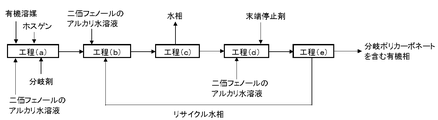
- steps (a) to (e) for producing an unbranched polycarbonate are shown.
- steps (a) to (e) for producing a branched polycarbonate are shown.
- the polycarbonate production method of the present invention is obtained from the step (a) of obtaining a reaction solution by subjecting a mixture containing an alkaline aqueous solution of dihydric phenol and phosgene to a phosgenation reaction in the presence of an organic solvent, and the step (a).
- a step (d) for obtaining a reaction liquid containing the reaction solution the steps (a) to (d) are continuously performed,
- a method for producing a polycarbonate wherein a reaction solution containing a catalyst is switched from a reaction solution containing an unbranched polycarbonate to a reaction solution containing a branched polycarbonate, or a reaction solution containing a branched polycarbonate is switched to a reaction solution containing an unbranched polycarbonate.
- a branching agent is introduced into the step (a), and when switching from a reaction solution containing branched polycarbonate to a reaction solution containing unbranched polycarbonate
- the introduction of the branching agent is stopped in the step (a), and the terminal terminator introduced in the step (d) is increased or decreased in a plurality of stages.
- the manufacturing method of the polycarbonate of this invention is demonstrated in detail. In the present specification, it is possible to arbitrarily adopt provisions that are preferable, and it can be said that a combination of preferable ones is more preferable.
- Step (a) is a step of obtaining a reaction solution by subjecting a mixture containing an alkaline aqueous solution of dihydric phenol and phosgene to a phosgenation reaction in the presence of an organic solvent.
- the raw materials and reaction conditions used in this step (a) will be described.
- dihydric phenol used for the production of polycarbonate is used.
- dihydric phenol it is preferable to use a dihydric phenol represented by the following general formula (1).
- R 11 and R 12 each independently represent a halogen atom, an alkyl group having 1 to 6 carbon atoms, or an alkoxy group having 1 to 6 carbon atoms.
- Z is a single bond, an alkylene group having 1 to 8 carbon atoms, an alkylidene group having 2 to 8 carbon atoms, a cycloalkylene group having 5 to 15 carbon atoms, a cycloalkylidene group having 5 to 15 carbon atoms, a fluorenediyl group, a carbon
- the dihydric phenol represented by the general formula (1) is not particularly limited, but 2,2-bis (4-hydroxyphenyl) propane [common name: bisphenol A] is preferable.
- bisphenol A 2,2-bis (4-hydroxyphenyl) propane
- the unbranched polycarbonate can be a homopolycarbonate produced using bisphenol A
- the branched polycarbonate is a branched polycarbonate produced using bisphenol A. be able to.
- dihydric phenols other than bisphenol A include bis (4-hydroxyphenyl) methane, 1,1-bis (4-hydroxyphenyl) ethane, 2,2-bis (4-hydroxyphenyl) butane, 2,2 -Bis (4-hydroxyphenyl) octane, bis (4-hydroxyphenyl) phenylmethane, bis (4-hydroxyphenyl) diphenylmethane, 2,2-bis (4-hydroxy-3-methylphenyl) propane, bis (4- Hydroxyphenyl) naphthylmethane, 1,1-bis (4-hydroxy-3-tert-butylphenyl) propane, 2,2-bis (4-hydroxy-3-bromophenyl) propane, 2,2-bis (4- Hydroxy-3,5-dimethylphenyl) propane, 2,2-bis (4-hydroxy-3-chlorophene) Bis (hydroxyaryl) alkanes such as propane, 2,2-bis (4-hydroxy-3,5-dichlorophenyl) propane, 2,2-bis (4-hydroxy-3,
- the dihydric phenol is used as an alkaline aqueous solution.
- the alkali used include alkali hydroxides, particularly strong basic hydroxides such as sodium hydroxide and potassium hydroxide.
- As the alkali concentration of the alkaline aqueous solution usually 1 to 15% by mass is preferably used.
- the content of the dihydric phenol in the alkaline aqueous solution is usually selected in the range of 0.5 to 20% by mass.
- the phosgene used in step (a) is usually obtained by reacting chlorine and carbon monoxide with a ratio of 1.01 to 1.3 moles of carbon monoxide per mole of chlorine using activated carbon as a catalyst. Compound.
- phosgene gas when used as phosgene gas, phosgene gas containing about 1 to 30% by volume of unreacted carbon monoxide can be used. Also, phosgene in a liquefied state can be used.
- a branching agent is used when obtaining a reaction liquid containing a branched polycarbonate, and no branching agent is used when obtaining a reaction liquid containing an unbranched polycarbonate.
- the branching agent is introduced into the step (a). The branching agent when used in step (a) will be described.
- the branching agent used in step (a) is not particularly limited, and a known branching agent can be used. Among known branching agents, it is preferable to use a branching agent having three or more functional groups.
- a branching agent for example, phloroglucide, pyromellitic acid, 1,1,2,2-tetrakis (4-hydroxyphenyl) ethane, ⁇ , ⁇ , ⁇ ′, ⁇ ′-tetrakis (4-hydroxy) Phenyl) -p-xylene, ⁇ , ⁇ , ⁇ ', ⁇ '-tetrakis (2-methyl-4-hydroxyphenyl) -p-xylene, ⁇ , ⁇ , ⁇ ', ⁇ '-tetrakis (2,5-dimethyl) -4-hydroxyphenyl) -p-xylene, ⁇ , ⁇ , ⁇ ', ⁇ '-tetrakis (2,6-dimethyl
- a compound represented by the following chemical formula (A) may be used as a tetrafunctional or more functional branching agent.
- R 7 and R 8 represent an alkyl group having 1 to 8 carbon atoms or an aryl group having 6 to 20 carbon atoms.
- n is an integer of 1 to 100, preferably an integer of 1 to 50.
- the alkyl group include a methyl group, an ethyl group, a propyl group, and a butyl group.
- the aryl group include a phenyl group.
- R 7 and R 8 are each independent and may be the same or different.
- tetra (4-hydroxyphenylpropyl-polymethylsiloxane) silicon in which R 7 and R 8 are methyl groups is preferable.
- R 13 represents HO—A—R 17 —
- A represents an arylene group having 6 to 12 carbon atoms
- R 17 represents an alkylene group having 1 to 6 carbon atoms
- R 17 represents an Si atom.
- A may further have a substituent.
- a plurality of R 13 may be the same or different.
- R 14 , R 15 and R 16 each independently represent an alkyl group having 1 to 6 carbon atoms, a phenyl group and / or a trimethylsiloxy group, and a plurality of R 14 , R 15 and R 16 may be the same or different. It may be.
- x represents a number from 1 to less than 2
- y represents a number from 0 to 1
- x + y is from 1 to 2.
- c is a number from 4 to 16
- d is a number from 0 to 8.
- a cyclic siloxane structure can be taken.
- c preferably has a structural unit of 4 or more and 8 or less, and d is 0, more preferably c is 4 and d has a structural unit of 0.
- a in the general formula (II) represents an arylene group having 6 to 12 carbon atoms, preferably orthophenylene, metaphenylene, or paraphenylene.
- substituent include an alkyl group, an alkoxy group, and / or a hydroxyl group.
- examples of the alkyl group include an alkyl group having 3 to 6 carbon atoms, and examples of the alkoxy group include a methoxy group.
- R 17 (bonded to the Si atom) in the general formula (II) represents an alkylene group having 1 to 6 carbon atoms, and examples thereof include a methylene group, an ethylene group, a propylene group, and a butylene group.
- a C 1-4 alkylene group is preferred, and a propylene group is more preferred.
- Examples of the alkyl group having 1 to 6 carbon atoms represented by R 14 to R 16 in the general formula (II) include a methyl group, an ethyl group, a propyl group, and a butyl group.
- An alkyl group is preferred, and a methyl group is more preferred.
- branching agent having a cyclic siloxane structure branching agents represented by the following general formulas (III) to (XI) can be used.
- c each independently represents an integer of 4 to 16, preferably an integer of 4 to 8, and d represents 0 or an integer of 1 to 8.
- R 15 independently represents a methyl group, an ethyl group, a propyl group, a butyl group, or a phenyl group.
- c is 4 or more and 8 or less, d is more preferably 0, c is 4, and d is more preferably 0.
- R represents a hydrogen atom or an alkyl group having 1 to 5 carbon atoms
- R 1 to R 6 each represents a hydrogen atom, an alkyl group having 1 to 5 carbon atoms, or a halogen atom.
- examples of the alkyl group having 1 to 5 carbon atoms represented by R include a methyl group, an ethyl group, an n-propyl group, an n-butyl group, and an n-pentyl group.
- examples of the alkyl group having 1 to 5 carbon atoms represented by R 1 to R 6 include a methyl group, an ethyl group, an n-propyl group, an n-butyl group, and an n-pentyl group.
- examples thereof include a chlorine atom, a bromine atom, and a fluorine atom.
- branching agent represented by formula (I) examples include 1,1,1-tris (4-hydroxyphenyl) methane; 1,1,1-tris (4-hydroxyphenyl) ethane; -Tris (4-hydroxyphenyl) propane; 1,1,1-tris (2-methyl-4-hydroxyphenyl) methane; 1,1,1-tris (2-methyl-4-hydroxyphenyl) ethane; 1,1-tris (3-methyl-4-hydroxyphenyl) methane; 1,1,1-tris (3-methyl-4-hydroxyphenyl) ethane; 1,1,1-tris (3,5-dimethyl- 4-hydroxyphenyl) methane; 1,1,1-tris (3,5-dimethyl-4-hydroxyphenyl) ethane; 1,1,1-tris (3-chloro-4-hydroxyphenyl) methane; 1,1 , 1- Lis (3-chloro-4-hydroxyphenyl) ethane; 1,1,1-tris (3,5-dichloro-4-hydroxy)
- branching agents of the general formula (I) 1,1,1-tris (4-hydroxyphenyl) ethane [hereinafter sometimes referred to as THPE]. It is particularly preferable from the viewpoint of the branching property of the branched polycarbonate.
- the said branching agent may be used individually by 1 type, and may use 2 or more types together.
- organic solvent used in the step (a) examples include a solvent that dissolves the polycarbonate oligomer and the polycarbonate resin.
- organic solvent used in the step (a) examples include halogenated hydrocarbon solvents such as dichloromethane (methylene chloride), dichloroethane, trichloroethane, tetrachloroethane, pentachloroethane, hexachloroethane, dichloroethylene, chlorobenzene, and dichlorobenzene, with dichloromethane (methylene chloride) being particularly preferred.
- step (a) other raw materials can be used as necessary in addition to the above raw materials.
- a catalyst such as a tertiary amine such as triethylamine or a quaternary ammonium salt such as tetraethylammonium chloride used in the polycondensation reaction can be used to promote the reaction.
- the alkaline aqueous solution of dihydric phenol and the branching agent and phosgene react vigorously and generate heat. Therefore, it is desirable to cool the reaction product to 0 to 50 ° C. in order to suppress side reactions. . Therefore, as the reactor used in the step (a), it is preferable to use a reactor equipped with a cooling facility for cooling the reaction product.
- the phosgenation reaction may be performed in such a state that the reaction solution becomes a turbulent state in the reactor. preferable.
- the mixed reactor is preferably a static mixer, that is, a static mixer.
- the static mixer is preferably a tubular reactor having therein an element having an action of dividing, converting, and inverting the fluid, and the element generally has a shape obtained by twisting a rectangular plate by 180 degrees. .
- the reaction mixture introduced into the reactor is divided into two parts each time it passes through one element. Further, the reaction mixture fluid or the reaction product fluid is rearranged from the tube center to the wall and from the tube wall to the center along the twisted surface in the element. In addition, the direction of rotation of the fluid is changed for each element, and the fluid is agitated by turbulent flow due to a sudden reversal of inertial force.
- the tubular static mixer described above bubbles in the liquid are miniaturized in the reactor, and the contact interface becomes larger, thereby dramatically increasing the reaction efficiency.
- phosgene should be used in an excess amount so that the amount of phosgene used is usually 1.05 to 1.5 mol, preferably 1.1 to 1.3 mol, per mol of dihydric phenol. Is preferred.
- the molar ratio of dihydric phenol and branching agent is usually a molar ratio of dihydric phenol: branching agent within the range of 99.8: 0.2 to 95: 5. Preferably, it is used in a molar ratio within the range of 99.7: 0.3 to 97: 3.
- the branching agent represented by the general formula (I) can be dissolved in an alkaline aqueous solution, so that it is desirable to introduce it by dissolving it in an alkaline aqueous solution. Moreover, it is desirable to introduce the branching agent that is difficult to dissolve in an alkaline aqueous solution after being dissolved in an organic solvent such as methylene chloride.
- step (a) heat is generated due to a reaction in which the terminal group of the dihydric phenol or the terminal group of the dihydric phenol and the branching agent is chloroformated with phosgene or the reaction in which phosgene is decomposed with alkali. Since the temperature of the reaction product becomes high, it is preferable to cool the reaction product so that the temperature of the reaction product is 0 to 80 ° C., preferably 5 to 70 ° C.
- an exothermic reaction occurs from the confluence of an alkaline aqueous solution of dihydric phenol and phosgene, or from the confluence of an alkaline aqueous solution of dihydric phenol, a branching agent and phosgene. Also, it is preferable to cool at this junction. As the reaction product flows through the reactor of the tubular static mixer to the outlet of the reactor, phosgene is consumed and no intense reaction heat is generated.
- the main purpose of the reaction in this step (a) is to chloroformate the terminal group of the dihydric phenol or the terminal group of the dihydric phenol and the branching agent with phosgene, and the oligomerization reaction hardly proceeds. .
- Step (b) is a step of introducing an alkaline aqueous solution of a dihydric phenol into the reaction solution obtained from the step (a), and obtaining a reaction solution containing a polycarbonate oligomer in the presence of a polymerization catalyst as necessary. .
- the raw materials and reaction conditions used in this step (b) will be described.
- the molecular weight is increased by the oligomerization reaction in the step (b), and preferably a polycarbonate oligomer having a weight average molecular weight of 5000 or less is used.
- a polycarbonate oligomer having a weight average molecular weight of 5000 or less is used.
- the alkaline aqueous solution of the dihydric phenol used in this step (b) the alkaline aqueous solution of the dihydric phenol described in the step (a) is used.
- a known catalyst used during the interfacial polymerization of the polycarbonate resin can be used.
- Phase transfer catalysts such as tertiary amines or salts thereof, quaternary ammonium salts, quaternary phosphonium salts and the like can be preferably used.
- the tertiary amine include triethylamine, tributylamine, N, N-dimethylcyclohexylamine, pyridine, dimethylaniline and the like, and examples of the tertiary amine salt include hydrochlorides and bromates of these tertiary amines. Etc.
- Examples of the quaternary ammonium salt include trimethylbenzylammonium chloride, triethylbenzylammonium chloride, tributylbenzylammonium chloride, trioctylmethylammonium chloride, tetrabutylammonium chloride, and tetrabutylammonium bromide.
- Examples thereof include butylphosphonium chloride and tetrabutylphosphonium bromide.
- These catalysts may be used alone or in combination of two or more. Among the catalysts, tertiary amines are preferable, and triethylamine is particularly preferable. These catalysts can be introduced as they are in a liquid state or dissolved in an organic solvent or water. Moreover, a solid-state thing can be dissolved and introduce
- a stirring tank is generally used as the reactor used in the step (b).
- the stirring tank is not particularly limited as long as it is a tank-type stirring tank having a stirrer.
- the reaction liquid obtained from the step (a) is introduced into the reactor for proceeding with the oligomerization reaction.
- the reaction solution obtained from step (a) the remaining amount of unreacted dihydric phenol and the remaining alkali component is small, and in order to proceed with the oligomerization reaction, dihydric phenol and alkali component are added. It is necessary to react.
- the oligomerization reaction of the step (b) is carried out in the reactor used by the branching agent used when producing the end group of the dihydric phenol and the branched polycarbonate contained in the reaction solution obtained from the step (a). It proceeds by reacting a compound having a terminal group chloroformated with phosgene and a dihydric phenol in the presence of an alkali.
- a compound having a terminal group chloroformated with phosgene and a dihydric phenol in the presence of an alkali.
- an alkaline aqueous solution of dihydric phenol prepared in advance used in step (a) is introduced into the reactor, or in addition to this,
- the oligomerization reaction can proceed by introducing the prepared antkari aqueous solution into the reactor.
- the aqueous phase [the aqueous phase obtained in the step (e) described later] out of the reaction solution containing the polycarbonate obtained after the polycondensation step is separated into an organic solvent phase and an aqueous phase. Then, it can be introduced into the reactor of step (b) to advance the oligomerization reaction.
- the aqueous phase obtained in the step (e) contains unreacted dihydric phenol and alkali, and the dihydric phenol and alkali can be effectively utilized by recycling the aqueous phase.
- the aqueous phase after the polycondensation step may include sodium carbonate generated by the decomposition reaction with sodium hydroxide without using the chloroformate group of the polycarbonate oligomer during the polycondensation step.
- the concentration of the dihydric phenol added to the step (b) is usually 0.05 to 0.15 mol / liter, preferably 0.06 to 0.12 mol / liter, more preferably 0.06 to 0.08 mol.
- the alkali concentration added in step (b) is usually 0.03 to 0.25 mol / liter, preferably 0.05 to 0.21 mol / liter, more preferably 0.00. It is preferably 12 to 0.15 mol / liter.
- the amount of the organic solvent used in the reaction solution in this step (b) is usually such that the volume ratio of the organic phase to the aqueous phase is preferably 5/1 to 1/7, more preferably 2/1 to 1/4. Is selected.
- Step (b) is a step of obtaining a reaction solution containing a polycarbonate oligomer, and the upper limit of the weight average molecular weight is preferably 5000, and the lower limit is usually about 500.
- a terminal terminator in order to make the preferable weight average molecular weight of the polycarbonate oligomer be 5000 or less. It becomes easy to adjust the weight average molecular weight of the polycarbonate oligomer in the step (b) to 5000 or less by adding the terminal stopper.
- the end terminator is not particularly limited, and those used for the production of polycarbonate can be used.
- examples of the compound used for the terminal stopper include phenol, p-cresol, p-tert-butylphenol, p-tert-octylphenol, p-cumylphenol, 3-pentadecylphenol, bromophenol, Mention may be made of at least one monohydric phenol selected from tribromophenol and nonylphenol. Of these, p-tert-butylphenol, p-cumylphenol and phenol are preferred from the viewpoints of economy and availability. These end terminators may be dissolved in an organic solvent such as methylene chloride, added to the reaction solution obtained from step (a), and introduced into step (b) or used in step (b). May be added directly to the reactor to be introduced.
- an organic solvent such as methylene chloride
- the temperature in the reactor is usually 5 to 50 ° C., preferably 5 to 40 ° C., and the reaction is carried out. Stirring is performed under relatively gentle conditions of laminar flow.
- the residence time of the reaction solution in the reactor varies depending on the molecular weight of the target polycarbonate oligomer, the properties of the reaction solution obtained from step (a), etc., but is generally 15 to 60 minutes.
- Step (c) is a step of separating the reaction solution containing the polycarbonate oligomer obtained from the step (b) into an aqueous phase and an organic solvent phase containing the polycarbonate oligomer.
- a stationary separation tank is preferably used as a device used in the step (c).
- the reaction solution obtained in the step (b) is introduced into a stationary separation tank and separated into an aqueous phase and an organic solvent phase containing a polycarbonate oligomer due to a specific gravity difference.
- the organic solvent phase containing the lower layer polycarbonate oligomer is continuously or intermittently extracted from the lower side of the stationary separation tank.
- the upper water phase is withdrawn continuously or intermittently, and the level of each phase in the stationary separation tank is kept within a certain level range.
- Step (d) is a step of obtaining a reaction solution containing polycarbonate by reacting the organic solvent phase containing the polycarbonate oligomer separated in the step (c), an alkali aqueous solution of dihydric phenol, and a terminal terminator.
- a polycarbonate oligomer and a dihydric phenol are subjected to a polycondensation reaction in the presence of a terminal terminator to adjust the molecular weight to the target molecular weight range.
- the polycondensation reaction is carried out until the molecular weight of the obtained polycarbonate is a viscosity average molecular weight, usually in the range of about 10,000 to 100,000, preferably in the range of 10,000 to 50,000.
- the organic solvent phase containing the polycarbonate oligomer separated in step (c) and an alkaline aqueous solution of a dihydric phenol are mixed with a terminal terminator, and usually in the range of 0 to 50 ° C., preferably in the range of 5 to 40 ° C. Interfacial polycondensation at temperature.
- a terminal terminator for example, those described in the steps (a) and (b) can be used, and as the terminal terminator, those described in the step (b) can be used.
- the above-mentioned polymerization catalyst, organic solvent, and aqueous alkali solution may be added to cause interfacial polycondensation.
- a polycarbonate in this step (d), can be obtained as a branched polycarbonate by introducing a branching agent into the step (a). Moreover, if a branching agent is not introduced into the step (a), a polycarbonate can be obtained as an unbranched polycarbonate.
- the steps (a) to (d) are continuously performed using the polycarbonate continuous production apparatus having the steps (a) to (d), and the reaction liquid containing the polycarbonate is obtained.
- a non-branched polycarbonate having substantially the same molecular weight is produced by switching from a reaction solution containing a branched polycarbonate to a reaction solution containing an unbranched polycarbonate
- a plurality of terminal terminators introduced into the step (d) are used. It is preferable to decrease in stages.
- the target molecular weight may not be achieved. In this case, it is necessary to reduce the end terminator. Even in such a case, it is preferable to reduce the end terminator in a plurality of stages.
- the reasons for increasing or decreasing the above-mentioned end terminator in multiple stages include the following.
- the target contains a branching agent in step (d).
- a target amount of branching agent is introduced in step (a) in order to obtain a branched polycarbonate having a high rate, it can be obtained in step (d) due to the influence of residence time from step (a) to step (d).
- the increase in the content of the branching agent in the polycarbonate in the reaction liquid containing the polycarbonate gradually proceeds and reaches a certain content after a predetermined time from the start of the increase. Since the branching agent is trifunctional or higher, when producing the unbranched polycarbonate, the molecular weight of the branched polycarbonate obtained in the step (d) is not changed unless the amount of the terminal stopper used in the step (d) is changed. It will increase. Therefore, it is necessary to prevent the molecular weight from increasing by increasing the amount of the end terminator used in the step (d).
- step (d) When the amount of the end terminator used in this step (d) is increased to the amount of the end terminator which becomes the target molecular weight at a time, the fluctuation of the molecular weight of the transition product becomes large and has a certain molecular weight range. This results in the inability to obtain a transitional product.
- step (d) if the timing of increasing the amount of the end terminator used in step (d) is delayed, the molecular weight increases rapidly, adversely affecting equipment such as pumps and motors used for transfer and agitation, and a manufacturing apparatus. There is also a risk of causing a malfunction. Accordingly, it is necessary to increase the amount of the end terminator in the step (d) in a plurality of stages.
- the plurality of stages are desirably two or more stages, preferably three or more stages, and more preferably four or more stages.
- the amount may be continuously increased until the target amount of the end stopper is reached.
- the increase in the initial stage of the end terminator in the step (d) is that the branching agent content of the polycarbonate in the reaction solution containing the polycarbonate obtained in the step (d) is relative to the target branching agent content.
- the ratio is preferably up to 30%, preferably up to 25%.
- the starting point of the increase in the branching agent content of the polycarbonate in the reaction liquid containing the polycarbonate obtained in the step (d) is from the addition position of the branching agent [step (a)] to the inlet to the step (d).
- the residence time can be calculated and obtained.
- the branching agent content in the branched polycarbonate after switching or before switching is:
- the content is usually constant, preferably 0.2 to 3.0 mol%, more preferably 0.5 to 2.0 mol%, and 0.8 to 1.0 mol%. Is more preferable.
- the content of the branching agent refers to the total mol of the structural unit derived from the dihydric phenol used as a raw material, the structural unit derived from the terminal terminator, and the structural unit derived from the branching agent, contained in the entire PC resin.
- the mol% of the structural unit derived from the branching agent with respect to the number, that is, the content of the branching agent (mol%) is [the structural unit derived from the branching agent (mol) / [the structural unit derived from the dihydric phenol (mol) + terminal termination.
- Each of the structural units (mol) can be measured by 1 H-NMR by separating the reaction solution containing the polycarbonate obtained in step (d).
- the target molecular weight may not be achieved even if the introduction of the branching agent is stopped. In this case, it is necessary to increase the terminal terminator, but it is preferable to increase the terminal terminator in a plurality of stages.
- a branched polycarbonate is produced by switching from a reaction solution containing unbranched polycarbonate to a reaction solution containing branched polycarbonate, or a reaction solution containing branched polycarbonate is changed to a reaction solution containing unbranched polycarbonate.
- a transition product having a low branching agent content is generated at the time of switching between the two, but the fluctuation range of the molecular weight of the transition product can be reduced. Therefore, the molecular weight of the transition product can be within the target range, and the fluctuation range of the viscosity average molecular weight can be within the range of ⁇ 10%.
- a reaction liquid containing polycarbonate is obtained by steps (a) to (d).
- the aqueous phase containing the unreacted dihydric phenol from the following process (e) is alkaline aqueous solution of the bihydric phenol added to a process (b).
- the step (e) will be described.
- Step (e) is a step of separating the reaction solution containing the polycarbonate obtained in the step (d) into an organic solvent phase containing polycarbonate and an aqueous phase containing unreacted dihydric phenol.
- Examples of the equipment used for the separation in this step (e) include a stationary separation tank and a centrifuge.
- the organic solvent phase containing polycarbonate separated in the step (e) can be made into an organic solvent phase containing purified polycarbonate by performing alkali washing, acid washing and pure water washing in order.
- the organic solvent phase containing the purified polycarbonate can be concentrated as necessary to obtain an organic solvent solution containing the purified polycarbonate, which can be kneaded or subjected to hot water granulation to obtain a polycarbonate powder.
- a polycarbonate powder from which the organic solvent has been removed can be obtained by performing a drying treatment such as a heat treatment.
- the obtained polycarbonate powder can be pelletized using a pelletizer or the like to form various molded bodies.
- polycarbonate production method of the present invention three types of unbranched polycarbonate powder, polycarbonate transition product powder, and branched polycarbonate powder are produced in succession.
- Polycarbonate transition product powder generated when changing from non-branched polycarbonate production to production of branched polycarbonate and when changing from branched polycarbonate production to non-branched polycarbonate production transfers the transition product powder to the container for the transition product. Is done.
- the branched polycarbonate powder having a certain branching agent content is transferred to a container for the branched polycarbonate. In this way, by transferring the polycarbonate transition product powder only to the transition product container, a polycarbonate containing only the transition product powder can be obtained.
- the container for transition products may contain some degree of unbranched polycarbonate powder before and after transition and branched polycarbonate powder having a certain branching agent content. Since the branching agent content is different in the upper layer portion, middle layer portion, and lower layer portion in the transition product container, a portion of the branching agent is taken out from the container or from the container and stirred uniformly to maintain a certain low branching agent.
- a branched polycarbonate powder having a content rate can be used, or a branched polycarbonate powder having a high branching agent content can be mixed to increase the branching agent content.
- the weight average molecular weight (Mw) was determined by using THF (tetrahydrofuran) as a developing solvent, GPC [column: TOSOH TSK-GEL MULTIPIORE HXL-M (2) + Shodex KF801 (1), temperature 40 ° C., flow rate 1.0 mL / Minute, detector: RI], and measured as a standard polystyrene equivalent molecular weight (weight average molecular weight: Mw).
- Branching agent content (mol%) [constituent unit derived from branching agent (mol) / [constituent unit derived from dihydric phenol (mol) + constituent unit derived from terminal terminator (mol) + constituent unit derived from branching agent ( mol)]] ⁇ 100
- Example 1 The steps from the step (a) of obtaining a reaction solution by phosgenation reaction to the step (e) of obtaining an organic solvent phase containing an unbranched polycarbonate were produced according to the flow shown in FIG. First, a 6.0% by mass sodium hydroxide aqueous solution was prepared, and further bisphenol A (BPA) was dissolved therein to prepare a 13.5% by mass (converted to solid matter) BPA sodium hydroxide aqueous solution. Next, p-tert-butylphenol (PTBP) was dissolved in methylene chloride to prepare a 24 mass% solution.
- BPA bisphenol A
- PTBP p-tert-butylphenol
- Step (a) Subsequently, the above-mentioned BPA sodium hydroxide aqueous solution was flowed at a flow rate of 36 liters / hr, methylene chloride at a flow rate of 15.4 liters / hr, and PTBP solution at 310 ml / hr into a tubular reactor having an inner diameter of 6 mm and a length of 26 m.
- phosgene was continuously blown at a flow rate of 3.1 kg / hr to perform a phosgenation reaction to obtain a reaction solution containing a phosgenation reaction product.
- phosgene was separately synthesized from carbon monoxide (CO) and chlorine (Cl 2 ).
- Step (b) and Step (c) Subsequently, the reaction solution and 210 ml / hr of a 3% by mass aqueous solution of triethylamine (TEA) prepared in advance as a catalyst were continuously supplied to an oligomerization reactor having a stirrer with an internal volume of 100 liters, which will be described later. Then, 15.7 liters / hr of the recycled aqueous phase obtained from the separation step (e) was introduced to carry out the oligomerization reaction.
- TAA triethylamine
- the BPA concentration in the aqueous phase before being introduced into the oligomerization reactor [the recycled aqueous phase obtained from the separation step (e) and the aqueous phase after merging water additionally introduced for concentration adjustment]
- the sodium hydroxide concentration was 0.13 mol / liter, and the sodium carbonate concentration was 0.08 mol / liter.
- the inside of this oligomerization reactor was rotated at 350 rpm, and the oligomerization reaction was performed in a laminar flow state.
- the reaction liquid containing the polycarbonate oligomer extracted from the bottom of the oligomerization reactor was passed through a transfer pipe [manufactured by SUS, pipe diameter 12.7 mm (1/2 inch)], a horizontal stationary separation tank (inner diameter 350 mm, internal volume 100). Liter) was continuously fed to separate the aqueous phase from the organic solvent phase containing the polycarbonate oligomer.
- the organic solvent phase was continuously withdrawn from the horizontal stationary separation tank at a flow rate of 20 l / hr, and the chloroformate group concentration in the withdrawn organic solvent phase was 0.72 mol / l.
- Step (d) (Production of unbranched polycarbonate) A polycondensation reaction was performed in the step (d) using an organic solvent phase (may be abbreviated as PCO) containing a polycarbonate oligomer separated from the horizontal stationary separation tank.
- the organic solvent phase (PCO) containing the polycarbonate oligomer is 20 liter / hr
- the sodium hydroxide solution of bisphenol A (used for the production of the polycarbonate oligomer) is 9.8 liter / hr
- concentration is 3% by weight of triethylamine as a catalyst.
- the polycondensation reaction was carried out by introducing into the polycondensation reactor of step (d) at a flow rate of hr.
- the reactor used for the polycondensation reactor two reactors, a line mixer and a tower reactor, were used.
- Step (e) [Steps from step (e) to production of polycarbonate powder]
- the reaction mixture overflowing from the upper part of the tower reactor serving as the outlet of the step (d) was allowed to stand and separated into an aqueous phase and an organic solvent phase containing polycarbonate (step (e)).
- the entire amount of the aqueous phase separated in step (e) was introduced into the oligomerization reactor in step (b) and recycled.
- the obtained organic solvent phase was washed with a sodium hydroxide aqueous solution adjusted to a pH of 13.5, a hydrochloric acid aqueous solution adjusted to a pH of 1.5, and pure water in order to obtain a clear polycarbonate.
- a methylene chloride solution was obtained.
- the methylene chloride in the methylene chloride solution of the obtained polycarbonate was removed by evaporation using a kneader to obtain a polycarbonate powder. Further, residual methylene chloride was removed by heating to 100 ppm or less, and white polycarbonate powder (BPA homopolycarbonate powder) was obtained at 8 kg / hr. It was 23,000 when the viscosity average molecular weight (Mv) was measured about this powder. The homopolycarbonate powder thus obtained was transferred to a homopolycarbonate container.
- branched polycarbonate After the unbranched polycarbonate was produced continuously for 12 hours, the branched polycarbonate was produced along the flow shown in FIG.
- the target of the viscosity average molecular weight (Mv) of the branched polycarbonate was set to 23,000, the same as that of the BPA homopolycarbonate, and the viscosity average molecular weight of the generated transition product was also set to 23,000.
- the average residence time from the step (a) to the inlet of the step (d) is 3.8 hours, and the residence time from the step (d) to obtaining the white polycarbonate powder after heating and drying is 10 hours.
- the polycarbonate powder obtained in a total of 13.8 hours after the introduction of the branching agent in the step (a) is mainly the BPA obtained before introducing the branching agent in the step (a).
- the product was produced as a homopolycarbonate powder and transferred to a homopolycarbonate container.
- THPE 1,1,1-tris (4-hydroxyphenyl) ethane
- the PTBP solution introduced into step (d) is increased to 0.18 liter / hr 1.1 hours after the start of THPE introduction in step (a), and then 2.2 hours after the start of THPE introduction. 0.22 liter / hr, after 3.3 hours, 0.26 liter / hr, after 4.5 hours, 0.31 liter / hr, after 6.6 hours, 0.34 liter / hr.
- the reaction was carried out with the amount increased.
- the reaction solution obtained from the step (d) was treated in the same manner as described in the steps from the step (e) to the production of the polycarbonate powder.
- the reaction solution obtained from step (d) was separated every other hour until 14 hours after the start of introduction of THPE in step (a), and separated into an organic phase and an aqueous phase.
- the viscosity average molecular weight of the polycarbonate was measured.
- the fluctuation range was ⁇ 2.6 to + 1.7% with respect to the target Mv (23,000).
- the measurement results are shown in Table 1.
- the polycarbonate powder obtained in 13.8 hours after the introduction of the branching agent in step (a) is a homopolycarbonate powder.
- Example 2 In Example 1, during the production of the branched polycarbonate, in step (d), 2 hours after the start of introduction of THPE, the PTBP solution introduced into step (d) was increased to 0.20 liter / hr, and then THPE was introduced. Example 1 except that the introduction amount of the PTBP solution was increased stepwise in three stages, 0.27 liter / hr 3.5 hours after the start of introduction and 0.34 liter / hr after 6 hours. It carried out similarly. The results are shown in Table 1.
- Example 1 in the production of the branched polycarbonate, the PTBP solution introduced into the step (d) was introduced into the target amount of 0.34 two hours after the introduction of THPE in the step (a). The same operation as in Example 1 was performed except that the amount was increased to 1 liter / hr. The results are shown in Table 1.
- Example 2 in the production of the branched polycarbonate, the PTBP solution introduced into the step (d) was introduced into the target amount of 3.2 hours after the introduction of THPE in the step (a) and 3.2 hours later. The same procedure as in Example 1 was performed except that the amount was increased to 34 liters / hr. The results are shown in Table 1.
- the transition width of the viscosity average molecular weight of the obtained polycarbonate powder of the transition product is ⁇ 2.6 to + 1.7% in Example 1, and ⁇ 4 in Example 2. It is within ⁇ 10% at 3 to + 8.3%, and is within a range exceeding ⁇ 10% at ⁇ 16.1 to + 8.3% in Comparative Example 1 and from ⁇ 11.7 to + 18.3% in Comparative Example 2. It is shown.
- the reaction liquid containing a polycarbonate with a small fluctuation range with respect to the target value of a viscosity average molecular weight is obtained by the process (d). It is shown.
- Comparative Examples 1 and 2 it is shown that a reaction liquid containing polycarbonate having a large fluctuation range with respect to the target value of the viscosity average molecular weight is obtained.
- the polycarbonate production method of the present invention when switching from the production of unbranched polycarbonate to the production of branched polycarbonate by introducing a branching agent, or by stopping the introduction of the branching agent from the production of branched polycarbonate, When the production is switched to, a polycarbonate having a small change in the molecular weight of the transferred product can be obtained, so that the molecular weight of the transferred product can be easily controlled within the target molecular weight range.
Landscapes
- Chemical & Material Sciences (AREA)
- Health & Medical Sciences (AREA)
- Chemical Kinetics & Catalysis (AREA)
- Medicinal Chemistry (AREA)
- Polymers & Plastics (AREA)
- Organic Chemistry (AREA)
- Polyesters Or Polycarbonates (AREA)
Abstract
ホスゲン化反応させて反応液を得る工程(a)と、ポリカーボネートオリゴマーを含む反応液を得る工程(b)と、ポリカーボネートオリゴマーを含む有機溶媒相と水相に分離する工程(c)と、ポリカーボネートオリゴマーを含む有機溶媒相、二価フェノールのアルカリ水溶液、及び末端停止剤を反応させてポリカーボネートを含む反応液を得る工程(d)を有し、前記ポリカーボネートを含む反応液を、非分岐ポリカーボネートを含む反応液から分岐ポリカーボネートを含む反応液に切り替えるか、又は分岐ポリカーボネートを含む反応液から非分岐ポリカーボネートを含む反応液に切り替えるポリカーボネートの製造方法であって、工程(d)に導入する末端停止剤を複数段階で増加又は減少させる方法を提供する。
Description
本発明は、ポリカーボネートの製造方法に関し、より詳細には非分岐ポリカーボネートから分岐ポリカーボネートに切り替えるか、又は分岐ポリカーボネートから非分岐ポリカーボネートに切り替える際のポリカーボネートの製造方法に関する。
ポリカーボネートは、透明性、耐熱性、機械特性など優れた特徴を有し、OA・家電の筐体や電気・電子分野の部材、レンズなどの光学材料など、幅広い用途に使用されている。この幅広い用途に使用されているポリカーボネートの多くは、通常、二価フェノールとホスゲン等のカーボネート前駆物質を反応させて得られる非分岐ポリカーボネート(線状重合体)である。該非分岐ポリカーボネートは溶融加工条件下ではニュートン流動挙動を示し、ブロー成形、押出し成形、発泡成形を行う際には自重によるドローダウンが生じ易く、特に大型成形の場合には問題が生じる。
このような問題点を改善するために、上記の成形用途には溶融加工条件下で非ニュートン流動性を示し、溶融時にドローダウンを生じ難い分岐ポリカーボネートが好ましく採用されている。
このような問題点を改善するために、上記の成形用途には溶融加工条件下で非ニュートン流動性を示し、溶融時にドローダウンを生じ難い分岐ポリカーボネートが好ましく採用されている。
前記非分岐ポリカーボネートや分岐ポリカーボネートを製造する方法として、界面重合方法やエステル交換方法が知られている。エステル交換方法を用いてポリカーボネートを製造する場合、原料成分を高温下で溶融させエステル交換反応させて重合させるため、使用される重合触媒による影響等により、得られるポリカーボネートが着色し易くなる。従って、透明性が必要とされる用途において、エステル交換方法を用いて非分岐ポリカーボネートや分岐ポリカーボネートを製造することは、好ましくない。界面重合方法を用いて製造する方法が、好ましく用いられている。
前記分岐ポリカーボネートを界面重合方法で製造する方法としては、特許文献1や特許文献2でも知られているように、二価フェノールと共に、分子鎖中に分岐核構造を有するための分岐剤を用いて製造することが知られている。
界面重合方法を用い、前記非分岐ポリカーボネート及び分岐ポリカーボネートを製造する際には、用いるポリカーボネート製造装置を効率よく使用するために、同一の製造装置を使用して、非分岐ポリカーボネート及び分岐ポリカーボネートを連続的に製造する方法が用いられている。すなわち、非分岐ポリカーボネートを一定期間製造した後に、分岐剤を導入して分岐ポリカーボネートを製造し、分岐ポリカーボネートを一定期間製造した後に、分岐剤の導入を停止して非分岐ポリカーボネートを製造することが行われている。
前記のように、非分岐ポリカーボネートを連続的に製造し、次いで分岐剤を導入することにより分岐ポリカーボネートを連続的に製造する場合、製造装置内での滞留時間の関係から、得られる分岐ポリカーボネートは目的の分岐剤含有率となるまで、分岐剤含有率が徐々に上昇して行き、目的の分岐剤含有率とする分岐ポリカーボネートが得られる。分岐剤含有率の上昇開始から、目的の分岐剤含有率となるまでの間に製造された分岐ポリカーボネートは、所定の分岐剤含有率となっていないため移行品として取り扱われ、当該移行品は、通常、別の移行品用の容器内に、ポリカーボネート粉体等として移送される。同様に、分岐ポリカーボネートの製造から非分岐ポリカーボネートの製造に切り替える場合も、移行品が発生し、当該移行品は、移行品用の容器内に、ポリカーボネート粉体等として移送される。これらの移行品は、混合して分岐剤含有率を均一にすることにより、低分岐剤含有率の分岐ポリカーボネートとして使用したり、さらに、高分岐剤含有率の分岐ポリカーボネートと混合して用いることにより、分岐剤含有率をより高めて使用したりすることができる。
前記非分岐ポリカーボネートの製造から、分岐剤を導入することにより分岐ポリカーボネートを製造する場合、分岐剤は3官能基以上であることから、同一条件下で分岐剤を導入すると重縮合工程の分子量が上昇する。そのため、略同じ分子量を有する分岐ポリカーボネートを製造するためには、重縮合工程で使用される末端停止剤の使用量を増加させる必要がある。この重縮合工程に使用される末端停止剤の使用量を、目的とする使用量まで一度に増加させた場合に、分子量の低下が急激に進行し、得られる分岐ポリカーボネートへの移行品の分子量の変動が大きくなり、以下の問題点を有していた。すなわち、移行品を使用する場合に、分子量と分岐剤含有率の両方を求められるスペックとする調整が煩雑になる。さらに、分子量の急激な変化は、移送や攪拌等に使用しているモーター等の機器に大きな負荷を与え、最悪の場合、故障につながる可能性があった。
本発明は、非分岐ポリカーボネートの製造から分岐剤を導入することにより分岐ポリカーボネートの製造に切り替える際や、分岐ポリカーボネートの製造から分岐剤の導入を停止することにより非分岐ポリカーボネートの製造に切り替える際に、発生するポリカーボネート移行品(以下、移行品と称することもある。)の分子量の変動が少ないポリカーボネートの製造方法を提供することを目的とするものである。
本発明者等は、鋭意検討を進めた結果、分岐剤の導入位置と重縮合工程で使用される末端停止剤の導入方法を工夫することにより、上記目的が達成されることを見出し、本発明を完成させるに至った。
すなわち、本発明は、下記[1]~[10]に関する。
すなわち、本発明は、下記[1]~[10]に関する。
[1]二価フェノールのアルカリ水溶液及びホスゲンを含む混合物を有機溶媒の存在下でホスゲン化反応させて反応液を得る工程(a)と、
前記工程(a)から得られる該反応液に、二価フェノールのアルカリ水溶液を導入し、ポリカーボネートオリゴマーを含む反応液を得る工程(b)と、
前記工程(b)から得られたポリカーボネートオリゴマーを含む反応液を、水相とポリカーボネートオリゴマーを含む有機溶媒相とに分離する工程(c)と、
前記工程(c)で分離されたポリカーボネートオリゴマーを含む有機溶媒相、二価フェノールのアルカリ水溶液、及び末端停止剤を反応させてポリカーボネートを含む反応液を得る工程(d)を有し、
上記工程(a)~(d)を連続的に行い、前記ポリカーボネートを含む反応液を、非分岐ポリカーボネートを含む反応液から分岐ポリカーボネートを含む反応液に切り替えるか、又は分岐ポリカーボネートを含む反応液から非分岐ポリカーボネートを含む反応液に切り替えるポリカーボネートの製造方法であって、
非分岐ポリカーボネートを含む反応液から分岐ポリカーボネートを含む反応液に切り替える際に、前記工程(a)に分岐剤を導入し、
分岐ポリカーボネートを含む反応液から非分岐ポリカーボネートを含む反応液に切り替える際に、前記工程(a)に分岐剤の導入を停止し、
かつ、工程(d)に導入する末端停止剤を複数段階で増加又は減少させる、ポリカーボネートの製造方法。
[2]前記非分岐ポリカーボネートを含む反応液から分岐ポリカーボネートを含む反応液に切り替える、又は分岐ポリカーボネートを含む反応液から非分岐ポリカーボネートを含む反応液に切り替えることにより得られるポリカーボネート移行品の粘度平均分子量の変動幅が、目標とする値に対して±10%以内である、上記[1]に記載のポリカーボネートの製造方法。
[3]前記非分岐ポリカーボネートが、二価フェノールとして2,2-ビス(4-ヒドロキシフェニル)プロパンを用いて製造されたホモポリカーボネートである、上記[1]又は[2]に記載のポリカーボネートの製造方法。
[4]前記工程(d)で得られたポリカーボネートを含む反応液を、ポリカーボネートを含む有機溶媒相と未反応の二価フェノールを含む水相とに分離する工程(e)を有し、
前記工程(b)に導入する二価フェノールのアルカリ水溶液として、前記工程(e)で分離された未反応の二価フェノールを含む水相を使用する、上記[1]~[3]のいずれかに記載のポリカーボネートの製造方法。
[5]非分岐ポリカーボネートを含む反応液から分岐ポリカーボネートを含む反応液に切り替えるか、又は分岐ポリカーボネートを含む反応液から非分岐ポリカーボネートを含む反応液に切り替えるに際して、切り替え後又は切り替え前の分岐ポリカーボネート中の分岐剤含有率が0.2~3.0モル%である、上記[1]~[4]のいずれかに記載のポリカーボネートの製造方法。
[6]前記工程(b)で得られるポリカーボネートオリゴマーを含む反応液中のポリカーボネートオリゴマーの重量平均分子量が5000以下である、上記[1]~[5]のいずれかに記載のポリカーボネートの製造方法。
[7]分岐剤が下記一般式(I)で表わされる化合物である、上記[1]~[6]のいずれかに記載のポリカーボネートの製造方法。
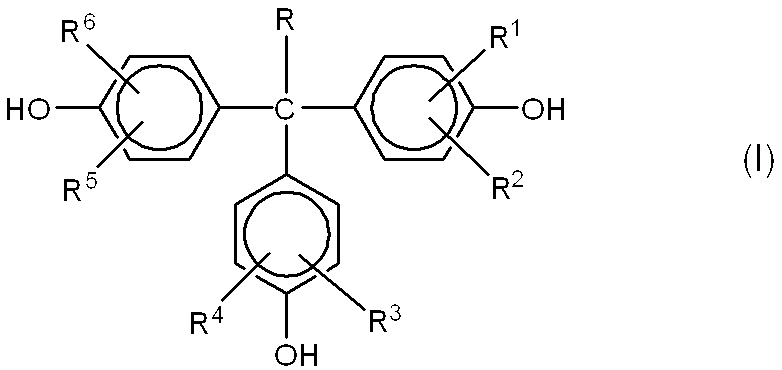
[式中、Rは水素原子又は炭素数1~5のアルキル基であり、R1~R6は、それぞれ水素原子、炭素数1~5のアルキル基又はハロゲン原子を示す。]
[8]前記一般式(I)で表わされる化合物が、1,1,1-トリス(4-ヒドロキシフェニル)エタンである、上記[7]に記載のポリカーボネートの製造方法。
[9]前記工程(d)で得られるポリカーボネートを含む反応液中のポリカーボネートの粘度平均分子量が10,000~100,000である、上記[1]~[8]のいずれかに記載のポリカーボネートの製造方法。
[10]前記末端停止剤が、フェノール,p-クレゾール,p-tert-ブチルフェノール,p-tert-オクチルフェノール,p-クミルフェノール,3-ペンタデシルフェノール,ブロモフェノール,トリブロモフェノール,及びノニルフェノールから選ばれる少なくとも1種である、上記[1]~[9]のいずれかに記載のポリカーボネートの製造方法。
前記工程(a)から得られる該反応液に、二価フェノールのアルカリ水溶液を導入し、ポリカーボネートオリゴマーを含む反応液を得る工程(b)と、
前記工程(b)から得られたポリカーボネートオリゴマーを含む反応液を、水相とポリカーボネートオリゴマーを含む有機溶媒相とに分離する工程(c)と、
前記工程(c)で分離されたポリカーボネートオリゴマーを含む有機溶媒相、二価フェノールのアルカリ水溶液、及び末端停止剤を反応させてポリカーボネートを含む反応液を得る工程(d)を有し、
上記工程(a)~(d)を連続的に行い、前記ポリカーボネートを含む反応液を、非分岐ポリカーボネートを含む反応液から分岐ポリカーボネートを含む反応液に切り替えるか、又は分岐ポリカーボネートを含む反応液から非分岐ポリカーボネートを含む反応液に切り替えるポリカーボネートの製造方法であって、
非分岐ポリカーボネートを含む反応液から分岐ポリカーボネートを含む反応液に切り替える際に、前記工程(a)に分岐剤を導入し、
分岐ポリカーボネートを含む反応液から非分岐ポリカーボネートを含む反応液に切り替える際に、前記工程(a)に分岐剤の導入を停止し、
かつ、工程(d)に導入する末端停止剤を複数段階で増加又は減少させる、ポリカーボネートの製造方法。
[2]前記非分岐ポリカーボネートを含む反応液から分岐ポリカーボネートを含む反応液に切り替える、又は分岐ポリカーボネートを含む反応液から非分岐ポリカーボネートを含む反応液に切り替えることにより得られるポリカーボネート移行品の粘度平均分子量の変動幅が、目標とする値に対して±10%以内である、上記[1]に記載のポリカーボネートの製造方法。
[3]前記非分岐ポリカーボネートが、二価フェノールとして2,2-ビス(4-ヒドロキシフェニル)プロパンを用いて製造されたホモポリカーボネートである、上記[1]又は[2]に記載のポリカーボネートの製造方法。
[4]前記工程(d)で得られたポリカーボネートを含む反応液を、ポリカーボネートを含む有機溶媒相と未反応の二価フェノールを含む水相とに分離する工程(e)を有し、
前記工程(b)に導入する二価フェノールのアルカリ水溶液として、前記工程(e)で分離された未反応の二価フェノールを含む水相を使用する、上記[1]~[3]のいずれかに記載のポリカーボネートの製造方法。
[5]非分岐ポリカーボネートを含む反応液から分岐ポリカーボネートを含む反応液に切り替えるか、又は分岐ポリカーボネートを含む反応液から非分岐ポリカーボネートを含む反応液に切り替えるに際して、切り替え後又は切り替え前の分岐ポリカーボネート中の分岐剤含有率が0.2~3.0モル%である、上記[1]~[4]のいずれかに記載のポリカーボネートの製造方法。
[6]前記工程(b)で得られるポリカーボネートオリゴマーを含む反応液中のポリカーボネートオリゴマーの重量平均分子量が5000以下である、上記[1]~[5]のいずれかに記載のポリカーボネートの製造方法。
[7]分岐剤が下記一般式(I)で表わされる化合物である、上記[1]~[6]のいずれかに記載のポリカーボネートの製造方法。
[式中、Rは水素原子又は炭素数1~5のアルキル基であり、R1~R6は、それぞれ水素原子、炭素数1~5のアルキル基又はハロゲン原子を示す。]
[8]前記一般式(I)で表わされる化合物が、1,1,1-トリス(4-ヒドロキシフェニル)エタンである、上記[7]に記載のポリカーボネートの製造方法。
[9]前記工程(d)で得られるポリカーボネートを含む反応液中のポリカーボネートの粘度平均分子量が10,000~100,000である、上記[1]~[8]のいずれかに記載のポリカーボネートの製造方法。
[10]前記末端停止剤が、フェノール,p-クレゾール,p-tert-ブチルフェノール,p-tert-オクチルフェノール,p-クミルフェノール,3-ペンタデシルフェノール,ブロモフェノール,トリブロモフェノール,及びノニルフェノールから選ばれる少なくとも1種である、上記[1]~[9]のいずれかに記載のポリカーボネートの製造方法。
本発明のポリカーボネートの製造方法によれば、非分岐ポリカーボネートの製造から分岐剤を導入することにより分岐ポリカーボネートの製造に切り替える際や、分岐ポリカーボネートの製造から分岐剤の導入を停止することにより非分岐ポリカーボネートの製造に切り替える際に、発生する移行品の分子量の変動が少ないので、移行品を使用する際に必要となる、分子量を調整することを目的とする煩雑な作業を軽減し、効率化することができる。さらに、分子量変動による装置への負荷を低減することができる。
本発明のポリカーボネートの製造方法は、二価フェノールのアルカリ水溶液及びホスゲンを含む混合物を有機溶媒の存在下でホスゲン化反応させて反応液を得る工程(a)と、前記工程(a)から得られる該反応液に、二価フェノールのアルカリ水溶液を導入し、ポリカーボネートオリゴマーを含む反応液を得る工程(b)と、前記工程(b)から得られたポリカーボネートオリゴマーを含む反応液を、水相とポリカーボネートオリゴマーを含む有機溶媒相とに分離する工程(c)と、前記工程(c)で分離されたポリカーボネートオリゴマーを含む有機溶媒相、二価フェノールのアルカリ水溶液、及び末端停止剤を反応させてポリカーボネートを含む反応液を得る工程(d)を有し、上記工程(a)~(d)を連続的に行い、前記ポリカーボネートを含む反応液を、非分岐ポリカーボネートを含む反応液から分岐ポリカーボネートを含む反応液に切り替えるか、又は分岐ポリカーボネートを含む反応液から非分岐ポリカーボネートを含む反応液に切り替えるポリカーボネートの製造方法であって、非分岐ポリカーボネートを含む反応液から分岐ポリカーボネートを含む反応液に切り替える際に、前記工程(a)に分岐剤を導入し、分岐ポリカーボネートを含む反応液から非分岐ポリカーボネートを含む反応液に切り替える際に、前記工程(a)に分岐剤の導入を停止し、かつ、工程(d)に導入する末端停止剤を複数段階で増加又は減少させるものである。
以下、本発明のポリカーボネートの製造方法について詳細に説明する。なお、本明細書において、好ましいとされている規定は任意に採用することができ、好ましいもの同士の組み合わせはより好ましいと言える。
以下、本発明のポリカーボネートの製造方法について詳細に説明する。なお、本明細書において、好ましいとされている規定は任意に採用することができ、好ましいもの同士の組み合わせはより好ましいと言える。
本発明のポリカーボネートの製造方法には、工程(a)~(d)を有するものであり、これらの各工程について説明する。
[工程(a)]
工程(a)は、二価フェノールのアルカリ水溶液及びホスゲンを含む混合物を有機溶媒の存在下でホスゲン化反応させて反応液を得る工程である。この工程(a)に使用される原料、反応条件について説明する。
[工程(a)]
工程(a)は、二価フェノールのアルカリ水溶液及びホスゲンを含む混合物を有機溶媒の存在下でホスゲン化反応させて反応液を得る工程である。この工程(a)に使用される原料、反応条件について説明する。
<二価フェノールのアルカリ水溶液>
二価フェノールとしては、ポリカーボネートの製造に使用される二価フェノールが用いられる。前記二価フェノールとしては、下記一般式(1)で表される二価フェノールを用いることが好ましい。
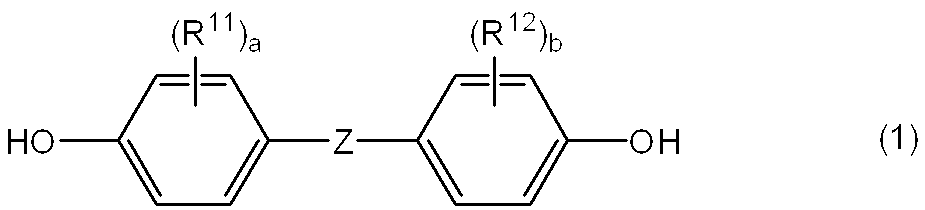
上記一般式(1)中、R11及びR12は、それぞれ独立にハロゲン原子、炭素数1~6のアルキル基又は炭素数1~6のアルコキシ基を示す。Zは、単結合、炭素数1~8のアルキレン基、炭素数2~8のアルキリデン基、炭素数5~15のシクロアルキレン基、炭素数5~15のシクロアルキリデン基、フルオレンジイル基、炭素数7~15のアリールアルキレン基、炭素数7~15のアリールアルキリデン基、-S-、-SO-、-SO2-、-O-又は-CO-を示す。a及びbは、それぞれ独立に0~4の整数を示す。
二価フェノールとしては、ポリカーボネートの製造に使用される二価フェノールが用いられる。前記二価フェノールとしては、下記一般式(1)で表される二価フェノールを用いることが好ましい。
上記一般式(1)中、R11及びR12は、それぞれ独立にハロゲン原子、炭素数1~6のアルキル基又は炭素数1~6のアルコキシ基を示す。Zは、単結合、炭素数1~8のアルキレン基、炭素数2~8のアルキリデン基、炭素数5~15のシクロアルキレン基、炭素数5~15のシクロアルキリデン基、フルオレンジイル基、炭素数7~15のアリールアルキレン基、炭素数7~15のアリールアルキリデン基、-S-、-SO-、-SO2-、-O-又は-CO-を示す。a及びbは、それぞれ独立に0~4の整数を示す。
一般式(1)で表される二価フェノールとしては、特に限定されないが、2,2-ビス(4-ヒドロキシフェニル)プロパン〔通称:ビスフェノールA〕が好適である。二価フェノールとして、ビスフェノールAのみを使用した場合、非分岐ポリカーボネートは、ビスフェノールAを用いて製造されたホモポリカーボネートとすることができ、分岐ポリカーボネートは、ビスフェノールAを用いて製造された分岐ポリカーボネートとすることができる。
ビスフェノールA以外の二価フェノールとしては、例えば、ビス(4-ヒドロキシフェニル)メタン、1,1-ビス(4-ヒドロキシフェニル)エタン、2,2-ビス(4-ヒドロキシフェニル)ブタン、2,2-ビス(4-ヒドロキシフェニル)オクタン、ビス(4-ヒドロキシフェニル)フェニルメタン、ビス(4-ヒドロキシフェニル)ジフェニルメタン、2,2-ビス(4-ヒドロキシ-3-メチルフェニル)プロパン、ビス(4-ヒドロキシフェニル)ナフチルメタン、1,1-ビス(4-ヒドロキシ-3-t-ブチルフェニル)プロパン、2,2-ビス(4-ヒドロキシ-3-ブロモフェニル)プロパン、2,2-ビス(4-ヒドロキシ-3,5-ジメチルフェニル)プロパン、2,2-ビス(4-ヒドロキシ-3-クロロフェニル)プロパン、2,2-ビス(4-ヒドロキシ-3,5-ジクロロフェニル)プロパン、2,2-ビス(4-ヒドロキシ-3,5-ジブロモフェニル)プロパン等のビス(ヒドロキシアリール)アルカン類、1,1-ビス(4-ヒドロキシフェニル)シクロペンタン、1,1-ビス(4-ヒドロキシフェニル)シクロヘキサン、1,1-ビス(4-ヒドロキシフェニル)-3,5,5-トリメチルシクロヘキサン、2,2-ビス(4-ヒドロキシフェニル)ノルボルナン、1,1-ビス(4-ヒドロキシフェニル)シクロドデカン等のビス(ヒドロキシアリール)シクロアルカン類、4,4’-ジヒドロキシジフェニルエーテル、4,4’-ジヒドロキシ-3,3’-ジメチルフェニルエーテル等のジヒドロキシアリールエーテル類、4,4’-ジヒドロキシジフェニルスルフィド、4,4’-ジヒドロキシ-3,3’-ジメチルジフェニルスルフィド等のジヒドロキシジアリールスルフィド類、4,4’-ジヒドロキシジフェニルスルホキシド、4,4’-ジヒドロキシ-3,3’-ジメチルジフェニルスルホキシド等のジヒドロキシジアリールスルホキシド類、4,4’-ジヒドロキシジフェニルスルホン、4,4’-ジヒドロキシ-3,3’-ジメチルジフェニルスルホン等のジヒドロキシジアリールスルホン類、4,4’-ジヒドロキシジフェニル等のジヒドロキシジフェニル類、9,9-ビス(4-ヒドロキシフェニル)フルオレン、9,9-ビス(4-ヒドロキシ-3-メチルフェニル)フルオレン等のジヒドロキシジアリールフルオレン類、1,3-ビス(4-ヒドロキシフェニル)アダマンタン、2,2-ビス(4-ヒドロキシフェニル)アダマンタン、1,3-ビス(4-ヒドロキシフェニル)-5,7-ジメチルアダマンタン等のジヒドロキシジアリールアダマンタン類、4,4’-[1,3-フェニレンビス(1-メチルエチリデン)]ビスフェノール、10,10-ビス(4-ヒドロキシフェニル)-9-アントロン、1,5-ビス(4-ヒドロキシフェニルチオ)-2,3-ジオキサペンタン等が挙げられる。
これらの二価フェノールは、単独で又は二種以上を混合して用いてもよい。
ビスフェノールA以外の二価フェノールとしては、例えば、ビス(4-ヒドロキシフェニル)メタン、1,1-ビス(4-ヒドロキシフェニル)エタン、2,2-ビス(4-ヒドロキシフェニル)ブタン、2,2-ビス(4-ヒドロキシフェニル)オクタン、ビス(4-ヒドロキシフェニル)フェニルメタン、ビス(4-ヒドロキシフェニル)ジフェニルメタン、2,2-ビス(4-ヒドロキシ-3-メチルフェニル)プロパン、ビス(4-ヒドロキシフェニル)ナフチルメタン、1,1-ビス(4-ヒドロキシ-3-t-ブチルフェニル)プロパン、2,2-ビス(4-ヒドロキシ-3-ブロモフェニル)プロパン、2,2-ビス(4-ヒドロキシ-3,5-ジメチルフェニル)プロパン、2,2-ビス(4-ヒドロキシ-3-クロロフェニル)プロパン、2,2-ビス(4-ヒドロキシ-3,5-ジクロロフェニル)プロパン、2,2-ビス(4-ヒドロキシ-3,5-ジブロモフェニル)プロパン等のビス(ヒドロキシアリール)アルカン類、1,1-ビス(4-ヒドロキシフェニル)シクロペンタン、1,1-ビス(4-ヒドロキシフェニル)シクロヘキサン、1,1-ビス(4-ヒドロキシフェニル)-3,5,5-トリメチルシクロヘキサン、2,2-ビス(4-ヒドロキシフェニル)ノルボルナン、1,1-ビス(4-ヒドロキシフェニル)シクロドデカン等のビス(ヒドロキシアリール)シクロアルカン類、4,4’-ジヒドロキシジフェニルエーテル、4,4’-ジヒドロキシ-3,3’-ジメチルフェニルエーテル等のジヒドロキシアリールエーテル類、4,4’-ジヒドロキシジフェニルスルフィド、4,4’-ジヒドロキシ-3,3’-ジメチルジフェニルスルフィド等のジヒドロキシジアリールスルフィド類、4,4’-ジヒドロキシジフェニルスルホキシド、4,4’-ジヒドロキシ-3,3’-ジメチルジフェニルスルホキシド等のジヒドロキシジアリールスルホキシド類、4,4’-ジヒドロキシジフェニルスルホン、4,4’-ジヒドロキシ-3,3’-ジメチルジフェニルスルホン等のジヒドロキシジアリールスルホン類、4,4’-ジヒドロキシジフェニル等のジヒドロキシジフェニル類、9,9-ビス(4-ヒドロキシフェニル)フルオレン、9,9-ビス(4-ヒドロキシ-3-メチルフェニル)フルオレン等のジヒドロキシジアリールフルオレン類、1,3-ビス(4-ヒドロキシフェニル)アダマンタン、2,2-ビス(4-ヒドロキシフェニル)アダマンタン、1,3-ビス(4-ヒドロキシフェニル)-5,7-ジメチルアダマンタン等のジヒドロキシジアリールアダマンタン類、4,4’-[1,3-フェニレンビス(1-メチルエチリデン)]ビスフェノール、10,10-ビス(4-ヒドロキシフェニル)-9-アントロン、1,5-ビス(4-ヒドロキシフェニルチオ)-2,3-ジオキサペンタン等が挙げられる。
これらの二価フェノールは、単独で又は二種以上を混合して用いてもよい。
前記二価フェノールは、アルカリ水溶液として使用される。使用されるアルカリとしては、水酸化アルカリ、特に強塩基性の水酸化物、例えば、水酸化ナトリウム、水酸化カリウムを挙げることができる。アルカリ水溶液のアルカリ濃度としては、通常、1~15質量%のものが好ましく用いられる。また、アルカリ水溶液中の二価フェノールの含有量は、通常0.5~20質量%の範囲で選ばれる。
<ホスゲン>
工程(a)で使用されるホスゲンは、通常、塩素および一酸化炭素を、塩素1モルに対し一酸化炭素1.01~1.3モルの割合で触媒として活性炭を使用して反応させて得られる化合物である。使用するホスゲン中には、ホスゲンガスとして使用する場合、未反応の一酸化炭素を1~30容量%程度含んだホスゲンガスを使用することができる。また、液化状態のホスゲンも使用することができる。
工程(a)で使用されるホスゲンは、通常、塩素および一酸化炭素を、塩素1モルに対し一酸化炭素1.01~1.3モルの割合で触媒として活性炭を使用して反応させて得られる化合物である。使用するホスゲン中には、ホスゲンガスとして使用する場合、未反応の一酸化炭素を1~30容量%程度含んだホスゲンガスを使用することができる。また、液化状態のホスゲンも使用することができる。
本発明のポリカーボネートの製造方法では、分岐ポリカーボネートを含む反応液を得る際には、分岐剤が使用され、非分岐ポリカーボネートを含む反応液を得る際には、分岐剤は使用されない。分岐剤を使用して分岐ポリカーボネートを含む反応液を得る際には、分岐剤は、工程(a)に導入される。工程(a)で使用される場合の分岐剤について説明する。
工程(a)で使用される分岐剤は、特に限定されるものではなく、公知の分岐剤を用いることができる。公知の分岐剤の中でも、3官能基以上の分岐剤を用いることが好ましい。たとえば、4官能以上の分岐剤として、例えば、フロログルシド、ピロメリット酸、1,1,2,2-テトラキス(4-ヒドロキシフェニル)エタン、α,α,α’,α’-テトラキス(4-ヒドロキシフェニル)-p-キシレン、α,α,α’,α’-テトラキス(2-メチル-4-ヒドロキシフェニル)-p-キシレン、α,α,α’,α’-テトラキス(2,5-ジメチル-4-ヒドロキシフェニル)-p-キシレン、α,α,α’,α’-テトラキス(2,6-ジメチル-4-ヒドロキシフェニル)-p-キシレン、α,α’-ジメチル-α,α,α’,α’-テトラキス(4-ヒドロキシフェニル)-p-キシレン、α,α’-ジメチル-α,α,α’,α’-テトラキス(3-メチル-4-ヒドロキシフェニル)-m-キシレン、ビス[4,4-ビス(4-ヒドロキシフェニル)シクロヘキサン]、ビス[4,4-ビス(4-ヒドロキシ-3-メチルフェニル)シクロヘキサン]、ビス[4,4-ビス(3,5-ジメチル-4-ヒドロキシフェニル)シクロヘキサン]、ビス[4,4-ビス(4-ヒドロキシフェニル)シクロヘキシル]メタン、ビス[4,4-ビス(4-ヒドロキシ-3-メチルフェニル)シクロヘキシル]メタン、ビス[4,4-ビス(3,5-ジメチル-4-ヒドロキシフェニル)シクロヘキシル]メタン、1,1-ビス[4,4-ビス(4-ヒドロキシフェニル)シクロヘキシル]エタン、1,1-ビス[4,4-ビス(4-ヒドロキシ-3-メチルフェニル)シクロヘキシル]エタン、1,1-ビス[4,4-ビス(3,5-ジメチル-4-ヒドロキシフェニル)シクロヘキシル]エタン、2,2-ビス[4,4-ビス(4-ヒドロキシフェニル)シクロヘキシル]プロパン、2,2-ビス[4,4-ビス(4-ヒドロキシ-3-メチルフェニル)シクロヘキシル]プロパン、2,2-ビス[4,4-ビス(3,5-ジメチル-4-ヒドロキシフェニル)シクロヘキシル]プロパン、2,2-ビス[4,4-ビス(4-ヒドロキシフェニル)シクロヘキシル]ブタン、2,2-ビス[4,4-ビス(4-ヒドロキシ-3-メチルフェニル)シクロヘキシル]ブタン、2,2-ビス[4,4-ビス(3,5-ジメチル-4-ヒドロキシフェニル)シクロヘキシル]ブタン、1,1-ビス[4,4-ビス(4-ヒドロキシフェニル)シクロヘキシル]シクロヘキサン、1,1-ビス[4,4-ビス(4-ヒドロキシ-3-メチルフェニル)シクロヘキシル]シクロヘキサン、1,1-ビス[4,4-ビス(3,5-ジメチル-4-ヒドロキシフェニル)シクロヘキシル]シクロヘキサン、1,1-ビス[4,4-ビス(4-ヒドロキシフェニル)シクロヘキシル]-1-フェニルエタン、1,1-ビス[4,4-ビス(4-ヒドロキシ-3-メチルフェニル)シクロヘキシル]-1-フェニルエタン、1,1-ビス[4,4-ビス(3,5-ジメチル-4-ヒドロキシフェニル)シクロヘキシル]-1-フェニルエタン、2,2’,4,4’-テトラヒドロキシベンゾフェノン、2,3,4,4’-テトラヒドロキシベンゾフェノン、2,2-ビス(2,4-ジヒドロキシフェニル)プロパン、2,2-ビス(3,5-ジヒドロキシフェニル)プロパン等が挙げられる。
また、下記の化学式(A)で表される化合物を4官能以上の分岐剤として用いてもよい。
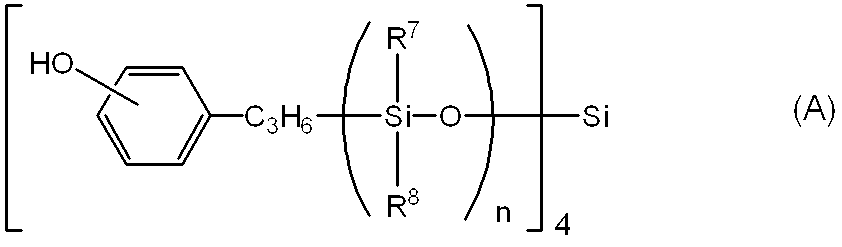
上記式中、R7及びR8は、炭素数1~8のアルキル基又は炭素数6~20のアリール基を示す。nは1~100の整数であり、好ましくは1~50の整数である。上記アルキル基としては、例えば、メチル基、エチル基、プロピル基、ブチル基等が挙げられ、上記アリール基としては、例えば、フェニル基等が挙げられる。R7及びR8はそれぞれ独立であり、同一でも異なっていてもよい。上記式(A)で表される化合物の中でも、R7及びR8がメチル基である、テトラ(4-ヒドロキシフェニルプロピル-ポリメチルシロキサン)シリコンが好適である。
さらに、以下の一般式(II)で表される構造を有するものも挙げることができる。

上記式中、R13はHO-A-R17-を示し、Aは炭素数6~12のアリーレン基を示し、R17は炭素数1~6のアルキレン基を示し、R17はSi原子に結合している。Aはさらに置換基を有していてもよい。複数のR13は同一であっても異なっていてもよい。R14、R15及びR16はそれぞれ独立して炭素数1~6のアルキル基、フェニル基及び/又はトリメチルシロキシ基を示し、複数のR14、R15及びR16は同一であっても異なっていてもよい。xは1以上2未満、yは0以上1以下の数を示し、x+yは1以上2以下である。cは4以上16以下の数であり、dは0以上8以下の数である。
上記一般式(II)において、例えばx=y=1であり、x+yが2の場合には環状シロキサン構造をとることができる。
上記一般式(II)のうち好ましくはcが4以上8以下であり、dが0である構成単位を有し、より好ましくはcが4であり、dが0である構成単位を有する。
上記一般式(II)におけるAは炭素数6~12のアリーレン基を示し、好ましくはオルトフェニレン、メタフェニレン、パラフェニレンを示す。Aが置換基を有する場合には、置換基としてはアルキル基、アルコキシ基及び/又はヒドロキシル基を挙げることができる。上記アルキル基としては、例えば炭素数3~6のアルキル基を挙げることができ、アルコキシ基としてはメトキシ基を挙げることができる。
上記一般式(II)におけるR17(Si原子に結合している)は炭素数1~6のアルキレン基を示し、例えばメチレン基、エチレン基、プロピレン基、ブチレン基等を挙げることができ、炭素数1~4のアルキレン基であることが好ましく、プロピレン基がより好ましい。
上記一般式(II)におけるR14~R16が示す炭素数1~6のアルキル基としては、例えばメチル基、エチル基、プロピル基、ブチル基等を挙げることができ、炭素数1~4のアルキル基であることが好ましく、メチル基がより好ましい。環状シロキサン構造を有する分岐剤として、より具体的には、以下の一般式(III)~(XI)で表される分岐剤を用いることができる。
上記一般式(II)におけるAは炭素数6~12のアリーレン基を示し、好ましくはオルトフェニレン、メタフェニレン、パラフェニレンを示す。Aが置換基を有する場合には、置換基としてはアルキル基、アルコキシ基及び/又はヒドロキシル基を挙げることができる。上記アルキル基としては、例えば炭素数3~6のアルキル基を挙げることができ、アルコキシ基としてはメトキシ基を挙げることができる。
上記一般式(II)におけるR17(Si原子に結合している)は炭素数1~6のアルキレン基を示し、例えばメチレン基、エチレン基、プロピレン基、ブチレン基等を挙げることができ、炭素数1~4のアルキレン基であることが好ましく、プロピレン基がより好ましい。
上記一般式(II)におけるR14~R16が示す炭素数1~6のアルキル基としては、例えばメチル基、エチル基、プロピル基、ブチル基等を挙げることができ、炭素数1~4のアルキル基であることが好ましく、メチル基がより好ましい。環状シロキサン構造を有する分岐剤として、より具体的には、以下の一般式(III)~(XI)で表される分岐剤を用いることができる。
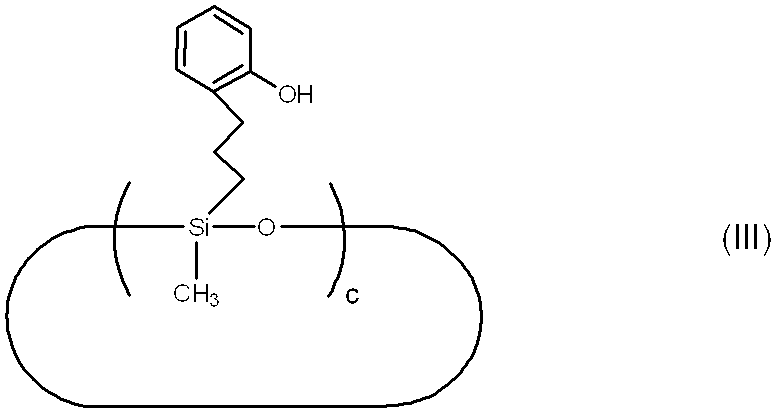

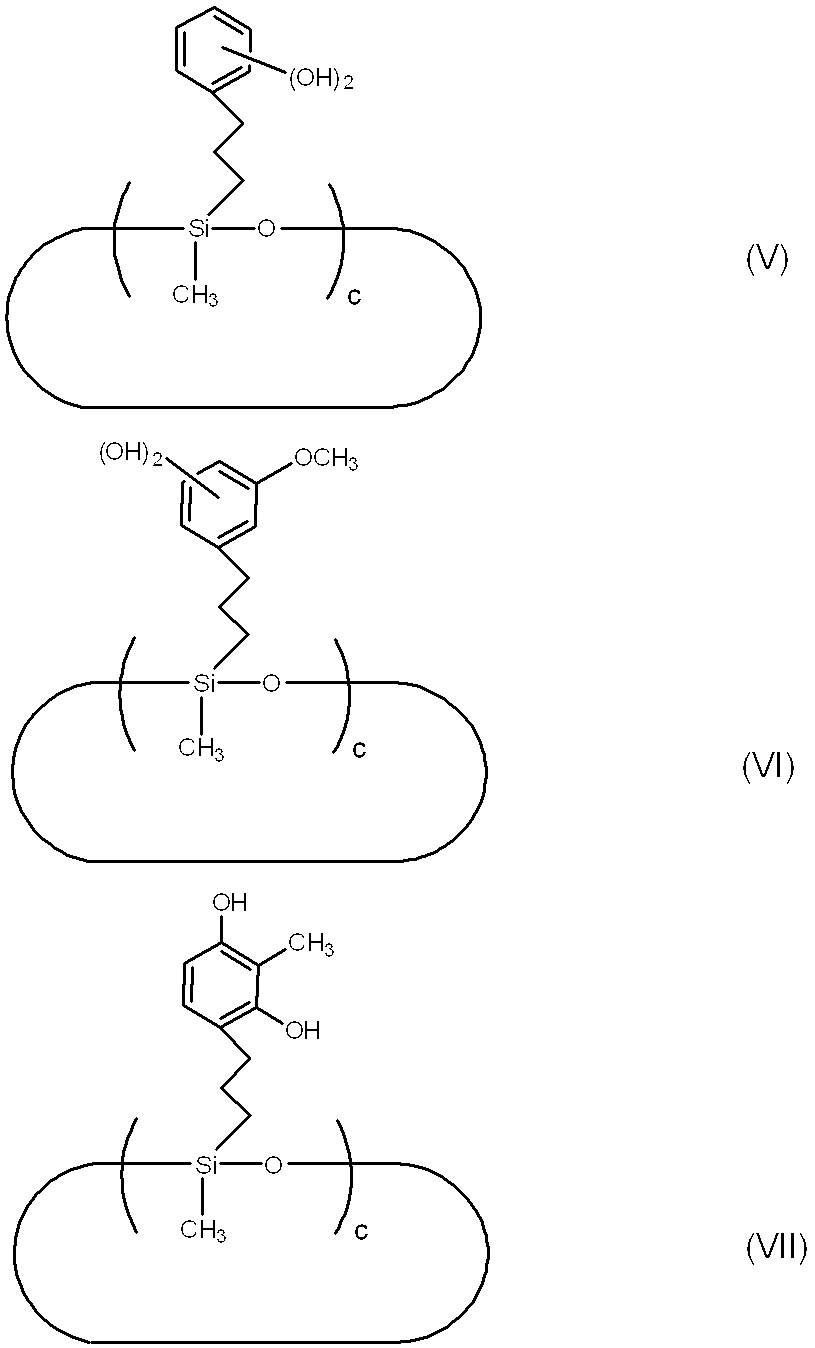
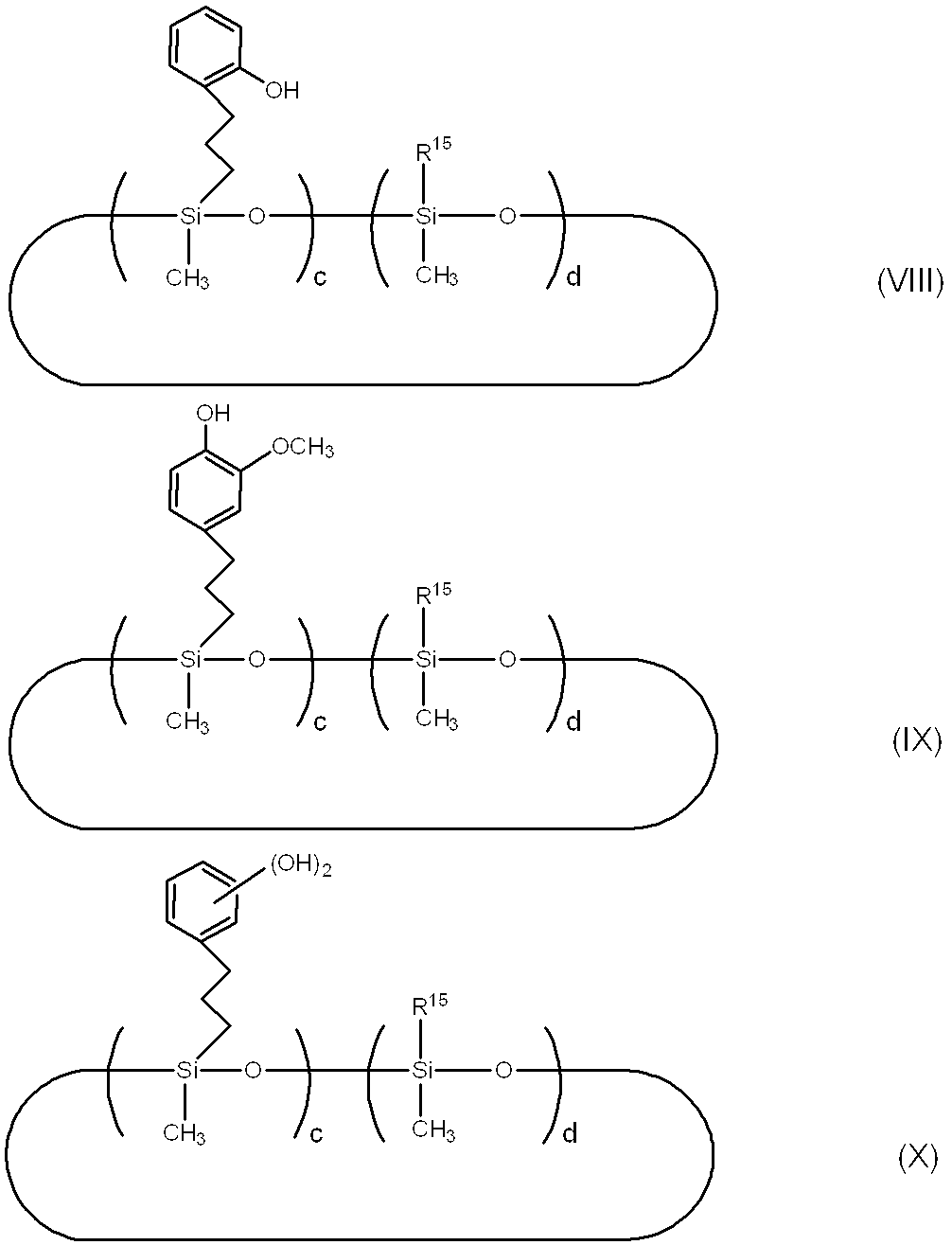

上記一般式(III)~(XI)において、cはそれぞれ独立に、4~16の整数、好ましくは4~8の整数を示し、dは0又は1~8の整数を示す。また、R15はそれぞれ独立に、メチル基、エチル基、プロピル基、ブチル基、又はフェニル基を示す。
一般式(III)~(XI)においてcが4以上8以下であり、dが0であることがより好ましく、cが4であり、dが0であることがさらに好ましい。
中でも、ジクロロメタンやポリカーボネートオリゴマーのジクロロメタン溶液への溶解性及び熱安定性を向上させる観点から、c=4である一般式(III)~(VII)で表される環状シロキサン構造を有する分岐剤を用いることが好ましい。また、原料の入手容易性の観点から(III)及び/又は(IV)で表される構造がより好ましい。
一般式(III)~(XI)においてcが4以上8以下であり、dが0であることがより好ましく、cが4であり、dが0であることがさらに好ましい。
中でも、ジクロロメタンやポリカーボネートオリゴマーのジクロロメタン溶液への溶解性及び熱安定性を向上させる観点から、c=4である一般式(III)~(VII)で表される環状シロキサン構造を有する分岐剤を用いることが好ましい。また、原料の入手容易性の観点から(III)及び/又は(IV)で表される構造がより好ましい。
さらに好ましくは、下記一般式(I)で表わされる化合物を用いることにより、溶融時にドローダウンを生じ難い分岐ポリカーボネートを得ることができる。

[式中、Rは水素原子又は炭素数1~5のアルキル基であり、R1~R6は、それぞれ水素原子、炭素数1~5のアルキル基又はハロゲン原子を示す。]
上記一般式(I)中、Rが示す炭素数1~5のアルキル基としては、例えば、メチル基、エチル基、n-プロピル基、n-ブチル基、n-ペンチル基などが挙げられる。また、R1~R6が示す炭素数1~5のアルキル基としては、例えば、メチル基、エチル基、n-プロピル基、n-ブチル基、n-ペンチル基などが挙げられる。R1~R6がハロゲン原子を示す場合は、塩素原子、臭素原子、フッ素原子などが挙げられる。一般式(I)の分岐剤は、具体的には、1,1,1-トリス(4-ヒドロキシフェニル)メタン;1,1,1-トリス(4-ヒドロキシフェニル)エタン;1,1,1-トリス(4-ヒドロキシフェニル)プロパン;1,1,1-トリス(2-メチル-4-ヒドロキシフェニル)メタン;1,1,1-トリス(2-メチル-4-ヒドロキシフェニル)エタン;1,1,1-トリス(3-メチル-4-ヒドロキシフェニル)メタン;1,1,1-トリス(3-メチル-4-ヒドロキシフェニル)エタン;1,1,1-トリス(3,5-ジメチル-4-ヒドロキシフェニル)メタン;1,1,1-トリス(3,5-ジメチル-4-ヒドロキシフェニル)エタン;1,1,1-トリス(3-クロロ-4-ヒドロキシフェニル)メタン;1,1,1-トリス(3-クロロ-4-ヒドロキシフェニル)エタン;1,1,1-トリス(3,5-ジクロロ-4-ヒドロキシフェニル)メタン;1,1,1-トリス(3,5-ジクロロ-4-ヒドロキシフェニル)エタン;1,1,1-トリス(3-ブロモ-4-ヒドロキシフェニル)メタン;1,1,1-トリス(3-ブロモ-4-ヒドロキシフェニル)エタン;1,1,1-トリス(3,5-ジブロモ-4-ヒドロキシフェニル)メタン;1,1,1-トリス(3,5-ジブロモ-4-ヒドロキシフェニル)エタンなどである。上記一般式(I)の分岐剤の中でも、1,1,1-トリス(4-ヒドロキシフェニル)エタン[以下、THPEと称することもある。]を用いることが、分岐ポリカーボネートの分岐性の観点から、特に好ましい。上記分岐剤は1種を単独で用いてもよく、2種以上を併用してもよい。
<有機溶媒>
工程(a)で使用される有機溶媒としては、ポリカーボネートオリゴマーおよびポリカーボネート樹脂を溶解する溶媒が挙げられる。具体的にはジクロロメタン(塩化メチレン)、ジクロロエタン、トリクロロエタン、テトラクロロエタン、ペンタクロロエタン、ヘキサクロロエタン、ジクロロエチレン、クロロベンゼン、ジクロロベンゼンなどのハロゲン化炭化水素溶媒が挙げられ、特にジクロロメタン(塩化メチレン)が好ましい。
工程(a)で使用される有機溶媒としては、ポリカーボネートオリゴマーおよびポリカーボネート樹脂を溶解する溶媒が挙げられる。具体的にはジクロロメタン(塩化メチレン)、ジクロロエタン、トリクロロエタン、テトラクロロエタン、ペンタクロロエタン、ヘキサクロロエタン、ジクロロエチレン、クロロベンゼン、ジクロロベンゼンなどのハロゲン化炭化水素溶媒が挙げられ、特にジクロロメタン(塩化メチレン)が好ましい。
<その他の原料>
工程(a)では、上記の各原料以外に必要に応じて、その他の原料を用いることができる。その他の原料として、具体的には、反応を促進するために、重縮合反応で用いられるトリエチルアミン等の第三級アミンやテトラエチルアンモニウムクロリド等の第四級アンモニウム塩等の触媒を用いることもできる。
工程(a)では、上記の各原料以外に必要に応じて、その他の原料を用いることができる。その他の原料として、具体的には、反応を促進するために、重縮合反応で用いられるトリエチルアミン等の第三級アミンやテトラエチルアンモニウムクロリド等の第四級アンモニウム塩等の触媒を用いることもできる。
<反応器>
工程(a)では、二価フェノールのアルカリ水溶液及び分岐剤とホスゲンとが激しく反応して、発熱を伴うため、副反応を抑制するために反応生成物を0~50℃に冷却することが望ましい。従って、工程(a)に使用する反応器としては、反応生成物を冷却するための冷却設備を備えた反応器を用いることが好ましい。また、二価フェノールのアルカリ水溶液、ホスゲン、分岐剤及び有機溶媒を連続的に反応器に導入した際に、反応器内で反応液が乱流状態となるような状態でホスゲン化反応させることが好ましい。このような反応器としては、混合反応器を用いることが望ましく、混合反応器としては、静止型混合器、即ちスタティックミキサーであることが好ましい。静止型混合器は、流体を分割、転換、反転させる作用を有するエレメントを内部に有した管状の反応器であることが好ましく、エレメントは一般的に、長方形の板を180度ねじった形状を有する。反応器内に導入された反応混合物は、ひとつのエレメントを通過するごとに2分割される。また、反応混合物流体又は反応生成物流体は、エレメント内のねじれ面に沿って管中央部から壁部へ、管壁部から中央部へと並び替えられる。また、流体は、1エレメントごとに回転方向が替わり、急激な慣性力の反転を受け乱流撹拌される。
上記に記載の管状の静止型混合器を反応器として用いた場合、反応器内では、液体中の気泡が微細化され、接触界面が大きくなり、これにより反応効率が飛躍的に高まる。
工程(a)では、二価フェノールのアルカリ水溶液及び分岐剤とホスゲンとが激しく反応して、発熱を伴うため、副反応を抑制するために反応生成物を0~50℃に冷却することが望ましい。従って、工程(a)に使用する反応器としては、反応生成物を冷却するための冷却設備を備えた反応器を用いることが好ましい。また、二価フェノールのアルカリ水溶液、ホスゲン、分岐剤及び有機溶媒を連続的に反応器に導入した際に、反応器内で反応液が乱流状態となるような状態でホスゲン化反応させることが好ましい。このような反応器としては、混合反応器を用いることが望ましく、混合反応器としては、静止型混合器、即ちスタティックミキサーであることが好ましい。静止型混合器は、流体を分割、転換、反転させる作用を有するエレメントを内部に有した管状の反応器であることが好ましく、エレメントは一般的に、長方形の板を180度ねじった形状を有する。反応器内に導入された反応混合物は、ひとつのエレメントを通過するごとに2分割される。また、反応混合物流体又は反応生成物流体は、エレメント内のねじれ面に沿って管中央部から壁部へ、管壁部から中央部へと並び替えられる。また、流体は、1エレメントごとに回転方向が替わり、急激な慣性力の反転を受け乱流撹拌される。
上記に記載の管状の静止型混合器を反応器として用いた場合、反応器内では、液体中の気泡が微細化され、接触界面が大きくなり、これにより反応効率が飛躍的に高まる。
<反応器への各原料の導入比率>
工程(a)に使用する反応器には、非分岐ポリカーボネートを製造する場合、二価フェノールのアルカリ水溶液、ホスゲン及び有機溶媒を導入し、分岐ポリカーボネートを製造する場合、二価フェノールのアルカリ水溶液、ホスゲン、分岐剤及び有機溶媒を導入し、混合してホスゲン化反応させる。有機溶媒の使用量は、有機溶媒相と水相の容量比が5/1~1/7、好ましくは2/1~1/4となるように選定するのが望ましい。また、ホスゲンの使用量は、二価フェノール1モルに対して、通常1.05~1.5モル、好ましくは、1.1~1.3モルとなるように、ホスゲンを過剰に使用することが好ましい。また、分岐剤を使用する場合は、二価フェノールと分岐剤との使用モル比率は、通常、二価フェノール:分岐剤が、99.8:0.2~95:5の範囲内のモル比率で、好ましくは99.7:0.3~97:3の範囲内のモル比率で使用することが好ましい。使用する分岐剤により相違するが、前記一般式(I)で表わされる分岐剤は、アルカリ水溶液に溶解させることができるので、アルカリ水溶液に溶解させて導入することが望ましい。また、アルカリ水溶液に溶解させることが困難な分岐剤は、塩化メチレン等の有機溶媒に溶解させて導入することが望ましい。
工程(a)に使用する反応器には、非分岐ポリカーボネートを製造する場合、二価フェノールのアルカリ水溶液、ホスゲン及び有機溶媒を導入し、分岐ポリカーボネートを製造する場合、二価フェノールのアルカリ水溶液、ホスゲン、分岐剤及び有機溶媒を導入し、混合してホスゲン化反応させる。有機溶媒の使用量は、有機溶媒相と水相の容量比が5/1~1/7、好ましくは2/1~1/4となるように選定するのが望ましい。また、ホスゲンの使用量は、二価フェノール1モルに対して、通常1.05~1.5モル、好ましくは、1.1~1.3モルとなるように、ホスゲンを過剰に使用することが好ましい。また、分岐剤を使用する場合は、二価フェノールと分岐剤との使用モル比率は、通常、二価フェノール:分岐剤が、99.8:0.2~95:5の範囲内のモル比率で、好ましくは99.7:0.3~97:3の範囲内のモル比率で使用することが好ましい。使用する分岐剤により相違するが、前記一般式(I)で表わされる分岐剤は、アルカリ水溶液に溶解させることができるので、アルカリ水溶液に溶解させて導入することが望ましい。また、アルカリ水溶液に溶解させることが困難な分岐剤は、塩化メチレン等の有機溶媒に溶解させて導入することが望ましい。
工程(a)のホスゲン化反応器内では、二価フェノールの末端基又は二価フェノールと分岐剤の末端基がホスゲンによりクロロフォーメート化される反応やホスゲンがアルカリにより分解される反応により発熱し、反応生成物の温度が高くなるので、反応生成物の温度が0~80℃、好ましくは5~70℃となるように冷却することが好ましい。前述した管状の静止型混合器を反応器として用いた場合、二価フェノールのアルカリ水溶液とホスゲンとの合流点、又は二価フェノールのアルカリ水溶液と分岐剤とホスゲンとの合流点から発熱反応するので、この合流点においても冷却しておくことが好ましい。管状の静止型混合器の反応器内を反応生成物が反応器出口に流れるに従い、ホスゲンは消費されていき、激しい反応熱も発生しなくなる。この工程(a)での反応の主目的は、二価フェノールの末端基又は二価フェノール及び分岐剤の末端基をホスゲンによりクロロフォーメート化することであり、オリゴマー化反応はほとんど進行していない。
[工程(b)]
工程(b)は、前記工程(a)から得られる該反応液に、二価フェノールのアルカリ水溶液を導入し、必要に応じて重合触媒の存在下でポリカーボネートオリゴマーを含む反応液を得る工程である。この工程(b)に使用される原料、反応条件について説明する。
工程(b)は、前記工程(a)から得られる該反応液に、二価フェノールのアルカリ水溶液を導入し、必要に応じて重合触媒の存在下でポリカーボネートオリゴマーを含む反応液を得る工程である。この工程(b)に使用される原料、反応条件について説明する。
前述したとおり、工程(a)では、オリゴマー化反応はほとんど進行していないため、工程(b)でオリゴマー化反応させることで分子量を上げて、好ましくは、重量平均分子量が5000以下のポリカーボネートオリゴマーを製造する。この工程(b)で使用される二価フェノールのアルカリ水溶液としては、工程(a)で説明した二価フェノールのアルカリ水溶液が使用される。
<重合触媒>
工程(b)で使用する重合触媒としては、ポリカーボネート樹脂の界面重合時に使用される公知の触媒を用いることができる。相間移動触媒、例えば三級アミン又はその塩、四級アンモニウム塩、四級ホスホニウム塩などを好ましく用いることができる。三級アミンとしては、例えばトリエチルアミン、トリブチルアミン、N,N-ジメチルシクロヘキシルアミン、ピリジン、ジメチルアニリンなどが挙げられ、また三級アミン塩としては、例えばこれらの三級アミンの塩酸塩、臭素酸塩などが挙げられる。四級アンモニウム塩としては、例えばトリメチルベンジルアンモニウムクロリド、トリエチルベンジルアンモニウムクロリド、トリブチルベンジルアンモニウムクロリド、トリオクチルメチルアンモニウムクロリド、テトラブチルアンモニウムクロリド、テトラブチルアンモニウムブロミドなどが、四級ホスホニウム塩としては、例えばテトラブチルホスホニウムクロリド、テトラブチルホスホニウムブロミドなどが挙げられる。これらの触媒は、それぞれ単独で用いてもよく、二種以上を組み合わせて用いてもよい。前記触媒の中では、三級アミンが好ましく、特にトリエチルアミンが好適である。これらの触媒は、液体状態のものであればそのまま、または有機溶媒や水に溶解させて導入することができる。また固体状態のものは、有機溶媒や水に溶解させて導入することができる。
工程(b)で使用する重合触媒としては、ポリカーボネート樹脂の界面重合時に使用される公知の触媒を用いることができる。相間移動触媒、例えば三級アミン又はその塩、四級アンモニウム塩、四級ホスホニウム塩などを好ましく用いることができる。三級アミンとしては、例えばトリエチルアミン、トリブチルアミン、N,N-ジメチルシクロヘキシルアミン、ピリジン、ジメチルアニリンなどが挙げられ、また三級アミン塩としては、例えばこれらの三級アミンの塩酸塩、臭素酸塩などが挙げられる。四級アンモニウム塩としては、例えばトリメチルベンジルアンモニウムクロリド、トリエチルベンジルアンモニウムクロリド、トリブチルベンジルアンモニウムクロリド、トリオクチルメチルアンモニウムクロリド、テトラブチルアンモニウムクロリド、テトラブチルアンモニウムブロミドなどが、四級ホスホニウム塩としては、例えばテトラブチルホスホニウムクロリド、テトラブチルホスホニウムブロミドなどが挙げられる。これらの触媒は、それぞれ単独で用いてもよく、二種以上を組み合わせて用いてもよい。前記触媒の中では、三級アミンが好ましく、特にトリエチルアミンが好適である。これらの触媒は、液体状態のものであればそのまま、または有機溶媒や水に溶解させて導入することができる。また固体状態のものは、有機溶媒や水に溶解させて導入することができる。
工程(b)に用いられる反応器としては、一般的に攪拌槽が用いられる。攪拌槽としては、攪拌機を有する槽型の攪拌槽であれば特に限定されない。
このオリゴマー化反応を進めるための反応器には、工程(a)から得られた反応液が導入される。工程(a)から得られた反応液中には、未反応の二価フェノール及び残留するアルカリ成分の残存量は少なく、オリゴマー化反応を進めるためには、二価フェノール及びアルカリ成分を追加して反応させることが必要である。
このオリゴマー化反応を進めるための反応器には、工程(a)から得られた反応液が導入される。工程(a)から得られた反応液中には、未反応の二価フェノール及び残留するアルカリ成分の残存量は少なく、オリゴマー化反応を進めるためには、二価フェノール及びアルカリ成分を追加して反応させることが必要である。
工程(b)のオリゴマー化反応は、用いられる反応器内において、工程(a)から得られた反応液中に含まれる二価フェノールの末端基及び分岐ポリカーボネートを製造する際に使用する分岐剤の末端基がホスゲンによりクロロフォーメート化された化合物と、二価フェノールとが、アルカリの存在下で反応することにより進行する。本発明のポリカーボネートの製造方法では、前記二価フェノールとして、工程(a)で使用される予め調製しておいた二価フェノールのアルカリ水溶液を反応器に導入したり、さらにこれに加えて、予め調製されたアリカリ水溶液を反応器に導入する等して、オリゴマー化反応を進めることができる。
また、別の方法として、重縮合工程後に得られたポリカーボネートを含む反応液を有機溶媒相と水相に分離したうちの水相[後述する工程(e)で得られた水相]をリサイクルして、工程(b)の反応器に導入して、オリゴマー化反応を進めることができる。工程(e)で得られた水相中には、未反応の二価フェノール及びアルカリが含まれており、該水相をリサイクル使用することにより、二価フェノール及びアルカリを有効活用することができる。なお、重縮合工程後の水相には、重縮合工程時にポリカーボネートオリゴマーのクロロフォーメート基が重合に使用されず水酸化ナトリウムと分解反応することで発生する炭酸ナトリウムが含まれることがある。
工程(b)に添加される二価フェノール濃度は、通常0.05~0.15モル/リットル、好ましくは0.06~0.12モル/リットル、より好ましくは0.06~0.08モル/リットルであることが望ましく、工程(b)に添加されるアルカリ濃度は、通常0.03~0.25モル/リットル、好ましくは0.05~0.21モル/リットル、より好ましくは0.12~0.15モル/リットルであることが望ましい。この工程(b)の反応液中の有機溶媒の使用量は、通常、有機相と水相との容量比が、好ましくは5/1~1/7、より好ましくは2/1~1/4となるように選択される。
工程(b)は、ポリカーボネートオリゴマーを含む反応液を得る工程であるが、重量平均分子量の上限値は好ましくは5000であり、下限値は、通常、約500程度である。工程(b)では、ポリカーボネートオリゴマーの好ましい重量平均分子量を5000以下とするために、末端停止剤を添加することが好ましい。末端停止剤の添加量で、工程(b)におけるポリカーボネートオリゴマーの重量平均分子量を5000以下に調整することが容易になる。末端停止剤としては、特に限定されるものではなく、ポリカーボネートの製造に使用されるものを用いることができる。具体的には、末端停止剤に用いられる化合物としては、例えば、フェノール,p-クレゾール,p-tert-ブチルフェノール,p-tert-オクチルフェノール,p-クミルフェノール,3-ペンタデシルフェノール,ブロモフェノール,トリブロモフェノール,及びノニルフェノールから選ばれる少なくとも1種の一価フェノールを挙げることができる。これらの中で、経済性、入手の容易さなどの点から、p-tert-ブチルフェノール、p-クミルフェノールおよびフェノールが好ましい。これらの末端停止剤は、塩化メチレン等の有機溶媒に溶解させて、工程(a)から得られる反応液に添加して、工程(b)に導入してもよいし、工程(b)に使用される反応器に直接添加して導入してもよい。
工程(b)での反応器内の温度は、通常、5~50℃、好ましくは5~40℃の範囲内の温度に保ち反応させる。攪拌条件は、比較的緩やかな、層流となる条件で攪拌される。反応器内における反応液の滞留時間は、目的とするポリカーボネートオリゴマーの分子量、工程(a)から得られた反応液の性状等によって相違するが、一般的には、15~60分間である。
[工程(c)]
工程(c)は、前記工程(b)から得られたポリカーボネートオリゴマーを含む反応液を、水相と、ポリカーボネートオリゴマーを含む有機溶媒相とに分離する工程である。工程(c)に用いられる機器としては、静置分離槽が好ましく使用される。工程(b)で得られた反応液は、静置分離槽内に導入され、比重差により、水相と、ポリカーボネートオリゴマーを含む有機溶媒相とに分離される。下層のポリカーボネートオリゴマーを含む有機溶媒相は、静置分離槽の下側から連続的にあるいは断続的に抜き出される。上層の水相は、連続的にあるいは断続的に抜き出され、静置分離槽内の各相のレベルは、一定のレベル範囲内となるように保たれる。
工程(c)は、前記工程(b)から得られたポリカーボネートオリゴマーを含む反応液を、水相と、ポリカーボネートオリゴマーを含む有機溶媒相とに分離する工程である。工程(c)に用いられる機器としては、静置分離槽が好ましく使用される。工程(b)で得られた反応液は、静置分離槽内に導入され、比重差により、水相と、ポリカーボネートオリゴマーを含む有機溶媒相とに分離される。下層のポリカーボネートオリゴマーを含む有機溶媒相は、静置分離槽の下側から連続的にあるいは断続的に抜き出される。上層の水相は、連続的にあるいは断続的に抜き出され、静置分離槽内の各相のレベルは、一定のレベル範囲内となるように保たれる。
[工程(d)]
工程(d)は、前記工程(c)で分離されたポリカーボネートオリゴマーを含む有機溶媒相、二価フェノールのアルカリ水溶液、及び末端停止剤を反応させてポリカーボネートを含む反応液を得る工程である。この工程(d)では、ポリカーボネートオリゴマーと二価フェノールとを末端停止剤の存在下で重縮合反応させて、分子量を、目的の分子量範囲に調整する。得られるポリカーボネートの分子量は、粘度平均分子量で、通常、10,000~100,000程度の範囲内となるまで、好ましくは、10,000~50,000の範囲となるまで重縮合反応を行う。
具体的には、工程(c)で分離されたポリカーボネートオリゴマーを含む有機溶媒相と二価フェノールのアルカリ水溶液を末端停止剤と混合し、通常0~50℃、好ましくは5~40℃の範囲の温度において界面重縮合させる。二価フェノールのアルカリ水溶液としては、例えば工程(a)や(b)で記載したものを用いることができ、末端停止剤としては、工程(b)で記載したものを用いることができる。この工程(d)には、必要に応じて、前述した重合触媒、有機溶媒、アルカリ水溶液を添加して界面重縮合させてもよい。
工程(d)は、前記工程(c)で分離されたポリカーボネートオリゴマーを含む有機溶媒相、二価フェノールのアルカリ水溶液、及び末端停止剤を反応させてポリカーボネートを含む反応液を得る工程である。この工程(d)では、ポリカーボネートオリゴマーと二価フェノールとを末端停止剤の存在下で重縮合反応させて、分子量を、目的の分子量範囲に調整する。得られるポリカーボネートの分子量は、粘度平均分子量で、通常、10,000~100,000程度の範囲内となるまで、好ましくは、10,000~50,000の範囲となるまで重縮合反応を行う。
具体的には、工程(c)で分離されたポリカーボネートオリゴマーを含む有機溶媒相と二価フェノールのアルカリ水溶液を末端停止剤と混合し、通常0~50℃、好ましくは5~40℃の範囲の温度において界面重縮合させる。二価フェノールのアルカリ水溶液としては、例えば工程(a)や(b)で記載したものを用いることができ、末端停止剤としては、工程(b)で記載したものを用いることができる。この工程(d)には、必要に応じて、前述した重合触媒、有機溶媒、アルカリ水溶液を添加して界面重縮合させてもよい。
この工程(d)では、前記工程(a)に分岐剤を導入することにより、分岐ポリカーボネートとしてポリカーボネートを得ることができる。また、前記工程(a)に分岐剤を導入しなければ、非分岐ポリカーボネートとしてポリカーボネートを得ることができる。
本発明のポリカーボネートの製造方法では、前記工程(a)~(d)を有するポリカーボネートの連続製造装置を用いて、前記工程(a)~(d)を連続的に行い、前記ポリカーボネートを含む反応液を、非分岐ポリカーボネートを含む反応液から分岐ポリカーボネートを含む反応液に切り替えて、非分岐ポリカーボネートから分岐ポリカーボネートを製造するか、又は分岐ポリカーボネートを含む反応液から非分岐ポリカーボネートを含む反応液に切り替えて、分岐ポリカーボネートから非分岐ポリカーボネートを製造する際に、工程(d)に導入する末端停止剤を複数段階で増加又は減少させることを要す。
より詳細には、非分岐ポリカーボネートを含む反応液から分岐ポリカーボネートを含む反応液に切り替えて、略同じ分子量の分岐ポリカーボネートを製造する際には、工程(d)に導入する末端停止剤を複数段階で増加することが好ましく、分岐ポリカーボネートを含む反応液から非分岐ポリカーボネートを含む反応液に切り替えて、略同じ分子量の非分岐ポリカーボネートを製造する際には、工程(d)に導入する末端停止剤を複数段階で減少させることが好ましい。なお、低い分子量の非分岐ポリカーボネートを製造した後、高い分子量の分岐ポリカーボネートを得ようとする場合、分岐剤を導入しても、目標とする分子量とならない場合がある。この場合は、末端停止剤を減少させる必要があるが、このような場合でも、末端停止剤の減少は、複数段階で行うことが好ましい。
本発明のポリカーボネートの製造方法では、前記工程(a)~(d)を有するポリカーボネートの連続製造装置を用いて、前記工程(a)~(d)を連続的に行い、前記ポリカーボネートを含む反応液を、非分岐ポリカーボネートを含む反応液から分岐ポリカーボネートを含む反応液に切り替えて、非分岐ポリカーボネートから分岐ポリカーボネートを製造するか、又は分岐ポリカーボネートを含む反応液から非分岐ポリカーボネートを含む反応液に切り替えて、分岐ポリカーボネートから非分岐ポリカーボネートを製造する際に、工程(d)に導入する末端停止剤を複数段階で増加又は減少させることを要す。
より詳細には、非分岐ポリカーボネートを含む反応液から分岐ポリカーボネートを含む反応液に切り替えて、略同じ分子量の分岐ポリカーボネートを製造する際には、工程(d)に導入する末端停止剤を複数段階で増加することが好ましく、分岐ポリカーボネートを含む反応液から非分岐ポリカーボネートを含む反応液に切り替えて、略同じ分子量の非分岐ポリカーボネートを製造する際には、工程(d)に導入する末端停止剤を複数段階で減少させることが好ましい。なお、低い分子量の非分岐ポリカーボネートを製造した後、高い分子量の分岐ポリカーボネートを得ようとする場合、分岐剤を導入しても、目標とする分子量とならない場合がある。この場合は、末端停止剤を減少させる必要があるが、このような場合でも、末端停止剤の減少は、複数段階で行うことが好ましい。
上記の末端停止剤を複数段階で増加又は減少させる理由としては、以下が挙げられる。例えば、ポリカーボネートを含む反応液を、非分岐ポリカーボネートを含む反応液から分岐ポリカーボネートを含む反応液に切り替えて略同一の分子量を有する分岐ポリカーボネートを製造する場合、工程(d)で目標とする分岐剤含有率の分岐ポリカーボネートを得るために、工程(a)で目標量の分岐剤を導入しても、工程(a)~工程(d)までの滞留時間等の影響により、工程(d)で得られるポリカーボネートを含む反応液中のポリカーボネートにおける分岐剤含有率の上昇は徐々に進行し、上昇開始から所定時間後に一定の含有率となるからである。分岐剤は、3官能以上であるため、非分岐ポリカーボネートを製造する際に、工程(d)に使用されていた末端停止剤量を変更しないと、工程(d)で得られる分岐ポリカーボネートの分子量が増大してしまう。従って、工程(d)で使用される末端停止剤量を増加させて、分子量が増大することを防止する必要がある。この工程(d)に使用されていた末端停止剤量を、一度に目標とする分子量となる末端停止剤量に増加させた場合、移行品の分子量の変動が大きくなり、一定の分子量範囲を有する移行品が得られなくなる結果を招く。また、工程(d)に使用されていた末端停止剤の増量のタイミングが遅れると、分子量が急激に上昇し、移送や撹拌に使用されているポンプやモーター等の機器に悪影響を与え、製造装置の故障を招く恐れもある。従って、工程(d)での末端停止剤の増量を複数段階で行うことが必要となる。
前記複数段階としては、2段階以上、好ましくは3段階以上、より好ましくは、4段階以上とすることが望ましい。なお、複数段階による増量の方法として、目標とする末端停止剤の量となるまで、連続的に増加させてもよい。工程(d)での末端停止剤の最初の段階での増量は、工程(d)で得られたポリカーボネートを含む反応液中でのポリカーボネートの分岐剤含有率が、目標とする分岐剤含有率に対する割合として30%まで、好ましくは、25%までとすることが好ましい。工程(d)で得られたポリカーボネートを含む反応液中のポリカーボネートの分岐剤含有率の上昇開始点は、分岐剤の添加位置[工程(a)]から、工程(d)への導入口までの滞留時間を算出して求めることができる。
工程(d)において、非分岐ポリカーボネートから分岐ポリカーボネートに切り替えるか、又は分岐ポリカーボネートを含む反応液から非分岐ポリカーボネートを含む反応液に替えるに際して、切り替え後又は切り替え前の分岐ポリカーボネート中の分岐剤含有率は、一定の含有率であり、通常、0.2~3.0モル%であることが好ましく、0.5~2.0モル%がより好ましく、0.8~1.0モル%であることがさらに好ましい。
なお本発明において上記分岐剤含有率とは、PC樹脂の全体に含まれる、原料として用いた二価フェノール由来の構成単位、末端停止剤由来の構成単位、及び分岐剤由来の構成単位の総mol数に対する、分岐剤由来の構成単位のmol%、すなわち、分岐剤含有率(mol%)は、[分岐剤由来の構成単位(mol)/〔二価フェノール由来の構成単位(mol)+末端停止剤由来の構成単位(mol)+分岐剤由来の構成単位(mol)〕]×100を意味する。
上記各構成単位(mol)は、工程(d)で得られるポリカーボネートを含む反応液を分取し、1H-NMRにより測定することができる。
工程(d)において、非分岐ポリカーボネートから分岐ポリカーボネートに切り替えるか、又は分岐ポリカーボネートを含む反応液から非分岐ポリカーボネートを含む反応液に替えるに際して、切り替え後又は切り替え前の分岐ポリカーボネート中の分岐剤含有率は、一定の含有率であり、通常、0.2~3.0モル%であることが好ましく、0.5~2.0モル%がより好ましく、0.8~1.0モル%であることがさらに好ましい。
なお本発明において上記分岐剤含有率とは、PC樹脂の全体に含まれる、原料として用いた二価フェノール由来の構成単位、末端停止剤由来の構成単位、及び分岐剤由来の構成単位の総mol数に対する、分岐剤由来の構成単位のmol%、すなわち、分岐剤含有率(mol%)は、[分岐剤由来の構成単位(mol)/〔二価フェノール由来の構成単位(mol)+末端停止剤由来の構成単位(mol)+分岐剤由来の構成単位(mol)〕]×100を意味する。
上記各構成単位(mol)は、工程(d)で得られるポリカーボネートを含む反応液を分取し、1H-NMRにより測定することができる。
ポリカーボネートを含む反応液を、非分岐ポリカーボネートを含む反応液から分岐ポリカーボネートを含む反応液に切り替えて同一の分子量を有する分岐ポリカーボネートを製造する場合を説明したが、逆に、分岐ポリカーボネートを含む反応液から非分岐ポリカーボネートを含む反応液に切り替えて同一の分子量を有する非分岐ポリカーボネートを製造する場合は、工程(a)で分岐剤の導入を停止してから所定時間経過後に、徐々にポリカーボネートオリゴマー中の分岐剤含有率が低下し、低下開始から所定時間後には、分岐剤を含まない非分岐ポリカーボネートオリゴマーを得ることができる。この非分岐ポリカーボネートオリゴマーを使用して非分岐ポリカーボネートを製造する場合は、工程(d)での末端停止剤の使用量を、同様の理由で逆に減少させる必要がある。工程(d)での末端停止剤の使用量を減少させる際も、一度に、工程(d)で末端停止剤を減少させた場合、分子量が大きく増大し、移行品の分子量の変動が大きくなり、一定の分子量範囲を有する移行品が得られなくなる結果を招く。従って、工程(d)での末端停止剤の減少は、同様に、複数段階で減少することが必要である。なお、高い分子量の分岐ポリカーボネートの分子量を製造した後、分子量の低い非分岐ポリカーボネートの分子量が低いものを得る場合、分岐剤の導入を中止しても、目標とする分子量とならない場合がある。この場合は、末端停止剤を増加させる必要があるが、この末端停止剤の増加は、複数段階で行うことが好ましい。
前述したように、非分岐ポリカーボネートを含む反応液から分岐ポリカーボネートを含む反応液に切り替えて分岐ポリカーボネートを製造するか、又は分岐ポリカーボネートを含む反応液から非分岐ポリカーボネートを含む反応液に切り替えて非分岐ポリカーボネートを製造する際には、両方の切り替え時に、分岐剤含有率の低い移行品が発生するが、移行品の分子量を変動幅が少なくすることができる。したがって、移行品の分子量を目標とする範囲内とすることができ、粘度平均分子量の変動幅を±10%の範囲内とすることが可能となる。
前記に説明したとおり、工程(a)~工程(d)により、ポリカーボネートを含む反応液が得られる。本発明のポリカーボネートの製造方法では、下記工程(e)からの未反応の二価フェノールを含む水相を工程(b)に添加される二価フェノールのアルカリ水溶液として使用することが好ましい。以下、工程(e)について説明する。
[工程(e)]
工程(e)は、前記工程(d)で得られたポリカーボネートを含む反応液を、ポリカーボネートを含む有機溶媒相と、未反応の二価フェノールを含む水相とに分離する工程である。この工程(e)での分離に使用される機器としては、静置分離槽や遠心分離機を挙げることができる。
工程(e)は、前記工程(d)で得られたポリカーボネートを含む反応液を、ポリカーボネートを含む有機溶媒相と、未反応の二価フェノールを含む水相とに分離する工程である。この工程(e)での分離に使用される機器としては、静置分離槽や遠心分離機を挙げることができる。
前記工程(e)で分離されたポリカーボネートを含む有機溶媒相は、アルカリ洗浄、酸洗浄及び純水洗浄を順に行い、精製されたポリカーボネートを含む有機溶媒相とすることができる。精製されたポリカーボネートを含む有機溶媒相を、必要に応じて濃縮して、精製されたポリカーボネートを含む有機溶媒溶液とし、ニーダー処理したり、温水造粒等を行い、ポリカーボネート粉体を得ることができる。得られたポリカーボネート粉体中には、有機溶媒が残留しているので、加熱処理等の乾燥処理を行うことにより、有機溶媒を除去したポリカーボネート粉体を得ることができる。得られたポリカーボネート粉体は、ペレタイザー等を使用してペレット化して、各種の成形体とすることができる。
本発明のポリカーボネートの製造方法では、非分岐ポリカーボネート粉体、ポリカーボネート移行品粉体、分岐ポリカーボネート粉体の3種類が連続して製造される。非分岐ポリカーボネート製造から分岐ポリカーボネートを製造に変更する際、及び分岐ポリカーボネート製造から非分岐ポリカーボネート製造に変更する際に発生するポリカーボネート移行品粉体は、該移行品粉体を移行品用の容器に移送される。移行品粉体の製造終了後、一定の分岐剤含有率の分岐ポリカーボネート粉体は、分岐ポリカーボネート用の容器に移送する。このようにして、ポリカーボネート移行品粉体を移行品用の容器のみに移送することにより、移行品粉体のみが含まれたポリカーボネートを得ることができる。なお、移行品用の容器には、移行前後の非分岐ポリカーボネート粉体や一定の分岐剤含有率の分岐ポリカーボネート粉体がある程度含まれていてもよい。移行品用の容器内は、上層部分、中層部分、下層部分で、分岐剤含有率が異なっているので、容器内で、又は容器から一部を取り出し、均一に撹拌して一定の低分岐剤含有率の分岐ポリカーボネート粉体としたり、高分岐剤含有率の分岐ポリカーボネート粉体と混合して分岐剤含有率を高めたりして使用することができる。
以下に実施例を挙げ、本発明をさらに詳しく説明する。なお、本発明はこれらの例によって限定されるものではない。なお、実施例及び比較例中の測定評価は以下に示す方法で行った。
<重量平均分子量(Mw)の測定>
重量平均分子量(Mw)は、展開溶媒としてTHF(テトラヒドロフラン)を用い、GPC〔カラム:TOSOH TSK-GEL MULTIPORE HXL-M(2本)+Shodex KF801(1本)、温度40℃、流速1.0mL/分、検出器:RI〕にて、標準ポリスチレン換算分子量(重量平均分子量:Mw)として測定した。
重量平均分子量(Mw)は、展開溶媒としてTHF(テトラヒドロフラン)を用い、GPC〔カラム:TOSOH TSK-GEL MULTIPORE HXL-M(2本)+Shodex KF801(1本)、温度40℃、流速1.0mL/分、検出器:RI〕にて、標準ポリスチレン換算分子量(重量平均分子量:Mw)として測定した。
<クロロフォーメート基濃度(CF値)の測定>
塩素イオン濃度基準で、JIS K8203を参考とし、酸化・還元滴定、硝酸銀滴定を用いて測定した。
塩素イオン濃度基準で、JIS K8203を参考とし、酸化・還元滴定、硝酸銀滴定を用いて測定した。
<工程(d)で得られるポリカーボネートを含む反応液中のポリカーボネートにおける分岐剤含有率(モル%)の測定>
得られたフレークについて日本電子株式会社製、ECA500を用い、1H-NMRを測定し、次の式により使用した分岐剤の分岐剤含有率(mol%)を算出した。分岐剤含有率(mol%)=[分岐剤由来の構成単位(mol)/〔二価フェノール由来の構成単位(mol)+末端停止剤由来の構成単位(mol)+分岐剤由来の構成単位(mol)〕]×100
得られたフレークについて日本電子株式会社製、ECA500を用い、1H-NMRを測定し、次の式により使用した分岐剤の分岐剤含有率(mol%)を算出した。分岐剤含有率(mol%)=[分岐剤由来の構成単位(mol)/〔二価フェノール由来の構成単位(mol)+末端停止剤由来の構成単位(mol)+分岐剤由来の構成単位(mol)〕]×100
<粘度平均分子量(Mv)の測定>
ポリカーボネートの粘度平均分子量(Mv)は、ウベローデ型粘度計を用いて、20℃における塩化メチレン溶液の粘度を測定し、これより極限粘度[η]を求め、次式にて算出するものである。
[η]=1.23×10⁻⁵Mv0.83
ポリカーボネートの粘度平均分子量(Mv)は、ウベローデ型粘度計を用いて、20℃における塩化メチレン溶液の粘度を測定し、これより極限粘度[η]を求め、次式にて算出するものである。
[η]=1.23×10⁻⁵Mv0.83
実施例1
ホスゲン化反応させて反応液を得る工程(a)から非分岐ポリカーボネートを含む有機溶媒相を得る工程(e)までの工程は、図1に示す流れに沿って製造した。
まず、6.0質量%の水酸化ナトリウム水溶液を調製し、さらにこれにビスフェノールA(BPA)を溶解して、13.5質量%(固形物換算)のBPA水酸化ナトリウム水溶液を調製した。次に、p-tert-ブチルフェノール(PTBP)を塩化メチレンに溶解し、24質量%の溶液を調製した。
ホスゲン化反応させて反応液を得る工程(a)から非分岐ポリカーボネートを含む有機溶媒相を得る工程(e)までの工程は、図1に示す流れに沿って製造した。
まず、6.0質量%の水酸化ナトリウム水溶液を調製し、さらにこれにビスフェノールA(BPA)を溶解して、13.5質量%(固形物換算)のBPA水酸化ナトリウム水溶液を調製した。次に、p-tert-ブチルフェノール(PTBP)を塩化メチレンに溶解し、24質量%の溶液を調製した。
[工程(a)]
次いで、内径6mm、長さ26mの管型反応器に、上記BPA水酸化ナトリウム水溶液を36リットル/hrの流量で、塩化メチレンを15.4リットル/hrの流量で、PTBP溶液を310ミリリットル/hrの流量で、これと同時にホスゲンを3.1kg/hrの流量で連続的に吹き込んで、ホスゲン化反応を行い、ホスゲン化反応生成物を含有する反応液を得た。なお、ホスゲンは、一酸化炭素(CO)と塩素(Cl2)から別途合成したものを用いた。
次いで、内径6mm、長さ26mの管型反応器に、上記BPA水酸化ナトリウム水溶液を36リットル/hrの流量で、塩化メチレンを15.4リットル/hrの流量で、PTBP溶液を310ミリリットル/hrの流量で、これと同時にホスゲンを3.1kg/hrの流量で連続的に吹き込んで、ホスゲン化反応を行い、ホスゲン化反応生成物を含有する反応液を得た。なお、ホスゲンは、一酸化炭素(CO)と塩素(Cl2)から別途合成したものを用いた。
[工程(b)及び工程(c)]
次いで、内容積100リットルの攪拌機を有するオリゴマー化反応器に、上記反応液と、触媒としてあらかじめ調製したトリエチルアミン(TEA)の3質量%水溶液を210ミリリットル/hrとを連続的に供給すると共に、後述する分離工程(e)から得られたリサイクル水相15.7リットル/hrを導入して、オリゴマー化反応を行った。なお、オリゴマー化反応器に導入する前の水相[分離工程(e)から得られたリサイクル水相と、濃度調整のために追加導入する水の合流後の水相]中のBPA濃度は、0.07モル/リットルであり、水酸化ナトリウム濃度は、0.13モル/リットルであり、炭酸ナトリウム濃度は、0.08モル/リットルであった。このオリゴマー化反応器内を350rpmで回転させ、層流状態でオリゴマー化反応を行った。オリゴマー化反応器の底部から抜き出したポリカーボネートオリゴマーを含有する反応液を、移送配管[SUS製、配管径12.7mm(1/2インチ)]を通じて、横型静置分離槽(内径350mm、内容積100リットル)に連続的に供給し、水相とポリカーボネートオリゴマーを含む有機溶媒相との分離を行った。横型静置分離槽から有機溶媒相を20リットル/hrの流量で連続的に抜出し、抜き出した有機溶媒相中のクロロフォーメート基濃度は0.72モル/リットルであった。
次いで、内容積100リットルの攪拌機を有するオリゴマー化反応器に、上記反応液と、触媒としてあらかじめ調製したトリエチルアミン(TEA)の3質量%水溶液を210ミリリットル/hrとを連続的に供給すると共に、後述する分離工程(e)から得られたリサイクル水相15.7リットル/hrを導入して、オリゴマー化反応を行った。なお、オリゴマー化反応器に導入する前の水相[分離工程(e)から得られたリサイクル水相と、濃度調整のために追加導入する水の合流後の水相]中のBPA濃度は、0.07モル/リットルであり、水酸化ナトリウム濃度は、0.13モル/リットルであり、炭酸ナトリウム濃度は、0.08モル/リットルであった。このオリゴマー化反応器内を350rpmで回転させ、層流状態でオリゴマー化反応を行った。オリゴマー化反応器の底部から抜き出したポリカーボネートオリゴマーを含有する反応液を、移送配管[SUS製、配管径12.7mm(1/2インチ)]を通じて、横型静置分離槽(内径350mm、内容積100リットル)に連続的に供給し、水相とポリカーボネートオリゴマーを含む有機溶媒相との分離を行った。横型静置分離槽から有機溶媒相を20リットル/hrの流量で連続的に抜出し、抜き出した有機溶媒相中のクロロフォーメート基濃度は0.72モル/リットルであった。
[工程(d)](非分岐ポリカーボネートの製造)
上記の横型静置分離槽から分離されたポリカーボネートオリゴマーを含む有機溶媒相(PCOと略することがある。)を使用して、工程(d)で重縮合反応を行った。前記ポリカーボネートオリゴマーを含む有機溶媒相(PCO)を20リットル/hr、ビスフェノールAの水酸化ナトリウム溶液(ポリカーボネートオリゴマーの製造に使用したもの)を9.8リットル/hr、触媒として濃度3重量%のトリエチルアミン水溶液を0.05リットル/hr、末端停止剤としてPTBP溶液を0.13リットル/hr、濃度20重量%の水酸化ナトリウム水溶液を1.0リットル/hr、溶媒として塩化メチレンを13.5リットル/hrの流量で工程(d)の重縮合反応器に導入し、重縮合反応を行った。重縮合反応器に使用した反応器は、ラインミキサー及び塔型反応器の2基の反応器を用いた。
上記の横型静置分離槽から分離されたポリカーボネートオリゴマーを含む有機溶媒相(PCOと略することがある。)を使用して、工程(d)で重縮合反応を行った。前記ポリカーボネートオリゴマーを含む有機溶媒相(PCO)を20リットル/hr、ビスフェノールAの水酸化ナトリウム溶液(ポリカーボネートオリゴマーの製造に使用したもの)を9.8リットル/hr、触媒として濃度3重量%のトリエチルアミン水溶液を0.05リットル/hr、末端停止剤としてPTBP溶液を0.13リットル/hr、濃度20重量%の水酸化ナトリウム水溶液を1.0リットル/hr、溶媒として塩化メチレンを13.5リットル/hrの流量で工程(d)の重縮合反応器に導入し、重縮合反応を行った。重縮合反応器に使用した反応器は、ラインミキサー及び塔型反応器の2基の反応器を用いた。
[工程(e)からポリカーボネート粉末の製造までの工程]
前記工程(d)の出口となる塔型反応器の上部からオーバーフローして出てきた反応混合物を静置分離させ、水相とポリカーボネートを含む有機溶媒相とに分離した(工程(e))。工程(e)で分離された水相の全量を工程(b)のオリゴマー化反応器に導入しリサイクルした。また、得られた有機溶媒相は、pHを13.5に調製した水酸化ナトリウム水溶液、pHを1.5に調製した塩酸水溶液、および純水を使用して順次洗浄して、清澄なポリカーボネートの塩化メチレン溶液を得た。
得られたポリカーボネートの塩化メチレン溶液の塩化メチレンを、ニーダーを用いて蒸発除去し、ポリカーボネート粉末を得た。さらに、残留する塩化メチレンを加熱乾燥して100ppm以下まで除去し、白色のポリカーボネート粉末(BPAのホモポリカーボネート粉末)を8Kg/hrで得た。この粉末について,粘度平均分子量(Mv)を測定したところ、23,000であった。このようにして得られたホモポリカーボネート粉末は、ホモポリカーボネート用の容器に移送した。
前記工程(d)の出口となる塔型反応器の上部からオーバーフローして出てきた反応混合物を静置分離させ、水相とポリカーボネートを含む有機溶媒相とに分離した(工程(e))。工程(e)で分離された水相の全量を工程(b)のオリゴマー化反応器に導入しリサイクルした。また、得られた有機溶媒相は、pHを13.5に調製した水酸化ナトリウム水溶液、pHを1.5に調製した塩酸水溶液、および純水を使用して順次洗浄して、清澄なポリカーボネートの塩化メチレン溶液を得た。
得られたポリカーボネートの塩化メチレン溶液の塩化メチレンを、ニーダーを用いて蒸発除去し、ポリカーボネート粉末を得た。さらに、残留する塩化メチレンを加熱乾燥して100ppm以下まで除去し、白色のポリカーボネート粉末(BPAのホモポリカーボネート粉末)を8Kg/hrで得た。この粉末について,粘度平均分子量(Mv)を測定したところ、23,000であった。このようにして得られたホモポリカーボネート粉末は、ホモポリカーボネート用の容器に移送した。
<分岐ポリカーボネートの製造>
前記の非分岐ポリカーボネートを12時間連続して製造した後、図2に示す流れに沿って分岐ポリカーボネートの製造を行った。分岐ポリカーボネートの粘度平均分子量(Mv)の目標は、BPAのホモポリカーボネートと同じ23,000とし、発生する移行品の粘度平均分子量も23,000となることを目標に製造した。
なお、工程(a)から工程(d)の入口までの平均滞留時間は3.8時間であり、工程(d)~加熱乾燥後の白色のポリカーボネート粉末が得られるまでの滞留時間は10時間であるので、工程(a)で分岐剤の導入を開始してから、合計13.8時間の間に得られるポリカーボネート粉末は、主に工程(a)において分岐剤を導入する前に得られたBPAのホモポリカーボネート粉末として製造されたものとなり、ホモポリカーボネート用の容器に移送した。
工程(a)のホスゲン化反応において、分岐剤として1,1,1-トリス(4-ヒドロキシフェニル)エタン(THPEと略する。)を5.1質量%の水酸化ナトリウムで溶解して調製した11質量%(固形物換算)のTHPE水酸化ナトリウム水溶液を0.7リットル/hrの流量で導入した場合、導入開始から14時間後に工程(d)で得られるポリカーボネートを含む反応液中のポリカーボネートにおける分岐剤含有率が前記NMRによる測定から0.9mol%で一定になることを運転により確認した。
その状況を踏まえて、まず、上記と同じTHPE水酸化ナトリウム水溶液を工程(a)において、上記と同様0.7リットル/hrの流量で連続的に供給した。その後、工程(d)に導入するPTBP溶液を工程(a)におけるTHPEの導入開始から1.1時間後に、0.18リットル/hrに、増量し、次いでTHPEの導入開始から2.2時間後に0.22リットル/hr、3.3時間後に0.26リットル/hr、4.5時間後に0.31リットル/hr、6.6時間後に0.34リットル/hrと、5段階で、段階的に増量させて反応を行った。工程(d)から得られた反応液は、前述した工程(e)からポリカーボネート粉末の製造までの工程に記載した方法と同様に処理した。なお、工程(d)から得られた反応液を、工程(a)においてTHPEを導入開始してから14時間後まで、1時間おきに分取して有機相と水相に分け、その有機相中のポリカーボネートの粘度平均分子量を測定した。その結果、変動幅は、目標のMv(23,000)に対して、-2.6~+1.7%であった。測定結果を表1に示す。
前述のように最終的に得られるポリカーボネート粉末のうち、工程(a)で分岐剤の導入を開始してから13.8時間の間で得られるポリカーボネート粉末はホモポリカーボネート粉末であるため、工程(a)でTHPEを導入開始してから、13.8時間経過した後から14時間の間に生産されたポリカーボネートを分岐ポリカーボネートの移行品として、移行品用の容器に移送した。また,移行品の製造終了後は、分岐ポリカーボネート用の容器に移送した。
前記の非分岐ポリカーボネートを12時間連続して製造した後、図2に示す流れに沿って分岐ポリカーボネートの製造を行った。分岐ポリカーボネートの粘度平均分子量(Mv)の目標は、BPAのホモポリカーボネートと同じ23,000とし、発生する移行品の粘度平均分子量も23,000となることを目標に製造した。
なお、工程(a)から工程(d)の入口までの平均滞留時間は3.8時間であり、工程(d)~加熱乾燥後の白色のポリカーボネート粉末が得られるまでの滞留時間は10時間であるので、工程(a)で分岐剤の導入を開始してから、合計13.8時間の間に得られるポリカーボネート粉末は、主に工程(a)において分岐剤を導入する前に得られたBPAのホモポリカーボネート粉末として製造されたものとなり、ホモポリカーボネート用の容器に移送した。
工程(a)のホスゲン化反応において、分岐剤として1,1,1-トリス(4-ヒドロキシフェニル)エタン(THPEと略する。)を5.1質量%の水酸化ナトリウムで溶解して調製した11質量%(固形物換算)のTHPE水酸化ナトリウム水溶液を0.7リットル/hrの流量で導入した場合、導入開始から14時間後に工程(d)で得られるポリカーボネートを含む反応液中のポリカーボネートにおける分岐剤含有率が前記NMRによる測定から0.9mol%で一定になることを運転により確認した。
その状況を踏まえて、まず、上記と同じTHPE水酸化ナトリウム水溶液を工程(a)において、上記と同様0.7リットル/hrの流量で連続的に供給した。その後、工程(d)に導入するPTBP溶液を工程(a)におけるTHPEの導入開始から1.1時間後に、0.18リットル/hrに、増量し、次いでTHPEの導入開始から2.2時間後に0.22リットル/hr、3.3時間後に0.26リットル/hr、4.5時間後に0.31リットル/hr、6.6時間後に0.34リットル/hrと、5段階で、段階的に増量させて反応を行った。工程(d)から得られた反応液は、前述した工程(e)からポリカーボネート粉末の製造までの工程に記載した方法と同様に処理した。なお、工程(d)から得られた反応液を、工程(a)においてTHPEを導入開始してから14時間後まで、1時間おきに分取して有機相と水相に分け、その有機相中のポリカーボネートの粘度平均分子量を測定した。その結果、変動幅は、目標のMv(23,000)に対して、-2.6~+1.7%であった。測定結果を表1に示す。
前述のように最終的に得られるポリカーボネート粉末のうち、工程(a)で分岐剤の導入を開始してから13.8時間の間で得られるポリカーボネート粉末はホモポリカーボネート粉末であるため、工程(a)でTHPEを導入開始してから、13.8時間経過した後から14時間の間に生産されたポリカーボネートを分岐ポリカーボネートの移行品として、移行品用の容器に移送した。また,移行品の製造終了後は、分岐ポリカーボネート用の容器に移送した。
実施例2
実施例1において、分岐ポリカーボネートの製造の際に、工程(d)において、THPEの導入開始から2時間後に、工程(d)に導入するPTBP溶液を0.20リットル/hrに増量し、次いでTHPEの導入開始から3.5時間後に0.27リットル/hr、6時間後に0.34リットル/hrと、3段階で、PTBP溶液の導入量を段階的に増量させた以外は、実施例1と同様に実施した。その結果を表1に示す。
実施例1において、分岐ポリカーボネートの製造の際に、工程(d)において、THPEの導入開始から2時間後に、工程(d)に導入するPTBP溶液を0.20リットル/hrに増量し、次いでTHPEの導入開始から3.5時間後に0.27リットル/hr、6時間後に0.34リットル/hrと、3段階で、PTBP溶液の導入量を段階的に増量させた以外は、実施例1と同様に実施した。その結果を表1に示す。
比較例1
実施例1において、分岐ポリカーボネートの製造の際に、工程(d)に導入するPTBP溶液を、工程(a)でTHPEを導入開始してから、2時間後に、PTBP溶液を目標量の0.34リットル/hrに増量させた以外は、実施例1と同様に実施した。その結果を表1に示す。
実施例1において、分岐ポリカーボネートの製造の際に、工程(d)に導入するPTBP溶液を、工程(a)でTHPEを導入開始してから、2時間後に、PTBP溶液を目標量の0.34リットル/hrに増量させた以外は、実施例1と同様に実施した。その結果を表1に示す。
比較例2
実施例1において、分岐ポリカーボネートの製造の際に、工程(d)に導入するPTBP溶液を、工程(a)でTHPEを導入開始してから、3.2時間後に、PTBP溶液を目標量の0.34リットル/hrに増量させた以外は、実施例1と同様に実施した。その結果を表1に示す。
実施例1において、分岐ポリカーボネートの製造の際に、工程(d)に導入するPTBP溶液を、工程(a)でTHPEを導入開始してから、3.2時間後に、PTBP溶液を目標量の0.34リットル/hrに増量させた以外は、実施例1と同様に実施した。その結果を表1に示す。

表1の実施例1及び2の結果から、得られた移行品のポリカーボネート粉末の粘度平均分子量の変動幅は、実施例1では-2.6~+1.7%、実施例2では-4.3~+8.3%で±10%以内となり、比較例1では-16.1~+8.3%、比較例2では-11.7~+18.3%で±10%を超える範囲であることが示されている。
このように、実施例1及び2で示される本発明のポリカーボネートの製造方法では、工程(d)で粘度平均分子量の目標値に対して変動幅の少ないポリカーボネートを含む反応液が得られていることが示されている。これに対して、比較例1及び2の製造方法では、粘度平均分子量の目標値に対して変動幅の大きいポリカーボネートを含む反応液が得られていることが示されている。
このように、実施例1及び2で示される本発明のポリカーボネートの製造方法では、工程(d)で粘度平均分子量の目標値に対して変動幅の少ないポリカーボネートを含む反応液が得られていることが示されている。これに対して、比較例1及び2の製造方法では、粘度平均分子量の目標値に対して変動幅の大きいポリカーボネートを含む反応液が得られていることが示されている。
本発明のポリカーボネートの製造方法によれば、非分岐ポリカーボネートの製造から分岐剤を導入することにより分岐ポリカーボネートの製造に切り替える際や、分岐ポリカーボネートの製造から分岐剤の導入を停止することにより非分岐ポリカーボネートの製造に切り替える際に、発生する移行品の分子量の変動が少ないポリカーボネートを得ることができるので、移行品の分子量を目標とする分子量範囲内に容易に制御することができる。
Claims (10)
- 二価フェノールのアルカリ水溶液及びホスゲンを含む混合物を有機溶媒の存在下でホスゲン化反応させて反応液を得る工程(a)と、
前記工程(a)から得られる該反応液に、二価フェノールのアルカリ水溶液を導入し、ポリカーボネートオリゴマーを含む反応液を得る工程(b)と、
前記工程(b)から得られたポリカーボネートオリゴマーを含む反応液を、水相とポリカーボネートオリゴマーを含む有機溶媒相とに分離する工程(c)と、
前記工程(c)で分離されたポリカーボネートオリゴマーを含む有機溶媒相、二価フェノールのアルカリ水溶液、及び末端停止剤を反応させてポリカーボネートを含む反応液を得る工程(d)を有し、
上記工程(a)~(d)を連続的に行い、前記ポリカーボネートを含む反応液を、非分岐ポリカーボネートを含む反応液から分岐ポリカーボネートを含む反応液に切り替えるか、又は分岐ポリカーボネートを含む反応液から非分岐ポリカーボネートを含む反応液に切り替えるポリカーボネートの製造方法であって、
非分岐ポリカーボネートを含む反応液から分岐ポリカーボネートを含む反応液に切り替える際に、前記工程(a)に分岐剤を導入し、
分岐ポリカーボネートを含む反応液から非分岐ポリカーボネートを含む反応液に切り替える際に、前記工程(a)に分岐剤の導入を停止し、
かつ、工程(d)に導入する末端停止剤を複数段階で増加又は減少させる、ポリカーボネートの製造方法。 - 前記非分岐ポリカーボネートを含む反応液から分岐ポリカーボネートを含む反応液に切り替える、又は分岐ポリカーボネートを含む反応液から非分岐ポリカーボネートを含む反応液に切り替えることにより得られるポリカーボネート移行品の粘度平均分子量の変動幅が、目標とする値に対して±10%以内である、請求項1に記載のポリカーボネートの製造方法。
- 前記非分岐ポリカーボネートが、二価フェノールとして2,2-ビス(4-ヒドロキシフェニル)プロパンを用いて製造されたホモポリカーボネートである、請求項1又は2に記載のポリカーボネートの製造方法。
- 前記工程(d)で得られたポリカーボネートを含む反応液を、ポリカーボネートを含む有機溶媒相と未反応の二価フェノールを含む水相とに分離する工程(e)を有し、
前記工程(b)に導入する二価フェノールのアルカリ水溶液として、前記工程(e)で分離された未反応の二価フェノールを含む水相を使用する、請求項1~3のいずれかに記載のポリカーボネートの製造方法。 - 非分岐ポリカーボネートを含む反応液から分岐ポリカーボネートを含む反応液に切り替えるか、又は分岐ポリカーボネートを含む反応液から非分岐ポリカーボネートを含む反応液に切り替えるに際して、切り替え後又は切り替え前の分岐ポリカーボネート中の分岐剤含有率が0.2~3.0モル%である、請求項1~4のいずれかに記載のポリカーボネートの製造方法。
- 前記工程(b)で得られるポリカーボネートオリゴマーを含む反応液中のポリカーボネートオリゴマーの重量平均分子量が5000以下である、請求項1~5のいずれかに記載のポリカーボネートの製造方法。
- 分岐剤が下記一般式(I)で表わされる化合物である、請求項1~6のいずれかに記載のポリカーボネートの製造方法。

[式中、Rは水素原子又は炭素数1~5のアルキル基であり、R1~R6は、それぞれ水素原子、炭素数1~5のアルキル基又はハロゲン原子を示す。] - 前記一般式(I)で表わされる化合物が、1,1,1-トリス(4-ヒドロキシフェニル)エタンである、請求項7に記載のポリカーボネートの製造方法。
- 前記工程(d)で得られるポリカーボネートを含む反応液中のポリカーボネートの粘度平均分子量が10,000~100,000である、請求項1~8のいずれかに記載のポリカーボネートの製造方法。
- 前記末端停止剤が、フェノール,p-クレゾール,p-tert-ブチルフェノール,p-tert-オクチルフェノール,p-クミルフェノール,3-ペンタデシルフェノール,ブロモフェノール,トリブロモフェノール,及びノニルフェノールから選ばれる少なくとも1種である、請求項1~9のいずれかに記載のポリカーボネートの製造方法。
Applications Claiming Priority (2)
| Application Number | Priority Date | Filing Date | Title |
|---|---|---|---|
| JP2014263456A JP2016121302A (ja) | 2014-12-25 | 2014-12-25 | ポリカーボネートの製造方法 |
| JP2014-263456 | 2014-12-25 |
Publications (1)
| Publication Number | Publication Date |
|---|---|
| WO2016104532A1 true WO2016104532A1 (ja) | 2016-06-30 |
Family
ID=56150548
Family Applications (1)
| Application Number | Title | Priority Date | Filing Date |
|---|---|---|---|
| PCT/JP2015/085880 Ceased WO2016104532A1 (ja) | 2014-12-25 | 2015-12-22 | ポリカーボネートの製造方法 |
Country Status (3)
| Country | Link |
|---|---|
| JP (1) | JP2016121302A (ja) |
| TW (1) | TW201630969A (ja) |
| WO (1) | WO2016104532A1 (ja) |
Cited By (1)
| Publication number | Priority date | Publication date | Assignee | Title |
|---|---|---|---|---|
| CN111440304A (zh) * | 2020-03-27 | 2020-07-24 | 聊城鲁西聚碳酸酯有限公司 | 光气界面缩聚法pc低聚物废液回收利用的系统及方法 |
Citations (5)
| Publication number | Priority date | Publication date | Assignee | Title |
|---|---|---|---|---|
| JPH07278286A (ja) * | 1994-04-13 | 1995-10-24 | Idemitsu Petrochem Co Ltd | ポリカーボネート重合体及びその製造方法 |
| JP2005336332A (ja) * | 2004-05-27 | 2005-12-08 | Teijin Chem Ltd | 分岐状ポリカーボネート樹脂の製造方法 |
| JP2009074064A (ja) * | 2007-08-28 | 2009-04-09 | Mitsubishi Chemicals Corp | 芳香族ポリカーボネート樹脂の製造方法 |
| JP2009249546A (ja) * | 2008-04-08 | 2009-10-29 | Mitsubishi Chemicals Corp | ポリカーボネート樹脂の製造方法 |
| JP2011246628A (ja) * | 2010-05-27 | 2011-12-08 | Mitsubishi Chemicals Corp | 芳香族ポリカーボネート樹脂の製造方法 |
-
2014
- 2014-12-25 JP JP2014263456A patent/JP2016121302A/ja active Pending
-
2015
- 2015-12-22 WO PCT/JP2015/085880 patent/WO2016104532A1/ja not_active Ceased
- 2015-12-25 TW TW104143907A patent/TW201630969A/zh unknown
Patent Citations (5)
| Publication number | Priority date | Publication date | Assignee | Title |
|---|---|---|---|---|
| JPH07278286A (ja) * | 1994-04-13 | 1995-10-24 | Idemitsu Petrochem Co Ltd | ポリカーボネート重合体及びその製造方法 |
| JP2005336332A (ja) * | 2004-05-27 | 2005-12-08 | Teijin Chem Ltd | 分岐状ポリカーボネート樹脂の製造方法 |
| JP2009074064A (ja) * | 2007-08-28 | 2009-04-09 | Mitsubishi Chemicals Corp | 芳香族ポリカーボネート樹脂の製造方法 |
| JP2009249546A (ja) * | 2008-04-08 | 2009-10-29 | Mitsubishi Chemicals Corp | ポリカーボネート樹脂の製造方法 |
| JP2011246628A (ja) * | 2010-05-27 | 2011-12-08 | Mitsubishi Chemicals Corp | 芳香族ポリカーボネート樹脂の製造方法 |
Cited By (1)
| Publication number | Priority date | Publication date | Assignee | Title |
|---|---|---|---|---|
| CN111440304A (zh) * | 2020-03-27 | 2020-07-24 | 聊城鲁西聚碳酸酯有限公司 | 光气界面缩聚法pc低聚物废液回收利用的系统及方法 |
Also Published As
| Publication number | Publication date |
|---|---|
| JP2016121302A (ja) | 2016-07-07 |
| TW201630969A (zh) | 2016-09-01 |
Similar Documents
| Publication | Publication Date | Title |
|---|---|---|
| JP6007058B2 (ja) | ポリカーボネート−ポリオルガノシロキサン共重合体の連続的な製造方法 | |
| WO2015186773A1 (ja) | ポリカーボネートの製造方法 | |
| US10738154B2 (en) | Method for producing polycarbonate-polyorganosiloxane copolymer | |
| US20170327639A1 (en) | Polycarbonate-polyorganosiloxane copolymer production method | |
| JP6657543B2 (ja) | ポリカーボネートの製造方法 | |
| WO2016104532A1 (ja) | ポリカーボネートの製造方法 | |
| JP6357408B2 (ja) | 分岐ポリカーボネートの製造方法 | |
| TWI664205B (zh) | 聚碳酸酯之製造方法 | |
| WO2015159958A1 (ja) | ポリカーボネート樹脂の製造方法 | |
| WO2015147198A1 (ja) | 3-ペンタデシルフェノールの塩化メチレン溶液、その製造方法、及び該溶液を用いるポリカーボネート樹脂の製造方法 | |
| US20170313824A1 (en) | Method for preparing polycarbonate-polyorganosiloxane copolymer | |
| JP6035182B2 (ja) | ポリカーボネート共重合体及びその製造方法 |
Legal Events
| Date | Code | Title | Description |
|---|---|---|---|
| 121 | Ep: the epo has been informed by wipo that ep was designated in this application |
Ref document number: 15873100 Country of ref document: EP Kind code of ref document: A1 |
|
| NENP | Non-entry into the national phase |
Ref country code: DE |
|
| 122 | Ep: pct application non-entry in european phase |
Ref document number: 15873100 Country of ref document: EP Kind code of ref document: A1 |