WO2016104434A1 - 複素環化合物 - Google Patents
複素環化合物 Download PDFInfo
- Publication number
- WO2016104434A1 WO2016104434A1 PCT/JP2015/085689 JP2015085689W WO2016104434A1 WO 2016104434 A1 WO2016104434 A1 WO 2016104434A1 JP 2015085689 W JP2015085689 W JP 2015085689W WO 2016104434 A1 WO2016104434 A1 WO 2016104434A1
- Authority
- WO
- WIPO (PCT)
- Prior art keywords
- group
- optionally substituted
- ring
- hydrogen atom
- alkyl group
- Prior art date
- Legal status (The legal status is an assumption and is not a legal conclusion. Google has not performed a legal analysis and makes no representation as to the accuracy of the status listed.)
- Ceased
Links
Classifications
-
- C—CHEMISTRY; METALLURGY
- C07—ORGANIC CHEMISTRY
- C07D—HETEROCYCLIC COMPOUNDS
- C07D471/00—Heterocyclic compounds containing nitrogen atoms as the only ring hetero atoms in the condensed system, at least one ring being a six-membered ring with one nitrogen atom, not provided for by groups C07D451/00 - C07D463/00
- C07D471/02—Heterocyclic compounds containing nitrogen atoms as the only ring hetero atoms in the condensed system, at least one ring being a six-membered ring with one nitrogen atom, not provided for by groups C07D451/00 - C07D463/00 in which the condensed system contains two hetero rings
- C07D471/04—Ortho-condensed systems
-
- A—HUMAN NECESSITIES
- A61—MEDICAL OR VETERINARY SCIENCE; HYGIENE
- A61P—SPECIFIC THERAPEUTIC ACTIVITY OF CHEMICAL COMPOUNDS OR MEDICINAL PREPARATIONS
- A61P25/00—Drugs for disorders of the nervous system
-
- A—HUMAN NECESSITIES
- A61—MEDICAL OR VETERINARY SCIENCE; HYGIENE
- A61P—SPECIFIC THERAPEUTIC ACTIVITY OF CHEMICAL COMPOUNDS OR MEDICINAL PREPARATIONS
- A61P29/00—Non-central analgesic, antipyretic or antiinflammatory agents, e.g. antirheumatic agents; Non-steroidal antiinflammatory drugs [NSAID]
-
- C—CHEMISTRY; METALLURGY
- C07—ORGANIC CHEMISTRY
- C07D—HETEROCYCLIC COMPOUNDS
- C07D487/00—Heterocyclic compounds containing nitrogen atoms as the only ring hetero atoms in the condensed system, not provided for by groups C07D451/00 - C07D477/00
- C07D487/02—Heterocyclic compounds containing nitrogen atoms as the only ring hetero atoms in the condensed system, not provided for by groups C07D451/00 - C07D477/00 in which the condensed system contains two hetero rings
- C07D487/04—Ortho-condensed systems
Definitions
- the present invention has an N-methyl-D-aspartate (NMDA) receptor antagonistic action containing an NR2B subunit, and prevents or treats major depression, bipolar disorder, migraine, pain, peripheral symptoms of dementia, etc.
- NMDA N-methyl-D-aspartate
- the present invention relates to a heterocyclic compound useful as an agent.
- the major excitatory neurotransmitter in the central nervous system such as the brain and spinal cord is glutamate, and its signal transduction is the ion channel-coupled receptor N-methyl-D-aspartate (NMDA) receptor, gamma-amino. It is performed by -3-hydroxy-5-methyloxazole-4-propionic acid (AMPA) / kainic acid (KA) receptor and metabotropic glutamate receptor.
- NMDA receptor is highly permeable to cations such as calcium ions, and mediates excitatory neurotransmission by depolarizing nerve cells.
- NMDA receptors play an important role in central nervous system function regulation because they cause functional changes.
- the NMDA receptor is a receptor composed of tetramers in which 2 to 3 subunits of NR1, NR2A, NR2B, NR2C, NR2D, NR3A, and NR3B subunits are associated, and is responsible for excitatory neurotransmission.
- the presence of the NR1 subunit is indispensable for having the above functions.
- the NR1 subunit is included in all functional NMDA receptors, it is widely distributed in the central nervous system, while the distribution and expression time of the NR2 subunit vary from subunit to subunit. For example, NR2A and NR2C subunits are only detected just before birth, whereas NR2B and NR2D subunits are observed from early embryonic stages. Further, for example, the NR2A subunit is widely distributed in the brain, whereas the NR2B subunit is expressed in the forebrain and the NR2C subunit is expressed in the cerebellum (Non-patent Document 1).
- the NMDA receptor containing the NR2B subunit targeted in the present invention is highly expressed in the cerebral cortex (especially the second to third layers), hippocampus, amygdala, ventral nucleus of the thalamus, and olfactory bulb in the adult rodent brain. ing. Further, the spinal cord is limited to the posterior horn of the spinal cord (particularly the second layer) (Non-patent Document 2). Further, in a single cell, the NMDA receptor containing the NR2B subunit is most highly expressed in post-synaptic thickening, and is also expressed in the region outside the synapse (Non-patent Document 3). This suggests that the NMDA receptor containing the NR2B subunit has a wide function in the brain and is effective in the prevention and treatment of central diseases.
- Non-Patent Document 4 discloses the following compounds used for evaluation of central migration.
- Patent Document 1 has a c-Jun N-terminal kinase (JNK) inhibitory action, and is useful for prevention and treatment of neurodegenerative diseases (Alzheimer's disease, Parkinson's disease, Down's syndrome, MCI, ALS, etc.), pain, etc.
- JNK c-Jun N-terminal kinase
- Patent Document 2 has a JNK inhibitory action and is useful for the prevention and treatment of neurodegenerative diseases (Alzheimer's disease, Huntington's disease, Parkinson's disease, epilepsy, amyotrophic lateral sclerosis, peripheral neuropathy), etc.
- neurodegenerative diseases Alzheimer's disease, Huntington's disease, Parkinson's disease, epilepsy, amyotrophic lateral sclerosis, peripheral neuropathy
- the following compounds are disclosed.
- Patent Document 3 discloses the following compound useful as a silver halide photographic light-sensitive material.
- Patent Document 4 discloses the following compounds that have an inhibitory effect on adhesion molecule expression and are useful for the prevention and treatment of diabetic nephropathy, rejection at the time of organ transplantation, autoimmune diseases, and the like.
- An object of the present invention is a heterocyclic compound having an NMDA receptor antagonistic action containing an NR2B subunit, and useful as a preventive or therapeutic agent for major depression, bipolar disorder, migraine, pain, peripheral symptoms of dementia, etc. And a medicament containing the same.
- the present inventors have found that the compound represented by the following formula (I) has an excellent NMDA receptor antagonistic action containing an NR2B subunit, and It came to be completed. That is, the present invention is as follows.
- Ring A represents a ring that may be further substituted;
- R 1 represents a hydrogen atom or a substituent;
- R 2 and R 3 each independently represent a hydrogen atom, an optionally substituted C 1-6 alkyl group or an optionally substituted C 3-10 cycloalkyl group;
- X a represents CR a or N;
- X b represents CR b or N;
- X c represents CR c or N;
- X d represents CR d or N;
- X e represents CR e or N;
- R a , R b , R c , R d and R e each independently represent a hydrogen atom or a substituent.
- Ring A is (1) a halogen atom, (2) a cyano group, (3) an optionally substituted C 1-6 alkyl group, (4) an optionally substituted C 1-6 alkoxy group, (5) an optionally substituted C 3-10 cycloalkyl group, (6) an optionally substituted carbamoyl group, (7) an optionally substituted sulfanyl group, (8) an optionally substituted C 6-14 aryloxy group, (9) an optionally substituted 3- to 14-membered non-aromatic heterocyclic oxy group, 1 to 3 substituents selected from (10) an optionally substituted C 3-10 cycloalkyloxy group and (11) an optionally substituted 3- to 14-membered non-aromatic heterocyclic group
- Each is a C 6-14 aromatic hydrocarbon ring which may be substituted, a 5- to 14-membered aromatic heterocycle, a C 3-10 cycloalkane, or a 3- to 14-membered non-aromatic heterocycle;
- Ring A is (1) a halogen atom, (2) a cyano group, (3) a C 1-6 alkyl group which may be substituted with 1 to 3 halogen atoms, (4) a C 1-6 alkoxy group which may be substituted with 1 to 3 halogen atoms, (5) a C 3-10 cycloalkyl group, (6) a carbamoyl group which may be mono- or di-substituted with a C 1-6 alkyl group, (7) a sulfanyl group optionally substituted by 1 to 6 halogen atoms, (8) C 6-14 aryloxy group, (9) 3 to 14-membered non-aromatic heterocyclic oxy group, 1 to 3 substituents selected from (10) a C 3-10 cycloalkyloxy group and (11) a 3 to 14-membered non-aromatic heterocyclic group optionally substituted with 1 to 3 halogen atoms And a C 6-14 aromatic hydrocarbon ring, a
- R 2 and R 3 are each independently a hydrogen atom or a C 1-6 alkyl group
- X a is CR a
- X c is CR c
- R a is a hydrogen atom, a halogen atom, a C 1-6 alkyl group, or a C 1-6 alkoxy group
- R b and R c are each independently a hydrogen atom, a halogen atom, or a C 1-6 alkyl group
- R d is a hydrogen atom
- R e is a hydrogen atom or a C 1-6 alkyl group, [1] or the compound according to [2] or a salt thereof;
- Ring A is (1) a halogen atom, (2) a cyano group, (3) an optionally substituted C 1-6 alkyl group, (4) an optionally substituted C 1-6 alkoxy group, (5) an optionally substituted C 3-10 cycloalkyl group, (6) an optionally substituted carbamoyl group, (7) an optionally substituted sulfanyl group, (8) an optionally substituted C 6-14 aryloxy group, (9) an optionally substituted 3- to 14-membered non-aromatic heterocyclic oxy group, (10) an optionally substituted C 3-10 cycloalkyloxy group, 1 to 3 substituents selected from (11) an optionally substituted 3- to 14-membered non-aromatic heterocyclic group, and (12) an optionally substituted 5- to 14-membered aromatic heterocyclic group A benzene ring which may be further substituted; R 1 is a hydrogen atom, an optionally substituted C 1-6 alkyl group, or an optionally substituted C 1-6
- Ring A is (1) a halogen atom, (2) a cyano group, (3) a C 1-6 alkyl group which may be substituted with 1 to 3 halogen atoms, (4) a C 1-6 alkoxy group which may be substituted with 1 to 3 halogen atoms, (5) a C 3-10 cycloalkyl group, (6) a carbamoyl group which may be mono- or di-substituted with a C 1-6 alkyl group, (7) a sulfanyl group optionally substituted by 1 to 6 halogen atoms, (8) C 6-14 aryloxy group, (9) 3 to 14-membered non-aromatic heterocyclic oxy group, (10) a C 3-10 cycloalkyloxy group, (11) 1 to 3 substitutions selected from (1) 3 to 14-membered non-aromatic heterocyclic group optionally substituted with 1 to 3 halogen atoms, and (12) 5 to 14-membered aromatic heterocyclic group
- R 2 and R 3 are each independently a hydrogen atom or a C 1-6 alkyl group
- X a is CR a
- X c is CR c
- R a is a hydrogen atom, a halogen atom, a C 1-6 alkyl group, or a C 1-6 alkoxy group
- R b and R c are each independently a hydrogen atom, a halogen atom, or a C 1-6 alkyl group
- R d is a hydrogen atom
- R e is a hydrogen atom or a C 1-6 alkyl group, [1] and the compound or a salt thereof according to any one of [4] to [6];
- Ring A is (1) a C 1-6 alkoxy group which may be substituted with 1 to 3 halogen atoms, (2) a C 1-6 alkyl group which may be substituted with 1 to 3 halogen atoms, (3) a halogen atom, and (4) a benzene ring optionally further substituted with 1 to 3 substituents selected from a C 3-10 cycloalkyl group;
- R 1 , R 2 and R 3 are hydrogen atoms;
- X a is CR a ;
- X b is CR b ;
- X c is CR c ;
- X d is CR d ;
- X e is CR e ;
- R a is a hydrogen atom, a C 1-6 alkyl group or a C 1-6 alkoxy group;
- R b , R c , R d and R e are hydrogen atoms, [1] to [7] or a salt thereof according
- a medicament comprising the compound or salt thereof according to any one of [1] to [11];
- a method for inhibiting an NMDA receptor comprising an NR2B subunit in a mammal comprising administering an effective amount of the compound or salt thereof according to any one of [1] to [11] to the mammal;
- [17] Major depression, bipolar disorder, migraine, pain in a mammal, characterized by administering an effective amount of the compound or salt thereof according to any one of [1] to [11] to the mammal Or prevention or treatment of peripheral symptoms of dementia;
- each substituent has the following definition.
- examples of the “halogen atom” include fluorine, chlorine, bromine and iodine.
- examples of the “C 1-6 alkyl group” include methyl, ethyl, propyl, isopropyl, butyl, isobutyl, sec-butyl, tert-butyl, pentyl, isopentyl, neopentyl, 1-ethylpropyl, hexyl.
- Specific examples include methyl, chloromethyl, difluoromethyl, trichloromethyl, trifluoromethyl, ethyl, 2-bromoethyl, 2,2,2-trifluoroethyl, tetrafluoroethyl, pentafluoroethyl, propyl, 2,2- Difluoropropyl, 3,3,3-trifluoropropyl, isopropyl, butyl, 4,4,4-trifluorobutyl, isobutyl, sec-butyl, tert-butyl, pentyl, isopentyl, neopentyl, 5,5,5-tri Examples include fluoropentyl, hexyl, and 6,6,6-trifluorohexyl.
- examples of the “C 2-6 alkenyl group” include ethenyl, 1-propenyl, 2-propenyl, 2-methyl-1-propenyl, 1-butenyl, 2-butenyl, 3-butenyl, 3- Examples include methyl-2-butenyl, 1-pentenyl, 2-pentenyl, 3-pentenyl, 4-pentenyl, 4-methyl-3-pentenyl, 1-hexenyl, 3-hexenyl and 5-hexenyl.
- examples of the “C 2-6 alkynyl group” include ethynyl, 1-propynyl, 2-propynyl, 1-butynyl, 2-butynyl, 3-butynyl, 1-pentynyl, 2-pentynyl, 3- Examples include pentynyl, 4-pentynyl, 1-hexynyl, 2-hexynyl, 3-hexynyl, 4-hexynyl, 5-hexynyl, 4-methyl-2-pentynyl.
- examples of the “C 3-10 cycloalkyl group” include cyclopropyl, cyclobutyl, cyclopentyl, cyclohexyl, cycloheptyl, cyclooctyl, bicyclo [2.2.1] heptyl, and bicyclo [2.2. 2] Octyl, bicyclo [3.2.1] octyl, and adamantyl.
- the "optionally halogenated C 3-10 also be cycloalkyl group", for example, 1 to 7, preferably which may have 1 to 5 halogen atoms C 3- A 10 cycloalkyl group.
- examples include cyclopropyl, 2,2-difluorocyclopropyl, 2,3-difluorocyclopropyl, cyclobutyl, difluorocyclobutyl, cyclopentyl, cyclohexyl, cycloheptyl, and cyclooctyl.
- examples of the “C 3-10 cycloalkenyl group” include cyclopropenyl, cyclobutenyl, cyclopentenyl, cyclohexenyl, cycloheptenyl, and cyclooctenyl.
- examples of the “C 6-14 aryl group” include phenyl, 1-naphthyl, 2-naphthyl, 1-anthryl, 2-anthryl, and 9-anthryl.
- examples of the “C 7-16 aralkyl group” include benzyl, phenethyl, naphthylmethyl, and phenylpropyl.
- examples of the “C 1-6 alkoxy group” include methoxy, ethoxy, propoxy, isopropoxy, butoxy, isobutoxy, sec-butoxy, tert-butoxy, pentyloxy and hexyloxy.
- the "optionally halogenated C 1-6 alkoxy group” for example, 1 to 7, preferably which may have 1 to 5 halogen atoms C 1-6 An alkoxy group is mentioned.
- Examples include methoxy, difluoromethoxy, trifluoromethoxy, ethoxy, 2,2,2-trifluoroethoxy, propoxy, isopropoxy, butoxy, 4,4,4-trifluorobutoxy, isobutoxy, sec-butoxy, pentyl.
- Examples include oxy and hexyloxy.
- examples of the “C 3-10 cycloalkyloxy group” include cyclopropyloxy, cyclobutyloxy, cyclopentyloxy, cyclohexyloxy, cycloheptyloxy, and cyclooctyloxy.
- examples of the “C 1-6 alkylthio group” include methylthio, ethylthio, propylthio, isopropylthio, butylthio, sec-butylthio, tert-butylthio, pentylthio and hexylthio.
- the "optionally halogenated C 1-6 alkylthio group optionally" for example, 1 to 7, preferably which may have 1 to 5 halogen atoms C 1-6 An alkylthio group is mentioned.
- examples include methylthio, difluoromethylthio, trifluoromethylthio, ethylthio, propylthio, isopropylthio, butylthio, 4,4,4-trifluorobutylthio, pentylthio, hexylthio.
- examples of the “C 1-6 alkyl-carbonyl group” include acetyl, propanoyl, butanoyl, 2-methylpropanoyl, pentanoyl, 3-methylbutanoyl, 2-methylbutanoyl, 2,2- Examples include dimethylpropanoyl, hexanoyl, and heptanoyl.
- examples of the “ optionally halogenated C 1-6 alkyl-carbonyl group” include C 1 optionally having 1 to 7, preferably 1 to 5 halogen atoms.
- a -6 alkyl-carbonyl group is mentioned. Specific examples include acetyl, chloroacetyl, trifluoroacetyl, trichloroacetyl, propanoyl, butanoyl, pentanoyl and hexanoyl.
- examples of the “C 1-6 alkoxy-carbonyl group” include methoxycarbonyl, ethoxycarbonyl, propoxycarbonyl, isopropoxycarbonyl, butoxycarbonyl, isobutoxycarbonyl, sec-butoxycarbonyl, tert-butoxycarbonyl, Examples include pentyloxycarbonyl and hexyloxycarbonyl.
- examples of the “C 6-14 aryl-carbonyl group” include benzoyl, 1-naphthoyl and 2-naphthoyl.
- examples of the “C 7-16 aralkyl-carbonyl group” include phenylacetyl and phenylpropionyl.
- examples of the “5- to 14-membered aromatic heterocyclic carbonyl group” include nicotinoyl, isonicotinoyl, thenoyl and furoyl.
- examples of the “3- to 14-membered non-aromatic heterocyclic carbonyl group” include morpholinylcarbonyl, piperidinylcarbonyl, and pyrrolidinylcarbonyl.
- examples of the “mono- or di-C 1-6 alkyl-carbamoyl group” include methylcarbamoyl, ethylcarbamoyl, dimethylcarbamoyl, diethylcarbamoyl, N-ethyl-N-methylcarbamoyl.
- examples of the “mono- or di-C 7-16 aralkyl-carbamoyl group” include benzylcarbamoyl and phenethylcarbamoyl.
- examples of the “C 1-6 alkylsulfonyl group” include methylsulfonyl, ethylsulfonyl, propylsulfonyl, isopropylsulfonyl, butylsulfonyl, sec-butylsulfonyl and tert-butylsulfonyl.
- the "optionally halogenated C 1-6 alkyl sulfonyl group” for example, 1 to 7, preferably which may have 1 to 5 halogen atoms C 1- 6 alkylsulfonyl group is mentioned.
- examples include methylsulfonyl, difluoromethylsulfonyl, trifluoromethylsulfonyl, ethylsulfonyl, propylsulfonyl, isopropylsulfonyl, butylsulfonyl, 4,4,4-trifluorobutylsulfonyl, pentylsulfonyl, hexylsulfonyl.
- examples of the “C 6-14 arylsulfonyl group” include phenylsulfonyl, 1-naphthylsulfonyl and 2-naphthylsulfonyl.
- examples of the “substituent” include a halogen atom, a cyano group, a nitro group, an optionally substituted hydrocarbon group, an optionally substituted heterocyclic group, an acyl group, and a substituted group.
- An optionally substituted amino group an optionally substituted carbamoyl group, an optionally substituted thiocarbamoyl group, an optionally substituted sulfamoyl group, an optionally substituted hydroxy group, an optionally substituted sulfanyl ( SH) group and optionally substituted silyl group.
- examples of the “hydrocarbon group” include, for example, a C 1-6 alkyl group, a C 2-6 alkenyl group, Examples thereof include a C 2-6 alkynyl group, a C 3-10 cycloalkyl group, a C 3-10 cycloalkenyl group, a C 6-14 aryl group, and a C 7-16 aralkyl group.
- examples of the “optionally substituted hydrocarbon group” include a hydrocarbon group which may have a substituent selected from the following substituent group A.
- substituent group A (1) a halogen atom, (2) Nitro group, (3) a cyano group, (4) an oxo group, (5) a hydroxy group, (6) an optionally halogenated C 1-6 alkoxy group, (7) C 6-14 aryloxy group (eg, phenoxy, naphthoxy), (8) C 7-16 aralkyloxy group (eg, benzyloxy), (9) 5- to 14-membered aromatic heterocyclic oxy group (eg, pyridyloxy), (10) 3 to 14-membered non-aromatic heterocyclic oxy group (eg, morpholinyloxy, piperidinyloxy), (11) C 1-6 alkyl-carbonyloxy group (eg, acetoxy, propanoyloxy), (12) C 6-14 aryl-carbony
- the number of the substituents in the “optionally substituted hydrocarbon group” is, for example, 1 to 5, preferably 1 to 3. When the number of substituents is 2 or more, each substituent may be the same or different.
- examples of the “heterocyclic group” include, for example, a nitrogen atom, a sulfur atom and a ring atom other than a carbon atom.
- an aromatic heterocyclic group (ii) a non-aromatic heterocyclic group, and (iii) a 7 to 10-membered heterocyclic bridge group each containing 1 to 4 heteroatoms selected from oxygen atoms .
- the “aromatic heterocyclic group” (including the “5- to 14-membered aromatic heterocyclic group”) is, for example, selected from a nitrogen atom, a sulfur atom and an oxygen atom in addition to a carbon atom as a ring-constituting atom.
- 5- to 14-membered (preferably 5- to 10-membered) aromatic heterocyclic group containing 1 to 4 heteroatoms is, for example, selected from a nitrogen atom, a sulfur atom and an oxygen atom in addition to a carbon atom as a ring-constituting atom.
- 5- to 14-membered (preferably 5- to 10-membered) aromatic heterocyclic group containing 1 to 4 heteroatoms is, for example, selected from a nitrogen atom, a sulfur atom and an oxygen atom in addition to a carbon atom as a ring-constituting atom.
- Suitable examples of the “aromatic heterocyclic group” include thienyl, furyl, pyrrolyl, imidazolyl, pyrazolyl, thiazolyl, isothiazolyl, oxazolyl, isoxazolyl, pyridyl, pyrazinyl, pyrimidinyl, pyridazinyl, 1,2,4-oxadiazolyl, 1 5-, 6-membered monocyclic aromatic heterocyclic groups such as 1,3,4-oxadiazolyl, 1,2,4-thiadiazolyl, 1,3,4-thiadiazolyl, triazolyl, tetrazolyl, triazinyl; Benzothiophenyl, benzofuranyl, benzoimidazolyl, benzoxazolyl, benzisoxazolyl, benzothiazolyl, benzisothiazolyl, benzotriazolyl, imidazopyridinyl, thienopyri
- non-aromatic heterocyclic group examples include, for example, a nitrogen atom, a sulfur atom and an oxygen atom in addition to a carbon atom as a ring-constituting atom.
- non-aromatic heterocyclic group containing 1 to 4 heteroatoms selected from Suitable examples of the “non-aromatic heterocyclic group” include aziridinyl, oxiranyl, thiylyl, azetidinyl, oxetanyl, thietanyl, tetrahydrothienyl, tetrahydrofuranyl, pyrrolinyl, pyrrolidinyl, imidazolinyl, imidazolidinyl, oxazolinyl, oxazolidinyl, pyrazolidinyl, pyrazolinyl, pyrazolinyl Thiazolinyl, thiazolidinyl, tetrahydroisothiazolyl, tetrahydrooxazolyl, tetrahydroisoxazolyl, piperidinyl, piperazinyl, t
- preferable examples of the “7 to 10-membered heterocyclic bridged ring group” include quinuclidinyl and 7-azabicyclo [2.2.1] heptanyl.
- examples of the “nitrogen-containing heterocyclic group” include those containing at least one nitrogen atom as a ring-constituting atom among the “heterocyclic groups”.
- examples of the “optionally substituted heterocyclic group” include a heterocyclic group which may have a substituent selected from the substituent group A described above.
- the number of substituents in the “optionally substituted heterocyclic group” is, for example, 1 to 3. When the number of substituents is 2 or more, each substituent may be the same or different.
- acyl group is, for example, “1 selected from a halogen atom, an optionally halogenated C 1-6 alkoxy group, a hydroxy group, a nitro group, a cyano group, an amino group, and a carbamoyl group.
- the “acyl group” also includes a hydrocarbon-sulfonyl group, a heterocyclic-sulfonyl group, a hydrocarbon-sulfinyl group, and a heterocyclic-sulfinyl group.
- the hydrocarbon-sulfonyl group is a sulfonyl group to which a hydrocarbon group is bonded
- the heterocyclic-sulfonyl group is a sulfonyl group to which a heterocyclic group is bonded
- the hydrocarbon-sulfinyl group is a hydrocarbon group.
- a sulfinyl group to which is bonded and a heterocyclic-sulfinyl group mean a sulfinyl group to which a heterocyclic group is bonded.
- the “acyl group” a formyl group, a carboxy group, a C 1-6 alkyl-carbonyl group, a C 2-6 alkenyl-carbonyl group (eg, crotonoyl), a C 3-10 cycloalkyl-carbonyl group ( Examples, cyclobutanecarbonyl, cyclopentanecarbonyl, cyclohexanecarbonyl, cycloheptanecarbonyl), C 3-10 cycloalkenyl-carbonyl group (eg, 2-cyclohexenecarbonyl), C 6-14 aryl-carbonyl group, C 7-16 aralkyl- Carbonyl group, 5- to 14-membered aromatic heterocyclic carbonyl group, 3- to 14-membered
- Diallylcarbamoyl mono- or di-C 3-10 cycloalkyl-carbamoyl group (eg, cyclopropylcarbamoyl), mono- or di-C 6-14 aryl-carbamoyl group (eg, phenylcarbamoyl), mono- or Di-C 7-16 aralkyl-carbamoyl group, 5- to 14-membered aromatic heterocyclic carbamoyl group (eg, pyridylcarbamoyl), thiocarbamoyl group, mono- or di-C 1-6 alkyl-thiocarbamoyl group (eg, methylthio) Carbamoyl, N-ethyl-N-methyl Okarubamoiru), mono - or di -C 2-6 alkenyl - thiocarbamoyl group (e.g., diallyl thio carbamoyl), mono - or di cycl
- examples of the “optionally substituted amino group” include, for example, a “C 1-6 alkyl group optionally having 1 to 3 substituents selected from the substituent group A” C 2-6 alkenyl group, C 3-10 cycloalkyl group, C 6-14 aryl group, C 7-16 aralkyl group, C 1-6 alkyl-carbonyl group, C 6-14 aryl-carbonyl group, C 7 -16 aralkyl-carbonyl group, 5- to 14-membered aromatic heterocyclic carbonyl group, 3- to 14-membered non-aromatic heterocyclic carbonyl group, C 1-6 alkoxy-carbonyl group, 5- to 14-membered aromatic heterocyclic group, carbamoyl Groups, mono- or di-C 1-6 alkyl-carbamoyl groups, mono- or di-C 7-16 aralkyl-carbamoyl groups, C 1-6 alkylsulfonyl groups and C 6- And an amino
- Suitable examples of the optionally substituted amino group include an amino group, a mono- or di- (optionally halogenated C 1-6 alkyl) amino group (eg, methylamino, trifluoromethylamino, Dimethylamino, ethylamino, diethylamino, propylamino, dibutylamino), mono- or di-C 2-6 alkenylamino groups (eg, diallylamino), mono- or di-C 3-10 cycloalkylamino groups (eg, Cyclopropylamino, cyclohexylamino), mono- or di-C 6-14 arylamino group (eg, phenylamino), mono- or di-C 7-16 aralkylamino group (eg, benzylamino, dibenzylamino), mono - or di - (optionally halogenated C 1-6 alkyl) - carbonyl amino group (e.g., a Chiru
- examples of the “optionally substituted carbamoyl group” include, for example, a “C 1-6 alkyl group optionally having 1 to 3 substituents selected from the substituent group A” C 2-6 alkenyl group, C 3-10 cycloalkyl group, C 6-14 aryl group, C 7-16 aralkyl group, C 1-6 alkyl-carbonyl group, C 6-14 aryl-carbonyl group, C 7 -16 aralkyl-carbonyl group, 5- to 14-membered aromatic heterocyclic carbonyl group, 3- to 14-membered non-aromatic heterocyclic carbonyl group, C 1-6 alkoxy-carbonyl group, 5- to 14-membered aromatic heterocyclic group, carbamoyl group, mono - or di -C 1-6 alkyl - carbamoyl group and mono- - or di -C 7-16 aralkyl - 1 or 2 substituents selected from a carbamoyl group
- Suitable examples of the optionally substituted carbamoyl group include a carbamoyl group, a mono- or di-C 1-6 alkyl-carbamoyl group, a mono- or di-C 2-6 alkenyl-carbamoyl group (eg, diallylcarbamoyl group).
- Mono- or di-C 3-10 cycloalkyl-carbamoyl groups eg cyclopropylcarbamoyl, cyclohexylcarbamoyl
- mono- or di-C 6-14 aryl-carbamoyl groups eg phenylcarbamoyl
- mono- or Di-C 7-16 aralkyl-carbamoyl group mono- or di-C 1-6 alkyl-carbonyl-carbamoyl group (eg acetylcarbamoyl, propionylcarbamoyl), mono- or di-C 6-14 aryl-carbonyl-carbamoyl Groups (eg, benzoylcarbamoyl)
- a 5- to 14-membered aromatic heterocyclic carbamoyl group eg, pyridylcarbamoyl
- pyridylcarbamoyl pyridylcarb
- examples of the “optionally substituted thiocarbamoyl group” include, for example, “C 1-6 alkyl each optionally having 1 to 3 substituents selected from Substituent Group A” Group, C 2-6 alkenyl group, C 3-10 cycloalkyl group, C 6-14 aryl group, C 7-16 aralkyl group, C 1-6 alkyl-carbonyl group, C 6-14 aryl-carbonyl group, C 7-16 aralkyl-carbonyl group, 5- to 14-membered aromatic heterocyclic carbonyl group, 3- to 14-membered non-aromatic heterocyclic carbonyl group, C 1-6 alkoxy-carbonyl group, 5- to 14-membered aromatic heterocyclic group, carbamoyl group, mono - or di -C 1-6 alkyl - carbamoyl group and mono- - or di -C 7-16 aralkyl - one or two location selected from a carbamoyl
- thiocarbamoyl group which may be substituted include a thiocarbamoyl group, a mono- or di-C 1-6 alkyl-thiocarbamoyl group (eg, methylthiocarbamoyl, ethylthiocarbamoyl, dimethylthiocarbamoyl, diethylthio).
- examples of the “optionally substituted sulfamoyl group” include a “C 1-6 alkyl group each optionally having 1 to 3 substituents selected from the substituent group A”.
- the optionally substituted sulfamoyl group include sulfamoyl group, mono- or di-C 1-6 alkyl-sulfamoyl group (eg, methylsulfamoyl, ethylsulfamoyl, dimethylsulfamoyl, diethyl).
- examples of the “optionally substituted hydroxy group” include a “C 1-6 alkyl group each optionally having 1 to 3 substituents selected from the substituent group A”.
- Suitable examples of the optionally substituted hydroxy group include a hydroxy group, a C 1-6 alkoxy group, a C 2-6 alkenyloxy group (eg, allyloxy, 2-butenyloxy, 2-pentenyloxy, 3-hexenyloxy).
- C 3-10 cycloalkyloxy group eg, cyclohexyloxy
- C 6-14 aryloxy group eg, phenoxy, naphthyloxy
- C 7-16 aralkyloxy group eg, benzyloxy, phenethyloxy
- C 1-6 alkyl-carbonyloxy group eg, acetyloxy, propionyloxy, butyryloxy, isobutyryloxy, pivaloyloxy
- C 6-14 aryl-carbonyloxy group eg, benzoyloxy
- C 7-16 aralkyl- A carbonyloxy group eg benzylcarbonyloxy)
- 5 to 14-membered aromatic heterocyclic carbonyloxy group e.g., nicotinoyl oxy
- 3 to 14-membered non-aromatic heterocyclic carbonyloxy group e.g., piperidinylcarbonyl oxy
- examples of the “optionally substituted sulfanyl group” include a “C 1-6 alkyl group optionally having 1 to 3 substituents selected from the substituent group A”.
- C 2-6 alkenyl group, C 3-10 cycloalkyl group, C 6-14 aryl group, C 7-16 aralkyl group, C 1-6 alkyl-carbonyl group, C 6-14 aryl-carbonyl group and 5 to Examples thereof include a sulfanyl group optionally having a substituent selected from a 14-membered aromatic heterocyclic group and a halogenated sulfanyl group.
- the optionally substituted sulfanyl group include a sulfanyl (—SH) group, a C 1-6 alkylthio group, a C 2-6 alkenylthio group (eg, allylthio, 2-butenylthio, 2-pentenylthio, 3-hexenylthio), C 3-10 cycloalkylthio group (eg, cyclohexylthio), C 6-14 arylthio group (eg, phenylthio, naphthylthio), C 7-16 aralkylthio group (eg, benzylthio, phenethylthio), C 1-6 alkyl-carbonylthio group (eg, acetylthio, propionylthio, butyrylthio, isobutyrylthio, pivaloylthio), C 6-14 aryl-carbonylthio group (eg, benzoylthio), 5-
- examples of the “optionally substituted silyl group” include a “C 1-6 alkyl group each optionally having 1 to 3 substituents selected from the substituent group A”
- a silyl group optionally having 1 to 3 substituents selected from a C 2-6 alkenyl group, a C 3-10 cycloalkyl group, a C 6-14 aryl group and a C 7-16 aralkyl group ” Can be mentioned.
- Preferable examples of the optionally substituted silyl group include a tri-C 1-6 alkylsilyl group (eg, trimethylsilyl, tert-butyl (dimethyl) silyl).
- examples of the “hydrocarbon ring” include a C 6-14 aromatic hydrocarbon ring, a C 3-10 cycloalkane, and a C 3-10 cycloalkene.
- examples of the “C 6-14 aromatic hydrocarbon ring” include benzene and naphthalene.
- examples of “C 3-10 cycloalkane” include cyclopropane, cyclobutane, cyclopentane, cyclohexane, cycloheptane, and cyclooctane.
- examples of “C 3-10 cycloalkene” include cyclopropene, cyclobutene, cyclopentene, cyclohexene, cycloheptene, and cyclooctene.
- examples of the “heterocycle” include aromatic heterocycles each containing 1 to 4 heteroatoms selected from a nitrogen atom, a sulfur atom and an oxygen atom in addition to a carbon atom as a ring constituent atom. Non-aromatic heterocycles may be mentioned.
- the “aromatic heterocycle” is, for example, a 5- to 14-membered member containing 1 to 4 heteroatoms selected from a nitrogen atom, a sulfur atom and an oxygen atom in addition to a carbon atom as a ring constituent atom ( Preferred is a 5- to 10-membered aromatic heterocyclic ring.
- aromatic heterocyclic ring examples include thiophene, furan, pyrrole, imidazole, pyrazole, thiazole, isothiazole, oxazole, isoxazole, pyridine, pyrazine, pyrimidine, pyridazine, 1,2,4-oxadi 5- to 6-membered monocyclic aromatic heterocycle such as azole, 1,3,4-oxadiazole, 1,2,4-thiadiazole, 1,3,4-thiadiazole, triazole, tetrazole, triazine; Benzothiophene, benzofuran, benzimidazole, benzoxazole, benzoisoxazole, benzothiazole, benzoisothiazole, benzotriazole, imidazopyridine, thienopyridine, furopyridine, pyrrolopyridine, pyrazolopyridine, oxazolopyridine, oxazolopyridine,
- non-aromatic heterocycle includes, for example, a 3 to 14 member containing 1 to 4 heteroatoms selected from a nitrogen atom, a sulfur atom and an oxygen atom in addition to a carbon atom as a ring constituent atom. (Preferably 4 to 10 membered) non-aromatic heterocycle.
- non-aromatic heterocycle examples include aziridine, oxirane, thiirane, azetidine, oxetane, thietane, tetrahydrothiophene, tetrahydrofuran, pyrroline, pyrrolidine, imidazoline, imidazolidine, oxazoline, oxazolidine, pyrazoline, pyrazolidine, thiazoline.
- examples of the “ring” of the “optionally substituted ring” include the above “hydrocarbon ring” and “heterocycle”, and the substituent includes the above “substituent”.
- Ring A represents a ring that may be further substituted.
- the “ring” of the “ optionally substituted ring” represented by ring A includes a C 6-14 aromatic hydrocarbon ring (eg, benzene ring), a 5- to 14-membered aromatic heterocyclic ring (eg, pyrazole) Ring, thiadiazole ring, pyridine ring, pyrimidine ring, pyrazine ring, benzothiophene ring, benzoxazole ring), C 3-10 cycloalkane (eg, cyclohexane ring), 3 to 14 membered non-aromatic heterocycle (eg, dihydrobenzofuran) Ring).
- a C 6-14 aromatic hydrocarbon ring eg, benzene ring
- a 5- to 14-membered aromatic heterocyclic ring eg, pyrazole
- thiadiazole ring thiadiazole ring
- pyridine ring pyrimidine
- the “ring” is preferably a C 6-14 aromatic hydrocarbon ring (eg, benzene ring), a 5- to 14-membered aromatic heterocyclic ring (eg, pyrazole ring, thiadiazole ring, pyridine ring, pyrimidine ring, pyrazine).
- a C 6-14 aromatic hydrocarbon ring eg, benzene ring
- a 5- to 14-membered aromatic heterocyclic ring eg, pyrazole ring, thiadiazole ring, pyridine ring, pyrimidine ring, pyrazine
- An aromatic heterocycle eg, pyrazole ring, thiadiazole ring, pyridine ring, pyrimidine ring, pyrazine ring, benzothiophene ring, benzoxazole ring
- more preferably a benzene ring or a 5- to 6-membered aromatic heterocycle eg, Pyrazole ring, thiadiazole ring, pyridine ring, pyrimidine ring, pyrazine ring
- It is a down ring.
- the “ring” of the “optionally substituted ring” represented by ring A is —C (R 2 ) (R 3 ) —C ( ⁇ O) —N (R 1 ) — at the substitutable position. It may be further substituted with 1 to 5 (preferably 1 to 3, more preferably 1 or 2) substituents other than the group. Examples of such a substituent include the above-mentioned “substituent”.
- a halogen atom eg, fluorine atom, chlorine atom, bromine atom, iodine atom
- a cyano group an optionally substituted C 1-6 alkyl group (eg, methyl, Ethyl, propyl, isopropyl, tert-butyl), (4) optionally substituted C 1-6 alkoxy group (eg, methoxy, ethoxy), (5) optionally substituted C 3-10 cycloalkyl group (Eg, cyclopropyl), (6) an optionally substituted carbamoyl group, (7) an optionally substituted sulfanyl group, (8) an optionally substituted C 6-14 aryloxy group (eg, phenoxy), (9) substituted 3 optionally bonded to 14-membered non-aromatic heterocyclic oxy group (e.g., oxetanyl oxy), (10) an optionally substituted C 3-10 cycloalkyloxy (
- Ring A is preferably (1) a halogen atom (eg, fluorine atom, chlorine atom, bromine atom, iodine atom), (2) cyano group, (3) an optionally substituted C 1-6 alkyl group, respectively. (Eg, methyl, ethyl, propyl, isopropyl, tert-butyl), (4) optionally substituted C 1-6 alkoxy group (eg, methoxy, ethoxy), (5) optionally substituted C 3 -10 cycloalkyl group (eg, cyclopropyl), (6) optionally substituted carbamoyl group, (7) optionally substituted sulfanyl group, (8) optionally substituted C 6-14 aryl oxy group (e.g., phenoxy), (9) substituted 3 optionally bonded to 14-membered non-aromatic heterocyclic oxy group (e.g., oxetanyl oxy), (10) optionally substituted C 3-10 consequent Alkyl
- ring A is preferably each (1) a halogen atom (eg, fluorine atom, chlorine atom, bromine atom, iodine atom), (2) cyano group, (3) substituted.
- An optionally substituted C 1-6 alkyl group eg, methyl, ethyl, propyl, isopropyl, tert-butyl
- an optionally substituted C 1-6 alkoxy group eg, methoxy, ethoxy
- An optionally substituted C 3-10 cycloalkyl group eg, cyclopropyl
- An optionally substituted C 6-14 aryloxy group eg, phenoxy
- an optionally substituted 3- to 14-membered non-aromatic heterocyclic oxy group eg, oxetanyloxy
- C 6-14 aromatic hydrocarbon ring eg, benzene ring
- 5- to 14-membered aromatic heterocycle eg, pyrazole ring, thiadiazole ring, pyridine ring, pyrimidine ring, pyrazine ring, benzothiophene ring, Benzoxazole ring
- C 3-10 cycloalkane eg, cyclohexane ring
- ring A is preferably (i) each (1) a halogen atom (eg, a fluorine atom, a chlorine atom, a bromine atom, an iodine atom), (2) a cyano group, (3) Optionally substituted C 1-6 alkyl group (eg, methyl, ethyl, propyl, isopropyl, tert-butyl), (4) optionally substituted C 1-6 alkoxy group (eg, methoxy, ethoxy) (5) an optionally substituted C 3-10 cycloalkyl group (eg, cyclopropyl), (6) an optionally substituted carbamoyl group, (7) an optionally substituted sulfanyl group, (8 ) An optionally substituted C 6-14 aryloxy group (eg, phenoxy), (9) an optionally substituted 3- to 14-membered non-aromatic heterocyclic oxy group (eg, oxetanyloxy
- Ring A is more preferably (A) (1) a halogen atom (eg, fluorine atom, chlorine atom, bromine atom, iodine atom), (2) a cyano group, (3) 1 to 3 halogen atoms (eg, A C 1-6 alkyl group (eg, methyl, ethyl, propyl, isopropyl, tert-butyl) optionally substituted with a fluorine atom), (4) 1 to 3 halogen atoms (eg, fluorine atom) Optionally substituted C 1-6 alkoxy group (eg, methoxy, ethoxy), (5) C 3-10 cycloalkyl group (eg, cyclopropyl), (6) C 1-6 alkyl group (eg, methyl) ) May be mono- or di-substituted carbamoyl group, (7) sulfanyl group optionally substituted with 1 to 5 halogen atoms (eg, fluorine
- a 5- to 14-membered aromatic heterocyclic ring eg, pyrazole ring, thiadiazole ring, pyridine ring, pyrimidine ring, pyrazine ring, benzothiophene ring, benzoxazole ring
- C C 1 to 5 (preferably 1 to 3) selected from C 1-6 alkyl groups (eg, methyl) optionally substituted with 1 to 3 halogen atoms (eg, fluorine atoms) C 3-10 cycloalkane (eg, cyclohexane ring) or
- D 3-14 membered non-aromatic heterocycle (eg, dihydride) which may be further substituted with preferably 1 or 2 substituents.
- Lobenzofuran ring Lobenzofuran ring).
- Ring A is more preferably (A) (1) a halogen atom (eg, fluorine atom, chlorine atom, bromine atom, iodine atom), (2) a cyano group, (3) 1 to 3 halogen atoms (eg, A C 1-6 alkyl group (eg, methyl, ethyl, propyl, isopropyl, tert-butyl) optionally substituted with a fluorine atom), (4) 1 to 3 halogen atoms (eg, fluorine atom) Optionally substituted C 1-6 alkoxy group (eg, methoxy, ethoxy), (5) C 3-10 cycloalkyl group (eg, cyclopropyl), (6) C 1-6 alkyl group (eg, methyl) ) May be mono- or di-substituted carbamoyl group, (7) sulfanyl group optionally substituted with 1 to 5 halogen atoms (eg, fluorine
- Ring A is particularly preferably substituted by (1) a halogen atom (eg, fluorine atom, chlorine atom, bromine atom, iodine atom), (2) 1 to 3 halogen atoms (eg, fluorine atom).
- a halogen atom eg, fluorine atom, chlorine atom, bromine atom, iodine atom
- 1 to 3 halogen atoms eg, fluorine atom
- a C 1-6 alkyl group eg, methyl, ethyl, propyl
- a C 1-6 alkoxy group eg, optionally substituted by 1 to 3 halogen atoms (eg, fluorine atom)
- 1 to 5 preferably 1 to 3, more preferably 1 or 2
- substituents selected from (methoxy) and (4) C 3-10 cycloalkyl groups (eg, cyclopropyl) Or a C 6-14 aromatic hydrocarbon ring (eg, benzene ring).
- ring A is Preferably, (1) a halogen atom (eg, fluorine atom, chlorine atom, bromine atom, iodine atom), (2) a cyano group, (3) an optionally substituted C 1-6 alkyl group (eg, methyl) , Ethyl, propyl, isopropyl, tert-butyl), (4) optionally substituted C 1-6 alkoxy group (eg, methoxy, ethoxy), (5) optionally substituted C 3-10 cycloalkyl A group (eg, cyclopropyl), (6) an optionally substituted carbamoyl group, (7) an optionally substituted sulfanyl group, (8) an optionally substituted C 6-14 aryloxy group (eg, , phenoxy), (9) substituted 3 optionally bonded to 14-membered non-aromatic heterocyclic oxy group (e.g., oxetanyl oxy), (
- C 1-6 alkyl group eg, methyl, ethyl, propyl, isopropyl, tert-butyl
- C 1-6 alkoxy groups eg, methoxy, ethoxy
- C 3-10 cycloalkyl groups eg, cyclopropyl
- C 1-6 alkyl groups eg, methyl
- ring A is Preferably, (1) a halogen atom (eg, fluorine atom, chlorine atom, bromine atom, iodine atom), (2) a cyano group, (3) an optionally substituted C 1-6 alkyl group (eg, methyl, Ethyl, propyl, isopropyl, tert-butyl), (4) optionally substituted C 1-6 alkoxy group (eg, methoxy, ethoxy), (5) optionally substituted C 3-10 cycloalkyl group (Eg, cyclopropyl), (6) an optionally substituted carbamoyl group, (7) an optionally substituted sulfanyl group, (8) an optionally substituted C 6-14 aryloxy group (eg, phenoxy), (9) substituted 3 optionally bonded to 14-membered non-aromatic heterocyclic oxy group (e.g., oxetanyl oxy), (10) an optionally substituted
- ring A is preferably (1) a C 1-6 alkoxy group (eg, methoxy) optionally substituted with 1 to 3 halogen atoms (eg, fluorine atom). , Ethoxy), (2) C 1-6 alkyl group (eg, methyl, ethyl, propyl) optionally substituted with 1 to 3 halogen atoms (eg, fluorine atom), (3) halogen atom (eg, , A fluorine atom, a chlorine atom, a bromine atom, an iodine atom) and (4) a C 3-10 cycloalkyl group (eg, cyclopropyl) (preferably 1 to 3, more preferably 1 or A benzene ring which may be further substituted with 2) substituents.
- a C 1-6 alkoxy group eg, methoxy
- halogen atoms eg, fluorine atom
- Ethoxy e.g, Ethoxy
- ring A is preferably a further optionally substituted C 6-14 aromatic hydrocarbon ring (eg, benzene ring), more preferably further substituted. It may be a benzene ring.
- R 1 represents a hydrogen atom or a substituent.
- substituents represented by R 1 include the above-mentioned “substituent”, which may be substituted C 1-6 alkyl group (eg, methyl, ethyl, isopropyl) or may be substituted.
- a good C 3-10 cycloalkyl group is preferred, and a C 1-6 alkyl optionally substituted by 1 to 3 substituents selected from a cyano group, a hydroxy group and a C 6-14 aryl group (eg, phenyl) Groups (eg, methyl, ethyl, isopropyl) are more preferred.
- R 1 is preferably a hydrogen atom, an optionally substituted C 1-6 alkyl group (eg, methyl, ethyl, isopropyl) or an optionally substituted C 3-10 cycloalkyl group, and more preferably is, (i) a hydrogen atom or (ii) a cyano group, a hydroxy group and a C 6-14 aryl group (e.g., phenyl) optionally substituted with 1 to 3 substituents selected from C 1-6 An alkyl group (eg, methyl, ethyl, isopropyl), more preferably a hydrogen atom.
- C 1-6 alkyl group eg, methyl, ethyl, isopropyl
- R 1 is preferably a hydrogen atom, an optionally substituted C 1-6 alkyl group (eg, methyl, ethyl, isopropyl) or an optionally substituted C 3-10 cycloalkyl group, and more preferably is,
- R 2 and R 3 each independently represents a hydrogen atom, an optionally substituted C 1-6 alkyl group or an optionally substituted C 3-10 cycloalkyl group.
- R 2 and R 3 are preferably each a hydrogen atom.
- R 2 and R 3 are preferably each independently a hydrogen atom or an optionally substituted C 1-6 alkyl group (eg, methyl), more preferably Are each independently a hydrogen atom or a C 1-6 alkyl group (eg, methyl), and more preferably each is a hydrogen atom.
- X a represents CR a or N
- X b represents CR b or N
- X c represents CR c or N
- X d represents CR d or N
- X e represents CR e Or N
- R a , R b , R c , R d and R e each independently represent a hydrogen atom or a substituent.
- Examples of the “substituent” represented by R a , R b , R c , R d, or R e include the above-mentioned “substituent” and are substituted with a halogen atom (eg, fluorine atom, chlorine atom)
- a halogen atom eg, fluorine atom, chlorine atom
- An optionally substituted C 1-6 alkyl group eg, methyl, ethyl
- an optionally substituted C 1-6 alkoxy group eg, methoxy
- a halogen atom eg, fluorine atom
- X a is preferably CR a (R a is a hydrogen atom or a halogen atom (eg, fluorine atom)), and more preferably CR a (R a is a hydrogen atom).
- X a is preferably CR a (R a is a hydrogen atom, a halogen atom (eg, a fluorine atom, a chlorine atom), an optionally substituted C 1-6 alkyl group.
- R a is a hydrogen atom, a halogen atom (eg, a fluorine atom, a chlorine atom), an optionally substituted C 1-6 alkyl group.
- CR a is a hydrogen atom, a halogen atom (eg, A fluorine atom, a chlorine atom), a C 1-6 alkyl group (eg, methyl, ethyl) or a C 1-6 alkoxy group (eg, methoxy), and even more preferably, CR a (R a is A hydrogen atom, a C 1-6 alkyl group (eg, methyl, ethyl) or a C 1-6 alkoxy group (eg, methoxy).
- X b is preferably CR b (R b is a hydrogen atom or an optionally substituted C 1-6 alkyl group (eg, methyl)) or N, and more preferably CR b (R b is a hydrogen atom or a C 1-6 alkyl group (eg, methyl) or N, and more preferably CR b (R b is a hydrogen atom).
- X b is preferably CR b (R b is a hydrogen atom, a halogen atom (eg, a fluorine atom) or an optionally substituted C 1-6 alkyl group (eg, Methyl)) or N, more preferably CR b (R b is a hydrogen atom, a halogen atom (eg, a fluorine atom) or a C 1-6 alkyl group (eg, methyl)) or N More preferably CR b (R b is a hydrogen atom).
- X c is preferably CR c (R c is a hydrogen atom or an optionally substituted C 1-6 alkyl group (eg, methyl)), and more preferably CR c (R c is A hydrogen atom or a C 1-6 alkyl group (eg, methyl), more preferably CR c (R c is a hydrogen atom).
- X c is preferably CR c (R c is a hydrogen atom, a halogen atom (eg, fluorine atom) or an optionally substituted C 1-6 alkyl group (eg, More preferably CR c (R c is a hydrogen atom, a halogen atom (eg, a fluorine atom) or a C 1-6 alkyl group (eg, methyl)), and more preferably Is CR c (R c is a hydrogen atom).
- R c is a hydrogen atom, a halogen atom (eg, fluorine atom) or an optionally substituted C 1-6 alkyl group (eg, More preferably CR c (R c is a hydrogen atom, a halogen atom (eg, a fluorine atom) or a C 1-6 alkyl group (eg, methyl)
- Is CR c R c is a hydrogen atom
- X d is preferably CR d (R d is a hydrogen atom or an optionally substituted C 1-6 alkyl group (eg, methyl)) or N, and more preferably CR d (R d is a hydrogen atom or a C 1-6 alkyl group (eg, methyl) or N, and more preferably CR d (R d is a hydrogen atom).
- X d is preferably CR d (R d is a hydrogen atom) or N, more preferably CR d (R d is a hydrogen atom). is there.
- X e is preferably CR e (R e is a hydrogen atom or an optionally substituted C 1-6 alkyl group (eg, methyl)) or N, and more preferably CR e (R e is a hydrogen atom or a C 1-6 alkyl group (eg, methyl)) or N, and more preferably CR e (R e is a hydrogen atom).
- X e is preferably CR e (R e is a hydrogen atom or an optionally substituted C 1-6 alkyl group (eg, methyl)) or N. More preferably, CR e (R e is a hydrogen atom or a C 1-6 alkyl group (eg, methyl)) or N, and still more preferably CR e (R e is a hydrogen atom). It is.
- Ring A represents (1) a halogen atom (eg, fluorine atom, chlorine atom, iodine atom), (2) a cyano group, and (3) an optionally substituted C 1-6 alkyl group (eg, methyl, ethyl).
- Cyclobutyloxy (11) optionally substituted 5- to 14-membered aromatic heterocyclic group (eg, thienyl) and (12) optionally substituted 3- to 14-membered non-aromatic heterocyclic group (eg, A C 6-14 aromatic hydrocarbon ring (eg, optionally substituted with 1 to 5 (preferably 1 to 3, more preferably 1 or 2) substituents selected from azetidinyl) Benzene ring), 5- to 14-membered aromatic heterocycle (eg, pyrazole ring, thiadiazole ring, pyridine ring, pyrimidine ring, pyrazine ring, benzothiophene ring, benzoxazole ring), C 3-10 cycloalkane (eg, cyclohexane ring) Or a 3 to 14 membered non-aromatic heterocycle (eg, dihydrobenzofuran ring); R 1 is optionally substituted with 1 to 3 substituents selected from (i) hydrogen
- R 2 and R 3 are each a hydrogen atom;
- X a is CR a (R a is a hydrogen atom or a halogen atom (eg, fluorine atom));
- X b is CR b (R b is a hydrogen atom or an optionally substituted C 1-6 alkyl group (eg, methyl)) or N;
- X c is CR c (R c is a hydrogen atom or an optionally substituted C 1-6 alkyl group (eg, methyl));
- X d is CR d (R d is a hydrogen atom or an optionally substituted C 1-6 alkyl group (eg, methyl)) or N;
- X e is CR e (R e is a hydrogen atom or an optionally substituted C 1-6 alkyl group (eg, methyl)) or N;
- Ring A is substituted with (A) (1) a halogen atom (eg, fluorine atom, chlorine atom, iodine atom), (2) a cyano group, (3) 1 to 3 halogen atoms (eg, fluorine atom)
- a halogen atom eg, fluorine atom, chlorine atom, iodine atom
- a cyano group e.g. 1, 2,3,4-butyl
- C optionally substituted by 1 to 3 halogen atoms (eg, fluorine atom)
- Mono or disubstituted with 1-6 alkoxy groups eg, methoxy, ethoxy
- C 3-10 cycloalkyl groups eg, cyclopropyl
- (6) C 1-6 alkyl groups eg, methyl
- An optionally substituted carbamoyl group (7) a sulfanyl group optionally substituted by 1 to 5 halogen atoms (eg
- R 2 and R 3 are each a hydrogen atom;
- X a is CR a (R a is a hydrogen atom or a halogen atom (eg, fluorine atom));
- X b is CR b (R b is a hydrogen atom or an optionally substituted C 1-6 alkyl group (eg, methyl)) or N;
- X c is CR c (R c is a hydrogen atom or an optionally substituted C 1-6 alkyl group (eg, methyl));
- X d is CR d (R d is a hydrogen atom or an optionally substituted C 1-6 alkyl group (eg, methyl)) or N;
- X e is CR e (R e is a hydrogen atom or an optionally substituted C 1-6 alkyl group (eg, methyl)) or N;
- Ring A is (1) a halogen atom (eg, fluorine atom, chlorine atom, iodine atom), (2) C 1-6 alkyl optionally substituted by 1 to 3 halogen atoms (eg, fluorine atom) Groups (eg, methyl, ethyl, propyl), (3) C 1-6 alkoxy groups (eg, methoxy, ethoxy) and (4) optionally substituted with 1 to 3 halogen atoms (eg, fluorine atoms) ) C 6 which may be further substituted with 1 to 5 (preferably 1 to 3, more preferably 1 or 2) substituents selected from C 3-10 cycloalkyl groups (eg, cyclopropyl)
- a -14 aromatic hydrocarbon ring eg, a benzene ring
- R 1 is a hydrogen atom
- R 2 and R 3 are each a hydrogen atom
- X a is CR a (R a is a hydrogen atom)
- Ring A is each (1) a halogen atom (eg, fluorine atom, chlorine atom, bromine atom, iodine atom), (2) cyano group, (3) an optionally substituted C 1-6 alkyl group (eg, Methyl, ethyl, propyl, isopropyl, tert-butyl), (4) optionally substituted C 1-6 alkoxy group (eg, methoxy, ethoxy), (5) optionally substituted C 3-10 cyclo An alkyl group (eg, cyclopropyl), (6) an optionally substituted carbamoyl group, (7) an optionally substituted sulfanyl group, (8) an optionally substituted C 6-14 aryloxy group ( example, phenoxy), (9) substituted 3 optionally bonded to 14-membered non-aromatic heterocyclic oxy group (e.g., oxetanyl oxy), (10) an optionally substituted C 3-10 cycl
- Ring A is substituted with (1) a halogen atom (eg, fluorine atom, bromine atom, chlorine atom, iodine atom), (2) a cyano group, and (3) 1 to 3 halogen atoms (eg, fluorine atom).
- a halogen atom eg, fluorine atom, bromine atom, chlorine atom, iodine atom
- C 1-6 alkyl group eg, methyl, ethyl, propyl, isopropyl, tert-butyl
- C 1-6 alkoxy groups eg, methoxy, ethoxy
- C 3-10 cycloalkyl groups eg, cyclopropyl
- C 1-6 alkyl groups eg, methyl
- Ring A is (1) a halogen atom (eg, fluorine atom, chlorine atom, bromine atom, iodine atom), (2) a cyano group, (3) an optionally substituted C 1-6 alkyl group (eg, methyl) , Ethyl, propyl, isopropyl, tert-butyl), (4) optionally substituted C 1-6 alkoxy group (eg, methoxy, ethoxy), (5) optionally substituted C 3-10 cycloalkyl A group (eg, cyclopropyl), (6) an optionally substituted carbamoyl group, (7) an optionally substituted sulfanyl group, (8) an optionally substituted C 6-14 aryloxy group (eg, , phenoxy), (9) substituted 3 optionally bonded to 14-membered non-aromatic heterocyclic oxy group (e.g., oxetanyl oxy), (10) an optionally substituted C 3
- Ring A is substituted with (1) a halogen atom (eg, fluorine atom, bromine atom, chlorine atom, iodine atom), (2) a cyano group, (3) 1 to 3 halogen atoms (eg, fluorine atom)
- a halogen atom eg, fluorine atom, bromine atom, chlorine atom, iodine atom
- a cyano group eg, methyl, ethyl, propyl, isopropyl, tert-butyl
- C optionally substituted by 1 to 3 halogen atoms (eg, fluorine atom) Mono or disubstituted with 1-6 alkoxy groups (eg, methoxy, ethoxy), (5) C 3-10 cycloalkyl groups (eg, cyclopropyl), (6) C 1-6 alkyl groups (eg, methyl) (7) a sulfamoyl group optionally substituted by
- Ring A is (1) a C 1-6 alkoxy group (eg, methoxy, ethoxy) optionally substituted with 1 to 3 halogen atoms (eg, fluorine atom), (2) 1 to 3 halogen atoms C 1-6 alkyl group (eg, methyl, ethyl, propyl) optionally substituted with an atom (eg, fluorine atom), (3) halogen atom (eg, fluorine atom, chlorine atom, bromine atom, iodine atom) And (4) 1 to 5 (preferably 1 to 3, more preferably 1 or 2) substituents selected from C 3-10 cycloalkyl groups (eg, cyclopropyl)
- R 1 , R 2 and R 3 are hydrogen atoms;
- X a is CR a ;
- X b is CR b ;
- X c is CR c ;
- X d is CR d ;
- compound (I) include, for example, the compounds of Examples 1 to 99 described later, and preferably 2- (imidazo [1,2-a] pyridin-5-yl) -N- (4- (Trifluoromethyl) phenyl) acetamide (Example 1); 2- (imidazo [1,2-a] pyridin-5-yl) -N- (4-methoxyphenyl) acetamide (Example 2); and N- (3-fluoro-4-methoxyphenyl) -2- ( Imidazo [1,2-a] pyridin-5-yl) acetamide (Example 8) It is.
- the salt of the compound represented by formula (I) is preferably a pharmacologically acceptable salt.
- a salt with an inorganic base examples include a salt with an inorganic base, a salt with an organic base, and a salt with an inorganic acid. Salts, salts with organic acids, salts with basic or acidic amino acids.
- the salt with an inorganic base include alkali metal salts such as sodium salt and potassium salt; alkaline earth metal salts such as calcium salt and magnesium salt; aluminum salt; ammonium salt.
- the salt with an organic base include trimethylamine, triethylamine, pyridine, picoline, ethanolamine, diethanolamine, triethanolamine, tromethamine [tris (hydroxymethyl) methylamine], tert-butylamine, cyclohexylamine, benzylamine, And salts with dicyclohexylamine and N, N-dibenzylethylenediamine.
- salt with inorganic acid include salts with hydrogen chloride, hydrogen bromide, nitric acid, sulfuric acid and phosphoric acid.
- salts with organic acids include formic acid, acetic acid, trifluoroacetic acid, phthalic acid, fumaric acid, oxalic acid, tartaric acid, maleic acid, citric acid, succinic acid, malic acid, methanesulfonic acid, and benzenesulfonic acid And salts with p-toluenesulfonic acid.
- salts with basic amino acids include salts with arginine, lysine and ornithine.
- salt with acidic amino acid include salts with aspartic acid and glutamic acid.
- Compound (I) may be used as a prodrug.
- a prodrug of compound (I) is a compound that is converted to compound (I) by a reaction with an enzyme, gastric acid, or the like under physiological conditions in vivo, that is, compound (I) that is enzymatically oxidized, reduced, hydrolyzed, etc. Or a compound that undergoes hydrolysis or the like by gastric acid or the like and changes to compound (I).
- the prodrug of compound (I) is a compound that changes to compound (I) under physiological conditions as described in Yodogawa Shoten, 1990, “Pharmaceutical Development”, Volume 7, Molecular Design, pages 163 to 198. It may be.
- the prodrug may form a salt, and examples of the salt include those exemplified as the salt of the compound represented by the aforementioned formula (I).
- Compound (I) may be labeled with an isotope (eg, 3 H, 13 C, 14 C, 18 F, 35 S, 125 I) or the like.
- Compound (I) labeled or substituted with an isotope can be used, for example, as a tracer (PET tracer) used in Positron Emission Tomography (PET), and is useful in fields such as medical diagnosis.
- PET tracer used in Positron Emission Tomography
- compound (I) may be a hydrate, a non-hydrate, a solvate or a solvate.
- a deuterium converter obtained by converting 1 H into 2 H (D) is also encompassed in compound (I).
- Compound (I) may be a pharmaceutically acceptable cocrystal or cocrystal salt.
- co-crystals or co-crystal salts are two or more unique at room temperature, each with different physical properties (eg structure, melting point, heat of fusion, hygroscopicity, solubility and stability). It means a crystalline substance composed of a solid.
- the cocrystal or cocrystal salt can be produced according to a cocrystallization method known per se.
- Compound (I) or a prodrug thereof (hereinafter sometimes simply referred to as the compound of the present invention) has a low toxicity and is used as it is or in admixture with a pharmacologically acceptable carrier or the like.
- a pharmacologically acceptable carrier or the like e.g., a pharmacologically acceptable carrier or the like.
- mammals eg, human, mouse, rat, rabbit, dog, cat, cow, horse, pig, monkey
- It can be used as a preventive or therapeutic agent for various diseases described below.
- a pharmacologically acceptable carrier various organic or inorganic carrier substances commonly used as pharmaceutical materials are used. Excipients, lubricants, binders, disintegrants in solid preparations; solvents in liquid preparations, dissolution aids It is formulated as an agent, suspending agent, isotonic agent, buffering agent, soothing agent and the like. If necessary, preparation additives such as preservatives, antioxidants, colorants, sweeteners and the like can also be used.
- excipients include lactose, sucrose, D-mannitol, D-sorbitol, starch, pregelatinized starch, dextrin, crystalline cellulose, low-substituted hydroxypropylcellulose, sodium carboxymethylcellulose, gum arabic, pullulan, light
- excipients include anhydrous silicic acid, synthetic aluminum silicate, and magnesium aluminate metasilicate.
- lubricant examples include magnesium stearate, calcium stearate, talc and colloidal silica.
- Preferred examples of the binder include pregelatinized starch, sucrose, gelatin, gum arabic, methylcellulose, carboxymethylcellulose, sodium carboxymethylcellulose, crystalline cellulose, sucrose, D-mannitol, trehalose, dextrin, pullulan, hydroxypropylcellulose, hydroxy Examples include propylmethylcellulose and polyvinylpyrrolidone.
- disintegrant examples include lactose, sucrose, starch, carboxymethyl cellulose, carboxymethyl cellulose calcium, croscarmellose sodium, carboxymethyl starch sodium, light anhydrous silicic acid, and low-substituted hydroxypropyl cellulose.
- Suitable examples of the solvent include water for injection, physiological saline, Ringer's solution, alcohol, propylene glycol, polyethylene glycol, sesame oil, corn oil, olive oil, and cottonseed oil.
- solubilizer examples include polyethylene glycol, propylene glycol, D-mannitol, trehalose, benzyl benzoate, ethanol, trisaminomethane, cholesterol, triethanolamine, sodium carbonate, sodium citrate, sodium salicylate, sodium acetate. Is mentioned.
- suspending agent examples include surfactants such as stearyltriethanolamine, sodium lauryl sulfate, laurylaminopropionic acid, lecithin, benzalkonium chloride, benzethonium chloride, glyceryl monostearate; polyvinyl alcohol, polyvinylpyrrolidone , Hydrophilic polymers such as sodium carboxymethylcellulose, methylcellulose, hydroxymethylcellulose, hydroxyethylcellulose, hydroxypropylcellulose; polysorbates, and polyoxyethylene hydrogenated castor oil.
- surfactants such as stearyltriethanolamine, sodium lauryl sulfate, laurylaminopropionic acid, lecithin, benzalkonium chloride, benzethonium chloride, glyceryl monostearate
- polyvinyl alcohol, polyvinylpyrrolidone Hydrophilic polymers such as sodium carboxymethylcellulose, methylcellulose, hydroxymethylcellulose, hydroxyethylcellulose,
- Preferable examples of the isotonic agent include sodium chloride, glycerin, D-mannitol, D-sorbitol and glucose.
- buffer solutions such as phosphate, acetate, carbonate, citrate.
- a suitable example of the soothing agent is benzyl alcohol.
- Preferable examples of the preservative include p-hydroxybenzoates, chlorobutanol, benzyl alcohol, phenethyl alcohol, dehydroacetic acid and sorbic acid.
- Preferable examples of the antioxidant include sulfite and ascorbate.
- the colorant examples include water-soluble edible tar dyes (eg, edible dyes such as edible red Nos. 2 and 3, edible yellows Nos. 4 and 5, edible blue Nos. 1 and 2, etc.), water-insoluble lake dyes (Eg, the aluminum salt of the water-soluble edible tar dye) and natural dyes (eg, ⁇ -carotene, chlorophyll, bengara).
- water-soluble edible tar dyes eg, edible dyes such as edible red Nos. 2 and 3, edible yellows Nos. 4 and 5, edible blue Nos. 1 and 2, etc.
- water-insoluble lake dyes Eg, the aluminum salt of the water-soluble edible tar dye
- natural dyes eg, ⁇ -carotene, chlorophyll, bengara
- Suitable examples of sweeteners include saccharin sodium, dipotassium glycyrrhizinate, aspartame, and stevia.
- Examples of the pharmaceutical dosage form of the present invention include tablets (including sugar-coated tablets, film-coated tablets, sublingual tablets, orally disintegrating tablets, buccal tablets, etc.), pills, powders, granules, capsules (soft capsules, microcapsules).
- films eg, oral disintegrating films, oral mucosal film
- injections eg, subcutaneous
- compositions may be controlled-release preparations (eg, sustained-release microcapsules) such as immediate-release preparations or sustained-release preparations.
- the medicament of the present invention can be produced by a method commonly used in the field of pharmaceutical technology, for example, a method described in the Japanese Pharmacopoeia.
- the content of the compound of the present invention in the medicament of the present invention varies depending on the dosage form, the dose of the compound of the present invention, etc., but is, for example, about 0.1 to 100% by weight.
- coating may be performed for the purpose of taste masking, enteric properties or sustainability.
- coating base used for coating examples include sugar coating base, water-soluble film coating base, enteric film coating base and sustained-release film coating base.
- sucrose is used, and one or more kinds selected from talc, precipitated calcium carbonate, gelatin, gum arabic, pullulan and carnauba wax may be used in combination.
- water-soluble film coating base examples include cellulose polymers such as hydroxypropylcellulose, hydroxypropylmethylcellulose, hydroxyethylcellulose, and methylhydroxyethylcellulose; polyvinyl acetal diethylaminoacetate, aminoalkyl methacrylate copolymer E [Eudragit E (trade name) ], Synthetic polymers such as polyvinylpyrrolidone; polysaccharides such as pullulan.
- enteric film coating bases include cellulose polymers such as hydroxypropylmethylcellulose phthalate, hydroxypropylmethylcellulose acetate succinate, carboxymethylethylcellulose, and cellulose acetate phthalate; methacrylic acid copolymer L [Eudragit L (trade name) ] Acrylic acid polymers such as methacrylic acid copolymer LD [Eudragit L-30D55 (trade name)], methacrylic acid copolymer S [Eudragit S (trade name)]; natural products such as shellac.
- cellulose polymers such as hydroxypropylmethylcellulose phthalate, hydroxypropylmethylcellulose acetate succinate, carboxymethylethylcellulose, and cellulose acetate phthalate
- methacrylic acid copolymer L (Eudragit L (trade name) ]
- Acrylic acid polymers such as methacrylic acid copolymer LD [Eudragit L-30D55 (trade name)], methacrylic acid copolymer
- sustained-release film coating base examples include cellulose polymers such as ethyl cellulose; aminoalkyl methacrylate copolymer RS [Eudragit RS (trade name)], ethyl acrylate-methyl methacrylate copolymer suspension [Eudragit Acrylic polymer such as NE (trade name)].
- cellulose polymers such as ethyl cellulose; aminoalkyl methacrylate copolymer RS [Eudragit RS (trade name)], ethyl acrylate-methyl methacrylate copolymer suspension [Eudragit Acrylic polymer such as NE (trade name)].
- the above-mentioned coating bases may be used by mixing two or more thereof in an appropriate ratio.
- the compound of the present invention has low toxicity (eg, acute toxicity, chronic toxicity, genotoxicity, reproductive toxicity, pulmonary toxicity, carcinogenicity), has few side effects, and prevents or treats or diagnoses various diseases for mammals. It can be used as a medicine.
- the compound of the present invention can be used as a preventive or therapeutic agent for central and peripheral diseases.
- mental illness eg, depression, major depression, minor depression disorder, bipolar depression, dysthymia disorder, affective disorder (such as seasonal affective disorder), recurrent depression, postpartum depression , Stress disorder, major depressive disorder associated with psychosis (including delusional disorder and schizophrenia), mania or mixed mood episodes, hypomania episodes, depression episodes with atypical features, depressive features Depressive episodes with depression, depression episodes with tonic features, post-stroke depression episodes, delirium, peripheral symptoms of dementia (psychiatric symptoms or behavioral abnormalities), anxiety, generalized anxiety disorder, anxiety syndrome, mood disorders, mood circulation Sexual disorder, premenstrual dysphoric disorder, panic disorder, phobia, social phobia, social anxiety disorder, obsessive compulsive disorder, post-traumatic stress syndrome, post-traumatic stress disorder, delusional or Depressive schizophrenic disorder, paranoid personality disorder, taurette syndrome, autism, fragile X syndrome, Ret
- psychophysiological insomnia extrinsic sleep disorder, circadian rhythm disorder (e.g., time zone change syndrome (time difference blur), shift work sleep disorder, irregular sleep-wake pattern, sleep phase regression syndrome, sleep Phase advance syndrome, non-24-hour sleep awakening, etc., sleep-related complications, internal or psychiatric disorders (eg, chronic obstructive pulmonary disease, Alzheimer's disease, Parkinson's disease, cerebrovascular dementia, schizophrenia, depression, anxiety) Neuropathy), sleep disorders associated with stress, sleeplessness, insomnia, insomnia, sleep apnea syndrome], (5) respiratory depression caused by anesthetics, traumatic diseases, or neurodegenerative diseases, 6) Pain [eg, psychogenic pain (body expression disorder, pain disorder, somatization disorder, psychosis, conversion disorder, chronic pain with depression), inflammatory pain, peripheral neuropathic pain, central Neuropathic pain, neuropathic pain, acute pain , Refractory pain, cancerous persistent pain, cancerous breakthrough pain, cancer pain, persistent pain, physical pain, breakthrough pain, chronic pain, tenderness, system
- the compounds of the present invention are useful for the prevention or treatment of major depression, bipolar disorder, migraine, pain, or peripheral dementia symptoms.
- Major depression and bipolar disorder are both categorized as mood disorders, and are diseases that exhibit depression or depression and epilepsy over a long period of time.
- ketamine an NMDA receptor antagonist
- CP-101,606 which is an NMDA receptor antagonist containing the NR2B subunit
- NMDA receptor antagonist containing the NR2B subunit which is the subject of the present invention is promising as a preventive or therapeutic agent for treatment-resistant depression.
- Migraine is a chronic and paroxysmal primary headache. The onset mechanism is unknown, but it is thought to occur accompanying abnormalities in central nervous system processing and trigeminal vasculature. In the study of migraine, especially the pathophysiology of aura, attention has been focused on the phenomenon of cortical spreading depression. In an experimental cerebral cortical spreading inhibition test using rodents, CP-101, 606 and Ro25-6981 which are NMDA receptor antagonists containing the NR2B subunit can reduce the number and depth of cerebral cortical spreading inhibition. [The Journal of Pharmacology and Experimental Therapeutics (J. Pharmacol. Exp. Ther.) 321, 564-572, 2007]. Therefore, the NMDA receptor antagonist containing the NR2B subunit which is the subject of the present invention is promising as a prophylactic or therapeutic agent for migraine.
- Pain is classified into acute pain that persists for a relatively short period of time and chronic pain that persists or recurs for more than 3 months, persists for more than 1 month after recovery from acute tissue damage, or is associated with an unhealed lesion Is done.
- the NMDA receptor containing the NR2B subunit is highly expressed in the dorsal horn of the spinal cord, which plays an important role in pain reception, and it is suggested that pain can be controlled by controlling its function. In fact, it has been reported that the pain threshold is raised by gene modification operations that cause a decrease in the function of the NR2B subunit [European Journal of Neuroscience (Eur. J. Neurosci.), 32, 798-810, 2010.
- ifenprodil an NMDA receptor antagonist containing the NR2B subunit
- increases the pain threshold [Pain 153, 1022-1029, 2012]. Therefore, the NMDA receptor antagonist containing the NR2B subunit which is the subject of the present invention is promising as a preventive or therapeutic agent for pain.
- Dementia is a chronic, general, usually irreversible decline in cognitive ability. Deterioration of patient's quality of life due to cognitive decline is remarkable, but peripheral symptoms of dementia (psychiatric symptoms or behavioral abnormalities) are also considered to be a factor that greatly affects the quality of life of patients and their caregivers. ing. Although effective therapeutic intervention for peripheral symptoms of dementia has not been established, administration of memantine, an NMDA receptor antagonist, has been reported to partially improve peripheral symptoms of dementia [The Anuls of Pharma Cotherapy (Ann. Pharmacother.) 42, 32-38, 2007].
- NMDA receptors containing the NR2B subunit are widely distributed in the brain except for the cerebellum, but it has been reported that peripheral symptoms of dementia are associated with white matter abnormalities in the brain region other than the cerebellum [Journal of the Neurological Sciences (J. Neurol. Sci.) 337, 162-166, 2014]. Therefore, the NMDA receptor antagonist containing the NR2B subunit, which is the subject of the present invention, is promising as a prophylactic or therapeutic agent for symptoms related to dementia.
- the dose of the compound of the present invention varies depending on the administration subject, administration route, target disease, symptom, and the like.
- the dose when orally administered to an adult patient, the dose is usually about 0.01 to 100 mg / kg body weight, The dose is preferably 0.1 to 50 mg / kg body weight, more preferably 0.5 to 20 mg / kg body weight, and this amount is desirably administered once to three times a day.
- the compound of the present invention may be used in combination with other active ingredients (hereinafter abbreviated as concomitant drugs).
- concomitant drugs include, but are not limited to, the following. Acetylcholinesterase inhibitors (eg, donepezil, rivastigmine, galantamine, zanapezil), anti-dementia agents (eg, memantine), ⁇ -amyloid protein production, secretion, accumulation, aggregation and / or deposition inhibitors, ⁇ -secretase inhibitors (eg, 6) -(4-biphenylyl) methoxy-2- [2- (N, N-dimethylamino) ethyl] tetralin, 6- (4-biphenylyl) methoxy-2- (N, N-dimethylamino) methyltetralin, 6- ( 4-biphenylyl) methoxy-2- (N, N-dipropylamino) methyltetralin
- ⁇ -amyloid vaccine eg, ⁇ -amyloidase, etc.
- brain function activators eg, aniracetam, nicergoline
- other Parkinson's disease drugs eg, dopamine receptor
- Body agonists eg, L-dopa, bromocriptine, pergolide, talipexol, pramipexole, cabergoline, amantadine
- monoamine oxidase (MAO) inhibitors eg, deprenyl, sergiline (selegiline), remasemide, riluzole
- anticholinergic agents Eg, trihexyphenidyl, Peridene
- COMT inhibitor eg, entacapone
- amyotrophic lateral sclerosis drug eg, riluzole, etc., neurotrophic factor
- abnormal behavior associated with the progression of dementia eg, therapeutic agent for epilepsy (eg, sed
- Two or more of the above concomitant drugs may be used in combination at an appropriate ratio.
- the compound of the present invention when it is applied to each of the above-mentioned diseases, it can be used in combination with a biologic (eg, antibody, vaccine preparation), and can be applied as a combination therapy in combination with a gene therapy method, It can also be used in combination with psychiatric treatment without drugs.
- a biologic eg, antibody, vaccine preparation
- antibody and vaccine preparation examples include vaccine preparation against angiotensin II, vaccine preparation against CETP, CETP antibody, antibody against TNF ⁇ antibody and other cytokines, amyloid ⁇ vaccine preparation, type 1 diabetes vaccine (eg, DIAPEP-277 from Peptor) )
- type 1 diabetes vaccine eg, DIAPEP-277 from Peptor
- antibodies or vaccine preparations against cytokines, renin / angiotensin enzymes and their products antibodies or vaccine preparations against enzymes and proteins involved in blood lipid metabolism, blood coagulation / Examples include antibodies or vaccines related to enzymes and proteins involved in the fibrinolytic system, antibodies to vaccines related to sugar metabolism and insulin resistance, and vaccine preparations.
- GH growth factors
- IGF insulin growth factor
- gene therapy include treatments using genes related to cytokines, renin-angiotensin enzymes and their products, G proteins, G protein-coupled receptors and their phosphorylases, and DNA decoys such as NF ⁇ B decoys.
- Treatment methods used include modified electroconvulsive therapy, deep brain stimulation therapy, repeated transcranial magnetic stimulation therapy, psychotherapy including cognitive behavior therapy, and the like.
- organ regeneration methods such as heart regeneration, kidney regeneration, pancreas regeneration, blood vessel regeneration, cell transplantation therapy using bone marrow cells (bone marrow mononuclear cells, bone marrow stem cells), and artificial organs using tissue engineering (eg, artificial blood vessels, It can also be used in combination with a cardiomyocyte sheet).
- bone marrow cells bone marrow mononuclear cells, bone marrow stem cells
- tissue engineering eg, artificial blood vessels, It can also be used in combination with a cardiomyocyte sheet.
- the dose can be reduced.
- the drug used in combination with the compound of the present invention can be selected according to the patient's symptoms (mild, severe, etc.), (3) By selecting a concomitant drug having a different mechanism of action from the compound of the present invention, the treatment period can be set longer. (4) By selecting a concomitant drug having a different mechanism of action from the compound of the present invention, the therapeutic effect can be sustained. (5) By using the compound of the present invention in combination with a concomitant drug, excellent effects such as a synergistic effect can be obtained.
- the combined use of the compound of the present invention and a concomitant drug is referred to as “the combination drug of the present invention”.
- the timing of administration of the compound of the present invention and the concomitant drug is not limited, and the compound of the present invention or the pharmaceutical composition thereof and the concomitant drug or the pharmaceutical composition thereof are administered to the subject of administration. They may be administered at the same time or may be administered with a time difference.
- the dose of the concomitant drug may be determined according to the dose used clinically, and can be appropriately selected depending on the administration subject, administration route, disease, combination and the like.
- the administration form of the concomitant drug of the present invention is not particularly limited as long as the compound of the present invention and the concomitant drug are combined at the time of administration.
- Examples of such dosage forms include (1) administration of a single preparation obtained by simultaneously formulating the compound of the present invention and a concomitant drug, and (2) separate preparation of the compound of the present invention and the concomitant drug.
- the dose of the concomitant drug can be appropriately selected based on the clinically used dose.
- the compounding ratio of the compound of the present invention and the concomitant drug can be appropriately selected depending on the administration subject, administration route, target disease, symptom, combination and the like.
- the content of the compound of the present invention in the concomitant drug of the present invention varies depending on the form of the preparation, but is usually about 0.01 to 100% by weight, preferably about 0.1 to 50% by weight, based on the whole preparation. More preferably, it is about 0.5 to 20% by weight.
- the content of the concomitant drug in the concomitant drug of the present invention varies depending on the form of the preparation, but is usually about 0.01 to 100% by weight, preferably about 0.1 to 50% by weight, more preferably about the whole preparation. About 0.5 to 20% by weight.
- the content of additives such as carriers in the combination agent of the present invention varies depending on the form of the preparation, but is usually about 1 to 99.99% by weight, preferably about 10 to 90% by weight, based on the whole preparation. .
- the same content may be used when the compound of the present invention and the concomitant drug are formulated separately.
- the raw materials and reagents used in each step in the following production method and the obtained compound may each form a salt.
- Examples of such salts include those similar to the salts of the aforementioned compound of the present invention.
- the compound obtained in each step is a free compound, it can be converted into a target salt by a method known per se.
- the compound obtained in each step is a salt, it can be converted into a free form or other types of desired salts by a method known per se.
- the compound obtained in each step remains in the reaction solution or is obtained as a crude product and can be used in the next reaction.
- the compound obtained in each step is concentrated from the reaction mixture according to a conventional method. , Crystallization, recrystallization, distillation, solvent extraction, fractional distillation, chromatography and the like, and can be isolated and / or purified.
- the reaction time may vary depending on the reagent and solvent to be used, but unless otherwise specified, is usually 1 minute to 48 hours, preferably 10 minutes to 8 hours.
- the reaction temperature may vary depending on the reagent and solvent to be used, but is usually ⁇ 78 ° C. to 300 ° C., preferably ⁇ 78 ° C. to 150 ° C., unless otherwise specified.
- the pressure may vary depending on the reagent and solvent used, but unless otherwise specified, is usually 1 to 20 atmospheres, preferably 1 to 3 atmospheres.
- a Microwave synthesizer such as an initiator manufactured by Biotage may be used.
- the reaction temperature may vary depending on the reagent and solvent to be used, but unless otherwise specified, is usually room temperature to 300 ° C., preferably 50 ° C. to 250 ° C.
- the reaction time may vary depending on the reagent and solvent to be used, but unless otherwise specified, is usually 1 minute to 48 hours, preferably 1 minute to 8 hours.
- the reagent is used in an amount of 0.5 equivalent to 20 equivalents, preferably 0.8 equivalent to 5 equivalents, relative to the substrate.
- the reagent is used in an amount of 0.001 equivalent to 1 equivalent, preferably 0.01 equivalent to 0.2 equivalent, relative to the substrate.
- the reagent also serves as a reaction solvent, the amount of solvent is used as the reagent.
- these reactions are performed without solvent or dissolved or suspended in a suitable solvent.
- the solvent include the solvents described in the examples or the following.
- Alcohols methanol, ethanol, tert-butyl alcohol, 2-methoxyethanol, etc .
- Ethers diethyl ether, diphenyl ether, tetrahydrofuran, 1,2-dimethoxyethane, etc .
- Aromatic hydrocarbons chlorobenzene, toluene, xylene, etc .
- Saturated hydrocarbons cyclohexane, hexane, etc .
- Amides N, N-dimethylformamide, N-methylpyrrolidone, etc .
- Halogenated hydrocarbons dichloromethane, carbon tetrachloride, etc .
- Nitriles acetonitrile, etc.
- Sulfoxides dimethyl sulfoxide and the like; Aromatic organic bases: pyridine, etc .; Acid anhydrides: acetic anhydride, etc .; Organic acids: formic acid, acetic acid, trifluoroacetic acid, etc .; Inorganic acids: hydrochloric acid, sulfuric acid, etc .; Esters: ethyl acetate and the like; Ketones: acetone, methyl ethyl ketone, etc .; water. Two or more of the above solvents may be mixed and used at an appropriate ratio.
- Inorganic bases sodium hydroxide, magnesium hydroxide, etc .
- Basic salts sodium carbonate, calcium carbonate, sodium bicarbonate, etc .
- Organic bases triethylamine, diethylamine, pyridine, 4-dimethylaminopyridine, N, N-dimethylaniline, 1,4-diazabicyclo [2.2.2] octane, 1,8-diazabicyclo [5.4.0]- 7-undecene, imidazole, piperidine, etc .
- metal alkoxides sodium ethoxide, potassium tert-butoxide, etc .
- Alkali metal hydrides sodium hydride, etc .
- Metal amides sodium amide, lithium diisopropylamide, lithium hexamethyldisilazide, etc .
- Organic lithiums n-butyllithium
- an acid or an acidic catalyst is used in the reaction in each step, for example, the following acids and acidic catalysts, or acids and acidic catalysts described in the examples are used.
- Inorganic acids hydrochloric acid, sulfuric acid, nitric acid, hydrobromic acid, phosphoric acid, etc .
- Organic acids acetic acid, trifluoroacetic acid, citric acid, p-toluenesulfonic acid, 10-camphorsulfonic acid, etc .
- Lewis acid boron trifluoride diethyl ether complex, zinc iodide, anhydrous aluminum chloride, anhydrous zinc chloride, anhydrous iron chloride and the like.
- reaction in each step is a method known per se, for example, the 5th edition Experimental Chemistry Course, Volumes 13 to 19 (Edited by The Chemical Society of Japan); New Experimental Chemistry Course, Volumes 14 to 15 (Japan) Chemistry Association); Fine Organic Chemistry Revised 2nd Edition (LF Tietze, Th. Eicher, Nanedo); Revised Organic Name Reaction, its mechanism and points (by Hideo Togo, Kodansha); ORGANIC SYNTHES Collective Volume I-VII ( John Wiley & Sons Inc); Modern Organic Synthesis in the Laboratory A Collection of Standard Exploratory Procedures (Jie Jack Li, UF by JIE Jack Li) IVERSITY publication); Comprehensive Heterocyclic Chemistry III, Vol. 1 to Vol.
- the functional group protection or deprotection reaction is carried out by a method known per se, for example, “Protective Groups in Organic Synthesis, 4th Ed.” (Theodora W. Greene, Peter G. M. The method described in Thimeme's 2004 “Protecting Groups 3rd Ed.” (By PJ Kocienski) or the like, or the method described in the examples.
- protecting groups for hydroxyl groups such as alcohol and phenolic hydroxyl groups
- ether-type protecting groups such as methoxymethyl ether, benzyl ether, t-butyldimethylsilyl ether, and tetrahydropyranyl ether
- carboxylate-type protecting groups such as acetate Sulfonic acid ester type protecting groups such as methanesulfonic acid ester
- carbonic acid ester type protecting groups such as t-butyl carbonate.
- the protecting group for the carbonyl group of the aldehyde include an acetal-type protecting group such as dimethylacetal; and a cyclic acetal-type protecting group such as cyclic 1,3-dioxane.
- Examples of the protecting group for the carbonyl group of the ketone include a ketal-type protecting group such as dimethyl ketal; a cyclic ketal-type protecting group such as cyclic 1,3-dioxane; an oxime-type protecting group such as O-methyloxime; N, N— And hydrazone-type protecting groups such as dimethylhydrazone.
- Examples of the protecting group for carboxyl group include ester-type protecting groups such as methyl ester; amide-type protecting groups such as N, N-dimethylamide.
- thiol-protecting group examples include ether-type protecting groups such as benzylthioether; ester-type protecting groups such as thioacetate ester, thiocarbonate, and thiocarbamate.
- protecting groups for amino groups and aromatic heterocycles such as imidazole, pyrrole and indole include carbamate-type protecting groups such as benzylcarbamate; amide-type protecting groups such as acetamide; alkylamines such as N-triphenylmethylamine Type protecting groups, and sulfonamide type protecting groups such as methanesulfonamide.
- the protecting group can be removed by a method known per se, for example, acid, base, ultraviolet light, hydrazine, phenylhydrazine, sodium N-methyldithiocarbamate, tetrabutylammonium fluoride, palladium acetate, trialkylsilyl halide (for example, trimethylsilyl iodide). And trimethylsilyl bromide) or a reduction method.
- a method known per se for example, acid, base, ultraviolet light, hydrazine, phenylhydrazine, sodium N-methyldithiocarbamate, tetrabutylammonium fluoride, palladium acetate, trialkylsilyl halide (for example, trimethylsilyl iodide). And trimethylsilyl bromide) or a reduction method.
- the reducing agent used is lithium aluminum hydride, sodium triacetoxyborohydride, sodium cyanoborohydride, diisobutylaluminum hydride (DIBAL-H), sodium borohydride
- Metal hydrides such as hydrogenated triacetoxyboron tetramethylammonium; boranes such as borane tetrahydrofuran complex; Raney nickel; Raney cobalt; hydrogen; formic acid;
- a catalyst such as palladium-carbon or a Lindlar catalyst.
- the oxidizing agent used includes peracids such as m-chloroperbenzoic acid (mCPBA), hydrogen peroxide, t-butyl hydroperoxide; tetrabutylammonium perchlorate, etc.
- mCPBA m-chloroperbenzoic acid
- hydrogen peroxide hydrogen peroxide
- t-butyl hydroperoxide tetrabutylammonium perchlorate
- Perchlorates such as sodium chlorate; Chlorites such as sodium chlorite; Periodic acids such as sodium periodate; High-valent iodine reagents such as iodosylbenzene; Manganese dioxide; Reagents having manganese such as potassium manganate; Leads such as lead tetraacetate; Reagents having chromium such as pyridinium chlorochromate (PCC), pyridinium dichromate (PDC), Jones reagent; N-bromosuccinimide (NBS) Halogen compounds such as oxygen; ozone; sulfur trioxide / pyridine complex; male tetroxide Um; selenium dioxide; 2,3-dichloro-5,6-dicyano-1,4-benzoquinone (DDQ) and the like.
- PCC pyridinium chlorochromate
- PDC pyridinium dichromate
- NBS N-bromosuccinimide
- the radical initiator used is an azo compound such as azobisisobutyronitrile (AIBN); 4-4′-azobis-4-cyanopentanoic acid (ACPA) Water-soluble radical initiators such as triethylboron in the presence of air or oxygen, and benzoyl peroxide.
- AIBN azobisisobutyronitrile
- ACPA 4-4′-azobis-4-cyanopentanoic acid
- Water-soluble radical initiators such as triethylboron in the presence of air or oxygen, and benzoyl peroxide.
- the radical reaction reagent used include tributylstannane, tristrimethylsilylsilane, 1,1,2,2-tetraphenyldisilane, diphenylsilane, and samarium iodide.
- Examples of Wittig reagents used include alkylidene phosphoranes.
- the alkylidene phosphoranes can be prepared by a method known per se, for example, by reacting a phosphonium salt with a strong base.
- reagents used include phosphonoacetate esters such as methyl dimethylphosphonoacetate and ethyl diethylphosphonoacetate and bases such as alkali metal hydrides and organolithiums. The combination of is mentioned.
- the reagent used is a combination of a Lewis acid and an acid chloride or a Lewis acid and an alkylating agent (eg, alkyl halides, alcohols, olefins, etc.). Combinations are listed.
- an organic acid or an inorganic acid can be used in place of the Lewis acid, and an acid anhydride such as acetic anhydride can be used in place of the acid chloride.
- a nucleophile eg, amines, imidazole, etc.
- a base eg, basic salts, organic bases, etc.
- a nucleophilic addition reaction with a carbanion In each step, a nucleophilic addition reaction with a carbanion, a nucleophilic 1,4-addition reaction with a carbanion (Michael addition reaction), or a nucleophilic substitution reaction with a carbanion, a base used to generate a carbanion Examples thereof include organic lithiums, metal alkoxides, inorganic bases, and organic bases.
- examples of the Grignard reagent include arylmagnesium halides such as phenylmagnesium bromide; alkylmagnesium halides such as methylmagnesium bromide.
- the Grignard reagent can be prepared by a method known per se, for example, by reacting alkyl halide or aryl halide with metal magnesium using ether or tetrahydrofuran as a solvent.
- reagents include an active methylene compound (eg, malonic acid, diethyl malonate, malononitrile, etc.) sandwiched between two electron-withdrawing groups and a base (eg, organic bases, Metal alkoxides and inorganic bases) are used.
- active methylene compound eg, malonic acid, diethyl malonate, malononitrile, etc.
- a base eg, organic bases, Metal alkoxides and inorganic bases
- phosphoryl chloride and an amide derivative eg, N, N-dimethylformamide, etc.
- examples of the azidation agent used include diphenylphosphoryl azide (DPPA), trimethylsilyl azide, and sodium azide.
- DPPA diphenylphosphoryl azide
- DBU 1,8-diazabicyclo [5.4.0] undec-7-ene
- examples of the reducing agent used include sodium borohydride, sodium triacetoxyborohydride, sodium cyanoborohydride, hydrogen, formic acid and the like.
- examples of the carbonyl compound used include paraformaldehyde, aldehydes such as acetaldehyde, and ketones such as cyclohexanone.
- examples of amines used include primary amines such as ammonia and methylamine; secondary amines such as dimethylamine and the like.
- azodicarboxylic acid esters eg, diethyl azodicarboxylate (DEAD), diisopropyl azodicarboxylate (DIAD), etc.
- triphenylphosphine eg, triphenylphosphine
- the reagents used include acyl halides such as acid chloride and acid bromide; acid anhydrides, active ester compounds, and sulfate ester compounds. And activated carboxylic acids.
- carboxylic acid activators include carbodiimide condensing agents such as 1-ethyl-3- (3-dimethylaminopropyl) carbodiimide hydrochloride (WSCD); 4- (4,6-dimethoxy-1,3,5- Triazine condensing agents such as triazin-2-yl) -4-methylmorpholinium chloride-n-hydrate (DMT-MM); carbonate condensing agents such as 1,1-carbonyldiimidazole (CDI); diphenyl Azide phosphate (DPPA); benzotriazol-1-yloxy-trisdimethylaminophosphonium salt (BOP reagent); 2-chloro-1-methyl-pyridinium iodide (Mukayama reagent); thionyl chloride; haloformates such as ethyl chloroformate Lower alkyl; O- (7-azabenzotriazol-1-yl) -N, N, N ′, N
- additives such as 1-hydroxybenzotriazole (HOBt), N-hydroxysuccinimide (HOSu), dimethylaminopyridine (DMAP) may be further added to the reaction.
- HOBt 1-hydroxybenzotriazole
- HOSu N-hydroxysuccinimide
- DMAP dimethylaminopyridine
- the metal catalyst used is palladium acetate (II), tetrakis (triphenylphosphine) palladium (0), dichlorobis (triphenylphosphine) palladium (II), dichlorobis (triethyl).
- Palladium compounds such as phosphine) palladium (II), tris (dibenzylideneacetone) dipalladium (0), 1,1′-bis (diphenylphosphino) ferrocenepalladium (II) chloride; tetrakis (triphenylphosphine) nickel (0 Nickel compounds such as tris (triphenylphosphine) rhodium (III) chloride; cobalt compounds; copper compounds such as copper oxide and copper (I) iodide; platinum compounds and the like.
- a base may be added to the reaction, and examples of such a base include inorganic bases and basic salts.
- diphosphorus pentasulfide is typically used as the thiocarbonylating agent.
- 2,4-bis (4-methoxyphenyl) is used.
- Reagents having 1,3,2,4-dithiadiphosphetane-2,4-disulfide structure such as -1,3,2,4-dithiadiphosphetane-2,4-disulfide (Lawesson reagent) May be used.
- halogenating agents used include N-iodosuccinimide, N-bromosuccinimide (NBS), N-chlorosuccinimide (NCS), bromine, sulfuryl chloride, etc. Is mentioned.
- the reaction can be accelerated by adding a radical initiator such as heat, light, benzoyl peroxide, or azobisisobutyronitrile to the reaction.
- the halogenating agent used is an acid halide of hydrohalic acid and an inorganic acid.
- bromination such as phosphorus chloride include 48% hydrobromic acid.
- a method of obtaining an alkyl halide from alcohol by the action of triphenylphosphine and carbon tetrachloride or carbon tetrabromide may be used.
- a method of synthesizing an alkyl halide through a two-step reaction in which an alcohol is converted into a sulfonate ester and then reacted with lithium bromide, lithium chloride, or sodium iodide may be used.
- examples of the reagent used include a combination of an alkyl halide such as ethyl bromoacetate and a phosphite such as triethyl phosphite or tri (isopropyl) phosphite.
- examples of the sulfonylating agent used include methanesulfonyl chloride, p-toluenesulfonyl chloride, methanesulfonic acid anhydride, and p-toluenesulfonic acid anhydride.
- each step when a hydrolysis reaction is performed, an acid or a base is used as a reagent.
- acid hydrolysis reaction of t-butyl ester is performed, formic acid or triethylsilane may be added in order to reductively trap the t-butyl cation produced as a by-product.
- examples of the dehydrating agent used include sulfuric acid, diphosphorus pentoxide, phosphorus oxychloride, N, N'-dicyclohexylcarbodiimide, alumina, and polyphosphoric acid.
- Compound (I) can be produced from intermediate (1) according to the following production step A. [Manufacturing process A]
- R 4 is a lower alkyl group
- L 1 is a leaving group
- X a to X e , ring A and R 1 to R 3 have the same meaning as described above.
- Intermediate (2) can be produced by nucleophilic addition reaction of intermediate (1).
- Examples of the base used include organic lithiums and metal amides.
- the intermediate (3) can be produced by esterification of the intermediate (2) with an alcohol represented by the formula: R 4 —OH.
- the intermediate (5) can be produced by an addition reaction using the alkylating agent (4) represented by the formula: R 2 -L 1 or R 3 -L 1 of the intermediate (3).
- the alkylating agent include alkyl halides.
- Intermediate (6) can be produced by hydrolysis of intermediate (5).
- Compound (I) can be produced by amidation of intermediate (6) with amine compound (7).
- Intermediate (3) can also be produced from intermediate (8) according to the following production step B.
- Production step B [Manufacturing process B]
- L 2 is a leaving group
- L 3 is a halogen atom
- R 4 and X a to X e have the same meaning as described above.
- Intermediate (3) can be produced by a coupling reaction between intermediate (8) and organozinc compound (9).
- the functional group in the molecule can be converted to the target functional group by combining a chemical reaction known per se.
- the chemical reaction include an oxidation reaction, a reduction reaction, an alkylation reaction, an acylation reaction, a urealation reaction, a hydrolysis reaction, an amination reaction, an esterification reaction, an aryl coupling reaction, and a deprotection reaction.
- Compound (I) obtained by the above production method can be isolated and purified by known means, for example, solvent extraction, pH conversion of a solution, phase transfer, crystallization, recrystallization, and chromatography.
- compound (I) contains optical isomers, stereoisomers, positional isomers, and rotational isomers, these are also included as compound (I), and are synthesized by a known synthesis method and separation method, respectively. Can be obtained as a single product.
- compound (I) has an optical isomer
- the optical isomer resolved from the compound is also encompassed in compound (I).
- the optical isomer can be produced by a method known per se.
- Compound (I) may be a crystal.
- Crystals of compound (I) (hereinafter sometimes abbreviated as crystals of the present invention) can be produced by crystallization by applying a crystallization method known per se to compound (I).
- the crystals of the present invention are excellent in physicochemical properties (eg, melting point, solubility, stability) and biological properties (eg, pharmacokinetics (absorbability, distribution, metabolism, excretion), expression of medicinal properties), and are extremely useful as pharmaceuticals. Useful.
- room temperature usually indicates about 10 ° C. to about 35 ° C.
- the ratio shown in the mixed solvent is a volume ratio unless otherwise specified. Unless otherwise indicated, “%” indicates “% by weight”.
- silica gel column chromatography when NH is described, aminopropylsilane-bonded silica gel, when Diol is described, 3- (2,3-dihydroxypropoxy) propylsilane-bonded silica gel, when DiNH is described, N- (2-Aminoethyl) -3-aminopropylsilane bonded silica gel was used.
- HPLC high performance liquid chromatography
- octadecyl-bonded silica gel when it was described as C18, octadecyl-bonded silica gel was used.
- the ratio of elution solvent indicates a volume ratio unless otherwise specified.
- the following abbreviations are used in the following examples.
- a peak from which H 2 O is eliminated may be observed as a fragment ion.
- a free molecular ion peak or a fragment ion peak is usually observed.
- the unit of sample concentration (c) in optical rotation ([ ⁇ ] D ) is g / 100 mL.
- Example 1 2- (imidazo [1,2-a] pyridin-5-yl) -N- (4- (trifluoromethyl) phenyl) acetamide 2- (imidazo [1,2-a] pyridin-5-yl) acetic acid ( 1.0 g), 4- (trifluoromethyl) aniline (1.1 g), and anhydrous DMF (19 mL) at room temperature with triethylamine (0.95 mL), HOBt monohydrate (1.0 g) and 1-ethyl-3- (3-Dimethylaminopropyl) carbodiimide hydrochloride (1.3 g) was added and stirred at room temperature overnight. The reaction mixture was poured into water and extracted with ethyl acetate.
- Example 2 2- (imidazo [1,2-a] pyridin-5-yl) -N- (4-methoxyphenyl) acetamide
- A 5-methylimidazo [1,2-a] pyridine 6-methylpyridin-2-amine
- a mixture of (5.0 g), 40% aqueous chloroacetaldehyde solution (9.1 mL), and ethanol (100 mL) was heated to reflux overnight.
- the reaction mixture was cooled to room temperature and the solvent was distilled off under reduced pressure.
- the obtained residue was neutralized with saturated aqueous sodium hydrogen carbonate solution and extracted with ethyl acetate.
- the extract was dried over anhydrous magnesium sulfate and the solvent was removed under reduced pressure.
- the obtained residue was purified by silica gel column chromatography (NH, ethyl acetate / methanol). After another batch of the same reaction, the two products were combined and purified again by silica gel column chromatography (NH, ethyl acetate / methanol) and recrystallized from ethyl acetate to give the title compound (410 mg). It was.
- Example 3 N- (4-Ethylphenyl) -2- (imidazo [1,2-a] pyridin-5-yl) acetamide with 2- (imidazo [1,2-a] pyridin-5-yl) acetic acid (50 mg) 4-Ethylaniline (0.042 mL), HATU (160 mg) and DIPEA (0.059 mL) were added to a mixture of anhydrous DMF (1.9 mL) at room temperature, and the mixture was stirred at room temperature for 22 hours. Water, saturated brine and saturated aqueous sodium hydrogen carbonate solution were added to the reaction mixture, and the mixture was extracted with ethyl acetate.
- the obtained organic layer was dried over anhydrous magnesium sulfate, and then the solvent was distilled off under reduced pressure.
- the obtained residue was purified by silica gel column chromatography (NH, ethyl acetate / methanol) and recrystallized from ethyl acetate-hexane to give the title compound (36 mg).
- the obtained organic layer was dried over anhydrous magnesium sulfate, and then the solvent was distilled off under reduced pressure.
- the obtained residue was purified by silica gel column chromatography (NH, ethyl acetate / methanol) and recrystallized from ethyl acetate-hexane to give the title compound (22 mg).
- the obtained organic layer was dried over anhydrous magnesium sulfate, and then the solvent was distilled off under reduced pressure.
- the obtained residue was purified by silica gel column chromatography (NH, ethyl acetate / methanol) and recrystallized from ethyl acetate-hexane to give the title compound (40 mg).
- Example 6 N- (4- (Difluoromethoxy) phenyl) -2- (imidazo [1,2-a] pyridin-5-yl) acetamide 2- (imidazo [1,2-a] pyridin-5-yl) acetic acid (50 4- (difluoromethoxy) aniline (54 mg), HATU (160 mg) and DIPEA (0.059 mL) were added to a mixture of mg) and anhydrous DMF (1.9 mL) at room temperature, and the mixture was stirred at room temperature for 17 hours. Water, saturated brine and saturated aqueous sodium hydrogen carbonate solution were added to the reaction mixture, and the mixture was extracted with ethyl acetate.
- Example 7 N- (4-Chloro-3-fluorophenyl) -2- (imidazo [1,2-a] pyridin-5-yl) acetamide 2- (imidazo [1,2-a] pyridin-5-yl) acetic acid ( 4-chloro-3-fluoroaniline (50 mg), HATU (160 mg) and DIPEA (0.059 mL) were added to a mixture of 50 mg) and anhydrous DMF (1.9 mL) at room temperature, and the mixture was stirred at room temperature for 17 hours. . Water, saturated brine and saturated aqueous sodium hydrogen carbonate solution were added to the reaction mixture, and the mixture was extracted with ethyl acetate.
- the obtained organic layer was dried over anhydrous magnesium sulfate, and then the solvent was distilled off under reduced pressure.
- the obtained residue was purified by silica gel column chromatography (NH, hexane / ethyl acetate and ethyl acetate / methanol) and recrystallized from ethanol-hexane to give the title compound (37 mg).
- Example 8 N- (3-Fluoro-4-methoxyphenyl) -2- (imidazo [1,2-a] pyridin-5-yl) acetamide 2- (imidazo [1,2-a] pyridin-5-yl) acetic acid ( 50 mg), 3-fluoro-4-methoxyaniline (48 mg), HOBt monohydrate (44 mg), 1-ethyl-3- (3-dimethylaminopropyl) carbodiimide hydrochloride (82 mg), triethylamine ( 0.059 mL) and anhydrous DMF (1.0 mL) were stirred at room temperature overnight.
- Example 9 2- (imidazo [1,2-a] pyridin-5-yl) -N- (3,4,5-trifluorophenyl) acetamide 2- (imidazo [1,2-a] pyridin-5-yl) acetic acid (50 mg), 3,4,5-trifluoroaniline (50 mg), HOBt monohydrate (44 mg), 1-ethyl-3- (3-dimethylaminopropyl) carbodiimide hydrochloride (82 mg), A mixture of triethylamine (0.059 mL) and anhydrous DMF (1.0 mL) was stirred at room temperature overnight.
- Example 10 2- (imidazo [1,2-a] pyridin-5-yl) -N- (4-propylphenyl) acetamide 2- (imidazo [1,2-a] pyridin-5-yl) acetic acid (75 mg), HATU (240 mg) and DIPEA (0.089 mL) were added to a mixture of 4-propylaniline (0.073 mL) and anhydrous DMF (2.8 mL) at room temperature, and the mixture was stirred at room temperature for 3 days. The reaction mixture was diluted with saturated aqueous sodium hydrogen carbonate solution and extracted with ethyl acetate.
- the extract was washed with water and saturated brine, and dried over anhydrous magnesium sulfate, and the solvent was evaporated under reduced pressure.
- the obtained residue was purified by silica gel column chromatography (NH, ethyl acetate / methanol) and recrystallized from ethyl acetate-hexane to give the title compound (70 mg).
- Example 11 N- (4-Ethyl-3-fluorophenyl) -2- (imidazo [1,2-a] pyridin-5-yl) acetamide
- A 2-fluoro-4-nitro-1-vinylbenzene 1-bromo- 2-fluoro-4-nitrobenzene (1.0 g), 2-vinylboronic acid pinacol ester (2.3 mL), tetrakis (triphenylphosphine) palladium (0) (530 mg), 2M aqueous sodium carbonate solution (8.0 mL) and DMA (20 mL) was stirred at 100 ° C. overnight under an argon gas atmosphere. The resulting reaction mixture was diluted with water and extracted with ethyl acetate.
- Example 12 N- (4-Cyclopropyl-3-fluorophenyl) -2- (imidazo [1,2-a] pyridin-5-yl) acetamide
- A tert-butyl (4-bromo-3-fluorophenyl) carbamate 4
- Water (20 mL) and di-t-butyl dicarbonate (3.7 mL) were added to -bromo-3-fluoroaniline (2.5 g), and the mixture was stirred at room temperature for 3 days. Water (25 mL) was added, and the precipitated solid was collected by filtration, washed with water, and dried under reduced pressure to give the title compound (3.7 g).
- the reaction mixture was extracted with ethyl acetate, and the obtained organic layer was washed with water and saturated brine, dried over anhydrous sodium sulfate, and the solvent was evaporated under reduced pressure.
- the obtained residue was purified by silica gel column chromatography (NH, hexane / ethyl acetate) to give the title compound (260 mg).
- Example 14 N- (3-Fluoro-4- (trifluoromethoxy) phenyl) -2- (imidazo [1,2-a] pyridin-5-yl) acetamide 3-fluoro-4- (trifluoromethoxy) aniline (66 mg ), 2- (imidazo [1,2-a] pyridin-5-yl) acetic acid (50 mg) and anhydrous DMF (1 mL) at room temperature, add HATU (160 mg) and DIPEA (0.074 mL) And stirred at room temperature for 3 days. The reaction mixture was diluted with saturated aqueous sodium hydrogen carbonate solution and extracted with ethyl acetate.
- Example 15 N- (3-Fluoro-4-methylphenyl) -2- (imidazo [1,2-a] pyridin-5-yl) acetamide 2- (imidazo [1,2-a] pyridin-5-yl) acetic acid ( 3-Fluoro-4-methylaniline (0.039 mL), HATU (130 mg) and DIPEA (0.074 mL) were added to a mixture of 50 mg) and anhydrous DMF (2.0 mL) at room temperature, and the mixture was stirred at room temperature overnight. The reaction mixture was diluted with water and extracted with ethyl acetate.
- Example 16 2- (imidazo [1,2-a] pyridin-5-yl) -N- (4-iodophenyl) acetamide 4-iodoaniline (300 mg), 2- (imidazo [1,2-a] pyridine-5 -Il) To a mixture of acetic acid (200 mg) and anhydrous DMF (8.0 mL) was added HATU (520 mg) and DIPEA (0.30 mL) at room temperature, and the mixture was stirred at room temperature overnight. The reaction mixture was diluted with water and extracted with ethyl acetate. The extract was washed with water and saturated brine, dried over anhydrous sodium sulfate, and the solvent was evaporated under reduced pressure.
- Example 17 N- (4- (difluoromethoxy) -3-fluorophenyl) -2- (imidazo [1,2-a] pyridin-5-yl) acetamide 4- (difluoromethoxy) -3-fluoroaniline (100 mg), At room temperature, add HATU (260 mg) and DIPEA (0.094 mL) to a mixture of 2- (imidazo [1,2-a] pyridin-5-yl) acetic acid (79 mg) and anhydrous DMF (3.0 mL). Stir at room temperature overnight. The reaction mixture was diluted with saturated aqueous sodium hydrogen carbonate solution and extracted with ethyl acetate.
- the extract was washed with water and saturated brine, dried over anhydrous magnesium sulfate, and the solvent was evaporated under reduced pressure.
- the obtained residue was purified by silica gel column chromatography (NH, ethyl acetate / methanol) and recrystallized from THF-hexane to give the title compound (110 mg).
- Example 18 N- (4-Ethoxy-3-fluorophenyl) -2- (imidazo [1,2-a] pyridin-5-yl) acetamide
- A 1-ethoxy-2-fluoro-4-nitrobenzene 2-fluoro-4 -Iodoethane (1.0 mL) was added to a mixture of nitrophenol (1.0 g), cesium carbonate (4.2 g) and DMF (6.4 mL), and the mixture was stirred at 60 ° C for 2 hours.
- the reaction mixture was diluted with water and extracted with ethyl acetate. The extract was washed with water and saturated brine, dried over anhydrous sodium sulfate, and the solvent was evaporated under reduced pressure.
- Example 19 N- (3,5-difluoro-4-methoxyphenyl) -2- (imidazo [1,2-a] pyridin-5-yl) acetamide 3,5-difluoro-4-methoxyaniline (54 mg), 2- (Imidazo [1,2-a] pyridin-5-yl) acetic acid (50 mg) and anhydrous DMF (1 mL) at room temperature, then added HATU (160 mg) and DIPEA (0.074 mL) at room temperature Stir for 3 days. The reaction mixture was diluted with saturated aqueous sodium hydrogen carbonate solution and extracted with ethyl acetate.
- Example 20 2- (3-Methylimidazo [1,2-a] pyridin-5-yl) -N- (4- (trifluoromethyl) phenyl) acetamide
- A 5-bromo-3-methylimidazo [1,2- a] pyridine Hydrobromide
- 6-bromopyridin-2-amine 2.0 g
- 2-bromo-1,1-diethoxypropane 3.3 mL
- 2-bromo-1,1-diethoxypropane 1.6 mL
- 2-bromo-1,1-diethoxypropane 1.6 mL
- Example 21 to 59 and 61 to 77 in the following table were produced according to the methods shown in the above Examples or a method analogous thereto.
- Example compounds are shown in the table below.
- MS in the table indicates actual measurement values.
- reaction mixture was warmed to room temperature, stirred for 16 hours, neutralized with 2M hydrochloric acid, and fractionated by HPLC (L-column 2 ODS, acetonitrile / water, ammonium acetate-containing system). The minutes were concentrated under reduced pressure. To the residue was added saturated aqueous sodium hydrogen carbonate solution, and the mixture was extracted with ethyl acetate. The extract was dried over anhydrous sodium sulfate, and the solvent was distilled off under reduced pressure to obtain the title compound (1.8 g).
- Example 79 2- (6-Methylimidazo [1,2-a] pyridin-5-yl) -N- (4- (trifluoromethoxy) phenyl) acetamide
- A 5,6-dimethylimidazo [1,2-a] pyridine 5,6-dimethylpyridin-2-amine (2.0 g, 16 mmol), 40% aqueous chloroacetaldehyde solution (3.2 mL, 20 mmol) and ethanol ( 40 mL) was heated to reflux overnight. After the solvent was distilled off under reduced pressure, the reaction mixture was neutralized with a saturated aqueous sodium hydrogen carbonate solution and extracted with ethyl acetate.
- the reaction mixture was stirred at -78 ° C for 1 hour and at -40 ° C for 1 hour, then cooled to -78 ° C and dry ice was added.
- the reaction mixture was warmed to room temperature, the solvent was distilled off under reduced pressure, and the residue was diluted with 2M aqueous sodium hydroxide solution.
- the aqueous layer was washed 3 times with ethyl acetate, acidified with 2M hydrochloric acid, and concentrated under reduced pressure.
- the obtained residue was treated with methanol and ethyl acetate, insoluble material was filtered off, the filtrate was concentrated under reduced pressure, and crude (6-methylimidazo [1,2-a] pyridin-5-yl) acetic acid hydrochloride was removed.
- Example 80 2- (6-Methoxyimidazo [1,2-a] pyridin-5-yl) -N- (4- (trifluoromethoxy) phenyl) acetamide
- A 6-methoxy-5-methylimidazo [1,2-a] pyridine 5-methoxy-6-methylpyridin-2-amine (5.0 g, 36 mmol), 40% aqueous chloroacetaldehyde solution (7.1 mL, 43 mmol) ) And ethanol (100 mL) were heated to reflux overnight. After the solvent was distilled off under reduced pressure, the reaction mixture was neutralized with saturated aqueous sodium hydrogen carbonate solution, extracted with ethyl acetate, and the solvent was distilled off under reduced pressure.
- reaction mixture was stirred at -78 ° C for 1 hour and at -40 ° C for 1 hour, then cooled to -78 ° C and dry ice was added.
- the reaction mixture was warmed to room temperature, the solvent was distilled off under reduced pressure, and the residue was diluted with water and ethyl acetate.
- the aqueous layer was washed with ethyl acetate, acidified with 2M hydrochloric acid, and concentrated under reduced pressure to give crude (6-methylimidazo [1,2-a] pyridin-5-yl) acetic acid hydrochloride.
- Example 81-99 in the following table were produced according to the methods shown in the above Examples or a method analogous thereto.
- Example compounds are shown in the table below.
- MS in the table indicates actual measurement.
- Test Example 1 NR2B Ca 2+ Flux Assay Human GRIN1 and human GRIN2B expressing HEK293 cells were purchased from ChanTest. The cells are DMEM supplemented with 10% FBS (fetal bovine serum, Ausgene), 100 units / mL penicillin, 100 ⁇ g / mL streptomycin, 500 ⁇ g / mL neomycin, 100 ⁇ g / mL zeocin, 5 ⁇ g / mL blastosidine. / F-12 (Cosmo Bio, 10-092-CM) medium was cultured at 37 ° C. under 5% CO 2 .
- FBS fetal bovine serum, Ausgene
- F-12 Cosmo Bio, 10-092-CM
- the cells are detached from the flask with trypsin and seeding medium (10% FBS, 100 units / mL penicillin, 100 ⁇ g / mL streptomycin-added DMEM (Invitrogen, 8 ⁇ 10 5 cells / mL) is added. 31053)), suspended in a 384 well plate (Falcon, 356663) at a rate of 2000 ⁇ l cells / well, and cultured overnight in an incubator.
- trypsin and seeding medium (10% FBS, 100 units / mL penicillin, 100 ⁇ g / mL streptomycin-added DMEM (Invitrogen, 8 ⁇ 10 5 cells / mL) is added. 31053)
- DMEM Invitrogen, 8 ⁇ 10 5 cells / mL
- tetracycline (Wako Pure Chemicals, 209-16561) was diluted to 2 ⁇ g / mL in the seeding medium, added to the plate on which the cells were seeded, 25 ⁇ g / mL, and cultured in an incubator for 2 hours. did. Thereafter, the medium was removed and assayed with 50 ⁇ L / well of assay buffer (137 mM NaCl, 4 mM KCl, 1.8 mM CaCl 2 , 10 mM HEPES (pH 7.2), 10 mM Glucose, 0.1% BSA). Washed.
- the inhibitory activity was calculated as a relative activity value in which the integrated value of the fluorescence value of the well added with a buffer not containing glutamic acid or glycine was 100% inhibition with respect to the integrated value of the fluorescence value of each well.
- the results are shown in Table 3 below.
- Formulation Example 1 (Manufacture of capsules) 1) 30 mg of the compound of Example 1 2) Fine powder cellulose 10 mg 3) Lactose 19 mg 4) Magnesium stearate 1 mg 60 mg total 1), 2), 3) and 4) are mixed and filled into gelatin capsules.
- Formulation Example 2 Manufacture of tablets
- the compound of the present invention has an NMDA receptor antagonistic action containing the NR2B subunit, and is useful as a preventive or therapeutic agent for major depression, bipolar disorder, migraine, pain, peripheral symptoms of dementia and the like.
Landscapes
- Chemical & Material Sciences (AREA)
- Organic Chemistry (AREA)
- Health & Medical Sciences (AREA)
- Life Sciences & Earth Sciences (AREA)
- General Health & Medical Sciences (AREA)
- Chemical Kinetics & Catalysis (AREA)
- General Chemical & Material Sciences (AREA)
- Medicinal Chemistry (AREA)
- Nuclear Medicine, Radiotherapy & Molecular Imaging (AREA)
- Pharmacology & Pharmacy (AREA)
- Veterinary Medicine (AREA)
- Animal Behavior & Ethology (AREA)
- Public Health (AREA)
- Rheumatology (AREA)
- Pain & Pain Management (AREA)
- Engineering & Computer Science (AREA)
- Bioinformatics & Cheminformatics (AREA)
- Biomedical Technology (AREA)
- Neurology (AREA)
- Neurosurgery (AREA)
- Pharmaceuticals Containing Other Organic And Inorganic Compounds (AREA)
- Nitrogen Condensed Heterocyclic Rings (AREA)
Abstract
Description
脳や脊髄などの中枢神経系における主要な興奮性神経伝達物質はグルタミン酸であり、その情報伝達はイオンチャネル共役型受容体であるN-メチル-D-アスパラギン酸(NMDA)受容体、ガンマ-アミノ-3-ヒドロキシ-5-メチルオキサゾール-4-プロピオン酸(AMPA)/カイニン酸(KA)受容体及び代謝型グルタミン酸受容体によって行われている。このうち、NMDA受容体はカルシウムイオンを始めとする陽イオンに対する透過性が高く、神経細胞を脱分極させることによって興奮性神経伝達を仲介する。加えて、NMDA受容体を介して細胞内に流入したカルシウムは二次メッセンジャーとしての機能を果たし、細胞内リン酸化シグナルの変化や遺伝子の転写・翻訳調整などの作用を介して、可塑的な神経機能変化を引き起こすことから、NMDA受容体は中枢神経系機能調節に重要な役割を果たしている。
NMDA受容体はNR1、NR2A、NR2B、NR2C、NR2D、NR3A、NR3Bサブユニットのうち2ないし3サブユニットが会合した4量体で構成される受容体であり、興奮性神経伝達を担う受容体としての機能を有するためにはNR1サブユニットの存在が必須である。NR1サブユニットは機能を有するNMDA受容体全てに含まれるため、中枢神経系に広く分布している一方、NR2サブユニットの分布および発現時期はサブユニット毎に異なる。例えば、NR2AおよびNR2Cサブユニットは出生直前になって初めて検出されるのに対し、NR2BおよびNR2Dサブユニットは胎生初期から観察される。また、例えばNR2Aサブユニットは脳に広く分布しているのに対して、NR2Bサブユニットは前脳部に、NR2Cサブユニットは小脳に限局して発現している(非特許文献1)。
本発明において標的としているNR2Bサブユニットを含むNMDA受容体は、成体げっ歯類の脳において大脳皮質(特に第2ないし3層)、海馬、扁桃体、視床の腹側核、及び嗅球に高発現している。また、脊髄においては脊髄後角(特に第二層)に限局している(非特許文献2)。また、単一細胞内において、NR2Bサブユニットを含むNMDA受容体はシナプス後肥厚に最も高発現しており、またシナプス外領域にも発現が認められる(非特許文献3)。このことは、NR2Bサブユニットを含むNMDA受容体が広く脳内で機能を有し、中枢疾患の予防や治療において有効であることを示唆している。


すなわち、本発明は以下の通りである。

環Aは、さらに置換されていてもよい環を示し;
R1は、水素原子または置換基を示し;
R2およびR3は、それぞれ独立して、水素原子、置換されていてもよいC1-6アルキル基または置換されていてもよいC3-10シクロアルキル基を示し;
Xaは、CRaまたはNを示し;
Xbは、CRbまたはNを示し;
Xcは、CRcまたはNを示し;
Xdは、CRdまたはNを示し;
Xeは、CReまたはNを示し;
Ra、Rb、Rc、RdおよびReは、それぞれ独立して、水素原子または置換基を示す。〕
で表される化合物
(但し、N-(4-ブロモ-3-(1H-1,2,4-トリアゾール-5-イル)チオフェン-2-イル)-2-(イミダゾ[1,2-a]ピリジン-5-イル)アセタミドを除く。)
またはその塩(本明細書中、「化合物(I)」と略記する場合がある);
(1)ハロゲン原子、
(2)シアノ基、
(3)置換されていてもよいC1-6アルキル基、
(4)置換されていてもよいC1-6アルコキシ基、
(5)置換されていてもよいC3-10シクロアルキル基、
(6)置換されていてもよいカルバモイル基、
(7)置換されていてもよいスルファニル基、
(8)置換されていてもよいC6-14アリールオキシ基、
(9)置換されていてもよい3ないし14員非芳香族複素環オキシ基、
(10)置換されていてもよいC3-10シクロアルキルオキシ基、および
(11)置換されていてもよい3ないし14員非芳香族複素環基
から選ばれる1ないし3個の置換基でさらにそれぞれ置換されていてもよいC6-14芳香族炭化水素環、5ないし14員芳香族複素環、C3-10シクロアルカン、もしくは3ないし14員非芳香族複素環であり;
R1が、水素原子、置換されていてもよいC1-6アルキル基、または置換されていてもよいC3-10シクロアルキル基であり;
R2およびR3が、それぞれ独立して、水素原子、または置換されていてもよいC1-6アルキル基 であり;
XaがCRaであり;
XcがCRcであり;
Raが、水素原子、ハロゲン原子、置換されていてもよいC1-6アルキル基、または置換されていてもよいC1-6アルコキシ基であり;
RbおよびRcが、それぞれ独立して、水素原子、ハロゲン原子、または置換されていてもよいC1-6アルキル基であり;
Rdが水素原子であり;
Reが、水素原子または置換されていてもよいC1-6アルキル基である、
[1]記載の化合物またはその塩;
(1)ハロゲン原子、
(2)シアノ基、
(3)1ないし3個のハロゲン原子で置換されていてもよいC1-6アルキル基、
(4)1ないし3個のハロゲン原子で置換されていてもよいC1-6アルコキシ基、
(5)C3-10シクロアルキル基、
(6)C1-6アルキル基でモノまたはジ置換されていてもよいカルバモイル基、
(7)1ないし6個のハロゲン原子で置換されていてもよいスルファニル基、
(8)C6-14アリールオキシ基、
(9)3ないし14員非芳香族複素環オキシ基、
(10)C3-10シクロアルキルオキシ基、および
(11)1ないし3個のハロゲン原子で置換されていてもよい3ないし14員非芳香族複素環基
から選ばれる1ないし3個の置換基でさらにそれぞれ置換されていてもよいC6-14芳香族炭化水素環、5ないし14員芳香族複素環、C3-10シクロアルカン、もしくは3ないし14員非芳香族複素環であり;
R1が、(i)水素原子、または(ii)シアノ基、ヒドロキシ基およびC6-14アリール基から選ばれる1ないし3個の置換基で置換されていてもよいC1-6アルキル基であり;
R2およびR3が、それぞれ独立して、水素原子、またはC1-6アルキル基であり;
XaがCRaであり;
XcがCRcであり;
Raが、水素原子、ハロゲン原子、C1-6アルキル基、またはC1-6アルコキシ基であり;
RbおよびRcが、それぞれ独立して、水素原子、ハロゲン原子、またはC1-6アルキル基であり;
Rdが水素原子であり;
Reが、水素原子またはC1-6アルキル基である、
[1]または[2]に記載の化合物またはその塩;
(1)ハロゲン原子、
(2)シアノ基、
(3)置換されていてもよいC1-6アルキル基、
(4)置換されていてもよいC1-6アルコキシ基、
(5)置換されていてもよいC3-10シクロアルキル基、
(6)置換されていてもよいカルバモイル基、
(7)置換されていてもよいスルファニル基、
(8)置換されていてもよいC6-14アリールオキシ基、
(9)置換されていてもよい3ないし14員非芳香族複素環オキシ基、
(10)置換されていてもよいC3-10シクロアルキルオキシ基、
(11)置換されていてもよい3ないし14員非芳香族複素環基、および
(12)置換されていてもよい5ないし14員芳香族複素環基
から選ばれる1ないし3個の置換基でさらに置換されていてもよいベンゼン環であり;
R1が、水素原子、置換されていてもよいC1-6アルキル基、または置換されていてもよいC3-10シクロアルキル基であり;
R2およびR3が、それぞれ独立して、水素原子、または置換されていてもよいC1-6アルキル基であり;
XaがCRaであり;
XcがCRcであり;
Raが、水素原子、ハロゲン原子、置換されていてもよいC1-6アルキル基、または置換されていてもよいC1-6アルコキシ基であり;
RbおよびRcが、それぞれ独立して、水素原子、ハロゲン原子、または置換されていてもよいC1-6アルキル基であり;
Rdが水素原子であり;
Reが、水素原子または置換されていてもよいC1-6アルキル基である、
[1]、[4]および[5]のいずれかに記載の化合物またはその塩;
(1)ハロゲン原子、
(2)シアノ基、
(3)1ないし3個のハロゲン原子で置換されていてもよいC1-6アルキル基、
(4)1ないし3個のハロゲン原子で置換されていてもよいC1-6アルコキシ基、
(5)C3-10シクロアルキル基、
(6)C1-6アルキル基でモノまたはジ置換されていてもよいカルバモイル基、
(7)1ないし6個のハロゲン原子で置換されていてもよいスルファニル基、
(8)C6-14アリールオキシ基、
(9)3ないし14員非芳香族複素環オキシ基、
(10)C3-10シクロアルキルオキシ基、
(11)1ないし3個のハロゲン原子で置換されていてもよい3ないし14員非芳香族複素環基、および
(12)5ないし14員芳香族複素環基
から選ばれる1ないし3個の置換基でさらに置換されていてもよいベンゼン環であり;
R1が、(i)水素原子、または(ii)シアノ基、ヒドロキシ基およびC6-14アリール基から選ばれる1ないし3個の置換基で置換されていてもよいC1-6アルキル基であり;
R2およびR3が、それぞれ独立して、水素原子、またはC1-6アルキル基であり;
XaがCRaであり;
XcがCRcであり;
Raが、水素原子、ハロゲン原子、C1-6アルキル基、またはC1-6アルコキシ基であり;
RbおよびRcが、それぞれ独立して、水素原子、ハロゲン原子、またはC1-6アルキル基であり;
Rdが水素原子であり;
Reが、水素原子またはC1-6アルキル基である、
[1]および[4]~[6]のいずれかに記載の化合物またはその塩;
(1)1ないし3個のハロゲン原子で置換されていてもよいC1-6アルコキシ基、
(2)1ないし3個のハロゲン原子で置換されていてもよいC1-6アルキル基、
(3)ハロゲン原子、および
(4)C3-10シクロアルキル基
から選ばれる1ないし3個の置換基でさらに置換されていてもよいベンゼン環であり;
R1、R2およびR3が水素原子であり;
XaがCRaであり;
XbがCRbであり;
XcがCRcであり;
XdがCRdであり;
XeがCReであり;
Raが、水素原子、C1-6アルキル基またはC1-6アルコキシ基であり;
Rb、Rc、RdおよびReが水素原子である、
[1]~[7]のいずれかに記載の化合物またはその塩;
本明細書中、「ハロゲン原子」としては、例えば、フッ素、塩素、臭素、ヨウ素が挙げられる。
本明細書中、「C1-6アルキル基」としては、例えば、メチル、エチル、プロピル、イソプロピル、ブチル、イソブチル、sec-ブチル、tert-ブチル、ペンチル、イソペンチル、ネオペンチル、1-エチルプロピル、ヘキシル、イソヘキシル、1,1-ジメチルブチル、2,2-ジメチルブチル、3,3-ジメチルブチル、2-エチルブチルが挙げられる。
本明細書中、「ハロゲン化されていてもよいC1-6アルキル基」としては、例えば、1ないし7個、好ましくは1ないし5個のハロゲン原子を有していてもよいC1-6アルキル基が挙げられる。具体例としては、メチル、クロロメチル、ジフルオロメチル、トリクロロメチル、トリフルオロメチル、エチル、2-ブロモエチル、2,2,2-トリフルオロエチル、テトラフルオロエチル、ペンタフルオロエチル、プロピル、2,2―ジフルオロプロピル、3,3,3-トリフルオロプロピル、イソプロピル、ブチル、4,4,4-トリフルオロブチル、イソブチル、sec-ブチル、tert-ブチル、ペンチル、イソペンチル、ネオペンチル、5,5,5-トリフルオロペンチル、ヘキシル、6,6,6-トリフルオロヘキシルが挙げられる。
本明細書中、「C2-6アルケニル基」としては、例えば、エテニル、1-プロペニル、2-プロペニル、2-メチル-1-プロペニル、1-ブテニル、2-ブテニル、3-ブテニル、3-メチル-2-ブテニル、1-ペンテニル、2-ペンテニル、3-ペンテニル、4-ペンテニル、4-メチル-3-ペンテニル、1-ヘキセニル、3-ヘキセニル、5-ヘキセニルが挙げられる。
本明細書中、「C2-6アルキニル基」としては、例えば、エチニル、1-プロピニル、2-プロピニル、1-ブチニル、2-ブチニル、3-ブチニル、1-ペンチニル、2-ペンチニル、3-ペンチニル、4-ペンチニル、1-ヘキシニル、2-ヘキシニル、3-ヘキシニル、4-ヘキシニル、5-ヘキシニル、4-メチル-2-ペンチニルが挙げられる。
本明細書中、「C3-10シクロアルキル基」としては、例えば、シクロプロピル、シクロブチル、シクロペンチル、シクロヘキシル、シクロヘプチル、シクロオクチル、ビシクロ[2.2.1]ヘプチル、ビシクロ[2.2.2]オクチル、ビシクロ[3.2.1]オクチル、アダマンチルが挙げられる。
本明細書中、「ハロゲン化されていてもよいC3-10シクロアルキル基」としては、例えば、1ないし7個、好ましくは1ないし5個のハロゲン原子を有していてもよいC3-10シクロアルキル基が挙げられる。具体例としては、シクロプロピル、2,2-ジフルオロシクロプロピル、2,3-ジフルオロシクロプロピル、シクロブチル、ジフルオロシクロブチル、シクロペンチル、シクロヘキシル、シクロヘプチル、シクロオクチルが挙げられる。
本明細書中、「C3-10シクロアルケニル基」としては、例えば、シクロプロペニル、シクロブテニル、シクロペンテニル、シクロヘキセニル、シクロヘプテニル、シクロオクテニルが挙げられる。
本明細書中、「C6-14アリール基」としては、例えば、フェニル、1-ナフチル、2-ナフチル、1-アントリル、2-アントリル、9-アントリルが挙げられる。
本明細書中、「C7-16アラルキル基」としては、例えば、ベンジル、フェネチル、ナフチルメチル、フェニルプロピルが挙げられる。
本明細書中、「ハロゲン化されていてもよいC1-6アルコキシ基」としては、例えば、1ないし7個、好ましくは1ないし5個のハロゲン原子を有していてもよいC1-6アルコキシ基が挙げられる。具体例としては、メトキシ、ジフルオロメトキシ、トリフルオロメトキシ、エトキシ、2,2,2-トリフルオロエトキシ、プロポキシ、イソプロポキシ、ブトキシ、4,4,4-トリフルオロブトキシ、イソブトキシ、sec-ブトキシ、ペンチルオキシ、ヘキシルオキシが挙げられる。
本明細書中、「C3-10シクロアルキルオキシ基」としては、例えば、シクロプロピルオキシ、シクロブチルオキシ、シクロペンチルオキシ、シクロヘキシルオキシ、シクロヘプチルオキシ、シクロオクチルオキシが挙げられる。
本明細書中、「C1-6アルキルチオ基」としては、例えば、メチルチオ、エチルチオ、プロピルチオ、イソプロピルチオ、ブチルチオ、sec-ブチルチオ、tert-ブチルチオ、ペンチルチオ、ヘキシルチオが挙げられる。
本明細書中、「ハロゲン化されていてもよいC1-6アルキルチオ基」としては、例えば、1ないし7個、好ましくは1ないし5個のハロゲン原子を有していてもよいC1-6アルキルチオ基が挙げられる。具体例としては、メチルチオ、ジフルオロメチルチオ、トリフルオロメチルチオ、エチルチオ、プロピルチオ、イソプロピルチオ、ブチルチオ、4,4,4-トリフルオロブチルチオ、ペンチルチオ、ヘキシルチオが挙げられる。
本明細書中、「C1-6アルキル-カルボニル基」としては、例えば、アセチル、プロパノイル、ブタノイル、2-メチルプロパノイル、ペンタノイル、3-メチルブタノイル、2-メチルブタノイル、2,2-ジメチルプロパノイル、ヘキサノイル、ヘプタノイルが挙げられる。
本明細書中、「ハロゲン化されていてもよいC1-6アルキル-カルボニル基」としては、例えば、1ないし7個、好ましくは1ないし5個のハロゲン原子を有していてもよいC1-6アルキル-カルボニル基が挙げられる。具体例としては、アセチル、クロロアセチル、トリフルオロアセチル、トリクロロアセチル、プロパノイル、ブタノイル、ペンタノイル、ヘキサノイルが挙げられる。
本明細書中、「C1-6アルコキシ-カルボニル基」としては、例えば、メトキシカルボニル、エトキシカルボニル、プロポキシカルボニル、イソプロポキシカルボニル、ブトキシカルボニル、イソブトキシカルボニル、sec-ブトキシカルボニル、tert-ブトキシカルボニル、ペンチルオキシカルボニル、ヘキシルオキシカルボニルが挙げられる。
本明細書中、「C6-14アリール-カルボニル基」としては、例えば、ベンゾイル、1-ナフトイル、2-ナフトイルが挙げられる。
本明細書中、「C7-16アラルキル-カルボニル基」としては、例えば、フェニルアセチル、フェニルプロピオニルが挙げられる。
本明細書中、「5ないし14員芳香族複素環カルボニル基」としては、例えば、ニコチノイル、イソニコチノイル、テノイル、フロイルが挙げられる。
本明細書中、「3ないし14員非芳香族複素環カルボニル基」としては、例えば、モルホリニルカルボニル、ピペリジニルカルボニル、ピロリジニルカルボニルが挙げられる。
本明細書中、「モノ-またはジ-C7-16アラルキル-カルバモイル基」としては、例えば、ベンジルカルバモイル、フェネチルカルバモイルが挙げられる。
本明細書中、「C1-6アルキルスルホニル基」としては、例えば、メチルスルホニル、エチルスルホニル、プロピルスルホニル、イソプロピルスルホニル、ブチルスルホニル、sec-ブチルスルホニル、tert-ブチルスルホニルが挙げられる。
本明細書中、「ハロゲン化されていてもよいC1-6アルキルスルホニル基」としては、例えば、1ないし7個、好ましくは1ないし5個のハロゲン原子を有していてもよいC1-6アルキルスルホニル基が挙げられる。具体例としては、メチルスルホニル、ジフルオロメチルスルホニル、トリフルオロメチルスルホニル、エチルスルホニル、プロピルスルホニル、イソプロピルスルホニル、ブチルスルホニル、4,4,4-トリフルオロブチルスルホニル、ペンチルスルホニル、ヘキシルスルホニルが挙げられる。
本明細書中、「C6-14アリールスルホニル基」としては、例えば、フェニルスルホニル、1-ナフチルスルホニル、2-ナフチルスルホニルが挙げられる。
本明細書中、「炭化水素基」(「置換されていてもよい炭化水素基」における「炭化水素基」を含む)としては、例えば、C1-6アルキル基、C2-6アルケニル基、C2-6アルキニル基、C3-10シクロアルキル基、C3-10シクロアルケニル基、C6-14アリール基、C7-16アラルキル基が挙げられる。
[置換基群A]
(1)ハロゲン原子、
(2)ニトロ基、
(3)シアノ基、
(4)オキソ基、
(5)ヒドロキシ基、
(6)ハロゲン化されていてもよいC1-6アルコキシ基、
(7)C6-14アリールオキシ基(例、フェノキシ、ナフトキシ)、
(8)C7-16アラルキルオキシ基(例、ベンジルオキシ)、
(9)5ないし14員芳香族複素環オキシ基(例、ピリジルオキシ)、
(10)3ないし14員非芳香族複素環オキシ基(例、モルホリニルオキシ、ピペリジニルオキシ)、
(11)C1-6アルキル-カルボニルオキシ基(例、アセトキシ、プロパノイルオキシ)、
(12)C6-14アリール-カルボニルオキシ基(例、ベンゾイルオキシ、1-ナフトイルオキシ、2-ナフトイルオキシ)、
(13)C1-6アルコキシ-カルボニルオキシ基(例、メトキシカルボニルオキシ、エトキシカルボニルオキシ、プロポキシカルボニルオキシ、ブトキシカルボニルオキシ)、
(14)モノ-またはジ-C1-6アルキル-カルバモイルオキシ基(例、メチルカルバモイルオキシ、エチルカルバモイルオキシ、ジメチルカルバモイルオキシ、ジエチルカルバモイルオキシ)、
(15)C6-14アリール-カルバモイルオキシ基(例、フェニルカルバモイルオキシ、ナフチルカルバモイルオキシ)、
(16)5ないし14員芳香族複素環カルボニルオキシ基(例、ニコチノイルオキシ)、
(17)3ないし14員非芳香族複素環カルボニルオキシ基(例、モルホリニルカルボニルオキシ、ピペリジニルカルボニルオキシ)、
(18)ハロゲン化されていてもよいC1-6アルキルスルホニルオキシ基(例、メチルスルホニルオキシ、トリフルオロメチルスルホニルオキシ)、
(19)C1-6アルキル基で置換されていてもよいC6-14アリールスルホニルオキシ基(例、フェニルスルホニルオキシ、トルエンスルホニルオキシ)、
(20)ハロゲン化されていてもよいC1-6アルキルチオ基、
(21)5ないし14員芳香族複素環基、
(22)3ないし14員非芳香族複素環基、
(23)ホルミル基、
(24)カルボキシ基、
(25)ハロゲン化されていてもよいC1-6アルキル-カルボニル基、
(26)C6-14アリール-カルボニル基、
(27)5ないし14員芳香族複素環カルボニル基、
(28)3ないし14員非芳香族複素環カルボニル基、
(29)C1-6アルコキシ-カルボニル基、
(30)C6-14アリールオキシ-カルボニル基(例、フェニルオキシカルボニル、1-ナフチルオキシカルボニル、2-ナフチルオキシカルボニル)、
(31)C7-16アラルキルオキシ-カルボニル基(例、ベンジルオキシカルボニル、フェネチルオキシカルボニル)、
(32)カルバモイル基、
(33)チオカルバモイル基、
(34)モノ-またはジ-C1-6アルキル-カルバモイル基、
(35)C6-14アリール-カルバモイル基(例、フェニルカルバモイル)、
(36)5ないし14員芳香族複素環カルバモイル基(例、ピリジルカルバモイル、チエニルカルバモイル)、
(37)3ないし14員非芳香族複素環カルバモイル基(例、モルホリニルカルバモイル、ピペリジニルカルバモイル)、
(38)ハロゲン化されていてもよいC1-6アルキルスルホニル基、
(39)C6-14アリールスルホニル基、
(40)5ないし14員芳香族複素環スルホニル基(例、ピリジルスルホニル、チエニルスルホニル)、
(41)ハロゲン化されていてもよいC1-6アルキルスルフィニル基、
(42)C6-14アリールスルフィニル基(例、フェニルスルフィニル、1-ナフチルスルフィニル、2-ナフチルスルフィニル)、
(43)5ないし14員芳香族複素環スルフィニル基(例、ピリジルスルフィニル、チエニルスルフィニル)、
(44)アミノ基、
(45)モノ-またはジ-C1-6アルキルアミノ基(例、メチルアミノ、エチルアミノ、プロピルアミノ、イソプロピルアミノ、ブチルアミノ、ジメチルアミノ、ジエチルアミノ、ジプロピルアミノ、ジブチルアミノ、N-エチル-N-メチルアミノ)、
(46)モノ-またはジ-C6-14アリールアミノ基(例、フェニルアミノ)、
(47)5ないし14員芳香族複素環アミノ基(例、ピリジルアミノ)、
(48)C7-16アラルキルアミノ基(例、ベンジルアミノ)、
(49)ホルミルアミノ基、
(50)C1-6アルキル-カルボニルアミノ基(例、アセチルアミノ、プロパノイルアミノ、ブタノイルアミノ)、
(51)(C1-6アルキル)(C1-6アルキル-カルボニル)アミノ基(例、N-アセチル-N-メチルアミノ)、
(52)C6-14アリール-カルボニルアミノ基(例、フェニルカルボニルアミノ、ナフチルカルボニルアミノ)、
(53)C1-6アルコキシ-カルボニルアミノ基(例、メトキシカルボニルアミノ、エトキシカルボニルアミノ、プロポキシカルボニルアミノ、ブトキシカルボニルアミノ、tert-ブトキシカルボニルアミノ)、
(54)C7-16アラルキルオキシ-カルボニルアミノ基(例、ベンジルオキシカルボニルアミノ)、
(55)C1-6アルキルスルホニルアミノ基(例、メチルスルホニルアミノ、エチルスルホニルアミノ)、
(56)C1-6アルキル基で置換されていてもよいC6-14アリールスルホニルアミノ基(例、フェニルスルホニルアミノ、トルエンスルホニルアミノ)、
(57)ハロゲン化されていてもよいC1-6アルキル基、
(58)C2-6アルケニル基、
(59)C2-6アルキニル基、
(60)C3-10シクロアルキル基、
(61)C3-10シクロアルケニル基、及び
(62)C6-14アリール基。
本明細書中、「複素環基」(「置換されていてもよい複素環基」における「複素環基」を含む)としては、例えば、環構成原子として炭素原子以外に窒素原子、硫黄原子および酸素原子から選ばれる1ないし4個のヘテロ原子をそれぞれ含有する、(i)芳香族複素環基、(ii)非芳香族複素環基および(iii)7ないし10員複素架橋環基が挙げられる。
該「芳香族複素環基」の好適な例としては、チエニル、フリル、ピロリル、イミダゾリル、ピラゾリル、チアゾリル、イソチアゾリル、オキサゾリル、イソオキサゾリル、ピリジル、ピラジニル、ピリミジニル、ピリダジニル、1,2,4-オキサジアゾリル、1,3,4-オキサジアゾリル、1,2,4-チアジアゾリル、1,3,4-チアジアゾリル、トリアゾリル、テトラゾリル、トリアジニルなどの5ないし6員単環式芳香族複素環基;
ベンゾチオフェニル、ベンゾフラニル、ベンゾイミダゾリル、ベンゾオキサゾリル、ベンゾイソオキサゾリル、ベンゾチアゾリル、ベンゾイソチアゾリル、ベンゾトリアゾリル、イミダゾピリジニル、チエノピリジニル、フロピリジニル、ピロロピリジニル、ピラゾロピリジニル、オキサゾロピリジニル、チアゾロピリジニル、イミダゾピラジニル、イミダゾピリミジニル、チエノピリミジニル、フロピリミジニル、ピロロピリミジニル、ピラゾロピリミジニル、オキサゾロピリミジニル、チアゾロピリミジニル、ピラゾロトリアジニル、ナフト[2,3-b]チエニル、フェノキサチイニル、インドリル、イソインドリル、1H-インダゾリル、プリニル、イソキノリル、キノリル、フタラジニル、ナフチリジニル、キノキサリニル、キナゾリニル、シンノリニル、カルバゾリル、β-カルボリニル、フェナントリジニル、アクリジニル、フェナジニル、フェノチアジニル、フェノキサジニルなどの8ないし14員縮合多環式(好ましくは2または3環式)芳香族複素環基が挙げられる。
該「非芳香族複素環基」の好適な例としては、アジリジニル、オキシラニル、チイラニル、アゼチジニル、オキセタニル、チエタニル、テトラヒドロチエニル、テトラヒドロフラニル、ピロリニル、ピロリジニル、イミダゾリニル、イミダゾリジニル、オキサゾリニル、オキサゾリジニル、ピラゾリニル、ピラゾリジニル、チアゾリニル、チアゾリジニル、テトラヒドロイソチアゾリル、テトラヒドロオキサゾリル、テトラヒドロイソオキサゾリル、ピペリジニル、ピペラジニル、テトラヒドロピリジニル、ジヒドロピリジニル、ジヒドロチオピラニル、テトラヒドロピリミジニル、テトラヒドロピリダジニル、ジヒドロピラニル、テトラヒドロピラニル、テトラヒドロチオピラニル、モルホリニル、チオモルホリニル、アゼパニル、ジアゼパニル、アゼピニル、オキセパニル、アゾカニル、ジアゾカニルなどの3ないし8員単環式非芳香族複素環基;
ジヒドロベンゾフラニル、ジヒドロベンゾイミダゾリル、ジヒドロベンゾオキサゾリル、ジヒドロベンゾチアゾリル、ジヒドロベンゾイソチアゾリル、ジヒドロナフト[2,3-b]チエニル、テトラヒドロイソキノリル、テトラヒドロキノリル、4H-キノリジニル、インドリニル、イソインドリニル、テトラヒドロチエノ[2,3-c]ピリジニル、テトラヒドロベンゾアゼピニル、テトラヒドロキノキサリニル、テトラヒドロフェナントリジニル、ヘキサヒドロフェノチアジニル、ヘキサヒドロフェノキサジニル、テトラヒドロフタラジニル、テトラヒドロナフチリジニル、テトラヒドロキナゾリニル、テトラヒドロシンノリニル、テトラヒドロカルバゾリル、テトラヒドロ-β-カルボリニル、テトラヒドロアクリジニル、テトラヒドロフェナジニル、テトラヒドロチオキサンテニル、オクタヒドロイソキノリルなどの9ないし14員縮合多環式(好ましくは2または3環式)非芳香族複素環基が挙げられる。
本明細書中、「含窒素複素環基」としては、「複素環基」のうち、環構成原子として少なくとも1個以上の窒素原子を含有するものが挙げられる。
本明細書中、「置換されていてもよい複素環基」としては、例えば、前記した置換基群Aから選ばれる置換基を有していてもよい複素環基が挙げられる。
「置換されていてもよい複素環基」における置換基の数は、例えば、1ないし3個である。置換基数が2個以上の場合、各置換基は同一であっても異なっていてもよい。
また、「アシル基」としては、炭化水素-スルホニル基、複素環-スルホニル基、炭化水素-スルフィニル基、複素環-スルフィニル基も挙げられる。
ここで、炭化水素-スルホニル基とは、炭化水素基が結合したスルホニル基を、複素環-スルホニル基とは、複素環基が結合したスルホニル基を、炭化水素-スルフィニル基とは、炭化水素基が結合したスルフィニル基を、複素環-スルフィニル基とは、複素環基が結合したスルフィニル基を、それぞれ意味する。
「アシル基」の好適な例としては、ホルミル基、カルボキシ基、C1-6アルキル-カルボニル基、C2-6アルケニル-カルボニル基(例、クロトノイル)、C3-10シクロアルキル-カルボニル基(例、シクロブタンカルボニル、シクロペンタンカルボニル、シクロヘキサンカルボニル、シクロヘプタンカルボニル)、C3-10シクロアルケニル-カルボニル基(例、2-シクロヘキセンカルボニル)、C6-14アリール-カルボニル基、C7-16アラルキル-カルボニル基、5ないし14員芳香族複素環カルボニル基、3ないし14員非芳香族複素環カルボニル基、C1-6アルコキシ-カルボニル基、C6-14アリールオキシ-カルボニル基(例、フェニルオキシカルボニル、ナフチルオキシカルボニル)、C7-16アラルキルオキシ-カルボニル基(例、ベンジルオキシカルボニル、フェネチルオキシカルボニル)、カルバモイル基、モノ-またはジ-C1-6アルキル-カルバモイル基、モノ-またはジ-C2-6アルケニル-カルバモイル基(例、ジアリルカルバモイル)、モノ-またはジ-C3-10シクロアルキル-カルバモイル基(例、シクロプロピルカルバモイル)、モノ-またはジ-C6-14アリール-カルバモイル基(例、フェニルカルバモイル)、モノ-またはジ-C7-16アラルキル-カルバモイル基、5ないし14員芳香族複素環カルバモイル基(例、ピリジルカルバモイル)、チオカルバモイル基、モノ-またはジ-C1-6アルキル-チオカルバモイル基(例、メチルチオカルバモイル、N-エチル-N-メチルチオカルバモイル)、モノ-またはジ-C2-6アルケニル-チオカルバモイル基(例、ジアリルチオカルバモイル)、モノ-またはジ-C3-10シクロアルキル-チオカルバモイル基(例、シクロプロピルチオカルバモイル、シクロヘキシルチオカルバモイル)、モノ-またはジ-C6-14アリール-チオカルバモイル基(例、フェニルチオカルバモイル)、モノ-またはジ-C7-16アラルキル-チオカルバモイル基(例、ベンジルチオカルバモイル、フェネチルチオカルバモイル)、5ないし14員芳香族複素環チオカルバモイル基(例、ピリジルチオカルバモイル)、スルフィノ基、C1-6アルキルスルフィニル基(例、メチルスルフィニル、エチルスルフィニル)、スルホ基、C1-6アルキルスルホニル基、C6-14アリールスルホニル基、ホスホノ基、モノ-またはジ-C1-6アルキルホスホノ基(例、ジメチルホスホノ、ジエチルホスホノ、ジイソプロピルホスホノ、ジブチルホスホノ)が挙げられる。
置換されていてもよいアミノ基の好適な例としては、アミノ基、モノ-またはジ-(ハロゲン化されていてもよいC1-6アルキル)アミノ基(例、メチルアミノ、トリフルオロメチルアミノ、ジメチルアミノ、エチルアミノ、ジエチルアミノ、プロピルアミノ、ジブチルアミノ)、モノ-またはジ-C2-6アルケニルアミノ基(例、ジアリルアミノ)、モノ-またはジ-C3-10シクロアルキルアミノ基(例、シクロプロピルアミノ、シクロヘキシルアミノ)、モノ-またはジ-C6-14アリールアミノ基(例、フェニルアミノ)、モノ-またはジ-C7-16アラルキルアミノ基(例、ベンジルアミノ、ジベンジルアミノ)、モノ-またはジ-(ハロゲン化されていてもよいC1-6アルキル)-カルボニルアミノ基(例、アセチルアミノ、プロピオニルアミノ)、モノ-またはジ-C6-14アリール-カルボニルアミノ基(例、ベンゾイルアミノ)、モノ-またはジ-C7-16アラルキル-カルボニルアミノ基(例、ベンジルカルボニルアミノ)、モノ-またはジ-5ないし14員芳香族複素環カルボニルアミノ基(例、ニコチノイルアミノ、イソニコチノイルアミノ)、モノ-またはジ-3ないし14員非芳香族複素環カルボニルアミノ基(例、ピペリジニルカルボニルアミノ)、モノ-またはジ-C1-6アルコキシ-カルボニルアミノ基(例、tert-ブトキシカルボニルアミノ)、5ないし14員芳香族複素環アミノ基(例、ピリジルアミノ)、カルバモイルアミノ基、(モノ-またはジ-C1-6アルキル-カルバモイル)アミノ基(例、メチルカルバモイルアミノ)、(モノ-またはジ-C7-16アラルキル-カルバモイル)アミノ基(例、ベンジルカルバモイルアミノ)、C1-6アルキルスルホニルアミノ基(例、メチルスルホニルアミノ、エチルスルホニルアミノ)、C6-14アリールスルホニルアミノ基(例、フェニルスルホニルアミノ)、(C1-6アルキル)(C1-6アルキル-カルボニル)アミノ基(例、N-アセチル-N-メチルアミノ)、(C1-6アルキル)(C6-14アリール-カルボニル)アミノ基(例、N-ベンゾイル-N-メチルアミノ)が挙げられる。
置換されていてもよいカルバモイル基の好適な例としては、カルバモイル基、モノ-またはジ-C1-6アルキル-カルバモイル基、モノ-またはジ-C2-6アルケニル-カルバモイル基(例、ジアリルカルバモイル)、モノ-またはジ-C3-10シクロアルキル-カルバモイル基(例、シクロプロピルカルバモイル、シクロヘキシルカルバモイル)、モノ-またはジ-C6-14アリール-カルバモイル基(例、フェニルカルバモイル)、モノ-またはジ-C7-16アラルキル-カルバモイル基、モノ-またはジ-C1-6アルキル-カルボニル-カルバモイル基(例、アセチルカルバモイル、プロピオニルカルバモイル)、モノ-またはジ-C6-14アリール-カルボニル-カルバモイル基(例、ベンゾイルカルバモイル)、5ないし14員芳香族複素環カルバモイル基(例、ピリジルカルバモイル)が挙げられる。
置換されていてもよいチオカルバモイル基の好適な例としては、チオカルバモイル基、モノ-またはジ-C1-6アルキル-チオカルバモイル基(例、メチルチオカルバモイル、エチルチオカルバモイル、ジメチルチオカルバモイル、ジエチルチオカルバモイル、N-エチル-N-メチルチオカルバモイル)、モノ-またはジ-C2-6アルケニル-チオカルバモイル基(例、ジアリルチオカルバモイル)、モノ-またはジ-C3-10シクロアルキル-チオカルバモイル基(例、シクロプロピルチオカルバモイル、シクロヘキシルチオカルバモイル)、モノ-またはジ-C6-14アリール-チオカルバモイル基(例、フェニルチオカルバモイル)、モノ-またはジ-C7-16アラルキル-チオカルバモイル基(例、ベンジルチオカルバモイル、フェネチルチオカルバモイル)、モノ-またはジ-C1-6アルキル-カルボニル-チオカルバモイル基(例、アセチルチオカルバモイル、プロピオニルチオカルバモイル)、モノ-またはジ-C6-14アリール-カルボニル-チオカルバモイル基(例、ベンゾイルチオカルバモイル)、5ないし14員芳香族複素環チオカルバモイル基(例、ピリジルチオカルバモイル)が挙げられる。
置換されていてもよいスルファモイル基の好適な例としては、スルファモイル基、モノ-またはジ-C1-6アルキル-スルファモイル基(例、メチルスルファモイル、エチルスルファモイル、ジメチルスルファモイル、ジエチルスルファモイル、N-エチル-N-メチルスルファモイル)、モノ-またはジ-C2-6アルケニル-スルファモイル基(例、ジアリルスルファモイル)、モノ-またはジ-C3-10シクロアルキル-スルファモイル基(例、シクロプロピルスルファモイル、シクロヘキシルスルファモイル)、モノ-またはジ-C6-14アリール-スルファモイル基(例、フェニルスルファモイル)、モノ-またはジ-C7-16アラルキル-スルファモイル基(例、ベンジルスルファモイル、フェネチルスルファモイル)、モノ-またはジ-C1-6アルキル-カルボニル-スルファモイル基(例、アセチルスルファモイル、プロピオニルスルファモイル)、モノ-またはジ-C6-14アリール-カルボニル-スルファモイル基(例、ベンゾイルスルファモイル)、5ないし14員芳香族複素環スルファモイル基(例、ピリジルスルファモイル)が挙げられる。
置換されていてもよいヒドロキシ基の好適な例としては、ヒドロキシ基、C1-6アルコキシ基、C2-6アルケニルオキシ基(例、アリルオキシ、2-ブテニルオキシ、2-ペンテニルオキシ、3-ヘキセニルオキシ)、C3-10シクロアルキルオキシ基(例、シクロヘキシルオキシ)、C6-14アリールオキシ基(例、フェノキシ、ナフチルオキシ)、C7-16アラルキルオキシ基(例、ベンジルオキシ、フェネチルオキシ)、C1-6アルキル-カルボニルオキシ基(例、アセチルオキシ、プロピオニルオキシ、ブチリルオキシ、イソブチリルオキシ、ピバロイルオキシ)、C6-14アリール-カルボニルオキシ基(例、ベンゾイルオキシ)、C7-16アラルキル-カルボニルオキシ基(例、ベンジルカルボニルオキシ)、5ないし14員芳香族複素環カルボニルオキシ基(例、ニコチノイルオキシ)、3ないし14員非芳香族複素環カルボニルオキシ基(例、ピペリジニルカルボニルオキシ)、C1-6アルコキシ-カルボニルオキシ基(例、tert-ブトキシカルボニルオキシ)、5ないし14員芳香族複素環オキシ基(例、ピリジルオキシ)、カルバモイルオキシ基、C1-6アルキル-カルバモイルオキシ基(例、メチルカルバモイルオキシ)、C7-16アラルキル-カルバモイルオキシ基(例、ベンジルカルバモイルオキシ)、C1-6アルキルスルホニルオキシ基(例、メチルスルホニルオキシ、エチルスルホニルオキシ)、C6-14アリールスルホニルオキシ基(例、フェニルスルホニルオキシ)が挙げられる。
置換されていてもよいスルファニル基の好適な例としては、スルファニル(-SH)基、C1-6アルキルチオ基、C2-6アルケニルチオ基(例、アリルチオ、2-ブテニルチオ、2-ペンテニルチオ、3-ヘキセニルチオ)、C3-10シクロアルキルチオ基(例、シクロヘキシルチオ)、C6-14アリールチオ基(例、フェニルチオ、ナフチルチオ)、C7-16アラルキルチオ基(例、ベンジルチオ、フェネチルチオ)、C1-6アルキル-カルボニルチオ基(例、アセチルチオ、プロピオニルチオ、ブチリルチオ、イソブチリルチオ、ピバロイルチオ)、C6-14アリール-カルボニルチオ基(例、ベンゾイルチオ)、5ないし14員芳香族複素環チオ基(例、ピリジルチオ)、ハロゲン化チオ基(例、ペンタフルオロチオ)が挙げられる。
置換されていてもよいシリル基の好適な例としては、トリ-C1-6アルキルシリル基(例、トリメチルシリル、tert-ブチル(ジメチル)シリル)が挙げられる。
本明細書中、「C6-14芳香族炭化水素環」としては、例えば、ベンゼン、ナフタレンが挙げられる。
本明細書中、「C3-10シクロアルカン」としては、例えば、シクロプロパン、シクロブタン、シクロペンタン、シクロヘキサン、シクロヘプタン、シクロオクタンが挙げられる。
本明細書中、「C3-10シクロアルケン」としては、例えば、シクロプロペン、シクロブテン、シクロペンテン、シクロヘキセン、シクロヘプテン、シクロオクテンが挙げられる。
本明細書中、「複素環」としては、例えば、環構成原子として炭素原子以外に窒素原子、硫黄原子および酸素原子から選ばれる1ないし4個のヘテロ原子をそれぞれ含有する、芳香族複素環および非芳香族複素環が挙げられる。
ベンゾチオフェン、ベンゾフラン、ベンゾイミダゾール、ベンゾオキサゾール、ベンゾイソオキサゾール、ベンゾチアゾール、ベンゾイソチアゾール、ベンゾトリアゾール、イミダゾピリジン、チエノピリジン、フロピリジン、ピロロピリジン、ピラゾロピリジン、オキサゾロピリジン、チアゾロピリジン、イミダゾピラジン、イミダゾピリミジン、チエノピリミジン、フロピリミジン、ピロロピリミジン、ピラゾロピリミジン、オキサゾロピリミジン、チアゾロピリミジン、ピラゾロピリミジン、ピラゾロトリアジン、ナフト[2,3-b]チオフェン、フェノキサチイン、インド-ル、イソインドール、1H-インダゾール、プリン、イソキノリン、キノリン、フタラジン、ナフチリジン、キノキサリン、キナゾリン、シンノリン、カルバゾール、β-カルボリン、フェナントリジン、アクリジン、フェナジン、フェノチアジン、フェノキサジンなどの8ないし14員縮合多環式(好ましくは2または3環式)芳香族複素環が挙げられる。
ジヒドロベンゾフラン、ジヒドロベンゾイミダゾール、ジヒドロベンゾオキサゾール、ジヒドロベンゾチアゾール、ジヒドロベンゾイソチアゾール、ジヒドロナフト[2,3-b]チオフェン、テトラヒドロイソキノリン、テトラヒドロキノリン、4H-キノリジン、インドリン、イソインドリン、テトラヒドロチエノ[2,3-c]ピリジン、テトラヒドロベンゾアゼピン、テトラヒドロキノキサリン、テトラヒドロフェナントリジン、ヘキサヒドロフェノチアジン、ヘキサヒドロフェノキサジン、テトラヒドロフタラジン、テトラヒドロナフチリジン、テトラヒドロキナゾリン、テトラヒドロシンノリン、テトラヒドロカルバゾール、テトラヒドロ-β-カルボリン、テトラヒドロアクリジン、テトラヒドロフェナジン、テトラヒドロチオキサンテン、オクタヒドロイソキノリンなどの9ないし14員縮合多環式(好ましくは2または3環式)非芳香族複素環が挙げられる。
本明細書中、「含窒素複素環」としては、「複素環」のうち、環構成原子として少なくとも1個以上の窒素原子を含有するものが挙げられる。
環Aは、さらに置換されていてもよい環を示す。
環Aで示される「さらに置換されていてもよい環」の「環」としては、C6-14芳香族炭化水素環(例、ベンゼン環)、5ないし14員芳香族複素環(例、ピラゾール環、チアジアゾール環、ピリジン環、ピリミジン環、ピラジン環、ベンゾチオフェン環、ベンゾオキサゾール環)、C3-10シクロアルカン(例、シクロヘキサン環)、3ないし14員非芳香族複素環(例、ジヒドロベンゾフラン環)などが挙げられる。
上記「環」としては、好ましくは、C6-14芳香族炭化水素環(例、ベンゼン環)、5ないし14員芳香族複素環(例、ピラゾール環、チアジアゾール環、ピリジン環、ピリミジン環、ピラジン環、ベンゾチオフェン環、ベンゾオキサゾール環)またはC3-10シクロアルカン(例、シクロヘキサン環)であり、より好ましくは、C6-14芳香族炭化水素環(例、ベンゼン環)または5ないし14員芳香族複素環(例、ピラゾール環、チアジアゾール環、ピリジン環、ピリミジン環、ピラジン環、ベンゾチオフェン環、ベンゾオキサゾール環)であり、さらに好ましくは、ベンゼン環または5ないし6員芳香族複素環(例、ピラゾール環、チアジアゾール環、ピリジン環、ピリミジン環、ピラジン環)であり、最も好ましくは、ベンゼン環である。
好ましくは、(1)ハロゲン原子(例、フッ素原子、塩素原子、臭素原子、ヨウ素原子)、(2)シアノ基、(3)置換されていてもよいC1-6アルキル基(例、メチル、エチル、プロピル、イソプロピル、tert-ブチル)、(4)置換されていてもよいC1-6アルコキシ基(例、メトキシ、エトキシ)、(5)置換されていてもよいC3-10シクロアルキル基(例、シクロプロピル)、(6)置換されていてもよいカルバモイル基、(7)置換されていてもよいスルファニル基、(8)置換されていてもよいC6-14アリールオキシ基(例、フェノキシ)、(9)置換されていてもよい3ないし14員非芳香族複素環オキシ基(例、オキセタニルオキシ)、(10)置換されていてもよいC3-10シクロアルキルオキシ基(例、シクロブチルオキシ)、(11)置換されていてもよい5ないし14員芳香族複素環基(例、チエニル)または(12)置換されていてもよい3ないし14員非芳香族複素環基(例、アゼチジニル)であり、
より好ましくは、(1)ハロゲン原子(例、フッ素原子、塩素原子、臭素原子、ヨウ素原子)、(2)シアノ基、(3)置換されていてもよいC1-6アルキル基(例、メチル、エチル、プロピル、イソプロピル、tert-ブチル)、(4)置換されていてもよいC1-6アルコキシ基(例、メトキシ、エトキシ)、(5)置換されていてもよいC3-10シクロアルキル基(例、シクロプロピル)、(6)置換されていてもよいカルバモイル基、(7)置換されていてもよいスルファニル基、(8)置換されていてもよいC6-14アリールオキシ基(例、フェノキシ)、(9)置換されていてもよい3ないし14員非芳香族複素環オキシ基(例、オキセタニルオキシ)、(10)置換されていてもよいC3-10シクロアルキルオキシ基(例、シクロブチルオキシ)または(11)置換されていてもよい3ないし14員非芳香族複素環基(例、アゼチジニル)であり、
さらに好ましくは、(1)ハロゲン原子(例、フッ素原子、臭素原子、塩素原子、ヨウ素原子)、(2)シアノ基、(3)1~3個のハロゲン原子(例、フッ素原子)で置換されていてもよいC1-6アルキル基(例、メチル、エチル、プロピル、イソプロピル、tert-ブチル)、(4)1~3個のハロゲン原子(例、フッ素原子)で置換されていてもよいC1-6アルコキシ基(例、メトキシ、エトキシ)、(5)C3-10シクロアルキル基(例、シクロプロピル)、(6)C1-6アルキル基(例、メチル)でモノまたはジ置換されていてもよいカルバモイル基、(7)1~5個のハロゲン原子(例、フッ素原子)で置換されていてもよいスルファニル基、(8)C6-14アリールオキシ基(例、フェノキシ)、(9)3ないし14員非芳香族複素環オキシ基(例、オキセタニルオキシ)、(10)C3-10シクロアルキルオキシ基(例、シクロブチルオキシ)または(11)1~3個のハロゲン原子(例、フッ素原子)で置換されていてもよい3ないし14員非芳香族複素環基(例、アゼチジニル)であり、
特に好ましくは、(1)ハロゲン原子(例、フッ素原子、塩素原子、ヨウ素原子)、(2)1~3個のハロゲン原子(例、フッ素原子)で置換されていてもよいC1-6アルキル基(例、メチル、エチル、プロピル)、(3)1~3個のハロゲン原子(例、フッ素原子)で置換されていてもよいC1-6アルコキシ基(例、メトキシ、エトキシ)または(4)C3-10シクロアルキル基(例、シクロプロピル)である。
好ましくは、それぞれ(1)ハロゲン原子(例、フッ素原子、塩素原子、臭素原子、ヨウ素原子)、(2)シアノ基、(3)置換されていてもよいC1-6アルキル基(例、メチル、エチル、プロピル、イソプロピル、tert-ブチル)、(4)置換されていてもよいC1-6アルコキシ基(例、メトキシ、エトキシ)、(5)置換されていてもよいC3-10シクロアルキル基(例、シクロプロピル)、(6)置換されていてもよいカルバモイル基、(7)置換されていてもよいスルファニル基、(8)置換されていてもよいC6-14アリールオキシ基(例、フェノキシ)、(9)置換されていてもよい3ないし14員非芳香族複素環オキシ基(例、オキセタニルオキシ)、(10)置換されていてもよいC3-10シクロアルキルオキシ基(例、シクロブチルオキシ)および(11)置換されていてもよい3ないし14員非芳香族複素環基(例、アゼチジニル)から選ばれる1~5個(好ましくは1~3個、より好ましくは1または2個)の置換基でさらに置換されていてもよい、C6-14芳香族炭化水素環(例、ベンゼン環)、5ないし14員芳香族複素環(例、ピラゾール環、チアジアゾール環、ピリジン環、ピリミジン環、ピラジン環、ベンゾチオフェン環、ベンゾオキサゾール環)、C3-10シクロアルカン(例、シクロヘキサン環)または3ないし14員非芳香族複素環(例、ジヒドロベンゾフラン環)であり、
より好ましくは、それぞれ(1)ハロゲン原子(例、フッ素原子、臭素原子、塩素原子、ヨウ素原子)、(2)シアノ基、(3)1~3個のハロゲン原子(例、フッ素原子)で置換されていてもよいC1-6アルキル基(例、メチル、エチル、プロピル、イソプロピル、tert-ブチル)、(4)1~3個のハロゲン原子(例、フッ素原子)で置換されていてもよいC1-6アルコキシ基(例、メトキシ、エトキシ)、(5)C3-10シクロアルキル基(例、シクロプロピル)、(6)C1-6アルキル基(例、メチル)でモノまたはジ置換されていてもよいカルバモイル基、(7)1~6個のハロゲン原子(例、フッ素原子)で置換されていてもよいスルファニル基、(8)C6-14アリールオキシ基(例、フェノキシ)、(9)3ないし14員非芳香族複素環オキシ基(例、オキセタニルオキシ)、(10)C3-10シクロアルキルオキシ基(例、シクロブチルオキシ)および(11)1~3個のハロゲン原子(例、フッ素原子)で置換されていてもよい3ないし14員非芳香族複素環基(例、アゼチジニル)から選ばれる1~5個(好ましくは1~3個、より好ましくは1または2個)の置換基でさらに置換されていてもよい、C6-14芳香族炭化水素環(例、ベンゼン環)、5ないし14員芳香族複素環(例、ピラゾール環、チアジアゾール環、ピリジン環、ピリミジン環、ピラジン環、ベンゾチオフェン環、ベンゾオキサゾール環)、C3-10シクロアルカン(例、シクロヘキサン環)または3ないし14員非芳香族複素環(例、ジヒドロベンゾフラン環)である。
好ましくは、(1)ハロゲン原子(例、フッ素原子、塩素原子、臭素原子、ヨウ素原子)、(2)シアノ基、(3)置換されていてもよいC1-6アルキル基(例、メチル、エチル、プロピル、イソプロピル、tert-ブチル)、(4)置換されていてもよいC1-6アルコキシ基(例、メトキシ、エトキシ)、(5)置換されていてもよいC3-10シクロアルキル基(例、シクロプロピル)、(6)置換されていてもよいカルバモイル基、(7)置換されていてもよいスルファニル基、(8)置換されていてもよいC6-14アリールオキシ基(例、フェノキシ)、(9)置換されていてもよい3ないし14員非芳香族複素環オキシ基(例、オキセタニルオキシ)、(10)置換されていてもよいC3-10シクロアルキルオキシ基(例、シクロブチルオキシ)、(11)置換されていてもよい5ないし14員芳香族複素環基(例、チエニル)および(12)置換されていてもよい3ないし14員非芳香族複素環基(例、アゼチジニル)から選ばれる1~5個(好ましくは1~3個、より好ましくは1または2個)の置換基でさらに置換されていてもよいベンゼン環であり、
より好ましくは、(1)ハロゲン原子(例、フッ素原子、臭素原子、塩素原子、ヨウ素原子)、(2)シアノ基、(3)1~3個のハロゲン原子(例、フッ素原子)で置換されていてもよいC1-6アルキル基(例、メチル、エチル、プロピル、イソプロピル、tert-ブチル)、(4)1~3個のハロゲン原子(例、フッ素原子)で置換されていてもよいC1-6アルコキシ基(例、メトキシ、エトキシ)、(5)C3-10シクロアルキル基(例、シクロプロピル)、(6)C1-6アルキル基(例、メチル)でモノまたはジ置換されていてもよいカルバモイル基、(7)1~6個のハロゲン原子(例、フッ素原子)で置換されていてもよいスルファニル基、(8)C6-14アリールオキシ基(例、フェノキシ)、(9)3ないし14員非芳香族複素環オキシ基(例、オキセタニルオキシ)、(10)C3-10シクロアルキルオキシ基(例、シクロブチルオキシ)、(11)5ないし14員芳香族複素環基(例、チエニル)および(12)1~3個のハロゲン原子(例、フッ素原子)で置換されていてもよい3ないし14員非芳香族複素環基(例、アゼチジニル)から選ばれる1~5個(好ましくは1~3個、より好ましくは1または2個)の置換基でさらに置換されていてもよいベンゼン環である。
R1で示される「置換基」としては、例えば、上記「置換基」が挙げられ、置換されていてもよいC1-6アルキル基(例、メチル、エチル、イソプロピル)または置換されていてもよいC3-10シクロアルキル基が好ましく、シアノ基、ヒドロキシ基およびC6-14アリール基(例、フェニル)から選ばれる1~3個の置換基で置換されていてもよいC1-6アルキル基(例、メチル、エチル、イソプロピル)がより好ましい。
R1は、好ましくは、水素原子、置換されていてもよいC1-6アルキル基(例、メチル、エチル、イソプロピル)または置換されていてもよいC3-10シクロアルキル基であり、より好ましくは、(i)水素原子、または(ii)シアノ基、ヒドロキシ基およびC6-14アリール基(例、フェニル)から選ばれる1~3個の置換基で置換されていてもよいC1-6アルキル基(例、メチル、エチル、イソプロピル)であり、さらに好ましくは、水素原子である。
R2およびR3は、好ましくは、それぞれ水素原子である。
Ra、Rb、Rc、RdまたはReで示される「置換基」としては、例えば、上記「置換基」が挙げられ、ハロゲン原子(例、フッ素原子、塩素原子)、置換されていてもよいC1-6アルキル基(例、メチル、エチル)または置換されていてもよいC1-6アルコキシ基(例、メトキシ)が好ましく、ハロゲン原子(例、フッ素原子)、C1-6アルキル基(例、メチル、エチル)またはC1-6アルコキシ基(例、メトキシ)がより好ましい。
[化合物A]
環Aが、それぞれ(1)ハロゲン原子(例、フッ素原子、塩素原子、ヨウ素原子)、(2)シアノ基、(3)置換されていてもよいC1-6アルキル基(例、メチル、エチル、プロピル、イソプロピル、tert-ブチル)、(4)置換されていてもよいC1-6アルコキシ基(例、メトキシ、エトキシ)、(5)置換されていてもよいC3-10シクロアルキル基(例、シクロプロピル)、(6)置換されていてもよいカルバモイル基、(7)置換されていてもよいスルファニル基、(8)置換されていてもよいC6-14アリールオキシ基(例、フェノキシ)、(9)置換されていてもよい3ないし14員非芳香族複素環オキシ基(例、オキセタニルオキシ)、(10)置換されていてもよいC3-10シクロアルキルオキシ基(例、シクロブチルオキシ)、(11)置換されていてもよい5ないし14員芳香族複素環基(例、チエニル)および(12)置換されていてもよい3ないし14員非芳香族複素環基(例、アゼチジニル)から選ばれる1~5個(好ましくは1~3個、より好ましくは1または2個)の置換基でさらに置換されていてもよい、C6-14芳香族炭化水素環(例、ベンゼン環)、5ないし14員芳香族複素環(例、ピラゾール環、チアジアゾール環、ピリジン環、ピリミジン環、ピラジン環、ベンゾチオフェン環、ベンゾオキサゾール環)、C3-10シクロアルカン(例、シクロヘキサン環)または3ないし14員非芳香族複素環(例、ジヒドロベンゾフラン環)であり;
R1が、(i)水素原子、または(ii)シアノ基、ヒドロキシ基およびC6-14アリール基(例フェニル)から選ばれる1~3個の置換基で置換されていてもよいC1-6アルキル基(例、メチル、エチル、イソプロピル)であり;
R2およびR3が、それぞれ水素原子であり;
Xaが、CRa(Raは、水素原子またはハロゲン原子(例、フッ素原子)である)であり;
Xbが、CRb(Rbは、水素原子または置換されていてもよいC1-6アルキル基(例、メチル)である)またはNであり;
Xcが、CRc(Rcは、水素原子または置換されていてもよいC1-6アルキル基(例、メチル)である)であり;
Xdが、CRd(Rdは、水素原子または置換されていてもよいC1-6アルキル基(例、メチル)である)またはNであり;
Xeが、CRe(Reは、水素原子または置換されていてもよいC1-6アルキル基(例、メチル)である)またはNである;
化合物(I)。
環Aが、(A)(1)ハロゲン原子(例、フッ素原子、塩素原子、ヨウ素原子)、(2)シアノ基、(3)1~3個のハロゲン原子(例、フッ素原子)で置換されていてもよいC1-6アルキル基(例、メチル、エチル、プロピル、イソプロピル、tert-ブチル)、(4)1~3個のハロゲン原子(例、フッ素原子)で置換されていてもよいC1-6アルコキシ基(例、メトキシ、エトキシ)、(5)C3-10シクロアルキル基(例、シクロプロピル)、(6)C1-6アルキル基(例、メチル)でモノまたはジ置換されていてもよいカルバモイル基、(7)1~5個のハロゲン原子(例、フッ素原子)で置換されていてもよいスルファニル基、(8)C6-14アリールオキシ基(例、フェノキシ)、(9)3ないし14員非芳香族複素環オキシ基(例、オキセタニルオキシ)、(10)C3-10シクロアルキルオキシ基(例、シクロブチルオキシ)、(11)置換されていてもよい5ないし14員芳香族複素環基(例、チエニル)、および(12)1~3個のハロゲン原子(例、フッ素原子)で置換されていてもよい3ないし14員非芳香族複素環基(例、アゼチジニル)から選ばれる1~5個(好ましくは1~3個、より好ましくは1または2個)の置換基でさらに置換されていてもよいC6-14芳香族炭化水素環(例、ベンゼン環)、(B)(1)1~3個のハロゲン原子(例、フッ素原子)で置換されていてもよいC1-6アルキル基(例、メチル)、(2)1~3個のハロゲン原子(例、フッ素原子)で置換されていてもよいC1-6アルコキシ基(例、メトキシ)および(3)C3-10シクロアルキル基(例、シクロプロピル)から選ばれる1~5個(好ましくは1~3個、より好ましくは1または2個)の置換基でさらに置換されていてもよい5ないし14員芳香族複素環(例、ピラゾール環、チアジアゾール環、ピリジン環、ピリミジン環、ピラジン環、ベンゾチオフェン環、ベンゾオキサゾール環)、(C)1~3個のハロゲン原子(例、フッ素原子)で置換されていてもよいC1-6アルキル基(例、メチル)から選ばれる1~5個(好ましくは1~3個、より好ましくは1または2個)の置換基でさらに置換されていてもよいC3-10シクロアルカン(例、シクロヘキサン環)または(D)3ないし14員非芳香族複素環(例、ジヒドロベンゾフラン環)であり;
R1が、(i)水素原子、または(ii)シアノ基、ヒドロキシ基およびC6-14アリール基(例フェニル)から選ばれる1~3個の置換基で置換されていてもよいC1-6アルキル基(例、メチル、エチル、イソプロピル)であり;
R2およびR3が、それぞれ水素原子であり;
Xaが、CRa(Raは、水素原子またはハロゲン原子(例、フッ素原子)である)であり;
Xbが、CRb(Rbは、水素原子または置換されていてもよいC1-6アルキル基(例、メチル)である)またはNであり;
Xcが、CRc(Rcは、水素原子または置換されていてもよいC1-6アルキル基(例、メチル)である)であり;
Xdが、CRd(Rdは、水素原子または置換されていてもよいC1-6アルキル基(例、メチル)である)またはNであり;
Xeが、CRe(Reは、水素原子または置換されていてもよいC1-6アルキル基(例、メチル)である)またはNである;
化合物(I)。
環Aが、(1)ハロゲン原子(例、フッ素原子、塩素原子、ヨウ素原子)、(2)1~3個のハロゲン原子(例、フッ素原子)で置換されていてもよいC1-6アルキル基(例、メチル、エチル、プロピル)、(3)1~3個のハロゲン原子(例、フッ素原子)で置換されていてもよいC1-6アルコキシ基(例、メトキシ、エトキシ)および(4)C3-10シクロアルキル基(例、シクロプロピル)から選ばれる1~5個(好ましくは1~3個、より好ましくは1または2個)の置換基でさらに置換されていてもよいC6-14芳香族炭化水素環(例、ベンゼン環)であり;
R1が、水素原子であり;
R2およびR3が、それぞれ水素原子であり;
Xaが、CRa(Raは、水素原子である)であり;
Xbが、CRb(Rbは、水素原子である)であり;
Xcが、CRc(Rcは、水素原子である)であり;
Xdが、CRd(Rdは、水素原子である)であり;
Xeが、CRe(Reは、水素原子である)である;
化合物(I)。
環Aが、それぞれ(1)ハロゲン原子(例、フッ素原子、塩素原子、臭素原子、ヨウ素原子)、(2)シアノ基、(3)置換されていてもよいC1-6アルキル基(例、メチル、エチル、プロピル、イソプロピル、tert-ブチル)、(4)置換されていてもよいC1-6アルコキシ基(例、メトキシ、エトキシ)、(5)置換されていてもよいC3-10シクロアルキル基(例、シクロプロピル)、(6)置換されていてもよいカルバモイル基、(7)置換されていてもよいスルファニル基、(8)置換されていてもよいC6-14アリールオキシ基(例、フェノキシ)、(9)置換されていてもよい3ないし14員非芳香族複素環オキシ基(例、オキセタニルオキシ)、(10)置換されていてもよいC3-10シクロアルキルオキシ基(例、シクロブチルオキシ)および(11)置換されていてもよい3ないし14員非芳香族複素環基(例、アゼチジニル)から選ばれる1~5個(好ましくは1~3個、より好ましくは1または2個)の置換基でさらに置換されていてもよい、C6-14芳香族炭化水素環(例、ベンゼン環)、5ないし14員芳香族複素環(例、ピラゾール環、チアジアゾール環、ピリジン環、ピリミジン環、ピラジン環、ベンゾチオフェン環、ベンゾオキサゾール環)、C3-10シクロアルカン(例、シクロヘキサン環)または3ないし14員非芳香族複素環(例、ジヒドロベンゾフラン環)であり;
R1が、水素原子、置換されていてもよいC1-6アルキル基(例、メチル、エチル、イソプロピル)または置換されていてもよいC3-10シクロアルキル基であり;
R2およびR3が、それぞれ独立して、水素原子、または置換されていてもよいC1-6アルキル基(例、メチル)であり;
Xaが、CRaであり;
Xcが、CRcであり;
Raが、水素原子、ハロゲン原子(例、フッ素原子、塩素原子)、置換されていてもよいC1-6アルキル基(例、メチル、エチル)または置換されていてもよいC1-6アルコキシ基(例、メトキシ)であり;
Rdが、水素原子であり;
Reが、水素原子または置換されていてもよいC1-6アルキル基(例、メチル)である;
化合物(I)。
環Aが、それぞれ(1)ハロゲン原子(例、フッ素原子、臭素原子、塩素原子、ヨウ素原子)、(2)シアノ基、(3)1~3個のハロゲン原子(例、フッ素原子)で置換されていてもよいC1-6アルキル基(例、メチル、エチル、プロピル、イソプロピル、tert-ブチル)、(4)1~3個のハロゲン原子(例、フッ素原子)で置換されていてもよいC1-6アルコキシ基(例、メトキシ、エトキシ)、(5)C3-10シクロアルキル基(例、シクロプロピル)、(6)C1-6アルキル基(例、メチル)でモノまたはジ置換されていてもよいカルバモイル基、(7)1~6個のハロゲン原子(例、フッ素原子)で置換されていてもよいスルファニル基、(8)C6-14アリールオキシ基(例、フェノキシ)、(9)3ないし14員非芳香族複素環オキシ基(例、オキセタニルオキシ)、(10)C3-10シクロアルキルオキシ基(例、シクロブチルオキシ)および(11)1~3個のハロゲン原子(例、フッ素原子)で置換されていてもよい3ないし14員非芳香族複素環基(例、アゼチジニル)から選ばれる1~5個(好ましくは1~3個、より好ましくは1または2個)の置換基でさらに置換されていてもよい、C6-14芳香族炭化水素環(例、ベンゼン環)、5ないし14員芳香族複素環(例、ピラゾール環、チアジアゾール環、ピリジン環、ピリミジン環、ピラジン環、ベンゾチオフェン環、ベンゾオキサゾール環)、C3-10シクロアルカン(例、シクロヘキサン環)または3ないし14員非芳香族複素環(例、ジヒドロベンゾフラン環)であり;
R1が、(i)水素原子、または(ii)シアノ基、ヒドロキシ基およびC6-14アリール基(例、フェニル)から選ばれる1~3個の置換基で置換されていてもよいC1-6アルキル基(例、メチル、エチル、イソプロピル)であり;
R2およびR3が、それぞれ独立して、水素原子またはC1-6アルキル基(例、メチル)であり;
Xaが、CRaであり;
Xcが、CRcであり;
Raが、水素原子、ハロゲン原子(例、フッ素原子、塩素原子)、C1-6アルキル基(例、メチル、エチル)またはC1-6アルコキシ基(例、メトキシ)であり;
Rdが、水素原子であり;
Reが、水素原子またはC1-6アルキル基(例、メチル)である;
化合物(I)。
環Aが、(1)ハロゲン原子(例、フッ素原子、塩素原子、臭素原子、ヨウ素原子)、(2)シアノ基、(3)置換されていてもよいC1-6アルキル基(例、メチル、エチル、プロピル、イソプロピル、tert-ブチル)、(4)置換されていてもよいC1-6アルコキシ基(例、メトキシ、エトキシ)、(5)置換されていてもよいC3-10シクロアルキル基(例、シクロプロピル)、(6)置換されていてもよいカルバモイル基、(7)置換されていてもよいスルファニル基、(8)置換されていてもよいC6-14アリールオキシ基(例、フェノキシ)、(9)置換されていてもよい3ないし14員非芳香族複素環オキシ基(例、オキセタニルオキシ)、(10)置換されていてもよいC3-10シクロアルキルオキシ基(例、シクロブチルオキシ)、(11)置換されていてもよい5ないし14員芳香族複素環基(例、チエニル)および(12)置換されていてもよい3ないし14員非芳香族複素環基(例、アゼチジニル)から選ばれる1~5個(好ましくは1~3個、より好ましくは1または2個)の置換基でさらに置換されていてもよいベンゼン環であり;
R1が、水素原子、置換されていてもよいC1-6アルキル基(例、メチル、エチル、イソプロピル)または置換されていてもよいC3-10シクロアルキル基であり;
R2およびR3が、それぞれ独立して、水素原子、または置換されていてもよいC1-6アルキル基(例、メチル)であり;
Xaが、CRaであり;
Xcが、CRcであり;
Raが、水素原子、ハロゲン原子(例、フッ素原子、塩素原子)、置換されていてもよいC1-6アルキル基(例、メチル、エチル)または置換されていてもよいC1-6アルコキシ基(例、メトキシ)であり;
Rdが、水素原子であり;
Reが、水素原子または置換されていてもよいC1-6アルキル基(例、メチル)である;
化合物(I)。
環Aが、(1)ハロゲン原子(例、フッ素原子、臭素原子、塩素原子、ヨウ素原子)、(2)シアノ基、(3)1~3個のハロゲン原子(例、フッ素原子)で置換されていてもよいC1-6アルキル基(例、メチル、エチル、プロピル、イソプロピル、tert-ブチル)、(4)1~3個のハロゲン原子(例、フッ素原子)で置換されていてもよいC1-6アルコキシ基(例、メトキシ、エトキシ)、(5)C3-10シクロアルキル基(例、シクロプロピル)、(6)C1-6アルキル基(例、メチル)でモノまたはジ置換されていてもよいカルバモイル基、(7)1~6個のハロゲン原子(例、フッ素原子)で置換されていてもよいスルファニル基、(8)C6-14アリールオキシ基(例、フェノキシ)、(9)3ないし14員非芳香族複素環オキシ基(例、オキセタニルオキシ)、(10)C3-10シクロアルキルオキシ基(例、シクロブチルオキシ)、(11)5ないし14員芳香族複素環基(例、チエニル)および(12)1~3個のハロゲン原子(例、フッ素原子)で置換されていてもよい3ないし14員非芳香族複素環基(例、アゼチジニル)から選ばれる1~5個(好ましくは1~3個、より好ましくは1または2個)の置換基でさらに置換されていてもよいベンゼン環であり;
R1が、(i)水素原子、または(ii)シアノ基、ヒドロキシ基およびC6-14アリール基(例、フェニル)から選ばれる1~3個の置換基で置換されていてもよいC1-6アルキル基(例、メチル、エチル、イソプロピル)であり;
R2およびR3が、それぞれ独立して、水素原子またはC1-6アルキル基(例、メチル)であり;
Xaが、CRaであり;
Xcが、CRcであり;
Raが、水素原子、ハロゲン原子(例、フッ素原子、塩素原子)、C1-6アルキル基(例、メチル、エチル)またはC1-6アルコキシ基(例、メトキシ)であり;
Rdが、水素原子であり;
Reが、水素原子またはC1-6アルキル基(例、メチル)である;
化合物(I)。
環Aが、(1)1~3個のハロゲン原子(例、フッ素原子)で置換されていてもよいC1-6アルコキシ基(例、メトキシ、エトキシ)、(2)1~3個のハロゲン原子(例、フッ素原子)で置換されていてもよいC1-6アルキル基(例、メチル、エチル、プロピル)、(3)ハロゲン原子(例、フッ素原子、塩素原子、臭素原子、ヨウ素原子)および(4)C3-10シクロアルキル基(例、シクロプロピル)から選ばれる1~5個(好ましくは1~3個、より好ましくは1または2個)の置換基でさらに置換されていてもよいベンゼン環であり;
R1、R2およびR3が水素原子であり;
Xaが、CRaであり;
Xbが、CRbであり;
Xcが、CRcであり;
Xdが、CRdであり;
Xeが、CReであり;
Raが、水素原子、C1-6アルキル基(例、メチル、エチル)またはC1-6アルコキシ基(例、メトキシ)であり;
Rb、Rc、RdおよびReが水素原子である;
化合物(I)。
2-(イミダゾ[1,2-a]ピリジン-5-イル)-N-(4-(トリフルオロメチル)フェニル)アセトアミド(実施例1);
2-(イミダゾ[1,2-a]ピリジン-5-イル)-N-(4-メトキシフェニル)アセトアミド(実施例2);および
N-(3-フルオロ-4-メトキシフェニル)-2-(イミダゾ[1,2-a]ピリジン-5-イル)アセトアミド(実施例8)
である。
化合物(I)のプロドラッグは、生体内における生理条件下で酵素や胃酸等による反応により化合物(I)に変換する化合物、すなわち酵素的に酸化、還元、加水分解等を起こして化合物(I)に変化する化合物、胃酸等により加水分解等を起こして化合物(I)に変化する化合物である。
化合物(I)のアミノ基がアシル化、アルキル化またはリン酸化された化合物(例、化合物(I)のアミノ基がエイコサノイル化、アラニル化、ペンチルアミノカルボニル化、(5-メチル-2-オキソ-1,3-ジオキソレン-4-イル)メトキシカルボニル化、テトラヒドロフラニル化、ピロリジルメチル化、ピバロイルオキシメチル化またはtert-ブチル化された化合物);化合物(I)のヒドロキシ基がアシル化、アルキル化、リン酸化またはホウ酸化された化合物(例、化合物(I)のヒドロキシ基がアセチル化、パルミトイル化、プロパノイル化、ピバロイル化、サクシニル化、フマリル化、アラニル化またはジメチルアミノメチルカルボニル化された化合物);化合物(I)のカルボキシ基がエステル化またはアミド化された化合物(例、化合物(I)のカルボキシ基がエチルエステル化、フェニルエステル化、カルボキシメチルエステル化、ジメチルアミノメチルエステル化、ピバロイルオキシメチルエステル化、エトキシカルボニルオキシエチルエステル化、フタリジルエステル化、(5-メチル-2-オキソ-1,3-ジオキソレン-4-イル)メチルエステル化、シクロヘキシルオキシカルボニルエチルエステル化またはメチルアミド化された化合物)等が挙げられる。これらの化合物は自体公知の方法によって化合物(I)から製造することができる。
本明細書において、プロドラッグは塩を形成していてもよく、かかる塩としては、前述の式(I)で示される化合物の塩として例示したものが挙げられる。
同位元素で標識または置換された化合物(I)は、例えば、陽電子断層法(Positron Emission Tomography:PET)において使用するトレーサー(PETトレーサー)として用いることができ、医療診断などの分野において有用である。
さらに、化合物(I)は、水和物であっても、非水和物であっても、無溶媒和物であっても、溶媒和物であってもよい。
さらに、1Hを2H(D)に変換した重水素変換体も、化合物(I)に包含される。
さらに、化合物(I)は、薬学的に許容され得る共結晶または共結晶塩であってもよい。ここで、共結晶または共結晶塩とは、各々が異なる物理的特性(例えば、構造、融点、融解熱、吸湿性、溶解性および安定性)を持つ、室温で二種またはそれ以上の独特な固体から構成される結晶性物質を意味する。共結晶または共結晶塩は、自体公知の共結晶化法に従い製造することができる。
無痛化剤の好適な例としては、ベンジルアルコールが挙げられる。
抗酸化剤の好適な例としては、亜硫酸塩、アスコルビン酸塩が挙げられる。
大うつ病および双極性障害はともに気分障害に分類され、うつ状態もしくはうつ状態と躁状態を長期間に渡って呈する疾患である。近年、NMDA受容体拮抗薬であるケタミンの静脈内持続投与によって大うつ病および双極性障害に伴ううつ症状が急速かつ持続的に改善することが見出されている[セラピューティック アドバンシズ イン サイコファーマコロジー(Ther. Adv. Psychopharmacol.)4巻、75-99頁、2014年]。また、NR2Bサブユニットを含むNMDA受容体の拮抗薬であるCP-101、606の静脈内持続投与によって治療抵抗性うつ症状が有意に改善することが報告されている[ジャーナル オブ クリニカル サイコファーマコロジー(J. Clin. Psychopharmacol.)28巻、631-637頁、2008年]。従って、本発明の対象であるNR2Bサブユニットを含むNMDA受容体の拮抗薬は治療抵抗性うつ病の予防または治療薬として有望である。
併用薬物としては、これらに限定されないが、例えば以下が挙げられる。アセチルコリンエステラーゼ阻害剤(例、ドネペジル、リバスチグミン、ガランタミン、ザナペジル)、抗痴呆剤(例、メマンチン)、βアミロイド蛋白産生、分泌、蓄積、凝集および/または沈着抑制剤、βセクレターゼ阻害剤(例、6-(4-ビフェニリル)メトキシ-2-[2-(N,N-ジメチルアミノ)エチル]テトラリン、6-(4-ビフェニリル)メトキシ-2-(N,N-ジメチルアミノ)メチルテトラリン、6-(4-ビフェニリル)メトキシ-2-(N,N-ジプロピルアミノ)メチルテトラリン、2-(N,N-ジメチルアミノ)メチル-6-(4’-メトキシビフェニル-4-イル)メトキシテトラリン、6-(4-ビフェニリル)メトキシ-2-[2-(N,N-ジエチルアミノ)エチル]テトラリン、2-[2-(N,N-ジメチルアミノ)エチル]-6-(4’-メチルビフェニル-4-イル)メトキシテトラリン、2-[2-(N,N-ジメチルアミノ)エチル]-6-(4’-メトキシビフェニル-4-イル)メトキシテトラリン、6-(2’,4’-ジメトキシビフェニル-4-イル)メトキシ-2-[2-(N,N-ジメチルアミノ)エチル]テトラリン、6-[4-(1,3-ベンゾジオキソール-5-イル)フェニル]メトキシ-2-[2-(N,N-ジメチルアミノ)エチル]テトラリン、6-(3’,4’-ジメトキシビフェニル-4-イル)メトキシ-2-[2-(N,N-ジメチルアミノ)エチル]テトラリン、その光学活性体、その塩およびその水和物、OM99-2(国際公開01/00663))、γセクレターゼ阻害作用剤、βアミロイド蛋白凝集阻害作用剤(例、PTI-00703、ALZHEMED(NC-531)、PPI-368(特表平11-514333)、PPI-558(特表2001-500852)、SKF-74652(Biochem.J.(1999),340(1),283-289))、βアミロイドワクチン、βアミロイド分解酵素等、脳機能賦活薬(例、アニラセタム、ニセルゴリン)、他のパーキンソン病治療薬[(例、ドーパミン受容体作動薬(例、L-ドーパ、ブロモクリプチン、パーゴライド、タリペキソール、プラミペキソール、カベルゴリン、アマンタジン)、モノアミン酸化酵素(MAO)阻害薬(例、デプレニル、セルジリン(セレギリン)、レマセミド、リルゾール)、抗コリン剤(例、トリヘキシフェニジル、ビペリデン)、COMT阻害剤(例、エンタカポン)]、筋萎縮性側索硬化症治療薬(例、リルゾール等、神経栄養因子)、痴呆の進行に伴う異常行動、徘徊等の治療薬(例、鎮静剤、抗不安剤)、アポトーシス阻害薬(例、CPI-1189、IDN-6556、CEP-1347)、神経分化・再生促進剤(例、レテプリニム、キサリプローデン(Xaliproden;SR-57746-A)、SB-216763、Y-128、VX-853、prosaptide、5,6-ジメトキシ-2-[2,2,4,6,7-ペンタメチル-3-(4-メチルフェニル)-2,3-ジヒドロ-1-ベンゾフラン-5-イル]イソインドリン、5,6-ジメトキシ-2-[3-(4-イソプロピルフェニル)-2,2,4,6,7-ペンタメチル-2,3-ジヒドロ-1-ベンゾフラン-5-イル]イソインドリン、6-[3-(4-イソプロピルフェニル)-2,2,4,6,7-ペンタメチル-2,3-ジヒドロ-1-ベンゾフラン-5-イル]-6,7-ジヒドロ-5H-[1,3]ジオキソロ[4,5-f]イソインドールおよびその光学活性体、塩、水和物)、非ステロイド系抗炎症薬(メロキシカム、テノキシカム、インドメタシン、イブプロフェン、セレコキシブ、ロフェコキシブ、アスピリン、インドメタシン等)、ステロイド薬(デキサメサゾン、ヘキセストロール、酢酸コルチゾン等)、疾患修飾性抗リウマチ薬(DMARDs)、抗サイトカイン薬(例、TNF阻害薬、MAPキナーゼ阻害薬)、尿失禁・頻尿治療剤(例、塩酸フラボキサート、塩酸オキシブチニン、塩酸プロピベリン)、ホスホジエステラーゼ阻害薬(例、(クエン酸)シルデナフィル)、ドーパミン作動薬(例、アポモルフィン)、抗不整脈薬(例、メキシレチン)、性ホルモンまたはその誘導体(例、プロゲステロン、エストラジオール、安息香酸エストラジオール)、骨粗鬆症治療剤(例、アルファカルシドール、カルシトリオール、エルカトニン、サケカルシトニン、エストリオール、イプリフラボン、パミドロン酸二ナトリウム、アレンドロン酸ナトリウム水和物、インカドロン酸二ナトリウム)、副甲状腺ホルモン(PTH)、カルシウム受容体拮抗薬、不眠症治療薬(例、ベンゾジアゼピン系薬剤、非ベンゾジアゼピン系薬剤、メラトニン作動薬、オレキシン受容体拮抗薬)、統合失調症治療薬(例、ハロペリドールなどの定型抗精神病薬;クロザピン、オランザピン、リスペリドン、アリピプラゾールなどの非定型抗精神病薬;代謝型グルタミン酸受容体またはイオンチャネル共役型グルタミン酸受容体に作用する薬剤;ホスホジエステラーゼ阻害薬)、ベンゾジアゼピン系薬剤(クロルジアゼポキシド、ジアゼパム、クロラゼブ酸カリウム、ロラゼパム、クロナゼパム、アルプラゾラム等)、L-型カルシウムチャネル阻害薬(プレガバリン等)、三環性又は四環性抗うつ薬(塩酸イミプラミン、塩酸アミトリプチリン、塩酸デシプラミン、塩酸クロミプラミン等)、選択的セロトニン再取り込み阻害薬(マレイン酸フルボキサミン、塩酸フロキセチン、臭酸シタロプラム、塩酸セルトラリン、塩酸パロキセチン、シュウ酸エスシタロプラム等)、セロトニン-ノルアドレナリン再取り込み阻害薬(塩酸ベンラファキシン、塩酸ドュロキセチン、塩酸デスベンラファキシン等)、ノルアドレナリン再取り込み阻害薬(メシル酸レボキセチン等)、ミルタザピン、塩酸トラゾドン、塩酸ネファゾドン、塩酸ブプロピオン、マレイン酸セチプチリン、5-HT1A作動薬(塩酸ブスピロン、クエン酸タンドスピロン、塩酸オセモゾタン等)、5-HT2A拮抗薬、5-HT2A逆作動薬、5-HT3拮抗薬(シアメマジン等)、心臓選択的ではないβ阻害薬(塩酸プロプラノロール、塩酸オキシプレノロール等)、ヒスタミンH1拮抗薬(塩酸ヒドロキシジン等)、CRF拮抗薬、その他の抗不安薬(メプロバメート等)、タキキニン拮抗薬(MK-869、サレデュタント等)、代謝型グルタミン酸受容体に作用する薬剤、CCK拮抗薬、β3アドレナリン拮抗薬(塩酸アミベグロン等)、GAT-1阻害薬(塩酸チアガビン等)、N-型カルシウムチャネル阻害薬、2型炭酸脱水素酵素阻害薬、NMDAグリシン部位作動薬、NMDA拮抗薬(メマンチン等)、末梢性ベンゾジアゼピン受容体作動薬、バソプレッシン拮抗薬、バソプレッシンV1b拮抗薬、バソプレッシンV1a拮抗薬、ホスホジエステラーゼ阻害薬、オピオイド拮抗薬、オピオイド作動薬、ウリジン、ニコチン酸受容体作動薬、チロイドホルモン(T3、T4)、TSH、TRH、MAO阻害薬(硫酸フェネルジン、硫酸トラニルシプロミン、モクロベミド等)、COMT阻害薬(エンタカポン等)、双極性障害治療薬(炭酸リチウム、バルプロ酸ナトリウム、ラモトリジン、リルゾール、フェルバメート等)、カンナビノイドCB1拮抗薬(リモナバント等)、FAAH阻害薬、ナトリウムチャネル阻害薬、抗ADHD薬(塩酸メチルフェニデート、塩酸メタンフェタミン等)、アルコール依存症治療薬、自閉症治療薬、慢性疲労症候群治療薬、痙攣治療薬、線維筋痛症治療薬、頭痛治療薬、禁煙のための治療薬、重症筋無力症治療薬、脳梗塞治療薬、躁病治療薬、過眠症治療薬、疼痛治療薬、気分変調症治療薬、自律神経失調症治療薬、男性及び女性の性機能障害治療薬、片頭痛治療薬、病的賭博治療薬、下肢静止不能症候群治療薬、物質依存症治療薬、アルコール関連症の治療薬、過敏性腸症候群治療薬、ALS治療薬(リルゾール等、神経栄養因子等)、コレステロール低下薬のような脂質異常症治療薬(スタチンシリーズ(プラバスタチンナトリウム、アトロバスタチン、シンバスタチン、ロスバスタチン等)、フィブレート(クロフィブレート等)、スクワレン合成阻害薬)、異常行動治療薬又は痴呆症による放浪癖の抑制薬(鎮静薬、抗不安薬等)、抗肥満薬、糖尿病治療薬、糖尿病性合併症治療剤、高血圧治療薬、低血圧治療薬、利尿剤、化学療法剤、免疫療法剤、抗血栓剤、抗癌剤、抗体医薬、核酸又は核酸誘導体、アプタマー薬など。
さらに、本発明化合物を上記各疾患に適用する際に、生物製剤(例、抗体、ワクチン製剤)と併用することも可能であり、また、遺伝子治療法等と組み合わせて併用療法として適用すること、薬剤を用いない精神科領域での治療法との併用も可能である。
抗体およびワクチン製剤としては、例えば、アンジオテンシンIIに対するワクチン製剤、CETPに対するワクチン製剤、CETP抗体、TNFα抗体や他のサイトカインに対する抗体、アミロイドβワクチン製剤、1型糖尿病ワクチン(例、Peptor社のDIAPEP-277)、抗HIV抗体やHIVワクチン製剤等の他、サイトカイン、レニン・アンジオテンシン系酵素およびその産物に対する抗体あるいはワクチン製剤、血中脂質代謝に関与する酵素や蛋白に対する抗体あるいはワクチン製剤、血中の凝固・線溶系に関与する酵素や蛋白に関する抗体あるいはワクチン、糖代謝やインスリン抵抗性に関与する蛋白に対する抗体あるいはワクチン製剤等が挙げられる。その他、GHやIGF等の成長因子に関わる生物製剤との併用も可能である。
遺伝子治療法としては、例えば、サイトカイン、レニン・アンジオテンシン系酵素およびその産物、G蛋白、G蛋白共役型受容体およびそのリン酸化酵素に関連する遺伝子を用いた治療法、NFκBデコイ等のDNAデコイを用いる治療方法、アンチセンスを用いる治療方法、血中脂質代謝に関与する酵素や蛋白に関連する遺伝子(例、コレステロールまたはトリグリセリドまたはHDL-コレステロールまたは血中リン脂質の代謝、排泄、吸収に関連する遺伝子)を用いた治療法、末梢血管閉塞症等を対象とした血管新生療法に関与する酵素や蛋白(例、HGF、VEGF等の増殖因子)に関連する遺伝子を用いた治療法、糖代謝やインスリン抵抗性に関与する蛋白に関連する遺伝子を用いた治療法、TNF等のサイトカインに対するアンチセンス等が挙げられる。
薬剤を用いない精神科領域での治療法としては、修正電気痙攣療法、脳深部刺激療法、反復経頭蓋磁気刺激療法、認知行動療法を含む心理療法等が挙げられる。
また、心臓再生、腎再生、膵再生、血管再生等各種臓器再生法や骨髄細胞(骨髄単核細胞、骨髄幹細胞)を利用した細胞移植療法、組織工学を利用した人工臓器(例、人工血管、心筋細胞シート)と併用することも可能である。
(1)本発明の化合物又は併用薬物を単独で投与する場合に比べて、その投与量を軽減することができる、
(2)患者の症状(軽症、重症など)に応じて、本発明の化合物と併用する薬物を選択することができる、
(3)本発明の化合物と作用機序が異なる併用薬物を選択することにより、治療期間を長く設定することができる、
(4)本発明の化合物と作用機序が異なる併用薬物を選択することにより、治療効果の持続を図ることができる、
(5)本発明の化合物と併用薬物とを併用することにより、相乗効果が得られる、等の優れた効果を得ることができる。
本発明の併用剤の使用に際しては、本発明の化合物と併用薬物の投与時期は限定されず、本発明の化合物又はその医薬組成物と併用薬物又はその医薬組成物とを、投与対象に対し、同時に投与してもよいし、時間差をおいて投与してもよい。併用薬物の投与量は、臨床上用いられている投与量に準ずればよく、投与対象、投与ルート、疾患、組み合わせ等により適宜選択することができる。
本発明の併用剤の投与形態は、特に限定されず、投与時に、本発明の化合物と併用薬物とが組み合わされていればよい。このような投与形態としては、例えば、(1)本発明の化合物と併用薬物とを同時に製剤化して得られる単一の製剤の投与、(2)本発明の化合物と併用薬物とを別々に製剤化して得られる2種の製剤の同一投与経路での同時投与、(3)本発明の化合物と併用薬物とを別々に製剤化して得られる2種の製剤の同一投与経路での時間差をおいての投与、(4)本発明の化合物と併用薬物とを別々に製剤化して得られる2種の製剤の異なる投与経路での同時投与、(5)本発明の化合物と併用薬物とを別々に製剤化して得られる2種の製剤の異なる投与経路での時間差をおいての投与(例えば、本発明の化合物;併用薬物の順序での投与、あるいは逆の順序での投与)などが挙げられる。
併用薬剤の投与量は、臨床上用いられている用量を基準として適宜選択することができる。また、本発明化合物と併用薬剤の配合比は、投与対象、投与ルート、対象疾患、症状、組み合わせ等により適宜選択することができる。
例えば、本発明の併用剤における本発明の化合物の含有量は、製剤の形態によって相違するが、通常製剤全体に対して約0.01~100重量%、好ましくは約0.1~50重量%、さらに好ましくは約0.5~20重量%程度である。
本発明の併用剤における併用薬物の含有量は、製剤の形態によって相違するが、通常製剤全体に対して約0.01~100重量%、好ましくは約0.1~50重量%、さらに好ましくは約0.5~20重量%程度である。
本発明の併用剤における担体等の添加剤の含有量は、製剤の形態によって相違するが、通常製剤全体に対して約1~99.99重量%、好ましくは約10~90重量%程度である。
また、本発明の化合物及び併用薬物をそれぞれ別々に製剤化する場合も同様の含有量でよい。
アルコール類:メタノール、エタノール、tert-ブチルアルコール、2-メトキシエタノールなど;
エーテル類:ジエチルエーテル、ジフェニルエーテル、テトラヒドロフラン、1,2-ジメトキシエタンなど;
芳香族炭化水素類:クロロベンゼン、トルエン、キシレンなど;
飽和炭化水素類:シクロヘキサン、ヘキサンなど;
アミド類:N,N-ジメチルホルムアミド、N-メチルピロリドンなど;
ハロゲン化炭化水素類:ジクロロメタン、四塩化炭素など;
ニトリル類:アセトニトリルなど;
スルホキシド類:ジメチルスルホキシドなど;
芳香族有機塩基類:ピリジンなど;
酸無水物類:無水酢酸など;
有機酸類:ギ酸、酢酸、トリフルオロ酢酸など;
無機酸類:塩酸、硫酸など;
エステル類:酢酸エチルなど;
ケトン類:アセトン、メチルエチルケトンなど;
水。
上記溶媒は、二種以上を適宜の割合で混合して用いてもよい。
無機塩基類:水酸化ナトリウム、水酸化マグネシウムなど;
塩基性塩類:炭酸ナトリウム、炭酸カルシウム、炭酸水素ナトリウムなど;
有機塩基類:トリエチルアミン、ジエチルアミン、ピリジン、4-ジメチルアミノピリジン、N,N-ジメチルアニリン、1,4-ジアザビシクロ[2.2.2]オクタン、1,8-ジアザビシクロ[5.4.0]-7-ウンデセン、イミダゾール、ピペリジンなど;金属アルコキシド類:ナトリウムエトキシド、カリウムtert-ブトキシドなど;
アルカリ金属水素化物類:水素化ナトリウムなど;
金属アミド類:ナトリウムアミド、リチウムジイソプロピルアミド、リチウムヘキサメチルジシラジドなど;
有機リチウム類:n-ブチルリチウムなど。
無機酸類:塩酸、硫酸、硝酸、臭化水素酸、リン酸など;
有機酸類:酢酸、トリフルオロ酢酸、クエン酸、p-トルエンスルホン酸、10-カンファースルホン酸など;
ルイス酸:三フッ化ホウ素ジエチルエーテル錯体、ヨウ化亜鉛、無水塩化アルミニウム、無水塩化亜鉛、無水塩化鉄など。
アルコールなどの水酸基やフェノール性水酸基の保護基としては、例えば、メトキシメチルエーテル、ベンジルエーテル、t-ブチルジメチルシリルエーテル、テトラヒドロピラニルエーテルなどのエーテル型保護基;酢酸エステルなどのカルボン酸エステル型保護基;メタンスルホン酸エステルなどのスルホン酸エステル型保護基;t-ブチルカルボネートなどの炭酸エステル型保護基などが挙げられる。
アルデヒドのカルボニル基の保護基としては、例えば、ジメチルアセタールなどのアセタール型保護基;環状1,3-ジオキサンなどの環状アセタール型保護基などが挙げられる。
ケトンのカルボニル基の保護基としては、例えば、ジメチルケタールなどのケタール型保護基;環状1,3-ジオキサンなどの環状ケタール型保護基;O-メチルオキシムなどのオキシム型保護基;N,N-ジメチルヒドラゾンなどのヒドラゾン型保護基などが挙げられる。
カルボキシル基の保護基としては、例えば、メチルエステルなどのエステル型保護基;N,N-ジメチルアミドなどのアミド型保護基などが挙げられる。
チオールの保護基としては、例えば、ベンジルチオエーテルなどのエーテル型保護基;チオ酢酸エステル、チオカルボネート、チオカルバメートなどのエステル型保護基などが挙げられる。
アミノ基や、イミダゾール、ピロール、インドールなどの芳香族ヘテロ環の保護基としては、例えば、ベンジルカルバメートなどのカルバメート型保護基;アセトアミドなどのアミド型保護基;N-トリフェニルメチルアミンなどのアルキルアミン型保護基、メタンスルホンアミドなどのスルホンアミド型保護基などが挙げられる。
保護基の除去は、自体公知の方法、例えば、酸、塩基、紫外光、ヒドラジン、フェニルヒドラジン、N-メチルジチオカルバミン酸ナトリウム、テトラブチルアンモニウムフルオリド、酢酸パラジウム、トリアルキルシリルハライド(例えば、トリメチルシリルヨージド、トリメチルシリルブロミド)を使用する方法や還元法などを用いて行うことができる。
[製造工程A]

[製造工程B]

ここで、光学異性体は自体公知の方法により製造することができる。
化合物(I)の結晶(以下、本発明の結晶と略記することがある)は、化合物(I)に自体公知の結晶化法を適用して、結晶化することによって製造することができる。
本発明の結晶は、物理化学的性質(例、融点、溶解度、安定性)および生物学的性質(例、体内動態(吸収性、分布、代謝、排泄)、薬効発現)に優れ、医薬として極めて有用である。
以下の実施例中の「室温」は通常約 10 ℃ないし約 35 ℃を示す。混合溶媒において示した比は、特に断らない限り容量比を示す。%は、特に断らない限り重量%を示す。
シリカゲルカラムクロマトグラフィーにおいて、NHと記載した場合は、アミノプロピルシラン結合シリカゲル、Diolと記載した場合は、3-(2,3-ジヒドロキシプロポキシ)プロピルシラン結合シリカゲル、DiNHと記載した場合は、N-(2-アミノエチル)-3-アミノプロピルシラン結合シリカゲルを用いた。HPLC (高速液体クロマトグラフィー) において、C18と記載した場合は、オクタデシル結合シリカゲルを用いた。溶出溶媒の比は、特に断らない限り容量比を示す。
以下の実施例においては下記の略号を使用する。
MS :マススペクトル
[M+H]+、[M-H]-:分子イオンピーク
M :モル濃度
N :規定
CDCl3:重クロロホルム
DMSO-d6:重ジメチルスルホキシド
1H NMR:プロトン核磁気共鳴
LC/MS : 液体クロマトグラフ質量分析計
ESI : ElectroSpray Ionization、エレクトロスプレーイオン化
APCI : Atomospheric Pressure Chemical Ionization、大気圧化学イオン化
THF :テトラヒドロフラン
DME :1,2-ジメトキシエタン
DMF :N,N-ジメチルホルムアミド
DMA :N,N-ジメチルアセトアミド
HATU :2-(7-アザベンゾトリアゾール-1-イル)-1,1,3,3-テトラメチルウロニウムヘキサフルオロホスフェート
HOBt :1-ヒドロキシベンゾトリアゾール
DIPEA : N,N-ジイソプロピルエチルアミン
IPE :ジイソプロピルエーテル
MSは、LC/MSにより測定した。イオン化法としては、ESI法、または、APCI法を用いた。データは実測値 (found) を記載した。通常、分子イオンピーク ([M+H]+、[M-H]- など) が観測されるが、例えば、tert-ブトキシカルボニル基を有する化合物の場合は、フラグメントイオンとして、tert-ブトキシカルボニル基あるいはtert-ブチル基が脱離したピークが観測され、水酸基を有する化合物の場合は、フラグメントイオンとして、H2Oが脱離したピークが観測されることもある。塩の場合は、通常、フリー体の分子イオンピークもしくはフラグメントイオンピークが観測される。
旋光度 ([α]D) における試料濃度 (c) の単位はg/100 mLである。
元素分析値 (Anal.) は、計算値 (Calcd) と実測値 (Found) を記載した。
2-(イミダゾ[1,2-a]ピリジン-5-イル)-N-(4-(トリフルオロメチル)フェニル)アセトアミド
2-(イミダゾ[1,2-a]ピリジン-5-イル)酢酸(1.0 g)、4-(トリフルオロメチル)アニリン(1.1 g)、無水DMF(19 mL)の混合物に室温でトリエチルアミン(0.95 mL)、HOBt 一水和物(1.0 g)と1-エチル-3-(3-ジメチルアミノプロピル)カルボジイミド 塩酸塩(1.3 g)を加えて、室温で終夜撹拌した。反応混合物を水中に注ぎ、酢酸エチルで抽出した。抽出液を水および飽和食塩水で洗浄し、無水硫酸マグネシウムで乾燥し、溶媒を減圧下留去した。得られた残渣をシリカゲルカラムクロマトグラフィー (NH、酢酸エチル/メタノール) で精製し、THF-ヘキサンから再結晶し標題化合物 (0.89 g) を得た。
1H NMR (300 MHz, DMSO-d6) δ4.21 (2H, s), 6.90 (1H, d, J = 6.8 Hz), 7.26 (1H, dd, J = 9.1, 6.8 Hz), 7.55 (1H, d, J = 9.1 Hz), 7.62 (1H, d, J = 1.3 Hz), 7.66-7.73 (2H, m), 7.75-7.85 (2H, m), 7.86-7.95 (1H, m), 10.77 (1H, s).
2-(イミダゾ[1,2-a]ピリジン-5-イル)-N-(4-メトキシフェニル)アセトアミド
(A)5-メチルイミダゾ[1,2-a]ピリジン
6-メチルピリジン-2-アミン(5.0 g)、40% クロロアセトアルデヒド水溶液(9.1 mL)、エタノール(100 mL)の混合物を終夜加熱還流した。反応混合物を室温まで冷却し、溶媒を減圧留去した。得られた残渣を飽和炭酸水素ナトリウム水溶液で中和し、酢酸エチルで抽出した。抽出液を無水硫酸マグネシウムで乾燥し、溶媒を減圧下留去した。得られた残渣をNHシリカゲルカラムクロマトグラフィー (ヘキサン/酢酸エチル) で精製し、標題化合物(6.2 g) を得た。
1H NMR (300 MHz, CDCl3) δ2.60 (3H, s), 6.63 (1H, d, J = 6.8 Hz), 7.15 (1H, dd, J = 9.0, 6.8 Hz), 7.49 (1H, s), 7.55 (1H, d, J = 9.0 Hz), 7.70 (1H, d, J = 1.1 Hz).
ジイソプロピルアミン(7.9 mL)のTHF(50 mL)溶液に-78℃で1.6M n-ブチルリチウム ヘキサン溶液(32 mL)を加えた。同温で30分間撹拌した後、5-メチルイミダゾ[1,2-a]ピリジン(6.2 g)のTHF(50 mL)溶液を反応液に滴下した。アルゴンガス雰囲気下、反応物を-78℃にて1時間撹拌した後、ドライアイスを加え反応混合物を室温まで昇温した。溶媒を減圧留去し、残渣を2M 水酸化ナトリウム水溶液で希釈した。水層を酢酸エチルを用いて3回洗浄した後、2M 塩酸で酸性にし、減圧濃縮した。残渣をメタノールで処理し、不溶物をろ去し、ろ液を減圧濃縮した。得られた固体を酢酸エチルで洗浄し、標題化合物 (4.2 g) を得た。
1H NMR (300 MHz, DMSO-d6) δ4.31-4.43 (2H, m), 7.44-7.55 (1H, m), 7.91-7.99 (2H, m), 8.27 (1H, d, J = 2.3 Hz), 8.41 (1H, d, J = 2.3 Hz), 13.17 (1H, brs).
2-(イミダゾ[1,2-a]ピリジン-5-イル)酢酸 塩酸塩(400 mg)、p-アニシジン(230 mg)、無水DMF(2.0 mL)の混合物に室温でトリエチルアミン(0.79 mL)、HOBt 一水和物(290 mg)と1-エチル-3-(3-ジメチルアミノプロピル)カルボジイミド 塩酸塩(540 mg)を加えて、室温で終夜撹拌した。得られた残渣をシリカゲルカラムクロマトグラフィー(NH、酢酸エチル/メタノール) で精製した。同様の反応をもう1バッチ行った後、2つの生成物を合わせて再度シリカゲルカラムクロマトグラフィー (NH、酢酸エチル/メタノール) で精製し、酢酸エチルから再結晶し、標題化合物 (410 mg) を得た。
1H NMR (300 MHz, DMSO-d6) δ3.72 (3H, s), 4.10 (2H, s), 6.82-6.92 (3H, m), 7.25 (1H, dd, J = 9.1, 6.8 Hz), 7.45-7.57 (3H, m), 7.62 (1H, d, J = 1.3 Hz), 7.81-7.91 (1H, m), 10.28 (1H, s).
N-(4-エチルフェニル)-2-(イミダゾ[1,2-a]ピリジン-5-イル)アセトアミド
2-(イミダゾ[1,2-a]ピリジン-5-イル)酢酸(50 mg)と無水DMF(1.9 mL)の混合物に室温で、4-エチルアニリン(0.042 mL)、HATU(160 mg)とDIPEA(0.059 mL)を加えて、室温で22時間撹拌した。反応混合物に水、飽和食塩水および飽和炭酸水素ナトリウム水溶液を加え、酢酸エチルで抽出した。得られた有機層を無水硫酸マグネシウムで乾燥した後、溶媒を減圧下留去した。得られた残渣をシリカゲルカラムクロマトグラフィー (NH、酢酸エチル/メタノール) で精製し、酢酸エチル-ヘキサンから再結晶し標題化合物 (36 mg) を得た。
1H NMR (300 MHz, DMSO-d6) δ1.15 (3H,t, J = 7.5 Hz), 2.46-2.61 (2H, m), 4.12 (2H, s), 6.88 (1H, d, J = 6.8 Hz), 7.15 (2H, d, J = 8.3 Hz), 7.25 (1H, dd, J = 9.0, 6.8 Hz), 7.45-7.57 (3H, m), 7.61 (1H, d, J = 1.1 Hz), 7.87 (1H, s), 10.33 (1H, s).
N-(4-シクロプロピルフェニル)-2-(イミダゾ[1,2-a]ピリジン-5-イル)アセトアミド
2-(イミダゾ[1,2-a]ピリジン-5-イル)酢酸(50 mg)と無水DMF(1.9 mL)の混合物に室温で、4-シクロプロピルアニリン(45 mg)、HATU(160 mg)とDIPEA(0.059 mL)を加えて、室温で22時間撹拌した。反応混合物に水、飽和食塩水および飽和炭酸水素ナトリウム水溶液を加え、酢酸エチルで抽出した。得られた有機層を無水硫酸マグネシウムで乾燥した後、溶媒を減圧下留去した。得られた残渣をシリカゲルカラムクロマトグラフィー (NH、酢酸エチル/メタノール) で精製し、酢酸エチル-ヘキサンから再結晶し標題化合物 (22 mg) を得た。
1H NMR (300 MHz, DMSO-d6) δ0.55-0.65 (2H, m), 0.84-0.95 (2H, m), 1.77-1.92 (1H, m), 4.11 (2H, s), 6.88 (1H, d, J = 6.9 Hz), 7.02 (2H, d, J = 8.7 Hz), 7.25 (1H, dd, J = 9.0, 6. 8 Hz), 7.46 (2H, d, J = 8. 7 Hz), 7.53 (1H, d, J = 9.0 Hz), 7.61 (1H, d, J = 1.1 Hz), 7.86 (1H, s), 10.32 (1H, s).
2-(イミダゾ[1,2-a]ピリジン-5-イル)-N-(4-(トリフルオロメトキシ)フェニル)アセトアミド
2-(イミダゾ[1,2-a]ピリジン-5-イル)酢酸(50 mg)と無水DMF(1.9 mL)の混合物に室温で、4-(トリフルオロメトキシ)アニリン(0.046 mL)、HATU(160 mg)とDIPEA(0.059 mL)を加えて、室温で18時間撹拌した。反応混合物に水、飽和食塩水および飽和炭酸水素ナトリウム水溶液を加え、酢酸エチルで抽出した。得られた有機層を無水硫酸マグネシウムで乾燥した後、溶媒を減圧下留去した。得られた残渣をシリカゲルカラムクロマトグラフィー (NH、酢酸エチル/メタノール) で精製し、酢酸エチル-ヘキサンから再結晶し標題化合物 (40 mg) を得た。
1H NMR (300 MHz, DMSO-d6) δ 4.17 (2H, s), 6.90 (1H, d, J = 6.8 Hz), 7.26 (1H, dd, J = 9.0, 7.2 Hz), 7.33 (2H, d, J = 8.7 Hz), 7.54 (1H, d, J = 9.0 Hz), 7.62 (1H, d, J = 1.1 Hz), 7.70 (2H, d, J = 9.0 Hz), 7.87 (1H, s), 10.62 (1H, s).
N-(4-(ジフルオロメトキシ)フェニル)-2-(イミダゾ[1,2-a]ピリジン-5-イル)アセトアミド
2-(イミダゾ[1,2-a]ピリジン-5-イル)酢酸(50 mg)と無水DMF(1.9 mL)の混合物に室温で、4-(ジフルオロメトキシ)アニリン(54 mg)、HATU(160 mg)とDIPEA(0.059 mL)を加えて、室温で17時間撹拌した。反応混合物に水、飽和食塩水および飽和炭酸水素ナトリウム水溶液を加え、酢酸エチルで抽出した。得られた有機層を無水硫酸マグネシウムで乾燥した後、溶媒を減圧下留去した。得られた残渣をNHシリカゲルカラムクロマトグラフィー (NH、酢酸エチル/メタノール) で精製し、エタノール-ヘキサンから再結晶し標題化合物 (31 mg) を得た。
1H NMR (300 MHz, DMSO-d6) δ4.14 (2H, s), 6.84-7.41 (5H, m), 7.54 (1H, d, J = 9.0 Hz), 7.58-7.66 (3H, m), 7.87 (1H, s), 10.50 (1H, s).
N-(4-クロロ-3-フルオロフェニル)-2-(イミダゾ[1,2-a]ピリジン-5-イル)アセトアミド
2-(イミダゾ[1,2-a]ピリジン-5-イル)酢酸(50 mg)と無水DMF(1.9 mL)の混合物に室温で、4-クロロ-3-フルオロアニリン(50 mg)、HATU(160 mg)とDIPEA(0.059 mL)を加えて、室温で17時間撹拌した。反応混合物に水、飽和食塩水および飽和炭酸水素ナトリウム水溶液を加え、酢酸エチルで抽出した。得られた有機層を無水硫酸マグネシウムで乾燥した後、溶媒を減圧下留去した。得られた残渣をシリカゲルカラムクロマトグラフィー(NH、ヘキサン/酢酸エチルおよび酢酸エチル/メタノール) で精製し、エタノール-ヘキサンから再結晶し標題化合物 (37 mg) を得た。
1H NMR (300 MHz, DMSO-d6) δ4.18 (2H, s), 6.89 (1H, d, J = 6.8 Hz), 7.25 (1H, dd, J = 9.0, 6.8 Hz), 7.32-7.38 (1H, m), 7.49-7.58 (2H, m), 7.61 (1H, d, J = 1.5 Hz), 7.76 (1H, dd, J = 12.1, 2.3 Hz), 7.87 (1H, s), 10.74 (1H, s).
N-(3-フルオロ-4-メトキシフェニル)-2-(イミダゾ[1,2-a]ピリジン-5-イル)アセトアミド
2-(イミダゾ[1,2-a]ピリジン-5-イル)酢酸(50 mg)、3-フルオロ-4-メトキシアニリン(48 mg)、HOBt 一水和物(44 mg)、1-エチル-3-(3-ジメチルアミノプロピル)カルボジイミド 塩酸塩(82 mg)、トリエチルアミン(0.059 mL)および無水DMF(1.0 mL)の混合物を室温で終夜撹拌した。反応混合物をシリカゲルカラムクロマトグラフィー (NH、酢酸エチル/メタノール) で精製し、標題化合物(53 mg) を得た。
1H NMR (300 MHz, DMSO-d6) δ3.80 (3H, s), 4.12 (2H, s), 6.88 (1H, d, J = 6.8 Hz), 7.07-7.18 (1H, m), 7.21-7.31 (2H, m), 7.50-7.59 (2H, m), 7.62 (1H, d, J = 1.1 Hz), 7.87 (1H, s), 10.43 (1H, s).
2-(イミダゾ[1,2-a]ピリジン-5-イル)-N-(3,4,5-トリフルオロフェニル)アセトアミド
2-(イミダゾ[1,2-a]ピリジン-5-イル)酢酸(50 mg)、3,4,5-トリフルオロアニリン(50 mg)、HOBt 一水和物(44 mg)、1-エチル-3-(3-ジメチルアミノプロピル)カルボジイミド塩酸塩(82 mg)、トリエチルアミン(0.059 mL)および無水DMF(1.0 mL)の混合物を室温で終夜撹拌した。反応混合物をシリカゲルカラムクロマトグラフィー (NH、酢酸エチル/メタノール) で精製し、標題化合物(44 mg) を得た。
1H NMR (300 MHz, DMSO-d6) δ4.18 (2H, s), 6.89 (1H, d, J = 6.8 Hz), 7.25 (1H, dd, J = 9.0, 6.8 Hz), 7.43-7.57 (3H, m), 7.62 (1H, d, J = 1.5 Hz), 7.86 (1H, s), 10.77 (1H, s).
2-(イミダゾ[1,2-a]ピリジン-5-イル)-N-(4-プロピルフェニル)アセトアミド
2-(イミダゾ[1,2-a]ピリジン-5-イル)酢酸(75 mg)、4-プロピルアニリン(0.073 mL)と無水DMF(2.8 mL)の混合物に室温で、HATU(240 mg)とDIPEA(0.089 mL)を加えて、室温で3日間撹拌した。反応混合物を飽和炭酸水素ナトリウム水溶液で希釈し、酢酸エチルで抽出した。抽出液を水、飽和食塩水で洗浄し、無水硫酸マグネシウムで乾燥した後、溶媒を減圧下留去した。得られた残渣をシリカゲルカラムクロマトグラフィー (NH、酢酸エチル/メタノール) で精製し、酢酸エチル-ヘキサンから再結晶し標題化合物 (70 mg) を得た。
1H NMR (300 MHz, DMSO-d6) δ0.87 (3H, t, J = 7.4 Hz), 1.45-1.64 (2H, m), 2.43-2.49 (2H, m), 4.12 (2H, s), 6.88 (1H, d, J = 6.4 Hz), 7.12 (2H, d, J = 8.5 Hz), 7.25 (1H, dd, J = 9.1, 6.8 Hz), 7.41-7.57 (3H, m), 7.61 (1H, d, J = 1.1 Hz), 7.87 (1H, s), 10.33 (1H, s).
N-(4-エチル-3-フルオロフェニル)-2-(イミダゾ[1,2-a]ピリジン-5-イル)アセトアミド
(A)2-フルオロ-4-ニトロ-1-ビニルベンゼン
1-ブロモ-2-フルオロ-4-ニトロベンゼン(1.0 g)、2-ビニルボロン酸 ピナコールエステル(2.3 mL)、テトラキス(トリフェニルホスフィン)パラジウム(0)(530 mg)、2M 炭酸ナトリウム水溶液(8.0 mL)とDMA(20 mL)の混合物をアルゴンガス雰囲気下100℃で終夜撹拌した。得られた反応混合物を水で希釈し、酢酸エチルで抽出した。抽出液を水で洗浄し、無水硫酸マグネシウムで乾燥した後、溶媒を減圧下留去した。得られた残渣をシリカゲルカラムクロマトグラフィー (ヘキサン/酢酸エチル) で精製し、標題化合物(0.76 g)を得た。
1H NMR (300 MHz, CDCl3) δ5.63 (1H, d, J = 11.3 Hz), 6.02 (1H, d, J = 17.7 Hz), 6.80-7.03 (1H, m), 7.56-7.76 (1H, m), 7.93 (1H, dd, J = 10.2, 2.3 Hz), 8.01(1H, dd, J = 8.5, 2.1 Hz).
2-フルオロ-4-ニトロ-1-ビニルベンゼン(0.76 g)、10%Pd-C(0.50g)とエタノール(30 mL)の混合物を水素ガス雰囲気下で終夜撹拌した。不溶物をろ去し、ろ液を減圧濃縮し、標題化合物(0.55 g)を得た。
1H NMR (300 MHz, CDCl3) δ1.17 (3H, t, J = 7.5 Hz), 2.55 (2H, q, J = 7.5 Hz), 3.47-3.76 (2H, m), 6.31-6.44 (2H, m), 6.88-7.00 (1H, m).
2-(イミダゾ[1,2-a]ピリジン-5-イル)酢酸(50 mg)、4-エチル-3-フルオロアニリン(0.047 mL)、HOBt 一水和物(44 mg)、1-エチル-3-(3-ジメチルアミノプロピル)カルボジイミド 塩酸塩(82 mg)、トリエチルアミン(0.059 mL)および無水DMF(1 mL)の混合物を室温で終夜撹拌した。反応混合物をシリカゲルカラムクロマトグラフィー (NH、酢酸エチル/メタノール) で精製し、標題化合物(23 mg) を得た。
1H NMR (300 MHz, DMSO-d6) δ1.14 (3H, t, J = 7.5 Hz), 2.52-2.62 (2H, m), 4.14 (2H, s), 6.88 (1H, d, J = 6.4 Hz), 7.20-7.31 (3H, m), 7.46-7.57 (2H, m), 7.61 (1H, d, J = 1.1 Hz), 7.86 (1H, s), 10.53 (1H, s).
N-(4-シクロプロピル-3-フルオロフェニル)-2-(イミダゾ[1,2-a]ピリジン-5-イル)アセトアミド
(A)tert-ブチル (4-ブロモ-3-フルオロフェニル)カルバマート
4-ブロモ-3-フルオロアニリン(2.5 g)に水(20 mL)およびジ-t-ブチル ジカルボナート(3.7 mL)を加えて、室温で3日間撹拌した。水(25mL)を加えて、析出した固体をろ取、水洗、減圧乾燥して標題化合物(3.7 g)を得た。
1H NMR (300 MHz, DMSO-d6) δ1.48 (9H, s), 7.19 (1H, dd, J = 8.7, 1.9 Hz), 7.43-7.65 (2H, m), 9.73 (1H, s).
tert-ブチル (4-ブロモ-3-フルオロフェニル)カルバマート(500 mg)、シクロプロピルボロン酸(220 mg)、トリシクロヘキシルホスフィン(190 mg)、リン酸三カリウム(1800 mg)、酢酸パラジウム(II)(77 mg)、水(5.0 mL)とトルエン(5.0 mL)の混合物をマイクロ波照射下120℃で1時間撹拌した。反応混合物を酢酸エチルで抽出し、得られた有機層を水、飽和食塩水で洗浄し、無水硫酸ナトリウムで乾燥した後、溶媒を減圧下留去した。得られた残渣をシリカゲルカラムクロマトグラフィー (NH、ヘキサン/酢酸エチル) で精製し標題化合物 (260 mg) を得た。
1H NMR (300 MHz, DMSO-d6) δ0.57-0.68 (2H, m), 0.82-0.96 (2H, m), 1.46 (9H, s), 1.85-1.97 (1H, m), 6.81-6.91 (1H, m), 7.09 (1H, dd, J = 8.5, 2.1 Hz), 7.30 (1H, dd, J = 13.2, 1.9 Hz), 9.43 (1H, s).
tert-ブチル (4-シクロプロピル-3-フルオロフェニル)カルバマート(86 mg)と4M 塩化水素 酢酸エチル溶液(1.0 mL)の混合物を室温で終夜撹拌した。反応混合物を減圧濃縮し、得られた残渣に、室温で無水DMF(2.0 mL)、2-(イミダゾ[1,2-a]ピリジン-5-イル)酢酸(50 mg)、HATU(130 mg)とDIPEA(0.13 mL)を加えて、室温で3日間撹拌した。反応混合物を水で希釈し、酢酸エチルで抽出した。抽出液を水、飽和食塩水で洗浄し、無水硫酸ナトリウムで乾燥した後、溶媒を減圧下留去した。得られた残渣をシリカゲルカラムクロマトグラフィー (酢酸エチル/メタノール) で精製し、酢酸エチル-IPEから再結晶し標題化合物 (46 mg) を得た。
1H NMR (300 MHz, DMSO-d6) δ0.57-0.72 (2H, m), 0.84-0.99 (2H, m), 1.88-2.05 (1H, m), 4.14 (2H, s), 6.82-7.00 (2H, m), 7.13-7.30 (2H, m), 7.40-7.93(4H, m), 10.52 (1H, s).
N-(4-(2,2-ジフルオロエチル)フェニル)-2-(イミダゾ[1,2-a]ピリジン-5-イル)アセトアミド
(A)4-(2,2-ジフルオロビニル)-N-(ジフェニルメチレン)アニリン
1-ブロモ-4-(2,2-ジフルオロビニル)ベンゼン(0.32 mL)、2-ジシクロヘキシルホスフィノ-2',4',6'-トリイソプロピル-1,1'-ビフェニル(220 mg)、ジフェニルメタンイミン(0.76 mL)、ナトリウム tert-ブトキシド(440 mg)とトルエン(10 mL)の混合物にトリス(ジベンジリデンアセトン)ジパラジウム(0)(210 mg)を加えた。反応混合物を100℃で3時間撹拌した。室温まで冷却し、水を加えて、酢酸エチルで抽出した。抽出液を水、飽和食塩水で洗浄し、無水硫酸ナトリウムで乾燥した後、溶媒を減圧下留去した。得られた残渣をシリカゲルカラムクロマトグラフィー (酢酸エチル/メタノール) で精製し標題化合物 (790 mg) を得た。
MS: [M+H]+ 320.2
4-(2,2-ジフルオロビニル)-N-(ジフェニルメチレン)アニリン(740 mg)、10% Pd-C(200 mg)とエタノール(20 mL)の混合物を水素ガス雰囲気下、室温で終夜撹拌した。不溶物をセライトを用いてろ去し、ろ液を減圧濃縮し、得られた残渣をシリカゲルカラムクロマトグラフィー (ヘキサン/酢酸エチル) で精製し標題化合物 (190 mg) を得た。
1H NMR (300 MHz, DMSO-d6) δ2.94 (2H, td, J = 18.1, 4.5 Hz), 4.98 (2H, s), 5.81-6.32 (1H, m), 6.44-6.59 (2H, m), 6.91 (2H, d, J = 8.3 Hz).
2-(イミダゾ[1,2-a]ピリジン-5-イル)酢酸(50 mg)と無水DMF(2.0 mL)の混合物に室温で、4-(2,2-ジフルオロエチル)アニリン(54 mg)、HATU(130 mg)とDIPEA(0.074 mL)を加えて、室温で終夜撹拌した。反応混合物を水で希釈し、酢酸エチルで抽出した。抽出液を水、飽和食塩水で洗浄し、無水硫酸ナトリウムで乾燥した後、溶媒を減圧下留去した。得られた残渣をシリカゲルカラムクロマトグラフィー (NH、酢酸エチル/メタノール)で精製し、酢酸エチル-IPEから再結晶し標題化合物 (44 mg) を得た。
1H NMR (300 MHz, DMSO-d6) δ3.12 (2H, td, J = 18.2, 4.3 Hz), 4.14 (2H, s), 5.95-6.45 (1H, m), 6.89 (1H, d, J = 6.8 Hz), 7.17-7.32 (3H, m), 7.48-7.58 (3H,m), 7.61 (1H, d, J = 1.1 Hz), 7.87 (1H, s), 10.43 (1H, s).
N-(3-フルオロ-4-(トリフルオロメトキシ)フェニル)-2-(イミダゾ[1,2-a]ピリジン-5-イル)アセトアミド
3-フルオロ-4-(トリフルオロメトキシ)アニリン(66 mg)、2-(イミダゾ[1,2-a]ピリジン-5-イル)酢酸(50 mg)と無水DMF(1 mL)の混合物に室温で、HATU(160 mg)とDIPEA(0.074 mL)を加えて、室温で3日間撹拌した。反応混合物を飽和炭酸水素ナトリウム水溶液で希釈し、酢酸エチルで抽出した。抽出液を水および飽和食塩水で洗浄し、無水硫酸マグネシウムで乾燥した後、溶媒を減圧下留去した。得られた残渣をシリカゲルカラムクロマトグラフィー (NH、酢酸エチル/メタノール) で精製し、酢酸エチル-ヘキサンから再結晶し標題化合物 (63 mg) を得た。
1H NMR (300 MHz, CDCl3) δ3.98 (2H, s), 6.82 (1H, d, J = 6.8 Hz), 7.08-7.24 (3H, m), 7.52 (1H, s), 7.58 (1H, d, J = 9.0 Hz), 7.61-7.74 (2H, m), 8.12 (1H, brs).
N-(3-フルオロ-4-メチルフェニル)-2-(イミダゾ[1,2-a]ピリジン-5-イル)アセトアミド
2-(イミダゾ[1,2-a]ピリジン-5-イル)酢酸(50 mg)と無水DMF(2.0 mL)の混合物に室温で、3-フルオロ-4-メチルアニリン(0.039 mL)、HATU(130 mg)とDIPEA(0.074 mL)を加えて、室温で終夜撹拌した。反応混合物を水で希釈し、酢酸エチルで抽出した。抽出液を水および飽和食塩水で洗浄し、無水硫酸ナトリウムで乾燥した後、溶媒を減圧下留去した。得られた残渣をNHシリカゲルカラムクロマトグラフィー (酢酸エチル/メタノール)で精製し、酢酸エチル-ヘキサンから再結晶し標題化合物 (45 mg) を得た。
1H NMR (300 MHz, DMSO-d6) δ2.17 (3H, d, J = 1.5 Hz), 4.14 (2H, s), 6.88 (1H, d, J = 6.8 Hz), 7.16-7.30 (3H, m), 7.46-7.58 (2H, m), 7.61 (1H, d, J = 1.1 Hz), 7.87 (1H, s), 10.52 (1H, s).
2-(イミダゾ[1,2-a]ピリジン-5-イル)-N-(4-ヨードフェニル)アセトアミド
4-ヨードアニリン(300 mg)、2-(イミダゾ[1,2-a]ピリジン-5-イル)酢酸(200 mg)と無水DMF(8.0 mL)の混合物に室温で、HATU(520 mg)とDIPEA(0.30 mL)を加えて、室温で終夜撹拌した。反応混合物を水で希釈し、酢酸エチルで抽出した。抽出液を水および飽和食塩水で洗浄し、無水硫酸ナトリウムで乾燥した後、溶媒を減圧下留去した。得られた残渣をシリカゲルカラムクロマトグラフィー (NH、酢酸エチル/メタノール) で精製し、酢酸エチル-IPEから再結晶し標題化合物 (290 mg) を得た。
1H NMR (300 MHz, DMSO-d6) δ4.15 (2H, s), 6.88 (1H, d, J = 6.8 Hz), 7.25 (1H, dd, J = 9.0, 6.8 Hz), 7.38-7.48 (2H, m), 7.54 (1H, d, J = 9.0 Hz), 7.59-7.72 (3H, m), 7.87 (1H, s), 10.52 (1H, s).
N-(4-(ジフルオロメトキシ)-3-フルオロフェニル)-2-(イミダゾ[1,2-a]ピリジン-5-イル)アセトアミド
4-(ジフルオロメトキシ)-3-フルオロアニリン(100 mg)、2-(イミダゾ[1,2-a]ピリジン-5-イル)酢酸(79 mg)と無水DMF(3.0 mL)の混合物に室温で、HATU(260 mg)とDIPEA(0.094 mL)を加えて、室温で終夜撹拌した。反応混合物を飽和炭酸水素ナトリウム水溶液で希釈し、酢酸エチルで抽出した。抽出液を水および飽和食塩水で洗浄し、無水硫酸マグネシウムで乾燥した後、溶媒を減圧下留去した。得られた残渣をシリカゲルカラムクロマトグラフィー (NH、酢酸エチル/メタノール) で精製し、THF-ヘキサンから再結晶し標題化合物 (110 mg) を得た。
1H NMR (300 MHz, DMSO-d6) δ4.17 (2H, s), 6.87-6.96 (1H, m), 7.16 (1H, s), 7.20-7.45 (3H, m), 7.55 (1H, d, J = 9.1 Hz), 7.62 (1H, d, J = 1.3 Hz), 7.69-7.80 (1H, m), 7.83-7.92 (1H, m), 10.68 (1H, s).
N-(4-エトキシ-3-フルオロフェニル)-2-(イミダゾ[1,2-a]ピリジン-5-イル)アセトアミド
(A)1-エトキシ-2-フルオロ-4-ニトロベンゼン
2-フルオロ-4-ニトロフェノール(1.0 g)、炭酸セシウム(4.2 g)とDMF(6.4 mL)の混合物にヨードエタン(1.0 mL)を加え、60℃で2時間撹拌した。反応混合物を水で希釈し、酢酸エチルで抽出した。抽出液を水および飽和食塩水で洗浄し、無水硫酸ナトリウムで乾燥した後、溶媒を減圧下留去した。得られた残渣をシリカゲルカラムクロマトグラフィー (ヘキサン/酢酸エチル) で精製し、標題化合物 (1.1 g) を得た。
1H NMR (300 MHz, CDCl3) δ1.44-1.58 (3H, m), 4.22 (2H, q, J = 7.0 Hz), 6.94-7.08 (1H, m), 7.92-8.12 (2H, m).
1-エトキシ-2-フルオロ-4-ニトロベンゼン(260 mg)と10%Pd-C(100 mg)とエタノール(10 mL)の混合物を水素ガス雰囲気下、室温で終夜撹拌した。不溶物をセライトを用いてろ去し、ろ液を減圧濃縮し、標題化合物(210 mg)を得た。
1H NMR (300 MHz, DMSO-d6) δ1.25 (3H, t, J = 7.0 Hz), 3.91 (2H, q, J = 6.8 Hz), 4.90 (2H, s), 6.28 (1H, ddd, J = 8.7, 2.6, 1.1 Hz), 6.38 (1H, dd, J = 13.6, 2.6 Hz), 6.73-6.87 (1H, m).
4-エトキシ-3-フルオロアニリン(66 mg)、2-(イミダゾ[1,2-a]ピリジン-5-イル)酢酸(50 mg)と無水DMF(2 mL)の混合物に室温で、HATU(130 mg)とDIPEA(0.074 mL)を加えて、室温で終夜撹拌した。反応混合物を水で希釈し、酢酸エチルで抽出した。抽出液を水および飽和食塩水で洗浄し、無水硫酸ナトリウムで乾燥した後、溶媒を減圧下留去した。得られた残渣をシリカゲルカラムクロマトグラフィー (NH、酢酸エチル/メタノール)で精製し、酢酸エチル-ヘキサンから再結晶し標題化合物 (43 mg) を得た。
1H NMR (300 MHz, DMSO-d6) δ1.32 (3H, t, J = 7.0 Hz), 4.05 (2H, q, J = 6.8 Hz), 4.12 (2H, s), 6.88 (1H, d, J = 6.8 Hz), 7.04-7.17 (1H, m), 7.19-7.30 (2H, m), 7.49-7.60 (2H, m), 7.62 (1H, d, J = 1.1 Hz), 7.87 (1H, s), 10.43 (1H, s).
N-(3,5-ジフルオロ-4-メトキシフェニル)-2-(イミダゾ[1,2-a]ピリジン-5-イル)アセトアミド
3,5-ジフルオロ-4-メトキシアニリン(54 mg)、2-(イミダゾ[1,2-a]ピリジン-5-イル)酢酸(50 mg)と無水DMF(1 mL)の混合物に室温で、HATU(160 mg)とDIPEA(0.074 mL)を加えて、室温で3日間撹拌した。反応混合物を飽和炭酸水素ナトリウム水溶液で希釈し、酢酸エチルで抽出した。抽出液を水および飽和食塩水で洗浄し、無水硫酸マグネシウムで乾燥した後、溶媒を減圧下留去した。得られた残渣をシリカゲルカラムクロマトグラフィー (NH、酢酸エチル/メタノール) で精製し、酢酸エチル-ヘキサンから再結晶し標題化合物 (46 mg) を得た。
1H NMR (300 MHz, DMSO-d6) δ3.86 (3H, s), 4.15 (2H, s), 6.88 (1H, d, J = 6.8 Hz), 7.25 (1H, dd, J = 9.0, 6.8 Hz), 7.35 (2H, d, J = 10.5 Hz), 7.55 (1H, d, J = 9.0 Hz), 7.62 (1H, d, J = 1.1 Hz), 7.85 (1H, s), 10.66 (1H, s).
2-(3-メチルイミダゾ[1,2-a]ピリジン-5-イル)-N-(4-(トリフルオロメチル)フェニル)アセトアミド
(A)5-ブロモ-3-メチルイミダゾ[1,2-a]ピリジン 臭化水素塩
6-ブロモピリジン-2-アミン(2.0 g)と2-ブロモ-1,1-ジエトキシプロパン(3.3 mL)のエタノール(30 mL)溶液を15時間加熱還流した。さらに2-ブロモ-1,1-ジエトキシプロパン(1.6 mL)を加えて、反応混合物を10時間加熱還流した。室温まで冷却し、沈殿物をろ取し、エタノールで洗浄し、標題化合物(2.7 g)を得た。また、ろ液をIPEで希釈し、得られた沈殿物をろ取し、エタノール-IPEの混合溶媒で洗浄し標題化合物(0.30 g)を得た。
1H NMR (300 MHz, DMSO-d6) δ2.88 (3H, s), 7.62-7.76 (2H, m), 7.90 (1H, dd, J = 8.5, 1.7 Hz), 8.02 (1H, s).
5-ブロモ-3-メチルイミダゾ[1,2-a]ピリジン 臭化水素塩(1.0g)を飽和炭酸水素ナトリウム水溶液で処理し、酢酸エチルで抽出した。有機層を飽和食塩水で洗浄し、無水硫酸マグネシウムで乾燥した後、溶媒を減圧下留去し、標題化合物(0.72 g)を得た。
1H NMR (300 MHz, CDCl3) δ2.86 (3H, s), 6.86-7.00 (2H, m), 7.36 (1H, s), 7.47-7.57 (1H, m).
5-ブロモ-3-メチルイミダゾ[1,2-a]ピリジン(200 mg)、ビス(ジベンジリデンアセトン)パラジウム(11 mg)、1,2,3,4,5-ペンタフェニル-1'-(ジ-t-ブチルホスフィノ)フェロセン(13 mg)、無水THF(3 mL)の混合物に0.5 M tert-ブトキシ-2-オキソエチル亜鉛 クロリドのジエチルエーテル溶液(2.3 mL)を室温で加えた。窒素雰囲気下、反応混合物を80℃で終夜撹拌した。室温まで冷却した後、水で希釈し、酢酸エチルで抽出した。有機層を飽和食塩水で洗浄し、無水硫酸マグネシウムで乾燥した後、溶媒を減圧下留去した。得られた残渣ををシリカゲルカラムクロマトグラフィー (NH、ヘキサン/酢酸エチル) で精製し、標題化合物 (54 mg) を得た。
1H NMR (300 MHz, CDCl3) δ1.44 (9H, s), 2.71 (3H, s), 4.07 (2H, s), 6.51-6.59 (1H, m), 7.03 (1H, dd, J = 9.2, 6.6 Hz), 7.33 (1H, s), 7.44-7.56 (1H, m).
tert-ブチル 2-(3-メチルイミダゾ[1,2-a]ピリジン-5-イル)アセタート(53 mg)のトリフルオロ酢酸(1.5mL)溶液を0℃で1時間、室温で3時間撹拌した。反応混合物を減圧濃縮し、2-(3-メチルイミダゾ[1,2-a]ピリジン-5-イル)酢酸 トリフルオロ酢酸塩(66 mg)を得た。得られた2-(3-メチルイミダゾ[1,2-a]ピリジン-5-イル)酢酸 トリフルオロ酢酸塩に無水DMF(1 mL)、4-(トリフルオロメチル)アニリン(0.082 mL)、HATU(250 mg)およびDIPEA(0.15 mL)を加えて、室温で終夜撹拌した。反応混合物を飽和炭酸水素ナトリウム水溶液で希釈し、酢酸エチルで抽出した。抽出液を、水、飽和食塩水で洗浄し、無水硫酸マグネシウムで乾燥した後、溶媒を減圧下留去した。得られた残渣をシリカゲルカラムクロマトグラフィー (NH、酢酸エチル/メタノール) で精製し、メタノール-IPEから再結晶し標題化合物 (30 mg) を得た。
1H NMR (300 MHz, CDCl3) δ 2.73 (3H, s), 4.27 (2H, s), 6.61-6.77 (1H, m), 7.08 (1H, dd, J = 9.2, 6.6 Hz), 7.35 (1H, s), 7.44-7.68 (5H, m), 7.88 (1H, brs).
2-([1,2,4]トリアゾロ[1,5-a]ピリジン-5-イル)-N-(4-(トリフルオロメチル)フェニル)アセトアミド
(A)tert-ブチル 2-([1,2,4]トリアゾロ[1,5-a]ピリジン-5-イル)アセタート
窒素雰囲気下、亜鉛粉末(190 mg)および無水THF(5.4 mL)の混合物にクロロトリメチルシラン(0.019 mL)を加えて、室温にて1時間撹拌した。室温で反応混合物にtert-ブチル ブロモアセタート(0.22 mL)を加え、40℃で1時間加熱した。さらに、室温にて5-クロロ-[1,2,4]トリアゾロ[1,5-a]ピリジン(100 mg)、ビス(ジベンジリデンアセトン)パラジウム(37 mg)および1,2,3,4,5-ペンタフェニル-1'-(ジ-t-ブチルホスフィノ)フェロセン(23 mg)を加えた。反応混合物を80℃で20時間加熱した。反応混合物を室温まで冷却し、水および飽和食塩水で希釈し、酢酸エチルで抽出した。抽出液を無水硫酸マグネシウムで乾燥した後、溶媒を減圧下留去した。得られた残渣をシリカゲルカラムクロマトグラフィー(NH、ヘキサン/酢酸エチル) で精製し、標題化合物 (42 mg) を得た。
1H NMR (300 MHz, DMSO-d6) δ1.37 (9H, s), 4.18 (2H, s), 7.19 (1H, d, J = 6.41 Hz), 7.60-7.71 (1H, m), 7.77-7.86 (1H, m), 8.49 (1H, s).
tert-ブチル 2-([1,2,4]トリアゾロ[1,5-a]ピリジン-5-イル)アセタート(42 mg)にトリフルオロ酢酸(1.2 mL)を0℃で加えた。反応混合物を室温で1日間撹拌した。反応混合物を減圧下、濃縮し、残渣にトルエンを加えて再び濃縮した。得られた残渣に無水DMF(0.9 mL)、4-(トリフルオロメチル)アニリン(0.068 mL)、HATU(270 mg)およびDIPEA(0.19 mL)を加えて、室温で20時間撹拌した。反応混合物に水、飽和炭酸水素ナトリウム水溶液、飽和食塩水を加え、酢酸エチルで抽出した。抽出液を無水硫酸マグネシウムで乾燥した後、溶媒を減圧下留去した。得られた残渣をシリカゲルカラムクロマトグラフィー (NH、ヘキサン/酢酸エチル) で精製し、酢酸エチル-ヘキサンから再結晶し標題化合物 (29 mg) を得た。
1H NMR (300 MHz, DMSO-d6) δ4.37 (2H, s), 7.24 (1H, d, J = 7.16 Hz), 7.64-7.74 (3H, m), 7.76-7.86 (3H, m), 8.48 (1H, s), 10.79 (1H, s).


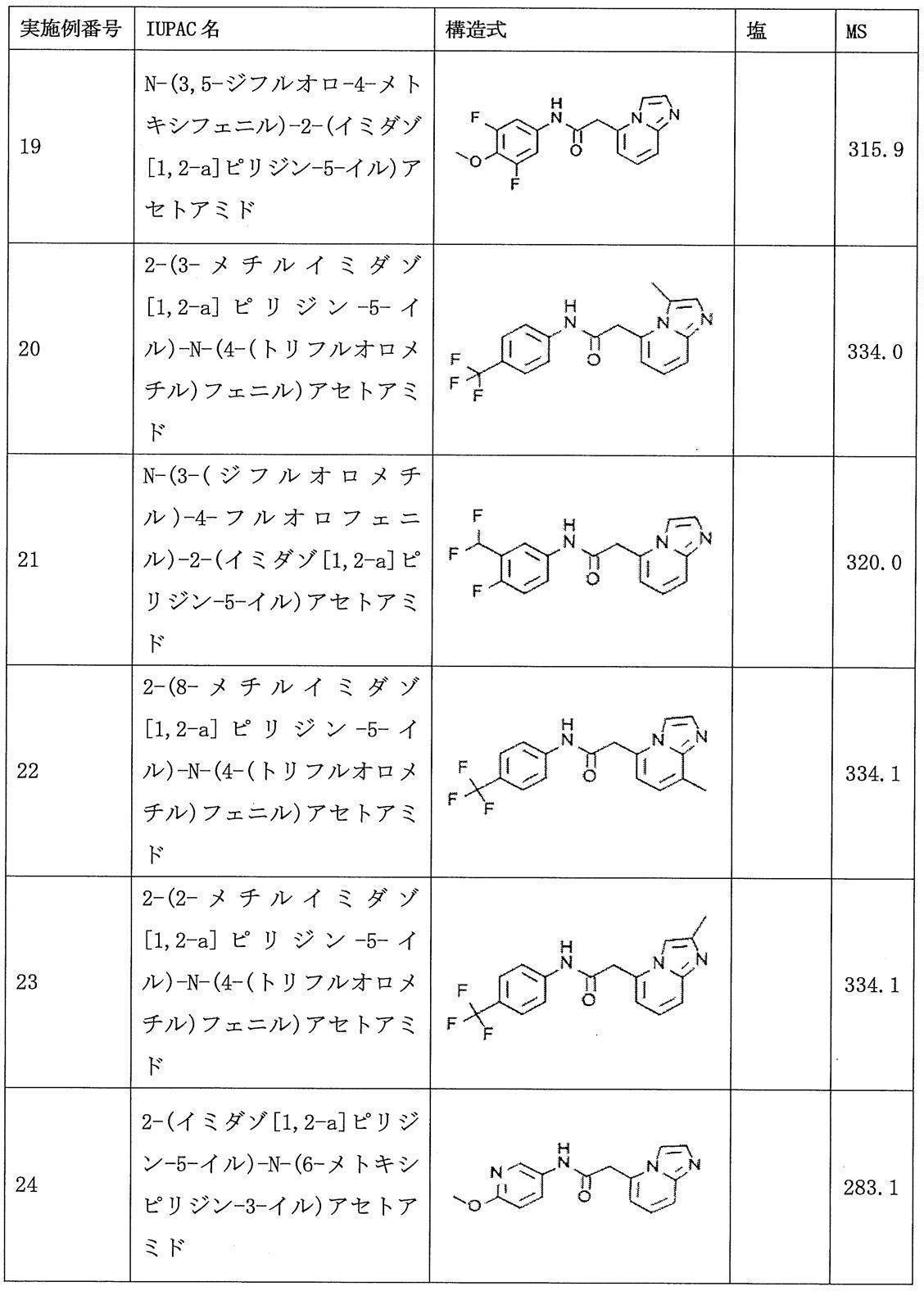


2-(6-エチルイミダゾ[1,2-a]ピリジン-5-イル)-N-(4-(トリフルオロメトキシ)フェニル)アセトアミド
(A) 5-ヨード-6-メチルピリジン-2-アミン
6-メチルピリジン-2-アミン(10 g, 0.092 mol)のDMF(50 mL)溶液にN-ヨードスクシンイミド(15 g, 0.13 mol)を加えて、室温で終夜撹拌した。反応混合物を水(200 mL)で希釈し、析出固体を濾取し、酢酸エチルを用いて洗浄し、標題化合物 (7.5 g) を得た。
MS: [M+H]+ 235.0
5-ヨード-6-メチルピリジン-2-アミン(7.5 g, 32 mmol)のエタノール(400 mL)溶液に2-クロロアセトアルデヒド水溶液(18 mL, 40%)を加えて、80℃で16時間撹拌した。冷却後、反応混合物を減圧濃縮し、残渣を水で希釈し、30%水酸化ナトリウム水溶液で中和し、ジクロロメタン(150 mL×3)を用いて抽出した。得られた有機層を無水硫酸ナトリウムで乾燥し、溶媒を減圧下留去した。得られた固体を酢酸エチルで洗浄し、標題化合物(6.0 g)を得た。
MS: [M+H]+ 259.1
6-ヨード-5-メチルイミダゾ[1,2-a]ピリジン(6.0 g, 23 mmol)、カリウムビニルトリフルオロボラート (4.7 g, 35 mmol)、炭酸カリウム(6.4 g, 47 mmol)、1,1′-ビス(ジフェニルホスフィノ)フェロセン-パラジウム(II)ジクロリド(500 mg)、ジオキサン(200 mL)と水(1.5 mL)の混合物を窒素雰囲気下80℃で16時間撹拌した。反応混合物を減圧濃縮し、残渣をシリカゲルカラムクロマトグラフィー (ジクロロメタン/メタノール) で精製し、標題化合物 (2.8 g) を得た。
MS: [M+H]+ 159.3
5-メチル-6-ビニルイミダゾ[1,2-a]ピリジン(2.8 g, 18 mmol)のメタノール(200 mL)溶液にPd/C(400 mg)を加えて、水素ガス雰囲気下、室温で16時間撹拌した。反応液を濾過し、溶媒を減圧下留去し、標題化合物(2.5 g)を得た。
MS: [M+H]+ 161.3
窒素ガス雰囲気下、6-エチル-5-メチルイミダゾ[1,2-a]ピリジン(2.5 g, 16 mmol)のTHF(200 mL)溶液にリチウムジイソプロピルアミド(1M, 16 mL, 16 mmol)を-78℃で滴下した。反応混合物を-78℃で1時間撹拌した後、ドライアイス(5.0 g)を加えた。反応混合物を室温まで昇温し、16時間撹拌した後、2M塩酸を用いて中和しHPLC (L-column 2 ODS、アセトニトリル/水、酢酸アンモニウム含有系) にて分取し、得られた画分を減圧濃縮した。残渣に飽和炭酸水素ナトリウム水溶液を加え、酢酸エチルで抽出した。抽出液を無水硫酸ナトリウムで乾燥し、減圧下溶媒を留去し、標題化合物(1.8 g)を得た。
1H NMR (400 MHz, DMSO-d6): δ 1.13 (3H, t, J = 7.6 Hz), 2.63 (2H, q, J = 7.6 Hz), 3.95 (2H, s), 7.14 (1H, d, J = 9.2 Hz), 7.43 (1H, d, J = 9.2 Hz), 7.52 (1H, d, J = 0.8 Hz), 7.76 (1H, s).
(6-エチルイミダゾ[1,2-a]ピリジン-5-イル)酢酸(100 mg, 0.49 mmol)、4-(トリフルオロメトキシ)アニリン(130 mg, 0.74 mmol)のピリジン(10 mL)溶液に、HATU(370 mg, 0.98 mmol)を加えて室温で16時間撹拌した。反応混合物を減圧濃縮し、残渣をシリカゲルカラムクロマトグラフィー (ジクロロメタン/メタノール) で精製し、標題化合物 (105 mg) を得た。
1H NMR (400 MHz, DMSO-d6): δ 1.16 (3H, t, J = 7.6 Hz), 2.68 (2H, q, J = 7.2 Hz), 4.23 (2H, s), 7.18 (1H, d, J = 9.2 Hz), 7.32 (2H, d, J = 8.4 Hz), 7.49 (1H, d, J = 9.2 Hz), 7.54 (1H, s), 7.68 (2H, d, J = 9.2 Hz), 7.85 (1H, s), 10.67 (1H, s).
2-(6-メチルイミダゾ[1,2-a]ピリジン-5-イル)-N-(4-(トリフルオロメトキシ)フェニル)アセトアミド
(A) 5,6-ジメチルイミダゾ[1,2-a]ピリジン
5,6-ジメチルピリジン-2-アミン(2.0 g, 16 mmol)、40% クロロアセトアルデヒド水溶液(3.2 mL, 20 mmol)とエタノール(40 mL)の混合物を終夜加熱還流した。溶媒を減圧留去した後、反応混合物を飽和炭酸水素ナトリウム水溶液を用いて中和し、酢酸エチルで抽出した。有機層を無水硫酸マグネシウムで乾燥し、残渣をNHシリカゲルカラムクロマトグラフィー (ヘキサン/酢酸エチル) で精製し、標題化合物 (2.5 g) を得た。
1H NMR (300 MHz, CDCl3) δ2.35 (3H, s), 2.53 (3H, s), 7.05 (1H, d, J = 9.4 Hz), 7.46 (2H, t, J = 4.5 Hz), 7.65 (1H, d, J = 1.1 Hz).
-78℃でジイソプロピルアミン(4.3 mL, 31 mmol)のTHF(30 mL)溶液にn-ブチルリチウム(1.6 M ヘキサン溶液、17 mL, 27 mmol)を加えた、同温度で30分間撹拌した後、5,6-ジメチルイミダゾ[1,2-a]ピリジン(3.0 g, 21 mmol)のTHF(30 mL)溶液を反応混合物に滴下した。反応混合物を-78℃で1時間、-40℃で1時間撹拌した後、-78℃に冷却しドライアイスを加えた。反応混合物を室温まで昇温し、溶媒を減圧留去した後、残渣を2M 水酸化ナトリウム水溶液で希釈した。水層を酢酸エチルで3回洗浄し、2M 塩酸で酸性にし、減圧濃縮した。得られた残渣をメタノールおよび酢酸エチルで処理し、不溶物をろ去し、ろ液を減圧濃縮し、粗(6-メチルイミダゾ[1,2-a]ピリジン-5-イル)酢酸 塩酸塩を得た。
得られた粗(6-メチルイミダゾ[1,2-a]ピリジン-5-イル)酢酸 塩酸塩、硫酸(2 mL,38 mmol)およびメタノール(100 mL)の混合物を3時間加熱還流した。溶媒を減圧留去した後、残渣を飽和炭酸水素ナトリウム水溶液で中和し、酢酸エチルで抽出した。有機層を水で洗浄し、減圧濃縮した。残渣をNHシリカゲルカラムクロマトグラフィー (ヘキサン/酢酸エチル) で精製し、標題化合物 (2.7 g) を得た。
1H NMR (300 MHz, DMSO-d6) δ2.29 (3H, s), 3.64 (3H, s), 4.22 (2H, s), 7.15 (1H, d, J = 9.0 Hz), 7.47 (1H, d, J = 9.0 Hz), 7.56 (1H, d, J = 0.8 Hz), 7.82 (1H, s).
メチル (6-メチルイミダゾ[1,2-a]ピリジン-5-イル)アセタート(2.4 g, 12 mmol)の6M 塩酸(50 mL, 300 mmol)溶液を終夜加熱還流した。反応混合物を減圧濃縮し標題化合物(2.7 g)を得た。
1H NMR (300 MHz, DMSO-d6) δ2.42 (3H, s), 4.36 (2H, s), 7.88 (2H, s), 8.25 (1H, d, J = 2.2 Hz), 8.45 (1H, d, J = 2.2 Hz), 13.17 (1H, brs), 14.03-15.27 (1H, m).
(6-メチルイミダゾ[1,2-a]ピリジン-5-イル)酢酸 塩酸塩(200 mg, 0.88 mmol)、4-(トリフルオロメトキシ)アニリン(0.12 mL, 0.88 mmol)、1-エチル-3-(3-ジメチルアミノプロピル)カルボジイミド塩酸塩(250 mg, 1.3 mmol)、HOBt一水和物(140 mg, 0.88 mmol)、トリエチルアミン(0.37 mL, 2.7 mmol)とDMF(1 mL)の混合物を室温で終夜撹拌した。残渣をNHシリカゲルカラムクロマトグラフィー (酢酸エチル/メタノール) で精製し、標題化合物 (250 mg) を得た。
1H NMR (300 MHz, DMSO-d6) δ2.34 (3H, s), 4.22 (2H, s), 7.16 (1H, d, J = 9.2 Hz), 7.33 (2H, d, J = 8.3 Hz), 7.46 (1H, d, J = 9.2 Hz), 7.55 (1H, d, J = 1.2 Hz), 7.65-7.76 (2H, m), 7.88 (1H, s), 10.64 (1H, s).
2-(6-メトキシイミダゾ[1,2-a]ピリジン-5-イル)-N-(4-(トリフルオロメトキシ)フェニル)アセトアミド
(A) 6-メトキシ-5-メチルイミダゾ[1,2-a]ピリジン
5-メトキシ-6-メチルピリジン-2-アミン(5.0 g, 36 mmol)、40%クロロアセトアルデヒド水溶液(7.1 mL, 43 mmol)とエタノール(100 mL)の混合物を終夜加熱還流した。溶媒を減圧留去した後、反応混合物を飽和炭酸水素ナトリウム水溶液を用いて中和し、酢酸エチルで抽出し、溶媒を減圧留去した。残渣をNHシリカゲルカラムクロマトグラフィー (ヘキサン/酢酸エチル) で精製し、標題化合物 (5.8 g) を得た。
1H NMR (300 MHz, CDCl3) δ2.52 (3H, s), 3.87 (3H, s), 7.16 (1H, d, J = 9.7 Hz), 7.45 (1H, d, J = 0.9 Hz), 7.52 (1H, d, J = 9.7 Hz), 7.69 (1H, d, J = 1.1 Hz).
-78℃でジイソプロピルアミン(2.6 mL, 19 mmol)のTHF(20 mL)溶液にn-ブチルリチウム(1.6 M ヘキサン溶液、10 mL, 16 mmol)を加えた、同温度で30分間撹拌した後、6-メトキシ-5-メチルイミダゾ[1,2-a]ピリジン(2.0 g, 12 mmol)のTHF(30 mL)溶液を反応混合物に滴下した。反応混合物を-78℃で1時間、-40℃で1時間撹拌した後、-78℃に冷却しドライアイスを加えた。反応混合物を室温まで昇温し、溶媒を減圧留去し、残渣を水と酢酸エチルで希釈した。水層を酢酸エチルで洗浄し、2M 塩酸で酸性にし、減圧濃縮し、粗(6-メチルイミダゾ[1,2-a]ピリジン-5-イル)酢酸 塩酸塩を得た。
得られた粗(6-メチルイミダゾ[1,2-a]ピリジン-5-イル)酢酸 塩酸塩、p-トルエンスルホン酸一水和物(0.10 g, 0.53 mmol)およびメタノール(100 mL)の混合物を終夜加熱還流した。溶媒を減圧留去した後、残渣をNHシリカゲルカラムクロマトグラフィー (ヘキサン/酢酸エチル) で精製し、標題化合物 (0.55 g) を得た。
1H NMR (300 MHz, CDCl3) δ3.67-3.74 (3H, m), 3.91 (3H, s), 4.06 (2H, s), 7.19 (1H, d, J = 9.8 Hz), 7.48 (1H, d, J = 0.8 Hz), 7.57-7.65 (1H, m), 7.68 (1H, d, J = 1.2 Hz).
メチル 2-(6-メトキシイミダゾ[1,2-a]ピリジン-5-イル)アセタート(0.55 g, 2.5 mmol)の6M 塩酸(30 mL, 180 mmol)溶液を終夜加熱還流した。反応混合物を減圧濃縮し標題化合物(0.60 g)を得た。
1H NMR (300 MHz, DMSO-d6) δ3.95-3.98 (3H, m), 4.24-4.28 (2H, m), 7.94-8.02 (1H, m), 8.04-8.13 (1H, m), 8.29 (1H, d, J = 2.2 Hz), 8.47 (1H, d, J = 1.9 Hz), 13.83-15.19 (1H, m).
2-(6-メトキシイミダゾ[1,2-a]ピリジン-5-イル)酢酸 塩酸塩 (300 mg, 1.2 mmol)、4-(トリフルオロメトキシ)アニリン(0.17 mL, 1.2 mmol)、1-エチル-3-(3-ジメチルアミノプロピル)カルボジイミド塩酸塩(360 mg, 1.9 mmol)、HOBt一水和物(190 mg, 1.2 mmol)、トリエチルアミン(0.52 mL, 3.7 mmol)とDMF(1 mL)の混合物を室温で終夜撹拌した。反応混合物に水を加え、酢酸エチルで抽出した。有機層を水で洗浄し、無水硫酸マグネシウムで乾燥し、溶媒を減圧留去した。残渣を酢酸エチルから再結晶し、標題化合物 (100 mg) を得た。
1H NMR (300 MHz, DMSO-d6) δ3.84 (3H, s), 4.19 (2H, s), 7.32 (2H, d, J = 8.3 Hz), 7.38 (1H, d, J = 9.8 Hz), 7.53-7.61 (2H, m), 7.64-7.76 (2H, m), 7.85 (1H, s), 10.59 (1H, s).


ヒトGRIN1およびヒトGRIN2B発現HEK293細胞は、ChanTest社から購入した。当該細胞は、10%FBS(ウシ胎児血清、アウスジーン)、100 units/mL ペニシリン、100 μg/mL ストレプトマイシン、500 μg/mL ネオマイシン、100 μg/mL ゼオシン、5 μg/mL ブラストシジンの添加されたDMEM/F-12(コスモバイオ、10-092-CM)培地を用いて37℃、5%CO2下で培養した。アッセイ前日に細胞をトリプシンによりフラスコからはがし、8×105 cells/mLとなるように、播種用培地(10%FBS、100 units/mL ペニシリン、100 μg/mL ストレプトマイシンの添加されたDMEM (インビトロジェン、 31053))で懸濁し、384ウェルプレート(ファルコン、356663)へ20000 cells/wellとなるよう1ウェルあたり25 μLずつ播種し、インキュベータにて一晩培養した。アッセイ当日、テトラサイクリン(和光純薬、209-16561)を播種用培地にて2 μg/mLとなるように希釈し、細胞を播種してあるプレートへ25 μg/mL添加し、2時間インキュベータで培養した。その後、培地を除去し、50 μL/wellのアッセイバッファー(137 mM NaCl、4 mM KCl、1.8 mM CaCl2、10 mM HEPES(pH7.2)、10 mM Glucose、0.1% BSA)で洗浄した。次にローディングバッファー(アッセイバッファーに2.5 uM Fluo-4AM、2 mM Amaranth、1 mM Tartrazineを加えたもの)を25 μL/well添加し、インキュベータにて30分、室温にて15分ローディングした。25 μLの被検化合物を添加し、15分間室温にて静置した。FLIPR(モレキュラーデバイス)にて30 μM グルタミン酸、30 μM グリシンを含むアッセイバッファーを25 μL添加し、蛍光シグナルを3秒おきに5分間測定した。阻害活性は、各ウェルの蛍光値の積算値に対して、グルタミン酸、グリシンを含まないバッファーを添加したウェルの蛍光値の積算値を100%阻害とする相対活性値として算出した。結果を以下の表3に示す。


1)実施例1の化合物 30 mg
2)微粉末セルロース 10 mg
3)乳糖 19 mg
4)ステアリン酸マグネシウム 1 mg
計 60 mg
1)、2)、3)および4)を混合して、ゼラチンカプセルに充填する。
1)実施例1の化合物 30 g
2)乳糖 50 g
3)トウモロコシデンプン 15 g
4)カルボキシメチルセルロースカルシウム 44 g
5)ステアリン酸マグネシウム 1 g
1000錠 計 140 g
1)、2)、3)の全量および30gの4)を水で練合し、真空乾燥後、整粒を行う。この整粒末に14gの4)および1gの5)を混合し、打錠機により打錠する。このようにして、1錠あたり実施例1の化合物30mgを含有する錠剤1000錠を得る。
Claims (18)
- 式(I):

環Aは、さらに置換されていてもよい環を示し;
R1は、水素原子または置換基を示し;
R2およびR3は、それぞれ独立して、水素原子、置換されていてもよいC1-6アルキル基または置換されていてもよいC3-10シクロアルキル基を示し;
Xaは、CRaまたはNを示し;
Xbは、CRbまたはNを示し;
Xcは、CRcまたはNを示し;
Xdは、CRdまたはNを示し;
Xeは、CReまたはNを示し;
Ra、Rb、Rc、RdおよびReは、それぞれ独立して、水素原子または置換基を示す。〕
で表される化合物
(但し、N-(4-ブロモ-3-(1H-1,2,4-トリアゾール-5-イル)チオフェン-2-イル)-2-(イミダゾ[1,2-a]ピリジン-5-イル)アセタミドを除く。)
またはその塩。 - 環Aが、
(1)ハロゲン原子、
(2)シアノ基、
(3)置換されていてもよいC1-6アルキル基、
(4)置換されていてもよいC1-6アルコキシ基、
(5)置換されていてもよいC3-10シクロアルキル基、
(6)置換されていてもよいカルバモイル基、
(7)置換されていてもよいスルファニル基、
(8)置換されていてもよいC6-14アリールオキシ基、
(9)置換されていてもよい3ないし14員非芳香族複素環オキシ基、
(10)置換されていてもよいC3-10シクロアルキルオキシ基、および
(11)置換されていてもよい3ないし14員非芳香族複素環基
から選ばれる1ないし3個の置換基でさらにそれぞれ置換されていてもよいC6-14芳香族炭化水素環、5ないし14員芳香族複素環、C3-10シクロアルカン、もしくは3ないし14員非芳香族複素環であり;
R1が、水素原子、置換されていてもよいC1-6アルキル基、または置換されていてもよいC3-10シクロアルキル基であり;
R2およびR3が、それぞれ独立して、水素原子、または置換されていてもよいC1-6アルキル基 であり;
XaがCRaであり;
XcがCRcであり;
Raが、水素原子、ハロゲン原子、置換されていてもよいC1-6アルキル基、または置換されていてもよいC1-6アルコキシ基であり;
RbおよびRcが、それぞれ独立して、水素原子、ハロゲン原子、または置換されていてもよいC1-6アルキル基であり;
Rdが水素原子であり;
Reが、水素原子または置換されていてもよいC1-6アルキル基である、
請求項1記載の化合物またはその塩。 - 環Aが、
(1)ハロゲン原子、
(2)シアノ基、
(3)1ないし3個のハロゲン原子で置換されていてもよいC1-6アルキル基、
(4)1ないし3個のハロゲン原子で置換されていてもよいC1-6アルコキシ基、
(5)C3-10シクロアルキル基、
(6)C1-6アルキル基でモノまたはジ置換されていてもよいカルバモイル基、
(7)1ないし6個のハロゲン原子で置換されていてもよいスルファニル基、
(8)C6-14アリールオキシ基、
(9)3ないし14員非芳香族複素環オキシ基、
(10)C3-10シクロアルキルオキシ基、および
(11)1ないし3個のハロゲン原子で置換されていてもよい3ないし14員非芳香族複素環基
から選ばれる1ないし3個の置換基でさらにそれぞれ置換されていてもよいC6-14芳香族炭化水素環、5ないし14員芳香族複素環、C3-10シクロアルカン、もしくは3ないし14員非芳香族複素環であり;
R1が、(i)水素原子、または(ii)シアノ基、ヒドロキシ基およびC6-14アリール基から選ばれる1ないし3個の置換基で置換されていてもよいC1-6アルキル基であり;
R2およびR3が、それぞれ独立して、水素原子、またはC1-6アルキル基であり;
XaがCRaであり;
XcがCRcであり;
Raが、水素原子、ハロゲン原子、C1-6アルキル基、またはC1-6アルコキシ基であり;
RbおよびRcが、それぞれ独立して、水素原子、ハロゲン原子、またはC1-6アルキル基であり;
Rdが水素原子であり;
Reが、水素原子またはC1-6アルキル基である、
請求項1記載の化合物またはその塩。 - 環Aが、さらに置換されていてもよいC6-14芳香族炭化水素環である請求項1記載の化合物またはその塩。
- 環Aが、さらに置換されていてもよいベンゼン環である請求項1記載の化合物またはその塩。
- 環Aが、
(1)ハロゲン原子、
(2)シアノ基、
(3)置換されていてもよいC1-6アルキル基、
(4)置換されていてもよいC1-6アルコキシ基、
(5)置換されていてもよいC3-10シクロアルキル基、
(6)置換されていてもよいカルバモイル基、
(7)置換されていてもよいスルファニル基、
(8)置換されていてもよいC6-14アリールオキシ基、
(9)置換されていてもよい3ないし14員非芳香族複素環オキシ基、
(10)置換されていてもよいC3-10シクロアルキルオキシ基、
(11)置換されていてもよい3ないし14員非芳香族複素環基、および
(12)置換されていてもよい5ないし14員芳香族複素環基
から選ばれる1ないし3個の置換基でさらに置換されていてもよいベンゼン環であり;
R1が、水素原子、置換されていてもよいC1-6アルキル基、または置換されていてもよいC3-10シクロアルキル基であり;
R2およびR3が、それぞれ独立して、水素原子、または置換されていてもよいC1-6アルキル基であり;
XaがCRaであり;
XcがCRcであり;
Raが、水素原子、ハロゲン原子、置換されていてもよいC1-6アルキル基、または置換されていてもよいC1-6アルコキシ基であり;
RbおよびRcが、それぞれ独立して、水素原子、ハロゲン原子、または置換されていてもよいC1-6アルキル基であり;
Rdが水素原子であり;
Reが、水素原子または置換されていてもよいC1-6アルキル基である、
請求項1記載の化合物またはその塩。 - 環Aが、
(1)ハロゲン原子、
(2)シアノ基、
(3)1ないし3個のハロゲン原子で置換されていてもよいC1-6アルキル基、
(4)1ないし3個のハロゲン原子で置換されていてもよいC1-6アルコキシ基、
(5)C3-10シクロアルキル基、
(6)C1-6アルキル基でモノまたはジ置換されていてもよいカルバモイル基、
(7)1ないし6個のハロゲン原子で置換されていてもよいスルファニル基、
(8)C6-14アリールオキシ基、
(9)3ないし14員非芳香族複素環オキシ基、
(10)C3-10シクロアルキルオキシ基、
(11)1ないし3個のハロゲン原子で置換されていてもよい3ないし14員非芳香族複素環基、および
(12)5ないし14員芳香族複素環基
から選ばれる1ないし3個の置換基でさらに置換されていてもよいベンゼン環であり;
R1が、(i)水素原子、または(ii)シアノ基、ヒドロキシ基およびC6-14アリール基から選ばれる1ないし3個の置換基で置換されていてもよいC1-6アルキル基であり;
R2およびR3が、それぞれ独立して、水素原子、またはC1-6アルキル基であり;
XaがCRaであり;
XcがCRcであり;
Raが、水素原子、ハロゲン原子、C1-6アルキル基、またはC1-6アルコキシ基であり;
RbおよびRcが、それぞれ独立して、水素原子、ハロゲン原子、またはC1-6アルキル基であり;
Rdが水素原子であり;
Reが、水素原子またはC1-6アルキル基である、
請求項1記載の化合物またはその塩。 - 環Aが、
(1)1ないし3個のハロゲン原子で置換されていてもよいC1-6アルコキシ基、
(2)1ないし3個のハロゲン原子で置換されていてもよいC1-6アルキル基、
(3)ハロゲン原子、および
(4)C3-10シクロアルキル基
から選ばれる1ないし3個の置換基でさらに置換されていてもよいベンゼン環であり;
R1、R2およびR3が水素原子であり;
XaがCRaであり;
XbがCRbであり;
XcがCRcであり;
XdがCRdであり;
XeがCReであり;
Raが、水素原子、C1-6アルキル基またはC1-6アルコキシ基であり;
Rb、Rc、RdおよびReが水素原子である、
請求項1記載の化合物またはその塩。 - 2-(イミダゾ[1,2-a]ピリジン-5-イル)-N-(4-(トリフルオロメチル)フェニル)アセトアミドまたはその塩。
- 2-(イミダゾ[1,2-a]ピリジン-5-イル)-N-(4-メトキシフェニル)アセトアミドまたはその塩。
- N-(3-フルオロ-4-メトキシフェニル)-2-(イミダゾ[1,2-a]ピリジン-5-イル)アセトアミドまたはその塩。
- 請求項1記載の化合物またはその塩を含有する医薬。
- NR2Bサブユニットを含むNMDA受容体の拮抗薬である請求項12記載の医薬。
- 大うつ病、双極性障害、片頭痛、疼痛、または認知症周辺症状の予防または治療剤である請求項12記載の医薬。
- 大うつ病、双極性障害、片頭痛、疼痛、または認知症周辺症状の予防または治療に使用するための、請求項1に記載の化合物またはその塩。
- 請求項1記載の化合物またはその塩を哺乳動物に有効量投与することを特徴とする、該哺乳動物におけるNR2Bサブユニットを含むNMDA受容体の阻害方法。
- 請求項1記載の化合物またはその塩を哺乳動物に有効量投与することを特徴とする、該哺乳動物における大うつ病、双極性障害、片頭痛、疼痛、または認知症周辺症状の予防または治療方法。
- 大うつ病、双極性障害、片頭痛、疼痛、または認知症周辺症状の予防または治療剤を製造するための、請求項1記載の化合物またはその塩の使用。
Priority Applications (3)
| Application Number | Priority Date | Filing Date | Title |
|---|---|---|---|
| JP2016566353A JP6675324B2 (ja) | 2014-12-24 | 2015-12-21 | 複素環化合物 |
| US15/538,297 US10202376B2 (en) | 2014-12-24 | 2015-12-21 | Heterocyclic compound |
| EP15873002.8A EP3239150B1 (en) | 2014-12-24 | 2015-12-21 | Heterocyclic compound |
Applications Claiming Priority (2)
| Application Number | Priority Date | Filing Date | Title |
|---|---|---|---|
| JP2014259662 | 2014-12-24 | ||
| JP2014-259662 | 2014-12-24 |
Publications (1)
| Publication Number | Publication Date |
|---|---|
| WO2016104434A1 true WO2016104434A1 (ja) | 2016-06-30 |
Family
ID=56150453
Family Applications (1)
| Application Number | Title | Priority Date | Filing Date |
|---|---|---|---|
| PCT/JP2015/085689 Ceased WO2016104434A1 (ja) | 2014-12-24 | 2015-12-21 | 複素環化合物 |
Country Status (4)
| Country | Link |
|---|---|
| US (1) | US10202376B2 (ja) |
| EP (1) | EP3239150B1 (ja) |
| JP (1) | JP6675324B2 (ja) |
| WO (1) | WO2016104434A1 (ja) |
Cited By (5)
| Publication number | Priority date | Publication date | Assignee | Title |
|---|---|---|---|---|
| WO2019022179A1 (ja) | 2017-07-28 | 2019-01-31 | 武田薬品工業株式会社 | 複素環化合物 |
| WO2019189945A1 (en) | 2018-03-28 | 2019-10-03 | Takeda Pharmaceutical Company Limited | Heterocyclic compound and use thereof |
| WO2020153414A1 (ja) | 2019-01-24 | 2020-07-30 | 武田薬品工業株式会社 | 複素環化合物及びその用途 |
| WO2021059017A1 (en) | 2019-09-25 | 2021-04-01 | Takeda Pharmaceutical Company Limited | Heterocyclic compound and use thereof |
| JP2023545588A (ja) * | 2020-10-16 | 2023-10-30 | ツェーエムエム-フォルシュングスツェントルム フュア モレクラレ メディツィン ゲーエムベーハー | ヘテロ環式カリンringユビキチンリガーゼ化合物及びその使用 |
Families Citing this family (1)
| Publication number | Priority date | Publication date | Assignee | Title |
|---|---|---|---|---|
| JP2019196308A (ja) | 2016-09-15 | 2019-11-14 | 武田薬品工業株式会社 | 複素環アミド化合物 |
Citations (11)
| Publication number | Priority date | Publication date | Assignee | Title |
|---|---|---|---|---|
| JPS5798283A (en) * | 1980-10-22 | 1982-06-18 | Synthelabo | Imidazopyridine derivative |
| US5252563A (en) * | 1991-12-19 | 1993-10-12 | G. D. Searle & Company | 5,6,7,8-tetrahydro-imidazo[1,2-a]pyrimidine compounds for treatment of neurotoxic injury |
| JPH08137043A (ja) * | 1994-11-08 | 1996-05-31 | Fuji Photo Film Co Ltd | ハロゲン化銀写真感光材料 |
| JPH08319288A (ja) * | 1994-06-20 | 1996-12-03 | Takeda Chem Ind Ltd | 縮合イミダゾール誘導体、その製造法及び剤 |
| JP2004161716A (ja) * | 2002-11-15 | 2004-06-10 | Takeda Chem Ind Ltd | Jnk阻害剤 |
| JP2005511478A (ja) * | 2001-04-03 | 2005-04-28 | メルク エンド カムパニー インコーポレーテッド | N−置換非アリール複素環アミジル系nmda/nr2b拮抗薬 |
| JP2006502162A (ja) * | 2002-09-04 | 2006-01-19 | ブリストル−マイヤーズ スクイブ カンパニー | 成長ホルモン分泌促進剤として有用なヘテロ環状芳香族化合物 |
| JP2006522794A (ja) * | 2003-04-10 | 2006-10-05 | ファイザー株式会社 | Nr2b受容体拮抗物質としての二環系化合物 |
| JP2012517439A (ja) * | 2009-02-06 | 2012-08-02 | エラン ファーマシューティカルズ,インコーポレイテッド | Junn−末端キナーゼの阻害薬 |
| WO2012174199A1 (en) * | 2011-06-16 | 2012-12-20 | Merck Sharp & Dohme Corp. | Imidazopyridin-2-one derivatives |
| JP2014510131A (ja) * | 2011-04-05 | 2014-04-24 | ファイザー・リミテッド | トロポミオシン関連キナーゼ阻害薬としてのピロロ[2,3−d]ピリミジン誘導体 |
Family Cites Families (1)
| Publication number | Priority date | Publication date | Assignee | Title |
|---|---|---|---|---|
| ATE210663T1 (de) | 1994-06-20 | 2001-12-15 | Takeda Chemical Industries Ltd | Kondensierte imidazolderivate, ihre herstellung und verwendung |
-
2015
- 2015-12-21 WO PCT/JP2015/085689 patent/WO2016104434A1/ja not_active Ceased
- 2015-12-21 EP EP15873002.8A patent/EP3239150B1/en active Active
- 2015-12-21 US US15/538,297 patent/US10202376B2/en active Active
- 2015-12-21 JP JP2016566353A patent/JP6675324B2/ja active Active
Patent Citations (11)
| Publication number | Priority date | Publication date | Assignee | Title |
|---|---|---|---|---|
| JPS5798283A (en) * | 1980-10-22 | 1982-06-18 | Synthelabo | Imidazopyridine derivative |
| US5252563A (en) * | 1991-12-19 | 1993-10-12 | G. D. Searle & Company | 5,6,7,8-tetrahydro-imidazo[1,2-a]pyrimidine compounds for treatment of neurotoxic injury |
| JPH08319288A (ja) * | 1994-06-20 | 1996-12-03 | Takeda Chem Ind Ltd | 縮合イミダゾール誘導体、その製造法及び剤 |
| JPH08137043A (ja) * | 1994-11-08 | 1996-05-31 | Fuji Photo Film Co Ltd | ハロゲン化銀写真感光材料 |
| JP2005511478A (ja) * | 2001-04-03 | 2005-04-28 | メルク エンド カムパニー インコーポレーテッド | N−置換非アリール複素環アミジル系nmda/nr2b拮抗薬 |
| JP2006502162A (ja) * | 2002-09-04 | 2006-01-19 | ブリストル−マイヤーズ スクイブ カンパニー | 成長ホルモン分泌促進剤として有用なヘテロ環状芳香族化合物 |
| JP2004161716A (ja) * | 2002-11-15 | 2004-06-10 | Takeda Chem Ind Ltd | Jnk阻害剤 |
| JP2006522794A (ja) * | 2003-04-10 | 2006-10-05 | ファイザー株式会社 | Nr2b受容体拮抗物質としての二環系化合物 |
| JP2012517439A (ja) * | 2009-02-06 | 2012-08-02 | エラン ファーマシューティカルズ,インコーポレイテッド | Junn−末端キナーゼの阻害薬 |
| JP2014510131A (ja) * | 2011-04-05 | 2014-04-24 | ファイザー・リミテッド | トロポミオシン関連キナーゼ阻害薬としてのピロロ[2,3−d]ピリミジン誘導体 |
| WO2012174199A1 (en) * | 2011-06-16 | 2012-12-20 | Merck Sharp & Dohme Corp. | Imidazopyridin-2-one derivatives |
Non-Patent Citations (1)
| Title |
|---|
| SHITYAKOV,S. ET AL.: "α-Cyclodextrin dimer complexes of dopamine and levodopa derivatives to assess drug delivery to the central nervous system: ADME and molecular docking studies", INTERNATIONAL JOURNAL OF NANOMEDICINE, vol. 2012, no. 7, 2007, pages 3211 - 3219, XP055459612 * |
Cited By (16)
| Publication number | Priority date | Publication date | Assignee | Title |
|---|---|---|---|---|
| US11230541B2 (en) | 2017-07-28 | 2022-01-25 | Takeda Pharmaceutical Company Limited | Heterocyclic compound |
| US11713311B2 (en) | 2017-07-28 | 2023-08-01 | Takeda Pharmaceutical Company Limited | Heterocyclic compound |
| JPWO2019022179A1 (ja) * | 2017-07-28 | 2020-05-28 | 武田薬品工業株式会社 | 複素環化合物 |
| JP7114594B2 (ja) | 2017-07-28 | 2022-08-08 | 武田薬品工業株式会社 | 複素環化合物 |
| WO2019022179A1 (ja) | 2017-07-28 | 2019-01-31 | 武田薬品工業株式会社 | 複素環化合物 |
| US10807987B2 (en) | 2018-03-28 | 2020-10-20 | Takeda Pharmaceutical Company Limited | Heterocyclic compound and use thereof |
| JP2021519294A (ja) * | 2018-03-28 | 2021-08-10 | 武田薬品工業株式会社 | 複素環化合物及びその用途 |
| CN111936495A (zh) * | 2018-03-28 | 2020-11-13 | 武田药品工业株式会社 | 杂环化合物及其用途 |
| AU2019241765B2 (en) * | 2018-03-28 | 2022-07-07 | Takeda Pharmaceutical Company Limited | Heterocyclic compound and use thereof |
| JP7279067B2 (ja) | 2018-03-28 | 2023-05-22 | 武田薬品工業株式会社 | 複素環化合物及びその用途 |
| US11702419B2 (en) | 2018-03-28 | 2023-07-18 | Takeda Pharmaceutical Company Limited | Heterocyclic compound and use thereof |
| WO2019189945A1 (en) | 2018-03-28 | 2019-10-03 | Takeda Pharmaceutical Company Limited | Heterocyclic compound and use thereof |
| WO2020153414A1 (ja) | 2019-01-24 | 2020-07-30 | 武田薬品工業株式会社 | 複素環化合物及びその用途 |
| WO2021059017A1 (en) | 2019-09-25 | 2021-04-01 | Takeda Pharmaceutical Company Limited | Heterocyclic compound and use thereof |
| US11952344B2 (en) | 2019-09-25 | 2024-04-09 | Takeda Pharmaceutical Company Limited | Heterocyclic compound and use thereof |
| JP2023545588A (ja) * | 2020-10-16 | 2023-10-30 | ツェーエムエム-フォルシュングスツェントルム フュア モレクラレ メディツィン ゲーエムベーハー | ヘテロ環式カリンringユビキチンリガーゼ化合物及びその使用 |
Also Published As
| Publication number | Publication date |
|---|---|
| JP6675324B2 (ja) | 2020-04-01 |
| EP3239150A4 (en) | 2018-06-13 |
| US10202376B2 (en) | 2019-02-12 |
| US20170362223A1 (en) | 2017-12-21 |
| EP3239150B1 (en) | 2020-02-05 |
| EP3239150A1 (en) | 2017-11-01 |
| JPWO2016104434A1 (ja) | 2017-10-05 |
Similar Documents
| Publication | Publication Date | Title |
|---|---|---|
| JP7408569B2 (ja) | 複素環化合物 | |
| JP7379374B2 (ja) | 複素環化合物 | |
| JP7012703B2 (ja) | 置換ピロリジン化合物およびその用途 | |
| JP6832342B2 (ja) | 複素環化合物 | |
| JP6531093B2 (ja) | 含窒素複素環化合物 | |
| JPWO2020004536A1 (ja) | 複素環化合物およびその用途 | |
| JP6787913B2 (ja) | 複素環化合物 | |
| JP6860551B2 (ja) | 芳香環化合物 | |
| JP6675324B2 (ja) | 複素環化合物 | |
| US11827601B2 (en) | Heterocyclic NMDA antagonists | |
| JP2022141918A (ja) | 複素環化合物 | |
| JP7541487B2 (ja) | 複素環化合物及びその用途 | |
| JP2025170366A (ja) | 例えばうつ病の治療方法において使用するためのgpr139拮抗薬としての3-((1h-ピラゾール-4-イル)メチル)-6’-(フェニル)-2h-(1,2’-ビピリジン)-2-オン誘導体および関連化合物 | |
| WO2018235838A1 (ja) | 複素環化合物 | |
| JP7279067B2 (ja) | 複素環化合物及びその用途 | |
| HK40059391A (en) | Heterocyclic compound and use thereof |
Legal Events
| Date | Code | Title | Description |
|---|---|---|---|
| 121 | Ep: the epo has been informed by wipo that ep was designated in this application |
Ref document number: 15873002 Country of ref document: EP Kind code of ref document: A1 |
|
| ENP | Entry into the national phase |
Ref document number: 2016566353 Country of ref document: JP Kind code of ref document: A |
|
| WWE | Wipo information: entry into national phase |
Ref document number: 15538297 Country of ref document: US |
|
| REEP | Request for entry into the european phase |
Ref document number: 2015873002 Country of ref document: EP |
|
| NENP | Non-entry into the national phase |
Ref country code: DE |