WO2016104381A1 - ポリアリーレンスルフィドの製造工程において生じる硫黄含有化合物を含む排水の処理方法、並びにポリアリーレンスルフィドの製造方法 - Google Patents
ポリアリーレンスルフィドの製造工程において生じる硫黄含有化合物を含む排水の処理方法、並びにポリアリーレンスルフィドの製造方法 Download PDFInfo
- Publication number
- WO2016104381A1 WO2016104381A1 PCT/JP2015/085562 JP2015085562W WO2016104381A1 WO 2016104381 A1 WO2016104381 A1 WO 2016104381A1 JP 2015085562 W JP2015085562 W JP 2015085562W WO 2016104381 A1 WO2016104381 A1 WO 2016104381A1
- Authority
- WO
- WIPO (PCT)
- Prior art keywords
- pas
- wastewater
- sulfur
- wet oxidation
- treatment
- Prior art date
- Legal status (The legal status is an assumption and is not a legal conclusion. Google has not performed a legal analysis and makes no representation as to the accuracy of the status listed.)
- Ceased
Links
Classifications
-
- C—CHEMISTRY; METALLURGY
- C02—TREATMENT OF WATER, WASTE WATER, SEWAGE, OR SLUDGE
- C02F—TREATMENT OF WATER, WASTE WATER, SEWAGE, OR SLUDGE
- C02F1/00—Treatment of water, waste water, or sewage
- C02F1/72—Treatment of water, waste water, or sewage by oxidation
- C02F1/74—Treatment of water, waste water, or sewage by oxidation with air
-
- C—CHEMISTRY; METALLURGY
- C08—ORGANIC MACROMOLECULAR COMPOUNDS; THEIR PREPARATION OR CHEMICAL WORKING-UP; COMPOSITIONS BASED THEREON
- C08G—MACROMOLECULAR COMPOUNDS OBTAINED OTHERWISE THAN BY REACTIONS ONLY INVOLVING UNSATURATED CARBON-TO-CARBON BONDS
- C08G75/00—Macromolecular compounds obtained by reactions forming a linkage containing sulfur with or without nitrogen, oxygen, or carbon in the main chain of the macromolecule
- C08G75/02—Polythioethers
- C08G75/0204—Polyarylenethioethers
- C08G75/0277—Post-polymerisation treatment
- C08G75/0281—Recovery or purification
Definitions
- the present invention relates to a method for treating wastewater containing a sulfur-containing compound produced in the production process of polyarylene sulfide, specifically, a sulfur-containing compound that causes harmful and offensive odors produced in the production process of polyarylene sulfide, and further COD.
- the present invention relates to a method for treating the wastewater containing a substance and / or a BOD substance, and a method for producing polyarylene sulfide that facilitates the recovery and reuse of resin components remaining in the wastewater by reducing harmful components such as hydrogen sulfide.
- PAS Polyarylene sulfides
- PPS polyphenylene sulfide
- a sulfur source such as alkali metal sulfide, alkali metal hydrosulfide or hydrogen sulfide, and dihaloaromatic such as p-dichlorobenzene (hereinafter also referred to as “PDCB”) are used.
- PDCB dihaloaromatic
- a method is known in which a compound is reacted with a compound in a polar organic solvent such as N-methyl-2-pyrrolidone (hereinafter also referred to as “NMP”) under heating to obtain a PAS such as PPS.
- NMP N-methyl-2-pyrrolidone
- the PAS produced by the polymerization reaction is recovered by cooling the PAS slurry after the completion of the polymerization reaction (sometimes serving as granulation) and solid-liquid separation with a solvent containing a polar organic solvent.
- a solid-liquid separation method filtration, vibration sieving, centrifugation, sedimentation separation, or the like is employed.
- the recovered PAS is washed over several steps with an organic solvent, water (deionized water, etc.) and, if desired, with acid or alkali, if necessary, with heating as necessary. , Oligomers, by-products such as NaCl, residual solvents and the like are removed.
- the PAS is separated and collected by filtration or the like at each washing step, and finally a product PAS is obtained through a step such as drying.
- Solvents, unreacted monomers, by-products such as NaCl, residual solvents, etc. are separated and recovered by separation methods corresponding to the respective components, purified as necessary and reused for the production of PAS ( For example, a polar organic solvent) or discarded.
- wastewater containing unnecessary organic substances and / or inorganic substances is separated from organic substances and / or inorganic substances, separated and decomposed and / or removed. Almost all the components are water, and usually discharged at least 90% by mass of water.
- the wastewater treatment technology is a combination of solid-liquid separation, biochemical treatment, and physicochemical treatment. For example, activated sludge treatment that treats biochemically treated microorganisms by contacting the wastewater in a floating state. Is widely known.
- COD Chemical Oxygen Demand
- BOD Biochemical Oxygen Demand
- COD substances oxidizable organic and / or inorganic substances
- wastewater standards to indicate the content of organic substances that can be decomposed by microorganisms (sometimes referred to as “BOD substances”).
- BOD substances organic substances that can be decomposed by microorganisms
- washing may be carried out more carefully in order to improve the quality and yield of the product PAS. From the viewpoint of environmental protection, It is required to reduce the environmental load by reducing the content ratio of COD substances and BOD substances within a predetermined range that conforms to environmental standards.
- the COD measurement method is based on the acidic high temperature permanganate method (CODEMn) (JIS K0102 standard 17).
- CODCr corresponding to JIS K0102 standard 20
- potassium chromate Since potassium dichromate has a strong oxidizing power, almost all of the organic and / or inorganic oxidizable substances are oxidatively decomposed. Therefore, the measured COD value is higher for CODCr than for CODMn. .
- Patent Document 3 discloses that the COD substance is insolubilized or hardly soluble by adding a flocculant together with pH adjustment to wastewater containing the COD substance produced in the process of isolating and purifying PPS (purification process).
- Patent Document 4 discloses a method of adding an organic solvent to waste water containing a hardly decomposable COD substance generated in the PAS production process, and extracting and removing the COD substance with the organic solvent.
- Patent Document 4 since wastewater generated in the PAS production process contains an aromatic hydrocarbon compound having a benzene ring, it is decomposed by an activated sludge treatment method generally used as wastewater treatment equipment. It is difficult to reduce COD substances sufficiently, and that wet oxidation method and methane fermentation method are not suitable for wastewater treatment of PAS containing a large amount of salt in wastewater. Has been.
- Patent Document 5 describes wastewater containing nitrogen-containing compounds, sulfur-containing compounds, and halogen-containing compounds.
- the catalyst wet oxidation treatment generates nitrate ions, sulfate ions, halide ions, etc., and becomes an acidic region, so that there is a risk of corrosion of the reaction tube formed from a material such as stainless steel. It has been disclosed that the durability and catalytic activity of the catalyst may be impaired when the pH is made alkaline.
- Patent Document 6 selects from a group consisting of chlorine compounds, bromine compounds, and iodine compounds when a wastewater containing nitrogen-containing compounds discharged from chemical plant equipment or the like is subjected to wet oxidation using a solid catalyst. It is disclosed that the treatment efficiency can be improved by treating the wastewater in the presence of at least one kind of halogen compound, preferably at a concentration of 10 mg / L or more.
- PAS wastewater treatment method As the awareness of environmental conservation increases on a global scale, PAS is manufactured as a method for treating wastewater containing sulfur-containing compounds produced in the PAS production process (hereinafter sometimes referred to as “PAS wastewater treatment method”). Efficiently and economically reduce the COD substance and / or BOD substance content within a specified range for wastewater derived from cleaning wastewater, etc. generated in the process (hereinafter sometimes referred to as “PAS wastewater”)
- PAS wastewater wastewater treatment method capable of reducing the environmental load.
- hydrogen sulfide (H 2 S) derived from sodium hydrosulfide and sodium sulfide which are the COD substances mentioned above, is harmful and causes odors.
- PAS wastewater treatment method that can reduce the content of ions (S 2 ⁇ ) within a specified range and reduce the environmental load, and recovery of resin components remaining in wastewater by reducing harmful components such as hydrogen sulfide It has been desired to provide a method of manufacturing a PAS that facilitates reuse.
- An object of the present invention is to efficiently and economically contain sulfide ions (S 2 ⁇ ), COD substances and / or BOD substances in waste water derived from washing waste liquids and the like produced in the production of PAS.
- An object of the present invention is to provide a wastewater treatment method capable of reducing the ratio within a predetermined range and reducing the environmental load.
- the subject of this invention is providing the manufacturing method of PAS which reduces the harmful components, such as hydrogen sulfide, and makes it easy to collect
- wastewater containing hydrogen-containing sulfur-containing compounds such as hydrogen sulfide
- wastewater containing water such as water as a main component (usually other than sulfur-containing compounds). It has been found that the problem can be solved by providing a step of subjecting other COD materials and / or BOD materials to wet oxidation treatment under specific conditions.
- a wet oxidation treatment step of performing a wet oxidation treatment of wastewater containing a sulfur-containing compound and containing water as a main component in a PAS production process under conditions of a temperature of 130 to 320 ° C. and a pressure of 0.3 to 20 MPa.
- the wastewater treatment method (PAS wastewater treatment method) is characterized in that the concentration of sulfide ions (S 2 ⁇ ) in the wastewater after treatment is reduced to 30 mg / L or less.
- the following methods (2) to (10) for treating PAS wastewater are provided as specific embodiments of the invention.
- the said PAS wastewater treatment method which reduces the density
- the said PAS waste water treatment method which reduces the density
- the said PAS wastewater processing method provided with a solid-liquid separation process.
- the PAS wastewater treatment method described above comprising a solid-liquid separation step as a step immediately before the wet oxidation treatment step.
- the above-mentioned PAS wastewater treatment method comprising a solid-liquid separation step as a step immediately after the wet oxidation treatment step.
- the method for treating PAS wastewater which comprises a biological treatment step after the wet oxidation treatment step.
- the method for treating PAS wastewater wherein the wet oxidation treatment step is performed under alkaline conditions.
- the PAS wherein the member that is in contact with the wastewater containing a sulfur-containing compound and containing water as a main component is formed from one or both of titanium and Hastelloy (registered trademark) C. Wastewater treatment method.
- a PAS manufacturing method comprising the PAS wastewater treatment method.
- a method for treating wastewater containing a sulfur-containing compound produced in a PAS production process wherein the sulfur source and a dihaloaromatic compound are polymerized under heating in a polar organic solvent.
- the content ratio of sulfide ions (S 2 ⁇ ), COD substances and / or BOD substances is set within a predetermined range efficiently and economically.
- the PAS wastewater treatment method of the present invention relates to a PAS production method in which a sulfur source and a dihaloaromatic compound are polymerized under heating in a polar organic solvent.
- Sulfur source In the PAS production method (hereinafter, also referred to as “the PAS production method of the present invention”) related to the PAS wastewater treatment method of the present invention, the sulfur source used for producing PAS is particularly limited. Non-limiting examples include known compounds used for the production of PAS. For example, alkali metal sulfide, alkali metal hydrosulfide, hydrogen sulfide and the like can be mentioned.
- alkali metal hydrosulfide examples include lithium hydrosulfide, sodium hydrosulfide, potassium hydrosulfide, rubidium hydrosulfide, cesium hydrosulfide, and a mixture of two or more thereof.
- sodium hydrosulfide and lithium hydrosulfide are preferable because they can be obtained industrially at low cost.
- alkali metal hydrosulfide any of an anhydride, a hydrate, and an aqueous solution may be used.
- alkali metal sulfide examples include lithium sulfide, sodium sulfide, potassium sulfide, rubidium sulfide, cesium sulfide, and a mixture of two or more thereof.
- sodium sulfide is preferable because it can be obtained industrially at low cost.
- the alkali metal sulfide any of an anhydride, a hydrate, and an aqueous solution may be used. From the viewpoint of processing operation, weighing, etc., it is preferable to use it as an aqueous mixture such as an aqueous solution.
- the alkali metal sulfide can also be prepared in situ in a polar organic solvent from hydrogen sulfide or alkali metal hydrosulfide and an alkali metal hydroxide.
- the alkali metal sulfide a small amount of alkali metal hydrosulfide may be contained.
- a small amount of alkali metal sulfide may be contained in the alkali metal hydrosulfide.
- the total molar amount of the sulfur source comprising the alkali metal sulfide and the alkali metal hydrosulfide is a sulfur source to be used for the polymerization reaction in the polymerization step after the dehydration step to be arranged, if necessary, that is, “charged sulfur” "Source”.
- a mixture of both serves as a charged sulfur source.
- an alkali metal hydroxide is used in combination.
- the alkali metal hydroxide include lithium hydroxide, sodium hydroxide, potassium hydroxide, rubidium hydroxide, cesium hydroxide, and a mixture of two or more thereof.
- sodium hydroxide and lithium hydroxide are preferable because they can be obtained industrially at low cost.
- the dihaloaromatic compound used for producing PAS is not particularly limited, and examples thereof include known compounds used for producing PAS.
- dihalobenzenes such as p-dihalobenzene; alkyl-substituted dihalobenzenes such as o-dihalotoluene, p-dihalotoluene, o-dihaloxylene, 1-ethyl-2,5-dihalobenzene; aryl such as 1-phenyl-2,5-dihalobenzene Substituted dihalobenzenes; dihalobiphenyls such as 4,4′-dihalobiphenyl; dihalonaphthalenes such as 1,4-dihalonaphthalene, 1,5-dihalonaphthalene, 2,6-dihalonaphthalene, etc. Can be mentioned.
- the amount of the dihaloaromatic compound used is usually 0.9 to 1.5 mol, preferably 0.95 to 1.2 mol, relative to 1 mol of the sulfur source.
- the branching agent described later is used, the total number of moles of the dihalogenated aromatic compound and the branching agent is usually 0.9 to 1.5 mol, preferably 0.95 to 1 mol per 1 mol of the sulfur source. 1.2 moles.
- the polar organic solvent used as a solvent for the polymerization reaction for producing PAS includes amide compounds, lactam compounds, urea compounds, organic sulfur compounds that are aprotic polar organic solvents, Preferred examples include cyclic organophosphorus compounds.
- amide compounds such as N, N-dimethylformamide and N, N-dimethylacetamide
- N-alkylcaprolactam compounds such as N-methyl- ⁇ -caprolactam
- N, N-dialkylimidazolidinone compounds such as 1,3-dialkyl-2-imidazolidinone
- tetras such as tetramethylurea
- Examples include alkylurea compounds; hexaalkylphosphoric triamide compounds such as hexamethylphosphoric triamide.
- the organic sulfur compound include dimethyl sulfoxide and diphenyl sulfone
- examples of the cyclic organic phosphorus compound include 1-methyl-1-oxophosphorane.
- the polar organic solvents can be used alone or in combination of two or more, and further mixed with other solvent components that do not hinder the object of the present invention.
- preferred are N-alkylcaprolactam compounds and N-alkylpyrrolidone compounds, and particularly preferred is N-methyl-2-pyrrolidone (NMP) which is an N-alkylpyrrolidone compound.
- NMP N-methyl-2-pyrrolidone
- the amount of the polar organic solvent used is usually 1 to 30 mol, preferably 3 to 15 mol, relative to 1 mol of the sulfur source.
- Molecular weight regulator, branching / crosslinking agent In order to produce PAS, a monohalo compound (not necessarily an aromatic compound) may be used to form a terminal of a specific structure in the obtained PAS, or to adjust a polymerization reaction or a molecular weight, if desired. Good) can be used together. In order to introduce a branched or crosslinked structure into the resulting PAS, a polyhalo compound having 3 or more halogen atoms bonded thereto (not necessarily an aromatic compound), an active hydrogen-containing halogenated aromatic compound, a halogenated aromatic Nitro compounds and the like can be used in combination.
- the polyhalo compound as the branching / crosslinking agent is preferably trihalobenzene.
- molecular weight regulators and branching / crosslinking agents may be used singly or in combination of two or more.
- the amount of the molecular weight regulator and the branching / crosslinking agent used is usually 0.0005 to 0.05 mol, preferably 0.001 to 0.02 mol, with respect to 1 mol of the sulfur source.
- Polymerization aid In the PAS production method of the present invention, when the PAS is produced, various polymerization aids can be used as necessary in order to accelerate the polymerization reaction and obtain a high degree of polymerization PAS in a shorter time.
- the polymerization aid include generally known organic sulfonic acid metal salts, lithium halides, organic carboxylic acid metal salts, and alkali metal phosphates as PAS polymerization aids.
- the amount of polymerization aid used varies depending on the type of compound used, but is usually in the range of 0.01 to 10 moles per mole of sulfur source.
- Phase separation agent In the method for producing a PAS of the present invention, when producing a PAS, various phase separation agents can be used in order to cause phase separation and obtain a granular PAS.
- a phase separation agent is a compound that dissolves in a polar organic solvent by itself or in the presence of a small amount of water and has an action of reducing the solubility of PAS in a polar organic solvent.
- the phase separation agent itself is a compound that is not a solvent for PAS.
- the phase separation agent is not particularly limited, and a known compound known to function as a phase separation agent can be used.
- the phase separation agent includes the compound used as the above-mentioned polymerization aid.
- the phase separation agent is a step of performing a polymerization reaction in a phase separation state, that is, as a phase separation agent in the phase separation polymerization step. It means a compound used in a functional ratio that can function, or in a quantitative ratio that is sufficient to cause phase separation in its presence after the end of polymerization.
- phase separation agent examples include organic carboxylic acid metal salts, organic sulfonic acid metal salts, alkali metal halides such as lithium halides, alkaline earth metal halides, alkaline earth metal salts of aromatic carboxylic acids, and alkali phosphates.
- Preferable examples include at least one selected from the group consisting of metal salts, alcohols, paraffinic hydrocarbons, and water.
- organic carboxylic acid metal salts include alkali metal carboxylic acids such as lithium acetate, sodium acetate, potassium acetate, sodium propionate, lithium valerate, lithium benzoate, sodium benzoate, sodium phenylacetate, and potassium p-toluate. Salts are preferred.
- phase separation agents can be used alone or in combination of two or more.
- water that is inexpensive and easy to perform after-treatment, or a combination of water and an organic carboxylic acid metal salt such as an alkali metal carboxylate is particularly preferable.
- phase separation agent other than water can be used in combination as a polymerization aid from the viewpoint of efficiently performing the phase separation polymerization.
- the total amount may be an amount that can cause phase separation.
- the phase separation agent may coexist at least partially from the time when the polymerization reaction component is charged, but the phase separation agent may be added during the polymerization reaction or to form phase separation after the polymerization reaction. It is desirable to adjust to a sufficient amount.
- the amount of the phase separation agent used varies depending on the type of the phase separation agent, but is usually 0.01 to 1 kg of the polar organic solvent. It is 30 moles, preferably in the range of 0.1 to 25 moles.
- the method for producing the PAS of the present invention is not particularly limited as long as the gist of the present invention is not impaired, and generally, a charging step, a polymerization step (2 consisting of a pre-stage polymerization step and a post-stage polymerization step) Or a stepwise polymerization step).
- a method for producing a PAS comprising a dehydration step prior to the charging step if desired.
- Dehydration step optionally provided In the production of PAS, prior to the preparation step, a mixture containing a polar organic solvent and a sulfur source, and optionally an alkali metal hydroxide is heated to remove water from the system containing the mixture. It is preferable to arrange a dehydration step for discharging at least a part of the distillate contained out of the system. That is, the sulfur source often contains water such as hydrated water (crystal water). Moreover, when using a sulfur source and an alkali metal hydroxide as a mixture, it contains water as a medium. The polymerization reaction between the sulfur source and the dihaloaromatic compound is affected by the amount of water present in the polymerization reaction system. Therefore, in general, it is preferable to arrange a dehydration step before the polymerization step to adjust the amount of water in the polymerization reaction system.
- a distillate containing water is heated from the system containing the mixture by heating a mixture containing a polar organic solvent, a sulfur source, and, if necessary, an alkali metal hydroxide, preferably in an inert gas atmosphere. Discharge at least part of the product out of the system.
- the water to be dehydrated in the dehydration step includes hydration water contained in each raw material charged in the dehydration step, an aqueous medium of a mixture, water by-produced by a reaction between the raw materials, and the like.
- the dehydration step may use a reaction vessel for carrying out the preparation step and the polymerization step, or may use another device, but is preferably carried out in the reaction vessel.
- the sulfur source and water react by heating to produce hydrogen sulfide and alkali metal hydroxide, and gaseous hydrogen sulfide is volatilized. Therefore, the amount of the sulfur source in the mixture remaining in the system after the dehydration step is smaller than the amount of the introduced sulfur source.
- the sulfur source in the mixture remaining in the system after the dehydration step is sometimes referred to as “effective sulfur source”.
- the effective sulfur source is the “charged sulfur source” (hereinafter simply referred to as “sulfur source”) in the charging step and the subsequent polymerization step. ”).
- the effective sulfur source after the dehydration step is a mixture containing alkali metal hydrosulfide, alkali metal sulfide and the like, and the specific form thereof is not particularly limited.
- water such as hydrated water, aqueous medium, and by-product water is dehydrated until it falls within the required range.
- dehydration is preferably performed until the amount is preferably 0 to 2 mol, more preferably 0.5 to 1.6 mol, with respect to 1 mol of the sulfur source.
- water can be added to the desired water content in the preparation process prior to the polymerization process.
- the method for producing PAS is carried out through the following preparation process after performing a dehydration process if desired.
- the charging step is a step of preparing a charging mixture containing a polar organic solvent, the sulfur source and dihaloaromatic compound, and water, and an alkali metal hydroxide is further added to the components of the mixture as necessary.
- a mixture of these predetermined compositions that is, a charged mixture is prepared.
- the charging to the reaction vessel is generally performed within a temperature range of about 20 ° C. to about 300 ° C., preferably about 20 ° C. to about 200 ° C.
- the order of adding the raw materials may be in any order, and additional raw materials may be added during the dehydration operation.
- the content of the dihaloaromatic compound in the charged mixture is usually 0.9 to 1.5 mol, preferably 0.92 to 1.1 mol, more preferably 0.95 to 1. mol per mol of the sulfur source.
- the ratio is 05 moles (hereinafter sometimes referred to as “feed mole ratio”). If the charged molar ratio of the dihaloaromatic compound to the sulfur source is too large, it will be difficult to produce a high molecular weight PAS. On the other hand, if the charged molar ratio of the dihaloaromatic compound to the sulfur source is too small, a decomposition reaction tends to occur and it becomes difficult to carry out a stable polymerization reaction.
- a charging mixture containing 0.85 to 1.2 mol of alkali metal hydroxide per mol of sulfur source. More preferably, the content is ⁇ 1.08 mol. Further, in the charging step, it is preferable to prepare a charging mixture containing 0.1 to 7 mol of water per 1 kg of the polar organic solvent, more preferably 0.2 to 5 mol of water. Add water if necessary.
- the amount of the polar organic solvent is usually 0.1 to 10 kg, preferably 0.15 to 1 kg per mole of sulfur source.
- the method of manufacturing PAS performs a polymerization process following a preparation process.
- the polymerization process can be carried out in one stage in which the charged mixture is heated to a temperature of 150 to 290 ° C. and the polymerization reaction is carried out for 10 minutes to 72 hours.
- the polymerization process is a two-stage process including a pre-stage polymerization process and a post-stage polymerization process. Preferably it is done.
- the charged mixture is heated to a temperature of preferably 150 to 280 ° C., more preferably to a temperature of 180 to 265 ° C. to initiate the polymerization reaction, and the conversion rate of the dihaloaromatic compound is 30% or more.
- the reaction time in the polymerization step is generally 10 minutes to 72 hours, preferably 30 minutes to 48 hours.
- the polymerization step is preferably performed in the presence of a phase separation agent.
- a phase separation agent water described above, a compound known to function as a phase separation agent, or the like is preferably used.
- water as the phase separation agent, and 3.5 to 20 mol, preferably 4.1 to 15 mol, more preferably 4.2 to 10 mol, per 1 kg of the polar organic solvent. It is preferable to adjust the amount of water in the polymerization reaction system by adding water as a phase separation agent so that the water is present.
- Separation process The slurry containing the PAS produced in the polymerization process (for example, granular PAS) is kept in a high temperature state or preferably after cooling, and then the slurry is diluted with water or the like as desired, and then the PAS is obtained by sieving or the like.
- a separation step for separating and recovering the polymer is performed.
- the separation / recovery method is not limited to sieving, and may be performed by centrifugation, sedimentation, filtration, or the like, but sieving is preferred.
- the separation step by sieving is performed using a screen having a predetermined opening.
- the screen usually has an opening diameter of 75 ⁇ m (200 mesh) to 180 ⁇ m (80 mesh), preferably an opening diameter of 90 ⁇ m (170 mesh) to 150 ⁇ m (100 mesh).
- the screen can be used in one or more stages, and when used in multiple stages, it is preferable to use screens having different opening diameters.
- the separated and recovered PAS polymers are usually polar organic solvents and water used in the polymerization process, by-products (NaCl, etc.), unreacted monomers and oligomers, phase separation agents other than water, and various volatility. Impurities including substances and high-boiling substances are contained by adsorption or the like.
- the liquid that has passed through the screen (hereinafter sometimes referred to as “PAS separation liquid”) contains fine PAS polymer that has passed through the screen, but the main component is a polar organic solvent or water, Furthermore, impurities such as by-products (such as NaCl), unreacted monomers and oligomers, phase separation agents other than water, various volatile substances and high-boiling substances are contained.
- the PAS polymer separated and recovered in the separation step uses an organic solvent, water, and, if desired, a cleaning solution or treatment solution such as an acid or an alkali (hereinafter sometimes referred to as “cleaning solution”) in the cleaning step. It is usually washed or processed several times at room temperature or under heating.
- cleaning solution include the same polar organic solvent as the polymerization solvent, organic solvents such as ketones (for example, acetone), alcohols (for example, methanol), water, acetic acid, acetate, hydrochloric acid, aqueous ammonium chloride, or these And a mixture of two or more selected from.
- the washing step is performed by bringing the PAS polymer into contact with a sufficiently large amount of any of the washing solutions exemplified above for a predetermined time.
- Cleaning or processing with a cleaning liquid or the like can be performed one or more times with one type of cleaning liquid or the like, and can be performed with a combination of cleaning or processing with different types of cleaning liquids or the like.
- the PAS polymer may be filtered out, or water washing may be interposed one or more times as appropriate.
- the PAS polymer is separated and recovered by filtration.
- the PAS polymer separated and recovered after the washing step (hereinafter, sometimes referred to as “washed PAS polymer”) is usually used for a predetermined time in order to remove moisture contained in the washed PAS polymer and, in some cases, an organic solvent.
- a drying step is performed in which the drying process is performed at normal temperature or under reduced pressure or under reduced pressure.
- the PAS after the drying step is usually recovered as a product PAS by sieving.
- the characteristics of the recovered product PAS are not particularly limited, but the average particle size is usually 130 to 1,500 ⁇ m, preferably 150 to 1,500 ⁇ m, more preferably 180 to 1,500 ⁇ m, and the weight
- the average molecular weight is usually 15,000 or more, preferably 20,000 or more, more preferably 25,000 or more (note that the upper limit of the weight average molecular weight is usually about 300,000 from the viewpoint of processability and the like. ),
- the melt viscosity (measured at a temperature of 310 ° C.
- a shear rate of 1,216 sec ⁇ 1 is usually 0.1 Pa ⁇ s or more, preferably 1 Pa ⁇ s or more, more preferably 5 Pa ⁇ s or more (note that the melt viscosity is Is usually about 8,000 Pa ⁇ s from the viewpoint of workability.
- Fine PAS is contained as a PAS separation solution obtained by separating PAS from a slurry containing PAS produced after the polymerization step, Contains polar organic solvent or water as main components, and also contains by-products (NaCl, etc.), unreacted monomers and oligomers, phase separators other than water, impurities including various volatile substances and high-boiling substances, etc. A liquid product is obtained. Fine PAS is usually separated by filtration.
- polar organic solvents and unreacted monomers can be used or reused to produce PAS, they are recovered by a separation method known per se.
- polar organic solvents such as NMP are recovered at a high rate as much as possible by a separation method including distillation known per se and reused in a PAS production method.
- Other components contained in the PAS separation liquid are also recovered economically and / or technically and may be used in a PAS manufacturing method or used in a different field from the PAS manufacturing method.
- Liquid substances containing components that are difficult to recover economically and / or technically include a sulfur-containing compound produced in the PAS production process as a waste liquid of the PAS separation liquid together with a waste liquid such as a cleaning liquid described later.
- waste water containing water as a main component residual NaCl may be dissolved and may further contain COD substance and / or BOD substance), sulfide ions (S 2 ⁇ ) It is processed so that the content ratio of COD and / or the content ratio of COD substance and / or BOD substance is reduced within a predetermined range with a small environmental load.
- washing solution organic solvent, water, and further if necessary
- Impurities including oligomers, phase separation agents other than water, various volatile substances, high-boiling substances, and the like have migrated into the cleaning liquid and the like.
- polar organic solvents and unreacted monomers in particular polar organic solvents
- they can be economically and / or technically used by separation methods known per se.
- Recoverable items are collected and used in a PAS manufacturing method or used in a field different from the PAS manufacturing method.
- the organic solvent used for washing is also collected for reuse.
- the remaining cleaning liquid or the like containing components that are difficult to recover economically and / or technically is the PAS separation liquid described above as drainage of the cleaning liquid or the like.
- Wastewater containing a sulfur-containing compound that is generated in the PAS manufacturing process and containing water as a main component residual NaCl may be dissolved, and COD substance and / or BOD substance may be further contained.
- the content of sulfide ions (S 2 ⁇ ) and the content of COD substances and / or BOD substances are reduced to a predetermined range with a low environmental load.
- the PAS wastewater treatment method of the present invention is a wastewater produced in the production process of PAS, that is, sulfur-containing compounds, in addition to COD substances and / or BOD substances. (Hereinafter, also referred to as “COD substances”), and a wet oxidation process in which wastewater containing water as a main component is subjected to a wet oxidation process under conditions of a temperature of 130 to 320 ° C. and a pressure of 0.3 to 20 MPa.
- the concentration of sulfide ions (S 2 ⁇ ) in the wastewater after treatment is reduced to 30 mg / L or less, preferably the concentration of COD substance is 3500 mg / L or less and / or the concentration of BOD substance Is reduced to 2500 mg / L or less, and is a method for treating PAS wastewater.
- Wastewater containing a sulfur-containing compound and containing water as a main component, produced in the PAS production process is contained, and water is added.
- Wastewater as a main component (hereinafter sometimes referred to as “sulfur-containing PAS wastewater”) is mainly composed of the drainage of the PAS separation liquid and the drainage of the cleaning liquid, as described above. Further, it may contain other waste water (drainage) generated in the PAS manufacturing process.
- the PAS wastewater containing sulfur as a main component contains 90% by mass or more of water as a main component, preferably 91% by mass or more, more preferably 92% by mass or more. is there.
- salt concentration In general, as a method for treating PAS wastewater, from the viewpoint of treatment efficiency and the like, the concentration of salt (NaCl, sodium chloride) contained in the PAS wastewater containing sulfur or the like (hereinafter sometimes referred to as “salt concentration”) is possible. It is preferable to keep the amount as small as possible.
- the salinity concentration in the PAS wastewater containing sulfur etc. is 10 If it is within mass%, a sufficiently excellent drainage treatment effect can be achieved.
- the salt concentration is preferably 9% by mass or less, more preferably 8% by mass or less, and still more preferably 7% by mass or less. If the salinity in the PAS wastewater containing sulfur exceeds 10% by mass, the amount of heat generated during the wet oxidation process may increase, which may hinder the performance of the stable wet oxidation process. When the treatment by the catalytic wet oxidation treatment step is performed as the oxidation treatment, the catalytic activity may be lost. Further, when the treatment by the biological treatment step such as the activated sludge method is performed, it may become an obstacle. is there. Even if the salinity concentration in the PAS wastewater containing sulfur or the like is excessively reduced, there is often no particular merit associated with an increase in cost. Therefore, the salinity concentration is usually about 0.01% by mass or more, Even if it is about 0.1% by mass or more, there is no problem in the PAS wastewater treatment method of the present invention.
- the treatment for reducing the salinity concentration in the PAS wastewater containing sulfur or the like to 10% by mass or less is a desalting treatment which is a treatment widely used in the production method of PAS in which NaCl is produced as a by-product.
- Other desalting methods known in the technical field of wastewater treatment can be appropriately selected and employed as necessary.
- evaporation thermal drying
- ion exchange ion exchange resin or ion exchange membrane
- reverse osmosis reverse osmosis
- ultrafiltration electrodialysis and electrodesalting
- a method a method using separation under a high piezoelectric field
- an evaporation method or an ion exchange method is preferable from the viewpoint of simplicity and the like.
- wet oxidation treatment step In the PAS wastewater treatment method of the present invention, the sulfur-containing PAS wastewater is treated in a wet oxidation treatment step under conditions of a temperature of 130 to 320 ° C. and a pressure of 0.3 to 20 MPa.
- the wet oxidation treatment performed in the wet oxidation treatment step is a method of oxidizing organic substances or the like dissolved or suspended in a liquid such as water while maintaining a liquid phase at high temperature and high pressure.
- the catalytic wet oxidation method includes COD components such as organic compounds, pollutants such as nitrogen compounds, sulfur compounds, and organic chlorine compounds. This is a method for purifying wastewater by supplying air to wastewater, using a solid catalyst under heated and pressurized conditions, and oxidatively decomposing it under the liquid phase. Highly toxic compounds, nitrogen compounds, sulfur compounds, organic chlorine compounds, etc. are decomposed into harmless substances by catalytic oxidation to carbon dioxide, water, molecular nitrogen, sulfate radicals, hydrochlorides, etc. In the treatment, the nitrogen component is selectively oxidized to nitrogen gas, which has a great feature that it can reduce the total nitrogen ”(Patent Office“ 2005 Standard Technology Water Collection Technology ”, page 139).
- the sulfur-containing PAS wastewater mainly composed of the drainage of the PAS separation liquid and the wastewater such as the cleaning liquid, as described above, includes a cleaning liquid (organic solvent, water, desired In addition, it may contain a cleaning solution or treatment solution such as acid or alkali.), Polar organic solvents such as NMP, by-products (NaCl, etc.), unreacted monomers and oligomers, and sulfur-containing compounds derived from them (sulfurization) Hydrogen), phase separation agents other than water, impurities including various volatile substances and high-boiling substances, and the like.
- a cleaning liquid organic solvent, water, desired
- a cleaning solution or treatment solution such as acid or alkali.
- Polar organic solvents such as NMP, by-products (NaCl, etc.)
- unreacted monomers and oligomers unreacted monomers and oligomers
- sulfur-containing compounds derived from them sulfur-containing compounds derived from them
- phase separation agents other than water impurities including various volatile substances and
- the BOD material can be oxidized to reduce its concentration.
- the sulfur-containing compound and the COD substance contained in the PAS wastewater containing sulfur and the like are treated at a normal temperature and normal pressure, such as carbon dioxide (CO 2 ) and nitrogen gas (N 2 ), by treating the waste water with a wet oxidation process. It can be easily removed because it changes to a water-like substance or water-soluble sulfate (SO 4 2 ⁇ ), or it can be discharged into the environment as water itself (H 2 O) It becomes.
- a normal temperature and normal pressure such as carbon dioxide (CO 2 ) and nitrogen gas (N 2 )
- the wet oxidation treatment step under the conditions of a temperature of 130 to 320 ° C. and a pressure of 0.3 to 20 MPa may be a catalytic wet oxidation treatment step, but it is economical including catalyst replacement. From the viewpoint of balance between burden and effect, it is preferable to include a non-catalytic wet oxidation treatment step. In addition, if particularly desired, a treatment including a non-catalytic wet oxidation treatment step and a catalytic wet oxidation treatment step may be performed.
- oxygen source used to oxidize sulfur-containing compounds, COD substances and / or BOD substances in a wet oxidation treatment step.
- the oxygen source (oxidant) conventionally used in wet oxidation treatment can be selected. Specific examples include air, oxygen-enriched air (such as oxygen-enriched air obtained using a selective oxygen permeable membrane), and oxygen-containing gases such as oxygen, and the temperature of the wet oxidation process. Examples thereof include substances that can generate oxygen under conditions such as pressure and pressure, and more specifically ozone (O 3 ), hydrogen peroxide (H 2 O 2 ), and the like.
- the oxygen source suitable for the wet oxidation process under the conditions of a temperature of 130 to 320 ° C. and a pressure of 0.3 to 20 MPa in the PAS wastewater treatment method of the present invention is preferably inexpensive air or hydrogen peroxide. (H 2 O 2 ), and hydrogen peroxide (H 2 O 2 ) is more preferable from the viewpoint of handleability and the like.
- the above-mentioned oxygen source can be appropriately diluted with an inert gas or the like, and oxygen-containing exhaust gas generated in the process of producing PAS or from other plants is also mixed and used as appropriate. can do.
- the amount of oxygen source used depends on the concentration of sulfur-containing compounds, COD substances and / or BOD substances in PAS wastewater containing sulfur, etc. before treatment, and sulfide ions (S 2 ⁇ ) in wastewater after treatment to be achieved. It is appropriately selected in consideration of the concentration and the concentration of the COD substance and / or the BOD substance, but completely oxidizes the sulfur-containing compound, the COD substance and / or the BOD substance, etc. in the PAS wastewater containing sulfur etc. before the treatment. Therefore, the amount of oxygen that can be supplied is preferably 1 to 10 times, more preferably 1.1 to 5 times the amount of oxygen required.
- the amount of oxygen source used exceeds 10 times the above, unnecessary oxygen will be supplied, and if it is less than 1 time, the required oxygen amount will be insufficient, and sulfur-containing compounds and COD substances in PAS wastewater containing sulfur etc.
- the BOD substance or the like may not be completely oxidized.
- the wet oxidation treatment step performed in the PAS wastewater treatment method of the present invention is a wet oxidation treatment step under conditions of a temperature of 130 to 320 ° C. and a pressure of 0.3 to 20 MPa.
- temperature and pressure conditions shall be defined in the range which can hold
- the residence time of the sulfur-containing PAS wastewater in the reaction tower that performs the oxidation treatment is shortened, and the amount of catalyst required in the catalytic wet oxidation treatment step is also reduced, but on the other hand, the equipment cost and the power cost increase. .
- the temperature and pressure are within the above ranges, and the concentration of sulfur-containing compounds, COD substances and / or BOD substances in the PAS wastewater containing sulfur and the like before treatment and sulfide ions in the wastewater after treatment to be achieved ( It is determined by comprehensively considering the concentration of S 2 ⁇ ), the concentration of COD substances and / or BOD substances, operating costs, construction costs, and the like.
- concentration of sulfur-containing compounds, COD substances and / or BOD substances concentration of sulfur-containing compounds, COD substances and / or BOD substances in the PAS wastewater containing sulfur and the like before treatment and sulfide ions in the wastewater after treatment to be achieved.
- the wet oxidation treatment step is performed under such conditions that the temperature is preferably 150 to 300 ° C., more preferably 180 to 290 ° C., and the pressure is preferably 1 to 15 MPa, more preferably 2 to 10 MPa. The effect is effectively exhibited by performing the process in step (b).
- the wet oxidation treatment step (hereinafter, also referred to as “specific wet oxidation treatment step”) under the conditions of a temperature of 130 to 320 ° C. and a pressure of 0.3 to 20 MPa performed in the PAS wastewater treatment method of the present invention. If the pH of the sulfur-containing PAS wastewater is in the range of 3 to 14, preferably 5 to 14, the treatment can be carried out effectively, but the pH is more preferably 8 to 14, and still more preferably 9 to 14. By performing the wet oxidation process under alkaline conditions, the concentration of sulfide ions (S 2 ⁇ ) and the concentration of COD material and / or BOD material can be more effectively reduced.
- S 2 ⁇ concentration of sulfide ions
- the pH of the sulfur-containing PAS waste water is outside the above range, or if desired, the pH may be adjusted to a predetermined range in advance.
- the method for adjusting the pH of the PAS wastewater containing sulfur is not particularly limited.
- sodium hydroxide, potassium hydroxide, sodium carbonate, sodium bicarbonate, or an aqueous solution thereof is appropriately added to adjust the pH.
- the wet oxidation process may be performed under alkaline conditions.
- an acidic chemical such as sulfuric acid may be added.
- the method for adjusting the pH is not particularly limited, and it may be added to a vessel containing PAS wastewater containing sulfur or the like before performing the above-mentioned specific wet oxidation treatment step, or using a feed pump or the like. It can also be added to an apparatus that continuously performs the above-described wet oxidation treatment step, and these methods may be used in combination.
- the wet oxidation treatment apparatus for performing the specific wet oxidation treatment step is not particularly limited as long as the treatment by the specific wet oxidation treatment step can be performed, and is conventionally known.
- the wet oxidation processing apparatus can be appropriately adjusted and used as necessary.
- the wet oxidation treatment apparatus normally supplies an oxygen source while carrying a liquid phase COD-containing substance under heating and pressurization, so that the oxidation treatment is performed.
- a pump that mainly transports a COD-containing material, a compressor that mainly supplies an oxygen source, a heat exchanger and / or a heater, a gas-liquid separator tower, and the like are provided. Furthermore, you may provide the apparatus, equipment, etc. for performing pH adjustment.
- heat recovery is performed by circulating a high-temperature gas-liquid phase generated in a reaction tower.
- a reaction tower cannot maintain the prescribed temperature due to heat dissipation etc. in winter, etc., or when it is necessary to raise the temperature to the prescribed temperature, circulation of heat transfer oil or high-pressure steam, external heating, etc. Use a possible heater to raise the temperature.
- the high-pressure steam can be directly supplied to the reaction tower, and the temperature can be increased and the temperature can be adjusted by using the reaction heat generated by the oxidation treatment performed in the reactor.
- the sulfur-containing PAS wastewater contains NaCl or the like, and the PAS wastewater treatment may be performed under alkaline conditions.
- a member that contacts the PAS wastewater containing sulfur or the like for example, a material that forms an inner wall of a reaction tower, a reaction tube, a transfer tube, or the like is a corrosion-resistant material (hereinafter sometimes referred to as “corrosion-resistant material”).
- corrosion-resistant material a corrosion-resistant material
- it is formed from at least one selected from the group consisting of titanium, zirconium and Hastelloy (registered trademark).
- Hastelloy B, C and the like are known as hastelloy, which is an alloy containing nickel as a main component and containing molybdenum, chromium, iron, etc., but hastelloy C having a high chromium content is particularly preferable. Therefore, the PAS wastewater treatment method of the present invention is particularly preferred as described above, wherein the member that contains a sulfur-containing compound and is in contact with wastewater containing water as a main component is formed from one or both of titanium and Hastelloy C.
- This is a wastewater treatment method.
- commercially available products of Hastelloy C include Hastelloy (registered trademark) C-22 and C-276 manufactured by Haynes, and MA22 and MA276 manufactured by Hitachi Metals MMC Superalloy Co., Ltd.
- the reaction tower may be a mere empty tower, but the treatment efficiency (oxidation removal and reaction of COD substances) From the viewpoint of shortening time, etc., it is preferable that several trays are filled or the carrier is filled.
- the carrier include metal oxides such as alumina, silica, zirconia, and titania, or composite metal oxides containing these (alumina-silica, alumina-silica-zirconia, titania-zirconia, etc.).
- Examples of the catalytically active component of the catalyst include metals such as iron, cobalt, nickel, ruthenium, rhodium, palladium, iridium, platinum, copper, gold, and tungsten, or compounds of these metals that are insoluble or hardly soluble in water. Can be mentioned. Furthermore, examples of the catalytically active component include composite catalysts in which metal lanthanum, selenium, tellurium and the like are mixed.
- Preferred examples of the carrier for these catalysts include the metal oxides and composite metal oxides previously mentioned as simple substances to be packed in the reaction tower with respect to the non-catalytic wet oxidation treatment step, and further, metal lanthanum, selenium, tellurium and the like.
- a mixed composite carrier may be mentioned.
- a catalyst containing manganese oxide can also be used as the catalyst used by filling the reaction tower in the catalyst wet oxidation treatment step.
- Manganese oxide alone may be inferior in activity and durability of the catalyst. Therefore, as the catalyst, manganese oxide and another metal oxide and / or composite metal oxide are used in combination. In this case, the other metal oxide and / or composite metal oxide is effectively at least one oxide and / or composite metal oxide selected from the group consisting of titanium, zirconium and iron. is there.
- the catalyst containing an oxide of manganese may further contain at least one elemental metal selected from the group consisting of ruthenium, rhodium, palladium, iridium and platinum and / or a metal compound.
- the shape of the catalyst (may be a supported catalyst) used by filling the reaction tower in the catalyst wet oxidation treatment step is not particularly limited, and is spherical, pelletized, granular, powdered, cylindrical, ring-shaped, crushed pieces Shape, honeycomb shape and the like, and can be used after being molded into various predetermined shapes.
- the concentration of sulfide ions (S 2 ⁇ ) is adjusted to 30 mg / s by treating the PAS wastewater containing sulfur etc. by the above-mentioned special wet oxidation treatment step.
- the COD substance concentration can be further reduced to 3500 mg / L or less and / or the BOD substance concentration to 2500 mg / L or less if desired, but it is preferable to further comprise a solid-liquid separation step.
- the concentration of the COD material and / or the BOD material may be further reduced.
- the solid-liquid separation step preferably performed is a step of separating the PAS wastewater containing sulfur and the like into a solid and a liquid material.
- the solid separated in the solid-liquid separation step include various precipitates generated in the process of treating the sulfur-containing PAS wastewater.
- the solid-liquid separation step can be performed by filtration, centrifugation, sedimentation, sieving, etc., but is preferably by filtration, more preferably by suction filtration.
- the solid-liquid separation process may be a continuous type or a batch type. As a continuous type, there is a horizontal belt type filter. In the case of a batch type, it is preferable to carry out with a filter press in view of the processing amount.
- the wet oxidation treatment step and the solid-liquid separation step The order is not particularly limited, and the solid-liquid separation step can be provided as a step immediately before the wet oxidation treatment step, and the solid-liquid separation step can be performed as a step immediately after the wet oxidation treatment step. It can also be provided.
- the solid-liquid separation step is provided as a step immediately before the wet oxidation treatment step, and the solid-liquid separation step is provided as a step immediately after the wet oxidation treatment step, that is, the solid-liquid separation step-wet oxidation treatment step- It can also be set as the processing method of PAS wastewater provided with these processes in the order of a solid-liquid separation process.
- the concentration of the COD substance in the treated waste water is reduced to 3500 mg / L or less and / or the concentration of the BOD substance is reduced to 2500 mg / L or less, thereby reducing the environmental load of the treated waste water.
- the concentration of sulfide ions (S 2 ⁇ ) in the wastewater can be reduced to 20 mg / L or less, further 15 mg / L or less, and further 10 mg / L if desired.
- the concentration of the COD substance in the waste water can be reduced to 3300 mg / L or less if desired, and further to 3000 mg / L or less, and further to 2800 mg / L or less if desired.
- the concentration of the BOD substance in the waste water can be reduced to 2450 mg / L or less, further 2400 mg / L or less, and further 2300 mg / L or less if desired, The environmental load can be further reduced.
- the lower limit of the concentration of sulfide ions (S 2 ⁇ ) in the waste water after treatment is 0 mg / L, but usually about 0.01 mg / L is the detection limit.
- the measurement method of the sulfide ion (S 2 ⁇ ) concentration, the COD substance concentration, and the BOD substance concentration shall be in accordance with JIS K0102.
- the PAS wastewater treatment method of the present invention further includes a biological treatment process such as an activated sludge method after the wet oxidation treatment process, so that sulfide ions (S 2- )
- a biological treatment process such as an activated sludge method after the wet oxidation treatment process, so that sulfide ions (S 2- )
- S 2- sulfide ions
- the concentration of COD substance and / or BOD substance can be further reduced if desired.
- the effect of reducing the concentration of the COD substance and / or the BOD substance can be particularly increased.
- the PAS wastewater treatment method of the present invention by providing a specific wet oxidation treatment step, the concentration of sulfide ions (S 2 ⁇ ) in the wastewater after treatment is reduced to 30 mg / L or less.
- the concentration of the COD substance is reduced to 3500 mg / L or less and / or the concentration of the BOD substance is reduced to 2500 mg / L or less, and other organic or inorganic impurities that may remain are also decomposed. Since it is often changed to a substance that is easily treated, the burden on equipment and facilities for performing biological treatment processes such as the activated sludge method is small, and the biological treatment process can be performed in a short time. This makes it easier to provide drainage that meets environmental standards.
- the apparatus for performing the biological treatment process and the treatment conditions can be appropriately selected within a conventionally known range.
- the treated sulfur-containing PAS obtained by providing the above-mentioned specific wet oxidation treatment step for wet oxidation treatment of sulfur-containing PAS waste water.
- concentration of sulfide ions (S 2 ⁇ ) in wastewater (hereinafter sometimes referred to as “PAS wastewater containing sulfur etc. after purification treatment”) has been reduced to 30 mg / L or less.
- a method for producing polyarylene sulfide comprising a method for treating wastewater containing sulfur-containing compounds produced in the process for producing polyarylene sulfide
- the method for producing PAS according to the present invention is a method for producing PAS comprising the method for treating PAS wastewater.
- the PAS separation liquid separated from the granular PAS contains fine particle PAS that passes through a sieve.
- the PAS waste water containing the drain of the PAS separation liquid derived from the PAS separation liquid containing the fine particle PAS can be treated by the PAS waste water treatment method including the unique wet oxidation treatment step of the present invention. By filtering the treated PAS waste water using a screen having an opening diameter of 37.5 ⁇ m (400 mesh), the particulate PAS can be captured and recovered.
- the recovered fine particle PAS has a hydrogen sulfide content of approximately 0 ppm, an odor derived from hydrogen sulfide is generated when it is molded and mixed with, for example, granular PAS (sieved with 100 mesh). And there is no risk of corroding the molding equipment.
- the obtained granular PAS polymer has a melt viscosity (measured at a temperature of 310 ° C. and a shear rate of 1,216 sec ⁇ 1 ) of 46 Pa ⁇ s, a weight average molecular weight of 38,000, and an average particle size (by sieving method) of 450 ⁇ m. there were.
- the PAS separation liquid was distilled to recover NMP, and after desalting, the solids such as various precipitates were filtered to obtain a waste liquid of the PAS separation liquid, which was separately prepared. Stored in tank.
- the filtrate (acetone, water, acetic acid aqueous solution, etc.) obtained by filtering the polymer each time in the washing step is recovered by collecting acetone, etc. by distillation, and depositing a hardly soluble or insoluble metal salt to perform solid-liquid separation.
- Waste liquid such as cleaning liquid was obtained and stored in a separate tank prepared separately.
- the PAS separation liquid and the waste liquid such as the cleaning liquid that were stored were mixed to obtain a PAS wastewater containing sulfur and the like.
- the PAS wastewater containing sulfur has a pH of 10 and contains about 94% by mass of water and about 6% by mass of NaCl.
- the concentration of sulfide ions (S 2 ⁇ ) is 440 mg / L, and the COD substance
- the concentration (hereinafter, sometimes simply referred to as “CODCr”) was 5600 mg / L
- the concentration of the BOD substance (hereinafter sometimes simply referred to as “BOD”) was 4600 mg / L.
- the concentration of sulfate ion (SO 4 2 ⁇ ) in the PAS wastewater containing sulfur was 51 mg / L.
- the measurement method of the concentration of sulfide ion (S 2 ⁇ ), the concentration of sulfate ion (SO 4 2 ⁇ ), CODCr, and BOD was based on JIS K0102.
- Non-catalytic wet oxidation process After the filtrate (sulfur-containing PAS wastewater) obtained in the solid-liquid separation process (1) was adjusted to pH 14 using an aqueous NaOH solution, the inner wall had Hastelloy (registered trademark) C , May be simply referred to as “HC”), and is supplied to a non-catalytic wet oxidation treatment apparatus equipped with a reaction tower formed using hydrogen peroxide as an oxygen source (COD in PAS wastewater containing sulfur and the like) The amount was about 1.2 times the concentration of the substance (CODCr).), And the treatment was carried out by a non-catalytic wet oxidation treatment step under the conditions of a temperature of 200 ° C. and a pressure of 3 MPa.
- Solid-liquid separation step (2) Sulfur-containing PAS wastewater treated by the non-catalytic wet oxidation treatment step is filtered through a press filter and treated by the solid-liquid separation step to contain sulfur after purification. PAS wastewater was obtained.
- the PAS wastewater containing sulfur etc. after the purification treatment (hereinafter sometimes referred to as “PAS wastewater after treatment”) has a concentration of sulfide ion (S 2 ⁇ ) of less than 0.1 mg / L (cannot be detected.
- concentration of sulfate ion (SO 4 2 ⁇ ) was 2000 mg / L
- COD was 2700 mg / L
- BOD was 1600 mg / L.
- Example 2 The PAS wastewater containing sulfur and the like was treated in the same manner as in Example 1 except that the temperature and pressure conditions in the non-catalytic wet oxidation treatment step were changed to 240 ° C. and 6 MPa. Table 1 shows the wet oxidation treatment conditions, the concentration of sulfide ions, and the like.
- Example 3 The PAS wastewater containing sulfur and the like was treated in the same manner as in Example 1 except that the temperature and pressure conditions in the non-catalytic wet oxidation treatment step were changed to 270 ° C. and 8.5 MPa. Table 1 shows the wet oxidation treatment conditions, the concentration of sulfide ions, and the like.
- Example 4 Example 1 except that a non-catalytic wet oxidation treatment apparatus provided with a reaction tower whose inner wall is formed of a titanium material (hereinafter sometimes simply referred to as “Ti”) is used instead of HC. Similarly, treatment of PAS wastewater containing sulfur and the like was performed. Table 1 shows the wet oxidation treatment conditions, the concentration of sulfide ions, and the like.
- Example 5 instead of HC, sulfur-containing PAS wastewater was treated in the same manner as in Example 2 except that a non-catalytic wet oxidation treatment apparatus including a reaction tower having an inner wall formed of a titanium material was used. Table 1 shows the wet oxidation treatment conditions, the concentration of sulfide ions, and the like.
- Example 6 In place of HC, a sulfur-containing PAS wastewater was treated in the same manner as in Example 3 except that a non-catalytic wet oxidation treatment apparatus including a reaction tower having an inner wall formed of a titanium material was used. Table 1 shows the wet oxidation treatment conditions, the concentration of sulfide ions, and the like.
- Example 7 Sulfur and the like contained in the same manner as in Example 1 except that the solid-liquid separation step (2) of filtering the sulfur-containing PAS wastewater treated by the non-catalytic wet oxidation treatment step with a press filter was not performed. PAS wastewater was treated. Table 1 shows the wet oxidation treatment conditions, the concentration of sulfide ions, and the like.
- Example 8 Contains sulfur, etc., in the same manner as in Example 2, except that the solid-liquid separation step (2) of filtering the sulfur-containing PAS wastewater treated by the non-catalytic wet oxidation process with a press filter was not performed. PAS wastewater was treated. Table 1 shows the wet oxidation treatment conditions, the concentration of sulfide ions, and the like.
- Example 9 Contains sulfur, etc., in the same manner as in Example 3 except that the solid-liquid separation step (2) of filtering the sulfur-containing PAS wastewater treated by the non-catalytic wet oxidation process with a press filter was not performed. PAS wastewater was treated. Table 1 shows the wet oxidation treatment conditions, the concentration of sulfide ions, and the like.
- Example 10 Sulfur etc. contained in the same manner as in Example 4 except that the solid-liquid separation step (2) for filtering the PAS wastewater containing sulfur treated by the non-catalytic wet oxidation treatment process with a press filter was not performed. PAS wastewater was treated. Table 1 shows the wet oxidation treatment conditions, the concentration of sulfide ions, and the like.
- Example 11 Contains sulfur, etc., in the same manner as in Example 5 except that the solid-liquid separation step (2) of filtering the sulfur-containing PAS wastewater treated by the non-catalytic wet oxidation treatment step with a press filter was not performed. PAS wastewater was treated. Table 1 shows the wet oxidation treatment conditions, the concentration of sulfide ions, and the like.
- waste water containing a sulfur-containing compound and containing water as a main component which is produced in a PAS production process in which a sulfur source and a dihaloaromatic compound are subjected to a polymerization reaction under heating in a polar organic solvent, has a temperature of 130 to 320.
- the wastewater after treatment contains only 30 mg / L or less of sulfide ions (S 2 ⁇ ).
- the COD substance concentration is reduced to 60% or less, further 50% or less before the treatment, and 3500 mg / L or less, and the BOD substance concentration is 55% or less, further 50% or less, before the treatment. Decrease, 2 Since it is 500 mg / L or less, for example, by providing further biological treatment steps if necessary, wastewater that does not contain harmful substances or odor-causing substances and easily meets environmental standards can be obtained. I found that it was possible.
- the member that contains the sulfur-containing compound and contacts the wastewater mainly composed of water is formed from one or both of titanium and Hastelloy (registered trademark) C.
- the concentration of sulfide ions (S 2 ⁇ ) in the wastewater after treatment is below the detection limit, while the concentration of sulfate ions (SO 4 2 ⁇ ) is less than the wastewater before treatment.
- the sulfur component in the wastewater containing sulfur-containing compounds produced in the PAS production process is almost completely oxidized in the wet oxidation process because it is significantly increased compared to (Reference Example 1). Is inferred.
- the PAS waste water treatment method of the present invention is followed by a water washing treatment or a biological treatment if desired. By performing a process etc., it can remove easily from the waste_water
- Hastelloy (registered trademark) C As a corrosion resistant material, It has been found that the COD material concentration and / or the BOD material concentration decrease rate, particularly, the BOD material concentration decrease rate increases. The reason why the effect of reducing the concentration of BOD substances and the like is large in Hastelloy (registered trademark) C is not clear at this time, but iron (Fe), nickel (Ni), chromium (Cr), etc. contained in Hastelloy C However, it is presumed that during the wet oxidation process, it becomes metal ions and elutes into the PAS wastewater containing sulfur and the like, and functions as a homogeneous oxidation catalyst.
- Example 3 Fine particle PAS after treatment
- the PAS wastewater containing sulfur and the like subjected to the treatment in the non-catalytic wet oxidation treatment step [before the filtration with the press filter in the solid-liquid separation step (2). ] was passed through a screen of 400 mesh (aperture 37.5 ⁇ m), and particulate PAS (hereinafter sometimes referred to as “treated particulate PAS”) was captured and collected.
- the treated fine particulate PAS had a weight average molecular weight of 35,000 and a hydrogen sulfide content of 0 ppm.
- Example 1 the fine particle PAS collected and collected by passing the PAS separation liquid obtained by sieving the granular PAS polymer with a 100 mesh (aperture 150 ⁇ m) screen through a 400 mesh (aperture 37.5 ⁇ m) screen.
- fine particle PAS before treatment had a weight average molecular weight of 37,000 and a hydrogen sulfide content of 52 ppm.
- PAS fine-particle PAS after treatment
- the present invention relates to a PAS wastewater treatment method in which a sulfur source and a dihaloaromatic compound are subjected to a polymerization reaction in a polar organic solvent under heating, including a sulfur-containing compound produced in the PAS production process, and water as a main component.
- the waste water is provided with a wet oxidation treatment step for performing a wet oxidation treatment under conditions of a temperature of 130 to 320 ° C.
- the wastewater treatment method described above is characterized in that the PAS separation liquid generated when the PAS is produced, the waste liquid such as the cleaning liquid, etc.
- PAS wastewater that can reduce the environmental load efficiently and economically by reducing the content of sulfide ions, COD substances and / or BOD substances within a predetermined range.
- the present invention is a PAS manufacturing method comprising the above-described PAS wastewater treatment method, thereby reducing the harmful components such as hydrogen sulfide and facilitating the recovery and reuse of the resin components remaining in the wastewater. Therefore, the industrial applicability is high.
Landscapes
- Chemical & Material Sciences (AREA)
- Organic Chemistry (AREA)
- Chemical Kinetics & Catalysis (AREA)
- Health & Medical Sciences (AREA)
- Medicinal Chemistry (AREA)
- Polymers & Plastics (AREA)
- General Chemical & Material Sciences (AREA)
- Life Sciences & Earth Sciences (AREA)
- Hydrology & Water Resources (AREA)
- Engineering & Computer Science (AREA)
- Environmental & Geological Engineering (AREA)
- Water Supply & Treatment (AREA)
- Polymers With Sulfur, Phosphorus Or Metals In The Main Chain (AREA)
- Treatment Of Water By Oxidation Or Reduction (AREA)
Abstract
ポリアリーレンスルフィド(PAS)の製造に当たって生成する排水について、効率的かつ経済的に、硫化物イオン(S2-)、更にはCOD物質やBOD物質の含有割合を所定の範囲内に低減し、環境負荷を軽減できる排水処理方法;並びに排水中の樹脂成分の回収再利用を容易とするPASの製造方法を提供すること。 PASの製造工程で生じる硫黄含有化合物を含む排水処理方法であって、極性有機溶媒中で硫黄源とジハロ芳香族化合物とを加熱下で重合反応させるPASの製造工程において生じる、硫黄含有化合物を含み、水を主成分とする排水を、温度130~320℃、圧力0.3-20MPaの条件下、好ましくはアルカリ条件下で、湿式酸化処理する湿式酸化処理工程を備え、好ましくは更に固液分離工程を備えることにより、処理後の排水中のS2-の濃度を30mg/L以下に低減する前記の排水処理方法;並びにPASの製造方法。
Description
本発明は、ポリアリーレンスルフィドの製造工程において生じる硫黄含有化合物を含む排水の処理方法に関し、具体的には、ポリアリーレンスルフィドの製造工程において生じる有害で悪臭の原因となる硫黄含有化合物、更にはCOD物質及び/またはBOD物質を含有する前記排水の処理方法、並びに硫化水素等の有害成分を低減して排水中に残存する樹脂成分の回収再利用を容易にするポリアリーレンスルフィドの製造方法に関する。
ポリフェニレンスルフィド(以下、「PPS」ということがある。)に代表されるポリアリーレンスルフィド(以下、「PAS」ということがある。」)は、耐熱性、耐薬品性、難燃性、機械的強度、電気特性、寸法安定性などに優れたエンジニアリングプラスチックである。PASは、押出成形、射出成形、圧縮成形などの一般的溶融加工法により、各種成形品、フィルム、シート、繊維等に成形可能であるため、電気・電子機器、自動車機器等の広範な分野において汎用されている。
PASの代表的な製造方法としては、アルカリ金属硫化物、アルカリ金属水硫化物や硫化水素等の硫黄源と、p-ジクロロベンゼン(以下、「PDCB」ということがある。)等のジハロ芳香族化合物とを、N-メチル-2-ピロリドン(以下、「NMP」ということがある。)等の極性有機溶媒中で、加熱下で重合反応させてPPS等のPASを得る方法が知られている(特許文献1及び特許文献2)。
極性有機溶媒中で硫黄源とジハロ芳香族化合物とを加熱下で重合反応させるPASの製造方法によれば、硫黄源として硫化ナトリウムを使用し、ジハロ芳香族化合物としてPDCBを使用する場合、PPSが生成し、同時に、得られるPPSと同量以上のNaClが副生物として生成する。
重合反応により生成されるPASは、重合反応終了後のPASスラリーを冷却し(造粒を兼ねる場合もある。)、極性有機溶媒を含む溶媒と固液分離することにより回収される。固液分離の方法としては、ろ別、振動篩い、遠心分離、沈降分離等が採用される。回収されたPASは、有機溶媒や水(脱イオン水等)、更に所望によっては酸またはアルカリなどによって、必要により加熱しながら、数次の工程に亘って洗浄され、その過程で、未反応モノマーやオリゴマー、NaCl等の副生物、残留溶媒等が、除去される。PASは、洗浄工程の都度ろ別等により分離回収され、乾燥等の工程を経て、最終的に製品PASが得られる。
一方、重合反応終了後のPASスラリー、または、有機溶媒や水等による数次に亘る洗浄工程において得られる洗浄排液等に含まれる、篩分により製品PASと分離された篩分通過の微粒子PAS、溶媒、未反応モノマー、NaCl等の副生物、残留溶媒等は、各々の成分に対応した分離方法によって、それぞれ分離回収され、必要に応じて精製してPASの製造のために再利用され(例えば、極性有機溶媒等)、または廃棄される。一方、不要の有機物質及び/または無機物質を含有する排水は、該有機物質及び/または無機物質を分離、分解及び/または除去した後に、環境基準に適合する排水(微量成分を除くほかは、ほぼすべての成分が水であり、通常少なくとも水を90質量%以上含有する。)として排出される。排水を処理する技術としては、固液分離、生物化学的処理及び物理化学的処理を組み合わせて実施され、例えば、生物化学的処理微生物が浮遊状態で排水と接触することによって処理する活性汚泥法等が広く知られている。
周知のように、COD(化学的酸素要求量)やBOD(生物化学的酸素要求量)は、代表的な水質の指標であり、水中の被酸化性の有機及び/または無機物質(「COD物質」ということがある。)や微生物によって分解可能な有機物質(「BOD物質」ということがある。)の含有量を表すものとして、排水基準においても採用されている。PASの製造方法においては、製品PASの品質向上や収率向上のために、洗浄がより入念に実施されることがあり、環境保全の観点から、洗浄排液等に由来する大量の排水について、COD物質やBOD物質の含有割合を環境基準に適合する所定の範囲内に低減し、環境負荷を軽減することが求められる。
ところで、PASの製造方法においては、洗浄排液等に由来する排水中には、NMP等の残留溶媒、残留モノマーであるジハロ芳香族化合物、硫黄源として用いた水硫化ナトリウムや硫化ナトリウム、PASの洗浄に使用する有機溶媒等々が含有されていることがあり、これらは通常COD物質及び/またはBOD物質に該当するので、排水中のそれらの含有割合を環境基準に適合する所定の範囲内に低減し、環境負荷を軽減することが求められる。わが国における環境基準としては、工場・事業場からの排出水に関するCOD物質やBOD物質の排出基準は、環境省令で定める一律排水基準や、都道府県が条例で定める上乗せ排水基準等で規制されている。なお、わが国における前記一律排水基準では、CODの測定方法は、酸性高温過マンガン酸法(CODMn)による(JIS K0102の規格17)ものとされているが、米国や欧州においては、酸化剤として二クロム酸カリウムを用いて測定するCODCr(JIS K0102の規格20に対応)が採用されている。二クロム酸カリウムは酸化力が強いため、有機及び/または無機の被酸化性物質のほぼ全量が酸化分解されるので、測定されるCOD値は、CODCrによる値の方が、CODMnによる値より大きい。
PASの製造方法において得られる排水中のCOD物質(洗浄排液等)等の含有量を低減する方法が種々試みられている。例えば、特許文献3には、PPSを単離精製する工程(精製工程)において出されるCOD物質を含有する排水に、pH調整とともに凝集剤を加えることにより、COD物質を不溶化または難溶化させ、該不溶化または難溶化させたCOD物質を分離する方法が開示されている。特許文献4には、PAS製造工程において生ずる難分解性のCOD物質を含有する排水に有機溶媒を加え、該COD物質を該有機溶媒にて抽出除去する方法が開示されている。なお、特許文献4には、PASの製造工程において生ずる排水は、ベンゼン環を有する芳香族炭化水素系化合物を含んでいるため、一般的に排水処理設備として利用されている活性汚泥処理方法では分解されにくく、COD物質を充分に低減することが困難であること、また、湿式酸化法やメタン発酵法は、排水中に多量の食塩を含んでいるPASの排水処理には適していないことが記載されている。
なお、広く一般に化学プラント設備等から排出されるCOD物質等を含有する廃水を触媒湿式酸化処理する際について、特許文献5には、窒素含有化合物、硫黄含有化合物、ハロゲン含有化合物を含む廃水は、触媒湿式酸化処理により、硝酸イオン、硫酸イオン、ハロゲン化物イオン等を生成して酸性域になるため、ステンレス鋼などの材質から形成される反応管等の腐食のおそれがある旨、他方、該廃水をアルカリ域にすると触媒の耐久性や触媒活性が損なわれるおそれがある旨が開示されている。一方、特許文献6には、広く一般に化学プラント設備等から排出される窒素含有化合物を含む廃水を、固体触媒を用いて湿式酸化処理するに際し、塩素化合物、臭素化合物およびヨウ素化合物からなる群より選ばれる少なくとも1種のハロゲン化合物の存在下、好ましくは10mg/L以上の濃度で、該廃水を処理することにより処理効率を向上させることができる旨が開示されている。
環境保全に対する認識が地球的規模で高まる中、PASの製造工程において生じる硫黄含有化合物を含む排水の処理方法(以下、「PAS排水の処理方法」ということがある。)としては、PASを製造するに当たって生成する洗浄排液等に由来する排水(以下、「PAS排水」ということがある。)について、効率的かつ経済的に、COD物質及び/またはBOD物質の含有割合を所定の範囲内に低減し、環境負荷を軽減できる前記の排水の処理方法を提供することが望まれていた。中でも、先に挙げたCOD物質である、水硫化ナトリウムや硫化ナトリウム等に由来する硫化水素(H2S)は、有害で悪臭の原因ともなるものであることから、従来、ストリッピングや脱硫、捕集した硫化水素の燃焼等によって、極力排水中から硫化物イオン(S2-)を除去することが求められ、そのために要するコストや環境負荷が大きいので、効率的かつ経済的に、硫化物イオン(S2-)の含有割合を所定の範囲内に低減し、環境負荷を軽減できるPAS排水の処理方法、並びに、硫化水素等の有害成分を低減して排水中に残存する樹脂成分の回収再利用を容易にするPASの製造方法を提供することが望まれていた。
本発明の課題は、PASを製造するに当たって生成する洗浄排液等に由来する排水について、効率的かつ経済的に、硫化物イオン(S2-)、更にはCOD物質及び/またはBOD物質の含有割合を所定の範囲内に低減し、環境負荷を軽減できる排水の処理方法を提供することにある。また、本発明の課題は、硫化水素等の有害成分を低減して排水中に残存する樹脂成分の回収再利用を容易にするPASの製造方法を提供することにある。
本発明者らは、前記目的を達成するために鋭意研究した結果、PASの製造工程において生じる、硫化水素等の硫黄含有化合物を含み、水を主成分とする排水(通常更に硫黄含有化合物以外のその他のCOD物質及び/またはBOD物質を含有する。)を、特定の条件下で湿式酸化処理する工程を備えることによって、課題を解決することができることを見いだし、本発明を完成した。
すなわち、本発明によれば、(1)PASの製造工程において生じる硫黄含有化合物を含む排水の処理方法であって、極性有機溶媒中で硫黄源とジハロ芳香族化合物とを加熱下で重合反応させるPASの製造工程において生じる、硫黄含有化合物を含み、水を主成分とする排水を、温度130~320℃、圧力0.3~20MPaの条件下で湿式酸化処理する湿式酸化処理工程を備えることにより、処理後の排水中の硫化物イオン(S2-)の濃度を30mg/L以下に低減することを特徴とする前記の排水の処理方法(PAS排水の処理方法)が提供される。
また、本発明によれば、発明の具体的な態様として、以下(2)~(10)のPAS排水の処理方法が提供される。
(2)処理後の排水中のCOD物質の濃度を3500mg/L以下に低減する前記のPAS排水の処理方法。
(3)処理後の排水中のBOD物質の濃度を2500mg/L以下に低減する前記のPAS排水の処理方法。
(4)前記湿式酸化処理工程が、無触媒湿式酸化処理工程を含む前記のPAS排水の処理方法。
(5)固液分離工程を備える前記のPAS排水の処理方法。
(6)固液分離工程を、湿式酸化処理工程の直前の工程として備える前記のPAS排水の処理方法。
(7)固液分離工程を、湿式酸化処理工程の直後の工程として備える前記のPAS排水の処理方法。
(8)湿式酸化処理工程の後に、生物学的処理工程を備える前記のPAS排水の処理方法。
(9)アルカリ条件において湿式酸化処理工程を行う前記のPAS排水の処理方法。
(10)湿式酸化処理工程において、硫黄含有化合物を含み、水を主成分とする排水と接触する部材が、チタン及びハステロイ(登録商標)Cの一方または両方から形成されるものである前記のPAS排水の処理方法。さらに、本発明によれば、(11)前記のPAS排水処理方法を備えるPASの製造方法が提供される。
(2)処理後の排水中のCOD物質の濃度を3500mg/L以下に低減する前記のPAS排水の処理方法。
(3)処理後の排水中のBOD物質の濃度を2500mg/L以下に低減する前記のPAS排水の処理方法。
(4)前記湿式酸化処理工程が、無触媒湿式酸化処理工程を含む前記のPAS排水の処理方法。
(5)固液分離工程を備える前記のPAS排水の処理方法。
(6)固液分離工程を、湿式酸化処理工程の直前の工程として備える前記のPAS排水の処理方法。
(7)固液分離工程を、湿式酸化処理工程の直後の工程として備える前記のPAS排水の処理方法。
(8)湿式酸化処理工程の後に、生物学的処理工程を備える前記のPAS排水の処理方法。
(9)アルカリ条件において湿式酸化処理工程を行う前記のPAS排水の処理方法。
(10)湿式酸化処理工程において、硫黄含有化合物を含み、水を主成分とする排水と接触する部材が、チタン及びハステロイ(登録商標)Cの一方または両方から形成されるものである前記のPAS排水の処理方法。さらに、本発明によれば、(11)前記のPAS排水処理方法を備えるPASの製造方法が提供される。
本発明によれば、PASの製造工程において生じる硫黄含有化合物を含む排水の処理方法であって、極性有機溶媒中で硫黄源とジハロ芳香族化合物とを加熱下で重合反応させるPASの製造工程において生じる、硫黄含有化合物を含み、水を主成分とする排水を、温度130~320℃、圧力0.3~20MPaの条件下で湿式酸化処理する湿式酸化処理工程を備えることにより、処理後の排水中の硫化物イオン(S2-)の濃度を30mg/L以下に低減することを特徴とする前記の排水の処理方法(PAS排水の処理方法)であることによって、PASを製造するに当たって生成する洗浄排液等に由来する排水について、効率的かつ経済的に、硫化物イオン(S2-)、更にはCOD物質及び/またはBOD物質の含有割合を所定の範囲内に低減し、環境負荷を軽減できるPAS排水の処理方法を提供することができるという効果が奏される。さらに、本発明によれば、前記のPAS排水の処理方法を備えるPASの製造方法であることにより、硫化水素等の有害成分を低減して排水中に残存する樹脂成分の回収再利用を容易にするPASの製造方法を提供することができるという効果が奏される。
本発明のPAS排水の処理方法は、極性有機溶媒中で硫黄源とジハロ芳香族化合物とを加熱下で重合反応させるPASの製造方法に関わる。
I.ポリアリーレンスルフィド
1.硫黄源:
本発明のPAS排水の処理方法に関わるPASの製造方法(以下、「本発明のPASの製造方法」ということがある。)において、PASを製造するために使用される硫黄源としては、特に限定されず、PASの製造に用いられる公知の化合物が挙げられる。例えば、アルカリ金属硫化物、アルカリ金属水硫化物及び硫化水素などが挙げられる。
1.硫黄源:
本発明のPAS排水の処理方法に関わるPASの製造方法(以下、「本発明のPASの製造方法」ということがある。)において、PASを製造するために使用される硫黄源としては、特に限定されず、PASの製造に用いられる公知の化合物が挙げられる。例えば、アルカリ金属硫化物、アルカリ金属水硫化物及び硫化水素などが挙げられる。
アルカリ金属水硫化物としては、水硫化リチウム、水硫化ナトリウム、水硫化カリウム、水硫化ルビジウム、水硫化セシウム、及びこれらの2種以上の混合物などを挙げることができる。これらの中でも、工業的に安価に入手できる点で、水硫化ナトリウム及び水硫化リチウムが好ましい。アルカリ金属水硫化物は、無水物、水和物、水溶液のいずれを用いてもよい。
アルカリ金属硫化物としては、硫化リチウム、硫化ナトリウム、硫化カリウム、硫化ルビジウム、硫化セシウム、及びこれらの2種以上の混合物などを挙げることができる。これらの中でも、工業的に安価に入手できる点で、硫化ナトリウムが好ましい。アルカリ金属硫化物は、無水物、水和物、水溶液のいずれを用いてもよい。処理操作や計量等の観点から、水溶液等の水性混合物として使用することが好ましい。アルカリ金属硫化物は、硫化水素またはアルカリ金属水硫化物とアルカリ金属水酸化物から、極性有機溶媒中で、in situで調製することもできる。
アルカリ金属硫化物の中には、少量のアルカリ金属水硫化物が含有されていてもよい。アルカリ金属水硫化物の中には、少量のアルカリ金属硫化物が含有されていてもよい。これらの場合、アルカリ金属硫化物とアルカリ金属水硫化物とからなる硫黄源の総モル量が、必要により配置する脱水工程後の、重合工程で重合反応に供される硫黄源、すなわち「仕込み硫黄源」になる。アルカリ金属硫化物とアルカリ金属水硫化物とを混合して用いる場合には、両者が混在したものが仕込み硫黄源となる。
硫黄源がアルカリ金属水硫化物を含有するものである場合、アルカリ金属水酸化物を併用する。アルカリ金属水酸化物としては、水酸化リチウム、水酸化ナトリウム、水酸化カリウム、水酸化ルビジウム、水酸化セシウム、及びこれらの2種以上の混合物が挙げられる。これらの中でも、工業的に安価に入手できる点で水酸化ナトリウム及び水酸化リチウムが好ましい。
2.ジハロ芳香族化合物:
本発明のPASの製造方法において、PASを製造するために使用されるジハロ芳香族化合物としては、特に限定されず、PASの製造に用いられる公知の化合物が挙げられる。例えば、p-ジハロベンゼン等のジハロベンゼン類;o-ジハロトルエン、p-ジハロトルエン、o-ジハロキシレン、1-エチル-2,5-ジハロベンゼン等のアルキル置換ジハロベンゼン類;1-フェニル-2,5-ジハロベンゼン等のアリール置換ジハロベンゼン類;4,4’-ジハロビフェニル等のジハロビフェニル類;1,4-ジハロナフタレン、1,5-ジハロナフタレン、2,6-ジハロナフタレン等のジハロナフタレン類などが挙げられる。好ましくは、ハロゲン原子が塩素原子であるp-ジハロベンゼンに該当するp-ジクロロベンゼン(PDCB)である。
本発明のPASの製造方法において、PASを製造するために使用されるジハロ芳香族化合物としては、特に限定されず、PASの製造に用いられる公知の化合物が挙げられる。例えば、p-ジハロベンゼン等のジハロベンゼン類;o-ジハロトルエン、p-ジハロトルエン、o-ジハロキシレン、1-エチル-2,5-ジハロベンゼン等のアルキル置換ジハロベンゼン類;1-フェニル-2,5-ジハロベンゼン等のアリール置換ジハロベンゼン類;4,4’-ジハロビフェニル等のジハロビフェニル類;1,4-ジハロナフタレン、1,5-ジハロナフタレン、2,6-ジハロナフタレン等のジハロナフタレン類などが挙げられる。好ましくは、ハロゲン原子が塩素原子であるp-ジハロベンゼンに該当するp-ジクロロベンゼン(PDCB)である。
ジハロ芳香族化合物の使用量は、硫黄源1モルに対し、通常0.9~1.5モルであり、好ましくは0.95~1.2モルである。後述する分岐剤を使用する場合は、硫黄源1モルに対し、ジハロゲン化芳香族化合物と分岐剤との合計モル数が、通常0.9~1.5モルであり、好ましくは0.95~1.2モルである。
3.極性有機溶媒:
本発明のPASの製造方法において、PASを製造するために重合反応の溶媒として使用される極性有機溶媒としては、非プロトン性極性有機溶媒であるアミド化合物、ラクタム化合物、尿素化合物、有機硫黄化合物、環式有機リン化合物などが好ましく挙げられる。
本発明のPASの製造方法において、PASを製造するために重合反応の溶媒として使用される極性有機溶媒としては、非プロトン性極性有機溶媒であるアミド化合物、ラクタム化合物、尿素化合物、有機硫黄化合物、環式有機リン化合物などが好ましく挙げられる。
具体的には、N,N-ジメチルホルムアミド、N,N-ジメチルアセトアミド等のアミド化合物;N-メチル-ε-カプロラクタム等のN-アルキルカプロラクタム化合物;N-メチル-2-ピロリドン(NMP)、N-シクロヘキシル-2-ピロリドン等のN-アルキルピロリドン化合物またはN-シクロアルキルピロリドン化合物;1,3-ジアルキル-2-イミダゾリジノン等のN,N-ジアルキルイミダゾリジノン化合物;テトラメチル尿素等のテトラアルキル尿素化合物;ヘキサメチルリン酸トリアミド等のヘキサアルキルリン酸トリアミド化合物等が挙げられる。また、有機硫黄化合物としては、ジメチルスルホキシド、ジフェニルスルホン等が、環式有機リン化合物としては、1-メチル-1-オキソホスホラン等が、それぞれ挙げられる。
極性有機溶媒は、それぞれ1種を単独で、または2種以上を混合して、更には、本発明の目的に支障のない他の溶媒成分と混合して、使用することができる。前記各種の非プロトン性有機溶媒の中で、好ましいのはN-アルキルカプロラクタム化合物及びN-アルキルピロリドン化合物であり、特に好ましいのはN-アルキルピロリドン化合物であるN-メチル-2-ピロリドン(NMP)である。極性有機溶媒の使用量は、前記硫黄源1モルに対し、通常1~30モルであり、好ましくは3~15モルである。
4.分子量調節剤、分岐・架橋剤:
PASを製造するために、所望によっては、得られるPASに特定構造の末端を形成したり、また重合反応や分子量を調節したりする等のために、モノハロ化合物(必ずしも芳香族化合物でなくてもよい)を併用することができる。得られるPASに分岐または架橋構造を導入するために、3個以上のハロゲン原子が結合したポリハロ化合物(必ずしも芳香族化合物でなくてもよい)、活性水素含有ハロゲン化芳香族化合物、ハロゲン化芳香族ニトロ化合物等を併用することも可能である。分岐・架橋剤としてのポリハロ化合物として、好ましくはトリハロベンゼンが挙げられる。これらの分子量調節剤、分岐・架橋剤は、1種を単独で用いてもよいし、2種以上を組み合わせて用いてもよい。分子量調節剤、分岐・架橋剤の使用量は、前記硫黄源1モルに対し、通常0.0005~0.05モルであり、好ましくは0.001~0.02モルである。
PASを製造するために、所望によっては、得られるPASに特定構造の末端を形成したり、また重合反応や分子量を調節したりする等のために、モノハロ化合物(必ずしも芳香族化合物でなくてもよい)を併用することができる。得られるPASに分岐または架橋構造を導入するために、3個以上のハロゲン原子が結合したポリハロ化合物(必ずしも芳香族化合物でなくてもよい)、活性水素含有ハロゲン化芳香族化合物、ハロゲン化芳香族ニトロ化合物等を併用することも可能である。分岐・架橋剤としてのポリハロ化合物として、好ましくはトリハロベンゼンが挙げられる。これらの分子量調節剤、分岐・架橋剤は、1種を単独で用いてもよいし、2種以上を組み合わせて用いてもよい。分子量調節剤、分岐・架橋剤の使用量は、前記硫黄源1モルに対し、通常0.0005~0.05モルであり、好ましくは0.001~0.02モルである。
5.重合助剤:
本発明のPASの製造方法において、PASを製造するに際して、重合反応を促進させ、高重合度のPASをより短時間で得るために、必要に応じて各種重合助剤を用いることができる。重合助剤としては、一般にPASの重合助剤として公知の有機スルホン酸金属塩、ハロゲン化リチウム、有機カルボン酸金属塩、リン酸アルカリ金属塩等が挙げられる。重合助剤の使用量は、使用する化合物の種類により異なるが、硫黄源1モルに対し、通常0.01~10モルの範囲である。
本発明のPASの製造方法において、PASを製造するに際して、重合反応を促進させ、高重合度のPASをより短時間で得るために、必要に応じて各種重合助剤を用いることができる。重合助剤としては、一般にPASの重合助剤として公知の有機スルホン酸金属塩、ハロゲン化リチウム、有機カルボン酸金属塩、リン酸アルカリ金属塩等が挙げられる。重合助剤の使用量は、使用する化合物の種類により異なるが、硫黄源1モルに対し、通常0.01~10モルの範囲である。
6.相分離剤:
本発明のPASの製造方法において、PASを製造するに際して、相分離を生起し粒状PASを得るために、各種相分離剤を用いることができる。相分離剤とは、それ自体でまたは少量の水の共存下に、極性有機溶媒に溶解し、PASの極性有機溶媒に対する溶解性を低下させる作用を有する化合物である。相分離剤自体は、PASの溶媒ではない化合物である。
本発明のPASの製造方法において、PASを製造するに際して、相分離を生起し粒状PASを得るために、各種相分離剤を用いることができる。相分離剤とは、それ自体でまたは少量の水の共存下に、極性有機溶媒に溶解し、PASの極性有機溶媒に対する溶解性を低下させる作用を有する化合物である。相分離剤自体は、PASの溶媒ではない化合物である。
相分離剤としては、特に限定されず、相分離剤として機能することが知られている公知の化合物を用いることができる。相分離剤には、前記の重合助剤として使用される化合物も含まれるが、ここでは、相分離剤とは、相分離状態で重合反応を行う工程、すなわち相分離重合工程で相分離剤として機能し得る量比、または重合終了後その存在下で相分離を生じさせるのに十分な量比、で用いられる化合物を意味する。相分離剤の具体例としては、有機カルボン酸金属塩、有機スルホン酸金属塩、ハロゲン化リチウム等のアルカリ金属ハライド、アルカリ土類金属ハライド、芳香族カルボン酸のアルカリ土類金属塩、リン酸アルカリ金属塩、アルコール類、パラフィン系炭化水素類、及び水からなる群より選ばれる少なくとも1種などが好ましく挙げられる。有機カルボン酸金属塩としては、例えば、酢酸リチウム、酢酸ナトリウム、酢酸カリウム、プロピオン酸ナトリウム、吉草酸リチウム、安息香酸リチウム、安息香酸ナトリウム、フェニル酢酸ナトリウム、p-トルイル酸カリウム等のアルカリ金属カルボン酸塩が好ましい。これらの相分離剤は、それぞれ単独で、または2種以上を組み合わせて使用することができる。これらの相分離剤の中でも、コストが安価で、後処理が容易な水、または水とアルカリ金属カルボン酸塩等の有機カルボン酸金属塩との組み合わせが、特に好ましい。
相分離剤として水を使用する場合でも、相分離重合を効率的に行う観点から、水以外の他の相分離剤を重合助剤として併用することができる。相分離重合工程において、水と他の相分離剤とを併用する場合、その合計量は、相分離を起こすことができる量であればよい。相分離剤は、少なくとも一部は、重合反応成分の仕込み時から共存していてもかまわないが、重合反応の途中で相分離剤を添加して、または重合反応後に相分離を形成するのに充分な量に調整することが望ましい。
PASの製造方法が、相分離剤の存在下で行うものである場合、用いられる相分離剤の使用量は、相分離剤の種類により異なるが、極性有機溶媒1kgに対し、通常0.01~30モル、好ましくは0.1~25モルの範囲である。
II.ポリアリーレンスルフィドの製造方法
本発明のPASを製造する方法としては、本発明の趣旨を損なわない限り、特に限定されず、一般には、仕込み工程、重合工程(前段重合工程及び後段重合工程からなる2段階重合工程としてもよい。)を含むPASの製造方法であり、所望により更に仕込工程に先立って脱水工程を備えるPASの製造方法である。
本発明のPASを製造する方法としては、本発明の趣旨を損なわない限り、特に限定されず、一般には、仕込み工程、重合工程(前段重合工程及び後段重合工程からなる2段階重合工程としてもよい。)を含むPASの製造方法であり、所望により更に仕込工程に先立って脱水工程を備えるPASの製造方法である。
1.所望により備える脱水工程
PASを製造するに際しては、仕込み工程に先だって、極性有機溶媒と硫黄源、所望によりアルカリ金属水酸化物を含有する混合物を加熱して、該混合物を含有する系内から水を含む留出物の少なくとも一部を系外に排出する脱水工程を配置することが好ましい。すなわち、硫黄源は、水和水(結晶水)などの水分を含んでいることが多い。また、硫黄源及びアルカリ金属水酸化物を混合物として使用する場合には、媒体として水を含有している。硫黄源とジハロ芳香族化合物との重合反応は、重合反応系に存在する水分量によって影響を受ける。そこで、一般に、重合工程前に脱水工程を配置して、重合反応系内の水分量を調節することが好ましい。
PASを製造するに際しては、仕込み工程に先だって、極性有機溶媒と硫黄源、所望によりアルカリ金属水酸化物を含有する混合物を加熱して、該混合物を含有する系内から水を含む留出物の少なくとも一部を系外に排出する脱水工程を配置することが好ましい。すなわち、硫黄源は、水和水(結晶水)などの水分を含んでいることが多い。また、硫黄源及びアルカリ金属水酸化物を混合物として使用する場合には、媒体として水を含有している。硫黄源とジハロ芳香族化合物との重合反応は、重合反応系に存在する水分量によって影響を受ける。そこで、一般に、重合工程前に脱水工程を配置して、重合反応系内の水分量を調節することが好ましい。
脱水工程では、望ましくは不活性ガス雰囲気下で、極性有機溶媒、硫黄源、及び必要に応じてアルカリ金属水酸化物を含む混合物を加熱し、該混合物を含有する系内から水を含む留出物の少なくとも一部を系外に排出する。脱水工程で脱水されるべき水分とは、脱水工程で仕込んだ各原料が含有する水和水、混合物の水媒体、各原料間の反応により副生する水などである。脱水工程は、仕込み工程及び重合工程を実施する反応槽を使用してもよいし、他の装置を使用してもよいが、好ましくは反応槽内で実施する。
脱水工程では、加熱によって、硫黄源と水とが反応して、硫化水素とアルカリ金属水酸化物とが生成し、気体の硫化水素が揮散する。したがって、脱水工程後に系内に残存する混合物中の硫黄源の量は、投入した硫黄源の量よりも減少する。脱水工程後に系内に残存する混合物中の硫黄源を「有効硫黄源」と呼ぶことがあり、有効硫黄源は、仕込み工程とその後の重合工程における「仕込み硫黄源」(以下、単に「硫黄源」ということがある。)に該当する。脱水工程後の有効硫黄源は、アルカリ金属水硫化物、アルカリ金属硫化物等を含有する混合物であり、その具体的な形態については、特に限定されない。
脱水工程では、水和水や水媒体、副生水などの水分を必要量の範囲内になるまで脱水する。脱水工程では、硫黄源1モルに対して、好ましくは0~2モル、より好ましくは0.5~1.6モルになるまで脱水することが望ましい。脱水工程で水分量が少なくなり過ぎた場合は、重合工程に先立つ仕込み工程において水を添加して所望の水分量に調節することができる。
2.仕込み工程
PASを製造する方法は、所望により脱水工程を実施した後、以下の仕込み工程を経て実施する。仕込み工程は、極性有機溶媒、前記の硫黄源及びジハロ芳香族化合物、並びに水を含有する仕込み混合物を調製する工程であり、前記の混合物の成分に、更に必要に応じてアルカリ金属水酸化物を添加して、これらの所定組成の混合物、すなわち仕込み混合物を調製する。
PASを製造する方法は、所望により脱水工程を実施した後、以下の仕込み工程を経て実施する。仕込み工程は、極性有機溶媒、前記の硫黄源及びジハロ芳香族化合物、並びに水を含有する仕込み混合物を調製する工程であり、前記の混合物の成分に、更に必要に応じてアルカリ金属水酸化物を添加して、これらの所定組成の混合物、すなわち仕込み混合物を調製する。
反応槽への仕込みは、一般に、約20℃から約300℃、好ましくは約20℃から約200℃の温度範囲内で行われる。各原料等の投入順序は、順不同でよく、また、脱水操作途中で各原料を追加投入してもよい。
仕込み混合物中のジハロ芳香族化合物の含有量は、硫黄源1モルに対し、通常0.9~1.5モル、好ましくは0.92~1.1モル、より好ましくは0.95~1.05モルの比率(以下、「仕込みモル比」ということがある。)である。硫黄源に対するジハロ芳香族化合物の仕込みモル比が大きすぎると、高分子量のPASを生成させることが困難になる。他方、硫黄源に対するジハロ芳香族化合物の仕込みモル比が小さすぎると、分解反応が生じやすくなり、安定的な重合反応の実施が困難となる。
仕込み工程において、アルカリ金属水酸化物を添加する場合は、アルカリ金属水酸化物を、硫黄源1モル当り0.85~1.2モル含有する仕込み混合物を調製することが好ましく、同じく0.9~1.08モル含有するものとすることがより好ましい。また、仕込み工程において、極性有機溶媒1kg当り0.1~7モルの水を含有する仕込み混合物を調製することが好ましく、0.2~5モルの水を含有するものとすることがより好ましく、必要に応じて水を添加する。
さらに、仕込み工程において、極性有機溶媒の量は、硫黄源1モル当り、通常0.1~10kg、好ましくは0.15~1kgの範囲とすることが望ましい。
3.重合工程
PASを製造する方法は、仕込み工程に続いて重合工程を行う。重合工程は、仕込み混合物を温度150~290℃に加熱して、10分間~72時間重合反応を行う1段階で行うことも可能であるが、前段重合工程と後段重合工程との2段階工程で行うことが好ましい。
PASを製造する方法は、仕込み工程に続いて重合工程を行う。重合工程は、仕込み混合物を温度150~290℃に加熱して、10分間~72時間重合反応を行う1段階で行うことも可能であるが、前段重合工程と後段重合工程との2段階工程で行うことが好ましい。
2段階工程による重合工程は、通常、仕込み混合物を好ましくは温度150~280℃、より好ましくは温度180~265℃に加熱して重合反応を開始させ、ジハロ芳香族化合物の転化率が30%以上、好ましくは50~100%、より好ましくは80~100%のプレポリマーを生成させる前段重合工程、及び、温度245~290℃、より好ましくは温度255~285℃に加熱して、重合反応を継続する後段重合工程を備え、重合工程における反応時間は、一般に10分間~72時間、好ましくは30分間~48時間である。
重合工程は、相分離剤の存在下で行うことが好ましい。相分離剤としては、先に述べた水や、相分離剤として機能することが知られている化合物等が好ましく用いられる。特に、後段重合工程は、相分離剤を存在させて、重合反応系を生成ポリマー濃厚相と生成ポリマー希薄相とに相分離した状態で重合反応を行うことが好ましい。
後段重合工程では、相分離剤として水を使用することが特に好ましく、極性有機溶媒1kg当り、3.5~20モル、好ましくは、4.1~15モル、より好ましくは4.2~10モルの水が存在する状態となるように、相分離剤としての水を添加して重合反応系内の水の量を調整することが好ましい。
4.分離工程
重合工程において生成したPAS(例えば、粒状のPAS)を含有するスラリーを、高温状態のまま、または好ましくは冷却した後に、所望により水等でスラリーを希釈してから、篩分等によりPASポリマーを分離回収する分離工程を行う。分離回収の方法としては、篩分に限定されず、遠心分離、沈降、ろ過などによることもできるが、好ましくは篩分である。篩分による分離工程は、所定の目開きを有するスクリーンを使用して実施する。スクリーンは、通常目開き径75μm(200メッシュ)~180μm(80メッシュ)、好ましくは目開き径90μm(170メッシュ)~150μm(100メッシュ)の範囲である。スクリーンは、1段または多段で使用することができ、多段で使用する場合、目開き径の異なるスクリーンを使用することが好ましい。
重合工程において生成したPAS(例えば、粒状のPAS)を含有するスラリーを、高温状態のまま、または好ましくは冷却した後に、所望により水等でスラリーを希釈してから、篩分等によりPASポリマーを分離回収する分離工程を行う。分離回収の方法としては、篩分に限定されず、遠心分離、沈降、ろ過などによることもできるが、好ましくは篩分である。篩分による分離工程は、所定の目開きを有するスクリーンを使用して実施する。スクリーンは、通常目開き径75μm(200メッシュ)~180μm(80メッシュ)、好ましくは目開き径90μm(170メッシュ)~150μm(100メッシュ)の範囲である。スクリーンは、1段または多段で使用することができ、多段で使用する場合、目開き径の異なるスクリーンを使用することが好ましい。
分離回収されたPASポリマーには通常、重合工程において使用された極性有機溶媒や水のほか、副生成物(NaCl等)、未反応のモノマーやオリゴマー、水以外の相分離剤、種々の揮発性物質や高沸点物質等を含む不純物などが、吸着等によって含まれている。一方、スクリーンを通過した液状物(以下、「PAS分離液」ということがある。)には、スクリーンを通過した微細なPASポリマーも含有されているが、極性有機溶媒または水を主たる成分とし、さらに、副生成物(NaCl等)、未反応のモノマーやオリゴマー、水以外の相分離剤、種々の揮発性物質や高沸点物質等を含む不純物などが含有されている。
5.洗浄工程及び乾燥工程
〔洗浄工程〕
分離工程において分離回収されたPASポリマーは、洗浄工程において、有機溶媒や水、所望によっては更に酸やアルカリ等の洗浄液または処理液(以下、「洗浄液等」ということがある。)を使用して、常温または加熱下に、通常複数回洗浄され、または処理される。洗浄液等としては、例えば、重合溶媒と同じ極性有機溶媒やケトン類(例えば、アセトン)、アルコール類(例えば、メタノール)等の有機溶媒、水、酢酸、酢酸塩、塩酸、塩化アンモニウム水、またはこれらから選ばれる2種以上の混合物などが挙げられる。洗浄工程は、PASポリマーを、上に例示したいずれかの洗浄液等の十分多量な量に所定時間接触させることによって実施する。洗浄液等による洗浄または処理は、1種類の洗浄液等による洗浄または処理を1回または複数回実施することができ、また、異なる種類の洗浄液等による洗浄または処理を組み合わせて実施することができる。1回または複数回の洗浄または処理が終了するごとに、PASポリマーのろ別を行ってもよいし、また、適宜水による洗浄を1回または複数回介在させてもよい。洗浄工程の最後には通常、常温の水による洗浄を複数回行うことが好ましい。
〔洗浄工程〕
分離工程において分離回収されたPASポリマーは、洗浄工程において、有機溶媒や水、所望によっては更に酸やアルカリ等の洗浄液または処理液(以下、「洗浄液等」ということがある。)を使用して、常温または加熱下に、通常複数回洗浄され、または処理される。洗浄液等としては、例えば、重合溶媒と同じ極性有機溶媒やケトン類(例えば、アセトン)、アルコール類(例えば、メタノール)等の有機溶媒、水、酢酸、酢酸塩、塩酸、塩化アンモニウム水、またはこれらから選ばれる2種以上の混合物などが挙げられる。洗浄工程は、PASポリマーを、上に例示したいずれかの洗浄液等の十分多量な量に所定時間接触させることによって実施する。洗浄液等による洗浄または処理は、1種類の洗浄液等による洗浄または処理を1回または複数回実施することができ、また、異なる種類の洗浄液等による洗浄または処理を組み合わせて実施することができる。1回または複数回の洗浄または処理が終了するごとに、PASポリマーのろ別を行ってもよいし、また、適宜水による洗浄を1回または複数回介在させてもよい。洗浄工程の最後には通常、常温の水による洗浄を複数回行うことが好ましい。
〔乾燥工程〕
洗浄工程における洗浄または処理が終了した後、PASポリマーが、ろ別により分離回収される。洗浄工程後に分離回収されたPASポリマー(以下、「洗浄PASポリマー」ということがある。)は、洗浄PASポリマーに含まれる水分、場合によっては更に有機溶媒等を除去するために、所定時間、常圧下または減圧下に、常温でまたは加熱して、乾燥処理する乾燥工程を行う。
洗浄工程における洗浄または処理が終了した後、PASポリマーが、ろ別により分離回収される。洗浄工程後に分離回収されたPASポリマー(以下、「洗浄PASポリマー」ということがある。)は、洗浄PASポリマーに含まれる水分、場合によっては更に有機溶媒等を除去するために、所定時間、常圧下または減圧下に、常温でまたは加熱して、乾燥処理する乾燥工程を行う。
6.ポリアリーレンスルフィド
乾燥工程が終了したPASは、通常篩分することにより、製品PASとして回収される。回収される製品PASの特性は、特に限定されるものではないが、平均粒径が、通常130~1,500μm、好ましくは150~1,500μm、より好ましくは180~1,500μmであり、重量平均分子量が、通常15,000以上、好ましくは20,000以上、より好ましくは25,000以上であり(なお、重量平均分子量の上限は、加工性の観点等から通常300,000程度である。)、溶融粘度(温度310℃及びせん断速度1,216sec-1で測定)が、通常0.1Pa・s以上、好ましくは1Pa・s以上、より好ましくは5Pa・s以上である(なお、溶融粘度の上限は、加工性の観点等から通常8,000Pa・s程度である。)。
乾燥工程が終了したPASは、通常篩分することにより、製品PASとして回収される。回収される製品PASの特性は、特に限定されるものではないが、平均粒径が、通常130~1,500μm、好ましくは150~1,500μm、より好ましくは180~1,500μmであり、重量平均分子量が、通常15,000以上、好ましくは20,000以上、より好ましくは25,000以上であり(なお、重量平均分子量の上限は、加工性の観点等から通常300,000程度である。)、溶融粘度(温度310℃及びせん断速度1,216sec-1で測定)が、通常0.1Pa・s以上、好ましくは1Pa・s以上、より好ましくは5Pa・s以上である(なお、溶融粘度の上限は、加工性の観点等から通常8,000Pa・s程度である。)。
III.ポリアリーレンスルフィドの製造において生じる排液または排水の処理
1.PAS分離液の処理
先に説明したように、本発明のPASの製造方法においては、重合工程後において生成したPASを含有するスラリーからPASを分離したPAS分離液として、微細なPASが含有され、極性有機溶媒または水を主たる成分とし、さらに、副生成物(NaCl等)、未反応のモノマーやオリゴマー、水以外の相分離剤、種々の揮発性物質や高沸点物質等を含む不純物などが含有されている液状物が得られる。微細なPASは、通常ろ過によって分離される。極性有機溶媒や未反応のモノマー等、特に、極性有機溶媒は、PASを製造するために利用または再利用することができるものであるので、それ自体公知の分離方法によって、回収される。例えば、NMP等の極性有機溶媒は、それ自体公知の蒸留を含む分離方法等によって、可能な限り高率で回収し、PASの製造方法において再利用することが行われている。PAS分離液中に含まれるその他の成分も、経済的及び/または技術的に回収可能なものは回収し、PASの製造方法において利用されたり、PASの製造方法とは異なる分野において利用されたりする。経済的及び/または技術的に回収が困難である成分を含有する液状物は、PAS分離液の排液として、後に説明する洗浄液等の排液とともに、PASの製造工程において生じる、硫黄含有化合物を含み、水を主成分とする排水(残余のNaClが溶解していることがあり、更にCOD物質及び/またはBOD物質を含有していることがある。)として、硫化物イオン(S2-)の含有割合やCOD物質及び/またはBOD物質等の含有割合を環境負荷が小さい所定の範囲内に低減させるように処理される。
1.PAS分離液の処理
先に説明したように、本発明のPASの製造方法においては、重合工程後において生成したPASを含有するスラリーからPASを分離したPAS分離液として、微細なPASが含有され、極性有機溶媒または水を主たる成分とし、さらに、副生成物(NaCl等)、未反応のモノマーやオリゴマー、水以外の相分離剤、種々の揮発性物質や高沸点物質等を含む不純物などが含有されている液状物が得られる。微細なPASは、通常ろ過によって分離される。極性有機溶媒や未反応のモノマー等、特に、極性有機溶媒は、PASを製造するために利用または再利用することができるものであるので、それ自体公知の分離方法によって、回収される。例えば、NMP等の極性有機溶媒は、それ自体公知の蒸留を含む分離方法等によって、可能な限り高率で回収し、PASの製造方法において再利用することが行われている。PAS分離液中に含まれるその他の成分も、経済的及び/または技術的に回収可能なものは回収し、PASの製造方法において利用されたり、PASの製造方法とは異なる分野において利用されたりする。経済的及び/または技術的に回収が困難である成分を含有する液状物は、PAS分離液の排液として、後に説明する洗浄液等の排液とともに、PASの製造工程において生じる、硫黄含有化合物を含み、水を主成分とする排水(残余のNaClが溶解していることがあり、更にCOD物質及び/またはBOD物質を含有していることがある。)として、硫化物イオン(S2-)の含有割合やCOD物質及び/またはBOD物質等の含有割合を環境負荷が小さい所定の範囲内に低減させるように処理される。
2.洗浄液等の処理
先に説明したように、PASの製造方法においては、分離回収されたPASポリマーを洗浄または処理するために、洗浄工程において、多量の洗浄液等(有機溶媒や水、所望によっては更に酸やアルカリ等の洗浄液または処理液を含有する。)と接触させることによって、分離回収されたPASポリマーに通常含まれている、極性有機溶媒、副生成物(NaCl等)、未反応のモノマーやオリゴマー、水以外の相分離剤、種々の揮発性物質や高沸点物質等を含む不純物などが、上記の洗浄液等の中に移行している。極性有機溶媒や未反応のモノマー等、特に、極性有機溶媒は、PASを製造するために利用または再利用することができるものであるので、それ自体公知の分離方法によって、経済的及び/または技術的に回収可能なものは回収し、PASの製造方法において利用されたり、PASの製造方法とは異なる分野において利用されたりする。また、洗浄に使用した有機溶媒等も再利用のために回収する。経済的及び/または技術的に回収が困難である成分を含有する残余の洗浄液等(通常90質量%以上の水を含有する。)は、洗浄液等の排液として、先に説明したPAS分離液の排液とともに、PASの製造工程において生じる、硫黄含有化合物を含み、水を主成分とする排水(残余のNaClが溶解していることがあり、更にCOD物質及び/またはBOD物質を含有していることがある。)として、硫化物イオン(S2-)の含有割合やCOD物質及び/またはBOD物質等の含有割合を環境負荷が小さい所定の範囲内に低減させるように処理される。
先に説明したように、PASの製造方法においては、分離回収されたPASポリマーを洗浄または処理するために、洗浄工程において、多量の洗浄液等(有機溶媒や水、所望によっては更に酸やアルカリ等の洗浄液または処理液を含有する。)と接触させることによって、分離回収されたPASポリマーに通常含まれている、極性有機溶媒、副生成物(NaCl等)、未反応のモノマーやオリゴマー、水以外の相分離剤、種々の揮発性物質や高沸点物質等を含む不純物などが、上記の洗浄液等の中に移行している。極性有機溶媒や未反応のモノマー等、特に、極性有機溶媒は、PASを製造するために利用または再利用することができるものであるので、それ自体公知の分離方法によって、経済的及び/または技術的に回収可能なものは回収し、PASの製造方法において利用されたり、PASの製造方法とは異なる分野において利用されたりする。また、洗浄に使用した有機溶媒等も再利用のために回収する。経済的及び/または技術的に回収が困難である成分を含有する残余の洗浄液等(通常90質量%以上の水を含有する。)は、洗浄液等の排液として、先に説明したPAS分離液の排液とともに、PASの製造工程において生じる、硫黄含有化合物を含み、水を主成分とする排水(残余のNaClが溶解していることがあり、更にCOD物質及び/またはBOD物質を含有していることがある。)として、硫化物イオン(S2-)の含有割合やCOD物質及び/またはBOD物質等の含有割合を環境負荷が小さい所定の範囲内に低減させるように処理される。
IV.ポリアリーレンスルフィドの製造工程において生じる硫黄含有化合物を含む排水の処理
本発明のPAS排水の処理方法は、PASの製造工程において生じる排水、すなわち、硫黄含有化合物、更にその他にCOD物質及び/またはBOD物質など(以下、「COD物質等」ということがある。)を含み、水を主成分とする排水を、温度130~320℃、圧力0.3~20MPaの条件下で湿式酸化処理する湿式酸化処理工程を備えることにより、処理後の排水中の硫化物イオン(S2-)の濃度を30mg/L以下に低減し、好ましくは更にCOD物質の濃度を3500mg/L以下及び/またはBOD物質の濃度を2500mg/L以下に低減することを特徴とするPAS排水の処理方法である。
本発明のPAS排水の処理方法は、PASの製造工程において生じる排水、すなわち、硫黄含有化合物、更にその他にCOD物質及び/またはBOD物質など(以下、「COD物質等」ということがある。)を含み、水を主成分とする排水を、温度130~320℃、圧力0.3~20MPaの条件下で湿式酸化処理する湿式酸化処理工程を備えることにより、処理後の排水中の硫化物イオン(S2-)の濃度を30mg/L以下に低減し、好ましくは更にCOD物質の濃度を3500mg/L以下及び/またはBOD物質の濃度を2500mg/L以下に低減することを特徴とするPAS排水の処理方法である。
1.PASの製造工程において生じる、硫黄含有化合物を含み、水を主成分とする排水
本発明のPAS排水の処理方法において、処理の対象であるPASの製造工程において生じる、硫黄含有化合物を含み、水を主成分とする排水(以下、「硫黄等含有PAS排水」ということがある。)は、先に説明したように、主としてPAS分離液の排液と洗浄液等の排液とからなるものであり、さらに、PASの製造工程において生じるその他の排水(排液)を含有するものでもよい。水を主成分とする硫黄等含有PAS排水は、主成分である水を90質量%以上含有するものであり、好ましくは91質量%以上、より好ましくは92質量%以上の水を含有するものである。
本発明のPAS排水の処理方法において、処理の対象であるPASの製造工程において生じる、硫黄含有化合物を含み、水を主成分とする排水(以下、「硫黄等含有PAS排水」ということがある。)は、先に説明したように、主としてPAS分離液の排液と洗浄液等の排液とからなるものであり、さらに、PASの製造工程において生じるその他の排水(排液)を含有するものでもよい。水を主成分とする硫黄等含有PAS排水は、主成分である水を90質量%以上含有するものであり、好ましくは91質量%以上、より好ましくは92質量%以上の水を含有するものである。
〔塩分濃度〕
一般にPAS排水の処理方法としては、処理効率等の観点から、硫黄等含有PAS排水中に含まれる塩(NaCl、塩化ナトリウム)の濃度(以下、「塩分濃度」ということがある。)を可能な限り少量としておくことが好ましい。しかしながら、温度130~320℃、圧力0.3~20MPaの条件下での湿式酸化処理工程を備える処理を行う本発明のPAS排水の処理方法においては、硫黄等含有PAS排水中の塩分濃度が10質量%以内であれば、十分優れた排水処理の効果を奏することができる。前記の塩分濃度は、好ましくは9質量%以下、より好ましくは8質量%以下、更に好ましくは7質量%以下である。硫黄等含有PAS排水中の塩分濃度が10質量%を超えると、湿式酸化処理の際に発生する熱量が増大して、安定的な湿式酸化処理の遂行に支障が出る場合があり、また、湿式酸化処理として触媒湿式酸化処理工程による処理を行う場合に、触媒活性が失われることがあり、更にまた、活性汚泥法等の生物学的処理工程による処理を行う場合にはその障害となることがある。硫黄等含有PAS排水中の塩分濃度を過度に小さくしても、コストの増大に伴うメリットが特にみられないことが多いので、前記の塩分濃度は、通常0.01質量%程度以上、多くの場合0.1質量%程度以上であっても、本発明のPAS排水の処理方法に支障は生じない。
一般にPAS排水の処理方法としては、処理効率等の観点から、硫黄等含有PAS排水中に含まれる塩(NaCl、塩化ナトリウム)の濃度(以下、「塩分濃度」ということがある。)を可能な限り少量としておくことが好ましい。しかしながら、温度130~320℃、圧力0.3~20MPaの条件下での湿式酸化処理工程を備える処理を行う本発明のPAS排水の処理方法においては、硫黄等含有PAS排水中の塩分濃度が10質量%以内であれば、十分優れた排水処理の効果を奏することができる。前記の塩分濃度は、好ましくは9質量%以下、より好ましくは8質量%以下、更に好ましくは7質量%以下である。硫黄等含有PAS排水中の塩分濃度が10質量%を超えると、湿式酸化処理の際に発生する熱量が増大して、安定的な湿式酸化処理の遂行に支障が出る場合があり、また、湿式酸化処理として触媒湿式酸化処理工程による処理を行う場合に、触媒活性が失われることがあり、更にまた、活性汚泥法等の生物学的処理工程による処理を行う場合にはその障害となることがある。硫黄等含有PAS排水中の塩分濃度を過度に小さくしても、コストの増大に伴うメリットが特にみられないことが多いので、前記の塩分濃度は、通常0.01質量%程度以上、多くの場合0.1質量%程度以上であっても、本発明のPAS排水の処理方法に支障は生じない。
〔脱塩処理〕
硫黄等含有PAS排水中の塩分濃度を10質量%以下に低下させるための処理は、副生成物としてNaClが生成されるPASの製造方法において、従来広く採用されている処理である脱塩処理や、排水処理の技術分野において知られているその他の脱塩処理のための方法を、必要に応じて適宜選択して採用することができる。例えば、蒸発法(熱乾燥による方法)、イオン交換法(イオン交換樹脂またはイオン交換膜等による方法)、逆浸透法(逆浸透膜による方法)、限外ろ過法、電気透析法や電気脱塩法(高圧電場下の分離による方法)などを採用することができるが、簡便さ等の観点から蒸発法やイオン交換法が好ましい。
硫黄等含有PAS排水中の塩分濃度を10質量%以下に低下させるための処理は、副生成物としてNaClが生成されるPASの製造方法において、従来広く採用されている処理である脱塩処理や、排水処理の技術分野において知られているその他の脱塩処理のための方法を、必要に応じて適宜選択して採用することができる。例えば、蒸発法(熱乾燥による方法)、イオン交換法(イオン交換樹脂またはイオン交換膜等による方法)、逆浸透法(逆浸透膜による方法)、限外ろ過法、電気透析法や電気脱塩法(高圧電場下の分離による方法)などを採用することができるが、簡便さ等の観点から蒸発法やイオン交換法が好ましい。
2.湿式酸化処理工程
本発明のPAS排水の処理方法において、硫黄等含有PAS排水は、温度130~320℃、圧力0.3~20MPaの条件下での湿式酸化処理工程で処理される。湿式酸化処理工程において行われる湿式酸化処理は、水等の液体中に溶解または懸濁している有機物類などを、高温高圧下、液相を保持した状態で酸化処理する方法である。
本発明のPAS排水の処理方法において、硫黄等含有PAS排水は、温度130~320℃、圧力0.3~20MPaの条件下での湿式酸化処理工程で処理される。湿式酸化処理工程において行われる湿式酸化処理は、水等の液体中に溶解または懸濁している有機物類などを、高温高圧下、液相を保持した状態で酸化処理する方法である。
湿式酸化処理としては、固体触媒を使用する触媒湿式酸化処理が広く知られており、「触媒湿式酸化法は、有機化合物などCOD成分、窒素化合物、硫黄化合物、有機塩素化合物等の汚濁物質を含む排水に空気を供給し、加温加圧条件で固体触媒を用い、液相下で酸化分解することにより排水を浄化する方法である。処理原理は、空気を酸化剤とした液相触媒酸化反応であり、毒性の高い化合物、窒素化合物、硫黄化合物、有機塩素化合物等が二酸化炭素、水、分子状窒素、硫酸根、塩酸塩等へ触媒酸化され無害な物質に分解される。特に窒素化合物の処理においては、窒素成分は窒素ガスに選択酸化され、全窒素を低減できることに大きな特徴がある。」(特許庁「平成17年度標準技術集水処理技術」第139頁)と説明されている。
本発明のPAS排水の処理方法において、主としてPAS分離液の排液と洗浄液等の排液とからなる硫黄等含有PAS排水には、先に説明したように、洗浄液等(有機溶媒や水、所望によっては更に酸やアルカリ等の洗浄液または処理液を含有する。)とともに、NMP等の極性有機溶媒、副生成物(NaCl等)、未反応のモノマーやオリゴマー及びそれらに由来する硫黄含有化合物(硫化水素等)、水以外の相分離剤、種々の揮発性物質や高沸点物質等を含む不純物などが含有されている。硫黄等含有PAS排水においても、硫黄含有化合物以外のその他のCOD物質等として、洗浄液等とともに、NMP等の極性有機溶媒や種々の揮発性物質などの微量が残存していることがある。本発明のPAS排水の処理方法においては、温度130~320℃、圧力0.3~20MPaの条件下での湿式酸化処理工程で処理することにより、硫黄含有化合物や、更にはCOD物質及び/またはBOD物質を酸化処理してその濃度を低減することができる。
硫黄等含有PAS排水に含まれるいくつかの硫黄含有化合物やCOD物質について、温度130~320℃、圧力0.3~20MPaの条件下での湿式酸化処理工程で処理する際の反応を説明する。
1)NMP(分子式:C5H9NO)
C5H9NO+6.75O2 → 5CO2+4.5H2O+0.5N2
2)アセトン(分子式:C3H6O)
C3H6O+4O2 → 3CO2+3H2O
3)酢酸(分子式:C2H4O2)
C2H4O2+2O2 → 2CO2+2H2O
4)硫化水素(H2S)
H2S+2O2 → H2SO4
1)NMP(分子式:C5H9NO)
C5H9NO+6.75O2 → 5CO2+4.5H2O+0.5N2
2)アセトン(分子式:C3H6O)
C3H6O+4O2 → 3CO2+3H2O
3)酢酸(分子式:C2H4O2)
C2H4O2+2O2 → 2CO2+2H2O
4)硫化水素(H2S)
H2S+2O2 → H2SO4
すなわち、硫黄等含有PAS排水を、湿式酸化処理工程により処理することによって、含有されていた硫黄含有化合物やCOD物質は、二酸化炭素(CO2)や窒素ガス(N2)という常温常圧で気体状の物質に変化したり、水溶性の硫酸塩(SO4
2-)に変化するので容易に除去が可能であり、または、水それ自体(H2O)として環境内に排出可能なものとなるのである。
本発明のPAS排水の処理方法において、温度130~320℃、圧力0.3~20MPaの条件下での湿式酸化処理工程としては、触媒湿式酸化処理工程でもよいが、触媒の交換を含む経済的負担と効果とのバランスの観点等から、無触媒湿式酸化処理工程を含むことが好ましい。また特に所望する場合は、無触媒湿式酸化処理工程と触媒湿式酸化処理工程とを含む処理を行ってもよい。
〔酸素源〕
本発明のPAS排水の処理方法において、湿式酸化処理工程で硫黄含有化合物やCOD物質及び/またはBOD物質を酸化処理するために使用される酸化剤(「酸素源」ということもある。)としては、従来湿式酸化処理において使用されている酸素源(酸化剤)を選択することができる。具体的には、空気、酸素富化空気(選択性酸素透過膜を使用して得られた酸素富化空気等)、及び酸素等の酸素含有ガスが挙げられ、また、湿式酸化処理工程の温度や圧力等の条件下で酸素を発生することができる物質、より具体的にはオゾン(O3)及び過酸化水素(H2O2)等が挙げられる。本発明のPAS排水の処理方法における、温度130~320℃、圧力0.3~20MPaの条件下での湿式酸化処理工程に適合する酸素源としては、好ましくは価格の安価な空気や過酸化水素(H2O2)であり、取扱い性等の観点から、過酸化水素(H2O2)がより好ましい。なお、場合によっては、上記した酸素源を適宜不活性ガス等により希釈して用いることもでき、また、PASを製造する過程でまたは他のプラント等から生じる酸素含有の排ガスも適宜混合して使用することができる。
本発明のPAS排水の処理方法において、湿式酸化処理工程で硫黄含有化合物やCOD物質及び/またはBOD物質を酸化処理するために使用される酸化剤(「酸素源」ということもある。)としては、従来湿式酸化処理において使用されている酸素源(酸化剤)を選択することができる。具体的には、空気、酸素富化空気(選択性酸素透過膜を使用して得られた酸素富化空気等)、及び酸素等の酸素含有ガスが挙げられ、また、湿式酸化処理工程の温度や圧力等の条件下で酸素を発生することができる物質、より具体的にはオゾン(O3)及び過酸化水素(H2O2)等が挙げられる。本発明のPAS排水の処理方法における、温度130~320℃、圧力0.3~20MPaの条件下での湿式酸化処理工程に適合する酸素源としては、好ましくは価格の安価な空気や過酸化水素(H2O2)であり、取扱い性等の観点から、過酸化水素(H2O2)がより好ましい。なお、場合によっては、上記した酸素源を適宜不活性ガス等により希釈して用いることもでき、また、PASを製造する過程でまたは他のプラント等から生じる酸素含有の排ガスも適宜混合して使用することができる。
酸素源の使用量は、処理前の硫黄等含有PAS排水中の硫黄含有化合物やCOD物質及び/またはBOD物質の濃度と、達成すべき処理後の排水中の硫化物イオン(S2-)の濃度やCOD物質及び/またはBOD物質の濃度とを考慮して適宜選択されるが、処理前の硫黄等含有PAS排水中の硫黄含有化合物やCOD物質及び/またはBOD物質等を完全に酸化処理するために必要な酸素量に対して、好ましくは1~10倍、より好ましくは1.1~5倍の酸素を供給し得る量とすればよい。酸素源の使用量が前記の10倍を越える場合は、無用の酸素の供給となり、1倍未満である場合は、必要な酸素量に足らず、硫黄等含有PAS排水中の硫黄含有化合物やCOD物質及び/またはBOD物質等を完全に酸化処理することができないおそれがある。
〔温度及び圧力〕
本発明のPAS排水の処理方法において行われる湿式酸化処理工程は、温度130~320℃、圧力0.3~20MPaの条件下での湿式酸化処理工程である。なお、温度及び圧力条件は、硫黄等含有PAS排水が液相を保持しうる範囲で定められるものとする。一般的には、湿式酸化処理工程における酸化処理(「酸化反応」ということもある。)を行う温度や圧力が高いほど、硫黄含有化合物やCOD物質及び/またはBOD物質の分解除去率が高まり、酸化処理を行う反応塔内での硫黄等含有PAS排水の滞留時間も短縮され、更に触媒湿式酸化処理工程においては必要とされる触媒の量も減るが、反面において設備費、動力費が増大する。したがって、温度と圧力は、上記の範囲内で、処理前の硫黄等含有PAS排水中の硫黄含有化合物やCOD物質及び/またはBOD物質の濃度と達成すべき処理後の排水中の硫化物イオン(S2-)の濃度やCOD物質及び/またはBOD物質の濃度、運転費、建設費などを総合的に考慮して定められる。すなわち、湿式酸化処理工程を行う温度が高すぎると、硫黄等含有PAS排水の液相を維持できなくなったり、液相を維持するために過度の圧力条件が必要となり、設備費、動力費が増大したりする。他方、該温度が低すぎると、硫黄等含有PAS排水中の硫黄含有化合物やCOD物質及び/またはBOD物質の分解除去率が低下し、硫黄等含有PAS排水の浄化が不完全となるおそれがある。したがって、本発明において、湿式酸化処理工程は、温度が、好ましくは150~300℃、より好ましくは180~290℃であり、圧力が、好ましくは1~15MPa、より好ましくは2~10MPaの条件下で処理を行うことにより、効果が有効に発揮される。
本発明のPAS排水の処理方法において行われる湿式酸化処理工程は、温度130~320℃、圧力0.3~20MPaの条件下での湿式酸化処理工程である。なお、温度及び圧力条件は、硫黄等含有PAS排水が液相を保持しうる範囲で定められるものとする。一般的には、湿式酸化処理工程における酸化処理(「酸化反応」ということもある。)を行う温度や圧力が高いほど、硫黄含有化合物やCOD物質及び/またはBOD物質の分解除去率が高まり、酸化処理を行う反応塔内での硫黄等含有PAS排水の滞留時間も短縮され、更に触媒湿式酸化処理工程においては必要とされる触媒の量も減るが、反面において設備費、動力費が増大する。したがって、温度と圧力は、上記の範囲内で、処理前の硫黄等含有PAS排水中の硫黄含有化合物やCOD物質及び/またはBOD物質の濃度と達成すべき処理後の排水中の硫化物イオン(S2-)の濃度やCOD物質及び/またはBOD物質の濃度、運転費、建設費などを総合的に考慮して定められる。すなわち、湿式酸化処理工程を行う温度が高すぎると、硫黄等含有PAS排水の液相を維持できなくなったり、液相を維持するために過度の圧力条件が必要となり、設備費、動力費が増大したりする。他方、該温度が低すぎると、硫黄等含有PAS排水中の硫黄含有化合物やCOD物質及び/またはBOD物質の分解除去率が低下し、硫黄等含有PAS排水の浄化が不完全となるおそれがある。したがって、本発明において、湿式酸化処理工程は、温度が、好ましくは150~300℃、より好ましくは180~290℃であり、圧力が、好ましくは1~15MPa、より好ましくは2~10MPaの条件下で処理を行うことにより、効果が有効に発揮される。
〔pH調整〕
本発明のPAS排水の処理方法において行われる温度130~320℃、圧力0.3~20MPaの条件下での湿式酸化処理工程(以下、「特有の湿式酸化処理工程」ということがある。)は、硫黄等含有PAS排水のpHが3~14、好ましくは5~14の範囲であれば効果的に処理を行うことができるが、pHがより好ましくは8~14、更に好ましくは9~14のアルカリ条件において湿式酸化処理工程を行うことにより、硫化物イオン(S2-)の濃度やCOD物質及び/またはBOD物質の濃度をより効果的に低減させることができる。装置の保護や環境負荷軽減等の観点から、硫黄等含有PAS排水のpHが上記の範囲外である場合、または所望によっては、予めpHを所定の範囲に調整してもよい。硫黄等含有PAS排水のpHを調整する方法は、特に限定されず、例えば、水酸化ナトリウム、水酸化カリウム、炭酸ナトリウム、炭酸水素ナトリウム等またはこれらの水溶液等を適宜添加してpHを上げるよう調整して、アルカリ条件において湿式酸化処理工程を行うようにすればよい。なお、pHを下げるためには、硫酸等の酸性の薬剤を添加すればよい。pH調整を行う方法も特に限定されるものではなく、上記特有の湿式酸化処理工程を行う前の硫黄等含有PAS排水を含有する容器等に添加してもよいし、フィードポンプ等を使用して連続的に上記特有の湿式酸化処理工程を行う装置に添加することもでき、これらの方法を併用してもよい。
本発明のPAS排水の処理方法において行われる温度130~320℃、圧力0.3~20MPaの条件下での湿式酸化処理工程(以下、「特有の湿式酸化処理工程」ということがある。)は、硫黄等含有PAS排水のpHが3~14、好ましくは5~14の範囲であれば効果的に処理を行うことができるが、pHがより好ましくは8~14、更に好ましくは9~14のアルカリ条件において湿式酸化処理工程を行うことにより、硫化物イオン(S2-)の濃度やCOD物質及び/またはBOD物質の濃度をより効果的に低減させることができる。装置の保護や環境負荷軽減等の観点から、硫黄等含有PAS排水のpHが上記の範囲外である場合、または所望によっては、予めpHを所定の範囲に調整してもよい。硫黄等含有PAS排水のpHを調整する方法は、特に限定されず、例えば、水酸化ナトリウム、水酸化カリウム、炭酸ナトリウム、炭酸水素ナトリウム等またはこれらの水溶液等を適宜添加してpHを上げるよう調整して、アルカリ条件において湿式酸化処理工程を行うようにすればよい。なお、pHを下げるためには、硫酸等の酸性の薬剤を添加すればよい。pH調整を行う方法も特に限定されるものではなく、上記特有の湿式酸化処理工程を行う前の硫黄等含有PAS排水を含有する容器等に添加してもよいし、フィードポンプ等を使用して連続的に上記特有の湿式酸化処理工程を行う装置に添加することもでき、これらの方法を併用してもよい。
〔湿式酸化処理装置〕
本発明のPAS排水の処理方法において、上記特有の湿式酸化処理工程を行う湿式酸化処理装置は、該特有の湿式酸化処理工程による処理を行うことができる限り、特に限定されず、従来知られている湿式酸化処理装置を、必要に応じて適宜調整して使用することができる。すなわち、湿式酸化処理装置は通常、加熱及び加圧下で液相のCOD含有物質を搬送しながら、酸素源を供給して酸化処理をさせるものであるので、酸化処理を行う反応塔のほかに、主としてCOD含有物質を搬送するポンプ、主として酸素源を供給するコンプレッサ、熱交換器及び/または加熱器、気液分離器塔などを備える。さらに、pH調整を行うための装置・機器類等を備えてもよい。
本発明のPAS排水の処理方法において、上記特有の湿式酸化処理工程を行う湿式酸化処理装置は、該特有の湿式酸化処理工程による処理を行うことができる限り、特に限定されず、従来知られている湿式酸化処理装置を、必要に応じて適宜調整して使用することができる。すなわち、湿式酸化処理装置は通常、加熱及び加圧下で液相のCOD含有物質を搬送しながら、酸素源を供給して酸化処理をさせるものであるので、酸化処理を行う反応塔のほかに、主としてCOD含有物質を搬送するポンプ、主として酸素源を供給するコンプレッサ、熱交換器及び/または加熱器、気液分離器塔などを備える。さらに、pH調整を行うための装置・機器類等を備えてもよい。
例えば、熱交換器においては、反応塔において生成する高温の気液相を循環させて熱回収を行う。冬季等において熱放散等などによって反応塔の内部が所定の温度を維持できない場合または所定の温度までの昇温を必要とする場合などには、熱媒油や高圧蒸気の循環や外部加熱等が可能な加熱器を使用して昇温する。なお、反応塔に高圧蒸気を直接供給することもでき、また、反応器内部において行われる酸化処理で生成する反応熱を利用して昇温や温度調整をすることもできる。
本発明のPAS排水の処理方法においては、硫黄等含有PAS排水が、NaCl等を含むものであったり、また、PAS排水の処理をアルカリ条件下で実施したりすることがあることから、湿式酸化処理工程において、硫黄等含有PAS排水と接触する部材、例えば、反応塔、反応管や移送管等の内壁を形成する材料としては、耐食性の材料(以下、「耐食材」ということがある。)から形成されるものであることが好ましく、より好ましくは、チタン、ジルコニウム及びハステロイ(登録商標)からなる群より選ばれる少なくとも1種から形成されるものである。ニッケルを主成分とし、モリブデン、クロム、鉄等を含有する合金であるハステロイとしては、組成によりハステロイB、C等が知られているが、クロム含量が高いハステロイCが特に好ましい。したがって、特に好ましい本発明のPAS排水の処理方法は、硫黄含有化合物を含み、水を主成分とする排水と接触する部材が、チタン及びハステロイCの一方または両方から形成されるものである前記の排水の処理方法である。例えば、ハステロイCの市販品としては、ヘインズ社製のハステロイ(登録商標)C-22、同C-276や、日立金属MMCスーパーアロイ株式会社製のMA22、MA276等を入手することができる。
〔無触媒湿式酸化処理工程〕
本発明のPAS排水の処理方法において、上記特有の湿式酸化処理工程が無触媒湿式酸化処理工程を含む場合、反応塔としては、単なる空塔でもよいが、処理効率(COD物質の酸化除去及び反応時間の短縮等)の観点等から、何段かのトレイ充填または担体が充填されたものとすることが好ましい。担体としては、アルミナ、シリカ、ジルコニア、チタニア等の金属酸化物、またはこれらを含有する複合金属酸化物(アルミナ-シリカ、アルミナ-シリカ-ジルコニア、チタニア-ジルコニア等)などが好ましく挙げられる。
本発明のPAS排水の処理方法において、上記特有の湿式酸化処理工程が無触媒湿式酸化処理工程を含む場合、反応塔としては、単なる空塔でもよいが、処理効率(COD物質の酸化除去及び反応時間の短縮等)の観点等から、何段かのトレイ充填または担体が充填されたものとすることが好ましい。担体としては、アルミナ、シリカ、ジルコニア、チタニア等の金属酸化物、またはこれらを含有する複合金属酸化物(アルミナ-シリカ、アルミナ-シリカ-ジルコニア、チタニア-ジルコニア等)などが好ましく挙げられる。
〔触媒湿式酸化処理工程〕
本発明のPAS排水の処理方法において、上記特有の湿式酸化処理工程が触媒湿式酸化処理工程を含む場合、反応塔には触媒が充填される。
本発明のPAS排水の処理方法において、上記特有の湿式酸化処理工程が触媒湿式酸化処理工程を含む場合、反応塔には触媒が充填される。
触媒の触媒活性成分としては、鉄、コバルト、ニッケル、ルテニウム、ロジウム、パラジウム、イリジウム、白金、銅、金、タングステン等の金属、または、これらの金属の水に不溶性ないし難溶性である化合物などが挙げられる。更にまた、触媒活性成分としては、金属ランタン、セレン、テルル等を混合した複合系触媒が挙げられる。
これら触媒の担体としては、先に無触媒湿式酸化処理工程に関して反応塔に充填する単体として挙げた金属酸化物や複合金属酸化物などが好ましく挙げられ、更にまた、金属ランタン、セレン、テルル等を混合した複合系担体が挙げられる。
また、触媒湿式酸化処理工程において反応塔に充填して使用される触媒としては、マンガンの酸化物を含有する触媒を使用することもできる。マンガンの酸化物単独では、触媒の活性及び耐久性に劣ることがあるので、触媒としては、マンガンの酸化物と他の金属の酸化物及び/または複合金属酸化物を併用して用いる。この場合の他の金属の酸化物及び/または複合金属酸化物としては、チタン、ジルコニウム及び鉄よりなる群から選ばれる少なくとも1種の酸化物及び/または複合金属酸化物であることが効果的である。マンガンの酸化物を含有する触媒は、更に該触媒中に、ルテニウム、ロジウム、パラジウム、イリジウム及び白金よりなる群から選ばれる元素の金属及び/または金属化合物の少なくとも1種を含有することもできる。
触媒湿式酸化処理工程において反応塔に充填して使用される触媒(担持触媒でもよい。)の形状は、特に限定されず、球状、ペレット状、粒状、粉末状、円柱状、リング状、破砕片状、ハニカム状などが挙げられ、また、所定の種々の形状に成型して使用することもできる。
〔気液分離〕
反応塔において酸化処理が行われた後、必要に応じて熱交換器を使用して温度を下げた後、気液分離器を使用して、二酸化炭素や水蒸気等の気体を分離し、液相である処理済みの硫黄等含有PAS排水を回収する。なお、気液分離後に得られる処理済みの硫黄等含有PAS排水の一部を、上記特有の湿式酸化処理工程による処理を行う硫黄等含有PAS排水に循環混合してもよい。
反応塔において酸化処理が行われた後、必要に応じて熱交換器を使用して温度を下げた後、気液分離器を使用して、二酸化炭素や水蒸気等の気体を分離し、液相である処理済みの硫黄等含有PAS排水を回収する。なお、気液分離後に得られる処理済みの硫黄等含有PAS排水の一部を、上記特有の湿式酸化処理工程による処理を行う硫黄等含有PAS排水に循環混合してもよい。
3.固液分離工程
本発明のPAS排水の処理方法においては、硫黄等含有PAS排水について、前記した特有の湿式酸化処理工程による処理を行うことにより、硫化物イオン(S2-)の濃度を30mg/L以下に低減し、所望により更にCOD物質の濃度を3500mg/L以下及び/またはBOD物質の濃度を2500mg/L以下に低減することができるが、更に固液分離工程を備えることが好ましく、これにより特にCOD物質及び/またはBOD物質の濃度を一層低減することができることがある。本発明のPAS排水の処理方法において、好ましく行われる固液分離工程は、硫黄等含有PAS排水について、固体と液状物とに分離する工程である。固液分離工程において分離される固体としては、硫黄等含有PAS排水を処理している過程で生成する種々の析出物が挙げられる。固液分離工程は、ろ過、遠心分離、沈降、篩分等により行うことができるが、ろ過によることが好ましく、吸引ろ過によることがより好ましい。固液分離工程は、連続式でもバッチ式でもよい。連続式としては、水平ベルト型濾過機がある。バッチ式の場合、処理量からみて、フィルタープレスで行うことが好ましい。
本発明のPAS排水の処理方法においては、硫黄等含有PAS排水について、前記した特有の湿式酸化処理工程による処理を行うことにより、硫化物イオン(S2-)の濃度を30mg/L以下に低減し、所望により更にCOD物質の濃度を3500mg/L以下及び/またはBOD物質の濃度を2500mg/L以下に低減することができるが、更に固液分離工程を備えることが好ましく、これにより特にCOD物質及び/またはBOD物質の濃度を一層低減することができることがある。本発明のPAS排水の処理方法において、好ましく行われる固液分離工程は、硫黄等含有PAS排水について、固体と液状物とに分離する工程である。固液分離工程において分離される固体としては、硫黄等含有PAS排水を処理している過程で生成する種々の析出物が挙げられる。固液分離工程は、ろ過、遠心分離、沈降、篩分等により行うことができるが、ろ過によることが好ましく、吸引ろ過によることがより好ましい。固液分離工程は、連続式でもバッチ式でもよい。連続式としては、水平ベルト型濾過機がある。バッチ式の場合、処理量からみて、フィルタープレスで行うことが好ましい。
本発明のPAS排水の処理方法が、硫黄等含有PAS排水について、上記特有の湿式酸化処理工程、及び、固液分離工程を備える処理を行う場合には、該湿式酸化処理工程と固液分離工程との順序については、特に限定されず、固液分離工程を、湿式酸化処理工程の直前の工程として備えるようにすることもできるし、固液分離工程を、湿式酸化処理工程の直後の工程として備えるようにすることもできる。さらに、固液分離工程を、湿式酸化処理工程の直前の工程として備え、かつ、固液分離工程を、湿式酸化処理工程の直後の工程として備える、すなわち、固液分離工程-湿式酸化処理工程-固液分離工程の順序でこれらの工程を備えるPAS排水の処理方法とすることもできる。
4.処理後の排水中の硫化物イオン(S2-)やCOD物質及び/またはBOD物質の濃度
本発明のPAS排水の処理方法においては、硫黄等含有PAS排水を湿式酸化処理する特有の湿式酸化処理工程を備えることにより、処理後の排水中の硫化物イオン(S2-)の濃度を30mg/L以下に低減することで、悪臭等の原因となる硫黄含有化合物を除去し、該処理後の排水を環境負荷が小さいものとすることができる。さらに、所望により、処理後の排水中のCOD物質の濃度を3500mg/L以下に、及び/またはBOD物質の濃度を2500mg/L以下に、それぞれ低減することで、該処理後の排水を環境負荷が小さいものとすることができる。本発明のPAS排水の処理方法によれば、排水中の硫化物イオン(S2-)の濃度を20mg/L以下に低減することができ、更に15mg/L以下、所望によっては更に10mg/L以下に低減することができ、また、所望により、排水中のCOD物質の濃度を、3300mg/L以下に低減することができ、更に3000mg/L以下、所望によっては更に2800mg/L以下に低減することができ、及び/または、排水中のBOD物質の濃度を、2450mg/L以下に低減することができ、更に2400mg/L以下、所望によっては更に2300mg/L以下に低減することができるので、より一層環境負荷が小さいものとすることができる。処理後の排水中の硫化物イオン(S2-)の濃度の下限は、0mg/Lであるが、通常0.01mg/L程度が検出限界である。硫化物イオン(S2-)の濃度、COD物質の濃度及びBOD物質の濃度の測定方法は、JIS K0102によるものとする。
本発明のPAS排水の処理方法においては、硫黄等含有PAS排水を湿式酸化処理する特有の湿式酸化処理工程を備えることにより、処理後の排水中の硫化物イオン(S2-)の濃度を30mg/L以下に低減することで、悪臭等の原因となる硫黄含有化合物を除去し、該処理後の排水を環境負荷が小さいものとすることができる。さらに、所望により、処理後の排水中のCOD物質の濃度を3500mg/L以下に、及び/またはBOD物質の濃度を2500mg/L以下に、それぞれ低減することで、該処理後の排水を環境負荷が小さいものとすることができる。本発明のPAS排水の処理方法によれば、排水中の硫化物イオン(S2-)の濃度を20mg/L以下に低減することができ、更に15mg/L以下、所望によっては更に10mg/L以下に低減することができ、また、所望により、排水中のCOD物質の濃度を、3300mg/L以下に低減することができ、更に3000mg/L以下、所望によっては更に2800mg/L以下に低減することができ、及び/または、排水中のBOD物質の濃度を、2450mg/L以下に低減することができ、更に2400mg/L以下、所望によっては更に2300mg/L以下に低減することができるので、より一層環境負荷が小さいものとすることができる。処理後の排水中の硫化物イオン(S2-)の濃度の下限は、0mg/Lであるが、通常0.01mg/L程度が検出限界である。硫化物イオン(S2-)の濃度、COD物質の濃度及びBOD物質の濃度の測定方法は、JIS K0102によるものとする。
5.生物学的処理工程
本発明のPAS排水の処理方法は、所望によっては更に、湿式酸化処理工程の後に、活性汚泥法等の生物学的処理工程を備えることにより、排水中の硫化物イオン(S2-)の濃度、所望により更にCOD物質及び/またはBOD物質の濃度を一層低減することができる。生物学的処理工程によれば、特にCOD物質及び/またはBOD物質の濃度の低減効果を大きなものとすることができる。本発明のPAS排水の処理方法によれば、特有の湿式酸化処理工程を備えることにより、処理後の排水中の硫化物イオン(S2-)の濃度が30mg/L以下に低減され、所望により更にCOD物質の濃度が3500mg/L以下に、及び/またはBOD物質の濃度が2500mg/L以下に、それぞれ低減されるととともに、残存していることがあるその他の有機または無機の不純物も分解処理されやすい物質に変化していることが多いので、活性汚泥法等の生物学的処理工程を行うための装置や設備等に対する負担が小さく、また短時間で生物学的処理工程を行うことができ、これにより環境基準に適合する排水を提供することが容易となる。生物学的処理工程を行う装置等及び処理条件は、従来知られている範囲で適宜選択することができる。
本発明のPAS排水の処理方法は、所望によっては更に、湿式酸化処理工程の後に、活性汚泥法等の生物学的処理工程を備えることにより、排水中の硫化物イオン(S2-)の濃度、所望により更にCOD物質及び/またはBOD物質の濃度を一層低減することができる。生物学的処理工程によれば、特にCOD物質及び/またはBOD物質の濃度の低減効果を大きなものとすることができる。本発明のPAS排水の処理方法によれば、特有の湿式酸化処理工程を備えることにより、処理後の排水中の硫化物イオン(S2-)の濃度が30mg/L以下に低減され、所望により更にCOD物質の濃度が3500mg/L以下に、及び/またはBOD物質の濃度が2500mg/L以下に、それぞれ低減されるととともに、残存していることがあるその他の有機または無機の不純物も分解処理されやすい物質に変化していることが多いので、活性汚泥法等の生物学的処理工程を行うための装置や設備等に対する負担が小さく、また短時間で生物学的処理工程を行うことができ、これにより環境基準に適合する排水を提供することが容易となる。生物学的処理工程を行う装置等及び処理条件は、従来知られている範囲で適宜選択することができる。
6.浄化処理後の排水の放出
本発明のPAS排水の処理方法によれば、硫黄等含有PAS排水を湿式酸化処理する上記特有の湿式酸化処理工程を備えることにより得られる、処理された硫黄等含有PAS排水(以下、「浄化処理後の硫黄等含有PAS排水」ということがある。)の中の硫化物イオン(S2-)の濃度が30mg/L以下に低減されており、所望により更にCOD物質の濃度が3500mg/L以下に、及び/またはBOD物質の濃度が2500mg/L以下に、それぞれ低減されているので、環境負荷が小さい浄化処理後の硫黄等含有PAS排水を提供することができ、先に説明した一律排水基準、更には上乗せ排水基準を下回る硫化物イオン(S2-)やCOD物質及び/またはBOD物質の濃度を有する排水とするための処理も容易であるので、環境に放出することができる排水を容易に得ることができる。なお、必要に応じて、pH調整等の更なる処理を行った後に、処理後の排水を環境に放出するようにしてもよい。
本発明のPAS排水の処理方法によれば、硫黄等含有PAS排水を湿式酸化処理する上記特有の湿式酸化処理工程を備えることにより得られる、処理された硫黄等含有PAS排水(以下、「浄化処理後の硫黄等含有PAS排水」ということがある。)の中の硫化物イオン(S2-)の濃度が30mg/L以下に低減されており、所望により更にCOD物質の濃度が3500mg/L以下に、及び/またはBOD物質の濃度が2500mg/L以下に、それぞれ低減されているので、環境負荷が小さい浄化処理後の硫黄等含有PAS排水を提供することができ、先に説明した一律排水基準、更には上乗せ排水基準を下回る硫化物イオン(S2-)やCOD物質及び/またはBOD物質の濃度を有する排水とするための処理も容易であるので、環境に放出することができる排水を容易に得ることができる。なお、必要に応じて、pH調整等の更なる処理を行った後に、処理後の排水を環境に放出するようにしてもよい。
V.ポリアリーレンスルフィドの製造工程において生じる硫黄含有化合物を含む排水の処理方法を備えるポリアリーレンスルフィドの製造方法
本発明によるPASの製造方法としては、前記のPAS排水の処理方法を備えるPASの製造方法であることにより、硫化水素等の有害成分を低減して排水中に残存する樹脂成分の回収再利用を容易にするPASの製造方法とすることができる。
本発明によるPASの製造方法としては、前記のPAS排水の処理方法を備えるPASの製造方法であることにより、硫化水素等の有害成分を低減して排水中に残存する樹脂成分の回収再利用を容易にするPASの製造方法とすることができる。
例えば、先に説明したように、通常目開き径75μm(200メッシュ)~180μm(80メッシュ)、好ましくは目開き径90μm(170メッシュ)~150μm(100メッシュ)の範囲であるスクリーンで捕捉される粒状PAS(製品PAS)と分離されたPAS分離液には、篩分通過の微粒子PASが含有されている。該微粒子PASを含有するPAS分離液に由来するPAS分離液の排液を含むPAS排水を、本発明の特有の湿式酸化処理工程を備えるPAS排水の処理方法によって処理することができる。処理後のPAS排水を、目開き径37.5μm(400メッシュ)のスクリーンを使用してろ過することによって、微粒子PASを捕捉回収することができる。回収される微粒子PASは、硫化水素含有量がほぼ0ppmであるので、例えば粒状PAS(100メッシュで篩分されたもの)と混合して、成形加工するときに硫化水素に由来する臭いが発生することがなく、また、成形機器等を腐食するおそれがない。
以下に実施例及び比較例を挙げて、本発明についてより具体的に説明する。なお、本発明は、実施例に限られるものではない。
I.PASの製造
[参考例1]
1.脱水工程:
内面チタン製の反応槽に、濃度62.4質量%の水硫化ナトリウム(NaSH)水溶液、濃度73.6質量%の水酸化ナトリウム(NaOH)水溶液、及びN-メチル-2-ピロリドン(NMP)の所定量(NMPは硫黄源1モルに対して、0.27kgである。)を供給し、反応槽内を窒素ガスで置換した後、約3時間かけて温度200℃まで昇温して、水とNMPとを留出させ脱水工程を行った。この脱水工程で硫黄源の1.6%に相当する硫化水素が揮散した。
[参考例1]
1.脱水工程:
内面チタン製の反応槽に、濃度62.4質量%の水硫化ナトリウム(NaSH)水溶液、濃度73.6質量%の水酸化ナトリウム(NaOH)水溶液、及びN-メチル-2-ピロリドン(NMP)の所定量(NMPは硫黄源1モルに対して、0.27kgである。)を供給し、反応槽内を窒素ガスで置換した後、約3時間かけて温度200℃まで昇温して、水とNMPとを留出させ脱水工程を行った。この脱水工程で硫黄源の1.6%に相当する硫化水素が揮散した。
2.仕込み工程:
脱水工程の後、反応槽を温度170℃まで冷却し、市販のp-ジクロロベンゼン(PDCB)、NMP及び水を供給し、更にNaOHを供給して、仕込み混合物を得た。仕込み混合物におけるPDCBの硫黄源に対する比率は1.04(モル/モル)であった。また、硫黄1モルに対する水のモル数は1.5であった。
脱水工程の後、反応槽を温度170℃まで冷却し、市販のp-ジクロロベンゼン(PDCB)、NMP及び水を供給し、更にNaOHを供給して、仕込み混合物を得た。仕込み混合物におけるPDCBの硫黄源に対する比率は1.04(モル/モル)であった。また、硫黄1モルに対する水のモル数は1.5であった。
3.重合工程:
仕込み混合物を撹拌しながら、温度183℃から260℃まで2.5時間かけて連続的に昇温しながら重合反応させた(前段重合工程)。PDCBの転化率は、93%であった。その後、水を供給し、温度265℃に昇温して、相分離重合として2.5時間重合反応させた(後段重合工程)。重合反応で生成したPASポリマーを含有する反応混合物は、反応槽の底部に設けられた排出口から取り出した。
仕込み混合物を撹拌しながら、温度183℃から260℃まで2.5時間かけて連続的に昇温しながら重合反応させた(前段重合工程)。PDCBの転化率は、93%であった。その後、水を供給し、温度265℃に昇温して、相分離重合として2.5時間重合反応させた(後段重合工程)。重合反応で生成したPASポリマーを含有する反応混合物は、反応槽の底部に設けられた排出口から取り出した。
4.分離工程、洗浄工程及び乾燥工程:
重合反応終了後の反応混合物を室温まで冷却した後、100メッシュ(目開き150μm)のスクリーンに通して篩分して、PASポリマー(粒状ポリマーとして89質量%を回収)とPAS分離液とに分離した。分離したPASポリマーを、アセトンにより3回洗浄し、水洗を3回行った後、0.3%酢酸水洗を行い、更に水洗を4回行って、洗浄または水洗毎にろ過を行うことにより、ポリマーをろ別して、洗浄ポリマーを得た。続いて、洗浄ポリマーを、減圧下、温度105℃で13時間乾燥した。得られた粒状PASポリマーの溶融粘度(温度310℃及びせん断速度1,216sec-1で測定)は46Pa・s、重量平均分子量は38,000、平均粒子径(篩分法による。)は450μmであった。
重合反応終了後の反応混合物を室温まで冷却した後、100メッシュ(目開き150μm)のスクリーンに通して篩分して、PASポリマー(粒状ポリマーとして89質量%を回収)とPAS分離液とに分離した。分離したPASポリマーを、アセトンにより3回洗浄し、水洗を3回行った後、0.3%酢酸水洗を行い、更に水洗を4回行って、洗浄または水洗毎にろ過を行うことにより、ポリマーをろ別して、洗浄ポリマーを得た。続いて、洗浄ポリマーを、減圧下、温度105℃で13時間乾燥した。得られた粒状PASポリマーの溶融粘度(温度310℃及びせん断速度1,216sec-1で測定)は46Pa・s、重量平均分子量は38,000、平均粒子径(篩分法による。)は450μmであった。
〔硫黄等含有PAS排水〕
PAS分離液は、蒸留してNMPを回収し、また脱塩処理を行った後に、ろ過して種々の析出物等の固体をろ別し、PAS分離液の排液を得て、別途用意したタンクに保管した。洗浄工程においてその都度ポリマーをろ別したろ液(アセトン、水、酢酸水溶液等)は、蒸留によりアセトン等を回収し、また難溶性または不溶性の金属塩を析出させて固液分離することにより、洗浄液等の排液を得て、別途用意した別のタンクに保管した。それぞれ保管しておいたPAS分離液の排液及び洗浄液等の排液を混合して、硫黄等含有PAS排水を得た。硫黄等含有PAS排水は、pHが10であり、約94質量%の水と約6質量%のNaClを含有しており、硫化物イオン(S2-)の濃度が440mg/L、COD物質の濃度(以下、単に「CODCr」と表記することがある。)が5600mg/L、BOD物質の濃度(以下、単に「BOD」と表記することがある。)が4600mg/Lであった。なお硫黄等含有PAS排水の硫酸イオン(SO4 2-)の濃度は、51mg/Lであった。ここで、硫化物イオン(S2-)の濃度、硫酸イオン(SO4 2-)の濃度、CODCr及びBODの測定方法は、JIS K0102によるものとした。
PAS分離液は、蒸留してNMPを回収し、また脱塩処理を行った後に、ろ過して種々の析出物等の固体をろ別し、PAS分離液の排液を得て、別途用意したタンクに保管した。洗浄工程においてその都度ポリマーをろ別したろ液(アセトン、水、酢酸水溶液等)は、蒸留によりアセトン等を回収し、また難溶性または不溶性の金属塩を析出させて固液分離することにより、洗浄液等の排液を得て、別途用意した別のタンクに保管した。それぞれ保管しておいたPAS分離液の排液及び洗浄液等の排液を混合して、硫黄等含有PAS排水を得た。硫黄等含有PAS排水は、pHが10であり、約94質量%の水と約6質量%のNaClを含有しており、硫化物イオン(S2-)の濃度が440mg/L、COD物質の濃度(以下、単に「CODCr」と表記することがある。)が5600mg/L、BOD物質の濃度(以下、単に「BOD」と表記することがある。)が4600mg/Lであった。なお硫黄等含有PAS排水の硫酸イオン(SO4 2-)の濃度は、51mg/Lであった。ここで、硫化物イオン(S2-)の濃度、硫酸イオン(SO4 2-)の濃度、CODCr及びBODの測定方法は、JIS K0102によるものとした。
II.硫黄等含有PAS排水の処理
[実施例1]
〔固液分離工程(1)〕 参考例1で得られた硫黄等含有PAS排水をプレスフィルターでろ過して、種々の析出物等の固体をろ別する固液分離工程による処理を行った。
〔無触媒湿式酸化処理工程〕 固液分離工程(1)で得られたろ液(硫黄等含有PAS排水)をNaOH水溶液を使用してpH14に調整した後、内壁がハステロイ(登録商標)C(以下、単に「HC」と表記することがある。)から形成された反応塔を備える無触媒湿式酸化処理装置に供給し、酸素源として過酸化水素を使用して(硫黄等含有PAS排水中のCOD物質の濃度(CODCr)に対して約1.2倍となる量を供給した。)、温度200℃、圧力3MPaの条件下で無触媒湿式酸化処理工程により処理を行った。酸化処理により生成する二酸化炭素や窒素ガスは気液分離により分離除去し、回収した。
〔固液分離工程(2)〕 無触媒湿式酸化処理工程による処理を行った硫黄等含有PAS排水をプレスフィルターでろ過して、固液分離工程による処理を行って、浄化処理後の硫黄等含有PAS排水を得た。
[実施例1]
〔固液分離工程(1)〕 参考例1で得られた硫黄等含有PAS排水をプレスフィルターでろ過して、種々の析出物等の固体をろ別する固液分離工程による処理を行った。
〔無触媒湿式酸化処理工程〕 固液分離工程(1)で得られたろ液(硫黄等含有PAS排水)をNaOH水溶液を使用してpH14に調整した後、内壁がハステロイ(登録商標)C(以下、単に「HC」と表記することがある。)から形成された反応塔を備える無触媒湿式酸化処理装置に供給し、酸素源として過酸化水素を使用して(硫黄等含有PAS排水中のCOD物質の濃度(CODCr)に対して約1.2倍となる量を供給した。)、温度200℃、圧力3MPaの条件下で無触媒湿式酸化処理工程により処理を行った。酸化処理により生成する二酸化炭素や窒素ガスは気液分離により分離除去し、回収した。
〔固液分離工程(2)〕 無触媒湿式酸化処理工程による処理を行った硫黄等含有PAS排水をプレスフィルターでろ過して、固液分離工程による処理を行って、浄化処理後の硫黄等含有PAS排水を得た。
浄化処理後の硫黄等含有PAS排水(以下、「処理後のPAS排水」ということがある。)は、硫化物イオン(S2-)の濃度が0.1mg/L未満(検出できず。以下「<0.1mg/L」と表記することがある。)、硫酸イオン(SO4
2-)の濃度が2000mg/L、CODが2700mg/L、及び、BODが1600mg/Lであった。湿式酸化処理工程の温度及び圧力条件、反応管の内壁を形成する耐食材の種類、及び固液分離工程(2)の有無、並びに、処理後の排水中の硫化物イオン(S2-)及び硫酸イオン(SO4
2-)の濃度、並びに、CODCrと、CODCrの減少率(処理前のCODCrに対する比率)、及び、BODと、BODの減少率(処理前のBODに対する比率)〔以下、総称して「湿式酸化処理条件及び硫化物イオンの濃度等」ということがある。〕を、表1に示す。
[実施例2]
無触媒湿式酸化処理工程における温度及び圧力条件を、240℃及び6MPaに変更したことを除いて、実施例1と同様にして、硫黄等含有PAS排水の処理を行った。湿式酸化処理条件及び硫化物イオンの濃度等を表1に示す。
無触媒湿式酸化処理工程における温度及び圧力条件を、240℃及び6MPaに変更したことを除いて、実施例1と同様にして、硫黄等含有PAS排水の処理を行った。湿式酸化処理条件及び硫化物イオンの濃度等を表1に示す。
[実施例3]
無触媒湿式酸化処理工程における温度及び圧力条件を、270℃及び8.5MPaに変更したことを除いて、実施例1と同様にして、硫黄等含有PAS排水の処理を行った。湿式酸化処理条件及び硫化物イオンの濃度等を表1に示す。
無触媒湿式酸化処理工程における温度及び圧力条件を、270℃及び8.5MPaに変更したことを除いて、実施例1と同様にして、硫黄等含有PAS排水の処理を行った。湿式酸化処理条件及び硫化物イオンの濃度等を表1に示す。
[実施例4]
HCに代えて、内壁がチタン材(以下、単に「Ti」と表記することがある。)から形成された反応塔を備える無触媒湿式酸化処理装置を使用したことを除いて、実施例1と同様にして、硫黄等含有PAS排水の処理を行った。湿式酸化処理条件及び硫化物イオンの濃度等を表1に示す。
HCに代えて、内壁がチタン材(以下、単に「Ti」と表記することがある。)から形成された反応塔を備える無触媒湿式酸化処理装置を使用したことを除いて、実施例1と同様にして、硫黄等含有PAS排水の処理を行った。湿式酸化処理条件及び硫化物イオンの濃度等を表1に示す。
[実施例5]
HCに代えて、内壁がチタン材から形成された反応塔を備える無触媒湿式酸化処理装置を使用したことを除いて、実施例2と同様にして、硫黄等含有PAS排水の処理を行った。湿式酸化処理条件及び硫化物イオンの濃度等を表1に示す。
HCに代えて、内壁がチタン材から形成された反応塔を備える無触媒湿式酸化処理装置を使用したことを除いて、実施例2と同様にして、硫黄等含有PAS排水の処理を行った。湿式酸化処理条件及び硫化物イオンの濃度等を表1に示す。
[実施例6]
HCに代えて、内壁がチタン材から形成された反応塔を備える無触媒湿式酸化処理装置を使用したことを除いて、実施例3と同様にして、硫黄等含有PAS排水の処理を行った。湿式酸化処理条件及び硫化物イオンの濃度等を表1に示す。
HCに代えて、内壁がチタン材から形成された反応塔を備える無触媒湿式酸化処理装置を使用したことを除いて、実施例3と同様にして、硫黄等含有PAS排水の処理を行った。湿式酸化処理条件及び硫化物イオンの濃度等を表1に示す。
[実施例7]
無触媒湿式酸化処理工程による処理を行った硫黄等含有PAS排水をプレスフィルターでろ過する固液分離工程(2)を実施しなかったことを除いて、実施例1と同様にして、硫黄等含有PAS排水の処理を行った。湿式酸化処理条件及び硫化物イオンの濃度等を表1に示す。
無触媒湿式酸化処理工程による処理を行った硫黄等含有PAS排水をプレスフィルターでろ過する固液分離工程(2)を実施しなかったことを除いて、実施例1と同様にして、硫黄等含有PAS排水の処理を行った。湿式酸化処理条件及び硫化物イオンの濃度等を表1に示す。
[実施例8]
無触媒湿式酸化処理工程による処理を行った硫黄等含有PAS排水をプレスフィルターでろ過する固液分離工程(2)を実施しなかったことを除いて、実施例2と同様にして、硫黄等含有PAS排水の処理を行った。湿式酸化処理条件及び硫化物イオンの濃度等を表1に示す。
無触媒湿式酸化処理工程による処理を行った硫黄等含有PAS排水をプレスフィルターでろ過する固液分離工程(2)を実施しなかったことを除いて、実施例2と同様にして、硫黄等含有PAS排水の処理を行った。湿式酸化処理条件及び硫化物イオンの濃度等を表1に示す。
[実施例9]
無触媒湿式酸化処理工程による処理を行った硫黄等含有PAS排水をプレスフィルターでろ過する固液分離工程(2)を実施しなかったことを除いて、実施例3と同様にして、硫黄等含有PAS排水の処理を行った。湿式酸化処理条件及び硫化物イオンの濃度等を表1に示す。
無触媒湿式酸化処理工程による処理を行った硫黄等含有PAS排水をプレスフィルターでろ過する固液分離工程(2)を実施しなかったことを除いて、実施例3と同様にして、硫黄等含有PAS排水の処理を行った。湿式酸化処理条件及び硫化物イオンの濃度等を表1に示す。
[実施例10]
無触媒湿式酸化処理工程による処理を行った硫黄等含有PAS排水をプレスフィルターでろ過する固液分離工程(2)を実施しなかったことを除いて、実施例4と同様にして、硫黄等含有PAS排水の処理を行った。湿式酸化処理条件及び硫化物イオンの濃度等を表1に示す。
無触媒湿式酸化処理工程による処理を行った硫黄等含有PAS排水をプレスフィルターでろ過する固液分離工程(2)を実施しなかったことを除いて、実施例4と同様にして、硫黄等含有PAS排水の処理を行った。湿式酸化処理条件及び硫化物イオンの濃度等を表1に示す。
[実施例11]
無触媒湿式酸化処理工程による処理を行った硫黄等含有PAS排水をプレスフィルターでろ過する固液分離工程(2)を実施しなかったことを除いて、実施例5と同様にして、硫黄等含有PAS排水の処理を行った。湿式酸化処理条件及び硫化物イオンの濃度等を表1に示す。
無触媒湿式酸化処理工程による処理を行った硫黄等含有PAS排水をプレスフィルターでろ過する固液分離工程(2)を実施しなかったことを除いて、実施例5と同様にして、硫黄等含有PAS排水の処理を行った。湿式酸化処理条件及び硫化物イオンの濃度等を表1に示す。
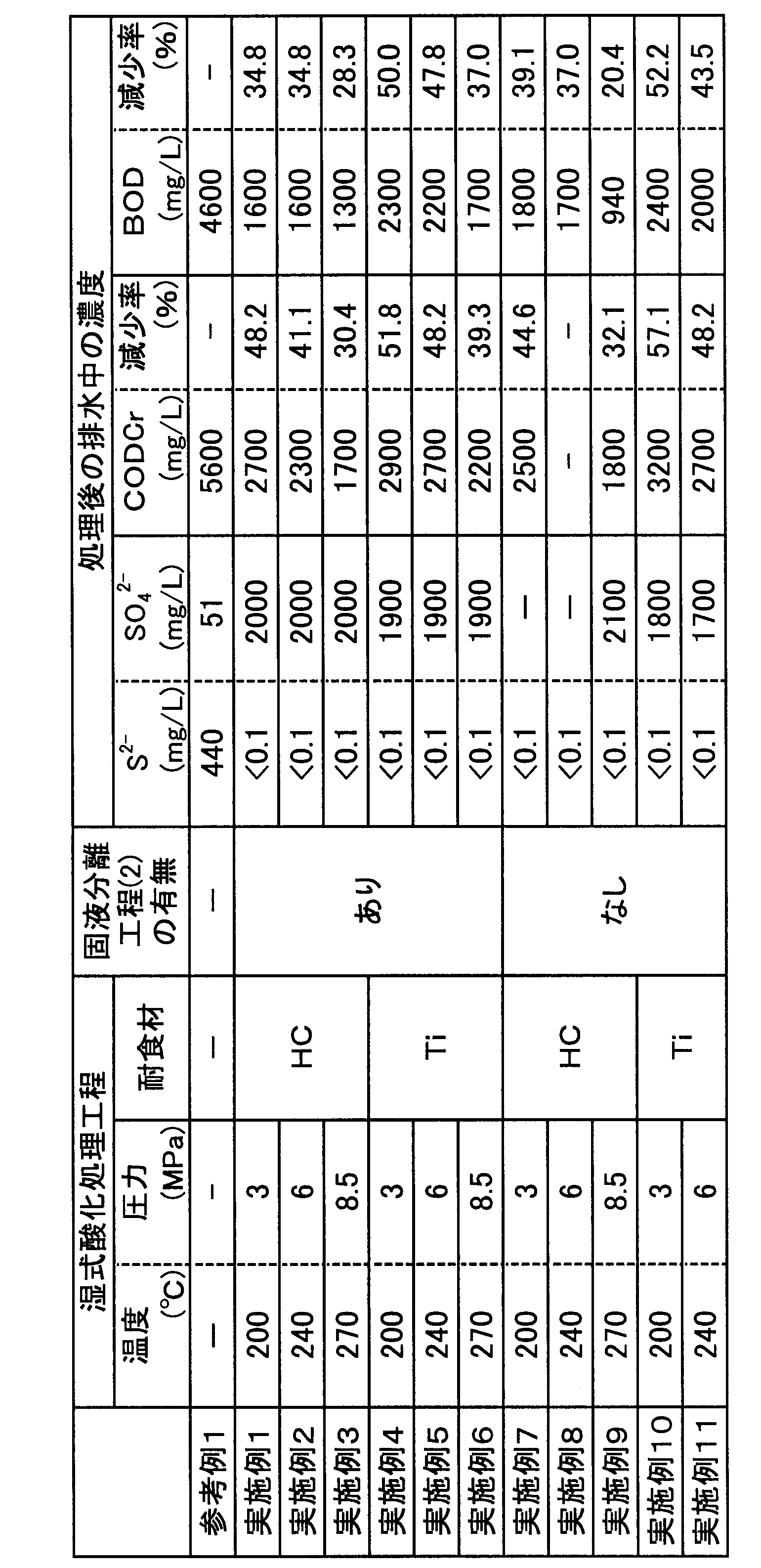
表1から、極性有機溶媒中で硫黄源とジハロ芳香族化合物とを加熱下で重合反応させるPASの製造工程において生じる、硫黄含有化合物を含み、水を主成分とする排水を、温度130~320℃、圧力0.3~20MPaの条件下で湿式酸化処理する湿式酸化処理工程を備えることにより、処理後の排水中の硫化物イオン(S2-)の濃度を30mg/L以下に低減する実施例1~11のPAS排水の処理方法によれば、処理後の排水は、硫化物イオン(S2-)を30mg/L以下しか含有しないものとなっていることが確認でき、また、該処理後の排水は、COD物質の濃度が、処理前の60%以下更には50%以下に減少して、3500mg/L以下かつBOD物質の濃度が、処理前の55%以下更には50%以下に減少して、2500mg/L以下であるので、例えば、必要に応じて更に生物学的処理工程等を備えることなどにより、有害物や悪臭原因物質を含有せず、容易に環境基準に適合する排水とすることができるものであることが分かった。
特に、実施例1~11においては、湿式酸化処理工程において、硫黄含有化合物を含み、水を主成分とする排水と接触する部材が、チタン及びハステロイ(登録商標)Cの一方または両方から形成されるものであることにより、処理後の排水は、硫化物イオン(S2-)の濃度が検出限界以下であるので、悪臭等の懸念が全くないものとなっていることが確認された。また、実施例1~11においては、処理後の排水中の硫化物イオン(S2-)の濃度が検出限界以下である一方、硫酸イオン(SO4
2-)の濃度が、処理前の排水(参考例1)と比較して顕著に増加していることから、PASの製造工程において生じる硫黄含有化合物を含む排水中の硫黄成分が、湿式酸化処理工程において、ほぼ完全に酸化されていることが推察される。なお、処理後の排水中に含有される硫酸イオン(SO4
2-)は水溶性であるので、本発明のPAS排水の処理方法に続いて水洗処理等を行ったり、所望により生物学的処理工程等を行うことにより、処理後の排水中から容易に除去することができる。
また、実施例1~6と実施例7~11との対比によれば、固液分離工程(2)の有無のいずれの場合でも、所望の硫化物イオン(S2-)の濃度及びCOD物質の濃度及び/またはBOD物質の濃度を有する処理後の排水を得られることが確認でき、本発明のPAS排水の処理方法における温度130~320℃、圧力0.3~20MPaの条件下での湿式酸化処理工程を備える処理の有効性が確認された。なお、実施例1~3と実施例4~6との対比並びに実施例7~9と実施例10、11との対比によれば、耐食材としてハステロイ(登録商標)Cを使用することにより、COD物質の濃度及び/またはBOD物質の濃度の減少率、特に、BOD物質の濃度の減少率が大きくなることが窺えた。ハステロイ(登録商標)CにおいてBOD物質等の濃度減少効果が大きなものとなる理由は、現時点では明確ではないが、ハステロイCに含有される鉄(Fe)、ニッケル(Ni)、クロム(Cr)等が、湿式酸化処理工程中に金属イオンとなって硫黄等含有PAS排水に溶出し、均一系酸化触媒のような機能を果たすものと推察される。
III.処理後の微粒子PAS
実施例1において、無触媒湿式酸化処理工程による処理を行った硫黄等含有PAS排水〔固液分離工程(2)によるプレスフィルターでのろ過の実施前のものである。〕を、400メッシュ(目開き37.5μm)のスクリーンに通して微粒子PAS(以下、「処理後の微粒子PAS」ということがある。)を捕捉回収した。処理後の微粒子PASは、重量平均分子量が35,000であり、硫化水素含有量が0ppmであった。なお、実施例1において、100メッシュ(目開き150μm)のスクリーンによって粒状のPASポリマーを篩分したPAS分離液を、更に400メッシュ(目開き37.5μm)のスクリーンに通して捕捉回収した微粒子PAS(以下、「処理前の微粒子PAS」ということがある。)は、重量平均分子量が37,000であり、硫化水素含有量が52ppmであった。
実施例1において、無触媒湿式酸化処理工程による処理を行った硫黄等含有PAS排水〔固液分離工程(2)によるプレスフィルターでのろ過の実施前のものである。〕を、400メッシュ(目開き37.5μm)のスクリーンに通して微粒子PAS(以下、「処理後の微粒子PAS」ということがある。)を捕捉回収した。処理後の微粒子PASは、重量平均分子量が35,000であり、硫化水素含有量が0ppmであった。なお、実施例1において、100メッシュ(目開き150μm)のスクリーンによって粒状のPASポリマーを篩分したPAS分離液を、更に400メッシュ(目開き37.5μm)のスクリーンに通して捕捉回収した微粒子PAS(以下、「処理前の微粒子PAS」ということがある。)は、重量平均分子量が37,000であり、硫化水素含有量が52ppmであった。
したがって、本発明の特有の湿式酸化処理工程を備えるPAS排水の処理方法を備えるPASの製造方法によれば、重量平均分子量の低下が僅か(低分子量成分の若干の増加によるものと推察される。)であることから成形加工特性等を保持したまま、硫化水素等の有害成分が顕著に低減したPAS(処理後の微粒子PAS)を回収し、成形加工等の原材料として利用できることが分かった。
本発明は、極性有機溶媒中で硫黄源とジハロ芳香族化合物とを加熱下で重合反応させるPAS排水の処理方法であって、PASの製造工程において生じる、硫黄含有化合物を含み、水を主成分とする排水を、温度130~320℃、圧力0.3~20MPaの条件下、好ましくはアルカリ条件において、湿式酸化処理する湿式酸化処理工程を備え、好ましくは更に固液分離工程を備えることにより、処理後の排水中の硫化物イオン(S2-)の濃度を30mg/L以下、好ましくは更にCOD物質の濃度を3500mg/L以下、及び/または、BOD物質の濃度を2500mg/L以下に低減することを特徴とする前記の排水の処理方法であることにより、PASを製造するに当たって生成するPAS分離液の排液や洗浄液等の排液など洗浄排液等に由来する排水について、効率的かつ経済的に、硫化物イオン、更にはCOD物質及び/またはBOD物質の含有割合を所定の範囲内に低減し、環境負荷を軽減できるPAS排水の処理方法を提供することができるので、産業上の利用可能性が高い。さらに、本発明は、前記のPAS排水の処理方法を備えるPASの製造方法であることによって、硫化水素等の有害成分を低減して排水中に残存する樹脂成分の回収再利用を容易にするPASの製造方法を提供することができるので、産業上の利用可能性が高い。
Claims (11)
- ポリアリーレンスルフィドの製造工程において生じる硫黄含有化合物を含む排水の処理方法であって、
極性有機溶媒中で硫黄源とジハロ芳香族化合物とを加熱下で重合反応させるポリアリーレンスルフィドの製造工程において生じる、硫黄含有化合物を含み、水を主成分とする排水を、
温度130~320℃、圧力0.3~20MPaの条件下で湿式酸化処理する湿式酸化処理工程を備えることにより、
処理後の排水中の硫化物イオン(S2-)の濃度を30mg/L以下に低減することを特徴とする
前記の排水の処理方法。 - 処理後の排水中のCOD物質の濃度を3500mg/L以下に低減する請求項1記載の排水の処理方法。
- 処理後の排水中のBOD物質の濃度を2500mg/L以下に低減する請求項1または2記載の排水の処理方法。
- 前記湿式酸化処理工程が、無触媒湿式酸化処理工程を含む請求項1乃至3のいずれか1項に記載の排水の処理方法。
- 固液分離工程を備える請求項1乃至4のいずれか1項に記載の排水の処理方法。
- 固液分離工程を、湿式酸化処理工程の直前の工程として備える請求項5記載の排水の処理方法。
- 固液分離工程を、湿式酸化処理工程の直後の工程として備える請求項5または6記載の排水の処理方法。
- 湿式酸化処理工程の後に、生物学的処理工程を備える請求項1乃至7のいずれか1項に記載の排水の処理方法。
- アルカリ条件において湿式酸化処理工程を行う請求項1乃至8のいずれか1項に記載の排水の処理方法。
- 湿式酸化処理工程において、硫黄含有化合物を含み、水を主成分とする排水と接触する部材が、チタン及びハステロイ(登録商標)Cの一方または両方から形成されるものである請求項1乃至9のいずれか1項に記載の排水の処理方法。
- 請求項1乃至10のいずれか1項に記載の排水の処理方法を備えるポリアリーレンスルフィドの製造方法。
Applications Claiming Priority (2)
| Application Number | Priority Date | Filing Date | Title |
|---|---|---|---|
| JP2014260158A JP2016121216A (ja) | 2014-12-24 | 2014-12-24 | ポリアリーレンスルフィドの製造工程において生じる硫黄含有化合物を含む排水の処理方法、並びにポリアリーレンスルフィドの製造方法 |
| JP2014-260158 | 2014-12-24 |
Publications (1)
| Publication Number | Publication Date |
|---|---|
| WO2016104381A1 true WO2016104381A1 (ja) | 2016-06-30 |
Family
ID=56150400
Family Applications (1)
| Application Number | Title | Priority Date | Filing Date |
|---|---|---|---|
| PCT/JP2015/085562 Ceased WO2016104381A1 (ja) | 2014-12-24 | 2015-12-18 | ポリアリーレンスルフィドの製造工程において生じる硫黄含有化合物を含む排水の処理方法、並びにポリアリーレンスルフィドの製造方法 |
Country Status (2)
| Country | Link |
|---|---|
| JP (1) | JP2016121216A (ja) |
| WO (1) | WO2016104381A1 (ja) |
Cited By (3)
| Publication number | Priority date | Publication date | Assignee | Title |
|---|---|---|---|---|
| CN107986540A (zh) * | 2017-12-05 | 2018-05-04 | 巨化集团技术中心 | 一种氟化硅氧烷废液资源化处理方法 |
| US11319441B2 (en) | 2019-12-20 | 2022-05-03 | Ticona Llc | Method for forming a polyarylene sulfide |
| US11407861B2 (en) | 2019-06-28 | 2022-08-09 | Ticona Llc | Method for forming a polyarylene sulfide |
Citations (6)
| Publication number | Priority date | Publication date | Assignee | Title |
|---|---|---|---|---|
| JPH05286712A (ja) * | 1992-04-08 | 1993-11-02 | Asahi Chem Ind Co Ltd | 硫化アルカリ含有溶液の酸化方法 |
| JPH05317869A (ja) * | 1992-05-14 | 1993-12-03 | Nippon Shokubai Co Ltd | 廃水の処理方法 |
| JPH06262188A (ja) * | 1993-03-12 | 1994-09-20 | Nippon Shokubai Co Ltd | 廃水の処理方法 |
| JPH11169870A (ja) * | 1997-12-16 | 1999-06-29 | Dainippon Ink & Chem Inc | ポリアリーレンスルフィド製造時の排水処理方法 |
| JPH11300374A (ja) * | 1998-04-23 | 1999-11-02 | Nippon Shokubai Co Ltd | 排水の処理方法 |
| JP2009078253A (ja) * | 2007-09-27 | 2009-04-16 | Nippon Shokubai Co Ltd | 無機硫黄化合物を含有する排水の処理方法 |
-
2014
- 2014-12-24 JP JP2014260158A patent/JP2016121216A/ja active Pending
-
2015
- 2015-12-18 WO PCT/JP2015/085562 patent/WO2016104381A1/ja not_active Ceased
Patent Citations (6)
| Publication number | Priority date | Publication date | Assignee | Title |
|---|---|---|---|---|
| JPH05286712A (ja) * | 1992-04-08 | 1993-11-02 | Asahi Chem Ind Co Ltd | 硫化アルカリ含有溶液の酸化方法 |
| JPH05317869A (ja) * | 1992-05-14 | 1993-12-03 | Nippon Shokubai Co Ltd | 廃水の処理方法 |
| JPH06262188A (ja) * | 1993-03-12 | 1994-09-20 | Nippon Shokubai Co Ltd | 廃水の処理方法 |
| JPH11169870A (ja) * | 1997-12-16 | 1999-06-29 | Dainippon Ink & Chem Inc | ポリアリーレンスルフィド製造時の排水処理方法 |
| JPH11300374A (ja) * | 1998-04-23 | 1999-11-02 | Nippon Shokubai Co Ltd | 排水の処理方法 |
| JP2009078253A (ja) * | 2007-09-27 | 2009-04-16 | Nippon Shokubai Co Ltd | 無機硫黄化合物を含有する排水の処理方法 |
Cited By (3)
| Publication number | Priority date | Publication date | Assignee | Title |
|---|---|---|---|---|
| CN107986540A (zh) * | 2017-12-05 | 2018-05-04 | 巨化集团技术中心 | 一种氟化硅氧烷废液资源化处理方法 |
| US11407861B2 (en) | 2019-06-28 | 2022-08-09 | Ticona Llc | Method for forming a polyarylene sulfide |
| US11319441B2 (en) | 2019-12-20 | 2022-05-03 | Ticona Llc | Method for forming a polyarylene sulfide |
Also Published As
| Publication number | Publication date |
|---|---|
| JP2016121216A (ja) | 2016-07-07 |
Similar Documents
| Publication | Publication Date | Title |
|---|---|---|
| US8501011B2 (en) | Wet air oxidation process using recycled catalyst | |
| JP5781086B2 (ja) | ポリアリーレンスルフィドの製造方法、及びポリアリーレンスルフィド | |
| JP5805084B2 (ja) | ポリアリーレンスルフィドの製造方法及び製造装置 | |
| JP2003275773A (ja) | ポリフェニレンスルフィドの排水処理方法 | |
| JP4907950B2 (ja) | 排水からの金属の除去方法及び除去装置 | |
| WO2008042095A2 (en) | Catalytic wet oxidation systems and methods | |
| CN112897730B (zh) | 一种对高砷高氟污酸处理回用系统及处理回用方法 | |
| JP2016121216A (ja) | ポリアリーレンスルフィドの製造工程において生じる硫黄含有化合物を含む排水の処理方法、並びにポリアリーレンスルフィドの製造方法 | |
| US20160130144A1 (en) | Method and Process of Treatment of Selenium Containing Material and Selenium Recovery | |
| JP2009078253A (ja) | 無機硫黄化合物を含有する排水の処理方法 | |
| JP3843052B2 (ja) | 金属含有排水中の有価金属の回収方法および利用方法 | |
| US9315401B2 (en) | Wet air oxidation process using recycled copper catalyst | |
| JP4954543B2 (ja) | 水処理システム | |
| JP5233146B2 (ja) | 有機尿素系化合物吸着剤、有機尿素系化合物吸着装置及び有機尿素系化合物処理方法 | |
| KR100951955B1 (ko) | 유기폐수 및 무기폐수의 혼합 처리방법 및 처리장치 | |
| JP2013244468A (ja) | 逆浸透膜透過水の製造方法 | |
| JP2002503553A (ja) | 過酸化水素支持酸化と膜分離法とを組み合わせることによる廃水浄化方法 | |
| EP2986570A1 (en) | Wet air oxidation process using recycled copper, vanadium or iron catalyst | |
| JPH0975910A (ja) | 排水回収再生方法 | |
| JP2009183908A (ja) | 有機物含有廃液の処理方法及び装置 | |
| CN108311160B (zh) | 铁还原催化剂及水处理装置,以及水处理方法 | |
| US9193613B2 (en) | pH control to enable homogeneous catalytic wet air oxidation | |
| JP2000350997A (ja) | 汚水の処理方法および処理装置 | |
| JP2924578B2 (ja) | 廃水の処理方法 | |
| JPH06277682A (ja) | 廃水の処理法 |
Legal Events
| Date | Code | Title | Description |
|---|---|---|---|
| 121 | Ep: the epo has been informed by wipo that ep was designated in this application |
Ref document number: 15872949 Country of ref document: EP Kind code of ref document: A1 |
|
| NENP | Non-entry into the national phase |
Ref country code: DE |
|
| 122 | Ep: pct application non-entry in european phase |
Ref document number: 15872949 Country of ref document: EP Kind code of ref document: A1 |