WO2016104249A1 - 導電性パターン、電子回路及び電磁波シールド - Google Patents
導電性パターン、電子回路及び電磁波シールド Download PDFInfo
- Publication number
- WO2016104249A1 WO2016104249A1 PCT/JP2015/085052 JP2015085052W WO2016104249A1 WO 2016104249 A1 WO2016104249 A1 WO 2016104249A1 JP 2015085052 W JP2015085052 W JP 2015085052W WO 2016104249 A1 WO2016104249 A1 WO 2016104249A1
- Authority
- WO
- WIPO (PCT)
- Prior art keywords
- group
- resin
- mass
- functional group
- acid
- Prior art date
- Legal status (The legal status is an assumption and is not a legal conclusion. Google has not performed a legal analysis and makes no representation as to the accuracy of the status listed.)
- Ceased
Links
Classifications
-
- B—PERFORMING OPERATIONS; TRANSPORTING
- B32—LAYERED PRODUCTS
- B32B—LAYERED PRODUCTS, i.e. PRODUCTS BUILT-UP OF STRATA OF FLAT OR NON-FLAT, e.g. CELLULAR OR HONEYCOMB, FORM
- B32B27/00—Layered products comprising a layer of synthetic resin
- B32B27/18—Layered products comprising a layer of synthetic resin characterised by the use of special additives
-
- H—ELECTRICITY
- H05—ELECTRIC TECHNIQUES NOT OTHERWISE PROVIDED FOR
- H05K—PRINTED CIRCUITS; CASINGS OR CONSTRUCTIONAL DETAILS OF ELECTRIC APPARATUS; MANUFACTURE OF ASSEMBLAGES OF ELECTRICAL COMPONENTS
- H05K1/00—Printed circuits
- H05K1/02—Details
-
- H—ELECTRICITY
- H05—ELECTRIC TECHNIQUES NOT OTHERWISE PROVIDED FOR
- H05K—PRINTED CIRCUITS; CASINGS OR CONSTRUCTIONAL DETAILS OF ELECTRIC APPARATUS; MANUFACTURE OF ASSEMBLAGES OF ELECTRICAL COMPONENTS
- H05K1/00—Printed circuits
- H05K1/02—Details
- H05K1/09—Use of materials for the conductive, e.g. metallic pattern
-
- H—ELECTRICITY
- H05—ELECTRIC TECHNIQUES NOT OTHERWISE PROVIDED FOR
- H05K—PRINTED CIRCUITS; CASINGS OR CONSTRUCTIONAL DETAILS OF ELECTRIC APPARATUS; MANUFACTURE OF ASSEMBLAGES OF ELECTRICAL COMPONENTS
- H05K3/00—Apparatus or processes for manufacturing printed circuits
- H05K3/10—Apparatus or processes for manufacturing printed circuits in which conductive material is applied to the insulating support in such a manner as to form the desired conductive pattern
- H05K3/12—Apparatus or processes for manufacturing printed circuits in which conductive material is applied to the insulating support in such a manner as to form the desired conductive pattern using thick film techniques, e.g. printing techniques to apply the conductive material or similar techniques for applying conductive paste or ink patterns
-
- H—ELECTRICITY
- H05—ELECTRIC TECHNIQUES NOT OTHERWISE PROVIDED FOR
- H05K—PRINTED CIRCUITS; CASINGS OR CONSTRUCTIONAL DETAILS OF ELECTRIC APPARATUS; MANUFACTURE OF ASSEMBLAGES OF ELECTRICAL COMPONENTS
- H05K9/00—Screening of apparatus or components against electric or magnetic fields
Definitions
- the present invention relates to a conductive pattern that can be used for manufacturing electromagnetic wave shields, integrated circuits, organic transistors, and the like.
- a conductive pattern usable for the electronic circuit or the like for example, a conductive ink containing a conductive substance such as silver is applied (printed) to the support surface by various printing methods, and is baked as necessary. What was manufactured by this is known.
- the conductive ink is directly applied to the surfaces of various supports, the conductive ink is difficult to adhere to the surface of the support, so that the conductive ink is easily peeled off and finally obtained electronic circuits, etc. In some cases, disconnection may occur.
- the support made of polyimide resin or polyethylene terephthalate resin is flexible as the support, it has been attracting attention as being usable for the production of a foldable flexible device.
- the conductive ink is particularly difficult to adhere to the support made of the polyimide resin or the like, the conductive ink is easily peeled off when the support is bent, and as a result, an electronic circuit finally obtained In some cases, disconnection may occur.
- a method for solving the above-mentioned problem for example, a method of producing a conductive pattern by drawing a pattern by a predetermined method using a conductive ink on an ink receiving substrate provided with a latex layer on the surface of a support.
- an acrylic resin can be used as the latex layer (see, for example, Patent Document 1).
- the conductive pattern obtained by the above method may not yet be sufficient in terms of adhesion between the latex layer and the conductive ink, disconnection due to peeling of the conductive substance contained in the conductive ink or There was a problem that caused a decrease in conductivity.
- the problem to be solved by the present invention is, for example, to provide a conductive pattern having an adhesive property in which a conductive layer containing a conductive substance such as silver does not peel from the primer layer over time.
- the present inventors have formed a bond between the resin contained in the conductive layer and the resin contained in the primer layer by reaction between specific functional groups. It has been found that the above problems can be solved.
- the present invention reacts with a primer layer (A) containing a resin (a1) having a reactive functional group (X), a phosphate group and the functional group (X) on the support.
- the present invention relates to a conductive pattern characterized by reacting with the functional group (Y) to form a bond.
- the conductive pattern of the present invention has excellent adhesion between layers and can maintain excellent conductivity for a long time without causing disconnection or the like, for example, an organic solar cell, an electronic book terminal, an organic EL, an organic transistor
- a printed electronics field such as a peripheral wiring, an electromagnetic wave shield, an integrated circuit, an organic transistor, etc. constituting an RFID such as a flexible printed circuit board or a non-contact IC card.
- the conductive pattern of the present invention reacts with a primer layer (A) containing a resin (a1) having a reactive functional group (X), a phosphate group and the functional group (X) on a support.
- the resin (a1) forming the primer layer (A) is not limited as long as it has the functional group (X), but a urethane resin, an acrylic resin, or a combination thereof is preferable. .
- the resin (a1) can be used alone or in combination of two or more.
- Examples of the functional group (X) include a carboxyl group, an isocyanate group, a blocked isocyanate group, an epoxy group, a hydroxyl group, an oxazoline group, an N-methylol group, an N-alkoxymethyl group, an amino group, and an alkoxysilyl group.
- the resin (a1) may have two or more of these functional groups.
- the carboxyl group may be derived from an acid anhydride.
- the amino group may be any of primary to tertiary amino groups.
- a urethane resin having a polyether structure, a urethane resin having a polycarbonate structure, or a urethane resin having a polyester structure is preferable because adhesion to the support can be improved.
- the urethane resin can be obtained by reacting a polyol, a polyisocyanate, and, if necessary, a chain extender.
- a polyether structure, a polycarbonate structure, or a polyester structure is used as a raw material for the urethane resin. It is preferable.
- polyether polyol examples include those obtained by addition polymerization of alkylene oxide using one or more compounds having two or more active hydrogen atoms as an initiator.
- the initiator examples include ethylene glycol, diethylene glycol, triethylene glycol, propylene glycol, trimethylene glycol, 1,3-butanediol, 1,4-butanediol, 1,6-hexanediol, neopentyl glycol, glycerin. , Trimethylolethane, trimethylolpropane and the like.
- alkylene oxide examples include ethylene oxide, propylene oxide, butylene oxide, styrene oxide, epichlorohydrin, and tetrahydrofuran.
- polycarbonate polyol examples include those obtained by reacting a carbonate and polyol, and those obtained by reacting phosgene with bisphenol A and the like.
- Examples of the carbonate ester include methyl carbonate, dimethyl carbonate, ethyl carbonate, diethyl carbonate, cyclocarbonate, diphenyl carbonate and the like.
- Examples of the polyol to be reacted with the carbonate ester include ethylene glycol, diethylene glycol, triethylene glycol, 1,2-propylene glycol, 1,3-propylene glycol, dipropylene glycol, 1,4-butanediol, 1,3- Butanediol, 1,2-butanediol, 2,3-butanediol, 1,5-pentanediol, 1,5-hexanediol, 2,5-hexanediol, 1,6-hexanediol, 1,7-heptane Diol, 1,8-octanediol, 1,9-nonanediol, 1,10-decanediol, 1,11-undecanediol, 1,12-dodecanediol, 3-methyl-1,5-pentanediol, 2- Ethyl-1,3-hexanediol, 2-methyl-1
- aliphatic polyester polyol examples include aliphatic polyester polyols obtained by esterification of low molecular weight polyols and polycarboxylic acids; ring-opening polymerization reactions of cyclic ester compounds such as ⁇ -caprolactone and ⁇ -butyrolactone. Aliphatic polyesters obtained by the above; these copolyesters and the like.
- Examples of the low molecular weight polyol used as a raw material for the polyester polyol include ethylene glycol, 1,2-propanediol, 1,3-butanediol, 1,4-butanediol, 1,6-hexanediol, and 3-methyl. 1,5-pentanediol, neopentyl glycol, diethylene glycol, dipropylene glycol, glycerin, trimethylolpropane, 1,4-cyclohexanedimethanol and the like.
- polyols can be used alone or in combination of two or more, such as ethylene glycol, 1,2-propanediol, 1,3-butanediol or 1,4-butanediol, and 3-methyl It is preferable to use in combination with 1,5-pentanediol or neopentyl glycol.
- polycarboxylic acid examples include succinic acid, adipic acid, sebacic acid, dodecanedicarboxylic acid, azelaic acid, anhydrides or esterified products thereof, and the like.
- succinic acid examples include succinic acid, adipic acid, sebacic acid, dodecanedicarboxylic acid, azelaic acid, anhydrides or esterified products thereof, and the like.
- aliphatic polycarboxylic acids such as adipic acid are preferable.
- the polyether polyol, polycarbonate polyol, and aliphatic polyester polyol preferably have a number average molecular weight of 500 to 4,000, more preferably 500 to 2,000.
- polystyrene resin As the polyol used as the raw material of the urethane resin, other polyols other than the above-mentioned polyether polyol, polycarbonate polyol, and aliphatic polyester polyol can be used as necessary.
- Examples of the other polyols include ethylene glycol, 1,2-propanediol, 1,3-butanediol, 1,4-butanediol, 3-methyl-1,5-pentanediol, and 1,6-hexanediol.
- Examples include partially saponified products of polymers.
- a polyol having a hydrophilic group is used.
- the polyol having a hydrophilic group include a polyol having a carboxyl group such as 2,2-dimethylolpropionic acid, 2,2-dimethylolbutanoic acid and 2,2-dimethylolvaleric acid; 5-sulfoisophthalic acid And polyols having a sulfonic acid group such as sulfoterephthalic acid, 4-sulfophthalic acid and 5- (4-sulfophenoxy) isophthalic acid.
- the polyol having a hydrophilic group include a polyester polyol having a hydrophilic group obtained by reacting the polyol having the hydrophilic group with a polycarboxylic acid such as adipic acid.
- the polyol having a hydrophilic group is preferably used in the range of 0.1 to 10% by mass in the total amount of polyol used as a raw material for the urethane resin.
- Examples of the polyisocyanate used as a raw material for the urethane resin include 4,4′-diphenylmethane diisocyanate, 2,4′-diphenylmethane diisocyanate, carbodiimide-modified diphenylmethane diisocyanate, crude diphenylmethane diisocyanate, phenylene diisocyanate, triene diisocyanate, naphthalene diisocyanate, and xylylene diene.
- Aromatic polyisocyanates such as isocyanate and tetramethylxylylene diisocyanate; Aliphatic polyisocyanates such as hexamethylene diisocyanate and lysine diisocyanate; Cyclohexane diisocyanate, hydrogenated xylylene diisocyanate, isophorone diisocyanate, and dicyclohexylmethane diisocyanate You Such as polyisocyanates. Of these, polyisocyanates having an alicyclic structure are preferred.
- examples of the chain extender used as necessary when producing the urethane resin include polyamines, hydrazine compounds, and other compounds having active hydrogen atoms.
- polyamine examples include ethylenediamine, 1,2-propanediamine, 1,6-hexamethylenediamine, piperazine, 2,5-dimethylpiperazine, isophoronediamine, 4,4'-dicyclohexylmethanediamine, 3,3'- Diamines such as dimethyl-4,4′-dicyclohexylmethanediamine, 1,4-cyclohexanediamine; N-hydroxymethylaminoethylamine, N-hydroxyethylaminoethylamine, N-hydroxypropylaminopropylamine, N-ethylaminoethylamine, N -Methylaminopropylamine, diethylenetriamine, dipropylenetriamine, triethylenetetramine and the like. Among these, ethylenediamine is preferable.
- hydrazine compound examples include hydrazine, N, N′-dimethylhydrazine, 1,6-hexamethylenebishydrazine, succinic acid dihydrazide, adipic acid dihydrazide, glutaric acid dihydrazide, sebacic acid dihydrazide, isophthalic acid dihydrazide, ⁇ -semicarbazide
- examples include propionic acid hydrazide, 3-semicarbazide-propyl-carbazate, semicarbazide-3-semicarbazide methyl-3,5,5-trimethylcyclohexane, and the like.
- Examples of the other active hydrogen-containing compounds include ethylene glycol, diethylene recall, triethylene glycol, propylene glycol, 1,3-propanediol, 1,3-butanediol, 1,4-butanediol, hexamethylene glycol, Glycols such as saccharose, methylene glycol, glycerin, sorbitol; phenols such as bisphenol A, 4,4′-dihydroxydiphenyl, 4,4′-dihydroxydiphenyl ether, 4,4′-dihydroxydiphenylsulfone, hydrogenated bisphenol A, hydroquinone, Water etc. are mentioned.
- the equivalent ratio [amino group / isocyanate group] of the amino group and isocyanate group of the polyamine is preferably 1.9 or less, more preferably in the range of 0.3 to 1 preferable.
- the urethane resin can be produced, for example, by reacting the polyol, the polyisocyanate, and, if necessary, the chain extender by a known method in the absence of a solvent or in the presence of an organic solvent.
- the reaction between the polyol and the polyisocyanate takes into account the safety with careful attention to sudden exothermic heat and foaming, and preferably at a reaction temperature of 50 to 120 ° C., more preferably 80 to 100 ° C.
- the polyisocyanate can be mixed by batch feeding or sequentially supplied by a method such as dropping one of them to the other and reacted for about 1 to 15 hours.
- the aqueous dispersion produces the urethane resin by reacting the polyol, the polyisocyanate, and, if necessary, the chain extender by the above method, If necessary, it can be produced by neutralizing a part or all of hydrophilic groups such as anionic groups of the urethane resin and then mixing it with an aqueous medium used as a solvent for the resin (a1). .
- the urethane prepolymer has hydrophilic groups such as anionic groups.
- An aqueous dispersion of urethane resin can be produced by neutralizing a part or all of the mixture, mixing it with an aqueous medium, and then extending the chain using the chain extender.
- the reaction between the polyisocyanate and the polyol is preferably carried out in an equivalent ratio [isocyanate group / hydroxyl group] of the isocyanate group of the polyisocyanate and the hydroxyl group of the polyol in the range of 0.5-2.
- an organic solvent can also be used as a solvent.
- the organic solvent include ketone solvents such as acetone and methyl ethyl ketone; ether solvents such as tetrahydrofuran and dioxane; ester solvents such as ethyl acetate and butyl acetate; nitriles such as acetonitrile; amide solvents such as dimethylformamide and N-methylpyrrolidone.
- An aromatic solvent such as toluene;
- the organic solvent is preferably removed after the production of the urethane resin by a distillation method or the like.
- the organic solvent used when the urethane resin is produced may be used as a dilution solvent for the resin (a1).
- the weight average molecular weight of the urethane resin is preferably in the range of 5,000 to 500,000, and preferably in the range of 20,000 to 100,000 because it can form a conductive pattern with excellent adhesion to the support and excellent conductivity. A range of 000 is more preferred.
- the weight average molecular weight is a value in terms of polyethylene measured by gel permeation chromatography (GPC).
- Examples of the method for introducing the functional group (X) into the urethane resin include the following methods.
- examples of the raw material for the urethane resin include carboxyl groups such as 2,2-dimethylolpropionic acid, 2,2-dimethylolbutanoic acid, and 2,2-dimethylolvaleric acid.
- the functional group (X) is an isocyanate group
- the polyisocyanate used as the raw material for the urethane resin is used in excess with respect to the polyol, and is reacted so that the isocyanate group remains.
- the said functional group (X) is an isocyanate group
- the isocyanate resin-containing urethane resin may be, for example, a phenol compound such as phenol, formamide oxime, acetoald oxime, acetone oxime.
- the isocyanate is converted into a blocked isocyanate group using an oxime compound such as methyl ethyl ketoxime, methyl isobutyl ketoxime, or cyclohexanone oxime.
- the primer layer (A) is blocked on the support by suppressing the reaction of the isocyanate group in the forming step and heat-treating the conductive layer (B) in the forming step. It is preferable because the block of the group is removed and the reactive functional group (Y) contained in the resin (b1) contained in the conductive layer (B) can be efficiently reacted.
- the functional group (X) is an epoxy group
- an epoxy resin such as a bisphenol A type epoxy resin, a novolac type epoxy resin, a cresol type epoxy resin
- an acrylic monomer having an epoxy group an acrylic polyol copolymerized with an acrylic monomer having a hydroxyl group; an acrylic monomer having an epoxy group in the presence of a compound having a mercapto group and an active hydrogen group such as 3-mercapto-1,2-propanediol; A polymerized acrylic polyol or the like is used.
- “acrylic monomer” means one or both of an acrylic monomer and a methacrylic monomer.
- the raw material of the urethane resin is, for example, an equivalent ratio [isocyanate group / hydroxyl group] of the isocyanate group possessed by the polyisocyanate and the hydroxyl group possessed by the polyol is 0.5 to 0.
- the range is 99.
- examples of the raw material of the urethane resin include an acrylic polyol obtained by copolymerizing a monomer having an oxazoline group and an acrylic monomer having a hydroxyl group; 3-mercapto-1 An acrylic polyol obtained by polymerizing an acrylic monomer having an oxazoline group in the presence of a compound having a mercapto group and an active hydrogen group such as 2-propanediol.
- the functional group (X) is an N-methylol group
- an acrylic polyol obtained by copolymerizing a monomer having an N-methylol group and an acrylic monomer having a hydroxyl group as a raw material of the urethane resin 3
- a polyol obtained by polymerizing a monomer having an N-methylol group in the presence of a compound having a mercapto group and an active hydrogen group such as mercapto-1,2-propanediol is used.
- the functional group (X) is an N-alkoxymethyl group
- a raw material for the urethane resin for example, an acrylic polyol obtained by copolymerizing a monomer having an N-alkoxymethyl group and an acrylic monomer having a hydroxyl group
- the conductive layer (B In the formation step, the alkyl group portion of the N-alkoxymethyl group is removed by heat treatment, and the reactive functional group (Y) contained in the resin (b1) contained in the conductive layer (B) is efficiently reacted. This is preferable.
- the urethane resin raw material may be, for example, a polyol having a tertiary amino group such as N-methyl-diethanolamine, N-ethyl-diethanolamine, triethanolamine; Polyol having a tertiary amino group obtained by reacting a compound having two epoxy groups in one molecule such as 6-hexanediol with a secondary amine such as diethylamine; 3-mercapto-1,2-propanediol, etc.
- a polyol having a tertiary amino group such as N-methyl-diethanolamine, N-ethyl-diethanolamine, triethanolamine
- Polyol having a tertiary amino group obtained by reacting a compound having two epoxy groups in one molecule such as 6-hexanediol with a secondary amine such as diethylamine
- 3-mercapto-1,2-propanediol etc.
- a polyol obtained by polymerizing a monomer having a tertiary amino group such as N, N-dimethylaminoethyl methacrylate in the presence of a compound having a mercapto group and an active hydrogen group is used.
- a tertiary amino group is preferable as an amino group.
- the reaction between the polyisocyanate and the polyol has an equivalent ratio [isocyanate group / hydroxyl group] of the isocyanate group possessed by the polyisocyanate and the hydroxyl group possessed by the polyol.
- a method of reacting an amino group of 3-aminopropyltriethoxysilane with an isocyanate group of a urethane prepolymer having an isocyanate group at both ends of a molecular chain obtained in the range of 0.01 to 2, and the urethane resin As a raw material, for example, there is a method in which an acrylic polyol obtained by copolymerizing an acrylic monomer having an alkoxysilyl group such as 3-methacryloxypropyltrimethoxysilane is used.
- urethane resin those having an alicyclic structure in the urethane resin are preferable because adhesion and conductivity are improved, and the conductive pattern can be thinned and cracks can be prevented. Moreover, when performing the plating process mentioned later, peeling of the primer layer (A) and the said conductive layer (B) from a support body by the influence of the plating agent which consists of a strong alkali or a strongly acidic substance used at the said plating process process. Also from the viewpoint of prevention, a urethane resin having an alicyclic structure is preferable.
- Examples of the alicyclic structure include a cyclobutyl group, a cyclopentyl group, a cyclohexyl group, a cycloheptyl group, a cyclooctyl group, a propylcyclohexyl group, a tricyclo [5.2.1.0 2,6 ] decyl group, and a bicyclo [4. .3.0] nonyl group, tricyclo [5.3.1.1] dodecyl group, propyltricyclo [5.3.1.1] dodecyl group, norbornene group, isobornyl group, dicyclopentanyl group, adamantyl group Etc.
- a cyclohexyl group, a norbornene group, an isobornyl group, or an adamantyl group is preferable because a conductive pattern having excellent durability can be obtained.
- Examples of a method for introducing an alicyclic structure into the urethane resin include a method using a polyol and / or polyisocyanate which has a alicyclic structure as a raw material.
- polyol having the alicyclic structure examples include 1,4-cyclohexanedimethanol, cyclobutanediol, cyclopentanediol, 1,4-cyclohexanediol, cycloheptanediol, cyclooctanediol, cyclohexanedimethanol, tricyclo [5 .2.1.0 2,6 ] decanedimethanol, bicyclo [4.3.0] -nonanediol, dicyclohexanediol, tricyclo [5.3.1.1] dodecanediol, bicyclo [4.3.0 Nonanedimethanol, tricyclo [5.3.1.1] dodecanediethanol, spiro [3.4] octanediol, butylcyclohexanediol, 1,1'-bicyclohexylidenediol, cyclohexanetriol, hydrogen
- polycarboxylic acid having an alicyclic structure examples include 1,3-cyclopentanedicarboxylic acid, 1,2-cyclohexanedicarboxylic acid, 1,3-cyclohexanedicarboxylic acid, 1,4-cyclohexanedicarboxylic acid, and the like.
- An anhydride or esterified product may be used.
- 1,2-cyclohexanedicarboxylic acid or 1,4-cyclohexanedicarboxylic acid is preferable.
- polyol used for the esterification reaction with the alicyclic structure polycarboxylic acid examples include, for example, ethylene glycol, diethylene glycol, triethylene glycol, 1,2-propylene glycol, 1,3-propylene glycol, dipropylene glycol, 1, 4-butanediol, 1,3-butanediol, 1,2-butanediol, 2,3-butanediol, 1,5-pentanediol, 1,5-hexanediol, 2,5-hexanediol, 1,6 -Hexanediol, 1,7-heptanediol, 1,8-octanediol, 1,9-nonanediol, 1,10-decanediol, neopentyl glycol, 3-methyl-1,5-pentanediol, 2-methyl And aliphatic polyols such as 1,3-propanediol,
- a polycarbonate polyol having an alicyclic structure can also be used as the polyol having the alicyclic structure.
- examples of the polycarbonate polyol having an alicyclic structure include those obtained by reacting the polyol having the alicyclic structure with dimethyl carbonate or phosgene.
- a polyether polyol having an alicyclic structure can also be used as the polyol having the alicyclic structure.
- examples of the polyether polyol having an alicyclic structure include those obtained by addition polymerization of alkylene oxides such as ethylene oxide and propylene oxide using a polyol having an alicyclic structure as an initiator.
- polyisocyanate having the alicyclic structure those having an alicyclic structure among the polyisocyanates exemplified as the raw material of the urethane resin can be used.
- the acrylic resin is a polymer or copolymer obtained by polymerizing an acrylic monomer.
- (meth) acrylic acid refers to one or both of acrylic acid and methacrylic acid
- (meth) acrylate refers to one or both of acrylate and methacrylate.
- Acryloyl refers to one or both of acryloyl and methacryloyl.
- acrylic monomer examples include methyl (meth) acrylate, ethyl (meth) acrylate, n-butyl (meth) acrylate, i-butyl (meth) acrylate, t-butyl (meth) acrylate, 2-ethylhexyl ( (Meth) acrylate, hexyl (meth) acrylate, cyclohexyl (meth) acrylate, octyl (meth) acrylate, nonyl (meth) acrylate, dodecyl (meth) acrylate, stearyl (meth) acrylate, isobornyl (meth) acrylate, norbornyl (meth) Aliphatic (meth) acrylates such as acrylate, tricyclodecanyl (meth) acrylate, adamantyl (meth) acrylate, dicyclopentanyl (meth) acrylate; phenyl (meth)
- the raw material for the acrylic resin in addition to the acrylic monomer, other monomers copolymerizable therewith may be used.
- other monomers include styrene derivatives such as styrene and styrene sulfonate; diene compounds such as butadiene and isoprene; and allyl compounds such as diallyl phthalate.
- Examples of the method for introducing the functional group (X) into the acrylic resin include the following methods.
- examples of the raw material for the acrylic resin include (meth) acrylic acid, ⁇ -carboxyethyl (meth) acrylate, 2- (meth) acryloylpropionic acid, crotonic acid, and itaconic acid.
- the functional group (X) is an isocyanate group
- a monomer having an isocyanate group is used as a raw material for the acrylic resin.
- a blocked isocyanate group a monomer having a blocked isocyanate group is used.
- the solvent that dilutes or disperses the resin (a1) is preferably a solvent that does not react with the isocyanate group.
- the functional group (X) is an epoxy group
- a monomer having an epoxy group such as glycidyl (meth) acrylate or allyl glycidyl ether is used as a raw material for the acrylic resin.
- the functional group (X) is a hydroxyl group
- a monomer having a hydroxyl group such as 2-hydroxyethyl (meth) acrylate is used as a raw material for the acrylic resin.
- the functional group (X) is an oxazoline group
- a monomer having an oxazoline group such as 2-isopropenyl-2-oxazoline is used as a raw material for the acrylic resin.
- the functional group (X) is an N-methylol group
- a monomer having an N-methylol group such as N-methylol (meth) acrylamide is used as a raw material for the acrylic resin.
- examples of the raw material for the acrylic resin include N-methoxymethyl (meth) acrylamide, N-ethoxymethyl (meth) acrylamide, and N-propoxymethyl (meth) acrylamide.
- N-alkoxymethyl groups such as N-isopropoxymethyl (meth) acrylamide, Nn-butoxymethyl (meth) acrylamide, N-isobutoxymethyl (meth) acrylamide, and N-pentoxymethyl (meth) acrylamide Use monomers.
- the functional group (X) is an amino group
- a monomer having an amino group such as N, N-dimethylaminoethyl methacrylate is used as a raw material for the acrylic resin.
- the functional group (X) is an alkoxysilyl group
- a monomer having an alkoxysilyl group such as 3-methacryloxypropyltrimethoxysilane is used as a raw material for the acrylic resin.
- the method for producing the acrylic resin known methods can be used. Among them, an emulsion polymerization method is preferable because a conductive pattern having excellent adhesion and conductivity can be produced.
- the glass transition temperature (Tg) of the acrylic resin is preferably in the range of 10 to 120 ° C. because it can improve the adhesion to the conductive layer (B) described later and the conductivity of the resulting conductive pattern.
- the glass transition temperature (Tg) of the said acrylic resin is a value calculated by calculation based on the composition of the monomer used for the raw material of an acrylic resin.
- the weight of 800,000 or more is achieved.
- those having an average molecular weight are preferable, and those having a weight average molecular weight of 1 million or more are more preferable.
- the upper limit of the weight average molecular weight of the acrylic resin is not particularly limited, but is preferably 10 million or less, and more preferably 5 million or less.
- the urethane resin and the acrylic resin may be used in combination.
- a urethane-acrylic composite resin in which the urethane resin and the acrylic resin are combined can also be used.
- the urethane-acrylic composite resin is a resin in which a urethane resin and an acrylic resin form composite resin particles.
- a core-shell type having an acrylic resin as a core and a urethane resin as a shell is used.
- a urethane resin having a hydrophilic group it is not necessary to produce a surfactant that lowers electrical characteristics when forming a conductive pattern. Is preferred.
- the same urethane resin that can be used as the resin (a1) can be used.
- the urethane resin has an alicyclic structure.
- peeling of the primer layer (A) and the said conductive layer (B) from a support body by the influence of the plating agent which consists of a strong alkali or a strongly acidic substance used at the said plating process process is preferable.
- the same acrylic resin that can be used as the resin (a1) can be used.
- the functional group (X) is contained in the acrylic resin, even if the urethane resin constituting the urethane-acrylic composite resin has it. Both may also have.
- an aqueous dispersion of a urethane resin is produced by reacting the polyisocyanate, a polyol and, if necessary, a chain extender and dispersing in water. It can be produced by polymerizing monomers such as acrylic monomers in an aqueous dispersion of urethane resin.
- a urethane resin by reacting the polyisocyanate with a polyol in the absence of a solvent or in an organic solvent, a part or all of the hydrophilic group of the urethane resin is converted into a basic compound.
- An aqueous dispersion of a urethane resin is produced by neutralizing with a chain, reacting with a chain extender if necessary, and dispersing it in an aqueous medium.
- a monomer such as the acrylic monomer is supplied into the aqueous dispersion of the urethane resin obtained above, and the monomer is radically polymerized in the urethane resin particles to produce an acrylic resin.
- the urethane-acrylic composite resin can be obtained.
- the average particle size of the urethane-acrylic composite resin obtained by the above production method is preferably in the range of 5 to 100 nm because good water dispersion stability can be maintained.
- the content of the functional group (X) in the resin (a1) is preferably in the range of 0.001 to 5 mmol / g, since the adhesion to the conductive layer (B) described later can be further improved. A range of ⁇ 3 mmol / g is more preferred, and a range of 0.01 to 2 mmol / g is even more preferred.
- content of the said functional group (X) in the said resin (a1) is content only in the functional group which participates in reaction with the functional group (Y) mentioned later.
- the resin (a1) When the resin (a1) is applied to the support, it is preferably diluted with a solvent such as an organic solvent or an aqueous medium so that the viscosity is easy to apply.
- a solvent such as an organic solvent or an aqueous medium
- the content of the resin (a1) in the coating material after dilution is preferably 0.01 to 30% by mass, more preferably 0.1 to 10% by mass.
- Examples of the organic solvent include toluene, ethyl acetate, methyl ethyl ketone, and the like.
- Examples of the aqueous medium include water, organic solvents miscible with water, and mixtures thereof.
- organic solvent miscible with water examples include alcohol solvents such as methanol, ethanol, n-propanol, isopropanol, ethyl carbitol, ethyl cellosolve, butyl cellosolve; ketone solvents such as acetone and methyl ethyl ketone; ethylene glycol, diethylene glycol, propylene glycol and the like Polyalkylene glycol solvents; alkyl ether solvents of polyalkylene glycols; lactam solvents such as N-methyl-2-pyrrolidone, and the like.
- alcohol solvents such as methanol, ethanol, n-propanol, isopropanol, ethyl carbitol, ethyl cellosolve, butyl cellosolve
- ketone solvents such as acetone and methyl ethyl ketone
- ethylene glycol, diethylene glycol, propylene glycol and the like Polyalkylene
- the solvent for diluting the resin (a1) is preferably water alone or a mixture of water and an organic solvent miscible with water, more preferably water alone, in view of safety and environmental burden.
- hydrophilic group examples include an anionic group, a cationic group, and a nonionic group.
- anionic group examples include a carboxyl group, a carboxylate group, a sulfonic acid group, and a sulfonate group.
- a resin in which a part or all of the carboxylate group or sulfonate group is neutralized with a basic compound is preferable because it can impart good water dispersibility to the resin (a1).
- Examples of basic compounds that can be used for neutralizing the anionic group include ammonia; organic amines such as triethylamine, pyridine, and morpholine; alkanolamines such as monoethanolamine; metal bases such as sodium, potassium, lithium, and calcium. Compound etc. are mentioned.
- the metal basic compound may impair electrical conductivity. Therefore, the basic compound is preferably ammonia, an organic amine, or an alkanolamine.
- a carboxyl group is used as the anionic group
- a volatile basic compound such as ammonia
- the basic compound is volatilized by heat treatment such as baking described below
- a carboxyl group is preferable because it enables reaction with a functional group (Y) described later.
- the carboxylate group or sulfonate group is used as the anionic group, it is preferable that they are contained in the range of 0.05 to 2 mmol / g with respect to the whole resin. It is preferable because stability can be imparted.
- the resin (a1) includes a crosslinking agent, a pH adjuster, a film-forming aid, a leveling agent, a thickening agent, a water repellent, an antifoaming agent, and a pigment as necessary, as long as the effects of the present invention are not impaired.
- Organic fillers, inorganic fillers and the like may be contained.
- the conductive layer (B) contains a resin (b1) having a reactive functional group (Y) that reacts with a phosphate group and the functional group (X) to form a bond, and a conductive substance (b2). Is a layer.
- the resin (b1) is preferably an acrylic resin that easily introduces a phosphate group and the functional group (Y).
- a monomer having a phosphate ester group is used as a raw material for the acrylic resin.
- the monomer having a phosphate ester group include 2-((meth) acryloyloxy) ethyl phosphate, 2-((meth) acryloyloxy) propyl phosphate, and diphenyl phosphate (2-acryloyloxyethyl). And diphenyl (2-methacryloyloxyethyl) phosphate, phenyl (2-acryloyloxyethyl) phosphate, and the like.
- Examples of the functional group (Y) of the resin (b1) include a carboxyl group, an isocyanate group, a blocked isocyanate group, an epoxy group, a hydroxyl group, an oxazoline group, an N-methylol group, an N-alkoxymethyl group, an amino group, An alkoxysilyl group etc. are mentioned. Moreover, the said resin (b1) may have 2 or more types of these functional groups.
- an acrylic resin is used as the resin (b1)
- a resin produced in the same manner as the resin (a1) can be used except that the monomer having a phosphate group is used as an essential raw material.
- the method for introducing the functional group (Y) into the acrylic resin is the same as the method for introducing the functional group (X) into the acrylic resin used as the resin (a1).
- the content of the functional group (Y) in the resin (b1) is preferably in the range of 0.001 to 5 mmol / g, since the adhesion to the primer layer (A) can be further improved, and 0.01 to The range of 3 mmol / g is more preferable, and the range of 0.01 to 2 mmol / g is more preferable.
- content of the said functional group (Y) in the said resin (b1) is content only in the functional group which participates in reaction with the said functional group (X).
- the conductive substance (b2) includes a transition metal or a compound thereof.
- ionic transition metals are preferable, and examples thereof include copper, silver, gold, nickel, palladium, platinum, and cobalt. Copper, silver, gold, and the like are preferable because they have a low electrical resistance and can form a conductive pattern that is resistant to corrosion, and silver is more preferable.
- the average particle diameter of the conductive substance (b2) is preferably in the range of 1 to 100 nm and more preferably in the range of 1 to 50 nm because a fine conductive pattern can be formed and the resistance value can be further reduced.
- the “average particle diameter” is a volume average value measured by a dynamic light scattering method after diluting the conductive substance (b2) with a dispersion good solvent. This average particle diameter can be measured by, for example, “Nanotrack UPA-150” manufactured by Nikkiso Co., Ltd.
- the mass ratio [(b1) / (b2)] between the resin (b1) and the conductive substance (b2) is preferably in the range of 0.1 / 99.9 to 20/80.
- the conductive layer (B) is formed by applying and drying (heating) the fluid (b) containing the resin (b1) and the conductive substance (b2) on the primer layer (A). can do.
- an aqueous medium such as distilled water, ion-exchanged water, pure water, or ultrapure water is used so that the viscosity is easy to apply. It is preferable to dilute with a solvent such as an alcohol solvent, a ketone solvent, an ester solvent, an ether solvent or the like.
- the alcohol solvent examples include methanol, ethanol, n-propanol, isopropyl alcohol, n-butanol, isobutyl alcohol, sec-butanol, tert-butanol, heptanol, hexanol, octanol, nonanol, decanol, undecanol, dodecanol, tridecanol, Tetradecanol, pentadecanol, stearyl alcohol, allyl alcohol, cyclohexanol, terpineol, terpineol, dihydroterpineol, 2-ethyl-1,3-hexanediol, ethylene glycol, diethylene glycol, triethylene glycol, polyethylene glycol, propylene glycol, Dipropylene glycol, 1,2-butanediol, 1,3-butanedio 1,4-butanediol, 2,3-butanedio
- examples of the ketone solvent include acetone, methyl ethyl ketone, and cyclohexanone.
- examples of the ester solvent include ethyl acetate, butyl acetate, 3-methoxybutyl acetate, 3-methoxy-3-methyl-butyl acetate and the like.
- organic solvents include, for example, aromatic hydrocarbon solvents such as toluene; octane, nonane, decane, dodecane, tridecane, tetradecane, cyclooctane, xylene, mesitylene, ethylbenzene, dodecylbenzene, tetralin, trimethylbenzenecyclohexane
- aromatic hydrocarbon solvents such as toluene; octane, nonane, decane, dodecane, tridecane, tetradecane, cyclooctane, xylene, mesitylene, ethylbenzene, dodecylbenzene, tetralin, trimethylbenzenecyclohexane
- Aliphatic hydrocarbon solvents such as: mixed spirits such as mineral spirits and solvent naphtha.
- a method for producing the fluid (b) for example, in the presence of the resin (b1), a metal compound (b2 ′) serving as a precursor of the conductive substance (b2) is reacted with a reducing agent. And a method of generating the conductive substance (b2). By this method, the fluid (b) in which the nanometer-sized conductive substance (b2) having a particle diameter of 1 to 400 nm is dispersed is obtained.
- Examples of the metal compound (b2 ′) include tetrachloroauric acid or tetrachloroplatinum when the metal species is gold or platinum.
- the metal species is copper, copper acetate (II), copper nitrate (II), copper chloride (II), copper formate (II), copper propionate (II), copper carbonate (II), copper sulfate ( II), acetylacetone copper (II), copper (II) carboxylate obtained by heating copper (II) carboxylate, and a composite of copper (II) acetate and copper (II) oxide.
- the metal species is silver, examples thereof include silver nitrate, silver oxide, silver acetate, silver chloride, and when used as an aqueous solution, silver nitrate is preferable because of its high solubility in water.
- Examples of the reducing agent include hydrazine or derivatives thereof; alkanolamines such as triethanolamine; hydroxylamines such as N, N-diethylhydroxyamine; ethylene glycol derivatives such as ethylene glycol, diethylene glycol, and triethylene glycol; hydroquinone, amino Phenol compounds such as phenol; phenylenediamine; hydroxyketone compounds such as 2-hydroxyacetone, 2-hydroxyhexane-1,3-dione, malic acid or hydroxycarboxylic acid compounds; ascorbic acid, 2,3-dihydroxymaleic acid, etc. Examples include enediol compounds.
- a solvent such as water, methanol, ethanol, or ethylene glycol may be used as necessary.
- the temperature at which the metal compound (b2 ′) is reacted with the reducing agent may be set within a range where the reduction reaction is efficiently performed, for example, in the range of 0 to 100 ° C., depending on the reducing agent used.
- the fluid (b) is a dispersion stability of the conductive substance (b2) in a solvent such as an aqueous medium or an organic solvent, and the resin (a1) forming the primer layer (A) is wetted on the coating surface.
- a solvent such as an aqueous medium or an organic solvent
- surfactants, antifoaming agents, rheology adjusting agents, and the like may be used as necessary.
- the fluid (b) should be filtered using a micropore filter, etc., if necessary, or processed using a centrifuge, etc. You can also.
- the viscosity of the fluid (b) is preferably in the range of 0.1 to 500,000 mPa ⁇ s, and more preferably in the range of 0.5 to 10,000 mPa ⁇ s. This viscosity is a value measured with a B-type viscometer at 25 ° C.
- the viscosity is in the range of 5 to 20 mPa ⁇ s. What was adjusted is preferable.
- Examples of the support used for the conductive pattern of the present invention include polyimide resin, polyamideimide resin, polyamide resin, polyethylene terephthalate resin, polybutylene terephthalate resin, polyethylene naphthalate resin, polycarbonate resin, acrylonitrile-butadiene-styrene (ABS).
- ABS acrylonitrile-butadiene-styrene
- liquid crystal polymer polyether ether ketone, polyphenylene sulfide resin, acrylic resin such as poly (meth) acrylate, polyvinylidene fluoride resin, polyvinyl chloride resin, polyvinylidene chloride resin, polyvinyl alcohol resin, polyethylene resin, polypropylene resin , Urethane resin, silicon, silicon carbide, gallium nitride, sapphire, ceramics, glass, glass epoxy resin, glass polyimide, paper Nord, diamond-like carbon, alumina, polyester fibers, polyamide fibers, synthetic fibers such as polyaramid fibers, inorganic fibers such as carbon fibers, natural fibers such as cellulose nanofibers.
- These supports are preferably insulating, and porous ones can be used.
- a substrate made of synthetic fibers such as polyester fibers, polyamide fibers, and aramid fibers, natural fibers such as cotton and hemp can be used.
- the fibers may be processed in advance.
- the support generally a support made of polyimide resin, polyethylene terephthalate, polyethylene naphthalate, glass, cellulose nanofiber, etc., which is often used as a support for forming a conductive pattern such as an electric circuit. Is preferred.
- a material that is relatively flexible and can be bent as the support, in order to give flexibility to the conductive pattern and obtain a final product that can be bent.
- a film or sheet-like support formed by uniaxial stretching or the like is preferable.
- a polyimide film for example, a polyethylene terephthalate film, a polyethylene naphthalate film, a polybutylene terephthalate film and the like are preferable.
- the support preferably has a thickness of about 1 to 200 ⁇ m because the conductive pattern and the final product obtained using the conductive pattern can be reduced in weight and thickness.
- Examples of the method for producing a conductive pattern of the present invention include the following methods.
- the conductive pattern of the present invention is a coating which is a precursor of the primer layer (A) by applying the resin (a1) to a part or all of the surface of the support, followed by heating and drying as necessary. After providing the film (a) and applying the fluid (b) containing the resin (b1) and the conductive material (b2) to a part or all of the surface of the coating film (a), firing or the like It can manufacture by performing heat processing.
- the said coating film (a) means the coating film of the state in which the said functional group (X) which the said resin (a1) has has not reacted.
- Examples of the method for applying the resin (a1) to the surface of the support include a coating method, a screen printing method, a roller method, a rotary method, a spray method, a spin coater method, and an ink jet printing method.
- a solvent such as an aqueous medium or an organic solvent added as a diluent is removed by heating and drying using, for example, a dryer. Can be formed.
- the drying temperature is preferably in the range where the solvent can be volatilized and does not adversely affect the support.
- the amount of the resin (a1) applied to the support is preferably in the range in which the film thickness of the coating film (a) is 0.01 to 300 ⁇ m because it can provide excellent adhesion and conductivity.
- the range of ⁇ 20 ⁇ m is more preferable, and the range of 0.1 to 1 ⁇ m is more preferable.
- a coating method of the fluid (b) on the surface of the coating film (a) for example, a reverse printing method such as a relief printing method, an ink jet printing method, a screen printing method, an offset printing method, a gravure printing method, Examples thereof include spin coating, spray coating, bar coating, die coating, slit coating, roll coating, dip coating, and dispenser.
- the reverse printing method and the ink jet printing method are preferable because a thin conductive pattern having a thickness of 0.01 to 100 ⁇ m can be formed to increase the density.
- an inkjet printer As the inkjet printing method, what is generally called an inkjet printer can be used. Specifically, “Konica Minolta EB100, XY100” (manufactured by Konica Minolta Co., Ltd.), “Dimatics Material Printer DMP-3000, DMP-2831” (manufactured by FUJIFILM Corporation), and the like can be mentioned.
- the functional group (a1) contained in the coating film (a) is subjected to heat treatment such as baking.
- X) reacts with the functional group (Y) of the resin (b1) contained in the fluid (b), and adhesion between the primer layer (A) and the conductive layer (B) is maintained. Can be improved.
- the functional group (X) when the functional group (X) is a carboxyl group, the functional group (Y) is preferably an epoxy group, and when the functional group (X) is an isocyanate group or a blocked isocyanate group, the functional group (Y ) Is preferably a hydroxyl group, when the functional group (X) is an epoxy group, the functional group (Y) is preferably a carboxyl group or an amino group, and when the functional group (X) is an oxazoline group, the functional group (Y ) Is preferably a carboxyl group, and when the functional group (X) is a hydroxyl group, the functional group (Y) is preferably an isocyanate group or a blocked isocyanate group, and the functional group (X) is a methylol group or an N-alkoxymethyl group.
- the functional group (Y) is preferably a methylol group or an N-alkoxymethyl group, and when the functional group (X) is an amino group, (Y) is preferably an epoxy group, the functional group (X) is the case of alkoxysilyl group, the functional group (Y) is an alkoxysilyl group.
- the temperature of the heat treatment is preferably in the range of 80 to 300 ° C. for 2 to 200 minutes.
- the said heat processing may be performed in air
- the heat treatment can be performed by, for example, an oven, a hot air drying furnace, an infrared drying furnace, laser irradiation, microwave, light irradiation, or the like.
- the line width of the pattern is preferably in the range of 0.01 to 200 ⁇ m. A range of 01 to 150 ⁇ m is more preferable.
- the thickness of the conductive layer (B) is preferably in the range of 0.01 to 100 ⁇ m because a conductive pattern having low resistance and excellent conductivity can be formed.
- the range of 1 to 50 ⁇ m is preferable.
- a plating layer (C) is further formed on the surface of the conductive layer (B).
- a laminate is preferred.
- the formation method of the plating layer (C) is preferably a method of forming by plating.
- the plating treatment include wet plating methods such as electrolytic plating methods and electroless plating methods; dry plating methods such as sputtering methods and vacuum deposition methods. Further, the plating layer (C) may be formed by combining two or more of these plating methods.
- the adhesion between the conductive layer (B) and the plating layer (C) is further improved, and a conductive pattern having excellent conductivity can be obtained.
- a wet plating method such as an electrolytic plating method is preferable, and an electrolytic plating method is more preferable.
- the above electroless plating method for example, deposits a metal such as copper contained in the electroless plating solution by bringing the electroless plating solution into contact with the conductive substance (b2) in the conductive layer (B). And forming an electroless plating layer made of a metal film.
- Examples of the electroless plating solution include those containing a metal such as copper, nickel, chromium, cobalt, and tin, a reducing agent, and a solvent such as an aqueous medium and an organic solvent.
- reducing agent examples include dimethylaminoborane, hypophosphorous acid, sodium hypophosphite, dimethylamine borane, hydrazine, formaldehyde, sodium borohydride, phenol and the like.
- monocarboxylic acids such as acetic acid and formic acid
- dicarboxylic acid compounds such as malonic acid, succinic acid, adipic acid, maleic acid, fumaric acid
- malic acid lactic acid, glycol Hydroxycarboxylic acid compounds such as acid, gluconic acid and citric acid
- amino acid compounds such as glycine, alanine, iminodiacetic acid, arginine, aspartic acid and glutamic acid
- iminodiacetic acid nitrilotriacetic acid, ethylenediaminediacetic acid, ethylenediaminetetraacetic acid, diethylenetriaminepentaacetic acid, etc.
- a complexing agent such as an organic compound such as an aminopolycarboxylic acid compound or a soluble salt (sodium salt, potassium salt, ammonium salt, etc.) of these organic acids, or an amine compound such as ethylenediamine, diethylenetriamine, or triethylenetetramine. Also It can be used.
- the electroless plating solution is preferably used in the range of 20 to 98 ° C.
- the conductive material (b2) in the conductive layer (B) or the surface of the electroless plating layer formed by the electroless treatment is energized in a state where the electrolytic plating solution is in contact with the surface.
- a metal such as copper contained in the electrolytic plating solution is deposited to form an electrolytic plating layer made of a metal film.
- Examples of the electrolytic plating solution include those containing metal sulfides such as copper, nickel, chromium, cobalt, and tin, sulfuric acid, and an aqueous medium. Specifically, what contains copper sulfate, sulfuric acid, and an aqueous medium is mentioned.
- the electrolytic plating solution is preferably used in the range of 20 to 98 ° C.
- a sputtering method, a vacuum deposition method, or the like can be used as the dry plating process.
- an inert gas mainly argon
- negative ions are applied to the forming material of the plating layer (C) to generate glow discharge, and then the inert gas atoms
- the surface of the conductive layer (B) is vigorously beaten at high speed by striking gas ions violently on the surface of the material for forming the plating layer (C) and ejecting atoms and molecules constituting the material for forming the plating layer (C). It is a method of forming a plating layer (C) by making it adhere to.
- Examples of the material for forming the plating layer (C) by the sputtering method include chromium, copper, titanium, silver, platinum, gold, nickel-chromium alloy, stainless steel, copper-zinc alloy, indium tin oxide (ITO), and silicon dioxide. , Titanium dioxide, niobium oxide, zinc oxide and the like.
- a magnetron sputtering apparatus or the like When performing the plating process by the sputtering method, for example, a magnetron sputtering apparatus or the like can be used.
- the thickness of the plating layer (C) is preferably in the range of 1 to 50 ⁇ m.
- the thickness of the plating layer (C) can be adjusted by controlling the processing time, the current density, the usage amount of the plating additive, and the like in the plating process when forming the plating layer (C). .
- the conductive pattern of the present invention obtained by the above method is a fluid containing the conductive substance (B) in order to form the conductive layer (B) at a position corresponding to a desired pattern shape to be formed.
- a conductive pattern having a desired pattern can be produced by a method of applying b) on the entire surface and baking, or a method of printing the fluid (b) containing the conductive material in an arbitrary pattern.
- the conductive pattern may be manufactured by, for example, applying a fluid (b) containing the conductive substance to the entire surface, firing, plating, and then photolithography-etching such as a subtractive method or a semi-additive method. Can do.
- an etching resist layer having a shape corresponding to a desired pattern shape is formed on the plating layer (C) constituting the conductive pattern of the present invention manufactured in advance, and by subsequent development processing,
- This is a method of forming a desired pattern by dissolving and removing the plating layer (C) and the conductive layer (B) in the removed portion of the resist with a chemical solution.
- a chemical solution containing copper chloride, iron chloride or the like can be used.
- the conductive layer (B) is formed on the primer layer (A) and the metal surface constituting the conductive layer (B) is oxidized by plasma discharge treatment or the like as necessary.
- a plating resist layer having a shape corresponding to a desired pattern is formed on the surface of the conductive layer (B), and then a plating layer (C) is formed by electrolytic plating or electroless plating, and then the plating resist
- a desired pattern is formed by dissolving and removing the layer and the conductive layer (B) in contact with the layer in a chemical solution or the like.
- the conductive layer (B) does not peel from the primer layer (A), and has good electrical conductivity. Can be maintained and has excellent durability, formation of circuit forming substrates used in electronic circuits, integrated circuits, etc., organic solar cells, electronic book terminals, organic EL, organic transistors, flexible printed circuit boards, RFID, etc. It is suitably used for the formation of the peripheral wiring that constitutes and the use of electromagnetic shielding.
- a flexible printed circuit board It can be used for applications generally called copper clad laminate (CCL) such as automatic tape bonding (TAB), chip-on-film (COF), and printed wiring board (PWB).
- CCL copper clad laminate
- TAB automatic tape bonding
- COF chip-on-film
- PWB printed wiring board
- methyl ethyl ketone oxime is mixed into the organic solvent solution of the urethane prepolymer obtained above, and the urethane group having a blocked isocyanate group is reacted with the isocyanate group of the urethane prepolymer and methyl ethyl ketoxime.
- An organic solvent solution having a nonvolatile content of 20% by mass of (a1-2) was obtained.
- the urethane resin (a1-2) had a weight average molecular weight of 68,000.
- urethane resin (a1-3) had a weight average molecular weight of 51,000.
- Table 1 shows a summary of the raw material compositions of the urethane resins (a1-1) to (a1-3) produced in Synthesis Examples 1 to 3 above.
- the mixture is filtered through a 200 mesh filter cloth to disperse the acrylic resin (a1-5) having a carboxyl group in a non-volatile content of 20% by mass. A liquid was obtained.
- the acrylic resin (a1-6) had a weight average molecular weight of 400,000.
- a monomer mixture of 48 parts by weight of methyl methacrylate, 42 parts by weight of n-butyl acrylate and 10 parts by weight of 2-isopropenyl-2-oxazoline, and di-t-butyl peroxide 2 Part by mass was dropped in 3 hours from separate dropping funnels and reacted at 140 ° C. for 24 hours to obtain a solution having an oxazoline group-containing acrylic resin (a1-7) having a nonvolatile content of 25% by mass.
- the acrylic resin (a1-7) had a weight average molecular weight of 250,000.
- a monomer mixture of 48 parts by weight of methyl methacrylate, 42 parts by weight of n-butyl acrylate, 2 parts by weight of methacrylic acid and 7 parts by weight of Nn-butoxymethylacrylamide was added to the reaction vessel while stirring, and the reactive interface.
- Part of a monomer pre-emulsion obtained by mixing 4 parts by mass of an active agent (“AQUALON KH-1025” manufactured by Daiichi Kogyo Seiyaku Co., Ltd., active ingredient 25% by mass) and 15 parts by mass of deionized water 5 After adding 0.1 part by mass), 0.1 part by mass of potassium persulfate was added, and polymerization was performed for 60 minutes while maintaining the temperature in the reaction vessel at 75 ° C.
- the non-volatile content of the acrylic resin (a1-8) having an N-alkoxymethyl group is 20% by mass by filtering through a 200 mesh filter cloth.
- An aqueous dispersion was obtained.
- An ethyl acetate solution of an acrylic resin (a1-9) having an N-dimethylaminoethyl group and a nonvolatile content of 20% by mass was obtained.
- the acrylic resin (a1-9) had a weight average molecular weight of 550,000.
- Table 2 shows a summary of the raw material compositions of the acrylic resins (a1-4) to (a1-9) produced in Synthesis Examples 4 to 9 above.
- urethane-acrylic composite resin (a1-10) having a carboxyl group and a hydroxyl group was obtained.
- This urethane-acrylic composite resin (a1-10) was composed of a shell layer made of a urethane resin (a1-1) having a carboxyl group and a core layer made of an acrylic resin.
- urethane-acrylic composite resin (a1-11) having an N-alkoxymethyl group was obtained.
- This urethane-acrylic composite resin (a1-11) is composed of a shell layer made of a urethane resin (a1-1) having a carboxyl group and a core layer made of an acrylic resin having an N-alkoxymethyl group. there were.
- a monomer mixture of 18 parts by weight of methyl methacrylate, 17 parts by weight of n-butyl acrylate, and 5 parts by weight of glycidyl methacrylate and 10 parts by weight of 0.5% by weight aqueous ammonium persulfate solution were added to the reaction vessel while stirring.
- the solution was dropped from separate dropping funnels and polymerized by dropping over 120 minutes while maintaining the temperature at 80 ° C.
- urethane-acrylic composite resin (a1-12) having an epoxy group was obtained.
- This urethane-acrylic composite resin (a1-12) was composed of a shell layer made of a urethane resin (a1-1) having a carboxyl group and a core layer made of an acrylic resin having an epoxy group.
- urethane-acrylic composite resin (a1-13) having an alkoxysilyl group was obtained.
- This urethane-acrylic composite resin (a1-13) was composed of a shell layer made of a urethane resin (a1-1) having a carboxyl group and a core layer made of an acrylic resin having an alkoxysilyl group. .
- Table 3 shows a summary of the raw material compositions of the urethane-acrylic composite resins (a1-10) to (a1-13) produced in Synthesis Examples 10 to 13 above.
- a polymerization initiator (“Perbutyl O” manufactured by NOF Corporation, t-butylperoxy-2-ethylhexanoate) was added twice every 4 hours and stirred at 80 ° C. for 12 hours. .
- Deionized water was added to the obtained resin solution for phase inversion emulsification, and the solvent was removed under reduced pressure. Then, deionized water was added to adjust the concentration of the acrylic resin (b1-1) having a phosphate group and an epoxy group A non-volatile 76.8 mass% aqueous solution was obtained.
- the acrylic resin (b1-1) had a weight average molecular weight of 4,200 and an acid value of 96.2 mgKOH / g.
- Synthesis Example 16 Production of acrylic resin (b1-3) having a phosphate group and a carboxyl group
- the same procedure as in Synthesis Example 14 was performed except that glycidyl methacrylate used in Synthesis Example 14 was replaced with methacrylic acid, and 4.1 parts by mass of methyl mercaptopropionate was replaced with 11.2 parts by mass of 2-ethylhexyl mercaptopropionate.
- An aqueous dispersion of 76.5% by mass of a nonvolatile material of an acrylic resin (b1-3) having a phosphate ester group and a carboxyl group was obtained.
- the acrylic resin (b1-3) had a weight average molecular weight of 4,200 and an acid value of 146.0 mgKOH / g.
- Table 4 shows a summary of the raw material compositions and the like of the acrylic resins (b1-1) to (b1-6) produced in Synthesis Examples 14 to 19 above.
- Preparation Example 1 Preparation of fluid (b-1)] 5.56 g (53 mmol) of an 85% by mass aqueous solution of N, N-diethylhydroxylamine, 138 mg of 76.8% by mass aqueous dispersion of the acrylic resin (b1-1) obtained in Synthesis Example 12 (acrylic resin (b1-1 ) Was mixed with 106 mg) and 15 g of deionized water to prepare a reducing agent solution.
- the product was circulated in a molecular weight of 150,000), and purified by adding water in an amount corresponding to the amount of filtrate flowing out as needed. After confirming that the electric conductivity of the filtrate was 100 ⁇ S / cm or less, water injection was stopped and the filtrate was concentrated. By recovering the concentrate, a fluid (b-1) which is an aqueous dispersion of silver nanoparticles having a nonvolatile content of 30% by mass was obtained. The particle diameter of the silver nanoparticles in the fluid (b-1) was confirmed to be 10 to 40 nm from an electron microscope (TEM) image.
- TEM electron microscope
- Preparation Examples 2 to 6 Preparation of fluids (b-2) to (b-6)] Similar to Preparation Example 1, except that the acrylic resins (b1-2) to (b1-6) obtained in Synthesis Examples 15 to 19 were used in place of the acrylic resin (b1-1) used in Preparation Example 1. As a result, fluids (b-2) to (b-6), which are aqueous dispersions of silver nanoparticles, were obtained.
- Example 1 Production of conductive pattern (1)
- the aqueous dispersion of the urethane resin (a1-1) obtained in Synthesis Example 1 is placed on the surface of a polyimide film (“Kapton150ENC” thickness 50 ⁇ m manufactured by Toray DuPont Co., Ltd.) so that the dry film thickness is 1 ⁇ m. It apply
- a polyimide film (“Kapton150ENC” thickness 50 ⁇ m manufactured by Toray DuPont Co., Ltd.)
- the conductive pattern (1) was obtained by baking for 30 minutes at 150 degreeC.
- the carboxyl group possessed by the urethane resin (a1-1) and the epoxy group possessed by the acrylic resin (b1-1) contained in the fluid (b-1) are baked by heat treatment. The combination forms a bond.
- Examples 2 to 12 Production of conductive patterns (2) to (12)]
- the combination of the resin (a1) used for the primer layer (A) shown in Tables 5 and 6 and the resin (b1) used for the conductive layer (B) was performed in the same manner as in Example 1, and the conductive pattern ( 2) to (12) were obtained.
- Conductive pattern (R1) is carried out in the same manner as in Example 1 by combining the resin (a1) used for the primer layer (A) shown in Table 7 and the resin (b1) used for the conductive layer (B). To (R4) were obtained.
- B The conductive layer peeled off from the primer layer in a range of less than 3% of the contact area between the conductive layer and the adhesive tape, and adhered to the adhesive surface of the adhesive tape.
- C The conductive layer peeled off from the primer layer in the range of 3% or more and less than 30% of the contact area between the conductive layer and the adhesive tape, and adhered to the adhesive surface of the adhesive tape.
- D The conductive layer peeled off from the primer layer in a range of 30% or more of the area where the conductive layer and the adhesive tape contacted, and adhered to the adhesive surface of the adhesive tape.
- the electrolytic plating solution contains 70 g / L of copper sulfate, 200 g / L of sulfuric acid, 50 mg / L of chloride ions, and 5 g / L of Top Lucina SF (brightener manufactured by Okuno Pharmaceutical Co., Ltd.).
- C A part of the conductive layer was peeled off from the primer layer.
- D A part of the conductive layer was peeled off from the primer layer during the plating process.
- Tables 5 to 7 summarize the evaluation results of the combination and adhesion of the resin (a1) used for the primer layer (A) and the resin (b1) used for the conductive layer (B).
- the conductive patterns (R1) to (R4) obtained in Comparative Examples 1 to 4 are examples having neither or one of the functional group (X) and the functional group (Y). These conductive patterns are inferior in adhesion between the support, the primer layer and the conductive layer, and in the step of laminating the plating layer on the conductive layer, a part of the conductive layer peels off from the primer layer, There was a problem that the plating layer could not be laminated.
Landscapes
- Engineering & Computer Science (AREA)
- Microelectronics & Electronic Packaging (AREA)
- Manufacturing & Machinery (AREA)
- Manufacturing Of Printed Wiring (AREA)
- Parts Printed On Printed Circuit Boards (AREA)
- Shielding Devices Or Components To Electric Or Magnetic Fields (AREA)
- Structure Of Printed Boards (AREA)
- Laminated Bodies (AREA)
Abstract
本発明は、反応性官能基(X)を有する樹脂(a1)を含有するプライマー層(A)と、リン酸エステル基及び前記官能基(X)と反応して結合を形成する反応性官能基(Y)を有する樹脂(b1)並びに導電性物質(b2)を含有する導電層(B)とを順次積層した導電性パターンであって、前記官能基(X)と前記官能基(Y)とを反応させ結合を形成したものである導電性パターンを提供する。該導電性パターンは、銀等の導電性物質を含有する導電層が経時的にプライマー層から剥離することのない密着性を有するため、電子回路や電磁波シールドへ応用可能である。
Description
本発明は、電磁波シールド、集積回路、有機トランジスタ等の製造に使用可能な導電性パターンに関するものである。
電子機器の高性能化、小型化及び薄型化にともなって、それに使用される電子回路、集積回路等の高密度化及び薄型化が、近年、強く求められている。
前記電子回路等に使用可能な導電性パターンとしては、例えば銀等の導電性物質を含有する導電性インクを、各種印刷方式によって支持体表面に塗布(印刷)し、必要に応じて焼成等することによって製造したものが知られている。
しかし、前記導電性インクを、各種支持体の表面に、直接、塗布しても、前記導電性インクが前記支持体表面に密着しにくいため容易に剥離し、最終的に得られる電子回路等の断線等を引き起こす場合があった。
前記支持体として、ポリイミド樹脂やポリエチレンテレフタレート樹脂からなる支持体は柔軟性であるため、折り曲げ可能なフレキシブルデバイスの生産に使用できるものとして注目されている。
しかし、前記ポリイミド樹脂等からなる支持体には、前記導電性インクが特に密着しにくいため、前記支持体を折り曲げた際に導電性インクが剥離しやすく、その結果、最終的に得られる電子回路等の断線を引き起こす場合があった。
前記問題を解決する方法としては、例えば支持体の表面にラテックス層を設けたインク受容基材に、導電性インクを用いて、所定の方法によりパターンを描画することによって導電性パターンを作製する方法が知られ、前記ラテックス層としてアクリル樹脂を使用できることが知られている(例えば、特許文献1参照。)。
しかし、前記方法で得られた導電性パターンは、前記ラテックス層と導電性インクとの密着性の点で未だ十分でない場合があるため、導電性インク中に含まれる導電性物質の剥離による断線や導電性の低下を引き起こす問題があった。
本発明が解決しようとする課題は、例えば、銀等の導電性物質を含有する導電層が経時的にプライマー層から剥離することのない密着性を有する導電性パターンを提供することである。
本発明者らは、上記課題を解決すべく鋭意研究した結果、導電層に含まれる樹脂とプライマー層に含まれる樹脂との間で、特定の官能基同士の反応により結合を形成することによって、上記課題を解決できることを見出した。
すなわち、本発明は、支持体上に、反応性官能基(X)を有する樹脂(a1)を含有するプライマー層(A)と、リン酸エステル基及び前記官能基(X)と反応して結合を形成する反応性官能基(Y)を有する樹脂(b1)並びに導電性物質(b2)を含有する導電層(B)とを順次積層した導電性パターンであって、前記官能基(X)と前記官能基(Y)とを反応させ結合を形成したものであることを特徴とする導電性パターンに関するものである。
本発明の導電性パターンは、層間の優れた密着性を有し、断線等を引き起こすことなく優れた導電性を長期間にわたって維持できることから、例えば有機太陽電池、電子書籍端末、有機EL、有機トランジスタ、フレキシブルプリント基板、非接触ICカード等のRFID等を構成する周辺配線、電磁波シールド、集積回路、有機トランジスタ等の、一般にプリンテッド・エレクトロニクス分野といわれる新規分野で使用することができる。
本発明の導電性パターンは、支持体上に、反応性官能基(X)を有する樹脂(a1)を含有するプライマー層(A)と、リン酸エステル基及び前記官能基(X)と反応して結合を形成する反応性官能基(Y)を有する樹脂(b1)並びに導電性物質(b2)を含有する導電層(B)とを順次積層した導電性パターンであって、前記官能基(X)と前記官能基(Y)とを反応させ結合を形成したものである。
前記プライマー層(A)を形成する前記樹脂(a1)は、前記官能基(X)を有していれば、その樹脂種は問われないが、ウレタン樹脂、アクリル樹脂、又はこれらの組み合わせが好ましい。また、前記樹脂(a1)は、1種で用いることも2種以上併用することもできる。
また、前記官能基(X)としては、例えば、カルボキシル基、イソシアネート基、ブロックイソシアネート基、エポキシ基、水酸基、オキサゾリン基、N-メチロール基、N-アルコキシメチル基、アミノ基、アルコキシシリル基等が挙げられる。また、前記樹脂(a1)は、これらの官能基を2種以上有していてもよい。さらに、前記カルボキシル基は、酸無水物由来のものでもよい。また、前記アミノ基は、1~3級アミノ基のいずれであってもよい。
前記樹脂(a1)として、ウレタン樹脂を用いる場合は、支持体との密着性を向上できることから、ポリエーテル構造を有するウレタン樹脂、ポリカーボネート構造を有するウレタン樹脂、又はポリエステル構造を有するウレタン樹脂が好ましい。
前記ウレタン樹脂は、ポリオールと、ポリイソシアネートと、必要に応じて鎖伸長剤とを反応させることによって得られる。また、前記ウレタン樹脂に、ポリエーテル構造、ポリカーボネート構造、又はポリエステル構造を導入するためには、これらの構造を有するポリオールであるポリエーテルポリオール、ポリカーボネートポリオール、又はポリエステルポリオールを前記ウレタン樹脂の原料として用いることが好ましい。
前記ポリエーテルポリオールとしては、例えば、活性水素原子を2つ以上有する化合物の1種又は2種以上を開始剤として、アルキレンオキサイドを付加重合させたものが挙げられる。
前記開始剤としては、例えば、エチレングリコール、ジエチレングリコール、トリエチレングリコール、プロピレングリコール、トリメチレングリコール、1,3-ブタンジオール、1,4-ブタンジオール、1,6-ヘキサンジオール、ネオペンチルグリコール、グリセリン、トリメチロールエタン、トリメチロールプロパン等が挙げられる。
前記アルキレンオキサイドとしては、例えば、エチレンオキサイド、プロピレンオキサイド、ブチレンオキサイド、スチレンオキサイド、エピクロルヒドリン、テトラヒドロフラン等が挙げられる。
前記ポリカーボネートポリオールとしては、例えば、炭酸エステルとポリオールとを反応させて得られるもの、ホスゲンとビスフェノールA等とを反応させて得られるもの等が挙げられる。
前記炭酸エステルとしては、例えば、メチルカーボネート、ジメチルカーボネート、エチルカーボネート、ジエチルカーボネート、シクロカーボネート、ジフェニルカーボネ-ト等が挙げられる。
前記炭酸エステルと反応させるポリオールとしては、例えば、エチレングリコール、ジエチレングリコール、トリエチレングリコール、1,2-プロピレングリコール、1,3-プロピレングリコール、ジプロピレングリコール、1,4-ブタンジオール、1,3-ブタンジオール、1,2-ブタンジオール、2,3-ブタンジオール、1,5-ペンタンジオール、1,5-ヘキサンジオール、2,5-ヘキサンジオール、1,6-ヘキサンジオール、1,7-ヘプタンジオール、1,8-オクタンジオール、1,9-ノナンジオール、1,10-デカンジオール、1,11-ウンデカンジオール、1,12-ドデカンジオール、3-メチル-1,5-ペンタンジオール、2-エチル-1,3-ヘキサンジオール、2-メチル-1,3-プロパンジオール、2-メチル-1,8-オクタンジオール、2-ブチル-2-エチルプロパンジオール、ネオペンチルグリコール、ハイドロキノン、レゾルシン、ビスフェノールA、ビスフェノールF、4,4’-ビフェノール等のジヒドロキシ化合物が挙げられる。
前記脂肪族ポリエステルポリオールとしては、例えば、低分子量のポリオールとポリカルボン酸とをエステル化反応して得られる脂肪族ポリエステルポリオール;ε-カプロラクトン、γ-ブチロラクトン等の環状エステル化合物を開環重合反応して得られる脂肪族ポリエステル;これらの共重合ポリエステル等が挙げられる。
前記ポリエステルポリオールの原料として用いる低分子量のポリオールとしては、例えば、エチレングリコール、1,2-プロパンジオール、1,3-ブタンジオール、1,4-ブタンジオール、1,6-ヘキサンジオール、3-メチル-1,5-ペンタンジオール、ネオペンチルグリコール、ジエチレングリコール、ジプロピレングリコール、グリセリン、トリメチロールプロパン、1,4-シクロヘキサンジメタノール等が挙げられる。また、これらのポリオールは、1種で用いることも2種以上併用することもでき、エチレングリコール、1,2-プロパンジオール、1,3-ブタンジオール又は1,4-ブタンジオールと、3-メチル-1,5-ペンタンジオール又はネオペンチルグリコールとを組み合わせて用いることが好ましい。
前記ポリカルボン酸としては、例えば、コハク酸、アジピン酸、セバシン酸、ドデカンジカルボン酸、アゼライン酸、これらの無水物又はエステル化物等が挙げられる。これらの中でも、アジピン酸等の脂肪族ポリカルボン酸が好ましい。
前記ポリエーテルポリオール、ポリカーボネートポリオール、脂肪族ポリエステルポリオールとしては、数平均分子量が500~4,000のものが好ましく、500~2,000のものがより好ましい。
前記ウレタン樹脂の原料として用いるポリオールには、上記のポリエーテルポリオール、ポリカーボネートポリオール、及び脂肪族ポリエステルポリオール以外のその他のポリオールを、必要に応じて用いることができる。
前記その他のポリオールとしては、例えば、エチレングリコール、1,2-プロパンジオール、1,3-ブタンジオール、1,4-ブタンジオール、3-メチル-1,5-ペンタンジオール、1,6-ヘキサンジオール、1,4-シクロヘキサンジメタノール、ネオペンチルグリコール、ジエチレングリコール、ジプロピレングリコール、グリセリン、トリメチロールプロパン、アクリル共重合体に水酸基を導入したアクリルポリオール、ポリブタジエンポリオール、水添ポリブタジエンポリオール、エチレン-酢酸ビニル共重合体の部分鹸化物等が挙げられる。
また、前記ウレタン樹脂として親水性基を有するウレタン樹脂を製造する場合には、親水性基を有するポリオールを用いる。前記親水性基を有するポリオールとしては、例えば、2,2-ジメチロールプロピオン酸、2,2-ジメチロールブタン酸、2,2-ジメチロール吉草酸等のカルボキシル基を有するポリオール;5-スルホイソフタル酸、スルホテレフタル酸、4-スルホフタル酸、5-(4-スルホフェノキシ)イソフタル酸等のスルホン酸基を有するポリオールなどが挙げられる。また、前記親水性基を有するポリオールとして、前記親水性基を有するポリオールと、アジピン酸等のポリカルボン酸とを反応させて得られる親水性基を有するポリエステルポリオールも挙げられる。
前記親水性基を有するポリオールは、前記ウレタン樹脂の原料として用いるポリオールの全量中に0.1~10質量%の範囲で用いることが好ましい。
前記ウレタン樹脂の原料として用いるポリイソシアネートとしては、例えば、4,4’-ジフェニルメタンジイソシアネート、2,4’-ジフェニルメタンジイソシアネート、カルボジイミド変性ジフェニルメタンジイソシアネート、クルードジフェニルメタンジイソシアネート、フェニレンジイソシアネート、トリエンジイソシアネート、ナフタレンジイソシアネート、キシリレンジイソシアネート、テトラメチルキシリレンジイソシアネート等の芳香族ポリイソシアネート;ヘキサメチレンジイソシアネート、リジンジイソシアネート等の脂肪族ポリイソシアネート;シクロヘキサンジイソシアネート、水添キシリレンジイソシアネート、イソホロンジイソシアネート、ジシクロヘキシルメタンジイソシアネート等の脂環式構造を有するポリイソシアネートなどが挙げられる。なかでも、脂環式構造を有するポリイソシアネートが好ましい。
また、前記ウレタン樹脂を製造する際に、必要に応じて用いる鎖伸長剤としては、例えば、ポリアミン、ヒドラジン化合物、その他活性水素原子を有する化合物が挙げられる。
前記ポリアミンとしては、例えば、エチレンジアミン、1,2-プロパンジアミン、1,6-ヘキサメチレンジアミン、ピペラジン、2,5-ジメチルピペラジン、イソホロンジアミン、4,4’-ジシクロヘキシルメタンジアミン、3,3’-ジメチル-4,4’-ジシクロヘキシルメタンジアミン、1,4-シクロヘキサンジアミン等のジアミン;N-ヒドロキシメチルアミノエチルアミン、N-ヒドロキシエチルアミノエチルアミン、N-ヒドロキシプロピルアミノプロピルアミン、N-エチルアミノエチルアミン、N-メチルアミノプロピルアミン、ジエチレントリアミン、ジプロピレントリアミン、トリエチレンテトラミン等が挙げられる。これらの中でも、エチレンジアミンが好ましい。
前記ヒドラジン化合物としては、例えば、ヒドラジン、N,N’-ジメチルヒドラジン、1,6-ヘキサメチレンビスヒドラジン、コハク酸ジヒドラジッド、アジピン酸ジヒドラジド、グルタル酸ジヒドラジド、セバシン酸ジヒドラジド、イソフタル酸ジヒドラジド、β-セミカルバジドプロピオン酸ヒドラジド、3-セミカルバジッド-プロピル-カルバジン酸エステル、セミカルバジッド-3-セミカルバジドメチル-3,5,5-トリメチルシクロヘキサン等が挙げられる。
前記その他活性水素を有する化合物としては、例えば、エチレングリコール、ジエチレンリコール、トリエチレングリコール、プロピレングリコール、1,3-プロパンジオール、1,3-ブタンジオール、1,4-ブタンジオール、ヘキサメチレングリコール、サッカロース、メチレングリコール、グリセリン、ソルビトール等のグリコール;ビスフェノールA、4,4’-ジヒドロキシジフェニル、4,4’-ジヒドロキシジフェニルエーテル、4,4’-ジヒドロキシジフェニルスルホン、水添ビスフェノールA、ハイドロキノン等のフェノール、水等が挙げられる。
前記鎖伸長剤として、例えば、ポリアミンを用いる場合、ポリアミンが有するアミノ基とイソシアネート基との当量比[アミノ基/イソシアネート基]は、1.9以下が好ましく、0.3~1の範囲がより好ましい。
前記ウレタン樹脂は、例えば、無溶剤下又は有機溶剤の存在下で、前記ポリオールと、前記ポリイソシアネートと、必要に応じて前記鎖伸長剤とを、公知の方法によって反応させることにより製造できる。
前記ポリオールと前記ポリイソシアネートとの反応は、急激な発熱、発泡等に十分に注意し安全性を考慮し、好ましくは50~120℃、より好ましくは80~100℃の反応温度で、前記ポリオールと前記ポリイソシアネートとを、一括混合、又は、何れか一方を他方へ滴下等の方法で逐次供給し、1~15時間程度反応させる方法により行うことができる。
前記ウレタン樹脂を水分散液として用いる場合、その水分散液は、前記ポリオールと、前記ポリイソシアネートと、必要に応じて鎖伸長剤とを、上記の方法により反応させることによってウレタン樹脂を製造し、必要に応じて、前記ウレタン樹脂の有するアニオン性基等の親水性基の一部又は全てを中和した後、それを、前記樹脂(a1)の溶媒として用いる水性媒体と混合することで製造できる。
鎖伸長剤を用いる場合には、前記ポリオールと、前記ポリイソシアネートとを反応させて末端にイソシアネート基を有するウレタンプレポリマーを製造した後、前記ウレタンプレポリマーが有するアニオン性基等の親水性基の一部又は全てを中和し、それを水性媒体と混合した後、前記鎖伸長剤を用いて鎖伸長することによって、ウレタン樹脂の水分散液を製造できる。
前記ポリイソシアネートと、前記ポリオールとの反応は、前記ポリイソシアネートの有するイソシアネート基と前記ポリオールの有する水酸基との当量比[イソシアネート基/水酸基]が0.5~2の範囲で行うことが好ましい。
前記ウレタン樹脂を製造する際には、溶媒として有機溶剤を用いることもできる。前記有機溶剤としては、例えば、アセトン、メチルエチルケトン等のケトン溶剤;テトラヒドロフラン、ジオキサン等のエーテル溶剤;酢酸エチル、酢酸ブチル等のエステル溶剤;アセトニトリル等のニトリル;ジメチルホルムアミド、N-メチルピロリドン等のアミド溶剤;トルエン等の芳香族系溶剤などが挙げられる。これらの有機溶剤は、1種で用いることも2種以上併用することもできる。
前記有機溶剤は、前記ウレタン樹脂の製造後、蒸留法等によって除去することが好ましい。しかし、前記樹脂(a1)を有機溶剤で希釈して用いる場合には、前記ウレタン樹脂を製造する際に用いた有機溶剤を、前記樹脂(a1)の希釈溶媒として用いてもよい。
前記ウレタン樹脂の重量平均分子量は、支持体との密着性に優れ、かつ導電性に優れた導電性パターンを形成できることから、5,000~500,000の範囲が好ましく、20,000~100,000の範囲がより好ましい。
なお、本発明において、重量平均分子量は、ゲル浸透クロマトグラフィー(GPC)により測定したポリエチレン換算での値である。
前記ウレタン樹脂に前記官能基(X)を導入する方法としては、例えば、以下の方法が挙げられる。
前記官能基(X)がカルボキシル基の場合、前記ウレタン樹脂の原料として、例えば、2,2-ジメチロールプロピオン酸、2,2-ジメチロールブタン酸、2,2-ジメチロール吉草酸等のカルボキシル基を有するポリオールを用いる。
前記官能基(X)がイソシアネート基の場合、前記ウレタン樹脂の原料として用いるポリイソシアネートをポリオールに対して過剰に用いて、イソシアネート基が残存するように反応させる。なお、前記官能基(X)をイソシアネート基とした場合、前記樹脂(a1)を希釈又は分散させる溶媒としては、イソシアネート基と反応しないものを用いることが好ましい。
また、前記官能基(X)がブロックイソシアネート基の場合、このイソシアネート基を有するウレタン樹脂に、イソシアネート基のブロック化剤としては、例えば、フェノール等のフェノール化合物、ホルムアミドオキシム、アセトアルドオキシム、アセトンオキシム、メチルエチルケトオキシム、メチルイソブチルケトオキシム、シクロヘキサノンオキシム等のオキシム化合物などを用いて、イソシアネートをブロックイソシアネート基とする。ウレタン樹脂のイソシアネート基をブロック化することで、支持体上にプライマー層(A)を形成工程においてイソシアネート基の反応を抑制しつつ、導電層(B)を形成工程で、熱処理することによりブロックイソシアネート基のブロックが外れて、導電層(B)中に含まれる樹脂(b1)が有する反応性官能基(Y)と効率よく反応させることができることから好ましい。
前記官能基(X)がエポキシ基の場合、前記ウレタン樹脂の原料として、例えば、ビスフェノールA型エポキシ樹脂、ノボラック型エポキシ樹脂、クレゾール型エポキシ樹脂等のエポキシ樹脂;エポキシ基を有するアクリル単量体と水酸基を有するアクリル単量体とを共重合させたアクリルポリオール;3-メルカプト-1,2-プロパンジオール等のメルカプト基及び活性水素基を有する化合物の存在下でエポキシ基を有するアクリル単量体を重合させたアクリルポリオールなどを用いる。なお、本発明において、「アクリル単量体」とは、アクリル単量体及びメタクリル単量体の一方又は両方をいう。
前記官能基(X)が水酸基の場合、前記ウレタン樹脂の原料として、例えば、前記ポリイソシアネートの有するイソシアネート基と前記ポリオールの有する水酸基との当量比[イソシアネート基/水酸基]が0.5~0.99の範囲で行う。
前記官能基(X)がオキサゾリン基の場合、前記ウレタン樹脂の原料として、例えば、オキサゾリン基を有する単量体と水酸基を有するアクリル単量体とを共重合させたアクリルポリオール;3-メルカプト-1,2-プロパンジオール等のメルカプト基及び活性水素基を有する化合物の存在下でオキサゾリン基を有するアクリル単量体を重合させたアクリルポリオールなどを用いる。
前記官能基(X)がN-メチロール基の場合、前記ウレタン樹脂の原料として、例えば、N-メチロール基を有する単量体と水酸基を有するアクリル単量体とを共重合させたアクリルポリオール;3-メルカプト-1,2-プロパンジオール等のメルカプト基及び活性水素基を有する化合物の存在下でN-メチロール基を有する単量体を重合させたポリオールなどを用いる。
前記官能基(X)がN-アルコキシメチル基の場合、前記ウレタン樹脂の原料として、例えば、N-アルコキシメチル基を有する単量体と水酸基を有するアクリル単量体とを共重合させたアクリルポリオール;3-メルカプト-1,2-プロパンジオール等のメルカプト基及び活性水素基を有する化合物の存在下でN-アルコキシメチル基を有するアクリル単量体を重合させたアクリルポリオールなどを用いる。前記官能基(X)をN-アルコキシメチル基とすることで、支持体上にプライマー層(A)を形成工程においてN-メチロール基の時と比較して反応を抑制しつつ、導電層(B)を形成工程で、熱処理することによりN-アルコキシメチル基のアルキル基部分が外れて、導電層(B)中に含まれる樹脂(b1)が有する反応性官能基(Y)と効率よく反応させることができることから好ましい。
なお、前記ウレタン樹脂の原料として用いるアクリルポリオールは、上記した特定の官能基を有する単量体以外のその他の単量体を用いて製造したものも用いることができる。
また、前記官能基(X)がアミノ基の場合、前記ウレタン樹脂の原料として、例えば、N-メチル-ジエタノールアミン、N-エチル-ジエタノールアミン、トリエタノールアミン等の3級アミノ基を有するポリオール;1,6-ヘキサンジオール等の1分子中にエポキシ基を2個有する化合物とジエチルアミン等の2級アミンとを反応させて得られる3級アミノ基を有するポリオール;3-メルカプト-1,2-プロパンジオール等のメルカプト基及び活性水素基を有する化合物の存在下でN,N-ジメチルアミノエチルメタクリレート等の3級アミノ基を有する単量体を重合させたポリオールなどを用いる。なお、前記ウレタン樹脂にアミノ基を導入する場合は、前記ポリイソシアネートとの副反応を抑制できることから、アミノ基としては3級アミノ基が好ましい。
前記官能基(X)がアルコキシシリル基の場合、前記ポリイソシアネートと、前記ポリオールとの反応を、前記ポリイソシアネートの有するイソシアネート基と前記ポリオールの有する水酸基との当量比[イソシアネート基/水酸基]が1.01~2の範囲で行って得られた分子鎖の両末端にイソシアネート基を持つウレタンプレポリマーのイソシアネート基に、3-アミノプロピルトリエトキシシランのアミノ基を反応させる方法と、前記ウレタン樹脂の原料として、例えば、3-メタクリロキシプロピルトリメトキシシラン等のアルコキシシリル基を有するアクリル単量体を共重合させたアクリルポリオールを用いる方法がある。
前記ウレタン樹脂としては、密着性及び導電性が向上し、導電性パターンの細線化、クラック発生の防止を図ることができることから、ウレタン樹脂に脂環式構造を有するものが好ましい。また、後述するめっき処理を施す場合に、前記めっき処理工程で用いる強アルカリ又は強酸性物質からなるめっき薬剤の影響によって、支持体からのプライマー層(A)及び前記導電層(B)の剥離を防止できることからも、ウレタン樹脂に脂環式構造を有するものが好ましい。
前記脂環式構造としては、例えば、シクロブチル基、シクロペンチル基、シクロヘキシル基、シクロヘプチル基、シクロオクチル基、プロピルシクロヘキシル基、トリシクロ[5.2.1.02,6]デシル基、ビシクロ[4.3.0]ノニル基、トリシクロ[5.3.1.1]ドデシル基、プロピルトリシクロ[5.3.1.1]ドデシル基、ノルボルネン基、イソボルニル基、ジシクロペンタニル基、アダマンチル基等が挙げられる。これらの中でも、シクロヘキシル基、ノルボルネン基、イソボルニル基又はアダマンチル基が、耐久性に優れる導電性パターンを得られることから好ましい。
前記ウレタン樹脂に脂環式構造を導入する方法としては、例えば、その原料であるポリオール及び/又はポリイソシアネートに脂環式構造を有するものを用いる方法が挙げられる。
前記脂環式構造を有するポリオールとしては、例えば、1,4-シクロヘキサンジメタノール、シクロブタンジオール、シクロペンタンジオール、1,4-シクロヘキサンジオール、シクロヘプタンジオール、シクロオクタンジオール、シクロヘキサンジメタノール、トリシクロ[5.2.1.02,6]デカンジメタノール、ビシクロ[4.3.0]-ノナンジオール、ジシクロヘキサンジオール、トリシクロ[5.3.1.1]ドデカンジオール、ビシクロ[4.3.0]ノナンジメタノール、トリシクロ[5.3.1.1]ドデカンジエタノール、スピロ[3.4]オクタンジオール、ブチルシクロヘキサンジオール、1,1’-ビシクロヘキシリデンジオール、シクロヘキサントリオール、水素添加ビスフェノ-ルA、1,3-アダマンタンジオール等が挙げられる。また、脂環式構造を有するポリカルボン酸と脂肪族ポリオールとを反応して得られるポリエステルポリオールも挙げられる。
前記脂環式構造を有するポリカルボン酸としては、例えば、1,3-シクロペンタンジカルボン酸、1,2-シクロヘキサンジカルボン酸、1,3-シクロヘキサンジカルボン酸、1,4-シクロヘキサンジカルボン酸、これらの無水物又はエステル化物等が挙げられる。これらの中でも、1,2-シクロヘキサンジカルボン酸又は1,4-シクロヘキサンジカルボン酸が好ましい。
前記脂環式構造ポリカルボン酸とのエステル化反応に用いるポリオールとしては、例えば、エチレングリコール、ジエチレングリコール、トリエチレングリコール、1,2-プロピレングリコール、1,3-プロピレングリコール、ジプロピレングリコール、1,4-ブタンジオール、1,3-ブタンジオール、1,2-ブタンジオール、2,3-ブタンジオール、1,5-ペンタンジオール、1,5-ヘキサンジオール、2,5-ヘキサンジオール、1,6-ヘキサンジオール、1,7-ヘプタンジオール、1,8-オクタンジオール、1,9-ノナンジオール、1,10-デカンジオール、ネオペンチルグリコール、3-メチル-1,5-ペンタンジオール、2-メチル-1,3-プロパンジオール等の脂肪族ポリオールが挙げられる。また、前記脂環式構造ポリカルボン酸とのエステル化反応に用いるポリオールとして、上記の前記脂環式構造を有するポリオールを用いてもよい。
また、前記脂環式構造を有するポリオールとして、脂環式構造を有するポリカーボネートポリオールを用いることもできる。脂環式構造を有するポリカーボネートポリオールとしては、例えば、上記の脂環式構造を有するポリオールと、ジメチルカーボネート又はホスゲンとを反応して得られたものが挙げられる。
さらに、前記脂環式構造を有するポリオールとして、脂環式構造を有するポリエーテルポリオールを用いることもできる。脂環式構造を有するポリエーテルポリオールとしては、例えば、脂環式構造を有するポリオールを開始剤として、エチレンオキサイド、プロピレンオキサイド等のアルキレンオキサイドを付加重合させたものが挙げられる。
また、前記脂環式構造を有するポリイソシアネートとしては、前記ウレタン樹脂の原料として例示したポリイソシアネートのうち、脂環式構造を有するものを用いることができる。
また、前記ウレタン樹脂に親水性基を導入する場合には、前記ウレタン樹脂を製造する際に使用可能なものとして例示した親水性基を有するポリオールと同様のものを用いることができる。
前記樹脂(a1)として、アクリル樹脂を用いる場合は、アクリル樹脂中に前記官能基(X)の導入が容易であるという利点がある。
前記アクリル樹脂は、アクリル単量体を重合して得られる重合体や共重合体である。なお、本発明において、「(メタ)アクリル酸」とは、アクリル酸及びメタクリル酸の一方又は両方をいい、「(メタ)アクリレート」とは、アクリレート及びメタクリレートの一方又は両方をいい、「(メタ)アクリロイル」とは、アクリロイル及びメタクリロイルの一方又は両方をいう。
前記アクリル単量体としては、例えば、メチル(メタ)アクリレート、エチル(メタ)アクリレート、n-ブチル(メタ)アクリレート、i-ブチル(メタ)アクリレート、t-ブチル(メタ)アクリレート、2-エチルヘキシル(メタ)アクリレート、ヘキシル(メタ)アクリレート、シクロヘキシル(メタ)アクリレート、オクチル(メタ)アクリレート、ノニル(メタ)アクリレート、ドデシル(メタ)アクリレート、ステアリル(メタ)アクリレート、イソボルニル(メタ)アクリレート、ノルボルニル(メタ)アクリレート、トリシクロデカニル(メタ)アクリレート、アダマンチル(メタ)アクリレート、ジシクロペンタニル(メタ)アクリレート等の脂肪族(メタ)アクリレート;フェニル(メタ)アクリレート、ベンジル(メタ)アクリレート等の芳香族(メタ)アクリレート;2,2,2-トリフルオロエチル(メタ)アクリレート、2,2,3,3-ペンタフルオロプロピル(メタ)アクリレート、パーフルオロシクロヘキシル(メタ)アクリレート、2,2,3,3,-テトラフルオロプロピル(メタ)アクリレート、β-(パーフルオロヘキシル)エチル(メタ)アクリレート等のフッ素化アルキル(メタ)アクリレート;メトキシ(ポリ)エチレングリコール(メタ)アクリレート、メトキシ(ポリ)プロピレングリコール(メタ)アクリレート、メトキシ(ポリ)ブチレングリコール(メタ)アクリレート、エトキシ(ポリ)エチレングリコール(メタ)アクリレート、エトキシ(ポリ)プロピレングリコール(メタ)アクリレート、エトキシ(ポリ)ブチレングリコール(メタ)アクリレート等のアルコキシ(ポリ)アルキレングリコール(メタ)アクリレート;(ポリ)エチレングリコールジ(メタ)アクリレート、(ポリ)プロピレングリコールジ(メタ)アクリレート、(ポリ)ブチレングリコールジ(メタ)アクリレート、(ポリ)ネオペンチルグリコールジ(メタ)アクリレート等の(ポリ)アルキレングリコールジ(メタ)アクリレート;トリシクロデカンジメタノールジアクリレートなどが挙げられる。なお、「(ポリ)アルキレングリコール」は、繰り返し単位数が1のアルキレングリコール;繰り返し単位数が2以上のジアルキレングリコール、トリアルキレングリコール、ポリアルキレングリコールからなる群の中のいずれかのものを意味する。
前記アクリル樹脂の原料として、上記のアクリル単量体以外に、これと共重合可能なその他の単量体を用いてもよい。その他の単量体としては、例えば、スチレン、スチレンスルホン酸塩等のスチレン誘導体;ブタジエン、イソプレン等のジエン化合物;ジアリルフタレート等のアリル化合物等などが挙げられる。
前記アクリル樹脂に前記官能基(X)を導入する方法としては、例えば、以下の方法が挙げられる。
前記官能基(X)がカルボキシル基の場合、前記アクリル樹脂の原料として、例えば、(メタ)アクリル酸、β-カルボキシエチル(メタ)アクリレート、2-(メタ)アクリロイルプロピオン酸、クロトン酸、イタコン酸、マレイン酸、フマル酸、イタコン酸ハーフエステル、マレイン酸ハーフエステル、無水マレイン酸、無水イタコン酸、無水シトラコン酸、β-(メタ)アクリロイルオキシエチルハイドロゲンサクシネート、シトラコン酸、シトラコン酸ハーフエステル、無水シトラコン酸等を用いる。
前記官能基(X)がイソシアネート基の場合、前記アクリル樹脂の原料として、例えば、イソシアネート基を有する単量体を用いる。また、前記官能基(X)がブロックイソシアネート基の場合、ブロックイソシアネート基を有する単量体等を用いる。なお、前記官能基(X)をイソシアネート基とした場合、前記樹脂(a1)を希釈又は分散させる溶媒としては、イソシアネート基と反応しないものが好ましい。
前記官能基(X)がエポキシ基の場合、前記アクリル樹脂の原料として、例えば、グリシジル(メタ)アクリレート、アリルグリシジルエーテル等のエポキシ基を有する単量体を用いる。
前記官能基(X)が水酸基の場合、前記アクリル樹脂の原料として、例えば、2-ヒドロキシエチル(メタ)アクリレート等の水酸基を有する単量体を用いる。
前記官能基(X)がオキサゾリン基の場合、前記アクリル樹脂の原料として、例えば、2-イソプロペニル-2-オキサゾリン等のオキサゾリン基を有する単量体を用いる。
前記官能基(X)がN-メチロール基の場合、前記アクリル樹脂の原料として、例えば、N-メチロール(メタ)アクリルアミド等のN-メチロール基を有する単量体を用いる。
前記官能基(X)がN-アルコキシメチル基の場合、前記アクリル樹脂の原料として、例えば、N-メトキシメチル(メタ)アクリルアミド、N-エトキシメチル(メタ)アクリルアミド、N-プロポキシメチル(メタ)アクリルアミド、N-イソプロポキシメチル(メタ)アクリルアミド、N-n-ブトキシメチル(メタ)アクリルアミド、N-イソブトキシメチル(メタ)アクリルアミド、N-ペントキシメチル(メタ)アクリルアミド等のN-アルコキシメチル基を有する単量体を用いる。
前記官能基(X)がアミノ基の場合、前記アクリル樹脂の原料として、例えば、N,N-ジメチルアミノエチルメタクリレート等のアミノ基を有する単量体を用いる。
前記官能基(X)がアルコキシシリル基の場合、前記アクリル樹脂の原料として、例えば、3-メタクリロキシプロピルトリメトキシシラン等のアルコキシシリル基を有する単量体を用いる。
前記アクリル樹脂の製造方法としては、公知の方法で製造できるが、その中でも、密着性、導電性に優れた導電性パターンを製造できることから、乳化重合法が好ましい。
前記アクリル樹脂のガラス転移温度(Tg)は、後述する導電層(B)との密着性及び得られる導電性パターンの導電性を向上できることから、10~120℃の範囲のものが好ましい。なお、前記アクリル樹脂のガラス転移温度(Tg)は、アクリル樹脂の原料に用いられる単量体の組成に基づき、計算によって算出された値である。
また、前記アクリル樹脂としては、後述する導電層(B)との密着性及び得られる導電性パターンの導電性を向上でき、導電性パターンの細線化を図ることができることから、80万以上の重量平均分子量を有するものが好ましく、100万以上の重量平均分子量を有するものがより好ましい。さらに、前記アクリル樹脂の重量平均分子量の上限値としては、特に限定されないが、1,000万以下が好ましく、500万以下がより好ましい。
前記樹脂(a1)として、前記ウレタン樹脂と前記アクリル樹脂とを併用してもよい。また、前記ウレタン樹脂と前記アクリル樹脂とを併用する場合、ウレタン樹脂とアクリル樹脂とを複合化したウレタン-アクリル複合樹脂を用いることもできる。本発明において、ウレタン-アクリル複合樹脂とは、ウレタン樹脂とアクリル樹脂とが複合樹脂粒子を形成したもので、具体的には、アクリル樹脂をコアとし、ウレタン樹脂をシェルとしたコア・シェル型のものをいう。特に、ウレタン樹脂に親水性基を導入したものを用いると、導電性パターンを形成する際に、電気特性を低下させる界面活性剤を製造する際に用いる必要がないため、このウレタン-アクリル複合樹脂が好ましい。
前記ウレタン-アクリル複合樹脂を構成するウレタン樹脂としては、上記の樹脂(a1)として用いることのできるウレタン樹脂と同様のものを用いることができる。
また、前記樹脂(a1)として、前記ウレタン樹脂を単独で用いる場合と同様、前記ウレタン-アクリル複合樹脂の場合も、密着性及び導電性が向上し、導電性パターンの細線化、クラック発生の防止を図ることができることから、ウレタン樹脂に脂環式構造を有するものが好ましい。また、後述するめっき処理を施す場合に、前記めっき処理工程で用いる強アルカリ又は強酸性物質からなるめっき薬剤の影響によって、支持体からのプライマー層(A)及び前記導電層(B)の剥離を防止できることからも、ウレタン樹脂に脂環式構造を有するものが好ましい。
前記ウレタン-アクリル複合樹脂を構成するアクリル樹脂としては、上記の樹脂(a1)として用いることのできるアクリル樹脂と同様のものを用いることができる。
前記樹脂(a1)として、前記ウレタン-アクリル複合樹脂を用いる場合、前記官能基(X)は、前記ウレタン-アクリル複合樹脂を構成するウレタン樹脂が有していても、アクリル樹脂が有していても、さらに両方が有していてもよい。
前記ウレタン-アクリル複合樹脂の製造方法としては、例えば、前記ポリイソシアネートとポリオールと必要に応じて鎖伸長剤とを反応させ、水分散化することによってウレタン樹脂の水分散液を製造した後、前記ウレタン樹脂の水分散液中で前記アクリル単量体等の単量体を重合することにより製造することができる。
具体的には、無溶剤下又は有機溶剤下で、前記ポリイソシアネートとポリオールとを反応させることによってウレタン樹脂を得た後、前記ウレタン樹脂が有する親水性基の一部又は全部を、塩基性化合物を用いて中和し、必要に応じて鎖伸長剤と反応させ、それを水性媒体中に分散させることによって、ウレタン樹脂の水分散液を製造する。次いで、前記で得たウレタン樹脂の水分散液中に、前記アクリル単量体等の単量体を供給し、前記ウレタン樹脂の粒子内で前記単量体をラジカル重合させアクリル樹脂を製造することにより、前記ウレタン-アクリル複合樹脂が得られる。
上記の製造方法で得られるウレタン-アクリル複合樹脂の平均粒子径としては、良好な水分散安定性を維持できることから、5~100nmの範囲が好ましい。
また、前記ウレタン-アクリル複合樹脂中の各樹脂の割合は、質量比で[ウレタン樹脂/アクリル樹脂]=90/10~10/90の範囲が好ましく、70/30~10/90の範囲がより好ましい。
前記樹脂(a1)中の前記官能基(X)の含有量は、後述する導電層(B)との密着性をより向上できることから、0.001~5mmol/gの範囲が好ましく、0.01~3mmol/gの範囲がより好ましく、0.01~2mmol/gの範囲がさらに好ましい。なお、前記樹脂(a1)中の前記官能基(X)の含有量は、後述する官能基(Y)との反応に関与する官能基のみでの含有量である。
前記樹脂(a1)を支持体に塗布する際に、塗布しやすい粘度とするため、有機溶剤、水性媒体等の溶媒で希釈することが好ましい。その際の希釈後の塗材中の前記樹脂(a1)の含有量は、0.01~30質量%が好ましく、0.1~10質量%がより好ましい。
前記有機溶剤としては、例えば、トルエン、酢酸エチル、メチルエチルケトン等が挙げられる。また、前記水性媒体としては、例えば、水、水と混和する有機溶剤、これらの混合物が挙げられる。
水と混和する有機溶剤としては、例えば、メタノール、エタノール、n-プロパノール、イソプロパノール、エチルカルビトール、エチルセロソルブ、ブチルセロソルブ等のアルコール溶剤;アセトン、メチルエチルケトン等のケトン溶剤;エチレングリコール、ジエチレングリコール、プロピレングリコール等のポリアルキレングリコール溶剤;ポリアルキレングリコールのアルキルエーテル溶剤;N-メチル-2-ピロリドン等のラクタム溶剤等が挙げられる。
なお、前記樹脂(a1)を希釈する溶媒としては、安全性や環境に対する負荷を考慮すると、水のみ、又は水及び水と混和する有機溶剤との混合物が好ましく、水のみがより好ましい。
前記溶媒として水性媒体を用いる場合には、前記樹脂(a1)に親水性基を有する樹脂を用いることが、前記樹脂(a1)の水分散安定性及び保存安定性を向上するできることから好ましい。
前記親水性基としては、例えば、アニオン性基、カチオン性基、ノニオン性基が挙げられる。
前記アニオン性基としては、例えば、カルボキシル基、カルボキシレート基、スルホン酸基、スルホネート基等が挙げられる。これらの中でも、前記樹脂(a1)に良好な水分散性を付与できることから、カルボキシレート基又はスルホネート基の一部又は全部が塩基性化合物によって中和されものが好ましい。
前記アニオン性基の中和に使用可能な塩基性化合物としては、例えば、アンモニア;トリエチルアミン、ピリジン、モルホリン等の有機アミン;モノエタノールアミン等のアルカノールアミン;ナトリウム、カリウム、リチウム、カルシウム等の金属塩基化合物などが挙げられる。導電性パターンを形成する際には、前記金属塩基化合物が通電性を阻害する場合があるため、前記塩基性化合物としては、アンモニア、有機アミン又はアルカノールアミンが好ましい。特に、前記アニオン性基にカルボキシル基を用いた場合、前記塩基性化合物として、アンモニア等の揮発性の塩基性化合物を用いると、後述する焼成等の加熱処理により、塩基性化合物が揮発して、カルボキシル基が後述する官能基(Y)との反応が可能となるため好ましい。
前記アニオン性基として、前記カルボキシレート基又はスルホネート基を用いる場合、それらは前記樹脂全体に対して0.05~2mmol/gの範囲で含有することが、前記樹脂(a1)に良好な水分散安定性を付与できることから好ましい。
前記樹脂(a1)には、本発明の効果を損なわない範囲で、必要に応じて架橋剤、pH調整剤、造膜助剤、レベリング剤、増粘剤、撥水剤、消泡剤、顔料、有機充填剤、無機充填剤等を含有していてもよい。
前記導電層(B)は、リン酸エステル基及び前記官能基(X)と反応して結合を形成する反応性官能基(Y)を有する樹脂(b1)並びに導電性物質(b2)を含有する層である。
前記樹脂(b1)としては、リン酸エステル基及び前記官能基(Y)を導入しやすいアクリル樹脂が好ましい。
前記樹脂(b1)として、アクリル樹脂を用いる場合、そのアクリル樹脂にリン酸エステル基を導入する場合は、アクリル樹脂の原料として、リン酸エステル基を有する単量体を用いる。リン酸エステル基を有する単量体としては、例えば、リン酸2-((メタ)アクリロイルオキシ)エチル、リン酸2-((メタ)アクリロイルオキシ)プロピル、リン酸ジフェニル(2-アクリロイルオキシエチル)、リン酸ジフェニル(2-メタクリロイルオキシエチル)ホスフェート、リン酸フェニル(2-アクリロイルオキシエチル)ホスフェート等が挙げられる。
前記樹脂(b1)が有する前記官能基(Y)としては、例えば、カルボキシル基、イソシアネート基、ブロックイソシアネート基、エポキシ基、水酸基、オキサゾリン基、N-メチロール基、N-アルコキシメチル基、アミノ基、アルコキシシリル基等が挙げられる。また、前記樹脂(b1)は、これらの官能基を2種以上有していてもよい。
前記樹脂(b1)として、アクリル樹脂を用いる場合、前記リン酸エステル基を有する単量体を必須原料として用いる以外は、前記樹脂(a1)と同様に製造したものを用いることができる。また、そのアクリル樹脂に前記官能基(Y)を導入する方法としては、前記樹脂(a1)として用いるアクリル樹脂へ前記官能基(X)を導入する方法と同様である。
前記樹脂(b1)中の前記官能基(Y)の含有量は、前記プライマー層(A)との密着性をより向上できることから、0.001~5mmol/gの範囲が好ましく、0.01~3mmol/gの範囲がより好ましく、0.01~2mmol/gの範囲がさらに好ましい。なお、前記樹脂(b1)中の前記官能基(Y)の含有量は、前記官能基(X)との反応に関与する官能基のみでの含有量である。
前記導電性物質(b2)としては、遷移金属又はその化合物が挙げられる。これらの中でも、イオン性の遷移金属が好ましく、例えば、銅、銀、金、ニッケル、パラジウム、白金、コバルト等が挙げられる。また、銅、銀、金等は、電気抵抗が低く、腐食に強い導電性パターンを形成できることから好ましく、銀は、より好ましい。
前記導電性物質(b2)の平均粒子径としては、微細な導電性パターンを形成でき、抵抗値をより低減できることから、1~100nmの範囲が好ましく、1~50nmの範囲がより好ましい。なお、本発明において、「平均粒子径」は、前記導電性物質(b2)を分散良溶媒にて希釈し、動的光散乱法により測定した体積平均値である。この平均粒子径は、例えば、日機装株式会社製「ナノトラック UPA-150」等で測定することができる。
前記樹脂(b1)と前記導電性物質(b2)との質量比[(b1)/(b2)]は、0.1/99.9~20/80の範囲が好ましい。
前記導電層(B)は、前記樹脂(b1)及び前記導電性物質(b2)を含有する流動体(b)を前記プライマー層(A)の上に、塗布、乾燥(加熱)することで形成することができる。
前記流動体(b)は、前記プライマー層(A)の上に塗布する際に、塗布しやすい粘度とするため、例えば、蒸留水、イオン交換水、純水、超純水等の水性媒体;アルコール溶剤、ケトン溶剤、エステル溶剤、エーテル溶剤等の有機溶剤などの溶媒で希釈することが好ましい。
前記アルコール溶剤としては、例えば、メタノール、エタノール、n-プロパノール、イソプロピルアルコール、n-ブタノール、イソブチルアルコール、sec-ブタノール、tert-ブタノール、ヘプタノール、ヘキサノール、オクタノール、ノナノール、デカノール、ウンデカノール、ドデカノール、トリデカノール、テトラデカノール、ペンタデカノール、ステアリルアルコール、アリルアルコール、シクロヘキサノール、テルピネオール、ターピネオール、ジヒドロターピネオール、2-エチル-1,3-ヘキサンジオール、エチレングリコール、ジエチレングリコール、トリエチレングリコール、ポリエチレングリコール、プロピレングリコール、ジプロピレングリコール、1,2-ブタンジオール、1,3-ブタンジオール、1,4-ブタンジオール、2,3-ブタンジオール、グリセリン、エチレングリコールモノメチルエーテル、エチレングリコールモノエチルエーテル、エチレングリコールモノプロピルエーテル、エチレングリコールモノブチルエーテル、ジエチレングリコールモノメチルエーテル、ジエチレングリコールモノエチルエーテル、ジエチレングリコールモノプロピルエーテル、ジエチレングリコールモノブチルエーテル、テトラエチレングリコールモノブチルエーテル、プロピレングリコールモノメチルエーテル、ジプロピレングリコールモノメチルエーテル、トリプロピレングリコールモノメチルエーテル、プロピレングリコールモノプロピルエーテル、ジプロピレングリコールモノプロピルエーテル、プロピレングリコールモノブチルエーテル、ジプロピレングリコールモノブチルエーテル、トリプロピレングリコールモノブチルエーテル、エチレングリコールモノエチルエーテルアセテート、エチレングリコールモノブチルエーテルアセテート、ジエチレングリコールモノエチルエーテルアセテート、ジエチレングリコールモノブチルエーテルアセテート等が挙げられる。
また、前記ケトン溶剤としては、例えば、アセトン、メチルエチルケトン、シクロヘキサノン等が挙げられる。前記エステル溶剤としては、例えば、酢酸エチル、酢酸ブチル、3―メトキシブチルアセテート、3-メトキシ-3-メチル-ブチルアセテート等が挙げられる。その他の使用可能な有機溶剤としては、例えば、トルエン等の芳香族炭化水素溶剤;オクタン、ノナン、デカン、ドデカン、トリデカン、テトラデカン、シクロオクタン、キシレン、メシチレン、エチルベンゼン、ドデシルベンゼン、テトラリン、トリメチルベンゼンシクロヘキサン等の脂肪族炭化水素溶剤;ミネラルスピリット、ソルベントナフサ等の混合溶剤なども挙げられる。
前記流動体(b)の製造方法としては、例えば、前記樹脂(b1)の存在下、前記導電性物質(b2)の前駆体となる金属化合物(b2’)と還元剤とを反応させることにより、前記導電性物質(b2)を生成させる方法が挙げられる。この方法により、粒子径が1~400nmのナノメートルサイズの前記導電性物質(b2)が分散した前記流動体(b)が得られる。
前記金属化合物(b2’)としては、金属種が金又は白金の場合は、テトラクロロ金酸又はテトラクロロ白金が挙げられる。また、金属種が銅の場合は、酢酸銅(II)、硝酸銅(II)、塩化銅(II)、ギ酸銅(II)、プロピオン酸銅(II)、炭酸銅(II)、硫酸銅(II)、アセチルアセトン銅(II)、カルボン酸銅(II)を加熱して得られる塩基性カルボン酸銅(II)、酢酸銅(II)と酸化銅(II)との複合物等が挙げられる。さらに、金属種が銀の場合は、硝酸銀、酸化銀、酢酸銀、塩化銀等が挙げられ、水溶液として用いる場合には、水への溶解性が高いことから硝酸銀が好ましい。
前記還元剤としては、例えば、ヒドラジン又はその誘導体;トリエタノールアミン等のアルカノールアミン;N,N-ジエチルヒドロキシアミン等のヒドロキシルアミン;エチレングリコール、ジエチレングリコール、トリエチレングリコール等のエチレングリコール誘導体;ハイドロキノン、アミノフェノール等のフェノール化合物;フェニレンジアミン;2-ヒドロキシアセトン、2-ヒドロキシヘキサン-1,3-ジオン、リンゴ酸等のヒドロキシケトン化合物又はヒドロキシカルボン酸化合物;アスコルビン酸、2,3-ジヒドロキシマレイン酸等のエンジオール化合物などが挙げられる。
また、前記流動体(b)の製造の際に、必要に応じて水、メタノール、エタノール、エチレングリコール等の溶媒を用いてもよい。
また、前記金属化合物(b2’)と還元剤とを反応させる温度は、用いる還元剤に応じて還元反応が効率よく生じる温度、例えば、0~100℃の範囲で設定すればよい。
前記流動体(b)は、水性媒体、有機溶剤等の溶媒中における導電性物質(b2)の分散安定性、前記プライマー層(A)を形成する前記樹脂(a1)の塗膜表面への濡れ性等を向上する観点から、必要に応じて、界面活性剤、消泡剤、レオロジー調整剤等を用いてもよい。
前記流動体(b)は、前記方法で製造した後、不純物等を除去する観点から、必要に応じてミクロポアフィルター等を用いて濾過したもの、遠心分離器等を用いて処理したものを用いることもできる。
前記流動体(b)の粘度は、0.1~500,000mPa・sの範囲が好ましく、0.5~10,000mPa・sの範囲がより好ましい。なお、この粘度は、25℃におけるB型粘度計で測定した値である。
前記流動体(b)を、インクジェット印刷法、グラビア印刷等の塗布液として比較的低粘度のものが適合する印刷方法で塗布(印刷)する場合には、5~20mPa・sの範囲の粘度に調整されたものが好ましい。
本発明の導電性パターンに用いる支持体としては、例えば、ポリイミド樹脂、ポリアミドイミド樹脂、ポリアミド樹脂、ポリエチレンテレフタレート樹脂、ポリブチレンテレフタレート樹脂、ポリエチレンナフタレート樹脂、ポリカーボネート樹脂、アクリロニトリル-ブタジエン-スチレン(ABS)樹脂、液晶ポリマー、ポリエーテルエーテルケトン、ポリフェニレンスルフィド樹脂、ポリ(メタ)アクリル酸メチル等のアクリル樹脂、ポリフッ化ビニリデン樹脂、ポリ塩化ビニル樹脂、ポリ塩化ビニリデン樹脂、ポリビニルアルコール樹脂、ポリエチレン樹脂、ポリプロピレン樹脂、ウレタン樹脂、シリコン、シリコンカーバイド、窒化ガリウム、サファイア、セラミックス、ガラス、ガラスエポキシ樹脂、ガラスポリイミド、紙フェノール、ダイアモンドライクカーボン、アルミナ、ポリエステル繊維、ポリアミド繊維、ポリアラミド繊維等の合成繊維、カーボンファイバー等の無機繊維、セルロースナノファイバー等の天然繊維等が挙げられる。これらの支持体は、絶縁性のものが好ましく、多孔質のものを用いることができる。
また、前記支持体としては、例えば、ポリエステル繊維、ポリアミド繊維、アラミド繊維等の合成繊維、綿、麻等の天然繊維等からなる基材を用いることもできる。前記繊維には、予め加工が施されていてもよい。
前記支持体としては、一般に、電気回路等の導電性パターンを形成する際の支持体として使用されることの多い、ポリイミド樹脂、ポリエチレンテレフタレート、ポリエチレンナフタレート、ガラス、セルロースナノファイバー等からなる支持体が好ましい。
前記支持体としては、比較的柔軟で折り曲げ等が可能なものを用いることが、導電性パターンに柔軟性を付与し、折り曲げ可能な最終製品を得るうえで好ましい。具体的には、一軸延伸等することによって形成されたフィルム又はシート状の支持体が好ましい。
前記フィルム又はシート状の支持体としては、例えば、ポリイミドフィルム、ポリエチレンテレフタレートフィルム、ポリエチレンナフタレートフィルム、ポリブチレンテレフタレートフィルム等が好ましい。
前記支持体としては、導電性パターン及びそれを用いて得られた最終製品の軽量化及び薄型化を実現できることから、1~200μm程度の厚さのものが好ましい。
本発明の導電性パターンの製造方法としては、例えば、下記のような方法が挙げられる。
本発明の導電性パターンは、支持体の表面の一部又は全部に、前記樹脂(a1)を塗布し、必要に応じて加熱乾燥することによって、前記プライマー層(A)の前駆体である塗膜(a)を設け、前記塗膜(a)の表面の一部又は全部に、前記樹脂(b1)及び導電性物質(b2)を含有する流動体(b)を塗布した後、焼成等の加熱処理を行うことによって製造することができる。なお、前記塗膜(a)は、前記樹脂(a1)が有する前記官能基(X)が反応していない状態の塗膜をいう。
前記樹脂(a1)の支持体の表面への塗布方法としては、例えば、コーティング法、スクリーン印刷法、ローラー法、ロータリー法、スプレー法、スピンコーター法、インクジェット印刷法等が挙げられる。
前記塗膜(a)は、前記樹脂(a1)に塗布しやすい粘度とするため、希釈剤として加えた水性媒体、有機溶剤等の溶媒を、例えば、乾燥機を用いて加熱乾燥させ、除去することにより形成することができる。なお、乾燥温度としては、前記溶媒を揮発でき、かつ支持体に悪影響を与えない範囲の温度が好ましい。
支持体への前記樹脂(a1)の塗布量は、優れた密着性と導電性を付与できることから、前記塗膜(a)の膜厚が0.01~300μmとなる範囲が好ましく、0.05~20μmとなる範囲がより好ましく、0.1~1μmとなる範囲がさらに好ましい。
前記塗膜(a)の表面への前記流動体(b)の塗布方法としては、例えば、凸版反転印刷法等の反転印刷法、インクジェット印刷法、スクリーン印刷法、オフセット印刷法、グラビア印刷法、スピンコート法、スプレーコート法、バーコート法、ダイコート法、スリットコート法、ロールコート法、ディップコート法、ディスペンサー法等が挙げられる。これらの塗布方法の中でも、0.01~100μmの細線状の導電性パターンを形成し高密度化を図ることができることから、反転印刷法、インクジェット印刷法が好ましい。
前記インクジェット印刷法としては、一般にインクジェットプリンターといわれるものを用いることができる。具体的には、「コニカミノルタEB100、XY100」(コニカミノルタ株式会社製)、「ダイマティックス・マテリアルプリンターDMP-3000、DMP-2831」(富士フイルム株式会社製)等が挙げられる。
前記塗膜(a)の表面へ前記流動体(b)を塗布した後、焼成等の加熱処理行うことによって、前記塗膜(a)中に含まれる前記樹脂(a1)が有する前記官能基(X)と、前記流動体(b)中に含まれる前記樹脂(b1)が有する前記官能基(Y)とが反応し、前記プライマー層(A)と前記導電層(B)との層間の密着性を向上することができる。
ここで、前記官能基(X)と前記官能基(Y)とは、効率よく反応し結合を形成する組み合わせが好ましい。その組み合わせとしては、前記官能基(X)がカルボキシル基の場合、前記官能基(Y)はエポキシ基が好ましく、前記官能基(X)がイソシアネート基又はブロックイソシアネート基の場合、前記官能基(Y)は水酸基が好ましく、前記官能基(X)がエポキシ基の場合、前記官能基(Y)はカルボキシル基又はアミノ基が好ましく、前記官能基(X)がオキサゾリン基の場合、前記官能基(Y)はカルボキシル基が好ましく、前記官能基(X)が水酸基の場合、前記官能基(Y)はイソシアネート基又はブロックイソシアネート基が好ましく、前記官能基(X)がメチロール基又はN-アルコキシメチル基の場合、前記官能基(Y)はメチロール基又はN-アルコキシメチル基が好ましく、前記官能基(X)がアミノ基の場合、前記官能基(Y)はエポキシ基が好ましく、前記官能基(X)がアルコキシシリル基の場合、前記官能基(Y)はアルコキシシリル基が好ましい。
前記加熱処理の温度は、80~300℃の範囲で、2~200分間行うことが好ましい。前記加熱処理は大気中で行ってもよいが、前記導電層(B)中の導電性物質(b1)の酸化を防止できることから、加熱工程の一部又は全部を還元雰囲気下で行ってもよい。
また、前記加熱処理は、例えば、オーブン、熱風式乾燥炉、赤外線乾燥炉、レーザー照射、マイクロウェーブ、光照射等によって行うことができる。
本発明の導電性パターンを高密度なものとする場合には、前記導電層(B)をパターン化して設ける際に、そのパターンの線幅は、0.01~200μmの範囲が好ましく、0.01~150μmの範囲がより好ましい。
また、前記導電層(B)の厚さは、低抵抗で導電性に優れた導電性パターンを形成できることから、0.01~100μmの範囲が好ましく、パターンを細線状とする場合は、0.1~50μmの範囲が好ましい。
本発明の導電性パターンを、長期間にわたり断線等を生じず、良好な通電性を維持できる信頼性の高いものとするため、前記導電層(B)の表面に、さらにめっき層(C)を積層したものが好ましい。
前記めっき層(C)の形成方法としては、めっき処理によって形成する方法が好ましい。このめっき処理としては、例えば、電解めっき法、無電解めっき法等の湿式めっき法;スパッタリング法、真空蒸着法等の乾式めっき法などが挙げられる。また、これらのめっき法を2つ以上組み合わせて、前記めっき層(C)を形成しても構わない。
上記のめっき処理の中でも、前記導電層(B)と前記めっき層(C)との密着性がより向上し、また、導電性に優れた導電性パターンが得られることから、電解めっき法、無電解めっき法等の湿式めっき法が好ましく、電解めっき法がより好ましい。
上記の無電解めっき法は、例えば、前記導電層(B)中の導電性物質(b2)に、無電解めっき液を接触させることで、無電解めっき液中に含まれる銅等の金属を析出させ、金属膜からなる無電解めっき層を形成する方法である。
前記無電解めっき液としては、例えば、銅、ニッケル、クロム、コバルト、スズ等の金属と、還元剤と、水性媒体、有機溶剤等の溶媒とを含有するものが挙げられる。
前記還元剤としては、例えば、ジメチルアミノボラン、次亜燐酸、次亜燐酸ナトリウム、ジメチルアミンボラン、ヒドラジン、ホルムアルデヒド、水素化ホウ素ナトリウム、フェノール等が挙げられる。
また、前記無電解めっき液としては、必要に応じて、酢酸、蟻酸等のモノカルボン酸;マロン酸、コハク酸、アジピン酸、マレイン酸、フマル酸等のジカルボン酸化合物;リンゴ酸、乳酸、グリコール酸、グルコン酸、クエン酸等のヒドロキシカルボン酸化合物;グリシン、アラニン、イミノジ酢酸、アルギニン、アスパラギン酸、グルタミン酸等のアミノ酸化合物;イミノジ酢酸、ニトリロトリ酢酸、エチレンジアミンジ酢酸、エチレンジアミンテトラ酢酸、ジエチレントリアミンペンタ酢酸等のアミノポリカルボン酸化合物などの有機酸、又はこれらの有機酸の可溶性塩(ナトリウム塩、カリウム塩、アンモニウム塩等)、エチレンジアミン、ジエチレントリアミン、トリエチレンテトラミン等のアミン化合物等の錯化剤を含有するものを用いることができる。
前記無電解めっき液は、20~98℃の範囲で用いることが好ましい。
前記電解めっき法は、例えば、前記導電層(B)中の導電性物質(b2)、又は前記無電解処理によって形成された無電解めっき層の表面に、電解めっき液を接触した状態で通電することにより、前記電解めっき液中に含まれる銅等の金属を析出させ、金属膜からなる電解めっき層を形成する方法である。
前記電解めっき液としては、例えば、銅、ニッケル、クロム、コバルト、スズ等の金属の硫化物と、硫酸と、水性媒体とを含有するもの等が挙げられる。具体的には、硫酸銅と硫酸と水性媒体とを含有するものが挙げられる。
前記電解めっき液は、20~98℃の範囲で用いることが好ましい。
上記電解めっき処理法では、毒性の高い物質を用いることなく、作業性がよいため、電解めっき法を用いて銅からなるめっき層(C)を形成することが好ましい。
また、前記乾式めっき処理工程としては、スパッタリング法、真空蒸着法等を用いることができる。前記スパッタリング法は、真空中で不活性ガス(主にアルゴン)を導入し、めっき層(C)を形成材料に対してマイナスイオンを印加してグロー放電を発生させ、次いで、前記不活性ガス原子をイオン化し、高速で前記めっき層(C)の形成材料の表面にガスイオンを激しく叩きつけ、めっき層(C)の形成材料を構成する原子および分子を弾き出し勢いよく前記導電層(B)の表面に付着させることによりめっき層(C)を形成する方法である。
スパッタリング法による前記めっき層(C)の形成材料としては、例えば、クロム、銅、チタン、銀、白金、金、ニッケル-クロム合金、ステンレス、銅-亜鉛合金、インジウムチンオキサイド(ITO)、二酸化ケイ素、二酸化チタン、酸化ニオブ、酸化亜鉛等が挙げられる。
前記スパッタリング法によりめっき処理する際には、例えば、マグネトロンスパッタ装置等を用いることができる。
前記めっき層(C)の厚さは、1~50μmの範囲が好ましい。前記めっき層(C)の厚さは、前記めっき層(C)の形成する際のめっき処理工程における処理時間、電流密度、めっき用添加剤の使用量等を制御することによって調整することができる。
上記の方法により得られた本発明の導電性パターンは、形成しようとする所望のパターン形状に対応した位置に、前記導電層(B)を形成するため、前記導電性物質を含有する流動体(b)を全面に塗布して焼成する方法や、前記導電性物質を含有する流動体(b)を任意のパターンで印刷する方法によって所望のパターンを有する導電性パターンを製造することができる。
また、前記導電性パターンは、例えば、前記導電性物質を含有する流動体(b)を全面に塗布、焼成、めっきした後、サブトラクティブ法、セミアディティブ法等のフォトリソ-エッチング法によって製造することができる。
前記サブトラクティブ法は、予め製造した本発明の導電性パターンを構成する前記めっき層(C)の上に、所望のパターン形状に対応した形状のエッチングレジスト層を形成し、その後の現像処理によって、前記レジストの除去された部分の前記めっき層(C)および導電層(B)を薬液で溶解し除去することによって、所望のパターンを形成する方法である。前記薬液としては、塩化銅、塩化鉄等を含有する薬液を用いることができる。
前記セミアディティブ法は、前記プライマー層(A)の上に前記導電層(B)を形成し、必要に応じてプラズマ放電処理等により前記導電層(B)を構成する金属表面を酸化させた後、前記導電層(B)の表面に、所望のパターンに対応した形状のめっきレジスト層を形成し、次いで、電解めっき法、無電解めっき法によってめっき層(C)を形成した後、前記めっきレジスト層とそれに接触した前記導電層(B)とを薬液等に溶解し除去することによって、所望のパターンを形成する方法である。
上記の方法で得られた本発明の導電性パターンは、めっき処理工程を経た場合であっても、前記導電層(B)が、前記プライマー層(A)から剥離することなく、良好な通電性を維持でき、優れた耐久性を有することから、電子回路、集積回路等に使用される回路形成用基板の形成、有機太陽電池、電子書籍端末、有機EL、有機トランジスタ、フレキシブルプリント基板、RFID等を構成する周辺配線の形成、電磁波シールドの用途に好適に用いられる。特に、前記めっき処理の施された導電性パターンは、長期間にわたり断線等を生じず、良好な通電性を維持でき、信頼性の高い配線パターンを形成できることから、例えば、フレキシブルプリント基板(FPC)、テープ自動ボンディング(TAB)、チップオンフィルム(COF)、プリント配線板(PWB)等の一般に銅張積層板(CCL:Copper Clad Laminate)といわれる用途に用いることが可能である。
以下、実施例により本発明を詳細に説明する。
[合成例1:カルボキシル基を有するウレタン樹脂(a1-1)の製造]
温度計、窒素ガス導入管、攪拌器を備え窒素置換された容器中で、ポリエステルポリオール(1,4-シクロヘキサンジメタノールとネオペンチルグリコールとアジピン酸とを反応させて得られたポリエステルポリオール、水酸基当量1,000g/当量)100質量部、2,2―ジメチロールプロピオン酸(以下、「DMPA」と略記する。)17.4質量部、1,4-シクロヘキサンジメタノール21.6質量部及びジシクロヘキシルメタンジイソシアネート(以下、「水添MDI」と略記する。)106.1質量部を、メチルエチルケトン178質量部中で混合し反応させて、分子末端にイソシアネート基を有するウレタンプレポリマーの有機溶剤溶液を得た。
温度計、窒素ガス導入管、攪拌器を備え窒素置換された容器中で、ポリエステルポリオール(1,4-シクロヘキサンジメタノールとネオペンチルグリコールとアジピン酸とを反応させて得られたポリエステルポリオール、水酸基当量1,000g/当量)100質量部、2,2―ジメチロールプロピオン酸(以下、「DMPA」と略記する。)17.4質量部、1,4-シクロヘキサンジメタノール21.6質量部及びジシクロヘキシルメタンジイソシアネート(以下、「水添MDI」と略記する。)106.1質量部を、メチルエチルケトン178質量部中で混合し反応させて、分子末端にイソシアネート基を有するウレタンプレポリマーの有機溶剤溶液を得た。
次いで、上記で得られたウレタンプレポリマーの有機溶剤溶液にトリエチルアミンを13.3質量部加え、前記ウレタンプレポリマーが有するカルボキシル基を中和した後、さらに水277質量部を加え十分に攪拌し、ウレタンプレポリマーの水分散液を得た。得られた水分散液に、25質量%エチレンジアミン水溶液を8質量部加え、攪拌してウレタンプレポリマーを鎖伸長させた後、エージング、脱溶剤することによって、ウレタン樹脂(a1-1)の不揮発分30質量%の水分散液を得た。このウレタン樹脂(a1-1)の重量平均分子量は55,000であった。
[合成例2:ブロックイソシアネート基を有するウレタン樹脂(a1-2)の製造]
温度計、窒素ガス導入管、攪拌器を備え窒素置換された容器中で、ビスフェノールAにプロピレンオキサイドが付加したポリエーテルポリオール(水酸基当量1,000g/当量)100質量部、1,4-シクロヘキサンジメタノール21.6質量部及び水添MDI 66.8質量部を、メチルエチルケトン178質量部中に混合し反応させて、末端にイソシアネート基を有するウレタンプレポリマーの有機溶剤溶液を得た。
温度計、窒素ガス導入管、攪拌器を備え窒素置換された容器中で、ビスフェノールAにプロピレンオキサイドが付加したポリエーテルポリオール(水酸基当量1,000g/当量)100質量部、1,4-シクロヘキサンジメタノール21.6質量部及び水添MDI 66.8質量部を、メチルエチルケトン178質量部中に混合し反応させて、末端にイソシアネート基を有するウレタンプレポリマーの有機溶剤溶液を得た。
次いで、上記で得られたウレタンプレポリマーの有機溶剤溶液に、メチルエチルケトンオキシム9.6質量部を混合し、ウレタンプレポリマーのイソシアネート基とメチルエチルケトオキシムとを反応させることによって、ブロックイソシアネート基を有するウレタン樹脂(a1-2)の不揮発分20質量%の有機溶剤溶液を得た。このウレタン樹脂(a1-2)の重量平均分子量は68,000であった。
[合成例3:官能基(X)を有さないウレタン樹脂(a1-3)の製造]
温度計、窒素ガス導入管、攪拌器を備え窒素置換された容器中で、ポリエステルポリオール(1,4-シクロヘキサンジメタノールとネオペンチルグリコールとアジピン酸とを反応させて得られたポリエステルポリオール、水酸基当量1,000g/当量)100質量部、1,4-シクロヘキサンジメタノール21.6質量部及び水添MDI 59質量部とを、トルエン164質量部中で混合し反応させて、末端にイソシアネート基を有するウレタンプレポリマーの有機溶剤溶液を得た。
温度計、窒素ガス導入管、攪拌器を備え窒素置換された容器中で、ポリエステルポリオール(1,4-シクロヘキサンジメタノールとネオペンチルグリコールとアジピン酸とを反応させて得られたポリエステルポリオール、水酸基当量1,000g/当量)100質量部、1,4-シクロヘキサンジメタノール21.6質量部及び水添MDI 59質量部とを、トルエン164質量部中で混合し反応させて、末端にイソシアネート基を有するウレタンプレポリマーの有機溶剤溶液を得た。
次いで、上記で得られたウレタンプレポリマーの有機溶剤溶液に、メタノール2.1質量部を混合し、ウレタンプレポリマーとメタノールとを反応させることによって、官能基(X)を有さないウレタン樹脂(a1-3)の20質量%の有機溶剤溶液を得た。このウレタン樹脂(a1-3)の重量平均分子量は51,000であった。
上記の合成例1~3で製造したウレタン樹脂(a1-1)~(a1-3)の原料組成等をまとめたものを表1に示す。

[合成例4:エポキシ基を有するアクリル樹脂(a1-4)の製造]
撹拌機、還流冷却管、窒素導入管、温度計、滴下漏斗を備えた反応容器中に、メチルメタクリレート48質量部、n-ブチルアクリレート43質量部及びグリシジルメタクリレート9質量部の単量体混合物と、酢酸エチル400質量部とを混合し、窒素雰囲気下で撹拌しながら50℃まで昇温し、その後、2、2’-アゾビス(2-メチルブチロニトリル)2質量部を加え、24時間反応させることによって、エポキシ基を有するアクリル樹脂(a1-4)の不揮発分20質量%の酢酸エチル溶液を得た。このアクリル樹脂(a1-4)の重量平均分子量は40万であった。
撹拌機、還流冷却管、窒素導入管、温度計、滴下漏斗を備えた反応容器中に、メチルメタクリレート48質量部、n-ブチルアクリレート43質量部及びグリシジルメタクリレート9質量部の単量体混合物と、酢酸エチル400質量部とを混合し、窒素雰囲気下で撹拌しながら50℃まで昇温し、その後、2、2’-アゾビス(2-メチルブチロニトリル)2質量部を加え、24時間反応させることによって、エポキシ基を有するアクリル樹脂(a1-4)の不揮発分20質量%の酢酸エチル溶液を得た。このアクリル樹脂(a1-4)の重量平均分子量は40万であった。
[合成例5:カルボキシル基を有するアクリル樹脂(a1-5)の製造]
撹拌機、還流冷却管、窒素導入管、温度計、滴下漏斗を備えた反応容器に、脱イオン水115質量部及び乳化剤(花王株式会社製「ラテムルE-118B」、有効成分25質量%)4質量部を加え、窒素を吹き込みながら75℃まで昇温した。その後、撹拌しながら反応容器中に、メチルメタクリレート48質量部、n-ブチルアクリレート47質量部及びメタクリル酸5質量部の単量体混合物と、反応性界面活性剤(第一工業製薬株式会社製「アクアロンKH-1025」、有効成分25質量%)4質量部と、脱イオン水15質量部とを混合して得られたモノマープレエマルジョンの一部(5質量部)を加えた後、過硫酸カリウム0.1質量部を加え、反応容器内の温度を75℃に保ちながら60分間重合させた。
撹拌機、還流冷却管、窒素導入管、温度計、滴下漏斗を備えた反応容器に、脱イオン水115質量部及び乳化剤(花王株式会社製「ラテムルE-118B」、有効成分25質量%)4質量部を加え、窒素を吹き込みながら75℃まで昇温した。その後、撹拌しながら反応容器中に、メチルメタクリレート48質量部、n-ブチルアクリレート47質量部及びメタクリル酸5質量部の単量体混合物と、反応性界面活性剤(第一工業製薬株式会社製「アクアロンKH-1025」、有効成分25質量%)4質量部と、脱イオン水15質量部とを混合して得られたモノマープレエマルジョンの一部(5質量部)を加えた後、過硫酸カリウム0.1質量部を加え、反応容器内の温度を75℃に保ちながら60分間重合させた。
次いで、反応容器内の温度を75℃に保ちながら、残りのモノマープレエマルジョン(114質量部)と、1質量%過硫酸カリウム水溶液30質量部とを、それぞれ別の滴下漏斗から180分間かけて滴下した。滴下終了後、75℃で60分間撹拌した。その後、反応容器内の温度を40℃に冷却し、反応容器中の水分散液に10質量%アンモニア水を加えてpH=8.5に調整した。次いで、不揮発分が20質量%になるように脱イオン水を加えた後、200メッシュ濾布で濾過することによって、カルボキシル基を有するアクリル樹脂(a1-5)の不揮発分20質量%の水分散液を得た。
[合成例6:ブロックイソシアネート基を有するアクリル樹脂(a1-6)の製造]
撹拌機、還流冷却管、窒素導入管、温度計、滴下漏斗を備えた反応容器に、メチルメタクリレート48質量部、n-ブチルアクリレート42質量部及びブロックイソシアネート基を有する単量体(昭和電工株式会社製「カレンズMOI-BM」、2-(0-[1’-メチルプロピリデンアミノ]カルボキシアミノ)エチルメタクリレート;以下、「MOI-BM」と略記する))10質量部の単量体混合物と、酢酸エチル400質量部とを混合し、窒素雰囲気下で撹拌しながら50℃まで昇温した。その後、2、2’-アゾビス(2-メチルブチロニトリル)2質量部を加え、50℃で24時間反応させることによって、ブロックイソシアネート基を有するアクリル樹脂(a1-6)の不揮発分20質量%の酢酸エチル溶液を得た。このアクリル樹脂(a1-6)の重量平均分子量は40万であった。
撹拌機、還流冷却管、窒素導入管、温度計、滴下漏斗を備えた反応容器に、メチルメタクリレート48質量部、n-ブチルアクリレート42質量部及びブロックイソシアネート基を有する単量体(昭和電工株式会社製「カレンズMOI-BM」、2-(0-[1’-メチルプロピリデンアミノ]カルボキシアミノ)エチルメタクリレート;以下、「MOI-BM」と略記する))10質量部の単量体混合物と、酢酸エチル400質量部とを混合し、窒素雰囲気下で撹拌しながら50℃まで昇温した。その後、2、2’-アゾビス(2-メチルブチロニトリル)2質量部を加え、50℃で24時間反応させることによって、ブロックイソシアネート基を有するアクリル樹脂(a1-6)の不揮発分20質量%の酢酸エチル溶液を得た。このアクリル樹脂(a1-6)の重量平均分子量は40万であった。
[合成例7:オキサゾリン基を有するアクリル樹脂(a1-7)の製造]
撹拌機、還流冷却管、窒素導入管、温度計、滴下漏斗を備えた反応容器に、ポリエチレングリコールモノメチルエーテル(平均分子量500)300質量部を加え、窒素気流下で140℃に昇温した。次いで、窒素雰囲気下で撹拌しながら、メチルメタクリレート48質量部、n-ブチルアクリレート42質量部及び2-イソプロペニル-2-オキサゾリン10質量部の単量体混合物と、ジ-t-ブチルパーオキサイド2質量部とを、それぞれ別の滴下漏斗から3時間で滴下し、140℃で24時間反応させることによって、オキサゾリン基を有するアクリル樹脂(a1-7)の不揮発分25質量%の溶液を得た。このアクリル樹脂(a1-7)の重量平均分子量は25万であった。
撹拌機、還流冷却管、窒素導入管、温度計、滴下漏斗を備えた反応容器に、ポリエチレングリコールモノメチルエーテル(平均分子量500)300質量部を加え、窒素気流下で140℃に昇温した。次いで、窒素雰囲気下で撹拌しながら、メチルメタクリレート48質量部、n-ブチルアクリレート42質量部及び2-イソプロペニル-2-オキサゾリン10質量部の単量体混合物と、ジ-t-ブチルパーオキサイド2質量部とを、それぞれ別の滴下漏斗から3時間で滴下し、140℃で24時間反応させることによって、オキサゾリン基を有するアクリル樹脂(a1-7)の不揮発分25質量%の溶液を得た。このアクリル樹脂(a1-7)の重量平均分子量は25万であった。
[合成例8:N-アルコキシメチル基を有するアクリル樹脂(a1-8)の製造]
撹拌機、還流冷却管、窒素導入管、温度計、滴下漏斗を備えた反応容器に、脱イオン水115質量部、乳化剤(花王株式会社製「ラテムルE-118B」、有効成分25質量%)4質量部を加え、窒素を吹き込みながら75℃まで昇温した。その後、撹拌しながら反応容器中に、メチルメタクリレート48質量部、n-ブチルアクリレート42質量部、メタクリル酸2質量部及びN-n-ブトキシメチルアクリルアミド7質量部の単量体混合物と、反応性界面活性剤(第一工業製薬株式会社製「アクアロンKH-1025」、有効成分25質量%)4質量部と、脱イオン水15質量部とを混合して得られたモノマープレエマルジョンの一部(5質量部)を加えた後、過硫酸カリウム0.1質量部を加え、反応容器内の温度を75℃に保ちながら60分間重合させた。
撹拌機、還流冷却管、窒素導入管、温度計、滴下漏斗を備えた反応容器に、脱イオン水115質量部、乳化剤(花王株式会社製「ラテムルE-118B」、有効成分25質量%)4質量部を加え、窒素を吹き込みながら75℃まで昇温した。その後、撹拌しながら反応容器中に、メチルメタクリレート48質量部、n-ブチルアクリレート42質量部、メタクリル酸2質量部及びN-n-ブトキシメチルアクリルアミド7質量部の単量体混合物と、反応性界面活性剤(第一工業製薬株式会社製「アクアロンKH-1025」、有効成分25質量%)4質量部と、脱イオン水15質量部とを混合して得られたモノマープレエマルジョンの一部(5質量部)を加えた後、過硫酸カリウム0.1質量部を加え、反応容器内の温度を75℃に保ちながら60分間重合させた。
次いで、反応容器内の温度を75℃に保ちながら、残りのモノマープレエマルジョン(114質量部)と、1質量%過硫酸カリウム水溶液30質量部とを、それぞれ別の滴下漏斗から180分間かけて滴下した。滴下終了後、75℃で60分間撹拌した。その後、反応容器内の温度を40℃に冷却し、反応容器中の水分散液に10質量%アンモニア水を加えてpH=8.5に調整した。次いで、不揮発分が20質量%になるように脱イオン水を加えた後、200メッシュ濾布で濾過することによって、N-アルコキシメチル基を有するアクリル樹脂(a1-8)の不揮発分20質量%の水分散液を得た。
[合成例9:ジメチルアミノエチル基を有するアクリル樹脂(a1-9)の製造]
撹拌機、還流冷却管、窒素導入管、温度計、滴下漏斗を備えた反応容器中に、メチルメタクリレート46質量部、n-ブチルアクリレート46質量部及びN,N-ジメチルアミノエチルメタクリレート8質量部の単量体混合物と、酢酸エチル400質量部とを混合し、窒素雰囲気下で撹拌しながら50℃まで昇温し、その後、2、2’-アゾビス(2-メチルブチロニトリル)2質量部を加え、24時間反応させることによって、N.N-ジメチルアミノエチル基を有するアクリル樹脂(a1-9)の不揮発分20質量%の酢酸エチル溶液を得た。このアクリル樹脂(a1-9)の重量平均分子量は55万であった。
撹拌機、還流冷却管、窒素導入管、温度計、滴下漏斗を備えた反応容器中に、メチルメタクリレート46質量部、n-ブチルアクリレート46質量部及びN,N-ジメチルアミノエチルメタクリレート8質量部の単量体混合物と、酢酸エチル400質量部とを混合し、窒素雰囲気下で撹拌しながら50℃まで昇温し、その後、2、2’-アゾビス(2-メチルブチロニトリル)2質量部を加え、24時間反応させることによって、N.N-ジメチルアミノエチル基を有するアクリル樹脂(a1-9)の不揮発分20質量%の酢酸エチル溶液を得た。このアクリル樹脂(a1-9)の重量平均分子量は55万であった。
上記の合成例4~9で製造したアクリル樹脂(a1-4)~(a1-9)の原料組成等をまとめたものを表2に示す。
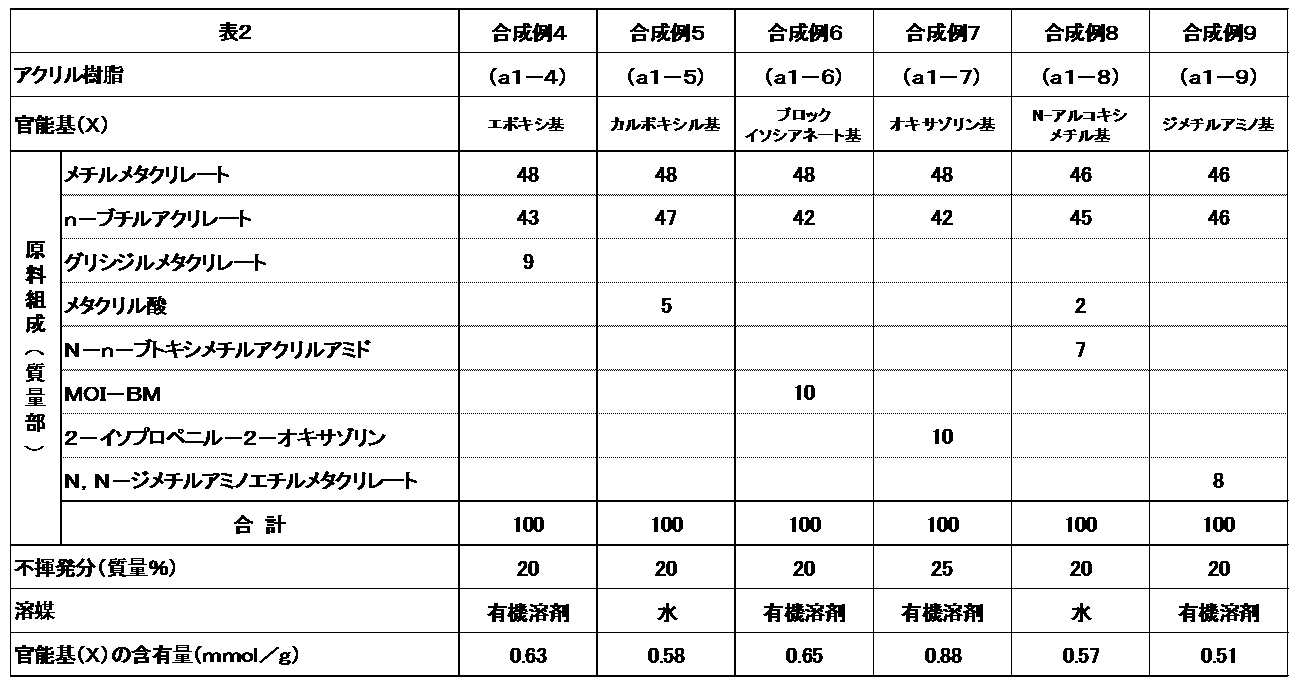
[合成例10:カルボキシル基を有するウレタン-アクリル複合樹脂(a1-10)の製造]
攪拌機、還流冷却管、窒素導入管、温度計、滴下漏斗を備えた反応容器に、脱イオン水140質量部、合成例1で得られたウレタン樹脂(a1-1)の水分散液200質量部(ウレタン樹脂(a1-1)として60質量部)を加え、窒素を吹き込みながら80℃まで昇温した。その後、攪拌しながら反応容器中に、メチルメタクリレート21質量部及びn-ブチルアクリレート19質量部の単量体混合物と、0.5質量%過硫酸アンモニウム水溶液10質量部とを、それぞれ別の滴下漏斗から滴下し、80℃に保ちながら120分間かけて滴下して重合した。
攪拌機、還流冷却管、窒素導入管、温度計、滴下漏斗を備えた反応容器に、脱イオン水140質量部、合成例1で得られたウレタン樹脂(a1-1)の水分散液200質量部(ウレタン樹脂(a1-1)として60質量部)を加え、窒素を吹き込みながら80℃まで昇温した。その後、攪拌しながら反応容器中に、メチルメタクリレート21質量部及びn-ブチルアクリレート19質量部の単量体混合物と、0.5質量%過硫酸アンモニウム水溶液10質量部とを、それぞれ別の滴下漏斗から滴下し、80℃に保ちながら120分間かけて滴下して重合した。
次いで、80℃で60分間攪拌した後、前記反応容器内の温度を40℃に冷却し、不揮発分が20質量%になるように脱イオン水を加えた後、200メッシュ濾布で濾過することによって、カルボキシル基及び水酸基を有するウレタン-アクリル複合樹脂(a1-10)の20質量%の水分散液を得た。このウレタン-アクリル複合樹脂(a1-10)は、カルボキシル基を有するウレタン樹脂(a1-1)からなるシェル層と、アクリル樹脂からなるコア層とによって構成されるものであった。
[合成例11:N-アルコキシメチル基を有するウレタン-アクリル複合樹脂(a1-11)の製造]
攪拌機、還流冷却管、窒素導入管、温度計、滴下漏斗を備えた反応容器に、脱イオン水140質量部、合成例1で得られたウレタン樹脂(a1-1)の水分散液166.7質量部(ウレタン樹脂(a1-1)として50質量部)を加え、窒素を吹き込みながら80℃まで昇温した。その後、攪拌しながら反応容器中に、メチルメタクリレート23質量部、n-ブチルアクリレート23質量部及びN-n-ブトキシメチルアクリルアミド4質量部の単量体混合物と、0.5質量%過硫酸アンモニウム水溶液10質量部とを、それぞれ別の滴下漏斗から滴下し、80℃に保ちながら120分間かけて滴下して重合した。
攪拌機、還流冷却管、窒素導入管、温度計、滴下漏斗を備えた反応容器に、脱イオン水140質量部、合成例1で得られたウレタン樹脂(a1-1)の水分散液166.7質量部(ウレタン樹脂(a1-1)として50質量部)を加え、窒素を吹き込みながら80℃まで昇温した。その後、攪拌しながら反応容器中に、メチルメタクリレート23質量部、n-ブチルアクリレート23質量部及びN-n-ブトキシメチルアクリルアミド4質量部の単量体混合物と、0.5質量%過硫酸アンモニウム水溶液10質量部とを、それぞれ別の滴下漏斗から滴下し、80℃に保ちながら120分間かけて滴下して重合した。
次いで、80℃で60分間攪拌した後、前記反応容器内の温度を40℃に冷却し、不揮発分が20質量%になるように脱イオン水を加えた後、200メッシュ濾布で濾過することによって、N-アルコキシメチル基を有するウレタン-アクリル複合樹脂(a1-11)の20質量%の水分散液を得た。このウレタン-アクリル複合樹脂(a1-11)は、カルボキシル基を有するウレタン樹脂(a1-1)からなるシェル層と、N-アルコキシメチル基を有するアクリル樹脂からなるコア層とによって構成されるものであった。
[合成例12:エポキシ基を有するウレタン-アクリル複合樹脂(a1-12)の製造]
攪拌機、還流冷却管、窒素導入管、温度計、滴下漏斗を備えた反応容器に、脱イオン水140質量部、合成例1で得られたウレタン樹脂(a1-1)の水分散液200質量部(ウレタン樹脂(a1-1)として60質量部)を加え、窒素を吹き込みながら80℃まで昇温した。その後、攪拌しながら反応容器中に、メチルメタクリレート18質量部、n-ブチルアクリレート17質量部及びグリシジルメタクリレート5質量部の単量体混合物と、0.5質量%過硫酸アンモニウム水溶液10質量部とを、それぞれ別の滴下漏斗から滴下し、80℃に保ちながら120分間かけて滴下して重合した。
攪拌機、還流冷却管、窒素導入管、温度計、滴下漏斗を備えた反応容器に、脱イオン水140質量部、合成例1で得られたウレタン樹脂(a1-1)の水分散液200質量部(ウレタン樹脂(a1-1)として60質量部)を加え、窒素を吹き込みながら80℃まで昇温した。その後、攪拌しながら反応容器中に、メチルメタクリレート18質量部、n-ブチルアクリレート17質量部及びグリシジルメタクリレート5質量部の単量体混合物と、0.5質量%過硫酸アンモニウム水溶液10質量部とを、それぞれ別の滴下漏斗から滴下し、80℃に保ちながら120分間かけて滴下して重合した。
次いで、80℃で60分間攪拌した後、前記反応容器内の温度を40℃に冷却し、不揮発分が20質量%になるように脱イオン水を加えた後、200メッシュ濾布で濾過することによって、エポキシ基を有するウレタン-アクリル複合樹脂(a1-12)の20質量%の水分散液を得た。このウレタン-アクリル複合樹脂(a1-12)は、カルボキシル基を有するウレタン樹脂(a1-1)からなるシェル層と、エポキシ基を有するアクリル樹脂からなるコア層とによって構成されるものであった。
[合成例13:アルコキシシリル基を有するウレタン-アクリル複合樹脂(a1-13)の製造]
攪拌機、還流冷却管、窒素導入管、温度計、滴下漏斗を備えた反応容器に、脱イオン水140質量部、合成例1で得られたウレタン樹脂(a1-1)の水分散液200質量部(ウレタン樹脂(a1-1)として60質量部)を加え、窒素を吹き込みながら80℃まで昇温した。その後、攪拌しながら反応容器中に、メチルメタクリレート22質量部、n-ブチルアクリレート15質量部、3-メタクリルオキシプロピルトリメトキシシラン3質量部の単量体混合物と、0.5質量%過硫酸アンモニウム水溶液10質量部とを、それぞれ別の滴下漏斗から滴下し、80℃に保ちながら120分間かけて滴下して重合した。
攪拌機、還流冷却管、窒素導入管、温度計、滴下漏斗を備えた反応容器に、脱イオン水140質量部、合成例1で得られたウレタン樹脂(a1-1)の水分散液200質量部(ウレタン樹脂(a1-1)として60質量部)を加え、窒素を吹き込みながら80℃まで昇温した。その後、攪拌しながら反応容器中に、メチルメタクリレート22質量部、n-ブチルアクリレート15質量部、3-メタクリルオキシプロピルトリメトキシシラン3質量部の単量体混合物と、0.5質量%過硫酸アンモニウム水溶液10質量部とを、それぞれ別の滴下漏斗から滴下し、80℃に保ちながら120分間かけて滴下して重合した。
次いで、80℃で60分間攪拌した後、前記反応容器内の温度を40℃に冷却し、不揮発分が20質量%になるように脱イオン水を加えた後、200メッシュ濾布で濾過することによって、アルコキシシリル基を有するウレタン-アクリル複合樹脂(a1-13)の20質量%の水分散液を得た。このウレタン-アクリル複合樹脂(a1-13)は、カルボキシル基を有するウレタン樹脂(a1-1)からなるシェル層と、アルコキシシリル基を有するアクリル樹脂からなるコア層とによって構成されるものであった。
上記の合成例10~13で製造したウレタン-アクリル複合樹脂(a1-10)~(a1-13)の原料組成等をまとめたものを表3に示す。
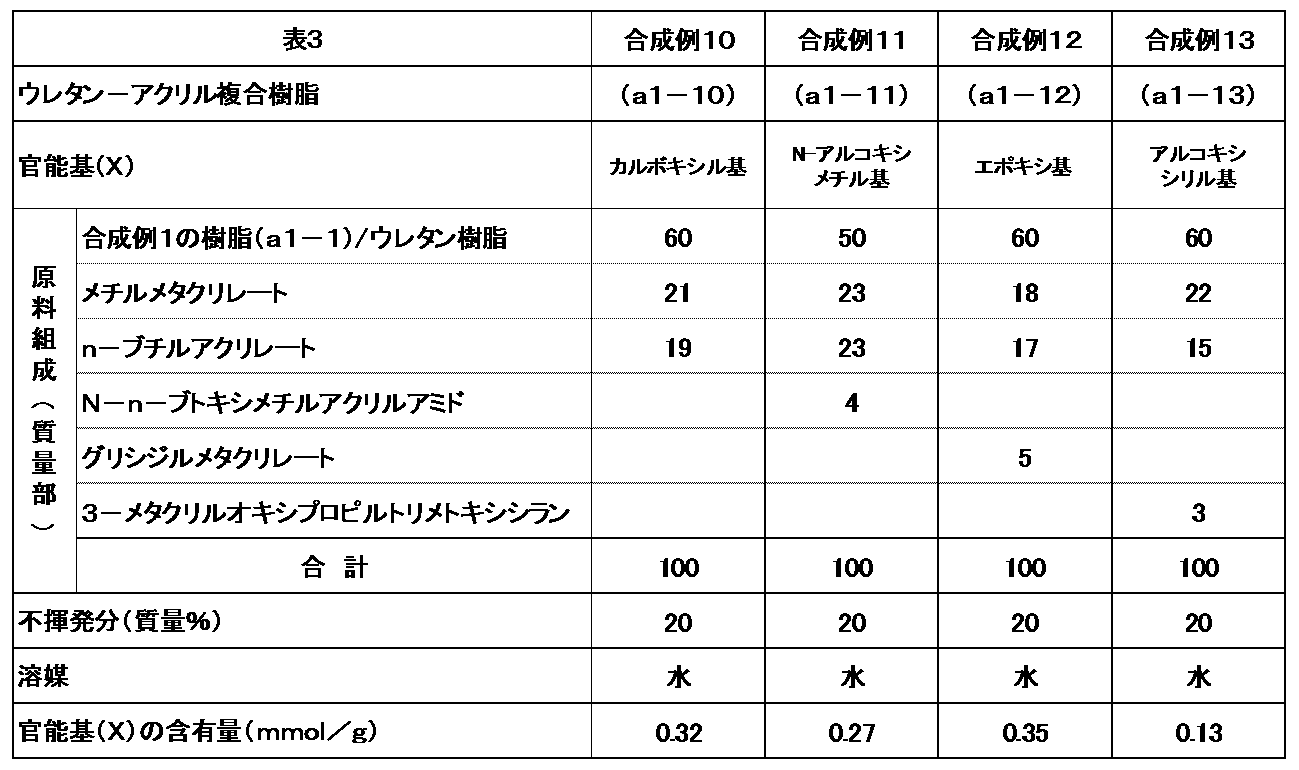
[合成例14:リン酸エステル基及びエポキシ基を有するアクリル樹脂(b1-1)の製造]
撹拌機、還流冷却管、窒素導入管、温度計、滴下漏斗を備えた反応容器に、メチルエチルケトン32質量部及びエタノール32質量部を加え、窒素気流下で80℃に昇温した。次いで、窒素雰囲気下で撹拌しながら、リン酸2-(メタクリロイルオキシ)エチル20質量部、メトキシポリエチレングリコールメタクリレート(分子量1,000)70質量部、グリシジルメタクリレート10質量部、メルカプトプロピオン酸メチル4.1質量部及びメチルエチルケトン80質量部の混合物と、重合開始剤(和光純薬株式会社製「V-65」、2,2’-アゾビス(2,4-ジメチルバレロニトリル))0.5質量部及びメチルエチルケトン5質量部の混合物とを、それぞれ別の滴下漏斗から2時間で滴下した。
撹拌機、還流冷却管、窒素導入管、温度計、滴下漏斗を備えた反応容器に、メチルエチルケトン32質量部及びエタノール32質量部を加え、窒素気流下で80℃に昇温した。次いで、窒素雰囲気下で撹拌しながら、リン酸2-(メタクリロイルオキシ)エチル20質量部、メトキシポリエチレングリコールメタクリレート(分子量1,000)70質量部、グリシジルメタクリレート10質量部、メルカプトプロピオン酸メチル4.1質量部及びメチルエチルケトン80質量部の混合物と、重合開始剤(和光純薬株式会社製「V-65」、2,2’-アゾビス(2,4-ジメチルバレロニトリル))0.5質量部及びメチルエチルケトン5質量部の混合物とを、それぞれ別の滴下漏斗から2時間で滴下した。
次いで、4時間ごとに重合開始剤(日油株式会社製「パーブチルO」、t-ブチルパーオキシ-2-エチルヘキサノエート)0.3質量部を2回加え、80℃で12時間攪拌した。得られた樹脂溶液に脱イオン水を加え転相乳化し、減圧脱溶剤した後、脱イオン水を加えて濃度を調整し、リン酸エステル基及びエポキシ基を有するアクリル樹脂(b1-1)の不揮発物76.8質量%水溶液を得た。このアクリル樹脂(b1-1)の重量平均分子量は4,200であり、酸価は96.2mgKOH/gであった。
[合成例15:リン酸エステル基及び水酸基を有するアクリル樹脂(b1-2)の製造]
合成例14で用いたグリシジルメタクリレートを2-ヒドロキシエチルメタクリレートに代えた以外は、合成例14と同様に行って、リン酸エステル基及び水酸基を有するアクリル樹脂(b1-2)の不揮発物76.5質量%の水分散液を得た。このアクリル樹脂(b1-2)の重量平均分子量は4,100であり、酸価は95.4mgKOH/gであった。
合成例14で用いたグリシジルメタクリレートを2-ヒドロキシエチルメタクリレートに代えた以外は、合成例14と同様に行って、リン酸エステル基及び水酸基を有するアクリル樹脂(b1-2)の不揮発物76.5質量%の水分散液を得た。このアクリル樹脂(b1-2)の重量平均分子量は4,100であり、酸価は95.4mgKOH/gであった。
[合成例16:リン酸エステル基及びカルボキシル基を有するアクリル樹脂(b1-3)の製造]
合成例14で用いたグリシジルメタクリレートをメタクリル酸に代え、メルカプトプロピオン酸メチル4.1質量部をメルカプトプロピオン酸2-エチルヘキシル11.2質量部に代えた以外は、合成例14と同様に行って、リン酸エステル基及びカルボキシル基を有するアクリル樹脂(b1-3)の不揮発物76.5質量%の水分散液を得た。このアクリル樹脂(b1-3)の重量平均分子量は4,200であり、酸価は146.0mgKOH/gであった。
合成例14で用いたグリシジルメタクリレートをメタクリル酸に代え、メルカプトプロピオン酸メチル4.1質量部をメルカプトプロピオン酸2-エチルヘキシル11.2質量部に代えた以外は、合成例14と同様に行って、リン酸エステル基及びカルボキシル基を有するアクリル樹脂(b1-3)の不揮発物76.5質量%の水分散液を得た。このアクリル樹脂(b1-3)の重量平均分子量は4,200であり、酸価は146.0mgKOH/gであった。
[合成例17:リン酸エステル基及びN-アルコキシメチル基を有するアクリル樹脂(b1-4)の製造]
合成例16で用いたメタクリル酸をN-メトキシメチルアクリルアミドに代えた以外は、合成例16と同様に行って、リン酸エステル基及びN-アルコキシメチル基を有するアクリル樹脂(b1-4)の不揮発物76.5質量%水溶液を得た。このアクリル樹脂(b1-4)の重量平均分子量は4,400であり、酸価は4.5mgKOH/gであった。
合成例16で用いたメタクリル酸をN-メトキシメチルアクリルアミドに代えた以外は、合成例16と同様に行って、リン酸エステル基及びN-アルコキシメチル基を有するアクリル樹脂(b1-4)の不揮発物76.5質量%水溶液を得た。このアクリル樹脂(b1-4)の重量平均分子量は4,400であり、酸価は4.5mgKOH/gであった。
[合成例18:アルコキシシリル基を有するアクリル樹脂(b1-5)の製造]
合成例16で用いたメタクリル酸を3-メタクリルオキシプロピルトリメトキシシランに代えた以外は、合成例16と同様に行って、リン酸エステル基及びN-アルコキシメチル基を有するアクリル樹脂(b1-4)の不揮発物76.5質量%水溶液を得た。このアクリル樹脂(b1-4)の重量平均分子量は4,400であり、酸価は5.4mgKOH/gであった。
合成例16で用いたメタクリル酸を3-メタクリルオキシプロピルトリメトキシシランに代えた以外は、合成例16と同様に行って、リン酸エステル基及びN-アルコキシメチル基を有するアクリル樹脂(b1-4)の不揮発物76.5質量%水溶液を得た。このアクリル樹脂(b1-4)の重量平均分子量は4,400であり、酸価は5.4mgKOH/gであった。
[合成例19:リン酸エステル基のみを有するアクリル樹脂(b1-6)の製造]
合成例14で用いたメトキシポリエチレングリコールメタクリレートの仕込み量を70質量部から80質量部に変更し、グリシジルメタクリレートを用いなかった以外は、合成例12と同様に行って、リン酸エステル基のみを有するアクリル樹脂(b1-6)の不揮発物76.8質量%水溶液を得た。このアクリル樹脂(b1-6)の重量平均分子量は4,300、酸価は97.5mgKOH/gであった。
合成例14で用いたメトキシポリエチレングリコールメタクリレートの仕込み量を70質量部から80質量部に変更し、グリシジルメタクリレートを用いなかった以外は、合成例12と同様に行って、リン酸エステル基のみを有するアクリル樹脂(b1-6)の不揮発物76.8質量%水溶液を得た。このアクリル樹脂(b1-6)の重量平均分子量は4,300、酸価は97.5mgKOH/gであった。
上記の合成例14~19で製造したアクリル樹脂(b1-1)~(b1-6)の原料組成等をまとめたものを表4に示す。

[調製例1:流動体(b-1)の調製]
N,N-ジエチルヒドロキシルアミンの85質量%水溶液5.56g(53mmol)、合成例12で得られたアクリル樹脂(b1-1)の76.8質量%水分散液138mg(アクリル樹脂(b1-1)として106mg)及び脱イオン水15gを混合して還元剤溶液を調製した。
N,N-ジエチルヒドロキシルアミンの85質量%水溶液5.56g(53mmol)、合成例12で得られたアクリル樹脂(b1-1)の76.8質量%水分散液138mg(アクリル樹脂(b1-1)として106mg)及び脱イオン水15gを混合して還元剤溶液を調製した。
一方、合成例14で得られたアクリル樹脂(b1-1)の76.8質量%水分散液138mg(アクリル樹脂(b1-1)として106mg)を水5gに溶解し、これに硝酸銀6.00g(35.3mmol)を水10gに溶かした溶液を加えて攪拌した。この混合物に、上記で得られた還元剤溶液を25℃で2時間かけて滴下した。滴下終了後、得られた液をメンブレンフィルター(細孔径0.45μm)で濾過し、濾液を中空糸型限外濾過モジュール(ダイセン・メンブレン・システムズ社製「MOLSEPモジュールHIT-1型」、分画分子量15万)中に循環させ、流出する濾液の量に対応する量の水を随時添加して精製した。濾液の電導度が100μS/cm以下になったことを確認した後、注水を中止して濃縮した。濃縮物を回収することによって、不揮発物30質量%の銀ナノ粒子の水分散液である流動体(b-1)を得た。この流動体(b-1)中の銀ナノ粒子の粒径は、電子顕微鏡(TEM)像から10~40nmであることが確認された。
[調製例2~6:流動体(b-2)~(b-6)の調製]
調製例1で用いたアクリル樹脂(b1-1)に代えて、合成例15~19で得られたアクリル樹脂(b1-2)~(b1-6)を用いた以外は調製例1と同様に行い、銀ナノ粒子の水分散液である流動体(b-2)~(b-6)を得た。
調製例1で用いたアクリル樹脂(b1-1)に代えて、合成例15~19で得られたアクリル樹脂(b1-2)~(b1-6)を用いた以外は調製例1と同様に行い、銀ナノ粒子の水分散液である流動体(b-2)~(b-6)を得た。
[実施例1:導電性パターン(1)の作製]
合成例1で得られたウレタン樹脂(a1-1)の水分散液を、乾燥膜厚が1μmになるように、ポリイミドフィルム(東レ・デュポン株式会社製「Kapton150ENC」厚さ50μm)の表面に、スピンコーターを用いて塗布し、熱風乾燥機を用いて80℃で3分間乾燥して、支持体上にプライマー層(A)の前駆体である塗膜(a)を形成した。
合成例1で得られたウレタン樹脂(a1-1)の水分散液を、乾燥膜厚が1μmになるように、ポリイミドフィルム(東レ・デュポン株式会社製「Kapton150ENC」厚さ50μm)の表面に、スピンコーターを用いて塗布し、熱風乾燥機を用いて80℃で3分間乾燥して、支持体上にプライマー層(A)の前駆体である塗膜(a)を形成した。
上記の塗膜(a)の表面に、調製例1で得られた流動体(b-1)をインクジェットインクとして、インクジェット印刷機(コニカミノルタ株式会社製「インクジェット試験機EB100」、評価用プリンタヘッドKM512M、吐出量14pl)を用いて、線幅100μm、膜厚0.5μmの直線を1cm印刷した。次いで、150℃で30分間焼成することによって、導電性パターン(1)を得た。この導電性パターン(1)では、ウレタン樹脂(a1-1)が有するカルボキシル基と、流動体(b-1)中に含まれるアクリル樹脂(b1-1)が有するエポキシ基とが焼成の加熱処理によって、結合を形成する組み合わせとなる。
[実施例2~12:導電性パターン(2)~(12)の作製]
表5及び6に示したプライマー層(A)に用いる前記樹脂(a1)と、導電層(B)に用いる前記樹脂(b1)との組み合わせにより、実施例1と同様に行い、導電性パターン(2)~(12)を得た。
表5及び6に示したプライマー層(A)に用いる前記樹脂(a1)と、導電層(B)に用いる前記樹脂(b1)との組み合わせにより、実施例1と同様に行い、導電性パターン(2)~(12)を得た。
[比較例1~4:導電性パターン(R1)~(R4)の作製]
表7に示したプライマー層(A)に用いる前記樹脂(a1)と、導電層(B)に用いる前記樹脂(b1)との組み合わせにより、実施例1と同様に行い、導電性パターン(R1)~(R4)を得た。
表7に示したプライマー層(A)に用いる前記樹脂(a1)と、導電層(B)に用いる前記樹脂(b1)との組み合わせにより、実施例1と同様に行い、導電性パターン(R1)~(R4)を得た。
[密着性の評価]
上記の実施例1~10及び比較例1~4で得られた導電性パターン(1)~(10)及び(R1)~(R4)のそれぞれについて、下記の方法により、密着性の評価を行った。
上記の実施例1~10及び比較例1~4で得られた導電性パターン(1)~(10)及び(R1)~(R4)のそれぞれについて、下記の方法により、密着性の評価を行った。
[プライマー層と導電層との密着性の評価方法]
上記で得られた導電性パターンの導電層の表面にセロハン粘着テープ(ニチバン株式会社製「CT405AP-24」、テープ幅24mm)を指で圧着した後、前記セロハン粘着テープを、前記導電性パターンの導電層の表面に対して90度方向に剥離した。剥離したセロハン粘着テープの粘着面を目視で観察し、下記の基準にしたがって密着性を評価した。
A:粘着テープの粘着面に、銀を含む導電層が全く付着しなかった。
B:導電層と粘着テープとが接触した面積の3%未満の範囲で導電層がプライマー層から剥離し、粘着テープの粘着面に付着した。
C:導電層と粘着テープとが接触した面積の3%以上30%未満の範囲で導電層がプライマー層から剥離し、粘着テープの粘着面に付着した。
D:導電層と粘着テープとが接触した面積の30%以上の範囲で導電層がプライマー層から剥離し、粘着テープの粘着面に付着した。
上記で得られた導電性パターンの導電層の表面にセロハン粘着テープ(ニチバン株式会社製「CT405AP-24」、テープ幅24mm)を指で圧着した後、前記セロハン粘着テープを、前記導電性パターンの導電層の表面に対して90度方向に剥離した。剥離したセロハン粘着テープの粘着面を目視で観察し、下記の基準にしたがって密着性を評価した。
A:粘着テープの粘着面に、銀を含む導電層が全く付着しなかった。
B:導電層と粘着テープとが接触した面積の3%未満の範囲で導電層がプライマー層から剥離し、粘着テープの粘着面に付着した。
C:導電層と粘着テープとが接触した面積の3%以上30%未満の範囲で導電層がプライマー層から剥離し、粘着テープの粘着面に付着した。
D:導電層と粘着テープとが接触した面積の30%以上の範囲で導電層がプライマー層から剥離し、粘着テープの粘着面に付着した。
[めっき層積層後の密着性の評価方法(折り曲げ密着性)]
上記で得られた導電性パターンの導電層の表面を陰極とし、含リン銅を陽極として、硫酸銅を含む電解めっき液を用いて電流密度2A/dm2で15分間電解めっきを行うことによって、前記導電層の表面に厚さ8μmの銅めっき層を積層した。なお、電解めっき液は、硫酸銅70g/L、硫酸200g/L、塩素イオン50mg/L、トップルチナSF(奥野製薬工業株式会社製の光沢剤)5g/Lを含むものである。次いで、得られた銅めっき層を積層した導電性パターンのめっき層が外側となるように180度折り曲げた後、元の状態に戻した導電性パターンを目視で観察し、下記の基準にしたがって折り曲げ密着性を評価した。
A:導電層及びめっき層の剥離が確認できなかった。
B:導電層のごく一部がプライマー層から剥離した。
C:導電層の一部がプライマー層から剥離した。
D:前記めっき工程の途中で、導電層の一部がプライマー層から剥離した。
上記で得られた導電性パターンの導電層の表面を陰極とし、含リン銅を陽極として、硫酸銅を含む電解めっき液を用いて電流密度2A/dm2で15分間電解めっきを行うことによって、前記導電層の表面に厚さ8μmの銅めっき層を積層した。なお、電解めっき液は、硫酸銅70g/L、硫酸200g/L、塩素イオン50mg/L、トップルチナSF(奥野製薬工業株式会社製の光沢剤)5g/Lを含むものである。次いで、得られた銅めっき層を積層した導電性パターンのめっき層が外側となるように180度折り曲げた後、元の状態に戻した導電性パターンを目視で観察し、下記の基準にしたがって折り曲げ密着性を評価した。
A:導電層及びめっき層の剥離が確認できなかった。
B:導電層のごく一部がプライマー層から剥離した。
C:導電層の一部がプライマー層から剥離した。
D:前記めっき工程の途中で、導電層の一部がプライマー層から剥離した。
プライマー層(A)に用いる前記樹脂(a1)と、導電層(B)に用いる前記樹脂(b1)との組み合わせ及び密着性の評価結果をまとめたものを表5~7に示す。


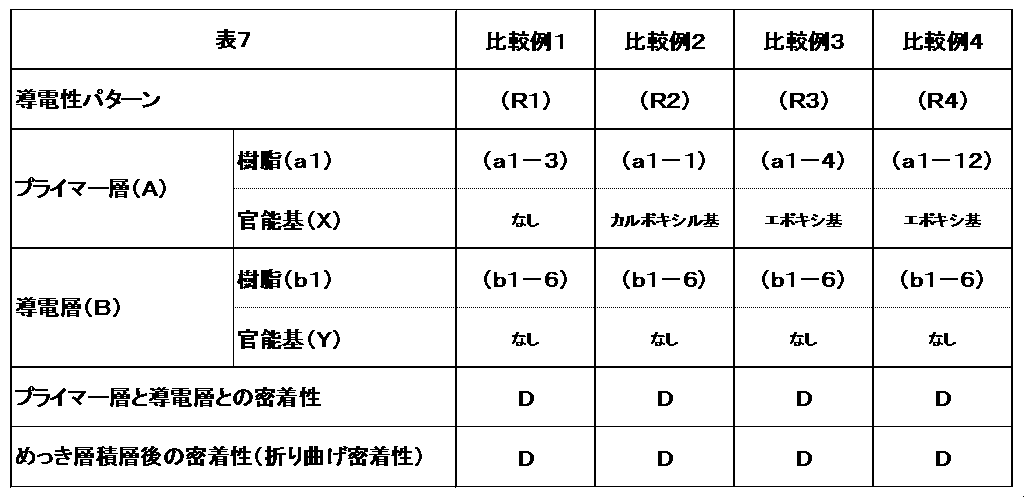
本発明の導電性パターンである実施例1~12で得られた導電性パターン(1)~(12)は、支持体、プライマー層、導電層及びめっき層の各層間の密着性は良好であることが確認できた。
一方、比較例1~4で得られた導電性パターン(R1)~(R4)は、前記官能基(X)又は前記官能基(Y)の両方又は一方を有さない例である。これらの導電性パターンは、支持体、プライマー層と導電層との間の密着性に劣っており、導電層上にめっき層を積層する工程において、導電層の一部がプライマー層から剥離し、めっき層を積層できない問題があった。
Claims (6)
- 支持体上に、反応性官能基(X)を有する樹脂(a1)を含有するプライマー層(A)と、リン酸エステル基及び前記官能基(X)と反応して結合を形成する反応性官能基(Y)を有する樹脂(b1)並びに導電性物質(b2)を含有する導電層(B)とを順次積層した導電性パターンであって、前記官能基(X)と前記官能基(Y)とを反応させ結合を形成したものであることを特徴とする導電性パターン。
- 前記官能基(X)が、カルボキシル基、イソシアネート基、ブロックイソシアネート基、エポキシ基、水酸基、オキサゾリン基、N-メチロール基、N-アルコキシメチル基、アミノ基及びアルコキシシリル基からなる群から選ばれる1種以上の官能基であり、前記官能基(Y)が、カルボキシル基、イソシアネート基、ブロックイソシアネート基、エポキシ基、水酸基、オキサゾリン基、N-メチロール基、N-アルコキシメチル基、アミノ基及びアルコキシシリル基からなる群から選ばれる1種以上の官能基である請求項1記載の導電性パターン。
- 前記樹脂(a1)がウレタン樹脂及び/又はアクリル樹脂であり、前記樹脂(b1)がアクリル樹脂である請求項1又は2記載の導電性パターン。
- 前記導電層(B)の表面に、さらにめっき層(C)が積層した請求項1~3のいずれか1項記載の導電性パターン。
- 請求項1~4のいずれか1項記載の導電性パターンを有することを特徴とする電子回路。
- 請求項1~4のいずれか1項記載の導電性パターンからなることを特徴とする電磁波シールド。
Priority Applications (1)
| Application Number | Priority Date | Filing Date | Title |
|---|---|---|---|
| JP2016566136A JP6103161B2 (ja) | 2014-12-25 | 2015-12-15 | 導電性パターン、電子回路及び電磁波シールド |
Applications Claiming Priority (2)
| Application Number | Priority Date | Filing Date | Title |
|---|---|---|---|
| JP2014262376 | 2014-12-25 | ||
| JP2014-262376 | 2014-12-25 |
Publications (1)
| Publication Number | Publication Date |
|---|---|
| WO2016104249A1 true WO2016104249A1 (ja) | 2016-06-30 |
Family
ID=56150274
Family Applications (1)
| Application Number | Title | Priority Date | Filing Date |
|---|---|---|---|
| PCT/JP2015/085052 Ceased WO2016104249A1 (ja) | 2014-12-25 | 2015-12-15 | 導電性パターン、電子回路及び電磁波シールド |
Country Status (3)
| Country | Link |
|---|---|
| JP (1) | JP6103161B2 (ja) |
| TW (1) | TW201637528A (ja) |
| WO (1) | WO2016104249A1 (ja) |
Cited By (3)
| Publication number | Priority date | Publication date | Assignee | Title |
|---|---|---|---|---|
| WO2018056052A1 (ja) * | 2016-09-21 | 2018-03-29 | バンドー化学株式会社 | 導電性被膜複合体及びその製造方法 |
| WO2020003878A1 (ja) * | 2018-06-26 | 2020-01-02 | Dic株式会社 | プリント配線板の製造方法 |
| WO2020003877A1 (ja) * | 2018-06-26 | 2020-01-02 | Dic株式会社 | プリント配線板の製造方法 |
Families Citing this family (2)
| Publication number | Priority date | Publication date | Assignee | Title |
|---|---|---|---|---|
| JP6555403B1 (ja) * | 2018-07-30 | 2019-08-07 | 東洋インキScホールディングス株式会社 | 電磁波シールドシート付きプリント配線板 |
| CN115666118B (zh) * | 2022-10-26 | 2025-12-05 | 南京理工大学 | 基于液体金属的柔性多层电磁屏蔽复合薄膜及其制备方法 |
Citations (3)
| Publication number | Priority date | Publication date | Assignee | Title |
|---|---|---|---|---|
| WO2013146195A1 (ja) * | 2012-03-28 | 2013-10-03 | Dic株式会社 | 導電性パターン、電気回路、電磁波シールド、及び、導電性パターンの製造方法 |
| JP2014196556A (ja) * | 2013-03-07 | 2014-10-16 | Dic株式会社 | 導電性材料の製造方法及び導電性材料 |
| JP2014205905A (ja) * | 2013-03-19 | 2014-10-30 | Dic株式会社 | 導電性材料の製造方法及び導電性材料 |
-
2015
- 2015-12-15 JP JP2016566136A patent/JP6103161B2/ja active Active
- 2015-12-15 WO PCT/JP2015/085052 patent/WO2016104249A1/ja not_active Ceased
- 2015-12-25 TW TW104143697A patent/TW201637528A/zh unknown
Patent Citations (3)
| Publication number | Priority date | Publication date | Assignee | Title |
|---|---|---|---|---|
| WO2013146195A1 (ja) * | 2012-03-28 | 2013-10-03 | Dic株式会社 | 導電性パターン、電気回路、電磁波シールド、及び、導電性パターンの製造方法 |
| JP2014196556A (ja) * | 2013-03-07 | 2014-10-16 | Dic株式会社 | 導電性材料の製造方法及び導電性材料 |
| JP2014205905A (ja) * | 2013-03-19 | 2014-10-30 | Dic株式会社 | 導電性材料の製造方法及び導電性材料 |
Cited By (8)
| Publication number | Priority date | Publication date | Assignee | Title |
|---|---|---|---|---|
| WO2018056052A1 (ja) * | 2016-09-21 | 2018-03-29 | バンドー化学株式会社 | 導電性被膜複合体及びその製造方法 |
| JPWO2018056052A1 (ja) * | 2016-09-21 | 2018-09-20 | バンドー化学株式会社 | 導電性被膜複合体及びその製造方法 |
| CN109716450A (zh) * | 2016-09-21 | 2019-05-03 | 阪东化学株式会社 | 导电性涂层复合体及其制造方法 |
| TWI783947B (zh) * | 2016-09-21 | 2022-11-21 | 日商阪東化學股份有限公司 | 導電性塗層複合體及其製造方法 |
| WO2020003878A1 (ja) * | 2018-06-26 | 2020-01-02 | Dic株式会社 | プリント配線板の製造方法 |
| WO2020003877A1 (ja) * | 2018-06-26 | 2020-01-02 | Dic株式会社 | プリント配線板の製造方法 |
| JPWO2020003877A1 (ja) * | 2018-06-26 | 2020-09-03 | Dic株式会社 | プリント配線板の製造方法 |
| JPWO2020003878A1 (ja) * | 2018-06-26 | 2020-09-17 | Dic株式会社 | プリント配線板の製造方法 |
Also Published As
| Publication number | Publication date |
|---|---|
| JPWO2016104249A1 (ja) | 2017-04-27 |
| TW201637528A (zh) | 2016-10-16 |
| JP6103161B2 (ja) | 2017-03-29 |
Similar Documents
| Publication | Publication Date | Title |
|---|---|---|
| TWI540945B (zh) | 導電性圖案、電路以及電磁波遮蔽 | |
| TWI508855B (zh) | A layered product, a conductive pattern, and a laminate method | |
| TWI551433B (zh) | Laminated body, conductive pattern, circuit, and laminate | |
| JP6103161B2 (ja) | 導電性パターン、電子回路及び電磁波シールド | |
| TWI558287B (zh) | A method of forming a high-precision conductive pattern, a high-precision conductive pattern and a circuit | |
| JP5652687B1 (ja) | 高精細金属パターンの形成方法、高精細金属パターン及び電子部品 | |
| TWI513588B (zh) | Laminated body, conductive pattern, circuit, and laminate | |
| TWI548524B (zh) | Laminated body, conductive pattern and circuit | |
| WO2013179965A1 (ja) | 導電性パターン、導電回路及び導電性パターンの製造方法 | |
| JPWO2013172229A1 (ja) | 導電性パターン、導電回路及び導電性パターンの製造方法 | |
| JP2015032734A (ja) | 導電性パターン及び導電回路 | |
| WO2015037512A1 (ja) | 導電性パターンおよび電子回路 |
Legal Events
| Date | Code | Title | Description |
|---|---|---|---|
| 121 | Ep: the epo has been informed by wipo that ep was designated in this application |
Ref document number: 15872818 Country of ref document: EP Kind code of ref document: A1 |
|
| ENP | Entry into the national phase |
Ref document number: 2016566136 Country of ref document: JP Kind code of ref document: A |
|
| NENP | Non-entry into the national phase |
Ref country code: DE |
|
| 122 | Ep: pct application non-entry in european phase |
Ref document number: 15872818 Country of ref document: EP Kind code of ref document: A1 |