WO2016104182A1 - 安定剤造粒物 - Google Patents
安定剤造粒物 Download PDFInfo
- Publication number
- WO2016104182A1 WO2016104182A1 PCT/JP2015/084769 JP2015084769W WO2016104182A1 WO 2016104182 A1 WO2016104182 A1 WO 2016104182A1 JP 2015084769 W JP2015084769 W JP 2015084769W WO 2016104182 A1 WO2016104182 A1 WO 2016104182A1
- Authority
- WO
- WIPO (PCT)
- Prior art keywords
- stabilizer
- carbon atoms
- granulated product
- group
- mass
- Prior art date
- Legal status (The legal status is an assumption and is not a legal conclusion. Google has not performed a legal analysis and makes no representation as to the accuracy of the status listed.)
- Ceased
Links
Classifications
-
- C—CHEMISTRY; METALLURGY
- C08—ORGANIC MACROMOLECULAR COMPOUNDS; THEIR PREPARATION OR CHEMICAL WORKING-UP; COMPOSITIONS BASED THEREON
- C08K—Use of inorganic or non-macromolecular organic substances as compounding ingredients
- C08K3/00—Use of inorganic substances as compounding ingredients
- C08K3/18—Oxygen-containing compounds, e.g. metal carbonyls
- C08K3/20—Oxides; Hydroxides
- C08K3/22—Oxides; Hydroxides of metals
-
- C—CHEMISTRY; METALLURGY
- C08—ORGANIC MACROMOLECULAR COMPOUNDS; THEIR PREPARATION OR CHEMICAL WORKING-UP; COMPOSITIONS BASED THEREON
- C08K—Use of inorganic or non-macromolecular organic substances as compounding ingredients
- C08K3/00—Use of inorganic substances as compounding ingredients
- C08K3/18—Oxygen-containing compounds, e.g. metal carbonyls
- C08K3/24—Acids; Salts thereof
- C08K3/26—Carbonates; Bicarbonates
-
- C—CHEMISTRY; METALLURGY
- C08—ORGANIC MACROMOLECULAR COMPOUNDS; THEIR PREPARATION OR CHEMICAL WORKING-UP; COMPOSITIONS BASED THEREON
- C08K—Use of inorganic or non-macromolecular organic substances as compounding ingredients
- C08K5/00—Use of organic ingredients
- C08K5/49—Phosphorus-containing compounds
- C08K5/51—Phosphorus bound to oxygen
- C08K5/52—Phosphorus bound to oxygen only
- C08K5/527—Cyclic esters
-
- C—CHEMISTRY; METALLURGY
- C08—ORGANIC MACROMOLECULAR COMPOUNDS; THEIR PREPARATION OR CHEMICAL WORKING-UP; COMPOSITIONS BASED THEREON
- C08L—COMPOSITIONS OF MACROMOLECULAR COMPOUNDS
- C08L101/00—Compositions of unspecified macromolecular compounds
-
- C—CHEMISTRY; METALLURGY
- C09—DYES; PAINTS; POLISHES; NATURAL RESINS; ADHESIVES; COMPOSITIONS NOT OTHERWISE PROVIDED FOR; APPLICATIONS OF MATERIALS NOT OTHERWISE PROVIDED FOR
- C09K—MATERIALS FOR MISCELLANEOUS APPLICATIONS, NOT PROVIDED FOR ELSEWHERE
- C09K15/00—Anti-oxidant compositions; Compositions inhibiting chemical change
- C09K15/04—Anti-oxidant compositions; Compositions inhibiting chemical change containing organic compounds
- C09K15/32—Anti-oxidant compositions; Compositions inhibiting chemical change containing organic compounds containing two or more of boron, silicon, phosphorus, selenium, tellurium or a metal
Definitions
- the present invention is a stabilizer granule, specifically, it is difficult for hydrolysis to occur even after long-term storage, and when added to an organic material, can exhibit a stable thermal deterioration / oxidative deterioration suppressing function,
- the present invention also relates to a stabilizer granulated product having excellent workability.
- Organic materials such as thermoplastic resins and thermosetting resins such as polyolefin and polyester are organic materials caused by phenomena such as molecular cutting and molecular cross-linking due to the action of heat and oxygen during manufacturing, processing and use.
- the commercial value may be remarkably impaired due to a decrease in strength physical properties, a change in flow properties, coloring, a decrease in surface physical properties, and the like.
- Such an antioxidant acts as a stabilizer for the organic material, and exerts an effect of suppressing thermal deterioration and oxidation deterioration during the production, processing and further use of the organic material.
- the present invention is a stabilizer that is difficult to hydrolyze even after storage for a long period of time, can exhibit a stable thermal deterioration / oxidative deterioration suppressing function when added to an organic material, and is excellent in workability.
- the purpose is to provide a granulated product.
- R 1 , R 2 , R 4 and R 5 each independently represents a hydrogen atom, an alkyl group having 1 to 8 carbon atoms, a cycloalkyl group having 5 to 8 carbon atoms, or an alkylcyclohexane having 6 to 12 carbon atoms.
- R 3 represents an alkyl group, an aralkyl group having 7 to 12 carbon atoms or a phenyl group, and R 3 represents a hydrogen atom or an alkyl group having 1 to 8 carbon atoms.
- X represents a single bond, a sulfur atom or a —CHR 6 — group.
- R 6 represents a hydrogen atom, an alkyl group having 1 to 8 carbon atoms, or a cycloalkyl group having 5 to 8 carbon atoms.
- A represents an alkylene group having 2 to 8 carbon atoms or a * —COR 7 — group.
- R 7 represents a single bond or an alkylene group having 1 to 8 carbon atoms, and —CO— marked with * represents that it is bonded to an oxygen atom of the phosphite structure in the formula (1).
- One of Y and Z represents a hydroxyl group, an alkoxy group having 1 to 8 carbon atoms or an aralkyloxy group having 7 to 12 carbon atoms, and the other represents a hydrogen atom or an alkyl group having 1 to 8 carbon atoms.
- R 4 or R 5 is an alkyl group having 3 to 8 carbon atoms, a cycloalkyl group having 5 to 8 carbon atoms, or an alkylcycloalkyl group having 6 to 12 carbon atoms.
- two R 1 s in the formula (1) may be the same or different.
- composition according to [1] comprising 30 to 99% by mass of a phosphite compound and 1 to 70% by mass of a metal oxide and / or a metal carbonate with respect to 100% by mass of the granulated stabilizer.
- Stabilizer granulate [4] The stabilizer granulated product according to any one of [1] to [3], further containing a binder.
- Stabilizer granule having a flake shape has a flake length of 0.5 to 15 mm and a thickness of 0.5 to 5 mm.
- the stabilizer granulated product according to [6] which has a pellet diameter of 10 mm and a pellet length of 0.1 to 20 mm.
- the stabilizer granule having a flake shape has a flake length of 0.5 to 15 mm and a thickness of 0.5 to 5 mm, and the stabilizer granule having a pellet shape is 0.1 to
- the stabilizer granulated product according to [6] which has a pellet diameter of 5 mm and a pellet length of 0.1 to 10 mm.
- the stabilizer granulated product of the present invention is hardly hydrolyzed even after storage for a long period of time, and does not easily cause a bridging phenomenon, and can be uniformly added to an organic material. It is possible to provide a stabilizer granulated product that exhibits a stable thermal deterioration / oxidation deterioration suppressing function and is excellent in workability.
- the stabilizer granulated product of the present invention contains a phosphite compound represented by the formula (1) and a metal oxide and / or a metal carbonate.
- the substituents R 1 , R 2 , R 4 and R 5 are each independently a hydrogen atom, an alkyl group having 1 to 8 carbon atoms, or a carbon number of 5 Represents a cycloalkyl group having 8 to 8 carbon atoms, an alkylcycloalkyl group having 6 to 12 carbon atoms, an aralkyl group having 7 to 12 carbon atoms, or a phenyl group.
- the substituents R 1 , R 2 and R 4 are preferably each independently an alkyl group having 1 to 8 carbon atoms, a cycloalkyl group having 5 to 8 carbon atoms, or an alkylcycloalkyl group having 6 to 12 carbon atoms.
- the substituent R 5 is preferably a hydrogen atom, an alkyl group having 1 to 8 carbon atoms, or a cycloalkyl group having 5 to 8 carbon atoms.
- alkyl group having 1 to 8 carbon atoms include, for example, methyl, ethyl, n-propyl, isopropyl, n-butyl, isobutyl, sec-butyl, t-butyl, t-pentyl, isooctyl, t -Octyl, 2-ethylhexyl and the like.
- Representative examples of the cycloalkyl group having 5 to 8 carbon atoms include, for example, cyclopentyl, cyclohexyl, cycloheptyl, cyclooctyl, and the like, and typical examples of the alkylcycloalkyl group having 6 to 12 carbon atoms include, for example, 1-methylcyclopentyl. Examples include 1-methylcyclohexyl, 1-methyl-4-isopropylcyclohexyl and the like.
- Representative examples of the aralkyl group having 7 to 12 carbon atoms include benzyl, ⁇ -methylbenzyl, ⁇ , ⁇ -dimethylbenzyl and the like.
- the substituents R 1 and R 4 are preferably each independently a t-alkyl group such as t-butyl, t-pentyl, t-octyl, cyclohexyl, or 1-methylcyclohexyl group.
- the substituent R 2 is preferably an alkyl group having 1 to 5 carbon atoms such as methyl, ethyl, n-propyl, isopropyl, n-butyl, isobutyl, sec-butyl, t-butyl, t-pentyl, etc. , T-butyl and t-pentyl are particularly preferable.
- the substituent R 5 is a hydrogen atom, an alkyl group having 1 to 5 carbon atoms such as methyl, ethyl, n-propyl, isopropyl, n-butyl, isobutyl, sec-butyl, t-butyl, t-pentyl and the like. preferable.
- the substituent R 3 represents a hydrogen atom or an alkyl group having 1 to 8 carbon atoms.
- Examples of the alkyl group having 1 to 8 carbon atoms include the same alkyl groups as described above.
- a hydrogen atom or an alkyl group having 1 to 5 carbon atoms is preferable, and a hydrogen atom or a methyl group is particularly preferable.
- the substituent X represents a methylene group which may be substituted by a single bond, a sulfur atom, alkyl having 1 to 8 carbon atoms or cycloalkyl having 5 to 8 carbon atoms.
- examples of the alkyl having 1 to 8 carbon atoms and the cycloalkyl having 5 to 8 carbon atoms substituted on the methylene group include the same alkyl groups and cycloalkyl groups as described above.
- X is preferably a single bond, a methylene group or a methylene group substituted by methyl, ethyl, n-propyl, isopropyl, n-butyl, isobutyl, t-butyl or the like.
- Substituent A is an alkylene group having 2 to 8 carbon atoms or * —COR 7 — group (R 7 is a single bond or an alkylene group having 1 to 8 carbon atoms, and * is bonded to the oxygen side. .)
- typical examples of the alkylene group having 2 to 8 carbon atoms include ethylene, propylene, butylene, pentamethylene, hexamethylene, octamethylene, 2,2-dimethyl-1,3-propylene, and the like. Propylene is preferably used.
- the * in the * —COR 7 — group indicates that the carbonyl is bonded to the phosphite oxygen.
- Typical examples of the alkylene group having 1 to 8 carbon atoms in R 7 include methylene, ethylene, propylene, butylene, pentamethylene, hexamethylene, octamethylene, 2,2-dimethyl-1,3-propylene and the like. It is done.
- R 7 is preferably a single bond or ethylene.
- Y and Z each represents a hydroxyl group, an alkoxy group having 1 to 8 carbon atoms or an aralkyloxy group having 7 to 12 carbon atoms, and the other represents a hydrogen atom or an alkyl group having 1 to 8 carbon atoms.
- examples of the alkyl group having 1 to 8 carbon atoms include the same alkyl groups as described above.
- examples of the alkoxy group having 1 to 8 carbon atoms include, for example, an alkyl moiety having the above-described alkyl having 1 to 8 carbon atoms.
- the alkoxy group which is the same alkyl is mentioned.
- Examples of the aralkyloxy group having 7 to 12 carbon atoms include an aralkyloxy group in which the aralkyl moiety is the same aralkyl as the aralkyl having 7 to 12 carbon atoms.
- phosphite compound represented by the formula (1) include 6- [3- (3-t-butyl-4-hydroxy-5-methylphenyl) propoxy] -2,4,8. , 10-tetra-t-butyldibenzo [d, f] [1,3,2] dioxaphosphepine (Sumilyzer (registered trademark) GP, manufactured by Sumitomo Chemical Co., Ltd.), 2,10-dimethyl-4,8 -Di-t-butyl-6- [3- (3,5-di-t-butyl-4-hydroxyphenyl) propoxy] -12H-dibenzo [d, g] [1,3,2] dioxaphosphocin 2,4,8,10-tetra-tert-butyl-6- [3- (3,5-di-tert-butyl-4-hydroxyphenyl) propoxy] dibenzo [d, f] [1,3,2 Dioxaphosphepine, 2,4,8,10
- the stabilizer granulated product of the present invention is, for example, 30 to 99.9% by mass, preferably 30 to 99% by mass, more preferably 40 to 99% by mass, and still more preferably, based on the total amount of the stabilizer granulated product.
- Examples of the metal oxide in the present invention include silicon-containing oxides [for example, aluminosilicate (aluminum silicate), silica (synthetic silica, natural silica), diatomaceous earth, glass fiber, talc, kaolin, mica, zeolite, etc.], alumina, oxidation Examples thereof include zinc, titanium oxide, calcium oxide, magnesium oxide, iron oxide, tin oxide, antimony oxide, antimony trioxide, and ferrite. Of these metal oxides, aluminosilicate and zinc oxide are preferred.
- Examples of the metal carbonate in the present invention include calcium carbonate, magnesium carbonate, zinc carbonate, barium carbonate, dawsonite, layered double hydroxide and the like.
- hydrotalcite An example of the layered double hydroxide is hydrotalcite. These can be used alone or in combination of two or more. Of these, hydrotalcite is preferred. Hydrotalcite has the formula: Mg 1-x Al x (OH) 2 (CO 3 ) x / 2 ⁇ pH 2 O [In the formula, 0 ⁇ x ⁇ 0.5, 0 ⁇ p represents a numerical value] It is represented by Hydrotalcite may be a natural product or a synthetic product, and can be used regardless of its crystal structure, crystal particle diameter, and the like. As hydrotalcite, for example, DHT-4A (registered trademark) manufactured by Kyowa Chemical Industry Co., Ltd. can be used.
- the stabilizer granulated product of the present invention is, for example, 0.1 to 70% by mass, preferably 1 to 70% by mass, more preferably 1 to 60% by mass, and still more preferably, based on the total amount of the stabilizer granulated product. Contains 1 to 50% by weight of metal oxide and / or metal carbonate. When the content of the metal oxide and / or metal carbonate salt is within the above range, the stabilizer granulated product of the present invention is not prone to hydrolysis and is excellent in long-term stability, which is desirable.
- the stabilizer granulated product of the present invention has the formula (1) even if the proportion of the metal oxide and / or metal carbonate is small (or the amount of the metal oxide and / or metal carbonate is small).
- the hydrolysis of the phosphite compound can be effectively suppressed. That is, since the stabilizer granulated product of the present invention can increase the proportion of the phosphite compound of formula (1), it effectively suppresses hydrolysis and effectively suppresses thermal degradation and oxidative degradation. (For example, resin).
- the ratio of the metal oxide and / or metal carbonate is, for example, 0.1 to 30% by mass (for example, 0.2 to 20% by mass), preferably 0.5 to 10% by mass, more preferably 1 to 9% by mass.
- the ratio of the phosphite compound of the formula (1) is, for example, 70 to 99.9% by mass (for example, 80 to 99.%) with respect to the total amount of the stabilizer granulated product. 8 mass%), preferably 90 to 99.5 mass%, more preferably 91 to 99 mass%.
- the stabilizer granulated product of the present invention may further contain a binder (binder).
- a binder in this invention the binder which has melting
- the binder in the present invention is preferably a low molecular weight binder, and the molecular weight of the binder is, for example, 1000 g / mol or less (for example, 100 to 900 g / mol), preferably 800 g / mol or less (for example, 150 to 700 g). / Mol), more preferably 600 g / mol or less (for example, 200 to 600 g / mol).
- binders examples include phenolic antioxidants having a molecular weight of 1000 g / mol or less and / or a melting point of 100 ° C. or less, sulfur antioxidants, phosphorus antioxidants, hindered amine antioxidants, ultraviolet absorbers. And antistatic agents and lubricants.
- phenolic antioxidant used as a binder in the present invention examples include n-octadecyl-3- (4-hydroxy-3,5-di-t-butylphenyl) propionate (melting point: 50 to 55 ° C.), 2,6- Di-t-butyl-4-methylphenol (melting point 69 ° C. (freezing point)), 2,2-thio-di-ethylene-bis- [3- (3,5-di-t-butyl-4-hydroxyphenyl) Propionate] (melting point: 63 ° C. or higher), and tri-ethylene glycol-bis- [3- (3-tert-butyl-5-methyl-4-hydroxyphenyl) propionate] (melting point: 76 to 79 ° C.).
- sulfur-based antioxidant used as a binder in the present invention examples include 3,3′-thio-di-propionic acid di-n-dodecyl ester (melting point: 40 to 42 ° C.) and 3,3′-thio-di-propion. Acid di-n-tetradecyl ester (melting point 49-54 ° C.), 3,3′-thio-di-propionic acid di-n-octadecyl ester (melting point 65-67 ° C.), tetrakis (3-dodecylthiopropionic acid) Pentaerythrityl ester (melting point: about 46 ° C.).
- Examples of the phosphorus antioxidant used as a binder in the present invention include tetrakis (2,4-di-t-butylphenyl) -4,4′-biphenylenediphosphonite (melting point: 75 to 90 ° C.), bis- [ 2,4-di-t-butyl-6-methyl-phenyl] ethyl phosphite (melting point 89-92 ° C.).
- the said phosphorus antioxidant does not contain the phosphite compound shown by the said Formula (1).
- hindered amine antioxidant used as a binder in the present invention examples include sebacic acid bis (2,2,6,6-tetramethyl-4-piperidyl) ester (melting point: 81 to 86 ° C.), 2,2,6,6. -Tetramethyl-4-piperidyl methacrylate (melting point 58 ° C.).
- Examples of the ultraviolet absorber used as a binder in the present invention include 2-hydroxy-4-n-octyloxybenzophenone (melting point of 45 ° C. or higher), 2- (2H-benzotriazol-2-yl) -4,6-di- t-pentylphenol (melting point 77 ° C. or higher), 2- [4,6-bis (2,4-dimethylphenyl) -1,3,5-triazin-2-yl-]-5- (octyloxy) phenol ( Melting point 87-89 ° C.).
- glycerin monostearate melting point 65 to 70 ° C.
- glycerin monocaprate melting point 46 ° C.
- glycerin monolaurate melting point 57 ° C.
- citrate fatty acid monoglyceride melting point 59 ° C.
- Examples of the lubricant used as a binder in the present invention include oleic acid amide (melting point: about 72-77 ° C.), erucic acid amide (melting point: 79-81 ° C.), propylene glycol monostearate (melting point: 42-48 ° C.), stearyl stearate (Melting point 53 to 59 ° C.) and sorbitan stearate (melting point 52 to 58 ° C.).
- the stabilizer granulated product of the present invention is preferably 1 to 20% by mass with respect to 100% by mass of the total amount of the phosphite compound represented by the formula (1) and the metal oxide and / or metal carbonate. Containing a binder. When the content of the binder is within the above range, it is desirable because a granulated product having a stable shape can be produced.
- the stabilizer granulated product of the present invention contains, in addition to the phosphite compound represented by the formula (1) and the metal oxide and / or metal carbonate salt and the binder, as required. May be.
- Other additives include additives other than the binder, and include, for example, phenolic antioxidants, phosphorus antioxidants, hindered amine light stabilizers, ultraviolet absorbers, fillers, aliphatic metal salts, and the like. Examples include metal soaps, antistatic agents, organic antiblocking agents, inorganic antiblocking agents, pigments, flame retardants and the like.
- phenolic antioxidants include 3,9-bis [2- ⁇ 3- (3-tert-butyl-4-hydroxy-5-methylphenyl) propionyloxy ⁇ -1,1-dimethylethyl] -2,4. , 8,10-tetraoxaspiro [5.5] undecane, tetrakis ⁇ 3- (3,5-di-t-butyl-4-hydroxyphenyl) -propionic acid ⁇ pentaerythrityl ester, 2-t-butyl- 6- (3-tert-butyl-2-hydroxy-5-methylbenzyl) -4-methylphenyl acrylate, 2- [1- (2-hydroxy-3,5-di-tert-pentylphenyl) ethyl] -4 , 6-di-t-pentylphenyl acrylate, 1,3,5-trimethyl-2,4,6-tris (3,5-di-t-butyl-4-hydroxybenzyl) benzene, tris
- phosphorus antioxidants include tris (2,4-di-t-butylphenyl) phosphite, bis (2,4-di-t-butylphenyl) pentaerythritol diphosphite, and bis (2,6-diphenyl). -T-butyl-4-methylphenyl) pentaerythritol diphosphite, bis (2,4-di-cumylphenyl) pentaerythritol diphosphite.
- the said phosphorus antioxidant does not contain the phosphite compound shown by the said Formula (1).
- hindered amine light stabilizer for example, poly [ ⁇ 6- (1,1,3,3, -tetramethylbutyl) amino-1,3,5-triazine-2,4-diyl ⁇ ⁇ (2,2,6 , 6-tetramethyl-4-piperidyl) imino ⁇ -1,6-hexamethylene ⁇ (2,2,6,6-tetramethyl-4-piperidyl) imino ⁇ ].
- ultraviolet absorbers examples include 2- (2-hydroxy-5-methylphenyl) benzotriazole, 2- (3-tert-butyl-2-hydroxy-5-methylphenyl) -5-chlorobenzotriazole, 2,4- And di-t-butylphenyl 3,5-di-t-butyl-4-hydroxybenzoate.
- fillers examples include barium sulfate, carbon black, carbon fiber, and metal powder.
- metal soaps containing fatty acid metal salts include lithium salt of stearic acid, magnesium salt, sodium salt, calcium salt, barium salt, aluminum salt, zinc salt, or iron salt, lithium salt of lauric acid, magnesium salt, sodium salt , Calcium salt, barium salt, aluminum salt, zinc salt or iron salt, calcium salt or zinc salt of behenic acid, calcium salt of 12-hydroxystearic acid, magnesium salt or zinc salt.
- the antistatic agent may be a cationic surfactant, an anionic surfactant, a nonionic surfactant, an amphoteric surfactant, or the like.
- cationic surfactants include quaternary ammonium salt type cationic surfactants, amine salts (primary amine salts, secondary amine salts, tertiary amine salts, quaternary amine salts), pyridine derivatives, and the like. Can be mentioned.
- anionic surfactants include alkyl phosphate type anionic surfactants, sulfated oils, soaps, sulfated ester oils, sulfated amide oils, olefin sulfated esters, fatty alcohol sulfates, alkyl sulfates And fatty acid ethyl sulfonate, alkyl naphthalene sulfonate, alkyl benzene sulfonate, oxalate ester sulfonate and phosphate ester salt.
- Nonionic surfactants include, for example, betaine-type amphoteric surfactants, partial fatty acid esters of polyhydric alcohols, fatty alcohol ethylene oxide adducts, fatty acid ethylene oxide adducts, fatty amino acids or fatty acid amide ethylene oxide adducts And ethylene oxide adducts of alkylphenols, ethylene oxide adducts of partial fatty acid esters of polyhydric alcohols, and polyethylene glycol.
- amphoteric surfactants include carboxylic acid derivatives and imidazoline derivatives.
- Antistatic agents include alkanolamines such as trialkanolamines (eg, triethanolamine, tripropanolamine, triisopropanolamine), dialkanolamines (eg, diethanolamine, dipropanolamine, diisopropanolamine, tetraethanol). Ethylene diamine, tetraisopropanol ethylenediamine, etc.), monoalkanolamines (eg, dibutylisopropanolamine, etc.)].
- trialkanolamines eg, triethanolamine, tripropanolamine, triisopropanolamine
- dialkanolamines eg, diethanolamine, dipropanolamine, diisopropanolamine, tetraethanol
- monoalkanolamines eg, dibutylisopropanolamine, etc.
- organic anti-blocking agent examples include polymethylmethacrylic acid crosslinked products.
- pigments examples include carbon black, phthalocyanine pigments, quinacridone pigments, isoindolinone pigments, perylene or perine pigments, quinophthalone pigments, diketopyrrolo-pyrrole pigments, dioxazine pigments, disazo condensation pigments and benzimidazolone pigments. Pigments.
- Examples of the flame retardant include decabromobiphenyl, phosphorus flame retardant, and aluminum hydroxide.
- the stabilizer granulated product of the present invention preferably contains 0 to 70% by mass, more preferably 0 to 50% by mass of other additives based on the total amount of the stabilizer granulated product.
- the total content of the constituent components that is, the phosphite compound represented by the formula (1), the metal oxide and / or the metal carbonate, and as necessary
- the total content of the binder and other additives is 100% by mass.
- the stabilizer granulated product of the present invention is a granulated mixture containing, for example, a phosphite compound represented by the formula (1), a metal oxide and / or a metal carbonate, and a binder as necessary. Can be obtained. Since the stabilizer granulated product of the present invention has a low acid value even after storage for a long period of time and hardly undergoes hydrolysis, variations in the thermal degradation / oxidation degradation inhibiting function hardly occur.
- Examples of the shape of the stabilizer granulated product of the present invention include a pellet shape, a ring shape, a flake shape, a tubular shape, a hollow shape, and a honeycomb shape.
- the shape of the stabilizer granulated product of the present invention is preferably a flake shape or a pellet shape.
- the shape of the stabilizer granule is in the form of flakes and / or pellets, the bridge phenomenon is less likely to occur when added to the organic material, and the flowability is higher. Since a stabilizer granulated product can be blended, variations in thermal deterioration / oxidation deterioration suppressing functions are less likely to occur.
- the flaky granulated product refers to a granulated product having a flake shape (or thin plate shape), a scaly shape, etc., and the surface or back surface thereof may be a flat surface or a curved surface.
- the pellet-shaped granulated product is a solid granulated product having a substantially constant thickness such as a spherical shape, a cylindrical shape, an elliptical column shape, a polygonal column (for example, a triangular column, a quadrangular column, a pentagonal column, a hexagonal column).
- the cross section is circular, elliptical, polygonal or the like.
- the surface of the pellet-like granulated product may be uneven, and may be substantially spherical, substantially cylindrical, substantially elliptical, substantially polygonal, or the like.
- the stabilizer granulated product of the present invention is preferably from 0.5 to 15 mm, more preferably from 0.5 to 10 mm from the viewpoint of handleability. It has a flake length, preferably 0.5 to 5 mm, more preferably 0.5 to 4 mm.
- the flake length of the stabilizer granulated product represents the length on the long axis side by the aspect ratio of the flake shaped granulated product.
- the thickness of a stabilizer granulated material represents the length between the surface of a granulated material, and a back surface.
- the flake length and thickness are, for example, arbitrarily extracted from 100 stabilizer granulated materials, and the flake length and thickness are measured for each one with a ruler, caliper, micrometer, or the like, and an average value is obtained. Can be measured.
- the shape of the stabilizer granulated product of the present invention is a pellet
- the stabilizer granulated product of the present invention is, for example, 0.1 to 10 mm (for example, 0.1 to 8 mm), preferably from the viewpoint of handleability. It has a pellet diameter of 0.1 to 5 mm, more preferably 0.5 to 3 mm, for example 0.1 to 20 mm (for example, 0.1 to 15 mm), preferably 0.1 to 10 mm, more preferably 0.00.
- the pellet diameter is an average value of the minor axis and the major axis of the cross section (for example, a circular or elliptical cross section), and the pellet length is relative to the cross section.
- the pellet diameter and the pellet length can be obtained by measuring the minor axis and the major axis by the same method as the flake length and thickness described above.
- the stabilizer granulated product of the present invention can be produced by, for example, a conventional granulation method (for example, compression granulation method, extrusion granulation method, stirring granulation method, rolling granulation method, spray granulation method, fluidized bed granulation method).
- a conventional granulation method for example, compression granulation method, extrusion granulation method, stirring granulation method, rolling granulation method, spray granulation method, fluidized bed granulation method.
- Etc. and corresponding granulators (for example, compression granulator, extrusion granulator, stirring granulator, rolling granulator, spray granulator, fluidized bed granulator, etc.) are used.
- a predetermined shape for example, the shape.
- Preferable production methods include compression granulation method, stirring granulation method, and extrusion granulation method.
- the granulation may be dry granulation or wet granulation (granulation including a binder or
- the compression granulation can be performed by a dry method, and can be performed using a known compression granulator (roller compactor). it can.
- a dry compression granulation method it is preferable because it can be granulated without containing an undesirable component such as a solvent.
- a mixture containing a phosphite compound of formula (1) and a metal oxide and / or metal carbonate is kneaded by a single-screw or twin-screw extruder.
- this is passed between two relatively rotated rolls, formed into a sheet by the pressure between the rolls, and processed into an appropriate size by a crusher, whereby a flaky stabilizer granule is obtained.
- a flaky stabilizer granule can be obtained.
- the compression granulator include FT160 manufactured by Freund Turbo.
- the size of the stabilizer granule can be controlled by adjusting the screw speed of the compression granulator, the roll compression pressure and the roll speed, the speed of the crusher, and the like.
- the stabilizer granulated product of the present invention is produced by the stirring granulation method, for example, a phosphite compound of the formula (1), a metal oxide and / or a metal carbonate, and a binder (particularly, a binder is used if necessary). It is possible to produce the stabilizer granulated product of the present invention by mixing and granulating a mixture containing The stirring granulator has a rotary stirring blade inside thereof. In addition, when using a binder, it is preferable that the temperature in this case is more than melting
- the stabilizer granulated product of the present invention is produced by an extrusion granulation method, for example, a mixture containing a phosphite compound of formula (1), a metal oxide and / or a metal carbonate, and, if necessary, a binder.
- a binder it is preferable that the temperature at the time of granulation is more than the temperature which a binder fuse
- extrusion granulator screw type extrusion granulator, roll type extrusion granulator, disc pelleter type extrusion granulator, pellet mill type extrusion granulator, basket type extrusion granulator, blade type extrusion granulator Machine, oscillating extrusion granulator, gear type extrusion granulator, ring die type extrusion granulator and the like.
- specific examples of the extrusion granulator include, for example, disk pelleter, twin dome gran, basket rewether, pelleter double manufactured by Dalton, and a field granulator manufactured by Hata Iron Works.
- the size of the stabilizer granule can be controlled by adjusting various parameters of the extrusion granulator.
- the size is controlled by adjusting the number of revolutions of the disk. be able to.
- the extrusion granulator may be a single screw extrusion granulator or a twin screw extrusion granulator.
- a twin screw granulator is preferable from the viewpoint of kneadability (or mixing property).
- a stabilizer granulated product having a predetermined shape can often be obtained without a binder.
- the stabilizer granulated product of the present invention is granulated by the stirring granulation method or the extrusion granulation method, it is desirable because the granulation efficiency is higher and the economy can be improved.
- thermoplastic resins examples include thermoplastic resins and thermosetting resins.
- polyolefins for example, propylene-based resins, ethylene-based resins (high-density polyethylene (HD-PE ), Low density polyethylene (LD-PE), linear low density polyethylene (LLDPE), ethylene-ethyl acrylate copolymer, ethylene-vinyl acetate copolymer, ethylene-vinyl alcohol copolymer, ethylene-methyl methacrylate Copolymer, etc.), cyclic polyolefin, methylpentene polymer], polystyrene [poly (p-methylstyrene), poly ( ⁇ -methylstyrene), acrylonitrile-styrene copolymer, special acrylic rubber-acrylonitrile-styrene copolymer , Acrylonitrile-chlorinated polyethylene Copolymer, etc.], chlorinated
- ethylene resins, propylene resins, polystyrenes, and butadiene polymers are preferable, and ethylene resins, propylene resins, and butadiene polymers are particularly preferable.
- the ethylene-based resin means a polyolefin containing a structural unit derived from ethylene and not containing a propylene structural unit, and examples thereof include the resins exemplified above.
- the propylene-based resin means a polyolefin containing a structural unit derived from propylene, and includes a resin containing both an ethylene structural unit and a propylene structural unit.
- crystalline propylene homopolymer propylene-ethylene random copolymer, propylene- ⁇ -olefin random copolymer, propylene-ethylene- ⁇ -olefin copolymer, propylene homopolymer component or mainly propylene
- a polypropylene block copolymer composed of a copolymer component composed of propylene and ethylene and / or an ⁇ -olefin copolymer component.
- propylene resin when used as the organic material, one type of propylene resin may be used, or two or more types may be blended and used.
- the ⁇ -olefin is usually an ⁇ -olefin having 4 to 12 carbon atoms, such as 1-butene, 1-pentene, 1-hexene, 4-methyl-1-pentene, 1-octene, 1-decene and the like. More preferred are 1-butene, 1-hexene and 1-octene.
- propylene- ⁇ -olefin random copolymer examples include propylene-1-butene random copolymer, propylene-1-hexene random copolymer, propylene-1-octene random copolymer, and the like.
- propylene-ethylene- ⁇ -olefin copolymer examples include a propylene-ethylene-1-butene copolymer, a propylene-ethylene-1-hexene copolymer, and a propylene-ethylene-1-octene copolymer.
- examples thereof include a propylene-ethylene copolymer component, a propylene-1-butene copolymer component, a propylene-1-hexene copolymer component, and the like.
- a copolymer component of propylene and ethylene and / or ⁇ -olefin are, for example, propylene-ethylene copolymer component, propylene-ethylene-1-butene copolymer component, propylene-ethylene-1-hexene copolymer component, propylene-ethylene-1-octene copolymer component, propylene-1 -Butene copolymer component, propylene-1-hexene copolymer Examples thereof include a polymer component and a propylene-1-octene copolymer component.
- the content of ethylene and / or ⁇ -olefin having 4 to 12 carbon atoms in the copolymer component of propylene and ethylene and / or ⁇ -olefin is usually 0.01 to 20% by mass.
- Examples of a polypropylene block copolymer comprising a propylene homopolymer component or a copolymer component mainly composed of propylene and a copolymer component of propylene and ethylene and / or ⁇ -olefin include, for example, a propylene-ethylene block copolymer.
- a propylene-based resin when used as the organic material, it is preferable to use a crystalline propylene homopolymer, a propylene homopolymer component or a copolymer component mainly composed of propylene, and propylene and ethylene and / or the number of carbon atoms.
- a polypropylene block copolymer comprising a copolymer component of 4 to 12 ⁇ -olefin.
- a polypropylene block copolymer comprising a propylene homopolymer component or a copolymer component mainly composed of propylene, and a copolymer component of propylene and ethylene and / or an ⁇ -olefin having 4 to 12 carbon atoms. It is.
- the butadiene polymer in the present invention is a polymer containing a structural unit derived from butadiene or a hydrogenated product of the polymer.
- examples of such butadiene polymers include styrene-butadiene copolymers (SBR), styrene-butadiene-styrene copolymers (SBS), styrene-butadiene copolymers such as styrene-butadiene block copolymers (SB), and butadiene polymers.
- Examples thereof include polybutadiene, which is a homopolymer, acrylonitrile-butadiene copolymer, and acrylonitrile-butadiene-styrene copolymer (ABS).
- the butadiene polymer can be produced by an ordinary method such as a solution polymerization method, an emulsion polymerization method, or a bulk polymerization method.
- the butadiene polymer may be a resin or a rubber.
- the butadiene polymer is polybutadiene, it may be a polybutadiene rubber produced by a solution polymerization method or a polybutadiene rubber produced by an emulsion polymerization method.
- the stabilizer granulated product of the present invention is usually preferably from 0.0001 to 5 parts by mass, more preferably from 0.0005 to 3 parts by mass, and still more preferably from 0.01 to 100 parts by mass with respect to 100 parts by mass of the organic material. 2 parts by mass is blended.
- the stabilizer granulated product of the present invention can be blended into an organic material using any known method and apparatus for obtaining a homogeneous mixture.
- the organic material is a solid polymer
- the stabilizer granule of the present invention can be directly dry blended with the solid polymer.
- the organic material is a liquid polymer
- the stabilizer granulated product of the present invention can be blended in the form of a solution or a dispersion in a polymer solution during or immediately after polymerization.
- the stabilizer granulated product of the present invention may be directly added to the mixture of the organic material and the liquid medium and dissolved.
- the stabilizer granulated product of the present invention can be added in a state dissolved or suspended in a liquid medium.
- the stabilizer granulated product of the present invention has excellent performance as a stabilizer for various organic materials including thermoplastic resins such as polyolefin.
- the stabilizer granulated product of the present invention is hardly hydrolyzed, and hardly causes a bridging phenomenon when added to an organic material, and can be uniformly contained in an organic material. Stable performance can be exhibited without variation.
- Example 1 3789 g of 6- [3- (3-tert-butyl-4-hydroxy-5-methylphenyl) propoxy] -2,4,8,10-tetra-tert-butyldibenzo [d, f] [1,3 2] Dioxaphosphepine (Sumilyzer (registered trademark) GP, manufactured by Sumitomo Chemical Co., Ltd.) and 211 g of hydrotalcite (DHT-4A (registered trademark), manufactured by Kyowa Chemical Industry Co., Ltd.) using a Henschel mixer Mixed.
- DHT-4A hydrotalcite
- this mixture is put into a dry granulator (roller compactor, FT160 manufactured by Freund Turbo), and roller compression is performed at a roll pressure of 5.0 MPa, a powder supply screw rotation speed of 35.0 rpm, and a roll rotation speed of 15.0 rpm. went.
- the obtained compressed product was pulverized with a pulverizer to obtain 4000 g of a stabilizer a (flakes length: 2.0 to 4.0 mm, thickness: 2.5 mm) which is a flaky dry granulated product.
- Example 2 2815 g of 6- [3- (3-tert-butyl-4-hydroxy-5-methylphenyl) propoxy] -2,4,8,10-tetra-tert-butyldibenzo [d, f] [1,3 2] Dioxaphosphepine (Sumilyzer (registered trademark) GP, manufactured by Sumitomo Chemical Co., Ltd.), 296 g of hydrotalcite (DHT-4A (registered trademark), manufactured by Kyowa Chemical Industry Co., Ltd.) and 889 g of Tris (2, Except for mixing 4-di-t-butylphenyl) phosphite, the stabilizer b (flake length: 2.0 to 4.0 mm, thickness) which is a flaky dry granulated product in the same manner as in Example 1. 4000 g of 3.0 mm) was obtained.
- Dioxaphosphepine Sudilyzer (registered trademark) GP, manufactured by Sumitomo Chemical Co.,
- Example 3 4750 g of 6- [3- (3-tert-butyl-4-hydroxy-5-methylphenyl) propoxy] -2,4,8,10-tetra-tert-butyldibenzo [d, f] [1,3 2]
- Dioxaphosphepine (Sumilyzer (registered trademark) GP, manufactured by Sumitomo Chemical Co., Ltd.) and 250 g of zinc oxide (1 type, manufactured by Honjo Chemical Co., Ltd.) were mixed using a Henschel mixer. Then, this mixture was put into a twin screw granulator (Nanjing SUNUP Granulation Equipment Co., Ltd. SET-180), extruded at a jacket temperature of 55 ° C.
- the product was pulverized with a pulverizer to obtain 5000 g of a pellet-shaped stabilizer c (pellet length: 3.0 to 15.0 mm, pellet diameter: 3.0 to 5.0 mm).
- Example 4 4750 g of 6- [3- (3-tert-butyl-4-hydroxy-5-methylphenyl) propoxy] -2,4,8,10-tetra-tert-butyldibenzo [d, f] [1,3 2] Dioxaphosphepine (Sumilyzer (registered trademark) GP, manufactured by Sumitomo Chemical Co., Ltd.), 125 g of zinc oxide (1 type, manufactured by Honjo Chemical Co., Ltd.) and 125 g of hydrotalcite (DHT-4C, Kyowa Chemical Industry) 5,000 g of pelletized stabilizer d (pellet length: 3.0 to 15.0 mm, pellet diameter: 3.0 to 5.0 mm) was obtained in the same manner as in Example 3 except that the product was mixed. It was.
- Dioxaphosphepine Sudilyzer (registered trademark) GP, manufactured by Sumitomo Chemical Co., Ltd.)
- Example 5 4750 g of 6- [3- (3-tert-butyl-4-hydroxy-5-methylphenyl) propoxy] -2,4,8,10-tetra-tert-butyldibenzo [d, f] [1,3 2]
- Example 3 except that dioxaphosphepine (Sumilyzer (registered trademark) GP, manufactured by Sumitomo Chemical Co., Ltd.) and 250 g of aluminosilicate (JC-50, manufactured by Mizusawa Chemical Co., Ltd.) were mixed.
- JC-50 aluminosilicate
- Example 6 4750 g of 6- [3- (3-tert-butyl-4-hydroxy-5-methylphenyl) propoxy] -2,4,8,10-tetra-tert-butyldibenzo [d, f] [1,3 2] Dioxaphosphepine (Sumilyzer (registered trademark) GP, manufactured by Sumitomo Chemical Co., Ltd.), 125 g of aluminosilicate (JC-50, manufactured by Mizusawa Chemical Co., Ltd.) and 125 g of hydrotalcite (DHT-4C, Except for mixing Kyowa Chemical Industry Co., Ltd.), a pellet-shaped stabilizer f (pellet length: 3.0 to 15.0 mm, pellet diameter: 3.0 to 5.0 mm) was carried out in the same manner as in Example 3. Of 5000 g was obtained.
- a pellet-shaped stabilizer f pellet length: 3.0 to 15.0 mm, pellet diameter: 3.0 to 5.0 mm
- Example 7 4750 g of 6- [3- (3-tert-butyl-4-hydroxy-5-methylphenyl) propoxy] -2,4,8,10-tetra-tert-butyldibenzo [d, f] [1,3 2] Dioxaphosphepine (Sumilyzer (registered trademark) GP, manufactured by Sumitomo Chemical Co., Ltd.), 125 g of triisopropanolamine (TIPA, manufactured by Tokyo Chemical Industry Co., Ltd.) and 125 g of hydrotalcite (DHT-4C, Kyowa Chemical) 5000 g of pellet-shaped stabilizer g (pellet length: 3.0 to 15.0 mm, pellet diameter: 3.0 to 5.0 mm) in the same manner as in Example 3 except that Kogyo Co., Ltd. was mixed. Obtained.
- Dioxaphosphepine Sudilyzer (registered trademark) GP, manufactured by Sumitomo Chemical Co., Ltd.)
- TIPA tri
- Example 8 4950 g of 6- [3- (3-tert-butyl-4-hydroxy-5-methylphenyl) propoxy] -2,4,8,10-tetra-tert-butyldibenzo [d, f] [1,3 2]
- Example 3 except that dioxaphosphepine (Sumilyzer (registered trademark) GP, manufactured by Sumitomo Chemical Co., Ltd.) and 50 g of hydrotalcite (DHT-4C, manufactured by Kyowa Chemical Industry Co., Ltd.) were mixed.
- DHT-4C hydrotalcite
- Example 9 4750 g of 6- [3- (3-tert-butyl-4-hydroxy-5-methylphenyl) propoxy] -2,4,8,10-tetra-tert-butyldibenzo [d, f] [1,3 2]
- Example 3 except that dioxaphosphepine (Sumilyzer (registered trademark) GP, manufactured by Sumitomo Chemical Co., Ltd.) and 250 g of hydrotalcite (DHT-4C, manufactured by Kyowa Chemical Industry Co., Ltd.) were mixed.
- DHT-4C hydrotalcite
- Example 10 1548 g of 6- [3- (3-tert-butyl-4-hydroxy-5-methylphenyl) propoxy] -2,4,8,10-tetra-tert-butyldibenzo [d, f] [1,3 2] Dioxaphosphepine (Sumilyzer (registered trademark) GP, manufactured by Sumitomo Chemical Co., Ltd.), 871 g of hydrotalcite (DHT-4A (registered trademark), manufactured by Kyowa Chemical Industry Co., Ltd.), 194 g of Tris (2, 4-di-t-butylphenyl) phosphite and 387 g of n-octadecyl-3- (4-hydroxy-3,5-di-t-butylphenyl) propionate (Irganox 1076, manufactured by BASF) Used and mixed.
- Dioxaphosphepine Sudilyzer (registered trademark) GP, manufactured by Sumitomo Chemical Co
- this mixture is put into a disk pelleter (F-5 type, manufactured by Dalton Co.), the material temperature is set to 65 to 75 ° C., and the rotary roller is rotated at 132 rpm, and the mixture is extruded from the disk die under the roller. Immediately thereafter, 3000 g of pelletized stabilizer j (pellet diameter: 3.0 mm, pellet length: 2.0 to 6.0 mm) was obtained.
- the stabilizer granulated product of the present invention is hardly hydrolyzed even after storage for a long period of time, and does not easily cause a bridging phenomenon, and can be uniformly added to an organic material. It is possible to provide a stabilizer granulated product that can exhibit a stable thermal deterioration / oxidation deterioration suppressing function and is excellent in workability.
Landscapes
- Chemical & Material Sciences (AREA)
- Organic Chemistry (AREA)
- Health & Medical Sciences (AREA)
- Chemical Kinetics & Catalysis (AREA)
- Medicinal Chemistry (AREA)
- Polymers & Plastics (AREA)
- Engineering & Computer Science (AREA)
- Materials Engineering (AREA)
- Compositions Of Macromolecular Compounds (AREA)
- Anti-Oxidant Or Stabilizer Compositions (AREA)
Abstract
Description
本発明は、安定剤造粒物、詳しくは、長期間保存後であっても加水分解が生じ難く、有機材料に添加した際に安定した熱劣化・酸化劣化抑制機能を発揮することができ、かつ優れた作業性を有する安定剤造粒物に関する。
すなわち、本発明には、以下の好適な実施態様が含まれる。
〔1〕式(1):
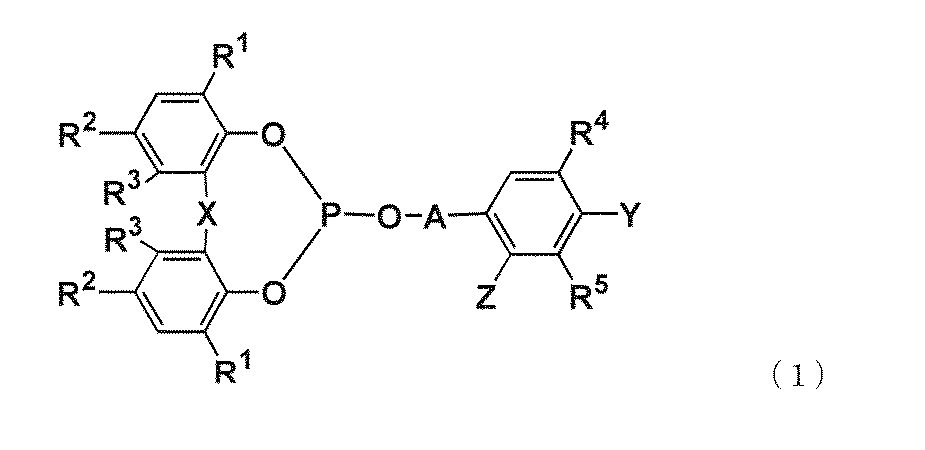
Aは炭素数2~8のアルキレン基または*-COR7-基を表す。R7は単結合または炭素数1~8のアルキレン基を表し、*印を付した-CO-は式(1)におけるホスファイト構造の酸素原子と結合していることを表す。
YおよびZは、いずれか一方がヒドロキシル基、炭素数1~8のアルコキシ基または炭素数7~12のアラルキルオキシ基を表し、他方が水素原子または炭素数1~8のアルキル基を表す。
但し、Yがヒドロキシル基であるときは、R4およびR5のいずれか一方は炭素数3~8のアルキル基、炭素数5~8のシクロアルキル基、炭素数6~12のアルキルシクロアルキル基、炭素数7~12のアラルキル基またはフェニル基を表す。
また、式(1)における2個のR1は互いに同一でもよく、異なってもよい。さらに、式(1)における2個のR2は互いに同一でもよく、異なってもよい。そして、式(1)における2個のR3は互いに同一でもよく、異なってもよい。]で表される亜リン酸エステル化合物と金属酸化物および/または炭酸金属塩とを含有する安定剤造粒物。
〔2〕安定剤造粒物100質量%に対して、亜リン酸エステル化合物を30~99.9質量%、金属酸化物および/または炭酸金属塩を0.1~70質量%含有する、〔1〕に記載の安定剤造粒物。
〔3〕安定剤造粒物100質量%に対して、亜リン酸エステル化合物を30~99質量%、金属酸化物および/または炭酸金属塩を1~70質量%含有する、〔1〕に記載の安定剤造粒物。
〔4〕さらにバインダーを含有する〔1〕~〔3〕のいずれかに記載の安定剤造粒物。
〔5〕亜リン酸エステル化合物と金属酸化物および/または炭酸金属塩との総量100質量%に対して、バインダーを1~20質量%含有する、〔4〕に記載の安定剤造粒物。
〔6〕安定剤造粒物の形状はフレーク状および/またはペレット状である、〔1〕~〔5〕のいずれかに記載の安定剤造粒物。
〔7〕フレーク状である安定剤造粒物は、0.5~15mmのフレーク長、および0.5~5mmの厚みを有し、ペレット状である安定剤造粒物は、0.1~10mmのペレット径および0.1~20mmのペレット長を有する、〔6〕に記載の安定剤造粒物。
〔8〕フレーク状である安定剤造粒物は、0.5~15mmのフレーク長、および0.5~5mmの厚みを有し、ペレット状である安定剤造粒物は、0.1~5mmのペレット径および0.1~10mmのペレット長を有する、〔6〕に記載の安定剤造粒物。
〔9〕式(1)で表される亜リン酸エステル化合物と金属酸化物および/または炭酸金属塩とを含有する混合物から圧縮造粒機、押出造粒機または撹拌造粒機によって安定剤造粒物を得る、〔1〕~〔8〕のいずれかに記載の安定剤造粒物を製造する方法。
本発明の安定剤造粒物は、式(1)で表される亜リン酸エステル化合物と金属酸化物および/または炭酸金属塩とを含有する。
Mg1-xAlx(OH)2(CO3)x/2・pH2O
[式中、0<x≦0.5、0≦pの数値を表す]
で表される。
ハイドロタルサイトは、天然物であっても、合成品であってもよく、またその結晶構造、結晶粒子径などを問わず使用することができる。ハイドロタルサイトとして、例えば協和化学工業株式会社製のDHT-4A(登録商標)等を使用することができる。
なお、本発明において、フレーク状の造粒物とは、薄片状(又は薄板状)、鱗片状等の形状の造粒物を示し、その表面又は裏面は平面または曲面であってもよい。また、ペレット状の造粒物とは、球状、円柱状、楕円柱状、多角柱(例えば三角柱、四角柱、五角柱、六角柱など)等の略一定の厚みを有する固形状の造粒物を示し、その断面は円形状、楕円形状、多角形等である。ペレット状の造粒物の表面は凹凸があってもよく、略球状、略円柱状、略楕円柱状、略多角柱等であってもよい。
本発明において、フレーク長および厚みは、例えば任意に100個の安定剤造粒物を抽出し、1つ1つについてフレーク長および厚みを定規、ノギスまたはマイクロメータ等によって測定し、平均値をとることによって測定することができる。
本発明の安定剤造粒物の形状がペレット状である場合、本発明の安定剤造粒物は、取扱い性の観点から、例えば0.1~10mm(例えば0.1~8mm)、好ましくは0.1~5mm、より好ましくは0.5~3mmのペレット径を有し、例えば0.1~20mm(例えば、0.1~15mm)、好ましくは0.1~10mm、より好ましくは0.5~5mmのペレット長を有する。ここで、安定剤造粒物がペレット状である場合、ペレット径は前記断面(例えば円状または楕円形状の断面)の短径と長径の平均値であり、ペレット長とは前記断面に対して垂直な方向のペレットの最大長さである。
本発明において、ペレット径およびペレット長は、上述したフレーク長および厚みと同様の方法により、短径および長径を測定し求めることができる。
本発明の安定剤造粒物を乾式の圧縮造粒法によって造粒する場合は、溶媒等、所望しない成分を含むことなく造粒する事が可能であるため好ましい。乾式圧縮造粒法において、例えば、式(1)の亜リン酸エステル化合物と金属酸化物および/または炭酸金属塩とを含有する混合物を1軸または2軸押出機によって混練する。続いて、相対的に回転させた2個のロール間にこれを通し、ロール間の圧力によってシート状とし、これを解砕機によって適当なサイズに加工することによって、フレーク状の安定剤造粒物を得ることができる。圧縮造粒機として、例えばフロイントターボ株式会社製FT160等が挙げられる。安定剤造粒物のサイズは、圧縮造粒機のスクリュー回転数、ロール圧縮圧およびロール回転数、ならびに解砕機の回転数等を調整することによって制御することができる。
このように、本発明の安定剤造粒物を撹拌造粒法または押出造粒法によって造粒する場合は、造粒効率がより高く、経済性の向上が可能であるため望ましい。
ここで、エチレン系樹脂とは、エチレンに由来する構造単位を含有し、かつプロピレン構造単位を含まないポリオレフィンを意味し、前記例示された樹脂が挙げられる。
プロピレン系樹脂とは、プロピレンに由来する構造単位を含有するポリオレフィンを意味し、エチレン構造単位とプロピレン構造単位の両方を含有する樹脂を含む。具体的には、結晶性プロピレン単独重合体、プロピレン-エチレンランダム共重合
体、プロピレン-α-オレフィンランダム共重合体、プロピレン-エチレン-α-オレフィン共重合体、プロピレン単独重合体成分または主にプロピレンからなる共重合体成分と、プロピレンとエチレンおよび/またはα-オレフィンの共重合体成分からなるポリプロピレン系ブロック共重合体などが挙げられる。
3789gの6-[3-(3-t-ブチル-4-ヒドロキシ-5-メチルフェニル)プロポキシ]-2,4,8,10-テトラ-t-ブチルジベンゾ[d,f][1,3,2]ジオキサホスフェピン(スミライザー(登録商標)GP、住友化学株式会社製)および211gのハイドロタルサイト(DHT-4A(登録商標)、協和化学工業株式会社製)を、ヘンシェルミキサーを用いて混合した。その後、この混合物を乾式造粒機(ローラーコンパクター、フロイントターボ株式会社製FT160)に投入し、ロール圧力5.0MPa、粉体供給スクリュー回転速度35.0rpm、ロール回転数15.0rpmでローラー圧縮を行った。得られた圧縮物を、解砕機で解砕し、フレーク状の乾式造粒物である安定剤a(フレーク長:2.0~4.0mm、厚み:2.5mm)を4000g得た。
2815gの6-[3-(3-t-ブチル-4-ヒドロキシ-5-メチルフェニル)プロポキシ]-2,4,8,10-テトラ-t-ブチルジベンゾ[d,f][1,3,2]ジオキサホスフェピン(スミライザー(登録商標)GP、住友化学株式会社製)、296gのハイドロタルサイト(DHT-4A(登録商標)、協和化学工業株式会社製)および889gのトリス(2,4-ジ-t-ブチルフェニル)ホスファイトを混合した以外は、実施例1と同様にしてフレーク状の乾式造粒物である安定剤b(フレーク長:2.0~4.0mm、厚み:3.0mm)を4000g得た。
4750gの6-[3-(3-t-ブチル-4-ヒドロキシ-5-メチルフェニル)プロポキシ]-2,4,8,10-テトラ-t-ブチルジベンゾ[d,f][1,3,2]ジオキサホスフェピン(スミライザー(登録商標)GP、住友化学株式会社製)および250gの酸化亜鉛(1種、本荘ケミカル株式会社製)を、ヘンシェルミキサーを用いて混合した。その後、この混合物を二軸押出造粒機(Nanjing SUNUP Granulation Equipment Co.,Ltd.製SET-180)に投入し、ジャケット温度55℃、スクリュー回転周波数15Hzで押出し、冷却後、得られたストランド状物を解砕機で解砕し、ペレット状の安定剤c(ペレット長:3.0~15.0mm、ペレット径:3.0~5.0mm)を5000g得た。
4750gの6-[3-(3-t-ブチル-4-ヒドロキシ-5-メチルフェニル)プロポキシ]-2,4,8,10-テトラ-t-ブチルジベンゾ[d,f][1,3,2]ジオキサホスフェピン(スミライザー(登録商標)GP、住友化学株式会社製)、125gの酸化亜鉛(1種、本荘ケミカル株式会社製)および125gのハイドロタルサイト(DHT-4C、協和化学工業株式会社製)を混合したこと以外は、実施例3と同様にしてペレット状の安定剤d(ペレット長:3.0~15.0mm、ペレット径:3.0~5.0mm)を5000g得た。
4750gの6-[3-(3-t-ブチル-4-ヒドロキシ-5-メチルフェニル)プロポキシ]-2,4,8,10-テトラ-t-ブチルジベンゾ[d,f][1,3,2]ジオキサホスフェピン(スミライザー(登録商標)GP、住友化学株式会社製)および250gのアルミノケイ酸塩(JC-50、水澤化学工業株式会社製)を混合したこと以外は、実施例3と同様にしてペレット状の安定剤e(ペレット長:3.0~15.0mm、ペレット径:3.0~5.0mm)を5000g得た。
4750gの6-[3-(3-t-ブチル-4-ヒドロキシ-5-メチルフェニル)プロポキシ]-2,4,8,10-テトラ-t-ブチルジベンゾ[d,f][1,3,2]ジオキサホスフェピン(スミライザー(登録商標)GP、住友化学株式会社製)、125gのアルミノケイ酸塩(JC-50、水澤化学工業株式会社製)および125gのハイドロタルサイト(DHT-4C、協和化学工業株式会社製)を混合したこと以外は、実施例3と同様にしてペレット状の安定剤f(ペレット長:3.0~15.0mm、ペレット径:3.0~5.0mm)を5000g得た。
4750gの6-[3-(3-t-ブチル-4-ヒドロキシ-5-メチルフェニル)プロポキシ]-2,4,8,10-テトラ-t-ブチルジベンゾ[d,f][1,3,2]ジオキサホスフェピン(スミライザー(登録商標)GP、住友化学株式会社製)、125gのトリイソプロパノールアミン(TIPA、東京化成工業株式会社製)および125gのハイドロタルサイト(DHT-4C、協和化学工業株式会社製)を混合したこと以外は、実施例3と同様にしてペレット状の安定剤g(ペレット長:3.0~15.0mm、ペレット径:3.0~5.0mm)を5000g得た。
4950gの6-[3-(3-t-ブチル-4-ヒドロキシ-5-メチルフェニル)プロポキシ]-2,4,8,10-テトラ-t-ブチルジベンゾ[d,f][1,3,2]ジオキサホスフェピン(スミライザー(登録商標)GP、住友化学株式会社製)および50gのハイドロタルサイト(DHT-4C、協和化学工業株式会社製)を混合したこと以外は、実施例3と同様にしてペレット状の安定剤h(ペレット長:3.0~15.0mm、ペレット径:3.0~5.0mm)を5000g得た。
4750gの6-[3-(3-t-ブチル-4-ヒドロキシ-5-メチルフェニル)プロポキシ]-2,4,8,10-テトラ-t-ブチルジベンゾ[d,f][1,3,2]ジオキサホスフェピン(スミライザー(登録商標)GP、住友化学株式会社製)および250gのハイドロタルサイト(DHT-4C、協和化学工業株式会社製)を混合したこと以外は、実施例3と同様にしてペレット状の安定剤i(ペレット長:3.0~15.0mm、ペレット径:3.0~5.0mm)を5000g得た。
1548gの6-[3-(3-t-ブチル-4-ヒドロキシ-5-メチルフェニル)プロポキシ]-2,4,8,10-テトラ-t-ブチルジベンゾ[d,f][1,3,2]ジオキサホスフェピン(スミライザー(登録商標)GP、住友化学株式会社製)、871gのハイドロタルサイト(DHT-4A(登録商標)、協和化学工業株式会社製)、194gのトリス(2,4-ジ-t-ブチルフェニル)ホスファイト、および387gのn-オクタデシル-3-(4-ヒドロキシ-3,5-ジ-t-ブチルフェニル)プロピオネート(Irganox1076、BASF社製)を、ヘンシェルミキサーを用いて混合した。その後、この混合物をディスクペレッター(ダルトン社製、F-5型)に投入し、材料温度を65~75℃として、回転式ローラーの回転数132rpmで運転させ、ローラー下のディスクダイより押出されその直後にカッティングされたペレット状の安定剤j(ペレット径:3.0mm、ペレット長:2.0~6.0mm)を3000g得た。
また、6-[3-(3-t-ブチル-4-ヒドロキシ-5-メチルフェニル)プロポキシ]-2,4,8,10-テトラ-t-ブチルジベンゾ[d,f][1,3,2]ジオキサホスフェピンのみを比較例として安定剤kとした。
さらに、947gの6-[3-(3-t-ブチル-4-ヒドロキシ-5-メチルフェニル)プロポキシ]-2,4,8,10-テトラ-t-ブチルジベンゾ[d,f][1,3,2]ジオキサホスフェピンおよび53gのハイドロタルサイトをドライブレンドしたものを比較例として安定剤lとした。
安定剤をそれぞれ、温度50℃、湿度80%RHの恒温恒湿槽に4週間保管した後、JIS 0070 1992(フェノールフタレイン変色によるKOH滴定法)に従って酸価を計算した。酸価が低い程、耐加水分解性が高いことを意味する。この結果を表1に示す。
安定剤a~lを、温度50℃、湿度80%RHの恒温恒湿槽に4週間保管した後、口径100mm、足外径25mmの漏斗(止栓付)に安定剤をそれぞれ100g投入した。止栓を引き抜いてから安定剤が全て落下するまでの時間を計測した。落下時間が短い程、流下性が高いことを意味する。この結果を表1に示す。

Claims (9)
- 式(1):

Aは炭素数2~8のアルキレン基または*-COR7-基を表す。R7は単結合または炭素数1~8のアルキレン基を表し、*印を付した-CO-は式(1)におけるホスファイト構造の酸素原子と結合していることを表す。
YおよびZは、いずれか一方がヒドロキシル基、炭素数1~8のアルコキシ基または炭素数7~12のアラルキルオキシ基を表し、他方が水素原子または炭素数1~8のアルキル基を表す。
但し、Yがヒドロキシル基であるときは、R4およびR5のいずれか一方は炭素数3~8のアルキル基、炭素数5~8のシクロアルキル基、炭素数6~12のアルキルシクロアルキル基、炭素数7~12のアラルキル基またはフェニル基を表す。
また、式(1)における2個のR1は互いに同一でもよく、異なってもよい。さらに、式(1)における2個のR2は互いに同一でもよく、異なってもよい。そして、式(1)における2個のR3は互いに同一でもよく、異なってもよい。]
で表される亜リン酸エステル化合物と金属酸化物および/または炭酸金属塩とを含有する安定剤造粒物。 - 安定剤造粒物100質量%に対して、亜リン酸エステル化合物を30~99.9質量%、金属酸化物および/または炭酸金属塩を0.1~70質量%含有する、請求項1に記載の安定剤造粒物。
- 安定剤造粒物100質量%に対して、亜リン酸エステル化合物を30~99質量%、金属酸化物および/または炭酸金属塩を1~70質量%含有する、請求項1に記載の安定剤造粒物。
- さらにバインダーを含有する、請求項1~3のいずれかに記載の安定剤造粒物。
- 亜リン酸エステル化合物と金属酸化物および/または炭酸金属塩との総量100質量%に対して、バインダーを1~20質量%含有する、請求項4に記載の安定剤造粒物。
- 安定剤造粒物の形状はフレーク状および/またはペレット状である、請求項1~5のいずれかに記載の安定剤造粒物。
- フレーク状である安定剤造粒物は、0.5~15mmのフレーク長、および0.5~5mmの厚みを有し、ペレット状である安定剤造粒物は、0.1~10mmのペレット径および0.1~20mmのペレット長を有する、請求項6に記載の安定剤造粒物。
- フレーク状である安定剤造粒物は、0.5~15mmのフレーク長、および0.5~5mmの厚みを有し、ペレット状である安定剤造粒物は、0.1~5mmのペレット径および0.1~10mmのペレット長を有する、請求項6に記載の安定剤造粒物。
- 式(1)で表される亜リン酸エステル化合物と金属酸化物および/または炭酸金属塩とを含有する混合物から圧縮造粒機、押出造粒機または撹拌造粒機によって安定剤造粒物を得る、請求項1~8のいずれかに記載の安定剤造粒物を製造する方法。
Priority Applications (3)
| Application Number | Priority Date | Filing Date | Title |
|---|---|---|---|
| JP2016566107A JP6592457B2 (ja) | 2014-12-25 | 2015-12-11 | 安定剤造粒物 |
| SG11201705131YA SG11201705131YA (en) | 2014-12-25 | 2015-12-11 | Granular stabilizer product |
| SA517381823A SA517381823B1 (ar) | 2014-12-25 | 2017-06-24 | منتج مُثبِت حبيبي |
Applications Claiming Priority (4)
| Application Number | Priority Date | Filing Date | Title |
|---|---|---|---|
| JP2014-263233 | 2014-12-25 | ||
| JP2014263239 | 2014-12-25 | ||
| JP2014263233 | 2014-12-25 | ||
| JP2014-263239 | 2014-12-25 |
Publications (1)
| Publication Number | Publication Date |
|---|---|
| WO2016104182A1 true WO2016104182A1 (ja) | 2016-06-30 |
Family
ID=56150212
Family Applications (1)
| Application Number | Title | Priority Date | Filing Date |
|---|---|---|---|
| PCT/JP2015/084769 Ceased WO2016104182A1 (ja) | 2014-12-25 | 2015-12-11 | 安定剤造粒物 |
Country Status (4)
| Country | Link |
|---|---|
| JP (1) | JP6592457B2 (ja) |
| SA (1) | SA517381823B1 (ja) |
| SG (1) | SG11201705131YA (ja) |
| WO (1) | WO2016104182A1 (ja) |
Citations (3)
| Publication number | Priority date | Publication date | Assignee | Title |
|---|---|---|---|---|
| JP2002194152A (ja) * | 2000-10-16 | 2002-07-10 | Sumitomo Chem Co Ltd | 耐加工機汚染性ポリオレフィン系樹脂組成物 |
| JP2006182793A (ja) * | 2004-12-02 | 2006-07-13 | Sumitomo Chemical Co Ltd | ポリプロピレン樹脂組成物 |
| JP2013199570A (ja) * | 2012-03-23 | 2013-10-03 | Mitsubishi Gas Chemical Co Inc | ポリアミド樹脂組成物および成形品 |
Family Cites Families (1)
| Publication number | Priority date | Publication date | Assignee | Title |
|---|---|---|---|---|
| CN102655741A (zh) * | 2009-12-25 | 2012-09-05 | 住友化学株式会社 | 控制虫害的树脂组合物 |
-
2015
- 2015-12-11 WO PCT/JP2015/084769 patent/WO2016104182A1/ja not_active Ceased
- 2015-12-11 SG SG11201705131YA patent/SG11201705131YA/en unknown
- 2015-12-11 JP JP2016566107A patent/JP6592457B2/ja active Active
-
2017
- 2017-06-24 SA SA517381823A patent/SA517381823B1/ar unknown
Patent Citations (3)
| Publication number | Priority date | Publication date | Assignee | Title |
|---|---|---|---|---|
| JP2002194152A (ja) * | 2000-10-16 | 2002-07-10 | Sumitomo Chem Co Ltd | 耐加工機汚染性ポリオレフィン系樹脂組成物 |
| JP2006182793A (ja) * | 2004-12-02 | 2006-07-13 | Sumitomo Chemical Co Ltd | ポリプロピレン樹脂組成物 |
| JP2013199570A (ja) * | 2012-03-23 | 2013-10-03 | Mitsubishi Gas Chemical Co Inc | ポリアミド樹脂組成物および成形品 |
Also Published As
| Publication number | Publication date |
|---|---|
| JP6592457B2 (ja) | 2019-10-16 |
| SG11201705131YA (en) | 2017-07-28 |
| JPWO2016104182A1 (ja) | 2017-11-02 |
| SA517381823B1 (ar) | 2021-03-23 |
Similar Documents
| Publication | Publication Date | Title |
|---|---|---|
| TWI405768B (zh) | 亞磷酸酯組成物及其製法 | |
| JP5338342B2 (ja) | 造粒組成物及びその製造方法 | |
| JP5109462B2 (ja) | ポリオレフィン組成物の製造方法 | |
| KR20070046728A (ko) | 과립 물질 | |
| EP2236551B1 (en) | Method for producing granular composition | |
| JP6592457B2 (ja) | 安定剤造粒物 | |
| JP2010275535A (ja) | 粒剤およびその製造方法 | |
| JP5050486B2 (ja) | 顆粒群およびその製造方法 | |
| JP5272301B2 (ja) | 顆粒の製造方法 | |
| EP2159214B1 (en) | Amorphous compound and stabilizer for polymers containing the amorphous compound | |
| JP2024157693A (ja) | 添加剤造粒物、プラスチック組成物の製造方法 | |
| EP2239266A1 (en) | Amorphous phosphite compound and method for its production | |
| JP5287610B2 (ja) | ポリマー安定剤及びポリマー組成物の製造方法 | |
| US20070129280A1 (en) | Process for producing granules | |
| US8187510B2 (en) | Method for producing granular composition | |
| CN101659613A (zh) | 无定形化合物和含有该无定形化合物的聚合物稳定剂 | |
| JP2020079415A (ja) | 安定剤造粒物 | |
| JP2012097137A (ja) | ポリマー安定剤の成形方法 |
Legal Events
| Date | Code | Title | Description |
|---|---|---|---|
| 121 | Ep: the epo has been informed by wipo that ep was designated in this application |
Ref document number: 15872751 Country of ref document: EP Kind code of ref document: A1 |
|
| ENP | Entry into the national phase |
Ref document number: 2016566107 Country of ref document: JP Kind code of ref document: A |
|
| NENP | Non-entry into the national phase |
Ref country code: DE |
|
| WWE | Wipo information: entry into national phase |
Ref document number: 11201705131Y Country of ref document: SG |
|
| 122 | Ep: pct application non-entry in european phase |
Ref document number: 15872751 Country of ref document: EP Kind code of ref document: A1 |