WO2016088511A1 - アシル-acpチオエステラーゼを用いた脂質の製造方法 - Google Patents
アシル-acpチオエステラーゼを用いた脂質の製造方法 Download PDFInfo
- Publication number
- WO2016088511A1 WO2016088511A1 PCT/JP2015/081357 JP2015081357W WO2016088511A1 WO 2016088511 A1 WO2016088511 A1 WO 2016088511A1 JP 2015081357 W JP2015081357 W JP 2015081357W WO 2016088511 A1 WO2016088511 A1 WO 2016088511A1
- Authority
- WO
- WIPO (PCT)
- Prior art keywords
- protein
- seq
- amino acid
- positions
- acid sequence
- Prior art date
- Legal status (The legal status is an assumption and is not a legal conclusion. Google has not performed a legal analysis and makes no representation as to the accuracy of the status listed.)
- Ceased
Links
Classifications
-
- C—CHEMISTRY; METALLURGY
- C12—BIOCHEMISTRY; BEER; SPIRITS; WINE; VINEGAR; MICROBIOLOGY; ENZYMOLOGY; MUTATION OR GENETIC ENGINEERING
- C12P—FERMENTATION OR ENZYME-USING PROCESSES TO SYNTHESISE A DESIRED CHEMICAL COMPOUND OR COMPOSITION OR TO SEPARATE OPTICAL ISOMERS FROM A RACEMIC MIXTURE
- C12P7/00—Preparation of oxygen-containing organic compounds
- C12P7/64—Fats; Fatty oils; Ester-type waxes; Higher fatty acids, i.e. having at least seven carbon atoms in an unbroken chain bound to a carboxyl group; Oxidised oils or fats
-
- C—CHEMISTRY; METALLURGY
- C12—BIOCHEMISTRY; BEER; SPIRITS; WINE; VINEGAR; MICROBIOLOGY; ENZYMOLOGY; MUTATION OR GENETIC ENGINEERING
- C12N—MICROORGANISMS OR ENZYMES; COMPOSITIONS THEREOF; PROPAGATING, PRESERVING, OR MAINTAINING MICROORGANISMS; MUTATION OR GENETIC ENGINEERING; CULTURE MEDIA
- C12N9/00—Enzymes; Proenzymes; Compositions thereof; Processes for preparing, activating, inhibiting, separating or purifying enzymes
- C12N9/14—Hydrolases (3)
- C12N9/16—Hydrolases (3) acting on ester bonds (3.1)
-
- C—CHEMISTRY; METALLURGY
- C12—BIOCHEMISTRY; BEER; SPIRITS; WINE; VINEGAR; MICROBIOLOGY; ENZYMOLOGY; MUTATION OR GENETIC ENGINEERING
- C12P—FERMENTATION OR ENZYME-USING PROCESSES TO SYNTHESISE A DESIRED CHEMICAL COMPOUND OR COMPOSITION OR TO SEPARATE OPTICAL ISOMERS FROM A RACEMIC MIXTURE
- C12P7/00—Preparation of oxygen-containing organic compounds
- C12P7/64—Fats; Fatty oils; Ester-type waxes; Higher fatty acids, i.e. having at least seven carbon atoms in an unbroken chain bound to a carboxyl group; Oxidised oils or fats
- C12P7/6409—Fatty acids
-
- C—CHEMISTRY; METALLURGY
- C12—BIOCHEMISTRY; BEER; SPIRITS; WINE; VINEGAR; MICROBIOLOGY; ENZYMOLOGY; MUTATION OR GENETIC ENGINEERING
- C12P—FERMENTATION OR ENZYME-USING PROCESSES TO SYNTHESISE A DESIRED CHEMICAL COMPOUND OR COMPOSITION OR TO SEPARATE OPTICAL ISOMERS FROM A RACEMIC MIXTURE
- C12P7/00—Preparation of oxygen-containing organic compounds
- C12P7/64—Fats; Fatty oils; Ester-type waxes; Higher fatty acids, i.e. having at least seven carbon atoms in an unbroken chain bound to a carboxyl group; Oxidised oils or fats
- C12P7/6436—Fatty acid esters
-
- C—CHEMISTRY; METALLURGY
- C12—BIOCHEMISTRY; BEER; SPIRITS; WINE; VINEGAR; MICROBIOLOGY; ENZYMOLOGY; MUTATION OR GENETIC ENGINEERING
- C12Y—ENZYMES
- C12Y301/00—Hydrolases acting on ester bonds (3.1)
- C12Y301/02—Thioester hydrolases (3.1.2)
-
- C—CHEMISTRY; METALLURGY
- C12—BIOCHEMISTRY; BEER; SPIRITS; WINE; VINEGAR; MICROBIOLOGY; ENZYMOLOGY; MUTATION OR GENETIC ENGINEERING
- C12Y—ENZYMES
- C12Y301/00—Hydrolases acting on ester bonds (3.1)
- C12Y301/02—Thioester hydrolases (3.1.2)
- C12Y301/02014—Oleoyl-[acyl-carrier-protein] hydrolase (3.1.2.14), i.e. ACP-thioesterase
Definitions
- the present invention relates to a method for producing a lipid using acyl-ACP thioesterase.
- the present invention also relates to an acyl-ACP thioesterase used in the method, a gene encoding the same, and a transformant into which the gene has been introduced.
- Fatty acids are one of the main constituents of lipids, and constitute lipids such as triacylglycerol produced by ester bonds with glycerin in vivo. In many animals and plants, fatty acids are also stored and used as energy sources. Fatty acids and lipids stored in animals and plants are widely used for food or industry. For example, derivatives of higher alcohols obtained by reducing higher fatty acids having about 12 to 18 carbon atoms are used as surfactants. Alkyl sulfate esters and alkylbenzene sulfonates are used as anionic surfactants. Polyoxyalkylene alkyl ethers, alkyl polyglycosides, and the like are used as nonionic surfactants.
- surfactants are used as cleaning agents or disinfectants.
- Alkylamine salts and mono- or dialkyl quaternary amine salts as derivatives of the same higher alcohol are routinely used for fiber treatment agents, hair rinse agents, disinfectants, and the like.
- Benzalkonium-type quaternary ammonium salts are routinely used as bactericides and preservatives.
- higher alcohols having about 18 carbon atoms are useful as plant growth promoters.
- fatty acids and lipids are widely used, and therefore, attempts have been made to improve the productivity of fatty acids and lipids in vivo in plants and the like. Furthermore, since the use and usefulness of fatty acids depend on the number of carbon atoms, attempts have been made to control the number of carbon atoms of fatty acids, that is, the chain length. For example, a method of accumulating fatty acids having 12 carbon atoms by introducing acyl-ACP thioesterase derived from bay ( Umbellularia californica (California bay)) has been proposed (Patent Document 1, Non-Patent Document 1).
- the present invention relates to a method for producing lipid, in which a transformant in which a gene encoding any one of the following proteins (A) to (C) is introduced into a host and lipid is collected from the culture.
- a protein comprising the amino acid sequence of positions 611 to 772 of SEQ ID NO: 1.
- B A protein comprising an amino acid sequence having 80% or more identity with the amino acid sequence at positions 611 to 772 of SEQ ID NO: 1 and having acyl-ACP thioesterase activity.
- C A protein having the amino acid sequence of the protein (A) or (B) and having acyl-ACP thioesterase activity.
- the present invention also relates to the proteins (A) to (C) (hereinafter also referred to as the protein of the present invention or acyl-ACP thioesterase).
- the present invention also relates to a gene encoding any one of the proteins (A) to (C) (hereinafter also referred to as the gene of the present invention).
- the present invention also relates to a transformant obtained by introducing a gene encoding any one of the proteins (A) to (C) into a host.
- the present invention relates to the provision of a method for producing a lipid, which improves the productivity of a medium chain fatty acid or a lipid comprising the same.
- the present invention relates to a novel algae-derived acyl-ACP thioesterase that can be suitably used in the above-described method, and a gene encoding the same.
- the present invention also relates to the provision of a transformant that promotes the expression of the gene and changes lipid productivity or fatty acid composition.
- the present inventor has studied a new acyl-ACP thioesterase derived from algae. As a result, a novel acyl-ACP thioesterase and an acyl-ACP thioesterase gene encoding the same were found from cryptophyte. As a result of transformation using the acyl-ACP thioesterase gene, it was found that the content of specific fatty acids in the total fatty acid component in lipids was significantly improved in the transformants. The present invention has been completed based on these findings.
- a novel acyl-ACP thioesterase, a gene encoding the same, and a transformant into which the gene is introduced can be provided.
- the production method of the present invention using the transformant is excellent in productivity of medium-chain fatty acids or lipids comprising the same.
- the production method of the present invention has 8 to 16 carbon atoms, preferably 8 to 14 carbon atoms, more preferably 10 to 14 carbon atoms, more preferably 12 to 14 carbon atoms, more preferably 12 and 14 carbon atoms, and more.
- it is excellent in the productivity of fatty acids having 12 carbon atoms or lipids containing these as constituents.
- the acyl-ACP thioesterase, gene encoding the same, transformant, and production method of the present invention can be suitably used for industrial production of fatty acids or lipids.
- lipid includes simple lipids, complex lipids and derived lipids, and specifically includes fatty acids, fatty alcohols, hydrocarbons (alkanes, etc.), neutral lipids (triacylglycerols, etc.). , Wax, ceramide, phospholipid, glycolipid, sulfolipid and the like.
- Cx: y in the notation of fatty acids and acyl groups constituting fatty acids means that the number of carbon atoms is x and the number of double bonds is y.
- Cx represents a fatty acid or acyl group having x carbon atoms.
- the identity of a base sequence and an amino acid sequence is calculated by the Lipman-Pearson method (Science, 1985, vol. 227, p. 1435-1441). Specifically, it is calculated by performing an analysis assuming that Unit size to compare (ktup) is 2 using the homology analysis (Search homology) program of genetic information processing software Genetyx-Win.
- “stringent conditions” include, for example, Molecular Cloning-A LABORATORY MANUAL THIRD EDITION [Joseph Sambrook, David W., et al. Russell., Cold Spring Harbor Laboratory Press].
- a numerical range expressed using “to” means a range including numerical values described before and after “to” as a lower limit value and an upper limit value.
- the “medium chain” means that the fatty acid or the fatty acid residue has 8 to 16 carbon atoms.
- Acyl-ACP thioesterase The protein of the present invention is a protein having an amino acid sequence of at least 611 to 772 in the amino acid sequence of SEQ ID NO: 1, and a protein functionally equivalent to the protein.
- Acyl-ACP (acyl carrier protein) thioesterase is an enzyme involved in the biosynthesis system of fatty acids and derivatives thereof (such as triacylglycerol (triglyceride)).
- the enzyme contains acyl-ACP (an acyl group that is a fatty acid residue), which is an intermediate in the process of fatty acid biosynthesis, in plastids such as chloroplasts in plants and algae, and in the cytoplasm in bacteria, fungi, and animals.
- acyl-ACP thioesterase activity refers to an activity of hydrolyzing the thioester bond of acyl-ACP.
- proteins (A) to (C) include the following proteins (A) to (C).
- a protein comprising the amino acid sequence of positions 611 to 772 of SEQ ID NO: 1.
- B A protein comprising an amino acid sequence having 80% or more identity with the amino acid sequence at positions 611 to 772 of SEQ ID NO: 1 and having acyl-ACP thioesterase activity.
- C A protein having the amino acid sequence of the protein (A) or (B) and having acyl-ACP thioesterase activity.
- SEQ ID NO: 1 is an amino acid sequence of an acyl-ACP thioesterase (hereinafter also abbreviated as “GtTE”) derived from Guillardia theta , a kind of crypto algae.
- GtTE acyl-ACP thioesterase
- the genomic sequence information of Guildia seta has been made public, the function of the amino acid sequence shown in SEQ ID NO: 1 has not been known so far.
- the present inventor has identified that the protein consisting of the amino acid sequence shown in SEQ ID NO: 1 is an acyl-ACP thioesterase. Furthermore, when the present inventor compared the amino acid sequence of SEQ ID NO: 1 with the amino acid sequences of other known acyl-ACP thioesterases, the sequence identity (homology) was very low.
- the present inventor has determined that the region from position 611 to position 772 in the amino acid sequence of SEQ ID NO: 1 is important for functioning as an acyl-ACP thioesterase, and is a region sufficient to exhibit acyl-ACP thioesterase activity. I found out. That is, a protein consisting of the amino acid sequence at positions 611 to 772 of SEQ ID NO: 1 and a protein containing the amino acid sequence have acyl-ACP thioesterase activity. Protein (A) consists of a region sufficient for this acyl-ACP thioesterase activity and functions as an acyl-ACP thioesterase.
- Protein (B) consists of an amino acid sequence having 80% or more identity with the amino acid sequence at positions 611 to 772 of SEQ ID NO: 1, and has acyl-ACP thioesterase activity.
- an amino acid sequence encoding an enzyme protein does not necessarily indicate enzyme activity unless the sequence of the entire region is conserved, and there are regions that do not affect enzyme activity even if the amino acid sequence changes. It is known to exist. In such a region that is not essential for enzyme activity, the original activity of the enzyme can be maintained even if a mutation such as amino acid deletion, substitution, insertion or addition is introduced.
- a protein that retains acyl-ACP thioesterase activity and has a partially mutated amino acid sequence can also be used.
- the identity with the amino acid sequence at positions 611 to 772 of SEQ ID NO: 1 is preferably 85% or more, more preferably 90% or more, and more than 95% Is more preferable, 96% or more is more preferable, 97% or more is further more preferable, 98% or more is further more preferable, and 99% or more is further more preferable.
- the amino acid sequence having 80% or more identity with the amino acid sequence at positions 611 to 772 in SEQ ID NO: 1 is one or several in the amino acid sequence at positions 611 to 772 in SEQ ID NO: 1. 1 or more, preferably 20 or less, more preferably 1 or more and 15 or less, still more preferably 1 or more and 10 or less, still more preferably 1 or more and 8 or less, and even more preferably 1 or more 5 or less, more preferably 1 or more and 4 or less, still more preferably 1 or more and 3 or less, and even more preferably 1 or 2 amino acids are deleted, substituted, inserted or added.
- Examples include sequences.
- Examples of a method for introducing mutation such as deletion, substitution, insertion, addition, etc. into the amino acid sequence include a method of introducing mutation into the base sequence encoding the amino acid sequence. A method for introducing a mutation into the base sequence will be described later.
- the protein (C) contains the amino acid sequence of the protein (A) or (B) as part of its amino acid sequence, and exhibits acyl-ACP thioesterase activity.
- the protein (C) may contain a sequence other than the amino acid sequence of the protein (A) or (B).
- examples of the sequence other than the amino acid sequence of the protein (A) or (B) include, for example, any amino acid sequence other than the positions 611 to 772 in SEQ ID NO: 1, The identity with any amino acid sequence other than positions 611 to 772 in No.
- 1 is 80% or more, preferably 85% or more, more preferably 90% or more, still more preferably 95% or more, and still more preferably 96% or more, more preferably 97% or more, even more preferably 98% or more, more preferably 99% or more amino acid sequences, or one or several amino acids in these sequences, preferably 1 or more and 20 or less , More preferably 1 or more and 15 or less, more preferably 1 or more and 10 or less, more preferably 1 or more and 8 or less, more preferably 1 or more and 5 or less More preferably 1 or more and 4 or less, more preferably 1 or more 3 or less, more preferably 1 or 2, the amino acid deletion, substitution, insertion, or addition in the amino acid sequence, and the like.
- the protein (C) is also preferably a protein comprising an amino acid sequence in which a signal peptide involved in protein transport or secretion is added to the amino acid sequence of the protein (A) or (B).
- signal peptide addition include addition of a chloroplast translocation signal peptide to the N-terminus.
- the protein (C) may be a protein comprising an amino acid sequence in which the N-terminal amino acid is deleted at any position from 1 to 610 of SEQ ID NO: 1. Furthermore, from the viewpoint of productivity of specific fatty acids, for example, medium chain fatty acids, the following proteins (C1) to (C20) are preferable as the protein (C).
- C1 A protein comprising the amino acid sequence of positions 1 to 772 of SEQ ID NO: 1.
- C2 A protein comprising the amino acid sequence of positions 487 to 772 of SEQ ID NO: 1.
- C3 A protein comprising the amino acid sequence of positions 488 to 772 of SEQ ID NO: 1.
- C4 A protein comprising the amino acid sequence of positions 497 to 772 of SEQ ID NO: 1.
- C5 A protein comprising the amino acid sequence of positions 507 to 772 of SEQ ID NO: 1.
- C6 A protein comprising the amino acid sequence of positions 517 to 772 of SEQ ID NO: 1.
- C7 A protein comprising the amino acid sequence of positions 527 to 772 of SEQ ID NO: 1.
- C8 A protein comprising the amino acid sequence of positions 537 to 772 of SEQ ID NO: 1.
- C9 A protein comprising the amino acid sequence of positions 547 to 772 of SEQ ID NO: 1.
- C10 A protein comprising the amino acid sequence of positions 557 to 772 of SEQ ID NO: 1.
- C11 A protein comprising the amino acid sequence of positions 567 to 772 of SEQ ID NO: 1.
- (C12) A protein comprising the amino acid sequence of positions 577 to 772 of SEQ ID NO: 1.
- C13) A protein comprising the amino acid sequence of positions 587 to 772 of SEQ ID NO: 1.
- C14) A protein comprising the amino acid sequence of positions 597 to 772 of SEQ ID NO: 1.
- C15) A protein comprising the amino acid sequence of positions 607 to 772 of SEQ ID NO: 1.
- C16) A protein comprising the amino acid sequence of positions 608 to 772 of SEQ ID NO: 1.
- (C17) A protein comprising the amino acid sequence of positions 609 to 772 of SEQ ID NO: 1.
- C18 A protein comprising the amino acid sequence of positions 610 to 772 of SEQ ID NO: 1.
- the identity with any one of the amino acid sequences of the proteins (C1) to (C18) is 80% or more, preferably 85% or more, more preferably 90% or more, still more preferably 95% or more, more More preferably 96% or more, still more preferably 97% or more, even more preferably 98% or more, and even more preferably 99% or more amino acid sequence, and a protein having acyl-ACP thioesterase activity.
- the protein (C) of the present invention is preferably the protein (C13), the protein (C14), the protein (C15), the protein (C16), the protein (C17), or the proteins (C13) to (C17).
- the identity with any one amino acid sequence is 80% or more, preferably 85% or more, more preferably 90% or more, still more preferably 95% or more, still more preferably 96% or more, and still more preferably 97 % Or more, more preferably 98% or more, and even more preferably 99% or more of a protein having an acyl-ACP thioesterase activity, or any one of the proteins (C13) to (C17)
- One or several amino acid sequences preferably 1 or more and 20 or less, more preferably 1 or more and 15 or less, more preferably 1 or more and 10 Below, more preferably 1 or more, 8 or less, more preferably 1 or more and 5 or less, more preferably 1 or more and 4 or less, more preferably 1 or more and 3 or less, more preferably 1 or
- a protein has acyl-ACP thioesterase activity means that, for example, a DNA in which an acyl-ACP thioesterase gene is linked downstream of a promoter that functions in a host cell such as E. coli is introduced into a host cell that lacks the fatty acid degradation system. It can be confirmed by culturing under conditions where the introduced acyl-ACP thioesterase gene is expressed, and analyzing changes in the fatty acid composition in the host cell or culture solution using a method such as gas chromatography analysis. .
- acyl-ACP thioesterase gene linked downstream of a promoter that functions in a host cell such as Escherichia coli into the host cell and culturing the cell under conditions such that the introduced acyl-ACP thioesterase gene is expressed.
- Various acyls prepared by the method of Yuan et al. (Yuan L, et al., Proc. Natl. Acad. Sci. USA, 1995, vol. 92 (23), p. 10639-10643).
- -Acyl-ACP thioesterase activity can be measured by carrying out a reaction using ACP as a substrate.
- a protein derived from a natural product can be obtained by isolation, purification, or the like from gillardia seta.
- protein synthesis may be performed by chemical synthesis, or a recombinant protein may be produced by a gene recombination technique.
- the acyl-ACP thioesterase gene described later can be used.
- crypt algae such as guilardia seta can be obtained from a storage organization such as a private or public laboratory.
- NCMA National Center for Marine Algae and Microbiota
- CCMP National Center for Marine Algae and Microbiota
- UTEX The culture collection of algae at University of Texas at Austin
- NIES National Institute for Environmental Studies
- CCAP Culture Collection of Algae and Protozoa
- CSIRO Australian National Algae Culture Collection
- the acyl-ACP thioesterase gene of the present invention is a gene encoding any one of the proteins (A) to (C).
- Examples of the gene encoding any one of the proteins (A) to (C) include genes having the nucleotide sequences shown in SEQ ID NO: 2 and SEQ ID NO: 3.
- the base sequence shown in SEQ ID NO: 2 is an example of a base sequence of a gene encoding a wild type acyl-ACP thioesterase derived from Guildia seta.
- the base sequence from positions 1831 to 2316 of SEQ ID NO: 2 encodes the amino acid sequence from positions 611 to 772 of SEQ ID NO: 1.
- nucleotide sequence of positions 2317 to 2319 in SEQ ID NO: 2 is a stop codon and does not correspond to an amino acid.
- the base sequence shown in SEQ ID NO: 3 is a base sequence subjected to codon optimization based on the amino acid sequence information of SEQ ID NO: 1 in accordance with the codon usage of E. coli.
- the base sequence from position 1 to position 858 of SEQ ID NO: 3 encodes the amino acid sequence from position 487 to position 772 of SEQ ID NO: 1.
- the nucleotide sequence of positions 373 to 858 of SEQ ID NO: 3 encodes the amino acid sequence of positions 611 to 772 of SEQ ID NO: 1.
- the nucleotide sequence at positions 859 to 861 of SEQ ID NO: 3 is a stop codon and does not correspond to an amino acid.
- a gene consisting of any one of the proteins (A) to (C) can be exemplified.
- the present invention is not limited to these.
- DNA consisting of the nucleotide sequence of positions 373 to 861 of SEQ ID NO: 3.
- a DNA encoding a protein consisting of a base sequence having 80% or more identity with the base sequence at positions 373 to 861 of SEQ ID NO: 3 and having acyl-ACP thioesterase activity;
- DNA (b) from the viewpoint of acyl-ACP thioesterase activity, the identity with the nucleotide sequence of positions 1831 to 2319 of SEQ ID NO: 2 is preferably 85% or more, more preferably 90% or more, and more than 95% Is more preferable, 96% or more is more preferable, 97% or more is further more preferable, 98% or more is further more preferable, and 99% or more is further more preferable.
- the nucleotide sequence having 80% or more identity with the nucleotide sequence of positions 1831 to 2319 of SEQ ID NO: 2 is one or several in the nucleotide sequence of positions 1831 to 2319 of SEQ ID NO: 2.
- 1 to 20 pieces more preferably 1 to 15 pieces, more preferably 1 to 10 pieces, more preferably 1 to 8 pieces, more preferably 1 to 5 pieces More preferred is a base sequence in which 1 to 4 or less, more preferably 1 to 3 or less, more preferably 1 or 2 bases are deleted, substituted, inserted or added.
- DNA (e) from the viewpoint of acyl-ACP thioesterase activity, the identity with the nucleotide sequence at positions 373 to 861 of SEQ ID NO: 3 is preferably 85% or more, more preferably 90% or more, and more than 95% Is more preferable, 96% or more is more preferable, 97% or more is further more preferable, 98% or more is further more preferable, and 99% or more is more preferable.
- the nucleotide sequence having 80% or more identity with the nucleotide sequence of positions 373 to 861 of SEQ ID NO: 3 is one or several in the nucleotide sequence of positions 373 to 861 of SEQ ID NO: 3.
- 1 to 20 pieces more preferably 1 to 15 pieces, more preferably 1 to 10 pieces, more preferably 1 to 8 pieces, more preferably 1 to 5 pieces More preferred is a base sequence in which 1 to 4 or less, more preferably 1 to 3 or less, more preferably 1 or 2 bases are deleted, substituted, inserted or added.
- Examples of methods for introducing mutations such as deletion, substitution, insertion and addition into the base sequence include site-specific mutagenesis.
- a method using Splicing overlap extension (SOE) PCR Horton et al., Gene, 1989, vol. 77, p. 61-68
- ODA method Hamoto- Gotoh et al., Gene, 1995, vol. 152, p. 271-276
- Kunkel method Kunkel, TA, Proc. Natl. Acad. Sci. USA, 1985, vol. 82, p. 488) Etc.
- the target gene can also be obtained by performing enzyme activity evaluation and gene analysis by an appropriate method.
- DNA (b) a DNA that hybridizes with a DNA comprising a base sequence complementary to DNA (a) under stringent conditions and encodes a protein having acyl-ACP thioesterase activity is also preferable.
- DNA (e) DNA that hybridizes with DNA comprising a base sequence complementary to DNA (d) under stringent conditions and encodes a protein having acyl-ACP thioesterase activity is also preferable.
- DNA (c) contains the base sequence of DNA (a) or (b) as part of its base sequence, and encodes a protein having acyl-ACP thioesterase activity.
- the DNA (c) may contain a sequence other than the base sequence of the DNA (a) or (b).
- sequences other than the base sequence of DNA (a) or (b) in the base sequence of DNA (c) include, for example, any base sequence other than positions 1831 to 2319 in SEQ ID NO: 2, SEQ ID NO: 2 80% or more, preferably 85% or more, more preferably 90% or more, still more preferably 95% or more, and still more preferably 96%, with any nucleotide sequence other than positions 1831 to 2319 Or more, more preferably 97% or more, even more preferably 98% or more, and even more preferably 99% or more, or any nucleotide sequence other than positions 1831 to 2319 in SEQ ID NO: 2 Or several, preferably 1 to 20 or less, more preferably 1 to 15 or less, more preferably 1 to 10 or less, more preferably 1 to 8 or less, more preferably 1 to 5 or less, more preferably 1 to 4 or less, more preferably 1 or more and 3 or less, more preferably 1 or 2 bases are deleted, substituted, inserted or added.
- Base sequence and the like.
- a base sequence encoding a signal peptide involved in protein transport or secretion is also preferable.
- the signal peptide include those described for the protein (C). These sequences are preferably added to the 5 ′ end side of the base sequence of the DNA (a) or (b).
- the DNA (c) may be a DNA consisting of a base sequence in which the 5 ′ end is deleted at any position from positions 1 to 1830 of SEQ ID NO: 2. Furthermore, from the viewpoint of productivity of specific fatty acids, for example, medium chain fatty acids, the following DNA (c1) to (c20) are preferable as the DNA (c).
- c3 DNA consisting of the nucleotide sequence of positions 1462 to 2319 of SEQ ID NO: 2.
- (c4) DNA consisting of the nucleotide sequence of positions 1489 to 2319 of SEQ ID NO: 2.
- c5 DNA consisting of the nucleotide sequence of positions 1519 to 2319 of SEQ ID NO: 2.
- (c6) DNA consisting of the nucleotide sequence of positions 1549 to 2319 of SEQ ID NO: 2.
- c7 DNA consisting of the nucleotide sequence of positions 1579 to 2319 of SEQ ID NO: 2.
- (c8) DNA consisting of the nucleotide sequence of positions 1609 to 2319 of SEQ ID NO: 2.
- c9) DNA consisting of the nucleotide sequence of positions 1639 to 2319 of SEQ ID NO: 2.
- (c10) DNA consisting of the nucleotide sequence of positions 1669 to 2319 of SEQ ID NO: 2.
- (c11) DNA consisting of the nucleotide sequence of positions 1699 to 2319 of SEQ ID NO: 2.
- (c12) DNA consisting of the nucleotide sequence of positions 1729 to 2319 of SEQ ID NO: 2.
- (c13) DNA consisting of the nucleotide sequence of positions 1759 to 2319 of SEQ ID NO: 2.
- (c14) DNA consisting of the nucleotide sequence of positions 1789 to 2319 of SEQ ID NO: 2.
- (c15) DNA consisting of the nucleotide sequence of positions 1819 to 2319 of SEQ ID NO: 2.
- the identity with any one of the base sequences of DNA (c1) to (c18) is 80% or more, preferably 85% or more, more preferably 90% or more, still more preferably 95% or more, more More preferably 96% or more, still more preferably 97% or more, still more preferably 98% or more, still more preferably 99% or more, and encodes a protein having acyl-ACP thioesterase activity DNA.
- (c20) One or several, preferably 1 or more and 20 or less, more preferably 1 or more and 15 or less, more preferably 1 or more in any one of the base sequences of DNA (c1) to (c18) 10 or less, more preferably 1 or more and 8 or less, more preferably 1 or more and 5 or less, more preferably 1 or more and 4 or less, more preferably 1 or more and 3 or less, more preferably 1 or 2 DNA encoding a protein having a base sequence in which a single base is deleted, substituted, inserted, or added, and having acyl-ACP thioesterase activity. It has been confirmed by the present inventor that the gene consisting of any one of the DNAs (c1) to (c18) encodes a protein having acyl-ACP thioesterase activity.
- DNA (f) encodes a protein having the base sequence of DNA (d) or (e) as part of its base sequence and having acyl-ACP thioesterase activity.
- DNA (f) may contain a sequence other than the base sequence of DNA (d) or (e).
- Examples of the sequence other than the base sequence of DNA (d) or (e) in the base sequence of DNA (f) include, for example, any base sequence other than positions 373 to 861 in SEQ ID NO: 3, SEQ ID NO: 3 80% or more, preferably 85% or more, more preferably 90% or more, still more preferably 95% or more, still more preferably 96% or more, and even more than any base sequence other than positions 373 to 861 Preferably, 97% or more, more preferably 98% or more, and even more preferably 99% or more, or one or several nucleotide sequences in any base sequence other than positions 373 to 861 in SEQ ID NO: 3, preferably Is 1 or more, 20 or less, more preferably 1 or more and 15 or less, more preferably 1 or more and 10 or less, more preferably 1 or more and 8 or less, more preferably 1 or more and 5 or less.
- base is deleted, substituted, inserted, or added in the nucleotide sequence, and the like.
- base sequence a sequence other than the base sequence of the DNA (d) or (e)
- a base sequence encoding a signal peptide involved in protein transport or secretion is also preferable.
- the signal peptide include those described for the protein (C). These sequences are preferably added to the 5 ′ end side of the base sequence of DNA (d) or (e).
- the DNA (f) may be a DNA consisting of a base sequence in which the 5 ′ end is deleted at any position from positions 1 to 372 of SEQ ID NO: 3. Furthermore, from the viewpoint of the productivity of specific fatty acids, for example, medium chain fatty acids, the following DNA (f1) to (f19) are preferable as the DNA (f).
- f3 DNA consisting of the nucleotide sequence of positions 31 to 861 of SEQ ID NO: 3.
- f6 DNA consisting of the nucleotide sequence of positions 121 to 861 of SEQ ID NO: 3.
- f8 DNA consisting of the nucleotide sequence of positions 181 to 861 of SEQ ID NO: 3.
- DNA sequences (f16) to (f17) is 80% or more, preferably 85% or more, more preferably 90% or more, still more preferably 95% or more, more More preferably 96% or more, still more preferably 97% or more, still more preferably 98% or more, still more preferably 99% or more, and encodes a protein having acyl-ACP thioesterase activity DNA.
- DNA (f19) One or several, preferably 1 or more and 20 or less, more preferably 1 or more and 15 or less, more preferably 1 or more, in any one of the base sequences of DNA (f1) to (f17) 10 or less, more preferably 1 or more and 8 or less, more preferably 1 or more and 5 or less, more preferably 1 or more and 4 or less, more preferably 1 or more and 3 or less, more preferably 1 or 2
- the method for obtaining the acyl-ACP thioesterase gene of the present invention is not particularly limited, and can be obtained by ordinary genetic engineering techniques.
- a gene can be obtained by artificial synthesis based on the amino acid sequence shown in SEQ ID NO: 1 or the base sequence shown in SEQ ID NO: 2 or 3.
- services such as Eurofin Genomics can be used for artificial gene synthesis.
- it can be obtained by cloning from the Girardia Seta, for example, by the method described in Molecular Cloning-A LABORATORY MANUAL THIRD EDITION [Joseph Sambrook, David W. Russell, Cold Spring Harbor Laboratory Press (2001)]. it can.
- the transformant of the present invention is a transformant in which expression of a gene encoding any one of the proteins (A) to (C) is promoted.
- the ability to produce lipids particularly the ability to produce medium-chain fatty acids or lipids comprising them (the production amount of medium-chain fatty acids or lipids comprising them, the total amount of fatty acids produced)
- the proportion of chain fatty acids and the proportion of lipids comprising medium chain fatty acids in the total lipid produced) are significantly improved.
- the fatty acid composition in the lipid is a specific lipid, particularly a medium chain fatty acid or a lipid comprising this, preferably a fatty acid having 8 to 16 carbon atoms or a lipid comprising this.
- the fatty acid having 8 to 14 carbon atoms or a lipid comprising the same more preferably a fatty acid having 10 to 14 carbon atoms or a lipid comprising the same, more preferably a fatty acid having 12 to 14 carbon atoms Or a lipid comprising this as a constituent, more preferably a fatty acid having 12 and 14 carbon atoms or a lipid comprising this, more preferably a fatty acid having 12 carbons or a lipid comprising this as a constituent.
- the transformant of this aspect significantly improves the productivity of medium-chain fatty acids or lipids comprising this as a constituent compared to the host itself.
- the present invention using the transformant can be suitably used for lipid production.
- the ability of acyl-ACP thioesterase to produce fatty acids or lipids can be measured by the method used in the examples.
- those in which the expression of the gene encoding the target protein is promoted are also referred to as “transformants”, and those in which the expression of the gene encoding the target protein is not promoted are “host” or “ Also referred to as “wild strain”.
- the method for promoting the expression of the acyl-ACP thioesterase gene can be appropriately selected from conventional methods. For example, a method of introducing the acyl-ACP thioesterase gene into a host, a method of modifying an expression control region (promoter, terminator, etc.) of the gene in a host having the acyl-ACP thioesterase gene on the genome, etc. Can be mentioned.
- a method for promoting the expression of the gene by introducing the acyl-ACP thioesterase gene into the host will be described.
- a transformant that can be preferably used in the present invention can be obtained by introducing a gene encoding an acyl-ACP thioesterase into a host by an ordinary genetic engineering method. Specifically, by preparing an expression vector or gene expression cassette capable of expressing a gene encoding acyl-ACP thioesterase in a host cell, and introducing the gene into a host cell to transform the host cell. Can be made.
- the host of the transformant is not particularly limited and can be appropriately selected from those usually used.
- microorganisms including algae and microalgae
- plants, or animals can be used.
- the host is preferably a microorganism or a plant, and more preferably a microorganism.
- the microorganism may be either prokaryotic, eukaryotic, Escherichia (Escherichia) microorganism belonging to the genus microorganism belonging to Bacillus (Bacillus) genus Synechocystis (Synechocystis) microorganism of the genus, Synechococcus (Synechococcus) microorganisms of the genus Or eukaryotic microorganisms such as yeast and filamentous fungi can be used. Among them, from the viewpoint of the lipid productivity, E.
- Escherichia coli is a microorganism belonging to Escherichia
- Bacillus subtilis Bacillus subtilis
- Bacillus subtilis Bacillus subtilis
- red yeast is a microorganism belonging to yeast (Rhodosporidium toruloides), Or Mortierella sp.
- which is a microorganism belonging to filamentous fungi is preferable, and Escherichia coli is more preferable.
- algae belonging to the genus Chlamydomonas from the viewpoint of establishing genetic recombination techniques, algae belonging to the genus Chlamydomonas , algae belonging to the genus Chlorella , algae belonging to the genus Phaeodactylum , Or algae belonging to the genus Nannochloropsis are preferable, and algae belonging to the genus Nannochloropsis are more preferable.
- Nannochloropsis gaditana Specific algae belonging to the genus Nannochloropsis are Nannochloropsis gaditana , Nannochloropsis salina , Nannochloropsis oceanica , Nannochloropsis oceanica , Nannochloropsis oceanina , Examples thereof include Nannochloropsis atomus , Nannochloropsis maculata , Nannochloropsis granulata , Nannochloropsis sp., And the like. Among these, from the viewpoint of lipid productivity, Nannochloropsis oculata or Nannochloropsis gaditana is preferable, and Nannochloropsis oculata is more preferable.
- the plant body is preferably Arabidopsis thaliana , rapeseed, coconut palm, palm, coffea, or jatropha, more preferably Arabidopsis , from the viewpoint of high lipid content in the seed.
- a gene encoding acyl-ACP thioesterase can be introduced into a host, and the gene can be expressed in the host cell.
- Any vector may be used.
- a vector having an expression regulatory region such as a promoter or terminator according to the type of host to be introduced, and a vector having a replication origin or a selection marker can be used.
- it may be a vector that autonomously grows and replicates outside the chromosome, such as a plasmid, or a vector that is integrated into the chromosome.
- pBluescript II SK ( ⁇ ) or pMW218 / 219 is preferably used.
- algae for example, pUC19 (manufactured by Takara Bio Inc.), P66 (Chlamydomonas Center), P-322 (Chlamydomonas Center), pPha-T1 (Yangmin Gong, et al., Journal of Basic Microbiology, 2011) , Vol.51, p.666-672), or pJET1 (manufactured by Cosmo Bio).
- a host when the host is an algae belonging to the genus Nannochloropsis, pUC19, pPha-T1, or pJET1 is preferably used.
- a host When the host is an algae belonging to the genus Nannochloropsis, Oliver Kilian, et al., Proceedings of the National Academy of Sciences of the United States of America, 2011, vol.
- a host can also be transformed with a DNA fragment (gene expression cassette) comprising the gene, promoter and terminator of the present invention.
- the DNA fragment include a DNA fragment amplified by PCR and a restriction enzyme-cleaved DNA fragment.
- a pRI vector manufactured by Takara Bio Inc.
- a pBI vector manufactured by Clontech
- an IN3 vector manufactured by Implanta Innovations
- the host is Arabidopsis thaliana
- pRI vectors or pBI vectors are preferably used.
- the type of promoter or terminator that regulates the expression of the gene encoding the target protein incorporated above can also be appropriately selected according to the type of host used.
- a promoter that can be preferably used in the present invention for example, by adding lac promoter, trp promoter, tac promoter, trc promoter, T7 promoter, SpoVG promoter, isopropyl ⁇ -D-1-thiogalactopyranoside (IPTG) Promoters related to inducible derivatives, Rubisco operon (rbc), PSI reaction center protein (psaAB), PSII D1 protein (psbA), cauliflower mosaic virus 35SRNA promoter, housekeeping gene promoter (eg tubulin promoter, actin promoter, ubiquitin) Promoter), rapeseed-derived Napin gene promoter, plant-derived Rubisco promoter, violaxanthin / chlorophyll a-binding protein VCP1 gene promoter derived from the genus Nannochloropsis (
- oleosin-like protein LDSP lipid droplet surface protein
- the type of selectable marker for confirming that the gene encoding the target protein has been incorporated can be appropriately selected according to the type of host used.
- Selectable markers that can be preferably used in the present invention include ampicillin resistance gene, chloramphenicol resistance gene, erythromycin resistance gene, neomycin resistance gene, kanamycin resistance gene, spectinomycin resistance gene, tetracycline resistance gene, blasticidin S Examples include drug resistance genes such as resistance genes, bialaphos resistance genes, zeocin resistance genes, paromomycin resistance genes, or hygromycin resistance genes. Furthermore, it is also possible to use a gene defect associated with auxotrophy as a selection marker gene.
- Introduction of a gene encoding a target protein into the vector can be performed by a usual technique such as restriction enzyme treatment or ligation.
- sequences useful for translation of the gene for example, sequences corresponding to a start codon and a stop codon can be appropriately supplemented.
- the transformation method is not particularly limited as long as it is a method capable of introducing a target gene into a host. For example, a method using calcium ions, a general competent cell transformation method (J. Bacterial. 93, 1925 (1967)), a protoplast transformation method (Mol. Gen. Genet.
- ⁇ Selection of transformant introduced with target gene fragment> can be performed by using a selection marker or the like.
- the drug resistance gene acquired by the transformant as a result of introducing a vector-derived drug resistance gene into the host cell together with the target DNA fragment at the time of transformation can be used as an indicator.
- the introduction of the target DNA fragment can also be confirmed by PCR method using a genome as a template.
- “Expression regulatory region” refers to a promoter or terminator, and these sequences are generally involved in regulating the expression level (transcription level, translation level) of adjacent genes.
- “Expression regulatory region” refers to a promoter or terminator, and these sequences are generally involved in regulating the expression level (transcription level, translation level) of adjacent genes.
- medium chain fatty acid or a constituent component thereof can be obtained by modifying the expression regulatory region of the gene to promote the expression of the acyl-ACP thioesterase gene. The productivity of the lipid can be improved.
- Examples of the method for modifying the expression regulatory region include promoter replacement.
- the promoter of the gene hereinafter also referred to as “acyl-ACP thioesterase promoter”
- acyl-ACP thioesterase promoter is replaced with a promoter having higher transcriptional activity, whereby acyl-ACP Expression of thioesterase gene can be promoted.
- the promoter used for replacement of the acyl-ACP thioesterase promoter is not particularly limited, and is appropriately selected from those having higher transcription activity than the acyl-ACP thioesterase promoter and suitable for the production of medium-chain fatty acids or lipids comprising them. You can choose.
- the above-described promoter modification can be performed according to a conventional method such as homologous recombination. Specifically, a linear DNA fragment containing upstream and downstream regions of the target promoter and containing another promoter instead of the target promoter is constructed, and this is incorporated into the host cell, and the target promoter of the host genome Two homologous recombination occurs at the upstream and downstream side of. As a result, the target promoter on the genome is replaced with another promoter fragment, and the promoter can be modified.
- a method for modifying a target promoter by homologous recombination is described in, for example, Besher et al., Methods in molecular biology, 1995, vol. 47, p. Reference can be made to documents such as 291-302.
- the transformant of the present invention has improved productivity of medium chain fatty acids or lipids comprising this as a constituent, compared to the host. Therefore, if the transformant of the present invention is cultured under appropriate conditions, and then the medium chain fatty acid or the lipid comprising this as a constituent component is recovered from the obtained culture, the medium chain fatty acid or the lipid comprising this constituent is obtained. Can be manufactured efficiently.
- the method for producing a lipid of the present invention comprises a step of culturing a transformant introduced with a gene encoding acyl-ACP thioesterase under appropriate conditions to obtain a culture from the viewpoint of improving lipid productivity, and It is preferable to include a step of collecting lipid from the obtained culture.
- culturing a transformant means culturing and growing a microorganism, algae, a plant, an animal, and cells and tissues thereof, and includes cultivating the plant in soil or the like.
- the “culture” includes, in addition to the culture solution, the transformant itself after culturing and the like.
- Culture conditions can be appropriately selected depending on the host of the transformant, and culture conditions generally used for the host can be used. From the viewpoint of lipid production efficiency, for example, glycerol, acetic acid, malonic acid, or the like may be added to the medium as a substrate of acyl-ACP thioesterase or a precursor involved in the fatty acid biosynthesis system.
- a transformant using Escherichia coli as a host culturing in an LB medium or Overnight Express Instant TB Medium (Novagen) at 30 to 37 ° C. for 0.5 to 1 day can be mentioned.
- a transformant using Arabidopsis as a host it is cultivated for 1 to 2 months in soil under a temperature condition of 20 to 25 ° C. and under a light condition such as continuous irradiation with white light or a light period of 16 hours and a dark period of 8 hours. Can be mentioned.
- the culture medium may be based on natural seawater or artificial seawater, or a commercially available culture medium may be used.
- the medium include f / 2 medium, ESM medium, Daigo IMK medium, L1 medium, and MNK medium.
- f / 2 medium, ESM medium, or Daigo IMK medium is preferable, f / 2 medium or Daigo IMK medium is more preferable, and f / 2 medium is further included. preferable.
- nitrogen sources, phosphorus sources, metal salts, vitamins, trace metals, and the like can be appropriately added to the medium.
- the amount of algae inoculated on the medium is not particularly limited, but is preferably 1 to 50% (vol / vol), more preferably 1 to 10% (vol / vol) per medium from the viewpoint of growth.
- the culture temperature is not particularly limited as long as it does not adversely affect the growth of algae, but it is usually in the range of 5 to 40 ° C. From the viewpoint of promoting the growth of algae, improving the productivity of fatty acids, and reducing the production cost, the temperature is preferably 10 to 35 ° C, more preferably 15 to 30 ° C.
- the light irradiation may be performed under conditions that allow photosynthesis, and may be artificial light or sunlight.
- the illuminance upon light irradiation is preferably in the range of 100 to 50000 lux, more preferably in the range of 300 to 10000 lux, and still more preferably in the range of 1000 to 6000 lux, from the viewpoint of promoting the growth of algae and improving the productivity of fatty acids. It is. Further, the light irradiation interval is not particularly limited, but from the same viewpoint as described above, it is preferably performed in a light / dark cycle, and the light period in 24 hours is preferably 8 to 24 hours, more preferably 10 to 18 hours, More preferably, it is 12 hours.
- the concentration of carbon dioxide in the gas is not particularly limited, but is preferably 0.03 (similar to atmospheric conditions) to 10%, more preferably 0.05 to 5%, from the viewpoint of promoting growth and improving the productivity of fatty acids. More preferably, it is 0.1 to 3%, and still more preferably 0.3 to 1%.
- the concentration of the carbonate is not particularly limited. For example, when sodium bicarbonate is used, it is preferably 0.01 to 5% by mass, more preferably 0.05 to 2% by mass, from the viewpoint of promoting growth and improving the productivity of fatty acids.
- the content is 0.1 to 1% by mass.
- the culture time is not particularly limited, and may be performed for a long period of time (for example, about 150 days) so that algal bodies that accumulate lipids at a high concentration can grow at a high concentration.
- the culture period is preferably 3 to 90 days, more preferably 3 to 30 days, and even more preferably 7 to 30 days.
- culture cultivation may be any of aeration stirring culture, shaking culture, or stationary culture, and aeration stirring culture is preferable from the viewpoint of improving aeration.
- a method for collecting lipid produced in the transformant a method usually used for isolating lipid components in a living body, for example, filtration, centrifugation, cell culture from the aforementioned culture or transformant
- a lipid component is isolated and recovered by crushing, gel filtration chromatography, ion exchange chromatography, chloroform / methanol extraction method, hexane extraction method or ethanol extraction method.
- oil can be recovered from the culture or transformant by pressing or extraction, and then subjected to general purification such as degumming, deoxidation, decolorization, dewaxing, and deodorization to obtain lipids. .
- a fatty acid can be obtained by hydrolyzing the isolated lipid.
- the method for isolating the fatty acid from the lipid component include a method of treating at a high temperature of about 70 ° C. in an alkaline solution, a method of treating with lipase, a method of decomposing using high-pressure hot water, and the like.
- the acyl-ACP thioesterase of the present invention has high specificity for medium chain acyl-ACP, C12 to C16 acyl-ACP, particularly C12 acyl-ACP and C14 acyl-ACP.
- medium chain fatty acids in the total fatty acid component for example, fatty acids having 8 to 16 carbon atoms, preferably fatty acids having 8 to 14 carbon atoms, more preferably fatty acids having 10 to 14 carbon atoms, more preferably carbon numbers.
- the content of 12 to 14 fatty acids, more preferably 12 and 14 fatty acids, more preferably 12 fatty acids is increased.
- the production method of the present invention using the transformant is suitable for lipid production, particularly medium chain fatty acids, preferably fatty acids having 8 to 16 carbon atoms, more preferably fatty acids having 8 to 14 carbon atoms, more preferably carbon numbers. It is suitably used for the production of fatty acids having 10 to 14 fatty acids, more preferably fatty acids having 12 to 14 carbon atoms, more preferably fatty acids having 12 and 14 carbon atoms, more preferably fatty acids having 12 carbon atoms, or lipids composed thereof. be able to.
- the lipid produced in the production method of the present invention preferably contains a fatty acid or a fatty acid compound, and more preferably contains a fatty acid or a fatty acid ester compound thereof, from the viewpoint of its availability.
- the lipid produced in the production method of the present invention is preferably a fatty acid having 8 to 16 carbon atoms or a fatty acid ester compound thereof, more preferably a fatty acid having 8 to 14 carbon atoms or a fatty acid ester compound thereof.
- the fatty acid having 10 to 14 carbon atoms or a fatty acid ester compound thereof more preferably a fatty acid having 12 to 14 carbon atoms or a fatty acid ester compound thereof, more preferably a fatty acid having 12 and 14 carbon atoms or a fatty acid ester compound thereof. More preferably, it contains a fatty acid having 12 carbon atoms or a fatty acid ester compound thereof.
- the fatty acid contained in the lipid or its fatty acid ester compound is preferably a fatty acid having 8 to 16 carbon atoms or a fatty acid ester compound thereof from the viewpoint of availability to a surfactant or the like, and a fatty acid having 8 to 14 carbon atoms or a fatty acid ester compound thereof.
- a fatty acid having 10 to 14 carbon atoms or a fatty acid ester compound thereof is more preferable, a fatty acid having 12 to 14 carbon atoms or a fatty acid ester compound thereof is more preferable, and a fatty acid having 12 or 14 carbon atoms or a fatty acid ester compound thereof is more preferable.
- a C12 fatty acid or a fatty acid ester compound thereof is more preferable.
- the fatty acid ester compound is preferably a simple lipid or a complex lipid, more preferably a simple lipid, and even more preferably triacylglycerol.
- Fatty acids and lipids obtained by the production method of the present invention and transformants are used as food, as emulsifiers for cosmetics, detergents such as soaps and detergents, fiber treatment agents, hair rinse agents, or bactericides and preservatives. Can be used.
- the present invention further discloses the following methods, transformants, proteins, and genes.
- a method for producing lipid comprising culturing a transformant into which a gene encoding any one of the proteins (A) to (C) is introduced into a host, and collecting the lipid from the culture.
- a protein comprising the amino acid sequence of positions 611 to 772 of SEQ ID NO: 1.
- B A protein comprising an amino acid sequence having 80% or more identity with the amino acid sequence at positions 611 to 772 of SEQ ID NO: 1 and having acyl-ACP thioesterase activity.
- C A protein having the amino acid sequence of the protein (A) or (B) and having acyl-ACP thioesterase activity.
- ⁇ 2> Fatty acid produced in the cells of the transformant or lipid comprising this as a constituent, comprising the step of introducing a gene encoding any one of the proteins (A) to (C) into the host A way to increase productivity.
- lipid is a medium-chain fatty acid or a lipid containing this as a constituent.
- a medium-chain fatty acid produced in a cell of the transformant comprising a step of introducing a gene encoding any one of the proteins (A) to (C) into the host to obtain a transformant,
- a method for modifying a lipid composition which improves the productivity of lipids comprising this as a constituent component, and modifies the total fatty acids produced or the composition of fatty acids or lipids in the total lipids.
- ⁇ 5> A method for producing lipid, comprising culturing a transformant in which expression of a gene encoding any one of the proteins (A) to (C) is promoted, and collecting lipid from the culture.
- ⁇ 6> A fatty acid produced in a cell of a transformant or a lipid comprising the same, comprising a step of promoting the expression of a gene encoding any one of the proteins (A) to (C). A way to increase productivity.
- ⁇ 7> The method according to ⁇ 6>, wherein the lipid is a medium-chain fatty acid or a lipid comprising this as a constituent.
- ⁇ 8> Medium chain fatty acids produced in cells of transformants by promoting the expression of a gene encoding any one of the proteins (A) to (C) or lipids comprising the same
- a method for modifying the composition of lipids which improves productivity and modifies the composition of fatty acids or lipids in total fatty acids or total lipids produced.
- ⁇ 9> The method according to any one of ⁇ 5> to ⁇ 9>, wherein a gene encoding any one of the proteins (A) to (C) is introduced into a host to promote expression of the gene. Method.
- the identity with the amino acid sequence at positions 611 to 772 of SEQ ID NO: 1 is 85% or more, preferably 90% or more, more preferably 95% or more, more preferably 96% or more.
- the protein (B) has one or several, preferably 1 to 20 and more preferably 1 to 15 amino acid sequences in the amino acid sequence at positions 611 to 772 of SEQ ID NO: 1.
- ⁇ 12> The protein according to any one of the above ⁇ 1> to ⁇ 9>, wherein the protein (C) is composed of an amino acid sequence in which the amino acid at the N-terminal side is deleted at any position of positions 1 to 610 of SEQ ID NO: 1.
- the method described. ⁇ 13> The method according to any one of ⁇ 1> to ⁇ 9>, wherein the protein (C) is any one of the following proteins (C1) to (C20).
- C1 A protein comprising the amino acid sequence of positions 1 to 772 of SEQ ID NO: 1.
- C2 A protein comprising the amino acid sequence of positions 487 to 772 of SEQ ID NO: 1.
- C3 A protein comprising the amino acid sequence of positions 488 to 772 of SEQ ID NO: 1.
- C4 A protein comprising the amino acid sequence of positions 497 to 772 of SEQ ID NO: 1.
- C5 A protein comprising the amino acid sequence of positions 507 to 772 of SEQ ID NO: 1.
- C6 A protein comprising the amino acid sequence of positions 517 to 772 of SEQ ID NO: 1.
- C7 A protein comprising the amino acid sequence of positions 527 to 772 of SEQ ID NO: 1.
- C8 A protein comprising the amino acid sequence of positions 537 to 772 of SEQ ID NO: 1.
- C9 A protein comprising the amino acid sequence of positions 547 to 772 of SEQ ID NO: 1.
- C10 A protein comprising the amino acid sequence of positions 557 to 772 of SEQ ID NO: 1.
- (C11) A protein comprising the amino acid sequence of positions 567 to 772 of SEQ ID NO: 1.
- C12 A protein comprising the amino acid sequence of positions 577 to 772 of SEQ ID NO: 1.
- C13 A protein comprising the amino acid sequence of positions 587 to 772 of SEQ ID NO: 1.
- C14 A protein comprising the amino acid sequence of positions 597 to 772 of SEQ ID NO: 1.
- C15 A protein comprising the amino acid sequence of positions 607 to 772 of SEQ ID NO: 1.
- (C16) A protein comprising the amino acid sequence of positions 608 to 772 of SEQ ID NO: 1.
- C17 A protein comprising the amino acid sequence of positions 609 to 772 of SEQ ID NO: 1.
- (C18) A protein comprising the amino acid sequence of positions 610 to 772 of SEQ ID NO: 1.
- Identity with any one amino acid sequence of the proteins (C1) to (C18) is 80% or more, preferably 85% or more, more preferably 90% or more, more preferably 95% or more, more preferably Is a protein having an amino acid sequence of 96% or more, more preferably 97% or more, more preferably 98% or more, and still more preferably 99% or more, and having acyl-ACP thioesterase activity.
- ⁇ 14> The above ⁇ 1> to ⁇ 13, wherein the gene encoding any one of the proteins (A) to (C) is a gene consisting of any one of the following DNA (a) to (f): The method of any one of>.
- DNA encoding a protein having acyl-ACP thioesterase activity More preferably 97% or more, more preferably 98% or more, and even more preferably 99% or more, and a DNA encoding a protein having acyl-ACP thioesterase activity.
- the DNA (b) has one or more, preferably 1 to 20, more preferably 1 to 15, more preferably 1 or more nucleotide sequences in the DNA (a). 10 or less, more preferably 1 or more and 8 or less, more preferably 1 or more and 5 or less, more preferably 1 or more and 4 or less, more preferably 1 or more and 3 or less, more preferably 1 or 2 Consisting of a base sequence in which a single base is deleted, substituted, inserted or added, and a DNA encoding a protein having acyl-ACP thioesterase activity, or a base sequence complementary to the DNA (a)
- the method according to ⁇ 14> above which is a DNA that hybridizes with DNA under stringent conditions and encodes a protein having acyl-ACP thioesterase activity.
- DNA (c) comprises a base sequence deleted at the 5′-terminal side at an arbitrary position from positions 1 to 1830 of SEQ ID NO: 2.
- DNA (c) is any one of the following DNA (c1) to (c20).
- (c1) DNA consisting of the nucleotide sequence of positions 1 to 2319 of SEQ ID NO: 2.
- c2 DNA consisting of the nucleotide sequence of positions 1459 to 2319 of SEQ ID NO: 2.
- c3 DNA consisting of the nucleotide sequence of positions 1462 to 2319 of SEQ ID NO: 2.
- (c4) DNA consisting of the nucleotide sequence of positions 1489 to 2319 of SEQ ID NO: 2.
- c5 DNA consisting of the nucleotide sequence of positions 1519 to 2319 of SEQ ID NO: 2.
- (c6) DNA consisting of the nucleotide sequence of positions 1549 to 2319 of SEQ ID NO: 2.
- c7 DNA consisting of the nucleotide sequence of positions 1579 to 2319 of SEQ ID NO: 2.
- (c8) DNA consisting of the nucleotide sequence of positions 1609 to 2319 of SEQ ID NO: 2.
- c9) DNA consisting of the nucleotide sequence of positions 1639 to 2319 of SEQ ID NO: 2.
- (c10) DNA consisting of the nucleotide sequence of positions 1669 to 2319 of SEQ ID NO: 2.
- (c11) DNA consisting of the nucleotide sequence of positions 1699 to 2319 of SEQ ID NO: 2.
- (c12) DNA consisting of the nucleotide sequence of positions 1729 to 2319 of SEQ ID NO: 2.
- (c13) DNA consisting of the nucleotide sequence of positions 1759 to 2319 of SEQ ID NO: 2.
- (c14) DNA consisting of the nucleotide sequence of positions 1789 to 2319 of SEQ ID NO: 2.
- (c15) DNA consisting of the nucleotide sequence of positions 1819 to 2319 of SEQ ID NO: 2.
- the identity with any one of the base sequences of DNA (c1) to (c18) is 80% or more, preferably 85% or more, more preferably 90% or more, still more preferably 95% or more, more More preferably 96% or more, still more preferably 97% or more, still more preferably 98% or more, still more preferably 99% or more, and encodes a protein having acyl-ACP thioesterase activity DNA.
- (c20) One or several, preferably 1 or more and 20 or less, more preferably 1 or more and 15 or less, more preferably 1 or more in any one of the base sequences of DNA (c1) to (c18) 10 or less, more preferably 1 or more and 8 or less, more preferably 1 or more and 5 or less, more preferably 1 or more and 4 or less, more preferably 1 or more and 3 or less, more preferably 1 or 2 DNA encoding a protein having a base sequence in which a single base is deleted, substituted, inserted, or added, and having acyl-ACP thioesterase activity.
- the DNA (e) has one or more, preferably 1 or more and 20 or less, more preferably 1 or more and 15 or less, more preferably 1 or more, in the base sequence of the DNA (d). 10 or less, more preferably 1 or more and 8 or less, more preferably 1 or more and 5 or less, more preferably 1 or more and 4 or less, more preferably 1 or more and 3 or less, more preferably 1 or 2 Consisting of a base sequence in which a single base is deleted, substituted, inserted or added, and a DNA encoding a protein having acyl-ACP thioesterase activity, or a base sequence complementary to the DNA (d)
- the method according to ⁇ 14> above which is a DNA that hybridizes with DNA under stringent conditions and encodes a protein having acyl-ACP thioesterase activity.
- DNA (f) comprises a base sequence deleted at the 5′-terminal side at any position from positions 1 to 372 of SEQ ID NO: 3.
- DNA (f) is any one of the following DNA (f1) to (f19).
- (f1) DNA consisting of the nucleotide sequence of positions 1 to 861 of SEQ ID NO: 3.
- f2 DNA consisting of the nucleotide sequence of positions 4 to 861 of SEQ ID NO: 3.
- f3 DNA consisting of the nucleotide sequence of positions 31 to 861 of SEQ ID NO: 3.
- f6 DNA consisting of the nucleotide sequence of positions 121 to 861 of SEQ ID NO: 3.
- f8 DNA consisting of the nucleotide sequence of positions 181 to 861 of SEQ ID NO: 3.
- DNA consisting of the nucleotide sequence of positions 367 to 861 of SEQ ID NO: 3.
- f17 DNA consisting of the nucleotide sequence of positions 370 to 861 of SEQ ID NO: 3.
- the identity with any one of the DNA sequences (c1) to (f17) is 80% or more, preferably 85% or more, more preferably 90% or more, still more preferably 95% or more, more More preferably 96% or more, still more preferably 97% or more, still more preferably 98% or more, still more preferably 99% or more, and encodes a protein having acyl-ACP thioesterase activity DNA.
- (f19) One or several, preferably 1 or more and 20 or less, more preferably 1 or more and 15 or less, more preferably 1 or more, in any one of the base sequences of DNA (f1) to (f17) 10 or less, more preferably 1 or more and 8 or less, more preferably 1 or more and 5 or less, more preferably 1 or more and 4 or less, more preferably 1 or more and 3 or less, more preferably 1 or 2
- ⁇ 21> The method according to any one of ⁇ 1> to ⁇ 20>, wherein a host of the transformant is a microorganism.
- a host of the transformant is a microorganism.
- the microorganism is Escherichia coli.
- the microorganism is a microalgae.
- the microalgae are algae belonging to the genus Nannochloropsis, preferably Nannochloropsis oculata.
- the lipid is a medium chain fatty acid or a fatty acid ester compound thereof, preferably a fatty acid having 8 to 16 carbon atoms or a fatty acid ester compound thereof, more preferably a fatty acid having 8 to 14 carbon atoms or a fatty acid ester compound thereof.
- a fatty acid having 10 to 14 carbon atoms or a fatty acid ester compound thereof more preferably a fatty acid having 12 to 14 carbon atoms or a fatty acid ester compound thereof, more preferably a fatty acid having 12 and 14 carbon atoms or a fatty acid ester compound thereof, more
- ⁇ 27> A gene encoding the protein according to ⁇ 26>.
- ⁇ 28> A gene comprising any one of DNA (a) to (f) defined in any one of ⁇ 1> to ⁇ 25>.
- ⁇ 29> A recombinant vector containing the gene according to ⁇ 27> or ⁇ 28>.
- ⁇ 30> A transformant obtained by introducing the gene according to ⁇ 27> or ⁇ 28> or the recombinant vector according to ⁇ 29> into a host.
- ⁇ 31> A method for producing a transformant, wherein the gene according to ⁇ 27> or ⁇ 28> or the recombinant vector according to ⁇ 29> is introduced into a host.
- ⁇ 32> A transformant that promotes the expression of the gene according to ⁇ 27> or ⁇ 28>.
- ⁇ 33> The transformant according to any one of ⁇ 30> to ⁇ 32> or a method for producing the transformant, wherein a host of the transformant is a microorganism.
- ⁇ 34> The transformant according to ⁇ 33> or the method for producing the same, wherein the microorganism is Escherichia coli.
- ⁇ 35> The transformant according to ⁇ 33> or the method for producing the same, wherein the microorganism is a microalgae.
- ⁇ 36> The transformant according to ⁇ 35>, wherein the microalgae are algae belonging to the genus Nannochloropsis, preferably Nannochloropsis oculata, or a method for producing the same.
- the lipid is a medium chain fatty acid or a fatty acid ester compound thereof, preferably a fatty acid having 8 to 16 carbon atoms or a fatty acid ester compound thereof, more preferably a fatty acid having 8 to 14 carbon atoms or a fatty acid ester compound thereof.
- the fatty acid having 10 or more and 14 or less, or a fatty acid ester compound thereof more preferably a fatty acid having 12 to 14 carbon atoms or a fatty acid ester compound thereof, more preferably a fatty acid having 12 or 14 carbon atoms or a fatty acid ester compound thereof, more preferably.
- Example 1 Acquisition of acyl-ACP thioesterase gene, transformation into E. coli, and production of lipid by transformant
- NCBI National Center for Biotechnology Information
- the amino acid sequence (SEQ ID NO: 1) of the protein with unknown function derived from Guildia seta registered as Accession No. XP_005824882 and the gene sequence (SEQ ID NO: 2) encoding the same were obtained.
- this protein is also referred to as “GtTE”
- the gene encoding the protein is also referred to as “GtTE gene”.
- nucleotide sequence of SEQ ID NO: 3 is used as the nucleotide sequence of positions 1459 to 2319 of SEQ ID NO: 2 (corresponding to positions 487 to 772 of SEQ ID NO: 1) in which codon optimization is performed in accordance with the codon usage of E. coli.
- An array was obtained.
- the gene consisting of the base sequence of SEQ ID NO: 3 was obtained using an artificial gene contract synthesis service provided by Operon Biotechnology.
- GtTE gene expression plasmids in which the N-terminal region of SEQ ID NO: 1 was deleted at various lengths were constructed. PCR was performed using the plasmid GtTE_487 as a template, a primer pair consisting of any one of the primer numbers 8 to 23 shown in Table 1 and the primer number 6 primer, and the obtained gene fragment was obtained in the same manner as described above.
- the plasmid GtTE_487 is constructed so as to remove the amino acid sequence at positions 1 to 486 on the N-terminal side of the amino acid sequence shown in SEQ ID NO: 1, and encodes the amino acid sequence at positions 487 to 772 of SEQ ID NO: 1 as the GtTE gene.
- plasmid GtTE_497, plasmid GtTE_507, plasmid GtTE_517, plasmid GtTE_527, plasmid GtTE_537, plasmid GtTE_547, plasmid GtTE_557, plasmid GtTE_567, plasmid GtTE_577, plasmid GtTE_587, plasmid GtTE_597, plasmid GtTE_607, plasmid GtTE_608, plasmid GtTE_608, plasmid GtTE_608, plasmid GtTE_608, plasmid GtTE_608, plasmid GtTE_608, plasmid GtTE_608, plasmid GtTE_608, plasmid GtTE_608 GtTE_611 is N-terminal 1 to 496, 1 to 506, 1 to 516, 1 to 526, 1 to
- the amino acid sequence at positions 1 to 29 on the N-terminal side of the LacZ protein derived from the plasmid vector pBluescriptII SK (-) is upstream of the site from which the N-terminal side of the amino acid sequence shown in SEQ ID NO: 1 has been removed. It was constructed to express the fused protein.
- the obtained colonies were inoculated into 2 mL of Overnight Express Instant TB Medium (Novagen) and cultured with shaking at 30 ° C. After 24 hours of culture, the lipid components contained in the culture solution were analyzed by the following method. As a negative control, the same experiment was performed for E. coli K27 strain transformed with the plasmid vector pBluescriptII SK (-).
- Nitrogen gas was blown onto the resulting chloroform layer to dry it, 0.7 mL of 0.5N potassium hydroxide / methanol solution was added, and the temperature was kept constant at 80 ° C. for 30 minutes. Subsequently, 1 mL of a methanol solution of 14% boron trifluoride (manufactured by SIGMA) was added, and the temperature was kept constant at 80 ° C. for 10 minutes. Thereafter, 1 mL each of hexane and saturated saline was added and stirred vigorously. After standing at room temperature for 10 minutes or longer, the upper hexane layer was recovered to obtain a fatty acid methyl ester.
- the fatty acid methyl ester was identified by subjecting the sample to gas chromatograph mass spectrometry analysis under the same conditions.
- the amount of methyl ester of each fatty acid was quantified from the peak area of the waveform data obtained by gas chromatography analysis.
- Each peak area was compared with the peak area of 7-pentadecanone, which is an internal standard, to correct between samples, and the amount of each fatty acid per liter of culture solution was calculated.
- the sum total of each fatty acid amount was made into the total fatty acid amount, and the ratio of each fatty acid amount to the total fatty acid amount was calculated.
- Table 3 The results are shown in Table 3.
- TFA represents the total fatty acid content
- Fatty Acid Composition (% TFA)” represents the ratio (weight percent) of each fatty acid to the total fatty acid.
- Cx: y represents a fatty acid having x carbon atoms and y double bonds
- C17: 0 ⁇ ” and “C19: 0 ⁇ ” are cis-9,10-methylenehexadecanoic acid ( cis-9,10-Methylen-hexadecanoic acid) and cis-11,12-methyleneoctadecanoic acid.
- the strain into which any one of various GtTE gene expression plasmids was introduced had a higher total fatty acid content than the plasmid vector pBluescriptII SK (-) introduced strain (“pBS” in the table), which is a negative control.
- the proportions of C12: 1 fatty acid, C12: 0 fatty acid, C14: 1 fatty acid, C14: 0 fatty acid, and C16: 1 fatty acid are greatly increased.
- the ratio of C14 fatty acids (C14: 1 fatty acids, C14: 0 fatty acids) was significantly increased.
- the total fatty acid amount (TFA) was also increased in these GtTE gene expression plasmid-introduced strains.
- GtTE_587, GtTE_597, GtTE_607, GtTE_608 or GtTE_609 introduced strain, C12: 1 fatty acid, C12: 0 fatty acid, C14: 1 fatty acid, C14: 0 fatty acid, C16: 1 fatty acid increase, and total fatty acid amount increase was remarkable. From these results, it was confirmed that the proteins encoded by the genes introduced into various GtTE gene expression plasmids have acyl-ACP thioesterase activity.
- these proteins markedly increased the ratio and production amount of C12 fatty acid and C14 fatty acid, they are considered to be acyl-ACP thioesterases having high specificity for C12 fatty acid and C14 fatty acid, particularly C14 fatty acid. . From the above results, it is recognized that a protein having at least the region from position 611 to position 772 in the amino acid sequence represented by SEQ ID NO: 1 exhibits acyl-ACP thioesterase activity.
- Example 2 Transformation of Nannochloropsis oculata with GtTE gene and production of lipid with transformant (1) Construction of plasmid for expression of zeocin resistance gene Zeocin resistance gene (SEQ ID NO: 24) and literature (Randor Radakovits, et al., Nature Communications, DOI: 10.1038 / ncomms1688, 2012), the tubulin promoter sequence (SEQ ID NO: 25) derived from the Nannochloropsis gaditana CCMP526 strain was artificially synthesized.
- PCR was performed using the primer pair of primer number 26 and primer number 27 and the primer pair of primer number 28 and primer number 29 shown in Table 2, and the zeocin resistance gene and the tubulin promoter sequence were determined. Each was amplified. PCR was performed using the genome of Nannochloropsis oculata NIES2145 strain as a template and the primer pair of primer number 30 and primer number 31 shown in Table 2 to amplify the heat shock protein terminator sequence (SEQ ID NO: 32).
- PCR was performed using the primer pair of primer number 33 and primer number 34 shown in Table 2 to amplify the plasmid vector pUC19.
- GtTE gene expression plasmid PCR was performed using the GtTE gene artificially synthesized in Example 1 as a template and any one of primer numbers 35 to 39 shown in Table 2 and the primer pair of primer number 40.
- GtTE gene fragments were obtained by deleting the 5 ′ base sequence of SEQ ID NO: 3 with various lengths.
- the primer pair of primer number 41 and primer number 42, the primer pair of primer number 43 and primer number 44 shown in Table 2, and the primer pair of primer number 45 and primer number 46 PCR was performed using each primer pair to obtain an LDSP promoter sequence (SEQ ID NO: 47), a VCP1 chloroplast transfer signal sequence (SEQ ID NO: 48), and a VCP1 terminator sequence (SEQ ID NO: 49).
- PCR was performed using the above-mentioned zeocin resistance gene expression plasmid as a template and the primer pair of primer number 50 and primer number 34 shown in Table 2, and a zeocin resistance gene expression cassette (tubulin promoter sequence, zeocin resistance gene, heat The fragment consisting of the shock protein terminator sequence) and the pUC19 sequence was amplified.
- GtTE gene expression plasmids GtTE_488-Nanno, GtTE_527-Nanno, GtTE_587-Nanno, GtTE_597-Nanno and GtTE_607-Nanno, respectively.
- These plasmids are the LDSP promoter sequence, the VCP1 chloroplast translocation signal in the amino acid sequence shown in SEQ ID NO: 1, positions 488 to 772, 527 to 772, 587 to 772, 597 to 772, or 607 to 772. Insert sequence linked in the order of GtTE gene, VCP1 terminator sequence, tubulin promoter sequence, zeocin resistance gene, heat shock protein terminator sequence linked to the 5 'end of the nucleotide sequence encoding the amino acid sequence of the position, and pUC19 vector Consists of an array.
- GtTE gene expression cassette (LDSP promoter sequence, VCP1 chloroplast transfer signal, N-terminal side 1 to 487 of the amino acid sequence shown in SEQ ID NO: 1) GtTE gene, VCP1 terminator sequence, tubulin promoter sequence, zeocin resistance gene, heat, from which the nucleotide sequence encoding the amino acid sequence at position 1, 1-526, 1-586, 1-596, or 1-606 is removed DNA fragments consisting of shock protein terminator sequences) were amplified. Each amplified fragment was purified using High Pure PCR Product Purification Kit (Roche Applied Science). Note that sterilized water was used for elution during purification, not the elution buffer included in the kit.
- Nannochloropsis oculata strain NIES2145 were washed with a 384 mM sorbitol solution to completely remove salts, and used as host cells for transformation.
- About 500 ng of the GtTE gene expression cassette amplified above was mixed with host cells, and electroporation was performed under the conditions of 50 ⁇ F, 500 ⁇ , and 2,200 v / 2 mm.
- the mixture was applied to a 2 ⁇ g / mL zeocin-containing f / 2 agar medium, and cultured at 25 ° C. in a 0.3% CO 2 atmosphere under 12 h / 12 h light / dark conditions for 2 to 3 weeks.
- those containing the GtTE gene expression cassette were selected by the PCR method.
- Nitrogen gas was blown onto the resulting chloroform layer to dry it, 0.7 mL of 0.5N potassium hydroxide / methanol solution was added, and the temperature was kept constant at 80 ° C. for 30 minutes. Subsequently, 1 mL of 14% boron trifluoride methanol solution (manufactured by SIGMA) was added, and the temperature was kept constant at 80 ° C. for 10 minutes. Thereafter, 0.5 mL of hexane and 1 mL of saturated saline were added and stirred vigorously, and allowed to stand at room temperature for 10 minutes. The upper hexane layer was recovered to obtain a fatty acid methyl ester.
- Nannochloropsis transformants into which the GtTE gene expression cassette was introduced (“GtTE_488-Nanno”, “GtTE_527-Nanno”, “GtTE_587-Nanno”, “GtTE_597-Nanno” in Table 4, In all of “GtTE — 607-Nanno”), the ratio of C10: 0 fatty acid, C12: 0 fatty acid, and C14: 0 fatty acid was increased as compared with the wild type strain (“WT” in Table 4).
Landscapes
- Chemical & Material Sciences (AREA)
- Organic Chemistry (AREA)
- Life Sciences & Earth Sciences (AREA)
- Engineering & Computer Science (AREA)
- Zoology (AREA)
- Wood Science & Technology (AREA)
- Health & Medical Sciences (AREA)
- Genetics & Genomics (AREA)
- Bioinformatics & Cheminformatics (AREA)
- General Health & Medical Sciences (AREA)
- General Engineering & Computer Science (AREA)
- Biochemistry (AREA)
- Biotechnology (AREA)
- Microbiology (AREA)
- General Chemical & Material Sciences (AREA)
- Oil, Petroleum & Natural Gas (AREA)
- Chemical Kinetics & Catalysis (AREA)
- Molecular Biology (AREA)
- Medicinal Chemistry (AREA)
- Biomedical Technology (AREA)
- Enzymes And Modification Thereof (AREA)
- Micro-Organisms Or Cultivation Processes Thereof (AREA)
- Preparation Of Compounds By Using Micro-Organisms (AREA)
Abstract
Description
例えば、炭素数12~18前後の高級脂肪酸を還元して得られる高級アルコールの誘導体は、界面活性剤として用いられている。アルキル硫酸エステル塩やアルキルベンゼンスルホン酸塩等は陰イオン性界面活性剤として利用されている。また、ポリオキシアルキレンアルキルエーテルやアルキルポリグリコシド等は非イオン性界面活性剤として利用されている。そしてこれらの界面活性剤は、いずれも洗浄剤又は殺菌剤に利用されている。同じ高級アルコールの誘導体としてアルキルアミン塩やモノ又はジアルキル4級アミン塩は、繊維処理剤や毛髪リンス剤又は殺菌剤等に日常的に利用されている。また、ベンザルコニウム型4級アンモニウム塩は殺菌剤や防腐剤として日常的に利用されている。さらに、炭素数18前後の高級アルコールは植物の成長促進剤としても有用である。
例えば、ゲッケイジュ(Umbellularia californica(California bay))由来のアシル-ACPチオエステラーゼの導入により炭素数12の脂肪酸を蓄積させる方法(特許文献1、非特許文献1)等が提案されている。
藻類の脂質合成メカニズムやそれを応用した生産技術について研究が始まってはいるが、未解明な部分も多い。例えば、上述のアシル-ACPチオエステラーゼについても、現在のところ、藻類由来のものはほとんど報告されておらず、ナンノクロロプシス(Nannochloropsis)属等でわずかに報告例があるのみである(例えば、特許文献2)。
(A)配列番号1の611位~772位のアミノ酸配列からなるタンパク質。
(B)配列番号1の611位~772位のアミノ酸配列との同一性が80%以上のアミノ酸配列からなり、かつアシル-ACPチオエステラーゼ活性を有するタンパク質。
(C)前記タンパク質(A)又は(B)のタンパク質のアミノ酸配列を有し、かつアシル-ACPチオエステラーゼ活性を有するタンパク質。
また、本発明は、前記タンパク質(A)~(C)のいずれか1つをコードする遺伝子(以下、本発明の遺伝子ともいう。)に関する。
また、本発明は、前記タンパク質(A)~(C)のいずれか1つをコードする遺伝子を宿主に導入してなる形質転換体に関する。
また、本発明は、前記方法に好適に用いることができる、藻類由来の新規アシル-ACPチオエステラーゼ、及びこれをコードする遺伝子の提供に関する。
また、本発明は、前記遺伝子の発現を促進させ、脂質の生産性又は脂肪酸組成が変化した形質転換体の提供に関する。
本発明はこれらの知見に基づいて完成するに至ったものである。
本発明のアシル-ACPチオエステラーゼ、これをコードする遺伝子、形質転換体、及び製造方法は、脂肪酸又は脂質の工業的生産に好適に用いることができる。
また本明細書において、脂肪酸や脂肪酸を構成するアシル基の表記において「Cx:y」とあるのは、炭素原子数がxで二重結合の数がyであることを表す。「Cx」は炭素原子数xの脂肪酸やアシル基を表す。
さらに本明細書において、塩基配列及びアミノ酸配列の同一性は、Lipman-Pearson法(Science,1985,vol.227,p.1435-1441)によって計算される。具体的には、遺伝情報処理ソフトウェアGenetyx-Winのホモロジー解析(Search homology)プログラムを用いて、Unit size to compare(ktup)を2として解析を行うことにより算出される。
また本明細書において「ストリンジェントな条件」としては、例えばMolecular Cloning-A LABORATORY MANUAL THIRD EDITION[Joseph Sambrook,David W.Russell.,Cold Spring Harbor Laboratory Press]記載の方法が挙げられる。例えば、6×SSC(1×SSCの組成:0.15M塩化ナトリウム、0.015Mクエン酸ナトリウム、pH7.0)、0.5%SDS、5×デンハート及び100mg/mLニシン精子DNAを含む溶液にプローブとともに65℃で8~16時間恒温し、ハイブリダイズさせる条件が挙げられる。
また、本明細書において、「~」を用いて表される数値範囲は、「~」前後に記載される数値を下限値および上限値として含む範囲を意味する。
さらに本明細書において「中鎖」とは、脂肪酸又は脂肪酸残基の炭素数が8以上16以下であることをいう。
以下、本発明のアシル-ACPチオエステラーゼ、これを用いた形質転換体及び脂質の製造方法について順に説明する。
本発明のタンパク質は、配列番号1のアミノ酸配列中の少なくとも611位~772位までのアミノ酸配列を有するタンパク質、及び当該タンパク質と機能的に均等なタンパク質である。
アシル-ACP(アシルキャリヤープロテイン)チオエステラーゼは、脂肪酸やその誘導体(トリアシルグリセロール(トリグリセリド)等)の生合成系に関与する酵素である。当該酵素は、植物体や藻類では葉緑体等の色素体内において、細菌・真菌や動物体では細胞質内において、脂肪酸生合成過程の中間体であるアシル-ACP(脂肪酸残基であるアシル基とアシルキャリヤープロテインとからなる複合体)のチオエステル結合を加水分解し、遊離の脂肪酸を生成する。アシル-ACPチオエステラーゼの作用によって、ACP上での脂肪酸合成が終了し、切り出された脂肪酸はトリアシルグリセロール等の合成に供される。
アシル-ACPチオエステラーゼには、基質であるアシル-ACPを構成するアシル基(脂肪酸残基)の炭素原子数や不飽和結合数によって異なる反応特異性を示す複数のアシル-ACPチオエステラーゼが存在していることが知られている。よってアシル-ACPチオエステラーゼは、生体内での脂肪酸組成を決める重要なファクターであると考えられている。
本発明において、「アシル-ACPチオエステラーゼ活性」とは、アシル-ACPのチオエステル結合を加水分解する活性をいう。
(A)配列番号1の611位~772位のアミノ酸配列からなるタンパク質。
(B)配列番号1の611位~772位のアミノ酸配列との同一性が80%以上のアミノ酸配列からなり、かつアシル-ACPチオエステラーゼ活性を有するタンパク質。
(C)前記タンパク質(A)又は(B)のアミノ酸配列を有し、かつアシル-ACPチオエステラーゼ活性を有するタンパク質。
グィラルディア・セータのゲノム配列情報は公開されているが、配列番号1に示すアミノ酸配列の機能はこれまで知られていなかった。本発明者は、配列番号1に示すアミノ酸配列からなるタンパク質が、アシル-ACPチオエステラーゼであることを同定した。さらに、本発明者が、配列番号1のアミノ酸配列と他の公知のアシル-ACPチオエステラーゼのアミノ酸配列を比較したところ、配列同一性(相同性)が非常に低かった。
さらに、本発明者は、配列番号1のアミノ酸配列中、611位~772位の領域がアシル-ACPチオエステラーゼとして機能するために重要で、アシル-ACPチオエステラーゼ活性を示すために十分な領域であることを見出した。すなわち、配列番号1の611位~772位のアミノ酸配列からなるタンパク質、及び当該アミノ酸配列を含むタンパク質は、アシル-ACPチオエステラーゼ活性を有する。
タンパク質(A)は、このアシル-ACPチオエステラーゼ活性にとって十分な領域からなり、アシル-ACPチオエステラーゼとして機能する。
一般に、酵素タンパク質をコードしているアミノ酸配列は、必ずしも全領域の配列が保存されていなければ酵素活性を示さないというものではなく、アミノ酸配列が変化しても酵素活性に影響を与えない領域も存在することが知られている。このような酵素活性に必須でない領域においては、アミノ酸の欠失、置換、挿入又は付加といった変異が導入されても酵素本来の活性を維持することができる。本発明においても、このようにアシル-ACPチオエステラーゼ活性が保持され、かつアミノ酸配列が一部変異したタンパク質を用いることができる。
タンパク質(B)において、アシル-ACPチオエステラーゼ活性の点から、配列番号1の611位~772位のアミノ酸配列との同一性は、85%以上が好ましく、90%以上がより好ましく、95%以上がさらに好ましく、96%以上がよりさらに好ましく、97%以上がよりさらに好ましく、98%以上がよりさらに好ましく、99%以上がよりさらに好ましい。
なお、アミノ酸配列に欠失、置換、挿入、付加等の変異を導入する方法としては、例えば、アミノ酸配列をコードする塩基配列に変異を導入する方法が挙げられる。塩基配列に変異を導入する方法については、後述する。
タンパク質(C)を構成するアミノ酸配列中、前記タンパク質(A)又は(B)のアミノ酸配列以外の配列としては、例えば、配列番号1のうちの611位~772位以外の任意のアミノ酸配列、配列番号1のうちの611位~772位以外の任意のアミノ酸配列との同一性が80%以上、好ましくは85%以上、より好ましくは90%以上、よりさらに好ましくは95%以上、よりさらに好ましくは96%以上、よりさらに好ましくは97%以上、よりさらに好ましくは98%以上、よりさらに好ましくは99%以上、のアミノ酸配列、又はこれらの配列に1若しくは数個、好ましくは1個以上20個以下、より好ましくは1個以上15個以下、より好ましくは1個以上10個以下、より好ましくは1個以上8個以下、より好ましくは1個以上5個以下、より好ましくは1個以上4個以下、より好ましくは1個以上3個以下、より好ましくは1若しくは2個、のアミノ酸が欠失、置換、挿入、若しくは付加されたアミノ酸配列、等が挙げられる。これらの配列は、前記タンパク質(A)又は(B)のアミノ酸配列のN末端側に付加されることが好ましい。
また、タンパク質(C)として、前記タンパク質(A)又は(B)のアミノ酸配列にタンパク質の輸送や分泌に関与するシグナルペプチドが付加されたアミノ酸配列からなるタンパク質も好ましい。シグナルペプチドの付加の例としては、葉緑体移行シグナルペプチドのN末端への付加等が挙げられる。
さらに、特定の脂肪酸、例えば中鎖脂肪酸の生産性の点からは、タンパク質(C)としては、下記タンパク質(C1)~(C20)が好ましい。
(C1)配列番号1の1位~772位のアミノ酸配列からなるタンパク質。
(C2)配列番号1の487位~772位のアミノ酸配列からなるタンパク質。
(C3)配列番号1の488位~772位のアミノ酸配列からなるタンパク質。
(C4)配列番号1の497位~772位のアミノ酸配列からなるタンパク質。
(C5)配列番号1の507位~772位のアミノ酸配列からなるタンパク質。
(C6)配列番号1の517位~772位のアミノ酸配列からなるタンパク質。
(C7)配列番号1の527位~772位のアミノ酸配列からなるタンパク質。
(C8)配列番号1の537位~772位のアミノ酸配列からなるタンパク質。
(C9)配列番号1の547位~772位のアミノ酸配列からなるタンパク質。
(C10)配列番号1の557位~772位のアミノ酸配列からなるタンパク質。
(C11)配列番号1の567位~772位のアミノ酸配列からなるタンパク質。
(C12)配列番号1の577位~772位のアミノ酸配列からなるタンパク質。
(C13)配列番号1の587位~772位のアミノ酸配列からなるタンパク質。
(C14)配列番号1の597位~772位のアミノ酸配列からなるタンパク質。
(C15)配列番号1の607位~772位のアミノ酸配列からなるタンパク質。
(C16)配列番号1の608位~772位のアミノ酸配列からなるタンパク質。
(C17)配列番号1の609位~772位のアミノ酸配列からなるタンパク質。
(C18)配列番号1の610位~772位のアミノ酸配列からなるタンパク質。
(C19)前記タンパク質(C1)~(C18)のいずれか1つのアミノ酸配列との同一性が80%以上、好ましくは85%以上、より好ましくは90%以上、よりさらに好ましくは95%以上、よりさらに好ましくは96%以上、よりさらに好ましくは97%以上、よりさらに好ましくは98%以上、よりさらに好ましくは99%以上、のアミノ酸配列からなり、かつアシル-ACPチオエステラーゼ活性を有するタンパク質。
(C20)前記タンパク質(C1)~(C18)のいずれか1つのアミノ酸配列に1又は数個、好ましくは1個以上20個以下、より好ましくは1個以上15個以下、より好ましくは1個以上10個以下、より好ましくは1個以上8個以下、より好ましくは1個以上5個以下、より好ましくは1個以上4個以下、より好ましくは1個以上3個以下、より好ましくは1又は2個、のアミノ酸が欠失、置換、挿入、又は付加されたアミノ酸配列からなり、かつアシル-ACPチオエステラーゼ活性を有するタンパク質。
なお、前記タンパク質(C1)~(C18)がアシル-ACPチオエステラーゼ活性を有することは、本発明者により確認されている。
また、大腸菌等の宿主細胞内で機能するプロモーターの下流にアシル-ACPチオエステラーゼ遺伝子を連結したDNAを宿主細胞へ導入し、導入したアシル-ACPチオエステラーゼ遺伝子が発現する条件で細胞を培養した後、細胞の破砕液に対し、Yuanらの方法(Yuan L,et al.,Proc.Natl.Acad.Sci.USA,1995,vol.92(23),p.10639-10643)によって調製した各種アシル-ACPを基質とした反応を行うことにより、アシル-ACPチオエステラーゼ活性を測定することができる。
また、グィラルディア・セータ等のクリプト藻は、私的又は公的な研究所等の保存機関より入手することもできる。例えば、National Center for Marine Algae and Microbiota(NCMA:旧CCMP)、The culture collection of algae at University of Texas at Austin(UTEX)、独立行政法人国立環境研究所(NIES)、Culture Collection of Algae and Protozoa(CCAP)、Australian National Algae Culture Collection(CSIRO)等から入手できる。
本発明のアシル-ACPチオエステラーゼ遺伝子は、前記タンパク質(A)~(C)のいずれか1つをコードする遺伝子である。
タンパク質(A)~(C)のいずれか1つをコードする遺伝子の例として、配列番号2や配列番号3に示す塩基配列からなる遺伝子が挙げられる。
配列番号2に示す塩基配列は、グィラルディア・セータ由来の野生型アシル-ACPチオエステラーゼをコードする遺伝子の塩基配列の一例である。配列番号2の1831位~2316位の塩基配列は、配列番号1の611位~772位のアミノ酸配列をコードする。なお、配列番号2の2317位~2319位の塩基配列は終止コドンであり、アミノ酸には対応していない。
配列番号3に示す塩基配列は、配列番号1のアミノ酸配列情報に基づいて、大腸菌のコドン使用頻度に合わせてコドン最適化を施した塩基配列である。配列番号3の1位~858位の塩基配列は、配列番号1の487位~772位のアミノ酸配列をコードする。配列番号3の373位~858位の塩基配列は、配列番号1の611位~772位のアミノ酸配列をコードする。なお、配列番号3の859位~861位の塩基配列は終止コドンであり、アミノ酸には対応していない。
(a)配列番号2の1831位~2319位の塩基配列からなるDNA。
(b)配列番号2の1831位~2319位の塩基配列との同一性が80%以上の塩基配列からなり、かつアシル-ACPチオエステラーゼ活性を有するタンパク質をコードするDNA。
(c)前記DNA(a)又は(b)の塩基配列を有し、かつアシル-ACPチオエステラーゼ活性を有するタンパク質をコードするDNA。
(d)配列番号3の373位~861位の塩基配列からなるDNA。
(e)配列番号3の373位~861位の塩基配列との同一性が80%以上の塩基配列からなり、かつアシル-ACPチオエステラーゼ活性を有するタンパク質をコードするDNA。
(f)前記DNA(d)又は(e)の塩基配列を有し、かつアシル-ACPチオエステラーゼ活性を有するタンパク質をコードするDNA。
また、DNA(b)において、配列番号2の1831位~2319位の塩基配列との同一性が80%以上の塩基配列としては、配列番号2の1831位~2319位の塩基配列において1又は数個、好ましくは1個以上20個以下、より好ましくは1個以上15個以下、より好ましくは1個以上10個以下、より好ましくは1個以上8個以下、より好ましくは1個以上5個以下、より好ましくは1個以上4個以下、より好ましくは1個以上3個以下、より好ましくは1又は2個、の塩基が欠失、置換、挿入、又は付加された塩基配列が挙げられる。
また、DNA(e)において、配列番号3の373位~861位の塩基配列との同一性が80%以上の塩基配列としては、配列番号3の373位~861位の塩基配列において1又は数個、好ましくは1個以上20個以下、より好ましくは1個以上15個以下、より好ましくは1個以上10個以下、より好ましくは1個以上8個以下、より好ましくは1個以上5個以下、より好ましくは1個以上4個以下、より好ましくは1個以上3個以下、より好ましくは1又は2個、の塩基が欠失、置換、挿入、又は付加された塩基配列が挙げられる。
同様に、DNA(e)として、DNA(d)と相補的な塩基配列からなるDNAとストリンジェントな条件下でハイブリダイズし、かつアシル-ACPチオエステラーゼ活性を有するタンパク質をコードするDNAも好ましい。
DNA(c)の塩基配列中、前記DNA(a)又は(b)の塩基配列以外の配列としては、例えば、配列番号2のうちの1831位~2319位以外の任意の塩基配列、配列番号2のうちの1831位~2319位以外の任意の塩基配列との同一性が80%以上、好ましくは85%以上、より好ましくは90%以上、よりさらに好ましくは95%以上、よりさらに好ましくは96%以上、よりさらに好ましくは97%以上、よりさらに好ましくは98%以上、よりさらに好ましくは99%以上、の塩基配列、又は配列番号2のうちの1831位~2319位以外の任意の塩基配列に1若しくは数個、好ましくは1個以上20個以下、より好ましくは1個以上15個以下、より好ましくは1個以上10個以下、より好ましくは1個以上8個以下、より好ましくは1個以上5個以下、より好ましくは1個以上4個以下、より好ましくは1個以上3個以下、より好ましくは1若しくは2個、の塩基が欠失、置換、挿入、若しくは付加された塩基配列、等が挙げられる。
また、前記DNA(a)又は(b)の塩基配列以外の配列としては、タンパク質の輸送や分泌に関与するシグナルペプチドをコードする塩基配列も好ましい。シグナルペプチドとしては、前記タンパク質(C)で述べたものが挙げられる。
これらの配列は、前記DNA(a)又は(b)の塩基配列の5'末端側に付加されることが好ましい。
さらに、特定の脂肪酸、例えば中鎖脂肪酸の生産性の点からは、DNA(c)としては、下記DNA(c1)~(c20)が好ましい。
(c1)配列番号2の1位~2319位の塩基配列からなるDNA。
(c2)配列番号2の1459位~2319位の塩基配列からなるDNA。
(c3)配列番号2の1462位~2319位の塩基配列からなるDNA。
(c4)配列番号2の1489位~2319位の塩基配列からなるDNA。
(c5)配列番号2の1519位~2319位の塩基配列からなるDNA。
(c6)配列番号2の1549位~2319位の塩基配列からなるDNA。
(c7)配列番号2の1579位~2319位の塩基配列からなるDNA。
(c8)配列番号2の1609位~2319位の塩基配列からなるDNA。
(c9)配列番号2の1639位~2319位の塩基配列からなるDNA。
(c10)配列番号2の1669位~2319位の塩基配列からなるDNA。
(c11)配列番号2の1699位~2319位の塩基配列からなるDNA。
(c12)配列番号2の1729位~2319位の塩基配列からなるDNA。
(c13)配列番号2の1759位~2319位の塩基配列からなるDNA。
(c14)配列番号2の1789位~2319位の塩基配列からなるDNA。
(c15)配列番号2の1819位~2319位の塩基配列からなるDNA。
(c16)配列番号2の1822位~2319位の塩基配列からなるDNA。
(c17)配列番号2の1825位~2319位の塩基配列からなるDNA。
(c18)配列番号2の1828位~2319位の塩基配列からなるDNA。
(c19)前記DNA(c1)~(c18)のいずれか1つの塩基配列との同一性が80%以上、好ましくは85%以上、より好ましくは90%以上、よりさらに好ましくは95%以上、よりさらに好ましくは96%以上、よりさらに好ましくは97%以上、よりさらに好ましくは98%以上、よりさらに好ましくは99%以上、の塩基配列からなり、かつアシル-ACPチオエステラーゼ活性を有するタンパク質をコードするDNA。
(c20)前記DNA(c1)~(c18)のいずれか1つの塩基配列に1又は数個、好ましくは1個以上20個以下、より好ましくは1個以上15個以下、より好ましくは1個以上10個以下、より好ましくは1個以上8個以下、より好ましくは1個以上5個以下、より好ましくは1個以上4個以下、より好ましくは1個以上3個以下、より好ましくは1又は2個、の塩基が欠失、置換、挿入、又は付加された塩基配列からなり、かつアシル-ACPチオエステラーゼ活性を有するタンパク質をコードするDNA。
なお、前記DNA(c1)~(c18)のいずれか1つからなる遺伝子がアシル-ACPチオエステラーゼ活性を有するタンパク質をコードしていることは、本発明者により確認されている。
DNA(f)の塩基配列中、前記DNA(d)又は(e)の塩基配列以外の配列としては、例えば、配列番号3のうちの373位~861位以外の任意の塩基配列、配列番号3のうちの373位~861位以外の任意の塩基配列と80%以上、好ましくは85%以上、より好ましくは90%以上、よりさらに好ましくは95%以上、よりさらに好ましくは96%以上、よりさらに好ましくは97%以上、よりさらに好ましくは98%以上、よりさらに好ましくは99%以上、の塩基配列、又は配列番号3のうちの373位~861位以外任意の塩基配列に1若しくは数個、好ましくは1個以上20個以下、より好ましくは1個以上15個以下、より好ましくは1個以上10個以下、より好ましくは1個以上8個以下、より好ましくは1個以上5個以下、より好ましくは1個以上4個以下、より好ましくは1個以上3個以下、より好ましくは1若しくは2個、の塩基が欠失、置換、挿入、若しくは付加された塩基配列、等が挙げられる。
また、前記DNA(d)又は(e)の塩基配列以外の配列としては、タンパク質の輸送や分泌に関与するシグナルペプチドをコードする塩基配列も好ましい。シグナルペプチドとしては、前記タンパク質(C)で述べたものが挙げられる。
これらの配列は、前記DNA(d)又は(e)の塩基配列の5'末端側に付加されることが好ましい。
さらに、特定の脂肪酸、例えば中鎖脂肪酸の生産性の点からは、DNA(f)としては、下記DNA(f1)~(f19)が好ましい。
(f1)配列番号3の1位~861位の塩基配列からなるDNA。
(f2)配列番号3の4位~861位の塩基配列からなるDNA。
(f3)配列番号3の31位~861位の塩基配列からなるDNA。
(f4)配列番号3の61位~861位の塩基配列からなるDNA。
(f5)配列番号3の91位~861位の塩基配列からなるDNA。
(f6)配列番号3の121位~861位の塩基配列からなるDNA。
(f7)配列番号3の151位~861位の塩基配列からなるDNA。
(f8)配列番号3の181位~861位の塩基配列からなるDNA。
(f9)配列番号3の211位~861位の塩基配列からなるDNA。
(f10)配列番号3の241位~861位の塩基配列からなるDNA。
(f11)配列番号3の271位~861位の塩基配列からなるDNA。
(f12)配列番号3の301位~861位の塩基配列からなるDNA。
(f13)配列番号3の331位~861位の塩基配列からなるDNA。
(f14)配列番号3の361位~861位の塩基配列からなるDNA。
(f15)配列番号3の364位~861位の塩基配列からなるDNA。
(f16)配列番号3の367位~861位の塩基配列からなるDNA。
(f17)配列番号3の370位~861位の塩基配列からなるDNA。
(f18)前記DNA(f1)~(f17)のいずれか1つの塩基配列との同一性が80%以上、好ましくは85%以上、より好ましくは90%以上、よりさらに好ましくは95%以上、よりさらに好ましくは96%以上、よりさらに好ましくは97%以上、よりさらに好ましくは98%以上、よりさらに好ましくは99%以上、の塩基配列からなり、かつアシル-ACPチオエステラーゼ活性を有するタンパク質をコードするDNA。
(f19)前記DNA(f1)~(f17)のいずれか1つの塩基配列に1又は数個、好ましくは1個以上20個以下、より好ましくは1個以上15個以下、より好ましくは1個以上10個以下、より好ましくは1個以上8個以下、より好ましくは1個以上5個以下、より好ましくは1個以上4個以下、より好ましくは1個以上3個以下、より好ましくは1又は2個、の塩基が欠失、置換、挿入、又は付加された塩基配列からなり、かつアシル-ACPチオエステラーゼ活性を有するタンパク質をコードするDNA。
なお、前記DNA(f1)~(f17)のいずれか1つからなる遺伝子がアシル-ACPチオエステラーゼ活性を有するタンパク質をコードしていることは、本発明者により確認されている。
本発明の形質転換体は、前記タンパク質(A)~(C)のいずれか1つをコードする遺伝子の発現を促進させた形質転換体である。
当該形質転換体では、脂質の生産能、特に中鎖脂肪酸又はこれを構成成分とする脂質の生産能(中鎖脂肪酸又はこれを構成成分とする脂質の生産量、生産される全脂肪酸に占める中鎖脂肪酸の割合、生産される全脂質に占める中鎖脂肪酸を構成成分とする脂質の割合)が有意に向上する。また、当該形質転換体では、宿主と比べ、脂質中の脂肪酸組成(生産される全脂肪酸に対する特定の脂肪酸の割合、生産される全脂質に占める特定の脂肪酸を構成成分とする脂質の割合)が変化する。そのため、当該形質転換体を用いた本発明は、特定の脂質、特に中鎖脂肪酸又はこれを構成成分とする脂質、好ましくは炭素数8以上16以下の脂肪酸又はこれを構成成分とする脂質、より好ましくは炭素数8以上14以下の脂肪酸又はこれを構成成分とする脂質、より好ましくは炭素数10以上14以下の脂肪酸又はこれを構成成分とする脂質、より好ましくは炭素数12以上14以下の脂肪酸又はこれを構成成分とする脂質、よりさらに好ましくは炭素数12及び14の脂肪酸又はこれを構成成分とする脂質、よりさらに好ましくは炭素数12の脂肪酸又はこれを構成成分とする脂質、の生産に好適に用いることができる。
さらに、本態様の形質転換体は、宿主自体に比べ、中鎖脂肪酸又はこれを構成成分とする脂質の生産性が有意に向上する。そのため、当該形質転換体を用いた本発明は、脂質の生産に好適に用いることができる。
なお、アシル-ACPチオエステラーゼの脂肪酸又は脂質の生産能については、実施例で用いた方法により測定することができる。また本明細書において、目的のタンパク質をコードする遺伝子の発現を促進させたものを「形質転換体」ともいい、目的のタンパク質をコードする遺伝子の発現を促進させていないものを「宿主」又は「野生株」ともいう。
本発明で好ましく用いることができる形質転換体は、アシル-ACPチオエステラーゼをコードする遺伝子を、通常の遺伝子工学的方法によって宿主に導入することで得られる。具体的には、アシル-ACPチオエステラーゼをコードする遺伝子を宿主細胞中で発現させることのできる発現ベクターや遺伝子発現カセットを調製し、これを宿主細胞に導入して宿主細胞を形質転換させることにより作製できる。
前記微生物は原核生物、真核生物のいずれであってもよく、エシェリキア(Escherichia)属に属する微生物、バシラス(Bacillus)属に属する微生物、シネコシスティス(Synechocystis)属の微生物、シネココッカス(Synechococcus)属の微生物等の原核生物、又は酵母や糸状菌等の真核微生物を用いることができる。なかでも、脂質生産性の観点から、エシェリキア属に属する微生物である大腸菌(Escherichia coli)、バシラス属に属する微生物である枯草菌(Bacillus subtilis)、酵母に属する微生物である赤色酵母(Rhodosporidium toruloides)、又は糸状菌に属する微生物であるモルチエレラ・エスピー(Mortierella sp.)が好ましく、大腸菌がより好ましい。
前記藻類や微細藻類としては、遺伝子組換え手法が確立している観点から、クラミドモナス(Chlamydomonas)属に属する藻類、クロレラ(Chlorella)属に属する藻類、ファエオダクティラム(Phaeodactylum)属に属する藻類、又はナンノクロロプシス属に属する藻類が好ましく、ナンノクロロプシス属に属する藻類がより好ましい。ナンノクロロプシス属に属する藻類として具体的には、ナンノクロロプシス・オキュラータ、ナンノクロロプシス・ガディタナ(Nannochloropsis gaditana)、ナンノクロロプシス・サリナ(Nannochloropsis salina)、ナンノクロロプシス・オセアニカ(Nannochloropsis oceanica)、ナンノクロロプシス・アトムス(Nannochloropsis atomus)、ナンノクロロプシス・マキュラタ(Nannochloropsis maculata)、ナンノクロロプシス・グラニュラータ(Nannochloropsis granulata)、ナンノクロロプシス・エスピー(Nannochloropsis sp.)、等が挙げられる。なかでも、脂質生産性の観点から、ナンノクロロプシス・オキュラータ、又はナンノクロロプシス・ガディタナが好ましく、ナンノクロロプシス・オキュラータがより好ましい。
前記植物体としては、種子に脂質を高含有する観点から、シロイヌナズナ(Arabidopsis thaliana)、ナタネ、ココヤシ、パーム、クフェア、又はヤトロファが好ましく、シロイヌナズナがより好ましい。
具体的なベクターとしては、微生物を宿主とする場合には、例えば、pBluescript(pBS) II SK(-)(Stratagene社製)、pSTV系ベクター(タカラバイオ社製)、pUC系ベクター(宝酒造社製)、pET系ベクター(タカラバイオ社製)、pGEX系ベクター(GEヘルスケア社製)、pCold系ベクター(タカラバイオ社製)、pHY300PLK(タカラバイオ社製)、pUB110(Mckenzie,T. et al.,(1986),Plasmid 15(2);p.93-103)、pBR322(タカラバイオ社製)、pRS403(ストラタジーン社製)、又はpMW218/219(ニッポンジーン社製)が挙げられる。特に、宿主が大腸菌の場合は、pBluescript II SK(-)、又はpMW218/219が好ましく用いられる。
藻類を宿主とする場合には、例えば、pUC19(タカラバイオ社製)、P66(Chlamydomonas Center)、P-322(Chlamydomonas Center)、pPha-T1(Yangmin Gong,et al.,Journal of Basic Microbiology,2011,vol.51,p.666-672参照)、又はpJET1(コスモ・バイオ社製)が挙げられる。特に、宿主がナンノクロロプシス属に属する藻類の場合は、pUC19、pPha-T1、又はpJET1が好ましく用いられる。また、宿主がナンノクロロプシス属に属する藻類の場合には、Oliver Kilian,et al. ,Proceedings of the National Academy of Sciences of the United States of America,2011,vol.108(52)記載の方法を参考にして、本発明の遺伝子、プロモーター及びターミネーターからなるDNA断片(遺伝子発現カセット)を用いて宿主を形質転換することもできる。このDNA断片としては、例えば、PCRにより増幅したDNA断片や制限酵素切断DNA断片が挙げられる。
植物細胞を宿主とする場合には、例えば、pRI系ベクター(タカラバイオ社製)、pBI系ベクター(クロンテック社製)、又はIN3系ベクター(インプランタイノベーションズ社製)が挙げられる。特に、宿主がシロイヌナズナの場合は、pRI系ベクター又はpBI系ベクターが好ましく用いられる。
また、目的のタンパク質をコードする遺伝子が組み込まれたことを確認するための選択マーカーの種類も、使用する宿主の種類に応じて適宜選択することができる。本発明で好ましく用いることができる選択マーカーとしては、アンピシリン耐性遺伝子、クロラムフェニコール耐性遺伝子、エリスロマイシン耐性遺伝子、ネオマイシン耐性遺伝子、カナマイシン耐性遺伝子、スペクチノマイシン耐性遺伝子、テトラサイクリン耐性遺伝子、ブラストサイジンS耐性遺伝子、ビアラホス耐性遺伝子、ゼオシン耐性遺伝子、パロモマイシン耐性遺伝子、又はハイグロマイシン耐性遺伝子等の薬剤耐性遺伝子が挙げられる。さらに、栄養要求性に関連する遺伝子の欠損等を選択マーカー遺伝子として使用することも可能である。
形質転換方法としては、宿主に目的遺伝子を導入しうる方法であれば特に限定されるものではない。例えば、カルシウムイオンを用いる方法、一般的なコンピテントセル形質転換方法(J.Bacterial.93,1925(1967))、プロトプラスト形質転換法(Mol.Gen.Genet.168,111(1979))、エレクトロポレーション法(FEMS Microbiol.Lett.55,135(1990))又はLP形質転換方法(T.Akamatsu,et al.,Archives of Microbiology,1987,146,p.353-357;T.Akamatsu,et al.,Bioscience,Biotechnology,and Biochemistry,2001,65,4,p.823-829)等を用いることができる。宿主がナンノクロロプシス属に属する藻類の場合、Randor Radakovits,et al.,Nature Communications,DOI:10.1038/ncomms1688,2012、に記載のエレクトロポレーション法を用いて形質転換を行うこともできる。
「発現調節領域」とは、プロモーターやターミネーターを示し、これらの配列は一般に隣接する遺伝子の発現量(転写量、翻訳量)の調節に関与している。ゲノム上に前述のアシル-ACPチオエステラーゼ遺伝子を有する宿主においては、当該遺伝子の発現調節領域を改変して前記アシル-ACPチオエステラーゼ遺伝子の発現を促進させることで、中鎖脂肪酸又はこれを構成成分とする脂質の生産性を向上させることができる。
このような相同組換えによる標的プロモーターの改変方法は、例えば、Besher et al.,Methods in molecular biology,1995,vol.47,p.291-302等の文献を参考に行うことができる。
本発明の形質転換体は、中鎖脂肪酸又はこれを構成成分とする脂質の生産性が、宿主と比較して向上している。したがって、本発明の形質転換体を適切な条件で培養し、次いで得られた培養物から中鎖脂肪酸又はこれを構成成分とする脂質を回収すれば、中鎖脂肪酸又はこれを構成成分とする脂質を効率よく製造することができる。
本発明の脂質の製造方法は、脂質の生産性向上の観点から、アシル-ACPチオエステラーゼをコードする遺伝子を導入した形質転換体を適切な条件にて培養して培養物を得る工程、及び得られた培養物から脂質を採取する工程を含むことが好ましい。
なお、本発明において形質転換体を培養するとは、微生物、藻類、植物体、動物体、及びそれらの細胞や組織を培養、生育することをいい、植物体を土壌等で栽培することも含まれる。ここで「培養物」とは、培養液の他に、培養等した後の形質転換体そのものも含まれる。
また、脂質の生産効率の点から、培地中に、例えばアシル-ACPチオエステラーゼの基質或いは脂肪酸生合成系に関与する前駆物質としてグリセロール、酢酸、又はマロン酸等を添加してもよい。
また、シロイヌナズナを宿主として用いた形質転換体の場合、土壌で温度条件20~25℃、白色光を連続照射又は明期16時間・暗期8時間等の光条件下で1~2か月間栽培を行うことが挙げられる。
また、藻類の培養は、光合成ができるよう光照射下で行うことが好ましい。光照射は、光合成が可能な条件であればよく、人工光でも太陽光でもよい。光照射時の照度としては、藻類の生育促進、脂肪酸の生産性向上の観点から、好ましくは100~50000ルクスの範囲、より好ましくは300~10000ルクスの範囲、さらに好ましくは1000~6000ルクスの範囲である。また、光照射の間隔は、特に制限されないが、前記と同様の観点から、明暗周期で行うことが好ましく、24時間のうち明期が好ましくは8~24時間、より好ましくは10~18時間、さらに好ましくは12時間である。
また、藻類の培養は、光合成ができるように二酸化炭素を含む気体の存在下、又は炭酸水素ナトリウムなどの炭酸塩を含む培地で行うことが好ましい。気体中の二酸化炭素の濃度は特に限定されないが、生育促進、脂肪酸の生産性向上の観点から0.03(大気条件と同程度)~10%が好ましく、より好ましくは0.05~5%、さらに好ましくは0.1~3%、よりさらに好ましくは0.3~1%である。炭酸塩の濃度は特に限定されないが、例えば炭酸水素ナトリウムを用いる場合、生育促進、脂肪酸の生産性向上の観点から0.01~5質量%が好ましく、より好ましくは0.05~2質量%、さらに好ましくは0.1~1質量%である。
培養時間は特に限定されず、脂質を高濃度に蓄積する藻体が高い濃度で増殖できるように、長期間(例えば150日程度)行なってもよい。藻類の生育促進、脂肪酸の生産性向上、及び生産コストの低減の観点から、培養期間は、好ましくは3~90日間、より好ましくは3~30日間、さらに好ましくは7~30日間である。なお、培養は、通気攪拌培養、振とう培養又は静置培養のいずれでもよく、通気性の向上の観点から、通気攪拌培養が好ましい。
本発明の製造方法において製造される脂質は、その利用性の点から、脂肪酸又は脂肪酸化合物を含んでいることが好ましく、脂肪酸又はその脂肪酸エステル化合物を含んでいることがさらに好ましい。具体的には本発明の製造方法において製造される脂質は、好ましくは炭素数が8以上16以下の脂肪酸又はその脂肪酸エステル化合物、より好ましくは炭素数が8以上14以下の脂肪酸又はその脂肪酸エステル化合物、より好ましくは炭素数が10以上14以下の脂肪酸又はその脂肪酸エステル化合物、より好ましくは12以上14以下の脂肪酸又はその脂肪酸エステル化合物、より好ましくは炭素数が12及び14の脂肪酸又はその脂肪酸エステル化合物、より好ましくは炭素数が12の脂肪酸又はその脂肪酸エステル化合物を含む。脂質中に含まれる脂肪酸又はその脂肪酸エステル化合物は、界面活性剤等への利用性から、炭素数8~16の脂肪酸又はその脂肪酸エステル化合物が好ましく、炭素数8~14の脂肪酸又はその脂肪酸エステル化合物がより好ましく、炭素数10~14の脂肪酸又はその脂肪酸エステル化合物がより好ましく、炭素数12~14の脂肪酸又はその脂肪酸エステル化合物がより好ましく、炭素数12及び14の脂肪酸又はその脂肪酸エステル化合物がより好ましく、炭素数12の脂肪酸又はその脂肪酸エステル化合物がより好ましい。
脂肪酸エステル化合物は、生産性の点から、単純脂質又は複合脂質が好ましく、単純脂質がさらに好ましく、トリアシルグリセロールがさらにより好ましい。
(A)配列番号1の611位~772位のアミノ酸配列からなるタンパク質。
(B)配列番号1の611位~772位のアミノ酸配列との同一性が80%以上のアミノ酸配列からなり、かつアシル-ACPチオエステラーゼ活性を有するタンパク質。
(C)前記タンパク質(A)又は(B)のアミノ酸配列を有し、かつアシル-ACPチオエステラーゼ活性を有するタンパク質。
<3> 前記脂質が中鎖脂肪酸又はこれを構成成分とする脂質である、前記<2>記載の方法。
<4> 宿主に前記タンパク質(A)~(C)のいずれか1つをコードする遺伝子を導入して形質転換体を得る工程を含む、形質転換体の細胞内で生産される中鎖脂肪酸又はこれを構成成分とする脂質の生産性を向上させ、生産される全脂肪酸又は全脂質中の脂肪酸又は脂質の組成を改変する、脂質の組成の改変方法。
<6> 前記タンパク質(A)~(C)のいずれか1つをコードする遺伝子の発現を促進させる工程を含む、形質転換体の細胞内で生産される脂肪酸又はこれを構成成分とする脂質の生産性を向上させる方法。
<7> 前記脂質が中鎖脂肪酸又はこれを構成成分とする脂質である、前記<6>記載の方法。
<8> 前記タンパク質(A)~(C)のいずれか1つをコードする遺伝子の発現を促進させて、形質転換体の細胞内で生産される中鎖脂肪酸又はこれを構成成分とする脂質の生産性を向上させ、生産される全脂肪酸又は全脂質中の脂肪酸又は脂質の組成を改変する、脂質の組成の改変方法。
<9> 前記タンパク質(A)~(C)のいずれか1つをコードする遺伝子を宿主に導入して前記遺伝子の発現を促進させる、前記<5>~<9>のいずれか1項記載の方法。
<11> 前記タンパク質(B)が、配列番号1の611位~772位のアミノ酸配列に1又は数個、好ましくは1個以上20個以下、より好ましくは1個以上15個以下、より好ましくは1個以上10個以下、より好ましくは1個以上8個以下、より好ましくは1個以上5個以下、より好ましくは1個以上4個以下、より好ましくは1個以上3個以下、よりさらに好ましくは1又は2個、のアミノ酸が欠失、置換、挿入、又は付加されたアミノ酸配列からなり、かつアシル-ACPチオエステラーゼ活性を有するタンパク質である、前記<1>~<10>のいずれか1項記載の方法。
<13> 前記タンパク質(C)が下記タンパク質(C1)~(C20)のいずれか1つである、前記<1>~<9>のいずれか1項記載の方法。
(C1)配列番号1の1位~772位のアミノ酸配列からなるタンパク質。
(C2)配列番号1の487位~772位のアミノ酸配列からなるタンパク質。
(C3)配列番号1の488位~772位のアミノ酸配列からなるタンパク質。
(C4)配列番号1の497位~772位のアミノ酸配列からなるタンパク質。
(C5)配列番号1の507位~772位のアミノ酸配列からなるタンパク質。
(C6)配列番号1の517位~772位のアミノ酸配列からなるタンパク質。
(C7)配列番号1の527位~772位のアミノ酸配列からなるタンパク質。
(C8)配列番号1の537位~772位のアミノ酸配列からなるタンパク質。
(C9)配列番号1の547位~772位のアミノ酸配列からなるタンパク質。
(C10)配列番号1の557位~772位のアミノ酸配列からなるタンパク質。
(C11)配列番号1の567位~772位のアミノ酸配列からなるタンパク質。
(C12)配列番号1の577位~772位のアミノ酸配列からなるタンパク質。
(C13)配列番号1の587位~772位のアミノ酸配列からなるタンパク質。
(C14)配列番号1の597位~772位のアミノ酸配列からなるタンパク質。
(C15)配列番号1の607位~772位のアミノ酸配列からなるタンパク質。
(C16)配列番号1の608位~772位のアミノ酸配列からなるタンパク質。
(C17)配列番号1の609位~772位のアミノ酸配列からなるタンパク質。
(C18)配列番号1の610位~772位のアミノ酸配列からなるタンパク質。
(C19)前記タンパク質(C1)~(C18)のいずれか1つのアミノ酸配列との同一性が80%以上、好ましくは85%以上、より好ましくは90%以上、より好ましくは95%以上、より好ましくは96%以上、より好ましくは97%以上、より好ましくは98%以上、よりさらに好ましくは99%以上、のアミノ酸配列からなり、かつアシル-ACPチオエステラーゼ活性を有するタンパク質。
(C20)前記タンパク質(C1)~(C18)のいずれか1つのアミノ酸配列に1又は数個、好ましくは1個以上20個以下、より好ましくは1個以上15個以下、より好ましくは1個以上10個以下、より好ましくは1個以上8個以下、より好ましくは1個以上5個以下、より好ましくは1個以上4個以下、より好ましくは1個以上3個以下、より好ましくは1又は2個、のアミノ酸が欠失、置換、挿入、又は付加されたアミノ酸配列からなり、かつアシル-ACPチオエステラーゼ活性を有するタンパク質。
(a)配列番号2の1831位~2319位の塩基配列からなるDNA。
(b)配列番号2の1831位~2319位の塩基配列との同一性が80%以上、好ましくは85%以上、より好ましくは90%以上、より好ましくは95%以上、より好ましくは96%以上、より好ましくは97%以上、より好ましくは98%以上、よりさらに好ましくは99%以上、の塩基配列からなり、かつアシル-ACPチオエステラーゼ活性を有するタンパク質をコードするDNA。
(c)前記DNA(a)又は(b)の塩基配列を有し、かつアシル-ACPチオエステラーゼ活性を有するタンパク質をコードするDNA。
(d)配列番号3の373位~861位の塩基配列からなるDNA。
(e)配列番号3の373位~861位の塩基配列との同一性が80%以上、好ましくは85%以上、より好ましくは90%以上、より好ましくは95%以上、より好ましくは96%以上、より好ましくは97%以上、より好ましくは98%以上、よりさらに好ましくは99%以上、の塩基配列からなり、かつアシル-ACPチオエステラーゼ活性を有するタンパク質をコードするDNA。
(f)前記DNA(d)又は(e)の塩基配列を有し、かつアシル-ACPチオエステラーゼ活性を有するタンパク質をコードするDNA。
<15> 前記DNA(b)が、前記DNA(a)の塩基配列に、1若しくは複数個、好ましくは1個以上20個以下、より好ましくは1個以上15個以下、より好ましくは1個以上10個以下、より好ましくは1個以上8個以下、より好ましくは1個以上5個以下、より好ましくは1個以上4個以下、より好ましくは1個以上3個以下、より好ましくは1若しくは2個、の塩基が欠失、置換、挿入、若しくは付加された塩基配列からなり、かつアシル-ACPチオエステラーゼ活性を有するタンパク質をコードするDNA、又は前記DNA(a)と相補的な塩基配列からなるDNAとストリンジェントな条件下でハイブリダイズし、かつアシル-ACPチオエステラーゼ活性を有するタンパク質をコードするDNA、である、前記<14>項記載の方法。
<16> 前記DNA(c)が、配列番号2の1~1830位の任意の位置で5'末端側が欠失した塩基配列からなる、前記<14>項記載の方法。
<17> 前記DNA(c)が、下記DNA(c1)~(c20)のいずれか1つである、前記<14>項記載の方法。
(c1)配列番号2の1位~2319位の塩基配列からなるDNA。
(c2)配列番号2の1459位~2319位の塩基配列からなるDNA。
(c3)配列番号2の1462位~2319位の塩基配列からなるDNA。
(c4)配列番号2の1489位~2319位の塩基配列からなるDNA。
(c5)配列番号2の1519位~2319位の塩基配列からなるDNA。
(c6)配列番号2の1549位~2319位の塩基配列からなるDNA。
(c7)配列番号2の1579位~2319位の塩基配列からなるDNA。
(c8)配列番号2の1609位~2319位の塩基配列からなるDNA。
(c9)配列番号2の1639位~2319位の塩基配列からなるDNA。
(c10)配列番号2の1669位~2319位の塩基配列からなるDNA。
(c11)配列番号2の1699位~2319位の塩基配列からなるDNA。
(c12)配列番号2の1729位~2319位の塩基配列からなるDNA。
(c13)配列番号2の1759位~2319位の塩基配列からなるDNA。
(c14)配列番号2の1789位~2319位の塩基配列からなるDNA。
(c15)配列番号2の1819位~2319位の塩基配列からなるDNA。
(c16)配列番号2の1822位~2319位の塩基配列からなるDNA。
(c17)配列番号2の1825位~2319位の塩基配列からなるDNA。
(c18)配列番号2の1828位~2319位の塩基配列からなるDNA。
(c19)前記DNA(c1)~(c18)のいずれか1つの塩基配列との同一性が80%以上、好ましくは85%以上、より好ましくは90%以上、よりさらに好ましくは95%以上、よりさらに好ましくは96%以上、よりさらに好ましくは97%以上、よりさらに好ましくは98%以上、よりさらに好ましくは99%以上、の塩基配列からなり、かつアシル-ACPチオエステラーゼ活性を有するタンパク質をコードするDNA。
(c20)前記DNA(c1)~(c18)のいずれか1つの塩基配列に1又は数個、好ましくは1個以上20個以下、より好ましくは1個以上15個以下、より好ましくは1個以上10個以下、より好ましくは1個以上8個以下、より好ましくは1個以上5個以下、より好ましくは1個以上4個以下、より好ましくは1個以上3個以下、より好ましくは1又は2個、の塩基が欠失、置換、挿入、又は付加された塩基配列からなり、かつアシル-ACPチオエステラーゼ活性を有するタンパク質をコードするDNA。
<18> 前記DNA(e)が、前記DNA(d)の塩基配列に、1若しくは複数個、好ましくは1個以上20個以下、より好ましくは1個以上15個以下、より好ましくは1個以上10個以下、より好ましくは1個以上8個以下、より好ましくは1個以上5個以下、より好ましくは1個以上4個以下、より好ましくは1個以上3個以下、より好ましくは1若しくは2個、の塩基が欠失、置換、挿入、若しくは付加された塩基配列からなり、かつアシル-ACPチオエステラーゼ活性を有するタンパク質をコードするDNA、又は前記DNA(d)と相補的な塩基配列からなるDNAとストリンジェントな条件下でハイブリダイズし、かつアシル-ACPチオエステラーゼ活性を有するタンパク質をコードするDNA、である、前記<14>項記載の方法。
<19> 前記DNA(f)が、配列番号3の1~372位の任意の位置で5'末端側が欠失した塩基配列からなる、前記<14>項記載の方法。
<20> 前記DNA(f)が、下記DNA(f1)~(f19)のいずれか1つである、前記<14>項記載の方法。
(f1)配列番号3の1位~861位の塩基配列からなるDNA。
(f2)配列番号3の4位~861位の塩基配列からなるDNA。
(f3)配列番号3の31位~861位の塩基配列からなるDNA。
(f4)配列番号3の61位~861位の塩基配列からなるDNA。
(f5)配列番号3の91位~861位の塩基配列からなるDNA。
(f6)配列番号3の121位~861位の塩基配列からなるDNA。
(f7)配列番号3の151位~861位の塩基配列からなるDNA。
(f8)配列番号3の181位~861位の塩基配列からなるDNA。
(f9)配列番号3の211位~861位の塩基配列からなるDNA。
(f10)配列番号3の241位~861位の塩基配列からなるDNA。
(f11)配列番号3の271位~861位の塩基配列からなるDNA。
(f12)配列番号3の301位~861位の塩基配列からなるDNA。
(f13)配列番号3の331位~861位の塩基配列からなるDNA。
(f14)配列番号3の361位~861位の塩基配列からなるDNA。
(f15)配列番号3の364位~861位の塩基配列からなるDNA。
(f16)配列番号3の367位~861位の塩基配列からなるDNA。
(f17)配列番号3の370位~861位の塩基配列からなるDNA。
(f18)前記DNA(c1)~(f17)のいずれか1つの塩基配列との同一性が80%以上、好ましくは85%以上、より好ましくは90%以上、よりさらに好ましくは95%以上、よりさらに好ましくは96%以上、よりさらに好ましくは97%以上、よりさらに好ましくは98%以上、よりさらに好ましくは99%以上、の塩基配列からなり、かつアシル-ACPチオエステラーゼ活性を有するタンパク質をコードするDNA。
(f19)前記DNA(f1)~(f17)のいずれか1つの塩基配列に1又は数個、好ましくは1個以上20個以下、より好ましくは1個以上15個以下、より好ましくは1個以上10個以下、より好ましくは1個以上8個以下、より好ましくは1個以上5個以下、より好ましくは1個以上4個以下、より好ましくは1個以上3個以下、より好ましくは1又は2個、の塩基が欠失、置換、挿入、又は付加された塩基配列からなり、かつアシル-ACPチオエステラーゼ活性を有するタンパク質をコードするDNA。
<22> 前記微生物が大腸菌である、前記<21>項記載の方法。
<23> 前記微生物が微細藻類である、前記<21>項記載の方法。
<24> 前記微細藻類がナンノクロロプシス属に属する藻類、好ましくはナンノクロロプシス・オキュラータ、である、前記<23>項記載の方法。
<25> 前記脂質が、中鎖脂肪酸又はその脂肪酸エステル化合物、好ましくは炭素数8以上16以下の脂肪酸又はその脂肪酸エステル化合物、より好ましくは炭素数8以上14以下の脂肪酸又はその脂肪酸エステル化合物、より好ましくは炭素数10以上14以下の脂肪酸又はその脂肪酸エステル化合物、より好ましくは炭素数12以上14以下の脂肪酸又はその脂肪酸エステル化合物、より好ましくは炭素数12及び14の脂肪酸又はその脂肪酸エステル化合物、より好ましくは炭素数12の脂肪酸又はその脂肪酸エステル化合物を含む、前記<1>~<24>のいずれか1項記載の製造方法。
<27> 前記<26>項記載のタンパク質をコードする遺伝子。
<28> 前記<1>~<25>のいずれか1項で規定した、DNA(a)~(f)のいずれか1つからなる遺伝子。
<29> 前記<27>又は<28>項記載の遺伝子を含有する組換えベクター。
<31> 前記<27>若しくは<28>項記載の遺伝子、又は前記<29>項記載の組換えベクターを宿主に導入する、形質転換体の作製方法。
<32> 前記<27>又は<28>項記載の遺伝子の発現を促進させた形質転換体。
<33> 前記形質転換体の宿主が微生物である、前記<30>~<32>のいずれか1項記載の形質転換体又はその作製方法。
<34> 前記微生物が大腸菌である、前記<33>項記載の形質転換体又はその作製方法。
<35> 前記微生物が微細藻類である、前記<33>項記載の形質転換体又はその作製方法。
<36> 前記微細藻類がナンノクロロプシス属に属する藻類、好ましくはナンノクロロプシス・オキュラータ、である、前記<35>項記載の形質転換体又はその作製方法。
<38> 前記脂質が、中鎖脂肪酸又はその脂肪酸エステル化合物、好ましくは炭素数8以上16以下の脂肪酸又はその脂肪酸エステル化合物、より好ましくは炭素数8以上14以下の脂肪酸又はその脂肪酸エステル化合物、より好ましくは10以上14以下の脂肪酸又はその脂肪酸エステル化合物、より好ましくは炭素数12以上14以下の脂肪酸又はその脂肪酸エステル化合物、より好ましくは炭素数12及び14の脂肪酸又はその脂肪酸エステル化合物、より好ましくは炭素数12の脂肪酸又はその脂肪酸エステル化合物を含む、前記<37>項記載の使用。

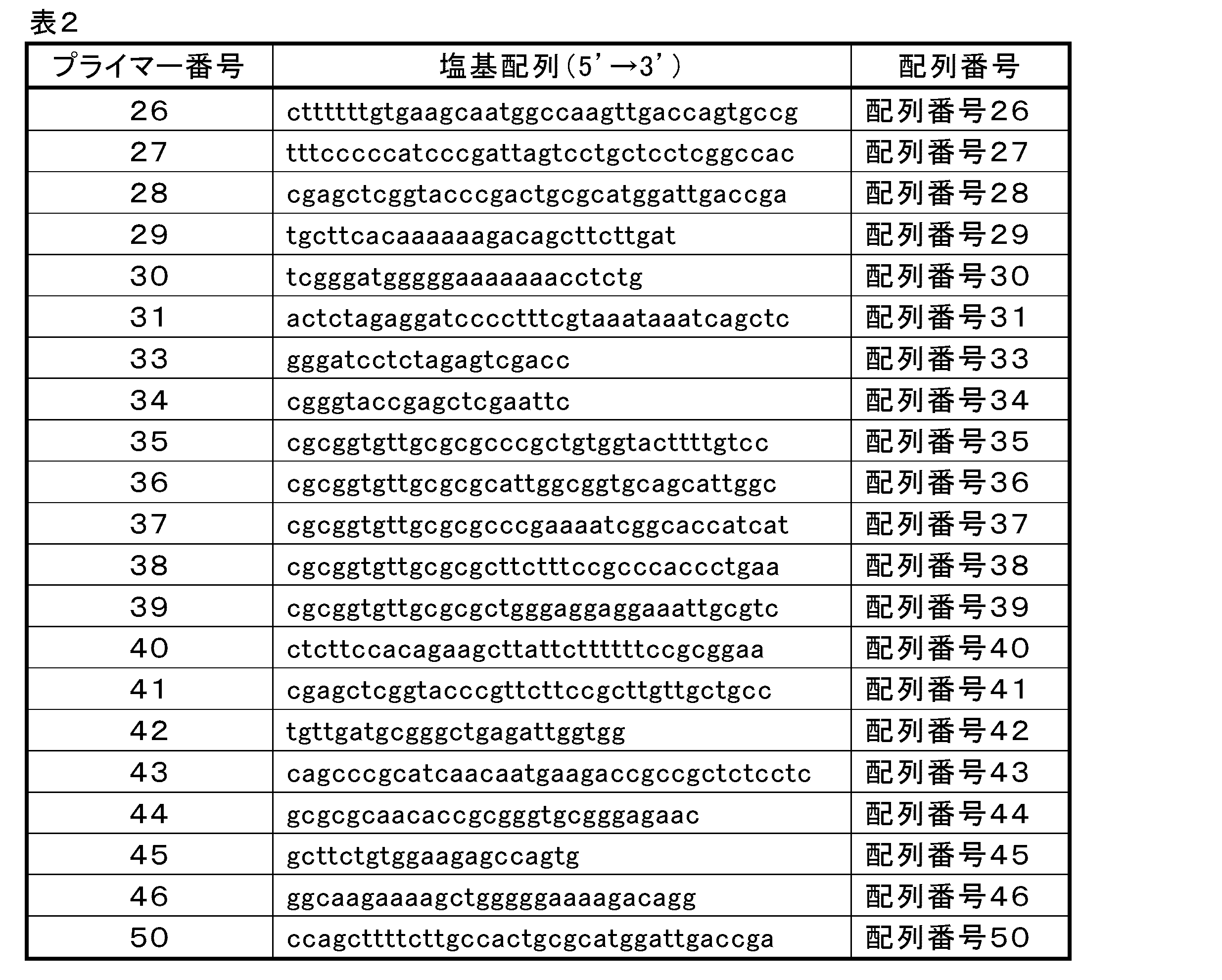
(1)グィラルディア・セータ由来アシル-ACPチオエステラーゼ遺伝子の取得
National Center for Biotechnology Information(NCBI)のタンパクデータベースに、Accession No. XP_005824882として登録されているグィラルディア・セータ由来の機能未知タンパク質のアミノ酸配列(配列番号1)及びこれをコードする遺伝子配列(配列番号2)を取得した。以下、このタンパク質を「GtTE」ともいい、当該タンパク質をコードする遺伝子を「GtTE遺伝子」ともいう。
次いで、配列番号2の1459~2319位の塩基配列(配列番号1の487~772位に相当)を、大腸菌のコドン使用頻度に合わせてコドン最適化を施した塩基配列として、配列番号3の塩基配列を取得した。なお、配列番号3の塩基配列からなる遺伝子は、オペロンバイオテクノロジー社の提供する人工遺伝子受託合成サービスを利用して取得した。
配列番号3の塩基配列からなる、人工合成遺伝子を鋳型として、表1に示すプライマー番号4及びプライマー番号5のプライマー対を用いたPCRにより、配列番号3の塩基配列からなるGtTE遺伝子を取得した。
また、プラスミドベクターpBluescriptII SK(-)(Stratagene社製)を鋳型として、表1に示すプライマー番号6及びプライマー番号7のプライマー対を用いたPCRによりpBluescriptII SK(-)を増幅し、制限酵素DpnI(東洋紡社製)処理により鋳型の消化を行った。
これら2つの断片を、High Pure PCR Product Purification Kit(Roche Applied Science社製)を用いて精製した後に、In-Fusion HD Cloning Kit(Clontech社製)を用いて融合し、常法に従い大腸菌DH5α株のコンピテントセル(タカラバイオ社製)への形質転換、プラスミド抽出、及びクローニング断片の塩基配列確認を行い、GtTE遺伝子発現プラスミドGtTE_487を構築した。
前記プラスミドGtTE_487を鋳型とし、表1に示すプライマー番号8~23のいずれか1つと、プライマー番号6のプライマーとのプライマー対を用いてPCRを行い、得られた遺伝子断片を前記の方法と同様にして精製・融合し、GtTE遺伝子発現プラスミドGtTE_497、GtTE_507、GtTE_517、GtTE_527、GtTE_537、GtTE_547、GtTE_557、GtTE_567、GtTE_577、GtTE_587、GtTE_597、GtTE_607、GtTE_608、GtTE_609、GtTE_610、及びGtTE_611をそれぞれ構築した。
なお、プラスミドGtTE_487は、配列番号1に示すアミノ酸配列のN末端側1~486位のアミノ酸配列を除去するよう構築され、GtTE遺伝子として、配列番号1の487位~772位のアミノ酸配列をコードする塩基配列及び終止コドンに対応する配列番号3の1位~861位の塩基配列を有する。同様に、プラスミドGtTE_497、プラスミドGtTE_507、プラスミドGtTE_517、プラスミドGtTE_527、プラスミドGtTE_537、プラスミドGtTE_547、プラスミドGtTE_557、プラスミドGtTE_567、プラスミドGtTE_577、プラスミドGtTE_587、プラスミドGtTE_597、プラスミドGtTE_607、プラスミドGtTE_608、プラスミドGtTE_609、プラスミドGtTE_610、及びプラスミドGtTE_611は、配列番号1に示すアミノ酸配列のN末端側1~496位、1~506位、1~516位、1~526位、1~536位、1~546位、1~556位、1~566位、1~576位、1~586位、1~596位、1~606位、1~607位、1~608位、1~609位、又は1~610位のアミノ酸配列をそれぞれ除去するように構築した。さらに、これらのプラスミドは、配列番号1に示すアミノ酸配列のN末端側を除去した部位の上流に、プラスミドベクターpBluescriptII SK(-)由来のLacZタンパク質のN末端側1位~29位のアミノ酸配列が融合したタンパク質を発現させるように構築した。
前記の各種GtTE遺伝子発現プラスミドを用いて、大腸菌突然変異株であるK27株(fadD88)(Overath et al,Eur.J.Biochem.7,559-574,1969)をコンピテントセル形質転換法により形質転換した。形質転換処理をしたK27株を50μg/mLアンピシリンナトリウム含有LB寒天培地(Bacto Trypton 1%、Yeast Extract 0.5%、NaCl 1%、Agar 1.5%)に播種して30℃で一晩静置し、得られたコロニーを、2mLのOvernight Express Instant TB Medium(Novagen社)に接種し、30℃で振とう培養した。培養24時間後、培養液に含まれる脂質成分を、下記方法にて解析した。なお、陰性対照として、プラスミドベクターpBluescriptII SK(-)で形質転換した大腸菌K27株についても同様に実験を行った。
培養液1mLに、内部標準として1mg/mLの7-ペンタデカノン(メタノール溶液)50μLを添加後、クロロホルム0.5mL、メタノール1mL及び2N塩酸10μLを培養液に添加して激しく攪拌し、10分間以上放置した。その後さらに、クロロホルム0.5mL及び1.5%KCl 0.5mLを添加して攪拌し、3,000rpmにて5分間遠心分離を行い、パスツールピペットにてクロロホルム層(下層)を回収した。
得られたクロロホルム層に窒素ガスを吹き付けて乾固し、0.5N水酸化カリウム/メタノール溶液0.7mLを添加し、80℃で30分間恒温した。続いて14%三フッ化ホウ素のメタノール溶液(SIGMA社製)1mLを添加し、80℃にて10分間恒温した。その後、ヘキサン、飽和食塩水を各1mL添加し激しく撹拌し、室温にて10分間以上放置後、上層であるヘキサン層を回収して脂肪酸メチルエステルを得た。
<ガスクロマトグラフィー条件>
キャピラリーカラム:DB-1 MS(30m×200μm×0.25μm、J&W Scientific社製)
移動相:高純度ヘリウム
カラム内流量:1.0mL/分
昇温プログラム:100℃(1分間)→10℃/分→300℃(5分間)
平衡化時間:1分間
注入口:スプリット注入(スプリット比:100:1)
圧力:14.49psi,104mL/分
注入量:1μL
洗浄バイアル:メタノール・クロロホルム
検出器温度:300℃
ガスクロマトグラフィー解析により得られた波形データのピーク面積より、各脂肪酸のメチルエステル量を定量した。各ピーク面積を、内部標準である7-ペンタデカノンのピーク面積と比較することで試料間の補正を行い、培養液1Lあたりの各脂肪酸量を算出した。さらに、各脂肪酸量の総和を総脂肪酸量とし、総脂肪酸量に占める各脂肪酸量の割合を算出した。
結果を表3に示す。なお下記の表において、「TFA」は総脂肪酸量を、「脂肪酸組成(%TFA)」は総脂肪酸の重量に対する各脂肪酸の重量の割合(重量パーセント)を示す。また「Cx:y」とあるのは、炭素原子数xで二重結合数がyの脂肪酸を表し、「C17:0Δ」及び「C19:0Δ」はそれぞれcis-9,10-メチレンヘキサデカン酸(cis-9,10-Methylen-hexadecanoic acid)及びcis-11,12-メチレンオクタデカン酸(cis-11,12-Methylen-octadecanoic acid)を表す。

これらの結果から、各種GtTE遺伝子発現プラスミドに導入した遺伝子がコードするタンパク質は、アシル-ACPチオエステラーゼ活性を有することが確認された。また、これらのタンパク質はC12脂肪酸及びC14脂肪酸の割合及び生産量を顕著に増加させたことから、C12脂肪酸やC14脂肪酸、特にC14脂肪酸に高い特異性を持つアシル-ACPチオエステラーゼであると考えられる。
以上の結果から、配列番号1で示されるアミノ酸配列中、少なくとも611位~772位の領域を有するタンパク質は、アシル-ACPチオエステラーゼ活性を示すと認められる。
(1)ゼオシン耐性遺伝子発現用プラスミドの構築
ゼオシン耐性遺伝子(配列番号24)、及び文献(Randor Radakovits,et al.,Nature Communications,DOI:10.1038/ncomms1688,2012)記載のナンノクロロプシス・ガディタナCCMP526株由来チューブリンプロモーター配列(配列番号25)を人工合成した。合成したDNA断片を鋳型として、表2に示すプライマー番号26及びプライマー番号27のプライマー対、並びにプライマー番号28及びプライマー番号29のプライマー対を用いてPCRを行い、ゼオシン耐性遺伝子及びチューブリンプロモーター配列をそれぞれ増幅した。
また、ナンノクロロプシス・オキュラータNIES2145株のゲノムを鋳型として、表2に示すプライマー番号30及びプライマー番号31のプライマー対を用いてPCRを行い、ヒートショックプロテインターミネーター配列(配列番号32)を増幅した。
さらに、プラスミドベクターpUC19(タカラバイオ社製)を鋳型として、表2に示すプライマー番号33及びプライマー番号34のプライマー対を用いたPCRを行い、プラスミドベクターpUC19を増幅した。
なお、本プラスミドは、チューブリンプロモーター配列、ゼオシン耐性遺伝子、ヒートショックプロテインターミネーター配列の順に連結したインサート配列と、pUC19ベクター配列からなる。
実施例1で人工合成したGtTE遺伝子を鋳型として、表2に示すプライマー番号35~39のいずれか1つと、プライマー番号40のプライマー対を用いたPCRを行い、配列番号3の5'側の塩基配列を種々の長さで削除したGtTE遺伝子断片を取得した。
また、ナンノクロロプシス・オキュラータNIES2145株のゲノムを鋳型として、表2に示すプライマー番号41及びプライマー番号42のプライマー対、プライマー番号43及びプライマー番号44のプライマー対、並びにプライマー番号45及びプライマー番号46のプライマー対をそれぞれ用いたPCRを行い、LDSPプロモーター配列(配列番号47)、VCP1葉緑体移行シグナル配列(配列番号48)及びVCP1ターミネーター配列(配列番号49)を取得した。
さらに、前述のゼオシン耐性遺伝子発現プラスミドを鋳型として、表2に示すプライマー番号50及びプライマー番号34のプライマー対を用いたPCRを行い、ゼオシン耐性遺伝子発現カセット(チューブリンプロモーター配列、ゼオシン耐性遺伝子、ヒートショックプロテインターミネーター配列)及びpUC19配列からなる断片を増幅した。
なお、これらのプラスミドは、LDSPプロモーター配列、VCP1葉緑体移行シグナルを配列番号1に示すアミノ酸配列の488~772位、527~772位、587~772位、597~772位、若しくは607~772位のアミノ酸配列をコードする塩基配列の5’末端側に連結させたGtTE遺伝子、VCP1ターミネーター配列、チューブリンプロモーター配列、ゼオシン耐性遺伝子、ヒートショックプロテインターミネーター配列の順で連結したインサート配列と、pUC19ベクター配列からなる。
前述のGtTE遺伝子発現用プラスミド(GtTE_488-Nanno、GtTE_527-Nanno、GtTE_587-Nanno、GtTE_597-Nanno、GtTE_607-Nanno)をそれぞれ鋳型として、表2に示すプライマー番号41及びプライマー番号31のプライマー対を用いたPCRを行い、GtTE遺伝子発現カセット(LDSPプロモーター配列、VCP1葉緑体移行シグナル、配列番号1に示すアミノ酸配列のN末端側1~487位、1~526位、1~586位、1~596位、若しくは1~606位のアミノ酸配列をコードする塩基配列を除去したGtTE遺伝子、VCP1ターミネーター配列、チューブリンプロモーター配列、ゼオシン耐性遺伝子、ヒートショックプロテインターミネーター配列からなるDNA断片)をそれぞれ増幅した。
増幅した断片をそれぞれ、High Pure PCR Product Purification Kit(Roche Applied Science社製)を用いて精製した。なお、精製の際の溶出には、キットに含まれる溶出バッファーではなく、滅菌水を用いた。
f/2液体培地(NaNO3 75mg、NaH2PO4・2H2O 6mg、ビタミンB12 0.5μg、ビオチン 0.5μg、チアミン 100μg、Na2SiO3・9H2O 10mg、Na2EDTA・2H2O 4.4mg、FeCl3・6H2O 3.16mg、FeCl3・6H2O 12μg、ZnSO4・7H2O 21μg、MnCl2・4H2O 180μg、CuSO4・5H2O 7μg、Na2MoO4・2H2O 7μg/人工海水1L)にて24時間回復培養を行った。その後に、2μg/mLのゼオシン含有f/2寒天培地に塗布し、25℃、0.3%CO2雰囲気下、12h/12h明暗条件にて2~3週間培養した。得られたコロニーの中から、GtTE遺伝子発現カセットを含むものをPCR法により選抜した。
選抜した株を、f/2培地の窒素濃度を15倍、リン濃度を5倍に増強した培地(以下、「N15P5培地」という)20mLに播種し、25℃、0.3%CO2雰囲気下、12h/12h明暗条件にて4週間振盪培養し、前培養液とした。前培養液2mLを、N15P5培地18mLに植継ぎ、25℃、0.3%CO2雰囲気下、12h/12h明暗条件にて3週間振盪培養した。
なお、陰性対照として、野生株であるナンノクロロプシス・オキュラータNIES2145株についても同様に実験を行った。
得られたクロロホルム層に窒素ガスを吹き付けて乾固し、0.5N水酸化カリウム/メタノール溶液0.7mLを添加し、80℃で30分間恒温した。続いて14%三フッ化ホウ素メタノール溶液(SIGMA社製)1mLを添加し、80℃にて10分間恒温した。その後、ヘキサン0.5mL、及び飽和食塩水1mLを添加し激しく撹拌し、室温にて10分間放置し、上層であるヘキサン層を回収して脂肪酸メチルエステルを得た。
<ガスクロマトグラフィー条件>
分析装置:7890A(Agilent technology社製)
キャピラリーカラム:DB-WAX(10m×100μm×0.10μm、J&W Scientific社製)
移動相:高純度ヘリウム
オーブン温度:100℃ 保持0.5分→100~250℃(20℃/min昇温)→250℃ 保持3分(ポストラン:1分)
注入口温度:300℃
注入方法:スプリット注入(スプリット比:50:1)
注入量:5μL
洗浄バイアル:メタノール
検出方法:FID
検出器温度:350℃

Claims (20)
- 宿主に下記タンパク質(A)~(C)のいずれか1つをコードする遺伝子が導入されている形質転換体を培養し、培養物から脂質を採取する、脂質の製造方法。
(A)配列番号1の611位~772位のアミノ酸配列からなるタンパク質。
(B)配列番号1の611位~772位のアミノ酸配列との同一性が80%以上のアミノ酸配列からなり、かつアシル-ACPチオエステラーゼ活性を有するタンパク質。
(C)前記タンパク質(A)又は(B)のアミノ酸配列を有し、かつアシル-ACPチオエステラーゼ活性を有するタンパク質。 - 宿主に下記タンパク質(A)~(C)のいずれか1つをコードする遺伝子を導入する工程を含む、形質転換体の細胞内で生産される脂肪酸又はこれを構成成分とする脂質の生産性を向上させる方法。
(A)配列番号1の611位~772位のアミノ酸配列からなるタンパク質。
(B)配列番号1の611位~772位のアミノ酸配列との同一性が80%以上のアミノ酸配列からなり、かつアシル-ACPチオエステラーゼ活性を有するタンパク質。
(C)前記タンパク質(A)又は(B)のアミノ酸配列を有し、かつアシル-ACPチオエステラーゼ活性を有するタンパク質。 - 宿主に下記タンパク質(A)~(C)のいずれか1つをコードする遺伝子を導入して形質転換体を得る工程を含む、形質転換体の細胞内で生産される中鎖脂肪酸又はこれを構成成分とする脂質の生産性を向上させ、生産される全脂肪酸又は全脂質中の脂肪酸又は脂質の組成を改変する、脂質の組成の改変方法。
(A)配列番号1の611位~772位のアミノ酸配列からなるタンパク質。
(B)配列番号1の611位~772位のアミノ酸配列との同一性が80%以上のアミノ酸配列からなり、かつアシル-ACPチオエステラーゼ活性を有するタンパク質。
(C)前記タンパク質(A)又は(B)のアミノ酸配列を有し、かつアシル-ACPチオエステラーゼ活性を有するタンパク質。 - 前記タンパク質(C)が下記タンパク質(C1)~(C20)のいずれか1つである、請求項1~3のいずれか1項記載の方法。
(C1)配列番号1の1位~772位のアミノ酸配列からなるタンパク質。
(C2)配列番号1の487位~772位のアミノ酸配列からなるタンパク質。
(C3)配列番号1の488位~772位のアミノ酸配列からなるタンパク質。
(C4)配列番号1の497位~772位のアミノ酸配列からなるタンパク質。
(C5)配列番号1の507位~772位のアミノ酸配列からなるタンパク質。
(C6)配列番号1の517位~772位のアミノ酸配列からなるタンパク質。
(C7)配列番号1の527位~772位のアミノ酸配列からなるタンパク質。
(C8)配列番号1の537位~772位のアミノ酸配列からなるタンパク質。
(C9)配列番号1の547位~772位のアミノ酸配列からなるタンパク質。
(C10)配列番号1の557位~772位のアミノ酸配列からなるタンパク質。
(C11)配列番号1の567位~772位のアミノ酸配列からなるタンパク質。
(C12)配列番号1の577位~772位のアミノ酸配列からなるタンパク質。
(C13)配列番号1の587位~772位のアミノ酸配列からなるタンパク質。
(C14)配列番号1の597位~772位のアミノ酸配列からなるタンパク質。
(C15)配列番号1の607位~772位のアミノ酸配列からなるタンパク質。
(C16)配列番号1の608位~772位のアミノ酸配列からなるタンパク質。
(C17)配列番号1の609位~772位のアミノ酸配列からなるタンパク質。
(C18)配列番号1の610位~772位のアミノ酸配列からなるタンパク質。
(C19)前記タンパク質(C1)~(C18)のいずれか1つのアミノ酸配列との同一性が80%以上のアミノ酸配列からなり、かつアシル-ACPチオエステラーゼ活性を有するタンパク質。
(C20)前記タンパク質(C1)~(C18)のいずれか1つのアミノ酸配列に1又は数個のアミノ酸が欠失、置換、挿入、又は付加されたアミノ酸配列からなり、かつアシル-ACPチオエステラーゼ活性を有するタンパク質。 - 前記タンパク質(A)~(C)のいずれか1つをコードする遺伝子が、下記DNA(a)~(f)のいずれか1つからなる遺伝子である、請求項1~4のいずれか1項記載の方法。
(a)配列番号2の1831位~2319位の塩基配列からなるDNA。
(b)配列番号2の1831位~2319位の塩基配列との同一性が80%以上の塩基配列からなり、かつアシル-ACPチオエステラーゼ活性を有するタンパク質をコードするDNA。
(c)前記DNA(a)又は(b)の塩基配列を有し、かつアシル-ACPチオエステラーゼ活性を有するタンパク質をコードするDNA。
(d)配列番号3の373位~861位の塩基配列からなるDNA。
(e)配列番号3の373位~861位の塩基配列との同一性が80%以上の塩基配列からなり、かつアシル-ACPチオエステラーゼ活性を有するタンパク質をコードするDNA。
(f)前記DNA(d)又は(e)の塩基配列を有し、かつアシル-ACPチオエステラーゼ活性を有するタンパク質をコードするDNA。 - 前記宿主が微生物である、請求項1~5のいずれか1項記載の方法。
- 前記微生物が大腸菌である、請求項6記載の方法。
- 前記微生物が微細藻類である、請求項6記載の方法。
- 前記微細藻類がナンノクロロプシス(Nannochloropsis)属に属する藻類である、請求項8記載の方法。
- 前記脂質が炭素数12の脂肪酸又はその脂肪酸エステル化合物を含む、請求項1~9のいずれか1項記載の方法。
- 下記タンパク質(A)~(C)。
(A)配列番号1の611位~772位のアミノ酸配列からなるタンパク質。
(B)配列番号1の611位~772位のアミノ酸配列との同一性が80%以上のアミノ酸配列からなり、かつアシル-ACPチオエステラーゼ活性を有するタンパク質。
(C)前記タンパク質(A)又は(B)のアミノ酸配列を有し、かつアシル-ACPチオエステラーゼ活性を有するタンパク質。 - 前記タンパク質(C)が下記タンパク質(C1)~(C20)のいずれか1つである、請求項11記載のタンパク質。
(C1)配列番号1の1位~772位のアミノ酸配列からなるタンパク質。
(C2)配列番号1の487位~772位のアミノ酸配列からなるタンパク質。
(C3)配列番号1の488位~772位のアミノ酸配列からなるタンパク質。
(C4)配列番号1の497位~772位のアミノ酸配列からなるタンパク質。
(C5)配列番号1の507位~772位のアミノ酸配列からなるタンパク質。
(C6)配列番号1の517位~772位のアミノ酸配列からなるタンパク質。
(C7)配列番号1の527位~772位のアミノ酸配列からなるタンパク質。
(C8)配列番号1の537位~772位のアミノ酸配列からなるタンパク質。
(C9)配列番号1の547位~772位のアミノ酸配列からなるタンパク質。
(C10)配列番号1の557位~772位のアミノ酸配列からなるタンパク質。
(C11)配列番号1の567位~772位のアミノ酸配列からなるタンパク質。
(C12)配列番号1の577位~772位のアミノ酸配列からなるタンパク質。
(C13)配列番号1の587位~772位のアミノ酸配列からなるタンパク質。
(C14)配列番号1の597位~772位のアミノ酸配列からなるタンパク質。
(C15)配列番号1の607位~772位のアミノ酸配列からなるタンパク質。
(C16)配列番号1の608位~772位のアミノ酸配列からなるタンパク質。
(C17)配列番号1の609位~772位のアミノ酸配列からなるタンパク質。
(C18)配列番号1の610位~772位のアミノ酸配列からなるタンパク質。
(C19)前記タンパク質(C1)~(C18)のいずれか1つのアミノ酸配列との同一性が80%以上のアミノ酸配列からなり、かつアシル-ACPチオエステラーゼ活性を有するタンパク質。
(C20)前記タンパク質(C1)~(C18)のいずれか1つのアミノ酸配列に1又は数個のアミノ酸が欠失、置換、挿入、又は付加されたアミノ酸配列からなり、かつアシル-ACPチオエステラーゼ活性を有するタンパク質。 - 請求項11又は12記載のタンパク質をコードする遺伝子。
- 下記DNA(a)~(f)のいずれか1つからなる遺伝子。
(a)配列番号2の1831位~2319位の塩基配列からなるDNA。
(b)配列番号2の1831位~2319位の塩基配列との同一性が80%以上の塩基配列からなり、かつアシル-ACPチオエステラーゼ活性を有するタンパク質をコードするDNA。
(c)前記DNA(a)又は(b)の塩基配列を有し、かつアシル-ACPチオエステラーゼ活性を有するタンパク質をコードするDNA。
(d)配列番号3の373位~861位の塩基配列からなるDNA。
(e)配列番号3の373位~861位の塩基配列との同一性が80%以上の塩基配列からなり、かつアシル-ACPチオエステラーゼ活性を有するタンパク質をコードするDNA。
(f)前記DNA(d)又は(e)の塩基配列を有し、かつアシル-ACPチオエステラーゼ活性を有するタンパク質をコードするDNA。 - 請求項13又は14記載の遺伝子を含有する組換えベクター。
- 請求項13若しくは14記載の遺伝子、又は請求項15記載の組換えベクターを、宿主に導入してなる形質転換体。
- 前記宿主が微生物である、請求項16記載の形質転換体。
- 前記微生物が大腸菌である、請求項17記載の形質転換体。
- 前記微生物が微細藻類である、請求項17記載の形質転換体。
- 前記微細藻類がナンノクロロプシス(Nannochloropsis)属に属する藻類である、請求項19記載の形質転換体。
Priority Applications (3)
| Application Number | Priority Date | Filing Date | Title |
|---|---|---|---|
| US15/520,146 US20170335353A1 (en) | 2014-12-05 | 2015-11-06 | Method of Producing Lipid Using Acyl-ACP Thioesterase |
| AU2015356285A AU2015356285A1 (en) | 2014-12-05 | 2015-11-06 | Method of producing lipid using acyl-acp thioesterase |
| JP2016562360A JP6709169B2 (ja) | 2014-12-05 | 2015-11-06 | アシル−acpチオエステラーゼを用いた脂質の製造方法 |
Applications Claiming Priority (2)
| Application Number | Priority Date | Filing Date | Title |
|---|---|---|---|
| JP2014-246573 | 2014-12-05 | ||
| JP2014246573 | 2014-12-05 |
Publications (1)
| Publication Number | Publication Date |
|---|---|
| WO2016088511A1 true WO2016088511A1 (ja) | 2016-06-09 |
Family
ID=56091463
Family Applications (1)
| Application Number | Title | Priority Date | Filing Date |
|---|---|---|---|
| PCT/JP2015/081357 Ceased WO2016088511A1 (ja) | 2014-12-05 | 2015-11-06 | アシル-acpチオエステラーゼを用いた脂質の製造方法 |
Country Status (4)
| Country | Link |
|---|---|
| US (1) | US20170335353A1 (ja) |
| JP (1) | JP6709169B2 (ja) |
| AU (1) | AU2015356285A1 (ja) |
| WO (1) | WO2016088511A1 (ja) |
Cited By (4)
| Publication number | Priority date | Publication date | Assignee | Title |
|---|---|---|---|---|
| US10066248B2 (en) | 2014-03-03 | 2018-09-04 | Kao Corporation | Method of producing lipid by using β-ketoacyl-ACP synthase |
| US10087428B2 (en) | 2012-12-27 | 2018-10-02 | Kao Corporation | Acyl-ACP thioesterase |
| US10508292B2 (en) | 2015-05-22 | 2019-12-17 | Kao Corporation | Method of producing lipid |
| US10550412B2 (en) | 2014-06-20 | 2020-02-04 | Kao Corporation | Method of producing lipid |
Citations (4)
| Publication number | Priority date | Publication date | Assignee | Title |
|---|---|---|---|---|
| WO2014103930A1 (ja) * | 2012-12-27 | 2014-07-03 | 花王株式会社 | アシル-acpチオエステラーゼ |
| WO2015005139A1 (ja) * | 2013-07-12 | 2015-01-15 | 花王株式会社 | アシル-acpチオエステラーゼ |
| JP2015177771A (ja) * | 2014-03-19 | 2015-10-08 | 花王株式会社 | アシル−acpチオエステラーゼ改変体を用いた脂質の製造方法 |
| JP2016007154A (ja) * | 2014-06-23 | 2016-01-18 | 花王株式会社 | アシル−acpチオエステラーゼを用いた脂質の製造方法 |
-
2015
- 2015-11-06 AU AU2015356285A patent/AU2015356285A1/en not_active Abandoned
- 2015-11-06 US US15/520,146 patent/US20170335353A1/en not_active Abandoned
- 2015-11-06 JP JP2016562360A patent/JP6709169B2/ja active Active
- 2015-11-06 WO PCT/JP2015/081357 patent/WO2016088511A1/ja not_active Ceased
Patent Citations (4)
| Publication number | Priority date | Publication date | Assignee | Title |
|---|---|---|---|---|
| WO2014103930A1 (ja) * | 2012-12-27 | 2014-07-03 | 花王株式会社 | アシル-acpチオエステラーゼ |
| WO2015005139A1 (ja) * | 2013-07-12 | 2015-01-15 | 花王株式会社 | アシル-acpチオエステラーゼ |
| JP2015177771A (ja) * | 2014-03-19 | 2015-10-08 | 花王株式会社 | アシル−acpチオエステラーゼ改変体を用いた脂質の製造方法 |
| JP2016007154A (ja) * | 2014-06-23 | 2016-01-18 | 花王株式会社 | アシル−acpチオエステラーゼを用いた脂質の製造方法 |
Non-Patent Citations (4)
| Title |
|---|
| CURTIS, B.A. et al., hypothetical protein GUITHDRAFT_165334 [Guillardia theta CCMP2712], [online], NCBI Reference Sequence: XP_ 005824882.1 * |
| DATABASE NCBI [o] 24 October 2013 (2013-10-24), XP058248821 * |
| GONG, Y. ET AL.: "Characterization of a novel thioesterase(PtTE) from Phaeodactylum tricornutum.", J. BASIC MICROBIOL., vol. 51, no. 6, December 2011 (2011-12-01), pages 666 - 672, ISSN: 1521-4028 * |
| HOOVER, S.W. ET AL.: "Bacterial production of free fatty acids from freshwater macroalgal cellulose.", APPL. MICROBIOL. BIOTECHNOL., vol. 91, no. 2, July 2011 (2011-07-01), pages 436 - 446, ISSN: 0175-7598 * |
Cited By (5)
| Publication number | Priority date | Publication date | Assignee | Title |
|---|---|---|---|---|
| US10087428B2 (en) | 2012-12-27 | 2018-10-02 | Kao Corporation | Acyl-ACP thioesterase |
| US10597646B2 (en) | 2012-12-27 | 2020-03-24 | Kao Corporation | Acyl-ACP thioesterase |
| US10066248B2 (en) | 2014-03-03 | 2018-09-04 | Kao Corporation | Method of producing lipid by using β-ketoacyl-ACP synthase |
| US10550412B2 (en) | 2014-06-20 | 2020-02-04 | Kao Corporation | Method of producing lipid |
| US10508292B2 (en) | 2015-05-22 | 2019-12-17 | Kao Corporation | Method of producing lipid |
Also Published As
| Publication number | Publication date |
|---|---|
| JPWO2016088511A1 (ja) | 2017-09-14 |
| JP6709169B2 (ja) | 2020-06-10 |
| US20170335353A1 (en) | 2017-11-23 |
| AU2015356285A1 (en) | 2017-05-18 |
Similar Documents
| Publication | Publication Date | Title |
|---|---|---|
| JP6491881B2 (ja) | アシル−acpチオエステラーゼ | |
| JP6310544B2 (ja) | β−ケトアシル−ACPシンターゼを用いた脂質の製造方法 | |
| JP6592434B2 (ja) | 脂質の製造方法 | |
| JP6779652B2 (ja) | 脂質の製造方法 | |
| JP6629749B2 (ja) | アシル−acpチオエステラーゼを用いた脂質の製造方法 | |
| JP6319889B2 (ja) | アシル−acpチオエステラーゼ改変体を用いた脂質の製造方法 | |
| JP6381139B2 (ja) | アシル−acpチオエステラーゼ | |
| US10337037B2 (en) | Method of producing lipid | |
| JP6709169B2 (ja) | アシル−acpチオエステラーゼを用いた脂質の製造方法 | |
| JP6779664B2 (ja) | 脂質の製造方法 | |
| JP6580912B2 (ja) | 脂質の製造方法 | |
| JP6587468B2 (ja) | 脂質の製造方法 | |
| JP6332855B2 (ja) | アシル−acpチオエステラーゼを用いた脂質の製造方法 | |
| WO2019069969A1 (ja) | 脂質の製造方法 | |
| WO2017022587A1 (ja) | 脂質の製造方法 | |
| JP2019216643A (ja) | 脂質の製造方法 |
Legal Events
| Date | Code | Title | Description |
|---|---|---|---|
| 121 | Ep: the epo has been informed by wipo that ep was designated in this application |
Ref document number: 15864926 Country of ref document: EP Kind code of ref document: A1 |
|
| ENP | Entry into the national phase |
Ref document number: 2016562360 Country of ref document: JP Kind code of ref document: A |
|
| ENP | Entry into the national phase |
Ref document number: 2015356285 Country of ref document: AU Date of ref document: 20151106 Kind code of ref document: A |
|
| NENP | Non-entry into the national phase |
Ref country code: DE |
|
| 122 | Ep: pct application non-entry in european phase |
Ref document number: 15864926 Country of ref document: EP Kind code of ref document: A1 |