WO2016084950A1 - 医薬組成物 - Google Patents
医薬組成物 Download PDFInfo
- Publication number
- WO2016084950A1 WO2016084950A1 PCT/JP2015/083453 JP2015083453W WO2016084950A1 WO 2016084950 A1 WO2016084950 A1 WO 2016084950A1 JP 2015083453 W JP2015083453 W JP 2015083453W WO 2016084950 A1 WO2016084950 A1 WO 2016084950A1
- Authority
- WO
- WIPO (PCT)
- Prior art keywords
- methyl
- ethyl
- pyrimidine compound
- amino
- trifluoromethyl
- Prior art date
- Legal status (The legal status is an assumption and is not a legal conclusion. Google has not performed a legal analysis and makes no representation as to the accuracy of the status listed.)
- Ceased
Links
Images

Classifications
-
- A—HUMAN NECESSITIES
- A61—MEDICAL OR VETERINARY SCIENCE; HYGIENE
- A61K—PREPARATIONS FOR MEDICAL, DENTAL OR TOILETRY PURPOSES
- A61K9/00—Medicinal preparations characterised by special physical form
- A61K9/20—Pills, tablets, discs, rods
-
- A—HUMAN NECESSITIES
- A61—MEDICAL OR VETERINARY SCIENCE; HYGIENE
- A61K—PREPARATIONS FOR MEDICAL, DENTAL OR TOILETRY PURPOSES
- A61K31/00—Medicinal preparations containing organic active ingredients
- A61K31/33—Heterocyclic compounds
- A61K31/395—Heterocyclic compounds having nitrogen as a ring hetero atom, e.g. guanethidine or rifamycins
- A61K31/495—Heterocyclic compounds having nitrogen as a ring hetero atom, e.g. guanethidine or rifamycins having six-membered rings with two or more nitrogen atoms as the only ring heteroatoms, e.g. piperazine or tetrazines
- A61K31/505—Pyrimidines; Hydrogenated pyrimidines, e.g. trimethoprim
Definitions
- the pharmaceutical composition containing the pyrimidine compound (1) or a salt thereof or a solvate thereof has not been specifically studied so far, and the stability in the pharmaceutical composition has never been reported so far. Not. Then, this invention makes it a subject to provide the pharmaceutical composition containing the pyrimidine compound (1) or its salt, or those solvates which are excellent in stability.
- the present inventor In order to provide a pharmaceutical composition containing a pyrimidine compound (1) having excellent stability, the present inventor first conducted intensive studies on the physical and chemical characteristics of the pyrimidine compound (1). However, its stability is greatly influenced by the pH environment, it is extremely unstable in a high pH environment and decomposes rapidly, while it is extremely stable in a low pH environment, and the pH of the pyrimidine compound (1). The present inventors have found that a pharmaceutical composition containing a pyrimidine compound (1) having excellent stability can be obtained if it is formulated so that the environment has a low pH value, and the present invention has been completed.
- the stability of the pyrimidine compound (1) in the pharmaceutical composition can be improved.
- FIG. 4 is a diagram showing a powder X-ray diffraction pattern of crystals of pyrimidine compound (1) hydrochloride obtained in 1-3 in Reference Example 1.
- FIG. 3 is a diagram showing thermal analysis measurement (TG-DTA measurement) data of pyrimidine compound (1) hydrochloride crystals obtained in 1-3 in Reference Example 1.
- the pH value of the liquid obtained when dissolved or dispersed in an aqueous 0.1 w / v% cetyltrimethylammonium bromide solution is 7.5 or less (preferably 2.0 to 7.5). 1] The pharmaceutical composition of description. [3] The pH value of the liquid obtained when dissolved or dispersed in a 0.1 w / v% aqueous cetyltrimethylammonium bromide solution is 7.0 or less (preferably 2.0 to 7.0). 1] The pharmaceutical composition of description. [4] The pH value of the liquid obtained when dissolved or dispersed in an aqueous 0.1 w / v% cetyltrimethylammonium bromide solution is 6.5 or less (preferably 2.0 to 6.5).
- the pharmaceutical composition of description [5] The pH value of the liquid obtained when dissolved or dispersed in a 0.1 w / v% aqueous cetyltrimethylammonium bromide solution is 6.0 or less (preferably 2.0 to 6.0). 1] The pharmaceutical composition of description. [6] The pH value of the liquid obtained when dissolved or dispersed in the 0.1 w / v% aqueous cetyltrimethylammonium bromide solution is 5.8 or less (preferably 2.0 to 5.8). 1] The pharmaceutical composition of description.
- the pH value of a solution obtained when dissolved or dispersed in a 0.1 w / v% aqueous cetyltrimethylammonium bromide solution is 5.0 or less (preferably 2.0 to 5.0).
- the pharmaceutical composition of description [8] The solid preparation for oral administration (preferably, the solid preparation for oral administration selected from the group consisting of tablets, capsules, granules and powders), according to any one of [1] to [7] Pharmaceutical composition.
- the pH value of the liquid obtained when dissolved or dispersed in a 0.1 w / v% aqueous cetyltrimethylammonium bromide solution is 7.0 or less (preferably 2.0 to 7.0). 10] The method of description. [13] The pH value of a liquid obtained when dissolved or dispersed in a 0.1 w / v% aqueous cetyltrimethylammonium bromide solution is 6.5 or less (preferably 2.0 to 6.5). 10] The method of description. [14] The pH value of a solution obtained when dissolved or dispersed in a 0.1 w / v% aqueous cetyltrimethylammonium bromide solution is 6.0 or less (preferably 2.0 to 6.0).
- the method of description [15] The pH value of a liquid obtained when dissolved or dispersed in a 0.1 w / v% aqueous cetyltrimethylammonium bromide solution is 5.8 or less (preferably 2.0 to 5.8). 10] The method of description. [16] The pH value of a liquid obtained when dissolved or dispersed in a 0.1 w / v% aqueous cetyltrimethylammonium bromide solution is 5.0 or less (preferably 2.0 to 5.0). 10] The method of description.
- composition according to [10] to [16], wherein the pharmaceutical composition is a solid preparation for oral administration preferably a solid preparation for oral administration selected from the group consisting of tablets, capsules, granules, and powders.
- (S) -trans- ⁇ 4-[( ⁇ 2-[( ⁇ 1- [3,5-bis (trifluoromethyl) phenyl] ethyl ⁇ ⁇ 5- [2- (methylsulfonyl)) [Ethoxy] pyrimidin-2-yl ⁇ amino) methyl] -4- (trifluoromethyl) phenyl ⁇ (ethyl) amino) methyl] cyclohexyl ⁇ acetic acid or a salt thereof or a solvate thereof includes pyrimidine compound (1)
- a pharmaceutically acceptable salt of the pyrimidine compound (1), and a solvate of the pyrimidine compound (1) or a pharmaceutically acceptable salt thereof with water, alcohol or the like are also included.
- acid addition salts include acid addition salts with inorganic acids such as hydrochloride, hydrobromide, hydroiodide, sulfate, nitrate, phosphate; benzoate, methanesulfone And acid addition salts with organic acids such as acid salts, ethane sulfonates, benzene sulfonates, p-toluene sulfonates, maleates, fumarate, tartrate, citrate and acetate.
- inorganic acids such as hydrochloride, hydrobromide, hydroiodide, sulfate, nitrate, phosphate; benzoate, methanesulfone
- organic acids such as acid salts, ethane sulfonates, benzene sulfonates, p-toluene sulfonates, maleates, fumarate, tartrate, citrate and acetate.
- Base addition salts include sodium salts, potassium salts, lithium salts, calcium salts, magnesium salts and other metal salts; ammonia, trimethylamine, triethylamine, pyridine, collidine, lutidine and other amine salts; lysine, arginine, cinchonine, And base addition salts with organic bases such as cinchonidine.
- the salt of the pyrimidine compound (1) is preferably an acid addition salt from the viewpoint of adjusting the pH value when the pharmaceutical composition is dissolved or dispersed in a 0.1 w / v% aqueous solution of cetyltrimethylammonium bromide to the range described below.
- the salt of the pyrimidine compound (1) is preferably a hydrochloride (preferably monohydrochloride), more preferably a hydrochloride crystal (preferably monohydrochloride crystal). Since the free form of the pyrimidine compound (1) is difficult to crystallize, the present applicant has found that a crystal excellent in thermal stability can be obtained when it is separately converted into hydrochloride among various salts.
- An application was filed (international application dated May 30, 2014 (PCT / JP2014 / 064372)). In addition, description of this application specification is referred by reference in this specification.
- the thermal stability is good, the quality is good, and the dyslipidemia prevention or treatment effect Can be obtained.
- the hydrochloride crystals are in a solid state, they also have the advantage of being easy to handle during the production of pharmaceutical compositions, particularly solid formulations.
- the hydrochloride of the pyrimidine compound (1) will be described in detail.
- the number of hydrochloric acids is not particularly limited and may be any of monohydrochloride, dihydrochloride, trihydrochloride and tetrahydrochloride, and may be a mixture thereof.
- Monohydrochloride is preferable from the viewpoint of being obtained as a stable acid addition salt.
- the hydrochloride of the pyrimidine compound (1) the following formula (2):
- the specific crystal form of the pyrimidine compound (1) hydrochloride is not particularly limited, and may be any of different crystal forms, or a mixture thereof. Further, the pyrimidine compound (1) It may be a mixture of amorphous hydrochloride. Whether the pyrimidine compound (1) hydrochloride is a crystal is determined by, for example, X-ray diffraction measurement (specifically, powder X-ray diffraction measurement, etc.), thermal analysis measurement (specifically, differential thermal analysis (DTA)). ), Differential scanning calorimetry (DSC), etc.], polarization confirmation (specifically, observation with a polarizing microscope, etc.), solid NMR measurement, etc., can be confirmed by known methods.
- X-ray diffraction measurement specifically, powder X-ray diffraction measurement, etc.
- thermal analysis measurement specifically, differential thermal analysis (DTA)).
- DSC Differential scanning calorimetry
- polarization confirmation specifically, observation with a polarizing microscope, etc.
- the pyrimidine compound (1) hydrochloride is crystalline. It can be confirmed that there is.
- the method for determining crystallinity can be carried out with reference to descriptions of the Japanese Pharmacopeia, US Pharmacopeia, European Pharmacopeia and the like. These crystals may be confirmed in the presence of other components.
- solid pharmaceutical compositions (tablets, capsules, granules, powders, etc.) containing the hydrochloride of pyrimidine compound (1) and a pharmaceutically acceptable carrier require solid pharmaceutical compositions.
- a pharmaceutically acceptable carrier for example, solid pharmaceutical compositions (tablets, capsules, granules, powders, etc.) containing the hydrochloride of pyrimidine compound (1) and a pharmaceutically acceptable carrier require solid pharmaceutical compositions.
- the powder X-ray diffraction pattern obtained when irradiated with copper K ⁇ rays has at least around 14.0 ⁇ 0.2 °, around 18.3 ⁇ 0.2 °, Near 20.1 ⁇ 0.2 °, 20.5 ⁇ 0.2 °, 21.3 ⁇ 0.2 °, 21.8 ⁇ 0.2 °, 23.3 ⁇ 0.2 ° and A crystal having a peak at one or more diffraction angles (2 ⁇ ) selected from the group consisting of about 24.0 ⁇ 0.2 ° is preferred, and at least a peak at a diffraction angle (2 ⁇ ) near 20.5 ⁇ 0.2 °.
- 2 ⁇ diffraction angles
- 21 A crystal having peaks at diffraction angles (2 ⁇ ) near 3 ⁇ 0.2 °, 21.8 ⁇ 0.2 °, 23.3 ⁇ 0.2 °, and 24.0 ⁇ 0.2 °
- the crystal of the pyrimidine compound (1) hydrochloride is preferably a crystal having an endothermic peak around 162 ⁇ 5 ° C. in differential thermal analysis (DTA), and thermal analysis measurement (differential thermal analysis (DTA) ) And thermal mass measurement (TG)) crystals with substantially the same results as shown in FIG. 2 are more preferred.
- DTA differential thermal analysis
- DTA thermal analysis measurement
- TG thermal mass measurement
- the hydrochloride salt and the crystal of pyrimidine compound (1) may be a solvate such as a hydrate or a non-solvate such as an anhydride, but may be an anhydride. preferable.
- the hydrochloride of the pyrimidine compound (1) and the crystal thereof are, for example, the following steps: (Step 1) Formation of hydrochloride from a free form of pyrimidine compound (1) (Step 2) Production by crystal formation from hydrochloride of pyrimidine compound (1).
- Step 1 Formation of hydrochloride from a free form of pyrimidine compound (1)
- Step 2 Production by crystal formation from hydrochloride of pyrimidine compound (1).
- Step 1 Formation of hydrochloride salt from free form of pyrimidine compound (1)>
- This step is a step of forming a hydrochloride by coexisting the pyrimidine compound (1) and hydrogen chloride in the presence of a solvent.
- this step is a step of forming a salt by dissolving a free form of the pyrimidine compound (1) in a solvent and supplying hydrogen chloride.
- the free form of the pyrimidine compound (1) as a starting material can be produced, for example, according to the method described in Patent Document 2.
- This step is performed in the presence of a solvent.
- the solvent is not particularly limited as long as it does not participate in hydrochloride formation.
- aromatic hydrocarbons such as benzene, toluene, xylene, mesitylene, chlorobenzene, 1,2-dichlorobenzene, nitrobenzene; diethyl ether , Ethers such as diisopropyl ether, tert-butyl methyl ether and 1,4-dioxane; acetates such as ethyl acetate, n-propyl acetate and isopropyl acetate; ketones such as acetone, 2-butanone and 3-pentanone; Aliphatic hydrocarbons such as n-pentane, n-hexane, n-heptane, cyclohexane, n-octane and n-decane; Amides such as N, N-dimethylformamide and N,
- the pyrimidine compound (1) may be dissolved after mixing them, or the remaining solvent after dissolving the pyrimidine compound (1) in one solvent. May be added.
- the solvent is preferably at least one selected from diisopropyl ether, tert-butyl methyl ether, 1,4-dioxane, n-hexane, n-heptane, ethyl acetate, and isopropyl acetate.
- the amount of the solvent is not particularly limited, but the volume ratio of the pyrimidine compound (1) to the free body weight is 1 to 20 times (V / W), preferably 5 to 15 times (V / W). That's fine.
- the supply source of hydrogen chloride is not particularly limited, and hydrogen chloride gas is directly blown into the solution, and easily available concentrated hydrochloric acid, 4M HCl / ethyl acetate solution, 4M HCl / 1,4-dioxane solution, and the like can be used.
- the amount of hydrogen chloride is not particularly limited, but is preferably 1 to 5 molar equivalents and particularly preferably 1 to 4 molar equivalents with respect to the free form of pyrimidine compound (1).
- the salt formation temperature is not particularly limited, but is usually in the range of ⁇ 50 to 150 ° C., preferably ⁇ 20 to 80 ° C., more preferably ⁇ 10 to 40 ° C.
- the time required for salt formation is not particularly limited, but is usually 5 minutes to 48 hours, preferably 30 minutes to 24 hours, more preferably 30 minutes to 3 hours.
- the hydrochloride of the produced pyrimidine compound (1) can be isolated.
- the salt precipitated as a solid may be isolated by a method usually used in the technical field such as filtration, and further dried by a method usually used in the technical field as necessary.
- the drying means is not particularly limited, and examples thereof include heating and / or drying under reduced pressure.
- the drying temperature is preferably 50 ° C. or less, and more preferably 40 to 50 ° C.
- the drying time is preferably 1 to 24 hours, more preferably 6 to 12 hours.
- Step 2 Formation of crystal from hydrochloride of pyrimidine compound (1)>
- This step is a step of crystallizing the hydrochloride (eg, amorphous) of the pyrimidine compound (1) obtained in Step 1 in the presence of a solvent.
- this step is a step of adding the hydrochloride of the pyrimidine compound (1) obtained in Step 1 to a solvent, dissolving it by heating or the like as necessary, and then performing crystallization by cooling or the like. It is.
- This step is performed in the presence of a solvent.
- the solvent include a mixed solution of 2-propanol and heptane, or a mixed solution of methyl ethyl ketone and heptane, and a mixed solution of 2-propanol and heptane is preferable.
- the mixing ratio of the solvent is not particularly limited, but as a volume ratio to the volume of 2-propanol or methyl ethyl ketone, heptane is 0.1 to 2 times (V / V), preferably 0.2 to 1 times (V / V). ) Should be used.
- the hydrochloride of the pyrimidine compound (1) When the hydrochloride of the pyrimidine compound (1) is dissolved in a solvent, the hydrochloride of the pyrimidine compound (1) may be dissolved after mixing the solvent in advance, but the hydrochloride of the pyrimidine compound (1) may be dissolved in 2-propanol or It is preferable to add heptane after dissolving in methyl ethyl ketone.
- the amount of the solvent is not particularly limited, but the total mixed solvent amount is 1 to 20 times (V / W), preferably 5 to 10 times the volume ratio of the pyrimidine compound (1) to the weight of the hydrochloride. V / W) may be used.
- the temperature at which the hydrochloride of the pyrimidine compound (1) is dissolved in the solvent is not particularly limited, but is usually in the range of 40 to 100 ° C., preferably 50 to 80 ° C.
- the crystallization temperature of the hydrochloride of the pyrimidine compound (1) is not particularly limited, but it may be usually in the range of 5 to 40 ° C., preferably 10 to 35 ° C., more preferably 10 to 30 ° C., particularly preferably. Is 15 to 25 ° C. If there is a discrepancy between the temperature at which the hydrochloride of the pyrimidine compound (1) is dissolved in the solvent and the crystallization temperature, it may be cooled slowly in about 1 to 10 hours depending on the temperature difference.
- the time required for crystallization is not particularly limited, but is usually 1 hour or longer, preferably 6 to 24 hours, more preferably 8 to 16 hours.
- the precipitated pyrimidine compound (1) hydrochloride crystals may be isolated by a method commonly used in the technical field such as filtration, and further dried by a method commonly used in the technical field as necessary.
- the drying means is not particularly limited, and examples thereof include heating and / or drying under reduced pressure.
- the drying temperature is preferably 50 ° C. or less, and more preferably 40 to 50 ° C.
- the drying time is preferably 1 to 24 hours, more preferably 6 to 12 hours.
- seed crystal crystallization (seed crystal) of the pyrimidine compound (1) hydrochloride manufactured separately.
- solvent isopropyl acetate may be used instead of the above-described one.
- the amount of seed crystals is not particularly limited, but may be 0.00001 to 0.05 parts by weight, preferably 0.0001 to 0.01 parts by weight, based on the hydrochloride of pyrimidine compound (1).
- the seed crystal is preferably added after the hydrochloride of the pyrimidine compound (1) is dissolved in a solvent.
- the steps 1 and 2 are performed successively without isolating the hydrochloride of the pyrimidine compound (1).
- hydrochloride crystals can be produced in the presence of a solvent.
- the solvent is preferably isopropyl acetate.
- step 2 it is also possible to perform step 2 while omitting the time for salt formation in step 1. That is, the free form of the pyrimidine compound (1) can be dissolved in a solvent and hydrogen chloride can be supplied, followed by heating or the like, followed by cooling or the like for crystallization. The operation of other steps is the same as described above.
- the pH value of a solution obtained when dissolved or dispersed in a 0.1 w / v% aqueous solution of cetyltrimethylammonium bromide means the pyrimidine compound (1) or a salt thereof or a salt thereof.
- a pharmaceutical composition containing a solvate is dissolved or dispersed in a 0.1 w / v% aqueous solution of cetyltrimethylammonium bromide so that the concentration in terms of free form of the pyrimidine compound (1) is 0.08 mg / mL.
- the pyrimidine compound (1) since the pyrimidine compound (1) has low solubility in water, the effect of the pH environment can be more accurately evaluated by solubilization using cetyltrimethylammonium bromide which is a surfactant.
- the pH value of the liquid obtained when dissolved or dispersed in the 0.1 w / v% cetyltrimethylammonium bromide aqueous solution needs to be 8.0 or less from the viewpoint of the stability of the pyrimidine compound (1).
- 7.0 or less (more preferably 2.0 to 7.0) is preferable, and 6.5 or less (more preferably 2.0 to 6.5) is more preferable. It is more preferably 0 or less (more preferably 2.0 to 6.0), and particularly preferably 5.8 or less (more preferably 2.0 to 5.8).
- the specific means for adjusting the pH value of the solution obtained when the pharmaceutical composition is dissolved or dispersed in a 0.1 w / v% aqueous solution of cetyltrimethylammonium bromide to the above range is not particularly limited.
- the pH can be adjusted as appropriate by adjusting the type and amount of the ingredients while confirming the pH value.
- the following means (1) Means using the acid addition salt (inorganic acid salt, organic acid salt, etc.) as the pyrimidine compound (1) or a salt thereof or a solvate thereof; (2)
- An acidic-to-neutral pharmaceutical additive specifically, for example, one having a pH value of 25 or less at 25 ° C. when dissolved in water
- acidic to neutral formulation additives include acids such as organic acids and inorganic acids, and components having acidic functional groups such as carboxyl groups.
- the specific shape (dosage form) of the “pharmaceutical composition” is not particularly limited, and may be any of a solid, semi-solid, and liquid form, and for the purpose of use thereof. Can be selected accordingly.
- Examples of the dosage form of the pharmaceutical composition include the dosage forms described in the 16th revised Japanese Pharmacopoeia General Rules for Preparations. More specifically, dosage forms for oral administration include tablets (including, for example, ordinary tablets, orally disintegrating tablets, chewable tablets, effervescent tablets, dispersible tablets, and dissolving tablets), capsules, and granules.
- dosage forms for parenteral administration include injections, inhalants, eye drops, ear drops, nasal drops, suppositories, external solid preparations, external liquid preparations, sprays, ointments, creams, gels. And patches.
- a dosage form of the pharmaceutical composition a solid preparation for oral administration is preferable from the viewpoint of ease of administration, and a tablet, capsule, granule or powder is particularly preferable.
- the pharmaceutical composition can be produced by a known method described in, for example, the 16th revised Japanese Pharmacopoeia, General Rules for Preparations, etc. according to the dosage form.
- a pharmaceutically acceptable carrier may be added to the pharmaceutical composition.
- additives include excipients, binders, extenders, disintegrants, surfactants, lubricants, dispersants, buffers, preservatives, flavoring agents, flavoring agents, and diluents. However, it is not limited to these.
- the pyrimidine compound (1) has a CETP inhibitory action, a PCSK9 protein amount reducing action, and the like. Therefore, the pharmaceutical composition containing the pyrimidine compound (1) or a salt thereof or a solvate thereof is a medicament useful for the prevention and / or treatment of diseases such as dyslipidemia, hyper-LDL blood disease, and low HDL blood disease.
- Available as The administration method of the pharmaceutical composition containing the pyrimidine compound (1) or a salt thereof or a solvate thereof may be oral administration or parenteral administration, but oral administration is preferable from the viewpoint of ease of administration.
- the dose of the pyrimidine compound (1) or a salt thereof or a solvate thereof varies depending on the weight, age, sex, symptom, etc.
- pyrimidine compound (1) is converted to the free form of the pyrimidine compound (1).
- About 0.01 to 1000 mg can be administered 1 to 4 times a day.
- about 0.1-100 mg can be administered in 1 to 4 divided doses per day.
- pyrimidine compound (1) After dissolving cetyltrimethylammonium bromide in an amount of 0.1 w / v% in the obtained buffer solution, pyrimidine compound (1) in an amount of 0.08 mg / mL was dissolved and dispersed to obtain various pH values. A test solution of the conditions was obtained.
- the obtained various test solutions were stored at 25 ° C. for 3 hours, and the residual ratio of the pyrimidine compound (1) was evaluated at the start of the test and after storage for 3 hours.
- the residual ratio was measured as an area percentage with respect to the total peak area derived from the pyrimidine compound (1) and its decomposition product for each test solution using an HPLC apparatus.
- the measurement using the HPLC apparatus was performed using an ODS column as a column, an acetonitrile / water / TFA mixture as a mobile phase, and an ultraviolet absorptiometer (wavelength: 242 nm) as a detector.
- the results are shown in Tables 1 and 2.
- the pyrimidine compound (1) is stable in an environment of pH 8.0 or lower, and the residual ratio is improved as the pH value is lowered toward pH 5.0, while pH 8.0 is increased.
- the pH exceeds 9.0 the mixture becomes unstable, and at pH 9.0, the residual ratio becomes 0% after storage for 3 hours.
- the pH value of the liquid obtained when the pharmaceutical composition containing the pyrimidine compound (1) or a salt thereof or a solvate thereof is dissolved or dispersed in a 0.1 w / v% aqueous cetyltrimethylammonium bromide solution is obtained. It became clear that the pharmaceutical composition which is excellent in stability of pyrimidine compound (1) or its salt, or those solvates is obtained by setting it as 8.0 or less.
- Example 1 Using pyrimidine compound (1) monohydrochloride crystals and general-purpose additives (excipients, disintegrants, binders, lubricants, etc.), tablets of 312 mg per tablet were produced by a conventional method. The obtained tablet contained 104.5 mg of crystals of pyrimidine compound (1) monohydrochloride per tablet (100 mg in terms of free form of pyrimidine compound (1)).
- ⁇ PH value of the tablet of Example 1> The tablet of Example 1 was ground, and a tablet powder (24.96 mg) containing 8 mg of the pyrimidine compound (1) in free form was dissolved in 100 mL of a 0.1 w / v% cetyltrimethylammonium bromide aqueous solution at 25 ° C. -When dispersed, the pH value was 3.9.
- ⁇ Stability of Pyrimidine Compound (1) in Tablet of Example 1> The tablet of Example 1 was stored for 6 months in an unwrapped state at 25 ° C. and 60% relative humidity.
- the content of the pyrimidine compound (1) in the tablet was measured, and the change in content (residual rate) of the pyrimidine compound (1) in the tablet before and after storage was evaluated.
- the content of the pyrimidine compound (1) in the tablet was measured by a method in which the peak area obtained using high performance liquid chromatography was compared with the peak area of the standard substance of the pyrimidine compound (1) having a known concentration. The residual rate was 100%, and it was revealed that the tablet of Example 1 was excellent in stability.
- Powder X-ray diffraction measurement was performed on the crystals obtained in 1-3. The powder X-ray diffraction was measured by filling the crushed crystal sample in the sample holder portion of the silicon non-reflective sample plate for X-ray diffraction and under the following conditions.
- Powder X-ray diffractometer RINT-UltimaIV-Protectus (manufactured by Rigaku Corporation)
- Sampling width 0.02 °
- Scan speed 2.00 ° / min
- the obtained diffraction pattern is shown in FIG.
- the vertical axis indicates the diffraction intensity (count / second (cps)), and the horizontal axis indicates the diffraction angle 2 ⁇ (°).
- Table 9 shows the diffraction angle 2 ⁇ , the half width, the d value, the intensity, and the relative intensity for main peaks having a relative intensity of 30 or more. 1 and Table 9, from 14.0 ⁇ 0.2 °, 18.3 ⁇ 0.2 °, 20.1 ⁇ 0.2 °, 20.5 ⁇ 0.2 °, 21.3 It has major peaks at diffraction angles (2 ⁇ ) around ⁇ 0.2 °, 21.8 ⁇ 0.2 °, 23.3 ⁇ 0.2 °, and 24.0 ⁇ 0.2 °.
- the crystal obtained in Reference Example 1-3 was subjected to thermal analysis measurement.
- the thermal analysis measurement about 5 mg of a sample is accurately weighed in an aluminum pan for thermal analysis, Al 2 O 3 is used as a reference material, under a nitrogen atmosphere (150 mL / min), at a heating rate of 10 ° C./min.
- a thermal analyzer Thermo Plus 2 system manufactured by Rigaku Corporation
- DTA differential thermal analysis
- TG thermal mass measurement
- the vertical axis represents the thermoelectromotive force ( ⁇ V) of the thermocouple for the DTA curve
- the mass change (mg) for the TG curve and the horizontal axis represents the temperature (° C.).
- the crystal of pyrimidine compound (1) hydrochloride had an endothermic peak around 162 ⁇ 5 ° C. (specifically, 161.6 ° C.) in differential thermal analysis (DTA).
- DTA differential thermal analysis
- Residual rate (%) area percentage of pyrimidine compound (1) after storage / area percentage of pyrimidine compound (1) before storage ⁇ 100
- a pyrimidine compound (1) useful for the prevention and / or treatment of diseases such as dyslipidemia can be provided and a pharmaceutical composition having good stability can be provided, it can be used in the pharmaceutical industry, for example. .
Landscapes
- Health & Medical Sciences (AREA)
- Chemical & Material Sciences (AREA)
- Medicinal Chemistry (AREA)
- Pharmacology & Pharmacy (AREA)
- Epidemiology (AREA)
- Life Sciences & Earth Sciences (AREA)
- Animal Behavior & Ethology (AREA)
- General Health & Medical Sciences (AREA)
- Public Health (AREA)
- Veterinary Medicine (AREA)
- Pharmaceuticals Containing Other Organic And Inorganic Compounds (AREA)
- Medicinal Preparation (AREA)
Abstract
安定性に優れる、ピリミジン化合物(1)若しくはその塩又はそれらの溶媒和物を含有する医薬組成物を提供すること。 (S)-トランス-{4-[({2-[({1-[3,5-ビス(トリフルオロメチル)フェニル]エチル}{5-[2-(メチルスルホニル)エトキシ]ピリミジン-2-イル}アミノ)メチル]-4-(トリフルオロメチル)フェニル}(エチル)アミノ)メチル]シクロヘキシル}酢酸若しくはその塩又はそれらの溶媒和物を含有し、0.1w/v%臭化セチルトリメチルアンモニウム水溶液に溶解又は分散した場合に得られる液のpH値が8.0以下である、医薬組成物。
Description
本発明は、脂質異常症等の疾患の予防及び/又は治療に有用なジベンジルアミン構造を有するピリミジン化合物である、(S)-トランス-{4-[({2-[({1-[3,5-ビス(トリフルオロメチル)フェニル]エチル}{5-[2-(メチルスルホニル)エトキシ]ピリミジン-2-イル}アミノ)メチル]-4-(トリフルオロメチル)フェニル}(エチル)アミノ)メチル]シクロヘキシル}酢酸若しくはその塩又はそれらの溶媒和物を含有する医薬組成物等に関する。
下記式(1):

で表される、(S)-トランス-{4-[({2-[({1-[3,5-ビス(トリフルオロメチル)フェニル]エチル}{5-[2-(メチルスルホニル)エトキシ]ピリミジン-2-イル}アミノ)メチル]-4-(トリフルオロメチル)フェニル}(エチル)アミノ)メチル]シクロヘキシル}酢酸(以下、本明細書において、「ピリミジン化合物(1)」と表記する場合がある。)は、コレステロールエステル転送タンパク(CETP:Cholesteryl ester transfer protein)阻害作用、プロタンパク質コンバターゼサブチリシン/ケキシン9型(PCSK9:Proprotein convertase subtilisin/kexin 9)タンパク量低下作用等を有し、脂質異常症などの疾患の予防や治療に有用であることが知られている(特許文献1、2、3)。
ところで、医薬品の有効成分として有用な化合物は通常何らかの医薬組成物として製剤化されて投与されることとなるが、医薬組成物が製造されてから投与されるまでに長期間経過することも珍しいことではない。そのため、期待する薬効の発揮の観点や予期せぬ副作用の回避の観点から、医薬組成物中での有効成分の安定性の確保が極めて重要となる。
しかしながら、有効成分の安定性はその物理的・化学的特性に大きく左右されるところ、当該特性はその化学構造等から予め予測出来ないことが多く、医薬組成物を実際に製造して初めて問題が判明することも少なくない。
そのため、医薬組成物中での有効成分の安定性を確保する技術の確立には多大な試行錯誤を要するのが通常である。
しかしながら、有効成分の安定性はその物理的・化学的特性に大きく左右されるところ、当該特性はその化学構造等から予め予測出来ないことが多く、医薬組成物を実際に製造して初めて問題が判明することも少なくない。
そのため、医薬組成物中での有効成分の安定性を確保する技術の確立には多大な試行錯誤を要するのが通常である。
ピリミジン化合物(1)若しくはその塩又はそれらの溶媒和物を含有する医薬組成物についてはこれまでに具体的に検討されておらず、医薬組成物中での安定性についてはこれまでに全く報告されていない。そこで、本発明は、安定性に優れる、ピリミジン化合物(1)若しくはその塩又はそれらの溶媒和物を含有する医薬組成物を提供することを課題とする。
本発明者は、安定性に優れるピリミジン化合物(1)含有医薬組成物を提供するため、まずピリミジン化合物(1)の物理的・化学的特性につき鋭意検討した。しかるところ、その安定性がpH環境に大きく影響を受け、高pH環境では極めて不安定であり速やかに分解される一方で低pH環境では極めて安定であること、そして、ピリミジン化合物(1)のpH環境が低pH値となるように製剤化すれば安定性に優れるピリミジン化合物(1)含有医薬組成物が得られることを見出し、本発明を完成した。
すなわち、本発明は、(S)-トランス-{4-[({2-[({1-[3,5-ビス(トリフルオロメチル)フェニル]エチル}{5-[2-(メチルスルホニル)エトキシ]ピリミジン-2-イル}アミノ)メチル]-4-(トリフルオロメチル)フェニル}(エチル)アミノ)メチル]シクロヘキシル}酢酸若しくはその塩又はそれらの溶媒和物を含有し、0.1w/v%臭化セチルトリメチルアンモニウム水溶液に溶解又は分散した場合に得られる液のpH値が8.0以下である、医薬組成物を提供するものである。
また、本発明は、(S)-トランス-{4-[({2-[({1-[3,5-ビス(トリフルオロメチル)フェニル]エチル}{5-[2-(メチルスルホニル)エトキシ]ピリミジン-2-イル}アミノ)メチル]-4-(トリフルオロメチル)フェニル}(エチル)アミノ)メチル]シクロヘキシル}酢酸若しくはその塩又はそれらの溶媒和物を含有する医薬組成物を0.1w/v%臭化セチルトリメチルアンモニウム水溶液に溶解又は分散した場合に得られる液のpH値を8.0以下に調整する、医薬組成物中の(S)-トランス-{4-[({2-[({1-[3,5-ビス(トリフルオロメチル)フェニル]エチル}{5-[2-(メチルスルホニル)エトキシ]ピリミジン-2-イル}アミノ)メチル]-4-(トリフルオロメチル)フェニル}(エチル)アミノ)メチル]シクロヘキシル}酢酸若しくはその塩又はそれらの溶媒和物の安定化方法を提供するものである。
本発明によれば、ピリミジン化合物(1)の、医薬組成物中での安定性を良好なものとすることができる。
本明細書は、これらに何ら限定されるものでは無いが、例えば以下の態様の発明を開示する。
[1](S)-トランス-{4-[({2-[({1-[3,5-ビス(トリフルオロメチル)フェニル]エチル}{5-[2-(メチルスルホニル)エトキシ]ピリミジン-2-イル}アミノ)メチル]-4-(トリフルオロメチル)フェニル}(エチル)アミノ)メチル]シクロヘキシル}酢酸若しくはその塩又はそれらの溶媒和物を含有し、0.1w/v%臭化セチルトリメチルアンモニウム水溶液に溶解又は分散した場合に得られる液のpH値が8.0以下(好適には、2.0~8.0)である、医薬組成物。
[2]0.1w/v%臭化セチルトリメチルアンモニウム水溶液に溶解又は分散した場合に得られる液のpH値が7.5以下(好適には、2.0~7.5)である、[1]記載の医薬組成物。
[3]0.1w/v%臭化セチルトリメチルアンモニウム水溶液に溶解又は分散した場合に得られる液のpH値が7.0以下(好適には、2.0~7.0)である、[1]記載の医薬組成物。
[4]0.1w/v%臭化セチルトリメチルアンモニウム水溶液に溶解又は分散した場合に得られる液のpH値が6.5以下(好適には、2.0~6.5)である、[1]記載の医薬組成物。
[5]0.1w/v%臭化セチルトリメチルアンモニウム水溶液に溶解又は分散した場合に得られる液のpH値が6.0以下(好適には、2.0~6.0)である、[1]記載の医薬組成物。
[6]0.1w/v%臭化セチルトリメチルアンモニウム水溶液に溶解又は分散した場合に得られる液のpH値が5.8以下(好適には、2.0~5.8)である、[1]記載の医薬組成物。
[7]0.1w/v%臭化セチルトリメチルアンモニウム水溶液に溶解又は分散した場合に得られる液のpH値が5.0以下(好適には、2.0~5.0)である、[1]記載の医薬組成物。
[8]経口投与用固形製剤(好適には、錠剤、カプセル剤、顆粒剤及び散剤よりなる群から選ばれる経口投与用固形製剤)である、[1]~[7]のいずれかに記載の医薬組成物。
[1](S)-トランス-{4-[({2-[({1-[3,5-ビス(トリフルオロメチル)フェニル]エチル}{5-[2-(メチルスルホニル)エトキシ]ピリミジン-2-イル}アミノ)メチル]-4-(トリフルオロメチル)フェニル}(エチル)アミノ)メチル]シクロヘキシル}酢酸若しくはその塩又はそれらの溶媒和物を含有し、0.1w/v%臭化セチルトリメチルアンモニウム水溶液に溶解又は分散した場合に得られる液のpH値が8.0以下(好適には、2.0~8.0)である、医薬組成物。
[2]0.1w/v%臭化セチルトリメチルアンモニウム水溶液に溶解又は分散した場合に得られる液のpH値が7.5以下(好適には、2.0~7.5)である、[1]記載の医薬組成物。
[3]0.1w/v%臭化セチルトリメチルアンモニウム水溶液に溶解又は分散した場合に得られる液のpH値が7.0以下(好適には、2.0~7.0)である、[1]記載の医薬組成物。
[4]0.1w/v%臭化セチルトリメチルアンモニウム水溶液に溶解又は分散した場合に得られる液のpH値が6.5以下(好適には、2.0~6.5)である、[1]記載の医薬組成物。
[5]0.1w/v%臭化セチルトリメチルアンモニウム水溶液に溶解又は分散した場合に得られる液のpH値が6.0以下(好適には、2.0~6.0)である、[1]記載の医薬組成物。
[6]0.1w/v%臭化セチルトリメチルアンモニウム水溶液に溶解又は分散した場合に得られる液のpH値が5.8以下(好適には、2.0~5.8)である、[1]記載の医薬組成物。
[7]0.1w/v%臭化セチルトリメチルアンモニウム水溶液に溶解又は分散した場合に得られる液のpH値が5.0以下(好適には、2.0~5.0)である、[1]記載の医薬組成物。
[8]経口投与用固形製剤(好適には、錠剤、カプセル剤、顆粒剤及び散剤よりなる群から選ばれる経口投与用固形製剤)である、[1]~[7]のいずれかに記載の医薬組成物。
[9](S)-トランス-{4-[({2-[({1-[3,5-ビス(トリフルオロメチル)フェニル]エチル}{5-[2-(メチルスルホニル)エトキシ]ピリミジン-2-イル}アミノ)メチル]-4-(トリフルオロメチル)フェニル}(エチル)アミノ)メチル]シクロヘキシル}酢酸若しくはその塩又はそれらの溶媒和物が、以下の<A>~<K>から選ばれるいずれかである、[1]~[8]のいずれかに記載の医薬組成物:
<A>(S)-トランス-{4-[({2-[({1-[3,5-ビス(トリフルオロメチル)フェニル]エチル}{5-[2-(メチルスルホニル)エトキシ]ピリミジン-2-イル}アミノ)メチル]-4-(トリフルオロメチル)フェニル}(エチル)アミノ)メチル]シクロヘキシル}酢酸の塩酸塩;
<B>1塩酸塩である、<A>記載の塩酸塩;
<C>(S)-トランス-{4-[({2-[({1-[3,5-ビス(トリフルオロメチル)フェニル]エチル}{5-[2-(メチルスルホニル)エトキシ]ピリミジン-2-イル}アミノ)メチル]-4-(トリフルオロメチル)フェニル}(エチル)アミノ)メチル]シクロヘキシル}酢酸 塩酸塩の結晶;
<D>1塩酸塩である、<C>記載の結晶;
<E>銅Kα線の照射で得られる粉末X線回折パターンが、14.0±0.2°付近、18.3±0.2°付近、20.1±0.2°付近、20.5±0.2°付近、21.3±0.2°付近、21.8±0.2°付近、23.3±0.2°付近及び24.0±0.2°付近よりなる群から選ばれる1以上の回折角(2θ)にピークを有する、<C>又は<D>記載の結晶;
<F>銅Kα線の照射で得られる粉末X線回折パターンが、20.5±0.2°付近の回折角(2θ)にピークを有する、<C>又は<D>記載の結晶;
<G>銅Kα線の照射で得られる粉末X線回折パターンが、18.3±0.2°付近及び20.5±0.2°付近の回折角(2θ)にピークを有する、<C>又は<D>記載の結晶;
<H>銅Kα線の照射で得られる粉末X線回折パターンが、14.0±0.2°付近、18.3±0.2°付近、20.1±0.2°付近、20.5±0.2°付近、21.3±0.2°付近、21.8±0.2°付近、23.3±0.2°付近及び24.0±0.2°付近の回折角(2θ)にピークを有する、<C>又は<D>記載の結晶;
<I>銅Kα線の照射で得られる粉末X線回折パターンが、図1に示されたものと実質的に同一である、<C>又は<D>記載の結晶;
<J>示差熱分析(DTA)において、162±5.0℃付近に吸熱ピークを有する、<C>~<I>のいずれかに記載の結晶;
<K>熱分析測定(示差熱分析(DTA)及び熱質量測定(TG))結果が、図2に示されたものと実質的に同一である、<C>~<I>のいずれかに記載の結晶。
<A>(S)-トランス-{4-[({2-[({1-[3,5-ビス(トリフルオロメチル)フェニル]エチル}{5-[2-(メチルスルホニル)エトキシ]ピリミジン-2-イル}アミノ)メチル]-4-(トリフルオロメチル)フェニル}(エチル)アミノ)メチル]シクロヘキシル}酢酸の塩酸塩;
<B>1塩酸塩である、<A>記載の塩酸塩;
<C>(S)-トランス-{4-[({2-[({1-[3,5-ビス(トリフルオロメチル)フェニル]エチル}{5-[2-(メチルスルホニル)エトキシ]ピリミジン-2-イル}アミノ)メチル]-4-(トリフルオロメチル)フェニル}(エチル)アミノ)メチル]シクロヘキシル}酢酸 塩酸塩の結晶;
<D>1塩酸塩である、<C>記載の結晶;
<E>銅Kα線の照射で得られる粉末X線回折パターンが、14.0±0.2°付近、18.3±0.2°付近、20.1±0.2°付近、20.5±0.2°付近、21.3±0.2°付近、21.8±0.2°付近、23.3±0.2°付近及び24.0±0.2°付近よりなる群から選ばれる1以上の回折角(2θ)にピークを有する、<C>又は<D>記載の結晶;
<F>銅Kα線の照射で得られる粉末X線回折パターンが、20.5±0.2°付近の回折角(2θ)にピークを有する、<C>又は<D>記載の結晶;
<G>銅Kα線の照射で得られる粉末X線回折パターンが、18.3±0.2°付近及び20.5±0.2°付近の回折角(2θ)にピークを有する、<C>又は<D>記載の結晶;
<H>銅Kα線の照射で得られる粉末X線回折パターンが、14.0±0.2°付近、18.3±0.2°付近、20.1±0.2°付近、20.5±0.2°付近、21.3±0.2°付近、21.8±0.2°付近、23.3±0.2°付近及び24.0±0.2°付近の回折角(2θ)にピークを有する、<C>又は<D>記載の結晶;
<I>銅Kα線の照射で得られる粉末X線回折パターンが、図1に示されたものと実質的に同一である、<C>又は<D>記載の結晶;
<J>示差熱分析(DTA)において、162±5.0℃付近に吸熱ピークを有する、<C>~<I>のいずれかに記載の結晶;
<K>熱分析測定(示差熱分析(DTA)及び熱質量測定(TG))結果が、図2に示されたものと実質的に同一である、<C>~<I>のいずれかに記載の結晶。
[10](S)-トランス-{4-[({2-[({1-[3,5-ビス(トリフルオロメチル)フェニル]エチル}{5-[2-(メチルスルホニル)エトキシ]ピリミジン-2-イル}アミノ)メチル]-4-(トリフルオロメチル)フェニル}(エチル)アミノ)メチル]シクロヘキシル}酢酸若しくはその塩又はそれらの溶媒和物を含有する医薬組成物を0.1w/v%臭化セチルトリメチルアンモニウム水溶液に溶解又は分散した場合に得られる液のpH値を、8.0以下に調整する工程を含む、医薬組成物中の(S)-トランス-{4-[({2-[({1-[3,5-ビス(トリフルオロメチル)フェニル]エチル}{5-[2-(メチルスルホニル)エトキシ]ピリミジン-2-イル}アミノ)メチル]-4-(トリフルオロメチル)フェニル}(エチル)アミノ)メチル]シクロヘキシル}酢酸若しくはその塩又はそれらの溶媒和物の安定化方法。
[11]0.1w/v%臭化セチルトリメチルアンモニウム水溶液に溶解又は分散した場合に得られる液のpH値が7.5以下(好適には、2.0~7.5)である、[10]記載の方法。
[12]0.1w/v%臭化セチルトリメチルアンモニウム水溶液に溶解又は分散した場合に得られる液のpH値が7.0以下(好適には、2.0~7.0)である、[10]記載の方法。
[13]0.1w/v%臭化セチルトリメチルアンモニウム水溶液に溶解又は分散した場合に得られる液のpH値が6.5以下(好適には、2.0~6.5)である、[10]記載の方法。
[14]0.1w/v%臭化セチルトリメチルアンモニウム水溶液に溶解又は分散した場合に得られる液のpH値が6.0以下(好適には、2.0~6.0)である、[10]記載の方法。
[15]0.1w/v%臭化セチルトリメチルアンモニウム水溶液に溶解又は分散した場合に得られる液のpH値が5.8以下(好適には、2.0~5.8)である、[10]記載の方法。
[16]0.1w/v%臭化セチルトリメチルアンモニウム水溶液に溶解又は分散した場合に得られる液のpH値が5.0以下(好適には、2.0~5.0)である、[10]記載の方法。
[17]医薬組成物が、経口投与用固形製剤(好適には、錠剤、カプセル剤、顆粒剤及び散剤よりなる群から選ばれる経口投与用固形製剤)である、[10]~[16]のいずれかに記載の方法。
[11]0.1w/v%臭化セチルトリメチルアンモニウム水溶液に溶解又は分散した場合に得られる液のpH値が7.5以下(好適には、2.0~7.5)である、[10]記載の方法。
[12]0.1w/v%臭化セチルトリメチルアンモニウム水溶液に溶解又は分散した場合に得られる液のpH値が7.0以下(好適には、2.0~7.0)である、[10]記載の方法。
[13]0.1w/v%臭化セチルトリメチルアンモニウム水溶液に溶解又は分散した場合に得られる液のpH値が6.5以下(好適には、2.0~6.5)である、[10]記載の方法。
[14]0.1w/v%臭化セチルトリメチルアンモニウム水溶液に溶解又は分散した場合に得られる液のpH値が6.0以下(好適には、2.0~6.0)である、[10]記載の方法。
[15]0.1w/v%臭化セチルトリメチルアンモニウム水溶液に溶解又は分散した場合に得られる液のpH値が5.8以下(好適には、2.0~5.8)である、[10]記載の方法。
[16]0.1w/v%臭化セチルトリメチルアンモニウム水溶液に溶解又は分散した場合に得られる液のpH値が5.0以下(好適には、2.0~5.0)である、[10]記載の方法。
[17]医薬組成物が、経口投与用固形製剤(好適には、錠剤、カプセル剤、顆粒剤及び散剤よりなる群から選ばれる経口投与用固形製剤)である、[10]~[16]のいずれかに記載の方法。
[18](S)-トランス-{4-[({2-[({1-[3,5-ビス(トリフルオロメチル)フェニル]エチル}{5-[2-(メチルスルホニル)エトキシ]ピリミジン-2-イル}アミノ)メチル]-4-(トリフルオロメチル)フェニル}(エチル)アミノ)メチル]シクロヘキシル}酢酸若しくはその塩又はそれらの溶媒和物が、以下の<A>~<K>から選ばれるいずれかである、[10]~[17]のいずれかに記載の方法:
<A>(S)-トランス-{4-[({2-[({1-[3,5-ビス(トリフルオロメチル)フェニル]エチル}{5-[2-(メチルスルホニル)エトキシ]ピリミジン-2-イル}アミノ)メチル]-4-(トリフルオロメチル)フェニル}(エチル)アミノ)メチル]シクロヘキシル}酢酸の塩酸塩;
<B>1塩酸塩である、<A>記載の塩酸塩;
<C>(S)-トランス-{4-[({2-[({1-[3,5-ビス(トリフルオロメチル)フェニル]エチル}{5-[2-(メチルスルホニル)エトキシ]ピリミジン-2-イル}アミノ)メチル]-4-(トリフルオロメチル)フェニル}(エチル)アミノ)メチル]シクロヘキシル}酢酸 塩酸塩の結晶;
<D>1塩酸塩である、<C>記載の結晶;
<E>銅Kα線の照射で得られる粉末X線回折パターンが、14.0±0.2°付近、18.3±0.2°付近、20.1±0.2°付近、20.5±0.2°付近、21.3±0.2°付近、21.8±0.2°付近、23.3±0.2°付近及び24.0±0.2°付近よりなる群から選ばれる1以上の回折角(2θ)にピークを有する、<C>又は<D>記載の結晶;
<F>銅Kα線の照射で得られる粉末X線回折パターンが、20.5±0.2°付近の回折角(2θ)にピークを有する、<C>又は<D>記載の結晶;
<G>銅Kα線の照射で得られる粉末X線回折パターンが、18.3±0.2°付近及び20.5±0.2°付近の回折角(2θ)にピークを有する、<C>又は<D>記載の結晶;
<H>銅Kα線の照射で得られる粉末X線回折パターンが、14.0±0.2°付近、18.3±0.2°付近、20.1±0.2°付近、20.5±0.2°付近、21.3±0.2°付近、21.8±0.2°付近、23.3±0.2°付近及び24.0±0.2°付近の回折角(2θ)にピークを有する、<C>又は<D>記載の結晶;
<I>銅Kα線の照射で得られる粉末X線回折パターンが、図1に示されたものと実質的に同一である、<C>又は<D>記載の結晶;
<J>示差熱分析(DTA)において、162±5.0℃付近に吸熱ピークを有する、<C>~<I>のいずれかに記載の結晶;
<K>熱分析測定(示差熱分析(DTA)及び熱質量測定(TG))結果が、図2に示されたものと実質的に同一である、<C>~<I>のいずれかに記載の結晶。
<A>(S)-トランス-{4-[({2-[({1-[3,5-ビス(トリフルオロメチル)フェニル]エチル}{5-[2-(メチルスルホニル)エトキシ]ピリミジン-2-イル}アミノ)メチル]-4-(トリフルオロメチル)フェニル}(エチル)アミノ)メチル]シクロヘキシル}酢酸の塩酸塩;
<B>1塩酸塩である、<A>記載の塩酸塩;
<C>(S)-トランス-{4-[({2-[({1-[3,5-ビス(トリフルオロメチル)フェニル]エチル}{5-[2-(メチルスルホニル)エトキシ]ピリミジン-2-イル}アミノ)メチル]-4-(トリフルオロメチル)フェニル}(エチル)アミノ)メチル]シクロヘキシル}酢酸 塩酸塩の結晶;
<D>1塩酸塩である、<C>記載の結晶;
<E>銅Kα線の照射で得られる粉末X線回折パターンが、14.0±0.2°付近、18.3±0.2°付近、20.1±0.2°付近、20.5±0.2°付近、21.3±0.2°付近、21.8±0.2°付近、23.3±0.2°付近及び24.0±0.2°付近よりなる群から選ばれる1以上の回折角(2θ)にピークを有する、<C>又は<D>記載の結晶;
<F>銅Kα線の照射で得られる粉末X線回折パターンが、20.5±0.2°付近の回折角(2θ)にピークを有する、<C>又は<D>記載の結晶;
<G>銅Kα線の照射で得られる粉末X線回折パターンが、18.3±0.2°付近及び20.5±0.2°付近の回折角(2θ)にピークを有する、<C>又は<D>記載の結晶;
<H>銅Kα線の照射で得られる粉末X線回折パターンが、14.0±0.2°付近、18.3±0.2°付近、20.1±0.2°付近、20.5±0.2°付近、21.3±0.2°付近、21.8±0.2°付近、23.3±0.2°付近及び24.0±0.2°付近の回折角(2θ)にピークを有する、<C>又は<D>記載の結晶;
<I>銅Kα線の照射で得られる粉末X線回折パターンが、図1に示されたものと実質的に同一である、<C>又は<D>記載の結晶;
<J>示差熱分析(DTA)において、162±5.0℃付近に吸熱ピークを有する、<C>~<I>のいずれかに記載の結晶;
<K>熱分析測定(示差熱分析(DTA)及び熱質量測定(TG))結果が、図2に示されたものと実質的に同一である、<C>~<I>のいずれかに記載の結晶。
(S)-トランス-{4-[({2-[({1-[3,5-ビス(トリフルオロメチル)フェニル]エチル}{5-[2-(メチルスルホニル)エトキシ]ピリミジン-2-イル}アミノ)メチル]-4-(トリフルオロメチル)フェニル}(エチル)アミノ)メチル]シクロヘキシル}酢酸(ピリミジン化合物(1))は、前記式(1)で表される公知の化合物であり、例えば、特許文献2、特許文献3に開示の方法により製造することができる。これらの文献の記載は、本明細書において参照により引用する。
本明細書において、「(S)-トランス-{4-[({2-[({1-[3,5-ビス(トリフルオロメチル)フェニル]エチル}{5-[2-(メチルスルホニル)エトキシ]ピリミジン-2-イル}アミノ)メチル]-4-(トリフルオロメチル)フェニル}(エチル)アミノ)メチル]シクロヘキシル}酢酸若しくはその塩又はそれらの溶媒和物」には、ピリミジン化合物(1)そのもののほか、ピリミジン化合物(1)の薬学上許容される塩、さらにはピリミジン化合物(1)やその薬学上許容される塩と、水やアルコール等との溶媒和物も含まれる。薬学上許容される塩としては特に限定されないが、例えば酸付加塩や塩基付加塩等が挙げられる。具体的には、酸付加塩としては塩酸塩、臭化水素酸塩、ヨウ化水素酸塩、硫酸塩、硝酸塩、リン酸塩のような無機酸との酸付加塩;安息香酸塩、メタンスルホン酸塩、エタンスルホン酸塩、ベンゼンスルホン酸塩、p-トルエンスルホン酸塩、マレイン酸塩、フマル酸塩、酒石酸塩、クエン酸塩、酢酸塩等の有機酸との酸付加塩が挙げられる。また、塩基付加塩としてはナトリウム塩、カリウム塩、リチウム塩、カルシウム塩、マグネシウム塩等の金属塩;アンモニア、トリメチルアミン、トリエチルアミン、ピリジン、コリジン、ルチジン等のアミンとの塩;リシン、アルギニン、シンコニン、シンコニジン等の有機塩基との塩基付加塩等が挙げられる。
ピリミジン化合物(1)の塩としては、医薬組成物を0.1w/v%臭化セチルトリメチルアンモニウム水溶液に溶解又は分散した場合のpH値を後述の範囲に調整する観点から酸付加塩が好ましい。
ピリミジン化合物(1)の塩としては、医薬組成物を0.1w/v%臭化セチルトリメチルアンモニウム水溶液に溶解又は分散した場合のpH値を後述の範囲に調整する観点から酸付加塩が好ましい。
また、別の観点から、ピリミジン化合物(1)の塩としては、塩酸塩(好適には、1塩酸塩)が好ましく、塩酸塩の結晶(好適には、1塩酸塩の結晶)がより好ましい。ピリミジン化合物(1)のフリー体は結晶化が困難であるところ、本出願人は、別途、種々の塩の中でも塩酸塩とした場合に熱安定性に優れた結晶が得られることを見出し、特許出願を行った(2014年5月30日付の国際出願(PCT/JP2014/064372))。なお、本出願明細書の記載は、本明細書において参照により引用する。
従って、ピリミジン化合物(1)の塩として、前記の塩酸塩、特に前記の塩酸塩の結晶を用いる場合には、熱安定性が良好で、品質が良好で、かつ前記脂質異常症予防又は治療効果に優れた医薬組成物を得ることができる。また、塩酸塩の結晶は固体状であるため、医薬組成物、特に固形製剤の製造時において取扱い易いという利点も有する。
以下、ピリミジン化合物(1)の塩酸塩について詳述する。
従って、ピリミジン化合物(1)の塩として、前記の塩酸塩、特に前記の塩酸塩の結晶を用いる場合には、熱安定性が良好で、品質が良好で、かつ前記脂質異常症予防又は治療効果に優れた医薬組成物を得ることができる。また、塩酸塩の結晶は固体状であるため、医薬組成物、特に固形製剤の製造時において取扱い易いという利点も有する。
以下、ピリミジン化合物(1)の塩酸塩について詳述する。
ピリミジン化合物(1)の塩酸塩において、塩酸の数は特に限定されず、1塩酸塩、2塩酸塩、3塩酸塩及び4塩酸塩のいずれでもよく、さらにこれらの混合物であってもよいが、安定な酸付加塩として得られる点から1塩酸塩が好ましい。
ピリミジン化合物(1)の塩酸塩としては、下記式(2):
ピリミジン化合物(1)の塩酸塩としては、下記式(2):
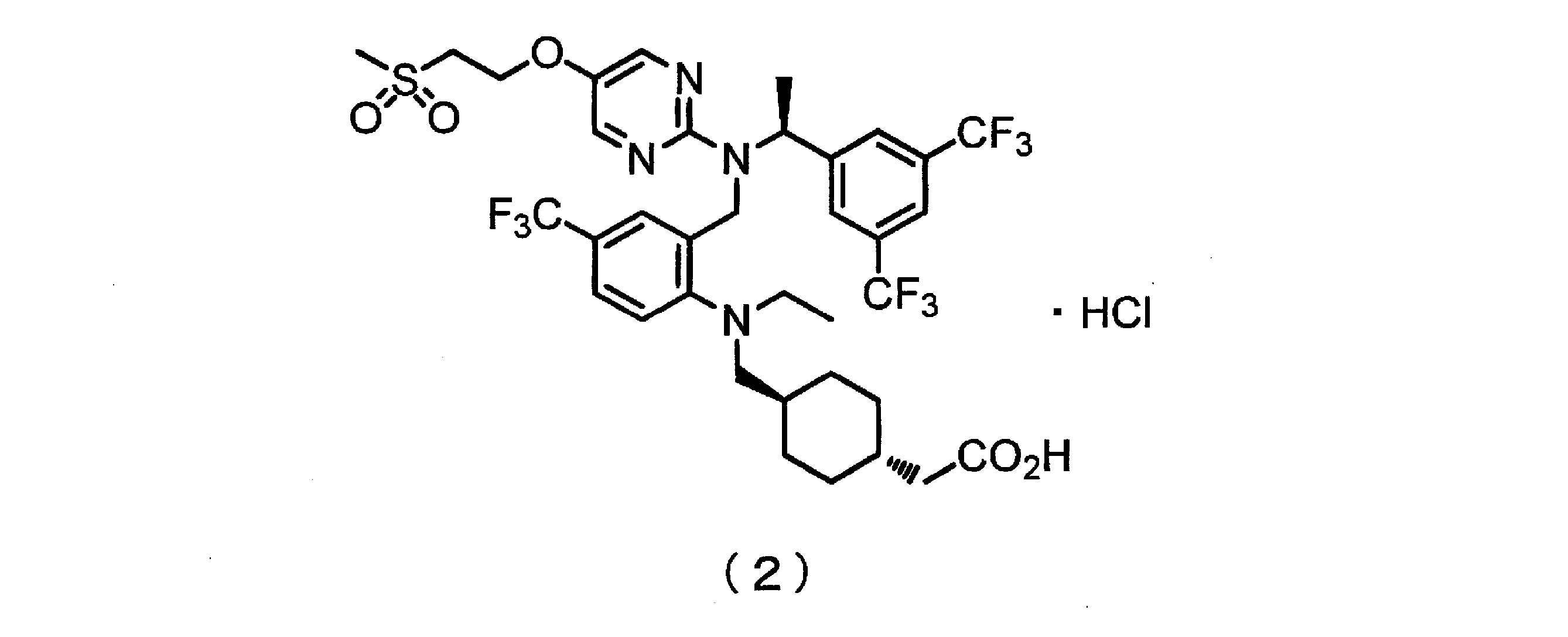
で表される、(S)-トランス-{4-[({2-[({1-[3,5-ビス(トリフルオロメチル)フェニル]エチル}{5-[2-(メチルスルホニル)エトキシ]ピリミジン-2-イル}アミノ)メチル]-4-(トリフルオロメチル)フェニル}(エチル)アミノ)メチル]シクロヘキシル}酢酸 1塩酸塩が好ましい。
ピリミジン化合物(1) 塩酸塩の結晶としては、その具体的な結晶形は特に限定されず、異なる結晶形のいずれでもよく、また、これらの混合物であってもよく、さらに、ピリミジン化合物(1) 塩酸塩の非晶質との混合物であってもよい。
ピリミジン化合物(1) 塩酸塩が結晶であるか否かは、例えばX線回折測定(具体的には、粉末X線回折測定等)、熱分析測定(具体的には、示差熱分析法(DTA)、示差走査熱量測定法(DSC)等)、偏光性の確認(具体的には、偏光顕微鏡による観察等)、固体NMR測定など、結晶性を判断する公知の方法により確認できる。例えば、ある固体状のピリミジン化合物(1) 塩酸塩について銅Kα線の照射による粉末X線回折測定を行い、明確なピークが観察される場合には、そのピリミジン化合物(1) 塩酸塩は結晶であると確認できる。なお、結晶性を判断する方法(粉末X線回折測定法、熱分析法など)は、日本薬局方、米国薬局方、欧州薬局方等の記載を参考に実施できる。
また、これらの結晶の確認は他の成分の共存下で行ってもよい。例えば、ピリミジン化合物(1)の塩酸塩、及び製薬上許容される担体を含有する固形状の医薬組成物(錠剤、カプセル剤、顆粒剤、散剤など)においては、固形状の医薬組成物を必要に応じて粉砕し、X線回折測定を行い、ピリミジン化合物(1)の塩酸塩由来のピークが観察される場合には、そのピリミジン化合物(1)の塩酸塩は結晶であると確認できる。
ピリミジン化合物(1) 塩酸塩が結晶であるか否かは、例えばX線回折測定(具体的には、粉末X線回折測定等)、熱分析測定(具体的には、示差熱分析法(DTA)、示差走査熱量測定法(DSC)等)、偏光性の確認(具体的には、偏光顕微鏡による観察等)、固体NMR測定など、結晶性を判断する公知の方法により確認できる。例えば、ある固体状のピリミジン化合物(1) 塩酸塩について銅Kα線の照射による粉末X線回折測定を行い、明確なピークが観察される場合には、そのピリミジン化合物(1) 塩酸塩は結晶であると確認できる。なお、結晶性を判断する方法(粉末X線回折測定法、熱分析法など)は、日本薬局方、米国薬局方、欧州薬局方等の記載を参考に実施できる。
また、これらの結晶の確認は他の成分の共存下で行ってもよい。例えば、ピリミジン化合物(1)の塩酸塩、及び製薬上許容される担体を含有する固形状の医薬組成物(錠剤、カプセル剤、顆粒剤、散剤など)においては、固形状の医薬組成物を必要に応じて粉砕し、X線回折測定を行い、ピリミジン化合物(1)の塩酸塩由来のピークが観察される場合には、そのピリミジン化合物(1)の塩酸塩は結晶であると確認できる。
ピリミジン化合物(1) 塩酸塩の結晶としては、銅Kα線を照射した場合に得られる粉末X線回折パターンが、少なくとも14.0±0.2°付近、18.3±0.2°付近、20.1±0.2°付近、20.5±0.2°付近、21.3±0.2°付近、21.8±0.2°付近、23.3±0.2°付近及び24.0±0.2°付近よりなる群から選ばれる1以上の回折角(2θ)にピークを有する結晶が好ましく、少なくとも20.5±0.2°付近の回折角(2θ)にピークを有する結晶がより好ましく、少なくとも18.3±0.2°付近及び20.5±0.2°付近の回折角(2θ)にピークを有する結晶がさらに好ましく、少なくとも14.0±0.2°付近、18.3±0.2°付近、20.1±0.2°付近、20.5±0.2°付近、21.3±0.2°付近、21.8±0.2°付近、23.3±0.2°付近及び24.0±0.2°付近の回折角(2θ)にピークを有する結晶がさらにより好ましく、図1に示されたものと実質的に同一である結晶が特に好ましい。
また、別の観点から、ピリミジン化合物(1) 塩酸塩の結晶としては、示差熱分析(DTA)において約162±5℃付近に吸熱ピークを有する結晶が好ましく、熱分析測定(示差熱分析(DTA)及び熱質量測定(TG))結果が図2に示されたものと実質的に同一である結晶がより好ましい。
なお、ピリミジン化合物(1)の塩酸塩やその結晶は、水和物などの溶媒和物であってもよく、無水物などの非溶媒和物であってもよいが、無水物であるのが好ましい。
ピリミジン化合物(1)の塩酸塩及びその結晶は、例えば、それぞれ以下の工程:
(工程1)ピリミジン化合物(1)のフリー体からの、塩酸塩の形成
(工程2)ピリミジン化合物(1)の塩酸塩からの、結晶の形成
により製造することができる。
以下、各工程に分けて詳述するが、ピリミジン化合物(1)の塩酸塩やその結晶の製造方法は、以下に記載の方法に何ら限定されるものではない。
(工程1)ピリミジン化合物(1)のフリー体からの、塩酸塩の形成
(工程2)ピリミジン化合物(1)の塩酸塩からの、結晶の形成
により製造することができる。
以下、各工程に分けて詳述するが、ピリミジン化合物(1)の塩酸塩やその結晶の製造方法は、以下に記載の方法に何ら限定されるものではない。
<工程1:ピリミジン化合物(1)のフリー体からの、塩酸塩の形成>
本工程は、溶媒存在下、ピリミジン化合物(1)と塩化水素を共存させて塩酸塩を形成する工程である。具体的には、本工程は、ピリミジン化合物(1)のフリー体を溶媒に溶解し、塩化水素を供給して塩形成を行う工程である。
本工程は、溶媒存在下、ピリミジン化合物(1)と塩化水素を共存させて塩酸塩を形成する工程である。具体的には、本工程は、ピリミジン化合物(1)のフリー体を溶媒に溶解し、塩化水素を供給して塩形成を行う工程である。
本工程において、出発原料となるピリミジン化合物(1)のフリー体は、例えば、特許文献2に記載の方法に従って製造することができる。
本工程は、溶媒の存在下で行う。溶媒としては、塩酸塩形成に関与しないものであれば特に制限は無いが、例えば、ベンゼン、トルエン、キシレン、メシチレン、クロロベンゼン、1,2-ジクロロベンゼン、ニトロベンゼン等の芳香族炭化水素類;ジエチルエーテル、ジイソプロピルエーテル、tert-ブチルメチルエーテル、1,4-ジオキサン等のエーテル類;酢酸エチル、酢酸n-プロピル、酢酸イソプロピル等の酢酸エステル類;アセトン、2-ブタノン、3-ペンタノン等のケトン類;n-ペンタン、n-ヘキサン、n-ヘプタン、シクロヘキサン、n-オクタン、n-デカン等の脂肪族炭化水素類;N,N-ジメチルホルムアミド、N,N-ジメチルアセトアミド等のアミド類;ジメチルスルホキシド等のスルホキシド類が挙げられ、これらを単独で、または2種以上を組み合わせて使用できる。なお、2種以上の溶媒を用いる場合には、これらを混合した後にピリミジン化合物(1)を溶解させてもよいし、1種の溶媒にピリミジン化合物(1)を溶解させた後に、残りの溶媒を加えてもよい。
溶媒としては、ジイソプロピルエーテル、tert-ブチルメチルエーテル、1,4-ジオキサン、n-ヘキサン、n-ヘプタン、酢酸エチル及び酢酸イソプロピルから選ばれる1種以上が好ましく、ジイソプロピルエーテル、tert-ブチルメチルエーテル、1,4-ジオキサン及び酢酸イソプロピルから選ばれる1種以上がより好ましく、tert-ブチルメチルエーテル又は酢酸イソプロピルが特に好ましい。
溶媒の量は特に制限は無いが、ピリミジン化合物(1)のフリー体の重量に対する容量比として、1~20倍量(V/W)、好ましくは5~15倍量(V/W)を用いればよい。
溶媒としては、ジイソプロピルエーテル、tert-ブチルメチルエーテル、1,4-ジオキサン、n-ヘキサン、n-ヘプタン、酢酸エチル及び酢酸イソプロピルから選ばれる1種以上が好ましく、ジイソプロピルエーテル、tert-ブチルメチルエーテル、1,4-ジオキサン及び酢酸イソプロピルから選ばれる1種以上がより好ましく、tert-ブチルメチルエーテル又は酢酸イソプロピルが特に好ましい。
溶媒の量は特に制限は無いが、ピリミジン化合物(1)のフリー体の重量に対する容量比として、1~20倍量(V/W)、好ましくは5~15倍量(V/W)を用いればよい。
塩化水素の供給源は特に制限されず、塩化水素ガスを溶液中に直接吹き込むほか、入手容易な濃塩酸、4M HCl/酢酸エチル溶液、4M HCl/1,4-ジオキサン溶液等を利用できる。
塩化水素の量は、特に制限は無いが、ピリミジン化合物(1)のフリー体に対して、1~5モル当量が好ましく、1~4モル当量が特に好ましい。
塩化水素の量は、特に制限は無いが、ピリミジン化合物(1)のフリー体に対して、1~5モル当量が好ましく、1~4モル当量が特に好ましい。
塩形成の温度は、特に制限は無いが、通常-50~150℃の範囲であり、好ましくは-20~80℃、より好ましくは-10~40℃である。塩形成に要する時間は、特に制限は無いが、通常5分~48時間であり、好ましくは30分~24時間、より好ましくは30分~3時間である。
生成したピリミジン化合物(1)の塩酸塩は単離できる。この場合においては、固体として析出した塩を、濾過などの当該技術分野で通常用いられる方法により単離し、さらに必要に応じて当該技術分野で通常用いられる方法で乾燥させればよい。乾燥手段は特に限定されず、加熱及び/又は減圧条件下での乾燥等が挙げられる。乾燥温度は50℃以下が好ましく、40~50℃がより好ましい。乾燥時間は1~24時間が好ましく、6~12時間がより好ましい。
<工程2:ピリミジン化合物(1)の塩酸塩からの、結晶の形成>
本工程は、溶媒存在下、工程1で得られたピリミジン化合物(1)の塩酸塩(例えば、非晶質のもの)を結晶化する工程である。具体的には、本工程は、工程1で得られたピリミジン化合物(1)の塩酸塩を溶媒に添加し、必要に応じて加熱等して溶解し、その後冷却等して結晶化を行う工程である。
本工程は、溶媒存在下、工程1で得られたピリミジン化合物(1)の塩酸塩(例えば、非晶質のもの)を結晶化する工程である。具体的には、本工程は、工程1で得られたピリミジン化合物(1)の塩酸塩を溶媒に添加し、必要に応じて加熱等して溶解し、その後冷却等して結晶化を行う工程である。
本工程は、溶媒の存在下で行う。溶媒としては例えば、2-プロパノールとヘプタンの混液、又はメチルエチルケトンとヘプタンの混液が挙げられ、2-プロパノールとヘプタンの混液が好ましい。溶媒の混合比率は特に限定されないが、2-プロパノール又はメチルエチルケトンの容量に対する容量比として、ヘプタンを0.1~2倍量(V/V)、好ましくは0.2~1倍量(V/V)用いればよい。
ピリミジン化合物(1)の塩酸塩を溶媒に溶解する場合、あらかじめ溶媒を混合した後にピリミジン化合物(1)の塩酸塩を溶解させてもよいが、ピリミジン化合物(1)の塩酸塩を2-プロパノール又はメチルエチルケトンに溶解させた後、ヘプタンを添加するのが好ましい。
溶媒の量は特に制限は無いが、混合溶媒総量として、ピリミジン化合物(1)の塩酸塩の重量に対する容量比として、1~20倍量(V/W)、好ましくは、5~10倍量(V/W)を用いればよい。
ピリミジン化合物(1)の塩酸塩を溶媒に溶解する場合、あらかじめ溶媒を混合した後にピリミジン化合物(1)の塩酸塩を溶解させてもよいが、ピリミジン化合物(1)の塩酸塩を2-プロパノール又はメチルエチルケトンに溶解させた後、ヘプタンを添加するのが好ましい。
溶媒の量は特に制限は無いが、混合溶媒総量として、ピリミジン化合物(1)の塩酸塩の重量に対する容量比として、1~20倍量(V/W)、好ましくは、5~10倍量(V/W)を用いればよい。
ピリミジン化合物(1)の塩酸塩を溶媒に溶かす際の温度は、特に制限は無いが、通常40~100℃の範囲で行えばよく、好ましくは50~80℃である。
ピリミジン化合物(1)の塩酸塩の結晶化の温度は、特に制限は無いが、通常5~40℃の範囲で行えばよく、好ましくは10~35℃、より好ましくは10~30℃、特に好ましくは15~25℃である。なお、ピリミジン化合物(1)の塩酸塩を溶媒に溶かす際の温度と、結晶化の温度に乖離がある場合は、温度差に応じて、適宜1~10時間程度でゆっくりと冷却すればよい。
結晶化に要する時間は、特に制限は無いが、通常1時間以上、好ましくは6~24時間、より好ましくは8~16時間である。
ピリミジン化合物(1)の塩酸塩の結晶化の温度は、特に制限は無いが、通常5~40℃の範囲で行えばよく、好ましくは10~35℃、より好ましくは10~30℃、特に好ましくは15~25℃である。なお、ピリミジン化合物(1)の塩酸塩を溶媒に溶かす際の温度と、結晶化の温度に乖離がある場合は、温度差に応じて、適宜1~10時間程度でゆっくりと冷却すればよい。
結晶化に要する時間は、特に制限は無いが、通常1時間以上、好ましくは6~24時間、より好ましくは8~16時間である。
析出したピリミジン化合物(1) 塩酸塩の結晶は、濾過などの当該技術分野で通常用いられる方法で単離し、さらに必要に応じて当該技術分野で通常用いられる方法で乾燥させればよい。乾燥手段は特に限定されず、加熱及び/又は減圧条件下での乾燥等が挙げられる。乾燥温度は50℃以下が好ましく、40~50℃がより好ましい。乾燥時間は1~24時間が好ましく、6~12時間がより好ましい。
なお、工程2は、別途製造したピリミジン化合物(1) 塩酸塩の結晶(種晶)の存在下で行ってもよい。この場合、溶媒としては、前記したものに代えて、酢酸イソプロピルを用いてもよい。種晶の量は特に制限は無いが、ピリミジン化合物(1)の塩酸塩に対して、0.00001~0.05質量部、好ましくは0.0001~0.01質量部を用いればよい。
種晶は、ピリミジン化合物(1)の塩酸塩を溶媒に溶解した後に添加するのが好ましい。
種晶は、ピリミジン化合物(1)の塩酸塩を溶媒に溶解した後に添加するのが好ましい。
さらに、ピリミジン化合物(1) 塩酸塩の結晶を製造する場合には、製造工程の簡略化の観点から、ピリミジン化合物(1)の塩酸塩を単離せず工程1と工程2とを連続して行い、ピリミジン化合物(1)のフリー体から溶媒存在下で塩酸塩の結晶を製造できる。この場合、溶媒としては、酢酸イソプロピルが好ましい。
また、工程1において塩形成のための時間を省略して工程2を行うことも可能である。すなわち、ピリミジン化合物(1)のフリー体を溶媒に溶解し、塩化水素を供給した後、加熱等し、その後冷却等して結晶化を行うことも可能である。
その他の各工程の操作等は、前記したものと同様である。
また、工程1において塩形成のための時間を省略して工程2を行うことも可能である。すなわち、ピリミジン化合物(1)のフリー体を溶媒に溶解し、塩化水素を供給した後、加熱等し、その後冷却等して結晶化を行うことも可能である。
その他の各工程の操作等は、前記したものと同様である。
本明細書において、医薬組成物を「0.1w/v%臭化セチルトリメチルアンモニウム水溶液に溶解又は分散した場合に得られる液のpH値」とは、ピリミジン化合物(1)若しくはその塩又はそれらの溶媒和物を含有する医薬組成物を、ピリミジン化合物(1)のフリー体換算の濃度として0.08mg/mLとなるように、0.1w/v%臭化セチルトリメチルアンモニウム水溶液に溶解又は分散し、得られた溶液のpHを25℃で測定して得られる値を意味する。なお、ピリミジン化合物(1)は、水に対する溶解性が低いため、界面活性剤である臭化セチルトリメチルアンモニウムを用いて可溶化することにより、pH環境による影響をより正確に評価することができる。
0.1w/v%臭化セチルトリメチルアンモニウム水溶液に溶解又は分散した場合に得られる液のpH値としては、ピリミジン化合物(1)の安定性の観点から、8.0以下である必要があるが、7.0以下(より好適には2.0~7.0)であるのが好ましく、6.5以下(より好適には2.0~6.5)であるのがより好ましく、6.0以下(より好適には2.0~6.0)であるのがさらに好ましく、5.8以下(より好適には2.0~5.8)であるのが特に好ましい。
医薬組成物を、0.1w/v%臭化セチルトリメチルアンモニウム水溶液に溶解又は分散した場合に得られる液のpH値を前記の範囲に調整する具体的手段は特に限定されず、当業者であれば、pH値を確認しつつ配合成分の種類及び量を調整する等により適宜調整し得るが、具体的には例えば、以下のような手段:
(1)ピリミジン化合物(1)若しくはその塩又はそれらの溶媒和物として、前記の酸付加塩(無機酸塩、有機酸塩等)を用いる手段;
(2)酸性~中性の製剤添加物(具体的には例えば、水に溶解させたときの25℃でのpH値が8.0以下の値を示すもの。)を医薬組成物に配合する手段;
を用いることができる。ここで、酸性~中性の製剤添加物としては、具体的には例えば、有機酸、無機酸等の酸類や、カルボキシル基等の酸性官能基を有する成分等が挙げられる。
(1)ピリミジン化合物(1)若しくはその塩又はそれらの溶媒和物として、前記の酸付加塩(無機酸塩、有機酸塩等)を用いる手段;
(2)酸性~中性の製剤添加物(具体的には例えば、水に溶解させたときの25℃でのpH値が8.0以下の値を示すもの。)を医薬組成物に配合する手段;
を用いることができる。ここで、酸性~中性の製剤添加物としては、具体的には例えば、有機酸、無機酸等の酸類や、カルボキシル基等の酸性官能基を有する成分等が挙げられる。
本明細書において、「医薬組成物」の具体的形状(剤形)は特に限定されるものではなく、固形状、半固形状、液状のいずれの形状であってもよく、その利用目的等に応じて選択することができる。医薬組成物の剤形としては、例えば、第十六改正日本薬局方 製剤総則等に記載の剤形が挙げられる。より具体的には、経口投与用の剤形としては、錠剤(例えば、通常錠、口腔内崩壊型錠剤、チュアブル錠、発泡錠、分散錠、溶解錠などを含む。)、カプセル剤、顆粒剤(例えば、発泡顆粒剤などを含む。)、散剤等の経口投与用固形製剤;経口ゼリー剤等の経口投与用半固形状製剤;経口液剤(例えば、エリキシル剤、懸濁剤、乳剤、リモナーデ剤などを含む。)等の経口投与用液状製剤等が挙げられる。また、非経口投与用の剤形としては、注射剤、吸入剤、点眼剤、点耳剤、点鼻剤、坐剤、外用固形剤、外用液剤、スプレー剤、軟膏剤、クリーム剤、ゲル剤、貼付剤等が挙げられる。
医薬組成物の剤形としては、服用の容易性の観点から、経口投与用固形製剤が好ましく、錠剤、カプセル剤、顆粒剤又は散剤が特に好ましい。
医薬組成物の剤形としては、服用の容易性の観点から、経口投与用固形製剤が好ましく、錠剤、カプセル剤、顆粒剤又は散剤が特に好ましい。
医薬組成物は、その剤形に応じ、例えば第十六改正日本薬局方 製剤総則等に記載の公知の方法により製造することができる。この場合において、医薬組成物には、製薬上許容される担体(添加物)を加えてもよい。こうした添加物としては、例えば、賦形剤、結合剤、増量剤、崩壊剤、界面活性剤、滑沢剤、分散剤、緩衝剤、保存剤、矯味剤、香料、希釈剤等が挙げられるが、これらに限定されるものではない。
ピリミジン化合物(1)は、CETP阻害作用、PCSK9タンパク量低下作用等を有する。従って、ピリミジン化合物(1)若しくはその塩又はそれらの溶媒和物を含有する医薬組成物は、脂質異常症、高LDL血症、低HDL血症などの疾患の予防及び/又は治療に有用な医薬として利用できる。
ピリミジン化合物(1)若しくはその塩又はそれらの溶媒和物を含有する医薬組成物の投与方法は、経口投与でも非経口投与でも良いが、服用の容易性の観点から、経口投与が好ましい。
ピリミジン化合物(1)若しくはその塩又はそれらの溶媒和物の投与量は、患者の体重、年齢、性別、症状等によって異なるが、通常成人の場合、ピリミジン化合物(1)のフリー体に換算して、約0.01~1000mgを1日1~4回に分けて投与することができる。好ましくは約0.1~100mgを1日1~4回に分けて投与することができる。
ピリミジン化合物(1)若しくはその塩又はそれらの溶媒和物を含有する医薬組成物の投与方法は、経口投与でも非経口投与でも良いが、服用の容易性の観点から、経口投与が好ましい。
ピリミジン化合物(1)若しくはその塩又はそれらの溶媒和物の投与量は、患者の体重、年齢、性別、症状等によって異なるが、通常成人の場合、ピリミジン化合物(1)のフリー体に換算して、約0.01~1000mgを1日1~4回に分けて投与することができる。好ましくは約0.1~100mgを1日1~4回に分けて投与することができる。
以下、実施例、試験例、参考例等により本発明をより具体的に説明するが、本発明はこれらにより何ら限定されるものではない。以下の実施例、試験例、参考例等において、ピリミジン化合物(1)のフリー体は、特許文献2に記載の方法によって製造することができる。また、ピリミジン化合物(1)の塩酸塩及びその結晶は、後記 参考例1に記載の方法によって製造することができる。
なお、下記実施例、試験例、参考例等で用いられている略号は下記の意味を示す。
s:シングレット(singlet)
d:ダブレット(doublet)
t:トリプレット(triplet)
q:クアルテット(quartet)
m:マルチプレット(multiplet)
br:ブロード(broad)
J:カップリング定数(coupling constant)
Hz:ヘルツ(Hertz)
DMSO-d6:重ジメチルスルホキシド
1H-NMR:プロトン核磁気共鳴
なお、下記実施例、試験例、参考例等で用いられている略号は下記の意味を示す。
s:シングレット(singlet)
d:ダブレット(doublet)
t:トリプレット(triplet)
q:クアルテット(quartet)
m:マルチプレット(multiplet)
br:ブロード(broad)
J:カップリング定数(coupling constant)
Hz:ヘルツ(Hertz)
DMSO-d6:重ジメチルスルホキシド
1H-NMR:プロトン核磁気共鳴
[試験例1]ピリミジン化合物(1)の各種pH条件下での安定性の検討
2013年版米国薬局方(U.S.Pharmacopeia)の緩衝液に関する項の記載に準じ、25℃で以下のpHを示す緩衝液を調製した:pH2.0(塩酸緩衝液)、3.0、4.0(以上、フタル酸緩衝液)、4.5、5.0、5.8(以上、中和フタル酸緩衝液)、6.0、6.5、7.0、7.5(以上、リン酸緩衝液)、8.0、8.5、9.0(以上、ホウ酸緩衝液)。
得られた緩衝液に0.1w/v%となる量の臭化セチルトリメチルアンモニウムを溶解させた後、0.08mg/mLとなる量のピリミジン化合物(1)を溶解・分散させて、各種pH条件の試験液を得た。
2013年版米国薬局方(U.S.Pharmacopeia)の緩衝液に関する項の記載に準じ、25℃で以下のpHを示す緩衝液を調製した:pH2.0(塩酸緩衝液)、3.0、4.0(以上、フタル酸緩衝液)、4.5、5.0、5.8(以上、中和フタル酸緩衝液)、6.0、6.5、7.0、7.5(以上、リン酸緩衝液)、8.0、8.5、9.0(以上、ホウ酸緩衝液)。
得られた緩衝液に0.1w/v%となる量の臭化セチルトリメチルアンモニウムを溶解させた後、0.08mg/mLとなる量のピリミジン化合物(1)を溶解・分散させて、各種pH条件の試験液を得た。
得られた各種試験液を25℃にて3時間保存し、試験開始時及び3時間保存後のピリミジン化合物(1)の残存率を評価した。残存率は、各試験液につき、HPLC装置を用いて、ピリミジン化合物(1)及びその分解物に由来する総ピーク面積に対する面積百分率として測定した。なお、HPLC装置を用いた測定は、カラムとしてODSカラムを、移動相としてアセトニトリル/水/TFA混液を、検出器として紫外吸光光度計(波長:242nm)をそれぞれ用いて行った。
結果を表1及び表2に示す。
結果を表1及び表2に示す。


表1及び表2に示される試験結果のとおり、ピリミジン化合物(1)はpH8.0以下の環境では安定であり、pH5.0にかけてpH値が低くなるに従い残存率が向上する一方、pH8.0を超えると大きく不安定化し、pH9.0では3時間保存後において残存率が0%となった。
以上から、ピリミジン化合物(1)若しくはその塩又はそれらの溶媒和物を含有する医薬組成物を0.1w/v%臭化セチルトリメチルアンモニウム水溶液に溶解又は分散した場合に得られる液のpH値を8.0以下とすることにより、ピリミジン化合物(1)若しくはその塩又はそれらの溶媒和物の安定性に優れる医薬組成物が得られることが明らかとなった。
以上から、ピリミジン化合物(1)若しくはその塩又はそれらの溶媒和物を含有する医薬組成物を0.1w/v%臭化セチルトリメチルアンモニウム水溶液に溶解又は分散した場合に得られる液のpH値を8.0以下とすることにより、ピリミジン化合物(1)若しくはその塩又はそれらの溶媒和物の安定性に優れる医薬組成物が得られることが明らかとなった。
[実施例1]
ピリミジン化合物(1)1塩酸塩の結晶、並びに汎用の添加物(賦形剤、崩壊剤、結合剤、滑沢剤など)を用いて、常法により1錠当たり312mgの錠剤を製造した。
得られた錠剤は、1錠当たりにピリミジン化合物(1)1塩酸塩の結晶を104.5mg(ピリミジン化合物(1)のフリー体換算で100mg)含有するものであった。
ピリミジン化合物(1)1塩酸塩の結晶、並びに汎用の添加物(賦形剤、崩壊剤、結合剤、滑沢剤など)を用いて、常法により1錠当たり312mgの錠剤を製造した。
得られた錠剤は、1錠当たりにピリミジン化合物(1)1塩酸塩の結晶を104.5mg(ピリミジン化合物(1)のフリー体換算で100mg)含有するものであった。
<実施例1の錠剤のpH値>
実施例1の錠剤をすりつぶし、ピリミジン化合物(1)をフリー体換算で8mg含有する量の錠剤末(24.96mg)を25℃にて0.1w/v%臭化セチルトリメチルアンモニウム水溶液100mLに溶解・分散させたところ、そのpH値は3.9であった。
<実施例1の錠剤中のピリミジン化合物(1)の安定性>
実施例1の錠剤を無包装状態で25℃、60%相対湿度の条件下で6ヶ月間保存した。
保存後、錠剤中のピリミジン化合物(1)の含量を測定し、保存前後での錠剤中のピリミジン化合物(1)の含量変化(残存率)を評価した。なお、錠剤中のピリミジン化合物(1)の含量は、高速液体クロマトグラフィーを用いて得られるピーク面積を、濃度既知のピリミジン化合物(1)の標準物質のピーク面積と比較する方法により測定した。
残存率は100%であり、実施例1の錠剤は安定性に優れることが明らかとなった。
実施例1の錠剤をすりつぶし、ピリミジン化合物(1)をフリー体換算で8mg含有する量の錠剤末(24.96mg)を25℃にて0.1w/v%臭化セチルトリメチルアンモニウム水溶液100mLに溶解・分散させたところ、そのpH値は3.9であった。
<実施例1の錠剤中のピリミジン化合物(1)の安定性>
実施例1の錠剤を無包装状態で25℃、60%相対湿度の条件下で6ヶ月間保存した。
保存後、錠剤中のピリミジン化合物(1)の含量を測定し、保存前後での錠剤中のピリミジン化合物(1)の含量変化(残存率)を評価した。なお、錠剤中のピリミジン化合物(1)の含量は、高速液体クロマトグラフィーを用いて得られるピーク面積を、濃度既知のピリミジン化合物(1)の標準物質のピーク面積と比較する方法により測定した。
残存率は100%であり、実施例1の錠剤は安定性に優れることが明らかとなった。
[参考試験例1]結晶化条件の検討
各種サンプル(ピリミジン化合物(1)のフリー体、及びその塩類(塩酸塩、臭化水素酸塩、硫酸塩、D-(-)-アルギニン塩、シンコニジン塩))について、以下の方法により結晶化条件を検討した。
なお、ピリミジン化合物(1)の塩酸塩は参考例1中、1-1の工程1記載の方法にて得た。また、他の塩類は、メタノールに溶解したピリミジン化合物(1)のフリー体と、水に溶解した酸又は塩基とを、等モルで混合撹拌した後で溶媒を留去することにより得た。
各種サンプル(ピリミジン化合物(1)のフリー体、及びその塩類(塩酸塩、臭化水素酸塩、硫酸塩、D-(-)-アルギニン塩、シンコニジン塩))について、以下の方法により結晶化条件を検討した。
なお、ピリミジン化合物(1)の塩酸塩は参考例1中、1-1の工程1記載の方法にて得た。また、他の塩類は、メタノールに溶解したピリミジン化合物(1)のフリー体と、水に溶解した酸又は塩基とを、等モルで混合撹拌した後で溶媒を留去することにより得た。
各種サンプルを4~100倍量(V/W)の溶媒1に溶解した。得られた溶液に、当該溶液が濁り始めるまで溶媒2を添加した後、所定の操作を行った。その後、溶液の状態を目視により観察し、結晶形成の有無を評価した。
結果を、ピリミジン化合物(1)のフリー体について表3に、塩酸塩について表4に、臭化水素酸塩について表5に、硫酸塩について表6に、D-(-)-アルギニン塩について表7に、シンコニジン塩について表8にそれぞれ示す。
結果を、ピリミジン化合物(1)のフリー体について表3に、塩酸塩について表4に、臭化水素酸塩について表5に、硫酸塩について表6に、D-(-)-アルギニン塩について表7に、シンコニジン塩について表8にそれぞれ示す。

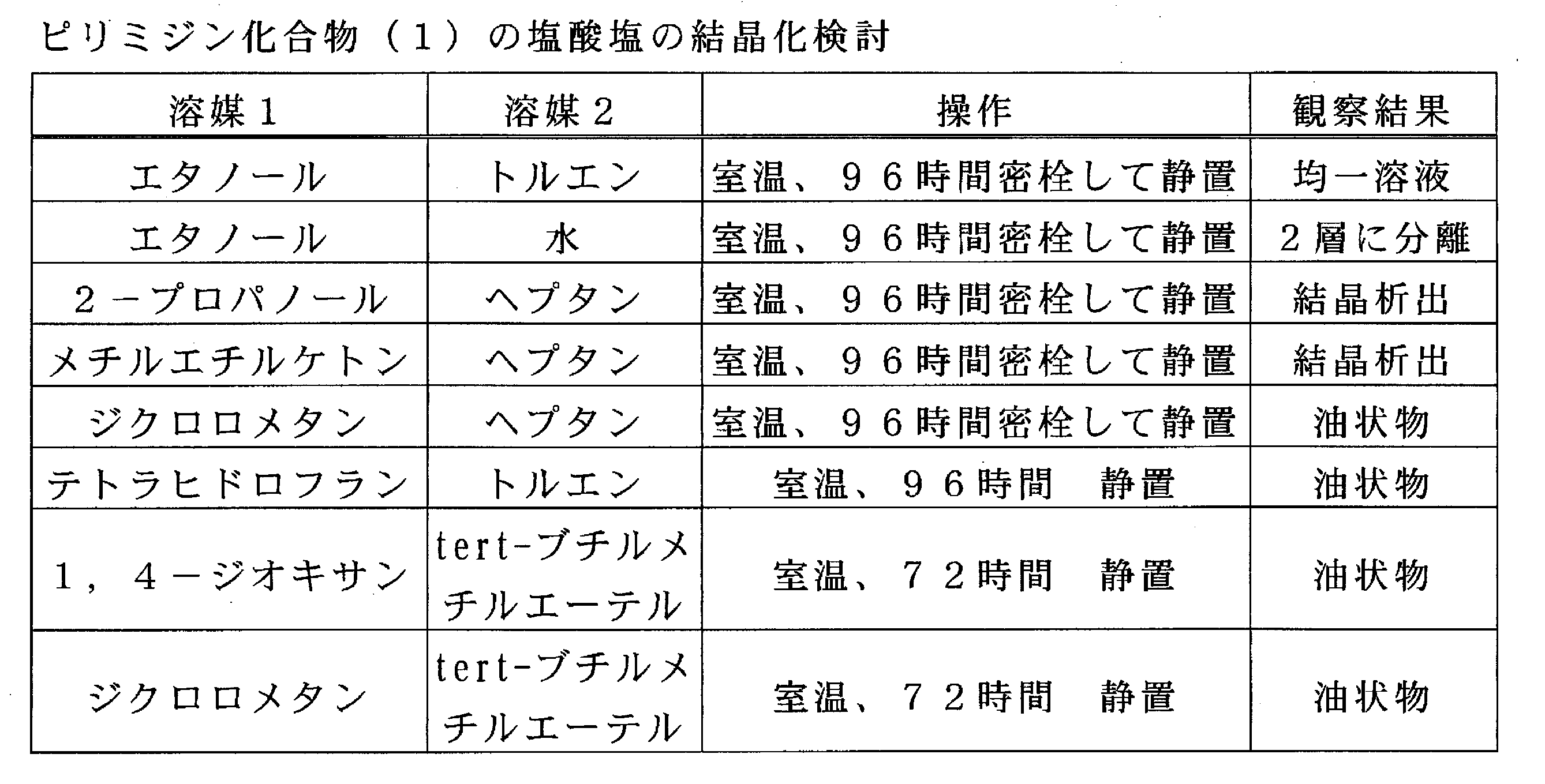

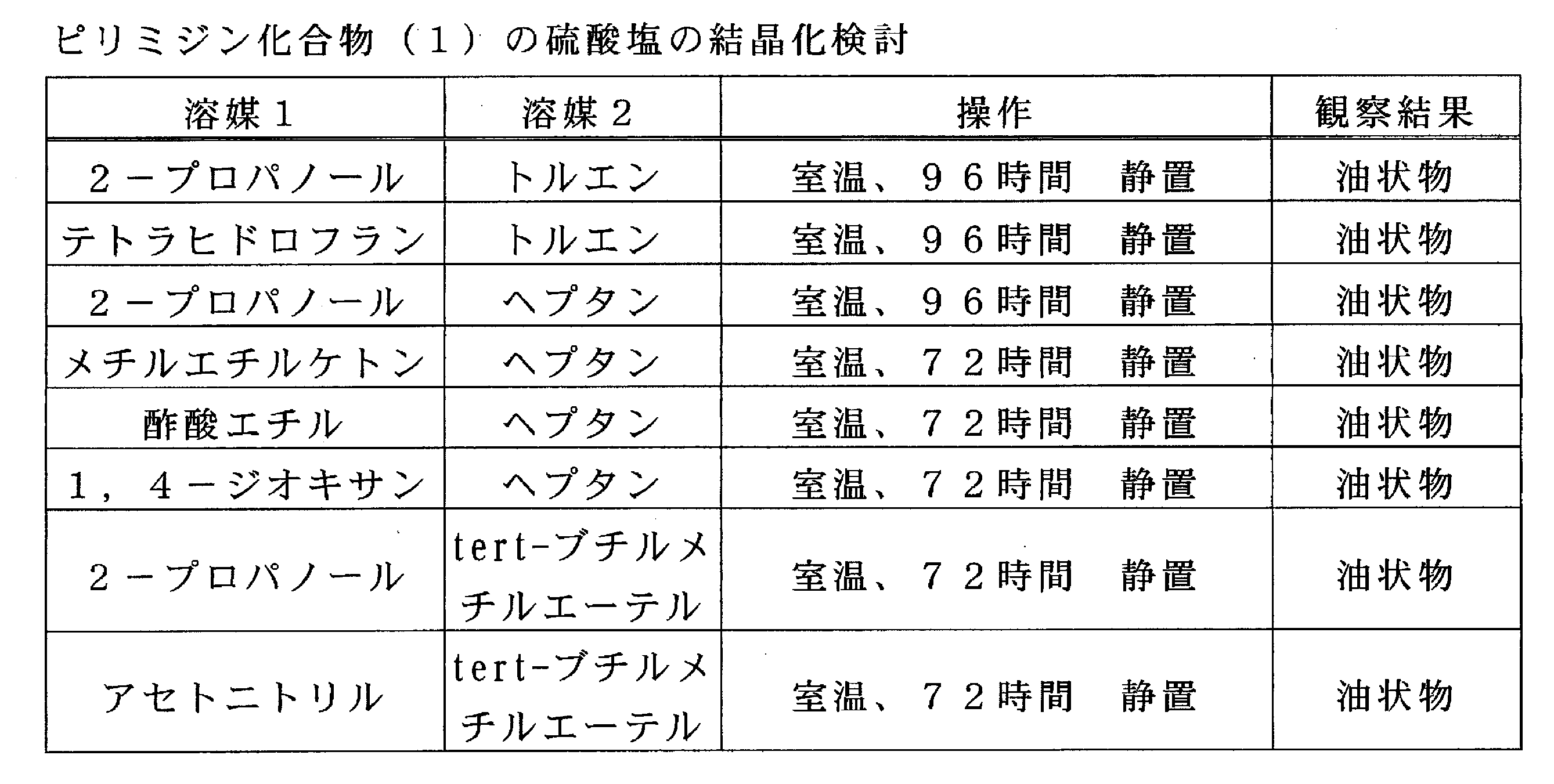
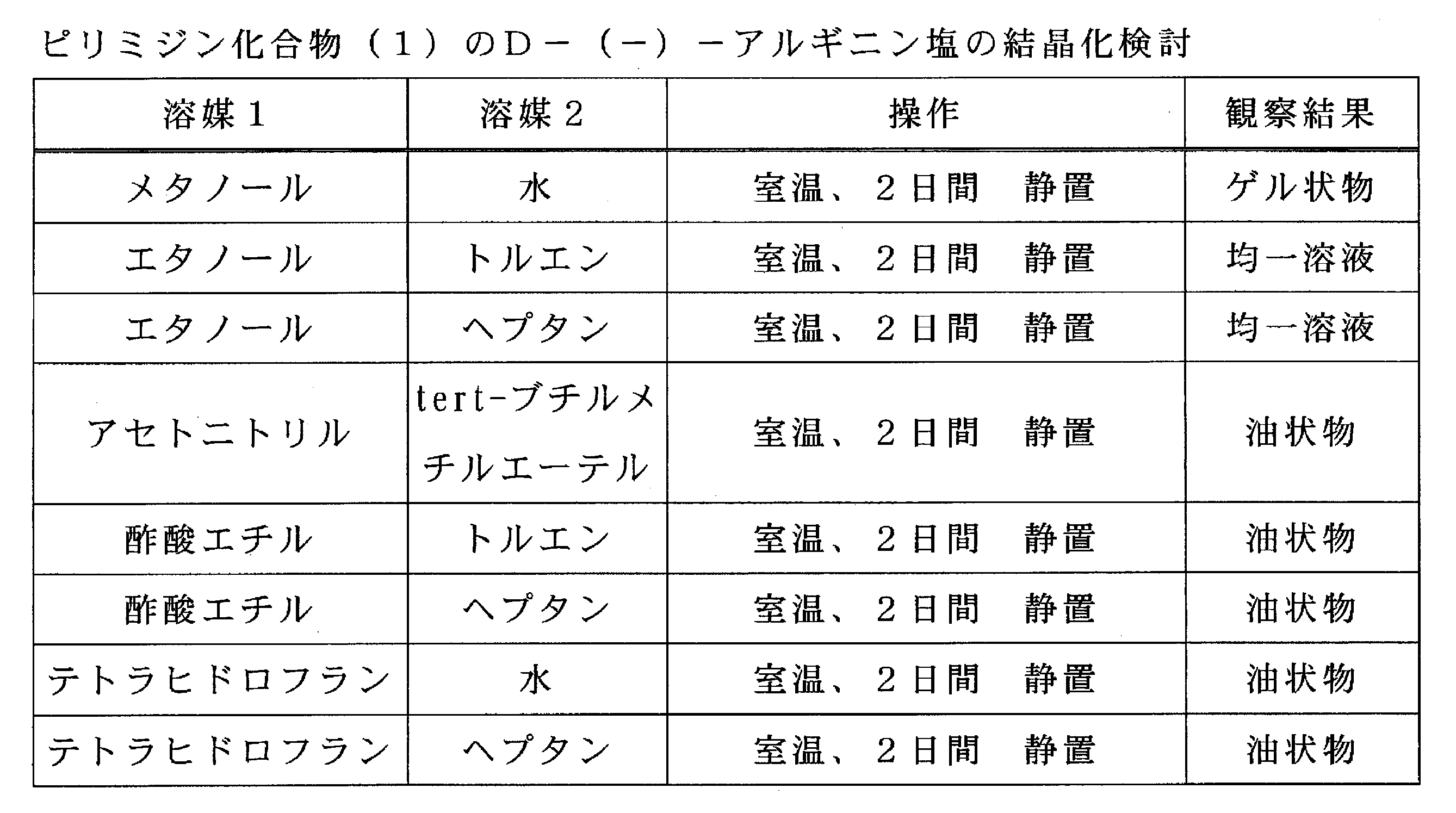
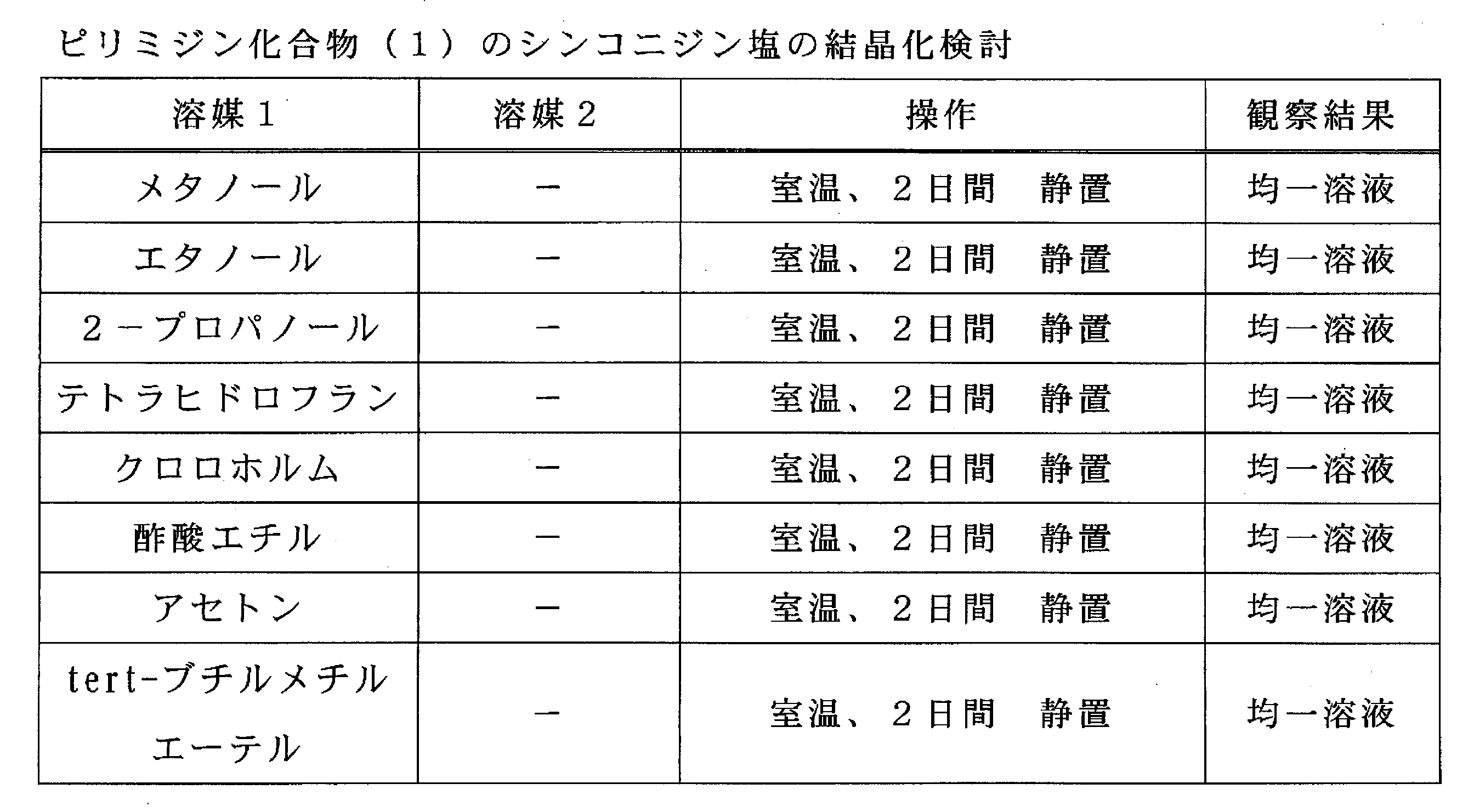
以上の検討結果から、ピリミジン化合物(1)は、塩酸塩とした場合に特異的に結晶が析出することが明らかとなった。
[参考例1](S)-トランス-{4-[({2-[({1-[3,5-ビス(トリフルオロメチル)フェニル]エチル}{5-[2-(メチルスルホニル)エトキシ]ピリミジン-2-イル}アミノ)メチル]-4-(トリフルオロメチル)フェニル}(エチル)アミノ)メチル]シクロヘキシル}酢酸 塩酸塩の結晶の製造
1-1:ピリミジン化合物(1) 塩酸塩の結晶の製造 その1
工程1
(S)-トランス-{4-[({2-[({1-[3,5-ビス(トリフルオロメチル)フェニル]エチル}{5-[2-(メチルスルホニル)エトキシ]ピリミジン-2-イル}アミノ)メチル]-4-(トリフルオロメチル)フェニル}(エチル)アミノ)メチル]シクロヘキシル}酢酸のフリー体 1.1kg(1.35mol)をアルゴン雰囲気下、tert-ブチルメチルエーテル(15.3kg)に溶解し、0℃に冷却した。次いで、得られた溶液に、16.7%塩酸/1,4-ジオキサン溶液503.9g(塩酸2.31mol)を0~10℃で滴下した後、同温にて1時間攪拌した。析出した固体をろ取した後、冷却したtert-ブチルメチルエーテル(1.85kg)で洗浄し、40~50℃で12時間減圧乾燥し、(S)-トランス-{4-[({2-[({1-[3,5-ビス(トリフルオロメチル)フェニル]エチル}{5-[2-(メチルスルホニル)エトキシ]ピリミジン-2-イル}アミノ)メチル]-4-(トリフルオロメチル)フェニル}(エチル)アミノ)メチル]シクロヘキシル}酢酸 塩酸塩の非晶質1.14kg(収率100%)を得た。
工程1
(S)-トランス-{4-[({2-[({1-[3,5-ビス(トリフルオロメチル)フェニル]エチル}{5-[2-(メチルスルホニル)エトキシ]ピリミジン-2-イル}アミノ)メチル]-4-(トリフルオロメチル)フェニル}(エチル)アミノ)メチル]シクロヘキシル}酢酸のフリー体 1.1kg(1.35mol)をアルゴン雰囲気下、tert-ブチルメチルエーテル(15.3kg)に溶解し、0℃に冷却した。次いで、得られた溶液に、16.7%塩酸/1,4-ジオキサン溶液503.9g(塩酸2.31mol)を0~10℃で滴下した後、同温にて1時間攪拌した。析出した固体をろ取した後、冷却したtert-ブチルメチルエーテル(1.85kg)で洗浄し、40~50℃で12時間減圧乾燥し、(S)-トランス-{4-[({2-[({1-[3,5-ビス(トリフルオロメチル)フェニル]エチル}{5-[2-(メチルスルホニル)エトキシ]ピリミジン-2-イル}アミノ)メチル]-4-(トリフルオロメチル)フェニル}(エチル)アミノ)メチル]シクロヘキシル}酢酸 塩酸塩の非晶質1.14kg(収率100%)を得た。
1H-NMR(400MHz,DMSO-d6)δ:0.72-0.92(7H, m),1.30(1H, m),1.50(3H,d,J=6.6Hz),1.62-1.70(5H,m),2.02(2H,d,J=6.8Hz),2.71(1H,m),2.75(1H,brs),2.90(3H,brs),3.07(3H,s),3.62(2H,t,J=5.5Hz),4.40(2H,t,J=5.7Hz),4.67(1H,d,J=17.6Hz),4.80(1H,d,J=17.8Hz),6.24(1H,q,J=6.8Hz),7.10(1H,s),7.33(1H,brs),7.47(1H,d,J=8.3Hz),7.84(2H,s),7.94(1H,s),8.35(2H,s).
工程2
工程1で得られた(S)-トランス-{4-[({2-[({1-[3,5-ビス(トリフルオロメチル)フェニル]エチル}{5-[2-(メチルスルホニル)エトキシ]ピリミジン-2-イル}アミノ)メチル]-4-(トリフルオロメチル)フェニル}(エチル)アミノ)メチル]シクロヘキシル}酢酸 塩酸塩の非晶質(676mg)を2-プロパノール(1.35mL)に50~55℃で加熱溶解させた後、ヘプタン(676μL)を50℃で加え、5~15℃にて14時間密栓静置した。析出した固体をろ取し、40℃にて減圧乾燥し、(S)-トランス-{4-[({2-[({1-[3,5-ビス(トリフルオロメチル)フェニル]エチル}{5-[2-(メチルスルホニル)エトキシ]ピリミジン-2-イル}アミノ)メチル]-4-(トリフルオロメチル)フェニル}(エチル)アミノ)メチル]シクロヘキシル}酢酸 塩酸塩の結晶576mg(収率85%)を得た。
工程1で得られた(S)-トランス-{4-[({2-[({1-[3,5-ビス(トリフルオロメチル)フェニル]エチル}{5-[2-(メチルスルホニル)エトキシ]ピリミジン-2-イル}アミノ)メチル]-4-(トリフルオロメチル)フェニル}(エチル)アミノ)メチル]シクロヘキシル}酢酸 塩酸塩の非晶質(676mg)を2-プロパノール(1.35mL)に50~55℃で加熱溶解させた後、ヘプタン(676μL)を50℃で加え、5~15℃にて14時間密栓静置した。析出した固体をろ取し、40℃にて減圧乾燥し、(S)-トランス-{4-[({2-[({1-[3,5-ビス(トリフルオロメチル)フェニル]エチル}{5-[2-(メチルスルホニル)エトキシ]ピリミジン-2-イル}アミノ)メチル]-4-(トリフルオロメチル)フェニル}(エチル)アミノ)メチル]シクロヘキシル}酢酸 塩酸塩の結晶576mg(収率85%)を得た。
1-2:ピリミジン化合物(1) 塩酸塩の結晶の製造 その2
前記1-1 工程1記載の方法によって得た(S)-トランス-{4-[({2-[({1-[3,5-ビス(トリフルオロメチル)フェニル]エチル}{5-[2-(メチルスルホニル)エトキシ]ピリミジン-2-イル}アミノ)メチル]-4-(トリフルオロメチル)フェニル}(エチル)アミノ)メチル]シクロヘキシル}酢酸 塩酸塩の非晶質1.14kg(1.35mol)を酢酸イソプロピル(9.98kg)に懸濁し、65~75℃に加熱し溶解させた。得られた溶液に、同温にて前記1-1 工程2記載の方法によって得た(S)-トランス-{4-[({2-[({1-[3,5-ビス(トリフルオロメチル)フェニル]エチル}{5-[2-(メチルスルホニル)エトキシ]ピリミジン-2-イル}アミノ)メチル]-4-(トリフルオロメチル)フェニル}(エチル)アミノ)メチル]シクロヘキシル}酢酸 塩酸塩の結晶11gを種晶として加え3時間撹拌した。その後、2時間かけて45~55℃に冷却し、さらに3時間かけて15~25℃に冷却し、同温にてさらに16時間撹拌した。析出した結晶をろ取し、酢酸イソプロピル(1720g)で洗浄した後、35~45℃で12時間減圧乾燥し、(S)-トランス-{4-[({2-[({1-[3,5-ビス(トリフルオロメチル)フェニル]エチル}{5-[2-(メチルスルホニル)エトキシ]ピリミジン-2-イル}アミノ)メチル]-4-(トリフルオロメチル)フェニル}(エチル)アミノ)メチル]シクロヘキシル}酢酸 塩酸塩の結晶1.02kg(収率85%)を得た。
なお、元素分析の結果、以下の通り、得られた塩酸塩は、1塩酸塩であることが明らかとなった。
前記1-1 工程1記載の方法によって得た(S)-トランス-{4-[({2-[({1-[3,5-ビス(トリフルオロメチル)フェニル]エチル}{5-[2-(メチルスルホニル)エトキシ]ピリミジン-2-イル}アミノ)メチル]-4-(トリフルオロメチル)フェニル}(エチル)アミノ)メチル]シクロヘキシル}酢酸 塩酸塩の非晶質1.14kg(1.35mol)を酢酸イソプロピル(9.98kg)に懸濁し、65~75℃に加熱し溶解させた。得られた溶液に、同温にて前記1-1 工程2記載の方法によって得た(S)-トランス-{4-[({2-[({1-[3,5-ビス(トリフルオロメチル)フェニル]エチル}{5-[2-(メチルスルホニル)エトキシ]ピリミジン-2-イル}アミノ)メチル]-4-(トリフルオロメチル)フェニル}(エチル)アミノ)メチル]シクロヘキシル}酢酸 塩酸塩の結晶11gを種晶として加え3時間撹拌した。その後、2時間かけて45~55℃に冷却し、さらに3時間かけて15~25℃に冷却し、同温にてさらに16時間撹拌した。析出した結晶をろ取し、酢酸イソプロピル(1720g)で洗浄した後、35~45℃で12時間減圧乾燥し、(S)-トランス-{4-[({2-[({1-[3,5-ビス(トリフルオロメチル)フェニル]エチル}{5-[2-(メチルスルホニル)エトキシ]ピリミジン-2-イル}アミノ)メチル]-4-(トリフルオロメチル)フェニル}(エチル)アミノ)メチル]シクロヘキシル}酢酸 塩酸塩の結晶1.02kg(収率85%)を得た。
なお、元素分析の結果、以下の通り、得られた塩酸塩は、1塩酸塩であることが明らかとなった。
元素分析結果:
計算値(1塩酸塩として):C 50.91%、H 4.98%、N 6.60%、Cl 4.17%
実測値:C 50.79%、H 4.70%、N 6.40%、Cl 3.94%
計算値(1塩酸塩として):C 50.91%、H 4.98%、N 6.60%、Cl 4.17%
実測値:C 50.79%、H 4.70%、N 6.40%、Cl 3.94%
1H-NMR(400MHz,DMSO-d6)δ:0.72-0.92(7H,m),1.29(1H,m),1.49(3H,d,J=6.8Hz),1.62-1.70(5H,m),2.02(2H,d,J=6.6Hz),2.71(1H,m),2.80-2.90(3H,m),3.07(3H,s),3.62(2H,t,J=5.5Hz),4.40(2H,t,J=5.7Hz),4.65(1H,d,J=16.4Hz),4.78(1H,d,J=17.1Hz),6.23(1H,q,J=6.8Hz),7.09(1H,s),7.29(1H,d,J=8.0Hz),7.45(1H,d,J=7.8Hz),7.83(2H,s),7.94(1H,s),8.35(2H,s).
1-3:ピリミジン化合物(1) 塩酸塩の結晶の製造 その3
(S)-トランス-{4-[({2-[({1-[3,5-ビス(トリフルオロメチル)フェニル]エチル}{5-[2-(メチルスルホニル)エトキシ]ピリミジン-2-イル}アミノ)メチル]-4-(トリフルオロメチル)フェニル}(エチル)アミノ)メチル]シクロヘキシル}酢酸のフリー体16.1kg(19.8mol)をアルゴン雰囲気下、酢酸イソプロピル(124kg)に溶解し、40~50℃に加熱した。次いで、得られた溶液に、6.3%塩酸/酢酸イソプロピル溶液15.0kg(塩酸25.98mol)を滴下した後、65~75℃に昇温した。得られた溶液に、同温にて前記1-1 工程2記載の方法によって得た(S)-トランス-{4-[({2-[({1-[3,5-ビス(トリフルオロメチル)フェニル]エチル}{5-[2-(メチルスルホニル)エトキシ]ピリミジン-2-イル}アミノ)メチル]-4-(トリフルオロメチル)フェニル}(エチル)アミノ)メチル]シクロヘキシル}酢酸 塩酸塩の結晶25gを種晶として加え、さらに6.3%塩酸/酢酸イソプロピル溶液7.0kg(塩酸12.08mol)を滴下し、7時間撹拌した。その後、3時間かけて45~55℃に冷却し、さらに4時間かけて15~25℃に冷却し、同温にてさらに16時間撹拌した。析出した結晶をろ取した後、酢酸イソプロピル(32.4kg)で洗浄し、40~50℃で12時間減圧乾燥し、(S)-トランス-{4-[({2-[({1-[3,5-ビス(トリフルオロメチル)フェニル]エチル}{5-[2-(メチルスルホニル)エトキシ]ピリミジン-2-イル}アミノ)メチル]-4-(トリフルオロメチル)フェニル}(エチル)アミノ)メチル]シクロヘキシル}酢酸 塩酸塩の結晶15.35kg(収率91%)を得た。
なお、元素分析の結果、得られた塩酸塩は、1塩酸塩であることが明らかとなった。
(S)-トランス-{4-[({2-[({1-[3,5-ビス(トリフルオロメチル)フェニル]エチル}{5-[2-(メチルスルホニル)エトキシ]ピリミジン-2-イル}アミノ)メチル]-4-(トリフルオロメチル)フェニル}(エチル)アミノ)メチル]シクロヘキシル}酢酸のフリー体16.1kg(19.8mol)をアルゴン雰囲気下、酢酸イソプロピル(124kg)に溶解し、40~50℃に加熱した。次いで、得られた溶液に、6.3%塩酸/酢酸イソプロピル溶液15.0kg(塩酸25.98mol)を滴下した後、65~75℃に昇温した。得られた溶液に、同温にて前記1-1 工程2記載の方法によって得た(S)-トランス-{4-[({2-[({1-[3,5-ビス(トリフルオロメチル)フェニル]エチル}{5-[2-(メチルスルホニル)エトキシ]ピリミジン-2-イル}アミノ)メチル]-4-(トリフルオロメチル)フェニル}(エチル)アミノ)メチル]シクロヘキシル}酢酸 塩酸塩の結晶25gを種晶として加え、さらに6.3%塩酸/酢酸イソプロピル溶液7.0kg(塩酸12.08mol)を滴下し、7時間撹拌した。その後、3時間かけて45~55℃に冷却し、さらに4時間かけて15~25℃に冷却し、同温にてさらに16時間撹拌した。析出した結晶をろ取した後、酢酸イソプロピル(32.4kg)で洗浄し、40~50℃で12時間減圧乾燥し、(S)-トランス-{4-[({2-[({1-[3,5-ビス(トリフルオロメチル)フェニル]エチル}{5-[2-(メチルスルホニル)エトキシ]ピリミジン-2-イル}アミノ)メチル]-4-(トリフルオロメチル)フェニル}(エチル)アミノ)メチル]シクロヘキシル}酢酸 塩酸塩の結晶15.35kg(収率91%)を得た。
なお、元素分析の結果、得られた塩酸塩は、1塩酸塩であることが明らかとなった。
元素分析結果:
計算値(1塩酸塩として):C 50.91%、H 4.98%、N 6.60%、Cl 4.17%
実測値:C 50.82%、H 4.98%、N 6.56%、Cl 4.15%
計算値(1塩酸塩として):C 50.91%、H 4.98%、N 6.60%、Cl 4.17%
実測値:C 50.82%、H 4.98%、N 6.56%、Cl 4.15%
1H-NMR(400MHz,DMSO-d6)δ:0.72-0.92(7H,m),1.29(1H,m),1.49(3H,d,J=6.8Hz),1.62-1.70(5H,m),2.02(2H,d,J=6.6Hz),2.71(1H,m),2.80-2.90(3H,m),3.07(3H,s),3.62(2H,t,J=5.5Hz),4.40(2H,t,J=5.7Hz),4.65(1H,d,J=16.4Hz),4.78(1H,d,J=17.1Hz),6.23(1H,q,J=6.8Hz),7.09(1H,s),7.29(1H,d,J=8.0Hz),7.45(1H,d,J=7.8Hz),7.83(2H,s),7.94(1H,s),8.35(2H,s).
1-4:ピリミジン化合物(1) 塩酸塩の結晶の物性評価
前記1-3で得られた結晶について、下記の通り粉末X線回折測定、及び熱分析測定を行った。
前記1-3で得られた結晶について、下記の通り粉末X線回折測定、及び熱分析測定を行った。
<粉末X線回折測定>
前記1-3で得られた結晶について粉末X線回折の測定を行った。粉末X線回折の測定は、粉砕した結晶サンプルをX線回折用シリコン無反射試料板の試料ホルダー部分に充填し、以下の条件で行った。
粉末X線回折測定装置:RINT-UltimaIV-Protectus((株)リガク製)
X線種:銅Kα線(λ=1.54Å)
回折角2θの走査範囲:3.00°~40.00°
サンプリング幅:0.02°
スキャン速度:2.00°/分
前記1-3で得られた結晶について粉末X線回折の測定を行った。粉末X線回折の測定は、粉砕した結晶サンプルをX線回折用シリコン無反射試料板の試料ホルダー部分に充填し、以下の条件で行った。
粉末X線回折測定装置:RINT-UltimaIV-Protectus((株)リガク製)
X線種:銅Kα線(λ=1.54Å)
回折角2θの走査範囲:3.00°~40.00°
サンプリング幅:0.02°
スキャン速度:2.00°/分
得られた回折パターンを図1に示す。なお、図1中、縦軸は回折強度(カウント/秒(cps))を、横軸は回折角2θ(°)を示す。
また、相対強度が30以上の主要なピークについて、回折角2θ、半価幅、d値、強度及び相対強度を表9に示す。
図1及び表9から、14.0±0.2°付近、18.3±0.2°付近、20.1±0.2°付近、20.5±0.2°付近、21.3±0.2°付近、21.8±0.2°付近、23.3±0.2°付近及び24.0±0.2°付近の回折角(2θ)に主要なピークを有することが明らかとなった。
また、18.3±0.2°付近及び20.5±0.2°付近の回折角(2θ)、特に20.5±0.2°付近の回折角(2θ)に強度の強いピークを有することが明らかとなった。
また、相対強度が30以上の主要なピークについて、回折角2θ、半価幅、d値、強度及び相対強度を表9に示す。
図1及び表9から、14.0±0.2°付近、18.3±0.2°付近、20.1±0.2°付近、20.5±0.2°付近、21.3±0.2°付近、21.8±0.2°付近、23.3±0.2°付近及び24.0±0.2°付近の回折角(2θ)に主要なピークを有することが明らかとなった。
また、18.3±0.2°付近及び20.5±0.2°付近の回折角(2θ)、特に20.5±0.2°付近の回折角(2θ)に強度の強いピークを有することが明らかとなった。

<熱分析測定>
参考例1-3で得られた結晶について熱分析測定を行った。熱分析測定は、サンプル約5mgを熱分析用アルミパンに精密に秤量し、基準物質としてAl2O3を使用して、窒素雰囲気下(150mL/min)、昇温速度10℃/分とし、熱分析装置Thermo Plus 2 システム(リガク社製)を用いて、示差熱分析法(DTA)及び熱質量測定法(TG)によって行った。
熱分析測定の結果を図2に示す。なお、図2中、縦軸は、DTA曲線に対しては熱電対の熱起電力(μV)を、TG曲線に対しては質量変化(mg)を示し、横軸は温度(℃)を示す。
図2で見られるように、ピリミジン化合物(1) 塩酸塩の結晶は、示差熱分析(DTA)において162±5℃付近(詳細には、161.6℃)に吸熱ピークを有するものであった。以上の熱分析測定結果から、ピリミジン化合物(1) 塩酸塩の結晶は約162±5℃付近に融点を有するものと考えられた。
参考例1-3で得られた結晶について熱分析測定を行った。熱分析測定は、サンプル約5mgを熱分析用アルミパンに精密に秤量し、基準物質としてAl2O3を使用して、窒素雰囲気下(150mL/min)、昇温速度10℃/分とし、熱分析装置Thermo Plus 2 システム(リガク社製)を用いて、示差熱分析法(DTA)及び熱質量測定法(TG)によって行った。
熱分析測定の結果を図2に示す。なお、図2中、縦軸は、DTA曲線に対しては熱電対の熱起電力(μV)を、TG曲線に対しては質量変化(mg)を示し、横軸は温度(℃)を示す。
図2で見られるように、ピリミジン化合物(1) 塩酸塩の結晶は、示差熱分析(DTA)において162±5℃付近(詳細には、161.6℃)に吸熱ピークを有するものであった。以上の熱分析測定結果から、ピリミジン化合物(1) 塩酸塩の結晶は約162±5℃付近に融点を有するものと考えられた。
[参考試験例2]熱安定性試験
試験化合物をガラス瓶に入れ、80℃、100℃又は120℃の温度条件下にて一定期間保存した後の試験化合物中のピリミジン化合物(1)の残存率(%)を測定した。
残存率は、試験化合物に含まれるピリミジン化合物(1)の割合を、高速液体クロマトグラフィーを用いてピーク面積百分率として測定した。なお、高速液体クロマトグラフィーによる測定において、カラムとしてはODSカラムを使用し、溶媒としては0.1%TFA水溶液と0.1%TFAアセトニトリル溶液の2種類を混合して使用し、検出波長は242nmとした。
得られたピリミジン化合物(1)の面積百分率より、以下の計算式にて残存率を算出した。
試験化合物をガラス瓶に入れ、80℃、100℃又は120℃の温度条件下にて一定期間保存した後の試験化合物中のピリミジン化合物(1)の残存率(%)を測定した。
残存率は、試験化合物に含まれるピリミジン化合物(1)の割合を、高速液体クロマトグラフィーを用いてピーク面積百分率として測定した。なお、高速液体クロマトグラフィーによる測定において、カラムとしてはODSカラムを使用し、溶媒としては0.1%TFA水溶液と0.1%TFAアセトニトリル溶液の2種類を混合して使用し、検出波長は242nmとした。
得られたピリミジン化合物(1)の面積百分率より、以下の計算式にて残存率を算出した。
(数1)
残存率(%)=保存後のピリミジン化合物(1)の面積百分率/保存前のピリミジン化合物(1)の面積百分率×100
残存率(%)=保存後のピリミジン化合物(1)の面積百分率/保存前のピリミジン化合物(1)の面積百分率×100
なお、試験化合物としては、参考例1-3で得られた結晶(ピリミジン化合物(1)塩酸塩の結晶)及びピリミジン化合物(1)のフリー体を用いた。
結果を表10に示す。
結果を表10に示す。
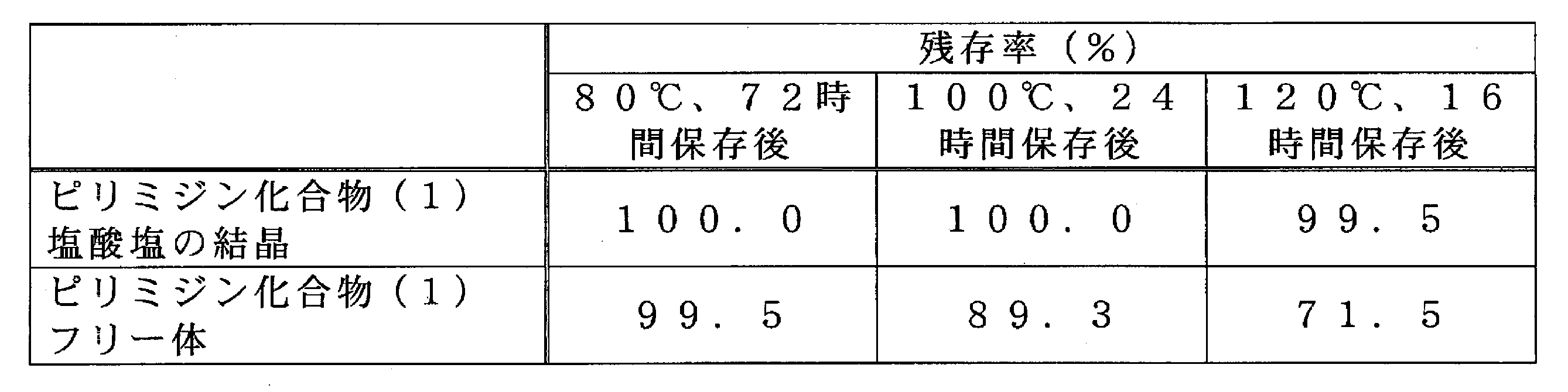
表10記載の試験結果から、ピリミジン化合物(1) 塩酸塩の結晶は熱安定性に優れることが明らかとなった。
本発明によれば、脂質異常症などの疾患の予防及び/又は治療に有用なピリミジン化合物(1)を含有し、安定性の良好な医薬組成物を提供できるため、例えば医薬品産業等において利用できる。
Claims (5)
- (S)-トランス-{4-[({2-[({1-[3,5-ビス(トリフルオロメチル)フェニル]エチル}{5-[2-(メチルスルホニル)エトキシ]ピリミジン-2-イル}アミノ)メチル]-4-(トリフルオロメチル)フェニル}(エチル)アミノ)メチル]シクロヘキシル}酢酸若しくはその塩又はそれらの溶媒和物を含有し、0.1w/v%臭化セチルトリメチルアンモニウム水溶液に溶解又は分散した場合に得られる液のpH値が8.0以下である、医薬組成物。
- 0.1w/v%臭化セチルトリメチルアンモニウム水溶液に溶解又は分散した場合に得られる液のpH値が、6.5以下である、請求項1記載の医薬組成物。
- 経口投与用固形製剤である、請求項1又は2記載の医薬組成物。
- (S)-トランス-{4-[({2-[({1-[3,5-ビス(トリフルオロメチル)フェニル]エチル}{5-[2-(メチルスルホニル)エトキシ]ピリミジン-2-イル}アミノ)メチル]-4-(トリフルオロメチル)フェニル}(エチル)アミノ)メチル]シクロヘキシル}酢酸若しくはその塩又はそれらの溶媒和物が、(S)-トランス-{4-[({2-[({1-[3,5-ビス(トリフルオロメチル)フェニル]エチル}{5-[2-(メチルスルホニル)エトキシ]ピリミジン-2-イル}アミノ)メチル]-4-(トリフルオロメチル)フェニル}(エチル)アミノ)メチル]シクロヘキシル}酢酸 塩酸塩である、請求項1~3のいずれか1項記載の医薬組成物。
- (S)-トランス-{4-[({2-[({1-[3,5-ビス(トリフルオロメチル)フェニル]エチル}{5-[2-(メチルスルホニル)エトキシ]ピリミジン-2-イル}アミノ)メチル]-4-(トリフルオロメチル)フェニル}(エチル)アミノ)メチル]シクロヘキシル}酢酸 塩酸塩が、結晶である、請求項4記載の医薬組成物。
Priority Applications (1)
| Application Number | Priority Date | Filing Date | Title |
|---|---|---|---|
| JP2016561964A JPWO2016084950A1 (ja) | 2014-11-28 | 2015-11-27 | 医薬組成物 |
Applications Claiming Priority (2)
| Application Number | Priority Date | Filing Date | Title |
|---|---|---|---|
| JP2014240833 | 2014-11-28 | ||
| JP2014-240833 | 2014-11-28 |
Publications (1)
| Publication Number | Publication Date |
|---|---|
| WO2016084950A1 true WO2016084950A1 (ja) | 2016-06-02 |
Family
ID=56074495
Family Applications (1)
| Application Number | Title | Priority Date | Filing Date |
|---|---|---|---|
| PCT/JP2015/083453 Ceased WO2016084950A1 (ja) | 2014-11-28 | 2015-11-27 | 医薬組成物 |
Country Status (2)
| Country | Link |
|---|---|
| JP (1) | JPWO2016084950A1 (ja) |
| WO (1) | WO2016084950A1 (ja) |
Cited By (1)
| Publication number | Priority date | Publication date | Assignee | Title |
|---|---|---|---|---|
| WO2019004447A1 (ja) * | 2017-06-30 | 2019-01-03 | 興和株式会社 | 医薬組成物 |
Citations (3)
| Publication number | Priority date | Publication date | Assignee | Title |
|---|---|---|---|---|
| WO2011152508A1 (ja) * | 2010-06-04 | 2011-12-08 | 興和株式会社 | 光学活性ジベンジルアミン誘導体及びその製造方法 |
| JP2014520795A (ja) * | 2011-07-08 | 2014-08-25 | ノバルティス アーゲー | 高トリグリセリド対象においてアテローム性動脈硬化症を治療する方法 |
| WO2014192903A1 (ja) * | 2013-05-31 | 2014-12-04 | 興和株式会社 | ジベンジルアミン構造を有するピリミジン化合物の新規形態 |
-
2015
- 2015-11-27 JP JP2016561964A patent/JPWO2016084950A1/ja active Pending
- 2015-11-27 WO PCT/JP2015/083453 patent/WO2016084950A1/ja not_active Ceased
Patent Citations (3)
| Publication number | Priority date | Publication date | Assignee | Title |
|---|---|---|---|---|
| WO2011152508A1 (ja) * | 2010-06-04 | 2011-12-08 | 興和株式会社 | 光学活性ジベンジルアミン誘導体及びその製造方法 |
| JP2014520795A (ja) * | 2011-07-08 | 2014-08-25 | ノバルティス アーゲー | 高トリグリセリド対象においてアテローム性動脈硬化症を治療する方法 |
| WO2014192903A1 (ja) * | 2013-05-31 | 2014-12-04 | 興和株式会社 | ジベンジルアミン構造を有するピリミジン化合物の新規形態 |
Non-Patent Citations (2)
| Title |
|---|
| BAVIN M.: "Polymorphism in process development", CHEMISTRY AND INDUSTRY, 21 August 1989 (1989-08-21), pages 527 - 529 * |
| BYRN S. ET AL.: "Pharmaceutical solids: a strategic approach to regulatory considerations", PHARM RES., vol. 12, no. 7, 1995, pages 945 - 54 * |
Cited By (2)
| Publication number | Priority date | Publication date | Assignee | Title |
|---|---|---|---|---|
| WO2019004447A1 (ja) * | 2017-06-30 | 2019-01-03 | 興和株式会社 | 医薬組成物 |
| US11344535B2 (en) | 2017-06-30 | 2022-05-31 | Kowa Company, Ltd. | Pharmaceutical composition |
Also Published As
| Publication number | Publication date |
|---|---|
| JPWO2016084950A1 (ja) | 2017-09-07 |
Similar Documents
| Publication | Publication Date | Title |
|---|---|---|
| US20250188054A1 (en) | Crystalline forms of n-(3-(2-(2-hydroxyethoxy)-6-morpholinopyridin-4-yl)-4-methvlphenyl)-2 (trifluoromethyl)isonicotinamide as raf inhibitors for the treatment of cancer | |
| JP2020183408A (ja) | {[5−(3−クロロフェニル)−3−ヒドロキシピリジン−2−カルボニル]アミノ}酢酸の固体形態、組成物、及びその使用 | |
| JP6370377B2 (ja) | 非晶質形態のダサチニブの塩 | |
| CN110650963B (zh) | Gdc-0077的多晶型物和固体形式及其制备方法 | |
| US9902698B2 (en) | 2-[[[2-[(Hydroxyacetyl)amino]-4-pyridinyl]methyl]thio]-N-[4-(trifluoromethoxy)phenyl]-3-pyridinecarboxamide benzenesulfonate, crystal of same, crystal polymorph thereof, and methods for production thereof | |
| JP2022519885A (ja) | Jak2阻害剤の結晶形態 | |
| US20170313664A1 (en) | Novel form of pyrimidine compound having dibenzylamine structure | |
| JP2014144916A (ja) | 2−アシルアミノチアゾール化合物の結晶 | |
| TWI496773B (zh) | N-[2-[[(2,3-二氟苯基)甲基]硫基]-6-{[(1r,2s)-2,3-二羥基-1-甲基丙基]氧基}-4-嘧啶基]-1-三亞甲亞胺磺醯胺之新穎結晶型 | |
| WO2016136928A1 (ja) | イミダゾオキサジンの結晶、当該結晶を含む医薬組成物、及び当該結晶の製造方法 | |
| EP4371617A2 (en) | Crystal | |
| WO2016084950A1 (ja) | 医薬組成物 | |
| JP7132211B2 (ja) | 3-(3,5-ジクロロ-4-ヒドロキシベンゾイル)-1,1-ジオキソ-2,3-ジヒドロ-1,3-ベンゾチアゾールの結晶形及び塩 | |
| JP5744017B2 (ja) | チエノピリミジン誘導体の結晶 | |
| JP2019116445A (ja) | スルホンアミド化合物の結晶形 | |
| HK40020487B (en) | Polymorphs and solid forms of gdc-0077, and methods of production thereof | |
| HK40020487A (en) | Polymorphs and solid forms of gdc-0077, and methods of production thereof | |
| HK1167647B (en) | 2-[[[2-[(hydroxyacetyl)amino]-4-pyridinyl]methyl]thio]-n-[4-(trifluoromethoxy)phenyl]-3-pyridinecarboxamide benzene- sulfonate, crystals of same, polymorphs thereof, and processes for production thereof |
Legal Events
| Date | Code | Title | Description |
|---|---|---|---|
| 121 | Ep: the epo has been informed by wipo that ep was designated in this application |
Ref document number: 15862273 Country of ref document: EP Kind code of ref document: A1 |
|
| ENP | Entry into the national phase |
Ref document number: 2016561964 Country of ref document: JP Kind code of ref document: A |
|
| NENP | Non-entry into the national phase |
Ref country code: DE |
|
| 122 | Ep: pct application non-entry in european phase |
Ref document number: 15862273 Country of ref document: EP Kind code of ref document: A1 |