WO2016017747A1 - 炭素繊維強化複合材料用エポキシ樹脂組成物、樹脂シート、プリプレグ、炭素繊維強化複合材料 - Google Patents
炭素繊維強化複合材料用エポキシ樹脂組成物、樹脂シート、プリプレグ、炭素繊維強化複合材料 Download PDFInfo
- Publication number
- WO2016017747A1 WO2016017747A1 PCT/JP2015/071628 JP2015071628W WO2016017747A1 WO 2016017747 A1 WO2016017747 A1 WO 2016017747A1 JP 2015071628 W JP2015071628 W JP 2015071628W WO 2016017747 A1 WO2016017747 A1 WO 2016017747A1
- Authority
- WO
- WIPO (PCT)
- Prior art keywords
- epoxy resin
- reinforced composite
- composite material
- resin composition
- carbon
- Prior art date
- Legal status (The legal status is an assumption and is not a legal conclusion. Google has not performed a legal analysis and makes no representation as to the accuracy of the status listed.)
- Ceased
Links
Images


Classifications
-
- C—CHEMISTRY; METALLURGY
- C08—ORGANIC MACROMOLECULAR COMPOUNDS; THEIR PREPARATION OR CHEMICAL WORKING-UP; COMPOSITIONS BASED THEREON
- C08G—MACROMOLECULAR COMPOUNDS OBTAINED OTHERWISE THAN BY REACTIONS ONLY INVOLVING UNSATURATED CARBON-TO-CARBON BONDS
- C08G59/00—Polycondensates containing more than one epoxy group per molecule; Macromolecules obtained by polymerising compounds containing more than one epoxy group per molecule using curing agents or catalysts which react with the epoxy groups
- C08G59/18—Macromolecules obtained by polymerising compounds containing more than one epoxy group per molecule using curing agents or catalysts which react with the epoxy groups ; e.g. general methods of curing
- C08G59/20—Macromolecules obtained by polymerising compounds containing more than one epoxy group per molecule using curing agents or catalysts which react with the epoxy groups ; e.g. general methods of curing characterised by the epoxy compounds used
- C08G59/32—Epoxy compounds containing three or more epoxy groups
-
- C—CHEMISTRY; METALLURGY
- C08—ORGANIC MACROMOLECULAR COMPOUNDS; THEIR PREPARATION OR CHEMICAL WORKING-UP; COMPOSITIONS BASED THEREON
- C08J—WORKING-UP; GENERAL PROCESSES OF COMPOUNDING; AFTER-TREATMENT NOT COVERED BY SUBCLASSES C08B, C08C, C08F, C08G or C08H
- C08J5/00—Manufacture of articles or shaped materials containing macromolecular substances
- C08J5/24—Impregnating materials with prepolymers which can be polymerised in situ, e.g. manufacture of prepregs
- C08J5/241—Impregnating materials with prepolymers which can be polymerised in situ, e.g. manufacture of prepregs using inorganic fibres
- C08J5/243—Impregnating materials with prepolymers which can be polymerised in situ, e.g. manufacture of prepregs using inorganic fibres using carbon fibres
-
- C—CHEMISTRY; METALLURGY
- C08—ORGANIC MACROMOLECULAR COMPOUNDS; THEIR PREPARATION OR CHEMICAL WORKING-UP; COMPOSITIONS BASED THEREON
- C08G—MACROMOLECULAR COMPOUNDS OBTAINED OTHERWISE THAN BY REACTIONS ONLY INVOLVING UNSATURATED CARBON-TO-CARBON BONDS
- C08G59/00—Polycondensates containing more than one epoxy group per molecule; Macromolecules obtained by polymerising compounds containing more than one epoxy group per molecule using curing agents or catalysts which react with the epoxy groups
- C08G59/18—Macromolecules obtained by polymerising compounds containing more than one epoxy group per molecule using curing agents or catalysts which react with the epoxy groups ; e.g. general methods of curing
- C08G59/40—Macromolecules obtained by polymerising compounds containing more than one epoxy group per molecule using curing agents or catalysts which react with the epoxy groups ; e.g. general methods of curing characterised by the curing agents used
- C08G59/50—Amines
-
- C—CHEMISTRY; METALLURGY
- C08—ORGANIC MACROMOLECULAR COMPOUNDS; THEIR PREPARATION OR CHEMICAL WORKING-UP; COMPOSITIONS BASED THEREON
- C08J—WORKING-UP; GENERAL PROCESSES OF COMPOUNDING; AFTER-TREATMENT NOT COVERED BY SUBCLASSES C08B, C08C, C08F, C08G or C08H
- C08J5/00—Manufacture of articles or shaped materials containing macromolecular substances
- C08J5/04—Reinforcing macromolecular compounds with loose or coherent fibrous material
- C08J5/0405—Reinforcing macromolecular compounds with loose or coherent fibrous material with inorganic fibres
- C08J5/042—Reinforcing macromolecular compounds with loose or coherent fibrous material with inorganic fibres with carbon fibres
Definitions
- the present invention relates to an epoxy resin composition suitable for a carbon fiber reinforced composite material, a resin sheet using the same, a prepreg, and a carbon fiber reinforced composite material obtained by curing the epoxy resin composition.
- Epoxy resins are generally cured with various curing agents, resulting in cured products with excellent mechanical properties, water resistance, chemical resistance, heat resistance, electrical properties, etc., adhesives, paints, laminates, moldings It is used in a wide range of fields such as materials and casting materials. Among these, especially in the field of fiber reinforced composite materials, it is possible to impart characteristics such as weight reduction and high strength by impregnating and curing reinforcing fibers as a matrix resin with an epoxy resin and a curing agent. Widely deployed in computer applications such as windmill blades, automobile outer plates and IC trays and notebook PC housings (housing), the demand is increasing year by year.
- CFRP carbon fiber reinforced composite material
- a reinforced fiber plastic such as CFRP has a large difference in coefficient of linear expansion between the fiber and the resin of the cured matrix.
- the linear expansion is negative, and the linear expansion strain due to the temperature cycle increases. .
- a matrix resin having a high strength and toughness in order to withstand this stress with the least possible linear expansion change of the resin itself.
- Patent Document 1 a phenol novolac resin having a biphenyl skeleton, a phenol novolac type epoxy resin obtained by epoxidizing the phenol novolak resin, and an epoxy resin composition for electronic component sealing containing a curing agent as an essential component are known (for example, Patent Document 1).
- Patent Document 1 although it is described that the heat resistance and flame retardancy of the epoxy composition for sealing electronic parts are excellent, there is no description about a specific resin composition that reduces linear expansion characteristics. Neither does it describe the usefulness of carbon fiber reinforced composite materials.
- the present invention exhibits high heat resistance, dimensional stability, and high toughness and rigidity as a cured product when used as an epoxy resin composition of a carbon fiber reinforced composite material. It is an object of the present invention to provide an epoxy resin composition for a carbon fiber reinforced composite material that can provide a carbon fiber reinforced composite material, and an excellent prepreg, resin sheet, and carbon fiber reinforced composite material using the resin composition.
- the present inventors have obtained a resin cured product in which an epoxy resin composition containing a phenol novolac type epoxy resin having a specific structure and a curing agent has high heat resistance and excellent low linear expansion.
- the present inventors have found that it is an excellent epoxy resin composition for fiber-reinforced composite materials and has completed the present invention.
- the present invention is (1) an epoxy resin composition for a carbon fiber reinforced composite material comprising an epoxy resin represented by the following general formula (1) and a curing agent as essential components;
- the cured product has a low linear expansion coefficient (excellent dimensional stability), high heat resistance and high toughness, and an epoxy resin composition for a carbon fiber reinforced composite material, a resin sheet using the same, A prepreg and a carbon fiber reinforced composite material can be provided.
- 6 is a TMA chart of a carbon fiber reinforced composite material obtained in Example 5.
- 6 is a TMA chart of a carbon fiber reinforced composite material obtained in Comparative Example 3.
- the epoxy resin composition for carbon fiber reinforced composite material of the present invention will be described.
- the epoxy resin composition for carbon fiber reinforced composite materials of the present invention (hereinafter referred to as “the epoxy resin composition of the present invention”) contains an epoxy resin represented by the following general formula (1) as an essential component.
- the softening point (ring and ball method) of the epoxy resin used is preferably 50 to 150 ° C., more preferably 52 to 100 ° C., and particularly preferably 52 to 95 ° C. Below 50 ° C., stickiness is severe, handling is difficult, and problems may arise in productivity. Moreover, when it is 150 degreeC or more, since it is a temperature near molding temperature and there exists a possibility that the fluidity
- the epoxy equivalent of the epoxy resin used is 180 to 350 g / eq. It is preferable that In particular, 190 to 300 g / eq. It is preferable that Epoxy equivalent is 180 g / eq. When the ratio is less than 1, since the functional group is too many, the cured product after curing tends to have a high water absorption rate and may become brittle. Epoxy equivalent is 350 g / eq. If it exceeds 1, the softening point becomes very large or epoxidation has not progressed cleanly, which is not preferable because the amount of chlorine may become very large.
- the chlorine content of the epoxy resin used in the present invention is preferably 200 to 1500 ppm, particularly preferably 200 to 900 ppm in terms of total chlorine (hydrolysis method). From the JPCA standard, it is desired that epoxy alone does not exceed 900 ppm. Furthermore, if the amount of chlorine is large, the electrical reliability may be affected accordingly, which is not preferable. When the concentration is less than 200 ppm, an excessive purification step is required, and there is a tendency to cause problems in productivity, which is not preferable.
- the melt viscosity at 150 ° C. of the epoxy resin used in the present invention is preferably 0.05 to 5 Pa ⁇ s. Particularly preferred is 0.05 to 2.0 Pa ⁇ s.
- the viscosity is high, there is a problem in fluidity, and there is a risk of problems in flowability and embedding during pressing.
- it is less than 0.05 Pa ⁇ s, the molecular weight is too small, and the heat resistance may be insufficient.
- n is a repeating unit and is 0-5. When n does not exceed 5, the flowability and fluidity of the prepreg or resin sheet are controlled.
- solubility in a solvent is important.
- solvents such as methyl ethyl ketone, toluene, propylene glycol monomethyl ether and the like.
- solubility in methyl ethyl ketone is important, and it is required that crystals do not precipitate for 2 months or more at 5 ° C., room temperature, or the like.
- Examples of the curing agent that can be used in the epoxy resin composition of the present invention include amine-based curing agents, acid anhydride-based curing agents, amide-based curing agents, and phenol-based curing agents. Of these, amine-based curing agents are preferred because they can achieve a good balance between the low linear expansion of the epoxy resin composition and the heat resistance of the cured resin.
- Examples of the amine-based curing agent preferably contained in the present invention include diaminodiphenylmethane, diaminodiphenylsulfone, isophoronediamine, naphthalenediamine, aniline novolak, orthoethylaniline novolak, aniline resin obtained by reaction of aniline and xylylene chloride, aniline.
- substituted biphenyls such as 4,4′-bis (chloromethyl) -1,1′-biphenyl and 4,4′-bis (methoxymethyl) -1,1′-biphenyl), or substituted phenyls (1,4 -Bis (chloromethyl) benzene, 1,4-bis (methoxymethyl) benzene, 1,4-bis (hydroxymethyl) benzene, etc.), etc.
- aromatic amine compounds are preferred from the standpoint of toughness and heat resistance.
- 3,3′-diaminodiphenylsulfone, 4,4′-diaminodiphenylsulfone, aniline novolak, orthoethylaniline novolak, aniline and xylylene chloride are preferred.
- Resin has high strength against deflection and stress, and its cross-link density improves the elastic modulus at high temperature. It can be preferably from the viewpoint of improving the strength of the CFRP, more preferred from the viewpoint of heat resistance.
- Acid anhydride curing agents include phthalic anhydride, trimellitic anhydride, pyromellitic anhydride, maleic anhydride, tetrahydrophthalic anhydride, methyltetrahydrophthalic anhydride, methyl nadic anhydride, hexahydrophthalic anhydride and methylhexahydro And phthalic anhydride.
- the amide curing agent include dicyandiamide or a polyamide resin synthesized from a dimer of linolenic acid and ethylenediamine.
- phenolic curing agents include polyhydric phenols (bisphenol A, bisphenol F, bisphenol S, fluorene bisphenol, terpene diphenol, 4,4′-dihydroxybiphenyl, 2,2′-dihydroxybiphenyl, 3,3 ′, 5 , 5′-tetramethyl- (1,1′-biphenyl) -4,4′-diol, hydroquinone, resorcin, naphthalenediol, tris- (4-hydroxyphenyl) methane and 1,1,2,2-tetrakis ( 4-hydroxyphenyl) ethane); phenols (eg, phenol, alkyl-substituted phenol, naphthol, alkyl-substituted naphthol, dihydroxybenzene, dihydroxynaphthalene, etc.) and aldehydes (formaldehyde, acetaldehyde, benzaldehyde, p-hydro
- the amount of the curing agent used is preferably 0.7 to 1.2 equivalents relative to 1 equivalent of the epoxy group of the epoxy resin.
- the amount of the curing agent used is preferably 0.7 to 1.2 equivalents relative to 1 equivalent of the epoxy group of the epoxy resin.
- a curing accelerator may be blended as necessary.
- the gelation time can be adjusted by using a curing accelerator.
- curing accelerators that can be used include imidazoles such as 2-methylimidazole, 2-ethylimidazole, 2-ethyl-4-methylimidazole, 2- (dimethylaminomethyl) phenol, 1,8-diaza-bicyclo [5 4.0] tertiary amines such as undecene-7, phosphines such as triphenylphosphine, and metal compounds such as tin octylate.
- the curing accelerator is used in an amount of 0.01 to 5.0 parts by weight based on 100 parts by weight of the epoxy resin, if necessary.
- the epoxy resin represented by the general formula (1) may be used alone or in combination with two or more of other epoxy resins.
- Specific examples of other epoxy resins that can be used in combination with the epoxy resin of the general formula (1) include phenols (phenol, alkyl-substituted phenol, aromatic-substituted phenol, naphthol, alkyl-substituted naphthol, dihydroxybenzene, alkyl-substituted dihydroxybenzene, Polycondensates of dihydroxynaphthalene, etc.) with various aldehydes (formaldehyde, acetaldehyde, alkylaldehyde, benzaldehyde, alkyl-substituted benzaldehyde, hydroxybenzaldehyde, naphthaldehyde, glutaraldehyde, phthalaldehyde, crotonaldehyde, cinnamaldehyde, etc
- the proportion of the epoxy resin of the general formula (1) in the total epoxy resin is preferably 30% by weight or more, particularly preferably 40% by weight or more.
- the proportion of the epoxy resin of the general formula (1) is less than 30% by weight, physical properties such as high heat resistance, dimensional stability, toughness, and water resistance may not be obtained.
- additives can be blended in the epoxy resin composition of the present invention as necessary.
- additives that can be used include polybutadiene and modified products thereof, modified products of acrylonitrile copolymer, polyphenylene ether, polystyrene, polyethylene, polyimide, fluororesin, maleimide compounds, cyanate ester compounds, silicone gel, and silicone oil.
- inorganic fillers such as silica, alumina, calcium carbonate, quartz powder, aluminum powder, graphite, talc, clay, iron oxide, titanium oxide, aluminum nitride, asbestos, mica, glass powder, and fillers such as silane coupling agents And colorants such as carbon black, phthalocyanine blue, and phthalocyanine green.
- the epoxy resin composition of the present invention may contain a known maleimide compound as required.
- maleimide compounds that can be used include 4,4′-diphenylmethane bismaleimide, polyphenylmethane maleimide, m-phenylene bismaleimide, 2,2′-bis [4- (4-maleimidophenoxy) phenyl] propane, 3 , 3'-dimethyl-5,5'-diethyl-4,4'-diphenylmethane bismaleimide, 4-methyl-1,3-phenylene bismaleimide, 4,4'-diphenyl ether bismaleimide, 4,4'-diphenylsulfone Examples thereof include, but are not limited to, bismaleimide, 1,3-bis (3-maleimidophenoxy) benzene, and 1,3-bis (4-maleimidophenoxy) benzene. These may be used alone or in combination of two or more.
- a curing accelerator is
- An organic solvent can be added to the epoxy resin composition of the present invention to form a varnish-like composition (hereinafter simply referred to as varnish).
- the solvent used include amide solvents such as ⁇ -butyrolactone, N-methylpyrrolidone, N, N-dimethylformamide, N, N-dimethylacetamide, N, N-dimethylimidazolidinone, and tetramethylene sulfone.
- ether solvents such as diethylene glycol dimethyl ether, diethylene glycol diethyl ether, propylene glycol, propylene glycol monomethyl ether, propylene glycol monomethyl ether monoacetate, propylene glycol monobutyl ether, ketones such as methyl ethyl ketone, methyl isobutyl ketone, cyclopentanone and cyclohexanone
- Aromatic solvents such as solvent, toluene, xylene and the like can be mentioned.
- the solvent can be used in the range where the solid content concentration excluding the solvent in the obtained varnish is usually 10 to 80% by weight, preferably 20 to 70% by weight.
- the resin sheet, prepreg, and carbon fiber reinforced composite material of the present invention will be described.
- the epoxy resin composition of the present invention may be applied to one side or both sides of a support substrate and used as a resin sheet.
- Examples of the application method include a casting method, a method of extruding a resin from a nozzle or a die with a pump or an extruder, adjusting a thickness with a blade, a method of preparing a thickness by calendaring with a roll, a spray, etc.
- the method of spraying using is mentioned.
- the supporting substrate examples include a porous substrate made of paper, cloth, nonwoven fabric, etc., plastic film or sheet such as polyethylene, polypropylene, polyethylene terephthalate, polyester film, net, foam, metal foil, and laminates thereof. However, it is not limited to these.
- the thickness of the supporting substrate is not particularly limited, and is appropriately determined depending on the application.
- the prepreg of the present invention can be obtained by heating and melting the epoxy resin composition and / or resin sheet of the present invention to lower the viscosity and impregnating the fiber base material.
- the prepreg of the present invention can be obtained by impregnating a fiber base material with a varnish-like epoxy resin composition and drying by heating. After the above prepreg is cut into a desired shape and laminated, the carbon fiber reinforcement of the present invention is obtained by heat curing the epoxy resin composition while applying pressure to the laminate by a press molding method, an autoclave molding method, a sheet winding molding method, etc. A composite material can be obtained. Moreover, a copper foil and an organic film can also be laminated
- the carbon fiber reinforced composite material molding method of the present invention can be obtained by molding by a known method in addition to the above method.
- a carbon fiber base material usually using a carbon fiber fabric
- a preform preliminary preform before impregnation with resin
- RTM method resin transfer molding technique in which a mold is closed, a resin is injected, the preform is impregnated and cured, and then the mold is opened to take out a molded product.
- VaRTM method, SCRIMP (Seeman's Composite Resin Infusion Molding Process) method, and Japanese special table 2005-527410 are exhausted to a pressure lower than atmospheric pressure, which is a kind of RTM method.
- a resin injection process particularly a CAPRI (Controlled Atmospheric Pressure Resin Infusion) method, which controls the VaRTM method more appropriately.
- a film stacking method in which the fiber base material is sandwiched between resin sheets (films), a method in which a powdered resin is adhered to the reinforcing fiber base material to improve the impregnation, and a fluidized bed or fluid slurry in the process of mixing the resin with the fiber base material.
- a molding method using a method (Powder Impregnated Yarn) and a method in which resin fibers are mixed into a fiber base material can also be used.
- the carbon fiber examples include acrylic, pitch, and rayon carbon fibers. Among them, acrylic carbon fibers having high tensile strength are preferably used. Two or more of these fibers may be mixed and used.
- the form of the carbon fiber is not particularly limited, and for example, a long fiber aligned in one direction, a tow, a woven fabric, a mat, a knit, a braid, a short fiber chopped to a length of less than 10 mm, and the like are used.
- the long fiber means a short fiber or a fiber bundle substantially continuous for 10 mm or more.
- the short fiber means a fiber bundle cut to a length of less than 10 mm.
- an array in which fiber bundles are aligned in a single direction is most suitable, but a cloth-like array that is easy to handle is also suitable. ing.
- Epoxy equivalent Measured by the method described in JIS K-7236, the unit is g / eq. It is.
- -Softening point Measured by a method according to JIS K-7234, the unit is ° C.
- Synthesis example 1 A flask equipped with a thermometer, condenser, and stirrer was charged with 316 parts of phenol and 158 parts of resorcin, and the temperature was raised to 100 ° C. Then, 201 parts of 4,4′-bischloromethylbiphenyl was added in portions over 2 hours. And further reacted at the same temperature for 5 hours. Thereafter, the temperature was raised to 160 ° C., and all 4,4′-bischloromethylbiphenyl was reacted. Meanwhile, HCl formed was distilled off by trapping with alkali.
- phenol resin (P-1) was obtained by distilling off unreacted phenol and unreacted resorcin under reduced pressure at 180 ° C. using a rotary evaporator.
- the obtained phenol resin (P-1) had a hydroxyl group equivalent of 137 g / eq.
- the softening point was 94 ° C.
- the ICI viscosity was 470 mPa ⁇ s
- the dihydric phenol introduction ratio was 64%.
- Synthesis example 2 A flask equipped with a stirrer, a reflux condenser, and a stirrer is purged with nitrogen, while 266 parts of the phenol resin (P-1) obtained in Synthesis Example 1, 719 parts of epichlorohydrin, 72 parts of methanol, 21 parts of water And heated up to 75 ° C. Next, 83 parts of flaky sodium hydroxide was added in portions over 90 minutes, and the reaction was further carried out at 75 ° C. for 75 minutes. After completion of the reaction, washing was performed, and excess solvent such as epichlorohydrin was distilled off from the organic layer under reduced pressure at 140 ° C. using a rotary evaporator.
- Example 1 and Comparative Example 1 Using the epoxy resin (EP1) obtained in Synthesis Example 2 and a comparative epoxy resin (EP2 Bisphenol A type epoxy resin RE-310S manufactured by Nippon Kayaku Co., Ltd.), the curing agent is active hydrogen equivalent to the epoxy resin. 1 equivalent of a catalyst that is a curing accelerator, 1 phr of the epoxy resin weight is diluted with the same amount of methyl ethyl ketone as the epoxy resin, mixed at room temperature, and then applied to polyimide (Upilex) using a 100 micron applicator. Thereafter, drying was performed with a hot air dryer while flowing nitrogen gas at 120 ° C. for 5 minutes to obtain resin sheets, respectively.
- EP1 epoxy resin obtained in Synthesis Example 2
- a comparative epoxy resin EP2 Bisphenol A type epoxy resin RE-310S manufactured by Nippon Kayaku Co., Ltd.
- the resin sheet of the present invention using the epoxy resin (EP1) obtained in Synthesis Example 2 has an average film thickness of 32 ⁇ m, the comparative resin sheet using the comparative epoxy resin is semi-solid, and the film thickness is measured. I could not. It was confirmed that the obtained resin sheet of the present invention was soluble in tetrahydrofuran and was not cured.
- Examples 2 to 4 and Comparative Example 2 Using 21 parts of the epoxy resin (EP1) obtained in Synthesis Example 2 and 18 parts of a comparative epoxy resin (EP2 Bisphenol A type epoxy resin RE-310S manufactured by Nippon Kayaku Co., Ltd.) Then, 1 equivalent of active hydrogen equivalent was stirred while being melted at 140 ° C. in an aluminum cup, and further the catalyst as a curing accelerator was added with 1 phr with respect to the weight of the epoxy resin, stirred and cooled. Thereby, a resin plate was obtained. The obtained resin plate was put in an oven at 180 ° C. with an aluminum cup and heated as it was at 180 ° C.
- TMA Thermo-mechanical measuring device TA Instruments TMA-Q400EM Temperature rising rate 2 ° C / min) -Elastic modulus (DMA) Dynamic viscoelasticity measuring instrument: TA-insRents, DMA-2980 Measurement temperature range: -30 to 280 ° C Temperature rising rate: 2 ° C./min. Test piece size: 5 mm ⁇ 50 mm cut out was used. Tg: Tan- ⁇ peak point in DMA measurement was defined as Tg.
- the epoxy resin composition of the present invention has high heat resistance, low water absorption, and elasticity at high temperatures even when compared with other curing agents having the same active hydrogen equivalent. It can be confirmed that the material has a high rate.
- Example 5 Comparative Example 3 Using 6.8 parts of the epoxy resin (EP1) obtained in Synthesis Example 2 and 6.5 parts of a comparative epoxy resin (EP2 bisphenol A type epoxy resin RE-310S manufactured by Nippon Kayaku Co., Ltd.), The epoxy resin was 1 equivalent in terms of active hydrogen and 6.7 parts of methyl ethyl ketone (MEK) as a solvent, and stirred in an aluminum cup to produce a uniform resin varnish so that the resin concentration was 60% by weight. . The prepared resin varnish was impregnated with a carbon cloth having a thickness of 150 ⁇ m and a cotton density of 18 / inch, and then the solvent was evaporated under the drying conditions shown in Table 3 to prepare a prepreg.
- EP1 epoxy resin obtained in Synthesis Example 2
- a comparative epoxy resin EP2 bisphenol A type epoxy resin RE-310S manufactured by Nippon Kayaku Co., Ltd.
- MEK methyl ethyl ketone
- the prepreg was precured by applying a 10 kg load at 175 ° C. for 10 minutes in a hot plate press, and then post-cured at 160 ° C. for 2 hours and at 180 ° C. for 6 hours, so that a carbon fiber reinforced composite material ( CFRP) was obtained.
- CFRP carbon fiber reinforced composite material
- a 4 mm ⁇ 16 mm square sample for evaluation was cut out from the obtained CFRP, and the heat resistance was measured by the following method. Table 3 shows the measurement results.
- the carbon fiber reinforced composite material (CFRP) prepared by combining the epoxy resin composition of the present invention with carbon fiber has a linear expansion change compared to CFRP prepared using the comparative epoxy resin composition. Since it is small, it can confirm that it is excellent in dimensional stability.
- the carbon fiber reinforced composite material produced using the epoxy resin composition of the present invention is lightweight and has excellent resistance to external impact
- the fuselage, main wing, tail wing, moving blade Aircraft members such as fairings, cowls, doors, seats and interior materials; spacecraft members such as motor cases and main wings; satellite members such as structures and antennas; automobile members such as skins, chassis, aerodynamic members and seats; It can be suitably used for many structural materials such as railway vehicle members such as seats and ship members such as hulls and seats.
Landscapes
- Chemical & Material Sciences (AREA)
- Health & Medical Sciences (AREA)
- Chemical Kinetics & Catalysis (AREA)
- Medicinal Chemistry (AREA)
- Polymers & Plastics (AREA)
- Organic Chemistry (AREA)
- Engineering & Computer Science (AREA)
- Materials Engineering (AREA)
- Manufacturing & Machinery (AREA)
- Inorganic Chemistry (AREA)
- Reinforced Plastic Materials (AREA)
- Epoxy Resins (AREA)
Abstract
本発明は、炭素繊維強化複合材料のエポキシ樹脂組成物として使用したときに、その硬化物として高い耐熱性、寸法安定性、さらには高い靭性、剛性を示す炭素繊維強化複合材料を与えることのできる炭素繊維強化複合材料用エポキシ樹脂組成物、およびこの樹脂組成物を用いた優れたプリプレグ、樹脂シート、炭素繊維強化複合材料を提供することを目的とする。本発明の炭素繊複合材料用エポキシ樹脂組成物は、下記一般式(1)で表されるエポキシ樹脂及び硬化剤を必須成分とする。 (式中、(a)(b)の比率は(a)/(b)=1~3である。Gはグリシジル基を表す。nは繰り返し数であり、0~5である。)
Description
本発明は、炭素繊維強化複合材料に好適なエポキシ樹脂組成物および、これを用いた樹脂シート、プリプレグ、それを硬化させた炭素繊維強化複合材料に関する。
エポキシ樹脂は種々の硬化剤で硬化させることにより、一般的に機械的性質、耐水性、耐薬品性、耐熱性、電気的性質などに優れた硬化物となり、接着剤、塗料、積層板、成形材料、注型材料などの幅広い分野に利用されている。これらの中でも特に繊維強化複合材料の分野においては、エポキシ樹脂および硬化剤をマトリックス樹脂として強化繊維に含浸、硬化させることで、軽量化・高強度化といった特性を付与できることから、航空機構造用部材、風車の羽根、自動車外板およびICトレイやノートパソコンの筐体(ハウジング)などのコンピュータ用途等に広く展開され、その需要は年々増加しつつある。
近年、上述のように炭素繊維強化複合材料(CFRP)の適用範囲が大きくなり、様々な形状の成型体に使用されてきている。この場合、単一の基材、もしくは複数の基材を貼り合わせることでこれらの複雑な形状を成型する必要がある。
こういった成型体は車や飛行機といった温度環境の厳しい環境下で使用されることが想定され、そのCFRPの厚みや形状により炭素繊維との線膨張量による歪みが大きく出やすい。具体的には例えば、厚みの厚い部分と薄い部分とでは線膨張量が異なり、お互いに引っ張り合うため内部の応力がたまりやすくなってしまう。これが起因し、クラックやカーボン繊維とのはがれ等の問題が生じる。
また、一般にCFRPのような強化繊維プラスチックはその繊維と硬化マトリクスの樹脂との線膨張係数の差が大きく、特にカーボンファイバーの場合、線膨張がマイナスであり、温度サイクルによる線膨張歪は大きくなる。
このようなことからできるだけ樹脂自体の線膨張変化が少なく、かつこの応力に耐えるために、強度・強靭性の高いマトリックス樹脂が求められている。
こういった成型体は車や飛行機といった温度環境の厳しい環境下で使用されることが想定され、そのCFRPの厚みや形状により炭素繊維との線膨張量による歪みが大きく出やすい。具体的には例えば、厚みの厚い部分と薄い部分とでは線膨張量が異なり、お互いに引っ張り合うため内部の応力がたまりやすくなってしまう。これが起因し、クラックやカーボン繊維とのはがれ等の問題が生じる。
また、一般にCFRPのような強化繊維プラスチックはその繊維と硬化マトリクスの樹脂との線膨張係数の差が大きく、特にカーボンファイバーの場合、線膨張がマイナスであり、温度サイクルによる線膨張歪は大きくなる。
このようなことからできるだけ樹脂自体の線膨張変化が少なく、かつこの応力に耐えるために、強度・強靭性の高いマトリックス樹脂が求められている。
従来、ビフェニル骨格を有するフェノールノボラック樹脂及びこれをエポキシ化することで得られるフェノールノボラック型エポキシ樹脂、および硬化剤を必須成分とする電子部品封止用エポキシ樹脂組成物が知られている(例えば、特許文献1)。しかしながら、該特許文献1では、電子部品封止用エポキシ組成物の耐熱性、難燃性が優れていることは記載されているものの、線膨張特性を低減する具体的な樹脂組成について何ら記載されておらず、炭素繊維強化複合材料用途の有用性についても記載されていない。
本発明は、上記の従来技術の問題点に鑑み、炭素繊維強化複合材料のエポキシ樹脂組成物として使用したときに、その硬化物として高い耐熱性、寸法安定性、さらには高い靭性、剛性を示す炭素繊維強化複合材料を与えることのできる炭素繊維強化複合材料用エポキシ樹脂組成物、およびこの樹脂組成物を用いた優れたプリプレグ、樹脂シート、炭素繊維強化複合材料を提供することを課題とする。
本発明者らは、上記課題について鋭意研究した結果、特定の構造を有するフェノールノボラック型エポキシ樹脂と硬化剤を含むエポキシ樹脂組成物が高耐熱性かつ低線膨張性に優れた樹脂硬化物を与える繊維強化複合材料用エポキシ樹脂組成物として優れたものであることを見出し、本発明を完成するに至った。
すなわち本発明は
(1)下記一般式(1)で表されるエポキシ樹脂及び硬化剤を必須成分とする炭素繊維強化複合材料用エポキシ樹脂組成物、
(1)下記一般式(1)で表されるエポキシ樹脂及び硬化剤を必須成分とする炭素繊維強化複合材料用エポキシ樹脂組成物、
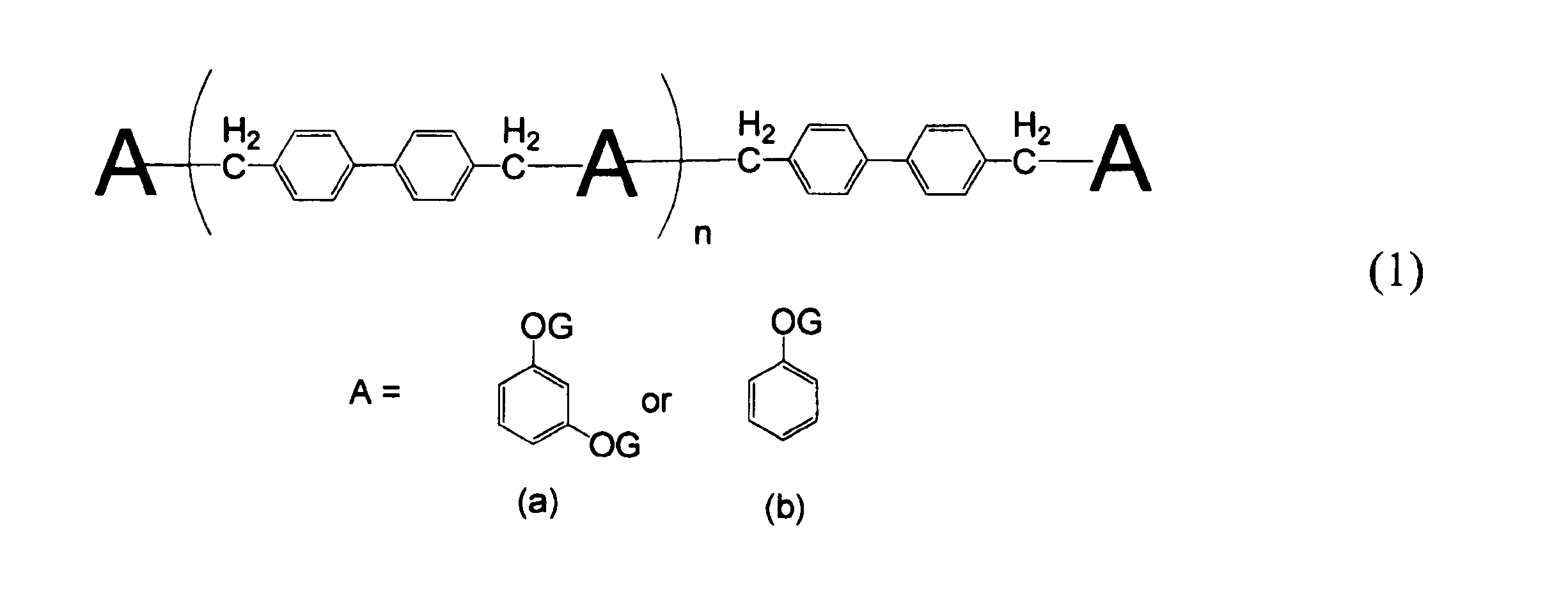
(式中、(a)(b)の比率は(a)/(b)=1~3である。Gはグリシジル基を表す。nは繰り返し数であり、0~5である。)
(2)前記硬化剤がアミン系硬化剤である前項(1)に記載の炭素繊維強化複合材料用エポキシ樹脂組成物、
(3)さらに他のエポキシ樹脂を含む前項(1)又は(2)に記載の炭素繊維強化複合材料用エポキシ樹脂組成物、
(4)前項(1)及至(3)のいずれか一項に記載の炭素繊維強化複合材料用エポキシ樹脂組成物を用いた樹脂シート、
(5)前項(1)及至(3)のいずれか一項に記載の炭素繊維強化複合材料用エポキシ樹脂組成物、又は前項(4)に記載の樹脂シートを炭素繊維に含浸してなるプリプレグ、
(6)前項(5)に記載のプリプレグを硬化してなる炭素繊維強化複合材料、
を提供するものである。
(2)前記硬化剤がアミン系硬化剤である前項(1)に記載の炭素繊維強化複合材料用エポキシ樹脂組成物、
(3)さらに他のエポキシ樹脂を含む前項(1)又は(2)に記載の炭素繊維強化複合材料用エポキシ樹脂組成物、
(4)前項(1)及至(3)のいずれか一項に記載の炭素繊維強化複合材料用エポキシ樹脂組成物を用いた樹脂シート、
(5)前項(1)及至(3)のいずれか一項に記載の炭素繊維強化複合材料用エポキシ樹脂組成物、又は前項(4)に記載の樹脂シートを炭素繊維に含浸してなるプリプレグ、
(6)前項(5)に記載のプリプレグを硬化してなる炭素繊維強化複合材料、
を提供するものである。
本発明によれば、その硬化物が低い線膨張係数(優れた寸法安定性)、高い耐熱性ならびに高い靭性、剛性を示す炭素繊維強化複合材料用エポキシ樹脂組成物、それを用いた樹脂シート、プリプレグ、炭素繊維強化複合材料を提供することができる。
本発明の炭素繊維強化複合材料用エポキシ樹脂組成物について説明する。
本発明の炭素繊維強化複合材料用エポキシ樹脂組成物(以下、「本発明のエポキシ樹脂組成物」という。)は、下記一般式(1)で表されるエポキシ樹脂を必須成分として含有する。
本発明の炭素繊維強化複合材料用エポキシ樹脂組成物(以下、「本発明のエポキシ樹脂組成物」という。)は、下記一般式(1)で表されるエポキシ樹脂を必須成分として含有する。

(式中、(a)(b)の比率は(a)/(b)=1~3である。Gはグリシジル基を表す。nは繰り返し数であり、0~5である。)
本発明において用いられる上記一般式(1)で表されるエポキシ樹脂は、日本国特開2011-252037号公報、日本国特開2008-156553号公報、日本国特開2013-043958公報、国際公開WO2012/053522、WO2007/007827に記載されている手法で合成できるが、前記式(1)の構造をもてばどのような手法のものを用いても構わない。
ただし、本発明においては特に前記式(a)と前記式(b)の割合が(a)/(b)=1~3の物を使用する。(a)の構造が多いと耐熱性があがるがその分吸水特性が悪くなるばかりか、脆く硬くなってしまう。そこで上述の範囲内の多官能化率とする。
ただし、本発明においては特に前記式(a)と前記式(b)の割合が(a)/(b)=1~3の物を使用する。(a)の構造が多いと耐熱性があがるがその分吸水特性が悪くなるばかりか、脆く硬くなってしまう。そこで上述の範囲内の多官能化率とする。
使用するエポキシ樹脂の軟化点(環球法)は50~150℃が好ましく、さらに好ましくは52~100℃、特に好ましくは52~95℃である。50℃以下ではべた付きが激しく、取り扱いが困難であり生産性に課題が生じる場合がある。また150℃以上の場合、成型温度に近い温度であり、成型時の流動性が確保できない恐れがあることから好ましくない。
使用するエポキシ樹脂のエポキシ当量は180~350g/eq.であることが好ましい。特に190~300g/eq.であることが好ましい。エポキシ当量が180g/eq.を下回る場合、官能基が多すぎるため、硬化後の硬化物において吸水率が高くなる、また脆くなりやすい場合がある。エポキシ当量が350g/eq.を超える場合、軟化点が非常に大きくなるか、きれいにエポキシ化が進行していないことが考えられ、塩素量が非常に多くなってしまう恐れがあることから好ましくない。
なお、本発明において用いられるエポキシ樹脂の塩素量は全塩素(加水分解法)で好ましくは200~1500ppmであり、特に好ましくは200~900ppmとなる。JPCAの規格からエポキシ単体でも900ppmを超えないことが望まれている。さらには塩素量が多いとその分電気信頼性に影響する恐れがあるので好ましくない。200ppmを下回る場合、過度な精製工程が必要となり、生産性に課題が生じる傾向にあるため好ましくない。
なお、本発明において用いられるエポキシ樹脂の150℃における溶融粘度は、好ましくは0.05~5Pa・sである。特に好ましくは0.05~2.0Pa・sである。粘度が高いと流動性に課題が生じ、プレス時のフロー性や埋め込み性に問題が生じる恐れがある。0.05Pa・sを下回る場合、分子量が小さすぎるため、耐熱性が足りない場合がある。
前記式(1)中(a)と(b)の比率は(a)/(b)=1~3である。すなわち、半分以上がレゾルシン構造のグリシジルエーテル体であることを特徴とする。本比率は結晶の析出および耐熱性の向上には重要であり、(a)/(b)は1を超えることが好ましい。また、(a)/(b)が3以下であることでレゾルシン構造のグリシジルエーテル体の量を制限することで、吸水率と強靭性を改善することができる。
前記式(1)中、nは繰り返し単位であり、0~5である。nが5を超えないことでプリプレグや樹脂シートにした際のフロー性や流動性をコントロールする。これが5を超えた場合、流動性ばかりか、溶剤への溶解性に課題が生じる。
本発明で用いられるエポキシ樹脂は溶剤への溶解性が重要となる。同様の骨格を有するビフェニルアラルキルタイプのエポキシ樹脂を併用する場合、これらの樹脂についてもメチルエチルケトンやトルエン、プロピレングリコールモノメチルエーテル等の溶剤に対し、溶解性が必要となる。
特にメチルエチルケトンへの溶解性が重要であり、5℃、室温等で2か月以上、結晶が析出しないことが求められる。前述の(a)/(b)の比率にも関与するが、(a)の値が大きいと結晶が出やすくなってしまうため、(a)/(b)が1以上であることが重要となる。
前記式(1)中、nは繰り返し単位であり、0~5である。nが5を超えないことでプリプレグや樹脂シートにした際のフロー性や流動性をコントロールする。これが5を超えた場合、流動性ばかりか、溶剤への溶解性に課題が生じる。
本発明で用いられるエポキシ樹脂は溶剤への溶解性が重要となる。同様の骨格を有するビフェニルアラルキルタイプのエポキシ樹脂を併用する場合、これらの樹脂についてもメチルエチルケトンやトルエン、プロピレングリコールモノメチルエーテル等の溶剤に対し、溶解性が必要となる。
特にメチルエチルケトンへの溶解性が重要であり、5℃、室温等で2か月以上、結晶が析出しないことが求められる。前述の(a)/(b)の比率にも関与するが、(a)の値が大きいと結晶が出やすくなってしまうため、(a)/(b)が1以上であることが重要となる。
本発明のエポキシ樹脂組成物において用い得る硬化剤としては、例えばアミン系硬化剤、酸無水物系硬化剤、アミド系硬化剤及びフェノール系硬化剤等が挙げられる。中でもアミン系硬化剤は、エポキシ樹脂組成物の低線膨張と樹脂硬化物の耐熱性をバランス良く両立できるので好ましい。
本発明で好ましく含有されるアミン系硬化剤としては、ジアミノジフェニルメタン、ジアミノジフェニルスルホン、イソホロンジアミン、ナフタレンジアミン、アニリンノボラック、オルソエチルアニリンノボラック、アニリンとキシリレンクロライドとの反応により得られるアニリン樹脂、アニリンと置換ビフェニル類(4,4’-ビス(クロルメチル)-1,1’-ビフェニル及び4,4’-ビス(メトキシメチル)-1,1’-ビフェニル等)、若しくは置換フェニル類(1,4-ビス(クロロメチル)ベンゼン、1,4-ビス(メトキシメチル)ベンゼン及び1,4-ビス(ヒドロキシメチル)ベンゼン等)等との重縮合により得られるアニリン樹脂等が挙げられるが、これらに限定されるものではない。
特に、強靭性と耐熱性の面から、芳香族アミン化合物が好ましく、中でも3,3’-ジアミノジフェニルスルホン、4,4’-ジアミノジフェニルスルホン、アニリンノボラック、オルソエチルアニリンノボラック、アニリンとキシリレンクロライドとの反応により得られるアニリン樹脂、アニリンと置換ビフェニル類(4,4’-ビス(クロルメチル)-1,1’-ビフェニル及び4,4’-ビス(メトキシメチル)-1,1’-ビフェニル等)、若しくは置換フェニル類(1,4-ビス(クロロメチル)ベンゼン、1,4-ビス(メトキシメチル)ベンゼン及び1,4-ビス(ヒドロキシメチル)ベンゼン等)等との重縮合により得られるアニリン樹脂は、そのたわみや応力に対する強度が高く、その架橋密度から高温での弾性率を向上させることができ、CFRPとしての強度を向上させる面からも好ましく、さらには耐熱性の面から好ましい。
特に、強靭性と耐熱性の面から、芳香族アミン化合物が好ましく、中でも3,3’-ジアミノジフェニルスルホン、4,4’-ジアミノジフェニルスルホン、アニリンノボラック、オルソエチルアニリンノボラック、アニリンとキシリレンクロライドとの反応により得られるアニリン樹脂、アニリンと置換ビフェニル類(4,4’-ビス(クロルメチル)-1,1’-ビフェニル及び4,4’-ビス(メトキシメチル)-1,1’-ビフェニル等)、若しくは置換フェニル類(1,4-ビス(クロロメチル)ベンゼン、1,4-ビス(メトキシメチル)ベンゼン及び1,4-ビス(ヒドロキシメチル)ベンゼン等)等との重縮合により得られるアニリン樹脂は、そのたわみや応力に対する強度が高く、その架橋密度から高温での弾性率を向上させることができ、CFRPとしての強度を向上させる面からも好ましく、さらには耐熱性の面から好ましい。
また、他に含有されうる硬化剤の例を挙げる。
酸無水物系硬化剤としては無水フタル酸、無水トリメリット酸、無水ピロメリット酸、無水マレイン酸、テトラヒドロ無水フタル酸、メチルテトラヒドロ無水フタル酸、無水メチルナジック酸、ヘキサヒドロ無水フタル酸及びメチルヘキサヒドロ無水フタル酸等が挙げられる。
アミド系硬化剤としては、ジシアンジアミド、若しくはリノレン酸の2量体とエチレンジアミンより合成されるポリアミド樹脂等が挙げられる。
酸無水物系硬化剤としては無水フタル酸、無水トリメリット酸、無水ピロメリット酸、無水マレイン酸、テトラヒドロ無水フタル酸、メチルテトラヒドロ無水フタル酸、無水メチルナジック酸、ヘキサヒドロ無水フタル酸及びメチルヘキサヒドロ無水フタル酸等が挙げられる。
アミド系硬化剤としては、ジシアンジアミド、若しくはリノレン酸の2量体とエチレンジアミンより合成されるポリアミド樹脂等が挙げられる。
フェノール系硬化剤としては、多価フェノール類(ビスフェノールA、ビスフェノールF、ビスフェノールS、フルオレンビスフェノール、テルペンジフェノール、4,4’-ジヒドロキシビフェニル、2,2’-ジヒドロキシビフェニル、3,3’,5,5’-テトラメチル-(1,1’-ビフェニル)-4,4’-ジオール、ハイドロキノン、レゾルシン、ナフタレンジオール、トリス-(4-ヒドロキシフェニル)メタン及び1,1,2,2-テトラキス(4-ヒドロキシフェニル)エタン等);フェノール類(例えば、フェノール、アルキル置換フェノール、ナフトール、アルキル置換ナフトール、ジヒドロキシベンゼン及びジヒドロキシナフタレン等)と、アルデヒド類(ホルムアルデヒド、アセトアルデヒド、ベンズアルデヒド、p-ヒドロキシベンズアルデヒド、o-ヒドロキシベンズアルデヒド及びフルフラール等)、ケトン類(p-ヒドロキシアセトフェノン及びo-ヒドロキシアセトフェノン等)、若しくはジエン類(ジシクロペンタジエン及びトリシクロペンタジエン等)との縮合により得られるフェノール樹脂;前記フェノール類と、置換ビフェニル類(4,4’-ビス(クロルメチル)-1,1’-ビフェニル及び4,4’-ビス(メトキシメチル)-1,1’-ビフェニル等)、若しくは置換フェニル類(1,4-ビス(クロロメチル)ベンゼン、1,4-ビス(メトキシメチル)ベンゼン及び1,4-ビス(ヒドロキシメチル)ベンゼン等)等との重縮合により得られるフェノール樹脂;前記フェノール類及び/又は前記フェノール樹脂の変性物;テトラブロモビスフェノールA及び臭素化フェノール樹脂等のハロゲン化フェノール類が挙げられる。
その他イミダゾール硬化剤としては、BF3 -アミン錯体、グアニジン誘導体等が挙げられる。
その他イミダゾール硬化剤としては、BF3 -アミン錯体、グアニジン誘導体等が挙げられる。
本発明のエポキシ樹脂組成物において硬化剤の使用量は、エポキシ樹脂のエポキシ基1当量に対して0.7~1.2当量が好ましい。エポキシ基1当量に対して0.7当量に満たない場合、或いは1.2当量を越える場合、いずれも硬化が不完全になり、良好な硬化物性が得られない恐れがある。
また本発明のエポキシ樹脂組成物においては必要に応じて、硬化促進剤を配合しても良い。硬化促進剤を使用することによりゲル化時間を調整することも出来る。使用できる硬化促進剤の例としては2-メチルイミダゾール、2-エチルイミダゾール、2-エチル-4-メチルイミダゾールなどのイミダゾール類、2-(ジメチルアミノメチル)フェノール、1,8-ジアザ-ビシクロ[5.4.0]ウンデセン-7等の第3級アミン類、トリフェニルホスフィンなどのホスフィン類、オクチル酸スズ等の金属化合物が挙げられる。硬化促進剤はエポキシ樹脂100重量部に対して0.01~5.0重量部が必要に応じ用いられる。
本発明のエポキシ樹脂組成物において、前記一般式(1)で表されるエポキシ樹脂は単独でも他のエポキシ樹脂を配合して二種以上で併用しても良い。一般式(1)のエポキシ樹脂と併用し得る他のエポキシ樹脂の具体例としては、フェノール類(フェノール、アルキル置換フェノール、芳香族置換フェノール、ナフトール、アルキル置換ナフトール、ジヒドロキシベンゼン、アルキル置換ジヒドロキシベンゼン、ジヒドロキシナフタレン等)と各種アルデヒド(ホルムアルデヒド、アセトアルデヒド、アルキルアルデヒド、ベンズアルデヒド、アルキル置換ベンズアルデヒド、ヒドロキシベンズアルデヒド、ナフトアルデヒド、グルタルアルデヒド、フタルアルデヒド、クロトンアルデヒド、シンナムアルデヒド等)との重縮合物、フェノール類と各種ジエン化合物(ジシクロペンタジエン、テルペン類、ビニルシクロヘキセン、ノルボルナジエン、ビニルノルボルネン、テトラヒドロインデン、ジビニルベンゼン、ジビニルビフェニル、ジイソプロペニルビフェニル、ブタジエン、イソプレン等)との重合物、フェノール類とケトン類(アセトン、メチルエチルケトン、メチルイソブチルケトン、アセトフェノン、ベンゾフェノン等)との重縮合物、フェノール類と置換ビフェニル類(4,4’-ビス(クロルメチル)-1,1’-ビフェニル及び4,4’-ビス(メトキシメチル)-1,1’-ビフェニル等)、若しくは置換フェニル類(1,4-ビス(クロロメチル)ベンゼン、1,4-ビス(メトキシメチル)ベンゼン及び1,4-ビス(ヒドロキシメチル)ベンゼン等)等との重縮合により得られるフェノール樹脂、ビスフェノール類と各種アルデヒドの重縮合物、アルコール類等をグリシジル化したグリシジルエーテル系エポキシ樹脂、4-ビニル-1-シクロヘキセンジエポキシドや3,4-エポキシシクロヘキシルメチル-3,4’-エポキシシクロヘキサンカルボキシラートなどを代表とする脂環式エポキシ樹脂、テトラグリシジルジアミノジフェニルメタン(TGDDM)やトリグリシジル-p-アミノフェノールなどを代表とするグリシジルアミン系エポキシ樹脂、グリシジルエステル系エポキシ樹脂等が挙げられるが、通常用いられるエポキシ樹脂であればこれらに限定されるものではない。
他のエポキシ樹脂と併用する場合、前記一般式(1)のエポキシ樹脂の全エポキシ樹脂中に占める割合は30重量%以上が好ましく、特に40重量%以上が好ましい。前記一般式(1)のエポキシ樹脂の割合が30重量%より少ないと、高耐熱性、寸法安定性、強靭性、耐水性などの物性が得られない場合がある。
更に本発明のエポキシ樹脂組成物には、必要に応じて公知の添加剤を配合することが出来る。用いうる添加剤の具体例としては、ポリブタジエン及びこの変性物、アクリロニトリル共重合体の変性物、ポリフェニレンエーテル、ポリスチレン、ポリエチレン、ポリイミド、フッ素樹脂、マレイミド系化合物、シアネートエステル系化合物、シリコーンゲル、シリコーンオイル、並びにシリカ、アルミナ、炭酸カルシウム、石英粉、アルミニウム粉末、グラファイト、タルク、クレー、酸化鉄、酸化チタン、窒化アルミニウム、アスベスト、マイカ、ガラス粉末等の無機充填材、シランカップリング剤等の充填材の表面処理剤、離型剤、カーボンブラック、フタロシアニンブルー、フタロシアニングリーン等の着色剤が挙げられる。
また本発明のエポキシ樹脂組成物には、必要に応じて公知のマレイミド系化合物を配合することができる。用いうるマレイミド化合物の具体例としては、4,4’-ジフェニルメタンビスマレイミド、ポリフェニルメタンマレイミド、m-フェニレンビスマレイミド、2,2’-ビス〔4-(4-マレイミドフェノキシ)フェニル〕プロパン、3,3’-ジメチル-5,5’-ジエチル-4,4’-ジフェニルメタンビスマレイミド、4-メチル-1,3-フェニレンビスマレイミド、4,4’-ジフェニルエーテルビスマレイミド、4,4’-ジフェニルスルフォンビスマレイミド、1,3-ビス(3-マレイミドフェノキシ)ベンゼン、1,3-ビス(4-マレイミドフェノキシ)ベンゼンなどが挙げられるがこれらに限定されるものではない。これらは単独で用いてもよく、2種以上併用してもよい。マレイミド系化合物を配合する際は、必要により硬化促進剤を配合するが、前記硬化促進剤や、有機化酸化物、アゾ化合物などのラジカル重合開始剤など使用できる。
本発明のエポキシ樹脂組成物に有機溶剤を添加しワニス状の組成物(以下、単にワニスという)とすることができる。用いられる溶剤としては、例えばγ-ブチロラクトン類、N-メチルピロリドン、N,N-ジメチルホルムアミド、N,N-ジメチルアセトアミド、N,N-ジメチルイミダゾリジノン等のアミド系溶剤、テトラメチレンスルフォン等のスルフォン類、ジエチレングリコールジメチルエーテル、ジエチレングリコールジエチルエーテル、プロピレングリコール、プロピレングリコールモノメチルエーテル、プロピレングリコールモノメチルエーテルモノアセテート、プロピレングリコールモノブチルエーテル等のエーテル系溶剤、メチルエチルケトン、メチルイソブチルケトン、シクロペンタノン、シクロヘキサノン等のケトン系溶剤、トルエン、キシレンなどの芳香族系溶剤が挙げられる。溶剤は、得られたワニス中の溶剤を除く固形分濃度が通常10~80重量%、好ましくは20~70重量%となる範囲で使用することができる。
本発明の樹脂シート、プリプレグ、炭素繊維強化複合材料について説明する。
本発明のエポキシ樹脂組成物を支持基材の片面または両面に塗布し、樹脂シートとして用いてもよい。塗布方法としては、例えば、注型法、ポンプや押し出し機等により樹脂をノズルやダイスから押し出し、ブレードで厚さを調整する方法、ロールによりカレンダー加工して厚さを表製する方法、スプレー等を用いて噴霧する方法等が挙げられる。なお、層を形成する工程においては、エポキシ樹脂組成物の熱分解を回避可能な温度範囲で加熱しながら行ってもよい。また、必要に応じて圧延処理、研削処理等を施してもよい。支持基材としては、例えば紙、布、不織布等からなる多孔質基材、ポリエチレン、ポリプロピレン、ポリエチレンテレフタレート、ポリエステルフィルムなどのプラスチックフィルムあるいはシート、ネット、発泡体、金属箔、およびこれらのラミネート体などの適宜な薄葉体等が挙げられるが、これらに限定されるものではない。支持基材に厚さは特に制限されず、用途に応じて適宜に決定される。
本発明のエポキシ樹脂組成物を支持基材の片面または両面に塗布し、樹脂シートとして用いてもよい。塗布方法としては、例えば、注型法、ポンプや押し出し機等により樹脂をノズルやダイスから押し出し、ブレードで厚さを調整する方法、ロールによりカレンダー加工して厚さを表製する方法、スプレー等を用いて噴霧する方法等が挙げられる。なお、層を形成する工程においては、エポキシ樹脂組成物の熱分解を回避可能な温度範囲で加熱しながら行ってもよい。また、必要に応じて圧延処理、研削処理等を施してもよい。支持基材としては、例えば紙、布、不織布等からなる多孔質基材、ポリエチレン、ポリプロピレン、ポリエチレンテレフタレート、ポリエステルフィルムなどのプラスチックフィルムあるいはシート、ネット、発泡体、金属箔、およびこれらのラミネート体などの適宜な薄葉体等が挙げられるが、これらに限定されるものではない。支持基材に厚さは特に制限されず、用途に応じて適宜に決定される。
本発明のエポキシ樹脂組成物および/または樹脂シートを加熱溶融して低粘度化して繊維基材に含浸させることにより本発明のプリプレグを得ることができる。
また、ワニス状のエポキシ樹脂組成物を、繊維基材に含浸させて加熱乾燥させることにより本発明のプリプレグを得ることもできる。上記のプリプレグを所望の形に裁断、積層後、積層物にプレス成形法やオートクレーブ成形法、シートワインディング成形法などで圧力をかけながらエポキシ樹脂組成物を加熱硬化させることにより本発明の炭素繊維強化複合材料を得ることができる。また、プリプレグの積層時に銅箔や有機フィルムを積層することもできる。
さらに、本発明の炭素繊維強化複合材料の成形方法は、上記の方法のほかに、公知の方法にて成形して得ることもできる。例えば、炭素繊維基材(通常、炭素繊維織物を使用)を裁断、積層、賦形してプリフォーム(樹脂を含浸する前の予備成形体)を作製、プリフォームを成形型内に配置して型を閉じ、樹脂を注入してプリフォームに含浸、硬化させた後、型を開いて成形品を取り出すレジントランスファー成形技術(RTM法)を用いることもできる。
また、RTM法の一種である、例えば、VaRTM法、SCRIMP(Seeman’s Composite Resin Infusion Molding Process)法、日本国特表2005-527410記載の樹脂供給タンクを大気圧よりも低い圧力まで排気し、循環圧縮を用い、かつ正味の成形圧力を制御することにとよって、樹脂注入プロセス、特にVaRTM法をより適切に制御するCAPRI(Controlled Atmospheric Pressure Resin Infusion)法なども用いることができる。
また、RTM法の一種である、例えば、VaRTM法、SCRIMP(Seeman’s Composite Resin Infusion Molding Process)法、日本国特表2005-527410記載の樹脂供給タンクを大気圧よりも低い圧力まで排気し、循環圧縮を用い、かつ正味の成形圧力を制御することにとよって、樹脂注入プロセス、特にVaRTM法をより適切に制御するCAPRI(Controlled Atmospheric Pressure Resin Infusion)法なども用いることができる。
さらに、繊維基材を樹脂シート(フィルム)で挟み込むフィルムスタッキング法や、含浸向上のため強化繊維基材にパウダー状の樹脂を付着させる方法、繊維基材に樹脂を混ぜる過程において流動層あるいは流体スラリー法を用いる成形方法(Powder Impregnated Yarn)、繊維基材に樹脂繊維を混繊させる方法も用いることができる。
炭素繊維としては、アクリル系、ピッチ系、レーヨン系などの炭素繊維が挙げられ、なかでも引張強度の高いアクリル系の炭素繊維が好ましく用いられる。これらの繊維を2種以上混合して用いても構わない。炭素繊維の形態としては、特に限定されるものではなく、例えば、一方向に引き揃えた長繊維、トウ、織物、マット、ニット、組み紐、10mm未満の長さにチョップした短繊維などが用いられる。ここでいう、長繊維とは実質的に10mm以上連続な短繊維もしくは繊維束のことをいう。また、短繊維とは10mm未満の長さに切断された繊維束をいう。特に、比強度、比弾性率が高いことを要求される用途には繊維束が単一方向に引き揃えられた配列が最も適しているが、取扱いの容易なクロス(織物)状の配列も適している。
以下に合成例および実施例を挙げて本発明の特徴をさらに具体的に説明する。以下に示す材料、処理内容、処理手順等は、本発明の趣旨を逸脱しない限り適宜変更することができる。したがって、本発明の範囲は以下に示す具体例により限定的に解釈されるべきものではない。
・エポキシ当量
JIS K-7236に記載された方法で測定し、単位はg/eq.である。
・軟化点
JIS K-7234に準拠した方法で測定し、単位は℃である。
・エポキシ当量
JIS K-7236に記載された方法で測定し、単位はg/eq.である。
・軟化点
JIS K-7234に準拠した方法で測定し、単位は℃である。
合成例1
温度計、冷却管、撹拌機を取り付けたフラスコに、フェノール316部、レゾルシン158部を仕込み、100℃に昇温した後、4,4’-ビスクロロメチルビフェニル201部を2時間かけて分割添加し、同温度でさらに5時間反応させた。その後、160℃に昇温し、4,4’-ビスクロロメチルビフェニルを全て反応させた。その間、生成するHClをアルカリでトラップでして留去した。反応終了後、ロータリーエバポレーターを用いて180℃で減圧下に未反応フェノール及び未反応レゾルシンを留去することにより266部のフェノール樹脂(P-1)を得た。得られたフェノール樹脂(P-1)の水酸基当量は137g/eq.、軟化点は94℃、ICI粘度は470mPa・s、2価フェノール導入割合は64%であった。
温度計、冷却管、撹拌機を取り付けたフラスコに、フェノール316部、レゾルシン158部を仕込み、100℃に昇温した後、4,4’-ビスクロロメチルビフェニル201部を2時間かけて分割添加し、同温度でさらに5時間反応させた。その後、160℃に昇温し、4,4’-ビスクロロメチルビフェニルを全て反応させた。その間、生成するHClをアルカリでトラップでして留去した。反応終了後、ロータリーエバポレーターを用いて180℃で減圧下に未反応フェノール及び未反応レゾルシンを留去することにより266部のフェノール樹脂(P-1)を得た。得られたフェノール樹脂(P-1)の水酸基当量は137g/eq.、軟化点は94℃、ICI粘度は470mPa・s、2価フェノール導入割合は64%であった。
合成例2
攪拌機、還流冷却管、攪拌装置を備えたフラスコに、窒素パージを施しながら合成例1で得られたフェノール樹脂(P-1)266部、エピクロロヒドリン719部、メタノール72部、水21部を加え、75℃にまで昇温した。次いでフレーク状の水酸化ナトリウム83部を90分かけて分割添加した後、さらに75℃で75分間反応を行った。反応終了後水洗を行い、有機層からロータリーエバポレーターを用いて140℃で減圧下、過剰のエピクロロヒドリン等の溶剤を留去した。残留物にメチルイソブチルケトン750部を加え溶解し、75℃にまで昇温した。攪拌下で30%水酸化ナトリウム水溶液52部を加え、1時間反応を行った後、洗浄水が中性になるまで有機層を水洗し得られた有機層からロータリーエバポレーターを用いて180℃で減圧下にメチルイソブチルケトン等の溶剤を留去することでエポキシ樹脂(EP1)を338部得た。得られたエポキシ樹脂(EP1)のエポキシ当量は209g/eq.、軟化点は71℃、150℃における粘度は370mPa・s、2価グリシジル置換フェニル基の導入割合は68%であった。
攪拌機、還流冷却管、攪拌装置を備えたフラスコに、窒素パージを施しながら合成例1で得られたフェノール樹脂(P-1)266部、エピクロロヒドリン719部、メタノール72部、水21部を加え、75℃にまで昇温した。次いでフレーク状の水酸化ナトリウム83部を90分かけて分割添加した後、さらに75℃で75分間反応を行った。反応終了後水洗を行い、有機層からロータリーエバポレーターを用いて140℃で減圧下、過剰のエピクロロヒドリン等の溶剤を留去した。残留物にメチルイソブチルケトン750部を加え溶解し、75℃にまで昇温した。攪拌下で30%水酸化ナトリウム水溶液52部を加え、1時間反応を行った後、洗浄水が中性になるまで有機層を水洗し得られた有機層からロータリーエバポレーターを用いて180℃で減圧下にメチルイソブチルケトン等の溶剤を留去することでエポキシ樹脂(EP1)を338部得た。得られたエポキシ樹脂(EP1)のエポキシ当量は209g/eq.、軟化点は71℃、150℃における粘度は370mPa・s、2価グリシジル置換フェニル基の導入割合は68%であった。
実施例1、比較例1
合成例2で得られたエポキシ樹脂(EP1)、及び比較用のエポキシ樹脂(EP2 日本化薬製 ビスフェノールA型エポキシ樹脂 RE-310S)を用いて、硬化剤をエポキシ樹脂に対し、活性水素当量で1当量、さらに硬化促進剤である触媒をエポキシ樹脂の重量に対し1phrをエポキシ樹脂と同量のメチルエチルケトンで希釈し、室温で混合した後、ポリイミド(ユーピレックス)に100ミクロンのアプリケータを用いて塗布後、120℃5分、窒素ガスを流しながら熱風乾燥器で乾燥をおこない、それぞれ樹脂シートを得た。合成例2で得られたエポキシ樹脂(EP1)を用いた本発明の樹脂シートは膜厚が平均32μm、比較用のエポキシ樹脂を用いた比較用樹脂シートは半固形状であり、膜厚の測定ができなかった。得られた本発明の樹脂シートはテトラヒドロフランに溶解可能であり、硬化前であることを確認した。
合成例2で得られたエポキシ樹脂(EP1)、及び比較用のエポキシ樹脂(EP2 日本化薬製 ビスフェノールA型エポキシ樹脂 RE-310S)を用いて、硬化剤をエポキシ樹脂に対し、活性水素当量で1当量、さらに硬化促進剤である触媒をエポキシ樹脂の重量に対し1phrをエポキシ樹脂と同量のメチルエチルケトンで希釈し、室温で混合した後、ポリイミド(ユーピレックス)に100ミクロンのアプリケータを用いて塗布後、120℃5分、窒素ガスを流しながら熱風乾燥器で乾燥をおこない、それぞれ樹脂シートを得た。合成例2で得られたエポキシ樹脂(EP1)を用いた本発明の樹脂シートは膜厚が平均32μm、比較用のエポキシ樹脂を用いた比較用樹脂シートは半固形状であり、膜厚の測定ができなかった。得られた本発明の樹脂シートはテトラヒドロフランに溶解可能であり、硬化前であることを確認した。
実施例2~4、比較例2
合成例2で得られたエポキシ樹脂(EP1)21部、及び比較用のエポキシ樹脂(EP2 日本化薬製 ビスフェノールA型エポキシ樹脂 RE-310S)18部をそれぞれ用いて、硬化剤をエポキシ樹脂に対し、活性水素当量で1当量をアルミカップ中で140℃で溶融しながら撹拌していき均一にし、さらに硬化促進剤である触媒をエポキシ樹脂の重量に対し1phrを加えて撹拌し、冷却した。これにより、樹脂プレートを得た。
得られた樹脂プレートをアルミカップのまま180℃のオーブンに入れ、そのまま180℃で10時間加熱し、本発明のエポキシ樹脂組成物の成型体と比較用の成型体(表2中の硬化剤H-1:明和化成工業(株)製 フェノールノボラック樹脂)を得た。得られた樹脂プレートから2mm×10mm×5mmの評価用のサンプルを切り出し、下記の項目及び方法でその特性の測定を行った。測定結果を表1及び表2に示す。
・耐熱性、寸法安定性(線膨張変化率):TMA(熱機械測定装置 TAインスツルメント TMA-Q400EM 昇温速度 2℃/min)
・弾性率(DMA)
動的粘弾性測定器:TA-instRuments、DMA-2980
測定温度範囲:-30~280℃
昇温速度:2℃/分
試験片サイズ:5mm×50mmに切り出した物を使用した
Tg:DMA測定に於けるTan-δのピーク点をTgとした
合成例2で得られたエポキシ樹脂(EP1)21部、及び比較用のエポキシ樹脂(EP2 日本化薬製 ビスフェノールA型エポキシ樹脂 RE-310S)18部をそれぞれ用いて、硬化剤をエポキシ樹脂に対し、活性水素当量で1当量をアルミカップ中で140℃で溶融しながら撹拌していき均一にし、さらに硬化促進剤である触媒をエポキシ樹脂の重量に対し1phrを加えて撹拌し、冷却した。これにより、樹脂プレートを得た。
得られた樹脂プレートをアルミカップのまま180℃のオーブンに入れ、そのまま180℃で10時間加熱し、本発明のエポキシ樹脂組成物の成型体と比較用の成型体(表2中の硬化剤H-1:明和化成工業(株)製 フェノールノボラック樹脂)を得た。得られた樹脂プレートから2mm×10mm×5mmの評価用のサンプルを切り出し、下記の項目及び方法でその特性の測定を行った。測定結果を表1及び表2に示す。
・耐熱性、寸法安定性(線膨張変化率):TMA(熱機械測定装置 TAインスツルメント TMA-Q400EM 昇温速度 2℃/min)
・弾性率(DMA)
動的粘弾性測定器:TA-instRuments、DMA-2980
測定温度範囲:-30~280℃
昇温速度:2℃/分
試験片サイズ:5mm×50mmに切り出した物を使用した
Tg:DMA測定に於けるTan-δのピーク点をTgとした
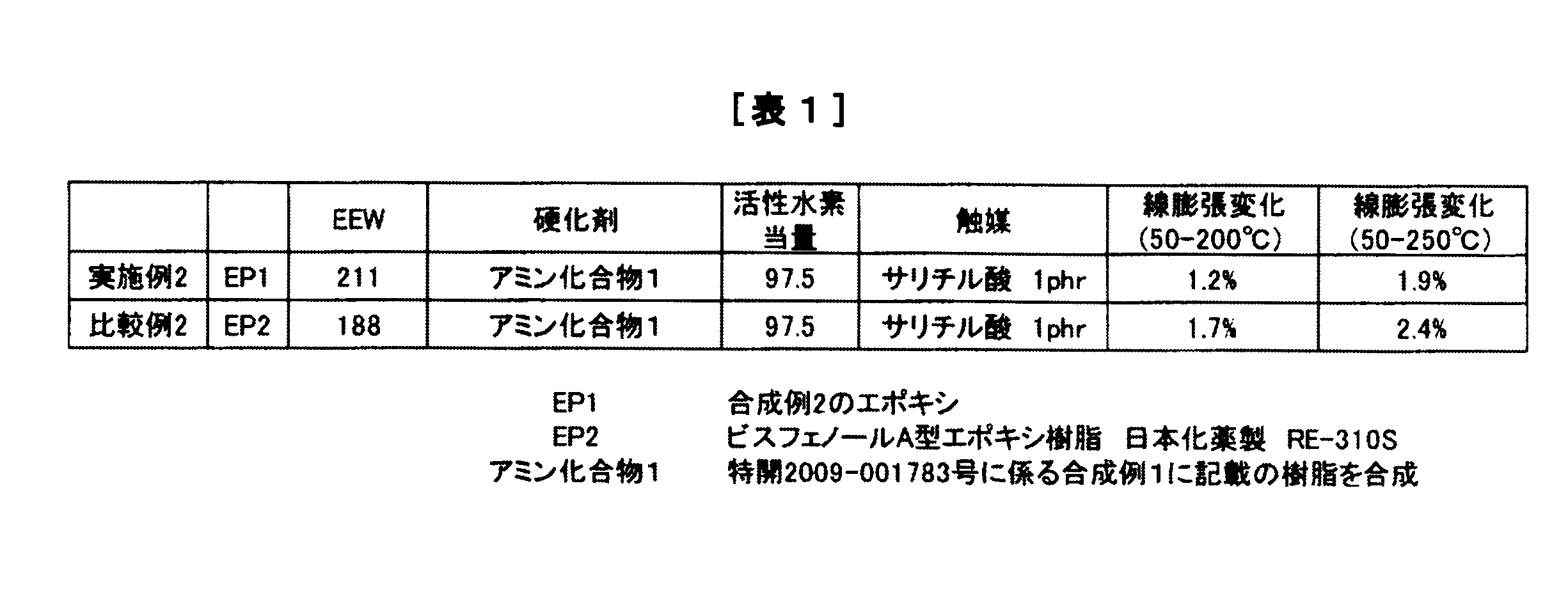
表1より、本発明のエポキシ樹脂組成物を用いた場合は、比較用エポキシ樹脂組成物に比べて、線膨張変化が小さいため、寸法安定性に優れていることが確認できる。

表2より、本発明のエポキシ樹脂組成物は、同じ程度の活性水素当量を有する他の硬化剤と比較しても、高い耐熱性を有し、かつ吸水率が低く、さらには高温での弾性率が高い材料であることが確認できる。
実施例5、比較例3
合成例2で得られたエポキシ樹脂(EP1)6.8部、及び比較用のエポキシ樹脂(EP2 日本化薬製 ビスフェノールA型エポキシ樹脂 RE-310S)6.5部をそれぞれ用いて、硬化剤をエポキシ樹脂に対し、活性水素当量で1当量、溶剤にメチルエチルケトン(MEK)6.7部を用いて、アルミカップ中で撹拌し、樹脂濃度が60重量%になるように均一な樹脂ワニスを作製した。調製した樹脂ワニスに、厚さ150μm、綿密度18本/inchのカーボンクロスを含浸させた後、表3の乾燥条件で溶剤を揮発させて、プリプレグを作製した。続いて、プリプレグを熱板プレスにおいて、175℃で10分間、10kgの荷重を加えてプレキュアさせた後、160℃で2時間、180℃で6時間ポストキュアすることにより、炭素繊維強化複合材料(CFRP)を得た。得られたCFRPから4mm×16mm四方の評価用サンプルを切り出し、下記の方法で耐熱性の測定を行った。測定結果を表3に示す。
・耐熱性、寸法安定性(線膨張変化率):TMA(熱機械測定装置 TAインスツルメント TMA-Q400EM 昇温速度 2℃/min)
合成例2で得られたエポキシ樹脂(EP1)6.8部、及び比較用のエポキシ樹脂(EP2 日本化薬製 ビスフェノールA型エポキシ樹脂 RE-310S)6.5部をそれぞれ用いて、硬化剤をエポキシ樹脂に対し、活性水素当量で1当量、溶剤にメチルエチルケトン(MEK)6.7部を用いて、アルミカップ中で撹拌し、樹脂濃度が60重量%になるように均一な樹脂ワニスを作製した。調製した樹脂ワニスに、厚さ150μm、綿密度18本/inchのカーボンクロスを含浸させた後、表3の乾燥条件で溶剤を揮発させて、プリプレグを作製した。続いて、プリプレグを熱板プレスにおいて、175℃で10分間、10kgの荷重を加えてプレキュアさせた後、160℃で2時間、180℃で6時間ポストキュアすることにより、炭素繊維強化複合材料(CFRP)を得た。得られたCFRPから4mm×16mm四方の評価用サンプルを切り出し、下記の方法で耐熱性の測定を行った。測定結果を表3に示す。
・耐熱性、寸法安定性(線膨張変化率):TMA(熱機械測定装置 TAインスツルメント TMA-Q400EM 昇温速度 2℃/min)

表3より、本発明のエポキシ樹脂組成物を炭素繊維と組み合わせて調製した、炭素繊維強化複合材料(CFRP)は、比較用エポキシ樹脂組成物を用いて調製したCFRPに比べて、線膨張変化が小さいため、寸法安定性に優れていることが確認できる。
本発明を特定の態様を参照して詳細に説明したが、本発明の精神と範囲を離れることなく様々な変更および修正が可能であることは、当業者にとって明らかである。
なお、本出願は、2014年8月1日付で出願された日本国特許出願(特願2014-157631)および2015年1月29日付で出願された日本国特許出願(特願2015-14980)に基づいており、その全体が引用により援用される。また、ここに引用されるすべての参照は全体として取り込まれる。
なお、本出願は、2014年8月1日付で出願された日本国特許出願(特願2014-157631)および2015年1月29日付で出願された日本国特許出願(特願2015-14980)に基づいており、その全体が引用により援用される。また、ここに引用されるすべての参照は全体として取り込まれる。
本発明のエポキシ樹脂組成物を用いて製造した炭素繊維強化複合材料は、軽量であり、かつ、外部からの衝撃に対し優れた耐性を有しているため、胴体、主翼、尾翼、動翼、フェアリング、カウル、ドア、座席および内装材などの航空機部材;モーターケースおよび主翼などの宇宙機部材;構体およびアンテナなどの人工衛星部材;外板、シャシー、空力部材および座席などの自動車部材;構体および座席などの鉄道車両部材;船体および座席などの船舶部材など多くの構造材料に好適に用いることができる。
Claims (6)
- 下記一般式(1)で表されるエポキシ樹脂及び硬化剤を必須成分とする炭素繊維強化複合材料用エポキシ樹脂組成物。

- 前記硬化剤がアミン系硬化剤である請求項1に記載の炭素繊維強化複合材料用エポキシ樹脂組成物。
- さらに他のエポキシ樹脂を含む請求項1又は請求項2に記載の炭素繊維強化複合材料用エポキシ樹脂組成物。
- 請求項1及至請求項3のいずれか一項に記載の炭素繊維強化複合材料用エポキシ樹脂組成物を用いた樹脂シート。
- 請求項1及至請求項3のいずれか一項に記載の炭素繊維強化複合材料用エポキシ樹脂組成物、又は請求項4に記載の樹脂シートを炭素繊維に含浸してなるプリプレグ。
- 請求項5に記載のプリプレグを硬化してなる炭素繊維強化複合材料。
Priority Applications (3)
| Application Number | Priority Date | Filing Date | Title |
|---|---|---|---|
| CN201580037761.7A CN106661194B (zh) | 2014-08-01 | 2015-07-30 | 碳纤维增强复合材料用环氧树脂组合物、树脂片、预浸料、碳纤维增强复合材料 |
| KR1020217036875A KR102354077B1 (ko) | 2014-08-01 | 2015-07-30 | 탄소섬유 강화 복합재료용 에폭시 수지 조성물, 수지 시트, 프리프레그, 탄소섬유 강화 복합재료 |
| KR1020167033345A KR20170040121A (ko) | 2014-08-01 | 2015-07-30 | 탄소섬유 강화 복합재료용 에폭시 수지 조성물, 수지 시트, 프리프레그, 탄소섬유 강화 복합재료 |
Applications Claiming Priority (4)
| Application Number | Priority Date | Filing Date | Title |
|---|---|---|---|
| JP2014-157631 | 2014-08-01 | ||
| JP2014157631 | 2014-08-01 | ||
| JP2015-014980 | 2015-01-29 | ||
| JP2015014980A JP2016035038A (ja) | 2014-08-01 | 2015-01-29 | 炭素繊維強化複合材料用エポキシ樹脂組成物、プリプレグ、炭素繊維強化複合材料 |
Publications (1)
| Publication Number | Publication Date |
|---|---|
| WO2016017747A1 true WO2016017747A1 (ja) | 2016-02-04 |
Family
ID=55217644
Family Applications (1)
| Application Number | Title | Priority Date | Filing Date |
|---|---|---|---|
| PCT/JP2015/071628 Ceased WO2016017747A1 (ja) | 2014-08-01 | 2015-07-30 | 炭素繊維強化複合材料用エポキシ樹脂組成物、樹脂シート、プリプレグ、炭素繊維強化複合材料 |
Country Status (5)
| Country | Link |
|---|---|
| JP (1) | JP2016035038A (ja) |
| KR (2) | KR102354077B1 (ja) |
| CN (1) | CN106661194B (ja) |
| TW (1) | TWI651360B (ja) |
| WO (1) | WO2016017747A1 (ja) |
Cited By (1)
| Publication number | Priority date | Publication date | Assignee | Title |
|---|---|---|---|---|
| CN109608668A (zh) * | 2018-12-03 | 2019-04-12 | 北京化工大学 | 一种碳纤维/氧化石墨烯/环氧树脂预浸料及碳纤维复合材料的制备 |
Families Citing this family (3)
| Publication number | Priority date | Publication date | Assignee | Title |
|---|---|---|---|---|
| CN108081700B (zh) * | 2017-08-31 | 2020-11-17 | 镇江春环密封件集团有限公司 | 碳纤维分段缠绕复合材料厚壁圆筒 |
| JP7243092B2 (ja) * | 2018-09-10 | 2023-03-22 | 株式会社レゾナック | エポキシ樹脂、エポキシ樹脂組成物、エポキシ樹脂硬化物及び複合材料 |
| CN113248275B (zh) * | 2021-07-02 | 2022-04-22 | 杭州幄肯新材料科技有限公司 | 一种表面涂覆石墨涂层的轻质碳纤维/碳圆筒热场材料及其制备方法 |
Citations (4)
| Publication number | Priority date | Publication date | Assignee | Title |
|---|---|---|---|---|
| JPH07292066A (ja) * | 1994-04-28 | 1995-11-07 | Nippon Kayaku Co Ltd | エポキシ樹脂、エポキシ樹脂組成物及びその硬化物 |
| JP2004189811A (ja) * | 2002-12-10 | 2004-07-08 | Toho Tenax Co Ltd | 織物プリプレグ |
| WO2011132674A1 (ja) * | 2010-04-21 | 2011-10-27 | 三菱瓦斯化学株式会社 | 熱硬化性組成物 |
| JP2013043958A (ja) * | 2011-08-25 | 2013-03-04 | Meiwa Kasei Kk | エポキシ樹脂、エポキシ樹脂の製造方法、及びその使用 |
Family Cites Families (2)
| Publication number | Priority date | Publication date | Assignee | Title |
|---|---|---|---|---|
| CN102964775B (zh) * | 2012-10-16 | 2015-09-16 | 广东生益科技股份有限公司 | 一种热固性树脂组合物及其用途 |
| CN103897143B (zh) * | 2012-12-28 | 2018-05-01 | 明和化成株式会社 | 环氧树脂、环氧树脂的制造方法及其使用 |
-
2015
- 2015-01-29 JP JP2015014980A patent/JP2016035038A/ja active Pending
- 2015-07-30 CN CN201580037761.7A patent/CN106661194B/zh active Active
- 2015-07-30 KR KR1020217036875A patent/KR102354077B1/ko not_active Expired - Fee Related
- 2015-07-30 WO PCT/JP2015/071628 patent/WO2016017747A1/ja not_active Ceased
- 2015-07-30 KR KR1020167033345A patent/KR20170040121A/ko not_active Ceased
- 2015-07-31 TW TW104124883A patent/TWI651360B/zh active
Patent Citations (4)
| Publication number | Priority date | Publication date | Assignee | Title |
|---|---|---|---|---|
| JPH07292066A (ja) * | 1994-04-28 | 1995-11-07 | Nippon Kayaku Co Ltd | エポキシ樹脂、エポキシ樹脂組成物及びその硬化物 |
| JP2004189811A (ja) * | 2002-12-10 | 2004-07-08 | Toho Tenax Co Ltd | 織物プリプレグ |
| WO2011132674A1 (ja) * | 2010-04-21 | 2011-10-27 | 三菱瓦斯化学株式会社 | 熱硬化性組成物 |
| JP2013043958A (ja) * | 2011-08-25 | 2013-03-04 | Meiwa Kasei Kk | エポキシ樹脂、エポキシ樹脂の製造方法、及びその使用 |
Cited By (1)
| Publication number | Priority date | Publication date | Assignee | Title |
|---|---|---|---|---|
| CN109608668A (zh) * | 2018-12-03 | 2019-04-12 | 北京化工大学 | 一种碳纤维/氧化石墨烯/环氧树脂预浸料及碳纤维复合材料的制备 |
Also Published As
| Publication number | Publication date |
|---|---|
| CN106661194A (zh) | 2017-05-10 |
| TWI651360B (zh) | 2019-02-21 |
| KR20210141764A (ko) | 2021-11-23 |
| CN106661194B (zh) | 2019-11-05 |
| KR102354077B1 (ko) | 2022-01-24 |
| TW201609948A (zh) | 2016-03-16 |
| JP2016035038A (ja) | 2016-03-17 |
| KR20170040121A (ko) | 2017-04-12 |
Similar Documents
| Publication | Publication Date | Title |
|---|---|---|
| JP2024102860A (ja) | エポキシ樹脂、硬化性樹脂組成物、及び炭素繊維強化複合材料 | |
| CN106661194B (zh) | 碳纤维增强复合材料用环氧树脂组合物、树脂片、预浸料、碳纤维增强复合材料 | |
| CN112513131B (zh) | 环氧树脂及其组合物、树脂片、预浸料及复合材料 | |
| JP7474373B2 (ja) | エポキシ樹脂、硬化性樹脂組成物、及びこれらの硬化物並びに炭素繊維強化複合材料 | |
| CN114641533B (zh) | 环氧树脂混合物、环氧树脂组合物、树脂片、预浸料及碳纤维强化复合材料 | |
| JP6636665B2 (ja) | 炭素繊維強化複合材料用エポキシ樹脂組成物、プリプレグ、炭素繊維強化複合材料 | |
| AU2021224569A1 (en) | Toughened thermoset resin compositions | |
| JP7307668B2 (ja) | エポキシ樹脂、およびエポキシ樹脂組成物 | |
| CN115335427B (zh) | 环氧树脂、环氧化合物、环氧树脂组合物、树脂片材、预浸体、碳纤维增强复合材料及酚醛树脂 | |
| TW202502872A (zh) | 環氧樹脂、硬化性樹脂組成物、及該等之硬化物以及碳纖維強化複合材料 | |
| TW202330685A (zh) | 環氧樹脂及其製造方法、硬化性樹脂組成物、硬化物及碳纖維強化複合材料 | |
| TW202330694A (zh) | 環氧樹脂、硬化性樹脂組成物、硬化物、及碳纖維強化複合材料 |
Legal Events
| Date | Code | Title | Description |
|---|---|---|---|
| 121 | Ep: the epo has been informed by wipo that ep was designated in this application |
Ref document number: 15827563 Country of ref document: EP Kind code of ref document: A1 |
|
| ENP | Entry into the national phase |
Ref document number: 20167033345 Country of ref document: KR Kind code of ref document: A |
|
| NENP | Non-entry into the national phase |
Ref country code: DE |
|
| 122 | Ep: pct application non-entry in european phase |
Ref document number: 15827563 Country of ref document: EP Kind code of ref document: A1 |