WO2016013481A1 - ベンゾトリアゾール構造を有する蛍光色素化合物および高分子蛍光色素化合物、ならびに、それを用いた波長変換型封止材組成物 - Google Patents
ベンゾトリアゾール構造を有する蛍光色素化合物および高分子蛍光色素化合物、ならびに、それを用いた波長変換型封止材組成物 Download PDFInfo
- Publication number
- WO2016013481A1 WO2016013481A1 PCT/JP2015/070401 JP2015070401W WO2016013481A1 WO 2016013481 A1 WO2016013481 A1 WO 2016013481A1 JP 2015070401 W JP2015070401 W JP 2015070401W WO 2016013481 A1 WO2016013481 A1 WO 2016013481A1
- Authority
- WO
- WIPO (PCT)
- Prior art keywords
- group
- fluorescent dye
- carbon atoms
- dye compound
- wavelength
- Prior art date
- Legal status (The legal status is an assumption and is not a legal conclusion. Google has not performed a legal analysis and makes no representation as to the accuracy of the status listed.)
- Ceased
Links
Images


Classifications
-
- C—CHEMISTRY; METALLURGY
- C08—ORGANIC MACROMOLECULAR COMPOUNDS; THEIR PREPARATION OR CHEMICAL WORKING-UP; COMPOSITIONS BASED THEREON
- C08F—MACROMOLECULAR COMPOUNDS OBTAINED BY REACTIONS ONLY INVOLVING CARBON-TO-CARBON UNSATURATED BONDS
- C08F220/00—Copolymers of compounds having one or more unsaturated aliphatic radicals, each having only one carbon-to-carbon double bond, and only one being terminated by only one carboxyl radical or a salt, anhydride ester, amide, imide or nitrile thereof
- C08F220/02—Monocarboxylic acids having less than ten carbon atoms; Derivatives thereof
- C08F220/10—Esters
- C08F220/34—Esters containing nitrogen, e.g. N,N-dimethylaminoethyl (meth)acrylate
-
- C—CHEMISTRY; METALLURGY
- C08—ORGANIC MACROMOLECULAR COMPOUNDS; THEIR PREPARATION OR CHEMICAL WORKING-UP; COMPOSITIONS BASED THEREON
- C08F—MACROMOLECULAR COMPOUNDS OBTAINED BY REACTIONS ONLY INVOLVING CARBON-TO-CARBON UNSATURATED BONDS
- C08F10/00—Homopolymers and copolymers of unsaturated aliphatic hydrocarbons having only one carbon-to-carbon double bond
- C08F10/14—Monomers containing five or more carbon atoms
-
- C—CHEMISTRY; METALLURGY
- C08—ORGANIC MACROMOLECULAR COMPOUNDS; THEIR PREPARATION OR CHEMICAL WORKING-UP; COMPOSITIONS BASED THEREON
- C08F—MACROMOLECULAR COMPOUNDS OBTAINED BY REACTIONS ONLY INVOLVING CARBON-TO-CARBON UNSATURATED BONDS
- C08F20/00—Homopolymers and copolymers of compounds having one or more unsaturated aliphatic radicals, each having only one carbon-to-carbon double bond, and only one being terminated by only one carboxyl radical or a salt, anhydride, ester, amide, imide or nitrile thereof
- C08F20/62—Monocarboxylic acids having ten or more carbon atoms; Derivatives thereof
- C08F20/68—Esters
-
- C—CHEMISTRY; METALLURGY
- C08—ORGANIC MACROMOLECULAR COMPOUNDS; THEIR PREPARATION OR CHEMICAL WORKING-UP; COMPOSITIONS BASED THEREON
- C08G—MACROMOLECULAR COMPOUNDS OBTAINED OTHERWISE THAN BY REACTIONS ONLY INVOLVING UNSATURATED CARBON-TO-CARBON BONDS
- C08G61/00—Macromolecular compounds obtained by reactions forming a carbon-to-carbon link in the main chain of the macromolecule
- C08G61/02—Macromolecular compounds containing only carbon atoms in the main chain of the macromolecule, e.g. polyxylylenes
-
- C—CHEMISTRY; METALLURGY
- C08—ORGANIC MACROMOLECULAR COMPOUNDS; THEIR PREPARATION OR CHEMICAL WORKING-UP; COMPOSITIONS BASED THEREON
- C08G—MACROMOLECULAR COMPOUNDS OBTAINED OTHERWISE THAN BY REACTIONS ONLY INVOLVING UNSATURATED CARBON-TO-CARBON BONDS
- C08G61/00—Macromolecular compounds obtained by reactions forming a carbon-to-carbon link in the main chain of the macromolecule
- C08G61/02—Macromolecular compounds containing only carbon atoms in the main chain of the macromolecule, e.g. polyxylylenes
- C08G61/10—Macromolecular compounds containing only carbon atoms in the main chain of the macromolecule, e.g. polyxylylenes only aromatic carbon atoms, e.g. polyphenylenes
-
- C—CHEMISTRY; METALLURGY
- C08—ORGANIC MACROMOLECULAR COMPOUNDS; THEIR PREPARATION OR CHEMICAL WORKING-UP; COMPOSITIONS BASED THEREON
- C08G—MACROMOLECULAR COMPOUNDS OBTAINED OTHERWISE THAN BY REACTIONS ONLY INVOLVING UNSATURATED CARBON-TO-CARBON BONDS
- C08G61/00—Macromolecular compounds obtained by reactions forming a carbon-to-carbon link in the main chain of the macromolecule
- C08G61/12—Macromolecular compounds containing atoms other than carbon in the main chain of the macromolecule
- C08G61/122—Macromolecular compounds containing atoms other than carbon in the main chain of the macromolecule derived from five- or six-membered heterocyclic compounds, other than imides
- C08G61/123—Macromolecular compounds containing atoms other than carbon in the main chain of the macromolecule derived from five- or six-membered heterocyclic compounds, other than imides derived from five-membered heterocyclic compounds
-
- C—CHEMISTRY; METALLURGY
- C08—ORGANIC MACROMOLECULAR COMPOUNDS; THEIR PREPARATION OR CHEMICAL WORKING-UP; COMPOSITIONS BASED THEREON
- C08L—COMPOSITIONS OF MACROMOLECULAR COMPOUNDS
- C08L23/00—Compositions of homopolymers or copolymers of unsaturated aliphatic hydrocarbons having only one carbon-to-carbon double bond; Compositions of derivatives of such polymers
- C08L23/02—Compositions of homopolymers or copolymers of unsaturated aliphatic hydrocarbons having only one carbon-to-carbon double bond; Compositions of derivatives of such polymers not modified by chemical after-treatment
- C08L23/04—Homopolymers or copolymers of ethene
- C08L23/08—Copolymers of ethene
- C08L23/0846—Copolymers of ethene with unsaturated hydrocarbons containing atoms other than carbon or hydrogen
- C08L23/0853—Ethylene vinyl acetate copolymers
-
- C—CHEMISTRY; METALLURGY
- C09—DYES; PAINTS; POLISHES; NATURAL RESINS; ADHESIVES; COMPOSITIONS NOT OTHERWISE PROVIDED FOR; APPLICATIONS OF MATERIALS NOT OTHERWISE PROVIDED FOR
- C09B—ORGANIC DYES OR CLOSELY-RELATED COMPOUNDS FOR PRODUCING DYES, e.g. PIGMENTS; MORDANTS; LAKES
- C09B57/00—Other synthetic dyes of known constitution
-
- C—CHEMISTRY; METALLURGY
- C09—DYES; PAINTS; POLISHES; NATURAL RESINS; ADHESIVES; COMPOSITIONS NOT OTHERWISE PROVIDED FOR; APPLICATIONS OF MATERIALS NOT OTHERWISE PROVIDED FOR
- C09B—ORGANIC DYES OR CLOSELY-RELATED COMPOUNDS FOR PRODUCING DYES, e.g. PIGMENTS; MORDANTS; LAKES
- C09B69/00—Dyes not provided for by a single group of this subclass
- C09B69/10—Polymeric dyes; Reaction products of dyes with monomers or with macromolecular compounds
-
- C—CHEMISTRY; METALLURGY
- C09—DYES; PAINTS; POLISHES; NATURAL RESINS; ADHESIVES; COMPOSITIONS NOT OTHERWISE PROVIDED FOR; APPLICATIONS OF MATERIALS NOT OTHERWISE PROVIDED FOR
- C09B—ORGANIC DYES OR CLOSELY-RELATED COMPOUNDS FOR PRODUCING DYES, e.g. PIGMENTS; MORDANTS; LAKES
- C09B69/00—Dyes not provided for by a single group of this subclass
- C09B69/10—Polymeric dyes; Reaction products of dyes with monomers or with macromolecular compounds
- C09B69/109—Polymeric dyes; Reaction products of dyes with monomers or with macromolecular compounds containing other specific dyes
-
- C—CHEMISTRY; METALLURGY
- C09—DYES; PAINTS; POLISHES; NATURAL RESINS; ADHESIVES; COMPOSITIONS NOT OTHERWISE PROVIDED FOR; APPLICATIONS OF MATERIALS NOT OTHERWISE PROVIDED FOR
- C09K—MATERIALS FOR MISCELLANEOUS APPLICATIONS, NOT PROVIDED FOR ELSEWHERE
- C09K11/00—Luminescent materials, e.g. electroluminescent or chemiluminescent
- C09K11/02—Use of particular materials as binders, particle coatings or suspension media therefor
-
- C—CHEMISTRY; METALLURGY
- C09—DYES; PAINTS; POLISHES; NATURAL RESINS; ADHESIVES; COMPOSITIONS NOT OTHERWISE PROVIDED FOR; APPLICATIONS OF MATERIALS NOT OTHERWISE PROVIDED FOR
- C09K—MATERIALS FOR MISCELLANEOUS APPLICATIONS, NOT PROVIDED FOR ELSEWHERE
- C09K11/00—Luminescent materials, e.g. electroluminescent or chemiluminescent
- C09K11/06—Luminescent materials, e.g. electroluminescent or chemiluminescent containing organic luminescent materials
-
- H—ELECTRICITY
- H10—SEMICONDUCTOR DEVICES; ELECTRIC SOLID-STATE DEVICES NOT OTHERWISE PROVIDED FOR
- H10F—INORGANIC SEMICONDUCTOR DEVICES SENSITIVE TO INFRARED RADIATION, LIGHT, ELECTROMAGNETIC RADIATION OF SHORTER WAVELENGTH OR CORPUSCULAR RADIATION
- H10F19/00—Integrated devices, or assemblies of multiple devices, comprising at least one photovoltaic cell covered by group H10F10/00, e.g. photovoltaic modules
- H10F19/80—Encapsulations or containers for integrated devices, or assemblies of multiple devices, having photovoltaic cells
- H10F19/804—Materials of encapsulations
-
- H—ELECTRICITY
- H10—SEMICONDUCTOR DEVICES; ELECTRIC SOLID-STATE DEVICES NOT OTHERWISE PROVIDED FOR
- H10F—INORGANIC SEMICONDUCTOR DEVICES SENSITIVE TO INFRARED RADIATION, LIGHT, ELECTROMAGNETIC RADIATION OF SHORTER WAVELENGTH OR CORPUSCULAR RADIATION
- H10F77/00—Constructional details of devices covered by this subclass
- H10F77/40—Optical elements or arrangements
- H10F77/42—Optical elements or arrangements directly associated or integrated with photovoltaic cells, e.g. light-reflecting means or light-concentrating means
- H10F77/45—Wavelength conversion means, e.g. by using luminescent material, fluorescent concentrators or up-conversion arrangements
-
- C—CHEMISTRY; METALLURGY
- C08—ORGANIC MACROMOLECULAR COMPOUNDS; THEIR PREPARATION OR CHEMICAL WORKING-UP; COMPOSITIONS BASED THEREON
- C08G—MACROMOLECULAR COMPOUNDS OBTAINED OTHERWISE THAN BY REACTIONS ONLY INVOLVING UNSATURATED CARBON-TO-CARBON BONDS
- C08G2261/00—Macromolecular compounds obtained by reactions forming a carbon-to-carbon link in the main chain of the macromolecule
- C08G2261/10—Definition of the polymer structure
- C08G2261/14—Side-groups
- C08G2261/142—Side-chains containing oxygen
- C08G2261/1424—Side-chains containing oxygen containing ether groups, including alkoxy
-
- C—CHEMISTRY; METALLURGY
- C08—ORGANIC MACROMOLECULAR COMPOUNDS; THEIR PREPARATION OR CHEMICAL WORKING-UP; COMPOSITIONS BASED THEREON
- C08G—MACROMOLECULAR COMPOUNDS OBTAINED OTHERWISE THAN BY REACTIONS ONLY INVOLVING UNSATURATED CARBON-TO-CARBON BONDS
- C08G2261/00—Macromolecular compounds obtained by reactions forming a carbon-to-carbon link in the main chain of the macromolecule
- C08G2261/10—Definition of the polymer structure
- C08G2261/14—Side-groups
- C08G2261/148—Side-chains having aromatic units
-
- C—CHEMISTRY; METALLURGY
- C08—ORGANIC MACROMOLECULAR COMPOUNDS; THEIR PREPARATION OR CHEMICAL WORKING-UP; COMPOSITIONS BASED THEREON
- C08G—MACROMOLECULAR COMPOUNDS OBTAINED OTHERWISE THAN BY REACTIONS ONLY INVOLVING UNSATURATED CARBON-TO-CARBON BONDS
- C08G2261/00—Macromolecular compounds obtained by reactions forming a carbon-to-carbon link in the main chain of the macromolecule
- C08G2261/10—Definition of the polymer structure
- C08G2261/14—Side-groups
- C08G2261/149—Side-chains having heteroaromatic units
-
- C—CHEMISTRY; METALLURGY
- C08—ORGANIC MACROMOLECULAR COMPOUNDS; THEIR PREPARATION OR CHEMICAL WORKING-UP; COMPOSITIONS BASED THEREON
- C08G—MACROMOLECULAR COMPOUNDS OBTAINED OTHERWISE THAN BY REACTIONS ONLY INVOLVING UNSATURATED CARBON-TO-CARBON BONDS
- C08G2261/00—Macromolecular compounds obtained by reactions forming a carbon-to-carbon link in the main chain of the macromolecule
- C08G2261/10—Definition of the polymer structure
- C08G2261/22—Molecular weight
- C08G2261/228—Polymers, i.e. more than 10 repeat units
-
- C—CHEMISTRY; METALLURGY
- C08—ORGANIC MACROMOLECULAR COMPOUNDS; THEIR PREPARATION OR CHEMICAL WORKING-UP; COMPOSITIONS BASED THEREON
- C08G—MACROMOLECULAR COMPOUNDS OBTAINED OTHERWISE THAN BY REACTIONS ONLY INVOLVING UNSATURATED CARBON-TO-CARBON BONDS
- C08G2261/00—Macromolecular compounds obtained by reactions forming a carbon-to-carbon link in the main chain of the macromolecule
- C08G2261/30—Monomer units or repeat units incorporating structural elements in the main chain
- C08G2261/31—Monomer units or repeat units incorporating structural elements in the main chain incorporating aromatic structural elements in the main chain
- C08G2261/312—Non-condensed aromatic systems, e.g. benzene
-
- C—CHEMISTRY; METALLURGY
- C08—ORGANIC MACROMOLECULAR COMPOUNDS; THEIR PREPARATION OR CHEMICAL WORKING-UP; COMPOSITIONS BASED THEREON
- C08G—MACROMOLECULAR COMPOUNDS OBTAINED OTHERWISE THAN BY REACTIONS ONLY INVOLVING UNSATURATED CARBON-TO-CARBON BONDS
- C08G2261/00—Macromolecular compounds obtained by reactions forming a carbon-to-carbon link in the main chain of the macromolecule
- C08G2261/30—Monomer units or repeat units incorporating structural elements in the main chain
- C08G2261/34—Monomer units or repeat units incorporating structural elements in the main chain incorporating partially-aromatic structural elements in the main chain
- C08G2261/342—Monomer units or repeat units incorporating structural elements in the main chain incorporating partially-aromatic structural elements in the main chain containing only carbon atoms
- C08G2261/3424—Monomer units or repeat units incorporating structural elements in the main chain incorporating partially-aromatic structural elements in the main chain containing only carbon atoms non-conjugated, e.g. paracyclophanes or xylenes
-
- C—CHEMISTRY; METALLURGY
- C08—ORGANIC MACROMOLECULAR COMPOUNDS; THEIR PREPARATION OR CHEMICAL WORKING-UP; COMPOSITIONS BASED THEREON
- C08G—MACROMOLECULAR COMPOUNDS OBTAINED OTHERWISE THAN BY REACTIONS ONLY INVOLVING UNSATURATED CARBON-TO-CARBON BONDS
- C08G2261/00—Macromolecular compounds obtained by reactions forming a carbon-to-carbon link in the main chain of the macromolecule
- C08G2261/50—Physical properties
- C08G2261/52—Luminescence
- C08G2261/522—Luminescence fluorescent
-
- C—CHEMISTRY; METALLURGY
- C08—ORGANIC MACROMOLECULAR COMPOUNDS; THEIR PREPARATION OR CHEMICAL WORKING-UP; COMPOSITIONS BASED THEREON
- C08G—MACROMOLECULAR COMPOUNDS OBTAINED OTHERWISE THAN BY REACTIONS ONLY INVOLVING UNSATURATED CARBON-TO-CARBON BONDS
- C08G2261/00—Macromolecular compounds obtained by reactions forming a carbon-to-carbon link in the main chain of the macromolecule
- C08G2261/90—Applications
- C08G2261/91—Photovoltaic applications
-
- C—CHEMISTRY; METALLURGY
- C08—ORGANIC MACROMOLECULAR COMPOUNDS; THEIR PREPARATION OR CHEMICAL WORKING-UP; COMPOSITIONS BASED THEREON
- C08G—MACROMOLECULAR COMPOUNDS OBTAINED OTHERWISE THAN BY REACTIONS ONLY INVOLVING UNSATURATED CARBON-TO-CARBON BONDS
- C08G73/00—Macromolecular compounds obtained by reactions forming a linkage containing nitrogen with or without oxygen or carbon in the main chain of the macromolecule, not provided for in groups C08G12/00 - C08G71/00
- C08G73/06—Polycondensates having nitrogen-containing heterocyclic rings in the main chain of the macromolecule
- C08G73/08—Polyhydrazides; Polytriazoles; Polyaminotriazoles; Polyoxadiazoles
-
- C—CHEMISTRY; METALLURGY
- C08—ORGANIC MACROMOLECULAR COMPOUNDS; THEIR PREPARATION OR CHEMICAL WORKING-UP; COMPOSITIONS BASED THEREON
- C08L—COMPOSITIONS OF MACROMOLECULAR COMPOUNDS
- C08L2203/00—Applications
- C08L2203/20—Applications use in electrical or conductive gadgets
- C08L2203/204—Applications use in electrical or conductive gadgets use in solar cells
-
- C—CHEMISTRY; METALLURGY
- C08—ORGANIC MACROMOLECULAR COMPOUNDS; THEIR PREPARATION OR CHEMICAL WORKING-UP; COMPOSITIONS BASED THEREON
- C08L—COMPOSITIONS OF MACROMOLECULAR COMPOUNDS
- C08L2207/00—Properties characterising the ingredient of the composition
- C08L2207/06—Properties of polyethylene
- C08L2207/066—LDPE (radical process)
-
- C—CHEMISTRY; METALLURGY
- C09—DYES; PAINTS; POLISHES; NATURAL RESINS; ADHESIVES; COMPOSITIONS NOT OTHERWISE PROVIDED FOR; APPLICATIONS OF MATERIALS NOT OTHERWISE PROVIDED FOR
- C09K—MATERIALS FOR MISCELLANEOUS APPLICATIONS, NOT PROVIDED FOR ELSEWHERE
- C09K2211/00—Chemical nature of organic luminescent or tenebrescent compounds
- C09K2211/14—Macromolecular compounds
- C09K2211/1408—Carbocyclic compounds
- C09K2211/1425—Non-condensed systems
-
- C—CHEMISTRY; METALLURGY
- C09—DYES; PAINTS; POLISHES; NATURAL RESINS; ADHESIVES; COMPOSITIONS NOT OTHERWISE PROVIDED FOR; APPLICATIONS OF MATERIALS NOT OTHERWISE PROVIDED FOR
- C09K—MATERIALS FOR MISCELLANEOUS APPLICATIONS, NOT PROVIDED FOR ELSEWHERE
- C09K2211/00—Chemical nature of organic luminescent or tenebrescent compounds
- C09K2211/14—Macromolecular compounds
- C09K2211/1441—Heterocyclic
- C09K2211/1466—Heterocyclic containing nitrogen as the only heteroatom
-
- Y—GENERAL TAGGING OF NEW TECHNOLOGICAL DEVELOPMENTS; GENERAL TAGGING OF CROSS-SECTIONAL TECHNOLOGIES SPANNING OVER SEVERAL SECTIONS OF THE IPC; TECHNICAL SUBJECTS COVERED BY FORMER USPC CROSS-REFERENCE ART COLLECTIONS [XRACs] AND DIGESTS
- Y02—TECHNOLOGIES OR APPLICATIONS FOR MITIGATION OR ADAPTATION AGAINST CLIMATE CHANGE
- Y02E—REDUCTION OF GREENHOUSE GAS [GHG] EMISSIONS, RELATED TO ENERGY GENERATION, TRANSMISSION OR DISTRIBUTION
- Y02E10/00—Energy generation through renewable energy sources
- Y02E10/50—Photovoltaic [PV] energy
- Y02E10/52—PV systems with concentrators
Definitions
- the present invention relates to a fluorescent dye polymer compound having a benzotriazole structure having a suitable absorption wavelength and excellent light stability when used as a solar cell sealing material, a fluorescent film forming material, and the like.
- the present invention relates to a fluorescent dye compound as a precursor, a wavelength conversion type sealing material composition using the same, a wavelength conversion type sealing material layer (wavelength conversion film, wavelength conversion sheet, etc.), and a solar cell module.
- the wavelength conversion type encapsulant layer has the potential to significantly increase the sunlight collection efficiency of photovoltaic or solar cell devices.
- a solar cell having a wavelength conversion function that converts a wavelength (for example, an ultraviolet region) of incident light that does not contribute to photoelectric conversion into a wavelength that contributes to photoelectric conversion has been studied (for example, , See Patent Document 2).
- a method for forming a light-emitting panel by mixing phosphor powder with a resin raw material has been proposed.
- the present invention provides a fluorescent dye compound and a benzotriazole, which are benzotriazole derivatives, which are novel compounds having high processability, desirable optical properties and good light stability, and suppressing the generation of precipitates.
- An object of the present invention is to provide a fluorescent dye polymer compound having a structure, and a wavelength conversion type sealing material composition using the same.
- the present invention also provides a wavelength-converting encapsulant layer formed using the above-described wavelength-converting encapsulant composition, having desirable optical characteristics and good light stability, and suppressing precipitate generation, and It aims at providing the photovoltaic module which has.
- the polymeric fluorescent dye compound of the present invention is represented by the following general formula (I).
- X 1 and X 2 are each independently —O—, — (C ⁇ O) O—, —O (C ⁇ O) —, —CH 2 O—, —CH 2 O (CO ) —, —NH (CO) —, —NR—CH 2 — or a single bond
- R represents an alkyl group having 1 to 8 carbon atoms
- Y 1 and Y 2 each independently represent an optionally substituted alkyl group having 1 to 18 carbon atoms (non-adjacent carbon atoms in the alkyl group may be substituted with oxygen atoms)
- P represents a polymer structure site
- L represents a linker structure site for covalently bonding a benzotriazole ring and a polymer structure site
- Z 1 and Z 2 are each independently an optionally substituted alkyl group having 1 to 18 carbon atoms (non-adjacent carbon atoms
- the polymeric fluorescent dye compound of the present invention has the structure represented by the above general formula (I), it has high processability, desirable optical properties (high quantum yield, etc.) and good light stability (chemical It can be excellent in physical stability. In particular, a stable and uniform encapsulant composition (and layer) can be easily obtained without precipitation of the polymer dye compound dispersed in the matrix resin even in a long-term storage test.
- the mechanism described below mainly contributes to the expression of the above-described effects, but it does not specify that the following mechanism is essential.
- the polymer fluorescent dye compound (benzotriazole structure-containing polymer) has a specific benzotriazole moiety that acts as a fluorescent dye is chemically linked to the polymer structure moiety, thereby suppressing movement in the matrix resin. As a result, it is presumed that the generation of precipitates due to crystallization or the like and the discharge out of the layer can be suppressed.
- the absorption and emission characteristics may change, and the photostability of the aromatic site formed by the linkage may also decrease.
- the absorption and light emission characteristics will deteriorate in outdoor applications such as for solar cells.
- the chromophore having a specific benzotriazole structure is linked to the nitrogen atom at the 2-position of the benzotriazole ring and the base polymer structure by a non-conjugated bond, The absorption and emission characteristics of the chromophore are almost maintained, and the absorption and emission characteristics can be easily predicted and adjusted by introduction into the polymer.
- the binding site of the benzotriazole structure is not limited to the monomer site that expresses the main function of the polymer compound, but is bonded to other monomer sites. Secondary characteristics such as glass transition temperature (Tg) and solubility can be controlled. This is advantageous in that it is easier to uniformly disperse and dissolve in the system in processing steps such as heat kneading.
- Tg glass transition temperature
- solubility can be controlled. This is advantageous in that it is easier to uniformly disperse and dissolve in the system in processing steps such as heat kneading.
- a dye compound having a heterocyclic structure may have poor solubility due to its planarity and crystallinity, but the polymer fluorescent dye compound of the present invention is excellent in processability because it is a high molecular weight substance.
- the polymeric fluorescent dye compound of the present invention is treated as limited in the living body. Since it is a high molecular weight substance, it can be carried out with less burden on procedures and time.
- the L does not form a conjugated bond with any of the benzotriazole ring and the polymer structure site.
- the said structure it can suppress that the delocalization of a conjugated system or an electron changes with a linker structure site
- the absorption and emission characteristics of the chromophore before being incorporated into the polymer structure site or before polymerization are substantially maintained, and the absorption and emission characteristics due to introduction into the polymer are easily predicted and adjusted.
- the polymeric fluorescent dye compound of the present invention is preferably represented by the following general formula (II).
- X 1 , X 2 and X 3 are each independently —O—, — (C ⁇ O) O—, —O (C ⁇ O) —, —CH 2 O—, —CH 2 O (CO) —, —NH (CO) —, —NR—CH 2 — or a single bond
- R represents an alkyl group having 1 to 8 carbon atoms
- Y 1 , Y 2 and Y 3 each independently represents an optionally substituted alkyl group having 1 to 18 carbon atoms (non-adjacent carbon atoms in the alkyl group may be substituted with oxygen atoms).
- P represents a polymer structure site
- Z 1 and Z 2 are each independently an optionally substituted alkyl group having 1 to 18 carbon atoms (non-adjacent carbon atoms in the alkyl group may be substituted with oxygen atoms), optionally substituted An alkoxy group having 1 to 18 carbon atoms (non-adjacent carbon atom in the alkoxy group may be substituted with an oxygen atom), fluoro group, cyano group, —COOR 1 group, —NHCOR 2 group, or hydroxyl group; R 1 and R 2 represent an alkyl group having 1 to 18 carbon atoms or a phenyl group, m, n, o and p each independently represent an integer of 0 to 4 (where m + n is 4 or less and o + p is 4 or less). When m, n, o, or p is 2 or more, each of a plurality of substituents may be the same or different)
- the above P is polyethylene terephthalate, poly (meth) acrylate, polyvinyl acetate, polyethylene tetrafluoroethylene, polyimide, amorphous polycarbonate, siloxane sol-gel, polyurethane, polystyrene, poly Ether sulfone, polyarylate, epoxy resin, polyethylene, polypropylene, poly (ethylene-vinyl acetate) or silicone resin is preferred.
- an optically transparent resin as the resin.
- a resin having the same type or high affinity as the matrix resin of the wavelength conversion type encapsulant it becomes more excellent in uniform dispersion in the encapsulant layer and suppression of precipitate generation.
- the polymeric fluorescent dye compound of the present invention preferably has a maximum absorption wavelength at 300 to 410 nm.
- the maximum absorption wavelength refers to a wavelength at which the absorbance of light absorbed by the compound is maximum, and can be measured as a wavelength exhibiting the maximum absorption peak in the ultraviolet absorption spectrum.
- the polymeric fluorescent dye compound of the present invention preferably has a maximum fluorescence emission wavelength at 410 to 560 nm.
- the maximum fluorescence emission wavelength means a wavelength having a maximum emission intensity in the light emitted from the compound, and can be measured as a wavelength exhibiting the maximum emission peak in the fluorescence emission spectrum.
- the wavelength conversion type sealing material composition of the present invention is characterized by containing the above-mentioned polymeric fluorescent dye compound.
- the wavelength conversion-type sealing material composition may include an optically transparent resin matrix and the polymer fluorescent dye compound.
- the polymer fluorescent dye compound By including the polymer fluorescent dye compound, light in a shorter wavelength region than the absorption wavelength region of the solar battery cell is effectively red-shifted to a wavelength region in which the solar battery cell can be used for photovoltaic power generation. A broader spectrum of solar energy can be converted to electricity.
- the polymeric fluorescent dye compound has high fluorescence quantum efficiency and good processability, a wavelength conversion type sealing material composition that provides an excellent light conversion effect is advantageous in terms of manufacturing process and cost. Can get to.
- the wavelength conversion type sealing material composition of the present invention accepts at least one photon having the first wavelength as an input, and has at least one second wavelength longer (larger) than the first wavelength. Photons are given as output, and the function as a wavelength conversion type sealing material composition is expressed in this process. Furthermore, in the wavelength-converting encapsulant composition, the polymer fluorescent dye compound dispersed in the matrix resin does not precipitate even in a long-term storage test, and is stable and uniform encapsulant composition (and Layer) can be easily obtained.
- the said wavelength conversion type sealing material composition is especially suitable for a solar cell use.
- the polymeric fluorescent dye compound is contained in an amount of 0.05 to 100% by weight.
- the wavelength conversion type sealing material composition of the present invention may contain an optically transparent resin matrix and the polymeric fluorescent dye compound according to any one of claims 1 to 6.
- the matrix resin contains poly (ethylene-vinyl acetate) as a main component.
- poly (ethylene-vinyl acetate) as a main component as the matrix resin, a wavelength conversion type sealing material layer excellent in light transmittance and durability can be obtained more reliably.
- the said main component shall mean the case where 50 mass% or more is included by weight ratio when the said matrix resin is made into the mixture of several resin.
- the weight ratio is more preferably 70% by weight or more, and still more preferably 90% by weight or more.
- the wavelength conversion type sealing material layer of the present invention is characterized by being formed using the wavelength conversion type sealing material composition.
- a wavelength conversion type that has desirable optical properties (high quantum yield, etc.) and good light stability (chemical and physical stability) and suppresses the generation of precipitates by being formed using the above composition. It becomes a sealing material layer.
- the polymeric fluorescent dye compound has high fluorescence quantum efficiency and good processability, a wavelength-converting encapsulant layer that provides an excellent light conversion effect is produced in terms of manufacturing process and cost. Can be advantageously obtained.
- the wavelength conversion type sealing material layer of the present invention accepts at least one photon having the first wavelength as an input, and at least one photon having a second wavelength longer (larger) than the first wavelength.
- a function as a wavelength conversion type sealing material layer is expressed in this process. Furthermore, in the wavelength conversion type sealing material layer, the polymer fluorescent dye compound dispersed in the matrix resin does not precipitate even in a long-term storage test, and a stable and uniform sealing material composition layer can be easily obtained. Obtainable.
- the said wavelength conversion type sealing material layer is especially suitable for a solar cell use.
- the solar cell module of the present invention includes a wavelength conversion type sealing material layer formed using the wavelength conversion type sealing material composition. Since the solar cell module has the wavelength conversion type sealing material layer, it becomes a solar cell module having desirable optical characteristics (high quantum yield, etc.) and good light stability (chemical and physical stability). . Furthermore, by having the wavelength conversion type sealing material layer, the polymer fluorescent dye compound moves to the back surface sealing material layer or the like without precipitation of the polymer fluorescent dye compound even in a long-term storage test. Can be suppressed, and a stable and uniform solar cell module can be obtained.
- the solar cell module of the present invention is preferably arranged so that incident light passes through the wavelength conversion type sealing material layer before reaching the solar cell.
- the solar cell is preferably a crystalline silicon solar cell.
- the said solar cell module can improve photoelectric conversion efficiency more effectively by using it for the solar cell module which laminates
- silicon solar cells have a problem in that the photoelectric conversion efficiency is low in the region of maximum absorption wavelength of 400 nm or less, which is the ultraviolet region.
- the absorption wavelength region of the polymer fluorescent dye compound extends to a longer wavelength region than the wavelength region, the wavelength that can be absorbed by a photoelectric conversion element such as a solar battery cell and the absorption wavelength of the polymer fluorescent dye compound are originally It may overlap and photoelectric conversion efficiency may not increase.
- the polymer fluorescent dye compound by using the polymer fluorescent dye compound, it is possible to precisely control the absorption wavelength of the polymer fluorescent dye compound or the like so that the above problems do not occur.
- the example of the solar cell module using the sealing material layer for solar cells of this invention is shown.
- the example of the solar cell module using the sealing material layer for solar cells of this invention is shown.
- the fluorescent dye compound of the present invention is represented by the following general formula (III).
- X 1 and X 2 are each independently —O—, — (C ⁇ O) O—, —O (C ⁇ O) —, —CH 2 O—, —CH 2 O (CO ) —, —NH (CO) —, —NR—CH 2 — or a single bond
- R represents an alkyl group having 1 to 8 carbon atoms
- Y 1 , Y 2 and Y 3 each independently represents an optionally substituted alkyl group having 1 to 18 carbon atoms (non-adjacent carbon atoms in the alkyl group may be substituted with oxygen atoms).
- X 4 is a carbon-carbon double bond-containing group, carbon-carbon triple bond-containing group, hydroxyl group, ester group, isocyanate group, epoxy group, or fluorine, chlorine, bromine, iodine, methanesulfonyl group, p-toluenesulfonyl Group, nitrobenzenesulfonyl group, or trifluoromethanesulfonyl group
- Z 1 and Z 2 are each independently an optionally substituted alkyl group having 1 to 18 carbon atoms (non-adjacent carbon atoms in the alkyl group may be substituted with oxygen atoms), optionally substituted An alkoxy group having 1 to 18 carbon atoms (non-adjacent carbon atom in the alkoxy group may be substituted with an oxygen atom), fluoro group, cyano group, —COOR 1 group, —NHCOR 2 group, or hydroxyl group; R 1 and R 2 represent an alkyl group
- fluorescent (or photoluminescent) dyes are useful in the photovoltaic industry.
- the chromophore represented by the general formula (III) is useful as a fluorescent dye (fluorescent dye compound) in various applications including a wavelength conversion film.
- the benzotriazole derivative has a structure represented by the general formula (III), it can be suitably used as a monomer of the polymeric fluorescent dye compound.
- the dye is a novel compound (benzotriazole derivative) having a benzoheterocyclic system, more specifically a benzotriazole structure.
- the fluorescent dye compound of this invention includes what substituted the said benzotriazole ring.
- R represents an alkyl group having 1 to 8 carbon atoms
- Y 1 , Y 2 and Y 3 each independently represents an optionally substituted alkyl group having 1 to 18 carbon atoms (non-adjacent carbon atoms in the alkyl group may be substituted with oxygen atoms).
- X 4 is a carbon-carbon double bond-containing group, carbon-carbon triple bond-containing group, hydroxyl group, ester group, isocyanate group, epoxy group, or fluorine, chlorine, bromine, iodine, methanesulfonyl group, p-toluenesulfonyl Group, nitrobenzenesulfonyl group, or trifluoromethanesulfonyl group
- Z 1 and Z 2 are each independently an optionally substituted alkyl group having 1 to 18 carbon atoms (non-adjacent carbon atoms in the alkyl group may be substituted with oxygen atoms), optionally substituted An alkoxy group having 1 to 18 carbon atoms (non-adjacent carbon atom in the alkoxy group may be substituted with an oxygen atom), fluoro group, cyano group, —COOR 1 group, —NHCOR 2 group, or hydroxyl group; R 1 and R 2 represent an alkyl group
- the benzotriazole derivative has a structure represented by the general formula (III), it can be suitably used as a monomer of the polymeric fluorescent dye compound.
- the fluorescent dye compound can form a chemical bond (radical crosslinking, nucleophilic substitution reaction, addition reaction, radical polymerization, etc.) with the matrix resin by the X 4 group, for example, the fluorescent dye compound It can be easily introduced into the main chain skeleton of the molecular structure site so as to be a so-called pendant type, or can be introduced to the end of the main chain skeleton of the polymer structure site by end capping.
- the fluorescent dye compound of the present invention it is possible to easily modify an existing resin system to a polymer fluorescent dye compound suitable for the above-mentioned use or to design a molecule by copolymerization or addition reaction. Become.
- the benzotriazole derivative preferably has a maximum absorption wavelength at 300 to 410 nm.
- the wavelength region in which the solar cell can photoelectrically convert incident light in a wavelength region that is difficult (or cannot be used) for photoelectric conversion by the solar cell. Can be converted to
- the benzotriazole derivative preferably has a maximum fluorescence emission wavelength at 410 to 560 nm.
- the wavelength region in which the solar cell can photoelectrically convert incident light in a wavelength region that is difficult (or cannot be used) for photoelectric conversion by the solar cell. Can be converted to
- X 1 and X 2 are each independently —O—, — (C ⁇ O) O—, —O (C ⁇ O) —, —CH 2 O—, —CH 2.
- O (CO) —, —NH (CO) —, —NR—CH 2 — or a single bond is represented.
- R represents an alkyl group having 1 to 8 carbon atoms.
- at least one of the above X 1 or X 2 is preferably — (C ⁇ O) O— or —O (CO) —.
- the case where X 1 or X 2 is a single bond means that each Y group is directly bonded to the benzene ring.
- Y 1 , Y 2 and Y 3 are each independently an optionally substituted alkyl group having 1 to 18 carbon atoms (non-adjacent carbon atoms in the alkyl group are substituted with oxygen atoms) May be used).
- the alkyl group preferably has 1 to 18 carbon atoms, more preferably 2 to 8 carbon atoms.
- the alkyl group having 1 to 18 carbon atoms may be linear or branched.
- Examples of Y 1 , Y 2 and Y 3 include ethyl, propyl, isopropyl, butyl, isobutyl, sec-butyl, t-butyl, pentyl, hexyl, heptyl, 2-ethylhexyl and octyl. It is not limited to.
- X 4 is a group capable of forming a covalent bond by an unsaturated bond such as a carbon-carbon double bond-containing group or a carbon-carbon triple bond-containing group, a hydroxyl group, an ester group, an isocyanate group, and A group such as an epoxy group that can form a covalent bond by condensation reaction, addition reaction, etc., or fluorine, chlorine, bromine, iodine, methanesulfonyl group, p-toluenesulfonyl group, nitrobenzenesulfonyl group, or trifluoromethanesulfonyl
- a good leaving group such as a group, a group advantageous for a substitution reaction is represented.
- the functional group capable of forming a covalent bond by condensation reaction, substitution reaction, addition reaction, polymerization, etc. as the X 4 group, chemical bond with the matrix resin (radical crosslinking, nucleophilic substitution reaction) , Addition reaction, polymerization, etc.).
- the X 4 is —CR′ ⁇ CH 2, — (C ⁇ O) O—CR′ ⁇ CH 2 , —O (C ⁇ O) —CR′ ⁇ CH 2 , —CH 2 O (CO) —CR′ ⁇ CH 2 , —NH (CO) —CR′ ⁇ CH 2 , or —NR—CH 2 —CR′ ⁇ CH 2 (where R and R ′ are each independently Represents an alkyl group having 1 to 8 carbon atoms).
- Examples of X 4 include ethenyl, propenyl, isopropenyl, butenyl, isobutenyl, pentenyl, hexenyl, heptenyl, 2-ethylhexenyl, octenyl, and 3-allyloxy-2-hydroxypropyl, and 3-allyloxy-2-acetoxy. Including but not limited to propyl and the like.
- Z 1 and Z 2 are optionally substituted alkyl groups having 1 to 18 carbon atoms (non-adjacent carbon atoms in the alkyl groups may be substituted with oxygen atoms), optionally substituted C1-C18 alkoxy group (non-adjacent carbon atom in alkoxy group may be substituted with oxygen atom), fluoro group, cyano group, —COOR 1 group, —NHCOR 2 group, or hydroxyl group
- R 1 and R 2 each represents an alkyl group having 1 to 18 carbon atoms or a phenyl group
- m, n, o, and p each independently represent an integer of 0 to 4 (provided that m + n is 4 or less, and o + p is 4 or less.)
- the alkyl group having 1 to 18 carbon atoms may be linear or branched.
- the alkoxy group having 1 to 18 carbon atoms may be linear or branched.
- m, n, o, and p each independently represents an integer of 0 to 4.
- the alkyl group preferably has 1 to 18 carbon atoms, more preferably 1 to 12 carbon atoms, and still more preferably 1 to 8 carbon atoms.
- the alkoxy group preferably has 1 to 18 carbon atoms, more preferably 1 to 12 carbon atoms, and still more preferably 1 to 8 carbon atoms.
- m, n, o, or p is 2 or more, a plurality of each substituent may be the same or different.
- alkyl group of Z 1 and Z 2 examples include methyl, ethyl, propyl, isopropyl, butyl, isobutyl, secondary butyl, tertiary butyl, pentyl, hexyl, heptyl, 2-ethylhexyl, and octyl. However, it is not limited to these. Further, non-adjacent carbon atoms in the alkyl group may be substituted with oxygen atoms.
- Examples of the alkoxy group of Z 1 and Z 2 include a linear or branched alkyl group that is covalently bonded to the parent molecule through an —O— linkage.
- Examples of the alkoxy group for Z 1 and Z 2 include methoxy, ethoxy, propoxy, isopropoxy, butoxy, n-butoxy, sec-butoxy, t-butoxy, pentyloxy, hexyloxy, heptyloxy, 2-ethylhexyloxy, Octyloxy, 1-propenyloxy, 2-propenyloxy, butenyloxy, pentenyloxy, hexenyloxy, heptenyloxy, octenyloxy, 3-allyloxy-2-hydroxypropyloxy, 3-allyloxy-2-acetoxypropyloxy, etc. Including, but not limited to. Further, non-adjacent carbon atoms in the alkoxy group may be substituted with oxygen atoms.
- Examples of the fluoro group of Z 1 and Z 2 include those in which part or all of the hydrogen atoms of the alkyl group are substituted with fluorine atoms.
- Examples of the fluoro group of Z 1 and Z 2 include, but are not limited to, a trifluoromethyl group and a pentafluoroethyl group.
- Examples of the —COOR 1 group of Z 1 and Z 2 include alkyl ester structures. Examples of the —COOR 1 group of Z 1 and Z 2 include, but are not limited to, a methyl ester group, an ethyl ester group, a 1-propyl ester group, a 2-propyl ester group, a phenyl ester group, and the like.
- Examples of the —NHCOR 2 group of Z 1 and Z 2 include those having an acylamide structure. Examples of the —NHCOR 2 group of Z 1 and Z 2 include, but are not limited to, an acetylamide group, propionic acid amide, and the like.
- m, n, o, and p each independently represent an integer of 0-4. Specifically, m, n, o, and p can take values of 0, 1, 2, 3, and 4. However, m + n is 4 or less, and o + p is 4 or less.
- a substituted group is derived from an unsubstituted parent structure having one or more hydrogen atoms replaced with another atom or group.
- the substituent (s) can be, for example, C 1 -C 6 alkyl, C 1 -C 6 alkenyl, C 1 -C 6 alkynyl, C 3 -C 7 cycloalkyl (which includes Halo, alkyl, alkoxy, carboxyl, haloalkyl, CN, optionally substituted by —SO 2 -alkyl, —CF 3 and —OCF 3 ), geminal attached cycloalkyl, C 1 -C 6 hetero Alkyl, C 3 -C 10 heterocycloalkyl (eg, tetrahydrofuryl), which is optionally substituted by halo, alkyl, alkoxy, carboxyl, CN, —SO 2 -alkyl, —CF 3 and —OCF 3 , aryl (which,
- the absorbance of the fluorescent dye compound is, for example, preferably 0.5 to 6, more preferably 1 to 4, and still more preferably 1 to 3.
- the melting point of the fluorescent dye compound is usually preferably 50 ° C. to 200 ° C.
- it has an effect of reducing bleed-out by crosslinking, so that it has an effect of reducing bleed out. It may be 0 ° C., 0 ° C. to 200 ° C., or ⁇ 20 ° C. to 200 ° C.
- a benzotriazole derivative having a melting point in the above range it can be uniformly dispersed and dissolved in the system in a processing step such as heat kneading. In particular, uniformity when formed into a sheet can be easily obtained, and the production and processability are particularly excellent.
- Fluorescent dyes (compounds, polymer compounds) in the present invention are not limited to simply absorbing light in a specific wavelength region and converting it to a longer wavelength to emit light.
- the absorbance at a wavelength 60 nm longer than the maximum absorption wavelength is smaller than the absorbance at the maximum absorption wavelength.
- a method for synthesizing the fluorescent dye compound a known method can be used as appropriate.
- a disubstituted benzotriazole substituted with a leaving group such as 4,7-dibromobenzotriazole (halogenated benzotriazole, etc.) and an XY side chain (Y 1 -X 1 , Y 2 -X 2 )
- the above hydroxyl group is converted to an alkoxy group, an ester group or the like to introduce an XY group
- a method of coupling using a metal catalyst, one side chain alkoxy group the parts carbon - method is
- a method of condensing an unsaturated fatty acid such as oleic acid by esterification with a hydroxyphenylbenzotriazole derivative having a phenolic hydroxyl group on a benzene ring adjacent to the benzotriazole skeleton using an appropriate condensing agent.
- a method of condensing an unsaturated aliphatic alcohol by esterification with respect to a carboxyphenylbenzotriazole derivative having a carboxyl group on the benzene ring adjacent to the benzotriazole skeleton (an appropriate condensing agent may be used)
- a method of connecting an unsaturated bond to a hydroxyphenylbenzotriazole derivative having a phenolic hydroxyl group on the benzene ring adjacent to the benzotriazole skeleton and linking a halide or glycidyl compound by an alkylation reaction is simple. It is mentioned as a better casting.
- the fluorescent dye compound has the reaction site (reaction site with a polymer matrix or the like), it can be immobilized on a matrix polymer.
- the immobilization can be easily performed at the time of the curing process of the wavelength conversion encapsulant composition or the wavelength conversion encapsulant layer, and at the same time, the fluorescent dye can be immobilized. Very good.
- immobilization to the matrix polymer is generally performed for other heat treatment, light irradiation treatment or immobilization at the time of or after the formation of the wavelength conversion type sealing material layer, or at the time of or after the module mounting. Although it can be performed by heat treatment, light irradiation treatment, or the like, a part or all of the immobilization may be appropriately performed at the stage of the wavelength conversion type sealing material composition.
- the polymeric fluorescent dye compound of the present invention is represented by the following general formula (I).
- X 1 and X 2 are each independently —O—, — (C ⁇ O) O—, —O (C ⁇ O) —, —CH 2 O—, —CH 2 O (CO ) —, —NH (CO) —, —NR—CH 2 — or a single bond
- R represents an alkyl group having 1 to 8 carbon atoms
- Y 1 and Y 2 each independently represent an optionally substituted alkyl group having 1 to 18 carbon atoms (non-adjacent carbon atoms in the alkyl group may be substituted with oxygen atoms)
- P represents a polymer structure site
- L represents a linker structure site for covalently bonding a benzotriazole ring and a polymer structure site
- Z 1 and Z 2 are each independently an optionally substituted alkyl group having 1 to 18 carbon atoms (non-adjacent carbon
- the chromophore represented by the general formula (I) is useful as a fluorescent dye (polymer fluorescent dye compound) in various applications including a wavelength conversion film.
- the dye is a novel polymer compound (benzotriazole structure-containing polymer) having a benzoheterocyclic system, more specifically a benzotriazole structure.
- the polymeric fluorescent dye compound of this invention includes what substituted on the said benzotriazole ring.
- R represents an alkyl group having 1 to 8 carbon atoms
- Y 1 and Y 2 each independently represent an optionally substituted alkyl group having 1 to 18 carbon atoms (non-adjacent carbon atoms in the alkyl group may be substituted with oxygen atoms)
- P represents a polymer structure site
- L represents a linker structure site for covalently bonding a benzotriazole ring and a polymer structure site
- Z 1 and Z 2 are each independently an optionally substituted alkyl group having 1 to 18 carbon atoms (non-adjacent carbon atoms in the alkyl group may be substituted with oxygen atoms), optionally substituted
- the polymeric fluorescent dye compound has a structure represented by the above general formula (I), it has high processability, desirable optical properties (high quantum yield, etc.), and good light stability (chemical and physical). It can be a fluorescent dye compound having excellent stability.
- the polymer fluorescent dye compound has a specific benzotriazole moiety that acts as a fluorescent dye chemically linked to a polymer structure moiety, thereby suppressing migration within the matrix resin.
- a stable and uniform encapsulant composition (and layer) can be easily obtained without precipitation of the above-described polymeric fluorescent dye compound dispersed in the liquid even in a long-term storage test.
- L represents a linker structure site that binds the benzotriazole ring and the polymer structure site by a covalent bond.
- the L preferably does not form a conjugated bond with any of the benzotriazole ring and the polymer structure site.
- the L may have a conjugated bond (for example, a carbon-carbon double bond) at a position where no conjugated bond is formed with any of the benzotriazole ring and the polymer structure site.
- X 1 , X 2 and X 3 are each independently —O—, — (C ⁇ O) O—, —O (C ⁇ O) —, —CH 2 O—, —CH 2 O (CO) —, —NH (CO) —, —NR—CH 2 — or a single bond
- R represents an alkyl group having 1 to 8 carbon atoms
- Y 1 , Y 2 and Y 3 each independently represents an optionally substituted alkyl group having 1 to 18 carbon atoms (non-adjacent carbon atoms in the alkyl group may be substituted with oxygen atoms).
- P represents a polymer structure site
- Z 1 and Z 2 are each independently an optionally substituted alkyl group having 1 to 18 carbon atoms (non-adjacent carbon atoms in the alkyl group may be substituted with oxygen atoms), optionally substituted An alkoxy group having 1 to 18 carbon atoms (non-adjacent carbon atom in the alkoxy group may be substituted with an oxygen atom), fluoro group, cyano group, —COOR 1 group, —NHCOR 2 group, or hydroxyl group; R 1 and R 2 represent an alkyl group having 1 to 18 carbon atoms or a phenyl group, m, n, o and p each independently represent an integer of 0 to 4 (where m + n is 4 or less and o + p is 4 or less). When m, n, o, or p is 2 or more, each of a plurality of substituents may be the same or different)
- each X 3 independently represents —O—, — (C ⁇ O) O—, —O (C ⁇ O) —, —CH 2 O—, —CH 2 O (CO) —, —NH (CO) —, —NR—CH 2 — or a single bond is represented.
- R represents an alkyl group having 1 to 8 carbon atoms.
- X 3 is preferably — (C ⁇ O) O— or —O (CO) —.
- the case where X 3 is a single bond means that the Y 3 group is directly bonded to the polymer structure site P.
- the P is polyethylene terephthalate, poly (meth) acrylate, polyvinyl acetate, polyethylene tetrafluoroethylene, polyimide, amorphous polycarbonate, siloxane sol-gel, polyurethane, polystyrene, polyether.
- Sulphone, polyarylate, epoxy resin, polyethylene, polypropylene, poly (ethylene-vinyl acetate) or silicone resin is preferred.
- the absorbance of the polymeric fluorescent dye compound is, for example, preferably from 0.5 to 6, more preferably from 1 to 4, and further preferably from 1 to 3.
- the melting point of the polymeric fluorescent dye compound is preferably 50 ° C. to 200 ° C., but the present invention has an effect of reducing bleed out by increasing the molecular weight. Therefore, it may be 20 ° C. to 200 ° C., 0 ° C. to 200 ° C., or ⁇ 20 ° C. to 200 ° C.
- a polymeric fluorescent dye compound having a melting point in the above range it can be uniformly dispersed and dissolved in the system in a processing step such as heat kneading. In particular, uniformity when formed into a sheet can be easily obtained, and the production and processability are particularly excellent.
- a method for synthesizing the above-described polymeric fluorescent dye compound a method of polymerizing a monomer having a specific benzotriazole structure, a method of copolymerizing with a comonomer as necessary, and a polymer already formed Examples thereof include a method for appropriately forming a covalent bond and introducing it (additional introduction method).
- a desired polymeric fluorescent dye compound can be easily synthesize
- a monomer (monomer) that forms P is another monomer that is polymerized with a monomer having a benzotriazole structure, such as the monomer of the general formula (III).
- monomers include, for example, ethylene terephthalate derivatives, (meth) acrylate derivatives, vinyl acetate derivatives, ethylene tetrafluoroethylene derivatives, styrene derivatives, ether sulfone derivatives, arylate derivatives, epoxy derivatives, ethylene derivatives, propylene derivatives, or vinyl derivatives.
- Examples of the other monomers include acrylic acid, methacrylic acid, methyl acrylate, methyl methacrylate, ethyl acrylate, ethyl methacrylate, butyl acrylate, butyl methacrylate, 2-ethylhexyl acrylate, 2-ethylhexyl methacrylate, and the like.
- (meth) acrylic acid alkyl ester in which the alkyl group is substituted with a hydroxyl group, an epoxy group, a halogen group, or the like can be given.
- the alkyl group in the ester moiety preferably has 1 to 18 carbon atoms, and more preferably 1 to 8 carbon atoms. These compounds may be used alone or in combination of two or more.
- the monomer having a benzotriazole structure such as the monomer of the above general formula (III)
- the monomer having a benzotriazole structure is added to 100 parts by weight of the total monomer component in the polymer fluorescent dye compound. It is preferable to use 0.001 to 100 parts by weight, 0.001 to 50 parts by weight, 0.005 to 30 parts by weight, or 0.01 to 10 parts by weight.
- a thermal polymerization initiator or a photopolymerization initiator is added to the monomer component (monomer component), and the polymerization can be performed by heating or light irradiation.
- a known peroxide can be appropriately used as the thermal polymerization initiator.
- the polymerization initiator include 2,5-dimethylhexane-2,5-dihydroperoxide, 2,5-dimethyl-2,5-di (t-butylperoxy) hexane-3, and di-t.
- the blending amount of the thermal polymerization initiator can be 0.1 to 5 parts by weight with respect to 100 parts by weight of the monomer component, for example.
- the photopolymerization initiator a known photoinitiator that generates a free radical by ultraviolet light or visible light can be appropriately used.
- the photopolymerization initiator include benzoin ethers such as benzoin methyl ether, benzoin ethyl ether, benzoin propyl ether, benzoin isobutyl ether, and benzoin phenyl ether, benzophenone, N, N′-tetramethyl-4,4′-diamino Benzophenones (Michler's ketone), benzophenones such as N, N′-tetraethyl-4,4′-diaminobenzophenone, benzyl ketals such as benzyldimethyl ketal (manufactured by Ciba Japan Chemicals, Irgacure 651), benzyl diethyl ketal, Acetophenones such as 2,2-dimethoxy-2-phenylacetophenone,
- photopolymerization initiator examples include a combination of 2,4,5-triallylimidazole dimer and 2-mercaptobenzoxazole, leucocrystal violet, tris (4-diethylamino-2-methylphenyl) methane, and the like. Etc. Further, for example, known additives may be used as appropriate, such as tertiary amines such as triethanolamine for benzophenone.
- the blending amount of the photopolymerization initiator can be 0.1 to 5 parts by weight with respect to 100 parts by weight of the monomer component, for example.
- a known organic synthesis method can be appropriately used.
- a method of forming a covalent bond of the fluorescent dye compound of the general formula (III) of the present invention by a condensation reaction, an addition reaction, a substitution reaction, or the like can be given.
- the above-mentioned fluorescent dye compound is introduced into the main chain skeleton of the polymer structure site in a so-called pendant form, or at the end of the main chain skeleton of the polymer structure site.
- a method of introduction such as end capping can be given.
- Examples of the additional introduction method include esterification reaction by condensation reaction between a carboxylic acid of a polymer main chain and a functional site (benzotriazole skeleton) having a hydroxyl group or a halogen group, and a carboxylic acid and an amino group of a polymer main chain.
- Amidation reaction by condensation reaction with a functional site esterification reaction by condensation reaction between a hydroxyl group of a polymer main chain and a functional site having a carboxylic acid group, a functional site having a hydroxyl group of a polymer main chain and a halogen group
- Etherification reaction by alkylation reaction alkylamination reaction by alkylation reaction of amino group of polymer main chain and functional group having halogen group, alkyl of functional group having phenol group and halogen group of polymer main chain
- alkylamination reaction by alkylation reaction of amino group of polymer main chain and functional group having halogen group alkyl of functional group having phenol group and halogen group of polymer main chain
- etherification reaction by grafting reaction graft polymerization to any polymer structure, etc. But it is not limited thereto.
- the polymer having a polymer structure already formed for example, a copolymer having a polyethylene moiety and a polyacrylate ester moiety, a copolymer having a polyethylene moiety and a polyvinyl alcohol moiety, a polyethylene moiety and a polymer
- a copolymer of heterogeneous monomer units such as a copolymer having an acyloxyvinyl moiety can be used in the same manner.
- the number average molecular weight of the polymer may be 500 to 10,000, may be 800 to 50,000, and may be 1,000 to 100,000.
- the said number average molecular weight uses what was measured by GPC as a reference
- the presence and content ratio of the benzotriazole structure are the same as those of the fluorescent dye compound, the wavelength conversion type sealing material composition, the wavelength conversion type sealing material layer, and the solar cell module.
- estimation or confirmation can be performed by detecting and analyzing secondary ions.
- the fluorescent dye compound can detect a negative secondary ion of 382.2 which is a peak derived from a benzotriazole structure in which the bond between NY 3 in the general formula (I) is cleaved.
- the wavelength conversion type sealing material layer uses the wavelength conversion type sealing material composition containing the polymer fluorescent dye compound having the reaction site, the reaction site remains in the polymer fluorescent dye compound.
- the above-mentioned wavelength conversion encapsulant composition and the above-mentioned wavelength conversion encapsulant layer can be easily fixed at the same time, and at the same time, the above-mentioned polymeric fluorescent dye can be immobilized.
- immobilization to the matrix polymer is generally performed for other heat treatment, light irradiation treatment or immobilization at the time of or after the formation of the wavelength conversion type sealing material layer, or at the time of or after the module mounting. Although it can be performed by heat treatment, light irradiation treatment, or the like, a part or all of the immobilization may be appropriately performed at the stage of the wavelength conversion type sealing material composition.
- the wavelength conversion type sealing material composition of this invention has a wavelength conversion function.
- the wavelength conversion type sealing material composition is preferably one that converts the wavelength of incident light into a longer wavelength.
- the wavelength conversion type sealing material composition can be formed by dispersing the polymer fluorescent dye compound having a wavelength conversion function or the like in an optically transparent matrix resin.
- the said wavelength conversion type sealing material composition may use the said polymeric fluorescent dye compound as a matrix raw material of the said composition, without using the said matrix resin.
- an optically transparent matrix resin examples include polyolefins such as polyethylene terephthalate, poly (meth) acrylate, polyvinyl acetate, polyethylene tetrafluoroethylene, polyimide, amorphous polycarbonate, siloxane sol-gel, polyurethane, polystyrene, polyethersulfone, poly Examples include arylate, epoxy resin, and silicone resin. These matrix resins may be used alone or in admixture of two or more.
- the poly (meth) acrylate includes polyacrylate and polymethacrylate, and examples thereof include (meth) acrylic ester resin.
- examples of the polyolefin resin include polyethylene, polypropylene, and polybutadiene.
- examples of the polyvinyl acetate include polyvinyl formal, polyvinyl butyral (PVB resin), and modified PVB.
- Examples of the constituent monomer of the (meth) acrylic ester resin include methyl acrylate, methyl methacrylate, ethyl acrylate, ethyl methacrylate, butyl acrylate, butyl methacrylate, 2-ethylhexyl acrylate, 2-ethylhexyl methacrylate.
- (Meth) acrylic acid alkyl esters such as cyclohexyl acrylate, cyclohexyl methacrylate, phenyl acrylate, phenyl methacrylate, benzyl acrylate, and benzyl methacrylate.
- (meth) acrylic acid alkyl ester in which the alkyl group is substituted with a hydroxyl group, an epoxy group, a halogen group, or the like can be given. These compounds may be used alone or in combination of two or more.
- the alkyl group in the ester moiety preferably has 1 to 18 carbon atoms, and more preferably 1 to 8 carbon atoms.
- (meth) acrylic ester resin in addition to (meth) acrylic ester, an unsaturated monomer copolymerizable with these may be used as a copolymer.
- unsaturated monomer examples include unsaturated organic acids such as methacrylic acid and acrylic acid, styrene, ⁇ -methylstyrene, acrylamide, diacetone acrylamide, acrylonitrile, methacrylonitrile, maleic anhydride, phenylmaleimide, cyclohexylmaleimide, and the like. I can give you. These unsaturated monomers may be used alone or in admixture of two or more.
- (meth) acrylic acid esters among others, methyl acrylate, ethyl acrylate, isobutyl acrylate, n-butyl acrylate, 2-ethylhexyl acrylate, methyl methacrylate, isobutyl methacrylate, n-butyl methacrylate, It is preferable to use 2-ethylhexyl methacrylate and its functional group-substituted (meth) acrylic acid alkyl ester. From the viewpoint of durability and versatility, methyl methacrylate is a more preferred example.
- Examples of the copolymer of the (meth) acrylic acid ester and the unsaturated monomer include (meth) acrylic acid ester-styrene copolymer, poly (ethylene-vinyl acetate), and the like.
- poly (ethylene-vinyl acetate) is preferable from the viewpoint of moisture resistance, versatility, and cost
- (meth) acrylic acid ester is preferable from the viewpoint of durability and surface hardness.
- the combined use of poly (ethylene-vinyl acetate) and (meth) acrylic acid ester is preferable from the above viewpoints.
- the content of vinyl acetate monomer units is preferably 10 to 35 parts by weight, and 20 to 30 parts by weight with respect to 100 parts by weight of poly (ethylene-vinyl acetate). More preferably, the above content is preferable from the viewpoint of uniform dispersibility in a matrix resin such as a rare earth complex.
- the above poly (ethylene-vinyl acetate) As the optically transparent matrix resin, commercially available products can be used as appropriate.
- Commercially available products of the above poly (ethylene-vinyl acetate) include, for example, Ultrasen (manufactured by Tosoh Corporation), Everflex (manufactured by Mitsui DuPont Polychemical Co., Ltd.), Suntec EVA (manufactured by Asahi Kasei Chemicals Corporation), UBE EVA copolymer ( Ube Maruzen Polyethylene Co., Ltd.), Evertate (Sumitomo Chemical Co., Ltd.), Novatec EVA (Nihon Polyethylene Co., Ltd.), Smitate (Sumitomo Chemical Co., Ltd.), Nipoflex (Tosoh Corp.), and the like.
- a crosslinkable monomer may be added to form a resin having a crosslinked structure.
- crosslinkable monomer examples include compounds obtained by reacting ⁇ , ⁇ -unsaturated carboxylic acid with dicyclopentenyl (meth) acrylate, tetrahydrofurfuryl (meth) acrylate, benzyl (meth) acrylate, and polyhydric alcohol (for example, polyethylene glycol di (meth) acrylate (having 2 to 14 ethylene groups), trimethylolpropane di (meth) acrylate, trimethylolpropane tri (meth) acrylate, trimethylolpropane ethoxytri (meth) acrylate, Trimethylolpropane propoxy tri (meth) acrylate, tetramethylol methane tri (meth) acrylate, tetramethylol methane tetra (meth) acrylate, polypropylene glycol di (meth) acrylate (pro Having 2 to 14 pyrene groups), dipentaerythritol penta (
- crosslinkable monomers may be used alone or in admixture of two or more.
- trimethylolpropane tri (meth) acrylate, dipentaerythritol tetra (meth) acrylate, dipentaerythritol hexa (meth) acrylate, and bisphenol A polyoxyethylene dimethacrylate are preferred as the crosslinkable monomer.
- a thermal polymerization initiator or a photopolymerization initiator can be added to the crosslinkable monomer, and polymerized and crosslinked by heating or light irradiation to form a crosslinked structure.
- the polymerization initiator may contribute to the formation of a crosslinked structure with a matrix resin through a carbon-carbon double bond of the fluorescent dye compound.
- thermal polymerization initiator examples include 2,5-dimethylhexane-2,5-dihydroperoxide, 2,5-dimethyl-2,5-di (t-butylperoxy) hexane-3, di- t-butyl peroxide, dicumyl peroxide, 2,5-dimethyl-2,5-di (t-butylperoxy) hexane, dicumyl peroxide, ⁇ , ⁇ '-bis (t-butylperoxyisopropyl) Benzene, n-butyl-4,4-bis (t-butylperoxy) butane, 2,2-bis (t-butylperoxy) butane, 1,1-bis (t-butylperoxy) cyclohexane, 1, 1-bis (t-butylperoxy) 3,3,5-trimethylcyclohexane, t-butylperoxybenz
- the blending amount of the thermal polymerization initiator may be 0.1 to 5 parts by weight with respect to 100 parts by weight of the matrix resin, for example.
- the photopolymerization initiator a known photoinitiator that generates a free radical by ultraviolet light or visible light can be appropriately used.
- the photopolymerization initiator include benzoin ethers such as benzoin methyl ether, benzoin ethyl ether, benzoin propyl ether, benzoin isobutyl ether, and benzoin phenyl ether, benzophenone, N, N′-tetramethyl-4,4′-diamino Benzophenones (Michler's ketone), benzophenones such as N, N′-tetraethyl-4,4′-diaminobenzophenone, benzyl ketals such as benzyldimethyl ketal (Ciba Japan Chemicals, Irgacure 651), benzyl diethyl ketal, Acetophenones such as 2,2-dimethoxy-2-phenylacetophenone, p-tert
- photopolymerization initiator examples include a combination of 2,4,5-triallylimidazole dimer and 2-mercaptobenzoxazole, leucocrystal violet, tris (4-diethylamino-2-methylphenyl) methane, and the like. Etc. Further, for example, known additives may be used as appropriate, such as tertiary amines such as triethanolamine for benzophenone.
- the blending amount of the photopolymerization initiator can be 0.1 to 5 parts by weight with respect to 100 parts by weight of the matrix resin, for example.
- the refractive index of the matrix resin is, for example, in the range of 1.4 to 1.7, in the range of 1.45 to 1.65, or in the range of 1.45 to 1.55. In some embodiments, the refractive index of the polymer matrix material is 1.5.
- the polymer fluorescent dye compound preferably absorbs light in a wavelength region of 300 to 410 nm more than light in a wavelength region exceeding 410 nm. This is because even if light in the wavelength region of 410 nm or less is absorbed, if more light is absorbed in the wavelength region exceeding 410 nm, the total amount of light that can be used in the photoelectric conversion layer is reduced. Absorbs light in the wavelength region of 300 to 410 nm more than light in the wavelength region exceeding 410 nm, so that light that can be used in the photoelectric conversion layer (direct light) is not reduced and wavelength-converted light is also used. As a result, the total amount of light that can be used in the photoelectric conversion layer can be increased.
- the wavelength conversion type sealing material composition can be formed, for example, by dispersing the polymer fluorescent dye compound having a wavelength conversion function in the matrix resin as described above. Moreover, the said wavelength conversion type sealing material composition may replace with the said matrix resin, and may use the said polymeric fluorescent dye compound as a matrix raw material of the said composition.
- the polymeric fluorescent dye compound is preferably contained at 0.05 to 100% by weight, and may be 0.01 to 80% by weight. 0.1 to 50% by weight, 1 to 30% by weight, or 1 to 10% by weight.
- the polymer fluorescent dye compound is preferably contained in an amount of 0.01 to 100 parts by weight with respect to 100 parts by weight of the resin matrix. It may be 1 to 50 parts by weight, 1 to 20 parts by weight, or 1 to 10 parts by weight.
- thermoplastic polymers examples include thermoplastic polymers, antioxidants, UV inhibitors, light stabilizers, organic peroxides, fillers, plasticizers, silane coupling agents, acid acceptors, and clays. These may be used singly or in combination of two or more.
- wavelength conversion type sealing material composition it may be performed according to a known method.
- a method of mixing the above materials by a known method using heat kneading, a super mixer (high-speed fluidized mixer), a roll mill, a plast mill, or the like can be given.
- the wavelength conversion type sealing material layer of this invention was formed using the said wavelength conversion type sealing material composition.
- the above wavelength conversion type sealing material layer may be manufactured according to a known method.
- a composition obtained by mixing each of the above materials by a known method using heat kneading, a super mixer (high-speed fluid mixing machine), a roll mill, a plast mill, etc. is subjected to ordinary extrusion molding, calendar molding (calendering), vacuum heat It can be suitably produced by a method of forming a sheet-like material by molding under pressure or the like.
- after forming the said layer on PET film etc. it can manufacture by the method of transcribe
- the wavelength conversion type sealing material composition containing the matrix resin and the polymeric fluorescent dye compound or the like may be applied as it is to a surface protective layer or a separator, or other materials may be used. You may apply
- the matrix resin When applied as the above mixed composition, the matrix resin preferably has a melting point of 50 to 250 ° C., more preferably 50 to 200 ° C., and 50 to 180 ° C. in consideration of processability. More preferably.
- the melting point of the wavelength conversion type sealing material composition is 50 to 250 ° C.
- the kneading and melting and coating temperature of the composition are preferably performed at a temperature obtained by adding 30 to 100 ° C. to the melting point.
- the wavelength converting encapsulant layer is manufactured into a thin film structure by the following steps: (i) The polymer (matrix resin) powder is a solvent (eg, tetrachloroethylene (TCE) in a predetermined ratio. ), A step of preparing a polymer solution dissolved in cyclopentanone, dioxane, etc.), (ii) a luminescent dye (polymer fluorescent dye compound, etc.) containing the polymer mixture, and the polymer solution at a predetermined weight ratio. And (iii) pouring the dye / polymer thin film directly onto the glass substrate, after which the substrate is allowed to warm up from room temperature in 2 hours. Formed by heat-treating to 100 ° C.
- TCE tetrachloroethylene
- the polymeric fluorescent dye compound has a melting point of 200 ° C. or lower, desirably 180 ° C. or lower, and more desirably 150 ° C. or lower.
- the melting point is preferably 50 ° C.
- the chromophore of the present invention as described above, it becomes easy to obtain uniformity, particularly when it is made into a sheet, and it is particularly excellent in production and workability.
- the thickness of the wavelength conversion type sealing material layer is preferably 20 to 2000 ⁇ m, more preferably 50 to 1000 ⁇ m, and still more preferably 100 to 800 ⁇ m. If the thickness is less than 5 ⁇ m, the wavelength conversion function is hardly exhibited. On the other hand, when it becomes thicker than 700 ⁇ m, it is disadvantageous in terms of cost. Further, by using the wavelength conversion type sealing material layer, even when the wavelength conversion type sealing material layer is a thin layer of, for example, 600 ⁇ m, the dye compound does not bleed out or the bleed out becomes large. It can be reduced.
- the optical thickness (absorbance) of the wavelength conversion type sealing material layer is preferably from 0.5 to 6, more preferably from 1 to 4, and further preferably from 1 to 3. If the absorbance is low, the wavelength conversion function is hardly exhibited. On the other hand, if the absorbance is too large, it is disadvantageous in terms of cost.
- the absorbance is a value calculated according to Lambert-Beer law.
- the solar cell module 1 of the present invention includes a surface protective layer 10, the solar cell sealing material layer 20, and solar cells 30. 1 and 2 show simple schematic diagrams as an example, but the present invention is not limited to these. Moreover, the sealing material layer 40 and the back sheet
- the solar cell module since the solar cell module includes the wavelength conversion type sealing material layer, it can convert a wavelength that does not normally contribute to photoelectric conversion into a wavelength that can contribute to photoelectric conversion. Specifically, a certain wavelength can be converted into a longer wavelength, for example, a wavelength shorter than 380 nm can be converted into a wavelength of 380 nm or more. In particular, it converts the wavelength in the ultraviolet region (200 nm to 365 nm) to the wavelength in the visible light region (400 to 800 nm). Moreover, the range of the wavelength which contributes to photoelectric conversion changes with the kind of solar cell, for example, even if it is a silicon-type solar cell, it changes with the crystal
- the wavelength contributing to photoelectric conversion is not necessarily limited to the wavelength in the visible light region.
- the polymeric fluorescent dye compound does not precipitate in the long-term storage test, and the polymeric fluorescent dye compound is formed on the back surface sealing material layer 40 and the like. It is also possible to suppress movement, and a stable and uniform solar cell module is obtained.
- a cadmium sulfide / cadmium telluride solar cell for example, a copper indium gallium diselenide solar cell, an amorphous, microcrystalline silicon solar cell, or a crystalline silicon solar cell can be used. More specifically, silicon solar cells using amorphous silicon, polycrystalline silicon, etc., compound semiconductor solar cells using GaAs, CIS, CIGS, etc., organic thin film solar cells, dye-sensitized solar cells, quantum dots It is applicable to organic solar cells such as type solar cells. In either case, under normal use, the wavelength in the ultraviolet region is unlikely to contribute to photoelectric conversion.
- the solar battery cell is preferably a crystalline silicon solar battery.
- the solar cell encapsulant layer may be transferred to the solar cell or the like, or may be directly coated on the solar cell. Moreover, you may form the said sealing material layer for solar cells, and another layer simultaneously.
- the solar cell module of the present invention is preferably arranged so that incident light passes through the wavelength conversion type sealing material layer before reaching the solar cell.
- the surface protective layer a known layer used as a surface protective layer for solar cells can be used.
- the surface protective layer include a front sheet and glass.
- various things, such as a white board and the presence or absence of embossing, can be used suitably, for example.
- Example 1 The methacrylic acid ester compound (0.50 g) represented by the compound (1) was used at 80 ° C. for 3 hours under a nitrogen atmosphere using AIBN (azobisisobutyronitrile) (7.4 mg) and tetrahydrofuran (2 ml). To obtain a polymethacrylic acid ester type compound (yield 0.45 g) represented by compound (2).
- the number average molecular weight of the obtained compound (2) was 10500, and the weight average molecular weight was 17500.
- Example 2 A methacrylic acid ester compound (0.50 g) represented by the compound (1), butyl acrylate (0.50 g), AIBN (azobisisobutyronitrile) (15 mg) were used with toluene (4 ml), By stirring under a nitrogen atmosphere at 80 ° C. for 3 hours, a polymethacrylic acid ester type compound (yield 0.91 g) represented by the compound (3) as a copolymer was obtained. The number average molecular weight of the obtained compound (3) was 10200, and the weight average molecular weight was 16000.
- Example 3 A hydroxyl group-containing compound (0.50 g) represented by the compound (4), poly (ethylene-methyl acrylate) (10 g, manufactured by Sumitomo Chemical Co., Ltd., EMMA resin), titanium tetraethoxide (30 mg) as a catalyst, By stirring in toluene (50 ml) solvent at 100 ° C. for 3 hours under a nitrogen atmosphere, a poly (ethylene-acrylic acid ester) compound (yield 8.5 g) represented by the compound (5) as a copolymer is obtained. Obtained. The number average molecular weight of the obtained compound (5) was 49000, and the weight average molecular weight was 124,000.
- Example 4 Poly (ethylene-vinyl acetate) (10 g, manufactured by Sumitomo Chemical Co., Ltd., KA30) is dissolved in toluene (100 g), sodium methoxide (0.54 g) is added, and the mixture is stirred at room temperature for 3 hours. A polymer solution obtained by partially hydrolyzing the acetyl group of (vinyl) was obtained. Subsequently, 1- (3-dimethylaminopropyl) -3-ethylcarbodiimide hydrochloride (9.6 g), a carboxylic acid-containing compound (0.1 g) represented by compound (6), dimethylaminopyridine were added to this polymer solution.
- Example 5 Similar to the method in Example 4, except that the amount of the carboxylic acid-containing compound represented by compound (6) was changed to 0.02 g, compound (7 ′) which is a copolymer having a similar structure to compound (7) (Yield 8.1 g).
- the number average molecular weight of the obtained compound (7 ′) was 51900, and the weight average molecular weight was 129000.
- Example 6 A chlorine group-containing compound (0.50 g) represented by compound (8) and phenol novolak (0.42 g, Meiwa Kasei Co., Ltd., MEH-7851SS) were mixed with isobutyl bromide (0.50 g), potassium carbonate (0 .55 g) and dimethylformamide (5 ml) were stirred at 130 ° C. for 3 hours under a nitrogen atmosphere, whereby the phenol novolak hydroxyl group represented by compound (9) was etherified (yield 0.65 g). ) The number average molecular weight of the obtained compound (9) was 3200, and the weight average molecular weight was 7700.
- Example 7 Poly (ethylene-vinyl acetate) (70 g, manufactured by Sumitomo Chemical Co., Ltd., KA30) and a methacrylic acid group-containing compound (0.50 g) represented by compound (1) are kneaded and vacuum-pressed, thereby introducing cross-linking group-introduced fluorescence A film (thickness: 100 ⁇ m) in which the dye compound was dispersed in the EVA matrix was obtained.
- the obtained film is subjected to electron beam irradiation (acceleration voltage 250 keV, irradiation amount 90 kGy, under nitrogen atmosphere) using an electron beam irradiation apparatus (EBC300-60, manufactured by NHV Corporation), whereby a fluorescent dye compound is applied to the EVA matrix.
- EBC300-60 electron beam irradiation apparatus
- a copolymer obtained by graft polymerization was obtained.
- Example 8 The same method as in Example 7 except that the hexene group-containing compound (0.50 g) represented by the compound (10) was used instead of the methacrylic acid group-containing compound (0.50 g) represented by the compound (1). In addition, a copolymer obtained by grafting a fluorescent dye compound onto an EVA matrix was obtained.
- the fluorescence emission wavelength was measured using F-4500 manufactured by Hitachi High-Technologies Corporation, and the wavelength indicating the maximum emission intensity in the (excitation-emission) three-dimensional measurement was measured.
- sealing resin composition 100 parts by mass of poly (ethylene-vinyl acetate) (EVA) (manufactured by Sumitomo Chemical Co., Ltd .: KA-30) as a transparent dispersion medium resin, and the parts by weight of the compounds of Examples and Comparative Examples were weighed out, and Laboplast It knead
- EVA poly (ethylene-vinyl acetate)
- the sealing sheet obtained above was cut into 20 ⁇ 20 cm, and tempered glass (manufactured by Asahi Glass Co .: Solite) as a protective glass, sealing sheet, solar cell (manufactured by Q Cell: Q6LTT3-G2-200 / 1700 -A, crystalline silicon type), sealing sheet for back surface (400 ⁇ m thick EVA sheet), PET film as a back sheet, and 140 using a vacuum laminator (NPC Corporation: LM-50x50-S) Lamination was performed under the conditions of ° C., vacuum for 5 minutes, and pressure for 10 minutes to produce a solar cell module.
- Jsc measurement of solar cell module The spectral sensitivity of the solar cell module obtained above was measured using a spectral sensitivity measuring device (CEP-25RR, manufactured by Spectrometer Co., Ltd.), and a Jsc value calculated from the spectral sensitivity measurement was obtained.
- the Jsc value refers to a short-circuit current density calculated by calculating a spectral sensitivity spectrum obtained from sample measurement by a spectral sensitivity measuring device and reference sunlight.
- EVA sheets were prepared using the respective fluorescent compounds obtained in Examples and Comparative Examples.
- the obtained sheet was immersed in a solvent, impregnated with the solvent, and the absorbance of the sheet before and after the dissolution test was measured with a spectrophotometer for comparison.
- the polymer wavelength converting dye compound is entangled and incorporated into the polymer matrix, or becomes a matrix material itself, and even if the sheet is immersed in a solvent and impregnated with the solvent, it is eluted. It has become difficult. Therefore, it can be seen that the compound of the present invention in which a chromophore having a specific benzotriazole moiety is linked to a polymer structure in a non-covalent bond maintains the absorption and emission characteristics of the chromophore and is excellent in non-eluting properties. It was.
Landscapes
- Chemical & Material Sciences (AREA)
- Organic Chemistry (AREA)
- Health & Medical Sciences (AREA)
- Chemical Kinetics & Catalysis (AREA)
- Medicinal Chemistry (AREA)
- Polymers & Plastics (AREA)
- Engineering & Computer Science (AREA)
- Materials Engineering (AREA)
- Photovoltaic Devices (AREA)
- Compositions Of Macromolecular Compounds (AREA)
- Addition Polymer Or Copolymer, Post-Treatments, Or Chemical Modifications (AREA)
Abstract
本発明は、加工性が高く、望ましい光学特性および良好な光安定性を有し、析出物発生を抑制した新規化合物であるベンゾトリアゾール誘導体を有する蛍光色素化合物ならびにベンゾトリアゾール構造を有する蛍光色素高分子化合物、および、それを用いた波長変換型封止材組成物を提供することに関する。また、本発明は、上記波長変換型封止材組成物を用いて形成された、望ましい光学特性および良好な光安定性を有し、析出物発生を抑制した波長変換型封止材層、および、それを有する光起電モジュールを提供することに関する。 下記一般式(I)によって表される高分子蛍光色素化合物。 (式中、X1およびX2は、それぞれ独立して、-O-、-(C=O)O-、-O(C=O)-、-CH2O-、-CH2O(CO)-、-NH(CO)-、-NR-CH2-または単結合を表し、Rは、炭素数1~8のアルキル基を表し、 Y1およびY2は、それぞれ独立して、場合により置換された、炭素数1~18のアルキル基等を表し、 Pは、高分子構造部位を表し、 Lは、ベンゾトリアゾール環と高分子構造部位を共有結合により結合するリンカー構造部位を表し、 Z1およびZ2は、それぞれ独立して、場合により置換された炭素数1~18のアルキル基等を表し、 m、n、oおよびpは、それぞれ独立して、0~4の整数を表す。)
Description
本発明は、太陽電池セル封止材や蛍光膜形成材料等に用いた場合、好適な吸収波長を有し、光安定性に優れた特徴を有するベンゾトリアゾール構造を有する蛍光色素高分子化合物およびその前駆体である蛍光色素化合物、それを用いた波長変換型封止材組成物、波長変換型封止材層(波長変換フィルム、波長変換シート等)、ならびに太陽電池モジュールに関する。波長変換型封止材層は、光起電性デバイスまたは太陽電池デバイスの太陽光集光効率を著しく高める可能性を有する。
太陽エネルギーの利用により、従来の化石燃料に対する有望な代替エネルギー源が提供され、したがって、太陽エネルギーを電気に変換することができるデバイスの開発、たとえば、光起電デバイス(これはまた、太陽電池として知られている)などの開発が近年では大きく注目されている。いくつかの異なるタイプの成熟した光起電デバイスが開発されており、これらには、例をいくつか挙げると、シリコン系デバイス、III-VおよびII-VIのPN接合デバイス、銅-インジウム-ガリウム-セレン(CIGS)薄膜デバイス、有機増感剤デバイス、有機薄膜デバイス、ならびに、硫化カドミウム/テルル化カドミウム(CdS/CdTe)薄膜デバイスが含まれる。これらのデバイスに関してのより詳細が、文献などに見出され得る(たとえば、非特許文献1参照)。しかしながら、これらのデバイスの多くの光電変換効率は依然として改善の余地があり、この効率を改善するための技術を開発することが、多くの研究者にとっては進行中の課題である。
上記変換効率の向上のため、入射光のうち光電変換に寄与しない波長(たとえば、紫外線領域)を光電変換に寄与する波長に変換する、波長変換機能を備えた太陽電池が検討されている(たとえば、特許文献2等参照)。上記検討では、蛍光体粉末を樹脂原料と混合して、発光性パネルを形成する方法が提案されている。
光起電デバイスおよび太陽電池において使用される波長変換無機媒体がこれまで開示されているが、ホトルミネセンス性有機媒体を光起電デバイスにおいて効率改善のために使用することに関する研究はほとんど報告されていない。無機媒体とは対照的に、有機媒体の使用が、有機材料は典型的にはより安価であり、かつ、使用することがより容易であり、このことから、有機材料がより良好な経済的選択の1つになるという点で注目されている。
また、上記蛍光体粉末を用いた場合、添加した蛍光体が経時で析出するなどの不具合が生じてしまうことが判明した。特に太陽電池用途では、屋外で20年以上の長期に渡って使用されることが想定されることから、このような経時安定性や長期間の保存安定性の改善は特に重要な課題である。
本発明は、このような事情に照らし、加工性が高く、望ましい光学特性および良好な光安定性を有し、析出物発生を抑制した新規化合物であるベンゾトリアゾール誘導体である蛍光色素化合物ならびにベンゾトリアゾール構造を有する蛍光色素高分子化合物、および、それを用いた波長変換型封止材組成物を提供することを目的とする。
また、本発明は、上記波長変換型封止材組成物を用いて形成された、望ましい光学特性および良好な光安定性し、析出物発生を抑制した波長変換型封止材層、および、それを有する光起電モジュールを提供することを目的とする。
本発明者らは、上記課題を解決するため鋭意検討した結果、以下に示す新規ベンゾトリアゾール構造を有する新規な有機化合物および高分子化合物の創製に成功し、上記有機化合物および高分子化合物により上記目的を達成できることを見出して、本発明を完成するに至った。
本発明の高分子蛍光色素化合物は、下記一般式(I)によって表されることを特徴とする。
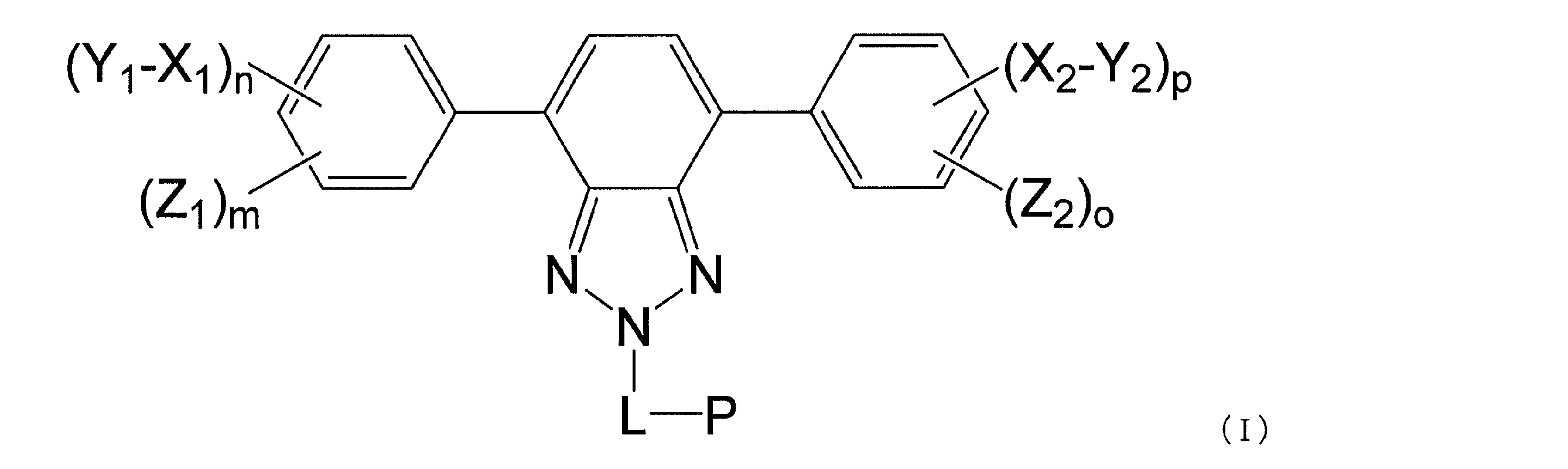
(式中、X1およびX2は、それぞれ独立して、-O-、-(C=O)O-、-O(C=O)-、-CH2O-、-CH2O(CO)-、-NH(CO)-、-NR-CH2-または単結合を表し、Rは、炭素数1~8のアルキル基を表し、
Y1およびY2は、それぞれ独立して、場合により置換された、炭素数1~18のアルキル基(アルキル基中の隣接しない炭素原子が酸素原子に置換されていてもよい)を表し、
Pは、高分子構造部位を表し、
Lは、ベンゾトリアゾール環と高分子構造部位を共有結合により結合するリンカー構造部位を表し、
Z1およびZ2は、それぞれ独立して、場合により置換された炭素数1~18のアルキル基(アルキル基中の隣接しない炭素原子が酸素原子に置換されていてもよい)、場合により置換された炭素数1~18のアルコキシ基(アルコキシ基中の隣接しない炭素原子が酸素原子に置換されていてもよい)、フルオロ基、シアノ基、-COOR1基、-NHCOR2基、または、水酸基を表し、R1およびR2は、炭素数1~18のアルキル基またはフェニル基を表し、
m、n、oおよびpは、それぞれ独立して、0~4の整数を表す(ただし、m+nは4以下、o+pは4以下である。)。m、n、oまたはpが2以上の場合、複数存在する各置換基は同一でも異なっていてもよい)
Y1およびY2は、それぞれ独立して、場合により置換された、炭素数1~18のアルキル基(アルキル基中の隣接しない炭素原子が酸素原子に置換されていてもよい)を表し、
Pは、高分子構造部位を表し、
Lは、ベンゾトリアゾール環と高分子構造部位を共有結合により結合するリンカー構造部位を表し、
Z1およびZ2は、それぞれ独立して、場合により置換された炭素数1~18のアルキル基(アルキル基中の隣接しない炭素原子が酸素原子に置換されていてもよい)、場合により置換された炭素数1~18のアルコキシ基(アルコキシ基中の隣接しない炭素原子が酸素原子に置換されていてもよい)、フルオロ基、シアノ基、-COOR1基、-NHCOR2基、または、水酸基を表し、R1およびR2は、炭素数1~18のアルキル基またはフェニル基を表し、
m、n、oおよびpは、それぞれ独立して、0~4の整数を表す(ただし、m+nは4以下、o+pは4以下である。)。m、n、oまたはpが2以上の場合、複数存在する各置換基は同一でも異なっていてもよい)
本発明の高分子蛍光色素化合物は、上記一般式(I)で表される構造を有するため、加工性が高く、望ましい光学特性(高い量子収率等)および良好な光安定性(化学的・物理的安定性)に優れたものとなりうる。特に、マトリックス樹脂中に分散した上記高分子色素化合物が長時間保存試験においても析出することなく、安定で均一な封止材組成物(および層)を簡易に得ることができる。上記作用効果の発現について、現時点では下記記載のメカニズムが主に寄与していると推測しているが、下記メカニズムを経由することが必須であると特定するものではない。上記高分子蛍光色素化合物(ベンゾトリアゾール構造含有ポリマー)は、蛍光色素として作用する特定のベンゾトリアゾール部位がポリマー構造部位と化学的に連結されることによって、マトリックス樹脂内での移動が抑制され、その結果、結晶化等による析出物の発生や層外への排出を抑制することができているものと推測される。
また、蛍光発光化学構造部位がその他の芳香族部位と連結した場合には、吸収・発光特性が変化してしまうとともに、連結により形成される当該芳香族部位の光安定性の低下も起こる可能性があり、太陽電池向け等の屋外用途では特に吸収・発光特性等の悪化が懸念される。これに対して、本発明の高分子蛍光色素化合物は、特定のベンゾトリアゾール構造をもつ発色団が、ベンゾトリアゾール環の2位の窒素原子と非共役結合によりベースポリマー構造とを連結することにより、当該発色団の吸収・発光特性がほぼ維持され、高分子体への導入による吸収・発光特性の予測や調整も容易となる。また、本発明の高分子蛍光色素化合物は、たとえば、上記ベンゾトリアゾール構造の結合部位は、高分子化合物の主機能を発現するモノマー部位にみならず、その他のモノマー部位と結合すること等によって、ガラス転移温度(Tg)や溶解性等の副次的な特性を制御することができる。このことは、加熱混練処理などの加工工程において均一に系内に分散・溶解がより容易とすることに有利である。また、一般に複素環構造の色素化合物はその平面性や結晶性のため溶解性に劣る場合があるが、本発明の高分子蛍光色素化合物は、高分子量体であるがゆえに加工性に優れる。また、低分子量の新規化合物を市場に出す場合には通常化審法に基づく各試験や登録等が必要となるところ、本発明の高分子蛍光色素化合物は生体への取り込みが限定的として扱われる高分子量体であるため、手続き的、時間的により少ない負担で実施が可能となる。
また、本発明の高分子蛍光色素化合物において、上記Lは、上記ベンゾトリアゾール環および上記高分子構造部位のいずれとも共役結合を形成しないことが好ましい。上記構造を有することにより、リンカー構造部位によって共役系や電子の非局在化が変化して当該発色団の吸収・発光特性が影響を受けてしまうことを抑制しうる。その結果、高分子構造部位に組み込む前または重合前の当該発色団の吸収・発光特性がほぼ維持され、高分子体への導入による吸収・発光特性の予測や調整もより容易となる。
また、本発明の高分子蛍光色素化合物において、下記一般式(II)によって表されることが好ましい。

(式中、X1、X2およびX3は、それぞれ独立して、-O-、-(C=O)O-、-O(C=O)-、-CH2O-、-CH2O(CO)-、-NH(CO)-、-NR-CH2-または単結合を表し、Rは、炭素数1~8のアルキル基を表し、
Y1、Y2およびY3は、それぞれ独立して、場合により置換された、炭素数1~18のアルキル基(アルキル基中の隣接しない炭素原子が酸素原子に置換されていてもよい)を表し、
Pは、高分子構造部位を表し、
Z1およびZ2は、それぞれ独立して、場合により置換された炭素数1~18のアルキル基(アルキル基中の隣接しない炭素原子が酸素原子に置換されていてもよい)、場合により置換された炭素数1~18のアルコキシ基(アルコキシ基中の隣接しない炭素原子が酸素原子に置換されていてもよい)、フルオロ基、シアノ基、-COOR1基、-NHCOR2基、または、水酸基を表し、R1およびR2は、炭素数1~18のアルキル基またはフェニル基を表し、
m、n、oおよびpは、それぞれ独立して、0~4の整数を表す(ただし、m+nは4以下、o+pは4以下である。)。m、n、oまたはpが2以上の場合、複数存在する各置換基は同一でも異なっていてもよい)
Y1、Y2およびY3は、それぞれ独立して、場合により置換された、炭素数1~18のアルキル基(アルキル基中の隣接しない炭素原子が酸素原子に置換されていてもよい)を表し、
Pは、高分子構造部位を表し、
Z1およびZ2は、それぞれ独立して、場合により置換された炭素数1~18のアルキル基(アルキル基中の隣接しない炭素原子が酸素原子に置換されていてもよい)、場合により置換された炭素数1~18のアルコキシ基(アルコキシ基中の隣接しない炭素原子が酸素原子に置換されていてもよい)、フルオロ基、シアノ基、-COOR1基、-NHCOR2基、または、水酸基を表し、R1およびR2は、炭素数1~18のアルキル基またはフェニル基を表し、
m、n、oおよびpは、それぞれ独立して、0~4の整数を表す(ただし、m+nは4以下、o+pは4以下である。)。m、n、oまたはpが2以上の場合、複数存在する各置換基は同一でも異なっていてもよい)
また、本発明の高分子蛍光色素化合物において、上記Pが、ポリエチレンテレフタレート、ポリ(メタ)アクリレート、ポリビニルアセテート、ポリエチレンテトラフルオロエチレン、ポリイミド、非晶質ポリカーボネート、シロキサンゾル-ゲル、ポリウレタン、ポリスチレン、ポリエーテルサルフォン、ポリアリレート、エポキシ樹脂、ポリエチレン、ポリプロピレン、ポリ(エチレン-酢酸ビニル)またはシリコーン樹脂であることが好ましい。また、波長変換型封止材用途において、上記樹脂として光学的に透明な樹脂を用いることが好ましい。特に波長変換型封止材のマトリックス樹脂と同一種または親和性の高い樹脂を用いることで、封止材層中での均一分散や析出物発生の抑制にもより優れたものとなる。
また、本発明の高分子蛍光色素化合物において、300~410nmに最大吸収波長を有することが好ましい。上記波長領域に最大吸収波長を有することにより、太陽電池セルが光電変換に利用しにくい(または利用できない)波長領域の入射光を、より効果的に、太陽電池セル等が光電変換しうる波長領域に変換することができる。なお、本発明において、最大吸収波長とは、当該化合物が吸収する光の吸光度が最大値の波長をいい、紫外線吸収スペクトルにおいて最大の吸収ピークを示す波長として測定されうる。
また、本発明の高分子蛍光色素化合物において、410~560nmに最大蛍光発光波長を有することが好ましい。上記波長領域に最大蛍光発光波長を有することにより、太陽電池セルが光電変換に利用しにくい(または利用できない)波長領域の入射光を、より効果的に、太陽電池セルが光電変換しうる波長領域に変換することができる。なお、本発明において、最大蛍光発光波長とは、当該化合物が発光する光のうち発光強度が最大値の波長をいい、蛍光発光スペクトルにおいて最大の発光ピークを示す波長として測定されうる。
一方、本発明の波長変換型封止材組成物は、上記高分子蛍光色素化合物を含むことを特徴とする。また、上記波長変換型封止材組成物は、光学的に透明な樹脂マトリックス、および、上記高分子蛍光色素化合物を含むものであってもよい。上記高分子蛍光色素化合物を含むことにより、太陽電池セルの吸収波長領域よりもより短波長領域の光を、効果的に太陽電池セルが光発電に利用できる波長領域にレッドシフトさせ、その結果、太陽エネルギーのより広い範囲のスペクトルが電気に変換されることが可能となる。また、上記高分子蛍光色素化合物は大きい蛍光量子効率と良好な加工性を有しているため、優れた光変換効果を提供する波長変換型封止材組成物を製造工程上およびコスト的に有利に得ることができる。また、本発明の波長変換型封止材組成物は、第1の波長を有する少なくとも1つの光子を入力として受け入れて、第1の波長よりも長い(大きい)第2の波長を有する少なくとも1つの光子を出力として与え、この過程で波長変換型封止材組成物としての機能を発現する。さらには、上記波長変換型封止材組成物においては、マトリックス樹脂中に分散した上記高分子蛍光色素化合物が長時間保存試験においても析出することなく、安定で均一な封止材組成物(および層)を簡易に得ることができる。上記波長変換型封止材組成物は、太陽電池用途に特に好適である。
また、本発明の波長変換型封止材組成物において、上記高分子蛍光色素化合物が0.05~100重量%で含まれていることが好ましい。
また、本発明の波長変換型封止材組成物において、光学的に透明な樹脂マトリックス、および、請求項1~6のいずれかに記載の前記高分子蛍光色素化合物を含むものとすることができる。
また、本発明の波長変換型封止材組成物において、上記マトリックス樹脂が、ポリ(エチレン-酢酸ビニル)を主成分とすることが好ましい。上記マトリックス樹脂としてポリ(エチレン-酢酸ビニル)を主成分とすることにより、より確実に、光透過性や耐久性に優れた波長変換型封止材層とすることができる。
なお、上記主成分とするとは、上記マトリックス樹脂を複数の樹脂の混合物とした場合、重量比で50重量%以上含む場合をいうものとする。上記重量比は、70重量%以上であることがより好ましく、90重量%以上であることがさらに好ましい。
他方、本発明の波長変換型封止材層は、上記波長変換型封止材組成物を用いて形成されたことを特徴とする。上記組成物を用いて形成されることにより、望ましい光学特性(高い量子収率等)および良好な光安定性(化学的・物理的安定性)を有するとともに、析出物発生を抑制した波長変換型封止材層となる。より詳細には、上記高分子蛍光色素化合物は大きい蛍光量子効率と良好な加工性を有しているため、優れた光変換効果を提供する波長変換型封止材層を製造工程上およびコスト的に有利に得ることができる。また、本発明の波長変換型封止材層は、第1の波長を有する少なくとも1つの光子を入力として受け入れて、第1の波長よりも長い(大きい)第2の波長を有する少なくとも1つの光子を出力として与え、この過程で波長変換型封止材層としての機能を発現する。さらには、上記波長変換型封止材層においては、マトリックス樹脂中に分散した上記高分子蛍光色素化合物が長時間保存試験においても析出することなく、安定で均一な封止材組成層を簡易に得ることができる。上記波長変換型封止材層は、太陽電池用途に特に好適である。
また、本発明の太陽電池モジュールは、上記波長変換型封止材組成物を用いて形成された波長変換型封止材層を含むことを特徴とする。上記太陽電池モジュールは、上記波長変換型封止材層を有するため、望ましい光学特性(高い量子収率等)および良好な光安定性(化学的・物理的安定性)を有する太陽電池モジュールとなる。さらには、上記波長変換型封止材層を有することで、長時間保存試験においても上記高分子蛍光色素化合物が析出することなく、上記高分子蛍光色素化合物が裏面用封止材層等に移動することも抑制でき、安定で均一な太陽電池モジュールとなる。
また、本発明の太陽電池モジュールは、入射光が、太陽電池セルへの到達に先だって、上記波長変換型封止材層を通過するように配置されることが好ましい。上記構成とすることで、より確実に、太陽エネルギーのより広い範囲のスペクトルが電気に変換されることが可能となり、光電変換効率を効果的に高めることができる。
また、本発明の太陽電池モジュールにおいて、上記太陽電池セルが、結晶シリコン太陽電池であることが好ましい。上記太陽電池モジュールは、上記太陽電池セルを積層する太陽電池モジュールに用いることでより効果的に光電変換効率をより向上させることができる。特に、シリコン太陽電池においては、紫外線領域である最大吸収波長400nm以下領域において光電変換効率が低いという問題があった。上記太陽電池モジュールでは、この波長領域に吸収をもち、さらに410~560nmに蛍光発光しうる上記高分子蛍光色素化合物を適切に用いることにより、より効果的に光利用することが可能となる。一方、上記高分子蛍光色素化合物の吸収波長領域が上記波長領域よりもより長波長領域に及ぶと、もともと太陽電池セル等の光電変換素子が吸収できる波長と上記高分子蛍光色素化合物の吸収波長が重複してしまい、光電変換効率が上昇できない場合もあり得る。上記太陽電池モジュールでは、上記高分子蛍光色素化合物を用いることにより、上記問題点が生じないように、高分子蛍光色素化合物等の吸収波長の精密な制御が可能である。
以下、本発明の実施の形態について説明する。
(蛍光色素化合物)
本発明の蛍光色素化合物は、下記一般式(III)によって表されることを特徴とする。
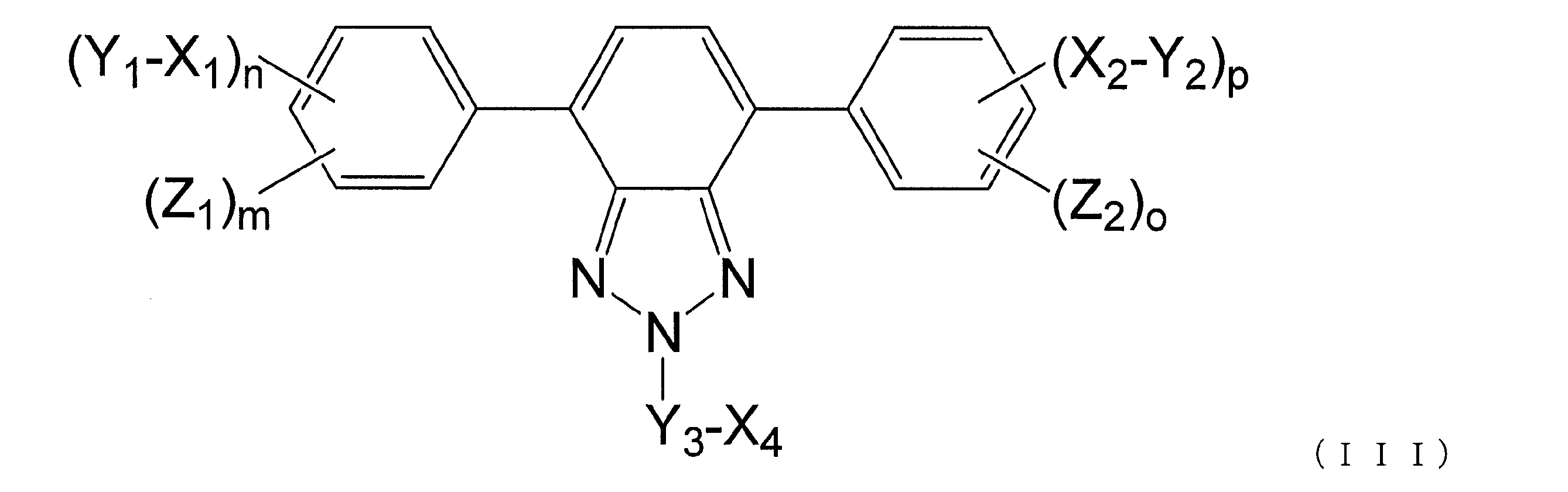
(式中、X1およびX2は、それぞれ独立して、-O-、-(C=O)O-、-O(C=O)-、-CH2O-、-CH2O(CO)-、-NH(CO)-、-NR-CH2-または単結合を表し、Rは、炭素数1~8のアルキル基を表し、
Y1、Y2およびY3は、それぞれ独立して、場合により置換された、炭素数1~18のアルキル基(アルキル基中の隣接しない炭素原子が酸素原子に置換されていてもよい)を表し、
X4は、炭素-炭素二重結合含有基、炭素-炭素三重結合含有基、水酸基、エステル基、イソシアネート基、エポキシ基、または、フッ素、塩素、臭素、ヨウ素、メタンスルホニル基、p-トルエンスルホニル基、ニトロベンゼンスルホニル基、もしくは、トリフルオロメタンスルホニル基を表し、
Z1およびZ2は、それぞれ独立して、場合により置換された炭素数1~18のアルキル基(アルキル基中の隣接しない炭素原子が酸素原子に置換されていてもよい)、場合により置換された炭素数1~18のアルコキシ基(アルコキシ基中の隣接しない炭素原子が酸素原子に置換されていてもよい)、フルオロ基、シアノ基、-COOR1基、-NHCOR2基、または、水酸基を表し、R1およびR2は、炭素数1~18のアルキル基またはフェニル基を表し、
m、n、oおよびpは、それぞれ独立して、0~4の整数を表す(ただし、m+nは4以下、o+pは4以下である。)。m、n、oまたはpが2以上の場合、複数存在する各置換基は同一でも異なっていてもよい)
本発明の蛍光色素化合物は、下記一般式(III)によって表されることを特徴とする。
Y1、Y2およびY3は、それぞれ独立して、場合により置換された、炭素数1~18のアルキル基(アルキル基中の隣接しない炭素原子が酸素原子に置換されていてもよい)を表し、
X4は、炭素-炭素二重結合含有基、炭素-炭素三重結合含有基、水酸基、エステル基、イソシアネート基、エポキシ基、または、フッ素、塩素、臭素、ヨウ素、メタンスルホニル基、p-トルエンスルホニル基、ニトロベンゼンスルホニル基、もしくは、トリフルオロメタンスルホニル基を表し、
Z1およびZ2は、それぞれ独立して、場合により置換された炭素数1~18のアルキル基(アルキル基中の隣接しない炭素原子が酸素原子に置換されていてもよい)、場合により置換された炭素数1~18のアルコキシ基(アルコキシ基中の隣接しない炭素原子が酸素原子に置換されていてもよい)、フルオロ基、シアノ基、-COOR1基、-NHCOR2基、または、水酸基を表し、R1およびR2は、炭素数1~18のアルキル基またはフェニル基を表し、
m、n、oおよびpは、それぞれ独立して、0~4の整数を表す(ただし、m+nは4以下、o+pは4以下である。)。m、n、oまたはpが2以上の場合、複数存在する各置換基は同一でも異なっていてもよい)
蛍光(またはホトルミネセンス性)色素の有用な性質の1つが、これらの色素は、特定波長の光の光子を吸収し、かつ、当該光子を異なる波長で再放出することができることである。この現象はまた、これらの色素を光起電産業において有用にする。
一般式(III)によって表される発色団は、波長変換フィルムを含めて、様々な適用において蛍光色素(蛍光色素化合物)として有用である。特に、上記ベンゾトリアゾール誘導体は、上記一般式(III)で表される構造を有するため、上記高分子蛍光色素化合物の単量体として好適に用いることが可能である。上記式において示されるように、上記色素はベンゾ複素環系、より具体的にはベンゾトリアゾール構造を有する新規な化合物(ベンゾトリアゾール誘導体)である。本発明の範囲を限定することはないが、使用することができる化合物のタイプに関するさらなる詳細および実例が下記に記載される。なお、本発明の作用効果を阻害しない限り、本発明の蛍光色素化合物には、上記ベンゾトリアゾール環上が置換されているものも含む。
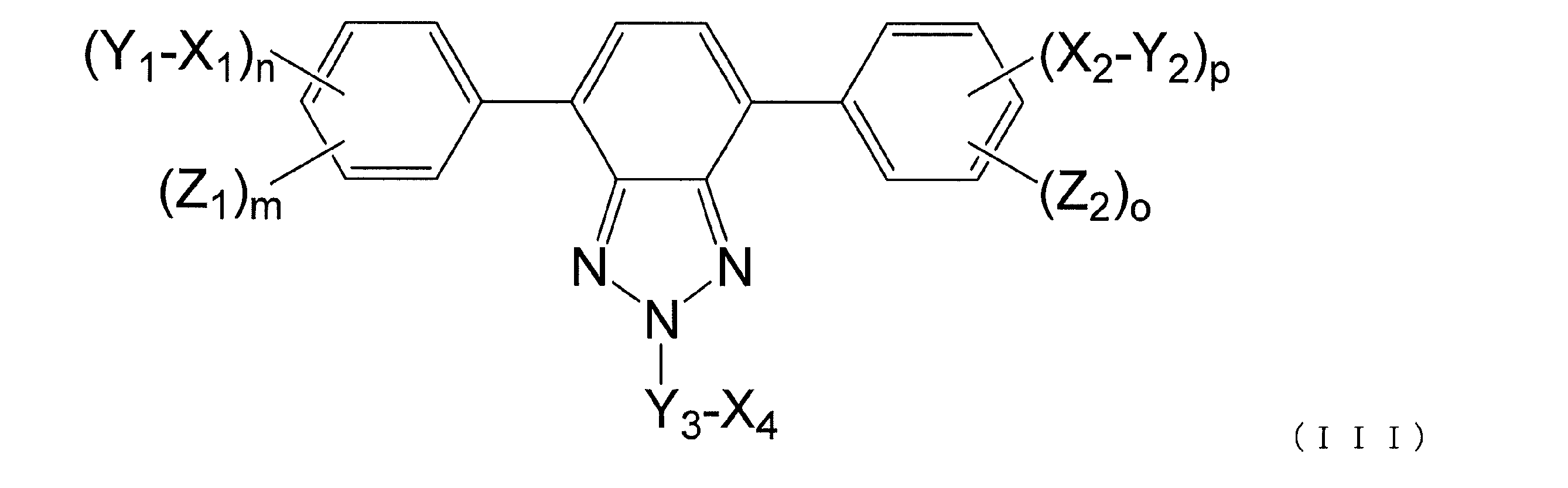
(式中、X1およびX2は、それぞれ独立して、-O-、-(C=O)O-、-O(C=O)-、-CH2O-、-CH2O(CO)-、-NH(CO)-、-NR-CH2-または単結合を表し、Rは、炭素数1~8のアルキル基を表し、
Y1、Y2およびY3は、それぞれ独立して、場合により置換された、炭素数1~18のアルキル基(アルキル基中の隣接しない炭素原子が酸素原子に置換されていてもよい)を表し、
X4は、炭素-炭素二重結合含有基、炭素-炭素三重結合含有基、水酸基、エステル基、イソシアネート基、エポキシ基、または、フッ素、塩素、臭素、ヨウ素、メタンスルホニル基、p-トルエンスルホニル基、ニトロベンゼンスルホニル基、もしくは、トリフルオロメタンスルホニル基を表し、
Z1およびZ2は、それぞれ独立して、場合により置換された炭素数1~18のアルキル基(アルキル基中の隣接しない炭素原子が酸素原子に置換されていてもよい)、場合により置換された炭素数1~18のアルコキシ基(アルコキシ基中の隣接しない炭素原子が酸素原子に置換されていてもよい)、フルオロ基、シアノ基、-COOR1基、-NHCOR2基、または、水酸基を表し、R1およびR2は、炭素数1~18のアルキル基またはフェニル基を表し、
m、n、oおよびpは、それぞれ独立して、0~4の整数を表す(ただし、m+nは4以下、o+pは4以下である。)。m、n、oまたはpが2以上の場合、複数存在する各置換基は同一でも異なっていてもよい)
Y1、Y2およびY3は、それぞれ独立して、場合により置換された、炭素数1~18のアルキル基(アルキル基中の隣接しない炭素原子が酸素原子に置換されていてもよい)を表し、
X4は、炭素-炭素二重結合含有基、炭素-炭素三重結合含有基、水酸基、エステル基、イソシアネート基、エポキシ基、または、フッ素、塩素、臭素、ヨウ素、メタンスルホニル基、p-トルエンスルホニル基、ニトロベンゼンスルホニル基、もしくは、トリフルオロメタンスルホニル基を表し、
Z1およびZ2は、それぞれ独立して、場合により置換された炭素数1~18のアルキル基(アルキル基中の隣接しない炭素原子が酸素原子に置換されていてもよい)、場合により置換された炭素数1~18のアルコキシ基(アルコキシ基中の隣接しない炭素原子が酸素原子に置換されていてもよい)、フルオロ基、シアノ基、-COOR1基、-NHCOR2基、または、水酸基を表し、R1およびR2は、炭素数1~18のアルキル基またはフェニル基を表し、
m、n、oおよびpは、それぞれ独立して、0~4の整数を表す(ただし、m+nは4以下、o+pは4以下である。)。m、n、oまたはpが2以上の場合、複数存在する各置換基は同一でも異なっていてもよい)
上記ベンゾトリアゾール誘導体は、上記一般式(III)で表される構造を有するため、上記高分子蛍光色素化合物の単量体として好適に用いることが可能である。上記蛍光色素化合物はX4基によるマトリックス樹脂との化学的結合(ラジカル的架橋、求核置換反応、付加反応、ラジカル重合等)の形成が可能であるため、たとえば、上記蛍光色素化合物を、高分子構造部位の主鎖骨格にいわゆるペンダント型になるように導入したり、高分子構造部位の主鎖骨格末端などにエンドキャッピングのように導入することが容易である。また、本発明の蛍光色素化合物を用いることにより、共重合や付加反応等により既存の樹脂系を容易に上記用途に適した高分子蛍光色素化合物に改質することや分子設計することが可能となる。
また、上記ベンゾトリアゾール誘導体において、300~410nmに最大吸収波長を有することが好ましい。上記波長領域に最大吸収波長を有することにより、太陽電池セルが光電変換に利用しにくい(または利用できない)波長領域の入射光を、より効果的に、太陽電池セル等が光電変換しうる波長領域に変換することができる。
また、上記ベンゾトリアゾール誘導体において、410~560nmに最大蛍光発光波長を有することが好ましい。上記波長領域に最大蛍光発光波長を有することにより、太陽電池セルが光電変換に利用しにくい(または利用できない)波長領域の入射光を、より効果的に、太陽電池セルが光電変換しうる波長領域に変換することができる。
上記ベンゾトリアゾール誘導体において、上記X1およびX2は、それぞれ独立して、-O-、-(C=O)O-、-O(C=O)-、-CH2O-、-CH2O(CO)-、-NH(CO)-、-NR-CH2-または単結合を表す。なお、Rは、炭素数1~8のアルキル基を表す。なかでも、上記X1またはX2の少なくとも1つが、-(C=O)O-、または、-O(CO)-であることが好ましい。なお、上記X1またはX2が単結合の場合とは、各Y基がベンゼン環に直接結合していることを意味する。
上記ベンゾトリアゾール誘導体において、上記Y1、Y2およびY3は、それぞれ独立して、場合により置換された、炭素数1~18のアルキル基(アルキル基中の隣接しない炭素原子が酸素原子に置換されていてもよい)を表す。上記アルキル基の炭素数は、1~18であることが好ましく、2~8であることがより好ましい。上記炭素数1~18のアルキル基は直鎖であってもよく、分岐であってもよい。
上記Y1、Y2およびY3として、たとえば、エチル、プロピル、イソプロピル、ブチル、イソブチル、sec-ブチル、t-ブチル、ペンチル、ヘキシル、ヘプチル、2-エチルヘキシル、およびオクチルなどが含まれるが、これらに限定されない。
上記ベンゾトリアゾール誘導体において、上記X4は、炭素-炭素二重結合含有基、炭素-炭素三重結合含有基などの不飽和結合により共有結合形成が可能な基、水酸基、エステル基、イソシアネート基、およびエポキシ基等のように縮合反応、付加反応等により共有結合形成が可能な基、または、フッ素、塩素、臭素、ヨウ素、メタンスルホニル基、p-トルエンスルホニル基、ニトロベンゼンスルホニル基、もしくは、トリフルオロメタンスルホニル基等の良好な脱離基等として置換反応に有利となる基を表す。上記X4基として、縮合反応や置換反応、付加反応、重合などにより共有結合の形成が可能な上記官能基とすることにより、上記マトリックス樹脂との化学的結合(ラジカル的架橋、求核置換反応、付加反応、重合等)の形成が可能となる。
上記ベンゾトリアゾール誘導体において、上記X4が、-CR’=CH2、-(C=O)O-CR’=CH2、-O(C=O)-CR’=CH2、-CH2O(CO)-CR’=CH2、-NH(CO)-CR’=CH2、または、-NR-CH2-CR’=CH2である(ただし、RおよびR’は、それぞれ独立して、炭素数1~8のアルキル基を表す)ことが好ましい。上記構造を有することにより、X4基によるマトリックス樹脂との化学的結合、とくにラジカル的架橋やラジカル重合反応などによる結合形成が容易になる。
上記X4として、たとえば、エテニル、プロペニル、イソプロペニル、ブテニル、イソブテニル、ペンテニル、ヘキセニル、ヘプテニル、2-エチルヘキセニル、オクテニル、および、3-アリルオキシ-2-ヒドロキシプロピル、および3-アリルオキシ-2-アセトキシプロピルなどが含まれるが、これらに限定されない。
上記ベンゾトリアゾール誘導体において、Z1およびZ2は、場合により置換された炭素数1~18のアルキル基(アルキル基中の隣接しない炭素原子が酸素原子に置換されていてもよい)、場合により置換された炭素数1~18のアルコキシ基(アルコキシ基中の隣接しない炭素原子が酸素原子に置換されていてもよい)、フルオロ基、シアノ基、-COOR1基、-NHCOR2基、または、水酸基を表し、R1およびR2は、炭素数1~18のアルキル基またはフェニル基を表し、m、n、o、および、pは、それぞれ独立して、0~4の整数を表す(ただし、m+nは4以下、o+pは4以下である。)。上記炭素数1~18のアルキル基は直鎖であってもよく、分岐であってもよい。上記炭素数1~18のアルコシキ基は直鎖であってもよく、分岐であってもよい。m、n、o、および、pは、それぞれ独立して、0~4の整数を表す。上記アルキル基の炭素数は、1~18であることが好ましく、1~12であることがより好ましく、1~8であることがさらに好ましい。上記アルコキシ基の炭素数は、1~18であることが好ましく、1~12であることがより好ましく、1~8であることがさらに好ましい。また、m、n、oまたはpが2以上の場合、複数存在する各置換基は同一でも異なっていてもよい
上記Z1およびZ2のアルキル基として、たとえば、メチル、エチル、プロピル、イソプロピル、ブチル、イソブチル、セカンダリーブチル、第三級ブチル、ペンチル、ヘキシル、ヘプチル、2-エチルヘキシル、およびオクチルなどが含まれるが、これらに限定されない。また、アルキル基中の隣接しない炭素原子が酸素原子に置換されていてもよい。
上記Z1およびZ2のアルコキシ基として、親分子に-O-連結を介して共有結合で結合する直鎖または分岐鎖のアルキル基あげることができる。上記Z1およびZ2のアルコキシ基として、たとえば、メトキシ、エトキシ、プロポキシ、イソプロポキシ、ブトキシ、n-ブトキシ、sec-ブトキシ、t-ブトキシ、ペンチルオキシ、ヘキシルオキシ、ヘプチルオキシ、2-エチルヘキシルオキシ、オクチルオキシ、1-プロペニルオキシ、2-プロペニルオキシ、ブテニルオキシ、ペンテニルオキシ、ヘキセニルオキシ、ヘプテニルオキシ、オクテニルオキシ、および、3-アリルオキシ-2-ヒドロキシプロピルオキシ、3-アリルオキシ-2-アセトキシプロピルオキシなどが含まれるが、これらに限定されない。また、アルコキシ基中の隣接しない炭素原子が酸素原子に置換されていてもよい。
上記Z1およびZ2のフルオロ基として、アルキル基の一部または全部の水素原子がフッ素原子に置換されているものをあげることができる。上記Z1およびZ2のフルオロ基として、たとえば、トリフルオロメチル基、ペンタフルオロエチル基などが含まれるが、これらに限定されない。
上記Z1およびZ2の-COOR1基として、アルキルエステル構造のものをあげることができる。上記Z1およびZ2の-COOR1基として、たとえば、メチルエステル基、エチルエステル基、1-プロピルエステル基、2-プロピルエステル基、フェニルエステル基などが含まれるが、これらに限定されない。
上記Z1およびZ2の-NHCOR2基として、アシルアミド構造のものをあげることができる。上記Z1およびZ2の-NHCOR2基として、たとえば、アセチルアミド基、プロピオン酸アミドなどが含まれるが、これらに限定されない。
上記m、n、o、および、pは、それぞれ独立して、0~4の整数を表す。具体的には、上記m、n、o、および、pは、0、1、2、3、4の値をとり得る。ただし、m+nは4以下、o+pは4以下である。
本明細書中で使用される場合、置換された基は、1つまたは複数の水素原子が別の原子または基に交換されていることを有する置換されていない親構造に由来する。置換されるとき、当該置換基(1つまたは複数)は、たとえば、C1~C6アルキル、C1~C6アルケニル、C1~C6アルキニル、C3~C7シクロアルキル(これは、ハロ、アルキル、アルコキシ、カルボキシル、ハロアルキル、CN、-SO2-アルキル、-CF3および-OCF3により場合により置換される)、ジェミナル結合するシクロアルキル(cycloalkyl geminally attached)、C1~C6ヘテロアルキル、C3~C10ヘテロシクロアルキル(たとえば、テトラヒドロフリル)(これは、ハロ、アルキル、アルコキシ、カルボキシル、CN、-SO2-アルキル、-CF3および-OCF3により場合により置換される)、アリール(これは、ハロ、アルキル、C1~C6アルキルにより場合により置換されるアリール、アリールアルキル、アルコキシ、アリールオキシ、カルボキシル、アミノ、イミド、アミド(カルバモイル)、場合により置換された環状イミド、環状アミド、CN、-NH-C(=O)-アルキル、-CF3および-OCF3により場合により置換される)、アリールアルキル(これは、ハロ、アルキル、アルコキシ、アリール、カルボキシル、CN、-SO2-アルキル、-CF3および-OCF3により場合により置換される)、ヘテロアリール(これは、ハロ、アルキル、アルコキシ、アリール、ヘテロアリール、アラルキル、カルボキシル、CN、-SO2-アルキル、-CF3および-OCF3により場合により置換される)、ハロ(たとえば、クロロ、ブロモ、ヨードおよびフルオロ)、シアノ、ヒドロキシ、場合により置換された環状イミド、アミノ、イミド、アミド、-CF3、C1~C6アルコキシ、アリールオキシ、アシルオキシ、スルフヒドリル(メルカプト)、ハロ(C1~C6)アルキル、C1~C6アルキルチオ、アリールチオ、モノ(C1~C6)アルキルアミノおよびジ(C1~C6)アルキルアミノ、第四級アンモニウム塩、アミノ(C1~C6)アルコキシ、ヒドロキシ(C1~C6)アルキルアミノ、アミノ(C1~C6)アルキルチオ、シアノアミノ、ニトロ、カルバモイル、ケト(オキシ)、カルボニル、カルボキシ、グリコリル、グリシル、ヒドラジノ、グアニル、スルファミル、スルホニル、スルフィニル、チオカルボニル、チオカルボキシ、スルホンアミド、エステル、C-アミド、N-アミド、N-カルバマート、O-カルバマート、ウレア、ならびに、それらの組合せから個々に、かつ、独立して選択される1つまたは複数の基である。置換基が、「場合により置換された」として記載される場合は常に、その置換基は上記置換基により置換され得る。
上記蛍光色素化合物の吸光度として、たとえば、0.5~6であることが好ましく、1~4であることがより好ましく、1~3であることがさらに好ましい。
また、上記蛍光色素化合物において、上記蛍光色素化合物の融点が通常50℃~200℃であることが好ましいが、本願発明では架橋することでブリードアウトを低減させる効果を有することから、20℃~200℃であってもよく、0℃~200℃であってもよく、-20℃~200℃であってもよい場合もあり得る。上記範囲に融点を有するベンゾトリアゾール誘導体を用いることにより、加熱混練処理などの加工工程において均一に系内に分散・溶解しうるものとなる。特に、シート化した際の均一性が容易に得られやすくなり、生産・加工性に特に優れたものとなる。
本発明における蛍光色素(化合物、高分子化合物)は、単に、特定の波長領域において光を吸収しそれより長波長に波長変換して発光すればよい、というだけにとどまるものではない。本願の蛍光色素において、可能であれば、最大吸収波長よりもより長波長において、吸収を持たない(またはより少ない)ことが好ましい。たとえば、その指標として、最大吸収波長よりも60nm長波長の波長における吸光度が、最大吸収波長における吸光度と比較して小さいことが望ましい。
上記蛍光色素化合物の合成方法は、適宜公知の方法を用いることができる。上記合成方法として、たとえば、4,7-ジブロモベンゾトリアゾールなどの脱離基を置換した2置換ベンゾトリアゾール(ハロゲン化ベンゾトリアゾールなど)とX-Y側鎖(Y1-X1、Y2-X2)含有フェニルボロン酸をカップリング反応させる手法、上記2置換ベンゾトリアゾールに、X-Y側鎖含有フェニル基前駆体にあたる化合物を求核置換反応などで結合形成させる方法、上記2置換ベンゾトリアゾールにヒドロキシフェニルボロン酸を結合させた後に、上記水酸基をアルコキシ基やエステル基等に変換してX-Y基を導入する方法、金属触媒を利用してカップリングさせる方法、側鎖のアルコキシ基の一部を炭素-炭素二重結合に変換する手法、および上記X-Y側鎖の導入前、後もしくは同時にY3-X4基を導入する方法などをあげることができる。
なかでも、たとえば、ベンゾトリアゾール骨格に隣接するベンゼン環上にフェノール性水酸基を有するヒドロキシフェニルベンゾトリアゾール誘導体に対して、オレイン酸等の不飽和脂肪酸をエステル化により縮合する方法(適宜縮合剤を用いてもよい)、ベンゾトリアゾール骨格に隣接するベンゼン環上にカルボキシル基を有するカルボキシフェニルベンゾトリアゾール誘導体に対して、不飽和脂肪族アルコールをエステル化により縮合する方法(適宜縮合剤を用いてもよい)、ベンゾトリアゾール骨格に隣接するベンゼン環上にフェノール性水酸基を有するヒドロキシフェニルベンゾトリアゾール誘導体に対して、不飽和結合を有する、およびハロゲン化物またはグリシジル化合物をアルキル化反応により連結する方法などが、簡便で好ましいものとしてあげられる。
また、上記蛍光色素化合物は上記反応部位(ポリマーマトリックスなどとの反応部位)を有するため、マトリックスポリマーへの固定化が可能である。特に、上記固定化は、上記波長変換封止材組成物や上記波長変換封止材層のキュア工程時の容易に、また同時に、上記蛍光色素の固定化が可能であり、工業プロセス的にも非常に優れている。また、マトリックスポリマーへの固定化は、一般には上記波長変換型封止材層の形成時もしくは形成後、または、モジュール実装時もしくは実装後に、他の加熱処理、光照射処理または固定化のための加熱処理、光照射処理等によって行うことができるが、上記上記波長変換型封止材組成物の段階で適宜一部または全部の固定化を行ってもよい。
(高分子蛍光色素化合物)
本発明の高分子蛍光色素化合物は、下記一般式(I)によって表されることを特徴とする。

(式中、X1およびX2は、それぞれ独立して、-O-、-(C=O)O-、-O(C=O)-、-CH2O-、-CH2O(CO)-、-NH(CO)-、-NR-CH2-または単結合を表し、Rは、炭素数1~8のアルキル基を表し、
Y1およびY2は、それぞれ独立して、場合により置換された、炭素数1~18のアルキル基(アルキル基中の隣接しない炭素原子が酸素原子に置換されていてもよい)を表し、
Pは、高分子構造部位を表し、
Lは、ベンゾトリアゾール環と高分子構造部位を共有結合により結合するリンカー構造部位を表し、
Z1およびZ2は、それぞれ独立して、場合により置換された炭素数1~18のアルキル基(アルキル基中の隣接しない炭素原子が酸素原子に置換されていてもよい)、場合により置換された炭素数1~18のアルコキシ基(アルコキシ基中の隣接しない炭素原子が酸素原子に置換されていてもよい)、フルオロ基、シアノ基、-COOR1基、-NHCOR2基、または、水酸基を表し、R1およびR2は、炭素数1~18のアルキル基またはフェニル基を表し、
m、n、oおよびpは、それぞれ独立して、0~4の整数を表す(ただし、m+nは4以下、o+pは4以下である。)。m、n、oまたはpが2以上の場合、複数存在する各置換基は同一でも異なっていてもよい)
本発明の高分子蛍光色素化合物は、下記一般式(I)によって表されることを特徴とする。
Y1およびY2は、それぞれ独立して、場合により置換された、炭素数1~18のアルキル基(アルキル基中の隣接しない炭素原子が酸素原子に置換されていてもよい)を表し、
Pは、高分子構造部位を表し、
Lは、ベンゾトリアゾール環と高分子構造部位を共有結合により結合するリンカー構造部位を表し、
Z1およびZ2は、それぞれ独立して、場合により置換された炭素数1~18のアルキル基(アルキル基中の隣接しない炭素原子が酸素原子に置換されていてもよい)、場合により置換された炭素数1~18のアルコキシ基(アルコキシ基中の隣接しない炭素原子が酸素原子に置換されていてもよい)、フルオロ基、シアノ基、-COOR1基、-NHCOR2基、または、水酸基を表し、R1およびR2は、炭素数1~18のアルキル基またはフェニル基を表し、
m、n、oおよびpは、それぞれ独立して、0~4の整数を表す(ただし、m+nは4以下、o+pは4以下である。)。m、n、oまたはpが2以上の場合、複数存在する各置換基は同一でも異なっていてもよい)
一般式(I)によって表される発色団は、波長変換フィルムを含めて、様々な適用において蛍光色素(高分子蛍光色素化合物)として有用である。上記式において示されるように、上記色素はベンゾ複素環系、より具体的にはベンゾトリアゾール構造を有する新規な高分子化合物(ベンゾトリアゾール構造含有ポリマー)である。なお、本発明の作用効果を阻害しない限り、本発明の高分子蛍光色素化合物には、上記ベンゾトリアゾール環上が置換されているものも含む。
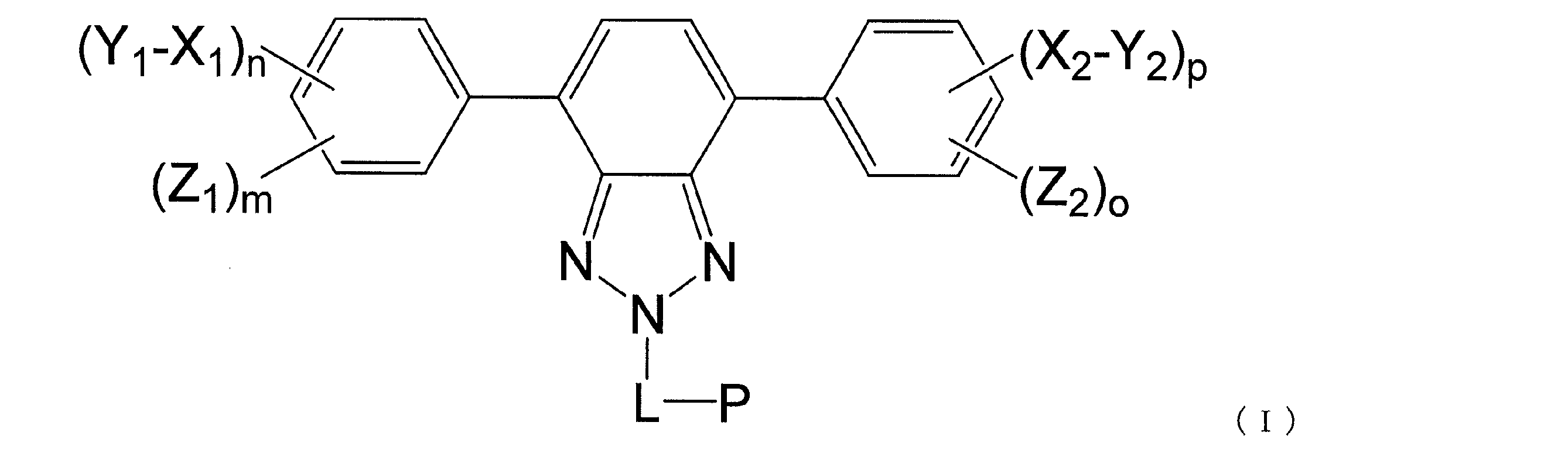
(式中、X1およびX2は、それぞれ独立して、-O-、-(C=O)O-、-O(C=O)-、-CH2O-、-CH2O(CO)-、-NH(CO)-、-NR-CH2-または単結合を表し、Rは、炭素数1~8のアルキル基を表し、
Y1およびY2は、それぞれ独立して、場合により置換された、炭素数1~18のアルキル基(アルキル基中の隣接しない炭素原子が酸素原子に置換されていてもよい)を表し、
Pは、高分子構造部位を表し、
Lは、ベンゾトリアゾール環と高分子構造部位を共有結合により結合するリンカー構造部位を表し、
Z1およびZ2は、それぞれ独立して、場合により置換された炭素数1~18のアルキル基(アルキル基中の隣接しない炭素原子が酸素原子に置換されていてもよい)、場合により置換された炭素数1~18のアルコキシ基(アルコキシ基中の隣接しない炭素原子が酸素原子に置換されていてもよい)、フルオロ基、シアノ基、-COOR1基、-NHCOR2基、または、水酸基を表し、R1およびR2は、炭素数1~18のアルキル基またはフェニル基を表し、
m、n、oおよびpは、それぞれ独立して、0~4の整数を表す(ただし、m+nは4以下、o+pは4以下である。)。m、n、oまたはpが2以上の場合、複数存在する各置換基は同一でも異なっていてもよい)
Y1およびY2は、それぞれ独立して、場合により置換された、炭素数1~18のアルキル基(アルキル基中の隣接しない炭素原子が酸素原子に置換されていてもよい)を表し、
Pは、高分子構造部位を表し、
Lは、ベンゾトリアゾール環と高分子構造部位を共有結合により結合するリンカー構造部位を表し、
Z1およびZ2は、それぞれ独立して、場合により置換された炭素数1~18のアルキル基(アルキル基中の隣接しない炭素原子が酸素原子に置換されていてもよい)、場合により置換された炭素数1~18のアルコキシ基(アルコキシ基中の隣接しない炭素原子が酸素原子に置換されていてもよい)、フルオロ基、シアノ基、-COOR1基、-NHCOR2基、または、水酸基を表し、R1およびR2は、炭素数1~18のアルキル基またはフェニル基を表し、
m、n、oおよびpは、それぞれ独立して、0~4の整数を表す(ただし、m+nは4以下、o+pは4以下である。)。m、n、oまたはpが2以上の場合、複数存在する各置換基は同一でも異なっていてもよい)
上記高分子蛍光色素化合物は、上記一般式(I)で表される構造を有するため、加工性が高く、望ましい光学特性(高い量子収率等)および良好な光安定性(化学的・物理的安定性)に優れた蛍光色素化合物となりうる。特に、上記高分子蛍光色素化合物は、蛍光色素として作用する特定のベンゾトリアゾール部位がポリマー構造部位と化学的に連結されることによって、マトリックス樹脂内での移動が抑制され、その結果、マトリックス樹脂中に分散した上記高分子蛍光色素化合物が長時間保存試験においても析出することなく、安定で均一な封止材組成物(および層)を簡易に得ることができる。
また、上記高分子蛍光色素化合物において、上記Lは、ベンゾトリアゾール環と高分子構造部位を共有結合により結合するリンカー構造部位を表す。上記Lは、上記ベンゾトリアゾール環および上記高分子構造部位のいずれとも共役結合を形成しないことが好ましい。ただし、上記Lは、上記ベンゾトリアゾール環および上記高分子構造部位のいずれとも共役結合を形成しない位置に共役結合(たとえば、炭素炭素二重結合等)を有していても構わない。
また、上記高分子蛍光色素化合物において、下記一般式(II)によって表されることが好ましい。

(式中、X1、X2およびX3は、それぞれ独立して、-O-、-(C=O)O-、-O(C=O)-、-CH2O-、-CH2O(CO)-、-NH(CO)-、-NR-CH2-または単結合を表し、Rは、炭素数1~8のアルキル基を表し、
Y1、Y2およびY3は、それぞれ独立して、場合により置換された、炭素数1~18のアルキル基(アルキル基中の隣接しない炭素原子が酸素原子に置換されていてもよい)を表し、
Pは、高分子構造部位を表し、
Z1およびZ2は、それぞれ独立して、場合により置換された炭素数1~18のアルキル基(アルキル基中の隣接しない炭素原子が酸素原子に置換されていてもよい)、場合により置換された炭素数1~18のアルコキシ基(アルコキシ基中の隣接しない炭素原子が酸素原子に置換されていてもよい)、フルオロ基、シアノ基、-COOR1基、-NHCOR2基、または、水酸基を表し、R1およびR2は、炭素数1~18のアルキル基またはフェニル基を表し、
m、n、oおよびpは、それぞれ独立して、0~4の整数を表す(ただし、m+nは4以下、o+pは4以下である。)。m、n、oまたはpが2以上の場合、複数存在する各置換基は同一でも異なっていてもよい)
Y1、Y2およびY3は、それぞれ独立して、場合により置換された、炭素数1~18のアルキル基(アルキル基中の隣接しない炭素原子が酸素原子に置換されていてもよい)を表し、
Pは、高分子構造部位を表し、
Z1およびZ2は、それぞれ独立して、場合により置換された炭素数1~18のアルキル基(アルキル基中の隣接しない炭素原子が酸素原子に置換されていてもよい)、場合により置換された炭素数1~18のアルコキシ基(アルコキシ基中の隣接しない炭素原子が酸素原子に置換されていてもよい)、フルオロ基、シアノ基、-COOR1基、-NHCOR2基、または、水酸基を表し、R1およびR2は、炭素数1~18のアルキル基またはフェニル基を表し、
m、n、oおよびpは、それぞれ独立して、0~4の整数を表す(ただし、m+nは4以下、o+pは4以下である。)。m、n、oまたはpが2以上の場合、複数存在する各置換基は同一でも異なっていてもよい)
上記高分子蛍光色素化合物において、ベンゾトリアゾール骨格に関する記載、および、X1、X2、Y1、Y2、Y3、Z1、Z2、m、n、oならびにp等の記号については、適宜、上述の蛍光色素化合物における一般式(III)と同様である。
また、上記高分子蛍光色素化合物において、上記X3は、それぞれ独立して、-O-、-(C=O)O-、-O(C=O)-、-CH2O-、-CH2O(CO)-、-NH(CO)-、-NR-CH2-または単結合を表す。なお、Rは、炭素数1~8のアルキル基を表す。なかでも、上記X3が、-(C=O)O-、または、-O(CO)-であることが好ましい。なお、上記X3が単結合の場合とは、Y3基が高分子構造部位Pに直接結合していることを意味する。
また、上記高分子蛍光色素化合物において、、上記Pが、ポリエチレンテレフタレート、ポリ(メタ)アクリレート、ポリビニルアセテート、ポリエチレンテトラフルオロエチレン、ポリイミド、非晶質ポリカーボネート、シロキサンゾル-ゲル、ポリウレタン、ポリスチレン、ポリエーテルサルフォン、ポリアリレート、エポキシ樹脂、ポリエチレン、ポリプロピレン、ポリ(エチレン-酢酸ビニル)またはシリコーン樹脂であることが好ましい。
上記高分子蛍光色素化合物の吸光度として、たとえば、0.5~6であることが好ましく、1~4であることがより好ましく、1~3であることがさらに好ましい。
また、上記高分子蛍光色素化合物において、上記高分子蛍光色素化合物の融点が通常50℃~200℃であることが好ましいが、本願発明では高分子量化することでブリードアウトを低減させる効果を有することから、20℃~200℃であってもよく、0℃~200℃であってもよく、-20℃~200℃であってもよい場合もあり得る。上記範囲に融点を有する高分子蛍光色素化合物を用いることにより、加熱混練処理などの加工工程において均一に系内に分散・溶解しうるものとなる。特に、シート化した際の均一性が容易に得られやすくなり、生産・加工性に特に優れたものとなる。
また、上記高分子蛍光色素化合物の合成方法として、特定のベンゾトリアゾール構造を有するモノマーを重合反応する方法、必要に応じて共重合モノマーとともに共重合反応する方法、すでに形成されているポリマーに対して適宜共有結合を形成して導入する方法(付加的導入方法)などをあげることができる。また、上記合成方法において、上記一般式(III)で表される本発明の上記蛍光色素化合物を用いることにより、容易に所望の高分子蛍光色素化合物を合成しうる。
上記重合反応、共重合反応を行う際には、公知の高分子合成の手法を適宜用いることができる。たとえば、本発明の上記一般式(III)の単量体をホモ重合するほか、上記一般式(III)の単量体およびその他の単量体をランダム共重合、グラフト重合、交差重合、またはブロック共重合する方法等をあげることができる。また、上記重合反応、共重合反応では、ラジカル重合(カチオン、アニオン、各リビング等)、イオン重合、付加重合(重付加)、縮合重合(重縮合)、環化重合、および開環重合等をあげることができる。また、上記重合反応、共重合反応では、有機溶媒系、水溶液系、乳化状態、懸濁状態などの合成手法を適宜用いることができる。
上記共重合反応において、上記一般式(III)の単量体などの、ベンゾトリアゾール構造を有するモノマーとともに重合するその他のモノマーとして、上記Pを形成するモノマー(単量体)を用いることが好ましい。その他のモノマーとして、たとえば、エチレンテレフタレート誘導体、(メタ)アクリレート誘導体、ビニルアセテート誘導体、エチレンテトラフルオロエチレン誘導体、スチレン誘導体、エーテルサルフォン誘導体、アリレート誘導体、エポキシ誘導体、エチレン誘導体、プロピレン誘導体、またはビニル誘導体であることが好ましい。なかでも、重合反応した際に、ビニル樹脂、特にアクリル樹脂、メタクリル樹脂になりうる(メタ)アクリル系モノマーや(メタ)アクリルオリゴマーであることが好ましい。これらは単独で使用してもよく、また2種以上を混合して使用してもよい。
上記その他のモノマーとして、たとえば、アクリル酸、メタクリル酸、アクリル酸メチル、メタクリル酸メチル、アクリル酸エチル、メタクリル酸エチル、アクリル酸ブチル、メタクリル酸ブチル、アクリル酸2-エチルヘキシル、メタクリル酸2-エチルヘキシル等の(メタ)アクリル酸アルキルエステル、アクリル酸シクロヘキシル、メタクリル酸シクロヘキシル、アクリル酸フェニル、メタクリル酸フェニル、アクリル酸ベンジル、メタクリル酸ベンジル、スチレン、α-メチルスチレン、ビニルトルエン、アクリルアミド、ジアセトンアクリルアミド、アクリロニトリル、メタクリロニトリル、無水マレイン酸、フェニルマレイミド、シクロヘキシルマレイミドなどをあげることができる。さらには、上記アルキル基が水酸基、エポキシ基、ハロゲン基などで置換された(メタ)アクリル酸アルキルエステルなどをあげることができる。また、上記(メタ)アクリル酸エステルにおいて、エステル部位のアルキル基の炭素数が1~18であることが好ましく、炭素数1~8であることがより好ましい。これらの化合物は単独で使用してもよく、また2種以上を混合して使用してもよい。
また、共重合反応を行う場合、上記高分子蛍光色素化合物において、全単量体成分100重量部に対して、上記一般式(III)の単量体などの、ベンゾトリアゾール構造を有するモノマーを0.001~100重量部用いることが好ましく、0.001~50重量部用いてもよく、0.005~30重量部用いてもよく、0.01~10重量部用いてもよい。
また、重合反応、共重合反応を行う場合、たとえば、単量体成分(モノマー成分)に熱重合開始剤または光重合開始剤を加えて、加熱または光照射によって重合することができる。
上記熱重合開始剤として、公知の過酸化物を適宜用いることができる。上記重合開始剤としては、たとえば、2,5-ジメチルヘキサン-2,5-ジハイドロパーオキサイド、2,5-ジメチル-2,5-ジ(t-ブチルパーオキシ)ヘキサン-3、ジ-t-ブチルパーオキサイド、ジクミルパーオキサイド、2,5-ジメチル-2,5-ジ(t-ブチルパーオキシ)ヘキサン、ジクミルパーオキサイド、α,α’-ビス(t-ブチルパーオキシイソプロピル)ベンゼン、n-ブチル-4,4-ビス(t-ブチルパーオキシ)ブタン、2,2-ビス(t-ブチルパーオキシ)ブタン、1,1-ビス(t-ブチルパーオキシ)シクロヘキサン、1,1-ビス(t-ブチルパーオキシ)3,3,5-トリメチルシクロヘキサン、t-ブチルパーオキシベンズエート、ベンゾイルパーオキサイドなどをあげることができる。これらの化合物は単独で使用してもよく、また2種以上を混合して使用してもよい。
上記熱重合開始剤の配合量は、たとえば、上記単量体成分100重量部に対して、0.1~5重量部用いることができる。
上記光重合開始剤としては、紫外線または可視光線により遊離ラジカルを生成する公知の光開始剤を適宜用いることができる。上記光重合開始剤として、たとえば、ベンゾインメチルエーテル、ベンゾインエチルエーテル、ベンゾインプロピルエーテル、ベンゾインイソブチルエーテル、ベンゾインフェニルエーテルなどのベンゾインエーテル類、ベンゾフェノン、N,N’-テトラメチル-4,4’-ジアミノベンゾフェノン(ミヒラーケトン)、N,N’-テトラエチル-4,4’-ジアミノベンゾフェノンなどのベンゾフェノン類、ベンジルジメチルケタール(チバ・ジャパン・ケミカルズ社製、イルガキュア651)、ベンジルジエチルケタールなどのベンジルケタール類、2,2-ジメトキシ-2-フェニルアセトフェノン、p-tert-ブチルジクロロアセトフェノン、p-ジメチルアミノアセトフェノンなどのアセトフェノン類、2,4-ジメチルチオキサントン、2,4-ジイソプロピルチオキサントンなどのキサントン類、あるいはヒドロキシシクロヘキシルフェニルケトン(チバ・スペシャルティ・ケミカルズ社製、イルガキュア184)、1-(4-イソプロピルフェニル)-2-ビトロキシ-2-メチルプロパン-1-オン(チバ・ジャパン・ケミカルズ社製、ダロキュア1116)、2-ヒドロキシ-2-メチル-1-フェニルプロパン-1-オン(メルク社製、ダロキュア1173)などをあげることができる。これらは単独で使用してもよく、また2種以上を混合して使用してもよい。
また、上記光重合開始剤として、たとえば、2,4,5-トリアリルイミダゾール二量体と2-メルカプトベンゾオキサゾール、ロイコクリスタルバイオレット、トリス(4-ジエチルアミノ-2-メチルフェニル)メタン等との組み合わせなどをあげることができる。また、たとえば、ベンゾフェノンに対するトリエタノールアミン等の三級アミンのように、適宜公知の添加剤を用いてもよい。
上記光重合開始剤の配合量は、たとえば、上記単量体成分100重量部に対して、0.1~5重量部用いることができる。
また、上記付加的導入方法を行う際には、公知の有機合成の手法を適宜用いることができる。たとえば、本発明の上記一般式(III)の蛍光色素化合物を縮合反応、付加反応、置換反応等により共有結合形成する方法、等をあげることができる。また、すでに形成されているポリマーに対して、上記蛍光色素化合物を、高分子構造部位の主鎖骨格にいわゆるペンダント型になるように導入する方法や、高分子構造部位の主鎖骨格末端などにエンドキャッピングのように導入する方法等をあげることができる。
上記付加的導入方法として、たとえば、ポリマー主鎖のカルボン酸と水酸基またはハロゲン基を有する機能性部位(ベンゾトリアゾール骨格)との縮合反応によるエステル化反応、ポリマー主鎖のカルボン酸とアミノ基を有する機能性部位との縮合反応によるアミド化反応、ポリマー主鎖の水酸基とカルボン酸基を有する機能性部位との縮合反応によるエステル化反応、ポリマー主鎖の水酸基とハロゲン基を有する機能性部位とのアルキル化反応によるエーテル化反応、ポリマー主鎖のアミノ基とハロゲン基を有する機能性部位とのアルキル化反応によるアルキルアミノ化反応、ポリマー主鎖のフェノール基とハロゲン基を有する機能性部位とのアルキル化反応によるエーテル化反応、任意のポリマー構造へのグラフト重合などをあげることができるが、これらに限定されない。
上記付加的導入方法において、すでにポリマー構造が形成されているポリマーとして、たとえば、ポリエチレン部位とポリアクリル酸エステル部位を有する共重合体、ポリエチレン部位とポリビニルアルコール部位を有する共重合体、ポリエチレン部位とポリアシルオキシビニル部位を有する共重合体などの異種間モノマーユニットの共重合体も同様に用いることができる。
また、上記高分子蛍光色素化合物において、上記ポリマーの数平均分子量は、500~10000とすることができ、800~50000であってもよく、1000~100000であってもよい。なお、上記数平均分子量はGPCで測定したものを基準(ポリスチレン換算)とする。
また、上記高分子蛍光色素化合物において、ベンゾトリアゾール構造の存在および含有比率等は、上記蛍光色素化合物、上記波長変換型封止材組成物、上記波長変換型封止材層および上記太陽電池モジュールのいずれの段階であっても、二次イオンの検出、解析を行うことで推測または確認が可能である。たとえば、上記蛍光色素化合物では、一般式(I)中のN-Y3間の結合が開裂したベンゾトリアゾール構造由来のピークである382.2の負の二次イオンの検出をなしうる。

上記波長変換型封止材層は、上記反応部位を有する高分子蛍光色素化合物等を含む上記波長変換型封止材組成物を用いるため、高分子蛍光色素化合物に上記反応部位が残存している場合に、上記波長変換封止材組成物や上記波長変換封止材層のキュア工程時の容易に、また同時に、上記高分子蛍光色素の固定化が可能であり、工業プロセス的にも非常に優れている。また、マトリックスポリマーへの固定化は、一般には上記波長変換型封止材層の形成時もしくは形成後、または、モジュール実装時もしくは実装後に、他の加熱処理、光照射処理または固定化のための加熱処理、光照射処理等によって行うことができるが、上記上記波長変換型封止材組成物の段階で適宜一部または全部の固定化を行ってもよい。
(波長変換型封止材組成物)
本発明の波長変換型封止材組成物は、波長変換機能を有するものである。上記波長変換型封止材組成物は、入射光の波長をより長波長に変換するものが好ましい。上記波長変換型封止材組成物は、光学的に透明なマトリックス樹脂中に、波長変換機能を有する上記高分子蛍光色素化合物等を分散させること等により形成することができる。また、上記波長変換型封止材組成物は、上記マトリックス樹脂を用いずに、上記高分子蛍光色素化合物を上記組成物のマトリックス素材として用いてもよい。
本発明の波長変換型封止材組成物は、波長変換機能を有するものである。上記波長変換型封止材組成物は、入射光の波長をより長波長に変換するものが好ましい。上記波長変換型封止材組成物は、光学的に透明なマトリックス樹脂中に、波長変換機能を有する上記高分子蛍光色素化合物等を分散させること等により形成することができる。また、上記波長変換型封止材組成物は、上記マトリックス樹脂を用いずに、上記高分子蛍光色素化合物を上記組成物のマトリックス素材として用いてもよい。
本発明の波長変換型封止材組成物において、光学的に透明なマトリックス樹脂を用いることが好ましい。上記マトリックス樹脂として、たとえば、ポリエチレンテレフタレート、ポリ(メタ)アクリレート、ポリビニルアセテート、ポリエチレンテトラフルオロエチレンなどのポリオレフィン類、ポリイミド、非晶質ポリカーボネート、シロキサンゾル-ゲル、ポリウレタン、ポリスチレン、ポリエーテルサルフォン、ポリアリレート、エポキシ樹脂、および、シリコーン樹脂などをあげることができる。これらのマトリックス樹脂は単独で使用してもよく、また2種以上を混合して使用してもよい。
上記ポリ(メタ)アクリレートとして、ポリアクリレートおよびポリメタクリレートを含み、たとえば、(メタ)アクリル酸エステル樹脂などをあげることができる。ポリオレフィン樹脂としては、ポリエチレン、ポリプロピレン、ポリブタジエンなどをあげることができる。ポリビニルアセテートとしては、ポリビニルホルマール、ポリビニルブチラール(PVB樹脂)、変性PVBなどをあげることができる。
上記(メタ)アクリル酸エステル樹脂の構成モノマーとして、たとえば、アクリル酸メチル、メタクリル酸メチル、アクリル酸エチル、メタクリル酸エチル、アクリル酸ブチル、メタクリル酸ブチル、アクリル酸2-エチルヘキシル、メタクリル酸2-エチルヘキシル等の(メタ)アクリル酸アルキルエステル、アクリル酸シクロヘキシル、メタクリル酸シクロヘキシル、アクリル酸フェニル、メタクリル酸フェニル、アクリル酸ベンジル、メタクリル酸ベンジルなどをあげることができる。さらには、上記アルキル基が水酸基、エポキシ基、ハロゲン基などで置換された(メタ)アクリル酸アルキルエステルなどをあげることができる。これらの化合物は単独で使用してもよく、また2種以上を混合して使用してもよい。
上記(メタ)アクリル酸エステルにおいて、エステル部位のアルキル基の炭素数が1~18であることが好ましく、炭素数1~8であることがより好ましい。
上記(メタ)アクリル酸エステル樹脂として、(メタ)アクリル酸エステルのほかに、これらと共重合可能な不飽和モノマーを用いて共重合体としてもよい。
上記不飽和モノマーとして、たとえば、メタクリル酸、アクリル酸などの不飽和有機酸、スチレン、α-メチルスチレン、アクリルアミド、ジアセトンアクリルアミド、アクリロニトリル、メタクリロニトリル、無水マレイン酸、フェニルマレイミド、シクロヘキシルマレイミドなどをあげることができる。これらの不飽和モノマーは単独で使用してもよく、また2種以上を混合して使用してもよい。
上記(メタ)アクリル酸エステルにおいて、なかでも、アクリル酸メチル、アクリル酸エチル、アクリル酸イソブチル、アクリル酸n-ブチル、アクリル酸2-エチルヘキシル、メタクリル酸メチル、メタクリル酸イソブチル、メタクリル酸n-ブチル、メタクリル酸2-エチルヘキシルおよびその官能基置換した(メタ)アクリル酸アルキルエステルなどを用いることが好ましく、耐久性や汎用性の観点からは、メタクリル酸メチルがより好ましい例としてあげることができる。
上記(メタ)アクリル酸エステルと上記不飽和モノマーの共重合体として、たとえば、(メタ)アクリル酸エステル-スチレン共重合体、ポリ(エチレン-酢酸ビニル)などをあげることができる。なかでも、耐湿性や汎用性、コスト面の観点からは、ポリ(エチレン-酢酸ビニル)が好ましく、また耐久性と表面硬度の点からは、(メタ)アクリル酸エステルが好ましい。また、ポリ(エチレン-酢酸ビニル)と(メタ)アクリル酸エステルとの併用が、上記各観点から好ましい。
上記ポリ(エチレン-酢酸ビニル)として、ポリ(エチレン-酢酸ビニル)100重量部に対して、酢酸ビニル単量体単位の含有率が10~35重量部であることが好ましく、20~30重量部であることがより好ましく、上記含有率の場合には希土類錯体などのマトリックス樹脂中への均一分散性の観点から好ましい。
光学的に透明なマトリックス樹脂として上記ポリ(エチレン-酢酸ビニル)を用いる場合には、市販品を適宜使用することができる。上記ポリ(エチレン-酢酸ビニル)の市販品として、たとえば、ウルトラセン(東ソー株式会社製)、エバフレックス(三井・デュポンポリケミカル株式会社製)、サンテックEVA(旭化成ケミカルズ社製)、UBE EVAコポリマー(宇部丸善ポリエチレン社製)、エバテート(住友化学社製)、ノバテックEVA(日本ポリエチレン社製)、スミテート(住友化学社製)、ニポフレックス(東ソー社製)などをあげることができる。
上記マトリックス樹脂において、架橋性モノマーを加えて、架橋構造を有する樹脂としてもよい。
上記架橋性モノマーとして、たとえば、ジシクロペンテニル(メタ)アクリレート、テトラヒドロフルフリル(メタ)アクリレート、ベンジル(メタ)アクリレート、多価アルコールにα,β-不飽和カルボン酸を反応させて得られる化合物(たとえば、ポリエチレングリコールジ(メタ)アクリレート(エチレン基の数が2~14のもの)、トリメチロールプロパンジ(メタ)アクリレート、トリメチロールプロパントリ(メタ)アクリレート、トリメチロールプロパンエトキシトリ(メタ)アクリレート、トリメチロールプロパンプロポキシトリ(メタ)アクリレート、テトラメチロールメタントリ(メタ)アクリレート、テトラメチロールメタンテトラ(メタ)アクリレート、ポリプロピレングリコールジ(メタ)アクリレート(プロピレン基の数が2~14のもの)、ジペンタエリスリトールペンタ(メタ)アクリレート、ジペンタエリスリトールヘキサ(メタ)アクリレート、ビスフェノールAポリオキシエチレンジ(メタ)アクリレート、ビスフェノールAジオキシエチレンジ(メタ)アクリレート、ビスフェノールAトリオキシエチレンジ(メタ)アクリレート、ビスフェノールAデカオキシエチレンジ(メタ)アクリレート等)、グリシジル基含有化合物にα,β-不飽和カルボン酸を付加して得られる化合物(たとえば、トリメチロールプロパントリグリシジルエーテルトリアクリレート、ビスフェノールAジグリシジルエーテルジアクリレート等)、多価カルボン酸(たとえば、無水フタル酸)と水酸基およびエチレン性不飽和基を有する物質(たとえば、β-ヒドロキシエチル(メタ)アクリレート)とのエステル化物、アクリル酸若しくはメタクリル酸のアルキルエステル(たとえば、(メタ)アクリル酸メチルエステル、(メタ)アクリル酸エチルエステル、(メタ)アクリル酸ブチルエステル、(メタ)アクリル酸2-エチルヘキシルエステル)、ウレタン(メタ)アクリレート(たとえば、トリレンジイソシアネートと2-ヒドロキシエチル(メタ)アクリル酸エステルとの反応物、トリメチルヘキサメチレンジイソシアネートとシクロヘキサンジメタノールと2-ヒドロキシエチル(メタ)アクリル酸エステルとの反応物等)、などをあげることができる。これらの架橋性モノマーは単独で使用してもよく、また2種以上を混合して使用してもよい。なかでも、上記架橋性モノマーにおいて、トリメチロールプロパントリ(メタ)アクリレート、ジペンタエリスリトールテトラ(メタ)アクリレート、ジペンタエリスリトールヘキサ(メタ)アクリレート、ビスフェノールAポリオキシエチレンジメタクリレートが好ましいものとしてあげられる。
上記架橋性モノマーを含むマトリックス樹脂を用いる場合、たとえば、上記架橋モノマーに熱重合開始剤または光重合開始剤を加えて、加熱または光照射によって重合・架橋させ架橋構造を形成することができる。また、上記重合開始剤は、上記蛍光色素化合物の炭素-炭素二重結合を介したマトリックス樹脂との架橋構造形成にも場合によって寄与しうる。
上記熱重合開始剤として、公知の過酸化物を適宜用いることができる。上記熱重合開始剤としては、たとえば、2,5-ジメチルヘキサン-2,5-ジハイドロパーオキサイド、2,5-ジメチル-2,5-ジ(t-ブチルパーオキシ)ヘキサン-3、ジ-t-ブチルパーオキサイド、ジクミルパーオキサイド、2,5-ジメチル-2,5-ジ(t-ブチルパーオキシ)ヘキサン、ジクミルパーオキサイド、α,α’-ビス(t-ブチルパーオキシイソプロピル)ベンゼン、n-ブチル-4,4-ビス(t-ブチルパーオキシ)ブタン、2,2-ビス(t-ブチルパーオキシ)ブタン、1,1-ビス(t-ブチルパーオキシ)シクロヘキサン、1,1-ビス(t-ブチルパーオキシ)3,3,5-トリメチルシクロヘキサン、t-ブチルパーオキシベンズエート、ベンゾイルパーオキサイドなどをあげることができる。これらの化合物は単独で使用してもよく、また2種以上を混合して使用してもよい。
上記熱重合開始剤の配合量は、たとえば、上記マトリックス樹脂100重量部に対して、0.1~5重量部用いることができる。
上記光重合開始剤としては、紫外線または可視光線により遊離ラジカルを生成する公知の光開始剤を適宜用いることができる。上記光重合開始剤として、たとえば、ベンゾインメチルエーテル、ベンゾインエチルエーテル、ベンゾインプロピルエーテル、ベンゾインイソブチルエーテル、ベンゾインフェニルエーテルなどのベンゾインエーテル類、ベンゾフェノン、N,N’-テトラメチル-4,4’-ジアミノベンゾフェノン(ミヒラーケトン)、N,N’-テトラエチル-4,4’-ジアミノベンゾフェノンなどのベンゾフェノン類、ベンジルジメチルケタール(チバ・ジャパン・ケミカルズ社製、イルガキュア651)、ベンジルジエチルケタールなどのベンジルケタール類、2,2-ジメトキシ-2-フェニルアセトフェノン、p-tert-ブチルジクロロアセトフェノン、p-ジメチルアミノアセトフェノンなどのアセトフェノン類、2,4-ジメチルチオキサントン、2,4-ジイソプロピルチオキサントンなどのキサントン類、あるいはヒドロキシシクロヘキシルフェニルケトン(チバ・スペシャルティ・ケミカルズ社製、イルガキュア184)、1-(4-イソプロピルフェニル)-2-ビトロキシ-2-メチルプロパン-1-オン(チバ・ジャパン・ケミカルズ社製、ダロキュア1116)、2-ヒドロキシ-2-メチル-1-フェニルプロパン-1-オン(メルク社製、ダロキュア1173)などをあげることができる。これらは単独で使用してもよく、また2種以上を混合して使用してもよい。
また、上記光重合開始剤として、たとえば、2,4,5-トリアリルイミダゾール二量体と2-メルカプトベンゾオキサゾール、ロイコクリスタルバイオレット、トリス(4-ジエチルアミノ-2-メチルフェニル)メタン等との組み合わせなどをあげることができる。また、たとえば、ベンゾフェノンに対するトリエタノールアミン等の三級アミンのように、適宜公知の添加剤を用いてもよい。
上記光重合開始剤の配合量は、たとえば、上記マトリックス樹脂100重量部に対して、0.1~5重量部用いることができる。
上記マトリックス樹脂の屈折率として、たとえば、1.4~1.7の範囲、1.45~1.65の範囲、または、1.45~1.55の範囲である。いくつかの実施形態において、ポリマーマトリックス材の屈折率が1.5である。
上記高分子蛍光色素化合物として、波長領域300~410nmの光を、410nmを超える波長領域の光よりも多く吸収するものであることが好ましい。410nm以下の波長領域の光を吸収していても、410nmを超える波長領域に光をより多く吸収する場合には、光電変換層で利用できる光の総量が減少してしまうためである。300~410nmの波長領域の光を、410nmを超える波長領域の光よりも多く吸収することにより、光電変換層で利用可能な光(直接光)を減少させることなく、波長変換された光も利用可能となり、その結果、光電変換層で利用できる光の総量を増加させることができる。
上記波長変換型封止材組成物は、たとえば、上記マトリックス樹脂中に、波長変換機能を有する上記高分子蛍光色素化合物を上記のように分散させること等により形成することができる。また、上記波長変換型封止材組成物は、上記マトリックス樹脂に代えて、上記高分子蛍光色素化合物を上記組成物のマトリックス素材として用いてもよい。
また、本発明の波長変換型封止材組成物において、上記高分子蛍光色素化合物が0.05~100重量%で含まれていることが好ましく、0.01~80重量%であってもよく、、0.1~50重量%であってもよく、1~30重量%であってもよく、1~10重量%であってもよい。
また、本発明の波長変換型封止材組成物において、上記樹脂マトリックス100重量部に対して、上記高分子蛍光色素化合物が0.01~100重量部で含まれていることが好ましく、0.1~50重量部であってもよく、1~20重量部であってもよく、1~10重量部であってもよい。
上記波長変換型封止材組成物において、所望の性能を損なわない範囲で、適宜公知の添加剤を含むことができる。上記添加剤として、たとえば、熱可塑性ポリマー、酸化防止剤、紫外線防止剤、光安定剤、有機過酸化物、充填剤、可塑剤、シランカップリング剤、受酸剤、クレイ等があげられる。これらは単独で使用してもよく、また2種以上を混合して使用してもよい。
上記波長変換型封止材組成物を製造するには、公知の方法に準じて行えばよい。たとえば、上記の各材料を加熱混練、スーパーミキサー(高速流動混合機)、ロールミル、プラストミル等を用いて公知の方法で混合して得る方法などをあげることができる。また、上記波長変換型封止材層の製造まで連続して行ってもよい。
(波長変換型封止材層)
一方、本発明の波長変換型封止材層は、上記波長変換型封止材組成物を用いて形成されたことを特徴とする。
一方、本発明の波長変換型封止材層は、上記波長変換型封止材組成物を用いて形成されたことを特徴とする。
上記波長変換型封止材層を製造するには、公知の方法に準じて行えばよい。たとえば、上記の各材料を加熱混練、スーパーミキサー(高速流動混合機)、ロールミル、プラストミル等を用いて公知の方法で混合した組成物を、通常の押出成形、カレンダ成形(カレンダリング)、真空熱加圧等により成形してシート状物を得る方法により適宜製造することができる。また、PETフィルム等の上に上記層を形成した後、表面保護層に転写する方法により製造することができる。また、ホットメルトアプリケーターにより、混練溶融と塗布を同時に行う方法を用いることができる。
より具体的には、たとえば、上記マトリックス樹脂および上記高分子蛍光色素化合物等を含む上記波長変換型封止材組成物を、表面保護層またはセパレーターなどにそのまま塗布してもよし、上記材料を他の材料と混合組成物として塗布してもよい。また、上記波長変換型封止材組成物を蒸着、スパッタリング、エアロゾルデポジッション法等で形成してもよい。
上記混合組成物として塗布する場合、上記マトリックス樹脂は、加工性を考慮して、融点が50~250℃であることが好ましく、50~200℃であることがより好ましく、50~180℃であることがさらに好ましい。また、たとえば、上記波長変換型封止材組成物の融点が50~250℃の場合、上記組成物の混練溶融および塗布温度は、上記融点に30~100℃加えた温度で行うことが好ましい。
また、いくつかの実施形態において、波長変換型封止材層が下記の工程によって薄膜構造体に製造される:(i)ポリマー(マトリックス樹脂)粉末が所定の比率で溶媒(たとえば、テトラクロロエチレン(TCE)、シクロペンタノン、ジオキサンなど)に溶解されたポリマー溶液を調製する工程、(ii)ポリマー混合物を含有する発光色素(高分子蛍光色素化合物等)を、ポリマー溶液を所定の重量比で発光色素と混合して、色素含有ポリマー溶液を得ることによって調製する工程、(iii)色素/ポリマー薄膜を、色素含有ポリマー溶液をガラス基板の上に直接に流し込み、その後、基板を2時間で室温から最高で100℃まで熱処理し、残留溶媒を130℃での一晩のさらなる真空加熱によって完全に除くことによって形成する工程、および、(iv)使用前に、色素/ポリマー薄膜を水の中で剥がし、その後、自立型ポリマーフィルムを完全に乾燥する工程;(v)フィルムの厚さを、色素/ポリマー溶液の濃度および蒸発速度を変化させることによって制御することができる。
また、上記加熱混練処理等を行って加工する場合、上記高分子蛍光色素化合物の融点が過度に高い場合、系内(ポリマーマトリックス中など)に均一に分散・溶解することに難しくなり、得られるシートにおいて色素が均一分散しにくくなることがある。そのため、上記高分子蛍光色素化合物として、その融点が200℃以下、望ましくは180℃以下、さらに望ましくは150℃以下であることが好ましい。ただ、低すぎる場合にも、ブリードアウト等の不都合が生じうるため、融点が50℃以下のものは上記工程では劣る場合がある。よって、上記融点が50℃以上であることが好ましく、60℃以上であることがより好ましく、70℃以上であることがさらに好ましい。上記のような本発明の発色団を用いることにより、特にシート化した際の均一性が容易に得られやすくなり、生産・加工性に特に優れたものとなる。
上記波長変換型封止材層の厚みは、20~2000μmであることが好ましく、50~1000μmであることがより好ましく、100~800μmであることがさらに好ましい。5μmよりも薄くなると、波長変換機能が発現しにくくなってしまう。一方、700μmより厚くなると、コスト的に不利益である。また、波長変換型封止材層を用いることにより、上記波長変換型封止材層をたとえば600μmの薄層レイヤーにした場合であっても、上記色素化合物のブリードアウトがしないまたはブリードアウトを大きく低減できうる。
上記波長変換型封止材層の光学的厚み(吸光度)は、0.5~6であることが好ましく、1~4であることがより好ましく、1~3であることがさらに好ましい。上記吸光度が低いと、波長変換機能が発現しにくくなってしまう。一方、上記吸光度が大きすぎると、コスト的にも不利益である。なお、上記吸光度は、ランベルト・ベールの法則に従って算出される値である。
(太陽電池モジュール)
本発明の太陽電池モジュール1は、表面保護層10、上記太陽電池用封止材層20および太陽電池セル30を含むことを特徴とする。一例として図1、2に簡易な模式図を示すが、本発明がこれらに限定されるものではない。また、太陽電池セルの背面側にさらに封止材層40、バックシート50を適宜備えることもできる。また、これらの各層間に、上記太陽電池用封止材層の上記機能を損なわない限り、接着材層、粘着剤層などの他の層を適宜介在してもよい。また、上記背面用の封止材層として、適宜、本発明の波長変換型封止材層を用いてもよい。
本発明の太陽電池モジュール1は、表面保護層10、上記太陽電池用封止材層20および太陽電池セル30を含むことを特徴とする。一例として図1、2に簡易な模式図を示すが、本発明がこれらに限定されるものではない。また、太陽電池セルの背面側にさらに封止材層40、バックシート50を適宜備えることもできる。また、これらの各層間に、上記太陽電池用封止材層の上記機能を損なわない限り、接着材層、粘着剤層などの他の層を適宜介在してもよい。また、上記背面用の封止材層として、適宜、本発明の波長変換型封止材層を用いてもよい。
上記太陽電池モジュールは、上記波長変換型封止材層を備えるため、通常は光電変換に寄与しない波長を光電変換に寄与しうる波長に変換することができる。具体的には、ある波長をそれよりもより長波長へ、たとえば、380nmより短い波長を380nm以上の波長に変換することができる。特に、紫外線領域の波長(200nm~365nm)を可視光領域の波長(400~800nm)へ変換するものである。また、光電変換に寄与する波長の範囲は、太陽電池の種類によって変化し、たとえば、シリコン系太陽電池であっても、使用されるシリコンの結晶形態によって変化する。たとえば、アモルファスシリコン太陽電池の場合、400nm~700nm、多結晶シリコン太陽電池の場合、約600nm~1100nmと考えられる。このため、光電変換に寄与する波長は、必ずしも可視光領域の波長にかぎられない。さらには、上記波長変換型封止材層を有することで、長時間保存試験においても上記高分子蛍光色素化合物が析出することなく、上記高分子蛍光色素化合物が裏面用封止材層40等に移動することも抑制でき、安定で均一な太陽電池モジュールとなる。
上記太陽電池セルとして、たとえば、硫化カドミウム/テルル化カドミウム太陽電池、銅インジウムガリウム二セレン化物太陽電池、非晶質、微結晶シリコン太陽電池または結晶シリコン太陽電池を用いることができる。より詳細には、アモルファスシリコン、多結晶シリコン等を用いたシリコン系太陽電池、GaAs、CIS、CIGS等を用いた化合物半導体系太陽電池、有機薄膜型太陽電池、色素増感型太陽電池、量子ドット型太陽電池等の有機系太陽電池に適用可能である。上記いずれの場合であっても、通常の使用では、紫外線領域の波長は光電変換に寄与しにくい。上記太陽電池セルとして、結晶シリコン太陽電池であることが好ましい。
上記太陽電池モジュールの製造において、上記太陽電池用封止材層を上記太陽電池セル等に転写してもよく、直接上記太陽電池セル上に塗布形成してもよい。また、上記太陽電池用封止材層と他の層を同時に形成してもよい。
また、本発明の太陽電池モジュールは、入射光が、太陽電池セルへの到達に先だって、上記波長変換型封止材層を通過するように配置されることが好ましい。上記構成とすることで、より確実に、太陽エネルギーのより広い範囲のスペクトルが電気に変換されることが可能となり、光電変換効率を効果的に高めることができる。
上記表面保護層として、太陽電池用途の表面保護層として用いられている公知のものを用いることができる。上記表面保護層として、たとえば、フロントシートやガラスなどをあげることができる。上記ガラスとして、たとえば、白板、エンボスの有無等、適宜種々のものを用いることができる。
以下、本発明の構成と効果を具体的に示す実施例等について説明する。
〔実施例1〕
化合物(1)で示されるメタクリル酸エステル化合物(0.50g)を、AIBN(アゾビスイソブチロニトリル)(7.4mg)、テトラヒドロフラン(2ml)を用いて、80℃、3時間、窒素雰囲気下で撹拌することで、化合物(2)で示されるポリメタクリル酸エステル型化合物(収量0.45g)を得た。得られた化合物(2)の数平均分子量は10500、重量平均分子量は17500であった。

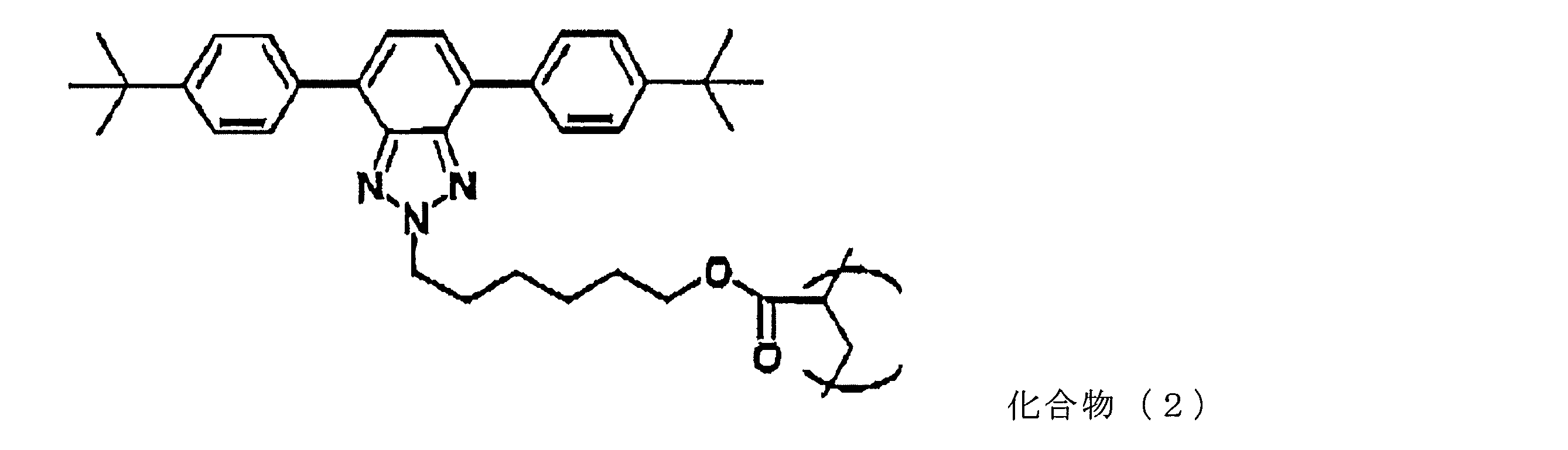
化合物(1)で示されるメタクリル酸エステル化合物(0.50g)を、AIBN(アゾビスイソブチロニトリル)(7.4mg)、テトラヒドロフラン(2ml)を用いて、80℃、3時間、窒素雰囲気下で撹拌することで、化合物(2)で示されるポリメタクリル酸エステル型化合物(収量0.45g)を得た。得られた化合物(2)の数平均分子量は10500、重量平均分子量は17500であった。
〔実施例2〕
化合物(1)で示されるメタクリル酸エステル化合物(0.50g)と、アクリル酸ブチル(0.50g)、AIBN(アゾビスイソブチロニトリル)(15mg)とを、トルエン(4ml)を用いて、80℃、3時間、窒素雰囲気下で撹拌することで、共重合体である化合物(3)で示されるポリメタクリル酸エステル型化合物(収量0.91g)を得た。得られた化合物(3)の数平均分子量は10200、重量平均分子量は16000であった。
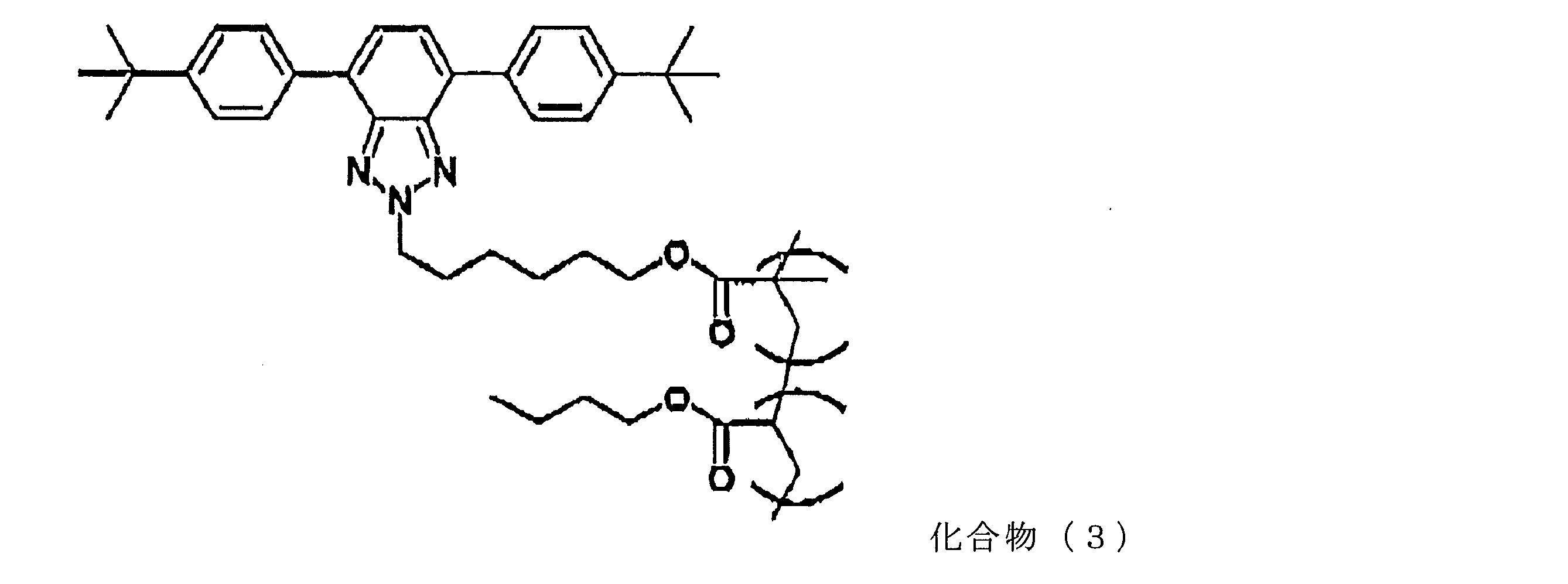
化合物(1)で示されるメタクリル酸エステル化合物(0.50g)と、アクリル酸ブチル(0.50g)、AIBN(アゾビスイソブチロニトリル)(15mg)とを、トルエン(4ml)を用いて、80℃、3時間、窒素雰囲気下で撹拌することで、共重合体である化合物(3)で示されるポリメタクリル酸エステル型化合物(収量0.91g)を得た。得られた化合物(3)の数平均分子量は10200、重量平均分子量は16000であった。
〔実施例3〕
化合物(4)で示される水酸基含有化合物(0.50g)と、ポリ(エチレン-アクリル酸メチル)(10g、住友化学社製、EMMA樹脂)とを、チタンテトラエトキシド(30mg)を触媒として、トルエン(50ml)溶媒中、100℃、3時間、窒素雰囲気下で撹拌することで、共重合体である化合物(5)で示されるポリ(エチレン-アクリル酸エステル)化合物(収量8.5g)を得た。得られた化合物(5)の数平均分子量は49000、重量平均分子量は124000であった。

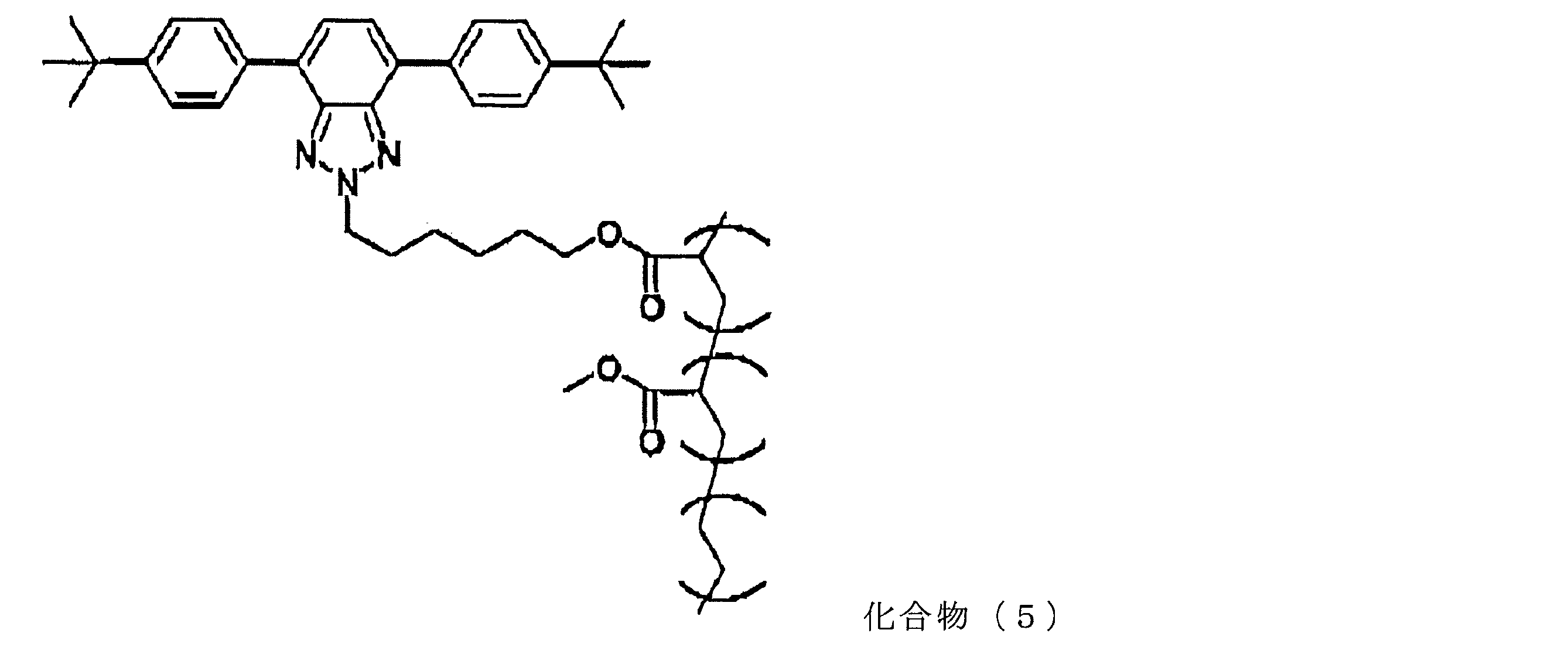
化合物(4)で示される水酸基含有化合物(0.50g)と、ポリ(エチレン-アクリル酸メチル)(10g、住友化学社製、EMMA樹脂)とを、チタンテトラエトキシド(30mg)を触媒として、トルエン(50ml)溶媒中、100℃、3時間、窒素雰囲気下で撹拌することで、共重合体である化合物(5)で示されるポリ(エチレン-アクリル酸エステル)化合物(収量8.5g)を得た。得られた化合物(5)の数平均分子量は49000、重量平均分子量は124000であった。
〔実施例4〕
ポリ(エチレン-酢酸ビニル)(10g、住友化学社製、KA30)をトルエン(100g)に溶解し、ナトリウムメトキシド(0.54g)を加え、室温にて3時間撹拌し、ポリ(エチレン-酢酸ビニル)のアセチル基を一部加水分解したポリマー溶液を得た。引き続き、このポリマー溶液に、1-(3-ジメチルアミノプロピル)-3-エチルカルボジイミド塩酸塩(9.6g)と、化合物(6)で示されるカルボン酸含有化合物(0.1g)、ジメチルアミノピリジン(触媒量)を加え、室温にて6時間撹拌した。その後、さらに酢酸(0.5g)を加えて室温(25℃)で6時間撹拌することで、共重合体である化合物(7)で示されるポリ(エチレン-酢酸ビニル-アシルオキシシ)化合物(収量8.3g)を得た。得られた化合物(7)の数平均分子量は49900、重量平均分子量は125000であった。

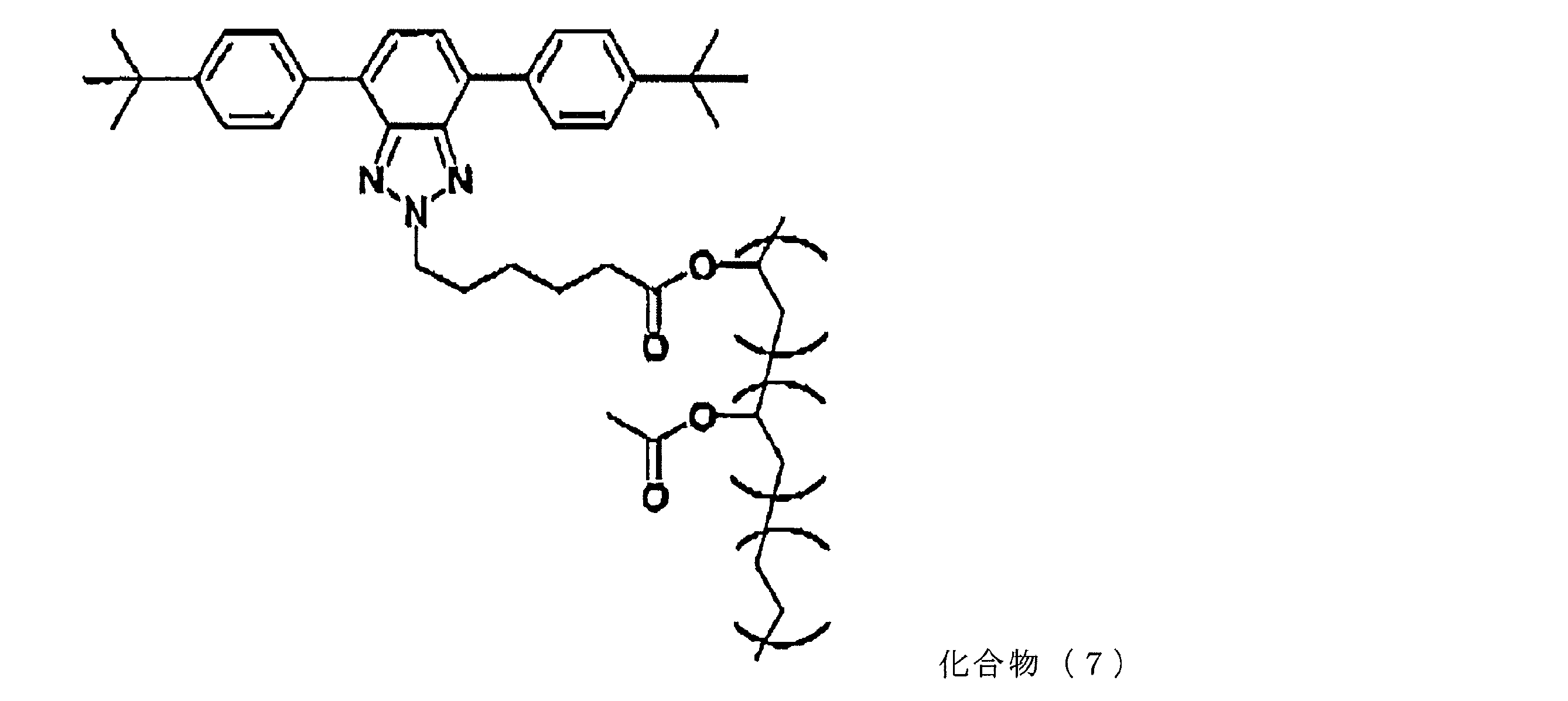
ポリ(エチレン-酢酸ビニル)(10g、住友化学社製、KA30)をトルエン(100g)に溶解し、ナトリウムメトキシド(0.54g)を加え、室温にて3時間撹拌し、ポリ(エチレン-酢酸ビニル)のアセチル基を一部加水分解したポリマー溶液を得た。引き続き、このポリマー溶液に、1-(3-ジメチルアミノプロピル)-3-エチルカルボジイミド塩酸塩(9.6g)と、化合物(6)で示されるカルボン酸含有化合物(0.1g)、ジメチルアミノピリジン(触媒量)を加え、室温にて6時間撹拌した。その後、さらに酢酸(0.5g)を加えて室温(25℃)で6時間撹拌することで、共重合体である化合物(7)で示されるポリ(エチレン-酢酸ビニル-アシルオキシシ)化合物(収量8.3g)を得た。得られた化合物(7)の数平均分子量は49900、重量平均分子量は125000であった。
〔実施例5〕
化合物(6)で示されるカルボン酸含有化合物の使用量を0.02gに変更した以外は、実施例4における方法と同様に、化合物(7)と類似構造の共重合体である化合物(7’)を得た(収量8.1g)。得られた化合物(7’)の数平均分子量は51900、重量平均分子量は129000であった。
化合物(6)で示されるカルボン酸含有化合物の使用量を0.02gに変更した以外は、実施例4における方法と同様に、化合物(7)と類似構造の共重合体である化合物(7’)を得た(収量8.1g)。得られた化合物(7’)の数平均分子量は51900、重量平均分子量は129000であった。
〔実施例6〕
化合物(8)で示される塩素基含有化合物(0.50g)と、フェノールノボラック(0.42g、明和化成社製、MEH-7851SS)とを、臭化イソブチル(0.50g)、炭酸カリウム(0.55g)およびジメチルホルムアミド(5ml)を用いて、130℃、3時間、窒素雰囲気下で撹拌することで、化合物(9)で示されるフェノールノボラックの水酸基がエーテル化された化合物(収量0.65g)を得た。得られた化合物(9)の数平均分子量は3200、重量平均分子量は7700であった。

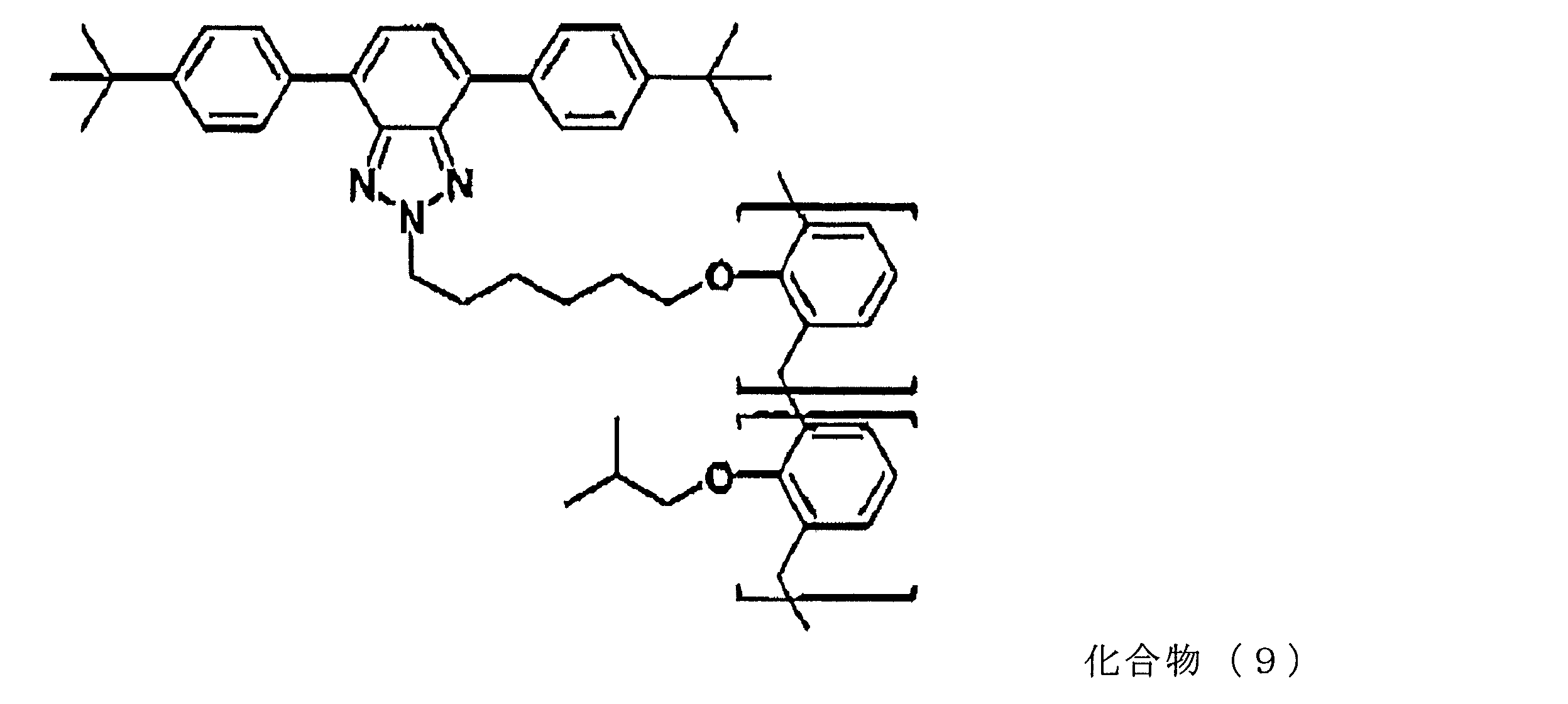
化合物(8)で示される塩素基含有化合物(0.50g)と、フェノールノボラック(0.42g、明和化成社製、MEH-7851SS)とを、臭化イソブチル(0.50g)、炭酸カリウム(0.55g)およびジメチルホルムアミド(5ml)を用いて、130℃、3時間、窒素雰囲気下で撹拌することで、化合物(9)で示されるフェノールノボラックの水酸基がエーテル化された化合物(収量0.65g)を得た。得られた化合物(9)の数平均分子量は3200、重量平均分子量は7700であった。
〔実施例7〕
ポリ(エチレン-酢酸ビニル)(70g、住友化学社製、KA30)と、化合物(1)で示されるメタクリル酸基含有化合物(0.50g)とを混練、真空プレスすることによって、架橋基導入蛍光色素化合物がEVAマトリックスに分散したフィルム(厚さ:100μm)を得た。得られたフィルムを、電子線照射装置(NHVコーポレーション社製、EBC300-60)を用いて電子線照射(加速電圧250keV、照射量90kGy、窒素雰囲気下)を行うことにより、EVAマトリックスに蛍光色素化合物がグラフト重合された共重合体が得られた。
ポリ(エチレン-酢酸ビニル)(70g、住友化学社製、KA30)と、化合物(1)で示されるメタクリル酸基含有化合物(0.50g)とを混練、真空プレスすることによって、架橋基導入蛍光色素化合物がEVAマトリックスに分散したフィルム(厚さ:100μm)を得た。得られたフィルムを、電子線照射装置(NHVコーポレーション社製、EBC300-60)を用いて電子線照射(加速電圧250keV、照射量90kGy、窒素雰囲気下)を行うことにより、EVAマトリックスに蛍光色素化合物がグラフト重合された共重合体が得られた。
〔実施例8〕
化合物(1)で示されるメタクリル酸基含有化合物(0.50g)に代えて、化合物(10)で示されるヘキセン基含有化合物(0.50g)を用いた以外は、実施例7における方法と同様に、EVAマトリックスに蛍光色素化合物がグラフト重合された共重合体が得られた。

化合物(1)で示されるメタクリル酸基含有化合物(0.50g)に代えて、化合物(10)で示されるヘキセン基含有化合物(0.50g)を用いた以外は、実施例7における方法と同様に、EVAマトリックスに蛍光色素化合物がグラフト重合された共重合体が得られた。
〔比較例1〕
化合物(11)で示されるジブロモ化合物(0.50g)と、4-tertブチルフェニルボロン酸(0.59g)とを、ジクロロビストリフェニルホスフィンパラジウム(5mg)、炭酸カリウム(1.04g)、水(2ml)およびトルエン(4ml)を用いて、110℃、2時間、窒素雰囲気下で撹拌することで、化合物(12)で示される芳香族低分子量化合物(収量0.57g)を得た。得られた化合物(12)の分子量は、化学式から算出可能であり、439.64であることは自明であった。


化合物(11)で示されるジブロモ化合物(0.50g)と、4-tertブチルフェニルボロン酸(0.59g)とを、ジクロロビストリフェニルホスフィンパラジウム(5mg)、炭酸カリウム(1.04g)、水(2ml)およびトルエン(4ml)を用いて、110℃、2時間、窒素雰囲気下で撹拌することで、化合物(12)で示される芳香族低分子量化合物(収量0.57g)を得た。得られた化合物(12)の分子量は、化学式から算出可能であり、439.64であることは自明であった。
〔比較例2〕
化合物(11)で示されるジブロモ化合物(0.5g)と、4,4’-ビフェニルジボロン酸(0.38g)とを、パラジウム炭素(Pd10%、約55%水湿潤品)(30mg)、炭酸カリウム(1.03g)、水(2ml)およびイソプロピルアルコール(2ml)を用いて、85℃、4時間、空気雰囲気下で撹拌することで、化合物(12)で示される芳香族化合物(収量0.05g)を得た。得られた化合物(13)の数平均分子量は3500、重量平均分子量は7500であった。

化合物(11)で示されるジブロモ化合物(0.5g)と、4,4’-ビフェニルジボロン酸(0.38g)とを、パラジウム炭素(Pd10%、約55%水湿潤品)(30mg)、炭酸カリウム(1.03g)、水(2ml)およびイソプロピルアルコール(2ml)を用いて、85℃、4時間、空気雰囲気下で撹拌することで、化合物(12)で示される芳香族化合物(収量0.05g)を得た。得られた化合物(13)の数平均分子量は3500、重量平均分子量は7500であった。
〔比較例3〕
紫外線吸収剤である2-ヒドロキシ-4-n-オクチルオキシベンゾフェノンを用いた。
紫外線吸収剤である2-ヒドロキシ-4-n-オクチルオキシベンゾフェノンを用いた。
(分子量の測定)
数平均分子量、重量平均分子量は、GPC装置(TOSOH社製、HLC-8220GPC)を用いて測定を行った。測定条件は下記の通りである。
・サンプル濃度:0.001重量%(THF溶液)
・サンプル注入量:10μl
・溶離液:クロロホルム
・流速:0.3ml/min
・測定温度:40℃
・カラム:TSKgel、Super HZM-H/HZ2000/HZ1000
・検出器:示差屈折計(RI)
なお、上記分子量はポリスチレン換算値にて求めた。
数平均分子量、重量平均分子量は、GPC装置(TOSOH社製、HLC-8220GPC)を用いて測定を行った。測定条件は下記の通りである。
・サンプル濃度:0.001重量%(THF溶液)
・サンプル注入量:10μl
・溶離液:クロロホルム
・流速:0.3ml/min
・測定温度:40℃
・カラム:TSKgel、Super HZM-H/HZ2000/HZ1000
・検出器:示差屈折計(RI)
なお、上記分子量はポリスチレン換算値にて求めた。
(最大吸収波長・蛍光発光波長の測定)
実施例および比較例に用いられた蛍光発光化合物の最大吸収波長および蛍光発光波長を測定した。最大吸収波長の測定は、紫外可視分光光度計(日本分光株式会社製、V-560)を用いて行い、Abs測定において最大値を示す波長を測定した。
実施例および比較例に用いられた蛍光発光化合物の最大吸収波長および蛍光発光波長を測定した。最大吸収波長の測定は、紫外可視分光光度計(日本分光株式会社製、V-560)を用いて行い、Abs測定において最大値を示す波長を測定した。
蛍光発光波長の測定は、日立ハイテクノロジーズ社製のF-4500を用いて行い、(励起-発光)3次元測定における最大発光強度を示す波長を測定した。
(封止樹脂組成物の作製)
透明分散媒樹脂としてポリ(エチレン-酢酸ビニル)(EVA)(住友化学社製:KA-30)を100質量部、実施例・比較例の化合物を表に示された重量部計り取り、ラボプラストミル(東洋精機社製:10C100)にて80℃で混練して、封止樹脂組成物を得た。また、実施例5の化合物については、ポリ(エチレン-酢酸ビニル)を用いることなく、そのまま用いた。
透明分散媒樹脂としてポリ(エチレン-酢酸ビニル)(EVA)(住友化学社製:KA-30)を100質量部、実施例・比較例の化合物を表に示された重量部計り取り、ラボプラストミル(東洋精機社製:10C100)にて80℃で混練して、封止樹脂組成物を得た。また、実施例5の化合物については、ポリ(エチレン-酢酸ビニル)を用いることなく、そのまま用いた。
(封止シートの作製)
上記で得られた封止樹脂組成物を離型シートに挟み、真空熱加圧装置(ミカドテクノス社製:VS20-3430)を用いて100℃でプレスすることで、約400μm厚の封止シートを作製した。
上記で得られた封止樹脂組成物を離型シートに挟み、真空熱加圧装置(ミカドテクノス社製:VS20-3430)を用いて100℃でプレスすることで、約400μm厚の封止シートを作製した。
(太陽電池モジュールの効率測定)
上記で得られた封止シートを20×20cmに裁断し、保護ガラスとしての強化ガラス(旭硝子社製:ソライト)、封止シート、太陽電池セル(Qセル社製:Q6LTT3-G2-200/1700-A、結晶シリコン型)、裏面用封止シート(400μm厚EVAシート)、バックシートとしてPETフィルムを載せ、真空ラミネーター(株式会社エヌ・ピー・シー:LM-50x50-S)を用いて、140℃、真空5分、加圧10分の条件でラミネートし、太陽電池モジュールを作製した。
上記で得られた封止シートを20×20cmに裁断し、保護ガラスとしての強化ガラス(旭硝子社製:ソライト)、封止シート、太陽電池セル(Qセル社製:Q6LTT3-G2-200/1700-A、結晶シリコン型)、裏面用封止シート(400μm厚EVAシート)、バックシートとしてPETフィルムを載せ、真空ラミネーター(株式会社エヌ・ピー・シー:LM-50x50-S)を用いて、140℃、真空5分、加圧10分の条件でラミネートし、太陽電池モジュールを作製した。
(太陽電池モジュールのJsc測定)
上記で得られた太陽電池モジュールの分光感度を分光感度測定装置(分光計器社製、CEP-25RR)を用いて測定し、分光感度測定から算出されたJsc値を得た。なお、Jsc値とは、分光感度測定装置によるサンプル測定から得られる分光感度スペクトルと基準太陽光の演算により算出される短絡電流密度をいう。
上記で得られた太陽電池モジュールの分光感度を分光感度測定装置(分光計器社製、CEP-25RR)を用いて測定し、分光感度測定から算出されたJsc値を得た。なお、Jsc値とは、分光感度測定装置によるサンプル測定から得られる分光感度スペクトルと基準太陽光の演算により算出される短絡電流密度をいう。
実施例1および比較例3の各封止シートを用いて作製した太陽電池モジュールにおいてそれぞれのJsc値を測定したところ、実施例1の太陽電池モジュールのJsc値は、比較例13の太陽電池モジュールのJsc値よりも1.5%大きく、光電変換効率の向上が見られた。
(色素固定化度の検証)
実施例・比較例で得られた各蛍光発光化合物を用いてEVAシートを作製した。得られたシートを溶剤に浸漬させ、溶剤を含浸させ、溶出試験前後でのシートの吸光度を分光光度計により測定し、比較を行った。
実施例・比較例で得られた各蛍光発光化合物を用いてEVAシートを作製した。得られたシートを溶剤に浸漬させ、溶剤を含浸させ、溶出試験前後でのシートの吸光度を分光光度計により測定し、比較を行った。
得られたそれぞれの封止シート300mgをイソプロピルアルコール50mlに40℃で4時間静置し色素が溶出しうるかの評価を行った。その後、得られた封止シートを乾燥後、封止シートの最大吸収波長における吸光度を測定した。それぞれ溶出実験前後の最大吸収波長における吸光度を比較することで、樹脂に固定化された色素の割合を算出、評価した。なお、色素固定化度として、下式で算出した値を用いた。
固定化度(%)={(溶出試験後の吸光度)/(溶出試験前の吸光度)}×100
固定化度(%)={(溶出試験後の吸光度)/(溶出試験前の吸光度)}×100
得られた結果を下記表1に示す。
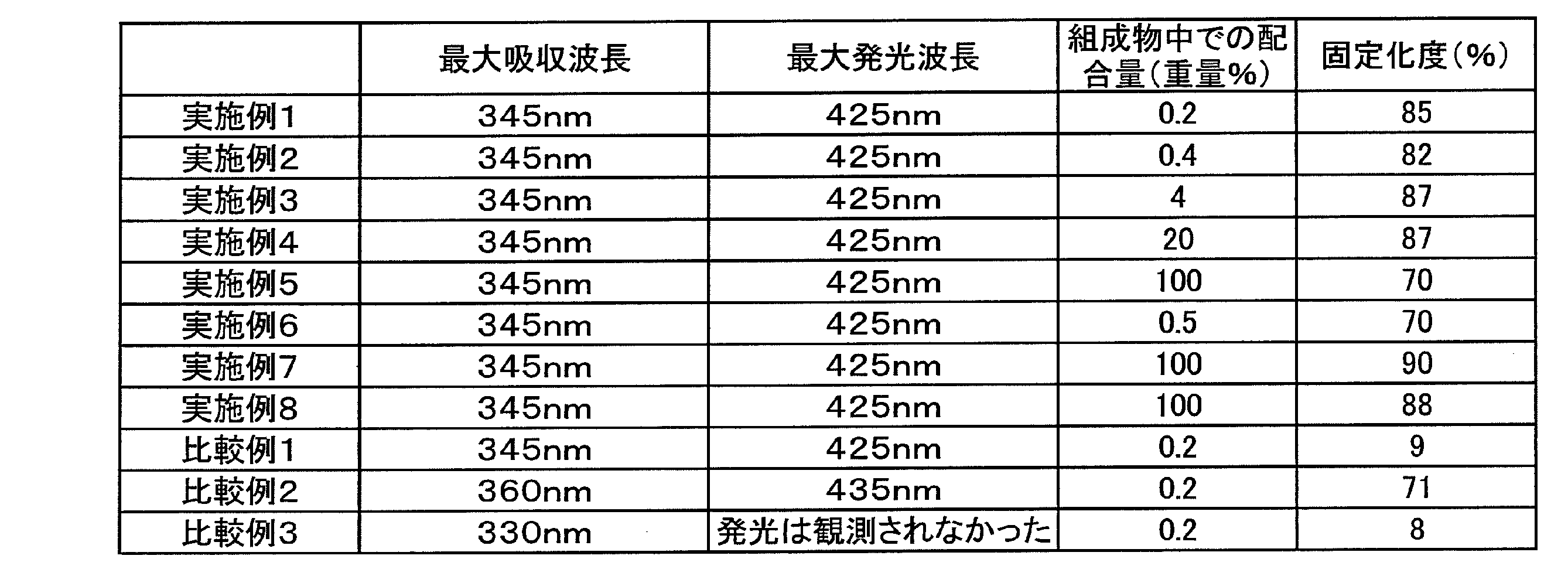
上記のように、得られたシートにおいて高分子波長変換色素化合物はポリマーマトリックスに絡み合って取り込まれて、またはそれ自身がマトリックス素材となり、シートを溶剤に浸漬させ、溶剤を含浸させても、溶出しにくくなっている。よって、特定のベンゾトリアゾール部位を有する発色団が非共有結合にポリマー構造と連結した本願化合物では、当該発色団の吸収・発光特性が維持されるとともに、非溶出性にも優れていることがわかった。
1 太陽電池モジュール
10 表面保護層
20 太陽電池用封止材層
30 太陽電池セル
40 裏面用封止材層
50 バックシート
10 表面保護層
20 太陽電池用封止材層
30 太陽電池セル
40 裏面用封止材層
50 バックシート
Claims (13)
- 下記一般式(I)によって表される高分子蛍光色素化合物。

Y1およびY2は、それぞれ独立して、場合により置換された、炭素数1~18のアルキル基(アルキル基中の隣接しない炭素原子が酸素原子に置換されていてもよい)を表し、
Pは、高分子構造部位を表し、
Lは、ベンゾトリアゾール環と高分子構造部位を共有結合により結合するリンカー構造部位を表し、
Z1およびZ2は、それぞれ独立して、場合により置換された炭素数1~18のアルキル基(アルキル基中の隣接しない炭素原子が酸素原子に置換されていてもよい)、場合により置換された炭素数1~18のアルコキシ基(アルコキシ基中の隣接しない炭素原子が酸素原子に置換されていてもよい)、フルオロ基、シアノ基、-COOR1基、-NHCOR2基、または、水酸基を表し、R1およびR2は、炭素数1~18のアルキル基またはフェニル基を表し、
m、n、oおよびpは、それぞれ独立して、0~4の整数を表す(ただし、m+nは4以下、o+pは4以下である。)。m、n、oまたはpが2以上の場合、複数存在する各置換基は同一でも異なっていてもよい) - 前記Lは、前記ベンゾトリアゾール環および前記高分子構造部位のいずれとも共役結合を形成しない、請求項1に記載の高分子蛍光色素化合物。
- 下記一般式(II)によって表される、請求項1または2に記載の高分子蛍光色素化合物。

Y1、Y2およびY3は、それぞれ独立して、場合により置換された、炭素数1~18のアルキル基(アルキル基中の隣接しない炭素原子が酸素原子に置換されていてもよい)を表し、
Pは、高分子構造部位を表し、
Z1およびZ2は、それぞれ独立して、場合により置換された炭素数1~18のアルキル基(アルキル基中の隣接しない炭素原子が酸素原子に置換されていてもよい)、場合により置換された炭素数1~18のアルコキシ基(アルコキシ基中の隣接しない炭素原子が酸素原子に置換されていてもよい)、フルオロ基、シアノ基、-COOR1基、-NHCOR2基、または、水酸基を表し、R1およびR2は、炭素数1~18のアルキル基またはフェニル基を表し、
m、n、oおよびpは、それぞれ独立して、0~4の整数を表す(ただし、m+nは4以下、o+pは4以下である。)。m、n、oまたはpが2以上の場合、複数存在する各置換基は同一でも異なっていてもよい) - 前記Pが、ポリエチレンテレフタレート、ポリ(メタ)アクリレート、ポリビニルアセテート、ポリエチレンテトラフルオロエチレン、ポリイミド、非晶質ポリカーボネート、シロキサンゾル-ゲル、ポリウレタン、ポリスチレン、ポリエーテルサルフォン、ポリアリレート、エポキシ樹脂、ポリエチレン、ポリプロピレン、ポリ(エチレン-酢酸ビニル)またはシリコーン樹脂である、請求項1~3のいずれかに記載の高分子蛍光色素化合物。
- 300~410nmに最大吸収波長を有する、請求項1~4のいずれかに記載の高分子蛍光色素化合物。
- 410~560nmに最大蛍光発光波長を有する、請求項1~5のいずれかに記載の高分子蛍光色素化合物。
- 請求項1~6のいずれかに記載の前記高分子蛍光色素化合物が0.05~100重量%で含まれている、波長変換型封止材組成物。
- 光学的に透明な樹脂マトリックス、および、請求項1~6のいずれかに記載の前記高分子蛍光色素化合物を含む、波長変換型封止材組成物。
- 前記マトリックス樹脂が、ポリ(エチレン-酢酸ビニル)を主成分とする、請求項8に記載の波長変換型封止材組成物。
- 請求項7~9のいずれかに記載の波長変換型封止材組成物を用いて形成された波長変換型封止材層。
- 請求項7~9のいずれかに記載の波長変換型封止材組成物を用いて形成された波長変換型封止材層を含む太陽電池モジュール。
- 入射光が、太陽電池セルへの到達に先だって、前記波長変換型封止材層を通過するように配置される、請求項11に記載の太陽電池モジュール。
- 前記太陽電池セルが、結晶シリコン太陽電池である、請求項11または12に記載の太陽電池モジュール。
Priority Applications (2)
| Application Number | Priority Date | Filing Date | Title |
|---|---|---|---|
| US15/327,775 US20170198143A1 (en) | 2014-07-24 | 2015-07-16 | Fluorescent dye compound having benzotriazole structure, polymer fluorescent dye compound and wavelength-converting encapsulant composition using same |
| CN201580040981.5A CN106536638A (zh) | 2014-07-24 | 2015-07-16 | 具有苯并三唑结构的荧光色素化合物及高分子荧光色素化合物、以及使用其的波长转换型封装材料组合物 |
Applications Claiming Priority (2)
| Application Number | Priority Date | Filing Date | Title |
|---|---|---|---|
| JP2014-150581 | 2014-07-24 | ||
| JP2014150581A JP2016023286A (ja) | 2014-07-24 | 2014-07-24 | ベンゾトリアゾール構造を有する蛍光色素化合物および高分子蛍光色素化合物、ならびに、それを用いた波長変換型封止材組成物 |
Publications (1)
| Publication Number | Publication Date |
|---|---|
| WO2016013481A1 true WO2016013481A1 (ja) | 2016-01-28 |
Family
ID=55163007
Family Applications (1)
| Application Number | Title | Priority Date | Filing Date |
|---|---|---|---|
| PCT/JP2015/070401 Ceased WO2016013481A1 (ja) | 2014-07-24 | 2015-07-16 | ベンゾトリアゾール構造を有する蛍光色素化合物および高分子蛍光色素化合物、ならびに、それを用いた波長変換型封止材組成物 |
Country Status (4)
| Country | Link |
|---|---|
| US (1) | US20170198143A1 (ja) |
| JP (1) | JP2016023286A (ja) |
| CN (1) | CN106536638A (ja) |
| WO (1) | WO2016013481A1 (ja) |
Cited By (2)
| Publication number | Priority date | Publication date | Assignee | Title |
|---|---|---|---|---|
| WO2021246197A1 (ja) * | 2020-06-04 | 2021-12-09 | 株式会社クボタ | 光発電装置および塗装方法 |
| CN115584014A (zh) * | 2022-10-07 | 2023-01-10 | 大连理工大学 | 一类具有耐热及荧光特性的梯形聚合物材料及其制备方法 |
Families Citing this family (10)
| Publication number | Priority date | Publication date | Assignee | Title |
|---|---|---|---|---|
| CN111410806B (zh) * | 2019-01-07 | 2022-07-08 | 长春理工大学 | 一种荧光材料的制备方法 |
| JP7479660B2 (ja) * | 2019-09-04 | 2024-05-09 | 学校法人 中村産業学園 | 蛍光色素 |
| CN112978709A (zh) * | 2019-12-12 | 2021-06-18 | 中国科学院大连化学物理研究所 | 一种碳量子点前驱体组合物、一种碳量子点及其制备方法 |
| CN112079950B (zh) * | 2020-08-28 | 2022-03-15 | 长春理工大学 | 热活化延迟荧光温敏聚合物及其制备方法 |
| WO2024207829A1 (zh) * | 2023-04-04 | 2024-10-10 | 杭州福斯特应用材料股份有限公司 | 转光胶膜组合物、转光胶膜及光伏组件 |
| WO2025214371A1 (zh) * | 2024-04-08 | 2025-10-16 | 江苏绿人半导体有限公司 | 有机化合物及其应用、封装胶用组合物、制备封装胶的方法 |
| CN121270485A (zh) * | 2024-07-01 | 2026-01-06 | 上海海优威新材料股份有限公司 | 一种宽紫外吸收波段的转光剂、封装胶膜和光伏组件 |
| CN121449562A (zh) * | 2024-08-01 | 2026-02-03 | 天合光能股份有限公司 | 基于苯并三氮唑类化合物的转光膜及其制备方法和应用 |
| CN119798297A (zh) * | 2024-12-25 | 2025-04-11 | 常州斯威克光伏新材料有限公司 | 具备下转换能力的生色团、封装胶膜、玻璃及光伏组件 |
| CN120943790B (zh) * | 2025-10-11 | 2025-12-12 | 苏州照固新材料科技有限公司 | 紫外显色丙烯酸酯类单体、紫外显色uv胶黏剂及应用 |
Citations (4)
| Publication number | Priority date | Publication date | Assignee | Title |
|---|---|---|---|---|
| JP2013072087A (ja) * | 2011-09-26 | 2013-04-22 | Nitto Denko Corp | 増強された太陽光集光効率のための高蛍光性かつ光安定性の発色団 |
| JP2013084952A (ja) * | 2011-10-05 | 2013-05-09 | Nitto Denko Corp | 太陽光捕集効率を向上させるための、感圧接着剤層を含む波長変換膜 |
| JP2013123037A (ja) * | 2011-12-06 | 2013-06-20 | Nitto Denko Corp | 太陽光捕集効率を向上させるためのソーラーモジュールシステムのための封入物としての波長変換材料 |
| JP2014185286A (ja) * | 2013-03-25 | 2014-10-02 | Nitto Denko Corp | ベンゾトリアゾール構造を有する発色団およびそれを用いた波長変換発光媒体 |
Family Cites Families (2)
| Publication number | Priority date | Publication date | Assignee | Title |
|---|---|---|---|---|
| SU642331A1 (ru) * | 1974-12-23 | 1979-01-15 | Предприятие П/Я А-7594 | Композици дл получени пленок |
| CN103183971B (zh) * | 2011-12-30 | 2016-08-03 | 财团法人工业技术研究院 | 染料标示型高分子、聚光板及其形成方法、太阳能电池模组及免插电灯具 |
-
2014
- 2014-07-24 JP JP2014150581A patent/JP2016023286A/ja active Pending
-
2015
- 2015-07-16 US US15/327,775 patent/US20170198143A1/en not_active Abandoned
- 2015-07-16 CN CN201580040981.5A patent/CN106536638A/zh active Pending
- 2015-07-16 WO PCT/JP2015/070401 patent/WO2016013481A1/ja not_active Ceased
Patent Citations (4)
| Publication number | Priority date | Publication date | Assignee | Title |
|---|---|---|---|---|
| JP2013072087A (ja) * | 2011-09-26 | 2013-04-22 | Nitto Denko Corp | 増強された太陽光集光効率のための高蛍光性かつ光安定性の発色団 |
| JP2013084952A (ja) * | 2011-10-05 | 2013-05-09 | Nitto Denko Corp | 太陽光捕集効率を向上させるための、感圧接着剤層を含む波長変換膜 |
| JP2013123037A (ja) * | 2011-12-06 | 2013-06-20 | Nitto Denko Corp | 太陽光捕集効率を向上させるためのソーラーモジュールシステムのための封入物としての波長変換材料 |
| JP2014185286A (ja) * | 2013-03-25 | 2014-10-02 | Nitto Denko Corp | ベンゾトリアゾール構造を有する発色団およびそれを用いた波長変換発光媒体 |
Non-Patent Citations (1)
| Title |
|---|
| DATABASE REGISTRY [o] Chemical Abstracts Service; 1 January 2015 (2015-01-01), retrieved from STN Database accession no. 1643535-57-2 * |
Cited By (3)
| Publication number | Priority date | Publication date | Assignee | Title |
|---|---|---|---|---|
| WO2021246197A1 (ja) * | 2020-06-04 | 2021-12-09 | 株式会社クボタ | 光発電装置および塗装方法 |
| JPWO2021246197A1 (ja) * | 2020-06-04 | 2021-12-09 | ||
| CN115584014A (zh) * | 2022-10-07 | 2023-01-10 | 大连理工大学 | 一类具有耐热及荧光特性的梯形聚合物材料及其制备方法 |
Also Published As
| Publication number | Publication date |
|---|---|
| CN106536638A (zh) | 2017-03-22 |
| JP2016023286A (ja) | 2016-02-08 |
| US20170198143A1 (en) | 2017-07-13 |
Similar Documents
| Publication | Publication Date | Title |
|---|---|---|
| WO2016013481A1 (ja) | ベンゾトリアゾール構造を有する蛍光色素化合物および高分子蛍光色素化合物、ならびに、それを用いた波長変換型封止材組成物 | |
| WO2016013483A1 (ja) | ベンゾトリアゾール構造を有する蛍光色素化合物、および、それを用いた波長変換型封止材組成物 | |
| WO2016031421A1 (ja) | 発光性エチレン系共重合体、太陽電池用封止材組成物、および、それを用いた太陽電池モジュール | |
| CA2794879C (en) | Wavelength conversion type photovoltaic cell sealing sheet and photovoltaic cell module | |
| JP6034918B1 (ja) | ベンゾトリアゾール化合物およびそれを用いた樹脂組成物ならびに波長変換層 | |
| CN105684163B (zh) | 波长转换型封装材料组合物、波长转换型封装材料层及使用其的太阳能电池模组 | |
| JP2014232792A (ja) | 波長変換型封止材層およびその製造方法 | |
| JP2014237792A (ja) | ベンゾチアジアゾール構造を有する蛍光色素化合物、および、それを用いた波長変換型封止材組成物 | |
| JP2014234495A (ja) | ベンゾチアジアゾール構造を有する蛍光色素化合物、および、それを用いた波長変換型封止材組成物 | |
| CN102250404B (zh) | 封装材料 | |
| US20170253726A1 (en) | Encapsulant composition for solar cell, solar cell encapsulant layer produced therewith, and solar cell module produced therewith | |
| JP2016115852A (ja) | 太陽電池モジュール | |
| JP2016025108A (ja) | 波長変換型封止材層、および、それを用いた太陽電池モジュール | |
| JP6173789B2 (ja) | 太陽電池用封止材組成物、太陽電池用封止材層、および、それを用いた太陽電池モジュール | |
| JP2015111664A (ja) | 波長変換型封止材組成物、波長変換型封止材層、および、それを用いた太陽電池モジュール | |
| JP6178126B2 (ja) | 太陽電池用封止材組成物およびその製造方法、ならびに、それを用いた太陽電池用封止材層および太陽電池モジュール | |
| JP2017025334A (ja) | 太陽電池用封止材組成物、およびそれを用いた太陽電池用封止材層ならびに太陽電池モジュール | |
| JP6026683B2 (ja) | 太陽電池用封止材組成物、およびそれを用いた太陽電池用封止材層ならびに太陽電池モジュール | |
| CN118420817A (zh) | 超支化共聚物、改性颜料、封装胶膜以及光伏组件 | |
| WO2016194193A1 (ja) | 波長変換材料 |
Legal Events
| Date | Code | Title | Description |
|---|---|---|---|
| 121 | Ep: the epo has been informed by wipo that ep was designated in this application |
Ref document number: 15824970 Country of ref document: EP Kind code of ref document: A1 |
|
| WWE | Wipo information: entry into national phase |
Ref document number: 15327775 Country of ref document: US |
|
| NENP | Non-entry into the national phase |
Ref country code: DE |
|
| 122 | Ep: pct application non-entry in european phase |
Ref document number: 15824970 Country of ref document: EP Kind code of ref document: A1 |