WO2015198580A1 - 熱硬化性組成物、及び当該熱硬化性樹脂の製造方法 - Google Patents
熱硬化性組成物、及び当該熱硬化性樹脂の製造方法 Download PDFInfo
- Publication number
- WO2015198580A1 WO2015198580A1 PCT/JP2015/003111 JP2015003111W WO2015198580A1 WO 2015198580 A1 WO2015198580 A1 WO 2015198580A1 JP 2015003111 W JP2015003111 W JP 2015003111W WO 2015198580 A1 WO2015198580 A1 WO 2015198580A1
- Authority
- WO
- WIPO (PCT)
- Prior art keywords
- meth
- thermosetting
- acrylate
- thermosetting composition
- mass
- Prior art date
- Legal status (The legal status is an assumption and is not a legal conclusion. Google has not performed a legal analysis and makes no representation as to the accuracy of the status listed.)
- Ceased
Links
Images


Classifications
-
- B—PERFORMING OPERATIONS; TRANSPORTING
- B29—WORKING OF PLASTICS; WORKING OF SUBSTANCES IN A PLASTIC STATE IN GENERAL
- B29C—SHAPING OR JOINING OF PLASTICS; SHAPING OF MATERIAL IN A PLASTIC STATE, NOT OTHERWISE PROVIDED FOR; AFTER-TREATMENT OF THE SHAPED PRODUCTS, e.g. REPAIRING
- B29C39/00—Shaping by casting, i.e. introducing the moulding material into a mould or between confining surfaces without significant moulding pressure; Apparatus therefor
- B29C39/22—Component parts, details or accessories; Auxiliary operations
- B29C39/26—Moulds or cores
-
- C—CHEMISTRY; METALLURGY
- C08—ORGANIC MACROMOLECULAR COMPOUNDS; THEIR PREPARATION OR CHEMICAL WORKING-UP; COMPOSITIONS BASED THEREON
- C08L—COMPOSITIONS OF MACROMOLECULAR COMPOUNDS
- C08L33/00—Compositions of homopolymers or copolymers of compounds having one or more unsaturated aliphatic radicals, each having only one carbon-to-carbon double bond, and only one being terminated by only one carboxyl radical, or of salts, anhydrides, esters, amides, imides or nitriles thereof; Compositions of derivatives of such polymers
- C08L33/04—Homopolymers or copolymers of esters
- C08L33/06—Homopolymers or copolymers of esters of esters containing only carbon, hydrogen and oxygen, which oxygen atoms are present only as part of the carboxyl radical
- C08L33/08—Homopolymers or copolymers of acrylic acid esters
-
- B—PERFORMING OPERATIONS; TRANSPORTING
- B29—WORKING OF PLASTICS; WORKING OF SUBSTANCES IN A PLASTIC STATE IN GENERAL
- B29C—SHAPING OR JOINING OF PLASTICS; SHAPING OF MATERIAL IN A PLASTIC STATE, NOT OTHERWISE PROVIDED FOR; AFTER-TREATMENT OF THE SHAPED PRODUCTS, e.g. REPAIRING
- B29C39/00—Shaping by casting, i.e. introducing the moulding material into a mould or between confining surfaces without significant moulding pressure; Apparatus therefor
- B29C39/003—Shaping by casting, i.e. introducing the moulding material into a mould or between confining surfaces without significant moulding pressure; Apparatus therefor characterised by the choice of material
-
- B—PERFORMING OPERATIONS; TRANSPORTING
- B29—WORKING OF PLASTICS; WORKING OF SUBSTANCES IN A PLASTIC STATE IN GENERAL
- B29C—SHAPING OR JOINING OF PLASTICS; SHAPING OF MATERIAL IN A PLASTIC STATE, NOT OTHERWISE PROVIDED FOR; AFTER-TREATMENT OF THE SHAPED PRODUCTS, e.g. REPAIRING
- B29C45/00—Injection moulding, i.e. forcing the required volume of moulding material through a nozzle into a closed mould; Apparatus therefor
- B29C45/02—Transfer moulding, i.e. transferring the required volume of moulding material by a plunger from a "shot" cavity into a mould cavity
-
- B—PERFORMING OPERATIONS; TRANSPORTING
- B29—WORKING OF PLASTICS; WORKING OF SUBSTANCES IN A PLASTIC STATE IN GENERAL
- B29C—SHAPING OR JOINING OF PLASTICS; SHAPING OF MATERIAL IN A PLASTIC STATE, NOT OTHERWISE PROVIDED FOR; AFTER-TREATMENT OF THE SHAPED PRODUCTS, e.g. REPAIRING
- B29C45/00—Injection moulding, i.e. forcing the required volume of moulding material through a nozzle into a closed mould; Apparatus therefor
- B29C45/14—Injection moulding, i.e. forcing the required volume of moulding material through a nozzle into a closed mould; Apparatus therefor incorporating preformed parts or layers, e.g. injection moulding around inserts or for coating articles
-
- B—PERFORMING OPERATIONS; TRANSPORTING
- B29—WORKING OF PLASTICS; WORKING OF SUBSTANCES IN A PLASTIC STATE IN GENERAL
- B29C—SHAPING OR JOINING OF PLASTICS; SHAPING OF MATERIAL IN A PLASTIC STATE, NOT OTHERWISE PROVIDED FOR; AFTER-TREATMENT OF THE SHAPED PRODUCTS, e.g. REPAIRING
- B29C45/00—Injection moulding, i.e. forcing the required volume of moulding material through a nozzle into a closed mould; Apparatus therefor
- B29C45/14—Injection moulding, i.e. forcing the required volume of moulding material through a nozzle into a closed mould; Apparatus therefor incorporating preformed parts or layers, e.g. injection moulding around inserts or for coating articles
- B29C45/14336—Coating a portion of the article, e.g. the edge of the article
-
- B—PERFORMING OPERATIONS; TRANSPORTING
- B29—WORKING OF PLASTICS; WORKING OF SUBSTANCES IN A PLASTIC STATE IN GENERAL
- B29C—SHAPING OR JOINING OF PLASTICS; SHAPING OF MATERIAL IN A PLASTIC STATE, NOT OTHERWISE PROVIDED FOR; AFTER-TREATMENT OF THE SHAPED PRODUCTS, e.g. REPAIRING
- B29C45/00—Injection moulding, i.e. forcing the required volume of moulding material through a nozzle into a closed mould; Apparatus therefor
- B29C45/17—Component parts, details or accessories; Auxiliary operations
- B29C45/26—Moulds
-
- B—PERFORMING OPERATIONS; TRANSPORTING
- B29—WORKING OF PLASTICS; WORKING OF SUBSTANCES IN A PLASTIC STATE IN GENERAL
- B29C—SHAPING OR JOINING OF PLASTICS; SHAPING OF MATERIAL IN A PLASTIC STATE, NOT OTHERWISE PROVIDED FOR; AFTER-TREATMENT OF THE SHAPED PRODUCTS, e.g. REPAIRING
- B29C45/00—Injection moulding, i.e. forcing the required volume of moulding material through a nozzle into a closed mould; Apparatus therefor
- B29C45/17—Component parts, details or accessories; Auxiliary operations
- B29C45/46—Means for plasticising or homogenising the moulding material or forcing it into the mould
- B29C45/53—Means for plasticising or homogenising the moulding material or forcing it into the mould using injection ram or piston
- B29C45/54—Means for plasticising or homogenising the moulding material or forcing it into the mould using injection ram or piston and plasticising screw
-
- C—CHEMISTRY; METALLURGY
- C08—ORGANIC MACROMOLECULAR COMPOUNDS; THEIR PREPARATION OR CHEMICAL WORKING-UP; COMPOSITIONS BASED THEREON
- C08F—MACROMOLECULAR COMPOUNDS OBTAINED BY REACTIONS ONLY INVOLVING CARBON-TO-CARBON UNSATURATED BONDS
- C08F2/00—Processes of polymerisation
- C08F2/44—Polymerisation in the presence of compounding ingredients, e.g. plasticisers, dyestuffs, fillers
-
- C—CHEMISTRY; METALLURGY
- C08—ORGANIC MACROMOLECULAR COMPOUNDS; THEIR PREPARATION OR CHEMICAL WORKING-UP; COMPOSITIONS BASED THEREON
- C08F—MACROMOLECULAR COMPOUNDS OBTAINED BY REACTIONS ONLY INVOLVING CARBON-TO-CARBON UNSATURATED BONDS
- C08F20/00—Homopolymers and copolymers of compounds having one or more unsaturated aliphatic radicals, each having only one carbon-to-carbon double bond, and only one being terminated by only one carboxyl radical or a salt, anhydride, ester, amide, imide or nitrile thereof
- C08F20/02—Monocarboxylic acids having less than ten carbon atoms, Derivatives thereof
- C08F20/10—Esters
-
- C—CHEMISTRY; METALLURGY
- C08—ORGANIC MACROMOLECULAR COMPOUNDS; THEIR PREPARATION OR CHEMICAL WORKING-UP; COMPOSITIONS BASED THEREON
- C08F—MACROMOLECULAR COMPOUNDS OBTAINED BY REACTIONS ONLY INVOLVING CARBON-TO-CARBON UNSATURATED BONDS
- C08F292/00—Macromolecular compounds obtained by polymerising monomers on to inorganic materials
-
- C—CHEMISTRY; METALLURGY
- C08—ORGANIC MACROMOLECULAR COMPOUNDS; THEIR PREPARATION OR CHEMICAL WORKING-UP; COMPOSITIONS BASED THEREON
- C08K—Use of inorganic or non-macromolecular organic substances as compounding ingredients
- C08K3/00—Use of inorganic substances as compounding ingredients
- C08K3/01—Use of inorganic substances as compounding ingredients characterized by their specific function
- C08K3/013—Fillers, pigments or reinforcing additives
-
- C—CHEMISTRY; METALLURGY
- C08—ORGANIC MACROMOLECULAR COMPOUNDS; THEIR PREPARATION OR CHEMICAL WORKING-UP; COMPOSITIONS BASED THEREON
- C08K—Use of inorganic or non-macromolecular organic substances as compounding ingredients
- C08K3/00—Use of inorganic substances as compounding ingredients
- C08K3/34—Silicon-containing compounds
- C08K3/36—Silica
-
- C—CHEMISTRY; METALLURGY
- C08—ORGANIC MACROMOLECULAR COMPOUNDS; THEIR PREPARATION OR CHEMICAL WORKING-UP; COMPOSITIONS BASED THEREON
- C08K—Use of inorganic or non-macromolecular organic substances as compounding ingredients
- C08K7/00—Use of ingredients characterised by shape
- C08K7/16—Solid spheres
- C08K7/18—Solid spheres inorganic
-
- C—CHEMISTRY; METALLURGY
- C08—ORGANIC MACROMOLECULAR COMPOUNDS; THEIR PREPARATION OR CHEMICAL WORKING-UP; COMPOSITIONS BASED THEREON
- C08K—Use of inorganic or non-macromolecular organic substances as compounding ingredients
- C08K9/00—Use of pretreated ingredients
- C08K9/04—Ingredients treated with organic substances
- C08K9/06—Ingredients treated with organic substances with silicon-containing compounds
-
- C—CHEMISTRY; METALLURGY
- C08—ORGANIC MACROMOLECULAR COMPOUNDS; THEIR PREPARATION OR CHEMICAL WORKING-UP; COMPOSITIONS BASED THEREON
- C08L—COMPOSITIONS OF MACROMOLECULAR COMPOUNDS
- C08L33/00—Compositions of homopolymers or copolymers of compounds having one or more unsaturated aliphatic radicals, each having only one carbon-to-carbon double bond, and only one being terminated by only one carboxyl radical, or of salts, anhydrides, esters, amides, imides or nitriles thereof; Compositions of derivatives of such polymers
- C08L33/04—Homopolymers or copolymers of esters
-
- H—ELECTRICITY
- H10—SEMICONDUCTOR DEVICES; ELECTRIC SOLID-STATE DEVICES NOT OTHERWISE PROVIDED FOR
- H10H—INORGANIC LIGHT-EMITTING SEMICONDUCTOR DEVICES HAVING POTENTIAL BARRIERS
- H10H20/00—Individual inorganic light-emitting semiconductor devices having potential barriers, e.g. light-emitting diodes [LED]
- H10H20/80—Constructional details
- H10H20/85—Packages
- H10H20/8506—Containers
-
- H—ELECTRICITY
- H10—SEMICONDUCTOR DEVICES; ELECTRIC SOLID-STATE DEVICES NOT OTHERWISE PROVIDED FOR
- H10H—INORGANIC LIGHT-EMITTING SEMICONDUCTOR DEVICES HAVING POTENTIAL BARRIERS
- H10H20/00—Individual inorganic light-emitting semiconductor devices having potential barriers, e.g. light-emitting diodes [LED]
- H10H20/80—Constructional details
- H10H20/85—Packages
- H10H20/855—Optical field-shaping means, e.g. lenses
- H10H20/856—Reflecting means
-
- H—ELECTRICITY
- H10—SEMICONDUCTOR DEVICES; ELECTRIC SOLID-STATE DEVICES NOT OTHERWISE PROVIDED FOR
- H10H—INORGANIC LIGHT-EMITTING SEMICONDUCTOR DEVICES HAVING POTENTIAL BARRIERS
- H10H20/00—Individual inorganic light-emitting semiconductor devices having potential barriers, e.g. light-emitting diodes [LED]
- H10H20/80—Constructional details
- H10H20/85—Packages
- H10H20/857—Interconnections, e.g. lead-frames, bond wires or solder balls
-
- B—PERFORMING OPERATIONS; TRANSPORTING
- B29—WORKING OF PLASTICS; WORKING OF SUBSTANCES IN A PLASTIC STATE IN GENERAL
- B29C—SHAPING OR JOINING OF PLASTICS; SHAPING OF MATERIAL IN A PLASTIC STATE, NOT OTHERWISE PROVIDED FOR; AFTER-TREATMENT OF THE SHAPED PRODUCTS, e.g. REPAIRING
- B29C33/00—Moulds or cores; Details thereof or accessories therefor
- B29C33/0038—Moulds or cores; Details thereof or accessories therefor with sealing means or the like
-
- B—PERFORMING OPERATIONS; TRANSPORTING
- B29—WORKING OF PLASTICS; WORKING OF SUBSTANCES IN A PLASTIC STATE IN GENERAL
- B29C—SHAPING OR JOINING OF PLASTICS; SHAPING OF MATERIAL IN A PLASTIC STATE, NOT OTHERWISE PROVIDED FOR; AFTER-TREATMENT OF THE SHAPED PRODUCTS, e.g. REPAIRING
- B29C33/00—Moulds or cores; Details thereof or accessories therefor
- B29C33/10—Moulds or cores; Details thereof or accessories therefor with incorporated venting means
-
- B—PERFORMING OPERATIONS; TRANSPORTING
- B29—WORKING OF PLASTICS; WORKING OF SUBSTANCES IN A PLASTIC STATE IN GENERAL
- B29K—INDEXING SCHEME ASSOCIATED WITH SUBCLASSES B29B, B29C OR B29D, RELATING TO MOULDING MATERIALS OR TO MATERIALS FOR MOULDS, REINFORCEMENTS, FILLERS OR PREFORMED PARTS, e.g. INSERTS
- B29K2101/00—Use of unspecified macromolecular compounds as moulding material
- B29K2101/10—Thermosetting resins
-
- B—PERFORMING OPERATIONS; TRANSPORTING
- B29—WORKING OF PLASTICS; WORKING OF SUBSTANCES IN A PLASTIC STATE IN GENERAL
- B29L—INDEXING SCHEME ASSOCIATED WITH SUBCLASS B29C, RELATING TO PARTICULAR ARTICLES
- B29L2011/00—Optical elements, e.g. lenses, prisms
-
- B—PERFORMING OPERATIONS; TRANSPORTING
- B29—WORKING OF PLASTICS; WORKING OF SUBSTANCES IN A PLASTIC STATE IN GENERAL
- B29L—INDEXING SCHEME ASSOCIATED WITH SUBCLASS B29C, RELATING TO PARTICULAR ARTICLES
- B29L2011/00—Optical elements, e.g. lenses, prisms
- B29L2011/0083—Reflectors
-
- B—PERFORMING OPERATIONS; TRANSPORTING
- B29—WORKING OF PLASTICS; WORKING OF SUBSTANCES IN A PLASTIC STATE IN GENERAL
- B29L—INDEXING SCHEME ASSOCIATED WITH SUBCLASS B29C, RELATING TO PARTICULAR ARTICLES
- B29L2031/00—Other particular articles
- B29L2031/34—Electrical apparatus, e.g. sparking plugs or parts thereof
-
- H—ELECTRICITY
- H10—SEMICONDUCTOR DEVICES; ELECTRIC SOLID-STATE DEVICES NOT OTHERWISE PROVIDED FOR
- H10H—INORGANIC LIGHT-EMITTING SEMICONDUCTOR DEVICES HAVING POTENTIAL BARRIERS
- H10H20/00—Individual inorganic light-emitting semiconductor devices having potential barriers, e.g. light-emitting diodes [LED]
- H10H20/01—Manufacture or treatment
- H10H20/036—Manufacture or treatment of packages
-
- H—ELECTRICITY
- H10—SEMICONDUCTOR DEVICES; ELECTRIC SOLID-STATE DEVICES NOT OTHERWISE PROVIDED FOR
- H10H—INORGANIC LIGHT-EMITTING SEMICONDUCTOR DEVICES HAVING POTENTIAL BARRIERS
- H10H20/00—Individual inorganic light-emitting semiconductor devices having potential barriers, e.g. light-emitting diodes [LED]
- H10H20/01—Manufacture or treatment
- H10H20/036—Manufacture or treatment of packages
- H10H20/0363—Manufacture or treatment of packages of optical field-shaping means
-
- H—ELECTRICITY
- H10—SEMICONDUCTOR DEVICES; ELECTRIC SOLID-STATE DEVICES NOT OTHERWISE PROVIDED FOR
- H10H—INORGANIC LIGHT-EMITTING SEMICONDUCTOR DEVICES HAVING POTENTIAL BARRIERS
- H10H20/00—Individual inorganic light-emitting semiconductor devices having potential barriers, e.g. light-emitting diodes [LED]
- H10H20/01—Manufacture or treatment
- H10H20/036—Manufacture or treatment of packages
- H10H20/0364—Manufacture or treatment of packages of interconnections
-
- H—ELECTRICITY
- H10—SEMICONDUCTOR DEVICES; ELECTRIC SOLID-STATE DEVICES NOT OTHERWISE PROVIDED FOR
- H10W—GENERIC PACKAGES, INTERCONNECTIONS, CONNECTORS OR OTHER CONSTRUCTIONAL DETAILS OF DEVICES COVERED BY CLASS H10
- H10W74/00—Encapsulations, e.g. protective coatings
-
- H—ELECTRICITY
- H10—SEMICONDUCTOR DEVICES; ELECTRIC SOLID-STATE DEVICES NOT OTHERWISE PROVIDED FOR
- H10W—GENERIC PACKAGES, INTERCONNECTIONS, CONNECTORS OR OTHER CONSTRUCTIONAL DETAILS OF DEVICES COVERED BY CLASS H10
- H10W90/00—Package configurations
- H10W90/701—Package configurations characterised by the relative positions of pads or connectors relative to package parts
- H10W90/751—Package configurations characterised by the relative positions of pads or connectors relative to package parts of bond wires
- H10W90/756—Package configurations characterised by the relative positions of pads or connectors relative to package parts of bond wires between a chip and a stacked lead frame, conducting package substrate or heat sink
Definitions
- the present invention relates to a thermosetting composition and a method for producing the thermosetting resin.
- LEDs light-emitting diodes
- a synthetic resin as a reflector (reflector)
- a sealing material such as epoxy resin or silicone resin
- Patent Document 1 discloses a cured product obtained by blending a thermosetting resin such as an acrylate resin with a white pigment such as titanium oxide and having excellent heat resistance and weather resistance and excellent adhesion to peripheral members.
- a composition that provides is disclosed.
- titanium oxide which is a typical white pigment
- the viscosity of the thermosetting composition tends to increase, and the fluidity of the liquid is impaired. If the fluidity of the liquid is poor, when a resin molded product is formed on the lead frame, the lead frame molded body is warped or unfilled with reflectors, voids or burrs, which causes a problem in mass productivity of the light emitting device. Further, it is also demanded that the thermosetting composition has little influence on the continuous moldability even when stored at room temperature.
- An object of the present invention is to provide a thermosetting composition excellent in continuous formability, which prevents unfilling and void generation of an obtained molded product and suppresses generation of burrs when a reflector is formed on a lead frame.
- Another object of the present invention is to form a thermosetting composition excellent in continuous formability, which prevents unfilling and void generation of the molded product to be obtained and suppresses generation of burrs when a reflector is formed on a lead frame. It is providing the method and the manufacturing method of a thermosetting resin.
- thermosetting composition Including the following components (A) to (C), A thermosetting composition having a shear viscosity at 25 ° C. of 10 s ⁇ 1 of 1 Pa ⁇ s to 500 Pa ⁇ s and a shear rate of 100 s ⁇ 1 at 25 ° C. of 0.3 Pa ⁇ s to 100 Pa ⁇ s.
- a substituted or unsubstituted (meth) acrylate compound having an ester bond with an alicyclic hydrocarbon group having 6 or more carbon atoms and having a viscosity of 1 to 300 mPa ⁇ s at 25 ° C.
- the content of the component (B) is 10 to 90% by mass and the content of the component (C) is 3 to 50% by mass with respect to the total of 100% by mass of the components (A) to (C).
- the (meth) acrylate compound is one or more selected from a substituted or unsubstituted adamantyl group, a substituted or unsubstituted norbornyl group, a substituted or unsubstituted isobornyl group, and a substituted or unsubstituted dicyclopentanyl group.
- thermosetting composition according to 1 or 2 which is a (meth) acrylate compound in which an alicyclic hydrocarbon group is ester-bonded. 4). Furthermore, it contains one or more components selected from the following components (D) to (F), The content of the component (C) is 3 to 50% by mass and the content of the component (B) is 10 to 90% by mass with respect to a total of 100% by mass of the components (A) to (F). 4.
- E Monofunctional (meth) acrylate compound other than components (A) and (D) (F) Other than component (A) 4.
- thermosetting composition one or more compounds selected from the group consisting of polyfunctional (meth) acrylate compounds; 5.
- the thermosetting composition according to any one of 1 to 4 wherein the spherical silica is surface-treated with (meth) acrylsilane. 6).
- thermosetting composition supplying the thermosetting composition according to any one of nanoparticles 8.1 to 7 into a plunger; Filling the cavity in the mold by the plunger with the thermosetting composition filled in the plunger; A step of thermosetting the thermosetting composition in the cavity, and a step of extruding a thermosetting resin that has been thermoset.
- a method for producing a thermosetting resin 9. 9. The method for producing a thermosetting resin according to 8, wherein the mold temperature of the cavity portion is 100 ° C. or higher and 180 ° C. or lower. 10.
- the thermosetting composition is passed through a flow path whose temperature is controlled to 50 ° C.
- thermosetting resin A method for producing a thermosetting resin according to 8 or 9, wherein a cavity in a mold is filled. 11. In the step of filling the thermosetting composition filled in the plunger into the cavity in the mold by the plunger, the flow of the thermosetting composition on the flow path between the plunger and the cavity 11.
- the method for producing a thermosetting resin according to any one of 8 to 10 which has a gate system that blocks heat transfer. 12 Open the gate of the gate system, fill the cavity in the mold with the thermosetting composition, The thermosetting increases the injection pressure of the thermosetting composition after the start of curing, performs holding pressure before the completion of curing, and after completion of holding pressure, closes the gate of the gate system to complete the thermosetting 11.
- the manufacturing method of the thermosetting resin of description. 13 The method for producing a thermosetting resin according to any one of 8 to 12, wherein the filling step and the thermosetting step are performed within 0.2 to 3 minutes.
- thermosetting composition excellent in the continuous moldability which prevents generation
- a molding method of a thermosetting composition excellent in continuous moldability that prevents unfilling and voiding of a molded product to be obtained and suppresses the generation of burrs, and A method for producing a thermosetting resin can be provided.
- thermosetting resin of this invention It is a schematic sectional drawing of the filling apparatus which can be used for the manufacturing method of the thermosetting resin of this invention. It is a schematic sectional drawing of the metal mold
- FIG. 1 It is a schematic sectional drawing which shows another embodiment of the optical semiconductor element mounting board
- thermosetting composition of the present invention includes the following components (A) to (C), and has a shear viscosity of 10 s ⁇ 1 at 25 ° C. of 1 Pa ⁇ s to 500 Pa ⁇ s, and 100 s ⁇ 1 at 25 ° C. The shear rate is 0.3 Pa ⁇ s or more and 100 Pa ⁇ s or less.
- a substituted or unsubstituted (meth) acrylate compound having an ester-linked alicyclic hydrocarbon group having 6 or more carbon atoms and a viscosity of 1 to 300 mPa ⁇ s at 25 ° C.
- B Spherical silica
- C White pigment
- thermosetting composition of the present invention has a shear viscosity of 10 s ⁇ 1 at 25 ° C. with a viscosity of the composition containing the components (A) to (C). Is 1 Pa ⁇ s or more and 500 Pa ⁇ s or less, and the shear rate of 100 s ⁇ 1 at 25 ° C. is 0.3 Pa ⁇ s or more and 100 Pa ⁇ s or less. Can be suppressed. In addition, excellent storage at room temperature can be exhibited.
- the shear rate of 100 s -1 and the shear rate of 10 s -1 correspond to the first and second periods of injecting the material into the cavity, respectively, and when each value is low, burrs are generated in each state and high. In this case, since it is unfilled in each state, the viscosity at both shear rates is within the above range.
- the viscosity of the composition can be controlled within the above range by appropriately adjusting the blending amount of each component included in the composition. Further, the shear viscosity of the composition can be confirmed by a viscoelasticity measuring device.
- Component (A) A substituted or unsubstituted (meth) acrylate compound having a C 6 or more alicyclic hydrocarbon group having an ester bond with a viscosity at 25 ° C. of 1 to 300 mPa ⁇ s]
- a substituted or unsubstituted alicyclic hydrocarbon group having 6 or more carbon atoms having a viscosity at 25 ° C. of 1 to 300 mPa ⁇ s as an ingredient (A) is ester-bonded (meth)
- An acrylate compound hereinafter sometimes referred to as compound (A)
- compound (A) is included. Since compound (A) gives a polymer having a high glass transition point, inclusion in the composition improves heat resistance and light resistance when the composition is used as a raw material for a reflector for an optical semiconductor. Can be made.
- the alicyclic hydrocarbon group of the compound (A) has 6 or more carbon atoms, preferably 6 to 30 and more preferably 7 to 15.
- the alicyclic hydrocarbon group substituent having 6 or more carbon atoms may have a substituent, and examples of the substituted or unsubstituted alicyclic hydrocarbon group having 6 or more carbon atoms include substituted or unsubstituted adamantyl. Groups, substituted or unsubstituted norbornyl groups, substituted or unsubstituted isobornyl groups, substituted or unsubstituted dicyclopentanyl groups, and substituted or unsubstituted cyclohexyl groups.
- the compound (A) is preferably a (meth) acrylate compound (I) having an adamantyl group represented by the following general formula, a (meth) acrylate compound (II) having an isobornyl group, or a (meth) acrylate compound having a norborn group (III) or (meth) acrylate compound (IV) having a dicyclopentanyl group.
- each R 1 independently represents a hydrogen atom or a methyl group.
- Each X independently represents a single bond, an alkylene group having 1 to 4 carbon atoms, or an oxyalkylene group having 1 to 4 carbon atoms.
- Examples of the alkylene group having 1 to 4 carbon atoms include methylene group, ethylene group, trimethylene group, propylene group, tetramethylene group, butylene group and 2-methyltrimethylene group.
- Examples of the oxyalkylene group having 1 to 4 carbon atoms include an oxymethylene group, an oxyethylene group, an oxypropylene group, and an oxybutylene group.
- U represents a hydrogen atom, an alkyl group having 1 to 4 carbon atoms, a halogen atom, a hydroxyl group, or ⁇ O formed by combining two U together.
- k represents an integer of 1 to 15.
- l represents an integer of 1 to 8.
- m represents an integer of 1 to 11.
- n represents an integer of 1 to 15.
- the plurality of U may be the same as or different from each other. )
- the compound (A) is more preferably adamantyl methacrylate, 1-norbornyl methacrylate, 1-isobornyl methacrylate, or 1-dicyclopentanyl methacrylate, more preferably 1-adamantyl methacrylate, 1-norbornyl methacrylate. 1-isobornyl methacrylate. These compounds have a viscosity of 1 to 300 mPa ⁇ s at 25 ° C.
- the (meth) acrylate compound in which a substituted or unsubstituted alicyclic hydrocarbon group having 6 or more carbon atoms is ester-bonded may be used alone or in combination of two or more.
- the viscosity of the compound (A) is 1 to 300 mPa ⁇ s, more preferably 1 to 200 mPa ⁇ s, still more preferably 1 to 100 mPa ⁇ s.
- the filling property with spherical silica and a white pigment can be improved by mix
- the viscosity of the compound (A) can be measured by, for example, a rheometer or a rotary viscometer.
- Component (B): Spherical silica As component (B), spherical silica (SiO 2 ) is contained.
- the average primary particle diameter of the spherical silica is, for example, 0.1 to 100 ⁇ m, preferably 0.5 to 70 ⁇ m, more preferably 1 to 50 ⁇ m, as measured by laser diffraction.
- the spherical silica is preferably surface-treated (particularly acrylic silane treatment).
- the wettability of the spherical silica can be improved by reacting a hydroxyl group on the surface of the spherical silica with a silane coupling agent (particularly an acrylic silane coupling agent) to modify the organic component, so that the organic component (component (A ) And optional components (D), (E) and (F)) can be improved in dispersibility of the spherical silica, and the strength of the cured product can be improved.
- a silane coupling agent particularly an acrylic silane coupling agent
- the content of the spherical silica in the composition is based on a total of 100% by mass of the components (A), (B) and (C), or optional components (D), (E), (F) described later,
- (G) and (H) are, for example, 10 to 90% by mass and preferably 20 to 85% by mass with respect to the total of 100% by mass of (A) to (H). 30 to 80% by mass is more preferable, and 35 to 80% by mass is even more preferable.
- the content of the spherical silica in the composition is less than 10% by mass relative to the total mass%, the viscosity becomes low and the burr and room temperature storage properties are impaired, and there is a possibility that the material strength cannot be secured as physical properties, If it exceeds 90% by mass, the viscosity becomes high and the fluidity may be impaired.
- the composition of the present invention contains a white pigment as component (C).
- the white pigment include barium titanate, zirconium oxide, zinc oxide, boron nitride, titanium dioxide, alumina, zinc sulfide, magnesium oxide, potassium titanate, barium sulfate, calcium carbonate, and silicone particles.
- barium titanate, zirconium oxide, zinc oxide, boron nitride, and titanium dioxide are preferable from the viewpoint of high reflectance and availability, and titanium dioxide is preferable from the viewpoint of higher reflectance.
- a white pigment can be used individually or in combination of 2 or more types.
- the rutile type and the anatase type exist in the crystal form of titanium dioxide, since the anatase type has a photocatalytic function, there is a concern that the resin is deteriorated. Therefore, the rutile type is preferable in the present invention.
- the volume average particle size of the white pigment is preferably 0.01 to 20 ⁇ m, more preferably 0.05 to 10 ⁇ m, and 0.1 to 1 ⁇ m. More preferably.
- the volume average particle diameter can be determined as D50 in the particle size distribution measurement by a laser light diffraction method.
- the white pigment may be hollow particles.
- the white pigment is a hollow particle, visible light that has passed through the outer shell of the hollow particle is reflected by the hollow part. Therefore, in order to increase the reflectance at the hollow part, it exists in the part constituting the hollow particle and inside the hollow particle. It is preferable that the difference in the refractive index with the gas used is larger.
- the gas present inside the hollow particles is usually air, but may be an inert gas such as nitrogen or argon, or may be a vacuum.
- the white pigment may be appropriately surface-treated with a silicon compound, an aluminum compound, an organic substance, or the like.
- the surface treatment include (meth) acrylsilane treatment, alkylation treatment, trimethylsilylation treatment, silicone treatment, treatment with a coupling agent, and the like.
- the content of the white pigment in the composition is 100% by mass in total of the components (A), (B) and (C), or optional components (D), (E), (F) described later,
- (G) and (H) are present, they are, for example, 3 to 50% by mass, preferably 4 to 40% by mass, with respect to the total of 100% by mass of (A) to (H).
- the content is more preferably 5 to 35% by mass, and further preferably 5 to 25% by mass. If the content of the white pigment in the composition is less than 3% by mass relative to the total mass%, the whiteness may be impaired, and if it exceeds 50% by mass, the viscosity becomes high and fluidity is impaired. There is a fear.
- the composition of the present invention may contain a polymerizable acrylate compound other than the compound (A) as an optional component.
- the optional component include one or more selected from the following components (D), (E), and (F).
- Component (F) Hereinafter, the component (D) may be referred to as the compound (D), the component (E) as the compound (E), and the component (F) as the compound (F).
- the total content of the compounds (A), (D), (E) and (F) in the composition of the present invention is 100% by mass of the total of components (A) to (F), or the components (A) to (F)
- the total of (G) is 100% by mass, preferably 1 to 40% by mass, more preferably 5 to 30% by mass, and still more preferably 10 to 20% by mass.
- the content of compound (A) in the composition of the present invention is the sum of compounds (A), (D), (E) and (F) when components (D), (E) and (F) are present. Is 100 to 10% by mass, preferably 10 to 70% by mass, more preferably 15 to 60% by mass, and still more preferably 20 to 50% by mass.
- the compound (D) is a (meth) acrylic acid or a monofunctional (meth) acrylate compound having a polar group.
- the alicyclic hydrocarbon group having 6 or more carbon atoms is not bonded and does not overlap with the compound (A). Since compound (D) has polarity, when the composition contains it, it forms a hydrogen bond with a polar metal surface, etc. to improve adhesion, and the presence of a polar group improves wettability. To do.
- an alkylene glycol group may be concerned with adhesion
- Examples of the monofunctional (meth) acrylate compound having a polar group include a (meth) acrylate compound in which a substituent containing atoms other than carbon and hydrogen is ester-bonded.
- Examples of the substituent include a hydroxyl group and an epoxy group. Glycidyl ether group, tetrahydrofurfuryl group, isocyanate group, carboxyl group, alkoxysilyl group, phosphate ester group, lactone group, oxetane group, tetrahydropyranyl group, amino group and the like.
- the monofunctional (meth) acrylate compound having a polar group examples include 2-hydroxyethyl (meth) acrylate, 2-hydroxypropyl (meth) acrylate, 2-hydroxybutyl (meth) acrylate, 4-hydroxybutyl (meth) ) Acrylate (for example, trade name: 4-HBA, manufactured by Nippon Kasei Co., Ltd.), cyclohexanedimethanol mono (meth) acrylate (for example, trade name: CHMMA, manufactured by Nippon Kasei Co., Ltd.), glycidyl (meth) acrylate, 4-hydroxybutyl Acrylate glycidyl ether (for example, trade name: 4-HBAGE, manufactured by Nippon Kasei Co., Ltd.), tetrahydrofurfuryl (meth) acrylate, 2-isocyanatoethyl (meth) acrylate, 2- (meth) acryloyloxyethyl succinic acid, 2
- one kind selected from the above (meth) acrylic acid and the above (meth) acrylate compound having a polar group may be used alone, or two or more kinds may be used. May be used in combination.
- the content of the compound (D) in the composition of the present invention is preferably 1 to 40, with the total of the compounds (A), (D), (E) and (F) being 100% by mass from the viewpoint of adhesion. It is preferably 5 to 15% by mass, more preferably 7 to 25% by mass.
- the compound (E) is a monofunctional (meth) acrylate compound other than the compounds (A) and (D).
- cured material hardness can be adjusted and generation
- the compound (F) is a polyfunctional (meth) acrylate compound other than the compound (A).
- Polyfunctional (meth) acrylate compounds other than the compounds (A), (D) and (E) may be contained in the composition within a range not impairing the effects of the present invention from the viewpoint of mechanical strength and curing rate. Good.
- Examples of (meth) acrylate compounds other than the compounds (A) and (D) (compounds (E) and (F)) include (meth) acrylate-modified silicone oils, (meth) acrylates having an aliphatic hydrocarbon group, Examples include at least one (meth) acrylate compound selected from the group consisting of polyalkylene glycol (meth) acrylates having a number average molecular weight of 400 or more, urethane acrylates, epoxy acrylates, and polyester acrylates.
- a compound (E) can select and use a monofunctional (meth) acrylate compound among these.
- a compound (F) can select and use a polyfunctional (meth) acrylate compound among these.
- the (meth) acrylate-modified silicone oil that can be used in the present invention is a compound that has an acrylic group and / or a methacrylic group at its terminal, and preferably contains a dialkylpolysiloxane in the skeleton.
- This (meth) acrylate-modified silicone oil is often a modified product of dimethylpolysiloxane, but instead of the methyl group, all of the alkyl groups in the dialkylpolysiloxane skeleton are replaced by phenyl groups or alkyl groups other than methyl groups, or Some may be substituted. Examples of the alkyl group other than the methyl group include an ethyl group and a propyl group.
- polydialkylsiloxane having an acryloxyalkyl terminal or a methacryloxyalkyl terminal can be used.
- the (meth) acrylate having an aliphatic hydrocarbon group that can be used in the present invention is a compound in which a (meth) acrylate group is bonded to a residue obtained by removing a hydrogen atom from an aliphatic hydrocarbon compound.
- an alkane is preferable. From the viewpoint of the physical properties of the cured product of the present invention, it has 12 or more carbon atoms. Alkanes are more preferred.
- the number of (meth) acrylate groups is not particularly limited, and may be one or more.
- the aliphatic hydrocarbon group is preferably an alkyl group, more preferably 12 or more carbon atoms (preferably 12 to 24 carbon atoms, more preferably 12 to 18 carbon atoms).
- the aliphatic hydrocarbon group is preferably an alkylene group, more preferably 12 or more carbon atoms (preferably 12 to 24 carbon atoms, more preferably 12 to 18 carbon atoms).
- Linear alkylene group is preferred from the number of (meth) acrylate groups.
- alkyl group having 12 or more carbon atoms include dodecyl group (including lauryl group), tridecyl group, tetradecyl group, hexadecyl group, octadecyl group (including stearyl group), eicosyl group, triacontyl group, and tetracontyl group. Can be mentioned.
- the alkyl group and alkylene group having 12 or more carbon atoms may be an alkyl group or alkylene group derived from a hydride of a polymer such as polybutadiene or polyisoprene.
- Specific examples of the alkylene group having 12 or more carbon atoms include a divalent residue obtained by removing a hydrogen atom from the alkyl group.
- the (meth) acrylate having an aliphatic hydrocarbon group examples include lauryl (meth) acrylate, tridecyl (meth) acrylate, tetradecyl (meth) acrylate, hexadecyl (meth) acrylate, stearyl (meth) acrylate, eicosyl (meth) ) Acrylate having a hydrogenated polybutadiene or hydrogenated polyisoprene skeleton such as acrylate, triacontyl (meth) acrylate, tetracontyl (meth) acrylate, etc., or hydrogenated polybutadiene di (meth) acrylate, hydrogenated polyisoprene (meth) acrylate, or the like A methacryl compound is mentioned.
- the composition of the present invention can give a cured product having excellent toughness.
- the number of (meth) acrylate groups is not particularly limited, and may be one or more.
- the number average molecular weight of the compound is preferably 400 to 10,000, more preferably 450 to 5,000, from the viewpoints of toughness and adhesion, and compatibility with the components (A) and (D). Preferably, it is 500 to 3,000.
- polyalkylene glycol (meth) acrylate having a number average molecular weight of 400 or more examples include polyethylene glycol di (meth) acrylate, polypropylene glycol di (meth) acrylate, polybutylene glycol di (meth) acrylate, ethoxylated trimethylolpropane tri (Meth) acrylate, ethoxylated pentaerythritol tetra (meth) acrylate and the like.
- polyethylene glycol di (meth) acrylate is preferable from the viewpoint of toughness and adhesion.
- the urethane acrylate, epoxy acrylate, and polyester acrylate that can be used in the present invention are preferably those that do not contain an aromatic group from the viewpoint of light resistance, and the number average molecular weight of the compound depends on toughness and the components (A) and (D). From the viewpoint of compatibility, it is preferably 100 to 100,000, more preferably 500 to 80,000, and still more preferably 1,000 to 50,000.
- monofunctional or polyfunctional (meth) acrylate compounds that can be used in the present invention include polyethylene glycol having a number average molecular weight of less than 400, di (meth) acrylate, Polypropylene glycol di (meth) acrylate, ethyl (meth) acrylate, n-butyl (meth) acrylate, isobutyl (meth) acrylate, t-butyl (meth) acrylate, isoamyl (meth) acrylate, 2-ethylhexyl (meth) acrylate, Isooctyl (meth) acrylate, isodecyl (meth) acrylate, caprolactone (meth) acrylate, ethoxydiethylene glycol (meth) acrylate, methoxytriethylene glycol (meth) acrylate, 2-ethylhexyl jig Cole (meth)
- 1 type can be used individually or in combination of 2 or more type among the said monofunctional (meth) acrylate compounds as a compound (E).
- the content of the compound (E) in the composition of the present invention is preferably 10 from the viewpoint of toughness and adhesion, with the total of the compounds (A), (D), (E) and (F) being 100% by mass. It is ⁇ 80 mass%, more preferably 15 to 60 mass%, further preferably 15 to 50 mass%.
- 1 type can be used individually or in combination of 2 or more types among polyfunctional (meth) acrylate compounds other than the said component (A) as a compound (F).
- the content of the compound (F) in the composition of the present invention is preferably set so that the total of the compounds (A), (D), (E) and (F) is 100% by mass from the viewpoint of not inhibiting the effects of the present invention. Is 5 to 60% by mass, more preferably 10 to 45% by mass, and still more preferably 15 to 40% by mass.
- composition of the present invention preferably further comprises one or more components selected from the following components (G) and (H): (G) Plate-like filler (H) Nanoparticle
- Component (G): Plate-like filler By containing the plate-like filler as the component (G), the viscosity of the composition and the hardness of the obtained cured product can be adjusted, and burrs during molding of the composition can be suppressed.
- the plate filler talc, kaolin, mica, clay, sericite, glass flake, synthetic hydrotalcite, various metal foils, graphite, molybdenum disulfide, tungsten disulfide, boron nitride, plate iron oxide, plate carbonic acid Examples thereof include calcium and plate-like aluminum hydroxide.
- talc kaolin, mica, clay, graphite, and glass flakes are preferable, and talc is more preferable in that a decrease in reflectance is not observed due to blending.
- a plate-shaped filler can be used individually by 1 type or in combination of 2 or more types.
- the content of the component (G) in the composition is, for example, 1 to 30% by mass, preferably 3 to 20% by mass, with respect to 100% by mass in total with (A) to (H). More preferably, it is 5 to 15% by mass.
- Nanoparticles include silver, gold, silicon, silicon carbide, silica, copper oxide, iron oxide, cobalt oxide, titanium carbide, cerium oxide, ITO, ATO, hydroxyapatite, graphene / graphene oxide, single-walled carbon nanotube, multi-walled carbon There are nanotubes, fullerenes, diamonds and mesoporous carbons.
- silicon carbide, silica, and titanium carbide are preferable, and silica and titanium carbide are more preferable in that whiteness can be maintained.
- a nanoparticle can be used individually by 1 type or in combination of 2 or more types.
- the content of the component (H) in the composition is, for example, 0.05 to 10% by mass and 0.07 to 7% by mass with respect to 100% by mass in total with (A) to (H). It is preferably 0.1 to 5% by mass. If it is 0.05% by mass or less, the stability during storage at normal temperature is poor, and precipitation of solid components may occur. If it is 10% by mass or more, the appearance (transferability) of the molded product is deteriorated. May occur.
- Components (A), (D), (E) and (F) of the thermosetting composition of the present invention reduce the viscosity of the thermosetting composition, and components (B), (C), (G) and (H) increases the viscosity of the curable composition. From the viewpoint of setting the shear viscosity of 10 s ⁇ 1 at 25 ° C. to 1 Pa ⁇ s to 500 Pa ⁇ s and the shear rate of 100 s ⁇ 1 at 25 ° C. to 0.3 Pa ⁇ s to 100 Pa ⁇ s.
- the content of components (A), (D), (E) and (F) in the thermosetting composition is 7 to 50% by mass with respect to 100% by mass in total with (A) to (H).
- thermosetting composition preferably 7 to 35% by mass, more preferably 8 to 25% by mass
- contents of components (B), (C), (G) and (H) in the thermosetting composition are: 50 to 93% by mass, more preferably 60 to 93% by mass, and still more preferably 75 to 92% by mass with respect to 100% by mass in total of (A) to (H).
- thermosetting composition of the present invention may contain components (A), (B) and (C), and optionally components (D), (E), (F), (G) and (H). One or more selected from may be included.
- the total content of the components (A) to (H) may be, for example, 85% by weight or more, 95% by weight or more, or 99% by weight or more, and the component (A) It may consist only of (H).
- thermosetting composition of the present invention includes, as additives, a polymerization initiator, an antioxidant, a light stabilizer, an ultraviolet absorber, a plasticizer, an inorganic filler, a coloring agent.
- a polymerization initiator an antioxidant, a light stabilizer, an ultraviolet absorber, a plasticizer, an inorganic filler, a coloring agent.
- An agent, an antistatic agent, a lubricant, a release agent, a flame retardant, a leveling agent, an antifoaming agent, and the like can be included within a range that does not impair the effects of the present invention.
- Known additives can be used as these additives.
- additives suitable for the composition of the present invention will be described.
- a cured product can be obtained by polymerizing the composition of the present invention with heat.
- the composition may contain a polymerization initiator.
- a polymerization initiator is not specifically limited, For example, a radical polymerization initiator is mentioned.
- the radical polymerization initiator is not particularly limited, and examples thereof include ketone peroxides, hydroperoxides, diacyl peroxides, dialkyl peroxides, peroxyketals, alkyl peresters (peroxyesters), Examples include peroxycarbonates.
- ketone peroxides include methyl ethyl ketone peroxide, methyl isobutyl ketone peroxide, acetylacetone peroxide, cyclohexanone peroxide, and methylcyclohexanone peroxide.
- hydroperoxides include 1,1,3,3-tetramethylbutyl hydroperoxide, cumene hydroperoxide, t-butyl hydroperoxide, p-menthane hydroperoxide, diisopropylbenzene hydroperoxide, etc. Is mentioned.
- diacyl peroxides include diisobutyryl peroxide, bis-3,5,5-trimethylhexanol peroxide, dilauroyl peroxide, dibenzoyl peroxide, m-toluylbenzoyl peroxide, succinic acid peroxide, etc. Is mentioned.
- dialkyl peroxides include dicumyl peroxide, 2,5-dimethyl-2,5-di (t-butylperoxy) hexane, 1,3-bis (t-butylperoxyisopropyl) hexane, t- Examples thereof include butyl cumyl peroxide, di-t-butyl peroxide, di-t-hexyl peroxide, 2,5-dimethyl-2,5-di (t-butylperoxy) hexyne-3 and the like.
- peroxyketals include 1,1-di-t-hexylperoxy-3,3,5-trimethylcyclohexane, 1,1-di-t-hexylperoxycyclohexane, 1,1-di-t- Examples thereof include butyl peroxy-2-methylcyclohexane, 1,1-di-t-butylperoxycyclohexane, 2,2-di (t-butylperoxy) butane, butyl 4,4-bist-butylperoxypentanoate, and the like.
- alkyl peresters include 1,1,3,3-tetramethylbutylperoxyneodecanoate, ⁇ -cumylperoxyneodecanoate, t-butylperoxyneodecano Ate, t-hexylperoxyneodecanoate, t-butylperoxyneoheptanoate, t-hexylperoxypivalate, t-butylperoxypivalate, 1,1,3,3-tetramethylbutylperoxy-2-ethyl Hexanoate, t-amylperoxy-2-ethylhexanoate, t-butylperoxy-2-ethylhexanoate, t-butylperoxyisobutyrate, di-t-butylperoxyhexahydroterephthalate, 1,1, 3,3-tetramethylbutylperoxy-3,5,5-to Methyl hexahydroterephthalate
- peroxycarbonates include di-n-propyl peroxydicarbonate, diisopropyl peroxycarbonate, di-4-t-butylcyclohexyl peroxycarbonate, di-2-ethylhexyl peroxycarbonate, di-sec-butyl peroxycarbonate, Di-3-methoxybutylperoxydicarbonate, di-2-ethylhexylperoxydicarbonate, diisopropyloxydicarbonate, t-amylperoxyisopropylcarbonate, t-butylperoxyisopropylcarbonate, t-butylperoxy-2-ethylhexylcarbonate, 1, 6-bis (t-butylperoxycarboxyloxy) hexane and the like.
- said radical polymerization initiator can be used individually or in combination of 2 or more types.
- the content of the radical polymerization initiator in the composition of the present invention is preferably 0.01 to 10 parts by mass, more preferably 0.1 to 5 parts per 100 parts by mass in total of the components (A) to (H). Part by mass.
- antioxidant examples include phenolic antioxidants, phosphorus antioxidants, sulfur antioxidants, vitamin antioxidants, lactone antioxidants, amine antioxidants, and the like.
- phenolic antioxidants include tetrakis [methylene-3- (3,5-di-t-butyl-4-hydroxyphenyl) propionate] methane, ⁇ - (3,5-di-t-butyl-4 -Hydroxyphenyl) propionic acid stearyl ester, 1,3,5-trimethyl-2,4,6-tris (3,5-di-t-butyl-4-hydroxybenzyl) benzene, tris (3,5-di-) t-butyl-4-hydroxybenzyl) isocyanurate, tris [(3,5-di-t-butyl-4-hydroxyphenyl) propionyloxyethyl] isocyanurate, 2,6-di-t-butyl-4-methyl Phenol, 3,9-bis [1,1-dimethyl-2- ⁇ - (3-tert-butyl-4-hydroxy-5-methylphenyl) propionyloxy ⁇ ethyl ]
- phosphorus antioxidants include tris (2,4-di-t-butylphenyl) phosphite, 2-[[2,4,8,10-tetrakis (1,1-dimethylethyl) dibenzo [d, f ] [1,3,2] dioxaphosphin 6-yl] oxy] -N, N-bis [2-[[2,4,8,10-tetrakis (1,1 dimethylethyl) dibenzo [d, f] [1,3,2] dioxaphosphin-6-yl] oxy] -ethyl] ethanamine, cyclic neopentanetetraylbis (2,6-di-t-butyl-4-methylphenyl) phos Phyto, distearyl pentaerythritol diphosphite, etc., for example, IRGAFOS 168, IRGAFOS 12, IRGAFOS 38 (above, manufactured by BASF), ADK STAB
- sulfur-based antioxidants examples include dilauryl thiodipropionate, distearyl thiodipropionate, dimyristyl thiodipropionate, lauryl stearyl thiodipropionate, pentaerythritol tetrakis (3-dodecyl thiopropionate), penta Erythritol tetrakis (3-lauryl thiopropionate) and the like, for example, DSTP “Yoshitomi”, DLTP “Yoshitomi”, DLTOIB, DMTP “Yoshitomi” (above, manufactured by API Corporation), Seeox 412S (Cipro) Commercial products such as Kasei Co., Ltd.), Cyanox 1212 (manufactured by Cyanamid Co., Ltd.), and SUMILIZER TP-D (manufactured by Sumitomo Chemical Co., Ltd.) can be
- vitamin antioxidants examples include tocopherol, 2,5,7,8-tetramethyl-2 (4 ′, 8 ′, 12′-trimethyltridecyl) coumarone-6-ol, and the like, for example, IRGANOX E201.
- Commercial products such as (manufactured by BASF) can be used.
- lactone antioxidant those described in JP-A-7-233160 and JP-A-7-247278 can be used.
- HP-136 trade name, manufactured by BASF, compound name: 5,7-di-t-butyl-3- (3,4-dimethylphenyl) -3H-benzofuran-2-one
- amine-based antioxidants examples include commercially available products such as IRGASTAB FS 042 (manufactured by BASF), GENOX EP (manufactured by Crompton, compound name: dialkyl-N-methylamine oxide), and the like. .
- antioxidants can be used alone or in combination of two or more.
- the content of the antioxidant in the composition of the present invention is preferably 0.005 to 5 parts by mass with respect to a total of 100 parts by mass of the components (A) to (H) from the viewpoint of not inhibiting the effects of the present invention. More preferably, it is 0.02 to 2 parts by mass.
- a hindered amine light stabilizer As a light stabilizer, arbitrary things, such as a ultraviolet absorber and a hindered amine light stabilizer, can be used, Preferably a hindered amine light stabilizer is used. Specific examples of the hindered amine light stabilizer include ADK STAB LA-52, LA-57, LA-62, LA-63, LA-67, LA-68, LA-77, LA-82, LA-87, LA -94 (above, manufactured by ADEKA), Tinuvin 123, 144, 440, 662, 765, 770DF, Tinuvin XT 850 FF, Tinuvin XT 855 FF, Chimassorb 2020, 119, 944 (above, manufactured by BASF), Hostavin N30 Cyasorb UV-3346, UV-3526 (Cytec), Uval 299 (GLC), Sanduvor PR-31 (Clariant), etc. (all trade names).
- UV absorbers include ADK STAB LA-31, ADK STAB LA-32, ADK STAB LA-36, ADK STAB LA-29, ADK STAB LA-46, ADK STAB LA-F70, ADK STAB 1413 (above, manufactured by ADEKA), Tinuvin P, Tinuvin 234, Tinuvin 326, Tinuvin 328, Tinuvin 329, Tinuvin 213, Tinuvin 571, Tinuvin 765, Tinuvin 1577ED, Chimassorb 81, Tinuvin F, etc.
- the Tinuvin series manufactured by BASF is preferable, and Tinuvin765 is more preferable.
- the content of the light stabilizer in the composition of the present invention is preferably 0.005 to 5 parts by mass with respect to a total of 100 parts by mass of the components (A) to (H) from the viewpoint of not inhibiting the effects of the present invention. More preferably, it is 0.02 to 2 parts by mass.
- the internal mold release agent dissolves and disperses well in the (meth) acrylate compound. Furthermore, when cured, it is in a molten state with a low viscosity, so it easily moves in the molecule and separates from the resin component that cures when cured. In addition, since it exists between the mold and the curing component, it has releasability, and it is required that the releasability can be improved by having a low viscosity in the molten state at the time of demolding. It is done. Although not particularly specified as an internal mold release agent, an aliphatic compound is desirable.
- the aliphatic compound used as the internal mold release agent preferably has a melting point in the range of ⁇ 40 ° C. to 180 ° C., and more preferably in the range of ⁇ 30 ° C. to 180 ° C.
- a melting point in the range of ⁇ 40 ° C. to 180 ° C.
- it does not vaporize at the time of curing to generate bubbles or the like in the product and cause poor appearance, and exhibits good releasability.
- the solubility is improved and good appearance and releasability can be obtained.
- R 4 represents an aliphatic hydrocarbon group having 6 to 30 carbon atoms.
- W represents a hydrogen atom, a metal atom, or a hydrocarbon group having 1 to 8 carbon atoms. When W is a metal atom, O and W are ion-bonded.
- the aliphatic hydrocarbon group represented by R 4 in the formula (V) may have a linear structure or a branched structure, and the bonding state in the molecular chain may be a single bond or may contain multiple bonds. Specifically, it is an aliphatic saturated hydrocarbon group or an aliphatic unsaturated hydrocarbon group. The number of multiple bonds in the aliphatic unsaturated hydrocarbon group may be one or more.
- the hydrocarbon group of R 4 has 6 to 30 carbon atoms. If the number of carbon atoms is less than 6, it will volatilize at the time of curing, etc., and there will be no aliphatic compound between the mold and the material, so that releasability will not be exhibited, or bubbles will remain in the material there is a possibility. When the number of carbon atoms exceeds 30, the mobility of the material becomes low, and an aliphatic compound is taken into the material and the material becomes opaque, or the releasability is not expressed.
- the carbon number of the hydrocarbon group for R 4 is preferably 6 to 26, more preferably 8 to 22.
- Examples of the metal atom in W of the formula (V) include alkali metals such as lithium and sodium, alkaline earth metals such as magnesium and calcium, zinc, and aluminum.
- W is an alkaline earth metal or aluminum, it is divalent or higher, and therefore the formula (V) of the aliphatic compound is represented by (R 4 —CO—O) q —W, where q is 2 to 4. Become.
- the aliphatic hydrocarbon group in W of formula (V) may be a straight chain structure or a branched structure, and the bonding state in the molecular chain may be only a single bond or may include multiple bonds. Specifically, it is an aliphatic saturated hydrocarbon group or an aliphatic unsaturated hydrocarbon group. The number of multiple bonds in the aliphatic unsaturated hydrocarbon group may be one or more.
- the aliphatic hydrocarbon group of W has 1 to 8 carbon atoms.
- the melting point of the aliphatic compound is increased or the solubility is lowered, and the aliphatic compound is incorporated into the resin component at the time of curing or unevenly distributed, so that the releasability is not exhibited. Or it may become opaque.
- the preferred carbon number of the aliphatic hydrocarbon group for W is 1-6.
- R 4 is an aliphatic hydrocarbon group having 6 to 20 carbon atoms. Preferably there is.
- W is a metal atom
- R 4 is preferably an aliphatic hydrocarbon group having 6 to 18 carbon atoms.
- W is an aliphatic hydrocarbon group
- the total number of carbon atoms of R 4 and the aliphatic hydrocarbon group of W is preferably 7 to 30.
- the content of the release agent in the present invention is 0.01 to 10 parts by mass, preferably 0.01 to 5 parts by mass with respect to 100 parts by mass in total of the components (A) to (H). If the content of the release agent exceeds 10 parts by mass, the mold shape transferability and shape stability against heat may not be maintained. On the other hand, if it is less than 0.01 parts by mass, the releasability may not be obtained.
- the composition of the present invention can be prepared by mixing the above components (A) to (H) at a predetermined quantitative ratio.
- the mixing method is not particularly limited, and any known means such as a stirrer (mixer) can be used. Moreover, it can mix under normal pressure, pressure reduction, or pressurization under normal temperature, cooling, or a heating.
- the composition of the present invention is a material suitable as, for example, a reflective material (reflector) for an optical semiconductor, and can reduce warping and unfilling of a lead frame molded body that may occur during manufacturing of a light-emitting device. Further, it is possible to improve the mass productivity and life of the light reflectance of the light emitting device, suppress burrs generated after molding, and omit deburring. Thereby, the quality after the electrolytic treatment of a molded object can be improved.
- the composition of the present invention is a material that can extend the time that can be used at the operating temperature during molding.
- the cured product can be produced by transfer molding, compression molding or injection molding using the composition of the present invention.
- transfer molding using a transfer molding machine, for example, a clamping force of 5 to 20 kN, a molding temperature of 100 to 190 ° C., a molding time of 30 to 500 seconds, preferably a molding temperature of 100 to 180 ° C. and a molding time of 30 to 180 seconds.
- compression molding for example, molding can be performed using a compression molding machine at a molding temperature of 100 to 190 ° C. for a molding time of 30 to 600 seconds, preferably at a molding temperature of 110 to 170 ° C. for a molding time of 30 to 300 seconds.
- post-curing may be performed at 150 to 185 ° C. for 0.5 to 24 hours.
- molding is performed at a clamping force of 10 kN to 40 kN, a molding temperature of 100 to 190 ° C., a molding time of 30 to 500 seconds, preferably a molding temperature of 100 to 180 ° C. and a molding time of 20 to 180 seconds. be able to.
- preliminary polymerization may be performed when the composition of the present invention is molded by transfer molding, compression molding, liquid resin injection molding, insert molding, or the like.
- thermosetting resin The method for producing a thermosetting resin of the present invention includes the following steps (1) to (4): (1) Step of supplying the thermosetting composition of the present invention into the plunger (2) Step of filling the cavity in the mold with the plunger with the thermosetting composition filled in the plunger (3 ) Step of thermosetting the thermosetting composition in the cavity (4) Step of removing the thermosetting resin that has been thermoset
- thermosetting composition of the present invention is a low-viscosity material, the liquid component in the composition can be filled even with a gap of 1 ⁇ m when the mold is filled with pressure.
- thermosetting composition of the present invention contains spherical silica and white pigment, only the resin component of the thermosetting composition is filled in the process of filling the cavity in the mold with the thermosetting composition. “Liquid draining” phenomenon may occur.
- the composition of the present invention is thermosetting, it must not be heated until immediately before molding, and it is necessary to sufficiently heat at the time of molding. There is.
- the use of a plunger type injection molding machine equipped with a plunger instead of a screw type injection molding machine causes the occurrence of leakage (back-back flow) and liquid leakage even with a low viscosity composition. Can be prevented. Further, since it is cured in the cavity, it can be cured in the absence of oxygen. Therefore, the molding method of the present invention is preferable as the molding method of the thermosetting resin of the present invention.
- FIG. 1 is a view showing an embodiment of a molding machine capable of performing the injection molding method of the present invention.
- the molding machine in FIG. 1 is an injection molding machine having a plunger mechanism for extruding the thermosetting composition of the present invention into a mold, and includes a filling device 10 having a plunger 11 shown in FIG. And a pressure reducing device as a deaeration means connected to the pores for degassing the cavity 21 in the mold 20, and a metal mold 20 having the cavity 21 shown in FIG.
- a heating device as a heating means connected to the mold 20 and a cooling device are provided.
- the molding material is the thermosetting resin of the present invention.
- the filling device 10 a known filling device having a plunger can be used. Normally, as shown in FIG. 1, the filling device 10 having the plunger 11 has a feed portion and a check prevention function, and rotates and rotates the screw 12 to feed and agitate a material charged from a charging port (not shown). In this embodiment, since the raw material composition that is a uniform liquid is charged, stirring and mixing are not necessary. Therefore, the screw shape is not necessary, and only a material feed by pressure feeding from the charging port and a check prevention function may be used.
- the temperature-controlled flow is controlled to 50 ° C. or lower in the step of filling the cavity in the mold by the plunger with the thermosetting composition supplied into the plunger.
- the cavity in the mold is filled with the thermosetting composition through the path.
- the flow path corresponds to the flow path 13 of the raw material composition in the filling apparatus 10 and the introduction path in the mold 20, and the cooling section 14 is used.
- the temperature of the flow path may be controlled to 50 ° C. or lower.
- the flow between the plunger and the cavity is preferably performed in the step of filling the cavity in the mold by the plunger with the thermosetting composition filled in the plunger. It has a gate system that cuts off the flow of the curable liquid and the exchange of heat in the passage.
- the molding method of the present invention will be described with reference to FIG.
- the needle 223 and the opening 222 correspond to the gate system.
- the needle 223 moves to the movable mold 23 side and closes the opening 222, whereby the introduction path 221 is divided before the heating section 22A, and the composition introduced into the introduction path 221 is cooled by the cooling section 22B.
- the heating device is a device that heats the heating unit 22 ⁇ / b> A and the movable mold 23. By such heating, the temperature in the cavity 232 (also referred to as “cavity temperature”) can be set to a predetermined temperature. In the molding method of the present invention, the mold temperature of the cavity is preferably set to 100 ° C. or higher and 180 ° C. or lower.
- the cooling device is a device that cools the flow path of the raw material composition. Specifically, the filling unit 10 and the cooling unit 22B of the mold 20 may be cooled to 10 ° C. or higher and 50 ° C. or lower. In the case of injection molding, the needle 15 in FIG. 1 and the needle 223 in FIG. 2 correspond to the flow path 13 in FIG. 1 and the introduction path 221 in FIG.
- the thermosetting resin molding method using the molding machine includes, for example, a step of supplying a predetermined amount of a thermosetting composition into a plunger (supplying step), and a thermosetting composition filled in the plunger.
- the step of filling the cavity in the mold with the plunger (filling step), the step of thermosetting the thermosetting composition in the cavity (curing step), and the step of taking out the cured product obtained by thermosetting the thermosetting resin (Mold release step) is included.
- thermosetting composition When a thermosetting composition is injected into the cavity, the inside of the cavity is provided with a vent that allows air in the cavity to escape or a pore that is connected to a decompression device such as the decompression tube 240 of FIG. Must be decompressed.
- a decompression device such as the decompression tube 240 of FIG.
- the reason is that in the process of injecting the thermosetting composition into the cavity and completely filling the vent, the vent escapes the air in the cavity, and the decompression in the cavity can be completely filled by eliminating air. It is to make it.
- a mechanism is required to allow air in the cavity to escape when the material is filled (for example, a vent mechanism).
- the movable mold 23 is brought close to the fixed mold 22 and the mold is clamped (FIG. 2A). The movement of the movable mold 23 is temporarily stopped at a position where the elastic member 238 of the movable mold 23 contacts the elastic member 224 of the fixed mold 22.
- Filling the cavity with the thermosetting composition is performed by opening the gate of the gate system (moving the needle 223 to the fixed mold 22 side) and filling the cavity 21 in the mold with the thermosetting composition. .
- the heating part 22A provided in the movable mold 23 and the fixed mold 22 is always heated, and the cavity temperature is 60 ° C. or higher, preferably 100 ° C. or higher and 180 ° C. or lower, particularly preferably 110 ° C. or higher and 170 ° C. or lower. Set to be.
- the nozzle of the shut-off nozzle or valve gate in some cases
- the plunger of the injection part is moved, and the thermosetting component Is injected into the cavity.
- a transfer molding machine since everything from the plunger to the cavity is cured, it is only necessary to allow the material to flow into the cavity, and it is not necessary to block heat transfer.
- the curing process corresponds to FIG.
- the filling of the raw material composition into the cavity 21 is completed, the hardening of the raw material composition is started at the same time.
- a predetermined pressure to be cured it is preferable that the plunger 11 is pressurized to 1.0 MPa or more and 15 MPa or less.
- this pressure applied to the raw material composition is called holding pressure.
- the injection pressure of the thermosetting composition is preferably increased after the curing is started, and the pressure holding is performed before the curing is completed. After the pressure holding is completed, the gate of the gate system is closed to perform the heat curing.
- the gate is closed by advancing the needle 223 and closing the opening 222.
- the cooling device is operated to cool the entire flow path of the raw material composition, that is, the cooling unit 22B provided in the filling device 10 of the molding machine and the fixed mold 22 of the mold 20.
- the entire flow path is preferably maintained at 10 ° C. or higher and 50 ° C. or lower, particularly preferably set at 30 ° C. or lower.
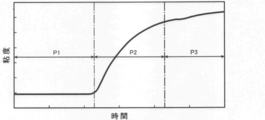
- FIG. 3 is a diagram showing the relationship between the viscosity of the raw material composition and time in the present embodiment.
- a period P1 from the injection of the material into the cavity until the filling is completed corresponds to an induction period from when the material is heated to start curing.
- the curing process is divided into two stages, that is, an initial curing stage P2 from when the material starts to cure by applying heat to the curing stage, and an early curing stage P3 when the curing is completed.
- the induction period P1 the viscosity of the raw material composition remains low and remains unchanged.
- the initial curing stage P2 the viscosity of the raw material composition changes significantly from low to high, and in the late curing stage P3, the viscosity remains high. It rises moderately.
- the pressure holding start time T can be determined.
- the raw material composition is contained in the cavity 21 of the mold 20. It is necessary to incorporate a device for measuring the viscosity. This is not realistic because the mold 20 is enlarged, the mechanism is complicated, and the production cost is significantly increased.
- the raw material composition in the present embodiment starts to shrink simultaneously with thickening at the initial stage of curing P2. Therefore, the pressure holding start time T can be appropriately determined by detecting the time for starting to contract.
- the plunger 11 is advanced to fill the cavity 21 of the mold 20 with the thermosetting composition, and the time t 1 required for filling is set. When the filling is completed, the plunger 11 stops.
- t 1 + t 2 + t 3 total time required for the filling step and the thermosetting step
- t 1 + t 2 + t 3 total time required for the filling step and the thermosetting step
- the mold release process corresponds to FIG.
- the cured product in the cavity can be taken out. If the releasability is poor, an ejector mechanism may be provided in the mold as appropriate.
- the cured product (thermosetting resin) of the present invention can be obtained by polymerizing and curing the above-described thermosetting composition of the present invention with heat, preferably cured by the production method of the present invention. It is a thing.
- cured material of this invention can be utilized suitably as a reflecting material etc. for optical semiconductor light-emitting devices, for example.
- the reflective material using the cured product of the present invention does not decrease the reflectance even when used for a long time, has a high visible light region reflectance, excellent heat resistance and weather resistance, and excellent adhesion to peripheral members. .
- the reflective material of the present invention has a high reflectance in the visible light region, and the decrease in reflectance is small even when used for a long time.
- the light reflectance at a wavelength of 450 nm of the reflective material of the present invention is preferably 85% or more, more preferably 90% or more, still more preferably 93% or more as an initial value, after a deterioration test at 150 ° C. for 1,000 hours.
- the amount of decrease in the light reflectance from the initial reflectance is preferably 20% or less, more preferably 15% or less, and even more preferably 10% or less.
- the light reflectance is obtained by the method described in the examples.
- the optical semiconductor light emitting device of the present invention includes the reflective material of the present invention described above. Other configurations of the optical semiconductor light emitting device can be known ones.
- the optical semiconductor element mounting substrate and the optical semiconductor light emitting device of the present invention will be further described with reference to the drawings.
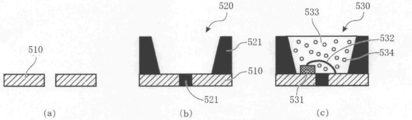
- FIG. 4 is a schematic sectional view showing one embodiment of the optical semiconductor element mounting substrate and the optical semiconductor device of the present invention.
- FIG. 4A shows the lead frame 510.
- FIG. 4B shows an optical semiconductor element mounting substrate 520 in which a resin molded body is molded as the reflecting material 521 on the lead frame 510 of FIG.
- the optical semiconductor element mounting substrate 520 has a recess composed of a bottom surface made of the lead frame 510 and the reflective material 521 and an inner peripheral side surface made of the reflective material 521.
- the resin molded body constituting the reflecting material 521 is obtained by curing the composition of the present invention.
- FIG. 4C shows an optical semiconductor element 531 mounted on the lead frame of the optical semiconductor element mounting substrate of FIG. 4B, and the optical semiconductor element 531 and the other lead frame on which the optical semiconductor element 531 is not mounted.
- the optical semiconductor light emitting device 530 is bonded with a wire 532 and the recess is sealed with a transparent resin (sealing resin) 533.
- a phosphor 534 for converting light emission of blue or the like into white may be included in the sealing resin.
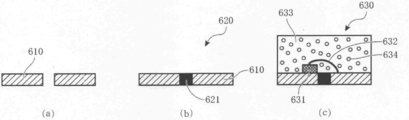
- FIG. 5A shows the lead frame 10.
- FIG. 5B shows an optical semiconductor element mounting substrate 620 in which a resin molded body is molded as the reflective material 621 between the lead frames 610 of FIG.
- the optical semiconductor element mounting substrate 620 includes a lead frame 610 and the reflector 621 of the present invention between the lead frames 610.
- FIG. 5 (c) shows an optical semiconductor light emitting device 630 provided with the optical semiconductor element mounting substrate of FIG. 5 (b).
- the sealing resin portion made of the transparent sealing resin 633 is collectively cured and molded by a method such as transfer molding or compression molding. After the optical semiconductor element 631 is sealed, it is separated into pieces by dicing.
- a phosphor 634 for converting light emission of blue or the like into white may be included in the sealing resin.
- sealing resin is comprised from an epoxy resin, a silicone resin, an acrylate resin etc., for example.
- Example 1-30 and Comparative Example 1-10 Thermosetting compositions were prepared with the raw materials and composition ratios shown in Table 1-4, and molded products were obtained under molding conditions A or B shown below.
- the liquid component and the additive component were weighed and mixed and stirred.
- each inorganic component was weighed and added, and finally stirred to obtain a composition.
- the order of blending the inorganic components was the order of the (H) component, (G) component, (C) component, and (B) component.
- As the stirring device a stirring device capable of stirring by rotation and revolution was used. As the number of rotations, the rotation time was 1000 rpm and the revolution time of 2000 rpm was 1 minute.
- Molding machine Liquid transfer molding machine G-Line, manufactured by Apic Yamada Co., Ltd.
- Low temperature flow path temperature 25 ° C
- blocking method Manual blocking using a syringe Channel temperature and cavity temperature in the high temperature part: measured at 150 ° C. when perbutyl E was used as an additive, and at 130 ° C. when perhexa HC was used as an additive .
- Filling time 10 seconds
- Holding pressure time 15 seconds
- Holding pressure 5 MPa Curing time: 90 seconds
- Molding machine Liquid thermosetting resin injection molding machine LA-40S, manufactured by Sodick Co., Ltd.
- Low-temperature channel temperature 15 ° C
- Flow path and heat shutoff method use of shut-off nozzle Flow path temperature and cavity temperature in high temperature part: measured at 150 ° C. when perbutyl E was used as an additive, and at 130 ° C. when perhexa HC was used as an additive.
- Filling time 10 seconds
- Filling pressure 2 MPa (filling time priority) Holding pressure time: 15 seconds Holding pressure: 5 MPa Curing time: 90 seconds
- thermosetting composition Each component used for the preparation of the thermosetting composition is as follows: [Component (A): (Meth) acrylate Compound] AM: adamantyl methacrylate (M-104, manufactured by Idemitsu Kosan Co., Ltd., viscosity at 25 ° C .: 10 mPa ⁇ s) IBMA: 1-isobornyl methacrylate (IB-X, manufactured by Kyoeisha Chemical Co., Ltd., viscosity at 25 ° C .: 10 mPa ⁇ s)
- CRS1085-SF630 spherical silica with an average particle size (D50) of 15 ⁇ m (manufactured by Tatsumori Co., Ltd.)
- CR1015-MSR35TS Spherical silica with an average particle size (D50) of 15 ⁇ m (manufactured by Tatsumori Co., Ltd.)
- CRS1035-LER4 Tatsumori Co., Ltd.
- Spherical silica with an average particle diameter (D50) of 2 ⁇ m TS12-046HA Spherical silica with an average particle diameter (D50) of 15 ⁇ m (manufactured by Nippon Steel & Sumikin Materials Co., Ltd., Micron Company)
- PC-3 Titanium oxide (Ishihara Sangyo Co., Ltd.) average particle size 0.2 ⁇ m
- TP-A Talc (Fuji Talc Industrial Co., Ltd.) average particle size 5 ⁇ m
- Tinuvin 765 UV absorber (manufactured by BASF Japan Ltd.)
- StMg Magnesium stearate (Nippon Yushi Co., Ltd.)
- StZn Zinc stearate (manufactured by Dainichi Chemical Co., Ltd.)
- Parable E Organic peroxide (Nippon Yushi Co., Ltd.) Perhexa HC: Organic peroxide (manufactured by NOF Corporation)
- Viscosity measuring method Melt viscosity was measured about the prepared composition using the viscoelasticity measuring apparatus on condition of the following.
- normal force may be applied within a range in which the thickness does not change.
- the mold for moldability evaluation is width (10 mm) X length (50 mm) X thickness (1 mm), and the width (5 mm) X length (10 mm) X at the flow end.
- a mold having a vent with a thickness (0.03 mm) was used.
- die for characteristic evaluation used the metal mold
- (3-1) Formability evaluation As a formability evaluation, whether or not a short circuit occurred was confirmed. If the mold is set to a predetermined temperature and both voids and unfilled parts are visually observed in the molded product in the process of filling between 10 and 15 seconds, x is generated.
- LED current test (light resistance evaluation) A test piece of a cured product is fixed on an LED package on which a blue LED (manufactured by Genelights Co., Ltd., trade name: OBL-CH2424) is mounted, and light is emitted by energizing for 1 week at a current value of 150 mA at an ambient temperature of 60 ° C. Then, the light irradiation surface of the LED of the cured product test piece thereafter was visually observed and evaluated according to the following criteria. ⁇ : No color change ⁇ : Light irradiation surface turns brown
- composition and cured product of the present invention can be suitably used as a raw material for a reflective material for an optical semiconductor light emitting device.
Landscapes
- Chemical & Material Sciences (AREA)
- Health & Medical Sciences (AREA)
- Chemical Kinetics & Catalysis (AREA)
- Medicinal Chemistry (AREA)
- Polymers & Plastics (AREA)
- Organic Chemistry (AREA)
- Engineering & Computer Science (AREA)
- Manufacturing & Machinery (AREA)
- Mechanical Engineering (AREA)
- Materials Engineering (AREA)
- Inorganic Chemistry (AREA)
- Compositions Of Macromolecular Compounds (AREA)
- Macromonomer-Based Addition Polymer (AREA)
- Graft Or Block Polymers (AREA)
- Addition Polymer Or Copolymer, Post-Treatments, Or Chemical Modifications (AREA)
- Led Device Packages (AREA)
- Manufacture Of Macromolecular Shaped Articles (AREA)
- Moulds For Moulding Plastics Or The Like (AREA)
- Injection Moulding Of Plastics Or The Like (AREA)
- Polymerisation Methods In General (AREA)
Abstract
Description
代表的な白色顔料である酸化チタンを使用すると、熱硬化性組成物の粘度が上がりやすく液の流動性が損なわれる。液の流動性が悪いと、リードフレームに樹脂成形品を形成した際に、リードフレーム成形体に反り又はリフレクターの未充填、ボイドもしくはバリを生じるため、発光装置の量産性に課題があった。また、熱硬化性組成物を常温で保管しても連続成形性に影響が少ないことも求められている。
本発明の他の目的は、リードフレームにリフレクターを成形する際に、得られる成形品の未充填及びボイド発生を防ぎ、バリの発生を抑制する、連続成形性に優れる熱硬化性組成物の成形方法及び熱硬化樹脂の製造方法を提供することである。
1.下記成分(A)~(C)を含み、
25℃で10s-1のせん断粘度が1Pa・s以上500Pa・s以下であり、25℃で100s-1のせん断速度が0.3Pa・s以上100Pa・s以下である熱硬化性組成物。
(A)25℃での粘度が1~300mPa・sである、置換又は無置換の、炭素数6以上の脂環式炭化水素基がエステル結合した(メタ)アクリレート化合物
(B)球状シリカ
(C)白色顔料
2.前記成分(A)~(C)の合計100質量%に対して、成分(B)の含有量が10~90質量%であり、成分(C)の含有量が3~50質量%である1に記載の熱硬化性組成物。
3.前記(メタ)アクリレート化合物が、置換もしくは無置換のアダマンチル基、置換もしくは無置換のノルボルニル基、置換もしくは無置換のイソボニル基、及び置換もしくは無置換のジシクロペンタニル基から選ばれる1種以上の脂環式炭化水素基がエステル結合した(メタ)アクリレート化合物である1又は2記載の熱硬化性組成物。
4.さらに下記成分(D)~(F)から選択される成分を1以上含み、
前記成分(A)~(F)の合計100質量%に対して、成分(C)の含有量が3~50質量%であり、成分(B)の含有量が10~90質量%である1~3のいずれかに記載の熱硬化性組成物。
(D)(メタ)アクリル酸又は極性基を有する単官能(メタ)アクリレート化合物
(E)前記成分(A)及び(D)以外の単官能(メタ)アクリレート化合物
(F)前記成分(A)以外の多官能(メタ)アクリレート化合物からなる群から選ばれる1種以上の化合物
5.前記球状シリカが(メタ)アクリルシラン表面処理されている1~4のいずれか記載の熱硬化性組成物。
6.前記球状シリカの一次粒子平均粒径が0.1~100μmである1~5のいずれか記載の熱硬化性組成物。
7.さらに下記成分(G)及び(H)から選択される成分を1以上含む1~6のいずれかに記載の熱硬化性組成物。
(G)板状フィラー
(H)ナノ粒子
8.1~7のいずれかに記載の熱硬化性組成物をプランジャー内に供給する工程、
前記プランジャー内に充填された前記熱硬化性組成物を前記プランジャーにより、金型内のキャビティに充填する工程、
前記キャビティ内で前記熱硬化性組成物を熱硬化する工程、及び
熱硬化した熱硬化性樹脂を押し出す工程、
を含む熱硬化性樹脂の製造方法。
9.前記キャビティ部の金型温度が100℃以上180℃以下である8に記載の熱硬化性樹脂の製造方法。
10.前記プランジャー内に充填された前記熱硬化性組成物を前記プランジャーにより、金型内のキャビティに充填する工程において、50℃以下に温度制御された流動路を介して前記熱硬化性組成物を金型内のキャビティに充填する8又は9に記載の熱硬化性樹脂の製造方法。
11.前記プランジャー内に充填された前記熱硬化性組成物を前記プランジャーにより、金型内のキャビティに充填する工程において、前記プランジャー及びキャビティ間の流道路に前記熱硬化性組成物の流動と熱の授受を遮断するゲートシステムを有する8~10のいずれかに記載の熱硬化性樹脂の製造方法。
12.前記ゲートシステムのゲートを開き、金型内のキャビティに前記熱硬化性組成物を充填し、
前記熱硬化が、硬化開始後に前記熱硬化性組成物の注入圧を高め、硬化完了前に保圧を実施し、保圧完了後、前記ゲートシステムのゲートを閉じて熱硬化を完了する11に記載の熱硬化性樹脂の製造方法。
13.前記充填工程と前記熱硬化工程を0.2分~3分以内に行う8~12のいずれかに記載の熱硬化性樹脂の製造方法。
本発明によれば、リードフレームにリフレクターを成形する際に、得られる成形品の未充填及びボイドの発生を防ぎ、バリの発生を抑制する連続成形性に優れる熱硬化性組成物の成形方法及び熱硬化樹脂の製造方法を提供できる。
本発明の熱硬化性組成物は、下記成分(A)~(C)を含み、25℃で10s-1のせん断粘度が1Pa・s以上500Pa・s以下であり、25℃で100s-1のせん断速度が0.3Pa・s以上100Pa・s以下である。
(A)25℃での粘度が1~300mPa・sである、置換又は無置換の、炭素数6以上の脂環式炭化水素基がエステル結合した(メタ)アクリレート化合物。
(B)球状シリカ
(C)白色顔料
各せん断速度を満たさず、低い場合、多量のバリが発生し、成形面ではバリ取り作業が発生するおそれがあり、製品上は外観不良となり望ましくない。一方、高い場合、成形品が未充填となって製品に外観不良が発生するおそれがあり、望ましくない。
100s-1のせん断速度及び10s-1のせん断速度はそれぞれ、キャビティ内に材料を注入する前期と後期に対応しており、それぞれの値が低い場合は、それぞれの状態でバリが発生し、高い場合はそれぞれの状態で未充填となるため、両せん断速度での粘度を上記範囲内とする。
組成物の粘度を上記範囲とすることは、組成物が含む各成分の配合量を適宜調整することにより可能となる。また、組成物のせん断粘度は、粘弾性測定装置により確認できる。
[成分(A):25℃での粘度が1~300mPa・sである、置換又は無置換の、炭素数6以上の脂環式炭化水素基がエステル結合した(メタ)アクリレート化合物]
本発明の組成物は、成分(A)として25℃での粘度が1~300mPa・sである、置換又は無置換の、炭素数6以上の脂環式炭化水素基がエステル結合した(メタ)アクリレート化合物(以下、化合物(A)と呼ぶ場合がある)を含む。
化合物(A)は、ガラス転移点が高い重合体を与えることから、組成物中に含むことにより、組成物を光半導体用の反射材の原料として用いた場合に、耐熱性、耐光性を向上させることができる。
炭素数6以上の脂環式炭化水素基置換基は置換基を有していてもよく、置換又は無置換の炭素数6以上の脂環式炭化水素基として、例えば、置換又は無置換のアダマンチル基、置換又は無置換のノルボルニル基、置換又は無置換のイソボニル基、置換又は無置換のジシクロペンタニル基、並びに置換又は無置換のシクロヘキシル基が挙げられる。
化合物(A)は、好ましくは下記一般式で表されるアダマンチル基を有する(メタ)アクリレート化合物(I)、イソボルニル基を有する(メタ)アクリレート化合物(II)、ノルボル基を有する(メタ)アクリレート化合物(III)、又はジシクロペンタニル基を有する(メタ)アクリレート化合物(IV)である。

Xは、それぞれ独立に、単結合、炭素数1~4のアルキレン基、又は炭素数1~4のオキシアルキレン基を示す。
炭素数1~4のアルキレン基としては、例えば、メチレン基、エチレン基、トリメチレン基、プロピレン基、テトラメチレン基、ブチレン基、2-メチルトリメチレン基等が挙げられる。
炭素数1~4のオキシアルキレン基としては、例えば、オキシメチレン基、オキシエチレン基、オキシプロピレン基、オキシブチレン基等が挙げられる。これらのXの中でも耐熱性の観点から、単結合が好ましい。
Uは水素原子、炭素数1~4のアルキル基、ハロゲン原子、水酸基、又は2つのUが一緒になって形成された=Oを示す。kは1~15の整数を示す。lは1~8の整数を示す。mは1~11の整数を示す。nは1~15の整数を示す。
尚、式中にUが複数ある場合、複数のUは互いに同じでもよく、異なっていてもよい。)
置換もしくは無置換の炭素数6以上の脂環式炭化水素基がエステル結合した(メタ)アクリレート化合物は、1種を単独で用いてもよく、2種以上を組み合わせて用いてもよい。
化合物(A)の粘度は、例えば、レオメーターや回転式粘度計により測定できる。
成分(B)として球状シリカ(SiO2)を含む。
後述するチタン酸バリウム等の(C)白色顔料は、液中で沈殿し易く使用できる量が限られるが、球状シリカを組み合わせて使用することで組成物中の無機物の含有量をより多くすることができ、材料強度、反射率、耐熱性、耐光性をより向上させることができる。
また、組成物の流動性を保持し、成形する際の充填性を高めることができる。
球状シリカの表面の水酸基にシランカップリング剤(特にアクリル系シランカップリング剤)を反応させ有機修飾することで、球状シリカのぬれ性を向上させることができ、組成物において有機成分(成分(A)及び任意成分(D)、(E)及び(F))中への球状シリカの分散性を向上し、また硬化物強度を向上することができる。
組成物中の球状シリカの含有量が、上記合計質量%に対して10質量%未満であると低粘度になりバリや常温保管性が損なわれ、物性としては材料強度が確保できないおそれがあり、90質量%よりも多いと高粘度になり流動性が損なわれるおそれがある。
本発明の組成物は、成分(C)として白色顔料を含む。
白色顔料の具体例としては、チタン酸バリウム、酸化ジルコニウム、酸化亜鉛、窒化ホウ素、二酸化チタン、アルミナ、硫化亜鉛、酸化マグネシウム、チタン酸カリウム、硫酸バリウム、炭酸カルシウム、シリコーン粒子等が挙げられる。これらのうち、高い反射率及び入手容易性の観点からは、チタン酸バリウム、酸化ジルコニウム、酸化亜鉛、窒化ホウ素、二酸化チタンが好ましく、より高い反射率の観点からは二酸化チタンが好ましい。白色顔料は単独で又は2種以上を組み合わせて使用することができる。
尚、二酸化チタンの結晶型にはルチル型及びアナターゼ型が存在するが、アナターゼ型は光触媒機能を有するため樹脂を劣化させる懸念があるので、本発明においてはルチル型が好ましい。
組成物中の白色顔料の含有量が、上記合計質量%に対して3質量%未満であると白色度が損なわれるおそれがあり、50質量%よりも多いと高粘度になり流動性が損なわれるおそれがある。
成分(D):(メタ)アクリル酸、又は極性基を有する単官能(メタ)アクリレート化合物
成分(E):成分(A)及び(D)以外の単官能(メタ)アクリレート化合物
成分(F):成分(A)以外の多官能(メタ)アクリレート化合物
以下、成分(D)を化合物(D)、成分(E)を化合物(E)、成分(F)を化合物(F)と言う場合がある。
本発明の組成物における化合物(A)の含有量は、成分(D)、(E)及び(F)が存在する場合、化合物(A)、(D)、(E)及び(F)の合計を100質量%として、好ましくは10~70質量%、より好ましくは15~60質量%、さらに好ましくは20~50質量%である。
化合物(D)は、(メタ)アクリル酸、又は極性基を有する単官能(メタ)アクリレート化合物である。炭素数6以上の脂環式炭化水素基が結合したものではなく、化合物(A)とは重複しない。
化合物(D)は極性を有するため、組成物が含有することにより、極性を有する金属表面等と水素結合等を形成して密着性が向上し、また、極性基の存在により、ぬれ性が向上する。尚、アルキレングリコール基が密着性付与に関与する場合もあり得るが、アルキレングリコール(メタ)アクリレートは化合物(D)には含まれないものとする。
[成分(F):成分(A)以外の多官能(メタ)アクリレート化合物]
化合物(E)は、化合物(A)及び(D)以外の単官能(メタ)アクリレート化合物である。本発明の組成物において化合物(E)を含有することにより、粘度や硬化物硬度を調整でき、また、クラックの発生等を抑制することができる。
また、化合物(F)は、化合物(A)以外の多官能(メタ)アクリレート化合物である。化合物(A)、(D)及び(E)以外の多官能(メタ)アクリレート化合物を、機械的強度や硬化速度の観点から、本発明の効果を阻害しない範囲で組成物中に含有してもよい。
本発明に用いることができる脂肪族炭化水素基を有する(メタ)アクリレートを誘導しうる脂肪族炭化水素化合物としてはアルカンが好ましく、本発明の硬化物の物性の観点からは、炭素数12以上のアルカンがより好ましい。
当該化合物の数平均分子量は、靭性や密着性の観点、並びに成分(A)及び(D)との相溶性の観点から、好ましくは400~10,000、より好ましくは450~5,000、さらに好ましくは500~3,000である。
本発明の組成物における化合物(E)の含有量は、靭性や密着性の観点から、化合物(A)、(D)、(E)及び(F)の合計を100質量%として、好ましくは10~80質量%、より好ましくは15~60質量%、さらに好ましくは15~50質量%である。
本発明の組成物における化合物(F)の含有量は、本発明の効果を阻害しない観点から、化合物(A)、(D)、(E)及び(F)の合計を100質量%として、好ましくは5~60質量%、より好ましくは10~45質量%、さらに好ましくは15~40質量%である。
(G)板状フィラー
(H)ナノ粒子
成分(G)である板状フィラーを含有することにより、組成物の粘度や得られる硬化物の硬度を調整でき、また、組成物成形時のバリを抑制することができる。
板状フィラーとしては、タルク、カオリン、マイカ、クレイ、セリサイト、ガラスフレーク、合成ハイドロタルサイト、各種金属箔、黒鉛、二硫化モリブデン、二硫化タングステン、窒化ホウ素、板状酸化鉄、板状炭酸カルシウム、板状水酸化アルミニウム等が挙げられる。なかでも、タルク、カオリン、マイカ、クレイ、黒鉛、及びガラスフレークが好ましく、配合により反射率の低下が見られない点でタルクがより好ましい。
尚、板状フィラーは、1種を単独で、又は2種以上を組み合わせて使用することができる。
ナノ粒子としては、銀、金、ケイ素、炭化ケイ素、シリカ、酸化銅、酸化鉄、酸化コバルト、炭化チタン、酸化セリウム、ITO、ATO、ヒドロキシアパタイト、グラフェン・酸化グラフェン、単層カーボンナノチューブ、多層カーボンナノチューブ、フラーレン、ダイヤモンド、メソポーラスカーボンなどがある。好ましくは、炭化ケイ素、シリカ、炭化チタンが好ましく、白色度を維持できるという点でシリカ、炭化チタンがより好ましい。
尚、ナノ粒子は、1種を単独で、又は2種以上を組み合わせて使用することができる。
熱硬化性組成物の25℃で10s-1のせん断粘度を1Pa・s以上500Pa・s以下、25℃で100s-1のせん断速度を0.3Pa・s以上100Pa・s以下とする観点から、熱硬化性組成物中の成分(A)、(D)、(E)及び(F)の含有量は、(A)~(H)との合計100質量%に対して7~50質量%であり、7~35質量%であることが好ましく、8~25質量%がより好ましく、熱硬化性組成物中の成分(B)、(C)、(G)及び(H)の含有量は、(A)~(H)との合計100質量%に対して50~93質量%であり、60~93質量%であることがより好ましく、75~92質量%であることがさらに好ましい。
熱硬化性組成物の粘度を上記粘度範囲に調整することで連続成形性に優れ、得られる成形品のバリの発生を抑制することができる。
本発明の熱硬化性組成物は、成分(A)~(H)の含有量の合計が、例えば85重量%以上、95重量%以上、又は99重量%以上であってよく、成分(A)~(H)のみからなってもよい。
本発明の熱硬化性組成物は、上記成分(A)~(H)の他に、添加剤として重合開始剤、酸化防止剤、光安定剤、紫外線吸収剤、可塑剤、無機充填剤、着色剤、帯電防止剤、滑剤、離型剤、難燃剤、レベリング剤、消泡剤等を本発明の効果を阻害しない範囲で含むことができる。これら添加剤は公知のものを使用できる。
以下、本発明の組成物に好適な添加剤について説明する。
本発明の組成物を熱で重合させることにより硬化物を得ることができる。重合反応を促進するため、組成物には重合開始剤を含有させてもよい。重合開始剤は特に限定されないが、例えば、ラジカル重合開始剤が挙げられる。
ラジカル重合開始剤としては、特に限定されないが、例えば、ケトンパーオキサイド類、ハイドロパーオキサイド類、ジアシルパーオキサイド類、ジアルキルパーオキサイド類、パーオキシケタール類、アルキルパーエステル類(パーオキシエステル類)、パーオキシカーボネート類等が挙げられる。
本発明の組成物におけるラジカル重合開始剤の含有量は、成分(A)~(H)の合計100質量部に対して、好ましくは0.01~10質量部、より好ましくは0.1~5質量部である。
酸化防止剤としては、フェノール系酸化防止剤、リン系酸化防止剤、硫黄系酸化防止剤、ビタミン系酸化防止剤、ラクトン系酸化防止剤、アミン系酸化防止剤等が挙げられる。
ラクトン系酸化防止剤としては、特開平7-233160号公報、特開平7-247278号公報に記載されているものを使用できる。また、HP-136(商品名、BASF社製、化合物名:5,7-ジ-t-ブチル-3-(3,4-ジメチルフェニル)-3H-ベンゾフラン-2-オン)等を使用することもできる。
光安定剤としては、紫外線吸収剤やヒンダードアミン系光安定剤等、任意のものを使用できるが、好ましくはヒンダードアミン系光安定剤である。
ヒンダードアミン系光安定剤の具体例としては、ADK STAB LA-52、LA-57、LA-62、LA-63、LA-67、LA-68、LA-77、LA-82、LA-87、LA-94(以上、ADEKA製)、Tinuvin 123、144、440、662、765、770DF、Tinuvin XT 850 FF、Tinuvin XT 855 FF、Chimassorb 2020、119、944(以上、BASF社製)、Hostavin N30(Hoechst社製)、Cyasorb UV-3346、UV-3526(Cytec社製)、Uval 299(GLC社製)、Sanduvor PR-31(クラリアント社製)等を挙げることができる(いずれも商品名)。
内部離型剤には(メタ)アクリレート化合物に対して溶解して良分散し、さらに、硬化する際に低粘度の溶融状態であることで分子運動しやすく、硬化時、硬化する樹脂成分から分離され、金型と硬化成分との間に存在することで、離型性を有するようになり、また、離型時、溶融状態で低粘度であることがより離型性を高められることが求められる。内部離型剤として特に指定はないが、脂肪族化合物が望ましい。

Wは、水素原子、金属原子又は炭素数1~8の炭化水素基を示す。
尚、Wが金属原子である場合、OとWはイオン結合している。)
尚、Wがアルカリ土類金属やアルミニウムの場合、2価以上となるため、脂肪族化合物の式(V)は(R4-CO-O)q-Wで表され、qが2~4となる。
脂肪族不飽和炭化水素基中の多重結合数は1つでもそれ以上でもよい。Wの脂肪族炭化水素基の炭素数は1~8である。炭素数が8以上の場合は脂肪族化合物の融点の上昇や溶解性の低下を招き、脂肪族化合物が硬化時樹脂成分中に取り込まれたり、偏在したりして、離型性が発現しなかったり、不透明になったりするおそれがある。Wの脂肪族炭化水素基の好ましい炭素数は1~6である。
また、本発明の組成物は、成形時の使用温度下で使用できる時間が長くすることができる材料である。
トランスファー成形の場合、トランスファー成形機を用いて、例えば、型締め力5~20kN、成形温度100~190℃で成形時間30~500秒、好ましくは成形温度100~180℃で成形時間30~180秒で成形することができる。圧縮成形の場合、コンプレッション成形機を用いて、例えば、成形温度100~190℃で成形時間30~600秒、好ましくは成形温度110~170℃で成形時間30~300秒で成形することができる。いずれの成形法においても、後硬化を例えば150~185℃で0.5~24時間行ってもよい。
液状射出成形を用いて、例えば、型締め力10kN~40kN、成形温度成形温度100~190℃で成形時間30~500秒、好ましくは成形温度100~180℃で成形時間20~180秒で成形することができる。
また、本発明の組成物をトランスファー成形、圧縮成形、液状樹脂射出成形、インサート成形等で成形する際、予備重合を行ってもよい。
本発明の熱硬化性樹脂の製造方法は、下記工程(1)~(4)を含む:
(1)本発明の熱硬化性組成物をプランジャー内に供給する工程
(2)プランジャー内に充填された熱硬化性組成物をプランジャーにより、金型内のキャビティに充填する工程
(3)キャビティ内で熱硬化性組成物を熱硬化する工程
(4)熱硬化した熱硬化性樹脂を取り出す工程
本発明の成形方法では、スクリュータイプ射出成形機ではなくプランジャーを備えるプランジャータイプ射出成形機を使用することで、低粘度組成物であっても漏れ(バックバックフロー)や液抜け現象の発生を防止できる。また、キャビティ内で熱硬化するので酸素不存在下での熱硬化が可能である。従って、本発明の成形方法は、本発明の熱硬化性樹脂の成形方法として好ましい。
図1の成形機は、本発明の熱硬化性組成物を金型に押し出すプランジャー機構を有する射出成形機であって、図1に示すプランジャー11を有する充填装置10と、図2(A)に示すキャビティ21とを備えた金型20を備え、図示は省略するが、金型20内のキャビティ21を脱気するための細孔に接続された脱気手段としての減圧装置と、金型20に接続された加熱手段としての加熱装置と、冷却装置とを備える。成形材料は、本発明の熱硬化性樹脂である。
図2に示す装置を用いて本発明の成形方法を実施する場合、ニードル223及び開口部222が上記ゲートシステムに対応する。上述したようにニードル223が可動金型23側に移動し、開口部222を閉鎖することによって導入路221が加熱部22Aの手前で分断され、導入路221に導入された組成物が冷却部22B内に留まり、組成物の流動と熱の授受を遮断できる。組成物の流動と熱の授受を遮断できるシステムとして、バルブゲートシステムやシャットオフノズルシステム等がある。
加熱装置は、加熱部22A及び可動金型23を加熱する装置である。これらの加熱により、キャビティ232内の温度(「キャビティ温度」とも言う)を所定の温度とすることができる。本発明の成形方法では、好ましくはキャビティ部の金型温度を100℃以上180度以下とする。
冷却装置は、原料組成物の流動路を冷却する装置である。具体的には、充填装置10及び金型20の冷却部22Bを10℃以上、50℃以下に冷却するとよい。
尚、射出成形の場合、図1のニードル15と図2のニードル223、図1の流動経路13と図2の導入路221は対応している。
成形をトランスファー成形や圧縮で行う場合は、シリンジなどの供給装置を用いて金型内のプランジャ―部に材料を適量挿入することにより計量できる。
成形を射出成形で行う場合は、原料組成物を図示しない投入口から図1に示した充填装置10に注入する。投入された原料組成物は、流動部12に押し出され、ついでプランジャー11にて所定量が計量される。計量が終了後もしくは射出前に、スクリュー12が前進し、プランジャー11が動作する際の逆止弁となる機能を有している。この間、流動路は冷却装置により冷却されているため、原料組成物は硬化することなくスムーズに流動する。
充填工程は図2(B)に対応する。
熱硬化性組成物をキャビティに注入する際に、キャビティ内の空気を逃がすベントあるいは、図2の減圧管240のような減圧装置に接続されキャビティ内を減圧可能にする細孔を備えたキャビティ内を減圧しておく必要がある。理由は、熱硬化性組成物をキャビティに注入し、完全に充填する過程で、ベントはキャビティ内の空気を逃がすためであり、キャビティ内減圧は空気が無い状態にすることで完全に充填できるようにするためである。この機構が無い場合は、材料の充填時にキャビティ内のエアーが抜けてくれる機構が必要である(例えばベント機構)。
熱硬化性組成物を成形するには、まず、可動金型23を固定金型22に近接させ、型締を行う(図2(A))。可動金型23の弾性部材238が固定金型22の弾性部材224に当接する位置で一旦可動金型23の移動を止める。
尚、射出成形機を使用する場合は、射出部からキャビティへの注入を開始する際、シャットオフノズル(場合によってはバルブゲート)のノズルを開き、射出部のプランジャーを可動させ、熱硬化成分をキャビティ内に注入する。トランスファー成形機を用いる場合は、プランジャー内からキャビティ部まですべてを硬化させるため、材料のキャビティへの流動が可能であればよく、熱の授受を遮断する必要はない。
硬化工程は図2(C)が対応する。
キャビティ21への原料組成物の充填が完了すると、同時に原料組成物の硬化が開始されるが、成形品の転写性を向上するためには、所定の圧力を加えて硬化させることが必要である。すなわち、プランジャー11を1.0MPa以上15MPa以下に加圧した状態であることが好ましい。転写性を向上するために、原料組成物に加えるこの圧を保圧と言う。
硬化工程は、好ましくは硬化開始後に熱硬化性組成物の注入圧を高め、硬化完了前に保圧を実施し、保圧完了後、ゲートシステムのゲートを閉じて熱硬化を行う。具体的にゲートの閉じ方は、ニードル223を前進させ開口部222を閉鎖する。成形過程において、冷却装置を作動させ、原料組成物の流動路全域、すなわち、成形機の充填装置10及び金型20の固定金型22に設けられた冷却部22Bを冷却する。この際、流動路全域が10℃以上、50℃以下に維持することが好ましく、特に好ましくは30℃以下に設定される。
しかし、本実施形態の原料組成物のように低粘度の材料においては、材料粘度が低粘度の状態で圧を加えると、低粘度材のゆえ、固定金型22と可動金型23の隙間から材料が漏れ出し硬化する(バリ)不良現象や、押出ピンまわりの隙間等に原料組成物が浸透することによる押出ピンの動作不良等が発生する。一方、硬化初期P2で粘度が高くなった状態や、硬化後期P3の状態で圧を加えても、原料組成物の粘度が高いため圧縮変形することができず転写性を向上させることはできない。従って、転写性の高い成形品を得るためには、保圧開始のタイミング(保圧開始時刻T)を硬化工程の誘導期P1から硬化初期P2に移行するタイミングに合わせる必要がある。
本実施形態における原料組成物は、硬化初期P2で増粘すると同時に収縮し始める。従って、収縮し始める時間を検出すれば、保圧開始時刻Tを適切に決めることができる。
一定時間の保圧完了後、図2(C)に示すようにニードル223を前進させて開口部222を閉塞し、未硬化部分が発生しないよう、一定時間加熱して原料組成物を完全に硬化させる。
ここでプランジャー11を前進させて金型20のキャビティ21内に熱硬化性組成物を充填し、充填に要した時間t1とする。充填が完了すると、プランジャー11は停止する。また、原料組成物の硬化が開始されると、同時に熱硬化性組成物の収縮が発生するため、充填工程完了後停止していたプランジャー11が再度前進を開始する。充填工程完了から、収縮によりプランジャー11が再度前進開始するまでに要した時間t2とする。さらに加熱して原料組成物を完全に硬化させるのに要する時間をt3とした場合、t1+t2+t3(充填工程と熱硬化工程に要する合計時間)は、好ましくは0.2分~3分とする。更に好ましくは0.2分~2分である。0.2分以下の場合、未硬化が発生する恐れがあり、3分以上の場合は量産性の観点から好ましくない。
離型工程は、図2(D)が対応する。
可動金型23を固定金型22から離すことで、キャビティ内の硬化物を取り出すことができる。離型性が悪い場合は、適宜、イジェクター機構を金型内に設けてよい。
本発明の硬化物(熱硬化性樹脂)は、上記説明した本発明の熱硬化性組成物を熱で重合して硬化することにより得ることができ、好ましくは本発明の製造方法により成形した硬化物である。
本発明の硬化物は、例えば光半導体発光装置用の反射材等として好適に利用することができる。本発明の硬化物を用いた反射材は、長時間使用しても反射率が低下せず、可視光領域の反射率が高く、耐熱性・耐候性に優れ、周辺部材との密着性に優れる。
本発明の光半導体発光装置は、上記説明した本発明の反射材を含む。光半導体発光装置の他の構成は公知のものとすることができる。
本発明の光半導体素子搭載用基板、及び光半導体発光装置をさらに図面を用いて説明する。図4は、本発明の光半導体素子搭載用基板、及び光半導体装置の一実施形態を示す概略断面図である。図4(a)は、リードフレーム510を示す。
図5(a)は、リードフレーム10を示す。
図5(b)は、図5(a)のリードフレーム610の間に反射材621として樹脂成形体を成型した光半導体素子搭載用基板620を示す。光半導体素子搭載用基板620は、リードフレーム610と、リードフレーム610の間に本発明の反射材621とを備えている。
表1-4に示す原料及び組成比で熱硬化性組成物を調製しを、以下に示す成形条件A又はBで成形品を得た。
尚、組成物の調製は、まず、液成分及び添加剤成分をそれぞれ計量し、これらを混合・撹拌した。その次に、無機成分をそれぞれ計量して添加し、最後に撹拌して組成物とした。無機成分を配合する順番は(H)成分、(G)成分、(C)成分、(B)成分の順とした。
撹拌装置としては自転と公転で撹拌できる撹拌装置を用いた。回転数としては自転1000rpmと公転2000rpm回転時間は1分とした。
成形機:液状トランスファー成形機G-Line、アピックヤマダ社製
低温部の流路温度:25℃
流路及び遮断方法:シリンジを用いたマニュアル遮断
高温部の流路温度及びキャビティ温度:添加剤としてパーブチルEを用いた場合は150℃、添加剤としてパーヘキサHCを用いた場合は130℃に測定した。
充填時間:10秒
充填圧力:2MPa(充填時間優先)
保圧時間:15秒
保圧時圧力:5MPa
硬化時間:90秒
成形機:液状熱硬化性樹脂射出成形機LA-40S、(株)ソディック社製
低温部の流路温度:15℃
流路及び熱遮断方法:シャットオフノズル使用
高温部の流路温度及びキャビティ温度:添加剤としてパーブチルEを用いた場合は150℃、添加剤としてパーヘキサHCを用いた場合は130℃に測定した。
充填時間:10秒
充填時圧力:2MPa(充填時間優先)
保圧時間:15秒
保圧時圧力:5MPa
硬化時間:90秒
[成分(A):(メタ)アクリレート化合物]
AM:アダマンチルメタクリレート(M-104,出光興産株式会社製、25℃での粘度:10mPa・s)
IBMA:1-イソボルニルメタクリレート(IB-X,共栄社化学株式会社製、25℃での粘度:10mPa・s)
LA:ラウリルアクリレート(SR335,アルケマ株式会社製)
StMA:ステアリルメタクリレート(共栄社化学株式会社製)
SR351:トリメチロールプロパントリアクリレート(アルケマ株式会社製)
GMA:グリシジルメタクリレート(ブレンマーGH,日本油脂株式会社製)
DCP:トリシクロデカンジメタノールジメタクリレート(新中村化学工業株式会社製)
A-DON-N:1,10-デカンジオールジアクリレート(新中村化学工業株式会社製)
3000MK:ビスフェノールAジグリシジルエーテルメタクリル酸付加物(3000MK,共栄社化学株式会社製)
MMA:メチルメタクリレート(広島和光株式会社製)
CRS1085-SF630:平均粒径(D50)15μmの球状シリカ(株式会社龍森製)
CR1015-MSR35TS:平均粒径(D50)15μmの球状シリカ(株式会社龍森製)
CRS1035-LER4:株式会社龍森 平均粒径(D50)2μmの球状シリカ
TS12-046HA:平均粒径(D50)15μmの球状シリカ(新日鉄住金マテリアルズ株式会社 マイクロンカンパニー製
PC-3:酸化チタン(石原産業株式会社製)平均粒径0.2μm
TP-A:タルク(富士タルク工業株式会社)平均粒径5μm
R711:フュームドシリカ(日本アエロジル株式会社製)粒径5~50nm
Tinuvin765:紫外線吸収剤(BASFジャパン株式会社製)
StMg:ステアリン酸マグネシウム(日本油脂株式会社製)
StZn:ステアリン酸亜鉛(大日化学工業株式会社製)
パーチブルE:有機過酸化物(日本油脂株式会社製)
パーヘキサHC:有機過酸化物(日本油脂株式会社製)
(1)粘度測定方法
調製した組成物について、粘弾性測定装置を用い下記の条件にて溶融粘度を測定した。
装置名:Anton Paar社製 physica MCR301
測定法:プレートープレート
プレート径:25mmφ
温度:25℃
プレート、プレート間隔:0.6mm
せん断速度:1~200(1/s)
このせん断速度領域で10(1/s)と100(1/s)でのせん断粘度を粘度とした。
尚、測定時、すべりが発生し測定できない場合は、厚みが変化しない範囲でノーマルフォースを加えた場合もある。
調製した組成物を2日間25℃にて放置し、その後、使用した金型を用いて成形した際に、ショートやバリが発生しない場合は「○」を、片方が発生している場合は「△」と、両方が発生している場合は「×」と評価した。
成形性評価の金型は、幅(10mm)X長さ(50mm)X厚み(1mm)、流動末端部には幅(5mm)X長さ(10mm)X厚み(0.03mm)のベントを有する金型を使用した。また、特性評価用の金型は幅(50mm)X長さ(50mm)X厚み(2mm)の金型を使用した。
(3-1)成形性評価
成形性評価として、ショートの発生有無を確認した。金型を所定の温度に設定し、10秒から15秒の間に充填させる過程で成形品中に目視にてボイドや、未充填の両方が発生している場合は×、片方が発生している場合は△、どちらも発生していない場合は○と評価した。
(3-2)バリ発生の有無
金型を所定の温度に設定し、10秒から15秒の間に充填させる過程で成形品中に目視にてベント部末端を越えたバリや、ベント部以外の部分からバリが発生している場合は「×」、片方が発生している場合は「△」、どちらも発生していない場合は「○」と評価した。
得られた成形品について、マルチパーパス大型試料室ユニット((株)島津製作所製、商品名:MPC-2200)を取り付けた自記分光光度計((株)島津製作所製、商品名:UV-2400PC)を用いて、硬化物試験片の光反射率を測定した。
青色LED((株)ジェネライツ製、商品名:OBL-CH2424)を実装したLEDパッケージの上に硬化物の試験片を固定し、環境温度60℃下で、電流値150mAで1週間通電して発光させ、その後の硬化物試験片のLEDの光の照射面を目視観察して、以下の基準により評価した。
○:変色なし
×:光の照射面が褐色に変色
得られた成形品について、ISO178に準拠して曲げ弾性率及び曲げ強度を測定した。
硬化物試験片の初期値の光反射率を測定した後、オーブンにて180℃で72時間加熱を行ってから加熱後の硬化物試験片の光反射率を測定した。 初期の反射率から耐熱性試験評価後の反射率との差が5%未満の場合は○とし、5以上10%未満の場合は△とし、10%以上ある場合は×とした。

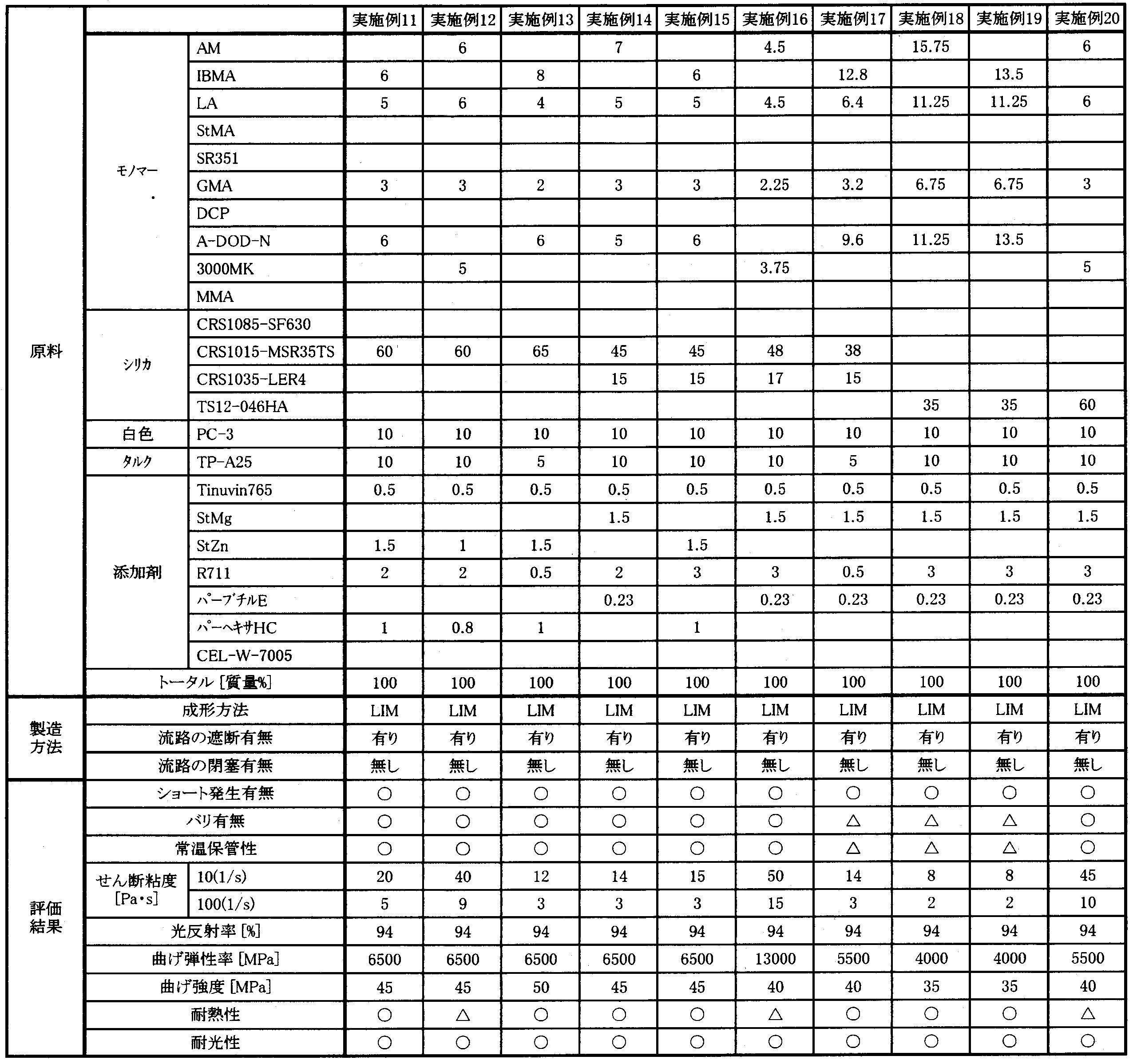
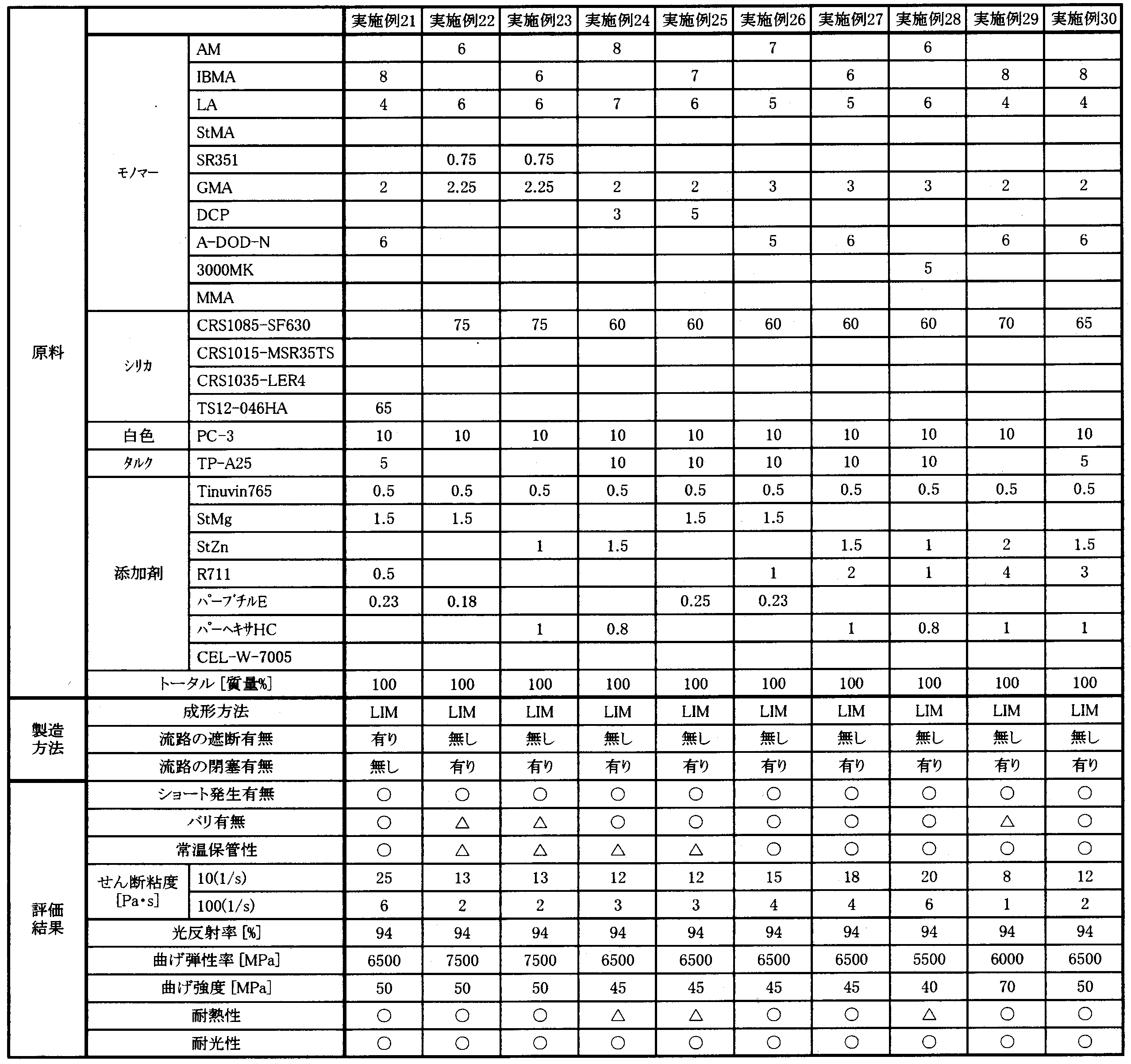
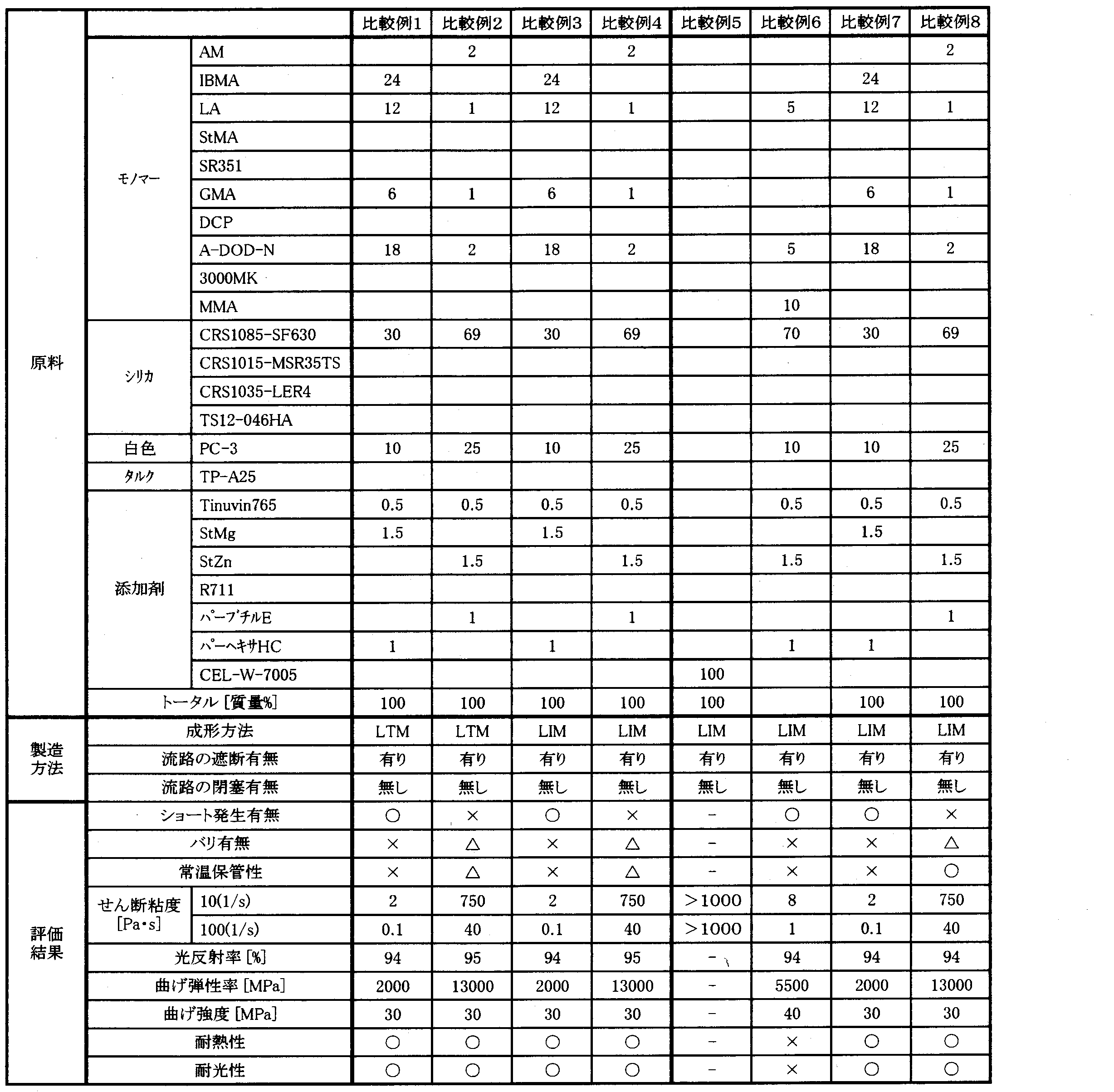
本願のパリ優先の基礎となる日本出願明細書の内容を全てここに援用する。
Claims (13)
- 下記成分(A)~(C)を含み、
25℃で10s-1のせん断粘度が1Pa・s以上500Pa・s以下であり、25℃で100s-1のせん断速度が0.3Pa・s以上100Pa・s以下である熱硬化性組成物。
(A)25℃での粘度が1~300mPa・sである、置換又は無置換の、炭素数6以上の脂環式炭化水素基がエステル結合した(メタ)アクリレート化合物
(B)球状シリカ
(C)白色顔料 - 前記成分(A)~(C)の合計100質量%に対して、成分(B)の含有量が10~90質量%であり、成分(C)の含有量が3~50質量%である請求項1に記載の熱硬化性組成物。
- 前記(メタ)アクリレート化合物が、置換もしくは無置換のアダマンチル基、置換もしくは無置換のノルボルニル基、置換もしくは無置換のイソボニル基、及び置換もしくは無置換のジシクロペンタニル基から選ばれる1種以上の脂環式炭化水素基がエステル結合した(メタ)アクリレート化合物である請求項1又は2記載の熱硬化性組成物。
- さらに下記成分(D)~(F)から選択される成分を1以上含み、
前記成分(A)~(F)の合計100質量%に対して、成分(C)の含有量が3~50質量%であり、成分(B)の含有量が10~90質量%である請求項1~3のいずれかに記載の熱硬化性組成物。
(D)(メタ)アクリル酸又は極性基を有する単官能(メタ)アクリレート化合物
(E)前記成分(A)及び(D)以外の単官能(メタ)アクリレート化合物
(F)前記成分(A)以外の多官能(メタ)アクリレート化合物からなる群から選ばれる1種以上の化合物 - 前記球状シリカが(メタ)アクリルシラン表面処理されている請求項1~4のいずれか記載の熱硬化性組成物。
- 前記球状シリカの一次粒子平均粒径が0.1~100μmである請求項1~5のいずれか記載の熱硬化性組成物。
- さらに下記成分(G)及び(H)から選択される成分を1以上含む請求項1~6のいずれかに記載の熱硬化性組成物。
(G)板状フィラー
(H)ナノ粒子 - 請求項1~7のいずれかに記載の熱硬化性組成物をプランジャー内に供給する工程、
前記プランジャー内に充填された前記熱硬化性組成物を前記プランジャーにより、金型内のキャビティに充填する工程、
前記キャビティ内で前記熱硬化性組成物を熱硬化する工程、及び
熱硬化した熱硬化性樹脂を押し出す工程、
を含む熱硬化性樹脂の製造方法。 - 前記キャビティ部の金型温度が100℃以上180℃以下である請求項8に記載の熱硬化性樹脂の製造方法。
- 前記プランジャー内に充填された前記熱硬化性組成物を前記プランジャーにより、金型内のキャビティに充填する工程において、50℃以下に温度制御された流動路を介して前記熱硬化性組成物を金型内のキャビティに充填する請求項8又は9に記載の熱硬化性樹脂の製造方法。
- 前記プランジャー内に充填された前記熱硬化性組成物を前記プランジャーにより、金型内のキャビティに充填する工程において、前記プランジャー及びキャビティ間の流道路に前記熱硬化性組成物の流動と熱の授受を遮断するゲートシステムを有する請求項8~10のいずれかに記載の熱硬化性樹脂の製造方法。
- 前記ゲートシステムのゲートを開き、金型内のキャビティに前記熱硬化性組成物を充填し、
前記熱硬化が、硬化開始後に前記熱硬化性組成物の注入圧を高め、硬化完了前に保圧を実施し、保圧完了後、前記ゲートシステムのゲートを閉じて熱硬化を完了する請求項11に記載の熱硬化性樹脂の製造方法。 - 前記充填工程と前記熱硬化工程を0.2分~3分以内に行う請求項8~12のいずれかに記載の熱硬化性樹脂の製造方法。
Priority Applications (4)
| Application Number | Priority Date | Filing Date | Title |
|---|---|---|---|
| CN201580034292.3A CN106459550B (zh) | 2014-06-23 | 2015-06-22 | 热固性组合物、和该热固化树脂的制造方法 |
| KR1020167030278A KR101930148B1 (ko) | 2014-06-23 | 2015-06-22 | 열경화성 조성물 및 당해 열경화 수지의 제조 방법 |
| US15/321,517 US10668650B2 (en) | 2014-06-23 | 2015-06-22 | Thermosetting composition, and method for manufacturing thermoset resin |
| US16/857,215 US11364663B2 (en) | 2014-06-23 | 2020-04-24 | Thermosetting composition, and method for manufacturing thermoset resin |
Applications Claiming Priority (2)
| Application Number | Priority Date | Filing Date | Title |
|---|---|---|---|
| JP2014128158A JP6359889B2 (ja) | 2014-06-23 | 2014-06-23 | 熱硬化性組成物、及び熱硬化樹脂の製造方法 |
| JP2014-128158 | 2014-06-23 |
Related Child Applications (3)
| Application Number | Title | Priority Date | Filing Date |
|---|---|---|---|
| US15/321,517 A-371-Of-International US10668650B2 (en) | 2014-06-23 | 2015-06-22 | Thermosetting composition, and method for manufacturing thermoset resin |
| US16/857,215 Division US11364663B2 (en) | 2014-06-23 | 2020-04-24 | Thermosetting composition, and method for manufacturing thermoset resin |
| US16/857,215 Continuation US11364663B2 (en) | 2014-06-23 | 2020-04-24 | Thermosetting composition, and method for manufacturing thermoset resin |
Publications (1)
| Publication Number | Publication Date |
|---|---|
| WO2015198580A1 true WO2015198580A1 (ja) | 2015-12-30 |
Family
ID=54937688
Family Applications (1)
| Application Number | Title | Priority Date | Filing Date |
|---|---|---|---|
| PCT/JP2015/003111 Ceased WO2015198580A1 (ja) | 2014-06-23 | 2015-06-22 | 熱硬化性組成物、及び当該熱硬化性樹脂の製造方法 |
Country Status (6)
| Country | Link |
|---|---|
| US (2) | US10668650B2 (ja) |
| JP (1) | JP6359889B2 (ja) |
| KR (1) | KR101930148B1 (ja) |
| CN (1) | CN106459550B (ja) |
| TW (1) | TWI639642B (ja) |
| WO (1) | WO2015198580A1 (ja) |
Cited By (2)
| Publication number | Priority date | Publication date | Assignee | Title |
|---|---|---|---|---|
| CN112940204A (zh) * | 2021-02-04 | 2021-06-11 | 万华化学(四川)有限公司 | 一种用于附聚的聚丁二烯胶乳的制备方法及制备的abs树脂 |
| US20220363881A1 (en) * | 2019-09-27 | 2022-11-17 | Idemitsu Kosan Co.,Ltd. | Thermosetting composition, method of manufacturing molded article using the same, and cured product |
Families Citing this family (15)
| Publication number | Priority date | Publication date | Assignee | Title |
|---|---|---|---|---|
| JP6359889B2 (ja) * | 2014-06-23 | 2018-07-18 | 出光興産株式会社 | 熱硬化性組成物、及び熱硬化樹脂の製造方法 |
| JP6973886B2 (ja) * | 2017-06-30 | 2021-12-01 | 出光興産株式会社 | 熱硬化性材料、及び当該熱硬化性材料の成形方法 |
| WO2019069594A1 (ja) * | 2017-10-05 | 2019-04-11 | Agc株式会社 | 硬化性組成物及び硬化物 |
| DE112019002859T5 (de) * | 2018-06-05 | 2021-04-22 | Idemitsu Kosan Co., Ltd. | Wärmehärtbare Zusammensetzung, Verfahren zur Herstellung von Formkörpern unter Verwendung derselben, und gehärtetes Erzeugnis |
| US11910728B2 (en) * | 2019-07-23 | 2024-02-20 | The Trustees Of Princeton University | Flopping-mode electric dipole spin resonance |
| CN114616282A (zh) | 2019-10-30 | 2022-06-10 | 三键有限公司 | 树脂组合物 |
| KR102181368B1 (ko) * | 2019-12-31 | 2020-11-20 | (주)오톡스 | 주형 우레탄용 사출장치 및 제조방법 |
| CN111330610A (zh) * | 2020-04-10 | 2020-06-26 | 合肥工业大学 | 一种银纳米花/Ti3C2Tx复合材料的制备方法及其应用 |
| JP7627092B2 (ja) | 2020-06-05 | 2025-02-05 | 出光興産株式会社 | 射出成形用金型及び熱硬化性組成物の射出成形方法 |
| KR102417278B1 (ko) * | 2020-10-29 | 2022-07-06 | (주)오톡스 | 주형 우레탄용 사출장치 |
| US20240208116A1 (en) * | 2021-04-07 | 2024-06-27 | Idemitsu Kosan Co.,Ltd. | Thermosetting composition for injection molding, method for producing molded article using the same, and cured product |
| JP7769230B2 (ja) * | 2022-12-27 | 2025-11-13 | 日亜化学工業株式会社 | パッケージの製造方法及び発光装置の製造方法 |
| WO2025028473A1 (ja) * | 2023-08-03 | 2025-02-06 | 出光興産株式会社 | 熱硬化性組成物、これを用いた成形品の製造方法、及び硬化物 |
| JPWO2025028482A1 (ja) | 2023-08-03 | 2025-02-06 | ||
| WO2026070732A1 (ja) * | 2024-09-26 | 2026-04-02 | 出光興産株式会社 | 熱硬化性材料、成形品の製造方法及び硬化物 |
Citations (4)
| Publication number | Priority date | Publication date | Assignee | Title |
|---|---|---|---|---|
| JP2012131074A (ja) * | 2010-12-20 | 2012-07-12 | Idemitsu Kosan Co Ltd | 熱硬化性樹脂の射出成形方法、射出成形用金型および射出成形機 |
| WO2014054256A1 (ja) * | 2012-10-01 | 2014-04-10 | 出光興産株式会社 | 反射材用組成物及びこれを用いた光半導体発光装置 |
| JP2014080503A (ja) * | 2012-10-16 | 2014-05-08 | Idemitsu Kosan Co Ltd | 反射材用組成物及びこれを用いた光半導体発光装置 |
| JP2014095038A (ja) * | 2012-11-09 | 2014-05-22 | Idemitsu Kosan Co Ltd | 反射材用組成物及びこれを用いた光半導体発光装置 |
Family Cites Families (11)
| Publication number | Priority date | Publication date | Assignee | Title |
|---|---|---|---|---|
| EP0982363A4 (en) * | 1997-05-14 | 2001-03-21 | Mitsubishi Rayon Co | (METH) ACRYLIC RESIN COMPOSITION FOR HEAT-CURING INJECTION MOLDING, METHOD FOR PRODUCING THE COMPOSITION AND METHOD FOR PRODUCING THE (METH) ACRYLIC RESIN MOLDS |
| CN102171012B (zh) * | 2008-07-25 | 2014-10-01 | 汉高美国知识产权有限责任公司 | 用于制造模制品的模具组件和衰减光法 |
| US20110304034A1 (en) * | 2009-02-23 | 2011-12-15 | Hirohisa Dejima | Semiconductor wafer bonding product, method of manufacturing semiconductor wafer bonding product and semiconductor device |
| JP5775525B2 (ja) | 2010-10-25 | 2015-09-09 | 出光興産株式会社 | (メタ)アクリレート系組成物 |
| JP2012107096A (ja) * | 2010-11-16 | 2012-06-07 | Kaneka Corp | 熱伝導性硬化性樹脂組成物及び硬化性樹脂成形体 |
| DE102011102330A1 (de) * | 2011-05-25 | 2012-11-29 | Audi Ag | Verfahren zum Betrieb eines Sicherheitssystems zur Kollisionsvermeidung und/oder Kollisionsschwereminderung in einem Kraftfahrzeug und Kraftfahrzeug |
| WO2013146081A1 (ja) * | 2012-03-30 | 2013-10-03 | 出光興産株式会社 | 樹脂組成物及びその硬化物ならびにそれを用いた光半導体用反射材 |
| US8822593B2 (en) * | 2012-06-22 | 2014-09-02 | Shin-Etsu Chemical Co., Ltd. | Curable resin composition, hardened material thereof, and optical semiconductor apparatus |
| JP6039372B2 (ja) | 2012-11-09 | 2016-12-07 | 三菱エンジニアリングプラスチックス株式会社 | ポリブチレンテレフタレート系樹脂組成物 |
| JP6359889B2 (ja) * | 2014-06-23 | 2018-07-18 | 出光興産株式会社 | 熱硬化性組成物、及び熱硬化樹脂の製造方法 |
| JP6973886B2 (ja) * | 2017-06-30 | 2021-12-01 | 出光興産株式会社 | 熱硬化性材料、及び当該熱硬化性材料の成形方法 |
-
2014
- 2014-06-23 JP JP2014128158A patent/JP6359889B2/ja active Active
-
2015
- 2015-06-22 WO PCT/JP2015/003111 patent/WO2015198580A1/ja not_active Ceased
- 2015-06-22 CN CN201580034292.3A patent/CN106459550B/zh active Active
- 2015-06-22 US US15/321,517 patent/US10668650B2/en active Active
- 2015-06-22 KR KR1020167030278A patent/KR101930148B1/ko active Active
- 2015-06-23 TW TW104120183A patent/TWI639642B/zh active
-
2020
- 2020-04-24 US US16/857,215 patent/US11364663B2/en active Active
Patent Citations (4)
| Publication number | Priority date | Publication date | Assignee | Title |
|---|---|---|---|---|
| JP2012131074A (ja) * | 2010-12-20 | 2012-07-12 | Idemitsu Kosan Co Ltd | 熱硬化性樹脂の射出成形方法、射出成形用金型および射出成形機 |
| WO2014054256A1 (ja) * | 2012-10-01 | 2014-04-10 | 出光興産株式会社 | 反射材用組成物及びこれを用いた光半導体発光装置 |
| JP2014080503A (ja) * | 2012-10-16 | 2014-05-08 | Idemitsu Kosan Co Ltd | 反射材用組成物及びこれを用いた光半導体発光装置 |
| JP2014095038A (ja) * | 2012-11-09 | 2014-05-22 | Idemitsu Kosan Co Ltd | 反射材用組成物及びこれを用いた光半導体発光装置 |
Cited By (5)
| Publication number | Priority date | Publication date | Assignee | Title |
|---|---|---|---|---|
| US20220363881A1 (en) * | 2019-09-27 | 2022-11-17 | Idemitsu Kosan Co.,Ltd. | Thermosetting composition, method of manufacturing molded article using the same, and cured product |
| US12291629B2 (en) * | 2019-09-27 | 2025-05-06 | Idemitsu Kosan Co., Ltd. | Method of manufacturing a molded article |
| KR102947828B1 (ko) | 2019-09-27 | 2026-04-02 | 이데미쓰 고산 가부시키가이샤 | 열경화성 조성물, 그것을 이용한 성형품의 제조 방법, 및 경화물 |
| CN112940204A (zh) * | 2021-02-04 | 2021-06-11 | 万华化学(四川)有限公司 | 一种用于附聚的聚丁二烯胶乳的制备方法及制备的abs树脂 |
| CN112940204B (zh) * | 2021-02-04 | 2023-04-07 | 万华化学(四川)有限公司 | 一种用于附聚的聚丁二烯胶乳的制备方法及制备的abs树脂 |
Also Published As
| Publication number | Publication date |
|---|---|
| KR101930148B1 (ko) | 2018-12-17 |
| US20170203476A1 (en) | 2017-07-20 |
| KR20170023787A (ko) | 2017-03-06 |
| US20200247019A1 (en) | 2020-08-06 |
| TWI639642B (zh) | 2018-11-01 |
| JP6359889B2 (ja) | 2018-07-18 |
| JP2016008230A (ja) | 2016-01-18 |
| US11364663B2 (en) | 2022-06-21 |
| TW201615727A (zh) | 2016-05-01 |
| CN106459550A (zh) | 2017-02-22 |
| US10668650B2 (en) | 2020-06-02 |
| CN106459550B (zh) | 2019-03-12 |
Similar Documents
| Publication | Publication Date | Title |
|---|---|---|
| US11364663B2 (en) | Thermosetting composition, and method for manufacturing thermoset resin | |
| TWI782050B (zh) | 熱硬化性材料、及該熱硬化性材料之成形方法 | |
| WO2019235465A1 (ja) | 熱硬化性組成物、それを用いた成形品の製造方法、及び硬化物 | |
| JP2014080503A (ja) | 反射材用組成物及びこれを用いた光半導体発光装置 | |
| WO2014073212A1 (ja) | 反射材用組成物及びこれを用いた光半導体発光装置 | |
| JP6666947B2 (ja) | 熱硬化性組成物、及び当該熱硬化性樹脂の製造方法 | |
| WO2014054256A1 (ja) | 反射材用組成物及びこれを用いた光半導体発光装置 | |
| CN121100137A (zh) | 热固化性组合物、使用该组合物的成形品的制造方法和固化物 | |
| JP6247902B2 (ja) | 反射材用組成物及びこれを用いた光半導体発光装置 | |
| CN121039170A (zh) | 热固化性组合物、使用该组合物的成形品的制造方法和固化物 | |
| WO2025028473A1 (ja) | 熱硬化性組成物、これを用いた成形品の製造方法、及び硬化物 |
Legal Events
| Date | Code | Title | Description |
|---|---|---|---|
| 121 | Ep: the epo has been informed by wipo that ep was designated in this application |
Ref document number: 15811235 Country of ref document: EP Kind code of ref document: A1 |
|
| ENP | Entry into the national phase |
Ref document number: 20167030278 Country of ref document: KR Kind code of ref document: A |
|
| WWE | Wipo information: entry into national phase |
Ref document number: 15321517 Country of ref document: US |
|
| NENP | Non-entry into the national phase |
Ref country code: DE |
|
| 122 | Ep: pct application non-entry in european phase |
Ref document number: 15811235 Country of ref document: EP Kind code of ref document: A1 |