WO2015194532A1 - 偏光子用粘着剤組成物及び偏光子用粘着シート - Google Patents
偏光子用粘着剤組成物及び偏光子用粘着シート Download PDFInfo
- Publication number
- WO2015194532A1 WO2015194532A1 PCT/JP2015/067257 JP2015067257W WO2015194532A1 WO 2015194532 A1 WO2015194532 A1 WO 2015194532A1 JP 2015067257 W JP2015067257 W JP 2015067257W WO 2015194532 A1 WO2015194532 A1 WO 2015194532A1
- Authority
- WO
- WIPO (PCT)
- Prior art keywords
- group
- sensitive adhesive
- pressure
- polarizer
- adhesive composition
- Prior art date
- Legal status (The legal status is an assumption and is not a legal conclusion. Google has not performed a legal analysis and makes no representation as to the accuracy of the status listed.)
- Ceased
Links
Images


Classifications
-
- C—CHEMISTRY; METALLURGY
- C09—DYES; PAINTS; POLISHES; NATURAL RESINS; ADHESIVES; COMPOSITIONS NOT OTHERWISE PROVIDED FOR; APPLICATIONS OF MATERIALS NOT OTHERWISE PROVIDED FOR
- C09J—ADHESIVES; NON-MECHANICAL ASPECTS OF ADHESIVE PROCESSES IN GENERAL; ADHESIVE PROCESSES NOT PROVIDED FOR ELSEWHERE; USE OF MATERIALS AS ADHESIVES
- C09J7/00—Adhesives in the form of films or foils
- C09J7/10—Adhesives in the form of films or foils without carriers
-
- C—CHEMISTRY; METALLURGY
- C09—DYES; PAINTS; POLISHES; NATURAL RESINS; ADHESIVES; COMPOSITIONS NOT OTHERWISE PROVIDED FOR; APPLICATIONS OF MATERIALS NOT OTHERWISE PROVIDED FOR
- C09J—ADHESIVES; NON-MECHANICAL ASPECTS OF ADHESIVE PROCESSES IN GENERAL; ADHESIVE PROCESSES NOT PROVIDED FOR ELSEWHERE; USE OF MATERIALS AS ADHESIVES
- C09J9/00—Adhesives characterised by their physical nature or the effects produced, e.g. glue sticks
-
- C—CHEMISTRY; METALLURGY
- C09—DYES; PAINTS; POLISHES; NATURAL RESINS; ADHESIVES; COMPOSITIONS NOT OTHERWISE PROVIDED FOR; APPLICATIONS OF MATERIALS NOT OTHERWISE PROVIDED FOR
- C09J—ADHESIVES; NON-MECHANICAL ASPECTS OF ADHESIVE PROCESSES IN GENERAL; ADHESIVE PROCESSES NOT PROVIDED FOR ELSEWHERE; USE OF MATERIALS AS ADHESIVES
- C09J11/00—Features of adhesives not provided for in group C09J9/00, e.g. additives
- C09J11/02—Non-macromolecular additives
- C09J11/06—Non-macromolecular additives organic
-
- C—CHEMISTRY; METALLURGY
- C09—DYES; PAINTS; POLISHES; NATURAL RESINS; ADHESIVES; COMPOSITIONS NOT OTHERWISE PROVIDED FOR; APPLICATIONS OF MATERIALS NOT OTHERWISE PROVIDED FOR
- C09J—ADHESIVES; NON-MECHANICAL ASPECTS OF ADHESIVE PROCESSES IN GENERAL; ADHESIVE PROCESSES NOT PROVIDED FOR ELSEWHERE; USE OF MATERIALS AS ADHESIVES
- C09J133/00—Adhesives based on homopolymers or copolymers of compounds having one or more unsaturated aliphatic radicals, each having only one carbon-to-carbon double bond, and at least one being terminated by only one carboxyl radical, or of salts, anhydrides, esters, amides, imides, or nitriles thereof; Adhesives based on derivatives of such polymers
- C09J133/04—Homopolymers or copolymers of esters
- C09J133/06—Homopolymers or copolymers of esters of esters containing only carbon, hydrogen and oxygen, the oxygen atom being present only as part of the carboxyl radical
-
- C—CHEMISTRY; METALLURGY
- C09—DYES; PAINTS; POLISHES; NATURAL RESINS; ADHESIVES; COMPOSITIONS NOT OTHERWISE PROVIDED FOR; APPLICATIONS OF MATERIALS NOT OTHERWISE PROVIDED FOR
- C09J—ADHESIVES; NON-MECHANICAL ASPECTS OF ADHESIVE PROCESSES IN GENERAL; ADHESIVE PROCESSES NOT PROVIDED FOR ELSEWHERE; USE OF MATERIALS AS ADHESIVES
- C09J201/00—Adhesives based on unspecified macromolecular compounds
- C09J201/02—Adhesives based on unspecified macromolecular compounds characterised by the presence of specified groups, e.g. terminal or pendant functional groups
- C09J201/10—Adhesives based on unspecified macromolecular compounds characterised by the presence of specified groups, e.g. terminal or pendant functional groups containing hydrolysable silane groups
-
- C—CHEMISTRY; METALLURGY
- C09—DYES; PAINTS; POLISHES; NATURAL RESINS; ADHESIVES; COMPOSITIONS NOT OTHERWISE PROVIDED FOR; APPLICATIONS OF MATERIALS NOT OTHERWISE PROVIDED FOR
- C09J—ADHESIVES; NON-MECHANICAL ASPECTS OF ADHESIVE PROCESSES IN GENERAL; ADHESIVE PROCESSES NOT PROVIDED FOR ELSEWHERE; USE OF MATERIALS AS ADHESIVES
- C09J7/00—Adhesives in the form of films or foils
- C09J7/30—Adhesives in the form of films or foils characterised by the adhesive composition
-
- G—PHYSICS
- G02—OPTICS
- G02B—OPTICAL ELEMENTS, SYSTEMS OR APPARATUS
- G02B5/00—Optical elements other than lenses
- G02B5/30—Polarising elements
-
- C—CHEMISTRY; METALLURGY
- C09—DYES; PAINTS; POLISHES; NATURAL RESINS; ADHESIVES; COMPOSITIONS NOT OTHERWISE PROVIDED FOR; APPLICATIONS OF MATERIALS NOT OTHERWISE PROVIDED FOR
- C09J—ADHESIVES; NON-MECHANICAL ASPECTS OF ADHESIVE PROCESSES IN GENERAL; ADHESIVE PROCESSES NOT PROVIDED FOR ELSEWHERE; USE OF MATERIALS AS ADHESIVES
- C09J2203/00—Applications of adhesives in processes or use of adhesives in the form of films or foils
- C09J2203/318—Applications of adhesives in processes or use of adhesives in the form of films or foils for the production of liquid crystal displays
Definitions
- an adhesive is usually used.
- the adhesive is preliminarily provided as an adhesive layer on one side of the polarizing plate because of the convenience that the polarizing plate can be fixed instantaneously and a drying step is not required to fix the polarizing plate.
- the transparent protective film of the polarizer is eliminated and the pressure-sensitive adhesive layer is directly provided on the polarizer, if the pressure-sensitive adhesive layer having the conventional antistatic performance is used, the polyvinyl alcohol (PVA) which is a constituent element of the polarizer is used. It has been clarified by the present inventors that color loss (deterioration of the polarizer) of a dichroic dye such as iodine that is adsorbed and oriented occurs.
- PVA polyvinyl alcohol
- the cause of color loss of the polarizer is the antistatic agent for imparting antistatic performance contained in the pressure-sensitive adhesive layer.
- the present inventors it was found that by using an antistatic agent having a specific composition in the pressure-sensitive adhesive composition, it is possible to suppress color loss of the polarizer without impairing the antistatic performance. It was.
- the present inventors used an antistatic composition in which a salt having an anion having a fluoro group and a sulfonyl group dissolved in a plasticizer containing a polyether group in the main chain as an acrylic pressure-sensitive adhesive.
- the color loss of the polarizer can be suppressed without impairing the antistatic performance by dispersing stably and uniformly and using this for bonding the polarizer and the optical member. Furthermore, the present inventors have found that the polarizing plate can be thinned by using such a pressure-sensitive adhesive composition for a polarizer, and have completed the present invention. Specifically, the present invention has the following configuration.
- the antistatic composition is a composition in which a salt having an anion having a fluoro group and a sulfonyl group is dissolved in a polyether plasticizer containing a polyether group in the main chain [1].
- An antistatic composition includes a composition in which a salt having an anion having a fluoro group and a sulfonyl group is dissolved in a polyether ester plasticizer containing a polyether group in the main chain;
- the pressure-sensitive adhesive composition for polarizers according to any one of [1] to [6], wherein the pressure-sensitive adhesive composition for polarizers is a pressure-sensitive adhesive composition containing substantially no carboxyl group. .
- a numerical range expressed using “to” means a range including numerical values described before and after “to” as a lower limit value and an upper limit value.
- the pressure-sensitive adhesive composition for a polarizer of the present invention is a pressure-sensitive adhesive composition directly attached to at least one surface of a polarizer, and is a pressure-sensitive adhesive composition used for bonding a polarizer and an optical member. is there.
- the pressure-sensitive adhesive composition for a polarizer of the present invention contains an antistatic composition.
- the antistatic composition is a composition in which a salt having an anion having a fluoro group and a sulfonyl group is dissolved in a plasticizer containing a polyether group in the main chain.
- the pressure-sensitive adhesive composition for a polarizer of the present invention has the above-described configuration, the polarizer and the pressure-sensitive adhesive layer are flexibly adhered to each other. Moreover, since the adhesive composition for polarizers of this invention can be directly affixed or laminated
- the antistatic composition used in the pressure-sensitive adhesive composition for a polarizer of the present invention is selected from alkali metals, group 2 elements, transition metals and amphoteric metals in a plasticizer containing a polyether group in the main chain. It is also a composition in which a salt having at least one cation is dissolved.
- the cation is preferably any cation selected from an alkali metal and a group 2 element, and more preferably an alkali metal cation. Especially, it is preferable that a cation is a lithium ion.
- a cation which is a counter ion of an anion is coordinated to an oxygen atom of an ether in a plasticizer to form a complex. That is, a cation which is a counter ion of an anion having a fluoro group and a sulfonyl group forms a Lewis acid / base complex ion with a plasticizer containing a polyether group in the main chain.
- a cation which is a counter ion of an anion having a fluoro group and a sulfonyl group is coordinated to an oxygen atom of an ether in a plasticizer containing a polyether group in the main chain. It is characterized in that it contains a complex.
- the cation that forms a complex ion with the plasticizer is preferably at least one cation selected from alkali metals, Group 2 elements, transition metals and amphoteric metals, and more preferably lithium ions. That is, the complex formed is preferably a lithium polyether complex.
- HPLC high performance liquid chromatography
- a peak derived from the complex is detected. This peak is not detected only with a salt-only antistatic composition or a plasticizer containing a polyether group in the main chain, and is a peak derived from a complex.
- the HPLC conditions are as follows. Column: XBridge C18, column diameter 4.6 ⁇ 250 mm (manufactured by Waters) Column temperature: 30 ° C Mobile phase; acetonitrile / water flow rate; 0.8 mL / min. Detection: 225 nm
- an antistatic composition refers to a state where a salt having an anion having a fluoro group and a sulfonyl group is dispersed or dissolved in a plasticizer.
- examples of such an antistatic composition include Sanconol AD2326 (manufactured by Sanko Chemical Industry Co., Ltd.), Sanconol AD2600 (manufactured by Sanko Chemical Industry Co., Ltd.), Sanconol TGR (manufactured by Sanko Chemical Industry Co., Ltd.), and the like.
- a pressure-sensitive adhesive composition for a polarizer containing a conventional ionic compound When a pressure-sensitive adhesive composition for a polarizer containing a conventional ionic compound is directly applied to the polarizer, the cation may bleed out or bloom due to the poor fluidity of the ionic compound and the poor compatibility with the acrylic pressure-sensitive adhesive composition. As a result, a pseudo bond is formed with iodine ions (I 3 ⁇ , I 5 ⁇ ) of the polarizer, causing color loss of the polarizer.
- the antistatic composition used in the present invention is dispersed in a plasticizer having a high affinity with the acrylic pressure-sensitive adhesive composition, it does not cause bleeding out or blooming. Furthermore, since the cation of the antistatic composition forms a complex acid of Lewis acid / base type with the plasticizer, it does not form a chemical bond with the iodine ion of the polarizer.
- the content of the antistatic composition is preferably 0.01 to 30 parts by mass, preferably 0.1 to 30 parts by mass with respect to 100 parts by mass of the (meth) acrylic copolymer contained in the pressure-sensitive adhesive composition for polarizers. It is more preferable that it is 10 mass parts.
- the antistatic composition is preferably a composition in which a salt having an anion having a fluoro group and a sulfonyl group is dissolved in a polyether ester plasticizer containing a polyether group in the main chain.
- the polyether ester plasticizer contains a polyether group and an ester bond, and enters the gap between the resins, thereby preventing the resin from being regularly oriented.
- the polyether ester plasticizer refers to one that maintains an amorphous state even below the glass transition point.
- the polyether ester plasticizer is preferably a polyether ester compound represented by the following formula (1) or (2).
- n and n are each an integer, and R represents an alkyl group.
- Polyether ester plasticizer has low viscosity, good workability, low temperature flexibility, heat aging resistance, balance between flexibility and durability, non-volatility, non-migration, oil resistance, Excellent safety (PL conformance).
- the antistatic composition may be a composition in which a salt containing an anion having a fluoro group and a sulfonyl group is dissolved in a polyether plasticizer containing a polyether group in the main chain. Further, the antistatic composition includes a composition in which a salt having an anion having a fluoro group and a sulfonyl group is dissolved in a polyether ester plasticizer containing a polyether group in the main chain; And a composition in which a salt containing an anion having a fluoro group and a sulfonyl group is dissolved in a polyether plasticizer containing in the main chain.
- the polyether plasticizer is preferably a polyalkylene glycol (di or mono) alkyl ether compound represented by the following general formula (11).
- the polyether plasticizer is particularly preferably a polyalkylene glycol alkyl ether compound.
- the wettability of the pressure-sensitive adhesive layer to the adherend can be improved, and it is difficult to cause entrainment of bubbles at the time of sticking, and the plasticizer bleeds out from the pressure-sensitive adhesive layer. It becomes difficult to occur and adherend contamination can be suitably reduced.
- Examples of the saturated or unsaturated acyclic hydrocarbon group in the mono- or dicarboxylic acid component constituting the ester include an alkyl group and an alkylene group, and among them, an alkyl group or alkylene group having 1 to 20 carbon atoms is preferable. Further, an alkyl group having 4 to 18 carbon atoms is more preferable, and an alkyl group having 4 to 14 carbon atoms is particularly preferable.
- Such a mono- or dicarboxylic acid having a saturated or unsaturated acyclic hydrocarbon group has a carbon number close to the carbon number of the acrylic monomer constituting the acrylic pressure-sensitive adhesive composition used in the pressure-sensitive adhesive composition for polarizers. By having a number, the compatibility with the pressure-sensitive adhesive composition for polarizers is improved, and it is suitably retained in the pressure-sensitive adhesive composition for polarizers, so that bleeding out is suppressed.
- Examples of monocarboxylic acids and dicarboxylic acids having a saturated or unsaturated acyclic hydrocarbon group include oxalic acid, malonic acid, succinic acid, glutaric acid, adipic acid, pimelic acid, suberic acid, azelaic acid, and sebacic acid.
- Mono- or polyester of linear aliphatic dicarboxylic acid such as dodecanedioic acid, acetic acid, propionic acid, butyric acid, chitosulic acid, capconic acid, enanthic acid, caprylic acid, pelargonic acid, capric acid, undecylic acid, lauric acid, tridecylic acid Saturated fatty acids such as myristic acid, pentadecylic acid, palmitic acid, margaric acid, stearic acid, nonadecyl acid, arachidic acid, crotonic acid, angelic acid, Linderic acid, myristoleic acid, palmitoleic acid, oleic acid, vaccenic acid, gadoleic acid , Eicosenoic acid, erucic acid, nervonic acid, linoleic acid Eicosadienoic acid, docosadienoic acid, linolenic acid, pinolenic acid,
- the compatibility with the pressure-sensitive adhesive composition for polarizers is improved, and it is suitably retained in the pressure-sensitive adhesive composition for polarizers, so that bleeding out is suppressed.
- the number of carbon atoms of the hydrocarbon group of the alcohol component is the number of carbon atoms of the acrylic monomer constituting the acrylic pressure-sensitive adhesive composition used in the pressure-sensitive adhesive composition for polarizers. In particular, it becomes easy to suppress adherend contamination.
- Examples of the alcohol having such an acyclic hydrocarbon group include methyl alcohol, ethyl alcohol, propanol, butanol, pentanol, hexanol, heptanol, octyl alcohol, nonyl alcohol, decyl alcohol, undecyl alcohol, dodecyl alcohol, Examples include tridecyl alcohol, tetradecyl alcohol, pentadecyl alcohol, cetyl alcohol, heptadecyl alcohol, octadecyl alcohol, nonadecyl alcohol, and straight chain or branched alcohol of aralkyl alcohol. Of these, butanol, pentanol, hexanol, heptanol, octyl alcohol, nonyl alcohol, and decyl alcohol can be particularly preferably used.
- an ester formed from the above mono- or dicarboxylic acid and an alcohol may be used as a plasticizer.
- the ester may have a skeleton composed of a saturated or unsaturated hydrocarbon group, but is preferably an ester not having a skeleton composed of an unsaturated hydrocarbon group.
- an epoxidized ester in which an unsaturated bond of an ester having a skeleton composed of the unsaturated hydrocarbon group is epoxidized can also be preferably used.
- adipic acid monoester, sebacic acid monoester, and epoxidized fatty acid monoester can be particularly preferably used.
- the ester used as the plasticizer may be either a monoester or a polyester, but it is easy to control the solubility parameter (SP value) within a suitable range and improves the compatibility with the pressure-sensitive adhesive composition for polarizers. Therefore, it is preferable that the ester has a weight average molecular weight in terms of PS of 1000 or less, particularly preferably an ester having a molecular weight of 300 to 800.
- the plasticizer it is preferable to use a plasticizer having a solubility parameter (SP value) of 8.5 or less. Among these, 7.0 to 8.4 is preferable. If the SP value of the plasticizer is 8.5 or less, it is excellent in compatibility with the acrylic pressure-sensitive adhesive composition. Therefore, it is long in a high-temperature and high-humidity environment with the pressure-sensitive adhesive composition for the polarizer attached to the polarizer. Even when left for a period of time, fogging hardly occurs on the surface of the polarizer when it is peeled off from the surface of the polarizer. As the SP value of the plasticizer, a plasticizer having a value larger than 7.0 is generally used. The SP value is the value of J.P. The Small formula [P. A. J. et al. Small: J.M. Appl. Chem. , 3, 71 (1953)].
- a salt having an anion having a fluoro group and a sulfonyl group is easily dissolved in a polyether ester plasticizer and a polyether plasticizer, and the salt concentration in the plasticizer can be increased.
- a large amount of a salt having an anion having a fluoro group and a sulfonyl group can be incorporated into the pressure-sensitive adhesive composition for a polarizer in a large amount. .
- a cation which is a counter ion of an anion is coordinated to an oxygen atom of an ether in a plasticizer to form a complex.
- a solution of a plasticizer in which a salt having an anion having a fluoro group and a sulfonyl group is dissolved, in combination with the plasticity of the plasticizer, in the pressure-sensitive adhesive composition for polarizer, Gives plasticity.
- the plasticizer which contains a polyether group in the main chain can be brought close to the solubility parameter (SP value) of the pressure-sensitive adhesive composition for polarizers, it has excellent affinity and does not bleed.
- a solution of a plasticizer in which a salt having an anion having a fluoro group and a sulfonyl group is dissolved exhibits antistatic properties while maintaining adhesive physical properties in the pressure-sensitive adhesive composition for polarizers. Furthermore, since a plasticizer solution in which a salt having an anion having a fluoro group and a sulfonyl group is dissolved is highly compatible with the molecules constituting the pressure-sensitive adhesive composition for polarizers, bleeding, blooming, and migration contamination are prevented. It is possible to obtain a pressure-sensitive adhesive composition for a polarizer that does not occur and does not depend on humidity, has excellent rapidity, and maintains excellent antistatic properties.
- the anion having a fluoro group and a sulfonyl group is preferably an anion selected from the group consisting of a bis (fluoroalkylsulfonyl) imide ion, a tris (fluoroalkylsulfonyl) methide ion and a fluoroalkylsulfonic acid ion.
- the salt having an anion having a fluoro group and a sulfonyl group is composed of at least one cation selected from alkali metals, Group 2 elements, transition metals and amphoteric metals, and the anion having the fluoro group and the sulfonyl group.
- the salt is preferably.
- salts having an anion having a fluoro group and a sulfonyl group include alkali metal salts of bis (fluoroalkylsulfonyl) imide ions, alkali metal salts of tris (fluoroalkylsulfonyl) methide ions, and alkali metal salts of fluoroalkylsulfonic acid ions. It is preferable that Lithium salts are particularly preferred.
- the salt is composed of bis (fluoroalkylsulfonyl) imide ion, tris (fluoroalkylsulfonyl) methide ion, and fluoroalkylsulfonic acid ion.
- Alkylsulfonyl) imide alkali metal salts, tris (fluoroalkylsulfonyl) methide alkali metal salts and trifluoroalkylsulfonic acid alkali metal salts are preferred.
- bis (trifluoromethanesulfonyl) imide lithium, tris (trifluoromethanesulfonyl) methide lithium, and lithium trifluoromethanesulfonate can be given.
- bis (trifluoromethanesulfonyl) imidolithium and lithium trifluoromethanesulfonate are preferable, and the above-described effect can be further exerted only by adding a small amount thereof.
- the state in which bis (fluoroalkylsulfonyl) imidolithium Li (CF 3 SO 2 ) 2 N is used and dissolved in tetraethylene glycol dimethyl ether means that the polar ether group is coordinated to the Li + ion. In this state, it is dispersed in the composition. That is, the composition contains a lithium polyether complex. Li + ions are surrounded by ether oxygen, are separated from (CF 3 SO 2 ) 2 N ⁇ ions, and are in a bare state, greatly contributing to antistatic properties.
- a mixture of a plasticizer containing a lithium salt and a polyether group in the main chain forms a complex acid of Lewis acid / base type, and this complex behaves as a kind of ionic liquid, especially contributing greatly to antistatic properties.
- the lithium salt forms a Lewis acid / base complex ion with a plasticizer containing a polyether group in the main chain, it cannot form a chemical bond with the iodine ion of the polarizer. Therefore, the color loss of the polarizer is not caused.
- the antistatic composition may further contain a polymer type antistatic agent.
- the polymer type antistatic agent can stabilize a salt provided with an anion.
- this salt since the salt having an anion is dispersed in a state in which it is dissolved in a plasticizer containing a polyether group in the main chain, this salt has an affinity for a plasticizer containing a polyether group in the main chain. It is thought that the polymer type antistatic agent gathers in the presence and is stabilized by the affinity between them.
- Examples of such a polymer type antistatic agent include a polyether block polyolefin copolymer, a polyoxyalkylene copolymer, and an ethylene oxide-propylene oxide-allyl glycidyl copolymer.
- the plasticizer containing a polyether group in the main chain is preferably a polyether ester plasticizer and / or a polyether plasticizer, and the salt solution contains a fluoro group and a plasticizer. It can be obtained by adding a salt having an anion having a sulfonyl group and stirring.
- the main component of the pressure-sensitive adhesive composition for a polarizer is an acrylic pressure-sensitive adhesive composition.
- the acrylic pressure-sensitive adhesive composition includes a (meth) acrylic copolymer crosslinked by a crosslinking agent. Further, the “main component” means that 50% by mass or more is contained with respect to the whole pressure-sensitive adhesive.
- the acrylic pressure-sensitive adhesive composition contains a (meth) acrylic copolymer (A) and a crosslinking agent (B).
- the “acrylic pressure-sensitive adhesive composition” is a compound having a (meth) acryloyl group.
- (Meth) acryloyl group” means an acryloyl group or a methacryloyl group.
- (Meth) acrylic acid ester substituted with a hydrogen group is mentioned.
- the hydrocarbon group preferably has 1 to 18 carbon atoms, more preferably 1 to 8 carbon atoms.
- the hydrocarbon group may have a substituent.
- the substituent is not particularly limited as long as it does not contain a crosslinkable group, and examples thereof include alkoxy groups such as methoxy group and ethoxy group.
- the (meth) acrylic acid ester examples include methyl (meth) acrylate, ethyl (meth) acrylate, propyl (meth) acrylate, isopropyl (meth) acrylate, n-butyl (meth) acrylate, Isobutyl (meth) acrylate, t-butyl (meth) acrylate, n-pentyl (meth) acrylate, n-hexyl (meth) acrylate, 2-ethylhexyl (meth) acrylate, n- (meth) acrylate Octyl, isooctyl (meth) acrylate, n-nonyl (meth) acrylate, isononyl (meth) acrylate, n-decyl (meth) acrylate, isodecyl (meth) acrylate, n-undecyl (meth) acrylate, N-do
- (meth) acrylic acid means containing both “acrylic acid” and “methacrylic acid”.
- n-butyl acrylate, 2-ethylhexyl acrylate, and methyl acrylate are preferable from the viewpoint of adhesiveness.
- the amount of the non-crosslinkable acrylic monomer used for the polymerization of the (meth) acrylic copolymer (A) is preferably 60 to 99.99% by mass, and more preferably 65 to 99.9% by mass. If the amount of the non-crosslinkable acrylic monomer used for the polymerization is not less than the above lower limit value, sufficient adhesive force can be exhibited, and if it is not more than the above upper limit value, it can be sufficiently crosslinked.
- hydroxy group-containing monomer examples include hydroxyalkyl (meth) acrylates such as 2-hydroxyethyl (meth) acrylate, 4-hydroxybutyl (meth) acrylate, 2-hydroxypropyl (meth) acrylate, (meth (Meth) acrylic acid [(mono, di or poly) alkylene glycol] such as mono (diethylene glycol) acrylic acid, and (meth) acrylic acid lactone such as (meth) acrylic acid monocaprolaclone.
- amino group-containing monomers examples include (meth) acrylamide, allylamide, N, N-dimethyl (meth) acrylamide, N-butyl (meth) acrylamide and the like.
- examples of the glycidyl group-containing monomer examples include glycidyl (meth) acrylate.
- the amount of the crosslinkable monomer used for the polymerization of the (meth) acrylic copolymer (A) is preferably 0.01 to 20% by mass, more preferably 0.03 to 10% by mass, and More preferably, it is 05 to 10% by mass. If the amount of the crosslinkable monomer used for the polymerization is not less than the above lower limit value, it can be sufficiently crosslinked.
- the crosslinking monomer is preferably a hydroxy group-containing monomer or an amino group-containing monomer from the viewpoints of adhesiveness, crosslinkability, polymerizability and durability, and reworkability that allows re-peeling and reuse of the glass.
- a hydroxy group-containing monomer and an amino group-containing monomer may be used in combination.
- As the hydroxy group-containing monomer hydroxyalkyl (meth) acrylate is more preferable, and 2-hydroxyethyl (meth) acrylate and 4-hydroxybutyl (meth) acrylate are particularly preferable.
- As the amino group-containing monomer (meth) acrylamide, N, N-dimethyl (meth) acrylamide, and N-butyl (meth) acrylamide are preferable.
- the amount of the carboxy group-containing monomer used for the polymerization of the (meth) acrylic copolymer (A) is preferably less than 0.5% by mass, and less than 0.05% by mass. More preferably. Furthermore, it is preferable that the monomer having a reactive functional group does not substantially contain a carboxy group-containing monomer.
- the monomer having a reactive functional group substantially does not contain a carboxy group-containing monomer means that the acid value of the monomer having a reactive functional group used for the polymerization of the (meth) acrylic copolymer (A) is JIS. When measured according to K0070 (1992), the acid value is less than 0.1 mgKOH / g. If the acid value of the monomer having a reactive functional group is less than 0.1 mgKOH / g, it is considered that no intentionally added carboxy group-containing monomer is contained, and 0.1 to 1.0 mgKOH / g. For example, it is considered that a small amount of the carboxy group-containing monomer added intentionally is included.
- the intentional addition means that a carboxy group-containing monomer is used as a crosslinkable monomer.
- acrylic ester derivative from acrylic acid
- a trace amount of unreacted acrylic acid may be contained as an impurity. I don't think.
- Acid value (mgKOH / g) [B ⁇ f ⁇ 5.611] / S (1)
- B is the amount (ml) of 0.1N potassium hydroxide-ethanol solution used
- f is the factor of 0.1N potassium hydroxide-ethanol solution
- S is the sample The amount collected (g).
- the (meth) acrylic copolymer (A) may have other monomers other than the non-crosslinkable acrylic monomer and the crosslinkable monomer.
- examples of other monomers include (meth) acrylonitrile, vinyl acetate, styrene, vinyl chloride, vinyl pyrrolidone, vinyl pyridine and the like.
- the amount of the other monomer used for the polymerization of the (meth) acrylic copolymer (A) is preferably 0.1 to 20% by mass, and more preferably 0.5 to 10% by mass. If the amount of the other monomer used for the polymerization is not less than the above lower limit, the physical properties can be easily adjusted, and if it is not more than the above upper limit, yellowing due to deterioration with time can be prevented.
- Crosslinking agent used for acrylic adhesive composition As the crosslinking agent (B) used in the acrylic pressure-sensitive adhesive composition, it is preferable to use a crosslinking agent capable of reacting with a crosslinking monomer which is a monomer having a reactive functional group. Examples thereof include an isocyanate-based crosslinking agent, an epoxy-based crosslinking agent, an oxazoline-based crosslinking agent, an aziridine-based crosslinking agent, a metal chelate-based crosslinking agent, and a butylated melamine-based crosslinking agent.
- Examples of the isocyanate-based crosslinking agent include tolylene diisocyanate, xylylene diisocyanate, hexamethylene diisocyanate, and isophorone diisocyanate.
- Examples of the epoxy crosslinking agent include ethylene glycol diglycidyl ether, polyethylene glycol diglycidyl ether, propylene glycol diglycidyl ether, polypropylene glycol diglycidyl ether, glycerin diglycidyl ether, neopentyl glycol diglycidyl ether, and 1,6-hexane.
- the pressure-sensitive adhesive composition for polarizers of the present invention may contain components other than the acrylic pressure-sensitive adhesive composition and the antistatic composition.
- a polyester resin, an amino resin, an epoxy resin, or a polyurethane resin may be used in combination.
- the pressure-sensitive adhesive composition for a polarizer of the present invention includes a light stabilizer such as an antioxidant, a metal corrosion inhibitor, a tackifier, a silane coupling agent, an ultraviolet absorber, and a hindered amine compound, if necessary.
- a light stabilizer such as an antioxidant, a metal corrosion inhibitor, a tackifier, a silane coupling agent, an ultraviolet absorber, and a hindered amine compound, if necessary.
- Additives such as fillers may be included.
- the antioxidant include phenolic antioxidants, amine-based antioxidants, lactone-based antioxidants, phosphorus-based antioxidants, sulfur-based antioxidants, and the like. These antioxidants may be used alone or in combination of two or more.
- a benzotriazole-based resin is preferable because of the compatibility and high effect of the pressure-sensitive adhesive.
- the pressure-sensitive adhesive composition for a polarizer is produced by dispersing a salt having an anion having a fluoro group and a sulfonyl group in a composition containing a pressure-sensitive adhesive resin such as an acrylic pressure-sensitive adhesive composition.
- the production method comprises a step of preparing a salt solution obtained by dissolving a salt having an anion having a fluoro group and a sulfonyl group in a plasticizer containing a polyether group in the main chain, and a salt solution (first component).
- the pressure-sensitive adhesive composition for a polarizer of the present invention can be formed into a sheet shape to obtain a pressure-sensitive adhesive sheet for a polarizer.
- the pressure-sensitive adhesive sheet for a polarizer can be produced, for example, by dissolving a pressure-sensitive adhesive in a solvent, and coating and then removing the solvent.
- the coating method can be appropriately selected from knife coaters, micro bar coaters, air knife coaters, reverse roll coaters, reverse gravure coaters, bario gravure coaters, die coaters, curtain coaters and the like.
- the pressure-sensitive adhesive sheet of the present invention is used, there is no need for the application of a pressure-sensitive adhesive at the bonding stage and a drying step, and the pressure-sensitive adhesive sheet for pressure-sensitive adhesive is laminated and pressed between the optical film and the pressure-sensitive adhesive object. It is easy to do.
- the thickness of the pressure-sensitive adhesive layer of the pressure-sensitive adhesive sheet for polarizers of the present invention is preferably 100 ⁇ m or less, and more preferably 5 to 50 ⁇ m. If it is below the said upper limit, the stress relaxation performance of an adhesive layer can fully be expressed.
- the pressure-sensitive adhesive sheet with a release sheet for a polarizer preferably has a structure in which a release film provided with a release agent on a substrate is provided on one or both sides of the pressure-sensitive adhesive sheet.
- a double-sided pressure-sensitive adhesive sheet with a release sheet provided with a release film on both sides of the pressure-sensitive adhesive layer was obtained by applying and drying the pressure-sensitive adhesive coating solution on the release layer surface of the first release film provided with the release agent layer on the polymer film.
- the peel force of the release film on the heavy peel force side is preferably 0.05 N to 0.15 N, and the peel force of the peel film on the light peel force side is preferably 0.01 to 0.04 N.
- the polarizer is sandwiched between protective films, and an adhesive sheet (adhesive layer) is attached to the protective film.
- an adhesive sheet adheresive layer
- the pressure-sensitive adhesive composition and the pressure-sensitive adhesive sheet for the polarizer of the present invention can be applied to such a configuration, the effect of the present invention is exhibited when directly sticking to the polarizer as shown in FIG. can do.
- the polarizer adhesive composition and polarizer adhesive sheet of the present invention are for bonding a polarizer and a member having a thickness of 100 ⁇ m, preferably 1 mm or more.
- the pressure-sensitive adhesive composition for a polarizer and the pressure-sensitive adhesive sheet for a polarizer of the present invention are for bonding a polarizer and an optical member.
- an optical member a liquid crystal cell, a touch panel, etc. can be mentioned, and the image display apparatus provided with the adhesive sheet of this invention can be produced.
- polarizer used in the polarizing plate for example, a polyvinyl alcohol resin film or a polyvinyl alcohol resin described in JP 2012-159778 is adsorbed and oriented.
- the polyvinyl alcohol resin constituting the polarizer can be obtained by saponifying a polyvinyl acetate resin.
- the polyvinyl acetate resin include polyvinyl acetate, which is a homopolymer of vinyl acetate, and copolymers of vinyl acetate and other monomers copolymerizable therewith.
- Examples of other monomers copolymerized with vinyl acetate include unsaturated carboxylic acids, olefins, vinyl ethers, unsaturated sulfonic acids, and acrylamides having an ammonium group.
- the degree of saponification of the polyvinyl alcohol resin is usually about 85 to 100 mol%, preferably 98 mol% or more.
- This polyvinyl alcohol-based resin may be further modified, and for example, polyvinyl formal and polyvinyl acetal modified with aldehydes may be used.
- the degree of polymerization of the polyvinyl alcohol resin is usually about 1,000 to 10,000, preferably about 1,500 to 5,000.
- a film obtained by forming such a polyvinyl alcohol resin is used as an original film of a polarizer.
- the method for forming a polyvinyl alcohol-based resin is not particularly limited, and can be formed by a known method.
- the film thickness of the raw film made of polyvinyl alcohol resin is not particularly limited, but is, for example, about 1 to 150 ⁇ m. Considering easiness of stretching, the film thickness is preferably 3 ⁇ m or more.
- the polarizer is a step of uniaxially stretching the polyvinyl alcohol resin film as described above or the polyvinyl alcohol resin described in JP2012-159778, and dyeing the polyvinyl alcohol resin or film with a dichroic dye.
- the polarizing plate has a structure in which a transparent protective film is laminated on at least one of the polarizers produced as described above.
- this transparent protective film what is formed from an appropriate transparent resin can be used.
- transparent resin films include cellulose films such as triacetyl cellulose and diacetyl cellulose, polyester films such as polyethylene terephthalate, polyethylene isophthalate, and polybutylene terephthalate, polymethyl (meth) acrylate, and polyethyl (meth) acrylate.
- Acrylic resin film, polycarbonate film, polyethersulfone film, polysulfone film, polyimide film, polyolefin film, polynorbornene film and the like can be used, but are not limited thereto.
- the obtained (meth) acrylic copolymer (A-1) had a polystyrene equivalent weight average molecular weight Mw of 1,500,000 by GPC.
- the weight average molecular weight Mw of the (meth) acrylic copolymer was measured by GPC (gel permeation chromatography) on a sample in which THF (tetrahydrafuran) was dissolved.
- the obtained (meth) acrylic copolymer (A-2) had a polystyrene equivalent weight average molecular weight Mw of 1,800,000 by GPC.
- carboxyl group-modified polyvinyl alcohol [trade name “KL-318” obtained from Kuraray Co., Ltd.] is dissolved in 100 parts of water on one side of the polarizer, and a water-soluble epoxy resin is dissolved in the aqueous solution.
- An epoxy adhesive added with 1.5 parts of a polyamide epoxy additive [trade name “Smileise Resin 650 (30)” obtained from Taoka Chemical Co., Ltd., aqueous solution with a solid content of 30%] was applied.
- TAC triacetyl cellulose film
- the pressure-sensitive adhesive solution prepared as described above was used as a 38 ⁇ m-thick polyethylene terephthalate film (separator film) having a release agent layer treated with a silicone release agent (manufactured by Oji F-Tex: 38RL-07 (2)). On the surface of the film, uniformly apply with an applicator so that the coating amount after drying is 20 ⁇ m / m 2, and dry for 3 minutes in a 100 ° C. air circulation type constant temperature oven. Formed.
- Example 2 ⁇ Preparation of acrylic adhesive solution> For 100 parts of the solid content of the (meth) acrylic copolymer (A-2) obtained in Production Example 2, 0.1 part of xylylene diisocyanate (manufactured by Mitsui Chemicals: Takenate 500) as a crosslinking agent and 3- 0.1 part of glycidoxypropylmethoxysilane (manufactured by Shin-Etsu Chemical Co., Ltd .: KBM-403) was added, and 50 parts of a polyether ester compound (Monocizer (registered trademark) W-262 and Polycizer ( (Registered trademark) W-230-H (1: 1 mixture)) and added 1.8 parts of a composition in which 50 parts of bis (trifluoromethanesulfonyl) imidolithium is dissolved.
- xylylene diisocyanate manufactured by Mitsui Chemicals: Takenate 500
- 3- glycidoxypropylmethoxysilane
- the optical durability is excellent in addition to the polarizing plate durability. That is, in the examples, even when left in a high temperature / high humidity environment for a long time, there is little coloring and the light transmittance is high.
- the comparative example is inferior in optical durability. Particularly, in Comparative Examples 1 and 2, the polarizing plate durability was not good and the function as a polarizing plate was inferior.
- FIG. 3 shows from above the complex-containing antistatic composition, the extract of the antistatic composition-containing pressure-sensitive adhesive sheet obtained in the Examples, and the extract of the pressure-sensitive adhesive sheet containing no antistatic composition (Reference Example) It is a result of HPLC (high performance liquid chromatography) analysis of 1). As shown in the chromatogram of the extract of the adhesive sheet containing the antistatic composition in the middle stage, a complex peak was detected at a retention time of 15.0 minutes from the extract of the adhesive sheet containing the antistatic composition.
Landscapes
- Chemical & Material Sciences (AREA)
- Organic Chemistry (AREA)
- Physics & Mathematics (AREA)
- General Physics & Mathematics (AREA)
- Optics & Photonics (AREA)
- Polarising Elements (AREA)
- Adhesives Or Adhesive Processes (AREA)
- Adhesive Tapes (AREA)
Abstract
Description
具体的に、本発明は、以下の構成を有する。
[2]帯電防止性組成物は、ポリエーテル基を主鎖中に含むポリエーテルエステル系可塑剤中にフルオロ基及びスルホニル基を有する陰イオンを備えた塩が溶解された組成物である[1]に記載の偏光子用粘着剤組成物。
[3]ポリエーテルエステル系可塑剤は、下記式(1)又は(2)で表される少なくとも1種のポリエーテルエステル系可塑剤を含む[2]に記載の偏光子用粘着剤組成物;


[4]帯電防止性組成物は、ポリエーテル基を主鎖中に含むポリエーテル系可塑剤中にフルオロ基及びスルホニル基を有する陰イオンを備えた塩が溶解された組成物である[1]に記載の偏光子用粘着剤組成物。
[5]ポリエーテル系可塑剤は、下記式(11)を有するポリエーテル系可塑剤を含む、[4]に記載の偏光子用粘着剤組成物;
R1(OCH2CH2)nOR2 (11)
式中、R1は炭素数1~12のアルキル基を表し、R2は水素原子又は炭素数1~12のアルキル基を表す。nは3~6の整数を表す。
[6]帯電防止性組成物は、ポリエーテル基を主鎖中に含むポリエーテルエステル系可塑剤中にフルオロ基及びスルホニル基を有する陰イオンを備えた塩が溶解された組成物と、ポリエーテル基を主鎖中に含むポリエーテル系可塑剤中にフルオロ基及びスルホニル基を有する陰イオンを備えた塩が溶解された組成物とを含む[1]に記載の偏光子用粘着剤組成物。
[7]偏光子用粘着剤組成物は、主成分が、実質的にカルボキシル基を含有しない粘着剤組成物である[1]~[6]のいずれかに記載の偏光子用粘着剤組成物。
[8]偏光子用粘着剤組成物は、主成分がアクリル系粘着剤組成物である[1]~[7]のいずれかに記載の偏光子用粘着剤組成物。
[9]アクリル系粘着剤組成物は、(メタ)アクリル共重合体(A)と架橋剤(B)を含有し、(メタ)アクリル共重合体(A)は(i)炭素数1~18のアルキル基を有する(メタ)アクリル酸エステルモノマー60~99.99質量%と、(ii)ラジカル重合性不飽和基を有し、且つ少なくとも1つの反応性官能基を有するモノマー0.01~20質量%とを少なくとも重合して得られる[7]に記載の偏光子用粘着剤組成物。
[10]反応性官能基はヒドロキシ基及びアミノ基から選択される少なくとも1つであって、反応性官能基を有するモノマーは実質的にカルボキシ基含有モノマーを含まない[8]に記載の偏光子用粘着剤組成物。
[11]架橋剤(B)は、イソシアネート系架橋剤、エポキシ系架橋剤及び金属キレート系架橋剤から選択される少なくとも1種である[8]又は[9]に記載の偏光子用粘着剤組成物。
[12](メタ)アクリル共重合体(A)100質量部に対し、帯電防止性組成物の含有量が0.01~30質量部である[8]~[10]のいずれかに記載の偏光子用粘着剤組成物。
[13]フルオロ基及びスルホニル基を有する陰イオンは、ビス(フルオロアルキルスルホニル)イミドイオン、トリス(フルオロアルキルスルホニル)メチドイオン及びフルオロアルキルスルホン酸イオンからなる群から選ばれた陰イオンである[1]~[11]のいずれかに記載の偏光子用粘着剤組成物。
[14]フルオロ基及びスルホニル基を有する陰イオンを備えた塩は、アルカリ金属、2族元素、遷移金属及び両性金属から選択される少なくとも一種の陽イオンと、フルオロ基およびスルホニル基を有する陰イオンとからなる塩である[1]~[12]のいずれかに記載の偏光子用粘着剤組成物。
[15]フルオロ基およびスルホニル基を有する陰イオンを備えた塩が、ビス(フルオロアルキルスルホニル)イミドのアルカリ金属塩、トリス(フルオロアルキルスルホニル)メチドのアルカリ金属塩及びトリフルオロアルキルスルホン酸のアルカリ金属塩からなる群から選ばれた塩である[1]~[13]のいずれかに記載の偏光子用粘着剤組成物。
[16]偏光子用粘着剤組成物は、偏光子と光学部材を貼合するためのものである[1]~[14]のいずれかに記載の偏光子用粘着剤組成物。
[17]光学部材は、液晶セル又はタッチパネルである[15]に記載の偏光子用粘着剤組成物。
[18][1]~[16]のいずれかに記載の偏光子用粘着剤組成物を含む偏光子用粘着シート。
[19][17]に記載の粘着シートを少なくとも1つ備えた画像表示装置。
本発明の偏光子用粘着剤組成物は、偏光子の少なくとも一方の面に直接付着される粘着剤組成物であって、偏光子と光学部材を貼合するために用いられる粘着剤組成物である。本発明の偏光子用粘着剤組成物は、帯電防止性組成物を含有する。ここで、帯電防止性組成物は、ポリエーテル基を主鎖中に含む可塑剤中にフルオロ基及びスルホニル基を有する陰イオンを備えた塩が溶解された組成物である。本発明の偏光子用粘着剤組成物は、上記のような構成であるため、偏光子と粘着剤層が柔軟に密着される。また、本発明の偏光子用粘着剤組成物は偏光子に直接貼付又は積層できるため、透明保護フィルム又は保護層をなくした薄型偏光板を作製することができる。このように保護フィルム等をなくした偏光板であっても、高温または高温高湿環境下や加熱と冷却が繰り返される環境下における耐熱性に優れ、さらに激しい温度履歴や粘着剤成分(主に帯電防止成分)の移行によって起こる偏光子の色抜け(劣化)を抑制することができる。
本発明の偏光子用粘着剤組成物に用いられる帯電防止性組成物は、ポリエーテル基を主鎖中に含む可塑剤中にフルオロ基及びスルホニル基を有する陰イオンを備えた塩が溶解された組成物である。すなわち、帯電防止性組成物中では、フルオロ基及びスルホニル基を有する陰イオンを備えた塩がポリエーテル基を主鎖中に含む可塑剤に溶解された状態で分散されている。
可塑剤と錯イオンを形成する陽イオンはアルカリ金属、2族元素、遷移金属及び両性金属から選択される少なくとも一種の陽イオンであることが好ましく、中でも、リチウムイオンであることがより好ましい。すなわち、形成される錯体は、リチウムポリエーテル錯体であることが好ましい。
なお、HPLC条件は下記の通りである。
カラム;XBridge C18、カラム径4.6×250mm(ウォーターズ社製)
カラム温度;30℃
移動相;アセトニトリル/水
流速;0.8mL/min.
検知;225nm
帯電防止性組成物は、ポリエーテル基を主鎖中に含むポリエーテルエステル系可塑剤中にフルオロ基及びスルホニル基を有する陰イオンを備えた塩が溶解された組成物であることが好ましい。ポリエーテルエステル系可塑剤は、ポリエーテル基とエステル結合を含み、樹脂の間隙に入り込むことで樹脂を規則正しく配向するのを阻害する。また、ポリエーテルエステル系可塑剤は、ガラス遷移点以下でもアモルファス状態を維持するものをいう。中でもポリエーテルエステル系可塑剤は、下記式(1)又は(2)で表されるポリエーテルエステル系化合物であることが好ましい。


帯電防止性組成物は、ポリエーテル基を主鎖中に含むポリエーテル系可塑剤中にフルオロ基及びスルホニル基を有する陰イオンを備えた塩が溶解された組成物であってもよい。また、帯電防止性組成物は、ポリエーテル基を主鎖中に含むポリエーテルエステル系可塑剤中にフルオロ基及びスルホニル基を有する陰イオンを備えた塩が溶解された組成物と、ポリエーテル基を主鎖中に含むポリエーテル系可塑剤中にフルオロ基及びスルホニル基を有する陰イオンを備えた塩が溶解された組成物とを含むものであってもよい。ここで、ポリエーテル系可塑剤とは、下記一般式(11)で表されるポリアルキレングリコール(ジ又はモノ)アルキルエーテル化合物であることが好ましい。

さらに帯電防止性組成物には、上述したポリエーテルエステル系またはポリエーテル系可塑剤とは別に、さらなる可塑剤が含まれていてもよい。そのような可塑剤として、飽和又は不飽和の非環式炭化水素基を有するモノ又はジカルボン酸と、炭素数1~20の非環式炭化水素基を有するアルコールとから形成されるエステル、あるいは、不飽和の非環式炭化水素基中の不飽和基がエポキシ化されたエステルからなる可塑剤を挙げることができる。このようなエステルを使用することで、粘着剤層の被着体に対する濡れ性を向上させることができ、貼り付け時に気泡の巻き込みを生じ難くできると共に、粘着剤層からの可塑剤のブリードアウトが生じ難くなり被着体汚染を好適に低減できる。
フルオロ基及びスルホニル基を有する陰イオンを備えた塩は、ポリエーテルエステル系可塑剤及びポリエーテル系可塑剤に溶解しやすく、可塑剤中の塩濃度を高くすることができる。この溶液を偏光子用粘着剤組成物に分散させることにより、フルオロ基及びスルホニル基を有する陰イオンを備えた塩を、多量にかつ均一に偏光子用粘着剤組成物中に取り込ませることができる。偏光子用粘着剤組成物においては、可塑剤中のエーテルの酸素原子に陰イオンの対イオンである陽イオンが配位し、錯体が形成されている。
フルオロ基及びスルホニル基を有する陰イオンを備えた塩を溶解した可塑剤の溶液は、偏光子用粘着剤組成物中で、可塑剤の可塑性と相俟って、帯電防止性を発現させながら、可塑性を付与する。また、ポリエーテル基を主鎖中に含む可塑剤は、偏光子用粘着剤組成物の溶解度パラメーター(SP値)と近づけることができるので、親和性に優れ、ブリードしない。ひいては、移行汚染が発生せず、湿度に依存せずに、速効性に優れ、かつ優れた帯電防止性が持続する偏光子用粘着剤組成物を得ることができる。なお、上記の効果は、ポリエーテルエステル系可塑剤及びポリエーテル系可塑剤においても同様である。
帯電防止性組成物は、さらに重合体型帯電防止剤を含んでもよい。重合体型帯電防止剤は、陰イオンを備えた塩を安定化することができる。また、陰イオンを備えた塩はポリエーテル基を主鎖中に含む可塑剤に溶解された状態で分散されるので、この塩はポリエーテル基を主鎖中に含む可塑剤と親和性を有する重合体型帯電防止剤の存在する所に集まり、両者の親和力により安定化するものと考えられる。このような重合体型帯電防止剤としては、ポリエ-テルブロックポリオレフィン共重合体、ポリオキシアルキレン系共重合体又はエチレンオキサイド-プロピレンオキサイド-アリルグリシジル共重合体が挙げられる。
本発明で用いられる帯電防止性組成物の製造方法は、ポリエーテル基を主鎖中に含む可塑剤のエーテル酸素原子に、フルオロ基及びスルホニル基を有する陰イオンの対イオンである陽イオンが配位した状態となった塩溶液を準備する工程を含む。塩溶液を準備する工程では、ポリエーテル基を主鎖中に含む可塑剤は、フルオロ基及びスルホニル基を有する陰イオンを備えた塩を、発熱しながら速やかに溶解する。本発明においては、ポリエーテル基を主鎖中に含む可塑剤は、ポリエーテルエステル系可塑剤及び/又はポリエーテル系可塑剤であることが好ましく、塩溶液は、これらの可塑剤にフルオロ基及びスルホニル基を有する陰イオンを備えた塩を添加し、撹拌等を行うことによって得られる。
偏光子用粘着剤組成物は、主成分が、実質的にカルボキシル基を含有しない粘着剤組成物であることが好ましい。ここで、実質的にカルボキシル基を含有しないとは、粘着剤組成物の重合に用いるモノマーの酸価をJIS K0070(1992)に準拠して測定した際に、その酸価が0.1mgKOH/g未満のことをいう。酸価が0.1mgKOH/g未満であれば、意図的に添加されたカルボキシ基含有モノマーを含んでいないことを意味する。
偏光子用粘着剤組成物は、主成分がアクリル系粘着剤組成物であることが好ましい。アクリル系粘着剤組成物とは(メタ)アクリル共重合体が架橋剤によって架橋されたものを含む。また、「主成分」とは、粘着剤全体に対して50質量%以上含まれることを意味する。
カルボキシ基含有モノマーとしては、例えば、アクリル酸、メタクリル酸、クロトン酸、マレイン酸、フマル酸、イタコン酸、シトラコン酸、グラタコン酸などのα,β-不飽和カルボン酸やその無水物などが挙げられる。
ヒドロキシ基含有モノマーとしては、例えば、(メタ)アクリル酸2-ヒドロキシエチル、(メタ)アクリル酸4-ヒドロキシブチル、(メタ)アクリル酸2-ヒドロキシプロピルなどの(メタ)アクリル酸ヒドロキシアルキル、(メタ)アクリル酸モノ(ジエチレングリコール)などの(メタ)アクリル酸[(モノ、ジ又はポリ)アルキレングリコール]、(メタ)アクリル酸モノカプロラクロンなどの(メタ)アクリル酸ラクトンが挙げられる。
アミノ基含有モノマーとしては、例えば、(メタ)アクリルアミド、アリルアミド、N,N-ジメチル(メタ)アクリルアミド、N-ブチル(メタ)アクリルアミドなどが挙げられる。
グリシジル基含有モノマーとしては、例えば、(メタ)アクリル酸グリシジルなどが挙げられる。
精密天秤で100ml三角フラスコに試料約2g程度を精秤し、これにエタノール/ジエチルエーテル=1/1(重量比)の混合溶媒10mlを加えて溶解する。更に、この容器に指示薬としてフェノールフタレインエタノール溶液を1~3滴添加し、試料が均一になるまで充分に攪拌する。これを、0.1N水酸化カリウム-エタノール溶液で滴定し、指示薬のうすい紅色が30秒間続いたときを、中和の終点とする。その結果から下記の計算式(1)を用いて得た値を、試料の酸価とする。
酸価(mgKOH/g)=[B×f×5.611]/S (1)
計算式(1)中、Bは、0.1N水酸化カリウム-エタノール溶液の使用量(ml)であり、fは、0.1N水酸化カリウム-エタノール溶液のファクターであり、Sは、試料の採取量(g)である。
(メタ)アクリル共重合体(A)の重合に用いられるその他のモノマーの量は0.1~20質量%であることが好ましく、0.5~10質量%であることがより好ましい。重合に用いられるその他のモノマーの量が上記下限値以上であれば、物性を容易に調整でき、上記上限値以下であれば、経時劣化による黄変などを防止できる。
(メタ)アクリル共重合体(A)の重量平均分子量は40万~250万であることが好ましく、50万~200万であることがより好ましく、100万~200万であることがさらに好ましく、150万~200万であることが特に好ましい。重量平均分子量を上記範囲内とすることにより、十分な凝集力を発揮させることができ、耐久性を高めることができる。さらに、偏光子用粘着剤組成物を含む塗工液の粘度上昇を抑えることができ、塗工により粘着剤層を形成しやすくなる。なお、重量平均分子量はゲルパーミエーションクロマトグラフィー(GPC)を用いて測定することができ、標準ポリスチレン(PS)に換算した重量平均分子量である。
アクリル系粘着剤組成物に使用する架橋剤(B)としては、反応性官能基を有するモノマーである架橋性モノマーと反応可能な架橋剤を用いることが好ましい。例えば、イソシアネート系架橋剤、エポキシ系架橋剤、オキサゾリン系架橋剤、アジリジン系架橋剤、金属キレート系架橋剤、ブチル化メラミン系架橋剤などが挙げられる。これら架橋剤の中でも、(メタ)アクリル共重合体(A)を容易に架橋できることから、イソシアネート系架橋剤、エポキシ系架橋剤、金属キレート系架橋剤が好ましい。特に(メタ)アクリル共重合体(A)が架橋性モノマーとしてヒドロキシ基含有モノマーのみを含む場合は、ヒドロキシ基の反応性からイソシアネート系架橋剤を用いることが好ましい。
本発明の偏光子用粘着剤組成物には、アクリル系粘着剤組成物と帯電防止性組成物以外の成分が含まれていてもよい。例えば、アクリル系粘着剤組成物の他に、ポリエステル樹脂、アミノ樹脂、エポキシ樹脂、ポリウレタン樹脂を併用してもよい。
これら添加剤の含有量は、偏光子用粘着剤組成物の固形分100質量部に対して、通常、0.01~10質量部が好ましく、0.05~5質量部がより好ましく、0.1~3質量部が特に好ましい。
偏光子用粘着剤組成物は、アクリル系粘着剤組成物等の粘着性樹脂を含む組成物中に、フルオロ基およびスルホニル基を有する陰イオンを備えた塩を分散させて製造される。製造方法は、ポリエーテル基を主鎖中に含む可塑剤中に、フルオロ基およびスルホニル基を有する陰イオンを備えた塩を溶解してなる塩溶液を準備する工程と、塩溶液(第1成分)と粘着性樹脂(第2成分)とを混練し、組成物を形成する工程と、上記組成物を、さらに粘着性樹脂(第2成分)とを混練あるいはブレンドする工程とを備える。第1成分と第2成分の混練によって、塩の溶液が、組成物中に微液滴状になって散在あるいは溶け込む。そして、塩が組成物中に溶け込んだ状態で、さらに粘着性樹脂(第2成分)と混練あるいはブレンドするので、塩は、粘着性樹脂(第2成分)に、さらに均一に親和した状態に分散される。
本発明の偏光子用粘着剤組成物は、シート状に成形して偏光子用粘着シートとすることができる。偏光子用粘着シートは、例えば粘着剤を溶剤に溶解し、塗工した後に溶剤を除去することにより製造することができる。塗工方法としては、ナイフコータ、マイクロバーコータ、エアナイフコータ、リバースロールコータ、リバースグラビアコータ、バリオグラビアコータ、ダイコータ、カーテンコータ等から適宜選択することができる。本発明の粘着シートを用いれば、貼合段階での粘着剤の塗布、乾燥工程が必要なく、光学フィルムと粘着対象物の間に偏光子用粘着シートを積層して加圧すれば粘着することができるため、簡便である。
本発明の偏光子用粘着シートの粘着剤層の厚みは100μm以下であることが好ましく、5~50μmであることがより好ましい。上記上限値以下であれば、粘着剤層の応力緩和性能を十分に発現することができる。
偏光子用剥離シート付き粘着シートは、基材上に剥離剤を設けた剥離フィルムを粘着シートの片面または両面に設けた構造を有するものであることが好ましい。例えば、剥離フィルムを粘着剤層の両面に設けた剥離シート付き両面粘着シートは、高分子フィルムに剥離剤層を設けた第1の剥離フィルムの剥離層面に粘着剤塗工液を塗布、乾燥した後、第1の剥離フィルムとは剥離力の異なる剥離剤層からなる第2の剥離フィルムの剥離層面を粘着剤層に貼合圧着することにより得ることができる。第1の剥離フィルムと第2の剥離フィルムの剥離力が近接していると、軽剥離力側の剥離フィルムを剥離する際に、重剥離力側の剥離フィルムから粘着剤が浮き上がる泣別れ現象が発生する。そのため、重剥離力側の剥離フィルムの剥離力は0.05N~0.15Nであることが好ましく、軽剥離力側の剥離フィルムの剥離力は0.01~0.04Nであることが好ましい。
また、このとき、二つの剥離フィルムの剥離力の差が保てる場合は、第2の剥離フィルムに先に粘着剤塗工液を塗布したあと、第1の剥離フィルムを貼合圧着させてもよい。粘着シートの形状はシート状であってもよいし、ロール状に巻き上げられていてもよい。
本発明の偏光子用粘着剤組成物及び偏光子用粘着シートは、偏光子に直接貼付(積層)することができる。図2(a)には、本発明の偏光子用粘着剤組成物及び粘着シートを用いた場合の偏光板を示している。図2(a)に示されているように粘着シート(偏光子用粘着剤組成物層)20は偏光子10に直接貼付されている。なお、粘着シート(偏光子用粘着剤組成物層)20は偏光子10の両面に貼付されてもよい。
図2(b)には従来の偏光板の構成を示している。従来の偏光板では、偏光子は保護フィルムで挟まれており、保護フィルムに粘着シート(粘着層)が貼付されていた。本発明の偏光子用粘着剤組成物及び粘着シートは、このような構成にも適用することはできるが、図2(a)のように偏光子に直接貼付する際に本発明の効果を発揮することができる。
<(メタ)アクリル共重合体(A-1)の調製>
冷却管、窒素導入管、攪拌機および温度計を備えた反応容器に、酢酸エチルを80部添加し、モノマーとしてアクリル酸ブチル65部、アクリル酸2-エチルヘキシル30部、アクリル酸2-ヒドロキシエチル5部を仕込み、窒素ガス封入し酸素不含としながら、内温を55℃まで上げた。その後、アゾビスイソブチロニトリル(重合開始剤)0.06部を酢酸エチル10部に溶かした溶液全量を添加した。その後、温度を維持したまま攪拌し、12時間攪拌した後、冷却し重合反応を停止させた。得られた(メタ)アクリル共重合体(A-1)は、GPCによるポリスチレン換算の重量平均分子量Mwが150万であった。
(メタ)アクリル共重合体の重量平均分子量Mwは、THF(テトラヒドラフラン)を溶解した試料をGPC(ゲル・パーミエーション・クロマトグラフィー)により測定した。
<(メタ)アクリル共重合体(A-2)の調製>
冷却管、窒素導入管、攪拌機および温度計を備えた反応容器に、酢酸エチルを80部添加し、モノマーとしてアクリル酸ブチル65部、アクリル酸2-エチルヘキシル30部、アクリル酸2-ヒドロキシエチル5部を仕込み、窒素ガス封入し酸素不含としながら、内温を45℃まで上げた。その後、アゾビスイソブチロニトリル(重合開始剤)0.04部を酢酸エチル10部に溶かした溶液全量を添加した。その後、温度を維持したまま攪拌し、16時間攪拌した後、冷却し重合反応を停止させた。得られた(メタ)アクリル共重合体(A-2)は、GPCによるポリスチレン換算の重量平均分子量Mwが180万であった。
<偏光板の作製>
厚さ75μmのポリビニルアルコールフィルム(平均重合度約2,400、ケン化度99.9モル%以上)を、乾式延伸により約5倍に一軸延伸し、さらに緊張状態を保ったまま、60℃の純水に1分間浸漬した後、ヨウ素/ヨウ化カリウム/水の重量比が 0.05/5/100の水溶液に28℃で60秒間浸漬した。その後、ヨウ化カリウム/ホウ酸/水の重量比が8.5/8.5/100の水溶液に72℃で300秒間浸漬した。引き続き26℃の純水で20秒間洗浄した後、65℃で乾燥し、ポリビニルアルコールフィルムにヨウ素が吸着配向している厚さ28μmの偏光子を得た。次に、この偏光子の片側に、水100部に対し、カルボキシル基変性ポリビニルアルコール〔(株)クラレから入手した商品名“KL-318”〕を3部溶解し、その水溶液に水溶性エポキシ樹脂であるポリアミドエポキシ系添加剤〔田岡化学工業(株)から入手した商品名“スミレーズレジン 650(30)”、固形分濃度30%の水溶液〕を 1.5部添加したエポキシ系接着剤を塗布し、透明保護膜として厚さ40μm のトリアセチルセルロースフィルム(TAC)〔コニカミノルタ(株)社製の商品名“KC4UY”〕を貼り合せ偏光板を作製した。
<アクリル系粘着剤溶液の調製>
製造例1で得られた(メタ)アクリル共重合体(A-1)の固形分100部に対し、架橋剤としてのキシリレンジイソシアネート(三井化学社製:タケネート500)0.1部と3-グリシドキシプロピルメトキシシラン(信越化学工業社製:KBM-403)0.1部を加え、さらに帯電防止性組成物としてポリエーテルエステル系化合物50部(モノサイザー(登録商標)W-262とポリサイザー(登録商標)W-230-Hとの1:1混合物)にビス(トリフルオロメタンスルホニル)イミドリチウムを50部溶解した組成物を2.5部加え、酢酸エチルにて固形分濃度15%の溶液となるように希釈しアクリル系粘着剤溶液を調製した。
上記のように作製した粘着剤溶液を、シリコーン系剥離剤で処理された剥離剤層を備えた厚さ38μmのポリエチレンテレフタレートフィルム(セパレータフィルム)(王子エフテックス社製:38RL-07(2))の表面に、乾燥後の塗工量が20μm/m2になるようにアプリケーターで均一に塗工し、100℃の空気循環式恒温オーブンで3分間乾燥し、セパレータフィルムの表面に粘着剤層を形成した。次いで、該粘着剤層の表面に厚さ38μmのセパレータフィルム(王子エフテックス社製:38RL-07(L))に貼合して、粘着剤層が剥離力差のある1対のセパレータフィルムに挟まれたセパレータフィルム/粘着剤層/セパレータフィルムの構成を備える粘着シートを得た。該粘着シートは、23℃、相対湿度50%の条件で7日間養生した。
粘着シートの剥離力が軽い剥離剤層を備えたセパレータフィルムを剥離し、製造例3で得られた偏光板の偏光子の偏光層側に、粘着剤層を直接転写(付着)して粘着剤層付き偏光板を作製した。
<アクリル系粘着剤溶液の調製>
製造例2で得られた(メタ)アクリル共重合体(A-2)の固形分100部に対し、架橋剤としてのキシリレンジイソシアネート(三井化学社製:タケネート500)0.1部と3-グリシドキシプロピルメトキシシラン(信越化学工業社製:KBM-403)0.1部を加え、さらに帯電防止組成物としてポリエーテルエステル系化合物50部(モノサイザー(登録商標)W-262とポリサイザー(登録商標)W-230-Hとの1:1混合物)にビス(トリフルオロメタンスルホニル)イミドリチウムを50部溶解した組成物を1.8部加え、酢酸エチルにて固形分濃度15%の溶液になるように希釈しアクリル系粘着剤溶液を調製した。
<粘着シートの作製>
実施例1と同様にして粘着シートを作製した。
<粘着剤層付き偏光板の作製>
実施例1と同様にして粘着剤層付き偏光板を作製した。
<アクリル系粘着剤溶液の調製>
製造例1で得られた(メタ)アクリル共重合体(A-1)の固形分100部に対し、架橋剤としてのキシリレンジイソシアネート(三井化学社製:タケネート500)0.1部と3-グリシドキシプロピルメトキシシラン(信越化学工業社製:KBM-403)0.1部を加え、さらに帯電防止性組成物としてポリアルキレングリコール(ジ/モノ)アルキルエーテル化合物50部にビス(トリフルオロメタンスルホニル)イミドリチウム50部を溶解した組成物を2.5部加え、酢酸エチルにて固形分濃度15%の溶液となるように希釈しアクリル系粘着剤溶液を調製した。
上記のように作製した粘着剤溶液を、シリコーン系剥離剤で処理された剥離剤層を備えた厚さ38μmのポリエチレンテレフタレートフィルム(セパレータフィルム)(王子エフテックス社製:38RL-07(2))の表面に、乾燥後の塗工量が20μm/m2になるようにアプリケーターで均一に塗工し、100℃の空気循環式恒温オーブンで3分間乾燥し、セパレータフィルムの表面に粘着剤層を形成した。次いで、該粘着剤層の表面に厚さ38μmのセパレータフィルム(王子エフテックス社製:38RL-07(L))に貼合して、粘着剤層が剥離力差のある1対のセパレータフィルムに挟まれたセパレータフィルム/粘着剤層/セパレータフィルムの構成を備える粘着シートを得た。該粘着シートは、23℃、相対湿度50%の条件で7日間養生した。
粘着シートの剥離力が軽い剥離剤層を備えたセパレータフィルムを剥離し、製造例3で得られた偏光板の偏光子の偏光層側に、粘着剤層を直接転写(付着)して粘着剤層付き偏光板を作製した。
<アクリル系粘着剤溶液の調製>
実施例1で用いたポリエーテルエステル系化合物50部(モノサイザー(登録商標)W-262とポリサイザー(登録商標)W-230-Hとの1:1混合物)にビス(トリフルオロメタンスルホニル)イミドリチウムを50部溶解した組成物の代わりにイオン性固体としてN-ヘキシル-4-メチルピリジニウム ヘキサフルオロホスフェート(25℃で固体)を用いた以外は、実施例1と同様にしてアクリル系粘着剤溶液を得た。
<粘着シートの作製>
実施例1と同様にして粘着シートを作製した。
<粘着剤層付き偏光板の作製>
実施例1と同様にして粘着剤層付き偏光板を作製した。
<アクリル系粘着剤溶液の調製>
実施例1で用いたポリエーテルエステル系化合物50部(モノサイザー(登録商標)W-262とポリサイザー(登録商標)W-230-Hとの1:1混合物)にビス(トリフルオロメタンスルホニル)イミドリチウムを50部溶解した組成物の代わりにイオン性液体としてグリシジルトリメチルアンモニウム トリフルオロメタンスルホネート(25℃で液体)を用いた以外は、実施例1と同様にしてアクリル系粘着剤溶液を得た。
<粘着シートの作製>
実施例1と同様にして粘着シートを作製した。
<粘着剤層付き偏光板の作製>
実施例1と同様にして粘着剤層付き偏光板を作製した。
<アクリル系粘着剤溶液の調製>
実施例1で用いたポリエーテルエステル系化合物50部(モノサイザー(登録商標)W-262とポリサイザー(登録商標)W-230-Hとの1:1混合物)にビス(トリフルオロメタンスルホニル)イミドリチウムを50部溶解した組成物を添加しなかったこと以外は、実施例1と同様にしてアクリル系粘着剤溶液を得た。
<粘着シートの作製>
実施例1と同様にして粘着シートを作製した。
<粘着剤層付き偏光板の作製>
実施例1と同様にして粘着剤層付き偏光板を作製した。
<表面抵抗値の測定>
100mm×100mmに断裁した粘着剤層付き偏光板のセパレータフィルムを剥がした後、粘着剤表面の表面抵抗値(Ω/□)を抵抗値測定器(三菱化学社製:Hiresta-UP、MCP-HT450)を用いて測定した。
粘着剤層付き偏光板のセパレータを剥がした後、粘着剤面を厚さ0.7mmの無アルカリガラス(コーニング社製:EAGLE XG)の片面に貼着し、光学積層体を作製した。次いで、50℃、0.5MPa、20分間のオートクレーブ処理を行って、粘着剤層付き偏光板をガラスに完全に密着させ光学積層体を作製した。上記で作製された光学積層体を恒温恒湿槽にて、85℃(耐熱試験)で500時間処理し、試験後の光学積層体を目視にて観察した。
(評価基準)
○:浮き、剥がれ、発泡などの外観変化が全く見られない。
△:浮き、剥がれ、発砲などの外観変化がやや目立つ。
×:浮き、剥がれ、発砲などの外観変化が顕著に見られる。
粘着剤層付き偏光板のセパレータを剥がした後、粘着剤面を厚さ0.7mmの無アルカリガラス(コーニング社製:EAGLE XG)の片面に貼着し、光学積層体を作製した。次いで、50℃、0.5MPa、20分間のオートクレーブ処理を行って、粘着剤層付き偏光板をガラスに完全に密着させ光学積層体を作製した。上記で作製された光学積層体を恒温恒湿槽にて、60℃、相対湿度90%(耐湿熱試験)で初期、100時間、240時間、500時間で処理し、それぞれの処理時間で透過色相b値を測定した。測定には、分光色差計(日本電色社製:SE6000)を用いた。この測定値を用いて、試験前後の透過色相の変化量Δb値を算出した。
Δb=試験後測定値-試験前初期値
粘着剤層付き偏光板のセパレータを剥がした後、粘着剤面を厚さ0.7mmの無アルカリガラス(コーニング社製:EAGLE XG)の片面に貼着し、光学積層体を作製した。次いで、50℃、0.5MPa、20分間のオートクレーブ処理を行って、粘着剤層付き偏光板をガラスに完全に密着させ光学積層体を作製した。上記で作製された光学積層体を恒温恒湿槽にて、60℃、相対湿度90%(耐湿熱試験)で初期、100時間、240時間、500時間で処理し、それぞれの処理時間で780nm透過率T⊥を測定した。測定には、分光光度計(島津製作所社製:Solidspec-3700)を用いた。この測定値を用いて、試験前後の780nm透過率の変化量ΔT⊥を算出した。
ΔT⊥=(処理後測定値)-(初期値)
粘着剤層付き偏光板のセパレータを剥がした後、粘着剤面を厚さ0.7mmの無アルカリガラス(コーニング社製:EAGLE XG)の片面に貼着し、光学積層体を作製した。次いで、50℃、0.5MPa、20分間のオートクレーブ処理を行って、粘着剤層付き偏光板をガラスに完全に密着させ光学積層体を作製した。上記で作製された光学積層体を60℃、相対湿度90%(耐湿熱試験)で初期、100時間で処理し、処理前と100時間処理後の偏光板の偏光度を分光光度計(日本分光社製:V-7100)を用いて測定し、変化量ΔPyを算出した。
ΔPy=(処理後測定値)-(初期値)
粘着剤層付き偏光板のセパレータを剥がした後、粘着剤面を厚さ0.7mmの無アルカリガラス(コーニング社製:EAGLE XG)の片面に貼着し、光学積層体を作製した。次いで、50℃、0.5MPa、20分間のオートクレーブ処理を行って、粘着剤層付き偏光板をガラスに完全に密着させ光学積層体を作製した。上記で作製された光学積層体を恒温恒湿槽にて、60℃、相対湿度90%(耐湿熱試験)で500時間処理し、色の変化の有無を目視で確認した。
実施例等で作製した粘着シート0.2gにアセトニトリル15mlを加え、30分間超音波処理をした後1日静置した(前処理)。濃縮乾固した後、1mlのアセトニトリルに溶解させ0.45μmフィルターで濾過したものを測定試料とし、HPLC(高速液体クロマトグラフィー)分析を行った。HPLC(高速液体クロマトグラフィー)分析には、ウォーターズ製 システム:SeparationsModule2696を用い、検出器として、PhotodiodeArrayDetector996を用いた。なお、HPLC分析の詳細条件は下記の通りである。
カラム;XBridge C18、カラム径4.6×250mm(ウォーターズ社製)
カラム温度;30℃
移動相;アセトニトリル/水
流速;0.8mL/min.
検知;225nm
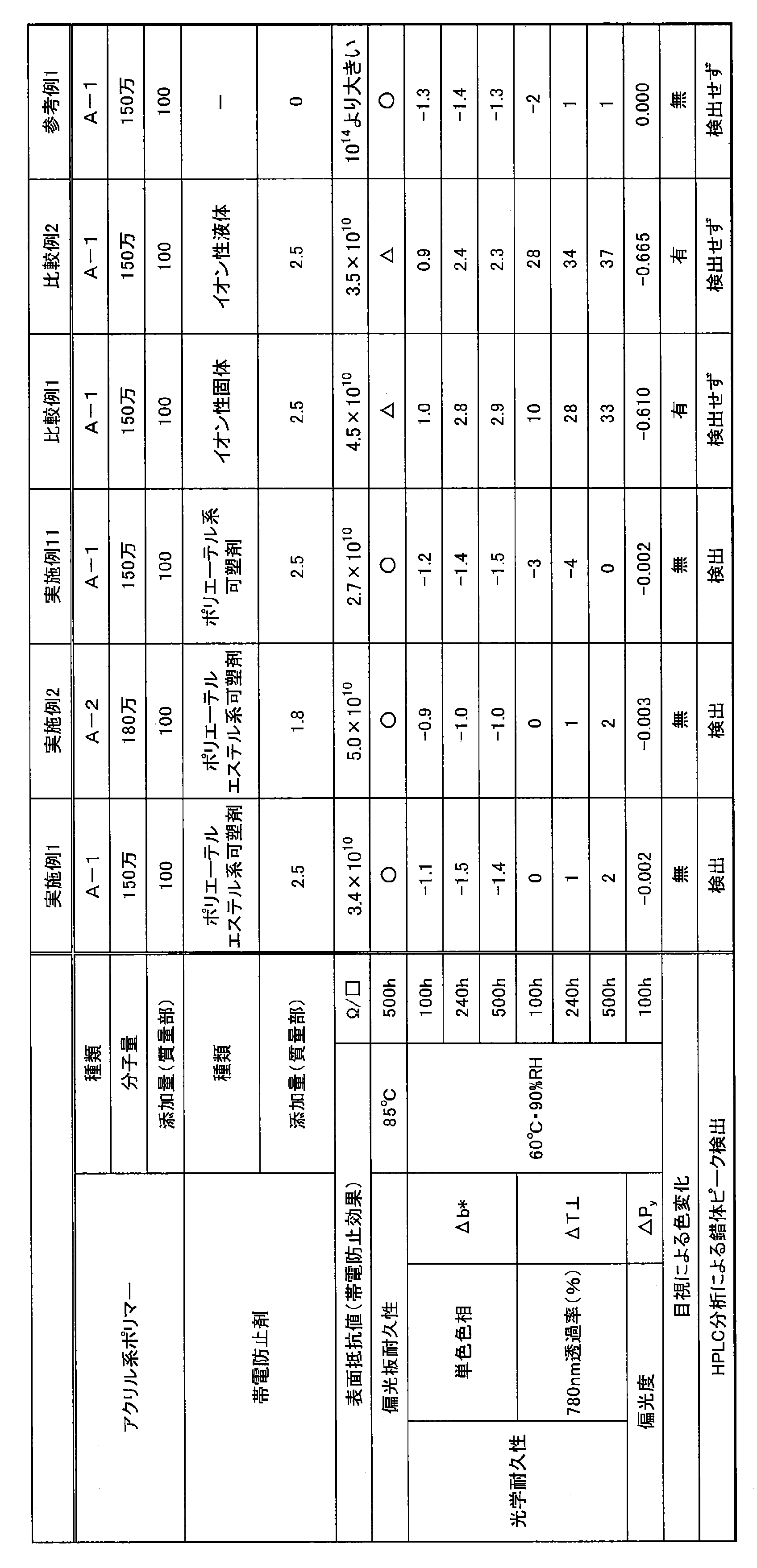
一方、比較例では、光学耐久性に劣ることがわかる。特に、比較例1及び2では、偏光板耐久性も良好ではなく、偏光板として機能が劣っていた。
10 偏光子
12 保護フィルム
20 粘着シート(偏光子用粘着剤組成物層)
Claims (19)
- 帯電防止性組成物を含有し、前記帯電防止性組成物は、ポリエーテル基を主鎖中に含む可塑剤中にフルオロ基及びスルホニル基を有する陰イオンを備えた塩が溶解された組成物であることを特徴とする偏光子用粘着剤組成物。
- 前記帯電防止性組成物は、ポリエーテル基を主鎖中に含むポリエーテルエステル系可塑剤中にフルオロ基及びスルホニル基を有する陰イオンを備えた塩が溶解された組成物である請求項1に記載の偏光子用粘着剤組成物。
- 前記ポリエーテルエステル系可塑剤は、下記式(1)又は(2)で表される少なくとも1種のポリエーテルエステル系可塑剤を含む請求項2に記載の偏光子用粘着剤組成物;


- 前記帯電防止性組成物は、ポリエーテル基を主鎖中に含むポリエーテル系可塑剤中にフルオロ基及びスルホニル基を有する陰イオンを備えた塩が溶解された組成物である請求項1に記載の偏光子用粘着剤組成物。
- 前記ポリエーテル系可塑剤は、下記式(11)を有するポリエーテル系可塑剤を含む、請求項4に記載の偏光子用粘着剤組成物;
R1(OCH2CH2)nOR2 (11)
式中、R1は炭素数1~12のアルキル基を表し、R2は水素原子又は炭素数1~12のアルキル基を表す。nは3~6の整数を表す。 - 前記帯電防止性組成物は、ポリエーテル基を主鎖中に含むポリエーテルエステル系可塑剤中にフルオロ基及びスルホニル基を有する陰イオンを備えた塩が溶解された組成物と、ポリエーテル基を主鎖中に含むポリエーテル系可塑剤中にフルオロ基及びスルホニル基を有する陰イオンを備えた塩が溶解された組成物とを含む請求項1に記載の偏光子用粘着剤組成物。
- 前記偏光子用粘着剤組成物は、主成分が、実質的にカルボキシル基を含有しない粘着剤組成物である請求項1~6のいずれか1項に記載の偏光子用粘着剤組成物。
- 前記偏光子用粘着剤組成物は、主成分がアクリル系粘着剤組成物である請求項1~7のいずれか1項に記載の偏光子用粘着剤組成物。
- 前記アクリル系粘着剤組成物は、(メタ)アクリル共重合体(A)と架橋剤(B)を含有し、前記(メタ)アクリル共重合体(A)は(i)炭素数1~18のアルキル基を有する(メタ)アクリル酸エステルモノマー60~99.99質量%と、(ii)ラジカル重合性不飽和基を有し、且つ少なくとも1つの反応性官能基を有するモノマー0.01~20質量%とを少なくとも重合して得られる請求項8に記載の偏光子用粘着剤組成物。
- 前記反応性官能基はヒドロキシ基及びアミノ基から選択される少なくとも1つであって、前記反応性官能基を有するモノマーは実質的にカルボキシ基含有モノマーを含まない請求項9に記載の偏光子用粘着剤組成物。
- 前記架橋剤(B)は、イソシアネート系架橋剤、エポキシ系架橋剤及び金属キレート系架橋剤から選択される少なくとも1種である請求項9又は10に記載の偏光子用粘着剤組成物。
- 前記(メタ)アクリル共重合体(A)100質量部に対し、前記帯電防止性組成物の含有量が0.01~30質量部である請求項9~11のいずれか1項に記載の偏光子用粘着剤組成物。
- 前記フルオロ基及びスルホニル基を有する陰イオンは、ビス(フルオロアルキルスルホニル)イミドイオン、トリス(フルオロアルキルスルホニル)メチドイオン及びフルオロアルキルスルホン酸イオンからなる群から選ばれた陰イオンである請求項1~12のいずれか1項に記載の偏光子用粘着剤組成物。
- 前記フルオロ基及びスルホニル基を有する陰イオンを備えた塩は、アルカリ金属、2族元素、遷移金属及び両性金属から選択される少なくとも一種の陽イオンと、前記フルオロ基およびスルホニル基を有する陰イオンとからなる塩である請求項1~13のいずれか1項に記載の偏光子用粘着剤組成物。
- 前記フルオロ基およびスルホニル基を有する陰イオンを備えた塩が、ビス(フルオロアルキルスルホニル)イミドのアルカリ金属塩、トリス(フルオロアルキルスルホニル)メチドのアルカリ金属塩及びトリフルオロアルキルスルホン酸のアルカリ金属塩からなる群から選ばれた塩である請求項1~14のいずれか1項に記載の偏光子用粘着剤組成物。
- 前記偏光子用粘着剤組成物は、偏光子と光学部材を貼合するためのものである請求項1~15のいずれか1項に記載の偏光子用粘着剤組成物。
- 前記光学部材は、液晶セル又はタッチパネルである請求項16に記載の偏光子用粘着剤組成物。
- 請求項1~17のいずれか1項に記載の偏光子用粘着剤組成物を含む偏光子用粘着シート。
- 請求項18に記載の粘着シートを少なくとも1つ備えた画像表示装置。
Priority Applications (3)
| Application Number | Priority Date | Filing Date | Title |
|---|---|---|---|
| KR1020177000346A KR101958680B1 (ko) | 2014-06-18 | 2015-06-16 | 편광자용 점착제 조성물 및 편광자용 점착 시트 |
| CN201580032667.2A CN106795416A (zh) | 2014-06-18 | 2015-06-16 | 起偏镜用粘合剂组合物及起偏镜用粘合片 |
| JP2016529355A JP6508204B2 (ja) | 2014-06-18 | 2015-06-16 | 偏光子用粘着剤組成物及び偏光子用粘着シート |
Applications Claiming Priority (4)
| Application Number | Priority Date | Filing Date | Title |
|---|---|---|---|
| JP2014125311 | 2014-06-18 | ||
| JP2014125310 | 2014-06-18 | ||
| JP2014-125311 | 2014-06-18 | ||
| JP2014-125310 | 2014-06-18 |
Publications (1)
| Publication Number | Publication Date |
|---|---|
| WO2015194532A1 true WO2015194532A1 (ja) | 2015-12-23 |
Family
ID=54935515
Family Applications (1)
| Application Number | Title | Priority Date | Filing Date |
|---|---|---|---|
| PCT/JP2015/067257 Ceased WO2015194532A1 (ja) | 2014-06-18 | 2015-06-16 | 偏光子用粘着剤組成物及び偏光子用粘着シート |
Country Status (5)
| Country | Link |
|---|---|
| JP (1) | JP6508204B2 (ja) |
| KR (1) | KR101958680B1 (ja) |
| CN (1) | CN106795416A (ja) |
| TW (1) | TWI662099B (ja) |
| WO (1) | WO2015194532A1 (ja) |
Cited By (6)
| Publication number | Priority date | Publication date | Assignee | Title |
|---|---|---|---|---|
| JPWO2015194531A1 (ja) * | 2014-06-18 | 2017-06-01 | 王子ホールディングス株式会社 | 偏光子用粘着剤組成物及び偏光子用粘着シート |
| JP2017142293A (ja) * | 2016-02-08 | 2017-08-17 | 日東電工株式会社 | 光学フィルム及び光学表示パネル |
| JP2017171703A (ja) * | 2016-03-18 | 2017-09-28 | 日本カーバイド工業株式会社 | 粘着剤組成物及び粘着剤層付偏光板 |
| WO2018168351A1 (ja) * | 2017-03-15 | 2018-09-20 | 日東電工株式会社 | 偏光板 |
| JP2019143007A (ja) * | 2018-02-19 | 2019-08-29 | 王子ホールディングス株式会社 | 粘着剤組成物、粘着シート及び積層体 |
| JP2022040324A (ja) * | 2020-11-12 | 2022-03-10 | 藤森工業株式会社 | 粘着剤組成物及び粘着フィルム |
Families Citing this family (4)
| Publication number | Priority date | Publication date | Assignee | Title |
|---|---|---|---|---|
| CN106489086B (zh) * | 2014-06-18 | 2021-02-02 | 住友化学株式会社 | 偏振片、带有粘合剂的偏振板和图像显示装置 |
| KR102455461B1 (ko) * | 2016-06-14 | 2022-10-19 | 닛토덴코 가부시키가이샤 | 양면 점착제층 부착 편광 필름 및 화상 표시 장치 |
| KR102793720B1 (ko) * | 2018-11-01 | 2025-04-09 | 닛토덴코 가부시키가이샤 | 점착제층 부착 편광판 |
| JP2021189259A (ja) * | 2020-05-28 | 2021-12-13 | 日東電工株式会社 | 位相差層および粘着剤層付偏光板およびそれを用いた有機エレクトロルミネセンス表示装置 |
Citations (5)
| Publication number | Priority date | Publication date | Assignee | Title |
|---|---|---|---|---|
| JP2006111856A (ja) * | 2004-09-16 | 2006-04-27 | Nitto Denko Corp | 粘着剤組成物、粘着シート類、および表面保護フィルム |
| JP2008517138A (ja) * | 2005-06-10 | 2008-05-22 | エルジー・ケム・リミテッド | アクリル系粘着剤組成物 |
| JP2010189489A (ja) * | 2009-02-16 | 2010-09-02 | Lintec Corp | 粘着剤組成物及び粘着シート |
| WO2010143643A1 (ja) * | 2009-06-09 | 2010-12-16 | 日本合成化学工業株式会社 | 粘着剤組成物および粘着剤、ならびに光学部材用粘着剤、それを用いて得られる粘着剤層付き光学部材 |
| JP2014118469A (ja) * | 2012-12-14 | 2014-06-30 | Sanko Kagaku Kogyo Kk | 制電性粘着剤組成物及びその製造方法、並びに保護粘着フィルム、偏光フィルム及び位相差フィルム |
Family Cites Families (10)
| Publication number | Priority date | Publication date | Assignee | Title |
|---|---|---|---|---|
| JP4131104B2 (ja) | 2001-12-21 | 2008-08-13 | ソニーケミカル&インフォメーションデバイス株式会社 | 偏光板 |
| JP2006008882A (ja) * | 2004-06-28 | 2006-01-12 | Sanyo Chem Ind Ltd | 帯電防止性感圧接着剤 |
| JP2008007702A (ja) * | 2006-06-30 | 2008-01-17 | Sanyo Chem Ind Ltd | 帯電防止性粘着剤 |
| KR101047925B1 (ko) * | 2007-04-19 | 2011-07-08 | 주식회사 엘지화학 | 아크릴계 점착제 조성물 및 이를 포함하는 편광판 |
| JP5324316B2 (ja) | 2008-05-27 | 2013-10-23 | 日東電工株式会社 | 粘着型偏光板、画像表示装置およびそれらの製造方法 |
| JP2010065217A (ja) * | 2008-08-12 | 2010-03-25 | Nippon Synthetic Chem Ind Co Ltd:The | 光学部材用粘着剤組成物および光学部材用粘着剤ならびにそれを用いて得られる粘着剤層付き光学部材 |
| JP5860673B2 (ja) | 2011-11-07 | 2016-02-16 | 日東電工株式会社 | 粘着剤組成物、粘着剤層、粘着剤層付偏光板および画像形成装置 |
| JP5875106B2 (ja) | 2011-11-24 | 2016-03-02 | 日東電工株式会社 | 粘着剤組成物、粘着剤層、粘着剤層付偏光板および画像形成装置 |
| JP5738967B2 (ja) | 2013-11-22 | 2015-06-24 | 日東電工株式会社 | 粘着剤組成物、およびそれを用いてなる粘着シート類 |
| KR101958679B1 (ko) * | 2014-06-18 | 2019-03-15 | 오지 홀딩스 가부시키가이샤 | 편광자용 점착제 조성물 및 편광자용 점착 시트 |
-
2015
- 2015-06-16 JP JP2016529355A patent/JP6508204B2/ja active Active
- 2015-06-16 TW TW104119520A patent/TWI662099B/zh not_active IP Right Cessation
- 2015-06-16 WO PCT/JP2015/067257 patent/WO2015194532A1/ja not_active Ceased
- 2015-06-16 CN CN201580032667.2A patent/CN106795416A/zh active Pending
- 2015-06-16 KR KR1020177000346A patent/KR101958680B1/ko active Active
Patent Citations (5)
| Publication number | Priority date | Publication date | Assignee | Title |
|---|---|---|---|---|
| JP2006111856A (ja) * | 2004-09-16 | 2006-04-27 | Nitto Denko Corp | 粘着剤組成物、粘着シート類、および表面保護フィルム |
| JP2008517138A (ja) * | 2005-06-10 | 2008-05-22 | エルジー・ケム・リミテッド | アクリル系粘着剤組成物 |
| JP2010189489A (ja) * | 2009-02-16 | 2010-09-02 | Lintec Corp | 粘着剤組成物及び粘着シート |
| WO2010143643A1 (ja) * | 2009-06-09 | 2010-12-16 | 日本合成化学工業株式会社 | 粘着剤組成物および粘着剤、ならびに光学部材用粘着剤、それを用いて得られる粘着剤層付き光学部材 |
| JP2014118469A (ja) * | 2012-12-14 | 2014-06-30 | Sanko Kagaku Kogyo Kk | 制電性粘着剤組成物及びその製造方法、並びに保護粘着フィルム、偏光フィルム及び位相差フィルム |
Cited By (11)
| Publication number | Priority date | Publication date | Assignee | Title |
|---|---|---|---|---|
| JPWO2015194531A1 (ja) * | 2014-06-18 | 2017-06-01 | 王子ホールディングス株式会社 | 偏光子用粘着剤組成物及び偏光子用粘着シート |
| JP2017142293A (ja) * | 2016-02-08 | 2017-08-17 | 日東電工株式会社 | 光学フィルム及び光学表示パネル |
| JP7334024B2 (ja) | 2016-02-08 | 2023-08-28 | 日東電工株式会社 | 光学フィルム及び光学表示パネル |
| JP2017171703A (ja) * | 2016-03-18 | 2017-09-28 | 日本カーバイド工業株式会社 | 粘着剤組成物及び粘着剤層付偏光板 |
| WO2018168351A1 (ja) * | 2017-03-15 | 2018-09-20 | 日東電工株式会社 | 偏光板 |
| JP2018151603A (ja) * | 2017-03-15 | 2018-09-27 | 日東電工株式会社 | 偏光板 |
| JP7048213B2 (ja) | 2017-03-15 | 2022-04-05 | 日東電工株式会社 | 偏光板 |
| JP2019143007A (ja) * | 2018-02-19 | 2019-08-29 | 王子ホールディングス株式会社 | 粘着剤組成物、粘着シート及び積層体 |
| JP2022040324A (ja) * | 2020-11-12 | 2022-03-10 | 藤森工業株式会社 | 粘着剤組成物及び粘着フィルム |
| JP2024014940A (ja) * | 2020-11-12 | 2024-02-01 | 藤森工業株式会社 | 粘着剤組成物、粘着フィルム、粘着剤層付き偏光板及び液晶パネル |
| JP7708835B2 (ja) | 2020-11-12 | 2025-07-15 | Zacros株式会社 | 粘着剤組成物、粘着フィルム、粘着剤層付き偏光板及び液晶パネル |
Also Published As
| Publication number | Publication date |
|---|---|
| CN106795416A (zh) | 2017-05-31 |
| JP6508204B2 (ja) | 2019-05-08 |
| JPWO2015194532A1 (ja) | 2017-05-25 |
| TWI662099B (zh) | 2019-06-11 |
| KR101958680B1 (ko) | 2019-03-15 |
| KR20170016447A (ko) | 2017-02-13 |
| TW201606025A (zh) | 2016-02-16 |
Similar Documents
| Publication | Publication Date | Title |
|---|---|---|
| JP6508204B2 (ja) | 偏光子用粘着剤組成物及び偏光子用粘着シート | |
| CN106489086B (zh) | 偏振片、带有粘合剂的偏振板和图像显示装置 | |
| JP6508203B2 (ja) | 偏光子用粘着剤組成物及び偏光子用粘着シート | |
| TWI824992B (zh) | 雙面附黏著劑層之偏光薄膜及影像顯示裝置 | |
| TWI680176B (zh) | 附黏著劑之光學膜及圖像顯示裝置 | |
| TWI727494B (zh) | 雙面附黏著劑之光學膜、及使用其之圖像顯示裝置之製造方法、以及雙面附黏著劑之光學膜之捲曲抑制方法 | |
| JP2017110050A (ja) | 粘着剤組成物及び粘着シート | |
| TWI622629B (zh) | Coating liquid for anchor layer formation, optical film with adhesive layer and method for producing same | |
| JP5091304B2 (ja) | 粘着型光学フィルムの製造方法 | |
| CN108495903B (zh) | 用于制造无色且抗老化的基于聚丙烯酸酯的压敏胶粘剂配混物的方法 | |
| JP5847429B2 (ja) | 光学フィルム用粘着剤層およびその製造方法、粘着型光学フィルムおよびその製造方法、画像表示装置ならびに塗布液供給装置 | |
| TW201402229A (zh) | 附黏著劑層之光學薄膜的製造方法 | |
| JP6960234B2 (ja) | 粘着剤層付偏光フィルムおよび画像表示装置 | |
| KR101989305B1 (ko) | 표면 보호 필름 및 그것이 첩합된 광학 부품 | |
| JP2017110049A (ja) | 粘着剤組成物及び粘着シート | |
| TWI888350B (zh) | 附黏著劑層之偏光薄膜及其剝離方法、以及影像顯示裝置 |
Legal Events
| Date | Code | Title | Description |
|---|---|---|---|
| 121 | Ep: the epo has been informed by wipo that ep was designated in this application |
Ref document number: 15809081 Country of ref document: EP Kind code of ref document: A1 |
|
| ENP | Entry into the national phase |
Ref document number: 2016529355 Country of ref document: JP Kind code of ref document: A |
|
| NENP | Non-entry into the national phase |
Ref country code: DE |
|
| ENP | Entry into the national phase |
Ref document number: 20177000346 Country of ref document: KR Kind code of ref document: A |
|
| 122 | Ep: pct application non-entry in european phase |
Ref document number: 15809081 Country of ref document: EP Kind code of ref document: A1 |