WO2015190345A1 - 耐アルカリ性水性インキ組成物 - Google Patents
耐アルカリ性水性インキ組成物 Download PDFInfo
- Publication number
- WO2015190345A1 WO2015190345A1 PCT/JP2015/065851 JP2015065851W WO2015190345A1 WO 2015190345 A1 WO2015190345 A1 WO 2015190345A1 JP 2015065851 W JP2015065851 W JP 2015065851W WO 2015190345 A1 WO2015190345 A1 WO 2015190345A1
- Authority
- WO
- WIPO (PCT)
- Prior art keywords
- acrylic acid
- acid copolymer
- meth
- alkali
- value
- Prior art date
- Legal status (The legal status is an assumption and is not a legal conclusion. Google has not performed a legal analysis and makes no representation as to the accuracy of the status listed.)
- Ceased
Links
Classifications
-
- C—CHEMISTRY; METALLURGY
- C09—DYES; PAINTS; POLISHES; NATURAL RESINS; ADHESIVES; COMPOSITIONS NOT OTHERWISE PROVIDED FOR; APPLICATIONS OF MATERIALS NOT OTHERWISE PROVIDED FOR
- C09D—COATING COMPOSITIONS, e.g. PAINTS, VARNISHES OR LACQUERS; FILLING PASTES; CHEMICAL PAINT OR INK REMOVERS; INKS; CORRECTING FLUIDS; WOODSTAINS; PASTES OR SOLIDS FOR COLOURING OR PRINTING; USE OF MATERIALS THEREFOR
- C09D11/00—Inks
- C09D11/02—Printing inks
- C09D11/023—Emulsion inks
-
- C—CHEMISTRY; METALLURGY
- C09—DYES; PAINTS; POLISHES; NATURAL RESINS; ADHESIVES; COMPOSITIONS NOT OTHERWISE PROVIDED FOR; APPLICATIONS OF MATERIALS NOT OTHERWISE PROVIDED FOR
- C09D—COATING COMPOSITIONS, e.g. PAINTS, VARNISHES OR LACQUERS; FILLING PASTES; CHEMICAL PAINT OR INK REMOVERS; INKS; CORRECTING FLUIDS; WOODSTAINS; PASTES OR SOLIDS FOR COLOURING OR PRINTING; USE OF MATERIALS THEREFOR
- C09D11/00—Inks
- C09D11/02—Printing inks
- C09D11/10—Printing inks based on artificial resins
- C09D11/106—Printing inks based on artificial resins containing macromolecular compounds obtained by reactions only involving carbon-to-carbon unsaturated bonds
-
- C—CHEMISTRY; METALLURGY
- C09—DYES; PAINTS; POLISHES; NATURAL RESINS; ADHESIVES; COMPOSITIONS NOT OTHERWISE PROVIDED FOR; APPLICATIONS OF MATERIALS NOT OTHERWISE PROVIDED FOR
- C09D—COATING COMPOSITIONS, e.g. PAINTS, VARNISHES OR LACQUERS; FILLING PASTES; CHEMICAL PAINT OR INK REMOVERS; INKS; CORRECTING FLUIDS; WOODSTAINS; PASTES OR SOLIDS FOR COLOURING OR PRINTING; USE OF MATERIALS THEREFOR
- C09D11/00—Inks
- C09D11/02—Printing inks
- C09D11/10—Printing inks based on artificial resins
- C09D11/106—Printing inks based on artificial resins containing macromolecular compounds obtained by reactions only involving carbon-to-carbon unsaturated bonds
- C09D11/107—Printing inks based on artificial resins containing macromolecular compounds obtained by reactions only involving carbon-to-carbon unsaturated bonds from unsaturated acids or derivatives thereof
Definitions
- the present invention relates to a water-based ink composition having high alkali resistance and excellent printability and workability, particularly an ink composition suitable for water-based ink use for gravure printing and flexographic printing, and a method for producing the composition About.
- an ethylene-acrylic acid copolymer is known as a new resin component that solves these problems.
- a method of blending a special surfactant (acetylene diols) at a specific ratio (for example, Patent Document 1) when dispersing the pigment in the resin component has been proposed and exhibits a certain effect, but the type of pigment changes. However, the dispersion effect is reduced, and when the pigment concentration is increased, the pigment is settled and the function is not sufficiently exhibited.
- an object of the present invention is to provide an alkali-resistant water-based ink composition using an ethylene-acrylic acid copolymer as a resin component, without depending on the type of pigment, and without using a special surfactant.
- An object of the present invention is to provide an alkali-resistant ink composition having good pigment dispersibility.
- the present inventor has obtained a pigment dispersion using a neutralized water dispersion of a basic compound of an acrylic acid copolymer having a specific SP value, an ethylene-acrylic
- the present invention was completed by finding that the dispersion stability of an ink composition containing an acid copolymer was good.
- the present invention relates to water obtained by neutralizing an acrylic acid copolymer having an SP value of 20.4 to 20.7 (J / cm 3 ) 1/2 in turbidity titration method with ammonia and / or alkanolamine.
- an alkali-resistant water-based ink composition comprising an aqueous dispersion prepared by dispersing a pigment in a dispersion and then neutralizing an ethylene-acrylic acid copolymer with an alkanolamine.
- the present invention also provides an alkali-resistant water-based ink composition in which the acrylic acid copolymer is a copolymer of an aromatic compound having a vinyl group, a (meth) acrylic acid ester, and (meth) acrylic acid. .
- the present invention also provides an alkali-resistant water-based ink composition containing a (meth) acrylic acid ester having 12 to 18 carbon atoms in an alcohol constituting the ester group of the (meth) acrylic acid ester.
- the present invention also provides an alkali-resistant water-based ink composition in which the acrylic acid copolymer has an acid value of 50 mgKOH / g or more.
- the alkali-resistant water-based ink composition according to the present invention has excellent dispersibility between the pigment and the ethylene-acrylic acid copolymer, the obtained ink has excellent stability and printability, and the printed matter has excellent alkali resistance. .
- the acrylic copolymer used for dispersing the pigment used in the alkali-resistant water-based ink composition of the present invention has an SP value of 20.4 to 20.7 (J / cm 3 ) 1/2 in the turbidity titration method.
- SP value 20.4 to 20.7 (J / cm 3 ) 1/2 in the turbidity titration method.
- the method for measuring the SP value by this turbidity titration method is described in W. Suh, D.H. H. The method is proposed by Clarke et al. In the following [Document 1], [Document 2], and the like.
- Procedure 1 Solidification of aqueous resin (Preparation of SP value measurement sample) (1) Add 300 ml of ion-exchanged water to a 500 ml beaker and dissolve 20 g of the aqueous dispersion resin while magnetically stirring. (2) Concentrated hydrochloric acid is added dropwise until the pH of the aqueous solution becomes 4. (3) The resin component is isolated by filtration under reduced pressure, and washed with ion exchange water until the waste liquid pH becomes 7. (4) The washed resin component powder is vacuum dried at 40 ° C. for 8 hours. Procedure 2.
- L titration of low polarity solvent (n-hexane) (cm 3 )
- H titration of highly polar solvent (water) (cm 3 )
- ⁇ SL Volume fraction of dissolved solvent (THF) with respect to the sum of dissolved solvent (THF) and titration solvent (n-hexane)
- ⁇ L Titration solvent with respect to the sum of dissolved solvent (THF) and titration solvent (n-hexane) ( n-Hexane) volume fraction
- ⁇ SH volume fraction of dissolving solvent (THF) with respect to the sum of dissolving solvent (THF) and titration solvent (ion exchange water)
- ⁇ H dissolving solvent (THF) and titration solvent (ion) Volume fraction of titration solvent (ion exchange water) with respect to the sum of exchange water)
- the calculated SP value can be known.
- an approximate copolymer composition can be determined before preparing an acrylic acid copolymer. Therefore, it is possible to theoretically design the outline of the acrylic acid copolymer composition having a specific SP value used in the present invention.
- the SP value of the copolymer is represented by the following formula.
- ⁇ copolym SP value of copolymer [(J / cm 3 ) 1/2 ]
- Mi indicates the mole fraction of the monomer component i component
- ⁇ Mi 1 ⁇ unit_i: SP value of the monomer units i component [(J / cm 3) 1/2]
- the acrylic acid copolymer used for dispersing the pigment used in the alkali-resistant water-based ink composition of the present invention has an SP value of 20.4 to 20.7 (J / cm 3 ) 1/2 in the turbidity titration method.
- the SP value ( ⁇ unit — i ) of the constituent monomer of the acrylic acid copolymer and its unit component is, for example, styrene [18.4], ⁇ -methylstyrene, although not particularly limited.
- the monomer unit component which does not exist as a literature value can estimate the SP value by the Fedors method described in the following [Document 3] or the like.
- the SP value calculated from the calculation cannot be directly applied to the present invention because the SP value of each monomer is slightly different depending on the literature. In order to carry out the present invention, it is necessary to determine the SP value by the turbidity titration method described above.
- the constituent monomer of the acrylic acid copolymer used in the alkali-resistant water-based ink composition of the present invention includes, for example, styrene, ⁇ -methylstyrene, 2-methylstyrene as the vinyl group-containing aromatic.
- Examples of other constituent monomers (meth) acrylate include methyl (meth) acrylate, ethyl (meth) acrylate, n-propyl (meth) acrylate, isopropyl (meth) acrylate, ( N-butyl (meth) acrylate, isobutyl (meth) acrylate, t-butyl (meth) acrylate, capryl (meth) acrylate, lauryl (meth) acrylate, tridecyl (meth) acrylate, (meth) acrylic acid Myristyl, cetyl (meth) acrylate, stearyl (meth) acrylate, 2-ethylhexyl (meth) acrylate, cyclohexyl (meth) acrylate, phenyl (meth) acrylate, benzyl (meth) acrylate, (meth) acrylic Isobornyl acid, glycidyl (meth)
- acrylic acid and methacrylic acid as the (meth) acrylic acid monomer.
- these may be used alone or in combination of two or more.
- the amount of the (meth) acrylic acid monomer used at that time is affected by the type of organic solvent and the ratio of the organic solvent to water in the aqueous process, but the solid content acid value ( mgKOH / g) can be made aqueous if it is about 20 or more, but from the viewpoint of reducing the amount of the organic solvent, the amount which becomes at least 50 with such an acid value is preferably the same acid. An amount that is 80 or more is appropriate.
- the constituent components of these acrylic acid copolymers are not limited to the exemplified monomers, and other monomers may be added at all.
- the acrylic acid copolymer can be produced by a known method.
- a two-stage method comprising a first step of producing an acrylic acid copolymer in an organic solvent and a second step of producing an aqueous resin is known.
- the production of the acrylic acid copolymer in the first step is obtained by so-called solution polymerization in which the monomer is polymerized in an organic solvent.
- the organic solvent herein is not particularly limited, but only a typical one among them is exemplified, and various aromatic organic solvents such as toluene and xylene, ethyl acetate, Various water-insoluble organic solvents such as various ester solvents such as butyl acetate; methanol, ethanol, normal (n-) propanol, iso (i-) propanol, n-butanol, isobutanol, tertiary ( tert-) various alcohol solvents such as butanol, 3-methoxybutanol, 3-methyl-3-methoxybutanol; various ketone solvents such as acetone, methyl ethyl ketone, isobutyl ketone, cyclohexanone; ethylene glycol, ethylene glycol mono
- the radical solution polymerization method is the simplest polymerization method. If only typical ones are exemplified as polymerization initiators that can be used when applying using such radical solution polymerization method, 2,2′-azobis (isobutyronitrile), 2,2′- Various azo compounds such as azobis (2,4-dimethylvaleronitrile) or 2,2′-azobis (2-methylbutyronitrile); or tert-butyl peroxypivalate, tert-butyl peroxybenzoate, tert-butylperoxy-2-ethylhexanoate, benzoyl peroxide, lauroyl peroxide, acetyl peroxide, di-tert-butyl peroxide, dicumyl peroxide, tert-butyl hydroperoxide, cumene hydroperoxide, Methyl ethyl ketone peroxide Such de or diisopropyl peroxy
- an acrylic acid copolymer can be produced by radical polymerization according to a known and commonly used method.
- the acrylic acid copolymer thus obtained can be partially or completely neutralized with a basic compound and dissolved in an aqueous medium by adding water.
- the basic compound to be used in that case is appropriate to use ammonia or organic amines, which is recommended and particularly representative.
- organic amines such as diisopropanolamine, 2-amino-2-methylpropanol, 2- (dimethylamino) -2-methylpropanol, morpholine, N-methylmorpholine, N-ethylmorpholine; or ammonia It is done.
- a resin dissolved in an aqueous medium can be obtained.
- the amount of the organic solvent contained in these resins can be reduced.
- an operation such as addition of a water-soluble solvent or so-called solvent replacement with a water-soluble solvent is performed.
- a resin in a form dissolved in an aqueous medium can be obtained by performing the treatment before or after neutralization and aqueous formation.
- the ethylene-acrylic acid copolymer used in the alkali-resistant water-based ink composition of the present invention is preferably 70 to 95% by weight of ethylene and 5 to 30% by weight of acrylic acid.
- the molecular weight of the ethylene-acrylic acid resin is preferably 5,000 to 10,000, the glass transition point is 0 ° C. or less, and the acid value is preferably 10 to 60.
- the neutralizing agent for the ethylene-acrylic acid copolymer alkylamine, alkanolamine and the like are preferable, and the carboxyl group of the copolymer is neutralized to obtain an aqueous dispersion.
- the added amount of the neutralizing agent is 0.8 equivalent or more with respect to 1 equivalent of the carboxyl group in the ethylene-acrylic acid copolymer, so that the dispersion stability of the copolymer and the re-solubility of the ink can be improved.
- alkylamines examples include diethylamine and triethylamine, and examples of the alkanolamines include monoethanolamine, dimethylethanolamine, and diethylethanolamine, and dimethylethanolamine is preferable.
- the acrylic acid copolymer used in the alkali-resistant water-based ink composition of the present invention is preferably 5% to 10% of the entire resin component contained in the ink. If it is less than this, it is difficult to disperse the pigment, so the pigment concentration must be reduced. On the other hand, if it exceeds this, the alkali resistance of the printed matter will be weakened.
- a colorant inorganic pigments, organic pigments, extender pigments and the like used in general water-based ink compositions can be used.
- the solvent water alone or an organic solvent miscible with water can be used.
- the organic solvent include alcohols such as methyl alcohol, ethyl alcohol, isopropyl alcohol and n-propyl alcohol, polyhydric alcohols such as propylene glycol and glycerin, propylene glycol monomethyl ether, propylene glycol monoethyl ether and propylene glycol mono n.
- -Ethers such as propyl ether and ethyl carbitol.
- auxiliary ingredients include waxes such as paraffin wax, polyethylene wax, carnauba wax, oleic acid amide, stearic acid amide, erucic acid amide, etc. for imparting friction resistance, slipperiness, etc.
- waxes such as paraffin wax, polyethylene wax, carnauba wax, oleic acid amide, stearic acid amide, erucic acid amide, etc.
- Fatty acid amides, silicon-based and non-silicon-based antifoaming agents for suppressing foaming at the time of printing, various dispersants for improving pigment wetting, and the like can also be used as appropriate.
- the alkali-resistant water-based printing ink composition according to the present invention is produced using an Eiger mill, a sand mill, a gamma mill, an attritor or the like generally used for the production of gravure and flexographic printing inks.
- the alkali-resistant water-based printing ink according to the present invention can be printed on a plastic film, polyethylene-coated paper or the like by a printing method in which oil-based printing ink is generally used, that is, gravure printing, flexographic printing or the like.
- Example 1 Mix 40 parts of the indigo pigment FASTOGEN BLUE LDB30 manufactured by DIC Corporation with 20 parts of the acrylic acid copolymer aqueous solution prepared in Reference Example 1, 4 parts of isopropyl alcohol, and 36 parts of water. Got. To this 26 parts of mill base was added 70 parts of an aqueous dispersion of ethylene-acrylic acid copolymer manufactured by Sumitomo Seika Co., Ltd., 3.8 parts of polyethylene wax, 3.8 parts of polyethylene wax, and 0.2 part of a silicone-based antifoaming agent. Cup No. 3 was adjusted by adding an aqueous diluent so as to be 16 seconds to obtain an aqueous ink.
- Example 2 An acrylic acid copolymer aqueous solution was synthesized by the same operation as in Reference Example 1 except that the monomers and neutralizing agents shown in Table 1 were used.
- the SP value of the solid content of the obtained acrylic acid copolymer was measured by the turbidity titration method and the turbidity titration method, it was 20.4 (J / cm 3 ) 1/2 and the solid content acid value was 82 mgKOH / g. there were.
- a mill base and aqueous ink were obtained in the same manner as in Example 1.
- Example 3 An acrylic acid copolymer aqueous solution was synthesized by the same operation as in Reference Example 1 except that the monomers and neutralizing agents shown in Table 1 were used.
- the SP value of the solid content of the obtained acrylic acid copolymer was measured by turbidity titration method and turbidity titration method, it was 20.7 (J / cm 3 ) 1/2 , and the solid content acid value was 50 mgKOH / g. there were.
- a mill base and aqueous ink were obtained in the same manner as in Example 1.
- Example 4 A mill base was prepared in the same manner as in Example 1 except that the acrylic acid copolymer aqueous solution of Reference Example 1 was used and the pigment was changed to 40 parts of DIC Corporation yellow pigment SYMULER FAST YELLOW 5GF, and then an aqueous ink was obtained. .
- Comparative Example 2 In the same manner as in Comparative Example 2, an acrylic acid copolymer aqueous solution was synthesized. When the SP value of the solid content of the obtained acrylic acid copolymer was measured by the turbidity titration method and the turbidity titration method, it was 20.3 (J / cm 3 ) 1/2 , and the solid content acid value was 100 mgKOH / g. there were. Using this aqueous resin, a mill base was obtained in the same manner as in Example 1. Next, adjustment of water-based ink was attempted in the same manner as in Example 1, but the ink was solidified immediately after the blending of Syxen L, and the ink could not be prepared.
- a water-based ink was obtained in the same manner as in Example 1 except that 40 parts of Joncrill 711, which is a styrene-acrylic copolymer water-based resin, was used in place of Saixen L when blending the ink.
- Joncrill 711 which is a styrene-acrylic copolymer water-based resin
- Table 1 shows the composition of the acrylic acid copolymer aqueous solution on a weight basis.
- Table 2 shows the formulation of mill base using each acrylic acid copolymer aqueous solution prepared on a weight basis.
- Table 4 shows the evaluation results of the water-based ink produced.
- the water-based ink of the present invention is excellent in storage stability, adhesion, re-solubility and alkali resistance.
Landscapes
- Chemical & Material Sciences (AREA)
- Life Sciences & Earth Sciences (AREA)
- Engineering & Computer Science (AREA)
- Materials Engineering (AREA)
- Wood Science & Technology (AREA)
- Organic Chemistry (AREA)
- Chemical Kinetics & Catalysis (AREA)
- Inks, Pencil-Leads, Or Crayons (AREA)
Abstract
樹脂成分としてエチレン-アクリル酸共重合体を用いた耐アルカリ性水性インキ組成物において、顔料の種類に依存せず、且つ、特殊な界面活性剤を用いなくても、顔料分散性が良好な耐アルカリ性インキ組成物を提供する。 濁度滴定法でのSP値が20.4~20.7(J/cm3)1/2のアクリル酸系共重合体をアンモニア及び/またはアルカノールアミンで中和した水分散体に顔料を分散させた後、エチレン-アクリル酸共重合体をアルカノールアミンで中和した水分散体を配合した耐アルカリ性水性インキ組成物。
Description
本発明は、高い耐アルカリ性を有し、且つ、印刷適性や作業性に優れた水性インキ組成物、特にグラビア印刷やフレキソ印刷用水性インキ用途に好適なインキ組成物、及び該組成物の製造方法に関する。
近年、大気汚染の防止、作業環境の改善などからグラビア印刷・フレキソ印刷分野の印刷インキの水性化が進められている。該分野で実績があるスチレン-アクリル酸共重合体では、印刷面の耐性、特に耐アルカリ性が弱く、アジリジン化合物などの架橋剤を用いる方法が知られているが、変異原性などの問題があり作業者の健康上好ましくない。また、水性2液型となるため、比較的短時間で加水分解してしまい、ポットライフが短いなど作業性、経済性に問題があった。
そのため、これらの問題点を解消する新たな樹脂成分としてエチレン-アクリル酸共重合体が知られている。この樹脂成分に顔料を分散させる際、特殊な界面活性剤(アセチレンジオール類)を特定の比率で配合する方法(例えば特許文献1)が提案され、一定の効果を表すが、顔料の種類が変わると分散効果が低減したり、顔料濃度を上げると顔料が沈降するなどして十分な機能を発揮していない。
従って、本発明の目的は、樹脂成分としてエチレン-アクリル酸共重合体を用いた耐アルカリ性水性インキ組成物において、顔料の種類に依存せず、且つ、特殊な界面活性剤を用いなくても、顔料分散性が良好な耐アルカリ性インキ組成物を提供することにある。
本発明者は、前記の課題を解決すべく鋭意検討の結果、特定のSP値を有するアクリル酸系共重合体の塩基性化合物による中和水分散体を用いた顔料分散体と、エチレン-アクリル酸共重合体とを含有するインキ組成物の分散安定性が良好であることを見出し本発明を完成させた。
すなわち、本発明は、濁度滴定法でのSP値が20.4~20.7(J/cm3)1/2のアクリル酸系共重合体をアンモニア及び/またはアルカノールアミンで中和した水分散体に顔料を分散させた後、エチレン-アクリル酸共重合体をアルカノールアミンで中和した水分散体を配合した耐アルカリ性水性インキ組成物を提供する。
また、本発明は、前記アクリル酸系共重合体が、ビニル基を有する芳香族化合物と(メタ)アクリル酸エステルと(メタ)アクリル酸の共重合体である耐アルカリ性水性インキ組成物を提供する。
また、本発明は、前記(メタ)アクリル酸エステルのエステル基を構成するアルコールの炭素数が12から18である(メタ)アクリル酸エステルが含まれる耐アルカリ性水性インキ組成物を提供する。
更に、本発明は、前記アクリル酸系共重合体の酸価が50mgKOH/g以上である耐アルカリ性水性インキ組成物をも提供する。
本発明による耐アルカリ性水性インキ組成物は、顔料とエチレン-アクリル酸共重合体との分散性に優れているので、得られたインキは安定性、印刷適性に優れ、この印刷物は耐アルカリ性に優れる。
本発明の耐アルカリ性水性インキ組成物で用いる顔料の分散に用いるアクリル酸系共重合体は、濁度滴定法でのSP値が20.4~20.7(J/cm3)1/2のアクリル酸系共重合のアンモニア中和した水分散体であれば、特に限定されない。
この濁度滴定法によるSP値の測定方法は、K.W.Suh、D.H.Clarkeらによってその方法が次の〔文献1〕、〔文献2〕等で提唱されている。
この濁度滴定法によるSP値の測定方法は、K.W.Suh、D.H.Clarkeらによってその方法が次の〔文献1〕、〔文献2〕等で提唱されている。
〔文献1〕K.W.Suh,D.H.Clarke,J.Polym.Sci.,1671,1967
〔文献2〕K.W.Suh,J.M.Corbett.J.Appl.Poym.Sci.,2359,1968
〔文献2〕K.W.Suh,J.M.Corbett.J.Appl.Poym.Sci.,2359,1968
この方法に従った測定手順を例示すれば、たとえば次の手順に従って測定する。
手順1.水性樹脂の固形化(SP値測定試料の調製)
(1)500mlビーカーにイオン交換水を300ml入れ、磁気攪拌しながら水性分散樹脂を20g溶かす。
(2)水溶液のpHが4になるまで濃塩酸を滴下する。
(3)減圧濾過で樹脂成分を単離し、イオン交換水で廃液pHが7になるまで水洗する。
(4)洗浄した樹脂成分の粉体を40℃で8時間真空乾燥する。
手順2.SP値の測定
(1)50ml 三角フラスコに前記固形樹脂試料を0.500g+-0.005gを秤取する。
(2)試料をTHF10mlで溶解する。
(3)試料溶液を水冷等により25℃保ちながら、磁気攪拌しながらn-ヘキサンで濁点(Lml)を滴定する。濁点は、滴定試料の入ったフラスコを25℃に保ったまま印刷物上に置き上から覗いた時に液層の濁りで活字がぼやけて判読できなくなった時点を滴定点とする。
(4)同様の手順で、イオン交換水の濁点(Hml)を滴定する。
(5)計算
下式で試料のSP値δ[(J/cm3)1/2 ]を求める。
手順1.水性樹脂の固形化(SP値測定試料の調製)
(1)500mlビーカーにイオン交換水を300ml入れ、磁気攪拌しながら水性分散樹脂を20g溶かす。
(2)水溶液のpHが4になるまで濃塩酸を滴下する。
(3)減圧濾過で樹脂成分を単離し、イオン交換水で廃液pHが7になるまで水洗する。
(4)洗浄した樹脂成分の粉体を40℃で8時間真空乾燥する。
手順2.SP値の測定
(1)50ml 三角フラスコに前記固形樹脂試料を0.500g+-0.005gを秤取する。
(2)試料をTHF10mlで溶解する。
(3)試料溶液を水冷等により25℃保ちながら、磁気攪拌しながらn-ヘキサンで濁点(Lml)を滴定する。濁点は、滴定試料の入ったフラスコを25℃に保ったまま印刷物上に置き上から覗いた時に液層の濁りで活字がぼやけて判読できなくなった時点を滴定点とする。
(4)同様の手順で、イオン交換水の濁点(Hml)を滴定する。
(5)計算
下式で試料のSP値δ[(J/cm3)1/2 ]を求める。

ここで、
L:低極性溶剤(n-ヘキサン)の滴定量(cm3)
H:高極性溶剤(水)の滴定量(cm3)
φSL:溶解溶剤(THF)と滴定溶剤(n-ヘキサン)の和に対する溶解溶剤(THF)の体積分率
φL:溶解溶剤(THF)と滴定溶剤(n-ヘキサン)の和に対する滴定溶剤(n-へキサン)の体積分率
φSH:溶解溶剤(THF)と滴定溶剤(イオン交換水)の和に対する溶解溶剤(THF)の体積分率
φH:溶解溶剤(THF)と滴定溶剤(イオン交換水)の和に対する滴定溶剤(イオン交換水)の体積分率
VS:溶解溶剤(THF)の分子容〔ml/mol〕=81
VL:滴定溶剤(n-ヘキサン)の分子容〔ml/mol〕=132
VH:滴定溶剤(イオン交換水)の分子容〔ml/mol〕=18
δS:溶解溶剤(THF)のSP値〔(J/cm3)1/2〕=19.5
δL:滴定溶剤(n-ヘキサン)のSP値〔(J/cm3)1/2〕=14.8
δH:滴定溶剤(イオン交換水)のSP値〔(J/cm3)1/2〕=48.1
δ:試料のSP値〔(J/cm3)1/2〕(濁度滴定法)
L:低極性溶剤(n-ヘキサン)の滴定量(cm3)
H:高極性溶剤(水)の滴定量(cm3)
φSL:溶解溶剤(THF)と滴定溶剤(n-ヘキサン)の和に対する溶解溶剤(THF)の体積分率
φL:溶解溶剤(THF)と滴定溶剤(n-ヘキサン)の和に対する滴定溶剤(n-へキサン)の体積分率
φSH:溶解溶剤(THF)と滴定溶剤(イオン交換水)の和に対する溶解溶剤(THF)の体積分率
φH:溶解溶剤(THF)と滴定溶剤(イオン交換水)の和に対する滴定溶剤(イオン交換水)の体積分率
VS:溶解溶剤(THF)の分子容〔ml/mol〕=81
VL:滴定溶剤(n-ヘキサン)の分子容〔ml/mol〕=132
VH:滴定溶剤(イオン交換水)の分子容〔ml/mol〕=18
δS:溶解溶剤(THF)のSP値〔(J/cm3)1/2〕=19.5
δL:滴定溶剤(n-ヘキサン)のSP値〔(J/cm3)1/2〕=14.8
δH:滴定溶剤(イオン交換水)のSP値〔(J/cm3)1/2〕=48.1
δ:試料のSP値〔(J/cm3)1/2〕(濁度滴定法)
このSP値の単位は、従来(cal/cm3)1/2が広く用いられてきたが、SI単位の導入により近年は(J/cm3)1/2が用いられるようになってきた。従来単位での1(cal/cm3)1/2は、2.045(J/cm3)1/2に相当する。
一方、アクリル酸系共重合体を構成する単量体のSP値とそのモル分率から、当該共重合体のSP値を算出することで、計算上のSP値を知ることができるため、実際にアクリル酸系共重合体を作製する前におよその共重合組成を決めることができる。このため本発明で使用する特定のSP値を有するアクリル酸系共重合体組成の概要を理論的に設計することが出来る。
共重合体のSP値は、次式で示される。
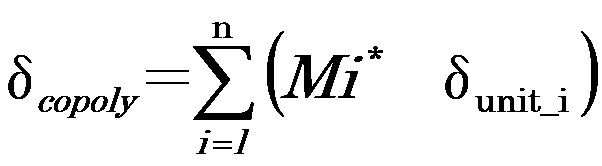
ここで、
δcopolym:共重合体のSP値〔(J/cm3)1/2〕
Mi:単量体単位i成分のモル分率を示し、ΣMi=1
δunit_i:単量体単位i成分のSP値〔(J/cm3)1/2〕
δcopolym:共重合体のSP値〔(J/cm3)1/2〕
Mi:単量体単位i成分のモル分率を示し、ΣMi=1
δunit_i:単量体単位i成分のSP値〔(J/cm3)1/2〕
本発明の耐アルカリ性水性インキ組成物で使用する顔料の分散に用いるアクリル酸系共重合体は、濁度滴定法でのSP値が20.4~20.7(J/cm3)1/2の範囲内であれば、特に限定されないが、このアクリル酸系共重合体の構成単量体とその単位成分のSP値(δunit_i)は、たとえば、スチレン[18.4]、α-メチルスチレン[17.4]、アクリル酸[24.5]、メタクリル酸[22.9]、アクリル酸メチル[20.5]、アクリル酸エチル[19.4]、アクリル酸ブチル[18.4]、アクリル酸(2-エチルヘキシル)[18.5]、アクリル酸エチルカルビトール[42.5]、メタクリル酸メチル[19.4]、メタクリル酸エチル[18.0]、メタクリル酸n-ブチル[18.0]、メタクリル酸iso-ブチル[14.7]、メタクリル酸ラウリル[16.8]、メタクリル酸ステアリル「16.0」、メタクリル酸ヒドロキシエチル[27.5]、などを用いることができ、各単量体のモル分率から予め計算上のSP値を知ることができる。
尚、文献値として存在しない単量体単位成分は、次の〔文献3〕等に記載のFedorsの方法などにより、そのSP値を推算することが出来る。
〔文献3〕R.F.Fedors,Polym.Eng.Sci.,14〔2〕、145-154,1974
しかしながら、計算から算出したSP値は、各単量体のSP値が文献により若干異なるので、本発明にそのまま適用することはできない。本発明を実施するには、前述の濁度滴定法によりSP値を求めることが必要である。
前述のように、本発明の耐アルカリ性水性インキ組成物に用いるアクリル酸系共重合体の構成単量体は、ビニル基含有芳香族としては、たとえば、スチレン、α-メチルスチレン、2-メチルスチレン、3-メチルスチレン、4-メチルスチレン、4-プロピルスチレン、4-t-ブチルスチレン、4-シクロヘキシルスチレン、4-ドデシルスチレン、2,4-ジメチルスチレン、2,4-ジイソプロピルスチレン、2,4,6-トリメチルスチレン、2-エチル-4-ベンジルスチレン、4-(フェニルブチル)スチレン、1-ビニルナフタレン、2-ビニルナフタレン、ビニルアントラセン、N,N-ジエチル-4-アミノエチルスチレン、ビニルピリジン、4-メトキシスチレン、モノクロロスチレン、ジクロロスチレン及びジビニルベンゼン等が挙げられる。これらの芳香族ビニル化合物は1種を単独で、又は2種以上を併用してもよい。中でも、スチレン、α-メチルスチレンが好ましい。
他の構成単量体である(メタ)アクリル酸エステルとしては、たとえば、(メタ)アクリル酸メチル、(メタ)アクリル酸エチル、(メタ)アクリル酸n-プロピル、(メタ)アクリル酸イソプロピル、(メタ)アクリル酸n-ブチル、(メタ)アクリル酸イソブチル、(メタ)アクリル酸t-ブチル、(メタ)アクリル酸カプリル、(メタ)アクリル酸ラウリル、(メタ)アクリル酸トリデシル、(メタ)アクリル酸ミリスチル、(メタ)アクリル酸セチル、(メタ)アクリル酸ステアリル、(メタ)アクリル酸2-エチルヘキシル、(メタ)クリル酸シクロヘキシル、(メタ)アクリル酸フェニル、(メタ)アクリル酸ベンジル、(メタ)アクリル酸イソボルニル、(メタ)アクリル酸グリシジル、(メタ)アクリル酸テトラヒドロフルフリル、(メタ)アクリル酸アリル、(メタ)アクリル酸2-ヒドロキシエチル、(メタ)アクリル酸ヒドロキシプロピル、(メタ)アクリル酸2-メトキシエチル、(メタ)アクリル酸2-エトキシエチル、(メタ)アクリル酸シクロヘキシル、(メタ)アクリル酸ポリアルキレングリコールエステル等のアクリル酸エステル等が挙げられる。これらの(メタ)アクリル酸エステルは、1種を単独で、又は2種以上を併用してもよい。
先に示したように(メタ)アクリル酸エステルの構成単量体成分のSP値(δunit_i)からは、炭素数が少ないと、SP値が大きくなり、炭素数が大きいとSP値が小さくなる傾向がある。このことから、(メタ)アクリル酸エステルのエステル基を構成するアルコールの炭素数が12から18である(メタ)アクリル酸ラウリル、(メタ)アクリル酸トリデシル、(メタ)アクリル酸ミリスチル、(メタ)アクリル酸セチル、(メタ)アクリル酸ステアリル、(メタ)アクリル酸エステルが含まれるとアクリル酸系共重合体のSP値と酸価のバランスが取り易く、好ましい。
一方、(メタ)アクリル酸単量体は、アクリル酸、メタクリル酸を主として用いることが現実的で好ましい。無論、これらは1種を単独で、又は2種以上を併用してもよい。
その際の(メタ)アクリル酸単量体の使用量としては、有機溶剤の種類と、水性化における有機溶剤と水の比率などによっても影響されるが、得られる重合体の固形分酸価(mgKOH/g)として、20程度以上あれば、水性化することが出来るが、有機溶剤量の低減化の観点からも、かかる酸価で以て、少なくとも50になる量が、好ましくは、同酸価で以て、80以上になる量が適切である。
これらのアクリル酸系共重合体の構成成分は、例示した単量体に限られる訳でなく、その他の単量体を追加しても全く構わない。
その際の(メタ)アクリル酸単量体の使用量としては、有機溶剤の種類と、水性化における有機溶剤と水の比率などによっても影響されるが、得られる重合体の固形分酸価(mgKOH/g)として、20程度以上あれば、水性化することが出来るが、有機溶剤量の低減化の観点からも、かかる酸価で以て、少なくとも50になる量が、好ましくは、同酸価で以て、80以上になる量が適切である。
これらのアクリル酸系共重合体の構成成分は、例示した単量体に限られる訳でなく、その他の単量体を追加しても全く構わない。
本発明にアクリル酸系共重合体は、公知の方法で製造することができる。たとえば、有機溶剤中でアクリル酸系共重合体の製造という第一工程と、水性樹脂の製造という第二工程とからなる、2段階の方法が知られている。
第一工程のアクリル酸系共重合体の製造は、その単量体を有機溶剤中において、重合するという、いわゆる溶液重合によって得られるものである。ここでいう有機溶剤としては、特に限定はないが、それらのうちでも特に代表的なもののみを例示するにとどめれば、トルエン、キシレンの如き、各種の芳香族系有機溶剤や、酢酸エチル、酢酸ブチルの如き、各種のエステル系溶剤などのような種々の非水溶性有機溶剤;メタノール、エタノール、ノルマル(n-)プロパノール、イソ(i-)プロパノール、n-ブタノール、イソブタノール、ターシャリー(tert-)ブタノール、3-メトキシブタノール、3-メチル-3-メトキシブタノールの如き、各種のアルコール系溶剤;アセトン、メチルエチルケトン、イソブチルケトン、シクロヘキサノンの如き、各種のケトン系溶剤;エチレングリコール、エチレングリコールモノメチルエーテル、エチレングリコールモノエチルエーテル、エチレングリコールモノプロピルエーテル、エチレングリコールモノブチルエーテル、セロソルブアセテート、の如き、各種のエチレングリコール系溶剤;メチルカルビトール、エチルカルビトール、ブチルカルビトールの如き、各種のジエチレングリコール系溶剤;プロピレングリコール、プロピレングリコールモノメチルエーテル、プロピレングリコールモノエチルエーテル、プロピレングリコールモノプロピルエーテル、プロピレングリコールモノブチルエーテル、プロピレングリコールモノ-tert-ブチルエーテルの如き、各種のプロピレングリコール系溶剤;ジプロピレングリコールモノメチルエーテル、ジプロピレングリコールモノブチルエーテル、トリプロピレングリコールモノブチルエーテルの如き、各種のジ-ないしはトリプロピレングリコール系溶剤などであるし、さらには、テトラヒドロフラン、N-メチルピロリドン、ジメチルホルムアミド、ジメチルスルホキシド、スルホランの如き、水に良好な溶解性を有する、各種の水溶性有機溶剤などであるが、第二工程で以て水性化を行なうために、その生産性ならびに作業性などを考慮すれば、上掲したような水溶性有機溶剤の使用が望ましい。
その際の重合手段としては、ラジカル溶液重合法が、最も簡便なる重合方法である。かかるラジカル溶液重合法を利用し適用する際に使用できる重合開始剤として特に代表的なもののみを例示するにとどめるならば、2,2’-アゾビス(イソブチロニトリル)、2,2’-アゾビス(2,4-ジメチルバレロニトリル)もしくは2,2’-アゾビス(2-メチルブチロニトリル)の如き、各種のアゾ化合物類;またはtert-ブチルパーオキシピバレート、tert-ブチルパーオキシベンゾエート、tert-ブチルパーオキシ-2-エチルヘキサノエート、ベンゾイルパーオキサイド、ラウロイルパーオキサイド、アセチルパーオキサイド、ジ-tert-ブチルパーオキサイド、ジクミルパーオキサイド、tert-ブチルハイドロパーオキサイド、クメンハイドロパーオキサイド、メチルエチルケトンパーオキサイドもしくはジイソプロピルパーオキシカーボネートの如き、各種の過酸化物類などである。
以上に掲げたような各種の原料類を使用して、公知慣用の方法に従ってラジカル重合することによって、アクリル酸系共重合体を製造することができる。次いで、このようにして得られたアクリル酸系共重合体を、塩基性化合物によって、部分ないしは完全中和させ、水を加えることによって、水媒体中に溶解することが出来る。
その際に用いるべき塩基性化合物は、本発明の用途の印刷インキに利用し適用した場合の物性を考慮するならば、アンモニアあるいは有機アミン類の使用が適切であり、推奨され、特に代表的なもののみを例示するにとどめるならば、ジエチルアミン、トリエチルアミン、モノエタノールアミン、ジエタノールアミン、トリエタノールアミン、N,N-ジメチルエタノールアミン、N,N-ジエチルエタノールアミン、N-イソプロピルエタノールアミン、N,N-ジイソプロパノールアミン、2-アミノ-2-メチルプロパノール、2-(ジメチルアミノ)-2-メチルプロパノール、モルホリン、N-メチルモルホリン、N-エチルモルホリンの如き、各種の有機アミン類;またはアンモニアなどが挙げられる。
以上のようにして、水性媒体に溶解した形の樹脂が得られるが、減圧あるいは常圧で以て、有機溶剤の除去を行なうことによって、これらの樹脂中に含まれる有機溶剤量を低減することも、勿論、可能である。また、水不溶性の有機溶剤を用いて重合反応を行なって得られた樹脂を利用し適用する場合には、水溶性溶剤の添加であるとか、あるいは水溶性溶剤との、いわゆる溶剤置換などの操作を、中和ならびに水性化の前あるいは後に行なうということによって、同様に、水性媒体に溶解した形の樹脂が得られる。
一方、本発明の耐アルカリ性水性インキ組成物に用いるエチレン-アクリル酸共重合物としては、エチレンの使用割合は70~95重量%、アクリル酸の使用割合は5~30重量%とすることが好ましい。また、エチレン-アクリル酸系樹脂の分子量は5,000~10,000、ガラス転移点は0℃以下、酸価は10~60とすることが好ましい。
前記エチレン-アクリル酸共重合物の中和剤としては、アルキルアミン、アルカノールアミン等が好ましく、共重合物のカルボキシル基を中和し、水分散物とする。中和剤の添加量は、前記エチレン-アクリル酸共重合物中のカルボキシル基1当量に対して0.8当量以上であることが、該共重合体の分散安定性やインキの再溶解性が向上することから好ましく、前記エチレン-アクリル酸共重合物中のカルボキシル基1当量に対して1.2当量以下であることがインキの乾燥性、耐水性、耐アルカリ性が損なわれにくいことから好ましい。
前記アルキルアミン類としては、ジエチルアミン、トリエチルアミン等が挙げられ、アルカノールアミン類としては、モノエタノールアミン、ジメチルエタノールアミン、ジエチルエタノールアミン等が挙げられジメチルエタノールアミンが好ましい。
また、前記エチレン-アクリル酸共重合物の水分散物としては、住友精化株式会社より、中和剤の違いにより、ザイクセンAC(アンモニア中和)、ザイクセンL(ジメチルエタノールアミン中和)、ザイクセンN(水酸化ナトリウム中和)が、株式会社鉛市からファインレックスSG-2000が市販されている。
本発明の耐アルカリ性水性インキ組成物に用いるアクリル酸系共重合体は、インキ中に含まれる樹脂成分全体の5%から10%が好ましい。これより少ないと顔料分散が困難になるので顔料濃度を薄くせざるを得なくなる。一方、これを超えると印刷物の耐アルカリ性が弱まる。
本発明の水性インキ組成物には、更に、着色剤、溶剤、その他目的に応じた助剤を使用することができる。
前記着色剤としては、一般の水性インキ組成物に使用される無機顔料、有機顔料、体質顔料等を使用することができる。
前記溶剤としては、水単独または水と混和する有機溶剤を使用することができる。有機溶剤としては、例えばメチルアルコール、エチルアルコール、イソプロピルアルコール、n-プロピルアルコール等のアルコール類やプロピレングリコール、グリセリン等の多価アルコール類、プロピレングリコールモノメチルエーテル、プロピレングリコールモノエチルエーテル、プロピレングリコールモノn-プロピルエーテル、エチルカルビトール等のエーテル類等がある。
前記着色剤としては、一般の水性インキ組成物に使用される無機顔料、有機顔料、体質顔料等を使用することができる。
前記溶剤としては、水単独または水と混和する有機溶剤を使用することができる。有機溶剤としては、例えばメチルアルコール、エチルアルコール、イソプロピルアルコール、n-プロピルアルコール等のアルコール類やプロピレングリコール、グリセリン等の多価アルコール類、プロピレングリコールモノメチルエーテル、プロピレングリコールモノエチルエーテル、プロピレングリコールモノn-プロピルエーテル、エチルカルビトール等のエーテル類等がある。
また、その他の助剤成分としては、耐摩擦性、滑り性等を付与するためのパラフィン系ワックス、ポリエチレン系ワックス、カルナバワックス等のワックス類やオレイン酸アミド、ステアリン酸アミド、エルカ酸アミド等の脂肪酸アミド類及び印刷時の発泡を抑制するためのシリコン系、非シリコン系消泡剤及び顔料の濡れを向上させる各種分散剤等を適宜使用することもできる。
本発明に係わる耐アルカリ性水性印刷インキ組成物は、グラビア、フレキソ印刷インキの製造に一般的に使用されているアイガーミル、サンドミル、ガンマミル、アトライター等を用いて製造される。
本発明に係わる耐アルカリ性水性印刷インキは、油性印刷インキが一般に使用されている印刷方式、即ちグラビア印刷、フレキソ印刷等によりプラスチックフィルム、ポリエチレンコート紙等に印刷することができる。
以下に、実施例、比較例を用いて本発明を具体的に説明する。尚、実施例中の「部」「%」は、特に断りのない限り、重量基準である。
参考例1(アクリル酸系共重合水溶液の合成)
温度計、還流冷却器、攪拌機、滴下漏斗および窒素導入管を備えた反応容器中に、イソプロパノールを900部仕込んで、窒素ガスの雰囲気下に、80℃にまで昇温した。
次いで、同温度で、α-メチルスチレン70部、メタクリル酸80部、メタクリル酸メチル520部、メタクリル酸ステアリル250部、メタクリル酸ヒドロキシエチル50部、アクリル酸エチルカルビトール30部、2,2’-アゾビス(2-メチルブチロニトリル)の90部と、イソプロパノールの100部とからなる混合物を、6時間かけて滴下した。滴下終了後も、同温度で、15時間のあいだ反応を行なったのち、60℃にまで降温して、ジメチルエタノールアミン83部と水100部とからなる混合物を加えて、均一になるまで攪拌した。次いで、イオン交換水の2900部を加えて、均一に攪拌を行なったのち、減圧蒸留により、イソプロパノールの大部分を除去せしめた。この水溶液のpHが8.0になるまでジメタノールアミンを加え、不揮発分が22%のアクリル酸系共重合の水溶液を得た。濁度滴定法で固形分のSP値を測定したところ20.6(J/cm3)1/2、固形分酸価は81mgKOH/gであった。
温度計、還流冷却器、攪拌機、滴下漏斗および窒素導入管を備えた反応容器中に、イソプロパノールを900部仕込んで、窒素ガスの雰囲気下に、80℃にまで昇温した。
次いで、同温度で、α-メチルスチレン70部、メタクリル酸80部、メタクリル酸メチル520部、メタクリル酸ステアリル250部、メタクリル酸ヒドロキシエチル50部、アクリル酸エチルカルビトール30部、2,2’-アゾビス(2-メチルブチロニトリル)の90部と、イソプロパノールの100部とからなる混合物を、6時間かけて滴下した。滴下終了後も、同温度で、15時間のあいだ反応を行なったのち、60℃にまで降温して、ジメチルエタノールアミン83部と水100部とからなる混合物を加えて、均一になるまで攪拌した。次いで、イオン交換水の2900部を加えて、均一に攪拌を行なったのち、減圧蒸留により、イソプロパノールの大部分を除去せしめた。この水溶液のpHが8.0になるまでジメタノールアミンを加え、不揮発分が22%のアクリル酸系共重合の水溶液を得た。濁度滴定法で固形分のSP値を測定したところ20.6(J/cm3)1/2、固形分酸価は81mgKOH/gであった。
(実施例1)
DIC株式会社製藍顔料FASTOGEN BLUE LDB30 40部と参考例1で作成したアクリル酸系共重合水溶液20部、イソプロピルアルコール4部、水36部を配合し、良く攪拌混合後、サンドミルで練肉しミルベースを得た。このミルベース26部に住友精化株式会社製エチレン-アクリル酸共重合物の水分散物ザイクセン-L70部、ポリエチレンワックス3.8部、シリコン系消泡剤0.2部を加え、さらに粘度がザーンカップNo.3で16秒になるように水性希釈剤を加えて調整し、水性インキを得た。
DIC株式会社製藍顔料FASTOGEN BLUE LDB30 40部と参考例1で作成したアクリル酸系共重合水溶液20部、イソプロピルアルコール4部、水36部を配合し、良く攪拌混合後、サンドミルで練肉しミルベースを得た。このミルベース26部に住友精化株式会社製エチレン-アクリル酸共重合物の水分散物ザイクセン-L70部、ポリエチレンワックス3.8部、シリコン系消泡剤0.2部を加え、さらに粘度がザーンカップNo.3で16秒になるように水性希釈剤を加えて調整し、水性インキを得た。
(実施例2)
表1に示す単量体および中和剤を用いた以外は、参考例1と同じ操作でアクリル酸系共重合体水溶液を合成した。得られたアクリル酸系共重合体を濁度滴定法濁度滴定法で固形分のSP値を測定したところ20.4(J/cm3)1/2、固形分酸価は82mgKOH/gであった。この水性樹脂を用いて、実施例1と同様にミルベース、水性インキを得た。
表1に示す単量体および中和剤を用いた以外は、参考例1と同じ操作でアクリル酸系共重合体水溶液を合成した。得られたアクリル酸系共重合体を濁度滴定法濁度滴定法で固形分のSP値を測定したところ20.4(J/cm3)1/2、固形分酸価は82mgKOH/gであった。この水性樹脂を用いて、実施例1と同様にミルベース、水性インキを得た。
(実施例3)
表1に示す単量体および中和剤を用いた以外は、参考例1と同じ操作でアクリル酸系共重合体水溶液を合成した。得られたアクリル酸系共重合体を濁度滴定法濁度滴定法で固形分のSP値を測定したところ20.7(J/cm3)1/2、固形分酸価は50mgKOH/gであった。この水性樹脂を用いて、実施例1と同様にミルベース、水性インキを得た。
表1に示す単量体および中和剤を用いた以外は、参考例1と同じ操作でアクリル酸系共重合体水溶液を合成した。得られたアクリル酸系共重合体を濁度滴定法濁度滴定法で固形分のSP値を測定したところ20.7(J/cm3)1/2、固形分酸価は50mgKOH/gであった。この水性樹脂を用いて、実施例1と同様にミルベース、水性インキを得た。
(実施例4)
参考例1のアクリル酸系共重合体水溶液を用い、顔料をDIC株式会社製黄顔料SYMULER FAST YELLOW 5GF 40部に代えた以外は実施例1と同様にミルベースを調製し、次いで水性インキを得た。
参考例1のアクリル酸系共重合体水溶液を用い、顔料をDIC株式会社製黄顔料SYMULER FAST YELLOW 5GF 40部に代えた以外は実施例1と同様にミルベースを調製し、次いで水性インキを得た。
(比較例1)
表1に示す単量体および中和剤を用いた以外は、参考例1と同じ操作でアクリル酸系共重合体水溶液を合成した。得られたアクリル酸系共重合体を濁度滴定法濁度滴定法で固形分のSP値を測定したところ20.8(J/cm3)1/2、固形分酸価は85mgKOH/gであった。この水性樹脂を用いて、実施例1と同様にミルベース性インキを得た。
次いで実施例1と同様に水性インキの調整を試みたが、ザイクセンLの配合直後にインキが固化しインキを調製することができなかった。
表1に示す単量体および中和剤を用いた以外は、参考例1と同じ操作でアクリル酸系共重合体水溶液を合成した。得られたアクリル酸系共重合体を濁度滴定法濁度滴定法で固形分のSP値を測定したところ20.8(J/cm3)1/2、固形分酸価は85mgKOH/gであった。この水性樹脂を用いて、実施例1と同様にミルベース性インキを得た。
次いで実施例1と同様に水性インキの調整を試みたが、ザイクセンLの配合直後にインキが固化しインキを調製することができなかった。
(比較例2)
比較例2と同様にアクリル酸系共重合体水溶液を合成した。得られたアクリル酸系共重合体を濁度滴定法濁度滴定法で固形分のSP値を測定したところ20.3(J/cm3)1/2、固形分酸価は100mgKOH/gであった。この水性樹脂を用いて、実施例1と同様にミルベースを得た。
次いで実施例1と同様に水性インキの調整を試みたが、ザイクセンLの配合直後にインキが固化しインキを調製することができなかった。
比較例2と同様にアクリル酸系共重合体水溶液を合成した。得られたアクリル酸系共重合体を濁度滴定法濁度滴定法で固形分のSP値を測定したところ20.3(J/cm3)1/2、固形分酸価は100mgKOH/gであった。この水性樹脂を用いて、実施例1と同様にミルベースを得た。
次いで実施例1と同様に水性インキの調整を試みたが、ザイクセンLの配合直後にインキが固化しインキを調製することができなかった。
(比較例3)
比較例1と同様にアクリル酸系共重合体水溶液を合成した。得られたアクリル酸系共重合体を濁度滴定法濁度滴定法で固形分のSP値を測定したところ21.6(J/cm3)1/2、固形分酸価は220mgKOH/gであった。この水性樹脂を用いて、実施例1と同様にミルベース性インキを得た。次いで、インキ配合時にザイクセンLの代わりにスチレン-アクリル共重合体系水性樹脂であるジョンクリル711を40部使用した以外は、実施例1と同じ操作で水性インキを得た。
比較例1と同様にアクリル酸系共重合体水溶液を合成した。得られたアクリル酸系共重合体を濁度滴定法濁度滴定法で固形分のSP値を測定したところ21.6(J/cm3)1/2、固形分酸価は220mgKOH/gであった。この水性樹脂を用いて、実施例1と同様にミルベース性インキを得た。次いで、インキ配合時にザイクセンLの代わりにスチレン-アクリル共重合体系水性樹脂であるジョンクリル711を40部使用した以外は、実施例1と同じ操作で水性インキを得た。
この様にして得られた水性インキ、及びこのインキを厚さ25μmの二軸延伸ポリエチレンテレフタレートフィルムにバーコーターNo.4で塗布、乾燥した塗工フィルムを次の試験方法でその性能を比較した。
各試験方法、並びに評価基準は次の通りである。
〔1.貯蔵安定性:評価基準〕
調合されたインキを450ml容のマヨネーズ瓶に取り、1週間室温にて静置保管した後に、へらで混ぜてインキ内部の状態を目視評価した。
○:均一分散
△:沈殿物あるが、振り混ぜると均一化
×:沈殿物あり、振り混ぜても均一分散せず
調合されたインキを450ml容のマヨネーズ瓶に取り、1週間室温にて静置保管した後に、へらで混ぜてインキ内部の状態を目視評価した。
○:均一分散
△:沈殿物あるが、振り混ぜると均一化
×:沈殿物あり、振り混ぜても均一分散せず
〔2.密着性:評価基準〕
18mm幅のセロハンテープを塗工フィルムの塗膜面に均一に押さえつけ、次にセロハンテープを印刷面より素早く剥離した。この時、フィルムからの塗膜の剥離状態を目視評価した。
○:フィルムからの塗膜の剥離がほとんどなし
△:約1/2の塗膜が剥離
×:完全に塗膜が剥離
18mm幅のセロハンテープを塗工フィルムの塗膜面に均一に押さえつけ、次にセロハンテープを印刷面より素早く剥離した。この時、フィルムからの塗膜の剥離状態を目視評価した。
○:フィルムからの塗膜の剥離がほとんどなし
△:約1/2の塗膜が剥離
×:完全に塗膜が剥離
〔3.再溶解性:評価基準〕
塗工フィルムの塗膜面に塗布に用いた同じインキをスポイトで1滴たらし後、ガーゼで素早く拭き取った。拭き取り後に、塗膜が溶解してなくなるまでの時間を評価した。
○:滴下後、3秒以内で塗膜が溶解
△:滴下後、5秒以内に塗膜が溶解
×:滴下後、塗膜溶解に5秒以上を要す
塗工フィルムの塗膜面に塗布に用いた同じインキをスポイトで1滴たらし後、ガーゼで素早く拭き取った。拭き取り後に、塗膜が溶解してなくなるまでの時間を評価した。
○:滴下後、3秒以内で塗膜が溶解
△:滴下後、5秒以内に塗膜が溶解
×:滴下後、塗膜溶解に5秒以上を要す
〔4.耐アルカリ性:評価基準〕
pH11の水酸化ナトリウム水溶液を塗工フィルムの塗膜面に滴下し、5分後に綿棒で10往復こすり、塗膜の色落ち、及び綿棒への色移りを目視評価した。
○:塗膜の色落ち、及び綿棒への色移りなし
△:塗膜の顕著な色落ちは見られないが、綿棒への色移りあり
×:塗膜が完全に脱落
pH11の水酸化ナトリウム水溶液を塗工フィルムの塗膜面に滴下し、5分後に綿棒で10往復こすり、塗膜の色落ち、及び綿棒への色移りを目視評価した。
○:塗膜の色落ち、及び綿棒への色移りなし
△:塗膜の顕著な色落ちは見られないが、綿棒への色移りあり
×:塗膜が完全に脱落
表1にアクリル酸系共重合体水溶液の配合を重量基準で示す。

表2に作製した各アクリル酸系共重合体水溶液を用いたミルベースの配合を重量基準で示す。
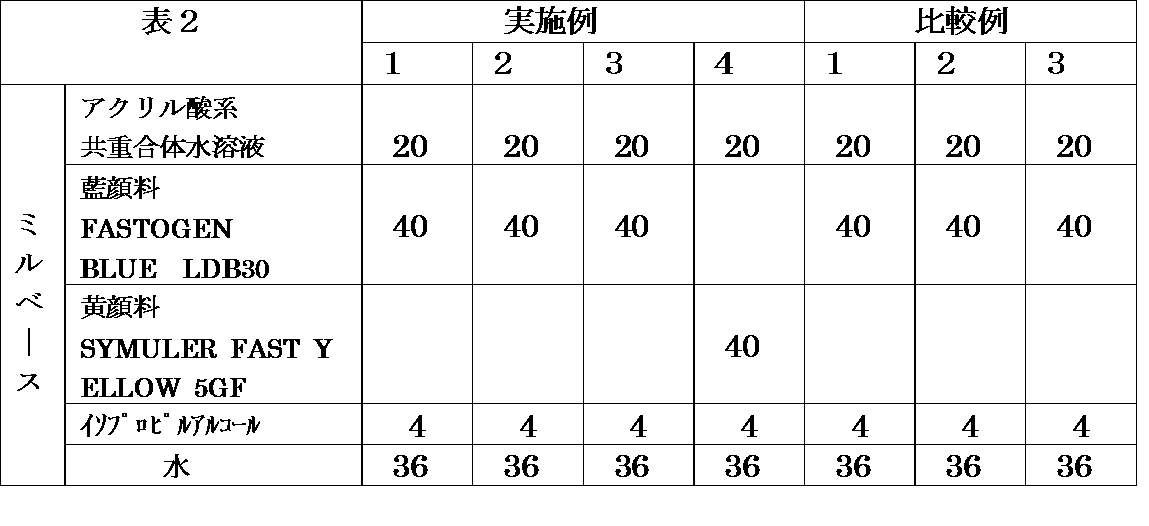
表3に作製した各ミルベースを用いた水性インキの配合を重量基準で示す。
尚、インキ配合後、イソプロピルアルコール:水=40:60(体積比)で希釈することで、ザーンカップNo.3で16秒になるようにインキ粘度を調整した。
尚、インキ配合後、イソプロピルアルコール:水=40:60(体積比)で希釈することで、ザーンカップNo.3で16秒になるようにインキ粘度を調整した。

表4に作製した水性インキの評価結果を示す。
本発明の水性インキは貯蔵安定性、密着性、再溶解性及び耐アルカリ性に優れる。
本発明の水性インキは貯蔵安定性、密着性、再溶解性及び耐アルカリ性に優れる。

Claims (4)
- 濁度滴定法でのSP値が20.4~20.7(J/cm3)1/2のアクリル酸系共重合体をアンモニア及び/またはアルカノールアミンで中和した水分散体に顔料を分散させた後、エチレン-アクリル酸共重合体をアルカノールアミンで中和した水分散体を配合した耐アルカリ性水性インキ組成物。
- 前記アクリル酸系共重合体が、ビニル基を有する芳香族化合物と(メタ)アクリル酸エステルと(メタ)アクリル酸の共重合体である請求項1記載の耐アルカリ性水性インキ組成物。
- 前記(メタ)アクリル酸エステルのエステル基を構成するアルコールの炭素数が12から18である請求項2記載の耐アルカリ性水性インキ組成物。
- 前記アクリル酸系共重合体の酸価が50mgKOH/g以上である請求項2記載の耐アルカリ性水性インキ組成物。
Priority Applications (2)
| Application Number | Priority Date | Filing Date | Title |
|---|---|---|---|
| CN201580002304.4A CN105658740B (zh) | 2014-06-10 | 2015-06-02 | 耐碱性水性墨液组合物 |
| JP2015544231A JP5858320B1 (ja) | 2014-06-10 | 2015-06-02 | 耐アルカリ性水性インキ組成物 |
Applications Claiming Priority (2)
| Application Number | Priority Date | Filing Date | Title |
|---|---|---|---|
| JP2014119562 | 2014-06-10 | ||
| JP2014-119562 | 2014-06-10 |
Publications (1)
| Publication Number | Publication Date |
|---|---|
| WO2015190345A1 true WO2015190345A1 (ja) | 2015-12-17 |
Family
ID=54833441
Family Applications (1)
| Application Number | Title | Priority Date | Filing Date |
|---|---|---|---|
| PCT/JP2015/065851 Ceased WO2015190345A1 (ja) | 2014-06-10 | 2015-06-02 | 耐アルカリ性水性インキ組成物 |
Country Status (3)
| Country | Link |
|---|---|
| JP (1) | JP5858320B1 (ja) |
| CN (1) | CN105658740B (ja) |
| WO (1) | WO2015190345A1 (ja) |
Cited By (2)
| Publication number | Priority date | Publication date | Assignee | Title |
|---|---|---|---|---|
| JP2018158986A (ja) * | 2017-03-22 | 2018-10-11 | 東洋インキScホールディングス株式会社 | 紙器用水性フレキソインキ組成物 |
| JP2024096212A (ja) * | 2020-07-31 | 2024-07-12 | Toppanホールディングス株式会社 | 包装材 |
Families Citing this family (1)
| Publication number | Priority date | Publication date | Assignee | Title |
|---|---|---|---|---|
| CN117143524B (zh) * | 2023-07-20 | 2025-02-11 | 广东冠豪新材料研发有限公司 | 一种数码转印膜涂料及其制备方法与应用 |
Citations (5)
| Publication number | Priority date | Publication date | Assignee | Title |
|---|---|---|---|---|
| JPH0726189A (ja) * | 1993-04-28 | 1995-01-27 | Japan Small Corp | プラスチックフィルム用水性インキ組成物 |
| JPH0726188A (ja) * | 1993-04-28 | 1995-01-27 | Japan Small Corp | プラスチックフィルム用水性印刷インキ組成物 |
| JPH0741719A (ja) * | 1993-07-27 | 1995-02-10 | Dainippon Ink & Chem Inc | 水性印刷インキの製造方法 |
| JPH07247455A (ja) * | 1994-03-09 | 1995-09-26 | Sakata Corp | 水性樹脂組成物用乾燥遅延剤および水性樹脂組成物の乾燥遅延方法 |
| JP2011144335A (ja) * | 2010-01-18 | 2011-07-28 | Toyo Ink Sc Holdings Co Ltd | 高耐アルカリ性水性インキ組成物 |
Family Cites Families (4)
| Publication number | Priority date | Publication date | Assignee | Title |
|---|---|---|---|---|
| US20090023854A1 (en) * | 2004-11-02 | 2009-01-22 | Kao Corporation | Water-based ink for inkjet printing |
| JP4063859B2 (ja) * | 2007-02-14 | 2008-03-19 | 株式会社サクラクレパス | 水性インキ組成物用水性顔料分散体、その製造方法および水性インキ組成物 |
| JP2009108192A (ja) * | 2007-10-30 | 2009-05-21 | Canon Inc | 水性インク、インクジェット記録方法、インクカートリッジ、インクカートリッジ、及びインクジェット記録装置 |
| US20130257034A1 (en) * | 2012-03-28 | 2013-10-03 | Fujifilm Corporation | Ink composition, image forming method, and printed article |
-
2015
- 2015-06-02 CN CN201580002304.4A patent/CN105658740B/zh active Active
- 2015-06-02 WO PCT/JP2015/065851 patent/WO2015190345A1/ja not_active Ceased
- 2015-06-02 JP JP2015544231A patent/JP5858320B1/ja active Active
Patent Citations (5)
| Publication number | Priority date | Publication date | Assignee | Title |
|---|---|---|---|---|
| JPH0726189A (ja) * | 1993-04-28 | 1995-01-27 | Japan Small Corp | プラスチックフィルム用水性インキ組成物 |
| JPH0726188A (ja) * | 1993-04-28 | 1995-01-27 | Japan Small Corp | プラスチックフィルム用水性印刷インキ組成物 |
| JPH0741719A (ja) * | 1993-07-27 | 1995-02-10 | Dainippon Ink & Chem Inc | 水性印刷インキの製造方法 |
| JPH07247455A (ja) * | 1994-03-09 | 1995-09-26 | Sakata Corp | 水性樹脂組成物用乾燥遅延剤および水性樹脂組成物の乾燥遅延方法 |
| JP2011144335A (ja) * | 2010-01-18 | 2011-07-28 | Toyo Ink Sc Holdings Co Ltd | 高耐アルカリ性水性インキ組成物 |
Cited By (2)
| Publication number | Priority date | Publication date | Assignee | Title |
|---|---|---|---|---|
| JP2018158986A (ja) * | 2017-03-22 | 2018-10-11 | 東洋インキScホールディングス株式会社 | 紙器用水性フレキソインキ組成物 |
| JP2024096212A (ja) * | 2020-07-31 | 2024-07-12 | Toppanホールディングス株式会社 | 包装材 |
Also Published As
| Publication number | Publication date |
|---|---|
| CN105658740A (zh) | 2016-06-08 |
| JP5858320B1 (ja) | 2016-02-10 |
| CN105658740B (zh) | 2018-01-05 |
| JPWO2015190345A1 (ja) | 2017-04-20 |
Similar Documents
| Publication | Publication Date | Title |
|---|---|---|
| JP5123539B2 (ja) | 共重合体およびその使用 | |
| JP5227083B2 (ja) | 顔料分散剤、その製造方法、およびその利用 | |
| JP5162516B2 (ja) | 優れた顔料分散性を有するグラフトコポリマー | |
| JP4758652B2 (ja) | 優れた顔料分散性を有するグラフトコポリマーの製造方法、該グラフトコポリマー類を利用するエマルジョン類の製造方法、及び該グラフトコポリマー類またはエマルジョン類を利用している顔料分散液類 | |
| JP5365024B2 (ja) | シリコーン系グラフト共重合体およびその製造方法 | |
| JP5811835B2 (ja) | 印刷インキ組成物 | |
| JP6476381B2 (ja) | 水系顔料分散体及びその製造方法 | |
| JP5858320B1 (ja) | 耐アルカリ性水性インキ組成物 | |
| JP4254292B2 (ja) | 水性顔料分散剤およびその製造方法 | |
| JP2012158649A (ja) | 新規なチアゾール系カチオン染料 | |
| JP3880443B2 (ja) | ポリマーエマルジョン組成物 | |
| JP6394434B2 (ja) | 紙器用水性印刷インキ組成物 | |
| JP2004010846A (ja) | エマルション組成物および水性インキ | |
| JP3845098B2 (ja) | 速乾性水性樹脂組成物及びこれを用いた塗料 | |
| JP5846467B1 (ja) | 水性印刷インキ組成物 | |
| JP2002336672A (ja) | 顔料分散剤及び水性インク | |
| JP2011144335A (ja) | 高耐アルカリ性水性インキ組成物 | |
| CN110770267A (zh) | 通用溶剂型颜料分散体树脂 | |
| JP4583101B2 (ja) | 水系インク | |
| CN101805428A (zh) | 水性分散液的制法、水性油墨用水性分散液、水性油墨 | |
| JP2024143410A (ja) | 水性顔料分散体の製造方法、水性インクジェットインクの製造方法、及び水性顔料複合体 | |
| JP2024115575A (ja) | 水性インクジェットインク | |
| JP2006022229A (ja) | インクジェット記録用水系インク |
Legal Events
| Date | Code | Title | Description |
|---|---|---|---|
| ENP | Entry into the national phase |
Ref document number: 2015544231 Country of ref document: JP Kind code of ref document: A |
|
| 121 | Ep: the epo has been informed by wipo that ep was designated in this application |
Ref document number: 15806224 Country of ref document: EP Kind code of ref document: A1 |
|
| NENP | Non-entry into the national phase |
Ref country code: DE |
|
| 122 | Ep: pct application non-entry in european phase |
Ref document number: 15806224 Country of ref document: EP Kind code of ref document: A1 |