WO2015152147A1 - 調理機器 - Google Patents
調理機器 Download PDFInfo
- Publication number
- WO2015152147A1 WO2015152147A1 PCT/JP2015/059904 JP2015059904W WO2015152147A1 WO 2015152147 A1 WO2015152147 A1 WO 2015152147A1 JP 2015059904 W JP2015059904 W JP 2015059904W WO 2015152147 A1 WO2015152147 A1 WO 2015152147A1
- Authority
- WO
- WIPO (PCT)
- Prior art keywords
- cooking
- user
- chewing
- control means
- question
- Prior art date
- Legal status (The legal status is an assumption and is not a legal conclusion. Google has not performed a legal analysis and makes no representation as to the accuracy of the status listed.)
- Ceased
Links
Images


Classifications
-
- A—HUMAN NECESSITIES
- A47—FURNITURE; DOMESTIC ARTICLES OR APPLIANCES; COFFEE MILLS; SPICE MILLS; SUCTION CLEANERS IN GENERAL
- A47J—KITCHEN EQUIPMENT; COFFEE MILLS; SPICE MILLS; APPARATUS FOR MAKING BEVERAGES
- A47J43/00—Implements for preparing or holding food, not provided for in other groups of this subclass
- A47J43/04—Machines for domestic use not covered elsewhere, e.g. for grinding, mixing, stirring, kneading, emulsifying, whipping or beating foodstuffs, e.g. power-driven
- A47J43/07—Parts or details, e.g. mixing tools, whipping tools
Definitions
- the present invention relates to a cooking device, and more particularly to a cooking device that acquires the difficulty level of chewing a user's food.
- Patent Document 1 Japanese Patent Laid-Open No. 2002-08989 (Patent Document 1), when the item “Taste of my home” is selected when cooking rice, “hardness”, “stickiness”, “sweetness”, Each item of “Burn” can be set in 5 stages.
- Patent Document 2 discloses an electric rotary cooker and a cooking information system that enable an optimum granularity state for each mastication level. Recipe data is grouped according to mastication levels, and recipe data corresponding to the level is obtained by selecting a mastication level suitable for the user at the user terminal. The recipe data includes a mastication training program that is automatically updated to the next mastication level after a predetermined number of days.
- the method in which the user selects the mastication level from the user terminal as in Patent Document 2 is suitable for the user himself / herself. It is difficult to select.
- an object of the present invention is to provide a cooking device that can acquire the difficulty level of the user's own chewing.
- a cooking appliance includes an operation unit that receives a user operation, an output unit that outputs information, a question unit that outputs a question including an ingredient name to the output unit, a control unit that controls the cooking appliance, Is provided.
- the control means outputs a question including the name of the food by the output means, counts a numerical value corresponding to the type of answer indicating the difficulty of chewing the food received by the operation means for each question, and chews from the counted value.
- the numerical value corresponding to the type of answer indicating the difficulty level of chewing to the food material received by the operating means for acquiring the difficulty level of the food is counted for each question, and the difficulty level of mastication is acquired from the counted value.
- the cooking device further includes storage means for storing, for each ingredient name, an option for each answer type and a numerical value representing the difficulty level of chewing for each option.
- the control means further outputs the question including the ingredient name read from the storage means and the corresponding option by the output means, and accumulates a numerical value corresponding to the option selected by the user for each question output together with the option. Then, the difficulty level of mastication is acquired from the accumulated value.
- control unit reads the question and the corresponding option from the storage unit according to a predetermined order, and outputs the read question and the corresponding option by the output unit.
- the predetermined order is variable.
- the control means changes a numerical value indicating the difficulty level of mastication according to a user's answer content indicating whether the acquired difficulty level of mastication is appropriate.
- the cooking device includes a storage chamber for storing the cooking target, a pressure control unit for controlling the pressure in the storage chamber, a temperature control unit for controlling the temperature in the storage chamber, and the cooking chamber in the storage chamber.
- Cooking means for controlling the pressure control means or the temperature control means according to a control program for softening the object;
- a cooking appliance changes the control parameter which a control program uses according to the difficulty of the acquired chewing.
- the cooking device further includes hardness detection means for detecting the hardness of the object to be cooked, and notification means for notifying the detected hardness.
- the cooking device further includes notification means for notifying the acquired difficulty level of mastication.
- the notification means includes an operation unit operated by a user and a reaction unit that reacts in response to an operation of the operation unit.
- a control means changes the magnitude
- the difficulty level of mastication suitable for the user himself / herself can be acquired.
- the “mastication level” is information indicating the difficulty level of mastication indicating the difficulty of mastication with respect to ingredients, and is indicated by a numerical value, for example.
- the “food” includes unprocessed foods, processed foods such as heat and softening treatment (for example, food), and the like.
- Embodiment 1 In this Embodiment 1, it has the structure which acquires the difficulty level of a user's chewing in an interactive form with a user.
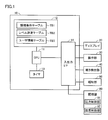
- FIG. 1 is a configuration diagram of a control block of the cooking appliance according to Embodiment 1 of the present invention.
- the control unit 10 includes a display 20 corresponding to an output unit composed of a liquid crystal for outputting information to the outside, an operation unit 30 including buttons and switches for accepting user operations, and the hardness of the food to be cooked.
- Hardness detection unit 40 for detecting, notification unit 50 for notifying (outputting) various kinds of information with sound, lamps such as LEDs (Light Emitting Diodes), and a storage room for storing an object to be cooked such as ingredients
- the cooking unit 80 including it is connected.
- the control unit 10 has a microprocessor configuration. Specifically, a CPU (Central Processing Unit) 11, a memory unit 12 corresponding to a storage unit including various volatile and nonvolatile memories, a timer 13 for timing, and between the CPU 11 and an external circuit unit It has an input / output I / F (abbreviation of interface) 14 for inputting and outputting signals and data.
- a CPU Central Processing Unit
- memory unit 12 corresponding to a storage unit including various volatile and nonvolatile memories
- timer 13 for timing
- I / F abbreviation of interface
- the memory unit 12 stores various programs including a control program for the cooking unit 80 and various data including a cooking condition table TB1, a level determination table TB2, and a user information table TB3.
- a control program for the cooking unit 80 controls various data including a cooking condition table TB1, a level determination table TB2, and a user information table TB3.
- the user ID and the mastication level are stored in the user information table TB3 in association with each user. Details of the level determination table TB2 will be described later.
- cooking unit 80 has a function of cooking food using the acquired chewing level.
- the cooking unit 80 has a configuration in which food is softened (modified) by enzymatic action.
- the storage chamber for storing the food the pressure control unit 81 such as a vacuum pump for controlling the pressure in the storage chamber, the temperature control unit 82 such as the heater for controlling the temperature in the storage chamber, and the food are softened.
- An enzyme container that is a container containing a powdered enzyme, an enzyme aqueous solution generator that receives the enzyme delivered from the enzyme container and generates an aqueous solution containing the enzyme while stirring, and the enzyme produced
- An enzyme introduction unit including a nozzle or the like for introducing the aqueous solution into the accommodation chamber.
- the CPU 11 searches the cooking condition table TB1 in the memory unit 12 based on the type and amount of food input by the user via the operation unit 30 and the mastication level of the user determined as described later, and determines the type of enzyme and Get (read) the amount as well as the amount of water. That is, the cooking condition is determined (acquired), and the cooking unit 80 is controlled based on the value indicated by the determined cooking condition. Specifically, the enzyme powder container is controlled so as to change the amount and type of enzyme to be delivered. In addition, the amount of water supplied to the enzyme aqueous solution generator is controlled. These controls can be realized by, for example, opening / closing control of an electromagnetic valve provided on the side of the enzyme powder container or the water container that is supplied to the enzyme aqueous solution generator.
- the enzyme powder container has a solenoid valve whose degree of opening and closing is freely controlled on the bottom surface in order to deliver the stored enzyme. Moreover, it has a mechanism which stops by opening / closing of valve
- the cooking condition table TB1 includes a plurality of sets of food types, amounts, and chewing levels, and parameters for controlling the cooking unit 80 in association with each of the sets (conditions such as heating temperature, heating time, and pressure). ) Is registered.
- the memory unit 12 stores a control program for the cooking unit 80, and the CPU 11 executes the control program using the control parameter value of the cooking condition read from the cooking condition table TB1.
- the type or value of the control parameter is variably controlled such as the energization amount to the heater of the temperature control unit 82, the energization time of the heater, the operation time of the vacuum pump of the pressure control unit 81, the opening of the electromagnetic valve, and the like.
- the cooking unit 80 is not limited to the above-described configuration.
- the electric rotary cooker disclosed in Patent Document 2 may be applied.
- the cooking condition table TB1 is associated with a plurality of sets of food types, amounts, and chewing levels, and the control parameters (cooking time, etc.) of the electric rotary cooker that are cooking conditions in association with each of the groups. ) Is registered.
- the data of the cooking condition table TB1 can be acquired in advance by experiments or the like.
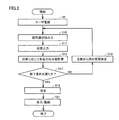
- (Outline processing and level determination table) 2 and 3 are process flowcharts for registering the mastication level for each user according to Embodiment 1 of the present invention.
- a program according to this process flowchart is stored in the memory unit 12 in advance, and the CPU 11 reads the program from the memory unit 12 and executes the program, thereby realizing the process.
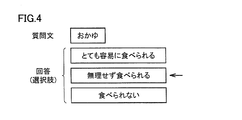
- FIG. 4 is a diagram illustrating an output example.
- FIG. 5 is a diagram showing an example of the level determination table TB2 according to Embodiment 1 of the present invention.
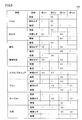
- level determination table TB2 includes questions indicating names of foods having different softness (hardness), a plurality of options for answering corresponding to each question, and corresponding to each option. And the assigned point value.
- the answer options are the options presented to the user. If the corresponding food is chewed, it can be chewed easily, can be chewed without difficulty, and the chew is not possible. Show.
- the foodstuff corresponding to a question may be a foodstuff or a dish. Further, the number of types of options is not limited to this.
- the score corresponding to each option is counted by repeating the question, and is used to determine (acquire) the mastication level from the counted value.
- “Easy” or “Do not overdo” options that indicate the difficulty level of chewing for each question are mainly assigned point values in Category 1 or Category 2,
- a point value of Category 3 or Category 4 is mainly assigned. Note that the number of sections is not limited to four.
- the score values for Category 1 to Category 4 indicate the value corresponding to the hardness category of the corresponding foodstuff. Specifically, when the corresponding food is harder than the other foods, the point value of the category 1 or 2 is larger than that of the other foods 1 or 2. For example, when comparing “Do not overdo”, the value of Category 1 and 2 of “rice” is larger than the value of Category 1 and 2 of “Okayu” (the value of Category 1 and 2 of “Purine”) Is even larger). On the contrary, when the corresponding food is softer than the other foods, the point value of the category 1 or 2 is smaller than that of the other foods category 1 or 2. Note that the number of sections is not limited to four.
- a user ID is registered (step S9). Specifically, the user operates the operation unit 30 to input a user ID that is personal identification information (name, etc.). The CPU 11 stores the input user ID in the user information table TB3.
- CPU11 acquires a user's mastication level.
- the question means or option question means of the CPU 11 reads the question and option from the head of the level determination table TB2 and displays them on the display 20 (step S10).
- FIG. 4 shows a display example of an image based on a question including a cooking target name (rice porridge) for confirming masticatory power and options for answering.
- the CPU 11 determines whether or not the accumulated value for each category satisfies a predetermined end condition (step S17).
- the end condition is stored in the memory unit 12. For example, it is determined whether or not to end depending on whether or not the cumulative value of the specific category exceeds a predetermined value. Alternatively, the determination is made based on whether or not the score 1 is continuously added a predetermined number of times for the specific category (for example, 1 is added twice to the category 2).
- the “acquiring means” or the accumulating acquisition means determines the mastication level based on a predetermined condition (step S19). For example, regarding the accumulated value for each category, if the accumulated value of (Category 1) is greater than or equal to a predetermined value and is determined to be the maximum value among the four categories, the mastication level is “highest” For example, “1” is assigned. In addition, regarding the accumulated value for each category, when it is determined that the accumulated value of (category 2) is equal to or greater than a predetermined value and is the maximum value among the four categories, the mastication level is “high”. For example, “2” is assigned.
- the mastication level is “low” and assigned to “4”.
- An example of assignment based on such conditions is merely an example and is not limited.
- the CPU 11 stores the determined mastication level in association with the user ID of the user in the user information table TB3, and outputs / notifies the mastication level from the display 20 or the notification unit 50 (step S21).
- step S18 the next question is searched from the level determination table TB2 based on the accumulated value of the score for each section at that time (step S18). For example, when the score is accumulated for category 3 or category 4 from the user's answer to the previous question, a question about softer ingredients registered in the next rank is searched, but the score for category 1 or category 2 is accumulated. When calculated, search for questions of harder ingredients registered in the next rank. That is, when the current question is “Okayu” as shown in FIG. 4, the softer food registered in the next rank indicates “boiled fish” in the level determination table TB2, and the harder food registered in the second rank. Ingredients indicate “rice”. Thereby, an appropriate mastication level can be determined with a small number of questions.
- step S10 After that, the process returns to step S10, and the next question and options are output. Thereafter, the same processing is repeated.
- the question starts from the top of the level determination table TB2 (that is, from the hard food), but conversely, the question starts from the end of the level determination table TB2 (that is, from the soft food).
- it may start from a question (scrambled egg) located in the middle of the level determination table TB2, and the order of the questions is variable.
- the number of questions which a user should answer can be decreased.
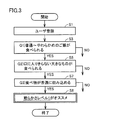
- step S ⁇ b> 1 user registration is performed in the same manner as described above (step S ⁇ b> 1), and whether or not a question about different ingredients can be chewed and eaten is selected (steps S ⁇ b> 3, S ⁇ b> 5 and S ⁇ b> 7).
- step S ⁇ b> 3 user registration is performed in the same manner as described above (step S ⁇ b> 1), and whether or not a question about different ingredients can be chewed and eaten is selected (steps S ⁇ b> 3, S ⁇ b> 5 and S ⁇ b> 7).
- step S8 determines determined to be “1” (step S8).
- the CPU 11 stores the determined mastication level in the user information table TB3 in association with the user ID of the user, and outputs / notifies the mastication level.
- three alternatives of “applicable”, “neither”, and “not applicable” may be used.
- the user's operation unit 30 CPU11 may change the mastication level corresponding to the said user of user information table TB3 by input operation.
- the point value for each section of the level determination table TB2 may be changed.
- the user's chewing level can be acquired in an interactive manner, in other words, the degree of softness (hardness) of the chewable food material.
- the cooking conditions of the cooking part 80 can be changed from the acquired level, and a foodstuff can be cooked to the softness according to a user's chewing level.
- FIG. 6 is a diagram schematically showing a configuration according to Embodiment 2 of the present invention.
- the food placed in the storage chamber 1 that stores the food of the cooking unit 80 is sensed by a hardness sensor (non-contact) 41 provided inside the storage chamber 1 and the hardness thereof is detected.
- the hardness sensor (non-contact) 41 includes an injection unit and a measurement unit.
- An injection part injects compressed air to the foodstuff which is a target object, and a measurement part measures the vibration of the foodstuff surface by the pressure of this injected compressed air.
- the CPU 11 inputs the vibration measurement value from the hardness sensor 41, calculates the hardness according to a predetermined arithmetic expression, and acquires (determines) the hardness.
- FIG. 7 is a diagram schematically showing another configuration according to the second embodiment of the present invention.
- the ingredients to be cooked are put in a part 1A in the food storage chamber of the cooking unit 80, the hardest part of the ingredients is put in the other part 1B, and the hard part is sensed by the hardness sensor 41, Detect the hardness of the ingredients to be cooked.
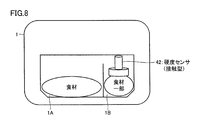
- FIG. 8 is a diagram schematically showing still another configuration according to Embodiment 2 of the present invention. 6 and 7, the non-contact type hardness sensor 41 is used. However, as shown in FIG. 8, a contact type hardness sensor 42 may be used. Referring to FIG. 8, a pressing operation by a hardness sensor (contact type) 42 provided on the upper surface in storage chamber 1 is applied to the hardest portion of the food stored in part 1 ⁇ / b> B in storage chamber 1. Done. The repulsive force from a part of the food material by pressing is measured by a pressure sensor or a load cell. The CPU 11 inputs the measured pressure value from the hardness sensor 42, calculates the hardness according to a predetermined arithmetic expression, and acquires (determines) the hardness. The hardness sensor 42 is not limited to the type using this pressure sensor. The hardness sensors 41 and 42 correspond to the hardness detector 40 of FIG.
- the contact / non-contact type hardness sensor 41/42 is used, but the present invention is not limited to this.
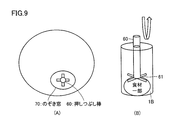
- the user moves the push-down bar 60 up and down by hand to press a part of the food in the storage chamber 1 and confirms the softness by the repulsive force. It may be.
- a crushing rod 60 is provided so that a part of the food material (the hardest material) is put in a part of the storage chamber 1 and the softness of the food material can be physically checked in that part.
- the crushing bar 60 is movable in the vertical direction of the drawing as shown by the arrows in FIG. 10, and a part of the food placed in the storage chamber 8 is pressed against the crushing bar 60 at the tip.
- the user can check the softness of the ingredients during cooking from the feel transmitted from the crushing bar 60.
- the crushing bar 60 is movably inserted into a transparent or translucent viewing window 70 provided on the upper surface of the storage chamber 1, and the user moves up and down from the outside of the crushing bar 60, It is possible to check the state of ingredients in the storage chamber 1 during cooking.
- the degree of softening of the food to be cooked can be confirmed during cooking (during processing) without taking out the food, which is preferable in terms of hygiene.
- the CPU 11 controls the control parameters such as the energization amount to the heater, the energization time, the operation time of the vacuum pump, the opening time of the electromagnetic valve, etc., as in the first embodiment.
- the type or value may be changed.
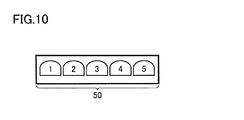
- FIG. 10 is a diagram schematically showing the configuration of the notification unit 50 according to Embodiment 3 of the present invention.
- the notification unit 50 in FIG. 10 includes a plurality of buttons (corresponding to an operation unit) that can be pressed.
- buttons corresponding to an operation unit
- the mastication level detected in Embodiment 1 or 2 or the softness (hardness) of the food is classified into five stages, and the detected level is notified by the five buttons in FIG.
- Each button incorporates an air bag (corresponding to a reaction part) having the same volume as an LED (Light Emitting Diode) (not shown).
- Each button is made of a light transmitting member.
- the volume of the fluid (for example, air) enclosed in the airbag of each button is different.
- CPU11 lights LED provided in the button corresponding to a detection result among the buttons of the alerting
- FIG. When the user presses the lit button, the user feels the magnitude of the repulsive force that is a reaction from the airbag, and can intuitively grasp the detected chewing level or the softness (hardness) of the food.
- the number of buttons of the notification unit 50 may be one instead of the above five. That is, the CPU 11 controls the lighting of the LED (7-segment LED) of the button, notifies the detected mastication level or the softness (hardness) of the food with information such as numerical values (characters), and detects the mastication level. Or based on the softness (hardness) of a foodstuff, the volume of the fluid enclosed with the airbag of the said button is changed with a pump. Thereby, the user can grasp
- the present invention is not limited to those relying on the button pressing operation.
- a slide mechanism that can be operated by the user may be provided together with the button of FIG. 10 or instead of the button.
- the slide mechanism has a fixed part that is a slide bar, a slider that can slide on the slide bar (corresponding to the operation part), and a spring part (corresponding to the reaction part) made of a resin material incorporated inside.
- the slide bar is provided with LEDs on each scale indicating the mastication level or the softness (hardness) of the food in five stages.
- CPU11 lights LED of the scale corresponding to the detected chewing level or the softness (hardness) of a foodstuff.
- the user slides the slider to the scale position of the lit LED, the user can feel the repulsive force of the spring (which is a force to move away from the scale position and corresponds to the reaction force).
- the user can intuitively grasp the detected mastication level or the softness (hardness) of the food from the magnitude of the repulsive force.
- control unit 10 control unit, 12 memory unit, 13 timer, 20 display, 30 operation unit, 40 hardness detection unit, 41, 42 hardness sensor, 50 notification unit, 60 bar, 70 viewing window, 80 cooking unit, TB1 cooking condition table, TB2 level determination table, TB3 user information table.
Landscapes
- Engineering & Computer Science (AREA)
- Mechanical Engineering (AREA)
- Food Science & Technology (AREA)
- Food-Manufacturing Devices (AREA)
- Electric Ovens (AREA)
- Electric Stoves And Ranges (AREA)
Abstract
調理機器は、ユーザ操作を受け付ける操作部(30)と、情報を出力する出力手段と、制御手段とを備える。制御手段は、食材名を含む質問を出力手段により出力し、操作部によって受付けられた、食材に対する咀嚼の難易度を示す回答の種類に対応した数値を、質問毎に計数し、計数した値から咀嚼の難易度を取得する。
Description
この発明は調理機器に関し、特に、ユーザの食材に対する咀嚼の難易度を取得する調理機器に関する。
人々の嗜好の変化に伴い、食材について多様な食味または舌触りが要求されている。この要求に対して、特開2002-084989号公報(特許文献1)では、ご飯を炊く際に、「我が家の味」の項目を選択すると、「硬さ」、「粘り」、「甘み」、「焦げ」の各項目を5段階で設定することができる。
特開2003-93245号公報(特許文献2)では、咀嚼レベル毎に最適な粒度状態を可能とする電動回転調理機とその調理情報システムが開示されている。レシピデータは咀嚼レベルによってグルーピングされ、利用者が適する咀嚼レベルを利用者端末で選択することにより、レベルに応じたレシピデータが得られる。レシピデータは、所定日数経過後、自動的に次の咀嚼レベルに更新される咀嚼トレーニングのプログラムを含む。
利用者は、自身の咀嚼レベルを理解していないことが通常であるから、特許文献2のように、利用者が咀嚼レベルを利用者端末から選択する方法では、利用者自身に適した咀嚼レベルを選択するのは困難である。
それゆえに、本発明の目的は、ユーザ自身の咀嚼の難易度を取得することのできる調理機器を提供することである。
この発明のある局面に従う調理機器は、ユーザ操作を受け付ける操作手段と、情報を出力する出力手段と、食材名を含む質問を出力手段に出力する質問手段と、調理機器を制御する制御手段と、を備える。制御手段は、食材名を含む質問を出力手段により出力し、操作手段によって受付けた、食材に対する咀嚼の難易度を示す回答の種類に対応した数値を、質問毎に計数し、計数した値から咀嚼の難易度を取得する操作手段によって受付けた、食材に対する咀嚼の難易度を示す回答の種類に対応した数値を、質問毎に計数し、計数した値から咀嚼の難易度を取得する。
好ましくは、調理機器は、食材名毎に、回答の種類毎の選択肢と、選択肢毎に咀嚼の難易度を表す数値とを格納した記憶手段を、さらに備える。制御手段は、さらに、記憶手段から読出した食材名を含む質問と対応の選択肢とを出力手段により出力し、ユーザが選択操作した選択肢に対応の数値を、選択肢とともに出力された質問毎に累算し、累算値から咀嚼の難易度を取得する。
好ましくは、制御手段は、記憶手段から、予め定められた順序に従い質問と対応の選択肢とを読出し、読出された質問と対応の選択肢とを、出力手段により出力する。
好ましくは、上記の予め定められた順序は、可変である。
好ましくは、制御手段は、咀嚼の難易度を表す数値を、取得された咀嚼の難易度が適切であったかを示すユーザの回答内容に従い変更する。
好ましくは、制御手段は、咀嚼の難易度を表す数値を、取得された咀嚼の難易度が適切であったかを示すユーザの回答内容に従い変更する。
好ましくは、調理機器は、被調理対象を調理するために収容する収容室と、収容室内の圧力を制御する圧力制御手段と、収容室内の温度を制御する温度制御手段と、収容室内の被調理対象を軟化調理するための制御プログラムに従い圧力制御手段または温度制御手段を制御する調理手段と、をさらに備える。調理機器は、制御プログラムが用いる制御パラメータを、取得された咀嚼の難易度に従い変更する。
好ましくは、調理機器は、被調理対象の硬さを検出する硬さ検出手段と、検出された硬さを報知する報知手段と、をさらに備える。
好ましくは、調理機器は、取得された咀嚼の難易度を報知する報知手段を、さらに備える。当該報知手段は、ユーザが操作する操作部と、操作部の操作に応答して、反応動作する反応部とを含む。制御手段は、当該反応部による反応動作力の大きさは、取得された咀嚼の難易度または検出された硬さに従い変更する。
本発明によれば、ユーザ自身に適した咀嚼の難易度を取得することができる。
以下、図面を参照しつつ、本発明の実施の形態について説明する。以下の説明では、同一の部品には同一の符号を付してある。それらの名称および機能も同じである。したがって、それらについての詳細な説明は繰返さない。
ここでは、“咀嚼レベル”は、食材に対する咀嚼の困難性を示す咀嚼の難易度を表す情報であって、例えば、数値により示される。また、“食材”は、未加工のもの、加熱、軟化処理等の加工されたもの(例えば、食品)等を含む。
[実施の形態1]
本実施の形態1では、ユーザの咀嚼の難易度を、ユーザとの対話形式で取得する構成を有する。
本実施の形態1では、ユーザの咀嚼の難易度を、ユーザとの対話形式で取得する構成を有する。
図1は本発明の実施の形態1に係る調理機器の制御ブロックの構成図である。制御部10は、情報を外部に出力するための液晶等からなる出力部に相当するディスプレイ20、ユーザの操作を受付けるためのボタン・スイッチ等を含む操作部30、調理対象の食材の硬さを検出するための硬さ検出部40、各種の情報を音声、LED(Light Emitting Diode)等のランプで報知(出力)するための報知部50、および食材等の被調理対象を収容した収容室を含む調理部80を接続する。
制御部10は、マイクロプロセッサの構成を有する。具体的には、CPU(Central Processing Unit)11、揮発性および不揮発性の各種メモリを含む記憶部に相当するメモリ部12、計時のためのタイマ13、およびCPU11と外部の回路部との間の信号・データの入出力を実施するための入出力I/F(インターフェイスの略)14を有する。
メモリ部12には、調理部80の制御プログラムを含む各種プログラム、および調理条件テーブルTB1、レベル決定テーブルTB2およびユーザ情報テーブルTB3を含む各種データが格納される。ここでは、ユーザ情報テーブルTB3には、ユーザ毎に、ユーザIDと咀嚼レベルとが対応付けて格納される。レベル決定テーブルTB2の詳細は後述する。
(調理部80の構成)
本実施の形態では、調理部80は、取得した咀嚼レベルを用いて食材を調理する機能を有する。例えば、調理部80は酵素作用により食材を軟化(改変)させる構成を有する。具体的には、食材を収容する収容室と、収容室内の圧力を制御する真空ポンプ等の圧力制御部81と、収容室内の温度を制御するヒータ等の温度制御部82と、食材を軟化させる粉状の酵素を収容した容器である酵素収容部と、酵素収容部から送出された酵素を受けて、当該酵素を含んだ酵素水溶液を撹拌しながら生成する酵素水溶液生成部と、生成された酵素水溶液を収容室内に導入するためのノズル等を含む酵素導入部と、を備える。
本実施の形態では、調理部80は、取得した咀嚼レベルを用いて食材を調理する機能を有する。例えば、調理部80は酵素作用により食材を軟化(改変)させる構成を有する。具体的には、食材を収容する収容室と、収容室内の圧力を制御する真空ポンプ等の圧力制御部81と、収容室内の温度を制御するヒータ等の温度制御部82と、食材を軟化させる粉状の酵素を収容した容器である酵素収容部と、酵素収容部から送出された酵素を受けて、当該酵素を含んだ酵素水溶液を撹拌しながら生成する酵素水溶液生成部と、生成された酵素水溶液を収容室内に導入するためのノズル等を含む酵素導入部と、を備える。
CPU11は、操作部30を介してユーザが入力した食材の種類および量、ならびに後述するように判定したユーザの咀嚼レベルに基づき、メモリ部12の調理条件テーブルTB1を検索して、酵素の種類および量、ならびに水の量を取得(読出し)する。すなわち調理条件を決定(取得)し、決定した調理条件が示す値に基づき、調理部80を制御する。具体的には、酵素粉末収容部を、送出する酵素量および種類を変更するように制御する。また、酵素水溶液生成部への水の投入量を制御する。これら制御は、例えば、酵素粉末収容部または水収容部の酵素水溶液生成部への送出側に設けられた電磁弁の開閉制御により実現することができる。酵素粉末収納部は、収容した酵素を送出するために底面に開閉の程度が自在に制御される電磁弁を有する。また、この電磁弁から吐出した粉末量を量るための計量機を用いて、弁の開閉→計量→定量で停止する機構を有する。この機構は、ロータまたはスクリューフィーダ等を用いたものであってもよい。
調理条件テーブルTB1は、食材の種類、量および咀嚼レベルからなる複数の組と、当該組のそれぞれに対応づけて、調理部80を制御するためのパラメータ(加熱温度や加熱時間、圧力等の条件)が登録されたものである。メモリ部12には、調理部80の制御プログラムが格納されており、CPU11は調理条件テーブルTB1から読出した調理条件の制御パラメータ値を用いて、制御プログラムを実行する。これにより、温度制御部82のヒータへの通電量、ヒータの通電時間および圧力制御部81の真空ポンプの運転時間、電磁弁の開放等が制御パラメータの種類または値が可変に制御される。
また、調理部80は、上述の構成に限定されない。例えば、特許文献2に開示された電動回転調理器が適用されてもよい。その場合には、調理条件テーブルTB1は、食材の種類、量および咀嚼レベルからなる複数の組と、当該組のそれぞれに対応づけて、調理条件である電動回転調理器の制御パラメータ(調理時間等)が登録されたものである。
調理条件テーブルTB1のデータは、予め実験等により取得することができる。
(概略処理とレベル決定テーブル)
図2と図3は、本発明の実施の形態1に係るユーザ毎に咀嚼レベルを登録するための処理フローチャートである。この処理フローチャートに従うプログラムは予めメモリ部12に格納されて、CPU11はメモリ部12から当該プログラムを読出し、実行することにより処理が実現される。図4は、出力例を示す図である。また、図5は、本発明の実施の形態1に係るレベル決定テーブルTB2の一例を示す図である。
(概略処理とレベル決定テーブル)
図2と図3は、本発明の実施の形態1に係るユーザ毎に咀嚼レベルを登録するための処理フローチャートである。この処理フローチャートに従うプログラムは予めメモリ部12に格納されて、CPU11はメモリ部12から当該プログラムを読出し、実行することにより処理が実現される。図4は、出力例を示す図である。また、図5は、本発明の実施の形態1に係るレベル決定テーブルTB2の一例を示す図である。
図5を参照して、レベル決定テーブルTB2は、柔らかさ(硬さ)の異なる食材の名称を示す質問を含み、各質問に対応して回答のための複数の選択肢と、各選択肢に対応して割当られた点数値とを含む。回答の選択肢は、ユーザに対し提示される選択肢であって、対応の食材を咀嚼するとしたら、“容易”に咀嚼できる、“無理せず”に咀嚼できる、および咀嚼は“無理”の3種類を示す。なお、質問に相当する食材は、食品でもよく、また料理でもよい。また、選択肢の種類数もこれに限定されない。
また、各選択肢に対応した点数値は、質問が繰り返されることで計数されて、その計数値から咀嚼レベルを決定(取得)するためのものであって、区分1~区分4で示す4種類の点数値を含む。図示されるように、各質問に対して咀嚼の難易度を示す“容易”または“無理せず”の選択肢については、主に区分1または区分2に点数値が割当てられているのに対し、“無理”の選択肢については主に区分3または区分4の点数値が割当てられている。なお、区分数は4つに限定されない。
区分1~区分4の点数値は対応の食材の硬さ区分に応じた値を示す。具体的には、対応の食材が他の食材に比べて硬い場合には区分1または2の点数値は、他の食材の区分1または2に比べて大きい。例えば、「無理せず」で比較した場合に、「ごはん」の区分1、2の値は、「おかゆ」の区分1、2の値よりも大きい(「プリン」の区分1、2の値よりもさらに大きい)ことを表す。逆に、対応の食材が他の食材に比べて柔らかい場合には区分1または2の点数値は、他の食材の区分1または2に比べて小さい。なお、区分数は4つに限定されない。
図2の処理に従う対話形式による咀嚼レベルの取得について説明する。まず、ユーザIDが登録される(ステップS9)。具体的には、ユーザは操作部30を操作して、個人識別情報(氏名等)であるユーザIDを入力する。CPU11は入力されたユーザIDをユーザ情報テーブルTB3に格納する。
また、CPU11は、ユーザの咀嚼レベルを取得する。具体的には、CPU11の質問手段または選択肢質問手段は、レベル決定テーブルTB2の先頭から質問と選択肢を読出して、ディスプレイ20に表示する(ステップS10)。図4には、咀嚼力を確認するための被調理対象名(おかゆ)を含む質問と、回答のための選択肢とに基づく画像の表示例が示される。
ユーザが操作部30を操作して選択肢のうちから1つを選択して回答すると(ステップS11)、CPU11の“取得する手段”または累算取得手段は、入力した回答の選択肢に対応した区分1~4のそれぞれ毎に点数を加算(累算)する(ステップS13)。例えば、図4の矢印の“無理せず食べられる”が入力された場合には、レベル決定テーブルTB2によれは、区分1=0.5点、区分2=1点、区分3=0.5点、および区分4=0点と算出される。
CPU11は、各区分について累計した値が予め定められた終了条件を満たすか否かを判定する(ステップS17)。終了条件はメモリ部12に格納されている。例えば、特定区分の累計値が予め定められた値を超えるか否かにより終了するか否かを判定する。または、特定区分について、点数1が所定回数連続して加算された(例えば、区分2に2回連続して1が加算された)か否かにより判定する。
終了と判定すると(ステップS17でYES)、“取得する手段”または累算取得手段は咀嚼レベルを予め定めた条件に基づき決定する(ステップS19)。例えば、区分毎の累算値に関し、(区分1)の累算値が予め定められた値以上であり、且つ4区分のうち最大値であると判定したときは、咀嚼レベルは“最高”であり例えば“1”が割当られる。また、区分毎の累算値に関し、(区分2)の累算値が予め定められた値以上であり、且つ4区分のうち最大値であると判定したときは、咀嚼レベルは“高”であり例えば“2”と割当られる。また、(区分4)の累算値が予め定められた値以上であり、且つ4区分のうちの最大値であると判定したときは、咀嚼レベルは“低”であり“4”と割当られる。このような条件に基づく割当例は一例であり、限定されない。
CPU11は、決定した咀嚼レベルを当該ユーザのユーザIDと対応付けて、ユーザ情報テーブルTB3に格納するとともに、咀嚼レベルをディスプレイ20または報知部50から出力/報知する(ステップS21)。
ステップS17に戻り、終了と判定されないときは(ステップS17でNO)、その時点における各区分についての点数の累算値に基づき、レベル決定テーブルTB2から、次の質問を検索する(ステップS18)。例えば、直前の質問に対するユーザの回答から、区分3または区分4について点数が累算されたときは、次位に登録されたより柔らかい食材の質問を検索するが、区分1または区分2について点数が累算されたときは、次位に登録されたより硬い食材の質問を検索する。つまり、今回の質問が図4のように“おかゆ”であったときは、次位に登録されたより柔らかい食材はレベル決定テーブルTB2の“煮魚”を示し、また、次位に登録されたより硬い食材は“ごはん”を示す。これにより、少ない質問回数で適切な咀嚼レベルを決定することができる。
その後、ステップS10に戻り、次位の質問と選択肢が出力される。以降は、同様の処理が繰返される。
なお、ここでは、質問はレベル決定テーブルTB2の先頭から(すなわち、硬い食材の方から)開始したが、逆に、レベル決定テーブルTB2の末尾から(すなわち、柔らかい食材の方から)開始してもよく、または、レベル決定テーブルTB2の中間に位置する質問(スクランブルエッグ)から開始するとしてもよく、質問の順序は可変である。なお、中間位置の質問から開始した場合には、ユーザが回答するべき質問数を少なくすることができる。
なお、質問の種類と選択肢は、レベル決定テーブルTB2の態様に限定されず、図3のように質問に対する選択がYES/NOの2者択一であってもよい。図3では、前述と同様にユーザ登録がされて(ステップS1)、異なる食材の質問について、咀嚼して食べられるか否かを選択する(ステップS3、S5、S7)。ユーザが、全ての質問(食材)について“食べられる”を選択した場合には、咀嚼レベルに応じた食材の柔らかさは“1”、すなわち“硬い”ものであり、また咀嚼レベルは“最高”を示す“1”と決定される(ステップS8)。この場合も、CPU11は、決定した咀嚼レベルをユーザ情報テーブルTB3に、当該ユーザのユーザIDと対応付けて格納するとともに、咀嚼レベルを出力/報知する。また、2者択一に代えて“あてはまる”、“どちらともいえない”、“あてはまらない”の3者択一であってもよい。
なお、レベル決定テーブルTB2から決定した咀嚼レベルに基づく調理条件で調理部80により調理された食材を食べてみたユーザが、自己の咀嚼レベルにマッチしないと判断したときは、ユーザの操作部30の入力操作によってCPU11がユーザ情報テーブルTB3の当該ユーザに対応の咀嚼レベルを変更してもよい。または、レベル決定テーブルTB2の区分毎の点数値を変更してもよい。
このように本実施の形態1によれば、対話形式でユーザの咀嚼レベル、言い換えると咀嚼可能な食材の柔らかさ(硬さ)の程度を取得することができる。そして、取得したレベルから、調理部80の調理条件を変更して、食材をユーザの咀嚼レベルに応じた柔らかさに調理することができる。
[実施の形態2]
本実施の形態2では、調理部80による調理中の食材の柔らかさ(軟化の程度)を取得する方法について説明する。
本実施の形態2では、調理部80による調理中の食材の柔らかさ(軟化の程度)を取得する方法について説明する。
図6は、本発明の実施の形態2に係る構成を概略して示す図である。調理部80の食材を収容する収容室1に載置された食材は、収容室1の内部に設けられた硬度センサ(非接触)41によってセンシングされて、その硬さが検出される。非接触の硬度センサとしては、種々のものを適用できる。例えば、硬度センサ(非接触)41は、噴射部と測定部とを備える。噴射部は対象物である食材に圧縮空気を噴射し、測定部は、この噴射した圧縮空気の圧力による食材表面の振動を測定する。CPU11は、硬度センサ41から振動の測定値を入力し、予め定めた演算式に従い硬さを算出して取得(決定)する。
図7は、本発明の実施の形態2に係る他の構成を概略して示す図である。図7では、調理部80の食材の収容室内の一部1Aに調理すべき食材を入れ、他の一部1Bに食材の一番硬い部分を入れ、その硬い部分について硬度センサ41によってセンシングし、調理すべき食材の硬さを検出する。
図8は、本発明の実施の形態2に係る更なる他の構成を概略して示す図である。図6および図7では、非接触方式の硬度センサ41を用いたが、図8に示すように接触型の硬度センサ42を用いてもよい。図8を参照して、収容室1内の一部1Bに収容された食材の一番硬い部分には、収容室1内の上面に設けられた硬度センサ(接触型)42による押し当て動作が行われる。押し当てによる一部食材からの反発力を圧力センサ、またはロードセルによって測定する。CPU11は、硬度センサ42から測定圧力値を入力し、予め定めた演算式に従い硬さを算出して取得(決定)する。硬度センサ42は、この圧力センサを用いるタイプに限定されない。硬度センサ41および42は、図1の硬さ検出部40に相当する。
図6~図8では、接触/非接触方式の硬度センサ41/42を用いたが、これに限定されない。例えば、図9(A)と(B)に示すようにユーザが手で押し下げ棒60を上下動させて収容室1内の食材の一部を押圧し、その反発力で軟らかさを確認する方法であってもよい。図9では、収容室1内の一部に食材の一部(一番硬いもの)を入れ、その部分に物理的に食材の軟らかさをチェックできるよう、押しつぶし棒60を設ける。押しつぶし棒60は、図10の矢印で示すように、図面上下方向に移動可能であって、収容室8内に載置された食材の一部を、押しつぶし棒60の先端に設けられた押し当て部61によって押圧(または、押しつぶす)ことにより、ユーザは押しつぶし棒60から伝わる感触から、調理進行中の食材の軟らかさを確認することができる。
また、押しつぶし棒60は、収容室1の上面に設けられた透明または半透明の覗き窓70に移動可能に挿通されており、ユーザは押しつぶし棒60外部から上下運動させながら、覗き窓70から、収容室1内の調理進行中の食材の状態を確認することができる。
本実施の形態では、食材を取出すことなく、調理中(処理中)に被調理対象である食材の軟化度を確認できて、衛生面の上でも好ましい。また、硬さ検出部40が検出した硬さの程度に従い、CPU11は実施の形態1と同様に、ヒータへの通電量、通電時間および真空ポンプの運転時間、電磁弁の開放時間等の制御パラメータの種類または値を変更してもよい。
[実施の形態3]
本実施の形態3では、実施の形態1で決定した咀嚼レベル(または、咀嚼レベルに適した食材の柔らかさ)、または実施の形態2の硬度センサ41または42で測定した食材の柔らかさを報知する態様を説明する。
本実施の形態3では、実施の形態1で決定した咀嚼レベル(または、咀嚼レベルに適した食材の柔らかさ)、または実施の形態2の硬度センサ41または42で測定した食材の柔らかさを報知する態様を説明する。
図10は、本発明の実施の形態3に係る報知部50の構成を模式的に示す図である。図10の報知部50は、押圧操作が可能な複数のボタン(操作部に相当)を含む。ここでは、実施の形態1または2において検出された咀嚼レベルまたは食材の柔らかさ(硬さ)を、5段階に区分すると想定し、図10の5つのボタンにより、検出したレベルを報知する。各ボタンは、図示しないがLED(Light Emitting Diode)と同じ容積のエアバッグ(反応部に相当)を内蔵する。各ボタンは、光透過部材などからなる。また、各ボタンのエアバックに封入された流体(例えば、空気)の体積は異なる。
CPU11は、報知部50のボタンのうち、検出結果に対応したボタンに設けられたLEDを点灯する。ユーザは点灯したボタンを押下すると、そのエアバッグからの反応である反発力の大きさを感覚し、検出された咀嚼レベルまたは食材の柔らかさ(硬さ)を直感的に把握することができる。
また、報知部50のボタン数は、上述の5個に替えて1個であってもよい。つまり、CPU11は、ボタンのLED(7セグメントLED)を点灯制御して、検出した咀嚼レベルまたは食材の柔らかさ(硬さ)を数値(文字)等の情報で報知するとともに、検出された咀嚼レベルまたは食材の柔らかさ(硬さ)に基づき当該ボタンのエアバッグに封入される流体の体積をポンプ等で変更する。これにより、ボタン押圧時の反発力の大きさから、ユーザは、検出された咀嚼レベルまたは食材の柔らかさ(硬さ)を直感的に把握することができる。
また、検出された咀嚼レベルまたは食材の柔らかさ(硬さ)を再現可能であれば、ボタンの押圧操作に依拠するものに限定されない。例えば、図10のボタンとともに、またはボタンに代替して、ユーザが操作可能なスライド機構を備えてもよい。
スライド機構は、スライドバーである固定部と、スライドバー上をスライド移動可能なスライダー(操作部に相当)と、内部に組込まれた樹脂材料からなるばね部(反応部に相当)とを有する。スライドバーには、咀嚼レベルまたは食材の柔らかさ(硬さ)を5段階で示す各目盛にLEDが設けられる。CPU11は、検出した咀嚼レベルまたは食材の柔らかさ(硬さ)に対応した目盛のLEDを点灯する。ユーザは、点灯したLEDの目盛位置にまでスライダーをスライド移動操作すると、ばねの反発力(当該目盛位置から離反しようとする力であって反応力に相当)を感覚することができる。ユーザは、この反発力の大きさから、検出された咀嚼レベルまたは食材の柔らかさ(硬さ)を直感的に把握することができる。
今回開示された実施の形態はすべての点で例示であって制限的なものではないと考えられるべきである。本発明の範囲は上記した説明ではなくて請求の範囲によって示され、請求の範囲と均等の意味および範囲内でのすべての変更が含まれることが意図される。
10 制御部、12 メモリ部、13 タイマ、20 ディスプレイ、30 操作部、40 硬さ検出部、41,42 硬度センサ、50 報知部、60 棒、70 覗き窓、80 調理部、TB1 調理条件テーブル、TB2 レベル決定テーブル、TB3 ユーザ情報テーブル。
Claims (8)
- ユーザ操作を受け付ける操作手段と、
情報を出力する出力手段と、
調理機器を制御する制御手段と、を備え、
前記制御手段は、食材名を含む質問を前記出力手段により出力し、前記操作手段によって受付けた、食材に対する咀嚼の難易度を示す回答の種類に対応した数値を、質問毎に計数し、計数した値から咀嚼の難易度を取得する、調理機器。 - 食材名毎に、前記回答の種類毎の選択肢と、選択肢毎に咀嚼の難易度を表す数値とを格納した記憶手段を、さらに備え、
前記制御手段は、さらに、
前記記憶手段から読出した食材名を含む質問と対応の前記選択肢とを前記出力手段により出力し、ユーザが選択操作した選択肢に対応の前記数値を、前記選択肢とともに出力された質問毎に累算し、累算値から咀嚼の難易度を取得する、請求項1に記載の調理機器。 - 前記制御手段は、
前記記憶手段から、予め定められた順序に従い前記質問と対応の前記選択肢とを読出し、読出された前記質問と対応の前記選択肢とを、前記出力手段により出力する、請求項2に記載の調理機器。 - 前記予め定められた順序は、可変である、請求項3に記載の調理機器。
- 前記制御手段は、
前記咀嚼の難易度を表す数値を、前記取得された咀嚼の難易度が適切であったかを示すユーザの回答内容に従い変更する、請求項1から4のいずれか1項に記載の調理機器。 - 被調理対象を調理するために収容する収容室と、
前記収容室内の圧力を制御する圧力制御手段と、
前記収容室内の温度を制御する温度制御手段と、
前記収容室内の被調理対象を軟化調理するための制御プログラムに従い前記圧力制御手段または前記温度制御手段を制御する調理手段と、をさらに備え、
前記調理機器は、制御プログラムが用いる制御パラメータを、前記取得された咀嚼の難易度に従い変更する、請求項1から5のいずれか1項に記載の調理機器。 - 被調理対象の硬さを検出する硬さ検出手段と、
検出された前記硬さを報知する報知手段と、をさらに備える、請求項1から6のいずれか1項に記載の調理機器。 - 取得された前記咀嚼の難易度を報知する報知手段を、さらに備え、
前記難易度を報知する報知手段は、
ユーザが操作する操作部と、
前記操作部の操作に応答して、反応動作する反応部と、を含み、
前記制御手段は、
前記反応部による反応動作力の大きさを、取得された咀嚼の難易度または検出された前記硬さに従い変更する、請求項7に記載の調理機器。
Priority Applications (1)
| Application Number | Priority Date | Filing Date | Title |
|---|---|---|---|
| JP2016511878A JP6050553B2 (ja) | 2014-03-31 | 2015-03-30 | 調理機器 |
Applications Claiming Priority (2)
| Application Number | Priority Date | Filing Date | Title |
|---|---|---|---|
| JP2014071563 | 2014-03-31 | ||
| JP2014-071563 | 2014-03-31 |
Publications (1)
| Publication Number | Publication Date |
|---|---|
| WO2015152147A1 true WO2015152147A1 (ja) | 2015-10-08 |
Family
ID=54240470
Family Applications (1)
| Application Number | Title | Priority Date | Filing Date |
|---|---|---|---|
| PCT/JP2015/059904 Ceased WO2015152147A1 (ja) | 2014-03-31 | 2015-03-30 | 調理機器 |
Country Status (2)
| Country | Link |
|---|---|
| JP (1) | JP6050553B2 (ja) |
| WO (1) | WO2015152147A1 (ja) |
Cited By (1)
| Publication number | Priority date | Publication date | Assignee | Title |
|---|---|---|---|---|
| CN111122366A (zh) * | 2019-12-19 | 2020-05-08 | 华帝股份有限公司 | 一种用于烹饪设备的食物质构检测装置及其控制方法 |
Citations (3)
| Publication number | Priority date | Publication date | Assignee | Title |
|---|---|---|---|---|
| JP2003093245A (ja) * | 2001-09-26 | 2003-04-02 | Matsushita Electric Ind Co Ltd | 電動回転調理器とその調理情報システム |
| JP2011501845A (ja) * | 2007-10-12 | 2011-01-13 | ペイシェンツライクミー, インコーポレイテッド | 患者のコミュニティのプロファイルに基づく病状および転帰の個人管理ならびに比較 |
| JP2012515045A (ja) * | 2009-01-15 | 2012-07-05 | ネステク ソシエテ アノニム | 嚥下障害の診断及び治療方法 |
Family Cites Families (8)
| Publication number | Priority date | Publication date | Assignee | Title |
|---|---|---|---|---|
| US5976084A (en) * | 1997-10-24 | 1999-11-02 | Regents Of The University Of Minnesota | Standardized test for dysphagia |
| JP2004113315A (ja) * | 2002-09-25 | 2004-04-15 | Nisca Corp | 咀嚼回数カウンタ及びこの咀嚼回数カウンタを用いた健康管理システム |
| CN101938992B (zh) * | 2008-02-06 | 2013-07-10 | 东英吉利大学 | 用于辅助吞咽的组合物及方法 |
| US20090264392A1 (en) * | 2008-04-21 | 2009-10-22 | Meritage Pharma, Inc. | Treating eosinophilic esophagitis |
| JP5489846B2 (ja) * | 2010-04-30 | 2014-05-14 | 三栄源エフ・エフ・アイ株式会社 | 易嚥下性組成物の評価または選別方法 |
| JP5888913B2 (ja) * | 2011-09-20 | 2016-03-22 | 国立研究開発法人農業・食品産業技術総合研究機構 | 舌で押しつぶして食しやすい固形状食品の簡易評価法 |
| JP6022789B2 (ja) * | 2012-03-27 | 2016-11-09 | 株式会社明治 | 嚥下シミュレーション装置及び方法 |
| JP2014001945A (ja) * | 2012-06-15 | 2014-01-09 | Sanei Gen Ffi Inc | 咀嚼困難者用固形状食品の非破壊的評価方法 |
-
2015
- 2015-03-30 WO PCT/JP2015/059904 patent/WO2015152147A1/ja not_active Ceased
- 2015-03-30 JP JP2016511878A patent/JP6050553B2/ja not_active Expired - Fee Related
Patent Citations (3)
| Publication number | Priority date | Publication date | Assignee | Title |
|---|---|---|---|---|
| JP2003093245A (ja) * | 2001-09-26 | 2003-04-02 | Matsushita Electric Ind Co Ltd | 電動回転調理器とその調理情報システム |
| JP2011501845A (ja) * | 2007-10-12 | 2011-01-13 | ペイシェンツライクミー, インコーポレイテッド | 患者のコミュニティのプロファイルに基づく病状および転帰の個人管理ならびに比較 |
| JP2012515045A (ja) * | 2009-01-15 | 2012-07-05 | ネステク ソシエテ アノニム | 嚥下障害の診断及び治療方法 |
Cited By (1)
| Publication number | Priority date | Publication date | Assignee | Title |
|---|---|---|---|---|
| CN111122366A (zh) * | 2019-12-19 | 2020-05-08 | 华帝股份有限公司 | 一种用于烹饪设备的食物质构检测装置及其控制方法 |
Also Published As
| Publication number | Publication date |
|---|---|
| JPWO2015152147A1 (ja) | 2017-04-13 |
| JP6050553B2 (ja) | 2016-12-21 |
Similar Documents
| Publication | Publication Date | Title |
|---|---|---|
| JP6265382B2 (ja) | 調理器具 | |
| CN110013174A (zh) | 智能型多功能烹调设备 | |
| US20210259453A1 (en) | Cooking device and system | |
| CN108897245B (zh) | 一种智能烹饪系统 | |
| ES2984170T3 (es) | Procedimiento para la generación de, al menos, una propuesta de receta, aparato de cocina y sistema para la preparación de comidas | |
| CN108415298B (zh) | 一种控制方法及装置 | |
| EP3965628B1 (en) | Food processing device and recipe guidance methods | |
| CN113197491B (zh) | 烹饪时间的控制方法和相关的烹饪设备 | |
| CN108324109A (zh) | 咖啡冲泡装置、系统及方法 | |
| KR20170013841A (ko) | 프라이어를 제어하기 위한 방법 및 컴퓨터 프로그램, 및 이러한 방법을 수행하기 위해 배열된 프라이어 | |
| WO2019209371A1 (en) | Cooking system for tracking a cooking device | |
| US11879769B2 (en) | Automatic cooking assistance device and method to provide cooking instructions | |
| JP2016036606A (ja) | 調理器 | |
| CN106724812A (zh) | 智能煮蛋器 | |
| JP6050553B2 (ja) | 調理機器 | |
| JP3888906B2 (ja) | エネルギ利用情報表示システム | |
| WO2016067151A1 (en) | Power toothbrush with automatic setting of force trigger level | |
| WO2018042800A1 (ja) | 情報処理装置、制御方法、および記録媒体 | |
| CN109492779B (zh) | 一种家用电器健康管理方法、装置及家用电器 | |
| CN114486886A (zh) | 食物检测方法、装置、存储介质及电子设备 | |
| EP3809925B1 (en) | Cooking appliance for cooking whole grains such as whole grain rice | |
| KR20150123582A (ko) | 코드 인식형 광고수단이 구비된 조리장치 | |
| KR20200109911A (ko) | 스마트 멀티쿠커 시스템 및 이를 이용한 조리제어 방법 | |
| KR102286963B1 (ko) | 조리 기기 및 그 동작 방법 | |
| KR102941766B1 (ko) | 멀티 쿠커 |
Legal Events
| Date | Code | Title | Description |
|---|---|---|---|
| 121 | Ep: the epo has been informed by wipo that ep was designated in this application |
Ref document number: 15774492 Country of ref document: EP Kind code of ref document: A1 |
|
| ENP | Entry into the national phase |
Ref document number: 2016511878 Country of ref document: JP Kind code of ref document: A |
|
| NENP | Non-entry into the national phase | ||
| 122 | Ep: pct application non-entry in european phase |
Ref document number: 15774492 Country of ref document: EP Kind code of ref document: A1 |