WO2015147290A1 - オートタキシンに結合しオートタキシンの生理活性を阻害するアプタマー及びその利用 - Google Patents
オートタキシンに結合しオートタキシンの生理活性を阻害するアプタマー及びその利用 Download PDFInfo
- Publication number
- WO2015147290A1 WO2015147290A1 PCT/JP2015/059732 JP2015059732W WO2015147290A1 WO 2015147290 A1 WO2015147290 A1 WO 2015147290A1 JP 2015059732 W JP2015059732 W JP 2015059732W WO 2015147290 A1 WO2015147290 A1 WO 2015147290A1
- Authority
- WO
- WIPO (PCT)
- Prior art keywords
- aptamer
- seq
- represented
- autotaxin
- idt
- Prior art date
- Legal status (The legal status is an assumption and is not a legal conclusion. Google has not performed a legal analysis and makes no representation as to the accuracy of the status listed.)
- Ceased
Links
Images


Classifications
-
- C—CHEMISTRY; METALLURGY
- C12—BIOCHEMISTRY; BEER; SPIRITS; WINE; VINEGAR; MICROBIOLOGY; ENZYMOLOGY; MUTATION OR GENETIC ENGINEERING
- C12N—MICROORGANISMS OR ENZYMES; COMPOSITIONS THEREOF; PROPAGATING, PRESERVING, OR MAINTAINING MICROORGANISMS; MUTATION OR GENETIC ENGINEERING; CULTURE MEDIA
- C12N15/00—Mutation or genetic engineering; DNA or RNA concerning genetic engineering, vectors, e.g. plasmids, or their isolation, preparation or purification; Use of hosts therefor
- C12N15/09—Recombinant DNA-technology
- C12N15/11—DNA or RNA fragments; Modified forms thereof; Non-coding nucleic acids having a biological activity
- C12N15/115—Aptamers, i.e. nucleic acids binding a target molecule specifically and with high affinity without hybridising therewith ; Nucleic acids binding to non-nucleic acids, e.g. aptamers
-
- A—HUMAN NECESSITIES
- A61—MEDICAL OR VETERINARY SCIENCE; HYGIENE
- A61K—PREPARATIONS FOR MEDICAL, DENTAL OR TOILETRY PURPOSES
- A61K31/00—Medicinal preparations containing organic active ingredients
- A61K31/70—Carbohydrates; Sugars; Derivatives thereof
- A61K31/7088—Compounds having three or more nucleosides or nucleotides
-
- A—HUMAN NECESSITIES
- A61—MEDICAL OR VETERINARY SCIENCE; HYGIENE
- A61K—PREPARATIONS FOR MEDICAL, DENTAL OR TOILETRY PURPOSES
- A61K31/00—Medicinal preparations containing organic active ingredients
- A61K31/70—Carbohydrates; Sugars; Derivatives thereof
- A61K31/7088—Compounds having three or more nucleosides or nucleotides
- A61K31/711—Natural deoxyribonucleic acids, i.e. containing only 2'-deoxyriboses attached to adenine, guanine, cytosine or thymine and having 3'-5' phosphodiester links
-
- A—HUMAN NECESSITIES
- A61—MEDICAL OR VETERINARY SCIENCE; HYGIENE
- A61K—PREPARATIONS FOR MEDICAL, DENTAL OR TOILETRY PURPOSES
- A61K45/00—Medicinal preparations containing active ingredients not provided for in groups A61K31/00 - A61K41/00
- A61K45/06—Mixtures of active ingredients without chemical characterisation, e.g. antiphlogistics and cardiaca
-
- A—HUMAN NECESSITIES
- A61—MEDICAL OR VETERINARY SCIENCE; HYGIENE
- A61P—SPECIFIC THERAPEUTIC ACTIVITY OF CHEMICAL COMPOUNDS OR MEDICINAL PREPARATIONS
- A61P11/00—Drugs for disorders of the respiratory system
-
- A—HUMAN NECESSITIES
- A61—MEDICAL OR VETERINARY SCIENCE; HYGIENE
- A61P—SPECIFIC THERAPEUTIC ACTIVITY OF CHEMICAL COMPOUNDS OR MEDICINAL PREPARATIONS
- A61P43/00—Drugs for specific purposes, not provided for in groups A61P1/00-A61P41/00
-
- C—CHEMISTRY; METALLURGY
- C12—BIOCHEMISTRY; BEER; SPIRITS; WINE; VINEGAR; MICROBIOLOGY; ENZYMOLOGY; MUTATION OR GENETIC ENGINEERING
- C12N—MICROORGANISMS OR ENZYMES; COMPOSITIONS THEREOF; PROPAGATING, PRESERVING, OR MAINTAINING MICROORGANISMS; MUTATION OR GENETIC ENGINEERING; CULTURE MEDIA
- C12N9/00—Enzymes; Proenzymes; Compositions thereof; Processes for preparing, activating, inhibiting, separating or purifying enzymes
- C12N9/14—Hydrolases (3)
- C12N9/16—Hydrolases (3) acting on ester bonds (3.1)
-
- C—CHEMISTRY; METALLURGY
- C12—BIOCHEMISTRY; BEER; SPIRITS; WINE; VINEGAR; MICROBIOLOGY; ENZYMOLOGY; MUTATION OR GENETIC ENGINEERING
- C12Q—MEASURING OR TESTING PROCESSES INVOLVING ENZYMES, NUCLEIC ACIDS OR MICROORGANISMS; COMPOSITIONS OR TEST PAPERS THEREFOR; PROCESSES OF PREPARING SUCH COMPOSITIONS; CONDITION-RESPONSIVE CONTROL IN MICROBIOLOGICAL OR ENZYMOLOGICAL PROCESSES
- C12Q1/00—Measuring or testing processes involving enzymes, nucleic acids or microorganisms; Compositions therefor; Processes of preparing such compositions
- C12Q1/34—Measuring or testing processes involving enzymes, nucleic acids or microorganisms; Compositions therefor; Processes of preparing such compositions involving hydrolase
- C12Q1/44—Measuring or testing processes involving enzymes, nucleic acids or microorganisms; Compositions therefor; Processes of preparing such compositions involving hydrolase involving esterase
-
- C—CHEMISTRY; METALLURGY
- C12—BIOCHEMISTRY; BEER; SPIRITS; WINE; VINEGAR; MICROBIOLOGY; ENZYMOLOGY; MUTATION OR GENETIC ENGINEERING
- C12Q—MEASURING OR TESTING PROCESSES INVOLVING ENZYMES, NUCLEIC ACIDS OR MICROORGANISMS; COMPOSITIONS OR TEST PAPERS THEREFOR; PROCESSES OF PREPARING SUCH COMPOSITIONS; CONDITION-RESPONSIVE CONTROL IN MICROBIOLOGICAL OR ENZYMOLOGICAL PROCESSES
- C12Q1/00—Measuring or testing processes involving enzymes, nucleic acids or microorganisms; Compositions therefor; Processes of preparing such compositions
- C12Q1/68—Measuring or testing processes involving enzymes, nucleic acids or microorganisms; Compositions therefor; Processes of preparing such compositions involving nucleic acids
-
- C—CHEMISTRY; METALLURGY
- C12—BIOCHEMISTRY; BEER; SPIRITS; WINE; VINEGAR; MICROBIOLOGY; ENZYMOLOGY; MUTATION OR GENETIC ENGINEERING
- C12Y—ENZYMES
- C12Y301/00—Hydrolases acting on ester bonds (3.1)
- C12Y301/04—Phosphoric diester hydrolases (3.1.4)
- C12Y301/04039—Alkylglycerophosphoethanolamine phosphodiesterase (3.1.4.39)
-
- G—PHYSICS
- G01—MEASURING; TESTING
- G01N—INVESTIGATING OR ANALYSING MATERIALS BY DETERMINING THEIR CHEMICAL OR PHYSICAL PROPERTIES
- G01N33/00—Investigating or analysing materials by specific methods not covered by groups G01N1/00 - G01N31/00
- G01N33/48—Biological material, e.g. blood, urine; Haemocytometers
- G01N33/50—Chemical analysis of biological material, e.g. blood, urine; Testing involving biospecific ligand binding methods; Immunological testing
- G01N33/53—Immunoassay; Biospecific binding assay; Materials therefor
-
- G—PHYSICS
- G01—MEASURING; TESTING
- G01N—INVESTIGATING OR ANALYSING MATERIALS BY DETERMINING THEIR CHEMICAL OR PHYSICAL PROPERTIES
- G01N33/00—Investigating or analysing materials by specific methods not covered by groups G01N1/00 - G01N31/00
- G01N33/48—Biological material, e.g. blood, urine; Haemocytometers
- G01N33/50—Chemical analysis of biological material, e.g. blood, urine; Testing involving biospecific ligand binding methods; Immunological testing
- G01N33/53—Immunoassay; Biospecific binding assay; Materials therefor
- G01N33/566—Immunoassay; Biospecific binding assay; Materials therefor using specific carrier or receptor proteins as ligand binding reagents where possible specific carrier or receptor proteins are classified with their target compounds
-
- G—PHYSICS
- G01—MEASURING; TESTING
- G01N—INVESTIGATING OR ANALYSING MATERIALS BY DETERMINING THEIR CHEMICAL OR PHYSICAL PROPERTIES
- G01N33/00—Investigating or analysing materials by specific methods not covered by groups G01N1/00 - G01N31/00
- G01N33/48—Biological material, e.g. blood, urine; Haemocytometers
- G01N33/50—Chemical analysis of biological material, e.g. blood, urine; Testing involving biospecific ligand binding methods; Immunological testing
- G01N33/53—Immunoassay; Biospecific binding assay; Materials therefor
- G01N33/573—Immunoassay; Biospecific binding assay; Materials therefor for enzymes or isoenzymes
-
- C—CHEMISTRY; METALLURGY
- C12—BIOCHEMISTRY; BEER; SPIRITS; WINE; VINEGAR; MICROBIOLOGY; ENZYMOLOGY; MUTATION OR GENETIC ENGINEERING
- C12N—MICROORGANISMS OR ENZYMES; COMPOSITIONS THEREOF; PROPAGATING, PRESERVING, OR MAINTAINING MICROORGANISMS; MUTATION OR GENETIC ENGINEERING; CULTURE MEDIA
- C12N2310/00—Structure or type of the nucleic acid
- C12N2310/10—Type of nucleic acid
- C12N2310/16—Aptamers
-
- C—CHEMISTRY; METALLURGY
- C12—BIOCHEMISTRY; BEER; SPIRITS; WINE; VINEGAR; MICROBIOLOGY; ENZYMOLOGY; MUTATION OR GENETIC ENGINEERING
- C12N—MICROORGANISMS OR ENZYMES; COMPOSITIONS THEREOF; PROPAGATING, PRESERVING, OR MAINTAINING MICROORGANISMS; MUTATION OR GENETIC ENGINEERING; CULTURE MEDIA
- C12N2310/00—Structure or type of the nucleic acid
- C12N2310/30—Chemical structure
- C12N2310/31—Chemical structure of the backbone
- C12N2310/312—Phosphonates
-
- C—CHEMISTRY; METALLURGY
- C12—BIOCHEMISTRY; BEER; SPIRITS; WINE; VINEGAR; MICROBIOLOGY; ENZYMOLOGY; MUTATION OR GENETIC ENGINEERING
- C12N—MICROORGANISMS OR ENZYMES; COMPOSITIONS THEREOF; PROPAGATING, PRESERVING, OR MAINTAINING MICROORGANISMS; MUTATION OR GENETIC ENGINEERING; CULTURE MEDIA
- C12N2310/00—Structure or type of the nucleic acid
- C12N2310/30—Chemical structure
- C12N2310/31—Chemical structure of the backbone
- C12N2310/312—Phosphonates
- C12N2310/3125—Methylphosphonates
-
- C—CHEMISTRY; METALLURGY
- C12—BIOCHEMISTRY; BEER; SPIRITS; WINE; VINEGAR; MICROBIOLOGY; ENZYMOLOGY; MUTATION OR GENETIC ENGINEERING
- C12N—MICROORGANISMS OR ENZYMES; COMPOSITIONS THEREOF; PROPAGATING, PRESERVING, OR MAINTAINING MICROORGANISMS; MUTATION OR GENETIC ENGINEERING; CULTURE MEDIA
- C12N2310/00—Structure or type of the nucleic acid
- C12N2310/30—Chemical structure
- C12N2310/31—Chemical structure of the backbone
- C12N2310/313—Phosphorodithioates
-
- C—CHEMISTRY; METALLURGY
- C12—BIOCHEMISTRY; BEER; SPIRITS; WINE; VINEGAR; MICROBIOLOGY; ENZYMOLOGY; MUTATION OR GENETIC ENGINEERING
- C12N—MICROORGANISMS OR ENZYMES; COMPOSITIONS THEREOF; PROPAGATING, PRESERVING, OR MAINTAINING MICROORGANISMS; MUTATION OR GENETIC ENGINEERING; CULTURE MEDIA
- C12N2310/00—Structure or type of the nucleic acid
- C12N2310/30—Chemical structure
- C12N2310/31—Chemical structure of the backbone
- C12N2310/315—Phosphorothioates
-
- C—CHEMISTRY; METALLURGY
- C12—BIOCHEMISTRY; BEER; SPIRITS; WINE; VINEGAR; MICROBIOLOGY; ENZYMOLOGY; MUTATION OR GENETIC ENGINEERING
- C12N—MICROORGANISMS OR ENZYMES; COMPOSITIONS THEREOF; PROPAGATING, PRESERVING, OR MAINTAINING MICROORGANISMS; MUTATION OR GENETIC ENGINEERING; CULTURE MEDIA
- C12N2310/00—Structure or type of the nucleic acid
- C12N2310/30—Chemical structure
- C12N2310/31—Chemical structure of the backbone
- C12N2310/317—Chemical structure of the backbone with an inverted bond, e.g. a cap structure
-
- C—CHEMISTRY; METALLURGY
- C12—BIOCHEMISTRY; BEER; SPIRITS; WINE; VINEGAR; MICROBIOLOGY; ENZYMOLOGY; MUTATION OR GENETIC ENGINEERING
- C12N—MICROORGANISMS OR ENZYMES; COMPOSITIONS THEREOF; PROPAGATING, PRESERVING, OR MAINTAINING MICROORGANISMS; MUTATION OR GENETIC ENGINEERING; CULTURE MEDIA
- C12N2310/00—Structure or type of the nucleic acid
- C12N2310/30—Chemical structure
- C12N2310/34—Spatial arrangement of the modifications
- C12N2310/346—Spatial arrangement of the modifications having a combination of backbone and sugar modifications
-
- C—CHEMISTRY; METALLURGY
- C12—BIOCHEMISTRY; BEER; SPIRITS; WINE; VINEGAR; MICROBIOLOGY; ENZYMOLOGY; MUTATION OR GENETIC ENGINEERING
- C12N—MICROORGANISMS OR ENZYMES; COMPOSITIONS THEREOF; PROPAGATING, PRESERVING, OR MAINTAINING MICROORGANISMS; MUTATION OR GENETIC ENGINEERING; CULTURE MEDIA
- C12N2310/00—Structure or type of the nucleic acid
- C12N2310/50—Physical structure
- C12N2310/53—Physical structure partially self-complementary or closed
- C12N2310/531—Stem-loop; Hairpin
-
- G—PHYSICS
- G01—MEASURING; TESTING
- G01N—INVESTIGATING OR ANALYSING MATERIALS BY DETERMINING THEIR CHEMICAL OR PHYSICAL PROPERTIES
- G01N2333/00—Assays involving biological materials from specific organisms or of a specific nature
- G01N2333/90—Enzymes; Proenzymes
- G01N2333/914—Hydrolases (3)
- G01N2333/916—Hydrolases (3) acting on ester bonds (3.1), e.g. phosphatases (3.1.3), phospholipases C or phospholipases D (3.1.4)
Definitions
- the present invention relates to an aptamer for autotaxin and a method for using the aptamer.
- Autotaxin is a secreted protein that has been identified as a molecule that enhances the motility of melanoma cells. It belongs to the Enpp (electronucleotide phosphophosphate / phosphodiesterase) family protein and is also known as Enpp2. It has phosphodiesterase activity and is involved in extracellular nucleotide metabolism. It is also an enzyme that has LysoPhospholipase D activity (LysoPLD activity) and decomposes lysophosphatidylcholine (LPC) into lysophosphatidic acid (LPA) and choline. The produced LPA exhibits various physiological activities such as cell motility activation, cell proliferation, and angiogenesis as a lipid mediator.
- Enpp electrophilpholipase D activity
- LPC lysophosphatidylcholine
- LPA lysophosphatidic acid
- LPA is said to be related to cancer cell proliferation and metastasis, and many studies have been conducted. In addition, there are many reports that the expression and activity of autotaxin, an LPA-producing enzyme, is increased in the blood and ascites of cancer patients. Recently, in a pulmonary fibrosis model induced by bleomycin, the suppression effect of LPA receptor LPA1 by knockout mice and LPA1 inhibitors has been reported, suggesting the relationship between LPA and pulmonary fibrosis. An autotaxin is also attracting attention in relation to pulmonary fibrosis. Among them, it was reported that the anti-autotaxin monoclonal antibody has a preventive and / or therapeutic effect on interstitial pneumonia and / or pulmonary fibrosis.
- Pirespa generic name: pirfenidone
- pirfenidone pirfenidone
- Aptamer means a nucleic acid that specifically binds to a target molecule (protein, sugar chain, hormone, etc.).
- the target molecule is bound by a three-dimensional structure taken by single-stranded RNA (or DNA).
- SELEX method Systematic Evolution of Ligands by Exponential Enrichment
- the aptamer obtained by the SELEX method has a chain length of about 80 nucleotides, and then shortens the chain using the physiological inhibitory activity of the target molecule as an index.
- chemical modification will be added to improve the stability in vivo, and the drug will be optimized.
- Aptamers have high binding properties with target molecules, and their affinity is often high even when compared with antibodies having similar functions.
- aptamers are about 1/10 of the molecular size of an antibody, so that tissue migration is likely to occur, and it is easier to deliver a drug to a target site.
- some of the small molecules of the same molecular target drug are sparingly soluble and may need to be optimized for their formulation, but aptamers are highly water-soluble and are advantageous in that respect. is there.
- cost reduction can be achieved by mass production.
- long-term storage stability and heat / solvent resistance are also superior features of aptamers.
- RNA aptamers have been widely studied. However, since RNA is unstable in vivo and its production cost is high, in recent years, research and development of DNA aptamers that are stable in vivo and can be produced at low cost have been promoted. (Non-Patent Documents 1 and 2).
- An object of the present invention is to provide an aptamer for autotaxin and a method for using the aptamer.
- the present inventor succeeded in producing a high-quality aptamer for autotaxin, thereby completing the present invention.
- X 1 , X 2 , X 3 and X 4 are each an arbitrary nucleotide, and at least one of X 1 and X 2 or X 3 and X 4 forms a Watson-Crick base pair
- An aptamer having a potential secondary structure [7] The aptamer according to [6], wherein X 1 is A, X 2 is T, X 3 is G, and X 4 is C. [8] The aptamer according to any one of [1] to [7], wherein the base length is 30 or more.
- the hydrogen atom at the 2 ′ position of deoxyribose of each nucleotide is the same or different and is unsubstituted or substituted with an atom or group selected from the group consisting of a fluorine atom and a methoxy group.
- the aptamer according to any one of [8] to [8]. [10] Any one of [1] to [9], wherein the phosphate groups contained in the aptamer are the same or different and are unsubstituted, P-alkylated or P-alkoxylated. The aptamer described.
- [15] The aptamer according to [14], wherein inverted dT or polyethylene glycol is bound to the 5 ′ end or 3 ′ end of the aptamer.
- [16] The aptamer according to any one of [1] to [15], wherein at least one of the phosphate groups contained in the aptamer is phosphorothioated or phosphorodithioated.
- [17] A complex comprising the aptamer according to any one of [1] to [16] and a functional substance.
- the functional substance is an affinity substance, a labeling substance, an enzyme, a drug, a toxin, or a drug delivery vehicle.
- a medicament comprising the aptamer according to any one of [1] to [16], or the complex according to [17] or [18].
- An antifibrotic agent comprising the aptamer according to any one of [1] to [16], or the complex according to [17] or [18].
- a probe for detecting autotaxin comprising the aptamer according to any one of [1] to [16], or the complex according to [17] or [18].
- a method for detecting autotaxin comprising using the aptamer according to any one of [1] to [16] or the complex according to [17] or [18].
- the aptamer and complex of the present invention may be useful as a medicament for various diseases caused by autotaxin such as fibrosis or cancer, or as a diagnostic agent or reagent.
- the aptamers and complexes of the present invention may also be useful for autotaxin purification and enrichment, and autotaxin detection and quantification.
- FIG. 1A shows the nucleotides of the common sequence portion.
- 2 shows the secondary structure predicted by the MFOLD program of the aptamer having the nucleotide sequence represented by SEQ ID NO: 11 and 12 obtained by shortening and base substitution of the aptamer having the nucleotide sequence represented by SEQ ID NO: 5.
- FIG. The nucleotide of the common sequence represented by the above formula (II) is indicated by circled characters.
- the control group represents mice without treatment (non-bleomycin administration).
- the present invention provides an aptamer having binding activity to autotaxin.
- the aptamer of the present invention can inhibit autotaxin activity (phosphodiesterase activity, lysophospholipase D activity, etc.).
- Aptamer refers to a nucleic acid molecule having binding activity to a predetermined target molecule. Aptamers can inhibit the activity of a given target molecule by binding to the given target molecule.
- the aptamer of the present invention is an aptamer that has a binding activity for autotaxin and can inhibit the activity of autotaxin.
- the aptamer of the present invention may be DNA, RNA, modified nucleic acid, or a mixture thereof.
- the aptamer of the present invention can also be in a linear or cyclic form.
- Autotaxin (EC 3.1.4.1.39) is a glycoprotein present in blood and is an enzyme that decomposes lysophosphatidylcholine (LPC) into lysophosphatidic acid (LPA) and choline.
- the aptamer of the present invention may have an inhibitory activity against autotaxin derived from any mammal.
- mammals include, for example, primates (eg, humans, monkeys), rodents (eg, mice, rats, guinea pigs, hamsters), and pets, livestock and working animals (eg, dogs, cats, horses). Cattle, goats, sheep, pigs), preferably humans.
- Human isotaxin has been reported to have four isotypes, ⁇ , ⁇ , ⁇ , and ⁇ .
- human autotaxin particularly means the ⁇ type.
- the amino acid sequence of human ⁇ -autotaxin refers to human autotaxin having the amino acid sequence specified by Accession No. NP_001035181, but is substituted with a partial protein or a part of amino acids having LPA synthesis activity substantially equivalent to these. This includes mutant proteins that have been deleted, added or inserted.
- the aptamer of the present invention binds to autotaxin in a physiological buffer.
- the buffer solution is not particularly limited, but one having a pH of about 5.0 to 10.0 is preferably used.
- a buffer solution for example, Solution A (see Example 1) described later is used. Is mentioned.
- the aptamer of the present invention binds to autotaxin with a strength that can be detected by any of the following tests.
- Biacore T100 manufactured by GE Healthcare is used.
- an aptamer is immobilized on a sensor chip.
- the immobilization amount is about 1500 RU.
- DNA containing a random nucleotide sequence consisting of 40 nucleotides is used as a negative control, and when the aptamer binds to autotaxin significantly more strongly than the control DNA, it is determined that the aptamer has the ability to bind to autotaxin.
- the inhibitory activity against autotaxin means the ability to inhibit any activity possessed by autotaxin.
- Autotaxin has phosphodiesterase activity that cleaves phosphodiester bonds by hydrolysis, but inhibits it.
- Acceptable substrates for enzyme activity are not limited to phosphodiester bond-containing substances (such as ATP) existing in the living body, but include substrates obtained by adding a coloring substance or a fluorescent substance to a compound containing the substance. Color developing substances and fluorescent substances are known to those skilled in the art.
- Autotaxin also has lysophospholipase D activity. This activity cleaves the bond on the opposite side of the glycerol skeleton of the lysophospholipid phosphodiester to produce mainly lysophosphatidic acid (LPA), which also inhibits autotaxin activity. included.
- LPA lysophosphatidic acid
- the autotaxin substrate refers to a substance having a phosphodiester bond that is hydrolyzed and cleaved by autotaxin.
- substrates for autotaxin existing in vivo lysophosphatidylcholine (LPC) and sphingosylphosphorylcholine (SPC) are known.
- LPC lysophosphatidylcholine
- SPC sphingosylphosphorylcholine
- the autotaxin substrate in the present specification includes LPC and SPC having various carbon chain lengths and unsaturation levels, and substrates obtained by adding a coloring substance and a fluorescent substance to them.
- Whether the aptamer inhibits the enzyme activity of autotaxin can be evaluated, for example, by the following test.
- a substrate for autotaxin a phosphodiester bond-containing synthetic substrate p-nitrophenyl thymidine 5'-monophosphate (pNP-TMP) (SIGMA) is used. Hydrolysis breaks the phosphodiester bond and liberates p-nitrophenol. This p-nitrophenol develops a yellow color and is detected.
- the assay was performed using a 96-well plate (6-Well EIAsurasushuRIA Polystyrene Plates, Costar) at a reaction volume of 200 ⁇ L.
- the concentration of inhibitor required to inhibit enzyme activity by 50% (IC 50 ) was determined. Aptamers having an IC 50 value of 0.10 ⁇ M or less are determined to be aptamers having excellent inhibitory activity.
- the aptamer of the present invention is not particularly limited as long as it binds to any part of autotaxin. Moreover, it is not specifically limited as long as it can inhibit the activity of autotaxin.
- the length of the aptamer of the present invention is not particularly limited, and can usually be about 10 nucleotides or more and about 200 nucleotides, for example, about 100 nucleotides or less, preferably about 75 nucleotides or less.
- the aptamer of the present invention retains its activity even with 30 nucleotides. If the total number of nucleotides is small, chemical synthesis and mass production are easier, and the merit in cost is also great. In addition, chemical modification is easy, the in vivo stability is high, and the toxicity is considered low. Therefore, the length of the aptamer of the present invention is preferably 30 nucleotides or more, more preferably 30 nucleotides or more and 75 nucleotides or less.
- Each nucleotide contained in the aptamer of the present invention is the same or different and includes a nucleotide containing a hydrogen atom at the 2 ′ position of deoxyribose (eg, deoxyribose of pyrimidine nucleotides, deoxyribose of purine nucleotides) (ie, unsubstituted) Or a nucleotide in which the hydrogen atom is substituted at the 2 ′ position of deoxyribose with any atom or group.
- deoxyribose eg, deoxyribose of pyrimidine nucleotides, deoxyribose of purine nucleotides
- a nucleotide in which the hydrogen atom is substituted at the 2 ′ position of deoxyribose with any atom or group.
- Examples of such an arbitrary atom or group include a fluorine atom, a hydroxy group or an alkoxy group (eg, methoxy group), an acyloxy group (eg, acetyloxy group), and an amino group (eg, —NH 2 group). And preferably a fluorine atom or a methoxy group.
- Preferred examples of the aptamer of the present invention include the following formula (I): CGGAACC-N 1 -GGTC (I) (Wherein N 1 is 3 to 11 arbitrary nucleotides)
- bonds with an autotaxin including the nucleotide sequence represented by these.
- the number of nucleotides of N 1 is preferably 5 to 11, more preferably 7 to 11.
- At least X 1 and X 2 form a Watson-Crick base pair, more preferably both X 1 and X 2 and X 3 and X 4 form a Watson-Crick base pair.
- X 1 and X 2 form a Watson-Crick base pair
- (X 1 -X 2 ) is preferably (AT), (CG) or (TA).
- (X 3 and X 4 form a Watson-Crick base pair is preferably (GC) or (CG).
- (X 1 -X 2 , X 3 -X 4 ) is preferably (AT, GC) , (CG, GC) or (TA, CG), more preferably (AT, GC).
- the aptamer of the present invention has the following (a), (b) or (c): (A) a nucleotide sequence selected from any of SEQ ID NOs: 4-14, 16, 20-25, 27 and 29; (B) In a nucleotide sequence selected from any one of SEQ ID NOs: 4-14, 16, 20-25, 27 and 29, CGGAACC-N 1 -GGTC (where N 1 is any nucleotide of 3-11) A nucleotide sequence in which one or several nucleotides other than the sequences represented by CGGAACC and GGTC are substituted, deleted, inserted or added; or (c) SEQ ID NOs: 4-14, 16, 20-25 , 27 and 29 having a nucleotide sequence of 70% or more (provided that CGGAACC-N 1 -GGTC (where N 1 is as defined above) and represented by CGGAACC and GGTC)
- the aptamer (b) or (c) above binds to autotaxin.
- the aptamer can inhibit autotaxin activity (such as autotaxin enzyme activity).
- the number of nucleotides substituted, deleted, inserted or added is not particularly limited as long as the aptamer can bind to autotaxin and / or inhibit autotaxin activity (such as autotaxin enzyme activity).
- autotaxin activity such as autotaxin enzyme activity.
- the substitution includes base substitution from T (thymine) to U (uracil) (as a nucleotide, substitution from thymidine to deoxyuridine).
- identity means an optimal alignment when two nucleotide sequences are aligned using a mathematical algorithm known in the art (preferably, the algorithm is an optimal alignment). The percentage of identical nucleotide residues relative to all overlapping nucleotide residues), which may allow for the introduction of gaps into one or both of the sequences.
- NCBI BLAST-2 National Center for Biotechnology Information Basic Alignment Search Tool
- the aptamer of the present invention is also (D) One or more of the above (a) and / or one or more of the above (b) and / or one or more of the above (c) may be connected.
- the connection can be made in a tandem connection.
- a linker may be used for the connection.
- a nucleotide chain eg, 1 to about 20 nucleotides
- a non-nucleotide chain eg, — (CH 2 ) n-linker, — (CH 2 CH 2 O) n-linker, hexaethylene glycol linker, TEG linker ,
- the number of the plurality of connected objects is not particularly limited as long as it is 2 or more, but may be 2, 3, or 4, for example.
- nucleotides in the above (a) to (d) are the same or different and are deoxyribonucleotides in which the 2 ′ position of deoxyribose is a hydrogen atom, or the hydrogen atom is arbitrary in the 2 ′ position of deoxyribose Nucleotides substituted with any atom or group (eg, fluorine atom, hydroxy group or methoxy group).
- N 1 in the above formula (I) or (II) is represented by the following formula (III): X 5 X 7 X 9 -N 2 -X 10 X 8 X 6 (III) (In the formula, N 2 is 1 to 5 arbitrary nucleotides, X 5 to X 10 are arbitrary nucleotides, and X 5 and X 6 , X 7 and X 8 and X 9 and X 10 are selected. At least one of which forms a Watson-Crick base pair, and X 5 and X 6 form a Watson-Crick base pair or a G: T base pair).
- X 5 and X 6 form a Watson-Crick base pair
- (X 5 -X 6 ) is (AT)
- G: T base pair forms
- X 7 and X 8 preferably form a Watson-Crick base pair.
- X 9 and X 10 preferably form a Watson-Crick base pair.
- the number of N 2 nucleotides is preferably 3-5.
- N 1 in formula (I) or (II) is AGAAACTTTTT (SEQ ID NO: 30).
- the potential secondary structure represented by can be formed.
- the aptamer of the present invention is considered to have various activities by adopting the above structure in the sequence portion represented by the above formula (II).
- a stem structure can be formed by the interaction between the sequences following each of the 5 ′ end and the 3 ′ end.
- at least one of X 1 and X 2 and X 3 and X 4 forms a Watson-Crick base pair.
- the stem structure is formed by complementary base pairs, but the number of base pairs is not particularly limited.
- the stem structure as long as the stem structure is constituted as a whole, the aptamer activity is maintained even if a base pair is not formed in a part of the stem structure.
- the stem-loop portion SL1 in the upper right of the formula (IV) corresponds to the N 1 portion in the formula (II), but when N 1 takes the sequence represented by the formula (III), the formula (IV) It is believed that the expressed stem-loop structure is maintained more stably. That is, X 5 to X 10 in the formula (III) form a stem structure of the SL1 portion in the formula (IV).
- the aptamer of the present invention also has at least one (eg, 1, 2, 3 or 4) nucleotides at the 2 ′ position of deoxyribose, a hydrogen atom, or any atom or group described above, such as a fluorine atom.
- the aptamer of the present invention is also the same in which all nucleotides are selected from the group consisting of a hydrogen atom or any of the above-described atoms or groups such as a fluorine atom, a hydroxy group and a methoxy group at the 2 ′ position of deoxyribose. It can be a nucleotide containing a group.
- RNA is completely excluded from nucleotides constituting the aptamer, and is appropriately read as a modification to RNA.
- the nucleotide constituting the aptamer is RNA
- replacement of the hydrogen atom at the 2 'position of deoxyribose with X is read as replacement of the hydroxy group at the 2' position of ribose with X.
- the aptamer of the present invention may be one in which a sugar residue (eg, deoxyribose) of each nucleotide is modified in order to enhance binding properties, stability, drug delivery properties, etc. to autotaxin.
- a sugar residue eg, deoxyribose
- the site modified in the sugar residue include a hydrogen atom at the 2′-position of the sugar residue, or a group in which the hydroxy group at the 3′-position and / or the 4′-position is replaced with another atom.
- modifications include fluorination, alkoxylation (eg, methoxylation, ethoxylation), O-allylation, S-alkylation (eg, S-methylation, S-ethylation), S-allylation , Amination (eg, —NH 2 ).
- sugar residues can be performed by a method known per se (for example, Sproat et al., (1991) Nucle. Acid. Res. 19, 733-738; Cotton et al., (1991)). Nucl. Acid. Res. 19, 2629-2635; Hobbs et al., (1973) Biochemistry 12, 5138-5145).
- the sugar residue may be BNA: Bridged Nucleic Acid (LNA) in which a crosslinked structure is formed at the 2′-position and the 4′-position.
- LNA Bridged Nucleic Acid
- Such sugar residue modification can also be performed by a method known per se (for example, Tetrahedron Lett., 38, 8735-8738 (1997); Tetrahedron, 59, 5123-5128 (2003), Rahman S. M.).
- the aptamer of the present invention may be one in which a nucleobase (eg, purine or pyrimidine) is modified (eg, chemically substituted) in order to enhance the binding activity to autotaxin.
- a nucleobase eg, purine or pyrimidine
- modifications include 5-position pyrimidine modification, 6- and / or 8-position purine modification, modification with exocyclic amines, substitution with 4-thiouridine, and substitution with 5-bromo or 5-iodo-uracil. Can be mentioned.
- a phosphoric acid group P (O) O group is represented by P (O) S (thioate), P (S) S (dithioate), P (O) NR 2 (amidate), P (O) R, P ( O) optionally substituted with OR ′, CO or CH 2 (formacetal) or 3′-amine (—NH—CH 2 —CH 2 —), wherein each R or R ′ is independently H, or substituted or unsubstituted alkyl (eg, methyl, ethyl)].
- P (O) O groups which are phosphate groups is P (O) S (thioate), P (S) S (dithioate) or P (O) R, P (O) OR ′ (R or R ′ is preferably an unsubstituted alkyl group), so-called phosphorothioated, phosphorodithioated, P-alkylated or P-alkoxylated.
- the activity of the aptamer of the present invention is improved by phosphorylating, phosphorodithioating, P-alkylating or P-alkoxylating at least one of the phosphate groups contained in the aptamer.
- the P-methylated or P-alkoxylated phosphate group is introduced into a part of the common sequence.
- hydrophobic group a highly hydrophobic functional group
- the aptamer of the present invention directly acts on autotaxin to improve the inhibitory activity. It is effective.
- an alkyl group or an alkoxy group is mentioned as a preferable thing.
- alkyl group examples include a methyl group, an ethyl group, and a propyl group
- alkoxy group examples include a methoxy group, an ethoxy group, an isopropoxy group, a butoxy group, and a propoxy group.
- a nucleotide sequence in which a hydrophobic group is introduced into the inter-CC phosphate group is preferably used, and an aptamer containing such a sequence is preferred as the aptamer of the present invention.
- Introduction of such a hydrophobic group into the common sequence portion is effective for improving the inhibitory activity of the aptamer of the present invention by directly acting on autotaxin.
- an alkyl group or an alkoxy group is mentioned as a preferable thing, The specific group is as having illustrated above.
- linking group examples include —O—, —N—, and —S—, which can be bonded to adjacent nucleotides through these linking groups. Modifications may also include 3 ′ and 5 ′ modifications such as capping.
- Modifications are further made of polyethylene glycol, amino acids, peptides, inverted dT, nucleic acids, nucleosides, Myristoy, Lithocolic-oleyl, Docosanyl, Lauroyl, Stearoyl, Palmitoyl, Oleoyl, Linoleyl, other lipids, vitamins, steroids, cholesterol, steroids It can be performed by adding a fluorescent substance, an anticancer agent, a toxin, an enzyme, a radioactive substance, biotin or the like to the terminal. Such modification can be performed with reference to, for example, US Pat. Nos. 5,660,985 and 5,756,703.
- the aptamer of the present invention can be synthesized by the disclosure in the present specification and a method known per se in the art. For example, it can be synthesized by using DNA polymerase.
- a DNA having a target sequence is chemically synthesized, and this is used as a template to amplify by a polymerase chain reaction (PCR) which is a known method.
- PCR polymerase chain reaction
- This is converted into a single strand by a known method such as polyacrylamide electrophoresis, enzyme treatment such as ⁇ exonuclease, a method using streptavidin-biotin interaction and alkali treatment, or the like.
- the efficiency of the extension reaction can be increased by using a polymerase having a mutation introduced at a specific position.
- the aptamer thus obtained can be easily purified by a known method.
- Aptamers can be synthesized in large quantities by chemical synthesis methods such as the amidite method or the phosphoamidite method. The synthesis method is well known and is described in Nucleic Acid (Vol. 2) [1] Synthesis and Analysis of Nucleic Acid (Editor: Yukio Sugiura, Hirokawa Publishing Company, etc.). In practice, a synthesizer such as OligoPilot 100 or OligoProcess manufactured by GE Healthcare Bioscience is used.
- Aptamers can add functional substances after synthesis by introducing an active group such as an amino group during chemical synthesis such as the phosphoramidite method. For example, by introducing an amino group at the end of the aptamer, a polyethylene glycol chain having a carboxyl group introduced can be condensed. Aptamers bind to a target substance by various binding modes such as ionic bonds using the negative charge of the phosphate group, hydrophobic bonds and hydrogen bonds using ribose, hydrogen bonds using nucleobases and stacking bonds.
- the ionic bond utilizing the negative charge of the phosphate group that exists in the number of constituent nucleotides is strong and binds to the positive charge of lysine or arginine present on the surface of the protein.
- nucleobases that are not involved in direct binding to the target substance can be substituted.
- the stem structure portion is already base-paired and faces the inside of the double helix structure, so that the nucleobase is difficult to bind directly to the target substance. Therefore, the activity of the aptamer is often not reduced even if the base pair is replaced with another base pair.
- Aptamers can be produced by using the DNA-SELEX method and its improved methods (for example, Stephen Fitter and Robert James, J. Biol. Chem., 280 (40), 34193-34201 (2005), etc.). .
- SELEX method by increasing the number of rounds or using a competing substance to tighten the selection conditions, aptamers having a stronger binding power to the target substance are concentrated and selected. Therefore, by adjusting the number of rounds of SELEX and / or changing the competition state, aptamers with different binding strengths, aptamers with different binding modes, binding strengths and binding modes are the same, but base sequences are different. Aptamers may be obtained.
- the SELEX method includes an amplification process by PCR. By introducing a mutation by using manganese ions in the process, it becomes possible to perform SELEX with more diversity.
- Aptamers obtained by SELEX are nucleic acids having high affinity for the target substance, but this does not mean that the physiological activity of the target substance is inhibited.
- Autotaxin is a basic protein, and it is considered that nucleic acids are likely to bind non-specifically, but does not affect the activity of the target substance other than aptamers that bind strongly to specific sites. In fact, RNA containing a random sequence used as a negative control did not bind to or inhibit autotaxin.
- SELEX can be carried out by further changing the primer in order to obtain an aptamer having higher activity.
- a template in which a part of an aptamer having a certain sequence is made into a random sequence or a template in which about 10 to 30% of a random sequence is doped is prepared, and SELEX is performed again.
- the aptamer obtained by SELEX has a length of about 80 nucleotides, and it is difficult to make it as a medicine as it is. Therefore, it is necessary to repeat trial and error to shorten the length to about 50 nucleotides or less that can be easily chemically synthesized.
- the aptamers obtained by SELEX vary in ease of subsequent minimization work depending on the primer design. If the primer is not designed well, even if active aptamers can be selected by SELEX, subsequent development becomes impossible. In the present invention, an aptamer having an inhibitory activity even at about 30 nucleotides could be obtained.
- Aptamers are easy to modify because they can be chemically synthesized. Aptamers use the MFOLD program to predict secondary structures, predict three-dimensional structures by X-ray analysis or NMR analysis, which nucleotides can be replaced or deleted, and where new nucleotides can be found. Can be estimated to some extent. The aptamer of the predicted new sequence can be easily chemically synthesized, and whether or not the aptamer retains the activity can be confirmed by an existing assay system.
- the activity often changes even if a new sequence is added to both ends of the sequence. do not do.
- the length of the new sequence is not particularly limited.
- aptamers can be highly designed or modified.
- the present invention also provides a predetermined sequence (eg, a sequence corresponding to a portion selected from a stem portion, an internal loop portion, a bulge portion, a hairpin loop portion, and a single-stranded portion: hereinafter, abbreviated as a fixed sequence if necessary) And a method for producing an aptamer that can be highly designed or modified.
- the method for producing such aptamer is as follows:
- (N) a represents a nucleotide chain consisting of a N
- (N) b represents a nucleotide chain consisting of b N
- N is the same or different, respectively, A, G
- It is a nucleotide selected from the group consisting of C, U and T (preferably A, G, C and T).
- a and b are the same or different and may be any number, for example, 1 to about 100, preferably 1 to about 50, more preferably 1 to about 30, even more preferably 1 to about There may be 20 or 1 to about 10.
- Each of a single type of nucleic acid molecule or a plurality of types of nucleic acid molecules eg, a library of nucleic acid molecules having different numbers of a, b, etc.
- primer sequences eg, a library of nucleic acid molecules having different numbers of a, b, etc.
- primer sequences i
- ii Producing an aptamer comprising a fixed sequence using the corresponding primer pair.
- the present invention also provides a complex comprising the aptamer of the present invention and a functional substance bound thereto.
- the bond between the aptamer and the functional substance in the complex of the present invention can be a covalent bond or a non-covalent bond.
- the complex of the present invention may be a conjugate of the aptamer of the present invention and one or more (eg, 2 or 3) of the same or different functional substances.
- the functional substance is not particularly limited as long as it newly adds some function to the aptamer of the present invention or can change (eg, improve) some characteristic that can be retained by the aptamer of the present invention.
- Examples of the functional substance include proteins, peptides, amino acids, lipids, carbohydrates, monosaccharides, polynucleotides, and nucleotides.
- Examples of functional substances include, for example, affinity substances (eg, biotin, streptavidin, polynucleotides having affinity for target complementary sequences, antibodies, glutathione sepharose, histidine), labeling substances (eg, fluorescent substances, Luminescent substances, radioisotopes), enzymes (eg, horseradish peroxidase, alkaline phosphatase), drug delivery vehicles (eg, liposomes, microspheres, peptides, polyethylene glycols), drugs (eg, calicheamicin and duocarmycin) Used in missile therapy, nitrogen mustard analogs such as cyclophosphamide, melphalan, ifosfamide or trophosphamide, ethyleneimines such as thiotepa, nitrosourea such as carmustine, temozo
- ⁇ унк ⁇ ионент may eventually be removed. Furthermore, it may be a peptide that can be recognized and cleaved by an enzyme such as thrombin, matrix metal protease (MMP), Factor X, or a polynucleotide that can be cleaved by a nuclease or a restriction enzyme.
- an enzyme such as thrombin, matrix metal protease (MMP), Factor X, or a polynucleotide that can be cleaved by a nuclease or a restriction enzyme.
- the aptamer and complex of the present invention can be used as, for example, a medicine or a diagnostic agent, a test agent, or a reagent.
- the aptamer and complex of the present invention may have an activity of inhibiting the function of autotaxin.
- autotaxin is deeply involved in organ or tissue fibrosis. Therefore, the aptamer and complex of the present invention are useful as a medicament for treating or preventing diseases involving fibrosis of organs or tissues, particularly diseases involving fibrosis in various tissues.
- diseases involving organ fibrosis include pulmonary fibrosis, prostatic hypertrophy, myocardial fibrosis, myocardial fibrosis, musculoskeletal fibrosis, myelofibrosis, uterine fibroid, scleroderma, post-surgical surgery Adhesion, postoperative scar, burn scar, hypertrophic scar, keloid, atopic dermatitis, peritoneal sclerosis, asthma, cirrhosis, chronic pancreatitis, gastric cancer, liver fibrosis, renal fibrosis, fibrovascular disease, diabetes Retinopathy, neuropathy, nephropathy, glomerulonephritis, tubulointerstitial nephritis, hereditary renal disease, arteriosclerotic peripheral arteritis, etc. due to fibrotic microvasculitis, which are complications of
- LPA is mainly produced from LPC, but LPA binds to its receptor expressed on the cell surface and activates intracellular G protein, and further downstream PLC, ERK and Rho, and cell proliferation and It exerts physiological effects such as survival and migration. Therefore, the aptamer and complex of the present invention can be used as a medicine or diagnostic agent, test agent, or reagent for diseases associated with activation of these pathways. Examples of the disease include diseases involving the fibrosis of the organ or tissue described above.
- the medicament of the present invention may be formulated with a pharmaceutically acceptable carrier.
- the pharmaceutically acceptable carrier include excipients such as sucrose, starch, mannitol, sorbit, lactose, glucose, cellulose, talc, calcium phosphate, calcium carbonate, cellulose, methylcellulose, hydroxypropylcellulose, polypropylpyrrolidone , Gelatin, gum arabic, polyethylene glycol, sucrose, starch and other binders, starch, carboxymethylcellulose, hydroxypropyl starch, sodium-glycol starch, sodium bicarbonate, calcium phosphate, calcium citrate and other disintegrants, magnesium stearate , Aerosil, Talc, Lubricant such as sodium lauryl sulfate, Citric acid, Menthol, Glycyllysine / Ammonium salt, Glycine, Orange powder, etc.
- excipients such as sucrose, starch, mannitol, sorbit, lactose, glucose,
- Preservatives such as sodium, sodium bisulfite, methylparaben, propylparaben, stabilizers such as citric acid, sodium citrate, acetic acid, suspensions such as methylcellulose, polyvinylpyrrolidone, aluminum stearate, dispersants such as surfactants, Examples include, but are not limited to, water, physiological saline, diluents such as orange juice, base waxes such as cacao butter, polyethylene glycol, and white kerosene.
- the administration route of the medicament of the present invention is not particularly limited, and examples thereof include oral administration and parenteral administration.
- Preparations suitable for oral administration include a solution in which an effective amount of a ligand is dissolved in a diluent such as water, physiological saline, orange juice, a capsule containing an effective amount of the ligand as a solid or a granule, a sachet or Examples thereof include tablets, suspensions in which an effective amount of an active ingredient is suspended in a suitable dispersion medium, and emulsions in which a solution in which an effective amount of an active ingredient is dissolved is dispersed in an appropriate dispersion medium and emulsified.
- the medicament of the present invention can be coated by a method known per se for the purpose of taste masking, enteric solubility or sustainability, if necessary.
- the coating agent used for coating include hydroxypropylmethylcellulose, ethylcellulose, hydroxymethylcellulose, hydroxypropylcellulose, polyoxyethylene glycol, Tween 80, Pluronic F68, cellulose acetate phthalate, hydroxypropylmethylcellulose phthalate, hydroxymethylcellulose acetate succinate, Eudragit (manufactured by Rohm, Germany, methacrylic acid / acrylic acid copolymer) and pigments (eg, Bengala, titanium dioxide, etc.) are used.
- the medicine may be either an immediate release preparation or a sustained release preparation.
- the sustained release substrate include liposomes, atelocollagen, gelatin, hydroxyapatite, and PLGA.
- Suitable formulations for parenteral administration are aqueous and non-aqueous isotonic.
- parenteral administration eg, intravenous, subcutaneous, intramuscular, topical, intraperitoneal, nasal, pulmonary, etc.
- aqueous and non-aqueous isotonic are aqueous and non-aqueous isotonic.
- sterile injection solutions which may contain antioxidants, buffers, antibacterial agents, isotonic agents and the like.
- aqueous and non-aqueous sterile suspensions can be mentioned, which may contain suspending agents, solubilizers, thickeners, stabilizers, preservatives and the like.
- the preparation can be enclosed in a container in unit doses or multiple doses like ampoules and vials.
- the active ingredient and a pharmaceutically acceptable carrier can be lyophilized and stored in a state that may be dissolved or suspended in a suitable sterile solvent immediately before use.
- Sustained release preparations can also be mentioned as suitable preparations.
- Sustained release formulations include artificial bones, biodegradable or non-degradable sponges, bags, drug pumps, osmotic pumps, sustained release forms from carriers or containers embedded in the body, or continuous or intermittent from outside the body. And the like delivered to the body or locally.
- biodegradable base materials examples include liposomes, cationic liposomes, poly (lactic-co-glycolic) acid® (PLGA), atelocollagen, gelatin, hydroxyapatite, and polysaccharide schizophyllan.
- inhalants and ointments are also possible.
- an inhalant the active ingredient in a lyophilized state is refined and administered by inhalation using an appropriate inhalation device.
- conventionally used surfactants, oils, seasonings, cyclodextrins or derivatives thereof can be appropriately blended as necessary.
- surfactant examples include oleic acid, lecithin, diethylene glycol dioleate, tetrahydrofurfuryl oleate, ethyl oleate, isopropyl myristate, glyceryl trioleate, glyceryl monolaurate, glyceryl monooleate, glyceryl monostearate.
- oil examples include corn oil, olive oil, cottonseed oil and sunflower oil.
- an appropriate pharmaceutically acceptable base yellow petrolatum, white petrolatum, paraffin, plastibase, silicone, white ointment, beeswax, pig oil, vegetable oil, hydrophilic ointment, hydrophilic petrolatum, purified lanolin, hydrolyzed lanolin , Water-absorbing ointment, hydrophilic plastibase, macrogol ointment, etc.
- an appropriate pharmaceutically acceptable base yellow petrolatum, white petrolatum, paraffin, plastibase, silicone, white ointment, beeswax, pig oil, vegetable oil, hydrophilic ointment, hydrophilic petrolatum, purified lanolin, hydrolyzed lanolin , Water-absorbing ointment, hydrophilic plastibase, macrogol ointment, etc.
- Inhalants can be manufactured according to conventional methods. That is, the aptamer and the complex of the present invention can be produced by making a powder or liquid, blending in an inhalation propellant and / or carrier, and filling an appropriate inhalation container.
- the aptamer and complex of the present invention are powder, a normal mechanical powder inhaler can be used, and when it is liquid, an inhaler such as a nebulizer can be used.
- the propellant conventionally known ones can be widely used.
- surfactant examples include oleic acid, lecithin, diethylene glycol dioleate, tetrahydrofurfuryl oleate, ethyl oleate, isopropyl myristate, glyceryl trioleate, glyceryl monolaurate, glyceryl monooleate, glyceryl monostearate, Glyceryl monolysinoate, cetyl alcohol, stearyl alcohol, polyethylene glycol 400, cetylpyridinium chloride, sorbitan trioleate (trade name span 80), sorbitan monooleate (trade name span 80), sorbitan monolaurate (trade name span 20), Polyoxyethylene hydrogenated castor oil (trade name HCO-60), polyoxyethylene (20) sorbitan monolaurate (trade name Tween 20), Polio Siethylene (20) sorbitan monooleate (trade name Tween 80), natural resources derived lecithin (trade name Epicron), oley
- oil examples include corn oil, olive oil, cottonseed oil and sunflower oil.
- an appropriate pharmaceutically acceptable base yellow petrolatum, white petrolatum, paraffin, plastibase, silicone, white ointment, beeswax, pig oil, vegetable oil, hydrophilic ointment, hydrophilic petrolatum, purified lanolin, hydrolyzed lanolin , Water-absorbing ointment, hydrophilic plastibase, macrogol ointment, etc.
- the aptamer of the present invention which is an active ingredient, to prepare and use.
- the dose of the medicament of the present invention varies depending on the type / activity of the active ingredient, the severity of the disease, the animal species to be administered, the drug acceptability of the administration target, body weight, age, etc.
- the amount of active ingredient may be about 0.0001 to about 100 mg / kg, such as about 0.0001 to about 10 mg / kg, preferably about 0.005 to about 1 mg / kg.
- the aptamer and complex of the present invention can specifically bind to autotaxin. Therefore, the aptamer and complex of the present invention are useful as a probe for detecting autotaxin.
- the probe is useful for autotaxin in vivo imaging, blood concentration measurement, tissue staining, ELISA, and the like.
- the probe is useful as a diagnostic agent, a test agent, a reagent and the like for diseases involving autotaxin (such as diseases involving fibrosis and malignant tumors).
- the aptamer and complex of the present invention can be used as a ligand for separation and purification of autotaxin.
- the aptamer and complex of the present invention can be used as a drug delivery agent to a site where autotaxin is localized in the living body.
- the present invention also provides a solid phase carrier on which the aptamer and complex of the present invention are immobilized.
- the solid phase carrier include a substrate, a resin, a plate (eg, multiwell plate), a filter, a cartridge, a column, and a porous material.
- the substrate may be one used for DNA chips, protein chips, etc., for example, nickel-PTFE (polytetrafluoroethylene) substrate, glass substrate, apatite substrate, silicon substrate, alumina substrate, etc. And the like coated with a polymer or the like.
- the resin examples include agarose particles, silica particles, copolymers of acrylamide and N, N′-methylenebisacrylamide, polystyrene-crosslinked divinylbenzene particles, particles obtained by crosslinking dextran with epichlorohydrin, cellulose fibers, and allyldextran.
- examples include N, N'-methylenebisacrylamide cross-linked polymers, monodisperse synthetic polymers, monodisperse hydrophilic polymers, sepharose, and Toyopearl.
- resins in which various functional groups are bonded to these resins. .
- the solid phase carrier of the present invention can be useful, for example, for purification of autotaxin and detection and quantification of autotaxin.
- the aptamer and complex of the present invention can be immobilized on a solid support by a method known per se.
- an affinity substance for example, one described above
- a predetermined functional group is introduced into the aptamer and complex of the present invention, and then immobilized on a solid phase carrier using the affinity substance or the predetermined functional group.
- a method is mentioned.
- the present invention also provides such a method.
- the predetermined functional group may be a functional group that can be subjected to a coupling reaction, and examples thereof include an amino group, a thiol group, a hydroxy group, and a carboxyl group.
- the present invention also provides an aptamer having such a functional group introduced therein.
- the present invention also provides a method for purifying and concentrating autotaxin.
- the present invention can separate autotaxin from other family proteins.
- the purification and concentration method of the present invention can include adsorbing autotaxin on the solid phase carrier of the present invention and eluting the adsorbed autotaxin with an eluent.
- Adsorption of autotaxin on the solid phase carrier of the present invention can be carried out by a method known per se. For example, a sample (eg, bacterial or cell culture or culture supernatant, blood) containing autotaxin is introduced into the solid phase carrier of the present invention or a content thereof. Elution of autotaxin can be performed using an eluent such as a neutral solution.
- the neutral eluate is not particularly limited, and may be, for example, a pH of about 6 to about 9, preferably about 6.5 to about 8.5, more preferably about 7 to about 8.
- Neutral solutions also include, for example, urea, chelating agents (eg, EDTA), sodium salts (eg, NaCl), potassium salts (eg, KCl), magnesium salts (eg, MgCl 2 ), surfactants (eg, Tween 20). , Triton, NP40), and glycerin.
- the purification and concentration method of the present invention may further comprise washing the solid support using a washing solution after the adsorption of autotaxin.
- the cleaning liquid examples include urea, a chelating agent (eg, EDTA), a surfactant such as Tris, acid, alkali, Transfer RNA, DNA, Tween 20, and a salt containing a salt such as NaCl.
- a chelating agent eg, EDTA
- a surfactant such as Tris, acid, alkali, Transfer RNA, DNA, Tween 20, and a salt containing a salt such as NaCl.
- the purification and concentration method of the present invention may further include heat-treating the solid phase carrier. By this process, the solid phase carrier can be regenerated and sterilized.
- the present invention also provides a method for detecting and quantifying autotaxin.
- the present invention can be detected and quantified separately from autotaxin and other family proteins.
- the detection and quantification method of the present invention may include measuring autotaxin utilizing the aptamer of the present invention (eg, by using the complex of the present invention and a solid phase carrier).
- the method for detecting and quantifying autotaxin can be performed by the same method as the immunological method except that the aptamer of the present invention is used instead of the antibody.
- an enzyme immunoassay eg, direct competitive ELISA, indirect competitive ELISA, sandwich ELISA
- radioimmunoassay (RIA) radioimmunoassay
- FIA fluorescent immunoassay Detection and quantification
- FIA Western blot method
- immunohistochemical staining method cell sorting method and the like.
- PET molecular probe
- Such a method can be useful, for example, for measuring the amount of autotaxin in a biological or biological sample and diagnosing diseases associated with autotaxin.
- a DNA template having a random sequence of 40 nucleotides was used, and the SELEX method (Fitter et al., Stephen Fitter and Robert James, J. Biol. Chem., VOL. 280, NO. 40, pp. 34193-34201, Octover 7, 2005) was partially improved.
- SELEX target substance His-tagged autotaxin (Recombinant Human, manufactured by R & D) immobilized on a carrier of TALON Metal Affinity Resin (Clontech) was used.
- the template and primer sequences used are shown below. A random pool of DNA and primers were prepared by chemical synthesis.
- the single-stranded DNA was treated with exonuclease (BioLabs). Then, by treating with ⁇ exonuclease (BioLabs), double-stranded DNA was converted to single-stranded DNA, and the single-stranded DNA was used as a pool for the next round.
- DNA random pool sequence 5'-GTGGTCTAGCTGTACTCNNNNNNNNNNNNNNNNNNNNNNNNNNNNNNNNNNNNNNNNNNNNCCACAGTCAACGAGCTA-3 '(SEQ ID NO: 1)
- Primer Fwd 5′-GTGGTCTAGCTGTACTC-3 ′
- Primer Rev 5′-p-TAGCTCGTTGACTGTGG-3 ′ (SEQ ID NO: 3)
- N in the DNA random pool sequence is any combination of deoxyribonucleotides (A, G, C or T).
- the 5 'end of the primer Rev was phosphorylated (p).
- sequences are shown in SEQ ID NOs: 4-10.
- sequence represented by SEQ ID NO: 4 is 10 sequences
- sequence represented by SEQ ID NO: 5 is 19 sequences
- sequences represented by SEQ ID NOs: 6 and 7 are 2 sequences
- sequence represented by SEQ ID NO: 8 is There were 4 sequences
- the sequence represented by SEQ ID NO: 9 was 1 sequence
- the sequence represented by 10 was 2 sequences.
- sequences also included the following consensus sequences.
- the secondary structure prediction of the clone which has the nucleotide sequence represented by sequence number 4 and 5 among these sequences is shown to FIG. 1A.
- FIG. 1A The secondary structure prediction of the clone which has the nucleotide sequence represented by sequence number 4 and 5 among these sequences is shown to FIG. 1A.
- FIG. 1A The secondary structure prediction of the clone which has the nucleotide sequence represented by sequence number 4 and 5 among these sequences is shown to FIG. 1A.
- FIG. 1A The
- FIG. 1B shows a common secondary structure 1 that can be taken by the following common sequence portion.
- the nucleotides of the common sequence contained in these clones are circled ( ⁇ ).
- nucleotides corresponding to X 1 to X 4 were surrounded by dotted circles ( ⁇ ).
- Sequence number 4 GTGGTCTAGCTGTACTCTCCGGAACCAGAGCAATTTGGTCGAGCGCTATCGGATGGTCCACAGTCAACGAGCTA
- Sequence number 5 GTGGTCTAGCTGTACTCATGGACGGAACCAGAATACTTTTGGTCTCCATTGAGTACGCCACAGTCAACGAGCTA
- Sequence number 6 GTGGTCTAGCTGTACTCGGAACCGTACTCAACGGTCAGTACCTTTGCGCCGCAGCAAGCCACAGTCAACGAGCTA
- Sequence number 7 GTGGTCTAGCTGTACTCGCCTGCCGGAACCGCCCCTGTGGTCGCATCGAGCAACGGCCCACAGTCAACGAGCTA
- Sequence number 8 GTGGTCTAGCTGTACTCCGAAAGCCGGAACCGTGCCAATGGTCGCTACTTCAGCTCCCCACAGTCAACGAGCTA
- nucleic acids represented by SEQ ID NOs: 4 to 10 were prepared by chemical synthesis.
- the binding activity of these nucleic acids to autotaxin was evaluated by the surface plasmon resonance method.
- Biacore T100 manufactured by GE Healthcare was used.
- the sensor chip used was an SA chip on which streptavidin was immobilized. To this, about 1500 RU of 16 d PolydT having biotin bound to the 5 ′ end was bound.
- a nucleic acid to be a ligand was added with 16 nucleotides of Poly A at the 3 ′ end and immobilized on the SA chip by annealing T and A.
- nucleic acid pool (40N) represented by SEQ ID NO: 1 used in the first round including a random sequence of 40 nucleotides used as a negative control was 10% or less of SEQ ID NO: 10 with the highest binding amount, It was found that it was not done ("-").
- the binding amount indicates the maximum resonance unit (RU) value.
- whether or not these nucleic acids exhibit autotaxin inhibitory activity was evaluated by the following method.
- a substrate for autotaxin a phosphodiester bond-containing synthetic substrate p-nitrophenyl thymidine 5′-monophosphate (pNP-TMP) (SIGMA) was selected (hereinafter referred to assay).
- the final autotaxin concentration in the reaction solution is 0.3 nM and the final substrate concentration is 1 mM.
- the plate containing the reaction solution was heated at 37 ° C. for 24 hours, then set in a microplate reader SpectraMax190 (manufactured by Molecular Devices), and the absorbance was determined at a wavelength of 405 nm.
- the absorbance when no nucleic acid was added was defined as 100% (A0), and the inhibition rate was determined from the following formula using the absorbance (A) of each test substance.
- the concentration of inhibitor required to inhibit enzyme activity by 50% was determined.
- the results are shown in Table 1.
- As a control when a 40N nucleic acid pool was used (negative control), the same treatment was carried out for measurement.
- the aptamers represented by SEQ ID NOs: 4 to 10 showed high inhibitory activity with IC 50 values of 100 nM or less.
- ⁇ Is 10% or less of the aptamer represented by SEQ ID NO: 10 having the largest amount of binding, and “+” is more than that.
- the binding amount indicates the maximum resonance unit (RU) value.
- the IC 50 value represents an average value ⁇ standard deviation of 2 to 3 measurements, and “> 1.0” indicates that no inhibitory activity was observed in the concentration range up to 1.0 ⁇ M.
- Example 2 Shortening and base substitution of aptamer Shortening and base substitution of an aptamer having the nucleotide sequence represented by SEQ ID NO: 5 were performed.
- the sequences of the variants are shown in SEQ ID NOs: 11-16.
- the secondary structure prediction of the aptamer represented by SEQ ID NOs: 11 and 12 is shown in FIG.
- nucleotides in the common sequence portion are circled ( ⁇ ).
- nucleotides corresponding to X 1 to X 4 were surrounded by dotted circles ( ⁇ ).
- the individual sequences listed below are expressed in the 5 ′ to 3 ′ direction and all represent deoxyribonucleotides.
- SEQ ID NO: 11 (Sequence obtained by shortening the aptamer represented by SEQ ID NO: 5 to a length of 45 nucleotides including a common sequence) GTACTCATGGACGGAACCAGAATACTTTTGGTCTCCATTGAGTAC SEQ ID NO: 12 (A sequence obtained by shortening the aptamer represented by SEQ ID NO: 5 to a length of 34 nucleotides including a common sequence and substituting three nucleotides) CCTGGACGGAACCAGAATACTTTTGGTCTCCAGG SEQ ID NO: 13 (Sequence obtained by shortening the aptamer represented by SEQ ID NO: 5 to a length of 30 nucleotides including a common sequence) TGGACGGAACCAGAATACTTTTGGTCTCCA SEQ ID NO: 14 (A sequence obtained by shortening the aptamer represented by SEQ ID NO: 5 to a length of 30 nucleotides including a common sequence, and substituting two nucleotides)
- nucleic acids of SEQ ID NOs: 11 to 16 were prepared by chemical synthesis. Whether these nucleic acids bind to autotaxin was evaluated by the surface plasmon resonance method. For measurement, Biacore T100 manufactured by GE Healthcare was used, and the measurement was performed by the following method. About 2700 RU of autotaxin was immobilized on the sensor chip surface of the CM4 chip using an amino coupling kit. At a flow rate of 20 ⁇ L / min, 20 ⁇ L of nucleic acid prepared as an analyte at 0.3 ⁇ M was injected. Solution A was used as the running buffer. The measurement results are shown in Table 2.
- a binding amount of 10% or less of the aptamer having the nucleotide sequence represented by SEQ ID NO: 12 was defined as not binding ( ⁇ ), and a binding amount exceeding that was defined as binding (+).
- the binding amount indicates the maximum resonance unit (RU) value.
- IC 50 values are shown in Table 2.
- the aptamers represented by SEQ ID NOs: 11 to 14 and 16 showed high inhibitory activity with IC 50 values of 100 nM or less.
- SEQ ID NO: 12 contained in Table 2, it was found that the inhibitory activity was maintained even when the length was 34 nucleotides and substitution was made at 3 positions. Further, from the result of SEQ ID NO: 14 in which T at the 5 ′ end of SEQ ID NO: 13 is replaced with G and A at the 3 ′ end is replaced with C, it is understood that it is possible to shorten the chain to 30 nucleotides by partial substitution. It was. It was also found that SEQ ID NO: 13 has a common sequence portion but a secondary structure different from the common secondary structure 1. Although SEQ ID NO: 13 was active, it was thought that this was because it was greatly reduced. Furthermore, SEQ ID NO: 15 lacked the upper stem of the common secondary structure 1. For this reason, it is considered that the activity was greatly reduced.
- the binding amount indicates the maximum resonance unit (RU) value.
- the IC 50 value represents an average value ⁇ standard deviation of 2 to 3 measurements.
- Example 3 Preparation of DNA aptamer that specifically binds to autotaxin 2 SELEX similar to that in Example 1 was performed using a DNA template having a random sequence different from that in Example 1 and having a nucleotide of 40 nucleotides.
- the template and primer sequences used are shown below. DNA templates and primers were prepared by chemical synthesis.
- DNA random pool sequence 5′-ACACTCACAGGCGCTGGNNNNNNNNNNNNNNNNNNNNNNNNNNNNNNNNNNGTGCATGGCCGCTAGT-3 ′: (SEQ ID NO: 17)
- Primer Fwd 5′-ACACTCACAGGCGCTGG-3 ′: (SEQ ID NO: 18)
- Primer Rev 5′-p-ACTAGCGGCCATGCACCG-3 ′: (SEQ ID NO: 19)
- N in the DNA random pool (SEQ ID NO: 17) is any combination of deoxyribonucleotides (A, G, C, or T).
- the 5 'end of the primer Rev was phosphorylated (p).
- sequence represented by SEQ ID NO: 20 is 2 sequences
- sequence represented by SEQ ID NO: 21 is 3 sequences
- sequence represented by SEQ ID NO: 22 is 19 sequences
- sequence represented by SEQ ID NO: 23 is 2 sequences
- sequence represented by SEQ ID NO: 24 was 3 sequences
- sequence represented by SEQ ID NO: 25 was 3 sequences.
- nucleic acids represented by SEQ ID NOs: 20 to 25 were prepared by chemical synthesis.
- the binding activity of these nucleic acids to autotaxin was evaluated by the same surface plasmon resonance method as in Example 2.
- the measurement results are shown in Table 3.
- SEQ ID NOs: 20 to 25 bind to autotaxin.
- the nucleic acid pool (40N) used in the first round containing a 40 nucleotide random sequence used as a negative control was 10% or less of SEQ ID NO. )I understood it.
- the binding amount indicates the maximum resonance unit (RU) value.
- RU maximum resonance unit
- whether or not these nucleic acids exhibit autotaxin inhibitory activity was measured by the same method as in Example 1.
- the IC 50 values are shown in Table 3.
- the aptamers represented by SEQ ID NOs: 20 to 25 exhibited a high inhibitory activity with an IC 50 value of 100 nM or less.
- ⁇ Is 10% or less of the aptamer represented by SEQ ID NO: 22 having the largest amount of binding, and “+” is more than that.
- the binding amount indicates the maximum resonance unit (RU) value.
- the IC 50 value represents an average value ⁇ standard deviation of 2 to 3 measurements, and “> 1.0” indicates that no inhibitory activity was observed in the concentration range up to 1.0 ⁇ M.
- Example 4 Shortening of Aptamer Shortening of SEQ ID NOs: 20 and 22 was performed.
- the sequences of the variants are shown in SEQ ID NOs: 26-29. Unless otherwise stated, the individual sequences listed below are expressed in the 5 ′ to 3 ′ direction and all represent deoxyribonucleotides.
- SEQ ID NO: 26 (sequence obtained by shortening the aptamer represented by SEQ ID NO: 20 to a length of 38 nucleotides including a common sequence): CGCTGGGGTACGCTCGGAACCGAGGCAATTGGTCAGCG SEQ ID NO: 27 (sequence obtained by shortening the aptamer represented by SEQ ID NO: 20 to a length of 32 nucleotides including a common sequence): TACGCTCGGAACCGAGGCAATTGGTCAGCGTG SEQ ID NO: 28 (sequence obtained by shortening the aptamer represented by SEQ ID NO: 22 to a length of 31 nucleotides including a common sequence): ACAGGCGCTGGCCGGAACCGTGCATATGGTC SEQ ID NO: 29 (sequence obtained by shortening the aptamer represented by SEQ ID NO: 22 to a length of 31 nucleotides including a common sequence): GCTGGCCGGAACCGTGCATATGGTCGCCAGC
- SEQ ID NOs: 26 to 29 All the nucleic acids represented by SEQ ID NOs: 26 to 29 were prepared by chemical synthesis. Whether or not these nucleic acids exhibited autotaxin inhibitory activity was measured by the same method as in Example 1. The IC 50 values are shown in Table 4. As a result, the aptamers represented by SEQ ID NOs: 27 and 29 showed high inhibitory activity with IC 50 values of 100 nM or less. Although SEQ ID NOs: 26 and 28 contained a common sequence, they were different from common secondary structure 1 and their inhibitory activity was significantly reduced (Table 4). On the other hand, it was found that SEQ ID NOS: 27 and 29 shortened to adopt a common secondary structure have high inhibitory activity.
- the IC 50 value represents the average value ⁇ standard deviation of 2 to 3 measurements, and “> 1.0” indicates that no inhibitory activity was observed in the concentration range up to 1.0 ⁇ M.
- Example 5 Modification of shortened aptamer A modification in which the end of the aptamer represented by SEQ ID NO: 12 was modified, or a modification in which a modification was introduced at the 2 ′ position of ribose of a purine nucleotide in the sequence was prepared. Their sequences are shown in SEQ ID NOs: 12 (1) to 12 (148). All nucleic acids were made by chemical synthesis. Unless otherwise stated, the individual sequences listed below are deoxyribonucleotides and are represented in the 5 ′ to 3 ′ direction. The bracket in the nucleotide indicates the modification at the 2 ′ position, and M indicates a methoxy group. U represents uracil, and lowercase s represents phosphorothioation. Nj and N (M) j (N is A, G, C or T) indicate nucleotides that are P-methylated, P-methylated and 2′-methoxylated in this order (see the structural formula below).
- idT represents inverted-dT
- C12 or 6 represents spacer C12 or 6.
- Y represents a ssH linker.
- 40P is SUNBRIGHT GL2-400GS2
- 80P is SUNBRIGHT GL2-800GS2
- 40PP is SUNBRIGHT GL2-800TS
- 80PP is SUNBRIGHT GL2-800TS
- 80PP is SUNBRIGHT40GL Indicates SUNBRIGHT GL4-800TS polyethylene glycol.
- SEQ ID NO: 12 (11): (sequence obtained by introducing methoxy modification into the aptamer represented by SEQ ID NO: 12) CCTGGACGGAACCAGAACTACTTTTGGT (M) CTCCAGGG SEQ ID NO: 12 (12): (sequence obtained by introducing methoxy modification into the aptamer represented by SEQ ID NO: 12) CCTGGAC (M) GGAACCAGAAACTTTTTGGTCTCCAGG SEQ ID NO: 12 (13): (sequence obtained by introducing methoxy modification into the aptamer represented by SEQ ID NO: 12) CCTGGACG (M) GAACCCAGAACTACTTTGGTCTCCAGG SEQ ID NO: 12 (14): (sequence obtained by introducing methoxy modification into the aptamer represented by SEQ ID NO: 12) CCTGGACGGG (M) AACCAGAACTACTTTGGTCTCCAGG SEQ ID NO: 12 (15): (sequence obtained by introducing methoxy modification into the
- SEQ ID NO: 12 (21): (sequence obtained by introducing methoxy modification into the aptamer represented by SEQ ID NO: 12) CCTG (M) G (M) ACCGGAACCAGAACTACTTTTGTCTCCAGG SEQ ID NO: 12 (22): (sequence in which idT is introduced into both ends of the aptamer represented by SEQ ID NO: 12) idT-CCTGGACGGAACCAGAATACTTTTGGTTCCCAGG-idT SEQ ID NO: 12 (23): (sequence in which 40 kDa polyethylene glycol is introduced in place of the 5 ′ terminal idT of the aptamer represented by SEQ ID NO: 12 (22)) 40P-Y-CCTGGACGGAACCAGAACTACTTTTGGTCTCCAGG-idT SEQ ID NO: 12 (24): (sequence obtained by introducing methoxy modification into the aptamer represented by SEQ ID NO: 12 (22)) idT-
- SEQ ID NO: 12 (31): (Sequence obtained by introducing methoxy modification into the aptamer represented by SEQ ID NO: 12) CCTGGACGGAAC (M) CAGAAACTTTTTGGTCTCCAGG SEQ ID NO: 12 (32): (sequence obtained by introducing methoxy modification into the aptamer represented by SEQ ID NO: 12) CCTGGACGGAACC (M) AGAATAACTTTTGGTCTCCAGGG SEQ ID NO: 12 (33): (sequence obtained by introducing methoxy modification into the aptamer represented by SEQ ID NO: 12) CCTGGACGGAACCAGAAACTACTTT (M) GGTCTCCAGG SEQ ID NO: 12 (34): (sequence obtained by introducing methoxy modification into the aptamer represented by SEQ ID NO: 12) CCTGGACGGAACCAGAACTACTTT (M) TGGTTCTCCAGG SEQ ID NO: 12 (35): (sequence obtained by introducing methoxy
- SEQ ID NO: 12 (Sequence in which 80 kDa polyethylene glycol different from SEQ ID NO: 12 (50) is introduced in place of the 5 ′ terminal idT of the aptamer represented by SEQ ID NO: 12 (24)) 80PP-Y-CCTGGAC (M) GG (M) AACCA (M) G (M) AATA (M) C (M) TTTTGTTCTCCA (M) G (M) G (M) -idT SEQ ID NO: 12 (52): (a sequence in which 80 kDa polyethylene glycol different from SEQ ID NOs: 12 (50) and 12 (51) is introduced in place of the 5 ′ terminal idT of the aptamer represented by SEQ ID NO: 12 (24)) 80 PPP-Y-CCTGGAC (M) GG (M) AACCA (M) G (M) AATA (M) C (M) TTTTGTTCTCCA (M) G (M) G (M) -id
- SEQ ID NO: 12 (61): (A sequence in which one of the aptamer sequences represented by SEQ ID NO: 12 (24) is substituted with P-methyl nucleotide.) idT-CCTGGAC (M) GG (M) AACjCA (M) G (M) AATA (M) C (M) TTTTGGTCTCCA (M) G (M) G (M) -idT SEQ ID NO: 12 (62): (A sequence in which one of the aptamer sequences represented by SEQ ID NO: 12 (24) is substituted with P-methyl nucleotide.) idT-CCTGGAC (M) GG (M) AACCA (M) G (M) AATA (M) C (M) TTTTGGTCjTCCA (M) G (M) G (M) -idT SEQ ID NO: 12 (63): (A sequence in which one of the aptamer sequences represented by SEQ ID NO: 12 (24) is substituted with P-methyl
- SEQ ID NO: 12 (sequence obtained by introducing phosphorothioate into the aptamer represented by SEQ ID NO: 12 (24)) idT-CCTGGAC (M) GG (M) AACCsA (M) G (M) AATA (M) C (M) TTTTGGTCTCCA (M) G (M) G (M) -idT SEQ ID NO: 12 (82): (sequence obtained by introducing phosphorothioate into the aptamer represented by SEQ ID NO: 12 (24)) idT-CCTGGAC (M) GG (M) AACCA (M) G (M) AATA (M) C (M) TTTTsGGTCTCCA (M) G (M) G (M) -idT SEQ ID NO: 12 (83): (sequence obtained by introducing phosphorothioate into the aptamer represented by SEQ ID NO: 12 (24)) idT-CCTGGAC (M
- SEQ ID NO: 12 (91): (A sequence in which one of the aptamer sequences represented by SEQ ID NO: 12 (24) is substituted with P-methyl nucleotide.) idT-CCTGGAC (M) GG (M) AACCjA (M) G (M) AATA (M) C (M) TTTTGGTCTCCA (M) G (M) G (M) -idT SEQ ID NO: 12 (92): (A sequence in which one place in the aptamer sequence represented by SEQ ID NO: 12 (24) is substituted with P-methyl nucleotide.) idT-CCTGGAC (M) GjG (M) AACCA (M) G (M) AATA (M) C (M) TTTTGGTCTCCA (M) G (M) G (M) -idT SEQ ID NO: 12 (93): (Sequence in which one of the aptamer sequences represented by SEQ ID NO: 12 (24) is substituted with P
- SEQ ID NO: 12 (111): (sequence obtained by introducing phosphorothioate into the aptamer represented by SEQ ID NO: 12 (24)) idT-CCTGGsAC (M) GG (M) AACCA (M) G (M) AATA (M) C (M) TTTTGGTCTCCCA (M) G (M) G (M) -idT SEQ ID NO: 12 (112): (sequence obtained by introducing phosphorothioate into the aptamer represented by SEQ ID NO: 12 (24)) idT-CCTGGAC (M) GG (M) AACCA (M) G (M) AATA (M) C (M) TTTTGTGTCTsCCA (M) G (M) G (M) -idT SEQ ID NO: 12 (113): (sequence obtained by introducing phosphorothioate into the aptamer represented by SEQ ID NO: 12 (24)) idT
- SEQ ID NO: 12 (121) (A sequence in which one of the aptamer sequences represented by SEQ ID NO: 12 (24) is substituted with P-methyl nucleotide.) idT-CCTGGAC (M) GG (M) AACCA (M) G (M) AATA (M) C (M) TTTjTGGTTCTCCA (M) G (M) G (M) -idT SEQ ID NO: 12 (122): (A sequence in which one of the aptamer sequences represented by SEQ ID NO: 12 (24) is substituted with P-methyl nucleotide.) idT-CCTGGAC (M) GG (M) AACCA (M) G (M) AATA (M) C (M) TTjTTGGTCTCCA (M) G (M) G (M) -idT SEQ ID NO: 12 (123): (A sequence in which one place in the aptamer sequence represented by SEQ ID NO: 12 (24) is substituted with P-methyl nu
- SEQ ID NO: 12 (131): (sequence in which 40 kDa polyethylene glycol is introduced instead of the 5 ′ end idT of the aptamer represented by SEQ ID NO: 12 (92)) 40P-Y-CCTGGAC (M) GjG (M) AACCA (M) G (M) AATA (M) C (M) TTTTGTTCTCCA (M) G (M) G (M) -idT SEQ ID NO: 12 (132): (A sequence in which 10 positions of the aptamer sequence represented by SEQ ID NO: 12 (24) are substituted with P-methyl nucleotides.) idT-CjCTGGjAC (M) GjG (M) AACjCA (M) G (M) AjATA (M) C (M) TjTTjTGGGTCjTCjCjA (M) G (M) G (M) -idT SEQ ID NO: 12 (133): (sequence in which 40 k
- nucleic acids of SEQ ID NOs: 12 (1) to 12 (148) were prepared by chemical synthesis. It was determined whether these nucleic acids exhibited autotaxin inhibitory activity.
- the amount of the reaction solution was 36 ⁇ L, and the measurement method was as follows. Aptamer dissolved in 3 ⁇ L of solution A is added to 33 ⁇ L of human pooled serum (manufactured by Kojin Bio Inc.) to which 14: 0 LPC prepared in solution A has a final concentration of 0.5 mM (final serum concentration is about 92%) And warmed at 37 ° C. In order to stop autotaxin activity after 3 hours, 4 ⁇ L of 100 mM EDTA solution was added, and then LPA concentration was measured.
- the LPA concentration was measured by the method of Kishimoto et al. (Kishimoto, Clinica Chimica Acta 333, 59-69, 2003).
- the LPA concentration produced in the serum to which solution A was added instead of the aptamer was used as a control (L0), and the inhibition rate of each aptamer was determined from the following formula from the LPA concentration (L) in the serum to which the aptamer was added.
- Table 5 shows the autotaxin activity inhibition rate (LPA production inhibition rate) of the sample heated at 37 ° C. for 3 hours.
- Aptamers represented by SEQ ID NOs: 12 (1) to 12 (4), 12 (6) to 12 (9), 12 (12) to 12 (25), 12 (27) to 12 (41) are used in the LPA assay.
- a high inhibitory activity of 50% or more was exhibited at a concentration of 5 ⁇ M.
- the aptamers represented by SEQ ID NOs: 12 (42) to 12 (49) showed a high inhibitory activity of 50% or more at a concentration of 1 ⁇ M in the LPA assay.
- the aptamers represented by SEQ ID NOs: 12 (50) to 12 (57) showed a high inhibitory activity of 50% or more at a concentration of 0.2 ⁇ M in the LPA assay.
- the aptamers represented by LPA assay showed a high inhibitory activity of 50% or more at a concentration of 0.1 ⁇ M.
- the aptamers represented by SEQ ID NOs: 12 (132) to 12 (135), 12 (137), 12 (139), 12 (141), 12 (144) to 12 (147) have a concentration of 0.025 ⁇ M in the LPA assay. Showed a high inhibitory activity of 50% or more. From these results, it was shown that these aptamers have an inhibitory activity against the phospholipase D activity of autotaxin in serum.
- LPA production inhibition rate (%) indicates LPA production inhibition rate 3 hours after the addition of aptamer.
- SEQ ID NO: 12 (148) exhibits autotaxin inhibitory activity was measured by the NNP2 inhibition assay in the same manner as in Example 1. As a result, it was found that the IC 50 value has a high inhibitory activity of 6.8 nM.
- Example 6 Confirmation of specificity of autotaxin aptamer It was confirmed by a surface plasmon resonance method whether the aptamer represented by SEQ ID NO: 12 (48) has binding activity to FGF2 (Peprotech).
- Biacore T100 manufactured by GE Healthcare was used, and the measurement was performed by the following method.
- 20 ⁇ L of nucleic acid prepared as an analyte at 0.3 ⁇ M was injected.
- Solution A was used as the running buffer.
- the aptamer represented by SEQ ID NO: 12 (48) did not bind to FGF2 (FIG. 3). This indicates that the aptamer of the present invention specifically binds to autotaxin.
- Example 7 Effect of Autotaxin Aptamer on Pulmonary Fibrosis
- the aptamer represented by SEQ ID NO: 12 (48) prepared in Example 4 was intraperitoneally administered to a bleomycin-induced pulmonary fibrosis model mouse, and the effect was verified.
- 50 ⁇ L of bleomycin prepared to 770 ⁇ g / mL with PBS was intratracheally administered to an ICR SPF mouse (10 weeks old, male, Charles River, Japan) under anesthesia.
- a daily dose of 100 ⁇ L of an autotaxin aptamer solution dissolved in PBS containing 1 mM magnesium chloride or PBS containing 1 mM magnesium chloride alone (vehicle group) was administered intraperitoneally once a day after the administration of bleomycin.
- the aptamer dose was 1 and 3 mg / kg / day.
- An untreated control group was also bred for the same test period.
- the test was terminated, the lung was removed, and the left lung was stored frozen for hydroxyproline measurement. Hydroxyproline was measured using Bioproline's Hydropropylene Colorimetric Assay kit.
- Example 8 Measurement of Autotaxin Inhibitory Activity Whether the aptamers represented by SEQ ID NOs: 12 (144) and 12 (149) inhibit lysophospholipase D activity of autotaxin was evaluated by the following method.
- As a substrate for autotaxin 14: 0 lysophosphatidylcholine (LPC, Avanti) was selected (hereinafter referred to as LysoPLD inhibition assay).
- LPC is hydrolyzed by lysophospholipase D activity possessed by autotaxin and decomposed into lysophosphatidic acid (LPA) and choline. Choline is oxidized by choline oxidase to produce hydrogen peroxide.
- N-ethyl-N- (2-hydroxy-3-sulfopropyl) -3-methoxyaniline (TOOS) and 4-aminoantipyrine (4-AA) cause an oxidative condensation reaction, A purple color is detected.
- a 96-well plate (96 well made of polypropylene, BMbio) was used for the reaction, and the reaction was carried out at a volume of 60 ⁇ L.
- Solution A was used as the reaction solution.
- the plate containing the reaction mixture was heated at 37 degrees to initiate the reaction.
- the final autotaxin concentration in the reaction solution is 2.1 nM and the final substrate concentration is 2 mM. Evaluation of lysophospholipase D activity of autotaxin was performed as follows.
- the reaction mixture was transferred to a 96-well plate for assay (6-Well EIA surasuria RIA Polystyrene Plates, Costar), 150 ⁇ L of solution B was added thereto, and the mixture was heated at 37 ° C. for 5 minutes.
- the solution B is a mixed solution of 100 mM Tris (pH 8.0), 0.5 mM TOOS (manufactured by DOJINDO), 10 U / mL peroxidase (manufactured by TOYOBO), and 0.01% Triton-X (manufactured by Wako). . Absorbance was measured at a wavelength of 548 nm and this was taken as the blank value.
- the solution C is 100 mM Tris (pH 8.0), 10 U / mL choline oxidase (manufactured by TOYOBO), 1 mM 4-AA (manufactured by DOJINDO), 0.01% Triton-X.
- the absorbance of the solution blank at the time when the previously measured solution B was added was subtracted from the absorbance after 15 minutes from the addition of the solution C to determine the true absorbance value. This operation was performed immediately after the start of the reaction (0 hour) and 6 hours after 37 ° C.
- D the value obtained by subtracting the true absorbance at 0 hour from 6 hours later was determined (D).
- D the value obtained by subtracting the true absorbance at 0 hour from 6 hours later was determined (D).
- D0 the value of D (D0) was taken as 100%, and the enzyme activity rate was determined by the following equation.
- D A in the following formula represents the value of D when an inhibitor is added.
- LysoPLD inhibition assay IC 50 value (nM) indicates the mean value ⁇ standard deviation of 2 to 3 measurements, and IC 50 value “> 1000” indicates that no inhibitory activity was observed in the concentration range up to 1000 nM. Means.
- SEQ ID NO: 12 (149): (sequence obtained by removing one place of P-methyl from the aptamer represented by SEQ ID NO: 12 (135)) idT-CCTGGjAC (M) GjG (M) AACjCA (M) G (M) AjATA (M) C (M) TjTTjTGGGTCjTCjCjA (M) G (M) G (M) j-idT
- Example 9 Modification of Aptamer
- a variant modified with P-methyl at only one site was prepared, and the inhibitory activity was confirmed by an LPA production inhibition experiment.
- the activity was improved by adding P-methyl modification to the phosphate group between the 12th C and 13th C of the aptamer represented by SEQ ID NO: 12 (24). Since the 12th C and the 13th C are part of the consensus sequence, it was speculated that the methyl group directly acted on autotaxin to improve the inhibitory activity. Therefore, it was investigated whether the inhibitory activity could be further improved by introducing a functional group that is larger than the methyl group and highly hydrophobic.
- An aptamer in which the phosphate group between the 12th C and 13th C of the aptamer represented by SEQ ID NO: 12 (24) was modified was prepared by chemical synthesis. Their sequences are shown in SEQ ID NOs: 12 (150) to 12 (152). Unless otherwise stated, the individual sequences are deoxyribonucleotides and are represented in the 5 ′ to 3 ′ direction. The bracket in the nucleotide indicates the modification at the 2 ′ position, and M indicates a methoxy group. C ⁇ C, C ⁇ C, and C ⁇ C are modified phosphoric acid groups, and are sequentially P-isopropoxylated, P-propoxylated, and P-butoxylated (see the following structural formula). IdT in the terminal modification indicates inverted-dT.
- SEQ ID NO: 12 (150): A sequence in which the phosphate group between the 12th C and 13th C of the aptamer sequence represented by SEQ ID NO: 12 (24) is substituted with P-isopropoxy.
- idT-CCTGGAC M) GG (M) AAC ⁇ CA (M) G (M) AATA (M) C (M) TTTTGGTCTCCA (M) G (M) G (M) -idT SEQ ID NO: 12 (151): a sequence in which the phosphate group between the 12th C and 13th C of the aptamer sequence represented by SEQ ID NO: 12 (24) is substituted with P-propoxy.
- NPP2 assay was performed in the same manner as in Example 1 to determine whether the aptamers of SEQ ID NOs: 12 (150) to 12 (152) exhibited autotaxin inhibitory activity.
- the IC 50 values are shown in Table 7. As a result, these aptamers showed high inhibitory activity with IC 50 values of 1 nM or less.
- the IC 50 value represents an average value ⁇ standard deviation of 2 to 3 measurements.
- the aptamer and complex of the present invention may be useful as a medicament for a disease such as fibrosis, a diagnostic agent, or a reagent.
- the aptamers and complexes of the present invention may also be useful for autotaxin purification and enrichment, and autotaxin detection and quantification.
Landscapes
- Health & Medical Sciences (AREA)
- Life Sciences & Earth Sciences (AREA)
- Chemical & Material Sciences (AREA)
- Engineering & Computer Science (AREA)
- Molecular Biology (AREA)
- General Health & Medical Sciences (AREA)
- Organic Chemistry (AREA)
- Biomedical Technology (AREA)
- Genetics & Genomics (AREA)
- Immunology (AREA)
- Biochemistry (AREA)
- Medicinal Chemistry (AREA)
- Zoology (AREA)
- Wood Science & Technology (AREA)
- Biotechnology (AREA)
- Bioinformatics & Cheminformatics (AREA)
- Microbiology (AREA)
- General Engineering & Computer Science (AREA)
- Physics & Mathematics (AREA)
- Hematology (AREA)
- Urology & Nephrology (AREA)
- Pharmacology & Pharmacy (AREA)
- Veterinary Medicine (AREA)
- Animal Behavior & Ethology (AREA)
- Public Health (AREA)
- Epidemiology (AREA)
- Analytical Chemistry (AREA)
- Biophysics (AREA)
- Proteomics, Peptides & Aminoacids (AREA)
- Pathology (AREA)
- Food Science & Technology (AREA)
- Cell Biology (AREA)
- General Physics & Mathematics (AREA)
- Plant Pathology (AREA)
- Nuclear Medicine, Radiotherapy & Molecular Imaging (AREA)
- General Chemical & Material Sciences (AREA)
- Chemical Kinetics & Catalysis (AREA)
- Pulmonology (AREA)
- Pharmaceuticals Containing Other Organic And Inorganic Compounds (AREA)
- Medicines That Contain Protein Lipid Enzymes And Other Medicines (AREA)
Abstract
Description
最近、ブレオマイシン誘導による肺線維症モデルにおいて、LPA受容体LPA1のノックアウトマウスやLPA1阻害剤による線維化抑制効果が報告され、LPAと肺線維症との関わりが示唆されており、LPAの産生酵素であるオートタキシンについても肺線維症との関わりに注目が集まっている。
その中で抗オートタキシンモノクローナル抗体が間質性肺炎および/または肺線維症に対する予防および/または治療効果を有することが報告された。またオートタキシン低分子阻害剤によりブレオマイシン誘導による肺線維症モデルにおいての線維症抑制効果も報告された。いずれの報告でも、特発性肺線維症患者の肺胞洗浄液中にオートタキシンが存在し、健常人と比較してその濃度や活性が高いことが示されている。
特発性肺線維症は5年生存率が30%という極めて予後の悪い疾患である。そのメカニズムは不明な点が多いが、一般的に肺胞などが損傷を受けることで、組織修復機構が過剰に働き、肺間質部において、線維芽細胞の異常増殖や結合組織タンパク質の過剰生産が起こるとされている。現在、世界的な標準治療としてステロイド、免疫抑制剤などが使用されているが、2008年、世界に先駆けて日本において特発性肺線維症の治療薬として、ピレスパ(一般名:ピルフェニドン)が承認され、その有効性などが臨床の場でも検討されている。しかし、ピレスパが何を標的としているのかなど、その作用機序は不明な点が多い。
アプタマーは標的分子との結合特性が高く、同様な機能をもつ抗体と比較してもその親和性は高い場合が多い。さらに免疫排除を受けにくく、抗体特有の抗体依存性細胞障害(ADCC)や補体依存性細胞障害(CDC)などの副作用は起こりにくいとされる。デリバリーの観点では、アプタマーは抗体の1/10程度の分子サイズであるため組織移行が起こりやすく、目的の部位まで薬物を送達させることがより容易である。また同じ分子標的医薬の低分子においては、中には難溶性のものもあり、その製剤化には最適化が必要である場合もあるが、アプタマーは水溶性が高いため、その点でも有利である。さらに化学合成により生産されるので、大量生産すればコストダウンを図ることができる。その他、長期保存安定性や熱・溶媒耐性もアプタマーの優位な特徴である。一方で、一般にアプタマーの血中半減期は抗体よりも短い。しかし、この点も毒性を考慮した場合はメリットとなる場合がある。
2004年12月には世界初のRNAアプタマー医薬であるMacugenが加齢黄斑変性症の治療薬として米国で承認されており、RNAアプタマーの治療薬、診断薬、試薬への応用が注目され、次世代医薬品として期待されている。
アプタマーはRNAアプタマーが広く検討されてきたが、RNAは生体内で不安定であり製造コストが高いことから、近年では、生体内で安定であり、かつ安価に製造できるDNAアプタマーの研究開発も進められている(非特許文献1~2)。
[1]下記式(I):
CGGAACC-N1-GGTC (I)
(式中、N1は3~11個の任意のヌクレオチドである)
で表わされるヌクレオチド配列を含む、オートタキシンに結合するアプタマー。
[2]下記式(II):
X3X1CGGAACC-N1-GGTCX2X4 (II)
(式中、N1は7~11個の任意のヌクレオチドであり、X1、X2、X3およびX4はそれぞれ任意のヌクレオチドであり、X1およびX2あるいはX3およびX4の少なくとも一方はワトソン-クリック塩基対を形成する)
で表わされるヌクレオチド配列を含む、オートタキシンに結合するアプタマー。
[3]X1がA、X2がTであり、X3がG、X4がCである、[2]に記載のアプタマー。
[4]下記(a)、(b)あるいは(c):
(a)配列番号4~14、16、20~25、27および29のいずれかから選択されるヌクレオチド配列;
(b)配列番号4~14、16、20~25、27および29のいずれかから選択されるヌクレオチド配列において、CGGAACC-N1-GGTC(式中、N1は3~11個の任意のヌクレオチドである)におけるCGGAACCおよびGGTCで表わされる配列を除く1個又は数個のヌクレオチドが置換、欠失、挿入または付加されたヌクレオチド配列;あるいは
(c)配列番号4~14、16、20~25、27および29のいずれかから選択されるヌクレオチド配列と70%以上の同一性を有する(但し、CGGAACC-N1-GGTC(式中、N1は上記と同様である)におけるCGGAACCおよびGGTCで表わされる配列は同一である)ヌクレオチド配列;
のいずれかで表わされるヌクレオチド配列を含む、オートタキシンに結合するアプタマー。
[5]N1が、AGAATACTTTTで表わされるヌクレオチドである、[1]~[4]のいずれか一項に記載のアプタマー。
[6]オートタキシンに結合するアプタマーであって、下記式(IV):

[7]X1がA、X2がTであり、X3がG、X4がCである、[6]に記載のアプタマー。
[8]塩基長が30以上である、[1]~[7]のいずれか一項に記載のアプタマー。
[9]各ヌクレオチドのデオキシリボースの2’位の水素原子が、同一または異なって、無置換であるか、フッ素原子およびメトキシ基からなる群より選ばれる原子または基で置き換えられている、[1]~[8]のいずれか一項に記載のアプタマー。
[10]アプタマーに含まれるリン酸基が、同一または異なって、無置換であるかP-アルキル化もしくはP-アルコキシ化されたものである、[1]~[9]のいずれか一項に記載のアプタマー。
[11]下記式(I):
CGGAACC-N1-GGTC (I)
(式中、N1は3~11個の任意のヌクレオチドである)
で表わされるヌクレオチド配列のCC間リン酸基に疎水性基を導入したヌクレオチド配列を含む、オートタキシンに結合するアプタマー。
[12]上記疎水性基が、アルキル基もしくはアルコキシ基である、[11]に記載のアプタマー。
[13]少なくとも一つのヌクレオチドが修飾されている、[1]~[12]のいずれか一項に記載のアプタマー。
[14]inverted dTまたはポリエチレングリコールで修飾されている、[13]に記載のアプタマー。
[15]inverted dTまたはポリエチレングリコールが、アプタマーの5’末端もしくは3’末端に結合している、[14]に記載のアプタマー。
[16]アプタマーに含まれるリン酸基の少なくとも一つが、ホスホロチオエート化またはホスホロジチオエート化されたものである、[1]~[15]のいずれか一項に記載のアプタマー。
[17][1]~[16]のいずれか一項に記載のアプタマーと機能性物質とを含む複合体。
[18]機能性物質が、親和性物質、標識用物質、酵素、薬物、毒素又は薬物送達媒体である、[17]に記載の複合体。
[19][1]~[16]のいずれか一項に記載のアプタマー、あるいは[17]または[18]に記載の複合体を含む医薬。
[20][1]~[16]のいずれか一項に記載のアプタマー、あるいは[17]または[18]に記載の複合体を含む抗線維化剤。
[21][1]~[16]のいずれか一項に記載のアプタマー、あるいは[17]または[18]に記載の複合体を含むオートタキシンの検出用プローブ。
[22][1]~[16]のいずれか一項に記載のアプタマー、あるいは[17]または[18]に記載の複合体を用いることを特徴とする、オートタキシンの検出方法。
結合強度の測定にはGEヘルスケア社製のBiacore T100を用いる。一つの測定方法としては、まずセンサーチップにアプタマーを固定化する。固定化量は約1500RUとする。アナライト用のオートタキシン溶液は0.020μMに調製したものを20μLインジェクトし、オートタキシンのアプタマーへの結合を検出する。40ヌクレオチドからなるランダムなヌクレオチド配列を含むDNAをネガティブコントロールとし、該コントロールDNAと比較してオートタキシンが有意に強くアプタマーに結合した場合、該アプタマーはオートタキシンへの結合能を有すると判定することができる。
別の測定方法としては、まずセンサーチップにオートタキシンを固定化する。固定化量は約2700RUとする。アナライト用のアプタマー溶液は0.30μMに調製したものを20μLインジェクトし、アプタマーのオートタキシンへの結合を検出する。40ヌクレオチドからなるランダムなヌクレオチド配列を含むDNAをネガティブコントロールとし、該コントロールDNAと比較してアプタマーが有意に強くオートタキシンに結合した場合、該アプタマーはオートタキシンへの結合能を有すると判定する。

CGGAACC-N1-GGTC (I)
(式中、N1は3~11個の任意のヌクレオチドである)
で表されるヌクレオチド配列を含む、オートタキシンに結合するアプタマーである。N1のヌクレオチド数は、好ましくは5~11個、より好ましくは7~11個である。
X3X1CGGAACC-N1-GGTCX2X4 (II)
(式中、N1は7~11個の任意のヌクレオチドであり、X1、X2、X3およびX4はそれぞれ任意のヌクレオチドであり、X1とX2およびX3とX4のうち少なくとも一方はワトソン-クリック塩基対を形成する)
で表されるヌクレオチド配列を含む、オートタキシンに結合するアプタマーである。
好ましい一実施態様においては、少なくともX1とX2はワトソン-クリック塩基対を形成し、より好ましくは、X1とX2およびX3とX4の両方がワトソン-クリック塩基対を形成する。X1とX2がワトソン-クリック塩基対を形成する場合、(X1-X2)は、好ましくは(A-T)、(C-G)または(T-A)である。また、X3とX4がワトソン-クリック塩基対を形成する場合、(X3-X4)は、好ましくは(G-C)又は(C-G)である。X1とX2およびX3とX4の両方がワトソン-クリック塩基対を形成する場合、(X1-X2,X3-X4)は、好ましくは(A-T,G-C)、(C-G,G-C)または(T-A,C-G)であり、より好ましくは(A-T,G-C)である。
(a)配列番号4~14、16、20~25、27および29のいずれかから選択されるヌクレオチド配列;
(b)配列番号4~14、16、20~25、27および29のいずれかから選択されるヌクレオチド配列において、CGGAACC-N1-GGTC(式中、N1は3~11個の任意のヌクレオチドである)におけるCGGAACCおよびGGTCで表される配列を除く1個又は数個のヌクレオチドが置換、欠失、挿入または付加されたヌクレオチド配列;あるいは
(c)配列番号4~14、16、20~25、27および29のいずれかから選択されるヌクレオチド配列と70%以上の同一性を有する(但し、CGGAACC-N1-GGTC(式中、N1は上記と同様である)におけるCGGAACCおよびGGTCで表される配列は同一である)ヌクレオチド配列;のいずれかで表わされるヌクレオチド配列を含む、オートタキシンに結合するアプタマーであり得る。
(d)1以上の上記(a)および/または1以上の上記(b)および/または1以上の上記(c)の複数の連結物
であり得る。ここで連結はタンデム結合にて行われ得る。また、連結に際し、リンカーを利用してもよい。リンカーとしては、ヌクレオチド鎖(例、1~約20ヌクレオチド)、非ヌクレオチド鎖(例、-(CH2)n-リンカー、-(CH2CH2O)n-リンカー、ヘキサエチレングリコールリンカー、TEGリンカー、ペプチドを含むリンカー、-S-S-結合を含むリンカー、-CONH-結合を含むリンカー、-OPO3-結合を含むリンカー)が挙げられる。上記複数の連結物における複数とは、2以上であれば特に限定されないが、例えば2個、3個又は4個であり得る。
上記(a)~(d)における各ヌクレオチドはそれぞれ、同一又は異なって、デオキシリボースの2’位が水素原子であるデオキシリボヌクレオチドであるか、あるいはデオキシリボースの2’位において、水素原子が、任意の原子または基(例、フッ素原子、ヒドロキシ基又はメトキシ基)で置換されているヌクレオチドであり得る。
X5X7X9-N2-X10X8X6 (III)
(式中、N2は1~5個の任意のヌクレオチドであり、X5~X10はそれぞれ任意のヌクレオチドであり、X5とX6、X7とX8およびX9とX10のうち少なくとも1つはワトソン-クリック塩基対を形成し、X5とX6はワトソン-クリック塩基対もしくはG:T塩基対を形成する)で表される。好ましくは、X5とX6がワトソン-クリック塩基対を形成する場合、(X5-X6)は(A-T)であり、G:T塩基対を形成する場合、(X5-X6)は(G:T)である。X5とX6がG:T塩基対を形成する場合、X7とX8はワトソン-クリック塩基対を形成することが好ましい。一方、X5とX6がワトソン-クリック塩基対を形成する場合、X7とX8およびX9とX10のうち少なくとも一方がワトソン-クリック塩基対を形成することが好ましい。また、X7とX8がG:T塩基対を形成する場合、X9とX10はワトソン-クリック塩基対を形成することが好ましい。
N2のヌクレオチド数は、好ましくは3~5個である。
特に好ましい実施態様においては、式(I)または(II)におけるN1は、AGAATACTTTT(配列番号30)である。
X3X1CGGAACC-N1-GGTCX2X4 (II)
(式中、N1、X1、X2、X3およびX4は上記と同義である)
で表わされる配列は、式(IV):

本発明のアプタマーが種々の活性を有するためには、上記潜在的2次構造で示されるようなステム-ループ構造が維持されることが望ましい。ステム構造は相補的な塩基対によって形成されるが、塩基対の数は特に限定されない。またステム構造においては、全体としてステム構造を構成する限りにおいて、その一部において塩基対を形成しなくてもアプタマー活性は維持される。
また糖残基については、2’位及び4’位で架橋構造を形成したBNA:Bridged nucleic acid(LNA:Linked nucleic acid)とすることもできる。このような糖残基の改変も、自体公知の方法により行うことができる(例えば、Tetrahedron Lett., 38, 8735-8738 (1997); Tetrahedron, 59, 5123-5128 (2003)、Rahman S.M.A., Seki S., Obika S., Yoshikawa H., Miyashita K., Imanishi T., J. Am. Chem. Soc., 130, 4886-4896 (2008)など参照)。
なかでもリン酸基たるP(O)O基の少なくとも一つが、P(O)S(チオエート)、P(S)S(ジチオエート)またはP(O)R、P(O)OR’(R又はR’は、置換されていないアルキル基である)で置換されている、いわゆるホスホロチオエート化、ホスホロジチオエート化、P-アルキル化またはP-アルコキシ化したものが好ましい。アプタマーに含まれるリン酸基の少なくとも一つがホスホロチオエート化、ホスホロジチオエート化、P-アルキル化またはP-アルコキシ化されることによって、本発明のアプタマーの活性が向上する。
ここで、特にP-メチル化またはP-アルコキシ化されたリン酸基は、共通配列の一部に導入されることが好ましい。このような疎水性の高い官能基(以下、「疎水性基」と記載)が共通配列部分に導入されることが、本発明のアプタマーがオートタキシンと直接作用して阻害活性を向上させるのに効果的である。疎水性基としては、本発明のアプタマーのオートタキシンに対する阻害活性が向上する限り特に限定されないが、アルキル基もしくはアルコキシ基が好ましいものとして挙げられる。アルキル基としては、メチル基、エチル基、プロピル基などが挙げられ、アルコキシ基としては、メトキシ基、エトキシ基、イソプロポキシ基、ブトキシ基、プロポキシ基などが挙げられる。
CGGAACC-N1-GGTC (I)
(式中、N1は3~11個の任意のヌクレオチドである)
で表わされるヌクレオチド配列、あるいは、下記式(II):
X3X1CGGAACC-N1-GGTCX2X4 (II)
(式中、N1は7~11個の任意のヌクレオチドであり、X1、X2、X3およびX4はそれぞれ任意のヌクレオチドであり、X1とX2およびX3とX4のうち少なくとも一方はワトソン-クリック塩基対を形成する)
で表されるヌクレオチド配列、あるいは式(IV):
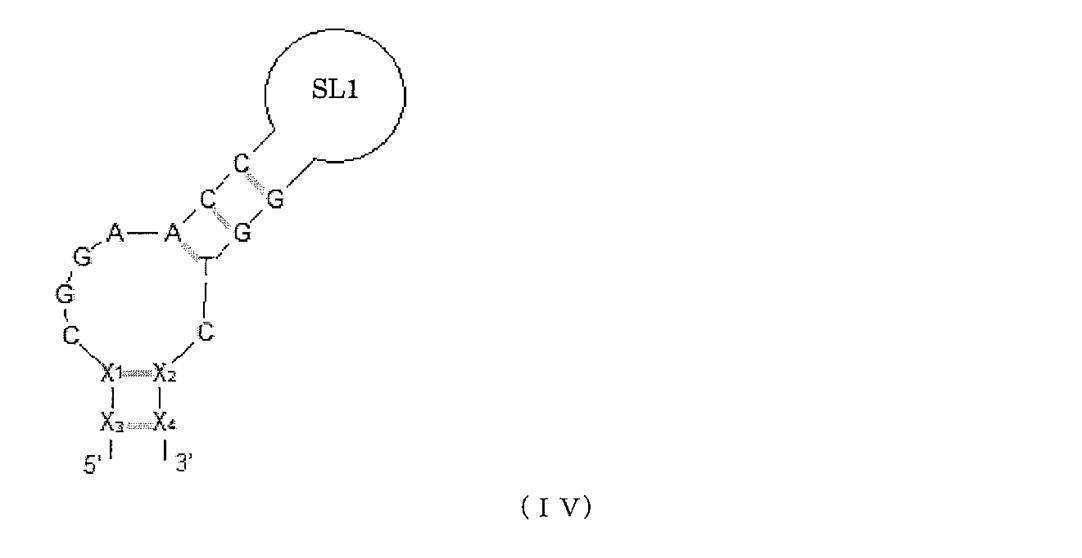
改変はまた、キャッピングのような3’及び5’の改変を含んでもよい。
アプタマーはアミダイト法もしくはホスホアミダイト法などの化学合成法によって大量合成することができる。合成方法はよく知られている方法であり、Nucleic Acid(Vol.2)[1]Synthesis and Analysis of Nucleic Acid(Editor:Yukio Sugiura,Hirokawa Publishing Company)などに記載のとおりである。実際にはGEヘルスケアーバイオサイエンス社製のOligoPilot100やOligoProcessなどの合成機を使用する。精製はクロマトグラフィー等の自体公知の方法により行われる。
アプタマーはホスホアミダイト法などの化学合成時にアミノ基などの活性基を導入することで、合成後に機能性物質を付加することができる。例えば、アプタマーの末端にアミノ基を導入することで、カルボキシル基を導入したポリエチレングリコール鎖を縮合させることができる。
アプタマーは、リン酸基の負電荷を利用したイオン結合、リボースを利用した疎水結合及び水素結合、核酸塩基を利用した水素結合やスタッキング結合など多様な結合様式により標的物質と結合する。特に、構成ヌクレオチドの数だけ存在するリン酸基の負電荷を利用したイオン結合は強く、タンパク質の表面に存在するリジンやアルギニンの正電荷と結合する。このため、標的物質との直接的な結合に関わっていない核酸塩基は置換することができる。特に、ステム構造の部分は既に塩基対が作られており、また、二重らせん構造の内側を向いているので、核酸塩基は、標的物質と直接結合し難い。従って、塩基対を他の塩基対に置換してもアプタマーの活性は減少しない場合が多い。ループ構造など塩基対を作っていない構造においても、核酸塩基が標的分子との直接的な結合に関与していない場合に、塩基の置換が可能である。デオキシリボースの2’位の修飾に関しては、まれにデオキシリボースの2’位の官能基が標的分子と直接的に相互作用していることがあるが、多くの場合無関係であり、他の修飾分子に置換可能である。このようにアプタマーは、標的分子との直接的な結合に関与している官能基を置換又は削除しない限り、その活性を保持していることが多い。また、全体の立体構造が大きく変わらないことも重要である。

オートタキシンに結合したDNAはPCRで増幅後、エキソヌクレアーゼ(BioLabs社)によって一本鎖DNAを処理した。その後、λエキソヌクレアーゼ(BioLabs社)で処理することにより、二本鎖DNAを一本鎖DNAにし、その一本鎖DNAを次のラウンドのプールとして用いた。
プライマーFwd:5’-GTGGTCTAGCTGTACTC-3’(配列番号2)
プライマーRev:5’-p-TAGCTCGTTGACTGTGG-3’ (配列番号3)
DNAランダムプール配列(配列番号1)中のNはデオキシリボヌクレオチド(A,G,C又はT)の任意の組み合わせである。またプライマーRevの5’末端はリン酸化(p)されたものを使用した。
配列番号4:GTGGTCTAGCTGTACTCTCCGGAACCAGAGCAATTTGGTCGAGCGCTATCGGATGGTCCACAGTCAACGAGCTA
配列番号5:GTGGTCTAGCTGTACTCATGGACGGAACCAGAATACTTTTGGTCTCCATTGAGTACGCCACAGTCAACGAGCTA
配列番号6:GTGGTCTAGCTGTACTCGGAACCGTACTCAACGGTCAGTACCTTTGCGCCGCAGCAAGCCACAGTCAACGAGCTA
配列番号7:GTGGTCTAGCTGTACTCGCCTGCCGGAACCGCCCCTGTGGTCGCATCGAGCAACGGCCCACAGTCAACGAGCTA
配列番号8:GTGGTCTAGCTGTACTCCGAAAGCCGGAACCGTGCCAATGGTCGCTACTTCAGCTCCCCACAGTCAACGAGCTA
配列番号9:GTGGTCTAGCTGTACTCAGGCCGGAACCGGTGAAATTGGTCGCCTAATAAGCGAAATCCACAGTCAACGAGCTA
配列番号10:GTGGTCTAGCTGTACTCGCCGGAACCGTACTATGGTCGCGTTGTATGACGCTTGTATCCACAGTCAACGAGCTA
共通配列:―X3X1CGGAACC-N1-GGTCX2X4(N1は7~11個の任意のヌクレオチドであり、X1、X2、X3およびX4はそれぞれ任意のヌクレオチドであり、X1とX2およびX3とX4のうち少なくとも一方はワトソン-クリック塩基対を形成する)-
測定結果を表1に示した。測定の結果、配列番号4~10はオートタキシンに結合することがわかった。またネガティブコントロールとして使用した40ヌクレオチドのランダム配列を含む1ラウンド目に使用した配列番号1で表される核酸プール(40N)は、結合量が最も多かった配列番号10の10%以下であり、結合しない(“-”とした)ことがわかった。ここで結合量とは最大のレゾナンスユニット(RU)値を示す。
またこれらの核酸がオートタキシン阻害活性を示すかどうかを、下記の方法により評価した。オートタキシンの基質として、ホスホジエステル結合含有合成基質 p-nitrophenyl thymidine 5’-monophosphate(pNP-TMP)(SIGMA)を選択した(以下、NPP2阻害アッセイという)。加水分解によりホスホジエステル結合が切断され、p-ニトロフェノールが遊離する。このp-ニトロフェノールは黄色く発色し、それを検出する。アッセイには96ウェルプレート(6-Well EIAsurasshuRIA Polystyrene Plates、 Costar社)を使用し、反応液量200μLで行った。なお、反応液として溶液Aを用いた。核酸を溶液A 100μL中に用意し、そこに同じく反応液A中で10mMに調整したpNP-TMP 20μLを添加しよく混合した後、37℃で5分間加温した。一方で6ngのオートタキシンを溶液Aで希釈したものを80μL用意し、37℃で5分間加温した。加温後両者を混合し酵素反応を開始させた。反応溶液中の最終オートタキシン濃度は0.3nM、最終基質濃度は1mMである。反応液を含むプレートを37℃で24時間加温後、マイクロプレートリーダーSpectraMax190(モレキュラーデバイス社製)にセットし、波長405nmで吸光度を求めた。核酸をいれていないときの吸光度を100%(A0)とし、各被験物質の吸光度(A)から阻害率を次式から求めた。

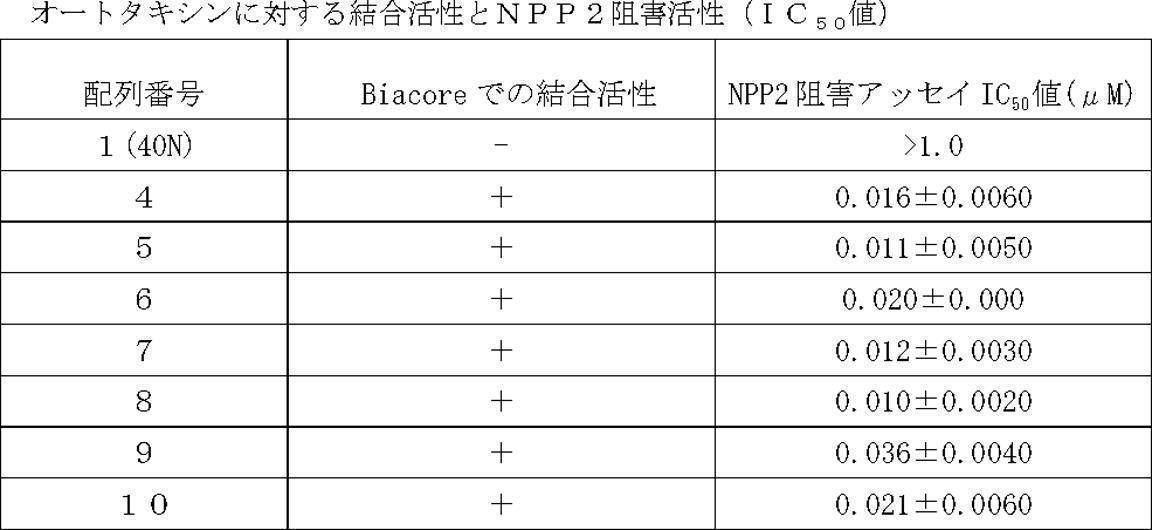
配列番号5で表されるヌクレオチド配列を有するアプタマーの短鎖化と塩基置換を行った。改変体の配列を配列番号11~16に示す。これらのうち配列番号11および12で表されるアプタマーの二次構造予測を図2に示す。図中、共通配列部分のヌクレオチドを丸(○)で囲った。またX1~X4に該当するヌクレオチドを点線の丸(○)で囲った。特に言及がなければ、以下に挙げられる個々の配列は、5’から3’の方向で表し、全てデオキシリボヌクエレオチドを示す。
(配列番号5で表されるアプタマーを、共通配列を含む45ヌクレオチドの長さに短鎖化した配列)
GTACTCATGGACGGAACCAGAATACTTTTGGTCTCCATTGAGTAC
配列番号12
(配列番号5で表されるアプタマーを、共通配列を含む34ヌクレオチドの長さに短鎖化し、ヌクレオチドを3カ所置換した配列)
CCTGGACGGAACCAGAATACTTTTGGTCTCCAGG
配列番号13
(配列番号5で表されるアプタマーを、共通配列を含む30ヌクレオチドの長さに短鎖化した配列)
TGGACGGAACCAGAATACTTTTGGTCTCCA
配列番号14
(配列番号5で表されるアプタマーを、共通配列を含む30ヌクレオチドの長さに短鎖化し、ヌクレオチドを2カ所置換した配列)
GGGACGGAACCAGAATACTTTTGGTCTCCC
配列番号15
(配列番号5で表されるアプタマーを、共通配列を含む30ヌクレオチドの長さに短鎖化した配列)
CCTGGACGGAACCAATACTTGGTCTCCAGG
配列番号16
(配列番号5で表されるアプタマーを、共通配列を含む32ヌクレオチドの長さに短鎖化し、ヌクレオチドを2カ所置換した配列)
CTGGACGGAACCAGAATACTTTTGGTCTCCAG
測定結果を表2に示した。表2では結合量が配列番号12で表されるヌクレオチド配列を有するアプタマーの10%以下であるものを結合しない(-)とし、それ以上のものは結合する(+)とした。ここで結合量とは最大のレゾナンスユニット(RU)値を示す。その結果、配列番号11~14および16で表されるヌクレオチド配列を有するアプタマーはオートタキシンに結合することが分かった。
さらに配列番号15は共通二次構造1の上部ステムが欠損していた。このため、活性が大きく低下したと考えられる。
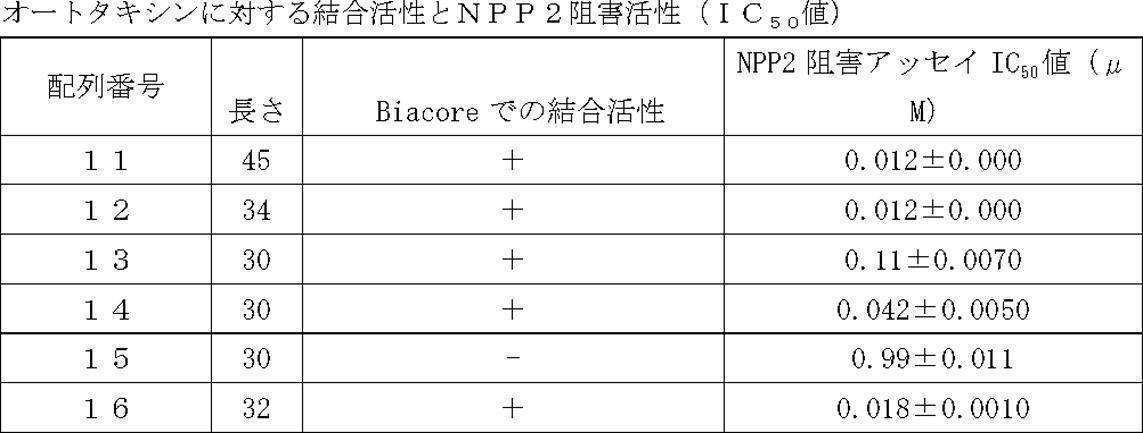
実施例1とは異なるランダム配列が40ヌクレオチドのDNAの鋳型を用いて、実施例1と同様のSELEXを行った。使用した鋳型とプライマーの配列を以下に示す。DNAの鋳型とプライマーは化学合成により作製した。
プライマーFwd:5’-ACACTCACAGGCGCTGG-3’:(配列番号18)
プライマーRev:5’-p-ACTAGCGGCCATGCACG-3’:(配列番号19)
DNAランダムプール(配列番号17)中のNはデオキシリボヌクレオチド(A,G,C又はT)の任意の組み合わせである。またプライマーRevの5’末端はリン酸化(p)されたものを使用した。
配列番号21:ACACTCACAGGCGCTGGCCACCACTGCACCGGAACCGCGAATGTGGTCGTGCATGGCCGCTAGT
配列番号22:ACACTCACAGGCGCTGGCCGGAACCGTGCATATGGTCGCCAGCACATCGTGCATGGCCGCTAGT
配列番号23:ACACTCACAGGCGCTGGCACGGACCGGAACCGGGACGCTCGGTCGACCGTGCATGGCCGCTAGT
配列番号24:ACACTCACAGGCGCTGGCGAGTCGGAACCGAGCCGATTGGTCACTCGCGTGCATGGCCGCTAGT
配列番号25:ACACTCACAGGCGCTGGCGACGTCGGAACCGTGTACCATGGTCACGTCGTGCATGGCCGCTAGT
またこれらの核酸がオートタキシン阻害活性を示すかどうか、実施例1と同様な方法で測定した。そのIC50値を表3に示す。その結果、配列番号20~25で表わされるアプタマーはIC50値が100nM以下の高い阻害活性を示した。
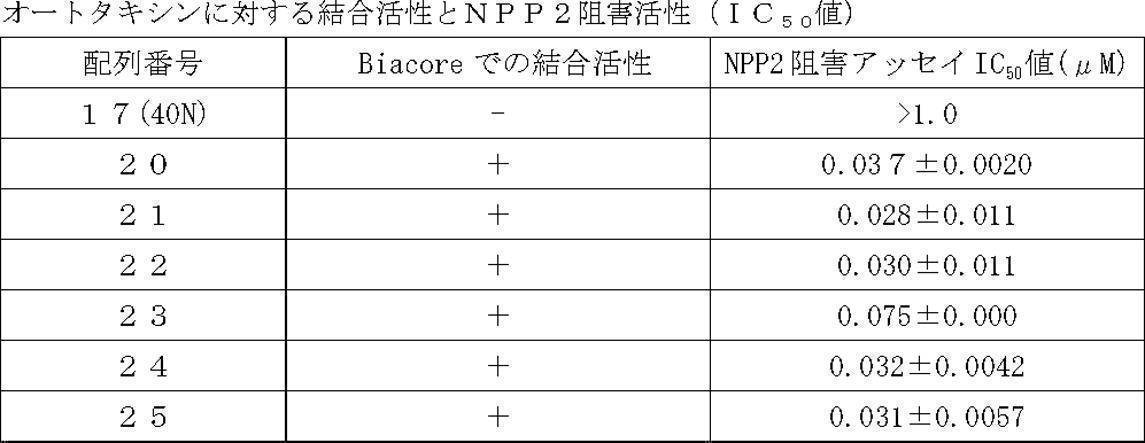
配列番号20と22について短鎖化を行った。改変体の配列を配列番号26~29に示す。
特に言及がなければ、以下に挙げられる個々の配列は、5’から3’の方向で表し、全てデオキシリボヌクエレオチドを示す。
配列番号27(配列番号20で表されるアプタマーを、共通配列を含む32ヌクレオチドの長さに短鎖化した配列):TACGCTCGGAACCGAGGCAATTGGTCAGCGTG
配列番号28(配列番号22で表されるアプタマーを、共通配列を含む31ヌクレオチドの長さに短鎖化した配列):ACAGGCGCTGGCCGGAACCGTGCATATGGTC
配列番号29(配列番号22で表されるアプタマーを、共通配列を含む31ヌクレオチドの長さに短鎖化した配列):GCTGGCCGGAACCGTGCATATGGTCGCCAGC
配列番号26と28は共通配列を含むものの、共通二次構造1とは異なっており、その阻害活性は著しく減少した(表4)。その反対に、共通二次構造を採るように短鎖化した配列番号27と29は高い阻害活性を有していることがわかった。

配列番号12で表されるアプタマーの末端を修飾した改変体や、配列中のプリンヌクレオチドのリボースの2’位に修飾を導入した改変体を作製した。それらの配列を配列番号12(1)~12(148)に示す。核酸は全て、化学合成で作製した。特に言及がなければ、以下に挙げられる個々の配列はデオキシリボヌクレオチドであり、5’から3’の方向で表す。ヌクレオチドにおける括弧はその2’位の修飾を示し、Mはメトキシ基を示す。またUはウラシルを、小文字のsはホスホロチオエート化を示す。Nj及びN(M)j(NはA、G、C又はT)は、順にP-メチル化、P-メチル化かつ2’メトキシ化されたヌクレオチドを示す(下記構造式を参照)。
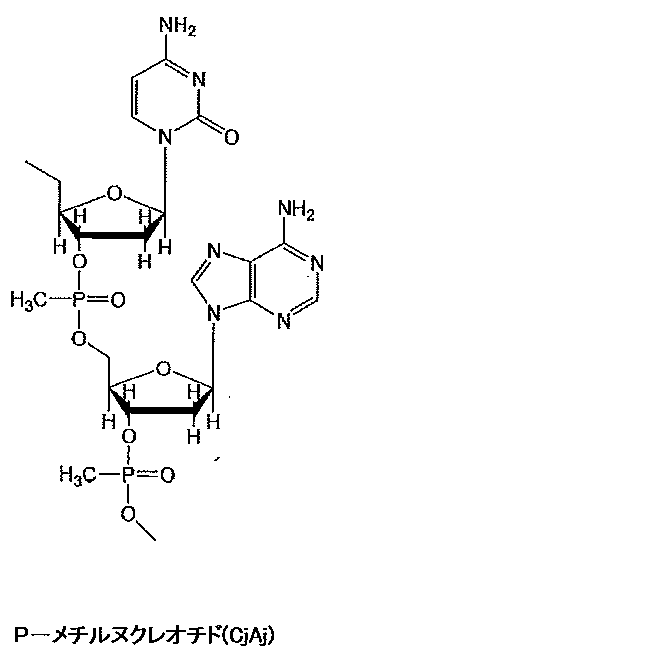

C(M)C(M)T(M)GGACGGAACCAGAATACTTTTGGTCTCCAGG
配列番号12(2):(配列番号12で表されるアプタマーにメトキシ修飾を導入した配列)
CCTGGACGGAACCAGAATACTTTTGGTCTC(M)C(M)AGG
配列番号12(3):(配列番号12で表されるアプタマーにメトキシ修飾を導入した配列)
CCTGGACGGAACCAGAATACTTTTGGTCTCCA(M)G(M)G(M)
配列番号12(4):(配列番号12で表されるアプタマーにメトキシ修飾を導入した配列)
CCTGGACGGAAC(M)C(M)AGAATACTTTTGGTCTCCAGG
配列番号12(5):(配列番号12で表されるアプタマーにメトキシ修飾を導入した配列)
CCTGGACGGAACCAGAATACTTT(M)T(M)GGTCTCCAGG
配列番号12(6):(配列番号12で表されるアプタマーにメトキシ修飾を導入した配列)
CCTGGACGGAACCAGAATACTTTTG(M)G(M)TCTCCAGG
配列番号12(7):(配列番号12で表されるアプタマーにメトキシ修飾を導入した配列)
CCTGGACGGAACCA(M)G(M)AATACTTTTGGTCTCCAGG
配列番号12(8):(配列番号12で表されるアプタマーにメトキシ修飾を導入した配列)
CCTGGA(M)CGGAACCAGAATACTTTTGGTCTCCAGG
配列番号12(9):(配列番号12で表されるアプタマーにメトキシ修飾を導入した配列)
CCTGGACGGAACCAGAATACTTTTGGTCT(M)CCAGG
配列番号12(10):(配列番号12で表されるアプタマーにメトキシ修飾を導入した配列)
CCTGGACGGAA(M)CCAGAATACTTTTGGTCTCCAGG
CCTGGACGGAACCAGAATACTTTTGGT(M)CTCCAGG
配列番号12(12):(配列番号12で表されるアプタマーにメトキシ修飾を導入した配列)
CCTGGAC(M)GGAACCAGAATACTTTTGGTCTCCAGG
配列番号12(13):(配列番号12で表されるアプタマーにメトキシ修飾を導入した配列)
CCTGGACG(M)GAACCAGAATACTTTTGGTCTCCAGG
配列番号12(14):(配列番号12で表されるアプタマーにメトキシ修飾を導入した配列)
CCTGGACGG(M)AACCAGAATACTTTTGGTCTCCAGG
配列番号12(15):(配列番号12で表されるアプタマーにメトキシ修飾を導入した配列)
CCTGGACGGA(M)ACCAGAATACTTTTGGTCTCCAGG
配列番号12(16):(配列番号12で表されるアプタマーにメトキシ修飾を導入した配列)
CCTGGACGGAACCAGAA(M)TACTTTTGGTCTCCAGG
配列番号12(17):(配列番号12で表されるアプタマーにメトキシ修飾を導入した配列)
CCTGGACGGAACCAGAAT(M)ACTTTTGGTCTCCAGG
配列番号12(18):(配列番号12で表されるアプタマーにメトキシ修飾を導入した配列)
CCTGGACGGAACCAGAATA(M)CTTTTGGTCTCCAGG
配列番号12(19):(配列番号12で表されるアプタマーにメトキシ修飾を導入した配列)
CCTGGACGGAACCAGAATAC(M)TTTTGGTCTCCAGG
配列番号12(20):(配列番号12で表されるアプタマーにメトキシ修飾を導入した配列)
CCTGGACGGAACCAGAATACT(M)TTTGGTCTCCAGG
CCTG(M)G(M)ACGGAACCAGAATACTTTTGGTCTCCAGG
配列番号12(22):(配列番号12で表されるアプタマーの両末端にidTを導入した配列)
idT-CCTGGACGGAACCAGAATACTTTTGGTCTCCAGG-idT
配列番号12(23):(配列番号12(22)で表されるアプタマーの5’末端idTの代わりに40kDaのポリエチレングリコールを導入した配列)
40P-Y-CCTGGACGGAACCAGAATACTTTTGGTCTCCAGG-idT
配列番号12(24):(配列番号12(22)で表されるアプタマーにメトキシ修飾を導入した配列)
idT-CCTGGAC(M)GG(M)AACCA(M)G(M)AATA(M)C(M)TTTTGGTCTCCA(M)G(M)G(M)-idT
配列番号12(25):(配列番号12(22)で表されるアプタマーにメトキシ修飾を導入した配列)
idT-C(M)C(M)T(M)G(M)G(M)AC(M)GG(M)AAC(M)C(M)A(M)G(M)AA(M)T(M)A(M)C(M)TTTTGGTCTCCA(M)G(M)G(M)-idT
配列番号12(26):(配列番号12で表されるアプタマーにメトキシ修飾を導入した配列)
CCTGGACGGAACCAGAATACTTTTGGTC(M)TCCAGG
配列番号12(27):(配列番号12で表されるアプタマーにメトキシ修飾を導入した配列)
CCTGGACGGAACCAGA(M)ATACTTTTGGTCTCCAGG
配列番号12(28):(配列番号12で表されるアプタマーにメトキシ修飾を導入した配列)
CCTGGACGGAACCAGAATACTT(M)TTGGTCTCCAGG
配列番号12(29):(配列番号12で表されるアプタマーにメトキシ修飾を導入した配列)
CCTGGACGGAACCAGAATACTTTTGG(M)TCTCCAGG
配列番号12(30):(配列番号12で表されるアプタマーにメトキシ修飾を導入した配列)
CCTGGACGGAACCAGAATACTTTTG(M)GTCTCCAGG
CCTGGACGGAAC(M)CAGAATACTTTTGGTCTCCAGG
配列番号12(32):(配列番号12で表されるアプタマーにメトキシ修飾を導入した配列)
CCTGGACGGAACC(M)AGAATACTTTTGGTCTCCAGG
配列番号12(33):(配列番号12で表されるアプタマーにメトキシ修飾を導入した配列)
CCTGGACGGAACCAGAATACTTTT(M)GGTCTCCAGG
配列番号12(34):(配列番号12で表されるアプタマーにメトキシ修飾を導入した配列)
CCTGGACGGAACCAGAATACTTT(M)TGGTCTCCAGG
配列番号12(35):(配列番号12で表されるアプタマーにメトキシ修飾を導入した配列)
CCTG(M)GACGGAACCAGAATACTTTTGGTCTCCAGG
配列番号12(36):(配列番号12で表されるアプタマーにメトキシ修飾を導入した配列)
CCTGG(M)ACGGAACCAGAATACTTTTGGTCTCCAGG
配列番号12(37):(配列番号12で表されるアプタマーにメトキシ修飾を導入した配列)
CCTGGACGGAACCAGAATACTTTTGGTCTC(M)CAGG
配列番号12(38):(配列番号12で表されるアプタマーにメトキシ修飾を導入した配列)
CCTGGACGGAACCAGAATACTTTTGGTCTCC(M)AGG
配列番号12(39):(配列番号12で表されるアプタマーにメトキシ修飾を導入した配列)
CCT(M)GGACGGAACCAGAATACTTTTGGTCTCCAGG
配列番号12(40):(配列番号12で表されるアプタマーにメトキシ修飾を導入した配列)
CC(M)TGGACGGAACCAGAATACTTTTGGTCTCCAGG
C(M)CTGGACGGAACCAGAATACTTTTGGTCTCCAGG
配列番号12(42):(配列番号12(22)で表されるアプタマーにメトキシ修飾を導入した配列)
idT-C(M)CTGG(M)AC(M)GG(M)AAC(M)C(M)A(M)G(M)AATA(M)C(M)TTTTGGTCTCCA(M)G(M)G(M)-idT
配列番号12(43):(配列番号12(22)で表されるアプタマーにメトキシ修飾を導入した配列)
idT-C(M)CTGG(M)AC(M)GG(M)AAC(M)CA(M)G(M)AATA(M)C(M)TTTTGGTCTCCA(M)G(M)G(M)-idT
配列番号12(44):(配列番号12(22)で表されるアプタマーにメトキシ修飾を導入した配列)
idT-C(M)CTGG(M)AC(M)GG(M)AACC(M)A(M)G(M)AATA(M)C(M)TTTTGGTCTCCA(M)G(M)G(M)-idT
配列番号12(45):(配列番号12(22)で表されるアプタマーにメトキシ修飾を導入した配列)
idT-C(M)CTGGAC(M)GG(M)AAC(M)CA(M)G(M)AATA(M)C(M)TTTTGGTCTCCA(M)G(M)G(M)-idT
配列番号12(46):(配列番号12(22)で表されるアプタマーにメトキシ修飾を導入した配列)
idT-C(M)CTGGAC(M)GG(M)AACC(M)A(M)G(M)AATA(M)C(M)TTTTGGTCTCCA(M)G(M)G(M)-idT
配列番号12(47):(配列番号12(22)で表されるアプタマーにメトキシ修飾を導入した配列)
idT-C(M)CTGG(M)AC(M)GG(M)AAC(M)C(M)A(M)G(M)AATA(M)C(M)TTTTGGTCTC(M)CA(M)G(M)G(M)-idT
配列番号12(48):(配列番号12(24)で表されるアプタマーの5’末端idTの代わりに40kDaのポリエチレングリコールを導入した配列)
40P-Y-CCTGGAC(M)GG(M)AACCA(M)G(M)AATA(M)C(M)TTTTGGTCTCCA(M)G(M)G(M)-idT
配列番号12(49):(配列番号12(42)で表されるアプタマーの5’末端idTの代わりに40kDaのポリエチレングリコールを導入した配列)
40P-Y-C(M)CTGG(M)AC(M)GG(M)AAC(M)C(M)A(M)G(M)AATA(M)C(M)TTTTGGTCTCCA(M)G(M)G(M)-idT
配列番号12(50):(配列番号12(24)で表されるアプタマーの5’末端idTの代わりに80kDaのポリエチレングリコールを導入した配列)
80P-Y-CCTGGAC(M)GG(M)AACCA(M)G(M)AATA(M)C(M)TTTTGGTCTCCA(M)G(M)G(M)-idT
80PP-Y-CCTGGAC(M)GG(M)AACCA(M)G(M)AATA(M)C(M)TTTTGGTCTCCA(M)G(M)G(M)-idT
配列番号12(52):(配列番号12(24)で表されるアプタマーの5’末端idTの代わりに配列番号12(50)と12(51)とは異なる80kDaのポリエチレングリコールを導入した配列)
80PPP-Y-CCTGGAC(M)GG(M)AACCA(M)G(M)AATA(M)C(M)TTTTGGTCTCCA(M)G(M)G(M)-idT
配列番号12(53):(配列番号12(24)で表されるアプタマーの5’末端idTの代わりに配列番号12(50)~12(52)とは異なる80kDaのポリエチレングリコールを導入した配列)
80PPPP-Y-CCTGGAC(M)GG(M)AACCA(M)G(M)AATA(M)C(M)TTTTGGTCTCCA(M)G(M)G(M)-idT
配列番号12(54):(配列番号12(24)で表されるアプタマーの3’末端idTの代わりにC12を導入した配列)
idT-CCTGGAC(M)GG(M)AACCA(M)G(M)AATA(M)C(M)TTTTGGTCTCCA(M)G(M)G(M)-C12
配列番号12(55):(配列番号12(24)で表されるアプタマーの5’末端idTの代わりにC12を導入した配列)
C12-CCTGGAC(M)GG(M)AACCA(M)G(M)AATA(M)C(M)TTTTGGTCTCCA(M)G(M)G(M)-idT
配列番号12(56):(配列番号12(48)で表されるアプタマーの3’末端idTの代わりにC6を導入した配列)
40P-Y-CCTGGAC(M)GG(M)AACCA(M)G(M)AATA(M)C(M)TTTTGGTCTCCA(M)G(M)G(M)-C6
配列番号12(57):(配列番号12(48)で表されるアプタマーの3’末端idTの代わりにC12を導入した配列)
40P-Y-CCTGGAC(M)GG(M)AACCA(M)G(M)AATA(M)C(M)TTTTGGTCTCCA(M)G(M)G(M)-C12
配列番号12(58):(配列番号12(24)で表されるアプタマーの配列のうち1か所をP-メチルヌクレオチドに置換した配列。)
idT-CCjTGGAC(M)GG(M)AACCA(M)G(M)AATA(M)C(M)TTTTGGTCTCCA(M)G(M)G(M)-idT
配列番号12(59):(配列番号12(24)で表されるアプタマーの配列のうち1か所をP-メチルヌクレオチドに置換した配列。)
idT-CCTGjGAC(M)GG(M)AACCA(M)G(M)AATA(M)C(M)TTTTGGTCTCCA(M)G(M)G(M)-idT
配列番号12(60):(配列番号12(24)で表されるアプタマーの配列のうち1か所をP-メチルヌクレオチドに置換した配列。)
idT-CCTGGAC(M)GG(M)AACCA(M)G(M)AATjA(M)C(M)TTTTGGTCTCCA(M)G(M)G(M)-idT
idT-CCTGGAC(M)GG(M)AACjCA(M)G(M)AATA(M)C(M)TTTTGGTCTCCA(M)G(M)G(M)-idT
配列番号12(62):(配列番号12(24)で表されるアプタマーの配列のうち1か所をP-メチルヌクレオチドに置換した配列。)
idT-CCTGGAC(M)GG(M)AACCA(M)G(M)AATA(M)C(M)TTTTGGTCjTCCA(M)G(M)G(M)-idT
配列番号12(63):(配列番号12(24)で表されるアプタマーの配列のうち1か所をP-メチルヌクレオチドに置換した配列。)
idT-CCTGGAC(M)GG(M)AACCA(M)G(M)AATA(M)C(M)TTTTGGTCTCCAjG(M)G(M)-idT
配列番号12(64):(配列番号12(24)で表されるアプタマーの配列のうち1か所をP-メチルヌクレオチドに置換した配列。)
idT-CCTGGAC(M)GG(M)AACCA(M)GjAATA(M)C(M)TTTTGGTCTCCA(M)G(M)G(M)-idT
配列番号12(65):(配列番号12(24)で表されるアプタマーの配列のうち1か所をP-メチルヌクレオチドに置換した配列。)
idT-CCTGGAC(M)GG(M)AACCA(M)G(M)AATA(M)CjTTTTGGTCTCCA(M)G(M)G(M)-idT
配列番号12(66):(配列番号12(48)で表されるアプタマーの5’末端に配列番号12(48)とは異なる40kDaのポリエチレングリコールを導入した配列。)
40PP-Y-CCTGGAC(M)GG(M)AACCA(M)G(M)AATA(M)C(M)TTTTGGTCTCCA(M)G(M)G(M)-idT
配列番号12(67):(配列番号12(48)で表されるアプタマーの5’末端に配列番号12(48)と12(66)とは異なる40kDaのポリエチレングリコールを導入した配列。)
40PPPP-Y-CCTGGAC(M)GG(M)AACCA(M)G(M)AATA(M)C(M)TTTTGGTCTCCA(M)G(M)G(M)-idT
配列番号12(68):(配列番号12(24)で表されるアプタマーの配列のうち1か所のTをU(M)に置換した配列)
idT-CCU(M)GGAC(M)GG(M)AACCA(M)G(M)AATA(M)C(M)TTTTGGTCTCCA(M)G(M)G(M)-idT
配列番号12(69):(配列番号12(24)で表されるアプタマーの配列のうち1か所のTをU(M)に置換した配列)
idT-CCTGGAC(M)GG(M)AACCA(M)G(M)AATA(M)C(M)TTTU(M)GGTCTCCA(M)G(M)G(M)-idT
配列番号12(70):(配列番号12(24)で表されるアプタマーの配列のうち1か所のTをU(M)に置換した配列)
idT-CCTGGAC(M)GG(M)AACCA(M)G(M)AATA(M)C(M)TTU(M)TGGTCTCCA(M)G(M)G(M)-idT
idT-CCTGGAC(M)GG(M)AACCA(M)G(M)AATA(M)C(M)TTTTGGTCU(M)CCA(M)G(M)G(M)-idT
配列番号12(72):(配列番号12(24)で表されるアプタマーの配列のうち1か所のTをU(M)に置換した配列)
idT-CCTGGAC(M)GG(M)AACCA(M)G(M)AATA(M)C(M)TTTTGGU(M)CTCCA(M)G(M)G(M)-idT
配列番号12(73):(配列番号12(24)で表されるアプタマーの配列のうち1か所のTをU(M)に置換した配列)
idT-CCTGGAC(M)GG(M)AACCA(M)G(M)AATA(M)C(M)TU(M)TTGGTCTCCA(M)G(M)G(M)-idT
配列番号12(74):(配列番号12(24)で表されるアプタマーの配列のうち1か所のTをU(M)に置換した配列)
idT-CCTGGAC(M)GG(M)AACCA(M)G(M)AATA(M)C(M)U(M)TTTGGTCTCCA(M)G(M)G(M)-idT
配列番号12(75):(配列番号12(24)で表されるアプタマーの配列のうち1か所のTをU(M)に置換した配列)
idT-CCTGGAC(M)GG(M)AACCA(M)G(M)AAU(M)A(M)C(M)TTTTGGTCTCCA(M)G(M)G(M)-idT
配列番号12(76):(配列番号12(24)で表されるアプタマーにホスホロチオエートを導入した配列)
idT-CCTGGAsC(M)GG(M)AACCA(M)G(M)AATA(M)C(M)TTTTGGTCTCCA(M)G(M)G(M)-idT
配列番号12(77):(配列番号12(24)で表されるアプタマーにホスホロチオエートを導入した配列)
idT-CCTGGAC(M)GsG(M)AACCA(M)G(M)AATA(M)C(M)TTTTGGTCTCCA(M)G(M)G(M)-idT
配列番号12(78):(配列番号12(24)で表されるアプタマーにホスホロチオエートを導入した配列)
idT-CCTGGAC(M)GG(M)AsACCA(M)G(M)AATA(M)C(M)TTTTGGTCTCCA(M)G(M)G(M)-idT
配列番号12(79):(配列番号12(24)で表されるアプタマーにホスホロチオエートを導入した配列)
idT-CCTGGAC(M)GG(M)AAsCCA(M)G(M)AATA(M)C(M)TTTTGGTCTCCA(M)G(M)G(M)-idT
配列番号12(80):(配列番号12(24)で表されるアプタマーにホスホロチオエートを導入した配列)
idT-CCTGGAC(M)GG(M)AACsCA(M)G(M)AATA(M)C(M)TTTTGGTCTCCA(M)G(M)G(M)-idT
idT-CCTGGAC(M)GG(M)AACCsA(M)G(M)AATA(M)C(M)TTTTGGTCTCCA(M)G(M)G(M)-idT
配列番号12(82):(配列番号12(24)で表されるアプタマーにホスホロチオエートを導入した配列)
idT-CCTGGAC(M)GG(M)AACCA(M)G(M)AATA(M)C(M)TTTTsGGTCTCCA(M)G(M)G(M)-idT
配列番号12(83):(配列番号12(24)で表されるアプタマーにホスホロチオエートを導入した配列)
idT-CCTGGAC(M)GG(M)AACCA(M)G(M)AATA(M)C(M)TTTTGsGTCTCCA(M)G(M)G(M)-idT
配列番号12(84):(配列番号12(24)で表されるアプタマーにホスホロチオエートを導入した配列)
idT-CCTGGAC(M)GG(M)AACCA(M)G(M)AATA(M)C(M)TTTTGGsTCTCCA(M)G(M)G(M)-idT
配列番号12(85):(配列番号12(24)で表されるアプタマーにホスホロチオエートを導入した配列)
idT-CCTGGAC(M)GG(M)AACCA(M)G(M)AATA(M)C(M)TTTTGGTsCTCCA(M)G(M)G(M)-idT
配列番号12(86):(配列番号12(24)で表されるアプタマーにホスホロチオエートを導入した配列)
idT-CCTGGAC(M)GG(M)AACCA(M)G(M)AATA(M)C(M)TTTTGGTCsTCCA(M)G(M)G(M)-idT
配列番号12(87):(配列番号12(24)で表されるアプタマーにホスホロチオエートを導入した配列)
idT-CCTGGAC(M)GG(M)AACCA(M)G(M)AATA(M)C(M)TTTsTGGTCTCCA(M)G(M)G(M)-idT
配列番号12(88):(配列番号12(24)で表されるアプタマーの配列のうち2か所をP-メチルヌクレオチドに置換した配列。)
idT-CCTGGAC(M)GG(M)AACjCA(M)G(M)AATA(M)C(M)TTTTGGTCjTCCA(M)G(M)G(M)-idT
配列番号12(89):(配列番号12(24)で表されるアプタマーの配列のうち1か所をP-メチルヌクレオチドに置換した配列。)
idT-CCTGGAC(M)GG(M)AACCA(M)G(M)AATA(M)C(M)TTTTGGjTCTCCA(M)G(M)G(M)-idT
配列番号12(90):(配列番号12(24)で表されるアプタマーの配列のうち1か所をP-メチルヌクレオチドに置換した配列。)
idT-CCTGGAC(M)GG(M)AACCA(M)G(M)AATA(M)C(M)TTTTGjGTCTCCA(M)G(M)G(M)-idT
idT-CCTGGAC(M)GG(M)AACCjA(M)G(M)AATA(M)C(M)TTTTGGTCTCCA(M)G(M)G(M)-idT
配列番号12(92):(配列番号12(24)で表されるアプタマーの配列のうち1か所をP-メチルヌクレオチドに置換した配列。)
idT-CCTGGAC(M)GjG(M)AACCA(M)G(M)AATA(M)C(M)TTTTGGTCTCCA(M)G(M)G(M)-idT
配列番号12(93):(配列番号12(24)で表されるアプタマーの配列のうち1か所をP-メチルヌクレオチドに置換した配列。)
idT-CCTGGAC(M)GG(M)AjACCA(M)G(M)AATA(M)C(M)TTTTGGTCTCCA(M)G(M)G(M)-idT
配列番号12(94):(配列番号12(24)で表されるアプタマーの配列のうち1か所をP-メチルヌクレオチドに置換した配列。)
idT-CCTGGAC(M)GG(M)AAjCCA(M)G(M)AATA(M)C(M)TTTTGGTCTCCA(M)G(M)G(M)-idT
配列番号12(95):(配列番号12(24)で表されるアプタマーの配列のうち1か所をP-メチルヌクレオチドに置換した配列。)
idT-CCTGGAjC(M)GG(M)AACCA(M)G(M)AATA(M)C(M)TTTTGGTCTCCA(M)G(M)G(M)-idT
配列番号12(96):(配列番号12(24)で表されるアプタマーの配列のうち1か所をP-メチルヌクレオチドに置換した配列。)
idT-CCTGGAC(M)GG(M)AACCA(M)G(M)AATA(M)C(M)TTTTGGTCTjCCA(M)G(M)G(M)-idT
配列番号12(97):(配列番号12(24)で表されるアプタマーの配列のうち1か所をP-メチルヌクレオチドに置換した配列。)
idT-CCTGGAC(M)GG(M)AACCA(M)G(M)AATA(M)C(M)TTTTGGTjCTCCA(M)G(M)G(M)-idT
配列番号12(98):(配列番号12(24)で表されるアプタマーにホスホロチオエートを導入した配列)
idT-CCTGGAC(M)GG(M)AACCA(M)G(M)sAATA(M)C(M)TTTTGGTCTCCA(M)G(M)G(M)-idT
配列番号12(99):(配列番号12(24)で表されるアプタマーにホスホロチオエートを導入した配列)
idT-CCTGGAC(M)GG(M)AACCA(M)G(M)AsATA(M)C(M)TTTTGGTCTCCA(M)G(M)G(M)-idT
配列番号12(100):(配列番号12(24)で表されるアプタマーにホスホロチオエートを導入した配列)
idT-CCTGGAC(M)GG(M)AACCA(M)G(M)AAsTA(M)C(M)TTTTGGTCTCCA(M)G(M)G(M)-idT
idT-CCTGGAC(M)GG(M)AACCA(M)G(M)AATsA(M)C(M)TTTTGGTCTCCA(M)G(M)G(M)-idT
配列番号12(102):(配列番号12(24)で表されるアプタマーにホスホロチオエートを導入した配列)
idT-CCTGGAC(M)GG(M)AACCA(M)G(M)AATA(M)C(M)sTTTTGGTCTCCA(M)G(M)G(M)-idT
配列番号12(103):(配列番号12(24)で表されるアプタマーにホスホロチオエートを導入した配列)
idT-CCTGGAC(M)GG(M)AACCA(M)G(M)AATA(M)C(M)TsTTTGGTCTCCA(M)G(M)G(M)-idT
配列番号12(104):(配列番号12(24)で表されるアプタマーにホスホロチオエートを導入した配列)
idT-CCTGGAC(M)GG(M)AACCA(M)G(M)AATA(M)C(M)TTsTTGGTCTCCA(M)G(M)G(M)-idT
配列番号12(105):(配列番号12(24)で表されるアプタマーにホスホロチオエートを導入した配列)
idT-CCTGGAC(M)GG(M)sAACCA(M)G(M)AATA(M)C(M)TTTTGGTCTCCA(M)G(M)G(M)-idT
配列番号12(106):(配列番号12(24)で表されるアプタマーにホスホロチオエートを導入した配列)
idT-CCTGGAC(M)sGG(M)AACCA(M)G(M)AATA(M)C(M)TTTTGGTCTCCA(M)G(M)G(M)-idT
配列番号12(107):(配列番号12(24)で表されるアプタマーにホスホロチオエートを導入した配列)
idT-CsCTGGAC(M)GG(M)AACCA(M)G(M)AATA(M)C(M)TTTTGGTCTCCA(M)G(M)G(M)-idT
配列番号12(108):(配列番号12(24)で表されるアプタマーにホスホロチオエートを導入した配列)
idT-CCsTGGAC(M)GG(M)AACCA(M)G(M)AATA(M)C(M)TTTTGGTCTCCA(M)G(M)G(M)-idT
配列番号12(109):(配列番号12(24)で表されるアプタマーにホスホロチオエートを導入した配列)
idT-CCTsGGAC(M)GG(M)AACCA(M)G(M)AATA(M)C(M)TTTTGGTCTCCA(M)G(M)G(M)-idT
配列番号12(110):(配列番号12(24)で表されるアプタマーにホスホロチオエートを導入した配列)
idT-CCTGsGAC(M)GG(M)AACCA(M)G(M)AATA(M)C(M)TTTTGGTCTCCA(M)G(M)G(M)-idT
idT-CCTGGsAC(M)GG(M)AACCA(M)G(M)AATA(M)C(M)TTTTGGTCTCCA(M)G(M)G(M)-idT
配列番号12(112):(配列番号12(24)で表されるアプタマーにホスホロチオエートを導入した配列)
idT-CCTGGAC(M)GG(M)AACCA(M)G(M)AATA(M)C(M)TTTTGGTCTsCCA(M)G(M)G(M)-idT
配列番号12(113):(配列番号12(24)で表されるアプタマーにホスホロチオエートを導入した配列)
idT-CCTGGAC(M)GG(M)AACCA(M)G(M)AATA(M)C(M)TTTTGGTCTCsCA(M)G(M)G(M)-idT
配列番号12(114):(配列番号12(24)で表されるアプタマーにホスホロチオエートを導入した配列)
idT-CCTGGAC(M)GG(M)AACCA(M)G(M)AATA(M)C(M)TTTTGGTCTCCsA(M)G(M)G(M)-idT
配列番号12(115):(配列番号12(24)で表されるアプタマーにホスホロチオエートを導入した配列)
idT-CCTGGAC(M)GG(M)AACCA(M)G(M)AATA(M)C(M)TTTTGGTCTCCA(M)sG(M)G(M)-idT
配列番号12(116):(配列番号12(24)で表されるアプタマーにホスホロチオエートを導入した配列)
idT-CCTGGAC(M)GG(M)AACCA(M)G(M)AATA(M)C(M)TTTTGGTCTCCA(M)G(M)sG(M)-idT
配列番号12(117):(配列番号12(77)で表されるアプタマーに5 ’末端idTの代わりに40kDaのポリエチレングリコールを導入した配列)
40P-Y-CCTGGAC(M)GsG(M)AACCA(M)G(M)AATA(M)C(M)TTTTGGTCTCCA(M)G(M)G(M)-idT
配列番号12(118):(配列番号12(24)で表されるアプタマーの配列のうち2か所をP-メチルヌクレオチドに置換した配列。)
idT-CCTGGAC(M)GjG(M)AACjCA(M)G(M)AATA(M)C(M)TTTTGGTCTCCA(M)G(M)G(M)-idT
配列番号12(119):(配列番号12(24)で表されるアプタマーの配列のうち3か所をP-メチルヌクレオチドに置換した配列。)
idT-CCTGGAC(M)GjG(M)AACjCA(M)G(M)AATA(M)C(M)TTTTGGTCjTCCA(M)G(M)G(M)-idT
配列番号12(120):(配列番号12(24)で表されるアプタマーの配列のうち1か所をP-メチルヌクレオチドに置換した配列。)
idT-CCTGGAC(M)GG(M)AACCA(M)G(M)AATA(M)C(M)TTTTjGGTCTCCA(M)G(M)G(M)-idT
idT-CCTGGAC(M)GG(M)AACCA(M)G(M)AATA(M)C(M)TTTjTGGTCTCCA(M)G(M)G(M)-idT
配列番号12(122):(配列番号12(24)で表されるアプタマーの配列のうち1か所をP-メチルヌクレオチドに置換した配列。)
idT-CCTGGAC(M)GG(M)AACCA(M)G(M)AATA(M)C(M)TTjTTGGTCTCCA(M)G(M)G(M)-idT
配列番号12(123):(配列番号12(24)で表されるアプタマーの配列のうち1か所をP-メチルヌクレオチドに置換した配列。)
idT-CCTGGAC(M)GG(M)AACCA(M)G(M)AATA(M)C(M)TjTTTGGTCTCCA(M)G(M)G(M)-idT
配列番号12(124):(配列番号12(24)で表されるアプタマーの配列のうち1か所をP-メチルヌクレオチドに置換した配列。)
idT-CCTGGAC(M)GG(M)AACCA(M)G(M)AjATA(M)C(M)TTTTGGTCTCCA(M)G(M)G(M)-idT
配列番号12(125):(配列番号12(24)で表されるアプタマーの配列のうち1か所をP-メチルヌクレオチドに置換した配列。)
idT-CCTGGAC(M)GG(M)AACCA(M)G(M)AAjTA(M)C(M)TTTTGGTCTCCA(M)G(M)G(M)-idT
配列番号12(126):(配列番号12(24)で表されるアプタマーの配列のうち1か所をP-メチルヌクレオチドに置換した配列。)
idT-CCTGGAC(M)GG(M)AACCA(M)G(M)AATA(M)C(M)TTTTGGTCTCCjA(M)G(M)G(M)-idT
配列番号12(127):(配列番号12(24)で表されるアプタマーの配列のうち1か所をP-メチルヌクレオチドに置換した配列。)
idT-CCTGGAC(M)GG(M)AACCA(M)G(M)AATA(M)C(M)TTTTGGTCTCjCA(M)G(M)G(M)-idT
配列番号12(128):(配列番号12(24)で表されるアプタマーの配列のうち1か所をP-メチルヌクレオチドに置換した配列。)
idT-CCTGGjAC(M)GG(M)AACCA(M)G(M)AATA(M)C(M)TTTTGGTCTCCA(M)G(M)G(M)-idT
配列番号12(129):(配列番号12(24)で表されるアプタマーの配列のうち1か所をP-メチルヌクレオチドに置換した配列。)
idT-CCTjGGAC(M)GG(M)AACCA(M)G(M)AATA(M)C(M)TTTTGGTCTCCA(M)G(M)G(M)-idT
配列番号12(130):(配列番号12(24)で表されるアプタマーの配列のうち1か所をP-メチルヌクレオチドに置換した配列。)
idT-CjCTGGAC(M)GG(M)AACCA(M)G(M)AATA(M)C(M)TTTTGGTCTCCA(M)G(M)G(M)-idT
40P-Y-CCTGGAC(M)GjG(M)AACCA(M)G(M)AATA(M)C(M)TTTTGGTCTCCA(M)G(M)G(M)-idT
配列番号12(132):(配列番号12(24)で表されるアプタマーの配列のうち10か所をP-メチルヌクレオチドに置換した配列。)
idT-CjCTGGjAC(M)GjG(M)AACjCA(M)G(M)AjATA(M)C(M)TjTTjTGGTCjTCjCjA(M)G(M)G(M)-idT
配列番号12(133):(配列番号12(119)で表されるアプタマーの5’末端idTの代わりに40kDaのポリエチレングリコールを導入した配列)
40P-Y-CCTGGAC(M)GjG(M)AACjCA(M)G(M)AATA(M)C(M)TTTTGGTCjTCCA(M)G(M)G(M)-idT
配列番号12(134):(配列番号12(132)で表されるアプタマーの5’末端idTの代わりに40kDaのポリエチレングリコールを導入した配列)
40P-Y-CjCTGGjAC(M)GjG(M)AACjCA(M)G(M)AjATA(M)C(M)TjTTjTGGTCjTCjCjA(M)G(M)G(M)-idT
配列番号12(135):(配列番号12(132)で表されるアプタマーの配列のうち1か所をP-メチル-2‘メトキシヌクレオチドに置換した配列。)
idT-CjCTGGjAC(M)GjG(M)AACjCA(M)G(M)AjATA(M)C(M)TjTTjTGGTCjTCjCjA(M)G(M)G(M)j-idT
配列番号12(136):(配列番号12(132)で表されるアプタマーの配列のうち1か所をP-メチル-2’メトキシヌクレオチドに置換した配列。)
idT-CjCTGGjAC(M)GjG(M)AACjCA(M)G(M)AjATA(M)C(M)TjTTjTGGTCjTCjCjA(M)G(M)jG(M)-idT
配列番号12(137):(配列番号12(132)で表されるアプタマーの配列のうち1か所をP-メチル-2’メトキシヌクレオチドに置換した配列。)
idT-CjCTGGjAC(M)GjG(M)AACjCA(M)G(M)AjATA(M)C(M)TjTTjTGGTCjTCjCjA(M)jG(M)G(M)-idT
配列番号12(138):(配列番号12(132)で表されるアプタマーの配列のうち1か所をP-メチル-2’メトキシヌクレオチドに置換した配列。)
idT-CjCTGGjAC(M)GjG(M)AACjCA(M)G(M)AjATA(M)C(M)jTjTTjTGGTCjTCjCjA(M)G(M)G(M)-idT
配列番号12(139):(配列番号12(132)で表されるアプタマーの配列のうち1か所をP-メチル-2’メトキシヌクレオチドに置換した配列。)
idT-CjCTGGjAC(M)GjG(M)AACjCA(M)G(M)AjATA(M)jC(M)TjTTjTGGTCjTCjCjA(M)G(M)G(M)-idT
配列番号12(140):(配列番号12(132)で表されるアプタマーの配列のうち1か所をP-メチル-2’メトキシヌクレオチドに置換した配列。)
idT-CjCTGGjAC(M)GjG(M)AACjCA(M)G(M)jAjATA(M)C(M)TjTTjTGGTCjTCjCjA(M)G(M)G(M)-idT
idT-CjCTGGjAC(M)GjG(M)AACjCA(M)jG(M)AjATA(M)C(M)TjTTjTGGTCjTCjCjA(M)G(M)G(M)-idT
配列番号12(142):(配列番号12(132)で表されるアプタマーの配列のうち1か所をP-メチル-2’メトキシヌクレオチドに置換した配列。)
idT-CjCTGGjAC(M)GjG(M)jAACjCA(M)G(M)AjATA(M)C(M)TjTTjTGGTCjTCjCjA(M)G(M)G(M)-idT
配列番号12(143):(配列番号12(132)で表されるアプタマーの配列のうち1か所をP-メチル-2’メトキシヌクレオチドに置換した配列。)
idT-CjCTGGjAC(M)jGjG(M)AACjCA(M)G(M)AjATA(M)C(M)TjTTjTGGTCjTCjCjA(M)G(M)G(M)-idT
配列番号12(144):(配列番号12(135)で表されるアプタマーの5’末端idTの代わりに40kDaのポリエチレングリコールを導入した配列)
40P-Y-CjCTGGjAC(M)GjG(M)AACjCA(M)G(M)AjATA(M)C(M)TjTTjTGGTCjTCjCjA(M)G(M)G(M)j-idT
配列番号12(145):(配列番号12(139)で表されるアプタマーの5’末端idTの代わりに40kDaのポリエチレングリコールを導入した配列)
40P-Y-CjCTGGjAC(M)GjG(M)AACjCA(M)G(M)AjATA(M)jC(M)TjTTjTGGTCjTCjCjA(M)G(M)G(M)-idT
配列番号12(146):(配列番号12(141)で表されるアプタマーの5’末端idTの代わりに40kDaのポリエチレングリコールを導入した配列)
40P-Y-CjCTGGjAC(M)GjG(M)AACjCA(M)jG(M)AjATA(M)C(M)TjTTjTGGTCjTCjCjA(M)G(M)G(M)-idT
配列番号12(147):(配列番号12(134)で表されるアプタマーの配列のうち3か所をP-メチル-2’メトキシヌクレオチドに置換した配列。)
40P-Y-CjCTGGjAC(M)GjG(M)AACjCA(M)jG(M)AjATA(M)jC(M)TjTTjTGGTCjTCjCjA(M)G(M)G(M)j-idT
配列番号12(148):(配列番号12で表されるアプタマーの配列にメトキシ修飾と、3’末端にidTを導入した配列)
CCTGGAC(M)GG(M)AACCA(M)G(M)AATA(M)C(M)TTTTGGTCTCCA(M)G(M)G(M)-idT
反応溶液量は36μLとし、測定方法は下記のように行った。溶液Aで調製した14:0LPCが最終濃度0.5mMになるように添加されたヒトプール血清(コージンバイオ社製)33μLに溶液A3μL中に溶解したアプタマーを添加し(最終血清濃度は約92%)、37℃で加温した。3時間後にオートタキシン活性を停止させるため、100mM EDTA溶液を4μL加えた後、LPA濃度測定を行った。LPA濃度測定はKishimotoらの方法(Kishimoto、Clinica Chimica Acta 333,59-69,2003)で行った。アプタマーの代わりに溶液Aを加えた血清中で産生されるLPA濃度をコントロール(L0)とし、アプタマーを加えた血清中のLPA濃度(L)から各アプタマーの阻害率を次式から求めた。


配列番号12(48)で表わされるアプタマーがFGF2(ぺプロテック社)に対して結合活性を有しているかどうか表面プラズモン共鳴法で確認した。測定には、GEヘルスケア社製のBiacore T100を用い、以下に示す方法で測定を行った。CM4チップのセンサーチップ表面に、アミノカップリングキットを使用し、約2700RUのオートタキシンをフローセル2に固定化、FGF2をフローセル3に固定化した(約1100RU)。流速20μL/minで、アナライトとして0.3μMに調製した核酸を20μLインジェクトした。ランニングバッファーには溶液Aを用いた。
測定の結果、配列番号12(48)で表されるアプタマーはFGF2には結合しないことがわかった(図3)。これは本発明のアプタマーがオートタキシンに特異的に結合することを示している。
実施例4で作製した配列番号12(48)で表わされるアプタマーをブレオマイシン誘導型肺線維症モデルマウスに腹腔内投与し、その効果を検証した。
ICR系SPFマウス(10週齢、雄、日本チャールズリバー)に対し、PBSで770μg/mLに調製したブレオマイシン50μLを麻酔下、気管内投与した。ブレオマイシンを投与した翌日から毎日1回、1mM塩化マグネシウム入りPBSに溶かしたオートタキシンアプタマー溶液、又は1mM塩化マグネシウム入りPBSのみ(ビークル群)を1回の投与量100μLを腹腔内投与した。アプタマー投与量は1および3mg/kg/日の2用量とした。また、無処置のコントロール群も同じ試験期間飼育した。ブレオマイシン投与後から21日目に試験を終了し、肺を摘出、左肺をヒドロキシプロリン測定用に凍結保存した。ヒドロキシプロリンの測定はバイオビジョン社のHydroxyproline Colorimetric Assay キットを用いて測定した。
以上より、配列番号12(48)で表わされるアプタマーは肺線維症治療薬として使用可能であることが示唆された。
配列番号12(144)および12(149)で表されるアプタマーがオートタキシンのリゾホスホリパーゼD活性を阻害するかどうか、下記の方法により評価した。オートタキシンの基質として14:0リゾホスファチジルコリン(LPC、Avanti社)を選択した(以下LysoPLD阻害アッセイとした)。LPCはオートタキシンがもつリゾホスホリパーゼD活性により加水分解され、リゾホスファチジン酸(LPA)とコリンに分解される。コリンはコリンオキシダーゼにより酸化され過酸化水素が産生する。この過酸化水素とペルオキシダーゼ存在下でN-エチル-N-(2-ヒドロキシ-3-スルホプロピル)-3-メトキシアニリン(TOOS)と4-アミノアンチピリン(4-AA)が酸化縮合反応を起こし、紫色に呈色するのを検出する。

idT-CCTGGjAC(M)GjG(M)AACjCA(M)G(M)AjATA(M)C(M)TjTTjTGGTCjTCjCjA(M)G(M)G(M)j-idT

実施例5において、1ヶ所のみP-メチル修飾された改変体を作製し、LPA産生阻害実験で阻害活性を確認した。その結果、配列番号12(24)で表されるアプタマーの12番目のCと13番目のCの間のリン酸基にP-メチル修飾を加えることで活性が向上することがわかった。12番目のCと13番目のCは共通配列の一部なので、メチル基がオートタキシンと直接作用して阻害活性が向上したと推測された。そこで、メチル基よりも大きく、疎水性の高い官能基を導入することで阻害活性が更に向上するかどうか検討した。
配列番号12(24)で表されるアプタマーの12番目のCと13番目のCの間のリン酸基を修飾したアプタマーを化学合成で作製した。それらの配列を配列番号12(150)~12(152)に示す。特に言及がなければ、個々の配列はデオキシリボヌクレオチドであり、5’から3’の方向で表す。ヌクレオチドにおける括弧はその2’位の修飾を示し、Mはメトキシ基を示す。CαC、CβC及びCγCはリン酸基の部分を修飾したもので、順にP-イソプロポキシ化、P-プロポキシ化、P-ブトキシ化されたものを示す(下記構造式を参照)。末端修飾におけるidTはinverted-dTを示す。
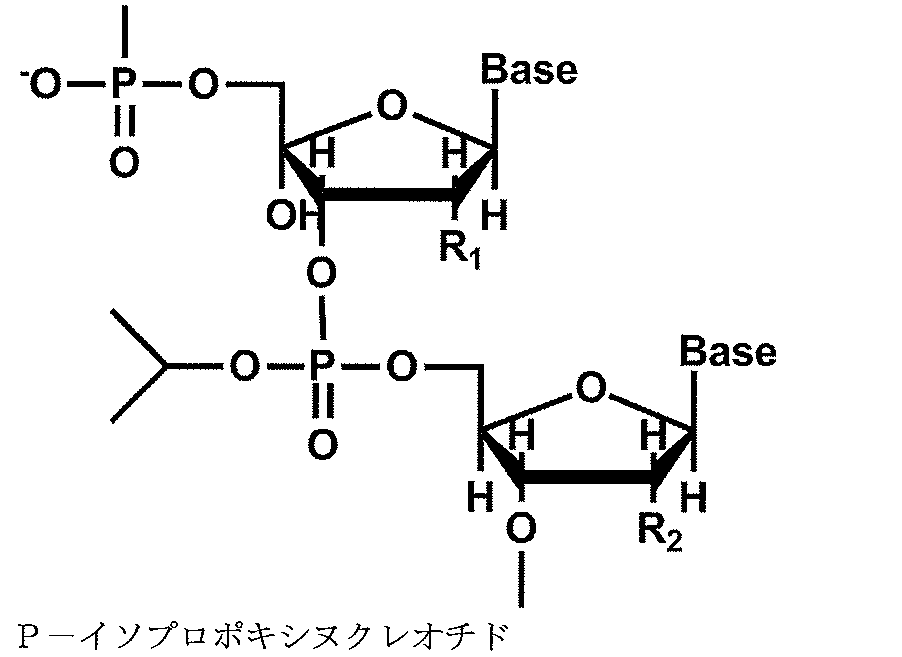


idT-CCTGGAC(M)GG(M)AACαCA(M)G(M)AATA(M)C(M)TTTTGGTCTCCA(M)G(M)G(M)-idT
配列番号12(151):配列番号12(24)で表されるアプタマーの配列の12番目のCと13番目のCの間のリン酸基をP-プロポキシに置換した配列。)
idT-CCTGGAC(M)GG(M)AACβCA(M)G(M)AATA(M)C(M)TTTTGGTCTCCA(M)G(M)G(M)-idT
配列番号12(152):配列番号12(24)で表されるアプタマーの配列の12番目のCと13番目のCの間のリン酸基をP-ブトキシに置換した配列。)
idT-CCTGGAC(M)GG(M)AACγCA(M)G(M)AATA(M)C(M)TTTTGGTCTCCA(M)G(M)G(M)-idT
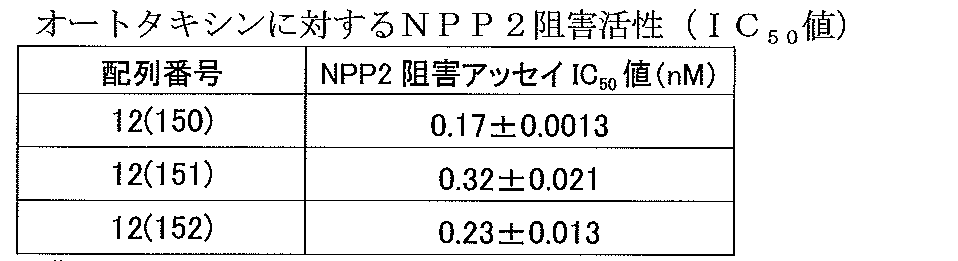
本出願は、日本で出願された特願2014-067289(出願日:平成26年3月27日)を基礎としており、その内容はすべて本明細書に包含されるものとする。
Claims (22)
- 下記式(I):
CGGAACC-N1-GGTC (I)
(式中、N1は3~11個の任意のヌクレオチドである)
で表わされるヌクレオチド配列を含む、オートタキシンに結合するアプタマー。 - 下記式(II):
X3X1CGGAACC-N1-GGTCX2X4 (II)
(式中、N1は7~11個の任意のヌクレオチドであり、X1、X2、X3およびX4はそれぞれ任意のヌクレオチドであり、X1およびX2あるいはX3およびX4の少なくとも一方はワトソン-クリック塩基対を形成する)
で表わされるヌクレオチド配列を含む、オートタキシンに結合するアプタマー。 - X1がA、X2がTであり、X3がG、X4がCである、請求項2に記載のアプタマー。
- 下記(a)、(b)あるいは(c):
(a)配列番号4~14、16、20~25、27および29のいずれかから選択されるヌクレオチド配列;
(b)配列番号4~14、16、20~25、27および29のいずれかから選択されるヌクレオチド配列において、CGGAACC-N1-GGTC(式中、N1は3~11個の任意のヌクレオチドである)におけるCGGAACCおよびGGTCで表わされる配列を除く1個又は数個のヌクレオチドが置換、欠失、挿入または付加されたヌクレオチド配列;あるいは
(c)配列番号4~14、16、20~25、27および29のいずれかから選択されるヌクレオチド配列と70%以上の同一性を有する(但し、CGGAACC-N1-GGTC(式中、N1は上記と同様である)におけるCGGAACCおよびGGTCで表わされる配列は同一である)ヌクレオチド配列;
のいずれかで表わされるヌクレオチド配列を含む、オートタキシンに結合するアプタマー。 - N1が、AGAATACTTTTで表わされるヌクレオチドである、請求項1~4のいずれか一項に記載のアプタマー。
- オートタキシンに結合するアプタマーであって、下記式(IV):

(式中、X1、X2、X3およびX4はそれぞれ任意のヌクレオチドであり、X1およびX2あるいはX3およびX4の少なくとも一方はワトソン-クリック塩基対を形成する)で表わされる潜在的二次構造を有する、アプタマー。 - X1がA、X2がTであり、X3がG、X4がCである、請求項6に記載のアプタマー。
- 塩基長が30以上である、請求項1~7のいずれか一項に記載のアプタマー。
- 各ヌクレオチドのデオキシリボースの2’位の水素原子が、同一または異なって、無置換であるか、フッ素原子およびメトキシ基からなる群より選ばれる原子または基で置き換えられている、請求項1~8のいずれか一項に記載のアプタマー。
- アプタマーに含まれるリン酸基が、同一または異なって、無置換であるかP-アルキル化もしくはP-アルコキシ化されたものである、請求項1~9のいずれか一項に記載のアプタマー。
- 下記式(I):
CGGAACC-N1-GGTC (I)
(式中、N1は3~11個の任意のヌクレオチドである)
で表わされるヌクレオチド配列のCC間リン酸基に疎水性基を導入したヌクレオチド配列を含む、オートタキシンに結合するアプタマー。 - 上記疎水性基が、アルキル基もしくはアルコキシ基である、請求項11に記載のアプタマー。
- 少なくとも一つのヌクレオチドが修飾されている、請求項1~12のいずれか一項に記載のアプタマー。
- inverted dTまたはポリエチレングリコールで修飾されている、請求項13に記載のアプタマー。
- inverted dTまたはポリエチレングリコールが、アプタマーの5’末端もしくは3’末端に結合している、請求項14に記載のアプタマー。
- アプタマーに含まれるリン酸基の少なくとも一つが、ホスホロチオエート化またはホスホロジチオエート化されたものである、請求項1~15のいずれか一項に記載のアプタマー。
- 請求項1~16のいずれか一項に記載のアプタマーと機能性物質とを含む複合体。
- 機能性物質が、親和性物質、標識用物質、酵素、薬物、毒素又は薬物送達媒体である、請求項17に記載の複合体。
- 請求項1~16のいずれか一項に記載のアプタマー、あるいは請求項17または18に記載の複合体を含む医薬。
- 請求項1~16のいずれか一項に記載のアプタマー、あるいは請求項17または18に記載の複合体を含む抗線維化剤。
- 請求項1~16のいずれか一項に記載のアプタマー、あるいは請求項17または18に記載の複合体を含むオートタキシンの検出用プローブ。
- 請求項1~16のいずれか一項に記載のアプタマー、あるいは請求項17または18に記載の複合体を用いることを特徴とする、オートタキシンの検出方法。
Priority Applications (7)
| Application Number | Priority Date | Filing Date | Title |
|---|---|---|---|
| CN201580016749.8A CN106164267A (zh) | 2014-03-27 | 2015-03-27 | 通过与自分泌运动因子结合而抑制自分泌运动因子的生物学活性的适体及其应用 |
| CA2943788A CA2943788A1 (en) | 2014-03-27 | 2015-03-27 | Aptamer inhibiting biological activity of autotaxin by binding with autotaxin, and use thereof |
| EP15769869.7A EP3124607A4 (en) | 2014-03-27 | 2015-03-27 | Aptamer inhibiting biological activity of autotaxin by binding with autotaxin, and use thereof |
| KR1020167029814A KR20160138215A (ko) | 2014-03-27 | 2015-03-27 | 오토탁신에 결합하여 오토탁신의 생리 활성을 저해하는 압타머 및 그의 이용 |
| US15/129,608 US20170137818A1 (en) | 2014-03-27 | 2015-03-27 | Aptamer inhibiting biological activity of autotaxin by binding with autotaxin, and use thereof |
| JP2016510564A JPWO2015147290A1 (ja) | 2014-03-27 | 2015-03-27 | オートタキシンに結合しオートタキシンの生理活性を阻害するアプタマー及びその利用 |
| AU2015234724A AU2015234724A1 (en) | 2014-03-27 | 2015-03-27 | Aptamer inhibiting biological activity of autotaxin by binding with autotaxin, and use thereof |
Applications Claiming Priority (2)
| Application Number | Priority Date | Filing Date | Title |
|---|---|---|---|
| JP2014067289 | 2014-03-27 | ||
| JP2014-067289 | 2014-03-27 |
Publications (1)
| Publication Number | Publication Date |
|---|---|
| WO2015147290A1 true WO2015147290A1 (ja) | 2015-10-01 |
Family
ID=54195794
Family Applications (1)
| Application Number | Title | Priority Date | Filing Date |
|---|---|---|---|
| PCT/JP2015/059732 Ceased WO2015147290A1 (ja) | 2014-03-27 | 2015-03-27 | オートタキシンに結合しオートタキシンの生理活性を阻害するアプタマー及びその利用 |
Country Status (8)
| Country | Link |
|---|---|
| US (1) | US20170137818A1 (ja) |
| EP (1) | EP3124607A4 (ja) |
| JP (1) | JPWO2015147290A1 (ja) |
| KR (1) | KR20160138215A (ja) |
| CN (1) | CN106164267A (ja) |
| AU (1) | AU2015234724A1 (ja) |
| CA (1) | CA2943788A1 (ja) |
| WO (1) | WO2015147290A1 (ja) |
Cited By (1)
| Publication number | Priority date | Publication date | Assignee | Title |
|---|---|---|---|---|
| WO2024150776A1 (ja) * | 2023-01-12 | 2024-07-18 | 株式会社リボミック | オートタキシンアプタマーを含む増殖性硝子体網膜症の予防用医薬組成物 |
Citations (8)
| Publication number | Priority date | Publication date | Assignee | Title |
|---|---|---|---|---|
| WO2008016186A1 (en) * | 2006-08-03 | 2008-02-07 | The University Of Tokyo | Antibody specific to intact human autotaxin, method of screening the same and method and reagent for examining malignant lymphoma by assaying autotaxin |
| WO2010016590A1 (ja) * | 2008-08-07 | 2010-02-11 | 国立大学法人 長崎大学 | 全身性疼痛症候群の治療または予防薬 |
| WO2011118682A1 (ja) * | 2010-03-24 | 2011-09-29 | 株式会社リボミック | Ngfに対するアプタマー及びその使用 |
| WO2011151461A2 (en) * | 2010-06-04 | 2011-12-08 | B.S.R.C. "Alexander Fleming" | Autotaxin pathway modulation and uses thereof |
| JP2013014558A (ja) * | 2011-07-06 | 2013-01-24 | Tohoku Univ | オートタキシンアイソフォーム特異的抗体および検出方法 |
| WO2013023040A2 (en) * | 2011-08-09 | 2013-02-14 | Lpath, Inc. | Stem cell therapy using inhibitors of lysophosphatidic acid |
| WO2013070879A1 (en) * | 2011-11-10 | 2013-05-16 | Bristol-Myers Squibb Company | Methods for treating spinal cord injury with lpa receptor antagonists |
| WO2013138241A1 (en) * | 2012-03-15 | 2013-09-19 | Janssen Biotech, Inc. | Human autotaxin antibodies and methods of use |
-
2015
- 2015-03-27 AU AU2015234724A patent/AU2015234724A1/en not_active Abandoned
- 2015-03-27 CA CA2943788A patent/CA2943788A1/en not_active Abandoned
- 2015-03-27 US US15/129,608 patent/US20170137818A1/en not_active Abandoned
- 2015-03-27 WO PCT/JP2015/059732 patent/WO2015147290A1/ja not_active Ceased
- 2015-03-27 JP JP2016510564A patent/JPWO2015147290A1/ja not_active Ceased
- 2015-03-27 CN CN201580016749.8A patent/CN106164267A/zh active Pending
- 2015-03-27 EP EP15769869.7A patent/EP3124607A4/en not_active Withdrawn
- 2015-03-27 KR KR1020167029814A patent/KR20160138215A/ko not_active Withdrawn
Patent Citations (8)
| Publication number | Priority date | Publication date | Assignee | Title |
|---|---|---|---|---|
| WO2008016186A1 (en) * | 2006-08-03 | 2008-02-07 | The University Of Tokyo | Antibody specific to intact human autotaxin, method of screening the same and method and reagent for examining malignant lymphoma by assaying autotaxin |
| WO2010016590A1 (ja) * | 2008-08-07 | 2010-02-11 | 国立大学法人 長崎大学 | 全身性疼痛症候群の治療または予防薬 |
| WO2011118682A1 (ja) * | 2010-03-24 | 2011-09-29 | 株式会社リボミック | Ngfに対するアプタマー及びその使用 |
| WO2011151461A2 (en) * | 2010-06-04 | 2011-12-08 | B.S.R.C. "Alexander Fleming" | Autotaxin pathway modulation and uses thereof |
| JP2013014558A (ja) * | 2011-07-06 | 2013-01-24 | Tohoku Univ | オートタキシンアイソフォーム特異的抗体および検出方法 |
| WO2013023040A2 (en) * | 2011-08-09 | 2013-02-14 | Lpath, Inc. | Stem cell therapy using inhibitors of lysophosphatidic acid |
| WO2013070879A1 (en) * | 2011-11-10 | 2013-05-16 | Bristol-Myers Squibb Company | Methods for treating spinal cord injury with lpa receptor antagonists |
| WO2013138241A1 (en) * | 2012-03-15 | 2013-09-19 | Janssen Biotech, Inc. | Human autotaxin antibodies and methods of use |
Non-Patent Citations (1)
| Title |
|---|
| See also references of EP3124607A4 * |
Cited By (1)
| Publication number | Priority date | Publication date | Assignee | Title |
|---|---|---|---|---|
| WO2024150776A1 (ja) * | 2023-01-12 | 2024-07-18 | 株式会社リボミック | オートタキシンアプタマーを含む増殖性硝子体網膜症の予防用医薬組成物 |
Also Published As
| Publication number | Publication date |
|---|---|
| CN106164267A (zh) | 2016-11-23 |
| EP3124607A1 (en) | 2017-02-01 |
| US20170137818A1 (en) | 2017-05-18 |
| KR20160138215A (ko) | 2016-12-02 |
| JPWO2015147290A1 (ja) | 2017-04-13 |
| EP3124607A4 (en) | 2017-11-22 |
| AU2015234724A1 (en) | 2016-11-17 |
| CA2943788A1 (en) | 2015-10-01 |
Similar Documents
| Publication | Publication Date | Title |
|---|---|---|
| US9012420B2 (en) | Aptamer for chymase, and use thereof | |
| JP5899550B2 (ja) | Fgf2に対するアプタマー及びその使用 | |
| WO2013186857A1 (ja) | Fgf2に対するアプタマー及びその使用 | |
| JP5602020B2 (ja) | Ngfに対するアプタマー及びその使用 | |
| JP6586669B2 (ja) | オートタキシンに結合しオートタキシンの生理活性を阻害するアプタマー及びその利用 | |
| US11473089B2 (en) | Aptamer for ADAMTS5 and use for aptamer for ADAMTS5 | |
| US20230313204A1 (en) | Anti-chymase aptamer and use for same | |
| WO2015147290A1 (ja) | オートタキシンに結合しオートタキシンの生理活性を阻害するアプタマー及びその利用 | |
| HK1234093A1 (en) | Aptamer inhibiting biological activity of autotaxin by binding with autotaxin, and use thereof | |
| HK1234777A1 (en) | Aptamer for bonding to autotaxin and inhibiting biological activity of autotaxin, and use for same | |
| HK40040799A (en) | Anti-chymase aptamer and use for same |
Legal Events
| Date | Code | Title | Description |
|---|---|---|---|
| 121 | Ep: the epo has been informed by wipo that ep was designated in this application |
Ref document number: 15769869 Country of ref document: EP Kind code of ref document: A1 |
|
| ENP | Entry into the national phase |
Ref document number: 2016510564 Country of ref document: JP Kind code of ref document: A |
|
| ENP | Entry into the national phase |
Ref document number: 2943788 Country of ref document: CA |
|
| NENP | Non-entry into the national phase |
Ref country code: DE |
|
| WWE | Wipo information: entry into national phase |
Ref document number: 15129608 Country of ref document: US |
|
| ENP | Entry into the national phase |
Ref document number: 20167029814 Country of ref document: KR Kind code of ref document: A |
|
| REEP | Request for entry into the european phase |
Ref document number: 2015769869 Country of ref document: EP |
|
| WWE | Wipo information: entry into national phase |
Ref document number: 2015769869 Country of ref document: EP |
|
| ENP | Entry into the national phase |
Ref document number: 2015234724 Country of ref document: AU Date of ref document: 20150327 Kind code of ref document: A |