WO2015137279A1 - 活性エネルギー線硬化性樹脂組成物及び自動車ヘッドランプレンズ - Google Patents
活性エネルギー線硬化性樹脂組成物及び自動車ヘッドランプレンズ Download PDFInfo
- Publication number
- WO2015137279A1 WO2015137279A1 PCT/JP2015/056837 JP2015056837W WO2015137279A1 WO 2015137279 A1 WO2015137279 A1 WO 2015137279A1 JP 2015056837 W JP2015056837 W JP 2015056837W WO 2015137279 A1 WO2015137279 A1 WO 2015137279A1
- Authority
- WO
- WIPO (PCT)
- Prior art keywords
- meth
- raw material
- active energy
- energy ray
- curable resin
- Prior art date
- Legal status (The legal status is an assumption and is not a legal conclusion. Google has not performed a legal analysis and makes no representation as to the accuracy of the status listed.)
- Ceased
Links
Classifications
-
- C—CHEMISTRY; METALLURGY
- C08—ORGANIC MACROMOLECULAR COMPOUNDS; THEIR PREPARATION OR CHEMICAL WORKING-UP; COMPOSITIONS BASED THEREON
- C08F—MACROMOLECULAR COMPOUNDS OBTAINED BY REACTIONS ONLY INVOLVING CARBON-TO-CARBON UNSATURATED BONDS
- C08F290/00—Macromolecular compounds obtained by polymerising monomers on to polymers modified by introduction of aliphatic unsaturated end or side groups
- C08F290/02—Macromolecular compounds obtained by polymerising monomers on to polymers modified by introduction of aliphatic unsaturated end or side groups on to polymers modified by introduction of unsaturated end groups
- C08F290/06—Polymers provided for in subclass C08G
- C08F290/067—Polyurethanes; Polyureas
-
- B—PERFORMING OPERATIONS; TRANSPORTING
- B05—SPRAYING OR ATOMISING IN GENERAL; APPLYING FLUENT MATERIALS TO SURFACES, IN GENERAL
- B05D—PROCESSES FOR APPLYING FLUENT MATERIALS TO SURFACES, IN GENERAL
- B05D1/00—Processes for applying liquids or other fluent materials
- B05D1/02—Processes for applying liquids or other fluent materials performed by spraying
-
- B—PERFORMING OPERATIONS; TRANSPORTING
- B05—SPRAYING OR ATOMISING IN GENERAL; APPLYING FLUENT MATERIALS TO SURFACES, IN GENERAL
- B05D—PROCESSES FOR APPLYING FLUENT MATERIALS TO SURFACES, IN GENERAL
- B05D1/00—Processes for applying liquids or other fluent materials
- B05D1/18—Processes for applying liquids or other fluent materials performed by dipping
-
- B—PERFORMING OPERATIONS; TRANSPORTING
- B05—SPRAYING OR ATOMISING IN GENERAL; APPLYING FLUENT MATERIALS TO SURFACES, IN GENERAL
- B05D—PROCESSES FOR APPLYING FLUENT MATERIALS TO SURFACES, IN GENERAL
- B05D1/00—Processes for applying liquids or other fluent materials
- B05D1/28—Processes for applying liquids or other fluent materials performed by transfer from the surfaces of elements carrying the liquid or other fluent material, e.g. brushes, pads, rollers
-
- B—PERFORMING OPERATIONS; TRANSPORTING
- B05—SPRAYING OR ATOMISING IN GENERAL; APPLYING FLUENT MATERIALS TO SURFACES, IN GENERAL
- B05D—PROCESSES FOR APPLYING FLUENT MATERIALS TO SURFACES, IN GENERAL
- B05D1/00—Processes for applying liquids or other fluent materials
- B05D1/30—Processes for applying liquids or other fluent materials performed by gravity only, i.e. flow coating
- B05D1/305—Curtain coating
-
- C—CHEMISTRY; METALLURGY
- C08—ORGANIC MACROMOLECULAR COMPOUNDS; THEIR PREPARATION OR CHEMICAL WORKING-UP; COMPOSITIONS BASED THEREON
- C08G—MACROMOLECULAR COMPOUNDS OBTAINED OTHERWISE THAN BY REACTIONS ONLY INVOLVING UNSATURATED CARBON-TO-CARBON BONDS
- C08G18/00—Polymeric products of isocyanates or isothiocyanates
- C08G18/06—Polymeric products of isocyanates or isothiocyanates with compounds having active hydrogen
- C08G18/28—Polymeric products of isocyanates or isothiocyanates with compounds having active hydrogen characterised by the compounds used containing active hydrogen
- C08G18/30—Low-molecular-weight compounds
- C08G18/38—Low-molecular-weight compounds having heteroatoms other than oxygen
- C08G18/3819—Low-molecular-weight compounds having heteroatoms other than oxygen having nitrogen
- C08G18/3823—Low-molecular-weight compounds having heteroatoms other than oxygen having nitrogen containing -N-C=O groups
- C08G18/3825—Low-molecular-weight compounds having heteroatoms other than oxygen having nitrogen containing -N-C=O groups containing amide groups
-
- C—CHEMISTRY; METALLURGY
- C08—ORGANIC MACROMOLECULAR COMPOUNDS; THEIR PREPARATION OR CHEMICAL WORKING-UP; COMPOSITIONS BASED THEREON
- C08G—MACROMOLECULAR COMPOUNDS OBTAINED OTHERWISE THAN BY REACTIONS ONLY INVOLVING UNSATURATED CARBON-TO-CARBON BONDS
- C08G18/00—Polymeric products of isocyanates or isothiocyanates
- C08G18/06—Polymeric products of isocyanates or isothiocyanates with compounds having active hydrogen
- C08G18/28—Polymeric products of isocyanates or isothiocyanates with compounds having active hydrogen characterised by the compounds used containing active hydrogen
- C08G18/40—High-molecular-weight compounds
- C08G18/42—Polycondensates having carboxylic or carbonic ester groups in the main chain
- C08G18/4266—Polycondensates having carboxylic or carbonic ester groups in the main chain prepared from hydroxycarboxylic acids and/or lactones
- C08G18/4269—Lactones
- C08G18/4277—Caprolactone and/or substituted caprolactone
-
- C—CHEMISTRY; METALLURGY
- C08—ORGANIC MACROMOLECULAR COMPOUNDS; THEIR PREPARATION OR CHEMICAL WORKING-UP; COMPOSITIONS BASED THEREON
- C08G—MACROMOLECULAR COMPOUNDS OBTAINED OTHERWISE THAN BY REACTIONS ONLY INVOLVING UNSATURATED CARBON-TO-CARBON BONDS
- C08G18/00—Polymeric products of isocyanates or isothiocyanates
- C08G18/06—Polymeric products of isocyanates or isothiocyanates with compounds having active hydrogen
- C08G18/28—Polymeric products of isocyanates or isothiocyanates with compounds having active hydrogen characterised by the compounds used containing active hydrogen
- C08G18/40—High-molecular-weight compounds
- C08G18/42—Polycondensates having carboxylic or carbonic ester groups in the main chain
- C08G18/44—Polycarbonates
-
- C—CHEMISTRY; METALLURGY
- C08—ORGANIC MACROMOLECULAR COMPOUNDS; THEIR PREPARATION OR CHEMICAL WORKING-UP; COMPOSITIONS BASED THEREON
- C08G—MACROMOLECULAR COMPOUNDS OBTAINED OTHERWISE THAN BY REACTIONS ONLY INVOLVING UNSATURATED CARBON-TO-CARBON BONDS
- C08G18/00—Polymeric products of isocyanates or isothiocyanates
- C08G18/06—Polymeric products of isocyanates or isothiocyanates with compounds having active hydrogen
- C08G18/28—Polymeric products of isocyanates or isothiocyanates with compounds having active hydrogen characterised by the compounds used containing active hydrogen
- C08G18/40—High-molecular-weight compounds
- C08G18/48—Polyethers
- C08G18/4854—Polyethers containing oxyalkylene groups having four carbon atoms in the alkylene group
-
- C—CHEMISTRY; METALLURGY
- C08—ORGANIC MACROMOLECULAR COMPOUNDS; THEIR PREPARATION OR CHEMICAL WORKING-UP; COMPOSITIONS BASED THEREON
- C08G—MACROMOLECULAR COMPOUNDS OBTAINED OTHERWISE THAN BY REACTIONS ONLY INVOLVING UNSATURATED CARBON-TO-CARBON BONDS
- C08G18/00—Polymeric products of isocyanates or isothiocyanates
- C08G18/06—Polymeric products of isocyanates or isothiocyanates with compounds having active hydrogen
- C08G18/70—Polymeric products of isocyanates or isothiocyanates with compounds having active hydrogen characterised by the isocyanates or isothiocyanates used
- C08G18/72—Polyisocyanates or polyisothiocyanates
- C08G18/74—Polyisocyanates or polyisothiocyanates cyclic
- C08G18/75—Polyisocyanates or polyisothiocyanates cyclic cycloaliphatic
- C08G18/758—Polyisocyanates or polyisothiocyanates cyclic cycloaliphatic containing two or more cycloaliphatic rings
-
- C—CHEMISTRY; METALLURGY
- C08—ORGANIC MACROMOLECULAR COMPOUNDS; THEIR PREPARATION OR CHEMICAL WORKING-UP; COMPOSITIONS BASED THEREON
- C08G—MACROMOLECULAR COMPOUNDS OBTAINED OTHERWISE THAN BY REACTIONS ONLY INVOLVING UNSATURATED CARBON-TO-CARBON BONDS
- C08G18/00—Polymeric products of isocyanates or isothiocyanates
- C08G18/06—Polymeric products of isocyanates or isothiocyanates with compounds having active hydrogen
- C08G18/83—Chemically modified polymers
- C08G18/831—Chemically modified polymers by oxygen-containing compounds inclusive of carbonic acid halogenides, carboxylic acid halogenides and epoxy halides
-
- C—CHEMISTRY; METALLURGY
- C09—DYES; PAINTS; POLISHES; NATURAL RESINS; ADHESIVES; COMPOSITIONS NOT OTHERWISE PROVIDED FOR; APPLICATIONS OF MATERIALS NOT OTHERWISE PROVIDED FOR
- C09D—COATING COMPOSITIONS, e.g. PAINTS, VARNISHES OR LACQUERS; FILLING PASTES; CHEMICAL PAINT OR INK REMOVERS; INKS; CORRECTING FLUIDS; WOODSTAINS; PASTES OR SOLIDS FOR COLOURING OR PRINTING; USE OF MATERIALS THEREFOR
- C09D151/00—Coating compositions based on graft polymers in which the grafted component is obtained by reactions only involving carbon-to-carbon unsaturated bonds; Coating compositions based on derivatives of such polymers
- C09D151/08—Coating compositions based on graft polymers in which the grafted component is obtained by reactions only involving carbon-to-carbon unsaturated bonds; Coating compositions based on derivatives of such polymers grafted on to macromolecular compounds obtained otherwise than by reactions only involving carbon-to-carbon unsaturated bonds
-
- C—CHEMISTRY; METALLURGY
- C09—DYES; PAINTS; POLISHES; NATURAL RESINS; ADHESIVES; COMPOSITIONS NOT OTHERWISE PROVIDED FOR; APPLICATIONS OF MATERIALS NOT OTHERWISE PROVIDED FOR
- C09D—COATING COMPOSITIONS, e.g. PAINTS, VARNISHES OR LACQUERS; FILLING PASTES; CHEMICAL PAINT OR INK REMOVERS; INKS; CORRECTING FLUIDS; WOODSTAINS; PASTES OR SOLIDS FOR COLOURING OR PRINTING; USE OF MATERIALS THEREFOR
- C09D7/00—Features of coating compositions, not provided for in group C09D5/00; Processes for incorporating ingredients in coating compositions
- C09D7/40—Additives
- C09D7/48—Stabilisers against degradation by oxygen, light or heat
-
- F—MECHANICAL ENGINEERING; LIGHTING; HEATING; WEAPONS; BLASTING
- F21—LIGHTING
- F21S—NON-PORTABLE LIGHTING DEVICES; SYSTEMS THEREOF; VEHICLE LIGHTING DEVICES SPECIALLY ADAPTED FOR VEHICLE EXTERIORS
- F21S41/00—Illuminating devices specially adapted for vehicle exteriors, e.g. headlamps
- F21S41/20—Illuminating devices specially adapted for vehicle exteriors, e.g. headlamps characterised by refractors, transparent cover plates, light guides or filters
- F21S41/2805—Cover glass
-
- C—CHEMISTRY; METALLURGY
- C08—ORGANIC MACROMOLECULAR COMPOUNDS; THEIR PREPARATION OR CHEMICAL WORKING-UP; COMPOSITIONS BASED THEREON
- C08F—MACROMOLECULAR COMPOUNDS OBTAINED BY REACTIONS ONLY INVOLVING CARBON-TO-CARBON UNSATURATED BONDS
- C08F220/00—Copolymers of compounds having one or more unsaturated aliphatic radicals, each having only one carbon-to-carbon double bond, and only one being terminated by only one carboxyl radical or a salt, anhydride ester, amide, imide or nitrile thereof
- C08F220/02—Monocarboxylic acids having less than ten carbon atoms; Derivatives thereof
- C08F220/10—Esters
- C08F220/34—Esters containing nitrogen, e.g. N,N-dimethylaminoethyl (meth)acrylate
- C08F220/36—Esters containing nitrogen, e.g. N,N-dimethylaminoethyl (meth)acrylate containing oxygen in addition to the carboxy oxygen, e.g. 2-N-morpholinoethyl (meth)acrylate or 2-isocyanatoethyl (meth)acrylate
-
- C—CHEMISTRY; METALLURGY
- C08—ORGANIC MACROMOLECULAR COMPOUNDS; THEIR PREPARATION OR CHEMICAL WORKING-UP; COMPOSITIONS BASED THEREON
- C08F—MACROMOLECULAR COMPOUNDS OBTAINED BY REACTIONS ONLY INVOLVING CARBON-TO-CARBON UNSATURATED BONDS
- C08F222/00—Copolymers of compounds having one or more unsaturated aliphatic radicals, each having only one carbon-to-carbon double bond, and at least one being terminated by a carboxyl radical and containing at least one other carboxyl radical in the molecule; Salts, anhydrides, esters, amides, imides, or nitriles thereof
- C08F222/10—Esters
-
- C—CHEMISTRY; METALLURGY
- C08—ORGANIC MACROMOLECULAR COMPOUNDS; THEIR PREPARATION OR CHEMICAL WORKING-UP; COMPOSITIONS BASED THEREON
- C08F—MACROMOLECULAR COMPOUNDS OBTAINED BY REACTIONS ONLY INVOLVING CARBON-TO-CARBON UNSATURATED BONDS
- C08F222/00—Copolymers of compounds having one or more unsaturated aliphatic radicals, each having only one carbon-to-carbon double bond, and at least one being terminated by a carboxyl radical and containing at least one other carboxyl radical in the molecule; Salts, anhydrides, esters, amides, imides, or nitriles thereof
- C08F222/10—Esters
- C08F222/1006—Esters of polyhydric alcohols or polyhydric phenols
- C08F222/106—Esters of polycondensation macromers
- C08F222/1065—Esters of polycondensation macromers of alcohol terminated (poly)urethanes, e.g. urethane(meth)acrylates
-
- C—CHEMISTRY; METALLURGY
- C08—ORGANIC MACROMOLECULAR COMPOUNDS; THEIR PREPARATION OR CHEMICAL WORKING-UP; COMPOSITIONS BASED THEREON
- C08K—Use of inorganic or non-macromolecular organic substances as compounding ingredients
- C08K5/00—Use of organic ingredients
- C08K5/0008—Organic ingredients according to more than one of the "one dot" groups of C08K5/01 - C08K5/59
- C08K5/005—Stabilisers against oxidation, heat, light, ozone
-
- C—CHEMISTRY; METALLURGY
- C08—ORGANIC MACROMOLECULAR COMPOUNDS; THEIR PREPARATION OR CHEMICAL WORKING-UP; COMPOSITIONS BASED THEREON
- C08L—COMPOSITIONS OF MACROMOLECULAR COMPOUNDS
- C08L33/00—Compositions of homopolymers or copolymers of compounds having one or more unsaturated aliphatic radicals, each having only one carbon-to-carbon double bond, and only one being terminated by only one carboxyl radical, or of salts, anhydrides, esters, amides, imides or nitriles thereof; Compositions of derivatives of such polymers
- C08L33/04—Homopolymers or copolymers of esters
- C08L33/06—Homopolymers or copolymers of esters of esters containing only carbon, hydrogen and oxygen, which oxygen atoms are present only as part of the carboxyl radical
-
- C—CHEMISTRY; METALLURGY
- C09—DYES; PAINTS; POLISHES; NATURAL RESINS; ADHESIVES; COMPOSITIONS NOT OTHERWISE PROVIDED FOR; APPLICATIONS OF MATERIALS NOT OTHERWISE PROVIDED FOR
- C09D—COATING COMPOSITIONS, e.g. PAINTS, VARNISHES OR LACQUERS; FILLING PASTES; CHEMICAL PAINT OR INK REMOVERS; INKS; CORRECTING FLUIDS; WOODSTAINS; PASTES OR SOLIDS FOR COLOURING OR PRINTING; USE OF MATERIALS THEREFOR
- C09D4/00—Coating compositions, e.g. paints, varnishes or lacquers, based on organic non-macromolecular compounds having at least one polymerisable carbon-to-carbon unsaturated bond ; Coating compositions, based on monomers of macromolecular compounds of groups C09D183/00 - C09D183/16
-
- F—MECHANICAL ENGINEERING; LIGHTING; HEATING; WEAPONS; BLASTING
- F21—LIGHTING
- F21S—NON-PORTABLE LIGHTING DEVICES; SYSTEMS THEREOF; VEHICLE LIGHTING DEVICES SPECIALLY ADAPTED FOR VEHICLE EXTERIORS
- F21S41/00—Illuminating devices specially adapted for vehicle exteriors, e.g. headlamps
- F21S41/20—Illuminating devices specially adapted for vehicle exteriors, e.g. headlamps characterised by refractors, transparent cover plates, light guides or filters
- F21S41/28—Cover glass
Definitions
- the present invention relates to an active energy ray-curable resin composition and an automobile headlamp lens having a cured film of the composition.
- Synthetic resin molded products containing polymethyl methacrylate resin, polymethacrylimide resin, polycarbonate resin, polystyrene resin, AS (acrylonitrile-styrene) resin, etc. are lightweight, excellent in impact resistance, and highly transparent.
- various lamp lenses It is used as plastic parts for automobiles such as glazing and instrument covers.
- the synthetic resin molded product is increasingly used as a headlamp lens from the viewpoints of weight reduction for improving the fuel efficiency of automobiles, diversification of designs, and the like.
- the synthetic resin molded product has low surface wear resistance, the surface is easily damaged by contact with other hard objects, friction, scratches, etc., and the damage generated on the surface only reduces the value of the product.
- the synthetic resin molded product since safety may be reduced, it is very important to provide wear resistance. Further, when the synthetic resin molded product is used as the above-described automotive plastic part, weather resistance is also important. In particular, the polycarbonate resin molded product has low weather resistance because the polycarbonate polymer chain is deteriorated by ultraviolet rays, and the molded product is yellowed or cracks are generated on the surface.
- UV absorbers are effective in protecting the polycarbonate substrate from UV degradation.
- the concentration of the ultraviolet absorber is high, curing of the deep part of the coating film is remarkably inhibited. There is a problem that the adhesiveness with is lowered.
- Patent Document 1 when a cured film is formed on a polycarbonate resin molded product for an automotive headlamp lens used in an environment such as outdoors, it is to impart good hardness and excellent weather resistance. Can do. However, in recent years, high hardness is required for automotive headlamp lens applications. Increasing the crosslink density of the cured film to further increase the hardness increases the internal shrinkage stress of the coating film during irradiation with active energy rays, so it may be repeatedly heated or cooled or exposed to the outdoor natural environment for a long period of time. In such a case, there is a problem that the cured film is cracked or the cured film is peeled off.
- the present invention relates to an active energy ray-curable resin composition capable of forming a cured film having excellent scratch resistance, hardness and weather resistance on the surface of a resin molded product for an automotive headlamp lens, and an automotive headlamp lens having the cured film.
- the purpose is to provide.
- the present invention includes the following [1] to [10].
- X is independently a (meth) acryloyloxy group (CH 2 ⁇ CR—COO—), a (meth) acryloyl group (CH 2 ⁇ CR—CO (O (CH 2 ) 5 C) modified with caprolactone.
- Z is independently a (meth) acryloyl group, a hydrogen atom or an alkyl group, and at least two of these are (meth) acryloyl groups.
- R is independently a group having 1 to 4 oxyalkylene groups.
- Including (A) is 10 to 70% by mass, (B) is 10 to 50% by mass, and (C) is 20 to 20% of the total of 100% by mass of (A), (B) and (C).
- An active energy ray-curable resin composition that is 80% by mass.
- the active energy ray-curable resin composition according to any one of [1] to [6], further containing at least one of an ultraviolet absorber (D) and a hindered amine light stabilizer (E).
- An automotive headlamp lens having a cured film of the active energy ray-curable resin composition according to any one of [1] to [7] on a resin molded product.
- an active energy ray-curable resin composition capable of forming a cured film having excellent scratch resistance, hardness and weather resistance on the surface of a resin molded product for an automotive headlamp lens, and an automotive head having the cured film A lamp lens can be provided.
- the present inventors use a urethane acrylate having a specific amide group at a specific ratio, thereby reducing the hardness and scratch resistance of the cured film without reducing the weather resistance. It was found that it can be improved. That is, the inventors of the present invention have an active energy ray-curable resin composition containing components (A) to (C) in a specific ratio, which can form a cured film having excellent hardness and scratch resistance and excellent weather resistance. I found.
- the group represented by CH 2 ⁇ C (R) C (O) O— (where R is a hydrogen atom or a methyl group) is an acryloyloxy group (when R is a hydrogen atom) or methacryloyloxy Group (when R is a methyl group), also referred to as a (meth) acryloyloxy group.
- R is a hydrogen atom or a methyl group
- methacryloyloxy Group when R is a methyl group
- a general term for “acrylate” and “methacrylate” is shown as “(meth) acrylate”.
- the component (A) used in the present invention is mono- or polypentaerythritol poly (meth) acrylate represented by the formula (1).
- Component (A) exhibits good polymerization activity upon irradiation with active energy rays, and forms a polymer having high crosslink density and excellent scratch resistance. Therefore, the component (A) is a component that can form a cured film having excellent scratch resistance.
- component (A) examples include pentaerythritol tri (meth) acrylate, trifunctional (meth) acrylate such as pentaerythritol tri (meth) acrylate modified with caprolactone, dipentaerythritol tri (meth) acrylate, and pentaerythritol.
- Tetra (meth) acrylate, tetrafunctional (meth) acrylate such as pentaerythritol tetra (meth) acrylate modified with caprolactone, dipentaerythritol tetra (meth) acrylate, tripentaerythritol tetra (meth) acrylate, dipentaerythritol penta ( Dipentaerythritol penta (meth) acrylate and tripentaerythritol penta (meth) acrylates modified with (meth) acrylate and caprolactone 5-functional (meth) acrylates such as dipentaerythritol hexa (meth) acrylate, dipentaerythritol hexa (meth) acrylate modified with caprolactone, hexafunctional (meth) acrylates such as tripentaerythritol hexa (meth) acrylate, tri
- n in the formula (1) is preferably from 0 to 2, more preferably n is 1, and among them, a 4- to 6-functional (meth) acrylate compound is more preferable.
- the content of the component (A) in the active energy ray-curable resin composition is 10 to 70% by mass, preferably 20 to 50% by mass, out of a total of 100% by mass of the components (A) to (C), 30 to 40% by mass is more preferable.
- content of the component (A) is less than 10% by mass, a cured film having sufficient scratch resistance cannot be obtained.
- content of (A) component exceeds 70 mass%, it will become easy to produce a crack in a cured film. For example, cracks occur in the cured film after the durability test or weather resistance test. In addition, the heat resistance of the cured film also decreases.
- the component (B) used in the present invention includes two or more (meth) acryloyloxy groups, one or more amide groups (however, the amide group does not include the —NH—CO— structure in the urethane bond), and It is a urethane (meth) acrylate mixture containing urethane (meth) acrylate having two or more urethane bonds.
- the urethane (meth) acrylate mixture means two or more (meth) acryloyloxy groups, one or more amide groups (however, the amide group includes the —NH—CO— structure in the urethane bond).
- a component is a component which improves the toughness of a cured film, flexibility, heat resistance, and a weather resistance.
- the (meth) acryloyloxy group is radically polymerizable.
- the component (B) is preferably a mixture obtained by reacting the raw materials (b1) to (b4) from the viewpoint of the balance between the hardness and the weather resistance of the cured film.
- the method for synthesizing the component (B) is not particularly limited.
- an isocyanate-terminated polyurethane as a precursor can be obtained by mixing (b1) a raw material and a polyurethane-forming catalyst and reacting the (b2) raw material and the (b3) raw material dropwise at 50 to 90 ° C. for reaction.
- the urethane (meth) acrylate mixture which is (B) component is obtained by further dripping (b4) raw material to this and carrying out heating addition.
- the molar equivalent is a number obtained by multiplying the number of moles of the compound by the number of functional groups.
- the content of urethane (meth) acrylate having two or more (meth) acryloyloxy groups, one or more amide groups, and two or more urethane bonds contained in the component (B) is the hardness of the cured film. From a viewpoint, 10 mass% or more is preferable, 15 mass% or more is more preferable, and 25 mass% or more is further more preferable.
- the content is preferably 80% by mass or less, more preferably 60% by mass or less, and still more preferably 40% by mass or less from the viewpoint of the effects derived from other urethane (meth) acrylates.
- the urethane (meth) acrylate mixture obtained by reacting the raw materials (b1) to (b4) is composed of [(b4) the residue excluding the hydroxyl group of the raw material] -O-CO-NH-[(b1) Residue excluding NCO group] -NH-CO-O-[(b2) residue excluding two hydroxyl groups of raw material] -O-CO-NH-[(b1) excluding two NCO groups of raw material Residue] -NH-CO-O [(b4) Residue Excluding Hydroxyl Group of Raw Material] Urethane (meth) acrylate X and [(b4) Residue Excluding Hydroxyl Group of Raw Material] -O-CO -NH-[(b1) residue of raw material excluding two NCO groups] -NH-CO-O-[(b3) residue of raw material excluding two hydroxyl groups] -O-CO-NH-[( b1) Residue excluding two NCO groups of raw
- Urethane (meth) acrylate X corresponds to urethane (meth) acrylate having two or more (meth) acryloyloxy groups, one or more amide groups, and two or more urethane bonds.
- Y is not applicable.
- the content of urethane (meth) acrylate having two or more (meth) acryloyloxy groups, one or more amide groups, and two or more urethane bonds is based on the sum of urethane acrylate X and urethane acrylate Y.
- the mass ratio of urethane acrylate X is defined.
- the content of the component (B) in the active energy ray-curable resin composition is 10 to 50% by mass, preferably 15 to 40% by mass, out of a total of 100% by mass of the components (A) to (C). More preferably, it is 20 to 30% by mass.
- content of the component (B) is less than 10% by mass, a cured film having sufficient weather resistance cannot be obtained.
- content of (B) component exceeds 50 mass%, scratch resistance will fall.
- the raw material is diisocyanate.
- the raw material is a component that imparts flexibility to the cured film.
- raw materials include hexamethylene diisocyanate, 2,4,4-trimethylhexamethylene diisocyanate, 2,2,4-trimethylhexamethylene diisocyanate, isophorone diisocyanate, bis (4-isocyanatocyclohexyl) methane, , 2-hydrogenated xylylene diisocyanate, 1,4-hydrogenated xylylene diisocyanate, hydrogenated tetramethyl xylylene diisocyanate, norbornane diisocyanate and other aliphatic diisocyanates, bis (4-isocyanatophenyl) methane, bis (3- Chloro-4-isocyanatophenyl) methane, 2,4-tolylene diisocyanate, 2,6-tolylene diisocyanate, 1,2-xylylene diisocyanate, 1,4-xylylene diisocyanate, tetra Chill xylylene diisocyanate
- the raw material is preferably an aliphatic diisocyanate, and isophorone diisocyanate, bis (4-isocyanatocyclohexyl).
- the raw material is a compound having one or more amide groups and two or more hydroxy groups.
- the hydroxy group is reactive with isocyanate.
- the raw material is a component having an action of improving hardness while maintaining the flexibility of the cured film.
- the raw material include a reaction product of a cyclic hydroxycarboxylic acid ester and a compound containing one primary or secondary amino nitrogen and one hydroxy group.
- cyclic hydroxycarboxylic acid ester examples include ⁇ -butyrolactone, ⁇ -valerolactone, ⁇ -valerolactone, and ⁇ -caprolactone. These may use 1 type and may use 2 or more types together. Among these, ⁇ -butyrolactone and ⁇ -valerolactone are preferable as the cyclic hydroxycarboxylic acid ester.
- the compound containing one primary or secondary amino nitrogen examples include ethanolamine, diethanolamine, N-methylethanolamine, N-ethylethanolamine, N-phenylethanolamine, 2-amino-1- Examples include butanol, 2-amino-2-ethyl-1,3-propanediol, and 6-amino-1-hexanol. These may use 1 type and may use 2 or more types together. Of these, ethanolamine, diethanolamine, and N-methylethanolamine are preferred as the compound containing one primary or secondary amino nitrogen.
- the raw material is preferably 4-hydroxy-N- (2-hydroxyethyl) -N-methylbutanamide obtained by reacting ⁇ -butyrolactone with N-methylethanolamine.
- reaction of a cyclic hydroxycarboxylic acid ester with a compound containing one primary or secondary amino nitrogen and containing one hydroxy group can be achieved, for example, by mixing both equimolarly at about 100 ° C. for 6-24 This can be done by heating for a period of time.
- the raw material is at least one diol compound selected from polyether diol, polycarbonate diol and polyester diol other than (b2) raw material.
- the raw material is a component having an action of improving the flexibility and elongation of the cured film.
- the raw material (b3) is preferably a polyether diol other than the raw material (b2) from the viewpoint of weather resistance.
- the number average molecular weight of the raw material is preferably 300 to 2000, more preferably 500 to 1500.
- the number average molecular weight is a value converted from the hydroxyl value.
- the raw material is a hydroxy group-containing (meth) acrylic acid ester having one or more (meth) acryloyloxy groups and one hydroxy group.
- the hydroxy group is reactive with isocyanate.
- the raw material is a component that imparts radical reactivity by adding to the terminal of the synthesized polyurethane precursor.
- raw materials include 2-hydroxyethyl (meth) acrylate, 2-hydroxypropyl (meth) acrylate, 4-hydroxybutyl (meth) acrylate, 6-hydroxyhexyl (meth) acrylate, cyclohexanedimethanol mono (Meth) acrylate, 2-hydroxyethyl (meth) acrylate and caprolactone adduct, 4-hydroxybutyl (meth) acrylate and caprolactone adduct, trimethylolpropane diacrylate, pentaerythritol triacrylate, dipentaerythritol pentaacrylate, etc. Is mentioned. These may use 1 type and may use 2 or more types together.
- the raw material (b4) 2-hydroxyethyl (meth) acrylate, 2-hydroxypropyl (meth) acrylate, and 4-hydroxybutyl (meth) acrylate are preferable.
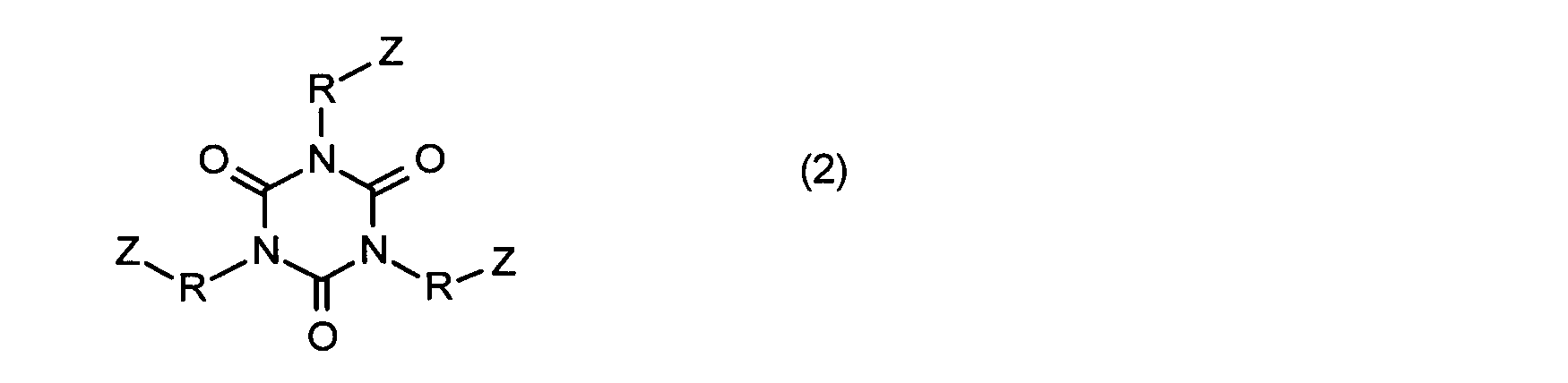
- component (C) used in the present invention is poly [(meth) acryloyloxyalkyl] isocyanurate represented by the formula (2).
- Component (C) is a component that exhibits good polymerization activity upon irradiation with active energy rays, and can improve the adhesion of the cured film after the warm water resistance test without impairing high abrasion resistance.
- component (C) examples include bis (2-acryloyloxyethyl) hydroxyethyl isocyanurate, tris (2-acryloyloxyethyl) isocyanurate, bis (2-acryloyloxypropyl) hydroxyethyl isocyanurate, tris (2 -Acryloyloxypropyl) isocyanurate and the like. These may use 1 type and may use 2 or more types together. Among these, as the component (C), bis (2-acryloyloxyethyl) hydroxyethyl isocyanurate and tris (2-acryloyloxyethyl) isocyanurate are preferable from the viewpoint of good polymerization activity and high abrasion resistance. .
- the content of the component (C) in the active energy ray-curable resin composition is 20 to 80% by mass, preferably 30 to 60% by mass, out of a total of 100% by mass of the components (A) to (C). More preferred is 35 to 50% by mass. If content of (C) component is less than 20 mass%, the cured film which has sufficient adhesiveness cannot be obtained. Moreover, when content of (C) component exceeds 80 mass%, scratch resistance will fall.
- the composition which concerns on this invention contains (D) component from a weather-resistant viewpoint.
- the ultraviolet absorber which is (D) component is not specifically limited. However, from the viewpoint of high solubility in the composition according to the present invention and good weather resistance, the component (D) includes benzophenones, benzotriazoles, triazines, phenyl salicylates, phenyl benzoates. An ultraviolet absorber having a maximum absorption wavelength in the range of 240 to 380 nm is preferable. From the viewpoint that it can be contained in a large amount in the composition according to the present invention, the component (D) is more preferably a benzophenone-based ultraviolet absorber. Further, from the viewpoint of preventing yellowing of a substrate such as polycarbonate, a benzotriazole-based and triazine-based ultraviolet absorber is more preferable as the component (D).
- component (D) examples include 2-hydroxybenzophenone, 5-chloro-2-hydroxybenzophenone, 2,4-dihydroxybenzophenone, 2-hydroxy-4-methoxybenzophenone, 2-hydroxy-4-octyloxybenzophenone, Benzophenones such as 4-dodecyloxy-2-hydroxybenzophenone, 2-hydroxy-4-octadecyloxybenzophenone, 2,2'-dihydroxy-4-methoxybenzophenone, 2,2'-dihydroxy-4, 4'-dimethoxybenzophenone 2- (2-hydroxy-5′-methylphenyl) benzotriazole, 2- (2-hydroxy-5-tert-butylphenyl) -5-chlorobenzotriazole, 2- (2-hydroxy-3,5-di -Tert-Butylpheny ) Benzotriazoles such as benzotriazole, 2- (2-hydroxy-5-tert-butylphenyl) benzotriazole, 2- (2-hydroxy-4-hydroxy
- benzotriazoles and triazines are preferable, and 2- (2-hydroxy-5-tert-butylphenyl) benzotriazole, 2- [4-[(2-hydroxy-3- Dodecyloxypropyl) oxy] -2-hydroxyphenyl] -4,6-bis (2,4-dimethylphenyl) -1,3,5-triazine is soluble and weatherable in the composition according to the present invention. From the viewpoint of
- the content of the component (D) in the active energy ray-curable resin composition is preferably 1 to 30 parts by mass with respect to 100 parts by mass in total of the components (A) to (C). More preferred is 5 parts by mass, and still more preferred is 5 to 15 parts by mass.
- As the content of the component (D) increases sufficient weather resistance of the cured film and sufficient protection of the base material from ultraviolet rays (yellowing resistance) can be obtained. Moreover, the hardness, adhesiveness, and heat resistance of a cured film improve, so that there is little content of (D) component.
- the composition according to the present invention preferably contains a component (E) from the viewpoint of weather resistance.
- the hindered amine light stabilizer which is (E) component is not specifically limited.
- Specific examples of the component (E) include 1,2,3,4-butanetetracarboxylic acid, 1,2,2,6,6-pentamethyl-4-piperidinol and ⁇ , ⁇ , ⁇ , ⁇ -tetramethyl- 3,9- (2,4,8,10-tetraoxaspiro [5,5]) undecane) condensate with diethanol, 1,2,3,4-butanetetracarboxylic acid and 2,2,6,6 A condensate of pentamethyl-4-piperidinol with ⁇ , ⁇ , ⁇ , ⁇ -tetramethyl-3,9- (2,4,8,10-tetraoxaspiro [5,5]) undecane) diethanol, Condensate of 1-dimethylethyl hydroperoxide and octane,
- numerator can also be used as (E) component.
- examples of the hindered amine light stabilizer include ⁇ 2,4-bis [N-butyl-N- (1-cyclohexyloxy-2,2,6,6-tetramethylpiperidin-4-yl) amino] -6.
- the reactant can be produced, for example, by the method described in JP-A-2008-56906. These may use 1 type and may use 2 or more types together.
- bis (1,2,2,6,6-pentamethyl-4-piperidyl) sebacate is preferable as the component (E) from the viewpoint of maintaining weather resistance over a long period of time.
- the content of the component (E) in the active energy ray-curable resin composition is preferably 0.1 to 5 parts by mass with respect to 100 parts by mass in total of the components (A) to (C). More preferably, it is 2 to 3 parts by mass, and still more preferably 0.3 to 2 parts by mass.
- the content of the component (E) is 0.1 part by mass or more, sufficient weather resistance (crack resistance) and durability of the cured film can be obtained.
- the hardness and heat resistance of a cured film improve because content of (E) component is 5 mass parts or less.
- composition according to the present invention may further contain a photopolymerization initiator (F) (hereinafter also referred to as component (F)) from the viewpoint that a cured film can be efficiently obtained by ultraviolet irradiation.
- F photopolymerization initiator
- component (F) include diethoxyacetophenone, 2-hydroxy-2-methyl-1-phenylpropan-1-one, benzyldimethyl ketal, 4- (2-hydroxyethoxy) phenyl- (2-hydroxy- 2-propyl) ketone, 1-hydroxycyclohexyl phenyl ketone, 2-methyl-2-morpholino (4-thiomethylphenyl) propan-1-one, 2-methyl-1- [4- (methylthio) phenyl] -2- Morpholinopropan-1-one, 2-benzyl-2-dimethylamino-1- (4-morpholinophenyl) butanone, 2-hydroxy-2-methyl-1- [4- (1-methylvinyl) phenyl] propanone Acetophenones such as oligomers, benzoin, benzoin methyl ether, benzoin ethyl ether Benzoins such as benzoin isopropyl ether and benzoin iso
- acetophenones, benzophenones, and acylphosphine oxides are preferable, Benzophenone, 2-hydroxy-2-methyl-1-phenylpropan-1-one, 1-hydroxycyclohexyl phenyl ketone, 2,4,6-trimethylbenzoyl-diphenylphosphine oxide, bis (2,4,6-trimethylbenzoyl) -Phenylphosphine oxide, 2-methyl-1- [4- (methylthio) phenyl] -2-morpholinopropan-1-one is more preferred.
- the content of the component (F) in the active energy ray-curable resin composition is preferably 0.1 to 10 parts by mass with respect to 100 parts by mass in total of the components (A) to (C). More preferably, it is 5 to 10 parts by mass, and still more preferably 1 to 5 parts by mass. As the content of the component (F) is increased, the curability is improved. Moreover, coloring of a cured film is suppressed, so that there is little content of (F) component, and the hardness and weather resistance of a cured film improve.
- the composition according to the present invention includes an inorganic filler, an organic solvent, an antioxidant, a polymerization inhibitor, a yellowing inhibitor, an infrared absorber, a bluing agent, a pigment, a leveling agent, an antifoaming agent, an increase, if necessary.
- You may contain various additives, such as a sticking agent, an anti-settling agent, an antistatic agent, and an antifogging agent.
- the composition according to the present invention may contain an inorganic filler as necessary from the viewpoint of improving surface hardness, heat resistance and conductivity.
- an inorganic filler from the viewpoint of shape stability, heat resistance, flame retardancy, insulation, etc. of the cured film, a metal oxide such as silica, alumina, titanium oxide or a composite oxide thereof, the metal oxide or A surface-treated metal oxide or surface-treated composite oxide obtained by coating the composite oxide with a silane coupling agent or the like, or a hydroxide such as aluminum hydroxide, magnesium hydroxide, or potassium hydroxide is preferable.
- the inorganic filler from the viewpoint of improving conductivity, metal particles such as gold, silver, copper, nickel and alloys thereof, conductive particles such as carbon, carbon nanotube, carbon nanohorn, fullerene, and glass, ceramic, Particles in which the surface of the core such as plastic or metal oxide is coated with metal, ITO (indium tin oxide) or the like are preferable. These may use 1 type and may use 2 or more types together.
- the conductive particles preferably have an aspect ratio of 5 or more from the viewpoint of conductivity. The aspect ratio is a value obtained from (major axis) / (minor axis).
- the particle diameter of the inorganic filler is optically preferably 1 ⁇ m or less in terms of area average particle diameter.
- the blending amount of the inorganic filler in the active energy ray-curable resin composition can be appropriately adjusted according to the use of the composition according to the present invention, required mechanical strength, fluidity, and the like.
- a known method can be used as a blending method of the inorganic filler.
- the composition according to the present invention can contain a diluting solvent as necessary from the viewpoint of adjusting the viscosity to a viscosity corresponding to the coating method.
- the dilution solvent include alcohol solvents such as methyl alcohol, ethyl alcohol, isopropyl alcohol, n-butyl alcohol, isobutyl alcohol, sec-butyl alcohol, cyclohexyl alcohol, diacetone alcohol; methyl cellosolve, cellosolve, butyl cellosolve, methyl Ether solvents such as carbitol, carbitol, butyl carbitol, diethyl carbitol, propylene glycol monomethyl ether; “Swazole 1000” (trade name, manufactured by Maruzen Petrochemical Co., Ltd.), “Supersol 100” (trade name, New Nippon Petrochemical Co., Ltd.), "Supersol 150” (trade name, manufactured by Nippon Petrochemical Co., Ltd.), aromatic solvents such as benzene, tol
- the dilution solvent is preferably selected appropriately depending on the type of substrate.
- an alcohol solvent such as isobutanol or an ester solvent such as n-butyl acetate alone or in combination of two or more as the diluent solvent.
- content of the dilution solvent in the composition which concerns on this invention content of the hardened
- Ford Cup No. it is preferable to add a diluent solvent to the composition according to the present invention so that the viscosity is 15 to 30 seconds at 20 ° C. using a four viscometer.
- the composition according to the present invention can be used to modify the surface of a resin molded product for an automotive headlamp lens, which is a base material. After apply
- the amount of the composition according to the present invention applied to the substrate is preferably such that the cured film has a thickness of 1 to 50 ⁇ m, more preferably 3 to 40 ⁇ m.
- Examples of the method for applying the composition according to the present invention to the substrate include a bar coater coating method, a Mayer bar coating method, an air knife coating method, a gravure coating method, a reverse gravure coating method, a micro gravure coating method, a brush coating method, and a spray coating.
- Method shower flow coating method, dip coating method, curtain coating method, offset printing method, flexographic printing method, screen printing method, potting and the like.
- the active energy ray is preferably ultraviolet rays, and more preferably ultraviolet rays having a wavelength of 340 nm to 380 nm.
- the ultraviolet light source a high-pressure mercury lamp, a metal halide lamp, or the like can be used.
- the irradiation amount of ultraviolet rays can be, for example, an irradiation amount of 1000 to 5000 mJ / cm 2 with ultraviolet rays having a wavelength of 340 nm to 380 nm.
- the active energy ray may be irradiated in air, or in an inert gas such as nitrogen or argon.
- heat treatment may be performed before irradiating with active energy rays.
- the heat treatment can be performed by irradiation with a near infrared lamp, circulation of hot air, or the like.
- the surface temperature of the base material in the furnace (hereinafter referred to as the heating temperature) is 40 to 90 ° C.
- the heating time is 60 to 180 seconds from the viewpoint of maintaining adhesion over a long period of time outdoors. Is preferred. More preferably, the heating temperature is 50 to 70 ° C., and the heating time is 90 to 120 seconds. When the heating temperature is 40 ° C.
- the organic solvent and the like inside the coating film can be sufficiently removed, and the hardness, water resistance and weather resistance are improved.
- the heating temperature is 90 ° C. or lower, the appearance is improved and the weather resistance is improved.
- the heating time is 60 seconds or longer, the organic solvent and the like inside the coating film can be sufficiently removed, and the hardness, water resistance and weather resistance are improved.
- the heating time is 180 seconds or less, the appearance is improved and the weather resistance is improved.
- Examples of resin molded products for automobile headlamp lenses, which are base materials, include molded products containing synthetic resins such as various thermoplastic resins and thermosetting resins that are desired to be improved in abrasion resistance and weather resistance. It is done.
- Specific examples of the synthetic resin include polymethyl methacrylic resin, polycarbonate resin, polyester resin, polystyrene resin, ABS (acrylonitrile-butadiene-styrene) resin, AS resin, polyamide resin, polyarylate resin, polymethacrylimide resin, Examples include polyallyl diglycol carbonate resin.
- the synthetic resin it is highly desired to improve transparency and wear resistance, and from the viewpoint that application of the composition according to the present invention is particularly effective, polymethylmethacrylic resin, polycarbonate resin, polystyrene resin.
- Polymethacrylamide resin is preferable, and polycarbonate resin is more preferable. These may use 1 type and may use 2 or more types together.
- the resin molded product for automobile headlamp lenses which is a base material, may be a sheet-shaped molded product, a film-shaped molded product, or various injection molded products containing these synthetic resins.
- the automobile headlamp lens according to the present invention has a cured film of the active energy ray-curable resin composition according to the present invention on a resin molded product as a base material.
- the thickness of the cured film is preferably 1 to 50 ⁇ m, more preferably 3 to 40 ⁇ m. Since the cured film is excellent in hardness and weather resistance, the resin molded product is preferably a polycarbonate resin molded product.
- Part means “part by mass”.
- Synthesis Example 4 Synthesis of Urethane Acrylate Mixture UA-4 (Component (B)) (b3) Polycarbonate diol having a number average molecular weight of 1002 (converted to hydroxyl value) as a raw material (trade name: Kuraray Polyol C-1090, Kuraray Co., Ltd.) A urethane acrylate mixture UA-4 was obtained in the same manner as in Synthesis Example 1 except that 1461 g (1.5 mol) was used.
- urethane acrylate UA-6 (other components) (b2) No raw material was used, and (b3) 2210 g of polytetramethylene glycol having a number average molecular weight of 877 (in terms of hydroxyl value) as a raw material (2.5 Mol) was used in the same manner as in Synthesis Example 1 to obtain urethane acrylate UA-6.
- UA-6 does not include urethane (meth) acrylates having two or more (meth) acryloyloxy groups, one or more amide groups, and two or more urethane bonds.
- urethane acrylate UA-7 (other components) (b2) No raw material was used, and (b3) polycarbonate diol having a number average molecular weight of 1002 (in terms of hydroxyl value) as a raw material (2435 g, 2.5 mol)
- a urethane acrylate UA-7 was obtained in the same manner as in Synthesis Example 1 except that was used.
- UA-7 does not include urethane (meth) acrylates having two or more (meth) acryloyloxy groups, one or more amide groups, and two or more urethane bonds.
- urethane acrylate UA-8 (other components) (b2) No raw material was used, except that (b3) 2500 g (2.5 mol) of polycaprolactone diol having a number average molecular weight of 1002 was used as the raw material.
- Gave urethane acrylate UA-8 in the same manner as in Synthesis Example 1.
- UA-8 does not include urethane (meth) acrylates having two or more (meth) acryloyloxy groups, one or more amide groups, and two or more urethane bonds.
- Table 1 shows the charged amounts (moles) of the respective raw materials in Synthesis Examples 1 to 8 described above.
- H-MDI Dicyclohexylmethane-4,4-diisocyanate (trade name: Desmodur W, manufactured by Sumika Bayer Urethane Co., Ltd.)
- PTG850SN polytetramethylene glycol having a number average molecular weight of 877 (converted to hydroxyl value)
- C1090 polycarbonate diol having a number average molecular weight of 1002 (in terms of hydroxyl value) (trade name: Kuraray polyol C-1090, manufactured by Kuraray Co., Ltd.)
- PL210 polycaprolactone diol having a number average molecular weight of 1002 (in terms of hydroxyl value) (trade name: Plaxel 210, manufactured by Daicel Corporation)
- HOA 2-hydroxyethyl acrylate.
- Example 1 Active energy ray-curable resin compositions were prepared at the compounding ratios shown in Table 2.
- the composition was spray-coated on a polycarbonate resin plate (trade name: Panlite L-1225Z, manufactured by Teijin Chemicals Ltd.) having a thickness of 3 mm so that the thickness of the cured film was 8 ⁇ m.
- the resin plate was heat-treated at 60 ° C. for 2 minutes in an IR heater furnace to volatilize the diluted solvent in the composition.
- the coating film of the composition was subjected to a high-pressure mercury lamp in the air with a wavelength of 340 to 380 nm, a peak illuminance of 140 mW / cm 2 , an integrated light amount of 3000 mJ / cm 2 (ultraviolet light meter (trade name: UV-351 ( SN type), measured values (made by Oak Manufacturing Co., Ltd.)) were irradiated to form a cured film.
- Table 2 shows the evaluation results of the obtained laminate. In addition, each evaluation was performed with the following method.
- Pencil Hardness Based on JIS K5600, the pencil hardness was evaluated by scratching at a 45 degree angle using a Mitsubishi pencil uni and not scratching.
- Adhesiveness In accordance with JIS K5600, eleven vertical and horizontal cuts were made at 1 mm intervals on the cured film surface to make 100 grids. Adhesiveness was evaluated based on the following criteria based on the presence or absence of peeling when cellophane tape (Cellotape (registered trademark), manufactured by Nichiban Co., Ltd.) was brought into close contact with the surface, and peeled off at once. ⁇ : There is no peeling. X: Peeling occurs.
- Appearance Appearance was evaluated based on the following criteria. ⁇ : Neither crack, whitening nor peeling of the cured film occurs. X: At least one of crack, whitening, and peeling of the cured film occurs.
- Yellow index (YI) value 100 ⁇ (1.28 ⁇ X ⁇ 1.06 ⁇ Z) / Y ⁇ : Increased yellow index (YI) value is 0 or more and less than 1.00. ⁇ : Increased yellow index (YI) value is 1.00 or more and less than 2.00. X: Increase yellow index (YI) value is 2.00 or more.
- Curability Active energy ray-curable resin compositions were prepared at the blending ratio shown in Table 2.
- the composition was spray-coated on a polycarbonate resin plate (trade name: Panlite L-1225Z, manufactured by Teijin Chemicals Ltd.) having a thickness of 3 mm so that the thickness of the cured film was 4 ⁇ m.
- the resin plate was heat-treated at 60 ° C. for 2 minutes in an IR heater furnace to volatilize the diluted solvent in the composition.
- the coating film of the composition was subjected to a wavelength of 340 to 380 nm, a peak illuminance of 50 mW / cm 2 , an integrated light amount of 150 mJ / cm 2 (ultraviolet light meter (trade name: UV -351 (SN type), measured by Oak Seisakusho Co., Ltd.).
- the curability was evaluated based on the following criteria.
- (A) Tack-free property The tack-free property was evaluated based on the number of times the resin composition was irradiated with energy with the finger touched with the above-mentioned conditions and irradiated until the resin composition did not adhere to the finger (tack-free).
- Examples 2 to 12 Comparative Examples 1 to 10> Active energy ray-curable resin compositions were prepared at the compounding ratios shown in Table 2 and Table 3, and a cured film was formed in the same manner as in Example 1 to obtain a laminate. The evaluation results of the obtained laminate are shown in Table 2 and Table 3.
- DPHA dipentaerythritol hexaacrylate
- DPCA-20 dipentaerythritol hexaacrylate modified with one ⁇ -caprolactone (trade name: Kayrad DPCA-20, manufactured by Nippon Kayaku Co., Ltd.)
- TAIC Tris (2-acryloyloxyethyl) isocyanurate
- HBPB 2- (2-hydroxy-5-tert-butylphenyl) benzotriazole (trade name: Tinuvin PS, manufactured by BASF)
- HHBT 2- [4- (2-hydroxy-3-dodecyloxy-propyl) oxy-2-hydroxyphenyl] -4,6- [bis (2,4-dimethylphenyl) -1,3,5-triazine ]
- BPMS bis (1,2,2,6,6-pentamethyl-4-pipe
- a cured film having excellent scratch resistance and excellent weather resistance by applying the active energy ray-curable resin composition according to the present invention to the surface of a resin molded product for an automobile headlamp lens and irradiating the active energy rays. It is possible to obtain an automobile headlamp lens having The cured film protects the lens from ultraviolet rays and scratches over a long period of time, and can maintain a good appearance.
Landscapes
- Chemical & Material Sciences (AREA)
- Organic Chemistry (AREA)
- Chemical Kinetics & Catalysis (AREA)
- Health & Medical Sciences (AREA)
- Medicinal Chemistry (AREA)
- Polymers & Plastics (AREA)
- Engineering & Computer Science (AREA)
- Life Sciences & Earth Sciences (AREA)
- Materials Engineering (AREA)
- Wood Science & Technology (AREA)
- General Chemical & Material Sciences (AREA)
- General Engineering & Computer Science (AREA)
- Macromonomer-Based Addition Polymer (AREA)
- Paints Or Removers (AREA)
Abstract
Description
下記式(1)で示されるモノ又はポリペンタエリスリトールポリ(メタ)アクリレート(A)、

2個以上の(メタ)アクリロイルオキシ基、1個以上のアミド基(ただし、アミド基にはウレタン結合中の-NH-CO-構造は含まない)、および2個以上のウレタン結合を有するウレタン(メタ)アクリレートを含むウレタン(メタ)アクリレート混合物(B)、並びに
下記式(2)で示されるポリ[(メタ)アクリロイルオキシアルキル]イソシアヌレート(C)、
を含み、
前記(A)、(B)及び(C)の合計100質量%に対して、前記(A)が10~70質量%、前記(B)が10~50質量%及び前記(C)が20~80質量%である活性エネルギー線硬化性樹脂組成物。
(b1)ジイソシアネート
(b2)1個以上のアミド基(ただし、アミド基にはウレタン結合中の-NH-CO-構造は含まない)、および2個以上のヒドロキシ基を有する化合物
(b3)(b2)原料以外のポリエーテルジオール、ポリカーボネートジオール、およびポリエステルジオールから選ばれる少なくとも1種のジオール
(b4)1個以上の(メタ)アクリロイルオキシ基、および1個のヒドロキシ基を有する(メタ)アクリル酸エステル。
本発明で用いる(A)成分は、前記式(1)で示されるモノ又はポリペンタエリスリトールポリ(メタ)アクリレートである。(A)成分は、活性エネルギー線の照射により良好な重合活性を示し、高い架橋密度を有する耐擦傷性に優れたポリマーを形成する。したがって、(A)成分は耐擦傷性に優れた硬化膜を形成することができる成分である。
本発明で用いる(B)成分は、2個以上の(メタ)アクリロイルオキシ基、1個以上のアミド基(ただし、アミド基にはウレタン結合中の-NH-CO-構造は含まない)、および2個以上のウレタン結合を有するウレタン(メタ)アクリレートを含むウレタン(メタ)アクリレート混合物である。本明細書において、ウレタン(メタ)アクリレート混合物とは、2個以上の(メタ)アクリロイルオキシ基、1個以上のアミド基(ただし、アミド基にはウレタン結合中の-NH-CO-構造は含まない)、および2個以上のウレタン結合を有する1種類のウレタン(メタ)アクリレートだけからなる場合も便宜上「混合物」という。(B)成分は、硬化膜の強靭性、可撓性、耐熱性及び耐候性を向上させる成分である。該(メタ)アクリロイルオキシ基はラジカル重合性である。(B)成分は、(b1)~(b4)原料を反応させて得られる混合物であることが、硬化膜の硬度と耐候性のバランスの観点から好ましい。
(b1)原料は、ジイソシアネートである。(b1)原料は、硬化膜に可撓性を付与する成分である。
(b2)原料は、1個以上のアミド基、および2個以上のヒドロキシ基を有する化合物である。該ヒドロキシ基はイソシアネートと反応性を有する。(b2)原料は、硬化膜の柔軟性を維持したまま硬度を向上させる作用を有する成分である。
(b3)原料は、(b2)原料以外のポリエーテルジオール、ポリカーボネートジオールおよびポリエステルジオールから選ばれる少なくとも1種のジオール化合物である。(b3)原料は、硬化膜の柔軟性と伸度を向上させる作用を有する成分である。(b3)原料は、耐候性の観点から、(b2)原料以外のポリエーテルジオールであることが好ましい。
(b4)原料は、1個以上の(メタ)アクリロイルオキシ基、および1個のヒドロキシ基を有するヒドロキシ基含有(メタ)アクリル酸エステルである。該ヒドロキシ基はイソシアネートと反応性を有する。(b4)原料は、合成されたポリウレタン前駆体の末端に付加することで、ラジカル反応性を付与する成分である。
本発明で用いる(C)成分は、前記式(2)で示されるポリ[(メタ)アクリロイルオキシアルキル]イソシアヌレートである。(C)成分は、活性エネルギー線の照射により良好な重合活性を示し、また高い耐磨耗性を損なうことなく硬化膜の耐温水性試験後の密着性を向上させることができる成分である。
本発明に係る組成物は、耐候性の観点から(D)成分を含むことが好ましい。(D)成分である紫外線吸収剤は特に限定されない。しかしながら、本発明に係る組成物に対して溶解性が高く、耐候性が良好である観点から、(D)成分としては、ベンゾフェノン類、ベンゾトリアゾール類、トリアジン類、サリチル酸フェニル類、安息香酸フェニル類であって、最大吸収波長が240~380nmの範囲である紫外線吸収剤が好ましい。本発明に係る組成物に多量に含有させることができる観点から、(D)成分としてはベンゾフェノン系の紫外線吸収剤がより好ましい。また、ポリカーボネート等の基材の黄変を防ぐことができる観点から、(D)成分としてはベンゾトリアゾール系およびトリアジン系の紫外線吸収剤がより好ましい。
本発明に係る組成物は、耐候性の観点から(E)成分を含むことが好ましい。(E)成分であるヒンダードアミン系光安定剤は特に限定されない。(E)成分の具体例としては、1,2,3,4-ブタンテトラカルボン酸と1,2,2,6,6-ペンタメチル-4-ピペリジノールとβ,β,β,β-テトラメチル-3,9-(2,4,8,10-テトラオキサスピロ[5,5])ウンデカン)ジエタノールとの縮合物、1,2,3,4-ブタンテトラカルボン酸と2,2,6,6-ペンタメチル-4-ピペリジノールとβ,β,β,β-テトラメチル-3,9-(2,4,8,10-テトラオキサスピロ[5,5])ウンデカン)ジエタノールとの縮合物、1,1-ジメチルエチルヒドロペルオキシドとオクタンとの縮合物、2,4-ビス[N-ブチル-N-(1-シクロヘキシロキシ-2,2,6,6-テトラメチルピペリジン-4-イル)アミノ]-6-(2-ヒドロキシエチルアミン)-1,3,5-トリアジン、ビス(1,2,2,6,6-ペンタメチル-4-ピペリジル)セバケート等が挙げられる。また、(E)成分として、分子内に(メタ)アクリロイル基を有するヒンダードアミン系光安定剤も使用できる。該ヒンダードアミン系光安定剤としては、例えば、{2,4-ビス[N-ブチル-N-(1-シクロヘキシルオキシ-2,2,6,6-テトラメチルピペリジン-4-イル)アミノ]-6-(2-ヒドロキシエチルアミン)-1,3,5-トリアジンと2-アクリロイルオキシエチルイソシアネートとの反応物が挙げられる。該反応物は、例えば特開2008-56906号公報に記載の方法により製造することができる。これらは一種を用いてもよく、二種以上を併用してもよい。
(F)成分の具体例としては、ジエトキシアセトフェノン、2-ヒドロキシ-2-メチル-1-フェニルプロパン-1-オン、ベンジルジメチルケタール、4-(2-ヒドロキシエトキシ)フェニル-(2-ヒドロキシ-2-プロピル)ケトン、1-ヒドロキシシクロヘキシルフェニルケトン、2-メチル-2-モルホリノ(4-チオメチルフェニル)プロパン-1-オン、2-メチル-1-[4-(メチルチオ)フェニル]-2-モルフォリノプロパン-1-オン、2-ベンジル-2-ジメチルアミノ-1-(4-モルホリノフェニル)ブタノン、2-ヒドロキシ-2-メチル-1-[4-(1-メチルビニル)フェニル]プロパノンオリゴマー等のアセトフェノン類、ベンゾイン、ベンゾインメチルエーテル、ベンゾインエチルエーテル、ベンゾインイソプロピルエーテル、ベンゾインイソブチルエーテル等のベンゾイン類、ベンゾフェノン、o-ベンゾイル安息香酸メチル、4-フェニルベンゾフェノン、4-ベンゾイル-4’-メチル-ジフェニルサルファイド、3,3’,4,4’-テトラ(tert-ブチルパーオキシカルボニル)ベンゾフェノン、2,4,6-トリメチルベンゾフェノン、4-ベンゾイル-N,N-ジメチル-N-[2-(1-オキソ-2-プロペニルオキシ)エチル]ベンゼンメタナミニウムブロミド、(4-ベンゾイルベンジル)トリメチルアンモニウムクロリド等のベンゾフェノン類、2-イソプロピルチオキサントン、4-イソプロピルチオキサントン、2,4-ジエチルチオキサントン、2,4-ジクロロチオキサントン、1-クロロ-4-プロポキシチオキサントン、2-(3-ジメチルアミノ-2-ヒドロキシ)-3,4-ジメチル-9H-チオキサントン-9-オンメソクロリド等のチオキサントン類、2,4,6-トリメチルベンゾイル-ジフェニルホスフィンオキサイド、ビス(2,6-ジメトキシベンゾイル)-2,4,4-トリメチル-ペンチルホスフィンオキサイド、ビス(2,4,6-トリメチルベンゾイル)-フェニルホスフィンオキサイド等のアシルホスフィンオキサイド類等が挙げられる。これらは一種を用いてもよく、二種以上を併用してもよい。
滴下ろうと、還流冷却器、攪拌羽及び温度センサーを装備したフラスコ中に、(b1)原料としてジシクロヘキシルメタン-4,4-ジイソシアネート(商品名:デスモジュールW、住化バイエルウレタン(株)製)1310g(5モル)をジラウリン酸ジn-ブチル錫0.5gと共に仕込み、ウォーターバスでフラスコの内温が70℃になるように加温した。次いで、フラスコの内温を70℃に保ち、混合物を撹拌しながら、(b2)原料として4-ヒドロキシ-N-(2-ヒドロキシエチル)-N-メチルブタンアミド161g(1モル)、及び(b3)原料として数平均分子量877(水酸基価換算)のポリテトラメチレングリコール(商品名:PTG850SN、保土谷化学工業(株)製)1326g(1.5モル)を、40℃に保温した状態で側管付きの滴下ロートを用いて3時間かけて等速滴下した。さらに、同温度で2時間撹拌して反応させた。その後、フラスコの内温を80℃に保ちながら、(b4)原料として2-ヒドロキシエチルアクリレート626g(5.4モル)とハイドロキノンモノメチルエーテル6.0gとの均一混合溶液を、滴下ロートを用いて3時間かけて等速滴下した。更に、フラスコの内温を80℃に保ちながら、4時間撹拌してウレタンアクリレート混合物UA-1を得た。
(b2)原料として4-ヒドロキシ-N-(2-ヒドロキシエチル)-N-メチルブタンアミド80g(0.5モル)、(b3)原料として数平均分子量877(水酸基価換算)のポリテトラメチレングリコール1768g(2.0モル)を用いた以外は、合成例1と同様にしてウレタンアクリレート混合物UA-2を得た。
(b2)原料として4-ヒドロキシ-N-(2-ヒドロキシエチル)-N-メチルブタンアミド40g(0.25モル)、(b3)原料として数平均分子量877(水酸基価換算)のポリテトラメチレングリコール2210g(2.25モル)を用いた以外は、合成例1と同様にしてウレタンアクリレート混合物UA-3を得た。
(b3)原料として数平均分子量1002(水酸基価換算)のポリカーボネートジオール(商品名:クラレポリオールC-1090、(株)クラレ製)1461g(1.5モル)を用いた以外は、合成例1と同様にしてウレタンアクリレート混合物UA-4を得た。
(b3)原料として数平均分子量1002(水酸基価換算)のポリカプロラクトンジオール(商品名:プラクセル210、(株)ダイセル製)1500g(1.5モル)を用いた以外は、合成例1と同様にしてウレタンアクリレート混合物UA-5を得た。
(b2)原料は使用せず、(b3)原料として数平均分子量877(水酸基価換算)のポリテトラメチレングリコール2210g(2.5モル)を用いた以外は、合成例1と同様にしてウレタンアクリレートUA-6を得た。UA-6には、2個以上の(メタ)アクリロイルオキシ基、1個以上のアミド基、および2個以上のウレタン結合を有するウレタン(メタ)アクリレートは含まれていない。
(b2)原料は使用せず、(b3)原料として数平均分子量1002(水酸基価換算)のポリカーボネートジオール2435g(2.5モル)を用いた以外は、合成例1と同様にしてウレタンアクリレートUA-7を得た。UA-7には、2個以上の(メタ)アクリロイルオキシ基、1個以上のアミド基、および2個以上のウレタン結合を有するウレタン(メタ)アクリレートは含まれていない。
(b2)原料は使用せず、(b3)原料として数平均分子量1002のポリカプロラクトンジオール2500g(2.5モル)を用いた以外は、合成例1と同様にしてウレタンアクリレートUA-8を得た。UA-8には、2個以上の(メタ)アクリロイルオキシ基、1個以上のアミド基、および2個以上のウレタン結合を有するウレタン(メタ)アクリレートは含まれていない。
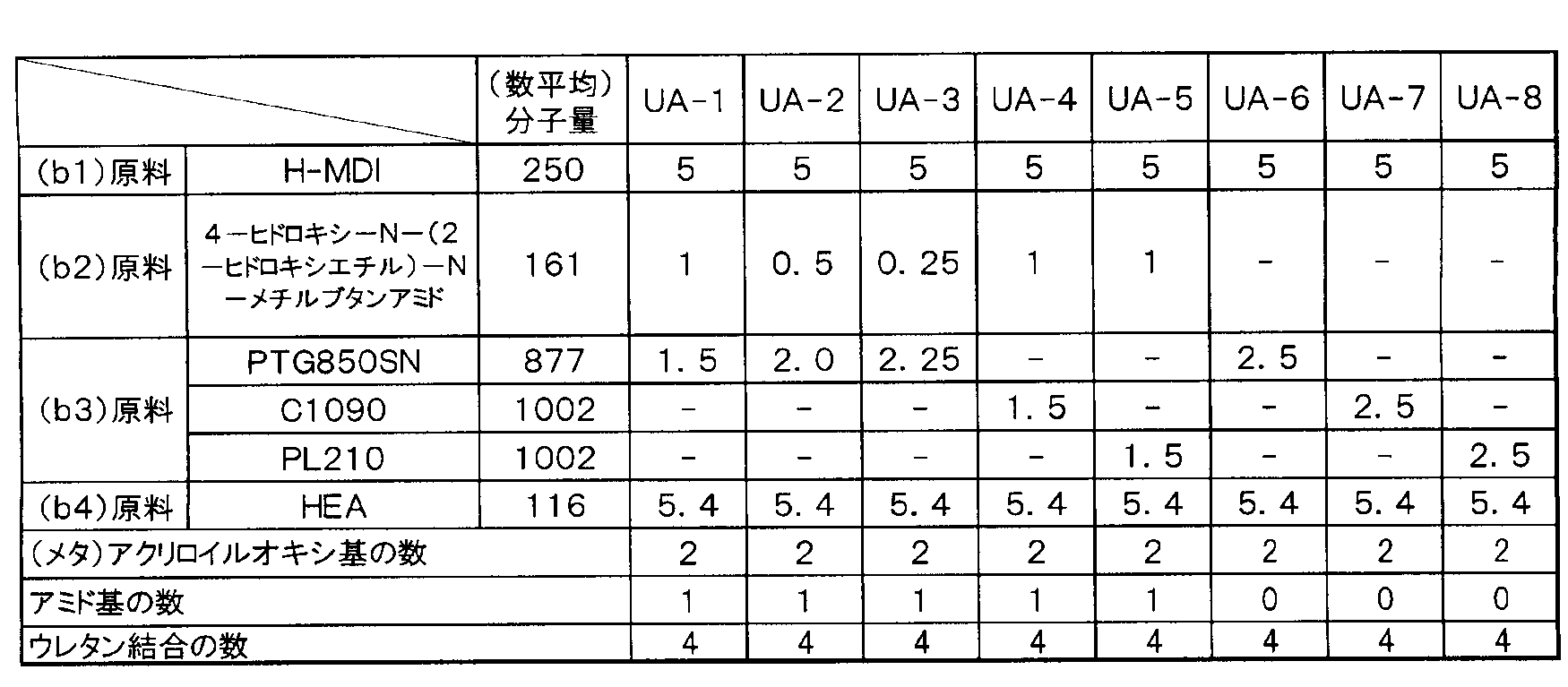
「H-MDI」:ジシクロヘキシルメタン-4,4-ジイソシアネート(商品名:デスモジュールW、住化バイエルウレタン(株)製)
「PTG850SN」:数平均分子量877(水酸基価換算)のポリテトラメチレングリコール(商品名:PTG850SN、保土谷化学工業(株)製)
「C1090」:数平均分子量1002(水酸基価換算)のポリカーボネートジオール(商品名:クラレポリオールC-1090、(株)クラレ製)
「PL210」:数平均分子量1002(水酸基価換算)のポリカプロラクトンジオール(商品名:プラクセル210、(株)ダイセル製)
「HEA」:2-ヒドロキシエチルアクリレート。
表2に示す配合比で活性エネルギー線硬化性樹脂組成物を調製した。該組成物を、厚さ3mmのポリカーボネート樹脂板(商品名:パンライトL-1225Z、帝人化成(株)製)に、硬化後の膜の厚さが8μmになるようにスプレー塗装した。該樹脂板をIRヒーター炉中で、60℃で2分間加熱処理することにより、該組成物中の希釈溶剤を揮発させた。その後、該組成物の塗布膜に対し、空気中で高圧水銀ランプを用い、波長340~380nm、ピーク照度140mW/cm2、積算光量3000mJ/cm2(紫外線光量計(商品名:UV-351(SN型)、(株)オーク製作所製)での測定値)のエネルギーを照射して、硬化膜を形成した。得られた積層体の評価結果を表2に示す。なお、各評価は以下の方法で行った。
250g/cm2の荷重をかけたスチールウール#0000を11往復させて擦傷試験を行った。ヘイズメーター(商品名:HM-65W、(株)村上色彩技術研究所製)にて、擦傷試験前後のヘイズ値を測定し、下記基準に基づいて耐擦傷性を評価した。
◎:増加ヘイズ値が0%以上、0.5%未満である
○:増加ヘイズ値が0.5%以上、1.5%未満である。
△:増加ヘイズ値が1.5%以上、2.0%未満である。
×:増加ヘイズ値が2.0%以上である。
JIS K5600に準拠し、三菱鉛筆ユニを用いて45度の角度で引っ掻き、傷のつかない最大硬度を鉛筆硬度として評価した。
JIS K5600に準拠し、硬化膜表面に1mm間隔で縦、横11本の切れ目を入れて100個の碁盤目を作った。セロハンテープ(セロテープ(登録商標)、ニチバン(株)製)をその表面に密着させた後、一気に剥がした際の剥離の有無により、下記基準に基づいて密着性を評価した。
○:剥がれがない。
×:剥がれが発生する。
80℃の温水中に2時間浸漬し、取り出し後、(3)に記載の手順で密着性試験を行い、下記基準に基づいて耐温水性を評価した。
○:剥がれがない。
×:剥がれが発生する。
サンシャインウェザーメーター耐候試験機(WEL-SUN-HC-B型、スガ試験機(株)製)を用いて、ブラックパネル温度63±3℃、降雨12分間、照射48分間のサイクルで試験した。試験時間2000時間後に、以下の評価を行った。なお、試験時間2000時間後の増加ヘイズ値及び増加イエローインデックス(YI)値は、いずれも試験前、すなわち試験時間0時間に対する増加量を意味する。
下記基準に基づいて外観を評価した。
○:クラック、白化、及び硬化膜の剥離のいずれも発生しない。
×:クラック、白化、及び硬化膜の剥離の少なくとも一つが発生する。
ヘイズメーター(商品名:HM-65W、(株)村上色彩技術研究所製)を用いて試験前後のヘイズ値を測定し、下記基準に基づいて透明度を評価した。
○:増加ヘイズ値が0%以上、1.0%未満である。
△:増加ヘイズ値が1.0%以上、2.0%未満である。
×:増加ヘイズ値が2.0%以上である。
瞬間マルチ測光システム(商品名:MCPD-3000、大塚電子(株)製)を用いて三刺激値(X、Y、Z)を測定した。下記式を用いて試験前後のイエローインデックス(YI)値を算出し、下記基準に基づいて黄変度を評価した。
○:増加イエローインデックス(YI)値が0以上、1.00未満である。
△:増加イエローインデックス(YI)値が1.00以上、2.00未満である。
×:増加イエローインデックス(YI)値が2.00以上である。
表2に示す配合比で活性エネルギー線硬化性樹脂組成物を調製した。該組成物を、厚さ3mmのポリカーボネート樹脂板(商品名:パンライトL-1225Z、帝人化成(株)製)に、硬化後の膜の厚さが4μmになるようにスプレー塗装した。該樹脂板をIRヒーター炉中で、60℃で2分間加熱処理することにより、該組成物中の希釈溶剤を揮発させた。その後、該組成物の塗布膜に対し、空気中で高圧水銀ランプを用い、波長340~380nm、1回あたりピーク照度50mW/cm2、積算光量150mJ/cm2(紫外線光量計(商品名:UV-351(SN型)、(株)オーク製作所製)での測定値)のエネルギーを照射した。下記基準に基づいて硬化性を評価した。
タックフリー性は、上述の条件でエネルギー照射をした塗膜を指で触り、指に樹脂組成物が付着しなく(タックフリーに)なるまでに照射した回数で評価した。
塗膜がタックフリーになった時の目視外観を下記判定基準に基づいて評価した。
○:透明である。
×:白化、シワ等が発生している。
表2および表3に示す配合比で活性エネルギー線硬化性樹脂組成物を調製し、実施例1と同様に硬化膜を形成して積層体を得た。得られた積層体の評価結果を表2および表3に示す。
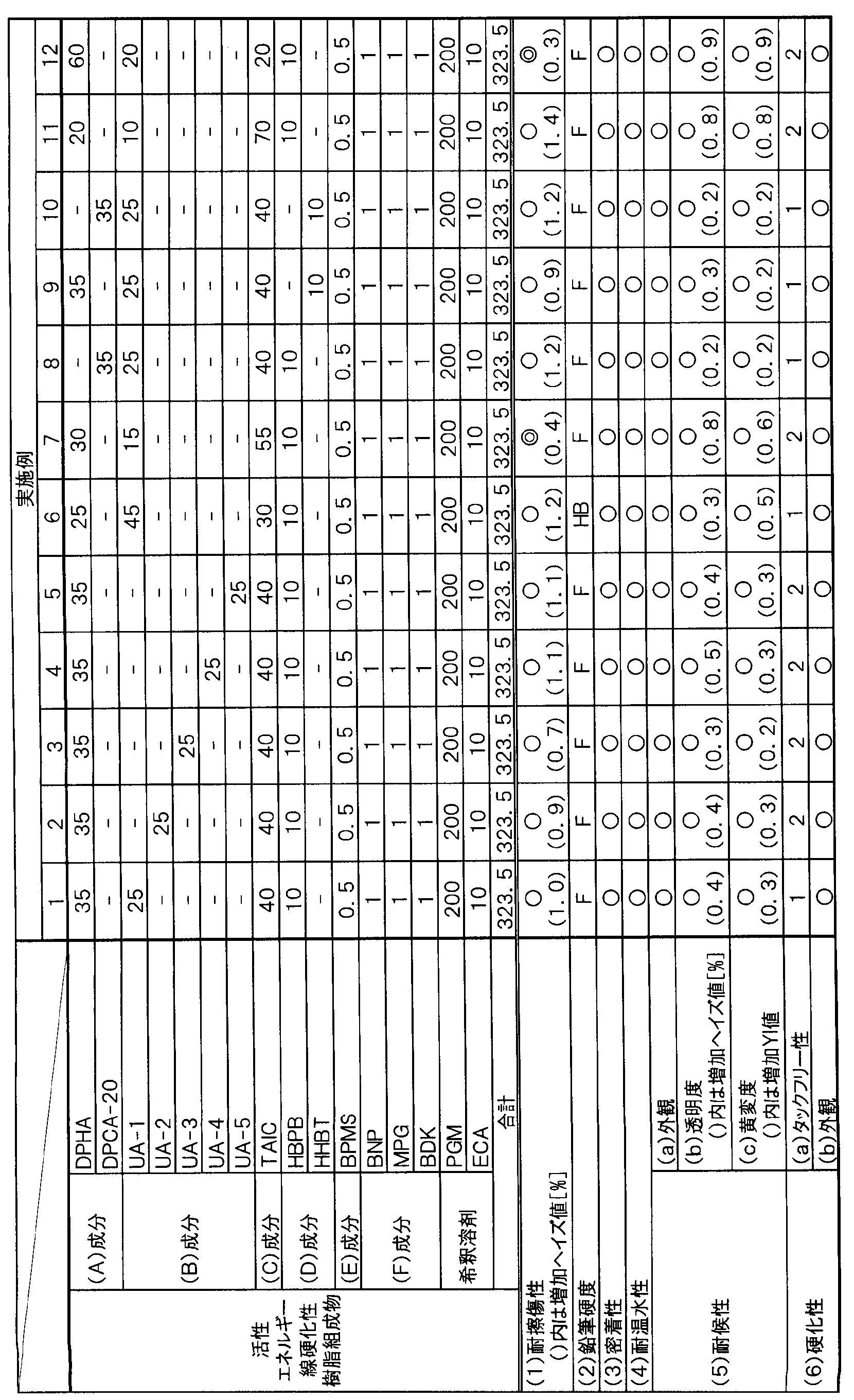

「DPHA」:ジペンタエリスリトールヘキサアクリレート
「DPCA-20」:1個のε-カプロラクトンにより変性されたジペンタエリスリトールヘキサアクリレート(商品名:カヤラッドDPCA-20、日本化薬(株)製)
「TAIC」:トリス(2-アクリロイルオキシエチル)イソシアヌレート
「HBPB」:2-(2-ヒドロキシ-5-tert-ブチルフェニル)ベンゾトリアゾール(商品名:チヌビンPS、BASF社製)
「HHBT」:2-[4-(2-ヒドロキシ-3-ドデシロキシ-プロピル)オキシ-2-ヒドロキシフェニル]-4,6-[ビス(2,4-ジメチルフェニル)-1,3,5-トリアジン](商品名:チヌビン400、BASF社製)
「BPMS」:ビス(1,2,2,6,6-ペンタメチル-4-ピペリジル)セバケート(商品名:チヌビン292、BASF社製)
「BNP」:ベンゾフェノン
「MPG」:メチルフェニルグリオキシレート
「BDK」:2,2-ジメトキシ-1,2-ジフェニルエタン-1-オン
「PGM」:プロピレングリコールモノメチルエーテル
「ECA」:ジエチレングリコールモノエチルエーテルアセテート。
Claims (10)
- 自動車ヘッドランプレンズ用樹脂成形品の表面に硬化膜を形成するために使用される活性エネルギー線硬化性樹脂組成物であって、
下記式(1)で示されるモノ又はポリペンタエリスリトールポリ(メタ)アクリレート(A)、

2個以上の(メタ)アクリロイルオキシ基、1個以上のアミド基(ただし、アミド基にはウレタン結合中の-NH-CO-構造は含まない)、および2個以上のウレタン結合を有するウレタン(メタ)アクリレートを含むウレタン(メタ)アクリレート混合物(B)、並びに
下記式(2)で示されるポリ[(メタ)アクリロイルオキシアルキル]イソシアヌレート(C)、
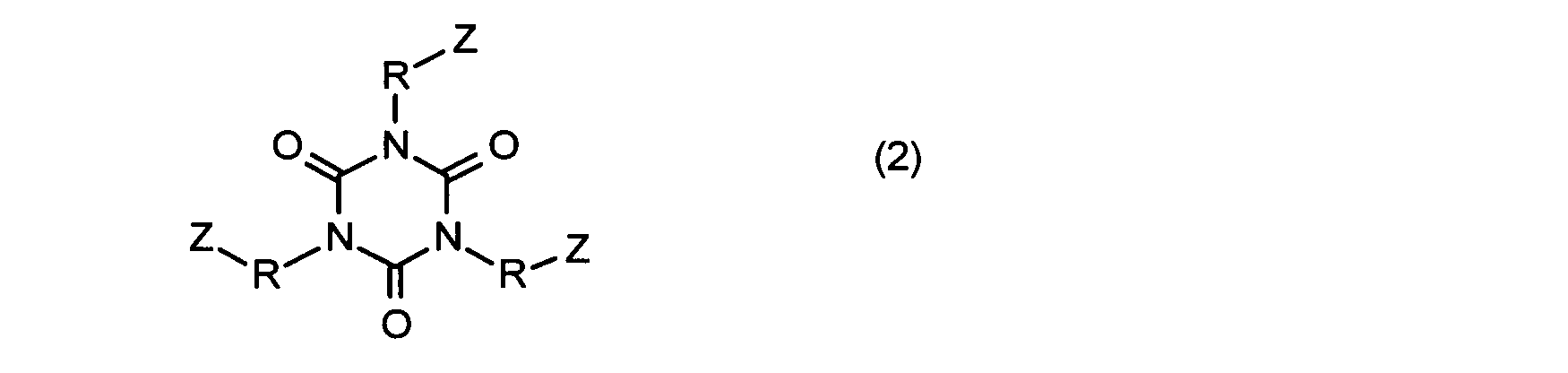
を含み、
前記(A)、(B)及び(C)の合計100質量%に対して、前記(A)が10~70質量%、前記(B)が10~50質量%及び前記(C)が20~80質量%である活性エネルギー線硬化性樹脂組成物。 - 前記ウレタン(メタ)アクリレート混合物(B)が、下記(b1)~(b4)原料を反応させて得られる混合物である請求項1に記載の活性エネルギー線硬化性樹脂組成物。
(b1)ジイソシアネート
(b2)1個以上のアミド基(ただし、アミド基にはウレタン結合中の-NH-CO-構造は含まない)、および2個以上のヒドロキシ基を有する化合物
(b3)(b2)原料以外のポリエーテルジオール、ポリカーボネートジオール、およびポリエステルジオールから選ばれる少なくとも1種のジオール
(b4)1個以上の(メタ)アクリロイルオキシ基、および1個のヒドロキシ基を有する(メタ)アクリル酸エステル - (b3)原料が(b2)原料以外のポリエーテルジオールである請求項2に記載の活性エネルギー線硬化性樹脂組成物。
- 前記(b1)~(b4)原料の比率は、モル当量で、[(b1)原料]/[(b2)原料+(b3)原料]/[(b4)原料]=10/4~6/4~6である請求項2に記載の活性エネルギー線硬化性樹脂組成物。
- 前記(b2)原料と(b3)原料の比率がモル当量で、(b2)原料/(b3)原料=1~5/5~1である請求項2に記載の活性エネルギー線硬化性樹脂組成物。
- 前記(b1)~(b4)原料の比率は、モル当量で、[(b1)原料]/[(b2)原料+(b3)原料]/[(b4)原料]=10/4~6/4~6であり、かつ前記(b2)原料と(b3)原料の比率がモル当量で、(b2)原料/(b3)原料=1~5/5~1である請求項2に記載の活性エネルギー線硬化性樹脂組成物。
- さらに、紫外線吸収剤(D)およびヒンダードアミン系光安定剤(E)の少なくとも一方を含有する請求項1に記載の活性エネルギー線硬化性樹脂組成物。
- 自動車ヘッドランプレンズ用樹脂成形品がポリカーボネート樹脂成形品である請求項1から7のいずれか1項に記載の活性エネルギー線硬化性樹脂組成物。
- 樹脂成形品上に、請求項1から7のいずれか1項に記載の活性エネルギー線硬化性樹脂組成物の硬化膜を有する自動車ヘッドランプレンズ。
- 樹脂成形品がポリカーボネート樹脂成形品である請求項9に記載の自動車ヘッドランプレンズ。
Priority Applications (4)
| Application Number | Priority Date | Filing Date | Title |
|---|---|---|---|
| CN201580012561.6A CN106103602B (zh) | 2014-03-11 | 2015-03-09 | 活性能量线固化性树脂组合物及汽车前照灯配光镜 |
| JP2015514267A JP6451627B2 (ja) | 2014-03-11 | 2015-03-09 | 活性エネルギー線硬化性樹脂組成物及び自動車ヘッドランプレンズ |
| US15/124,721 US20170015774A1 (en) | 2014-03-11 | 2015-03-09 | Active energy ray-curable resin composition and automobile headlamp lens |
| MX2016011732A MX2016011732A (es) | 2014-03-11 | 2015-03-09 | Composicion de resina curable por rayos de energia activa y lente de faro de automovil. |
Applications Claiming Priority (2)
| Application Number | Priority Date | Filing Date | Title |
|---|---|---|---|
| JP2014-047417 | 2014-03-11 | ||
| JP2014047417 | 2014-03-11 |
Publications (1)
| Publication Number | Publication Date |
|---|---|
| WO2015137279A1 true WO2015137279A1 (ja) | 2015-09-17 |
Family
ID=54071723
Family Applications (1)
| Application Number | Title | Priority Date | Filing Date |
|---|---|---|---|
| PCT/JP2015/056837 Ceased WO2015137279A1 (ja) | 2014-03-11 | 2015-03-09 | 活性エネルギー線硬化性樹脂組成物及び自動車ヘッドランプレンズ |
Country Status (6)
| Country | Link |
|---|---|
| US (1) | US20170015774A1 (ja) |
| JP (1) | JP6451627B2 (ja) |
| CN (1) | CN106103602B (ja) |
| MX (1) | MX2016011732A (ja) |
| TW (1) | TWI644963B (ja) |
| WO (1) | WO2015137279A1 (ja) |
Cited By (3)
| Publication number | Priority date | Publication date | Assignee | Title |
|---|---|---|---|---|
| WO2019043962A1 (ja) | 2017-08-30 | 2019-03-07 | 日本ペイント・オートモーティブコーティングス株式会社 | 活性エネルギー線硬化性塗料組成物 |
| EP3480229A4 (en) * | 2016-07-01 | 2019-06-12 | Mitsubishi Chemical Corporation | ACTIVE ENERGY RAY-HARDENED RESIN COMPOSITION, RESIN FORMULA AND METHOD FOR PRODUCING THE RESIN FORMULA |
| CN112004850A (zh) * | 2018-04-27 | 2020-11-27 | 三菱化学株式会社 | 固化性组合物、固化物、层叠体 |
Families Citing this family (1)
| Publication number | Priority date | Publication date | Assignee | Title |
|---|---|---|---|---|
| WO2020240993A1 (ja) * | 2019-05-30 | 2020-12-03 | 昭和電工株式会社 | 樹脂組成物および樹脂膜 |
Citations (4)
| Publication number | Priority date | Publication date | Assignee | Title |
|---|---|---|---|---|
| JP2007070578A (ja) * | 2005-09-09 | 2007-03-22 | Mitsubishi Rayon Co Ltd | 活性エネルギー線硬化型塗料組成物 |
| JP2007314770A (ja) * | 2006-04-27 | 2007-12-06 | Mitsubishi Rayon Co Ltd | 活性エネルギー線硬化型塗料組成物および該組成物の硬化被膜を有する成形品 |
| JP2010111810A (ja) * | 2008-11-07 | 2010-05-20 | Mitsubishi Rayon Co Ltd | 活性エネルギー線硬化型組成物及び該組成物の硬化被膜を有する成形品 |
| JP2012229331A (ja) * | 2011-04-26 | 2012-11-22 | Mitsubishi Rayon Co Ltd | 活性エネルギー線硬化型組成物及び硬化被膜を有する成形品 |
Family Cites Families (9)
| Publication number | Priority date | Publication date | Assignee | Title |
|---|---|---|---|---|
| US4187366A (en) * | 1978-03-28 | 1980-02-05 | Ppg Industries, Inc. | Amide-modified urethane acrylate radiation curable compounds derived from condensation reaction products of carboxyl and isocyanato groups |
| US4153776A (en) * | 1978-03-28 | 1979-05-08 | Ppg Industries, Inc. | Amide-modified urethane acrylate radiation curable compounds and coating compositions and methods of making same |
| US4229274A (en) * | 1979-02-26 | 1980-10-21 | Ppg Industries, Inc. | Ultraviolet light curable compositions for producing coatings of low gloss |
| US4634602A (en) * | 1986-01-02 | 1987-01-06 | Ppg Industries, Inc. | Primer composition |
| JPH0351187A (ja) * | 1989-07-19 | 1991-03-05 | Mitsubishi Rayon Co Ltd | 昇華型感熱転写記録方式の被記録体 |
| DE60142307D1 (de) * | 2000-11-30 | 2010-07-15 | Mitsubishi Rayon Co | Strahlungshärtbarer lack für optische platten sowie optische platte |
| US7785713B2 (en) * | 2006-04-25 | 2010-08-31 | Mitsubishi Rayon Co., Ltd. | Active energy ray-curable coating composition and molded article having cured coating film of the composition |
| DE102008034473A1 (de) * | 2008-07-24 | 2010-01-28 | Bayer Technology Services Gmbh | Verfahren zur Herstellung von strahlungshärtbaren, Urethangruppen enthaltenden Präpolymeren |
| US20130004718A1 (en) * | 2010-03-17 | 2013-01-03 | Tsuyoshi Takihara | Active energy ray curable resin composition and article having fine concave-convex structure on surface |
-
2015
- 2015-03-09 MX MX2016011732A patent/MX2016011732A/es unknown
- 2015-03-09 JP JP2015514267A patent/JP6451627B2/ja active Active
- 2015-03-09 WO PCT/JP2015/056837 patent/WO2015137279A1/ja not_active Ceased
- 2015-03-09 CN CN201580012561.6A patent/CN106103602B/zh active Active
- 2015-03-09 US US15/124,721 patent/US20170015774A1/en not_active Abandoned
- 2015-03-11 TW TW104107742A patent/TWI644963B/zh active
Patent Citations (4)
| Publication number | Priority date | Publication date | Assignee | Title |
|---|---|---|---|---|
| JP2007070578A (ja) * | 2005-09-09 | 2007-03-22 | Mitsubishi Rayon Co Ltd | 活性エネルギー線硬化型塗料組成物 |
| JP2007314770A (ja) * | 2006-04-27 | 2007-12-06 | Mitsubishi Rayon Co Ltd | 活性エネルギー線硬化型塗料組成物および該組成物の硬化被膜を有する成形品 |
| JP2010111810A (ja) * | 2008-11-07 | 2010-05-20 | Mitsubishi Rayon Co Ltd | 活性エネルギー線硬化型組成物及び該組成物の硬化被膜を有する成形品 |
| JP2012229331A (ja) * | 2011-04-26 | 2012-11-22 | Mitsubishi Rayon Co Ltd | 活性エネルギー線硬化型組成物及び硬化被膜を有する成形品 |
Cited By (7)
| Publication number | Priority date | Publication date | Assignee | Title |
|---|---|---|---|---|
| EP3480229A4 (en) * | 2016-07-01 | 2019-06-12 | Mitsubishi Chemical Corporation | ACTIVE ENERGY RAY-HARDENED RESIN COMPOSITION, RESIN FORMULA AND METHOD FOR PRODUCING THE RESIN FORMULA |
| US11248065B2 (en) | 2016-07-01 | 2022-02-15 | Mitsubishi Chemical Corporation | Active energy ray-curable resin composition, resin molded article, and method for producing resin molded article |
| WO2019043962A1 (ja) | 2017-08-30 | 2019-03-07 | 日本ペイント・オートモーティブコーティングス株式会社 | 活性エネルギー線硬化性塗料組成物 |
| JP2019043997A (ja) * | 2017-08-30 | 2019-03-22 | 日本ペイント・オートモーティブコーティングス株式会社 | 活性エネルギー線硬化性塗料組成物 |
| US11339306B2 (en) | 2017-08-30 | 2022-05-24 | Nippon Paint Automotive Coatings Co., Ltd. | Active energy ray-curable coating composition |
| CN112004850A (zh) * | 2018-04-27 | 2020-11-27 | 三菱化学株式会社 | 固化性组合物、固化物、层叠体 |
| CN112004850B (zh) * | 2018-04-27 | 2024-01-19 | 三菱化学株式会社 | 固化性组合物、固化物、层叠体 |
Also Published As
| Publication number | Publication date |
|---|---|
| JPWO2015137279A1 (ja) | 2017-04-06 |
| TWI644963B (zh) | 2018-12-21 |
| JP6451627B2 (ja) | 2019-01-16 |
| TW201542664A (zh) | 2015-11-16 |
| MX2016011732A (es) | 2017-02-13 |
| CN106103602B (zh) | 2018-04-10 |
| CN106103602A (zh) | 2016-11-09 |
| US20170015774A1 (en) | 2017-01-19 |
Similar Documents
| Publication | Publication Date | Title |
|---|---|---|
| JP5283485B2 (ja) | 活性エネルギー線硬化型組成物及び該組成物の硬化被膜を有する成形品 | |
| EP2960300B1 (en) | Photo-curable coating composition and coated article | |
| JP7135321B2 (ja) | 活性エネルギー線硬化性樹脂組成物、樹脂成形品および樹脂成形品の製造方法 | |
| JP5057827B2 (ja) | 活性エネルギー線硬化型塗料組成物および該組成物の硬化被膜を有する成形品 | |
| JP5057826B2 (ja) | 活性エネルギー線硬化型塗料組成物および該組成物の硬化被膜を有する成形品 | |
| JP5574166B2 (ja) | 車両用部材およびその製造方法 | |
| JP2013234217A (ja) | 活性エネルギー線硬化型コーティング剤組成物 | |
| CN102947395A (zh) | 固化型涂覆剂组合物 | |
| US10040945B2 (en) | Active energy ray curable resin composition, resin molded article, and method for producing resin molded article | |
| JP5560531B2 (ja) | 活性エネルギー線硬化型樹脂組成物および該組成物の硬化被膜を有する成形品 | |
| JP2011074134A (ja) | コーティング用樹脂組成物及び積層体 | |
| JP6451627B2 (ja) | 活性エネルギー線硬化性樹脂組成物及び自動車ヘッドランプレンズ | |
| WO2019208554A1 (ja) | 硬化性組成物、硬化物、積層体 | |
| JP2015000876A (ja) | 活性エネルギー線硬化型組成物及び該組成物の硬化被膜を有する合成樹脂成形品 | |
| JP5150759B1 (ja) | 硬化型コーティング剤組成物 | |
| JP5221159B2 (ja) | 活性エネルギー線硬化型塗料組成物とその硬化物 | |
| WO2013035263A1 (ja) | 車両用部材およびその製造方法 | |
| JP2016079363A (ja) | 硬化性組成物及びその硬化物、ハードコート材及びハードコート膜、並びに積層体 | |
| JP5560516B2 (ja) | コーティング材組成物、硬化塗膜形成方法および成型品 | |
| JP7367316B2 (ja) | 高滑水性活性エネルギー線硬化性組成物及び樹脂成形品 | |
| JP7658516B2 (ja) | 活性エネルギー線硬化型組成物、積層体及び積層体の製造方法 | |
| JP7715286B2 (ja) | 活性エネルギー線硬化型被覆組成物及び成形品 | |
| JP2016196600A (ja) | 硬化性組成物及びその硬化物、ハードコート材及びハードコート膜、並びに積層体 | |
| JP2025093493A (ja) | 活性エネルギー線硬化型組成物、積層体及び積層体の製造方法 |
Legal Events
| Date | Code | Title | Description |
|---|---|---|---|
| ENP | Entry into the national phase |
Ref document number: 2015514267 Country of ref document: JP Kind code of ref document: A |
|
| 121 | Ep: the epo has been informed by wipo that ep was designated in this application |
Ref document number: 15762223 Country of ref document: EP Kind code of ref document: A1 |
|
| WWE | Wipo information: entry into national phase |
Ref document number: 15124721 Country of ref document: US Ref document number: MX/A/2016/011732 Country of ref document: MX |
|
| NENP | Non-entry into the national phase |
Ref country code: DE |
|
| WWE | Wipo information: entry into national phase |
Ref document number: IDP00201606797 Country of ref document: ID |
|
| 122 | Ep: pct application non-entry in european phase |
Ref document number: 15762223 Country of ref document: EP Kind code of ref document: A1 |