WO2015133002A1 - 複層コートアルミニウム基材 - Google Patents
複層コートアルミニウム基材 Download PDFInfo
- Publication number
- WO2015133002A1 WO2015133002A1 PCT/JP2014/078581 JP2014078581W WO2015133002A1 WO 2015133002 A1 WO2015133002 A1 WO 2015133002A1 JP 2014078581 W JP2014078581 W JP 2014078581W WO 2015133002 A1 WO2015133002 A1 WO 2015133002A1
- Authority
- WO
- WIPO (PCT)
- Prior art keywords
- layer
- base material
- ceramic layer
- coated aluminum
- alumite
- Prior art date
- Legal status (The legal status is an assumption and is not a legal conclusion. Google has not performed a legal analysis and makes no representation as to the accuracy of the status listed.)
- Ceased
Links
Images


Classifications
-
- C—CHEMISTRY; METALLURGY
- C25—ELECTROLYTIC OR ELECTROPHORETIC PROCESSES; APPARATUS THEREFOR
- C25D—PROCESSES FOR THE ELECTROLYTIC OR ELECTROPHORETIC PRODUCTION OF COATINGS; ELECTROFORMING; APPARATUS THEREFOR
- C25D11/00—Electrolytic coating by surface reaction, i.e. forming conversion layers
- C25D11/02—Anodisation
- C25D11/04—Anodisation of aluminium or alloys based thereon
- C25D11/18—After-treatment, e.g. pore-sealing
-
- C—CHEMISTRY; METALLURGY
- C25—ELECTROLYTIC OR ELECTROPHORETIC PROCESSES; APPARATUS THEREFOR
- C25D—PROCESSES FOR THE ELECTROLYTIC OR ELECTROPHORETIC PRODUCTION OF COATINGS; ELECTROFORMING; APPARATUS THEREFOR
- C25D11/00—Electrolytic coating by surface reaction, i.e. forming conversion layers
- C25D11/02—Anodisation
- C25D11/022—Anodisation on selected surface areas
-
- C—CHEMISTRY; METALLURGY
- C25—ELECTROLYTIC OR ELECTROPHORETIC PROCESSES; APPARATUS THEREFOR
- C25D—PROCESSES FOR THE ELECTROLYTIC OR ELECTROPHORETIC PRODUCTION OF COATINGS; ELECTROFORMING; APPARATUS THEREFOR
- C25D11/00—Electrolytic coating by surface reaction, i.e. forming conversion layers
- C25D11/02—Anodisation
- C25D11/04—Anodisation of aluminium or alloys based thereon
- C25D11/16—Pretreatment, e.g. desmutting
-
- C—CHEMISTRY; METALLURGY
- C25—ELECTROLYTIC OR ELECTROPHORETIC PROCESSES; APPARATUS THEREFOR
- C25D—PROCESSES FOR THE ELECTROLYTIC OR ELECTROPHORETIC PRODUCTION OF COATINGS; ELECTROFORMING; APPARATUS THEREFOR
- C25D11/00—Electrolytic coating by surface reaction, i.e. forming conversion layers
- C25D11/02—Anodisation
- C25D11/04—Anodisation of aluminium or alloys based thereon
- C25D11/18—After-treatment, e.g. pore-sealing
- C25D11/24—Chemical after-treatment
-
- F—MECHANICAL ENGINEERING; LIGHTING; HEATING; WEAPONS; BLASTING
- F02—COMBUSTION ENGINES; HOT-GAS OR COMBUSTION-PRODUCT ENGINE PLANTS
- F02F—CYLINDERS, PISTONS OR CASINGS, FOR COMBUSTION ENGINES; ARRANGEMENTS OF SEALINGS IN COMBUSTION ENGINES
- F02F3/00—Pistons
- F02F3/10—Pistons having surface coverings
- F02F3/12—Pistons having surface coverings on piston heads
-
- F—MECHANICAL ENGINEERING; LIGHTING; HEATING; WEAPONS; BLASTING
- F16—ENGINEERING ELEMENTS AND UNITS; GENERAL MEASURES FOR PRODUCING AND MAINTAINING EFFECTIVE FUNCTIONING OF MACHINES OR INSTALLATIONS; THERMAL INSULATION IN GENERAL
- F16J—PISTONS; CYLINDERS; SEALINGS
- F16J1/00—Pistons; Trunk pistons; Plungers
- F16J1/01—Pistons; Trunk pistons; Plungers characterised by the use of particular materials
-
- C—CHEMISTRY; METALLURGY
- C25—ELECTROLYTIC OR ELECTROPHORETIC PROCESSES; APPARATUS THEREFOR
- C25D—PROCESSES FOR THE ELECTROLYTIC OR ELECTROPHORETIC PRODUCTION OF COATINGS; ELECTROFORMING; APPARATUS THEREFOR
- C25D11/00—Electrolytic coating by surface reaction, i.e. forming conversion layers
- C25D11/02—Anodisation
- C25D11/024—Anodisation under pulsed or modulated current or potential
-
- F—MECHANICAL ENGINEERING; LIGHTING; HEATING; WEAPONS; BLASTING
- F01—MACHINES OR ENGINES IN GENERAL; ENGINE PLANTS IN GENERAL; STEAM ENGINES
- F01L—CYCLICALLY OPERATING VALVES FOR MACHINES OR ENGINES
- F01L3/00—Lift-valve, i.e. cut-off apparatus with closure members having at least a component of their opening and closing motion perpendicular to the closing faces; Parts or accessories thereof
- F01L3/02—Selecting particular materials for valve-members or valve-seats; Valve-members or valve-seats composed of two or more materials
- F01L3/04—Coated valve members or valve-seats
-
- F—MECHANICAL ENGINEERING; LIGHTING; HEATING; WEAPONS; BLASTING
- F02—COMBUSTION ENGINES; HOT-GAS OR COMBUSTION-PRODUCT ENGINE PLANTS
- F02F—CYLINDERS, PISTONS OR CASINGS, FOR COMBUSTION ENGINES; ARRANGEMENTS OF SEALINGS IN COMBUSTION ENGINES
- F02F1/00—Cylinders; Cylinder heads
- F02F1/24—Cylinder heads
Definitions
- the present invention relates to a multilayer coated aluminum substrate.
- Patent Document 1 discloses that an alumite layer is formed on the surface of an aluminum alloy substrate, an inorganic resistive thin film is formed on the surface, and an electric film is formed.
- the thickness of the electric film disclosed in Patent Document 1 is about 1 ⁇ m to several ⁇ m as described in Examples, and is used for applications such as a dielectric layer, a resistance layer, an insulating layer, It is not used for applications that require heat insulation.
- Patent Document 1 describes that the inorganic resistive thin film may enter the inside of the micropore, but the micropore has an extremely small diameter of about 0.01 to 0.05 ⁇ m, The depth is not deep enough to reach the substrate surface, and even if the inorganic resistive thin film penetrates into the micropores, the surface area cannot be increased, and the thin film has little effect of fixing to the alumite layer and is easy to peel off. Met.
- the present invention has been made to solve the above-described problems, and can be suitably used as a member such as an engine member that requires heat insulation performance, and has adhesion to a base material made of aluminum or an aluminum alloy. It aims at providing the multilayer coat
- the multilayer coated aluminum substrate of the present invention is a multilayer coated aluminum substrate in which an alumite layer and a ceramic layer are sequentially formed on a substrate made of aluminum or an aluminum alloy, In the alumite layer, a plurality of cracks reaching the substrate surface are formed, and the ceramic layer penetrates into the range of 50% or more and less than 100% in the depth direction of the crack inside the crack. It is characterized by being.
- an alumite layer is formed on the substrate, and a plurality of cracks reaching the substrate surface are formed in the alumite layer.
- the alumite layer covers the ceramic layer, and the ceramic layer penetrates into the crack.
- the ceramic layer penetrates into the crack in the depth direction of 50% or more and less than 100%. is doing.
- the ceramic layer penetrates into the range of 50% or more and less than 100% in the crack depth direction inside the crack, a straight line connecting the upper end portions of the alumite layers on both sides of the crack is drawn, and the straight line
- the ratio (%) of the distance from the intermediate point to the lowest point of the ceramic layer in the crack is calculated with respect to the distance from the substrate at the intermediate point, the value is 50% or more and less than 100%. It means that the ceramic layer penetrates into the crack.
- the base material, the alumite layer, and the ceramic layer have the above structure, and due to this structure, the multilayer coated aluminum base material of the present invention has the following effects.
- the ceramic layer is chemically bonded to the anodized layer formed on the substrate surface through oxygen atoms, and therefore the ceramic layer and the anodized layer have excellent adhesion, but the ceramic layer is a crack of the anodized layer. Since it also penetrates into the interior, the adhesion area increases and the adhesion strength increases.
- the ceramic layer is in close contact with the surface of the alumite layer and enters the inside of the crack. For this reason, the ceramic layer is in a state of fitting with the alumite layer, more firmly adhering to the base material, and difficult to peel off. It has become. Needless to say, the alumite layer is also firmly adhered to the base material by chemical bonding via oxygen atoms.
- the ceramic layer penetrates within a crack depth of less than 50% within the crack, the penetration rate of the ceramic layer is small, so the adhesion between the alumite layer and the ceramic layer is not sufficient. The ceramic layer is easily peeled off. On the other hand, if the ceramic layer penetrates into 100% of the crack inside the crack in the depth direction (the entire inside of the crack), there is no space that is not filled with the ceramic layer, and impact resistance is reduced. Not enough.
- an alumite layer excellent in heat resistance and heat insulation is formed on the base material, and a ceramic further excellent in heat resistance and heat insulation on the alumite layer. Since the layer is formed and a layer made of these two ceramic layers is formed on the base material, it has a multi-layer coating that is excellent in adhesion to the base material, heat insulation and heat resistance, and also in impact resistance It becomes an aluminum substrate.
- the heat treatment at a temperature of 300 ° C. or higher is performed after the raw material mixture for forming the ceramic layer is applied.
- heat treatment is performed at a temperature of 300 ° C. or higher, and as a result, the volume of micropores originally in the anodized layer is reduced. Since it grows and reaches the surface of the base material, or newly formed cracks reach the surface of the base material, and the ceramic layer penetrates into the surface including the inside of the crack, adhesion to the base material It becomes the multilayer coat
- a roughened surface is preferably formed on the surface of the substrate.
- the adhesion area of the chemical bond via oxygen atoms with the alumite layer formed on the substrate surface is increased. For this reason, an alumite layer excellent in adhesiveness with the substrate is formed.
- the multilayer coated aluminum base material of the present invention is desirably used as a gas distribution member having heat insulation performance, and particularly desirably applied to an engine portion, and desirably applied to an internal combustion engine.
- the multilayer coated aluminum base material of the present invention since two layers such as an alumite layer having excellent heat insulation performance and ceramic are formed on the base material, the heat insulation performance is excellent, and from aluminum or aluminum alloy having heat insulation performance. It is suitably used as a gas distribution member.
- the multilayer coated aluminum base material of the present invention is used as a member having a heat insulating effect in a portion where the heat of gas circulates, and is particularly preferably used as a member constituting an engine portion. It is desirable to be used as a constituent part.
- the ceramic layer is preferably composed of an amorphous inorganic material and a crystalline inorganic material.
- the amorphous inorganic material functions as a glass layer covering the alumite layer and the like, and is melted by heating.
- the crystalline inorganic material contained inside the ceramic layer plays a role as a member for improving the heat resistance. Therefore, it is possible to provide a multilayer coated aluminum substrate having excellent adhesion to the substrate and the alumite layer formed thereon, and having heat insulation and heat resistance.
- the amorphous inorganic material is preferably made of a low melting point glass having a softening point of 300 to 700 ° C.
- the amorphous inorganic material is softened by heating at a temperature of 300 ° C. or higher. It melts and satisfactorily coats the alumite layer formed on the substrate, and also easily penetrates into the cracks, thereby improving the adhesion.
- the crystalline inorganic material is preferably composed of at least one selected from the group consisting of alumina, zirconia, yttria, calcia, magnesia, ceria, and hafnia.
- the crystalline inorganic material is composed of at least one selected from the group consisting of alumina, zirconia, yttria, calcia, magnesia, ceria, and hafnia.
- the ceramic layer containing a crystalline inorganic material excellent in heat resistance is improved.
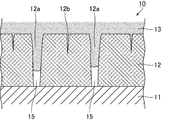
- FIG. 1 is a cross-sectional view schematically showing a multilayer coated aluminum substrate of the present invention.
- FIG. 2 is an SEM photograph showing a ceramic layer that has penetrated into a crack formed in the alumite layer.
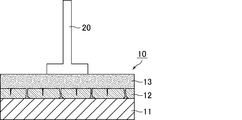
- FIG. 3 is a cross-sectional view schematically showing a sample for pull strength measurement.
- FIG. 4 is an external view showing a state in which a tensile test is performed by a tensile tester.
- the multilayer coated aluminum base material of the present invention is a multilayer coated aluminum base material in which an alumite layer and a ceramic layer are sequentially formed on a base material made of aluminum or an aluminum alloy. A plurality of cracks reaching the surface are formed, and the ceramic layer penetrates in a range of 50% or more and less than 100% in the depth direction of the crack inside the crack.
- FIG. 1 is a cross-sectional view schematically showing a multilayer coated aluminum substrate of the present invention.
- the alumite layer 12 is formed on the base material 11 which consists of aluminum or an aluminum alloy, and also the ceramic layer 13 is formed on the alumite layer 12. Yes.
- the alumite layer 12 is formed with a plurality of cracks 12a reaching the surface of the base material 11, and the ceramic layer 13 penetrates into the crack 12a.
- a space 15 is formed between the surface of the substrate 11 and the ceramic layer 13 without reaching the surface.
- the ceramic layer 13 penetrates into a range of 50% or more and less than 100% in the depth direction of the crack 12a inside the crack 12a, and a space 15 is formed in a portion where the ceramic layer 13 does not exist.
- a space 15 is formed in a portion where the ceramic layer 13 does not exist.
- the fine hole 12b with a small diameter is also formed in the alumite layer 12, it is a small hole that does not reach the surface of the base material 11, and the ceramic layer 13 almost penetrates into the fine hole 12b. Absent.
- the ceramic layer 13 may enter the fine holes 12b.
- court aluminum base material of this invention is demonstrated one by one.
- the base material is made of aluminum or an aluminum alloy.
- the type of aluminum or aluminum alloy used as the base material is not particularly limited as long as it can be anodized.
- pure aluminum 1000 series
- Al-Cu type Alloys 2000s
- Al-Mn alloys 3000s
- Al-Si alloys 4000s
- casting alloys die casting alloys, Al—Si alloys, Al—Mg alloys, Al—Cu—Mg alloys, Al—Cu—Si alloys, Al—Cu—Ni—Mg alloys, Al -Si-Mg alloy, Al-Si-Cu alloy, Al-Si-Cu-Mg alloy, Al-Si-Ni-Cu-Mg-Ni alloy, etc.
- the composition of the alloy is not particularly limited.
- the shape of the substrate is not particularly limited, and for example, the shape can be arbitrarily set according to the shape of a member used as a gas flow member, etc., but at least in the portion where the gas flows, It is desirable that an alumite layer and a ceramic layer be formed.
- the gas distribution member include engine members such as an intake port, an exhaust port, a valve, and a piston, which will be described in detail later.
- the substrate may be a plate-like body such as a flat plate, a curved plate, a bent plate, or the like.
- the other part may be other metals, such as SUS, for the base material used by this invention.
- the substrate is preferably subjected to a surface roughening treatment.
- the surface area is increased by the roughening treatment, and the adhesion with the alumite layer formed on the substrate surface is increased.
- the surface roughness (Ra) based on JIS B 0601 (1982) of the roughened substrate is preferably 0.05 to 4.0 ⁇ m.
- the surface roughness (Ra) is less than 0.05 ⁇ m, the increase in the surface area of the substrate does not contribute much to the increase in adhesion, while when the surface roughness (Ra) exceeds 4.0 ⁇ m, Air is likely to intervene between the alumite layer formed on the surface and the surface of the base material, resulting in a decrease in adhesion.
- the method for forming the alumite layer on the base material is not particularly limited, and a conventionally known method can be used.
- the base material is used as an anode and an electric current is supplied in an electrolytic bath.
- a method of forming an alumite layer by (alumite treatment, anodizing treatment) can be applied.
- alumite treatment, anodizing treatment When performing alumite treatment on a part of the base material, it is desirable to protect it by attaching a masking tape or the like to a portion where the alumite treatment is not performed.
- the thickness of the alumite layer is preferably 0.2 to 100 ⁇ m. If the thickness of the anodized layer is less than 0.2 ⁇ m, the thickness of the anodized layer is too thin, so that the surface area of the crack in the anodized layer is reduced, and as a result, the area where the anodized layer and the ceramic layer are in contact with each other is reduced. It becomes impossible to develop sufficient adhesion. On the other hand, if the thickness of the alumite layer exceeds 100 ⁇ m, it takes too much time to form the alumite layer, which is uneconomical.
- the thickness of the alumite layer is more preferably 10 to 50 ⁇ m. In addition, the thickness of an alumite layer can be measured by observing the cross section of a multilayer coat
- An alumite layer is a composite oxide layer of aluminum oxide or aluminum oxide and another metal oxide formed by oxidation of a base material made of aluminum or an aluminum alloy. Therefore, the base material and the alumite layer are in close contact with each other.
- a plurality of cracks are formed in the alumite layer.
- a plurality of small cracks (cracks) are also found when anodizing is performed on the base material and an alumite layer is formed.
- a raw material mixture for forming a ceramic layer is applied to form a coating layer.
- the heating temperature after forming the coating layer is preferably 300 ° C. or higher.
- micropores are small-diameter holes formed by anodizing.
- the ceramic layer formed on the alumite layer should just be comprised from the ceramic which has heat insulation performance, and the compound which comprises a ceramic layer is although it does not specifically limit, Amorphous inorganic material or amorphous inorganic material and crystallinity It is desirable to be made of an inorganic material.
- the amorphous inorganic material is preferably made of glass, and more preferably made of low-melting glass having a softening point of 300 to 700 ° C.
- the softening point should be measured, for example, using a glass automatic softening point / strain point measuring device (SSPM-31) manufactured by Opt Corp., based on the method specified in JIS R 3103-1: 2001. Can do.
- SSPM-31 glass automatic softening point / strain point measuring device
- the ceramic layer may be made of the above-described low-melting glass, or may be one in which particles of a crystalline inorganic material are contained inside the low-melting glass.
- the thickness of the ceramic layer is desirably 1 to 1000 ⁇ m. When the thickness of the ceramic layer is less than 1 ⁇ m, the thickness of the ceramic layer is too thin, so that the multilayer coated aluminum base material cannot exhibit sufficient heat insulation. On the other hand, when the thickness of the ceramic layer exceeds 1000 ⁇ m, it is not preferable because cracks are likely to occur due to thermal shock or the like.
- the thickness of the ceramic layer is more preferably 10 to 600 ⁇ m.
- FIG. 2 is an SEM photograph showing a ceramic layer that has penetrated into a crack formed in the alumite layer.
- cracks 12 a are formed in the anodized layer 12, and a ceramic is formed in the crack 12 a formed in the anodized layer 12 at a portion of 50% or more in the depth direction of the crack 12 a.
- Layer 13 has penetrated. Considering the adhesiveness of the ceramic layer 13, it is preferable that the ceramic layer 13 penetrates into the crack 12a in a depth direction of 50% or more inside the crack 12a, but the ceramic layer 13 is completely cracked. It is desirable not to fill the inside of 12a, and it is desirable that it is less than 100% of the depth direction of the crack 12a.
- the stress strain between the alumite layer 12 and the base material 11 is reduced, and when subjected to thermal shock or physical (mechanical) shock.
- the stress is easily relieved in the space portion, and the material has excellent impact resistance such as thermal shock and physical (mechanical) impact.
- an alumite layer is formed on a base material made of aluminum or an aluminum alloy, and the base material and the alumite layer are anodized aluminum or a layer of aluminum oxide and another metal oxide. It is chemically bonded via oxygen atoms in the layer, and the alumite layer is in close contact with the substrate.
- the ceramic layer is also chemically bonded to the alumite layer through oxygen atoms, and the alumite layer is in close contact with the ceramic layer.
- the ceramic layer penetrates into the inside of the crack and is closely fitted so as to surround the anodized layer surrounded by the crack, the adhesion force is further increased.
- the alumite layer has a large number of micropores, and the ceramic layer may enter the micropores and may be filled with the ceramic layer, but may not be filled. This is because the diameter of the micropores is small and the surface area is not so large, and even if the ceramic layer penetrates into the micropores, the adhesion force does not increase so much.
- the alumite layer and the ceramic layer are excellent in heat insulation performance, and two layers having excellent heat insulation performance are present, so that the heat insulation performance is more excellent.
- the thermal conductivity at room temperature of the two layers of the alumite layer and the ceramic layer formed on the substrate is desirably 0.1 to 3 W / m ⁇ K. If the thermal conductivity is less than 0.1 W / m ⁇ K, the thickness of the alumite layer and / or the ceramic layer formed on the substrate becomes too thick in order to achieve the above thermal conductivity.
- the multilayer coated aluminum base material of the present invention Since the multilayer coated aluminum base material of the present invention has such characteristics, it is a member used in a portion through which high-temperature gas flows, and is used as a gas distribution member that requires heat insulation performance. Specifically, it can be suitably used as a member of an internal combustion engine, particularly as a member constituting the engine.
- the member that can use the multilayer coated aluminum substrate of the present invention includes a piston having an alumite layer and a ceramic layer on the top, a combustion chamber in which an anodized layer and a ceramic layer are formed on the inner wall, and contact with intake gas and exhaust gas.
- An intake / exhaust valve in which an alumite layer and a ceramic layer are formed in the portion to be inhaled, an intake air, an exhaust port in which an alumite layer and a ceramic layer are formed in a portion in contact with the intake gas and the exhaust gas, and the like.
- a method for producing the multilayer coated aluminum base material for example, as a base material preparation step, a base material made of aluminum or an aluminum alloy is prepared, and as the alumite treatment step, the base material is subjected to alumite treatment, and a coating layer is formed.
- a coating layer for forming a ceramic layer is formed by applying a raw material mixture for forming a ceramic layer on a substrate on which an alumite layer is formed, and as the heat treatment step, the coating layer is formed.
- a method of forming a ceramic layer on the surface of the alumite layer having cracks by subjecting the substrate to a heat treatment at a temperature of 300 ° C. or higher and a temperature of 700 ° C. or lower.
- the temperature of heat processing is selected from the temperature range of 300 degreeC or more and 700 degrees C or less according to the kind of material applied to a ceramic layer.
- (A) Base material preparation process First, as a base material preparation process, a base material made of aluminum or an aluminum alloy is prepared.
- the shape, material, and the like of the substrate are the same as those described in the description of the multilayer coated aluminum substrate of the present invention, the description thereof is omitted here.
- a cleaning process is performed to remove impurities on the substrate surface.
- the cleaning treatment is not particularly limited, and a conventionally known cleaning treatment method can be used. Specifically, for example, a method of performing ultrasonic cleaning in an alcohol solvent can be used.
- a roughening treatment is applied to the portion where the alumite layer or the like is formed.
- the roughening treatment include sand blast treatment, etching treatment, and high temperature oxidation treatment. These may be used alone or in combination of two or more. You may perform a washing process after this roughening process.
- anodized treatment step the above base material is subjected to anodized treatment.
- the method of the alumite treatment is not particularly limited, and various known methods can be used. For example, a method (anodizing treatment, anodizing treatment) in which an electric current is supplied in the electrolytic bath using the base material as an anode is adopted. be able to.
- alumite treatment is performed on a part of the substrate, it is desirable to protect it by attaching a masking tape or the like to a portion where the alumite treatment is not performed.
- an alkaline bath or a non-aqueous bath such as formamide and boric acid can be used in addition to the acidic bath.
- Acid baths include sulfuric acid, phosphoric acid, chromic acid, oxalic acid, sulfosalicylic acid, pyrophosphoric acid, sulfamic acid, phosphomolybdic acid, boric acid, malonic acid, succinic acid, maleic acid, citric acid, tartaric acid, phthalic acid, itacone
- An aqueous solution in which one or more acids, malic acid, glycolic acid and the like are dissolved can be used.
- dissolved 1 type (s) or 2 or more types of sodium hydroxide, potassium hydroxide, sodium carbonate, potassium phosphate, ammonia water etc. can be used as an alkaline bath.
- an alumite layer having a thickness of 0.2 to 100 ⁇ m is formed on the surface of the base material.
- the alumite layer is formed by anodizing or the like, a plurality of small cracks are formed.
- (C) Coating layer formation process the raw material mixture for forming a ceramic layer is apply
- the crystalline inorganic material and the amorphous inorganic material are wet mixed to prepare a raw material mixture for a mixed layer.
- a coating layer Specifically, a crystalline inorganic material powder and an amorphous inorganic material powder are prepared so as to have a predetermined particle size, shape, etc., and each powder is dry-mixed at a predetermined blending ratio to obtain a mixed powder Then, water is further added and wet mixed with a ball mill or the like to prepare a raw material mixture for the mixed layer.
- the mixing ratio of the mixed powder and water is not particularly limited, but is preferably about 100 parts by weight of water with respect to 100 parts by weight of the mixed powder. It is because it becomes a viscosity suitable for apply
- Examples of the method for forming the coating layer on the substrate on which the anodized layer is formed include methods such as spray coating, electrostatic coating, ink jet, transfer using a stamp or roller, and brush coating.
- (D) Heat treatment step Next, as the heat treatment step, the base material on which the coating layer is formed is subjected to heat treatment at a temperature of 300 ° C. or higher and 700 ° C. or lower, and the surface of the alumite layer having cracks and the ceramic inside the cracks are subjected to heat treatment. Form a layer.
- the temperature of the heat treatment is preferably higher than the softening point of the amorphous inorganic material, preferably higher than 300 ° C, more preferably higher than 500 ° C and lower than 700 ° C. If the temperature is 300 ° C. or higher, it is above the softening point of the amorphous inorganic material.
- the applied amorphous inorganic material is softened and melted, and the formed ceramic layer and anodized layer become strong.
- the ceramic layer penetrates into the crack and adheres more firmly to the base material and the alumite layer.
- the temperature of the heat treatment is selected from a temperature range of 300 ° C. or higher and 700 ° C. or lower depending on the type of material applied to the ceramic layer.
- court aluminum base material of this invention is enumerated.
- a plurality of cracks are formed in the alumite layer formed on the base material, and the ceramic layer penetrates into the cracks. And the anodized layer, and the anodized layer and the ceramic layer are firmly adhered by chemical bonding.
- the ceramic layer also penetrates into the cracks of the alumite layer to increase the adhesion area and are in a fitted state, so that the adhesion is further increased.
- the base material, the alumite layer, and the ceramic layer are extremely firmly adhered to each other, functioning as a heat insulating layer, and being a multi-layer coated aluminum base material that does not easily peel or crack even when a heat shock occurs. .
- the ceramic layer penetrates in the range of 50% or more and less than 100% in the depth direction of the crack inside the crack, and the ceramic layer is inside the crack.
- the stress is easily relieved in the space portion, and the material has excellent impact resistance against thermal shock and physical (mechanical) impact.
- the multilayer coated aluminum base material of the present invention since the heat treatment is performed after the raw material mixture for forming the ceramic layer is applied, a large number of cracks are formed in the alumite layer. Since the ceramic layer is formed on the surface including the inside of the crack, a multilayer coated aluminum substrate having a ceramic layer excellent in adhesion to the substrate is obtained.
- the multi-layer coated aluminum substrate of the present invention has an adhesion area of chemical bonds via oxygen atoms with an alumite layer formed on the substrate surface when a roughened surface is formed on the substrate surface. Since it becomes large, an alumite layer having better adhesion is formed.
- the amorphous inorganic material functions as a glass layer covering the alumite layer and the like, and is heated.
- the crystalline inorganic material contained in the ceramic layer improves heat resistance, it plays a major role in the base material and the alumite layer formed on it
- the amorphous inorganic material is heated at a temperature of 300 ° C. or higher. Can be softened and melted to satisfactorily cover the alumite layer and the like formed on the base material, and can easily enter the inside of the crack to improve adhesion.
- the base material was alumite-treated, but a masking tape was applied to the surface on which the alumite treatment was not carried out for protection.
- the electrolytic bath was sulfuric acid having a concentration of 200 g / liter, and the electrolysis temperature was 15 ° C.
- an electrolysis method a multi-stage electrolysis method in which a low voltage (20 V) was used in the first half and a high voltage (40 V) was used in the second half was used. Subsequently, it wash
- a part of the base material after the alumite treatment was cut, and the thickness of the alumite layer formed by the alumite treatment was measured at 5 points using SEM.
- the average thickness of the alumite layer was 20 ⁇ m. .
- (C) Coating layer forming step (preparation of raw material mixture)
- SiO 2 —TiO 2 glass softening point 400 ° C.
- organic binder methyl cellulose (product name: METOLOSE-65SH) manufactured by Shin-Etsu Chemical Co., Ltd. was prepared.
- 100 parts by weight of water was further added to 100 parts by weight of the amorphous inorganic material powder, and a slurry was prepared by wet mixing with a ball mill.
- Example 2 Prior to the coating layer forming step, a multilayer coated aluminum base material was produced in the same manner as in Example 1 except that heating was performed in a heating furnace at 525 ° C. for 10 minutes in the air to form a crack in the alumite layer.
- a cross section was formed almost perpendicular to the crack propagation direction in plan view, and the SEM photograph of the obtained cross section observed the filling condition of the ceramic layer.
- the ceramic layer was formed in the range of 70% in the depth direction of the crack.
- FIG. 3 is a schematic cross-sectional view of a sample for pull strength measurement.
- the stud pin 20 was attached to the surface of the ceramic layer 13 of the multilayer coat aluminum base material 10 using a clip, and was fixed by heating at 150 ° C. for 1 hour to prepare a measurement sample.
- P / N901106 2.7 mm epoxy adhesive Al stud pin made by QUAD GROUP was used.
- FIG. 4 is an external view showing a state in which a tensile test is performed by a tensile tester.
- the tensile tester 100 Using the tensile tester 100, the stud pin 20 fixed to the ceramic layer 13 was pulled. The pull strength was calculated from the maximum value of the force applied until the ceramic layer 13 in contact with the stud pin 20 peeled from the base material 11 and the cross-sectional area of the stud pin 20.
- an autograph AGS50A manufactured by Shimadzu Corporation was used as the tensile tester 100.
- FIG. 2 is an SEM photograph showing a ceramic layer that has penetrated into the inside of the crack formed in the alumite layer. Specifically, the vicinity of the crack bottom of the multilayer coated aluminum substrate obtained in Example 1 was photographed. Although it is a SEM photograph, as shown in FIG. 2, although the crack is formed in the alumite layer, the crack has stopped on the base-material surface. On the other hand, the ceramic layer has penetrated inside the crack, and the ceramic layer is formed in a range of 50% in the crack depth direction inside the crack, and the ceramic layer and the alumite layer are in close contact with each other. Yes.
- the multi-layer coated aluminum substrate of Example 1 showed a high strength of 53.52 N pull strength, and was found to be in close contact with the substrate and the alumite layer.
- the ceramic layer is formed in the 70% range of the depth direction of the crack inside a crack, and pull strength is also a high value with 56.74N. there were.
- the ceramic layer is formed in the range of 25% in the crack depth direction inside the crack, and the pull strength is 22.54 N, which is a duplicate of Examples 1 and 2.
- the sample according to Comparative Example 1 was found to have insufficient adhesion between the substrate and the ceramic layer.
Landscapes
- Chemical & Material Sciences (AREA)
- Engineering & Computer Science (AREA)
- Organic Chemistry (AREA)
- Electrochemistry (AREA)
- Materials Engineering (AREA)
- Metallurgy (AREA)
- Chemical Kinetics & Catalysis (AREA)
- General Engineering & Computer Science (AREA)
- Combustion & Propulsion (AREA)
- Mechanical Engineering (AREA)
- General Chemical & Material Sciences (AREA)
- Cylinder Crankcases Of Internal Combustion Engines (AREA)
- Pistons, Piston Rings, And Cylinders (AREA)
- Other Surface Treatments For Metallic Materials (AREA)
Abstract
断熱性能が要求されるエンジン部材等の部材として好適に使用することができ、アルミニウム又はアルミニウム合金からなる基材との密着性に優れるとともに、充分な断熱性能を有する複層コートアルミニウム基材を提供すること。 アルミニウム又はアルミニウム合金からなる基材上にアルマイト層及びセラミック層が順次形成された複層コートアルミニウム基材であって、前記アルマイト層には、前記基材表面に到達する複数のクラックが形成されており、前記クラックの内部のクラックの深さ方向の50%以上100%未満の範囲に、前記セラミック層が侵入していることを特徴とする複層コートアルミニウム基材。
Description
本発明は、複層コートアルミニウム基材に関する。
エンジンを搭載した自動車等の車両では、エンジン部分で大きな熱が発生するが、発生した熱はエンジン部材を介して周囲に拡散し易く、必ずしも発生した熱を充分に利用しきれていないのが現状である。
そこで、エンジンに発生する熱を、有効に利用し、燃費等の特性をより向上させようとする研究が盛んに行われており、熱ロスの低減に向け、エンジンやその周辺部材の軽量化等を図るために用いられているアルミニウム製部材の断熱化を図る試みも行われている。
アルミニウム製部材の断熱化を図る方法として、アルミニウム部材の表面に断熱性の膜を形成する試みが行われているが、現在のところ、断熱性に優れるとともに、基材との密着性に優れ、耐久性にも優れた膜を形成する方法は見つかっていない。
アルミニウム基材上に薄膜を形成する方法としては、例えば、特許文献1が挙げられる。この特許文献1には、アルミニウム合金基材の表面にアルマイト層を形成し、その表面に無機質抵抗性薄膜を形成し、電気皮膜とすることが開示されている。
アルミニウム基材上に薄膜を形成する方法としては、例えば、特許文献1が挙げられる。この特許文献1には、アルミニウム合金基材の表面にアルマイト層を形成し、その表面に無機質抵抗性薄膜を形成し、電気皮膜とすることが開示されている。
しかしながら、特許文献1に開示された電気皮膜の厚さは実施例等に記載されているように1μmから数μm程度で、誘電層、抵抗層、絶縁層等の用途に用いられるものであり、断熱性を要求される用途に用いられるものではない。
また、この電気皮膜を形成する際には、300℃以下の温度に維持することが必要とされていた。その理由は、温度を上げ過ぎると、陽極酸化アルミニウム被膜にクラックが発生し、このクラックを含む陽極酸化膜を薄膜で完全に被覆することが難しく、目的とする電気的な効果を達成することができないというものである。このため、特許文献1に記載された電気皮膜は、到底エンジン部材等の用途には、用いることが難しいものであった。
さらに、特許文献1では、無機質抵抗性薄膜が微細孔の内部に侵入してもよいことが記載されているが、微細孔は、その直径が0.01~0.05μm程度と極めて小さく、その深さも基材表面に届くほど深くはなく、無機質抵抗性薄膜が上記微細孔に侵入したとしても、表面積の増加は望めず、上記薄膜をアルマイト層に固定する効果は殆どなく、剥れ易いものであった。
このように、エンジン部材等の断熱に用いられるアルミニウム又はアルミニウム合金を基材とする部材で、上記した断熱性、基材への密着性等の要求性能を満たすものは得られていないのが現状である。
本発明は、上記の問題を解決するためになされたものであり、断熱性能が要求されるエンジン部材等の部材として好適に使用することができ、アルミニウム又はアルミニウム合金からなる基材との密着性に優れるとともに、充分な断熱性能を有する複層コートアルミニウム基材を提供することを目的とする。
上記目的を達成するために、本発明の複層コートアルミニウム基材は、アルミニウム又はアルミニウム合金からなる基材上にアルマイト層及びセラミック層が順次形成された複層コートアルミニウム基材であって、上記アルマイト層には、上記基材表面に到達する複数のクラックが形成されており、上記クラックの内部の該クラックの深さ方向の50%以上100%未満の範囲に、上記セラミック層が侵入していることを特徴とする。
本発明の複層コートアルミニウム基材は、上記基材上にアルマイト層が形成されており、上記アルマイト層には、基材表面に到達する複数のクラックが形成されている。そして、そのアルマイト層をセラミック層が覆うとともに、上記クラックの内部にセラミック層が侵入し、上記クラックの内部の該クラックの深さ方向の50%以上100%未満の範囲に、上記セラミック層が侵入している。
なお、クラックの内部のクラックの深さ方向の50%以上100%未満の範囲に、セラミック層が侵入しているとは、クラックの両側のアルマイト層の上端部分を結合する直線を引き、該直線の中間点における基材からの距離に対する、上記中間点からクラック内のセラミック層の最下点までの距離の割合(%)を計算した場合に、その値が50%以上100%未満になるようにセラミック層がクラック内に侵入していることをいう。
基材とアルマイト層とセラミック層とは、上記構造をとっており、この構造に起因して本発明の複層コートアルミニウム基材は、以下の効果を有する。
すなわち、セラミック層は、基材表面に形成されたアルマイト層と酸素原子を介して化学結合しており、そのため、セラミック層とアルマイト層は密着性に優れるが、セラミック層は、アルマイト層のクラックの内部にも侵入しているので、接着面積が増加し、密着力が増加する。
すなわち、セラミック層は、基材表面に形成されたアルマイト層と酸素原子を介して化学結合しており、そのため、セラミック層とアルマイト層は密着性に優れるが、セラミック層は、アルマイト層のクラックの内部にも侵入しているので、接着面積が増加し、密着力が増加する。
セラミック層は、アルマイト層の表面と密着するとともに、クラックの内部に入り込んでおり、このため、セラミック層がアルマイト層と嵌合状態となっており、さらに強固に基材と密着し、剥れ難くなっている。なお、アルマイト層も、基材と酸素原子を介した化学結合により強固に密着していることは言うまでもない。
クラックの内部には、セラミック層が充填されていない空間が存在するが、このような空間が存在するため、アルマイト層と基材との応力歪が小さくなっており、熱衝撃や物理的(機械的)な衝撃を受けた際に、上記空間部分で応力が緩和され易く、熱衝撃や物理的(機械的)衝撃などに対する耐衝撃性に優れた材料となる。
クラックの内部の該クラックの深さ方向の50%未満の範囲に、上記セラミック層が侵入していると、セラミック層の侵入割合が小さいため、アルマイト層とセラミック層との密着性が充分でなく、セラミック層が剥れ易くなる。一方、クラックの内部の該クラックの深さ方向の100%(クラックの内部全体)に、上記セラミック層が侵入していると、セラミック層が充填されていない空間が存在しなくなり、耐衝撃性が充分でなくなる。
本発明の加熱焼成処理前の複層コートアルミニウム基材では、基材上に耐熱性及び断熱性に優れるアルマイト層が形成されるとともに、上記アルマイト層上に、さらに耐熱性及び断熱性に優れるセラミック層が形成され、基材上にこれら2層のセラミックからなる層が形成されているので、基材との密着性、断熱性及び耐熱性に優れるとともに、耐衝撃性にも優れた複層コートアルミニウム基材となる。
本発明の複層コートアルミニウム基材では、セラミック層を形成するための原料混合物が塗布された後に、300℃以上の温度での加熱処理がなされていることが望ましい。
本発明の複層コートアルミニウム基材では、塗布層が形成された後に、300℃以上の温度での加熱処理がなされており、これに起因して、アルマイト層に元からある微細孔の容積が大きくなって基材表面に到達したり、新たに形成されたクラックが基材の表面まで到達しており、クラックの内部を含む表面にセラミック層が侵入しているため、基材との密着性に優れたセラミック層を有する複層コートアルミニウム基材となる。
本発明の複層コートアルミニウム基材では、塗布層が形成された後に、300℃以上の温度での加熱処理がなされており、これに起因して、アルマイト層に元からある微細孔の容積が大きくなって基材表面に到達したり、新たに形成されたクラックが基材の表面まで到達しており、クラックの内部を含む表面にセラミック層が侵入しているため、基材との密着性に優れたセラミック層を有する複層コートアルミニウム基材となる。
本発明の複層コートアルミニウム基材では、上記基材表面には、粗化面が形成されていることが好ましい。
本発明の複層コートアルミニウム基材において、上記基材表面に粗化面が形成されていると、基材表面に形成されるアルマイト層との酸素原子を介した化学結合の密着面積が大きくなるため、基材との密着性により優れたアルマイト層が形成される。
本発明の複層コートアルミニウム基材において、上記基材表面に粗化面が形成されていると、基材表面に形成されるアルマイト層との酸素原子を介した化学結合の密着面積が大きくなるため、基材との密着性により優れたアルマイト層が形成される。
本発明の複層コートアルミニウム基材では、断熱性能を有するガス流通部材として用いられることが望ましく、特にエンジン部に適用されることが望ましく、また、内燃機関に適用されることが望ましい。
本発明の複層コートアルミニウム基材では、基材上に断熱性能に優れるアルマイト層とセラミック等の2層が形成されているため、断熱性能に優れており、断熱性能を有するアルミニウム又はアルミニウム合金からなるガス流通部材として好適に用いられる。
このように本発明の複層コートアルミニウム基材は、ガスの熱が流通する部分において、断熱効果を有する部材として用いられるが、特にエンジン部を構成する部材として用いられることが望ましく、内燃機関を構成する部品として用いられることが望ましい。
本発明の複層コートアルミニウム基材では、基材上に断熱性能に優れるアルマイト層とセラミック等の2層が形成されているため、断熱性能に優れており、断熱性能を有するアルミニウム又はアルミニウム合金からなるガス流通部材として好適に用いられる。
このように本発明の複層コートアルミニウム基材は、ガスの熱が流通する部分において、断熱効果を有する部材として用いられるが、特にエンジン部を構成する部材として用いられることが望ましく、内燃機関を構成する部品として用いられることが望ましい。
本発明の複層コートアルミニウム基材では、セラミック層は、非晶性無機材と結晶性無機材とからなることが好ましい。
本発明の複層コートアルミニウム基材において、セラミック層が非晶性無機材と結晶性無機材とからなると、非晶性無機材がアルマイト層等を被覆するガラス層として機能し、加熱により溶融してアルマイト層等を良好に被覆するとともに、セラミック層内部に含まれる結晶性無機材が耐熱性を向上させる部材としての役割を担う。従って、基材とその上に形成されたアルマイト層に対して密着性に優れるとともに、断熱性、耐熱性を有する複層コートアルミニウム基材を提供することができる。
本発明の複層コートアルミニウム基材において、セラミック層が非晶性無機材と結晶性無機材とからなると、非晶性無機材がアルマイト層等を被覆するガラス層として機能し、加熱により溶融してアルマイト層等を良好に被覆するとともに、セラミック層内部に含まれる結晶性無機材が耐熱性を向上させる部材としての役割を担う。従って、基材とその上に形成されたアルマイト層に対して密着性に優れるとともに、断熱性、耐熱性を有する複層コートアルミニウム基材を提供することができる。
本発明の複層コートアルミニウム基材では、非晶性無機材は、軟化点が300~700℃の低融点ガラスからなることが好ましい。
本発明の複層コートアルミニウム基材で、非晶性無機材は、軟化点が300~700℃の低融点ガラスからなると、300℃以上の温度で加熱することにより、非晶性無機材が軟化、溶融し、基材上に形成されたアルマイト層等を良好に被覆するとともに、クラックの内部にも容易に侵入し、密着性を向上させることができる。軟化点が300℃未満の非晶性無機材を用意しようとすると、非晶性無機材に鉛等の環境規制物質や高価な物質を添加させる必要があり、環境上および経済上使用が制限されると言う問題がある。また軟化点が700℃を超えると、非晶性無機材を軟化させる際にアルミニウム又はアルミニウム合金からなる基材が溶融してしまうという問題がある。
本発明の複層コートアルミニウム基材で、非晶性無機材は、軟化点が300~700℃の低融点ガラスからなると、300℃以上の温度で加熱することにより、非晶性無機材が軟化、溶融し、基材上に形成されたアルマイト層等を良好に被覆するとともに、クラックの内部にも容易に侵入し、密着性を向上させることができる。軟化点が300℃未満の非晶性無機材を用意しようとすると、非晶性無機材に鉛等の環境規制物質や高価な物質を添加させる必要があり、環境上および経済上使用が制限されると言う問題がある。また軟化点が700℃を超えると、非晶性無機材を軟化させる際にアルミニウム又はアルミニウム合金からなる基材が溶融してしまうという問題がある。
本発明の複層コートアルミニウム基材では、結晶性無機材は、アルミナ、ジルコニア、イットリア、カルシア、マグネシア、セリア、及び、ハフニアからなる群から選択される少なくとも一種からなることが好ましい。
本発明の複層コートアルミニウム基材では、上記結晶性無機材は、アルミナ、ジルコニア、イットリア、カルシア、マグネシア、セリア、及び、ハフニアからなる群から選択される少なくとも一種からなるので、これらの耐熱性能に優れた結晶性無機材を含むセラミック層は、耐熱性が向上する。
本発明の複層コートアルミニウム基材では、上記結晶性無機材は、アルミナ、ジルコニア、イットリア、カルシア、マグネシア、セリア、及び、ハフニアからなる群から選択される少なくとも一種からなるので、これらの耐熱性能に優れた結晶性無機材を含むセラミック層は、耐熱性が向上する。
以下、本発明について具体的に説明する。しかしながら、本発明は、以下の内容に限定されるものではなく、本発明の要旨を変更しない範囲において適宜変更して適用することができる。
本発明の複層コートアルミニウム基材は、アルミニウム又はアルミニウム合金からなる基材上にアルマイト層及びセラミック層が順次形成された複層コートアルミニウム基材であって、上記アルマイト層には、上記基材表面に到達する複数のクラックが形成されており、上記クラックの内部の該クラックの深さ方向の50%以上100%未満の範囲に、上記セラミック層が侵入していることを特徴とする。
図1は、本発明の複層コートアルミニウム基材を模式的に示す断面図である。
図1に示すように、本発明の複層コートアルミニウム基材10では、アルミニウム又はアルミニウム合金からなる基材11上にアルマイト層12が形成され、さらにアルマイト層12上にセラミック層13が形成されている。また、アルマイト層12には、基材11の表面まで到達する複数のクラック12aが形成されており、クラック12aの内部にセラミック層13が侵入しているが、セラミック層13は、基材11の表面までは到達しておらず、基材11の表面とセラミック層13との間に空間15が形成されている。具体的には、クラック12aの内部のクラック12aの深さ方向の50%以上100%未満の範囲に、セラミック層13が侵入しており、セラミック層13が存在しない部分には、空間15が形成されている。
なお、アルマイト層12には、小さな直径の微細孔12bも形成されているが、基材11表面には到達しない小さな孔であり、微細孔12bの内部には、セラミック層13は殆ど侵入していない。微細孔12bには、セラミック層13が侵入していてもよい。
図1に示すように、本発明の複層コートアルミニウム基材10では、アルミニウム又はアルミニウム合金からなる基材11上にアルマイト層12が形成され、さらにアルマイト層12上にセラミック層13が形成されている。また、アルマイト層12には、基材11の表面まで到達する複数のクラック12aが形成されており、クラック12aの内部にセラミック層13が侵入しているが、セラミック層13は、基材11の表面までは到達しておらず、基材11の表面とセラミック層13との間に空間15が形成されている。具体的には、クラック12aの内部のクラック12aの深さ方向の50%以上100%未満の範囲に、セラミック層13が侵入しており、セラミック層13が存在しない部分には、空間15が形成されている。
なお、アルマイト層12には、小さな直径の微細孔12bも形成されているが、基材11表面には到達しない小さな孔であり、微細孔12bの内部には、セラミック層13は殆ど侵入していない。微細孔12bには、セラミック層13が侵入していてもよい。
次に、本発明の複層コートアルミニウム基材を構成する各部材について順次説明する。
まずは、本発明の複層コートアルミニウム基材を構成する基材について説明する。
上記基材は、アルミニウム又はアルミニウム合金からなる。基材として用いられるアルミニウム又はアルミニウム合金としては、アルマイト処理が可能なものであればその種類は特に限定されるものではなく、例えば、圧延用合金として、純アルミ(1000番台)、Al-Cu系合金(2000番台)、Al-Mn系合金(3000番台)、Al-Si系合金(4000番台)、Al-Mg系合金(5000番台)、Al-Mg-Si系合金(6000番台)、Al-Zn―Mg系合金(7000番台)等を用いることができる。また、鋳造用合金として、ダイカスト用合金、Al-Si系合金、Al-Mg系合金、Al-Cu-Mg系合金、Al-Cu-Si系合金、Al-Cu-Ni-Mg系合金、Al-Si-Mg系合金、Al-Si-Cu系合金、Al-Si-Cu-Mg系合金、Al-Si-Ni-Cu-Mg系合金、Al-Si-Cu-Mg-Ni系合金等を用いることができる。上記合金の組成は、特に限定されるものではない。
まずは、本発明の複層コートアルミニウム基材を構成する基材について説明する。
上記基材は、アルミニウム又はアルミニウム合金からなる。基材として用いられるアルミニウム又はアルミニウム合金としては、アルマイト処理が可能なものであればその種類は特に限定されるものではなく、例えば、圧延用合金として、純アルミ(1000番台)、Al-Cu系合金(2000番台)、Al-Mn系合金(3000番台)、Al-Si系合金(4000番台)、Al-Mg系合金(5000番台)、Al-Mg-Si系合金(6000番台)、Al-Zn―Mg系合金(7000番台)等を用いることができる。また、鋳造用合金として、ダイカスト用合金、Al-Si系合金、Al-Mg系合金、Al-Cu-Mg系合金、Al-Cu-Si系合金、Al-Cu-Ni-Mg系合金、Al-Si-Mg系合金、Al-Si-Cu系合金、Al-Si-Cu-Mg系合金、Al-Si-Ni-Cu-Mg系合金、Al-Si-Cu-Mg-Ni系合金等を用いることができる。上記合金の組成は、特に限定されるものではない。
基材の形状は特に限定されるものではなく、例えば、ガス流通部材として使用される部材の形状等に合わせて任意にその形状を設定することができるが、少なくともガスが流通する部分には、アルマイト層及びセラミック層が形成されていることが望ましい。ガス流通部材の具体例としては、例えば、吸気ポート、排気ポート、バルブ、ピストン等のエンジン部材が挙げられるが、後で詳しく説明する。上記基材は、平板、湾曲板、屈曲板等の板状体であってもよい。
また、本発明で使用する基材は、アルマイト層及びセラミック層を形成する部分がアルミニウム又はアルミニウム合金であれば、他の部分がSUS等、他の金属であってもよい。
また、本発明で使用する基材は、アルマイト層及びセラミック層を形成する部分がアルミニウム又はアルミニウム合金であれば、他の部分がSUS等、他の金属であってもよい。
上記基材には、表面粗化処理が施されていることが望ましい。粗化処理により表面積が増大し、基材表面に形成するアルマイト層との密着性が増大する。
粗化処理された基材のJIS B 0601(1982)に基づく表面粗さ(Ra)は、0.05~4.0μmであることが望ましい。
上記表面粗さ(Ra)が0.05μm未満では、基材の表面積の増加が密着性の増加に余り寄与せず、一方、上記表面粗さ(Ra)が4.0μmを超えると、基材表面に形成されたアルマイト層と基材表面との間に空気が介在し易くなり、密着性が低下する。
粗化処理された基材のJIS B 0601(1982)に基づく表面粗さ(Ra)は、0.05~4.0μmであることが望ましい。
上記表面粗さ(Ra)が0.05μm未満では、基材の表面積の増加が密着性の増加に余り寄与せず、一方、上記表面粗さ(Ra)が4.0μmを超えると、基材表面に形成されたアルマイト層と基材表面との間に空気が介在し易くなり、密着性が低下する。
次に、基材表面に形成されたアルマイト層について説明する。
基材にアルマイト層を形成する方法は、特に限定されるものではなく、従来から用いられている公知の方法を使用することができるが、例えば、基材を陽極として電解浴中で通電すること(アルマイト処理、陽極酸化処理)によってアルマイト層を形成する方法を適用することができる。
基材の一部にアルマイト処理を行う場合、アルマイト処理を行わない部分にマスキングテープ等を貼り付けて保護することが望ましい。
基材にアルマイト層を形成する方法は、特に限定されるものではなく、従来から用いられている公知の方法を使用することができるが、例えば、基材を陽極として電解浴中で通電すること(アルマイト処理、陽極酸化処理)によってアルマイト層を形成する方法を適用することができる。
基材の一部にアルマイト処理を行う場合、アルマイト処理を行わない部分にマスキングテープ等を貼り付けて保護することが望ましい。
アルマイト層の厚さは0.2~100μmであることが望ましい。
アルマイト層の厚さが0.2μm未満であると、アルマイト層の厚さが薄すぎるため、アルマイト層内のクラックの表面積が小さくなり、その結果アルマイト層とセラミック層が接触する面積が小さくなって十分な密着力を発現することが不可能となる。一方、アルマイト層の厚さが100μmを超えると、アルマイト層を形成するための時間がかかり過ぎ、不経済である。アルマイト層の厚さは10~50μmであることがより望ましい。
なお、アルマイト層の厚さは、複層コートアルミニウム基材の断面を、SEM等を用いて観察することによって測定することができる。
アルマイト層の厚さが0.2μm未満であると、アルマイト層の厚さが薄すぎるため、アルマイト層内のクラックの表面積が小さくなり、その結果アルマイト層とセラミック層が接触する面積が小さくなって十分な密着力を発現することが不可能となる。一方、アルマイト層の厚さが100μmを超えると、アルマイト層を形成するための時間がかかり過ぎ、不経済である。アルマイト層の厚さは10~50μmであることがより望ましい。
なお、アルマイト層の厚さは、複層コートアルミニウム基材の断面を、SEM等を用いて観察することによって測定することができる。
アルマイト層は、アルミニウム又はアルミニウム合金からなる基材の酸化により形成された酸化アルミニウム又は酸化アルミニウムと他の金属酸化物の複合酸化物の層であり、基材の金属とアルマイト層とは、酸素を介して化学結合しているため、基材とアルマイト層とはしっかりと密着している。
電解時の電流波形としては、直流、交流、交直重畳、交直併用、不完全整流波形、パルス波形、矩形波などを用いることができる。
また、電解方法としては、定電流、低電圧、定電力法及び連続、断続あるいは電流回復を応用した高速アルマイト法などを用いることができる。
また、電解方法としては、定電流、低電圧、定電力法及び連続、断続あるいは電流回復を応用した高速アルマイト法などを用いることができる。
上記アルマイト層には、複数のクラックが形成されている。
基材に陽極酸化処理等を施し、アルマイト層を形成した際にも、小さな複数のクラック(亀裂)が発見されるが、その後、セラミック層を形成するための原料混合物を塗布して塗布層を形成し、加熱処理を施すことにより、多数のクラック(亀裂)が形成され、その大部分は、基材にまで達しており、クラックの内部に加熱により溶融したセラミック層が入り込んでいる。塗布層形成後の加熱温度は、300℃以上の温度が好ましい。
基材に陽極酸化処理等を施し、アルマイト層を形成した際にも、小さな複数のクラック(亀裂)が発見されるが、その後、セラミック層を形成するための原料混合物を塗布して塗布層を形成し、加熱処理を施すことにより、多数のクラック(亀裂)が形成され、その大部分は、基材にまで達しており、クラックの内部に加熱により溶融したセラミック層が入り込んでいる。塗布層形成後の加熱温度は、300℃以上の温度が好ましい。
アルマイト層には、多数の微細孔が形成されている。
この微細孔は、アルマイト処理を行うことによって形成された小さな直径の孔である。
この微細孔は、アルマイト処理を行うことによって形成された小さな直径の孔である。
次に、アルマイト層の上に形成されたセラミック層について説明する。
セラミック層は、断熱性能を有するセラミックから構成されていればよく、セラミック層を構成する化合物は、特に限定されるものではないが、非晶性無機材、又は、非晶性無機材と結晶性無機材とからなるものであることが望ましい。
セラミック層は、断熱性能を有するセラミックから構成されていればよく、セラミック層を構成する化合物は、特に限定されるものではないが、非晶性無機材、又は、非晶性無機材と結晶性無機材とからなるものであることが望ましい。
上記非晶性無機材は、ガラスからなることが望ましく、軟化点が300~700℃の低融点ガラスからなるものであることがより望ましい。
軟化点が300~700℃の低融点ガラスとしては、SiO2-TiO2系ガラス、SiO2-PbO系ガラス、SiO2-PbO-B2O3系ガラス、B2O3-PbO系ガラス、Al2O3-SiO2-B2O3-PbO系ガラス、Na2O-P2O5-SiO2系ガラス等が挙げられる。
なお、軟化点は、JIS R 3103-1:2001に規定される方法に基づいて、例えば、有限会社オプト企業製の硝子自動軟化点・歪点測定装置(SSPM-31)を用いて測定することができる。
軟化点が300~700℃の低融点ガラスとしては、SiO2-TiO2系ガラス、SiO2-PbO系ガラス、SiO2-PbO-B2O3系ガラス、B2O3-PbO系ガラス、Al2O3-SiO2-B2O3-PbO系ガラス、Na2O-P2O5-SiO2系ガラス等が挙げられる。
なお、軟化点は、JIS R 3103-1:2001に規定される方法に基づいて、例えば、有限会社オプト企業製の硝子自動軟化点・歪点測定装置(SSPM-31)を用いて測定することができる。
上記セラミック層は、上記した低融点ガラスからなるものであってもよく、上記低融点ガラスの内部に結晶性無機材の粒子が含有されたものであってもよい。
上記結晶性無機材としては、アルミナ、ジルコニア、CaO安定化ジルコニア(5wt%CaO-ZrO2、8wt%CaO-ZrO2、31wt%CaO-ZrO2)、MgO安定化ジルコニア(20wt%MgO-ZrO2、24wt%MgO-ZrO2)、Y2O3安定化ジルコニア(6wt%Y2O3-ZrO2、7wt%Y2O3-ZrO2、8wt%Y2O3-ZrO2、10wt%Y2O3-ZrO2、12wt%Y2O3-ZrO2、20wt%Y2O3-ZrO2)、ジルコン(ZrO2-33wt%SiO2)、CeO安定化ジルコニア等が挙げられる。
上記結晶性無機材としては、アルミナ、ジルコニア、CaO安定化ジルコニア(5wt%CaO-ZrO2、8wt%CaO-ZrO2、31wt%CaO-ZrO2)、MgO安定化ジルコニア(20wt%MgO-ZrO2、24wt%MgO-ZrO2)、Y2O3安定化ジルコニア(6wt%Y2O3-ZrO2、7wt%Y2O3-ZrO2、8wt%Y2O3-ZrO2、10wt%Y2O3-ZrO2、12wt%Y2O3-ZrO2、20wt%Y2O3-ZrO2)、ジルコン(ZrO2-33wt%SiO2)、CeO安定化ジルコニア等が挙げられる。
上記セラミック層の厚さは、1~1000μmが望ましい。
上記セラミック層の厚さが1μm未満では、セラミック層の厚さが薄すぎるため、複層コートアルミニウム基材が充分な断熱性を発揮することができない。一方、上記セラミック層の厚さが1000μmを超えると、熱衝撃等に対してクラックが発生し易くなるため、好ましくない。上記セラミック層の厚さは、10~600μmがより望ましい。
上記セラミック層の厚さが1μm未満では、セラミック層の厚さが薄すぎるため、複層コートアルミニウム基材が充分な断熱性を発揮することができない。一方、上記セラミック層の厚さが1000μmを超えると、熱衝撃等に対してクラックが発生し易くなるため、好ましくない。上記セラミック層の厚さは、10~600μmがより望ましい。
図2は、アルマイト層に形成されたクラックの内部に侵入したセラミック層を示すSEM写真である。
図2に示されるように、アルマイト層12にはクラック12aが形成されており、アルマイト層12に形成されたクラック12aの内部であって、クラック12aの深さ方向の50%以上の部分にセラミック層13が侵入している。セラミック層13の密着性の観点を考慮すると、クラック12aの内部のクラック12aの深さ方向の50%以上の部分にセラミック層13が侵入していることが好ましいが、セラミック層13が完全にクラック12aの内部を充填しないことが望ましく、クラック12aの深さ方向の100%未満であることが望ましい。
図2に示されるように、アルマイト層12にはクラック12aが形成されており、アルマイト層12に形成されたクラック12aの内部であって、クラック12aの深さ方向の50%以上の部分にセラミック層13が侵入している。セラミック層13の密着性の観点を考慮すると、クラック12aの内部のクラック12aの深さ方向の50%以上の部分にセラミック層13が侵入していることが好ましいが、セラミック層13が完全にクラック12aの内部を充填しないことが望ましく、クラック12aの深さ方向の100%未満であることが望ましい。
クラック12aの内部に、セラミック層13が充填されていない空間が存在すると、アルマイト層12と基材11との応力歪が小さくなり、熱衝撃や物理的(機械的)な衝撃を受けた際に、上記空間部分で応力が緩和され易く、熱衝撃や物理的(機械的)衝撃などの耐衝撃性に優れた材料となる。
本発明では、上述したように、アルミニウム又はアルミニウム合金からなる基材上にアルマイト層が形成され、基材とアルマイト層とは、酸化アルミニウム、又は酸化アルミニウムと他の金属酸化物の層であるアルマイト層中の酸素原子を介して化学結合しており、アルマイト層が基材としっかりと密着している。また、セラミック層も、アルマイト層と酸素原子を介して化学結合しており、アルマイト層は、セラミック層ともしっかりと密着している。
さらに、セラミック層は、クラックの内部まで侵入しており、クラックで囲まれたアルマイト層を取り囲むように嵌合的に密着しているため、密着力がさらに増加する。
アルマイト層には、多数の微細孔が形成されており、微細孔の内部にもセラミック層が侵入し、セラミック層で充填されていてもよいが、充填されていなくてもよい。微細孔の直径は小さく、表面積は余り大きくないので、微細孔の内部にセラミック層が侵入しても、密着力は余り増加しないからである。
本発明の複層コートアルミニウム基材において、アルマイト層及びセラミック層は、断熱性能に優れ、断熱性能に優れる層が2層存在するため、より断熱性能に優れる。
本発明の複層コートアルミニウム基材において、基材上に形成されたアルマイト層及びセラミック層の2層の室温での熱伝導率は、0.1~3W/m・Kであることが望ましい。
熱伝導率が0.1W/m・K未満であると、上記熱伝導率を達成するために、基材上に形成されたアルマイト層及び/又はセラミック層の厚みが厚くなりすぎ、本発明の複層コートアルミニウム基材をエンジン部材等に適用しようとする場合には設計におけるスペースの確保が困難となる問題がある。一方、熱伝導率が3W/m・Kを超えると、十分な断熱の効果が得られないという問題がある。
本発明の複層コートアルミニウム基材において、基材上に形成されたアルマイト層及びセラミック層の2層の室温での熱伝導率は、0.1~3W/m・Kであることが望ましい。
熱伝導率が0.1W/m・K未満であると、上記熱伝導率を達成するために、基材上に形成されたアルマイト層及び/又はセラミック層の厚みが厚くなりすぎ、本発明の複層コートアルミニウム基材をエンジン部材等に適用しようとする場合には設計におけるスペースの確保が困難となる問題がある。一方、熱伝導率が3W/m・Kを超えると、十分な断熱の効果が得られないという問題がある。
本発明の複層コートアルミニウム基材は、このような特性を有することから、高温のガスが流通する部分に用いられる部材で、断熱性能が要求されるガス流通部材として用いられる。
具体的には、内燃機関の部材、特にエンジンを構成する部材として好適に使用することができる。本発明の複層コートアルミニウム基材を用いることができる部材としては、頭頂部にアルマイト層及びセラミック層を有するピストン、内壁にアルマイト層及びセラミック層が形成された燃焼室、吸気ガスや排ガスと接触する部分にアルマイト層及びセラミック層が形成された吸排気バルブ、吸気ガスや排気ガスと接触する部分にアルマイト層及びセラミック層が形成された吸気、排気ポート等が挙げられる。
具体的には、内燃機関の部材、特にエンジンを構成する部材として好適に使用することができる。本発明の複層コートアルミニウム基材を用いることができる部材としては、頭頂部にアルマイト層及びセラミック層を有するピストン、内壁にアルマイト層及びセラミック層が形成された燃焼室、吸気ガスや排ガスと接触する部分にアルマイト層及びセラミック層が形成された吸排気バルブ、吸気ガスや排気ガスと接触する部分にアルマイト層及びセラミック層が形成された吸気、排気ポート等が挙げられる。
次に、本発明の複層コートアルミニウム基材の製造方法について説明する。
上記複層コートアルミニウム基材を製造する方法としては、例えば、基材準備工程として、アルミニウム又はアルミニウム合金からなる基材を準備し、アルマイト処理工程として、上記基材にアルマイト処理を施し、塗布層形成工程として、アルマイト層が形成された基材上にセラミック層を形成するための原料混合物を塗布することによりセラミック層形成用の塗布層を形成し、加熱処理工程として、上記塗布層が形成された基材に300℃以上の温度であって、700℃以下の温度で加熱処理を施し、クラックを有する上記アルマイト層表面にセラミック層を形成する方法が挙げられる。なお、加熱処理の温度は、セラミック層に適用する材料の種類に応じて300℃以上、700℃以下の温度範囲から選択される。
以下、順に、上記複層コートアルミニウム基材の製造方法について説明する。
上記複層コートアルミニウム基材を製造する方法としては、例えば、基材準備工程として、アルミニウム又はアルミニウム合金からなる基材を準備し、アルマイト処理工程として、上記基材にアルマイト処理を施し、塗布層形成工程として、アルマイト層が形成された基材上にセラミック層を形成するための原料混合物を塗布することによりセラミック層形成用の塗布層を形成し、加熱処理工程として、上記塗布層が形成された基材に300℃以上の温度であって、700℃以下の温度で加熱処理を施し、クラックを有する上記アルマイト層表面にセラミック層を形成する方法が挙げられる。なお、加熱処理の温度は、セラミック層に適用する材料の種類に応じて300℃以上、700℃以下の温度範囲から選択される。
以下、順に、上記複層コートアルミニウム基材の製造方法について説明する。
(a)基材準備工程
まず、基材準備工程として、アルミニウム又はアルミニウム合金からなる基材を準備する。
まず、基材準備工程として、アルミニウム又はアルミニウム合金からなる基材を準備する。
基材の形状、材料等は、本発明の複層コートアルミニウム基材の説明において説明したものと同様であるので、ここでは、その説明を省略する。
まず、基材準備工程においては、基材表面の不純物を除去すべく洗浄処理を行う。
上記洗浄処理としては特に限定されず、従来公知の洗浄処理法を用いることができ、具体的には、例えば、アルコール溶媒中で超音波洗浄を行う方法等を用いることができる。
上記洗浄処理としては特に限定されず、従来公知の洗浄処理法を用いることができ、具体的には、例えば、アルコール溶媒中で超音波洗浄を行う方法等を用いることができる。
アルマイト層やセラミック層との密着性をさらに上げたい場合には、アルマイト層等を形成する部分に粗化処理を施す。粗化処理の方法としては、例えば、サンドブラスト処理、エッチング処理、高温酸化処理等が挙げられる。これらは単独で用いてもよいし、2種以上を併用してもよい。この粗化処理後にさらに洗浄処理を行ってもよい。
(b)アルマイト処理工程
次に、アルマイト処理工程として、上記基材にアルマイト処理を施す。
アルマイト処理の方法は特に限定されるものではなく、種々の公知の方法を用いることができるが、例えば、基材を陽極として電解浴中で通電する方法(アルマイト処理、陽極酸化処理)を採用することができる。
基材の一部にアルマイト処理を行う場合には、アルマイト処理を行わない部分にマスキングテープ等を貼り付けて保護することが望ましい。
次に、アルマイト処理工程として、上記基材にアルマイト処理を施す。
アルマイト処理の方法は特に限定されるものではなく、種々の公知の方法を用いることができるが、例えば、基材を陽極として電解浴中で通電する方法(アルマイト処理、陽極酸化処理)を採用することができる。
基材の一部にアルマイト処理を行う場合には、アルマイト処理を行わない部分にマスキングテープ等を貼り付けて保護することが望ましい。
陽極酸化処理の際に用いる電解浴としては、酸性浴のほかに、アルカリ浴、あるいはホルムアミド系とホウ酸系などの非水浴も用いることができる。酸性浴としては、硫酸、リン酸、クロム酸、しゅう酸、スルホサリチル酸、ピロリン酸、スルファミン酸、リンモリブデン酸、ホウ酸、マロン酸、コハク酸、マレイン酸、クエン酸、酒石酸、フタル酸、イタコン酸、リンゴ酸、グリコール酸などを1種または2種以上溶解した水溶液を用いることができる。
また、アルカリ浴としては、水酸化ナトリウム、水酸化カリウム、炭酸ナトリウム、リン酸カリウム、アンモニア水などを1種または2種以上溶解した水溶液を用いることができる。
上記陽極酸化処理により、基材の表面に厚さ0.2~100μmのアルマイト層を形成する。アルマイト層は、陽極酸化処理等により形成された時点で、複数の小さなクラックは形成されている。
また、アルカリ浴としては、水酸化ナトリウム、水酸化カリウム、炭酸ナトリウム、リン酸カリウム、アンモニア水などを1種または2種以上溶解した水溶液を用いることができる。
上記陽極酸化処理により、基材の表面に厚さ0.2~100μmのアルマイト層を形成する。アルマイト層は、陽極酸化処理等により形成された時点で、複数の小さなクラックは形成されている。
(c)塗布層形成工程
次に、塗布層形成工程として、上記アルマイト処理によりアルマイト層が形成された基材上に、セラミック層を形成するための原料混合物を塗布することによりセラミック層形成用の塗布層を形成する。
次に、塗布層形成工程として、上記アルマイト処理によりアルマイト層が形成された基材上に、セラミック層を形成するための原料混合物を塗布することによりセラミック層形成用の塗布層を形成する。
結晶性無機材及び非晶性無機材を用いて原料混合物を調製する際は、結晶性無機材及び非晶性無機材を湿式混合し、混合層用の原料混合物を調製し、この原料混合物を用いて塗布層を形成する。
具体的には、結晶性無機材の粉末と、非晶性無機材の粉末とをそれぞれ所定の粒度、形状等になるように調製し、各粉末を所定の配合比率で乾式混合して混合粉末を調製し、さらに水を加えて、ボールミル等で湿式混合することにより混合層用の原料混合物を調製する。
ここで、混合粉末と水との配合比は、特に限定されるものでないが、混合粉末100重量部に対して、水100重量部程度が望ましい。金属基材に塗布するのに適した粘度となるからである。また、必要に応じて、上記混合層用の原料混合物には、有機溶剤等の分散媒及び有機結合材を配合してもよい。
具体的には、結晶性無機材の粉末と、非晶性無機材の粉末とをそれぞれ所定の粒度、形状等になるように調製し、各粉末を所定の配合比率で乾式混合して混合粉末を調製し、さらに水を加えて、ボールミル等で湿式混合することにより混合層用の原料混合物を調製する。
ここで、混合粉末と水との配合比は、特に限定されるものでないが、混合粉末100重量部に対して、水100重量部程度が望ましい。金属基材に塗布するのに適した粘度となるからである。また、必要に応じて、上記混合層用の原料混合物には、有機溶剤等の分散媒及び有機結合材を配合してもよい。
結晶性無機材を含まず、非晶性無機材からなる原料混合物を調製する際には、上述した混合層用の原料混合物の調製方法において、結晶性無機材を加えず、乾式混合を行わない他は、同様の方法を用いることにより、原料混合物を調製することができ、塗布層を形成することができる。
アルマイト層が形成された基材に塗布層を形成する方法としては、例えば、スプレーコート、静電塗装、インクジェット、スタンプやローラ等を用いた転写、ハケ塗り等の方法が挙げられる。
(d)加熱処理工程
次に、加熱処理工程として、塗布層が形成された基材に300℃以上700℃以下の温度で加熱処理を施し、クラックを有する上記アルマイト層表面及びクラックの内部にセラミック層を形成する。
上記加熱処理の温度は、非晶性無機材の軟化点以上とすることが望ましく、300℃を超える温度が望ましく、500℃以上、700℃以下が望ましい。
300℃以上の温度であれば、非晶性無機材の軟化点以上であり、その結果、塗布された非晶性無機材が軟化、溶融し、形成されたセラミック層とアルマイト層とが強固に密着するとともに、クラックの内部にもセラミック層が浸透していき、基材やアルマイト層に対してより強固に密着する。なお、加熱処理の温度は、セラミック層に適用する材料の種類に応じて300℃以上700℃以下の温度範囲から選択される。
次に、加熱処理工程として、塗布層が形成された基材に300℃以上700℃以下の温度で加熱処理を施し、クラックを有する上記アルマイト層表面及びクラックの内部にセラミック層を形成する。
上記加熱処理の温度は、非晶性無機材の軟化点以上とすることが望ましく、300℃を超える温度が望ましく、500℃以上、700℃以下が望ましい。
300℃以上の温度であれば、非晶性無機材の軟化点以上であり、その結果、塗布された非晶性無機材が軟化、溶融し、形成されたセラミック層とアルマイト層とが強固に密着するとともに、クラックの内部にもセラミック層が浸透していき、基材やアルマイト層に対してより強固に密着する。なお、加熱処理の温度は、セラミック層に適用する材料の種類に応じて300℃以上700℃以下の温度範囲から選択される。
以下に、本発明の複層コートアルミニウム基材の作用効果を列挙する。
(1)本発明の複層コートアルミニウム基材では、基材上に形成されたアルマイト層には、複数のクラックが形成されており、上記クラックの内部にセラミック層が侵入しており、基材とアルマイト層、アルマイト層とセラミック層とは、化学結合によりしっかりと密着している。また、セラミック層は、アルマイト層のクラックの内部にも侵入して接着面積が増加し、嵌合状態となっているので、さらに密着力が増加する。すなわち、基材とアルマイト層とセラミック層とは、極めて強固に密着しており、断熱層として機能するとともに、熱ショック等が起こっても剥離やクラックが発生しにくい複層コートアルミニウム基材となる。
(1)本発明の複層コートアルミニウム基材では、基材上に形成されたアルマイト層には、複数のクラックが形成されており、上記クラックの内部にセラミック層が侵入しており、基材とアルマイト層、アルマイト層とセラミック層とは、化学結合によりしっかりと密着している。また、セラミック層は、アルマイト層のクラックの内部にも侵入して接着面積が増加し、嵌合状態となっているので、さらに密着力が増加する。すなわち、基材とアルマイト層とセラミック層とは、極めて強固に密着しており、断熱層として機能するとともに、熱ショック等が起こっても剥離やクラックが発生しにくい複層コートアルミニウム基材となる。
(2)本発明の複層コートアルミニウム基材では、クラックの内部の該クラックの深さ方向の50%以上100%未満の範囲にセラミック層が侵入しており、クラックの内部には、セラミック層が充填されていない空間が存在するが、このような空間が存在するため、アルマイト層と基材との応力歪が小さくなっており、熱衝撃や物理的(機械的)な衝撃を受けた際に、上記空間部分で応力が緩和され易く、熱衝撃や物理的(機械的)衝撃などに対する耐衝撃性に優れた材料となる。
(3)本発明の複層コートアルミニウム基材では、セラミック層を形成するための原料混合物が塗布された後に、加熱処理がなされているので、アルマイト層には、多数のクラックが形成されており、クラックの内部を含む表面にセラミック層が形成されているため、基材との密着性に優れたセラミック層を有する複層コートアルミニウム基材となる。
(4)本発明の複層コートアルミニウム基材は、基材表面に粗化面が形成されていると、基材表面に形成されるアルマイト層との酸素原子を介した化学結合の密着面積が大きくなるため、より密着性に優れたアルマイト層が形成される。
(5)本発明の複層コートアルミニウム基材において、セラミック層が非晶性無機材と結晶性無機材とからなると、非晶性無機材がアルマイト層等を被覆するガラス層として機能し、加熱により溶融してアルマイト層等を良好に被覆するとともに、セラミック層内部に含まれる結晶性無機材が耐熱性を向上させる部材として、大きな役割を担い、基材とその上に形成されたアルマイト層に対して密着性に優れるとともに、断熱性、耐熱性を有する複層コートアルミニウム基材となる。
(6)本発明の複層コートアルミニウム基材で、非晶性無機材の軟化点が300~700℃の低融点ガラスからなると、300℃以上の温度で加熱することにより、非晶性無機材が軟化、溶融し、基材上に形成されたアルマイト層等を良好に被覆するとともに、クラックの内部にも容易に侵入し、密着性を向上させることができる。
以下に実施例を掲げ本発明をさらに詳しく説明するが、本発明はこれら実施例のみに限定されない。
(実施例1)
(a)基材準備工程
基材として、アルミニウム(A1050)からなる板(150mm×70mm×0.5mmt)を準備し、アルコール溶媒中で超音波洗浄を行い、続いて、サンドブラスト処理を行って基材の表面(両面)を粗化した。サンドブラスト処理は、♯80のAl2O3砥粒を用いて10分間行った。これにより、基材表面のJIS B 0601(1982)に基づき測長距離=10mmで測定した表面粗さ(Ra)は、1.0μmとなった。
(a)基材準備工程
基材として、アルミニウム(A1050)からなる板(150mm×70mm×0.5mmt)を準備し、アルコール溶媒中で超音波洗浄を行い、続いて、サンドブラスト処理を行って基材の表面(両面)を粗化した。サンドブラスト処理は、♯80のAl2O3砥粒を用いて10分間行った。これにより、基材表面のJIS B 0601(1982)に基づき測長距離=10mmで測定した表面粗さ(Ra)は、1.0μmとなった。
(b)アルマイト処理工程
次に、基材にアルマイト処理を行ったが、アルマイト処理を行わない側の面にマスキングテープを貼り付けて保護した。
アルマイト処理の際には、電解浴を濃度200g/リットルの硫酸とし、電解温度を15℃とした。電解方法としては、前半に低電圧(20V)、後半に高電圧(40V)とする多段電解法を用いた。次いで、電解液を除去するために洗浄した。
アルマイト処理後の基材の一部を切断して、アルマイト処理により形成されたアルマイト層の厚さをSEMを用いて5点測定したところ、アルマイト層の厚さの平均値は、20μmであった。
次に、基材にアルマイト処理を行ったが、アルマイト処理を行わない側の面にマスキングテープを貼り付けて保護した。
アルマイト処理の際には、電解浴を濃度200g/リットルの硫酸とし、電解温度を15℃とした。電解方法としては、前半に低電圧(20V)、後半に高電圧(40V)とする多段電解法を用いた。次いで、電解液を除去するために洗浄した。
アルマイト処理後の基材の一部を切断して、アルマイト処理により形成されたアルマイト層の厚さをSEMを用いて5点測定したところ、アルマイト層の厚さの平均値は、20μmであった。
(c)塗布層形成工程
(原料混合物の調製)
非晶性無機材の粉末として、SiO2-TiO2系ガラス(軟化点400℃)を準備した。
有機結合材として、信越化学工業株式会社製のメチルセルロース(製品名:METOLOSE-65SH)を準備した。
原料混合物の調製にあたっては、非晶性無機材の粉末100重量部にさらに水を100重量部加えて、ボールミルで湿式混合することによりスラリーを調製した。
(原料混合物の調製)
非晶性無機材の粉末として、SiO2-TiO2系ガラス(軟化点400℃)を準備した。
有機結合材として、信越化学工業株式会社製のメチルセルロース(製品名:METOLOSE-65SH)を準備した。
原料混合物の調製にあたっては、非晶性無機材の粉末100重量部にさらに水を100重量部加えて、ボールミルで湿式混合することによりスラリーを調製した。
(塗布層形成)
アルマイト層が形成された平板状の基材の表面に、スプレーコートにより原料混合物を塗布し、乾燥機内で70℃で20分乾燥した。
(d)加熱処理工程
上記工程の後、空気中、500℃の加熱炉において10分間加熱することによりセラミック層を形成した。セラミック層の厚さは20μmであった。得られた複層コートアルミニウム基材に対し、平面視したクラックの進展方向にほぼ垂直に断面を形成し、得られた断面のSEM写真において、セラミック層の充填具合を観察したところ、クラックの内部のクラックの深さ方向の50%の範囲にセラミック層が形成されていた。
アルマイト層が形成された平板状の基材の表面に、スプレーコートにより原料混合物を塗布し、乾燥機内で70℃で20分乾燥した。
(d)加熱処理工程
上記工程の後、空気中、500℃の加熱炉において10分間加熱することによりセラミック層を形成した。セラミック層の厚さは20μmであった。得られた複層コートアルミニウム基材に対し、平面視したクラックの進展方向にほぼ垂直に断面を形成し、得られた断面のSEM写真において、セラミック層の充填具合を観察したところ、クラックの内部のクラックの深さ方向の50%の範囲にセラミック層が形成されていた。
(実施例2)
塗布層形成工程前に、空気中、525℃の加熱炉において10分間加熱を行い、アルマイト層にクラックを形成した以外は、実施例1と同様にして複層コートアルミニウム基材を製造した。
得られた複層コートアルミニウム基材に対し、平面視したクラックの進展方向にほぼ垂直に断面を形成し、得られた断面のSEM写真において、セラミック層の充填具合を観察したところ、クラックの内部のクラックの深さ方向の70%の範囲にセラミック層が形成されていた。
塗布層形成工程前に、空気中、525℃の加熱炉において10分間加熱を行い、アルマイト層にクラックを形成した以外は、実施例1と同様にして複層コートアルミニウム基材を製造した。
得られた複層コートアルミニウム基材に対し、平面視したクラックの進展方向にほぼ垂直に断面を形成し、得られた断面のSEM写真において、セラミック層の充填具合を観察したところ、クラックの内部のクラックの深さ方向の70%の範囲にセラミック層が形成されていた。
(比較例1)
(d)加熱処理工程で、空気中、460℃の加熱炉において10分間加熱することによりセラミック層を形成したほかは、実施例1と同様に(a)基材準備工程、(b)アルマイト処理工程、(c)塗布層形成工程及び(d)加熱処理工程を行い、複層コートアルミニウム基材を製造した。
(d)加熱処理工程で、空気中、460℃の加熱炉において10分間加熱することによりセラミック層を形成したほかは、実施例1と同様に(a)基材準備工程、(b)アルマイト処理工程、(c)塗布層形成工程及び(d)加熱処理工程を行い、複層コートアルミニウム基材を製造した。
(複層コートアルミニウム基材の特性の評価)
実施例1、2で製造した複層コートアルミニウム基材及び比較例1で製造したサンプルについて、その特性を以下の手順で評価した。
実施例1、2で製造した複層コートアルミニウム基材及び比較例1で製造したサンプルについて、その特性を以下の手順で評価した。
(プル強度の測定)
表面被覆層と基材との密着性を評価するために、以下の方法によりプル強度を測定した。
表面被覆層と基材との密着性を評価するために、以下の方法によりプル強度を測定した。
図3は、プル強度測定用試料の模式的な断面図である。
複層コートアルミニウム基材10のセラミック層13の表面に、クリップを用いてスタッドピン20を取り付け、150℃で1時間加熱して固着させることにより、測定用試料を作製した。スタッドピン20としては、QUAD GROUP社製 P/N901106(2.7mmエポキシ接着剤Al製スタッドピン)を使用した。
複層コートアルミニウム基材10のセラミック層13の表面に、クリップを用いてスタッドピン20を取り付け、150℃で1時間加熱して固着させることにより、測定用試料を作製した。スタッドピン20としては、QUAD GROUP社製 P/N901106(2.7mmエポキシ接着剤Al製スタッドピン)を使用した。
図4は、引張試験機による引張試験を行っている様子を示す外観図である。
引張試験機100を使用して、セラミック層13と固着したスタッドピン20を引っ張った。スタッドピン20と接しているセラミック層13が基材11から剥離するまでに加わった力の最大値とスタッドピン20の断面積とからプル強度を算出した。引張試験機100としては、(株)島津製作所製 オートグラフAGS50Aを使用した。
引張試験機100を使用して、セラミック層13と固着したスタッドピン20を引っ張った。スタッドピン20と接しているセラミック層13が基材11から剥離するまでに加わった力の最大値とスタッドピン20の断面積とからプル強度を算出した。引張試験機100としては、(株)島津製作所製 オートグラフAGS50Aを使用した。
(測定結果)
図2は、アルマイト層に形成されたクラックの内部に侵入したセラミック層を示すSEM写真であり、具体的には、実施例1で得られた複層コートアルミニウム基材のクラック底部近傍を撮影したSEM写真であるが、図2に示すように、アルマイト層には、クラックが形成されているが、クラックは基材表面で止まっている。一方、クラックの内部にセラミック層が侵入しており、クラックの内部のクラックの深さ方向の50%の範囲にセラミック層が形成されており、セラミック層とアルマイト層とは、しっかりと密着している。
このため、実施例1の複層コートアルミニウム基材は、プル強度が53.52Nと高強度を示しており、基材やアルマイト層としっかりと密着していることがわかった。
また、実施例2に係る複層コートアルミニウム基材においても、クラックの内部のクラックの深さ方向の70%の範囲にセラミック層が形成されており、プル強度も、56.74Nと高い値であった。
図2は、アルマイト層に形成されたクラックの内部に侵入したセラミック層を示すSEM写真であり、具体的には、実施例1で得られた複層コートアルミニウム基材のクラック底部近傍を撮影したSEM写真であるが、図2に示すように、アルマイト層には、クラックが形成されているが、クラックは基材表面で止まっている。一方、クラックの内部にセラミック層が侵入しており、クラックの内部のクラックの深さ方向の50%の範囲にセラミック層が形成されており、セラミック層とアルマイト層とは、しっかりと密着している。
このため、実施例1の複層コートアルミニウム基材は、プル強度が53.52Nと高強度を示しており、基材やアルマイト層としっかりと密着していることがわかった。
また、実施例2に係る複層コートアルミニウム基材においても、クラックの内部のクラックの深さ方向の70%の範囲にセラミック層が形成されており、プル強度も、56.74Nと高い値であった。
一方、比較例1に係るサンプルでは、クラックの内部のクラックの深さ方向の25%の範囲にセラミック層が形成されており、プル強度が22.54Nと、実施例1や実施例2の複層コートアルミニウム基材と比べると低く、比較例1に係るサンプルでは、基材とセラミック層との密着性が充分でないことがわかった。
10 複層コートアルミニウム基材
11 基材
12 アルマイト層
12a クラック
12b 微細孔
13 セラミック層
11 基材
12 アルマイト層
12a クラック
12b 微細孔
13 セラミック層
Claims (9)
- アルミニウム又はアルミニウム合金からなる基材上にアルマイト層及びセラミック層が順次形成された複層コートアルミニウム基材であって、
前記アルマイト層には、前記基材表面に到達する複数のクラックが形成されており、前記クラックの内部の該クラックの深さ方向の50%以上100%未満の範囲に、前記セラミック層が侵入していることを特徴とする複層コートアルミニウム基材。 - セラミック層を形成するための原料混合物が塗布された後に、300℃以上の温度での加熱処理がなされている請求項1に記載の複層コートアルミニウム基材。
- 前記基材表面には、粗化面が形成されている請求項1又は2に記載の複層コートアルミニウム基材。
- 断熱性能を有するガス流通部材として用いられる請求項1~3のいずれかに記載の複層コートアルミニウム基材。
- エンジン部に適用される請求項4に記載の複層コートアルミニウム基材。
- 内燃機関に適用される請求項4又は5に記載の複層コートアルミニウム基材。
- 前記セラミック層は、非晶性無機材と結晶性無機材とからなる請求項1~6のいずれかに記載の複層コートアルミニウム基材。
- 前記非晶性無機材は、軟化点が300~700℃の低融点ガラスからなる請求項7に記載の複層コートアルミニウム基材。
- 前記結晶性無機材は、アルミナ、ジルコニア、イットリア、カルシア、マグネシア、セリア、及び、ハフニアからなる群から選択される少なくとも一種からなる請求項7に記載の複層コートアルミニウム基材。
Applications Claiming Priority (2)
| Application Number | Priority Date | Filing Date | Title |
|---|---|---|---|
| JP2014041576A JP6397637B2 (ja) | 2014-03-04 | 2014-03-04 | 複層コートアルミニウム基材 |
| JP2014-041576 | 2014-03-04 |
Publications (1)
| Publication Number | Publication Date |
|---|---|
| WO2015133002A1 true WO2015133002A1 (ja) | 2015-09-11 |
Family
ID=54054826
Family Applications (1)
| Application Number | Title | Priority Date | Filing Date |
|---|---|---|---|
| PCT/JP2014/078581 Ceased WO2015133002A1 (ja) | 2014-03-04 | 2014-10-28 | 複層コートアルミニウム基材 |
Country Status (2)
| Country | Link |
|---|---|
| JP (1) | JP6397637B2 (ja) |
| WO (1) | WO2015133002A1 (ja) |
Families Citing this family (2)
| Publication number | Priority date | Publication date | Assignee | Title |
|---|---|---|---|---|
| JP6178303B2 (ja) * | 2014-12-26 | 2017-08-09 | トヨタ自動車株式会社 | 内燃機関 |
| JP7519811B2 (ja) * | 2020-05-25 | 2024-07-22 | 三菱重工業株式会社 | 風車翼、風車、及び、風車翼の補修方法 |
Citations (6)
| Publication number | Priority date | Publication date | Assignee | Title |
|---|---|---|---|---|
| JPS6358706A (ja) * | 1986-08-29 | 1988-03-14 | 富士ゼロックス株式会社 | 電気皮膜 |
| JPH0475207A (ja) * | 1990-07-17 | 1992-03-10 | Sumitomo Electric Ind Ltd | 無機絶縁電線 |
| JPH11104560A (ja) * | 1997-10-03 | 1999-04-20 | Sky Alum Co Ltd | 樹脂塗装アルミニウム合金部材およびその製造方法 |
| JP2010018831A (ja) * | 2008-07-09 | 2010-01-28 | Ibiden Co Ltd | 受熱部材、及び、排気管放熱システム |
| JP2011149079A (ja) * | 2010-01-25 | 2011-08-04 | Denka Himaku Inc | 金属部材の表面処理方法及び金属部材 |
| JP2013060620A (ja) * | 2011-09-12 | 2013-04-04 | Toyota Motor Corp | 内燃機関とその製造方法 |
-
2014
- 2014-03-04 JP JP2014041576A patent/JP6397637B2/ja active Active
- 2014-10-28 WO PCT/JP2014/078581 patent/WO2015133002A1/ja not_active Ceased
Patent Citations (6)
| Publication number | Priority date | Publication date | Assignee | Title |
|---|---|---|---|---|
| JPS6358706A (ja) * | 1986-08-29 | 1988-03-14 | 富士ゼロックス株式会社 | 電気皮膜 |
| JPH0475207A (ja) * | 1990-07-17 | 1992-03-10 | Sumitomo Electric Ind Ltd | 無機絶縁電線 |
| JPH11104560A (ja) * | 1997-10-03 | 1999-04-20 | Sky Alum Co Ltd | 樹脂塗装アルミニウム合金部材およびその製造方法 |
| JP2010018831A (ja) * | 2008-07-09 | 2010-01-28 | Ibiden Co Ltd | 受熱部材、及び、排気管放熱システム |
| JP2011149079A (ja) * | 2010-01-25 | 2011-08-04 | Denka Himaku Inc | 金属部材の表面処理方法及び金属部材 |
| JP2013060620A (ja) * | 2011-09-12 | 2013-04-04 | Toyota Motor Corp | 内燃機関とその製造方法 |
Also Published As
| Publication number | Publication date |
|---|---|
| JP6397637B2 (ja) | 2018-09-26 |
| JP2015166484A (ja) | 2015-09-24 |
Similar Documents
| Publication | Publication Date | Title |
|---|---|---|
| JP6363348B2 (ja) | 複層コートアルミニウム基材 | |
| JP6470493B2 (ja) | 複層コートアルミニウム基材 | |
| CN102634832B (zh) | 一种铝合金元件表面涂层的制备方法及系统 | |
| CN103952742B (zh) | 具有绝缘层的铜导线及其制备方法 | |
| CN107532303A (zh) | 车辆用机械部件及活塞 | |
| JP2010018831A (ja) | 受熱部材、及び、排気管放熱システム | |
| CN101306418B (zh) | 一种在轻合金表面制备防腐隔热抗烧蚀复合涂层的方法 | |
| JP6470492B2 (ja) | 複層コートアルミニウム基材及び複層コートアルミニウム基材の製造方法 | |
| JP2013076118A (ja) | 電気絶縁用注型品およびその製造方法 | |
| JP6397637B2 (ja) | 複層コートアルミニウム基材 | |
| CN101748466A (zh) | 一种钛合金基体上耐高温高发射率涂层的制备方法 | |
| JP2002371381A (ja) | 表面処理アルミニウム材及びその製造方法並びにアルミニウム成形体 | |
| CN104911664B (zh) | 一种降低高硅铝合金微弧氧化单位能耗的方法 | |
| WO2016163244A1 (ja) | 車両用機械部品およびピストン | |
| JP6363347B2 (ja) | 複層コートアルミニウム基材 | |
| JP3816363B2 (ja) | 耐食性に優れる表面処理アルミニウム材及びその製造方法 | |
| CN113318946A (zh) | 一种用于铝合金表面的耐蚀性超疏水层状双氢氧化物涂层及其制备方法与应用 | |
| JP4248818B2 (ja) | 表面処理アルミニウム材料の製造方法 | |
| JP4176581B2 (ja) | 表面処理アルミニウム材及びアルミニウム成形体 | |
| CN114032547B (zh) | 一种合金表面复合涂层及其制备方法 | |
| JP6563422B2 (ja) | セラミックコート層付きエンジン部材及びセラミックコート層付きエンジン部材の製造方法 | |
| CN119824509B (zh) | 一种钛合金表面高绝缘涂层及其制备方法 | |
| JP6581592B2 (ja) | コート金属基材の製造方法 | |
| JP6581593B2 (ja) | コート金属基材 | |
| CN207535416U (zh) | 一种金属树脂复合结构件 |
Legal Events
| Date | Code | Title | Description |
|---|---|---|---|
| 121 | Ep: the epo has been informed by wipo that ep was designated in this application |
Ref document number: 14884955 Country of ref document: EP Kind code of ref document: A1 |
|
| NENP | Non-entry into the national phase |
Ref country code: DE |
|
| 122 | Ep: pct application non-entry in european phase |
Ref document number: 14884955 Country of ref document: EP Kind code of ref document: A1 |