WO2015129698A1 - 蔗糖溶液の精製方法および精製装置 - Google Patents
蔗糖溶液の精製方法および精製装置 Download PDFInfo
- Publication number
- WO2015129698A1 WO2015129698A1 PCT/JP2015/055254 JP2015055254W WO2015129698A1 WO 2015129698 A1 WO2015129698 A1 WO 2015129698A1 JP 2015055254 W JP2015055254 W JP 2015055254W WO 2015129698 A1 WO2015129698 A1 WO 2015129698A1
- Authority
- WO
- WIPO (PCT)
- Prior art keywords
- exchange resin
- anion exchange
- basic anion
- tower
- column
- Prior art date
- Legal status (The legal status is an assumption and is not a legal conclusion. Google has not performed a legal analysis and makes no representation as to the accuracy of the status listed.)
- Ceased
Links
Images

Classifications
-
- C—CHEMISTRY; METALLURGY
- C13—SUGAR INDUSTRY
- C13B—PRODUCTION OF SUCROSE; APPARATUS SPECIALLY ADAPTED THEREFOR
- C13B20/00—Purification of sugar juices
- C13B20/14—Purification of sugar juices using ion-exchange materials
-
- B—PERFORMING OPERATIONS; TRANSPORTING
- B01—PHYSICAL OR CHEMICAL PROCESSES OR APPARATUS IN GENERAL
- B01J—CHEMICAL OR PHYSICAL PROCESSES, e.g. CATALYSIS OR COLLOID CHEMISTRY; THEIR RELEVANT APPARATUS
- B01J39/00—Cation exchange; Use of material as cation exchangers; Treatment of material for improving the cation exchange properties
- B01J39/04—Processes using organic exchangers
- B01J39/07—Processes using organic exchangers in the weakly acidic form
-
- B—PERFORMING OPERATIONS; TRANSPORTING
- B01—PHYSICAL OR CHEMICAL PROCESSES OR APPARATUS IN GENERAL
- B01J—CHEMICAL OR PHYSICAL PROCESSES, e.g. CATALYSIS OR COLLOID CHEMISTRY; THEIR RELEVANT APPARATUS
- B01J41/00—Anion exchange; Use of material as anion exchangers; Treatment of material for improving the anion exchange properties
- B01J41/04—Processes using organic exchangers
- B01J41/05—Processes using organic exchangers in the strongly basic form
-
- B—PERFORMING OPERATIONS; TRANSPORTING
- B01—PHYSICAL OR CHEMICAL PROCESSES OR APPARATUS IN GENERAL
- B01J—CHEMICAL OR PHYSICAL PROCESSES, e.g. CATALYSIS OR COLLOID CHEMISTRY; THEIR RELEVANT APPARATUS
- B01J47/00—Ion-exchange processes in general; Apparatus therefor
- B01J47/02—Column or bed processes
- B01J47/026—Column or bed processes using columns or beds of different ion exchange materials in series
- B01J47/028—Column or bed processes using columns or beds of different ion exchange materials in series with alternately arranged cationic and anionic exchangers
-
- B—PERFORMING OPERATIONS; TRANSPORTING
- B01—PHYSICAL OR CHEMICAL PROCESSES OR APPARATUS IN GENERAL
- B01J—CHEMICAL OR PHYSICAL PROCESSES, e.g. CATALYSIS OR COLLOID CHEMISTRY; THEIR RELEVANT APPARATUS
- B01J49/00—Regeneration or reactivation of ion-exchangers; Apparatus therefor
- B01J49/05—Regeneration or reactivation of ion-exchangers; Apparatus therefor of fixed beds
- B01J49/06—Regeneration or reactivation of ion-exchangers; Apparatus therefor of fixed beds containing cationic exchangers
-
- B—PERFORMING OPERATIONS; TRANSPORTING
- B01—PHYSICAL OR CHEMICAL PROCESSES OR APPARATUS IN GENERAL
- B01J—CHEMICAL OR PHYSICAL PROCESSES, e.g. CATALYSIS OR COLLOID CHEMISTRY; THEIR RELEVANT APPARATUS
- B01J49/00—Regeneration or reactivation of ion-exchangers; Apparatus therefor
- B01J49/05—Regeneration or reactivation of ion-exchangers; Apparatus therefor of fixed beds
- B01J49/07—Regeneration or reactivation of ion-exchangers; Apparatus therefor of fixed beds containing anionic exchangers
Definitions
- the present invention relates to a purification method and a purification apparatus for a sucrose solution.
- sucrose solution purification device As a sucrose solution purification device, the sucrose solution was passed through a single-bed tower of OH type strongly basic anion exchange resin, and then mixed with OH type strongly basic anion exchange resin and H type weakly acidic cation exchange resin.
- a so-called A-MB method two-bed column type purification apparatus that passes through the bed column is used (Patent Document 1).
- the anion exchange resins used in the single bed tower and mixed bed tower of this apparatus are both styrene type OH type strongly basic anion exchange resins. Since the styrenic strongly basic anion exchange resin has a high affinity with the dye contained in the sucrose solution, the dye is strongly adsorbed. For this reason, styrenic strongly basic anion exchange resins exhibit high demineralization and decolorization performance.
- Non-Patent Documents 1 and 2 A so-called two-stage decolorization apparatus that performs so-called two-stage decolorization is used (Non-Patent Documents 1 and 2). Since the acrylic strongly basic anion exchange resin packed in the former column has a low affinity with the dye, the dye adsorbs weakly. Therefore, in the regeneration step, the dye can be detached from the acrylic strong basic anion exchange resin and easily regenerated. Since the styrenic strong basic anion exchange resin packed in the latter column removes only the pigment that could not be removed by the acrylic strong basic anion exchange resin, Deterioration can be suppressed.
- the styrene strong basic anion exchange resin of the purification apparatus of Patent Document 1 has high decoloring performance, the dye was strongly adsorbed and could not be easily detached by the regeneration process.
- the purifying apparatus of Patent Document 1 was used, the dye accumulated in the styrenic strongly basic anion exchange resin, and as a result, the desalting and decoloring performances deteriorated early. Therefore, in order to maintain the high desalting and decolorization performance of the sucrose solution, it was necessary to replace the deteriorated styrenic strongly basic anion exchange resin with a new one at an early stage.
- the dye is strongly adsorbed on the styrenic strongly basic anion exchange resin, it is necessary to use a large amount of a regenerating solution for the regeneration.
- a regenerating solution for the regeneration.
- an ion exchange resin tower, activated carbon tower, or bone charcoal tower for decolorization is installed in the previous stage, a total of three towers are required. The initial introduction cost was high.
- Non-Patent Documents 1 and 2 are intended for decolorization, and this device could not desalinate the sucrose solution.
- One embodiment is: A first tower filled with an acrylic OH-type strongly basic anion exchange resin; In the second tower placed after the first tower and mixed and packed with a styrenic OH-type strongly basic anion exchange resin and an H-type weakly acidic cation exchange resin,
- the present invention relates to a method for purifying a sucrose solution characterized by passing the sucrose solution in this order.
- a first tower filled with an acrylic OH-type strongly basic anion exchange resin A second tower arranged after the first tower and filled with a styrene-based OH-type strongly basic anion exchange resin and an H-type weakly acidic cation exchange resin;
- the present invention relates to an apparatus for purifying a sucrose solution.
- the present invention high desalting and decolorization performance can be obtained, and deterioration of the styrene-based strong basic anion exchange resin in the second tower can be suppressed.
- ADVANTAGE OF THE INVENTION According to this invention, the usage-amount of the regenerated liquid for the styrene-type strongly basic anion exchange resin of the 2nd tower can be reduced.
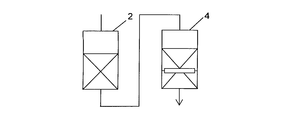
- FIG. 1 is a schematic diagram showing a method and apparatus for purifying a sucrose solution according to this embodiment.
- the first column 2 is a single-bed column packed with an acrylic OH type strongly basic anion exchange resin
- the second column 4 is a styrene type OH type strongly basic anion exchange resin and H. It is a mixed-bed tower mixed and packed with a slightly acidic cation exchange resin.
- the sucrose solution is purified (desalting and decoloring) using this purification apparatus, the sucrose solution is passed through the first column 2 and the second column 4 in this order.
- a sucrose solution contains a dye, but an acrylic OH-type strongly basic anion exchange resin has a low affinity for the dye and a weak adsorbing power with the dye.
- a styrene-based OH-type strongly basic anion exchange resin has a high affinity with a dye and a strong adsorbing power with the dye.
- the pigments contained in the sucrose solution exist from those having a high adsorption power to the ion exchange resin to those having a low adsorption power.
- the acrylic OH-type strongly basic anion exchange resin mainly absorbs a dye having a high adsorbing power with the ion exchange resin. Since the acrylic OH type strongly basic anion exchange resin originally has a weak adsorbing power with the dye, the dye adsorbed on the ion exchange resin can be easily detached from the ion exchange resin by the regenerating solution. As a result, the acrylic OH type strongly basic anion exchange resin can be easily regenerated and used without deteriorating.
- the first tower 2 mainly adsorbs the dye having a high adsorbing power with the ion exchange resin. Therefore, the adsorbing power with the ion exchange resin is mainly absorbed in the sucrose solution after passing through the first tower 2. Low pigment remains.
- the styrenic OH-type strongly basic anion exchange resin in the second column 4 mainly adsorbs a dye having a low adsorption power with the ion exchange resin. Therefore, the dye adsorbed on the styrenic OH-type strongly basic anion exchange resin having a high adsorbing power with the dye can also be easily desorbed by the regenerating solution. As a result, the styrene OH type strongly basic anion exchange resin can be easily regenerated and used without deteriorating.
- the first column 2 is filled with acrylic OH type strong basic anion exchange resin
- the second column 4 is filled with styrene type OH type strong basic anion exchange resin.
- the sucrose solution can be decolorized and desalted with high performance without degrading ion exchange resins (particularly, styrene-based OH-type strongly basic anion exchange resins) by decolorization (dye adsorption). Since the adsorptive power of the dye with the styrene-based OH type strongly basic anion exchange resin is not high and can be easily detached from the styrene-based OH type strongly basic anion exchange resin, The amount of use can be reduced.
- the dye is considered to adsorb to the base structure of the ion exchange resin.
- Styrene-based OH-type strongly basic anion exchange resins have a benzene structure in the matrix structure, so they have a high affinity for dyes with similar structures (for example, aromatic ring structures) and adsorbing power to the dyes. Is considered strong.
- the acrylic OH type strongly basic anion exchange resin does not have a structure similar to the dye in the matrix structure, so it is considered that the affinity with the dye is low and the adsorption power to the dye is weak. It is done.
- acrylic OH type strongly basic anion exchange resin charged in the first tower 2 examples include Amberlite (registered trademark, hereinafter the same) IRA958, IRA458 (manufactured by Dow Chemical Co.), PUROLITE (registered trademark, hereinafter, The same) A860, A850 (manufactured by Purolite Co., Ltd.) and the like can be mentioned.
- the acrylic OH type strongly basic anion exchange resins the gel type resin is particularly advantageous because it has a large ion exchange capacity and increases the amount of sucrose solution that can be processed.
- gel-type acrylic OH-type strongly basic anion exchange resins examples include Amberlite® IRA458 (manufactured by Dow Chemical Co.) and PUROLITE A850 (manufactured by Purolite).
- Gel-type ion exchange resins have a uniform internal pore size and are generally provided in the form of transparent beads.
- porous (macroporous, porous) ion exchange resins have pores with different diameters in the interior and a pore size distribution, and generally are opaque beads that do not transmit light. Provided as a form. Accordingly, it is possible to confirm whether or not the ion-exchange resin is a gel type by examining the pore diameter inside the ion-exchange resin with a microscope or examining the light permeability to the ion-exchange resin.
- Examples of the styrenic OH-type strongly basic anion exchange resin filled in the second tower 4 include Amberlite IRA900, IRA402, IRA402BL (manufactured by Dow Chemical Co.), PUROLITE A500S (manufactured by Purolite), Diaion SA10A, PA308 (manufactured by Mitsubishi Chemical Corporation) and the like can be mentioned.
- H-type weakly acidic cation exchange resin used in the second column 4 examples include Amberlite IRC76, Dowex (registered trademark, hereinafter the same), MAC-3 (manufactured by Dow Chemical), PUROLITE C115E (manufactured by Purolite). And Diaion WK10, WK11 (Mitsubishi Chemical Corporation).
- the matrix structure of the H-type weakly acidic cation exchange resin is not particularly limited. For example, a styrene-based or acrylic-based H-type weakly acidic cation exchange resin can be used.
- Each of the above ion exchange resins should be made into OH form (in the case of anion exchange resin) and H form (in the case of cation exchange resin) by passing a regenerating solution in advance before use. Can do.
- sucrose solution is passed through the first column 2 and the second column 4 in this order, as shown in FIG. That is, the sucrose solution is passed in the direction shown by the arrow in FIG. 1, and the sucrose solution is first passed from the top of the first tower 2 toward the bottom, and the sucrose solution is recovered from the bottom of the first tower 2.
- the recovered sucrose solution is passed from the top of the second column 4 toward the bottom, and the sucrose solution is recovered from the bottom of the second column 4.
- anions carbonate ions (CO 3 2 ⁇ ), hydrogen carbonate ions (HCO 3 ⁇ ), chloride ions (Cl ⁇ ) Etc.
- a dye having a high adsorption power mainly with an ion exchange resin can be adsorbed and removed.
- the sucrose solution after passing through the first column 2 contains anions (carbonate ions (CO 3 2 ⁇ ), hydrogen carbonate ions (HCO 3 ⁇ ), chloride ions (Cl - ) Etc.), a cation, and a dye having a low adsorptive power mainly with an ion exchange resin remains.
- anions carbonate ions ( CO 3 2 ⁇ ), bicarbonate ions (HCO 3 ⁇ ), chloride ions (Cl ⁇ ) and the like, and dyes having a low adsorptive power mainly with ion exchange resins can be adsorbed and removed.
- the H-type weakly acidic cation exchange resin packed in the second tower 4 can adsorb and remove cations (calcium ions (Ca 2+ ), sodium ions (Na + ), etc.).
- the acrylic OH-type strongly basic anion exchange resin originally has a weak adsorption power with the dye, the dye adsorbed on the ion exchange resin can be easily detached from the ion exchange resin by the regenerating solution. Can do. As a result, the acrylic OH type strongly basic anion exchange resin can be easily regenerated and used without deteriorating.
- the styrene-based OH-type strong base anion exchange resin in the second tower 4 mainly adsorbs a dye having a low adsorbing power with the ion-exchange resin. Even the dye adsorbed on the cationic anion exchange resin can be easily desorbed by the regenerating solution. As a result, the styrene OH type strongly basic anion exchange resin can be easily regenerated and used without deteriorating.
- the acrylic OH type strongly basic anion exchange resin packed in the first column 2 and the styrene type OH type strongly basic anion packed in the second column 4 are used.
- the sucrose solution is repeatedly purified (decolorized and desalted) with high capacity without degrading ion exchange resins (especially among them, styrene-based OH-type strongly basic anion exchange resins) by decolorization (dye adsorption). be able to.
- the adsorption power of the dye with the styrene-based OH-type strongly basic anion exchange resin is not high, and the dye can be easily detached from the styrene-type OH-type strongly basic anion exchange resin by the regenerating solution.
- the amount of the regenerating solution used can be reduced.
- the sucrose solution to be purified by the method of the present embodiment is not particularly limited, and examples thereof include brown liquor obtained by dissolving a sugar cane raw material sugar, carbonation saturation, and a filtration step.
- FIG. 1 Regeneration method of sucrose solution purification equipment 2A to 2D are schematic views showing a method for regenerating the purification apparatus of FIG.
- hydroxide ions OH ⁇
- anions carbonate ions (CO 3 2 ⁇ )
- Hydrogen carbonate ions HCO 3 ⁇
- chloride ions Cl ⁇
- Hydrogen ions (H + ) and hydroxide ions (OH ⁇ ) are desorbed from the H-type weakly acidic cation exchange resin and the styrenic OH-type strongly basic anion exchange resin in the second column 4, respectively.
- the dye adsorbs.
- OH-type strongly basic anion exchange resin in the first column 2 for example, Cl - - strong basic anion exchange resin, CO 3 2-- strong basic anion exchange resin, HCO 3 ⁇ —strongly basic anion exchange resin.
- the H-type weakly acidic cation exchange resin in the second column 4 becomes, for example, Ca 2+ -weakly acidic cation exchange resin, Na + -weakly acidic cation exchange resin, and OH type strongly basic anion exchange resin.
- CO 3 2- - strong basic anion exchange resin, HCO 3 - - strong basic anion exchange resin, Cl - - has a strong basic anion exchange resin.
- dye has adsorb
- water (H 2 O) is passed through the second tower 4 from the bottom to the top.
- the strongly basic anion exchange resin and the weakly acidic cation exchange resin in the second column 4 flow and are separated by the difference in specific gravity of these ion exchange resins (backwash separation method).
- a strong basic anion exchange resin 4a is arranged at the upper part and a weak acidic cation exchange resin 4b is arranged at the lower part in the second tower 4 by the separation.
- a sodium hydroxide aqueous solution is passed through the second column 4 from the top of the second column 4 as a first regeneration solution for the OH type strongly basic anion exchange resin.
- water is passed from the bottom of the second tower 4.
- the first regenerated solution is recovered by an intermediate collector located at the boundary between the styrenic strong basic anion exchange resin and the weakly acidic cation exchange resin separated from each other.
- the first regenerated solution reaches the weakly acidic cation exchange resin separated at the lower part in the second tower 4 and the weakly regenerated acid cation exchange resin is reached. It is possible to prevent the ion exchange resin from deteriorating.
- carbonate ions (CO 3 2 ⁇ ) carbonate ions (CO 3 )
- hydrogen carbonate ions (HCO 3 ) from the styrene strong basic anion exchange resin in the second column 4 are used.
- ⁇ carbonate ions
- HCO 3 hydrogen carbonate ions
- Chloride ions Cl ⁇
- hydroxide ions OH ⁇
- the first regenerated liquid after passing through the second tower 4 and the additional first regenerated liquid are passed from the top to the bottom of the first tower 2.
- the order of passing the first regenerated liquid after passing through the second tower 4 and the additional first regenerated liquid into the first tower 2 is not particularly limited, but after passing through the second tower 4 It is preferable that after the first regenerating liquid is passed through the first tower 2, the additional first regenerating liquid is passed through the first tower 2. In some cases, it is not necessary to pass an additional first regeneration solution into the first column 2. Thereby, the acrylic strong basic anion exchange resin in the first tower 2 is regenerated.
- carbonate ions CO 3 2 ⁇
- hydrogen carbonate ions HCO 3 ⁇
- chloride ions Cl ⁇
- hydroxides Ions OH ⁇
- the acrylic strong basic anion exchange resin in the first column 2 is mainly a dye having a high adsorptive power with the ion exchange resin, and the styrene strong basic anion exchange in the second column 4
- the resin is mainly adsorbed with a dye having a low adsorption power with the ion exchange resin. Since an acrylic strongly basic anion exchange resin originally has a weak adsorption power with the dye, the dye adsorbed on the ion exchange resin can be easily desorbed by the first regeneration solution in the step of FIG. 2B. Can do. As a result, the acrylic strongly basic anion exchange resin can be easily regenerated without deteriorating.
- the dye adsorbed on the styrenic strongly basic anion exchange resin is a dye having a low adsorption power with the ion exchange resin, and therefore can be easily desorbed by the first regenerating solution in the step of FIG. 2B. it can. For this reason, the usage-amount of the 1st reproduction
- a sodium hydroxide aqueous solution is used as the first regeneration solution.
- the first regeneration solution is not particularly limited as long as it is an alkaline solution, and is preferably a sodium hydroxide aqueous solution or a potassium hydroxide aqueous solution. More preferably, it is a sodium hydroxide aqueous solution.
- the concentration of sodium hydroxide in the aqueous sodium hydroxide solution is not particularly limited as long as it does not degrade the ion exchange resin, but is preferably 0.05 to 3.0 normal, more preferably 0.5 to 2.0 normal.
- hydroxide ions (OH ⁇ ) are desorbed from the styrenic OH type strongly basic anion exchange resin, and chloride ions (Cl ⁇ ) are adsorbed, and Cl ⁇ ⁇ strongly basic anion exchange resin and Can be prevented.
- cations Ca ions (Ca 2+ ), Na ions (Na + ), etc.
- an aqueous hydrogen chloride solution is used as the second regeneration solution, but the second regeneration solution is not particularly limited as long as it is an acid solution.
- the hydrogen chloride concentration in the solution is not particularly limited as long as it does not deteriorate the ion exchange resin, but is preferably 0.05 to 2.0 N, preferably 0.1 to 1.0 N. More preferred.
- each regenerated liquid After passing each regenerated liquid through each tower, water is passed through each tower, and the regenerated liquid remaining in each tower is pushed out and discharged outside the tower. After the step of FIG. 2D, water may be passed through each tower to wash the ion exchange resin in the tower.
- Example 1 In the purification apparatus shown in FIG. 1, 3.6 L of brown liquor [Brix sugar content 55%, conductivity 248 ⁇ S / cm (25 ° C.), pH 7.2, color value 450 ICUMSA (International Commission for Uniform Methods of Sugar Analysis)] was passed in the direction indicated by the arrow in FIG. And the whole quantity of the sucrose solution was collect
- Table 1 shows ion exchange resins used in the purification apparatus of FIG.
- pure water was passed through the first tower 2 and the second tower 4 to wash out the sucrose solution from these towers. Subsequently, pure water (solution) is passed from the bottom of the second column 4 toward the top, and the strong base anion exchange resin and the weakly acidic cation exchange resin in the second column 4 are fluidized to form a strong base.
- the anionic exchange resin and the weakly acidic cation exchange resin were separated so as to be arranged at the upper part and the lower part, respectively.
- first regeneration solution 200 mL of a 1N sodium hydroxide aqueous solution (first regeneration solution) is passed from the top of the second column 4, and pure water is passed from the bottom of the second column 4 to pass through the first regeneration solution and Pure water was discharged from an intermediate collector located at the boundary between the strongly basic anion exchange resin and the weakly acidic cation exchange resin.
- the aqueous sodium hydroxide solution passed through the second tower 4 was passed from the top to the bottom of the first tower 2.
- 100 mL of a 1N aqueous sodium hydroxide solution was passed from the top to the bottom of the first column 2.
- the OH type strongly basic anion exchange resins in the first column 2 and the second column 4 were respectively washed with a sufficient amount of pure water.
- second regeneration solution 200 mL of a 1N aqueous solution of hydrogen chloride (second regeneration solution) is passed from the bottom of the second column 4, and pure water is passed from the top of the second column 4 to pass through the second regeneration solution and Pure water was drained from the intermediate collector. Furthermore, by passing pure water from the top of the second column 4, the H-type weakly acidic cation exchange resin in the second column 4 was sufficiently washed with water, and the hydrogen chloride remaining in the column was washed away.
- second regeneration solution 200 mL of a 1N aqueous solution of hydrogen chloride
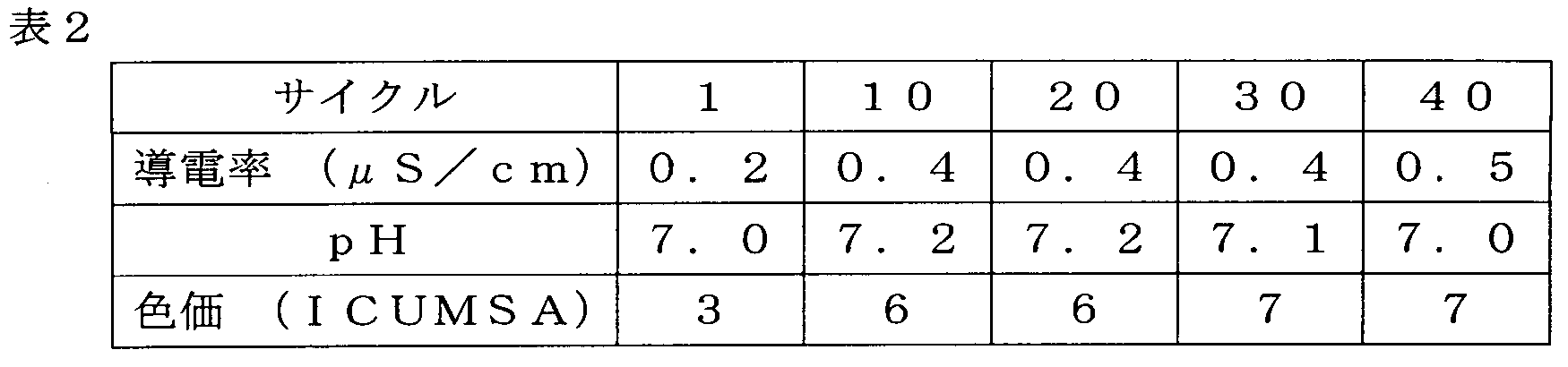
- sucrose solution flow and purification device regeneration were repeated 40 times (cycles) repeatedly, and the sucrose solution conductivity ( ⁇ S after passing through the second tower 4 of the first, tenth, twentieth, thirty and forty cycles. / Cm), pH, and color value (ICUMSA). These results are shown in Table 2.
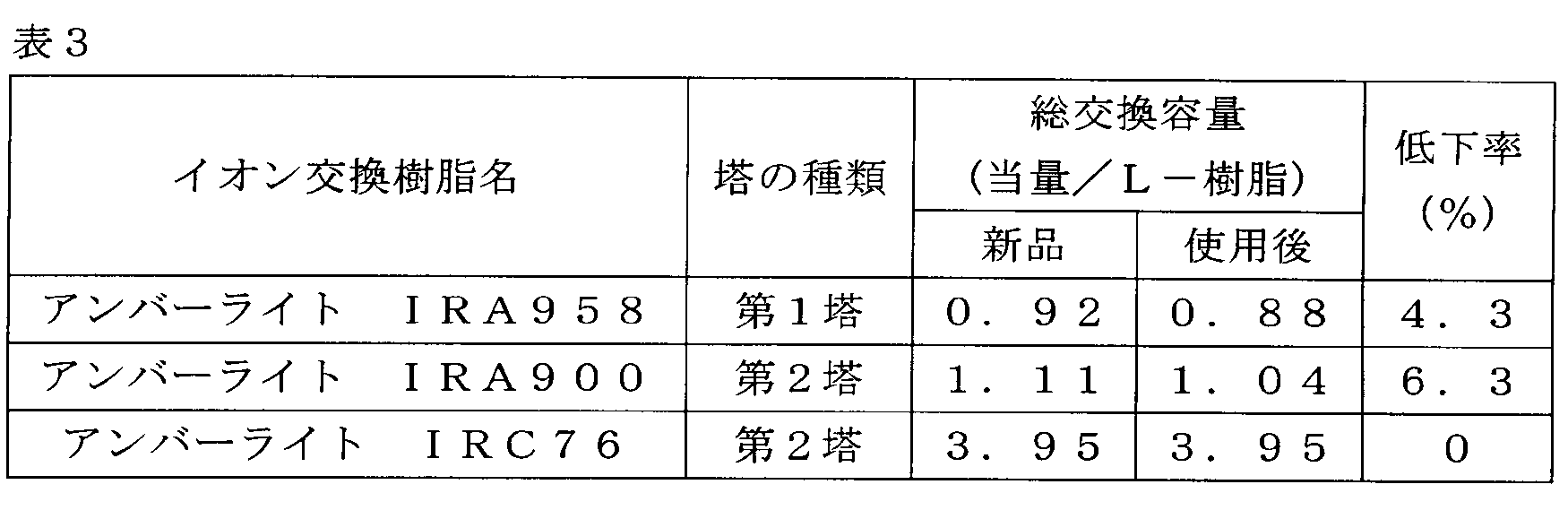
- Table 3 shows the analysis results of each ion exchange resin after 40 cycles.
- Example 1 The sucrose solution was purified in the same manner as in Example 1 except that the anion exchange resin charged in the first column 2 was a styrene-based OH type strongly basic anion exchange resin.
- the ion exchange resin used in this comparative example is shown in Table 1 above.
- the sodium hydroxide aqueous solution (first regeneration solution) recovered from the intermediate collector in the step of FIG. 2B of Example 1 is not passed through the first column 2 but the top of the first column 2.
- the amount of 1N aqueous sodium hydroxide solution that was newly passed through from the bottom to the bottom was 200 mL. Except for this, the purification apparatus was regenerated in the same manner as in Example 1.
- Example 1 From the results of Tables 2 and 4, it can be seen that in Example 1, the values of conductivity, pH and color value are kept low even after the end of 40 cycles. It can be seen that after 40 cycles, Example 1 has lower values of conductivity, pH and color value than Comparative Example 1.
Landscapes
- Chemical & Material Sciences (AREA)
- Organic Chemistry (AREA)
- Chemical Kinetics & Catalysis (AREA)
- Life Sciences & Earth Sciences (AREA)
- Biochemistry (AREA)
- Treatment Of Water By Ion Exchange (AREA)
- Treatment Of Liquids With Adsorbents In General (AREA)
Abstract
アクリル系のOH形強塩基性陰イオン交換樹脂を充填した第1塔と、第1塔の後段に配しスチレン系のOH形強塩基性陰イオン交換樹脂とH形弱酸性陽イオン交換樹脂とを混合充填した第2塔に、蔗糖溶液をこの順に通液することにより、蔗糖溶液を精製する。この精製方法によれば、高い脱塩および脱色性能を有すると共に、第2塔のスチレン系の強塩基性陰イオン交換樹脂の劣化を抑制することができ、第2塔のスチレン系の強塩基性陰イオン交換樹脂用の再生液の使用量を低減することができる。
Description
本発明は、蔗糖溶液の精製方法および精製装置に関する。
蔗糖溶液の精製装置として、蔗糖溶液を、OH形強塩基性陰イオン交換樹脂の単床塔に通液した後、OH形強塩基性陰イオン交換樹脂とH形弱酸性陽イオン交換樹脂の混床塔に通液する、いわゆるA-MB法の二床塔式の精製装置が使用されている(特許文献1)。この装置の単床塔および混床塔で使用されている陰イオン交換樹脂は、いずれもスチレン系のOH形強塩基性陰イオン交換樹脂である。スチレン系の強塩基性陰イオン交換樹脂は、蔗糖溶液中に含まれる色素との親和性が高いため、色素が強く吸着する。このため、スチレン系の強塩基性陰イオン交換樹脂は、高い脱塩および脱色性能を示す。
蔗糖溶液の脱色を目的とした装置として、前段にアクリル系の強塩基性陰イオン交換樹脂を充填した単床塔、後段にスチレン系の強塩基性陰イオン交換樹脂を充填した単床塔を配した、いわゆる二段脱色を行う二床塔式の装置が利用されている(非特許文献1、2)。前段の塔に充填されたアクリル系の強塩基性陰イオン交換樹脂は色素との親和性が低いため、色素は弱く吸着する。このため、再生工程において、アクリル系の強塩基性陰イオン交換樹脂から色素を脱離させて容易に再生させることができる。後段の塔に充填されたスチレン系の強塩基性陰イオン交換樹脂は、アクリル系の強塩基性陰イオン交換樹脂で除去しきれなかった色素のみを除去することとなるため、このイオン交換樹脂の劣化を抑制することができる。
INT.SUGAR JNL.,1989,VOL.91,NO.1084,P65-70
INT.SUGAR JNL.,1982,VOL.84,NO.1007,P325-328
特許文献1の精製装置のスチレン系の強塩基性陰イオン交換樹脂は高い脱色性能を有するものの、色素が強く吸着して再生工程によって容易に色素を脱離できなかった。この結果、特許文献1の精製装置を使用するにつれて、スチレン系の強塩基性陰イオン交換樹脂内に色素が蓄積し、この結果、脱塩および脱色性能が早期に低下していた。従って、蔗糖溶液の高い脱塩および脱色性能を維持するためには、早い段階で、劣化したスチレン系の強塩基性陰イオン交換樹脂を新規なものに交換する必要があった。更に、スチレン系の強塩基性陰イオン交換樹脂には色素が強く吸着しているため、その再生のための再生液も多量に使用する必要があった。スチレン系の強塩基性陰イオン交換樹脂が早期に劣化することを防ぐために、その前段に脱色を目的としたイオン交換樹脂塔、活性炭塔、または骨炭塔を設けると、全部で三つの塔が必要となり、初期導入コストが高くなっていた。
非特許文献1および2の装置は、脱色を目的としたものであり、この装置では蔗糖溶液の脱塩を行うことができなかった。
一実施形態は、
アクリル系のOH形強塩基性陰イオン交換樹脂を充填した第1塔と、
第1塔の後段に配し、スチレン系のOH形強塩基性陰イオン交換樹脂とH形弱酸性陽イオン交換樹脂とを混合充填した第2塔に、
蔗糖溶液をこの順に通液することを特徴とする蔗糖溶液の精製方法に関する。
アクリル系のOH形強塩基性陰イオン交換樹脂を充填した第1塔と、
第1塔の後段に配し、スチレン系のOH形強塩基性陰イオン交換樹脂とH形弱酸性陽イオン交換樹脂とを混合充填した第2塔に、
蔗糖溶液をこの順に通液することを特徴とする蔗糖溶液の精製方法に関する。
他の実施形態は、
アクリル系のOH形強塩基性陰イオン交換樹脂を充填した第1塔と、
第1塔の後段に配し、スチレン系のOH形強塩基性陰イオン交換樹脂とH形弱酸性陽イオン交換樹脂とを混合充填した第2塔と、
を有することを特徴とする蔗糖溶液の精製装置に関する。
アクリル系のOH形強塩基性陰イオン交換樹脂を充填した第1塔と、
第1塔の後段に配し、スチレン系のOH形強塩基性陰イオン交換樹脂とH形弱酸性陽イオン交換樹脂とを混合充填した第2塔と、
を有することを特徴とする蔗糖溶液の精製装置に関する。
本発明によれば、高い脱塩および脱色性能を得ることができると共に、第2塔のスチレン系の強塩基性陰イオン交換樹脂の劣化を抑制することができる。本発明によれば、第2塔のスチレン系の強塩基性陰イオン交換樹脂用の再生液の使用量を低減することができる。
以下では、実施形態に基づいて本発明を説明する。なお、以下の実施形態は本発明の一例であって、本発明は下記の実施形態に限定されるものではない。
(蔗糖溶液の精製装置)
図1は、本実施形態の蔗糖溶液の精製方法および精製装置を示す模式図である。図1の精製装置では、第1塔2がアクリル系のOH形強塩基性陰イオン交換樹脂を充填した単床塔、第2塔4がスチレン系のOH形強塩基性陰イオン交換樹脂とH形弱酸性陽イオン交換樹脂とを混合充填した混床塔となっている。そして、この精製装置を用いて蔗糖溶液を精製(脱塩および脱色)する際には、第1塔2、第2塔4の順に蔗糖溶液を通液する。
図1は、本実施形態の蔗糖溶液の精製方法および精製装置を示す模式図である。図1の精製装置では、第1塔2がアクリル系のOH形強塩基性陰イオン交換樹脂を充填した単床塔、第2塔4がスチレン系のOH形強塩基性陰イオン交換樹脂とH形弱酸性陽イオン交換樹脂とを混合充填した混床塔となっている。そして、この精製装置を用いて蔗糖溶液を精製(脱塩および脱色)する際には、第1塔2、第2塔4の順に蔗糖溶液を通液する。
通常、蔗糖溶液中には色素が含まれるが、アクリル系のOH形強塩基性陰イオン交換樹脂は色素との親和性が低く、色素との吸着力が弱いという特性を有する。一方、スチレン系のOH形強塩基性陰イオン交換樹脂は色素との親和性が高く、色素との吸着力が強いという特性を有する。ここで、蔗糖溶液に含まれる色素にはイオン交換樹脂との吸着力が高いものから低いものまで存在する。
従って、アクリル系のOH形強塩基性陰イオン交換樹脂には主にイオン交換樹脂との吸着力が高い色素が吸着する。アクリル系のOH形強塩基性陰イオン交換樹脂は元々、色素との吸着力が弱いため、このイオン交換樹脂に吸着した色素は、再生液によってイオン交換樹脂から容易に脱離させることができる。この結果、アクリル系のOH形強塩基性陰イオン交換樹脂を劣化させることなく、容易に再生させて使用することができる。
上記のように第1塔2では主にイオン交換樹脂との吸着力が高い色素が吸着するため、第1塔2を通液後の蔗糖溶液中に、主にイオン交換樹脂との吸着力が低い色素が残留する。このため、第2塔4のスチレン系のOH形強塩基性陰イオン交換樹脂には主にイオン交換樹脂との吸着力が低い色素が吸着する。従って、色素との吸着力が高いスチレン系のOH形強塩基性陰イオン交換樹脂に吸着した色素も、再生液によって容易に脱離させることができる。この結果、スチレン系のOH形強塩基性陰イオン交換樹脂を劣化させることなく、容易に再生させて使用することができる。
以上のように、第1塔2にはアクリル系のOH形強塩基性陰イオン交換樹脂、第2塔4にはスチレン系のOH形強塩基性陰イオン交換樹脂を充填することにより、これらのイオン交換樹脂(特に、スチレン系のOH形強塩基性陰イオン交換樹脂)を脱色(色素吸着)によって劣化させることなく、高い能力で蔗糖溶液の脱色および脱塩を行うことができる。色素のスチレン系のOH形強塩基性陰イオン交換樹脂との吸着力は高くなく、再生液によってスチレン系のOH形強塩基性陰イオン交換樹脂から容易に脱離させることができるため、再生液の使用量を低減することができる。
色素はイオン交換樹脂の母体構造と吸着するものと考えられる。スチレン系のOH形強塩基性陰イオン交換樹脂は母体構造中にベンゼン構造を有するため、類似した構造(例えば、芳香族環構造など)を有する色素との親和性が高く、色素との吸着力が強いものと考えられる。この一方で、アクリル系のOH形強塩基性陰イオン交換樹脂は母体構造中に色素と類似した構造を有さないため、色素との親和性が低く、色素との吸着力が弱いものと考えられる。
第1塔2に充填するアクリル系のOH形強塩基性陰イオン交換樹脂としては、例えばアンバーライト(登録商標、以下、同様) IRA958、IRA458(ダウケミカル社製)、PUROLITE(登録商標、以下、同様) A860、A850(ピュロライト社製)などを挙げることができる。アクリル系のOH形強塩基性陰イオン交換樹脂のうち、特にゲル型樹脂は、イオン交換容量が大きく、処理できる蔗糖溶液の量が多くなることから有利である。ゲル型のアクリル系のOH形強塩基性陰イオン交換樹脂としてはアンバーライト IRA458(ダウケミカル社製)、PUROLITE A850(ピュロライト社製)を挙げることができる。ゲル型のイオン交換樹脂は内部の細孔径が均一であると共に、一般的には透明性を有するビーズの形態として提供される。これに対して、ポーラス型(マクロポーラス型、ポーラス型)のイオン交換樹脂はその内部に異なる径の細孔が存在し細孔径分布を有すると共に、一般的には光を透過しない不透明なビーズの形態として提供される。従って、顕微鏡によってイオン交換樹脂内部の細孔径を調べたり、イオン交換樹脂に対する光の透過性を調べることによりゲル型のイオン交換樹脂であるか否か、を確認することができる。
第2塔4に充填するスチレン系のOH形強塩基性陰イオン交換樹脂としては、例えば、アンバーライト IRA900、IRA402、IRA402BL(ダウケミカル社製)、PUROLITE A500S(ピュロライト社製)、ダイヤイオン SA10A、PA308(三菱化学社製)などを挙げることができる。
第2塔4に用いるH形弱酸性陽イオン交換樹脂としては、例えば、アンバーライト IRC76、ダウエックス(登録商標、以下、同様) MAC-3(ダウケミカル社製)、PUROLITE C115E(ピュロライト社製)、ダイヤイオン WK10、WK11(三菱化学社製)などを挙げることができる。H形弱酸性陽イオン交換樹脂の母体構造は特に限定されないが、例えば、スチレン系やアクリル系のH形弱酸性陽イオン交換樹脂を用いることができる。
上記の各イオン交換樹脂は、使用前に、予め再生液を通液することにより、OH形(陰イオン交換樹脂の場合)、およびH形(陽イオン交換樹脂の場合)にしたものを用いることができる。
(蔗糖溶液の精製方法)
本実施形態の蔗糖溶液の精製方法では、図1に示すように、第1塔2、第2塔4の順に蔗糖溶液を通液する。すなわち、蔗糖溶液は、図1の矢印に示す方向に通液され、最初に第1塔2の頂部から底部に向かって蔗糖溶液が通液され、第1塔2の底部から蔗糖溶液が回収される。回収後の蔗糖溶液は、第2塔4の頂部から底部に向かって通液され、第2塔4の底部から蔗糖溶液が回収される。
本実施形態の蔗糖溶液の精製方法では、図1に示すように、第1塔2、第2塔4の順に蔗糖溶液を通液する。すなわち、蔗糖溶液は、図1の矢印に示す方向に通液され、最初に第1塔2の頂部から底部に向かって蔗糖溶液が通液され、第1塔2の底部から蔗糖溶液が回収される。回収後の蔗糖溶液は、第2塔4の頂部から底部に向かって通液され、第2塔4の底部から蔗糖溶液が回収される。
この際、第1塔2に充填したアクリル系のOH形強塩基性陰イオン交換樹脂では、陰イオン(炭酸イオン(CO3
2-)、炭酸水素イオン(HCO3
-)、塩化物イオン(Cl-)等)および主にイオン交換樹脂との吸着力が高い色素を吸着・除去できる。第1塔2を通液後の蔗糖溶液には、第1塔2で除去しきれなかった陰イオン(炭酸イオン(CO3
2-)、炭酸水素イオン(HCO3
-)、塩化物イオン(Cl-)等)、陽イオン、および主にイオン交換樹脂との吸着力が低い色素が残留している。第1塔2を通液後の蔗糖溶液を第2塔4に通液することにより、第2塔4に充填したスチレン系のOH形強塩基性陰イオン交換樹脂では、陰イオン(炭酸イオン(CO3
2-)、炭酸水素イオン(HCO3
-)、塩化物イオン(Cl-)等)および主にイオン交換樹脂との吸着力が低い色素を吸着・除去できる。第2塔4に充填したH形弱酸性陽イオン交換樹脂では、陽イオン(カルシウムイオン(Ca2+)、ナトリウムイオン(Na+)等)を吸着・除去できる。
ここで、アクリル系のOH形強塩基性陰イオン交換樹脂は元々、色素との吸着力が弱いため、このイオン交換樹脂に吸着した色素は、再生液によってイオン交換樹脂から容易に脱離させることができる。この結果、アクリル系のOH形強塩基性陰イオン交換樹脂を劣化させることなく、容易に再生させて使用することができる。第2塔4のスチレン系のOH形強塩基性陰イオン交換樹脂には主にイオン交換樹脂との吸着力が低い色素が吸着するため、色素との吸着力が高いスチレン系のOH形強塩基性陰イオン交換樹脂に吸着した色素であっても、再生液によって容易に脱離させることができる。この結果、スチレン系のOH形強塩基性陰イオン交換樹脂を劣化させることなく、容易に再生させて使用することができる。
以上のように、本実施形態の精製方法では、第1塔2に充填したアクリル系のOH形強塩基性陰イオン交換樹脂、および第2塔4に充填したスチレン系のOH形強塩基性陰イオン交換樹脂(これらの中でも特に、スチレン系のOH形強塩基性陰イオン交換樹脂)を脱色(色素吸着)によって劣化させることなく、高い能力で繰り返し蔗糖溶液の精製(脱色および脱塩)を行うことができる。色素のスチレン系のOH形強塩基性陰イオン交換樹脂との吸着力は高くなく、再生液によってスチレン系のOH形強塩基性陰イオン交換樹脂から色素を容易に脱離させることができるため、再生液の使用量を低減することができる。
本実施形態の方法で、精製する蔗糖溶液は特に限定されないが、例えば、甘蔗糖原料糖を溶解、炭酸飽充、ろ過工程を経て得られるブラウンリカーを挙げることができる。
(蔗糖溶液の精製装置の再生方法)
図2A~2Dは、図1の精製装置を再生する方法を示す模式図である。蔗糖溶液の精製によって、第1塔2内のアクリル系のOH形強塩基性陰イオン交換樹脂から水酸化物イオン(OH-)が脱離して、陰イオン(炭酸イオン(CO3 2-)、炭酸水素イオン(HCO3 -)、塩化物イオン(Cl-)等)が吸着すると共に色素が吸着する。第2塔4内のH形弱酸性陽イオン交換樹脂およびスチレン系のOH形強塩基性陰イオン交換樹脂から、それぞれ水素イオン(H+)および水酸化物イオン(OH-)が脱離して、陽イオン(Caイオン(Ca2+)、Naイオン(Na+)等)と、陰イオン(炭酸イオン(CO3 2-)、炭酸水素イオン(HCO3 -)、塩化物イオン(Cl-)等)および色素が吸着する。すなわち、蔗糖溶液の精製後、第1塔2内のOH形強塩基性陰イオン交換樹脂は例えば、Cl--強塩基性陰イオン交換樹脂、CO3 2--強塩基性陰イオン交換樹脂、HCO3 --強塩基性陰イオン交換樹脂、となっている。精製後、第2塔4内のH形弱酸性陽イオン交換樹脂は例えば、Ca2+-弱酸性陽イオン交換樹脂、Na+-弱酸性陽イオン交換樹脂となり、OH形強塩基性陰イオン交換樹脂は例えば、CO3 2--強塩基性陰イオン交換樹脂、HCO3 --強塩基性陰イオン交換樹脂、Cl--強塩基性陰イオン交換樹脂となっている。そして、第1塔2および第2塔4内のOH形強塩基性陰イオン交換樹脂の母体構造等には、色素が吸着している。
図2A~2Dは、図1の精製装置を再生する方法を示す模式図である。蔗糖溶液の精製によって、第1塔2内のアクリル系のOH形強塩基性陰イオン交換樹脂から水酸化物イオン(OH-)が脱離して、陰イオン(炭酸イオン(CO3 2-)、炭酸水素イオン(HCO3 -)、塩化物イオン(Cl-)等)が吸着すると共に色素が吸着する。第2塔4内のH形弱酸性陽イオン交換樹脂およびスチレン系のOH形強塩基性陰イオン交換樹脂から、それぞれ水素イオン(H+)および水酸化物イオン(OH-)が脱離して、陽イオン(Caイオン(Ca2+)、Naイオン(Na+)等)と、陰イオン(炭酸イオン(CO3 2-)、炭酸水素イオン(HCO3 -)、塩化物イオン(Cl-)等)および色素が吸着する。すなわち、蔗糖溶液の精製後、第1塔2内のOH形強塩基性陰イオン交換樹脂は例えば、Cl--強塩基性陰イオン交換樹脂、CO3 2--強塩基性陰イオン交換樹脂、HCO3 --強塩基性陰イオン交換樹脂、となっている。精製後、第2塔4内のH形弱酸性陽イオン交換樹脂は例えば、Ca2+-弱酸性陽イオン交換樹脂、Na+-弱酸性陽イオン交換樹脂となり、OH形強塩基性陰イオン交換樹脂は例えば、CO3 2--強塩基性陰イオン交換樹脂、HCO3 --強塩基性陰イオン交換樹脂、Cl--強塩基性陰イオン交換樹脂となっている。そして、第1塔2および第2塔4内のOH形強塩基性陰イオン交換樹脂の母体構造等には、色素が吸着している。
本実施形態の再生方法ではまず、図2Aに示すように、第2塔4内に、その底部から頂部に向かって水(H2O)を通液する。これにより、第2塔4内の強塩基性陰イオン交換樹脂と弱酸性陽イオン交換樹脂は流動し、これらのイオン交換樹脂の比重の差によって分離される(逆洗分離法)。本実施形態では、分離によって、第2塔4内で上部に強塩基性陰イオン交換樹脂4a、下部に弱酸性陽イオン交換樹脂4bが配される。
次に、図2Bに示すように、第2塔4の頂部から、OH形強塩基性陰イオン交換樹脂用の第1の再生液として水酸化ナトリウム水溶液を、第2塔4内に通液すると共に、第2塔4の底部から水を通液する。この水を第1の再生液と向流とすることで、第1の再生液が第2塔4内の下部に分離された弱酸性陽イオン交換樹脂4bにまで到達するのを防止できる。そして、互いに分離されたスチレン系の強塩基性陰イオン交換樹脂と弱酸性陽イオン交換樹脂の境界部に位置する中間コレクターで、第1の再生液を回収する。このように中間コレクターで、第1の再生液を回収することによって、第1の再生液が第2塔4内の下部に分離された弱酸性陽イオン交換樹脂にまで到達して、弱酸性陽イオン交換樹脂が劣化するのを防止することができる。第2塔4内への第1の再生液の通液により例えば、第2塔4内のスチレン系の強塩基性陰イオン交換樹脂から炭酸イオン(CO3
2-)、炭酸水素イオン(HCO3
-)、塩化物イオン(Cl-)を脱離させ、代わりに水酸化物イオン(OH-)を吸着させて、スチレン系のOH形強塩基性陰イオン交換樹脂とする。
次に、第2塔4内を通液後の第1の再生液および追加の第1の再生液(水酸化ナトリウム水溶液)を、第1塔2の頂部から底部に向かって通液する。第2塔4内を通液後の第1の再生液および追加の第1の再生液を、第1塔2内に通液する順序は特に限定されないが、第2塔4内を通液後の第1の再生液を第1塔2内に通液した後、追加の第1の再生液を第1塔2内に通液するのが好ましい。場合によっては、第1塔2内に、追加の第1の再生液を通液しなくても良い。これにより、第1塔2内のアクリル系の強塩基性陰イオン交換樹脂が再生される。すなわち、例えば、アクリル系の強塩基性陰イオン交換樹脂から炭酸イオン(CO3
2-)、炭酸水素イオン(HCO3
-)、塩化物イオン(Cl-)を脱離させ、代わりに水酸化物イオン(OH-)を吸着させて、アクリル系のOH形強塩基性陰イオン交換樹脂とする。
上記の再生前に、第1塔2のアクリル系の強塩基性陰イオン交換樹脂には主にイオン交換樹脂との吸着力が高い色素、第2塔4のスチレン系の強塩基性陰イオン交換樹脂には主にイオン交換樹脂との吸着力が低い色素が吸着している。アクリル系の強塩基性陰イオン交換樹脂は元々、色素との吸着力が弱いため、このイオン交換樹脂に吸着した色素は、図2Bの工程で、第1の再生液によって容易に脱離させることができる。この結果、アクリル系の強塩基性陰イオン交換樹脂を劣化させることなく、容易に再生させることができる。スチレン系の強塩基性陰イオン交換樹脂に吸着しているのはイオン交換樹脂との吸着力が低い色素であるため、図2Bの工程で、第1の再生液によって容易に脱離させることができる。このため、図2Bの工程で使用する第1の再生液の使用量を低減することができる。
本実施形態では、第1の再生液として水酸化ナトリウム水溶液を使用したが、第1の再生液はアルカリ溶液であれば特に限定されず、好ましくは水酸化ナトリウム水溶液または水酸化カリウム水溶液であるのが良く、より好ましくは水酸化ナトリウム水溶液であるのが良い。水酸化ナトリウム水溶液中の水酸化ナトリウム濃度はイオン交換樹脂を劣化させないものであれば特に限定されないが、0.05~3.0規定が好ましく、0.5~2.0規定がより好ましい。
次に、図2Cに示すように、第2塔4の底部からH形弱酸性陽イオン交換樹脂用の第2の再生液として塩化水素水溶液を第2塔4内に通液し、第2塔4の頂部から水を第2塔4内に通液する。そして、廃液(第2の再生液および水)を中間コレクターから回収する。このように中間コレクターで、第2の再生液を回収することによって、第2の再生液が第2塔4内の上部に分離されたスチレン系のOH形強塩基性陰イオン交換樹脂にまで到達し、スチレン系のOH形強塩基性陰イオン交換樹脂から水酸化物イオン(OH-)が脱離して、塩化物イオン(Cl-)が吸着し、Cl--強塩基性陰イオン交換樹脂となるのを防止できる。第2の再生液によって、第2塔4内の弱酸性陽イオン交換樹脂から陽イオン(Caイオン(Ca2+)、Naイオン(Na+)等)が脱離して再生され、H形弱酸性陽イオン交換樹脂となる。
本実施形態では、第2の再生液として塩化水素水溶液を使用したが、第2の再生液は酸溶液であれば特に限定されない。塩化水素水溶液を使用する場合、溶液中の塩化水素濃度はイオン交換樹脂を劣化させないものであれば特に限定されないが、0.05~2.0規定が好ましく、0.1~1.0規定がより好ましい。
次に、図2Dに示すように、第2塔4の底部から第2塔4内に圧縮空気を流し、第2塔4内で分離配置されたスチレン系のOH形強塩基性陰イオン交換樹脂とH形弱酸性陽イオン交換樹脂を流動させて混合させる。これにより、圧縮空気の流入を終了後の第2塔4内ではOH形強塩基性陰イオン交換樹脂とH形弱酸性陽イオン交換樹脂が混合充填され、第2塔4は混床となる。
各塔への各再生液の通液後、各塔へ水を通液して、各塔に残留している再生液を押し出して塔外へ排出させる。図2Dの工程の後に、各塔へ水を通液して、塔内のイオン交換樹脂を洗浄しても良い。
(実施例1)
図1に示した精製装置に、蔗糖溶液として、3.6Lのブラウンリカー[ブリックス糖度55%、導電率248μS/cm(25℃)、pH7.2、色価450 ICUMSA(International Commission for Uniform Methods of Sugar Analysis)]を、通液条件:300mL/h、45℃で、図1の矢印に示す向きに通液した。そして、第2塔4の底部から蔗糖溶液の全量を回収し、導電率、pHおよび色価を測定した。図1の精製装置で使用したイオン交換樹脂を表1に示す。
図1に示した精製装置に、蔗糖溶液として、3.6Lのブラウンリカー[ブリックス糖度55%、導電率248μS/cm(25℃)、pH7.2、色価450 ICUMSA(International Commission for Uniform Methods of Sugar Analysis)]を、通液条件:300mL/h、45℃で、図1の矢印に示す向きに通液した。そして、第2塔4の底部から蔗糖溶液の全量を回収し、導電率、pHおよび色価を測定した。図1の精製装置で使用したイオン交換樹脂を表1に示す。
蔗糖溶液の通液終了後、第1塔2および第2塔4内に純水を通液することにより、これらの塔から蔗糖溶液を洗い流した。次いで、第2塔4の底部から頂部に向かって純水(溶液)を通液し、第2塔4内の強塩基性陰イオン交換樹脂と弱酸性陽イオン交換樹脂を流動させて、強塩基性陰イオン交換樹脂および弱酸性陽イオン交換樹脂がそれぞれ、上部および下部に配されるように分離した。次に、第2塔4の頂部から1規定の水酸化ナトリウム水溶液(第1の再生液)200mLを通液し、第2塔4の底部から純水を通液して第1の再生液および純水を、強塩基性陰イオン交換樹脂および弱酸性陽イオン交換樹脂の境界に位置する中間コレクターより排出させた。
この後、第2塔4を通液後の水酸化ナトリウム水溶液を、第1塔2内の頂部から底部に向かって通液した。次いで、第1塔2の頂部から底部に向かって1規定の水酸化ナトリウム水溶液100mLを通液した。この後、第1塔2および第2塔4のOH形強塩基性陰イオン交換樹脂をそれぞれ、十分な量の純水で洗浄した。
次に、第2塔4の底部から1規定の塩化水素水溶液(第2の再生液)を200mL、通液し、第2塔4の頂部から純水を通液して第2の再生液および純水を中間コレクターから排出させた。さらに、第2塔4の頂部から純水を通液することで、第2塔4内のH形弱酸性陽イオン交換樹脂を十分に水洗し、塔内に残る塩化水素を洗い流した。
次に、第2塔4の底部から空気を導入して、塔内のスチレン系のOH形強塩基性陰イオン交換樹脂とH形弱酸性陽イオン交換樹脂を混合し、次のサイクルの蔗糖溶液の精製を行った。
上記の蔗糖溶液の通液と、精製装置の再生を40回(サイクル)、繰り返し、1、10、20、30、40サイクル目の第2塔4に通液後の蔗糖溶液の導電率 (μS/cm)、pH、および色価 (ICUMSA)を測定した。これらの結果を表2に示す。40サイクル後の各イオン交換樹脂の分析結果を表3に示す。

(比較例1)
第1塔2に充填する陰イオン交換樹脂をスチレン系のOH形強塩基性陰イオン交換樹脂とした以外は、実施例1と同じ方法で蔗糖溶液の精製を行った。本比較例で使用したイオン交換樹脂を上記表1に示す。
第1塔2に充填する陰イオン交換樹脂をスチレン系のOH形強塩基性陰イオン交換樹脂とした以外は、実施例1と同じ方法で蔗糖溶液の精製を行った。本比較例で使用したイオン交換樹脂を上記表1に示す。
精製装置の再生工程では、実施例1の図2Bの工程において、中間コレクターから回収した水酸化ナトリウム水溶液(第1の再生液)を第1塔2に通液せず、第1塔2の頂部から底部に向かって新たに通液する1規定の水酸化ナトリウム水溶液の量を200mLとした。これ以外は、実施例1と同様にして精製装置の再生を行った。
上記の蔗糖溶液の通液と、精製装置の再生を40回(サイクル)、繰り返し、実施例1と同様にして、導電率 (μS/cm)、pH、および色価 (ICUMSA)を測定した。これらの結果を表4に示す。40サイクル後の各イオン交換樹脂の分析結果を表5に示す。


表2、4の結果より、実施例1では、40サイクル終了後も導電率、pHおよび色価が低い値を維持していることが分かる。40サイクル後において、実施例1は、比較例1よりも導電率、pHおよび色価が低い値となっていることが分かる。
表3、5の結果より、実施例1の第1塔のアクリル系の陰イオン交換樹脂(アンバーライトIRA958)は色素等に汚染されにくいため、比較例1における第1塔のスチレン系の陰イオン交換樹脂(アンバーライトIRA900)と比べて使用後の総交換容量の低下を大幅に抑制できることが分かる。さらに、第2塔のスチレン系の陰イオン交換樹脂(アンバーライト IRA900)についても、第1塔にアクリル系の陰イオン交換樹脂を用いた実施例1が、第1塔にスチレン系の陰イオン交換樹脂を用いた比較例1と比べて使用後の総交換容量の低下を抑制できることが分かる。
2 第1塔
4 第2塔
4a スチレン系の強塩基性陰イオン交換樹脂
4b 弱酸性陽イオン交換樹脂
4 第2塔
4a スチレン系の強塩基性陰イオン交換樹脂
4b 弱酸性陽イオン交換樹脂
Claims (5)
- アクリル系のOH形強塩基性陰イオン交換樹脂を充填した第1塔と、
第1塔の後段に配し、スチレン系のOH形強塩基性陰イオン交換樹脂とH形弱酸性陽イオン交換樹脂とを混合充填した第2塔に、
蔗糖溶液をこの順に通液することを特徴とする蔗糖溶液の精製方法。 - 前記第1塔に充填したアクリル系のOH形強塩基性陰イオン交換樹脂が、ゲル型のイオン交換樹脂であることを特徴とする請求項1に記載の蔗糖溶液の精製方法。
- 前記第1および第2塔に蔗糖溶液を通液した後、更に、
前記第2塔内に、OH形強塩基性陰イオン交換樹脂用の第1の再生液を通液する工程と、
前記第2塔内を通液後の第1の再生液を前記第1塔に通液する工程と、
をこの順に有することを特徴とする請求項1または2に記載の蔗糖溶液の精製方法。 - アクリル系のOH形強塩基性陰イオン交換樹脂を充填した第1塔と、
第1塔の後段に配し、スチレン系のOH形強塩基性陰イオン交換樹脂とH形弱酸性陽イオン交換樹脂とを混合充填した第2塔と、
を有することを特徴とする蔗糖溶液の精製装置。 - 前記第1塔に充填したアクリル系のOH形強塩基性陰イオン交換樹脂が、ゲル型のイオン交換樹脂であることを特徴とする請求項4に記載の蔗糖溶液の精製装置。
Priority Applications (1)
| Application Number | Priority Date | Filing Date | Title |
|---|---|---|---|
| CN201580002710.0A CN105765084A (zh) | 2014-02-25 | 2015-02-24 | 蔗糖溶液的精制方法和精制装置 |
Applications Claiming Priority (2)
| Application Number | Priority Date | Filing Date | Title |
|---|---|---|---|
| JP2014033880A JP6283235B2 (ja) | 2014-02-25 | 2014-02-25 | 蔗糖溶液の精製方法および精製装置 |
| JP2014-033880 | 2014-02-25 |
Publications (1)
| Publication Number | Publication Date |
|---|---|
| WO2015129698A1 true WO2015129698A1 (ja) | 2015-09-03 |
Family
ID=54009016
Family Applications (1)
| Application Number | Title | Priority Date | Filing Date |
|---|---|---|---|
| PCT/JP2015/055254 Ceased WO2015129698A1 (ja) | 2014-02-25 | 2015-02-24 | 蔗糖溶液の精製方法および精製装置 |
Country Status (3)
| Country | Link |
|---|---|
| JP (1) | JP6283235B2 (ja) |
| CN (1) | CN105765084A (ja) |
| WO (1) | WO2015129698A1 (ja) |
Cited By (3)
| Publication number | Priority date | Publication date | Assignee | Title |
|---|---|---|---|---|
| JP2018192443A (ja) * | 2017-05-19 | 2018-12-06 | オルガノ株式会社 | アニオン樹脂及びカチオン樹脂の再生方法及び復水脱塩装置 |
| JP2020058296A (ja) * | 2018-10-11 | 2020-04-16 | オルガノ株式会社 | 糖液の精製装置および精製方法 |
| CN117384223A (zh) * | 2023-10-10 | 2024-01-12 | 国药集团化学试剂有限公司 | 一种高纯药用糖类试剂的制备方法 |
Families Citing this family (4)
| Publication number | Priority date | Publication date | Assignee | Title |
|---|---|---|---|---|
| KR102302447B1 (ko) * | 2019-10-31 | 2021-09-17 | 주식회사 삼양사 | 아크릴계 이온 교환수지 및 스티렌계 이온 교환수지를 이용한 당 함유 용액의 정제 방법 |
| CN114606348A (zh) * | 2022-03-10 | 2022-06-10 | 欧尚元(天津)有限公司 | 一种蔗糖脱色的方法及系统 |
| WO2024131789A1 (zh) * | 2022-12-22 | 2024-06-27 | 中粮崇左糖业有限公司 | 一种注射级蔗糖、制备方法及其用途 |
| CN116217637B (zh) * | 2022-12-22 | 2023-10-24 | 中粮崇左糖业有限公司 | 一种注射级蔗糖、制备方法及其用途 |
Citations (4)
| Publication number | Priority date | Publication date | Assignee | Title |
|---|---|---|---|---|
| JPH02295499A (ja) * | 1989-05-09 | 1990-12-06 | Japan Organo Co Ltd | ショ糖液脱塩精製装置 |
| JPH02298358A (ja) * | 1989-05-09 | 1990-12-10 | Japan Organo Co Ltd | 混床式ショ糖液精製装置の再生法 |
| JP2009278882A (ja) * | 2008-05-20 | 2009-12-03 | Japan Organo Co Ltd | 糖液の脱色装置 |
| US20100307485A1 (en) * | 2008-05-06 | 2010-12-09 | Mario Cesar Bojorquez Valenzuela | Liquid sugar from raw granulated cane sugar purifying process |
-
2014
- 2014-02-25 JP JP2014033880A patent/JP6283235B2/ja active Active
-
2015
- 2015-02-24 CN CN201580002710.0A patent/CN105765084A/zh active Pending
- 2015-02-24 WO PCT/JP2015/055254 patent/WO2015129698A1/ja not_active Ceased
Patent Citations (4)
| Publication number | Priority date | Publication date | Assignee | Title |
|---|---|---|---|---|
| JPH02295499A (ja) * | 1989-05-09 | 1990-12-06 | Japan Organo Co Ltd | ショ糖液脱塩精製装置 |
| JPH02298358A (ja) * | 1989-05-09 | 1990-12-10 | Japan Organo Co Ltd | 混床式ショ糖液精製装置の再生法 |
| US20100307485A1 (en) * | 2008-05-06 | 2010-12-09 | Mario Cesar Bojorquez Valenzuela | Liquid sugar from raw granulated cane sugar purifying process |
| JP2009278882A (ja) * | 2008-05-20 | 2009-12-03 | Japan Organo Co Ltd | 糖液の脱色装置 |
Non-Patent Citations (2)
| Title |
|---|
| FRIES, W.: "Cane sugar decolorization by ion exchange resins", INTERNATIONAL SUGAR JOURNAL, vol. 84, no. 1007, 1982, pages 325 - 328, XP055186778 * |
| RAMM-SCHMIDT, L. ET AL.: "Experience of polystyrene and acrylic resins in two-bed decolorization systems", INTERNATIONAL SUGAR JOURNAL, vol. 91, no. 1084, 1989, pages 65 - 70 * |
Cited By (4)
| Publication number | Priority date | Publication date | Assignee | Title |
|---|---|---|---|---|
| JP2018192443A (ja) * | 2017-05-19 | 2018-12-06 | オルガノ株式会社 | アニオン樹脂及びカチオン樹脂の再生方法及び復水脱塩装置 |
| JP2020058296A (ja) * | 2018-10-11 | 2020-04-16 | オルガノ株式会社 | 糖液の精製装置および精製方法 |
| JP7214426B2 (ja) | 2018-10-11 | 2023-01-30 | オルガノ株式会社 | 糖液の精製装置および精製方法 |
| CN117384223A (zh) * | 2023-10-10 | 2024-01-12 | 国药集团化学试剂有限公司 | 一种高纯药用糖类试剂的制备方法 |
Also Published As
| Publication number | Publication date |
|---|---|
| JP2015156838A (ja) | 2015-09-03 |
| CN105765084A (zh) | 2016-07-13 |
| JP6283235B2 (ja) | 2018-02-21 |
Similar Documents
| Publication | Publication Date | Title |
|---|---|---|
| JP6283235B2 (ja) | 蔗糖溶液の精製方法および精製装置 | |
| JP6265750B2 (ja) | 蔗糖溶液の精製方法および精製装置 | |
| JP5762863B2 (ja) | アルコールの精製方法及び装置 | |
| JP4599803B2 (ja) | 脱塩水製造装置 | |
| JP2007181833A (ja) | テトラアルキルアンモニウムイオン含有液の処理方法 | |
| CN203715400U (zh) | 低浓度含铅废水的处理设备 | |
| CN106365242B (zh) | 一种吸附介质的再生方法以及印染废水的脱色处理方法 | |
| JP2016150275A (ja) | 純水の製造方法及び純水の製造装置 | |
| CN108607500A (zh) | 一种用于高镁锂比盐湖卤水提锂的凝胶吸附剂及制备方法 | |
| JP6404574B2 (ja) | 蒸留酒の精製方法および精製装置 | |
| JP3765653B2 (ja) | 混床式イオン交換樹脂塔の混合樹脂の分離方法および混床式ショ糖精製装置の再生方法 | |
| JP2016203053A (ja) | イオン交換樹脂の再生方法および再生装置 | |
| JP2003315496A5 (ja) | ||
| ITPD20100049A1 (it) | Metodo e dispositivo di trattamento dell'acqua | |
| JP2019097527A (ja) | 糖液の精製方法及び糖液精製装置 | |
| CN113479881A (zh) | 一种提高电容炭的纯度的方法 | |
| JP4800931B2 (ja) | 糖液の精製方法および精製装置 | |
| JP3592452B2 (ja) | 混床式の糖液精製装置 | |
| CN118531231B (zh) | 氯化物型老卤连续离交提锂系统及方法 | |
| JPS5823156B2 (ja) | 純水製造方法 | |
| JP2000109453A (ja) | ベタイン及びアミノ酸の回収方法 | |
| CN104418446A (zh) | 低浓度含铅废水的处理方法和设备 | |
| CN205556316U (zh) | 一种含钒废水深度处理及高效回收钒铬的装置 | |
| JPS5924663B2 (ja) | 溶液処理方法 | |
| JP2006254794A (ja) | 糖液精製システムにおけるフェノール系吸着樹脂の再生方法および糖液精製装置 |
Legal Events
| Date | Code | Title | Description |
|---|---|---|---|
| 121 | Ep: the epo has been informed by wipo that ep was designated in this application |
Ref document number: 15754844 Country of ref document: EP Kind code of ref document: A1 |
|
| NENP | Non-entry into the national phase |
Ref country code: DE |
|
| 122 | Ep: pct application non-entry in european phase |
Ref document number: 15754844 Country of ref document: EP Kind code of ref document: A1 |