WO2015099045A1 - 形質転換植物、形質転換植物を用いた糖含有滲出物の製造方法 - Google Patents
形質転換植物、形質転換植物を用いた糖含有滲出物の製造方法 Download PDFInfo
- Publication number
- WO2015099045A1 WO2015099045A1 PCT/JP2014/084319 JP2014084319W WO2015099045A1 WO 2015099045 A1 WO2015099045 A1 WO 2015099045A1 JP 2014084319 W JP2014084319 W JP 2014084319W WO 2015099045 A1 WO2015099045 A1 WO 2015099045A1
- Authority
- WO
- WIPO (PCT)
- Prior art keywords
- amino acid
- protein
- acid sequence
- transformed plant
- nucleic acid
- Prior art date
- Legal status (The legal status is an assumption and is not a legal conclusion. Google has not performed a legal analysis and makes no representation as to the accuracy of the status listed.)
- Ceased
Links
Images




Classifications
-
- C—CHEMISTRY; METALLURGY
- C12—BIOCHEMISTRY; BEER; SPIRITS; WINE; VINEGAR; MICROBIOLOGY; ENZYMOLOGY; MUTATION OR GENETIC ENGINEERING
- C12N—MICROORGANISMS OR ENZYMES; COMPOSITIONS THEREOF; PROPAGATING, PRESERVING, OR MAINTAINING MICROORGANISMS; MUTATION OR GENETIC ENGINEERING; CULTURE MEDIA
- C12N15/00—Mutation or genetic engineering; DNA or RNA concerning genetic engineering, vectors, e.g. plasmids, or their isolation, preparation or purification; Use of hosts therefor
- C12N15/09—Recombinant DNA-technology
- C12N15/63—Introduction of foreign genetic material using vectors; Vectors; Use of hosts therefor; Regulation of expression
- C12N15/79—Vectors or expression systems specially adapted for eukaryotic hosts
- C12N15/82—Vectors or expression systems specially adapted for eukaryotic hosts for plant cells, e.g. plant artificial chromosomes (PACs)
- C12N15/8241—Phenotypically and genetically modified plants via recombinant DNA technology
- C12N15/8242—Phenotypically and genetically modified plants via recombinant DNA technology with non-agronomic quality (output) traits, e.g. for industrial processing; Value added, non-agronomic traits
- C12N15/8243—Phenotypically and genetically modified plants via recombinant DNA technology with non-agronomic quality (output) traits, e.g. for industrial processing; Value added, non-agronomic traits involving biosynthetic or metabolic pathways, i.e. metabolic engineering, e.g. nicotine, caffeine
- C12N15/8245—Phenotypically and genetically modified plants via recombinant DNA technology with non-agronomic quality (output) traits, e.g. for industrial processing; Value added, non-agronomic traits involving biosynthetic or metabolic pathways, i.e. metabolic engineering, e.g. nicotine, caffeine involving modified carbohydrate or sugar alcohol metabolism, e.g. starch biosynthesis
-
- C—CHEMISTRY; METALLURGY
- C07—ORGANIC CHEMISTRY
- C07K—PEPTIDES
- C07K14/00—Peptides having more than 20 amino acids; Gastrins; Somatostatins; Melanotropins; Derivatives thereof
- C07K14/415—Peptides having more than 20 amino acids; Gastrins; Somatostatins; Melanotropins; Derivatives thereof from plants
-
- C—CHEMISTRY; METALLURGY
- C12—BIOCHEMISTRY; BEER; SPIRITS; WINE; VINEGAR; MICROBIOLOGY; ENZYMOLOGY; MUTATION OR GENETIC ENGINEERING
- C12N—MICROORGANISMS OR ENZYMES; COMPOSITIONS THEREOF; PROPAGATING, PRESERVING, OR MAINTAINING MICROORGANISMS; MUTATION OR GENETIC ENGINEERING; CULTURE MEDIA
- C12N5/00—Undifferentiated human, animal or plant cells, e.g. cell lines; Tissues; Cultivation or maintenance thereof; Culture media therefor
- C12N5/04—Plant cells or tissues
Definitions
- the present invention relates to a transformed plant that has acquired excellent characteristics by introducing a predetermined gene and a method for producing a sugar-containing exudate using the transformed plant.
- Patent Document 1 discloses a method for recovering a heterologous protein encoded by a heterologous gene using a plant into which the heterologous gene has been introduced.
- exudate is collected from a plant into which a heterologous gene has been introduced so as to be expressed, and the heterologous protein is recovered from the collected exudate.
- Patent Document 1 exemplifies exudates that are exuded from plants as exudates from rhizomes and exudates via leaf drainage tissue (hydathode).
- Patent Document 2 and Non-Patent Document 1 disclose transporter proteins involved in sugar transport in plants in Arabidopsis thaliana and rice (Oryza sativa).
- the transporter proteins disclosed in Patent Document 2 and Non-Patent Document 1 are known as GLUE proteins or SWEET proteins.
- Non-Patent Document 2 describes the function of a cell membrane transporter by artificially localizing a cell membrane small molecule transporter to the endoplasmic reticulum (ER) and measuring the small molecule transporter activity in the ER. Confirming.
- the glucose transporters GLUTs and SGLTs are localized in the ER, and their original functions are inferred using the FRET (Forster resonance energy transfer or fluorescence resonance energy transfer) method.
- Patent Document 1 discloses recovering a heterologous protein from exudate, but does not disclose a technique for recovering sugar from exudate.
- Patent Document 2 and Non-Patent Document 1 disclose transporter proteins named SWEET involved in sugar transport and nucleic acids encoding them, these transporter proteins, nucleic acids encoding them, and exudates It does not disclose the relationship with sugar content.
- an object of the present invention is to provide a transformed plant that produces exudate containing a high concentration of sugar and a method for producing sugar using the transformed plant.
- nucleic acid encoding the AtSWEET8 protein is a nucleic acid encoding any one of the following proteins (a) to (c): (A) a protein comprising the amino acid sequence of SEQ ID NO: 2 (b) a protein comprising an amino acid sequence having 90% or more identity to the amino acid sequence of SEQ ID NO: 2 and having a transporter activity involved in sugar transport (c A protein having a transporter activity involved in sugar transport, comprising an amino acid sequence encoded by a polynucleotide capable of hybridizing under stringent conditions to all or part of the polynucleotide comprising the nucleotide sequence of SEQ ID NO: 1 3)
- the homologous nucleic acid is a nucleic acid encoding any one of the following proteins (a) to (c): (A) a protein comprising the amino acid sequence of SEQ ID NO: 5 or 7 (b) an amino acid
- the homologous nucleic acid is a nucleic acid encoding any one of the following proteins (a) to (c): (1) The transformed plant or transformed plant cell of description.
- a protein having a transporter activity involved in sugar transport comprising an amino acid sequence having 33% or more identity with the amino acid sequence described in SEQ ID NO: 2
- a protein having a transporter activity involved in sugar transport comprising the amino acid sequence having a degree of coincidence of 35% or more with respect to the 213rd amino acid sequence from A protein having a transporter activity involved in sugar transport, comprising an amino acid sequence having a degree of identity of 37% or more with respect to the 33rd to 213rd amino acid sequence in the sequence as a region excluding a low homology region and a transmembrane domain (6)
- the homologous nucleic acid encodes any one of the following proteins (a) to (c): The transformed plant or transformed plant cell according to (1), which is a nucleic acid.
- a protein having a transporter activity involved in sugar transport comprising an amino acid sequence having an agreement of 29% or more with the amino acid sequence described in SEQ ID NO: 5
- a protein having a transporter activity involved in sugar transport comprising the amino acid sequence having 39% or more identity with the 205th amino acid sequence from A protein having a transporter activity involved in sugar transport, comprising an amino acid sequence having 40% or more identity with the 30th to 205th amino acid sequence in the sequence as a region excluding a low homology region and a transmembrane domain
- the homologous nucleic acid encodes any one of the following proteins (a) to (c): The transformed plant or transformed plant cell according to (1), which is a nucleic acid.
- AtSWEET8 protein is any one of the following proteins (a) to (c): (A) a protein comprising the amino acid sequence of SEQ ID NO: 2 (b) a protein comprising an amino acid sequence having 90% or more identity to the amino acid sequence of SEQ ID NO: 2 and having a transporter activity involved in sugar transport (c A protein having a transporter activity involved in sugar transport, comprising an amino acid sequence encoded by a polynucleotide capable of hybridizing under stringent conditions to all or part of the polynucleotide comprising the nucleotide sequence of SEQ ID NO: 1 12)
- the homologous nucleic acid is a nucleic acid encoding any one of the following proteins (a) to (c): (A) a protein comprising the amino acid sequence of SEQ ID NO: 5 or 7 (b) an amino acid sequence having 90% or more identity to the amino acid sequence of SEQ ID NO:
- the homologous nucleic acid is a nucleic acid encoding any one of the following proteins (a) to (c): (10) The transformed plant or transformed plant cell according to (10).
- a protein having a transporter activity involved in sugar transport comprising an amino acid sequence having 33% or more identity with the amino acid sequence described in SEQ ID NO: 2
- a protein having a transporter activity involved in sugar transport comprising the amino acid sequence having a degree of coincidence of 35% or more with respect to the 213rd amino acid sequence from A protein having a transporter activity involved in sugar transport, comprising an amino acid sequence having a degree of identity of 37% or more with respect to the 33rd to 213rd amino acid sequence in the sequence as a region excluding a low homology region and a transmembrane domain
- the homologous nucleic acid encodes any one of the following proteins (a) to (c): The transformed plant or transformed plant cell according to (10), which is a nucleic acid.
- a protein having a transporter activity involved in sugar transport comprising an amino acid sequence having an agreement of 29% or more with the amino acid sequence described in SEQ ID NO: 5
- a protein having a transporter activity involved in sugar transport comprising the amino acid sequence having 39% or more identity with the 205th amino acid sequence from A protein having a transporter activity involved in sugar transport, comprising an amino acid sequence having 40% or more identity with the 30th to 205th amino acid sequence in the sequence as a region excluding a low homology region and a transmembrane domain
- the homologous nucleic acid encodes any one of the following proteins (a) to (c): The transformed plant or transformed plant cell according to (10), which is a nucleic acid.
- a protein having a transporter activity involved in sugar transport comprising an amino acid sequence having 30% or more coincidence with the amino acid sequence described in SEQ ID NO: 7
- a protein having a transporter activity involved in sugar transport (c) comprising the amino acid sequence having a degree of identity of 37% or more with respect to the 195th amino acid sequence from A protein having a transporter activity involved in sugar transport, comprising an amino acid sequence having 39% or more identity with the 18th to 195th amino acid sequence in the sequence as a region excluding a low homology region and a transmembrane domain (17)
- (1) or (8) which is derived from a flowering plant or a flowering plant Or a transformed plant cell.
- the sugar content in plant-derived exudates can be greatly improved. That is, the transformed plant according to the present invention introduces a nucleic acid encoding a transporter protein involved in a specific sugar transport and / or enhances the expression of the protein, thereby exuding having characteristics such as a high sugar content. Product can be produced. Moreover, the method for producing exudates according to the present invention uses a transformed plant in which a nucleic acid encoding a transporter protein involved in a specific sugar transport is introduced and / or the expression of the protein is enhanced, Exudates with high sugar content can be produced. Furthermore, since the exudates collected from the transformed plants have a high sugar content, they can be used as raw materials for producing alcohols, organic acids, alkanes, terpenoids, and the like.
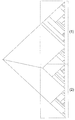
- FIG. 1 It is the schematic of the phylogenetic tree created based on the amino acid sequence of AtSWEET8 protein. It is a figure which expands and shows the partial area
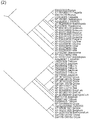
- FIG. 1 It is the schematic of the phylogenetic tree created based on the amino acid sequence of AtSWEET8 protein. It is a figure which expands and shows the partial area
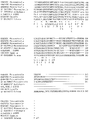
- FIG. 2 shows the result of multiple alignment analysis of XP_002870717, EOA19049, XP004230255, EDQ53581, EDQ64580, EDQ72753, and XP_001759812 together with the amino acid sequence of SEQ ID NO: 2, and is a diagram continued from the bottom of FIG. 2-1. It is a figure which shows the result of having carried out multiple alignment analysis about the XP_002870717 and EOA19049 with the amino acid sequence of sequence number 2.
- FIG. It is a block diagram which shows typically the physical map of nucleic acid AtSWEET / pRI201AN produced in the Example.
- a nucleic acid encoding a transporter protein involved in a specific sugar transport is introduced into a cell and / or the expression of the protein is enhanced.
- exudates with a high sugar concentration can be collected from transformed plants into which the nucleic acid has been introduced into the cells and / or the expression of the protein has been enhanced.
- the exudate means a liquid that exudes from the plant tissue to the outside, and includes, for example, a root exudate, a seed exudate, and a drainage exuded from the drainage tissue.
- a transgenic plant in which a nucleic acid encoding a transporter protein involved in a specific sugar transport is introduced into a cell and / or the expression of the protein is enhanced can produce a waste solution with a high sugar concentration. .
- nucleic acid is intended to include naturally occurring nucleic acids such as DNA and RNA, and artificial nucleic acids such as PNA (peptide nucleic acid) and nucleic acid molecules obtained by chemically modifying the base / sugar / phosphate diester moiety. is there.
- nucleic acid encoding a transporter protein involved in sugar transport is meant to include both a gene present in the genome and a transcription product of the gene.
- sugar is a substance represented by the chemical formula of C n (H 2 O) m , including aldehydes and ketone derivatives of polyhydric alcohols, and derivatives and condensates closely related to them, including polysaccharides and oligosaccharides.
- Oligosaccharides disaccharides and monosaccharides. It may be a glycoside in which an aglycone such as alcohol, phenol, saponin or pigment is bound to the reducing group of the sugar.
- Monosaccharides may be classified as triose, tetrose, hexose, pentose, etc.
- sugars may be classified as aldoses having an aldehyde group, ketoses having a ketone group, etc. based on functional groups in the molecule.
- Sugars may be distinguished from D series and L series by the configuration of the asymmetric carbon farthest from the aldehyde group or ketone group.
- monosaccharides include glucose (glucose), fructose (fructose), galactose, mannose, xylose, xylulose, ribose, erythrose, threose, erythrulose, glyceraldehyde, dihydroxyacetone and the like.
- sucrose sucrose (sucrose / sucrose), lactose (lactose), maltose (malt sugar), trehalose, cellobiose and the like.
- Plants to which the present invention is applied include nucleic acids encoding transporter proteins involved in specific sugar transport into cells and / or contain in exudates such as wastewater by enhancing expression of the proteins.
- the amount of sugar produced is significantly improved compared to the wild type.
- the protein may be expressed throughout the cells of the plant tissue, or may be expressed in at least some of the cells of the plant tissue.
- the plant tissue is meant to include plant organs such as leaves, stems, seeds, roots and flowers.
- Introducing a nucleic acid in the present invention is synonymous with making the number of molecules of nucleic acid encoding a transporter protein per cell significantly larger than the number of molecules in the wild type.
- to enhance the expression of a transporter protein means that a transcription product or translation can be achieved by modifying the expression control region of a nucleic acid encoding the transporter protein and / or injecting the nucleic acid itself into a cell. It means improving the expression level of the product.
- nucleic acid encoding a transporter protein involved in sugar transport refers to a nucleic acid encoding the Arabidopsis AtSWEET8 protein and AtSWEET8 in plants other than Arabidopsis thaliana It is a homologous nucleic acid of a nucleic acid encoding a protein. Note that Supplementary Figure 8 of Nature (2010) 468, 527-534 discloses a phylogenetic tree based on amino acid sequences for the transporter protein SWEET involved in sugar transport.
- SWEET protein derived from Arabidopsis SWEET protein derived from rice, SWEET protein derived from coconut palm, SWEET protein derived from Chlamydomonas reinhardtii, SWEET protein derived from Physcomitrella patens, SWEET protein derived from Physcomitrella patens, SWEET protein derived from Petunia hybrida elegans) -derived SWEET protein and mammal-derived SWEET protein.
- SWEET which is a transporter protein involved in sugar transport, is classified into five clades I to V based on the similarity of amino acid sequences.
- AtSWEET8 protein is classified as clade II.
- SWEET involved in sugar transport disclosed in this document, Arabidopsis thaliana-derived SWEET protein, rice-derived SWEET protein, and upper corn SWEET protein and petunia SWEET protein are calculated from GenBank ID numbers and genome data Table 1 below shows the correspondence between the protein coding region Index (Index in Genome), gene name, protein name, protein abbreviation, SWEET protein clade number, and derived species.
- nucleotide sequence of the coding region of the nucleic acid encoding the AtSWEET8 protein and the amino acid sequence of the protein are shown in SEQ ID NOs: 1 and 2, respectively.
- nucleic acid encoding a transporter involved in specific sugar transport in the present invention is limited to the genes defined by the nucleotide sequence and amino acid sequence shown in SEQ ID NOs: 1 and 2 as described above. It is not a thing.
- nucleic acid encoding a transporter protein involved in specific sugar transport includes a homologous nucleic acid of a nucleic acid encoding AtSWEET8 protein.
- This homologous nucleic acid is meant to include both genes that have evolved and branched from a common ancestral gene, and genes that have different base sequences and are different from genes that have evolved and branched.
- the genes branched and evolved from a common ancestor gene include two types of homologous genes (ortholog) and homologous genes (paralog) generated by duplication within the same species.
- the homologous nucleic acid of the nucleic acid encoding the AtSWEET8 protein described above can be easily obtained from a known database such as GenBank based on the nucleotide sequence of SEQ ID NO: 1 and the amino acid sequence of SEQ ID NO: 2 relating to the coding region of the nucleic acid encoding AtSWEET8 protein. Can be searched and identified.
- SWEET protein (ArabidopsisSlyrata) derived from SWEET protein (XP_002870717), SWEET protein derived from Ruberanazuna (Capsella rubella) (EOA19049), SWEET protein derived from tomato (Solanum lycopersicum) (XP004230255), Physcomr WE4 Seven species encoding species (EDQ53581, EDQ64580, EDQ72753 and XP_001759812) can be identified.
- the amino acid sequence of the SWEET protein from Arabidopsis (XP_002870717) is shown in SEQ ID NO: 3, the amino acid sequence of the SWEET protein from Ruberanazuna (EOA19049) is shown in SEQ ID NO: 4, and the amino acid sequence of the SWEET protein from tomato (XP004230255) is shown in SEQ ID NO: 5.
- the amino acid sequence of the SWEET protein (EDQ53581) derived from Sphagnum is shown in SEQ ID NO: 6
- the amino acid sequence of the SWEET protein (EDQ64580) is shown in SEQ ID NO: 7
- the amino acid sequence of the SWEET protein (EDQ72753) is shown in SEQ ID NO: 8.
- the amino acid sequence of the SWEET protein (XP — 001759812) derived from Sphagnum is shown in SEQ ID NO: 9.
- examples of the nucleic acid encoding the amino acid sequence (SEQ ID NO: 5) of the tomato-derived SWEET protein (XP004230255) include the base sequence of SEQ ID NO: 40 and the base sequence of SEQ ID NO: 41.
- examples of the nucleic acid encoding the amino acid sequence (SEQ ID NO: 7) of the SWEET protein (EDQ64580) derived from Sphagnum can include the base sequence of SEQ ID NO: 42 and the base sequence of SEQ ID NO: 43.
- the phylogenetic trees shown in FIGS. 1-1 to 1-3 are based on the results of searching using the amino acid sequence of AtSWEET8 protein (SEQ ID NO: 2), and OsSWEET4 protein, OsSWEET5 protein, AtSWEET4 protein, AtSWEET5 protein, AtSWEET6 protein and AtSWEET7 protein. Each amino acid sequence of the protein is added.
- nucleic acid encoding a transporter protein involved in a specific sugar transport includes a nucleic acid encoding an amino acid sequence shown in SEQ ID NOs: 2 to 9 and a base shown in SEQ ID NOs: 1 and 40 to 43 Mention may be made of nucleic acids comprising sequences.
- nucleic acid encoding a transporter protein involved in specific sugar transport is not limited to these specific amino acid sequences and base sequences.
- nucleic acid encoding a transporter protein involved in specific sugar transport includes deletion, substitution, addition or insertion of one or more amino acid sequences in the amino acid sequences shown in SEQ ID NOs: 2 to 9. It may be an amino acid sequence that encodes a protein having transporter activity involved in sugar transport.
- amino acid deletion, substitution, or addition can be performed by modifying the base sequence encoding the transporter protein involved in sugar transport by a technique known in the art.
- Mutation can be introduced into a nucleotide sequence by a known method such as Kunkel method or Gapped duplex method or a method according thereto, for example, a mutation introduction kit using site-directed mutagenesis (for example, Mutant- Mutations are introduced using K, Mutant-G (both trade names, manufactured by TAKARA Bio Inc.) or the like, or using LA PCR-in-vitro Mutagenesis series kits (trade name, manufactured by TAKARA Bio Inc.).
- a mutation introduction kit using site-directed mutagenesis for example, Mutant- Mutations are introduced using K, Mutant-G (both trade names, manufactured by TAKARA Bio Inc.) or the like, or using LA PCR-in-vitro Mutagenesis series kits (trade name, manufactured by TAKARA Bio Inc.).
- EMS ethyl methanesulfonic acid
- 5-bromouracil 2-aminopurine
- hydroxylamine N-methyl-N'-nitro-N nitrosoguanidine
- other carcinogenic compounds are representative.
- a method using a chemical mutagen such as that described above may be used, or a method using radiation treatment or ultraviolet treatment represented by X-rays, alpha rays, beta rays, gamma rays and ion beams may be used.
- the nucleic acid encoding a transporter involved in sugar transport means that the protein encoded by the nucleic acid has transporter activity involved in sugar transport.
- Transporter activity involved in sugar transport refers to the transport of sugar into and out of the endoplasmic reticulum (ER) as described in Methods of Non-Patent Documents 1 and 2, for example, cytoplasmic localization or ER localization. Activity measured with a FRET (Forster resonance energy transfer or fluorescence resonance energy transfer) sugar sensor.
- FRET Formal fluorescence resonance energy transfer
- nucleic acid encoding a transporter protein involved in specific sugar transport is, for example, 70% or more in similarity (Similarity) or identity to the amino acid sequences shown in SEQ ID NOs: 2 to 9
- a gene encoding a protein having a transporter activity involved in sugar transport preferably consisting of 80% or more, more preferably 90% or more, and most preferably 95% or more.
- the values of similarity and identity mean values obtained by default settings using a computer program in which a BLAST (Basic Local Alignment Search Tool) program is implemented and a database storing gene sequence information.
- nucleic acid encoding a transporter protein involved in specific sugar transport refers to all or part of the complementary strand of DNA comprising the nucleotide sequences shown in SEQ ID NOs: 1 and 40 to 43.
- a protein that hybridizes under stringent conditions and encodes a protein having a transporter activity involved in sugar transport may be used.
- stringent conditions refer to conditions under which so-called specific hybrids are formed and non-specific hybrids are not formed. For example, hybridization at 45 ° C.
- Hybridization can be performed by a conventionally known method such as the method described in J. Sambrook et al. OleMolecular lonCloning, A Laboratory Manual, 2nd Ed., Cold Spring Harbor Laboratory (1989).
- FIG. 2 shows the results of multiple alignment analysis together with the amino acid sequence of SEQ ID NO: 2.
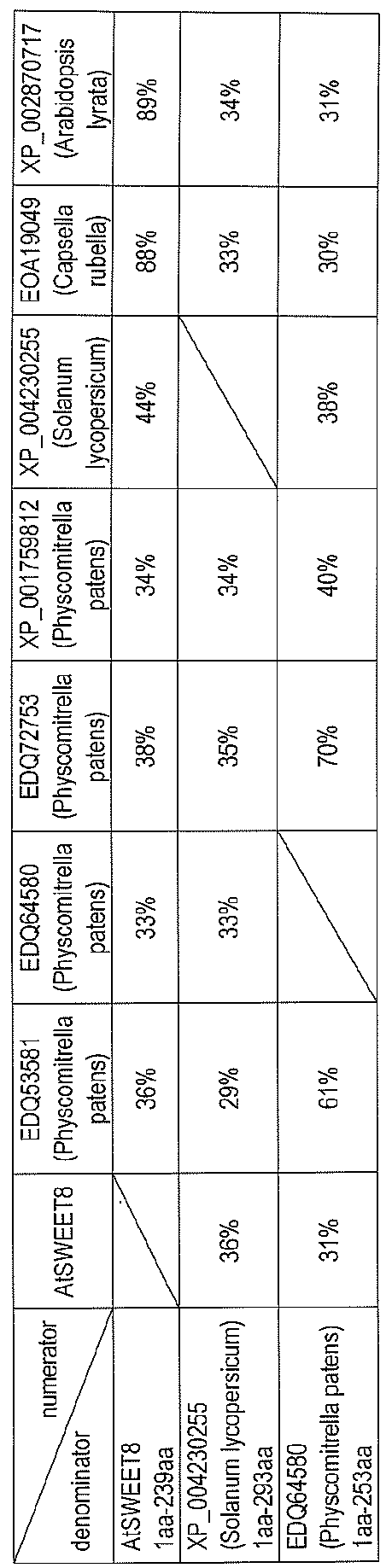
- the protein encoded by the seven homologous nucleic acids identified from the phylogenetic tree and the AtSWEET8 protein have a very high degree of coincidence with each other. It can be said that there is a high probability of having a function similar to that of AtSWEET8 protein (transporter activity involved in sugar transport).
- the degree of coincidence in the amino acid sequence between the Arabidopsis-derived SWEET protein (XP_002870717) and the AtSWEET8 protein is 89%
- the degree of coincidence in the amino acid sequence between the Ruberanazuna-derived SWEET protein (EOA19049) and AtSWEET8 protein is 88%
- the tomato The degree of coincidence in the amino acid sequence between the SWEET protein (XP004230255) and the AtSWEET8 protein is 44%
- the degree of coincidence in the amino acid sequence between the SWEET protein (EDQ53581) and AtSWEET8 protein is 36%
- the SWEET protein EDQ64580) and AtSWEET8 protein have an amino acid sequence of 33%
- SWEET protein (EDQ72753) and AtSWEET8 protein have an amino acid sequence of 38%
- SWEET protein (XP_001759812) and AtSWEET8 The degree of coincidence in the amino acid sequence with the WEET8 protein is 34%.
- the tomato-derived SWEET protein (XP004230255) has a degree of agreement of 29% or more with the AtSWEET8 protein and proteins encoded by other six homologous nucleic acids.
- the SWEET protein (EDQ64580) derived from Physcomitrella patens has an agreement of 30% or more with the AtSWEET8 protein and proteins encoded by the other six types of homologous nucleic acids.
- the AtSWEET8 protein and the proteins encoded by the seven types of homologous nucleic acids described above have a transmembrane domain on the C-terminal side.
- the region from the 214th position to the C-terminus in the amino acid sequence shown in SEQ ID NO: 2 is a transmembrane domain.
- the transmembrane domain extends from the 206th position to the C-terminus in the amino acid sequence shown in SEQ ID NO: 5.
- the SWEET protein (EDQ64580) derived from the pearl moss the transmembrane domain extends from the 196th position to the C-terminal in the amino acid sequence shown in SEQ ID NO: 7.
- the tomato-derived SWEET protein (XP004230255), and the SWEET protein (EDQ64580), the amino acid sequence between the AtSWEET8 protein and the protein encoded by the other six homologous nucleic acids.
- Table 3 shows a summary of the degree of coincidence.
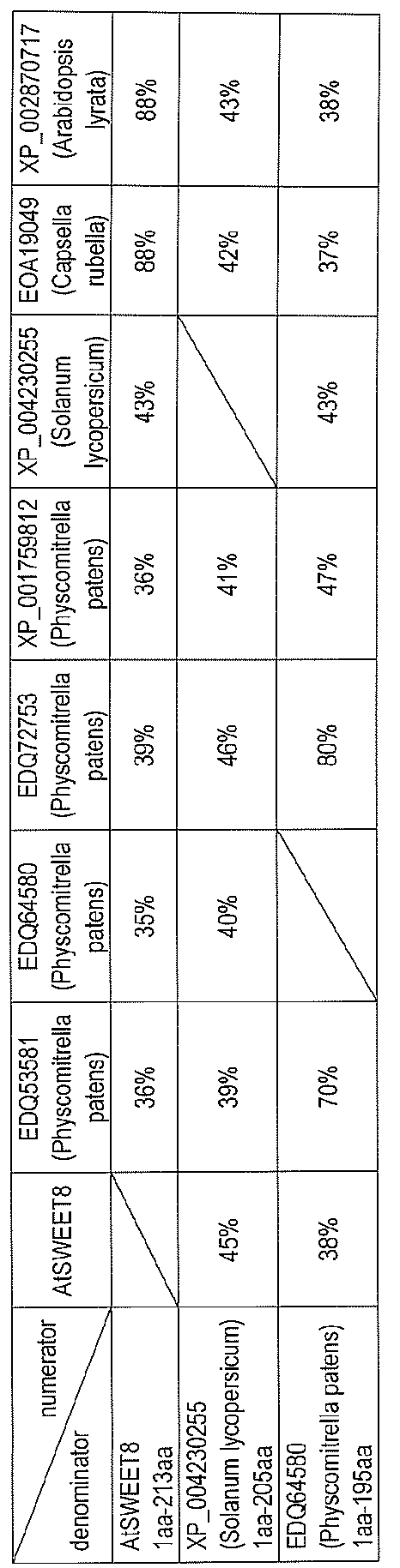
- the region excluding the transmembrane domain of AtSWEET8 protein has a degree of coincidence of 35% or more with the region excluding the transmembrane domain of the protein encoded by the seven types of homologous nucleic acids described above. is there.
- the region excluding the transmembrane domain of the tomato-derived SWEET protein is the region excluding the transmembrane domain of the AtSWEET8 protein and other 6 types of homologous nucleic acid-encoded proteins. There is a degree of agreement of 39% or more with the region excluding the transmembrane domain.
- the region excluding the transmembrane domain of the SWEET protein (EDQ64580) from Sphagnum moss includes the region excluding the transmembrane domain of AtSWEET8 protein and other six types of homologous nucleic acid-encoded proteins. There is a degree of agreement of 37% or more with the region excluding the transmembrane domain.
- amino acid sequence having 35% or more identity an amino acid sequence having 39% or more identity to the amino acid sequence from the N-terminal to the 205th amino acid sequence in the amino acid sequence shown in SEQ ID NO: 5, or shown in SEQ ID NO: 7
- amino acid sequence having a degree of identity of 37% or more with respect to the 195th amino acid sequence from the N-terminal in the amino acid sequence is included as a region excluding the transmembrane domain, and encodes a protein having a transporter activity involved in sugar transport It may be a thing.
- the region with low homology of AtSWEET8 protein and the region excluding the transmembrane domain is 37% between the region excluding the transmembrane domain of the protein encoded by the seven types of homologous nucleic acids described above. There is a degree of agreement of more than%.
- the low homology region and the transmembrane domain of the tomato-derived SWEET protein are the low homology region of the AtSWEET8 protein, the region excluding the transmembrane domain, and others. There is a degree of coincidence of 40% or more between the low homology region of the protein encoded by these six homologous nucleic acids and the region excluding the transmembrane domain.
- the region of SWEET protein (EDQ64580) with low homology and the transmembrane domain excluding the region with low homology of AtSWEET8 protein, the region excluding the transmembrane domain and others, as shown in Table 4 There is a degree of coincidence of 39% or more between the low homology region of the protein encoded by these six homologous nucleic acids and the region excluding the transmembrane domain.
- nucleic acid encoding a transporter protein involved in specific sugar transport is 37 for the amino acid sequence from 33 to 213 in the amino acid sequence shown in SEQ ID NO: 2.
- a protein having a transporter activity involved in sugar transport, comprising an amino acid sequence having 39% or more identity to the 18th to 195th amino acid sequence in the above as a region excluding a low homology region and a transmembrane domain May be used.
- x represents an arbitrary amino acid residue.
- the notation consisting of two numerical values connected with-and aa is a sequence consisting of any amino acid at the position, and consists of the number of amino acid residues within the range between the two numerical values. Is shown.
- a notation in which a plurality of amino acids are delimited by / in parentheses indicates that the position is any one of the plurality of amino acids.
- this description method is employ
- the amino acid sequence of SEQ ID NO: 44 1 to 3 arbitrary amino acid residues, the amino acid sequence of SEQ ID NO: 45, 0 to 2 arbitrary amino acid residues Group, amino acid sequence of SEQ ID NO: 46, 2 to 4 arbitrary amino acid residues, amino acid sequence of SEQ ID NO: 47, 1 to 2 arbitrary amino acid residues, amino acid sequence of SEQ ID NO: 48, 2 to 3
- any amino acid residue, the amino acid sequence of SEQ ID NO: 49, 2 to 3 arbitrary amino acid residues, and the amino acid sequence of SEQ ID NO: 50 are amino acid sequences linked in this order.
- This common sequence 1 is a sequence that characterizes the group consisting of the proteins encoded by the seven types of homologous nucleic acids shown in FIGS. 2-1 to 2-2 and the tSWEET8 protein, and is a transporter protein involved in other sugar transports It is an arrangement that is a clear distinction criterion.
- nucleic acid encoding a transporter protein involved in specific sugar transport includes a nucleic acid encoding a protein having the amino acid sequence of common sequence 1.
- the Arabidopsis thaliana-derived SWEET protein (XP_002870717) and Ruberanazuna-derived SWEET protein (EOA19049) are amino acid sequences having a higher degree of agreement with the amino acid sequence of the AtSWEET8 protein, as shown in FIGS. 1-1 to 1-3. It can be seen that The results of multiple alignment analysis of the amino acid sequences of these Arabidopsis-derived SWEET protein (XP_002870717), Ruberanazuna-derived SWEET protein (EOA19049), and AtSWEET8 protein are shown in FIG. As shown in FIG.
- Arabidopsis thaliana-derived SWEET protein (XP_002870717) and Ruberanazuna-derived SWEET protein (EOA19049) have a very high probability of having the same function (transporter activity involved in sugar transport) as AtSWEET8 protein in plants. It can be said.
- the common sequence 2 is an amino acid sequence in which the amino acid sequence of SEQ ID NO: 51, any 0 to 1 amino acid residue, and the amino acid sequence of SEQ ID NO: 52 are linked in this order from the N-terminal to the C-terminal. In other words.
- This common sequence 2 is a sequence that characterizes the group consisting of the proteins encoded by the two types of homologous nucleic acids shown in FIG. 3 and the AtSWEET8 protein, and is clearly distinguished from other transporter proteins involved in sugar transport. Is an array.
- nucleic acid encoding a transporter protein involved in specific sugar transport includes a nucleic acid encoding a protein having the amino acid sequence of the common sequence 2.
- reference (2) Fig. In Henikoff S., Henikoff JG, Amino-acid substitution matrices from protein blocks, Proc. Natl. Acad. Sci. USA, 89, 10915-10919 (1992) A score matrix (BLOSUM) for substitution mutations of amino acid residues was proposed and widely used in .2.
- amino acid substitution between similar side chain chemical properties is based on the knowledge that structural and functional changes given to the whole protein are reduced.
- the side chain groups of amino acids considered in multiple alignment can be considered based on indicators such as chemical properties and physical size.
- score matrix (BLOSUM) disclosed in reference (2) as an amino acid group with a score of 0 or more, preferably a group of amino acids with a value of 1 or more.
- the following eight groups are listed as typical groups.
- Other fine groupings may be any amino acid group of 0 or more, preferably 1 or more, more preferably 2 or more amino acid groups of the score value.
- Aliphatic hydrophobic amino acid group This group is a group of amino acids having a hydrophobic hydrophobic side chain among the neutral non-polar amino acids shown in the above-mentioned reference (1), V (Val, valine), L (Leu, leucine) , I (Ile, isoleucine) and M (Met, methionine).
- V Val, valine
- L Leu, leucine
- I Ile, isoleucine
- M Metal, methionine
- FGACWP is not included in this “aliphatic hydrophobic amino acid group” for the following reasons. This is because G (Gly, glycine) and A (Ala, alanine) are less than a methyl group and have a weak nonpolar effect.
- C Cys, cysteine
- F Phenylalanine
- W Trp, tryptophan
- P Pro, proline
- ST group Group with hydroxymethylene group
- S Ser, serine
- T Thr, threonine
- KR group This group is a group of basic amino acids and is composed of K (Lys, lysine) and R (Arg, arginine). These K and R are positively charged and have basic properties over a wide pH range. On the other hand, H (His, histidine) classified as a basic amino acid is not classified into this group because it is hardly ionized at pH 7.
- Methylene group polar group (DHN group) This group has a feature that a methylene group is bonded as a side chain to a carbon element at the ⁇ -position and has a polar group at the tip.
- Dimethylene group polar group (EKQR group) This group has a feature that a linear hydrocarbon having a dimethylene group or higher as a side chain is bonded to the ⁇ -position carbon element and has a polar group at the end.
- E Glu, glutamic acid, polar group is carboxyl group
- K Lis, lysine, polar group is amino group
- Q Gln, glutamine, polar group is amide group
- R Arg, arginine, polar group is imino group
- Aromatic (FYW Group) This group is an aromatic amino acid with a benzene nucleus in the side chain and is characterized by aromatic chemical properties. It consists of F (Phe, phenylalanine), Y (Tyr, tyrosine), W (Trp, tryptophan).
- Circular & polar (HY group) This group is an amino acid that has a cyclic structure in the side chain and also a polarity, H (H, histidine, both cyclic structure and polar group are imidazole groups), Y (Tyr, tyrosine, cyclic structure is polar with benzene nucleus The group consists of hydroxyl).
- a new protein having the same function can be obtained even if an amino acid residue in the amino acid sequence of a protein having a certain function is replaced with an amino acid residue belonging to the same group. It can.
- ILMV group Aliphatic hydrophobic amino acid group
- a novel protein having the same function can be obtained by replacing an isoleucine residue in the amino acid sequence of a protein having a certain function with a leucine residue.
- the amino acid sequence may be described as a consensus sequence, but even in this case, the same function can be obtained by substituting an amino acid residue belonging to the same group.
- a novel protein having the above will be obtained.
- the amino acid residue in the consensus sequence calculated therefrom is isoleucine or leucine (L / I)
- the above “1) aliphatic hydrophobic amino acid group (ILMV group)” Based on the above, it can be easily expected that a novel protein having a similar function can be obtained even when isoleucine or leucine residues are substituted with methionine or valine residues.
- the plant to which the present invention is applied introduces a nucleic acid encoding a “transporter protein involved in specific sugar transport” defined as described above into cells, or enhances the expression of the protein encoded by the nucleic acid. By doing so, exudate (for example, drainage liquid) with a high sugar concentration can be produced.
- exudate for example, drainage liquid
- an expression vector arranged to express a DNA encoding a transporter involved in sugar transport is introduced into the cell. Can be mentioned.
- Expression vector is constructed so as to contain a nucleic acid having a promoter base sequence that enables constitutive expression and a nucleic acid that encodes the transporter involved in sugar transport described above.
- Various vectors known in the art can be used as the base vector for the expression vector.
- a plasmid, phage, cosmid or the like can be used, and can be appropriately selected according to the plant cell to be introduced and the introduction method.
- Specific examples include pBR322, pBR325, pUC19, pUC119, pBluescript, pBluescriptSK, and pBI vectors.
- the method for introducing a vector into a plant cell is a method using Agrobacterium
- the pBI binary vector include pBIG, pBIN19, pBI101, pBI121, pBI221, and the like.
- the promoter is not particularly limited as long as it is a promoter capable of expressing a nucleic acid encoding a transporter involved in sugar transport in a plant body, and a known promoter can be preferably used.
- promoters include cauliflower mosaic virus 35S promoter (CaMV35S), various actin gene promoters, various ubiquitin gene promoters, nopaline synthase gene promoter, tobacco PR1a gene promoter, tomato ribulose 1,5-diphosphate carboxylase Oxidase small subunit gene promoter, napin gene promoter, oleosin gene promoter and the like.
- cauliflower mosaic virus 35S promoter, actin gene promoter, or ubiquitin gene promoter can be more preferably used. When each of the above promoters is used, any nucleic acid can be strongly expressed when introduced into a plant cell.
- a promoter having a function of expressing a nucleic acid in a site-specific manner in a plant can also be used.
- any conventionally known promoter can be used. Exudate produced from plant organs and plant tissues comprising cells into which the nucleic acid has been introduced by site-specific introduction of a nucleic acid encoding a transporter involved in sugar transport using such a promoter The sugar content contained in can be improved.
- the expression vector may further contain a nucleic acid having another segment sequence in addition to the nucleic acid encoding the promoter and the transporter involved in sugar transport.
- the nucleic acid having the other segment sequence is not particularly limited, but a nucleic acid having a terminator base sequence, a nucleic acid having a transformant selection marker base sequence, a nucleic acid having an enhancer base sequence, a base for improving translation efficiency Examples thereof include a nucleic acid having a sequence.
- the recombinant expression vector may further have a T-DNA region.
- the T-DNA region can increase the efficiency of nucleic acid introduction, particularly when Agrobacterium is used to introduce a nucleic acid having the base sequence in the recombinant expression vector into a plant cell.
- the nucleic acid having a terminator base sequence is not particularly limited as long as it has a function as a transcription termination site, and may be a known one.
- the transcription termination region (Nos terminator) of the nopaline synthase gene the transcription termination region of the cauliflower mosaic virus 35S (CaMV35S terminator) and the like can be preferably used.
- the Nos terminator can be more preferably used.
- nucleic acid having a transformant selection marker base sequence for example, a nucleic acid containing a drug resistance gene can be used.
- drug resistance genes include nucleic acids containing drug resistance genes for hygromycin, bleomycin, kanamycin, gentamicin, chloramphenicol and the like.
- nucleic acid having a base sequence for enhancing translation efficiency examples include a nucleic acid having an omega sequence derived from tobacco mosaic virus. By arranging the nucleic acid having this omega sequence in the untranslated region (5′UTR) upstream of the protein coding region, the expression efficiency of the nucleic acid encoding the transporter involved in the sugar transport can be increased.
- the recombinant expression vector can contain nucleic acids having various DNA segment sequences depending on the purpose.
- the method for constructing the recombinant expression vector is not particularly limited, and the nucleic acid having the promoter base sequence, the nucleic acid encoding the transporter involved in the sugar transport, and the necessity are appropriately selected as a base vector. Accordingly, the nucleic acids having the other DNA segment sequences may be introduced in a predetermined order. For example, a nucleic acid encoding a transporter involved in the sugar transport and a nucleic acid having a promoter base sequence (such as a nucleic acid having a terminator base sequence) may be linked and introduced into a vector.
- the method for producing the above expression vector is not particularly limited, and a conventionally known method can be used.
- Escherichia coli may be used as a host and propagated in the E. coli.
- a preferred E. coli type may be selected according to the type of vector.
- the above-described expression vector is introduced into a target plant cell by a general transformation method.
- the method (transformation method) for introducing the expression vector into the plant cell is not particularly limited, and any conventionally known method suitable for the plant cell can be used. Specifically, for example, a method using Agrobacterium or a method of directly introducing into plant cells can be used. Examples of methods using Agrobacterium include Bechtold, E., Ellis, J. and Pelletier, G. (1993) In Planta Agrobacterium-mediated gene transfer by infiltration of adult Arabidopsis plants. CR Acad. Sci. Paris Sci. Vie, 316, 1194-1199.
- a method for directly introducing an expression vector into a plant cell for example, a microinjection method, an electroporation method (electroporation method), a polyethylene glycol method, a particle gun method, a protoplast fusion method, a calcium phosphate method, or the like can be used.
- a transcription unit necessary for expression of the nucleic acid encoding the target transporter for example, a nucleic acid having a promoter base sequence Or a nucleic acid containing a nucleic acid having a transcription terminator base sequence and a nucleic acid encoding a target transporter is sufficient, and a vector function is not essential.
- the nucleic acid contains only the protein coding region of the nucleic acid that encodes the transporter involved in sugar transport without a transcription unit, it integrates into the transcription unit in the host genome and expresses the gene of interest. I can do it. Further, even when not integrated into the host genome, it is sufficient that the nucleic acid encoding the transporter involved in the sugar transport is transcribed and / or translated in the cell.
- Examples of plant cells into which a nucleic acid encoding a transporter involved in sugar transport of interest without including an expression vector is introduced such as cells of each tissue in plant organs such as flowers, leaves, and roots, Examples thereof include callus and suspension culture cells.
- the expression vector may be appropriately constructed according to the type of plant to be produced, but a general-purpose expression vector is constructed in advance and introduced into plant cells. Also good.
- the plant composed of cells to which the expression vector is introduced is not particularly limited. That is, by introducing a nucleic acid encoding a transporter involved in the sugar transport described above, the concentration of sugar contained in exudates such as wastewater can be improved for all plant bodies.
- the target plant is, for example, preferably a flowering plant, and more preferably an angiosperm among the flowering plants.
- target angiosperms include dicotyledonous plants and monocotyledonous plants, for example, plants belonging to the family Brassicaceae, Gramineae, Eggplant, Legume, Willowaceae (see below), but are limited to these plants. It is not something.
- Brassicaceae Arabidopsis thaliana, arabopsis lyrata, rape (Brassica rapa, Brassica napus, Brassica campestris), cabbage (Brassica oleracea var. Capitata), Chinese cabbage (Brassica rapa var. Pe) chinensis), turnip (Brassica rapa var. rapa), Nozawana (Brassica rapa var. lancinifolia), Komatsuna (Brassica rapa var. peruviridis), Pakchoi (Brassica rapa var.
- conchinsis (Raphanus sativus), Wasabi (Wasabia japonica), Ruberanazuna (Capsella rubella), etc.
- Rabbitaceae Sugar beet (Beta vulgaris) Maple family: Acer saccharum Euphorbiaceae: Red sesame (Ricinus communis) Solanum: Nicotiana tabacum, eggplant (Solanum melongena), potato (Solaneum tuberosum), tomato (Solanum lycopersicum), capsicum (Capsicum annuum), petunia hybrida, etc.
- Legumes soybean (Glycine max), pea (Pisum sativum), broad bean (Vicia faba), wisteria (Wisteria floribunda), groundnut (Arachis hypogaea), Lotus japonicus, common bean (Phaseolus vulgaris), azuki bean (Vigna angularis) , Acacia, Medicago truncatula, Cicer arietinum, etc.
- Asteraceae Chrysanthemum morifolium, sunflower (Helianthus annuus), etc.
- Palms oil palm (Elaeis guineensis, Elaeis oleifera), coconut (Cocos nucifera), date palm (Phoenix dactylifera), wax palm (Copernicia), etc.
- Ursiaceae Rhis succedanea, Cashew nutcrest (Anacardium occidentale), Urushi (Toxicodendron vernicifluum), mango (Mangifera indica), pistachio (Pistacia vera), etc.
- Cucurbitaceae Pumpkin (Cucurbita maxima, Cucurbita moschata, Cucurbita pepo), cucumber (Cucumis sativus), crow cucumber (Trichosanthes cucumeroides), gourd (Lagenaria siceraria var. Gourda), etc. Rosaceae: Almond (Amygdalus communis), Rose (Rosa), Strawberry (Fragaria vesca), Sakura (Prunus), Apple (Malus pumila var. Domestica), Peach (Prunus persica), etc. Grapes: Grapes (Vitis vinifera) Dianthus: Carnation (Dianthus caryophyllus).
- Willow family Poplar (Populus trichocarpa, Populus nigra, Populus tremula) etc.
- Gramineae corn (Zea mays), rice (Oryza sativa), barley (Hordeum vulgare), wheat (Triticum aestivum), urults wheat (Triticum urartu), tarho wheat (Aegilops tauschii), Minato camoji (Brachypodium distachyon) , Sugar cane (Saccharum officinarum), napier grass (Pennisetum pupureum), Erianthus ravenae, Susuki (Miscanthus virgatum), sorghum (Sorghum bicolor) switchgrass (Panicum), etc.
- Lily family Tulip (Tulipa), Lily (Lilium), etc.
- the nucleic acid encoding a transporter involved in sugar transport that can be used in the present invention can be isolated from various plants and used, but depending on the type of the target plant, It can be selected and used. That is, when the target plant cell is derived from a monocotyledonous plant, one isolated from a monocotyledonous plant can be introduced as a nucleic acid encoding a transporter involved in sugar transport. In addition, when the target plant cell is derived from a dicotyledonous plant, those isolated from the dicotyledonous plant can be introduced as a nucleic acid encoding a transporter involved in sugar transport.
- nucleic acid encoding a transporter involved in sugar transport derived from a dicotyledonous plant may be introduced.
- the nucleic acid encoding the AtSWEET8 protein, a nucleic acid encoding a transporter involved in sugar transport from the dicotyledonous Arabidopsis thaliana is the amount of sugar contained in exudates even if the target plant is a monocotyledon such as rice Can be significantly improved.
- a selection step for selecting an appropriate transformant from the plant body can be performed by a conventionally known method.
- the selection method is not particularly limited.
- the selection may be performed based on drug resistance such as hygromycin resistance, and after growing the transformant, the exudate was collected from the plant and collected.
- the sugar content in the exudate may be measured, and those having significantly improved sugar concentration compared to the wild type may be selected.
- the sugar content contained in the collected exudate may be measured qualitatively instead of quantitatively, for example, by a coloration method using a test paper that reacts with sugar and colors.
- a nucleic acid encoding a transporter involved in the above-mentioned specific sugar transport is introduced into a cell, or the plant has enhanced expression of the nucleic acid.
- Is preferably cultivated under conditions that prevent transpiration of the produced wastewater.
- the cultivation conditions when cultivating the plant is a sealed space with a humidity of 80% RH or more, more preferably 90% RH or more, thereby preventing the effluent from transpiration and increasing the amount of produced effluent. be able to.
- the sugar concentration in the wastewater of wild-type Arabidopsis thaliana is about 2.0 ⁇ M (average value, monosaccharide equivalent), whereas when a nucleic acid encoding AtSWEET8 protein is introduced, the sugar concentration is about 2400 ⁇ M. Increase to.
- the sugar concentration in the wastewater of wild-type rice is about 1.3 ⁇ M (average value, monosaccharide equivalent), whereas in the transgenic rice introduced with the nucleic acid encoding AtSWEET8 protein, The sugar concentration in the medium can be greatly improved.
- exudates with a high sugar concentration can be collected.
- the collected exudates can be used for the fermentation production of alcohol and / or organic acids. That is, the sugar component contained in the exudate at a high concentration can be used as a substrate for alcohol fermentation or organic acid fermentation.
- the effluent collected from the plant in which the transporter protein gene involved in the above-mentioned specific sugar transport is introduced or the expression of the endogenous gene is enhanced is directly used as alcohol. It can be used in a reaction system for fermentation or organic acid fermentation.
- the wastewater collected from the plant can be used for a reaction system of alcoholic fermentation or organic acid fermentation after performing a concentration process or a process of adding another carbon source or nitrogen source.
- Plasmid DNA was purified from clones in which inserted DNA was confirmed. Plasmid DNA was purified using QIAprep Spin Miniprep Kit (QIAGEN, # 27106) according to the attached protocol.
- extraction and ethanol precipitation were performed.
- An equal amount of PCI was added to the reaction solution, stirred, and centrifuged at 15000 rpm for 5 minutes.
- An equal amount of chloroform was added to the recovered upper layer, and the same was centrifuged to recover the upper layer.
- Double the amount of ethanol was added to the collected upper layer, and ethanol precipitation was performed using Pellet Paint NF Co-Precipitant (Merck Bio Insight, # 70748). After drying, the obtained DNA was dissolved in 44 ⁇ l of sterilized water.
- Ligation 1.5.1 Ligation Reaction A ligation reaction was performed to insert the DNA fragment encoding the AtSWEET protein obtained in 1.3 into the pRI201AN vector obtained in 1.4. The reaction was carried out overnight at 16 ° C. using DNA Ligation Kit Ver.2.1 (Takara Bio, # 6022).
- LB is the left border
- RB is the right border
- TNOS is the transcription terminator of the nopaline synthase gene NOS derived from the Ti plasmid of Agrobacterium tumefaciens
- NPTII is the neomycin phosphotransferase II gene derived from Escherichia coli
- Pnos is the Agrobacterium tumefaciens Transcription promoter of nopaline synthase gene NOS derived from Ti plasmid
- THSP is transcription terminator of heat shock protein gene HSP derived from Arabidopsis thaliana
- AtSWEET is DNA encoding SWEET protein derived from Arabidopsis thaliana
- P35S is transcription of cauliflower mosaic virus 35S The promoter
- AtADH 5′-UTR represents the translation enhancer of the alcohol dehydrogenase gene ADH derived from Arabidopsis thaliana
- ColE1 ori represents the replication origin of Escherichia
- SEQ ID NO: 40 was designed as a base sequence encoding the SWEET protein (EDQ64580, hereinafter referred to as PpSWEET8) shown in SEQ ID NO: 7.
- SEQ ID NOs: 40 and 42 an Nde I restriction enzyme recognition sequence was added to the start codon side, and a Sac I restriction enzyme recognition sequence was added to the stop codon side.
- Plant expression vectors prepared in 1.5, 1.6.1, and 1.6.2 were prepared by electroporation (Plant Molecular Biology Mannal, Second Edition, BG Stanton and AS Robbert, Kluwer Acdemic Publishers 1994). It was introduced into the tumefaciens C58C1 strain. Next, Agrobacterium tumefaciens into which a plant expression vector has been introduced was transformed into wild-type Arabidopsis ecotypes by the infiltration method described by Clough et al. (Steven J. Clough and Andrew F. Bent, 1998, The Plant Journal 16, 735-743). Introduced into Col-0, T1 (transformant first generation) seeds were collected.
- DNA construct for rice transformation 2.1 Amplification of DNA encoding AtSWEET protein Using the DNA construct for Arabidopsis transformation prepared in 1.5.4 above (DNA encoding AtSWEET8 protein and DNA encoding AtSWEET11 protein and DNA encoding AtSWEET12 protein) as a template, PCR DNA encoding AtSWEET8 protein, DNA encoding AtSWEET11 protein, and DNA encoding AtSWEET12 protein were amplified. In order to introduce the amplified product into the pENTR / D-TOPO vector, a CACC sequence is added to the 5 ′ end.
- Plasmid DNA was purified from clones in which inserted DNA was confirmed. Plasmid DNA was purified using QIAprep Spin Miniprep Kit (QIAGEN, # 27106) according to the attached protocol.
- the plasmid DNA purified in 2.4 was used as a template, and the base sequence of the DNA fragment was determined with a DNA sequencer (Beckman Coulter CEQ8000) using M13-F and M13-R primers.
- Plasmid DNA purification from positive clones Plasmid DNA was purified from clones in which inserted DNA was confirmed. Plasmid DNA was purified using QIAprep Spin Miniprep Kit (QIAGEN, # 27106) according to the attached protocol.
- the DNA encoding OsSWEET13, OsSWEET14 or OsSWEET15 protein was designed to add a CACC sequence at the 5 'end for introduction into the pENTR / D-TOPO vector.
- the designed DNA was chemically synthesized and inserted into the pENTR / D-TOPO vector.
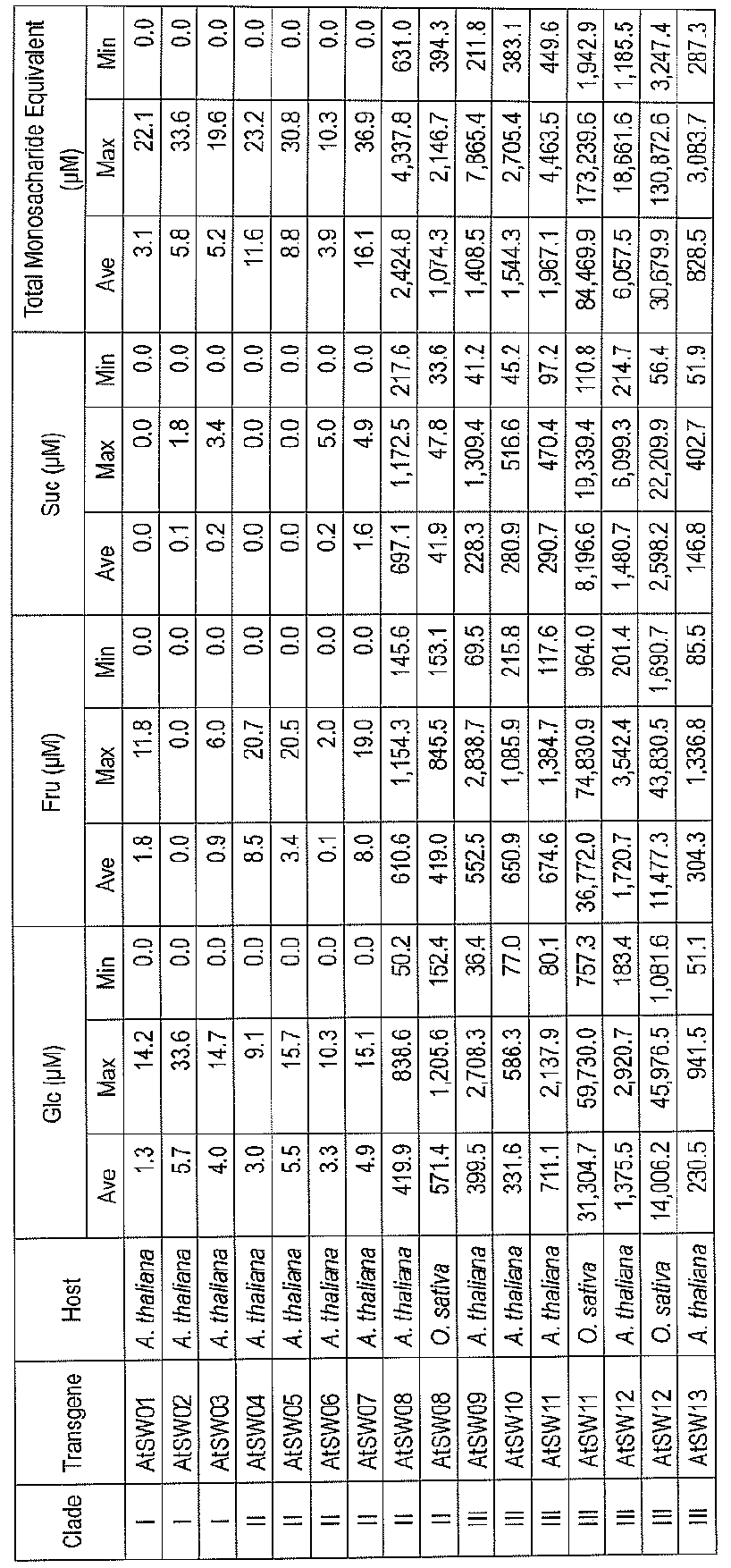
- Tables 19 and 20 show the results of measuring the sugar concentration of the Arabidopsis effluent obtained in 1.8 and the rice effluent obtained in 2.13.
Landscapes
- Health & Medical Sciences (AREA)
- Life Sciences & Earth Sciences (AREA)
- Genetics & Genomics (AREA)
- Chemical & Material Sciences (AREA)
- Engineering & Computer Science (AREA)
- Organic Chemistry (AREA)
- Biotechnology (AREA)
- Molecular Biology (AREA)
- Biomedical Technology (AREA)
- Bioinformatics & Cheminformatics (AREA)
- Wood Science & Technology (AREA)
- Zoology (AREA)
- General Engineering & Computer Science (AREA)
- General Health & Medical Sciences (AREA)
- Biochemistry (AREA)
- Nutrition Science (AREA)
- Biophysics (AREA)
- Botany (AREA)
- Microbiology (AREA)
- Cell Biology (AREA)
- Proteomics, Peptides & Aminoacids (AREA)
- Medicinal Chemistry (AREA)
- Gastroenterology & Hepatology (AREA)
- Physics & Mathematics (AREA)
- Plant Pathology (AREA)
- Breeding Of Plants And Reproduction By Means Of Culturing (AREA)
- Micro-Organisms Or Cultivation Processes Thereof (AREA)
- Preparation Of Compounds By Using Micro-Organisms (AREA)
- Peptides Or Proteins (AREA)
Abstract
Description
(2)上記AtSWEET8タンパク質をコードする核酸は、以下の(a)~(c)いずれかのタンパク質をコードする核酸であることを特徴とする(1)記載の形質転換植物又は形質転換植物細胞。
(a)配列番号2のアミノ酸配列からなるタンパク質
(b)配列番号2のアミノ酸配列に対して90%以上の同一性を有するアミノ酸配列からなり、糖輸送に関与するトランスポーター活性を有するタンパク質
(c)配列番号1の塩基配列からなるポリヌクレオチドの全部又は一部に対してストリンジェントな条件でハイブリダイズできるポリヌクレオチドによりコードされるアミノ酸配列からなり、糖輸送に関与するトランスポーター活性を有するタンパク質
(3)上記相同核酸は、以下の(a)~(c)いずれかのタンパク質をコードする核酸であることを特徴とする(1)記載の形質転換植物又は形質転換植物細胞。
(a)配列番号5又は7のアミノ酸配列からなるタンパク質
(b)配列番号5又は7のアミノ酸配列に対して90%以上の同一性を有するアミノ酸配列からなり、糖輸送に関与するトランスポーター活性を有するタンパク質
(c)配列番号40~43いずれかの塩基配列からなるポリヌクレオチドの全部又は一部に対してストリンジェントな条件でハイブリダイズできるポリヌクレオチドによりコードされるアミノ酸配列からなり、糖輸送に関与するトランスポーター活性を有するタンパク質
(4)上記相同核酸は、以下の(a)又は(b)のタンパク質をコードする核酸であることを特徴とする(1)記載の形質転換植物又は形質転換植物細胞。
(a)配列番号3、4、6、8及び9いずれかのアミノ酸配列からなるタンパク質
(b)配列番号3、4、6、8及び9いずれかのアミノ酸配列に対して90%以上の同一性を有するアミノ酸配列からなり、糖輸送に関与するトランスポーター活性を有するタンパク質
(5)上記相同核酸は、以下の(a)~(c)いずれかのタンパク質をコードする核酸であることを特徴とする(1)記載の形質転換植物又は形質転換植物細胞。
(a)配列番号2記載のアミノ酸配列に対して33%以上の一致度を有するアミノ酸配列からなり、糖輸送に関与するトランスポーター活性を有するタンパク質
(b)配列番号2記載のアミノ酸配列におけるN末端から213番目のアミノ酸配列に対して35%以上の一致度を有するアミノ酸配列を、膜貫通ドメインを除く領域として含み、糖輸送に関与するトランスポーター活性を有するタンパク質
(c)配列番号2記載のアミノ酸配列における33~213番目のアミノ酸配列に対して37%以上の一致度を有するアミノ酸配列を、相同性の低い領域及び膜貫通ドメインを除く領域として含み、糖輸送に関与するトランスポーター活性を有するタンパク質
(6)上記相同核酸は、以下の(a)~(c)いずれかのタンパク質をコードする核酸であることを特徴とする(1)記載の形質転換植物又は形質転換植物細胞。
(a)配列番号5記載のアミノ酸配列に対して29%以上の一致度を有するアミノ酸配列からなり、糖輸送に関与するトランスポーター活性を有するタンパク質
(b)配列番号5記載のアミノ酸配列におけるN末端から205番目のアミノ酸配列に対して39%以上の一致度を有するアミノ酸配列を、膜貫通ドメインを除く領域として含み、糖輸送に関与するトランスポーター活性を有するタンパク質
(c)配列番号5記載のアミノ酸配列における30~205番目のアミノ酸配列に対して40%以上の一致度を有するアミノ酸配列を、相同性の低い領域及び膜貫通ドメインを除く領域として含み、糖輸送に関与するトランスポーター活性を有するタンパク質
(7)上記相同核酸は、以下の(a)~(c)いずれかのタンパク質をコードする核酸であることを特徴とする(1)記載の形質転換植物又は形質転換植物細胞。
(a)配列番号7記載のアミノ酸配列に対して30%以上の一致度を有するアミノ酸配列からなり、糖輸送に関与するトランスポーター活性を有するタンパク質
(b)配列番号7記載のアミノ酸配列におけるN末端から195番目のアミノ酸配列に対して37%以上の一致度を有するアミノ酸配列を、膜貫通ドメインを除く領域として含み、糖輸送に関与するトランスポーター活性を有するタンパク質
(c)配列番号7記載のアミノ酸配列における18~195番目のアミノ酸配列に対して39%以上の一致度を有するアミノ酸配列を、相同性の低い領域及び膜貫通ドメインを除く領域として含み、糖輸送に関与するトランスポーター活性を有するタンパク質
(8)以下のアミノ酸配列:(N/S)(V/I)xxxxxFx(S/A)(1-3aa)TFxxI(V/F/M)Kx(K/R)(S/K/T)(V/T)x(D/E)(F/Y)(S/K)x(I/V/M)PY(V/I/L)x(T/A)x(L/M)(N/S)xxLW(V/T)(V/F/L)YGL(0-2aa)(V/I/F/L)xxxxxLVx(T/S)(I/V)N(A/G)xGxx(I/L)(E/H)(L/F/M/I)xY(L/I/V)x(L/I/V)(Y/F)Lxx(A/S/C)(2-4aa)(S/K/N)x(R/Q)(1-2aa)(V/I/M)xxxxxxx(L/V/I)xx(F/V/L)xx(V/I/M)xx(L/I/V)(V/T)(L/F)xx(V/I)(H/D/K)(D/S/N/G)(2-3aa)(R/K)xx(I/V/L/F)(I/V/L)Gx(L/M/I)xxx(F/L)xxxMYx(S/A)Pxx(V/A)xxxV(I/V)xx(R/K)S(V/T)(E/K)(Y/F)MPF(L/F)LS(L/F)(F/V)xF(I/L/V)N(G/A/S)xxWxxY(A/S)x(F/I/V/L)(2-3aa)Dx(F/Y)(I/V)xx(P/S)Nx(L/I)Gx(L/F/I)x(G/A)x(A/T/S)QLx(L/V)Yxx(Y/F)xx(A/S)(T/S)Pを含む共通配列を有する、糖輸送に関与するトランスポーター活性を有するタンパク質をコードする核酸を導入する及び/又は当該タンパク質の発現を強化した形質転換植物又は形質転換植物細胞。
(9)上記共通配列は、MVDAKQVRFIIGVIGNVISFGLFAAPAKTFWRIFKKKSVEEFSYVPYVAT(V/I)MNCMLWVFYGLPVVHKDSxLVSTINGVGLVIE(L/I)FYV(G/A)(V/L)YLxYCGHK(Q/K)NxR(K/R)(K/N)ILx(Y/F)LxxEV(V/I)xV(A/V)xI(V/I)L(V/I)TLF(V/A)(I/L)K(N/G)DFxKQTFVG(V/I)ICD(V/I)FNIAMY(A/G)(S/A)PSLAI(I/F)(T/K)VV(K/R)TKS(V/T)EYMPFLLSLVCFVNA(A/G)IWT(S/T)YSLIFKIDxYVLASNGIGT(F/L)LALSQLIVYFMYYKSTPK(0-1aa)(E/D)KTVKPSEVEI(P/S)(A/G)T(N/E/D)RVを含むことを特徴とする(8)記載の形質転換植物又は形質転換植物細胞。
(10)上記糖輸送に関与するトランスポーター活性を有するタンパク質は、AtSWEET8タンパク質又はAtSWEET8タンパク質をコードする核酸の相同核酸がコードするタンパク質であることを特徴とする(8)記載の形質転換植物又は形質転換植物細胞。
(11)上記AtSWEET8タンパク質が、以下の(a)~(c)いずれかのタンパク質であることを特徴とする(10)記載の形質転換植物又は形質転換植物細胞。
(a)配列番号2のアミノ酸配列からなるタンパク質
(b)配列番号2のアミノ酸配列に対して90%以上の同一性を有するアミノ酸配列からなり、糖輸送に関与するトランスポーター活性を有するタンパク質
(c)配列番号1の塩基配列からなるポリヌクレオチドの全部又は一部に対してストリンジェントな条件でハイブリダイズできるポリヌクレオチドによりコードされるアミノ酸配列からなり、糖輸送に関与するトランスポーター活性を有するタンパク質
(12)上記相同核酸が、以下の(a)~(c)いずれかのタンパク質をコードする核酸であることを特徴とする(10)記載の形質転換植物又は形質転換植物細胞。
(a)配列番号5又は7のアミノ酸配列からなるタンパク質
(b)配列番号5又は7のアミノ酸配列に対して90%以上の同一性を有するアミノ酸配列からなり、糖輸送に関与するトランスポーター活性を有するタンパク質
(c)配列番号40~43いずれかの塩基配列からなるポリヌクレオチドの全部又は一部に対してストリンジェントな条件でハイブリダイズできるポリヌクレオチドによりコードされるアミノ酸配列からなり、糖輸送に関与するトランスポーター活性を有するタンパク質
(13)上記相同核酸が、以下の(a)又は(b)のタンパク質をコードする核酸であることを特徴とする(10)記載の形質転換植物又は形質転換植物細胞。
(a)配列番号3、4、6、8及び9いずれかのアミノ酸配列からなるタンパク質
(b)配列番号3、4、6、8及び9いずれかのアミノ酸配列に対して90%以上の同一性を有するアミノ酸配列からなり、糖輸送に関与するトランスポーター活性を有するタンパク質
(14)上記相同核酸が、以下の(a)~(c)いずれかのタンパク質をコードする核酸であることを特徴とする(10)記載の形質転換植物又は形質転換植物細胞。
(a)配列番号2記載のアミノ酸配列に対して33%以上の一致度を有するアミノ酸配列からなり、糖輸送に関与するトランスポーター活性を有するタンパク質
(b)配列番号2記載のアミノ酸配列におけるN末端から213番目のアミノ酸配列に対して35%以上の一致度を有するアミノ酸配列を、膜貫通ドメインを除く領域として含み、糖輸送に関与するトランスポーター活性を有するタンパク質
(c)配列番号2記載のアミノ酸配列における33~213番目のアミノ酸配列に対して37%以上の一致度を有するアミノ酸配列を、相同性の低い領域及び膜貫通ドメインを除く領域として含み、糖輸送に関与するトランスポーター活性を有するタンパク質
(15)上記相同核酸が、以下の(a)~(c)いずれかのタンパク質をコードする核酸であることを特徴とする(10)記載の形質転換植物又は形質転換植物細胞。
(a)配列番号5記載のアミノ酸配列に対して29%以上の一致度を有するアミノ酸配列からなり、糖輸送に関与するトランスポーター活性を有するタンパク質
(b)配列番号5記載のアミノ酸配列におけるN末端から205番目のアミノ酸配列に対して39%以上の一致度を有するアミノ酸配列を、膜貫通ドメインを除く領域として含み、糖輸送に関与するトランスポーター活性を有するタンパク質
(c)配列番号5記載のアミノ酸配列における30~205番目のアミノ酸配列に対して40%以上の一致度を有するアミノ酸配列を、相同性の低い領域及び膜貫通ドメインを除く領域として含み、糖輸送に関与するトランスポーター活性を有するタンパク質
(16)上記相同核酸が、以下の(a)~(c)いずれかのタンパク質をコードする核酸であることを特徴とする(10)記載の形質転換植物又は形質転換植物細胞。
(a)配列番号7記載のアミノ酸配列に対して30%以上の一致度を有するアミノ酸配列からなり、糖輸送に関与するトランスポーター活性を有するタンパク質
(b)配列番号7記載のアミノ酸配列におけるN末端から195番目のアミノ酸配列に対して37%以上の一致度を有するアミノ酸配列を、膜貫通ドメインを除く領域として含み、糖輸送に関与するトランスポーター活性を有するタンパク質
(c)配列番号7記載のアミノ酸配列における18~195番目のアミノ酸配列に対して39%以上の一致度を有するアミノ酸配列を、相同性の低い領域及び膜貫通ドメインを除く領域として含み、糖輸送に関与するトランスポーター活性を有するタンパク質
(17)顕花植物又は顕花植物由来であることを特徴とする(1)又は(8)記載の形質転換植物又は形質転換植物細胞。
(18)上記顕花植物が被子植物であることを特徴とする(17)記載の形質転換植物又は形質転換植物細胞。
(19)上記被子植物が単子葉植物であることを特徴とする(18)記載の形質転換植物又は形質転換植物細胞。
(20)上記単子葉植物がイネ科植物であることを特徴とする(19)記載の形質転換植物又は形質転換植物細胞。
(21)上記イネ科植物がOryza属植物であることを特徴とする(20)記載の形質転換植物又は形質転換植物細胞。
(22)上記被子植物が双子葉植物であることを特徴とする(18)記載の形質転換植物又は形質転換植物細胞。
(23)上記双子葉植物がアブラナ科植物であることを特徴とする(22)記載の形質転換植物又は形質転換植物細胞。
(24)上記アブラナ科植物がArabidopsis属植物であることを特徴とする(23)記載の形質転換植物又は形質転換植物細胞。
(25)上記(1)乃至(24)いずれか記載の形質転換植物又は形質転換植物細胞を栽培又は培養し、当該形質転換植物又は形質転換植物細胞から滲出物を採取する工程を含む滲出物の製造方法。
(26)上記形質転換植物又は形質転換植物細胞を栽培又は培養する条件を相対湿度80%RH以上とすることを特徴とする(25)記載の滲出物の製造方法。
(27)上記滲出物が排水液であることを特徴とする(25)記載の滲出物の製造方法。
本明細書は本願の優先権の基礎である日本国特許出願2013-273130号の明細書及び/又は図面に記載される内容を包含する。
本発明では特定の糖輸送に関与するトランスポータータンパク質をコードする核酸を細胞内へ導入するか及び/又は当該タンパク質の発現を強化する。これにより当該核酸を細胞内へ導入した及び/又は当該タンパク質の発現を強化した形質転換植物からは、高糖濃度の滲出物を採取することができる。ここで、滲出物とは、植物の組織から外部へとしみだす液体を意味し、例えば、根滲出液や、種子滲出液、排水組織からしみだす排水液を含む意味である。なお、排水組織(hydathode)から液体がしみだす現象は、溢液現象(guttation)とも称される。よって、排水液と溢液とは同義である。特に、特定の糖輸送に関与するトランスポータータンパク質をコードする核酸を細胞内へ導入するか及び/又は当該タンパク質の発現を強化した形質転換植物は、高糖濃度の排水液を産生することができる。
上述した「特定の糖輸送に関与するトランスポータータンパク質をコードする核酸」とは、シロイヌナズナのAtSWEET8タンパク質をコードする核酸、及び、シロイヌナズナ以外の植物におけるAtSWEET8タンパク質をコードする核酸の相同核酸である。なお、Nature (2010) 468, 527-534のSupplementary Figure 8には、糖輸送に関与するトランスポータータンパク質SWEETに関してアミノ酸配列に基づいた系統樹が開示されている。本文献では、シロイヌナズナ由来SWEETタンパク質、イネ由来SWEETタンパク質、ウマゴヤシ由来SWEETタンパク質、コナミドリムシ(Chlamydomonas reinhardtii)由来SWEETタンパク質、ヒメツリガネゴケ(Physcomitrella patens)由来SWEETタンパク質、ペチュニア(Petunia hybrida)由来SWEETタンパク質、センチュウ(Caenorhabditis elegans)由来SWEETタンパク質、哺乳類由来SWEETタンパク質について開示している。この系統樹によれば、糖輸送に関与するトランスポータータンパク質であるSWEETは、アミノ酸配列の類似性に基づいてクレードI~Vの5つに分類されることが理解できる。上述したシロイヌナズナにおいてAtSWEET8タンパク質は、クレードIIに分類されている。

このグループは、上記参考文献(1)で示された中性非極性アミノ酸のうち、脂肪属性の疎水性側鎖をもつアミノ酸のグループであり、V(Val、バリン)、L(Leu、ロイシン)、I(Ile、イソロイシン)及びM(Met、メチオニン)から構成される。参考文献(1)による中性非極性アミノ酸と分類されるもののうちFGACWPは以下理由で、この「脂肪族疎水性アミノ酸グループ」には含めない。G(Gly、グリシン)やA(Ala、アラニン)はメチル基以下の大きさで非極性の効果が弱いからである。C(Cys、システイン)はS-S結合に重要な役目を担う場合があり、また、酸素原子や窒素原子と水素結合を形成する特性があるからである。F(Phe、フェニルアラニン)やW(Trp、トリプトファン)は側鎖がとりわけ大きな分子量をもち、かつ、芳香族の効果が強いからである。P(Pro、プロリン)はイミノ酸効果が強く、ポリペプチドの主鎖の角度を固定してしまうからである。
このグループは、中性極性アミノ酸のうちヒドロキシメチレン基を側鎖に持つアミノ酸のグループであり、S(Ser、セリン)とT(Thr、スレオニン)から構成される。SとTの側鎖に存在する水酸基は、糖の結合部位であるため、あるポリペプチド(タンパク質)が特定の活性を持つために重要な部位である場合が多い。
このグループは、酸性であるカルボキシル基を側鎖に持つアミノ酸のグループであり、D(Asp、アスパラギン酸)とE(Glu、グルタミン酸)から構成される。
このグループは、塩基性アミノ酸のグループであり、K(Lys、リジン)とR(Arg、アルギニン)から構成される。これらKとRは、pHの広い範囲で正に帯電し塩基性の性質をもつ。一方、塩基性アミノ酸に分類されるH(His、ヒスチジン)はpH7においてほとんどイオン化されないので、このグループには分類されない。
このグループは、全てα位の炭素元素に側鎖としてメチレン基が結合しその先に極性基を有すると言う特徴を持つ。非極性基であるメチレン基の物理的大きさが酷似している特徴を持ち、N(Asn、アスパラギン、極性基はアミド基)、D(Asp、アスパラギン酸、極性基はカルボキシル基)とH(His、ヒスチジン、極性基はイミダゾール基)から成る。
このグループは、全てα位の炭素元素に側鎖としてジメチレン基以上の直鎖炭化水素が結合しその先に極性基を有すると言う特徴を持つ。非極性基であるジメチレン基の物理的大きさが酷似している特徴を持つ。E(Glu、グルタミン酸、極性基はカルボキシル基)、K(Lys、リジン、極性基はアミノ基)、Q(Gln、グルタミン、極性基はアミド基)、R(Arg、アルギニン、極性基はイミノ基とアミノ基)から成る。
このグループには、側鎖にベンゼン核を持つ芳香族アミノ酸であり、芳香族特有の化学的性質を特徴とする。F(Phe、フェニルアラニン)、Y(Tyr、チロシン)、W(Trp、トリプトファン)から成る。
このグループには、側鎖に環状構造を持つと同時に極性も持つアミノ酸で、H(H、ヒスチジン、環状構造と極性基は共にイミダゾール基)、Y(Tyr、チロシン、環状構造はベンゼン核で極性基は水酸基)から成る。
発現ベクターは、恒常的な発現を可能とするプロモーター塩基配列を有する核酸と、上述した糖輸送に関与するトランスポーターをコードする核酸とを含むように構築する。発現ベクターの母体となるベクターとしては、従来公知の種々のベクターを用いることができる。例えば、プラスミド、ファージ、またはコスミド等を用いることができ、導入される植物細胞や導入方法に応じて適宜選択することができる。具体的には、例えば、pBR322、pBR325、pUC19、pUC119、pBluescript、pBluescriptSK、pBI系のベクター等を挙げることができる。特に、植物細胞へのベクターの導入法がアグロバクテリウムを用いる方法である場合には、pBI系のバイナリーベクターを用いることが好ましい。pBI系のバイナリーベクターとしては、具体的には、例えば、pBIG、pBIN19、pBI101、pBI121、pBI221等を挙げることができる。
上述した発現ベクターは、一般的な形質転換方法によって対象の植物細胞に導入される。発現ベクターを植物細胞に導入する方法(形質転換方法)は特に限定されるものではなく、植物細胞に応じた適切な従来公知の方法を用いることができる。具体的には、例えば、アグロバクテリウムを用いる方法や直接植物細胞に導入する方法を用いることができる。アグロバクテリウムを用いる方法としては、例えば、Bechtold, E., Ellis, J. and Pelletier, G. (1993) In Planta Agrobacterium-mediated gene transfer by infiltration of adult Arabidopsis plants. C.R. Acad. Sci. Paris Sci. Vie, 316, 1194-1199. あるいは、Zyprian E, Kado Cl, Agrobacterium-mediated plant transformation by novel mini-T vectors in conjunction with a high-copy vir region helper plasmid. Plant Molecular Biology, 1990, 15(2), 245-256.に記載された方法を用いることができる。
アカザ科:テンサイ(Beta vulgaris)
カエデ科:サトウカエデ(Acer saccharum)
トウダイグサ科:トウゴマ(Ricinus communis)
ナス科:タバコ(Nicotiana tabacum)、ナス(Solanum melongena)、ジャガイモ(Solaneum tuberosum)、トマト(Solanum lycopersicum)、トウガラシ(Capsicum annuum)、ペチュニア(Petunia hybrida)など。
マメ科:ダイズ(Glycine max)、エンドウ(Pisum sativum)、ソラマメ(Vicia faba)、フジ(Wisteria floribunda)、ラッカセイ(Arachis hypogaea)、ミヤコグサ(Lotus japonicus)、インゲンマメ(Phaseolus vulgaris)、アズキ(Vigna angularis)、アカシア(Acacia)、ウマゴヤシ(Medicago truncatula)、ヒヨコマメ(Cicer arietinum)など。
キク科:キク(Chrysanthemum morifolium)、ヒマワリ(Helianthus annuus)など。
ヤシ科:アブラヤシ(Elaeis guineensis、Elaeis oleifera)、ココヤシ(Cocos nucifera)、ナツメヤシ(Phoenix dactylifera)、ロウヤシ(Copernicia)など。
ウルシ科:ハゼノキ(Rhus succedanea)、カシューナットノキ(Anacardium occidentale)、ウルシ(Toxicodendron vernicifluum)、マンゴー(Mangifera indica)、ピスタチオ(Pistacia vera)など。
ウリ科:カボチャ(Cucurbita maxima、Cucurbita moschata、Cucurbita pepo)、キュウリ(Cucumis sativus)、カラスウリ(Trichosanthes cucumeroides)、ヒョウタン(Lagenaria siceraria var. gourda)など。
バラ科:アーモンド(Amygdalus communis)、バラ(Rosa)、イチゴ(Fragaria vesca)、サクラ(Prunus)、リンゴ(Malus pumila var. domestica)、モモ(Prunus persica)など。
ブドウ科:ブドウ(Vitis vinifera)
ナデシコ科:カーネーション(Dianthus caryophyllus)など。
ヤナギ科:ポプラ(Populus trichocarpa、Populus nigra、Populus tremula) など。
イネ科:トウモロコシ(Zea mays)、イネ(Oryza sativa)、オオムギ(Hordeum vulgare)、コムギ(Triticum aestivum)、ウラルツコムギ(Triticum urartu)、タルホコムギ(Aegilops tauschii)、ミナトカモジグサ(Brachypodium distachyon)、タケ(Phyllostachys)、サトウキビ(Saccharum officinarum)、ネピアグラス(Pennisetum pupureum)、エリアンサス(Erianthus ravenae)、ススキ(Miscanthus virgatum)、ソルガム(Sorghum bicolor)スイッチグラス(Panicum)など。
ユリ科:チューリップ(Tulipa)、ユリ(Lilium)など。
上述した形質転換処理後、植物体のなかから適切な形質転換体を選抜する選抜工程を、従来公知の方法で行うことができる。選抜の方法は特に限定されるものではなく、例えば、ハイグロマイシン耐性等の薬剤耐性を基準として選抜してもよいし、形質転換体を育成した後に、植物体から滲出物を採取し、採取した滲出物に含まれる糖分を測定し、野生型と比較して糖濃度が有意に向上しているものを選抜してもよい。また、採取した滲出物に含まれる糖分測定は定量的でなく定性的に測定する方法でも良く、例えば糖に反応し呈色する試験紙を用いた呈色法で測定しても良い。
1.1 PCRによるAtSWEETタンパク質をコードするDNAの取得
1.1.1 AtSWEETタンパク質をコードするDNAの増幅
シロイヌナズナから調製したcDNAを鋳型にし、PCRによる評価用のAtSWEET1、AtSWEET2、AtSWEET3、AtSWEET4、AtSWEET5、AtSWEET6、AtSWEET7、AtSWEET9、AtSWEET11、AtSWEET12、AtSWEET13、AtSWEET15及びAtSWEET17タンパク質をコードするDNAの増幅を行った。評価用DNAをpRI201ANベクター(タカラバイオ社製、#3264)に挿入するため、5’末端にSal I制限酵素認識配列を付加したフォワードプライマーを、また3’末端にSac IまたはPst I制限酵素認識配列を付加したリバースプライマーを設計した(表5)。
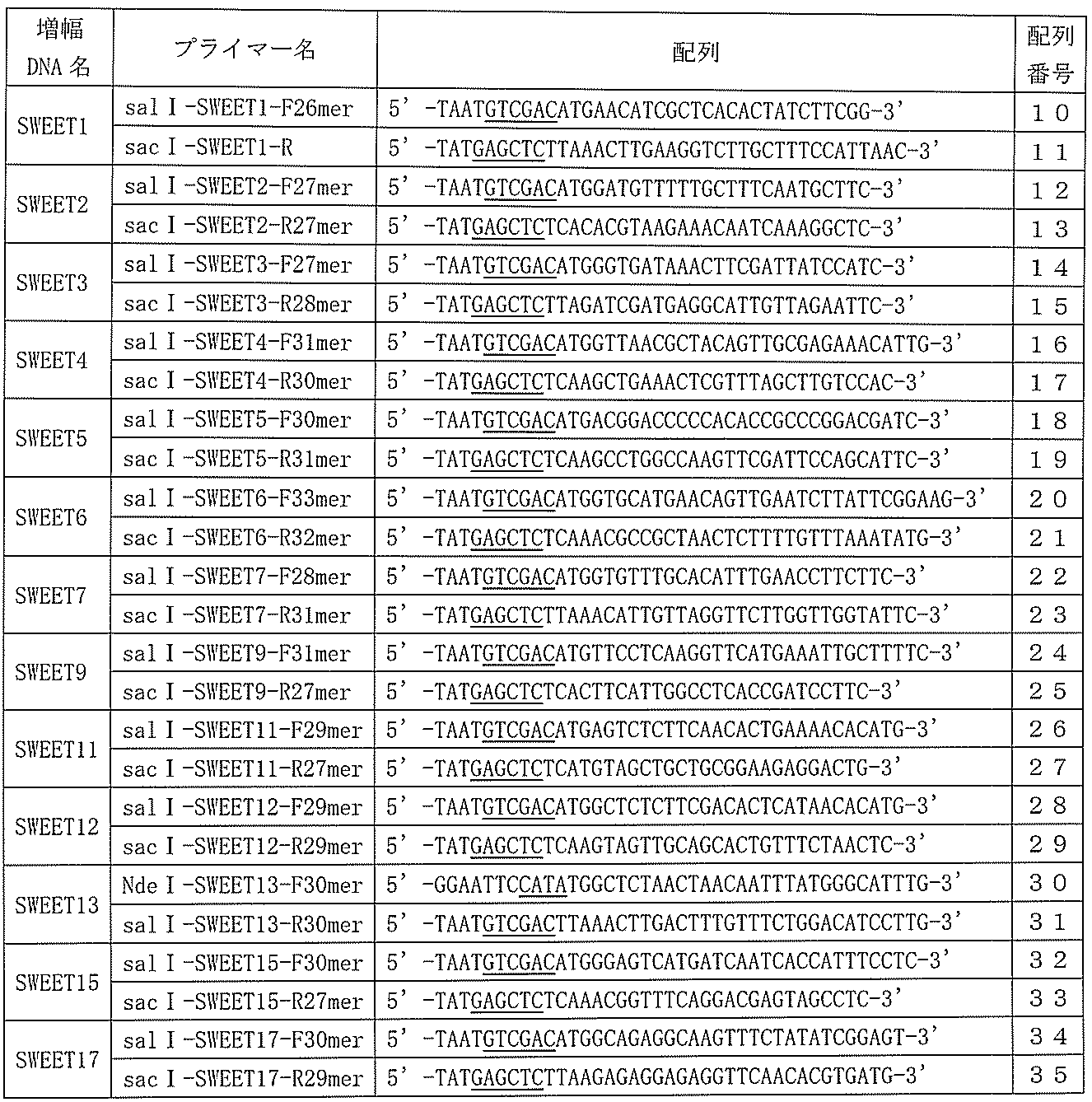


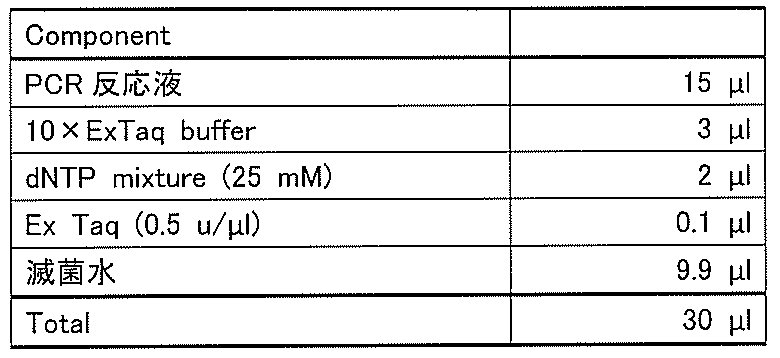
PCRで増幅した各DNA断片をアガロースゲル電気泳動後、MagExtractor-PCR & Gel Clean up キット (TOYOBO、#NPK-601) を用いて、切り出し精製を行った。なお、切り出し精製は、キット添付のマニュアルに従って行った。
精製した増幅DNA断片を、TOPO TA Cloning (Invitrogen、#K4500-01) を用いてpCR2.1-TOPOベクターに導入した。反応液組成を表9に示した。表9に示した反応液を室温で5分間反応させた。

形質転換の結果、多数のコロニーが得られた。各コロニーについて挿入DNAの有無を確認するため、M13-F : 5’-GTA AAA CGA CCA GTC TTA AG-3’(配列番号36)及びM13-R : 5’-CAG GAA ACA GCT ATG AC-3’(配列番号37)を用いてコロニーPCRを行った。コロニーPCRの反応液組成を表10に示し、PCR条件を表11に示した。


挿入DNAが確認できたクローンからプラスミドDNAの精製を行った。プラスミドDNAの精製は、QIAprep Spin Miniprep Kit (QIAGEN、#27106) を用い、添付のプロトコルに従って行った。
1.1.5で得たプラスミドDNAを鋳型にし、M13-F及びM13-Rプライマーを用いてPCR増幅し、ダイデオキシ法(サンガー法)によるDNA断片の塩基配列の決定を行った。
AtSWEET8、AtSWEET10、AtSWEET14、AtSWEET16タンパク質をコードするDNAついては、5’末端にPst I制限酵素認識配列、3’末端にSal I制限酵素認識配列を付加するよう塩基配列を設計し、化学的に全合成した。その結果、pEX-Aベクター(オペロンバイオテクノロジー)に挿入されたAtSWEET8及びAtSWEET14タンパク質をコードするDNA、pCR2.1-TOPOベクターに挿入されたAtSWEET10及びAtSWEET16タンパク質をコードするDNAを得ることができた。
1.1.5と1.2で得られたプラスミドDNAからAtSWEETタンパク質をコードするDNA断片を取り出す為、二度の制限酵素処理を行った。各DNAに対する制限酵素の組み合わせを表12に記す。

Sac I(TaKaRa、#1078A)、Nde I(TaKaRa、#1161A)又はSal I(TaKaRa、#1080A)を用いて以下の反応液を作製し、37℃で一晩反応させ、1.1.5または1.2で得られたプラスミドを切断した。Sac Iの反応液組成を表13に、Nde Iの反応液組成を表14に、Sal Iの反応液組成を表15に示した。
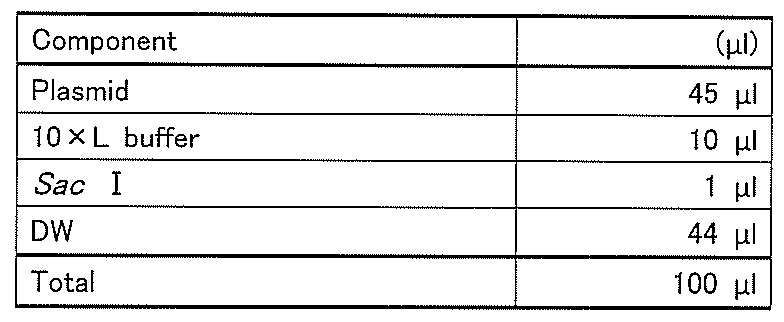
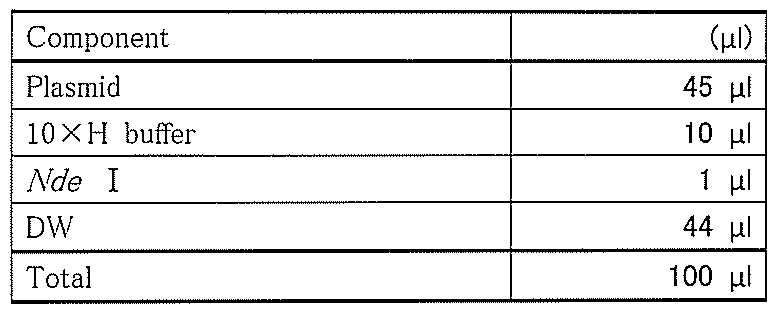
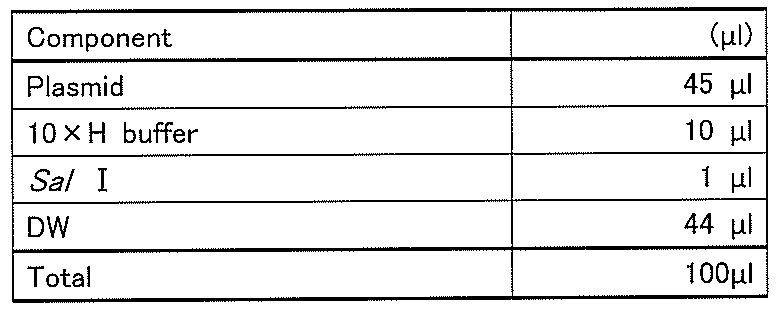
次に、DNAを精製するため、PCI (フェノール:クロロホルム:イソアミルアルコール=24:24:1)抽出とエタノール沈殿を行った。反応液に等量のPCIを加えて攪拌し、5分間、15000 rpmで遠心して回収した上層に等量のクロロホルムを加え、同様に遠心し上層を回収した。回収した上層に二倍量のエタノールを加え、Pellet Paint NF Co-Precipitant (メルクバイオインサイト、#70748) を用いてエタノール沈殿を行った。乾燥後、得られたDNAは滅菌水44μlに溶解した。
次に、Sal I(TaKaRa、#1080A)、Xba I(TaKaRa、#1093A)又はSac I(TaKaRa、#1078A)を用いて以下の反応液を作製し、37℃で一晩反応させ、1.3.2で得られたプラスミドを切断した。Sal Iの反応液組成を表16に、Xba Iの反応液組成を表17に、Sac Iの反応液組成を表18に示した。

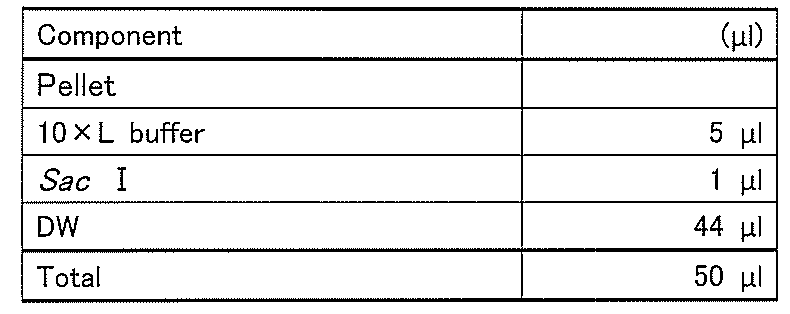
1.3.3で得られた反応液は1.1.2の手順と同様にアガロースゲル電気泳動後、MagExtractor-PCR & Gel Clean up キットを用いて切り出し精製を行った。
1.3で得られたAtSWEETタンパク質をコードするDNA断片とライゲーションを行うため、pRI201ANベクターを1.3と同様の手順で制限酵素処理を行った。
1.5.1 ライゲーション反応
1.3で得たAtSWEETタンパク質をコードするDNA断片を1.4で得たpRI201ANベクターへ挿入するため、ライゲーション反応を行った。反応にはDNA Ligation Kit Ver.2.1 (タカラバイオ、#6022) を用い、16℃で一晩反応させた。
上記ライゲーション反応の終了後、反応液2μlを用いて1.1.3と同様の方法で形質転換を行った。
コロニーPCRで増幅するDNA断片の長さをアガロースゲル電気泳動で可視化する事によって、AtSWEETタンパク質をコードするDNAのベクターへの挿入を確認した。
挿入DNAが確認できたコロニーからプラスミドDNAの精製を行い、目的のDNA断片を挿入したクローンを得た。プラスミドDNAの精製は、QIAprep Spin Miniprep Kit (QIAGEN、#27106) を用い、添付のプロトコルに従って行った。得られたDNAコンストラクト (AtSWEET / pRI201AN) の物理地図を図4に示す。図4において、LBはleft borderを、RBはright borderを、TNOSはAgrobacterium tumefaciens のTiプラスミド由来のノパリン合成酵素遺伝子NOSの転写ターミネーターを、NPTIIはEscherichia coli由来neomycin phosphotransferaseII遺伝子を、PnosはAgrobacterium tumefaciens のTiプラスミド由来のノパリン合成酵素遺伝子NOSの転写プロモーターを、THSPはArabidopsis thaliana由来のheat shock protein遺伝子HSPの転写ターミネーターを、AtSWEETはArabidopsis thaliana由来SWEETタンパク質をコードするDNAを、P35Sはカリフラワーモザイクウイルス35S転写プロモーターを、AtADH 5’-UTRはArabidopsis thaliana由来のalcohol dehydrogenase遺伝子ADHの翻訳エンハンサーを、ColE1 oriはEscherichia coliの複製起点を、Ri oriはAgrobacterium rhizogenesの複製起点をそれぞれ表す。
シロイヌナズナのコドン頻度を参考にしてアミノ酸配列が変わらないように新たに配列設計しなおしたOsSWEET5、OsSWEET11、OsSWEET12、OsSWEET13、OsSWEET14及びOsSWEET15タンパク質をコードするDNAの開始コドン側にNde I制限酵素認識配列、終止コドン側にSac I制限酵素認識配列を付加するよう設計した。そして、設計したDNAを化学的に全合成し、pRI201ANベクターに挿入することで各DNAコンストラクトを得た。なお、5’末端に付加したNde I制限酵素認識配列(5’CATATG3’)に含まれるATGがSWEETタンパク質をコードするDNAの開始コドンと一致するようにした。
配列番号5に示したトマト由来SWEETタンパク質(XP004230255、以下、SlSWEET8と称す)のアミノ酸配列をコードする塩基配列として配列番号40、配列番号7に示したヒメツリガネゴケ由来SWEETタンパク質(EDQ64580、以下、PpSWEET8と称す)をコードする塩基配列として配列番号42を設計した。そして、これら配列番号40及び42における、開始コドン側にNde I制限酵素認識配列、終止コドン側にSac I制限酵素認識配列を付加するよう設計した。そして、設計したDNAを化学的に全合成し、pRI201ANベクターに挿入することで2種のDNAコンストラクトを得た。なお、5’末端に付加したNde I制限酵素認識配列(5’CATATG3’)に含まれるATGが配列番号40及び42の開始コドンと一致するようにした。
1.5及び1.6.1並びに1.6.2で作製した植物発現用ベクターをエレクトロポレーション法(Plant Molecular Biology Mannal, Second Edition , B. G. Stanton and A. S. Robbert, Kluwer Acdemic Publishers 1994)により、Agrobacterium tumefaciens C58C1株に導入した。次いで植物発現用ベクターが導入されたAgrobacterium tumefaciensを、Cloughらにより記載された浸潤法(Steven J. Clough and Andrew F. Bent, 1998, The Plant Journal 16, 735-743)により、野生型シロイヌナズナ エコタイプCol-0に導入し、T1(形質転換(transformant)第一世代)種子を回収した。回収したT1種子は、カナマイシン(50 mg/L)、カルベニシリン(100 mg/L)及びベンレート水和剤(10 mg/L:住友化学社製)を含むMS寒天培地(寒天濃度は0.8%))に無菌播種し、約2週間培養し形質転換体を選抜した。選抜した形質転換体は、新しい上記MS寒天培地に植え換え、さらに約1週間栽培後、バーミキュライトとソイルミックス(サカタのタネ)を体積比で1:1に混合した土をいれた鉢に植え替えT2(形質転換第二世代)種子を得た。
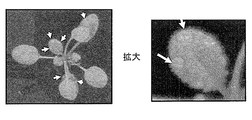
AtSWEET、OsSWEET、SlSWEET8、及びPpSWEET8タンパク質をコードするDNAによって形質転換されたシロイヌナズナのT1又はT2植物体の栽培を、18L/6D(18時間明条件の後6時間暗条件にする24時間光サイクル条件)、22℃で行った。馴化後、1~2週間経過した植物体に1/1000ハイポネックスを与え、ラップフィルム(旭化成製、サランラップ)で湿度80%以上好ましくは90%以上になるように植物を包み込み、排水液を排出させた(図5)。おもに葉裏に付着した排水液を回収し、排水液中の糖濃度を分析した。なお、野生型シロイヌナズナにアグロバクテリウムを感染・栽培して収穫される種子をT1種子、T1種子を薬剤選抜するかPCRなどの方法により、細胞中へのDNA導入を確認した植物体をT1植物、T1植物を栽培して収穫される種子をT2種子と定義する。
2.1 AtSWEETタンパク質をコードするDNAの増幅
上記1.5.4で調製したシロイヌナズナ形質転換用DNAコンストラクト(AtSWEET8タンパク質をコードするDNA及びAtSWEET11タンパク質をコードするDNA及びAtSWEET12タンパク質をコードするDNA)を鋳型とし、PCRによりAtSWEET8タンパク質をコードするDNA及びAtSWEET11タンパク質をコードするDNA及びAtSWEET12タンパク質をコードするDNAをそれぞれ増幅した。なお、増幅産物をpENTR/D-TOPOベクターに導入するために、5’端にはCACC配列を付加している。
得られた反応液の一部をアガロースゲル電気泳動し、予定したサイズの増幅産物があることを確認したのち、pENTER Directional TOPO Cloningキット(インビトロジェン)を用いてpENTR/D-TOPOベクターに導入した。
コロニーPCRで増幅するDNA断片の長さをアガロースゲル電気泳動で可視化する事によって、AtSWEETタンパク質をコードするDNAのベクターへの挿入を確認した。
挿入DNAが確認できたクローンからプラスミドDNAの精製を行った。プラスミドDNAの精製は、QIAprep Spin Miniprep Kit (QIAGEN、#27106) を用い、添付のプロトコルに従って行った。
2.4で精製したプラスミドDNAを鋳型にし、M13-F及びM13-Rプライマーを用いて、DNAシーケンサ(ベックマンコールター CEQ8000)によりDNA断片の塩基配列の決定を行った。
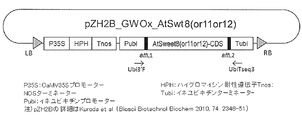
2.4で得たAtSWEET8タンパク質をコードするDNA、AtSWEET11タンパク質をコードするDNA、AtSWEET12タンパク質をコードするDNAが挿入されたpENTR/D-TOPOプラスミドDNAとイネ形質転換用ベクター(pZH2B_GWOx)とを用いてGateway LR反応を行い、図6に示すように、イネ植物体内で過剰発現するためのコンストラクトを構築した。
コロニーPCRで増幅するDNA断片の長さをアガロースゲル電気泳動で可視化する事によって、AtSWEETタンパク質をコードするDNAのベクターへの挿入を確認した。
挿入DNAが確認できたクローンからプラスミドDNAの精製を行った。プラスミドDNAの精製は、QIAprep Spin Miniprep Kit (QIAGEN、#27106) を用い、添付のプロトコルに従って行った。
2.8で精製したプラスミドDNAを鋳型にし、以下のプライマーを用いて、DNAシーケンサ(ベックマンコールター CEQ8000)によりDNA断片の塩基配列の決定を行った。
Ubi3’F : 5’-TGC TGT ACT TGC TTG GTA TTG-3’(配列番号38)
UbiTseq3 : 5’-GGA CCA GAC CAG ACA ACC-3’ (配列番号39)
OsSWEET13、OsSWEET14或いはOsSWEET15タンパク質をコードするDNAに、pENTR/D-TOPOベクターに導入するため5’端にCACC配列を付加するよう設計した。設計したDNAを化学的に全合成し、pENTR/D-TOPOベクターに挿入した。
ここでは、SlSWEET8をコードする塩基配列として配列番号41、PpSWEET8をコードする塩基配列として配列番号43を設計した。そして、これら配列番号41及び43に対して、pENTR/D-TOPOベクターに導入するため5’端にCACC配列を付加するよう設計した。設計したDNAを化学的に全合成し、pENTR/D-TOPOベクターに挿入した。
2.10.1及び2.10.2で合成したDNAを用い、上記2.6~2.9と同様にイネ形質転換用ベクターを構築した。
上記2.9及び2.11で作製した植物発現用ベクターを用いて、The Plant Journal (2006) 47, 969-976に記載の方法に従い、AtSWEET、OsSWEET、SlSWEET8、及びPpSWEET8タンパク質をコードするDNAをイネ(日本晴)に導入した。
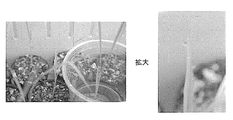
AtSWEET、OsSWEET、SlSWEET8、及びPpSWEET8タンパク質をコードするDNAを導入したイネの形質転換第一世代を、直径6cmポットに8割程度バーミキュライトを入れたものに移し替えて馴化した。なおイネの栽培は、18L(30℃)/6D(25℃)(18時間30℃明条件の後6時間25℃暗条件にする24時間光サイクル条件)で行った。馴化後、1~2週間経過した植物体に1/1000ハイポネックスを十分に与え、ラップフィルム(旭化成社製、サランラップ)で湿度80%以上好ましくは90%以上になるように植物を包み込み、イネの排水組織から排水液を排出させた(図7)。葉に付着した排水液を回収し、糖濃度を分析した。
3.1 排水液サンプルの希釈
1.8で得られたシロイヌナズナの排水液、2.13で得られたイネの排水液の体積をピペッターを用いて測定し、純水を加えて0.35mlに定容した。次に、10000xG、10分間の遠心分離を行ったのち、上清0.3mLをオートサンプラーバイアルに移してHPLC分析に用いた。
糖濃度の分析は以下の条件でHPLCを用いて行った。このとき標準物質としてグルコース、フルクトース、スクロースを各50μMになるよう混合した標準液を用いた。
分析カラム:CarboPac PA1(ダイオネクス)
溶離液:100mM NaOH
流量:1ml/min
注入量:25μl
検出器:パルスドアンペロメトリ検出器(ダイオネクス ED40)
1.8で得られたシロイヌナズナの排水液、2.13で得られたイネの排水液について糖濃度を測定した結果を表19及び20に示す。

Claims (27)
- AtSWEET8タンパク質をコードする核酸又は当該核酸の相同核酸を導入する及び/又は当該核酸又は当該相同核酸によりコードされるタンパク質の発現を強化した形質転換植物又は形質転換植物細胞。
- 上記AtSWEET8タンパク質をコードする核酸は、以下の(a)~(c)いずれかのタンパク質をコードする核酸であることを特徴とする請求項1記載の形質転換植物又は形質転換植物細胞。
(a)配列番号2のアミノ酸配列からなるタンパク質
(b)配列番号2のアミノ酸配列に対して90%以上の同一性を有するアミノ酸配列からなり、糖輸送に関与するトランスポーター活性を有するタンパク質
(c)配列番号1の塩基配列からなるポリヌクレオチドの全部又は一部に対してストリンジェントな条件でハイブリダイズできるポリヌクレオチドによりコードされるアミノ酸配列からなり、糖輸送に関与するトランスポーター活性を有するタンパク質 - 上記相同核酸は、以下の(a)~(c)いずれかのタンパク質をコードする核酸であることを特徴とする請求項1記載の形質転換植物又は形質転換植物細胞。
(a)配列番号5又は7のアミノ酸配列からなるタンパク質
(b)配列番号5又は7のアミノ酸配列に対して90%以上の同一性を有するアミノ酸配列からなり、糖輸送に関与するトランスポーター活性を有するタンパク質
(c)配列番号40~43いずれかの塩基配列からなるポリヌクレオチドの全部又は一部に対してストリンジェントな条件でハイブリダイズできるポリヌクレオチドによりコードされるアミノ酸配列からなり、糖輸送に関与するトランスポーター活性を有するタンパク質 - 上記相同核酸は、以下の(a)又は(b)のタンパク質をコードする核酸であることを特徴とする請求項1記載の形質転換植物又は形質転換植物細胞。
(a)配列番号3、4、6、8及び9いずれかのアミノ酸配列からなるタンパク質
(b)配列番号3、4、6、8及び9いずれかのアミノ酸配列に対して90%以上の同一性を有するアミノ酸配列からなり、糖輸送に関与するトランスポーター活性を有するタンパク質 - 上記相同核酸は、以下の(a)~(c)いずれかのタンパク質をコードする核酸であることを特徴とする請求項1記載の形質転換植物又は形質転換植物細胞。
(a)配列番号2記載のアミノ酸配列に対して33%以上の一致度を有するアミノ酸配列からなり、糖輸送に関与するトランスポーター活性を有するタンパク質
(b)配列番号2記載のアミノ酸配列におけるN末端から213番目のアミノ酸配列に対して35%以上の一致度を有するアミノ酸配列を、膜貫通ドメインを除く領域として含み、糖輸送に関与するトランスポーター活性を有するタンパク質
(c)配列番号2記載のアミノ酸配列における33~213番目のアミノ酸配列に対して37%以上の一致度を有するアミノ酸配列を、相同性の低い領域及び膜貫通ドメインを除く領域として含み、糖輸送に関与するトランスポーター活性を有するタンパク質 - 上記相同核酸は、以下の(a)~(c)いずれかのタンパク質をコードする核酸であることを特徴とする請求項1記載の形質転換植物又は形質転換植物細胞。
(a)配列番号5記載のアミノ酸配列に対して29%以上の一致度を有するアミノ酸配列からなり、糖輸送に関与するトランスポーター活性を有するタンパク質
(b)配列番号5記載のアミノ酸配列におけるN末端から205番目のアミノ酸配列に対して39%以上の一致度を有するアミノ酸配列を、膜貫通ドメインを除く領域として含み、糖輸送に関与するトランスポーター活性を有するタンパク質
(c)配列番号5記載のアミノ酸配列における30~205番目のアミノ酸配列に対して40%以上の一致度を有するアミノ酸配列を、相同性の低い領域及び膜貫通ドメインを除く領域として含み、糖輸送に関与するトランスポーター活性を有するタンパク質 - 上記相同核酸は、以下の(a)~(c)いずれかのタンパク質をコードする核酸であることを特徴とする請求項1記載の形質転換植物又は形質転換植物細胞。
(a)配列番号7記載のアミノ酸配列に対して30%以上の一致度を有するアミノ酸配列からなり、糖輸送に関与するトランスポーター活性を有するタンパク質
(b)配列番号7記載のアミノ酸配列におけるN末端から195番目のアミノ酸配列に対して37%以上の一致度を有するアミノ酸配列を、膜貫通ドメインを除く領域として含み、糖輸送に関与するトランスポーター活性を有するタンパク質
(c)配列番号5記載のアミノ酸配列における18~195番目のアミノ酸配列に対して39%以上の一致度を有するアミノ酸配列を、相同性の低い領域及び膜貫通ドメインを除く領域として含み、糖輸送に関与するトランスポーター活性を有するタンパク質 - 以下のアミノ酸配列:(N/S)(V/I)xxxxxFx(S/A)(1-3aa)TFxxI(V/F/M)Kx(K/R)(S/K/T)(V/T)x(D/E)(F/Y)(S/K)x(I/V/M)PY(V/I/L)x(T/A)x(L/M)(N/S)xxLW(V/T)(V/F/L)YGL(0-2aa)(V/I/F/L)xxxxxLVx(T/S)(I/V)N(A/G)xGxx(I/L)(E/H)(L/F/M/I)xY(L/I/V)x(L/I/V)(Y/F)Lxx(A/S/C)(2-4aa)(S/K/N)x(R/Q)(1-2aa)(V/I/M)xxxxxxx(L/V/I)xx(F/V/L)xx(V/I/M)xx(L/I/V)(V/T)(L/F)xx(V/I)(H/D/K)(D/S/N/G)(2-3aa)(R/K)xx(I/V/L/F)(I/V/L)Gx(L/M/I)xxx(F/L)xxxMYx(S/A)Pxx(V/A)xxxV(I/V)xx(R/K)S(V/T)(E/K)(Y/F)MPF(L/F)LS(L/F)(F/V)xF(I/L/V)N(G/A/S)xxWxxY(A/S)x(F/I/V/L)(2-3aa)Dx(F/Y)(I/V)xx(P/S)Nx(L/I)Gx(L/F/I)x(G/A)x(A/T/S)QLx(L/V)Yxx(Y/F)xx(A/S)(T/S)Pを含む共通配列を有する、糖輸送に関与するトランスポーター活性を有するタンパク質をコードする核酸を導入する及び/又は当該タンパク質の発現を強化した形質転換植物又は形質転換植物細胞。
- 上記共通配列は、MVDAKQVRFIIGVIGNVISFGLFAAPAKTFWRIFKKKSVEEFSYVPYVAT(V/I)MNCMLWVFYGLPVVHKDSxLVSTINGVGLVIE(L/I)FYV(G/A)(V/L)YLxYCGHK(Q/K)NxR(K/R)(K/N)ILx(Y/F)LxxEV(V/I)xV(A/V)xI(V/I)L(V/I)TLF(V/A)(I/L)K(N/G)DFxKQTFVG(V/I)ICD(V/I)FNIAMY(A/G)(S/A)PSLAI(I/F)(T/K)VV(K/R)TKS(V/T)EYMPFLLSLVCFVNA(A/G)IWT(S/T)YSLIFKIDxYVLASNGIGT(F/L)LALSQLIVYFMYYKSTPK(0-1aa)(E/D)KTVKPSEVEI(P/S)(A/G)T(N/E/D)RVを含むことを特徴とする請求項8記載の形質転換植物又は形質転換植物細胞。
- 上記糖輸送に関与するトランスポーター活性を有するタンパク質は、AtSWEET8タンパク質又はAtSWEET8タンパク質をコードする核酸の相同核酸がコードするタンパク質であることを特徴とする請求項8記載の形質転換植物又は形質転換植物細胞。
- 上記AtSWEET8タンパク質が、以下の(a)~(c)いずれかのタンパク質であることを特徴とする請求項10記載の形質転換植物又は形質転換植物細胞。
(a)配列番号2のアミノ酸配列からなるタンパク質
(b)配列番号2のアミノ酸配列に対して90%以上の同一性を有するアミノ酸配列からなり、糖輸送に関与するトランスポーター活性を有するタンパク質
(c)配列番号1の塩基配列からなるポリヌクレオチドの全部又は一部に対してストリンジェントな条件でハイブリダイズできるポリヌクレオチドによりコードされるアミノ酸配列からなり、糖輸送に関与するトランスポーター活性を有するタンパク質 - 上記相同核酸が、以下の(a)~(c)いずれかのタンパク質をコードする核酸であることを特徴とする請求項10記載の形質転換植物又は形質転換植物細胞。
(a)配列番号5又は7のアミノ酸配列からなるタンパク質
(b)配列番号5又は7のアミノ酸配列に対して90%以上の同一性を有するアミノ酸配列からなり、糖輸送に関与するトランスポーター活性を有するタンパク質
(c)配列番号40~43いずれかの塩基配列からなるポリヌクレオチドの全部又は一部に対してストリンジェントな条件でハイブリダイズできるポリヌクレオチドによりコードされるアミノ酸配列からなり、糖輸送に関与するトランスポーター活性を有するタンパク質 - 上記相同核酸が、以下の(a)又は(b)のタンパク質をコードする核酸であることを特徴とする請求項10記載の形質転換植物又は形質転換植物細胞。
(a)配列番号3、4、6、8及び9いずれかのアミノ酸配列からなるタンパク質
(b)配列番号3、4、6、8及び9いずれかのアミノ酸配列に対して90%以上の同一性を有するアミノ酸配列からなり、糖輸送に関与するトランスポーター活性を有するタンパク質 - 上記相同核酸が、以下の(a)~(c)いずれかのタンパク質をコードする核酸であることを特徴とする請求項10記載の形質転換植物又は形質転換植物細胞。
(a)配列番号2記載のアミノ酸配列に対して33%以上の一致度を有するアミノ酸配列からなり、糖輸送に関与するトランスポーター活性を有するタンパク質
(b)配列番号2記載のアミノ酸配列におけるN末端から213番目のアミノ酸配列に対して35%以上の一致度を有するアミノ酸配列を、膜貫通ドメインを除く領域として含み、糖輸送に関与するトランスポーター活性を有するタンパク質
(c)配列番号2記載のアミノ酸配列における33~213番目のアミノ酸配列に対して37%以上の一致度を有するアミノ酸配列を、相同性の低い領域及び膜貫通ドメインを除く領域として含み、糖輸送に関与するトランスポーター活性を有するタンパク質 - 上記相同核酸が、以下の(a)~(c)いずれかのタンパク質をコードする核酸であることを特徴とする請求項10記載の形質転換植物又は形質転換植物細胞。
(a)配列番号5記載のアミノ酸配列に対して29%以上の一致度を有するアミノ酸配列からなり、糖輸送に関与するトランスポーター活性を有するタンパク質
(b)配列番号5記載のアミノ酸配列におけるN末端から205番目のアミノ酸配列に対して39%以上の一致度を有するアミノ酸配列を、膜貫通ドメインを除く領域として含み、糖輸送に関与するトランスポーター活性を有するタンパク質
(c)配列番号5記載のアミノ酸配列における30~205番目のアミノ酸配列に対して40%以上の一致度を有するアミノ酸配列を、相同性の低い領域及び膜貫通ドメインを除く領域として含み、糖輸送に関与するトランスポーター活性を有するタンパク質 - 上記相同核酸が、以下の(a)~(c)いずれかのタンパク質をコードする核酸であることを特徴とする請求項10記載の形質転換植物又は形質転換植物細胞。
(a)配列番号7記載のアミノ酸配列に対して30%以上の一致度を有するアミノ酸配列からなり、糖輸送に関与するトランスポーター活性を有するタンパク質
(b)配列番号7記載のアミノ酸配列におけるN末端から195番目のアミノ酸配列に対して37%以上の一致度を有するアミノ酸配列を、膜貫通ドメインを除く領域として含み、糖輸送に関与するトランスポーター活性を有するタンパク質
(c)配列番号7記載のアミノ酸配列における18~195番目のアミノ酸配列に対して39%以上の一致度を有するアミノ酸配列を、相同性の低い領域及び膜貫通ドメインを除く領域として含み、糖輸送に関与するトランスポーター活性を有するタンパク質 - 顕花植物又は顕花植物由来であることを特徴とする請求項1又は8記載の形質転換植物又は形質転換植物細胞。
- 上記顕花植物が被子植物であることを特徴とする請求項17記載の形質転換植物又は形質転換植物細胞。
- 上記被子植物が単子葉植物であることを特徴とする請求項18記載の形質転換植物又は形質転換植物細胞。
- 上記単子葉植物がイネ科植物であることを特徴とする請求項19記載の形質転換植物又は形質転換植物細胞。
- 上記イネ科植物がOryza属植物であることを特徴とする請求項20記載の形質転換植物又は形質転換植物細胞。
- 上記被子植物が双子葉植物であることを特徴とする請求項18記載の形質転換植物又は形質転換植物細胞。
- 上記双子葉植物がアブラナ科植物であることを特徴とする請求項22記載の形質転換植物又は形質転換植物細胞。
- 上記アブラナ科植物がArabidopsis属植物であることを特徴とする請求項23記載の形質転換植物又は形質転換植物細胞。
- 請求項1乃至24いずれか一項記載の形質転換植物又は形質転換植物細胞を栽培又は培養し、当該形質転換植物又は形質転換植物細胞から滲出物を採取する工程を含む滲出物の製造方法。
- 上記形質転換植物又は形質転換植物細胞を栽培又は培養する条件を相対湿度80%RH以上とすることを特徴とする請求項25記載の滲出物の製造方法。
- 上記滲出物が排水液であることを特徴とする請求項25記載の滲出物の製造方法。
Priority Applications (7)
| Application Number | Priority Date | Filing Date | Title |
|---|---|---|---|
| JP2015555000A JPWO2015099045A1 (ja) | 2013-12-27 | 2014-12-25 | 形質転換植物、形質転換植物を用いた糖含有滲出物の製造方法 |
| CA2935111A CA2935111A1 (en) | 2013-12-27 | 2014-12-25 | Transformed plant and method for producing exudate containing sugar using transformed plant |
| AU2014370933A AU2014370933A1 (en) | 2013-12-27 | 2014-12-25 | Transgenic plant and method for producing sugar-containing exudate that uses transgenic plant |
| CN201480070650.1A CN105848470A (zh) | 2013-12-27 | 2014-12-25 | 转化植物、使用转化植物的含糖溢泌物的制造方法 |
| US15/107,776 US20160319292A1 (en) | 2013-12-27 | 2014-12-25 | Transformed plant and method for producing exudate containing sugar using transformed plant |
| BR112016014968A BR112016014968A2 (pt) | 2013-12-27 | 2014-12-25 | Planta transformada e método para a produção de exsudato contendo açúcar com o uso de planta transformada |
| DE112014006042.9T DE112014006042T5 (de) | 2013-12-27 | 2014-12-25 | Transformierte Pflanze und Verfahren zur Herstellung von zuckerhaltigem Exsudat unter Verwendung der transformierten Pflanze |
Applications Claiming Priority (2)
| Application Number | Priority Date | Filing Date | Title |
|---|---|---|---|
| JP2013-273130 | 2013-12-27 | ||
| JP2013273130 | 2013-12-27 |
Publications (1)
| Publication Number | Publication Date |
|---|---|
| WO2015099045A1 true WO2015099045A1 (ja) | 2015-07-02 |
Family
ID=53478890
Family Applications (1)
| Application Number | Title | Priority Date | Filing Date |
|---|---|---|---|
| PCT/JP2014/084319 Ceased WO2015099045A1 (ja) | 2013-12-27 | 2014-12-25 | 形質転換植物、形質転換植物を用いた糖含有滲出物の製造方法 |
Country Status (8)
| Country | Link |
|---|---|
| US (1) | US20160319292A1 (ja) |
| JP (1) | JPWO2015099045A1 (ja) |
| CN (1) | CN105848470A (ja) |
| AU (1) | AU2014370933A1 (ja) |
| BR (1) | BR112016014968A2 (ja) |
| CA (1) | CA2935111A1 (ja) |
| DE (1) | DE112014006042T5 (ja) |
| WO (1) | WO2015099045A1 (ja) |
Citations (6)
| Publication number | Priority date | Publication date | Assignee | Title |
|---|---|---|---|---|
| JP2001512685A (ja) * | 1997-08-07 | 2001-08-28 | マックス−プランク−ゲゼルシャフト ツール フォルデルング デル ヴィッセンシャフテン エー.ファウ. | 植物において収量を増加させるための方法 |
| JP2002501755A (ja) * | 1998-01-30 | 2002-01-22 | ボード オブ トラスティーズ, ラトガーズ, ザ ステイト ユニバーシティ オブ ニュー ジャージー | 植物及び植物の部分からポリペプチドを回収するための方法 |
| JP2008528016A (ja) * | 2005-01-27 | 2008-07-31 | リブロフィ | 植物においてテルペノイド類を産生させるためのシステム |
| JP2012055208A (ja) * | 2010-09-07 | 2012-03-22 | Tokyo Univ Of Agriculture & Technology | L−dopaを蓄積する植物細胞及びその利用 |
| JP2012525845A (ja) * | 2009-05-04 | 2012-10-25 | カーネギー インスチチューション オブ ワシントン | 新規糖トランスポーター |
| WO2013086494A1 (en) * | 2011-12-08 | 2013-06-13 | Carnegie Institution Of Washington | Sucrose transporters and methods of generating pathogen-resistant plants |
-
2014
- 2014-12-25 WO PCT/JP2014/084319 patent/WO2015099045A1/ja not_active Ceased
- 2014-12-25 CA CA2935111A patent/CA2935111A1/en not_active Abandoned
- 2014-12-25 JP JP2015555000A patent/JPWO2015099045A1/ja active Pending
- 2014-12-25 US US15/107,776 patent/US20160319292A1/en not_active Abandoned
- 2014-12-25 DE DE112014006042.9T patent/DE112014006042T5/de not_active Withdrawn
- 2014-12-25 BR BR112016014968A patent/BR112016014968A2/pt not_active Application Discontinuation
- 2014-12-25 CN CN201480070650.1A patent/CN105848470A/zh active Pending
- 2014-12-25 AU AU2014370933A patent/AU2014370933A1/en not_active Abandoned
Patent Citations (6)
| Publication number | Priority date | Publication date | Assignee | Title |
|---|---|---|---|---|
| JP2001512685A (ja) * | 1997-08-07 | 2001-08-28 | マックス−プランク−ゲゼルシャフト ツール フォルデルング デル ヴィッセンシャフテン エー.ファウ. | 植物において収量を増加させるための方法 |
| JP2002501755A (ja) * | 1998-01-30 | 2002-01-22 | ボード オブ トラスティーズ, ラトガーズ, ザ ステイト ユニバーシティ オブ ニュー ジャージー | 植物及び植物の部分からポリペプチドを回収するための方法 |
| JP2008528016A (ja) * | 2005-01-27 | 2008-07-31 | リブロフィ | 植物においてテルペノイド類を産生させるためのシステム |
| JP2012525845A (ja) * | 2009-05-04 | 2012-10-25 | カーネギー インスチチューション オブ ワシントン | 新規糖トランスポーター |
| JP2012055208A (ja) * | 2010-09-07 | 2012-03-22 | Tokyo Univ Of Agriculture & Technology | L−dopaを蓄積する植物細胞及びその利用 |
| WO2013086494A1 (en) * | 2011-12-08 | 2013-06-13 | Carnegie Institution Of Washington | Sucrose transporters and methods of generating pathogen-resistant plants |
Non-Patent Citations (2)
| Title |
|---|
| CHEN LI-QING ET AL.: "Sugar transporters for intercellular exchange and nutrition of pathogens", NATURE, vol. 468, 2010, pages 527 - 532 * |
| GUAN YUE-FENG ET AL.: "RUPTURED POLLEN GRAIN1, a Member of the MtN3/saliva Gene Family, Is Crucial for Exine Pattern Formation and Cell Integrity of Microspores in Arabidopsis", PLANT PHYSIOLOGY, vol. 147, 2008, pages 852 - 863 * |
Also Published As
| Publication number | Publication date |
|---|---|
| CA2935111A1 (en) | 2015-07-02 |
| DE112014006042T5 (de) | 2016-09-15 |
| BR112016014968A2 (pt) | 2017-09-19 |
| US20160319292A1 (en) | 2016-11-03 |
| CN105848470A (zh) | 2016-08-10 |
| JPWO2015099045A1 (ja) | 2017-03-23 |
| AU2014370933A1 (en) | 2016-07-07 |
Similar Documents
| Publication | Publication Date | Title |
|---|---|---|
| JP6382846B2 (ja) | 形質転換植物、形質転換植物を用いた糖含有滲出物の製造方法 | |
| JP5403628B2 (ja) | 植物のバイオマス量及び/又は種子量を増産させる遺伝子及びその利用方法 | |
| JP5250807B2 (ja) | 植物のバイオマス量及び/又は種子量を増産させる方法、バイオマス量及び/又は種子量を増産できる植物の製造方法 | |
| JP5454086B2 (ja) | 植物に環境ストレス耐性を付与する遺伝子及びその利用方法 | |
| JP5672004B2 (ja) | 植物のバイオマス量を増産させる遺伝子及びその利用方法 | |
| JP5604657B2 (ja) | 植物のバイオマス量及び/又は種子量を増産させる遺伝子及びその利用方法 | |
| CN1328383C (zh) | 野生稻的一个抗旱基因及其编码蛋白与应用 | |
| JP5212955B2 (ja) | 植物のバイオマス量を増産させる遺伝子及びその利用方法 | |
| WO2015099045A1 (ja) | 形質転換植物、形質転換植物を用いた糖含有滲出物の製造方法 | |
| CN111454923A (zh) | 大豆GmP5CDH基因的应用 | |
| JP5686977B2 (ja) | 植物の油脂生産性を増大させる遺伝子及びその利用方法 |
Legal Events
| Date | Code | Title | Description |
|---|---|---|---|
| 121 | Ep: the epo has been informed by wipo that ep was designated in this application |
Ref document number: 14875051 Country of ref document: EP Kind code of ref document: A1 |
|
| DPE1 | Request for preliminary examination filed after expiration of 19th month from priority date (pct application filed from 20040101) | ||
| ENP | Entry into the national phase |
Ref document number: 2015555000 Country of ref document: JP Kind code of ref document: A |
|
| WWE | Wipo information: entry into national phase |
Ref document number: 15107776 Country of ref document: US |
|
| WWE | Wipo information: entry into national phase |
Ref document number: IDP00201604294 Country of ref document: ID |
|
| ENP | Entry into the national phase |
Ref document number: 2935111 Country of ref document: CA |
|
| WWE | Wipo information: entry into national phase |
Ref document number: 112014006042 Country of ref document: DE |
|
| REG | Reference to national code |
Ref country code: BR Ref legal event code: B01A Ref document number: 112016014968 Country of ref document: BR |
|
| ENP | Entry into the national phase |
Ref document number: 2014370933 Country of ref document: AU Date of ref document: 20141225 Kind code of ref document: A |
|
| 122 | Ep: pct application non-entry in european phase |
Ref document number: 14875051 Country of ref document: EP Kind code of ref document: A1 |
|
| ENP | Entry into the national phase |
Ref document number: 112016014968 Country of ref document: BR Kind code of ref document: A2 Effective date: 20160624 |