WO2015087376A1 - オーステナイト系ステンレス鋼板およびその製造方法 - Google Patents
オーステナイト系ステンレス鋼板およびその製造方法 Download PDFInfo
- Publication number
- WO2015087376A1 WO2015087376A1 PCT/JP2013/082940 JP2013082940W WO2015087376A1 WO 2015087376 A1 WO2015087376 A1 WO 2015087376A1 JP 2013082940 W JP2013082940 W JP 2013082940W WO 2015087376 A1 WO2015087376 A1 WO 2015087376A1
- Authority
- WO
- WIPO (PCT)
- Prior art keywords
- stainless steel
- austenitic stainless
- steel sheet
- less
- strain rate
- Prior art date
- Legal status (The legal status is an assumption and is not a legal conclusion. Google has not performed a legal analysis and makes no representation as to the accuracy of the status listed.)
- Ceased
Links
Images


Classifications
-
- C—CHEMISTRY; METALLURGY
- C21—METALLURGY OF IRON
- C21D—MODIFYING THE PHYSICAL STRUCTURE OF FERROUS METALS; GENERAL DEVICES FOR HEAT TREATMENT OF FERROUS OR NON-FERROUS METALS OR ALLOYS; MAKING METAL MALLEABLE, e.g. BY DECARBURISATION OR TEMPERING
- C21D9/00—Heat treatment, e.g. annealing, hardening, quenching or tempering, adapted for particular articles; Furnaces therefor
- C21D9/46—Heat treatment, e.g. annealing, hardening, quenching or tempering, adapted for particular articles; Furnaces therefor for sheet metals
-
- C—CHEMISTRY; METALLURGY
- C21—METALLURGY OF IRON
- C21D—MODIFYING THE PHYSICAL STRUCTURE OF FERROUS METALS; GENERAL DEVICES FOR HEAT TREATMENT OF FERROUS OR NON-FERROUS METALS OR ALLOYS; MAKING METAL MALLEABLE, e.g. BY DECARBURISATION OR TEMPERING
- C21D6/00—Heat treatment of ferrous alloys
- C21D6/004—Heat treatment of ferrous alloys containing Cr and Ni
-
- C—CHEMISTRY; METALLURGY
- C21—METALLURGY OF IRON
- C21D—MODIFYING THE PHYSICAL STRUCTURE OF FERROUS METALS; GENERAL DEVICES FOR HEAT TREATMENT OF FERROUS OR NON-FERROUS METALS OR ALLOYS; MAKING METAL MALLEABLE, e.g. BY DECARBURISATION OR TEMPERING
- C21D8/00—Modifying the physical properties of ferrous metals or ferrous alloys by deformation combined with, or followed by, heat treatment
- C21D8/02—Modifying the physical properties of ferrous metals or ferrous alloys by deformation combined with, or followed by, heat treatment during manufacturing of plates or strips
- C21D8/0247—Modifying the physical properties of ferrous metals or ferrous alloys by deformation combined with, or followed by, heat treatment during manufacturing of plates or strips characterised by the heat treatment
- C21D8/0263—Modifying the physical properties of ferrous metals or ferrous alloys by deformation combined with, or followed by, heat treatment during manufacturing of plates or strips characterised by the heat treatment following hot rolling
-
- C—CHEMISTRY; METALLURGY
- C22—METALLURGY; FERROUS OR NON-FERROUS ALLOYS; TREATMENT OF ALLOYS OR NON-FERROUS METALS
- C22C—ALLOYS
- C22C38/00—Ferrous alloys, e.g. steel alloys
- C22C38/18—Ferrous alloys, e.g. steel alloys containing chromium
- C22C38/40—Ferrous alloys, e.g. steel alloys containing chromium with nickel
-
- C—CHEMISTRY; METALLURGY
- C22—METALLURGY; FERROUS OR NON-FERROUS ALLOYS; TREATMENT OF ALLOYS OR NON-FERROUS METALS
- C22C—ALLOYS
- C22C38/00—Ferrous alloys, e.g. steel alloys
- C22C38/18—Ferrous alloys, e.g. steel alloys containing chromium
- C22C38/40—Ferrous alloys, e.g. steel alloys containing chromium with nickel
- C22C38/42—Ferrous alloys, e.g. steel alloys containing chromium with nickel with copper
-
- C—CHEMISTRY; METALLURGY
- C22—METALLURGY; FERROUS OR NON-FERROUS ALLOYS; TREATMENT OF ALLOYS OR NON-FERROUS METALS
- C22C—ALLOYS
- C22C38/00—Ferrous alloys, e.g. steel alloys
- C22C38/18—Ferrous alloys, e.g. steel alloys containing chromium
- C22C38/40—Ferrous alloys, e.g. steel alloys containing chromium with nickel
- C22C38/44—Ferrous alloys, e.g. steel alloys containing chromium with nickel with molybdenum or tungsten
-
- C—CHEMISTRY; METALLURGY
- C22—METALLURGY; FERROUS OR NON-FERROUS ALLOYS; TREATMENT OF ALLOYS OR NON-FERROUS METALS
- C22C—ALLOYS
- C22C38/00—Ferrous alloys, e.g. steel alloys
- C22C38/18—Ferrous alloys, e.g. steel alloys containing chromium
- C22C38/40—Ferrous alloys, e.g. steel alloys containing chromium with nickel
- C22C38/48—Ferrous alloys, e.g. steel alloys containing chromium with nickel with niobium or tantalum
-
- C—CHEMISTRY; METALLURGY
- C22—METALLURGY; FERROUS OR NON-FERROUS ALLOYS; TREATMENT OF ALLOYS OR NON-FERROUS METALS
- C22C—ALLOYS
- C22C38/00—Ferrous alloys, e.g. steel alloys
- C22C38/18—Ferrous alloys, e.g. steel alloys containing chromium
- C22C38/40—Ferrous alloys, e.g. steel alloys containing chromium with nickel
- C22C38/50—Ferrous alloys, e.g. steel alloys containing chromium with nickel with titanium or zirconium
-
- C—CHEMISTRY; METALLURGY
- C22—METALLURGY; FERROUS OR NON-FERROUS ALLOYS; TREATMENT OF ALLOYS OR NON-FERROUS METALS
- C22C—ALLOYS
- C22C38/00—Ferrous alloys, e.g. steel alloys
- C22C38/18—Ferrous alloys, e.g. steel alloys containing chromium
- C22C38/40—Ferrous alloys, e.g. steel alloys containing chromium with nickel
- C22C38/58—Ferrous alloys, e.g. steel alloys containing chromium with nickel with more than 1.5% by weight of manganese
-
- C—CHEMISTRY; METALLURGY
- C21—METALLURGY OF IRON
- C21D—MODIFYING THE PHYSICAL STRUCTURE OF FERROUS METALS; GENERAL DEVICES FOR HEAT TREATMENT OF FERROUS OR NON-FERROUS METALS OR ALLOYS; MAKING METAL MALLEABLE, e.g. BY DECARBURISATION OR TEMPERING
- C21D8/00—Modifying the physical properties of ferrous metals or ferrous alloys by deformation combined with, or followed by, heat treatment
- C21D8/02—Modifying the physical properties of ferrous metals or ferrous alloys by deformation combined with, or followed by, heat treatment during manufacturing of plates or strips
- C21D8/0221—Modifying the physical properties of ferrous metals or ferrous alloys by deformation combined with, or followed by, heat treatment during manufacturing of plates or strips characterised by the working steps
- C21D8/0226—Hot rolling
Definitions
- the present invention relates to an austenitic stainless steel sheet and a method for producing the same, and specifically, for example, suitable for use as a structural member such as an automobile or a train.
- the present invention relates to an austenitic stainless steel sheet that achieves both ductility in the strain rate region and a method for producing the same.
- front side members of automobiles need to absorb impact energy without being greatly deformed.
- 10% flow stress at a strain rate equivalent to collision of 1000 / s is considered suitable.
- uniform elongation at a strain rate of 0.1 / s equivalent to press is suitable. That is, it can be said that a material excellent in 10% flow stress at a strain rate of 1000 / s and uniform elongation at a strain rate of 0.1 / s is suitable as a structural member.
- Patent Document 1 discloses an invention related to an austenitic stainless steel in which Mn is added in a large amount and does not cause work-induced martensitic transformation at the time of deformation, and the strength is increased by twin deformation of austenite.
- Mn work-induced martensitic transformation
- Patent Document 1 describes, as an example, 10% flow stress in a dynamic tensile test and breakage in a static tensile test, but the product of these is only less than 400 MPa.
- Patent Document 2 discloses an invention related to a low Ni type austenitic stainless steel for automobile structural members.
- the austenitic stainless steel of the present invention has a coarse crystal grain size of several tens of ⁇ m, cracks often occur on the surface of the bent portion when it is molded as an automobile structural member. It is insufficient.
- the product of 10% flow stress at a strain rate of 1000 / s and uniform elongation at a strain rate of 0.1 / s is 450 MPa or more, and the impact absorption capacity and press formability are as follows. Either or both of these can be greatly improved as compared with conventional steels, and high strength can be achieved at a high strain rate and ductility can be improved at a low strain rate.
- FIG. 1 is a graph illustrating equation (2).
- FIG. 2 is a graph showing the analysis result of the hot-rolled annealed plate by EPMA line analysis
- FIG. 2 (a) shows the analysis result of the steel plate 3
- FIG. 2 (b) shows the analysis result of the steel plate 43
- FIG. (C) shows the analysis result of the steel plate 44.
- Chemical composition (C: 0.02-0.30%) C is a solid solution strengthening element and greatly contributes to high strength at a high strain rate.
- Solid solution strengthening by C is strengthening utilizing short-range obstacles, and the strain rate dependence of strengthening is large. Therefore, compared to solid solution strengthening with alloy elements, strengthening with dislocations, and other strengthening with precipitates, the deterioration of ductility at a low strain rate is small, and the purpose of the present invention is to increase the strength at a high strain rate. It is extremely effective in achieving both ductility at a low strain rate. For this reason, C content shall be 0.02% or more.
- the C content is preferably 0.04% or more and 0.30% or less, and more preferably 0.06% or more and 0.30% or less.
- Cr is a basic element of stainless steel, and by containing 10.0% or more, Cr has an effect of forming a passive film on the surface of the steel material to enhance corrosion resistance.
- the Cr content is set to 10.0% or more and 25.0% or less.
- the Cr content is preferably 15% or more and 20% or less.
- Ni is a basic element of austenitic stainless steel. In order to stably obtain an austenitic phase having an excellent balance between strength and ductility at room temperature, Ni is contained in an amount of 3.5% or more. However, if the Ni content is too large, the austenite phase is excessively stabilized, the work-induced martensitic transformation during deformation is suppressed, and work hardening becomes difficult, resulting in a decrease in elongation. Therefore, the Ni content is set to 3.5% or more and 10.0% or less. The Ni content is preferably 3.5% or more and 8% or less.
- Mn 0.5-5.0% Mn is used as a deoxidizer during melting. Further, Mn is an austenite stabilizing element and has an effect of increasing the solid solubility limit of C and N to dissolve a large amount of C and N, and contains an appropriate amount in consideration of balance with other elements. . However, if the Mn content is excessive, a coarse Mn compound is produced in the production process, and the coarse Mn compound becomes a starting point of destruction, and the moldability deteriorates. For the above reasons, the Mn content is set to 0.5% or more and 5.0% or less. The Mn content is preferably 1.0% or more and 5.0% or less, and more preferably 1.5% or more and 5.0% or less.
- N is a solid solution strengthening element and is effective for increasing the strength at a high strain rate.
- Solid solution N is the object of the present invention because, like solid solution C, the deterioration in ductility at a low strain rate is small compared to solid solution strengthening by alloy elements, strengthening by dislocation, and strengthening by precipitates. It is extremely effective in increasing strength at high strain rates and improving ductility at low strain rates. For this reason, N content shall be 0.10% or more. However, if the N content is excessive, coarse nitrides are produced in the manufacturing process, and the balance between strength and ductility deteriorates. Therefore, the N content is set to 0.40% or less.
- the N content is preferably 0.15% or more and 0.30% or less, and more preferably 0.20% or more and 0.25% or less.
- C and N are solid solution strengthening elements, and greatly contribute to increasing the strength at a high strain rate. Since the solid solution strengthening by C and N has a lower deterioration in ductility at a low strain rate than the solid solution strengthening by alloying elements, the strengthening by dislocations, and the strengthening by precipitates, the high strain which is the object of the present invention. In order to achieve both high strength at a speed and ductility at a low strain rate, C + 3 ⁇ N is set to 0.4% or more.
- the austenitic stainless steel according to the present invention may further contain an optional additive element described below as required.
- Si is a solid solution strengthening element, contributes to increasing the strength of steel, and is also used as a deoxidizer during melting. Si may be contained as necessary. In order to increase the strength, it is desirable to contain 0.1% or more. However, if the Si content is excessive, coarse Si compounds are produced during the production process, and these coarse Si compounds cause deterioration of hot workability and cold workability. For this reason, Si content is 3.0% or less, Preferably it is 2.8% or less.
- Mo 0 to 3.0% or Cu: 0 to 3.0%, or both
- Mo is an element effective for improving the corrosion resistance, and may be contained as necessary. However, if the Mo content is too large, ductility is lowered, so the Mo content is 3.0% or less.
- the Mo content is preferably 2.5% or less, and preferably 0.4% or more in order to reliably obtain the effect of improving corrosion resistance.
- Cu is effective in improving cold workability and ductility, and may be contained as necessary. However, if the Cu content is too high, hot brittleness is induced, so the Cu content is 3.0% or less.
- the Cu content is preferably 2.5% or less, and is preferably contained in an amount of 0.4% or more in order to surely improve the cold workability and ductility.
- Ti, Nb, and V are all precipitated as fine carbides or nitrides in the manufacturing process and have an effect of suppressing crystal grain growth due to the pinning effect, and may be contained as necessary. However, if the content of these elements is excessive, coarse carbides and nitrides are formed, which become the starting points of fracture during deformation and significantly deteriorate the moldability. Therefore, the Ti content is 0.10% or less, the Nb content is 0.50% or less, and the V content is 1.0% or less.
- the Ti content is 0.05% or less, the Nb content is 0.2% or less, and the V content is 0.5% or less.
- Ti is contained in an amount of 0.01% or more, Nb is 0.02% or more, and V is 0.02% or more.
- the balance other than those described above is Fe and impurities.
- the impurities include those contained in raw materials such as ore and scrap and those contained in the manufacturing process.
- Typical impurities include P: 0.05% or less, S: 0.03% or less, and the like.
- the Md 30 value is 0 ° C or more and 50 ° C or less
- the Md 30 value is an index indicating austenite stability, and is a processing temperature at which 50% is transformed into martensite when an elongation strain of 30% is applied.
- the Md 30 value is defined by the following equation (1).
- Crystal grain size of austenite matrix 10 ⁇ m or less
- the refinement of crystal grains is a strengthening method in which the deterioration of the ductility of the steel is small, and it has been found that it is an effective strengthening method even in the stainless steel targeted by the present invention.
- the crystal grain size of the austenite matrix is set to 10 ⁇ m or less.
- the crystal grain size of the austenite matrix is preferably 7 ⁇ m or less, more preferably 6 ⁇ m or less.
- the Cr carbide includes Cr 23 (C, N) 6 in which a small amount of N is dissolved
- the Cr nitride includes Cr 2 (C, N), Cr (C, N) in which a small amount of C is dissolved. N).
- the Cr carbide, Cr nitride itself, or the interface between the Cr carbide, Cr nitride and the parent phase is likely to be a crack starting point, and the ductility is remarkable. To deteriorate. For this reason, it is desirable that the amount of Cr carbide and Cr nitride is small.
- the volume ratio of Cr carbide and Cr nitride is set to 1.0% or less.
- the present invention is characterized by obtaining an excellent balance between strength and ductility by dissolving a large amount of C and N in a solid solution.
- C and N precipitated or concentrated at the time of hot rolling are not sufficiently uniformed, and these precipitation or concentration C, N may remain even after the subsequent solution heat treatment and annealing, and in the cooling process after the solution heat treatment and annealing, it is easy to precipitate as a nucleus in which the Cr carbide and nitride remain, C and N cannot be made a solid solution.
- the present inventors have found that the annealing temperature T is such that C and N in the hot-rolled sheet diffuse 150 ⁇ m or more. It has also been found that by performing hot-rolled sheet annealing with an annealing time t, C and N precipitated or concentrated during hot rolling are sufficiently dissolved and uniformized.
- the diffusion distance ⁇ is arranged by the diffusion coefficient D and time t as shown in the equation (3).
- the diffusion coefficient D (m 2 / sec) of N in the austenitic stainless steel is represented by the formula (4) according to literature (for example, physical properties of steel and nitrogen, page 69 Agne Technical Center).
- FIG. 1 illustrates the equation (2).
- a portion painted in gray (upper right portion) in FIG. 1 is a range satisfying the expression (2). Since C in the austenitic stainless steel has a diffusion coefficient substantially the same as N, C is sufficiently diffused and uniformized by performing hot-rolled sheet annealing at an annealing temperature and an annealing time satisfying the formula (2).
- the cooling rate is preferably 2.0 ° C./sec or more up to 700 ° C. where Cr carbide and Cr nitride are likely to precipitate.
- the temperature is preferably maintained at 900 ° C. or higher, and the cooling rate from the holding temperature to 700 ° C. is preferably 2.0 ° C./sec or higher.
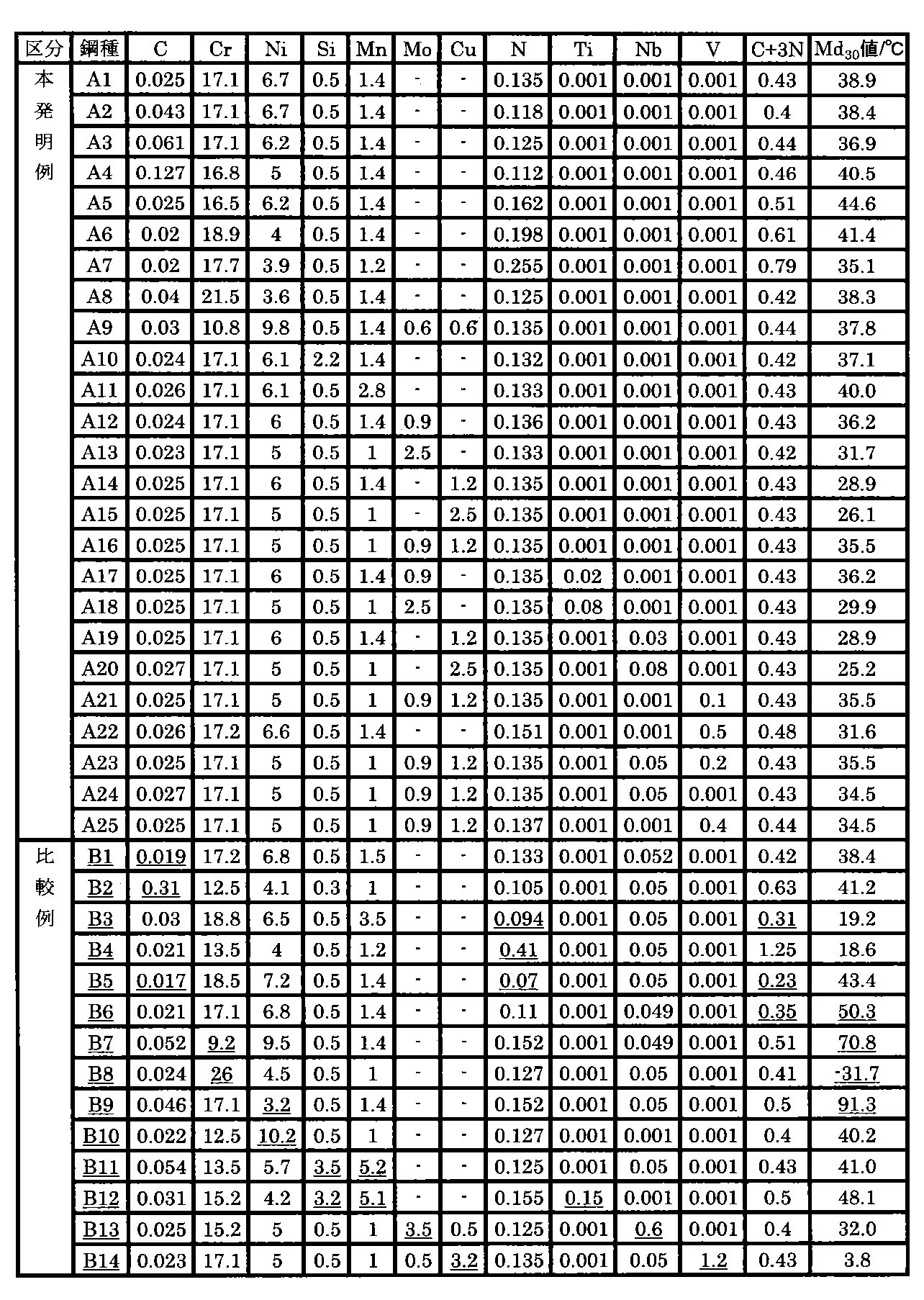
- This stainless steel ingot was cut into a hot rolling material having a thickness of 45 mm. Thereafter, hot rolling was performed to obtain a hot-rolled steel sheet having a thickness of 6.0 mm, and then the hot-rolled steel sheet was subjected to hot-rolled sheet annealing at an annealing temperature and an annealing time shown in Table 2, respectively.
- the steel plates 28, 34, 35, 43, and 44 are examples in which the annealing temperature T (° C.) and the annealing time t (sec) in hot-rolled sheet annealing do not satisfy the above formula (2).
- the diffraction peak from the (420) plane, the (422) plane and the (440) plane of Cr 23 C 6 as the X-ray diffraction peak of carbide, the (110) plane of Cr 2 N as the X-ray diffraction peak of nitride, (002 ) Plane, (111) plane, and diffraction peaks from CrN (111) plane, (220) plane, and (311) plane were used.
- V C , V N , V ⁇ , V ⁇ ′ are obtained by dividing the integrated intensity of the peak of each surface of the Cr carbide, Cr nitride, austenite phase, and martensite phase by the relative strength of the JCPDS card, respectively. It is the value added together.
- I gamma (hkl) is the integrated intensity of the peaks from the obtained gamma (hkl) plane obtained by X-ray diffraction measurement
- RI gamma (hkl) is the relative intensity of JCPDS card RI gamma (hkl) .
- Crystal grain size The cross-section in the rolling direction of the steel plate was polished, and after the nitric acid electrolytic corrosion, the metal structure was photographed with a scanning microscope. The nominal grain size obtained from the photograph taken was taken as the average crystal grain size of the parent phase.
- Table 2 shows the volume fraction V (%) of Cr carbide and Cr nitride of these steel sheets, the average crystal grain size D ( ⁇ m), 10% flow stress in a tensile test at a strain rate of 1000 / s, and a strain rate of 0. The uniform elongation in a tensile test at 1 / s and the product of these are shown together.
- Steel plates 1 to 26 in Table 2 are steel plates according to examples of the present invention.
- the Ti, Nb, V content: 0.001% are content as impurities.
- Steel plates 1 to 26 all have an excellent balance of strength and ductility. Specifically, it is a steel in which the product of 10% flow stress at a strain rate of 1000 / s and uniform elongation at a strain rate of 0.1 / s exceeds 450 MPa.
- the steel plates 27 to 44 are comparative steels, which are inferior in balance between strength and ductility.
- the steel plates 27 and 28 are inferior in balance between strength and ductility because the C content is out of the scope of the present invention.
- the steel plates 29 and 30 have an N content that is out of the range of the present invention.
- the steel plate 29 has a smaller amount of (C + 3 ⁇ N) than the range of the present invention, so that the balance between strength and ductility is poor.
- the steel plates 31 and 32 have a (C + 3 ⁇ N) amount less than the range of the present invention.
- the steel plate 31 has a balance between strength and ductility because both the C content and the N content are outside the range of the present invention. Inferior.
- the steel plates 33 and 34 are inferior in balance between strength and ductility because the Cr content and the Md 30 value are out of the scope of the present invention.
- the steel plate 35 is inferior in the balance between strength and ductility because the Ni content and the Md 30 value are out of the scope of the present invention.
- the steel plate 36 is inferior in balance between strength and ductility because the Ni content and the Md 30 value are out of the scope of the present invention.
- the steel plate 37 is inferior in the balance between strength and ductility because the Si content and the Mn content are out of the scope of the present invention.
- the steel plate 38 is inferior in balance between strength and ductility because the Si content, the Mn content and the Ti content deviate from the scope of the present invention.
- the steel plate 39 is inferior in the balance between strength and ductility because the Mo content and the Nb content deviate from the scope of the present invention.
- the steel plate 40 is inferior in balance between strength and ductility because the Cu content and the V content deviate from the scope of the present invention.
- the steel plates 41 and 42 both have a chemical composition that satisfies the scope of the present invention, a (C + 3 ⁇ N) amount, and an Md 30 value, but the crystal grain size is out of the scope of the present invention, so that the balance between strength and ductility is achieved. Inferior to By comparing the steel plates 1, 41, 42 produced from the steel type A1, it can be seen that an excellent balance of strength and ductility can be obtained by making the crystal grain size 10 ⁇ m or less.
- the steel plates 43 and 44 both have a chemical composition that satisfies the scope of the present invention, a (C + 3 ⁇ N) amount and an Md 30 value, but the total volume of Cr carbide and Cr nitride of the cold-rolled annealing material. The rate exceeds 1%, and the balance between strength and ductility is poor.
- steel plates 3, 4, 43, and 44 made from steel type A3 the balance of excellent strength and ductility can be obtained by making the total volume fraction of Cr carbide and Cr nitride 1% or less. I understand.
- FIG. 2 is a graph showing the analysis result of the hot-rolled annealed plate by EPMA line analysis
- FIG. 2 (a) shows the analysis result of the steel plate 3
- FIG. 2 (b) shows the analysis result of the steel plate 43
- FIG. c) shows the analysis result of the steel plate 44.
- the steel plates 43 and 44 have a chemical composition that satisfies the scope of the present invention, but the annealing temperature and annealing time of hot-rolled sheet annealing after hot rolling do not satisfy the formula (2), and FIG.
- the annealing temperature and annealing time of hot-rolled sheet annealing after hot rolling do not satisfy the formula (2), and FIG.
- the EPMA analysis result of the hot rolled annealed sheet 2 (c) there is a region where C and N are concentrated after the hot rolled sheet anneal. These remain until after the final annealing and exist as a large amount of Cr carbide and nitride.
Landscapes
- Chemical & Material Sciences (AREA)
- Engineering & Computer Science (AREA)
- Materials Engineering (AREA)
- Mechanical Engineering (AREA)
- Metallurgy (AREA)
- Organic Chemistry (AREA)
- Physics & Mathematics (AREA)
- Thermal Sciences (AREA)
- Crystallography & Structural Chemistry (AREA)
- Heat Treatment Of Sheet Steel (AREA)
- Heat Treatment Of Steel (AREA)
Abstract
Description
質量%で、C:0.02~0.30%、Cr:10.0~25.0%、Ni:3.5~10.0%、Si:0~3.0%、Mn:0.5%~5.0%、N:0.10~0.40%、Mo:0~3.0%、Cu:0~3.0%、Ti:0~0.10%、Nb:0~0.50%、V:0~1.0%であり、C+3×N:0.4%以上であり、残部Feおよび不純物からなり、下記(1)式により規定されるMd30値が0℃以上50℃以下であり、Cr炭化物およびCr窒化物の体積率が1%以下であり、かつ母相の平均結晶粒径が10μm以下である、オーステナイト系ステンレス鋼板。

質量%で、Mo:0.4~3.0%、Cu:0.4~3.0%の少なくとも1種を含有する、[1]に記載のオーステナイト系ステンレス鋼板。
質量%で、Ti:0.01~0.10%、Nb:0.02~0.50%、V:0.02~1.0%からなる群から選ばれた1種または2種以上を含有する、[1]または[2]に記載のオーステナイト系ステンレス鋼板。
歪み速度1000/sでの10%流動応力と歪み速度0.1/sでの一様伸びとの積が450MPa以上である、[1]~[3]のいずれか1項に記載のオーステナイト系ステンレス鋼板。
質量%で、C:0.02~0.30%、Cr:10.0~25.0%、Ni:3.5~10.0%、Si:0~3.0%、Mn:0.5%~5.0%、N:0.10~0.40%、Mo:0~3.0%、Cu:0~3.0%、Ti:0~0.10%、Nb:0~0.50%、V:0~1.0%であり、C+3×N:0.4%以上であり、残部Feおよび不純物からなるステンレス鋼素材に熱間圧延を施した後、得られた熱延鋼板に下記(2)式を満足する焼鈍温度T(℃)および焼鈍時間t(sec)で熱延板焼鈍を施す、オーステナイト系ステンレス鋼板の製造方法。

(C:0.02~0.30%)
Cは、固溶強化元素であり、高歪み速度での高強度化に大きく寄与する。Cによる固溶強化は、短範囲障害物を活用した強化であり、強化の歪み速度依存性が大きい。したがって、合金元素による固溶強化、転位による強化、析出物による他の強化と比較して、低歪み速度での延性の劣化が小さく、本発明の目的である高歪み速度での高強度化と低歪み速度での延性との両立に極めて有効である。このため、C含有量は0.02%以上とする。ただし、C含有量が過剰であると、製造過程において粗大な炭化物を生成して、強度および延性のバランスが劣化するので、C含有量は0.30%以下とする。C含有量は、好ましくは0.04%以上0.30%以下であり、さらに好ましくは0.06%以上0.30%以下である。
Crは、ステンレス鋼の基本元素であり、10.0%以上含有させることにより鋼材の表面に不動態皮膜を形成して耐食性を高める作用を奏する。しかし、Cr含有量が過剰であると、高温でδフェライトが生成し、鋼の熱間加工性が著しく劣化する。そのため、Cr含有量は10.0%以上25.0%以下とする。Cr含有量は、好ましくは15%以上20%以下である。
Niは、オーステナイト系ステンレス鋼の基本元素であり、室温で優れた強度および延性のバランスを有するオーステナイト相を安定して得るために、Niを3.5%以上含有させる。しかし、Ni含有量が多過ぎるとオーステナイト相が過剰に安定化し、変形時の加工誘起マルテンサイト変態が抑制され、加工硬化し難くなる結果、伸びが低下する。そのために、Ni含有量は3.5%以上10.0%以下とする。Ni含有量は、好ましくは3.5%以上8%以下である。
Mnは、溶製時の脱酸材として用いられる。また、Mnは,オーステナイト安定化元素であり、かつC,Nの固溶限を上げ、多量のC,Nを固溶させる効果があり、他の元素とのバランスを考慮して適量を含有させる。しかし、Mn含有量が過剰であると、製造過程で粗大なMn化合物が生成され、粗大なMn化合物が破壊の起点となって、成形性が劣化する。以上の理由により、Mn含有量は0.5%以上5.0%以下とする。Mn含有量は、好ましくは1.0%以上5.0%以下であり、さらに好ましくは1.5%以上5.0%以下である。
Nは、Cと同様に固溶強化元素であり、高歪み速度での高強度化に有効である。固溶Nは、固溶Cと同様に、合金元素による固溶強化、転位による強化、析出物による強化と比較して、低歪み速度での延性の劣化が小さいため、本発明の目的である高歪み速度での高強度化と低歪み速度での延性の向上に極めて有効である。このため、N含有量は0.10%以上とする。ただし、N含有量が過剰であると、製造過程において粗大な窒化物を生成して、強度および延性のバランスが劣化するので、N含有量は0.40%以下とする。N含有量は、好ましくは0.15%以上0.30%以下であり、さらに好ましくは0.20%以上0.25%以下である。
上述したように、C、Nは固溶強化元素であり、高歪み速度での高強度化に大きく寄与する。CとNによる固溶強化は、合金元素による固溶強化、転位による強化、析出物による強化と比較して、低歪み速度での延性の劣化が小さいことから、本発明の目的である高歪み速度での高強度化と低歪み速度での延性の両立のため、C+3×Nを0.4%以上とする。
Siは、固溶強化元素であり、鋼の高強度化に寄与するとともに、溶製時の脱酸材としても用いられる。Siは、必要に応じて含有させてもよい。高強度化のためには、0.1%以上含有することが望ましい。しかし、Si含有量が過剰であると、製造過程で粗大なSi化合物が生成され、これらの粗大なSi化合物が熱間加工性及び冷間加工性の劣化を招く。このため、Si含有量は、3.0%以下であり、望ましくは2.8%以下である。
Moは、耐食性の向上に有効な元素であり、必要に応じて含有させてもよい。しかし、Mo含有量が多過ぎると延性の低下をもたらすため、Mo含有量は、3.0%以下とする。Mo含有量は、好ましくは2.5%以下であり、耐食性向上効果を確実に得るためには0.4%以上含有することが好ましい。
Ti、NbおよびVは、いずれも、製造過程において、微細な炭化物あるいは窒化物として析出し、ピン止め効果により結晶の粒成長を抑制する効果があるので、必要に応じて含有させてもよい。ただし、これらの元素の含有量が過剰になると、粗大な炭化物や窒化物が生成し、これらが変形時の破壊起点となって成形性を著しく劣化させる。そのために、Ti含有量は0.10%以下とし、Nb含有量は0.50%以下とし、V含有量は1.0%以下とする。好ましくは、Ti含有量は0.05%以下であり、Nb含有量は0.2%以下であり、V含有量は0.5%以下である。また、結晶の粒成長を抑制する効果を確実に得るためには、Tiは0.01%以上、Nbは0.02%以上、Vは0.02%以上、含有することが好ましい。
Md30値は、オーステナイト安定度を示す指標であり、30%の伸び歪みを与えた時に50%がマルテンサイトに変態する加工温度である。Md30値は、下記(1)式により規定される。Md30値を0℃以上50℃以下とすることにより、変形時に適度に加工誘起マルテンサイトが生成し、TRIP効果が発現することで、より優れた強度および延性のバランスが得られる。

(オーステナイト母相の結晶粒径:10μm以下)
結晶粒の微細化は、鋼の延性の劣化が小さい強化法であり、本発明で対象とするステンレス鋼においても有効な強化手法であることが分かった。また、結晶粒径を小さくし、結晶粒界の密度を上げることにより、変形時に結晶粒界に集中する歪を分散させ、き裂の発生を抑制する効果もある。そこで、オーステナイト母相の結晶粒径を10μm以下とする。オーステナイト母相の結晶粒径は、好ましくは7μm以下であり、さらに好ましくは6μm以下である。
前述のとおり、C、N含有量を増やすことにより、高歪み速度での強度と低歪み速度での延性とのバランスが向上するが、これは、固溶C、Nの場合、高強度化に及ぼす歪み速度依存性が大きいためである。したがって、C、Nを多く添加しても、これらがCr炭化物やCr窒化物として存在したのではこの効果を得られない。ここで、Cr炭化物としてはCr23C6が挙げられ、Cr窒化物としてはCr2N,CrNが挙げられる。ここでいうCr炭化物には、微量のNが固溶したCr23(C,N)6を含み、Cr窒化物には微量のCが固溶したCr2(C,N),Cr(C,N)を含む。さらに、Cr炭化物,Cr窒化物のように粗大な化合物が存在する場合、Cr炭化物,Cr窒化物自身、あるいはCr炭化物,Cr窒化物と母相との界面がき裂の起点となり易く、延性を顕著に劣化させる。このため、Cr炭化物,Cr窒化物が少ないことが望ましく、具体的には、Cr炭化物およびCr窒化物の体積率を1.0%以下とする。
本発明は、多くのC、Nを固溶させることにより、優れた強度および延性のバランスを得ることを特徴とする。しかし、例えば特許文献2で開示された、1080℃、60秒間程度の熱延板焼鈍では、熱間圧延時に析出あるいは濃化したC,Nが十分に均一化せず、これらの析出あるいは濃化したC,Nが、その後の固溶化熱処理や焼鈍を経ても残存する場合があり、固溶化熱処理や焼鈍後の冷却過程で、Cr炭化物や窒化物が残存した析出物を核として析出しやすく、C、Nを多く固溶した状態にできない。



Cr炭窒化物の体積率V(%),平均結晶粒径D(μm),歪み速度1000/sでの10%流動応力(10%FS),歪み速度0.1/sでの一様伸び(UEL)は、以下の手法で測定した。
鋼板を板厚が3/4となるまで化学研磨した後、特性X線をCo―Kα線、2θを30-100(degree)の範囲でX回折測定を行った。検出された回折ピークを用いてCr炭化物およびCr窒化物の体積率Vを算出した。母相のX線回折ピークは、オーステナイト相の(111)面、(200)面、(220)面、および母相のマルテンサイト相の(110)面、(200)面、(211)面からの回折ピークを用いた。炭化物のX線回折ピークとしてCr23C6の(420)面、(422)面、(440)面からの回折ピーク、窒化物のX線回折ピークとしてCr2Nの(110)面、(002)面、(111)面および、CrNの(111)面、(220)面、(311)面からの回折ピークを用いた。
また、各相の構成元素が異なると、それらの構成元素の原子散乱因子(atomic scattering factor)が異なるため、X線の反射率は異なる。しかしながら、X線回折測定に関する代表的な文献である「B.D.Cullity:Elements of X-ray Diffraction,2nd ed.,Addison-Wesley,Massachussets,(1978)」によると、本発明で対象とするステンレス鋼の母相、および炭化物,窒化物の主要元素であるFe,Cr,Ni,Mnの原子散乱因子の差は小さいため、今回の実施例の範囲では、各相の構成元素の差が反射率に及ぼす影響は無視できる。


鋼板の圧延方向平行断面を研磨し、硝酸電解腐食後に、走査型顕微鏡で金属組織を撮影した。撮影した写真から得られた公称粒径を母相の平均結晶粒径とした。
歪み速度1000/sおよび0.1/sで引張試験を行った。各鋼板について引張試験を3回ずつ行い、それらの平均値を特性値とした。ここでは、衝突相当の高歪み速度の強度として歪み速度1000/sでの10%流動応力を利用するとともに、プレス相当の低歪み速度での延性として歪み速度0.1/sでの一様伸びを測定した。これらの10%流動応力と一様伸びの積を、強度および延性のバランスの指標とした。

鋼板27,28は、C含有量が本発明の範囲から外れるため、強度および延性のバランスに劣る。
鋼板31,32は、(C+3×N)量が本発明の範囲よりも少なく、特に鋼板31はC含有量およびN含有量のいずれもが本発明の範囲を外れるため、強度および延性のバランスに劣る。
鋼板35は、Ni含有量およびMd30値が本発明の範囲から外れるため、強度および延性のバランスに劣る。
鋼板37は、Si含有量およびMn含有量が本発明の範囲から外れるため、強度および延性のバランスに劣る。
鋼板39は、Mo含有量およびNb含有量が本発明の範囲から外れるため、強度および延性のバランスに劣る。
鋼板41,42は、いずれも、本発明の範囲を満足する化学組成、(C+3×N)量およびMd30値を有するものの、結晶粒径が本発明の範囲から外れるため、強度および延性のバランスに劣る。鋼種A1から作製した鋼板1,41,42を比較することにより、結晶粒径を10μm以下にすることにより優れた強度および延性のバランスを得られることが分かる。
Claims (5)
- 質量%で、C:0.02~0.30%、Cr:10.0~25.0%、Ni:3.5~10.0%、Si:0~3.0%、Mn:0.5%~5.0%、N:0.10~0.40%、Mo:0~3.0%、Cu:0~3.0%、Ti:0~0.10%、Nb:0~0.50%、V:0~1.0%であり、C+3×N:0.4%以上であり、残部Feおよび不純物からなり、下記(1)式により規定されるMd30値が0℃以上50℃以下であり、Cr炭化物およびCr窒化物の体積率が1%以下であり、かつ母相の平均結晶粒径が10μm以下である、オーステナイト系ステンレス鋼板。

- 質量%で、Si:0.1~3.0%、Mo:0.4~3.0%、Cu:0.4~3.0%の少なくとも1種を含有する、請求項1に記載のオーステナイト系ステンレス鋼板。
- 質量%で、Ti:0.01~0.10%、Nb:0.02~0.50%、V:0.02~1.0%からなる群から選ばれた1種または2種以上を含有する、請求項1または請求項2に記載のオーステナイト系ステンレス鋼板。
- 歪み速度1000/sでの10%流動応力と歪み速度0.1/sでの一様伸びとの積が450MPa以上である、請求項1~3のいずれか1項に記載のオーステナイト系ステンレス鋼板。
- 質量%で、C:0.02~0.30%、Cr:10.0~25.0%、Ni:3.5~10.0%、Si:0~3.0%、Mn:0.5%~5.0%、N:0.10~0.40%、Mo:0~3.0%、Cu:0~3.0%、Ti:0~0.10%、Nb:0~0.50%、V:0~1.0%であり、C+3×N:0.4%以上であり、残部Feおよび不純物からなるステンレス鋼素材に熱間圧延を施した後、得られた熱延鋼板に下記(2)式を満足する焼鈍温度T(℃)および焼鈍時間t(sec)で熱延板焼鈍を施す、オーステナイト系ステンレス鋼板の製造方法。

Priority Applications (4)
| Application Number | Priority Date | Filing Date | Title |
|---|---|---|---|
| JP2014517308A JP6029662B2 (ja) | 2013-12-09 | 2013-12-09 | オーステナイト系ステンレス鋼板およびその製造方法 |
| PCT/JP2013/082940 WO2015087376A1 (ja) | 2013-12-09 | 2013-12-09 | オーステナイト系ステンレス鋼板およびその製造方法 |
| CN201380078606.0A CN105452505B (zh) | 2013-12-09 | 2013-12-09 | 奥氏体系不锈钢板和其制造方法 |
| KR1020167000484A KR101779305B1 (ko) | 2013-12-09 | 2013-12-09 | 오스테나이트계 스테인리스 강판 및 그 제조 방법 |
Applications Claiming Priority (1)
| Application Number | Priority Date | Filing Date | Title |
|---|---|---|---|
| PCT/JP2013/082940 WO2015087376A1 (ja) | 2013-12-09 | 2013-12-09 | オーステナイト系ステンレス鋼板およびその製造方法 |
Publications (1)
| Publication Number | Publication Date |
|---|---|
| WO2015087376A1 true WO2015087376A1 (ja) | 2015-06-18 |
Family
ID=53370725
Family Applications (1)
| Application Number | Title | Priority Date | Filing Date |
|---|---|---|---|
| PCT/JP2013/082940 Ceased WO2015087376A1 (ja) | 2013-12-09 | 2013-12-09 | オーステナイト系ステンレス鋼板およびその製造方法 |
Country Status (4)
| Country | Link |
|---|---|
| JP (1) | JP6029662B2 (ja) |
| KR (1) | KR101779305B1 (ja) |
| CN (1) | CN105452505B (ja) |
| WO (1) | WO2015087376A1 (ja) |
Cited By (8)
| Publication number | Priority date | Publication date | Assignee | Title |
|---|---|---|---|---|
| JP2017088945A (ja) * | 2015-11-09 | 2017-05-25 | 新日鐵住金ステンレス株式会社 | 加工性に優れた構造部材用ステンレス鋼板及びその製造方法 |
| CN108138281A (zh) * | 2015-09-30 | 2018-06-08 | 新日铁住金株式会社 | 奥氏体系不锈钢 |
| EP3960881A1 (en) * | 2020-09-01 | 2022-03-02 | Outokumpu Oyj | Austenitic stainless steel |
| JP2022064692A (ja) * | 2020-10-14 | 2022-04-26 | 日鉄ステンレス株式会社 | オーステナイト系ステンレス鋼およびオーステナイト系ステンレス鋼の製造方法 |
| JP2022094149A (ja) * | 2020-12-14 | 2022-06-24 | 日鉄ステンレス株式会社 | オーステナイト系ステンレス鋼及び耐食性部材 |
| EP4249623A4 (en) * | 2020-11-23 | 2024-10-16 | POSCO Co., Ltd | High-strength austenitic stainless steel having excellent hot workability |
| EP4249624A4 (en) * | 2020-11-23 | 2024-10-30 | POSCO Co., Ltd | High-strength austenitic stainless steel with improved low-temperature toughness in hydrogen environment |
| JP2025517789A (ja) * | 2022-05-31 | 2025-06-10 | ポスコ カンパニー リミテッド | オーステナイト系ステンレス鋼及びその製造方法 |
Families Citing this family (24)
| Publication number | Priority date | Publication date | Assignee | Title |
|---|---|---|---|---|
| CN106048465A (zh) * | 2016-05-30 | 2016-10-26 | 苏州双金实业有限公司 | 一种性能为高强度的钢材 |
| CN106011677A (zh) * | 2016-06-13 | 2016-10-12 | 苏州双金实业有限公司 | 一种能够有效防止冲击的钢 |
| CN106086711A (zh) * | 2016-08-27 | 2016-11-09 | 郭云琴 | 一种高强度、高塑性trip钢板及其制备方法 |
| CN107604262A (zh) * | 2017-08-09 | 2018-01-19 | 宁波市镇海甬鼎紧固件制造有限公司 | 一种高强度304不锈钢及其制备方法 |
| CN108149157A (zh) * | 2017-12-29 | 2018-06-12 | 芜湖三联锻造有限公司 | 一种不锈钢棒材及其锻造方法 |
| CN108034896B (zh) * | 2018-01-17 | 2020-01-07 | 北京金物科技发展有限公司 | 一种颗粒增强奥氏体不锈钢材料及其制备方法 |
| CN109468547A (zh) * | 2019-01-06 | 2019-03-15 | 浙江火科技股份有限公司 | 一种高韧耐磨旋梭内梭及其制备方法 |
| KR102292016B1 (ko) * | 2019-11-18 | 2021-08-23 | 한국과학기술원 | 균일하게 분포하는 나노 크기의 석출물을 다량 함유한 오스테나이트계 스테인리스강 및 이의 제조방법 |
| CN111020381B (zh) * | 2019-12-09 | 2022-01-11 | 宁波宝新不锈钢有限公司 | 一种奥氏体不锈钢及其制备方法 |
| MX2022013630A (es) * | 2020-04-30 | 2023-01-24 | Jfe Steel Corp | Lamina de acero inoxidable y metodo para fabricar la misma, herramientas con filo y cubiertos. |
| CN111961989B (zh) * | 2020-08-05 | 2022-06-03 | 广西柳钢中金不锈钢有限公司 | 高氮低镍无铜奥氏体不锈钢的制造方法 |
| CN112063936B (zh) * | 2020-08-05 | 2022-06-03 | 广西柳钢中金不锈钢有限公司 | 高氮低镍无铜奥氏体不锈钢 |
| KR102491305B1 (ko) * | 2020-11-18 | 2023-01-20 | 주식회사 포스코 | 강도가 향상된 비자성 오스테나이트계 스테인리스강 및 그 제조방법 |
| CN112899575A (zh) * | 2021-01-20 | 2021-06-04 | 钢铁研究总院 | 基于冷金属过渡电弧增材制造的奥氏体不锈钢丝材及工艺 |
| CN113549820B (zh) * | 2021-06-29 | 2022-05-17 | 鞍钢股份有限公司 | 一种高碳低铁素体含量奥氏体不锈钢板及其生产方法 |
| CN113293335B (zh) * | 2021-07-27 | 2021-11-09 | 科华控股股份有限公司 | 低镍沉淀硬化奥氏体耐热钢材料及其应用 |
| CN114086077B (zh) * | 2022-01-11 | 2022-05-20 | 科华控股股份有限公司 | 铸造铁基奥氏体抗蠕变钢及其制备方法、应用 |
| CN114807769B (zh) * | 2022-06-23 | 2022-10-25 | 科华控股股份有限公司 | 一种tcp相分布可控的双相耐热钢及其应用 |
| CN115261731A (zh) * | 2022-08-16 | 2022-11-01 | 安徽尚德科技有限公司 | 一种连续梁桥用支座中大尺寸铸造奥氏体不锈钢球冠衬板 |
| KR20240087433A (ko) * | 2022-12-12 | 2024-06-19 | 주식회사 포스코 | 고강도 오스테나이트계 스테인리스강 및 그 제조방법 |
| CN116162845B (zh) * | 2022-12-30 | 2024-02-27 | 兰州理工大学温州泵阀工程研究院 | 一种改善高硅奥氏体不锈钢热塑性的方法 |
| KR20250092474A (ko) * | 2023-12-15 | 2025-06-24 | 주식회사 포스코 | 강도 및 저온 충격인성이 향상된 오스테나이트계 스테인리스강 및 그 제조방법 |
| KR20250092918A (ko) * | 2023-12-15 | 2025-06-24 | 주식회사 포스코 | 저온인성이 우수한 고강도 오스테나이트계 스테인리스강 |
| CN119020695B (zh) * | 2024-10-11 | 2025-10-10 | 山西太钢不锈钢股份有限公司 | 一种高冷成型性奥氏体不锈钢冷轧板及其生产方法 |
Citations (5)
| Publication number | Priority date | Publication date | Assignee | Title |
|---|---|---|---|---|
| JP2002020843A (ja) * | 2000-07-05 | 2002-01-23 | Nippon Steel Corp | 衝突吸収性能に優れたオーステナイト系ステンレス鋼 |
| JP2007321182A (ja) * | 2006-05-31 | 2007-12-13 | Nisshin Steel Co Ltd | 衝撃吸収能の大きな自動車部材 |
| JP2009221554A (ja) * | 2008-03-17 | 2009-10-01 | Nisshin Steel Co Ltd | 加工性および衝撃吸収性能に優れた低Ni車体部材用ステンレス鋼 |
| JP2010215953A (ja) * | 2009-03-16 | 2010-09-30 | Sumitomo Metal Ind Ltd | オーステナイト系ステンレス鋼およびオーステナイト系ステンレス鋼板の製造方法 |
| JP2014001422A (ja) * | 2012-06-18 | 2014-01-09 | Nippon Steel & Sumitomo Metal | オーステナイト系ステンレス鋼板およびその製造方法 |
Family Cites Families (6)
| Publication number | Priority date | Publication date | Assignee | Title |
|---|---|---|---|---|
| WO2006016010A1 (fr) * | 2004-07-08 | 2006-02-16 | Ugine & Alz France | Composition d'acier inoxydable austenitique et son utilisation pour la fabrication de pieces de structure de moyens de transport terrestres et de containers |
| JP5165236B2 (ja) * | 2006-12-27 | 2013-03-21 | 新日鐵住金ステンレス株式会社 | 衝撃吸収特性に優れた構造部材用ステンレス鋼板 |
| CN100567550C (zh) * | 2007-05-24 | 2009-12-09 | 宝山钢铁股份有限公司 | 一种奥氏体不锈钢及其制造方法 |
| JP5544633B2 (ja) | 2007-07-30 | 2014-07-09 | 新日鐵住金ステンレス株式会社 | 衝撃吸収特性に優れた構造部材用オーステナイト系ステンレス鋼板 |
| JP5388589B2 (ja) * | 2008-01-22 | 2014-01-15 | 新日鐵住金ステンレス株式会社 | 加工性と衝撃吸収特性に優れた構造部材用フェライト・オーステナイト系ステンレス鋼板およびその製造方法 |
| JP5421615B2 (ja) | 2009-02-24 | 2014-02-19 | 日新製鋼株式会社 | Ni節減型ステンレス鋼製自動車用部材 |
-
2013
- 2013-12-09 WO PCT/JP2013/082940 patent/WO2015087376A1/ja not_active Ceased
- 2013-12-09 CN CN201380078606.0A patent/CN105452505B/zh active Active
- 2013-12-09 JP JP2014517308A patent/JP6029662B2/ja active Active
- 2013-12-09 KR KR1020167000484A patent/KR101779305B1/ko active Active
Patent Citations (5)
| Publication number | Priority date | Publication date | Assignee | Title |
|---|---|---|---|---|
| JP2002020843A (ja) * | 2000-07-05 | 2002-01-23 | Nippon Steel Corp | 衝突吸収性能に優れたオーステナイト系ステンレス鋼 |
| JP2007321182A (ja) * | 2006-05-31 | 2007-12-13 | Nisshin Steel Co Ltd | 衝撃吸収能の大きな自動車部材 |
| JP2009221554A (ja) * | 2008-03-17 | 2009-10-01 | Nisshin Steel Co Ltd | 加工性および衝撃吸収性能に優れた低Ni車体部材用ステンレス鋼 |
| JP2010215953A (ja) * | 2009-03-16 | 2010-09-30 | Sumitomo Metal Ind Ltd | オーステナイト系ステンレス鋼およびオーステナイト系ステンレス鋼板の製造方法 |
| JP2014001422A (ja) * | 2012-06-18 | 2014-01-09 | Nippon Steel & Sumitomo Metal | オーステナイト系ステンレス鋼板およびその製造方法 |
Cited By (15)
| Publication number | Priority date | Publication date | Assignee | Title |
|---|---|---|---|---|
| CN108138281A (zh) * | 2015-09-30 | 2018-06-08 | 新日铁住金株式会社 | 奥氏体系不锈钢 |
| CN108138281B (zh) * | 2015-09-30 | 2020-05-01 | 日本制铁株式会社 | 奥氏体系不锈钢 |
| US11268177B2 (en) | 2015-09-30 | 2022-03-08 | Nippon Steel Corporation | Austenitic stainless steel |
| JP2017088945A (ja) * | 2015-11-09 | 2017-05-25 | 新日鐵住金ステンレス株式会社 | 加工性に優れた構造部材用ステンレス鋼板及びその製造方法 |
| JP2023540461A (ja) * | 2020-09-01 | 2023-09-25 | オウトクンプ オサケイティオ ユルキネン | オーステナイト系ステンレス鋼 |
| EP3960881A1 (en) * | 2020-09-01 | 2022-03-02 | Outokumpu Oyj | Austenitic stainless steel |
| WO2022049051A1 (en) * | 2020-09-01 | 2022-03-10 | Outokumpu Oyj | Austenitic stainless steel |
| JP7728333B2 (ja) | 2020-09-01 | 2025-08-22 | オウトクンプ オサケイティオ ユルキネン | オーステナイト系ステンレス鋼 |
| JP2022064692A (ja) * | 2020-10-14 | 2022-04-26 | 日鉄ステンレス株式会社 | オーステナイト系ステンレス鋼およびオーステナイト系ステンレス鋼の製造方法 |
| JP7598219B2 (ja) | 2020-10-14 | 2024-12-11 | 日鉄ステンレス株式会社 | オーステナイト系ステンレス鋼およびオーステナイト系ステンレス鋼の製造方法 |
| EP4249623A4 (en) * | 2020-11-23 | 2024-10-16 | POSCO Co., Ltd | High-strength austenitic stainless steel having excellent hot workability |
| EP4249624A4 (en) * | 2020-11-23 | 2024-10-30 | POSCO Co., Ltd | High-strength austenitic stainless steel with improved low-temperature toughness in hydrogen environment |
| JP2022094149A (ja) * | 2020-12-14 | 2022-06-24 | 日鉄ステンレス株式会社 | オーステナイト系ステンレス鋼及び耐食性部材 |
| JP7765692B2 (ja) | 2020-12-14 | 2025-11-07 | 日本製鉄株式会社 | オーステナイト系ステンレス鋼及び耐食性部材 |
| JP2025517789A (ja) * | 2022-05-31 | 2025-06-10 | ポスコ カンパニー リミテッド | オーステナイト系ステンレス鋼及びその製造方法 |
Also Published As
| Publication number | Publication date |
|---|---|
| KR20160018748A (ko) | 2016-02-17 |
| JPWO2015087376A1 (ja) | 2017-03-16 |
| CN105452505B (zh) | 2018-05-25 |
| KR101779305B1 (ko) | 2017-09-18 |
| JP6029662B2 (ja) | 2016-11-24 |
| CN105452505A (zh) | 2016-03-30 |
Similar Documents
| Publication | Publication Date | Title |
|---|---|---|
| JP6029662B2 (ja) | オーステナイト系ステンレス鋼板およびその製造方法 | |
| JP2014001422A (ja) | オーステナイト系ステンレス鋼板およびその製造方法 | |
| CN103108972B (zh) | 弯曲加工性优良的高强度热轧钢板及其制造方法 | |
| CN102822371B (zh) | 延展性优良的高张力钢板及其制造方法 | |
| WO2010114131A1 (ja) | 冷延鋼板およびその製造方法 | |
| WO2013099136A1 (ja) | 高強度熱延鋼板およびその製造方法 | |
| WO2013132796A1 (ja) | 高強度冷延鋼板及びその製造方法 | |
| CN102971442A (zh) | 延展性以及耐延迟断裂特性优良的超高强度冷轧钢板及其制造方法 | |
| CN119082610A (zh) | 热处理并冷轧的钢板及其制造方法和用途以及车辆 | |
| CN107923020B (zh) | 亚稳定奥氏体不锈钢钢带或钢板及其制造方法 | |
| WO2021149676A1 (ja) | 鋼板およびその製造方法 | |
| WO2020110843A1 (ja) | 熱延鋼板 | |
| WO2013088692A1 (ja) | 耐時効性に優れた鋼板およびその製造方法 | |
| WO2024203266A1 (ja) | 鋼板及びその製造方法 | |
| EP3556892A1 (en) | Low alloy steel sheet having excellent strength and ductility | |
| CN104870678A (zh) | 形状冻结性优异的冷轧钢板及其制造方法 | |
| JP2025517198A (ja) | 熱間圧延鋼板及びその製造方法 | |
| EP3231886B1 (en) | Complex-phase steel sheet with excellent formability and manufacturing method therefor | |
| EP2803745B1 (en) | Hot-rolled steel sheet and manufacturing method for same | |
| JP2012197516A (ja) | 熱延鋼板の製造方法 | |
| WO2024190763A1 (ja) | 鋼板及びその製造方法 | |
| CN107995931B (zh) | 拉拔性及烘烤硬化性优异的高强度薄钢板及其制造方法 | |
| KR20170005251A (ko) | 고강도 고연성 페라이트계 경량 강판 및 그 제조방법 | |
| WO2023153185A1 (ja) | オーステナイト系ステンレス鋼およびオーステナイト系ステンレス鋼の製造方法 | |
| JP6841150B2 (ja) | 耐熱部材用フェライト系ステンレス鋼板 |
Legal Events
| Date | Code | Title | Description |
|---|---|---|---|
| WWE | Wipo information: entry into national phase |
Ref document number: 201380078606.0 Country of ref document: CN |
|
| ENP | Entry into the national phase |
Ref document number: 2014517308 Country of ref document: JP Kind code of ref document: A |
|
| 121 | Ep: the epo has been informed by wipo that ep was designated in this application |
Ref document number: 13898960 Country of ref document: EP Kind code of ref document: A1 |
|
| ENP | Entry into the national phase |
Ref document number: 20167000484 Country of ref document: KR Kind code of ref document: A |
|
| NENP | Non-entry into the national phase |
Ref country code: DE |
|
| 122 | Ep: pct application non-entry in european phase |
Ref document number: 13898960 Country of ref document: EP Kind code of ref document: A1 |