WO2015083606A1 - 新規化合物及び該化合物を含有する組成物 - Google Patents
新規化合物及び該化合物を含有する組成物 Download PDFInfo
- Publication number
- WO2015083606A1 WO2015083606A1 PCT/JP2014/081361 JP2014081361W WO2015083606A1 WO 2015083606 A1 WO2015083606 A1 WO 2015083606A1 JP 2014081361 W JP2014081361 W JP 2014081361W WO 2015083606 A1 WO2015083606 A1 WO 2015083606A1
- Authority
- WO
- WIPO (PCT)
- Prior art keywords
- group
- carbon atoms
- represented
- alkyl group
- atom
- Prior art date
- Legal status (The legal status is an assumption and is not a legal conclusion. Google has not performed a legal analysis and makes no representation as to the accuracy of the status listed.)
- Ceased
Links
- 0 CC(CC(C)(*)C1=C(C2)C=C=CC=C1)C2(*)N Chemical compound CC(CC(C)(*)C1=C(C2)C=C=CC=C1)C2(*)N 0.000 description 3
- YFYHRAIIFMUXPX-RSSRHXQMSA-N CCC(C(/C(/C#N)=C\c(c(C(OCCCCCCOC(c1c(/C=C(\C(OCC)=O)/C#N)ccc(N(C)C)c1)=O)=O)c1)ccc1N(C)C)=O)O Chemical compound CCC(C(/C(/C#N)=C\c(c(C(OCCCCCCOC(c1c(/C=C(\C(OCC)=O)/C#N)ccc(N(C)C)c1)=O)=O)c1)ccc1N(C)C)=O)O YFYHRAIIFMUXPX-RSSRHXQMSA-N 0.000 description 1
- ONZQPUXNYOVEEU-WRVBFVOHSA-N CCCCC(CC)COC(/C(/C#N)=C/c(c(C(c1c(/C=C(/C(OCC(CC)CCCC)=O)\C#N)ccc(N(Cc2ccccc2)Cc2ccccc2)c1)=O)c1)ccc1N(Cc1ccccc1)Cc1ccccc1)=O Chemical compound CCCCC(CC)COC(/C(/C#N)=C/c(c(C(c1c(/C=C(/C(OCC(CC)CCCC)=O)\C#N)ccc(N(Cc2ccccc2)Cc2ccccc2)c1)=O)c1)ccc1N(Cc1ccccc1)Cc1ccccc1)=O ONZQPUXNYOVEEU-WRVBFVOHSA-N 0.000 description 1
- FILFVQNJEAQXSD-HBLBFDBNSA-N CCN(CC)c1cc(OCc2cc(COc3c(/C=C(/C(OCC)=O)\C#N)ccc(N(CC)CC)c3)cc(COc3cc(N(CC)CC)ccc3/C=C(\C(OCC)=O)/C#N)c2)c(/C=C(\C(O)OCC)/C#N)cc1 Chemical compound CCN(CC)c1cc(OCc2cc(COc3c(/C=C(/C(OCC)=O)\C#N)ccc(N(CC)CC)c3)cc(COc3cc(N(CC)CC)ccc3/C=C(\C(OCC)=O)/C#N)c2)c(/C=C(\C(O)OCC)/C#N)cc1 FILFVQNJEAQXSD-HBLBFDBNSA-N 0.000 description 1
- WORXGZHDPUZWKW-UHFFFAOYSA-N CCN(CC)c1cc(OCc2cc(COc3c(C=C(C#N)C#N)ccc(N(CC)CC)c3)cc(COc3cc(N(CC)[IH]C)ccc3C=C(C#N)C#N)c2)c(C=C(C#N)C#N)cc1 Chemical compound CCN(CC)c1cc(OCc2cc(COc3c(C=C(C#N)C#N)ccc(N(CC)CC)c3)cc(COc3cc(N(CC)[IH]C)ccc3C=C(C#N)C#N)c2)c(C=C(C#N)C#N)cc1 WORXGZHDPUZWKW-UHFFFAOYSA-N 0.000 description 1
- XUGCSNRZRURPNP-UHFFFAOYSA-N CN(C)c1cc(C(OCCCCCCOC(c2cc(N(C)C)ccc2C=C(C#N)C#N)=O)=O)c(C=C(C#N)C#N)cc1 Chemical compound CN(C)c1cc(C(OCCCCCCOC(c2cc(N(C)C)ccc2C=C(C#N)C#N)=O)=O)c(C=C(C#N)C#N)cc1 XUGCSNRZRURPNP-UHFFFAOYSA-N 0.000 description 1
- OXIDZKNRDQKVMF-UHFFFAOYSA-N N#CC(C#N)=Cc(ccc(N(Cc1ccccc1)Cc1ccccc1)c1)c1C(c1c(C=C(C#N)C#N)ccc(N(Cc2ccccc2)Cc2ccccc2)c1)=O Chemical compound N#CC(C#N)=Cc(ccc(N(Cc1ccccc1)Cc1ccccc1)c1)c1C(c1c(C=C(C#N)C#N)ccc(N(Cc2ccccc2)Cc2ccccc2)c1)=O OXIDZKNRDQKVMF-UHFFFAOYSA-N 0.000 description 1
Classifications
-
- C—CHEMISTRY; METALLURGY
- C07—ORGANIC CHEMISTRY
- C07C—ACYCLIC OR CARBOCYCLIC COMPOUNDS
- C07C255/00—Carboxylic acid nitriles
- C07C255/01—Carboxylic acid nitriles having cyano groups bound to acyclic carbon atoms
- C07C255/32—Carboxylic acid nitriles having cyano groups bound to acyclic carbon atoms having cyano groups bound to acyclic carbon atoms of a carbon skeleton containing at least one six-membered aromatic ring
- C07C255/34—Carboxylic acid nitriles having cyano groups bound to acyclic carbon atoms having cyano groups bound to acyclic carbon atoms of a carbon skeleton containing at least one six-membered aromatic ring with cyano groups linked to the six-membered aromatic ring, or to the condensed ring system containing that ring, by unsaturated carbon chains
-
- C—CHEMISTRY; METALLURGY
- C09—DYES; PAINTS; POLISHES; NATURAL RESINS; ADHESIVES; COMPOSITIONS NOT OTHERWISE PROVIDED FOR; APPLICATIONS OF MATERIALS NOT OTHERWISE PROVIDED FOR
- C09B—ORGANIC DYES OR CLOSELY-RELATED COMPOUNDS FOR PRODUCING DYES, e.g. PIGMENTS; MORDANTS; LAKES
- C09B23/00—Methine or polymethine dyes, e.g. cyanine dyes
- C09B23/14—Styryl dyes
- C09B23/143—Styryl dyes the ethylene chain carrying a COOH or a functionally modified derivative, e.g.-CN, -COR, -COOR, -CON=, C6H5-CH=C-CN
-
- C—CHEMISTRY; METALLURGY
- C07—ORGANIC CHEMISTRY
- C07C—ACYCLIC OR CARBOCYCLIC COMPOUNDS
- C07C255/00—Carboxylic acid nitriles
- C07C255/01—Carboxylic acid nitriles having cyano groups bound to acyclic carbon atoms
- C07C255/32—Carboxylic acid nitriles having cyano groups bound to acyclic carbon atoms having cyano groups bound to acyclic carbon atoms of a carbon skeleton containing at least one six-membered aromatic ring
- C07C255/37—Carboxylic acid nitriles having cyano groups bound to acyclic carbon atoms having cyano groups bound to acyclic carbon atoms of a carbon skeleton containing at least one six-membered aromatic ring the carbon skeleton being further substituted by etherified hydroxy groups
-
- C—CHEMISTRY; METALLURGY
- C07—ORGANIC CHEMISTRY
- C07C—ACYCLIC OR CARBOCYCLIC COMPOUNDS
- C07C255/00—Carboxylic acid nitriles
- C07C255/01—Carboxylic acid nitriles having cyano groups bound to acyclic carbon atoms
- C07C255/32—Carboxylic acid nitriles having cyano groups bound to acyclic carbon atoms having cyano groups bound to acyclic carbon atoms of a carbon skeleton containing at least one six-membered aromatic ring
- C07C255/38—Carboxylic acid nitriles having cyano groups bound to acyclic carbon atoms having cyano groups bound to acyclic carbon atoms of a carbon skeleton containing at least one six-membered aromatic ring the carbon skeleton being further substituted by esterified hydroxy groups
-
- C—CHEMISTRY; METALLURGY
- C07—ORGANIC CHEMISTRY
- C07C—ACYCLIC OR CARBOCYCLIC COMPOUNDS
- C07C255/00—Carboxylic acid nitriles
- C07C255/01—Carboxylic acid nitriles having cyano groups bound to acyclic carbon atoms
- C07C255/32—Carboxylic acid nitriles having cyano groups bound to acyclic carbon atoms having cyano groups bound to acyclic carbon atoms of a carbon skeleton containing at least one six-membered aromatic ring
- C07C255/42—Carboxylic acid nitriles having cyano groups bound to acyclic carbon atoms having cyano groups bound to acyclic carbon atoms of a carbon skeleton containing at least one six-membered aromatic ring the carbon skeleton being further substituted by singly-bound nitrogen atoms, not being further bound to other hetero atoms
-
- C—CHEMISTRY; METALLURGY
- C07—ORGANIC CHEMISTRY
- C07D—HETEROCYCLIC COMPOUNDS
- C07D251/00—Heterocyclic compounds containing 1,3,5-triazine rings
- C07D251/02—Heterocyclic compounds containing 1,3,5-triazine rings not condensed with other rings
- C07D251/12—Heterocyclic compounds containing 1,3,5-triazine rings not condensed with other rings having three double bonds between ring members or between ring members and non-ring members
- C07D251/26—Heterocyclic compounds containing 1,3,5-triazine rings not condensed with other rings having three double bonds between ring members or between ring members and non-ring members with only hetero atoms directly attached to ring carbon atoms
- C07D251/30—Only oxygen atoms
- C07D251/32—Cyanuric acid; Isocyanuric acid
-
- C—CHEMISTRY; METALLURGY
- C07—ORGANIC CHEMISTRY
- C07D—HETEROCYCLIC COMPOUNDS
- C07D303/00—Compounds containing three-membered rings having one oxygen atom as the only ring hetero atom
- C07D303/02—Compounds containing oxirane rings
- C07D303/12—Compounds containing oxirane rings with hydrocarbon radicals, substituted by singly or doubly bound oxygen atoms
-
- C—CHEMISTRY; METALLURGY
- C09—DYES; PAINTS; POLISHES; NATURAL RESINS; ADHESIVES; COMPOSITIONS NOT OTHERWISE PROVIDED FOR; APPLICATIONS OF MATERIALS NOT OTHERWISE PROVIDED FOR
- C09B—ORGANIC DYES OR CLOSELY-RELATED COMPOUNDS FOR PRODUCING DYES, e.g. PIGMENTS; MORDANTS; LAKES
- C09B57/00—Other synthetic dyes of known constitution
- C09B57/008—Triarylamine dyes containing no other chromophores
-
- G—PHYSICS
- G02—OPTICS
- G02B—OPTICAL ELEMENTS, SYSTEMS OR APPARATUS
- G02B5/00—Optical elements other than lenses
- G02B5/20—Filters
-
- G—PHYSICS
- G02—OPTICS
- G02B—OPTICAL ELEMENTS, SYSTEMS OR APPARATUS
- G02B5/00—Optical elements other than lenses
- G02B5/20—Filters
- G02B5/22—Absorbing filters
- G02B5/223—Absorbing filters containing organic substances, e.g. dyes, inks or pigments
Definitions
- the present invention relates to a dye designed to have a desired hue and improved heat resistance, and a novel compound suitable for the dye. Furthermore, the present invention relates to a colored photosensitive composition that can be polymerized by energy rays using the dye, and a color filter that uses the colored photosensitive composition.
- Compounds having high intensity absorption for specific light include recording layers of optical recording media such as CD-R, DVD-R, DVD + R, BD-R, liquid crystal display (LCD), plasma display panel (PDP) ), An electroluminescence display (ELD), a cathode ray tube display (CRT), a fluorescent display tube, and an optical display element such as a field emission display.
- optical recording media such as CD-R, DVD-R, DVD + R, BD-R, liquid crystal display (LCD), plasma display panel (PDP) ), An electroluminescence display (ELD), a cathode ray tube display (CRT), a fluorescent display tube, and an optical display element such as a field emission display.
- an optical filter for an image display device such as a liquid crystal display device (LCD), a plasma display panel (PDP), an electroluminescence display (ELD), a cathode ray tube display device (CRT), a fluorescent display tube, a field emission display, etc.
- Various compounds that absorb light having a wavelength of ⁇ 1100 nm are used as light absorbers. These light absorbers are required to have particularly steep light absorption, that is, having a small half-value width of ⁇ max and not to lose its function due to light, heat, or the like.
- An optical filter mainly used for a liquid crystal display includes a color filter.
- three primary colors of RGB have been used for a color filter, but it is difficult to have a pure RGB hue with a single color material, and a pure RGB hue using a plurality of color materials. Efforts have been made to get closer to. Therefore, color materials such as yellow, orange and purple are required instead of RGB.
- Organic and / or inorganic pigments have been used as light absorbers for color filters due to their high heat resistance. However, since they are pigments, there is a problem in that the luminance of a display device is lowered. This problem has been solved by increasing the brightness of the. However, with the trend toward lower power consumption, development of color filters using dyes has become active.
- Patent Documents 1 to 3 disclose colored resin compositions for color filters containing an organic dye having a specific structure. However, the compounds used in the color composition for color filters described in these documents are not satisfactory in terms of achieving both heat resistance and light resistance.
- an object of the present invention is to provide a colored composition such as a colored photosensitive composition using a novel compound that can solve the above-mentioned problems.
- Another object of the present invention is to provide an optical filter using the colored photosensitive composition, particularly a color filter suitable for an image display device such as a liquid crystal display panel without lowering the luminance.
- the present inventor has found that a compound having a specific structure is excellent in heat resistance and light resistance, and that the colored photosensitive composition is an optical filter (particularly a color filter).
- the present inventors have found that it is suitable for a color filter for an image display device such as a liquid crystal display panel without reducing the luminance, and reached the present invention.
- the present invention has been made based on the above findings, and provides a compound represented by the following general formula (1).
- A represents a benzene ring, a naphthalene ring or an anthracene ring, and these rings are a halogen atom, a cyano group, a hydroxyl group, a nitro group, an alkyl group having 1 to 12 carbon atoms, an alkoxy group, or an alkyl halide.
- Y represents a cyano group or —COOR 4 ;
- R 1 represents a hydrogen atom, a phenyl group, a cyano group, a nitro group, a halogen atom, an alkyl group having 1 to 12 carbon atoms, an alkoxy group having 1 to 12 carbon atoms, or a halogenated alkyl group having 1 to 12 carbon atoms.
- R 2 and R 3 each independently represent a hydrogen atom, an alkyl group having 1 to 12 carbon atoms, an aryl group having 6 to 20 carbon atoms or an arylalkyl group having 7 to 20 carbon atoms
- the alkyl group, aryl group and arylalkyl group represented by R 2 and R 3 may be substituted with a halogen atom or a nitro group
- the methylene group in the alkyl group and arylalkyl group represented by R 2 and R 3 may be replaced by —COO—, —O—, —OCO—, —NHCO—, —NH— or —CONH—.
- R 4 represents a hydrogen atom, an alkyl group having 1 to 12 carbon atoms, an aryl group having 6 to 20 carbon atoms, an arylalkyl group having 7 to 20 carbon atoms, or a heterocyclic group having 2 to 35 carbon atoms.
- the methylene group in the alkyl group and arylalkyl group represented by R 4 may be replaced with —COO—, —O—, —OCO—, —NHCO—, —NH— or —CONH—,
- X is a single bond, a nitrogen atom, —NR 5 —, an oxygen atom, a sulfur atom, —SO 2 —, —SO—, a phosphorus atom, —PR 6 —, or any one of the following conditions ⁇ 1> to ⁇ 5>
- ⁇ 1> m 2
- X is represented by the following formula (2).
- X 1 is —NR 13 —, a divalent aliphatic hydrocarbon group having 1 to 35 carbon atoms, a divalent alicyclic hydrocarbon group having 3 to 35 carbon atoms, or a divalent carbon atom.
- the aliphatic hydrocarbon group represented by X 1 is substituted with a halogen atom, a cyano group, a hydroxyl group, a nitro group, an alkyl group having 1 to 8 carbon atoms, an alkoxy group, a halogenated alkyl group, or a halogenated alkoxy group.
- the methylene group in the aliphatic hydrocarbon group represented by X 1 is —O—, —S—, —CO—, —CO—O—, —O—CO—, —SO 2 —, —NH— or It may be replaced with a combination of these, Z 1 and Z 2 each independently represents a direct bond, —O—, —S—, —SO 2 —, —SO—, —NR 13 — or —PR 14 —, R 13 and R 14 each independently represents a hydrogen atom, an alkyl group having 1 to 8 carbon atoms, an aryl group having 6 to 20 carbon atoms or an arylalkyl group having 7 to 20 carbon atoms, The alkyl group, aryl group and arylalkyl group represented by R 13 and R 14 may be substituted with a halogen atom, a hydroxyl group or a nitro group, The methylene group in the alkyl group and arylalkyl group represented by
- R 21 represents a hydrogen atom, a phenyl group which may be substituted by an alkyl group having 1 to 10 carbon atoms or an alkoxy group, or a cycloalkyl group having 3 to 10 carbon atoms
- R 22 represents an alkyl group having 1 to 10 carbon atoms, an alkoxy group having 1 to 10 carbon atoms, an alkenyl group having 2 to 10 carbon atoms, or a halogen atom
- the alkyl group, alkoxy group and alkenyl group represented by R 21 and R 22 are substituted with a halogen atom or unsubstituted, d is an integer of 0 to 5.
- R 23 and R 24 each independently represents an alkyl group having 1 to 10 carbon atoms, an aryl group having 6 to 20 carbon atoms, an aryloxy group having 6 to 20 carbon atoms, or 6 carbon atoms
- the alkyl group, aryl group, aryloxy group, arylthio group, arylalkenyl group, arylalkyl group and heterocyclic group-containing group represented by R 23 and R 24 are substituted with a halogen atom or unsubstituted
- the methylene group in the alkyl group and arylalkyl group represented by R 23 and R 24 may be replaced with an unsaturated bond, —O— or —S—
- X 2 represents a carbon atom substituted with R 25 , a trivalent aliphatic hydrocarbon group having 1 to 35 carbon atoms, a trivalent alicyclic hydrocarbon group having 3 to 35 carbon atoms, Represents a trivalent aromatic ring-containing hydrocarbon group having 6 to 35 carbon atoms or a trivalent heterocyclic group having 2 to 35 carbon atoms, R 25 represents a hydrogen atom, an alkyl group having 1 to 8 carbon atoms, an aryl group having 6 to 20 carbon atoms, or an arylalkyl group having 7 to 20 carbon atoms,
- the aliphatic hydrocarbon group represented by X 2 is substituted with a halogen atom, a cyano group, a hydroxyl group, a nitro group, an alkyl group having 1 to 8 carbon atoms, an alkoxy group, a halogenated alkyl group, or a halogenated alkoxy group.
- X 3 represents a carbon atom, an aliphatic hydrocarbon group having 1 to 35 tetravalent carbon atoms, an alicyclic hydrocarbon group having 3 to 35 carbon atoms, and a tetravalent carbon atom number
- the aliphatic hydrocarbon group represented by X 3 is substituted with a halogen atom, a cyano group, a hydroxyl group, a nitro group, an alkyl group having 1 to 8 carbon atoms, an alkoxy group, a halogenated alkyl group, or a halogenated alkoxy group.
- X 4 represents a pentavalent aliphatic hydrocarbon group having 2 to 35 carbon atoms, a pentavalent alicyclic hydrocarbon group having 3 to 35 carbon atoms, or a pentavalent carbon atom having 6 to 35 carbon atoms.
- An aromatic ring-containing hydrocarbon group or a pentavalent heterocyclic group having 2 to 35 carbon atoms The aliphatic hydrocarbon group represented by X 4 is substituted with a halogen atom, a cyano group, a hydroxyl group, a nitro group, an alkyl group having 1 to 8 carbon atoms, an alkoxy group, a halogenated alkyl group, or a halogenated alkoxy group.
- X 5 is a hexavalent aliphatic hydrocarbon group having 2 to 35 carbon atoms, a hexavalent alicyclic hydrocarbon group having 3 to 35 carbon atoms, or a hexavalent carbon atom having 6 to 35 carbon atoms.
- An aromatic ring-containing hydrocarbon group or a hexavalent heterocyclic group having 2 to 35 carbon atoms The aliphatic hydrocarbon group represented by X 5 is substituted with a halogen atom, a cyano group, a hydroxyl group, a nitro group, an alkyl group having 1 to 8 carbon atoms, an alkoxy group, a halogenated alkyl group, or a halogenated alkoxy group.
- the methylene group in the aliphatic hydrocarbon group represented by X 5 is —O—, —S—, —CO—, —CO—O—, —O—CO—, —SO 2 —, —NH— or It may be replaced with a combination of these, Z 1 to Z 6 are independently the same as the groups represented by Z 1 and Z 2 in the general formula (2). However, the group represented by the general formula (6) is in the range of 2 to 50 carbon atoms. )
- this invention provides the coloring composition containing the compound represented by the said General formula (1).
- the present invention also relates to a dye (A) comprising at least one compound represented by the general formula (1), a polymerizable compound (B) having an ethylenically unsaturated bond having an acid value, and radical photopolymerization.
- a colored photosensitive composition containing an initiator (C) and a monomer (D) having an ethylenically unsaturated bond is provided.
- the present invention also provides a cured product of the colored photosensitive composition and a color filter for a display device using the cured product.
- the colored photosensitive composition (colored alkali-developable photosensitive composition) of the present invention containing a compound having a specific structure is excellent in heat resistance and light resistance. Moreover, the cured product is suitable for a color filter for a display device.
- m groups may be the same as or different from each other.
- the value of m is 2 to 6, and preferably 2 to 3 from the viewpoint of ease of synthesis.
- A may be substituted with a halogen atom, a halogen atom represented by R 1 , or an alkyl group, aryl group, or arylalkyl group represented by R 2 and R 3.
- halogen atom examples include fluorine, chlorine, bromine, and iodine.
- Examples of the alkyl group having 1 to 12 carbon atoms which may be substituted with A or the alkyl group having 1 to 12 carbon atoms represented by R 1 to R 6 include methyl, ethyl, propyl, iso-propyl, butyl , Sec-butyl, tert-butyl, iso-butyl, amyl, iso-amyl, tert-amyl, cyclopentyl, hexyl, 2-hexyl, 3-hexyl, cyclohexyl, 4-methylcyclohexyl, heptyl, 2-heptyl, 3- Heptyl, iso-heptyl, tert-heptyl, 1-octyl, iso-octyl, tert-octyl, adamantyl and the like, Examples of the alkoxy group having 1 to 12 carbon atoms which may be substituted with A or the alkoxy group having 1 to 12
- halogen atom for example, chloromethyl, dichloromethyl, trichloromethyl, fluoromethyl, difluoromethyl, trifluoromethyl, nonafluorobutyl, etc.
- halogenated alkoxy group having 1 to 12 carbon atoms which may be substituted with A or the halogenated alkoxy group having 1 to 12 carbon atoms represented by R 1 include the above-mentioned alkoxy groups having 1 to 12 carbon atoms.
- halogen atom for example, chloromethyloxy, dichloromethyloxy, trichloromethyloxy, fluoromethyloxy, difluoromethyloxy, trifluoromethyloxy, nonafluorobutyloxy and the like
- aryl group having 6 to 20 carbon atoms represented by R 2 to R 6 include phenyl, naphthyl, anthracenyl, 2-methylphenyl, 3-methylphenyl, 4-methylphenyl, 4-vinylphenyl, 3-iso -Propylphenyl, 4-iso-propylphenyl, 4-butylphenyl, 4-iso-butylphenyl, 4-tert-butylphenyl, 4-hexylphenyl, 4-cyclohexylphenyl, 4-octylphenyl, 4- (2- Ethylhexyl) phenyl, 4-stearylphenyl
- Examples of the arylalkyl group having 7 to 20 carbon atoms represented by R 2 to R 6 include benzyl, fluorenyl, indenyl, 9-fluorenylmethyl, 2-phenylpropan-2-yl, diphenylmethyl, triphenylmethyl , Styryl, cinnamyl and the like,
- Examples of the heterocyclic group having 3 to 25 carbon atoms represented by R 4 include pyridyl, pyrimidyl, pyridazyl, piperidyl, pyranyl, pyrazolyl, triazyl, pyrrolyl, quinolyl, isoquinolyl, imidazolyl, benzimidazolyl, triazolyl, furyl, furanyl, benzofuranyl , Thienyl, thiophenyl, benzothiophenyl, thiadiazolyl, thiazolyl, benzothiazolyl, oxazolyl, benzox
- Examples of each alkyl group include the same groups as those described above as examples of the alkyl group, alkoxy group, halogenated alkyl group, halogenated alkoxy group, aryl group and arylalkyl group in this paragraph. Of these groups, those having a different number of carbon atoms from those listed in this paragraph include those satisfying a predetermined number of carbon atoms among the groups listed in this paragraph.
- substitution position of the —NR 2 R 3 group and —C (R 1 ) ⁇ C (CN) Y group in A is usually the para position when A is a benzene ring, and is usually 1 when A is a naphthalene ring.
- A is an anthracene ring, it is usually 1,4-position, 1,5-position, 1,10-position or 9,10-position.
- Examples of the divalent aliphatic hydrocarbon group having 1 to 35 carbon atoms represented by X 1 in the general formula (2) include methane, ethane, propane, iso-propane, butane, sec-butane, and tert-butane.
- methylene groups is, -O -, - S -, - CO -, - COO -, - OCO -, - SO 2 -, - N -Or a combination thereof may be replaced by, for example, -COO-O-, -COO-S-, -O-OCO-, -S-OCO-, -CO —NH—, —NH—CO—, etc., among others, —COO—, —O—, —OCO—, —NHCO—, —NH—, —CONH—, —O—CONH—, —NHCO—O— Is preferably replaced with Examples of the divalent alicyclic hydrocarbon group having 3 to 35 carbon atoms include cyclopentyl, cyclohexyl, cycloheptyl, cyclooctyl, cyclodecanyl, 1-adamantyl, 2-adamantyl, noradamantyl, 2-
- Examples of the divalent aromatic ring-containing hydrocarbon group having 6 to 35 carbon atoms include divalent groups in which groups such as phenylene, naphthylene, and biphenyl are substituted with Z 1 and Z 2 .
- Examples of the divalent heterocyclic group containing 2 to 35 carbon atoms include groups such as pyridine, pyrazine, piperidine, piperazine, pyrimidine, pyridazine, triazine, hexahydrotriazine, furan, tetrahydrofuran, chroman, xanthene, thiophene, and thiolane. , Z 1 and Z 2 substituted divalent groups. These groups may be further substituted with a halogen atom, a cyano group, a nitro group or an alkoxy group having 1 to 8 carbon atoms.
- examples of the cycloalkyl group having 3 to 10 carbon atoms represented by R 21 include cyclopropyl, cyclobutyl, cyclopentyl, cyclohexyl, cyclooctyl and the like, and these groups have the number of carbon atoms. And a group substituted with an alkyl group having 1 to 10 carbon atoms or an alkoxy group having 1 to 10 carbon atoms, and the like.
- examples of the alkenyl group having 2 to 10 carbon atoms include vinyl, allyl, 1-propenyl, isopropenyl, 2-butenyl, 1,3-butadienyl, 2-pentenyl, 2-octenyl and the like.
- the alkyl group, alkoxy group and alkenyl group in R 22 may be substituted with a halogen atom, and the substitution position is not limited.
- the aryloxy group having 6 to 20 carbon atoms represented by R 23 and R 24 includes phenyloxy, naphthyloxy, 2-methylphenyloxy, 3-methylphenyloxy, 4 -Methylphenyloxy, 4-vinylphenyldioxy, 3-iso-propylphenyloxy, 4-iso-propylphenyloxy, 4-butylphenyloxy, 4-tert-butylphenyloxy, 4-hexylphenyloxy, 4 -Cyclohexylphenyloxy, 4-octylphenyloxy, 4- (2-ethylhexyl) phenyloxy, 2,3-dimethylphenyloxy, 2,4-dimethylphenyloxy, 2,5-dimethylphenyloxy, 2.6-dimethyl Phenyloxy, 3.4-dimethylphenyloxy, 3.5- Methylphenyloxy, 2,4-di-tert-
- heterocyclic ring-containing group having 2 to 20 carbon atoms examples include pyridine, pyrazine, piperidine, piperazine, pyrimidine, pyridazine, triazine, hexahydrotriazine, furan, tetrahydrofuran, chroman, xanthene, thiophene, thiofuran, and the like. Is a group substituted with a halogen atom.
- Examples of the trivalent aliphatic hydrocarbon group having 3 to 35 carbon atoms represented by X 2 in the general formula (3) include the aliphatic hydrocarbon groups exemplified in the description of X 1 in the general formula (2). Include trivalent groups substituted with Z 1 , Z 2 and Z 3 , and methylene groups in these groups are —O—, —S—, —CO—, —CO—O—, — O—CO—, —SO 2 —, —NH— or a combination thereof may be substituted, and examples of the combination thereof include —COO—O—, —COO—S—, —O -OCO-, -S-OCO-, -CO-NH-, -NH-CO-, etc.
- Examples of the trivalent alicyclic hydrocarbon group having 3 to 35 carbon atoms include the alicyclic hydrocarbon groups exemplified in the description of X 1 in the general formula (2) as Z 1 , Z 2 and Z 3 .
- Substituted trivalent groups Examples of the trivalent aromatic ring-containing hydrocarbon group having 6 to 35 carbon atoms include the aromatic ring-containing hydrocarbon groups exemplified in the description of X 1 in the general formula (2) as Z 1 , Z 2 and Z 3 .
- trivalent heterocyclic group having 2 to 35 carbon atoms examples include those in which the heterocyclic group exemplified in the description of X 1 in the general formula (2) is substituted with Z 1 , Z 2 and Z 3. Valent groups.
- Examples of the tetravalent C1-35 aliphatic hydrocarbon group represented by X 3 in the general formula (4) include the aliphatic hydrocarbon groups exemplified in the description of X 1 in the general formula (2).
- Are tetravalent groups substituted by Z 1 , Z 2 , Z 3 and Z 4 , and the methylene group in these groups is —O—, —S—, —CO—, —COO—, —OCO—, —SO 2 —, —NH—, or a combination thereof may be substituted.
- Examples of the combination thereof include —COO—O—, —COO—S—, —O—.
- Examples of the tetravalent alicyclic hydrocarbon group having 3 to 35 carbon atoms include the alicyclic hydrocarbon groups exemplified in the description of X 1 in the general formula (2), Z 1 , Z 2 , Z 3 and A tetravalent group substituted with Z 4 ,
- Examples of the tetravalent aromatic ring-containing hydrocarbon group having 6 to 35 carbon atoms include the aromatic ring-containing hydrocarbon groups exemplified in the description of X 1 in the general formula (3), Z 1 , Z 2 , Z 3 and A tetravalent group substituted with Z 4 ,
- Examples of the aliphatic hydrocarbon group having 2 to 35 pentavalent carbon atoms represented by X 4 in the general formula (5) include the aliphatic hydrocarbon groups exemplified in the description of X 1 in the general formula (2).
- pentavalent groups substituted with Z 1 , Z 2 , Z 3 , Z 4 and Z 5 are pentavalent groups substituted with Z 1 , Z 2 , Z 3 , Z 4 and Z 5 , and methylene groups in these groups are —O—, —S—, —CO—, — CO—O—, —O—CO—, —SO 2 —, —NH—, or a combination thereof may be substituted. Examples of the combination thereof include —COO—O— and —COO.
- the pentavalent alicyclic hydrocarbon group having 3 to 35 carbon atoms include the alicyclic hydrocarbon groups exemplified in the description of X 1 in the general formula (2), Z 1 , Z 2 , Z 3 , And pentavalent groups substituted with Z 4 and Z 5 , As the pentavalent aromatic ring-containing hydrocarbon group having 6 to 35 carbon atoms, the aromatic ring-containing hydrocarbon group exemplified in the description of X 1 in the general formula (2) is Z 1 , Z 2 , Z 3 , And pentavalent groups substituted with Z 4 and Z 5 , Examples of the pent
- Examples of the hexavalent aliphatic hydrocarbon group having 2 to 35 carbon atoms represented by X 5 in the general formula (6) include the aliphatic hydrocarbon groups exemplified in the description of X 1 in the general formula (2).
- Are hexavalent groups substituted with Z 1 , Z 2 , Z 3 , Z 4 , Z 5 and Z 6 , and methylene groups in these groups are —O—, —S—, —CO —, —COO—, —OCO—, —SO 2 —, —NH—, or a combination thereof may be substituted. Examples of the combination thereof include —COO—O— and —COO—.
- the alicyclic hydrocarbon group exemplified in the description of X 1 in the general formula (2) is Z 1 , Z 2 , Z 3 , And hexavalent groups substituted with Z 4 , Z 5 and Z 6
- the hexavalent aromatic ring-containing hydrocarbon group having 6 to 35 carbon atoms include the aromatic ring-containing hydrocarbon groups exemplified in the description of X 1 in the general formula (2), Z 1 , Z 2 , Z 3 , And hexavalent groups substituted with Z 4 , Z 5 and Z 6
- the heterocyclic group exemplified in the description of X 1 in the general formula (3) is Z 1 , Z 2 , Z 3 , Z 4 , Z And hexavalent groups substituted with 5 and Z 6 .
- R 5 is the same group as R 5 in the general formula (1), and when there are two or more in the group, they may be the same or different, and p is an integer of 1 to 3) Q represents an integer of 0 to 3, and r represents an integer of 1 to 19.
- Specific examples of the compound represented by the general formula (1) include compounds represented by the following [Chemical 15] to [Chemical 20B], but the present invention is not limited to these compounds.
- the compound having at least one structure represented by the general formula (1) of the present invention is used as a dye in a colored composition such as a colored photosensitive composition described below, and also used in a display or an optical lens.
- a colored composition such as a colored photosensitive composition described below
- the method for producing the compound represented by the general formula (1) is not particularly limited.
- m 2
- A is a benzene ring
- Y is a cyano group
- X is * —Z 1 —X 1 —Z 2 — *.
- it can be produced by reacting an aldehyde and malononitrile under basic conditions as shown in the following reaction formula.
- anhydrous piperazine or the like can be used instead of triethylamine shown below.
- R 1 , R 2 and R 3 are the same as those in the general formula (1), and Z 1 , Z 2 and X 1 are the same as those in the general formula (2).
- the dye (A) of this invention should just contain the compound represented by the said General formula (1) at least 1 type, and can be used individually or in combination of multiple types. Moreover, it is also possible to use a well-known dye other than the compound represented by the said General formula (1).
- Known dyes include, for example, azo dyes, anthraquinone dyes, indigoid dyes, triarylmethane dyes, xanthene dyes, alizarin dyes, acridine dyes stilbene dyes, thiazole dyes, naphthol dyes, quinoline dyes, nitro dyes, indamine dyes, oxazine dyes, Examples thereof include phthalocyanine dyes and cyanine dyes, and a plurality of these may be used in combination.
- the “dye” is used by being dissolved in an organic solvent, and is referred to as “pigment” to be described later when used by being dispersed in a dispersion resin or the like.
- the content of the compound represented by the general formula (1) is preferably 50 to 100% by mass, more preferably 70 to 100% by mass.
- the solubility in a solvent may be reduced or the heat resistance may be reduced.
- the coloring composition of this invention contains the compound represented by the said General formula (1).
- the dye (A) containing the compound, a polymerizable compound (B) having an ethylenically unsaturated bond having an acid value, a photoradical polymerization initiator (C), and the (B) The composition containing the monomer (D) having an ethylenically unsaturated bond other than the components as an essential component is the colored photosensitive composition of the present invention.
- the colored photosensitive composition of the present invention will be described.
- the content of the dye (A) is preferably 0.1 to 20% by mass, more preferably 0.5 to 15% by mass.
- the content of the dye (A) is less than 0.1% by mass, the colorability becomes insufficient, and when it is 20% by mass, the dye (A) may be precipitated in the colored photosensitive composition.
- Examples of the polymerizable compound having an ethylenically unsaturated bond having an acid value include (meth) acrylic acid, ⁇ -chloroacrylic acid, itaconic acid, maleic acid, citraconic acid, fumaric acid, hymic acid, crotonic acid, and isocrotonic acid.
- X 41 is a direct bond, a methylene group, an alkylidene group having 1 to 4 carbon atoms, an alicyclic hydrocarbon group having 3 to 20 carbon atoms, —O—, —S—, —SO 2 —, —SS—, —SO—, —CO—, —OCO— or a group represented by the above formulas (2-1) to (2-3) is represented, and the alkylidene group may be substituted with a halogen atom
- R 41 , R 42 , R 43 and R 44 are each independently a hydrogen atom, an alkyl group having 1 to 5 carbon atoms, an alkoxy group having 1 to 8 carbon atoms, or an alkenyl group having 2 to 5 carbon atoms.
- a halogen atom and the alkyl group, alkoxy group and alkenyl group may be substituted with a halogen atom, and s is an integer of 0 to 10.
- polymerizable compounds can be used alone or in combination of two or more, and can be used in combination with a polymerizable compound having an ethylenically unsaturated bond having no acid value. When two or more kinds are mixed and used, they may be copolymerized in advance and used as a copolymer.
- Examples of the polymerizable compound having an ethylenically unsaturated bond having no acid value include, for example, 2-hydroxyethyl (meth) acrylate, 2-hydroxypropyl (meth) acrylate, glycidyl (meth) acrylate, The following compound No. A1-No.
- A4 methyl (meth) acrylate, butyl (meth) acrylate, isobutyl (meth) acrylate, tert-butyl (meth) acrylate, cyclohexyl (meth) acrylate, n-octyl (meth) acrylate, ( Isooctyl (meth) acrylate, isononyl (meth) acrylate, stearyl (meth) acrylate, lauryl (meth) acrylate, methoxyethyl (meth) acrylate, dimethylaminomethyl (meth) acrylate, dimethyl (meth) acrylate Aminoethyl, aminopropyl (meth) acrylate, dimethylaminopropyl (meth) acrylate, ethoxyethyl (meth) acrylate, poly (ethoxy) ethyl (meth) acrylate, butoxyethoxyethyl (
- a monofunctional or polyfunctional epoxy compound can be used together with the polymerizable compound having an ethylenically unsaturated bond having the acid value.
- the polymerizable compound having an ethylenically unsaturated bond having an acid value preferably has a solid content acid value of 5 to 120 mgKOH / g, and the amount of the monofunctional or polyfunctional epoxy compound used is It is preferable to select so as to satisfy the value.
- Examples of the monofunctional epoxy compound include glycidyl methacrylate, methyl glycidyl ether, ethyl glycidyl ether, propyl glycidyl ether, isopropyl glycidyl ether, butyl glycidyl ether, isobutyl glycidyl ether, t-butyl glycidyl ether, pentyl glycidyl ether, hexyl glycidyl ether, heptyl Glycidyl ether, octyl glycidyl ether, nonyl glycidyl ether, decyl glycidyl ether, undecyl glycidyl ether, dodecyl glycidyl ether, tridecyl glycidyl ether, tetradecyl glycidyl ether, pentadecy
- the polyfunctional epoxy compound it is preferable to use one or more selected from the group consisting of bisphenol-type epoxy compounds and glycidyl ethers as the polyfunctional epoxy compound because a colored alkali-developable photosensitive composition with better characteristics can be obtained.
- the bisphenol-type epoxy compound an epoxy compound represented by the general formula (7) can be used, and for example, a bisphenol-type epoxy compound such as a hydrogenated bisphenol-type epoxy compound can also be used.
- glycidyl ethers examples include ethylene glycol diglycidyl ether, propylene glycol diglycidyl ether, 1,4-butanediol diglycidyl ether, 1,6-hexanediol diglycidyl ether, 1,8-octanediol diglycidyl ether, 1 , 10-decanediol diglycidyl ether, 2,2-dimethyl-1,3-propanediol diglycidyl ether, diethylene glycol diglycidyl ether, triethylene glycol diglycidyl ether, tetraethylene glycol diglycidyl ether, hexaethylene glycol diglycidyl ether 1,4-cyclohexanedimethanol diglycidyl ether, 1,1,1-tri (glycidyloxymethyl) propane, 1,1,1-tri (g Glycidyl oxymethyl) ethane, 1,1,1-tri (g
- novolac epoxy compounds such as phenol novolac epoxy compounds, biphenyl novolac epoxy compounds, cresol novolac epoxy compounds, bisphenol A novolac epoxy compounds, dicyclopentadiene novolac epoxy compounds; 3,4-epoxy-6-methyl Cycloaliphatic epoxy such as cyclohexylmethyl-3,4-epoxy-6-methylcyclohexanecarboxylate, 3,4-epoxycyclohexylmethyl-3,4-epoxycyclohexanecarboxylate, 1-epoxyethyl-3,4-epoxycyclohexane Compound: Glycidyl esters such as diglycidyl phthalate, diglycidyl tetrahydrophthalate, glycidyl dimer, tetraglycidyl diamino Glycidylamines such as phenylmethane, triglycidyl-p-aminophenol and N, N-diglycidylaniline; hetero
- the content of the polymerizable compound (B) having an ethylenically unsaturated bond having the acid value is preferably 0.1 to 90% by mass, more preferably in the colored photosensitive composition. Is 1 to 80% by mass. If the content of the polymerizable compound (B) is less than 0.1%, the development characteristics are insufficient, and if it exceeds 90%, the strength of the cured film may be insufficient.
- the photo radical polymerization initiator may be any compound that can initiate radical polymerization upon receiving light irradiation.
- ketones such as acetophenone compounds, benzyl compounds, benzophenone compounds, thioxanthone compounds, etc.
- preferred compounds include oxime compounds and oxime compounds.
- acetophenone compounds include diethoxyacetophenone, 2-hydroxy-2-methyl-1-phenylpropan-1-one, 4′-isopropyl-2-hydroxy-2-methylpropiophenone, and 2-hydroxymethyl-2.
- benzylic compound examples include benzyl and anisyl.
- benzophenone compounds include benzophenone, methyl o-benzoylbenzoate, Michler's ketone, 4,4′-bisdiethylaminobenzophenone, 4,4′-dichlorobenzophenone, 4-benzoyl-4′-methyldiphenyl sulfide, and the like.
- oxime compounds include 1.2-octanedione, 1- [4- (phenylthio)-, 2- (O-benzoyloxime)], ethanone, 1- [9-ethyl-6- (2-methylbenzoyl) -9H-carbazol-3-yl]-, 1- (O-acetyloxime), methanone, (2-methylphenyl) [6-nitro-9- [3- (trimethylsilyl) propyl] -9H-carbazole-3- Yl]-, 1-O-acetyloxime), methanone, (9-ethyl-6-nitro-9H-carbazol-3-yl) (2-methylphenyl), O-acetyloxime, methanone, (9-ethyl- 6-nitro-9H-carbazol-3-yl) [2-methyl-4- (4-morpholinyl) phenyl), O-acetyloxime, methanone, (3,5-dinitrofe ) (9-ethyl,
- thioxanthone compound examples include thioxanthone, 2-methylthioxanthone, 2-ethylthioxanthone, 2-chlorothioxanthone, 2-isopropylthioxanthone, and 2,4-diethylthioxanthone.
- radical photopolymerization initiators include 2,4,6-trimethylbenzoyldiphenylphosphine oxide, bis (cyclopentadienyl) -bis [2,6-difluoro-3- (pyr-1-yl)] titanium Etc.
- photo radical polymerization initiators can be used alone or in combination of two or more according to the desired performance.
- the content of the radical photopolymerization initiator (C) is preferably 0.1 to 30% by mass, particularly preferably 0.5 to 10% by mass in the colored photosensitive composition.
- the content of the photopolymerization initiator (C) is less than 0.1% by mass, curing by exposure may be insufficient.
- the initiator (C) is contained in the resin composition. May precipitate.
- the monomer (D) having an ethylenically unsaturated bond a polymerizable compound having an ethylenically unsaturated bond having no acid value can be used as the monomer (D) having an ethylenically unsaturated bond.
- the content of the monomer (D) having an ethylenically unsaturated bond is preferably 10 to 1000% by mass, more preferably 20 to 100% by mass with respect to 100% by mass of the polymerizable compound having an ethylenically unsaturated bond having an acid value. 800% by mass.
- An inorganic pigment or an organic pigment can be further added to the colored photosensitive composition, for example, a nitroso compound, a nitro compound, an azo compound, a diazo compound, a xanthene compound, a quinoline compound, an anthraquinone compound, a coumarin compound, a phthalocyanine compound, Isoindolinone compound, isoindoline compound, quinacridone compound, anthanthrone compound, perinone compound, perylene compound, diketopyrrolopyrrole compound, thioindigo compound, dioxazine compound, triphenylmethane compound, quinophthalone compound, naphthalenetetracarboxylic acid; azo dye, cyanine Dye metal complex compound; lake pigment; carbon black obtained by furnace method, channel method, thermal method, acetylene black, ketjen black or Carbon black such as black, which is prepared by coating and coating the above carbon black with an epoxy resin, carbon black which has
- inorganic pigment or organic pigment commercially available pigments can also be used.
- the colored photosensitive composition is dissolved or dispersed in an organic solvent as necessary, and the obtained coating liquid is known as a spin coater, roll coater, bar coater, die coater, curtain coater, various types of printing, dipping, etc. By means, it can be applied on a support substrate such as soda glass, quartz glass, semiconductor substrate, metal, paper, plastic, etc., and cured by light irradiation.
- a support substrate such as soda glass, quartz glass, semiconductor substrate, metal, paper, plastic, etc.
- the organic solvent is usually a solvent that can dissolve or disperse each of the above components as necessary, for example, methyl ethyl ketone, methyl amyl ketone, diethyl ketone, acetone, methyl isopropyl ketone, methyl isobutyl ketone, cyclohexanone, 2-heptanone.
- Ketones such as ethyl ether, dioxane, tetrahydrofuran, 1,2-dimethoxyethane, 1,2-diethoxyethane, dipropylene glycol dimethyl ether, etc .; methyl acetate, ethyl acetate, acetic acid-n-propyl, acetic acid Ester solvents such as isopropyl, n-butyl acetate, cyclohexyl acetate, ethyl lactate, dimethyl succinate, and texanol; cellosolv solvents such as ethylene glycol monomethyl ether and ethylene glycol monoethyl ether; Alcohol solvents such as diol, ethanol, iso- or n-propanol, iso- or n-butanol, amyl alcohol; ethylene glycol monomethyl acetate, ethylene glycol monoethyl acetate, propylene glycol-1-monomethyl ether-2-acetate (
- solvents can be used as one or a mixture of two or more.
- ketones, ether ester solvents, and the like, particularly propylene glycol-1-monomethyl ether-2-acetate, cyclohexanone, and the like are preferable because the compatibility between the resist and the photopolymerization initiator is good in the photosensitive composition.
- the above-mentioned colored photosensitive composition can further contain an inorganic compound.
- the inorganic compound include metal oxides such as nickel oxide, iron oxide, iridium oxide, titanium oxide, zinc oxide, magnesium oxide, calcium oxide, potassium oxide, silica, and alumina; lamellar clay mineral, miloli blue, calcium carbonate, Magnesium carbonate, cobalt, manganese, glass powder, mica, talc, kaolin, ferrocyanide, various metal sulfates, sulfides, selenides, aluminum silicate, calcium silicate, aluminum hydroxide, platinum, gold, silver, copper Etc.
- a dispersant can be added.
- any colorant or inorganic compound can be used as long as it can disperse and stabilize, and commercially available dispersants such as BYK series manufactured by BYK Chemie can be used, and polyester having a basic functional group, Polymer dispersant made of polyether, polyurethane, having a nitrogen atom as a basic functional group, the functional group having a nitrogen atom is an amine and / or a quaternary salt thereof, and an amine value of 1 to 100 mgKOH / g Those are preferably used.
- the colored photosensitive composition includes, if necessary, thermal polymerization inhibitors such as p-anisole, hydroquinone, pyrocatechol, t-butylcatechol, phenothiazine; plasticizer; adhesion promoter; filler; Agents; leveling agents; surface conditioning agents; antioxidants such as phenolic antioxidants, phosphite antioxidants, thioether antioxidants; UV absorbers; dispersion aids; aggregation inhibitors; catalysts; Conventional additives such as cross-linking agents; thickeners can be added.
- thermal polymerization inhibitors such as p-anisole, hydroquinone, pyrocatechol, t-butylcatechol, phenothiazine
- plasticizer adhesion promoter
- filler Agents
- leveling agents surface conditioning agents
- antioxidants such as phenolic antioxidants, phosphite antioxidants, thioether antioxidants
- UV absorbers dispersion aids
- aggregation inhibitors catalysts
- the properties of the cured product of the colored photosensitive composition can be improved.
- the organic polymer include polystyrene, polymethyl methacrylate, methyl methacrylate-ethyl acrylate copolymer, poly (meth) acrylic acid, styrene- (meth) acrylic acid copolymer, (meth) acrylic acid-methyl methacrylate.
- Copolymer ethylene-vinyl chloride copolymer, ethylene-vinyl copolymer, polyvinyl chloride resin, ABS resin, nylon 6, nylon 66, nylon 12, urethane resin, polycarbonate polyvinyl butyral, cellulose ester, polyacrylamide, saturated Polyester, phenolic resin, phenoxy resin, polyamideimide resin, polyamic acid resin, epoxy resin, and the like.
- polystyrene, (meth) acrylic acid-methyl methacrylate copolymer, and epoxy resin are included. Masui.
- the above-mentioned colored photosensitive composition can be further used in combination with a thermal radical polymerization initiator, a chain transfer agent, a sensitizer, a surfactant, a silane coupling agent, melamine and the like.
- thermal radical polymerization initiator examples include 2,2′-azobisisobutyronitrile, 2,2′-azobis (methylisobutylate), 2,2′-azobis-2,4-dimethylvaleronitrile, Azo initiators such as 1′-azobis (1-acetoxy-1-phenylethane); benzoyl peroxide, di-t-butylbenzoyl peroxide, t-butylperoxypivalate, di (4-t-butylcyclohexyl) )
- Peroxide initiators such as peroxydicarbonate, and persulfates such as ammonium persulfate, sodium persulfate, and potassium persulfate. These can be used alone or in combination of two or more.
- a sulfur atom-containing compound is generally used.
- Alkyl compounds trimethylolpropane tris (3-mercaptoisobutyrate), butanediol bis (3-mercaptoisobutyrate), hexanedithiol, decanedithiol, 1,4- Methyl mercaptobenzene, butanediol bisthiopropionate, butanediol bisthioglycolate, ethylene glycol bisthioglycolate, trimethylolpropane tristhioglycolate, butanediol bisthiopropionate, trimethylolpropane tristhiopropionate , Trimethylolpropane tristhioglycolate, pentaerythritol tetrakisthiopropionate, pentaerythritol tetrakisthioglycolate, trishydroxyethyl tristhiopropionate, the following compound no. C1, aliphatic polyfunctional thiol
- the surfactant examples include fluorine surfactants such as perfluoroalkyl phosphates and perfluoroalkyl carboxylates, anionic surfactants such as higher fatty acid alkali salts, alkyl sulfonates, and alkyl sulfates, and higher amines. Cationic surfactants such as halogenates and quaternary ammonium salts, nonionic surfactants such as polyethylene glycol alkyl ethers, polyethylene glycol fatty acid esters, sorbitan fatty acid esters and fatty acid monoglycerides, amphoteric surfactants, silicone surfactants Surfactants such as agents can be used, and these may be used in combination.
- fluorine surfactants such as perfluoroalkyl phosphates and perfluoroalkyl carboxylates
- anionic surfactants such as higher fatty acid alkali salts, alkyl sulfonates, and alkyl sulfates,
- silane coupling agent for example, a silane coupling agent manufactured by Shin-Etsu Chemical Co., Ltd. can be used. Among them, KBE-9007, KBM-502, KBE-403 and the like, silane cups having an isocyanate group, a methacryloyl group, and an epoxy group. A ring agent is preferably used.
- Examples of the melamine compound include all or part of active methylol groups (CH 2 OH groups) in nitrogen compounds such as (poly) methylol melamine, (poly) methylol glycoluril, (poly) methylol benzoguanamine, and (poly) methylol urea. Mention may be made of compounds in which (at least two) are alkyl etherified.
- examples of the alkyl group constituting the alkyl ether include a methyl group, an ethyl group, and a butyl group, which may be the same as or different from each other.
- the methylol group which is not alkyletherified may be self-condensed within one molecule, or may be condensed between two molecules, and as a result, an oligomer component may be formed.
- an oligomer component may be formed.
- hexamethoxymethyl melamine, hexabutoxymethyl melamine, tetramethoxymethyl glycoluril, tetrabutoxymethyl glycoluril and the like can be used.
- alkyl etherified melamines such as hexamethoxymethyl melamine and hexabutoxymethyl melamine are preferable.
- the content of any component other than (except organic solvent) is not appropriately limited depending on the intended use, but is preferably a polymerizable compound (B) 100 having an ethylenically unsaturated bond having an acid value. It is 500 parts by mass or less in total with respect to parts by mass.
- the active light source used for curing the colored photosensitive composition may be one that emits light having a wavelength of 300 to 450 nm, for example, ultrahigh pressure mercury, mercury vapor arc, carbon arc. Xenon arc or the like can be used.
- the laser direct drawing method that directly forms an image from digital information such as a computer without using a mask improves not only productivity but also resolution and positional accuracy.
- the laser beam light having a wavelength of 340 to 430 nm is preferably used, but an argon ion laser, a helium neon laser, a YAG laser, a semiconductor laser, etc. are visible to infrared region. Those that emit light are also used. When these lasers are used, a sensitizing dye that absorbs the region from visible to infrared is added.
- the colored photosensitive composition is a photocurable paint or varnish, a photocurable adhesive, a printed circuit board, or a color display liquid crystal display such as a color television, PC monitor, portable information terminal, digital camera, etc.
- the colored photosensitive composition is used for the purpose of forming pixels of a color filter, and is particularly useful as a photosensitive composition for forming a color filter for a display device for an image display device such as a liquid crystal display panel.
- the color filter for a display device includes (1) a step of forming a coating film of the colored photosensitive composition on a substrate, and (2) irradiating the coating film with active light through a mask having a predetermined pattern shape. It is preferably formed by a step, (3) a step of developing the film after exposure with a developer, and (4) a step of heating the film after development.
- the colored photosensitive composition is also useful as an inkjet colored photosensitive composition without a development step.
- Photosensitive Composition No. 1 39.7 g of SPC-1000 (manufactured by Showa Denko) as component (B) and 9.2 g of A-9300-1-CL (manufactured by Shin-Nakamura Chemical Co., Ltd.) as component (D), (C) 0.8 g of Irgacure OXE-01 (manufactured by BASF) as a component, 28.0 g of PGMEA as a solvent, and 2.31 g of FZ2122 (manufactured by Dow Corning Toray) as other components are mixed and stirred until there is no insoluble matter Photosensitive composition No. 1 was obtained.
- Comparative coloring photosensitive composition No. 1 and no Preparation of Compound No. 2 of component (A) in Step 2 of Example 2-1 1 was compared with Comparative Compound No. 1. 1 and no. Except for the change to 2, the comparative colored photosensitive composition No. 1 was prepared in the same manner as in Example 2-1. 1 and no. 2 was obtained.
- the absorbance of the coating film before firing (after exposure) and the absorbance of the coating film after firing at the maximum absorption wavelength ( ⁇ max) of the compound (dye) used were measured, and the absorbance of the coating film before firing (after exposure) was 100.
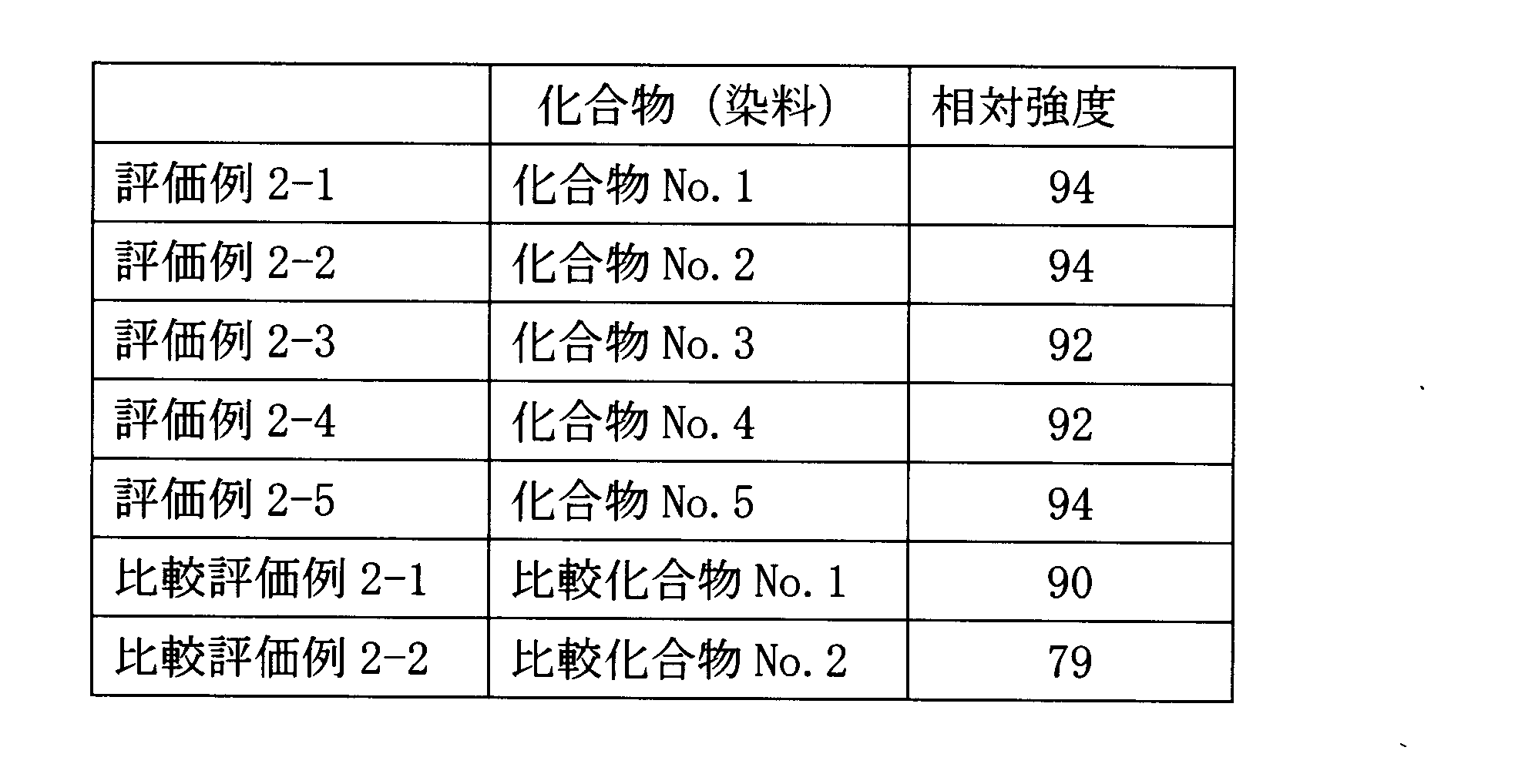
- the ratio of the absorbance of the coated film after firing was evaluated as relative strength. In addition, it shows that heat resistance is so high that the light absorbency of the coating film after baking is close to 100. The results are shown in [Table 4].
- the colored photosensitive composition of the present invention has high heat resistance.
- the absorbance of the coating film before the light resistance test and the absorbance of the coating film after the light resistance test at the maximum absorption wavelength ( ⁇ max) of the compound (dye) used were measured, and the absorbance of the coating film before the light resistance test was taken as 100.
- the ratio of the absorbance of the coating film after the light resistance test was evaluated as relative strength. In addition, it shows that light resistance is so high that the light absorbency of the coating film after a light resistance test is close to 100.
- the evaluation results are shown in [Table 5].
- the colored photosensitive composition of the present invention has high light resistance.
- the dye using the novel compound of the present invention has an absorption in an appropriate wavelength range, and the photosensitive composition using the dye and the cured product have high heat resistance and light resistance. It is obvious. Therefore, the novel compound and colored photosensitive composition of the present invention are useful for color filters for display devices and liquid crystal display panels using the same.
Landscapes
- Chemical & Material Sciences (AREA)
- Organic Chemistry (AREA)
- Physics & Mathematics (AREA)
- General Physics & Mathematics (AREA)
- Optics & Photonics (AREA)
- Optical Filters (AREA)
- Materials For Photolithography (AREA)
- Epoxy Compounds (AREA)
- Polymerisation Methods In General (AREA)
Abstract
Description
これらの光吸収剤には、光吸収が特別に急峻であること、即ちλmaxの半値幅が小さいこと、また光や熱等により機能が失われないことが求められている。
カラーフィルタに用いられる光吸収剤には、耐熱性の高さにより有機及び/又は無機顔料が用いられてきたが、顔料であるため表示装置としての輝度を低下させてしまうという問題があり、光源の輝度を高めることでこの問題を解決してきた。しかし、低消費電力化の流れに伴い、染料を用いたカラーフィルタの開発が盛んになっている。
しかし、染料濃度を高めると、成膜後に加熱処理(ポストべーク)を施した場合に、隣接画素間や積層構造中の上下層間で混色が生じやすいため、耐熱性が要求されている。
また、カラーフィルタに用いられる光吸収剤は、外部光による劣化しやすさも問題となっており、耐光性も求められている。
しかし、これらの文献に記載のカラーフィルター用着色組成物に用いられる化合物は、耐熱性及び耐光性を両立する点で満足できるものではなかった。
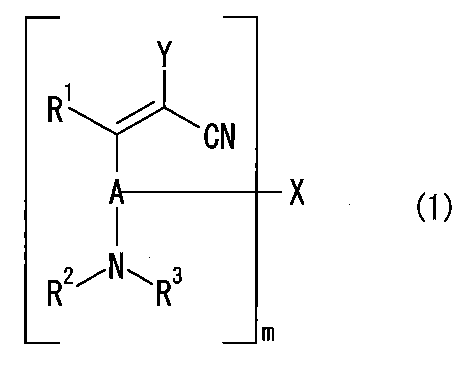
Yは、シアノ基又は-COOR4を表し、
R1は、水素原子、フェニル基、シアノ基、ニトロ基、ハロゲン原子、炭素原子数1~12のアルキル基、炭素原子数1~12のアルコキシ基、炭素原子数1~12のハロゲン化アルキル基又は炭素原子数1~12のハロゲン化アルコキシ基を表し、
R2及びR3は、それぞれ独立に、水素原子、炭素原子数1~12のアルキル基、炭素原子数6~20のアリール基又は炭素原子数7~20のアリールアルキル基を表し、
R2及びR3で表されるアルキル基、アリール基及びアリールアルキル基は、ハロゲン原子又はニトロ基で置換されていてもよく、
R2及びR3で表されるアルキル基及びアリールアルキル基中のメチレン基は、-COO-、-O-、-OCO-、-NHCO-、-NH-又は-CONH-で置き換わっていてもよく、
R4は、水素原子、炭素原子数1~12のアルキル基、炭素原子数6~20のアリール基、炭素原子数7~20のアリールアルキル基又は炭素原子数2~35の複素環基を表し、
R4で表されるアルキル基及びアリールアルキル基中のメチレン基は、-COO-、-O-、-OCO-、-NHCO-、-NH-又は-CONH-で置き換わっていてもよく、
Xは、単結合、窒素原子、-NR5-、酸素原子、硫黄原子、-SO2-、-SO-、リン原子、-PR6-又は下記<1>~<5>の何れかの条件を満たす有機基を表し、
R5及びR6は、それぞれ独立に、水素原子、炭素原子数1~12のアルキル基、炭素原子数6~20のアリール基又は炭素原子数7~20のアリールアルキル基を表し、
m=2~6の整数である。)
<1>m=2であり、Xが下記式(2)で表される。
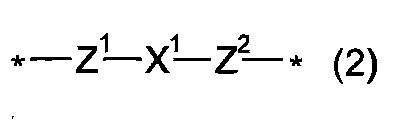
X1で表される脂肪族炭化水素基は、ハロゲン原子、シアノ基、水酸基、ニトロ基、炭素原子数1~8のアルキル基、アルコキシ基、ハロゲン化アルキル基又はハロゲン化アルコキシ基で置換されていてもよく、
X1で表される脂肪族炭化水素基中のメチレン基は、-O-、-S-、-CO-、-CO-O-、-O-CO-、-SO2-、-NH-又はこれらを組み合わせた基で置き換わっていてもよく、
Z1及びZ2は、それぞれ独立に、直接結合、-O-、-S-、-SO2-、-SO-、-NR13-又は-PR14-を表し、
R13及びR14は、それぞれ独立に、水素原子、炭素原子数1~8のアルキル基、炭素原子数6~20のアリール基又は炭素原子数7~20のアリールアルキル基を表し、
R13及びR14で表されるアルキル基、アリール基及びアリールアルキル基は、ハロゲン原子、水酸基又はニトロ基で置換されていてもよく、
R13及びR14で表されるアルキル基及びアリールアルキル基中のメチレン基は、-COO-、-O-、-OCO-、-NHCO-、-NH-又は-CONH-で置き換わっていてもよい。
但し、上記一般式(2)で表される基は炭素原子数1~35の範囲内である。)

R22は炭素原子数1~10のアルキル基、炭素原子数1~10のアルコキシ基、炭素原子数2~10のアルケニル基又はハロゲン原子を表し、
R21及びR22で表されるアルキル基、アルコキシ基及びアルケニル基は、ハロゲン原子で置換されているか又は無置換であり、
dは0~5の整数である。)
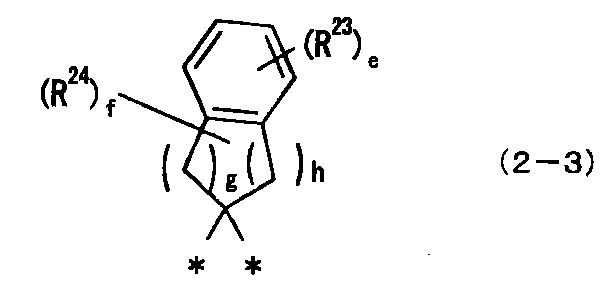
R23及びR24で表されるアルキル基、アリール基、アリールオキシ基、アリールチオ基、アリールアルケニル基、アリールアルキル基及び複素環含有基は、ハロゲン原子で置換されているか又は無置換であり、
R23及びR24で表されるアルキル基及びアリールアルキル基中のメチレン基は、不飽和結合、-O-又は-S-で置き換わっていてもよく、
R23は、隣接するR23同士で環を形成していてもよく、
eは0~4の数を表し、
fは0~8の数を表し、
gは0~4の数を表し、
hは0~4の数を表し、
gとhの数の合計は2~4である。)
<2>m=3であり、Xが下記式(3)で表される。

R25は、水素原子、炭素原子数1~8のアルキル基、炭素原子数6~20のアリール基又は炭素原子数7~20のアリールアルキル基を表し、
X2で表される脂肪族炭化水素基は、ハロゲン原子、シアノ基、水酸基、ニトロ基、炭素原子数1~8のアルキル基、アルコキシ基、ハロゲン化アルキル基又はハロゲン化アルコキシ基で置換されていてもよく、
X2で表される脂肪族炭化水素基中のメチレン基は、-O-、-S-、-CO-、-CO-O-、-O-CO-、-SO2-、-NH-又はこれらを組み合わせた基で置き換わっていてもよく、
Z1~Z3は、それぞれ独立に、上記一般式(2)におけるZ1及びZ2で表される基と同じである。
但し、上記一般式(3)で表わされる基は炭素原子数1~35の範囲内である。)
<3>m=4であり、Xが下記式(4)で表される。

X3で表される脂肪族炭化水素基は、ハロゲン原子、シアノ基、水酸基、ニトロ基、炭素原子数1~8のアルキル基、アルコキシ基、ハロゲン化アルキル基又はハロゲン化アルコキシ基で置換されていてもよく、
X3で表される脂肪族炭化水素基中のメチレン基は、-O-、-S-、-CO-、-CO-O-、-O-CO-、-SO2-、-NH-又はこれらを組み合わせた基で置き換わっていてもよく、
Z1~Z4は、それぞれ独立に、上記一般式(2)におけるZ1及びZ2で表される基と同じである。
但し、上記一般式(4)で表される基は炭素原子数1~35の範囲内である。)
<4>m=5であり、Xが下記式(5)で表される。
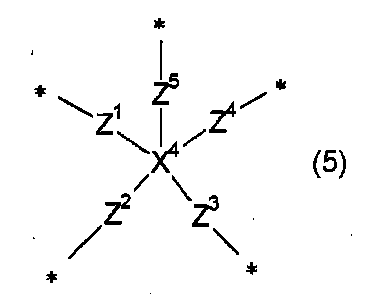
X4で表される脂肪族炭化水素基は、ハロゲン原子、シアノ基、水酸基、ニトロ基、炭素原子数1~8のアルキル基、アルコキシ基、ハロゲン化アルキル基又はハロゲン化アルコキシ基で置換されていてもよく、
X4で表される脂肪族炭化水素基中のメチレン基は、-O-、-S-、-CO-、-CO-O-、-O-CO-、-SO2-、-NH-又はこれらを組み合わせた基で置き換わっていてもよく、
Z1~Z5は、それぞれ独立に、上記一般式(2)におけるZ1及びZ2で表される基と同じである。
但し上記一般式(5)で表される基は炭素原子数2~50の範囲内である。)
<5>m=6であり、Xが下記式(6)で表される。
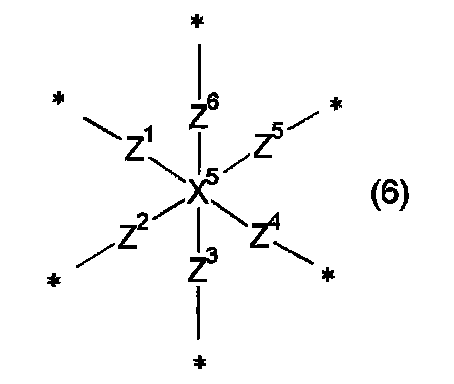
X5で表される脂肪族炭化水素基は、ハロゲン原子、シアノ基、水酸基、ニトロ基、炭素原子数1~8のアルキル基、アルコキシ基、ハロゲン化アルキル基又はハロゲン化アルコキシ基で置換されていてもよく、
X5で表される脂肪族炭化水素基中のメチレン基は、-O-、-S-、-CO-、-CO-O-、-O-CO-、-SO2-、-NH-又はこれらを組み合わせた基で置き換わっていてもよく、
Z1~Z6は、それぞれ独立に、上記一般式(2)におけるZ1及びZ2で表される基と同じである。
但し上記一般式(6)で表される基は炭素原子数2~50の範囲内である。)
Aを置換していてもよい炭素原子数1~12のアルキル基或いはR1~R6で表される炭素原子数1~12のアルキル基としては、メチル、エチル、プロピル、iso-プロピル、ブチル、sec-ブチル、tert-ブチル、iso-ブチル、アミル、iso-アミル、tert-アミル、シクロペンチル、ヘキシル、2-ヘキシル、3-ヘキシル、シクロヘキシル、4-メチルシクロヘキシル、ヘプチル、2-ヘプチル、3-ヘプチル、iso-ヘプチル、tert-ヘプチル、1-オクチル、iso-オクチル、tert-オクチル、アダマンチル等が挙げられ、
Aを置換していてもよい炭素原子数1~12のアルコキシ基或いはR1で表される炭素原子数1~12のアルコキシ基としては、メトキシ、エトキシ、プロピルオキシ、イソプロピルオキシ、ブチルオキシ、s-ブチルオキシ、t-ブチルオキシ、イソブチルオキシ、ペンチルオキシ、イソアミルオキシ、t-アミルオキシ、ヘキシルオキシ、シクロヘキシルオキシ、シクロヘキシルメチルオキシ、テトラヒドロフラニルオキシ、テトラヒドロピラニルオキシ等が挙げられ、
Aを置換してもよい炭素原子数1~12のハロゲン化アルキル基或いはR1で表される炭素原子数1~12のハロゲン化アルキル基としては、上述した炭素原子数1~12のアルキル基の少なくとも1つの水素原子が上述したハロゲン原子に置換されたもの、例えば、クロロメチル、ジクロロメチル、トリクロロメチル、フルオロメチル、ジフルオロメチル、トリフルオロメチル、ノナフルオロブチル等が挙げられ、
Aを置換してもよい炭素原子数1~12のハロゲン化アルコキシ基或いはR1で表される炭素原子数1~12のハロゲン化アルコキシ基としては、上述した炭素原子数1~12のアルコキシ基の少なくとも1つの水素原子が上述したハロゲン原子に置換されたもの、例えば、クロロメチルオキシ、ジクロロメチルオキシ、トリクロロメチルオキシ、フルオロメチルオキシ、ジフルオロメチルオキシ、トリフルオロメチルオキシ、ノナフルオロブチルオキシ等が挙げられ、
R2~R6で表される炭素原子数6~20のアリール基としては、フェニル、ナフチル、アントラセニル、2-メチルフェニル、3-メチルフェニル、4-メチルフェニル、4-ビニルフェニル、3-iso-プロピルフェニル、4-iso-プロピルフェニル、4-ブチルフェニル、4-iso-ブチルフェニル、4-tert-ブチルフェニル、4-ヘキシルフェニル、4-シクロヘキシルフェニル、4-オクチルフェニル、4-(2-エチルヘキシル)フェニル、4-ステアリルフェニル、2,3-ジメチルフェニル、2,4-ジメチルフェニル、2,5-ジメチルフェニル、2,6-ジメチルフェニル、3,4-ジメチルフェニル、3,5-ジメチルフェニル、2,4-ジ-tert-ブチルフェニル、2,5-ジ-tert-ブチルフェニル、2,6-ジ-tert-ブチルフェニル、2,4-ジ-tert-ペンチルフェニル、2,5-ジ-tert-アミルフェニル、2,5-ジ-tert-オクチルフェニル、2,4-ジクミルフェニル、4-シクロヘキシルフェニル、(1,1’-ビフェニル)-4-イル、2,4,5-トリメチルフェニル、フェロセニル等が挙げられ、
R2~R6で表される炭素原子数7~20のアリールアルキル基としては、ベンジル、フルオレニル、インデニル、9-フルオレニルメチル、2-フェニルプロパン-2-イル、ジフェニルメチル、トリフェニルメチル、スチリル、シンナミル等が挙げられ、
R4で表される炭素原子数3~25の複素環基としては、ピリジル、ピリミジル、ピリダジル、ピペリジル、ピラニル、ピラゾリル、トリアジル、ピロリル、キノリル、イソキノリル、イミダゾリル、ベンゾイミダゾリル、トリアゾリル、フリル、フラニル、ベンゾフラニル、チエニル、チオフェニル、ベンゾチオフェニル、チアジアゾリル、チアゾリル、ベンゾチアゾリル、オキサゾリル、ベンゾオキサゾリル、イソチアゾリル、イソオキサゾリル、インドリル、2-ピロリジノン-1-イル、2-ピペリドン-1-イル、2,4-ジオキシイミダゾリジン-3-イル、2,4-ジオキシオキサゾリジン-3-イル等が挙げられる。
上記一般式(2)~(6)及び式(2-1)~(2-3)に記載されたハロゲン原子、アルキル基、アルコキシ基、ハロゲン化アルキル基、ハロゲン化アルコキシ基、アリール基及びアリールアルキル基それぞれの例としては、本段落においてアルキル基、アルコキシ基、ハロゲン化アルキル基、ハロゲン化アルコキシ基、アリール基及びアリールアルキル基それぞれの例として上記に挙げた基と同様の基が挙げられる。尚、これらの基のうち、炭素原子数が本段落で挙げた基と異なるものについては、本段落で挙げた基のうち所定の炭素原子数を満たすものが挙げられる。
二価の炭素原子数3~35の脂環式炭化水素基としては、シクロペンチル、シクロヘキシル、シクロヘプチル、シクロオクチル、シクロデカニル、1-アダマンチル、2-アダマンチル、ノルアダマンチル、2-メチルアダマンチル、ノルボルニル、イソノルボルニル、パーヒドロナフチル、パーヒドロアントラセニル、ビシクロ[1.1.0]ブチル、ビシクロ[1.1.1]ペンチル、ビシクロ[2.1.0]ペンチル、ビシクロ[3.1.0]ヘキシル、ビシクロ[2.1.1]ヘキシル、ビシクロ[2.2.0]ヘキシル、ビシクロ[4.1.0]ヘプチル、ビシクロ[3.2.0]ヘプチル、ビシクロ[3.1.1]ヘプチル、ビシクロ[2.2.1]ヘプチル、ビシクロ[5.1.0]オクチル、ビシクロ[4.2.0]オクチル、ビシクロ[4.1.1]オクチル、ビシクロ[3.3.0]オクチル、ビシクロ[3.2.1]オクチル、ビシクロ[2.2.2]オクチル、スピロ〔4,4〕ノナニル、スピロ〔4,5〕デカニル、デカリン、トリシクロデカニル、テトラシクロドデカニル、セドロール、シクロドデカニル等の基が、Z1及びZ2で置換された二価の基等が挙げられ、
二価の炭素原子数6~35の芳香環含有炭化水素基としては、フェニレン、ナフチレン、ビフェニル等の基が、Z1及びZ2で置換された二価の基等が挙げられ、
二価の炭素原子数2~35の複素環含有基としては、ピリジン、ピラジン、ピペリジン、ピペラジン、ピリミジン、ピリダジン、トリアジン、ヘキサヒドロトリアジン、フラン、テトラヒドロフラン、クロマン、キサンテン、チオフェン、チオラン等の基が、Z1及びZ2で置換された二価の基が挙げられる。
これらの基はハロゲン原子、シアノ基、ニトロ基又は炭素原子数1~8のアルコキシ基で更に置換されていてもよい。
炭素原子数2~10のアルケニル基としては、ビニル、アリル、1-プロペニル、イソプロペニル、2-ブテニル、1,3-ブタジエニル、2-ペンテニル、2-オクテニル等が挙げられ、
上記R22におけるアルキル基、アルコキシ基及びアルケニル基はハロゲン原子で置換されていてもよく、その置換位置は制限されない。
炭素原子数6~20のアリールチオ基としては、上記ハロゲン原子で置換されていてもよい炭素原子数6~20のアリールオキシ基の酸素原子を硫黄原子に置換した基等が奉挙げられ、
炭素原子数8~20のアリールアルケニル基としては、上記ハロゲン原子で置換されていてもよい炭素原子数6-20のアリールオキシ基の酸素原子をビニル、アリル、1-プロペニル、イソプロペニル、2-ブテニル、1,3-ブタジエニル、2-ペンテニル、2-オクテニル等のアルケニル基で置換した基等が挙げられ、
炭素原子数2~20の複素環含有基としては、ピリジン、ピラジン、ピペリジン、ピペラジン、ピリミジン、ピリダジン、トリアジン、ヘキサヒドロトリアジン、フラン、テトラヒドロフラン、クロマン、キサンテン、チオフェン、チオフラン等の基及びこれらの基がハロゲン原子で置換された基等が挙げられる。
三価の炭素原子数3~35の脂環式炭化水素基としては、上記一般式(2)におけるX1の説明で例示した脂環式炭化水素基が、Z1、Z2及びZ3で置換された三価の基が挙げられ、
三価の炭素原子数6~35の芳香環含有炭化水素基としては、上記一般式(2)におけるX1の説明で例示した芳香環含有炭化水素基が、Z1、Z2及びZ3で置換された三価の基が挙げられ、
三価の炭素原子数2~35の複素環含有基としては、上記一般式(2)におけるX1の説明で例示した複素環含有基が、Z1、Z2及びZ3で置換された三価の基が挙げられる。
四価の炭素原子数3~35の脂環式炭化水素基としては、上記一般式(2)におけるX1の説明で例示した脂環式炭化水素基が、Z1、Z2、Z3及びZ4で置換された四価の基が挙げられ、
四価の炭素原子数6~35の芳香環含有炭化水素基としては、上記一般式(3)におけるX1の説明で例示した芳香環含有炭化水素基が、Z1、Z2、Z3及びZ4で置換された四価の基が挙げられ、
四価の炭素原子数2~35の複素環含有基としては、上記一般式(2)におけるX1の説明で例示した複素環含有基が、Z1、Z2、Z3及びZ4で置換された四価の基が挙げられる。
五価の炭素原子数3~35の脂環式炭化水素基としては、上記一般式(2)におけるX1の説明で例示した脂環式炭化水素基が、Z1、Z2、Z3、Z4及びZ5で置換された五価の基が挙げられ、
五価の炭素原子数6~35の芳香環含有炭化水素基としては、上記一般式(2)におけるX1の説明で例示した芳香環含有炭化水素基が、Z1、Z2、Z3、Z4及びZ5で置換された五価の基が挙げられ、
五価の炭素原子数2~35の複素環含有基としては、上記一般式(2)におけるX1で説明で例示した複素環含有基が、Z1、Z2、Z3、Z4及びZ5で置換された五価の基が挙げられる。
六価の炭素原子数3~35の脂環式炭化水素基としては、上記一般式(2)におけるX1の説明で例示した脂環式炭化水素基が、Z1、Z2、Z3、Z4、Z5及びZ6で置換された六価の基が挙げられ、
六価の炭素原子数6~35の芳香環含有炭化水素基としては、上記一般式(2)におけるX1で説明で例示した芳香環含有炭化水素基が、Z1、Z2、Z3、Z4、Z5及びZ6で置換された六価の基が挙げられ、
六価の炭素原子数2~35の複素環含有基としては、上記一般式(3)におけるX1の説明で例示した複素環含有基が、Z1、Z2、Z3、Z4、Z5及びZ6で置換された六価の基が挙げられる。


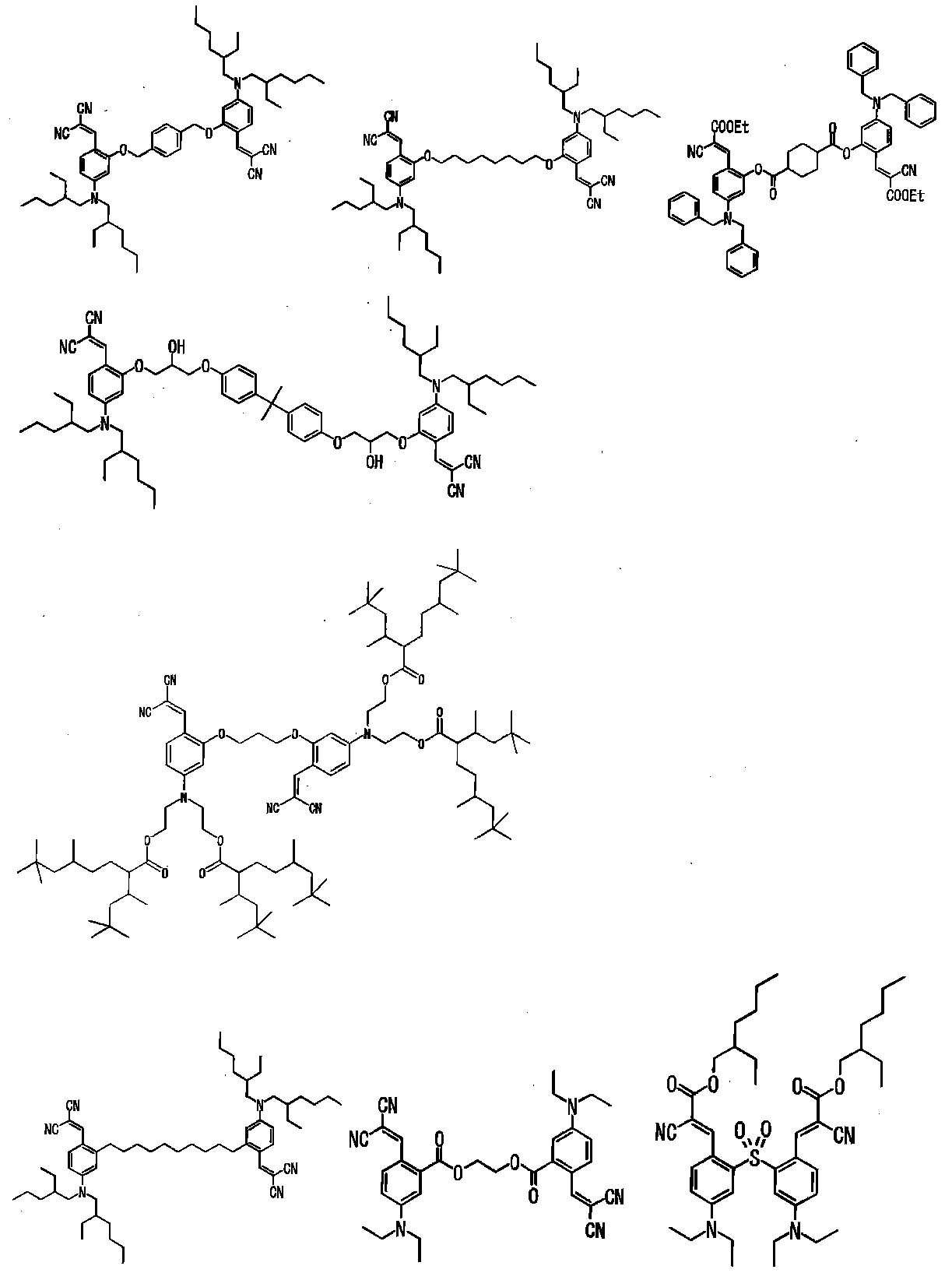
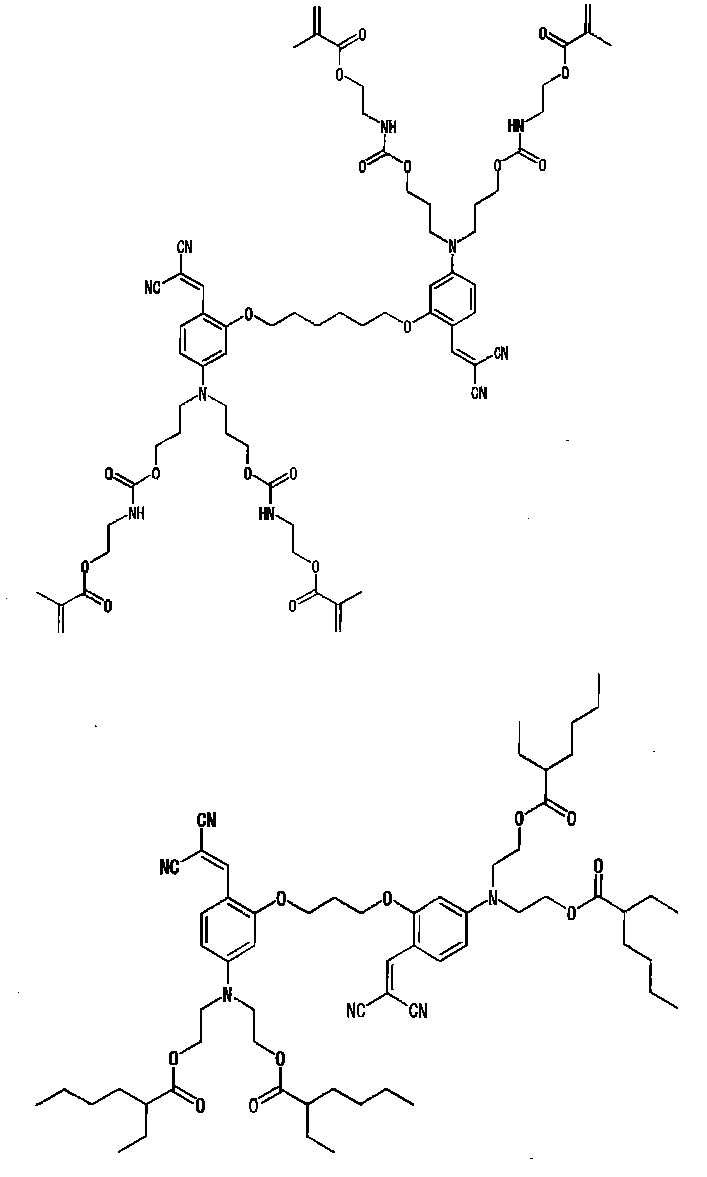
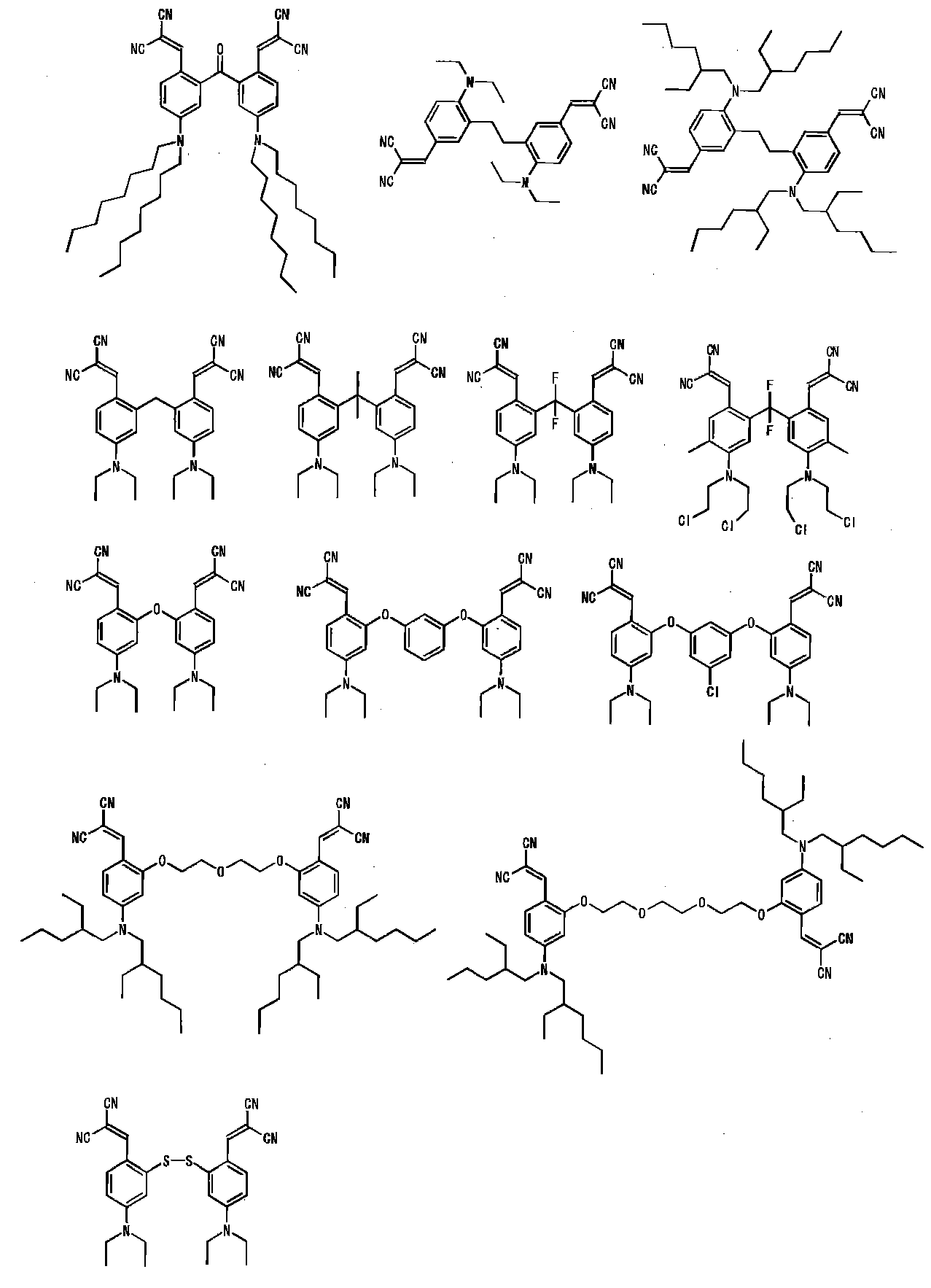
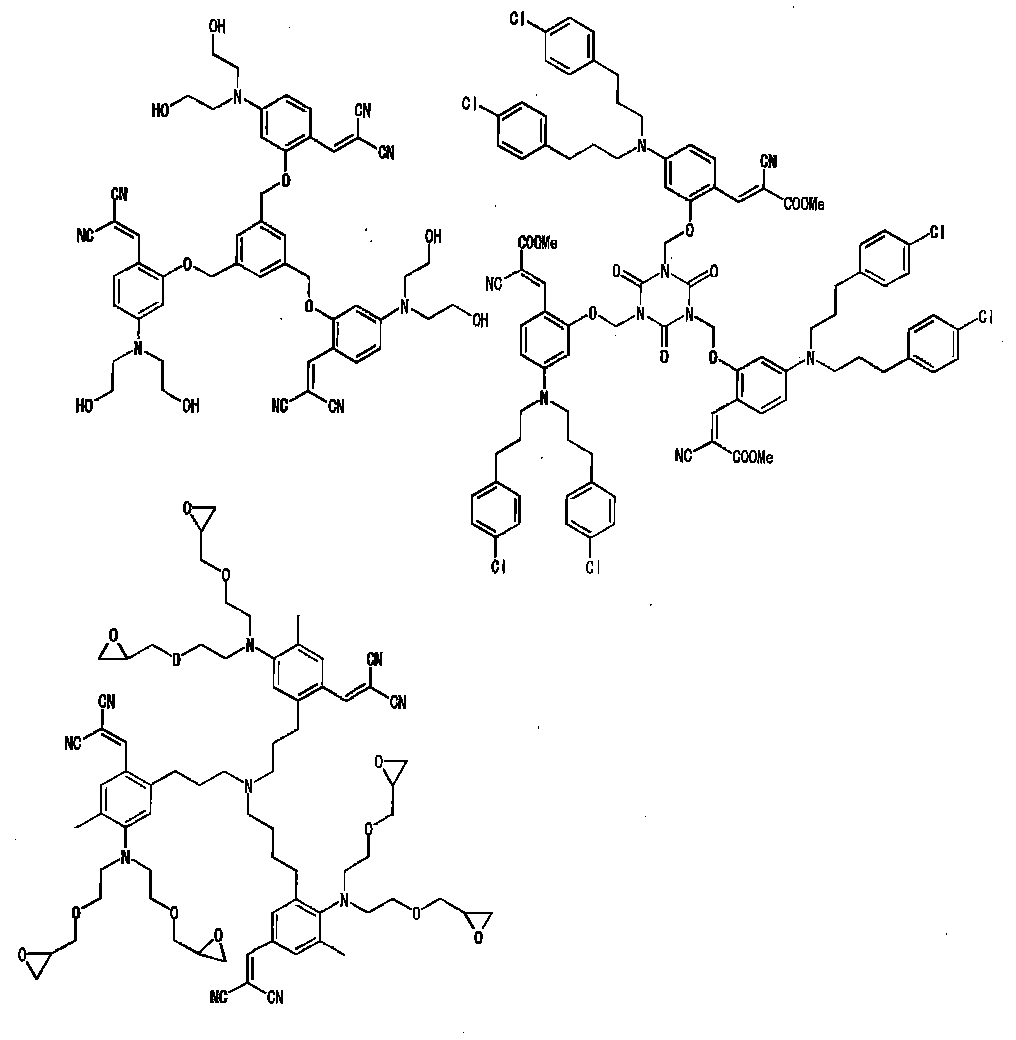


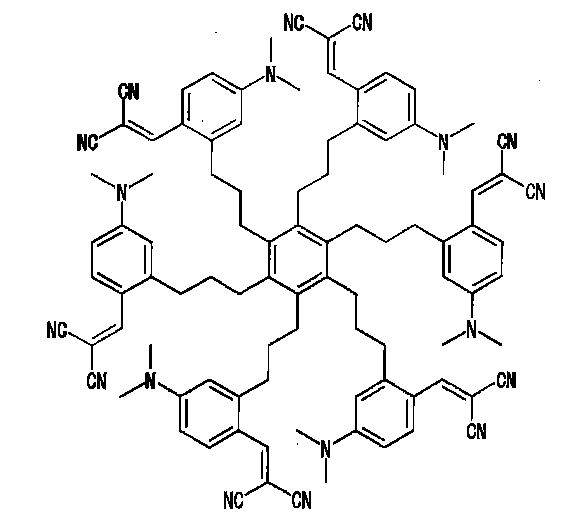
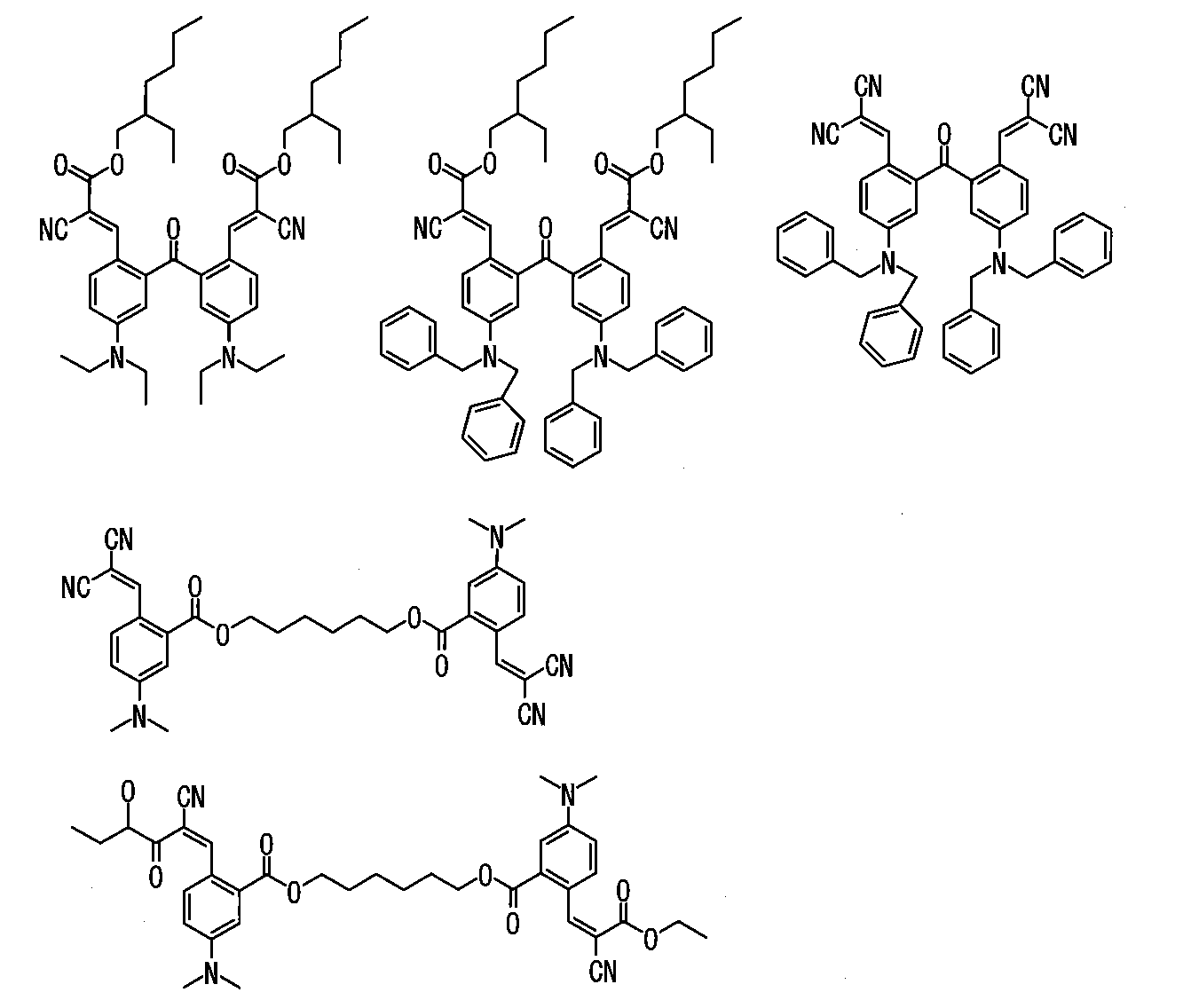
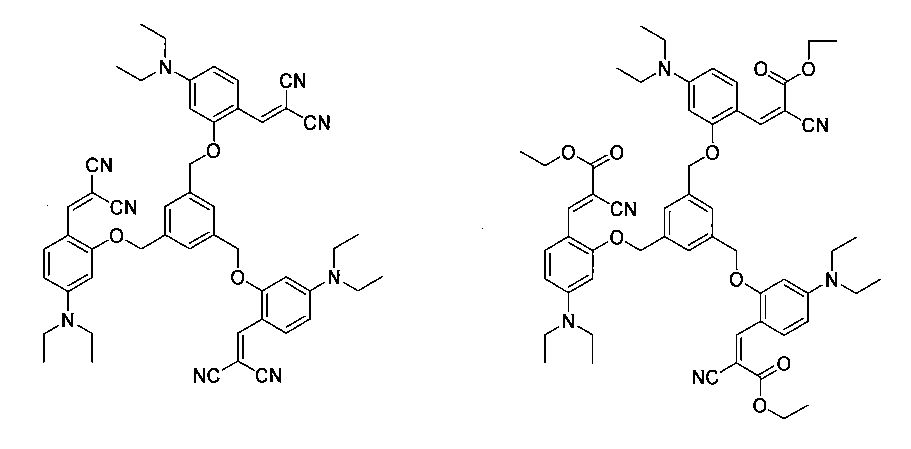
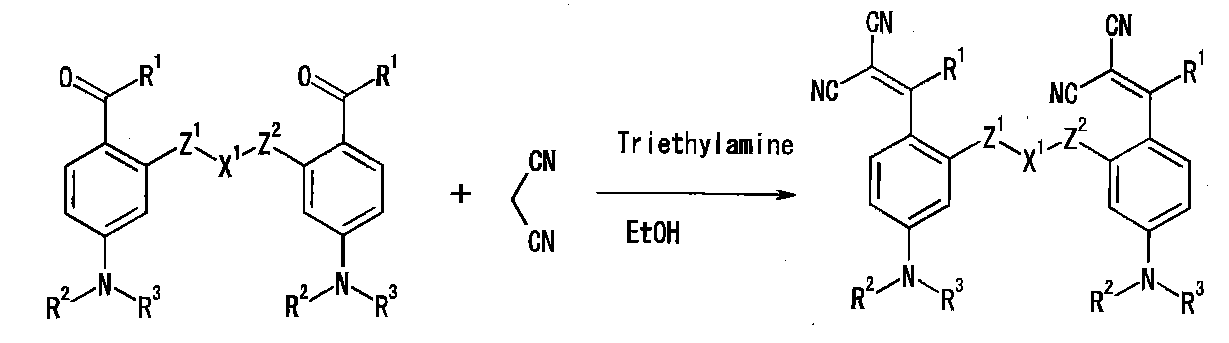
ここで、「染料」とは、有機溶媒に溶解させて用いるものであり、分散樹脂等と分散して用いる場合は後述する「顔料」と称する。

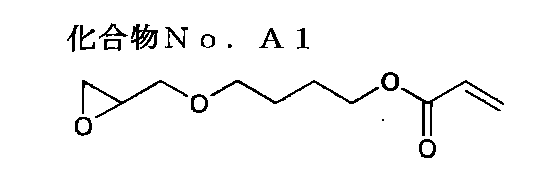


その他、フェノールノボラック型エポキシ化合物、ビフェニルノボラック型エポキシ化合物、クレゾールノボラック型エポキシ化合物、ビスフェノールAノボラック型エポキシ化合物、ジシクロペンタジエンノボラック型エポキシ化合物等のノボラック型エポキシ化合物;3,4-エポキシ-6-メチルシクロヘキシルメチル-3,4-エポキシ-6-メチルシクロヘキサンカルボキシレート、3,4-エポキシシクロヘキシルメチル-3,4-エポキシシクロヘキサンカルボキシレート、1-エポキシエチル-3,4-エポキシシクロヘキサン等の脂環式エポキシ化合物;フタル酸ジグリシジルエステル、テトラヒドロフタル酸ジグリシジルエステル、ダイマー酸グリシジルエステル等のグリシジルエステル類;テトラグリシジルジアミノジフェニルメタン、トリグリシジル-p-アミノフェノール、N,N-ジグリシジルアニリン等のグリシジルアミン類;1,3-ジグリシジル-5,5-ジメチルヒダントイン、トリグリシジルイソシアヌレート等の複素環式エポキシ化合物;ジシクロペンタジエンジオキシド等のジオキシド化合物;ナフタレン型エポキシ化合物、トリフェニルメタン型エポキシ化合物、ジシクロペンタジエン型エポキシ化合物等を用いることもできる。

反応容器にアルデヒド体(4mmol)、マロノニトリル(8mmol)、無水ピペラジン(0.03g)及びジメチルアセトアミド(5g)を入れ溶解させ、80℃にて5時間撹拌した。エタノール7gを滴下して晶析させ、得られた固体をろ過、エタノール洗浄を行った後濃縮し、シリカゲルカラムクロマトグラフィー(展開液:トルエン)により精製し、乾燥して黄色固体をそれぞれ得た。得られた黄色固体が目的物であることは1H-NMR、IRにて確認した。また吸収波長特性を測定した。結果を[表1]及び[表2]に示す。
反応容器にアルデヒド体(4mmol)、シアノ酢酸エチル(8mmol)、無水ピペラジン(0.03g)及びジメチルアセトアミド(5g)を入れ溶解させ、50℃にて5時間撹拌した。エタノール7gを滴下して晶析させ、得られた固体をろ過、エタノール洗浄し、黄色固体をそれぞれ得た。得られた黄色固体が目的物であることは1H-NMR、IRにて確認した。また吸収波長特性を測定した。結果を[表1]及び[表2]に示す。
反応容器にアルデヒド体(4mmol)、マロノニトリル(12mmol)、無水ピペラジン(0.04g)及びジメチルアセトアミド(5g)を入れ溶解させ、50℃にて3時間撹拌した。エタノール7gを滴下して晶析させ、得られた固体をろ過、エタノール洗浄し、黄色固体を得た。得られた黄色固体が目的物であることは1H-NMR、IRにて確認した。また吸収波長特性を測定した。結果を[表1]及び[表2]に示す。


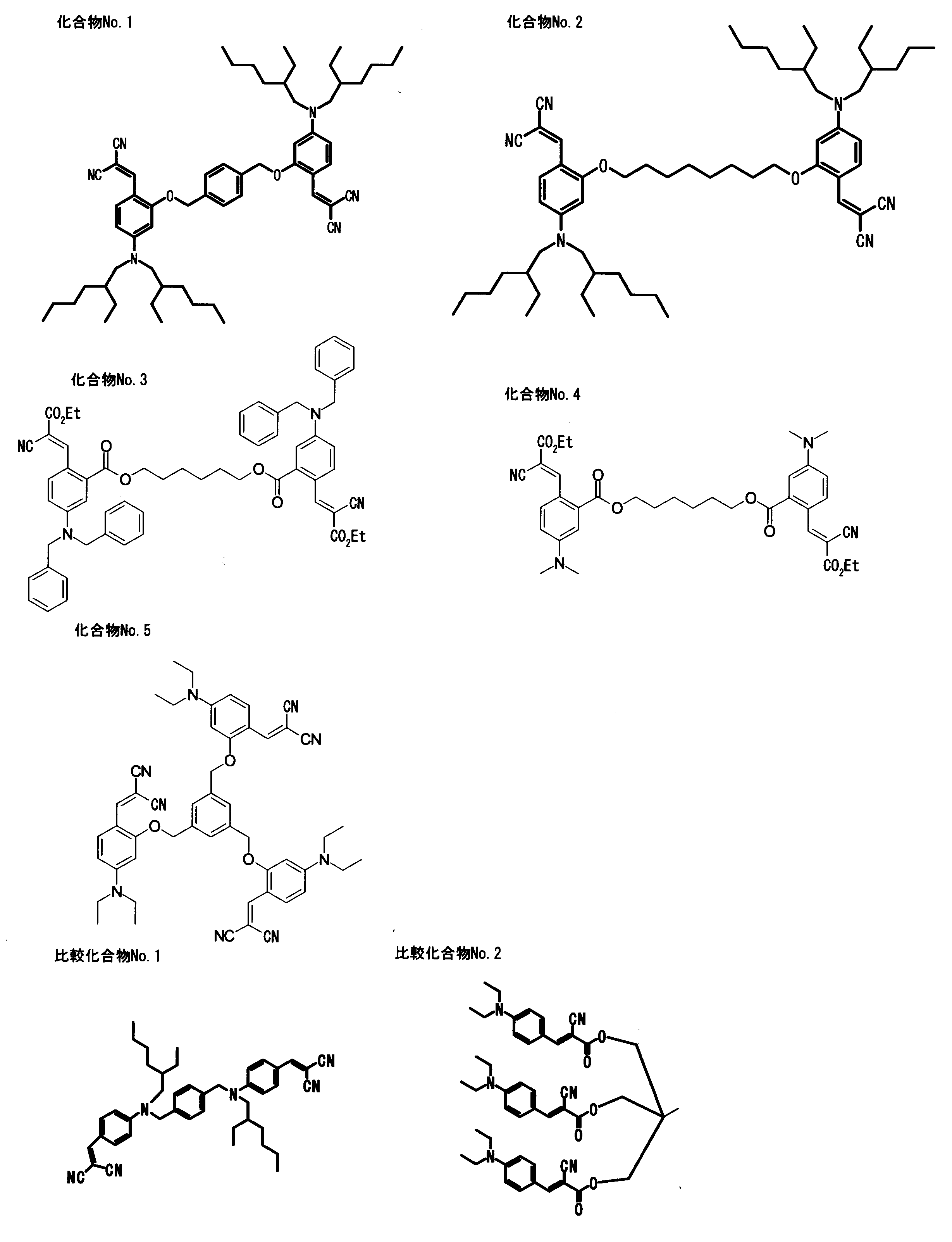
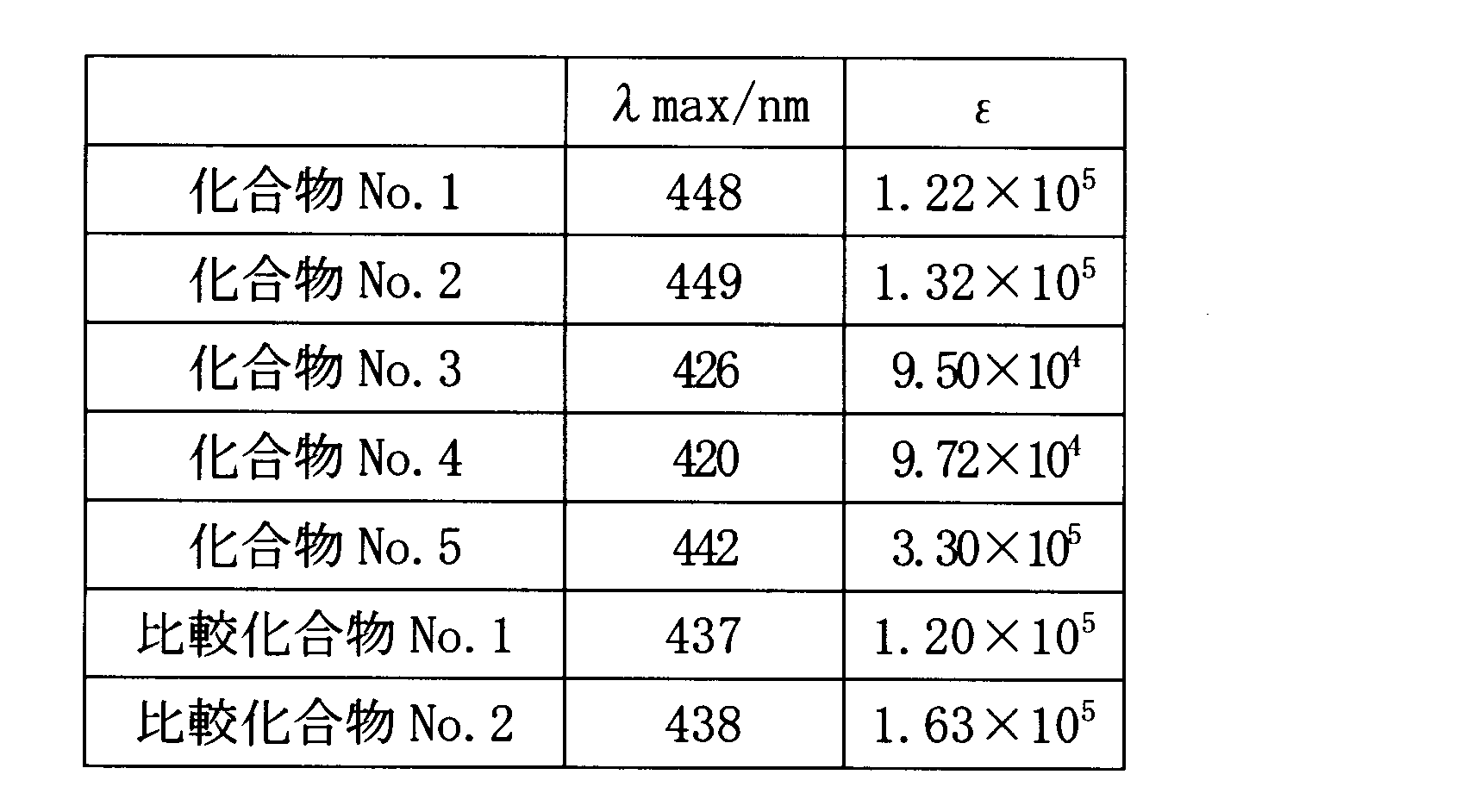
上記で得られた化合物No.1~No.5並びに上記の比較化合物No.1及び2の吸収波長特性をCHCl3溶液で評価した。結果を[表3]に示す。
<ステップ1>感光性組成物No.1の調製
(B)成分としてSPC-1000(昭和電工社製)を39.7g並びに(D)成分としてA-9300-1-CL(新中村化学工業社製)を9.2g、(C)成分としてイルガキュアOXE-01(BASF社製)を0.8g、溶媒としてPGMEAを28.0g及び、その他成分としてFZ2122(東レ・ダウコーニング社製)を2.31g混合し、不溶物が無くなるまで撹拌し、感光性組成物No.1を得た。
(A)成分として上記で得られた化合物No.1~No.5それぞれの0.10gに、ジメチルアセトアミド1.90gを加え、撹拌して溶解させた。
ステップ1で得られた感光性組成物No.1の5.0gとステップ2で得られた染料液No.1~No.5それぞれ1.0gとを混合し、本発明の着色感光性組成物No.1~No.5をそれぞれ得た。
実施例2-1のステップ2における(A)成分の化合物No.1を比較化合物No.1及びNo.2に変更した以外は、実施例2-1と同様の手法で、比較着色感光性組成物No.1及びNo.2を得た。
上記で得られた着色感光性組成物No.1~No.5並びに比較着色感光性組成物No.1及びNo.2をそれぞれガラス基板に410rpm×7secの条件で塗工し、ホットプレートで乾燥(90℃、90sec)させた。得られた塗膜に超高圧水銀ランプで露光(150mJ/cm2)した。露光後の塗膜を、230℃×30minの条件で焼成した。用いた化合物(染料)の極大吸収波長(λmax)における焼成前(露光後)の塗膜の吸光度と焼成後の塗膜の吸光度を測定し、焼成前(露光後)の塗膜の吸光度を100としたときの焼成後の塗膜の吸光度の割合を相対強度として評価した。尚、焼成後の塗膜の吸光度が100に近いほど耐熱性が高いことを示す。結果を[表4]に示す。

上記で得られた着色感光性組成物No.1~No.5並びに比較着色感光性組成物No.1及びNo.2をそれぞれガラス基板に410rpm×7secの条件で塗工し、ホットプレートで乾燥(90℃、90sec)させた。得られた塗膜に超高圧水銀ランプで露光(150mJ/cm2)した。露光後の塗膜を、スガ試験機製キセノン耐光性試験機テーブルサンXT-1500Lにて12時間耐光性試験を実施した。用いた化合物(染料)の極大吸収波長(λmax)における耐光性試験前の塗膜の吸光度と耐光性試験後の塗膜の吸光度を測定し、耐光性試験前の塗膜の吸光度を100としたときの耐光性試験後の塗膜の吸光度の割合を相対強度として評価した。尚、耐光性試験後の塗膜の吸光度が100に近いほど耐光性が高いことを示す。評価結果を[表5]に示す。
Claims (5)
- 下記一般式(1)で表される化合物。
(式中、Aは、ベンゼン環、ナフタレン環又はアントラセン環を表し、これらの環は、ハロゲン原子、シアノ基、水酸基、ニトロ基、炭素原子数1~12のアルキル基、アルコキシ基、ハロゲン化アルキル基又はハロゲン化アルコキシ基で置換されていてもよく、
Yは、シアノ基又は-COOR4を表し、
R1は、水素原子、フェニル基、シアノ基、ニトロ基、ハロゲン原子、炭素原子数1~12のアルキル基、炭素原子数1~12のアルコキシ基、炭素原子数1~12のハロゲン化アルキル基又は炭素原子数1~12のハロゲン化アルコキシ基を表し、
R2及びR3は、それぞれ独立に、水素原子、炭素原子数1~12のアルキル基、炭素原子数6~20のアリール基又は炭素原子数7~20のアリールアルキル基を表し、
R2及びR3で表されるアルキル基、アリール基及びアリールアルキル基は、ハロゲン原子又はニトロ基で置換されていてもよく、
R2及びR3で表されるアルキル基及びアリールアルキル基中のメチレン基は、-COO-、-O-、-OCO-、-NHCO-、-NH-又は-CONH-で置き換わっていてもよく、
R4は、水素原子、炭素原子数1~12のアルキル基、炭素原子数6~20のアリール基、炭素原子数7~20のアリールアルキル基又は炭素原子数2~35の複素環基を表し、
R4で表されるアルキル基及びアリールアルキル基中のメチレン基は、-COO-、-O-、-OCO-、-NHCO-、-NH-又は-CONH-で置き換わっていてもよく、
Xは、単結合、窒素原子、-NR5-、酸素原子、硫黄原子、-SO2-、-SO-、リン原子、-PR6-又は下記<1>~<5>の何れかの条件を満たす有機基を表し、
R5及びR6は、それぞれ独立に、水素原子、炭素原子数1~12のアルキル基、炭素原子数6~20のアリール基又は炭素原子数7~20のアリールアルキル基を表し、
m=2~6の整数である。)
<1>m=2であり、Xが下記式(2)で表される。
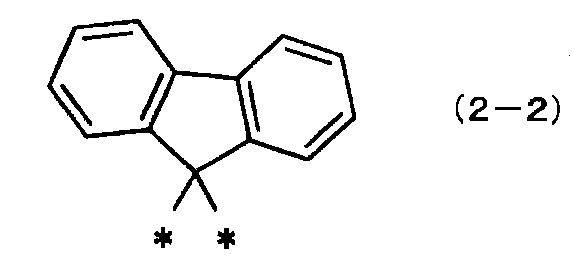
(式中、X1は、-NR13-、二価の炭素原子数1~35の脂肪族炭化水素基、二価の炭素原子数3~35の脂環式炭化水素基、二価の炭素原子数6~35の芳香環含有炭化水素基、二価の炭素原子数2~35の複素環含有基又は下記(2-1)~(2-3)の何れかで表される基を表し、
X1で表される脂肪族炭化水素基は、ハロゲン原子、シアノ基、水酸基、ニトロ基、炭素原子数1~8のアルキル基、アルコキシ基、ハロゲン化アルキル基又はハロゲン化アルコキシ基で置換されていてもよく、
X1で表される脂肪族炭化水素基中のメチレン基は、-O-、-S-、-CO-、-CO-O-、-O-CO-、-SO2-、-NH-又はこれらを組み合わせた基で置き換わっていてもよく、
Z1及びZ2は、それぞれ独立に、直接結合、-O-、-S-、-SO2-、-SO-、-NR13-又は-PR14-を表し、
R13及びR14は、それぞれ独立に、水素原子、炭素原子数1~8のアルキル基、炭素原子数6~20のアリール基又は炭素原子数7~20のアリールアルキル基を表し、
R13及びR14で表されるアルキル基、アリール基及びアリールアルキル基は、ハロゲン原子、水酸基又はニトロ基で置換されていてもよく、
R13及びR14で表されるアルキル基及びアリールアルキル基中のメチレン基は、-COO-、-O-、-OCO-、-NHCO-、-NH-又は-CONH-で置き換わっていてもよい。
但し、上記一般式(2)で表される基は炭素原子数1~35の範囲内である。)
(式中、R21は水素原子、炭素原子数1~10のアルキル基若しくはアルコキシ基により置換されてもよいフェニル基、又は炭素原子数3~10のシクロアルキル基を表し、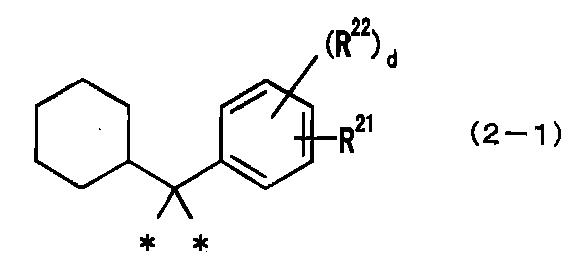
R22は炭素原子数1~10のアルキル基、炭素原子数1~10のアルコキシ基、炭素原子数2~10のアルケニル基又はハロゲン原子を表し、
R21及びR22で表されるアルキル基、アルコキシ基及びアルケニル基は、ハロゲン原子で置換されているか又は無置換であり、
dは0~5の整数である。)
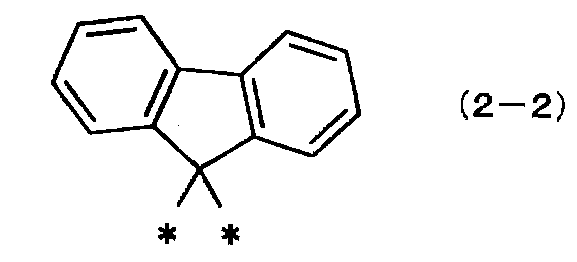 (式中、R23及びR24は、それぞれ独立に、炭素原子数1~10のアルキル基、炭素原子数6~20のアリール基、炭素原子数6~20のアリールオキシ基、炭素原子数6~20のアリールチオ基、炭素原子数8~20のアリールアルケニル基、炭素原子数7~20のアリールアルキル基、炭素原子数2~20の複素環含有基又はハロゲン原子を表し、
R23及びR24で表されるアルキル基、アリール基、アリールオキシ基、アリールチオ基、アリールアルケニル基、アリールアルキル基及び複素環含有基は、ハロゲン原子で置換されているか又は無置換であり、
R23及びR24で表されるアルキル基及びアリールアルキル基中のメチレン基は、不飽和結合、-O-又は-S-で置き換わっていてもよく、
R23は、隣接するR23同士で環を形成していてもよく、
eは0~4の数を表し、
fは0~8の数を表し、
gは0~4の数を表し、
hは0~4の数を表し、
gとhの数の合計は2~4である。)
<2>m=3であり、Xが下記式(3)で表される。
(式中、X2は、R25で置換された炭素原子、三価の炭素原子数1~35の脂肪族炭化水素基、三価の炭素原子数3~35の脂環式炭化水素基、三価の炭素原子数6~35の芳香環含有炭化水素基又は三価の炭素原子数2~35の複素環含有基を表し、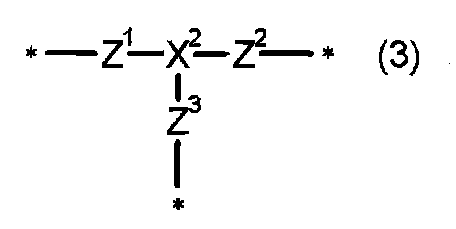
R25は、水素原子、炭素原子数1~8のアルキル基、炭素原子数6~20のアリール基又は炭素原子数7~20のアリールアルキル基を表し、
X2で表される脂肪族炭化水素基は、ハロゲン原子、シアノ基、水酸基、ニトロ基、炭素原子数1~8のアルキル基、アルコキシ基、ハロゲン化アルキル基又はハロゲン化アルコキシ基で置換されていてもよく、
X2で表される脂肪族炭化水素基中のメチレン基は、-O-、-S-、-CO-、-CO-O-、-O-CO-、-SO2-、-NH-又はこれらを組み合わせた基で置き換わっていてもよく、
Z1~Z3は、それぞれ独立に、上記一般式(2)におけるZ1及びZ2で表される基と同じである。
但し、上記一般式(3)で表わされる基は炭素原子数1~35の範囲内である。)
<3>m=4であり、Xが下記式(4)で表される。
(式中、X3は、炭素原子、四価の炭素原子数1~35の脂肪族炭化水素基、四価の炭素原子数3~35の脂環式炭化水素基、四価の炭素原子数6~35の芳香環含有炭化水素基又は四価の炭素原子数2~35の複素環含有基を表し、
X3で表される脂肪族炭化水素基は、ハロゲン原子、シアノ基、水酸基、ニトロ基、炭素原子数1~8のアルキル基、アルコキシ基、ハロゲン化アルキル基又はハロゲン化アルコキシ基で置換されていてもよく、
X3で表される脂肪族炭化水素基中のメチレン基は、-O-、-S-、-CO-、-CO-O-、-O-CO-、-SO2-、-NH-又はこれらを組み合わせた基で置き換わっていてもよく、
Z1~Z4は、それぞれ独立に、上記一般式(2)におけるZ1及びZ2で表される基と同じである。但し、上記一般式(4)で表される基は炭素原子数1~35の範囲内である。)
<4>m=5であり、Xが下記式(5)で表される。
(式中、X4は、五価の炭素原子数2~35の脂肪族炭化水素基、五価の炭素原子数3~35の脂環式炭化水素基、五価の炭素原子数6~35の芳香環含有炭化水素基又は五価の炭素原子数2~35の複素環含有基を表し、
X4で表される脂肪族炭化水素基は、ハロゲン原子、シアノ基、水酸基、ニトロ基、炭素原子数1~8のアルキル基、アルコキシ基、ハロゲン化アルキル基又はハロゲン化アルコキシ基で置換されていてもよく、
X4で表される脂肪族炭化水素基中のメチレン基は、-O-、-S-、-CO-、-CO-O-、-O-CO-、-SO2-、-NH-又はこれらを組み合わせた基で置き換わっていてもよく、
Z1~Z5は、それぞれ独立に、上記一般式(2)におけるZ1及びZ2で表される基と同じである。但し上記一般式(5)で表される基は炭素原子数2~50の範囲内である。)
<5>m=6であり、Xが下記式(6)で表される。
(式中、X5は、六価の炭素原子数2~35の脂肪族炭化水素基、六価の炭素原子数3~35の脂環式炭化水素基、六価の炭素原子数6~35の芳香環含有炭化水素基又は六価の炭素原子数2~35の複素環含有基を表し、
X5で表される脂肪族炭化水素基は、ハロゲン原子、シアノ基、水酸基、ニトロ基、炭素原子数1~8のアルキル基、アルコキシ基、ハロゲン化アルキル基又はハロゲン化アルコキシ基で置換されていてもよく、
X5で表される脂肪族炭化水素基中のメチレン基は、-O-、-S-、-CO-、-CO-O-、-O-CO-、-SO2-、-NH-又はこれらを組み合わせた基で置き換わっていてもよく、
Z1~Z6は、それぞれ独立に、上記一般式(2)におけるZ1及びZ2で表される基と同じである。但し上記一般式(6)で表される基は炭素原子数2~50の範囲内である。) - 請求項1に記載の化合物を含有する着色組成物。
- 請求項1に記載の化合物を少なくとも一種含有してなる染料(A)、酸価を有するエチレン性不飽和結合を有する重合性化合物(B)、光ラジカル重合開始剤(C)及びエチレン性不飽和結合を有するモノマー(D)を含有する着色感光性組成物。
- 請求項3に記載の着色感光性組成物の硬化物。
- 請求項4に記載の硬化物を用いてなる表示デバイス用カラーフィルタ。
Priority Applications (3)
| Application Number | Priority Date | Filing Date | Title |
|---|---|---|---|
| KR1020167001460A KR20160094362A (ko) | 2013-12-05 | 2014-11-27 | 신규 화합물 및 상기 화합물을 함유하는 조성물 |
| CN201480040982.5A CN105473666B (zh) | 2013-12-05 | 2014-11-27 | 化合物及含有该化合物的组合物 |
| JP2015551481A JP6539584B2 (ja) | 2013-12-05 | 2014-11-27 | 新規化合物及び該化合物を含有する組成物 |
Applications Claiming Priority (2)
| Application Number | Priority Date | Filing Date | Title |
|---|---|---|---|
| JP2013-252228 | 2013-12-05 | ||
| JP2013252228 | 2013-12-05 |
Publications (1)
| Publication Number | Publication Date |
|---|---|
| WO2015083606A1 true WO2015083606A1 (ja) | 2015-06-11 |
Family
ID=53273369
Family Applications (1)
| Application Number | Title | Priority Date | Filing Date |
|---|---|---|---|
| PCT/JP2014/081361 Ceased WO2015083606A1 (ja) | 2013-12-05 | 2014-11-27 | 新規化合物及び該化合物を含有する組成物 |
Country Status (5)
| Country | Link |
|---|---|
| JP (1) | JP6539584B2 (ja) |
| KR (1) | KR20160094362A (ja) |
| CN (1) | CN105473666B (ja) |
| TW (1) | TWI664244B (ja) |
| WO (1) | WO2015083606A1 (ja) |
Cited By (2)
| Publication number | Priority date | Publication date | Assignee | Title |
|---|---|---|---|---|
| JP2017207676A (ja) * | 2016-05-20 | 2017-11-24 | Jsr株式会社 | カラーフィルタ材料用着色組成物、カラーフィルタ材料用着色硬化膜、カラーフィルタ、表示素子及び受光素子 |
| WO2019202815A1 (ja) * | 2018-04-19 | 2019-10-24 | 株式会社Adeka | 化合物、光吸収剤、組成物及び光学フィルタ |
Families Citing this family (3)
| Publication number | Priority date | Publication date | Assignee | Title |
|---|---|---|---|---|
| KR102587531B1 (ko) * | 2017-10-05 | 2023-10-11 | 가부시키가이샤 아데카 | 화합물, 잠재성 산화 방지제, 조성물, 경화물 및 경화물의 제조 방법 |
| KR102344202B1 (ko) | 2017-11-13 | 2021-12-27 | 주식회사 엘지화학 | 중합체, 이를 포함하는 코팅 조성물, 이를 이용한 유기 발광 소자 및 이의 제조방법 |
| WO2020111864A1 (ko) * | 2018-11-30 | 2020-06-04 | 주식회사 엘지화학 | 광학 적층체 |
Citations (7)
| Publication number | Priority date | Publication date | Assignee | Title |
|---|---|---|---|---|
| JPS50155533A (ja) * | 1974-05-14 | 1975-12-15 | ||
| WO1986004694A1 (fr) * | 1985-02-06 | 1986-08-14 | Fuji Photo Film Co., Ltd. | Materiau photographique photosensible a l'halogenure d'argent |
| JPH03295687A (ja) * | 1990-04-16 | 1991-12-26 | Sankyo Kagaku Kk | 感熱転写記録用色素 |
| JPH03297691A (ja) * | 1990-04-16 | 1991-12-27 | Dainippon Printing Co Ltd | 熱転写シート |
| JPH06329926A (ja) * | 1990-02-15 | 1994-11-29 | Basf Ag | メチン染料およびその転写方法 |
| JP2010015025A (ja) * | 2008-07-04 | 2010-01-21 | Adeka Corp | 特定の光重合開始剤を含有する感光性組成物 |
| KR20140079599A (ko) * | 2012-12-17 | 2014-06-27 | 주식회사 엘지화학 | 스티릴계 화합물 및 상기 화합물을 포함하는 염료 |
Family Cites Families (4)
| Publication number | Priority date | Publication date | Assignee | Title |
|---|---|---|---|---|
| KR101712683B1 (ko) * | 2009-03-23 | 2017-03-06 | 바스프 에스이 | 포토레지스트 조성물 |
| US8664289B2 (en) | 2010-09-22 | 2014-03-04 | Adeka Corporation | Dye and coloring photosensitive composition |
| JP5940988B2 (ja) * | 2011-01-25 | 2016-06-29 | 株式会社Adeka | 新規化合物、染料及び着色感光性組成物 |
| EP2677364A4 (en) * | 2011-02-18 | 2015-05-13 | Adeka Corp | LIGHT-SENSITIVE COLOR COMPOSITION |
-
2014
- 2014-11-27 CN CN201480040982.5A patent/CN105473666B/zh active Active
- 2014-11-27 KR KR1020167001460A patent/KR20160094362A/ko not_active Withdrawn
- 2014-11-27 WO PCT/JP2014/081361 patent/WO2015083606A1/ja not_active Ceased
- 2014-11-27 JP JP2015551481A patent/JP6539584B2/ja not_active Expired - Fee Related
- 2014-12-04 TW TW103142227A patent/TWI664244B/zh active
Patent Citations (7)
| Publication number | Priority date | Publication date | Assignee | Title |
|---|---|---|---|---|
| JPS50155533A (ja) * | 1974-05-14 | 1975-12-15 | ||
| WO1986004694A1 (fr) * | 1985-02-06 | 1986-08-14 | Fuji Photo Film Co., Ltd. | Materiau photographique photosensible a l'halogenure d'argent |
| JPH06329926A (ja) * | 1990-02-15 | 1994-11-29 | Basf Ag | メチン染料およびその転写方法 |
| JPH03295687A (ja) * | 1990-04-16 | 1991-12-26 | Sankyo Kagaku Kk | 感熱転写記録用色素 |
| JPH03297691A (ja) * | 1990-04-16 | 1991-12-27 | Dainippon Printing Co Ltd | 熱転写シート |
| JP2010015025A (ja) * | 2008-07-04 | 2010-01-21 | Adeka Corp | 特定の光重合開始剤を含有する感光性組成物 |
| KR20140079599A (ko) * | 2012-12-17 | 2014-06-27 | 주식회사 엘지화학 | 스티릴계 화합물 및 상기 화합물을 포함하는 염료 |
Cited By (4)
| Publication number | Priority date | Publication date | Assignee | Title |
|---|---|---|---|---|
| JP2017207676A (ja) * | 2016-05-20 | 2017-11-24 | Jsr株式会社 | カラーフィルタ材料用着色組成物、カラーフィルタ材料用着色硬化膜、カラーフィルタ、表示素子及び受光素子 |
| WO2019202815A1 (ja) * | 2018-04-19 | 2019-10-24 | 株式会社Adeka | 化合物、光吸収剤、組成物及び光学フィルタ |
| JPWO2019202815A1 (ja) * | 2018-04-19 | 2021-05-13 | 株式会社Adeka | 化合物、光吸収剤、組成物及び光学フィルタ |
| JP7370964B2 (ja) | 2018-04-19 | 2023-10-30 | 株式会社Adeka | 化合物、光吸収剤、組成物及び光学フィルタ |
Also Published As
| Publication number | Publication date |
|---|---|
| TWI664244B (zh) | 2019-07-01 |
| JP6539584B2 (ja) | 2019-07-03 |
| JPWO2015083606A1 (ja) | 2017-03-16 |
| KR20160094362A (ko) | 2016-08-09 |
| CN105473666A (zh) | 2016-04-06 |
| TW201529748A (zh) | 2015-08-01 |
| CN105473666B (zh) | 2018-06-08 |
Similar Documents
| Publication | Publication Date | Title |
|---|---|---|
| KR101868509B1 (ko) | 착색 감광성 조성물 | |
| JP6417323B2 (ja) | 着色感光性組成物及び新規化合物 | |
| JP6518195B2 (ja) | 新規化合物及び該化合物を含有する組成物 | |
| JP5989637B2 (ja) | α−シアノアクリル酸エステル構造を有する新規化合物、染料及び着色感光性組成物 | |
| WO2017170182A1 (ja) | 感光性組成物及び新規化合物 | |
| US9029434B2 (en) | Colored photosensitive composition | |
| WO2012039286A1 (ja) | 染料及び着色感光性組成物 | |
| WO2015133649A1 (ja) | 新規化合物及び着色感光性組成物 | |
| JP6539584B2 (ja) | 新規化合物及び該化合物を含有する組成物 | |
| JP6875376B2 (ja) | 組成物及び潜在性添加剤 | |
| WO2017043353A1 (ja) | 新規化合物、潜在性添加剤及び該添加剤を含有する組成物 | |
| JP5914070B2 (ja) | 新規化合物及び着色感光性組成物 | |
| JP6498936B2 (ja) | 着色感光性組成物 | |
| JP5916361B2 (ja) | 染料及び着色感光性組成物 | |
| JP5955583B2 (ja) | 新規化合物、染料及び着色感光性組成物 | |
| JP2013116946A (ja) | 新規化合物、染料及び着色感光性組成物 | |
| TW202222787A (zh) | 化合物、聚合起始劑、聚合性組合物、硬化物、彩色濾光片及硬化物之製造方法 |
Legal Events
| Date | Code | Title | Description |
|---|---|---|---|
| WWE | Wipo information: entry into national phase |
Ref document number: 201480040982.5 Country of ref document: CN |
|
| 121 | Ep: the epo has been informed by wipo that ep was designated in this application |
Ref document number: 14868453 Country of ref document: EP Kind code of ref document: A1 |
|
| ENP | Entry into the national phase |
Ref document number: 2015551481 Country of ref document: JP Kind code of ref document: A |
|
| ENP | Entry into the national phase |
Ref document number: 20167001460 Country of ref document: KR Kind code of ref document: A |
|
| NENP | Non-entry into the national phase |
Ref country code: DE |
|
| 122 | Ep: pct application non-entry in european phase |
Ref document number: 14868453 Country of ref document: EP Kind code of ref document: A1 |