WO2015053207A1 - 半導体用濡れ剤及び研磨用組成物 - Google Patents
半導体用濡れ剤及び研磨用組成物 Download PDFInfo
- Publication number
- WO2015053207A1 WO2015053207A1 PCT/JP2014/076656 JP2014076656W WO2015053207A1 WO 2015053207 A1 WO2015053207 A1 WO 2015053207A1 JP 2014076656 W JP2014076656 W JP 2014076656W WO 2015053207 A1 WO2015053207 A1 WO 2015053207A1
- Authority
- WO
- WIPO (PCT)
- Prior art keywords
- group
- water
- carbon atoms
- formula
- soluble polymer
- Prior art date
- Legal status (The legal status is an assumption and is not a legal conclusion. Google has not performed a legal analysis and makes no representation as to the accuracy of the status listed.)
- Ceased
Links
Classifications
-
- C—CHEMISTRY; METALLURGY
- C09—DYES; PAINTS; POLISHES; NATURAL RESINS; ADHESIVES; COMPOSITIONS NOT OTHERWISE PROVIDED FOR; APPLICATIONS OF MATERIALS NOT OTHERWISE PROVIDED FOR
- C09G—POLISHING COMPOSITIONS; SKI WAXES
- C09G1/00—Polishing compositions
- C09G1/02—Polishing compositions containing abrasives or grinding agents
-
- B—PERFORMING OPERATIONS; TRANSPORTING
- B24—GRINDING; POLISHING
- B24B—MACHINES, DEVICES, OR PROCESSES FOR GRINDING OR POLISHING; DRESSING OR CONDITIONING OF ABRADING SURFACES; FEEDING OF GRINDING, POLISHING, OR LAPPING AGENTS
- B24B37/00—Lapping machines or devices; Accessories
- B24B37/04—Lapping machines or devices; Accessories designed for working plane surfaces
- B24B37/042—Lapping machines or devices; Accessories designed for working plane surfaces operating processes therefor
- B24B37/044—Lapping machines or devices; Accessories designed for working plane surfaces operating processes therefor characterised by the composition of the lapping agent
-
- C—CHEMISTRY; METALLURGY
- C09—DYES; PAINTS; POLISHES; NATURAL RESINS; ADHESIVES; COMPOSITIONS NOT OTHERWISE PROVIDED FOR; APPLICATIONS OF MATERIALS NOT OTHERWISE PROVIDED FOR
- C09K—MATERIALS FOR MISCELLANEOUS APPLICATIONS, NOT PROVIDED FOR ELSEWHERE
- C09K3/00—Materials not provided for elsewhere
- C09K3/14—Anti-slip materials; Abrasives
- C09K3/1454—Abrasive powders, suspensions and pastes for polishing
- C09K3/1463—Aqueous liquid suspensions
-
- H—ELECTRICITY
- H10—SEMICONDUCTOR DEVICES; ELECTRIC SOLID-STATE DEVICES NOT OTHERWISE PROVIDED FOR
- H10P—GENERIC PROCESSES OR APPARATUS FOR THE MANUFACTURE OR TREATMENT OF DEVICES COVERED BY CLASS H10
- H10P90/00—Preparation of wafers not covered by a single main group of this subclass, e.g. wafer reinforcement
- H10P90/12—Preparing bulk and homogeneous wafers
- H10P90/129—Preparing bulk and homogeneous wafers by polishing
Definitions
- the present invention relates to a wetting agent for semiconductors and a polishing composition, and more particularly to a wetting agent for semiconductors and a polishing composition used for final polishing of a silicon wafer.
- Semiconductor devices using a silicon wafer as a substrate are widely used in information communication equipment such as personal computers and mobile phones, and digital home appliances such as digital cameras and televisions.
- information communication equipment such as personal computers and mobile phones
- digital home appliances such as digital cameras and televisions.
- Wafers prior to device formation have defects such as smoothness and scratches. The so-called intactness requirement that does not exist is becoming increasingly severe.
- CMP Chemical Mechanical Polishing
- a polishing process called CMP (Chemical Mechanical Polishing)
- CMP Chemical Mechanical Polishing
- a polishing composition containing fine abrasive grains and a basic compound is used. While supplying this polishing composition to the surface of the polishing pad, the surface is polished by relatively moving the polishing pad in pressure contact with the wafer as the object to be polished.
- the mechanical polishing by the abrasive grains and the chemical polishing by the basic compound proceed simultaneously, the wafer surface can be smoothed over a wide range with high accuracy.
- high-precision smoothing is realized by performing polishing in 3 to 4 stages.
- the polishing rate tends to be regarded as important.
- the haze and COP Crystal Originated Particles of the wafer surface are suppressed, and further, agglomerated abrasive grains, polishing pad debris, and polishing are removed. Emphasis is also placed on the prevention of contamination caused by the adhesion of so-called particles such as silicon powder.
- Patent Document 1 discloses a polishing composition comprising a water-soluble polymer compound having a molecular weight of 100,000 or more and water-soluble salts.
- Patent Document 2 describes a polishing composition containing a water-soluble polymer compound, and indicates that a cellulose derivative or polyvinyl alcohol can be used as the water-soluble polymer compound.
- the water-soluble polymer compound used is not sufficiently adsorbed to the wafer surface, and the haze and COP of the wafer surface after finish polishing are not satisfactory.
- water-soluble salts added for the purpose of improving the polishing properties are also not preferable from the viewpoint of dispersibility of the silica abrasive grains. If the dispersibility of the silica abrasive grains is insufficient, the surface roughness of the wafer surface after finish polishing tends to increase, and problems such as scratches tend to occur.
- the cellulose derivative or polyvinyl alcohol described in Patent Document 2 is not sufficiently adsorbable on the wafer surface.
- the present invention has been made in view of such circumstances, and provides a wetting agent for semiconductor and a polishing composition effective in smoothing the wafer surface with high accuracy and effective in suppressing COP in surface polishing of a silicon wafer. It is an object to do.
- the present inventors have made use of a wetting agent for a semiconductor containing a polyvinyl alcohol polymer containing a specific structural unit, thereby smoothing the wafer surface after polishing and COP. It has been found that there is an effect on suppression, and the present invention has been completed.
- a semiconductor wetting agent comprising a water-soluble polymer having 70 to 99 mol% of the structural unit represented by the formula (1) and 1 to 30 mol% of the structural unit represented by the formula (2) in the molecule.
- X represents an alkyl ether group having an alkyl group having 1 to 10 carbon atoms, an aryl group having 6 to 10 carbon atoms, an organic group represented by the formula (3) or the formula (4), It represents a urethane alkyl group having 1 to 10 alkyl groups, an alkylene oxide group having an alkylene group having 3 or more carbon atoms, hydrogen or an alkyl group having 1 to 3 carbon atoms.
- R 1 represents an alkyl group having 1 to 8 carbon atoms, an alkylamino group having 1 to 4 carbon atoms or a dialkylamino group, and m represents an integer of 0 to 3.
- R 2 represents an alkyl group having 1 to 8 carbon atoms, an alkylamino group having 1 to 4 carbon atoms or a dialkylamino group, and n represents an integer of 0 to 3.
- [2] The semiconductor wetting agent according to [1], wherein the water-soluble polymer is obtained by copolymerization of vinyl acetate and another vinyl monomer and then saponification.
- [3] The semiconductor wetting agent as described in [1] or [2] above, wherein the water-soluble polymer has a number average molecular weight of 1,000 to 200,000.
- a polishing composition comprising the semiconductor wetting agent according to any one of [1] to [3], water, abrasive grains, and an alkali compound.
- the polishing composition according to [4] or [5] which is for finish polishing of a silicon wafer.
- R 1 represents an alkyl group having 1 to 8 carbon atoms, an alkylamino group having 1 to 4 carbon atoms or a dialkylamino group, and m represents an integer of 0 to 3.
- R 2 represents an alkyl group having 1 to 8 carbon atoms, an alkylamino group having 1 to 4 carbon atoms or a dialkylamino group, and n represents an integer of 0 to 3.
- the semiconductor wetting agent of the present invention has excellent adsorptivity to the wafer surface after polishing. For this reason, by using the polishing composition containing the semiconductor wetting agent, it is possible to increase the smoothness of the polished wafer surface and to suppress the COP because of excellent etching resistance. Furthermore, since the dispersibility of silica is also good, there are few scratches and surface roughness due to the agglomerated silica abrasive grains, and a wafer surface with excellent scratch resistance can be obtained.
- (meth) acryl means acryl and methacryl
- (meth) acrylate means acrylate and methacrylate
- the “(meth) acryloyl group” means an acryloyl group and a methacryloyl group.
- the semiconductor wetting agent of the present invention includes a water-soluble polymer having 70 to 99 mol% of a structural unit represented by the following formula (1) and 1 to 30 mol% of a structural unit represented by the formula (2).
- X represents an alkyl ether group having an alkyl group having 1 to 10 carbon atoms, an aryl group having 6 to 10 carbon atoms, an organic group represented by the formula (3) or the formula (4), It represents a urethane alkyl group having 1 to 10 alkyl groups, an alkylene oxide group having an alkylene group having 3 or more carbon atoms, hydrogen or an alkyl group having 1 to 3 carbon atoms.
- R 1 represents an alkyl group having 1 to 8 carbon atoms, an alkylamino group having 1 to 4 carbon atoms or a dialkylamino group, and m represents an integer of 0 to 3.
- R 2 represents an alkyl group having 1 to 8 carbon atoms, an alkylamino group having 1 to 4 carbon atoms or a dialkylamino group, and n represents an integer of 0 to 3.
- the water-soluble polymer in the present invention has the structural unit represented by the formula (1) in the range of 70 to 99 mol%.
- a preferable range of the structural unit is 70 to 95 mol%, and a more preferable range is 75 to 90 mol%.
- the structural unit represented by the formula (1) is important in that the adsorptivity to the wafer is good and the solubility of the water-soluble polymer in water is ensured.
- the structural unit represented by the formula (1) in the water-soluble polymer is less than 70 mol%, the solubility in water is not sufficient, and the effect of the semiconductor wetting agent of the present invention may not be obtained.
- it exceeds 99 mol% since the structural unit represented by Formula (2) will be less than 1 mol%, the adsorptivity to a wafer may become inadequate.
- X is an alkyl ether group having an alkyl group having 1 to 10 carbon atoms, an aryl group having 6 to 10 carbon atoms, an organic group represented by the formula (3) or the formula (4), 1 carbon atom
- X may be one of these, or two or more may be used in combination.
- the alkyl ether group having an alkyl group having 1 to 10 carbon atoms represented by the formula (3) or the formula (4), because of its good adsorptivity to the wafer and easy availability of the corresponding raw materials.
- Preferred are organic groups.
- An alkyl ether group having an alkyl group having 1 to 10 carbon atoms is more preferable from the viewpoint of good alkali hydrolysis resistance.
- the structural unit represented by the formula (2) needs to be in the range of 1 to 30 mol%.
- a preferable range of the structural unit is 5 to 30 mol%, and a more preferable range is 10 to 25 mol%.
- the structural unit represented by the formula (2) is an important structural unit for imparting adsorptivity to the wafer. If the structural unit represented by formula (2) is less than 1 mol%, the adsorptivity to the wafer may be insufficient, and if it exceeds 30 mol%, the solubility in water may be insufficient. Is done.
- the number average molecular weight of the water-soluble polymer is preferably in the range of 1,000 to 200,000, more preferably in the range of 1,500 to 100,000, still more preferably 2,000 to 50,000. Range. When the number average molecular weight is 1,000 or more, the wettability of the wafer tends to be good, and when it is 200,000 or less, the dispersibility of the abrasive grains can be ensured.
- the number average molecular weight can be measured in terms of polystyrene using GPC (gel permeation chromatography, for example, HLC-8220, manufactured by Tosoh Corporation).
- the water-soluble polymer in the present invention has, for example, a vinyl ester such as vinyl formate, vinyl acetate and vinyl propionate in the polymerization solvent in the presence of a polymerization initiator and the like and a structural unit represented by the formula (2). It can be obtained by copolymerizing a monomer mixture comprising monomers and then saponifying the structural units derived from vinyl esters.
- the vinyl esters are preferably vinyl acetate from the viewpoint of polymerization stability.
- it can also be obtained by reacting a part of hydroxyl groups of polyvinyl alcohol with an isocyanate compound having an alkyl group having 1 to 10 carbon atoms and modifying with urethane.
- alkylene oxide having 3 or more carbon atoms preferably has 3 to 6 carbon atoms, more preferably 3 to 4 carbon atoms.
- the monomer having the structural unit represented by the formula (2) include methyl vinyl ether, ethyl vinyl ether, n-propyl vinyl ether, isopropyl vinyl ether, n-butyl vinyl ether, isobutyl vinyl ether, t-butyl vinyl ether, Alkyl vinyl ethers having an alkyl group having 1 to 10 carbon atoms such as n-hexyl vinyl ether, 2-ethylhexyl vinyl ether, n-octyl vinyl ether, n-nonyl vinyl ether and n-decyl vinyl ether; aromatics such as styrene, vinyl toluene and vinyl xylene Group vinyl compounds; methyl (meth) acrylamide, ethyl (meth) acrylamide, n-propyl (meth) acrylamide, isopropyl (meth) acrylamide, n-butyl (meth) N-alkyl (meth)
- the said monomer mixture may contain monomers other than the monomer which has a structural unit represented by vinylesters and Formula (2) in the range in which the effect of this invention is acquired.
- Specific compounds include (meth) acrylic acid alkyl esters such as methyl (meth) acrylate, ethyl (meth) acrylate, butyl (meth) acrylate and 2-ethylhexyl (meth) acrylate; Unsaturated acids such as acrylic acid, crotonic acid, maleic acid, itaconic acid and fumaric acid and their alkyl esters; unsaturated acid anhydrides such as maleic anhydride; 2-acrylamido-2-methylpropanesulfonic acid and its salts And sulfonic acid group-containing monomers such as The amount of these monomers used in the water-soluble polymer is preferably in the range of 0 to 25 mol%, more preferably in the range of 0 to 15 mol%.
- the copolymerization method is not particularly limited, but a solution polymerization method is preferable.
- the copolymer which is the water-soluble polymer of the present invention can be obtained as a uniform solution.
- the polymerization solvent for the solution polymerization include alcohols such as methanol and ethanol, ketones such as acetone and methyl ethyl ketone, and amides such as N, N-dimethylformamide, and one of these, or Two or more kinds may be used in combination.
- methanol is preferable because the polymer solution after polymerization can be used as it is for the saponification reaction described later.
- a known polymerization initiator can be used, and a radical polymerization initiator is particularly preferably used.
- the radical polymerization initiator include persulfates such as sodium persulfate, potassium persulfate and ammonium persulfate, hydroperoxides such as t-butyl hydroperoxide, water-soluble peroxides such as hydrogen peroxide, methyl ethyl ketone, and the like.
- Ketone peroxides such as peroxide and cyclohexanone peroxide, dialkyl peroxides such as di-t-butyl peroxide and t-butylcumyl peroxide, t-butyl peroxypivalate, t-hexyl peroxypivalate, etc.
- Oil-soluble peroxides such as 2,2′-azobisisobutyronitrile, 2,2′-azobis (2,4-dimethylvaleronitrile), 2,2′-azobis (2 And azo compounds such as -methylbutyronitrile).
- the radical polymerization initiator may be used alone or in combination of two or more.
- radical polymerization initiators persulfates and azo compounds are preferable from the viewpoint of easy control of the polymerization reaction, and azo compounds are particularly preferable.
- the ratio of the radical polymerization initiator used is not particularly limited, but is preferably 0.1 to 10% by mass based on the total weight of all monomers constituting the entire water-soluble polymer. A ratio of 1 to 5% by mass is more preferable, and a ratio of 0.2 to 3% by mass is more preferable.
- a chain transfer agent may be appropriately added to the polymerization system in order to adjust the molecular weight.
- the chain transfer agent include mercaptoacetic acid, mercaptopropionic acid, 2-propanethiol, and 2-mercaptoethanol.
- the above chain transfer agents may be used alone or in combination of two or more.
- the preferred amount is 0.1 to 10% by weight, more preferably 0.5 to 5% by weight, based on the amount of all monomers.
- the reaction temperature during polymerization is preferably 30 to 100 ° C, more preferably 40 to 90 ° C, and further preferably 50 to 80 ° C.
- the obtained copolymer is saponified in an organic solvent in the presence of a catalyst.
- organic solvent used in this saponification step (hereinafter referred to as saponification solvent)
- alcohols such as methanol, ethanol, propanol, ethylene glycol, propylene glycol, glycerin and diethylene glycol can be used. preferable.
- the saponification catalyst examples include alkali catalysts such as sodium hydroxide, potassium hydroxide, sodium alcoholate and sodium carbonate, and acid catalysts such as sulfuric acid, phosphoric acid and hydrochloric acid.
- alkali catalysts such as sodium hydroxide, potassium hydroxide, sodium alcoholate and sodium carbonate
- acid catalysts such as sulfuric acid, phosphoric acid and hydrochloric acid.
- an alkali catalyst is preferably used, and sodium hydroxide or potassium hydroxide is more preferably used. Thereby, the saponification rate can be increased and the productivity can be improved.
- the degree of saponification is not particularly limited and can be appropriately set according to the composition of the water-soluble polymer, but generally 70 to 99.9 mol%, preferably 80 to 99 mol%, more preferably Is 90 to 99 mol%.
- the water-soluble polymer obtained by saponification can be handled in a solid state by drying and removing an organic solvent and water by a known method. After drying, steps such as pulverization and classification may be performed as necessary. In addition, before drying, for example, methyl acetate, methanol, water and the like can be washed as a washing solution to reduce salts, volatile components, and the like.
- the wetting agent for semiconductor of the present invention comprises the water-soluble polymer.
- semiconductor wetting agents can include water.
- the semiconductor wetting agent is preferably an aqueous solution in which a water-soluble polymer is dissolved in water. It is preferable to use high-purity water so as not to impair the effect as a wetting agent. Specifically, it is preferable to use pure water, ultrapure water, or distilled water from which foreign ions are removed by filtration after removing impurity ions with an ion exchange resin.
- the wetting agent may contain an organic solvent such as alcohol and ketone having high miscibility with water.
- the ratio of the water-soluble polymer in the wetting agent for semiconductor is not particularly limited as long as it is a viscosity that can be easily handled as an aqueous solution, but is preferably in the range of 1 to 50% by mass, more preferably in the range of 3 to 40% by mass. The range of 30% by mass is more preferable.
- the water-soluble polymer in the present invention is excellent in adsorptivity to the wafer surface and the like, and particularly exhibits high adsorptivity to the wafer surface in a state where the oxide film is completely removed. For this reason, when the semiconductor wetting agent of the present invention is used in the wafer surface treatment process, the smoothness of the polished wafer surface can be improved, and contamination caused by COP and particle adhesion can be reduced. The following mechanism is assumed as a reason why these effects can be obtained. Regarding the smoothness of the wafer surface, the water-soluble polymer in the semiconductor wetting agent is adsorbed on the wafer surface, so that the friction between the wafer surface and the abrasive grains is reduced in the mechanical polishing of CMP. For this reason, it is considered that the minute unevenness formed on the wafer surface by mechanical polishing is reduced and the smoothness is improved.
- the polishing composition in mechanical polishing, the polishing composition is supplied to the wafer surface and the polishing pad is pressed against the wafer surface and rotated to physically polish the wafer surface. Therefore, the polishing pad is pressed against a portion other than the COP on the wafer surface and polished in a direction perpendicular to the wafer surface. As the mechanical polishing proceeds, the COP gradually decreases, and the COP disappears when the wafer surface is polished beyond the depth. Therefore, it is considered that the mechanical polishing shows the effect of reducing the number of COPs and the size thereof.
- chemical polishing the polishing composition enters the COP during polishing, and the basic compound corrodes or etches the inside of the COP.
- the polishing is performed in the direction perpendicular to the inner wall of the COP, it is considered that the COP on the wafer surface increases with the progress of chemical polishing.
- the water-soluble polymer adsorbed on the wafer surface has a function of suppressing chemical polishing more than mechanical polishing. It is presumed that this tendency becomes stronger as the water-soluble polymer adsorbability to the wafer becomes higher, and as a result, a wafer surface having high smoothness and low COP can be obtained.
- the surface is hydrophilized. Therefore, contamination due to adhesion of particles during polishing can also be prevented.
- the present invention also provides a method for polishing a wafer by adsorbing such a water-soluble polymer to the wafer.
- the water-soluble polymer is supplied as a semiconductor wetting agent containing water-soluble polymer and water, and includes the water-soluble polymer of the present disclosure, water, abrasive grains, and an alkali compound.
- the form which supplies polishing composition with respect to a wafer is contained.
- the polishing composition of the present invention comprises the semiconductor wetting agent, water, abrasive grains, and an alkali compound.
- the ratio of the semiconductor wetting agent in the polishing composition is not particularly limited, but it is preferable that the polishing composition has an appropriate viscosity for handling in CMP and adsorbing to the wafer surface.
- the specific viscosity of the polishing composition is preferably in the range of 0.1 to 10 mPa ⁇ s, more preferably in the range of 0.3 to 8 mPa ⁇ s, and 0.5 to 5 mPa ⁇ s. More preferably, it is in the range.
- the water-soluble polymer is preferably used in a range of 0.001 to 10% by mass, more preferably in a range of 0.005 to 5% by mass with respect to the entire abrasive composition.
- colloidal silica or the like can be used as the abrasive grains.
- its content in the polishing composition is preferably 0.1 to 50% by mass, more preferably 1 to 30% by mass, and 3 to 20% by mass. More preferably it is. If the usage-amount of colloidal silica is 0.1 mass% or more, the polishing rate of mechanical polishing will become favorable. Moreover, if it is 50 mass% or less, the dispersibility of an abrasive grain is hold
- the average particle size of the colloidal silica is appropriately selected from the required polishing rate and the smoothness of the polished wafer surface, but is generally in the range of 2 to 500 nm, preferably in the range of 5 to 300 nm. A range of 5 to 200 nm is more preferable.
- the alkali compound is not particularly limited as long as it is a water-soluble alkali compound, and alkali metal hydroxides, amines, ammonia, quaternary ammonium hydroxide salts, and the like can be used.
- alkali metal hydroxide include potassium hydroxide, sodium hydroxide, rubidium hydroxide and cesium hydroxide.
- amines include triethylamine, monoethanolamine, diethanolamine, triethanolamine, diisopropanolamine, ethylenediamine, hexamethylenediamine, diethylenetriamine, triethylpentamine, and tetraethylpentamine.
- the quaternary ammonium hydroxide salt examples include tetramethylammonium hydroxide, tetraethylammonium hydroxide, and tetrabutylammonium hydroxide. Among these, ammonia or a quaternary ammonium hydroxide salt is preferable from the viewpoint of less contamination of the semiconductor substrate.
- the polishing composition of the present invention is preferably adjusted to have a pH of 8 to 13 by adding the alkali compound. More preferably, the pH range is adjusted to 8.5-12.
- an organic solvent various chelating agents, a surfactant, and the like can be added to the polishing agent composition as necessary.
- E.R. ⁇ Etching resistance (E.R.)> After measuring the weight of the wafer cut to 3 ⁇ 6 cm with a glass cutter, it was immersed in a 3% hydrofluoric acid aqueous solution for 20 seconds to remove the oxide film on the wafer surface, and then washed with pure water for 10 seconds. This process was repeated until the wafer surface was completely water repellent. Next, an etching chemical solution was prepared by adding a semiconductor wetting agent to ammonia water having an ammonia: water weight ratio of 1:19 so that the concentration of the water-soluble polymer was 0.18 wt%. The wafer was completely immersed in an etching chemical solution and left to stand at 25 ° C. for 12 hours for etching. From the wafer weight change before and after etching, the etching rate (E.R.) was calculated according to the following formula.
- ⁇ Wettability> The oxide film on the wafer surface was removed by the same method as etching resistance, and then immersed in a 0.18 wt% water-soluble polymer solution for 5 minutes. After immersion, the surface of the wafer was pulled up using a tweezers so as to be perpendicular to the liquid level, and the water-repellent distance from the end of the wafer at the time when 10 seconds had passed was visually confirmed, and judged according to the following criteria.
- ⁇ Water repellent distance 5 to 10 mm
- ⁇ Water repellent distance> 10mm
- ⁇ Wafer appearance> The wafer surface after etching was performed by the same method as the etching resistance was visually confirmed, and judged according to the following criteria. ⁇ : No roughening on the surface ⁇ : The surface is slightly rough ⁇ : The surface is extremely rough
- ⁇ Alkali resistance> 5.0 g of a water-soluble polymer was added to 40 g of an aqueous alkali solution adjusted to pH 10 by dissolving sodium hydroxide in water in a 50 cc screw bottle, and the mixture was covered well and mixed.
- the hydrolysis rate after standing at 50 ° C. for 1 month in an aluminum block heater was evaluated by GC (Gas Chromatography GC-2014, manufactured by Shimadzu Corporation), and judged according to the following criteria.
- ⁇ Hydrolyzate of water-soluble polymer is 1% or more and less than 5%
- Hydrolysis rate of water-soluble polymer is 5% or more
- a chain transfer agent solution in which 4.0 parts of 2-mercaptoethanol (hereinafter referred to as “MTG”) is dissolved in 150 parts of methanol, and a dropping initiator in which 8.0 parts of V-65 are dissolved in 120 parts of methanol.
- MTG 2-mercaptoethanol
- V-65 a dropping initiator
- the solution was also dropped over 6 hours from the respective introduction tubes at the start of polymerization. After polymerization for 6 hours, the flask was cooled to room temperature, 0.3 parts of 4-methoxyphenol was added to terminate the polymerization, and copolymer 1A was obtained.
- the residual monomer contained in copolymer 1A was removed together with methanol by connecting a vacuum pump to the flask and heating at 50 ° C. under reduced pressure.
- ⁇ Synthesis of water-soluble polymer (saponification of copolymer) was subsequently performed without extracting the copolymer 1A from the flask. While nitrogen was blown from the nitrogen introduction tube at a flow rate of 10 ml / min, the mixture was heated to 60 ° C. over 30 min. After confirming the temperature rise, an alkaline solution in which 3.9 parts of sodium hydroxide was dissolved in 75 parts of methanol was added all at once to start the saponification reaction. After 4 hours, the temperature was lowered to stop the reaction.
- the solvent was cut with a rotary evaporator and then vacuum-dried at 60 ° C. overnight to obtain a water-soluble polymer 1B as a tan solid.
- a copolymer 2A was obtained in the same manner as in Production Example 1 except that the amount of MTG used was changed to 10.0 parts.
- Copolymer 2A was saponified in the same manner as in Production Example 1 to obtain water-soluble polymer 2B.
- Production Example 3 In Production Example 1, a copolymer 3A was obtained in the same manner except that, among the monomers used, the initial monomer was changed to VAc 480 parts, NPVE 200 parts, and the dropped monomer was changed to VAc 320 parts.
- Production Example 4 In Production Example 1, a copolymer 4A was obtained in the same manner except that the initial monomer was changed to VAc 720 parts, NPVE 100 parts, and the dropped monomer was changed to VAc 180 parts among the used monomers.
- a copolymer 5A was obtained in the same manner as in Production Example 4 except that NPVE was changed to 100 parts of n-butyl vinyl ether (manufactured by Nippon Carbide Co., Ltd., hereinafter referred to as “NBVE”).
- EHVE 2-ethylhexyl vinyl ether
- Production Example 8 The same operation as in Production Example 7 was carried out except that the initial initiator was changed to 0.2 parts and the dropping initiator was changed to 0.8 to obtain a copolymer 8A.
- Copolymer 8A was saponified in the same manner as in Production Example 1 to obtain water-soluble polymer 8B.
- Production Example 9 In a 3 L four-necked flask equipped with a stirring blade, a reflux condenser, a thermometer, and a nitrogen inlet tube, 475 parts of VAc, 25 parts of N, N-diisopropylacrylamide (manufactured by Kojin, hereinafter referred to as “NIPAM”), as a polymerization solvent 1150 parts of N, N-dimethylformamide (hereinafter referred to as “DMF”) was charged and mixed with stirring. Further, the mixture was heated to 60 ° C. over 40 min while nitrogen was blown from the nitrogen introduction tube at a flow rate of 10 ml / min.
- NIPAM N, N-diisopropylacrylamide
- Production Example 11 In Production Example 1, a copolymer 11A was obtained in the same manner except that, among the monomers used, the initial monomer was changed to VAc 227.5 parts, NPVE 350 parts, and the dropped monomer was changed to VAc 422.5 parts.
- BASF n-dodecyl vinyl ether
- Production Example 13 A copolymer 13A was obtained in the same manner as in Production Example 9 except that the monomers used were changed to 440 parts of VAc and 60 parts of NIPAM.
- the copolymer 13A was saponified in the same manner as in Production Example 1 to obtain a water-soluble polymer 13B.
- Example 1 Water was added so that the concentration of the water-soluble polymer 1B was 15% by mass to prepare a semiconductor wetting agent. About the obtained wetting agent for semiconductors, etching resistance, wettability, wafer appearance and alkali resistance were evaluated. The results obtained are shown in Table 1. Also, 10.0 g of colloidal silica dispersion (primary particle system 30-50 nm, silica solid content 10%) adjusted to pH 10.0 by adding ammonia water and 0.1 g of the above-mentioned wetting agent for semiconductor were added. A composition for an abrasive was obtained. The obtained abrasive composition was evaluated for silica dispersibility, and Table 1 shows the results.
- Examples 2 to 10 and Comparative Examples 1 to 7 A semiconductor wetting agent and abrasive composition were prepared in the same manner as in Example 1 except that the water-soluble polymer shown in Table 1 was used. However, in Comparative Examples 1 and 2, since a part or most of the polymer after saponification was not dissolved in water, evaluation as a wetting agent and an abrasive composition could not be performed. The evaluation results of each sample are shown in Table 1.
- PVA105 Completely saponified polyvinyl alcohol (manufactured by Kuraray Co., Ltd., trade name “Kuraray Poval PVA105”, saponification degree 98.5 mol%, polymerization degree 500)
- PVA505 low saponified polyvinyl alcohol (manufactured by Kuraray Co., Ltd., trade name “Kuraray Poval PVA505”, saponification degree 73.5 mol%, polymerization degree 500)
- HEC hydroxyethyl cellulose (manufactured by Wako Pure Chemical Industries, Ltd., weight average molecular weight 90,000)
- PVP K30 Polyvinylpyrrolidone (manufactured by Tokyo Chemical Industry Co., Ltd.)
- Examples 1 to 10 are experimental examples using the water-soluble polymer specified in the present invention, and because the adsorptivity to the wafer is high, results of excellent etching resistance, wettability and appearance to the wafer are obtained. ing. Moreover, it was confirmed that the silica dispersibility is excellent in the case of an abrasive composition. On the other hand, Comparative Example 4 using the water-soluble polymer not having the structural unit represented by the formula (2) has insufficient adsorbability on the wafer surface, so that the etching resistance, wettability and wafer appearance are reduced. The result was inferior.
- Comparative Example 5 using polyvinyl alcohol having a low saponification rate, hydrolysis of a unit derived from vinyl acetate occurred, so that the alkali resistance was insufficient.
- Comparative Examples 6 and 7 using a water-soluble polymer having a structural unit different from that of the water-soluble polymer of the present invention were not satisfactory in terms of adsorptivity to the wafer surface and silica dispersibility. Further, as described above, in Comparative Examples 1 and 2, since the polymer after saponification did not dissolve in water, evaluation as a wetting agent and an abrasive composition could not be performed.
- Comparative Example 1 had a large number of structural units represented by the formula (2), and the solubility of the polymer obtained after saponification in water was insufficient.
- Comparative Example 2 the copolymerization between vinyl acetate and n-dodecyl vinyl ether is inferior, so it is presumed that a water-insoluble polymer component mainly composed of n-dodecyl vinyl ether was produced.
- the wetting agent for semiconductors of the present invention is excellent in the adsorptivity to the wafer surface after polishing, by using a polishing composition containing the wetting agent for semiconductors, the smoothness of the wafer surface after polishing is improved, and , COP can be suppressed. Furthermore, since the dispersibility of silica is also good, it is particularly useful as a composition for final polishing of silicon wafers.
Landscapes
- Chemical & Material Sciences (AREA)
- Organic Chemistry (AREA)
- Engineering & Computer Science (AREA)
- Materials Engineering (AREA)
- Mechanical Engineering (AREA)
- Mechanical Treatment Of Semiconductor (AREA)
- Finish Polishing, Edge Sharpening, And Grinding By Specific Grinding Devices (AREA)
- Compositions Of Macromolecular Compounds (AREA)
- Addition Polymer Or Copolymer, Post-Treatments, Or Chemical Modifications (AREA)
Abstract
分子中に、式(1)で表される構造単位70~99mol%及び式(2)で表される特定の構造単位1~30mol%を有する水溶性高分子を含む半導体用濡れ剤。 [-CH2CH(OH)-] (1) [-CH2CH(X)-] (2) 〔式(2)中、Xは炭素数1~10のアルキル基を有するアルキルエーテル基等を表す。〕
Description
関連出願の相互参照
本出願は、2013年10月7日に出願された日本国特許出願である特願2013-209778の関連出願であり、この日本出願に基づく優先権を主張するものであり、この日本出願に記載された全ての内容を参照により本明細書に組み込まれたものとする。
本発明は、半導体用濡れ剤及び研磨用組成物に関し、さらに詳しくは、シリコンウェーハの仕上げ研磨等に用いられる半導体用濡れ剤及び研磨用組成物に関する。
本出願は、2013年10月7日に出願された日本国特許出願である特願2013-209778の関連出願であり、この日本出願に基づく優先権を主張するものであり、この日本出願に記載された全ての内容を参照により本明細書に組み込まれたものとする。
本発明は、半導体用濡れ剤及び研磨用組成物に関し、さらに詳しくは、シリコンウェーハの仕上げ研磨等に用いられる半導体用濡れ剤及び研磨用組成物に関する。
パソコン及び携帯電話等の情報通信機器、並びに、デジタルカメラ及びテレビ等のデジタル家電製品では、シリコンウェーハを基板とする半導体デバイスが広く用いられている。近年の半導体チップの高集積化、大容量化に伴い、半導体デバイスの加工精度は微細化の一途をたどっており、デバイス形成前のウェーハに対しては、その平滑性、及びキズ等の欠陥を有さないいわゆる無傷性の要求がますます厳しいものとなっている。
ウェーハの平滑化技術としては、CMP(ケミカルメカニカルポリッシング:化学機械研磨)と呼ばれる研磨プロセスがよく用いられている。CMPによる平滑化処理では、微細な砥粒と塩基性化合物を含有した研磨用組成物が使用される。この研磨用組成物を研磨パッド表面に供給しながら、圧接した研磨パッドと被研磨物であるウェーハとを相対移動させて表面を研磨する。このとき、砥粒によるメカニカル研磨と、塩基性化合物によるケミカル研磨とが同時に進行することにより、広範囲にわたりウェーハ表面を高精度に平滑化することができる。
一般に、CMPによるウェーハ研磨では、3~4段階の研磨を行うことにより、高精度の平滑化を実現している。第1段階および第2段階に行う1次研磨および2次研磨では、表面の平滑化を主な目的としていることから、研磨速度が重要視される傾向がある。これに対し、第3段階または第4段階の仕上げ研磨では、ウェーハ表面のヘイズ及びCOP(Crystal Originated Particles;結晶欠陥)の抑制、更には凝集した研磨砥粒、研磨パッド屑、研磨により除去されたシリコン粉といったいわゆるパーティクルの付着による汚染防止などについても重要視される。
一般に、CMPによるウェーハ研磨では、3~4段階の研磨を行うことにより、高精度の平滑化を実現している。第1段階および第2段階に行う1次研磨および2次研磨では、表面の平滑化を主な目的としていることから、研磨速度が重要視される傾向がある。これに対し、第3段階または第4段階の仕上げ研磨では、ウェーハ表面のヘイズ及びCOP(Crystal Originated Particles;結晶欠陥)の抑制、更には凝集した研磨砥粒、研磨パッド屑、研磨により除去されたシリコン粉といったいわゆるパーティクルの付着による汚染防止などについても重要視される。
上記仕上げ研磨に使用される研磨用組成物としては、研磨用組成物中に水溶性高分子化合物を添加する方法が有効であることが知られている。特許文献1には、分子量10万以上の水溶解性の高分子化合物及び水溶解性の塩類等を含有してなる研磨用組成物が開示されている。また、特許文献2には、水溶性高分子化合物を含む研磨用組成物が記載され、該水溶性高分子化合物として、セルロース誘導体又はポリビニルアルコールを用いることができる旨が示されている。
しかし、特許文献1に記載の発明では、用いられる水溶解性高分子化合物のウェーハ表面への吸着性が十分ではなく、仕上げ研磨後のウェーハ表面のヘイズ及びCOPが満足できるものではなかった。また、研磨性向上の目的で添加される水溶解性の塩類もシリカ砥粒の分散性の観点からは好ましくないものであった。シリカ砥粒の分散性が不十分な場合、仕上げ研磨後のウェーハ表面の表面粗さが大きくなり、さらにはスクラッチ傷が発生するなどの問題が起こり易くなる傾向がある。
また、特許文献2に記載のセルロース誘導体又はポリビニルアルコールも同様にウェーハ表面に対する吸着性は十分なものではなかった。加えて、特許文献2の実施例では、具体的な水溶性高分子化合物としてヒドロキシエチルセルロースを用いた実験例が開示されているが、天然物由来の化合物であるために品質のばらつきが大きいという問題もあった。
また、特許文献2に記載のセルロース誘導体又はポリビニルアルコールも同様にウェーハ表面に対する吸着性は十分なものではなかった。加えて、特許文献2の実施例では、具体的な水溶性高分子化合物としてヒドロキシエチルセルロースを用いた実験例が開示されているが、天然物由来の化合物であるために品質のばらつきが大きいという問題もあった。
本発明は、このような事情に鑑みてなされたものであり、シリコンウェーハの表面研磨において、ウェーハ表面を高精度に平滑化し、COPの抑制に有効な半導体用濡れ剤及び研磨用組成物を提供することを課題とするものである。
上記課題を解決するために鋭意検討した結果、本発明者らは、特定の構造単位を含むポリビニルアルコール系重合体を含む半導体用濡れ剤を用いることにより、研磨後のウェーハ表面の平滑化及びCOP抑制に効果を奏することを見出し、本発明を完成するに至った。
本発明は以下の通りである。
〔1〕分子中に、式(1)で表される構造単位70~99mol%及び式(2)で表される構造単位1~30mol%を有する水溶性高分子を含む半導体用濡れ剤。
[-CH2CH(OH)-] (1)
[-CH2CH(X)-] (2)
〔式(2)中、Xは炭素数1~10のアルキル基を有するアルキルエーテル基、炭素数6~10のアリール基、式(3)若しくは式(4)で表される有機基、炭素数1~10のアルキル基を有するウレタンアルキル基、炭素数3以上のアルキレン基を有するアルキレンオキシド基、水素又は炭素数1~3のアルキル基を表す。〕
-C(=O)O-(CH2)m-R1 (3)
〔式(3)中、R1は炭素数1~8のアルキル基、炭素数1~4のアルキル基を有するアルキルアミノ基又はジアルキルアミノ基、mは0~3の整数を表す。〕
-C(=O)NH-(CH2)n-R2 (4)
〔式(4)中、R2は炭素数1~8のアルキル基、炭素数1~4のアルキル基を有するアルキルアミノ基又はジアルキルアミノ基、nは0~3の整数を表す。〕
〔2〕前記水溶性高分子が、酢酸ビニル及び他のビニル系単量体を共重合した後、鹸化することにより得られることを特徴とする前記〔1〕に記載の半導体用濡れ剤。
〔3〕前記水溶性高分子の数平均分子量が1,000~200,000であることを特徴とする前記〔1〕又は〔2〕に記載の半導体用濡れ剤。
〔4〕前記〔1〕~〔3〕のいずれかに記載の半導体用濡れ剤、水、砥粒及びアルカリ化合物を含んでなることを特徴とする研磨用組成物。
〔5〕前記砥粒がコロイダルシリカである前記〔4〕に記載の研磨用組成物。
〔6〕シリコンウェーハの仕上げ研磨用である、〔4〕又は〔5〕に記載の研磨用組成物。
〔7〕 分子中に、式(1)で表される構造単位70~99mol%及び式(2)で表される構造単位1~30mol%を有する水溶性高分子を用いて、シリコンウエーハを研磨する方法。
[-CH2CH(OH)-] (1)
[-CH2CH(X)-] (2)
〔式(2)中、Xは炭素数1~10のアルキル基を有するアルキルエーテル基、炭素数6~10のアリール基、式(3)若しくは式(4)で表される有機基、炭素数1~10のアルキル基を有するウレタンアルキル基、炭素数3以上のアルキレン基を有するアルキレンオキシド基、水素又は炭素数1~3のアルキル基を表す。〕
-C(=O)O-(CH2)m-R1 (3)
〔式(3)中、R1は炭素数1~8のアルキル基、炭素数1~4のアルキル基を有するアルキルアミノ基又はジアルキルアミノ基、mは0~3の整数を表す。〕
-C(=O)NH-(CH2)n-R2 (4)
〔式(4)中、R2は炭素数1~8のアルキル基、炭素数1~4のアルキル基を有するアルキルアミノ基又はジアルキルアミノ基、nは0~3の整数を表す。〕
〔1〕分子中に、式(1)で表される構造単位70~99mol%及び式(2)で表される構造単位1~30mol%を有する水溶性高分子を含む半導体用濡れ剤。
[-CH2CH(OH)-] (1)
[-CH2CH(X)-] (2)
〔式(2)中、Xは炭素数1~10のアルキル基を有するアルキルエーテル基、炭素数6~10のアリール基、式(3)若しくは式(4)で表される有機基、炭素数1~10のアルキル基を有するウレタンアルキル基、炭素数3以上のアルキレン基を有するアルキレンオキシド基、水素又は炭素数1~3のアルキル基を表す。〕
-C(=O)O-(CH2)m-R1 (3)
〔式(3)中、R1は炭素数1~8のアルキル基、炭素数1~4のアルキル基を有するアルキルアミノ基又はジアルキルアミノ基、mは0~3の整数を表す。〕
-C(=O)NH-(CH2)n-R2 (4)
〔式(4)中、R2は炭素数1~8のアルキル基、炭素数1~4のアルキル基を有するアルキルアミノ基又はジアルキルアミノ基、nは0~3の整数を表す。〕
〔2〕前記水溶性高分子が、酢酸ビニル及び他のビニル系単量体を共重合した後、鹸化することにより得られることを特徴とする前記〔1〕に記載の半導体用濡れ剤。
〔3〕前記水溶性高分子の数平均分子量が1,000~200,000であることを特徴とする前記〔1〕又は〔2〕に記載の半導体用濡れ剤。
〔4〕前記〔1〕~〔3〕のいずれかに記載の半導体用濡れ剤、水、砥粒及びアルカリ化合物を含んでなることを特徴とする研磨用組成物。
〔5〕前記砥粒がコロイダルシリカである前記〔4〕に記載の研磨用組成物。
〔6〕シリコンウェーハの仕上げ研磨用である、〔4〕又は〔5〕に記載の研磨用組成物。
〔7〕 分子中に、式(1)で表される構造単位70~99mol%及び式(2)で表される構造単位1~30mol%を有する水溶性高分子を用いて、シリコンウエーハを研磨する方法。
[-CH2CH(OH)-] (1)
[-CH2CH(X)-] (2)
〔式(2)中、Xは炭素数1~10のアルキル基を有するアルキルエーテル基、炭素数6~10のアリール基、式(3)若しくは式(4)で表される有機基、炭素数1~10のアルキル基を有するウレタンアルキル基、炭素数3以上のアルキレン基を有するアルキレンオキシド基、水素又は炭素数1~3のアルキル基を表す。〕
-C(=O)O-(CH2)m-R1 (3)
〔式(3)中、R1は炭素数1~8のアルキル基、炭素数1~4のアルキル基を有するアルキルアミノ基又はジアルキルアミノ基、mは0~3の整数を表す。〕
-C(=O)NH-(CH2)n-R2 (4)
〔式(4)中、R2は炭素数1~8のアルキル基、炭素数1~4のアルキル基を有するアルキルアミノ基又はジアルキルアミノ基、nは0~3の整数を表す。〕
本発明の半導体用濡れ剤は、研磨後のウェーハ表面への吸着性に優れるものである。このため、該半導体用濡れ剤を含む研磨用組成物を用いることにより、研磨後のウェーハ表面の平滑性を高め、かつ、耐エッチング性に優れることからCOPを抑制することが可能となる。さらに、シリカの分散性も良好であることから、凝集したシリカ砥粒による擦傷や表面荒れも少なく、無傷性に優れたウェーハ表面を得ることができる。
以下、本開示の代表的かつ非限定的な具体例について、詳細に説明する。この詳細な説明は、本発明の好ましい例を実施するための詳細を当業者に示すことを単純に意図しており、本開示の範囲を限定することを意図したものではない。また、以下に開示される追加的な特徴ならびに発明は、さらに改善された半導体用濡れ剤及び研磨用組成物を提供するために、他の特徴や発明とは別に、又は共に用いることができる。
また、以下の詳細な説明で開示される特徴や工程の組み合わせは、最も広い意味において本開示を実施する際に必須のものではなく、特に本開示の代表的な具体例を説明するためにのみ記載されるものである。さらに、上記及び下記の代表的な具体例の様々な特徴、ならびに、独立及び従属クレームに記載されるものの様々な特徴は、本開示の追加的かつ有用な実施形態を提供するにあたって、ここに記載される具体例のとおりに、あるいは列挙された順番のとおりに組合せなければならないものではない。
本明細書及び/又はクレームに記載された全ての特徴は、実施例及び/又はクレームに記載された特徴の構成とは別に、出願当初の開示ならびにクレームされた特定事項に対する限定として、個別に、かつ互いに独立して開示されることを意図するものである。さらに、全ての数値範囲及びグループ又は集団に関する記載は、出願当初の開示ならびにクレームされた特定事項に対する限定として、それらの中間の構成を開示する意図を持ってなされている。
以下、本発明を詳しく説明する。尚、本明細書において、「(メタ)アクリル」とは、アクリル及びメタクリルを意味し、「(メタ)アクリレート」とは、アクリレート及びメタクリレートを意味する。また、「(メタ)アクリロイル基」とは、アクリロイル基及びメタクリロイル基を意味する。
<水溶性高分子>
本発明の半導体用濡れ剤は、以下の式(1)で表される構造単位70~99mol%及び式(2)で表される構造単位1~30mol%を有する水溶性高分子を含む。
[-CH2CH(OH)-] (1)
[-CH2CH(X)-] (2)
〔式(2)中、Xは炭素数1~10のアルキル基を有するアルキルエーテル基、炭素数6~10のアリール基、式(3)若しくは式(4)で表される有機基、炭素数1~10のアルキル基を有するウレタンアルキル基、炭素数3以上のアルキレン基を有するアルキレンオキシド基、水素又は炭素数1~3のアルキル基を表す。〕
-C(=O)O-(CH2)m-R1 (3)
〔式(3)中、R1は炭素数1~8のアルキル基、炭素数1~4のアルキル基を有するアルキルアミノ基又はジアルキルアミノ基、mは0~3の整数を表す。〕
-C(=O)NH-(CH2)n-R2 (4)
〔式(4)中、R2は炭素数1~8のアルキル基、炭素数1~4のアルキル基を有するアルキルアミノ基又はジアルキルアミノ基、nは0~3の整数を表す。〕
本発明の半導体用濡れ剤は、以下の式(1)で表される構造単位70~99mol%及び式(2)で表される構造単位1~30mol%を有する水溶性高分子を含む。
[-CH2CH(OH)-] (1)
[-CH2CH(X)-] (2)
〔式(2)中、Xは炭素数1~10のアルキル基を有するアルキルエーテル基、炭素数6~10のアリール基、式(3)若しくは式(4)で表される有機基、炭素数1~10のアルキル基を有するウレタンアルキル基、炭素数3以上のアルキレン基を有するアルキレンオキシド基、水素又は炭素数1~3のアルキル基を表す。〕
-C(=O)O-(CH2)m-R1 (3)
〔式(3)中、R1は炭素数1~8のアルキル基、炭素数1~4のアルキル基を有するアルキルアミノ基又はジアルキルアミノ基、mは0~3の整数を表す。〕
-C(=O)NH-(CH2)n-R2 (4)
〔式(4)中、R2は炭素数1~8のアルキル基、炭素数1~4のアルキル基を有するアルキルアミノ基又はジアルキルアミノ基、nは0~3の整数を表す。〕
本発明における水溶性高分子は、式(1)で表される構造単位を70~99mol%の範囲で有する。該構造単位の好ましい範囲は70~95mol%であり、より好ましい範囲は75~90mol%である。式(1)で表される構造単位は、ウェーハへの吸着性が良好であるとともに、水溶性高分子の水への溶解性を確保する点で重要である。
水溶性高分子における式(1)で表される構造単位が70mol%未満の場合、水への溶解性が十分でなく、本発明の半導体用濡れ剤の効果が得られない場合がある。また、99mol%を超える場合、式(2)で表される構造単位が1mol%未満となるため、ウェーハへの吸着性が不十分となることがある。
水溶性高分子における式(1)で表される構造単位が70mol%未満の場合、水への溶解性が十分でなく、本発明の半導体用濡れ剤の効果が得られない場合がある。また、99mol%を超える場合、式(2)で表される構造単位が1mol%未満となるため、ウェーハへの吸着性が不十分となることがある。
式(2)において、Xは炭素数1~10のアルキル基を有するアルキルエーテル基、炭素数6~10のアリール基、式(3)若しくは式(4)で表される有機基、炭素数1~10のアルキル基を有するウレタンアルキル基、炭素数3以上のアルキレン基を有するアルキレンオキシド基、水素又は炭素数1~3のアルキル基である。Xは、これらの内の1種でもよく、又2種以上を併用してもよい。上記の内、ウェーハに対する吸着性が良好であり、かつ、対応する原料が入手し易い点から、炭素数1~10のアルキル基を有するアルキルエーテル基、式(3)若しくは式(4)で表される有機基が好ましい。また、耐アルカリ加水分解性が良好である点から炭素数1~10のアルキル基を有するアルキルエーテル基がさらに好ましい。
また、水溶性高分子において、式(2)で表される構造単位は1~30mol%の範囲にあることが必要である。該構造単位の好ましい範囲は5~30mol%であり、より好ましい範囲は10~25mol%である。式(2)で表される構造単位は、ウェーハへの吸着性を付与するために重要な構造単位である。
式(2)で表される構造単位が1mol%未満の場合はウェーハへの吸着性が不十分となる場合があり、30mol%を超える場合は水への溶解性が不十分となることが懸念される。
式(2)で表される構造単位が1mol%未満の場合はウェーハへの吸着性が不十分となる場合があり、30mol%を超える場合は水への溶解性が不十分となることが懸念される。
水溶性高分子の数平均分子量は、1,000~200,000の範囲であることが好ましく、より好ましくは1,500~100,000の範囲であり、さらに好ましくは2,000~50,000の範囲である。数平均分子量が1,000以上の場合、ウェーハの濡れ性が良好となる傾向があり、200,000以下であれば、研磨砥粒の分散性を確保することができる。なお、数平均分子量は、GPC(ゲルパーミエーションクロマトグラフィー、例えば、HLC-8220、東ソー製)を用いて、ポリスチレン換算により測定できる。
<水溶性高分子の製造方法>
本発明における水溶性高分子は、例えば、重合溶媒中、重合開始剤等の存在下でギ酸ビニル、酢酸ビニル及びプロピオン酸ビニル等のビニルエステル類と式(2)で表される構造単位を有する単量体からなる単量体混合物を共重合した後、ビニルエステル類由来の構造単位を鹸化することにより得ることができる。尚、ビニルエステル類としては、重合安定性等の観点から酢酸ビニルが好ましい。
また、これとは別に、ポリビニルアルコール類の水酸基の一部を炭素数1~10のアルキル基を有するイソシアネート化合物と反応させ、ウレタン変性することによっても得ることができる。
さらに、ポリビニルアルコール類の水酸基の一部に炭素数3以上の酸化アルキレンを付加することによっても得ることができる。付加する酸化アルキレンは、炭素数3~6のものが好ましく、炭素数3~4のものがより好ましい。
本発明における水溶性高分子は、例えば、重合溶媒中、重合開始剤等の存在下でギ酸ビニル、酢酸ビニル及びプロピオン酸ビニル等のビニルエステル類と式(2)で表される構造単位を有する単量体からなる単量体混合物を共重合した後、ビニルエステル類由来の構造単位を鹸化することにより得ることができる。尚、ビニルエステル類としては、重合安定性等の観点から酢酸ビニルが好ましい。
また、これとは別に、ポリビニルアルコール類の水酸基の一部を炭素数1~10のアルキル基を有するイソシアネート化合物と反応させ、ウレタン変性することによっても得ることができる。
さらに、ポリビニルアルコール類の水酸基の一部に炭素数3以上の酸化アルキレンを付加することによっても得ることができる。付加する酸化アルキレンは、炭素数3~6のものが好ましく、炭素数3~4のものがより好ましい。
式(2)で表される構造単位を有する単量体の具体的な化合物としては、メチルビニルエーテル、エチルビニルエーテル、n-プロピルビニルエーテル、イソプロピルビニルエーテル、n-ブチルビニルエーテル、イソブチルビニルエーテル、t-ブチルビニルエーテル、n-ヘキシルビニルエーテル、2-エチルヘキシルビニルエーテル、n-オクチルビニルエーテル、n-ノニルビニルエーテル及びn-デシルビニルエーテル等の炭素数1~10のアルキル基を有するアルキルビニルエーテル類;スチレン、ビニルトルエン及びビニルキシレン等の芳香族ビニル化合物;メチル(メタ)アクリルアミド、エチル(メタ)アクリルアミド、n-プロピル(メタ)アクリルアミド、イソプロピル(メタ)アクリルアミド、n-ブチル(メタ)アクリルアミド及び2-エチルヘキシル(メタ)アクリルアミド等のN-アルキル(メタ)アクリルアミド;メチルアミノプロピル(メタ)アクリルアミド、ジメチルアミノプロピル(メタ)アクリルアミド、エチルアミノプロピル(メタ)アクリルアミド及びジエチルアミノプロピル(メタ)アクリルアミド等の(ジ)アルキルアミノアルキルアミド類;メチルアミノエチル(メタ)アクリレート、ジメチルアミノエチル(メタ)アクリレート、エチルアミノエチル(メタ)アクリレート及びジエチルアミノエチル(メタ)アクリレート等の(ジ)アルキルアミノアルキル(メタ)アクリレート類;エチレン、プロピレン、ブチレン等のα―オレフィン類等が挙げられ、これらの内の1種又は2種以上を用いることができる。
また、前記単量体混合物は、本発明の効果が得られる範囲において、ビニルエステル類及び式(2)で表される構造単位を有する単量体以外の単量体を含んでいてもよい。具体的な化合物としては、(メタ)アクリル酸メチル、(メタ)アクリル酸エチル、(メタ)アクリル酸ブチル及び(メタ)アクリル酸2-エチルヘキシル等の(メタ)アクリル酸アルキルエステル類;(メタ)アクリル酸、クロトン酸、マレイン酸、イタコン酸及びフマル酸等の不飽和酸並びにこれらのアルキルエステル類;無水マレイン酸等の不飽和酸無水物;2-アクリルアミド-2-メチルプロパンスルホン酸及びその塩類等のスルホン酸基含有単量体などが挙げられる。
水溶性高分子におけるこれらの単量体の使用量は、0~25mol%の範囲が好ましく、0~15mol%の範囲がより好ましい。
水溶性高分子におけるこれらの単量体の使用量は、0~25mol%の範囲が好ましく、0~15mol%の範囲がより好ましい。
前記共重合方法は特に制限されるものではないが、溶液重合法が好ましい。溶液重合によれば、均一な溶液として本発明の水溶性高分子たる共重合体を得ることができる。
溶液重合の際の重合溶媒には、メタノール、エタノール等のアルコール類、アセトン、メチルエチルケトン等のケトン類、及びN,N-ジメチルホルムアミド等のアミド類等が挙げられ、これらの内の1種、又は2種以上を併用して用いてもよい。上記の中でも、重合後のポリマー溶液をそのまま後述する鹸化反応に用いることができる点からメタノールが好ましい。
溶液重合の際の重合溶媒には、メタノール、エタノール等のアルコール類、アセトン、メチルエチルケトン等のケトン類、及びN,N-ジメチルホルムアミド等のアミド類等が挙げられ、これらの内の1種、又は2種以上を併用して用いてもよい。上記の中でも、重合後のポリマー溶液をそのまま後述する鹸化反応に用いることができる点からメタノールが好ましい。
また、重合の際には公知の重合開始剤を使用出来るが、特にラジカル重合開始剤が好ましく用いられる。
ラジカル重合開始剤としては、例えば、過硫酸ナトリウム、過硫酸カリウム及び過硫酸アンモニウム等の過硫酸塩類、t-ブチルハイドロパーオキサイド等のハイドロパーオキサイド類、過酸化水素等の水溶性過酸化物、メチルエチルケトンパーオキサイド、シクロヘキサノンパーオキサイド等のケトンパーオキサイド類、ジ-t-ブチルパーオキサイド、t-ブチルクミルパーオキサイド等のジアルキルパーオキサイド類、t-ブチルパーオキシピバレート、t-ヘキシルパーオキシピバレート等のパーオキシエステル類等の油溶性の過酸化物、2,2’-アゾビスイソブチロニトリル、2,2’-アゾビス(2,4-ジメチルバレロニトリル)、2,2’-アゾビス(2-メチルブチロニトリル)等のアゾ化合物等が挙げられる。
前記ラジカル重合開始剤は1種類のみ使用しても又は2種以上を併用してもよい。
前記ラジカル重合開始剤の中でも、重合反応の制御が行い易い点より過硫酸塩類やアゾ化合物が好ましく、特に好ましくはアゾ化合物である。
ラジカル重合開始剤の使用割合は特に制限されないが、水溶性高分子全体を構成する全単量体の合計重量に基づいて、0.1~10質量%の割合で使用することが好ましく、0.1~5質量%の割合がより好ましく、0.2~3質量%の割合がさらに好ましい。
ラジカル重合開始剤としては、例えば、過硫酸ナトリウム、過硫酸カリウム及び過硫酸アンモニウム等の過硫酸塩類、t-ブチルハイドロパーオキサイド等のハイドロパーオキサイド類、過酸化水素等の水溶性過酸化物、メチルエチルケトンパーオキサイド、シクロヘキサノンパーオキサイド等のケトンパーオキサイド類、ジ-t-ブチルパーオキサイド、t-ブチルクミルパーオキサイド等のジアルキルパーオキサイド類、t-ブチルパーオキシピバレート、t-ヘキシルパーオキシピバレート等のパーオキシエステル類等の油溶性の過酸化物、2,2’-アゾビスイソブチロニトリル、2,2’-アゾビス(2,4-ジメチルバレロニトリル)、2,2’-アゾビス(2-メチルブチロニトリル)等のアゾ化合物等が挙げられる。
前記ラジカル重合開始剤は1種類のみ使用しても又は2種以上を併用してもよい。
前記ラジカル重合開始剤の中でも、重合反応の制御が行い易い点より過硫酸塩類やアゾ化合物が好ましく、特に好ましくはアゾ化合物である。
ラジカル重合開始剤の使用割合は特に制限されないが、水溶性高分子全体を構成する全単量体の合計重量に基づいて、0.1~10質量%の割合で使用することが好ましく、0.1~5質量%の割合がより好ましく、0.2~3質量%の割合がさらに好ましい。
本発明における水溶性高分子の製造において、分子量を調整するために、連鎖移動剤を重合系に適宜添加してもよい。連鎖移動剤としては、例えば、メルカプト酢酸、メルカプトプロピオン酸、2-プロパンチオール、2-メルカプトエタノールが挙げられる。
上記した連鎖移動剤は1種類のみ使用しても又は2種以上を併用してもよい。連鎖移動剤を用いる際、その好ましい使用量は、全単量体の量に対して0.1~10質量%であり、さらに好ましくは0.5~5質量%である。
上記した連鎖移動剤は1種類のみ使用しても又は2種以上を併用してもよい。連鎖移動剤を用いる際、その好ましい使用量は、全単量体の量に対して0.1~10質量%であり、さらに好ましくは0.5~5質量%である。
重合時における反応温度としては、30~100℃が好ましく、40~90℃がより好ましく、50~80℃がさらに好ましい。
上記共重合の後、得られた共重合体を、有機溶媒中において、触媒の存在下で鹸化する。この鹸化工程で使用する有機溶媒(以下、鹸化溶媒という。)としては、メタノール、エタノール、プロパノール、エチレングリコール、プロピレングリコール、グリセリン及びジエチレングリコールなどのアルコール類を使用することができるが、特に、メタノールが好ましい。
また、鹸化触媒としては、例えば、水酸化ナトリウム、水酸化カリウム、ナトリウムアルコラート及び炭酸ナトリウムなどのアルカリ触媒、硫酸、燐酸及び塩酸などの酸触媒が挙げられる。これら鹸化触媒の中でも、アルカリ触媒を使用することが好ましく、水酸化ナトリウム又は水酸化カリウムを使用することがより好ましい。これにより、鹸化速度を早くして、生産性を向上させることができる。
この鹸化により、共重合体におけるビニルエステル単位の一部又は全部が鹸化されて、ビニルアルコール単位となる。なお、鹸化度は、特に限定されるものではなく、水溶性高分子の組成などに応じて適宜設定することができるが、一般には、70~99.9mol%、好ましく80~99mol%、さらに好ましくは90~99mol%である。
鹸化により得られた水溶性高分子は、有機溶媒及び水等を公知の方法により乾燥除去し、固体の状態で扱うこともできる。乾燥後、必要に応じて粉砕及び分級等の工程を経てもよい。
また、乾燥前に、例えば酢酸メチル、メタノール及び水等を洗浄液として洗浄することにより、塩類や揮発成分等を低減することもできる。
また、乾燥前に、例えば酢酸メチル、メタノール及び水等を洗浄液として洗浄することにより、塩類や揮発成分等を低減することもできる。
<半導体用濡れ剤>
本発明の半導体用濡れ剤は、前記水溶性高分子を含んでなる。概して、半導体用濡れ剤は、水を含むことができる。また、半導体用濡れ剤は、水溶性高分子が水に溶解した水溶液であることが好ましい。水は、濡れ剤としての効果を損なわないよう、純度の高いものを用いることが好ましい。具体的には、イオン交換樹脂により不純物イオンを除去した後、濾過により異物を除去した純水若しくは超純水、又は、蒸留水を使用することが好ましい。濡れ剤には、この他に、水との混和性が高いアルコール及びケトン類等の有機溶剤等を含んでいてもよい。
半導体用濡れ剤中の水溶性高分子の割合は、水溶液として扱いやすい粘度であれば特に限定されないが、1~50質量%の範囲が好ましく、3~40質量%の範囲がより好ましく、5~30質量%の範囲がさらに好ましい。
本発明の半導体用濡れ剤は、前記水溶性高分子を含んでなる。概して、半導体用濡れ剤は、水を含むことができる。また、半導体用濡れ剤は、水溶性高分子が水に溶解した水溶液であることが好ましい。水は、濡れ剤としての効果を損なわないよう、純度の高いものを用いることが好ましい。具体的には、イオン交換樹脂により不純物イオンを除去した後、濾過により異物を除去した純水若しくは超純水、又は、蒸留水を使用することが好ましい。濡れ剤には、この他に、水との混和性が高いアルコール及びケトン類等の有機溶剤等を含んでいてもよい。
半導体用濡れ剤中の水溶性高分子の割合は、水溶液として扱いやすい粘度であれば特に限定されないが、1~50質量%の範囲が好ましく、3~40質量%の範囲がより好ましく、5~30質量%の範囲がさらに好ましい。
本発明における水溶性高分子は、ウェーハ表面等への吸着性に優れ、特に完全に酸化膜が除去された状態のウェーハ表面に対して高い吸着性を示す。このため、ウェーハの表面処理工程に本発明の半導体用濡れ剤を用いた場合、研磨後のウェーハ表面の平滑性を高め、COP及びパーティクル付着による汚染等を低減することができる。これらの効果が得られる理由として、以下のメカニズムを想定している。
ウェーハ表面の平滑性に関しては、半導体用濡れ剤中の水溶性高分子がウェーハ表面に吸着することで、CMPのメカニカル研磨においてウェーハ表面と砥粒との間の摩擦が緩和される。このため、メカニカル研磨によりウェーハ表面に形成される微小な凹凸が低減され、平滑性が向上すると考えられる。
ウェーハ表面の平滑性に関しては、半導体用濡れ剤中の水溶性高分子がウェーハ表面に吸着することで、CMPのメカニカル研磨においてウェーハ表面と砥粒との間の摩擦が緩和される。このため、メカニカル研磨によりウェーハ表面に形成される微小な凹凸が低減され、平滑性が向上すると考えられる。
また、上述した通り、メカニカル研磨では、ウェーハ表面に研磨用組成物が供給されるとともに研磨パッドがウェーハ表面に押し付けられて回転することにより、ウェーハ表面を物理的に研磨する。よって、ウェーハ表面ではCOP以外の箇所に研磨パッドが押し付けられ、ウェーハ表面に対して垂直方向に研磨されることとなる。メカニカル研磨の進行に伴いCOPは次第に小さくなり、その深さ以上にウェーハ表面が研磨されたときにCOPは消滅することとなる。したがって、メカニカル研磨は、COPの数を減少させ、又その大きさを低減する効果を示すと考えられる。
一方、ケミカル研磨では、研磨の際にCOP内に研磨用組成物が入り込み、塩基性化合物がCOP内部を腐食又はエッチングする。このように、COP内部では、その内部壁に対して垂直方向に研磨されるため、ケミカル研磨の進行に伴いウェーハ表面のCOPは大きくなると考えられる。
本発明では、ウェーハ表面に吸着した水溶性高分子は、メカニカル研磨以上にケミカル研磨を抑制する働きを有するものと想定している。ウェーハに対する水溶性高分子の吸着性が高いほどこの傾向は強くなり、結果として平滑性が高くCOPの少ないウェーハ表面を得ることができると推察される。
一方、ケミカル研磨では、研磨の際にCOP内に研磨用組成物が入り込み、塩基性化合物がCOP内部を腐食又はエッチングする。このように、COP内部では、その内部壁に対して垂直方向に研磨されるため、ケミカル研磨の進行に伴いウェーハ表面のCOPは大きくなると考えられる。
本発明では、ウェーハ表面に吸着した水溶性高分子は、メカニカル研磨以上にケミカル研磨を抑制する働きを有するものと想定している。ウェーハに対する水溶性高分子の吸着性が高いほどこの傾向は強くなり、結果として平滑性が高くCOPの少ないウェーハ表面を得ることができると推察される。
さらに、ウェーハ表面に水溶性高分子が吸着することにより、その表面が親水化される。これにより、研磨の際のパーティクルの付着による汚染も防止することができる。
なお、本発明によれば、こうした水溶性高分子をウェーハに対して吸着させてウェーハを研磨する方法も提供される。水溶性高分子をウェーハに対して吸着させる形態としては、水溶性高分子と水とを含む半導体用濡れ剤として供給するほか、本開示の水溶性高分子、水、砥粒及びアルカリ化合物を含む研磨用組成物をウエーハに対して供給する形態が含まれる。
<研磨用組成物>
本発明の研磨用組成物は、上記半導体用濡れ剤、水、砥粒及びアルカリ化合物を含んでなるものである。研磨用組成物中の半導体用濡れ剤の割合は、特に限定されるものではないが、研磨用組成物がCMPにおける扱い上、又ウェーハ表面に吸着するにあたり適度な粘度とすることが好ましい。研磨用組成物の具体的な粘度は、0.1~10mPa・sの範囲であることが好ましく、0.3~8mPa・sの範囲であることがより好ましく、0.5~5mPa・sの範囲であることがさらに好ましい。
また、上記水溶性高分子は、研磨剤用組成物全体の0.001~10質量%の範囲となるよう用いることが好ましく、0.005~5質量%の範囲であることがより好ましい。
本発明の研磨用組成物は、上記半導体用濡れ剤、水、砥粒及びアルカリ化合物を含んでなるものである。研磨用組成物中の半導体用濡れ剤の割合は、特に限定されるものではないが、研磨用組成物がCMPにおける扱い上、又ウェーハ表面に吸着するにあたり適度な粘度とすることが好ましい。研磨用組成物の具体的な粘度は、0.1~10mPa・sの範囲であることが好ましく、0.3~8mPa・sの範囲であることがより好ましく、0.5~5mPa・sの範囲であることがさらに好ましい。
また、上記水溶性高分子は、研磨剤用組成物全体の0.001~10質量%の範囲となるよう用いることが好ましく、0.005~5質量%の範囲であることがより好ましい。
砥粒としてはコロイダルシリカ等を用いることができる。砥粒としてコロイダルシリカを用いる場合、研磨用組成物におけるその含有量は、0.1~50質量%であることが好ましく、1~30質量%であることがより好ましく、3~20質量%であることがさらに好ましい。コロイダルシリカの使用量が0.1質量%以上であればメカニカル研磨の研磨速度が良好なものとなる。また、50質量%以下であれば、砥粒の分散性が保持され、ウェーハ表面の平滑性が良好なものとすることができる。
コロイダルシリカの平均粒子径は、必要とする研磨速度と研磨後のウェーハ表面の平滑性から適宜選択されるが、一般的には、2~500nmの範囲であり、5~300nmの範囲が好ましく、5~200nmの範囲がより好ましい。
アルカリ化合物としては、水溶性のアルカリ化合物であれば特に制限はなく、アルカリ金属水酸化物、アミン類又はアンモニア若しくは4級水酸化アンモニウム塩等を使用することができる。アルカリ金属水酸化物としては、水酸化カリウム、水酸化ナトリウム、水酸化ルビジウム及び水酸化セシウム等が挙げられる。アミン類としては、トリエチルアミン、モノエタノールアミン、ジエタノールアミン、トリエタノールアミン、ジイソプロパノールアミン、エチレンジアミン、ヘキサメチレンジアミン、ジエチレントリアミン、トリエチルペンタミン及びテトラエチルペンタミン等が挙げられる。4級水酸化アンモニウム塩としては、水酸化テトラメチルアンモニウム、水酸化テトラエチルアンモニウム及び水酸化テトラブチルアンモニウム等が挙げられる。これらの内では、半導体基板に対する汚染が少ないという点からアンモニア又は4級水酸化アンモニウム塩が好ましい。
本発明の研磨用組成物は、前記アルカリ化合物を添加することにより、そのpHが8~13となるように調整されるのが好ましい。pHの範囲は8.5~12に調整するのがより好ましい。
本発明の研磨用組成物は、前記アルカリ化合物を添加することにより、そのpHが8~13となるように調整されるのが好ましい。pHの範囲は8.5~12に調整するのがより好ましい。
研磨剤用組成物には、上記以外にも、必要に応じて有機溶剤、各種キレート剤及び界面活性剤等を添加することができる。
以下、実施例に基づいて本発明を具体的に説明する。尚、本発明は、これらの実施例により限定されるものではない。尚、以下において「部」及び「%」は、特に断らない限り質量部及び質量%を意味する。
製造例で得られた水溶性高分子の分析方法並びに、実施例及び比較例における半導体用濡れ剤又は研磨用組成物の評価方法について以下に記載する。
製造例で得られた水溶性高分子の分析方法並びに、実施例及び比較例における半導体用濡れ剤又は研磨用組成物の評価方法について以下に記載する。
<鹸化度>
JIS K6726に従って測定した。
JIS K6726に従って測定した。
<数平均分子量(Mn)>
各製造例で得られた鹸化前の共重合体について、GPC(ゲルパーミエーションクロマトグラフィー HLC-8220、東ソー製)を用いて、ポリスチレン換算により測定した。
各製造例で得られた鹸化前の共重合体について、GPC(ゲルパーミエーションクロマトグラフィー HLC-8220、東ソー製)を用いて、ポリスチレン換算により測定した。
<耐エッチング性(E.R.)>
ガラスカッターで3×6cmに切出したウェーハの重量を測定後、3%フッ酸水溶液に20秒浸漬してウェーハ表面の酸化膜を除去し、その後純水で10秒洗浄した。この工程をウェーハの表面が完全撥水になるまで繰り返した。次いで、アンモニア:水の重量比が1:19であるアンモニア水に、水溶性高分子の濃度が0.18wt%となるように半導体用濡れ剤を加えて、エッチング薬液を調整した。ウェーハをエッチング薬液に完全に浸漬させ、25℃、12時間静置してエッチングした。エッチング前後のウェーハ重量変化から、次式に従いエッチングレート(E.R.)を算出した。

ガラスカッターで3×6cmに切出したウェーハの重量を測定後、3%フッ酸水溶液に20秒浸漬してウェーハ表面の酸化膜を除去し、その後純水で10秒洗浄した。この工程をウェーハの表面が完全撥水になるまで繰り返した。次いで、アンモニア:水の重量比が1:19であるアンモニア水に、水溶性高分子の濃度が0.18wt%となるように半導体用濡れ剤を加えて、エッチング薬液を調整した。ウェーハをエッチング薬液に完全に浸漬させ、25℃、12時間静置してエッチングした。エッチング前後のウェーハ重量変化から、次式に従いエッチングレート(E.R.)を算出した。
<濡れ性>
耐エッチング性と同様の方法にてウェーハ表面の酸化膜を除去後、0.18wt%の水溶性高分子溶液中に5分間浸漬した。浸漬後、ピンセットを用いて、ウェーハの表面が液面に対して垂直になるように引き上げ、10秒経過時点におけるウェーハ端部からの撥水距離を目視で確認し、以下の基準により判定した。
○:撥水距離 5mm未満
△:撥水距離 5~10mm
×:撥水距離 10mm超
耐エッチング性と同様の方法にてウェーハ表面の酸化膜を除去後、0.18wt%の水溶性高分子溶液中に5分間浸漬した。浸漬後、ピンセットを用いて、ウェーハの表面が液面に対して垂直になるように引き上げ、10秒経過時点におけるウェーハ端部からの撥水距離を目視で確認し、以下の基準により判定した。
○:撥水距離 5mm未満
△:撥水距離 5~10mm
×:撥水距離 10mm超
<ウェーハ外観>
耐エッチング性と同様の方法でエッチングを行った後の、ウェーハ表面を目視で確認し、以下の基準により判定した。
○:表面に荒れが認められない
△:表面がやや荒れている
×:表面が著しく荒れている
耐エッチング性と同様の方法でエッチングを行った後の、ウェーハ表面を目視で確認し、以下の基準により判定した。
○:表面に荒れが認められない
△:表面がやや荒れている
×:表面が著しく荒れている
<耐アルカリ性>
50ccのスクリュー瓶に水酸化ナトリウムを水に溶かして調整したpH10のアルカリ水溶液40gに水溶性高分子5.0gを加え、蓋をして良く混合した。アルミブロックヒーター内で50℃、1ヶ月静置後の加水分解率をGC、(ガスクロマトグラフィー GC-2014、島津製作所製)で評価し、以下の基準より判定した。
○:水溶性高分子の加水分解率が1%未満
△:水溶性高分子の加水分解質が1%以上5%未満
×:水溶性高分子の加水分解率が5%以上
50ccのスクリュー瓶に水酸化ナトリウムを水に溶かして調整したpH10のアルカリ水溶液40gに水溶性高分子5.0gを加え、蓋をして良く混合した。アルミブロックヒーター内で50℃、1ヶ月静置後の加水分解率をGC、(ガスクロマトグラフィー GC-2014、島津製作所製)で評価し、以下の基準より判定した。
○:水溶性高分子の加水分解率が1%未満
△:水溶性高分子の加水分解質が1%以上5%未満
×:水溶性高分子の加水分解率が5%以上
<シリカ分散性>
9ccスクリュー瓶にコロイダルシリカ(1次粒子径:30~50nm)5.0gに樹脂固形分20%の水溶性高分子水溶液を0.5g加えて、良く混合した。一晩静置後のシリカの粒子径(A)を動的光散乱法(ELSZ-1000、大塚電子製)により測定し、水溶性高分子を加えていないコロイダルシリカの粒子径(B)からの変化率を下式に従って算出し、以下の基準より判定した。
変化率(%)={(A-B)/B}×100
○:変化率が10%未満
△:変化率が10%以上~30%未満
×:変化率が30%以上
9ccスクリュー瓶にコロイダルシリカ(1次粒子径:30~50nm)5.0gに樹脂固形分20%の水溶性高分子水溶液を0.5g加えて、良く混合した。一晩静置後のシリカの粒子径(A)を動的光散乱法(ELSZ-1000、大塚電子製)により測定し、水溶性高分子を加えていないコロイダルシリカの粒子径(B)からの変化率を下式に従って算出し、以下の基準より判定した。
変化率(%)={(A-B)/B}×100
○:変化率が10%未満
△:変化率が10%以上~30%未満
×:変化率が30%以上
製造例1
≪酢酸ビニルとアルキルビニルエーテル共重合体の合成≫
攪拌翼、還流冷却管、温度計、各種導入管を備えた3Lの4つ口フラスコを用意し、初期モノマーとして酢酸ビニル(日本酢ビ・ポバール社製、以下「VAc」という)375部及びn-プロピルビニルエーテル(日本カーバイド社製、以下「NPVE」という)250部、重合溶剤としてメタノールを250部を仕込み、攪拌混合した。さらに窒素導入管から10ml/minの流量にて窒素を吹き込みつつ、40minかけて混合液を60℃に昇温した。
昇温を確認後、2,2-アゾビス-2,4-ジメチルバレロニトリル(和光純薬工業製、商品名「V-65」)2.0部をメタノール50部に溶解した初期開始剤の溶液を一括で加え、重合を開始した。
重合の開始と共に、滴下モノマーとしてVAc450部をモノマー導入管から6時間かけて滴下しながら重合した。一方で、2-メルカプトエタノール(以下、「MTG」という)4.0部をメタノール150部に溶解した連鎖移動剤溶液、及びV-65の8.0部をメタノール120部に溶解した滴下開始剤の溶液も、重合開始共にそれぞれの導入管から6時間かけて滴下した。
6時間重合させた後、フラスコを室温まで冷却し、4-メトキシフェノールを0.3部加えて重合を停止し、共重合体1Aを得た。この共重合体1Aの数平均分子量はMn=10,000であり、重合収率は85%であった。共重合体1Aに含まれる残モノマーは、真空ポンプをフラスコに繋いで、減圧下、50℃で加熱することでメタノールと共に除去した。
≪水溶性高分子の合成(共重合体の鹸化)≫
フラスコから共重合体1Aを抜出さずに、引き続き鹸化反応を行った。窒素導入管から10ml/minの流量にて窒素を吹き込みつつ、30minかけて混合液を60℃に昇温した。昇温を確認後、水酸化ナトリウム3.9部をメタノール75部に溶かしたアルカリ溶液を一括で加えて鹸化反応を開始した。4時間後、温度を下げて反応を停止した。溶剤をロータリーエバポレーターにてカット後、60℃で一晩真空乾燥して、黄褐色固体の水溶性高分子1Bを得た。
水溶性高分子1Bについて1H-NMRで組成を測定したところ、ポリビニルアルコール/NPVE=77/23mol%の共重合体であり、鹸化率は98.0mol%であった。
≪酢酸ビニルとアルキルビニルエーテル共重合体の合成≫
攪拌翼、還流冷却管、温度計、各種導入管を備えた3Lの4つ口フラスコを用意し、初期モノマーとして酢酸ビニル(日本酢ビ・ポバール社製、以下「VAc」という)375部及びn-プロピルビニルエーテル(日本カーバイド社製、以下「NPVE」という)250部、重合溶剤としてメタノールを250部を仕込み、攪拌混合した。さらに窒素導入管から10ml/minの流量にて窒素を吹き込みつつ、40minかけて混合液を60℃に昇温した。
昇温を確認後、2,2-アゾビス-2,4-ジメチルバレロニトリル(和光純薬工業製、商品名「V-65」)2.0部をメタノール50部に溶解した初期開始剤の溶液を一括で加え、重合を開始した。
重合の開始と共に、滴下モノマーとしてVAc450部をモノマー導入管から6時間かけて滴下しながら重合した。一方で、2-メルカプトエタノール(以下、「MTG」という)4.0部をメタノール150部に溶解した連鎖移動剤溶液、及びV-65の8.0部をメタノール120部に溶解した滴下開始剤の溶液も、重合開始共にそれぞれの導入管から6時間かけて滴下した。
6時間重合させた後、フラスコを室温まで冷却し、4-メトキシフェノールを0.3部加えて重合を停止し、共重合体1Aを得た。この共重合体1Aの数平均分子量はMn=10,000であり、重合収率は85%であった。共重合体1Aに含まれる残モノマーは、真空ポンプをフラスコに繋いで、減圧下、50℃で加熱することでメタノールと共に除去した。
≪水溶性高分子の合成(共重合体の鹸化)≫
フラスコから共重合体1Aを抜出さずに、引き続き鹸化反応を行った。窒素導入管から10ml/minの流量にて窒素を吹き込みつつ、30minかけて混合液を60℃に昇温した。昇温を確認後、水酸化ナトリウム3.9部をメタノール75部に溶かしたアルカリ溶液を一括で加えて鹸化反応を開始した。4時間後、温度を下げて反応を停止した。溶剤をロータリーエバポレーターにてカット後、60℃で一晩真空乾燥して、黄褐色固体の水溶性高分子1Bを得た。
水溶性高分子1Bについて1H-NMRで組成を測定したところ、ポリビニルアルコール/NPVE=77/23mol%の共重合体であり、鹸化率は98.0mol%であった。
製造例2
製造例1において、使用したMTGの量を10.0部に変更した以外は同様にして、共重合体2Aを得た。共重合体2Aの分子量は、Mn=2,200であり、重合収率は78%であった。
共重合体2Aを製造例1と同様に鹸化して、水溶性高分子2Bを得た。水溶性高分子2Bの組成について測定したところ、ポリビニルアルコール/NPVE=77/23mol%の共重合体であり、鹸化率は98.0mol%であった
製造例1において、使用したMTGの量を10.0部に変更した以外は同様にして、共重合体2Aを得た。共重合体2Aの分子量は、Mn=2,200であり、重合収率は78%であった。
共重合体2Aを製造例1と同様に鹸化して、水溶性高分子2Bを得た。水溶性高分子2Bの組成について測定したところ、ポリビニルアルコール/NPVE=77/23mol%の共重合体であり、鹸化率は98.0mol%であった
製造例3
製造例1において、使用したモノマーのうち、初期モノマーをVAc480部、NPVE200部、滴下モノマーをVAc320部に変更した以外は同様にして、共重合体3Aを得た。共重合体3Aの分子量は、Mn=11,000であり、重合収率は83%であった。
共重合体3Aを製造例1と同様に鹸化して、水溶性高分子3Bを得た。水溶性高分子3Bの組成について測定したところ、ポリビニルアルコール/NPVE=84/16mol%の共重合体であり、鹸化率は98.4mol%であった。
製造例1において、使用したモノマーのうち、初期モノマーをVAc480部、NPVE200部、滴下モノマーをVAc320部に変更した以外は同様にして、共重合体3Aを得た。共重合体3Aの分子量は、Mn=11,000であり、重合収率は83%であった。
共重合体3Aを製造例1と同様に鹸化して、水溶性高分子3Bを得た。水溶性高分子3Bの組成について測定したところ、ポリビニルアルコール/NPVE=84/16mol%の共重合体であり、鹸化率は98.4mol%であった。
製造例4
製造例1において、使用したモノマーのうち、初期モノマーをVAc720部、NPVE100部、滴下モノマーをVAc180部に変更した以外は同様にして、共重合体4Aを得た。共重合体4Aの分子量は、Mn=10,000であり、重合収率は81%であった。
共重合体4Aを製造例1と同様に鹸化して、水溶性高分子4Bを得た。水溶性高分子4Bの組成について測定したところ、ポリビニルアルコール/NPVE=91/9mol%の共重合体であり、鹸化率は98.0mol%であった。
製造例1において、使用したモノマーのうち、初期モノマーをVAc720部、NPVE100部、滴下モノマーをVAc180部に変更した以外は同様にして、共重合体4Aを得た。共重合体4Aの分子量は、Mn=10,000であり、重合収率は81%であった。
共重合体4Aを製造例1と同様に鹸化して、水溶性高分子4Bを得た。水溶性高分子4Bの組成について測定したところ、ポリビニルアルコール/NPVE=91/9mol%の共重合体であり、鹸化率は98.0mol%であった。
製造例5
製造例4において、NPVEをn-ブチルビニルエーテル(日本カーバイド社製、以下「NBVE」という)100部に変更した以外は同様にして、共重合体5Aを得た。共重合体5Aの分子量は、Mn=9,000であり、重合収率は80%であった。
共重合体5Aを製造例1と同様に鹸化して、水溶性高分子5Bを得た。水溶性高分子5Bの組成について測定したところ、ポリビニルアルコール/NBVE=90/10mol%の共重合体であり、鹸化率は98.1mol%であった。
製造例4において、NPVEをn-ブチルビニルエーテル(日本カーバイド社製、以下「NBVE」という)100部に変更した以外は同様にして、共重合体5Aを得た。共重合体5Aの分子量は、Mn=9,000であり、重合収率は80%であった。
共重合体5Aを製造例1と同様に鹸化して、水溶性高分子5Bを得た。水溶性高分子5Bの組成について測定したところ、ポリビニルアルコール/NBVE=90/10mol%の共重合体であり、鹸化率は98.1mol%であった。
製造例6
製造例1において、使用したモノマーのうち、初期モノマーをVAc475部、2-エチルヘキシルビニルエーテル(日本カーバイド社製、以下「EHVE」という)50部、滴下モノマーをVAc475部に変更した以外は同様にして、共重合体6Aを得た。共重合体6Aの分子量は、Mn=8,000であり、重合収率は75%であった。
共重合体6Aを製造例1と同様に鹸化して、水溶性高分子6Bを得た。水溶性高分子6Bの組成について測定したところ、ポリビニルアルコール/EHVE=97/3mol%の共重合体であり、鹸化率は99.0mol%であった。
製造例1において、使用したモノマーのうち、初期モノマーをVAc475部、2-エチルヘキシルビニルエーテル(日本カーバイド社製、以下「EHVE」という)50部、滴下モノマーをVAc475部に変更した以外は同様にして、共重合体6Aを得た。共重合体6Aの分子量は、Mn=8,000であり、重合収率は75%であった。
共重合体6Aを製造例1と同様に鹸化して、水溶性高分子6Bを得た。水溶性高分子6Bの組成について測定したところ、ポリビニルアルコール/EHVE=97/3mol%の共重合体であり、鹸化率は99.0mol%であった。
製造例7
製造例4において、連鎖移動剤の滴下を行わず、初期開始剤0.4部及び滴下開始剤1.6部を用い、さらに溶剤をtert-ブタノールに変更した以外は同様の操作を行い、共重合体7Aを得た。共重合体7Aの分子量は、Mn=170,000であり、重合収率は69%であった。
共重合体7Aを製造例1と同様に鹸化して、水溶性高分子7Bを得た。水溶性高分子7Bの組成について測定したところ、ポリビニルアルコール/NPVE=91/9mol%の共重合体であり、鹸化率は98.1mol%であった。
製造例4において、連鎖移動剤の滴下を行わず、初期開始剤0.4部及び滴下開始剤1.6部を用い、さらに溶剤をtert-ブタノールに変更した以外は同様の操作を行い、共重合体7Aを得た。共重合体7Aの分子量は、Mn=170,000であり、重合収率は69%であった。
共重合体7Aを製造例1と同様に鹸化して、水溶性高分子7Bを得た。水溶性高分子7Bの組成について測定したところ、ポリビニルアルコール/NPVE=91/9mol%の共重合体であり、鹸化率は98.1mol%であった。
製造例8
製造例7において、初期開始剤を0.2部、滴下開始剤を0.8に変更した以外は同様の操作を行い、共重合体8Aを得た。共重合体8Aの分子量は、Mn=220,000であり、重合収率は52%であった。
共重合体8Aを製造例1と同様に鹸化して、水溶性高分子8Bを得た。水溶性高分子8Bの組成について測定したところ、ポリビニルアルコール/NPVE=91/9mol%の共重合体であり、鹸化率は98.1mol%であった。
製造例7において、初期開始剤を0.2部、滴下開始剤を0.8に変更した以外は同様の操作を行い、共重合体8Aを得た。共重合体8Aの分子量は、Mn=220,000であり、重合収率は52%であった。
共重合体8Aを製造例1と同様に鹸化して、水溶性高分子8Bを得た。水溶性高分子8Bの組成について測定したところ、ポリビニルアルコール/NPVE=91/9mol%の共重合体であり、鹸化率は98.1mol%であった。
製造例9
攪拌翼、還流冷却管、温度計、窒素導入管を備えた3Lの4つ口フラスコに、VAc475部、N,N-ジイソプロピルアクリルアミド(興人製、以下「NIPAM」という)25部、重合溶剤としてN,N-ジメチルホルムアミド(以下「DMF」という)1150部を仕込み、攪拌混合した。さらに窒素導入管から10ml/minの流量にて窒素を吹き込みつつ、40minかけて混合液を60℃に昇温した。
昇温を確認後、V-65 0.5部をDMF50部に溶解した開始剤溶液を一括で加え、重合を開始した。
1時間重合させた後、フラスコを室温まで冷却し、4-メトキシフェノールを0.18部加えて重合を停止し、共重合体9Aを得た。この共重合体9Aの分子量は、Mn=16,000であり、重合収率は17%であった。共重合体9Aに含まれる溶剤及び残モノマーは、ロータリーエバポレーターにてカット後、80℃、一晩真空乾燥して除去した。
共重合体9Aを製造例1と同様に鹸化して、水溶性高分子9Bを得た。水溶性高分子9Bの組成について測定したところ、ポリビニルアルコール/NIPAM=75/25mol%の共重合体であり、鹸化率は98.3mol%であった。
攪拌翼、還流冷却管、温度計、窒素導入管を備えた3Lの4つ口フラスコに、VAc475部、N,N-ジイソプロピルアクリルアミド(興人製、以下「NIPAM」という)25部、重合溶剤としてN,N-ジメチルホルムアミド(以下「DMF」という)1150部を仕込み、攪拌混合した。さらに窒素導入管から10ml/minの流量にて窒素を吹き込みつつ、40minかけて混合液を60℃に昇温した。
昇温を確認後、V-65 0.5部をDMF50部に溶解した開始剤溶液を一括で加え、重合を開始した。
1時間重合させた後、フラスコを室温まで冷却し、4-メトキシフェノールを0.18部加えて重合を停止し、共重合体9Aを得た。この共重合体9Aの分子量は、Mn=16,000であり、重合収率は17%であった。共重合体9Aに含まれる溶剤及び残モノマーは、ロータリーエバポレーターにてカット後、80℃、一晩真空乾燥して除去した。
共重合体9Aを製造例1と同様に鹸化して、水溶性高分子9Bを得た。水溶性高分子9Bの組成について測定したところ、ポリビニルアルコール/NIPAM=75/25mol%の共重合体であり、鹸化率は98.3mol%であった。
製造例10
調圧弁を備えたオートクレーブ中に、メタノールを500部、VAcを180部、V-65を0.2部加えて良く混合した。次いで、窒素を吹き込んでオートクレーブ中の空気を置換した後、調圧弁を通してエチレンを圧入した。オートクレーブを攪拌しながら、60℃に昇温して重合を行った。
重合中のエチレン圧を30kg/cm2に保持しながら、3時間重合させた後、オートクレーブを室温まで冷却した。次いで、4-メトキシフェノールを0.1部加えて重合を停止し、共重合体10Aを得た。この共重合体10Aの分子量は、Mn=15,000であり、重合収率は63%であった。共重合体10Aに含まれる溶剤及び残モノマーは、80℃、一晩真空乾燥して除去した。
共重合体10Aを製造例1と同様に鹸化して、水溶性高分子10Bを得た。水溶性高分子10Bの組成について測定したところ、ポリビニルアルコール/エチレン=92/8mol%の共重合体であり、鹸化率は98.5mol%であった。
調圧弁を備えたオートクレーブ中に、メタノールを500部、VAcを180部、V-65を0.2部加えて良く混合した。次いで、窒素を吹き込んでオートクレーブ中の空気を置換した後、調圧弁を通してエチレンを圧入した。オートクレーブを攪拌しながら、60℃に昇温して重合を行った。
重合中のエチレン圧を30kg/cm2に保持しながら、3時間重合させた後、オートクレーブを室温まで冷却した。次いで、4-メトキシフェノールを0.1部加えて重合を停止し、共重合体10Aを得た。この共重合体10Aの分子量は、Mn=15,000であり、重合収率は63%であった。共重合体10Aに含まれる溶剤及び残モノマーは、80℃、一晩真空乾燥して除去した。
共重合体10Aを製造例1と同様に鹸化して、水溶性高分子10Bを得た。水溶性高分子10Bの組成について測定したところ、ポリビニルアルコール/エチレン=92/8mol%の共重合体であり、鹸化率は98.5mol%であった。
製造例11
製造例1において、使用したモノマーのうち、初期モノマーをVAc227.5部、NPVE350部、滴下モノマーをVAc422.5部に変更した以外は同様にして、共重合体11Aを得た。共重合体11Aの分子量は、Mn=10,000であり、重合収率は70%であった。
共重合体11Aを製造例1と同様に鹸化して、高分子11Bを得た。高分子11Bの組成について測定したところ、ポリビニルアルコール/NPVE=65/35mol%の共重合体であり、鹸化率は98.5mol%であった。
製造例1において、使用したモノマーのうち、初期モノマーをVAc227.5部、NPVE350部、滴下モノマーをVAc422.5部に変更した以外は同様にして、共重合体11Aを得た。共重合体11Aの分子量は、Mn=10,000であり、重合収率は70%であった。
共重合体11Aを製造例1と同様に鹸化して、高分子11Bを得た。高分子11Bの組成について測定したところ、ポリビニルアルコール/NPVE=65/35mol%の共重合体であり、鹸化率は98.5mol%であった。
製造例12
製造例1において、使用したモノマーのうち、初期モノマーをVAc475部、n-ドデシルビニルエーテル(BASF社製、以下「NDVE」という)50部、滴下モノマーをVAc475部に変更した以外は同様にして、重合体12Aを得た。重合体12Aの分子量は、Mn=10,000であり、重合収率は90%であった。
重合体12Aを製造例1と同様に鹸化して、高分子12Bを得た。高分子12Bの鹸化率は97.5mol%であった。
製造例1において、使用したモノマーのうち、初期モノマーをVAc475部、n-ドデシルビニルエーテル(BASF社製、以下「NDVE」という)50部、滴下モノマーをVAc475部に変更した以外は同様にして、重合体12Aを得た。重合体12Aの分子量は、Mn=10,000であり、重合収率は90%であった。
重合体12Aを製造例1と同様に鹸化して、高分子12Bを得た。高分子12Bの鹸化率は97.5mol%であった。
製造例13
製造例9において、使用したモノマーをVAc440部、NIPAM60部に変更した以外は同様にして、共重合体13Aを得た。共重合体13Aの分子量は、Mn=10,000であり、重合収率は24%であった。
共重合体13Aを製造例1と同様に鹸化して、水溶性高分子13Bを得た。水溶性高分子13Bの組成について測定したところ、ポリビニルアルコール/NIPAM=50/50mol%の共重合体であり、鹸化率は98.0mol%であった。
製造例9において、使用したモノマーをVAc440部、NIPAM60部に変更した以外は同様にして、共重合体13Aを得た。共重合体13Aの分子量は、Mn=10,000であり、重合収率は24%であった。
共重合体13Aを製造例1と同様に鹸化して、水溶性高分子13Bを得た。水溶性高分子13Bの組成について測定したところ、ポリビニルアルコール/NIPAM=50/50mol%の共重合体であり、鹸化率は98.0mol%であった。
実施例1
水溶性高分子1Bの濃度が15質量%となるように水を加え、半導体用濡れ剤を調整した。得られた半導体用濡れ剤について、耐エッチング性、濡れ性、ウェーハ外観及び耐アルカリ性の評価を行った。得られた結果について表1に示した。
また、アンモニア水を加えてpHを10.0に調整したコロイダルシリカ分散液(1次粒子系30~50nm、シリカ固形分10%)10.0g、上記半導体用濡れ剤を0.1g添加して、研磨剤用組成物を得た。得られた研磨剤用組成物についてシリカ分散性を評価し、表1に結果を示した。
水溶性高分子1Bの濃度が15質量%となるように水を加え、半導体用濡れ剤を調整した。得られた半導体用濡れ剤について、耐エッチング性、濡れ性、ウェーハ外観及び耐アルカリ性の評価を行った。得られた結果について表1に示した。
また、アンモニア水を加えてpHを10.0に調整したコロイダルシリカ分散液(1次粒子系30~50nm、シリカ固形分10%)10.0g、上記半導体用濡れ剤を0.1g添加して、研磨剤用組成物を得た。得られた研磨剤用組成物についてシリカ分散性を評価し、表1に結果を示した。
実施例2~10及び比較例1~7
表1に示された水溶性高分子を用いた以外は実施例1と同様に半導体用濡れ剤及び研磨剤組成物を調製した。ただし、比較例1及び2では、鹸化後の高分子の一部もしくは大部分が水に溶解しないため、濡れ剤及び研磨剤組成物としての評価ができなかった。各試料の評価結果について表1に示した。
表1に示された水溶性高分子を用いた以外は実施例1と同様に半導体用濡れ剤及び研磨剤組成物を調製した。ただし、比較例1及び2では、鹸化後の高分子の一部もしくは大部分が水に溶解しないため、濡れ剤及び研磨剤組成物としての評価ができなかった。各試料の評価結果について表1に示した。
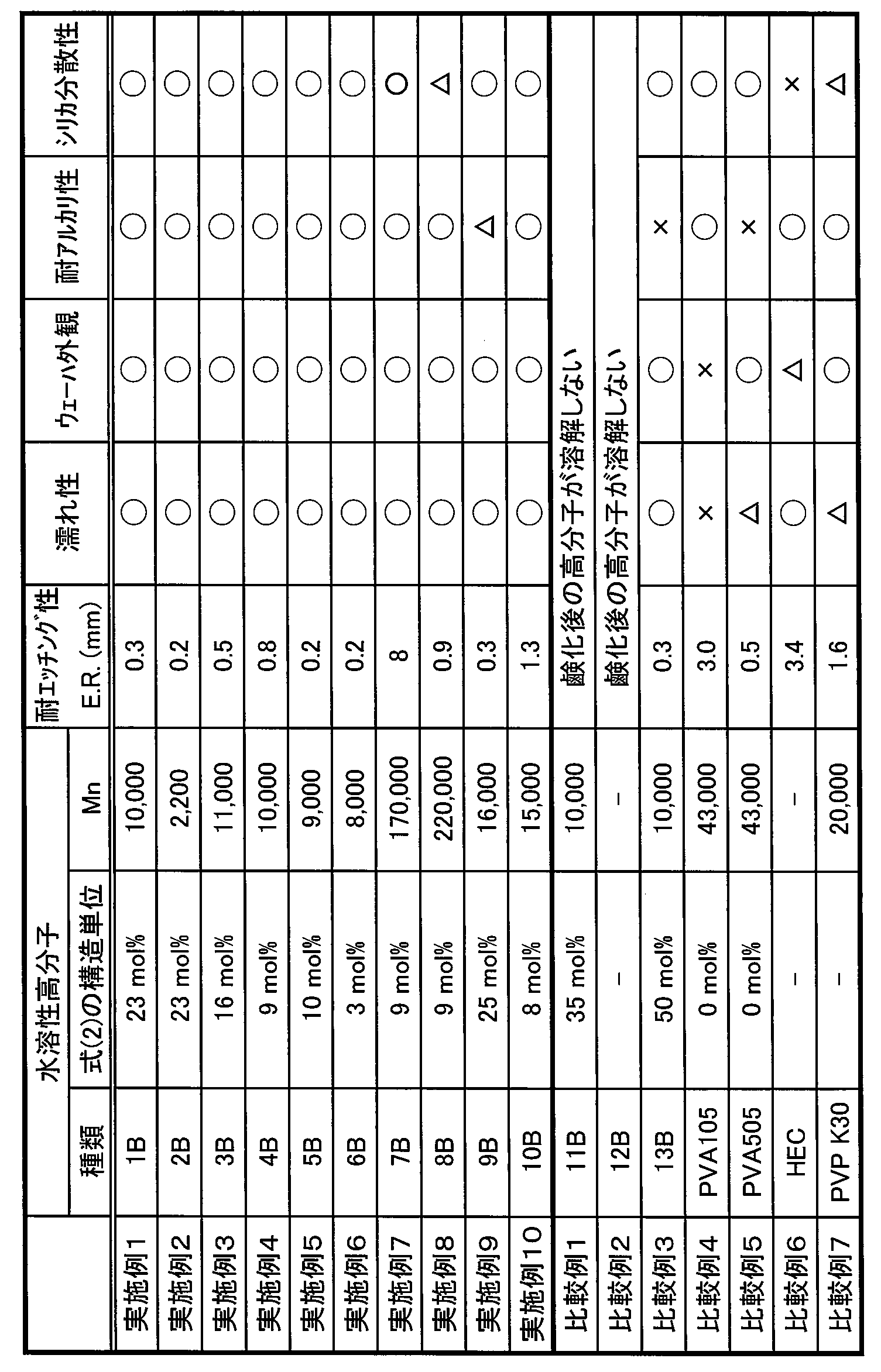
表1に示された水溶性高分子の詳細は以下の通り。
PVA105:完全鹸化ポリビニルアルコール(クラレ社製、商品名「クラレポバール
PVA105」、鹸化度98.5mol%、重合度500)
PVA505:低鹸化ポリビニルアルコール(クラレ社製、商品名「クラレポバール
PVA505」、鹸化度73.5mol%、重合度500)
HEC:ヒドロキシエチルセルロース(和光純薬工業社製、重量平均分子量90,000)
PVP K30:ポリビニルピロリドン(東京化成工業社製)
PVA105:完全鹸化ポリビニルアルコール(クラレ社製、商品名「クラレポバール
PVA105」、鹸化度98.5mol%、重合度500)
PVA505:低鹸化ポリビニルアルコール(クラレ社製、商品名「クラレポバール
PVA505」、鹸化度73.5mol%、重合度500)
HEC:ヒドロキシエチルセルロース(和光純薬工業社製、重量平均分子量90,000)
PVP K30:ポリビニルピロリドン(東京化成工業社製)
実施例1~10は、本発明で規定する水溶性高分子を用いた実験例であり、ウェーハへの吸着性が高いため、耐エッチング性、濡れ性及びウェーハへの外観に優れる結果が得られている。また、研磨剤組成物とした場合のシリカ分散性にも優れることが確認された。
一方、式(2)で表される構造単位を有さない水溶性高分子を用いた比較例4は、ウェーハ表面への吸着性が不十分であるため、耐エッチング性、濡れ性及びウェーハ外観の点で劣る結果となった。また、鹸化率の低いポリビニルアルコールを用いた比較例5は、酢酸ビニル由来のユニットの加水分解が生じるため、耐アルカリ性が不足するものであった。本発明の水溶性高分子と構造単位の異なる水溶性高分子を用いた比較例6及び7は、ウェーハ表面への吸着性及びシリカ分散性の点で、満足するものではなかった。
また、上記の通り、比較例1及び2では、鹸化後の高分子が水に溶解しないため、濡れ剤及び研磨剤組成物としての評価ができなかった。比較例1は、式(2)で表される構造単位が多く、鹸化後に得られた高分子の水への溶解性が不十分であったためと思われる。比較例2は、酢酸ビニルとn-ドデシルビニルエーテルとの共重合性が悪いことから、n-ドデシルビニルエーテルを主成分とする水に不溶な高分子成分が生成したためと推察される。
一方、式(2)で表される構造単位を有さない水溶性高分子を用いた比較例4は、ウェーハ表面への吸着性が不十分であるため、耐エッチング性、濡れ性及びウェーハ外観の点で劣る結果となった。また、鹸化率の低いポリビニルアルコールを用いた比較例5は、酢酸ビニル由来のユニットの加水分解が生じるため、耐アルカリ性が不足するものであった。本発明の水溶性高分子と構造単位の異なる水溶性高分子を用いた比較例6及び7は、ウェーハ表面への吸着性及びシリカ分散性の点で、満足するものではなかった。
また、上記の通り、比較例1及び2では、鹸化後の高分子が水に溶解しないため、濡れ剤及び研磨剤組成物としての評価ができなかった。比較例1は、式(2)で表される構造単位が多く、鹸化後に得られた高分子の水への溶解性が不十分であったためと思われる。比較例2は、酢酸ビニルとn-ドデシルビニルエーテルとの共重合性が悪いことから、n-ドデシルビニルエーテルを主成分とする水に不溶な高分子成分が生成したためと推察される。
本発明の半導体用濡れ剤は、研磨後のウェーハ表面への吸着性に優れるため、該半導体用濡れ剤を含む研磨用組成物を用いることにより、研磨後のウェーハ表面の平滑性を高め、かつ、COPを抑制することが可能となる。さらに、シリカの分散性も良好であることから、シリコンウェーハの仕上げ研磨用組成物として特に有用である。
Claims (7)
- 分子中に、式(1)で表される構造単位70~99mol%及び式(2)で表される構造単位1~30mol%を有する水溶性高分子を含む半導体用濡れ剤。
[-CH2CH(OH)-] (1)
[-CH2CH(X)-] (2)
〔式(2)中、Xは炭素数1~10のアルキル基を有するアルキルエーテル基、炭素数6~10のアリール基、式(3)若しくは式(4)で表される有機基、炭素数1~10のアルキル基を有するウレタンアルキル基、炭素数3以上のアルキレン基を有するアルキレンオキシド基、水素又は炭素数1~3のアルキル基を表す。〕
-C(=O)O-(CH2)m-R1 (3)
〔式(3)中、R1は炭素数1~8のアルキル基、炭素数1~4のアルキル基を有するアルキルアミノ基又はジアルキルアミノ基、mは0~3の整数を表す。〕
-C(=O)NH-(CH2)n-R2 (4)
〔式(4)中、R2は炭素数1~8のアルキル基、炭素数1~4のアルキル基を有するアルキルアミノ基又はジアルキルアミノ基、nは0~3の整数を表す。〕 - 前記水溶性高分子が、酢酸ビニル及び他のビニル系単量体を共重合した後、鹸化することにより得られることを特徴とする請求項1に記載の半導体用濡れ剤。
- 前記水溶性高分子の数平均分子量が1,000~200,000であることを特徴とする請求項1又は2に記載の半導体用濡れ剤。
- 請求項1~3のいずれかに記載の半導体用濡れ剤、水、砥粒及びアルカリ化合物を含んでなることを特徴とする研磨用組成物。
- 前記砥粒がコロイダルシリカである請求項4に記載の研磨用組成物。
- シリコンウェーハの仕上げ研磨用である、請求項4又は5に記載の研磨用組成物。
- 分子中に、式(1)で表される構造単位70~99mol%及び式(2)で表される構造単位1~30mol%を有する水溶性高分子を用いて、シリコンウエーハを研磨する方法。
[-CH2CH(OH)-] (1)
[-CH2CH(X)-] (2)
〔式(2)中、Xは炭素数1~10のアルキル基を有するアルキルエーテル基、炭素数6~10のアリール基、式(3)若しくは式(4)で表される有機基、炭素数1~10のアルキル基を有するウレタンアルキル基、炭素数3以上のアルキレン基を有するアルキレンオキシド基、水素又は炭素数1~3のアルキル基を表す。〕
-C(=O)O-(CH2)m-R1 (3)
〔式(3)中、R1は炭素数1~8のアルキル基、炭素数1~4のアルキル基を有するアルキルアミノ基又はジアルキルアミノ基、mは0~3の整数を表す。〕
-C(=O)NH-(CH2)n-R2 (4)
〔式(4)中、R2は炭素数1~8のアルキル基、炭素数1~4のアルキル基を有するアルキルアミノ基又はジアルキルアミノ基、nは0~3の整数を表す。〕
Priority Applications (1)
| Application Number | Priority Date | Filing Date | Title |
|---|---|---|---|
| JP2015541562A JP6087442B2 (ja) | 2013-10-07 | 2014-10-06 | 半導体用濡れ剤及び研磨用組成物 |
Applications Claiming Priority (2)
| Application Number | Priority Date | Filing Date | Title |
|---|---|---|---|
| JP2013-209778 | 2013-10-07 | ||
| JP2013209778 | 2013-10-07 |
Publications (1)
| Publication Number | Publication Date |
|---|---|
| WO2015053207A1 true WO2015053207A1 (ja) | 2015-04-16 |
Family
ID=52813023
Family Applications (1)
| Application Number | Title | Priority Date | Filing Date |
|---|---|---|---|
| PCT/JP2014/076656 Ceased WO2015053207A1 (ja) | 2013-10-07 | 2014-10-06 | 半導体用濡れ剤及び研磨用組成物 |
Country Status (3)
| Country | Link |
|---|---|
| JP (2) | JP6087442B2 (ja) |
| TW (1) | TWI666224B (ja) |
| WO (1) | WO2015053207A1 (ja) |
Cited By (3)
| Publication number | Priority date | Publication date | Assignee | Title |
|---|---|---|---|---|
| JPWO2017170179A1 (ja) * | 2016-03-31 | 2019-02-14 | 東亞合成株式会社 | 研磨用組成物及びその製造方法 |
| WO2019087818A1 (ja) * | 2017-11-06 | 2019-05-09 | 株式会社フジミインコーポレーテッド | 研磨用組成物およびその製造方法 |
| JPWO2021149791A1 (ja) * | 2020-01-22 | 2021-07-29 |
Families Citing this family (3)
| Publication number | Priority date | Publication date | Assignee | Title |
|---|---|---|---|---|
| JP7720137B2 (ja) * | 2020-09-30 | 2025-08-07 | 株式会社フジミインコーポレーテッド | ポリビニルアルコール組成物を含む半導体用濡れ剤の製造方法 |
| TW202507093A (zh) * | 2023-08-11 | 2025-02-16 | 科聖電子股份有限公司 | 二極體晶圓與待加工晶圓之製作方法 |
| CN119591773B (zh) * | 2024-12-03 | 2026-03-06 | 中山大学 | 一种可用于力致变色智能窗口的乙酸乙烯酯-正丙基乙烯基醚共聚物薄膜及其制备方法 |
Citations (3)
| Publication number | Priority date | Publication date | Assignee | Title |
|---|---|---|---|---|
| JP2009147267A (ja) * | 2007-12-18 | 2009-07-02 | Dai Ichi Kogyo Seiyaku Co Ltd | 化学機械研磨用研磨剤 |
| WO2011111421A1 (ja) * | 2010-03-12 | 2011-09-15 | 日立化成工業株式会社 | スラリ、研磨液セット、研磨液及びこれらを用いた基板の研磨方法 |
| JP2013138153A (ja) * | 2011-12-28 | 2013-07-11 | Kao Corp | シリコンウエハ用研磨液組成物 |
Family Cites Families (3)
| Publication number | Priority date | Publication date | Assignee | Title |
|---|---|---|---|---|
| CN1311009C (zh) * | 2001-11-15 | 2007-04-18 | 三星电子株式会社 | 添加剂组合物、含有该添加剂组合物的淤浆组合物及使用该淤浆组合物抛光物体的方法 |
| JP2009083482A (ja) * | 2007-09-13 | 2009-04-23 | Asahi Kasei Electronics Co Ltd | 感光性樹脂積層体 |
| JP5657247B2 (ja) * | 2009-12-25 | 2015-01-21 | 花王株式会社 | 研磨液組成物 |
-
2014
- 2014-10-06 WO PCT/JP2014/076656 patent/WO2015053207A1/ja not_active Ceased
- 2014-10-06 JP JP2015541562A patent/JP6087442B2/ja active Active
- 2014-10-07 TW TW103134883A patent/TWI666224B/zh active
-
2016
- 2016-12-05 JP JP2016236187A patent/JP6325064B2/ja active Active
Patent Citations (3)
| Publication number | Priority date | Publication date | Assignee | Title |
|---|---|---|---|---|
| JP2009147267A (ja) * | 2007-12-18 | 2009-07-02 | Dai Ichi Kogyo Seiyaku Co Ltd | 化学機械研磨用研磨剤 |
| WO2011111421A1 (ja) * | 2010-03-12 | 2011-09-15 | 日立化成工業株式会社 | スラリ、研磨液セット、研磨液及びこれらを用いた基板の研磨方法 |
| JP2013138153A (ja) * | 2011-12-28 | 2013-07-11 | Kao Corp | シリコンウエハ用研磨液組成物 |
Cited By (11)
| Publication number | Priority date | Publication date | Assignee | Title |
|---|---|---|---|---|
| JPWO2017170179A1 (ja) * | 2016-03-31 | 2019-02-14 | 東亞合成株式会社 | 研磨用組成物及びその製造方法 |
| WO2019087818A1 (ja) * | 2017-11-06 | 2019-05-09 | 株式会社フジミインコーポレーテッド | 研磨用組成物およびその製造方法 |
| CN111315835A (zh) * | 2017-11-06 | 2020-06-19 | 福吉米株式会社 | 研磨用组合物及其制造方法 |
| JPWO2019087818A1 (ja) * | 2017-11-06 | 2020-12-17 | 株式会社フジミインコーポレーテッド | 研磨用組成物およびその製造方法 |
| US11421131B2 (en) | 2017-11-06 | 2022-08-23 | Fujimi Incorporated | Polishing composition and method for producing same |
| CN111315835B (zh) * | 2017-11-06 | 2022-08-26 | 福吉米株式会社 | 研磨用组合物及其制造方法 |
| JP7303111B2 (ja) | 2017-11-06 | 2023-07-04 | 株式会社フジミインコーポレーテッド | 研磨用組成物およびその製造方法 |
| US11976220B2 (en) | 2017-11-06 | 2024-05-07 | Fujimi Incorporated | Polishing composition and method for producing same |
| JPWO2021149791A1 (ja) * | 2020-01-22 | 2021-07-29 | ||
| US12305081B2 (en) | 2020-01-22 | 2025-05-20 | Japan Vam & Poval Co., Ltd. | Polishing composition |
| JP7761491B2 (ja) | 2020-01-22 | 2025-10-28 | 日本酢ビ・ポバール株式会社 | 研磨用組成物 |
Also Published As
| Publication number | Publication date |
|---|---|
| JPWO2015053207A1 (ja) | 2017-03-09 |
| JP6087442B2 (ja) | 2017-03-01 |
| JP6325064B2 (ja) | 2018-05-16 |
| TWI666224B (zh) | 2019-07-21 |
| JP2017112367A (ja) | 2017-06-22 |
| TW201520233A (zh) | 2015-06-01 |
Similar Documents
| Publication | Publication Date | Title |
|---|---|---|
| JP6325064B2 (ja) | 半導体用濡れ剤及び研磨用組成物 | |
| JP6232243B2 (ja) | 半導体用濡れ剤及び研磨用組成物 | |
| JP6129336B2 (ja) | 半導体用濡れ剤及び研磨用組成物 | |
| TWI618740B (zh) | Grinding composition and method of producing the same | |
| TWI617655B (zh) | 研磨用組成物及其製造方法 | |
| JP2020161603A (ja) | シリコンウェーハ研磨用組成物 | |
| JP6292816B2 (ja) | 半導体用濡れ剤及び研磨用組成物 | |
| JP2021057467A (ja) | シリコンウェーハ用研磨用組成物 | |
| US11976220B2 (en) | Polishing composition and method for producing same | |
| JP6914915B2 (ja) | 研磨用組成物及びその製造方法 | |
| JP7584893B2 (ja) | 研磨用組成物及びシリコンウェーハの研磨方法 | |
| TW201113080A (en) | Dispersant for silica particles or ceria particles, and abrasive | |
| WO2025206229A1 (ja) | 研磨用組成物 |
Legal Events
| Date | Code | Title | Description |
|---|---|---|---|
| 121 | Ep: the epo has been informed by wipo that ep was designated in this application |
Ref document number: 14852721 Country of ref document: EP Kind code of ref document: A1 |
|
| ENP | Entry into the national phase |
Ref document number: 2015541562 Country of ref document: JP Kind code of ref document: A |
|
| NENP | Non-entry into the national phase |
Ref country code: DE |
|
| 122 | Ep: pct application non-entry in european phase |
Ref document number: 14852721 Country of ref document: EP Kind code of ref document: A1 |