WO2015053183A1 - 感光性組成物、分散組成物、これを用いたカラーフィルタの製造方法、カラーフィルタ、及び、固体撮像素子 - Google Patents
感光性組成物、分散組成物、これを用いたカラーフィルタの製造方法、カラーフィルタ、及び、固体撮像素子 Download PDFInfo
- Publication number
- WO2015053183A1 WO2015053183A1 PCT/JP2014/076530 JP2014076530W WO2015053183A1 WO 2015053183 A1 WO2015053183 A1 WO 2015053183A1 JP 2014076530 W JP2014076530 W JP 2014076530W WO 2015053183 A1 WO2015053183 A1 WO 2015053183A1
- Authority
- WO
- WIPO (PCT)
- Prior art keywords
- group
- photosensitive composition
- alkali
- color filter
- composition
- Prior art date
- Legal status (The legal status is an assumption and is not a legal conclusion. Google has not performed a legal analysis and makes no representation as to the accuracy of the status listed.)
- Ceased
Links
- 0 CC(C)(C(N*)=O)OCCCCCC1=COC1(C)O Chemical compound CC(C)(C(N*)=O)OCCCCCC1=COC1(C)O 0.000 description 1
- KCILHVXERQNBKM-UHFFFAOYSA-N CCC(CI)(C(C)O)N Chemical compound CCC(CI)(C(C)O)N KCILHVXERQNBKM-UHFFFAOYSA-N 0.000 description 1
Classifications
-
- G—PHYSICS
- G03—PHOTOGRAPHY; CINEMATOGRAPHY; ANALOGOUS TECHNIQUES USING WAVES OTHER THAN OPTICAL WAVES; ELECTROGRAPHY; HOLOGRAPHY
- G03F—PHOTOMECHANICAL PRODUCTION OF TEXTURED OR PATTERNED SURFACES, e.g. FOR PRINTING, FOR PROCESSING OF SEMICONDUCTOR DEVICES; MATERIALS THEREFOR; ORIGINALS THEREFOR; APPARATUS SPECIALLY ADAPTED THEREFOR
- G03F7/00—Photomechanical, e.g. photolithographic, production of textured or patterned surfaces, e.g. printing surfaces; Materials therefor, e.g. comprising photoresists; Apparatus specially adapted therefor
- G03F7/004—Photosensitive materials
- G03F7/027—Non-macromolecular photopolymerisable compounds having carbon-to-carbon double bonds, e.g. ethylenic compounds
- G03F7/032—Non-macromolecular photopolymerisable compounds having carbon-to-carbon double bonds, e.g. ethylenic compounds with binders
- G03F7/033—Non-macromolecular photopolymerisable compounds having carbon-to-carbon double bonds, e.g. ethylenic compounds with binders the binders being polymers obtained by reactions only involving carbon-to-carbon unsaturated bonds, e.g. vinyl polymers
-
- C—CHEMISTRY; METALLURGY
- C08—ORGANIC MACROMOLECULAR COMPOUNDS; THEIR PREPARATION OR CHEMICAL WORKING-UP; COMPOSITIONS BASED THEREON
- C08F—MACROMOLECULAR COMPOUNDS OBTAINED BY REACTIONS ONLY INVOLVING CARBON-TO-CARBON UNSATURATED BONDS
- C08F220/00—Copolymers of compounds having one or more unsaturated aliphatic radicals, each having only one carbon-to-carbon double bond, and only one being terminated by only one carboxyl radical or a salt, anhydride ester, amide, imide or nitrile thereof
- C08F220/02—Monocarboxylic acids having less than ten carbon atoms; Derivatives thereof
- C08F220/10—Esters
- C08F220/34—Esters containing nitrogen, e.g. N,N-dimethylaminoethyl (meth)acrylate
- C08F220/36—Esters containing nitrogen, e.g. N,N-dimethylaminoethyl (meth)acrylate containing oxygen in addition to the carboxy oxygen, e.g. 2-N-morpholinoethyl (meth)acrylate or 2-isocyanatoethyl (meth)acrylate
- C08F220/365—Esters containing nitrogen, e.g. N,N-dimethylaminoethyl (meth)acrylate containing oxygen in addition to the carboxy oxygen, e.g. 2-N-morpholinoethyl (meth)acrylate or 2-isocyanatoethyl (meth)acrylate containing further carboxylic moieties
-
- G—PHYSICS
- G02—OPTICS
- G02B—OPTICAL ELEMENTS, SYSTEMS OR APPARATUS
- G02B5/00—Optical elements other than lenses
- G02B5/20—Filters
- G02B5/22—Absorbing filters
- G02B5/223—Absorbing filters containing organic substances, e.g. dyes, inks or pigments
-
- G—PHYSICS
- G03—PHOTOGRAPHY; CINEMATOGRAPHY; ANALOGOUS TECHNIQUES USING WAVES OTHER THAN OPTICAL WAVES; ELECTROGRAPHY; HOLOGRAPHY
- G03F—PHOTOMECHANICAL PRODUCTION OF TEXTURED OR PATTERNED SURFACES, e.g. FOR PRINTING, FOR PROCESSING OF SEMICONDUCTOR DEVICES; MATERIALS THEREFOR; ORIGINALS THEREFOR; APPARATUS SPECIALLY ADAPTED THEREFOR
- G03F7/00—Photomechanical, e.g. photolithographic, production of textured or patterned surfaces, e.g. printing surfaces; Materials therefor, e.g. comprising photoresists; Apparatus specially adapted therefor
- G03F7/0005—Production of optical devices or components in so far as characterised by the lithographic processes or materials used therefor
- G03F7/0007—Filters, e.g. additive colour filters; Components for display devices
-
- G—PHYSICS
- G03—PHOTOGRAPHY; CINEMATOGRAPHY; ANALOGOUS TECHNIQUES USING WAVES OTHER THAN OPTICAL WAVES; ELECTROGRAPHY; HOLOGRAPHY
- G03F—PHOTOMECHANICAL PRODUCTION OF TEXTURED OR PATTERNED SURFACES, e.g. FOR PRINTING, FOR PROCESSING OF SEMICONDUCTOR DEVICES; MATERIALS THEREFOR; ORIGINALS THEREFOR; APPARATUS SPECIALLY ADAPTED THEREFOR
- G03F7/00—Photomechanical, e.g. photolithographic, production of textured or patterned surfaces, e.g. printing surfaces; Materials therefor, e.g. comprising photoresists; Apparatus specially adapted therefor
- G03F7/004—Photosensitive materials
- G03F7/0047—Photosensitive materials characterised by additives for obtaining a metallic or ceramic pattern, e.g. by firing
-
- C—CHEMISTRY; METALLURGY
- C08—ORGANIC MACROMOLECULAR COMPOUNDS; THEIR PREPARATION OR CHEMICAL WORKING-UP; COMPOSITIONS BASED THEREON
- C08F—MACROMOLECULAR COMPOUNDS OBTAINED BY REACTIONS ONLY INVOLVING CARBON-TO-CARBON UNSATURATED BONDS
- C08F220/00—Copolymers of compounds having one or more unsaturated aliphatic radicals, each having only one carbon-to-carbon double bond, and only one being terminated by only one carboxyl radical or a salt, anhydride ester, amide, imide or nitrile thereof
- C08F220/02—Monocarboxylic acids having less than ten carbon atoms; Derivatives thereof
- C08F220/10—Esters
- C08F220/26—Esters containing oxygen in addition to the carboxy oxygen
- C08F220/28—Esters containing oxygen in addition to the carboxy oxygen containing no aromatic rings in the alcohol moiety
- C08F220/281—Esters containing oxygen in addition to the carboxy oxygen containing no aromatic rings in the alcohol moiety and containing only one oxygen, e.g. furfuryl (meth)acrylate or 2-methoxyethyl (meth)acrylate
-
- C—CHEMISTRY; METALLURGY
- C08—ORGANIC MACROMOLECULAR COMPOUNDS; THEIR PREPARATION OR CHEMICAL WORKING-UP; COMPOSITIONS BASED THEREON
- C08F—MACROMOLECULAR COMPOUNDS OBTAINED BY REACTIONS ONLY INVOLVING CARBON-TO-CARBON UNSATURATED BONDS
- C08F220/00—Copolymers of compounds having one or more unsaturated aliphatic radicals, each having only one carbon-to-carbon double bond, and only one being terminated by only one carboxyl radical or a salt, anhydride ester, amide, imide or nitrile thereof
- C08F220/02—Monocarboxylic acids having less than ten carbon atoms; Derivatives thereof
- C08F220/10—Esters
- C08F220/26—Esters containing oxygen in addition to the carboxy oxygen
- C08F220/28—Esters containing oxygen in addition to the carboxy oxygen containing no aromatic rings in the alcohol moiety
- C08F220/282—Esters containing oxygen in addition to the carboxy oxygen containing no aromatic rings in the alcohol moiety and containing two or more oxygen atoms
-
- C—CHEMISTRY; METALLURGY
- C08—ORGANIC MACROMOLECULAR COMPOUNDS; THEIR PREPARATION OR CHEMICAL WORKING-UP; COMPOSITIONS BASED THEREON
- C08F—MACROMOLECULAR COMPOUNDS OBTAINED BY REACTIONS ONLY INVOLVING CARBON-TO-CARBON UNSATURATED BONDS
- C08F220/00—Copolymers of compounds having one or more unsaturated aliphatic radicals, each having only one carbon-to-carbon double bond, and only one being terminated by only one carboxyl radical or a salt, anhydride ester, amide, imide or nitrile thereof
- C08F220/02—Monocarboxylic acids having less than ten carbon atoms; Derivatives thereof
- C08F220/10—Esters
- C08F220/26—Esters containing oxygen in addition to the carboxy oxygen
- C08F220/28—Esters containing oxygen in addition to the carboxy oxygen containing no aromatic rings in the alcohol moiety
- C08F220/283—Esters containing oxygen in addition to the carboxy oxygen containing no aromatic rings in the alcohol moiety and containing one or more carboxylic moiety in the chain, e.g. acetoacetoxyethyl(meth)acrylate
-
- C—CHEMISTRY; METALLURGY
- C08—ORGANIC MACROMOLECULAR COMPOUNDS; THEIR PREPARATION OR CHEMICAL WORKING-UP; COMPOSITIONS BASED THEREON
- C08F—MACROMOLECULAR COMPOUNDS OBTAINED BY REACTIONS ONLY INVOLVING CARBON-TO-CARBON UNSATURATED BONDS
- C08F220/00—Copolymers of compounds having one or more unsaturated aliphatic radicals, each having only one carbon-to-carbon double bond, and only one being terminated by only one carboxyl radical or a salt, anhydride ester, amide, imide or nitrile thereof
- C08F220/02—Monocarboxylic acids having less than ten carbon atoms; Derivatives thereof
- C08F220/10—Esters
- C08F220/26—Esters containing oxygen in addition to the carboxy oxygen
- C08F220/28—Esters containing oxygen in addition to the carboxy oxygen containing no aromatic rings in the alcohol moiety
- C08F220/285—Esters containing oxygen in addition to the carboxy oxygen containing no aromatic rings in the alcohol moiety and containing a polyether chain in the alcohol moiety
- C08F220/286—Esters containing oxygen in addition to the carboxy oxygen containing no aromatic rings in the alcohol moiety and containing a polyether chain in the alcohol moiety and containing polyethylene oxide in the alcohol moiety, e.g. methoxy polyethylene glycol (meth)acrylate
-
- C—CHEMISTRY; METALLURGY
- C08—ORGANIC MACROMOLECULAR COMPOUNDS; THEIR PREPARATION OR CHEMICAL WORKING-UP; COMPOSITIONS BASED THEREON
- C08F—MACROMOLECULAR COMPOUNDS OBTAINED BY REACTIONS ONLY INVOLVING CARBON-TO-CARBON UNSATURATED BONDS
- C08F220/00—Copolymers of compounds having one or more unsaturated aliphatic radicals, each having only one carbon-to-carbon double bond, and only one being terminated by only one carboxyl radical or a salt, anhydride ester, amide, imide or nitrile thereof
- C08F220/02—Monocarboxylic acids having less than ten carbon atoms; Derivatives thereof
- C08F220/10—Esters
- C08F220/26—Esters containing oxygen in addition to the carboxy oxygen
- C08F220/28—Esters containing oxygen in addition to the carboxy oxygen containing no aromatic rings in the alcohol moiety
- C08F220/285—Esters containing oxygen in addition to the carboxy oxygen containing no aromatic rings in the alcohol moiety and containing a polyether chain in the alcohol moiety
- C08F220/287—Esters containing oxygen in addition to the carboxy oxygen containing no aromatic rings in the alcohol moiety and containing a polyether chain in the alcohol moiety and containing polypropylene oxide in the alcohol moiety
Definitions
- the present invention relates to a photosensitive composition, a dispersion composition, a method for producing a color filter using the same, a color filter, and a solid-state imaging device.
- one color of a plurality of color filters may be white (transparent).
- a method for producing such a white pattern (white filter pixel) in a color filter for example, a photosensitive transparent for color filter containing a photopolymerization initiator, a polymerizable compound, an alkali-soluble resin, inorganic fine particles, and the like.
- a technique using a composition is known (see Patent Document 1).
- An object of this invention is to provide the photosensitive composition which is excellent in lithography performance in view of the said situation, and the formed film
- Another object of the present invention is to provide a color filter using the above composition, a method for producing the same, a solid-state imaging device, and a dispersion composition.
- the present inventors have found that a desired effect can be obtained by using the following specific alkali-soluble resin. More specifically, the present inventors have found that the above object can be achieved by the following configuration.
- a photosensitive composition comprising at least an alkali-soluble resin having a repeating unit represented by the formula (X) described later, inorganic particles, a dispersant, a photopolymerization initiator, and a polymerizable compound.
- a photosensitive composition comprising at least an alkali-soluble resin having a glass transition temperature (Tg) of 100 to 250 ° C., inorganic particles, a dispersant, a photopolymerization initiator, and a polymerizable compound.
- Tg glass transition temperature
- any of (1) to (7), wherein the dispersant is an oligoimine dispersant or a resin containing a structural unit represented by any one of formulas (1) to (4) described later The photosensitive composition as described in any one of.
- (11) The photosensitive composition according to any one of (1) to (10), further comprising NaCl.
- the formed film can provide the photosensitive composition which shows the outstanding refractive index.
- the color filter using the said composition, its manufacturing method, a solid-state image sensor, and a dispersion composition can also be provided.
- the photosensitive composition (photosensitive transparent composition) of the present invention will be described in detail.
- the description which does not describe substitution and non-substitution includes the thing which has a substituent with the thing which does not have a substituent.
- the “alkyl group” includes not only an alkyl group having no substituent (unsubstituted alkyl group) but also an alkyl group having a substituent (substituted alkyl group).
- light means actinic rays or radiation.
- active light or “radiation” means, for example, an emission line spectrum of a mercury lamp, far ultraviolet rays represented by an excimer laser, extreme ultraviolet rays (EUV light), X-rays, electron beams, and the like.
- exposure in this specification is not only exposure with far-ultraviolet rays such as mercury lamps and excimer lasers, X-rays, EUV light, but also drawing with particle beams such as electron beams and ion beams. Are also included in the exposure.
- the description of the constituent elements described below may be made based on typical embodiments of the present invention, but the present invention is not limited to such embodiments.
- a numerical range expressed using “to” means a range including numerical values described before and after “to” as a lower limit value and an upper limit value.
- “(meth) acrylate” represents acrylate and methacrylate
- “(meth) acryl” represents acrylic and methacryl
- “(meth) acryloyl” represents acryloyl and methacryloyl.
- “monomer” and “monomer” are synonymous.
- the monomer in the present invention is distinguished from an oligomer and a polymer, and refers to a compound having a mass average molecular weight of 2,000 or less.
- the polymerizable compound refers to a compound having a polymerizable group, and may be a monomer or a polymer.
- the polymerizable group refers to a group that participates in a polymerization reaction.
- the photosensitive composition of the present invention is a composition containing at least an alkali-soluble resin, inorganic particles, a dispersant, a photopolymerization initiator, and a polymerizable compound.
- the photosensitive composition according to the present invention is typically a negative composition (a composition that forms a negative pattern).
- the condensed aromatic ring group is contained in the alkali-soluble resin, or the refractive index is improved by the alkali-soluble resin having a high glass transition temperature, and the condensed aromatic ring group is an inorganic particle. It is presumed that by interacting with the surface, the dispersibility of the particles was improved, and as a result, the lithography performance (the above-mentioned resolution, development residue property, etc.) was also improved.
- each component (alkali-soluble resin, inorganic particles, dispersant, photopolymerization initiator, polymerizable compound, etc.) contained in the photosensitive composition will be described in detail, and then the use of the composition will be described in detail.
- the component contained in the dispersion composition of this invention is the same as the component in the said photosensitive composition except the point which does not contain a polymeric compound.
- the alkali-soluble resin has a repeating unit represented by the formula (X) or has a glass transition temperature (Tg) of 100 to 250 ° C. and is soluble in an alkaline solution.
- R 1 represents a hydrogen atom or an alkyl group.
- alkyl group an alkyl group having 1 to 3 carbon atoms is preferable, and a methyl group is preferable.
- L 1 represents a single bond or a divalent linking group. Examples of the divalent linking group include a divalent aliphatic hydrocarbon group (preferably having 1 to 8 carbon atoms), a divalent aromatic hydrocarbon group (preferably having 6 to 12 carbon atoms), —O—, —S.
- the divalent aliphatic hydrocarbon group for example, an alkylene group
- examples of the divalent aromatic hydrocarbon group include a phenylene group and a naphthylene group.
- a single bond intends that A in formula (X) is directly linked to the carbon atom linked to R 1 .
- specific examples of L 1, L 1 is not limited thereto. Note that * indicates a binding position.
- A represents a substituted or unsubstituted condensed aromatic ring group.
- a fused aromatic group refers to a group having two or more aromatic ring structures, each ring having a structure sharing two or more atoms.
- the condensed aromatic ring group includes both a condensed aromatic hydrocarbon group and a condensed aromatic heterocyclic group.
- condensed aromatic hydrocarbon group for example, naphthyl group, acenaphthylenyl group, anthryl group, phenanthryl group, pyrenyl group, acephenanthrenyl group, aceanthrylenyl group, chrysenyl group, dibenzochrysenyl group, benzoanthryl group Group, dibenzoanthryl group, naphthacenyl group, picenyl group, pentacenyl group, fluorenyl group, 9,9-dihydroanthryl group, triphenylenyl group, perylenyl group, fluoranthenyl group, benzo [k] fluoranthenyl group, etc. It is done.
- Examples of the condensed aromatic heterocyclic group include indolyl group, quinolyl group, isoquinolyl group, phthalazinyl group, quinoxalinyl group, quinazolinyl group, carbazolyl group (including both 3-carbazolyl group and 9-carbazolyl group), acridinyl group, Examples include a phenazinyl group, a benzofuryl group, an isothiazolyl group, an isoxazolyl group, a furazanyl group, a phenoxazinyl group, a benzothiazolyl group, a benzoxazolyl group, a benzimidazolyl group, a benzotriazolyl group, and a pyranyl group.
- carbazolyl group, naphthyl group, benzothiazolyl group, benzoate are excellent in lithography performance and / or in the point that the refractive index of the obtained film is more excellent (hereinafter also referred to simply as “the excellent effect of the present invention”).
- An oxazolyl group or a benzotriazolyl group is preferable, and a carbazolyl group or a naphthyl group is more preferable.
- a substituent may be substituted.
- substituents examples include an alkyl group, aryl group, alkenyl group, alkynyl group, alkoxy group, aryloxy group, alkylthioxy group, arylthioxy group, Acyloxy group, alkylsulfanyl group, arylsulfanyl group, alkylsulfinyl group, arylsulfinyl group, alkylsulfonyl group, arylsulfonyl group, acyl group, acyloxy group, alkoxycarbonyl group, amino group, phosphinoyl group, heterocyclic group, silyl ether group Thiol group, sulfonamide group, amide group, urea group, thiourea group, carboxyl group, urethane group, halogen atom, nitro group, and the like.
- the content of the repeating unit represented by the formula (X) in the alkali-soluble resin is not particularly limited, but is preferably 40 to 95% by mass with respect to all the repeating units in terms of more excellent effects of the present invention. Is more preferably 90 to 90% by mass, and still more preferably 60 to 90% by mass.
- the alkali-soluble resin contains a repeating unit represented by the above formula (X), and its structure is not particularly limited as long as it is soluble in an alkaline solution, but preferably has an acid group.
- the acid group is not particularly limited, and examples thereof include a carboxyl group, an active methylene group, a phosphoric acid group, a sulfonic acid group, a phenolic hydroxyl group, and a carboxylic acid anhydride group. Those that can be developed with an aqueous solution are preferred, and carboxyl groups are particularly preferred. These acid groups may be used alone or in combination of two or more.
- the alkali-soluble resin preferably further has a repeating unit represented by the formula (Y) from the viewpoint that the effect of the present invention is more excellent.
- R 2 represents a hydrogen atom or an alkyl group.
- the alkyl group is preferably an alkyl group having 1 to 3 carbon atoms, and specific examples include a methyl group.
- L 2 represents a single bond or a divalent linking group. Definition of the divalent linking group represented by L 2 are the same as those defined divalent linking group represented by L 1.
- B represents an acid group. The definition of the acid group is as described above.
- the content of the repeating unit represented by the formula (Y) in the alkali-soluble resin is not particularly limited, but is preferably 5 to 60% by mass with respect to all the repeating units in terms of more excellent effects of the present invention. Is more preferably from 40 to 40% by mass, and further preferably from 20 to 40% by mass.
- the alkali-soluble resin may have a repeating unit other than the repeating unit represented by the above formula (X) and the repeating unit represented by the formula (Y).
- the alkali-soluble resin preferably has a repeating unit having a hydrophilic group (excluding an acid group) (hereinafter also referred to as “hydrophilic repeating unit”) from the viewpoint of more excellent effects of the present invention.
- hydrophilic group include a hydroxy group, an alkylene oxide group, a pyrrolidone group, a morpholine group, a 1,3-diketone group, an amino group, and an ammonium group.
- a hydroxy group is preferable in that the effect of the present invention is more excellent.
- the hydrophilic group does not include the acid group described above.
- the alkylene oxide group is preferably a group represented by the following formula (W). Note that * represents a bonding position.
- Formula (W) *-(AO) n -R In the formula (W), A represents an alkylene group (preferably an alkylene group having 2 to 3 carbon atoms), R represents a hydrogen atom or an alkyl group (preferably an alkyl group having 1 to 2 carbon atoms), and n Represents an integer of 1 or more (preferably an integer of 1 to 25).
- n is 2 or more, it is also called a polyalkylene oxide group.
- the pyrrolidone group, morpholine group and 1,3-diketone group each represent the following group. Note that * represents a bonding position.
- the amino group is a concept including primary, secondary, and tertiary amino groups, and a group represented by the following formula (P) is preferable.
- R represents a hydrogen atom or an alkyl group each independently.
- hydrophilic repeating unit a repeating unit represented by the following formula (Z) is preferable in that the effect of the present invention is more excellent.
- R 3 represents a hydrogen atom or an alkyl group.
- the definition of an alkyl group is synonymous with the definition of the alkyl group represented by R ⁇ 1 >.
- L 3 represents a single bond or a divalent linking group. Definition of the divalent linking group represented by L 3 are the same as those defined divalent linking group represented by L 1.
- C represents a hydrophilic group (excluding an acid group). The definition of the hydrophilic group is as described above.
- the content of the repeating unit represented by the formula (Z) in the alkali-soluble resin is not particularly limited, but is preferably 5 to 40% by mass with respect to all the repeating units in terms of more excellent effects of the present invention. More preferable is 30% by mass.
- the hydrophilic repeat unit (preferably, 21 ⁇ 33 MPa 0.5) is 20.2 ⁇ 35 MPa 0.5 (calculated by the Okitsu method) SP value repeating unit derived from a monomer which is Preferably there is.
- the SP value is calculated by the Okitsu method (Toshinao Okitsu, “Journal of the Adhesion Society of Japan” 29 (3) (1993)).
- the method for producing the alkali-soluble resin is not particularly limited, and for example, a known radical polymerization method can be applied. Polymerization conditions such as temperature, pressure, type and amount of radical initiator, type of solvent, etc. when producing an alkali-soluble resin by radical polymerization can be easily set by those skilled in the art, and experimental conditions are determined. It can also be done.
- an acrylic-soluble resin containing a repeating unit represented by the above formula (X) for example, the following monomer (hereinafter also referred to as monomer a) is used.
- monomer b the following monomer (hereinafter also referred to as monomer b) is used.
- the combination of the monomer a and the monomer b and the mass ratio of the two are not particularly limited.
- an alkali obtained by using the monomer a and the monomer b having the following combinations and the following quantitative relationships: Soluble resin is mentioned.
- the combination and mass ratio of the monomer a, the monomer b, and the monomer c are not particularly limited.
- the monomer a, the monomer b, and the monomer c having the following combinations and the following quantitative relationships are used.
- An alkali-soluble resin obtained by using A preferable mass ratio of the monomer a, the monomer b, and the monomer c is a ratio of 40 to 80% by mass: 10 to 30% by mass: 10 to 30% by mass. By containing in such a ratio, the high refractive index property of an alkali-soluble resin and the processability of a pattern can be made compatible.
- alkali-soluble resin when manufacturing alkali-soluble resin, you may use another monomer other than the monomer mentioned above.
- an alkali-soluble resin having a repeating unit derived from a compound represented by the following general formula (ED) (hereinafter sometimes referred to as “ether dimer”) may be used in combination.
- R 1 and R 2 each represent a hydrogen atom or a hydrocarbon group having 1 to 25 carbon atoms which may have a substituent.
- the hydrocarbon group having 1 to 25 carbon atoms which may have a substituent represented by R 1 and R 2 include an alkyl group substituted with alkoxy; an alkyl group substituted with an aryl group such as benzyl; Etc.
- a primary or secondary carbon substituent which is difficult to be removed by an acid or heat such as a methyl group, an ethyl group, a cyclohexyl group, and a benzyl group, is particularly preferable in terms of heat resistance.
- ether dimer examples include specific examples of the ether dimer described in paragraph 0565 of JP2012-208494A (paragraph 0694 of the corresponding US Patent Application Publication No. 2012/235099). Is incorporated herein. Among these, dimethyl-2,2 ′-[oxybis (methylene)] bis-2-propenoate, diethyl-2,2 ′-[oxybis (methylene)] bis-2-propenoate, dicyclohexyl-2,2′- [Oxybis (methylene)] bis-2-propenoate and dibenzyl-2,2 ′-[oxybis (methylene)] bis-2-propenoate are preferred. These ether dimers may be only one kind or two or more kinds.
- the structure derived from the compound represented by the general formula (ED) may be copolymerized with other monomers.
- the acid value of the alkali-soluble resin is not particularly limited, but is preferably 30 to 200 mgKOH / g, more preferably 50 to 150 mgKOH / g, and further preferably 100 to 150 mgKOH / g.
- the weight average molecular weight (Mw) of the alkali-soluble resin is not particularly limited, but is preferably 2,000 to 50,000, more preferably 5,000 to 30,000, and further preferably 7,000 to 20,000.
- alkali-soluble resin examples include polyamic acid described in paragraphs 0014 to 0025 of JP2010-103171A, paragraphs 0014 to 0029 and 0063 to 0069 of JP2005-189399 (Patent No. 4292985) (paragraphs 0033 to US2005 / 0157399). 0060, 0149 to 0162) can be used in combination, and these descriptions can be used, the contents of which are incorporated herein.
- the glass transition temperature (Tg) of the acrylic-soluble resin is not particularly limited, but is preferably 100 ° C. or higher, more preferably 100 to 250 ° C., further preferably 130 to 250 ° C., and more preferably 150 to 250 ° C. is particularly preferred.
- Tg is the glass transition temperature of the acrylic-soluble resin (unit: K)
- Tg i is the glass transition temperature of the homopolymer of monomer i (unit: K)
- the above is a calculation formula in the case where the acrylic soluble resin is composed of n monomer components of monomer 1, monomer 2,..., Monomer n.
- the content of the alkali-soluble resin in the photosensitive composition is preferably 1 to 60% by mass, more preferably 2 to 50% by mass, based on the total solid content of the composition. More preferably, it is preferably ⁇ 40 mass%, particularly preferably 3 ⁇ 20 mass%.
- solid content intends the component which comprises the cured film mentioned later, and a solvent (an organic solvent etc.) etc. are not contained.
- the photosensitive composition may contain sodium element, but the content of the sodium element derived from the alkali-soluble resin in the photosensitive composition is preferably 10 ppm by mass or less.
- the mass ppm or less is more preferable, and the mass ppm or less is more preferable.
- the content of sodium element can be adjusted by a purification operation such as distillation or filtration. By reducing the amount of sodium element, surface defects of the coating film and cured film (color filter) obtained from the photosensitive composition are further suppressed, and as a result, the yield of products is improved.
- sodium element is ionized to form a salt with other anions, so it is visually recognized as a surface defect, but reducing the amount suppresses salt formation, resulting in a reduction in the amount of defects. I guess that.
- a known method can be employed, for example, ICP-MS (inductively coupled plasma mass spectrometer) can be employed.
- the sodium element derived from the alkali-soluble resin is a sodium element contained in the resin raw material when the alkali-soluble resin is synthesized, and a photosensitive composition is prepared by mixing the alkali-soluble resin and other components. In this case, the sodium element mixed in the photosensitive composition is intended.
- the inorganic particles are preferably inorganic particles that have a high refractive index and are colorless, white or transparent, more preferably metal oxide particles, titanium (Ti), zirconium (Zr), aluminum (Al), Examples thereof include oxide particles of silicon (Si), zinc (Zn), or magnesium (Mg), and may be titanium dioxide (TiO 2 ) particles, zirconium oxide (ZrO 2 ) particles, or silicon dioxide (SiO 2 ) particles. preferable.
- the primary particle diameter of the inorganic particles is not particularly limited, preferably 1 nm to 100 nm, more preferably 1 nm to 80 nm, and particularly preferably 1 nm to 50 nm.
- the refractive index of the inorganic particles is not particularly limited, but is preferably 1.75 to 2.70, more preferably 1.90 to 2.70 from the viewpoint of obtaining a high refractive index.
- the specific surface area is not particularly limited in the inorganic particles is preferably 10 ⁇ 400m 2 / g, more preferably 20 ⁇ 200m 2 / g, more preferably 30 ⁇ 150m 2 / g.
- an inorganic particle For example, a rice grain shape, a spherical shape, a cube shape, a spindle shape, or an indefinite shape etc. are mentioned.
- the inorganic particles may be those that have been surface-treated with an organic compound.
- organic compounds used for the surface treatment include polyols, alkanolamines, stearic acid, silane coupling agents, and titanate coupling agents. Of these, stearic acid or a silane coupling agent is preferable.
- the surface of the inorganic particles is treated with an oxide such as aluminum, silicon, or zirconia in that the weather resistance is further improved.
- commercially available particles can be preferably used. Inorganic particles may be used singly or in combination of two or more.
- the content of inorganic particles in the photosensitive composition (or dispersion composition) of the present invention is 65% by mass or more based on the total solid content of the dispersion composition from the viewpoint of obtaining a high refractive index. Is more preferable, and it is still more preferable that it is 70 mass% or more. Although there is no restriction
- the content of inorganic particles in the photosensitive composition of the present invention is preferably 10 to 90% by mass, and preferably 20 to 85% by mass with respect to the total solid content of the photosensitive composition from the viewpoint of obtaining a high refractive index. More preferred is 30 to 80% by mass.
- titanium dioxide (TiO 2 ) particles, silicon dioxide (SiO 2 ) particles, and zirconium oxide (ZrO 2 ), which are preferred embodiments of the inorganic particles, will be described in detail.
- the titanium dioxide particles can be represented by the chemical formula TiO 2 , and the purity is preferably 70% or more, more preferably 80% or more, and further preferably 85% or more.
- Low-order titanium oxide, titanium oxynitride and the like represented by the general formula Ti n O 2n-1 (n represents a number of 2 to 4) are preferably 30% by mass or less, and 20% by mass or less. More preferably, the content is 15% by mass or less.
- titanium dioxide particle the thing of a rutile type crystal
- examples of commercially available titanium dioxide particles include TTO series (TTO-51 (A), TTO-51 (C), TTO-55 (C), etc.), TTO-S, V series (made by Ishihara Sangyo Co., Ltd.). And TTO-S-1, TTO-S-2, TTO-V-3, etc.) and MT series (MT-01, MT-05, etc.) manufactured by Teika Corporation.
- commercially available silicon dioxide particles include OG502-31 manufactured by Clariant Co.
- Zirconium oxide particles are inorganic particles containing zirconium atoms and oxygen atoms. By containing the particles, a film (cured film) having a high refractive index can be obtained.
- the average particle diameter of the zirconium oxide particles is not particularly limited, but is preferably 1 to 200 nm, more preferably 10 to 100 nm, and further preferably 10 to 50 nm.
- the specific surface area is preferably 80 to 120 m 2 / g.
- the average particle diameter of the zirconium oxide particles can be determined from a photograph obtained by observing the particles with a transmission electron microscope.
- the projected area of the particles is obtained, and the equivalent circle diameter is obtained therefrom to obtain the average particle size (usually, 300 or more particles are measured in order to obtain the average particle size).
- Examples of commercially available zirconium oxide particles include UEP, UEP-100 (Daiichi Rare Element Chemical Co., Ltd.), PCS (Nippon Denko Co., Ltd.), JS-01, JS-03, JS-04. (Nippon Denko Co., Ltd.).
- the content of the zirconium oxide particles in the photosensitive composition is preferably 10 to 80% by mass, more preferably 20 to 70% by mass, and further preferably 35 to 55% by mass with respect to the total solid content of the composition. .
- the dispersant improves the dispersion stability in the composition of the inorganic particles described above.
- the dispersant include polymer dispersants [for example, polyamidoamine and its salt, polycarboxylic acid and its salt, high molecular weight unsaturated acid ester, modified polyurethane, modified polyester, modified poly (meth) acrylate, (meth) acrylic type Copolymer, naphthalenesulfonic acid formalin condensate], and surfactants such as polyoxyethylene alkyl phosphate ester, polyoxyethylene alkyl amine, and alkanol amine.
- the polymer dispersant can be further classified into a linear polymer, a terminal-modified polymer, a graft polymer, and a block polymer according to the structure.
- terminal-modified polymer having an anchor site to the surface of the inorganic particles examples include polymers having a phosphate group at the end described in JP-A-3-112992, JP-T2003-533455, and the like. Polymers having a sulfonic acid group at the end described in JP-A No. 2002-273191, polymers having a partial skeleton of organic dye or a heterocyclic ring described in JP-A-9-77994, JP-A-2008-29901 And the like. Polymers produced by modification with an oligomer or polymer having a hydroxyl group or amino group at one end and an acid anhydride are listed.
- a high molecular weight described in JP-A-2007-277514 has two or more anchor portions (acid groups, basic groups, organic dye partial skeletons, heterocycles, etc.) to the surface of the infrared shielding agent introduced into the polymer terminals. Molecules are also preferred because of their excellent dispersion stability.
- the graft polymer having an anchor site on the surface of the inorganic particles include poly (lower alkylene) described in JP-A No. 54-37082, JP-A No. 8-507960, JP-A No. 2009-258668, and the like.
- a graft type polymer having a partial skeleton of organic dye or a heterocyclic ring include copolymers of macromonomer and acid group-containing monomers described in 0-106268 Patent Publication.
- a macromonomer used for producing a graft polymer having an anchor site on the surface of inorganic particles by radical polymerization a known macromonomer can be used, and macromonomer AA-6 (manufactured by Toa Gosei Co., Ltd.) Polymethyl methacrylate having a methacryloyl group as a terminal group), AS-6 (polystyrene having a methacryloyl group as a terminal group), AN-6S (a copolymer of styrene and acrylonitrile having a methacryloyl group as a terminal group), AB-6 (Polybutyl acrylate having a methacryloyl terminal group), Plaxel FM5 (5-hydroxy
- a polyester-based macromonomer that is particularly flexible and excellent in solvophilicity is particularly preferable from the viewpoint of dispersion stability of inorganic particles in the photosensitive composition, and further, a polyester-based polymer described in JP-A-2-272009.
- a polyester-based macromonomer represented by a macromonomer is most preferable.
- block polymers described in JP-A Nos. 2003-49110 and 2009-52010 are preferable.
- dispersant for example, a known dispersant or surfactant can be appropriately selected and used. Specific examples include “Disperbyk-101 (polyamidoamine phosphate), 107 (carboxylic acid ester), 110 (copolymer containing an acid group), 130 (polyamide), 161, 162, 163 manufactured by BYK Chemie.
- dispersants may be used alone or in combination of two or more. Further, the dispersant may be used in combination with an alkali-soluble resin together with a terminal-modified polymer, a graft polymer, or a block polymer having an anchor site.
- Alkali-soluble resins include (meth) acrylic acid copolymer, itaconic acid copolymer, crotonic acid copolymer, maleic acid copolymer, partially esterified maleic acid copolymer, etc., and carboxylic acid in the side chain.
- the acid cellulose derivative include a resin having a hydroxyl group modified with an acid anhydride, and a (meth) acrylic acid copolymer is particularly preferable.
- An alkali-soluble resin containing is also preferred.
- oligoimine dispersants or the following resins described in JP-A No. 2010-106268 are preferred.
- the oligoimine dispersant is preferably a graft copolymer including a poly (lower alkylene imine) -based repeating unit and having a polyester-structure graft chain.
- the oligoimine dispersant preferably contains an acid group. Furthermore, as a preferable acid group, an acid group having a pKa of 6 or less is preferable from the viewpoint of adsorptivity, and carboxylic acid is particularly preferable.
- the acid value of the oligoimine dispersant is preferably 1 to 100 mg / KOH, more preferably 3 to 50 mg / KOH, and still more preferably 5 to 35 mg / KOH.
- the weight average molecular weight of the oligoimine dispersant measured by GPC method is preferably 2000 to 100,000, more preferably 3000 to 50000, and further preferably 4000 to 10,000.
- a polymer dispersant having a polyester chain in the side chain is preferable from the viewpoint of dispersibility, and a resin having an acid group and a polyester chain is also preferable. It is mentioned in.
- an acid group having a pKa of 6 or less is preferable from the viewpoint of adsorptivity, and a carboxylic acid group, a sulfonic acid group, and a phosphoric acid group are particularly preferable.
- dispersion resin described in the column 0173 and after of JP 2012-122045 A that is preferably used in the present invention
- a copolymer is preferred.
- the dispersant it is preferable that at least a structural unit represented by any one of the following formulas (1) to (4) is included, and at least the following formula (1A), the following formula (2A) ), The following formula (3A), the following formula (3B), and the structural unit represented by any of the following formula (4) are more preferable.
- X 1 , X 2 , X 3 , X 4 , and X 5 each independently represent a hydrogen atom or a monovalent organic group. From the viewpoint of synthesis restrictions, a hydrogen atom or an alkyl group having 1 to 12 carbon atoms is preferable, a hydrogen atom or a methyl group is more preferable, and a methyl group is particularly preferable.
- Y 1 , Y 2 , Y 3 , and Y 4 are each independently a divalent linking group and are not particularly limited in structure.
- the definition of a bivalent coupling group is as the above-mentioned. Specific examples include the following (Y-1) to (Y-21) linking groups.
- a and B each represent a bond with the left terminal group and the right terminal group in formulas (1) to (4). Of the structures shown below, (Y-2) and (Y-13) are more preferred because of the ease of synthesis.
- Z 1 , Z 2 , Z 3 , and Z 4 are each independently a hydrogen atom or a monovalent organic group, and the structure of the organic group is not particularly limited, Specific examples include an alkyl group, a hydroxyl group, an alkoxy group, an aryloxy group, a heteroaryloxy group, an alkylthioether group, an arylthioether group, a heteroarylthioether group, and an amino group. Among these, particularly from the viewpoint of improving dispersibility, it preferably has a steric repulsion effect.
- the monovalent organic groups represented by Z 1 to Z 3 are each independently an alkyl group having 5 to 24 carbon atoms or An alkoxy group having 5 to 24 carbon atoms is preferred, and among them, an alkoxy group having a branched alkyl group having 5 to 24 carbon atoms or a cyclic alkyl group having 5 to 24 carbon atoms is particularly preferable.
- the monovalent substituent represented by Z 4 is preferably an alkyl group having 5 to 24 carbon atoms, and among them, each independently a branched alkyl group having 5 to 24 carbon atoms or a cyclic group having 5 to 24 carbon atoms. Alkyl groups are preferred.
- n, m, p, and q are each independently an integer of 1 to 500.
- j and k each independently represent an integer of 2 to 8.
- J and k in formula (1) and formula (2) are preferably integers of 4 to 6, and most preferably 5, from the viewpoint of dispersion stability.
- R ′ represents a branched or straight chain alkylene group.
- R ′ in the formula (3) is preferably an alkylene group having 1 to 10 carbon atoms, and more preferably an alkylene group having 2 or 3 carbon atoms.
- R ′ in the formula (3) two or more types of R ′ having different structures may be mixed and used.
- R represents a hydrogen atom or a monovalent organic group and is not particularly limited in terms of structure, but is preferably a hydrogen atom, an alkyl group, an aryl group, or a heteroaryl group, more preferably a hydrogen atom.
- the alkyl group is preferably a linear alkyl group having 1 to 20 carbon atoms, a branched alkyl group having 3 to 20 carbon atoms, or a cyclic alkyl group having 5 to 20 carbon atoms.
- a linear alkyl group having 1 to 20 carbon atoms is more preferable, and a linear alkyl group having 1 to 6 carbon atoms is particularly preferable.
- two or more types of R having different structures may be mixed and used.
- the structural unit represented by the formula (1) is more preferably a structural unit represented by the following formula (1A) from the viewpoint of dispersion stability.
- the structural unit represented by the formula (2) is more preferably a structural unit represented by the following formula (2A) from the viewpoint of dispersion stability.
- X 1, Y 1, Z 1 and n are as defined X 1, Y 1, Z 1 and n in Formula (1), and preferred ranges are also the same.
- (2A), X 2, Y 2, Z 2 and m are as defined X 2, Y 2, Z 2 and m in the formula (2), and preferred ranges are also the same.
- the structural unit represented by the formula (3) is more preferably a structural unit represented by the following formula (3A) or the following formula (3B) from the viewpoint of dispersion stability.
- X 3, Y 3, Z 3 and p are as defined X 3, Y 3, Z 3 and p in formula (3), and preferred ranges are also the same.
- Exemplified Compounds 1 to 71 after paragraph 0079 of Japanese Patent Application Laid-Open No. 2010-106268 (corresponding paragraph 0121 of US Patent Application Publication No. 2011/0124824) can be referred to, and the contents thereof are described in the present specification. Incorporated into. Preferable specific examples include the following compounds.
- the numerical value written together with each structural unit represents the content of the structural unit [described as mass%: (wt%)].
- the numerical value written together with the repeating part of the side chain indicates the number of repetitions of the repeating part.
- a dispersion composition is first prepared with inorganic particles, a dispersant, and an appropriate solvent and then blended into the photosensitive composition.
- the content of the dispersant in the photosensitive composition is more preferably 3 to 80% by mass, and further preferably 15 to 40% by mass with respect to the total solid mass of the inorganic particles in the photosensitive composition.
- the photosensitive composition is provided with photosensitivity by containing a photopolymerization initiator, and includes a polymerizable compound described later and the alkali-soluble resin described above, thereby forming a coating layer from the photosensitive composition.
- the pattern can be formed by exposing and developing the coating layer.
- the pattern thus obtained can be used as a white (transparent) filter in the color filter.
- the photopolymerization initiator is not particularly limited and can be appropriately selected from known photopolymerization initiators. For example, those having photosensitivity to visible light from the ultraviolet region are preferable, and photoexcited photopolymerization initiators are preferably used.
- the photopolymerization initiator preferably contains at least one component having a molecular extinction coefficient of at least about 50 within a range of about 300 to 800 nm (more preferably 330 to 500 nm).
- Examples of the photopolymerization initiator include halogenated hydrocarbon derivatives (for example, those having a triazine skeleton, those having an oxadiazole skeleton), acylphosphine compounds such as acylphosphine oxide, hexaarylbiimidazole, oxime derivatives, etc.
- Examples include oxime compounds, organic peroxides, thio compounds, ketone compounds, aromatic onium salts, ketoxime ethers, aminoacetophenone compounds, and hydroxyacetophenones. More specifically, for example, aminoacetophenone initiators described in JP-A-10-291969 and acylphosphine oxide initiators described in Japanese Patent No. 4225898 can also be used.
- IRGACURE-184, DAROCUR-1173, IRGACURE-500, IRGACURE-2959, IRGACURE-127 (trade names: all manufactured by Ciba Japan) can be used.
- aminoacetophenone initiator commercially available products IRGACURE-907, IRGACURE-369, and IRGACURE-379 (trade names: all manufactured by Ciba Japan Co., Ltd.) can be used.
- aminoacetophenone-based initiator a compound described in JP-A-2009-191179 in which an absorption wavelength is matched with a long wave light source of 365 nm or 405 nm can also be used.
- acylphosphine-based initiator commercially available products such as IRGACURE-819 and DAROCUR-TPO (trade names: both manufactured by Ciba Japan) can be used.
- More preferred examples of the photopolymerization initiator include oxime compounds.
- Specific examples of the oxime initiator include compounds described in JP-A No. 2001-233842, compounds described in JP-A 2000-80068, and compounds described in JP-A 2006-342166.
- Examples of oxime compounds such as oxime derivatives that are suitably used as photopolymerization initiators include 3-benzoyloxyiminobutan-2-one, 3-acetoxyiminobutan-2-one, and 3-propionyloxyiminobutane-2.
- oxime ester compounds include J.M. C. S. Perkin II (1979) pp. 1653-1660), J.M. C. S. Perkin II (1979) pp. 156-162, Journal of Photopolymer Science and Technology (1995) pp. 202-232, compounds described in JP-A No.
- JP2007-231000 corresponding US Patent Application Publication No. 2011/0123929
- JP2007-322744 it can be suitably used for the cyclic oxime compounds described in JP2007-231000 (corresponding US Patent Application Publication No. 2011/0123929) and JP2007-322744. it can.
- an oxime compound having a specific substituent shown in Japanese Patent Application Laid-Open No. 2007-267979 corresponding US Patent Application Publication No. 2010/0104976
- Japanese Patent Application Laid-Open No. 2009-191061 corresponding US Patent
- An oxime compound having a thioaryl group as shown in Japanese Patent Application Publication No. 2009/023085).
- Oxime-based polymerization initiators include TRONLY TR-PBG-304, TRONLY TR-PBG-309, TRONLY TR-PBG-305 (manufactured by CHANGZHOU TRONLY NEW ELECTRONIC MATERIALS CO., LTD), etc. Commercial products can be used. Further, the description of the polymerization initiator described in paragraphs 0092 to 0096 of JP2012-113104A can be referred to, and the contents thereof are incorporated in the present specification. By using such an oxime polymerization initiator, a photosensitive composition having high curing sensitivity and good developability can be provided.
- the oxime polymerization initiator is a compound described in paragraphs 0030 and after of JP2012-113104A.
- the general formula is represented by the general formula (I) described in claim 1 of JP2012-113104A, and more preferably expressed by the general formula (IA) described in claim 3. Yes, these descriptions can be referred to, and the contents thereof are incorporated in the present specification.
- oxime compounds that are preferably used include paragraphs 0090 to 0106 of JP-A-2009-191061 (paragraph 0393 of the corresponding US Patent Application Publication No. 2009/023085), JP-A-2012-032556.
- paragraph 0054 Japanese Unexamined Patent Publication No. 2012-122045, paragraph 0054 and the like can be referred to, and the contents thereof are incorporated in the present specification.
- (PIox-1) to (PIox-13) are shown below, but the present invention is not limited to these.
- the oxime compound preferably has a maximum absorption wavelength in the wavelength region of 350 nm to 500 nm, more preferably has a maximum absorption wavelength in the wavelength region of 360 nm to 480 nm, and has high absorbance at 365 nm and 455 nm. Those are particularly preferred.
- the oxime compound preferably has a molar extinction coefficient at 365 nm or 405 nm of 3,000 to 300,000, more preferably 5,000 to 300,000, more preferably 10,000 to 200, from the viewpoint of sensitivity. Is particularly preferred. A known method can be used for the molar extinction coefficient of the compound.
- an ultraviolet-visible spectrophotometer (Vary Inc., Carry-5 spctrophotometer) using an ethyl acetate solvent is used. It is preferable to measure at a concentration of / L.
- the content of the photopolymerization initiator with respect to the total solid content of the photosensitive composition of the present invention is preferably 0.1 to 20% by mass, more preferably 0.3 to 15% by mass, and More preferably, it is 4 to 10% by mass.
- the photosensitive composition may contain a sensitizer for the purpose of improving the radical generation efficiency of the photoradical polymerization initiator, which is a photopolymerization initiator, and increasing the photosensitive wavelength.
- a sensitizer for the purpose of improving the radical generation efficiency of the photoradical polymerization initiator, which is a photopolymerization initiator, and increasing the photosensitive wavelength.
- a photosensitizer that is sensitized by an electron transfer mechanism or an energy transfer mechanism is preferable.
- Examples of the sensitizer used in the photosensitive composition include compounds described in paragraphs 0101 to 0154 of JP-A-2008-32803.
- the content of the sensitizer in the photosensitive composition is preferably 0.1 to 20% by mass in terms of solid content from the viewpoint of light absorption efficiency in the deep part and initiation decomposition efficiency, and preferably 0.5 to 15 mass% is more preferable.
- a sensitizer may be used individually by 1 type and may use 2 or more types together.
- the photosensitive composition contains a polymerizable compound.
- the polymerizable compound is a compound that causes polymerization by an active species.
- the active species include radicals, acids, and bases.
- the radical is an active species, a compound having a terminal ethylenically unsaturated bond as a polymerizable group is usually used as the polymerizable compound.
- the active species is an acid such as sulfonic acid, phosphoric acid, sulfinic acid, carboxylic acid, sulfuric acid, and sulfuric monoester
- examples of the polymerizable compound include cyclic groups such as an epoxy group, an oxetanyl group, and a tetrahydrofuranyl group.
- a compound having an ether group or a vinylbenzene group is used.
- the polymerizable compound is, for example, a compound having a cyclic ether group such as an epoxy group, oxetanyl group or tetrahydrofuranyl group or a vinylbenzene group.
- the polymerizable compound is preferably selected from compounds having at least one terminal ethylenically unsaturated bond, more preferably two or more.
- a compound group is widely known in the industrial field, and these can be used without particular limitation in the present invention.
- These may be any of chemical forms such as monomers, prepolymers, that is, dimers, trimers and oligomers, or a mixture thereof and multimers thereof.
- a polymeric compound may be used individually by 1 type, and may use 2 or more types together.
- examples of monomers and prepolymers thereof include unsaturated carboxylic acids (for example, acrylic acid, methacrylic acid, itaconic acid, crotonic acid, isocrotonic acid, maleic acid, etc.), esters thereof, amides, And multimers thereof, preferably esters of unsaturated carboxylic acids and aliphatic polyhydric alcohol compounds, amides of unsaturated carboxylic acids and aliphatic polyhydric amine compounds, and multimers thereof. is there.
- unsaturated carboxylic acids for example, acrylic acid, methacrylic acid, itaconic acid, crotonic acid, isocrotonic acid, maleic acid, etc.
- esters thereof for example, acrylic acid, methacrylic acid, itaconic acid, crotonic acid, isocrotonic acid, maleic acid, etc.
- esters thereof for example, acrylic acid, methacrylic acid, itaconic acid, crotonic acid, isocrotonic acid, maleic acid, etc.
- a dehydration condensation reaction product with a functional carboxylic acid is also preferably used.
- an addition reaction product of an unsaturated carboxylic acid ester or amide having an electrophilic substituent such as an isocyanate group or an epoxy group with a monofunctional or polyfunctional alcohol, amine, or thiol, and a halogen group A substitution reaction product of an unsaturated carboxylic acid ester or amide having a detachable substituent such as a tosyloxy group and a monofunctional or polyfunctional alcohol, amine or thiol is also suitable.
- the compounds described in paragraphs 0095 to 0108 of JP-A-2009-288705 can also be suitably used in the present invention.
- the polymerizable compound is also preferably a compound having at least one addition-polymerizable ethylene group as a polymerizable monomer and having an ethylenically unsaturated group having a boiling point of 100 ° C. or higher under normal pressure.
- Examples include monofunctional acrylates and methacrylates such as polyethylene glycol mono (meth) acrylate, polypropylene glycol mono (meth) acrylate, and phenoxyethyl (meth) acrylate; polyethylene glycol di (meth) acrylate, trimethylolethanetri (Meth) acrylate, neopentyl glycol di (meth) acrylate, pentaerythritol tri (meth) acrylate, pentaerythritol tetra (meth) acrylate, dipentaerythritol penta (meth) acrylate, dipentaerythritol hexa (meth) acrylate, hexanediol (Meth) acrylate, trimethylolpropane tri (acryloyloxypropyl) ether, tri (acryloyloxyethyl) iso (Meth) acrylate obtained by adding ethylene oxide or propylene oxide
- a polyfunctional (meth) acrylate obtained by reacting a polyfunctional carboxylic acid with a compound having a cyclic ether group such as glycidyl (meth) acrylate and an ethylenically unsaturated group can also be used.
- compounds having a fluorene ring and having two or more functional ethylenic polymerizable groups described in JP2010-160418A, JP2010-129825A, Japanese Patent No. 4364216, etc. Cardo resins can also be used.
- a compound having a boiling point of 100 ° C. or higher under normal pressure and having at least one addition-polymerizable ethylenically unsaturated group the compounds described in paragraphs 0254 to 0257 of JP-A-2008-292970 are also suitable. It is.
- radically polymerizable monomers represented by the following general formulas (MO-1) to (MO-5) can also be suitably used.
- T is an oxyalkylene group
- the terminal on the carbon atom side is bonded to R.
- n is 0 to 14, and m is 1 to 8.
- a plurality of R and T present in one molecule may be the same or different.
- at least one of the plurality of R is —OC ( ⁇ O) CH ⁇ CH 2 , or A group represented by —OC ( ⁇ O) C (CH 3 ) ⁇ CH 2 is represented.
- Specific examples of the radically polymerizable monomer represented by the above general formulas (MO-1) to (MO-5) include compounds described in paragraphs 0248 to 0251 of JP-A-2007-26979. Can also be suitably used.
- JP-A-10-62986 as general formulas (1) and (2) together with specific examples thereof, which are (meth) acrylated after adding ethylene oxide or propylene oxide to a polyfunctional alcohol, It can be used as a polymerizable compound.
- dipentaerythritol triacrylate (KAYARAD D-330 as a commercial product; manufactured by Nippon Kayaku Co., Ltd.), dipentaerythritol tetraacrylate (KAYARAD D-320 as a commercial product; Nippon Kayaku Co., Ltd.) Company-made), dipentaerythritol penta (meth) acrylate (as a commercial product, KAYARAD D-310; manufactured by Nippon Kayaku Co., Ltd.), dipentaerythritol hexa (meth) acrylate (as a commercial product, KAYARAD DPHA; Nippon Kayaku Co., Ltd.) And a structure in which these (meth) acryloyl groups are interposed via ethylene glycol and propylene glycol residues.
- These oligomer types can also be used.
- a polymeric compound it may have acid groups, such as a carboxyl group, a sulfonic acid group, and a phosphoric acid group, for example, the ethylenically unsaturated compounds which have an acid group can be mentioned suitably.
- Ethylenically unsaturated compounds having an acid group can be obtained by, for example, converting a part of hydroxy groups of a polyfunctional alcohol into a (meth) acrylate, and adding an acid anhydride to the remaining hydroxy group to form a carboxy group. It is done. If the ethylenic compound has an unreacted carboxyl group as in the case of a mixture as described above, this can be used as it is.
- Non-aromatic carboxylic acid anhydrides may be reacted to introduce acid groups.
- specific examples of the non-aromatic carboxylic acid anhydride used include tetrahydrophthalic anhydride, alkylated tetrahydrophthalic anhydride, hexahydrophthalic anhydride, alkylated hexahydrophthalic anhydride, succinic anhydride, anhydrous Maleic acid is mentioned.
- the monomer having an acid group is an ester of an aliphatic polyhydroxy compound and an unsaturated carboxylic acid, and an unreacted hydroxyl group of the aliphatic polyhydroxy compound is reacted with a non-aromatic carboxylic acid anhydride to form an acid group.
- the polyfunctional monomer provided is preferred, and particularly preferably in this ester, the aliphatic polyhydroxy compound is pentaerythritol and / or dipentaerythritol. Examples of commercially available products include M-510 and M-520 as polybasic acid-modified acrylic oligomers manufactured by Toagosei Co., Ltd.
- a preferable acid value of the polyfunctional monomer having an acid group is 0.1 to 40 mg-KOH / g, and particularly preferably 5 to 30 mg-KOH / g. If the acid value of the polyfunctional monomer is too low, the developing dissolution properties are lowered, and if it is too high, the production and handling are difficult, the photopolymerization performance is lowered, and the curability such as the surface smoothness of the pixel is deteriorated. Accordingly, when two or more polyfunctional monomers having different acid groups are used in combination, or when a polyfunctional monomer having no acid group is used in combination, the acid groups as the entire polyfunctional monomer should be adjusted so as to fall within the above range. Is essential.
- the polyfunctional monomer which has a caprolactone structure is not particularly limited as long as it has a caprolactone structure in the molecule.
- R 1 represents a hydrogen atom or a methyl group
- m represents a number of 1 or 2
- “*” represents a bond.
- R 1 represents a hydrogen atom or a methyl group, and “*” represents a bond.
- the polyfunctional monomer which has a caprolactone structure can be used individually or in mixture of 2 or more types.
- the polymerizable compound in the present invention is preferably at least one selected from the group of compounds represented by the following general formula (i) or (ii).
- each E independently represents — ((CH 2 ) yCH 2 O) — or — ((CH 2 ) yCH (CH 3 ) O) —
- y represents Each independently represents an integer of 0 to 10
- each X independently represents an acryloyl group, a methacryloyl group, a hydrogen atom, or a carboxyl group.
- the total number of acryloyl groups and methacryloyl groups is 3 or 4
- each m independently represents an integer of 0 to 10
- the total of each m is an integer of 0 to 40. However, when the total of each m is 0, any one of X is a carboxyl group.
- the total number of acryloyl groups and methacryloyl groups is 5 or 6, and n independently represents an integer of 0 to 10, and the total of each n is an integer of 0 to 60. However, when the total of each n is 0, any one of X is a carboxyl group.
- m is preferably an integer of 0 to 6, and more preferably an integer of 0 to 4.
- the total of each m is preferably an integer of 2 to 40, more preferably an integer of 2 to 16, and particularly preferably an integer of 4 to 8.
- n is preferably an integer of 0 to 6, more preferably an integer of 0 to 4.
- the total of each n is preferably an integer of 3 to 60, more preferably an integer of 3 to 24, and particularly preferably an integer of 6 to 12.
- — ((CH 2 ) yCH 2 O) — or — ((CH 2 ) yCH (CH 3 ) O) — in the general formula (i) or the general formula (ii) has an oxygen atom side terminal of X
- bonds with is preferable.
- the compound represented by general formula (i) or (ii) may be used individually by 1 type, and may be used together 2 or more types. In particular, in the general formula (ii), a form in which all six Xs are acryloyl groups is preferable.
- 20 mass% or more is preferable and 50 mass% or more is more preferable.
- the compound represented by the general formula (i) or (ii) has a ring-opening skeleton by a ring-opening addition reaction of ethylene oxide or propylene oxide with pentaerythritol or dipentaerythritol, which is a conventionally known process. It can be synthesized from the step of bonding and the step of introducing a (meth) acryloyl group by reacting, for example, (meth) acryloyl chloride with the terminal hydroxyl group of the ring-opening skeleton. Each step is a well-known step, and a person skilled in the art can easily synthesize a compound represented by the general formula (i) or (ii).
- pentaerythritol derivatives and / or dipentaerythritol derivatives are more preferable.
- Specific examples include compounds represented by the following formulas (a) to (f) (hereinafter also referred to as “exemplary compounds (a) to (f)”).
- exemplary compounds (a), (f) b), (e) and (f) are preferred.
- Examples of commercially available polymerizable compounds represented by the general formula (i) or (ii) include SR-494, a tetrafunctional acrylate having four ethyleneoxy chains manufactured by Sartomer, manufactured by Nippon Kayaku Co., Ltd. DPCA-60, which is a hexafunctional acrylate having six pentyleneoxy chains, and TPA-330, which is a trifunctional acrylate having three isobutyleneoxy chains.
- polymerizable compound examples include urethane acrylates as described in JP-B-48-41708, JP-A-51-37193, JP-B-2-32293, and JP-B-2-16765, Also suitable are urethane compounds having an ethylene oxide skeleton as described in 58-49860, JP-B-56-17654, JP-B-62-39417, and JP-B-62-39418. Further, as polymerizable compounds, addition polymerizable compounds having an amino structure or a sulfide structure in the molecule described in JP-A-63-277653, JP-A-63-260909, and JP-A-1-105238 are exemplified.
- polymerizable compounds include urethane oligomers UAS-10, UAB-140 (manufactured by Sanyo Kokusaku Pulp Co., Ltd.), UA-7200 (manufactured by Shin-Nakamura Chemical Co., Ltd.), DPHA-40H (manufactured by Nippon Kayaku Co., Ltd.), UA- 306H, UA-306T, UA-306I, AH-600, T-600, AI-600 (manufactured by Kyoeisha) and the like.
- the details of usage methods can be arbitrarily set according to the final performance design of the photosensitive composition.
- a structure having a high unsaturated group content per molecule is preferable, and in many cases, a bifunctional or higher functionality is preferable.
- those having three or more functionalities are preferable, and those having different functional numbers and different polymerizable groups (for example, acrylic acid ester, methacrylic acid ester, styrene compound, vinyl ether compound).
- a method of adjusting both sensitivity and intensity by using them together is also effective.
- a trifunctional or higher functional polymerizable compound having a different ethylene oxide chain length in that the developability of the photosensitive composition can be adjusted and an excellent pattern formation can be obtained.
- the selection and use method of the polymerizable compound is also an important factor for compatibility and dispersibility with other components (eg, photopolymerization initiator, alkali-soluble resin, etc.) contained in the photosensitive composition.
- the compatibility may be improved by the use of a low-purity compound or a combination of two or more.
- a specific structure may be selected from the viewpoint of improving adhesion to a hard surface such as a support.
- a polymeric compound is given, it is not limited to this.
- the polymerizable compound may be a compound having a polymerizable group and a silyl group (hereinafter also referred to as a silyl compound).
- a silyl compound a compound represented by the following general formula (a) (hereinafter also referred to as “specific silyl compound”) from the viewpoint of improving the interaction with the support and the compatibility.
- X is a hydrogen atom or an organic group, and preferably an organic group having at least one polymerizable group and having an amino group.
- Y 1 , Y 2 , and Y 3 are each independently an alkyl group, alkenyl group, alkynyl group, aryl group, hydroxyl group, alkoxy group, halogen atom, aryloxy group, amino group, silyl group, heterocyclic group, or hydrogen Represents an atom, and is preferably an alkyl group or an alkoxy group.
- X, Y 1 , Y 2 , and Y 3 have a polymerizable group (for example, (meth) acrylic acid ester group, (meth) acrylamide group, styryl group, etc.). Also good.
- the silyl compound include silyl compounds having a polymerizable group in paragraphs 0056 to 0066 of JP2009-242604A.
- a thio (meth) acrylate compound described in Japanese Patent No. 4176717, paragraphs 0024 to 0031 (paragraphs 0027 to 0033 of US2005 / 0261406) can also be used, and the contents thereof can be incorporated and incorporated herein. It is.
- the content of the polymerizable compound in the photosensitive composition is preferably from 0.1 to 90% by mass, more preferably from 1.0 to 80% by mass, and more preferably from 3 to 30% based on the solid content in the photosensitive composition. More preferred is mass%.
- a polymeric compound may be used by 1 type, or may be used in combination of 2 or more type.
- the photosensitive composition of this invention may contain other components other than the component mentioned above. Specifically, organic solvents, surfactants, adhesion promoters, polymerization inhibitors, as long as the properties (heat resistance, mechanical strength, applicability, adhesion, etc.) of the film obtained using the composition are not impaired. You may add additives, such as a ultraviolet absorber, antioxidant, and an aggregation inhibitor. Hereinafter, these components will be described in detail.
- the photosensitive composition of the present invention may contain an organic solvent.
- the organic solvent is basically not particularly limited as long as it satisfies the solubility of each component and the applicability of the composition, but in particular, it should be selected in consideration of the solubility, applicability, and safety of the alkali-soluble resin. Is preferred.
- organic solvents examples include esters such as ethyl acetate, n-butyl acetate, isobutyl acetate, amyl formate, isoamyl acetate, isobutyl acetate, butyl propionate, isopropyl butyrate, ethyl butyrate, butyl butyrate, methyl lactate, and ethyl lactate.
- Alkyl oxyacetates eg, methyl oxyacetate, ethyl oxyacetate, butyl oxyacetate (eg, methyl methoxyacetate, ethyl methoxyacetate, butyl methoxyacetate, methyl ethoxyacetate, ethyl ethoxyacetate)
- alkyl 3-oxypropionate Esters eg, methyl 3-oxypropionate, ethyl 3-oxypropionate, etc.
- 2- Xylpropionic acid alkyl esters eg, methyl 2-oxypropionate, ethyl 2-oxypropionate, propyl 2-oxypropionate, etc.
- ethers For example, diethylene glycol dimethyl ether, tetrahydrofuran, ethylene glycol monomethyl ether, ethylene glycol monoethyl ether, methyl cellosolve acetate, ethyl cellosolve acetate, diethylene glycol monomethyl ether, diethylene glycol monoethyl ether, diethylene glycol monobutyl ether, propylene glycol monomethyl ether, propylene glycol monomethyl ether acetate, Propylene glycol monoethyl ether acetate, propylene glycol monopropyl ether acetate, etc., and ketones, for example, methyl ethyl ketone, cyclohexanone, cyclopentanone, 2-heptanone, 3-heptanone, etc., and aromatic hydrocarbons, For example, toluene, xylene and the like are preferable.
- organic solvents are also preferably in the form of a mixture of two or more thereof from the viewpoints of solubility of the alkali-soluble resin, improvement of the coated surface state, and the like.
- It is a mixed solution composed of two or more selected from carbitol acetate, butyl carbitol acetate, propylene glycol methyl ether, and propylene glycol methyl ether acetate.
- the content of the organic solvent in the photosensitive composition is preferably such that the total solid concentration of the composition is 5 to 80% by mass, more preferably 5 to 60% by mass, from the viewpoint of applicability
- Various photosensitive agents may be added to the photosensitive composition of the present invention from the viewpoint of further improving coatability.
- the surfactant various surfactants such as a fluorosurfactant, nonionic surfactant, cationic surfactant, anionic surfactant, and silicone surfactant can be used. Is preferred.
- the type of the surfactant to be used is not particularly limited, and examples include surfactants exemplified in paragraphs 0240 to 0244 of JP2012-122045.
- the photosensitive composition of the present invention may contain any adhesion promoter as long as the object of the present invention is not impaired.
- adhesion promoter include 3-glycidyloxypropyltrimethoxysilane, 1-methacryloxypropylmethyldimethoxysilane, 3-aminoglycidyloxypropyltriethoxysilane, 3-glycidyloxypropylmethyldimethoxysilane, 3- Examples include aminopropyltrimethoxysilane.
- the compounds described in paragraph 0048 of JP2008-243945A are used.
- the photosensitive composition of the present invention may or may not contain an adhesion promoter, but when it is contained, the preferred use amount of the adhesion promoter is not particularly limited, but usually the total solid content in the composition The content is preferably 10% by mass or less, particularly 0.005 to 5% by mass.
- ⁇ Polymerization inhibitor> In the photosensitive composition of the present invention, it is desirable to add a small amount of a polymerization inhibitor in order to prevent unnecessary thermal polymerization of the polymerizable compound during the production or storage of the photosensitive composition.
- Polymerization inhibitors include hydroquinone, p-methoxyphenol, di-t-butyl-p-cresol, pyrogallol, t-butylcatechol, benzoquinone, 4,4′-thiobis (3-methyl-6-t-butylphenol), 2,2′-methylenebis (4-methyl-6-t-butylphenol), N-nitrosophenylhydroxyamine primary cerium salt and the like.
- the addition amount of the polymerization inhibitor is preferably 0.01 to 5% by mass with respect to the total solid mass of the photosensitive composition.
- the photosensitive composition of the present invention preferably contains an ultraviolet absorber, whereby the pattern shape can be made more excellent (fine).
- an ultraviolet absorber salicylate-based, benzophenone-based, benzotriazole-based, substituted acrylonitrile-based, and triazine-based ultraviolet absorbers can be used.
- compounds in paragraphs 0137 to 0142 of JP2012-068418A corresponding to paragraphs 0251 to 0254 of US2012 / 0068292
- the contents thereof can be incorporated herein. Incorporated.
- a diethylamino-phenylsulfonyl ultraviolet absorber (trade name: UV-503, manufactured by Daito Chemical Co., Ltd.) is also preferably used.
- the ultraviolet absorber include compounds exemplified in paragraphs 0134 to 0148 of JP2012-32556A.
- the photosensitive composition may or may not contain an ultraviolet absorber, but when it is contained, the content of the ultraviolet absorber is 0.001 to 15% by mass relative to the total solid mass of the photosensitive composition. Is preferable, and 0.01 to 10% by mass is more preferable.
- the photosensitive composition of this invention contains a basic compound, and this can reduce the residue of an unexposed part.
- the structure of the basic compound is not particularly limited, but is preferably an amine compound, and particularly preferably a resin containing an amino group.
- the resin containing an amino group include (i) a main chain portion having a nitrogen atom, and (ii) a functional group having a pKa of 14 or less, and a group bonded to the nitrogen atom present in the main chain portion.
- the main chain part having a nitrogen atom preferably has a main chain part composed of an oligomer or polymer containing a primary or secondary amino group.
- the oligomer or polymer containing an amino group is a main chain structure selected from poly (lower alkyleneimine), polyallylamine, polydiallylamine, metaxylenediamine-epichlorohydrin polycondensate, polyvinylamine and the like. It is preferable.
- the poly (lower alkyleneimine) may be a chain or a network.
- the number average molecular weight of the main chain is preferably 100 to 10,000, more preferably 200 to 5,000, and most preferably 300 to 2,000.
- the molecular weight of the main chain is determined from the ratio of the terminal group and the hydrogen atom integral value of the main chain measured by nuclear magnetic resonance spectroscopy, or by measuring the molecular weight of the oligomer or polymer containing the amino group as the raw material. Can do.
- the group “X” containing a functional group having a pKa of 14 or less represents a group containing a functional group having a pKa of 14 or less at a water temperature of 25 ° C.
- pKa has the definition described in Chemical Handbook (II) (4th revised edition, 1993, edited by The Chemical Society of Japan, Maruzen Co., Ltd.).
- the “functional group having a pKa of 14 or less” is particularly preferably a functional group having a pKa of 12 or less, and most preferably a functional group having a pKa of 11 or less.
- carboxylic acid about pKa 3-5
- sulfonic acid about pKa-3-2
- -COCH 2 CO- about pKa 8-10
- -COCH 2 CN about pKa 8-11
- —CONHCO— phenolic hydroxyl group, —RFCH 2 OH or — (RF) 2 CHOH
- RF represents a perfluoroalkyl group; about pKa 9 to 11), sulfonamide group (about pKa 9 to 11), etc.
- Carboxylic acid, sulfonic acid, and —COCH 2 CO— are preferable.
- the group “X” containing a functional group having a pKa of 14 or less is usually bonded directly to a nitrogen atom contained in the main chain structure. In addition to the covalent bond, they may be linked in a form that forms a salt by ionic bond.
- the oligomer chain or polymer chain “Y” having a number average molecular weight of 500 to 100,000 is a known chain such as polyester, polyamide, polyimide, poly (meth) acrylate, etc. that can be linked to the main chain of the specific resin. Examples include polymer chains.
- the binding site of Y with the specific resin is preferably a terminal.
- Y is preferably bonded to a nitrogen atom in the main chain.
- the bonding mode between Y and the main chain is covalent bond, ionic bond, or a mixture of covalent bond and ionic bond.
- Y is preferably ionically bonded to the nitrogen atom in the main chain portion as an amide bond or carboxylate.
- the number average molecular weight of Y can be measured by the polystyrene conversion value by GPC method.
- the number average molecular weight of Y is particularly preferably 1,000 to 50,000, and most preferably 1,000 to 30,000 from the viewpoint of developability. It is preferable that two or more side chain structures represented by Y are connected to the main chain in one molecule of the resin, and most preferably five or more are connected.
- the resin having an amino group for example, compounds exemplified in paragraphs 0074 to 0084 of JP2010-6932A can be used, and the contents thereof can be incorporated and incorporated in the present specification.
- the photosensitive composition may not contain a basic compound, but when it is contained, the content of the basic compound is preferably 0.001 to 15% by mass relative to the total solid content of the photosensitive composition. 0.01 to 10% by mass is more preferable.
- the photosensitive composition may further contain a high refractive index and low molecular weight compound.
- the high refractive index low molecular compound may be a low molecular compound (high refractive index low molecular compound) having a structure that expresses a high refractive index, and may contain a polymerizable group. That is, the high-refractive-index low-molecular compound may be a “polymerizable monomer” (compound containing a polymerizable group) or a “low-molecular compound” (compound containing no polymerizable group), but is preferably a “low-molecular compound”. .
- the high refractive index and low molecular weight compound is a compound different from the alkali-soluble resin.
- the molecular weight of the high refractive index low molecular compound is not particularly limited, but is preferably 3000 or less, more preferably 800 or less, and even more preferably 600 or less.
- the high refractive index and low molecular weight compound also functions as a sensitivity adjusting agent, and by optimizing the content, the yield can be improved in the film formation process.
- the content of the high refractive index low molecular compound is not particularly limited, but is preferably 10% by mass or less, more preferably 7% by mass or less, and particularly preferably 5% by mass or less based on the content of the alkali-soluble resin.
- the refractive index can be further increased as compared with an alkali-soluble resin having a repeating unit represented by the formula (X).
- the high-refractive index low-molecular compound preferably has the same structure as the structure that expresses the high-refractive index of the alkali-soluble resin having a repeating unit represented by the formula (X).
- the high-refractive-index low-molecular compound is a low-molecular compound having a carbazole structure (for example, the above-mentioned vinyl carbazole or the like, carbazole; a hydrocarbon group on N such as methyl carbazole or ethyl carbazole (preferable carbon number is Carbazole having 1 to 30), carbazole having a hydrocarbon group (preferably having 1 to 30 carbon atoms) on the ring, or a compound having a naphthalene structure (for example, the above-described vinyl naphthalene such as naphthalene, carbonized on the ring) And a hydrogen group (preferably naphthalene having 1 to 30 carbon atoms).
- a carbazole structure for example, the above-mentioned vinyl carbazole or the like, carbazole; a hydrocarbon group on N such as methyl carbazole or ethyl carbazole (preferable carbon number is Carbazole having 1 to 30),
- the photosensitive composition preferably has a low salt content such as NaCl, preferably 100 mass ppm or less, more preferably 50 mass ppm or less, further preferably 25 mass ppm or less, and 10 mass ppm or less. Particularly preferred is 1 ppm or less, and most preferred is 0.1 ppm or less.
- the salt content can be adjusted by a purification operation such as distillation or filtration of each raw material.
- the photosensitive composition preferably has a low content of sodium element, preferably 100 mass ppm or less, more preferably 50 mass ppm or less, further preferably 25 mass ppm or less, and particularly preferably 10 mass ppm or less. .
- the content of sodium element can be adjusted by a purification operation such as distillation or filtration of each raw material.
- a purification operation such as distillation or filtration of each raw material.
- the said sodium element reduces, the surface defect of the coating film obtained from a photosensitive composition, a cured film (color filter), etc. are suppressed more, and the yield of a product improves as a result.
- ICP-MS inductively coupled plasma mass spectrometer
- the photosensitive composition of the present invention is preferably a transparent composition. More specifically, when a cured film having a thickness of 1 ⁇ m is formed from the composition, the light transmittance with respect to the thickness direction of the cured film is: It is preferably 90% or more over the entire wavelength region of 400 nm to 700 nm. Regarding the photosensitive composition of the present invention, the light transmittance of 90% or more over the entire wavelength region of 400 nm to 700 nm means that the white filter pixel included in the color filter has a sufficient function as a white filter pixel. It is preferable to achieve (that is, it is necessary to perform imaging with an image sensor with high sensitivity).
- the light transmittance is preferably 95% or more, more preferably 99% or more, and most preferably 100% over the entire wavelength region of 400 nm to 700 nm.
- the photosensitive composition of the present invention preferably has a sufficiently low metal content as an impurity.
- the metal concentration in the composition can be measured with high sensitivity by the ICP-MS method or the like, and the metal content other than the transition metal in that case is preferably 300 ppm or less, more preferably 100 ppm or less.
- the manufacturing method of a photosensitive composition is not specifically limited, When an organic solvent is included, each component of a composition is added to an organic solvent, and is obtained by stirring.
- the above composition is preferably used for film formation after removing insolubles, gelled components and the like by filter filtration.
- the pore size of the filter used at that time is preferably 0.05 to 2.0 ⁇ m, more preferably 0.05 to 1.0 ⁇ m, and most preferably 0.05 to 0.5 ⁇ m.
- the material of the filter is preferably polytetrafluoroethylene, polyethylene, polypropylene, or nylon, and more preferably polytetrafluoroethylene, polyethylene, or nylon.
- the photosensitive composition of the present invention is preferably filtered with a filter for the purpose of removing foreign substances or reducing defects. If it is conventionally used for the filtration use etc., it can use without being specifically limited.
- a filter made of fluorine resin such as PTFE (polytetrafluoroethylene), polyamide resin such as nylon, polyolefin resin (including high density and ultra high molecular weight) such as polyethylene and polypropylene (PP), and the like can be given.
- PTFE polytetrafluoroethylene
- polyamide resin such as nylon
- polyolefin resin including high density and ultra high molecular weight
- polyethylene and polypropylene (PP) polypropylene
- nylon are preferable.
- the pore size of the filter is suitably about 0.1 to 7.0 ⁇ m, preferably about 0.2 to 2.5 ⁇ m, more preferably about 0.2 to 1.5 ⁇ m, and still more preferably 0.3 to 0.0 ⁇ m. 7 ⁇ m. By setting it within this range, it is possible to reliably remove fine foreign matters such as impurities and aggregates contained in the pigment while suppressing filtration clogging of the pigment.
- different filters may be combined. At that time, the filtering by the first filter may be performed only once or may be performed twice or more. When filtering two or more times by combining different filters, it is preferable that the second and subsequent hole diameters are the same or larger than the first filtering hole diameter.
- the pore diameter here can refer to the nominal value of the filter manufacturer.
- a commercially available filter for example, it can be selected from various filters provided by Nippon Pole Co., Ltd., Advantech Toyo Co., Ltd., Japan Entegris Co., Ltd. (formerly Japan Microlith Co., Ltd.) or KITZ Micro Filter Co., Ltd. .
- the second filter a filter formed of the same material as the first filter described above can be used.
- the pore size of the second filter is suitably about 0.2 to 10.0 ⁇ m, preferably about 0.2 to 7.0 ⁇ m, more preferably about 0.3 to 6.0 ⁇ m. By setting it as this range, the foreign material mixed in the liquid mixture can be removed while the component particles contained in the liquid mixture remain.
- the filtering by the first filter may be performed only with the dispersion, and the second filtering may be performed after mixing other components.
- the photosensitive composition of the present invention is preferably used for forming a color filter or a microlens, more specifically, for a white filter pixel in a color filter of a solid-state imaging device.
- the method for producing a color filter for a solid-state image sensor of the present invention (hereinafter also referred to as a color filter for a solid-state image sensor) is applied by applying the photosensitive composition for forming the color filter of the solid-state image sensor of the present invention described above.
- a layer (photosensitive composition layer) is formed (hereinafter also referred to as “photosensitive composition layer forming step”), a coating layer is exposed (hereinafter also referred to as “exposure step”), and developed to form a pattern.
- the color filter for solid-state image sensors of this invention is manufactured by the manufacturing method of the color filter for solid-state image sensors of this invention.
- the solid-state image sensor color filter of the present invention only needs to have at least a transparent (white) pattern (white filter pixel) manufactured by the method for manufacturing a solid-state image sensor color filter of the present invention.
- the color filter for a solid-state imaging device of the present invention for example, a form of a multicolored color filter that combines a transparent pattern and another colored pattern (for example, a transparent pattern, a red pattern, a blue pattern, and a green color)
- a color filter having four or more colors having at least a pattern is preferable.
- the color filter for the solid-state imaging device may be simply referred to as “color filter”.
- ⁇ Photosensitive composition layer forming step> it is preferable to form the photosensitive composition layer by applying the photosensitive composition of the present invention on the support.
- a support for example, a solid-state imaging device in which an imaging element (light-receiving element) such as a CCD (Charge Coupled Device) or a CMOS (Complementary Metal-Oxide Semiconductor) is provided on a substrate (for example, a silicon substrate).
- An element substrate can be used.
- the transparent pattern in the present invention may be formed on the image sensor formation surface side (front surface) of the solid-state image sensor substrate, or may be formed on the image sensor non-formation surface side (back surface).
- a light-shielding film may be provided between the image sensors on the solid-state image sensor substrate or on the back surface of the solid-state image sensor substrate. Further, if necessary, an undercoat layer may be provided on the support to improve adhesion to the upper layer, prevent diffusion of substances, or planarize the substrate surface.
- various coating methods such as slit coating, ink jet method, spin coating, cast coating, roll coating, and screen printing can be applied.
- the film thickness of the photosensitive composition layer is preferably from 0.1 to 10 ⁇ m, more preferably from 0.1 to 3 ⁇ m, still more preferably from 0.1 to 2 ⁇ m.
- the photosensitive composition layer coated on the support can be dried (prebaked) at a temperature of 50 ° C. to 140 ° C. for 10 seconds to 300 seconds using a hot plate, oven or the like.
- the photosensitive composition layer formed in the photosensitive composition layer forming step is subjected to pattern exposure through a mask having a predetermined mask pattern using an exposure apparatus such as a stepper, for example.
- the radiation (light) that can be used for the exposure means visible light, ultraviolet rays, far ultraviolet rays, electron beams, X-rays and the like, and ultraviolet rays such as g rays and i rays are particularly preferred (particularly preferred).
- i line Irradiation dose (exposure dose) is more preferably 30 ⁇ 1500mJ / cm 2 is preferably 50 ⁇ 1000mJ / cm 2, more preferably 80 ⁇ 500mJ / cm 2.
- the photosensitive composition layer in the non-irradiated portion in the exposure step is eluted in the alkaline aqueous solution, and only the photocured portion remains.
- the developer is preferably an organic alkali developer that does not cause damage to the underlying image sensor or circuit.
- the development temperature is usually 20 ° C. to 30 ° C., and the development time is conventionally 20 seconds to 90 seconds. In order to remove the residue more, in recent years, it may be carried out for 120 seconds to 180 seconds. Furthermore, in order to further improve residue removability, the process of shaking off the developer every 60 seconds and further supplying a new developer may be repeated several times.
- alkali developer examples include inorganic alkalis such as sodium hydroxide, potassium hydroxide, sodium carbonate, sodium silicate, sodium metasilicate, and aqueous ammonia, primary amines such as ethylamine and n-propylamine, diethylamine, Secondary amines such as di-n-butylamine, tertiary amines such as triethylamine and methyldiethylamine, alcohol amines such as dimethylethanolamine and triethanolamine, tetramethylammonium hydroxide, tetraethylammonium hydroxide, tetrapropylammonium Hydroxide, tetrabutylammonium hydroxide, tetrapentylammonium hydroxide, tetrahexylammonium hydroxide, tetraoctylammonium hydroxide, ethyl Tetraalkylammonium hydroxide such as methylammonium hydrox
- Alkaline aqueous solutions such as quaternary ammonium salts, cyclic amines such as pyrrole and pihelidine can be used. Furthermore, alcohols and surfactants can be added in appropriate amounts to the alkaline aqueous solution.
- the alkali concentration of the alkali developer is usually from 0.1 to 20% by mass.
- the pH of the alkali developer is usually from 10.0 to 15.0.
- the alkali concentration and pH of the alkali developer can be appropriately adjusted and used.
- the alkali developer may be used after adding a surfactant or an organic solvent. In the case where a developer composed of such an alkaline aqueous solution is used, it is generally washed (rinsed) with pure water after development.
- post-bake heat treatment after drying. If a multicolor pattern is formed, a cured film can be produced by sequentially repeating the process for each color. Thereby, a color filter is obtained.
- the post-baking is a heat treatment after development for complete curing, and a heat curing treatment is usually performed at 100 ° C. to 240 ° C., preferably 200 ° C. to 240 ° C.
- This post-bake treatment is performed continuously or batchwise using a heating means such as a hot plate, a convection oven (hot air circulation dryer), a high-frequency heater, or the like so that the coating film after development is in the above-described condition. be able to.
- the manufacturing method of this invention may have a well-known process as a manufacturing method of the color filter for solid-state image sensors as a process other than the above as needed.
- a curing step of curing the formed transparent pattern by heating and / or exposure may be included as necessary.
- the photosensitive composition according to the present invention for example, clogging of nozzles and pipes of the coating apparatus discharge unit, contamination due to adhesion, sedimentation, and drying of the photosensitive composition and inorganic particles in the coating machine. May occur.
- the mass ratio of the solvent having a hydroxyl group and the solvent having no hydroxyl group is from 1/99 to 99/1, preferably from 10/90 to 90/10, more preferably from 20/80 to 80/20.
- a mixed solvent of propylene glycol monomethyl ether acetate (PGMEA) and propylene glycol monomethyl ether (PGME) the ratio is particularly preferably 60/40.
- a surfactant related to the present composition described above may be added to the cleaning liquid.
- the color filter for a solid-state imaging device of the present invention has an excellent pattern shape and high resolution because the white filter pixels contained in the color filter are obtained using the photosensitive composition of the present invention. And the development residue is reduced.
- the white filter pixel in the color filter preferably has a refractive index of more than 1.62 with respect to light having a wavelength of 633 nm.
- the color filter for a solid-state image sensor of the present invention can be used as a color filter disposed between, for example, a light receiving portion of each pixel constituting a CCD or CMOS and a microlens for condensing light.
- the film thickness of the colored pattern (colored pixel or white filter pixel) in the color filter for the solid-state imaging device is preferably 2.0 ⁇ m or less, and more preferably 1.0 ⁇ m or less.
- “coloring” of the coloring pattern (colored pixel) is a concept including transparency (white).
- the size (pattern width) of the colored pattern (colored pixel) is preferably 2.0 ⁇ m or less, more preferably 1.7 ⁇ m or less, and particularly preferably 1.1 ⁇ m or less.
- the solid-state image sensor of the present invention includes the above-described color filter for a solid-state image sensor of the present invention.
- the configuration of the solid-state imaging device of the present invention is a configuration provided with the color filter for the solid-state imaging device of the present invention, and is not particularly limited as long as the configuration functions as a solid-state imaging device. A configuration is mentioned.
- a solid-state imaging device CCD image sensor, CMOS image sensor, etc.
- a transfer electrode made of polysilicon, etc.
- the photodiodes are placed on the transfer electrodes.
- the color filter for a solid-state image sensor according to the present invention is provided.
- a configuration having a light condensing means for example, a microlens, etc., the same applies hereinafter
- a structure having the light condensing means on the color filter etc. It may be.
- Example A Examples 1 to 8, Comparative Example 1> (Preparation of zirconium oxide dispersion)
- the mixture having the following composition was subjected to a dispersion treatment using a Ultra Apex Mill (trade name) manufactured by Kotobuki Industries Co., Ltd. as a circulation type dispersion device (bead mill) to obtain a zirconium oxide dispersion.
- ⁇ Composition ⁇ Zirconium oxide (Daiichi Rare Element Chemical Co., Ltd., UEP-100): 24.4 parts Exemplified Compound 29 or Solsperse 71000 (Nippon Lubrizol Corporation): 5.6 parts Propylene glycol monomethyl ether acetate (PGMEA) ): 70.0 parts
- composition Zirconium oxide dispersion prepared above (dispersion composition) 32.79 parts photopolymerization initiator A1 (IRGACURE OXE-01 (K-1 below) manufactured by BASF) 1.14 parts polymerizable compound B1 (dipentaerythritol hexa) Acrylate, manufactured by Shin-Nakamura Chemical Co., Ltd., T-1 below 4.23 parts polymerizable compound B2 (M-1) 0.10 parts alkali-soluble resin (see Table 3 below) 3.09 parts propylene glycol monomethyl ether Acetate (PGMEA) 58.65 parts
- the photosensitive composition obtained above was applied onto a silicon wafer by spin coating, and then heated on a hot plate at 100 ° C. for 3 minutes to obtain a photosensitive composition layer having a thickness of 1 ⁇ m.
- the entire surface of the photosensitive composition layer was exposed using an i-line stepper FPA-3000i5 + (manufactured by Canon Inc.) at a wavelength of 365 nm and an exposure amount of 1000 mJ / cm 2 .
- the refractive index with respect to light having a wavelength of 550 nm was measured using an ellipsometer (VASE) manufactured by JA Woollam Japan.
- the light transmittance over the entire wavelength region of 400 nm to 700 nm was measured using MCPD Series manufactured by Otsuka Electronics Co., Ltd.
- the refractive index was evaluated according to the following criteria. “A”: When the refractive index is greater than 1.62 “B”: When the refractive index is 1.62 or less Also, the light transmittance was evaluated according to the following criteria. “A”: When the light transmittance exceeds 90% “B”: When the light transmittance is 90% or less
- Lithography performance evaluation (lithographic evaluation)
- the surface roughness (Ra) of the obtained transparent pattern was measured using AFM (Digital Instruments, Nano Scope). The smaller the value of the surface roughness Ra, the better.
- Lithographic performance was evaluated according to the following criteria. Practically, “A” or “B” is preferable. “A”: less than 30 nm “B”: 30 nm to 50 nm “C”: more than 50 nm
- N-1 in the following Table 2 is the following compound.
- the numerical value in a formula represents mol% of each repeating unit.
- the photosensitive composition of the present invention was excellent in lithography performance, and the cured film obtained using the composition showed an excellent refractive index.
- the obtained cured film was excellent in the transmittance
- the photosensitive composition disclosed in Patent Document 1 when used, the lithography performance and refractive index characteristics were inferior.
- compositions in which NaCl was added at 50 ppm by mass, 30 ppm by mass, or 5 ppm by mass were prepared.
- a cured film was formed in the same manner as in Examples 1 to 8 except that each of these photosensitive compositions was used.
- Each evaluation of the obtained cured film was almost the same as the above example, and it was confirmed that the occurrence of defects in the cured film was reduced. In addition, it was confirmed that the storage stability was improved in the composition added with 5 mass ppm.
- each of the photosensitive compositions of Examples 1 to 8 a composition in which carbazole (molecular weight 167) was further added by 10 mass%, 7 mass%, or 5 mass% with respect to the total mass of the alkali-soluble resin was prepared.
- a cured film was formed in the same manner as in Examples 1 to 8 except that each of these photosensitive compositions was used.
- Each evaluation of the obtained cured film was almost the same as that of the above example, and it was confirmed that the refractive index of the cured film was further improved and that the curing could be accelerated even if the exposure amount was decreased.
- Example B> ⁇ Example 10> (Preparation of titanium oxide dispersion 1)
- the mixture having the following composition was subjected to a dispersion treatment using a Ultra Apex Mill (trade name) manufactured by Kotobuki Industries Co., Ltd. as a circulation type dispersion device (bead mill) to obtain a titanium oxide dispersion.
- Ultra Apex Mill trade name manufactured by Kotobuki Industries Co., Ltd.
- circulation type dispersion device bead mill
- Titanium oxide (TTO-51C manufactured by Ishihara Sangyo): 2.36 parts Crystal form: Rutile, TiO 2 %: 79-85%, surface treatment with Al 2 O 3 and stearic acid, specific surface area 50-60 m 2 / g, primary Particle size 10-30nm, oil absorption 24-30g / 100g Illustrative compound 29 (30% PGMEA solution): 2.13 parts propylene glycol monomethyl ether acetate (PGMEA): 5.51 parts
- Titanium oxide dispersion 1 (dispersion composition) prepared above 26.84 parts photopolymerization initiator A1 (IRGACURE OXE-01 (K-1) manufactured by BASF) 0.76 parts polymerizable compound B1 (dipentaerythritol hexa) Acrylate, T-1) 2.65 parts alkali-soluble resin (see Table 4) 1.01 parts basic compound (A-2 below, 20% PGMEA solution) 0.68 parts surfactant (Megafac F-781F, 1% cyclohexanone solution) 2.50 parts UV absorber (UV-503 manufactured by Daito Chemical Co., Ltd.) 1.22 parts propylene glycol monomethyl ether acetate (PGMEA) 22.72 parts cyclohexanone 41.62 parts
- A-2 has a weight average molecular weight (Mw) of 9000 and a copolymerization ratio (molar ratio) as described above.
- the photosensitive composition obtained above was applied onto a silicon wafer by spin coating, and then heated at 90 ° C. for 2 minutes on a hot plate to obtain a photosensitive composition layer having a thickness of 0.6 ⁇ m. .
- the entire surface of the photosensitive composition layer was exposed using an i-line stepper FPA-3000i5 + (manufactured by Canon Inc.) at a wavelength of 365 nm and an exposure amount of 1000 mJ / cm 2 .
- the refractive index with respect to light having a wavelength of 550 nm was measured using an ellipsometer (VASE) manufactured by JA Woollam Japan.
- the light transmittance over the entire wavelength region of 400 nm to 700 nm was measured using MCPD Series manufactured by Otsuka Electronics Co., Ltd.
- the refractive index and transmittance were evaluated according to the following criteria.
- -Refractive index "A” When the refractive index exceeds 1.74
- B When the refractive index is 1.74 or less
- Transmittance When the light transmittance exceeds 90%
- B Light When the transmittance is 90% or less
- i is passed through a mask pattern in which square pixels each having a side of 1.1 ⁇ m are arranged in a 4 mm ⁇ 3 mm region on the substrate.
- a line stepper FPA-3000i5 + manufactured by Canon Inc.
- exposure was performed at a wavelength of 365 nm and an exposure amount of 1000 mJ / cm 2 .
- the photosensitive composition layer after exposure was subjected to paddle development for 60 seconds at 23 ° C. using a 0.2 mass% aqueous solution of tetramethylammonium hydroxide.
- Lithography performance was evaluated according to the following criteria. “A”: The pattern is rectangular and clear, and there is no residue. “B”: The pattern is clear and rectangular, but there is a residue. “C”: The pattern is crushed and unclear, but there is no residue. “D”: The pattern is crushed and unclear, and there is a residue.
- Example 11 Each evaluation was performed according to the same procedure as in Example 10 except that the composition of the photosensitive composition was changed as follows.
- ⁇ Composition Titanium oxide dispersion 1 (dispersion composition) prepared above 26.84 parts photopolymerization initiator A1 (IRGACURE OXE-01 (K-1) manufactured by BASF) 0.76 parts polymerizable compound B1 (dipentaerythritol hexa) Acrylate, T-1) 2.65 parts alkali-soluble resin (see Table 4, 28.9% cyclohexanone solution) 3.50 parts basic compound (A-2, 20% PGMEA solution) 0.68 parts surfactant ( Megafac F-781F, 1% cyclohexanone solution) 2.50 parts UV absorber (UV-503, manufactured by Daito Chemical Co., Ltd.) 1.22 parts propylene glycol monomethyl ether acetate (PGMEA) 20.23 parts cyclohexanone 41.62 Part
- Example 12 Each evaluation was performed according to the same procedure as in Example 10 except that the composition of the photosensitive composition was changed as follows.
- ⁇ Composition Titanium oxide dispersion 1 prepared above (dispersion composition) 31.58 parts photopolymerization initiator A1 (IRGACURE OXE-01 (K-1) manufactured by BASF) 0.72 parts polymerizable compound B1 (dipentaerythritol hexa) Acrylate, T-1) 2.51 parts alkali-soluble resin (see Table 4, 28.9% cyclohexanone solution) 2.00 parts basic compound (A-2, 20% PGMEA solution) 0.72 parts surfactant ( Megafax F-781F, 1% cyclohexanone solution) 2.50 parts UV absorber (UV-503, manufactured by Daito Chemical Co., Ltd.) 1.26 parts propylene glycol monomethyl ether acetate (PGMEA) 17.50 parts cyclohexanone 41.21 Part
- Example 13> Each evaluation was performed according to the same procedure as in Example 10 except that the composition of the photosensitive composition was changed as follows.
- Example 14> Each evaluation was performed according to the same procedure as in Example 10 except that the composition of the photosensitive composition was changed as follows.
- Example 15 Each evaluation was performed according to the same procedure as in Example 10 except that the composition of the photosensitive composition was changed as follows.
- ⁇ Composition ⁇ Titanium oxide dispersion 1 prepared above (dispersion composition) 33.91 parts photopolymerization initiator A1 (IRGACURE OXE-01 (K-1) manufactured by BASF) 0.56 parts polymerizable compound B4 (manufactured by Nippon Kayaku) KAYARAD DPCA-60) 1.37 parts alkali-soluble resin (see Table 4, 27.1% cyclopentanone solution) 4.96 parts surfactant (Megafac F-781F, 1% cyclohexanone solution) 2.50 parts UV Absorber (UV-503, manufactured by Daito Chemical Co., Ltd.) 0.80 parts propylene glycol monomethyl ether acetate (PGMEA) 13.84 parts cyclohexanone 41.36 parts basic compound (A-2, 20% PGMEA solution) 70 copies
- Example 16> Each evaluation was performed according to the same procedure as in Example 10 except that the composition of the photosensitive composition was changed as follows.
- Composition ⁇ Titanium oxide dispersion 1 prepared above (dispersion composition) 33.91 parts photopolymerization initiator A1 (IRGACURE OXE-01 (K-1) manufactured by BASF) 0.56 parts polymerizable compound B4 (manufactured by Nippon Kayaku) KAYARAD DPCA-60) 1.37 parts alkali-soluble resin (see Table 4, 29.2% cyclopentanone solution) 4.60 parts surfactant (Megafac F-781F, 1% cyclohexanone solution) 2.50 parts UV Absorber (UV-503, manufactured by Daito Chemical Co., Ltd.) 0.81 part propylene glycol monomethyl ether acetate (PGMEA) 14.19 parts cyclohexanone 41.36 parts basic compound (A-2, 20% PGMEA solution) 70 copies
- Example 17 Each evaluation was performed according to the same procedure as in Example 10 except that the composition of the photosensitive composition was changed as follows.
- Composition Titanium oxide dispersion 1 prepared above (dispersion composition) 36.99 parts photopolymerization initiator A1 (IRGACURE OXE-01 (K-1) manufactured by BASF) 0.49 parts polymerizable compound B4 (manufactured by Nippon Kayaku Co., Ltd.) KAYARAD DPCA-60) 1.19 parts alkali-soluble resin (see Table 4, 29.2% cyclopentanone solution) 2.42 parts surfactant (Megafac F-781F, 1% cyclohexanone solution) 2.50 parts UV Absorber (UV-503, manufactured by Daito Chemical Co., Ltd.) 0.80 parts propylene glycol monomethyl ether acetate (PGMEA) 13.55 parts cyclohexanone 41.36 parts basic compound (A-2, 20% PGMEA solution) 70 copies
- Example 18 In the preparation of the pigment dispersion (titanium oxide dispersion) and the preparation of the photosensitive composition, each evaluation was performed according to the same procedure as in Example 10 except that the composition was changed as follows.
- Illustrative compound 29 (30% PGMEA solution): 1.50 parts propylene glycol monomethyl ether acetate (PGMEA): 6.45 parts to composition to (photosensitive composition composition) Titanium oxide dispersion 2 prepared above (dispersion composition) 40.67 parts Photopolymerization initiator A1 (IRGACURE OXE-01 (K-1) manufactured by
- Example 19 Each evaluation was performed according to the same procedure as in Example 10 except that the composition of the photosensitive composition was changed as follows.
- Example 20> Each evaluation was performed according to the same procedure as in Example 10 except that the composition of the photosensitive composition was changed as follows.
- Example 21 Each evaluation was performed according to the same procedure as in Example 10 except that the composition of the photosensitive composition was changed as follows.
- ⁇ Composition ⁇ Titanium oxide dispersion 2 prepared above (dispersion composition) 40.67 parts Photopolymerization initiator A1 (IRGACURE OXE-01 (K-1) manufactured by BASF) 0.49 parts Polymerizable compound B4 (manufactured by Nippon Kayaku Co., Ltd.) KAYARAD DPCA-60) 1.07 part polymerizable compound B5 0.12 part alkali-soluble resin (see Table 4, 30.0% cyclopentanone solution) 3.75 parts surfactant (Megafac F-781F, 1% (Cyclohexanone solution) 2.50 parts UV absorber (UV-503 manufactured by Daito Chemical Co., Ltd.) 0.81 parts propylene glycol monomethyl ether acetate (PGMEA) 8.53 parts cyclohexanone 41.36 parts basic compound (A-2) , 20% PGMEA
- Example 22> Each evaluation was performed according to the same procedure as in Example 10 except that the composition of the photosensitive composition was changed as follows.
- Example 23 Each evaluation was performed according to the same procedure as in Example 10 except that the composition of the photosensitive composition was changed as follows.
- ⁇ Composition Titanium oxide dispersion 1 prepared above (dispersion composition) 31.58 parts photopolymerization initiator A1 (IRGACURE OXE-01 (K-1) manufactured by BASF) 0.72 parts polymerizable compound B1 (dipentaerythritol hexa) Acrylate, T-1) 2.51 parts alkali-soluble resin (see Table 4, 28.9% cyclohexanone solution) 2.00 parts basic compound (A-2, 20% PGMEA solution) 0.72 parts surfactant ( Megafax F-781F, 1% cyclohexanone solution) 2.50 parts UV absorber (UV-503, manufactured by Daito Chemical Co., Ltd.) 1.26 parts propylene glycol monomethyl ether acetate (PGMEA) 17.50 parts cyclohexanone 41.21 Part
- Example 24 Each evaluation was performed according to the same procedure as in Example 10 except that the composition of the photosensitive composition was changed as follows.
- the component contained in the following photosensitive compositions is the same as the component in the photosensitive composition of Example 11, the amount of sodium elements derived from the alkali-soluble resin and the amount of sodium element contained in the composition are as follows. Adjustments were made as shown in Table 5 below.
- Titanium oxide dispersion 1 (dispersion composition) prepared above 26.84 parts photopolymerization initiator A1 (IRGACURE OXE-01 (K-1) manufactured by BASF) 0.76 parts polymerizable compound B1 (dipentaerythritol hexa) Acrylate, T-1) 2.65 parts alkali-soluble resin (Exemplary Compound 69, 28.9% cyclohexanone solution) 3.50 parts Basic Compound (A-2, 20% PGMEA solution) 0.68 parts Surfactant ( Megafac F-781F, 1% cyclohexanone solution) 2.50 parts UV absorber (UV-503, manufactured by Daito Chemical Co., Ltd.) 1.22 parts propylene glycol monomethyl ether acetate (PGMEA) 20.23 parts cyclohexanone 41.62 Part
- Example 25 Each evaluation was performed according to the same procedure as in Example 10 except that the composition of the photosensitive composition was changed as follows.
- the component contained in the following photosensitive compositions is the same as the component in the photosensitive composition of Example 12, the amount of sodium elements derived from the alkali-soluble resin and the amount of sodium element contained in the composition are as follows. Adjustments were made as shown in Table 5 below.
- Titanium oxide dispersion 1 prepared above (dispersion composition) 31.58 parts photopolymerization initiator A1 (IRGACURE OXE-01 (K-1) manufactured by BASF) 0.72 parts polymerizable compound B1 (dipentaerythritol hexa) Acrylate, T-1) 2.51 parts alkali-soluble resin (Exemplary compound 69, 28.9% cyclohexanone solution) 2.00 parts Basic compound (A-2, 20% PGMEA solution) 0.72 parts Surfactant ( Megafax F-781F, 1% cyclohexanone solution) 2.50 parts UV absorber (UV-503, manufactured by Daito Chemical Co., Ltd.) 1.26 parts propylene glycol monomethyl ether acetate (PGMEA) 17.50 parts cyclohexanone 41.21 Part
- Example 26 Each evaluation was performed according to the same procedure as in Example 10 except that the composition of the photosensitive composition was changed as follows.
- the component contained in the following photosensitive compositions is the same as the component in the photosensitive composition of Example 21, the amount of sodium elements derived from the alkali-soluble resin and the amount of sodium element contained in the composition are as follows. Adjustments were made as shown in Table 5 below.
- Titanium oxide dispersion 2 prepared above (dispersion composition) 40.67 parts Photopolymerization initiator A1 (IRGACURE OXE-01 (K-1) manufactured by BASF) 0.49 parts Polymerizable compound B4 (manufactured by Nippon Kayaku Co., Ltd.) KAYARAD DPCA-60) 1.07 parts Polymerizable Compound B5 0.12 parts Alkali-soluble resin (Exemplary Compound 96, 30.0% cyclopentanone solution) 3.75 parts Surfactant (Megafac F-781F, 1% (Cyclohexanone solution) 2.50 parts UV absorber (UV-503 manufactured by Daito Chemical Co., Ltd.) 0.81 parts propylene glycol monomethyl ether acetate (PGMEA) 8.53 parts cyclohexanone 41.36 parts basic compound (A-2) , 20% PGMEA solution) 0.70 parts
- Example 11 Various evaluation results of the above-mentioned “litho evaluation”, “refractive index evaluation of cured film”, “refractive index evaluation after heat resistance test”, and “transmittance evaluation” in Examples 24 to 26 are shown in Example 11, The degree was the same as in Example 12 and Example 21.
- the photosensitive compositions of Examples 11, 12, 21, and 24 to 26 were each coated on an 8-inch silicon wafer to form a coating film, and the coating film surface was observed with an optical microscope. The total number of foreign bodies and holes was evaluated. The results are summarized in Table 5.
- the amount of sodium element in Table 5 was determined by ICP-MS.
- “ ⁇ 0.01 mass ppm” intends to be less than 0.01 mass ppm.
- the “Na amount (derived from alkali-soluble resin)” column intends the amount of sodium element derived from the alkali-soluble resin
- the “Na amount (photosensitive composition)” column shows the amount of sodium element (total amount) contained in the composition. ) Is intended.
Landscapes
- Physics & Mathematics (AREA)
- Chemical & Material Sciences (AREA)
- General Physics & Mathematics (AREA)
- Chemical Kinetics & Catalysis (AREA)
- Organic Chemistry (AREA)
- Health & Medical Sciences (AREA)
- Medicinal Chemistry (AREA)
- Polymers & Plastics (AREA)
- Spectroscopy & Molecular Physics (AREA)
- Optics & Photonics (AREA)
- Engineering & Computer Science (AREA)
- Ceramic Engineering (AREA)
- Materials For Photolithography (AREA)
- Optical Filters (AREA)
- Polyesters Or Polycarbonates (AREA)
- Addition Polymer Or Copolymer, Post-Treatments, Or Chemical Modifications (AREA)
Abstract
本発明は、リソグラフィー性能に優れると共に、形成された膜が優れた屈折率を示す感光性組成物、並びに、分散組成物、これを用いたカラーフィルタの製造方法、カラーフィルタ、固体撮像素子を提供する。本発明の感光性組成物は、式(X)で表される繰り返し単位を有するアルカリ可溶性樹脂またはガラス転移温度(Tg)が100~250℃であるアルカリ可溶性樹脂と、無機粒子と、分散剤と、光重合開始剤と、重合性化合物とを少なくとも含む。式(X)中、R1は、水素原子又はアルキル基を表す。L1は、単結合又は2価の連結基を表す。Aは、置換又は無置換の縮合芳香環基を表す。
Description
本発明は、感光性組成物、分散組成物、これを用いたカラーフィルタの製造方法、カラーフィルタ、及び、固体撮像素子に関する。
最近、イメージセンサ(CCD,CMOS)の解像度の向上を目的として、イメージセンサの画素数の拡大とともに画素の微細化が進展しているが、その反面、開口部が小さくなり感度低下に繋がっている。そこで、感度の向上を目的に、複数色のカラーフィルタの1色を白(透明)にする場合がある。
カラーフィルタにおいて、このような白色パターン(白色フィルタ画素)を作製する方法としては、例えば、光重合開始剤、重合性化合物、アルカリ可溶性樹脂、及び、無機微粒子などを含有するカラーフィルタ用感光性透明組成物を用いる技術が知られている(特許文献1参照)。
カラーフィルタにおいて、このような白色パターン(白色フィルタ画素)を作製する方法としては、例えば、光重合開始剤、重合性化合物、アルカリ可溶性樹脂、及び、無機微粒子などを含有するカラーフィルタ用感光性透明組成物を用いる技術が知られている(特許文献1参照)。
一方、近年、イメージセンサのより一層の性能向上に伴い、白色パターン(白色フィルタ画素)の形成時のリソグラフィー性能のより一層の向上が求められると共に、屈折率のより一層の向上が求められていた。
本発明者らは、特許文献1に記載の発明を参照して、上記性能について検討を行ったところ、得られたパターンのリソグラフィー性能、及び、パターンの屈折率は従来の要求レベルは満たしているものの、昨今要求されるより高いレベルを満足するものではなく、さらなる改良が必要であった。
本発明者らは、特許文献1に記載の発明を参照して、上記性能について検討を行ったところ、得られたパターンのリソグラフィー性能、及び、パターンの屈折率は従来の要求レベルは満たしているものの、昨今要求されるより高いレベルを満足するものではなく、さらなる改良が必要であった。
本発明は、上記実情に鑑みて、リソグラフィー性能に優れると共に、形成された膜が優れた屈折率を示す感光性組成物を提供することを目的とする。
また、本発明は、上記組成物を用いたカラーフィルタ及びその製造方法、固体撮像素子、並びに、分散組成物を提供することも目的とする。
また、本発明は、上記組成物を用いたカラーフィルタ及びその製造方法、固体撮像素子、並びに、分散組成物を提供することも目的とする。
本発明者らは、上記課題について鋭意検討した結果、下記特定のアルカリ可溶性樹脂を使用することにより、所望の効果が得られることを見出した。
より具体的には、以下の構成により上記目的を達成することができることを見出した。
より具体的には、以下の構成により上記目的を達成することができることを見出した。
(1) 後述する式(X)で表される繰り返し単位を有するアルカリ可溶性樹脂と、無機粒子と、分散剤と、光重合開始剤と、重合性化合物とを少なくとも含む感光性組成物。
(2) ガラス転移温度(Tg)が100~250℃であるアルカリ可溶性樹脂と、無機粒子と、分散剤と、光重合開始剤と、重合性化合物とを少なくとも含む感光性組成物。
(3) アルカリ可溶性樹脂のガラス転移温度(Tg)が100~250℃である、(1)に記載の感光性組成物。
(4) Aが、カルバゾリル基、ナフチル基、ベンゾチアゾリル基、ベンゾオキサゾリル基、及び、ベンゾトリアゾリル基からなる群から選択される、(1)または(3)に記載の感光性組成物。
(5) Aが、カルバゾリル基又はナフチル基である、(1)及び(3)~(4)のいずれかに記載の感光性組成物。
(6) アルカリ可溶性樹脂が、さらに、親水性基(ただし、酸基を除く)を有する繰り返し単位を有する、(1)~(5)のいずれかに記載の感光性組成物。
(7) 親水性基が、ヒドロキシ基である、(6)に記載の感光性組成物。
(8) 分散剤が、オリゴイミン系分散剤、または、後述する式(1)~式(4)のいずれかで表される構造単位を含む樹脂である、(1)~(7)のいずれかに記載の感光性組成物。
(9) 無機粒子が、酸化チタンまたは酸化ジルコニウムを含む、(1)~(8)のいずれかに記載の感光性組成物。
(10) さらに、カルバゾール構造を有する低分子化合物を含有する、(1)~(9)のいずれかに記載の感光性組成物。
(11) さらに、NaClを含有する、(1)~(10)のいずれかに記載の感光性組成物。
(12) カラーフィルタ形成用として用いられる、(1)~(11)のいずれかに記載の感光性組成物。
(13) (12)に記載のカラーフィルタ形成用の感光性組成物を塗布して塗布層を形成し、塗布層を露光し、現像することによりパターンを形成して、硬化膜を得ることを含む、固体撮像素子のカラーフィルタの製造方法。
(14) (1)~(12)のいずれかに記載の感光性組成物を用いて得られるカラーフィルタ。
(15) (14)に記載のカラーフィルタを備えた固体撮像素子。
(16) ガラス転移温度(Tg)が100℃以上で、後述する式(X)で表される繰り返し単位及び親水性基(ただし、酸基を除く)を有する繰り返し単位を有するアルカリ可溶性樹脂と、無機粒子と、分散剤とを少なくとも含む分散組成物。
(2) ガラス転移温度(Tg)が100~250℃であるアルカリ可溶性樹脂と、無機粒子と、分散剤と、光重合開始剤と、重合性化合物とを少なくとも含む感光性組成物。
(3) アルカリ可溶性樹脂のガラス転移温度(Tg)が100~250℃である、(1)に記載の感光性組成物。
(4) Aが、カルバゾリル基、ナフチル基、ベンゾチアゾリル基、ベンゾオキサゾリル基、及び、ベンゾトリアゾリル基からなる群から選択される、(1)または(3)に記載の感光性組成物。
(5) Aが、カルバゾリル基又はナフチル基である、(1)及び(3)~(4)のいずれかに記載の感光性組成物。
(6) アルカリ可溶性樹脂が、さらに、親水性基(ただし、酸基を除く)を有する繰り返し単位を有する、(1)~(5)のいずれかに記載の感光性組成物。
(7) 親水性基が、ヒドロキシ基である、(6)に記載の感光性組成物。
(8) 分散剤が、オリゴイミン系分散剤、または、後述する式(1)~式(4)のいずれかで表される構造単位を含む樹脂である、(1)~(7)のいずれかに記載の感光性組成物。
(9) 無機粒子が、酸化チタンまたは酸化ジルコニウムを含む、(1)~(8)のいずれかに記載の感光性組成物。
(10) さらに、カルバゾール構造を有する低分子化合物を含有する、(1)~(9)のいずれかに記載の感光性組成物。
(11) さらに、NaClを含有する、(1)~(10)のいずれかに記載の感光性組成物。
(12) カラーフィルタ形成用として用いられる、(1)~(11)のいずれかに記載の感光性組成物。
(13) (12)に記載のカラーフィルタ形成用の感光性組成物を塗布して塗布層を形成し、塗布層を露光し、現像することによりパターンを形成して、硬化膜を得ることを含む、固体撮像素子のカラーフィルタの製造方法。
(14) (1)~(12)のいずれかに記載の感光性組成物を用いて得られるカラーフィルタ。
(15) (14)に記載のカラーフィルタを備えた固体撮像素子。
(16) ガラス転移温度(Tg)が100℃以上で、後述する式(X)で表される繰り返し単位及び親水性基(ただし、酸基を除く)を有する繰り返し単位を有するアルカリ可溶性樹脂と、無機粒子と、分散剤とを少なくとも含む分散組成物。
本発明によれば、リソグラフィー性能に優れると共に、形成された膜が優れた屈折率を示す感光性組成物を提供することができる。
また、本発明によれば、上記組成物を用いたカラーフィルタ及びその製造方法、固体撮像素子、並びに、分散組成物を提供することもできる。
また、本発明によれば、上記組成物を用いたカラーフィルタ及びその製造方法、固体撮像素子、並びに、分散組成物を提供することもできる。
以下、本発明の感光性組成物(感光性透明組成物)について詳細に説明する。
なお、本明細書に於ける基(原子団)の表記に於いて、置換及び無置換を記していない表記は、置換基を有さないものと共に置換基を有するものをも包含するものである。例えば、「アルキル基」とは、置換基を有さないアルキル基(無置換アルキル基)のみならず、置換基を有するアルキル基(置換アルキル基)をも包含するものである。
また、本発明において光とは、活性光線又は放射線を意味する。本明細書において、「活性光線」又は「放射線」とは、例えば、水銀灯の輝線スペクトル、エキシマレーザーに代表される遠紫外線、極紫外線(EUV光)、X線、電子線等を意味する。本明細書中における「露光」とは、特に断らない限り、水銀灯、エキシマレーザーに代表される遠紫外線、X線、EUV光などによる露光のみならず、電子線、イオンビーム等の粒子線による描画も露光に含める。
以下に記載する構成要件の説明は、本発明の代表的な実施態様に基づいてなされることがあるが、本発明はそのような実施態様に限定されるものではない。なお、本明細書において「~」を用いて表される数値範囲は、「~」の前後に記載される数値を下限値及び上限値として含む範囲を意味する。
なお、本明細書において、“(メタ)アクリレート”はアクリレート及びメタアクリレートを表し、“(メタ)アクリル”はアクリル及びメタアクリルを表し、“(メタ)アクリロイル”は、アクリロイル及びメタクリロイルを表す。また、本明細書中において、“単量体”と“モノマー”とは同義である。本発明における単量体は、オリゴマー及びポリマーと区別され、質量平均分子量が2,000以下の化合物をいう。本明細書中において、重合性化合物とは、重合性基を有する化合物のことをいい、単量体であっても、ポリマーであってもよい。重合性基とは、重合反応に関与する基をいう。
なお、本明細書に於ける基(原子団)の表記に於いて、置換及び無置換を記していない表記は、置換基を有さないものと共に置換基を有するものをも包含するものである。例えば、「アルキル基」とは、置換基を有さないアルキル基(無置換アルキル基)のみならず、置換基を有するアルキル基(置換アルキル基)をも包含するものである。
また、本発明において光とは、活性光線又は放射線を意味する。本明細書において、「活性光線」又は「放射線」とは、例えば、水銀灯の輝線スペクトル、エキシマレーザーに代表される遠紫外線、極紫外線(EUV光)、X線、電子線等を意味する。本明細書中における「露光」とは、特に断らない限り、水銀灯、エキシマレーザーに代表される遠紫外線、X線、EUV光などによる露光のみならず、電子線、イオンビーム等の粒子線による描画も露光に含める。
以下に記載する構成要件の説明は、本発明の代表的な実施態様に基づいてなされることがあるが、本発明はそのような実施態様に限定されるものではない。なお、本明細書において「~」を用いて表される数値範囲は、「~」の前後に記載される数値を下限値及び上限値として含む範囲を意味する。
なお、本明細書において、“(メタ)アクリレート”はアクリレート及びメタアクリレートを表し、“(メタ)アクリル”はアクリル及びメタアクリルを表し、“(メタ)アクリロイル”は、アクリロイル及びメタクリロイルを表す。また、本明細書中において、“単量体”と“モノマー”とは同義である。本発明における単量体は、オリゴマー及びポリマーと区別され、質量平均分子量が2,000以下の化合物をいう。本明細書中において、重合性化合物とは、重合性基を有する化合物のことをいい、単量体であっても、ポリマーであってもよい。重合性基とは、重合反応に関与する基をいう。
本発明の感光性組成物は、アルカリ可溶性樹脂と、無機粒子と、分散剤と、光重合開始剤と、重合性化合物とを少なくとも含む組成物である。なお、本発明に係る感光性組成物は、典型的には、ネガ型の組成物(ネガパターンを形成する組成物)であることが好ましい。
本発明の感光性組成物を用いることによって、優れたパターン形状を有し、高い屈折率を示すパターンを、高い解像性で、かつ、現像残渣が低減された状態で得ることができ、その結果、得られたパターンを白色カラーフィルタとすることにより、イメージセンサにおける撮像を高品質で行うことできる。上記性能が向上する理由としては、アルカリ可溶性樹脂中に縮合芳香環基が含まれること、または、ガラス転移温度が高いアルカリ可溶性樹脂により、屈折率が向上すると共に、該縮合芳香環基が無機粒子表面と相互作用して、該粒子の分散性を向上させ、結果としてリソグラフィー性能(上記解像性、現像残渣性など)も向上したと推測される。
本発明の感光性組成物を用いることによって、優れたパターン形状を有し、高い屈折率を示すパターンを、高い解像性で、かつ、現像残渣が低減された状態で得ることができ、その結果、得られたパターンを白色カラーフィルタとすることにより、イメージセンサにおける撮像を高品質で行うことできる。上記性能が向上する理由としては、アルカリ可溶性樹脂中に縮合芳香環基が含まれること、または、ガラス転移温度が高いアルカリ可溶性樹脂により、屈折率が向上すると共に、該縮合芳香環基が無機粒子表面と相互作用して、該粒子の分散性を向上させ、結果としてリソグラフィー性能(上記解像性、現像残渣性など)も向上したと推測される。
以下、感光性組成物中に含まれる各成分(アルカリ可溶性樹脂、無機粒子、分散剤、光重合開始剤、重合性化合物など)について詳述し、その後、組成物の用途について詳述する。
なお、本発明の分散組成物に含まれる成分は、重合性化合物を含まない点以外は、上記感光性組成物中の成分と同じである。
<アルカリ可溶性樹脂>
アルカリ可溶性樹脂は、式(X)で表される繰り返し単位を有するか、または、ガラス転移温度(Tg)が100~250℃である、アルカリ溶液に可溶性の樹脂である。該樹脂を使用することにより、解像度といったリソグラフィー性能がより向上すると共に、形成される硬化膜の屈折率が向上する。
なお、本発明の分散組成物に含まれる成分は、重合性化合物を含まない点以外は、上記感光性組成物中の成分と同じである。
<アルカリ可溶性樹脂>
アルカリ可溶性樹脂は、式(X)で表される繰り返し単位を有するか、または、ガラス転移温度(Tg)が100~250℃である、アルカリ溶液に可溶性の樹脂である。該樹脂を使用することにより、解像度といったリソグラフィー性能がより向上すると共に、形成される硬化膜の屈折率が向上する。
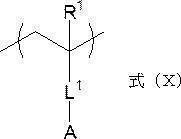
式(X)中、R1は、水素原子又はアルキル基を表す。アルキル基としては、炭素数1~3個のアルキル基が好ましく、メチル基が好ましい。
L1は、単結合又は2価の連結基を表す。2価の連結基としては、2価の脂肪族炭化水素基(好ましくは炭素数1~8)、2価の芳香族炭化水素基(好ましくは炭素数6~12)、-O-、-S-、-SO2-、-N(R)-(R:アルキル基)、-CO-、-NH-、-COO-、-CONH-、又はこれらを組み合わせた基(例えば、アルキレンオキシ基、アルキレンオキシカルボニル基、アルキレンカルボニルオキシ基など)などが挙げられる。
2価の脂肪族炭化水素基(例えば、アルキレン基)としては、例えば、メチレン基、エチレン基、プロピレン基、又はブチレン基などが挙げられる。
2価の芳香族炭化水素基としては、例えば、フェニレン基、ナフチレン基などが挙げられる。
なお、単結合とは、式(X)中のAが、R1と連結する炭素原子に直接連結することを意図する。
以下に、L1の具体例を示すが、L1はこれらに限定されない。なお、*は結合位置を示す。
L1は、単結合又は2価の連結基を表す。2価の連結基としては、2価の脂肪族炭化水素基(好ましくは炭素数1~8)、2価の芳香族炭化水素基(好ましくは炭素数6~12)、-O-、-S-、-SO2-、-N(R)-(R:アルキル基)、-CO-、-NH-、-COO-、-CONH-、又はこれらを組み合わせた基(例えば、アルキレンオキシ基、アルキレンオキシカルボニル基、アルキレンカルボニルオキシ基など)などが挙げられる。
2価の脂肪族炭化水素基(例えば、アルキレン基)としては、例えば、メチレン基、エチレン基、プロピレン基、又はブチレン基などが挙げられる。
2価の芳香族炭化水素基としては、例えば、フェニレン基、ナフチレン基などが挙げられる。
なお、単結合とは、式(X)中のAが、R1と連結する炭素原子に直接連結することを意図する。
以下に、L1の具体例を示すが、L1はこれらに限定されない。なお、*は結合位置を示す。
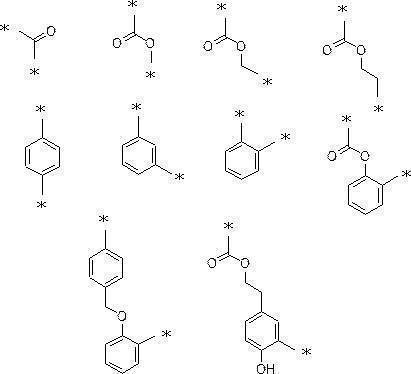
Aは、置換又は無置換の縮合芳香環基を表す。縮合芳香族基とは、2つ又はそれ以上の芳香環構造を有する基であって、各々の環が2個又はそれ以上の原子を共有する構造の基をいう。ここで、縮合芳香環基とは、縮合芳香族炭化水素基及び縮合芳香族複素環基のいずれも含むものとする。
縮合芳香族炭化水素基としては、例えば、ナフチル基、アセナフチレニル基、アントリル基、フェナントリル基、ピレニル基、アセフェナントリレニル基、アセアントリレニル基、クリセニル基、ジベンゾクリセニル基、ベンゾアントリル基、ジベンゾアントリル基、ナフタセニル基、ピセニル基、ペンタセニル基、フルオレニル基、9,9-ジヒドロアントリル基、トリフェニレニル基、ペリレニル基、フルオランテニル基、ベンゾ[k]フルオランテニル基などが挙げられる。
縮合芳香族複素環基としては、例えば、インドリル基、キノリル基、イソキノリル基、フタラジニル基、キノキサリニル基、キナゾリニル基、カルバゾリル基(3-カルバゾリル基、9-カルバゾリル基の両者を含む)、アクリジニル基、フェナジニル基、ベンゾフリル基、イソチアゾリル基、イソキサゾリル基、フラザニル基、フェノキサジニル基、ベンゾチアゾリル基、ベンゾオキサゾリル基、ベンズイミダゾリル基、ベンゾトリアゾリル基、ピラニル基などが挙げられる。
なかでも、リソグラフィー性能に優れる、及び/又は、得られる膜の屈折率がより優れる点(以後、単に「本発明の効果が優れる点」とも称する)で、カルバゾリル基、ナフチル基、ベンゾチアゾリル基、ベンゾオキサゾリル基、又は、ベンゾトリアゾリル基が好ましく、カルバゾリル基、ナフチル基がより好ましい。
上記Aには、置換基が置換していてもよく、置換基としては、例えば、アルキル基、アリール基、アルケニル基、アルキニル基、アルコキシ基、アリールオキシ基、アルキルチオキシ基、アリールチオキシ基、アシルオキシ基、アルキルスルファニル基、アリールスルファニル基、アルキルスルフィニル基、アリールスルフィニル基、アルキルスルホニル基、アリールスルホニル基、アシル基、アシルオキシ基、アルコキシカルボニル基、アミノ基、ホスフィノイル基、複素環基、シリルエーテル基、チオール基、スルホンアミド基、アミド基、ウレア基、チオウレア基、カルボキシル基、ウレタン基、ハロゲン原子、ニトロ基、等が挙げられる。
縮合芳香族炭化水素基としては、例えば、ナフチル基、アセナフチレニル基、アントリル基、フェナントリル基、ピレニル基、アセフェナントリレニル基、アセアントリレニル基、クリセニル基、ジベンゾクリセニル基、ベンゾアントリル基、ジベンゾアントリル基、ナフタセニル基、ピセニル基、ペンタセニル基、フルオレニル基、9,9-ジヒドロアントリル基、トリフェニレニル基、ペリレニル基、フルオランテニル基、ベンゾ[k]フルオランテニル基などが挙げられる。
縮合芳香族複素環基としては、例えば、インドリル基、キノリル基、イソキノリル基、フタラジニル基、キノキサリニル基、キナゾリニル基、カルバゾリル基(3-カルバゾリル基、9-カルバゾリル基の両者を含む)、アクリジニル基、フェナジニル基、ベンゾフリル基、イソチアゾリル基、イソキサゾリル基、フラザニル基、フェノキサジニル基、ベンゾチアゾリル基、ベンゾオキサゾリル基、ベンズイミダゾリル基、ベンゾトリアゾリル基、ピラニル基などが挙げられる。
なかでも、リソグラフィー性能に優れる、及び/又は、得られる膜の屈折率がより優れる点(以後、単に「本発明の効果が優れる点」とも称する)で、カルバゾリル基、ナフチル基、ベンゾチアゾリル基、ベンゾオキサゾリル基、又は、ベンゾトリアゾリル基が好ましく、カルバゾリル基、ナフチル基がより好ましい。
上記Aには、置換基が置換していてもよく、置換基としては、例えば、アルキル基、アリール基、アルケニル基、アルキニル基、アルコキシ基、アリールオキシ基、アルキルチオキシ基、アリールチオキシ基、アシルオキシ基、アルキルスルファニル基、アリールスルファニル基、アルキルスルフィニル基、アリールスルフィニル基、アルキルスルホニル基、アリールスルホニル基、アシル基、アシルオキシ基、アルコキシカルボニル基、アミノ基、ホスフィノイル基、複素環基、シリルエーテル基、チオール基、スルホンアミド基、アミド基、ウレア基、チオウレア基、カルボキシル基、ウレタン基、ハロゲン原子、ニトロ基、等が挙げられる。
アルカリ可溶性樹脂中における式(X)で表される繰り返し単位の含有量は特に制限されないが、本発明の効果がより優れる点で、全繰り返し単位に対して、40~95質量%が好ましく、50~90質量%がより好ましく、60~90質量%がさらに好ましい。
アルカリ可溶性樹脂は、上記式(X)で表される繰り返し単位を含み、アルカリ溶液に可溶であればその構造は特に制限されないが、酸基を有することが好ましい。
酸基としては、特に制限されないが、例えば、カルボキシル基、活性メチレン基、リン酸基、スルホン酸基、フェノール性水酸基、カルボン酸無水基等などが挙げられるが、有機溶剤に可溶で弱アルカリ水溶液により現像可能なものが好ましく、カルボキシル基が特に好ましいものとして挙げられる。これら酸基は、1種のみであってもよいし、2種以上であってもよい。
アルカリ可溶性樹脂は、上記式(X)で表される繰り返し単位を含み、アルカリ溶液に可溶であればその構造は特に制限されないが、酸基を有することが好ましい。
酸基としては、特に制限されないが、例えば、カルボキシル基、活性メチレン基、リン酸基、スルホン酸基、フェノール性水酸基、カルボン酸無水基等などが挙げられるが、有機溶剤に可溶で弱アルカリ水溶液により現像可能なものが好ましく、カルボキシル基が特に好ましいものとして挙げられる。これら酸基は、1種のみであってもよいし、2種以上であってもよい。
アルカリ可溶性樹脂は、本発明の効果がより優れる点で、式(Y)で表される繰り返し単位をさらに有することが好ましい。

式(Y)中、R2は、水素原子又はアルキル基を表す。アルキル基としては、炭素数1~3個のアルキル基が好ましく、具体的には、メチル基などが挙げられる。
L2は、単結合又は2価の連結基を表す。L2で表される2価の連結基の定義は、L1で表される2価の連結基の定義と同義である。
Bは、酸基を表す。酸基の定義は、上述の通りである。
アルカリ可溶性樹脂中における式(Y)で表される繰り返し単位の含有量は特に制限されないが、本発明の効果がより優れる点で、全繰り返し単位に対して、5~60質量%が好ましく、10~40質量%がより好ましく、20~40質量%がさらに好ましい。
L2は、単結合又は2価の連結基を表す。L2で表される2価の連結基の定義は、L1で表される2価の連結基の定義と同義である。
Bは、酸基を表す。酸基の定義は、上述の通りである。
アルカリ可溶性樹脂中における式(Y)で表される繰り返し単位の含有量は特に制限されないが、本発明の効果がより優れる点で、全繰り返し単位に対して、5~60質量%が好ましく、10~40質量%がより好ましく、20~40質量%がさらに好ましい。
アルカリ可溶性樹脂は、上記式(X)で表される繰り返し単位及び式(Y)で表される繰り返し単位以外の他の繰り返し単位を有していてもよい。
例えば、本発明の効果がより優れる点で、アルカリ可溶性樹脂は、親水性基(ただし、酸基を除く)を有する繰り返し単位(以後、「親水性繰り返し単位」とも称する)を有することが好ましい。
親水性基としては、例えば、ヒドロキシ基、アルキレンオキシド基、ピロリドン基、モルホリン基、1,3-ジケトン基、アミノ基、アンモニウム基などが挙げられる。なかでも、本発明の効果がより優れる点で、ヒドロキシ基が好ましい。なお、該親水性基には、上述した酸基は含まれない。
なお、アルキレンオキシド基としては、以下式(W)で表される基が好ましい。なお、*は結合位置を表す。
式(W) *-(A-O)n-R
式(W)中、Aはアルキレン基(好ましくは、炭素数2~3のアルキレン基)を表し、Rは水素原子又はアルキル基(好ましくは、炭素数1~2のアルキル基)を表し、nは1以上の整数(好ましくは、1~25の整数)を表す。なお、nが2以上の場合、ポリアルキレンオキシド基とも称する。
ピロリドン基、モルホリン基及び1,3-ジケトン基は、それぞれ以下の基を示す。なお、*は結合位置を表す。
例えば、本発明の効果がより優れる点で、アルカリ可溶性樹脂は、親水性基(ただし、酸基を除く)を有する繰り返し単位(以後、「親水性繰り返し単位」とも称する)を有することが好ましい。
親水性基としては、例えば、ヒドロキシ基、アルキレンオキシド基、ピロリドン基、モルホリン基、1,3-ジケトン基、アミノ基、アンモニウム基などが挙げられる。なかでも、本発明の効果がより優れる点で、ヒドロキシ基が好ましい。なお、該親水性基には、上述した酸基は含まれない。
なお、アルキレンオキシド基としては、以下式(W)で表される基が好ましい。なお、*は結合位置を表す。
式(W) *-(A-O)n-R
式(W)中、Aはアルキレン基(好ましくは、炭素数2~3のアルキレン基)を表し、Rは水素原子又はアルキル基(好ましくは、炭素数1~2のアルキル基)を表し、nは1以上の整数(好ましくは、1~25の整数)を表す。なお、nが2以上の場合、ポリアルキレンオキシド基とも称する。
ピロリドン基、モルホリン基及び1,3-ジケトン基は、それぞれ以下の基を示す。なお、*は結合位置を表す。
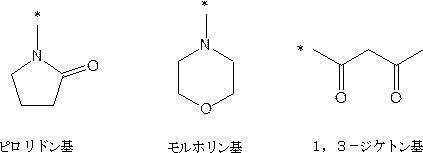
また、アミノ基は、1級、2級、及び3級のアミノ基を含む概念であり、以下式(P)で表される基が好ましい。
式(P) *-N(R)2
式(P)中、Rは、それぞれ独立に、水素原子、または、アルキル基を表す。
式(P) *-N(R)2
式(P)中、Rは、それぞれ独立に、水素原子、または、アルキル基を表す。
親水性繰り返し単位としては、本発明の効果がより優れる点で、以下式(Z)で表される繰り返し単位が好ましい。

式(Z)中、R3は、水素原子又はアルキル基を表す。アルキル基の定義は、R1で表されるアルキル基の定義と同義である。
L3は、単結合又は2価の連結基を表す。L3で表される2価の連結基の定義は、L1で表される2価の連結基の定義と同義である。
Cは、親水性基(ただし、酸基を除く)を表す。親水性基の定義は上述の通りである。
アルカリ可溶性樹脂中における式(Z)で表される繰り返し単位の含有量は特に制限されないが、本発明の効果がより優れる点で、全繰り返し単位に対して、5~40質量%が好ましく、10~30質量%がより好ましい。
L3は、単結合又は2価の連結基を表す。L3で表される2価の連結基の定義は、L1で表される2価の連結基の定義と同義である。
Cは、親水性基(ただし、酸基を除く)を表す。親水性基の定義は上述の通りである。
アルカリ可溶性樹脂中における式(Z)で表される繰り返し単位の含有量は特に制限されないが、本発明の効果がより優れる点で、全繰り返し単位に対して、5~40質量%が好ましく、10~30質量%がより好ましい。
なお、本発明の効果がより優れる点で、親水性繰り返し単位は、SP値(沖津法により算出)が20.2~35MPa0.5(好ましくは、21~33MPa0.5)であるモノマー由来の繰り返し単位であることが好ましい。
SP値は、沖津法(沖津俊直著「日本接着学会誌」29(3)(1993))によって算出したものである。
SP値は、沖津法(沖津俊直著「日本接着学会誌」29(3)(1993))によって算出したものである。
アルカリ可溶性樹脂の製造法は特に制限されず、例えば、公知のラジカル重合法による方法を適用することができる。ラジカル重合法でアルカリ可溶性樹脂を製造する際の温度、圧力、ラジカル開始剤の種類及びその量、溶剤の種類等々の重合条件は、当業者において容易に設定可能であり、実験的に条件を定めるようにすることもできる。
上述した式(X)で表される繰り返し単位を含むアクリル可溶性樹脂を製造するためには、例えば、以下のモノマー(以後、モノマーaとも称する)が使用される。
上述した式(X)で表される繰り返し単位を含むアクリル可溶性樹脂を製造するためには、例えば、以下のモノマー(以後、モノマーaとも称する)が使用される。
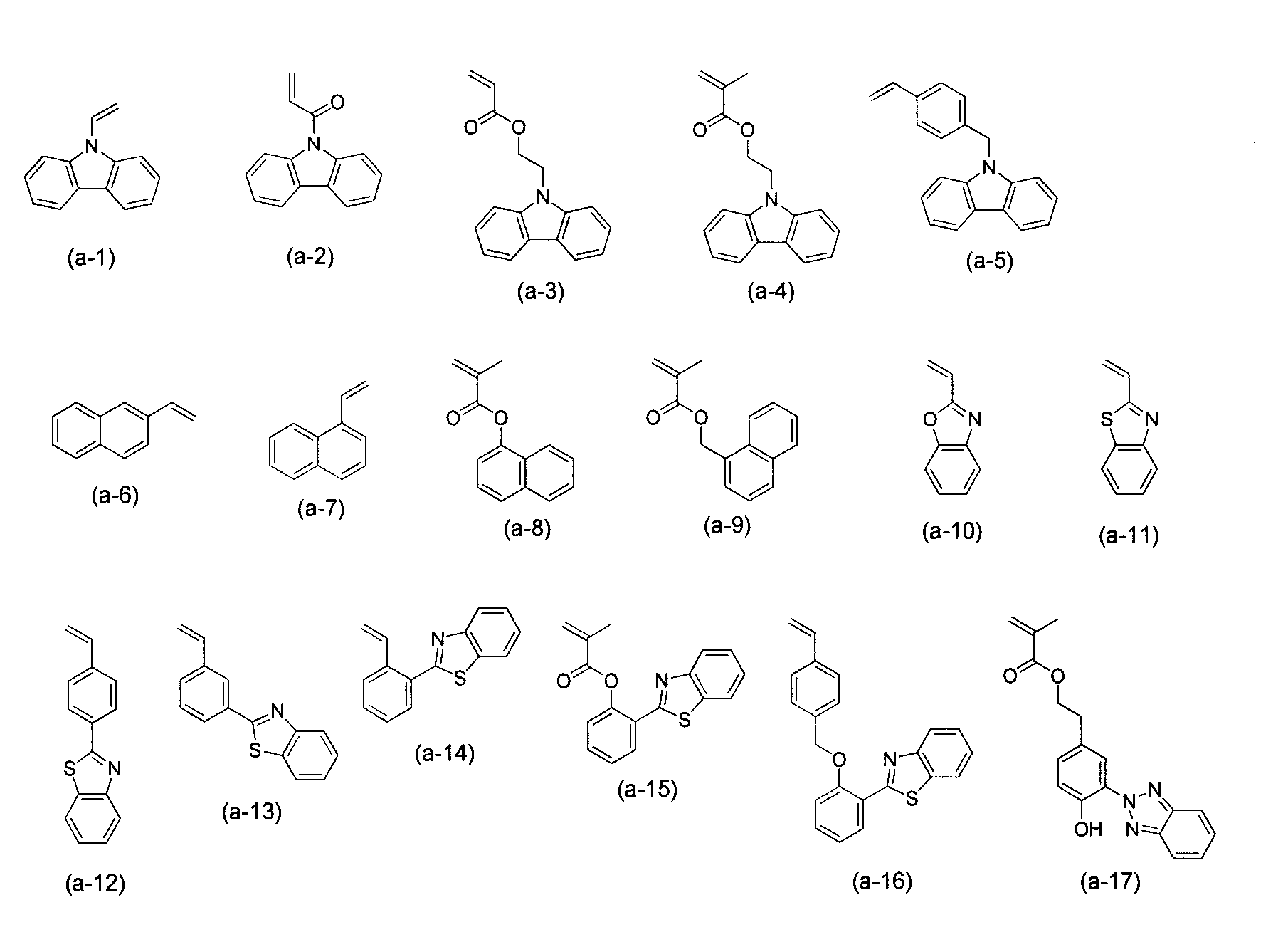
また、上述した式(Y)で表される繰り返し単位を含むアクリル可溶性樹脂を製造するためには、例えば、以下のモノマー(以後、モノマーbとも称する)が使用される。
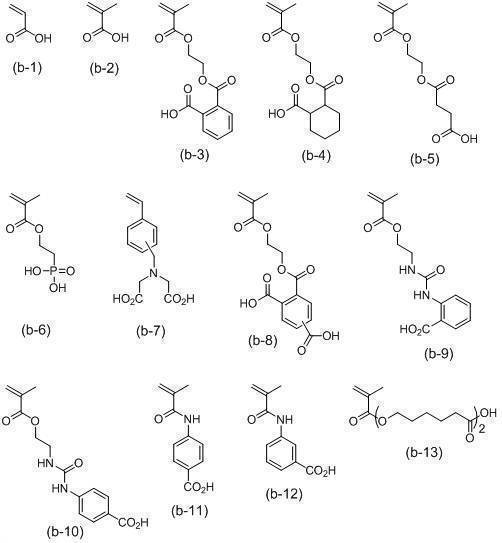
上述した式(Z)で表される繰り返し単位を含むアクリル可溶性樹脂を製造するためには、例えば、以下のモノマー(以後、モノマーcとも称する)が使用される。

上記モノマーaとモノマーbとの組み合わせ及び両者の質量比は特に制限されないが、例えば、以下のような組み合わせで、かつ、以下のような量関係のモノマーa及びモノマーbを使用して得られるアルカリ可溶性樹脂が挙げられる。

また、上記モノマーa、モノマーb、及びモノマーcの組み合わせ及び質量比は特に制限されないが、例えば、以下のような組み合わせで、かつ、以下のような量関係のモノマーa、モノマーb、及びモノマーcを使用して得られるアルカリ可溶性樹脂が挙げられる。モノマーa、モノマーb、及びモノマーcの好ましい質量比は、40~80質量%:10~30質量%:10~30質量%の割合である。このような割合で含有することで、アルカリ可溶性樹脂の高屈折率性とパターンの加工性を両立することができる。
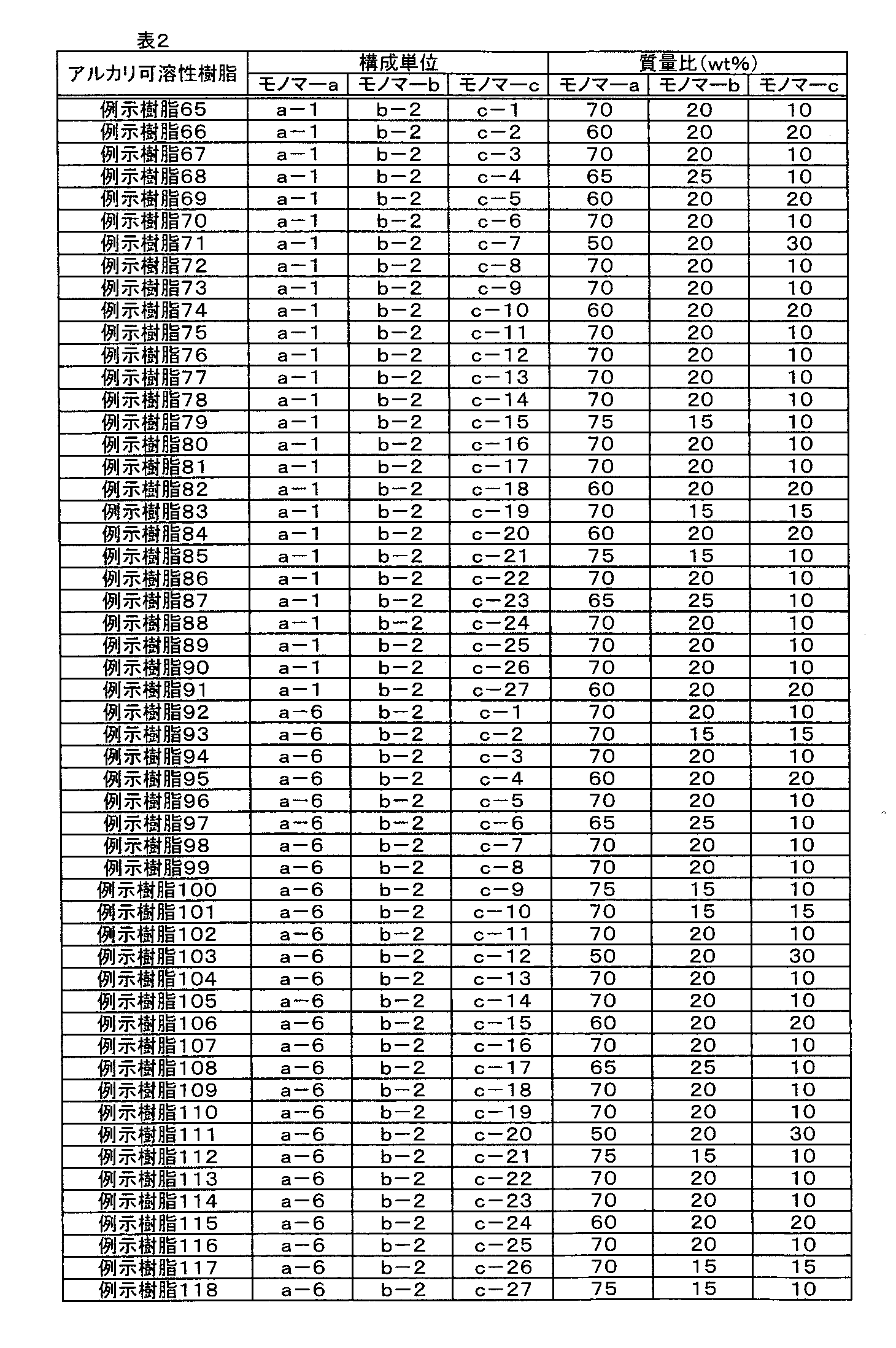
また、アルカリ可溶性樹脂を製造する際には、上述したモノマー以外に他のモノマーを使用してもよい。
アルカリ可溶性樹脂としては、下記一般式(ED)で示される化合物(以下「エーテルダイマー」と称することもある。)由来の繰り返し単位を有するアルカリ可溶性樹脂を併用してもよい。
アルカリ可溶性樹脂としては、下記一般式(ED)で示される化合物(以下「エーテルダイマー」と称することもある。)由来の繰り返し単位を有するアルカリ可溶性樹脂を併用してもよい。
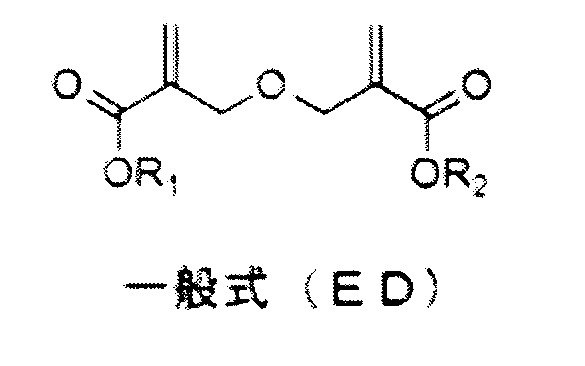
一般式(ED)中、R1及びR2は、それぞれ、水素原子又は置換基を有していてもよい炭素数1~25の炭化水素基を表す。
R1及びR2で表される置換基を有していてもよい炭素数1~25の炭化水素基としては、アルコキシで置換されたアルキル基;ベンジル等のアリール基で置換されたアルキル基;等が挙げられる。これらの中でも特に、メチル基、エチル基、シクロヘキシル基、ベンジル基等のような酸や熱で脱離しにくい1級又は2級炭素の置換基が耐熱性の点で好ましい。
R1及びR2で表される置換基を有していてもよい炭素数1~25の炭化水素基としては、アルコキシで置換されたアルキル基;ベンジル等のアリール基で置換されたアルキル基;等が挙げられる。これらの中でも特に、メチル基、エチル基、シクロヘキシル基、ベンジル基等のような酸や熱で脱離しにくい1級又は2級炭素の置換基が耐熱性の点で好ましい。
エーテルダイマーの具体例としては、特開2012-208494号の段落0565(対応する米国特許出願公開第2012/235099号明細書の段落0694)に記載のエーテルダイマーの具体例が挙げられ、これらの内容は本願明細書に組み込まれる。これらの中でも特に、ジメチル-2,2’-[オキシビス(メチレン)]ビス-2-プロペノエート、ジエチル-2,2’-[オキシビス(メチレン)]ビス-2-プロペノエート、ジシクロヘキシル-2,2’-[オキシビス(メチレン)]ビス-2-プロペノエート、ジベンジル-2,2’-[オキシビス(メチレン)]ビス-2-プロペノエートが好ましい。これらエーテルダイマーは、1種のみであってもよいし、2種以上であってもよい。一般式(ED)で示される化合物由来の構造体は、その他の単量体を共重合させてもよい。
アルカリ可溶性樹脂の酸価は特に制限されないが、30~200mgKOH/gが好ましく、50~150mgKOH/gがより好ましく、100~150mgKOH/gがさらに好ましい。
また、アルカリ可溶性樹脂の重量平均分子量(Mw)は特に制限されないが、2,000~50,000が好ましく、5,000~30,000がより好ましく、7,000~20,000がさらに好ましい。
アルカリ可溶性樹脂としては、特開2010-103171号公報段落0014~0025に記載のポリアミック酸、特開2005-189399(特許4292985)号公報段落0014~0029、0063~0069(US2005/0157399の段落0033~0060、0149~0162)に記載の共重合体を併用でき、これらの記載を援用でき、これらの内容は本願明細書に組み込まれる。
アルカリ可溶性樹脂の酸価は特に制限されないが、30~200mgKOH/gが好ましく、50~150mgKOH/gがより好ましく、100~150mgKOH/gがさらに好ましい。
また、アルカリ可溶性樹脂の重量平均分子量(Mw)は特に制限されないが、2,000~50,000が好ましく、5,000~30,000がより好ましく、7,000~20,000がさらに好ましい。
アルカリ可溶性樹脂としては、特開2010-103171号公報段落0014~0025に記載のポリアミック酸、特開2005-189399(特許4292985)号公報段落0014~0029、0063~0069(US2005/0157399の段落0033~0060、0149~0162)に記載の共重合体を併用でき、これらの記載を援用でき、これらの内容は本願明細書に組み込まれる。
アクリル可溶性樹脂のガラス転移温度(Tg)は特に制限されないが、本発明の効果がより優れる点で、100℃以上が好ましく、100~250℃がより好ましく、130~250℃がさらに好ましく、150~250℃が特に好ましい。
なお、アクリル可溶性樹脂のガラス転移温度(Tg)は、下記式で表されるガラス転移温度(理論値)である。
1/Tg=(W1/Tg1)+(W2/Tg2)+・・・+(Wn/Tgn)
上記式中、Tgはアクリル可溶性樹脂のガラス転移温度(単位:K)、Tgiはモノマーiのホモポリマーのガラス転移温度(単位:K)、Wiはモノマーiの全モノマー成分中の重量分率を表す(i=1、2、・・・、n)。なお、上記は、アクリル可溶性樹脂が、モノマー1、モノマー2、・・・・、モノマーnのn種類のモノマー成分から構成される場合の計算式である。
なお、アクリル可溶性樹脂のガラス転移温度(Tg)は、下記式で表されるガラス転移温度(理論値)である。
1/Tg=(W1/Tg1)+(W2/Tg2)+・・・+(Wn/Tgn)
上記式中、Tgはアクリル可溶性樹脂のガラス転移温度(単位:K)、Tgiはモノマーiのホモポリマーのガラス転移温度(単位:K)、Wiはモノマーiの全モノマー成分中の重量分率を表す(i=1、2、・・・、n)。なお、上記は、アクリル可溶性樹脂が、モノマー1、モノマー2、・・・・、モノマーnのn種類のモノマー成分から構成される場合の計算式である。
アルカリ可溶性樹脂の感光性組成物(又は分散組成物)中における含有量としては、該組成物の全固形分に対して、1~60質量%が好ましく、2~50質量%がより好ましく、3~40質量%がさらに好ましく、3~20質量%が特に好ましい。
なお、固形分とは、後述する硬化膜を構成する成分を意図し、溶媒(有機溶剤など)などは含まれない。
なお、固形分とは、後述する硬化膜を構成する成分を意図し、溶媒(有機溶剤など)などは含まれない。
なお、後述するように感光性組成物には、ナトリウム元素が含まれる場合があるが、感光性組成物中における上記アルカリ可溶性樹脂由来のナトリウム元素の含有量は、10質量ppm以下が好ましく、1質量ppm以下がより好ましく、0.1質量ppm以下がさらに好ましい。ナトリウム元素の含有量は、蒸留やろ過などの精製操作により調整することができる。
上記ナトリウム元素量が低減することにより、感光性組成物より得られる塗膜や硬化膜(カラーフィルタ)の表面欠陥などがより抑制され、結果として製品の歩留まりが向上する。この理由の詳細は不明だが、ナトリウム元素はイオン化して他のアニオンと塩を形成するため表面欠陥として視認されるが、その量を減らすことにより塩の形成が抑制され、結果として欠陥量が低減すると推測される。
ナトリウム元素量の測定方法としては、公知の方法を採用でき、例えば、ICP-MS(誘導結合プラズマ質量分析計)を採用できる。
なお、上記アルカリ可溶性樹脂由来のナトリウム元素とは、アルカリ可溶性樹脂を合成する際に樹脂原料中に含まれるナトリウム元素であり、アルカリ可溶性樹脂と他の成分とを混合して感光性組成物を作製する際に、感光性組成物中に混入するナトリウム元素を意図する。
上記ナトリウム元素量が低減することにより、感光性組成物より得られる塗膜や硬化膜(カラーフィルタ)の表面欠陥などがより抑制され、結果として製品の歩留まりが向上する。この理由の詳細は不明だが、ナトリウム元素はイオン化して他のアニオンと塩を形成するため表面欠陥として視認されるが、その量を減らすことにより塩の形成が抑制され、結果として欠陥量が低減すると推測される。
ナトリウム元素量の測定方法としては、公知の方法を採用でき、例えば、ICP-MS(誘導結合プラズマ質量分析計)を採用できる。
なお、上記アルカリ可溶性樹脂由来のナトリウム元素とは、アルカリ可溶性樹脂を合成する際に樹脂原料中に含まれるナトリウム元素であり、アルカリ可溶性樹脂と他の成分とを混合して感光性組成物を作製する際に、感光性組成物中に混入するナトリウム元素を意図する。
<無機粒子>
無機粒子としては、屈折率が高く、無色、白色又は透明な無機粒子であることが好ましく、金属酸化物粒子であることがより好ましく、チタン(Ti)、ジルコニウム(Zr)、アルミニウム(Al)、ケイ素(Si)、亜鉛(Zn)又はマグネシウム(Mg)の酸化物粒子が挙げられ、二酸化チタン(TiO2)粒子、酸化ジルコニウム(ZrO2)粒子又は二酸化珪素(SiO2)粒子であることがさらに好ましい。
無機粒子の一次粒子径は特に制限されず、1nm~100nmが好ましく、1nm~80nmがより好ましく、1nm~50nmが特に好ましい。無機粒子の一次粒子径が上記範囲内であれば、分散性が優れると共に、屈折率及び透過率が向上する。
無機粒子の屈折率は特に制限はないが、高屈折率を得る観点から、1.75~2.70であることが好ましく、1.90~2.70であることがより好ましい。
無機粒子の比表面積は特に制限はないが、10~400m2/gが好ましく、20~200m2/gがより好ましく、30~150m2/gがさらに好ましい。
また、無機粒子の形状には特に制限はなく、例えば、米粒状、球形状、立方体状、紡錘形状または不定形状などが挙げられる。
無機粒子は、有機化合物により表面処理されたものであってもよい。表面処理に用いる有機化合物の例には、ポリオール、アルカノールアミン、ステアリン酸、シランカップリング剤又はチタネートカップリング剤が含まれる。なかでも、ステアリン酸またはシランカップリング剤が好ましい。
また、無機粒子の表面は、耐候性がより向上する点で、アルミニウム、ケイ素、ジルコニアなどの酸化物により処理されていることも好ましい。
無機粒子としては、市販されているものを好ましく用いることができる。
無機粒子は、1種単独でも、2種以上を組み合わせて用いてもよい。
無機粒子としては、屈折率が高く、無色、白色又は透明な無機粒子であることが好ましく、金属酸化物粒子であることがより好ましく、チタン(Ti)、ジルコニウム(Zr)、アルミニウム(Al)、ケイ素(Si)、亜鉛(Zn)又はマグネシウム(Mg)の酸化物粒子が挙げられ、二酸化チタン(TiO2)粒子、酸化ジルコニウム(ZrO2)粒子又は二酸化珪素(SiO2)粒子であることがさらに好ましい。
無機粒子の一次粒子径は特に制限されず、1nm~100nmが好ましく、1nm~80nmがより好ましく、1nm~50nmが特に好ましい。無機粒子の一次粒子径が上記範囲内であれば、分散性が優れると共に、屈折率及び透過率が向上する。
無機粒子の屈折率は特に制限はないが、高屈折率を得る観点から、1.75~2.70であることが好ましく、1.90~2.70であることがより好ましい。
無機粒子の比表面積は特に制限はないが、10~400m2/gが好ましく、20~200m2/gがより好ましく、30~150m2/gがさらに好ましい。
また、無機粒子の形状には特に制限はなく、例えば、米粒状、球形状、立方体状、紡錘形状または不定形状などが挙げられる。
無機粒子は、有機化合物により表面処理されたものであってもよい。表面処理に用いる有機化合物の例には、ポリオール、アルカノールアミン、ステアリン酸、シランカップリング剤又はチタネートカップリング剤が含まれる。なかでも、ステアリン酸またはシランカップリング剤が好ましい。
また、無機粒子の表面は、耐候性がより向上する点で、アルミニウム、ケイ素、ジルコニアなどの酸化物により処理されていることも好ましい。
無機粒子としては、市販されているものを好ましく用いることができる。
無機粒子は、1種単独でも、2種以上を組み合わせて用いてもよい。
また、本発明の感光性組成物(又は分散組成物)における無機粒子の含有量としては、高屈折率を得る観点から、分散組成物の全固形分に対して、65質量%以上であることがより好ましく、70質量%以上であることがさらに好ましい。
含有量の上限としては特に制限はないが、分散組成物の全固形分に対して90質量%以下であることが好ましく、85質量%以下であることがより好ましい。
含有量の上限としては特に制限はないが、分散組成物の全固形分に対して90質量%以下であることが好ましく、85質量%以下であることがより好ましい。
本発明の感光性組成物における無機粒子の含有量としては、高屈折率を得る観点から、感光性組成物の全固形分に対して、10~90質量%が好ましく、20~85質量%がより好ましく、30~80質量%がさらに好ましい。
以後、無機粒子の好適態様である、二酸化チタン(TiO2)粒子、二酸化珪素(SiO2)粒子、酸化ジルコニウム(ZrO2)について詳述する。
(二酸化チタン粒子及び二酸化珪素粒子)
二酸化チタン粒子としては、化学式TiO2で表すことができ、純度が70%以上であることが好ましく、純度80%以上であることがより好ましく、純度85%以上であることが更に好ましい。一般式TinO2n-1(nは2~4の数を表す。)で表される低次酸化チタン、酸窒化チタン等は30質量%以下であることが好ましく、20質量%以下であることがより好ましく、15質量%以下であることが更に好ましい。また、二酸化チタン粒子としては、ルチル形結晶のものが好ましい。
二酸化チタン粒子の市販物としては、例えば、石原産業(株)製TTOシリーズ(TTO-51(A)、TTO-51(C)、TTO-55(C)など)、TTO-S、Vシリーズ(TTO-S-1、TTO-S-2、TTO-V-3など)、テイカ(株)製MTシリーズ(MT-01、MT-05など)などを挙げることができる。
二酸化珪素粒子の市販物としては、例えば、OG502-31クラリアント社(Clariant Co.)製などを挙げることができる。
(二酸化チタン粒子及び二酸化珪素粒子)
二酸化チタン粒子としては、化学式TiO2で表すことができ、純度が70%以上であることが好ましく、純度80%以上であることがより好ましく、純度85%以上であることが更に好ましい。一般式TinO2n-1(nは2~4の数を表す。)で表される低次酸化チタン、酸窒化チタン等は30質量%以下であることが好ましく、20質量%以下であることがより好ましく、15質量%以下であることが更に好ましい。また、二酸化チタン粒子としては、ルチル形結晶のものが好ましい。
二酸化チタン粒子の市販物としては、例えば、石原産業(株)製TTOシリーズ(TTO-51(A)、TTO-51(C)、TTO-55(C)など)、TTO-S、Vシリーズ(TTO-S-1、TTO-S-2、TTO-V-3など)、テイカ(株)製MTシリーズ(MT-01、MT-05など)などを挙げることができる。
二酸化珪素粒子の市販物としては、例えば、OG502-31クラリアント社(Clariant Co.)製などを挙げることができる。
(酸化ジルコニウム粒子(二酸化ジルコニウム粒子))
酸化ジルコニウム粒子は、ジルコニウム原子と酸素原子とを含む無機粒子である。該粒子を含むことにより、高い屈折率を示す膜(硬化膜)が得られる。
酸化ジルコニウム粒子の平均粒子径は特に制限されないが、1~200nmが好ましく、10~100nmがより好ましく、10~50nmがさらに好ましい。
比表面積は80~120m2/gが好ましい。
酸化ジルコニウム粒子の平均粒子径は、粒子を透過型電子顕微鏡により観察し、得られた写真から求めることができる。粒子の投影面積を求め、そこから円相当径を求め平均粒径とする(通常、平均粒径を求めるために300個以上の粒子について測定する)。
酸化ジルコニウム粒子の市販物としては、例えば、UEP、UEP-100(第一稀元素化学工業(株)製)、PCS(日本電工(株)製)、JS-01、JS-03、JS-04(日本電工(株)製)を挙げることができる。
酸化ジルコニウム粒子の感光性組成物中における含有量としては、組成物の全固形分に対して、10~80質量%が好ましく、20~70質量%がより好ましく、35~55質量%がさらに好ましい。
酸化ジルコニウム粒子は、ジルコニウム原子と酸素原子とを含む無機粒子である。該粒子を含むことにより、高い屈折率を示す膜(硬化膜)が得られる。
酸化ジルコニウム粒子の平均粒子径は特に制限されないが、1~200nmが好ましく、10~100nmがより好ましく、10~50nmがさらに好ましい。
比表面積は80~120m2/gが好ましい。
酸化ジルコニウム粒子の平均粒子径は、粒子を透過型電子顕微鏡により観察し、得られた写真から求めることができる。粒子の投影面積を求め、そこから円相当径を求め平均粒径とする(通常、平均粒径を求めるために300個以上の粒子について測定する)。
酸化ジルコニウム粒子の市販物としては、例えば、UEP、UEP-100(第一稀元素化学工業(株)製)、PCS(日本電工(株)製)、JS-01、JS-03、JS-04(日本電工(株)製)を挙げることができる。
酸化ジルコニウム粒子の感光性組成物中における含有量としては、組成物の全固形分に対して、10~80質量%が好ましく、20~70質量%がより好ましく、35~55質量%がさらに好ましい。
<分散剤>
分散剤は、上述した無機粒子の組成物中での分散安定性が向上する。
分散剤としては、高分子分散剤〔例えば、ポリアミドアミンとその塩、ポリカルボン酸とその塩、高分子量不飽和酸エステル、変性ポリウレタン、変性ポリエステル、変性ポリ(メタ)アクリレート、(メタ)アクリル系共重合体、ナフタレンスルホン酸ホルマリン縮合物〕、及び、ポリオキシエチレンアルキルリン酸エステル、ポリオキシエチレンアルキルアミン、アルカノールアミン等の界面活性剤等を挙げることができる。
高分子分散剤は、その構造からさらに直鎖状高分子、末端変性型高分子、グラフト型高分子、ブロック型高分子に分類することができる。
分散剤は、上述した無機粒子の組成物中での分散安定性が向上する。
分散剤としては、高分子分散剤〔例えば、ポリアミドアミンとその塩、ポリカルボン酸とその塩、高分子量不飽和酸エステル、変性ポリウレタン、変性ポリエステル、変性ポリ(メタ)アクリレート、(メタ)アクリル系共重合体、ナフタレンスルホン酸ホルマリン縮合物〕、及び、ポリオキシエチレンアルキルリン酸エステル、ポリオキシエチレンアルキルアミン、アルカノールアミン等の界面活性剤等を挙げることができる。
高分子分散剤は、その構造からさらに直鎖状高分子、末端変性型高分子、グラフト型高分子、ブロック型高分子に分類することができる。
無機粒子表面へのアンカー部位を有する末端変性型高分子としては、例えば、特開平3-112992号公報、特表2003-533455号公報等に記載の末端にりん酸基を有する高分子、特開2002-273191号公報等に記載の末端にスルホン酸基を有する高分子、特開平9-77994号公報等に記載の有機色素の部分骨格や複素環を有する高分子、特開2008-29901号公報等に記載の片末端に水酸基又はアミノ基を有するオリゴマー又はポリマーと酸無水物で変性して製造される高分子などが挙げられる。また、特開2007-277514号公報に記載の高分子末端に2個以上の赤外線遮蔽剤表面へのアンカー部位(酸基、塩基性基、有機色素の部分骨格やヘテロ環等)を導入した高分子も分散安定性に優れ好ましい。
無機粒子表面へのアンカー部位を有するグラフト型高分子としては、例えば、特開昭54ー37082号公報、特表平8-507960号公報、特開2009-258668公報等に記載のポリ(低級アルキレンイミン)とポリエステルの反応生成物、特開平9-169821号公報等に記載のポリアリルアミンとポリエステルの反応生成物、特開2009-203462号公報に記載の塩基性基と酸性基を有する両性分散樹脂、特開平10-339949号、特開2004-37986号公報等に記載のマクロモノマーと、窒素原子モノマーとの共重合体、特開2003-238837号公報、特開2008-9426号公報、特開2008-81732号公報等に記載の有機色素の部分骨格や複素環を有するグラフト型高分子、特開2010-106268号公報等に記載のマクロモノマーと酸基含有モノマーの共重合体等が挙げられる。
無機粒子表面へのアンカー部位を有するグラフト型高分子をラジカル重合で製造する際に用いるマクロモノマーとしては、公知のマクロモノマーを用いることができ、東亜合成(株)製のマクロモノマーAA-6(末端基がメタクリロイル基であるポリメタクリル酸メチル)、AS-6(末端基がメタクリロイル基であるポリスチレン)、AN-6S(末端基がメタクリロイル基であるスチレンとアクリロニトリルの共重合体)、AB-6(末端基がメタクリロイル基であるポリアクリル酸ブチル)、ダイセル化学工業(株)製のプラクセルFM5(メタクリル酸2-ヒドロキシエチルのε-カプロラクトン5モル当量付加品)、FA10L(アクリル酸2-ヒドロキシエチルのε-カプロラクトン10モル当量付加品)、及び、特開平2-272009号公報に記載のポリエステル系マクロモノマー等が挙げられる。これらの中でも、特に柔軟性かつ親溶剤性に優れるポリエステル系マクロモノマーが、感光性組成物における無機粒子の分散安定性の観点から特に好ましく、さらに、特開平2-272009号公報に記載のポリエステル系マクロモノマーで表されるポリエステル系マクロモノマーが最も好ましい。
無機粒子表面へのアンカー部位を有するブロック型高分子としては、特開2003-49110号公報、特開2009-52010号公報等に記載のブロック型高分子が好ましい。
無機粒子表面へのアンカー部位を有するグラフト型高分子としては、例えば、特開昭54ー37082号公報、特表平8-507960号公報、特開2009-258668公報等に記載のポリ(低級アルキレンイミン)とポリエステルの反応生成物、特開平9-169821号公報等に記載のポリアリルアミンとポリエステルの反応生成物、特開2009-203462号公報に記載の塩基性基と酸性基を有する両性分散樹脂、特開平10-339949号、特開2004-37986号公報等に記載のマクロモノマーと、窒素原子モノマーとの共重合体、特開2003-238837号公報、特開2008-9426号公報、特開2008-81732号公報等に記載の有機色素の部分骨格や複素環を有するグラフト型高分子、特開2010-106268号公報等に記載のマクロモノマーと酸基含有モノマーの共重合体等が挙げられる。
無機粒子表面へのアンカー部位を有するグラフト型高分子をラジカル重合で製造する際に用いるマクロモノマーとしては、公知のマクロモノマーを用いることができ、東亜合成(株)製のマクロモノマーAA-6(末端基がメタクリロイル基であるポリメタクリル酸メチル)、AS-6(末端基がメタクリロイル基であるポリスチレン)、AN-6S(末端基がメタクリロイル基であるスチレンとアクリロニトリルの共重合体)、AB-6(末端基がメタクリロイル基であるポリアクリル酸ブチル)、ダイセル化学工業(株)製のプラクセルFM5(メタクリル酸2-ヒドロキシエチルのε-カプロラクトン5モル当量付加品)、FA10L(アクリル酸2-ヒドロキシエチルのε-カプロラクトン10モル当量付加品)、及び、特開平2-272009号公報に記載のポリエステル系マクロモノマー等が挙げられる。これらの中でも、特に柔軟性かつ親溶剤性に優れるポリエステル系マクロモノマーが、感光性組成物における無機粒子の分散安定性の観点から特に好ましく、さらに、特開平2-272009号公報に記載のポリエステル系マクロモノマーで表されるポリエステル系マクロモノマーが最も好ましい。
無機粒子表面へのアンカー部位を有するブロック型高分子としては、特開2003-49110号公報、特開2009-52010号公報等に記載のブロック型高分子が好ましい。
分散剤としては、例えば、公知の分散剤や界面活性剤を適宜選択して用いることができる。
そのような具体例としては、BYKChemie社製「Disperbyk-101(ポリアミドアミン燐酸塩)、107(カルボン酸エステル)、110(酸基を含む共重合物)、130(ポリアミド)、161、162、163、164、165、166、170(高分子共重合物)」、「BYK-P104、P105(高分子量不飽和ポリカルボン酸)」、EFKA社製「EFKA4047、4050~4010~4165(ポリウレタン系)、EFKA4330~4340(ブロック共重合体)、4400~4402(変性ポリアクリレート)、5010(ポリエステルアミド)、5765(高分子量ポリカルボン酸塩)、6220(脂肪酸ポリエステル)、6745(フタロシアニン誘導体)」、味の素ファインテクノ社製「アジスパーPB821、PB822、PB880、PB881」、共栄社化学社製「フローレンTG-710(ウレタンオリゴマー)」、「ポリフローNo.50E、No.300(アクリル系共重合体)」、楠本化成社製「ディスパロンKS-860、873SN、874、#2150(脂肪族多価カルボン酸)、#7004(ポリエーテルエステル)、DA-703-50、DA-705、DA-725」、花王社製「デモールRN、N(ナフタレンスルホン酸ホルマリン重縮合物)、MS、C、SN-B(芳香族スルホン酸ホルマリン重縮合物)」、「ホモゲノールL-18(高分子ポリカルボン酸)」、「エマルゲン920、930、935、985(ポリオキシエチレンノニルフェニルエーテル)」、「アセタミン86(ステアリルアミンアセテート)」、
日本ルーブリゾール(株)製「ソルスパース5000(フタロシアニン誘導体)、13240(ポリエステルアミン)、3000、17000、27000(末端部に機能部を有する高分子)、24000、28000、32000、38500、71000(グラフト型高分子)」、
日光ケミカル社製「ニッコールT106(ポリオキシエチレンソルビタンモノオレート)、MYS-IEX(ポリオキシエチレンモノステアレート)」、川研ファインケミカル(株)製ヒノアクトT-8000E等、信越化学工業(株)製 オルガノシロキサンポリマーKP341、裕商(株)製「W001:カチオン系界面活性剤」、ポリオキシエチレンラウリルエーテル、ポリオキシエチレンステアリルエーテル、ポリオキシエチレンオレイルエーテル、ポリオキシエチレンオクチルフェニルエーテル、ポリオキシエチレンノニルフェニルエーテル、ポリエチレングリコールジラウレート、ポリエチレングリコールジステアレート、ソルビタン脂肪酸エステル等のノニオン系界面活性剤、「W004、W005、W017」等のアニオン系界面活性剤、森下産業(株)製「EFKA-46、EFKA-47、EFKA-47EA、EFKAポリマー100、EFKAポリマー400、EFKAポリマー401、EFKAポリマー450」、サンノプコ(株)製「ディスパースエイド6、ディスパースエイド8、ディスパースエイド15、ディスパースエイド9100」等の高分子分散剤、(株)ADEKA製「アデカプルロニックL31、F38、L42、L44、L61、L64、F68、L72、P95、F77、P84、F87、P94、L101、P103、F108、L121、P-123」、及び三洋化成(株)製「イオネット(商品名)S-20」等が挙げられる。
そのような具体例としては、BYKChemie社製「Disperbyk-101(ポリアミドアミン燐酸塩)、107(カルボン酸エステル)、110(酸基を含む共重合物)、130(ポリアミド)、161、162、163、164、165、166、170(高分子共重合物)」、「BYK-P104、P105(高分子量不飽和ポリカルボン酸)」、EFKA社製「EFKA4047、4050~4010~4165(ポリウレタン系)、EFKA4330~4340(ブロック共重合体)、4400~4402(変性ポリアクリレート)、5010(ポリエステルアミド)、5765(高分子量ポリカルボン酸塩)、6220(脂肪酸ポリエステル)、6745(フタロシアニン誘導体)」、味の素ファインテクノ社製「アジスパーPB821、PB822、PB880、PB881」、共栄社化学社製「フローレンTG-710(ウレタンオリゴマー)」、「ポリフローNo.50E、No.300(アクリル系共重合体)」、楠本化成社製「ディスパロンKS-860、873SN、874、#2150(脂肪族多価カルボン酸)、#7004(ポリエーテルエステル)、DA-703-50、DA-705、DA-725」、花王社製「デモールRN、N(ナフタレンスルホン酸ホルマリン重縮合物)、MS、C、SN-B(芳香族スルホン酸ホルマリン重縮合物)」、「ホモゲノールL-18(高分子ポリカルボン酸)」、「エマルゲン920、930、935、985(ポリオキシエチレンノニルフェニルエーテル)」、「アセタミン86(ステアリルアミンアセテート)」、
日本ルーブリゾール(株)製「ソルスパース5000(フタロシアニン誘導体)、13240(ポリエステルアミン)、3000、17000、27000(末端部に機能部を有する高分子)、24000、28000、32000、38500、71000(グラフト型高分子)」、
日光ケミカル社製「ニッコールT106(ポリオキシエチレンソルビタンモノオレート)、MYS-IEX(ポリオキシエチレンモノステアレート)」、川研ファインケミカル(株)製ヒノアクトT-8000E等、信越化学工業(株)製 オルガノシロキサンポリマーKP341、裕商(株)製「W001:カチオン系界面活性剤」、ポリオキシエチレンラウリルエーテル、ポリオキシエチレンステアリルエーテル、ポリオキシエチレンオレイルエーテル、ポリオキシエチレンオクチルフェニルエーテル、ポリオキシエチレンノニルフェニルエーテル、ポリエチレングリコールジラウレート、ポリエチレングリコールジステアレート、ソルビタン脂肪酸エステル等のノニオン系界面活性剤、「W004、W005、W017」等のアニオン系界面活性剤、森下産業(株)製「EFKA-46、EFKA-47、EFKA-47EA、EFKAポリマー100、EFKAポリマー400、EFKAポリマー401、EFKAポリマー450」、サンノプコ(株)製「ディスパースエイド6、ディスパースエイド8、ディスパースエイド15、ディスパースエイド9100」等の高分子分散剤、(株)ADEKA製「アデカプルロニックL31、F38、L42、L44、L61、L64、F68、L72、P95、F77、P84、F87、P94、L101、P103、F108、L121、P-123」、及び三洋化成(株)製「イオネット(商品名)S-20」等が挙げられる。
これらの分散剤は、単独で使用してもよく、2種以上を組み合わせて使用してもよい。また、分散剤は、アンカー部位を有する末端変性型高分子、グラフト型高分子、又はブロック型高分子と伴に、アルカリ可溶性樹脂と併用して用いてもよい。アルカリ可溶性樹脂としては、(メタ)アクリル酸共重合体、イタコン酸共重合体、クロトン酸共重合体、マレイン酸共重合体、部分エステル化マレイン酸共重合体等、並びに側鎖にカルボン酸を有する酸性セルロース誘導体、水酸基を有するポリマーに酸無水物を変性した樹脂が挙げられるが、特に(メタ)アクリル酸共重合体が好ましい。また、特開平10-300922号公報に記載のN位置換マレイミドモノマー共重合体、特開2004-300204号公報に記載のエーテルダイマー共重合体、特開平7-319161号公報に記載の重合性基を含有するアルカリ可溶性樹脂も好ましい。
分散性及び沈降性の観点から、好ましくは、オリゴイミン系分散剤または特開2010-106268号公報に記載の以下に示す樹脂が好ましい。
オリゴイミン系分散剤としては特に、ポリ(低級アルキレンイミン)系繰り返し単位を含み、ポリエステル構造のグラフト鎖を有するグラフト共重合体であることが好ましい。また、オリゴイミン系分散剤には、酸基が含まれることが好ましい。さらに、好ましい酸基としては、吸着性の観点からpKaが6以下の酸基が好ましく、特にカルボン酸が好ましい。オリゴイミン系分散剤の酸価としては、1~100mg/KOHが好ましく、3~50mg/KOHがより好ましく、5~35mg/KOHがさらに好ましい。
また、GPC法により測定されたオリゴイミン系分散剤の重量平均分子量が2000~100000であることが好ましく、3000~50000であることがより好ましく、4000~10000であることがさらに好ましい。
一方、特開2010-106268号公報に記載の上記樹脂の中では、特に分散性の観点から、側鎖にポリエステル鎖を有する高分子分散剤が好ましく、酸基とポリエステル鎖とを有する樹脂も好適に挙げられる。分散剤における好ましい酸基としては、吸着性の観点から、pKaが6以下の酸基が好ましく、特にカルボン酸基、スルホン酸基、リン酸基が好ましい。
分散性及び沈降性の観点から、好ましくは、オリゴイミン系分散剤または特開2010-106268号公報に記載の以下に示す樹脂が好ましい。
オリゴイミン系分散剤としては特に、ポリ(低級アルキレンイミン)系繰り返し単位を含み、ポリエステル構造のグラフト鎖を有するグラフト共重合体であることが好ましい。また、オリゴイミン系分散剤には、酸基が含まれることが好ましい。さらに、好ましい酸基としては、吸着性の観点からpKaが6以下の酸基が好ましく、特にカルボン酸が好ましい。オリゴイミン系分散剤の酸価としては、1~100mg/KOHが好ましく、3~50mg/KOHがより好ましく、5~35mg/KOHがさらに好ましい。
また、GPC法により測定されたオリゴイミン系分散剤の重量平均分子量が2000~100000であることが好ましく、3000~50000であることがより好ましく、4000~10000であることがさらに好ましい。
一方、特開2010-106268号公報に記載の上記樹脂の中では、特に分散性の観点から、側鎖にポリエステル鎖を有する高分子分散剤が好ましく、酸基とポリエステル鎖とを有する樹脂も好適に挙げられる。分散剤における好ましい酸基としては、吸着性の観点から、pKaが6以下の酸基が好ましく、特にカルボン酸基、スルホン酸基、リン酸基が好ましい。
以下に、本発明において好ましく用いられる特開2012-122045号公報の0173欄以降に記載される分散樹脂について説明する。
好ましい分散剤(分散樹脂)としては、分子内に、水素原子を除いた原子数が40~10000の範囲であり、ポリエステル構造、ポリエーテル構造、及びポリアクリレート構造から選択されるグラフト鎖を有するグラフト共重合体であることが好ましい。また、分散剤の他の好ましい態様としては、少なくとも下記式(1)~式(4)のいずれかで表される構造単位を含むことが好ましく、少なくとも、下記式(1A)、下記式(2A)、下記式(3A)、下記式(3B)、及び下記式(4)のいずれかで表される構造単位を含むことがより好ましい。
好ましい分散剤(分散樹脂)としては、分子内に、水素原子を除いた原子数が40~10000の範囲であり、ポリエステル構造、ポリエーテル構造、及びポリアクリレート構造から選択されるグラフト鎖を有するグラフト共重合体であることが好ましい。また、分散剤の他の好ましい態様としては、少なくとも下記式(1)~式(4)のいずれかで表される構造単位を含むことが好ましく、少なくとも、下記式(1A)、下記式(2A)、下記式(3A)、下記式(3B)、及び下記式(4)のいずれかで表される構造単位を含むことがより好ましい。

式(1)~式(4)において、X1、X2、X3、X4、及びX5は、それぞれ独立に、水素原子又は1価の有機基を表す。合成上の制約の観点から、好ましくは水素原子、又は炭素数1から12のアルキル基であり、水素原子又はメチル基であることがより好ましく、メチル基が特に好ましい。
式(1)~式(4)において、Y1、Y2、Y3、及びY4は、それぞれ独立に、2価の連結基であり、特に構造上制約されない。2価の連結基の定義は、上述の通りである。具体的には、下記の(Y-1)から(Y-21)の連結基などが挙げられる。下記構造でA、Bはそれぞれ、式(1)~式(4)における左末端基、右末端基との結合を意味する。下記に示した構造のうち、合成の簡便性から、(Y-2)、(Y-13)であることがより好ましい。
式(1)~式(4)において、Y1、Y2、Y3、及びY4は、それぞれ独立に、2価の連結基であり、特に構造上制約されない。2価の連結基の定義は、上述の通りである。具体的には、下記の(Y-1)から(Y-21)の連結基などが挙げられる。下記構造でA、Bはそれぞれ、式(1)~式(4)における左末端基、右末端基との結合を意味する。下記に示した構造のうち、合成の簡便性から、(Y-2)、(Y-13)であることがより好ましい。

式(1)~式(4)において、Z1、Z2、Z3、及びZ4は、それぞれ独立に、水素原子又は1価の有機基であり、有機基の構造は特に限定されないが、具体的には、アルキル基、水酸基、アルコキシ基、アリールオキシ基、ヘテロアリールオキシ基、アルキルチオエーテル基、アリールチオエーテル基、ヘテロアリールチオエーテル基、アミノ基などが挙げられる。この中でも、特に分散性向上の観点から、立体反発効果を有することが好ましく、Z1~Z3で表される1価の有機基としては、それぞれ独立に、炭素数5~24のアルキル基又は炭素数5~24のアルコキシ基が好ましく、その中でも、特に、それぞれ独立に、炭素数5~24の分岐アルキル基を有するアルコキシ基又は炭素数5~24の環状アルキル基を有するアルコキシ基が好ましい。また、Z4で表される1価の置換基としては、炭素数5~24のアルキル基が好ましく、その中でも、それぞれ独立に炭素数5~24の分岐アルキル基又は炭素数5~24の環状アルキル基が好ましい。
式(1)~式(4)において、n、m、p、及びqは、それぞれ独立に、1から500の整数である。
式(1)及び式(2)において、j及びkは、それぞれ独立に、2~8の整数を表す。式(1)及び式(2)におけるj及びkは、分散安定性の観点から、4~6の整数が好ましく、5が最も好ましい。
式(1)~式(4)において、n、m、p、及びqは、それぞれ独立に、1から500の整数である。
式(1)及び式(2)において、j及びkは、それぞれ独立に、2~8の整数を表す。式(1)及び式(2)におけるj及びkは、分散安定性の観点から、4~6の整数が好ましく、5が最も好ましい。
式(3)中、R’は、分岐又は直鎖のアルキレン基を表す。式(3)中のR’は、炭素数1~10のアルキレン基であることが好ましく、炭素数2又は3のアルキレン基であることがより好ましい。
また、式(3)中のR’としては、構造の異なるR’を2種以上混合して用いてもよい。
式(4)中、Rは水素原子又は1価の有機基を表し、特に構造上限定はされないが、好ましくは、水素原子、アルキル基、アリール基、ヘテロアリール基であり、さらに好ましくは、水素原子、アルキル基である。該Rがアルキル基である場合、該アルキル基としては、炭素数1~20の直鎖状アルキル基、炭素数3~20の分岐状アルキル基、又は炭素数5~20の環状アルキル基が好ましく、炭素数1~20の直鎖状アルキル基がより好ましく、炭素数1~6の直鎖状アルキル基が特に好ましい。
また、式(4)中のRとしては、構造の異なるRを2種以上混合して用いてもよい。
また、式(3)中のR’としては、構造の異なるR’を2種以上混合して用いてもよい。
式(4)中、Rは水素原子又は1価の有機基を表し、特に構造上限定はされないが、好ましくは、水素原子、アルキル基、アリール基、ヘテロアリール基であり、さらに好ましくは、水素原子、アルキル基である。該Rがアルキル基である場合、該アルキル基としては、炭素数1~20の直鎖状アルキル基、炭素数3~20の分岐状アルキル基、又は炭素数5~20の環状アルキル基が好ましく、炭素数1~20の直鎖状アルキル基がより好ましく、炭素数1~6の直鎖状アルキル基が特に好ましい。
また、式(4)中のRとしては、構造の異なるRを2種以上混合して用いてもよい。
式(1)で表される構造単位としては、分散安定性の観点から、下記式(1A)で表される構造単位であることがより好ましい。
また、式(2)で表される構造単位としては、分散安定性の観点から、下記式(2A)で表される構造単位であることがより好ましい。
また、式(2)で表される構造単位としては、分散安定性の観点から、下記式(2A)で表される構造単位であることがより好ましい。
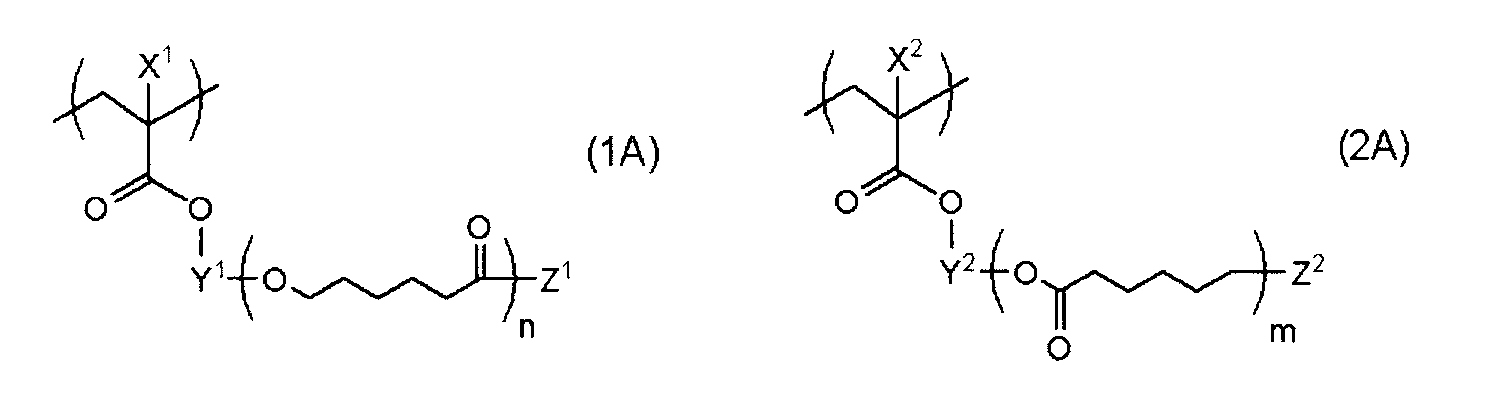
式(1A)中、X1、Y1、Z1及びnは、式(1)におけるX1、Y1、Z1及びnと同義であり、好ましい範囲も同様である。
式(2A)中、X2、Y2、Z2及びmは、式(2)におけるX2、Y2、Z2及びmと同義であり、好ましい範囲も同様である。
また、式(3)で表される構造単位としては、分散安定性の観点から、下記式(3A)又は下記式(3B)で表される構造単位であることがより好ましい。
式(2A)中、X2、Y2、Z2及びmは、式(2)におけるX2、Y2、Z2及びmと同義であり、好ましい範囲も同様である。
また、式(3)で表される構造単位としては、分散安定性の観点から、下記式(3A)又は下記式(3B)で表される構造単位であることがより好ましい。
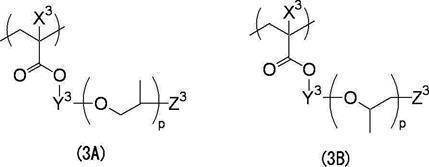
式(3A)又は(3B)中、X3、Y3、Z3及びpは、式(3)におけるX3、Y3、Z3及びpと同義であり、好ましい範囲も同様である。
具体例として、特開2010-106268号公報の段落0079(対応する米国特許出願公開第2011/0124824号明細書の段落0121)以降の例示化合物1~71を参酌でき、これらの内容は本願明細書に組み込まれる。好ましい具体例として、以下に示す化合物が挙げられる。なお、下記例示化合物中、各構造単位に併記される数値(主鎖繰り返し単位に併記される数値)は、当該構造単位の含有量〔質量%:(wt%)と記載〕を表す。側鎖の繰り返し部位に併記される数値は、当該繰り返し部位の繰り返し数を示す。


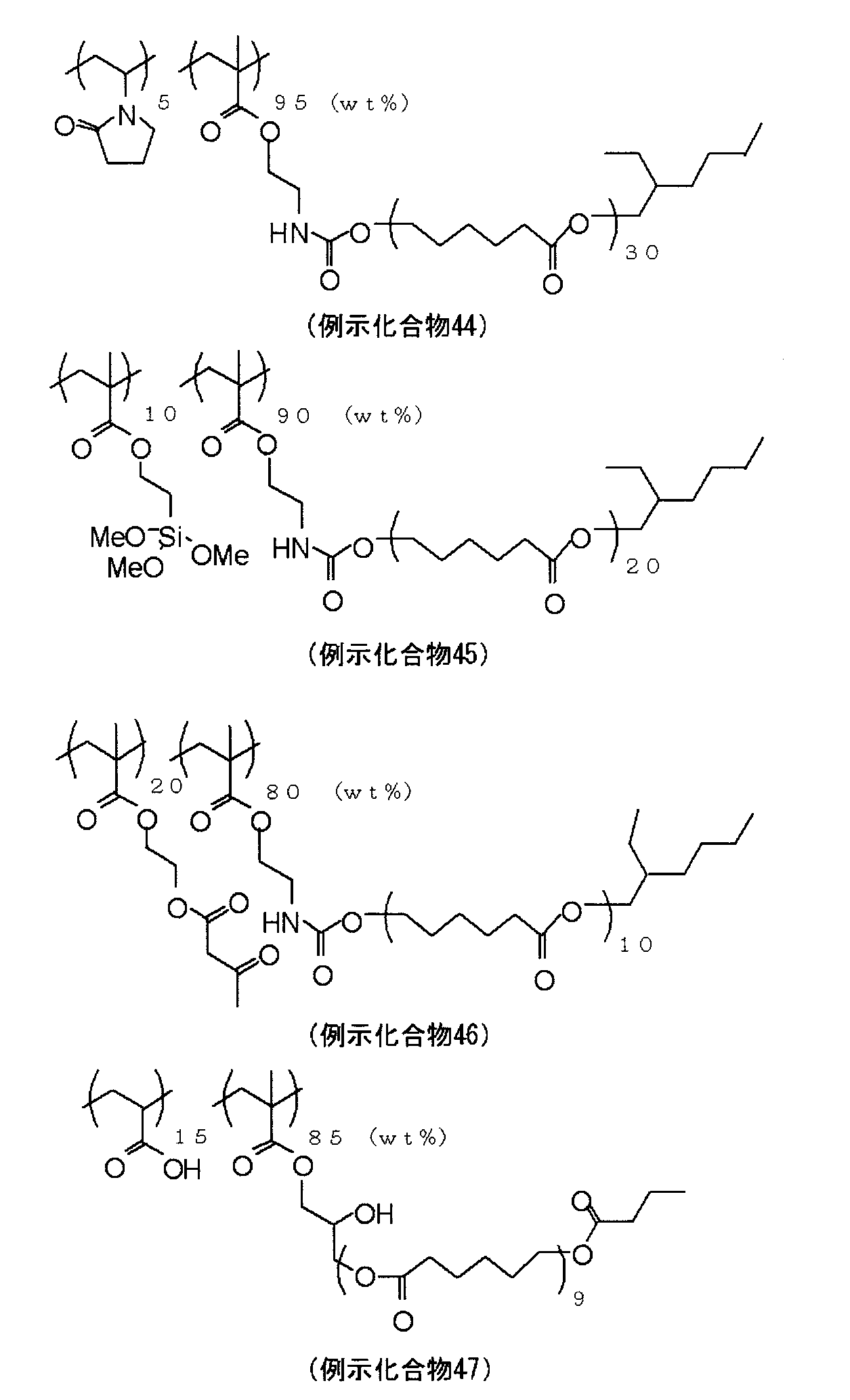
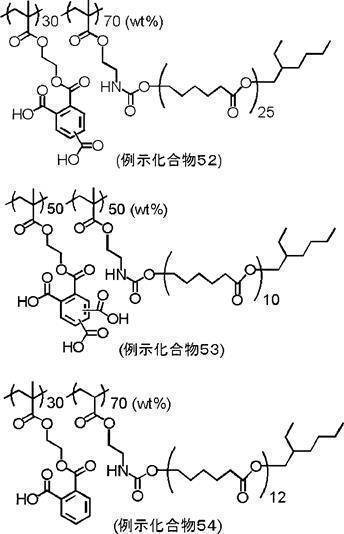
分散剤を用いる場合には、まず、無機粒子と分散剤と、適切な溶剤により分散組成物を調製した後、感光性組成物に配合することが分散性向上の観点から好ましい。
感光性組成物中における分散剤の含有量としては、感光性組成物中の無機粒子の全固形分質量に対して、3~80質量%がより好ましく、15~40質量%がさらに好ましい。
感光性組成物中における分散剤の含有量としては、感光性組成物中の無機粒子の全固形分質量に対して、3~80質量%がより好ましく、15~40質量%がさらに好ましい。
<光重合開始剤>
感光性組成物は、光重合開始剤を含有することによって感光性が付与されるともに、後述する重合性化合物及び上述したアルカリ可溶性樹脂を含むことによって、感光性組成物により塗布層を形成した後に、塗布層を露光し、現像することによってパターン形成できる。そして、このようして得られたパターンをカラーフィルタにおける白色(透明)フィルタとすることができる。
光重合開始剤としては特に制限はなく、公知の光重合開始剤の中から適宜選択することができ、例えば、紫外線領域から可視の光線に対して感光性を有するものが好ましく、光励起された増感剤と何らかの作用を生じ、活性ラジカルを生成する活性剤であってもよく、モノマーの種類に応じてカチオン重合を開始させるような開始剤であってもよい。
また、光重合開始剤は、約300~800nm(330~500nmがより好ましい。)の範囲内に少なくとも約50の分子吸光係数を有する成分を少なくとも1種含有していることが好ましい。
感光性組成物は、光重合開始剤を含有することによって感光性が付与されるともに、後述する重合性化合物及び上述したアルカリ可溶性樹脂を含むことによって、感光性組成物により塗布層を形成した後に、塗布層を露光し、現像することによってパターン形成できる。そして、このようして得られたパターンをカラーフィルタにおける白色(透明)フィルタとすることができる。
光重合開始剤としては特に制限はなく、公知の光重合開始剤の中から適宜選択することができ、例えば、紫外線領域から可視の光線に対して感光性を有するものが好ましく、光励起された増感剤と何らかの作用を生じ、活性ラジカルを生成する活性剤であってもよく、モノマーの種類に応じてカチオン重合を開始させるような開始剤であってもよい。
また、光重合開始剤は、約300~800nm(330~500nmがより好ましい。)の範囲内に少なくとも約50の分子吸光係数を有する成分を少なくとも1種含有していることが好ましい。
光重合開始剤としては、例えば、ハロゲン化炭化水素誘導体(例えば、トリアジン骨格を有するもの、オキサジアゾール骨格を有するもの)、アシルホスフィンオキサイド等のアシルホスフィン化合物、ヘキサアリールビイミダゾール、オキシム誘導体等のオキシム化合物、有機過酸化物、チオ化合物、ケトン化合物、芳香族オニウム塩、ケトオキシムエーテル、アミノアセトフェノン化合物、ヒドロキシアセトフェノンなどが挙げられる。より具体的には、例えば、特開平10-291969号公報に記載のアミノアセトフェノン系開始剤、特許第4225898号公報に記載のアシルホスフィンオキシド系開始剤も用いることができる。
ヒドロキシアセトフェノン系開始剤としては、IRGACURE-184、DAROCUR-1173、IRGACURE-500、IRGACURE-2959,IRGACURE-127(商品名:いずれもチバジャパン社製)を用いることができる。
アミノアセトフェノン系開始剤としては、市販品であるIRGACURE-907、IRGACURE-369、及び、IRGACURE-379(商品名:いずれもチバジャパン社製)を用いることができる。
アミノアセトフェノン系開始剤として、365nm又は405nm等の長波光源に吸収波長がマッチングされた特開2009-191179号公報に記載の化合物も用いることができる。
アシルホスフィン系開始剤としては市販品であるIRGACURE-819やDAROCUR-TPO(商品名:いずれもチバジャパン社製)を用いることができる。
ヒドロキシアセトフェノン系開始剤としては、IRGACURE-184、DAROCUR-1173、IRGACURE-500、IRGACURE-2959,IRGACURE-127(商品名:いずれもチバジャパン社製)を用いることができる。
アミノアセトフェノン系開始剤としては、市販品であるIRGACURE-907、IRGACURE-369、及び、IRGACURE-379(商品名:いずれもチバジャパン社製)を用いることができる。
アミノアセトフェノン系開始剤として、365nm又は405nm等の長波光源に吸収波長がマッチングされた特開2009-191179号公報に記載の化合物も用いることができる。
アシルホスフィン系開始剤としては市販品であるIRGACURE-819やDAROCUR-TPO(商品名:いずれもチバジャパン社製)を用いることができる。
光重合開始剤として、より好ましくはオキシム系化合物が挙げられる。オキシム系開始剤の具体例としては、特開2001-233842号公報記載の化合物、特開2000-80068号公報記載の化合物、特開2006-342166号公報記載の化合物を用いることができる。
光重合開始剤として好適に用いられるオキシム誘導体等のオキシム化合物としては、例えば、3-ベンゾイロキシイミノブタン-2-オン、3-アセトキシイミノブタン-2-オン、3-プロピオニルオキシイミノブタン-2-オン、2-アセトキシイミノペンタン-3-オン、2-アセトキシイミノ-1-フェニルプロパン-1-オン、2-ベンゾイロキシイミノ-1-フェニルプロパン-1-オン、3-(4-トルエンスルホニルオキシ)イミノブタン-2-オン、及び2-エトキシカルボニルオキシイミノ-1-フェニルプロパン-1-オンなどが挙げられる。
オキシムエステル化合物としては、J.C.S.Perkin II(1979年)pp.1653-1660)、J.C.S.Perkin II(1979年)pp.156-162、Journal of Photopolymer Science and Technology(1995年)pp.202-232、特開2000-66385号公報記載の化合物、特開2000-80068号公報、特表2004-534797号公報、特開2006-342166号公報の各公報に記載の化合物等が挙げられる。
市販品ではIRGACURE-OXE01(BASF社製)、IRGACURE-OXE02(BASF社製)も好適に用いられる。
また上記記載以外のオキシムエステル化合物として、カルバゾールN位にオキシムが連結した特表2009-519904号公報に記載の化合物、ベンゾフェノン部位にヘテロ置換基が導入された米国特許7626957号公報に記載の化合物、色素部位にニトロ基が導入された特開2010-15025号公報及び米国特許公開2009-292039号記載の化合物、国際公開特許2009-131189号公報に記載のケトオキシム系化合物、トリアジン骨格とオキシム骨格を同一分子内に含有する米国特許7556910号公報に記載の化合物、405nmに吸収極大を有しg線光源に対して良好な感度を有する特開2009-221114号公報記載の化合物、などを用いてもよい。
光重合開始剤として好適に用いられるオキシム誘導体等のオキシム化合物としては、例えば、3-ベンゾイロキシイミノブタン-2-オン、3-アセトキシイミノブタン-2-オン、3-プロピオニルオキシイミノブタン-2-オン、2-アセトキシイミノペンタン-3-オン、2-アセトキシイミノ-1-フェニルプロパン-1-オン、2-ベンゾイロキシイミノ-1-フェニルプロパン-1-オン、3-(4-トルエンスルホニルオキシ)イミノブタン-2-オン、及び2-エトキシカルボニルオキシイミノ-1-フェニルプロパン-1-オンなどが挙げられる。
オキシムエステル化合物としては、J.C.S.Perkin II(1979年)pp.1653-1660)、J.C.S.Perkin II(1979年)pp.156-162、Journal of Photopolymer Science and Technology(1995年)pp.202-232、特開2000-66385号公報記載の化合物、特開2000-80068号公報、特表2004-534797号公報、特開2006-342166号公報の各公報に記載の化合物等が挙げられる。
市販品ではIRGACURE-OXE01(BASF社製)、IRGACURE-OXE02(BASF社製)も好適に用いられる。
また上記記載以外のオキシムエステル化合物として、カルバゾールN位にオキシムが連結した特表2009-519904号公報に記載の化合物、ベンゾフェノン部位にヘテロ置換基が導入された米国特許7626957号公報に記載の化合物、色素部位にニトロ基が導入された特開2010-15025号公報及び米国特許公開2009-292039号記載の化合物、国際公開特許2009-131189号公報に記載のケトオキシム系化合物、トリアジン骨格とオキシム骨格を同一分子内に含有する米国特許7556910号公報に記載の化合物、405nmに吸収極大を有しg線光源に対して良好な感度を有する特開2009-221114号公報記載の化合物、などを用いてもよい。
また、特開2007-231000号公報(対応する米国特許出願公開第2011/0123929号明細書)、及び、特開2007-322744号公報に記載される環状オキシム化合物に対しても好適に用いることができる。
他にも、特開2007-269779号公報(対応する米国特許出願公開第2010/0104976号明細書)に示される特定置換基を有するオキシム化合物や、特開2009-191061号公報(対応する米国特許出願公開第2009/023085号明細書)に示されるチオアリール基を有するオキシム化合物が挙げられる。
特開2012-208494号公報の段落0513(対応する米国特許出願公開第2012/235099号明細書の段落0632)以降の式(OX-1)、(OX-2)又は(OX-3)で表される化合物の説明を参酌でき、これらの内容は本願明細書に組み込まれる。
他にも、特開2007-269779号公報(対応する米国特許出願公開第2010/0104976号明細書)に示される特定置換基を有するオキシム化合物や、特開2009-191061号公報(対応する米国特許出願公開第2009/023085号明細書)に示されるチオアリール基を有するオキシム化合物が挙げられる。
特開2012-208494号公報の段落0513(対応する米国特許出願公開第2012/235099号明細書の段落0632)以降の式(OX-1)、(OX-2)又は(OX-3)で表される化合物の説明を参酌でき、これらの内容は本願明細書に組み込まれる。
オキシム系重合開始剤としては、TRONLY TR-PBG-304、TRONLY TR-PBG-309、TRONLY TR-PBG-305(常州強力電子新材料有限公司(CHANGZHOU TRONLY NEW ELECTRONIC MATERIALS CO.,LTD)製)などの市販品が使用できる。また、特開2012-113104号の段落0092から段落0096に記載されている重合開始剤の記載を参酌でき、これらの内容は本願明細書に組み込まれる。このようなオキシム系重合開始剤を使用することで、硬化感度が高く、現像性が良好な感光性組成物を提供することができる。上記オキシム系重合開始剤は、特開2012-113104号公報の段落0030以降に説明されている化合物である。一般式としては、特開2012-113104号公報の請求項1に記載の一般式(I)で表され、より好ましくは請求項3に記載の一般式(I-A)で表されるものであり、これらの記載を参酌でき、これらの内容は本願明細書に組み込まれる。
以下、好適に用いられるオキシム化合物の具体例としては、特開2009-191061号公報の段落0090~0106(対応する米国特許出願公開第2009/023085号明細書の段落0393)、特開2012-032556号公報段落0054、特開2012-122045号公報の段落0054等の記載を参酌でき、これらの内容は本願明細書に組み込まれる。(PIox-1)~(PIox-13)を以下に示すが、本発明はこれらに限定されるものではない。
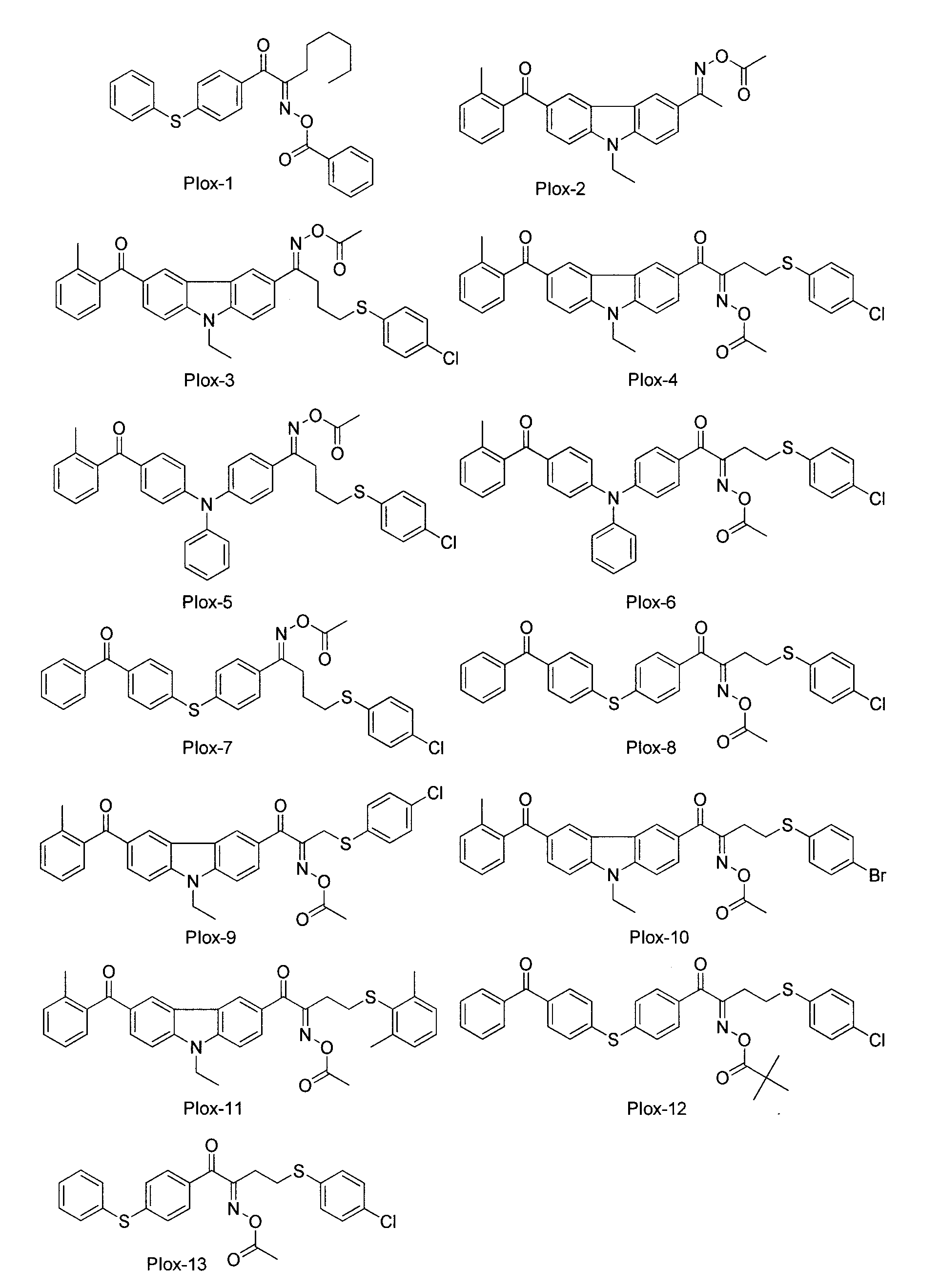
オキシム化合物は、350nm~500nmの波長領域に極大吸収波長を有するものであることが好ましく、360nm~480nmの波長領域に極大吸収波長を有するものであることがより好ましく、365nm及び455nmの吸光度が高いものが特に好ましい。
オキシム化合物は、365nm又は405nmにおけるモル吸光係数が、感度の観点から、3,000~300,000であることが好ましく、5,000~300,000であることがより好ましく、10,000~200,000であることが特に好ましい。
化合物のモル吸光係数は、公知の方法を用いることができるが、具体的には、例えば、紫外可視分光光度計(Varian社製Carry-5 spctrophotometer)にて、酢酸エチル溶剤を用い、0.01g/Lの濃度で測定することが好ましい。
オキシム化合物は、365nm又は405nmにおけるモル吸光係数が、感度の観点から、3,000~300,000であることが好ましく、5,000~300,000であることがより好ましく、10,000~200,000であることが特に好ましい。
化合物のモル吸光係数は、公知の方法を用いることができるが、具体的には、例えば、紫外可視分光光度計(Varian社製Carry-5 spctrophotometer)にて、酢酸エチル溶剤を用い、0.01g/Lの濃度で測定することが好ましい。
光重合開始剤は、必要に応じて2種以上を組み合わせて使用してもよい。
本発明の感光性組成物の全固形分に対する光重合開始剤の含有量は、0.1~20質量%であることが好ましく、0.3~15質量%であることがより好ましく、0.4~10質量%であることがさらに好ましい。
本発明の感光性組成物の全固形分に対する光重合開始剤の含有量は、0.1~20質量%であることが好ましく、0.3~15質量%であることがより好ましく、0.4~10質量%であることがさらに好ましい。
感光性組成物は、光重合開始剤である光ラジカル重合開始剤のラジカル発生効率の向上、感光波長の長波長化の目的で、増感剤を含有していてもよい。増感剤としては、光重合開始剤に対し、電子移動機構又はエネルギー移動機構で増感させるものが好ましい。
感光性組成物に用いられる増感剤としては、例えば、特開2008-32803号公報の段落0101~0154に記載される化合物が挙げられる。
感光性組成物中における増感剤の含有量は、深部への光吸収効率と開始分解効率の観点から、固形分換算で、0.1~20質量%であることが好ましく、0.5~15質量%がより好ましい。
増感剤は、1種単独で用いてもよいし、2種以上を併用してもよい。
感光性組成物に用いられる増感剤としては、例えば、特開2008-32803号公報の段落0101~0154に記載される化合物が挙げられる。
感光性組成物中における増感剤の含有量は、深部への光吸収効率と開始分解効率の観点から、固形分換算で、0.1~20質量%であることが好ましく、0.5~15質量%がより好ましい。
増感剤は、1種単独で用いてもよいし、2種以上を併用してもよい。
<重合性化合物>
感光性組成物は、重合性化合物を含有する。ここで、重合性化合物は、活性種により重合を引き起こす化合物である。活性種として、ラジカル、酸、塩基などが挙げられる。
ラジカルが活性種である場合には、重合性化合物としては、通常、重合性基として末端エチレン性不飽和結合を有する化合物が使用される。
一方、活性種が、スルホン酸、リン酸、スルフィン酸、カルボン酸、硫酸、硫酸モノエステルなどの酸である場合、重合性化合物としては、例えば、エポキシ基、オキセタニル基、テトラヒドロフラニル基などの環状エーテル基、又は、ビニルベンゼン基を有する化合物が使用される。
また、活性種がアミノ化合物などの塩基である場合には、重合性化合物としては、例えば、エポキシ基、オキセタニル基、テトラヒドロフラニル基などの環状エーテル基、又は、ビニルベンゼン基を有する化合物が使用される。
重合性化合物は、好ましくは末端エチレン性不飽和結合を少なくとも1個、より好ましくは2個以上有する化合物から選ばれることが好ましい。このような化合物群は当該産業分野において広く知られているものであり、本発明においてはこれらを特に限定なく用いることができる。これらは、例えば、モノマー、プレポリマー、すなわち2量体、3量体及びオリゴマー、又はそれらの混合物並びにそれらの多量体などの化学的形態のいずれであってもよい。重合性化合物は1種単独で用いてもよいし、2種以上を併用してもよい。
感光性組成物は、重合性化合物を含有する。ここで、重合性化合物は、活性種により重合を引き起こす化合物である。活性種として、ラジカル、酸、塩基などが挙げられる。
ラジカルが活性種である場合には、重合性化合物としては、通常、重合性基として末端エチレン性不飽和結合を有する化合物が使用される。
一方、活性種が、スルホン酸、リン酸、スルフィン酸、カルボン酸、硫酸、硫酸モノエステルなどの酸である場合、重合性化合物としては、例えば、エポキシ基、オキセタニル基、テトラヒドロフラニル基などの環状エーテル基、又は、ビニルベンゼン基を有する化合物が使用される。
また、活性種がアミノ化合物などの塩基である場合には、重合性化合物としては、例えば、エポキシ基、オキセタニル基、テトラヒドロフラニル基などの環状エーテル基、又は、ビニルベンゼン基を有する化合物が使用される。
重合性化合物は、好ましくは末端エチレン性不飽和結合を少なくとも1個、より好ましくは2個以上有する化合物から選ばれることが好ましい。このような化合物群は当該産業分野において広く知られているものであり、本発明においてはこれらを特に限定なく用いることができる。これらは、例えば、モノマー、プレポリマー、すなわち2量体、3量体及びオリゴマー、又はそれらの混合物並びにそれらの多量体などの化学的形態のいずれであってもよい。重合性化合物は1種単独で用いてもよいし、2種以上を併用してもよい。
より具体的には、モノマー及びそのプレポリマーの例としては、不飽和カルボン酸(例えば、アクリル酸、メタクリル酸、イタコン酸、クロトン酸、イソクロトン酸、マレイン酸など)やそのエステル類、アミド類、並びにこれらの多量体が挙げられ、好ましくは、不飽和カルボン酸と脂肪族多価アルコール化合物とのエステル、及び不飽和カルボン酸と脂肪族多価アミン化合物とのアミド類、並びにこれらの多量体である。また、ヒドロキシル基やアミノ基、メルカプト基等の求核性置換基を有する不飽和カルボン酸エステル或いはアミド類と、単官能若しくは多官能イソシアネート類或いはエポキシ類との付加反応物や、単官能若しくは多官能のカルボン酸との脱水縮合反応物等も好適に使用される。また、イソシアネート基やエポキシ基等の親電子性置換基を有する不飽和カルボン酸エステル或いはアミド類と、単官能若しくは多官能のアルコール類、アミン類、チオール類との付加反応物、さらに、ハロゲン基やトシルオキシ基等の脱離性置換基を有する不飽和カルボン酸エステル或いはアミド類と、単官能若しくは多官能のアルコール類、アミン類、チオール類との置換反応物も好適である。また、別の例として、上記の不飽和カルボン酸の代わりに、不飽和ホスホン酸、スチレン等のビニルベンゼン誘導体、ビニルエーテル、アリルエーテル等に置き換えた化合物群を使用することも可能である。
これらの具体的な化合物としては、特開2009-288705号公報の段落0095~0108に記載されている化合物を本発明においても好適に用いることができる。
これらの具体的な化合物としては、特開2009-288705号公報の段落0095~0108に記載されている化合物を本発明においても好適に用いることができる。
また、重合性化合物としては、重合性モノマーとして、少なくとも1個の付加重合可能なエチレン基を有する、常圧下で100℃以上の沸点を持つエチレン性不飽和基を持つ化合物も好ましい。その例としては、ポリエチレングリコールモノ(メタ)アクリレート、ポリプロピレングリコールモノ(メタ)アクリレート、フェノキシエチル(メタ)アクリレート、等の単官能のアクリレートやメタアクリレート;ポリエチレングリコールジ(メタ)アクリレート、トリメチロールエタントリ(メタ)アクリレート、ネオペンチルグリコールジ(メタ)アクリレート、ペンタエリスリトールトリ(メタ)アクリレート、ペンタエリスリトールテトラ(メタ)アクリレート、ジペンタエリスリトールペンタ(メタ)アクリレート、ジペンタエリスリトールヘキサ(メタ)アクリレート、ヘキサンジオール(メタ)アクリレート、トリメチロールプロパントリ(アクリロイルオキシプロピル)エーテル、トリ(アクリロイロキシエチル)イソシアヌレート、グリセリンやトリメチロールエタン等の多官能アルコールにエチレンオキサイドやプロピレンオキサイドを付加させた後(メタ)アクリレート化したもの、特公昭48-41708号、特公昭50-6034号、特開昭51-37193号各公報に記載されているようなウレタン(メタ)アクリレート類、特開昭48-64183号、特公昭49-43191号、特公昭52-30490号各公報に記載されているポリエステルアクリレート類、エポキシ樹脂と(メタ)アクリル酸との反応生成物であるエポキシアクリレート類等の多官能のアクリレートやメタアクリレート及びこれらの混合物を挙げることができる。
多官能カルボン酸にグリシジル(メタ)アクリレート等の環状エーテル基とエチレン性不飽和基を有する化合物を反応させ得られる多官能(メタ)アクリレートなども挙げることができる。
また、その他の好ましい重合性化合物として、特開2010-160418号、特開2010-129825号、特許4364216号等に記載される、フルオレン環を有し、エチレン性重合性基を2官能以上有する化合物、カルド樹脂も使用することが可能である。
また、常圧下で100℃以上の沸点を有し、少なくとも一つの付加重合可能なエチレン性不飽和基を持つ化合物としては、特開2008-292970号公報の段落0254~0257に記載の化合物も好適である。
多官能カルボン酸にグリシジル(メタ)アクリレート等の環状エーテル基とエチレン性不飽和基を有する化合物を反応させ得られる多官能(メタ)アクリレートなども挙げることができる。
また、その他の好ましい重合性化合物として、特開2010-160418号、特開2010-129825号、特許4364216号等に記載される、フルオレン環を有し、エチレン性重合性基を2官能以上有する化合物、カルド樹脂も使用することが可能である。
また、常圧下で100℃以上の沸点を有し、少なくとも一つの付加重合可能なエチレン性不飽和基を持つ化合物としては、特開2008-292970号公報の段落0254~0257に記載の化合物も好適である。
上記のほか、下記一般式(MO-1)~(MO-5)で表される、ラジカル重合性モノマーも好適に用いることができる。なお、式中、Tがオキシアルキレン基の場合には、炭素原子側の末端がRに結合する。
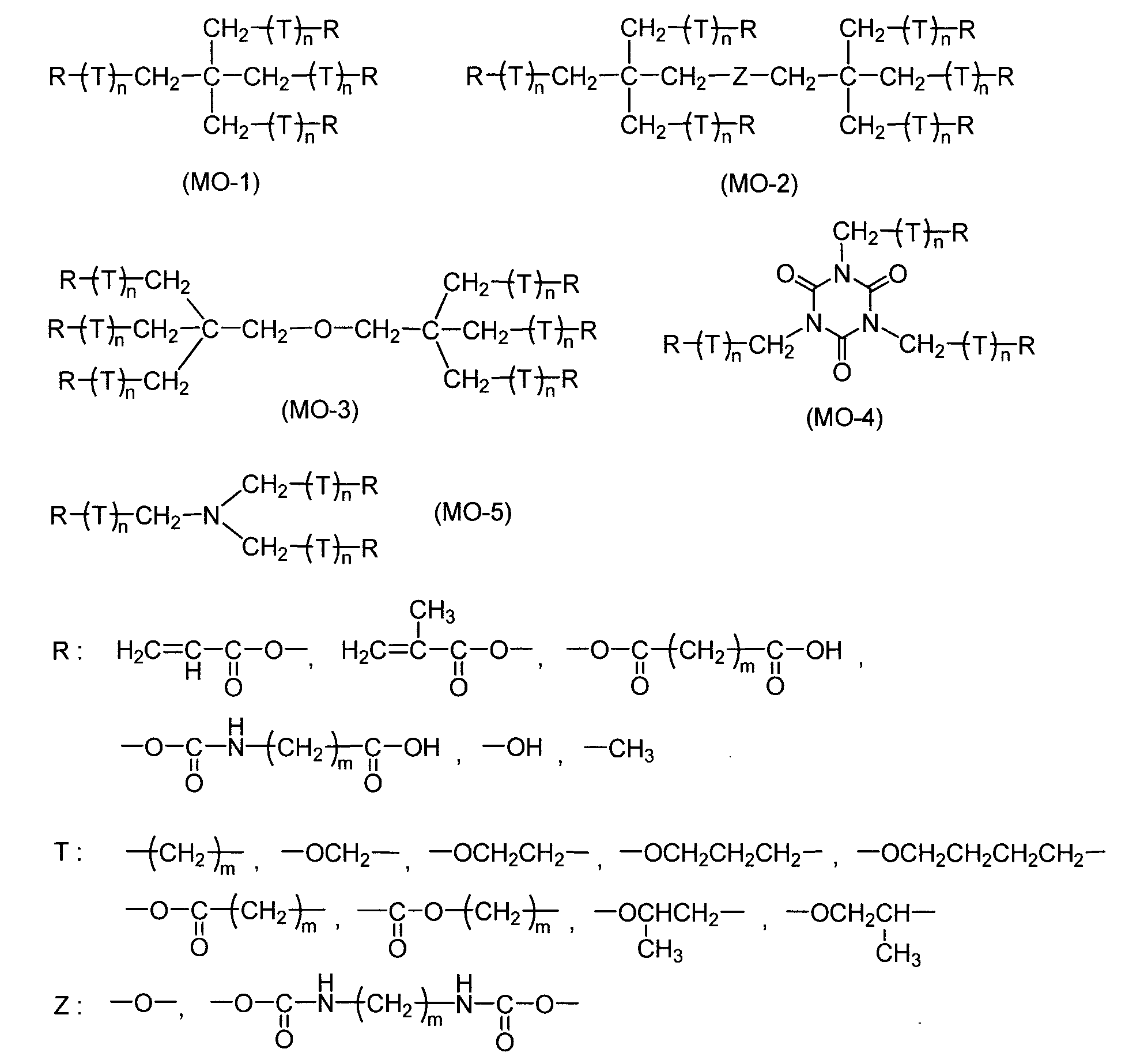
一般式において、nは0~14であり、mは1~8である。一分子内に複数存在するR、T、は、各々同一であっても、異なっていてもよい。
上記一般式(MO-1)~(MO-5)で表されるラジカル重合性モノマーの各々において、複数のRの内の少なくとも1つは、-OC(=O)CH=CH2、又は、-OC(=O)C(CH3)=CH2で表される基を表す。
上記一般式(MO-1)~(MO-5)で表される、ラジカル重合性モノマーの具体例としては、特開2007-269779号公報の段落0248~0251に記載されている化合物を本発明においても好適に用いることができる。
また、特開平10-62986号公報において一般式(1)及び(2)としてその具体例と共に記載の、多官能アルコールにエチレンオキサイドやプロピレンオキサイドを付加させた後に(メタ)アクリレート化した化合物も、重合性化合物として用いることができる。
上記一般式(MO-1)~(MO-5)で表されるラジカル重合性モノマーの各々において、複数のRの内の少なくとも1つは、-OC(=O)CH=CH2、又は、-OC(=O)C(CH3)=CH2で表される基を表す。
上記一般式(MO-1)~(MO-5)で表される、ラジカル重合性モノマーの具体例としては、特開2007-269779号公報の段落0248~0251に記載されている化合物を本発明においても好適に用いることができる。
また、特開平10-62986号公報において一般式(1)及び(2)としてその具体例と共に記載の、多官能アルコールにエチレンオキサイドやプロピレンオキサイドを付加させた後に(メタ)アクリレート化した化合物も、重合性化合物として用いることができる。
中でも、重合性化合物としては、ジペンタエリスリトールトリアクリレート(市販品としては KAYARAD D-330;日本化薬株式会社製)、ジペンタエリスリトールテトラアクリレート(市販品としては KAYARAD D-320;日本化薬株式会社製)、ジペンタエリスリトールペンタ(メタ)アクリレート(市販品としては KAYARAD D-310;日本化薬株式会社製)、ジペンタエリスリトールヘキサ(メタ)アクリレート(市販品としては KAYARAD DPHA ;日本化薬株式会社製)、及びこれらの(メタ)アクリロイル基がエチレングリコール、プロピレングリコール残基を介している構造が好ましい。これらのオリゴマータイプも使用できる。
重合性化合物としては、カルボキシル基、スルホン酸基、リン酸基等の酸基を有していてもよく、例えば、酸基を有するエチレン性不飽和化合物類を好適に挙げることができる。酸基を有するエチレン性不飽和化合物類は、多官能アルコールの一部のヒドロキシ基を(メタ)アクリレート化し、残ったヒドロキシ基に酸無水物を付加反応させてカルボキシ基とするなどの方法で得られる。
エチレン性化合物が、上記のように混合物である場合のように未反応のカルボキシル基を有するものであれば、これをそのまま利用することができるが、必要において、上述のエチレン性化合物のヒドロキシル基に非芳香族カルボン酸無水物を反応させて酸基を導入してもよい。この場合、使用される非芳香族カルボン酸無水物の具体例としては、無水テトラヒドロフタル酸、アルキル化無水テトラヒドロフタル酸、無水ヘキサヒドロフタル酸、アルキル化無水ヘキサヒドロフタル酸、無水コハク酸、無水マレイン酸が挙げられる。
エチレン性化合物が、上記のように混合物である場合のように未反応のカルボキシル基を有するものであれば、これをそのまま利用することができるが、必要において、上述のエチレン性化合物のヒドロキシル基に非芳香族カルボン酸無水物を反応させて酸基を導入してもよい。この場合、使用される非芳香族カルボン酸無水物の具体例としては、無水テトラヒドロフタル酸、アルキル化無水テトラヒドロフタル酸、無水ヘキサヒドロフタル酸、アルキル化無水ヘキサヒドロフタル酸、無水コハク酸、無水マレイン酸が挙げられる。
酸基を有するモノマーとしては、脂肪族ポリヒドロキシ化合物と不飽和カルボン酸とのエステルであり、脂肪族ポリヒドロキシ化合物の未反応のヒドロキシル基に非芳香族カルボン酸無水物を反応させて酸基を持たせた多官能モノマーが好ましく、特に好ましくは、このエステルにおいて、脂肪族ポリヒドロキシ化合物がペンタエリスリトール及び/又はジペンタエリスリトールであるものである。市販品としては、例えば、東亞合成株式会社製の多塩基酸変性アクリルオリゴマーとして、M-510、M-520などが挙げられる。
これらのモノマーは1種を単独で用いてもよいが、製造上、単一の化合物を用いることは難しいことから、2種以上を混合して用いてもよい。また、必要に応じてモノマーとして酸基を有しない多官能モノマーと酸基を有する多官能モノマーを併用してもよい。
酸基を有する多官能モノマーの好ましい酸価としては、0.1~40mg-KOH/gであり、特に好ましくは5~30mg-KOH/gである。多官能モノマーの酸価が低すぎると現像溶解特性が落ち、高すぎると製造や取扱いが困難になり光重合性能が落ち、画素の表面平滑性等の硬化性が劣るものとなる。従って、異なる酸基の多官能モノマーを2種以上併用する場合、或いは酸基を有しない多官能モノマーを併用する場合、全体の多官能モノマーとしての酸基が上記範囲に入るように調整することが必須である。
酸基を有する多官能モノマーの好ましい酸価としては、0.1~40mg-KOH/gであり、特に好ましくは5~30mg-KOH/gである。多官能モノマーの酸価が低すぎると現像溶解特性が落ち、高すぎると製造や取扱いが困難になり光重合性能が落ち、画素の表面平滑性等の硬化性が劣るものとなる。従って、異なる酸基の多官能モノマーを2種以上併用する場合、或いは酸基を有しない多官能モノマーを併用する場合、全体の多官能モノマーとしての酸基が上記範囲に入るように調整することが必須である。
また、重合性化合物として、カプロラクトン構造を有する多官能性単量体を含有することが好ましい。
カプロラクトン構造を有する多官能性単量体としては、その分子内にカプロラクトン構造を有する限り特に限定されるものではないが、例えば、トリメチロールエタン、ジトリメチロールエタン、トリメチロールプロパン、ジトリメチロールプロパン、ペンタエリスリトール、ジペンタエリスリトール、トリペンタエリスリトール、グリセリン、ジグリセロール、トリメチロールメラミン等の多価アルコールと、(メタ)アクリル酸及びε-カプロラクトンをエステル化することにより得られる、ε-カプロラクトン変性多官能(メタ)アクリレートを挙げることができる。なかでも下記式(1)で表されるカプロラクトン構造を有する多官能性単量体が好ましい。
カプロラクトン構造を有する多官能性単量体としては、その分子内にカプロラクトン構造を有する限り特に限定されるものではないが、例えば、トリメチロールエタン、ジトリメチロールエタン、トリメチロールプロパン、ジトリメチロールプロパン、ペンタエリスリトール、ジペンタエリスリトール、トリペンタエリスリトール、グリセリン、ジグリセロール、トリメチロールメラミン等の多価アルコールと、(メタ)アクリル酸及びε-カプロラクトンをエステル化することにより得られる、ε-カプロラクトン変性多官能(メタ)アクリレートを挙げることができる。なかでも下記式(1)で表されるカプロラクトン構造を有する多官能性単量体が好ましい。

(式中、6個のRは全てが下記式(2)で表される基であるか、又は6個のRのうち1~5個が下記式(2)で表される基であり、残余が下記式(3)で表される基である。)
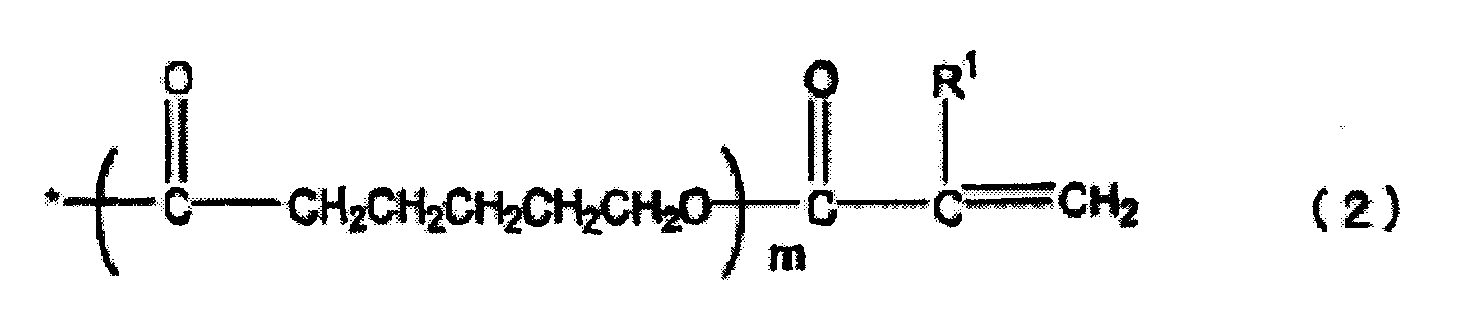
(式中、R1は水素原子又はメチル基を示し、mは1又は2の数を示し、「*」は結合手であることを示す。)
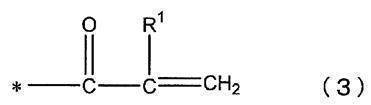
(式中、R1は水素原子又はメチル基を示し、「*」は結合手であることを示す。)
このようなカプロラクトン構造を有する多官能性単量体は、例えば、日本化薬(株)からKAYARAD DPCAシリーズとして市販されており、DPCA-20(上記式(1)~(3)においてm=1、式(2)で表される基の数=2、R1が全て水素原子である化合物)、DPCA-30(同式、m=1、式(2)で表される基の数=3、R1が全て水素原子である化合物)、DPCA-60(同式、m=1、式(2)で表される基の数=6、R1が全て水素原子である化合物)、DPCA-120(同式においてm=2、式(2)で表される基の数=6、R1が全て水素原子である化合物)等を挙げることができる。
本発明において、カプロラクトン構造を有する多官能性単量体は、単独で又は2種以上を混合して使用することができる。
本発明において、カプロラクトン構造を有する多官能性単量体は、単独で又は2種以上を混合して使用することができる。
また、本発明における重合性化合物としては、下記一般式(i)又は(ii)で表される化合物の群から選択される少なくとも1種であることも好ましい。

一般式(i)及び(ii)中、Eは、各々独立に、-((CH2)yCH2O)-、又は-((CH2)yCH(CH3)O)-を表し、yは、各々独立に0~10の整数を表し、Xは、それぞれ独立に、アクリロイル基、メタクリロイル基、水素原子、又はカルボキシル基を表す。
一般式(i)中、アクリロイル基及びメタクリロイル基の合計は3個又は4個であり、mはそれぞれ独立に0~10の整数を表し、各mの合計は0~40の整数である。但し、各mの合計が0の場合、Xのうちいずれか1つはカルボキシル基である。
一般式(ii)中、アクリロイル基及びメタクリロイル基の合計は5個又は6個であり、nはそれぞれ独立に0~10の整数を表し、各nの合計は0~60の整数である。但し、各nの合計が0の場合、Xのうちいずれか1つはカルボキシル基である。
一般式(i)中、アクリロイル基及びメタクリロイル基の合計は3個又は4個であり、mはそれぞれ独立に0~10の整数を表し、各mの合計は0~40の整数である。但し、各mの合計が0の場合、Xのうちいずれか1つはカルボキシル基である。
一般式(ii)中、アクリロイル基及びメタクリロイル基の合計は5個又は6個であり、nはそれぞれ独立に0~10の整数を表し、各nの合計は0~60の整数である。但し、各nの合計が0の場合、Xのうちいずれか1つはカルボキシル基である。
一般式(i)中、mは、0~6の整数が好ましく、0~4の整数がより好ましい。また、各mの合計は、2~40の整数が好ましく、2~16の整数がより好ましく、4~8の整数が特に好ましい。
一般式(ii)中、nは、0~6の整数が好ましく、0~4の整数がより好ましい。また、各nの合計は、3~60の整数が好ましく、3~24の整数がより好ましく、6~12の整数が特に好ましい。
また、一般式(i)又は一般式(ii)中の-((CH2)yCH2O)-又は-((CH2)yCH(CH3)O)-は、酸素原子側の末端がXに結合する形態が好ましい。
一般式(i)又は(ii)で表される化合物は1種単独で用いてもよいし、2種以上併用してもよい。特に、一般式(ii)において、6個のX全てがアクリロイル基である形態が好ましい。
また、一般式(i)又は(ii)で表される化合物の重合性化合物中における全含有量としては、20質量%以上が好ましく、50質量%以上がより好ましい。
一般式(ii)中、nは、0~6の整数が好ましく、0~4の整数がより好ましい。また、各nの合計は、3~60の整数が好ましく、3~24の整数がより好ましく、6~12の整数が特に好ましい。
また、一般式(i)又は一般式(ii)中の-((CH2)yCH2O)-又は-((CH2)yCH(CH3)O)-は、酸素原子側の末端がXに結合する形態が好ましい。
一般式(i)又は(ii)で表される化合物は1種単独で用いてもよいし、2種以上併用してもよい。特に、一般式(ii)において、6個のX全てがアクリロイル基である形態が好ましい。
また、一般式(i)又は(ii)で表される化合物の重合性化合物中における全含有量としては、20質量%以上が好ましく、50質量%以上がより好ましい。
一般式(i)又は(ii)で表される化合物は、従来公知の工程である、ペンタエリスリト-ル又はジペンタエリスリト-ルにエチレンオキシド又はプロピレンオキシドを開環付加反応により開環骨格を結合する工程と、開環骨格の末端水酸基に、例えば(メタ)アクリロイルクロライドを反応させて(メタ)アクリロイル基を導入する工程と、から合成することができる。各工程は良く知られた工程であり、当業者は容易に一般式(i)又は(ii)で表される化合物を合成することができる。
一般式(i)又は(ii)で表される化合物の中でも、ペンタエリスリトール誘導体及び/又はジペンタエリスリトール誘導体がより好ましい。
具体的には、下記式(a)~(f)で表される化合物(以下、「例示化合物(a)~(f)」ともいう。)が挙げられ、中でも、例示化合物(a)、(b)、(e)、(f)が好ましい。
具体的には、下記式(a)~(f)で表される化合物(以下、「例示化合物(a)~(f)」ともいう。)が挙げられ、中でも、例示化合物(a)、(b)、(e)、(f)が好ましい。
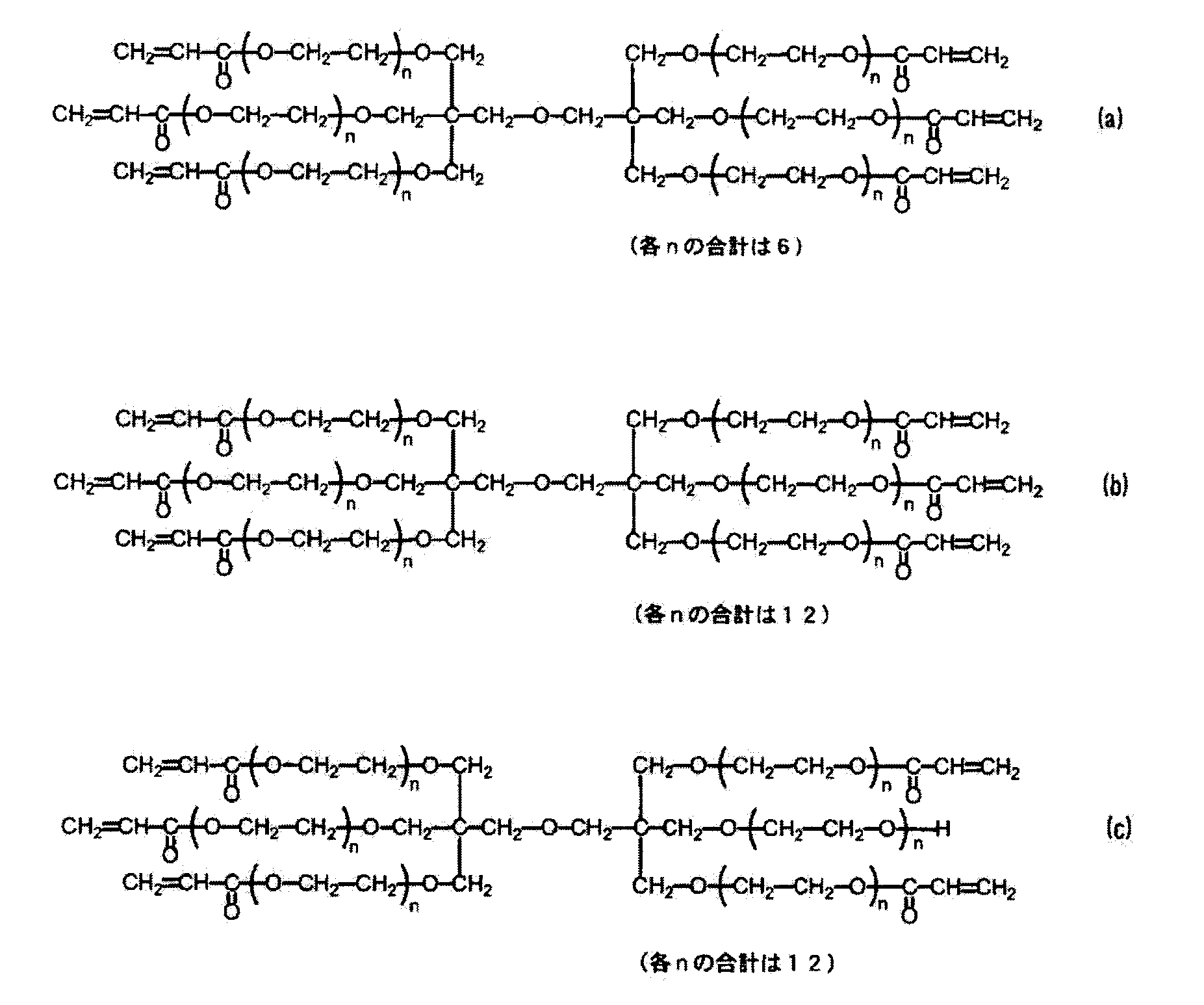
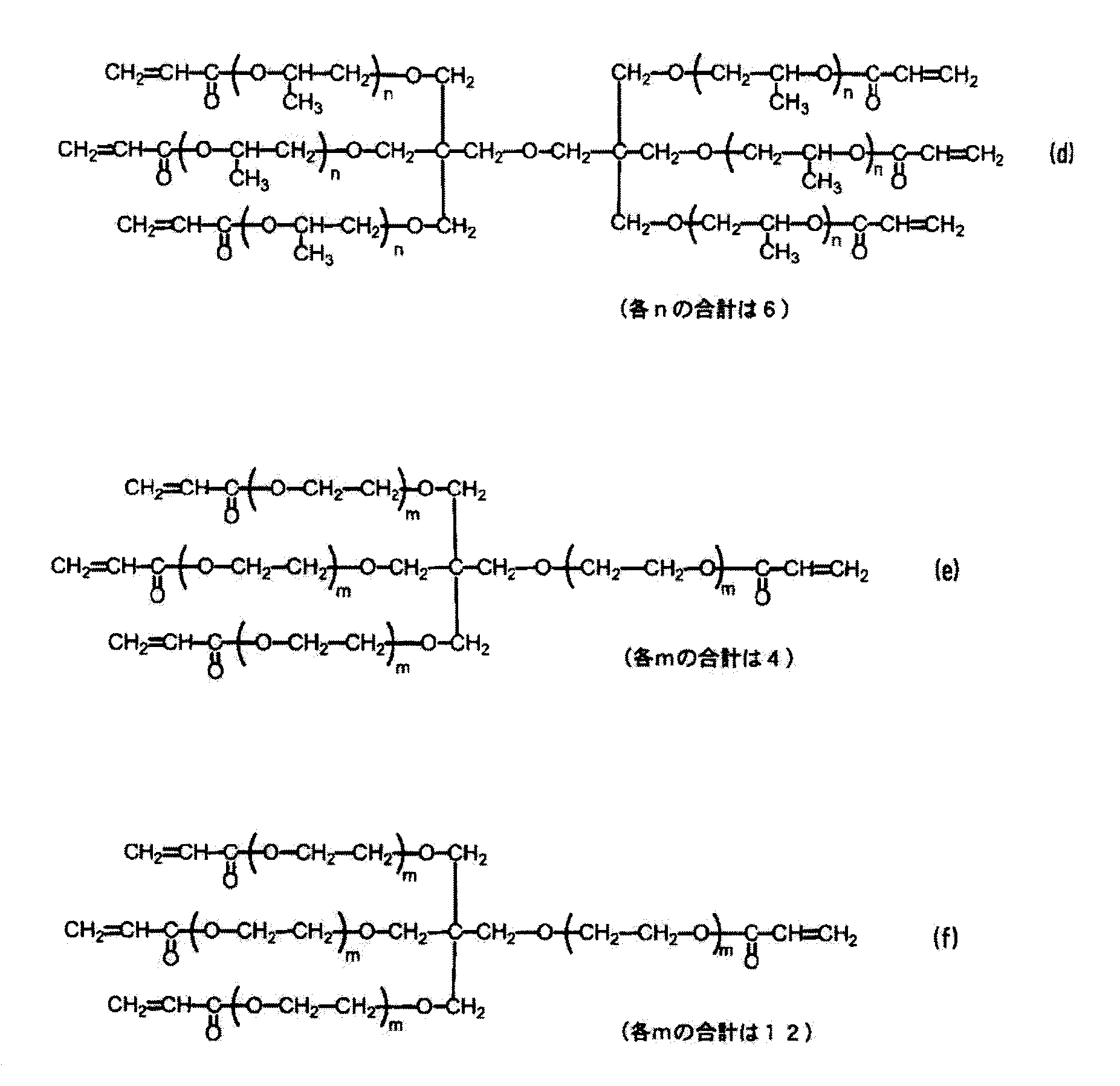
一般式(i)又は(ii)で表される重合性化合物の市販品としては、例えばサートマー社製のエチレンオキシ鎖を4個有する4官能アクリレートであるSR-494、日本化薬株式会社製のペンチレンオキシ鎖を6個有する6官能アクリレートであるDPCA-60、イソブチレンオキシ鎖を3個有する3官能アクリレートであるTPA-330などが挙げられる。
また、重合性化合物としては、特公昭48-41708号、特開昭51-37193号、特公平2-32293号、特公平2-16765号に記載されているようなウレタンアクリレート類や、特公昭58-49860号、特公昭56-17654号、特公昭62-39417号、特公昭62-39418号記載のエチレンオキサイド系骨格を有するウレタン化合物類も好適である。さらに、重合性化合物として、特開昭63-277653号、特開昭63-260909号、特開平1-105238号に記載される、分子内にアミノ構造やスルフィド構造を有する付加重合性化合物類を用いることによって、非常に感光スピードに優れた硬化性組成物を得ることができる。
重合性化合物の市販品としては、ウレタンオリゴマーUAS-10、UAB-140(山陽国策パルプ社製)、UA-7200(新中村化学社製)、DPHA-40H(日本化薬社製)、UA-306H、UA-306T、UA-306I、AH-600、T-600、AI-600(共栄社製)などが挙げられる。
重合性化合物の市販品としては、ウレタンオリゴマーUAS-10、UAB-140(山陽国策パルプ社製)、UA-7200(新中村化学社製)、DPHA-40H(日本化薬社製)、UA-306H、UA-306T、UA-306I、AH-600、T-600、AI-600(共栄社製)などが挙げられる。
これらの重合性化合物について、その構造、単独使用か併用か、添加量等の使用方法の詳細は、感光性組成物の最終的な性能設計にあわせて任意に設定できる。例えば、感度の観点では、1分子あたりの不飽和基含量が多い構造が好ましく、多くの場合は2官能以上が好ましい。また、硬化膜の強度を高める観点では、3官能以上のものがよく、さらに、異なる官能数・異なる重合性基(例えばアクリル酸エステル、メタクリル酸エステル、スチレン系化合物、ビニルエーテル系化合物)のものを併用することで、感度と強度の両方を調節する方法も有効である。さらに、3官能以上のものでエチレンオキサイド鎖長の異なる重合性化合物を併用することが、感光性組成物の現像性を調節することができ、優れたパターン形成が得られるという点で好ましい。また、感光性組成物に含有される他の成分(例えば、光重合開始剤、アルカリ可溶性樹脂等)との相溶性、分散性に対しても、重合性化合物の選択・使用法は重要な要因であり、例えば、低純度化合物の使用や2種以上の併用により相溶性を向上させうることがある。また、支持体などの硬質表面との密着性を向上させる観点で特定の構造を選択することもあり得る。
以下、重合性化合物の具体例を挙げるが、これに限定されるものではない。
以下、重合性化合物の具体例を挙げるが、これに限定されるものではない。
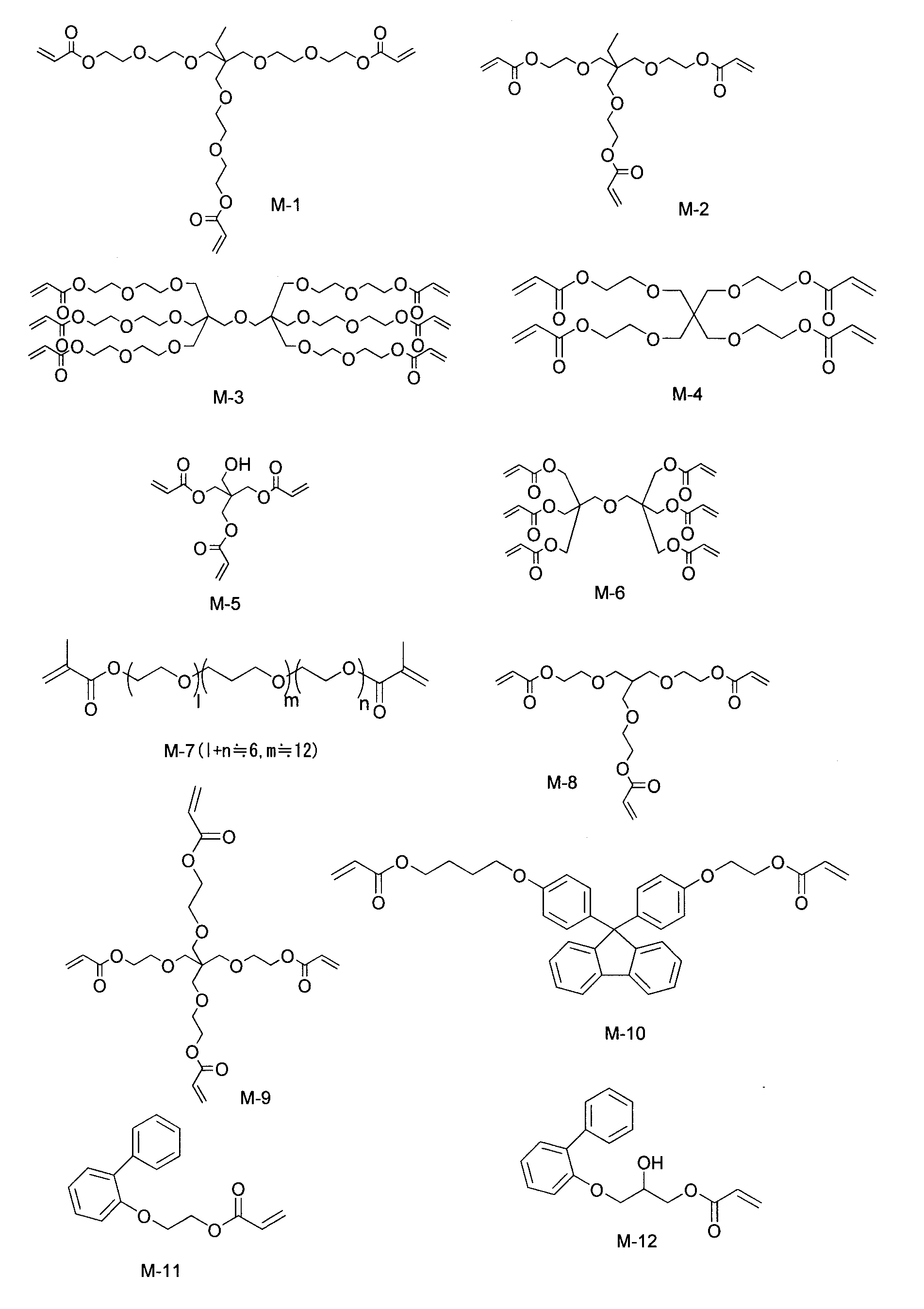
また、重合性化合物としては、重合性基及びシリル基を有する化合物(以後、シリル化合物とも称する)であってもよい。該シリル化合物を含む感光性組成物を支持体上に付与(例えば、塗布)したときに、シリル化合物のSi原子と、支持体を構成する成分との相互作用により、感光性組成物と支持体との密着性が向上するものである。
シリル化合物は、支持体との相互作用性、相溶性を向上する観点から、下記一般式(a)で表される化合物(以下、「特定シリル化合物」とも称する)であることが好ましい。
シリル化合物は、支持体との相互作用性、相溶性を向上する観点から、下記一般式(a)で表される化合物(以下、「特定シリル化合物」とも称する)であることが好ましい。

一般式(a)中、Xは、水素原子又は有機基であり、重合性基を1つ以上有しアミノ基を持つ有機基が好ましい。Y1、Y2、及びY3は、それぞれ独立に、アルキル基、アルケニル基、アルキニル基、アリール基、水酸基、アルコキシ基、ハロゲン原子、アリーロキシ基、アミノ基、シリル基、ヘテロ環基、又は水素原子を表し、アルキル基またはアルコキシ基が好ましい。
なお、一般式(a)中、X、Y1、Y2、及びY3は、重合性基(例えば、(メタ)アクリル酸エステル基、(メタ)アクリルアミド基、スチリル基など)を有してもよい。
該シリル化合物としては、例えば、特開2009-242604号公報の段落0056~0066中における重合性基を有するシリル化合物が挙げられる。
重合性化合物としては、特許第4176717号公報段落0024~0031(US2005/0261406の段落0027~0033)に記載のチオ(メタ)アクリレート化合物も使用でき、これらの内容が援用でき、本願明細書に組み込まれる。
なお、一般式(a)中、X、Y1、Y2、及びY3は、重合性基(例えば、(メタ)アクリル酸エステル基、(メタ)アクリルアミド基、スチリル基など)を有してもよい。
該シリル化合物としては、例えば、特開2009-242604号公報の段落0056~0066中における重合性基を有するシリル化合物が挙げられる。
重合性化合物としては、特許第4176717号公報段落0024~0031(US2005/0261406の段落0027~0033)に記載のチオ(メタ)アクリレート化合物も使用でき、これらの内容が援用でき、本願明細書に組み込まれる。
感光性組成物中における重合性化合物の含有量は、感光性組成物中の固形分に対して、0.1~90質量%が好ましく、1.0~80質量%がより好ましく、3~30質量%がさらに好ましい。
重合性化合物は、1種で使用しても、2種以上を併用して使用してもよい。
重合性化合物は、1種で使用しても、2種以上を併用して使用してもよい。
<他の成分>
本発明の感光性組成物は、上述した成分以外の他の成分を含んでいてもよい。具体的には、組成物を用いて得られる膜の特性(耐熱性、機械強度、塗布性、密着性等)を損なわない範囲で、有機溶剤、界面活性剤、密着促進剤、重合禁止剤、紫外線吸収剤、酸化防止剤、凝集防止剤などの添加剤を添加してもよい。
以下、これらの成分について詳述する。
本発明の感光性組成物は、上述した成分以外の他の成分を含んでいてもよい。具体的には、組成物を用いて得られる膜の特性(耐熱性、機械強度、塗布性、密着性等)を損なわない範囲で、有機溶剤、界面活性剤、密着促進剤、重合禁止剤、紫外線吸収剤、酸化防止剤、凝集防止剤などの添加剤を添加してもよい。
以下、これらの成分について詳述する。
<有機溶剤>
本発明の感光性組成物は、有機溶剤を含んでいてもよい。有機溶剤は、各成分の溶解性や組成物の塗布性を満足すれば基本的には特に制限はないが、特に、アルカリ可溶性樹脂の溶解性、塗布性、安全性を考慮して選ばれることが好ましい。
有機溶剤としては、エステル類として、例えば、酢酸エチル、酢酸-n-ブチル、酢酸イソブチル、ギ酸アミル、酢酸イソアミル、酢酸イソブチル、プロピオン酸ブチル、酪酸イソプロピル、酪酸エチル、酪酸ブチル、乳酸メチル、乳酸エチル、オキシ酢酸アルキル(例:オキシ酢酸メチル、オキシ酢酸エチル、オキシ酢酸ブチル(例えば、メトキシ酢酸メチル、メトキシ酢酸エチル、メトキシ酢酸ブチル、エトキシ酢酸メチル、エトキシ酢酸エチル等))、3-オキシプロピオン酸アルキルエステル類(例:3-オキシプロピオン酸メチル、3-オキシプロピオン酸エチル等(例えば、3-メトキシプロピオン酸メチル、3-メトキシプロピオン酸エチル、3-エトキシプロピオン酸メチル、3-エトキシプロピオン酸エチル等))、2-オキシプロピオン酸アルキルエステル類(例:2-オキシプロピオン酸メチル、2-オキシプロピオン酸エチル、2-オキシプロピオン酸プロピル等(例えば、2-メトキシプロピオン酸メチル、2-メトキシプロピオン酸エチル、2-メトキシプロピオン酸プロピル、2-エトキシプロピオン酸メチル、2-エトキシプロピオン酸エチル))、2-オキシ-2-メチルプロピオン酸メチル及び2-オキシ-2-メチルプロピオン酸エチル(例えば、2-メトキシ-2-メチルプロピオン酸メチル、2-エトキシ-2-メチルプロピオン酸エチル等)、ピルビン酸メチル、ピルビン酸エチル、ピルビン酸プロピル、アセト酢酸メチル、アセト酢酸エチル、2-オキソブタン酸メチル、2-オキソブタン酸エチル等、並びに、エーテル類として、例えば、ジエチレングリコールジメチルエーテル、テトラヒドロフラン、エチレングリコールモノメチルエーテル、エチレングリコールモノエチルエーテル、メチルセロソルブアセテート、エチルセロソルブアセテート、ジエチレングリコールモノメチルエーテル、ジエチレングリコールモノエチルエーテル、ジエチレングリコールモノブチルエーテル、プロピレングリコールモノメチルエーテル、プロピレングリコールモノメチルエーテルアセテート、プロピレングリコールモノエチルエーテルアセテート、プロピレングリコールモノプロピルエーテルアセテート等、並びに、ケトン類として、例えば、メチルエチルケトン、シクロヘキサノン、シクロペンタノン、2-ヘプタノン、3-ヘプタノン等、並びに、芳香族炭化水素類として、例えば、トルエン、キシレン等が好適に挙げられる。
本発明の感光性組成物は、有機溶剤を含んでいてもよい。有機溶剤は、各成分の溶解性や組成物の塗布性を満足すれば基本的には特に制限はないが、特に、アルカリ可溶性樹脂の溶解性、塗布性、安全性を考慮して選ばれることが好ましい。
有機溶剤としては、エステル類として、例えば、酢酸エチル、酢酸-n-ブチル、酢酸イソブチル、ギ酸アミル、酢酸イソアミル、酢酸イソブチル、プロピオン酸ブチル、酪酸イソプロピル、酪酸エチル、酪酸ブチル、乳酸メチル、乳酸エチル、オキシ酢酸アルキル(例:オキシ酢酸メチル、オキシ酢酸エチル、オキシ酢酸ブチル(例えば、メトキシ酢酸メチル、メトキシ酢酸エチル、メトキシ酢酸ブチル、エトキシ酢酸メチル、エトキシ酢酸エチル等))、3-オキシプロピオン酸アルキルエステル類(例:3-オキシプロピオン酸メチル、3-オキシプロピオン酸エチル等(例えば、3-メトキシプロピオン酸メチル、3-メトキシプロピオン酸エチル、3-エトキシプロピオン酸メチル、3-エトキシプロピオン酸エチル等))、2-オキシプロピオン酸アルキルエステル類(例:2-オキシプロピオン酸メチル、2-オキシプロピオン酸エチル、2-オキシプロピオン酸プロピル等(例えば、2-メトキシプロピオン酸メチル、2-メトキシプロピオン酸エチル、2-メトキシプロピオン酸プロピル、2-エトキシプロピオン酸メチル、2-エトキシプロピオン酸エチル))、2-オキシ-2-メチルプロピオン酸メチル及び2-オキシ-2-メチルプロピオン酸エチル(例えば、2-メトキシ-2-メチルプロピオン酸メチル、2-エトキシ-2-メチルプロピオン酸エチル等)、ピルビン酸メチル、ピルビン酸エチル、ピルビン酸プロピル、アセト酢酸メチル、アセト酢酸エチル、2-オキソブタン酸メチル、2-オキソブタン酸エチル等、並びに、エーテル類として、例えば、ジエチレングリコールジメチルエーテル、テトラヒドロフラン、エチレングリコールモノメチルエーテル、エチレングリコールモノエチルエーテル、メチルセロソルブアセテート、エチルセロソルブアセテート、ジエチレングリコールモノメチルエーテル、ジエチレングリコールモノエチルエーテル、ジエチレングリコールモノブチルエーテル、プロピレングリコールモノメチルエーテル、プロピレングリコールモノメチルエーテルアセテート、プロピレングリコールモノエチルエーテルアセテート、プロピレングリコールモノプロピルエーテルアセテート等、並びに、ケトン類として、例えば、メチルエチルケトン、シクロヘキサノン、シクロペンタノン、2-ヘプタノン、3-ヘプタノン等、並びに、芳香族炭化水素類として、例えば、トルエン、キシレン等が好適に挙げられる。
これらの有機溶剤は、アルカリ可溶性樹脂の溶解性、塗布面状の改良などの観点から、2種以上を混合する形態も好ましい。この場合、特に好ましくは、上記の3-エトキシプロピオン酸メチル、3-エトキシプロピオン酸エチル、エチルセロソルブアセテート、乳酸エチル、ジエチレングリコールジメチルエーテル、酢酸ブチル、3-メトキシプロピオン酸メチル、2-ヘプタノン、シクロヘキサノン、エチルカルビトールアセテート、ブチルカルビトールアセテート、プロピレングリコールメチルエーテル、及びプロピレングリコールメチルエーテルアセテートから選択される2種以上で構成される混合溶液である。
有機溶剤の感光性組成物中における含有量は、塗布性の観点から、組成物の全固形分濃度が5~80質量%になる量とすることが好ましく、5~60質量%がさらに好ましく、10~50質量%が特に好ましい。
有機溶剤の感光性組成物中における含有量は、塗布性の観点から、組成物の全固形分濃度が5~80質量%になる量とすることが好ましく、5~60質量%がさらに好ましく、10~50質量%が特に好ましい。
<界面活性剤>
本発明の感光性組成物は、塗布性をより向上させる観点から、各種の界面活性剤を添加してもよい。界面活性剤としては、フッ素系界面活性剤、ノニオン系界面活性剤、カチオン系界面活性剤、アニオン系界面活性剤、シリコーン系界面活性剤などの各種界面活性剤を使用でき、フッ素系界面活性剤が好ましい。
使用される界面活性剤の種類は特に制限されないが、例えば、特開2012-122045号公報の段落0240~0244に例示される界面活性剤が挙げられる。より具体的には、メガファックF-781F、同F171、同F172、同F173、同F176、同F177、同F141、同F142、同F143、同F144、同R30、同F437、同F475、同F479、同F482、同F554、同F780、同F781(以上、DIC(株)製)などが挙げられる。
本発明の感光性組成物は、塗布性をより向上させる観点から、各種の界面活性剤を添加してもよい。界面活性剤としては、フッ素系界面活性剤、ノニオン系界面活性剤、カチオン系界面活性剤、アニオン系界面活性剤、シリコーン系界面活性剤などの各種界面活性剤を使用でき、フッ素系界面活性剤が好ましい。
使用される界面活性剤の種類は特に制限されないが、例えば、特開2012-122045号公報の段落0240~0244に例示される界面活性剤が挙げられる。より具体的には、メガファックF-781F、同F171、同F172、同F173、同F176、同F177、同F141、同F142、同F143、同F144、同R30、同F437、同F475、同F479、同F482、同F554、同F780、同F781(以上、DIC(株)製)などが挙げられる。
<密着促進剤>
本発明の感光性組成物は、本発明の目的を損なわない範囲で、いかなる密着促進剤を含有していてもよい。密着促進剤としては、例えば、3-グリシジロキシプロピルトリメトキシシラン、1-メタクリロキシプロピルメチルジメトキシシラン、3-アミノグリシジロキシプロピルトリエトキシシラン、3-グリシジロキシプロピルメチルジメトキシシラン、3-アミノプロピルトリメトキシシランなどが挙げられる。他には、特開2008-243945号公報の段落0048に記載の化合物が使用される。
本発明の感光性組成物は、密着促進剤を含有してもしなくてもよいが、含有する場合、密着促進剤の好ましい使用量は、特に制限されないが、通常、組成物中の全固形分に対して、10質量%以下、特に0.005~5質量%であることが好ましい。
本発明の感光性組成物は、本発明の目的を損なわない範囲で、いかなる密着促進剤を含有していてもよい。密着促進剤としては、例えば、3-グリシジロキシプロピルトリメトキシシラン、1-メタクリロキシプロピルメチルジメトキシシラン、3-アミノグリシジロキシプロピルトリエトキシシラン、3-グリシジロキシプロピルメチルジメトキシシラン、3-アミノプロピルトリメトキシシランなどが挙げられる。他には、特開2008-243945号公報の段落0048に記載の化合物が使用される。
本発明の感光性組成物は、密着促進剤を含有してもしなくてもよいが、含有する場合、密着促進剤の好ましい使用量は、特に制限されないが、通常、組成物中の全固形分に対して、10質量%以下、特に0.005~5質量%であることが好ましい。
<重合禁止剤>
本発明の感光性組成物においては、該感光性組成物の製造中又は保存中において、重合性化合物の不要な熱重合を阻止するために、少量の重合禁止剤を添加することが望ましい。
重合禁止剤としては、ハイドロキノン、p-メトキシフェノール、ジ-t-ブチル-p-クレゾール、ピロガロール、t-ブチルカテコール、ベンゾキノン、4,4’-チオビス(3-メチル-6-t-ブチルフェノール)、2,2’-メチレンビス(4-メチル-6-t-ブチルフェノール)、N-ニトロソフェニルヒドロキシアミン第一セリウム塩等が挙げられる。
重合禁止剤の添加量は、感光性組成物の全固形分質量に対して、0.01~5質量%が好ましい。
本発明の感光性組成物においては、該感光性組成物の製造中又は保存中において、重合性化合物の不要な熱重合を阻止するために、少量の重合禁止剤を添加することが望ましい。
重合禁止剤としては、ハイドロキノン、p-メトキシフェノール、ジ-t-ブチル-p-クレゾール、ピロガロール、t-ブチルカテコール、ベンゾキノン、4,4’-チオビス(3-メチル-6-t-ブチルフェノール)、2,2’-メチレンビス(4-メチル-6-t-ブチルフェノール)、N-ニトロソフェニルヒドロキシアミン第一セリウム塩等が挙げられる。
重合禁止剤の添加量は、感光性組成物の全固形分質量に対して、0.01~5質量%が好ましい。
<紫外線吸収剤>
本発明の感光性組成物は、紫外線吸収剤を含有することが好ましく、これにより、パターンの形状をより優れた(精細な)ものにすることができる。
紫外線吸収剤としては、サリシレート系、ベンゾフェノン系、ベンゾトリアゾール系、置換アクリロニトリル系、トリアジン系の紫外線吸収剤を使用することができる。これらの具体例としては、特開2012-068418号公報の段落0137~0142欄(対応するUS2012/0068292の段落0251~0254欄)の化合物が使用でき、これらの内容が援用でき、本願明細書に組み込まれる。
他にジエチルアミノ-フェニルスルホニル系紫外線吸収剤(大東化学製、商品名:UV-503)なども好適に用いられる。
紫外線吸収剤としては、特開2012-32556号公報の段落0134~0148に例示される化合物が挙げられる。
本発明の感光性組成物は、紫外線吸収剤を含有することが好ましく、これにより、パターンの形状をより優れた(精細な)ものにすることができる。
紫外線吸収剤としては、サリシレート系、ベンゾフェノン系、ベンゾトリアゾール系、置換アクリロニトリル系、トリアジン系の紫外線吸収剤を使用することができる。これらの具体例としては、特開2012-068418号公報の段落0137~0142欄(対応するUS2012/0068292の段落0251~0254欄)の化合物が使用でき、これらの内容が援用でき、本願明細書に組み込まれる。
他にジエチルアミノ-フェニルスルホニル系紫外線吸収剤(大東化学製、商品名:UV-503)なども好適に用いられる。
紫外線吸収剤としては、特開2012-32556号公報の段落0134~0148に例示される化合物が挙げられる。
感光性組成物は、紫外線吸収剤を含んでも含まなくてもよいが、含む場合、紫外線吸収剤の含有量は、感光性組成物の全固形分質量に対して、0.001~15質量%が好ましく、0.01~10質量%がより好ましい。
<塩基性化合物>
本発明の感光性組成物は、塩基性化合物を含有することが好ましく、これにより、未露光部の残渣を低減させることができる。塩基性化合物はその構造に特に制限はないが、アミン系化合物であることが好ましく、アミノ基を含有する樹脂であることが特に好ましい。
アミノ基を含有する樹脂としては、(i)窒素原子を有する主鎖部と、(ii)pKaが14以下である官能基を有し、該主鎖部に存在する窒素原子と結合する基「X」と、(iii)数平均分子量が500~1,000,000であるオリゴマー鎖又はポリマー鎖「Y」を側鎖に有する樹脂(以後、特定樹脂とも称する)が好ましい。以下、特定樹脂について詳細に説明する。
(i)窒素原子を有する主鎖部は、1級又は2級アミノ基を含有するオリゴマー又はポリマーから構成される主鎖部を有することが好ましい。アミノ基を含有するオリゴマー又はポリマーとしては、具体的には、ポリ(低級アルキレンイミン)、ポリアリルアミン、ポリジアリルアミン、メタキシレンジアミン-エピクロルヒドリン重縮合物、ポリビニルアミン等から選択される主鎖構造であることが好ましい。ポリ(低級アルキレンイミン)は鎖状であっても網目状であってもよい。
主鎖部の数平均分子量は、100~10,000が好ましく、200~5,000がさらに好ましく、300~2,000が最も好ましい。主鎖部の分子量は、核磁気共鳴分光法で測定した末端基と主鎖部の水素原子積分値の比率から求めるか、原料であるアミノ基を含有するオリゴマー又はポリマーの分子量の測定により求めることができる。
(ii)pKaが14以下である官能基を含有する基「X」は、水温25℃でのpKaが14以下である官能基を含有する基を表す。ここでいう「pKa」とは、化学便覧(II)(改訂4版、1993年、日本化学会編、丸善株式会社)に記載されている定義のものである。
「pKaが14以下である官能基」は、特にpKaが12以下である官能基が好ましく、pKaが11以下である官能基が最も好ましい。具体的には、例えば、カルボン酸(pKa3~5程度)、スルホン酸(pKa-3~-2程度)、-COCH2CO-(pKa8~10程度)、-COCH2CN(pKa8~11程度)、-CONHCO-、フェノール性水酸基、-RFCH2OH又は-(RF)2CHOH(RFはペルフルオロアルキル基を表す。pKa9~11程度)、スルホンアミド基(pKa9~11程度)等が挙げられ、特にカルボン酸、スルホン酸、-COCH2CO-が好ましい。
このpKaが14以下である官能基を含有する基「X」は、通常、主鎖構造に含まれる窒素原子に直接結合するものであるが、特定樹脂の主鎖部の窒素原子とXとは、共有結合のみならず、イオン結合して塩を形成する態様で連結していてもよい。
(iii)数平均分子量が500~100,000であるオリゴマー鎖又はポリマー鎖「Y」は、特定樹脂の主鎖部と連結できるポリエステル、ポリアミド、ポリイミド、ポリ(メタ)アクリル酸エステル等の公知のポリマー鎖が挙げられる。Yの特定樹脂との結合部位は、末端であることが好ましい。
Yは、主鎖部の窒素原子と結合していることが好ましい。Yと主鎖部の結合様式は、共有結合、イオン結合、又は、共有結合及びイオン結合の混合である。Yと主鎖部の結合様式の比率は、共有結合:イオン結合=100:0~0:100であるが、95:5~5:95が好ましく、90:10~10:90が最も好ましい。この範囲外であると溶剤溶解性が低くなる。
Yは、主鎖部の窒素原子とアミド結合、又はカルボン酸塩としてイオン結合していることが好ましい。
Yの数平均分子量はGPC法によるポリスチレン換算値により測定することができる。Yの数平均分子量は、特に1,000~50,000が好ましく、1,000~30,000が現像性の観点から最も好ましい。
Yで示される側鎖構造は、主鎖連鎖に対し、樹脂1分子中に、2つ以上連結していることが好ましく、5つ以上連結していることが最も好ましい。
アミノ基を有する樹脂としては、例えば特開2010-6932号公報の段落0074~0084に例示される化合物が使用でき、これらの内容が援用でき、本願明細書に組み込まれる。
感光性組成物は、塩基性化合物を含まなくてもよいが、含む場合、塩基性化合物の含有量は、感光性組成物の全固形分質量に対して、0.001~15質量%が好ましく、0.01~10質量%がより好ましい。
本発明の感光性組成物は、塩基性化合物を含有することが好ましく、これにより、未露光部の残渣を低減させることができる。塩基性化合物はその構造に特に制限はないが、アミン系化合物であることが好ましく、アミノ基を含有する樹脂であることが特に好ましい。
アミノ基を含有する樹脂としては、(i)窒素原子を有する主鎖部と、(ii)pKaが14以下である官能基を有し、該主鎖部に存在する窒素原子と結合する基「X」と、(iii)数平均分子量が500~1,000,000であるオリゴマー鎖又はポリマー鎖「Y」を側鎖に有する樹脂(以後、特定樹脂とも称する)が好ましい。以下、特定樹脂について詳細に説明する。
(i)窒素原子を有する主鎖部は、1級又は2級アミノ基を含有するオリゴマー又はポリマーから構成される主鎖部を有することが好ましい。アミノ基を含有するオリゴマー又はポリマーとしては、具体的には、ポリ(低級アルキレンイミン)、ポリアリルアミン、ポリジアリルアミン、メタキシレンジアミン-エピクロルヒドリン重縮合物、ポリビニルアミン等から選択される主鎖構造であることが好ましい。ポリ(低級アルキレンイミン)は鎖状であっても網目状であってもよい。
主鎖部の数平均分子量は、100~10,000が好ましく、200~5,000がさらに好ましく、300~2,000が最も好ましい。主鎖部の分子量は、核磁気共鳴分光法で測定した末端基と主鎖部の水素原子積分値の比率から求めるか、原料であるアミノ基を含有するオリゴマー又はポリマーの分子量の測定により求めることができる。
(ii)pKaが14以下である官能基を含有する基「X」は、水温25℃でのpKaが14以下である官能基を含有する基を表す。ここでいう「pKa」とは、化学便覧(II)(改訂4版、1993年、日本化学会編、丸善株式会社)に記載されている定義のものである。
「pKaが14以下である官能基」は、特にpKaが12以下である官能基が好ましく、pKaが11以下である官能基が最も好ましい。具体的には、例えば、カルボン酸(pKa3~5程度)、スルホン酸(pKa-3~-2程度)、-COCH2CO-(pKa8~10程度)、-COCH2CN(pKa8~11程度)、-CONHCO-、フェノール性水酸基、-RFCH2OH又は-(RF)2CHOH(RFはペルフルオロアルキル基を表す。pKa9~11程度)、スルホンアミド基(pKa9~11程度)等が挙げられ、特にカルボン酸、スルホン酸、-COCH2CO-が好ましい。
このpKaが14以下である官能基を含有する基「X」は、通常、主鎖構造に含まれる窒素原子に直接結合するものであるが、特定樹脂の主鎖部の窒素原子とXとは、共有結合のみならず、イオン結合して塩を形成する態様で連結していてもよい。
(iii)数平均分子量が500~100,000であるオリゴマー鎖又はポリマー鎖「Y」は、特定樹脂の主鎖部と連結できるポリエステル、ポリアミド、ポリイミド、ポリ(メタ)アクリル酸エステル等の公知のポリマー鎖が挙げられる。Yの特定樹脂との結合部位は、末端であることが好ましい。
Yは、主鎖部の窒素原子と結合していることが好ましい。Yと主鎖部の結合様式は、共有結合、イオン結合、又は、共有結合及びイオン結合の混合である。Yと主鎖部の結合様式の比率は、共有結合:イオン結合=100:0~0:100であるが、95:5~5:95が好ましく、90:10~10:90が最も好ましい。この範囲外であると溶剤溶解性が低くなる。
Yは、主鎖部の窒素原子とアミド結合、又はカルボン酸塩としてイオン結合していることが好ましい。
Yの数平均分子量はGPC法によるポリスチレン換算値により測定することができる。Yの数平均分子量は、特に1,000~50,000が好ましく、1,000~30,000が現像性の観点から最も好ましい。
Yで示される側鎖構造は、主鎖連鎖に対し、樹脂1分子中に、2つ以上連結していることが好ましく、5つ以上連結していることが最も好ましい。
アミノ基を有する樹脂としては、例えば特開2010-6932号公報の段落0074~0084に例示される化合物が使用でき、これらの内容が援用でき、本願明細書に組み込まれる。
感光性組成物は、塩基性化合物を含まなくてもよいが、含む場合、塩基性化合物の含有量は、感光性組成物の全固形分質量に対して、0.001~15質量%が好ましく、0.01~10質量%がより好ましい。
感光性組成物には、高屈折率低分子化合物がさらに含まれていてもよい。高屈折率低分子化合物は、高屈折率を発現する構造を有する低分子化合物(高屈折率低分子化合物)であればよく、重合性基が含まれていてもよい。つまり、高屈折率低分子化合物は、「重合性モノマー」(重合性基を含む化合物)でも、「低分子化合物」(重合性基を含まない化合物)でもよいが、「低分子化合物」が好ましい。高屈折率低分子化合物は、アルカリ可溶性樹脂とは別の化合物である。
高屈折率低分子化合物の分子量は特に制限されないが、3000以下が好ましく、800以下がより好ましく、600以下がさらに好ましい。
高屈折率低分子化合物は、感光性組成物においては、感度調整剤としても機能し、含有量を好適化することで、膜の形成プロセスにおいて、歩留まりを向上させることができる。高屈折率低分子化合物の含有量は特に制限されないが、上記アルカリ可溶性樹脂の含有量を基準としてその10質量%以下が好ましく、7質量%以下がより好ましく、5質量%以下が特に好ましい。高屈折率低分子化合物を微量入れることで、式(X)で表される繰り返し単位を有するアルカリ可溶性樹脂と比較してさらに屈折率を高めることができる。
高屈折率低分子化合物としては、式(X)で表される繰り返し単位を有するアルカリ可溶性樹脂の高屈折率を発現する構造と同じ構造を有することが好ましい。高屈折率低分子化合物は、具体的には、カルバゾール構造を有する低分子化合物(例えば、上述したビニルカルバゾールなどや、カルバゾール;メチルカルバゾール、エチルカルバゾールなどのN上に炭化水素基(好ましい炭素数は1~30)を有するカルバゾール、環上に炭化水素基(好ましい炭素数は1~30)を有するカルバゾールなど)や、ナフタレン構造を有する化合物(例えば、上述したビニルナフタレンなど、ナフタレン、環上に炭化水素基(好ましい炭素数は1~30)を有するナフタレンなど)が挙げられる。
高屈折率低分子化合物の分子量は特に制限されないが、3000以下が好ましく、800以下がより好ましく、600以下がさらに好ましい。
高屈折率低分子化合物は、感光性組成物においては、感度調整剤としても機能し、含有量を好適化することで、膜の形成プロセスにおいて、歩留まりを向上させることができる。高屈折率低分子化合物の含有量は特に制限されないが、上記アルカリ可溶性樹脂の含有量を基準としてその10質量%以下が好ましく、7質量%以下がより好ましく、5質量%以下が特に好ましい。高屈折率低分子化合物を微量入れることで、式(X)で表される繰り返し単位を有するアルカリ可溶性樹脂と比較してさらに屈折率を高めることができる。
高屈折率低分子化合物としては、式(X)で表される繰り返し単位を有するアルカリ可溶性樹脂の高屈折率を発現する構造と同じ構造を有することが好ましい。高屈折率低分子化合物は、具体的には、カルバゾール構造を有する低分子化合物(例えば、上述したビニルカルバゾールなどや、カルバゾール;メチルカルバゾール、エチルカルバゾールなどのN上に炭化水素基(好ましい炭素数は1~30)を有するカルバゾール、環上に炭化水素基(好ましい炭素数は1~30)を有するカルバゾールなど)や、ナフタレン構造を有する化合物(例えば、上述したビニルナフタレンなど、ナフタレン、環上に炭化水素基(好ましい炭素数は1~30)を有するナフタレンなど)が挙げられる。
なお、感光性組成物には、NaClなどの塩の含有量が少ないことが好ましく、100質量ppm以下が好ましく、50質量ppm以下がより好ましく、25質量ppm以下がさらに好ましく、10質量ppm以下が特に好ましく、1ppm以下がより特に好ましく、0.1ppm以下が最も好ましい。塩の含有量は、各原料の蒸留やろ過などの精製操作により調整することができる。
なお、感光性組成物には、ナトリウム元素の含有量が少ないことが好ましく、100質量ppm以下が好ましく、50質量ppm以下がより好ましく、25質量ppm以下がさらに好ましく、10質量ppm以下が特に好ましい。ナトリウム元素の含有量は、各原料の蒸留やろ過などの精製操作により調整することができる。
なお、上記ナトリウム元素が低減することにより、感光性組成物より得られる塗膜や硬化膜(カラーフィルタ)の表面欠陥などがより抑制され、結果として製品の歩留まりが向上する。
ナトリウム元素量の測定方法としては、上述したように、例えば、ICP-MS(誘導結合プラズマ質量分析計)を採用できる。
なお、感光性組成物には、ナトリウム元素の含有量が少ないことが好ましく、100質量ppm以下が好ましく、50質量ppm以下がより好ましく、25質量ppm以下がさらに好ましく、10質量ppm以下が特に好ましい。ナトリウム元素の含有量は、各原料の蒸留やろ過などの精製操作により調整することができる。
なお、上記ナトリウム元素が低減することにより、感光性組成物より得られる塗膜や硬化膜(カラーフィルタ)の表面欠陥などがより抑制され、結果として製品の歩留まりが向上する。
ナトリウム元素量の測定方法としては、上述したように、例えば、ICP-MS(誘導結合プラズマ質量分析計)を採用できる。
本発明の感光性組成物は、透明な組成物であることが好ましく、より具体的には、組成物により膜厚1μmの硬化膜を形成した時、硬化膜の厚み方向に対する光透過率が、400nm~700nmの波長領域全域に渡って90%以上となることが好ましい。
本発明の感光性組成物に関し、上記光透過率が400nm~700nmの波長領域全域に渡って90%以上であることは、カラーフィルタに含まれる白色フィルタ画素が、白色フィルタ画素として充分な機能を果たすために好ましい(すなわち、イメージセンサにおける撮像を高感度で行うために必要である)。
なお、上記光透過率は、400nm~700nmの波長領域全域に渡って、95%以上であることが好ましく、99%以上であることがより好ましく、100%であることが最も好ましい。
本発明の感光性組成物中には、不純物としての金属含量が充分に少ないことが好ましい。組成物中の金属濃度はICP-MS法等により高感度に測定可能であり、その場合の遷移金属以外の金属含有量は好ましくは300ppm以下、より好ましくは100ppm以下である。
感光性組成物の製造方法は特に限定されず、有機溶剤を含む場合、組成物の各成分を有機溶剤に添加して、攪拌することにより得られる。
上記の組成物はフィルタろ過により、不溶物、ゲル状成分等を除いてから膜形成に用いることが好ましい。その際に用いるフィルタの孔径は0.05~2.0μmが好ましく、孔径0.05~1.0μmがより好ましく、孔径0.05~0.5μmが最も好ましい。フィルタの材質はポリテトラフルオロエチレン、ポリエチレン、ポリプロピレン、ナイロンが好ましく、ポリテトラフルオロエチレン、ポリエチレン及びナイロンがより好ましい。
本発明の感光性組成物に関し、上記光透過率が400nm~700nmの波長領域全域に渡って90%以上であることは、カラーフィルタに含まれる白色フィルタ画素が、白色フィルタ画素として充分な機能を果たすために好ましい(すなわち、イメージセンサにおける撮像を高感度で行うために必要である)。
なお、上記光透過率は、400nm~700nmの波長領域全域に渡って、95%以上であることが好ましく、99%以上であることがより好ましく、100%であることが最も好ましい。
本発明の感光性組成物中には、不純物としての金属含量が充分に少ないことが好ましい。組成物中の金属濃度はICP-MS法等により高感度に測定可能であり、その場合の遷移金属以外の金属含有量は好ましくは300ppm以下、より好ましくは100ppm以下である。
感光性組成物の製造方法は特に限定されず、有機溶剤を含む場合、組成物の各成分を有機溶剤に添加して、攪拌することにより得られる。
上記の組成物はフィルタろ過により、不溶物、ゲル状成分等を除いてから膜形成に用いることが好ましい。その際に用いるフィルタの孔径は0.05~2.0μmが好ましく、孔径0.05~1.0μmがより好ましく、孔径0.05~0.5μmが最も好ましい。フィルタの材質はポリテトラフルオロエチレン、ポリエチレン、ポリプロピレン、ナイロンが好ましく、ポリテトラフルオロエチレン、ポリエチレン及びナイロンがより好ましい。
本発明の感光性組成物は、異物の除去や欠陥の低減などの目的で、フィルタで濾過することが好ましい。従来からろ過用途等に用いられているものであれば特に限定されることなく用いることができる。例えば、PTFE(ポリテトラフルオロエチレン)等のフッ素樹脂、ナイロン等のポリアミド系樹脂、ポリエチレン、ポリプロピレン(PP)等のポリオレフィン樹脂(高密度、超高分子量を含む)等によるフィルタが挙げられる。これら素材の中でもポリプロピレン(高密度ポリプロピレンを含む)及びナイロンが好ましい。
フィルタの孔径は、0.1~7.0μm程度が適しており、好ましくは0.2~2.5μm程度、より好ましくは0.2~1.5μm程度、さらに好ましくは0.3~0.7μmである。この範囲とすることにより、顔料のろ過詰まりを抑えつつ、顔料に含まれる不純物や凝集物など、微細な異物を確実に除去することが可能となる。
フィルタを使用する際、異なるフィルタを組み合わせてもよい。その際、第1のフィルタでのフィルタリングは、1回のみでもよいし、2回以上行ってもよい。異なるフィルタを組み合わせて2回以上フィルタリングを行う場合は1回目のフィルタリングの孔径より2回目以降の孔径が同じ、もしくは大きい方が好ましい。また、上述した範囲内で異なる孔径の第1のフィルタを組み合わせてもよい。ここでの孔径は、フィルタメーカーの公称値を参照することができる。市販のフィルタとしては、例えば、日本ポール株式会社、アドバンテック東洋株式会社、日本インテグリス株式会社(旧日本マイクロリス株式会社)又は株式会社キッツマイクロフィルタ等が提供する各種フィルタの中から選択することができる。
第2のフィルタは、上述した第1のフィルタと同様の材料等で形成されたものを使用することができる。第2のフィルタの孔径は、0.2~10.0μm程度が適しており、好ましくは0.2~7.0μm程度、さらに好ましくは0.3~6.0μm程度である。この範囲とすることにより、混合液に含有されている成分粒子を残存させたまま、混合液に混入している異物を除去することができる。
例えば、第1のフィルタでのフィルタリングは、分散液のみで行い、他の成分を混合した後で、第2のフィルタリングを行ってもよい。
フィルタの孔径は、0.1~7.0μm程度が適しており、好ましくは0.2~2.5μm程度、より好ましくは0.2~1.5μm程度、さらに好ましくは0.3~0.7μmである。この範囲とすることにより、顔料のろ過詰まりを抑えつつ、顔料に含まれる不純物や凝集物など、微細な異物を確実に除去することが可能となる。
フィルタを使用する際、異なるフィルタを組み合わせてもよい。その際、第1のフィルタでのフィルタリングは、1回のみでもよいし、2回以上行ってもよい。異なるフィルタを組み合わせて2回以上フィルタリングを行う場合は1回目のフィルタリングの孔径より2回目以降の孔径が同じ、もしくは大きい方が好ましい。また、上述した範囲内で異なる孔径の第1のフィルタを組み合わせてもよい。ここでの孔径は、フィルタメーカーの公称値を参照することができる。市販のフィルタとしては、例えば、日本ポール株式会社、アドバンテック東洋株式会社、日本インテグリス株式会社(旧日本マイクロリス株式会社)又は株式会社キッツマイクロフィルタ等が提供する各種フィルタの中から選択することができる。
第2のフィルタは、上述した第1のフィルタと同様の材料等で形成されたものを使用することができる。第2のフィルタの孔径は、0.2~10.0μm程度が適しており、好ましくは0.2~7.0μm程度、さらに好ましくは0.3~6.0μm程度である。この範囲とすることにより、混合液に含有されている成分粒子を残存させたまま、混合液に混入している異物を除去することができる。
例えば、第1のフィルタでのフィルタリングは、分散液のみで行い、他の成分を混合した後で、第2のフィルタリングを行ってもよい。
<用途(カラーフィルタ)>
本発明の感光性組成物は、カラーフィルタ形成用やマイクロレンズ用、より具体的には、固体撮像素子のカラーフィルタにおける白色フィルタ画素用として用いられることが好ましい。
本発明の固体撮像素子のカラーフィルタ(以下、固体撮像素子用カラーフィルタともいう)の製造方法は、既述の本発明の固体撮像素子のカラーフィルタ形成用の感光性組成物を塗布して塗布層(感光性組成物層)を形成し(以下、「感光性組成物層形成工程」ともいう)、塗布層を露光し(以下、「露光工程」ともいう)、現像することによりパターンを形成して、固体撮像素子のカラーフィルタにおける白色フィルタ画素としての硬化膜を得ることを含む。
また、本発明の固体撮像素子用カラーフィルタは、本発明の固体撮像素子用カラーフィルタの製造方法によって製造されたものである。
本発明の固体撮像素子用カラーフィルタは、本発明の固体撮像素子用カラーフィルタの製造方法によって製造された透明(白色)パターン(白色フィルタ画素)を少なくとも有していればよい。本発明の固体撮像素子用カラーフィルタの具体的形態としては、例えば、透明パターンと他の着色パターンとを組み合わせた多色のカラーフィルタの形態(例えば、透明パターン、赤色パターン、青色パターン、及び緑色パターンを少なくとも有する4色以上のカラーフィルタ)が好適である。
以下、固体撮像素子用カラーフィルタを単に「カラーフィルタ」ということがある。
本発明の感光性組成物は、カラーフィルタ形成用やマイクロレンズ用、より具体的には、固体撮像素子のカラーフィルタにおける白色フィルタ画素用として用いられることが好ましい。
本発明の固体撮像素子のカラーフィルタ(以下、固体撮像素子用カラーフィルタともいう)の製造方法は、既述の本発明の固体撮像素子のカラーフィルタ形成用の感光性組成物を塗布して塗布層(感光性組成物層)を形成し(以下、「感光性組成物層形成工程」ともいう)、塗布層を露光し(以下、「露光工程」ともいう)、現像することによりパターンを形成して、固体撮像素子のカラーフィルタにおける白色フィルタ画素としての硬化膜を得ることを含む。
また、本発明の固体撮像素子用カラーフィルタは、本発明の固体撮像素子用カラーフィルタの製造方法によって製造されたものである。
本発明の固体撮像素子用カラーフィルタは、本発明の固体撮像素子用カラーフィルタの製造方法によって製造された透明(白色)パターン(白色フィルタ画素)を少なくとも有していればよい。本発明の固体撮像素子用カラーフィルタの具体的形態としては、例えば、透明パターンと他の着色パターンとを組み合わせた多色のカラーフィルタの形態(例えば、透明パターン、赤色パターン、青色パターン、及び緑色パターンを少なくとも有する4色以上のカラーフィルタ)が好適である。
以下、固体撮像素子用カラーフィルタを単に「カラーフィルタ」ということがある。
<感光性組成物層形成工程>
感光性組成物層形成工程では、支持体上に、本発明の感光性組成物を付与して感光性組成物層を形成することが好ましい。
本工程に用いうる支持体としては、例えば、基板(例えば、シリコン基板)上にCCD(Charge Coupled Device)やCMOS(Complementary Metal-Oxide Semiconductor)等の撮像素子(受光素子)が設けられた固体撮像素子用基板を用いることができる。
本発明における透明パターンは、固体撮像素子用基板の撮像素子形成面側(おもて面)に形成されてもよいし、撮像素子非形成面側(裏面)に形成されてもよい。
固体撮像素子用基板における各撮像素子間や、固体撮像素子用基板の裏面には、遮光膜が設けられていてもよい。
また、支持体上には、必要により、上部の層との密着改良、物質の拡散防止、または、基板表面の平坦化のために下塗り層を設けてもよい。
支持体上への本発明の感光性組成物層の付与方法としては、スリット塗布、インクジェット法、回転塗布、流延塗布、ロール塗布、スクリーン印刷法等の各種の塗布方法を適用することができる。
感光性組成物層の膜厚としては、0.1~10μmが好ましく、0.1~3μmがより好ましく、0.1~2μmがさらに好ましい。
支持体上に塗布された感光性組成物層の乾燥(プリベーク)は、ホットプレート、オーブン等で50℃~140℃の温度で10秒~300秒で行うことができる。
感光性組成物層形成工程では、支持体上に、本発明の感光性組成物を付与して感光性組成物層を形成することが好ましい。
本工程に用いうる支持体としては、例えば、基板(例えば、シリコン基板)上にCCD(Charge Coupled Device)やCMOS(Complementary Metal-Oxide Semiconductor)等の撮像素子(受光素子)が設けられた固体撮像素子用基板を用いることができる。
本発明における透明パターンは、固体撮像素子用基板の撮像素子形成面側(おもて面)に形成されてもよいし、撮像素子非形成面側(裏面)に形成されてもよい。
固体撮像素子用基板における各撮像素子間や、固体撮像素子用基板の裏面には、遮光膜が設けられていてもよい。
また、支持体上には、必要により、上部の層との密着改良、物質の拡散防止、または、基板表面の平坦化のために下塗り層を設けてもよい。
支持体上への本発明の感光性組成物層の付与方法としては、スリット塗布、インクジェット法、回転塗布、流延塗布、ロール塗布、スクリーン印刷法等の各種の塗布方法を適用することができる。
感光性組成物層の膜厚としては、0.1~10μmが好ましく、0.1~3μmがより好ましく、0.1~2μmがさらに好ましい。
支持体上に塗布された感光性組成物層の乾燥(プリベーク)は、ホットプレート、オーブン等で50℃~140℃の温度で10秒~300秒で行うことができる。
<露光工程>
露光工程では、感光性組成物層形成工程において形成された感光性組成物層を、例えば、ステッパー等の露光装置を用い、所定のマスクパターンを有するマスクを介してパターン露光する。
露光に際して用いることができる放射線(光)としては、可視光線、紫外線、遠紫外線、電子線、X線等を含むものを意味し、特に、g線、i線等の紫外線が好ましく(特に好ましくはi線)用いられる。照射量(露光量)は30~1500mJ/cm2が好ましく50~1000mJ/cm2がより好ましく、80~500mJ/cm2がさらに好ましい。
露光工程では、感光性組成物層形成工程において形成された感光性組成物層を、例えば、ステッパー等の露光装置を用い、所定のマスクパターンを有するマスクを介してパターン露光する。
露光に際して用いることができる放射線(光)としては、可視光線、紫外線、遠紫外線、電子線、X線等を含むものを意味し、特に、g線、i線等の紫外線が好ましく(特に好ましくはi線)用いられる。照射量(露光量)は30~1500mJ/cm2が好ましく50~1000mJ/cm2がより好ましく、80~500mJ/cm2がさらに好ましい。
<現像工程>
次いでアルカリ現像処理を行うことにより、露光工程における光未照射部分の感光性組成物層がアルカリ水溶液に溶出し、光硬化した部分だけが残る。
現像液としては、下地の撮像素子や回路などにダメージを起さない、有機アルカリ現像液が望ましい。現像温度としては通常20℃~30℃であり、現像時間は従来は20秒~90秒である。より残渣を除去するため、近年では120秒~180秒実施する場合もある。さらには、より残渣除去性を向上するため、現像液を60秒ごとに振り切り、さらに新たに現像液を供給する工程を数回繰り返す場合もある。
次いでアルカリ現像処理を行うことにより、露光工程における光未照射部分の感光性組成物層がアルカリ水溶液に溶出し、光硬化した部分だけが残る。
現像液としては、下地の撮像素子や回路などにダメージを起さない、有機アルカリ現像液が望ましい。現像温度としては通常20℃~30℃であり、現像時間は従来は20秒~90秒である。より残渣を除去するため、近年では120秒~180秒実施する場合もある。さらには、より残渣除去性を向上するため、現像液を60秒ごとに振り切り、さらに新たに現像液を供給する工程を数回繰り返す場合もある。
アルカリ現像液としては、例えば、水酸化ナトリウム、水酸化カリウム、炭酸ナトリウム、ケイ酸ナトリウム、メタケイ酸ナトリウム、アンモニア水等の無機アルカリ類、エチルアミン、n-プロピルアミン等の第一アミン類、ジエチルアミン、ジ-n-ブチルアミン等の第2アミン類、トリエチルアミン、メチルジエチルアミン等の第三アミン類、ジメチルエタノールアミン、トリエタノールアミン等のアルコールアミン類、テトラメチルアンモニウムヒドロキシド、テトラエチルアンモニウムヒドロキシド、テトラプロピルアンモニウムヒドドキシド、テトラブチルアンモニウムヒドロキシド、テトラペンチルアンモニウムヒドロキシド、テトラヘキシルアンモニウムヒドロキシド、テトラオクチルアンモニウムヒドロキシド、エチルトリメチルアンモニウムヒドロキシド、ブチルトリメチルアンモニウムヒドロキシド、メチルトリアミルアンモニウムヒドロキシド、ジブチルジペンチルアンモニウムヒドロキシド等のテトラアルキルアンモニウムヒドロキシド、トリメチルフェニルアンモニウムヒドロキシド、トリメチルベンジルアンモニウムヒドロキシド、トリエチルベンジルアンモニウムヒドロキシド等の第4級アンモニウム塩、ピロール、ピヘリジン等の環状アミン類等のアルカリ性水溶液を使用することができる。さらに、上記アルカリ性水溶液にアルコール類、界面活性剤を適当量添加して使用することもできる。アルカリ現像液のアルカリ濃度は、通常0.1~20質量%である。アルカリ現像液のpHは、通常10.0~15.0である。アルカリ現像液のアルカリ濃度及びpHは、適宜調製して用いることができる。アルカリ現像液は、界面活性剤や有機溶剤を添加して用いてもよい。
なお、このようなアルカリ性水溶液からなる現像液を使用した場合には、一般に現像後純水で洗浄(リンス)する。
なお、このようなアルカリ性水溶液からなる現像液を使用した場合には、一般に現像後純水で洗浄(リンス)する。
次いで、乾燥を施した後に加熱処理(ポストベーク)を行うことが好ましい。多色のパターンを形成するのであれば、色ごとに工程を順次繰り返して硬化皮膜を製造することができる。これによりカラーフィルタが得られる。
ポストベークは、硬化を完全なものとするための現像後の加熱処理であり、通常100℃~240℃、好ましくは200℃~240℃の熱硬化処理を行う。
このポストベーク処理は、現像後の塗布膜を、上記条件になるようにホットプレートやコンベクションオーブン(熱風循環式乾燥機)、高周波加熱機等の加熱手段を用いて、連続式あるいはバッチ式で行うことができる。
ポストベークは、硬化を完全なものとするための現像後の加熱処理であり、通常100℃~240℃、好ましくは200℃~240℃の熱硬化処理を行う。
このポストベーク処理は、現像後の塗布膜を、上記条件になるようにホットプレートやコンベクションオーブン(熱風循環式乾燥機)、高周波加熱機等の加熱手段を用いて、連続式あるいはバッチ式で行うことができる。
なお、本発明の製造方法は、必要に応じ、上記以外の工程として、固体撮像素子用カラーフィルタの製造方法として公知の工程を有していてもよい。例えば、上述した、感光性組成物層形成工程、露光工程、及び現像工程を行った後に、必要により、形成された透明パターンを加熱及び/又は露光により硬化する硬化工程を含んでいてもよい。
また、本発明に係る感光性組成物を用いる場合、例えば、塗布装置吐出部のノズルや配管部の目詰まりや塗布機内への感光性組成物や無機粒子の付着・沈降・乾燥による汚染等が生じる場合がある。特開平7-128867号公報、特開平7-146562号公報、特開平8-278637号公報、特開2000-273370号公報、特開2006-85140号公報、特開2006-291191号公報、特開2007-2101号公報、特開2007-2102号公報、特開2007-281523号公報などに記載の洗浄液も本発明に係る感光性組成物の洗浄除去として好適に用いることができる。
上記のうち、アルキレングリコールモノアルキルエーテルカルボキシレート及びアルキレングリコールモノアルキルエーテルが好ましい。
これら溶剤は、単独で用いても2種以上を混合して用いてもよい。2種以上を混合する場合、水酸基を有する溶剤と水酸基を有しない溶剤とを混合することが好ましい。水酸基を有する溶剤と水酸基を有しない溶剤との質量比は、1/99~99/1、好ましくは10/90~90/10、さらに好ましくは20/80~80/20である。プロピレングリコールモノメチルエーテルアセテート(PGMEA)とプロピレングリコールモノメチルエーテル(PGME)の混合溶剤で、その比率が60/40であることが特に好ましい。なお、汚染物に対する洗浄液の浸透性を向上させるために、洗浄液には前掲の本組成物に関する界面活性剤を添加してもよい。
また、本発明に係る感光性組成物を用いる場合、例えば、塗布装置吐出部のノズルや配管部の目詰まりや塗布機内への感光性組成物や無機粒子の付着・沈降・乾燥による汚染等が生じる場合がある。特開平7-128867号公報、特開平7-146562号公報、特開平8-278637号公報、特開2000-273370号公報、特開2006-85140号公報、特開2006-291191号公報、特開2007-2101号公報、特開2007-2102号公報、特開2007-281523号公報などに記載の洗浄液も本発明に係る感光性組成物の洗浄除去として好適に用いることができる。
上記のうち、アルキレングリコールモノアルキルエーテルカルボキシレート及びアルキレングリコールモノアルキルエーテルが好ましい。
これら溶剤は、単独で用いても2種以上を混合して用いてもよい。2種以上を混合する場合、水酸基を有する溶剤と水酸基を有しない溶剤とを混合することが好ましい。水酸基を有する溶剤と水酸基を有しない溶剤との質量比は、1/99~99/1、好ましくは10/90~90/10、さらに好ましくは20/80~80/20である。プロピレングリコールモノメチルエーテルアセテート(PGMEA)とプロピレングリコールモノメチルエーテル(PGME)の混合溶剤で、その比率が60/40であることが特に好ましい。なお、汚染物に対する洗浄液の浸透性を向上させるために、洗浄液には前掲の本組成物に関する界面活性剤を添加してもよい。
本発明の固体撮像素子用カラーフィルタは、そのカラーフィルタに含まれる白色フィルタ画素が、本発明の感光性組成物を用いて得られているため、優れたパターン形状を有するとともに、高い解像性で、かつ、現像残渣が低減された状態で形成されている。また、カラーフィルタにおける上記白色フィルタ画素は、波長633nmの光に対する屈折率が1.62超となっていることが好ましい。
本発明の固体撮像素子用カラーフィルタがイメージセンサに搭載されることにより、イメージセンサにおける撮像を、高感度かつ高品質で行うことができる。
本発明の固体撮像素子用カラーフィルタは、CCD、CMOS等の固体撮像素子に好適に用いることができ、特に100万画素を超えるような高解像度のCCDやCMOS等に好適である。本発明の固体撮像素子用カラーフィルタは、例えば、CCD又はCMOSを構成する各画素の受光部と、集光するためのマイクロレンズと、の間に配置されるカラーフィルタとして用いることができる。
固体撮像素子用カラーフィルタにおける着色パターン(着色画素や白色フィルタ画素)の膜厚としては、2.0μm以下が好ましく、1.0μm以下がより好ましい。なお、ここで、着色パターン(着色画素)の“着色”とは、透明(白色)を含む概念である。
また、着色パターン(着色画素)のサイズ(パターン幅)としては、2.0μm以下が好ましく、1.7μm以下がより好ましく、1.1μm以下が特に好ましい。本発明の感光性組成物を用いた場合には、リソ性が良好であることから、このように小さな着色パターンに用いるのに好適である。
[固体撮像素子]
本発明の固体撮像素子は、既述の本発明の固体撮像素子用カラーフィルタを備える。本発明の固体撮像素子の構成としては、本発明の固体撮像素子用カラーフィルタが備えられた構成であり、固体撮像素子として機能する構成であれば特に限定はないが、例えば、以下のような構成が挙げられる。
支持体上に、固体撮像素子(CCDイメージセンサ、CMOSイメージセンサ、等)の受光エリアを構成する複数のフォトダイオード及びポリシリコン等からなる転送電極を有し、フォトダイオード及び転送電極上にフォトダイオードの受光部のみ開口したタングステン等からなる遮光膜を有し、遮光膜上に遮光膜全面及びフォトダイオード受光部を覆うように形成された窒化シリコン等からなるデバイス保護膜を有し、デバイス保護膜上に、本発明の固体撮像素子用カラーフィルタを有する構成である。
さらに、デバイス保護層上であってカラーフィルタの下(支持体に近い側)に集光手段(例えば、マイクロレンズ等。以下同じ)を有する構成や、カラーフィルタ上に集光手段を有する構成等であってもよい。
本発明の固体撮像素子用カラーフィルタがイメージセンサに搭載されることにより、イメージセンサにおける撮像を、高感度かつ高品質で行うことができる。
本発明の固体撮像素子用カラーフィルタは、CCD、CMOS等の固体撮像素子に好適に用いることができ、特に100万画素を超えるような高解像度のCCDやCMOS等に好適である。本発明の固体撮像素子用カラーフィルタは、例えば、CCD又はCMOSを構成する各画素の受光部と、集光するためのマイクロレンズと、の間に配置されるカラーフィルタとして用いることができる。
固体撮像素子用カラーフィルタにおける着色パターン(着色画素や白色フィルタ画素)の膜厚としては、2.0μm以下が好ましく、1.0μm以下がより好ましい。なお、ここで、着色パターン(着色画素)の“着色”とは、透明(白色)を含む概念である。
また、着色パターン(着色画素)のサイズ(パターン幅)としては、2.0μm以下が好ましく、1.7μm以下がより好ましく、1.1μm以下が特に好ましい。本発明の感光性組成物を用いた場合には、リソ性が良好であることから、このように小さな着色パターンに用いるのに好適である。
[固体撮像素子]
本発明の固体撮像素子は、既述の本発明の固体撮像素子用カラーフィルタを備える。本発明の固体撮像素子の構成としては、本発明の固体撮像素子用カラーフィルタが備えられた構成であり、固体撮像素子として機能する構成であれば特に限定はないが、例えば、以下のような構成が挙げられる。
支持体上に、固体撮像素子(CCDイメージセンサ、CMOSイメージセンサ、等)の受光エリアを構成する複数のフォトダイオード及びポリシリコン等からなる転送電極を有し、フォトダイオード及び転送電極上にフォトダイオードの受光部のみ開口したタングステン等からなる遮光膜を有し、遮光膜上に遮光膜全面及びフォトダイオード受光部を覆うように形成された窒化シリコン等からなるデバイス保護膜を有し、デバイス保護膜上に、本発明の固体撮像素子用カラーフィルタを有する構成である。
さらに、デバイス保護層上であってカラーフィルタの下(支持体に近い側)に集光手段(例えば、マイクロレンズ等。以下同じ)を有する構成や、カラーフィルタ上に集光手段を有する構成等であってもよい。
以下、本発明を実施例によりさらに具体的に説明するが、本発明はその主旨を越えない限り、以下の実施例に限定されるものではない。なお、特に断りのない限り、「部」、「%」は質量基準である。
なお、本実施例に関しては、後述する分散液の調整後、および、後述する感光性組成物を調製後のそれぞれについて、全て日本ポール製DFA4201NXEY(0.45μmナイロンフィルター)を用いてろ過を行った。
なお、本実施例に関しては、後述する分散液の調整後、および、後述する感光性組成物を調製後のそれぞれについて、全て日本ポール製DFA4201NXEY(0.45μmナイロンフィルター)を用いてろ過を行った。
<実施例A:実施例1~8、比較例1>
(酸化ジルコニウム分散液の調製)
下記組成の混合液に対し、循環型分散装置(ビーズミル)として、寿工業株式会社製ウルトラアペックスミル(商品名)を用いて分散処理を行い、酸化ジルコニウム分散液を得た。
~組成~
酸化ジルコニウム(第一稀元素化学工業(株)製、UEP-100):24.4部
例示化合物29又はSolsperse 71000(日本ルーブリゾール(株)製):5.6部
プロピレングリコールモノメチルエーテルアセテート(PGMEA):70.0部
(酸化ジルコニウム分散液の調製)
下記組成の混合液に対し、循環型分散装置(ビーズミル)として、寿工業株式会社製ウルトラアペックスミル(商品名)を用いて分散処理を行い、酸化ジルコニウム分散液を得た。
~組成~
酸化ジルコニウム(第一稀元素化学工業(株)製、UEP-100):24.4部
例示化合物29又はSolsperse 71000(日本ルーブリゾール(株)製):5.6部
プロピレングリコールモノメチルエーテルアセテート(PGMEA):70.0部
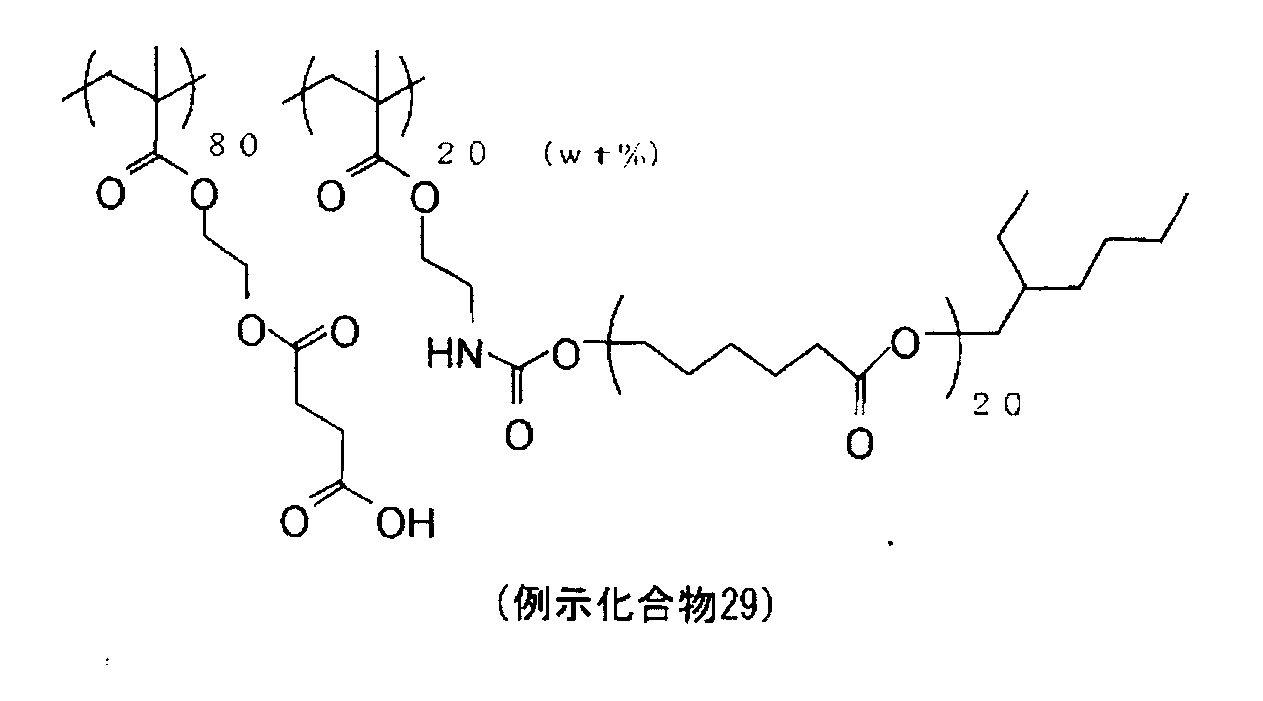
(感光性組成物の調製)
上記で得られた酸化ジルコニウム分散液(分散組成物)と、表3に示すアルカリ可溶性樹脂とを以下の組成にて混合して感光性組成物を得た。なお、以下の表3および4中のアルカリ可溶性樹脂の例示樹脂の番号は、上述した表1中の例示樹脂に該当する。
~組成~
上記で調製した酸化ジルコニウム分散液(分散組成物) 32.79部
光重合開始剤A1(BASF社製 IRGACURE OXE-01(下記K-1)) 1.14部
重合性化合物B1(ジペンタエリスリトールヘキサアクリレート、新中村化学工業(株)製、下記T-1) 4.23部
重合性化合物B2(M-1) 0.10部
アルカリ可溶性樹脂(下記表3参照) 3.09部
プロピレングリコールモノメチルエーテルアセテート(PGMEA) 58.65部
上記で得られた酸化ジルコニウム分散液(分散組成物)と、表3に示すアルカリ可溶性樹脂とを以下の組成にて混合して感光性組成物を得た。なお、以下の表3および4中のアルカリ可溶性樹脂の例示樹脂の番号は、上述した表1中の例示樹脂に該当する。
~組成~
上記で調製した酸化ジルコニウム分散液(分散組成物) 32.79部
光重合開始剤A1(BASF社製 IRGACURE OXE-01(下記K-1)) 1.14部
重合性化合物B1(ジペンタエリスリトールヘキサアクリレート、新中村化学工業(株)製、下記T-1) 4.23部
重合性化合物B2(M-1) 0.10部
アルカリ可溶性樹脂(下記表3参照) 3.09部
プロピレングリコールモノメチルエーテルアセテート(PGMEA) 58.65部

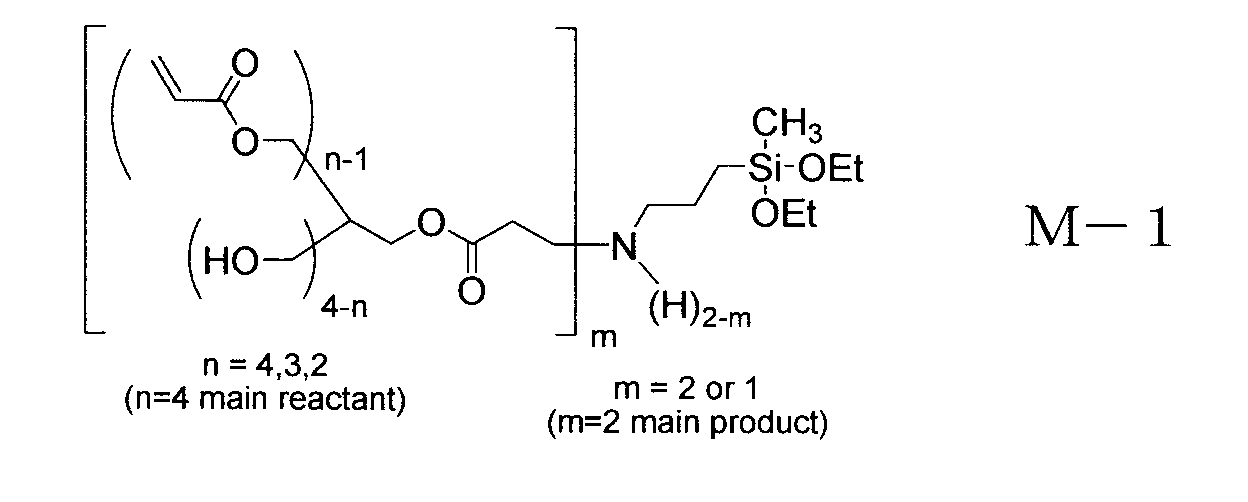
(屈折率及び透過率の測定)
上記で得られた感光性組成物をシリコンウエハ上にスピンコート法で塗布し、その後、ホットプレート上で100℃にて3分間加熱して膜厚1μmの感光性組成物層を得た。
次いで、得られた感光性組成物層に対して、i線ステッパーFPA-3000i5+(Canon(株)製)を使用して、365nmの波長で、露光量1000mJ/cm2にて全面露光を行った。
得られた硬化膜に関して、ジェー・エー・ウーラム・ジャパン社製エリプソメーター(VASE)を用いて、波長550nmの光に対する屈折率を測定した。また、この硬化膜に関して、大塚電子社製のMCPD Seriesを用いて、400nm~700nmの波長領域全域に渡る光透過率を測定した。
なお、以下の基準に沿って、屈折率を評価した。
「A」:屈折率が1.62超の場合
「B」:屈折率が1.62以下の場合
また、以下の基準に沿って、光透過率を評価した。
「A」:光透過率が90%超の場合
「B」:光透過率が90%以下の場合
上記で得られた感光性組成物をシリコンウエハ上にスピンコート法で塗布し、その後、ホットプレート上で100℃にて3分間加熱して膜厚1μmの感光性組成物層を得た。
次いで、得られた感光性組成物層に対して、i線ステッパーFPA-3000i5+(Canon(株)製)を使用して、365nmの波長で、露光量1000mJ/cm2にて全面露光を行った。
得られた硬化膜に関して、ジェー・エー・ウーラム・ジャパン社製エリプソメーター(VASE)を用いて、波長550nmの光に対する屈折率を測定した。また、この硬化膜に関して、大塚電子社製のMCPD Seriesを用いて、400nm~700nmの波長領域全域に渡る光透過率を測定した。
なお、以下の基準に沿って、屈折率を評価した。
「A」:屈折率が1.62超の場合
「B」:屈折率が1.62以下の場合
また、以下の基準に沿って、光透過率を評価した。
「A」:光透過率が90%超の場合
「B」:光透過率が90%以下の場合
(透明パターンの作製)
上記(屈折率及び透過率の測定)で記載の感光性組成物層に対して、一辺1.1μmの正方ピクセルがそれぞれ基板上の4mm×3mmの領域に配列されたマスクパターンを介して、i線ステッパーFPA-3000i5+(Canon(株)製)を使用して、365nmの波長で、露光量1000mJ/cm2にて露光を行った。
露光後の感光性組成物層に対し、テトラメチルアンモニウムハイドロオキサイドの0.3質量%水溶液を用い、23℃で60秒間パドル現像を行った。その後、スピンシャワーにて水を用いてリンスを行い、さらに純水にて水洗いを行った。その後、水滴を高圧のエアーで飛ばし、シリコンウエハを自然乾燥させ、200℃で300秒間、ホットプレートでポストベークを行い、シリコンウエハ上の膜厚1μmの透明パターン(硬化膜)を得た。
上記(屈折率及び透過率の測定)で記載の感光性組成物層に対して、一辺1.1μmの正方ピクセルがそれぞれ基板上の4mm×3mmの領域に配列されたマスクパターンを介して、i線ステッパーFPA-3000i5+(Canon(株)製)を使用して、365nmの波長で、露光量1000mJ/cm2にて露光を行った。
露光後の感光性組成物層に対し、テトラメチルアンモニウムハイドロオキサイドの0.3質量%水溶液を用い、23℃で60秒間パドル現像を行った。その後、スピンシャワーにて水を用いてリンスを行い、さらに純水にて水洗いを行った。その後、水滴を高圧のエアーで飛ばし、シリコンウエハを自然乾燥させ、200℃で300秒間、ホットプレートでポストベークを行い、シリコンウエハ上の膜厚1μmの透明パターン(硬化膜)を得た。
(リソグラフィー性能評価(リソ性評価))
得られた透明パターンの表面粗さ(Ra)をAFM(Digital Instrμments社製、Nano Scope)を用いて測定した。表面粗さRaの値は小さいほど好ましい。以下の基準に沿って、リソグラフィー性能を評価した。実用上、「A」または「B」が好ましい。
「A」:30nm未満
「B」:30nm以上50nm以下
「C」:50nm超
得られた透明パターンの表面粗さ(Ra)をAFM(Digital Instrμments社製、Nano Scope)を用いて測定した。表面粗さRaの値は小さいほど好ましい。以下の基準に沿って、リソグラフィー性能を評価した。実用上、「A」または「B」が好ましい。
「A」:30nm未満
「B」:30nm以上50nm以下
「C」:50nm超
(耐熱試験後の屈折率評価)
上記(屈折率及び透過率の測定)で得られた硬化膜を265℃のホットプレート上で5分間加熱した。以下の基準に沿って、耐熱試験後の屈折率評価を評価した。
「A」:屈折率が1.62超の場合
「B」:屈折率が1.62以下の場合
上記(屈折率及び透過率の測定)で得られた硬化膜を265℃のホットプレート上で5分間加熱した。以下の基準に沿って、耐熱試験後の屈折率評価を評価した。
「A」:屈折率が1.62超の場合
「B」:屈折率が1.62以下の場合
なお、以下の表2中の「N-1」は、以下の化合物である。式中の数値は、各繰り返し単位のモル%を表す。


表3に示すように、本発明の感光性組成物はリソグラフィー性能にも優れていると共に、該組成物を用いて得られた硬化膜は優れる屈折率を示した。なお、得られた硬化膜は透過率に優れると共に、耐熱試験後の屈折率にも優れていた。
特に、実施例3と4との比較から分かるように、縮合芳香環基としてナフチル基を使用した場合、よりリソグラフィー性能が優れることが確認された。
一方、特許文献1に開示される感光性組成物を用いた場合は、リソグラフィー性能及び屈折率特性に劣っていた。
特に、実施例3と4との比較から分かるように、縮合芳香環基としてナフチル基を使用した場合、よりリソグラフィー性能が優れることが確認された。
一方、特許文献1に開示される感光性組成物を用いた場合は、リソグラフィー性能及び屈折率特性に劣っていた。
実施例1~8の感光性組成物のそれぞれにおいて、NaClを50質量ppm、30質量ppm、または5質量ppm添加した組成物を調製した。
これらの感光性組成物をそれぞれ用いたこと以外は、実施例1~8と同様にして硬化膜を形成した。得られた硬化膜の各評価は上記実施例と同程度であり、かつ、硬化膜の欠陥の発生が低減されていることが確認できた。また、5質量ppm添加した組成物では、保存安定性が向上していることが確認できた。
これらの感光性組成物をそれぞれ用いたこと以外は、実施例1~8と同様にして硬化膜を形成した。得られた硬化膜の各評価は上記実施例と同程度であり、かつ、硬化膜の欠陥の発生が低減されていることが確認できた。また、5質量ppm添加した組成物では、保存安定性が向上していることが確認できた。
実施例1~8の感光性組成物のそれぞれにおいて、カルバゾール(分子量167)をアルカリ可溶性樹脂全質量に対して、10質量%、7質量%、または5質量%さらに添加した組成物を調製した。
これらの感光性組成物をそれぞれ用いたこと以外は、実施例1~8と同様にして硬化膜を形成した。得られた硬化膜の各評価は上記実施例と同程度であり、硬化膜の屈折率がより向上すること、露光量を減少させても硬化が促進できることが確認できた。
これらの感光性組成物をそれぞれ用いたこと以外は、実施例1~8と同様にして硬化膜を形成した。得られた硬化膜の各評価は上記実施例と同程度であり、硬化膜の屈折率がより向上すること、露光量を減少させても硬化が促進できることが確認できた。
<実施例B>
<実施例10>
(酸化チタン分散液1の調製)
下記組成の混合液に対し、循環型分散装置(ビーズミル)として、寿工業株式会社製ウルトラアペックスミル(商品名)を用いて分散処理を行い、酸化チタン分散液を得た。
~組成~
酸化チタン(石原産業製TTO-51C):2.36部
結晶形:ルチル、TiO2%:79~85%、Al2O3及びステアリン酸で表面処理、比表面積50~60m2/g、一次粒子径10~30nm、吸油量24~30g/100g
例示化合物29(30%PGMEA溶液):2.13部
プロピレングリコールモノメチルエーテルアセテート(PGMEA):5.51部
<実施例10>
(酸化チタン分散液1の調製)
下記組成の混合液に対し、循環型分散装置(ビーズミル)として、寿工業株式会社製ウルトラアペックスミル(商品名)を用いて分散処理を行い、酸化チタン分散液を得た。
~組成~
酸化チタン(石原産業製TTO-51C):2.36部
結晶形:ルチル、TiO2%:79~85%、Al2O3及びステアリン酸で表面処理、比表面積50~60m2/g、一次粒子径10~30nm、吸油量24~30g/100g
例示化合物29(30%PGMEA溶液):2.13部
プロピレングリコールモノメチルエーテルアセテート(PGMEA):5.51部
(感光性組成物の調製)
上記で得られた酸化チタン分散液(分散組成物)と、表4に示すアルカリ可溶性樹脂とを以下の組成で混合して感光性組成物を得た。なお、以下の表4中のアルカリ可溶性樹脂の例示樹脂の番号は、上述した表1又は2中の例示樹脂に該当する。
~組成~
上記で調製した酸化チタン分散液1(分散組成物) 26.84部
光重合開始剤A1(BASF社製 IRGACURE OXE-01(K-1)) 0.76部
重合性化合物B1(ジペンタエリスリトールヘキサアクリレート、T-1) 2.65部
アルカリ可溶性樹脂(表4参照) 1.01部
塩基性化合物(下記A-2、20%PGMEA溶液) 0.68部
界面活性剤(メガファックF-781F、1%シクロヘキサノン溶液) 2.50部
紫外線吸収剤(UV-503 大東化学(株)社製) 1.22部
プロピレングリコールモノメチルエーテルアセテート(PGMEA) 22.72部
シクロヘキサノン 41.62部
上記で得られた酸化チタン分散液(分散組成物)と、表4に示すアルカリ可溶性樹脂とを以下の組成で混合して感光性組成物を得た。なお、以下の表4中のアルカリ可溶性樹脂の例示樹脂の番号は、上述した表1又は2中の例示樹脂に該当する。
~組成~
上記で調製した酸化チタン分散液1(分散組成物) 26.84部
光重合開始剤A1(BASF社製 IRGACURE OXE-01(K-1)) 0.76部
重合性化合物B1(ジペンタエリスリトールヘキサアクリレート、T-1) 2.65部
アルカリ可溶性樹脂(表4参照) 1.01部
塩基性化合物(下記A-2、20%PGMEA溶液) 0.68部
界面活性剤(メガファックF-781F、1%シクロヘキサノン溶液) 2.50部
紫外線吸収剤(UV-503 大東化学(株)社製) 1.22部
プロピレングリコールモノメチルエーテルアセテート(PGMEA) 22.72部
シクロヘキサノン 41.62部

A-2の重量平均分子量(Mw)は9000であり、共重合比(モル比)は上記の通りである。
(屈折率及び透過率の測定)
上記で得られた感光性組成物をシリコンウエハ上にスピンコート法で塗布し、その後、ホットプレート上で90℃にて2分間加熱して膜厚0.6μmの感光性組成物層を得た。
次いで、得られた感光性組成物層に対して、i線ステッパーFPA-3000i5+(Canon(株)製)を使用して、365nmの波長で、露光量1000mJ/cm2にて全面露光を行った。
得られた硬化膜に関して、ジェー・エー・ウーラム・ジャパン社製エリプソメーター(VASE)を用いて、波長550nmの光に対する屈折率を測定した。また、この硬化膜に関して、大塚電子社製のMCPD Seriesを用いて、400nm~700nmの波長領域全域に渡る光透過率を測定した。なお、以下の基準に沿って屈折率及び透過率を評価した。
・屈折率
「A」:屈折率が1.74超の場合
「B」:屈折率が1.74以下の場合
・透過率
「A」:光透過率が90%超の場合
「B」:光透過率が90%以下の場合
上記で得られた感光性組成物をシリコンウエハ上にスピンコート法で塗布し、その後、ホットプレート上で90℃にて2分間加熱して膜厚0.6μmの感光性組成物層を得た。
次いで、得られた感光性組成物層に対して、i線ステッパーFPA-3000i5+(Canon(株)製)を使用して、365nmの波長で、露光量1000mJ/cm2にて全面露光を行った。
得られた硬化膜に関して、ジェー・エー・ウーラム・ジャパン社製エリプソメーター(VASE)を用いて、波長550nmの光に対する屈折率を測定した。また、この硬化膜に関して、大塚電子社製のMCPD Seriesを用いて、400nm~700nmの波長領域全域に渡る光透過率を測定した。なお、以下の基準に沿って屈折率及び透過率を評価した。
・屈折率
「A」:屈折率が1.74超の場合
「B」:屈折率が1.74以下の場合
・透過率
「A」:光透過率が90%超の場合
「B」:光透過率が90%以下の場合
(リソグラフィー性能評価(リソ性評価))
上記(屈折率及び透過率の測定)で記載の感光性組成物層に対して、一辺1.1μmの正方ピクセルがそれぞれ基板上の4mm×3mmの領域に配列されたマスクパターンを介して、i線ステッパーFPA-3000i5+(Canon(株)製)を使用して、365nmの波長で、露光量1000mJ/cm2にて露光を行った。
露光後の感光性組成物層に対し、テトラメチルアンモニウムハイドロオキサイドの0.2質量%水溶液を用い、23℃で60秒間パドル現像を行った。その後、スピンシャワーにて水を用いてリンスを行い、さらに純水にて水洗いを行った。その後、水滴を高圧のエアーで飛ばし、シリコンウエハを自然乾燥させ、200℃で480秒間、ホットプレートでポストベークを行い、シリコンウエハ上の膜厚0.6μmの透明パターン(硬化膜)を得た。以下の基準に沿ってリソグラフィー性能を評価した。
「A」:パターンが矩形ではっきりしており、残渣がない。
「B」:パターンが矩形ではっきりしているが、残渣がある。
「C」:パターンがつぶれて不鮮明であるが、残渣がない。
「D」:パターンがつぶれて不鮮明であり、残渣がある。
上記(屈折率及び透過率の測定)で記載の感光性組成物層に対して、一辺1.1μmの正方ピクセルがそれぞれ基板上の4mm×3mmの領域に配列されたマスクパターンを介して、i線ステッパーFPA-3000i5+(Canon(株)製)を使用して、365nmの波長で、露光量1000mJ/cm2にて露光を行った。
露光後の感光性組成物層に対し、テトラメチルアンモニウムハイドロオキサイドの0.2質量%水溶液を用い、23℃で60秒間パドル現像を行った。その後、スピンシャワーにて水を用いてリンスを行い、さらに純水にて水洗いを行った。その後、水滴を高圧のエアーで飛ばし、シリコンウエハを自然乾燥させ、200℃で480秒間、ホットプレートでポストベークを行い、シリコンウエハ上の膜厚0.6μmの透明パターン(硬化膜)を得た。以下の基準に沿ってリソグラフィー性能を評価した。
「A」:パターンが矩形ではっきりしており、残渣がない。
「B」:パターンが矩形ではっきりしているが、残渣がある。
「C」:パターンがつぶれて不鮮明であるが、残渣がない。
「D」:パターンがつぶれて不鮮明であり、残渣がある。
(耐熱試験後の屈折率評価)
上記(屈折率及び透過率の測定)で得られた硬化膜を265℃のホットプレート上で5分間加熱した。以下の基準に沿って、耐熱試験後の屈折率評価を評価した。
「A」:屈折率が1.74超の場合
「B」:屈折率が1.74以下の場合
上記(屈折率及び透過率の測定)で得られた硬化膜を265℃のホットプレート上で5分間加熱した。以下の基準に沿って、耐熱試験後の屈折率評価を評価した。
「A」:屈折率が1.74超の場合
「B」:屈折率が1.74以下の場合
<実施例11>
感光性組成物の組成を下記のように変更した以外は、実施例10と同様の手順に従って、各評価を行った。
~組成~
上記で調製した酸化チタン分散液1(分散組成物) 26.84部
光重合開始剤A1(BASF社製 IRGACURE OXE-01(K-1)) 0.76部
重合性化合物B1(ジペンタエリスリトールヘキサアクリレート、T-1) 2.65部
アルカリ可溶性樹脂(表4参照、28.9%シクロヘキサノン溶液) 3.50部
塩基性化合物(A-2、20%PGMEA溶液) 0.68部
界面活性剤(メガファックF-781F、1%シクロヘキサノン溶液) 2.50部
紫外線吸収剤(UV-503 大東化学(株)社製) 1.22部
プロピレングリコールモノメチルエーテルアセテート(PGMEA) 20.23部
シクロヘキサノン 41.62部
感光性組成物の組成を下記のように変更した以外は、実施例10と同様の手順に従って、各評価を行った。
~組成~
上記で調製した酸化チタン分散液1(分散組成物) 26.84部
光重合開始剤A1(BASF社製 IRGACURE OXE-01(K-1)) 0.76部
重合性化合物B1(ジペンタエリスリトールヘキサアクリレート、T-1) 2.65部
アルカリ可溶性樹脂(表4参照、28.9%シクロヘキサノン溶液) 3.50部
塩基性化合物(A-2、20%PGMEA溶液) 0.68部
界面活性剤(メガファックF-781F、1%シクロヘキサノン溶液) 2.50部
紫外線吸収剤(UV-503 大東化学(株)社製) 1.22部
プロピレングリコールモノメチルエーテルアセテート(PGMEA) 20.23部
シクロヘキサノン 41.62部
<実施例12>
感光性組成物の組成を下記のように変更した以外は、実施例10と同様の手順に従って、各評価を行った。
~組成~
上記で調製した酸化チタン分散液1(分散組成物) 31.58部
光重合開始剤A1(BASF社製 IRGACURE OXE-01(K-1)) 0.72部
重合性化合物B1(ジペンタエリスリトールヘキサアクリレート、T-1) 2.51部
アルカリ可溶性樹脂(表4参照、28.9%シクロヘキサノン溶液) 2.00部
塩基性化合物(A-2、20%PGMEA溶液) 0.72部
界面活性剤(メガファックF-781F、1%シクロヘキサノン溶液) 2.50部
紫外線吸収剤(UV-503 大東化学(株)社製) 1.26部
プロピレングリコールモノメチルエーテルアセテート(PGMEA) 17.50部
シクロヘキサノン 41.21部
感光性組成物の組成を下記のように変更した以外は、実施例10と同様の手順に従って、各評価を行った。
~組成~
上記で調製した酸化チタン分散液1(分散組成物) 31.58部
光重合開始剤A1(BASF社製 IRGACURE OXE-01(K-1)) 0.72部
重合性化合物B1(ジペンタエリスリトールヘキサアクリレート、T-1) 2.51部
アルカリ可溶性樹脂(表4参照、28.9%シクロヘキサノン溶液) 2.00部
塩基性化合物(A-2、20%PGMEA溶液) 0.72部
界面活性剤(メガファックF-781F、1%シクロヘキサノン溶液) 2.50部
紫外線吸収剤(UV-503 大東化学(株)社製) 1.26部
プロピレングリコールモノメチルエーテルアセテート(PGMEA) 17.50部
シクロヘキサノン 41.21部
<実施例13>
感光性組成物の組成を下記のように変更した以外は、実施例10と同様の手順に従って、各評価を行った。
~組成~
上記で調製した酸化チタン分散液1(分散組成物) 41.85部
光重合開始剤A1(BASF社製 IRGACURE OXE-01(K-1)) 1.10部
重合性化合物B1(ジペンタエリスリトールヘキサアクリレート、T-1) 2.26部
重合性化合物B3(新中村化学工業(株)社製 NKエステル A-DPH-12E) 1.85部
アルカリ可溶性樹脂(表4参照、30.0%シクロペンタノン溶液) 8.17部
界面活性剤(メガファックF-781F、1%シクロヘキサノン溶液) 2.50部
紫外線吸収剤(UV-503 大東化学(株)社製) 1.57部
プロピレングリコールモノメチルエーテルアセテート(PGMEA) 40.70部
感光性組成物の組成を下記のように変更した以外は、実施例10と同様の手順に従って、各評価を行った。
~組成~
上記で調製した酸化チタン分散液1(分散組成物) 41.85部
光重合開始剤A1(BASF社製 IRGACURE OXE-01(K-1)) 1.10部
重合性化合物B1(ジペンタエリスリトールヘキサアクリレート、T-1) 2.26部
重合性化合物B3(新中村化学工業(株)社製 NKエステル A-DPH-12E) 1.85部
アルカリ可溶性樹脂(表4参照、30.0%シクロペンタノン溶液) 8.17部
界面活性剤(メガファックF-781F、1%シクロヘキサノン溶液) 2.50部
紫外線吸収剤(UV-503 大東化学(株)社製) 1.57部
プロピレングリコールモノメチルエーテルアセテート(PGMEA) 40.70部
<実施例14>
感光性組成物の組成を下記のように変更した以外は、実施例10と同様の手順に従って、各評価を行った。
~組成~
上記で調製した酸化チタン分散液1(分散組成物) 41.85部
光重合開始剤A1(BASF社製 IRGACURE OXE-01(K-1)) 1.10部
重合性化合物B1(ジペンタエリスリトールヘキサアクリレート、T-1) 2.25部
重合性化合物B2(上記M-1) 0.02部
重合性化合物B3(新中村化学工業(株)社製 NKエステル A-DPH-12E) 1.84部
アルカリ可溶性樹脂(表4参照、30.0%シクロペンタノン溶液) 8.14部
界面活性剤(メガファックF-781F、1%シクロヘキサノン溶液) 2.50部
紫外線吸収剤(UV-503 大東化学(株)社製) 1.57部
プロピレングリコールモノメチルエーテルアセテート(PGMEA) 40.73部
感光性組成物の組成を下記のように変更した以外は、実施例10と同様の手順に従って、各評価を行った。
~組成~
上記で調製した酸化チタン分散液1(分散組成物) 41.85部
光重合開始剤A1(BASF社製 IRGACURE OXE-01(K-1)) 1.10部
重合性化合物B1(ジペンタエリスリトールヘキサアクリレート、T-1) 2.25部
重合性化合物B2(上記M-1) 0.02部
重合性化合物B3(新中村化学工業(株)社製 NKエステル A-DPH-12E) 1.84部
アルカリ可溶性樹脂(表4参照、30.0%シクロペンタノン溶液) 8.14部
界面活性剤(メガファックF-781F、1%シクロヘキサノン溶液) 2.50部
紫外線吸収剤(UV-503 大東化学(株)社製) 1.57部
プロピレングリコールモノメチルエーテルアセテート(PGMEA) 40.73部
<実施例15>
感光性組成物の組成を下記のように変更した以外は、実施例10と同様の手順に従って、各評価を行った。
~組成~
上記で調製した酸化チタン分散液1(分散組成物) 33.91部
光重合開始剤A1(BASF社製 IRGACURE OXE-01(K-1)) 0.56部
重合性化合物B4(日本化薬製 KAYARAD DPCA-60) 1.37部
アルカリ可溶性樹脂(表4参照、27.1%シクロペンタノン溶液) 4.96部
界面活性剤(メガファックF-781F、1%シクロヘキサノン溶液) 2.50部
紫外線吸収剤(UV-503 大東化学(株)社製) 0.80部
プロピレングリコールモノメチルエーテルアセテート(PGMEA) 13.84部
シクロヘキサノン 41.36部
塩基性化合物(A-2、20%PGMEA溶液) 0.70部
感光性組成物の組成を下記のように変更した以外は、実施例10と同様の手順に従って、各評価を行った。
~組成~
上記で調製した酸化チタン分散液1(分散組成物) 33.91部
光重合開始剤A1(BASF社製 IRGACURE OXE-01(K-1)) 0.56部
重合性化合物B4(日本化薬製 KAYARAD DPCA-60) 1.37部
アルカリ可溶性樹脂(表4参照、27.1%シクロペンタノン溶液) 4.96部
界面活性剤(メガファックF-781F、1%シクロヘキサノン溶液) 2.50部
紫外線吸収剤(UV-503 大東化学(株)社製) 0.80部
プロピレングリコールモノメチルエーテルアセテート(PGMEA) 13.84部
シクロヘキサノン 41.36部
塩基性化合物(A-2、20%PGMEA溶液) 0.70部
<実施例16>
感光性組成物の組成を下記のように変更した以外は、実施例10と同様の手順に従って、各評価を行った。
~組成~
上記で調製した酸化チタン分散液1(分散組成物) 33.91部
光重合開始剤A1(BASF社製 IRGACURE OXE-01(K-1)) 0.56部
重合性化合物B4(日本化薬製 KAYARAD DPCA-60) 1.37部
アルカリ可溶性樹脂(表4参照、29.2%シクロペンタノン溶液) 4.60部
界面活性剤(メガファックF-781F、1%シクロヘキサノン溶液) 2.50部
紫外線吸収剤(UV-503 大東化学(株)社製) 0.81部
プロピレングリコールモノメチルエーテルアセテート(PGMEA) 14.19部
シクロヘキサノン 41.36部
塩基性化合物(A-2、20%PGMEA溶液) 0.70部
感光性組成物の組成を下記のように変更した以外は、実施例10と同様の手順に従って、各評価を行った。
~組成~
上記で調製した酸化チタン分散液1(分散組成物) 33.91部
光重合開始剤A1(BASF社製 IRGACURE OXE-01(K-1)) 0.56部
重合性化合物B4(日本化薬製 KAYARAD DPCA-60) 1.37部
アルカリ可溶性樹脂(表4参照、29.2%シクロペンタノン溶液) 4.60部
界面活性剤(メガファックF-781F、1%シクロヘキサノン溶液) 2.50部
紫外線吸収剤(UV-503 大東化学(株)社製) 0.81部
プロピレングリコールモノメチルエーテルアセテート(PGMEA) 14.19部
シクロヘキサノン 41.36部
塩基性化合物(A-2、20%PGMEA溶液) 0.70部
<実施例17>
感光性組成物の組成を下記のように変更した以外は、実施例10と同様の手順に従って、各評価を行った。
~組成~
上記で調製した酸化チタン分散液1(分散組成物) 36.99部
光重合開始剤A1(BASF社製 IRGACURE OXE-01(K-1)) 0.49部
重合性化合物B4(日本化薬製 KAYARAD DPCA-60) 1.19部
アルカリ可溶性樹脂(表4参照、29.2%シクロペンタノン溶液) 2.42部
界面活性剤(メガファックF-781F、1%シクロヘキサノン溶液) 2.50部
紫外線吸収剤(UV-503 大東化学(株)社製) 0.80部
プロピレングリコールモノメチルエーテルアセテート(PGMEA) 13.55部
シクロヘキサノン 41.36部
塩基性化合物(A-2、20%PGMEA溶液) 0.70部
感光性組成物の組成を下記のように変更した以外は、実施例10と同様の手順に従って、各評価を行った。
~組成~
上記で調製した酸化チタン分散液1(分散組成物) 36.99部
光重合開始剤A1(BASF社製 IRGACURE OXE-01(K-1)) 0.49部
重合性化合物B4(日本化薬製 KAYARAD DPCA-60) 1.19部
アルカリ可溶性樹脂(表4参照、29.2%シクロペンタノン溶液) 2.42部
界面活性剤(メガファックF-781F、1%シクロヘキサノン溶液) 2.50部
紫外線吸収剤(UV-503 大東化学(株)社製) 0.80部
プロピレングリコールモノメチルエーテルアセテート(PGMEA) 13.55部
シクロヘキサノン 41.36部
塩基性化合物(A-2、20%PGMEA溶液) 0.70部
<実施例18>
顔料分散液(酸化チタン分散液)の調製、及び感光性組成物の調製において、組成を下記のように変更した以外は、実施例10と同様の手順に従って、各評価を行った。
(酸化チタン分散液の調製2)
~酸化チタン分散液組成~
酸化チタン(石原産業製TTO-51C):2.05部
結晶形:ルチル、TiO2%:79~85%、Al2O3及びステアリン酸で表面処理、比表面積50~60m2/g、一次粒子径10~30nm、吸油量24~30g/100g
例示化合物29(30%PGMEA溶液):1.50部
プロピレングリコールモノメチルエーテルアセテート(PGMEA):6.45部
~組成~(感光性組成物組成)
上記で調製した酸化チタン分散液2(分散組成物) 40.67部
光重合開始剤A1(BASF社製 IRGACURE OXE-01(K-1)) 0.49部
重合性化合物B4(日本化薬製 KAYARAD DPCA-60) 1.19部
アルカリ可溶性樹脂(表4参照、29.2%シクロペンタノン溶液) 3.86部
界面活性剤(メガファックF-781F、1%シクロヘキサノン溶液) 2.50部
紫外線吸収剤(UV-503 大東化学(株)社製) 0.80部
プロピレングリコールモノメチルエーテルアセテート(PGMEA) 8.43部
シクロヘキサノン 41.36部
塩基性化合物(A-2、20%PGMEA溶液) 0.70部
顔料分散液(酸化チタン分散液)の調製、及び感光性組成物の調製において、組成を下記のように変更した以外は、実施例10と同様の手順に従って、各評価を行った。
(酸化チタン分散液の調製2)
~酸化チタン分散液組成~
酸化チタン(石原産業製TTO-51C):2.05部
結晶形:ルチル、TiO2%:79~85%、Al2O3及びステアリン酸で表面処理、比表面積50~60m2/g、一次粒子径10~30nm、吸油量24~30g/100g
例示化合物29(30%PGMEA溶液):1.50部
プロピレングリコールモノメチルエーテルアセテート(PGMEA):6.45部
~組成~(感光性組成物組成)
上記で調製した酸化チタン分散液2(分散組成物) 40.67部
光重合開始剤A1(BASF社製 IRGACURE OXE-01(K-1)) 0.49部
重合性化合物B4(日本化薬製 KAYARAD DPCA-60) 1.19部
アルカリ可溶性樹脂(表4参照、29.2%シクロペンタノン溶液) 3.86部
界面活性剤(メガファックF-781F、1%シクロヘキサノン溶液) 2.50部
紫外線吸収剤(UV-503 大東化学(株)社製) 0.80部
プロピレングリコールモノメチルエーテルアセテート(PGMEA) 8.43部
シクロヘキサノン 41.36部
塩基性化合物(A-2、20%PGMEA溶液) 0.70部
<実施例19>
感光性組成物の組成を下記のように変更した以外は、実施例10と同様の手順に従って、各評価を行った。
~組成~
上記で調製した酸化チタン分散液2(分散組成物) 40.67部
光重合開始剤A1(BASF社製 IRGACURE OXE-01(K-1)) 0.49部
重合性化合物B4(日本化薬製 KAYARAD DPCA-60) 1.19部
アルカリ可溶性樹脂(表4参照、30.0%シクロペンタノン溶液) 3.75部
界面活性剤(メガファックF-781F、1%シクロヘキサノン溶液) 2.50部
紫外線吸収剤(UV-503 大東化学(株)社製) 0.81部
プロピレングリコールモノメチルエーテルアセテート(PGMEA) 8.53部
シクロヘキサノン 41.36部
塩基性化合物(A-2、20%PGMEA溶液) 0.70部
感光性組成物の組成を下記のように変更した以外は、実施例10と同様の手順に従って、各評価を行った。
~組成~
上記で調製した酸化チタン分散液2(分散組成物) 40.67部
光重合開始剤A1(BASF社製 IRGACURE OXE-01(K-1)) 0.49部
重合性化合物B4(日本化薬製 KAYARAD DPCA-60) 1.19部
アルカリ可溶性樹脂(表4参照、30.0%シクロペンタノン溶液) 3.75部
界面活性剤(メガファックF-781F、1%シクロヘキサノン溶液) 2.50部
紫外線吸収剤(UV-503 大東化学(株)社製) 0.81部
プロピレングリコールモノメチルエーテルアセテート(PGMEA) 8.53部
シクロヘキサノン 41.36部
塩基性化合物(A-2、20%PGMEA溶液) 0.70部
<実施例20>
感光性組成物の組成を下記のように変更した以外は、実施例10と同様の手順に従って、各評価を行った。
~組成~
上記で調製した酸化チタン分散液2(分散組成物) 40.67部
光重合開始剤A1(BASF社製 IRGACURE OXE-01(K-1)) 0.49部
重合性化合物B4(日本化薬製 KAYARAD DPCA-60) 1.07部
重合性化合物B5(下記構造式) 0.12部
アルカリ可溶性樹脂(表4参照、29.2%シクロペンタノン溶液) 3.86部
界面活性剤(メガファックF-781F、1%シクロヘキサノン溶液) 2.50部
紫外線吸収剤(UV-503 大東化学(株)社製) 0.81部
プロピレングリコールモノメチルエーテルアセテート(PGMEA) 8.43部
シクロヘキサノン 41.36部
塩基性化合物(A-2、20%PGMEA溶液) 0.70部
感光性組成物の組成を下記のように変更した以外は、実施例10と同様の手順に従って、各評価を行った。
~組成~
上記で調製した酸化チタン分散液2(分散組成物) 40.67部
光重合開始剤A1(BASF社製 IRGACURE OXE-01(K-1)) 0.49部
重合性化合物B4(日本化薬製 KAYARAD DPCA-60) 1.07部
重合性化合物B5(下記構造式) 0.12部
アルカリ可溶性樹脂(表4参照、29.2%シクロペンタノン溶液) 3.86部
界面活性剤(メガファックF-781F、1%シクロヘキサノン溶液) 2.50部
紫外線吸収剤(UV-503 大東化学(株)社製) 0.81部
プロピレングリコールモノメチルエーテルアセテート(PGMEA) 8.43部
シクロヘキサノン 41.36部
塩基性化合物(A-2、20%PGMEA溶液) 0.70部

<実施例21>
感光性組成物の組成を下記のように変更した以外は、実施例10と同様の手順に従って、各評価を行った。
~組成~
上記で調製した酸化チタン分散液2(分散組成物) 40.67部
光重合開始剤A1(BASF社製 IRGACURE OXE-01(K-1)) 0.49部
重合性化合物B4(日本化薬製 KAYARAD DPCA-60) 1.07部
重合性化合物B5 0.12部
アルカリ可溶性樹脂(表4参照、30.0%シクロペンタノン溶液) 3.75部
界面活性剤(メガファックF-781F、1%シクロヘキサノン溶液) 2.50部
紫外線吸収剤(UV-503 大東化学(株)社製) 0.81部
プロピレングリコールモノメチルエーテルアセテート(PGMEA) 8.53部
シクロヘキサノン 41.36部
塩基性化合物(A-2、20%PGMEA溶液) 0.70部
感光性組成物の組成を下記のように変更した以外は、実施例10と同様の手順に従って、各評価を行った。
~組成~
上記で調製した酸化チタン分散液2(分散組成物) 40.67部
光重合開始剤A1(BASF社製 IRGACURE OXE-01(K-1)) 0.49部
重合性化合物B4(日本化薬製 KAYARAD DPCA-60) 1.07部
重合性化合物B5 0.12部
アルカリ可溶性樹脂(表4参照、30.0%シクロペンタノン溶液) 3.75部
界面活性剤(メガファックF-781F、1%シクロヘキサノン溶液) 2.50部
紫外線吸収剤(UV-503 大東化学(株)社製) 0.81部
プロピレングリコールモノメチルエーテルアセテート(PGMEA) 8.53部
シクロヘキサノン 41.36部
塩基性化合物(A-2、20%PGMEA溶液) 0.70部
<実施例22>
感光性組成物の組成を下記のように変更した以外は、実施例10と同様の手順に従って、各評価を行った。
~組成~
上記で調製した酸化チタン分散液1(分散組成物) 31.58部
光重合開始剤A1(BASF社製 IRGACURE OXE-01(K-1)) 0.72部
重合性化合物B1(ジペンタエリスリトールヘキサアクリレート、T-1) 2.51部
アルカリ可溶性樹脂(表4参照、28.9%シクロヘキサノン溶液) 2.00部
塩基性化合物(A-2、20%PGMEA溶液) 0.72部
界面活性剤(メガファックF-781F、1%シクロヘキサノン溶液) 2.50部
紫外線吸収剤(UV-503 大東化学(株)社製) 1.26部
プロピレングリコールモノメチルエーテルアセテート(PGMEA) 17.50部
シクロヘキサノン 41.21部
感光性組成物の組成を下記のように変更した以外は、実施例10と同様の手順に従って、各評価を行った。
~組成~
上記で調製した酸化チタン分散液1(分散組成物) 31.58部
光重合開始剤A1(BASF社製 IRGACURE OXE-01(K-1)) 0.72部
重合性化合物B1(ジペンタエリスリトールヘキサアクリレート、T-1) 2.51部
アルカリ可溶性樹脂(表4参照、28.9%シクロヘキサノン溶液) 2.00部
塩基性化合物(A-2、20%PGMEA溶液) 0.72部
界面活性剤(メガファックF-781F、1%シクロヘキサノン溶液) 2.50部
紫外線吸収剤(UV-503 大東化学(株)社製) 1.26部
プロピレングリコールモノメチルエーテルアセテート(PGMEA) 17.50部
シクロヘキサノン 41.21部
<実施例23>
感光性組成物の組成を下記のように変更した以外は、実施例10と同様の手順に従って、各評価を行った。
~組成~
上記で調製した酸化チタン分散液1(分散組成物) 31.58部
光重合開始剤A1(BASF社製 IRGACURE OXE-01(K-1)) 0.72部
重合性化合物B1(ジペンタエリスリトールヘキサアクリレート、T-1) 2.51部
アルカリ可溶性樹脂(表4参照、28.9%シクロヘキサノン溶液) 2.00部
塩基性化合物(A-2、20%PGMEA溶液) 0.72部
界面活性剤(メガファックF-781F、1%シクロヘキサノン溶液) 2.50部
紫外線吸収剤(UV-503 大東化学(株)社製) 1.26部
プロピレングリコールモノメチルエーテルアセテート(PGMEA) 17.50部
シクロヘキサノン 41.21部
感光性組成物の組成を下記のように変更した以外は、実施例10と同様の手順に従って、各評価を行った。
~組成~
上記で調製した酸化チタン分散液1(分散組成物) 31.58部
光重合開始剤A1(BASF社製 IRGACURE OXE-01(K-1)) 0.72部
重合性化合物B1(ジペンタエリスリトールヘキサアクリレート、T-1) 2.51部
アルカリ可溶性樹脂(表4参照、28.9%シクロヘキサノン溶液) 2.00部
塩基性化合物(A-2、20%PGMEA溶液) 0.72部
界面活性剤(メガファックF-781F、1%シクロヘキサノン溶液) 2.50部
紫外線吸収剤(UV-503 大東化学(株)社製) 1.26部
プロピレングリコールモノメチルエーテルアセテート(PGMEA) 17.50部
シクロヘキサノン 41.21部
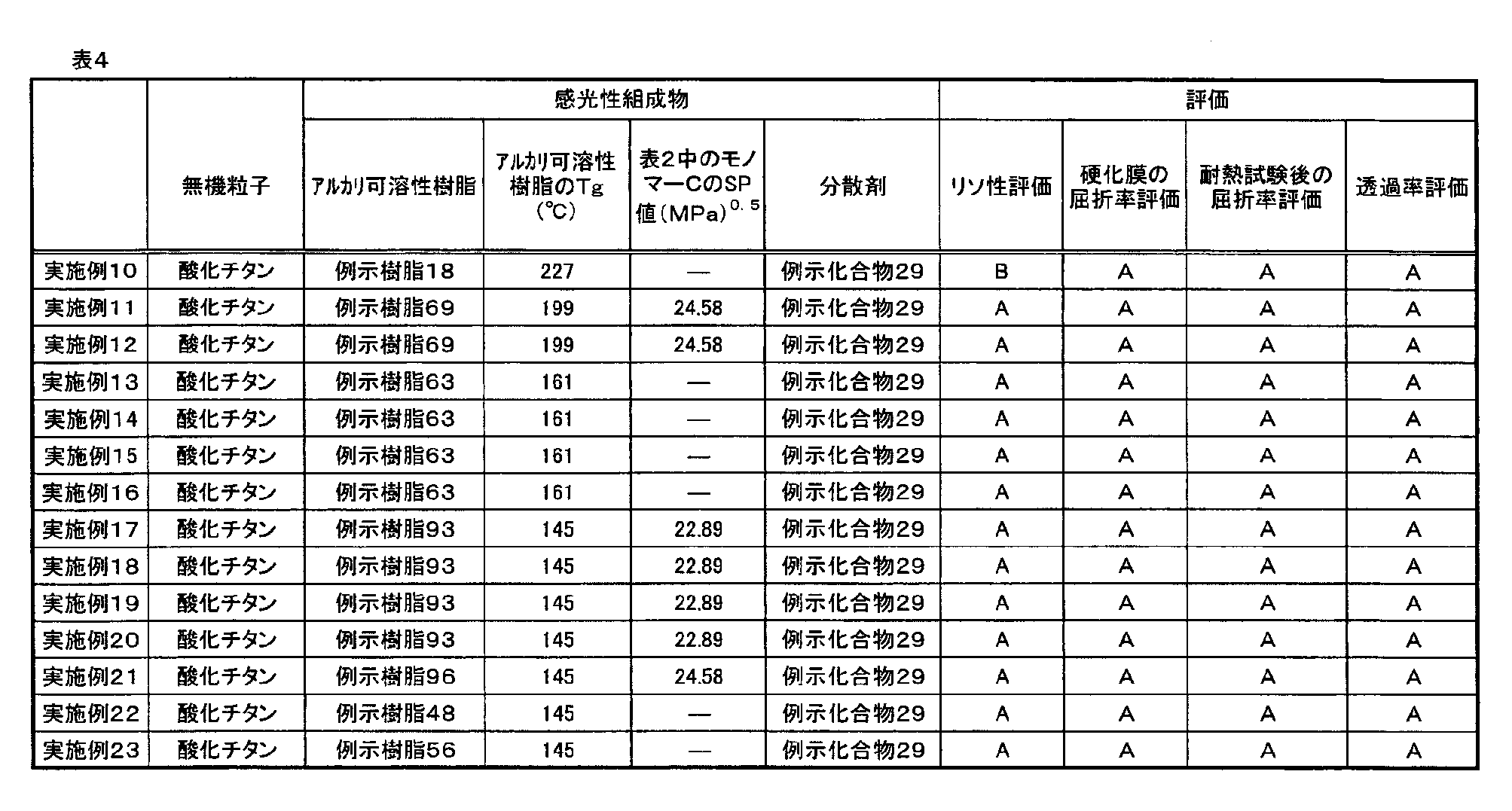
表4に示すように、無機粒子として酸化チタンを使用した場合においても、組成物はリソグラフィー性能に優れていると共に、この組成物を用いて得られた硬化膜は優れた屈折率を示した。
実施例10~23の感光性組成物のそれぞれにおいて、NaClを50質量ppm、30質量ppm、または5質量ppm添加した組成物を調製した。
これらの感光性組成物をそれぞれ用いたこと以外は、実施例10~23と同様にして硬化膜を形成した。得られた硬化膜の各評価は上記実施例と同程度であり、硬化膜の欠陥の発生が低減されていることが確認できた。また、5質量ppm添加した組成物では、保存安定性が向上していることが確認できた。
これらの感光性組成物をそれぞれ用いたこと以外は、実施例10~23と同様にして硬化膜を形成した。得られた硬化膜の各評価は上記実施例と同程度であり、硬化膜の欠陥の発生が低減されていることが確認できた。また、5質量ppm添加した組成物では、保存安定性が向上していることが確認できた。
実施例10~23の感光性組成物のそれぞれにおいて、カルバゾールをアルカリ可溶性樹脂全質量に対して、10質量%、7質量%、または5質量%さらに添加した組成物を調製した。
これらの感光性組成物をそれぞれ用いたこと以外は、実施例10~23と同様にして硬化膜を形成した。得られた硬化膜の各評価は上記実施例と同程度であり、硬化膜の屈折率がより向上すること、露光量を減少させても硬化が促進できることが確認できた。
これらの感光性組成物をそれぞれ用いたこと以外は、実施例10~23と同様にして硬化膜を形成した。得られた硬化膜の各評価は上記実施例と同程度であり、硬化膜の屈折率がより向上すること、露光量を減少させても硬化が促進できることが確認できた。
<実施例24>
感光性組成物の組成を下記のように変更した以外は、実施例10と同様の手順に従って、各評価を行った。なお、以下の感光性組成物中に含まれる成分は実施例11の感光性組成物中の成分と同じであるが、アルカリ可溶性樹脂由来のナトリウム元素量および組成物中に含まれるナトリウム元素量を後述する表5に示すように調整した。
~組成~
上記で調製した酸化チタン分散液1(分散組成物) 26.84部
光重合開始剤A1(BASF社製 IRGACURE OXE-01(K-1)) 0.76部
重合性化合物B1(ジペンタエリスリトールヘキサアクリレート、T-1) 2.65部アルカリ可溶性樹脂(例示化合物69、28.9%シクロヘキサノン溶液) 3.50部
塩基性化合物(A-2、20%PGMEA溶液) 0.68部
界面活性剤(メガファックF-781F、1%シクロヘキサノン溶液) 2.50部紫外線吸収剤(UV-503 大東化学(株)社製) 1.22部
プロピレングリコールモノメチルエーテルアセテート(PGMEA) 20.23部シクロヘキサノン 41.62部
感光性組成物の組成を下記のように変更した以外は、実施例10と同様の手順に従って、各評価を行った。なお、以下の感光性組成物中に含まれる成分は実施例11の感光性組成物中の成分と同じであるが、アルカリ可溶性樹脂由来のナトリウム元素量および組成物中に含まれるナトリウム元素量を後述する表5に示すように調整した。
~組成~
上記で調製した酸化チタン分散液1(分散組成物) 26.84部
光重合開始剤A1(BASF社製 IRGACURE OXE-01(K-1)) 0.76部
重合性化合物B1(ジペンタエリスリトールヘキサアクリレート、T-1) 2.65部アルカリ可溶性樹脂(例示化合物69、28.9%シクロヘキサノン溶液) 3.50部
塩基性化合物(A-2、20%PGMEA溶液) 0.68部
界面活性剤(メガファックF-781F、1%シクロヘキサノン溶液) 2.50部紫外線吸収剤(UV-503 大東化学(株)社製) 1.22部
プロピレングリコールモノメチルエーテルアセテート(PGMEA) 20.23部シクロヘキサノン 41.62部
<実施例25>
感光性組成物の組成を下記のように変更した以外は、実施例10と同様の手順に従って、各評価を行った。なお、以下の感光性組成物中に含まれる成分は実施例12の感光性組成物中の成分と同じであるが、アルカリ可溶性樹脂由来のナトリウム元素量および組成物中に含まれるナトリウム元素量を後述する表5に示すように調整した。
~組成~
上記で調製した酸化チタン分散液1(分散組成物) 31.58部
光重合開始剤A1(BASF社製 IRGACURE OXE-01(K-1)) 0.72部
重合性化合物B1(ジペンタエリスリトールヘキサアクリレート、T-1) 2.51部
アルカリ可溶性樹脂(例示化合物69、28.9%シクロヘキサノン溶液) 2.00部
塩基性化合物(A-2、20%PGMEA溶液) 0.72部
界面活性剤(メガファックF-781F、1%シクロヘキサノン溶液) 2.50部紫外線吸収剤(UV-503 大東化学(株)社製) 1.26部
プロピレングリコールモノメチルエーテルアセテート(PGMEA) 17.50部シクロヘキサノン 41.21部
感光性組成物の組成を下記のように変更した以外は、実施例10と同様の手順に従って、各評価を行った。なお、以下の感光性組成物中に含まれる成分は実施例12の感光性組成物中の成分と同じであるが、アルカリ可溶性樹脂由来のナトリウム元素量および組成物中に含まれるナトリウム元素量を後述する表5に示すように調整した。
~組成~
上記で調製した酸化チタン分散液1(分散組成物) 31.58部
光重合開始剤A1(BASF社製 IRGACURE OXE-01(K-1)) 0.72部
重合性化合物B1(ジペンタエリスリトールヘキサアクリレート、T-1) 2.51部
アルカリ可溶性樹脂(例示化合物69、28.9%シクロヘキサノン溶液) 2.00部
塩基性化合物(A-2、20%PGMEA溶液) 0.72部
界面活性剤(メガファックF-781F、1%シクロヘキサノン溶液) 2.50部紫外線吸収剤(UV-503 大東化学(株)社製) 1.26部
プロピレングリコールモノメチルエーテルアセテート(PGMEA) 17.50部シクロヘキサノン 41.21部
<実施例26>
感光性組成物の組成を下記のように変更した以外は、実施例10と同様の手順に従って、各評価を行った。なお、以下の感光性組成物中に含まれる成分は実施例21の感光性組成物中の成分と同じであるが、アルカリ可溶性樹脂由来のナトリウム元素量および組成物中に含まれるナトリウム元素量を後述する表5に示すように調整した。
~組成~
上記で調製した酸化チタン分散液2(分散組成物) 40.67部
光重合開始剤A1(BASF社製 IRGACURE OXE-01(K-1)) 0.49部
重合性化合物B4(日本化薬製 KAYARAD DPCA-60) 1.07部
重合性化合物B5 0.12部
アルカリ可溶性樹脂(例示化合物96、30.0%シクロペンタノン溶液) 3.75部
界面活性剤(メガファックF-781F、1%シクロヘキサノン溶液) 2.50部
紫外線吸収剤(UV-503 大東化学(株)社製) 0.81部
プロピレングリコールモノメチルエーテルアセテート(PGMEA) 8.53部
シクロヘキサノン 41.36部
塩基性化合物(A-2、20%PGMEA溶液) 0.70部
感光性組成物の組成を下記のように変更した以外は、実施例10と同様の手順に従って、各評価を行った。なお、以下の感光性組成物中に含まれる成分は実施例21の感光性組成物中の成分と同じであるが、アルカリ可溶性樹脂由来のナトリウム元素量および組成物中に含まれるナトリウム元素量を後述する表5に示すように調整した。
~組成~
上記で調製した酸化チタン分散液2(分散組成物) 40.67部
光重合開始剤A1(BASF社製 IRGACURE OXE-01(K-1)) 0.49部
重合性化合物B4(日本化薬製 KAYARAD DPCA-60) 1.07部
重合性化合物B5 0.12部
アルカリ可溶性樹脂(例示化合物96、30.0%シクロペンタノン溶液) 3.75部
界面活性剤(メガファックF-781F、1%シクロヘキサノン溶液) 2.50部
紫外線吸収剤(UV-503 大東化学(株)社製) 0.81部
プロピレングリコールモノメチルエーテルアセテート(PGMEA) 8.53部
シクロヘキサノン 41.36部
塩基性化合物(A-2、20%PGMEA溶液) 0.70部
上記実施例24~実施例26の上記「リソ性評価」「硬化膜の屈折率評価」「耐熱試験後の屈折率評価」および「透過率評価」の各種評価結果は、それぞれ実施例11、実施例12、および、実施例21と同程度であった。
(表面観察)
実施例11、12、21、24~26の感光性組成物をそれぞれ8インチのシリコンウエハ上に塗布して、塗膜を形成し、塗膜表面を光学顕微鏡にて観察して、1μm以上の異物および穴の総数を評価した。結果を表5にまとめて示す。
なお、表5中のナトリウム元素量は、ICP-MSで評価して求めた。
以下、表5中、「<0.01質量ppm」とは、0.01質量ppm未満であることを意図する。
以下「Na量(アルカリ可溶性樹脂由来)」欄は、アルカリ可溶性樹脂由来のナトリウム元素量を意図し、「Na量(感光性組成物)」欄は、組成物中に含まれるナトリウム元素量(総量)を意図する。
実施例11、12、21、24~26の感光性組成物をそれぞれ8インチのシリコンウエハ上に塗布して、塗膜を形成し、塗膜表面を光学顕微鏡にて観察して、1μm以上の異物および穴の総数を評価した。結果を表5にまとめて示す。
なお、表5中のナトリウム元素量は、ICP-MSで評価して求めた。
以下、表5中、「<0.01質量ppm」とは、0.01質量ppm未満であることを意図する。
以下「Na量(アルカリ可溶性樹脂由来)」欄は、アルカリ可溶性樹脂由来のナトリウム元素量を意図し、「Na量(感光性組成物)」欄は、組成物中に含まれるナトリウム元素量(総量)を意図する。
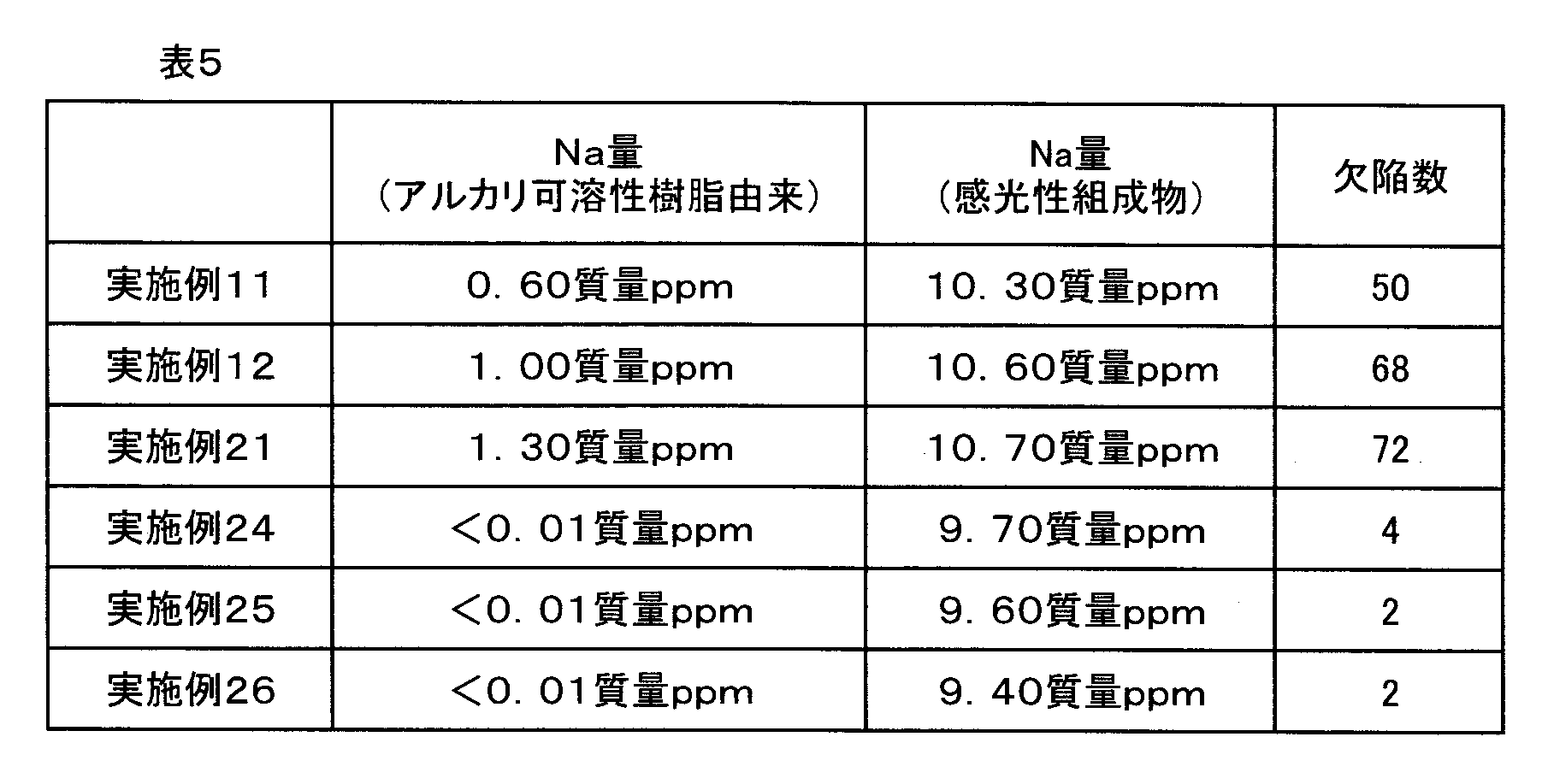
上記表に示すように、ナトリウム元素量が少ないほうが、欠陥が少ないことが確認された。特にアルカリ可溶性樹脂由来のナトリウム元素量が少ないほうが、欠陥数が少ないことが確認された。
Claims (16)
- 式(X)で表される繰り返し単位を有するアルカリ可溶性樹脂と、無機粒子と、分散剤と、光重合開始剤と、重合性化合物とを少なくとも含む感光性組成物。

(式(X)中、R1は、水素原子又はアルキル基を表す。L1は、単結合又は2価の連結基を表す。Aは、置換又は無置換の縮合芳香環基を表す。) - ガラス転移温度(Tg)が100~250℃であるアルカリ可溶性樹脂と、無機粒子と、分散剤と、光重合開始剤と、重合性化合物とを少なくとも含む感光性組成物。
- 前記アルカリ可溶性樹脂のガラス転移温度(Tg)が100~250℃である、請求項1に記載の感光性組成物。
- 前記Aが、カルバゾリル基、ナフチル基、ベンゾチアゾリル基、ベンゾオキサゾリル基、及び、ベンゾトリアゾリル基からなる群から選択される、請求項1または3に記載の感光性組成物。
- 前記Aが、カルバゾリル基又はナフチル基である、請求項1及び3~4のいずれか1項に記載の感光性組成物。
- 前記アルカリ可溶性樹脂が、さらに、親水性基(ただし、酸基を除く)を有する繰り返し単位を有する、請求項1~5のいずれか1項に記載の感光性組成物。
- 前記親水性基が、ヒドロキシ基である、請求項6に記載の感光性組成物。
- 前記分散剤が、オリゴイミン系分散剤、または、式(1)~式(4)のいずれかで表される構造単位を含む樹脂である、請求項1~7のいずれか1項に記載の感光性組成物。
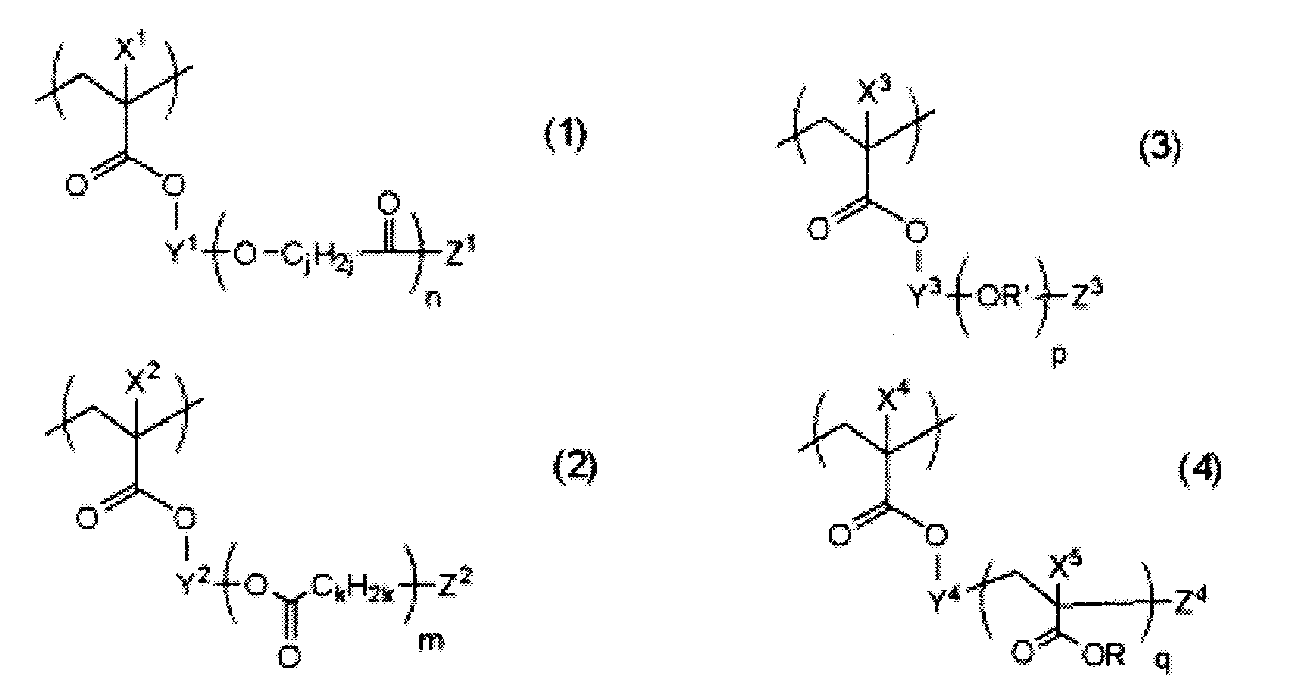
(式(1)~式(4)において、X1、X2、X3、X4、及び、X5は、それぞれ独立に、水素原子又は1価の有機基を表す。
R’は、分岐又は直鎖のアルキレン基を表す。
Y1、Y2、Y3、及び、Y4は、それぞれ独立に、2価の連結基を表す。
Z1、Z2、Z3、及び、Z4は、それぞれ独立に、水素原子又は1価の有機基を表す。
n、m、p、及び、qは、それぞれ独立に、1から500の整数である。j及びkは、それぞれ独立に、2~8の整数を表す。
Rは、水素原子又は1価の有機基を表す。) - 前記無機粒子が、酸化チタンまたは酸化ジルコニウムを含む、請求項1~8のいずれか1項に記載の感光性組成物。
- さらに、カルバゾール構造を有する低分子化合物を含有する、請求項1~9のいずれか1項に記載の感光性組成物。
- さらに、NaClを含有する、請求項1~10のいずれか1項に記載の感光性組成物。
- カラーフィルタ形成用として用いられる、請求項1~11のいずれか1項に記載の感光性組成物。
- 請求項12に記載のカラーフィルタ形成用の感光性組成物を塗布して塗布層を形成し、前記塗布層を露光し、現像することによりパターンを形成して、硬化膜を得ることを含む、固体撮像素子のカラーフィルタの製造方法。
- 請求項1~12のいずれか1項に記載の感光性組成物を用いて得られるカラーフィルタ。
- 請求項14に記載のカラーフィルタを備えた固体撮像素子。
- ガラス転移温度(Tg)が100℃以上で、式(X)で表される繰り返し単位及び親水性基(ただし、酸基を除く)を有する繰り返し単位を有するアルカリ可溶性樹脂と、無機粒子と、分散剤とを少なくとも含む分散組成物。
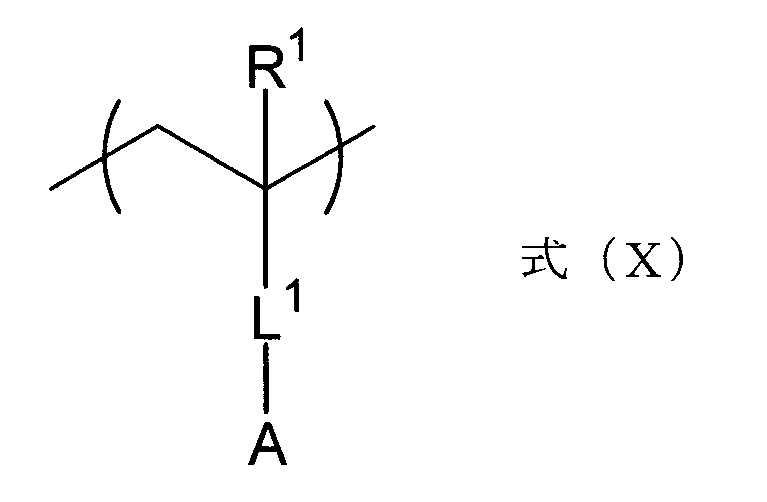
(式(X)中、R1は、水素原子又はアルキル基を表す。L1は、単結合又は2価の連結基を表す。Aは、置換又は無置換の縮合芳香環基を表す。)
Applications Claiming Priority (6)
| Application Number | Priority Date | Filing Date | Title |
|---|---|---|---|
| JP2013-213399 | 2013-10-11 | ||
| JP2013213399 | 2013-10-11 | ||
| JP2014-031639 | 2014-02-21 | ||
| JP2014031639 | 2014-02-21 | ||
| JP2014109552 | 2014-05-27 | ||
| JP2014-109552 | 2014-05-27 |
Publications (1)
| Publication Number | Publication Date |
|---|---|
| WO2015053183A1 true WO2015053183A1 (ja) | 2015-04-16 |
Family
ID=52812999
Family Applications (1)
| Application Number | Title | Priority Date | Filing Date |
|---|---|---|---|
| PCT/JP2014/076530 Ceased WO2015053183A1 (ja) | 2013-10-11 | 2014-10-03 | 感光性組成物、分散組成物、これを用いたカラーフィルタの製造方法、カラーフィルタ、及び、固体撮像素子 |
Country Status (3)
| Country | Link |
|---|---|
| JP (1) | JP6140661B2 (ja) |
| TW (1) | TW201514237A (ja) |
| WO (1) | WO2015053183A1 (ja) |
Cited By (3)
| Publication number | Priority date | Publication date | Assignee | Title |
|---|---|---|---|---|
| WO2021199748A1 (ja) * | 2020-03-30 | 2021-10-07 | 富士フイルム株式会社 | 組成物、膜及び光センサ |
| US11294280B2 (en) * | 2017-08-21 | 2022-04-05 | Fujifilm Corporation | Coloring composition, cured film, pattern forming method, color filter, solid-state imaging element, and image display device |
| WO2024043111A1 (ja) * | 2022-08-22 | 2024-02-29 | 富士フイルム株式会社 | 感光性組成物、膜および光センサ |
Families Citing this family (6)
| Publication number | Priority date | Publication date | Assignee | Title |
|---|---|---|---|---|
| KR102349787B1 (ko) * | 2017-11-08 | 2022-01-12 | 주식회사 이엔에프테크놀로지 | 알칼리 가용성 수지 및 이를 포함하는 감광성 수지 조성물 |
| KR102652548B1 (ko) * | 2019-06-27 | 2024-03-29 | 후지필름 가부시키가이샤 | 조성물, 막 및 광 센서 |
| JP7413762B2 (ja) * | 2019-12-23 | 2024-01-16 | 東洋インキScホールディングス株式会社 | 硬化性樹脂組成物、および硬化膜 |
| EP4083142B1 (en) | 2019-12-25 | 2025-08-13 | FUJIFILM Corporation | Resin composition, cured product, uv absorber, uv cut filter, lens, protective material, compound, and method for synthesizing compound |
| EP4201932B1 (en) | 2020-08-21 | 2025-01-08 | FUJIFILM Corporation | Polymerizable composition, polymer, ultraviolet shielding material, laminate, compound, ultraviolet absorbing agent, and method for producing compound |
| USD1121497S1 (en) * | 2024-08-29 | 2026-04-07 | Liaoning Aroma International Trade Co., LTD | Halloween decoration |
Citations (5)
| Publication number | Priority date | Publication date | Assignee | Title |
|---|---|---|---|---|
| JPS63248839A (ja) * | 1987-04-03 | 1988-10-17 | Kansai Paint Co Ltd | 水性顔料分散液 |
| JPH06256702A (ja) * | 1993-03-04 | 1994-09-13 | Toyo Ink Mfg Co Ltd | 着色用組成物 |
| JP2011237643A (ja) * | 2010-05-11 | 2011-11-24 | Kaneka Corp | 新規な感光性樹脂組成物及びその利用 |
| JP2013064979A (ja) * | 2011-08-31 | 2013-04-11 | Fujifilm Corp | 感放射線性組成物、パターン形成方法、カラーフィルタ及びその製造方法、並びに、固体撮像素子 |
| JP2013083949A (ja) * | 2011-09-26 | 2013-05-09 | Fujifilm Corp | 平版印刷版の製版方法 |
Family Cites Families (7)
| Publication number | Priority date | Publication date | Assignee | Title |
|---|---|---|---|---|
| JP4994136B2 (ja) * | 2006-07-26 | 2012-08-08 | 富士フイルム株式会社 | 感光性組成物、感光性樹脂転写フイルム及びフォトスペーサーの製造方法並びに液晶表示装置用基板、及び液晶表示装置 |
| JP5157522B2 (ja) * | 2008-02-28 | 2013-03-06 | Jsr株式会社 | 着色層形成用感放射線性組成物、カラーフィルタおよびカラー液晶表示素子 |
| JP2009282408A (ja) * | 2008-05-23 | 2009-12-03 | Nippon Shokubai Co Ltd | 画像形成用硬化性組成物およびその用途 |
| JP5357077B2 (ja) * | 2009-02-12 | 2013-12-04 | 富士フイルム株式会社 | インク組成物 |
| JP5505726B2 (ja) * | 2009-10-28 | 2014-05-28 | ナガセケムテックス株式会社 | 複合樹脂組成物 |
| JP2011221310A (ja) * | 2010-04-09 | 2011-11-04 | Fujifilm Corp | カラーフィルタ用光硬化性青色着色組成物、カラーフィルタ、カラーフィルタの製造方法、及び液晶表示装置 |
| JP5816428B2 (ja) * | 2010-12-24 | 2015-11-18 | 富士フイルム株式会社 | 固体撮像素子のカラーフィルタ用感光性透明組成物、並びに、これを用いた固体撮像素子のカラーフィルタの製造方法、固体撮像素子のカラーフィルタ、及び、固体撮像素子 |
-
2014
- 2014-10-03 JP JP2014204650A patent/JP6140661B2/ja active Active
- 2014-10-03 WO PCT/JP2014/076530 patent/WO2015053183A1/ja not_active Ceased
- 2014-10-09 TW TW103135130A patent/TW201514237A/zh unknown
Patent Citations (5)
| Publication number | Priority date | Publication date | Assignee | Title |
|---|---|---|---|---|
| JPS63248839A (ja) * | 1987-04-03 | 1988-10-17 | Kansai Paint Co Ltd | 水性顔料分散液 |
| JPH06256702A (ja) * | 1993-03-04 | 1994-09-13 | Toyo Ink Mfg Co Ltd | 着色用組成物 |
| JP2011237643A (ja) * | 2010-05-11 | 2011-11-24 | Kaneka Corp | 新規な感光性樹脂組成物及びその利用 |
| JP2013064979A (ja) * | 2011-08-31 | 2013-04-11 | Fujifilm Corp | 感放射線性組成物、パターン形成方法、カラーフィルタ及びその製造方法、並びに、固体撮像素子 |
| JP2013083949A (ja) * | 2011-09-26 | 2013-05-09 | Fujifilm Corp | 平版印刷版の製版方法 |
Cited By (3)
| Publication number | Priority date | Publication date | Assignee | Title |
|---|---|---|---|---|
| US11294280B2 (en) * | 2017-08-21 | 2022-04-05 | Fujifilm Corporation | Coloring composition, cured film, pattern forming method, color filter, solid-state imaging element, and image display device |
| WO2021199748A1 (ja) * | 2020-03-30 | 2021-10-07 | 富士フイルム株式会社 | 組成物、膜及び光センサ |
| WO2024043111A1 (ja) * | 2022-08-22 | 2024-02-29 | 富士フイルム株式会社 | 感光性組成物、膜および光センサ |
Also Published As
| Publication number | Publication date |
|---|---|
| JP2016006475A (ja) | 2016-01-14 |
| JP6140661B2 (ja) | 2017-05-31 |
| TW201514237A (zh) | 2015-04-16 |
Similar Documents
| Publication | Publication Date | Title |
|---|---|---|
| JP7232881B2 (ja) | 着色感光性組成物、硬化膜、パターン形成方法、遮光膜付き赤外光カットフィルタ、固体撮像素子、画像表示装置および赤外線センサ | |
| KR101566838B1 (ko) | 고체 촬상 소자의 컬러필터용 감광성 투명 조성물, 및 이것을 사용한 고체 촬상 소자의 컬러필터의 제조 방법, 고체 촬상 소자의 컬러필터 및 고체 촬상 소자 | |
| JP6140661B2 (ja) | 感光性組成物、分散組成物、これを用いたカラーフィルタの製造方法、カラーフィルタ、及び、固体撮像素子 | |
| JP6170673B2 (ja) | カラーフィルタ用組成物、赤外線透過フィルタ及びその製造方法、並びに赤外線センサー | |
| KR101784247B1 (ko) | 중합성 조성물, 경화막, 컬러필터, 컬러필터의 제조 방법, 및 고체 촬상 소자 | |
| JP6860500B2 (ja) | 感放射線性樹脂組成物、硬化膜、パターン形成方法、固体撮像素子および画像表示装置 | |
| JP6731475B2 (ja) | 感光性組成物、カラーフィルタ、パターン形成方法、固体撮像素子および画像表示装置 | |
| JP6122454B2 (ja) | カラーフィルタ用赤色着色組成物、着色膜、カラーフィルタ、固体撮像素子 | |
| JP5734913B2 (ja) | 感放射線性組成物、パターン形成方法、カラーフィルタ及びその製造方法、並びに、固体撮像素子 | |
| JP7126537B2 (ja) | 着色組成物、着色組成物の製造方法、カラーフィルタ、パターン形成方法、固体撮像素子、および、画像表示装置 | |
| JP2015151530A (ja) | 複合体およびその製造方法、着色組成物、硬化膜、カラーフィルタ、カラーフィルタの製造方法、固体撮像素子および画像表示装置、ならびに、積層体よび積層体 | |
| JP2015163956A (ja) | カラーフィルタ用緑色着色組成物、着色膜、カラーフィルタ、固体撮像素子 | |
| JP6061828B2 (ja) | 樹脂組成物、赤外線透過フィルタおよびその製造方法ならびに赤外線センサ | |
| TWI795360B (zh) | 硬化膜形成用組成物、硬化膜、彩色濾光片、遮光膜、固體攝像裝置及圖像顯示裝置 | |
| JP6840220B2 (ja) | 樹脂組成物、膜、赤外線カットフィルタ及びその製造方法、固体撮像素子、赤外線センサ、並びに、カメラモジュール | |
| WO2018155104A1 (ja) | 感光性組成物、硬化膜、カラーフィルタ、固体撮像素子および画像表示装置 | |
| JP2011141512A (ja) | 黒色硬化性組成物、遮光性カラーフィルタ、固体撮像素子、ウエハレベルレンズ、遮光膜およびその製造方法 | |
| WO2016072259A1 (ja) | 着色硬化性組成物、カラーフィルタ、パターン形成方法、カラーフィルタの製造方法、固体撮像素子、および、画像表示装置 | |
| JP6496398B2 (ja) | 分散組成物、感光性組成物、カラーフィルタおよびその製造方法、ならびに、固体撮像素子 | |
| WO2019130807A1 (ja) | 組成物、膜、カラーフィルタ、固体撮像素子、画像表示装置および化合物の製造方法 | |
| WO2019065128A1 (ja) | 光硬化性組成物、積層体、及び、固体撮像素子 | |
| JP6435039B2 (ja) | 着色組成物、着色組成物の製造方法、カラーフィルタ、インクジェット用インク組成物および印刷用インク組成物 | |
| WO2015016041A1 (ja) | カラーフィルタ、その製造方法、着色硬化性組成物、固体撮像素子、着色硬化性組成物およびキット | |
| JP2013054079A (ja) | 光硬化性組成物、カラーフィルタ及びその製造方法、並びに固体撮像素子 | |
| JP2017116955A (ja) | 赤外線透過フィルタ用組成物、赤外線透過フィルタ、赤外線透過フィルタの製造方法、及び、赤外線センサー |
Legal Events
| Date | Code | Title | Description |
|---|---|---|---|
| 121 | Ep: the epo has been informed by wipo that ep was designated in this application |
Ref document number: 14851779 Country of ref document: EP Kind code of ref document: A1 |
|
| NENP | Non-entry into the national phase |
Ref country code: DE |
|
| 122 | Ep: pct application non-entry in european phase |
Ref document number: 14851779 Country of ref document: EP Kind code of ref document: A1 |