WO2015037201A1 - 鋼材の冷却方法、鋼材の製造方法、鋼材冷却設備および鋼材製造設備 - Google Patents
鋼材の冷却方法、鋼材の製造方法、鋼材冷却設備および鋼材製造設備 Download PDFInfo
- Publication number
- WO2015037201A1 WO2015037201A1 PCT/JP2014/004443 JP2014004443W WO2015037201A1 WO 2015037201 A1 WO2015037201 A1 WO 2015037201A1 JP 2014004443 W JP2014004443 W JP 2014004443W WO 2015037201 A1 WO2015037201 A1 WO 2015037201A1
- Authority
- WO
- WIPO (PCT)
- Prior art keywords
- steel material
- cooling
- water
- steel
- water tank
- Prior art date
- Legal status (The legal status is an assumption and is not a legal conclusion. Google has not performed a legal analysis and makes no representation as to the accuracy of the status listed.)
- Ceased
Links
Images



Classifications
-
- C—CHEMISTRY; METALLURGY
- C21—METALLURGY OF IRON
- C21D—MODIFYING THE PHYSICAL STRUCTURE OF FERROUS METALS; GENERAL DEVICES FOR HEAT TREATMENT OF FERROUS OR NON-FERROUS METALS OR ALLOYS; MAKING METAL MALLEABLE, e.g. BY DECARBURISATION OR TEMPERING
- C21D1/00—General methods or devices for heat treatment, e.g. annealing, hardening, quenching or tempering
- C21D1/62—Quenching devices
- C21D1/63—Quenching devices for bath quenching
Definitions
- the present invention relates to a steel material cooling method, a steel material manufacturing method, a steel material cooling facility, and a steel material manufacturing facility.
- quenching is performed by a method of roller quenching offline.
- a conveyance problem such as bending of the table roller occurs. Therefore, in the case of such a thick steel material, the quenching treatment is performed by a method of immersing in water and cooling.
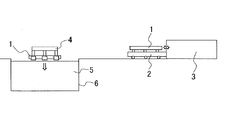
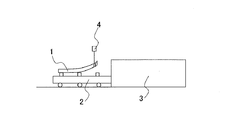
- the quenching treatment of steel material that is immersed and cooled in water (hereinafter sometimes simply referred to as immersion cooling) is performed by heating the steel material 1 in a heating furnace 3 with a carriage 2 in the equipment as shown in FIG. 1 or FIG. After that, the steel material 1 is hung by a lifting tool 4 such as a crane and immersed in a water tank 6 filled with water 5 so that the long side direction of the wide surface portion of the steel material is vertical or horizontal.
- a lifting tool 4 such as a crane and immersed in a water tank 6 filled with water 5 so that the long side direction of the wide surface portion of the steel material is vertical or horizontal.
- Patent Document 1 is a water-cooling method of a steel slab characterized in that the steel slab is immersed in water in a vertical direction so that the wide surface of the steel slab is a side surface, and water is jetted from both sides of the steel slab. It is intended to cool.
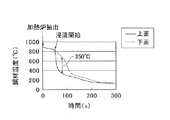
- the temperature history of the upper and lower surfaces becomes as shown in FIG. 5, and the bottom surface temperature of the steel material is 350 ° C. higher than the top surface temperature.
- the present invention has been made in view of the above circumstances, and provides a method for cooling a steel material that promotes cooling of the lower surface of the steel material to obtain a high-strength and high-toughness material and that does not warp during cooling.
- the purpose is to do.
- the present invention has been made to solve the above-described conventional problems, and the means thereof is as follows.
- the steel material was stored with water more than 20 times the steel material volume so that the wide surface portion of the steel material was the upper and lower surfaces, and the inclination angle from the horizontal plane in the short side direction of the steel material was 15 ° to 45 °.
- a method for cooling a steel material wherein the method is immersed in a water tank.
- the steel material was stored with water more than 20 times the volume of the steel material so that the inclination angle from the horizontal plane in the short side direction of the steel material was 15 ° or more and 75 ° or less.
- a method for cooling a steel material wherein the method is immersed in a water tank.
- the step of heating the steel material and the steel material so that the inclined angle from the horizontal surface in the short side direction of the wide surface portion of the steel material is 15 ° or more and 45 ° or less with the wide surface portion of the heated steel material as the upper and lower surfaces.
- a step of immersing in a water tank storing water of 20 times or more in volume.
- the step of heating the steel material and the steel material so that the inclined angle from the horizontal plane in the short side direction of the wide surface portion of the steel material is 15 ° or more and 75 ° or less with the wide surface portion of the heated steel material as the upper and lower surfaces.
- a step of immersing in a water tank storing water of 20 times or more in volume [5]
- the steel material is stored in the water tank so that an inclination angle from a horizontal surface in the short side direction of the wide surface portion of the steel material is 15 ° or more and 45 ° or less, with water stored 20 times or more of the steel material volume.
- a steel material cooling facility comprising a dipping member to be held.
- the steel material is stored in the water tank so that an angle of inclination from a horizontal surface in the short side direction of the wide surface portion of the steel material is 15 ° or more and 75 ° or less, with water stored 20 times or more of the steel material volume.
- a steel material cooling facility comprising a dipping member to be held.
- a steel material production facility comprising the steel material cooling facility according to [5] or [6].
- cooling of the lower surface of the steel material can be promoted.
- the entire surface of the steel material can be uniformly cooled, so that it is possible to manufacture a steel material of high strength and high toughness that does not warp during cooling.
- FIG. 1 is a schematic diagram illustrating an example of a steel material quenching process.
- FIG. 2 is a schematic diagram illustrating an example of a steel material quenching process.
- FIG. 3 is a schematic view showing an example of a steel material that is deformed during lifting.
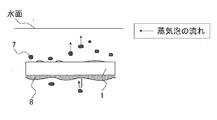
- FIG. 4 is a schematic view showing an example of a state of vapor bubbles and a vapor film generated when the wide surface portion of the steel material is leveled and immersed in water.
- FIG. 5 is a graph showing the temperature history of the upper and lower surfaces of a steel material having a thickness of 150 mm when the wide surface portion is horizontal and immersed in water.
- FIG. 1 is a schematic diagram illustrating an example of a steel material quenching process.
- FIG. 2 is a schematic diagram illustrating an example of a steel material quenching process.
- FIG. 3 is a schematic view showing an example of a steel material that is deformed during lifting.
- FIG. 4 is a schematic view showing an example of a state
- FIG. 6 is a schematic diagram illustrating an example of the cooling method of the present invention, and is a diagram illustrating an example of a state of vapor bubbles generated when a steel material is inclined and immersed.
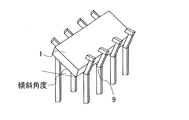
- FIG. 7 is a schematic view showing an example of the immersion tool.
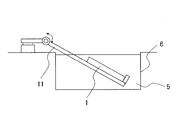
- FIG. 8 is a schematic view showing an example of the immersion tool.
- FIG. 9 is a schematic view showing an example of the immersion tool.
- the steel material cooling method according to the present invention is characterized in that the wide surface portion of the steel material is used as upper and lower surfaces, and the steel material is immersed in water so that the inclination angle from the horizontal surface in the short side direction of the steel material is 15 ° to 45 °. To do.
- the vapor bubbles 7 generated on the lower surface of the steel material 1 try to rise upward in the vertical direction by buoyancy.
- the vapor bubbles 7 generated on the lower surface of the steel material 1 are not retained due to buoyancy as shown in FIG. It moves toward the upper end part in the inclination direction of the steel material 1 along the lower surface.
- convection of the cooling water is generated as the steam bubbles 7 rise (broken arrows in FIG. 6). For this reason, the vapor film generated on the lower surface disappears, and cooling of the lower surface is promoted. Therefore, the vapor film 8 is hardly formed on the lower surface of the steel material 1.
- the heat transfer due to the vapor film 8 is not hindered, and the average cooling rate is not lowered and the upper and lower surfaces are not uniformly cooled.
- the cooling of the lower surface of the steel material 1 is promoted, and the warp during immersion cooling does not occur, and a steel material having a high strength and high toughness can be manufactured.
- the inclination angle of the wide surface portion short side direction of the steel material is set to 15 ° or more.
- immersion cooling is performed at an inclination angle in the short side direction of the wide surface portion of the steel material, that is, an inclination angle from the horizontal plane of less than 15 °, the speed of the vapor bubbles rising along the lower surface of the steel material is slow, and the formation of the vapor film is sufficiently suppressed. I can't.
- sufficient convection effect cannot be obtained.
- the cooling of the lower surface of the steel material is not promoted, and a steel material having a high strength and a high toughness cannot be obtained.
- the steel material warpage occurs during the immersion cooling.
- the inclination angle is preferably 30 ° or more.
- the inclination angle may be 75 ° or less. As will be described later, in order to incline in the short side direction of the wide surface portion of the steel material in the present invention, even if the inclination angle is 75 °, the length from the lower end portion to the upper end portion in the steel material inclination direction when the steel material is immersed. However, it is because it becomes shorter compared with the conventional method which makes the up-down direction at the time of steel material immersion the steel material longitudinal direction, and the depth of a water tank can also be made shallow.
- the velocity of the steam bubbles rising along the lower surface of the steel material increases as the inclination angle of the steel material increases.
- the greater the inclination angle of the steel material the higher the steel material height during immersion, and the deeper the water tank needs to be.
- the upper limit of the tilt angle is 75 °.
- the inclination angle is preferably small, specifically, 65 ° or less is preferable, 55 ° or less is more preferable, and 45 ° or less is even more preferable.
- the wide surface portion of the steel material is inclined in the short side direction of the wide surface portion of the steel material with the upper and lower surfaces being the upper and lower surfaces.
- the height from the lower end portion to the upper end portion in the steel material inclination direction during immersion of the steel material is shortened, and the water tank depth can be reduced.
- the steel material height during immersion is 1. 5m.
- cooling is performed in a water tank that stores water more than 20 times the volume of steel materials.
- a water tank that has stored water more than 20 times the volume of the steel material
- the water temperature in the water tank will not rise during cooling and the cooling capacity will not be reduced.
- the material of high strength and high toughness A steel material can be secured more stably.
- the water in the water tank is less than 20 times the volume of the steel material
- the water temperature in the water tank rises during cooling, the cooling capacity decreases, and the strength and toughness decrease.
- 50 times or more of water is preferable from the viewpoint of suppressing the rise in water temperature.
- the upper limit of the amount of water in the water tank is not particularly defined. However, when the water in the water tank exceeds 300 times the volume of the steel material, the effect of stably securing the cooling capacity is saturated, and therefore it is preferably 300 times or less.
- a dipping tool in order to keep the inclination angle of the wide surface portion short side direction of the steel material at 15 ° or more.
- the immersion tool may be any immersion tool that can maintain the inclination angle of the wide surface portion short side direction of the steel material at 15 ° or more.
- an inclined mount 9 as shown in FIG. 7, a C hook 10 as shown in FIG. 8, a dipping device 11 as shown in FIG. 7 can be manufactured at a low cost.
- the C hook 10 of FIG. 8 and the immersion apparatus 11 of FIG. for this reason, in this invention, the inclination mount frame 9 like FIG. 7 is preferable.
- the cooling method of the present invention exerts a great effect when used in the heat treatment process of a thick plate.
- the present invention is not limited to this, and can be applied to a heat treatment process for general steel materials such as forged products.
- By using the cooling method of the present invention it is possible to produce a steel material of high strength and high toughness that does not warp during cooling.
- the steel material 1 having a weight of 25 tons and a plate thickness (t) of 150 mm is reheated to 900 ° C. using a cooling facility having a heating furnace with a carriage as shown in FIG.
- the steel material 1 was lifted with a C hook crane.
- the steel material 1 is moved above the water tank 6 and immersed in a state where the steel material 1 is inclined at any inclination angle of 10 °, 15 °, 30 °, 45 °, 75 ° from the horizontal plane in the short side direction of the wide surface portion of the steel material.
- the steel material 1 was cooled until the cooling stop temperature became 100 ° C. or lower.
- the steel was evaluated based on the average cooling rate between 800 ° C and 400 ° C. That is, in order to secure a steel material of a target material (strength / toughness) in the steel used in this example, on the plate thickness direction upper surface (1/4 t) and the plate thickness direction lower surface (3/4 t), respectively.
- the average cooling rate needs to be 1.1 ° C./s or more, and the average cooling rate needs to be 0.9 ° C./s or more at the plate thickness center (1 / 2t).
- the difference (absolute value) in the average cooling rate between the upper surface in the thickness direction and the lower surface in the thickness direction must be within 10% of the average cooling rate in the upper surface in the thickness direction. There is.
- the temperature of the plate thickness direction upper surface (1/4 t) portion was measured by a thermocouple attached by opening a hole from the upper surface to the plate thickness 1/4 t portion.
- the temperature at the bottom (3 / 4t) part in the plate thickness direction was measured by a thermocouple attached with a hole from the top to the plate thickness 3 / 4t.
- the temperature at the center of the plate thickness (1 / 2t) was measured by a thermocouple attached by drilling a hole from the upper surface to the center of the plate thickness (1 / 2t).
- Each temperature was measured from 800 ° C. to 400 ° C., and the average cooling rate was calculated from the temperature drop and time.
- Table 1 shows the conditions and average cooling rate.
- the steel plate is immersed in a water tank in which 80 times the volume of the steel material is stored while being inclined at 15 ° from the horizontal plane in the short side direction of the wide surface portion of the steel material, and is cooled until all the portions become 100 ° C. or less. And manufactured.
- the average cooling rate was 1.15 ° C./s at 1/4 t in the plate thickness direction, 1.10 ° C./s at the 3/4 t position, and 0.90 ° C./s at the center of the plate thickness.
- the difference in average cooling rate between the upper surface in the plate thickness direction and the lower surface in the plate thickness direction was 0.05, which was within 10% (within 0.115 ° C./s) of the average cooling rate on the upper surface in the plate thickness direction.
- In Invention Example 2 in a state where the steel is inclined 30 ° from the horizontal plane in the short side direction of the wide surface portion, the steel material is immersed in a water tank storing water 80 times the volume of the steel material, and cooled until all portions become 100 ° C. or less. And manufactured.
- the average cooling rate was 1.15 ° C./s at 1/4 t in the plate thickness direction, 1.15 ° C./s at the 3/4 t position, and 0.92 ° C./s at the center of the plate thickness.
- the difference in average cooling rate between the upper surface in the plate thickness direction and the lower surface in the plate thickness direction was 0.00, which was within 10% (within 0.115 ° C./s) of the average cooling rate on the upper surface in the plate thickness direction.
- invention example 3 in the state which inclined 15 degrees from the horizontal surface in the wide-surface part short side direction of steel materials, it was immersed in the water tank which stored 20 times the water of steel materials volume, and it cooled until all parts became 100 degrees C or less. And manufactured.
- the average cooling rate was 1.15 ° C./s at 1/4 t in the plate thickness direction, 1.10 ° C./s at the 3/4 t position, and 0.90 ° C./s at the center of the plate thickness.
- the difference in average cooling rate between the upper surface in the plate thickness direction and the lower surface in the plate thickness direction was 0.05, which was within 10% (within 0.115 ° C./s) of the average cooling rate on the upper surface in the plate thickness direction.
- In Invention Example 4 in a state where the wide surface portion of the steel material is inclined by 45 ° from the horizontal surface in the direction of the short side, the steel material is immersed in a water tank storing 80 times the volume of the steel material and cooled until all portions become 100 ° C. or less. And manufactured.
- the average cooling rate was 1.15 ° C./s at 1/4 t in the plate thickness direction, 1.18 ° C./s at the 3/4 t position, and 0.93 ° C./s at the plate thickness center.
- the difference in average cooling rate between the upper surface in the plate thickness direction and the lower surface in the plate thickness direction was 0.03, which was within 10% (within 0.115 ° C./s) of the average cooling rate on the upper surface in the plate thickness direction.
- In Invention Example 5 in a state where the wide surface portion of the steel material is inclined by 75 ° from the horizontal plane in a short side direction, the steel material is immersed in a water tank storing 80 times as much water as the steel material volume, and cooled until all portions become 100 ° C. or less. And manufactured.
- the average cooling rate was 1.15 ° C./s at 1/4 t in the plate thickness direction, 1.20 ° C./s at the 3/4 t position, and 0.94 ° C./s at the plate thickness center.
- the difference in average cooling rate between the upper surface in the plate thickness direction and the lower surface in the plate thickness direction was 0.05, which was within 10% (within 0.115 ° C./s) of the average cooling rate on the upper surface in the plate thickness direction.
- Comparative Example 1 the steel plate was immersed in a water tank in which water of 80 times the volume of the steel material was stored while being tilted by 10 ° from the horizontal plane in the short side direction of the wide surface portion of the steel material, and cooled until all portions were 100 ° C. or less. And manufactured.
- the average cooling rate was 1.15 ° C./s at the 1/4 t position in the plate thickness direction, 1.00 ° C./s at the 3/4 t position, and 0.86 ° C./s at the plate thickness center. This is considered to be because when the inclination angle from the horizontal plane is 10 °, the rising speed of the steam bubbles is slow, so that the cooling of the lower surface is not promoted and is not uniformly cooled.
- the difference in average cooling rate between the upper surface in the plate thickness direction and the lower surface in the plate thickness direction was 0.15, and did not satisfy within 10% (within 0.115 ° C / s) of the average cooling rate on the upper surface in the plate thickness direction .
- Comparative Example 2 the steel material was immersed in a water tank in which 15 times the steel material volume was stored in a state where the steel material was tilted 15 ° from the horizontal plane in the direction of the short side of the wide surface portion, and cooled until all portions were 100 ° C. or lower. And manufactured.
- the average cooling rate was 1.00 ° C./s at the 1/4 t position in the plate thickness direction, 0.95 ° C./s at the 3/4 t position, and 0.78 ° C./s at the plate thickness center. This is probably because the amount of water in the aquarium is small, so that the water temperature in the aquarium rises during cooling and the cooling capacity decreases.
Landscapes
- Chemical & Material Sciences (AREA)
- Engineering & Computer Science (AREA)
- Physics & Mathematics (AREA)
- Thermal Sciences (AREA)
- Crystallography & Structural Chemistry (AREA)
- Mechanical Engineering (AREA)
- Materials Engineering (AREA)
- Metallurgy (AREA)
- Organic Chemistry (AREA)
- Heat Treatments In General, Especially Conveying And Cooling (AREA)
- Heat Treatment Of Strip Materials And Filament Materials (AREA)
Abstract
Description
[1]鋼材の広面部を上下面として、鋼材の広面部短辺方向の水平面からの傾斜角度を15°以上45°以下になるように、鋼材を鋼材体積の20倍以上の水を蓄えた水槽内に浸漬することを特徴とする鋼材の冷却方法。
[2]鋼材の広面部を上下面として、鋼材の広面部短辺方向の水平面からの傾斜角度を15°以上75°以下になるように、鋼材を鋼材体積の20倍以上の水を蓄えた水槽内に浸漬することを特徴とする鋼材の冷却方法。
[3]鋼材を加熱する工程と、加熱された鋼材の広面部を上下面として、鋼材の広面部短辺方向の水平面からの傾斜角度を15°以上45°以下になるように、鋼材を鋼材体積の20倍以上の水を蓄えた水槽内に浸漬する工程とを有することを特徴とする鋼材の製造方法。
[4]鋼材を加熱する工程と、加熱された鋼材の広面部を上下面として、鋼材の広面部短辺方向の水平面からの傾斜角度を15°以上75°以下になるように、鋼材を鋼材体積の20倍以上の水を蓄えた水槽内に浸漬する工程とを有することを特徴とする鋼材の製造方法。
[5]鋼材体積の20倍以上の水を蓄えた水槽と、前記鋼材の広面部短辺方向の水平面からの傾斜角度を15°以上45°以下になるように、前記鋼材を前記水槽内に保持する浸漬部材とを備えることを特徴とする鋼材冷却設備。
[6]鋼材体積の20倍以上の水を蓄えた水槽と、前記鋼材の広面部短辺方向の水平面からの傾斜角度を15°以上75°以下になるように、前記鋼材を前記水槽内に保持する浸漬部材とを備えることを特徴とする鋼材冷却設備。
[7][5]または[6]に記載の鋼材冷却設備を有することを特徴とする鋼材製造設備。

比較例1では、鋼材の広面部短辺方向に水平面から10°傾斜させた状態で、鋼材体積の80倍の水を蓄えた水槽に浸漬させて、全ての部分が100℃以下になるまで冷却して製造した。平均冷却速度は板厚方向1/4t位置で1.15℃/s、3/4t位置で1.00℃/s、板厚中心で0.86℃/sとなった。これは、水平面からの傾斜角度が10°では、蒸気泡の上昇速度が遅いため、下面の冷却が促進されず均一に冷却されなかったためと考えられる。また、板厚方向上面と板厚方向下面との平均冷却速度の差は0.15となり、板厚方向上面の平均冷却速度の10%以内(0.115℃/s以内)を満足しなかった。
2 台車
3 加熱炉
4 吊り具
5 水
6 水槽
7 蒸気泡
8 蒸気膜
9 傾斜架台
10 Cフック
11 浸漬装置
Claims (7)
- 鋼材の広面部を上下面として、鋼材の広面部短辺方向の水平面からの傾斜角度を15°以上45°以下になるように、鋼材を鋼材体積の20倍以上の水を蓄えた水槽内に浸漬することを特徴とする鋼材の冷却方法。
- 鋼材の広面部を上下面として、鋼材の広面部短辺方向の水平面からの傾斜角度を15°以上75°以下になるように、鋼材を鋼材体積の20倍以上の水を蓄えた水槽内に浸漬することを特徴とする鋼材の冷却方法。
- 鋼材を加熱する工程と、
加熱された鋼材の広面部を上下面として、鋼材の広面部短辺方向の水平面からの傾斜角度を15°以上45°以下になるように、鋼材を鋼材体積の20倍以上の水を蓄えた水槽内に浸漬する工程と
を有することを特徴とする鋼材の製造方法。 - 鋼材を加熱する工程と、
加熱された鋼材の広面部を上下面として、鋼材の広面部短辺方向の水平面からの傾斜角度を15°以上75°以下になるように、鋼材を鋼材体積の20倍以上の水を蓄えた水槽内に浸漬する工程と
を有することを特徴とする鋼材の製造方法。 - 鋼材体積の20倍以上の水を蓄えた水槽と、
前記鋼材の広面部短辺方向の水平面からの傾斜角度を15°以上45°以下になるように、前記鋼材を前記水槽内に保持する浸漬部材と
を備えることを特徴とする鋼材冷却設備。 - 鋼材体積の20倍以上の水を蓄えた水槽と、
前記鋼材の広面部短辺方向の水平面からの傾斜角度を15°以上75°以下になるように、前記鋼材を前記水槽内に保持する浸漬部材と
を備えることを特徴とする鋼材冷却設備。 - 請求項5または6に記載の鋼材冷却設備を有することを特徴とする鋼材製造設備。
Priority Applications (4)
| Application Number | Priority Date | Filing Date | Title |
|---|---|---|---|
| JP2015536442A JP6191697B2 (ja) | 2013-09-11 | 2014-08-29 | 鋼材の冷却方法、鋼材の製造方法、鋼材冷却設備および鋼材製造設備 |
| BR112016005164-5A BR112016005164B1 (pt) | 2013-09-11 | 2014-08-29 | método de resfriamento de material de aço, método de fabricação de material de aço, instalação de resfriamento de material de aço e instalação de fabricação de material de aço |
| KR1020167006120A KR101841225B1 (ko) | 2013-09-11 | 2014-08-29 | 강재의 냉각 방법, 강재의 제조 방법, 강재 냉각 설비 및 강재 제조 설비 |
| CN201480050179.XA CN105531384A (zh) | 2013-09-11 | 2014-08-29 | 钢材的冷却方法、钢材的制造方法、钢材冷却设备及钢材制造设备 |
Applications Claiming Priority (2)
| Application Number | Priority Date | Filing Date | Title |
|---|---|---|---|
| JP2013-187822 | 2013-09-11 | ||
| JP2013187822 | 2013-09-11 |
Publications (1)
| Publication Number | Publication Date |
|---|---|
| WO2015037201A1 true WO2015037201A1 (ja) | 2015-03-19 |
Family
ID=52665333
Family Applications (1)
| Application Number | Title | Priority Date | Filing Date |
|---|---|---|---|
| PCT/JP2014/004443 Ceased WO2015037201A1 (ja) | 2013-09-11 | 2014-08-29 | 鋼材の冷却方法、鋼材の製造方法、鋼材冷却設備および鋼材製造設備 |
Country Status (6)
| Country | Link |
|---|---|
| JP (1) | JP6191697B2 (ja) |
| KR (1) | KR101841225B1 (ja) |
| CN (1) | CN105531384A (ja) |
| BR (1) | BR112016005164B1 (ja) |
| TW (1) | TWI575076B (ja) |
| WO (1) | WO2015037201A1 (ja) |
Citations (2)
| Publication number | Priority date | Publication date | Assignee | Title |
|---|---|---|---|---|
| JPS6033309A (ja) * | 1983-08-02 | 1985-02-20 | Daido Steel Co Ltd | 鋼材の冷却方法 |
| JP2010013710A (ja) * | 2008-07-04 | 2010-01-21 | Jtekt Corp | 熱処理装置、熱処理方法、及び、複合加工機 |
Family Cites Families (6)
| Publication number | Priority date | Publication date | Assignee | Title |
|---|---|---|---|---|
| GB453005A (en) * | 1935-05-28 | 1936-09-03 | Archibald Park Newall | Improvements relating to the heat treatment of metal bars |
| JP5121039B2 (ja) * | 2005-01-19 | 2013-01-16 | 新日鐵住金株式会社 | 鋼片の水冷方法 |
| CN1733945B (zh) * | 2005-09-01 | 2010-05-26 | 中原工学院 | 金属热处理量化淬火设备及利用该设备进行量化淬火的方法 |
| CN202047095U (zh) * | 2011-02-28 | 2011-11-23 | 舞阳钢铁有限责任公司 | 一种厚钢板淬火装置 |
| KR101353722B1 (ko) * | 2011-11-21 | 2014-01-21 | 주식회사 포스코 | 열처리용 소재 운송장치 |
| CN102925633B (zh) * | 2012-10-11 | 2014-03-19 | 上海交通大学 | 一种钢板淬火冷却方法及设备 |
-
2014
- 2014-08-29 WO PCT/JP2014/004443 patent/WO2015037201A1/ja not_active Ceased
- 2014-08-29 KR KR1020167006120A patent/KR101841225B1/ko active Active
- 2014-08-29 BR BR112016005164-5A patent/BR112016005164B1/pt active IP Right Grant
- 2014-08-29 CN CN201480050179.XA patent/CN105531384A/zh active Pending
- 2014-08-29 JP JP2015536442A patent/JP6191697B2/ja active Active
- 2014-09-10 TW TW103131122A patent/TWI575076B/zh active
Patent Citations (2)
| Publication number | Priority date | Publication date | Assignee | Title |
|---|---|---|---|---|
| JPS6033309A (ja) * | 1983-08-02 | 1985-02-20 | Daido Steel Co Ltd | 鋼材の冷却方法 |
| JP2010013710A (ja) * | 2008-07-04 | 2010-01-21 | Jtekt Corp | 熱処理装置、熱処理方法、及び、複合加工機 |
Also Published As
| Publication number | Publication date |
|---|---|
| TWI575076B (zh) | 2017-03-21 |
| BR112016005164B1 (pt) | 2021-05-04 |
| TW201518513A (zh) | 2015-05-16 |
| KR20160042048A (ko) | 2016-04-18 |
| KR101841225B1 (ko) | 2018-03-22 |
| JP6191697B2 (ja) | 2017-09-06 |
| CN105531384A (zh) | 2016-04-27 |
| JPWO2015037201A1 (ja) | 2017-03-02 |
Similar Documents
| Publication | Publication Date | Title |
|---|---|---|
| KR20160137603A (ko) | 화학 강화 처리에 의해 유리판에 발생하는 휨을 저감하는 방법, 화학 강화용 유리판의 제조 방법 및 화학 강화 유리판의 제조 방법 | |
| CN103397162A (zh) | 钢板倾斜浸液淬火冷却方法及设备 | |
| WO2016084283A1 (ja) | 金属板の製造方法および急冷焼入れ装置 | |
| JP6043551B2 (ja) | 熱処理方法 | |
| JP6007952B2 (ja) | 鋼材の冷却方法、鋼材の冷却設備、鋼材の製造方法および鋼材の製造設備 | |
| JP2016211026A (ja) | 焼入装置および焼入方法 | |
| JP6191697B2 (ja) | 鋼材の冷却方法、鋼材の製造方法、鋼材冷却設備および鋼材製造設備 | |
| JP6070504B2 (ja) | 鋼材の冷却方法および冷却設備 | |
| JP2021147626A (ja) | 焼入れ方法及びその装置 | |
| JP5870678B2 (ja) | 鋼材の冷却設備および冷却方法 | |
| TW202231892A (zh) | 鋁板之淬火方法 | |
| JPWO2006001068A1 (ja) | 焼入方法およびこれに用いられる装置 | |
| KR101353722B1 (ko) | 열처리용 소재 운송장치 | |
| US8631852B2 (en) | Investment castings and process | |
| JP2015038233A (ja) | 鋼帯の製造方法および製造設備 | |
| JP6020429B2 (ja) | 鋼板吊具及び鋼板吊下方法 | |
| US12378620B2 (en) | Quenching method | |
| KR101622282B1 (ko) | 탈가스 장치 및 탈가스 방법 | |
| KR102157597B1 (ko) | 용강 재산화 방지장치 | |
| JP2006193815A (ja) | 金型の焼入れ方法 | |
| JP2002066726A (ja) | 連鋳鋳片の冷却方法 | |
| JP7508024B2 (ja) | 焼入れ装置及び焼入れ方法並びに金属板の製造方法 | |
| JP2016225407A5 (ja) | ||
| CN104357631B (zh) | 一种消除300m钢低倍组织缺陷的热处理方法 | |
| JP4623022B2 (ja) | 連続鋳造鋳片の冷却方法 |
Legal Events
| Date | Code | Title | Description |
|---|---|---|---|
| WWE | Wipo information: entry into national phase |
Ref document number: 201480050179.X Country of ref document: CN |
|
| 121 | Ep: the epo has been informed by wipo that ep was designated in this application |
Ref document number: 14844244 Country of ref document: EP Kind code of ref document: A1 |
|
| ENP | Entry into the national phase |
Ref document number: 2015536442 Country of ref document: JP Kind code of ref document: A |
|
| ENP | Entry into the national phase |
Ref document number: 20167006120 Country of ref document: KR Kind code of ref document: A |
|
| NENP | Non-entry into the national phase |
Ref country code: DE |
|
| REG | Reference to national code |
Ref country code: BR Ref legal event code: B01A Ref document number: 112016005164 Country of ref document: BR |
|
| 122 | Ep: pct application non-entry in european phase |
Ref document number: 14844244 Country of ref document: EP Kind code of ref document: A1 |
|
| ENP | Entry into the national phase |
Ref document number: 112016005164 Country of ref document: BR Kind code of ref document: A2 Effective date: 20160309 |