WO2015029470A1 - イオン照射装置およびそれを冷蔵による保管を必要とする食品に適用した方法 - Google Patents
イオン照射装置およびそれを冷蔵による保管を必要とする食品に適用した方法 Download PDFInfo
- Publication number
- WO2015029470A1 WO2015029470A1 PCT/JP2014/054849 JP2014054849W WO2015029470A1 WO 2015029470 A1 WO2015029470 A1 WO 2015029470A1 JP 2014054849 W JP2014054849 W JP 2014054849W WO 2015029470 A1 WO2015029470 A1 WO 2015029470A1
- Authority
- WO
- WIPO (PCT)
- Prior art keywords
- negative ions
- meat
- ions
- positive ions
- ion
- Prior art date
- Legal status (The legal status is an assumption and is not a legal conclusion. Google has not performed a legal analysis and makes no representation as to the accuracy of the status listed.)
- Ceased
Links
Images





Classifications
-
- A—HUMAN NECESSITIES
- A23—FOODS OR FOODSTUFFS; TREATMENT THEREOF, NOT COVERED BY OTHER CLASSES
- A23B—PRESERVATION OF FOODS, FOODSTUFFS OR NON-ALCOHOLIC BEVERAGES; CHEMICAL RIPENING OF FRUIT OR VEGETABLES
- A23B4/00—Preservation of meat, sausages, fish or fish products
- A23B4/015—Preserving by irradiation or electric treatment without heating effect
-
- A—HUMAN NECESSITIES
- A23—FOODS OR FOODSTUFFS; TREATMENT THEREOF, NOT COVERED BY OTHER CLASSES
- A23B—PRESERVATION OF FOODS, FOODSTUFFS OR NON-ALCOHOLIC BEVERAGES; CHEMICAL RIPENING OF FRUIT OR VEGETABLES
- A23B2/00—Preservation of foods or foodstuffs, in general
- A23B2/50—Preservation of foods or foodstuffs, in general by irradiation without heating
-
- F—MECHANICAL ENGINEERING; LIGHTING; HEATING; WEAPONS; BLASTING
- F25—REFRIGERATION OR COOLING; COMBINED HEATING AND REFRIGERATION SYSTEMS; HEAT PUMP SYSTEMS; MANUFACTURE OR STORAGE OF ICE; LIQUEFACTION SOLIDIFICATION OF GASES
- F25D—REFRIGERATORS; COLD ROOMS; ICE-BOXES; COOLING OR FREEZING APPARATUS NOT OTHERWISE PROVIDED FOR
- F25D17/00—Arrangements for circulating cooling fluids; Arrangements for circulating gas, e.g. air, within refrigerated spaces
- F25D17/04—Arrangements for circulating cooling fluids; Arrangements for circulating gas, e.g. air, within refrigerated spaces for circulating air, e.g. by convection
- F25D17/042—Air treating means within refrigerated spaces
-
- A—HUMAN NECESSITIES
- A23—FOODS OR FOODSTUFFS; TREATMENT THEREOF, NOT COVERED BY OTHER CLASSES
- A23V—INDEXING SCHEME RELATING TO FOODS, FOODSTUFFS OR NON-ALCOHOLIC BEVERAGES AND LACTIC OR PROPIONIC ACID BACTERIA USED IN FOODSTUFFS OR FOOD PREPARATION
- A23V2002/00—Food compositions, function of food ingredients or processes for food or foodstuffs
-
- F—MECHANICAL ENGINEERING; LIGHTING; HEATING; WEAPONS; BLASTING
- F25—REFRIGERATION OR COOLING; COMBINED HEATING AND REFRIGERATION SYSTEMS; HEAT PUMP SYSTEMS; MANUFACTURE OR STORAGE OF ICE; LIQUEFACTION SOLIDIFICATION OF GASES
- F25D—REFRIGERATORS; COLD ROOMS; ICE-BOXES; COOLING OR FREEZING APPARATUS NOT OTHERWISE PROVIDED FOR
- F25D2317/00—Details or arrangements for circulating cooling fluids; Details or arrangements for circulating gas, e.g. air, within refrigerated spaces, not provided for in other groups of this subclass
- F25D2317/04—Treating air flowing to refrigeration compartments
- F25D2317/041—Treating air flowing to refrigeration compartments by purification
Definitions
- the present invention relates to a method for storing meat, a method for extending the expiration date of food that requires storage by refrigeration, and a method for suppressing the growth of bacteria that occur on the surface of food that requires storage by refrigeration. Moreover, this invention relates to the ion irradiation apparatus which can be used suitably for these methods of this invention.
- the expiry date of meat is particularly important from the viewpoint of safety. This expiry date is largely related to food spoilage. In the early stage, even if the food has almost no microorganisms attached to the surface, it is contaminated by bacteria attached to the surface by a machine or hand during the processing. When bacteria are attached in this way, the bacteria grow on the surface of the food and the food is spoiled. For this reason, the number of bacteria on the surface and inside of food is used as an index, and some stores practice practicing the bacteria count. Increasing the expiry date for one day as the scale of the store leads to a significant cost reduction, and efforts have been made to reduce the number of bacteria attached to food.
- Patent Document 1 discloses a food storage method characterized by ionizing air and storing the food in the environment of the ionized air.
- an ion generator is installed in a refrigerator, and various foods are put into a constantly generating negative ionized air, while compared with a case where it is stored in a normal refrigerator.
- Experiments have been conducted to measure changes in the number of viable bacteria.
- contamination and growth of bacteria and microorganisms adhering to food are surely suppressed, and the storage period of food is prolonged.
- negative ionized air must always be generated, cost and electric power are required, and depending on the food, the negative ionized air is constantly blown to cause drying and the taste may be reduced.
- the present invention has been made in order to solve the above-described problems, and the object of the present invention is to provide a method capable of suppressing the growth of bacteria attached to foods (especially meat) requiring storage by refrigeration, Accordingly, it is an object of the present invention to provide a method for extending the expiry date of foods that need to be stored by refrigeration, and an apparatus that can be suitably used for these methods.
- the present invention is a method for storing meat that is stored in a refrigerator or freezer after being subdivided from a lump, wherein the meat is irradiated with positive ions and negative ions before being stored in the refrigerator or freezer.
- a method for storing meat is provided.
- the meat storage method of the present invention it is preferable to irradiate the meat in a state before being divided into positive ions and negative ions.
- the meat storage method of the present invention it is also preferable to irradiate positive ions and negative ions to the meat in a divided state before storing in the refrigerator or freezer.
- the positive ions and negative ions are preferably irradiated by blowing positive ions and negative ions generated by discharge in the atmosphere.
- the present invention also provides a method of irradiating foods that require storage by refrigeration with positive ions and negative ions to extend the expiration date of foods that require storage by refrigeration.
- the present invention also provides a method for suppressing the growth of bacteria generated on the surface of foods that require storage by refrigeration by irradiating foods that require storage by refrigeration with positive ions and negative ions before storage. To do.
- the food that needs to be stored by refrigeration is at least one selected from the group consisting of meat, bread, kamaboko, chikuwa, sausage, ham, bacon, noodles, cheese, and seafood.
- meat is meat.
- the present invention includes a storage unit that can store food that needs to be stored by refrigeration, and an ion generation unit that irradiates positive ions and negative ions inside the storage unit, the positive ions and negative ions
- the present invention also provides an ion irradiation apparatus for inhibiting bacterial growth, which suppresses the growth of bacteria generated on the surface of the food by irradiating the food requiring storage by refrigeration.
- the present invention also includes a storage unit that can store food that needs to be stored by refrigeration, and an ion generation unit that irradiates positive ions and negative ions inside the storage unit, the ion generation unit comprising: Also provided is a plurality of ion irradiation apparatuses provided so as to surround the inside of the housing portion.
- two or more pairs of the ion generation units may be provided to face each other so as to surround the inside of the storage unit.
- the housing portion may be configured such that the bottom surface is rotatable.
- the storage unit is a shelf-like product partitioned into a plurality of stages, and each of the compartments of the shelf-like product is provided with a plurality of ion generation units so as to surround the compartment. Also good.
- the ion irradiation apparatus of this invention is equipped with a ventilation means or the resin sheet which covers the whole accommodating part.
- the ion irradiation apparatus of the present invention may be configured to be movable as a whole.
- each container-like object is provided with a terminal for supplying power, and when each container-like object is stacked on a cart-like object that can be electrically connected to the power source, each terminal is electrically connected. It is preferable to be connected and configured to be able to supply electricity from a power source.
- the ion irradiation apparatus of the present invention is also provided with a transport device in which the storage portion can transport food that needs to be stored by refrigeration so as to pass through a plurality of regions, and one or a plurality of each region is provided.
- a plurality of ion generators may be provided and configured to irradiate the food with positive ions and negative ions while being conveyed.
- each region is configured to irradiate the food with positive ions and negative ions from different directions.
- the storage unit has an inspection area for detecting bacteria attached to the surface of the food that needs to be stored by refrigeration, and the inspection result in the inspection area exceeds a predetermined reference value. It is preferable that the food is further irradiated with positive ions and negative ions.
- the food that needs to be stored by refrigeration is at least one selected from the group consisting of meat, bread, kamaboko, chikuwa, sausage, ham, bacon, noodles, cheese, and seafood. It is preferable that it is meat, and it is especially preferable that it is meat.
- a method capable of suppressing the growth of bacteria attached to food (especially meat) requiring storage by refrigeration, a method for extending the expiry date of food requiring storage by refrigeration, and The apparatus which can be used suitably for these methods can be provided.
- FIG. 7 is a diagram schematically showing a state in which a plurality of ion irradiation devices 21 of the example shown in FIG. 6 are stacked.
- FIG. 8A is a diagram schematically showing an ion irradiation apparatus 31 of another preferred example of the present invention
- FIG. 8B is a schematic diagram of an ion irradiation apparatus 41 of another preferred example of the present invention.
- FIG. It is a figure which shows typically the ion irradiation apparatus 51 used for Example 1
- Fig.9 (a) is the accommodating part 52
- FIG.9 (b) is the ion generating part 54 attached to the cover part 53 of the accommodating part 52.
- FIG. 9C schematically shows a state in which positive ions and negative ions are irradiated from the ion generation unit 54 to the meat 55 accommodated in the accommodation unit 52.
- FIG. 3 is a diagram schematically showing the procedure of Example 1.
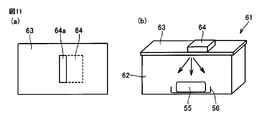
- FIGS. 11A and 11B schematically show an ion irradiation apparatus 61 used in Example 2;
- FIG. 11A shows a lid 63 and an ion generator 64, and FIG. Indicates the state.
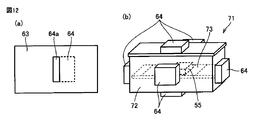
- FIGS. 12A and 12B schematically show an ion irradiation apparatus 71 used in Example 3.
- FIG. 12A shows a lid 63 and an ion generator 64, and FIG. Indicates the state.
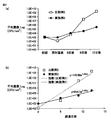
- FIG. 1 shows a case where positive ions and negative ions are irradiated from one place, meat is placed at a position where positive ions and negative ions strike and stored for a certain period of time (Example 1: black circle), and positive ions and negative ions.
- FIG. 1 (a) is a plot at each time point, and FIG. 1 (b) is the result of FIG. 1 (a). The calculated index is shown.
- the vertical axis represents the average bacterial count Log (CFU / cm 2 )
- the horizontal axis in FIG. 1 (a) represents the initial value, immediately after irradiation, 4 days, 7 days, and 10 days, respectively.
- the time point is shown, and the horizontal axis in FIG.
- FIG. 1B shows the number of elapsed days.
- FIG. 2 irradiates positive ions and negative ions from one place, and when meat is placed at a position where the positive ions and negative ions have a high concentration and stored for a certain period of time (Example 2: black circles), It is a graph which compares and shows the case where it does not irradiate a positive ion and a negative ion (Comparative example 2: White square), Fig.2 (a) is a plot in each time, FIG.2 (b) is FIG. The index calculated from the result of a) is shown. 2, in each case, the vertical axis represents the average number of bacteria Log (CFU / cm 2 ), and the horizontal axis in FIG.
- FIG. 2 (a) represents the initial state, immediately after irradiation, 5 days, 9 days, and 12 days. The time point is shown, and the horizontal axis in FIG. 2 (b) shows the elapsed days.
- FIG. 3 shows the case where positive ions and negative ions are irradiated from six locations around the top, bottom, front, back, left, and right, and meat is placed at a position where positive ions and negative ions are at high concentrations and stored for a certain period of time
- Example 3 Example 3:
- FIG. 3A is a graph showing a comparison between a case where no black and black ions are irradiated (Comparative Example 3: white square).
- FIG. 3A is a plot at each time point, and FIG.
- the vertical axis represents the average number of bacteria Log (CFU / cm 2 )
- the horizontal axis in FIG. 3A represents the initial time points, 7 days, 10 days, and 14 days later.
- the horizontal axis indicates the number of days elapsed.
- the present invention is a method for storing meat that is stored in a refrigerator or freezer after being subdivided from a lump, wherein the meat is irradiated with positive ions and negative ions before being stored in the refrigerator or freezer.
- the meat storage method of the present invention is based on the experimental results described above, and suppresses the growth of bacteria attached to the meat by irradiating the meat with positive ions and negative ions before storing in the refrigerator or freezer. can do. Thereby, the expiry date of the meat can be extended with the number of attached bacteria as an index.
- the meat wholesalers for example, deliver bulky meat in plastic bags to the stores using trucks, etc. Once in the bag, store it in a container and store it at a temperature of around 0 ° C. Thereafter, the stored chunky meat is taken out from the plastic bag, transported to a meat processing place in the store, and processed into small portions by manual work or mechanical work in the meat processing place.
- the subdivision here includes a case where meat is processed into a minced shape.
- the temperature of the food processing plant is usually about 10 to 15 ° C. because the worker is engaged in processing.
- the subdivided meat is packaged in appropriate quantities, stored in a container or the like, stored in a refrigerator or freezer, and sold at a store as appropriate.
- the meat storage method of the present invention it is only necessary to irradiate the meat with positive ions and negative ions before being stored in the refrigerator or freezer. It may be in a state of being subdivided. In view of the fact that bacteria often adhere during processing to be subdivided as described above, it is preferable to irradiate the meat in the subdivided state with positive ions and negative ions. Further, it is of course possible to irradiate the meat with positive ions and negative ions at the timing of both the state before the division and the state of the division.
- the positive ions and negative ions in the present invention are preferably irradiated by blowing positive ions and negative ions generated by discharge in the atmosphere. More specifically, molecules such as oxygen (O 2 ) and water (H 2 O) in the air receive energy due to the discharge phenomenon of the ion generating element, so that H + (H 2 O) m (m is arbitrary) Positive ions and O 2 ⁇ (H 2 O) n (n is an arbitrary integer) are generated and blown toward the meat, so that the positive ions and the negative ions are meat. Is irradiated. Usually, positive and negative voltages are alternately applied to the ion generating element, so that positive ions and negative ions can be simultaneously generated and released into the air.
- the method of generating positive ions and negative ions used in the present invention is not limited to this, and only one of positive and negative voltages is applied and only one of positive ions and negative ions is applied.
- a reverse voltage can be applied next to generate ions having a charge opposite to that of ions already delivered.
- a known ion generator proposed by the applicant in Japanese Patent No. 3680121 can be applied without particular limitation. It is particularly preferable to use an irradiation apparatus.
- the composition of positive ions and negative ions generated by the discharge phenomenon using oxygen molecules and / or water molecules present on the surface of the discharge element as a raw material is mainly the ionization of water molecules in the air by plasma discharge as hydrogen ions.
- H + is generated and clustered with water molecules in the air by solvation energy to form H + (H 2 O) m (m is an arbitrary integer).
- oxygen molecules or water molecules in the air are ionized by plasma discharge to generate oxygen ions O 2 ⁇ , which are clustered with water molecules in the air by solvation energy, so that O 2 ⁇ (H 2 O) n (n is an arbitrary integer).
- both of these can react to easily generate more active active species such as hydrogen peroxide H 2 O 2 , hydrogen dioxide O 2 H, and hydroxy radical / OH.
- the concentration of positive ions and negative ions generated by discharge is 500,000 / cm 3 or more, respectively, from the viewpoint that the effect of suppressing the growth of bacteria is remarkably obtained.
- the number of ions is defined by counting small ions, and the critical mobility in air is 1 cm 2 / V ⁇ sec.
- Whether air contains such positive ions and negative ions is determined by inspecting the gas composition by gas mass spectrometry inspection, gas concentration inspection, discoloration inspection, odor inspection, luminescence inspection, sound generation inspection, etc. be able to.
- a known mass spectrometer can be used for the gas mass spectrometry test, and the gas concentration test can be measured using a gas chromatography or an ion counter.
- the color change test and the odor test can be subjected to a sensory test such as a visual judgment or an olfactory test, and a color difference meter or an odor sensor can also be used.
- the light emission test and the generated sound test can be subjected to a sensory test such as a visual judgment or an auditory test, and an absorptiometer, spectroscope, optical sensor, illuminometer, microphone, or the like can be used.
- the time for irradiation with positive ions and negative ions is not particularly limited, but when the concentration of positive ions and negative ions is 500,000 pieces / cm 3 , 1.5 hours. The above is preferable.
- the present invention also provides a method for irradiating foods that require storage by refrigeration with positive ions and negative ions before storage by refrigeration, thereby extending the expiration date of the foods that require storage by refrigeration.
- the expiry date is defined as the date when the product is stored by a prescribed method and indicates the date when it is recognized that there is no risk of loss of safety due to corruption, deterioration, or other quality deterioration. It is displayed for foods whose quality deteriorates rapidly within 5 days (corresponding to foods that require refrigerated storage in the present invention).
- the expiry date is set in consideration of factors such as food characteristics, quality change factors, sanitary conditions of raw materials, hygiene management conditions during production and processing, and preservation conditions. For meat, for example, Hisao Yoshii et al.
- Food Microbiology Handbook (1995) can be used as a standard.
- food that needs to be stored by refrigeration is irradiated with positive ions and negative ions before being stored by refrigeration, thereby suppressing the growth of bacteria attached to the surface of the food. It is possible to delay the time until the food reaches the number of spoilage bacteria, and as a result, the expiration date of the food can be extended.
- the present invention irradiates foods that require refrigerated storage with positive ions and negative ions before storage by refrigeration, thereby suppressing the growth of bacteria that occur on the surface of foods that require refrigerated storage. It also provides a way to do this.
- the foods In the method for extending the expiry date of foods requiring storage by refrigeration according to the present invention and the method for suppressing the growth of bacteria generated on the surface of foods requiring storage by refrigeration, the foods must be stored by refrigeration.
- the meat is not limited to meat, and examples thereof include bread, rice cake, chikuwa, sausage, ham, bacon, noodles, cheese, and seafood. Among these, as described above, it is assumed that the flocculent meat adheres to the surface of the meat, particularly when the massive meat is processed into small portions manually or mechanically at the meat processing plant. Meat is preferred.
- the present invention includes a storage unit that can store food that needs to be stored by refrigeration, and an ion generation unit that irradiates positive ions and negative ions inside the storage unit, the positive ions and negative ions
- the present invention also provides an ion irradiation apparatus (embodiment 1) for suppressing the growth of bacteria, which suppresses the growth of bacteria generated on the surface of the food by irradiating foods that require storage by refrigeration.
- an ion irradiation apparatus for inhibiting bacterial growth of the present invention the above-described method of the present invention (method for storing meat, method for extending the expiration date of foods that require storage by refrigeration, and storage by refrigeration) Can be used particularly preferably.
- Such an ion irradiation device for inhibiting the growth of bacteria of the present invention can be used for the purpose of inhibiting the growth of bacteria generated on the surface of foods that require storage by refrigeration.
- the configuration of the apparatus is not particularly limited, and may be realized by appropriately combining conventionally known configurations.
- irradiation is performed by blowing positive ions and negative ions generated by discharge. Preferably it is comprised.
- the present invention includes a storage unit that can store food that needs to be stored by refrigeration, and an ion generation unit that irradiates positive ions and negative ions inside the storage unit, wherein the ion generation unit includes: Also provided is a plurality of ion irradiation apparatuses (embodiment 2) provided so as to surround the inside of the housing portion.
- a plurality of ion irradiation apparatuses (embodiment 2) provided so as to surround the inside of the housing portion.
- two or more pairs of ion generating portions are provided so as to surround the inside of the accommodating portion (Embodiment 3). That is, two or more ion generation units are provided so that there are two or more ion irradiation directions, and the irradiation directions intersect with each other, so that the storage unit needs to be refrigerated in the region where the irradiation directions intersect.
- two or more pairs of surfaces of the food can be irradiated with positive ions and negative ions, respectively, and the above-described effect of suppressing the growth of bacteria attached to the surface of the food is more effective. It will be remarkable.
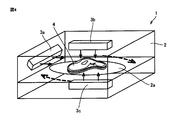
- FIG. 4 is a diagram schematically showing a preferred example of the ion irradiation apparatus 1 of the present invention.
- the ion irradiation apparatus 1 of the example shown in FIG. 4 is provided with three ion generating parts 3a, 3b, 3c so as to surround the inside of the accommodating part 2, and corresponds to the ion irradiation apparatus of the above-described embodiment 2.
- the accommodating part 2 is comprised by the turntable shape so that the bottom face 2a can rotate (Embodiment 4), It is characterized by the above-mentioned. Thereby, by placing the food (meat in the example of FIG.
- the positive ions and negative ions can be irradiated by the three ion generators 3a, 3b, and 3c, and the surface of the food is uniformly irradiated with positive ions and negative ions, and the growth of the bacteria attached to the surface of the food is described above. Can be effectively suppressed.
- a dish-like object or container-like object for placing food is provided on the bottom surface 2a of the container 2, and the dish-like object or container-like object is rotated by the bottom surface 2a.
- the dish-like object or container-like object may have a structure (a net shape, a lattice shape, or the like) that allows a certain amount of air containing positive ions and negative ions to pass therethrough.
- the number of ion generating parts is not particularly limited, but for example, as in the example shown in FIG. 4, the ion generating parts are installed in at least three directions on the bottom surface side, the top surface side, and the side surface side. It is preferable.
- the bottom surface of the rotatable housing part preferably has a structure that allows a certain amount of air containing positive ions and negative ions to pass therethrough as described above.
- FIG. 5 is a diagram schematically showing another preferred example of the ion irradiation apparatus 11 of the present invention.
- the accommodating part 12 is a shelf-like object partitioned into a plurality of stages (three stages in the example of FIG. 5), and each section of the shelf-like object (example of FIG. 5).
- a plurality of ion generating sections 14 are provided so as to surround the sections 12a, 12b, and 12c (Embodiment) 5).
- the embodiment 5 as in the example shown in FIG.
- the shelf-like door 13 also includes a plurality of ion generation units 14 corresponding to the compartments of the shelf-like object, and the door 13 is closed. It is preferable that positive ions and negative ions can be irradiated also from the door side.
- food in the example of FIG. 5, meat
- the tray-like object may be a container-like object. In this way, the food 16 is irradiated with positive ions and negative ions from a plurality of directions by the ion generator 14 surrounding each compartment, and a plurality of foods that need to be stored by refrigeration are simultaneously proliferated. Can be suppressed.
- the ion irradiation apparatus may be provided with a ventilation means (not shown).
- a ventilation means (not shown).
- the ventilation means is further provided, there is an effect that positive ions and negative ions can be delivered to the whole shelf.
- the food that requires storage by refrigeration is not suitable for drying of the food surface (for example, meat in a subdivided state)
- the food surface is not dried by blowing, so air blowing means is provided. It is better not to.
- the ion irradiation apparatus may include a resin sheet (not shown) that covers the entire storage unit in order to suppress drying of the food.
- the ion irradiation apparatus may be comprised so that the movement of the whole apparatus is possible.
- four casters 17 are attached to the lower portion of the storage portion 12 that is a shelf-like object, and the two casters 17 are also attached to the door 13, so that the entire apparatus can be moved.
- An example configured to be able to be performed is shown, but the present invention is not limited to this.
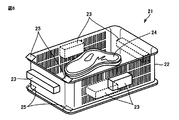
- FIG. 6 is a diagram schematically showing another preferred example of the ion irradiation apparatus 21 of the present invention.
- the accommodating part 22 is a container-like thing which can be stacked and conveyed, and a plurality of ion generating parts 23 are provided so as to surround the container-like interior ( Embodiment 6).
- each of the plurality of ion generators 23 is provided with the accommodating portions 22 each of which is a container-like object. In the example, it is provided with five ion generators (front, rear, left and right).
- a food (meat in the example shown in FIG. 6) 24 that needs to be stored by refrigeration is placed inside the plurality of ion generators 23.
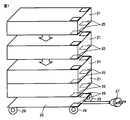
- FIG. 7 is a diagram schematically showing a state in which a plurality of ion irradiation devices 21 of the example shown in FIG. 6 are stacked.
- the ion irradiation apparatus 21 of Embodiment 6 is provided with a terminal 25 for supplying power, and when each container 25 is stacked on a cart-like object 26 that can be electrically connected to the power source, each terminal 25 is It is preferably configured to be electrically connected so that electricity can be supplied from a power source.
- terminals 25 are provided at the end portions of the upper and lower surfaces of the container-like object, and when a plurality of terminals are stacked, the terminals 25 of the container-like objects adjacent to each other are in contact with each other. .
- the carriage-like object 26 is provided with an electric cord 27 that can be electrically connected to a power source, and a carriage-like object-side terminal 28 is provided at the end of the placement surface 26a for placing the container-like article, and the container
- a carriage-like object-side terminal 28 is provided at the end of the placement surface 26a for placing the container-like article, and the container
- the terminal 25 on the lower surface side of the lowermost container object comes into contact with the cart-like object side terminal 28 and is electrically connected to the power source via the cart-like object side terminal 28.
- Connection is enabled, and thereby electricity is supplied to each container-like object, and the ion generator 23 provided in each container-like object is configured to be driven.
- the cart-like object 26 is configured to be movable in a state where a caster 29 is attached to the lower side and one or a plurality of container-like objects are placed thereon.
- FIG. 8A is a diagram schematically showing an ion irradiation apparatus 31 of another preferred example of the present invention.
- the ion irradiation device 31 includes a transport device in which the storage portion can transport food that needs to be stored by refrigeration so as to pass through a plurality of regions, and one or a plurality of ions are provided for each region.
- a generation part is provided, and it is configured to irradiate the food with positive ions and negative ions while being conveyed (Embodiment 7).
- FIG. 7 is a diagram schematically showing an ion irradiation apparatus 31 of another preferred example of the present invention.
- the ion irradiation device 31 includes a transport device in which the storage portion can transport food that needs to be stored by refrigeration so as to pass through a plurality of regions, and one or a plurality of ions are provided for each region.
- a generation part is provided, and it is configured to irradiate the food with positive ions and negative ions
- the food is indicated by an arrow in the figure (a).
- the transport device 33b food (not shown) is transported from the right side to the left side, and then moved to the next transport device 33c. In this way, it is unloaded after being transported by a plurality of transport devices.
- the food is irradiated with positive ions and negative ions from one or a plurality of ion generators (not shown) installed for each region.
- the ion irradiation device 31 of Embodiment 7 is preferably configured to irradiate the food with positive ions and negative ions from different directions in each region.
- the upper surface is irradiated in the transfer device 33a
- the lower surface is irradiated in the transfer device 33b
- the side surfaces are each of the four front, back, left, and right sides
- the food can be irradiated with positive ions and negative ions from various directions, the growth of bacteria on each surface of the food is suppressed, and the time until the food reaches the number of bacteria to be spoiled is reduced. Can be delayed, and as a result, the expiry date of the food can be extended.
- FIG. 8B is a diagram schematically showing an ion irradiation apparatus 41 of another preferred example of the present invention.
- the container is attached to the surface of food that needs to be stored by refrigeration.
- the test result in the test area 42 exceeds a predetermined reference value, the food is further irradiated with positive ions and negative ions. (Embodiment 8).
- FIG. 8B is a diagram schematically showing an ion irradiation apparatus 41 of another preferred example of the present invention.
- the container is attached to the surface of food that needs to be stored by refrigeration.
- the test result in the test area 42 exceeds a predetermined reference value
- the food is further irradiated with positive ions and negative ions.
- the food (not shown) after being transported in order from the transport device 33a to the transport device 33f is detected in the inspection region 42, and bacteria attached to the surface thereof are detected, and the test result is predetermined. If it does not exceed the reference value, it is carried out as it is as in the example shown in FIG. On the other hand, when the inspection result exceeds a predetermined reference value, the test result is moved to the preliminary irradiation area 43 and irradiated with positive ions and negative ions. Thereafter, it returns to the inspection area 42 and is carried out.
- the inspection for detecting the bacteria adhering to the surface of the food performed in the inspection region 42 can be applied with no particular limitation, and for example, the inspection can be performed according to the procedure described later in the embodiment. it can.
- the food that needs to be stored by refrigeration is not limited to meat, as described for the method of the present invention described above.
- examples include bread, rice cake, chikuwa, sausage, ham, bacon, noodles, cheese, and seafood.
- the flocculent meat adheres to the surface of the meat, particularly when the massive meat is processed into small portions manually or mechanically at the meat processing plant. Meat is preferred.
- FIG. 9 is a diagram schematically illustrating the ion irradiation apparatus 51 used in the first embodiment, in which FIG. 9A shows the housing portion 52, and FIG. 9B shows the lid portion 53 of the housing portion 52.
- the attached ion generating part 54 and FIG. 9C schematically show that the meat 55 accommodated in the accommodating part 52 is irradiated with positive ions and negative ions from the ion generating part 54.
- FIG. 10 is a diagram schematically illustrating the procedure of the first embodiment. In Example 1, first, as shown in FIG.
- meat 55 (specifically, a beef rose block of about 300 g) is placed on a petri dish 56, and bacteria attached to the surface of the meat 55 with a fungus collection stick (cotton swab) 57a. Bacteria were collected by wiping and diluting the bacteria adhering to the bacteria collection rod with sterilized water and applying them to a standard agar medium (wiping method). Then, the meat 55 was accommodated in the accommodating part 52 of the ion irradiation apparatus 51 shown in FIG.9 (c), and the positive ion and the negative ion were irradiated.
- a fungus collection stick cotton swab
- the size of the accommodating part 52 is about 12 L (width 23.5 cm ⁇ depth 34.5 cm ⁇ height 15.0 cm), and the ion generating part 54 is located in the accommodating part 52. With the lid portion 53 attached, it was arranged in the internal space of the housing portion 52 and was configured to irradiate positive ions and negative ions from obliquely above the meat 455.
- an ion outlet 54a having a size of 7.5 cm ⁇ 2.0 cm and a depth of 5.7 cm was used.
- the ion concentration was set to 500,000 ions / cm 3 in total of positive ions and negative ions, and the irradiation time was 90 minutes.
- the temperature of the internal space of the container 52 during ion irradiation was controlled to about 0 ° C. using a low temperature incubator (FMU-203I, manufactured by Fukushima Kogyo Co., Ltd.), and humidity was not controlled.
- FMU-203I low temperature incubator
- the meat 55 was taken out together with the petri dish 56 from the container 52, and the bacteria on the surface of the meat 55 immediately after the ion irradiation were collected with the fungus collection rod 57b. Thereafter, the meat 55 together with the petri dish 56 is housed in a sealed container 58 and stored in a household refrigerator (average temperature: about 3.5 ° C.). At each time point 4 days, 7 days, and 10 days after ion irradiation, Bacteria were collected using the collection rods 57c, 57d, and 57e, respectively, and changes in the number of bacteria over time were observed.
- FIG. 1 shows a case where positive ions and negative ions are irradiated from one place, meat is placed at a position where positive ions and negative ions hit and stored for a certain period of time (Example 1), and positive ions and negative ions are irradiated. It is a graph which compares and shows the case where it did not (Comparative Example 1). 1, the vertical axis represents the average number of bacteria Log (CFU / cm 2 ), and the horizontal axis in FIG. 1A represents the initial time, immediately after irradiation, 4 days, 7 days, and 10 days later. In FIG. 1B, the horizontal axis indicates the number of days elapsed.
- Example 1 the average number of bacteria (CFU / cm 2 ) at each time point in Example 1 and Comparative Example 1 is shown in Table 1, and the estimated number of bacteria (CFU / cm 2 ) calculated from the approximate line shown in FIG. It is shown in 2.
- Example 1 the number of bacteria was reduced by 84.5% on the 10th day after storage in the refrigerator due to ion irradiation. Moreover, the bacteria number expected value, odor changes 10 6 CFU / cm 2 or more, to form a viscous substance 10 7 ⁇ 10 8 CFU / cm 2 or more, to generate ammonia 10 8 CFU / cm 2 or more (Reference : Hisao Yoshii et al. “Food Microbiology Handbook” (1995)) In Example 1, the results were extended by one day. Further, as is clear from the results shown in FIG. 1, when the meat is irradiated with positive ions and negative ions, there is not much difference from the case of not irradiating in the initial stage.
- the difference in the number of bacteria is remarkable. From these results, by irradiating the meat with positive ions and negative ions, the growth of bacteria attached to the surface of the meat was suppressed, and positive ions and negative ions were not irradiated with each passage of days. It is considered that the difference in the number of bacteria became prominent (in FIG. 1, the vertical axis indicates Log, and the difference in digits indicates that the difference is significant).
- FIG. 11 is a diagram schematically showing the ion irradiation apparatus 61 used in the second embodiment.
- FIG. 11A shows a lid 63 and an ion generator 64, and FIG. The state attached to 62 is shown.
- an ion generation unit 64 is attached in the vicinity of the center outside the lid portion 63.
- the ion generator 64 has a size of 7.0 cm ⁇ 7.5 cm ⁇ 2.0 cm, and the ion blower outlet 64 a has a size of 7.5 cm ⁇ 2.0 cm.
- Example 2 the ion generation part 63 was arrange
- the time-dependent change in the number of bacteria was observed in the same manner as in Example 1 except that the bacteria were collected on the fifth, ninth, and twelfth days after ion irradiation.
- FIG. 2 shows a case where positive ions and negative ions are irradiated from one place, meat is placed at a position where positive ions and negative ions are at a high concentration and stored for a certain period of time (Example 2: black circles), and positive ions.
- FIG. 2A is a graph showing a comparison with a case where no negative ions are irradiated (Comparative Example 2: white square)
- FIG. 2A is a plot at each time point
- FIG. 2B is FIG.
- the index calculated from the results is shown. 2, in each case, the vertical axis represents the average number of bacteria Log (CFU / cm 2 ), and the horizontal axis in FIG. 2 (a) represents the initial state, immediately after irradiation, 5 days, 9 days, and 12 days. The time point is shown, and the horizontal axis in FIG. 2 (b) shows the elapsed days.
- Example 2 the average number of bacteria (CFU / cm 2 ) at each time point in Example 2 and Comparative Example 2 is shown in Table 3, and the estimated number of bacteria (CFU / cm 2 ) calculated from the approximate line shown in FIG. 4 shows.
- Example 1 the number of bacteria was reduced by 99.9% on the 9th day after storage in the refrigerator due to ion irradiation. From the estimated number of bacteria, ammonia is generated for 9 days until it reaches 10 6 CFU / cm 2 or more where the odor changes, and for 12 days until it reaches 10 7 to 10 8 CFU / cm 2 or more that forms a viscous material. The result was extended to 15 days until reaching 10 8 CFU / cm 2 or more. Further, as is clear from the results shown in FIG. 2, when the meat is irradiated with positive ions and negative ions, there is not much difference from the case of not irradiating in the initial stage, but the average is obtained every time the elapsed days pass.
- the difference in the number of bacteria is remarkable. From these results, by irradiating the meat with positive ions and negative ions, the growth of bacteria attached to the surface of the meat was suppressed, and positive ions and negative ions were not irradiated with each passage of days. It is considered that the difference in the number of bacteria became prominent (in FIG. 2, the vertical axis indicates Log, and the difference in digits indicates that the difference is significant).
- FIG. 12 is a diagram schematically showing the ion irradiation apparatus 71 used in the third embodiment.
- FIG. 12A shows a lid 63 and an ion generator 64, and FIG. The state attached to 62 is shown.
- the ion irradiation apparatus 71 shown in FIG. 12 uses the same ion generator 64 as shown in FIG. 11, but generates ions so that positive ions and negative ions are irradiated from the upper side to the outside of the lid 63.
- a similar ion generating portion 64 surrounds the accommodating portion 72 and irradiates the internal space of the accommodating portion 72 with positive ions and negative ions on the front, rear, left, and right sides, respectively.
- the meat 55 is mounted on the net
- the size of the accommodating portion 72 is about 17 L (width 27.6 cm ⁇ depth 38.3 cm ⁇ height 24.6 cm), and a beef rose block of about 150 g is used as meat. Cut in half, half was used in Example 3, and the remaining half was used in Comparative Example 3 (described later).
- the collection of bacteria is performed 7 days after ion irradiation, 10th day, and 14th day.
- the average value of n4 was evaluated.
- FIG. 3 shows a case where positive ions and negative ions are irradiated from six locations around the top, bottom, front, back, left, and right, and meat is placed at a position where positive ions and negative ions have a high concentration and stored for a certain time (Example 3: black).
- 3) is a graph showing a comparison between the case where no positive ions and negative ions are irradiated (Comparative Example 3: white square)
- FIG. 3A is a plot at each time point
- FIG. Indicates an index calculated from the result of FIG. 3, in each case, the vertical axis represents the average number of bacteria Log (CFU / cm 2 ), and the horizontal axis in FIG. 3A represents the initial time points, 7 days, 10 days, and 14 days later.
- the horizontal axis indicates the number of days elapsed.
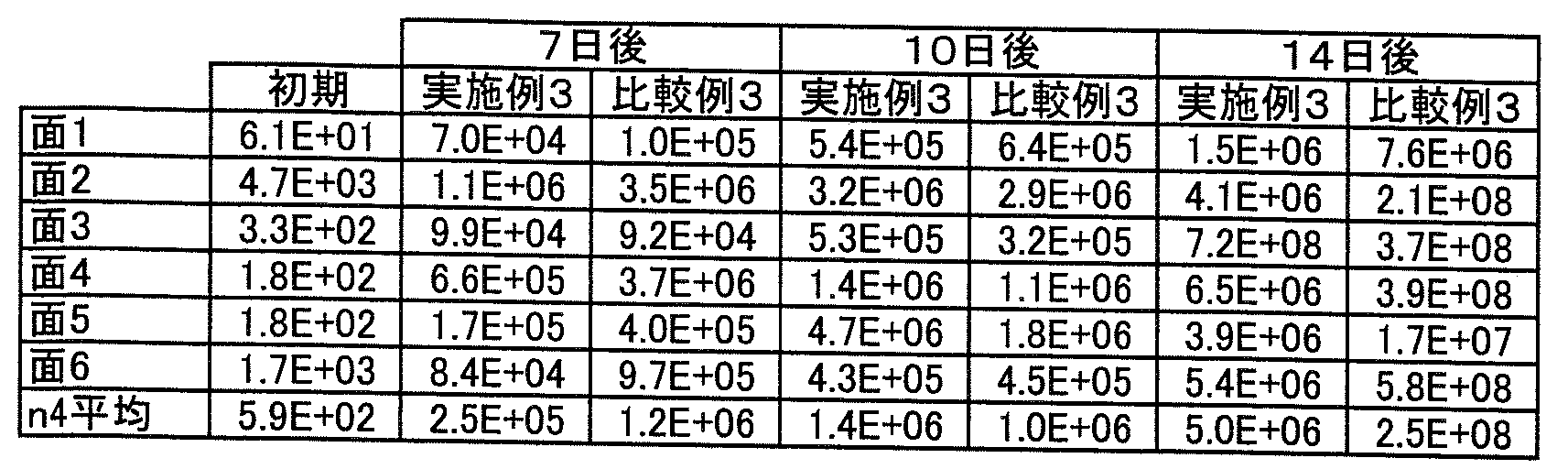
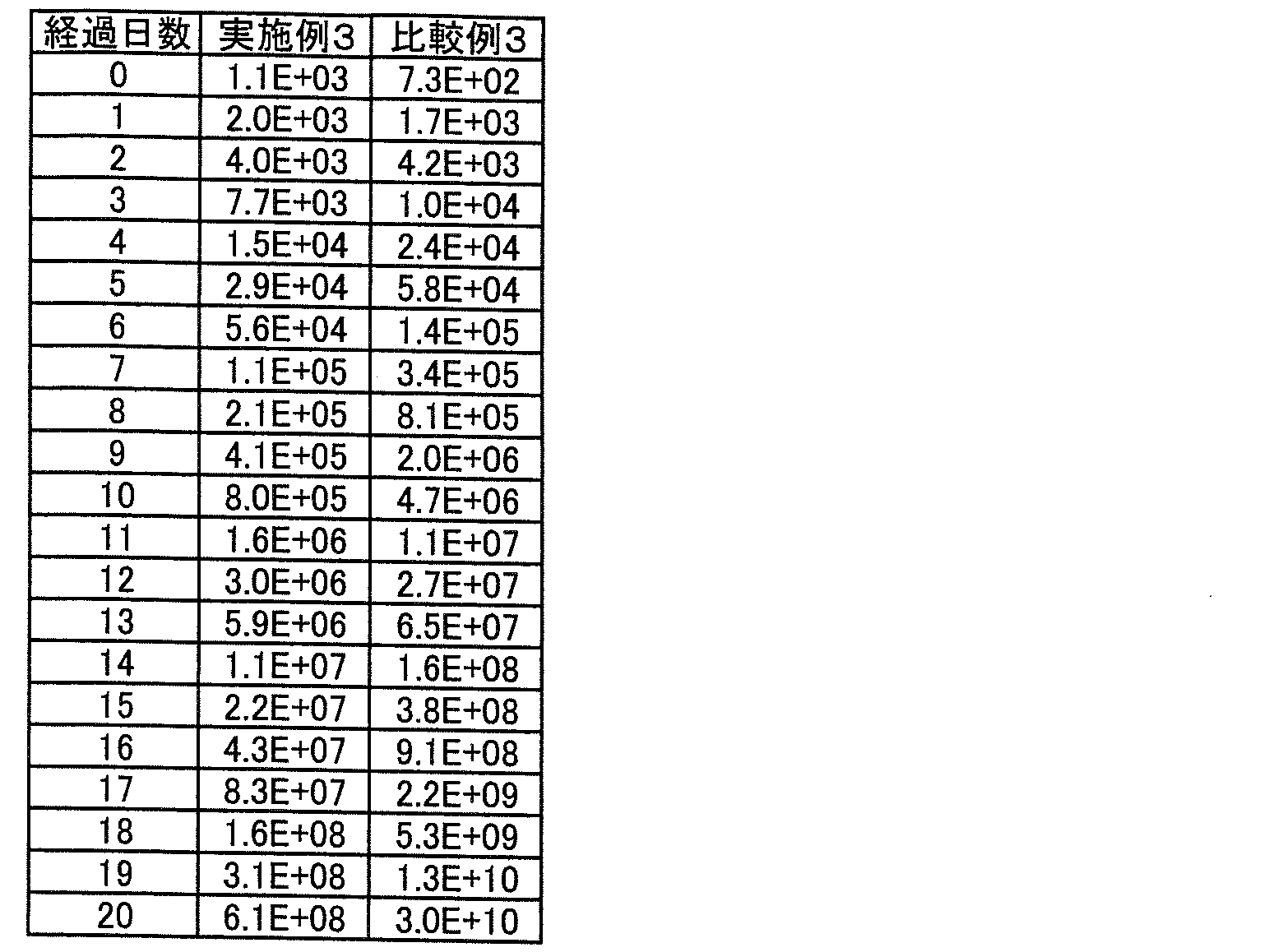
- Example 3 the average number of bacteria (CFU / cm 2 ) and removal rate at each time point in Example 3 and Comparative Example 3 are shown in Table 5, the number of bacteria by irradiation surface (CFU / cm 2 ) is shown in Table 6, and FIG. Table 7 shows the predicted number of bacteria (CFU / cm 2 ) calculated from the approximate line shown in FIG.
Landscapes
- Engineering & Computer Science (AREA)
- Life Sciences & Earth Sciences (AREA)
- Chemical & Material Sciences (AREA)
- Polymers & Plastics (AREA)
- Zoology (AREA)
- Food Science & Technology (AREA)
- Wood Science & Technology (AREA)
- Combustion & Propulsion (AREA)
- Physics & Mathematics (AREA)
- Mechanical Engineering (AREA)
- Thermal Sciences (AREA)
- General Engineering & Computer Science (AREA)
- Food Preservation Except Freezing, Refrigeration, And Drying (AREA)
- Cold Air Circulating Systems And Constructional Details In Refrigerators (AREA)
- Meat, Egg Or Seafood Products (AREA)
Abstract
Description
ここで、図9は、実施例1に用いたイオン照射装置51を模式的に示す図であり、図9(a)は収容部52、図9(b)は収容部52の蓋部53に取り付けられたイオン発生部54、図9(c)は収容部52内に収容した食肉55にイオン発生部54から正イオンおよび負イオンを照射している様子をそれぞれ模式的に示している。また図10は、実施例1の手順を模式的に示す図である。実施例1ではまず、図10に示すように食肉55(具体的には、牛バラブロック約300g)をシャーレ56上に載せ、菌採取棒(綿棒)57aで食肉55の表面に付着する菌を拭き取り、菌採取棒に付着した菌を滅菌水で希釈し、標準寒天培地に塗布することで菌の採取を行なった(拭き取り法)。その後、図9(c)に示したイオン照射装置51の収容部52に食肉55を収容し、正イオンおよび負イオンを照射した。実施例1で用いたイオン照射装置51において、収容部52の大きさは約12L(幅23.5cm×奥行34.5cm×高さ15.0cm)であり、イオン発生部54は収容部52に蓋部53を取り付けられた状態で、収容部52の内部空間に配置され、食肉455の斜め上側から正イオンおよび負イオンを照射するように構成された。イオン発生部54は、イオン吹出口54aが7.5cm×2.0cmの大きさであり、奥行は5.7cmのものを用いた。イオン濃度は、正イオンおよび負イオンの合計で500,000個/cm3となるようにし、照射時間は90分間とした。またイオン照射の際の収容部52の内部空間の温度は、低温インキュベーター(FMU-203I、福島工業株式会社製)を用いて約0℃に制御し、湿度については制御しなかった。
イオンの照射を行なわなかったこと以外は実施例1と同様にして、菌数の経時変化を観察した。

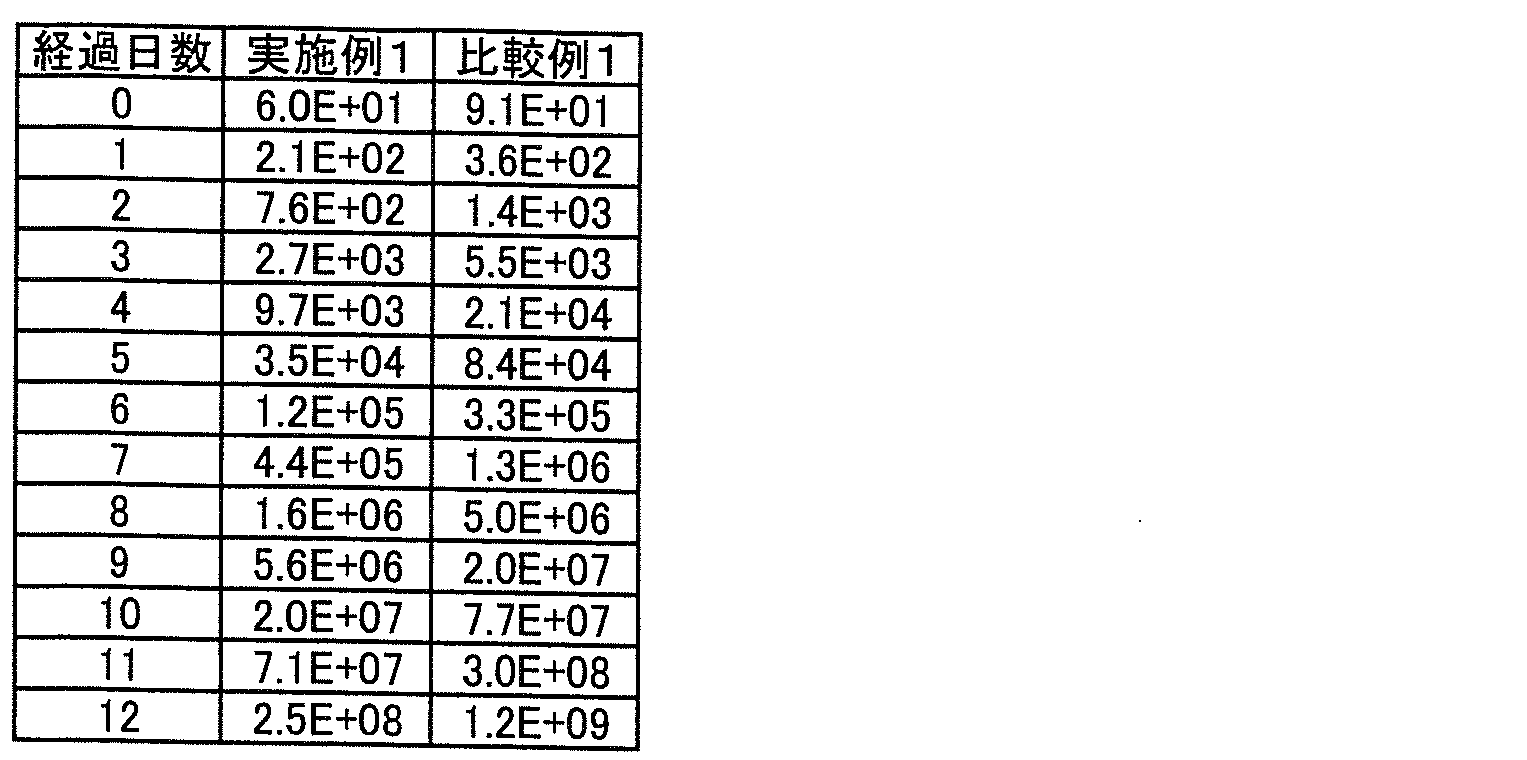
図11は、実施例2に用いたイオン照射装置61を模式的に示す図であり、図11(a)は蓋部63およびイオン発生部64、図11(b)は蓋部63を収容部62に取り付けた状態を示している。実施例2で用いたイオン照射装置61は、蓋部63の外側の中央付近にイオン発生部64が取り付けられている。イオン発生部64は、7.0cm×7.5cm×2.0cmの大きさであり、そのうち、イオン吹出口64aの大きさが7.5cm×2.0cmのものを用いた。実施例2では、収容部62の外側にイオン発生部63を配置し、収容部62内に収容された食肉55に、真上から正イオンおよび負イオンが照射されるように配置した。このようなイオン照射装置61を用い、イオン照射後に5日後、9日目、12日目の時点で菌を採取したこと以外は実施例1と同様にして、菌数の経時変化を観察した。
イオンの照射を行なわなかったこと以外は実施例2と同様にして、菌数の経時変化を観察した。

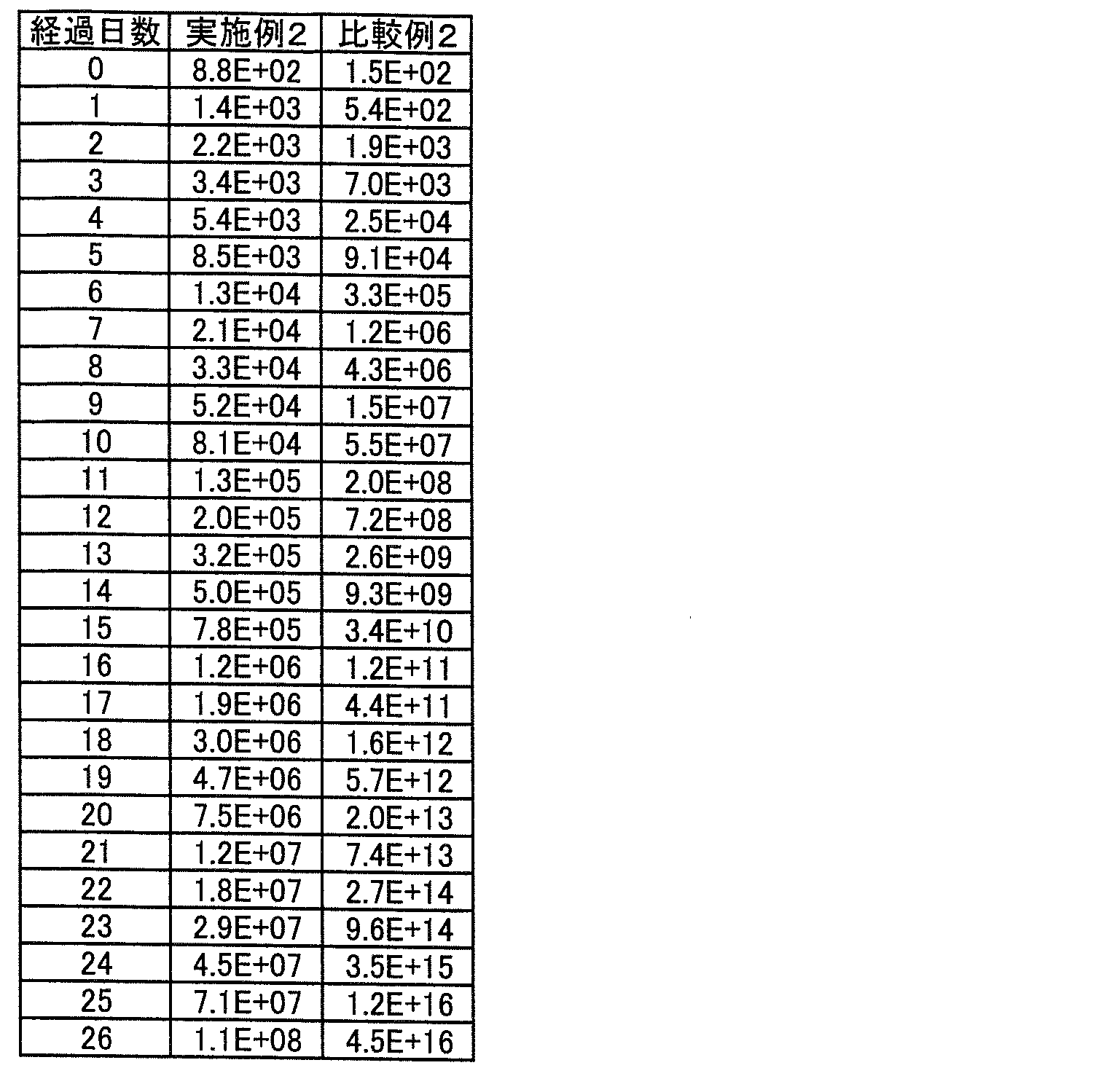
図12は、実施例3に用いたイオン照射装置71を模式的に示す図であり、図12(a)は蓋部63およびイオン発生部64、図12(b)は蓋部63を収容部62に取り付けた状態を示している。図12に示すイオン照射装置71は、図11に示したのと同様のイオン発生部64を用いているが、蓋部63の外側に、上側から正イオンおよび負イオンを照射するようにイオン発生部64が取り付けられているだけではなく、収容部72を囲んで、前後左右下側にもそれぞれ、収容部72の内部空間に正イオンおよび負イオンを照射するように同様のイオン発生部64が設けられている点で異なる。なお、図12(b)に示すイオン照射装置71を用いる場合、下側からも効率よく正イオンおよび負イオンを照射できるように、食肉55は、網状物または格子状物73の上に載置される。実施例3で用いたイオン照射装置71は、収容部72の大きさは約17L(幅27.6cm×奥行38.3cm×高さ24.6cm)とし、食肉として牛バラブロック約150gを用い、半分にカットし、半分を実施例3、残る半分を比較例3(後述)に用いた。また、菌の採取については、イオン照射後に7日後、10日目、14日目の時点で行ない、6つの面について、1つの面をn1とし、面積で割った菌数(CFU/cm2)で最大値、最小値を除き、n4の平均値で評価した。上述した以外の点については、実施例1と同様にして、菌数の経時変化を観察した。
イオンの照射を行なわなかったこと以外は実施例3と同様にして、菌数の経時変化を観察した。

Claims (15)
- 塊状物から小分けにされた後に冷蔵庫または冷凍庫で保管される食肉の保管方法であって、
冷蔵庫または冷凍庫に保管する前に、当該食肉に正イオンおよび負イオンを照射することを特徴とする、食肉の保管方法。 - 小分けにする前の状態の食肉に正イオンおよび負イオンを照射することを特徴とする、請求項1に記載の方法。
- 冷蔵庫または冷凍庫に保管する前に、小分けにした後の状態の食肉に正イオンおよび負イオンを照射することを特徴とする、請求項1または2に記載の方法。
- 前記正イオンおよび負イオンは、大気中での放電により発生する正イオンおよび負イオンを送風することにより照射されることを特徴とする、請求項1~3のいずれか1項に記載の方法。
- 冷蔵による保管を必要とする食品に、冷蔵により保管する前に、正イオンおよび負イオンを照射し、冷蔵による保管を必要とする食品の消費期限を延ばす方法。
- 冷蔵による保管を必要とする食品に、冷蔵により保管する前に、正イオンおよび負イオンを照射し、冷蔵による保管を必要とする食品の表面に発生する菌の増殖を抑制する方法。
- 冷蔵による保管を必要とする食品を内部に収容可能な収容部と、
前記収容部の内部に、正イオンおよび負イオンを照射するイオン発生部とを備え、
前記正イオンおよび負イオンを、冷蔵による保管を必要とする食品に照射することで、前記食品の表面に発生する菌の増殖を抑制する、菌増殖抑制用イオン照射装置。 - 冷蔵による保管を必要とする食品を内部に収容可能な収容部と、
前記収容部の内部に、正イオンおよび負イオンを照射するイオン発生部とを備え、
前記イオン発生部は、前記収容部の内部を囲むようにして複数個設けられている、イオン照射装置。 - 前記イオン発生部は、前記収容部の内部を囲むように対向して2対以上設けられている、請求項8に記載のイオン照射装置。
- 前記収容部は、底面が回転可能なように構成されている、請求項8または9に記載のイオン照射装置。
- 前記収容部は、複数個積み重ねて運搬可能なコンテナ状物であり、コンテナ状物の内部を囲むようにしてイオン発生部が複数個設けられている、請求項8または9に記載のイオン照射装置。
- 各コンテナ状物には、電源供給用の端子が設けられており、電源と電気的に接続可能な台車状物上に各コンテナ状物を積み上げた場合に、各端子が電気的に接続され、電源から電気を供給可能に構成されている、請求項11に記載のイオン照射装置。
- 前記収容部は、その内部において冷蔵による保管を必要とする食品を、複数の領域を通過するように搬送し得る搬送装置を備え、各領域ごとに1または複数個のイオン発生部が設けられ、搬送しながら前記食品に正イオンおよび負イオンを照射するように構成されている、請求項8に記載のイオン照射装置。
- 各領域において、互いに異なる方向から前記食品に正イオンおよび負イオンを照射するように構成されている、請求項13に記載のイオン照射装置。
- 前記収容部は、冷蔵による保管を必要とする食品の表面に付着する菌を検出するための検査領域を有し、当該検査領域における検査結果が予め定める基準値を超える場合には、正イオンおよび負イオンを当該食品にさらに照射するように構成されている、請求項13または14に記載のイオン照射装置。
Priority Applications (2)
| Application Number | Priority Date | Filing Date | Title |
|---|---|---|---|
| US14/913,714 US20160205957A1 (en) | 2013-08-29 | 2014-02-27 | Ion irradiation apparatus, and method in which ion irradiation apparatus is applied to food requiring storage by refrigeration |
| CN201480047340.8A CN105491888A (zh) | 2013-08-29 | 2014-02-27 | 离子照射装置和将其应用于需要通过冷藏保管的食品的方法 |
Applications Claiming Priority (2)
| Application Number | Priority Date | Filing Date | Title |
|---|---|---|---|
| JP2013178293A JP2015043753A (ja) | 2013-08-29 | 2013-08-29 | イオン照射装置およびそれを冷蔵による保管を必要とする食品に適用した方法 |
| JP2013-178293 | 2013-08-29 |
Publications (1)
| Publication Number | Publication Date |
|---|---|
| WO2015029470A1 true WO2015029470A1 (ja) | 2015-03-05 |
Family
ID=52586054
Family Applications (1)
| Application Number | Title | Priority Date | Filing Date |
|---|---|---|---|
| PCT/JP2014/054849 Ceased WO2015029470A1 (ja) | 2013-08-29 | 2014-02-27 | イオン照射装置およびそれを冷蔵による保管を必要とする食品に適用した方法 |
Country Status (4)
| Country | Link |
|---|---|
| US (1) | US20160205957A1 (ja) |
| JP (1) | JP2015043753A (ja) |
| CN (1) | CN105491888A (ja) |
| WO (1) | WO2015029470A1 (ja) |
Cited By (1)
| Publication number | Priority date | Publication date | Assignee | Title |
|---|---|---|---|---|
| JP2020165779A (ja) * | 2019-03-29 | 2020-10-08 | 三井金属計測機工株式会社 | 青果類検査装置及び青果類検査方法並びに鮮度保持機能付き青果類検査装置及び鮮度保持のための青果類検査方法 |
Families Citing this family (5)
| Publication number | Priority date | Publication date | Assignee | Title |
|---|---|---|---|---|
| WO2017187702A1 (ja) * | 2016-04-28 | 2017-11-02 | シャープ株式会社 | 消臭方法および消臭装置 |
| CN107223867A (zh) * | 2017-07-21 | 2017-10-03 | 天津市兴达和平食品有限公司 | 一种面条的制作方法 |
| RU2683518C1 (ru) * | 2018-04-05 | 2019-03-28 | Федеральное государственное бюджетное образовательное учреждение высшего образования "Уральский государственный экономический университет" (УрГЭУ) | Способ увеличения срока хранения вареных колбас |
| CN114364617B (zh) * | 2019-09-18 | 2023-10-17 | 夏普株式会社 | 输送容器 |
| JP7745303B1 (ja) * | 2025-04-30 | 2025-09-29 | 株式会社マキシム | 魚介類または魚介類の派生物の鮮度維持システム |
Citations (10)
| Publication number | Priority date | Publication date | Assignee | Title |
|---|---|---|---|---|
| JP2000262260A (ja) * | 1999-03-17 | 2000-09-26 | Nippon Haikomu Kk | マイクロ波食品加熱殺菌装置及び加熱殺菌方法 |
| JP2001182945A (ja) * | 1999-12-27 | 2001-07-06 | Sanyo Electric Co Ltd | 異種混合食品解凍用加熱調理装置 |
| JP2002089847A (ja) * | 2000-09-14 | 2002-03-27 | Mitsubishi Electric Corp | 高周波加熱装置 |
| JP2002124372A (ja) * | 2000-10-13 | 2002-04-26 | Toshiba Corp | 電子レンジ |
| JP2002333265A (ja) * | 2000-12-27 | 2002-11-22 | Sharp Corp | 貯蔵庫及び冷蔵庫 |
| JP2002372365A (ja) * | 2000-12-27 | 2002-12-26 | Sharp Corp | 冷蔵庫 |
| JP2004192944A (ja) * | 2002-12-11 | 2004-07-08 | Akiko Sugawara | イオン発生装置、食品保存庫、ショーケース、殺菌庫、ビニールハウス、殺菌方法、植物育成方法、食品加工方法、食品流通方法、食品保存方法及び食品輸送方法 |
| JP2005312306A (ja) * | 2004-04-27 | 2005-11-10 | Torakiya:Kk | 食品の減菌装置 |
| JP2007205712A (ja) * | 2000-12-27 | 2007-08-16 | Sharp Corp | 貯蔵庫 |
| JP2013025939A (ja) * | 2011-07-19 | 2013-02-04 | Jfe Engineering Corp | コンテナ倉庫およびそのコンテナ倉庫へのコンテナの収容方法 |
Family Cites Families (11)
| Publication number | Priority date | Publication date | Assignee | Title |
|---|---|---|---|---|
| US3047398A (en) * | 1959-10-14 | 1962-07-31 | Swift & Co | Preparation of comminuted meat products |
| JPS5161649A (en) * | 1974-11-19 | 1976-05-28 | Kibun Kk | Butsupinno hyomensatsukinho |
| CN2087880U (zh) * | 1991-03-20 | 1991-11-06 | 曲贵斌 | 空气放电负离子保鲜柜 |
| JP2711377B2 (ja) * | 1993-04-06 | 1998-02-10 | 金光 山岡 | 生食用まぐろの超低温薫製による品質保持処理方法及びその装置 |
| JP2984997B1 (ja) * | 1998-08-19 | 1999-11-29 | 株式会社アルファ | 食品の静菌抗菌殺菌処理装置 |
| CN2793650Y (zh) * | 2000-12-27 | 2006-07-05 | 夏普公司 | 贮藏箱及冷藏箱 |
| JP2003225049A (ja) * | 2001-11-29 | 2003-08-12 | Kazuo Iwai | 食肉の殺菌方法 |
| JP2005253449A (ja) * | 2004-03-11 | 2005-09-22 | Watanabe Shoten:Kk | 鮮度に優れた刻み野菜及びその加工方法 |
| KR100891761B1 (ko) * | 2007-10-19 | 2009-04-07 | 삼성전기주식회사 | 반도체 발광소자, 그의 제조방법 및 이를 이용한 반도체발광소자 패키지 |
| JP2010193829A (ja) * | 2009-02-26 | 2010-09-09 | Mitsubishi Electric Air Conditioning & Refrigeration Plant Co Ltd | 食品殺菌貯蔵方法および装置 |
| JP5662654B2 (ja) * | 2009-05-30 | 2015-02-04 | 株式会社 Ktサイエンス | マイナスイオン発生板、マイナスイオン発生板を使用した家具、住宅等 |
-
2013
- 2013-08-29 JP JP2013178293A patent/JP2015043753A/ja active Pending
-
2014
- 2014-02-27 WO PCT/JP2014/054849 patent/WO2015029470A1/ja not_active Ceased
- 2014-02-27 CN CN201480047340.8A patent/CN105491888A/zh active Pending
- 2014-02-27 US US14/913,714 patent/US20160205957A1/en not_active Abandoned
Patent Citations (10)
| Publication number | Priority date | Publication date | Assignee | Title |
|---|---|---|---|---|
| JP2000262260A (ja) * | 1999-03-17 | 2000-09-26 | Nippon Haikomu Kk | マイクロ波食品加熱殺菌装置及び加熱殺菌方法 |
| JP2001182945A (ja) * | 1999-12-27 | 2001-07-06 | Sanyo Electric Co Ltd | 異種混合食品解凍用加熱調理装置 |
| JP2002089847A (ja) * | 2000-09-14 | 2002-03-27 | Mitsubishi Electric Corp | 高周波加熱装置 |
| JP2002124372A (ja) * | 2000-10-13 | 2002-04-26 | Toshiba Corp | 電子レンジ |
| JP2002333265A (ja) * | 2000-12-27 | 2002-11-22 | Sharp Corp | 貯蔵庫及び冷蔵庫 |
| JP2002372365A (ja) * | 2000-12-27 | 2002-12-26 | Sharp Corp | 冷蔵庫 |
| JP2007205712A (ja) * | 2000-12-27 | 2007-08-16 | Sharp Corp | 貯蔵庫 |
| JP2004192944A (ja) * | 2002-12-11 | 2004-07-08 | Akiko Sugawara | イオン発生装置、食品保存庫、ショーケース、殺菌庫、ビニールハウス、殺菌方法、植物育成方法、食品加工方法、食品流通方法、食品保存方法及び食品輸送方法 |
| JP2005312306A (ja) * | 2004-04-27 | 2005-11-10 | Torakiya:Kk | 食品の減菌装置 |
| JP2013025939A (ja) * | 2011-07-19 | 2013-02-04 | Jfe Engineering Corp | コンテナ倉庫およびそのコンテナ倉庫へのコンテナの収容方法 |
Cited By (1)
| Publication number | Priority date | Publication date | Assignee | Title |
|---|---|---|---|---|
| JP2020165779A (ja) * | 2019-03-29 | 2020-10-08 | 三井金属計測機工株式会社 | 青果類検査装置及び青果類検査方法並びに鮮度保持機能付き青果類検査装置及び鮮度保持のための青果類検査方法 |
Also Published As
| Publication number | Publication date |
|---|---|
| US20160205957A1 (en) | 2016-07-21 |
| JP2015043753A (ja) | 2015-03-12 |
| CN105491888A (zh) | 2016-04-13 |
Similar Documents
| Publication | Publication Date | Title |
|---|---|---|
| Birania et al. | Cold plasma in food processing and preservation: A review | |
| Choi et al. | Corona discharge plasma jet for inactivation of Escherichia coli O157: H7 and Listeria monocytogenes on inoculated pork and its impact on meat quality attributes | |
| US11882844B2 (en) | Reactive gas, reactive gas generation system and product treatment using reactive gas | |
| US9363880B2 (en) | Method and system for treating packaged products | |
| Rød et al. | Cold atmospheric pressure plasma treatment of ready-to-eat meat: Inactivation of Listeria innocua and changes in product quality | |
| Misra et al. | In-package atmospheric pressure cold plasma treatment of strawberries | |
| WO2015029470A1 (ja) | イオン照射装置およびそれを冷蔵による保管を必要とする食品に適用した方法 | |
| US9539352B2 (en) | Method and system for treating packaged products | |
| Ulbin-Figlewicz et al. | Antimicrobial activity of low-pressure plasma treatment against selected foodborne bacteria and meat microbiota | |
| Schlüter et al. | Opinion on the use of plasma processes for treatment of foods | |
| Xiang et al. | Influences of cold atmospheric plasma on microbial safety, physicochemical and sensorial qualities of meat products | |
| Lee et al. | Intermittent corona discharge plasma jet for improving tomato quality | |
| Wan et al. | Effect of high voltage atmospheric cold plasma on inactivation of Listeria innocua on Queso Fresco cheese, cheese model and tryptic soy agar | |
| Millan-Sango et al. | Assessing bacterial recovery and efficacy of cold atmospheric plasma treatments | |
| Ehlbeck et al. | Plasma treatment of food | |
| Orsat et al. | Radio‐frequency heating of ham to enhance shelf‐life in vacuum packaging | |
| Kordová et al. | Inactivation of microbial food contamination of plastic cups using nonthermal plasma and hydrogen peroxide | |
| Cheng et al. | Modified atmosphere packaging pre-storage treatment for thermal control of E. coli ATCC 25922 in almond kernels assisted by radio frequency energy | |
| Lee et al. | Effect of atmospheric pressure plasma jet on inactivation of Listeria monocytogenes, quality, and genotoxicity of cooked egg white and yolk | |
| Kim et al. | Dielectric barrier discharge plasma for microbial decontamination of dried laver: Effects on physicochemical characteristics | |
| Grabowski et al. | Low pressure cold plasma as an alternative method for black pepper sterilization | |
| Smeu et al. | Enhancement of food safety–antimicrobial effectiveness of cold plasma treatments | |
| Misra et al. | Atmospheric‐Pressure Non‐Thermal Plasma Decontamination of Foods | |
| Kaluwahandi et al. | Opportunities and Challenges of Cold Plasma in Food Processing | |
| Kronn | Nonthermal plasma treatment of packaged broiler breast fillets to reduce natural microflora and Campylobacter jejuni |
Legal Events
| Date | Code | Title | Description |
|---|---|---|---|
| WWE | Wipo information: entry into national phase |
Ref document number: 201480047340.8 Country of ref document: CN |
|
| 121 | Ep: the epo has been informed by wipo that ep was designated in this application |
Ref document number: 14841280 Country of ref document: EP Kind code of ref document: A1 |
|
| WWE | Wipo information: entry into national phase |
Ref document number: IDP00201600920 Country of ref document: ID |
|
| WWE | Wipo information: entry into national phase |
Ref document number: 14913714 Country of ref document: US |
|
| NENP | Non-entry into the national phase |
Ref country code: DE |
|
| 122 | Ep: pct application non-entry in european phase |
Ref document number: 14841280 Country of ref document: EP Kind code of ref document: A1 |