WO2015020120A1 - ポリ乳酸樹脂組成物 - Google Patents
ポリ乳酸樹脂組成物 Download PDFInfo
- Publication number
- WO2015020120A1 WO2015020120A1 PCT/JP2014/070805 JP2014070805W WO2015020120A1 WO 2015020120 A1 WO2015020120 A1 WO 2015020120A1 JP 2014070805 W JP2014070805 W JP 2014070805W WO 2015020120 A1 WO2015020120 A1 WO 2015020120A1
- Authority
- WO
- WIPO (PCT)
- Prior art keywords
- polylactic acid
- acid resin
- resin composition
- metal salt
- parts
- Prior art date
- Legal status (The legal status is an assumption and is not a legal conclusion. Google has not performed a legal analysis and makes no representation as to the accuracy of the status listed.)
- Ceased
Links
Classifications
-
- C—CHEMISTRY; METALLURGY
- C08—ORGANIC MACROMOLECULAR COMPOUNDS; THEIR PREPARATION OR CHEMICAL WORKING-UP; COMPOSITIONS BASED THEREON
- C08K—Use of inorganic or non-macromolecular organic substances as compounding ingredients
- C08K5/00—Use of organic ingredients
- C08K5/36—Sulfur-, selenium-, or tellurium-containing compounds
- C08K5/41—Compounds containing sulfur bound to oxygen
- C08K5/42—Sulfonic acids; Derivatives thereof
-
- C—CHEMISTRY; METALLURGY
- C08—ORGANIC MACROMOLECULAR COMPOUNDS; THEIR PREPARATION OR CHEMICAL WORKING-UP; COMPOSITIONS BASED THEREON
- C08L—COMPOSITIONS OF MACROMOLECULAR COMPOUNDS
- C08L101/00—Compositions of unspecified macromolecular compounds
- C08L101/16—Compositions of unspecified macromolecular compounds the macromolecular compounds being biodegradable
Definitions
- the present invention relates to a polylactic acid resin composition capable of producing a molded article having a high crystallization speed and excellent heat resistance in a short time.
- biodegradable polylactic acid resin has attracted attention from the viewpoint of environmental conservation.
- Polylactic acid is a crystalline polymer, has a higher melting point and higher heat resistance than other biodegradable polyester resins.
- Polylactic acid can be mass-produced, so the cost is low and its usefulness is high.
- polylactic acid can be produced using plants such as corn and sweet potato as raw materials, and can contribute to saving of depleted resources such as oil.
- the polylactic acid resin has a problem that the crystallization speed is extremely slow and the molding cycle becomes long in order to obtain a molded body that is sufficiently crystallized practically. Therefore, in order to improve the crystallization rate, it has been studied to add various crystal nucleating agents to the polylactic acid resin.
- Patent Document 1 proposes an aromatic sulfonate having an average particle diameter adjusted to a range of 0.1 to 10 ⁇ m as a crystal nucleating agent for polylactic acid resin, and polylactic acid resin to which the crystal nucleating agent is added.
- the composition is shown.
- the crystal nucleating agent is uniformly dispersed in the resin.
- the surface area becomes larger as the particle size becomes smaller and the effect is more easily achieved, it is preferable to use a crystal nucleating agent having a smaller particle size.
- a crystal nucleating agent having a small particle size is likely to aggregate when added and kneaded in the resin, making it difficult to uniformly disperse in the resin.
- Patent Document 1 describes that it is substantially preferable to use a crystal nucleating agent having an average particle size of 0.5 ⁇ m or more.
- a crystal nucleating agent having such a particle size is simply referred to as polylactic acid resin. It is described that the resin composition was obtained by mixing. In such a polylactic acid resin composition described in Patent Document 1, there is a high possibility that the crystal nucleating agent is aggregated, and a resin composition in which the crystal nucleating agent having a sufficiently small average particle diameter is uniformly dispersed is obtained. It wasn't. For this reason, the polylactic acid resin composition described in the cited document 1 is not sufficient in improving the crystal performance.
- the present invention solves the above problems, and is a resin composition in which a crystal nucleating agent having a sufficiently small particle size is uniformly dispersed in a polylactic acid resin, and the crystal performance of the polylactic acid resin It is a technical problem to provide a polylactic acid resin composition capable of obtaining a molded article that is sufficiently improved, has a high crystallization rate, and is excellent in heat resistance in a short time.
- the gist of the present invention is as follows.
- the number of dimethyl metal salts of 5-sulfoisophthalic acid (B) having a particle diameter of less than 0.1 ⁇ m, counted when observed with the above, is 5 or more in any of 10 fields of ultrathin sections.
- a polylactic acid resin composition is injection-molded, and an ISO-compliant test specimen for measuring general physical properties (size: length ⁇ width ⁇ thickness: 80 mm ⁇ 10 mm ⁇ 4 mm) is molded.
- a test piece A (size: length ⁇ width ⁇ thickness: 1 mm ⁇ 0.5 mm ⁇ 0.5 mm) is cut out from the test piece.
- Five ultrathin sections (0.5 mm ⁇ 0.5 mm ⁇ 0.1 ⁇ m) having a thickness of 0.1 ⁇ m are cut out in a direction perpendicular to the length direction of the test piece A.
- [4] A method for producing the polylactic acid resin composition according to [1] above, Pulverizing 5-sulfoisophthalic acid dimethyl metal salt (B) with a dry pulverizer in which the inner surface of the pulverizing cylinder and the material of the pulverizing medium are steel and / or ceramic, for 1 hour or more;
- the pulverized product of 5-sulfoisophthalic acid dimethyl metal salt (B) obtained by the above process, together with the polylactic acid resin (A), has a screw L / D ratio of 20 to 60 and a screw rotation speed of 100 to A process for melt-kneading with a twin-screw extruder at 300 rpm, and a method for producing a polylactic acid resin composition.
- the dimethyl metal salt of 5-sulfoisophthalic acid (B) having a sufficiently small particle size is uniformly dispersed in the polylactic acid resin (A).
- the crystal performance of (A) is sufficiently improved, the crystallization speed is fast, and a molded article excellent in heat resistance can be obtained in a short time.
- polylactic acid resin (A) when the D-form content is within a specific range, the steric regularity of polylactic acid resin is improved, so that the crystal performance is further improved, and the crystallization speed is faster.
- the heat resistance of the obtained molded body is also superior.
- the dispersibility of the 5-sulfoisophthalic acid dimethyl metal salt (B) can be further improved, so that the crystal performance of the resin composition can be further improved. it can.
- the polylactic acid resin composition of the present invention is particularly suitable for injection molding applications, and it is possible to obtain injection molded articles such as electrical and electronic equipment parts and miscellaneous goods with high productivity, and these molded articles are heat resistant. Therefore, it can be used in a high temperature environment. And since the polylactic acid resin composition of this invention has a resin derived from a natural product as a main component, it can contribute to the saving of exhaustion resources, such as petroleum, and its industrial utility value is very high.
- polylactic acid resin (A) constituting the polylactic acid resin composition of the present invention will be described.
- polylactic acid resin (A) in the present invention poly (L-lactic acid), poly (D-lactic acid), and a mixture or copolymer thereof can be used.
- the polylactic acid resin (A) is preferably mainly composed of poly (L-lactic acid), and the D-form content is preferably 1.0 mol% or less.
- the polylactic acid resin (A) may be mainly composed of poly (D-lactic acid), and the D-form content is preferably 99.0 mol% or more. Furthermore, it is preferable that the D-form content is 0 to 0.6 mol% or 99.4 to 100 mol%.
- the polylactic acid resin (A) has excellent crystal performance when the D-form content is within this range. Specifically, since the polylactic acid resin composition has a short molding cycle, the polylactic acid resin composition is excellent in moldability, and the resulting molded body has improved heat resistance. When the polylactic acid resin has a D-form content outside this range, the crystal performance is not sufficiently improved, and the polylactic acid resin composition does not improve moldability and improves the heat resistance of the resulting molded article. May be less effective.
- the D-form content of the polylactic acid resin (A) is a ratio (mol%) of the D-lactic acid unit in the total lactic acid units constituting the polylactic acid resin (A). Therefore, for example, in the case of a polylactic acid resin (A) having a D-form content of 1.0 mol%, this polylactic acid resin (A) has a ratio of D-lactic acid units of 1.0 mol%, and L -The proportion of lactic acid units is 99.0 mol%.
- the D-form content of the polylactic acid resin (A) is such that all of L-lactic acid and D-lactic acid obtained by decomposing the polylactic acid resin (A) are methyl esters, as will be described later in Examples. And calculated by a method of analyzing the methyl ester of L-lactic acid and the methyl ester of D-lactic acid with a gas chromatography analyzer.
- polylactic acid resin (A) used in the present invention various commercially available polylactic acid resins can be used, and those having a D-form content in the above range are preferably used.
- a polymer obtained by polymerizing a cyclic dimer of lactic acid can also be used.
- lactides L-lactide having a sufficiently low D-form content or D-lactide having a sufficiently low L-form content is used as a raw material. It is preferable to use a product prepared by a known melt polymerization method or further using a solid phase polymerization method in combination.
- polylactic acid resin (A) of the present invention polyglycolic acid, polycaprolactone, polybutylene succinate, polyethylene succinate, polybutylene adipate are used as subcomponents as long as the effects of the present invention are not impaired.
- One or two or more resins selected from terephthalate, polybutylene succinate terephthalate, and the like may be contained.
- the polylactic acid resin composition of the present invention contains 5-sulfoisophthalic acid dimethyl metal salt (B).
- the polylactic acid resin (A) has improved crystal performance, and the polylactic acid resin composition has a shorter molding cycle when obtaining a molded body, It becomes possible to obtain a molded body excellent in heat resistance.
- the content of 5-sulfoisophthalic acid dimethyl metal salt (B) is required to be 0.01 to 10 parts by mass with respect to 100 parts by mass of the polylactic acid resin (A). Part by mass is preferable, and 0.1 to 5 parts by mass is more preferable.
- the content of 5-sulfoisophthalic acid dimethyl metal salt (B) is less than 0.01 parts by mass, the effect of promoting crystallization is poor.
- the amount exceeds 10 parts by mass the crystallization promoting effect is saturated, which is not only economically disadvantageous, but also may adversely affect the physical properties such as lowering the strength of the obtained molded product.
- the finely divided dimethyl 5-sulfoisophthalic acid metal salt (B) is uniformly dispersed in the polylactic acid resin (A).
- the number of 5-sulfoisophthalic acid dimethyl metal salts (B) having a particle size of less than 0.1 ⁇ m, counted when observed under the following condition (1) is an ultrathin slice. In any of the 10 fields of view, it is necessary that the number is 5 or more, preferably 8 or more, and more preferably 10 or more.
- Condition (1) is that a polylactic acid resin composition is injection-molded, a test piece for measuring general physical properties (size; length ⁇ width ⁇ thickness: 80 mm ⁇ 10 mm ⁇ 4 mm) in conformity with ISO is tested from the test piece A piece A (size; length ⁇ width ⁇ thickness: 1 mm ⁇ 0.5 mm ⁇ 0.5 mm) was cut out, and an ultrathin section (0 ⁇ m thick) in a direction perpendicular to the length direction of the test piece A (0 ⁇ m) .5 mm ⁇ 0.5 mm ⁇ 0.1 ⁇ m), the conditions for preparing ultrathin sections, and each of the five sections, using a transmission electron microscope (TEM), with a magnification of 30,000 times, 5 ⁇ m It consists of the condition of observing two fields of view of a 5 ⁇ m field arbitrarily and observing a total of 10 fields.
- TEM transmission electron microscope
- the polylactic acid resin composition when injection-molded, it is preferably injection-molded using a FANUC injection molding machine ( ⁇ -100iA) under the conditions of a cylinder temperature of 190 ° C. and a mold temperature of 95 ° C.
- the particle diameter in dimethyl metal 5-sulfoisophthalate (B) refers to the major axis diameter.
- Such a polylactic acid resin composition in which the dimethyl metal salt of 5-sulfoisophthalic acid (B) finely dispersed in the polylactic acid resin (A) is uniformly dispersed employs the method described in detail below. It is preferable to manufacture. That is, the polylactic acid resin composition was obtained in a step of pulverizing 5-sulfoisophthalic acid dimethyl metal salt (B) under specific conditions using a dry pulverizer (pulverization step), and then in this step.
- a pulverized product of 5-sulfoisophthalic acid dimethyl metal salt (B) and a polylactic acid resin (A) can be produced by a method including two steps of a melt kneading step (melt kneading step) under specific conditions. preferable.
- a method for pulverizing 5-sulfoisophthalic acid dimethyl metal salt (B) using a dry pulverizer in a pulverization step an apparatus in which a material to be pulverized and a pulverization medium are rolled in a pulverization container is used.
- dry pulverizers such as batch or continuous stirring mills, planetary mills, rotary ball mills, and vibration mills.
- dimethyl 5-sulfoisophthalic acid metal salt (B) is pulverized into fine particles (pulverized product). At the same time, the obtained pulverized product has cracks.
- the dry pulverizer is subjected to various forces such as impact, friction, compression, and shear. From the viewpoint of being able to act on an object in a composite manner, a vibration mill having a mechanism for vibrating a pulverizing cylinder and moving a pulverizing medium therein to pulverize is preferable.
- the material of the inner surface of the grinding cylinder needs to be steel and / or ceramic for reasons of grinding efficiency.
- the inner surface of the pulverizing cylinder may be coated with fluorine resin, silicon resin, urethane resin, or the like.
- the shape of the grinding medium is preferably a ball, and the material needs to be steel and / or ceramic for reasons of grinding efficiency.
- steel materials include carbon steel, chrome steel, and stainless steel, and ceramic materials include alumina, zirconia, and high-purity silica. Both materials are preferably carbon steel.
- the filling rate of the grinding medium and the material to be ground is preferably 60 to 90% by volume, particularly 75 to 85% by volume of the volume of the grinding cylinder.
- the filling rate is less than 60% by volume, it takes time to grind and the productivity tends to decrease.
- the amount exceeds 90% by volume, the pulverization ability may decrease.
- the pulverization time must be 1 hour or more, and preferably 2 to 6 hours. If the pulverization time is less than 1 hour, it is likely to be difficult to pulverize to a fine particle size or to provide cracks. On the other hand, even if pulverization is performed for more than 6 hours, it is difficult to further reduce the particle size, and productivity tends to decrease.
- additives such as a grinding aid may be used in combination for the purpose of improving the grinding efficiency.
- the grinding aid include alcohols such as methanol, ethanol and propanol, glycols such as propylene glycol and ethylene glycol, amines such as triethanolamine, higher fatty acids such as palmitic acid, stearic acid and oleic acid or the like.
- metal materials such as carbon black, carbon black, graphite and the like, and these may be used alone or in combination of two or more.
- dimethyl 5-sulfoisophthalate metal salt (B) is preferably pulverized to an average particle size of 1.0 ⁇ m or less, and more preferably pulverized to an average particle size of 0.8 ⁇ m or less, more preferably 0.5 ⁇ m or less. It is preferable.
- the average particle diameter means a 50% volume diameter (median diameter) obtained by measurement by a laser diffraction / scattering method.
- the pulverized product of finely divided dimethyl metal 5-sulfoisophthalate (B) obtained by the pulverization step has cracks due to impact during pulverization. Therefore, by the melt-kneading process described later, it is melt-kneaded with the polylactic acid resin (A) under specific conditions, so that it is pulverized to a finer particle size and finely divided into 5-sulfoisophthalic acid dimethyl metal salt (B ) Can be uniformly dispersed in the polylactic acid resin (A).
- a polylactic acid resin (A) and a pulverized product of 5-sulfoisophthalic acid dimethyl metal salt (B) obtained by the pulverization step are melt-kneaded under specific conditions using a twin-screw extruder. It is. At this time, it is necessary to apply a sufficient shearing force with two screws. Therefore, it is necessary to set the L / D ratio, which is the ratio of the screw length (L) and the inner diameter (D), of the twin-screw extruder to 20 to 60 and the screw rotation speed to 100 to 300 rpm. .
- the L / D ratio is preferably 30 to 60, and the screw rotation speed is preferably 150 to 280 rpm.
- the pulverized product of 5-sulfoisophthalic acid dimethyl metal salt (B) which has been finely divided by the pulverization process and has cracks, is applied with an appropriate shear force. As a result, it is further pulverized mainly with the crack as a trigger.
- the dimethyl metal salt of 5-sulfoisophthalic acid (B) after further microparticulation in this way is uniformly dispersed in the resin composition without agglomeration again when melt-kneaded under the above conditions. Is done.
- the L / D ratio is less than 20 or the screw rotation speed is less than 100 rpm, even if the pulverized product of 5-sulfoisophthalic acid dimethyl metal salt (B) has cracks, It becomes difficult to further pulverize.
- the L / D ratio exceeds 60 or the screw rotation speed exceeds 300 rpm, heat is excessively applied during melt-kneading, and thermal degradation of the polylactic acid resin (A) is promoted.
- the polylactic acid resin composition of the present invention in which the dimethyl metal salt of 5-sulfoisophthalic acid (B) finely divided in the polylactic acid resin (A) is uniformly dispersed is obtained.
- the polylactic acid resin composition of the present invention is obtained by uniformly dispersing a 5-sulfoisophthalic acid dimethyl metal salt (B) finely divided to a particle size of less than 0.1 ⁇ m in the resin without aggregation. As a result, it has excellent crystal performance.
- the 5-sulfoisophthalic acid dimethyl metal salt (B) having a small average particle diameter is simply melted and kneaded with the polylactic acid resin, the 5-sulfoisophthalic acid dimethyl metal salt (B) will be contained in the polylactic acid resin. Since it aggregates, the polylactic acid resin composition of this invention cannot be obtained.
- the polylactic acid resin composition of the present invention preferably contains a lubricant (C).
- Lubricant (C) is generally called a lubricant, and is, for example, an external lubricant that is coated on the surface of the pellet, or an internal lubricant that is dispersed inside the pellet by being melt-kneaded. It is.
- lubricants include hydrocarbon-based lubricants such as liquid paraffin, natural paraffin, and low molecular weight polyethylene, fatty acid-based lubricants such as higher fatty acids and oxyfatty acids, fatty acid amide-based lubricants such as fatty acid amide, alkylene bis fatty acid amide, As ester lubricants, lower alcohol esters of fatty acids, polyhydric alcohol esters of fatty acids, polyglycol esters of fatty acids, fatty alcohol esters of fatty acids, etc., aliphatic alcohols, polyhydric alcohols, polyglycols, polyglycerols, etc. as alcohol lubricants, Examples include metal soap lubricants. Among these, from the viewpoint of dispersibility and moldability, hydrocarbon-based lubricants are preferable, and liquid paraffin is more preferable.
- liquid paraffin commercially available products include Diana Process Oil PW-380 and PW-150 manufactured by Idemitsu Kosan Co., Ltd., and Moresco White P-80 and P-100 manufactured by MORESCO.
- the lubricant (C) it is preferable to coat the surface of the polylactic acid resin (A). That is, by coating the surface of the polylactic acid resin (A) before melt-kneading and then adding 5-sulfoisophthalic acid dimethyl metal salt (B) to the melt-kneading step, 5-sulfoisophthalic acid is obtained. Dispersion of the dimethyl metal salt (B) can be suppressed, and the dispersibility of the dimethyl metal salt of 5-sulfoisophthalic acid (B) in the polylactic acid resin (A) after melt-kneading has also been improved. As a result, it becomes easy to uniformly disperse, and as a result, the crystal performance of the polylactic acid resin composition is also improved.
- the content of the lubricant (C) is preferably 0.05 to 3 parts by mass, more preferably 0.1 to 2 parts by mass, with respect to 100 parts by mass of the polylactic acid resin (A). If it is less than 0.05 parts by mass, the effect of preventing scattering and improving dispersibility of the dimethyl metal salt of 5-sulfoisophthalic acid (B) becomes poor. On the other hand, if it exceeds 3 parts by mass, the dimethyl metal salt of 5-sulfoisophthalic acid (B) may be aggregated, which is not preferable.
- the resin composition of this invention may contain other resin components other than polylactic acid resin (A) in the range which does not impair the effect of this invention.
- the resin composition of this invention and another resin component can also be mix
- Such other resin components include polyamide, polyethylene, polypropylene, polybutadiene, polystyrene, acrylonitrile / styrene copolymer resin, acrylonitrile / butadiene / styrene copolymer resin, poly (acrylic acid), poly (acrylic ester), poly Non-aliphatic polyester resins such as (methacrylic acid), poly (methacrylic acid ester), polyethylene terephthalate, polyethylene naphthalate, polycarbonate, and copolymers thereof.
- the polylactic acid resin composition of the present invention includes pigments, heat stabilizers, antioxidants, inorganic fillers, plant fibers, reinforcing fibers, weathering agents, release agents, charging agents, as long as the properties are not impaired. Additives such as inhibitors, impact resistance improvers, plasticizers, and reactive compounds can be added.
- pigment examples include titanium and carbon black.
- heat stabilizers and antioxidants include hindered phenols, hindered amines, sulfur compounds, copper compounds, alkali metal halides, and the like.
- Examples of the inorganic filler include talc, mica, calcium carbonate, zinc carbonate, wollastonite, alumina, magnesia, calcium silicate, sodium aluminate, calcium aluminate, sodium aluminosilicate, magnesium silicate, glass balloon, carbon black, Examples include zinc oxide, antimony trioxide, zeolite, hydrotalcite, metal fiber, metal whisker, ceramic whisker, potassium titanate, boron nitride, graphite, carbon fiber, and layered silicate.
- blending talc the heat resistance of a polylactic acid resin composition and a molding cycle can be improved, improving mechanical characteristics, such as a bending elastic modulus.
- the content of talc is preferably 1 to 50 parts by mass with respect to 100 parts by mass of the polylactic acid resin (A).
- the gas barrier property of a polylactic acid resin composition can be improved by mix
- Examples of plant fibers include kenaf fibers, bamboo fibers, jute fibers, and other cellulosic fibers.
- Examples of reinforcing fibers include organic reinforcing fibers such as aramid fibers, polyarylate fibers, and liquid crystal polymer fibers.
- Examples of weathering agents include benzotriazole and benzoxazinone.
- As the mold release agent various carboxylic acid compounds, particularly, various fatty acid esters, various fatty acid amides, and the like are preferably used.
- the impact resistance improver is not particularly limited, and various types such as a (meth) acrylic ester impact resistance agent having a core-shell structure can be used.
- plasticizer examples include glycerin diacetomonolaurate, glycerin diacetomonocaprate, polyglycerin acetate, polyglycerin fatty acid ester, medium chain fatty acid triceride, dimethyl adipate, dibutyl adipate, triethylene glycol diacetate, methyl acetylricinoleate Acetyltributylcitric acid, polyethylene glycol, dibutyldiglycol succinate, bis (butyldiglycol) adipate, bis (methyldiglycol) adipate, adipic acid ester and the like.
- the content of the plasticizer is preferably 0.05 to 20 parts by mass with respect to 100 parts by mass of the polylactic acid resin (A) from the viewpoints of heat resistance, flame retardancy, and flexibility.
- a carbodiimide compound is preferable.
- the heat-and-moisture resistance is improved, the compatibility by melt kneading is further improved, and the mechanical properties are also improved.
- Various compounds can be used as the carbodiimide compound, and there are no particular limitations as long as it has one or more carbodiimide groups in the molecule.
- the carbodiimide compound include aliphatic monocarbodiimide, aliphatic polycarbodiimide, alicyclic monocarbodiimide, alicyclic polycarbodiimide, aromatic monocarbodiimide, aromatic polycarbodiimide, and the like.
- the addition amount of the carbodiimide compound is preferably 0.1 to 10 parts by mass, and more preferably 0.5 to 5 parts by mass with respect to 100 parts by mass of the polylactic acid resin (A). If the addition amount is less than 0.1 parts by mass, the desired moist heat resistance may not be obtained, and if the addition amount exceeds 10 parts by mass, the heat resistance is lowered and is not economically preferable. The color tone may be greatly impaired.
- the polylactic acid resin composition of the present invention has improved crystal performance as described above, but in order to exhibit the excellent performance of such a resin composition of the present invention, it is necessary to obtain a molded product. It is preferable to employ a method for sufficiently promoting crystallization. That is, it is preferable to obtain a molded body by increasing the heat treatment temperature, the mold temperature, etc. during molding to a high temperature (about 80 to 110 ° C.) to actively promote crystallization.
- the polylactic acid resin composition of the present invention can be formed into various molded products by injection molding, blow molding, extrusion molding, inflation molding, and molding methods such as vacuum molding, pressure molding, and vacuum / pressure molding after sheet processing. .
- it is suitable for the injection molding method, and can be used for gas injection molding, injection press molding, etc. in addition to general injection molding.
- the cylinder temperature is preferably 180 to 260 ° C, more preferably 190 to 250 ° C.
- the mold temperature is preferably 70 ° C. or higher, and more preferably 80 to 110 ° C.
- molded body obtained from the polylactic acid resin composition of the present invention include personal computer casing parts and casings, cellular phone casing parts and casings, and other appliances such as OA equipment casing parts and connectors.
- Resin parts Automotive resin parts such as bumpers, instrument panels, console boxes, garnishes, door trims, ceilings, floors, and panels around engines; agricultural materials such as containers and cultivation containers; and resin parts for agricultural machinery; Resin parts for marine products such as food containers; dishes and food containers such as dishes, cups, spoons; medical resin parts such as syringes and infusion containers; houses, civil engineering, and drainage materials, fences, storage boxes, construction switchboards, etc.
- polylactic acid resin (A) 0.3 g of polylactic acid resin (A) was weighed and added to 6 ml of 1N potassium hydroxide / methanol solution and sufficiently stirred at 65 ° C. Next, 450 ⁇ l of sulfuric acid was added and stirred at 65 ° C., the polylactic acid resin was decomposed and methyl esterified, and 5 ml was measured as a sample. To this sample, 3 ml of pure water and 13 ml of methylene chloride were mixed and shaken.
- Heat resistance heat distortion temperature
- the deflection temperature under load was measured according to ISO 75-1 at a load of 0.45 MPa.
- the heat distortion temperature is preferably 100 ° C. or higher.
- Bending strength and bending elastic modulus were measured in accordance with ISO178 using a test piece prepared in the same manner as in (2) above.
- the bending strength is preferably 90 MPa or more, and more preferably 100 MPa or more.
- the flexural modulus is preferably 4.0 GPa or more, and more preferably 8 GPa or more.
- A2: Toyota Motor Corporation S-12 D body content 0.1 mol%
- A-1 D body content 0.6 mol%
- the median diameter of dimethyl metal 5-sulfoisophthalate (B) was measured as follows.
- a dispersion obtained by mixing 0.02 g of dimethyl metal salt of 5-sulfoisophthalic acid with 30 mL of isopropyl alcohol (IPA) was prepared in a beaker, and an ultrasonic homogenizer (QUICK HOMO MIXER LR-1, manufactured by Mizuho Kogyo Co., Ltd.) The dispersion process was performed for 10 minutes at an output of 220 W).
- a laser diffraction / scattering particle size distribution measuring apparatus LA-920, manufactured by Horiba, Ltd.
- the particle size distribution was measured while diluting the dispersion in IPA so as to obtain a concentration suitable for the measurement.
- the particle size distribution was obtained on a volume basis, and the median diameter was calculated.
- the refractive index of IPA was 1.38
- the refractive index of 5-sulfoisophthalic acid dimethyl metal salt was 1.60
- the relative refractive index of 5-sulfoisophthalic acid dimethyl metal salt in IPA was 1.16.
- Lubricant (C) -Liquid paraffin P-80 manufactured by MORESCO (4) Grinding aid / higher fatty acid metal salt: Magnesium stearate manufactured by Taihei Chemical Industry Co., Ltd. (5) Inorganic filler / talc: MW-HST manufactured by Hayashi Kasei Co., Ltd. (6) Reactive compound / carbodiimide compound: EN-160 manufactured by Matsumoto Yushi Seiyaku Co., Ltd.
- Example 1 (Crushing process) As a dry pulverizer, a dry vibration mill pulverizer (FV-20, the inner surface of the pulverizing cylinder and the material of the pulverizing medium is carbon steel) manufactured by Chuo Kakoki Co., Ltd. is used.
- the dimethyl metal salt B1 was ground (grinding condition 10) to obtain a ground product B10 of dimethyl metal 5-sulfoisophthalate having a median diameter of 0.4 ⁇ m.
- A1 was used as the polylactic acid resin (A), and B10 was used as a pulverized product of the dimethyl metal salt of 5-sulfoisophthalic acid (B).
- Examples 2-7, Comparative Examples 1-2 A polylactic acid resin composition was obtained in the same manner as in Example 1 except that the ratios of the polylactic acid resin A1 and the pulverized product B10 were changed to those shown in Tables 1 and 2.
- Example 8 (Crushing process) The mixture was pulverized under the same conditions as in pulverization condition 10 (pulverization condition 11) except that 20 parts by mass of magnesium stearate was added to 100 parts by mass of dimethyl metal 5-sulfoisophthalate (B1). The obtained pulverized product B11 had a median diameter of 0.3 ⁇ m. (Melting and kneading process) A polylactic acid resin composition was obtained in the same manner as in Example 1 except that B11 was used as a pulverized product of dimethyl 5-sulfoisophthalate metal salt (B).
- Examples 9-12, Comparative Example 3 (Crushing process) As shown in Tables 1 and 2, pulverization was performed under the same conditions as the pulverization condition 10 (pulverization conditions 12 to 16) except that the pulverization time was 0.5, 1, 5, 6, and 7 hours.
- the obtained pulverized product B12 had a median diameter of 2.0 ⁇ m, B13 of 1.0 ⁇ m, and B14 to B16 of 0.3 ⁇ m.
- B12 to B16 were used as pulverized products of dimethyl 5-sulfoisophthalate metal salt (B).
- Example 13 (Crushing process) As a dry pulverizer, a dry vibration mill pulverizer (FM-20, the material of the inner surface of the pulverizing cylinder is alumina and the material of the pulverizing medium is zirconia) manufactured by Chuo Kakoki Co., Ltd. is used. -Dimethyl sulfoisophthalate metal salt B1 was pulverized (grinding condition 17) to obtain pulverized product B17 of dimethyl metal 5-sulfoisophthalate metal salt having a median diameter of 0.4 ⁇ m. (Melting and kneading process) A polylactic acid resin composition was obtained in the same manner as in Example 1 except that B17 was used as a pulverized product of 5-sulfoisophthalic acid dimethyl metal salt (B).
- FM-20 dry vibration mill pulverizer
- the material of the inner surface of the pulverizing cylinder is alumina and the material of the pulverizing medium is zirconia
- Example 14 (Crushing process) The pulverization medium was pulverized under the same conditions as the pulverization condition 10 except that the material was alumina (pulverization condition 18). The obtained pulverized product B18 had a median diameter of 1.0 ⁇ m. (Melting and kneading process) A polylactic acid resin composition was obtained in the same manner as in Example 1 except that B18 was used as a pulverized product of dimethyl 5-sulfoisophthalate metal salt (B).
- Melting and kneading condition 31 L / D ratio 20 and screw rotation speed 150 rpm
- Melt-kneading condition 32 L / D ratio of 30, screw rotation speed 150 rpm
- Melting and kneading condition 33 L / D ratio 60
- Melt-kneading condition 34 L / D ratio 49
- Melting and kneading condition 35 L / D ratio 40, screw rotation speed 250 rpm
- Example 20 (Crushing process) The pulverized product B14 was obtained under the pulverization condition 14. (Melting and kneading process) A polylactic acid resin composition was obtained in the same manner as in Example 10 except that the melt-kneading was performed under the melt-kneading conditions 35.
- Example 21 A pulverized product of 5-sulfoisophthalic acid dimethyl metal salt having a median diameter of 0.4 ⁇ m and pulverized under the same conditions as pulverizing condition 10 except that 5-sulfoisophthalic acid dimethyl metal salt B2 was used. B20 was obtained. (Melting and kneading process) A polylactic acid resin composition was obtained in the same manner as in Example 1 except that B20 was used as a pulverized product of 5-sulfoisophthalic acid dimethyl metal salt (B).
- Examples 22 to 28 A polylactic acid resin composition was obtained in the same manner as in Example 1 except that the polylactic acid resin (A), the type and ratio of the pulverized product, and the melt-kneading conditions were changed to those shown in Table 1.
- melt-kneading condition 36 is an L / D ratio 49 and a screw rotation speed 280 rpm
- melt-kneading condition 37 is an L / D ratio 49 and a screw rotation speed 300 rpm.
- Comparative Examples 4-9 (Crushing process) In Comparative Examples 4 to 9, the dimethyl metal salt of 5-sulfoisophthalic acid (B) was used as it was in the melt-kneading step without being pulverized.
- Example 1 except that polylactic acid resin (A), 5-sulfoisophthalic acid dimethyl metal salt (B), lubricant (C) and additive amount, and melt kneading conditions were changed to those shown in Table 2. In the same manner as above, a polylactic acid resin composition was obtained.
- melt-kneading condition 39 is an L / D ratio of 10 and a screw rotation speed of 150 rpm
- melt-kneading condition 40 is an L / D ratio of 70 and a screw rotation speed of 150 rpm
- melt-kneading condition 41 is an L / D ratio of 49 and screw rotation.
- melt-kneading conditions 42 are L / D ratio 49, screw rotation speed 400rpm.
- compositions and properties of the polylactic acid resin compositions obtained in Examples 1 to 28 are shown in Table 1, and the compositions and properties of the polylactic acid resin compositions obtained in Examples 29 to 41 and Comparative Examples 1 to 20 are shown in Table 2. Shown in
- the polylactic acid resin compositions obtained in Examples 1 to 41 had a particle size in any of 10 fields of ultrathin sections when observed under condition (1). Since the number of 5-sulfoisophthalic acid dimethyl metal salts (B) of less than 0.1 ⁇ m is counted five or more, the crystal performance is excellent, and any of the molding cycle, half-crystallization time, and heat distortion temperature It was also excellent.
- the polylactic acid resin compositions obtained in Examples 29 to 31, 36, and 38 to 41 contained the lubricant (C), the dispersion of dimethyl metal salt of 5-sulfoisophthalic acid (B) As a result, the crystal performance (molding cycle, semi-crystallization time, heat distortion temperature) was improved.
- the polylactic acid resin compositions obtained in Examples 37 to 41 contained talc, the bending strength and the flexural modulus were improved, and the crystal performance (molding cycle, heat distortion temperature) was also improved.
- the polylactic acid resin compositions obtained in Examples 32-36 and 38-41 contained a carbodiimide compound, they were excellent in heat and humidity resistance.
- the polylactic acid resin composition obtained in Comparative Example 1 contained too little dimethyl 5-sulfoisophthalate metal salt (B), so that when viewed under condition (1), the field of view of the ultrathin section was The number of dimethyl metal salts of 5-sulfoisophthalic acid (B) having a particle size of less than 0.1 ⁇ m may be less than 5, and crystal performance (molding cycle, semi-crystallization time, heat distortion temperature) It was inferior to.
- the polylactic acid resin composition obtained in Comparative Example 2 has too much content of 5-sulfoisophthalic acid dimethyl metal salt (B), so that the crystallization promoting effect is saturated, and the bending strength and the bending elastic modulus are low. It became.
- the number of 5-sulfoisophthalic acid dimethyl metal salts (B) having a particle diameter of less than 0.1 ⁇ m counted in (1) may be less than 5, and the crystal performance is inferior.
- the polylactic acid resin composition of Comparative Example 14 using a screw having an L / D ratio that is too high and Comparative Example 19 having a screw rotation speed that is too high are excessively heated during melt kneading.
- the thermal degradation of the lactic acid resin (A) was promoted, and the heat and humidity resistance was reduced as compared with Examples 17 and 35, respectively.
Landscapes
- Chemical & Material Sciences (AREA)
- Health & Medical Sciences (AREA)
- Chemical Kinetics & Catalysis (AREA)
- Medicinal Chemistry (AREA)
- Polymers & Plastics (AREA)
- Organic Chemistry (AREA)
- Compositions Of Macromolecular Compounds (AREA)
- Biological Depolymerization Polymers (AREA)
Abstract
ポリ乳酸樹脂(A)100質量部に対して、5-スルホイソフタル酸ジメチル金属塩(B)を0.01~10質量部含有する樹脂組成物であって、超薄切片の10視野のいずれにおいても、粒径0.1μm未満の5-スルホイソフタル酸ジメチル金属塩(B)が5個以上存在する。
Description
本発明は、結晶化速度が速く、短時間で耐熱性に優れた成形体を製造することが可能となるポリ乳酸樹脂組成物に関するものである。
近年、環境保全の見地から、生分解性を有するポリ乳酸樹脂が注目されている。ポリ乳酸は、結晶性高分子であり、他の生分解性ポリエステル樹脂と比較して融点が高く、耐熱性も高い。またポリ乳酸は、大量生産可能なためコストも安く、有用性が高い。さらにポリ乳酸は、トウモロコシやサツマイモ等の植物を原料として製造可能で、石油等の枯渇資源の節約に貢献できる。
しかしながら、ポリ乳酸樹脂は、結晶化速度が極めて遅く、実用上十分に結晶化された成形体を得るためには成形サイクルが長くなるという問題を有している。そこで、結晶化速度を向上させるために、ポリ乳酸樹脂に各種結晶核剤を添加することが検討されている。
特許文献1には、ポリ乳酸樹脂用結晶核剤として、平均粒子径を0.1~10μmの範囲に調整した芳香族スルホン酸塩が提案されており、該結晶核剤を添加したポリ乳酸樹脂組成物が示されている。結晶核剤を添加することによる効果(結晶性能の向上効果)を十分に奏するためには、樹脂中に結晶核剤が均一に分散されていることが好ましい。また、粒径が小さいほど表面積が大きくなり、効果を奏しやすくなることから、粒径の小さい結晶核剤を用いることが好ましい。しかしながら、粒径の小さい結晶核剤は、樹脂中に添加、混練した際に凝集が生じやすく、樹脂中に均一に分散させることが困難となる。
特許文献1には、実質的には平均粒子径が0.5μm以上の結晶核剤を用いることが好ましいと記載されており、また、このような粒子径の結晶核剤を単にポリ乳酸樹脂と混合して樹脂組成物を得たことが記載されている。このような引用文献1記載のポリ乳酸樹脂組成物では、結晶核剤の凝集が生じている可能性が高く、平均粒子径が十分に小さい結晶核剤が均一に分散した樹脂組成物は得られていなかった。このため、引用文献1記載のポリ乳酸樹脂組成物は、結晶性能の向上効果が十分ではないものであった。
本発明は、上記の問題点を解決するものであって、粒子径が十分に小さい結晶核剤がポリ乳酸樹脂中に均一に分散されている樹脂組成物であって、ポリ乳酸樹脂の結晶性能が十分に向上し、結晶化速度が速く、短時間で耐熱性に優れた成形体を得ることができるポリ乳酸樹脂組成物を提供することを技術的な課題とするものである。
本発明者らは上記課題を解決するために検討した結果、本発明に到達した。すなわち、本発明の要旨は下記の通りである。
[1]ポリ乳酸樹脂(A)100質量部に対して、5-スルホイソフタル酸ジメチル金属塩(B)を0.01~10質量部含有する樹脂組成物であって、以下の条件(1)で観察した際に計数される、粒径0.1μm未満の5-スルホイソフタル酸ジメチル金属塩(B)の個数が、超薄切片の10視野のいずれにおいても、5個以上であることを特徴とするポリ乳酸樹脂組成物。
条件(1):ポリ乳酸樹脂組成物を射出成形し、ISO準拠の一般物性測定用試験片(サイズ;長さ×幅×厚み:80mm×10mm×4mm)を成形する。該試験片から試験片A(サイズ;長さ×幅×厚み:1mm×0.5mm×0.5mm)を切り出す。該試験片Aの長さ方向に対して垂直方向に、厚み0.1μmの超薄切片(0.5mm×0.5mm×0.1μm)を5個切り出す。5個の切片それぞれにおいて、透過型電子顕微鏡(TEM)を用い、拡大倍率3万倍とし、5μm×5μmの視野を任意で2視野観察し、合計10視野観察する。
[2]ポリ乳酸樹脂(A)は、D体含有量が1.0モル%以下であるか、または99.0モル%以上であることを特徴とする[1]記載のポリ乳酸樹脂組成物。
[3]ポリ乳酸樹脂(A)100質量部に対して、潤滑剤(C)を0.05~3質量部含有することを特徴とする[1]または[2]記載のポリ乳酸樹脂組成物。
[4]上記[1]記載のポリ乳酸樹脂組成物を製造するための方法であって、
5-スルホイソフタル酸ジメチル金属塩(B)を、粉砕筒内面および粉砕媒体の材質が鋼系および/またはセラミック系である乾式粉砕機によって、1時間以上粉砕する工程と、
上記工程によって得られた5-スルホイソフタル酸ジメチル金属塩(B)の粉砕品を、ポリ乳酸樹脂(A)とともに、スクリューのL/D比が20~60であり、スクリューの回転数が100~300rpmである二軸押出機によって溶融混練する工程とを
含むことを特徴とするポリ乳酸樹脂組成物の製造方法。
[1]ポリ乳酸樹脂(A)100質量部に対して、5-スルホイソフタル酸ジメチル金属塩(B)を0.01~10質量部含有する樹脂組成物であって、以下の条件(1)で観察した際に計数される、粒径0.1μm未満の5-スルホイソフタル酸ジメチル金属塩(B)の個数が、超薄切片の10視野のいずれにおいても、5個以上であることを特徴とするポリ乳酸樹脂組成物。
条件(1):ポリ乳酸樹脂組成物を射出成形し、ISO準拠の一般物性測定用試験片(サイズ;長さ×幅×厚み:80mm×10mm×4mm)を成形する。該試験片から試験片A(サイズ;長さ×幅×厚み:1mm×0.5mm×0.5mm)を切り出す。該試験片Aの長さ方向に対して垂直方向に、厚み0.1μmの超薄切片(0.5mm×0.5mm×0.1μm)を5個切り出す。5個の切片それぞれにおいて、透過型電子顕微鏡(TEM)を用い、拡大倍率3万倍とし、5μm×5μmの視野を任意で2視野観察し、合計10視野観察する。
[2]ポリ乳酸樹脂(A)は、D体含有量が1.0モル%以下であるか、または99.0モル%以上であることを特徴とする[1]記載のポリ乳酸樹脂組成物。
[3]ポリ乳酸樹脂(A)100質量部に対して、潤滑剤(C)を0.05~3質量部含有することを特徴とする[1]または[2]記載のポリ乳酸樹脂組成物。
[4]上記[1]記載のポリ乳酸樹脂組成物を製造するための方法であって、
5-スルホイソフタル酸ジメチル金属塩(B)を、粉砕筒内面および粉砕媒体の材質が鋼系および/またはセラミック系である乾式粉砕機によって、1時間以上粉砕する工程と、
上記工程によって得られた5-スルホイソフタル酸ジメチル金属塩(B)の粉砕品を、ポリ乳酸樹脂(A)とともに、スクリューのL/D比が20~60であり、スクリューの回転数が100~300rpmである二軸押出機によって溶融混練する工程とを
含むことを特徴とするポリ乳酸樹脂組成物の製造方法。
本発明のポリ乳酸樹脂組成物は、粒子径が十分に小さい5-スルホイソフタル酸ジメチル金属塩(B)がポリ乳酸樹脂(A)中に均一に分散されているものであるため、ポリ乳酸樹脂(A)の結晶性能が十分に向上し、結晶化速度が速く、短時間で耐熱性に優れた成形体を得ることができる。
中でもポリ乳酸樹脂(A)として、D体含有量が特定範囲のものを用いると、ポリ乳酸樹脂の立体規則性が向上することで、さらに結晶性能が向上し、結晶化速度がより速くなり、得られる成形体の耐熱性もより優れたものとなる。
さらに、潤滑剤(C)を用いることにより、5-スルホイソフタル酸ジメチル金属塩(B)の分散性をより向上させることができるので、樹脂組成物の結晶性能をさらに優れたものとすることができる。
本発明のポリ乳酸樹脂組成物は、特に射出成形用途に好適であり、電気電子機器部品や雑貨用品などの射出成形体を生産性よく得ることが可能であり、かつこれらの成形体は耐熱性に優れているため、高温環境下での使用も行えるものとなる。そして、本発明のポリ乳酸樹脂組成物は天然物由来の樹脂を主成分とするものであるため、石油等の枯渇資源の節約に貢献できるなど、産業上の利用価値は極めて高い。
中でもポリ乳酸樹脂(A)として、D体含有量が特定範囲のものを用いると、ポリ乳酸樹脂の立体規則性が向上することで、さらに結晶性能が向上し、結晶化速度がより速くなり、得られる成形体の耐熱性もより優れたものとなる。
さらに、潤滑剤(C)を用いることにより、5-スルホイソフタル酸ジメチル金属塩(B)の分散性をより向上させることができるので、樹脂組成物の結晶性能をさらに優れたものとすることができる。
本発明のポリ乳酸樹脂組成物は、特に射出成形用途に好適であり、電気電子機器部品や雑貨用品などの射出成形体を生産性よく得ることが可能であり、かつこれらの成形体は耐熱性に優れているため、高温環境下での使用も行えるものとなる。そして、本発明のポリ乳酸樹脂組成物は天然物由来の樹脂を主成分とするものであるため、石油等の枯渇資源の節約に貢献できるなど、産業上の利用価値は極めて高い。
まず、本発明のポリ乳酸樹脂組成物を構成するポリ乳酸樹脂(A)について説明する。本発明におけるポリ乳酸樹脂(A)は、ポリ(L-乳酸)、ポリ(D-乳酸)、およびこれらの混合物または共重合体を用いることができる。
中でも、ポリ乳酸樹脂(A)は、ポリ(L-乳酸)を主体とするものであることが好ましく、D体含有量が1.0モル%以下であることが好ましい。またポリ乳酸樹脂(A)は、ポリ(D-乳酸)を主体とするものでもよく、D体含有量が99.0モル%以上であることが好ましい。さらには、D体含有量が0~0.6モル%であるか、または、99.4~100モル%であることが好ましい。
ポリ乳酸樹脂(A)は、D体含有量がこの範囲内であることにより、結晶性能に優れるものとなる。具体的には、ポリ乳酸樹脂組成物は、成形サイクルが短くなるため、成形性に優れるとともに、得られる成形体は、耐熱性が向上したものとなる。ポリ乳酸樹脂は、D体含有量がこの範囲外であると、結晶性能の向上が不十分で、ポリ乳酸樹脂組成物は、成形性が向上せず、得られる成形体の耐熱性を向上させる効果に乏しくなることがある。
ポリ乳酸樹脂(A)は、D体含有量がこの範囲内であることにより、結晶性能に優れるものとなる。具体的には、ポリ乳酸樹脂組成物は、成形サイクルが短くなるため、成形性に優れるとともに、得られる成形体は、耐熱性が向上したものとなる。ポリ乳酸樹脂は、D体含有量がこの範囲外であると、結晶性能の向上が不十分で、ポリ乳酸樹脂組成物は、成形性が向上せず、得られる成形体の耐熱性を向上させる効果に乏しくなることがある。
本発明において、ポリ乳酸樹脂(A)のD体含有量とは、ポリ乳酸樹脂(A)を構成する総乳酸単位のうち、D-乳酸単位が占める割合(モル%)である。したがって、例えば、D体含有量が1.0モル%のポリ乳酸樹脂(A)の場合、このポリ乳酸樹脂(A)は、D-乳酸単位が占める割合が1.0モル%であり、L-乳酸単位が占める割合が99.0モル%である。
本発明においては、ポリ乳酸樹脂(A)のD体含有量は、実施例にて後述するように、ポリ乳酸樹脂(A)を分解して得られるL-乳酸とD-乳酸を全てメチルエステル化し、L-乳酸のメチルエステルとD-乳酸のメチルエステルとをガスクロマトグラフィー分析機で分析する方法により算出するものである。
本発明に用いるポリ乳酸樹脂(A)としては、市販の各種ポリ乳酸樹脂を用いることができ、D体含有量が上記範囲であるものを用いることが好ましい。また、乳酸の環状2量体を重合したものを用いることもでき、ラクチドのうち、D体含有量が十分に低いL-ラクチド、または、L体含有量が十分に低いD-ラクチドを原料として、公知の溶融重合法で、あるいは、さらに固相重合法を併用して製造したものを用いることが好ましい。
また、本発明のポリ乳酸樹脂(A)中には、本発明の効果を損なわない範囲であれば、副成分として、ポリグリコール酸、ポリカプロラクトン、ポリブチレンサクシネート、ポリエチレンサクシネート、ポリブチレンアジペートテレフタレート、ポリブチレンサクシネートテレフタレート等から選ばれる一種または二種以上の樹脂を含有していてもよい。
そして、本発明のポリ乳酸樹脂組成物においては、5-スルホイソフタル酸ジメチル金属塩(B)が含有されている。5-スルホイソフタル酸ジメチル金属塩(B)を含有することにより、ポリ乳酸樹脂(A)は、結晶性能が向上し、ポリ乳酸樹脂組成物は、成形体を得る際の成形サイクルが短くなり、耐熱性に優れた成形体を得ることが可能となる。
5-スルホイソフタル酸ジメチル金属塩(B)の含有量は、ポリ乳酸樹脂(A)100質量部に対して、0.01~10質量部であることが必要であり、中でも0.05~8質量部が好ましく、さらには0.1~5質量部が好ましい。5-スルホイソフタル酸ジメチル金属塩(B)の含有量が0.01質量部未満であると、結晶化促進効果に乏しくなる。一方、10質量部を超えると、結晶化促進効果が飽和し、経済的に不利であるだけでなく、得られる成形体の強度が低下するなど物性に悪影響を与える場合がある。
本発明のポリ乳酸樹脂組成物は、ポリ乳酸樹脂(A)中に微粒子化された5-スルホイソフタル酸ジメチル金属塩(B)が均一に分散されているものである。本発明のポリ乳酸樹脂組成物は、以下の条件(1)で観察した際に計数される、粒径0.1μm未満の5-スルホイソフタル酸ジメチル金属塩(B)の個数が、超薄切片の10視野のいずれにおいても、5個以上であることが必要であり、8個以上であることが好ましく、10個以上であることがより好ましい。
条件(1)は、ポリ乳酸樹脂組成物を射出成形し、ISO準拠の一般物性測定用試験片(サイズ;長さ×幅×厚み:80mm×10mm×4mm)を成形し、該試験片から試験片A(サイズ;長さ×幅×厚み:1mm×0.5mm×0.5mm)を切り出し、該試験片Aの長さ方向に対して垂直方向に、厚み0.1μmの超薄切片(0.5mm×0.5mm×0.1μm)を5個切り出す、超薄切片を調製する条件と、5個の切片それぞれにおいて、透過型電子顕微鏡(TEM)を用い、拡大倍率3万倍とし、5μm×5μmの視野を任意で2視野観察し、合計10視野観察する条件とからなる。ここで、ポリ乳酸樹脂組成物を射出成形する際には、ファナック社製射出成形機(α-100iA)を用い、シリンダー温度190℃、金型温度95℃の条件で射出成形することが好ましい。
なお、本発明において、5-スルホイソフタル酸ジメチル金属塩(B)における粒径とは、長軸径をいうものである。
条件(1)は、ポリ乳酸樹脂組成物を射出成形し、ISO準拠の一般物性測定用試験片(サイズ;長さ×幅×厚み:80mm×10mm×4mm)を成形し、該試験片から試験片A(サイズ;長さ×幅×厚み:1mm×0.5mm×0.5mm)を切り出し、該試験片Aの長さ方向に対して垂直方向に、厚み0.1μmの超薄切片(0.5mm×0.5mm×0.1μm)を5個切り出す、超薄切片を調製する条件と、5個の切片それぞれにおいて、透過型電子顕微鏡(TEM)を用い、拡大倍率3万倍とし、5μm×5μmの視野を任意で2視野観察し、合計10視野観察する条件とからなる。ここで、ポリ乳酸樹脂組成物を射出成形する際には、ファナック社製射出成形機(α-100iA)を用い、シリンダー温度190℃、金型温度95℃の条件で射出成形することが好ましい。
なお、本発明において、5-スルホイソフタル酸ジメチル金属塩(B)における粒径とは、長軸径をいうものである。
このような、ポリ乳酸樹脂(A)中に微粒子化された5-スルホイソフタル酸ジメチル金属塩(B)が均一に分散したポリ乳酸樹脂組成物は、以下に詳述するような方法を採用して製造することが好ましい。
つまり、ポリ乳酸樹脂組成物は、5-スルホイソフタル酸ジメチル金属塩(B)を、乾式粉砕機を用いて、特定の条件で粉砕する工程(粉砕工程)と、次にこの工程で得られた5-スルホイソフタル酸ジメチル金属塩(B)の粉砕品を、ポリ乳酸樹脂(A)とともに、特定の条件で溶融混練する工程(溶融混練工程)との2つの工程を含む方法で製造することが好ましい。
つまり、ポリ乳酸樹脂組成物は、5-スルホイソフタル酸ジメチル金属塩(B)を、乾式粉砕機を用いて、特定の条件で粉砕する工程(粉砕工程)と、次にこの工程で得られた5-スルホイソフタル酸ジメチル金属塩(B)の粉砕品を、ポリ乳酸樹脂(A)とともに、特定の条件で溶融混練する工程(溶融混練工程)との2つの工程を含む方法で製造することが好ましい。
まず、粉砕工程において、5-スルホイソフタル酸ジメチル金属塩(B)を乾式粉砕機を用いて粉砕する方法として、粉砕容器内に被粉砕物と粉砕媒体を転動させるようにした装置を使用する。具体的には、バッチ式あるいは連続式の撹拌ミル、遊星ミル、回転式ボールミル、振動ミル等の乾式粉砕機が挙げられる。
粉砕工程においては、5-スルホイソフタル酸ジメチル金属塩(B)は、粉砕されて微粒子(粉砕品)になるが、それとともに、得られた粉砕品はクラックを有するものとなる。粉砕品がクラックを有していることによって、溶融混練工程においてさらなる微粒子化を図ることができる。
このように、5-スルホイソフタル酸ジメチル金属塩(B)を微粒子化し、かつ微粒子にクラックを付与するためには、乾式粉砕機は、衝撃、摩擦、圧縮、せん断等の各種の力を被粉砕物に複合的に作用させることができる観点から、粉砕筒を振動させ、それにより中の粉砕媒体を運動させて粉砕させる機構を持つ振動ミルが好ましい。
粉砕工程においては、5-スルホイソフタル酸ジメチル金属塩(B)は、粉砕されて微粒子(粉砕品)になるが、それとともに、得られた粉砕品はクラックを有するものとなる。粉砕品がクラックを有していることによって、溶融混練工程においてさらなる微粒子化を図ることができる。
このように、5-スルホイソフタル酸ジメチル金属塩(B)を微粒子化し、かつ微粒子にクラックを付与するためには、乾式粉砕機は、衝撃、摩擦、圧縮、せん断等の各種の力を被粉砕物に複合的に作用させることができる観点から、粉砕筒を振動させ、それにより中の粉砕媒体を運動させて粉砕させる機構を持つ振動ミルが好ましい。
粉砕筒内面の材質は、粉砕効率の理由から、鋼系および/またはセラミック系であることが必要である。粉砕筒の内面は、フッ素樹脂、シリコン樹脂、ウレタン樹脂などでコーティングされていてもよい。粉砕媒体の形状はボール状であることが好ましく、材質としては、粉砕効率の理由から、鋼系および/またはセラミック系であることが必要である。鋼系の材質としては、炭素鋼、クロム鋼、ステンレス鋼などが挙げられ、セラミック系の材質としては、アルミナ、ジルコニア、高純度シリカなどが挙げられ、中でも粉砕筒内面の材質と、粉砕媒体の材質は、ともに炭素鋼であることが好ましい。
また、粉砕媒体と被粉砕物の充填率は、粉砕筒容積の60~90体積%、特に75~85体積%とすることが好ましい。充填率が60体積%未満では、粉砕するのに時間を要し生産性が低下する傾向にある。一方、90体積%を超えて充填すると粉砕能力が低下する場合がある。
粉砕時間は1時間以上であることが必要であり、中でも2~6時間であることが好ましい。粉砕時間が1時間未満であると、微細な粒径のものに粉砕したり、クラックを付与することが困難となりやすい。一方、6時間を超えて粉砕を行っても、さらに粒径を小さくすることは困難であり、生産性が低下する傾向がある。
また、粉砕効率を向上させる目的で、粉砕助剤などの添加剤を併用してもよい。粉砕助剤としては、例えばメタノール、エタノール、プロパノールなどのアルコール類、プロピレングリコール、エチレングリコールなどのグリコール類、トリエタノールアミンなどのアミン類、パルチミン酸、ステアリン酸、オレイン酸などの高級脂肪酸類またはそれらの金属塩、カーボンブラック、グラファイトなどの炭素材料などが挙げられ、これらはそれぞれ単独または2種以上を組み合わせて用いてもよい。
そして粉砕工程により、5-スルホイソフタル酸ジメチル金属塩(B)を、平均粒径1.0μm以下に粉砕することが好ましく、中でも平均粒径0.8μm以下、さらには0.5μm以下に粉砕することが好ましい。ここで、平均粒径とは、レーザー回折・散乱法により測定して得られる50%体積径(メジアン径)を意味する。
粉砕工程により得られた、微粒子化された5-スルホイソフタル酸ジメチル金属塩(B)の粉砕品は、粉砕時の衝撃によりクラックを有するものとなっている。したがって、後述する溶融混練工程により、特定条件下でポリ乳酸樹脂(A)と溶融混練されることにより、さらに微細な粒径に粉砕され、微粒子化された5-スルホイソフタル酸ジメチル金属塩(B)がポリ乳酸樹脂(A)中に均一に分散した樹脂組成物を得ることができる。
溶融混練工程は、ポリ乳酸樹脂(A)と粉砕工程により得られた5-スルホイソフタル酸ジメチル金属塩(B)の粉砕品とを二軸押出機を用いて、特定条件で溶融混練を行うものである。このとき、2本のスクリューで十分なせん断力をかけることが必要である。そこで、二軸押出機のスクリューの長さ(L)と内径(D)との比である、L/D比を20~60、スクリュー回転数を100~300rpmの範囲にすることが必要である。中でもL/D比は、30~60であることが好ましく、中でもスクリュー回転数は、150~280rpmであることが好ましい。このような条件で溶融混練を行うことにより、粉砕工程により微粒子化され、さらにクラックを有する状態となっている5-スルホイソフタル酸ジメチル金属塩(B)の粉砕品が、適度なせん断力が付加されることで、主にクラック部分をきっかけとしてさらに粉砕される。このようにしてさらに微粒子化された後の5-スルホイソフタル酸ジメチル金属塩(B)は、上記のような条件で溶融混練されると、再び凝集することなく、樹脂組成物中に均一に分散される。
L/D比が20未満であったり、スクリュー回転数が100rpm未満であると、5-スルホイソフタル酸ジメチル金属塩(B)の粉砕品がクラックを有するものであったとしても、クラック部分をきっかけとしてさらに粉砕させることが困難となる。一方、L/D比が60を超えたり、スクリュー回転数が300rpmを超えると、溶融混練時に熱がかかりすぎて、ポリ乳酸樹脂(A)の熱劣化が促進される。
L/D比が20未満であったり、スクリュー回転数が100rpm未満であると、5-スルホイソフタル酸ジメチル金属塩(B)の粉砕品がクラックを有するものであったとしても、クラック部分をきっかけとしてさらに粉砕させることが困難となる。一方、L/D比が60を超えたり、スクリュー回転数が300rpmを超えると、溶融混練時に熱がかかりすぎて、ポリ乳酸樹脂(A)の熱劣化が促進される。
上記のような製造方法を採用することにより、ポリ乳酸樹脂(A)中に微粒子化された5-スルホイソフタル酸ジメチル金属塩(B)が均一に分散された本発明のポリ乳酸樹脂組成物を得ることができる。つまり、本発明のポリ乳酸樹脂組成物は、粒径0.1μm未満に微粒子化された5-スルホイソフタル酸ジメチル金属塩(B)が凝集することなく、樹脂中に均一に分散されたものであり、その結果、優れた結晶性能を有している。単に、平均粒径が小さい5-スルホイソフタル酸ジメチル金属塩(B)を用い、ポリ乳酸樹脂とともに溶融混練しただけであれば、5-スルホイソフタル酸ジメチル金属塩(B)はポリ乳酸樹脂中で凝集するので、本発明のポリ乳酸樹脂組成物を得ることはできない。
次に、本発明のポリ乳酸樹脂組成物は、潤滑剤(C)を含有することが好ましい。潤滑剤(C)とは、一般的に滑剤と呼ばれるものであり、例えば、ペレットの表面にコーティングされる外部潤滑剤や、溶融混練されることによりペレットの内部に分散される内部潤滑剤のことである。
潤滑剤の具体例として、炭化水素系の滑剤として流動パラフィン、天然パラフィン、低分子量ポリエチレンなど、脂肪酸系の滑剤として高級脂肪酸、オキシ脂肪酸など、脂肪酸アミド系滑剤として脂肪酸アミド、アルキレンビス脂肪酸アミドなど、エステル系滑剤として脂肪酸の低級アルコールエステル、脂肪酸の多価アルコールエステル、脂肪酸のポリグリコールエステル、脂肪酸の脂肪族アルコールエステルなど、アルコール系滑剤として脂肪族アルコール、多価アルコール、ポリグリコール、ポリグリセロールなど、金属石けん系滑剤などが挙げられる。これらの中でも、分散性や成形性の観点から、炭化水素系の滑剤が好ましく、さらに流動パラフィンがより好ましい。
流動パラフィンのうち、市販されているものとしては、出光興産社製のダイアナプロセスオイル PW-380、PW-150、MORESCO社製のモレスコホワイトP-80、P-100などが挙げられる。
潤滑剤(C)を使用する際には、ポリ乳酸樹脂(A)の表面にコーティングさせて用いることが好ましい。つまり、溶融混練の前に、ポリ乳酸樹脂(A)の表面にコーティングさせた後、5-スルホイソフタル酸ジメチル金属塩(B)を添加して溶融混練工程に供することにより、5-スルホイソフタル酸ジメチル金属塩(B)の飛散を抑えることができ、かつ、溶融混練した後のポリ乳酸樹脂(A)中での5-スルホイソフタル酸ジメチル金属塩(B)の分散性も向上し、作業性が向上するとともに均一分散させやすくなり、その結果、ポリ乳酸樹脂組成物の結晶性能も向上する。
潤滑剤(C)の含有量は、ポリ乳酸樹脂(A)100質量部に対して、0.05~3質量部とすることが好ましく、中でも0.1~2質量部とすることが好ましい。0.05質量部未満であると、5-スルホイソフタル酸ジメチル金属塩(B)の飛散防止や分散性向上効果が乏しくなる。一方、3質量部を超えると5-スルホイソフタル酸ジメチル金属塩(B)が凝集することがあり好ましくない。
また、本発明の樹脂組成物は、本発明の効果を損なわない範囲において、ポリ乳酸樹脂(A)以外の他の樹脂成分を含有してもよい。また、本発明の樹脂組成物を使用する際には、本発明の樹脂組成物と他の樹脂成分とを配合して使用することもできる。
このような他の樹脂成分としては、ポリアミド、ポリエチレン、ポリプロピレン、ポリブタジエン、ポリスチレン、アクリロニトリル・スチレン共重合樹脂、アクリロニトリル・ブタジエン・スチレン共重合樹脂、ポリ(アクリル酸)、ポリ(アクリル酸エステル)、ポリ(メタクリル酸)、ポリ(メタクリル酸エステル)、ポリエチレンテレフタレート、ポリエチレンナフタレート、ポリカーボネート、およびそれらの共重合体等の非脂肪族ポリエステル樹脂が挙げられる。
このような他の樹脂成分としては、ポリアミド、ポリエチレン、ポリプロピレン、ポリブタジエン、ポリスチレン、アクリロニトリル・スチレン共重合樹脂、アクリロニトリル・ブタジエン・スチレン共重合樹脂、ポリ(アクリル酸)、ポリ(アクリル酸エステル)、ポリ(メタクリル酸)、ポリ(メタクリル酸エステル)、ポリエチレンテレフタレート、ポリエチレンナフタレート、ポリカーボネート、およびそれらの共重合体等の非脂肪族ポリエステル樹脂が挙げられる。
さらに、本発明のポリ乳酸系樹脂組成物には、その特性を損なわない限りにおいて、顔料、熱安定剤、酸化防止剤、無機充填材、植物繊維、強化繊維、耐候剤、離型剤、帯電防止剤、耐衝撃改良剤、可塑剤、反応性を有する化合物等の添加剤を添加することができる。
顔料としては、チタン、カーボンブラックなどを挙げることができる。
熱安定剤や酸化防止剤としては、例えば、ヒンダードフェノール類、ヒンダードアミン、イオウ化合物、銅化合物、アルカリ金属のハロゲン化物などが例示される。
熱安定剤や酸化防止剤としては、例えば、ヒンダードフェノール類、ヒンダードアミン、イオウ化合物、銅化合物、アルカリ金属のハロゲン化物などが例示される。
無機充填材としては、例えば、タルク、マイカ、炭酸カルシウム、炭酸亜鉛、ワラストナイト、アルミナ、マグネシア、珪酸カルシウム、アルミン酸ナトリウム、アルミン酸カルシウム、アルミノ珪酸ナトリウム、珪酸マグネシウム、ガラスバルーン、カーボンブラック、酸化亜鉛、三酸化アンチモン、ゼオライト、ハイドロタルサイト、金属繊維、金属ウィスカー、セラミックウィスカー、チタン酸カリウム、窒化ホウ素、グラファイト、炭素繊維、層状珪酸塩などが例示される。中でも、タルクを配合することにより、曲げ弾性率等の機械特性を向上させつつ、ポリ乳酸樹脂組成物の耐熱性や成形サイクルも向上させることができる。タルクの含有量は、ポリ乳酸樹脂(A)100質量部に対して、1~50質量部とすることが好ましい。また、層状珪酸塩を配合することにより、ポリ乳酸樹脂組成物のガスバリア性を向上させることができる。
植物繊維としては、例えば、ケナフ繊維、竹繊維、ジュート繊維、その他のセルロース系繊維などが例示される。
強化繊維としては、例えば、アラミド繊維、ポリアリレート繊維、液晶ポリマー繊維などの有機強化繊維などが挙げられる。
耐候剤としては、ベンゾトリアゾール、ベンズオキサジノンなどが挙げられる。
離型剤としては、各種カルボン酸系化合物、中でも、各種脂肪酸エステル、各種脂肪酸アミドなどが好適に用いられる。
耐衝撃改良剤としては、特に限定されず、コアシェル型構造を有する(メタ)アクリル酸エステル系耐衝撃剤など、種々のものを用いることができる。
強化繊維としては、例えば、アラミド繊維、ポリアリレート繊維、液晶ポリマー繊維などの有機強化繊維などが挙げられる。
耐候剤としては、ベンゾトリアゾール、ベンズオキサジノンなどが挙げられる。
離型剤としては、各種カルボン酸系化合物、中でも、各種脂肪酸エステル、各種脂肪酸アミドなどが好適に用いられる。
耐衝撃改良剤としては、特に限定されず、コアシェル型構造を有する(メタ)アクリル酸エステル系耐衝撃剤など、種々のものを用いることができる。
可塑剤としては、例えば、グリセリンジアセトモノラウレート、グリセリンジアセトモノカプレート、ポリグリセリン酢酸エステル、ポリグリセリン脂肪酸エステル、中鎖脂肪酸トリセライド、ジメチルアジペート、ジブチルアジペート、トリエチレングリコールジアセテート、アセチルリシノール酸メチル、アセチルトリブチルクエン酸、ポリエチレングリコール、ジブチルジグリコールサクシネート、ビス(ブチルジグリコール)アジペート、ビス(メチルジグリコール)アジペート、アジピン酸エステルなどが挙げられる。可塑剤を含有することによって、ポリ乳酸樹脂(A)に対して柔軟性を付与することができる。可塑剤の含有割合は、耐熱性、難燃性および柔軟性の観点から、ポリ乳酸樹脂(A)100質量部に対して、0.05~20質量部であることが好ましい。
反応性を有する化合物としては、例えば、カルボジイミド化合物が好ましいものとして挙げられる。カルボジイミド化合物を含有することによって耐湿熱性が向上し、溶融混練による相溶性もより良好になり、機械特性も向上する。カルボジイミド化合物としては、種々のものを用いることができ、分子中に1個以上のカルボジイミド基を有するものであれば特に限定されない。カルボジイミド化合物としては、例えば、脂肪族モノカルボジイミド、脂肪族ポリカルボジイミド、脂環族モノカルボジイミド、脂環族ポリカルボジイミド、芳香族モノカルボジイミド、芳香族ポリカルボジイミドなどが挙げられる。さらに、分子内に各種複素環、あるいは、各種官能基を持つものであっても構わない。カルボジイミド化合物の添加量は、ポリ乳酸樹脂(A)100質量部に対して、0.1~10質量部であることが好ましく、0.5~5質量部であることがより好ましい。添加量が0.1質量部未満では目的とする耐湿熱性が得られない場合があり、また、添加量が10質量部を超えると、耐熱性が低下し、また経済的にも好ましくなく、さらには、色調が大きく損なわれる場合もある。
本発明のポリ乳酸樹脂組成物は、上記したように結晶性能が向上したものであるが、このような本発明の樹脂組成物の優れた性能を発揮させるためには、成形体を得る際に、結晶化を十分に促進させる方法を採用することが好ましい。つまり、成形時の熱処理温度や金型温度等を高温(80~110℃程度)にして、結晶化を積極的に促進させて成形体を得ることが好ましい。
本発明のポリ乳酸樹脂組成物は、射出成形、ブロー成形、押出成形、インフレーション成形、およびシート加工後の真空成形、圧空成形、真空圧空成形等の成形方法により、各種成形体とすることができる。特に、射出成形法に適しており、一般的な射出成形のほか、ガス射出成形、射出プレス成形等に用いることができる。射出成形条件としては、シリンダ温度は180~260℃が好ましく、190~250℃がより好ましい。そして、上記したように、結晶化を促進させて成形体を得るために、金型温度は70℃以上とすることが好ましく、中でも80~110℃が好ましい。
本発明のポリ乳酸樹脂組成物から得られる成形体の具体例としては、パソコン筐体部品および筐体、携帯電話筐体部品および筐体、その他OA機器筐体部品、コネクター類等の電化製品用樹脂部品;バンパー、インストルメントパネル、コンソールボックス、ガーニッシュ、ドアトリム、天井、フロア、エンジン周りのパネル等の自動車用樹脂部品;コンテナーや栽培容器等の農業資材や農業機械用樹脂部品;浮きや水産加工品容器等の水産業務用樹脂部品;皿、コップ、スプーン等の食器や食品容器;注射器や点滴容器等の医療用樹脂部品;ドレーン材、フェンス、収納箱、工事用配電盤等の住宅・土木・建築材用樹脂部品;花壇用レンガ、植木鉢等の緑化材用樹脂部品;クーラーボックス、団扇、玩具等のレジャー・雑貨用樹脂部品;ボールペン、定規、クリップ等の文房具用樹脂部品等が挙げられる。
以下、本発明を実施例によって具体的に説明する。なお、各種物性測定および評価は以下の通りに行った。
(1)ポリ乳酸樹脂(A)のD体含有量
ポリ乳酸樹脂(A)を0.3g秤量し、1N-水酸化カリウム/メタノール溶液6mlに加え、65℃にて充分撹拌した。次いで、硫酸450μlを加えて、65℃にて撹拌し、ポリ乳酸樹脂を分解、メチルエステル化し、サンプルとして5mlを計り取った。このサンプルに純水3ml、および、塩化メチレン13mlを混合して振り混ぜた。静置分離後、下部の有機層を約1.5ml採取し、孔径0.45μmのHPLC用ディスクフィルターでろ過後、HewletPackard社製HP-6890SeriesGCsystemを用いてガスクロマトグラフィー測定した。乳酸メチルエステルの全ピーク面積に占めるD-乳酸メチルエステルのピーク面積の割合(%)を算出し、これをポリ乳酸樹脂のD体含有量(モル%)とした。
(2)成形性(成形サイクル)
得られたポリ乳酸樹脂組成物のペレットを用い、ファナック社製射出成形機(α-100iA)を用いてISO準拠の一般物性測定用試験片(サイズ;長さ×幅×厚み:80mm×10mm×4mm)を作製した。具体的には、シリンダー温度190℃で溶融し、金型温度95℃の金型に溶融樹脂を充填した。
成形サイクルは、ポリ乳酸樹脂組成物が金型内に射出(充填時間+保圧時間)、冷却された後、成形体が金型に固着、または、抵抗なく取り出すことができ、突き出しピンによる変形がなく、良好に離型できるまでの所要時間(秒)とした。成形サイクルは50秒以下が好ましく、40秒以下がより好ましい。
得られたポリ乳酸樹脂組成物のペレットを用い、ファナック社製射出成形機(α-100iA)を用いてISO準拠の一般物性測定用試験片(サイズ;長さ×幅×厚み:80mm×10mm×4mm)を作製した。具体的には、シリンダー温度190℃で溶融し、金型温度95℃の金型に溶融樹脂を充填した。
成形サイクルは、ポリ乳酸樹脂組成物が金型内に射出(充填時間+保圧時間)、冷却された後、成形体が金型に固着、または、抵抗なく取り出すことができ、突き出しピンによる変形がなく、良好に離型できるまでの所要時間(秒)とした。成形サイクルは50秒以下が好ましく、40秒以下がより好ましい。
(3)結晶化速度(半結晶化時間)
DSC装置(パーキンエルマー社製 Pyrisl DSC)を使用し、上記(2)で作製した試験片を用い、20℃から500℃/分で200℃まで昇温した後、200℃で5分間保持し、そして200℃から500℃/分で130℃まで降温し、その後130℃で保持し結晶化させた。130℃等温時における結晶化のピークトップまでの時間を半結晶化時間(分)とした。半結晶化時間は1.0分以内であることが好ましい。
(4)耐熱性(熱変形温度)
上記(2)と同様にして作製した試験片を用い、ISO75-1に従って、荷重0.45MPaで荷重たわみ温度を測定した。耐熱性を有する目安として、熱変形温度は100℃以上が好ましい。
上記(2)と同様にして作製した試験片を用い、ISO75-1に従って、荷重0.45MPaで荷重たわみ温度を測定した。耐熱性を有する目安として、熱変形温度は100℃以上が好ましい。
(5)曲げ強度、曲げ弾性率
上記(2)と同様にして作製した試験片を用い、ISO178に従って、曲げ強度、曲げ弾性率を測定した。曲げ強度は、90MPa以上であることが好ましく、100MPa以上であることがより好ましい。曲げ弾性率は4.0GPa以上であることが好ましく、8GPa以上であることがより好ましい。
(6)耐湿熱性
上記(2)と同様にして作製した試験片を用い、該試験片を60℃95%RHの恒温恒湿条件にて500時間湿熱処理を行い、次式に従って処理後の曲げ強度保持率を算出した。曲げ強度保持率の値により以下の4段階で評価した。
◎:曲げ強度保持率が95%以上
○:80%以上、95%未満
△:70%以上、80%未満
×:70%未満
曲げ強度保持率(%)=〔(湿熱処理した試験片の曲げ強度)/(湿熱処理していない試験片の曲げ強度)〕×100
(7)超薄切片における、粒径0.1μm未満の5-スルホイソフタル酸ジメチル金属塩(B)の個数
上記(2)と同様にして作製した試験片を用い、該試験片から試験片A(サイズ;長さ×幅×厚み:1mm×0.5mm×0.5mm)を切り出し、可視光硬化型樹脂中に包埋した。その後、可視光硬化型樹脂に包埋された試験片Aの長さ方向に対して垂直方向に、厚み0.1μmの超薄切片(0.5mm×0.5mm×0.1μm)をウルトラミクロトームで切り出し、5個採取した(超薄切片1~5)。
5個の超薄切片それぞれにおいて、透過型電子顕微鏡(日本電子製JEM―1230 TEM)を用い、拡大倍率3万倍とし、5μm×5μmの視野を任意で2視野観察した(視野A~B)。合計10視野において、各視野あたりの粒径0.1μm未満の5-スルホイソフタル酸ジメチル金属塩の個数を数えた。
ポリ乳酸樹脂組成物の原料として下記のものを使用した。
(1)ポリ乳酸樹脂(A)
・A1:ユニチカ社製 TE-4000 D体含有量=1.3モル%
・A2:トヨタ自動車社製 S-12 D体含有量=0.1モル%
・A3:トヨタ自動車社製 A-1 D体含有量=0.6モル%
・A1:ユニチカ社製 TE-4000 D体含有量=1.3モル%
・A2:トヨタ自動車社製 S-12 D体含有量=0.1モル%
・A3:トヨタ自動車社製 A-1 D体含有量=0.6モル%
(2)5-スルホイソフタル酸ジメチル金属塩(B)
・B1:5-スルホイソフタル酸ジメチルカリウム塩 竹本油脂製薬社製 LAK-301、メジアン径=45.5μm
・B2:5-スルホイソフタル酸ジメチルバリウム塩 竹本油脂製薬社製 LAK-403、メジアン径=1.2μm
なお、5-スルホイソフタル酸ジメチル金属塩(B)のメジアン径は、以下のようにして測定した。
5-スルホイソフタル酸ジメチル金属塩0.02gを、イソプロピルアルコール(IPA)30mLと混合した分散液をビーカー中に調製し、水を張った超音波ホモジナイザ(みづほ工業社製QUICK HOMO MIXER LR-1、出力:220W)にて10分間の分散処理を行った。レーザ回折/散乱式粒度分布測定装置(堀場製作所製LA-920)を用いて、測定に適した濃度となるよう分散液をIPAに希釈しながら粒度分布を測定した。粒度分布は体積基準で求め、メジアン径を算出した。IPAの屈折率を1.38、5-スルホイソフタル酸ジメチル金属塩の屈折率を1.60とし、IPA中の5-スルホイソフタル酸ジメチル金属塩の相対屈折率を1.16とした。
・B1:5-スルホイソフタル酸ジメチルカリウム塩 竹本油脂製薬社製 LAK-301、メジアン径=45.5μm
・B2:5-スルホイソフタル酸ジメチルバリウム塩 竹本油脂製薬社製 LAK-403、メジアン径=1.2μm
なお、5-スルホイソフタル酸ジメチル金属塩(B)のメジアン径は、以下のようにして測定した。
5-スルホイソフタル酸ジメチル金属塩0.02gを、イソプロピルアルコール(IPA)30mLと混合した分散液をビーカー中に調製し、水を張った超音波ホモジナイザ(みづほ工業社製QUICK HOMO MIXER LR-1、出力:220W)にて10分間の分散処理を行った。レーザ回折/散乱式粒度分布測定装置(堀場製作所製LA-920)を用いて、測定に適した濃度となるよう分散液をIPAに希釈しながら粒度分布を測定した。粒度分布は体積基準で求め、メジアン径を算出した。IPAの屈折率を1.38、5-スルホイソフタル酸ジメチル金属塩の屈折率を1.60とし、IPA中の5-スルホイソフタル酸ジメチル金属塩の相対屈折率を1.16とした。
(3)潤滑剤(C)
・流動パラフィン:MORESCO社製 P-80
(4)粉砕助剤
・高級脂肪酸金属塩:太平化学産業社製 ステアリン酸マグネシウム
(5)無機充填材
・タルク:林化成社製 MW-HST
(6)反応性を有する化合物
・カルボジイミド化合物:松本油脂製薬社製 EN-160
・流動パラフィン:MORESCO社製 P-80
(4)粉砕助剤
・高級脂肪酸金属塩:太平化学産業社製 ステアリン酸マグネシウム
(5)無機充填材
・タルク:林化成社製 MW-HST
(6)反応性を有する化合物
・カルボジイミド化合物:松本油脂製薬社製 EN-160
実施例1
(粉砕工程)
乾式粉砕機として、中央化工機社製の乾式の振動ミル粉砕機(FV―20、粉砕筒内面と粉砕媒体の材質は炭素鋼)を使用し、粉砕時間2時間の条件で、5-スルホイソフタル酸ジメチル金属塩B1の粉砕をおこない(粉砕条件10)、メジアン径が0.4μmの5-スルホイソフタル酸ジメチル金属塩の粉砕品B10を得た。
(溶融混練工程)
ポリ乳酸樹脂(A)としてA1を用い、5-スルホイソフタル酸ジメチル金属塩(B)の粉砕品としてB10を用いた。これらを表に示す割合で二軸押出機(東芝機械社製TEM26SS型)の根元供給口からトップフィードし、バレル温度200℃、スクリューのL/D比49、スクリュー回転数150rpm、吐出量20kg/hの条件で溶融混練し、ベントを効かせながら押出しを実施した(溶融混練条件30)。押出機先端から吐出された溶融樹脂をストランド状に引き取り、冷却水で満たしたバットを通過させて冷却固化した後、ペレット状にカッティングしてポリ乳酸樹脂組成物(ペレット状のもの)を得た。
(粉砕工程)
乾式粉砕機として、中央化工機社製の乾式の振動ミル粉砕機(FV―20、粉砕筒内面と粉砕媒体の材質は炭素鋼)を使用し、粉砕時間2時間の条件で、5-スルホイソフタル酸ジメチル金属塩B1の粉砕をおこない(粉砕条件10)、メジアン径が0.4μmの5-スルホイソフタル酸ジメチル金属塩の粉砕品B10を得た。
(溶融混練工程)
ポリ乳酸樹脂(A)としてA1を用い、5-スルホイソフタル酸ジメチル金属塩(B)の粉砕品としてB10を用いた。これらを表に示す割合で二軸押出機(東芝機械社製TEM26SS型)の根元供給口からトップフィードし、バレル温度200℃、スクリューのL/D比49、スクリュー回転数150rpm、吐出量20kg/hの条件で溶融混練し、ベントを効かせながら押出しを実施した(溶融混練条件30)。押出機先端から吐出された溶融樹脂をストランド状に引き取り、冷却水で満たしたバットを通過させて冷却固化した後、ペレット状にカッティングしてポリ乳酸樹脂組成物(ペレット状のもの)を得た。
実施例2~7、比較例1~2
ポリ乳酸樹脂A1と粉砕品B10の割合を表1、表2に示すものに変更した以外は、実施例1と同様にしてポリ乳酸樹脂組成物を得た。
ポリ乳酸樹脂A1と粉砕品B10の割合を表1、表2に示すものに変更した以外は、実施例1と同様にしてポリ乳酸樹脂組成物を得た。
実施例8
(粉砕工程)
5-スルホイソフタル酸ジメチル金属塩(B1)100質量部に対して、ステアリン酸マグネシウム20質量部を添加した以外は、粉砕条件10と同様の条件で粉砕した(粉砕条件11)。得られた粉砕品B11のメジアン径は0.3μmであった。
(溶融混練工程)
5-スルホイソフタル酸ジメチル金属塩(B)の粉砕品としてB11を用いた以外は、実施例1と同様にしてポリ乳酸樹脂組成物を得た。
(粉砕工程)
5-スルホイソフタル酸ジメチル金属塩(B1)100質量部に対して、ステアリン酸マグネシウム20質量部を添加した以外は、粉砕条件10と同様の条件で粉砕した(粉砕条件11)。得られた粉砕品B11のメジアン径は0.3μmであった。
(溶融混練工程)
5-スルホイソフタル酸ジメチル金属塩(B)の粉砕品としてB11を用いた以外は、実施例1と同様にしてポリ乳酸樹脂組成物を得た。
実施例9~12、比較例3
(粉砕工程)
表1、表2に示すように、粉砕時間を0.5、1、5、6、7時間とした以外は、粉砕条件10と同様の条件で粉砕した(粉砕条件12~16)。得られた粉砕品B12のメジアン径は2.0μm、B13は1.0μm、B14~B16は0.3μmであった。
(溶融混練工程)
5-スルホイソフタル酸ジメチル金属塩(B)の粉砕品としてB12~B16を用いた以外は、実施例1と同様にしてポリ乳酸樹脂組成物を得た。
(粉砕工程)
表1、表2に示すように、粉砕時間を0.5、1、5、6、7時間とした以外は、粉砕条件10と同様の条件で粉砕した(粉砕条件12~16)。得られた粉砕品B12のメジアン径は2.0μm、B13は1.0μm、B14~B16は0.3μmであった。
(溶融混練工程)
5-スルホイソフタル酸ジメチル金属塩(B)の粉砕品としてB12~B16を用いた以外は、実施例1と同様にしてポリ乳酸樹脂組成物を得た。
実施例13
(粉砕工程)
乾式粉砕機として、中央化工機社製の乾式の振動ミル粉砕機(FM―20、粉砕筒内面の材質はアルミナ、粉砕媒体の材質はジルコニア)を使用し、粉砕時間2時間の条件で、5-スルホイソフタル酸ジメチル金属塩B1の粉砕をおこない(粉砕条件17)、メジアン径が0.4μmの5-スルホイソフタル酸ジメチル金属塩の粉砕品B17を得た。
(溶融混練工程)
5-スルホイソフタル酸ジメチル金属塩(B)の粉砕品としてB17を用いた以外は、実施例1と同様にしてポリ乳酸樹脂組成物を得た。
(粉砕工程)
乾式粉砕機として、中央化工機社製の乾式の振動ミル粉砕機(FM―20、粉砕筒内面の材質はアルミナ、粉砕媒体の材質はジルコニア)を使用し、粉砕時間2時間の条件で、5-スルホイソフタル酸ジメチル金属塩B1の粉砕をおこない(粉砕条件17)、メジアン径が0.4μmの5-スルホイソフタル酸ジメチル金属塩の粉砕品B17を得た。
(溶融混練工程)
5-スルホイソフタル酸ジメチル金属塩(B)の粉砕品としてB17を用いた以外は、実施例1と同様にしてポリ乳酸樹脂組成物を得た。
実施例14
(粉砕工程)
粉砕媒体を、材質がアルミナであるものに変更した以外は、粉砕条件10と同様の条件で粉砕した(粉砕条件18)。得られた粉砕品B18のメジアン径は1.0μmであった。
(溶融混練工程)
5-スルホイソフタル酸ジメチル金属塩(B)の粉砕品としてB18を用いた以外は、実施例1と同様にしてポリ乳酸樹脂組成物を得た。
(粉砕工程)
粉砕媒体を、材質がアルミナであるものに変更した以外は、粉砕条件10と同様の条件で粉砕した(粉砕条件18)。得られた粉砕品B18のメジアン径は1.0μmであった。
(溶融混練工程)
5-スルホイソフタル酸ジメチル金属塩(B)の粉砕品としてB18を用いた以外は、実施例1と同様にしてポリ乳酸樹脂組成物を得た。
実施例15~19
(粉砕工程)
粉砕条件10により粉砕品B10を得た。
(溶融混練工程)
二軸押出機のスクリューのL/D比とスクリュー回転数とを次のように変更した以外は、実施例1と同様にしてポリ乳酸樹脂組成物を得た。
溶融混練条件31:L/D比20、スクリュー回転数150rpm
溶融混練条件32:L/D比30、スクリュー回転数150rpm
溶融混練条件33:L/D比60、スクリュー回転数150rpm
溶融混練条件34:L/D比49、スクリュー回転数100rpm
溶融混練条件35:L/D比40、スクリュー回転数250rpm
(粉砕工程)
粉砕条件10により粉砕品B10を得た。
(溶融混練工程)
二軸押出機のスクリューのL/D比とスクリュー回転数とを次のように変更した以外は、実施例1と同様にしてポリ乳酸樹脂組成物を得た。
溶融混練条件31:L/D比20、スクリュー回転数150rpm
溶融混練条件32:L/D比30、スクリュー回転数150rpm
溶融混練条件33:L/D比60、スクリュー回転数150rpm
溶融混練条件34:L/D比49、スクリュー回転数100rpm
溶融混練条件35:L/D比40、スクリュー回転数250rpm
実施例20
(粉砕工程)
粉砕条件14により粉砕品B14を得た。
(溶融混練工程)
溶融混練条件35で溶融混練した以外は、実施例10と同様にしてポリ乳酸樹脂組成物を得た。
(粉砕工程)
粉砕条件14により粉砕品B14を得た。
(溶融混練工程)
溶融混練条件35で溶融混練した以外は、実施例10と同様にしてポリ乳酸樹脂組成物を得た。
実施例21
(粉砕工程)
5-スルホイソフタル酸ジメチル金属塩B2を用いた以外は、粉砕条件10と同様の条件で粉砕して(粉砕条件20)、メジアン径が0.4μmの5-スルホイソフタル酸ジメチル金属塩の粉砕品B20を得た。
(溶融混練工程)
5-スルホイソフタル酸ジメチル金属塩(B)の粉砕品としてB20を用いた以外は、実施例1と同様にしてポリ乳酸樹脂組成物を得た。
(粉砕工程)
5-スルホイソフタル酸ジメチル金属塩B2を用いた以外は、粉砕条件10と同様の条件で粉砕して(粉砕条件20)、メジアン径が0.4μmの5-スルホイソフタル酸ジメチル金属塩の粉砕品B20を得た。
(溶融混練工程)
5-スルホイソフタル酸ジメチル金属塩(B)の粉砕品としてB20を用いた以外は、実施例1と同様にしてポリ乳酸樹脂組成物を得た。
実施例22~28
ポリ乳酸樹脂(A)と粉砕品の種類、割合、溶融混練条件を表1に示すものに変更した以外は、実施例1と同様にしてポリ乳酸樹脂組成物を得た。
ポリ乳酸樹脂(A)と粉砕品の種類、割合、溶融混練条件を表1に示すものに変更した以外は、実施例1と同様にしてポリ乳酸樹脂組成物を得た。
実施例29~41
(粉砕工程)
粉砕条件10、20により粉砕品B10、B20を得た。
(溶融混練工程)
粉砕品の種類、潤滑剤(C)と添加剤の量、溶融混練条件を表2に示すものに変更した以外は、実施例1と同様にしてポリ乳酸樹脂組成物を得た。なお、溶融混練条件36は、L/D比49、スクリュー回転数280rpmであり、溶融混練条件37は、L/D比49、スクリュー回転数300rpmである。
(粉砕工程)
粉砕条件10、20により粉砕品B10、B20を得た。
(溶融混練工程)
粉砕品の種類、潤滑剤(C)と添加剤の量、溶融混練条件を表2に示すものに変更した以外は、実施例1と同様にしてポリ乳酸樹脂組成物を得た。なお、溶融混練条件36は、L/D比49、スクリュー回転数280rpmであり、溶融混練条件37は、L/D比49、スクリュー回転数300rpmである。
比較例4~9
(粉砕工程)
比較例4~9においては、5-スルホイソフタル酸ジメチル金属塩(B)を粉砕せずに、そのまま溶融混練工程に用いた。
(溶融混練工程)
ポリ乳酸樹脂(A)、5-スルホイソフタル酸ジメチル金属塩(B)の種類、潤滑剤(C)と添加剤の量、溶融混練条件を表2に示すものに変更した以外は、実施例1と同様にしてポリ乳酸樹脂組成物を得た。
(粉砕工程)
比較例4~9においては、5-スルホイソフタル酸ジメチル金属塩(B)を粉砕せずに、そのまま溶融混練工程に用いた。
(溶融混練工程)
ポリ乳酸樹脂(A)、5-スルホイソフタル酸ジメチル金属塩(B)の種類、潤滑剤(C)と添加剤の量、溶融混練条件を表2に示すものに変更した以外は、実施例1と同様にしてポリ乳酸樹脂組成物を得た。
比較例10~12
(粉砕工程)
粉砕媒体を、材質がナイロンであるものに変更した以外は、粉砕条件10と同様の条件で粉砕した(粉砕条件19)。得られた粉砕品B19のメジアン径は1.2μmであった。
(溶融混練工程)
5-スルホイソフタル酸ジメチル金属塩(B)の粉砕品としてB19を用い、溶融混練条件を表2に示すものに変更した以外は、実施例1と同様にしてポリ乳酸樹脂組成物を得た。なお、溶融混練条件38は、L/D比49、スクリュー回転数70rpmである。
(粉砕工程)
粉砕媒体を、材質がナイロンであるものに変更した以外は、粉砕条件10と同様の条件で粉砕した(粉砕条件19)。得られた粉砕品B19のメジアン径は1.2μmであった。
(溶融混練工程)
5-スルホイソフタル酸ジメチル金属塩(B)の粉砕品としてB19を用い、溶融混練条件を表2に示すものに変更した以外は、実施例1と同様にしてポリ乳酸樹脂組成物を得た。なお、溶融混練条件38は、L/D比49、スクリュー回転数70rpmである。
比較例13~20
(粉砕工程)
粉砕条件10、14により粉砕品B10、B14を得た。
(溶融混練工程)
粉砕品の種類、潤滑剤(C)と添加剤の量、溶融混練条件を表2に示すものに変更した以外は、実施例1と同様にしてポリ乳酸樹脂組成物を得た。なお、溶融混練条件39は、L/D比10、スクリュー回転数150rpm、溶融混練条件40は、L/D比70、スクリュー回転数150rpm、溶融混練条件41は、L/D比49、スクリュー回転数80rpm、溶融混練条件42は、L/D比49、スクリュー回転数400rpmである。
(粉砕工程)
粉砕条件10、14により粉砕品B10、B14を得た。
(溶融混練工程)
粉砕品の種類、潤滑剤(C)と添加剤の量、溶融混練条件を表2に示すものに変更した以外は、実施例1と同様にしてポリ乳酸樹脂組成物を得た。なお、溶融混練条件39は、L/D比10、スクリュー回転数150rpm、溶融混練条件40は、L/D比70、スクリュー回転数150rpm、溶融混練条件41は、L/D比49、スクリュー回転数80rpm、溶融混練条件42は、L/D比49、スクリュー回転数400rpmである。
実施例1~28で得られたポリ乳酸樹脂組成物の組成、特性を表1に、実施例29~41、比較例1~20で得られたポリ乳酸樹脂組成物の組成、特性を表2に示す。

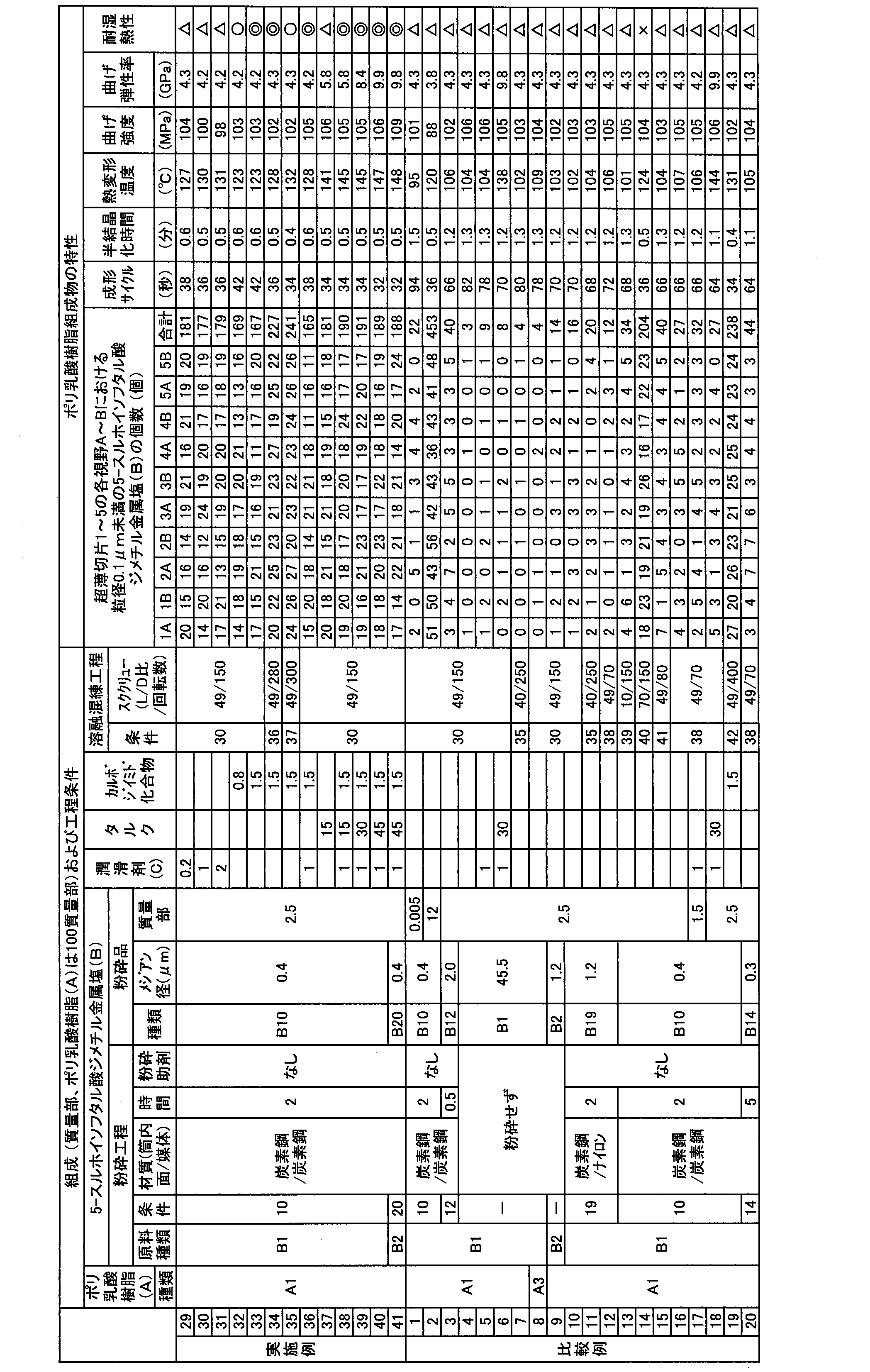
表1、表2から明らかなように、実施例1~41で得られたポリ乳酸樹脂組成物は、条件(1)で観察した際に、超薄切片の10視野のいずれにおいても、粒径0.1μm未満の5-スルホイソフタル酸ジメチル金属塩(B)の個数が5個以上カウントされるものであったため、結晶性能に優れており、成形サイクル、半結晶化時間、熱変形温度のいずれにも優れたものであった。
中でも、実施例29~31、36、38~41で得られたポリ乳酸樹脂組成物は、潤滑剤(C)を含有するものであったため、5-スルホイソフタル酸ジメチル金属塩(B)の分散性が向上し、その結果、結晶性能(成形サイクル、半結晶化時間、熱変形温度)が向上した。また、実施例37~41で得られたポリ乳酸樹脂組成物は、タルクを含有するものであったため、曲げ強度、曲げ弾性率が向上し、結晶性能(成形サイクル、熱変形温度)も向上した。さらに、実施例32~36、38~41で得られたポリ乳酸樹脂組成物は、カルボジイミド化合物を含有するものであったため、耐湿熱性にも優れたものとなった。
中でも、実施例29~31、36、38~41で得られたポリ乳酸樹脂組成物は、潤滑剤(C)を含有するものであったため、5-スルホイソフタル酸ジメチル金属塩(B)の分散性が向上し、その結果、結晶性能(成形サイクル、半結晶化時間、熱変形温度)が向上した。また、実施例37~41で得られたポリ乳酸樹脂組成物は、タルクを含有するものであったため、曲げ強度、曲げ弾性率が向上し、結晶性能(成形サイクル、熱変形温度)も向上した。さらに、実施例32~36、38~41で得られたポリ乳酸樹脂組成物は、カルボジイミド化合物を含有するものであったため、耐湿熱性にも優れたものとなった。
一方、比較例1で得られたポリ乳酸樹脂組成物は、5-スルホイソフタル酸ジメチル金属塩(B)の含有量が少なすぎたため、条件(1)で観察した際に、超薄切片の視野においてカウントされる、粒径0.1μm未満の5-スルホイソフタル酸ジメチル金属塩(B)の個数が5個未満となることがあり、結晶性能(成形サイクル、半結晶化時間、熱変形温度)に劣るものであった。比較例2で得られたポリ乳酸樹脂組成物は、5-スルホイソフタル酸ジメチル金属塩(B)の含有量が多すぎたため、結晶化促進効果が飽和し、曲げ強度や曲げ弾性率が低いものとなった。
比較例4~9で得られたポリ乳酸樹脂組成物は、5-スルホイソフタル酸ジメチル金属塩(B)を粉砕処理せずに用いたため、また比較例3、10~12で得られたポリ乳酸樹脂組成物は、5-スルホイソフタル酸ジメチル金属塩(B)を粉砕処理する際の条件が適切でなかったため、また比較例13、15~18、20で得られたポリ乳酸樹脂組成物は、5-スルホイソフタル酸ジメチル金属塩(B)をポリ乳酸樹脂(A)中に溶融混練する際の条件が適切でなかったため、いずれも、条件(1)で観察した際に、超薄切片の視野においてカウントされる、粒径0.1μm未満の5-スルホイソフタル酸ジメチル金属塩(B)の個数が5個未満となることがあり、結晶性能に劣るものであった。
また、溶融混練において、L/D比が高すぎるスクリューを使用した比較例14や、スクリューの回転数が高すぎる比較例19のポリ乳酸樹脂組成物は、溶融混練時に熱がかかりすぎて、ポリ乳酸樹脂(A)の熱劣化が促進され、それぞれ、実施例17や35に比較例して、耐湿熱性が低下した。
比較例4~9で得られたポリ乳酸樹脂組成物は、5-スルホイソフタル酸ジメチル金属塩(B)を粉砕処理せずに用いたため、また比較例3、10~12で得られたポリ乳酸樹脂組成物は、5-スルホイソフタル酸ジメチル金属塩(B)を粉砕処理する際の条件が適切でなかったため、また比較例13、15~18、20で得られたポリ乳酸樹脂組成物は、5-スルホイソフタル酸ジメチル金属塩(B)をポリ乳酸樹脂(A)中に溶融混練する際の条件が適切でなかったため、いずれも、条件(1)で観察した際に、超薄切片の視野においてカウントされる、粒径0.1μm未満の5-スルホイソフタル酸ジメチル金属塩(B)の個数が5個未満となることがあり、結晶性能に劣るものであった。
また、溶融混練において、L/D比が高すぎるスクリューを使用した比較例14や、スクリューの回転数が高すぎる比較例19のポリ乳酸樹脂組成物は、溶融混練時に熱がかかりすぎて、ポリ乳酸樹脂(A)の熱劣化が促進され、それぞれ、実施例17や35に比較例して、耐湿熱性が低下した。
Claims (4)
- ポリ乳酸樹脂(A)100質量部に対して、5-スルホイソフタル酸ジメチル金属塩(B)を0.01~10質量部含有する樹脂組成物であって、以下の条件(1)で観察した際に計数される、粒径0.1μm未満の5-スルホイソフタル酸ジメチル金属塩(B)の個数が、超薄切片の10視野のいずれにおいても、5個以上であることを特徴とするポリ乳酸樹脂組成物。
条件(1):ポリ乳酸樹脂組成物を射出成形し、ISO準拠の一般物性測定用試験片(サイズ;長さ×幅×厚み:80mm×10mm×4mm)を成形する。該試験片から試験片A(サイズ;長さ×幅×厚み:1mm×0.5mm×0.5mm)を切り出す。該試験片Aの長さ方向に対して垂直方向に、厚み0.1μmの超薄切片(0.5mm×0.5mm×0.1μm)を5個切り出す。5個の切片それぞれにおいて、透過型電子顕微鏡(TEM)を用い、拡大倍率3万倍とし、5μm×5μmの視野を任意で2視野観察し、合計10視野観察する。 - ポリ乳酸樹脂(A)は、D体含有量が1.0モル%以下であるか、または99.0モル%以上であることを特徴とする請求項1記載のポリ乳酸樹脂組成物。
- ポリ乳酸樹脂(A)100質量部に対して、潤滑剤(C)を0.05~3質量部含有することを特徴とする請求項1または2記載のポリ乳酸樹脂組成物。
- 請求項1記載のポリ乳酸樹脂組成物を製造するための方法であって、
5-スルホイソフタル酸ジメチル金属塩(B)を、粉砕筒内面および粉砕媒体の材質が鋼系および/またはセラミック系である乾式粉砕機によって、1時間以上粉砕する工程と、
上記工程によって得られた5-スルホイソフタル酸ジメチル金属塩(B)の粉砕品を、ポリ乳酸樹脂(A)とともに、スクリューのL/D比が20~60であり、スクリューの回転数が100~300rpmである二軸押出機によって溶融混練する工程とを
含むことを特徴とするポリ乳酸樹脂組成物の製造方法。
Priority Applications (1)
| Application Number | Priority Date | Filing Date | Title |
|---|---|---|---|
| JP2015530938A JPWO2015020120A1 (ja) | 2013-08-07 | 2014-08-07 | ポリ乳酸樹脂組成物 |
Applications Claiming Priority (2)
| Application Number | Priority Date | Filing Date | Title |
|---|---|---|---|
| JP2013-164197 | 2013-08-07 | ||
| JP2013164197 | 2013-08-07 |
Publications (1)
| Publication Number | Publication Date |
|---|---|
| WO2015020120A1 true WO2015020120A1 (ja) | 2015-02-12 |
Family
ID=52461450
Family Applications (1)
| Application Number | Title | Priority Date | Filing Date |
|---|---|---|---|
| PCT/JP2014/070805 Ceased WO2015020120A1 (ja) | 2013-08-07 | 2014-08-07 | ポリ乳酸樹脂組成物 |
Country Status (2)
| Country | Link |
|---|---|
| JP (1) | JPWO2015020120A1 (ja) |
| WO (1) | WO2015020120A1 (ja) |
Cited By (1)
| Publication number | Priority date | Publication date | Assignee | Title |
|---|---|---|---|---|
| US10662327B2 (en) * | 2016-10-28 | 2020-05-26 | GranBio Intellectual Property Holdings, LLC | Nanocellulose nucleating agents for crystallization of polylactides and other polymers |
Citations (6)
| Publication number | Priority date | Publication date | Assignee | Title |
|---|---|---|---|---|
| JPH0673245A (ja) * | 1992-05-19 | 1994-03-15 | Chisso Corp | 難燃性ポリプロピレン樹脂組成物及び製造方法 |
| JP2001046474A (ja) * | 1999-08-10 | 2001-02-20 | Showa Denko Kk | 輸液用容器 |
| WO2009004769A1 (ja) * | 2007-06-29 | 2009-01-08 | Unitika Ltd. | 結晶性ポリ乳酸樹脂組成物およびそれからなる成形体 |
| JP2010150365A (ja) * | 2008-12-25 | 2010-07-08 | Takemoto Oil & Fat Co Ltd | ポリ乳酸樹脂用結晶核剤及びポリ乳酸樹脂組成物 |
| JP2010248448A (ja) * | 2009-04-20 | 2010-11-04 | Toyota Motor Corp | 脂肪族ポリエステル樹脂組成物及び脂肪族ポリエステル樹脂成形体 |
| WO2011096299A1 (ja) * | 2010-02-02 | 2011-08-11 | 花王株式会社 | ポリ乳酸樹脂組成物の製造方法 |
-
2014
- 2014-08-07 WO PCT/JP2014/070805 patent/WO2015020120A1/ja not_active Ceased
- 2014-08-07 JP JP2015530938A patent/JPWO2015020120A1/ja active Pending
Patent Citations (6)
| Publication number | Priority date | Publication date | Assignee | Title |
|---|---|---|---|---|
| JPH0673245A (ja) * | 1992-05-19 | 1994-03-15 | Chisso Corp | 難燃性ポリプロピレン樹脂組成物及び製造方法 |
| JP2001046474A (ja) * | 1999-08-10 | 2001-02-20 | Showa Denko Kk | 輸液用容器 |
| WO2009004769A1 (ja) * | 2007-06-29 | 2009-01-08 | Unitika Ltd. | 結晶性ポリ乳酸樹脂組成物およびそれからなる成形体 |
| JP2010150365A (ja) * | 2008-12-25 | 2010-07-08 | Takemoto Oil & Fat Co Ltd | ポリ乳酸樹脂用結晶核剤及びポリ乳酸樹脂組成物 |
| JP2010248448A (ja) * | 2009-04-20 | 2010-11-04 | Toyota Motor Corp | 脂肪族ポリエステル樹脂組成物及び脂肪族ポリエステル樹脂成形体 |
| WO2011096299A1 (ja) * | 2010-02-02 | 2011-08-11 | 花王株式会社 | ポリ乳酸樹脂組成物の製造方法 |
Cited By (1)
| Publication number | Priority date | Publication date | Assignee | Title |
|---|---|---|---|---|
| US10662327B2 (en) * | 2016-10-28 | 2020-05-26 | GranBio Intellectual Property Holdings, LLC | Nanocellulose nucleating agents for crystallization of polylactides and other polymers |
Also Published As
| Publication number | Publication date |
|---|---|
| JPWO2015020120A1 (ja) | 2017-03-02 |
Similar Documents
| Publication | Publication Date | Title |
|---|---|---|
| EP2607428B1 (en) | Resin composition | |
| CN101175819B (zh) | 树脂组合物、其制造方法、由其所得的成型物 | |
| JP2020531678A (ja) | 生分解性重合体組成物及びその使用 | |
| Müller et al. | Physical ageing and molecular mobility in PLA blends and composites | |
| JPWO2015052876A1 (ja) | 脂肪族ポリエステル樹脂組成物および脂肪族ポリエステル樹脂成形体 | |
| EP1746136A1 (en) | Biodegradable resin composition | |
| EP4219628A1 (en) | Resin composition for injection molding, and injection-molded object | |
| WO2023100673A1 (ja) | 樹脂チューブ | |
| Macedo et al. | Preparation and characterization of composites based on polyhydroxybutyrate and waste powder from coconut fibers processing | |
| CN104987680A (zh) | 用于3d打印的高强度高耐热聚乳酸材料 | |
| JP5226335B2 (ja) | 樹脂組成物およびそれを成形してなる成形体 | |
| KR20100131482A (ko) | 폴리락트산 수지 조성물 | |
| JP5705951B2 (ja) | ポリ乳酸樹脂組成物 | |
| WO2006132187A1 (ja) | 生分解性ポリエステル樹脂組成物、その製造方法、同組成物を成形してなる成形体 | |
| JP4996668B2 (ja) | ポリ乳酸樹脂組成物、ポリ乳酸樹脂組成物の製造方法、成形品、携帯電話機用卓上ホルダー、携帯電話機の内部シャーシ部品、電子機器用筐体及び電子機器用内部部品 | |
| WO2015020120A1 (ja) | ポリ乳酸樹脂組成物 | |
| JP2015063645A (ja) | ポリ乳酸系樹脂組成物及びこれを用いた成形体 | |
| Yuniarto et al. | Morphological, thermal and oxygen barrier properties plasticized film polylactic acid | |
| EP4563636A1 (en) | Method for preparing biodegradable resin composition, biodegradable resin composition prepared thereby, and biodegradable molded product comprising same | |
| JP2006143829A (ja) | ポリ乳酸系樹脂成形品及びその製造方法 | |
| JP2008120878A (ja) | ポリラクチド粉粒体およびそれを含有する組成物 | |
| JP2012207170A (ja) | ポリ乳酸系樹脂組成物および成形体 | |
| JP2010083914A (ja) | ポリ乳酸樹脂組成物、及びその製造方法 | |
| WO2012012064A1 (en) | Processes for producing thermostable polyhydroxyalkanoate and products produced therefrom | |
| WO2011001763A1 (ja) | 熱可塑性樹脂組成物、熱可塑性樹脂組成物の製造方法、成形品、携帯電話機用卓上ホルダー、携帯電話機の内部シャーシ部品、電子機器用筐体及び電子機器用内部部品 |
Legal Events
| Date | Code | Title | Description |
|---|---|---|---|
| 121 | Ep: the epo has been informed by wipo that ep was designated in this application |
Ref document number: 14835005 Country of ref document: EP Kind code of ref document: A1 |
|
| ENP | Entry into the national phase |
Ref document number: 2015530938 Country of ref document: JP Kind code of ref document: A |
|
| NENP | Non-entry into the national phase |
Ref country code: DE |
|
| 122 | Ep: pct application non-entry in european phase |
Ref document number: 14835005 Country of ref document: EP Kind code of ref document: A1 |