WO2015016194A1 - パターン形成方法、感活性光線性又は感放射線性樹脂組成物、レジスト膜、電子デバイスの製造方法、及び電子デバイス - Google Patents
パターン形成方法、感活性光線性又は感放射線性樹脂組成物、レジスト膜、電子デバイスの製造方法、及び電子デバイス Download PDFInfo
- Publication number
- WO2015016194A1 WO2015016194A1 PCT/JP2014/069867 JP2014069867W WO2015016194A1 WO 2015016194 A1 WO2015016194 A1 WO 2015016194A1 JP 2014069867 W JP2014069867 W JP 2014069867W WO 2015016194 A1 WO2015016194 A1 WO 2015016194A1
- Authority
- WO
- WIPO (PCT)
- Prior art keywords
- group
- acid
- sensitive
- repeating unit
- ring
- Prior art date
- Legal status (The legal status is an assumption and is not a legal conclusion. Google has not performed a legal analysis and makes no representation as to the accuracy of the status listed.)
- Ceased
Links
Images






Classifications
-
- G—PHYSICS
- G03—PHOTOGRAPHY; CINEMATOGRAPHY; ANALOGOUS TECHNIQUES USING WAVES OTHER THAN OPTICAL WAVES; ELECTROGRAPHY; HOLOGRAPHY
- G03F—PHOTOMECHANICAL PRODUCTION OF TEXTURED OR PATTERNED SURFACES, e.g. FOR PRINTING, FOR PROCESSING OF SEMICONDUCTOR DEVICES; MATERIALS THEREFOR; ORIGINALS THEREFOR; APPARATUS SPECIALLY ADAPTED THEREFOR
- G03F7/00—Photomechanical, e.g. photolithographic, production of textured or patterned surfaces, e.g. printing surfaces; Materials therefor, e.g. comprising photoresists; Apparatus specially adapted therefor
- G03F7/26—Processing photosensitive materials; Apparatus therefor
- G03F7/30—Imagewise removal using liquid means
- G03F7/32—Liquid compositions therefor, e.g. developers
- G03F7/325—Non-aqueous compositions
-
- G—PHYSICS
- G03—PHOTOGRAPHY; CINEMATOGRAPHY; ANALOGOUS TECHNIQUES USING WAVES OTHER THAN OPTICAL WAVES; ELECTROGRAPHY; HOLOGRAPHY
- G03F—PHOTOMECHANICAL PRODUCTION OF TEXTURED OR PATTERNED SURFACES, e.g. FOR PRINTING, FOR PROCESSING OF SEMICONDUCTOR DEVICES; MATERIALS THEREFOR; ORIGINALS THEREFOR; APPARATUS SPECIALLY ADAPTED THEREFOR
- G03F7/00—Photomechanical, e.g. photolithographic, production of textured or patterned surfaces, e.g. printing surfaces; Materials therefor, e.g. comprising photoresists; Apparatus specially adapted therefor
- G03F7/004—Photosensitive materials
- G03F7/0045—Photosensitive materials with organic non-macromolecular light-sensitive compounds not otherwise provided for, e.g. dissolution inhibitors
-
- G—PHYSICS
- G03—PHOTOGRAPHY; CINEMATOGRAPHY; ANALOGOUS TECHNIQUES USING WAVES OTHER THAN OPTICAL WAVES; ELECTROGRAPHY; HOLOGRAPHY
- G03F—PHOTOMECHANICAL PRODUCTION OF TEXTURED OR PATTERNED SURFACES, e.g. FOR PRINTING, FOR PROCESSING OF SEMICONDUCTOR DEVICES; MATERIALS THEREFOR; ORIGINALS THEREFOR; APPARATUS SPECIALLY ADAPTED THEREFOR
- G03F7/00—Photomechanical, e.g. photolithographic, production of textured or patterned surfaces, e.g. printing surfaces; Materials therefor, e.g. comprising photoresists; Apparatus specially adapted therefor
- G03F7/004—Photosensitive materials
- G03F7/0046—Photosensitive materials with perfluoro compounds, e.g. for dry lithography
-
- G—PHYSICS
- G03—PHOTOGRAPHY; CINEMATOGRAPHY; ANALOGOUS TECHNIQUES USING WAVES OTHER THAN OPTICAL WAVES; ELECTROGRAPHY; HOLOGRAPHY
- G03F—PHOTOMECHANICAL PRODUCTION OF TEXTURED OR PATTERNED SURFACES, e.g. FOR PRINTING, FOR PROCESSING OF SEMICONDUCTOR DEVICES; MATERIALS THEREFOR; ORIGINALS THEREFOR; APPARATUS SPECIALLY ADAPTED THEREFOR
- G03F7/00—Photomechanical, e.g. photolithographic, production of textured or patterned surfaces, e.g. printing surfaces; Materials therefor, e.g. comprising photoresists; Apparatus specially adapted therefor
- G03F7/004—Photosensitive materials
- G03F7/038—Macromolecular compounds which are rendered insoluble or differentially wettable
-
- G—PHYSICS
- G03—PHOTOGRAPHY; CINEMATOGRAPHY; ANALOGOUS TECHNIQUES USING WAVES OTHER THAN OPTICAL WAVES; ELECTROGRAPHY; HOLOGRAPHY
- G03F—PHOTOMECHANICAL PRODUCTION OF TEXTURED OR PATTERNED SURFACES, e.g. FOR PRINTING, FOR PROCESSING OF SEMICONDUCTOR DEVICES; MATERIALS THEREFOR; ORIGINALS THEREFOR; APPARATUS SPECIALLY ADAPTED THEREFOR
- G03F7/00—Photomechanical, e.g. photolithographic, production of textured or patterned surfaces, e.g. printing surfaces; Materials therefor, e.g. comprising photoresists; Apparatus specially adapted therefor
- G03F7/004—Photosensitive materials
- G03F7/039—Macromolecular compounds which are photodegradable, e.g. positive electron resists
- G03F7/0392—Macromolecular compounds which are photodegradable, e.g. positive electron resists the macromolecular compound being present in a chemically amplified positive photoresist composition
-
- G—PHYSICS
- G03—PHOTOGRAPHY; CINEMATOGRAPHY; ANALOGOUS TECHNIQUES USING WAVES OTHER THAN OPTICAL WAVES; ELECTROGRAPHY; HOLOGRAPHY
- G03F—PHOTOMECHANICAL PRODUCTION OF TEXTURED OR PATTERNED SURFACES, e.g. FOR PRINTING, FOR PROCESSING OF SEMICONDUCTOR DEVICES; MATERIALS THEREFOR; ORIGINALS THEREFOR; APPARATUS SPECIALLY ADAPTED THEREFOR
- G03F7/00—Photomechanical, e.g. photolithographic, production of textured or patterned surfaces, e.g. printing surfaces; Materials therefor, e.g. comprising photoresists; Apparatus specially adapted therefor
- G03F7/004—Photosensitive materials
- G03F7/039—Macromolecular compounds which are photodegradable, e.g. positive electron resists
- G03F7/0392—Macromolecular compounds which are photodegradable, e.g. positive electron resists the macromolecular compound being present in a chemically amplified positive photoresist composition
- G03F7/0397—Macromolecular compounds which are photodegradable, e.g. positive electron resists the macromolecular compound being present in a chemically amplified positive photoresist composition the macromolecular compound having an alicyclic moiety in a side chain
-
- G—PHYSICS
- G03—PHOTOGRAPHY; CINEMATOGRAPHY; ANALOGOUS TECHNIQUES USING WAVES OTHER THAN OPTICAL WAVES; ELECTROGRAPHY; HOLOGRAPHY
- G03F—PHOTOMECHANICAL PRODUCTION OF TEXTURED OR PATTERNED SURFACES, e.g. FOR PRINTING, FOR PROCESSING OF SEMICONDUCTOR DEVICES; MATERIALS THEREFOR; ORIGINALS THEREFOR; APPARATUS SPECIALLY ADAPTED THEREFOR
- G03F7/00—Photomechanical, e.g. photolithographic, production of textured or patterned surfaces, e.g. printing surfaces; Materials therefor, e.g. comprising photoresists; Apparatus specially adapted therefor
- G03F7/004—Photosensitive materials
- G03F7/09—Photosensitive materials characterised by structural details, e.g. supports, auxiliary layers
- G03F7/11—Photosensitive materials characterised by structural details, e.g. supports, auxiliary layers having cover layers or intermediate layers, e.g. subbing layers
-
- G—PHYSICS
- G03—PHOTOGRAPHY; CINEMATOGRAPHY; ANALOGOUS TECHNIQUES USING WAVES OTHER THAN OPTICAL WAVES; ELECTROGRAPHY; HOLOGRAPHY
- G03F—PHOTOMECHANICAL PRODUCTION OF TEXTURED OR PATTERNED SURFACES, e.g. FOR PRINTING, FOR PROCESSING OF SEMICONDUCTOR DEVICES; MATERIALS THEREFOR; ORIGINALS THEREFOR; APPARATUS SPECIALLY ADAPTED THEREFOR
- G03F7/00—Photomechanical, e.g. photolithographic, production of textured or patterned surfaces, e.g. printing surfaces; Materials therefor, e.g. comprising photoresists; Apparatus specially adapted therefor
- G03F7/20—Exposure; Apparatus therefor
-
- G—PHYSICS
- G03—PHOTOGRAPHY; CINEMATOGRAPHY; ANALOGOUS TECHNIQUES USING WAVES OTHER THAN OPTICAL WAVES; ELECTROGRAPHY; HOLOGRAPHY
- G03F—PHOTOMECHANICAL PRODUCTION OF TEXTURED OR PATTERNED SURFACES, e.g. FOR PRINTING, FOR PROCESSING OF SEMICONDUCTOR DEVICES; MATERIALS THEREFOR; ORIGINALS THEREFOR; APPARATUS SPECIALLY ADAPTED THEREFOR
- G03F7/00—Photomechanical, e.g. photolithographic, production of textured or patterned surfaces, e.g. printing surfaces; Materials therefor, e.g. comprising photoresists; Apparatus specially adapted therefor
- G03F7/20—Exposure; Apparatus therefor
- G03F7/2041—Exposure; Apparatus therefor in the presence of a fluid, e.g. immersion; using fluid cooling means
Definitions
- the present invention relates to a pattern forming method, an actinic ray-sensitive or radiation-sensitive resin composition, a resist film, an electronic device manufacturing method, and an electronic device. More specifically, the present invention relates to a pattern forming method suitable for a semiconductor manufacturing process such as an IC, a circuit board such as a liquid crystal and a thermal head, and other photofabrication lithography processes, and an active sensitivity used therein. The present invention relates to a light-sensitive or radiation-sensitive resin composition, an electronic device manufacturing method, and an electronic device.
- the present invention relates to a KrF exposure apparatus, ArF exposure apparatus and ArF immersion projection exposure apparatus using far ultraviolet light having a wavelength of 300 nm or less as a light source, or EUV exposure using extreme ultraviolet light (EUV light) as a light source.
- the present invention relates to a pattern forming method suitable for exposure in an apparatus, an actinic ray-sensitive or radiation-sensitive resin composition used therefor, a resist film, an electronic device manufacturing method, and an electronic device.
- an image forming method called chemical amplification has been used as an image forming method for a resist in order to compensate for sensitivity reduction due to light absorption.
- An example of a positive-type chemical amplification image forming method will be described.
- the acid generator in the exposed area decomposes to generate an acid
- the acid generated in the exposure bake (PEB) is a reaction catalyst. Is used to change an alkali-insoluble group to an alkali-soluble group, and an exposed portion is removed by alkali development.
- the pattern forming method described in Patent Document 1 is a so-called multiple development method that requires at least two developments.
- a so-called double exposure method is also known, which requires two exposures.
- An object of the present invention is a novel pattern forming method that is completely different from the above-described conventional double patterning method, and a pattern forming method capable of miniaturizing the pattern pitch by one exposure and one development, and is used for this.
- An actinic ray-sensitive or radiation-sensitive resin composition, a resist film, a method for producing an electronic device, and an electronic device are provided.
- a pattern forming method capable of forming a pattern having a pitch less than half of the mask pitch, an actinic ray-sensitive or radiation-sensitive resin composition used therefor, a resist film, and an electronic device manufacturing method And providing an electronic device.
- a pattern forming method comprising the following steps (a) to (c).
- Forming using the process (A) a step of exposing the film, and (c) a step of developing the exposed film using a developer containing 80% by mass or more of an organic solvent with respect to the total amount of the developer.
- a pitch of the pattern is equal to or less than half of a pitch of the mask.
- the actinic ray-sensitive or radiation-sensitive resin composition is a resin (A) having a repeating unit (P1) having a group that decomposes by the action of an acid to generate a polar group, and an acid upon irradiation with actinic rays or radiation.
- the repeating unit (P2) When the pKa of the repeating unit (P2) is 0.0 to 10.0, and the pKa of the repeating unit (P2) is higher than the pKa of the anion portion of the ionic compound (S), the repeating unit (P2) The pattern formation method according to [6], wherein the difference between the pKa of the ionic compound (S) and the pKa of the anion portion of the ionic compound (S) is 2.0 or less. [8] [4] The pattern forming method according to [4], wherein the resin (A) is a resin further having a repeating unit (P3) having an ionic group in which an acid group forms a salt. [9] The pattern formation method according to [5], wherein the anion moiety is represented by any one of the following general formulas (a1) to (a5).
- R 1 , R 2 , R 3 , R 4 and R 5 each independently represents a hydrogen atom or an organic group.
- a plurality of R 3 may be the same or different, and R 3 may be linked to each other to form a ring.
- a plurality of R 4 may be the same or different, and R 4 may be linked to form a ring.
- a plurality of R 5 may be the same or different, and R 5 may be linked to form a ring.
- R 11 , R 21 , R 31 , R 41 , R 51 , R 61 , R 62 , R 71 and R 72 each independently represent a hydrogen atom or an organic group.
- a plurality of R 11 may be the same or different, and R 11 may be linked to each other to form a ring.
- a plurality of R 21 may be the same or different, and R 21 may be linked to each other to form a ring.
- a plurality of R 31 may be the same or different, and R 31 may be linked to each other to form a ring.
- a plurality of R 41 may be the same or different, and R 41 may be linked to each other to form a ring.
- a plurality of R 51 may be the same or different, and R 51 may be linked to form a ring.
- a plurality of R 61 may be the same or different, and R 61 may be linked to form a ring.
- the pattern forming method according to any one of [1] to [10], wherein the exposure is immersion exposure.
- An actinic ray-sensitive or radiation-sensitive resin composition that forms a film in which the solubility in a developer increases as the exposure amount increases from an unexposed state, but the solubility decreases when the exposure amount exceeds a certain exposure amount.
- [13] [12] containing a resin (A) having a repeating unit (P1) having a group capable of decomposing by the action of an acid to generate a polar group, and a compound (B) that generates an acid upon irradiation with actinic rays or radiation,
- [14] [13] The actinic ray-sensitive or radiation-sensitive resin composition according to [13], further containing an ionic compound (S) having an anionic moiety pKa of 0.0 to 10.0.
- an actinic ray-sensitive or radiation-sensitive resin composition a resist film, a method for producing an electronic device, and an electronic device can be provided.
- a pattern forming method capable of forming a pattern having a pitch less than half of the mask pitch, an actinic ray-sensitive or radiation-sensitive resin composition used therefor, a resist film, and an electronic device manufacturing method And electronic devices can be provided.
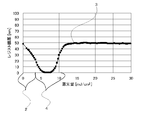
- FIG. It is a schematic explanatory drawing of the pattern formation method of this invention. It is drawing which shows the graph of the residual film test result of the resist film using the resist composition of Example 3.
- FIG. It is drawing which shows the graph of the dissolution rate (nm / sec, solubility) with respect to the exposure amount of the resist film using the resist composition of Example 3.
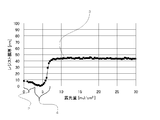
- FIG. It is drawing which shows the graph of the residual film test result of the resist film using the resist composition of Example 25.
- FIG. It is a figure which shows the graph of the dissolution rate (nm / sec, solubility) with respect to the exposure amount of the resist film using the resist composition of Example 25.
- FIG. 10A is a schematic diagram showing a mask used for dot pattern formation in the example.
- FIG. 10B is a schematic diagram showing a dot pattern obtained using the mask shown in FIG. It is a schematic explanatory drawing which shows the conventional negative pattern formation method.
- the notation which does not describe substitution and non-substitution includes the thing which has a substituent with the thing which does not have a substituent.
- the “alkyl group” includes not only an alkyl group having no substituent (unsubstituted alkyl group) but also an alkyl group having a substituent (substituted alkyl group).
- active light or “radiation” means, for example, the emission line spectrum of a mercury lamp, far ultraviolet rays represented by excimer laser, extreme ultraviolet rays (EUV light), X-rays, electron beams (EB), etc. To do.
- light means actinic rays or radiation.
- exposure in the present specification is not limited to exposure to far ultraviolet rays, extreme ultraviolet rays, X-rays, EUV light and the like represented by mercury lamps and excimer lasers, but also electron beams, ion beams, and the like, unless otherwise specified. The exposure with the particle beam is also included in the exposure.
- the pattern forming method of the present invention includes the following steps (a) to (c).
- Forming using the process (A) a step of exposing the film; and (c) a developer containing 80% by mass or more of an organic solvent with respect to the total amount of the developer (hereinafter also referred to as an organic developer).
- the “certain exposure amount” in the present invention means the exposure amount at the inflection point of the solubility curve of the film with respect to the developer.
- the “certain exposure amount” may be any exposure amount, and each step of the pattern forming method of the present invention, such as the composition of the actinic ray-sensitive or radiation-sensitive resin composition, the material, and the film thickness of the resist film.
- the exposure amount can vary depending on the above conditions.
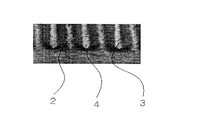
- FIG. 1 is a schematic explanatory view of the pattern forming method of the present invention.
- FIG. 11 is a schematic explanatory diagram of a conventional negative pattern forming method.
- the conventional negative pattern forming method after exposure through the mask 11, the unexposed resist film (not shown) shielded by the mask 11 was not shielded from light.
- the resist film 12 is formed in the exposed portion, and the resist film is developed, the resist film in the unexposed portion is developed and removed, leaving the resist film 12 in the exposed portion, and having the same pitch 14 as the mask pitch (interval) 13.
- a pattern is formed.
- the pattern pitch 14 is also formed at about 240 nm. Further, as is apparent from FIG. 11, only one pattern derived from the resist film in the exposed portion is formed per one mask pitch.
- the resist film 2 hereinafter simply referred to as “ The resist film 3 (hereinafter also simply referred to as “exposed part 3”) of the exposed part that is not light-shielded and is sufficiently exposed can be formed.
- the solubility in the organic developer increases, so that the solubility decreases in the unexposed state.
- the unexposed portion 2 cannot be developed and removed unlike the above-described conventional pattern forming method.
- the exposure portion 3 also corresponds to a resist film whose solubility reaches an inflection point at a certain exposure amount, and the solubility is decreased above the exposure amount, and therefore cannot be developed and removed.
- the semi-exposure portion 4 can correspond to a film in which the solubility increases as the exposure amount increases, and the solubility reaches the inflection point at a certain exposure amount, and a film having a solubility near the inflection point. It can be developed and removed with a system developer. Therefore, a portion (hereinafter simply referred to as “half-exposed portion”) 4 whose exposure amount is in the vicinity of the middle between the unexposed portion and the exposed portion can be developed and removed by the organic developer.
- the resist film may remain as a pattern. As a result, according to the pattern forming method of the present invention, as shown in FIG.
- a pattern pitch 6 having a pitch narrower than the pitch 5 of the mask can be formed by one development
- the pattern pitch 6 having a pitch half (or less than half) of the mask pitch 5 can be suitably formed by one development.
- the mask pitch 5 is 240 nm
- a pattern pitch 6 of 120 nm can also be formed.
- the pitch of the mask means the arrangement pitch of the light shielding or translucent patterns in a mask in which a plurality of light shielding or translucent patterns are arranged at regular intervals.
- the pattern pitch means the arrangement pitch of the patterns in a plurality of patterns formed by being arranged at a constant interval.
- a line and space pattern it means the sum of the width direction length of one line pattern and the width direction length of one space pattern adjacent to the width direction of the line pattern.
- a dot pattern it means the sum of the diameter of one dot pattern and the interval between the dot pattern and the dot pattern adjacent to the dot pattern.
- the present invention also relates to an actinic ray-sensitive or radiation-sensitive resin composition described below.
- the actinic ray-sensitive or radiation-sensitive resin composition according to the present invention is an actinic ray-sensitive or radiation-sensitive resin composition for developing an organic solvent used for development using a developer containing 80% by mass or more of an organic solvent based on the total amount of the developer. It can be set as a radiation sensitive resin composition.
- the term “for organic solvent development” means an application that is used in a step of developing using a developer containing at least an organic solvent.
- the actinic ray-sensitive or radiation-sensitive resin composition of the present invention is typically a resist composition, and is preferably a resist composition for organic solvent development because particularly high effects can be obtained.
- the composition according to the present invention is typically a chemically amplified resist composition.
- the actinic ray-sensitive or radiation-sensitive resin composition of the present invention increases in solubility in a developer as the exposure amount increases from an unexposed state, but the solubility decreases when the exposure amount exceeds a certain exposure amount. Can be formed.
- the actinic ray-sensitive or radiation-sensitive resin composition of the present invention has a repeating unit (P1) having a group (hereinafter also simply referred to as “acid-decomposable group”) that is decomposed by the action of an acid described later to generate a polar group.
- a compound (B) that generates an acid upon irradiation with actinic rays or radiation described below hereinafter also simply referred to as “acid generator”).
- the actinic ray-sensitive or radiation-sensitive resin composition contains an ionic compound (S) having an anionic moiety pKa of 0.0 to 10.0. preferable.
- pKa of the anion portion represents pKa in the reaction of XH ⁇ X ⁇ + H + , where X ⁇ is the anion of the ionic compound (S).
- the ionic compound (S) is a compound different from the compound (B) that generates an acid upon irradiation with actinic rays or radiation, which will be described later.
- the pKa of the anion portion is 0.0 to 10.0, the occurrence of acid decomposition of the acid-decomposable group in the repeating unit (P1) of the resin (A) can be suppressed.
- the proton of the acid group of the following repeating unit (P2) can be exchanged with the cation portion of the ionic compound (S), and the acid group and the cation A salt can be formed with the moiety.
- a repeating unit (P3) having an ionic group in which an acid group forms a salt can reduce the solubility of the film in an organic developer.
- an anion of the ionic compound (S) is generated when an acid derived from the compound (B) that generates an acid upon irradiation with actinic rays or radiation described below is generated. Proton capture can be suitably performed when the portion is pKa 0.0 to 10.0.
- the anion portion of the ionic compound (S) is preferably pKa 2.0 to 8.0, and the anion portion of the ionic compound (S) is more preferably pKa 3.0 to 7.0. .
- pKa represents pKa in an aqueous solution, and is described in, for example, Chemical Handbook (II) (4th revised edition, 1993, edited by The Chemical Society of Japan, Maruzen Co., Ltd.) The lower the value, the higher the acid strength.
- pKa in an aqueous solution can be actually measured by measuring an acid dissociation constant at 25 ° C. using an infinitely diluted aqueous solution, and using the software package 1 below, A value based on a database of constants and known literature values can also be obtained by calculation.
- the values of pKa described in this specification all indicate values obtained by calculation using this software package.
- Software package 1 ACD / ChemSketch (manufactured by Advanced Chemistry Development Inc; ACD / Labs ver. 8.08).
- the resin (A) having the repeating unit (P1) having an acid-decomposable group further contains a repeating unit (P2) having an acid group.
- the actinic ray-sensitive or radiation-sensitive resin composition contains an ionic compound (S) having an anionic moiety pKa of 0.0 to 10.0, and a resin.
- S an ionic compound having an anionic moiety pKa of 0.0 to 10.0
- a resin is an embodiment containing the repeating unit (P1) having an acid-decomposable group and the repeating unit (P2) having an acid group.
- the pKa of the repeating unit (P2) having an acid group is more preferably 0.0 to 10.0.
- the pKa of the repeating unit (P2) means the pKa of the monomer (monomer) corresponding to the repeating unit (P2). Most preferably, the pKa of the repeating unit (P2) is lower than the pKa of the anionic portion of the ionic compound (S).
- the difference between the pKa of the repeating unit (P2) and the pKa of the anionic part of the ionic compound (S) Is preferably 2.0 or less, and particularly preferably the difference is 1.0 or less.
- the exchange (neutralization) between the protons of the acid group of the repeating unit (P2) and the cation part of the ionic compound (S) is particularly suitable, and the acid group forms a salt. This is because it is particularly suitable for forming an ionic group.
- the cation portion of the ionic compound (S) is exchanged with the proton of the acid group of the repeating unit (P2).
- Salt can be formed. That is, it is possible to form a repeating unit (P3) having an ionic group in which an acid group forms a salt. Since the ionic group of the generated repeating unit (P3) can reduce the solubility of the film in the organic developer, a film in which the solubility in the organic developer is reduced in an unexposed state is formed. Can do.
- an acid derived from the compound (B) (acid generator) that generates an acid upon irradiation with actinic rays or radiation described below can be generated, and the acid group that the repeating unit (P3) has Protonation (capture of protons) of the anionic portion of the ionic group formed by forming a salt proceeds, and regeneration of the repeating unit (P2) having an acid group can proceed.
- the ionic groups formed by acid groups forming salts are reduced, and the solubility of the film in the developer can be increased as the exposure dose is increased.
- the resin (A) having a repeating unit (P1) having an acid-decomposable group comprises a repeating unit (P3) having an ionic group in which the acid group forms a salt. Furthermore, it is more preferable to contain. That is, in the second embodiment of the present invention, the resin (A) comprises a repeating unit (P1) having an acid-decomposable group and a repeating unit (P3) having an ionic group formed by forming a salt of an acid group. It is an embodiment to contain.
- the resin (A) having a repeating unit (P3) having an ionic group formed by forming a salt with an acid group has a repeating unit (P1) having an acid-decomposable group and a repeating unit (P2) having an acid group.
- the resin (A) is neutralized with the ionic compound (S) having a pKa of 0.0 to 10.0 for the anion moiety, and the cation moiety of the ionic compound (S) and the repeating unit (P2) It is preferable to produce it by exchanging protons of the acid group.
- a manufacturing method of resin (A) which has a repeating unit (P3) it is also preferable to manufacture like the following (1) and (2).
- the acid group of the monomer corresponding to the repeating unit (P2) can be neutralized with the ionic compound (S) to form a salt to form a monomer corresponding to the repeating unit (P3).
- a monomer corresponding to the obtained repeating unit (P3), a monomer corresponding to the repeating unit (P1) having an acid-decomposable group, and the like according to a conventional method (for example, radical polymerization, living radical polymerization, Resin (A) having a repeating unit (P3) can be produced by polymerization.
- the ionic group of the repeating unit (P3) can reduce the solubility of the film in the organic developer, the ionic group in the organic developer in an unexposed state. Films with reduced solubility can be formed.
- an acid derived from the acid generator can be generated, and protonation of the anion portion of the ionic group formed by forming a salt with the acid group of the repeating unit (P3) (capture of proton) ) Can proceed.
- the ionic groups formed by the salt formation of the acid groups are reduced, and the solubility of the film in the developer can increase as the exposure dose increases.
- the actinic ray-sensitive or radiation-sensitive resin composition contains an ionic compound (S) having an anionic moiety pKa of 0.0 to 10.0, and a resin (A Is an embodiment containing a repeating unit (P1) having an acid-decomposable group.
- the resin (A) preferably has no repeating unit (P2) having an acid group.
- the actinic ray-sensitive or radiation-sensitive resin composition is an ionic compound (S).
- the ionic compound (S) having an anionic moiety pKa of 0.0 to 10.0 is a repeating unit having an ionic group formed by forming a salt with an acid group in the second embodiment of the present invention (P3 As described above, it is preferably used for the production of the resin (A) having).
- the ionic compound (S) is preferably a salt composed of an anion portion and a cation portion.
- the ionic compound (S) is preferably a low molecular compound having a molecular weight of 2000 or less, more preferably a low molecular compound having a molecular weight of 1500 or less, and still more preferably a low molecular compound having a molecular weight of 900 or less.
- the low molecular weight compound in the present invention refers to a compound having an unsaturated bond (so-called polymerizable monomer) by cleaving the unsaturated bond using an initiator and growing the bond in a chain manner. It is not a so-called polymer or oligomer obtained, but a compound having a constant molecular weight of 2000 or less (more preferably 1500 or less, more preferably 900 or less) (a compound having substantially no molecular weight distribution).
- the molecular weight is usually 100 or more.
- the anion portion of pKa 0.0 to 10.0 in the ionic compound (S) is preferably an anion represented by any one of the following general formulas (a1) to (a5).
- R 1 , R 2 , R 3 , R 4 and R 5 each independently represents a hydrogen atom or an organic group.
- a plurality of R 3 may be the same or different, and R 3 may be linked to each other to form a ring.
- a plurality of R 4 may be the same or different, and R 4 may be linked to form a ring.
- a plurality of R 5 may be the same or different, and R 5 may be linked to form a ring.
- Examples of the organic group for R 1 , R 2 , and R 4 include an alkyl group (which may be linear or branched, preferably an alkyl group having 1 to 20 carbon atoms), a cycloalkyl group ( Preferably a cycloalkyl group having 3 to 20 carbon atoms, an alkenyl group (preferably an alkenyl group having 2 to 20 carbon atoms), an alkynyl group (preferably an alkynyl group having 2 to 20 carbon atoms), an aryl group (preferably having a carbon number) 6-30 aryl groups) and the like.
- an alkyl group which may be linear or branched, preferably an alkyl group having 1 to 20 carbon atoms
- a cycloalkyl group Preferably a cycloalkyl group having 3 to 20 carbon atoms
- an alkenyl group preferably an alkenyl group having 2 to 20 carbon atoms
- an alkynyl group preferably an alkyny
- Examples of the organic group for R 3 and R 5 include an alkyl group (which may be linear or branched, preferably an alkyl group having 1 to 20 carbon atoms), a cycloalkyl group (monocyclic or polycyclic). Any of a ring, preferably a cycloalkyl group having 3 to 20 carbon atoms), an alkylsulfonyl group (which may be linear or branched, preferably an alkyl group having 1 to 20 carbon atoms) Cycloalkylsulfonyl group (preferably cycloalkyl group having 3 to 20 carbon atoms), alkenyl group (preferably alkenyl group having 2 to 20 carbon atoms), alkynyl group (preferably alkynyl group having 2 to 20 carbon atoms), aryl Group (preferably an aryl group having 6 to 30 carbon atoms) and the like.
- an alkyl group which may be linear or branched, preferably an alkyl group having 1 to 20 carbon atom
- alkyl group for R 1 , R 2 , R 3 , R 4 and R 5 include a methyl group, an ethyl group, a propyl group, an isopropyl group, an n-butyl group, a sec-butyl group, and a t-butyl group. Groups, hexyl groups and octyl groups.
- Examples of the alkyl moiety of the alkylsulfonyl group for R 3 and R 5 include the same alkyl groups as those described above.
- the cycloalkyl group for R 1 , R 2 , R 3 , R 4 and R 5 may be a monocyclic cycloalkyl group or a polycyclic cycloalkyl group.
- Examples of the monocyclic cycloalkyl group include a cyclopropyl group, a cyclobutyl group, a cyclopentyl group, a cyclohexyl group, a cycloheptyl group, and a cyclooctyl group.
- Examples of the polycyclic cycloalkyl group include an adamantyl group, a norbornyl group, a bornyl group, a camphenyl group, a decahydronaphthyl group, a tricyclodecanyl group, a tetracyclodecanyl group, a camphoroyl group, a dicyclohexyl group, and a pinenyl group. Can be mentioned.
- Examples of the cycloalkyl part of the cycloalkylsulfonyl group for R 3 and R 5 include the same cycloalkyl groups as those described above.
- Examples of the alkenyl group for R 1 , R 2 , R 3 , R 4 and R 5 include a vinyl group, a propenyl group, and a hexenyl group.
- Examples of the alkynyl group for R 1 , R 2 , R 3 , R 4 and R 5 include a propynyl group and a hexynyl group.
- Examples of the aryl group for R 1 , R 2 , R 3 , R 4 and R 5 include a phenyl group and a p-tolyl group.
- the alkyl group, cycloalkyl group, alkylsulfonyl group, cycloalkylsulfonyl group, alkenyl group, alkynyl group or aryl group for R 1 , R 2 , R 3 , R 4 and R 5 may have a substituent. Good. As this substituent, the following are mentioned, for example.
- halogen atoms such as fluorine atom, chlorine atom, bromine atom and iodine atom
- alkoxy groups such as methoxy group, ethoxy group and tert-butoxy group
- aryloxy groups such as phenoxy group and p-tolyloxy group
- Alkylthioxy groups such as methylthioxy, ethylthioxy and tert-butylthioxy groups
- arylthioxy groups such as phenylthioxy and p-tolylthioxy groups
- alkoxycarbonyl groups such as methoxycarbonyl, butoxycarbonyl and phenoxycarbonyl Acetoxy group
- straight chain alkyl group such as methyl group, ethyl group, propyl group, butyl group, heptyl group, hexyl group, dodecyl group and 2-ethylhexyl group
- branched alkyl group 7,7-dimethylbicyclo [2.2
- the cation moiety possessed by the ionic compound (S) is preferably a cation represented by any one of the following general formulas (b1) to (b7).
- R 11 , R 21 , R 31 , R 41 , R 51 , R 61 , R 62 , R 71 and R 72 each independently represent a hydrogen atom or an organic group.
- a plurality of R 11 may be the same or different, and R 11 may be linked to each other to form a ring.
- a plurality of R 21 may be the same or different, and R 21 may be linked to each other to form a ring.
- a plurality of R 31 may be the same or different, and R 31 may be linked to each other to form a ring.
- a plurality of R 41 may be the same or different, and R 41 may be linked to each other to form a ring.
- a plurality of R 51 may be the same or different, and R 51 may be linked to form a ring.
- a plurality of R 61 may be the same or different, and R 61 may be linked to form a ring.
- an alkyl group (which may be linear or branched, preferably carbon number) Alkyl group having 1 to 20 carbon atoms), cycloalkyl group (preferably cycloalkyl group having 3 to 20 carbon atoms), alkenyl group (preferably alkenyl group having 2 to 20 carbon atoms), alkynyl group (preferably having 2 to 20 carbon atoms). Alkynyl group), an aryl group (preferably an aryl group having 6 to 30 carbon atoms), and the like.
- Examples of the organic group for R 62 and R 72 include a hydrocarbon group, preferably a hydrocarbon group having 1 to 10 carbon atoms, and more preferably a hydrocarbon group having 1 to 6 carbon atoms.
- R 62 is preferably a group that forms a ring by linking to at least one of R 61 , and more preferably a group that forms a nitrogen atom-containing aromatic ring.
- R 72 is preferably a group that forms a ring by linking with R 71, and more preferably a group that forms an aromatic ring.
- the alkyl group for R 11 , R 21 , R 31 , R 41 , R 51 , R 61 , and R 71 is specifically a methyl group, ethyl group, propyl group, isopropyl group, n-butyl group, sec Examples include -butyl group, t-butyl group, hexyl group and octyl group.
- the cycloalkyl group for R 11 , R 21 , R 31 , R 41 , R 51 , R 61 , and R 71 may be a monocyclic cycloalkyl group or a polycyclic cycloalkyl group.
- Examples of the monocyclic cycloalkyl group include a cyclopropyl group, a cyclobutyl group, a cyclopentyl group, a cyclohexyl group, a cycloheptyl group, and a cyclooctyl group.
- Examples of the polycyclic cycloalkyl group include an adamantyl group, a norbornyl group, a bornyl group, a camphenyl group, a decahydronaphthyl group, a tricyclodecanyl group, a tetracyclodecanyl group, a camphoroyl group, a dicyclohexyl group, and a pinenyl group.
- Examples of the alkenyl group for R 11 , R 21 , R 31 , R 41 , R 51 , R 61 , and R 71 include a vinyl group, a propenyl group, and a hexenyl group.
- Examples of the alkynyl group for R 11 , R 21 , R 31 , R 41 , R 51 , R 61 , and R 71 include a propynyl group and a hexynyl group.
- Examples of the aryl group for R 11 , R 21 , R 31 , R 41 , R 51 , R 61 , and R 71 include a phenyl group and a p-tolyl group.
- the alkyl group, cycloalkyl group, alkylsulfonyl group, cycloalkylsulfonyl group, alkenyl group, alkynyl group or aryl group for R 11 , R 21 , R 31 , R 41 , R 51 , R 61 , and R 71 is substituted. It may have a group. As this substituent, the following are mentioned, for example.
- halogen atoms such as fluorine atom, chlorine atom, bromine atom and iodine atom
- alkoxy groups such as methoxy group, ethoxy group and tert-butoxy group
- aryloxy groups such as phenoxy group and p-tolyloxy group
- Alkylthioxy groups such as methylthioxy, ethylthioxy and tert-butylthioxy groups
- arylthioxy groups such as phenylthioxy and p-tolylthioxy groups
- alkoxycarbonyl groups such as methoxycarbonyl, butoxycarbonyl and phenoxycarbonyl Acetoxy group
- straight chain alkyl group such as methyl group, ethyl group, propyl group, butyl group, heptyl group, hexyl group, dodecyl group and 2-ethylhexyl group
- branched alkyl group 7,7-dimethylbicyclo [2.2
- the ionic compound (S) having an anionic moiety having a pKa of 0.0 to 10.0 can be synthesized by a known method, or one that can be purchased from Aldrich Corporation may be used.
- An ionic compound (S) having a pKa of the anionic portion of 0.0 to 10.0 can be used alone or in combination of two or more.
- the content of the ionic compound (S) in the composition is 0.01 to 1.5 mmol% based on the total solid content of the actinic ray-sensitive or radiation-sensitive resin composition. Is more preferable, 0.03 to 1.0 mmol% is more preferable, and 0.05 to 0.8 mmol% is still more preferable.
- the content of the ionic compound (S) in the composition is expressed by mass%, 0.1 to 60 mass% based on the total solid content of the actinic ray-sensitive or radiation-sensitive resin composition. It is preferably 0.3 to 40% by mass, more preferably 0.5 to 32% by mass.
- a first embodiment of the present invention the actinic ray-sensitive or radiation-sensitive resin composition contains an ionic compound (S) and the resin (A) has a repeating unit (P1) having an acid-decomposable group and In the embodiment containing the repeating unit (P2) having an acid group), the content of the ionic compound (S) in the composition is based on the total solid content of the actinic ray-sensitive or radiation-sensitive resin composition. 0.01 to 0.8 mmol%, preferably 0.03 to 0.5 mmol%, more preferably 0.05 to 0.3 mmol%.
- the content of the ionic compound (S) in the composition is expressed by mass%, 0 based on the total solid content of the actinic ray-sensitive or radiation-sensitive resin composition. It is preferably 1 to 30% by mass, more preferably 0.3 to 25% by mass, and still more preferably 0.5 to 20% by mass.
- the actinic ray-sensitive or radiation-sensitive resin composition contains an ionic compound (S) and the resin (A) contains a repeating unit (P1) having an acid-decomposable group Embodiment
- the content of the ionic compound (S) in the composition is 0.1 to 1.5 mmol% based on the total solid content of the actinic ray-sensitive or radiation-sensitive resin composition.
- it is 0.2 to 1.0 mmol%, more preferably 0.3 to 0.8 mmol%.
- content in the composition of an ionic compound (S) is represented by the mass%, it is 1 on the basis of the total solid of an actinic-ray-sensitive or radiation-sensitive resin composition. It is preferably ⁇ 30% by mass, more preferably 3 to 25% by mass, still more preferably 5 to 20% by mass.
- Resin (A) having a repeating unit (P1) having an acid-decomposable group (hereinafter also referred to as “acid-decomposable resin” or “resin (A)”) [Repeating unit having acid-decomposable group (P1)]
- the acid-decomposable group preferably has a structure protected by a group capable of decomposing and leaving a polar group by the action of an acid.
- the polar group is not particularly limited as long as it is a group that is hardly soluble or insoluble in a developer containing an organic solvent, but a phenolic hydroxyl group, a carboxyl group, a fluorinated alcohol group (preferably a hexafluoroisopropanol group), a sulfonic acid group.
- Methylan Group dissociates in onium hydroxide aqueous solution), or alcoholic hydroxyl group.
- the alcoholic hydroxyl group is a hydroxyl group bonded to a hydrocarbon group and means a hydroxyl group other than a hydroxyl group directly bonded on an aromatic ring (phenolic hydroxyl group).
- An aliphatic alcohol substituted with a functional group for example, a fluorinated alcohol group (such as a hexafluoroisopropanol group)) is excluded.
- the alcoholic hydroxyl group is preferably a hydroxyl group having a pKa of 12 or more and 20 or less.
- Preferred polar groups include carboxyl groups, fluorinated alcohol groups (preferably hexafluoroisopropanol groups), and sulfonic acid groups.
- a preferable group as the acid-decomposable group is a group in which the hydrogen atom of these groups is substituted with a group capable of leaving with an acid.
- Examples of the group leaving with an acid include —C (R 36 ) (R 37 ) (R 38 ), —C (R 36 ) (R 37 ) (OR 39 ), —C (R 01 ) (R 02 ). ) (OR 39 ) and the like.
- R 36 to R 39 each independently represents an alkyl group, a cycloalkyl group, an aryl group, an aralkyl group or an alkenyl group.
- R 36 and R 37 may be bonded to each other to form a ring.
- R 01 and R 02 each independently represents a hydrogen atom, an alkyl group, a cycloalkyl group, an aryl group, an aralkyl group or an alkenyl group.
- the alkyl group of R 36 to R 39 , R 01 and R 02 is preferably an alkyl group having 1 to 8 carbon atoms.
- the cycloalkyl group of R 36 to R 39 , R 01 and R 02 may be monocyclic or polycyclic.
- the monocyclic type is preferably a cycloalkyl group having 3 to 8 carbon atoms.
- the polycyclic type is preferably a cycloalkyl group having 6 to 20 carbon atoms. Note that at least one carbon atom in the cycloalkyl group may be substituted with a heteroatom such as an oxygen atom.
- the aryl group of R 36 to R 39 , R 01 and R 02 is preferably an aryl group having 6 to 10 carbon atoms, and examples thereof include a phenyl group, a naphthyl group, and an anthryl group.
- the aralkyl group of R 36 to R 39 , R 01 and R 02 is preferably an aralkyl group having 7 to 12 carbon atoms, and examples thereof include a benzyl group, a phenethyl group and a naphthylmethyl group.
- the alkenyl group of R 36 to R 39 , R 01 and R 02 is preferably an alkenyl group having 2 to 8 carbon atoms, and examples thereof include a vinyl group, an allyl group, a butenyl group, and a cyclohexenyl group.
- the ring formed by combining R 36 and R 37 is preferably a monocyclic cycloalkyl group or a polycyclic cycloalkyl group. A monocyclic cycloalkyl group having 5 to 6 carbon atoms is more preferable, and a monocyclic cycloalkyl group having 5 carbon atoms is particularly preferable.
- the acid-decomposable group is preferably a cumyl ester group, an enol ester group, an acetal ester group, a tertiary alkyl ester group or the like. More preferably, it is a tertiary alkyl ester group.
- the resin (A) preferably has a repeating unit represented by the following general formula (AI) or (AI ′) as the repeating unit (P1) having an acid-decomposable group.
- Xa 1 represents a hydrogen atom, an alkyl group, a cyano group, or a halogen atom.
- T represents a single bond or a divalent linking group.
- Rx 1 to Rx 3 each independently represents an alkyl group or a cycloalkyl group. Two of Rx 1 to Rx 3 may combine to form a ring structure.
- T ′ represents a single bond or a divalent linking group.
- Rx 1 ′ to Rx 3 ′ each independently represents an alkyl group or a cycloalkyl group. Two of Rx 1 ′ to Rx 3 ′ may combine to form a ring structure.
- Examples of the divalent linking group for T include an alkylene group, —COO—Rt— group, —O—Rt— group, phenylene group and the like.
- Rt represents an alkylene group or a cycloalkylene group.
- T is preferably a single bond or a —COO—Rt— group.
- Rt is preferably an alkylene group having 1 to 5 carbon atoms, more preferably a —CH 2 — group, — (CH 2 ) 2 — group, or — (CH 2 ) 3 — group. More preferably, T is a single bond.
- the alkyl group of Xa1 may have a substituent, and examples of the substituent include a hydroxyl group and a halogen atom (preferably a fluorine atom).
- the alkyl group for X a1 preferably has 1 to 4 carbon atoms, and examples thereof include a methyl group, an ethyl group, a propyl group, a hydroxymethyl group, and a trifluoromethyl group, and a methyl group is preferable.
- X a1 is preferably a hydrogen atom or a methyl group.
- the alkyl group of Rx 1 , Rx 2 and Rx 3 may be linear or branched, and is a methyl group, ethyl group, n-propyl group, isopropyl group, n-butyl group, isobutyl. And those having 1 to 4 carbon atoms such as t-butyl group are preferred.
- Examples of the cycloalkyl group of Rx 1 , Rx 2 and Rx 3 include polycyclic rings such as a monocyclic cycloalkyl group such as a cyclopentyl group and a cyclohexyl group, a norbornyl group, a tetracyclodecanyl group, a tetracyclododecanyl group and an adamantyl group. Are preferred.
- the ring structure formed by combining two of Rx 1 , Rx 2 and Rx 3 includes a monocyclic cycloalkane ring such as cyclopentyl ring and cyclohexyl ring, norbornane ring, tetracyclodecane ring, tetracyclododecane ring, adamantane ring
- a polycyclic cycloalkyl group such as is preferable.
- a monocyclic cycloalkane ring having 5 or 6 carbon atoms is particularly preferable.
- Rx 1 , Rx 2 and Rx 3 are preferably each independently an alkyl group, more preferably a linear or branched alkyl group having 1 to 4 carbon atoms.
- Specific examples and preferred examples of the ring structure that may be formed by combining two of T ′, Rx 1 ′ to Rx 3 ′, and Rx 1 ′ to Rx 3 ′ are T, Rx 1 to Rx 3 , respectively.
- And Rx 1 to Rx 3 are the same as those described in the specific examples and preferred examples of the ring structure that may be formed by bonding.
- Each of the above groups may have a substituent, and examples of the substituent include an alkyl group (1 to 4 carbon atoms), a cycloalkyl group (3 to 8 carbon atoms), a halogen atom, an alkoxy group (carbon 1 to 4), a carboxyl group, an alkoxycarbonyl group (2 to 6 carbon atoms), and the like, and 8 or less carbon atoms are preferable.
- a substituent having no hetero atom such as an oxygen atom, a nitrogen atom, or a sulfur atom is more preferable (for example, it is more preferable that it is not an alkyl group substituted with a hydroxyl group, etc.), a group consisting of only a hydrogen atom and a carbon atom is more preferable, and a linear or branched alkyl group or a cycloalkyl group is particularly preferable. preferable.
- Rx represents a hydrogen atom, CH 3 , CF 3 , or CH 2 OH.
- Rxa and Rxb each represents an alkyl group having 1 to 4 carbon atoms.
- Xa 1 represents a hydrogen atom, CH 3 , CF 3 , or CH 2 OH.
- Z represents a substituent, and when a plurality of Zs are present, the plurality of Zs may be the same as or different from each other.
- p represents 0 or a positive integer.
- Specific examples and preferred examples of Z are the same as specific examples and preferred examples of the substituent that each group such as Rx 1 to Rx 3 may have.
- the resin (A) also preferably has a repeating unit represented by the following general formula (IV) as a repeating unit having an acid-decomposable group.
- Xb represents a hydrogen atom, an alkyl group, a cyano group, or a halogen atom.
- Ry 1 to Ry 3 each independently represents an alkyl group or a cycloalkyl group. Two of Ry 1 to Ry 3 may be linked to form a ring.
- Z represents a (p + 1) -valent linking group having a polycyclic hydrocarbon structure which may have a hetero atom as a ring member. Z preferably does not contain an ester bond as an atomic group constituting a polycycle (in other words, Z preferably does not contain a lactone ring as a ring constituting a polycycle).
- L 4 and L 5 each independently represents a single bond or a divalent linking group.
- p represents an integer of 1 to 3. When p is 2 or 3, the plurality of L 5 , the plurality of Ry 1 , the plurality of Ry 2 , and the plurality of Ry 3 may be the same or different.
- the alkyl group of Xb may have a substituent, and examples of the substituent include a hydroxyl group and a halogen atom (preferably a fluorine atom).
- the alkyl group of Xb is preferably an alkyl group having 1 to 4 carbon atoms, and examples thereof include a methyl group, an ethyl group, a propyl group, a hydroxymethyl group, and a trifluoromethyl group, and a methyl group is preferable.
- X b is preferably a hydrogen atom or a methyl group.
- Specific examples and preferred examples of the alkyl group and cycloalkyl group of Ry 1 to Ry 3 are the same as the specific examples and preferred examples of the alkyl group and cycloalkyl group of Rx 1 to Rx 3 in the general formula (AI).
- Specific examples and preferred examples of the ring structure formed by combining two of Ry 1 to Ry 3 include specific examples and preferred examples of the ring structure formed by combining two of Rx 1 to Rx 3 in the general formula (AI). Similar to the example.
- Ry 1 to Ry 3 are preferably each independently an alkyl group, and more preferably a linear or branched alkyl group having 1 to 4 carbon atoms. The total number of carbon atoms of the chain or branched alkyl group as Ry 1 to Ry 3 is preferably 5 or less.
- Ry 1 to Ry 3 may further have a substituent, and examples of such a substituent include the substituents that Rx 1 to Rx 3 in General Formula (AI) may further have. It is the same as that.
- Examples of the linking group having a polycyclic hydrocarbon structure of Z include a ring-assembled hydrocarbon ring group and a bridged cyclic hydrocarbon ring group, each of which represents (p + 1) arbitrary hydrogen atoms from the ring-assembled hydrocarbon ring. And a group formed by removing (p + 1) arbitrary hydrogen atoms from a bridged cyclic hydrocarbon ring.
- the linking group having a polycyclic hydrocarbon structure represented by Z may have a substituent.
- substituents that Z may have include, for example, an alkyl group, a hydroxyl group, a cyano group, a keto group (an alkylcarbonyl group, etc.), an acyloxy group, —COOR, —CON (R) 2 , —SO 2 R , —SO 3 R, —SO 2 N (R) 2 and the like.
- R represents a hydrogen atom, an alkyl group, a cycloalkyl group, or an aryl group.
- Z may have an alkyl group, alkylcarbonyl group, acyloxy group, —COOR, —CON (R) 2 , —SO 2 R, —SO 3 R, —SO 2 N (R) 2 as a substituent that Z may have. May further have a substituent, and examples of such a substituent include a halogen atom (preferably a fluorine atom).
- the carbon constituting the polycycle may be a carbonyl carbon.
- the polycycle may have a hetero atom such as an oxygen atom or a sulfur atom as a ring member.
- Z does not contain an ester bond as an atomic group constituting a polycycle.
- Examples of the linking group represented by L 4 and L 5 include —COO—, —OCO—, —CONH—, —NHCO—, —CO—, —O—, —S—, —SO—, —SO 2 —.
- An alkylene group preferably having a carbon number of 1 to 6
- a cycloalkylene group preferably having a carbon number of 3 to 10
- an alkenylene group preferably having a carbon number of 2 to 6
- a linking group having a total carbon number of 12 or less is preferred.
- L 4 represents a single bond, an alkylene group, -COO-, -OCO-, -CONH-, -NHCO-, -alkylene group -COO-, -alkylene group -OCO-, -alkylene group -CONH-, -alkylene group —NHCO—, —CO—, —O—, —SO 2 —, —alkylene group —O— are preferable, and a single bond, alkylene group, —alkylene group —COO—, or —alkylene group —O— is more preferable. .
- L 5 represents a single bond, an alkylene group, —COO—, —OCO—, —CONH—, —NHCO—, —COO-alkylene group—, —OCO-alkylene group—, —CONH-alkylene group—, —NHCO—.
- An alkylene group —, —CO—, —O—, —SO 2 —, —O-alkylene group—, —O-cycloalkylene group— is preferable, and a single bond, an alkylene group, —COO-alkylene group—, —O— is preferable.
- An alkylene group- or -O-cycloalkylene group- is more preferable.
- the leftmost bond “ ⁇ ” means connecting to an ester bond on the main chain side in L 4 , and connecting to Z in L 5 . It means that it bonds to Z in 4 and to an ester bond connected to a group represented by (Ry 1 ) (Ry 2 ) (Ry 3 ) C— in L 5 .
- L 4 and L 5 may be bonded to the same atom constituting the polycycle in Z.
- P is preferably 1 or 2, and more preferably 1.
- Xa represents a hydrogen atom, an alkyl group, a cyano group, or a halogen atom.
- resin (A) may have a repeating unit which decomposes
- Xa 1 represents a hydrogen atom, CH 3 , CF 3 , or CH 2 OH.
- repeating unit having an acid-decomposable group may be used, or two or more types may be used in combination.
- combination in case resin (A) contains 2 types of repeating units which have an acid-decomposable group is not specifically limited, For example, the following is mentioned.
- R represents a hydrogen atom, CH 3 , CF 3 , or CH 2 OH.
- the content of the repeating unit having an acid-decomposable group contained in the resin (A) (when there are a plurality of repeating units having an acid-decomposable group, the total) is based on the total repeating units of the resin (A), It is preferably 15 mol% or more, more preferably 20 mol% or more, further preferably 25 mol% or more, and particularly preferably 40 mol% or more.
- the resin (A) has a repeating unit represented by the above general formula (AI), and the content of the repeating unit represented by the above general formula (AI) with respect to all the repeating units of the resin (A) is 40 mol. % Or more is preferable.
- the content of the repeating unit having an acid-decomposable group is preferably 80 mol% or less, preferably 70 mol% or less, and 65 mol% with respect to all the repeating units of the resin (A). The following is more preferable.
- the resin (A) preferably contains a repeating unit (P2) having an acid group.
- the acid group includes a carboxyl group, a sulfonic acid group, a sulfonamide group, a sulfonylimide group, a bissulfonylimide group, a naphthol structure, and an aliphatic alcohol group substituted with an electron withdrawing group at the ⁇ -position (for example, hexafluoroisopropanol group).
- the repeating unit having an acid group includes a repeating unit in which an acid group is directly bonded to the main chain of the resin, such as a repeating unit of acrylic acid or methacrylic acid, or an acid group in the main chain of the resin through a linking group. It is preferable to use a polymerization initiator or a chain transfer agent having a repeating unit bonded, and further an acid group at the time of polymerization, and introduce it at the end of the polymer chain, and the linking group has a monocyclic or polycyclic cyclic hydrocarbon structure.
- repeating units of acrylic acid or methacrylic acid are particularly preferred. Further, by treating the repeating unit (P2) having an acid group with the ionic compound (S), as described above, the repeating unit (P3) having an acid group in which a salt capable of reducing solubility in a developer is formed.
- the resin (A) having) can be preferably produced.
- the pKa of the repeating unit (P2) having an acid group is preferably 0.0 to 10.0, more preferably pKa 2.0 to 9.0, and pKa 3.0 to 8.0. Further preferred.
- the pKa of the repeating unit (P2) means the pKa calculated for the monomer (monomer) corresponding to the repeating unit (P2).
- the acid group is not particularly limited, and examples thereof include a carboxylic acid group and a sulfonic acid group, and a carboxylic acid group is preferable.
- the content of the repeating unit (P2) having an acid group is preferably 25 mol% or less, more preferably 20 mol% or less, and more preferably 15 mol% with respect to all repeating units in the resin (A). More preferably, it is as follows.
- the content of the repeating unit having an acid group in the resin (A) is preferably 1 mol% or more, and more preferably 3 mol% or more. More preferably, it is more preferably 5 mol% or more.
- the pKa in the specific examples below is a value calculated with the corresponding monomer.
- the resin (A) preferably contains a repeating unit (P3) having an ionic group formed by forming a salt with an acid group.
- the ionic group formed by forming a salt with the acid group in the repeating unit (P3) includes an anion (conjugated base) derived from the acid group of the repeating unit (P2) and the ionic compound (S). More preferably, the salt is composed of a cation moiety.
- the content of the repeating unit (P3) having an ionic group in which the acid group forms a salt is preferably 25 mol% or less, and 20 mol% or less, based on all repeating units in the resin (A). It is more preferable that it is 15 mol% or less.
- the content of the repeating unit (P3) in the resin (A) is preferably 1 mol% or more, more preferably 3 mol% or more. Preferably, it is more preferably 5 mol% or more.
- Rx represents H, CH 3 , CH 2 OH, or CF 3 .
- the resin (A) may contain a repeating unit having a lactone structure or a sultone structure. Any lactone structure or sultone structure can be used as long as it has a lactone structure or sultone structure, but a 5- to 7-membered ring lactone structure or a 5- to 7-membered ring sultone structure is preferable.
- Other ring structures are condensed in a form that forms a bicyclo structure or spiro structure in a membered lactone structure, or other rings that form a bicyclo structure or a spiro structure in a 5- to 7-membered ring sultone structure Those having a condensed ring structure are more preferable.
- Preferred lactone structures are (LC1-1), (LC1-4), (LC1-5), (LC1-6), (LC1-13), (LC1-14), (LC1-17), especially A preferred lactone structure is (LC1-4).
- the lactone structure portion or the sultone structure portion may or may not have a substituent (Rb 2 ).
- Preferred substituents (Rb 2 ) include alkyl groups having 1 to 8 carbon atoms, cycloalkyl groups having 4 to 7 carbon atoms, alkoxy groups having 1 to 8 carbon atoms, alkoxycarbonyl groups having 2 to 8 carbon atoms, and carboxyl groups. , Halogen atom, hydroxyl group, cyano group, acid-decomposable group and the like. More preferred are an alkyl group having 1 to 4 carbon atoms, a cyano group, and an acid-decomposable group.
- n 2 represents an integer of 0 to 4. When n 2 is 2 or more, the plurality of substituents (Rb 2 ) may be the same or different. A plurality of substituents (Rb 2 ) may be bonded to form a ring.
- the repeating unit having a lactone structure or a sultone structure usually has an optical isomer, but any optical isomer may be used.
- One optical isomer may be used alone, or a plurality of optical isomers may be mixed and used.
- the optical purity (ee) thereof is preferably 90% or more, more preferably 95% or more.
- the repeating unit having a lactone structure or a sultone structure is preferably a repeating unit represented by the following general formula (III).
- A represents an ester bond (a group represented by —COO—) or an amide bond (a group represented by —CONH—).
- R 0 represents an alkylene group, a cycloalkylene group, or a combination thereof independently when there are a plurality of R 0 .
- Z is independently a single bond, an ether bond, an ester bond, an amide bond, or a urethane bond when there are a plurality of Z.
- each R independently represents a hydrogen atom, an alkyl group, a cycloalkyl group, or an aryl group.
- R 8 represents a monovalent organic group having a lactone structure or a sultone structure.
- n is the number of repetitions of the structure represented by —R 0 —Z—, and represents an integer of 0 to 5, preferably 0 or 1, and more preferably 0. When n is 0, —R 0 —Z— does not exist and becomes a single bond.
- R 7 represents a hydrogen atom, a halogen atom or an alkyl group.
- the alkylene group and cycloalkylene group represented by R 0 may have a substituent.
- Z is preferably an ether bond or an ester bond, and particularly preferably an ester bond.
- the alkyl group for R 7 is preferably an alkyl group having 1 to 4 carbon atoms, more preferably a methyl group or an ethyl group, and particularly preferably a methyl group.
- the alkylene group of R 0 , the cycloalkylene group, and the alkyl group in R 7 may each be substituted.
- the substituent include a halogen atom such as a fluorine atom, a chlorine atom and a bromine atom, a mercapto group, a hydroxyl group, An alkoxy group and an acyloxy group are mentioned.
- R 7 is preferably a hydrogen atom, a methyl group, a trifluoromethyl group, or a hydroxymethyl group.
- a preferred chain alkylene group for R 0 is a chain alkylene having 1 to 10 carbon atoms, and more preferably 1 to 5 carbon atoms.
- a preferred cycloalkylene group is a cycloalkylene group having 3 to 20 carbon atoms.
- a chain alkylene group is more preferable, and a methylene group is particularly preferable.
- the monovalent organic group having a lactone structure or a sultone structure represented by R 8 is not limited as long as it has a lactone structure or a sultone structure. Specific examples include those represented by the general formulas (LC1-1) to ( LC1-21) and a lactone structure or a sultone structure represented by any of (SL1-1) to (SL1-3), among which the structure represented by (LC1-4) is particularly preferable. Further, n 2 in (LC1-1) to (LC1-21) is more preferably 2 or less.
- R 8 is preferably a monovalent organic group having an unsubstituted lactone structure or sultone structure, or a monovalent organic group having a lactone structure or sultone structure having a methyl group, a cyano group or an alkoxycarbonyl group as a substituent.
- a monovalent organic group having a lactone structure (cyanolactone) having a cyano group as a substituent is more preferable.
- repeating unit having a group having a lactone structure or a sultone structure are shown below, but the present invention is not limited thereto.
- the content of the repeating unit having a lactone structure or a sultone structure is 5 to 60 mol% with respect to all the repeating units in the resin (A). It is preferably 5 to 55 mol%, more preferably 10 to 50 mol%.
- the resin (A) may have a repeating unit having a cyclic carbonate structure.
- the repeating unit having a cyclic carbonate structure is preferably a repeating unit represented by the following general formula (A-1).
- R A 1 represents a hydrogen atom or an alkyl group.
- R A 2 each independently represents a substituent when n is 2 or more.
- A represents a single bond or a divalent linking group.
- Z represents an atomic group that forms a monocyclic or polycyclic structure together with a group represented by —O—C ( ⁇ O) —O— in the formula.
- n represents an integer of 0 or more.
- the alkyl group represented by R A 1 may have a substituent such as a fluorine atom.
- R A 1 preferably represents a hydrogen atom, a methyl group or a trifluoromethyl group, and more preferably represents a methyl group.
- the substituent represented by R A 2 is, for example, an alkyl group, a cycloalkyl group, a hydroxyl group, an alkoxy group, an amino group, or an alkoxycarbonylamino group.
- An alkyl group having 1 to 5 carbon atoms is preferred.
- the alkyl group may have a substituent such as a hydroxyl group.
- n is an integer of 0 or more representing the number of substituents. n is, for example, preferably 0 to 4, more preferably 0.
- Examples of the divalent linking group represented by A include an alkylene group, a cycloalkylene group, an ester bond, an amide bond, an ether bond, a urethane bond, a urea bond, or a combination thereof.
- the alkylene group is preferably an alkylene group having 1 to 10 carbon atoms, more preferably an alkylene group having 1 to 5 carbon atoms, and examples thereof include a methylene group, an ethylene group, and a propylene group.
- A is preferably a single bond or an alkylene group.
- Examples of the polycycle including —O—C ( ⁇ O) —O— represented by Z include, for example, a cyclic carbonate represented by the following general formula (a) together with one or more other ring structures: Examples include a structure forming a condensed ring and a structure forming a spiro ring.
- the “other ring structure” that can form a condensed ring or a spiro ring may be an alicyclic hydrocarbon group, an aromatic hydrocarbon group, or a heterocyclic ring. .
- the monomer corresponding to the repeating unit represented by the general formula (A-1) is, for example, Tetrahedron Letters, Vol. 27, no. 32 p. 3741 (1986), Organic Letters, Vol. 4, no. 15 p. 2561 (2002) and the like, and can be synthesized by a conventionally known method.
- one type of repeating units represented by the general formula (A-1) may be contained alone, or two or more types may be contained.
- the content of the repeating unit having a cyclic carbonate structure (preferably, the repeating unit represented by the general formula (A-1)) is based on the total repeating units constituting the resin (A). It is preferably 3 to 80 mol%, more preferably 3 to 60 mol%, particularly preferably 3 to 30 mol%, and most preferably 10 to 15 mol%. By setting it as such a content rate, the developability as a resist, low defect property, low LWR, low PEB temperature dependence, a profile, etc. can be improved.
- repeating unit represented by formula (A-1) (repeating units (A-1a) to (A-1w)) are shown below, but the present invention is not limited thereto.
- R A 1 in the following specific examples are the same meaning as R A 1 in the general formula (A-1).
- the resin (A) may have a repeating unit having a hydroxyl group or a cyano group. This improves the substrate adhesion and developer compatibility.
- the repeating unit having a hydroxyl group or a cyano group is preferably a repeating unit having an alicyclic hydrocarbon structure substituted with a hydroxyl group or a cyano group, and preferably has no acid-decomposable group.
- the repeating unit having an alicyclic hydrocarbon structure substituted with a hydroxyl group or a cyano group is preferably different from the repeating unit having an acid-decomposable group (that is, it is a stable repeating unit with respect to an acid). preferable).
- the alicyclic hydrocarbon structure in the alicyclic hydrocarbon structure substituted with a hydroxyl group or a cyano group is preferably an adamantyl group, a diamantyl group, or a norbornane group. More preferred examples include repeating units represented by any of the following general formulas (AIIa) to (AIIc).
- R X represents a hydrogen atom, a methyl group, a hydroxymethyl group, or a trifluoromethyl group.
- Ab represents a single bond or a divalent linking group. Examples of the divalent linking group represented by Ab include an alkylene group, a cycloalkylene group, an ester bond, an amide bond, an ether bond, a urethane bond, a urea bond, or a combination thereof.
- the alkylene group is preferably an alkylene group having 1 to 10 carbon atoms, more preferably an alkylene group having 1 to 5 carbon atoms, and examples thereof include a methylene group, an ethylene group, and a propylene group.
- Ab is preferably a single bond or an alkylene group.
- Rp represents a hydrogen atom, a hydroxyl group, or a hydroxyalkyl group.
- a plurality of Rp may be the same or different, but at least one of the plurality of Rp represents a hydroxyl group or a hydroxyalkyl group.
- the resin (A) may or may not contain a repeating unit having a hydroxyl group or a cyano group, but when the resin (A) contains a repeating unit having a hydroxyl group or a cyano group,
- the content of the repeating unit having a cyano group is preferably 1 to 40 mol%, more preferably 3 to 30 mol%, still more preferably 5 to 25 mol%, based on all repeating units in the resin (A). .
- repeating unit having a hydroxyl group or a cyano group are listed below, but the present invention is not limited thereto.
- the resin (A) in the present invention can further have a repeating unit that has an alicyclic hydrocarbon structure that does not have a polar group (for example, the acid group, hydroxyl group, cyano group) and does not exhibit acid decomposability. .
- a repeating unit that has an alicyclic hydrocarbon structure that does not have a polar group (for example, the acid group, hydroxyl group, cyano group) and does not exhibit acid decomposability.
- a repeating unit include a repeating unit represented by the general formula (IV).
- R 5 represents a hydrocarbon group having at least one cyclic structure and having no polar group.
- Ra represents a hydrogen atom, an alkyl group or -CH 2 -O-Ra 2 group.
- Ra 2 represents a hydrogen atom, an alkyl group, or an acyl group.
- Ra is preferably a hydrogen atom, a methyl group, a hydroxymethyl group or a trifluoromethyl group, particularly preferably a hydrogen atom or a methyl group.
- the cyclic structure possessed by R 5 includes a monocyclic hydrocarbon group and a polycyclic hydrocarbon group.
- a monocyclic hydrocarbon group a cyclopentyl group and a cyclohexyl group are preferable.
- the polycyclic hydrocarbon group includes a ring assembly hydrocarbon group and a bridged cyclic hydrocarbon group, and examples of the ring assembly hydrocarbon group include a bicyclohexyl group and a perhydronaphthalenyl group.
- the bridged cyclic hydrocarbon ring for example, bicyclic such as pinane, bornane, norpinane, norbornane, bicyclooctane ring (bicyclo [2.2.2] octane ring, bicyclo [3.2.1] octane ring, etc.)
- Hydrocarbon rings and tricyclic hydrocarbon rings such as homobredan, adamantane, tricyclo [5.2.1.0 2,6 ] decane, tricyclo [4.3.1.1 2,5 ] undecane ring, tetracyclo [ 4.4.0.1 2,5 .
- the bridged cyclic hydrocarbon ring includes a condensed cyclic hydrocarbon ring such as perhydronaphthalene (decalin), perhydroanthracene, perhydrophenanthrene, perhydroacenaphthene, perhydrofluorene, perhydroindene, perhydroindene.
- a condensed ring in which a plurality of 5- to 8-membered cycloalkane rings such as a phenalene ring are condensed is also included.
- Preferred examples of the bridged cyclic hydrocarbon ring include a norbornyl group, an adamantyl group, a bicyclooctanyl group, a tricyclo [5,2,1,0 2,6 ] decanyl group, and the like. More preferable examples of the bridged cyclic hydrocarbon ring include a norbornyl group and an adamantyl group.
- These alicyclic hydrocarbon groups may have a substituent.
- Preferred examples of the substituent include a halogen atom, an alkyl group, a hydroxyl group substituted with a hydrogen atom, and an amino group substituted with a hydrogen atom. It is done.
- the resin (A) may or may not contain a repeating unit that has an alicyclic hydrocarbon structure that does not have a polar group and does not exhibit acid decomposability.
- the content is preferably 1 to 50 mol%, more preferably 5 to 50 mol%, based on all repeating units in the resin (A).
- Specific examples of the repeating unit having an alicyclic hydrocarbon structure having no polar group and not exhibiting acid decomposability are shown below, but the present invention is not limited thereto.
- Ra represents H, CH 3 , CH 2 OH, or CF 3 .
- the resin (A) used in the composition of the present invention includes, in addition to the above repeating structural units, dry etching resistance, standard developer suitability, substrate adhesion, resist profile, and actinic ray sensitive or radiation sensitive resin composition. It is possible to have various repeating structural units for the purpose of adjusting resolving power, heat resistance, sensitivity, and the like, which are general necessary characteristics.
- repeating structural units include, but are not limited to, repeating structural units corresponding to the following monomers.
- a monomer for example, a compound having one addition polymerizable unsaturated bond selected from acrylic acid esters, methacrylic acid esters, acrylamides, methacrylamides, allyl compounds, vinyl ethers, vinyl esters, etc. Etc.
- any addition-polymerizable unsaturated compound that can be copolymerized with monomers corresponding to the above various repeating structural units may be copolymerized.
- the molar ratio of each repeating structural unit is the dry etching resistance, standard developer suitability, substrate adhesion, resist profile of the actinic ray-sensitive or radiation-sensitive resin composition. Furthermore, it is appropriately set for adjusting the resolving power, heat resistance, sensitivity, etc., which are general required performances of the actinic ray-sensitive or radiation-sensitive resin composition.
- the form of the resin (A) in the present invention may be any of random type, block type, comb type, and star type.
- Resin (A) is compoundable by the radical, cation, or anion polymerization of the unsaturated monomer corresponding to each structure, for example. It is also possible to obtain the desired resin by conducting a polymer reaction after polymerization using an unsaturated monomer corresponding to the precursor of each structure.
- the resin (A) used in the composition of the present invention has substantially no aromatic ring from the viewpoint of transparency to ArF light (specifically,
- the ratio of the repeating unit having an aromatic group in the resin is preferably 5 mol% or less, more preferably 3 mol% or less, ideally 0 mol%, that is, no aromatic group).
- the resin (A) preferably has a monocyclic or polycyclic alicyclic hydrocarbon structure.
- the resin (A) does not contain a fluorine atom or a silicon atom from the viewpoint of compatibility with the resin (D) (specifically,
- the ratio of the repeating unit containing a fluorine atom or a silicon atom in the resin is preferably 5 mol% or less, more preferably 3 mol% or less, ideally 0 mol%).
- the resin (A) used in the composition of the present invention is preferably such that all of the repeating units are composed of (meth) acrylate-based repeating units.
- all of the repeating units are methacrylate repeating units, all of the repeating units are acrylate repeating units, or all of the repeating units are methacrylate repeating units and acrylate repeating units.
- the acrylate-based repeating unit is preferably 50 mol% or less of the total repeating units.
- the resin (A) When the composition of the present invention is irradiated with KrF excimer laser light, electron beam, X-ray, high energy light beam (EUV, etc.) having a wavelength of 50 nm or less, the resin (A) further has a hydroxystyrene-based repeating unit. It is preferable. More preferably, it has a hydroxystyrene-based repeating unit, a hydroxystyrene-based repeating unit protected with an acid-decomposable group, and an acid-decomposable repeating unit such as a (meth) acrylic acid tertiary alkyl ester.
- a hydroxystyrene-based repeating unit It is preferable. More preferably, it has a hydroxystyrene-based repeating unit, a hydroxystyrene-based repeating unit protected with an acid-decomposable group, and an acid-decomposable repeating unit such as a (meth) acrylic acid ter
- repeating unit having a preferable acid-decomposable group based on hydroxystyrene examples include, for example, a repeating unit of t-butoxycarbonyloxystyrene, 1-alkoxyethoxystyrene, (meth) acrylic acid tertiary alkyl ester, and the like. More preferred are repeating units of 2-alkyl-2-adamantyl (meth) acrylate and dialkyl (1-adamantyl) methyl (meth) acrylate.
- Such a resin include a resin having a repeating unit represented by the following general formula (A).
- R 01 , R 02 and R 03 each independently represents a hydrogen atom, an alkyl group, a cycloalkyl group, a halogen atom, a cyano group or an alkoxycarbonyl group.
- Ar 1 represents an aromatic ring group.
- R 03 and Ar 1 are alkylene groups, and they may be bonded to each other to form a 5-membered or 6-membered ring together with the —C—C— chain.
- n Y's each independently represent a hydrogen atom or a group capable of leaving by the action of an acid. However, at least one of Y represents a group capable of leaving by the action of an acid.
- n represents an integer of 1 to 4, preferably 1 to 2, and more preferably 1.
- the alkyl group as R 01 to R 03 is, for example, an alkyl group having 20 or less carbon atoms, and preferably a methyl group, an ethyl group, a propyl group, an isopropyl group, an n-butyl group, a sec-butyl group, or a hexyl group. 2-ethylhexyl group, octyl group or dodecyl group. More preferably, these alkyl groups are alkyl groups having 8 or less carbon atoms. In addition, these alkyl groups may have a substituent.
- alkyl group contained in the alkoxycarbonyl group the same alkyl groups as those described above for R 01 to R 03 are preferable.
- the cycloalkyl group may be a monocyclic cycloalkyl group or a polycyclic cycloalkyl group.
- monocyclic cycloalkyl groups having 3 to 8 carbon atoms such as cyclopropyl group, cyclopentyl group, and cyclohexyl group are exemplified.
- these cycloalkyl groups may have a substituent.
- halogen atom examples include a fluorine atom, a chlorine atom, a bromine atom and an iodine atom, and a fluorine atom is more preferable.
- R 03 represents an alkylene group
- the alkylene group is preferably an alkylene group having 1 to 8 carbon atoms such as a methylene group, an ethylene group, a propylene group, a butylene group, a hexylene group and an octylene group.
- the aromatic ring group as Ar 1 preferably has 6 to 14 carbon atoms, and examples thereof include a benzene ring, a toluene ring and a naphthalene ring. In addition, these aromatic ring groups may have a substituent. Examples of the group Y leaving by the action of an acid include —C (R 36 ) (R 37 ) (R 38 ), —C ( ⁇ O) —O—C (R 36 ) (R 37 ) (R 38 ).
- R 36 to R 39 each independently represents an alkyl group, a cycloalkyl group, an aryl group, an aralkyl group or an alkenyl group.
- R 36 and R 37 may be bonded to each other to form a ring structure.
- R 01 and R 02 each independently represents a hydrogen atom, an alkyl group, a cycloalkyl group, an aryl group, an aralkyl group or an alkenyl group.
- Ar represents an aryl group.
- the alkyl group as R 36 to R 39 , R 01 or R 02 is preferably an alkyl group having 1 to 8 carbon atoms, such as a methyl group, an ethyl group, a propyl group, an n-butyl group, a sec-butyl group. Groups, hexyl groups and octyl groups.
- the cycloalkyl group as R 36 to R 39 , R 01 , or R 02 may be a monocyclic cycloalkyl group or a polycyclic cycloalkyl group.
- the monocyclic cycloalkyl group is preferably a cycloalkyl group having 3 to 8 carbon atoms.
- the polycyclic cycloalkyl group is preferably a cycloalkyl group having 6 to 20 carbon atoms. A part of carbon atoms in the cycloalkyl group may be substituted with a hetero atom such as an oxygen atom.
- the aryl group as R 36 to R 39 , R 01 , R 02 , or Ar is preferably an aryl group having 6 to 10 carbon atoms, and examples thereof include a phenyl group, a naphthyl group, and an anthryl group.
- the aralkyl group as R 36 to R 39 , R 01 , or R 02 is preferably an aralkyl group having 7 to 12 carbon atoms, and for example, a benzyl group, a phenethyl group, and a naphthylmethyl group are preferable.
- the alkenyl group as R 36 to R 39 , R 01 , or R 02 is preferably an alkenyl group having 2 to 8 carbon atoms, and examples thereof include a vinyl group, an allyl group, a butenyl group, and a cyclohexenyl group. .
- the ring that R 36 and R 37 may be bonded to each other may be monocyclic or polycyclic.
- the monocyclic type is preferably a cycloalkane structure having 3 to 8 carbon atoms.
- the polycyclic type is preferably a cycloalkane structure having 6 to 20 carbon atoms. Note that some of the carbon atoms in the ring structure may be substituted with a heteroatom such as an oxygen atom.
- Each of the above groups may have a substituent.
- this substituent include alkyl groups, cycloalkyl groups, aryl groups, amino groups, amide groups, ureido groups, urethane groups, hydroxyl groups, carboxyl groups, halogen atoms, alkoxy groups, thioether groups, acyl groups, and acyloxy groups. , Alkoxycarbonyl group, cyano group and nitro group. These substituents preferably have 8 or less carbon atoms.
- L 1 and L 2 each independently represent a hydrogen atom, an alkyl group, a cycloalkyl group, an aryl group or an aralkyl group.
- M represents a single bond or a divalent linking group.
- Q represents an alkyl group, a cycloalkyl group, a cycloaliphatic group, an aromatic ring group, an amino group, an ammonium group, a mercapto group, a cyano group, or an aldehyde group.
- these cycloaliphatic groups and aromatic ring groups may contain a hetero atom.
- at least two of Q, M, and L 1 may be bonded to each other to form a 5-membered or 6-membered ring.
- the alkyl group as L 1 and L 2 is, for example, an alkyl group having 1 to 8 carbon atoms.
- the cycloalkyl group as L 1 and L 2 is, for example, a cycloalkyl group having 3 to 15 carbon atoms.
- the aryl group as L 1 and L 2 is, for example, an aryl group having 6 to 15 carbon atoms.
- the aralkyl group as L 1 and L 2 is, for example, an aralkyl group having 6 to 20 carbon atoms.
- Examples of the divalent linking group as M include an alkylene group, a cycloalkylene group, an alkenylene group, an arylene group, —S—, —O—, —CO—, —SO 2 —, —N (R 0 ) —, Or it is a combination of two or more of these.
- R 0 is a hydrogen atom or an alkyl group.
- Alkyl group and cycloalkyl group as Q are the same as the respective groups represented by L 1 and L 2 as described above.
- Examples of the cyclic aliphatic group or aromatic ring group as Q include the cycloalkyl group and aryl group as L 1 and L 2 described above. These cycloalkyl group and aryl group are preferably groups having 3 to 15 carbon atoms.
- Examples of the cycloaliphatic group or aromatic ring group containing a hetero atom as Q include thiirane, cyclothiolane, thiophene, furan, pyrrole, benzothiophene, benzofuran, benzopyrrole, triazine, imidazole, benzimidazole, triazole, thiadiazole, And groups having a heterocyclic structure such as thiazole and pyrrolidone.
- the ring is not limited to these as long as it is a ring formed of carbon and a heteroatom, or a ring formed only of a heteroatom.
- Examples of the ring structure that can be formed by bonding at least two of Q, M, and L 1 to each other include a 5-membered or 6-membered ring structure in which these form a propylene group or a butylene group.
- This 5-membered or 6-membered ring structure contains an oxygen atom.
- Each group represented by L 1 , L 2 , M and Q in the general formula (2) may have a substituent.
- this substituent include alkyl groups, cycloalkyl groups, aryl groups, amino groups, amide groups, ureido groups, urethane groups, hydroxyl groups, carboxyl groups, halogen atoms, alkoxy groups, thioether groups, acyl groups, and acyloxy groups. , Alkoxycarbonyl group, cyano group and nitro group. These substituents preferably have 8 or less carbon atoms.
- the group represented by-(MQ) is preferably a group having 1 to 20 carbon atoms, more preferably a group having 1 to 10 carbon atoms, and still more preferably 1 to 8 carbon atoms.
- tBu represents a t-butyl group.
- the resin (A) in the present invention can be synthesized according to a conventional method (for example, radical polymerization, living radical polymerization, anion polymerization).
- a conventional method for example, radical polymerization, living radical polymerization, anion polymerization.
- a monomer polymerization method in which a monomer species and an initiator are dissolved in a solvent and the polymerization is performed by heating, and a solution of the monomer species and the initiator is dropped into the heating solvent over 1 to 10 hours.
- the dropping polymerization method is added, and the dropping polymerization method is preferable.
- reaction solvent examples include ethers such as tetrahydrofuran, 1,4-dioxane, diisopropyl ether, ketones such as methyl ethyl ketone and methyl isobutyl ketone, ester solvents such as ethyl acetate, amide solvents such as dimethylformamide and dimethylacetamide, Furthermore, the solvent which melt
- the polymerization reaction is preferably performed in an inert gas atmosphere such as nitrogen or argon.
- a polymerization initiator a commercially available radical initiator (azo initiator, peroxide, etc.) is used to initiate the polymerization.
- azo initiator an azo initiator is preferable, and an azo initiator having an ester group, a cyano group, or a carboxyl group is preferable.
- Preferred initiators include azobisisobutyronitrile, azobisdimethylvaleronitrile, dimethyl 2,2'-azobis (2-methylpropionate) and the like.
- an initiator is added or added in portions, and after completion of the reaction, it is put into a solvent and a desired polymer is recovered by a method such as powder or solid recovery.
- the concentration of the reaction is 5 to 50% by mass, preferably 10 to 30% by mass.
- the reaction temperature is usually 10 ° C. to 150 ° C., preferably 30 ° C. to 120 ° C., more preferably 60 to 100 ° C.
- the mixture After completion of the reaction, the mixture is allowed to cool to room temperature and purified. Purification can be accomplished by a liquid-liquid extraction method that removes residual monomers and oligomer components by combining water and an appropriate solvent, and a purification method in a solution state such as ultrafiltration that extracts and removes only those having a specific molecular weight or less.
- a purification method Reprecipitation method that removes residual monomer by coagulating resin in poor solvent by dripping resin solution into poor solvent and purification in solid state such as washing filtered resin slurry with poor solvent
- a normal method such as a method can be applied.
- the resin is precipitated as a solid by contacting a solvent (poor solvent) in which the resin is hardly soluble or insoluble in a volume amount of 10 times or less, preferably 10 to 5 times that of the reaction solution.
- the solvent (precipitation or reprecipitation solvent) used in the precipitation or reprecipitation operation from the polymer solution may be a poor solvent for the polymer, and may be a hydrocarbon, halogenated hydrocarbon, nitro, depending on the type of polymer.
- a compound, ether, ketone, ester, carbonate, alcohol, carboxylic acid, water, a mixed solvent containing these solvents, and the like can be appropriately selected for use.
- a precipitation or reprecipitation solvent a solvent containing at least an alcohol (particularly methanol or the like) or water is preferable.
- the amount of the precipitation or reprecipitation solvent used can be appropriately selected in consideration of efficiency, yield, and the like, but generally, 100 to 10,000 parts by mass, preferably 200 to 2000 parts by mass with respect to 100 parts by mass of the polymer solution, More preferably, it is 300 to 1000 parts by mass.
- the temperature at the time of precipitation or reprecipitation can be appropriately selected in consideration of efficiency and operability, but is usually about 0 to 50 ° C., preferably around room temperature (for example, about 20 to 35 ° C.).
- the precipitation or reprecipitation operation can be performed by a known method such as a batch method or a continuous method using a conventional mixing vessel such as a stirring tank.
- Precipitated or re-precipitated polymer is usually subjected to conventional solid-liquid separation such as filtration and centrifugation, and dried before use. Filtration is performed using a solvent-resistant filter medium, preferably under pressure. Drying is performed at a temperature of about 30 to 100 ° C., preferably about 30 to 50 ° C. under normal pressure or reduced pressure (preferably under reduced pressure).
- the resin is dissolved in the solvent (C1) as described above, and filtered using a filter. It is preferable to reprecipitate by contacting with a hardly soluble or insoluble solvent (poor solvent).
- a solvent in which the polymer is hardly soluble or insoluble is contacted to precipitate the resin (step a)
- the resin is separated from the solution (step b)
- the resin is again added to the solvent ( C1) is dissolved in a resin solution A (step c)
- the resin solution A is filtered using a filter (step d), and then the solvent in which the resin is hardly soluble or insoluble in the filtrate in step d
- a volume less than 10 times that of the resin solution A preferably less than 5 times the volume
- the method of including may be sufficient.
- the resin solution A before being subjected to the step (d) is described in, for example, JP-A-2009-037108.
- a step of heating at about 30 ° C. to 90 ° C. for about 30 minutes to 12 hours may be added.
- the weight average molecular weight of the resin (A) in the present invention is 7,000 or more, preferably 7,000 to 200,000, more preferably 7,000 as described above in terms of polystyrene by GPC method. 50,000 to 50,000, even more preferably 7,000 to 40,000, particularly preferably 7,000 to 30,000. When the weight average molecular weight is less than 7000, the solubility in an organic developer becomes too high, and there is a concern that a precise pattern cannot be formed.
- the degree of dispersion is usually 1.0 to 3.0, preferably 1.0 to 2.6, more preferably 1.0 to 2.0, and particularly preferably 1.4 to 2.0. Those in the range are used.
- the smaller the molecular weight distribution the better the resolution and the resist shape, the smoother the sidewall of the resist pattern, and the better the roughness.
- the blending ratio of the resin (A) in the entire composition is preferably 30 to 99% by mass, more preferably 60 to 95% by mass in the total solid content. It is.
- the resin (A) may be used alone or in combination.
- at least one of the plurality of resins (A) is a step of filtering a resin solution containing the resin (A) and the solvent (C1) using a filter. And obtained from the filtrate in this step.
- the resin (A) preferably used in the present invention include those used in Examples described later.
- the following resins can also be exemplified.
- composition ratio molar ratio
- weight average molecular weight Mw
- dispersity Mw / Mn
- these exemplary resins include those that can be applied to only one embodiment among the above-mentioned (first embodiment) (second embodiment) (third embodiment), and a plurality of implementations. Includes both applicable to the embodiment.
- composition in the present invention further includes compound (B) that generates acid upon irradiation with actinic ray or radiation (hereinafter referred to as “acid generator”). (Also referred to as).
- the compound (B) that generates an acid upon irradiation with actinic rays or radiation is preferably a compound that generates an organic acid upon irradiation with actinic rays or radiation.
- the pKa of the acid generated upon irradiation with actinic rays or radiation is preferably in the range of -12 to 0, more preferably in the range of -10 to -1, and in the range of -8 to -1.
- the compound (B) that generates an acid upon irradiation with actinic rays or radiation preferably generates an acid having a fluorine atom or a group having a fluorine atom.
- the compound (B) that generates an acid upon irradiation with actinic rays or radiation is a compound different from the ionic compound (S) described above.
- the compound (B) that generates an acid upon irradiation with actinic rays or radiation may be in the form of a low molecular compound or may be incorporated in a part of the polymer. Further, the form of the low molecular compound and the form incorporated in a part of the polymer may be used in combination.
- the compound (B) that generates an acid upon irradiation with actinic rays or radiation is different from the above-mentioned repeating unit (P3).
- the molecular weight is preferably 3000 or less, more preferably 2000 or less, and 1000 or less. Is more preferable.
- the compound (B) that generates an acid upon irradiation with actinic rays or radiation is in the form of being incorporated in a part of the polymer, it may be incorporated in a part of the acid-decomposable resin described above.
- the compound (B) that generates an acid upon irradiation with actinic rays or radiation is preferably in the form of a low molecular compound.
- the acid generator photo-initiator of photocation polymerization, photo-initiator of photo-radical polymerization, photo-decoloring agent of dyes, photo-discoloring agent, irradiation of actinic ray or radiation used for micro resist, etc.
- the known compounds that generate an acid and mixtures thereof can be appropriately selected and used.
- Examples include diazonium salts, phosphonium salts, sulfonium salts, iodonium salts, imide sulfonates, oxime sulfonates, diazodisulfones, disulfones, and o-nitrobenzyl sulfonates.
- Preferred compounds among the acid generators include compounds represented by the following general formulas (ZI), (ZII), and (ZIII).
- R 201 , R 202 and R 203 each independently represents an organic group.
- the organic group as R 201 , R 202 and R 203 generally has 1 to 30 carbon atoms, preferably 1 to 20 carbon atoms.
- Two of R 201 to R 203 may be bonded to form a ring structure, and the ring may contain an oxygen atom, a sulfur atom, an ester bond, an amide bond, or a carbonyl group.
- Examples of the group formed by combining two members out of R 201 to R 203 include an alkylene group (eg, butylene group, pentylene group).
- Z ⁇ represents a non-nucleophilic anion.
- non-nucleophilic anion as Z ⁇ examples include a sulfonate anion, a carboxylate anion, a sulfonylimide anion, a bis (alkylsulfonyl) imide anion, and a tris (alkylsulfonyl) methyl anion.
- a non-nucleophilic anion is an anion having a remarkably low ability to cause a nucleophilic reaction, and an anion capable of suppressing degradation with time due to an intramolecular nucleophilic reaction. Thereby, the temporal stability of the actinic ray-sensitive or radiation-sensitive resin composition is improved.
- sulfonate anion examples include an aliphatic sulfonate anion, an aromatic sulfonate anion, and a camphor sulfonate anion.
- carboxylate anion examples include an aliphatic carboxylate anion, an aromatic carboxylate anion, and an aralkylcarboxylate anion.
- the aliphatic moiety in the aliphatic sulfonate anion and the aliphatic carboxylate anion may be an alkyl group or a cycloalkyl group, preferably an alkyl group having 1 to 30 carbon atoms and a cycloalkyl group having 3 to 30 carbon atoms.
- An alkyl group can be mentioned.
- the aromatic group in the aromatic sulfonate anion and aromatic carboxylate anion is preferably an aryl group having 6 to 14 carbon atoms, such as a phenyl group, a tolyl group, and a naphthyl group.
- the alkyl group, cycloalkyl group and aryl group in the aliphatic sulfonate anion and aromatic sulfonate anion may have a substituent.
- substituent of the alkyl group, cycloalkyl group, and aryl group in the aliphatic sulfonate anion and aromatic sulfonate anion include, for example, a nitro group, a halogen atom (fluorine atom, chlorine atom, bromine atom, iodine atom), carboxyl group Hydroxyl group, amino group, cyano group, alkoxy group (preferably having 1 to 15 carbon atoms), cycloalkyl group (preferably having 3 to 15 carbon atoms), aryl group (preferably having 6 to 14 carbon atoms), alkoxycarbonyl group ( Preferably 2 to 7 carbon atoms, acyl group (preferably 2 to 12 carbon atoms), alkoxycarbonyloxy group (preferably 2 to 7 carbon atoms
- aralkyl group in the aralkyl carboxylate anion preferably an aralkyl group having 7 to 12 carbon atoms such as benzyl group, phenethyl group, naphthylmethyl group, naphthylethyl group, naphthylbutyl group and the like can be mentioned.
- the alkyl group, cycloalkyl group, aryl group and aralkyl group in the aliphatic carboxylate anion, aromatic carboxylate anion and aralkylcarboxylate anion may have a substituent.
- this substituent include the same halogen atom, alkyl group, cycloalkyl group, alkoxy group, alkylthio group and the like as those in the aromatic sulfonate anion.
- Examples of the sulfonylimide anion include saccharin anion.
- the alkyl group in the bis (alkylsulfonyl) imide anion and tris (alkylsulfonyl) methide anion is preferably an alkyl group having 1 to 5 carbon atoms, such as a methyl group, ethyl group, propyl group, isopropyl group, n-butyl group, isobutyl. Group, sec-butyl group, pentyl group, neopentyl group and the like.
- Two alkyl groups in the bis (alkylsulfonyl) imide anion may be linked to each other to form an alkylene group (preferably having 2 to 4 carbon atoms) and form a ring together with the imide group and the two sulfonyl groups.
- the alkylene group formed by linking two alkyl groups in these alkyl groups and bis (alkylsulfonyl) imide anions may have a halogen atom, an alkyl group substituted with a halogen atom, an alkoxy group, an alkylthio group.
- An alkyloxysulfonyl group, an aryloxysulfonyl group, a cycloalkylaryloxysulfonyl group, and the like, and an alkyl group substituted with a fluorine atom is preferred.
- examples of other non-nucleophilic anions include fluorinated phosphorus (for example, PF 6 ⁇ ), fluorinated boron (for example, BF 4 ⁇ ), fluorinated antimony and the like (for example, SbF 6 ⁇ ).
- non-nucleophilic anion of Z ⁇ examples include an aliphatic sulfonate anion in which at least ⁇ position of the sulfonic acid is substituted with a fluorine atom, an aromatic sulfonate anion substituted with a fluorine atom or a group having a fluorine atom, an alkyl group Is preferably a bis (alkylsulfonyl) imide anion substituted with a fluorine atom, or a tris (alkylsulfonyl) methide anion wherein an alkyl group is substituted with a fluorine atom.
- the non-nucleophilic anion is more preferably a perfluoroaliphatic sulfonate anion having 4 to 8 carbon atoms, a benzenesulfonate anion having a fluorine atom, still more preferably a nonafluorobutanesulfonate anion, a perfluorooctanesulfonate anion, Pentafluorobenzenesulfonate anion, 3,5-bis (trifluoromethyl) benzenesulfonate anion.
- the acid generator is preferably a compound that generates an acid represented by the following general formula (V) or (VI) upon irradiation with actinic rays or radiation. Since it is a compound that generates an acid represented by the following general formula (V) or (VI) and has a cyclic organic group, the resolution and roughness performance can be further improved.
- the non-nucleophilic anion may be an anion that generates an organic acid represented by the following general formula (V) or (VI).
- Xf each independently represents a fluorine atom or an alkyl group substituted with at least one fluorine atom.
- R 11 and R 12 each independently represents a hydrogen atom, a fluorine atom, or an alkyl group.
- L each independently represents a divalent linking group.
- Cy represents a cyclic organic group.
- Rf is a group containing a fluorine atom.
- x represents an integer of 1 to 20.
- y represents an integer of 0 to 10.
- z represents an integer of 0 to 10.
- Xf represents a fluorine atom or an alkyl group substituted with at least one fluorine atom.
- the alkyl group preferably has 1 to 10 carbon atoms, more preferably 1 to 4 carbon atoms.
- the alkyl group substituted with at least one fluorine atom is preferably a perfluoroalkyl group.
- Xf is preferably a fluorine atom or a perfluoroalkyl group having 1 to 4 carbon atoms. More specifically, it is more preferably a fluorine atom or CF 3 . In particular, it is preferable that both Xf are fluorine atoms.
- R 11 and R 12 are each independently a hydrogen atom, a fluorine atom, or an alkyl group.
- This alkyl group may have a substituent (preferably a fluorine atom), and preferably has 1 to 4 carbon atoms. More preferred is a perfluoroalkyl group having 1 to 4 carbon atoms.
- CF 3 is preferable.
- L represents a divalent linking group.
- the divalent linking group include —COO—, —OCO—, —CONH—, —NHCO—, —CO—, —O—, —S—, —SO—, —SO 2 —, an alkylene group, and the like. (Preferably having 1 to 6 carbon atoms), a cycloalkylene group (preferably having 3 to 10 carbon atoms), an alkenylene group (preferably having 2 to 6 carbon atoms), or a divalent linking group in which a plurality of these are combined. .
- —COO—, —OCO—, —CONH—, —NHCO—, —CO—, —O—, —SO 2 —, —COO-alkylene group—, —OCO-alkylene group—, —CONH— alkylene group - or -NHCO- alkylene group - are preferred, -COO -, - OCO -, - CONH -, - SO 2 -, - COO- alkylene group - or -OCO- alkylene group - is more preferable.
- Cy represents a cyclic organic group.
- the cyclic organic group include an alicyclic group, an aryl group, and a heterocyclic group.
- the alicyclic group may be monocyclic or polycyclic.
- an alicyclic group having a bulky structure having 7 or more carbon atoms such as a norbornyl group, a tricyclodecanyl group, a tetracyclodecanyl group, a tetracyclododecanyl group, and an adamantyl group, is a PEB (heating after exposure) step. It is preferable from the viewpoint of suppression of in-film diffusibility and improvement of MEEF (Mask Error Enhancement Factor).
- the aryl group may be monocyclic or polycyclic.
- Examples of the aryl group include a phenyl group, a naphthyl group, a phenanthryl group, and an anthryl group.
- a naphthyl group having a relatively low light absorbance at 193 nm is preferable.
- the heterocyclic group may be monocyclic or polycyclic, but polycyclic can suppress acid diffusion more. Moreover, the heterocyclic group may have aromaticity or may not have aromaticity. Examples of the heterocyclic ring having aromaticity include a furan ring, a thiophene ring, a benzofuran ring, a benzothiophene ring, a dibenzofuran ring, a dibenzothiophene ring, and a pyridine ring. Examples of the heterocyclic ring not having aromaticity include a tetrahydropyran ring, a lactone ring or a sultone ring, and a decahydroisoquinoline ring.
- heterocyclic ring in the heterocyclic group a furan ring, a thiophene ring, a pyridine ring, or a decahydroisoquinoline ring is particularly preferable.
- lactone ring or sultone ring include the lactone structure or sultone exemplified in the aforementioned resin (A).
- the cyclic organic group may have a substituent.
- substituents include an alkyl group (which may be linear or branched, preferably 1 to 12 carbon atoms), and a cycloalkyl group (monocyclic, polycyclic or spirocyclic).
- the carbon constituting the cyclic organic group may be a carbonyl carbon.
- x is preferably 1 to 8, more preferably 1 to 4, and particularly preferably 1.
- y is preferably 0 to 4, more preferably 0.
- z is preferably 0 to 8, more preferably 0 to 4.
- the group containing a fluorine atom represented by Rf include an alkyl group having at least one fluorine atom, a cycloalkyl group having at least one fluorine atom, and an aryl group having at least one fluorine atom. . These alkyl group, cycloalkyl group and aryl group may be substituted with a fluorine atom, or may be substituted with another substituent containing a fluorine atom.
- Rf is a cycloalkyl group having at least one fluorine atom or an aryl group having at least one fluorine atom
- other substituents containing a fluorine atom include, for example, alkyl substituted with at least one fluorine atom. Groups. Further, these alkyl group, cycloalkyl group and aryl group may be further substituted with a substituent not containing a fluorine atom. As this substituent, the thing which does not contain a fluorine atom among what was demonstrated about Cy previously can be mentioned, for example.
- Examples of the alkyl group having at least one fluorine atom represented by Rf include those described above as the alkyl group substituted with at least one fluorine atom represented by Xf.
- Examples of the cycloalkyl group having at least one fluorine atom represented by Rf include a perfluorocyclopentyl group and a perfluorocyclohexyl group.
- Examples of the aryl group having at least one fluorine atom represented by Rf include a perfluorophenyl group.
- the non-nucleophilic anion is preferably an anion represented by any one of the following general formulas (B-1) to (B-3). First, the anion represented by the following general formula (B-1) will be described.
- R b1 each independently represents a hydrogen atom, a fluorine atom or a trifluoromethyl group (CF 3 ).
- n represents an integer of 1 to 4.
- n is preferably an integer of 1 to 3, and more preferably 1 or 2.
- X b1 represents a single bond, an ether bond, an ester bond (—OCO— or —COO—) or a sulfonate ester bond (—OSO 2 — or —SO 3 —).
- X b1 is preferably an ester bond (—OCO— or —COO—) or a sulfonate bond (—OSO 2 — or —SO 3 —).
- R b2 represents a substituent having 6 or more carbon atoms.
- the substituent having 6 or more carbon atoms for R b2 is preferably a bulky group, and examples thereof include alkyl groups, alicyclic groups, aryl groups, and heterocyclic groups having 6 or more carbon atoms.
- the alkyl group having 6 or more carbon atoms for R b2 may be linear or branched, and is preferably a linear or branched alkyl group having 6 to 20 carbon atoms. Examples thereof include a linear or branched hexyl group, a linear or branched heptyl group, and a linear or branched octyl group. From the viewpoint of bulkiness, a branched alkyl group is preferable.
- the alicyclic group having 6 or more carbon atoms for R b2 may be monocyclic or polycyclic.
- the monocyclic alicyclic group include monocyclic cycloalkyl groups such as a cyclohexyl group and a cyclooctyl group.
- the polycyclic alicyclic group include polycyclic cycloalkyl groups such as a norbornyl group, a tricyclodecanyl group, a tetracyclodecanyl group, a tetracyclododecanyl group, and an adamantyl group.
- an alicyclic group having a bulky structure having 7 or more carbon atoms such as a norbornyl group, a tricyclodecanyl group, a tetracyclodecanyl group, a tetracyclododecanyl group, and an adamantyl group, is a PEB (heating after exposure) step.
- PEB heating after exposure
- the aryl group having 6 or more carbon atoms for R b2 may be monocyclic or polycyclic.
- Examples of the aryl group include a phenyl group, a naphthyl group, a phenanthryl group, and an anthryl group. Among these, a naphthyl group having a relatively low light absorbance at 193 nm is preferable.
- the heterocyclic group having 6 or more carbon atoms for R b2 may be monocyclic or polycyclic, but polycyclic can suppress acid diffusion more. Moreover, the heterocyclic group may have aromaticity or may not have aromaticity. Examples of the heterocyclic ring having aromaticity include a benzofuran ring, a benzothiophene ring, a dibenzofuran ring, and a dibenzothiophene ring. Examples of the heterocyclic ring not having aromaticity include a tetrahydropyran ring, a lactone ring, and a decahydroisoquinoline ring.
- heterocyclic ring in the heterocyclic group a benzofuran ring or a decahydroisoquinoline ring is particularly preferable.
- lactone ring examples include the lactone structure exemplified in the aforementioned resin (P).
- the substituent having 6 or more carbon atoms for R b2 may further have a substituent.
- the further substituent include an alkyl group (which may be linear or branched, preferably 1 to 12 carbon atoms) and a cycloalkyl group (monocyclic, polycyclic or spiro ring). And preferably having 3 to 20 carbon atoms), aryl group (preferably having 6 to 14 carbon atoms), hydroxy group, alkoxy group, ester group, amide group, urethane group, ureido group, thioether group, sulfonamide group, And sulfonic acid ester groups.
- the carbon constituting the alicyclic group, aryl group, or heterocyclic group may be a carbonyl carbon.
- Specific examples of the anion represented by the general formula (B-1) are shown below, but the present invention is not limited thereto.
- Q b1 represents a group having a lactone structure, a group having a sultone structure, or a group having a cyclic carbonate structure.
- the lactone structure and sultone structures for Q b1 for example, those previously resin similar to the lactone structure and sultone structure in the repeating unit having a lactone structure and a sultone structure described in the section (P).
- a sultone structure is mentioned.
- the lactone structure or sultone structure may be directly bonded to the oxygen atom of the ester group in the general formula (B-2), but the lactone structure or sultone structure is an alkylene group (eg, methylene group, ethylene group). ) May be bonded to an oxygen atom of the ester group.
- the group having the lactone structure or sultone structure can be referred to as an alkyl group having the lactone structure or sultone structure as a substituent.
- the cyclic carbonate structure for Q b1 is preferably a 5- to 7-membered cyclic carbonate structure, such as 1,3-dioxolan-2-one and 1,3-dioxane-2-one.
- the cyclic carbonate structure may be directly bonded to the oxygen atom of the ester group in the general formula (B-2), but the cyclic carbonate structure is bonded via an alkylene group (for example, a methylene group or an ethylene group). It may be bonded to an oxygen atom of the ester group. In that case, it can be said that the group having a cyclic carbonate structure is an alkyl group having a cyclic carbonate structure as a substituent.
- Specific examples of the anion represented by formula (B-2) are shown below, but the present invention is not limited thereto.
- L b2 represents an alkylene group having 1 to 6 carbon atoms, and examples thereof include a methylene group, an ethylene group, a propylene group, and a butylene group, and an alkylene group having 1 to 4 carbon atoms is preferable.
- X b2 represents an ether bond or an ester bond (—OCO— or —COO—).
- Q b2 represents a group containing an alicyclic group or an aromatic ring. The alicyclic group for Q b2 may be monocyclic or polycyclic.
- An alicyclic group having a bulky structure having 7 or more carbon atoms such as a norbornyl group, a tricyclodecanyl group, a tetracyclodecanyl group, a tetracyclododecanyl group, and an adamantyl group is preferable.
- the aromatic ring in the group containing an aromatic ring for Q b2 is preferably an aromatic ring having 6 to 20 carbon atoms, and examples thereof include a benzene ring, a naphthalene ring, a phenanthrene ring, and an anthracene ring. More preferably, it is a ring.
- the aromatic ring may be substituted with at least one fluorine atom, and examples of the aromatic ring substituted with at least one fluorine atom include a perfluorophenyl group.
- the aromatic ring may be directly bonded to Xb2 , but the aromatic ring may be bonded to Xb2 via an alkylene group (for example, a methylene group or an ethylene group).
- the group containing the aromatic ring can be referred to as an alkyl group having the aromatic ring as a substituent.
- Specific examples of the anion structure represented by formula (B-3) are shown below, but the present invention is not limited thereto.
- Examples of the organic group represented by R 201 , R 202 and R 203 include the corresponding groups in the compounds (ZI-1), (ZI-2), (ZI-3) and (ZI-4) described later. Can be mentioned.
- the compound which has two or more structures represented by general formula (ZI) may be sufficient.
- at least one of R 201 to R 203 of the compound represented by the general formula (ZI) is a single bond or at least one of R 201 to R 203 of the other compound represented by the general formula (ZI). It may be a compound having a structure bonded through a linking group.
- (ZI) component examples include compounds (ZI-1), (ZI-2), (ZI-3) and (ZI-4) described below.
- the compound (ZI-1) is an arylsulfonium compound in which at least one of R 201 to R 203 in the general formula (ZI) is an aryl group, that is, a compound having arylsulfonium as a cation.
- R 201 to R 203 may be an aryl group, or a part of R 201 to R 203 may be an aryl group and the rest may be an alkyl group or a cycloalkyl group.
- arylsulfonium compound examples include a triarylsulfonium compound, a diarylalkylsulfonium compound, an aryldialkylsulfonium compound, a diarylcycloalkylsulfonium compound, and an aryldicycloalkylsulfonium compound.
- the aryl group of the arylsulfonium compound is preferably a phenyl group or a naphthyl group, and more preferably a phenyl group.
- the aryl group may be an aryl group having a heterocyclic structure having an oxygen atom, a nitrogen atom, a sulfur atom or the like. Examples of the heterocyclic structure include a pyrrole residue, a furan residue, a thiophene residue, an indole residue, a benzofuran residue, and a benzothiophene residue.
- the two or more aryl groups may be the same or different.
- the alkyl group or cycloalkyl group that the arylsulfonium compound has as necessary is preferably a linear or branched alkyl group having 1 to 15 carbon atoms and a cycloalkyl group having 3 to 15 carbon atoms.
- the aryl group, alkyl group, and cycloalkyl group of R 201 to R 203 are an alkyl group (for example, 1 to 15 carbon atoms), a cycloalkyl group (for example, 3 to 15 carbon atoms), an aryl group (for example, 6 to 14 carbon atoms).
- An alkoxy group for example, having 1 to 15 carbon atoms
- a halogen atom for example, a hydroxyl group, and a phenylthio group may be substituted.
- Preferred substituents are linear or branched alkyl groups having 1 to 12 carbon atoms, cycloalkyl groups having 3 to 12 carbon atoms, and linear, branched or cyclic alkoxy groups having 1 to 12 carbon atoms, more preferably carbon atoms.
- the substituent may be substituted with any one of the three R 201 to R 203 or may be substituted with all three. Further, when R 201 to R 203 are an aryl group, the substituent is preferably substituted at the p-position of the aryl group.
- Compound (ZI-2) is a compound in which R 201 to R 203 in formula (ZI) each independently represents an organic group having no aromatic ring.
- the aromatic ring includes an aromatic ring containing a hetero atom.
- the organic group containing no aromatic ring as R 201 to R 203 generally has 1 to 30 carbon atoms, preferably 1 to 20 carbon atoms.
- R 201 to R 203 are each independently preferably an alkyl group, a cycloalkyl group, an allyl group, or a vinyl group, more preferably a linear or branched 2-oxoalkyl group, 2-oxocycloalkyl group, alkoxy group.
- a carbonylmethyl group particularly preferably a linear or branched 2-oxoalkyl group.
- Preferred examples of the alkyl group and cycloalkyl group represented by R 201 to R 203 include a straight-chain or branched alkyl group having 1 to 10 carbon atoms and a cycloalkyl group having 3 to 10 carbon atoms. More preferred examples of the alkyl group include a 2-oxoalkyl group and an alkoxycarbonylmethyl group. More preferred examples of the cycloalkyl group include a 2-oxocycloalkyl group.
- the 2-oxoalkyl group may be linear or branched, and a group having> C ⁇ O at the 2-position of the above alkyl group is preferable.
- the 2-oxocycloalkyl group is preferably a group having> C ⁇ O at the 2-position of the above cycloalkyl group.
- the alkoxy group in the alkoxycarbonylmethyl group is preferably an alkoxy group having 1 to 5 carbon atoms (methoxy group, ethoxy group, propoxy group, butoxy group, pentoxy group).
- R 201 to R 203 may be further substituted with a halogen atom, an alkoxy group (for example, having 1 to 5 carbon atoms), a hydroxyl group, a cyano group, or a nitro group.
- the compound (ZI-3) is a compound represented by the following general formula (ZI-3), which is a compound having a phenacylsulfonium salt structure.
- R 1c to R 5c are each independently a hydrogen atom, alkyl group, cycloalkyl group, aryl group, alkoxy group, aryloxy group, alkoxycarbonyl group, alkylcarbonyloxy group, cycloalkylcarbonyloxy group, halogen atom, hydroxyl group Represents a nitro group, an alkylthio group or an arylthio group.
- R 6c and R 7c each independently represents a hydrogen atom, an alkyl group, a cycloalkyl group, a halogen atom, a cyano group or an aryl group.
- R x and R y each independently represents an alkyl group, a cycloalkyl group, a 2-oxoalkyl group, a 2-oxocycloalkyl group, an alkoxycarbonylalkyl group, an allyl group, or a vinyl group.
- R 1c to R 5c , R 5c and R 6c , R 6c and R 7c , R 5c and R x , and R x and R y may be bonded to form a ring structure.
- the ring structure may include an oxygen atom, a sulfur atom, a ketone group, an ester bond, and an amide bond.
- Examples of the ring structure include an aromatic or non-aromatic hydrocarbon ring, an aromatic or non-aromatic heterocycle, or a polycyclic fused ring formed by combining two or more of these rings.
- Examples of the ring structure include 3- to 10-membered rings, preferably 4- to 8-membered rings, more preferably 5- or 6-membered rings.
- Examples of the group formed by combining any two or more of R 1c to R 5c , R 6c and R 7c , and R x and R y include a butylene group and a pentylene group.
- the group formed by combining R 5c and R 6c and R 5c and R x is preferably a single bond or an alkylene group, and examples of the alkylene group include a methylene group and an ethylene group. .
- Zc ⁇ represents a non-nucleophilic anion, and examples thereof include the same non-nucleophilic anion as Z ⁇ in formula (ZI).
- the alkyl group as R 1c to R 7c may be either linear or branched, for example, an alkyl group having 1 to 20 carbon atoms, preferably a linear or branched alkyl group having 1 to 12 carbon atoms.
- Examples of the cycloalkyl group include a cycloalkyl group having 3 to 10 carbon atoms.
- the aryl group as R 1c to R 5c preferably has 5 to 15 carbon atoms, and examples thereof include a phenyl group and a naphthyl group.
- the alkoxy group as R 1c to R 5c may be linear, branched or cyclic, for example, an alkoxy group having 1 to 10 carbon atoms, preferably a linear or branched alkoxy group having 1 to 5 carbon atoms. And cyclic alkoxy groups having 3 to 10 carbon atoms.
- alkoxy group in the alkoxycarbonyl group as R 1c ⁇ R 5c are the same as specific examples of the alkoxy group of R 1c ⁇ R 5c.
- alkyl group in the alkylcarbonyloxy group and alkylthio group as R 1c ⁇ R 5c are the same as specific examples of the alkyl group of R 1c ⁇ R 5c.
- cycloalkyl group in the cycloalkyl carbonyl group as R 1c ⁇ R 5c are the same as specific examples of the cycloalkyl group of R 1c ⁇ R 5c.
- R 1c ⁇ R 5c Specific examples of the aryl group in the aryloxy group and arylthio group as R 1c ⁇ R 5c are the same as specific examples of the aryl group of R 1c ⁇ R 5c.
- any one of R 1c to R 5c is a linear or branched alkyl group, a cycloalkyl group, or a linear, branched or cyclic alkoxy group, and more preferably the sum of the carbon number of R 1c to R 5c Is 2-15.
- solvent solubility improves more and generation
- the ring structure which any two or more of R 1c to R 5c may be bonded to each other is preferably a 5-membered or 6-membered ring, particularly preferably a 6-membered ring (for example, a phenyl ring). It is done.
- the ring structure which may be formed by R 5c and R 6c are bonded to each other, bonded R 5c and R 6c are each other a single bond or an alkylene group (methylene group, ethylene group, etc.) by configuring the generally Examples thereof include a carbonyl carbon atom in formula (ZI-3) and a 4-membered or more ring formed with the carbon atom (particularly preferably a 5-6 membered ring).
- the aryl group as R 6c and R 7c preferably has 5 to 15 carbon atoms, and examples thereof include a phenyl group and a naphthyl group.
- the aspect of R 6c and R 7c, if both are an alkyl group is preferable.
- R 6c and R 7c are each a straight-chain or branched alkyl group having 1 to 4 carbon atoms, and it is particularly preferable that both are methyl groups.
- the group formed by combining R 6c and R 7c is preferably an alkylene group having 2 to 10 carbon atoms, such as an ethylene group , Propylene group, butylene group, pentylene group, hexylene group and the like.
- the ring formed by combining R 6c and R 7c may have a hetero atom such as an oxygen atom in the ring.
- Examples of the alkyl group and cycloalkyl group as R x and R y include the same alkyl group and cycloalkyl group as in R 1c to R 7c .
- Examples of the 2-oxoalkyl group and 2-oxocycloalkyl group as R x and R y include a group having> C ⁇ O at the 2-position of the alkyl group and cycloalkyl group as R 1c to R 7c. .
- Examples of the alkoxy group in the alkoxycarbonylalkyl group as R x and R y include the same alkoxy groups as in R 1c to R 5c .
- Examples of the alkyl group include an alkyl group having 1 to 12 carbon atoms, Preferably, a linear alkyl group having 1 to 5 carbon atoms (for example, a methyl group or an ethyl group) can be exemplified.
- the allyl group as R x and R y is not particularly limited, but is substituted with an unsubstituted allyl group or a monocyclic or polycyclic cycloalkyl group (preferably a cycloalkyl group having 3 to 10 carbon atoms). It is preferable that it is an allyl group.
- the vinyl group as R x and R y is not particularly limited, but may be substituted with an unsubstituted vinyl group or a monocyclic or polycyclic cycloalkyl group (preferably a cycloalkyl group having 3 to 10 carbon atoms). It is preferably a vinyl group.
- the ring structure which may be formed by R 5c and R x are bonded to each other, bonded R 5c and R x each other a single bond or an alkylene group (methylene group, ethylene group, etc.) by configuring the generally Examples thereof include a 5-membered or more ring (particularly preferably a 5-membered ring) formed with a sulfur atom and a carbonyl carbon atom in the formula (ZI-3).
- R x and R y may combine with each other
- divalent R x and R y are represented by the general formula (ZI-3):
- R x and R y are preferably an alkyl group or cycloalkyl group having 4 or more carbon atoms, more preferably 6 or more, and still more preferably 8 or more alkyl groups or cycloalkyl groups.
- R 1c to R 7c , R x and R y may further have a substituent.
- a substituent include a halogen atom (for example, a fluorine atom), a hydroxyl group, a carboxyl group, a cyano group, a nitro group, Group, alkyl group, cycloalkyl group, aryl group, alkoxy group, aryloxy group, acyl group, arylcarbonyl group, alkoxyalkyl group, aryloxyalkyl group, alkoxycarbonyl group, aryloxycarbonyl group, alkoxycarbonyloxy group, aryl An oxycarbonyloxy group etc. can be mentioned.
- R 1c , R 2c , R 4c and R 5c each independently represent a hydrogen atom
- R 3c is a group other than a hydrogen atom, that is, an alkyl group, a cycloalkyl group, More preferably, it represents an aryl group, alkoxy group, aryloxy group, alkoxycarbonyl group, alkylcarbonyloxy group, cycloalkylcarbonyloxy group, halogen atom, hydroxyl group, nitro group, alkylthio group or arylthio group.
- Examples of the cation of the compound represented by the general formula (ZI-2) or (ZI-3) in the present invention include the following specific examples.
- the compound (ZI-4) is represented by the following general formula (ZI-4).
- R 13 represents a hydrogen atom, a fluorine atom, a hydroxyl group, an alkyl group, a cycloalkyl group, an alkoxy group, an alkoxycarbonyl group, or a group having a cycloalkyl group. These groups may have a substituent.
- R 14 s each independently represents a group having a hydroxyl group, an alkyl group, a cycloalkyl group, an alkoxy group, an alkoxycarbonyl group, an alkylcarbonyl group, an alkylsulfonyl group, a cycloalkylsulfonyl group, or a cycloalkyl group.
- R 15 each independently represents an alkyl group, a cycloalkyl group or a naphthyl group. Two R 15 may be bonded to each other to form a ring.
- These groups may have a substituent.
- l represents an integer of 0-2.
- r represents an integer of 0 to 8.
- Z ⁇ represents a non-nucleophilic anion, and examples thereof include the same non-nucleophilic anion as Z ⁇ in formula (ZI).
- the alkyl groups of R 13 , R 14 and R 15 are linear or branched, and those having 1 to 10 carbon atoms are preferable.
- Examples of the cycloalkyl group represented by R 13 , R 14 and R 15 include monocyclic or polycyclic cycloalkyl groups (preferably cycloalkyl groups having 3 to 20 carbon atoms), and in particular, cyclopropyl, cyclopentyl, cyclohexyl, Cycloheptyl and cyclooctyl are preferred.
- the alkoxy group for R 13 and R 14 is preferably linear or branched and has 1 to 10 carbon atoms.
- the alkoxycarbonyl group for R 13 and R 14 is linear or branched and preferably has 2 to 11 carbon atoms, and is preferably a methoxycarbonyl group, an ethoxycarbonyl group, an n-butoxycarbonyl group, or the like.
- Examples of the group having a cycloalkyl group represented by R 13 and R 14 include a monocyclic or polycyclic cycloalkyl group (preferably a cycloalkyl group having 3 to 20 carbon atoms), and examples thereof include a monocyclic or polycyclic cycloalkyl group. Examples thereof include a cycloalkyloxy group and an alkoxy group having a monocyclic or polycyclic cycloalkyl group. These groups may further have a substituent.
- the monocyclic or polycyclic cycloalkyloxy group of R 13 and R 14 preferably has a total carbon number of 7 or more, more preferably a total carbon number of 7 or more and 15 or less, and a monocyclic ring It is preferable to have a cycloalkyl group.
- Monocyclic cycloalkyloxy group having 7 or more carbon atoms in total is cyclopropyloxy group, cyclobutyloxy group, cyclopentyloxy group, cyclohexyloxy group, cycloheptyloxy group, cyclooctyloxy group, cyclododecanyloxy group, etc.
- alkyl group optionally substituted with an alkyl group, hydroxyl group, halogen atom (fluorine, chlorine, bromine, iodine), nitro group, cyano group, amide group, sulfonamido group, alkoxy group, alkoxycarbonyl group, formyl group, acetyl group
- Examples of the polycyclic cycloalkyloxy group having 7 or more total carbon atoms include a norbornyloxy group, a tricyclodecanyloxy group, a tetracyclodecanyloxy group, an adamantyloxy group, and the like.
- the alkoxy group having a monocyclic or polycyclic cycloalkyl group of R 13 and R 14 preferably has a total carbon number of 7 or more, more preferably a total carbon number of 7 or more and 15 or less, An alkoxy group having a monocyclic cycloalkyl group is preferable.
- the alkoxy group having a total of 7 or more carbon atoms and having a monocyclic cycloalkyl group is methoxy, ethoxy, propoxy, butoxy, pentyloxy, hexyloxy, heptoxy, octyloxy, dodecyloxy, 2-ethylhexyloxy, isopropoxy,
- a monocyclic cycloalkyl group that may have the above-mentioned substituents is substituted on an alkoxy group such as sec-butoxy, t-butoxy, iso-amyloxy, etc., and the total carbon number including the substituents is 7 or more Represents things.
- Examples thereof include a cyclohexylmethoxy group, a cyclopentylethoxy group, a cyclohexylethoxy group, and the like, and a cyclohexylmethoxy group is preferable.
- Examples of the alkoxy group having a polycyclic cycloalkyl group having a total carbon number of 7 or more include a norbornyl methoxy group, a norbornyl ethoxy group, a tricyclodecanyl methoxy group, a tricyclodecanyl ethoxy group, a tetracyclo group.
- a decanyl methoxy group, a tetracyclodecanyl ethoxy group, an adamantyl methoxy group, an adamantyl ethoxy group, etc. are mentioned, A norbornyl methoxy group, a norbornyl ethoxy group, etc. are preferable.
- the alkyl group of the alkyl group of R 14, include the same specific examples and the alkyl group as R 13 ⁇ R 15 described above.
- the alkylsulfonyl group and cycloalkylsulfonyl group represented by R 14 are linear, branched or cyclic, and preferably have 1 to 10 carbon atoms, such as methanesulfonyl group, ethanesulfonyl group, n-propanesulfonyl. Group, n-butanesulfonyl group, cyclopentanesulfonyl group, cyclohexanesulfonyl group and the like are preferable.
- each of the above groups may have include a halogen atom (for example, a fluorine atom), a hydroxyl group, a carboxyl group, a cyano group, a nitro group, an alkoxy group, an alkoxyalkyl group, an alkoxycarbonyl group, and an alkoxycarbonyloxy group.
- alkoxy group examples include linear, branched or cyclic alkoxy groups having 1 to 20 carbon atoms.
- alkoxyalkyl group examples include linear, branched or cyclic alkoxyalkyl groups having 2 to 21 carbon atoms.
- alkoxycarbonyl group examples include linear, branched or cyclic alkoxycarbonyl groups having 2 to 21 carbon atoms.
- alkoxycarbonyloxy group examples include linear, branched or cyclic alkoxycarbonyloxy groups having 2 to 21 carbon atoms.
- the divalent R 15 may have a substituent. Examples of the substituent include a hydroxyl group, a carboxyl group, a cyano group, a nitro group, an alkyl group, a cycloalkyl group, an alkoxy group, an alkoxyalkyl group, an alkoxy group.
- R 15 in the general formula (ZI-4) is preferably a methyl group, an ethyl group, a naphthyl group, a divalent group in which two R 15s are bonded to each other to form a tetrahydrothiophene ring structure together with a sulfur atom.
- R 13 and R 14 may have is preferably a hydroxyl group, an alkoxy group, an alkoxycarbonyl group, or a halogen atom (particularly a fluorine atom).
- l is preferably 0 or 1, and more preferably 1.
- r is preferably from 0 to 2.
- R 204 to R 207 each independently represents an aryl group, an alkyl group, or a cycloalkyl group.
- the aryl group of R 204 to R 207 is preferably a phenyl group or a naphthyl group, more preferably a phenyl group.
- the aryl group of R 204 to R 207 may be an aryl group having a heterocyclic structure having an oxygen atom, a nitrogen atom, a sulfur atom, or the like.
- Examples of the skeleton of the aryl group having a heterocyclic structure include pyrrole, furan, thiophene, indole, benzofuran, and benzothiophene.
- the alkyl group and cycloalkyl group in R 204 to R 207 are preferably a linear or branched alkyl group having 1 to 10 carbon atoms (for example, methyl group, ethyl group, propyl group, butyl group, pentyl group), carbon Examples thereof include cycloalkyl groups having a number of 3 to 10 (cyclopentyl group, cyclohexyl group, norbornyl group).
- the aryl group, alkyl group, and cycloalkyl group of R 204 to R 207 may have a substituent.
- substituents that the aryl group, alkyl group, and cycloalkyl group of R 204 to R 207 may have include an alkyl group (eg, having 1 to 15 carbon atoms) and a cycloalkyl group (eg, having 3 to 15 carbon atoms). ), Aryl groups (for example, having 6 to 15 carbon atoms), alkoxy groups (for example, having 1 to 15 carbon atoms), halogen atoms, hydroxyl groups, phenylthio groups, and the like.
- Z ⁇ represents a non-nucleophilic anion, and examples thereof include the same as the non-nucleophilic anion of Z ⁇ in formula (ZI).
- Examples of the acid generator further include compounds represented by the following general formulas (ZIV), (ZV), and (ZVI).
- Ar 3 and Ar 4 each independently represents an aryl group.
- R 208 , R 209 and R 210 each independently represents an alkyl group, a cycloalkyl group or an aryl group.
- A represents an alkylene group, an alkenylene group or an arylene group.
- Specific examples of the aryl group represented by Ar 3 , Ar 4 , R 208 , R 209, and R 210 are the same as the specific examples of the aryl group represented by R 201 , R 202, and R 203 in the general formula (ZI-1). Things can be mentioned.
- alkyl group and cycloalkyl group represented by R 208 , R 209 and R 210 include specific examples of the alkyl group and cycloalkyl group represented by R 201 , R 202 and R 203 in the general formula (ZI-2), respectively.
- the same thing as an example can be mentioned.
- the alkylene group of A is alkylene having 1 to 12 carbon atoms (for example, methylene group, ethylene group, propylene group, isopropylene group, butylene group, isobutylene group, etc.), and the alkenylene group of A is 2 to 2 carbon atoms.
- alkenylene groups for example, ethenylene group, propenylene group, butenylene group, etc.
- arylene groups for A are arylene groups having 6 to 10 carbon atoms (for example, phenylene group, tolylene group, naphthylene group, etc.) Can be mentioned.
- the acid generator is preferably a compound that generates an acid having one sulfonic acid group or imide group, more preferably a compound that generates monovalent perfluoroalkanesulfonic acid, or a monovalent fluorine atom or fluorine atom.
- a compound that generates an aromatic sulfonic acid substituted with a group containing fluorinated acid or a compound that generates an imide acid substituted with a monovalent fluorine atom or a group containing a fluorine atom, and even more preferably, It is a sulfonium salt of a substituted alkanesulfonic acid, a fluorine-substituted benzenesulfonic acid, a fluorine-substituted imide acid or a fluorine-substituted methide acid.
- the acid generator that can be used is particularly preferably a fluorinated substituted alkanesulfonic acid, a fluorinated substituted benzenesulfonic acid, or a fluorinated substituted imidic acid having a pKa of the generated acid of ⁇ 1 or less, and the sensitivity is improved.
- the acid generator can be synthesized by a known method. For example, [0200] to [0210] of JP2007-161707A, JP2010-100595A, and WO2011 / 093280 [ [0051] to [0058], [0382] to [0385] of International Publication No. 2008/153110, Japanese Patent Application Laid-Open No. 2007-161707, and the like.
- An acid generator can be used individually by 1 type or in combination of 2 or more types.
- the content of the compound that generates an acid upon irradiation with actinic rays or radiation (except when represented by the above general formula (ZI-3) or (ZI-4)) in the composition is actinic ray sensitive or Based on the total solid content of the radiation-sensitive resin composition, 0.1 to 30% by mass is preferable, more preferably 0.5 to 25% by mass, still more preferably 3 to 20% by mass, and particularly preferably 3 to 15%. % By mass.
- the acid generator is represented by the general formula (ZI-3) or (ZI-4)
- the content is preferably 5 to 35% by mass based on the total solid content of the composition. 6 to 30% by mass is more preferable, 6 to 30% by mass is further preferable, and 6 to 25% by mass is particularly preferable.
- solvent examples include alkylene glycol monoalkyl ether carboxylate, alkylene glycol monoalkyl ether, lactate alkyl ester, and alkoxypropion.
- Organic solvents such as alkyl acid, cyclic lactone (preferably having 4 to 10 carbon atoms), monoketone compound which may have a ring (preferably having 4 to 10 carbon atoms), alkylene carbonate, alkyl alkoxyacetate, alkyl pyruvate, etc. be able to.
- Specific examples of these solvents include those described in US Patent Application Publication No. 2008/0187860 [0441] to [0455].
- the solvent containing a hydroxyl group and the solvent not containing a hydroxyl group the above-mentioned exemplary compounds can be selected as appropriate.
- the solvent containing a hydroxyl group alkylene glycol monoalkyl ether, alkyl lactate and the like are preferable, and propylene glycol monomethyl ether ( PGME, also known as 1-methoxy-2-propanol), ethyl lactate is more preferred.
- alkylene glycol monoalkyl ether acetate, alkyl alkoxypropionate, monoketone compound which may contain a ring, cyclic lactone, alkyl acetate and the like are preferable, and among these, propylene glycol monomethyl ether Acetate (PGMEA, also known as 1-methoxy-2-acetoxypropane), ethyl ethoxypropionate, 2-heptanone, ⁇ -butyrolactone, cyclohexanone, butyl acetate are particularly preferred, propylene glycol monomethyl ether acetate, ethyl ethoxypropionate, 2 -Heptanone is most preferred.
- PGMEA propylene glycol monomethyl ether Acetate
- ethyl ethoxypropionate 2-heptanone
- ⁇ -butyrolactone cyclohexanone
- the mixing ratio (mass) of the solvent containing a hydroxyl group and the solvent not containing a hydroxyl group is 1/99 to 99/1, preferably 10/90 to 90/10, more preferably 20/80 to 60/40. .
- a mixed solvent containing 50% by mass or more of a solvent not containing a hydroxyl group is particularly preferred from the viewpoint of coating uniformity.
- the solvent preferably contains propylene glycol monomethyl ether acetate, and is preferably a propylene glycol monomethyl ether acetate single solvent or a mixed solvent of two or more containing propylene glycol monomethyl ether acetate.
- Hydrophobic resin (D) The actinic ray-sensitive or radiation-sensitive resin composition according to the present invention is also referred to as a hydrophobic resin (hereinafter referred to as “hydrophobic resin (D)” or simply “resin (D)”), particularly when applied to immersion exposure. ) May be contained.
- the hydrophobic resin (D) is preferably different from the resin (A).
- the hydrophobic resin (D) is unevenly distributed in the film surface layer, and when the immersion medium is water, the static / dynamic contact angle of the resist film surface with water is improved, and the immersion liquid followability is improved. be able to.
- hydrophobic resin (D) when performing the pattern formation method of this invention by EUV exposure, it is also possible to apply hydrophobic resin (D) in anticipation of what is called outgas suppression etc.
- the hydrophobic resin (D) is preferably designed to be unevenly distributed at the interface as described above.
- the hydrophobic resin (D) does not necessarily need to have a hydrophilic group in the molecule. There is no need to contribute to uniform mixing.
- the hydrophobic resin (D) is selected from any one of “fluorine atom”, “silicon atom”, and “CH 3 partial structure contained in the side chain portion of the resin” from the viewpoint of uneven distribution in the film surface layer. It is preferable to have the above, and it is more preferable to have two or more.
- the hydrophobic resin (D) contains a fluorine atom and / or a silicon atom
- the fluorine atom and / or silicon atom in the hydrophobic resin (D) may be contained in the main chain of the resin. , May be contained in the side chain.
- the hydrophobic resin (D) contains a fluorine atom
- it is a resin having an alkyl group having a fluorine atom, a cycloalkyl group having a fluorine atom, or an aryl group having a fluorine atom as a partial structure having a fluorine atom.
- the alkyl group having a fluorine atom preferably having 1 to 10 carbon atoms, more preferably 1 to 4 carbon atoms
- the cycloalkyl group having a fluorine atom is a monocyclic or polycyclic cycloalkyl group in which at least one hydrogen atom is substituted with a fluorine atom, and may further have a substituent other than a fluorine atom.
- the aryl group having a fluorine atom include those in which at least one hydrogen atom of an aryl group such as a phenyl group or a naphthyl group is substituted with a fluorine atom, and may further have a substituent other than a fluorine atom.
- alkyl group having a fluorine atom examples include groups represented by the following general formulas (F2) to (F4).
- the invention is not limited to this.
- R 57 to R 68 each independently represents a hydrogen atom, a fluorine atom or an alkyl group (straight or branched). However, at least one of R 57 to R 61, at least one of R 62 to R 64 , and at least one of R 65 to R 68 are each independently a fluorine atom or at least one hydrogen atom substituted with a fluorine atom. Represents an alkyl group (preferably having 1 to 4 carbon atoms). All of R 57 to R 61 and R 65 to R 67 are preferably fluorine atoms.
- R 62 , R 63 and R 68 are preferably an alkyl group (preferably having 1 to 4 carbon atoms) in which at least one hydrogen atom is substituted with a fluorine atom, and preferably a perfluoroalkyl group having 1 to 4 carbon atoms. Further preferred. R 62 and R 63 may be connected to each other to form a ring.
- Specific examples of the group represented by the general formula (F2) include a p-fluorophenyl group, a pentafluorophenyl group, and a 3,5-di (trifluoromethyl) phenyl group.
- Specific examples of the group represented by the general formula (F3) include trifluoromethyl group, pentafluoropropyl group, pentafluoroethyl group, heptafluorobutyl group, hexafluoroisopropyl group, heptafluoroisopropyl group, hexafluoro (2 -Methyl) isopropyl group, nonafluorobutyl group, octafluoroisobutyl group, nonafluorohexyl group, nonafluoro-t-butyl group, perfluoroisopentyl group, perfluorooctyl group, perfluoro (trimethyl) hexyl group, 2,2 ,
- Hexafluoroisopropyl group, heptafluoroisopropyl group, hexafluoro (2-methyl) isopropyl group, octafluoroisobutyl group, nonafluoro-t-butyl group and perfluoroisopentyl group are preferable, and hexafluoroisopropyl group and heptafluoroisopropyl group are preferable. Further preferred.
- Specific examples of the group represented by the general formula (F4) include, for example, —C (CF 3 ) 2 OH, —C (C 2 F 5 ) 2 OH, —C (CF 3 ) (CH 3 ) OH, —CH (CF 3 ) OH and the like are mentioned, and —C (CF 3 ) 2 OH is preferable.
- the partial structure containing a fluorine atom may be directly bonded to the main chain, and further from the group consisting of an alkylene group, a phenylene group, an ether bond, a thioether bond, a carbonyl group, an ester bond, an amide bond, a urethane bond and a ureylene bond. You may couple
- X 1 represents a hydrogen atom, —CH 3 , —F or —CF 3 .
- X 2 represents —F or —CF 3 .
- the hydrophobic resin (D) may contain a silicon atom.
- the partial structure having a silicon atom is preferably a resin having an alkylsilyl structure (preferably a trialkylsilyl group) or a cyclic siloxane structure.
- Specific examples of the alkylsilyl structure or the cyclic siloxane structure include groups represented by the following general formulas (CS-1) to (CS-3).
- R 12 to R 26 each independently represents a linear or branched alkyl group (preferably having 1 to 20 carbon atoms) or a cycloalkyl group (preferably having 3 to 20 carbon atoms).
- L 3 to L 5 each represents a single bond or a divalent linking group. Examples of the divalent linking group include an alkylene group, a phenylene group, an ether bond, a thioether bond, a carbonyl group, an ester bond, an amide bond, a urethane bond, and a urea bond, or a combination of two or more ( Preferably, the total carbon number is 12 or less).
- n represents an integer of 1 to 5.
- n is preferably an integer of 2 to 4.
- X 1 represents a hydrogen atom, —CH 3 , —F or —CF 3 .
- the hydrophobic resin (D) it is also preferred to include CH 3 partial structure side chain moiety.
- the CH 3 partial structure possessed by the side chain portion in the resin (D) (hereinafter also simply referred to as “side chain CH 3 partial structure”) has a CH 3 partial structure possessed by an ethyl group, a propyl group, or the like. It is included.
- a methyl group directly bonded to the main chain of the resin (D) for example, ⁇ -methyl group of a repeating unit having a methacrylic acid structure
- the resin (D) includes a repeating unit derived from a monomer having a polymerizable moiety having a carbon-carbon double bond, such as a repeating unit represented by the following general formula (M).
- R 11 to R 14 are CH 3 “as is”, the CH 3 is not included in the CH 3 partial structure of the side chain moiety in the present invention.
- CH 3 partial structure exists through some atoms from C-C backbone, and those falling under CH 3 partial structures in the present invention.
- R 11 is an ethyl group (CH 2 CH 3 )
- R 11 to R 14 each independently represents a side chain portion.
- R 11 to R 14 in the side chain portion include a hydrogen atom and a monovalent organic group.
- the monovalent organic group for R 11 to R 14 include an alkyl group, a cycloalkyl group, an aryl group, an alkyloxycarbonyl group, a cycloalkyloxycarbonyl group, an aryloxycarbonyl group, an alkylaminocarbonyl group, and a cycloalkylaminocarbonyl.
- Group, an arylaminocarbonyl group, and the like, and these groups may further have a substituent.
- the hydrophobic resin (D) is preferably a resin having a repeating unit having a CH 3 partial structure in the side chain portion, and as such a repeating unit, a repeating unit represented by the following general formula (II), and It is more preferable to have at least one repeating unit (x) among repeating units represented by the following general formula (III).
- X b1 represents a hydrogen atom, an alkyl group, a cyano group or a halogen atom
- R 2 has one or more CH 3 partial structure represents a stable organic radical to acid.
- the organic group that is stable to acid is more specifically an organic group that does not have the “group that decomposes by the action of an acid to generate a polar group” described in the resin (A). Is preferred.
- the alkyl group of Xb1 preferably has 1 to 4 carbon atoms, and examples thereof include a methyl group, an ethyl group, a propyl group, a hydroxymethyl group, and a trifluoromethyl group, and a methyl group is preferable.
- X b1 is preferably a hydrogen atom or a methyl group.
- R 2 examples include an alkyl group, a cycloalkyl group, an alkenyl group, a cycloalkenyl group, an aryl group, and an aralkyl group having one or more CH 3 partial structures.
- the above cycloalkyl group, alkenyl group, cycloalkenyl group, aryl group, and aralkyl group may further have an alkyl group as a substituent.
- R 2 is preferably an alkyl group or an alkyl-substituted cycloalkyl group having one or more CH 3 partial structures.
- the acid-stable organic group having one or more CH 3 partial structures as R 2 preferably has 2 or more and 10 or less CH 3 partial structures, and more preferably 2 or more and 8 or less.
- the alkyl group having one or more CH 3 partial structures in R 2 is preferably a branched alkyl group having 3 to 20 carbon atoms.
- the cycloalkyl group having one or more CH 3 partial structures in R 2 may be monocyclic or polycyclic. Specific examples include groups having a monocyclo, bicyclo, tricyclo, tetracyclo structure or the like having 5 or more carbon atoms. The number of carbon atoms is preferably 6-30, and particularly preferably 7-25.
- the alkenyl group having one or more CH 3 partial structures in R 2 is preferably a linear or branched alkenyl group having 1 to 20 carbon atoms, and more preferably a branched alkenyl group.
- the aryl group having one or more CH 3 partial structures in R 2 is preferably an aryl group having 6 to 20 carbon atoms, and examples thereof include a phenyl group and a naphthyl group. is there.
- the aralkyl group having one or more CH 3 partial structures in R 2 is preferably an aralkyl group having 7 to 12 carbon atoms, and examples thereof include a benzyl group, a phenethyl group, and a naphthylmethyl group.
- the repeating unit represented by the general formula (II) is preferably an acid-stable (non-acid-decomposable) repeating unit, and specifically, a group that decomposes by the action of an acid to generate a polar group. It is preferable that it is a repeating unit which does not have.
- X b2 represents a hydrogen atom, an alkyl group, a cyano group, or a halogen atom
- R 3 represents an acid-stable organic group having one or more CH 3 partial structures
- n represents an integer of 1 to 5.
- the alkyl group of Xb2 is preferably an alkyl group having 1 to 4 carbon atoms, and examples thereof include a methyl group, an ethyl group, a propyl group, a hydroxymethyl group, and a trifluoromethyl group, and a hydrogen atom is preferable.
- X b2 is preferably a hydrogen atom.
- R 3 is an organic group that is stable to an acid, more specifically, the organic group that does not have the “group that decomposes by the action of an acid to generate a polar group” described in the resin (A). It is preferable that
- R 3 includes an alkyl group having one or more CH 3 partial structures.
- the acid-stable organic group having one or more CH 3 partial structures as R 3 preferably has 1 or more and 10 or less CH 3 partial structures, more preferably 1 or more and 8 or less, More preferably, it is 1 or more and 4 or less.
- the alkyl group having one or more CH 3 partial structures in R 3 is preferably a branched alkyl group having 3 to 20 carbon atoms.
- N represents an integer of 1 to 5, more preferably an integer of 1 to 3, and still more preferably 1 or 2.
- the repeating unit represented by the general formula (III) is preferably an acid-stable (non-acid-decomposable) repeating unit, and specifically, a group that decomposes by the action of an acid to generate a polar group. It is preferable that it is a repeating unit which has no.
- the content of at least one repeating unit (x) among the repeating units represented by (III) is preferably 90 mol% or more, and 95 mol% or more with respect to all the repeating units of the resin (D). It is more preferable that The content is usually 100 mol% or less with respect to all repeating units of the resin (D).
- Resin (D) is a repeating unit represented by general formula (II), and at least one repeating unit (x) among repeating units represented by general formula (III)
- the surface free energy of the resin (D) increases.
- the resin (D) is less likely to be unevenly distributed on the surface of the resist film, and the static / dynamic contact angle of the resist film with respect to water can be reliably improved, and the immersion liquid followability can be improved.
- the hydrophobic resin (D) includes the following (x) to (z) regardless of whether (i) a fluorine atom and / or a silicon atom is included or (ii) a CH 3 partial structure is included in the side chain portion. ) May have at least one group selected from the group of (X) an acid group, (Y) a group having a lactone structure, an acid anhydride group, or an acid imide group, (Z) a group decomposable by the action of an acid
- Examples of the acid group (x) include a phenolic hydroxyl group, a carboxylic acid group, a fluorinated alcohol group, a sulfonic acid group, a sulfonamide group, a sulfonylimide group, an (alkylsulfonyl) (alkylcarbonyl) methylene group, and an (alkylsulfonyl) (alkyl Carbonyl) imide group, bis (alkylcarbonyl) methylene group, bis (alkylcarbonyl) imide group, bis (alkylsulfonyl) methylene group, bis (alkylsulfonyl) imide group, tris (alkylcarbonyl) methylene group, tris (alkylsulfonyl) A methylene group etc. are mentioned.
- Preferred acid groups include fluorinated alcohol groups (preferably hexafluoroisopropanol), sulfonimide groups, and
- the repeating unit having an acid group (x) includes a repeating unit in which an acid group is directly bonded to the main chain of the resin, such as a repeating unit of acrylic acid or methacrylic acid, or a resin having a linking group. Examples include a repeating unit in which an acid group is bonded to the main chain, and a polymerization initiator or chain transfer agent having an acid group can be introduced at the end of the polymer chain at the time of polymerization. preferable.
- the repeating unit having an acid group (x) may have at least one of a fluorine atom and a silicon atom.
- the content of the repeating unit having an acid group (x) is preferably from 1 to 50 mol%, more preferably from 3 to 35 mol%, still more preferably from 5 to 5%, based on all repeating units in the hydrophobic resin (D). 20 mol%.
- Rx represents a hydrogen atom, CH 3 , CF 3 , or CH 2 OH.
- the group having a lactone structure As the group having a lactone structure, the acid anhydride group, or the acid imide group (y), a group having a lactone structure is particularly preferable.
- the repeating unit containing these groups is a repeating unit in which this group is directly bonded to the main chain of the resin, such as a repeating unit of acrylic acid ester and methacrylic acid ester.
- this repeating unit may be a repeating unit in which this group is bonded to the main chain of the resin via a linking group.
- this repeating unit may be introduce
- repeating unit having a group having a lactone structure examples include those similar to the repeating unit having a lactone structure described above in the section of the acid-decomposable resin (A).
- the content of the repeating unit having a group having a lactone structure, an acid anhydride group, or an acid imide group is preferably 1 to 100 mol% based on all repeating units in the hydrophobic resin (D), The content is more preferably 3 to 98 mol%, further preferably 5 to 95 mol%.
- Examples of the repeating unit having a group (z) that is decomposed by the action of an acid in the hydrophobic resin (D) include the same repeating units as those having an acid-decomposable group listed for the resin (A).
- the repeating unit having a group (z) that is decomposed by the action of an acid may have at least one of a fluorine atom and a silicon atom.
- the content of the repeating unit having a group (z) that is decomposed by the action of an acid is preferably 1 to 80 mol% with respect to all the repeating units in the resin (D). The amount is preferably 10 to 80 mol%, more preferably 20 to 60 mol%.
- the hydrophobic resin (D) may further have a repeating unit represented by the following general formula (III).
- R c31 represents a hydrogen atom, an alkyl group (which may be substituted with a fluorine atom or the like), a cyano group, or a —CH 2 —O—Rac 2 group.
- Rac 2 represents a hydrogen atom, an alkyl group or an acyl group.
- R c31 is preferably a hydrogen atom, a methyl group, a hydroxymethyl group or a trifluoromethyl group, particularly preferably a hydrogen atom or a methyl group.
- R c32 represents a group having an alkyl group, a cycloalkyl group, an alkenyl group, a cycloalkenyl group or an aryl group. These groups may be substituted with a group containing a fluorine atom or a silicon atom.
- L c3 represents a single bond or a divalent linking group.
- the alkyl group represented by R c32 is preferably a linear or branched alkyl group having 3 to 20 carbon atoms.
- the cycloalkyl group is preferably a cycloalkyl group having 3 to 20 carbon atoms.
- the alkenyl group is preferably an alkenyl group having 3 to 20 carbon atoms.
- the cycloalkenyl group is preferably a cycloalkenyl group having 3 to 20 carbon atoms.
- the aryl group is preferably an aryl group having 6 to 20 carbon atoms, more preferably a phenyl group or a naphthyl group, and these may have a substituent.
- R c32 is preferably an unsubstituted alkyl group or an alkyl group substituted with a fluorine atom.
- the divalent linking group of L c3 is preferably an alkylene group (preferably having a carbon number of 1 to 5), an ether bond, a phenylene group, or an ester bond (a group represented by —COO—).
- the content of the repeating unit represented by the general formula (III) is preferably 1 to 100 mol%, more preferably 10 to 90 mol%, based on all repeating units in the hydrophobic resin. 30 to 70 mol% is more preferable.
- the hydrophobic resin (D) preferably further has a repeating unit represented by the following general formula (CII-AB).
- R c11 ′ and R c12 ′ each independently represents a hydrogen atom, a cyano group, a halogen atom or an alkyl group.
- Zc ′ represents an atomic group for forming an alicyclic structure containing two bonded carbon atoms (C—C).
- the content of the repeating unit represented by the general formula (CII-AB) is preferably 1 to 100 mol%, based on all repeating units in the hydrophobic resin, and preferably 10 to 90 mol%. More preferred is 30 to 70 mol%.
- Ra represents H, CH 3 , CH 2 OH, CF 3 or CN.
- the fluorine atom content is preferably 5 to 80% by mass with respect to the weight average molecular weight of the hydrophobic resin (D), and is 10 to 80% by mass. More preferably. Further, the repeating unit containing a fluorine atom is preferably 10 to 100 mol%, more preferably 30 to 100 mol% in all repeating units contained in the hydrophobic resin (D).
- the hydrophobic resin (D) has a silicon atom
- the content of the silicon atom is preferably 2 to 50% by mass with respect to the weight average molecular weight of the hydrophobic resin (D), and is 2 to 30% by mass. More preferably.
- the repeating unit containing a silicon atom is preferably 10 to 100 mol%, more preferably 20 to 100 mol% in all repeating units contained in the hydrophobic resin (D).
- the resin (D) contains a CH 3 partial structure in the side chain portion
- a form in which the resin (D) does not substantially contain a fluorine atom and a silicon atom is also preferable.
- the content of the repeating unit having a fluorine atom or a silicon atom is preferably 5 mol% or less, more preferably 3 mol% or less, more preferably 1 mol based on all repeating units in the resin (D). % Or less, ideally 0 mol%, that is, no fluorine atom and no silicon atom.
- resin (D) is substantially comprised only by the repeating unit comprised only by the atom chosen from a carbon atom, an oxygen atom, a hydrogen atom, a nitrogen atom, and a sulfur atom. More specifically, the repeating unit composed only of atoms selected from a carbon atom, an oxygen atom, a hydrogen atom, a nitrogen atom and a sulfur atom is 95 mol% or more in the total repeating units of the resin (D). Preferably, it is 97 mol% or more, more preferably 99 mol% or more, and ideally 100 mol%.
- the weight average molecular weight in terms of standard polystyrene of the hydrophobic resin (D) is preferably 1,000 to 100,000, more preferably 1,000 to 50,000, still more preferably 2,000 to 15,000. is there.
- the hydrophobic resin (D) may be used alone or in combination.
- the content of the hydrophobic resin (D) in the composition is preferably 0.01 to 10% by mass, more preferably 0.05 to 8% by mass, based on the total solid content in the composition of the present invention. More preferably, it is 1 to 7% by mass.
- the molecular weight distribution (Mw / Mn, also referred to as dispersity) is preferably in the range of 1 to 5, more preferably 1 to 3, and still more preferably from the viewpoints of resolution, resist shape, resist pattern sidewall, roughness, and the like. It is in the range of 1-2.
- the hydrophobic resin (D) various commercially available products can be used, and the hydrophobic resin (D) can be synthesized according to a conventional method (for example, radical polymerization).
- a conventional method for example, radical polymerization
- a monomer polymerization method in which a monomer species and an initiator are dissolved in a solvent and the polymerization is performed by heating, and a solution of the monomer species and the initiator is dropped into the heating solvent over 1 to 10 hours.
- the dropping polymerization method is added, and the dropping polymerization method is preferable.
- the reaction solvent, the polymerization initiator, the reaction conditions (temperature, concentration, etc.) and the purification method after the reaction are the same as those described for the resin (A), but in the synthesis of the hydrophobic resin (D),
- the concentration of the reaction is preferably 30 to 50% by mass.
- hydrophobic resin (D) Specific examples of the hydrophobic resin (D) are shown below.
- the following table shows the molar ratio of repeating units in each resin (corresponding to each repeating unit in order from the left), weight average molecular weight, and degree of dispersion.
- Basic compound (N) The actinic ray-sensitive or radiation-sensitive resin composition in the present invention may contain a basic compound (N) in order to reduce a change in performance over time from exposure to heating.
- Preferred examples of the basic compound (N) include compounds having structures represented by the following formulas (A ′) to (E ′).
- RA 200 , RA 201 and RA 202 may be the same or different and are a hydrogen atom, an alkyl group (preferably having a carbon number of 1 to 20), a cycloalkyl group (preferably having a carbon number of 3 to 20) or an aryl group (having a carbon number of 6-20), where RA 201 and RA 202 may combine with each other to form a ring.
- RA 203 , RA 204 , RA 205 and RA 206 may be the same or different and each represents an alkyl group (preferably having 1 to 20 carbon atoms).
- the alkyl group may have a substituent.
- alkyl group having a substituent examples include an aminoalkyl group having 1 to 20 carbon atoms, a hydroxyalkyl group having 1 to 20 carbon atoms, and a carbon group having 1 to 20 carbon atoms.
- a cyanoalkyl group is preferred.
- the alkyl groups in the general formulas (A ′) and (E ′) are more preferably unsubstituted.
- the basic compound (N) include guanidine, aminopyrrolidine, pyrazole, pyrazoline, piperazine, aminomorpholine, aminoalkylmorpholine, piperidine, and more preferable specific examples include an imidazole structure, Diazabicyclo structure, onium hydroxide structure, onium carboxylate structure, trialkylamine structure, compound having aniline structure or pyridine structure, alkylamine derivative having hydroxyl group and / or ether bond, aniline derivative having hydroxyl group and / or ether bond, etc. Can be mentioned.
- Examples of the compound having an imidazole structure include imidazole, 2,4,5-triphenylimidazole, benzimidazole and the like.
- Examples of the compound having a diazabicyclo structure include 1,4-diazabicyclo [2,2,2] octane, 1,5-diazabicyclo [4,3,0] non-5-ene, 1,8-diazabicyclo [5,4, 0] Undecaker 7-ene and the like.
- Examples of the compound having an onium hydroxide structure include triarylsulfonium hydroxide, phenacylsulfonium hydroxide, sulfonium hydroxide having a 2-oxoalkyl group, specifically, triphenylsulfonium hydroxide, tris (t-butylphenyl) Examples include sulfonium hydroxide, bis (t-butylphenyl) iodonium hydroxide, phenacylthiophenium hydroxide, 2-oxopropylthiophenium hydroxide, and the like.
- the compound having an onium carboxylate structure is a compound having an onium hydroxide structure in which the anion moiety is converted to a carboxylate, and examples thereof include acetate, adamantane-1-carboxylate, and perfluoroalkylcarboxylate.
- Examples of the compound having a trialkylamine structure include tri (n-butyl) amine and tri (n-octyl) amine.
- Examples of the compound having an aniline structure include 2,6-diisopropylaniline, N, N-dimethylaniline, N, N-dibutylaniline, N, N-dihexylaniline and the like.
- alkylamine derivative having a hydroxyl group and / or an ether bond examples include ethanolamine, diethanolamine, triethanolamine, and tris (methoxyethoxyethyl) amine.
- aniline derivatives having a hydroxyl group and / or an ether bond examples include N, N-bis (hydroxyethyl) aniline.
- Preferred examples of the basic compound further include an amine compound having a phenoxy group, an ammonium salt compound having a phenoxy group, an amine compound having a sulfonic acid ester group, and an ammonium salt compound having a sulfonic acid ester group.
- the amine compound having a phenoxy group, the ammonium salt compound having a phenoxy group, the amine compound having a sulfonate group, and the ammonium salt compound having a sulfonate group have at least one alkyl group bonded to a nitrogen atom. Is preferred.
- the alkyl chain preferably has an oxygen atom and an oxyalkylene group is formed.
- the number of oxyalkylene groups is one or more in the molecule, preferably 3 to 9, and more preferably 4 to 6.
- -CH 2 CH 2 O Among the oxyalkylene group -, - CH (CH 3) CH 2 O- or -CH 2 CH 2 CH 2 O- structure is preferred.
- Specific examples of the amine compound having a phenoxy group, an ammonium salt compound having a phenoxy group, an amine compound having a sulfonic acid ester group, and an ammonium salt compound having a sulfonic acid ester group include US Patent Application Publication No. 2007/0224539. Examples thereof include, but are not limited to, compounds (C1-1) to (C3-3) exemplified in [0066].
- a nitrogen-containing organic compound having a group capable of leaving by the action of an acid can also be used.
- the compound represented by the following general formula (F) can be mentioned, for example.
- the compound represented by the following general formula (F) exhibits effective basicity in the system when a group capable of leaving by the action of an acid is eliminated.
- R a independently represents a hydrogen atom, an alkyl group, a cycloalkyl group, an aryl group, or an aralkyl group.
- n 2
- two R a s may be the same or different, and the two R a are bonded to each other to form a divalent heterocyclic hydrocarbon group (preferably having a carbon number of 20 or less) or A derivative thereof may be formed.
- R b independently represents a hydrogen atom, an alkyl group, a cycloalkyl group, an aryl group or an aralkyl group.
- R b when one or more R b is a hydrogen atom, at least one of the remaining R b is a cyclopropyl group or a 1-alkoxyalkyl group.
- At least two R b may be bonded to form an alicyclic hydrocarbon group, an aromatic hydrocarbon group, a heterocyclic hydrocarbon group or a derivative thereof.
- n represents an integer of 0 to 2
- m represents an integer of 1 to 3
- n + m 3.
- the compound represented by the general formula (F) can be synthesized, for example, according to the method described in JP2009-199021A.
- a compound having an amine oxide structure can also be used as the basic compound (N).
- the molecular weight of the basic compound (N) is preferably 250 to 2000, more preferably 400 to 1000. From the viewpoint of further reduction in LWR and uniformity of local pattern dimensions, the molecular weight of the basic compound is preferably 400 or more, more preferably 500 or more, and even more preferably 600 or more. .
- the basic compound (N) is used alone or in combination of two or more.
- the actinic ray-sensitive or radiation-sensitive resin composition in the present invention may or may not contain the basic compound (N), but when it is contained, the amount of the basic compound (N) used is active.
- the amount is usually 0.001 to 10% by mass, preferably 0.01 to 5% by mass, based on the solid content of the light-sensitive or radiation-sensitive resin composition.
- the actinic ray-sensitive or radiation-sensitive resin composition in the present invention may or may not further contain a surfactant.
- a surfactant fluorine and / or silicon-based surfactant (fluorinated surfactant, It is more preferable to contain any one of a silicon-based surfactant and a surfactant having both a fluorine atom and a silicon atom, or two or more thereof.
- the actinic ray-sensitive or radiation-sensitive resin composition in the present invention contains a surfactant
- adhesion and development defects can be obtained with good sensitivity and resolution when using an exposure light source of 250 nm or less, particularly 220 nm or less.
- a small resist pattern can be provided.
- fluorine-based and / or silicon-based surfactant include surfactants described in [0276] of US Patent Application Publication No. 2008/0248425.
- surfactants are derived from fluoroaliphatic compounds produced by the telomerization method (also referred to as the telomer method) or the oligomerization method (also referred to as the oligomer method).
- a surfactant using a polymer having a fluoroaliphatic group can be used.
- the fluoroaliphatic compound can be synthesized by the method described in JP-A-2002-90991.
- Megafac F178, F-470, F-473, F-475, F-476, F-472 manufactured by DIC Corporation
- surfactants other than the fluorine-based and / or silicon-based surfactants described in [0280] of US Patent Application Publication No. 2008/0248425 may also be used.
- surfactants may be used alone or in some combination.
- the amount of the surfactant used is based on the total amount of the actinic ray-sensitive or radiation-sensitive resin composition (excluding the solvent).
- the content is preferably 0.0001 to 2% by mass, more preferably 0.0005 to 1% by mass.
- the amount of the surfactant added is 10 ppm or less with respect to the total amount of the actinic ray-sensitive or radiation-sensitive resin composition (excluding the solvent)
- the surface unevenness of the hydrophobic resin is increased.
- the surface of the resist film can be made more hydrophobic, and the water followability during immersion exposure can be improved.
- the actinic ray-sensitive or radiation-sensitive resin composition in the present invention may or may not contain a carboxylic acid onium salt.
- carboxylic acid onium salts include those described in US Patent Application Publication No. 2008/0187860 [0605] to [0606].
- carboxylic acid onium salts can be synthesized by reacting sulfonium hydroxide, iodonium hydroxide, ammonium hydroxide and carboxylic acid with silver oxide in a suitable solvent.
- the actinic ray-sensitive or radiation-sensitive resin composition contains a carboxylic acid onium salt
- the content thereof is generally 0.1 to 20% by mass, preferably 0, based on the total solid content of the composition. 0.5 to 10% by mass, more preferably 1 to 7% by mass.
- the actinic ray-sensitive or radiation-sensitive resin composition of the present invention may further include an acid proliferator, a dye, a plasticizer, a photosensitizer, a light absorber, an alkali-soluble resin, a dissolution inhibitor, and a development.
- a compound for example, a phenol compound having a molecular weight of 1000 or less, an alicyclic group having a carboxyl group, or an aliphatic compound that promotes solubility in a liquid can be contained.
- Such a phenol compound having a molecular weight of 1000 or less can be obtained by referring to, for example, the methods described in JP-A-4-1222938, JP-A-2-28531, US Pat. No. 4,916,210, European Patent 219294, etc. It can be easily synthesized by those skilled in the art.
- alicyclic or aliphatic compounds having a carboxyl group include carboxylic acid derivatives having a steroid structure such as cholic acid, deoxycholic acid, lithocholic acid, adamantane carboxylic acid derivatives, adamantane dicarboxylic acid, cyclohexane carboxylic acid, cyclohexane Examples thereof include, but are not limited to, dicarboxylic acids.
- the actinic ray-sensitive or radiation-sensitive resin composition in the present invention is preferably used in a film thickness of 30 to 250 nm, more preferably in a film thickness of 30 to 200 nm, from the viewpoint of improving resolution. preferable.
- a film thickness can be obtained by setting the solid content concentration in the composition to an appropriate range to give an appropriate viscosity and improving the coating property and film forming property.
- the solid content concentration of the actinic ray-sensitive or radiation-sensitive resin composition in the present invention is usually 1.0 to 10% by mass, preferably 2.0 to 5.7% by mass, more preferably 2.0. Is 5.3 mass%.
- the solid content concentration is 10% by mass or less, preferably 5.7% by mass or less, which suppresses aggregation of the material in the resist solution, particularly the photoacid generator. As a result, it is considered that a uniform resist film was formed.
- the solid content concentration is a weight percentage of the weight of other resist components excluding the solvent with respect to the total weight of the actinic ray-sensitive or radiation-sensitive resin composition.
- the actinic ray-sensitive or radiation-sensitive resin composition in the present invention is prepared by dissolving the above components in a predetermined organic solvent, preferably the mixed solvent. During the preparation, a process of reducing metal impurities in the composition to the ppb level using an ion exchange membrane, a process of filtering impurities such as various particles using an appropriate filter, a deaeration process, etc. Good. Specifics of these steps are described in JP 2012-88574 A, JP 2010-189563 A, JP 2001-12529 A, JP 2001-350266 A, and JP 2002-99076 A.
- a pore size of 0.1 ⁇ m or less, more preferably 0.05 ⁇ m or less, and further preferably 0.03 ⁇ m or less made of polytetrafluoroethylene, polyethylene, or nylon is used.
- the composition of the present invention preferably has a low water content. Specifically, the water content is preferably 2.5% by mass or less, more preferably 1.0% by mass or less, and still more preferably 0.3% by mass or less in the total weight of the composition.
- KrF excimer laser 248 nm
- ArF excimer laser (193 nm)
- F 2 excimer laser 157 nm
- X-ray EUV
- EUV 13 nm
- electron beam etc.
- KrF excimer laser, ArF excimer laser, EUV or electron beam are preferable, and ArF excimer laser is more preferable.
- the pattern forming method of the present invention preferably includes (e) a heating step after (b) the exposure step.
- the pattern formation method of this invention can have (b) exposure process in multiple times.
- the pattern formation method of this invention can have (e) a heating process in multiple times.
- PB preheating step
- PEB post-exposure heating step
- the heating temperature is preferably 70 to 130 ° C., more preferably 80 to 120 ° C. for both PB and PEB.
- the heating time is preferably 30 to 300 seconds, more preferably 30 to 180 seconds, and still more preferably 30 to 90 seconds. Heating can be performed by means provided in a normal exposure / developing machine, and may be performed using a hot plate or the like. The reaction of the exposed part is promoted by baking, and the sensitivity and pattern profile are improved.
- an immersion exposure method can be applied.
- the immersion exposure method can be combined with a super-resolution technique such as a phase shift method or a modified illumination method.
- a super-resolution technique such as a phase shift method or a modified illumination method.
- a step of washing the surface of the membrane with an aqueous chemical may be performed.
- the immersion liquid is preferably a liquid that is transparent to the exposure wavelength and has a refractive index temperature coefficient as small as possible so as to minimize distortion of the optical image projected onto the film.
- an ArF excimer laser wavelength: 193 nm
- an additive liquid that decreases the surface tension of water and increases the surface activity may be added in a small proportion.
- This additive is preferably one that does not dissolve the resist layer on the wafer and can ignore the influence on the optical coating on the lower surface of the lens element.
- an aliphatic alcohol having a refractive index substantially equal to that of water is preferable, and specific examples include methyl alcohol, ethyl alcohol, isopropyl alcohol and the like.
- distilled water is preferable as the water to be used.
- pure water filtered through an ion exchange filter or the like may be used.
- the electrical resistance of the water used as the immersion liquid is preferably 18.3 M ⁇ cm or more, the TOC (organic substance concentration) is preferably 20 ppb or less, and deaeration treatment is preferably performed.
- the receding contact angle of the resist film formed by using the actinic ray-sensitive or radiation-sensitive resin composition in the present invention is 70 ° or more at a temperature of 23 ⁇ 3 ° C. and a humidity of 45 ⁇ 5%, and through the immersion medium. Suitable for exposure, preferably 75 ° or more, more preferably 75 to 85 °. If the receding contact angle is too small, it cannot be suitably used for exposure through an immersion medium. In order to realize a preferable receding contact angle, it is preferable to include the hydrophobic resin (D) in the actinic ray-sensitive or radiation-sensitive composition.
- D hydrophobic resin
- the receding contact angle may be improved by forming a coating layer (so-called “topcoat”) of a hydrophobic resin composition on the resist film.
- topcoat a coating layer
- Applicable top coats are not particularly limited, and those known in this technical field can be appropriately used.
- a top coat containing not only a resin but also a basic compound (quencher) as described in JP 2013-61647 A, particularly in OC-5 to OC-11 of Example Table 3 is applied. It is also conceivable to give an auxiliary function to pattern shape adjustment.
- the immersion head needs to move on the wafer following the movement of the exposure head to scan the wafer at high speed to form the exposure pattern.
- the contact angle of the immersion liquid with respect to the resist film is important, and the resist is required to follow the high-speed scanning of the exposure head without remaining droplets.
- the developer in the pattern forming method of the present invention is an organic developer containing 80% by mass or more of an organic solvent with respect to the total amount of the developer.
- the organic developer is preferably a developer containing at least one organic solvent selected from the group consisting of ketone solvents, ester solvents, alcohol solvents, amide solvents and ether solvents. More preferably, the developer contains at least one organic solvent selected from the group consisting of ketone solvents and ester solvents, and in particular, butyl acetate as an ester solvent or methyl amyl as a ketone solvent.
- a developer containing a ketone (2-heptanone) is preferred.
- the organic developer may consist of a single solvent or two or more solvents.
- the organic developer may contain water in addition to the organic solvent.
- the water content of the developer as a whole is preferably less than 10% by mass, and more preferably substantially free of moisture. That is, the amount of the organic solvent used in the organic developer is preferably 90% by mass or more and 100% by mass or less, and more preferably 95% by mass or more and 100% by mass or less, with respect to the total amount of the developer.
- the vapor pressure of the organic developer is preferably 5 kPa or less, more preferably 3 kPa or less, and particularly preferably 2 kPa or less at 20 ° C.
- the vapor pressure of the organic developer is preferably 5 kPa or less, more preferably 3 kPa or less, and particularly preferably 2 kPa or less at 20 ° C.
- the surfactant is not particularly limited, and for example, ionic or nonionic fluorine-based and / or silicon-based surfactants can be used.
- fluorine and / or silicon surfactants include, for example, JP-A No. 62-36663, JP-A No. 61-226746, JP-A No. 61-226745, JP-A No. 62-170950, JP-A-63-34540, JP-A-7-230165, JP-A-8-62834, JP-A-9-54432, JP-A-9-5988, US Pat. No. 5,405,720, The surfactants described in the specifications of US Pat.
- the organic developer may be an embodiment containing a nitrogen-containing compound as exemplified in paragraphs 0041 to 0063 of Japanese Patent No. 5056974.
- a developing method for example, a method in which a substrate is immersed in a tank filled with a developer for a certain period of time (dip method), a method in which the developer is raised on the surface of the substrate by surface tension and is left stationary for a certain time (paddle) Method), a method of spraying the developer on the substrate surface (spray method), a method of continuously discharging the developer while scanning the developer discharge nozzle on the substrate rotating at a constant speed (dynamic dispensing method) Etc.
- dip method a method in which a substrate is immersed in a tank filled with a developer for a certain period of time
- paddle a method in which the developer is raised on the surface of the substrate by surface tension and is left stationary for a certain time
- spray method a method of spraying the developer on the substrate surface
- the discharge pressure of the discharged developer (the flow rate per unit area of the discharged developer) is As an example, it is preferably 2 mL / sec / mm 2 or less, more preferably 1.5 mL / sec / mm 2 or less, and still more preferably 1 mL / sec / mm 2 or less.
- the flow rate There is no particular lower limit on the flow rate, but 0.2 mL / sec / mm 2 or more is preferable in consideration of throughput. Details of this are described in JP 2010-232550 A, in particular, paragraphs 0022 to 0029.
- the pattern forming method of the present invention may further include (f) a step of developing using an alkali developer.
- an alkali developer a 2.38 mass% aqueous solution of tetramethylammonium hydroxide is generally used, but other concentrations (for example, a thinner concentration) can also be used.
- an appropriate amount of alcohol or surfactant may be added to the alkaline aqueous solution.
- the alkali concentration of the alkali developer is usually from 0.1 to 20% by mass.
- pure water is preferably used, and an appropriate amount of a surfactant can be added and used.
- a process of removing the developing solution or the rinsing liquid adhering to the pattern with a supercritical fluid can be performed.
- the resist film of the present invention is a film formed from the actinic ray-sensitive or radiation-sensitive resin composition, and is formed, for example, by applying an actinic ray-sensitive or radiation-sensitive resin composition to a substrate. It is a film to be made.
- a step of forming a film of an actinic ray-sensitive or radiation-sensitive resin composition on a substrate, a step of exposing the film, and a developing step are generally known methods. Can be performed.
- the substrate on which the film is formed is not particularly limited, and silicon, SiN, inorganic substrates such as SiO 2 and SiN, coated inorganic substrates such as SOG, semiconductor manufacturing processes such as IC, liquid crystal, and thermal head
- silicon, SiN, inorganic substrates such as SiO 2 and SiN coated inorganic substrates such as SOG
- semiconductor manufacturing processes such as IC, liquid crystal, and thermal head
- a substrate generally used in a circuit board manufacturing process or other photofabrication lithography process can be used.
- an antireflection film may be formed between the resist film and the substrate.
- the antireflection film a known organic or inorganic antireflection film can be appropriately used.
- the rinsing liquid is not particularly limited as long as the resist pattern is not dissolved, and a solution containing a general organic solvent can be used.
- a rinsing liquid containing at least one organic solvent selected from the group consisting of hydrocarbon solvents, ketone solvents, ester solvents, alcohol solvents, amide solvents and ether solvents is used. It is preferable. Specific examples of the hydrocarbon solvent, the ketone solvent, the ester solvent, the alcohol solvent, the amide solvent, and the ether solvent are the same as those described in the developer containing an organic solvent.
- it contains at least one organic solvent selected from the group consisting of ketone solvents, ester solvents, alcohol solvents, and amide solvents after the step of developing using a developer containing an organic solvent.
- a step of washing with a rinsing liquid is performed, more preferably, a step of washing with a rinsing liquid containing an alcohol solvent or an ester solvent is carried out, and particularly preferably, a rinsing liquid containing a monohydric alcohol is used. And, most preferably, the step of cleaning with a rinse solution containing a monohydric alcohol having 5 or more carbon atoms is performed.
- examples of the monohydric alcohol used in the rinsing step include linear, branched, and cyclic monohydric alcohols. Specific examples include 1-hexanol, 2-hexanol, and 4-methyl-2-pen. Tanol, 1-pentanol, 3-methyl-1-butanol and the like can be used.
- a plurality of the above components may be mixed, or may be used by mixing with an organic solvent other than the above.
- the water content in the rinse liquid is preferably 10% by mass or less, more preferably 5% by mass or less, and particularly preferably 3% by mass or less. By setting the water content to 10% by mass or less, good development characteristics can be obtained.
- the vapor pressure of the rinsing solution used after the step of developing with a developer containing an organic solvent is preferably 0.05 kPa or more and 5 kPa or less, more preferably 0.1 kPa or more and 5 kPa or less at 20 ° C. 12 kPa or more and 3 kPa or less are the most preferable.
- An appropriate amount of a surfactant can be added to the rinse solution.
- a wafer that has been developed using a developer containing an organic solvent is cleaned using the rinse solution containing the organic solvent.
- the cleaning method is not particularly limited. For example, a method of continuing to discharge the rinse liquid onto the substrate rotating at a constant speed (rotary coating method), or immersing the substrate in a tank filled with the rinse liquid for a certain period of time. A method (dip method), a method of spraying a rinsing liquid onto the substrate surface (spray method), etc. can be applied.
- a cleaning process is performed by a spin coating method, and after cleaning, the substrate is rotated at a speed of 2000 rpm to 4000 rpm. It is preferable to rotate and remove the rinse liquid from the substrate.
- the developing solution and the rinsing solution remaining between the patterns and inside the patterns are removed by baking.
- the heating step after the rinsing step is usually performed at 40 to 160 ° C., preferably 70 to 95 ° C., usually 10 seconds to 3 minutes, preferably 30 seconds to 90 seconds.
- the pattern finally obtained by the pattern forming method of the present invention is usually used for a “mask” application in a so-called etching process or ion implantation process.
- Other uses include, for example, guide pattern formation in DSA (Directed Self-Assembly) (see, for example, ACS Nano Vol. 4 No. 8 Pages 4815-4823), use as a core material (core) of a so-called spacer process (for example, JP-A-3-270227, JP-A-2013-164509, etc.).
- the present invention also relates to an electronic device manufacturing method including the above-described pattern forming method of the present invention, and an electronic device manufactured by this manufacturing method.
- the electronic device of the present invention is suitably mounted on electrical and electronic equipment (home appliances, OA / media related equipment, optical equipment, communication equipment, etc.).
- the reaction solution was reprecipitated with 1000 parts by mass of water and filtered, and the resulting solid was vacuum-dried to obtain 41.7 parts by mass of the resin (A-5) of the present invention.
- the composition ratio (molar ratio) measured by 13 C-NMR was 40/55/5.
- composition ratio (molar ratio; corresponding in order from the left), weight average molecular weight (Mw), and dispersity (Mw / Mn) of each repeating unit are shown in the table below.
- Resins D-1 and D-2 were synthesized in the same manner.
- the synthesized resins D-1 and D-2 are described below.
- composition ratio (molar ratio; corresponding in order from the left), weight average molecular weight (Mw), and dispersity (Mw / Mn) of repeating units in resins D-1 and D-2 are shown below.
- Residual film test and evaluation> An organic antireflection film ARC29A (Nissan Chemical Co., Ltd.) was applied on the silicon wafer and baked at 205 ° C. for 60 seconds to form an antireflection film having a thickness of 86 nm.
- An actinic ray-sensitive or radiation-sensitive resin composition is applied thereon (the number of rotations is adjusted as appropriate depending on the viscosity of the resist), and baking (Prebake: PB) is performed at 100 ° C. for 60 seconds. A resist film was formed.
- PEB Post Exposure Bake: PEB).
- it was developed by paddle with a developer (butyl acetate) for 30 seconds.
- the wafer was rotated at a rotational speed of 2000 rpm for 5 seconds, and then the wafer was rotated at a rotational speed of 4000 rpm for 20 seconds to shake off the developer.
- the developer was completely dried by heating (Post Bake) at 90 ° C. for 60 seconds. Measure the film thickness of the exposed part, create a graph of the exposure amount on the horizontal axis and the resist film thickness on the vertical axis, and test the residual film (nm) of the resist film at each exposure amount (mJ / cm 2 ). evaluated.
- FIG. 2 is a graph showing a residual film test result of a resist film using the resist composition of Example 3 corresponding to the first embodiment described above.
- FIG. 3 is a graph showing a dissolution rate (nm / second, solubility) versus resist film exposure amount using the resist composition of Example 3 corresponding to the first embodiment described above.
- a film having a reduced solubility in an organic developer is formed in an unexposed state in the vicinity of an exposure amount of 0 to 5 mJ / cm 2 . This can be said to correspond to the resist film 2 in the unexposed portion shown in FIG.
- the solubility increases as the exposure amount increases, and at a certain exposure amount (around 6 mJ / cm 2 ), the solubility reaches the inflection point.
- the film having the inflection point of the solubility and the film in the vicinity thereof correspond to the resist film 4 in the half-exposure portion which is developed and removed by the developer shown in FIG.
- FIG. 4 is a graph showing a residual film test result of a resist film using the resist composition of Example 25 corresponding to the third embodiment described above.
- FIG. 5 is a graph showing a dissolution rate (nm / second, solubility) versus resist film exposure amount using the resist composition of Example 25 corresponding to the third embodiment described above.
- the solubility in the developer decreases in the unexposed state. It can be seen that a film is formed. It can be said that this corresponds to the resist film 2 in the unexposed portion shown in FIG.
- Example 3 it is considered that the remaining film can be enlarged as in Example 3 by examining the conditions.
- the solubility in the organic developer increases as the exposure dose increases, and the solubility reaches an inflection point at a certain exposure dose (around 5 mJ / cm 2 ). It turns out that it is a film. It can be said that the film having the inflection point of the solubility and the film in the vicinity thereof correspond to the resist film 4 in the half-exposure portion which is developed and removed by the developer shown in FIG.
- FIG. 6 is a graph showing a result of a residual film test result of a resist film using the resist composition of Comparative Example 1.
- FIG. FIG. 7 is a graph showing a dissolution rate (nm / second, solubility) versus exposure amount of a resist film using the resist composition of Comparative Example 1.
- the resist film residual film is 0 nm and the dissolution rate is as high as around 2.2 nm / second until the exposure amount is 0 to 7 mJ / cm 2 , and the solubility decreases in the unexposed state. It can be seen that no film is formed.
- the solubility in the organic developer does not increase, and it can be seen that there is no distinction between the resist film in the unexposed area and the resist film in the semi-exposed area described above. .
- the resist film of the exposed portion is formed at an exposure amount of about 8 mJ / cm 2 or more. Therefore, even when the resist composition of Comparative Example 1 is used, the solubility in the developer increases as the exposure amount increases from the unexposed state, and the solubility decreases when the exposure amount exceeds a certain exposure amount. I can't understand.
- Comparative Example 1 The same graph as Comparative Example 1 is obtained for Comparative Examples 2 and 3, and the solubility in the developer increases as the exposure amount increases from the unexposed state for Comparative Examples 2 and 3 as well. As a result, a resist film whose solubility was decreased could not be obtained.
- Resist pattern formation test and evaluation> An organic antireflection film ARC29A (Nissan Chemical Co., Ltd.) was applied on the silicon wafer and baked at 205 ° C. for 60 seconds to form an antireflection film having a thickness of 86 nm.
- An actinic ray-sensitive or radiation-sensitive resin composition is applied thereon (the number of rotations is adjusted as appropriate depending on the viscosity of the resist), and baking (Prebake: PB) is performed at 100 ° C. for 60 seconds. A resist film was formed.
- the wafer was rotated at a rotational speed of 2000 rpm for 5 seconds, and then the wafer was rotated at a rotational speed of 4000 rpm for 20 seconds to shake off the developer. Then, the developer was completely dried by heating (Post Bake) at 90 ° C. for 60 seconds.
- FIG. 8 is a diagram showing a result of observation by a scanning electron microscope (SEM) photograph of a pattern using the resist composition of Example 3 corresponding to the first embodiment described above.
- FIG. 9 is a partially enlarged view inside the frame indicated by the white solid line in FIG.
- a pattern including a line corresponding to the unexposed portion 2, a line corresponding to the exposed portion 3, and a space (groove) corresponding to the semi-exposed portion 4 is formed.
- a pattern having a pattern pitch of 120 nm and a line width of 60 nm is formed.
- a pattern having a pitch of 120 nm, which is half of the mask pitch (240 nm), is formed by one exposure and one development that cannot be performed by the conventional pattern formation method. Further, it is considered that a line width of 60 nm by one exposure and one development cannot be achieved by a conventional pattern forming method.
- a resist pattern similar to that of Example 3 was obtained.
- a resist pattern formation test using the resist composition of Example 18 corresponding to the second embodiment and Example 25 corresponding to the third embodiment a resist pattern similar to that of Example 3 was obtained.
- a line-and-space pattern having a pitch of 120 nm and a space width of 60 nm, which is half the pitch of the exposed mask was obtained by one exposure and one development. It can be seen that it can be obtained.
- An organic antireflection film ARC29A (Nissan Chemical Co., Ltd.) was applied on the silicon wafer and baked at 205 ° C. for 60 seconds to form an antireflection film having a thickness of 86 nm.
- the actinic ray-sensitive or radiation-sensitive resin composition used in Example 3 was applied (the number of rotations was appropriately adjusted according to the viscosity of the resist), and baked at 100 ° C. for 60 seconds (Prebake: PB). ) To form a resist film having a thickness of 65 nm. As shown in FIG.
- PEB Post Exposure Bake
- the wafer was rotated at a rotational speed of 2000 rpm for 5 seconds, and then the wafer was rotated at a rotational speed of 4000 rpm for 20 seconds to shake off the developer. Then, the developer was completely dried by heating (Post Bake) at 90 ° C. for 60 seconds. As a result, only the half-exposed portion is developed and removed.
- the dot pattern derived from the resist film in the unexposed portion 2 and the dot pattern derived from the resist film in the exposed portion 3 are used. The resulting dot pattern.
- a pattern having a pattern pitch of 170 nm and a dot pattern diameter of 85 nm was obtained. It can be seen that a dot pattern about 0.7 times smaller than the diameter of the dot pattern on the mask 1 is formed, and a pattern pitch 6 narrower about 0.7 times than the pitch 5 of the mask 1 is formed.
- an actinic ray-sensitive or radiation-sensitive resin composition a resist film, a method for producing an electronic device, and an electronic device can be provided.
- a pattern forming method capable of forming a pattern having a pitch less than half of the mask pitch, an actinic ray-sensitive or radiation-sensitive resin composition used therefor, a resist film, and an electronic device manufacturing method And electronic devices can be provided.
Landscapes
- Physics & Mathematics (AREA)
- General Physics & Mathematics (AREA)
- Spectroscopy & Molecular Physics (AREA)
- Engineering & Computer Science (AREA)
- Architecture (AREA)
- Structural Engineering (AREA)
- Materials For Photolithography (AREA)
- Photosensitive Polymer And Photoresist Processing (AREA)
- Exposure And Positioning Against Photoresist Photosensitive Materials (AREA)
- Exposure Of Semiconductors, Excluding Electron Or Ion Beam Exposure (AREA)
Abstract
従来のダブルパターニング法とは全く異なる新規なパターン形成方法であって、1回の露光及び1回の現像で、パターンのピッチを微細化し得るパターン形成方法、及び、これに用いられる感活性光線性又は感放射線性樹脂組成物等を提供する。特に、マスクを用いた場合、マスクのピッチの半分以下のピッチのパターンを形成し得る。 具体的には、下記工程(ア)~(ウ)を有するパターン形成方法である。(ア)未露光状態から露光量が増えるにつれ現像液に対する溶解度が増大していくが、ある露光量以上になると前記溶解度が減少していく膜を感活性光線性又は感放射線性樹脂組成物を用いて形成する工程、(イ)上記膜を露光する工程、及び(ウ)現像液全量に対して有機溶剤を80質量%以上含む現像液を用いて、半露光部のみを現像除去し、未露光部及び露光部のレジスト膜に由来する2つのパターンを形成する工程。
Description
本発明は、パターン形成方法、感活性光線性又は感放射線性樹脂組成物、レジスト膜、電子デバイスの製造方法、及び電子デバイスに関する。より詳細には、本発明は、IC等の半導体製造工程、液晶及びサーマルヘッド等の回路基板の製造、更にはその他のフォトファブリケーションのリソグラフィー工程に好適なパターン形成方法、これに用いられる感活性光線性又は感放射線性樹脂組成物、電子デバイスの製造方法、及び電子デバイスに関する。特には、本発明は、波長が300nm以下の遠紫外線光を光源とするKrF露光装置、ArF露光装置及びArF液浸式投影露光装置、又は、極紫外線光(EUV光)を光源とするEUV露光装置での露光に好適なパターン形成方法、これに用いられる感活性光線性又は感放射線性樹脂組成物、レジスト膜、電子デバイスの製造方法、及び電子デバイスに関する。
KrFエキシマレーザー(248nm)用レジスト以降、光吸収による感度低下を補うためにレジストの画像形成方法として化学増幅という画像形成方法が用いられている。ポジ型の化学増幅の画像形成方法を例に挙げ説明すると、露光で露光部の酸発生剤が分解し酸を生成させ、露光後のベーク(PEB:Post Exposure Bake)でその発生酸を反応触媒として利用してアルカリ不溶の基をアルカリ可溶基に変化させ、アルカリ現像により露光部を除去する画像形成方法である。
現在、先端のパターン形成においてはArF液浸リソグラフィーが用いられているが、NA1.35レンズを使った水液浸リソグラフィーの最高NAで到達できる解像度は40~38nmである。そのため、30nmノード以降のパターン形成は、ダブルパターニングプロセス(特許文献1参照)が取られており、方法としては多くのプロセスが提案されている。
現在、先端のパターン形成においてはArF液浸リソグラフィーが用いられているが、NA1.35レンズを使った水液浸リソグラフィーの最高NAで到達できる解像度は40~38nmである。そのため、30nmノード以降のパターン形成は、ダブルパターニングプロセス(特許文献1参照)が取られており、方法としては多くのプロセスが提案されている。
また近年、パターンのより一層の微細化が求められており、最近では、現在主流のポジ型だけではなく、ネガ型化学増幅レジスト組成物により得られるレジスト膜を、有機系現像液を用いて解像する技術も知られている(例えば、特許文献1参照)。
また、パターン形成の高解像度化の観点から種々の検討がなされている(例えば、非特許文献1参照)。
また、パターン形成の高解像度化の観点から種々の検討がなされている(例えば、非特許文献1参照)。
Sen Liu et al.,"Development of KrF Hybrid Resist for a Dual Isolation Application", Proc. of SPIE,2013,Vol.8682,86820T
パターンのピッチ(間隔)を微細化するダブルパターニング法として、特許文献1に記載のパターン形成方法は、少なくとも2回の現像が要求される、いわゆる多重現像法である。また、パターンのピッチを微細化するダブルパターニング法として、2回の露光が要求される、いわゆる二重露光法という手法も知られている。
本発明の目的は、上記従来のダブルパターニング法とは全く異なる新規なパターン形成方法であって、1回の露光及び1回の現像で、パターンのピッチを微細化し得るパターン形成方法、これに用いられる感活性光線性又は感放射線性樹脂組成物、レジスト膜、電子デバイスの製造方法、及び電子デバイスを提供することにある。
特に、マスクを用いた場合、マスクのピッチの半分以下のピッチのパターンを形成し得るパターン形成方法、これに用いられる感活性光線性又は感放射線性樹脂組成物、レジスト膜、電子デバイスの製造方法、及び電子デバイスを提供することにある。
特に、マスクを用いた場合、マスクのピッチの半分以下のピッチのパターンを形成し得るパターン形成方法、これに用いられる感活性光線性又は感放射線性樹脂組成物、レジスト膜、電子デバイスの製造方法、及び電子デバイスを提供することにある。
本発明は、下記の構成であり、これにより本発明の上記課題が解決される。
〔1〕
下記工程(ア)~(ウ)を有するパターン形成方法。
(ア)未露光状態から露光量が増えるにつれ現像液に対する溶解度が増大していくが、ある露光量以上になると前記溶解度が減少していく膜を感活性光線性又は感放射線性樹脂組成物を用いて形成する工程、
(イ)上記膜を露光する工程、及び
(ウ)現像液全量に対して有機溶剤を80質量%以上含む現像液を用いて、上記露光された膜を現像する工程。
〔2〕
前記露光がマスクを介して行われ、前記マスクのピッチよりも狭いピッチのパターンを形成する、〔1〕に記載のパターン形成方法。
〔3〕
前記パターンのピッチが前記マスクのピッチの半分以下である、〔2〕に記載のパターン形成方法。
〔4〕
前記感活性光線性又は感放射線性樹脂組成物が、酸の作用により分解して極性基を生じる基を有する繰り返し単位(P1)を有する樹脂(A)、及び活性光線又は放射線の照射により酸を発生する化合物(B)を含有する、〔1〕~〔3〕のいずれか1項に記載のパターン形成方法。
〔5〕
前記感活性光線性又は感放射線性樹脂組成物が、アニオン部分のpKaが0.0~10.0のイオン性化合物(S)を更に含有する、〔4〕に記載のパターン形成方法。
〔6〕
前記樹脂(A)が、酸基を有する繰り返し単位(P2)を更に有する樹脂である、〔5〕に記載のパターン形成方法。
〔7〕
前記繰り返し単位(P2)のpKaが0.0~10.0であり、前記繰り返し単位(P2)のpKaがイオン性化合物(S)のアニオン部分のpKaよりも高いとき、前記繰り返し単位(P2)のpKaと、前記イオン性化合物(S)のアニオン部分のpKaとの差が2.0以下である、〔6〕に記載のパターン形成方法。
〔8〕
前記樹脂(A)が、酸基が塩を形成してなるイオン性基を有する繰り返し単位(P3)を更に有する樹脂である、〔4〕に記載のパターン形成方法。
〔9〕
前記アニオン部分が、下記一般式(a1)~(a5)のいずれかで表される、〔5〕に記載のパターン形成方法。
〔1〕
下記工程(ア)~(ウ)を有するパターン形成方法。
(ア)未露光状態から露光量が増えるにつれ現像液に対する溶解度が増大していくが、ある露光量以上になると前記溶解度が減少していく膜を感活性光線性又は感放射線性樹脂組成物を用いて形成する工程、
(イ)上記膜を露光する工程、及び
(ウ)現像液全量に対して有機溶剤を80質量%以上含む現像液を用いて、上記露光された膜を現像する工程。
〔2〕
前記露光がマスクを介して行われ、前記マスクのピッチよりも狭いピッチのパターンを形成する、〔1〕に記載のパターン形成方法。
〔3〕
前記パターンのピッチが前記マスクのピッチの半分以下である、〔2〕に記載のパターン形成方法。
〔4〕
前記感活性光線性又は感放射線性樹脂組成物が、酸の作用により分解して極性基を生じる基を有する繰り返し単位(P1)を有する樹脂(A)、及び活性光線又は放射線の照射により酸を発生する化合物(B)を含有する、〔1〕~〔3〕のいずれか1項に記載のパターン形成方法。
〔5〕
前記感活性光線性又は感放射線性樹脂組成物が、アニオン部分のpKaが0.0~10.0のイオン性化合物(S)を更に含有する、〔4〕に記載のパターン形成方法。
〔6〕
前記樹脂(A)が、酸基を有する繰り返し単位(P2)を更に有する樹脂である、〔5〕に記載のパターン形成方法。
〔7〕
前記繰り返し単位(P2)のpKaが0.0~10.0であり、前記繰り返し単位(P2)のpKaがイオン性化合物(S)のアニオン部分のpKaよりも高いとき、前記繰り返し単位(P2)のpKaと、前記イオン性化合物(S)のアニオン部分のpKaとの差が2.0以下である、〔6〕に記載のパターン形成方法。
〔8〕
前記樹脂(A)が、酸基が塩を形成してなるイオン性基を有する繰り返し単位(P3)を更に有する樹脂である、〔4〕に記載のパターン形成方法。
〔9〕
前記アニオン部分が、下記一般式(a1)~(a5)のいずれかで表される、〔5〕に記載のパターン形成方法。

上記一般式中、
R1、R2、R3、R4及びR5は、各々独立に水素原子又は有機基を表す。
複数存在するR3は同一であっても異なっていてもよく、R3同士が連結して環を形成していてもよい。
複数存在するR4は同一であっても異なっていてもよく、R4同士が連結して環を形成していてもよい。
複数存在するR5は同一であっても異なっていてもよく、R5同士が連結して環を形成していてもよい。
〔10〕
前記イオン性化合物(S)が有するカチオン部分が、下記一般式(b1)~(b7)のいずれかで表される、〔5〕に記載のパターン形成方法。
R1、R2、R3、R4及びR5は、各々独立に水素原子又は有機基を表す。
複数存在するR3は同一であっても異なっていてもよく、R3同士が連結して環を形成していてもよい。
複数存在するR4は同一であっても異なっていてもよく、R4同士が連結して環を形成していてもよい。
複数存在するR5は同一であっても異なっていてもよく、R5同士が連結して環を形成していてもよい。
〔10〕
前記イオン性化合物(S)が有するカチオン部分が、下記一般式(b1)~(b7)のいずれかで表される、〔5〕に記載のパターン形成方法。

上記一般式中、
R11、R21、R31、R41、R51、R61、R62、R71及びR72は、各々独立に水素原子又は有機基を表す。
複数存在するR11は同一であっても異なっていてもよく、R11同士が連結して環を形成していてもよい。
複数存在するR21は同一であっても異なっていてもよく、R21同士が連結して環を形成していてもよい。
複数存在するR31は同一であっても異なっていてもよく、R31同士が連結して環を形成していてもよい。
複数存在するR41は同一であっても異なっていてもよく、R41同士が連結して環を形成していてもよい。
複数存在するR51は同一であっても異なっていてもよく、R51同士が連結して環を形成していてもよい。
複数存在するR61は同一であっても異なっていてもよく、R61同士が連結して環を形成していてもよい。
〔11〕
前記露光が液浸露光である、〔1〕~〔10〕のいずれか1項に記載のパターン形成方法。
〔12〕
未露光状態から露光量が増えるにつれ現像液に対する溶解度が増大していくが、ある露光量以上になると前記溶解度が減少していく膜を形成する感活性光線性又は感放射線性樹脂組成物。
〔13〕
酸の作用により分解して極性基を生じる基を有する繰り返し単位(P1)を有する樹脂(A)、及び活性光線又は放射線の照射により酸を発生する化合物(B)を含有する、〔12〕に記載の感活性光線性又は感放射線性樹脂組成物。
〔14〕
アニオン部分のpKaが0.0~10.0のイオン性化合物(S)を更に含有する〔13〕に記載の感活性光線性又は感放射線性樹脂組成物。
〔15〕
前記樹脂(A)が、酸基を有する繰り返し単位(P2)を更に有する樹脂である、〔13〕又は〔14〕に記載の感活性光線性又は感放射線性樹脂組成物。
〔16〕
前記繰り返し単位(P2)のpKaが0.0~10.0であり、繰り返し単位(P2)のpKaがイオン性化合物(S)のアニオン部分のpKaよりも高いとき、前記繰り返し単位(P2)のpKaと、前記イオン性化合物(S)のアニオン部分のpKaとの差が2.0以下である、〔15〕に記載の感活性光線性又は感放射線性樹脂組成物。
〔17〕
前記樹脂(A)が、酸基が塩を形成してなるイオン性基を有する繰り返し単位(P3)を更に有する樹脂である、〔13〕に記載の感活性光線性又は感放射線性樹脂組成物。
〔18〕
〔12〕~〔17〕のいずれか1項に記載の感活性光線性又は感放射線性樹脂組成物を用いて形成されたレジスト膜。
〔19〕
〔1〕~〔11〕のいずれか1項に記載のパターン形成方法を含む、電子デバイスの製造方法。
〔20〕
〔19〕に記載の電子デバイスの製造方法により製造された電子デバイス。
R11、R21、R31、R41、R51、R61、R62、R71及びR72は、各々独立に水素原子又は有機基を表す。
複数存在するR11は同一であっても異なっていてもよく、R11同士が連結して環を形成していてもよい。
複数存在するR21は同一であっても異なっていてもよく、R21同士が連結して環を形成していてもよい。
複数存在するR31は同一であっても異なっていてもよく、R31同士が連結して環を形成していてもよい。
複数存在するR41は同一であっても異なっていてもよく、R41同士が連結して環を形成していてもよい。
複数存在するR51は同一であっても異なっていてもよく、R51同士が連結して環を形成していてもよい。
複数存在するR61は同一であっても異なっていてもよく、R61同士が連結して環を形成していてもよい。
〔11〕
前記露光が液浸露光である、〔1〕~〔10〕のいずれか1項に記載のパターン形成方法。
〔12〕
未露光状態から露光量が増えるにつれ現像液に対する溶解度が増大していくが、ある露光量以上になると前記溶解度が減少していく膜を形成する感活性光線性又は感放射線性樹脂組成物。
〔13〕
酸の作用により分解して極性基を生じる基を有する繰り返し単位(P1)を有する樹脂(A)、及び活性光線又は放射線の照射により酸を発生する化合物(B)を含有する、〔12〕に記載の感活性光線性又は感放射線性樹脂組成物。
〔14〕
アニオン部分のpKaが0.0~10.0のイオン性化合物(S)を更に含有する〔13〕に記載の感活性光線性又は感放射線性樹脂組成物。
〔15〕
前記樹脂(A)が、酸基を有する繰り返し単位(P2)を更に有する樹脂である、〔13〕又は〔14〕に記載の感活性光線性又は感放射線性樹脂組成物。
〔16〕
前記繰り返し単位(P2)のpKaが0.0~10.0であり、繰り返し単位(P2)のpKaがイオン性化合物(S)のアニオン部分のpKaよりも高いとき、前記繰り返し単位(P2)のpKaと、前記イオン性化合物(S)のアニオン部分のpKaとの差が2.0以下である、〔15〕に記載の感活性光線性又は感放射線性樹脂組成物。
〔17〕
前記樹脂(A)が、酸基が塩を形成してなるイオン性基を有する繰り返し単位(P3)を更に有する樹脂である、〔13〕に記載の感活性光線性又は感放射線性樹脂組成物。
〔18〕
〔12〕~〔17〕のいずれか1項に記載の感活性光線性又は感放射線性樹脂組成物を用いて形成されたレジスト膜。
〔19〕
〔1〕~〔11〕のいずれか1項に記載のパターン形成方法を含む、電子デバイスの製造方法。
〔20〕
〔19〕に記載の電子デバイスの製造方法により製造された電子デバイス。
本発明によれば、従来のダブルパターニング法とは全く異なる新規なパターン形成方法であって、1回の露光及び1回の現像で、パターンのピッチを微細化し得るパターン形成方法、これに用いられる感活性光線性又は感放射線性樹脂組成物、レジスト膜、電子デバイスの製造方法、及び電子デバイスを提供することができる。特に、マスクを用いた場合、マスクのピッチの半分以下のピッチのパターンを形成し得るパターン形成方法、これに用いられる感活性光線性又は感放射線性樹脂組成物、レジスト膜、電子デバイスの製造方法、及び電子デバイスを提供することができる。
以下、本発明の実施形態について詳細に説明する。
本明細書に於ける基(原子団)の表記に於いて、置換及び無置換を記していない表記は、置換基を有さないものと共に置換基を有するものをも包含するものである。例えば、「アルキル基」とは、置換基を有さないアルキル基(無置換アルキル基)のみならず、置換基を有するアルキル基(置換アルキル基)をも包含するものである。
本明細書中における「活性光線」又は「放射線」とは、例えば、水銀灯の輝線スペクトル、エキシマレーザーに代表される遠紫外線、極紫外線(EUV光)、X線、電子線(EB)等を意味する。また、本発明において光とは、活性光線又は放射線を意味する。
また、本明細書中における「露光」とは、特に断らない限り、水銀灯、エキシマレーザーに代表される遠紫外線、極紫外線、X線、EUV光などによる露光のみならず、電子線、イオンビーム等の粒子線による描画も露光に含める。
本明細書に於ける基(原子団)の表記に於いて、置換及び無置換を記していない表記は、置換基を有さないものと共に置換基を有するものをも包含するものである。例えば、「アルキル基」とは、置換基を有さないアルキル基(無置換アルキル基)のみならず、置換基を有するアルキル基(置換アルキル基)をも包含するものである。
本明細書中における「活性光線」又は「放射線」とは、例えば、水銀灯の輝線スペクトル、エキシマレーザーに代表される遠紫外線、極紫外線(EUV光)、X線、電子線(EB)等を意味する。また、本発明において光とは、活性光線又は放射線を意味する。
また、本明細書中における「露光」とは、特に断らない限り、水銀灯、エキシマレーザーに代表される遠紫外線、極紫外線、X線、EUV光などによる露光のみならず、電子線、イオンビーム等の粒子線による描画も露光に含める。
本発明のパターン形成方法は下記工程(ア)~(ウ)を有する。
(ア)未露光状態から露光量が増えるにつれ現像液に対する溶解度が増大していくが、ある露光量以上になると前記溶解度が減少していく膜を感活性光線性又は感放射線性樹脂組成物を用いて形成する工程、
(イ)上記膜を露光する工程、及び
(ウ)現像液全量に対して有機溶剤を80質量%以上含む現像液(以下、有機系現像液ともいう)を用いて、上記露光された膜を現像する工程。
本発明における「ある露光量」とは、現像液に対する前記膜の溶解度曲線の変曲点における露光量を意味する。前記「ある露光量」は、任意の露光量であってよく、前記感活性光線性又は感放射線性樹脂組成物の組成、材料、レジスト膜の膜厚等、本発明のパターン形成方法の各工程の条件等によって変化し得る露光量である。
(ア)未露光状態から露光量が増えるにつれ現像液に対する溶解度が増大していくが、ある露光量以上になると前記溶解度が減少していく膜を感活性光線性又は感放射線性樹脂組成物を用いて形成する工程、
(イ)上記膜を露光する工程、及び
(ウ)現像液全量に対して有機溶剤を80質量%以上含む現像液(以下、有機系現像液ともいう)を用いて、上記露光された膜を現像する工程。
本発明における「ある露光量」とは、現像液に対する前記膜の溶解度曲線の変曲点における露光量を意味する。前記「ある露光量」は、任意の露光量であってよく、前記感活性光線性又は感放射線性樹脂組成物の組成、材料、レジスト膜の膜厚等、本発明のパターン形成方法の各工程の条件等によって変化し得る露光量である。
まず、図1及び11を参照して本発明のパターン形成方法を説明する。
図1は本発明のパターン形成方法の概略説明図である。
図11は従来のネガ型のパターン形成方法の概略説明図である。
図11から明らかなように、従来のネガ型のパターン形成方法において、マスク11を介して露光した後、マスク11で遮光された未露光部のレジスト膜(図示せず)と、遮光されなかった露光部のレジスト膜12が生じ、このレジスト膜を現像すると、未露光部のレジスト膜は現像除去され、露光部のレジスト膜12が残り、マスクのピッチ(間隔)13と、同一のピッチ14のパターンが形成される。例えば、マスクのピッチ13が240nmのとき、パターンのピッチ14も240nm程度で形成される。
また、図11から明らかなように、1つのマスクピッチ当り、露光部のレジスト膜に由来する1つのパターンしか形成されないことがわかる。
一方、図1に示したように、本発明のパターン形成方法によれば、例えば、マスク1を介して露光を行うと、マスク1で遮光された未露光部のレジスト膜2(以下、単に「未露光部2」ともいう)、遮光されず、十分に露光された露光部のレジスト膜3(以下、単に「露光部3」ともいう)が生じ得る。ここで、本発明においては、未露光状態から露光量が増えるにつれ有機系現像液に対する溶解度が増大していくので、未露光状態では前記溶解度が減少している。したがって、未露光部2は、上述の従来のパターン形成方法とは異なり、現像除去され得ない。また、露光部3も、ある露光量で溶解度が変曲点に至り、その露光量以上では前記溶解度が減少しているレジスト膜に相当するので、現像除去され得ない。
更に、本発明においては、露光量が未露光部2と露光部3との中間付近となる部分4(以下、単に「半露光部4」という)が生じ得る。半露光部4は、露光量が増えるにつれ前記溶解度が増大していき、ある露光量で前記溶解度が変曲点に至っている膜及びその変曲点付近の溶解度を有する膜に相当し得、有機系現像液により現像除去され得る。
したがって、露光量が未露光部と露光部との中間付近となる部分(以下、単に「半露光部」という)4は、有機系現像液により現像除去され得、未露光部2及び露光部3のレジスト膜がパターンとして残り得る。
その結果、本発明のパターン形成方法によれば、図1に示したように、1回の現像で、前記マスクのピッチ5よりも狭いピッチのパターンピッチ6を形成することができ、更には、1回の現像で、前記マスクのピッチ5の半分(ないしは半分以下)のピッチのパターンピッチ6をも好適に形成することができる。例えば、マスクのピッチ5が240nmのとき、120nmのパターンピッチ6も形成することができる。
また、図1から明らかなように、従来のダブルパターニング法とは全く異なる手法で、1回の露光及び1回の現像で、1つのマスクピッチ当り、未露光部2及び露光部3のレジスト膜に由来する2つのパターンを形成することができることがわかる。
これにより、本発明によれば、従来のパターン形成方法では、形成が困難とされていた線幅のパターンを形成することができる。
図1は本発明のパターン形成方法の概略説明図である。
図11は従来のネガ型のパターン形成方法の概略説明図である。
図11から明らかなように、従来のネガ型のパターン形成方法において、マスク11を介して露光した後、マスク11で遮光された未露光部のレジスト膜(図示せず)と、遮光されなかった露光部のレジスト膜12が生じ、このレジスト膜を現像すると、未露光部のレジスト膜は現像除去され、露光部のレジスト膜12が残り、マスクのピッチ(間隔)13と、同一のピッチ14のパターンが形成される。例えば、マスクのピッチ13が240nmのとき、パターンのピッチ14も240nm程度で形成される。
また、図11から明らかなように、1つのマスクピッチ当り、露光部のレジスト膜に由来する1つのパターンしか形成されないことがわかる。
一方、図1に示したように、本発明のパターン形成方法によれば、例えば、マスク1を介して露光を行うと、マスク1で遮光された未露光部のレジスト膜2(以下、単に「未露光部2」ともいう)、遮光されず、十分に露光された露光部のレジスト膜3(以下、単に「露光部3」ともいう)が生じ得る。ここで、本発明においては、未露光状態から露光量が増えるにつれ有機系現像液に対する溶解度が増大していくので、未露光状態では前記溶解度が減少している。したがって、未露光部2は、上述の従来のパターン形成方法とは異なり、現像除去され得ない。また、露光部3も、ある露光量で溶解度が変曲点に至り、その露光量以上では前記溶解度が減少しているレジスト膜に相当するので、現像除去され得ない。
更に、本発明においては、露光量が未露光部2と露光部3との中間付近となる部分4(以下、単に「半露光部4」という)が生じ得る。半露光部4は、露光量が増えるにつれ前記溶解度が増大していき、ある露光量で前記溶解度が変曲点に至っている膜及びその変曲点付近の溶解度を有する膜に相当し得、有機系現像液により現像除去され得る。
したがって、露光量が未露光部と露光部との中間付近となる部分(以下、単に「半露光部」という)4は、有機系現像液により現像除去され得、未露光部2及び露光部3のレジスト膜がパターンとして残り得る。
その結果、本発明のパターン形成方法によれば、図1に示したように、1回の現像で、前記マスクのピッチ5よりも狭いピッチのパターンピッチ6を形成することができ、更には、1回の現像で、前記マスクのピッチ5の半分(ないしは半分以下)のピッチのパターンピッチ6をも好適に形成することができる。例えば、マスクのピッチ5が240nmのとき、120nmのパターンピッチ6も形成することができる。
また、図1から明らかなように、従来のダブルパターニング法とは全く異なる手法で、1回の露光及び1回の現像で、1つのマスクピッチ当り、未露光部2及び露光部3のレジスト膜に由来する2つのパターンを形成することができることがわかる。
これにより、本発明によれば、従来のパターン形成方法では、形成が困難とされていた線幅のパターンを形成することができる。
本発明において、マスクのピッチとは、複数の遮光ないしは透光パターンが一定の間隔で配列されてなるマスクにおいて、上記遮光ないしは透光パターンの配列ピッチを意味する。
また、パターンピッチとは、一定の間隔で配列して形成された複数のパターンにおいて、前記パターンの配列ピッチを意味する。例えば、ラインアンドスペースパターンの場合、1つのラインパターンの幅方向長さと、前記ラインパターンの幅方向に隣接する1つのスペースパターンの幅方向長さとの和を意味する。
また、ドットパターンの場合、1つのドットパターンの直径と、前記ドットパターンと前記ドットパターンに隣接するドットパターンとが為す間隔との和を意味する。
次に、本発明で使用し得る感活性光線性又は感放射線性樹脂組成物について説明する。
また、本発明は以下に説明する感活性光線性又は感放射線性樹脂組成物に関するものでもある。
本発明に係る感活性光線性又は感放射線性樹脂組成物は、現像液全量に対して有機溶剤を80質量%以上含む現像液を用いた現像に用いられる有機溶剤現像用の感活性光線性又は感放射線性樹脂組成物とすることができる。ここで、有機溶剤現像用とは、少なくとも、有機溶剤を含む現像液を用いて現像する工程に供される用途を意味する。
本発明の感活性光線性又は感放射線性樹脂組成物は、典型的にはレジスト組成物であり、有機溶剤現像用のレジスト組成物であることが、特に高い効果を得ることができることから好ましい。また本発明に係る組成物は、典型的には化学増幅型のレジスト組成物である。
また、パターンピッチとは、一定の間隔で配列して形成された複数のパターンにおいて、前記パターンの配列ピッチを意味する。例えば、ラインアンドスペースパターンの場合、1つのラインパターンの幅方向長さと、前記ラインパターンの幅方向に隣接する1つのスペースパターンの幅方向長さとの和を意味する。
また、ドットパターンの場合、1つのドットパターンの直径と、前記ドットパターンと前記ドットパターンに隣接するドットパターンとが為す間隔との和を意味する。
次に、本発明で使用し得る感活性光線性又は感放射線性樹脂組成物について説明する。
また、本発明は以下に説明する感活性光線性又は感放射線性樹脂組成物に関するものでもある。
本発明に係る感活性光線性又は感放射線性樹脂組成物は、現像液全量に対して有機溶剤を80質量%以上含む現像液を用いた現像に用いられる有機溶剤現像用の感活性光線性又は感放射線性樹脂組成物とすることができる。ここで、有機溶剤現像用とは、少なくとも、有機溶剤を含む現像液を用いて現像する工程に供される用途を意味する。
本発明の感活性光線性又は感放射線性樹脂組成物は、典型的にはレジスト組成物であり、有機溶剤現像用のレジスト組成物であることが、特に高い効果を得ることができることから好ましい。また本発明に係る組成物は、典型的には化学増幅型のレジスト組成物である。
本発明の感活性光線性又は感放射線性樹脂組成物は、未露光状態から露光量が増えるにつれ現像液に対する溶解度が増大していくが、ある露光量以上になると前記溶解度が減少していく膜を形成し得る。
本発明の感活性光線性又は感放射線性樹脂組成物は、後述の酸の作用により分解して極性基を生じる基(以下、単に「酸分解性基」ともいう)を有する繰り返し単位(P1)を有する樹脂(A)、及び後述の活性光線又は放射線の照射により酸を発生する化合物(B)(以下、単に「酸発生剤」ともいう)を含有することが好ましい。
本発明の感活性光線性又は感放射線性樹脂組成物は、後述の酸の作用により分解して極性基を生じる基(以下、単に「酸分解性基」ともいう)を有する繰り返し単位(P1)を有する樹脂(A)、及び後述の活性光線又は放射線の照射により酸を発生する化合物(B)(以下、単に「酸発生剤」ともいう)を含有することが好ましい。
<本発明の第1~第3の実施態様>
本発明は下記第1~第3の実施態様であることが好ましい。
以下、下記の第1~第3の実施態様を併せて、本発明ということもある。
本発明の第1及び第3の実施態様において、感活性光線性又は感放射線性樹脂組成物が、アニオン部分のpKaが0.0~10.0のイオン性化合物(S)を含有することが好ましい。ここで、「アニオン部分のpKa」とは、イオン性化合物(S)のアニオンをX-としたとき、XH→X-+H+の反応におけるpKaを表す。
イオン性化合物(S)は、後述の活性光線又は放射線の照射により酸を発生する化合物(B)とは異なる化合物である。
アニオン部分のpKaが0.0~10.0であることにより、樹脂(A)の繰り返し単位(P1)における酸分解性基の酸分解の発生を抑制することができる。
また、下記の本発明の第1の実施態様において、下記繰り返し単位(P2)の酸基が有するプロトンと、イオン性化合物(S)のカチオン部分との交換を可能とし、前記酸基と前記カチオン部分との塩を形成することができる。すなわち、酸基が塩を形成してなるイオン性基を有する繰り返し単位(P3)を形成することができる。前記酸基が塩を形成してなるイオン性基は前記膜の有機系現像液に対する溶解度を減少させることができる。
更に、下記の本発明の第3の実施態様においては、後述の活性光線又は放射線の照射により酸を発生する化合物(B)に由来する酸が発生した際に、イオン性化合物(S)のアニオン部分がpKa0.0~10.0であることにより、好適にプロトンの捕捉を行い得る。
上記観点から、イオン性化合物(S)のアニオン部分がpKa2.0~8.0であることが好ましく、イオン性化合物(S)のアニオン部分がpKa3.0~7.0であることがより好ましい。
本発明は下記第1~第3の実施態様であることが好ましい。
以下、下記の第1~第3の実施態様を併せて、本発明ということもある。
本発明の第1及び第3の実施態様において、感活性光線性又は感放射線性樹脂組成物が、アニオン部分のpKaが0.0~10.0のイオン性化合物(S)を含有することが好ましい。ここで、「アニオン部分のpKa」とは、イオン性化合物(S)のアニオンをX-としたとき、XH→X-+H+の反応におけるpKaを表す。
イオン性化合物(S)は、後述の活性光線又は放射線の照射により酸を発生する化合物(B)とは異なる化合物である。
アニオン部分のpKaが0.0~10.0であることにより、樹脂(A)の繰り返し単位(P1)における酸分解性基の酸分解の発生を抑制することができる。
また、下記の本発明の第1の実施態様において、下記繰り返し単位(P2)の酸基が有するプロトンと、イオン性化合物(S)のカチオン部分との交換を可能とし、前記酸基と前記カチオン部分との塩を形成することができる。すなわち、酸基が塩を形成してなるイオン性基を有する繰り返し単位(P3)を形成することができる。前記酸基が塩を形成してなるイオン性基は前記膜の有機系現像液に対する溶解度を減少させることができる。
更に、下記の本発明の第3の実施態様においては、後述の活性光線又は放射線の照射により酸を発生する化合物(B)に由来する酸が発生した際に、イオン性化合物(S)のアニオン部分がpKa0.0~10.0であることにより、好適にプロトンの捕捉を行い得る。
上記観点から、イオン性化合物(S)のアニオン部分がpKa2.0~8.0であることが好ましく、イオン性化合物(S)のアニオン部分がpKa3.0~7.0であることがより好ましい。
本発明において、「pKa」とは、水溶液中でのpKaのことを表し、例えば、化学便覧(II)(改訂4版、1993年、日本化学会編、丸善株式会社)に記載のものであり、この値が低いほど酸強度が大きいことを示している。水溶液中でのpKaは、具体的には、無限希釈水溶液を用い、25℃での酸解離定数を測定することにより実測することができ、また、下記ソフトウェアパッケージ1を用いて、ハメットの置換基定数及び公知文献値のデータベースに基づいた値を、計算により求めることもできる。本明細書中に記載したpKaの値は、全て、このソフトウェアパッケージを用いて計算により求めた値を示している。
ソフトウェアパッケージ1:ACD/ChemSketch(Advanced Chemistry Development Inc製;ACD/Labs ver.8.08)。
ソフトウェアパッケージ1:ACD/ChemSketch(Advanced Chemistry Development Inc製;ACD/Labs ver.8.08)。
(第1の実施態様)
本発明の第1の実施態様において、酸分解性基を有する繰り返し単位(P1)を有する樹脂(A)が、酸基を有する繰り返し単位(P2)を更に含有することがより好ましい。
すなわち、本発明の第1の実施態様は、感活性光線性又は感放射線性樹脂組成物が、アニオン部分のpKaが0.0~10.0のイオン性化合物(S)を含有し、かつ樹脂(A)が、酸分解性基を有する繰り返し単位(P1)及び酸基を有する繰り返し単位(P2)を含有する実施態様である。
酸基を有する繰り返し単位(P2)のpKaは0.0~10.0であることが更に好ましい。
このpKa範囲であると、繰り返し単位(P2)の酸基が有するプロトンと、イオン性化合物(S)のカチオン部分との交換(中和)に好適であり、酸基が塩を形成してなるイオン性基の形成に好適であるからである。
本発明において、繰り返し単位(P2)のpKaは、繰り返し単位(P2)に対応する単量体(モノマー)のpKaを意味する。
前記繰り返し単位(P2)のpKaはイオン性化合物(S)のアニオン部分のpKaより低いことが最も好ましい。前記繰り返し単位(P2)のpKaがイオン性化合物(S)のアニオン部分のpKaよりも高いとき、前記繰り返し単位(P2)のpKaと、前記イオン性化合物(S)のアニオン部分のpKaとの差が2.0以下であることが好ましく、差が1.0以下であることが特に好ましい。
このpKa範囲であると、繰り返し単位(P2)の酸基が有するプロトンと、イオン性化合物(S)のカチオン部分との交換(中和)が特に好適であり、酸基が塩を形成してなるイオン性基の形成に特に好適であるからである。
本発明の第1の実施態様において、酸分解性基を有する繰り返し単位(P1)を有する樹脂(A)が、酸基を有する繰り返し単位(P2)を更に含有することがより好ましい。
すなわち、本発明の第1の実施態様は、感活性光線性又は感放射線性樹脂組成物が、アニオン部分のpKaが0.0~10.0のイオン性化合物(S)を含有し、かつ樹脂(A)が、酸分解性基を有する繰り返し単位(P1)及び酸基を有する繰り返し単位(P2)を含有する実施態様である。
酸基を有する繰り返し単位(P2)のpKaは0.0~10.0であることが更に好ましい。
このpKa範囲であると、繰り返し単位(P2)の酸基が有するプロトンと、イオン性化合物(S)のカチオン部分との交換(中和)に好適であり、酸基が塩を形成してなるイオン性基の形成に好適であるからである。
本発明において、繰り返し単位(P2)のpKaは、繰り返し単位(P2)に対応する単量体(モノマー)のpKaを意味する。
前記繰り返し単位(P2)のpKaはイオン性化合物(S)のアニオン部分のpKaより低いことが最も好ましい。前記繰り返し単位(P2)のpKaがイオン性化合物(S)のアニオン部分のpKaよりも高いとき、前記繰り返し単位(P2)のpKaと、前記イオン性化合物(S)のアニオン部分のpKaとの差が2.0以下であることが好ましく、差が1.0以下であることが特に好ましい。
このpKa範囲であると、繰り返し単位(P2)の酸基が有するプロトンと、イオン性化合物(S)のカチオン部分との交換(中和)が特に好適であり、酸基が塩を形成してなるイオン性基の形成に特に好適であるからである。
まず、本発明の第1の実施態様において、感活性光線性又は感放射線性樹脂組成物中、イオン性化合物(S)のカチオン部分が、繰り返し単位(P2)の酸基が有するプロトンと交換し、塩を形成することができる。すなわち、酸基が塩を形成してなるイオン性基を有する繰り返し単位(P3)を形成することができる。
生成した繰り返し単位(P3)が有する前記イオン性基は膜の有機系現像液に対する溶解度を減少させることができるので、未露光状態で有機系現像液に対する溶解度が減少している膜を形成することができる。
次に、露光量が増えるにつれ、後述の活性光線又は放射線の照射により酸を発生する化合物(B)(酸発生剤)に由来する酸が発生し得、繰り返し単位(P3)が有する前記酸基が塩を形成してなるイオン性基のアニオン部分のプロトン化(プロトンの捕捉)が進行し、酸基を有する繰り返し単位(P2)の再生が進行し得る。これにより、酸基が塩を形成してなるイオン性基が減少し、膜は、露光量が増えるにつれ現像液に対する溶解度が増大していくことができる。
更に露光量が増えると、酸発生剤によるプロトンの発生が増大し、繰り返し単位(P3)が有する前記酸基が塩を形成してなるイオン性基のアニオン部分がプロトンを捕捉しきれなくなり得る(繰り返し単位(P3)が全て繰り返し単位(P2)に再生し得る)。これにより、樹脂(A)が有する酸分解性基の酸分解が進行し、ある露光量以上になると有機系現像液に対する溶解度が減少し得る。また、上記酸分解により酸の発生が化学増幅され、前記溶解度の減少が加速され得る。
生成した繰り返し単位(P3)が有する前記イオン性基は膜の有機系現像液に対する溶解度を減少させることができるので、未露光状態で有機系現像液に対する溶解度が減少している膜を形成することができる。
次に、露光量が増えるにつれ、後述の活性光線又は放射線の照射により酸を発生する化合物(B)(酸発生剤)に由来する酸が発生し得、繰り返し単位(P3)が有する前記酸基が塩を形成してなるイオン性基のアニオン部分のプロトン化(プロトンの捕捉)が進行し、酸基を有する繰り返し単位(P2)の再生が進行し得る。これにより、酸基が塩を形成してなるイオン性基が減少し、膜は、露光量が増えるにつれ現像液に対する溶解度が増大していくことができる。
更に露光量が増えると、酸発生剤によるプロトンの発生が増大し、繰り返し単位(P3)が有する前記酸基が塩を形成してなるイオン性基のアニオン部分がプロトンを捕捉しきれなくなり得る(繰り返し単位(P3)が全て繰り返し単位(P2)に再生し得る)。これにより、樹脂(A)が有する酸分解性基の酸分解が進行し、ある露光量以上になると有機系現像液に対する溶解度が減少し得る。また、上記酸分解により酸の発生が化学増幅され、前記溶解度の減少が加速され得る。
(第2の実施態様)
本発明の第2の実施態様においては、酸分解性基を有する繰り返し単位(P1)を有する樹脂(A)が、酸基が塩を形成してなるイオン性基を有する繰り返し単位(P3)を更に含有することがより好ましい。
すなわち、本発明の第2の実施態様は、樹脂(A)が、酸分解性基を有する繰り返し単位(P1)及び酸基が塩を形成してなるイオン性基を有する繰り返し単位(P3)を含有する実施態様である。
酸基が塩を形成してなるイオン性基を有する繰り返し単位(P3)を有する樹脂(A)は、酸分解性基を有する繰り返し単位(P1)及び酸基を有する繰り返し単位(P2)を有する樹脂(A)を、前述のアニオン部分のpKaが0.0~10.0のイオン性化合物(S)を用いて中和させ、イオン性化合物(S)のカチオン部分と、繰り返し単位(P2)の酸基が有するプロトンとを交換させることにより製造することが好ましい。
また、繰り返し単位(P3)を有する樹脂(A)の製造方法としては、下記(1)及び(2)のように製造することも好ましい。
(1)繰り返し単位(P2)に対応するモノマーが有する酸基を、イオン性化合物(S)で中和処理し塩を形成し繰り返し単位(P3)に対応するモノマーを形成することができる。
(2)前記得られた繰り返し単位(P3)に対応するモノマーと、酸分解性基を有する繰り返し単位(P1)に対応するモノマー等とを、常法に従って(例えば、ラジカル重合、リビングラジカル重合、アニオン重合等)重合し繰り返し単位(P3)を有する樹脂(A)を製造することができる。
まず、本発明の第2の実施態様において、前記繰り返し単位(P3)が有する前記イオン性基は膜の有機系現像液に対する溶解度を減少させることができるので、未露光状態で有機系現像液に対する溶解度が減少している膜を形成することができる。
次に、露光量が増えるにつれ、酸発生剤に由来する酸が発生し得、繰り返し単位(P3)が有する酸基が塩を形成してなるイオン性基のアニオン部分のプロトン化(プロトンの捕捉)が進行し得る。これにより、前記酸基が塩を形成してなるイオン性基が減少し、膜は、露光量が増えるにつれ現像液に対する溶解度が増大して行き得る。
更に露光量が増えると、酸発生剤によるプロトンの発生が増大し、繰り返し単位(P3)が有する前記酸基が塩を形成してなるイオン性基のアニオン部分がプロトンを捕捉しきれなくなり得る。これにより、樹脂(A)が有する酸分解性基の酸分解が進行し、ある露光量以上になると有機系現像液に対する溶解度が減少し得る。また、上記酸分解により酸の発生が化学増幅され、前記溶解度の減少が加速され得る。
本発明の第2の実施態様においては、酸分解性基を有する繰り返し単位(P1)を有する樹脂(A)が、酸基が塩を形成してなるイオン性基を有する繰り返し単位(P3)を更に含有することがより好ましい。
すなわち、本発明の第2の実施態様は、樹脂(A)が、酸分解性基を有する繰り返し単位(P1)及び酸基が塩を形成してなるイオン性基を有する繰り返し単位(P3)を含有する実施態様である。
酸基が塩を形成してなるイオン性基を有する繰り返し単位(P3)を有する樹脂(A)は、酸分解性基を有する繰り返し単位(P1)及び酸基を有する繰り返し単位(P2)を有する樹脂(A)を、前述のアニオン部分のpKaが0.0~10.0のイオン性化合物(S)を用いて中和させ、イオン性化合物(S)のカチオン部分と、繰り返し単位(P2)の酸基が有するプロトンとを交換させることにより製造することが好ましい。
また、繰り返し単位(P3)を有する樹脂(A)の製造方法としては、下記(1)及び(2)のように製造することも好ましい。
(1)繰り返し単位(P2)に対応するモノマーが有する酸基を、イオン性化合物(S)で中和処理し塩を形成し繰り返し単位(P3)に対応するモノマーを形成することができる。
(2)前記得られた繰り返し単位(P3)に対応するモノマーと、酸分解性基を有する繰り返し単位(P1)に対応するモノマー等とを、常法に従って(例えば、ラジカル重合、リビングラジカル重合、アニオン重合等)重合し繰り返し単位(P3)を有する樹脂(A)を製造することができる。
まず、本発明の第2の実施態様において、前記繰り返し単位(P3)が有する前記イオン性基は膜の有機系現像液に対する溶解度を減少させることができるので、未露光状態で有機系現像液に対する溶解度が減少している膜を形成することができる。
次に、露光量が増えるにつれ、酸発生剤に由来する酸が発生し得、繰り返し単位(P3)が有する酸基が塩を形成してなるイオン性基のアニオン部分のプロトン化(プロトンの捕捉)が進行し得る。これにより、前記酸基が塩を形成してなるイオン性基が減少し、膜は、露光量が増えるにつれ現像液に対する溶解度が増大して行き得る。
更に露光量が増えると、酸発生剤によるプロトンの発生が増大し、繰り返し単位(P3)が有する前記酸基が塩を形成してなるイオン性基のアニオン部分がプロトンを捕捉しきれなくなり得る。これにより、樹脂(A)が有する酸分解性基の酸分解が進行し、ある露光量以上になると有機系現像液に対する溶解度が減少し得る。また、上記酸分解により酸の発生が化学増幅され、前記溶解度の減少が加速され得る。
(第3の実施態様)
本発明の第3の実施態様は、感活性光線性又は感放射線性樹脂組成物が、アニオン部分のpKaが0.0~10.0のイオン性化合物(S)を含有し、かつ樹脂(A)が、酸分解性基を有する繰り返し単位(P1)を含有する実施態様である。本発明の第3の実施態様において、樹脂(A)は、酸基を有する繰り返し単位(P2)を有さないことが好ましい。
本発明の第3の実施態様において、イオン性化合物(S)は、有機系現像液に対する溶解度を低下させ得ることから、感活性光線性又は感放射線性樹脂組成物がイオン性化合物(S)を含有することにより、未露光状態で有機系現像液に対する溶解度が減少している膜を形成することができる。
次に、露光量が増えるにつれ、酸発生剤に由来する酸が発生し得、イオン性化合物(S)のpKa0.0~10.0のアニオン部分のプロトン化(プロトンの捕捉)が進行し得る。これにより、酸発生剤に由来するアニオンとイオン性化合物(S)に由来する上記アニオン部分との塩交換(アニオン交換)が進行し得る。この塩交換により、有機系現像液に対する溶解度が向上するイオン性化合物が発生し得、膜は、露光量が増えるにつれ現像液に対する溶解度が増大して行き得る。
更に露光量が増えると、酸発生剤によるプロトンの発生が増大し、イオン性化合物(S)のアニオン部分がプロトンを捕捉しきれなくなり得る。これにより、樹脂(A)が有する酸分解性基の酸分解が進行し、ある露光量以上になると有機系現像液に対する溶解度が減少し得る。また、上記酸分解により酸の発生が化学増幅され、前記溶解度の減少が加速され得る。
本発明の第3の実施態様は、感活性光線性又は感放射線性樹脂組成物が、アニオン部分のpKaが0.0~10.0のイオン性化合物(S)を含有し、かつ樹脂(A)が、酸分解性基を有する繰り返し単位(P1)を含有する実施態様である。本発明の第3の実施態様において、樹脂(A)は、酸基を有する繰り返し単位(P2)を有さないことが好ましい。
本発明の第3の実施態様において、イオン性化合物(S)は、有機系現像液に対する溶解度を低下させ得ることから、感活性光線性又は感放射線性樹脂組成物がイオン性化合物(S)を含有することにより、未露光状態で有機系現像液に対する溶解度が減少している膜を形成することができる。
次に、露光量が増えるにつれ、酸発生剤に由来する酸が発生し得、イオン性化合物(S)のpKa0.0~10.0のアニオン部分のプロトン化(プロトンの捕捉)が進行し得る。これにより、酸発生剤に由来するアニオンとイオン性化合物(S)に由来する上記アニオン部分との塩交換(アニオン交換)が進行し得る。この塩交換により、有機系現像液に対する溶解度が向上するイオン性化合物が発生し得、膜は、露光量が増えるにつれ現像液に対する溶解度が増大して行き得る。
更に露光量が増えると、酸発生剤によるプロトンの発生が増大し、イオン性化合物(S)のアニオン部分がプロトンを捕捉しきれなくなり得る。これにより、樹脂(A)が有する酸分解性基の酸分解が進行し、ある露光量以上になると有機系現像液に対する溶解度が減少し得る。また、上記酸分解により酸の発生が化学増幅され、前記溶解度の減少が加速され得る。
以下、本発明に係る感活性光線性又は感放射線性樹脂組成物に含有され得る各成分について説明する。
[1]アニオン部分のpKaが0.0~10.0のイオン性化合物(S)
まず、本発明の第1及び第3の実施態様において好ましく使用される、アニオン部分のpKaが0.0~10.0のイオン性化合物(S)について説明する。
また、アニオン部分のpKaが0.0~10.0のイオン性化合物(S)が、本発明の第2の実施態様における酸基が塩を形成してなるイオン性基を有する繰り返し単位(P3)を有する樹脂(A)の製造に好適に使用されることについては前述の通りである。
イオン性化合物(S)はアニオン部分とカチオン部分とからなる塩であることが好ましい。
イオン性化合物(S)は分子量2000以下の低分子化合物であることが好ましく、1500以下の低分子化合物であることがより好ましく、分子量900以下の低分子化合物であることが更に好ましい。ここで、本発明における低分子化合物とは、不飽和結合を持った化合物(いわゆる重合性モノマー)を、開始剤を使用しつつその不飽和結合を開裂させ、連鎖的に結合を成長させることによって得られる、いわゆるポリマーやオリゴマーではなく、分子量2000以下(より好ましくは1500以下、更に好ましくは900以下)の一定の分子量を有する化合物(実質的に分子量分布を有さない化合物)である。なお、分子量は、通常、100以上である。
イオン性化合物(S)におけるpKa0.0~10.0のアニオン部分としては、下記一般式(a1)~(a5)のいずれかで表されるアニオンであることが好ましい。
[1]アニオン部分のpKaが0.0~10.0のイオン性化合物(S)
まず、本発明の第1及び第3の実施態様において好ましく使用される、アニオン部分のpKaが0.0~10.0のイオン性化合物(S)について説明する。
また、アニオン部分のpKaが0.0~10.0のイオン性化合物(S)が、本発明の第2の実施態様における酸基が塩を形成してなるイオン性基を有する繰り返し単位(P3)を有する樹脂(A)の製造に好適に使用されることについては前述の通りである。
イオン性化合物(S)はアニオン部分とカチオン部分とからなる塩であることが好ましい。
イオン性化合物(S)は分子量2000以下の低分子化合物であることが好ましく、1500以下の低分子化合物であることがより好ましく、分子量900以下の低分子化合物であることが更に好ましい。ここで、本発明における低分子化合物とは、不飽和結合を持った化合物(いわゆる重合性モノマー)を、開始剤を使用しつつその不飽和結合を開裂させ、連鎖的に結合を成長させることによって得られる、いわゆるポリマーやオリゴマーではなく、分子量2000以下(より好ましくは1500以下、更に好ましくは900以下)の一定の分子量を有する化合物(実質的に分子量分布を有さない化合物)である。なお、分子量は、通常、100以上である。
イオン性化合物(S)におけるpKa0.0~10.0のアニオン部分としては、下記一般式(a1)~(a5)のいずれかで表されるアニオンであることが好ましい。

上記一般式中、
R1、R2、R3、R4及びR5は、各々独立に水素原子又は有機基を表す。
複数存在するR3は同一であっても異なっていてもよく、R3同士が連結して環を形成していてもよい。
複数存在するR4は同一であっても異なっていてもよく、R4同士が連結して環を形成していてもよい。
複数存在するR5は同一であっても異なっていてもよく、R5同士が連結して環を形成していてもよい。
R1、R2、及びR4についての有機基としては、例えば、アルキル基(直鎖又は分岐状のいずれであってもよく、好ましくは炭素数1~20のアルキル基)、シクロアルキル基(好ましくは炭素数3~20のシクロアルキル基)、アルケニル基(好ましくは炭素数2~20のアルケニル基)、アルキニル基(好ましくは炭素数2~20のアルキニル基)、アリール基(好ましくは炭素数6~30のアリール基)等が挙げられる。
R3及びR5についての有機基としては、例えば、アルキル基(直鎖又は分岐状のいずれであってもよく、好ましくは炭素数1~20のアルキル基)、シクロアルキル基(単環又は多環のいずれであってもよく、好ましくは炭素数3~20のシクロアルキル基)、アルキルスルホニル基(直鎖又は分岐状のいずれであってもよく、好ましくは炭素数1~20のアルキル基)、シクロアルキルスルホニル基(好ましくは炭素数3~20のシクロアルキル基)、アルケニル基(好ましくは炭素数2~20のアルケニル基)、アルキニル基(好ましくは炭素数2~20のアルキニル基)、アリール基(好ましくは炭素数6~30のアリール基)等が挙げられる。
R1、R2、R3、R4及びR5は、各々独立に水素原子又は有機基を表す。
複数存在するR3は同一であっても異なっていてもよく、R3同士が連結して環を形成していてもよい。
複数存在するR4は同一であっても異なっていてもよく、R4同士が連結して環を形成していてもよい。
複数存在するR5は同一であっても異なっていてもよく、R5同士が連結して環を形成していてもよい。
R1、R2、及びR4についての有機基としては、例えば、アルキル基(直鎖又は分岐状のいずれであってもよく、好ましくは炭素数1~20のアルキル基)、シクロアルキル基(好ましくは炭素数3~20のシクロアルキル基)、アルケニル基(好ましくは炭素数2~20のアルケニル基)、アルキニル基(好ましくは炭素数2~20のアルキニル基)、アリール基(好ましくは炭素数6~30のアリール基)等が挙げられる。
R3及びR5についての有機基としては、例えば、アルキル基(直鎖又は分岐状のいずれであってもよく、好ましくは炭素数1~20のアルキル基)、シクロアルキル基(単環又は多環のいずれであってもよく、好ましくは炭素数3~20のシクロアルキル基)、アルキルスルホニル基(直鎖又は分岐状のいずれであってもよく、好ましくは炭素数1~20のアルキル基)、シクロアルキルスルホニル基(好ましくは炭素数3~20のシクロアルキル基)、アルケニル基(好ましくは炭素数2~20のアルケニル基)、アルキニル基(好ましくは炭素数2~20のアルキニル基)、アリール基(好ましくは炭素数6~30のアリール基)等が挙げられる。
R1、R2、R3、R4及びR5についてのアルキル基は、具体的には、メチル基、エチル基、プロピル基、イソプロピル基、n-ブチル基、sec-ブチル基、t-ブチル基、ヘキシル基及びオクチル基が挙げられる。
R3及びR5についてのアルキルスルホニル基のアルキル部分としては上述のアルキル基と同様のものが挙げられる。
R1、R2、R3、R4及びR5についてのシクロアルキル基は、単環のシクロアルキル基であってもよく、多環のシクロアルキル基であってもよい。単環のシクロアルキル基としては、例えば、シクロプロピル基、シクロブチル基、シクロペンチル基、シクロヘキシル基、シクロヘプチル基及びシクロオクチル基が挙げられる。多環のシクロアルキル基としては、例えば、アダマンチル基、ノルボルニル基、ボルニル基、カンフェニル基、デカヒドロナフチル基、トリシクロデカニル基、テトラシクロデカニル基、カンホロイル基、ジシクロヘキシル基及びピネニル基が挙げられる。
R3及びR5についてのシクロアルキルスルホニル基のシクロアルキル部分としては上述のシクロアルキル基と同様のものが挙げられる。
R1、R2、R3、R4及びR5についてのアルケニル基としては、例えば、ビニル基、プロペニル基、ヘキセニル基が挙げられる。
R1、R2、R3、R4及びR5についてのアルキニル基としては、例えば、プロピニル基、ヘキシニル基等が挙げられる。
R1、R2、R3、R4及びR5についてのアリール基としては、例えば、フェニル基、p-トリル基が挙げられる。
R1、R2、R3、R4及びR5についてのアルケニル基としては、例えば、ビニル基、プロペニル基、ヘキセニル基が挙げられる。
R1、R2、R3、R4及びR5についてのアルキニル基としては、例えば、プロピニル基、ヘキシニル基等が挙げられる。
R1、R2、R3、R4及びR5についてのアリール基としては、例えば、フェニル基、p-トリル基が挙げられる。
R1、R2、R3、R4及びR5についてのアルキル基、シクロアルキル基、アルキルスルホニル基、シクロアルキルスルホニル基、アルケニル基、アルキニル基又はアリール基は、置換基を有していてもよい。この置換基としては、例えば、以下のものが挙げられる。即ち、この置換基として、フッ素原子、塩素原子、臭素原子及びヨウ素原子等のハロゲン原子;メトキシ基、エトキシ基及びtert-ブトキシ基等のアルコキシ基;フェノキシ基及びp-トリルオキシ基等のアリールオキシ基;メチルチオキシ基、エチルチオキシ基及びtert-ブチルチオキシ基等のアルキルチオキシ基;フェニルチオキシ基及びp-トリルチオキシ基等のアリールチオキシ基;メトキシカルボニル基、ブトキシカルボニル基及びフェノキシカルボニル基等のアルコキシカルボニル基;アセトキシ基;メチル基、エチル基、プロピル基、ブチル基、ヘプチル基、ヘキシル基、ドデシル基及び2―エチルヘキシル基等の直鎖アルキル基;分岐アルキル基;7,7‐ジメチルビシクロ[2.2.1]ヘプタノン基、シクロヘキシル基等のシクロアルキル基;ビニル基、プロペニル基及びヘキセニル基等のアルケニル基;アセチレン基;プロピニル基及びヘキシニル基等のアルキニル基;フェニル基及びトリル基等のアリール基;ヒドロキシ基;カルボキシ基;スルホン酸基;並びにカルボニル基等が挙げられる。
イオン性化合物(S)におけるpKa0.0~10.0のアニオン部分の具体例を以下に例示するが、本発明はこれらに限定されるものではない。
イオン性化合物(S)におけるpKa0.0~10.0のアニオン部分の具体例を以下に例示するが、本発明はこれらに限定されるものではない。

前記イオン性化合物(S)が有するカチオン部分としては、下記一般式(b1)~(b7)のいずれかで表されるカチオンであることが好ましい。

上記一般式中、
R11、R21、R31、R41、R51、R61、R62、R71及びR72は、各々独立に水素原子又は有機基を表す。
複数存在するR11は同一であっても異なっていてもよく、R11同士が連結して環を形成していてもよい。
複数存在するR21は同一であっても異なっていてもよく、R21同士が連結して環を形成していてもよい。
複数存在するR31は同一であっても異なっていてもよく、R31同士が連結して環を形成していてもよい。
複数存在するR41は同一であっても異なっていてもよく、R41同士が連結して環を形成していてもよい。
複数存在するR51は同一であっても異なっていてもよく、R51同士が連結して環を形成していてもよい。
複数存在するR61は同一であっても異なっていてもよく、R61同士が連結して環を形成していてもよい。
R11、R21、R31、R41、R51、R61、R62、R71及びR72は、各々独立に水素原子又は有機基を表す。
複数存在するR11は同一であっても異なっていてもよく、R11同士が連結して環を形成していてもよい。
複数存在するR21は同一であっても異なっていてもよく、R21同士が連結して環を形成していてもよい。
複数存在するR31は同一であっても異なっていてもよく、R31同士が連結して環を形成していてもよい。
複数存在するR41は同一であっても異なっていてもよく、R41同士が連結して環を形成していてもよい。
複数存在するR51は同一であっても異なっていてもよく、R51同士が連結して環を形成していてもよい。
複数存在するR61は同一であっても異なっていてもよく、R61同士が連結して環を形成していてもよい。
R11、R21、R31、R41、R51、R61、及びR71についての有機基としては、例えば、アルキル基(直鎖又は分岐状のいずれであってもよく、好ましくは炭素数1~20のアルキル基)、シクロアルキル基(好ましくは炭素数3~20のシクロアルキル基)、アルケニル基(好ましくは炭素数2~20のアルケニル基)、アルキニル基(好ましくは炭素数2~20のアルキニル基)、アリール基(好ましくは炭素数6~30のアリール基)等が挙げられる。
R62、及びR72についての有機基としては、炭化水素基が挙げられ、炭素数1~10の炭化水素基であることが好ましく、炭素数1~6の炭化水素基であることがより好ましい。
R62は、R61の少なくとも一方と連結して環を形成する基であることが好ましく、窒素原子含有芳香環を形成する基であることがより好ましい。
R72は、R71と連結して環を形成する基であることが好ましく、芳香環を形成する基であることがより好ましい。
R62、及びR72についての有機基としては、炭化水素基が挙げられ、炭素数1~10の炭化水素基であることが好ましく、炭素数1~6の炭化水素基であることがより好ましい。
R62は、R61の少なくとも一方と連結して環を形成する基であることが好ましく、窒素原子含有芳香環を形成する基であることがより好ましい。
R72は、R71と連結して環を形成する基であることが好ましく、芳香環を形成する基であることがより好ましい。
R11、R21、R31、R41、R51、R61、及びR71についてのアルキル基は、具体的には、メチル基、エチル基、プロピル基、イソプロピル基、n-ブチル基、sec-ブチル基、t-ブチル基、ヘキシル基及びオクチル基が挙げられる。
R11、R21、R31、R41、R51、R61、及びR71についてのシクロアルキル基は、単環のシクロアルキル基であってもよく、多環のシクロアルキル基であってもよい。単環のシクロアルキル基としては、例えば、シクロプロピル基、シクロブチル基、シクロペンチル基、シクロヘキシル基、シクロヘプチル基及びシクロオクチル基が挙げられる。多環のシクロアルキル基としては、例えば、アダマンチル基、ノルボルニル基、ボルニル基、カンフェニル基、デカヒドロナフチル基、トリシクロデカニル基、テトラシクロデカニル基、カンホロイル基、ジシクロヘキシル基及びピネニル基が挙げられる。
R11、R21、R31、R41、R51、R61、及びR71についてのアルケニル基としては、例えば、ビニル基、プロペニル基、ヘキセニル基が挙げられる。
R11、R21、R31、R41、R51、R61、及びR71についてのアルキニル基としては、例えば、プロピニル基、ヘキシニル基等が挙げられる。
R11、R21、R31、R41、R51、R61、及びR71についてのアリール基としては、例えば、フェニル基、p-トリル基が挙げられる。
R11、R21、R31、R41、R51、R61、及びR71についてのアルケニル基としては、例えば、ビニル基、プロペニル基、ヘキセニル基が挙げられる。
R11、R21、R31、R41、R51、R61、及びR71についてのアルキニル基としては、例えば、プロピニル基、ヘキシニル基等が挙げられる。
R11、R21、R31、R41、R51、R61、及びR71についてのアリール基としては、例えば、フェニル基、p-トリル基が挙げられる。
R11、R21、R31、R41、R51、R61、及びR71についてのアルキル基、シクロアルキル基、アルキルスルホニル基、シクロアルキルスルホニル基、アルケニル基、アルキニル基又はアリール基は、置換基を有していてもよい。この置換基としては、例えば、以下のものが挙げられる。即ち、この置換基として、フッ素原子、塩素原子、臭素原子及びヨウ素原子等のハロゲン原子;メトキシ基、エトキシ基及びtert-ブトキシ基等のアルコキシ基;フェノキシ基及びp-トリルオキシ基等のアリールオキシ基;メチルチオキシ基、エチルチオキシ基及びtert-ブチルチオキシ基等のアルキルチオキシ基;フェニルチオキシ基及びp-トリルチオキシ基等のアリールチオキシ基;メトキシカルボニル基、ブトキシカルボニル基及びフェノキシカルボニル基等のアルコキシカルボニル基;アセトキシ基;メチル基、エチル基、プロピル基、ブチル基、ヘプチル基、ヘキシル基、ドデシル基及び2―エチルヘキシル基等の直鎖アルキル基;分岐アルキル基;7,7‐ジメチルビシクロ[2.2.1]ヘプタノン基、シクロヘキシル基等のシクロアルキル基;ビニル基、プロペニル基及びヘキセニル基等のアルケニル基;アセチレン基;プロピニル基及びヘキシニル基等のアルキニル基;フェニル基及びトリル基等のアリール基;ヒドロキシ基;カルボキシ基;スルホン酸基;並びにカルボニル基等が挙げられる。
イオン性化合物(S)におけるカチオン部分の具体例を以下に例示するが、本発明はこれらに限定されるものではない。
イオン性化合物(S)におけるカチオン部分の具体例を以下に例示するが、本発明はこれらに限定されるものではない。

本発明におけるイオン性化合物(S)の具体例を以下に例示するが、本発明はこれらに限定されるものではない。

アニオン部分のpKaが0.0~10.0のイオン性化合物(S)は、公知の方法で合成することができ、また、アルドリッチ社から購入できるものを使用してもよい。
アニオン部分のpKaが0.0~10.0のイオン性化合物(S)は、1種類単独又は2種類以上を組み合わせて使用することができる。
アニオン部分のpKaが0.0~10.0のイオン性化合物(S)は、1種類単独又は2種類以上を組み合わせて使用することができる。
本発明において、イオン性化合物(S)の組成物中の含有量は、感活性光線性又は感放射線性樹脂組成物の全固形分の質量当り、0.01~1.5ミリモル%であることが好ましく、0.03~1.0ミリモル%であることがより好ましく、0.05~0.8ミリモル%であることが更に好ましい。
本発明において、イオン性化合物(S)の組成物中の含有量を質量%で表すと、感活性光線性又は感放射線性樹脂組成物の全固形分を基準として、0.1~60質量%であることが好ましく、0.3~40質量%であることがより好ましく、0.5~32質量%であることが更に好ましい。
本発明において、イオン性化合物(S)の組成物中の含有量を質量%で表すと、感活性光線性又は感放射線性樹脂組成物の全固形分を基準として、0.1~60質量%であることが好ましく、0.3~40質量%であることがより好ましく、0.5~32質量%であることが更に好ましい。
本発明の第1の実施態様(感活性光線性又は感放射線性樹脂組成物がイオン性化合物(S)を含有し、かつ樹脂(A)が、酸分解性基を有する繰り返し単位(P1)及び酸基を有する繰り返し単位(P2)を含有する実施態様)において、イオン性化合物(S)の組成物中の含有量は、感活性光線性又は感放射線性樹脂組成物の全固形分の質量当り、0.01~0.8ミリモル%であることが好ましく、0.03~0.5ミリモル%であることがより好ましく、0.05~0.3ミリモル%であることが更に好ましい。
本発明の第1の実施態様において、イオン性化合物(S)の組成物中の含有量を質量%で表すと、感活性光線性又は感放射線性樹脂組成物の全固形分を基準として、0.1~30質量%であることが好ましく、0.3~25質量%であることがより好ましく、0.5~20質量%であることが更に好ましい。
本発明の第1の実施態様において、イオン性化合物(S)の組成物中の含有量を質量%で表すと、感活性光線性又は感放射線性樹脂組成物の全固形分を基準として、0.1~30質量%であることが好ましく、0.3~25質量%であることがより好ましく、0.5~20質量%であることが更に好ましい。
本発明の第3の実施態様(感活性光線性又は感放射線性樹脂組成物がイオン性化合物(S)を含有し、かつ樹脂(A)が酸分解性基を有する繰り返し単位(P1)を含有する実施態様)において、イオン性化合物(S)の組成物中の含有量は、感活性光線性又は感放射線性樹脂組成物の全固形分の質量当り、0.1~1.5ミリモル%であることが好ましく、0.2~1.0ミリモル%であることがより好ましく、0.3~0.8ミリモル%であることが更に好ましい。
本発明の第3の実施態様において、イオン性化合物(S)の組成物中の含有量を質量%で表すと、感活性光線性又は感放射線性樹脂組成物の全固形分を基準として、1~30質量%であることが好ましく、3~25質量%であることがより好ましく、5~20質量%であることが更に好ましい。
本発明の第3の実施態様において、イオン性化合物(S)の組成物中の含有量を質量%で表すと、感活性光線性又は感放射線性樹脂組成物の全固形分を基準として、1~30質量%であることが好ましく、3~25質量%であることがより好ましく、5~20質量%であることが更に好ましい。
[2]酸分解性基を有する繰り返し単位(P1)を有する樹脂(A)(以下、「酸分解性樹脂」又は「樹脂(A)」ともいう)
〔酸分解性基を有する繰り返し単位(P1)〕
酸分解性基は、極性基を酸の作用により分解し脱離する基で保護された構造を有することが好ましい。
極性基としては、有機溶剤を含む現像液中で難溶化又は不溶化する基であれば特に限定されないが、フェノール性水酸基、カルボキシル基、フッ素化アルコール基(好ましくはヘキサフルオロイソプロパノール基)、スルホン酸基、スルホンアミド基、スルホニルイミド基、(アルキルスルホニル)(アルキルカルボニル)メチレン基、(アルキルスルホニル)(アルキルカルボニル)イミド基、ビス(アルキルカルボニル)メチレン基、ビス(アルキルカルボニル)イミド基、ビス(アルキルスルホニル)メチレン基、ビス(アルキルスルホニル)イミド基、トリス(アルキルカルボニル)メチレン基、トリス(アルキルスルホニル)メチレン基等の酸性基(従来レジストの現像液として用いられている、2.38質量%テトラメチルアンモニウムヒドロキシド水溶液中で解離する基)、又はアルコール性水酸基等が挙げられる。
〔酸分解性基を有する繰り返し単位(P1)〕
酸分解性基は、極性基を酸の作用により分解し脱離する基で保護された構造を有することが好ましい。
極性基としては、有機溶剤を含む現像液中で難溶化又は不溶化する基であれば特に限定されないが、フェノール性水酸基、カルボキシル基、フッ素化アルコール基(好ましくはヘキサフルオロイソプロパノール基)、スルホン酸基、スルホンアミド基、スルホニルイミド基、(アルキルスルホニル)(アルキルカルボニル)メチレン基、(アルキルスルホニル)(アルキルカルボニル)イミド基、ビス(アルキルカルボニル)メチレン基、ビス(アルキルカルボニル)イミド基、ビス(アルキルスルホニル)メチレン基、ビス(アルキルスルホニル)イミド基、トリス(アルキルカルボニル)メチレン基、トリス(アルキルスルホニル)メチレン基等の酸性基(従来レジストの現像液として用いられている、2.38質量%テトラメチルアンモニウムヒドロキシド水溶液中で解離する基)、又はアルコール性水酸基等が挙げられる。
なお、アルコール性水酸基とは、炭化水素基に結合した水酸基であって、芳香環上に直接結合した水酸基(フェノール性水酸基)以外の水酸基をいい、水酸基としてα位がフッ素原子などの電子求引性基で置換された脂肪族アルコール(例えば、フッ素化アルコール基(ヘキサフルオロイソプロパノール基など))は除くものとする。アルコール性水酸基としては、pKaが12以上かつ20以下の水酸基であることが好ましい。
好ましい極性基としては、カルボキシル基、フッ素化アルコール基(好ましくはヘキサフルオロイソプロパノール基)、スルホン酸基が挙げられる。
酸分解性基として好ましい基は、これらの基の水素原子を酸で脱離する基で置換した基である。
酸で脱離する基としては、例えば、-C(R36)(R37)(R38)、-C(R36)(R37)(OR39)、-C(R01)(R02)(OR39)等を挙げることができる。
式中、R36~R39は、各々独立に、アルキル基、シクロアルキル基、アリール基、アラルキル基又はアルケニル基を表す。R36とR37とは、互いに結合して環を形成してもよい。
R01及びR02は、各々独立に、水素原子、アルキル基、シクロアルキル基、アリール基、アラルキル基又はアルケニル基を表す。
酸で脱離する基としては、例えば、-C(R36)(R37)(R38)、-C(R36)(R37)(OR39)、-C(R01)(R02)(OR39)等を挙げることができる。
式中、R36~R39は、各々独立に、アルキル基、シクロアルキル基、アリール基、アラルキル基又はアルケニル基を表す。R36とR37とは、互いに結合して環を形成してもよい。
R01及びR02は、各々独立に、水素原子、アルキル基、シクロアルキル基、アリール基、アラルキル基又はアルケニル基を表す。
R36~R39、R01及びR02のアルキル基は、炭素数1~8のアルキル基が好ましい。
R36~R39、R01及びR02のシクロアルキル基は、単環型でも、多環型でもよい。単環型としては、炭素数3~8のシクロアルキル基が好ましい。多環型としては、炭素数6~20のシクロアルキル基が好ましい。なお、シクロアルキル基中の少なくとも1つの炭素原子が酸素原子等のヘテロ原子によって置換されていてもよい。
R36~R39、R01及びR02のアリール基は、炭素数6~10のアリール基が好ましく、例えば、フェニル基、ナフチル基、アントリル基等を挙げることができる。
R36~R39、R01及びR02のアラルキル基は、炭素数7~12のアラルキル基が好ましく、例えば、ベンジル基、フェネチル基、ナフチルメチル基等を挙げることができる。
R36~R39、R01及びR02のアルケニル基は、炭素数2~8のアルケニル基が好ましく、例えば、ビニル基、アリル基、ブテニル基、シクロへキセニル基等を挙げることができる。
R36とR37とが結合して形成される環としては、単環のシクロアルキル基又は多環のシクロアルキル基が好ましい。炭素数5~6の単環のシクロアルキル基がより好ましく、炭素数5の単環のシクロアルキル基が特に好ましい。
R36~R39、R01及びR02のシクロアルキル基は、単環型でも、多環型でもよい。単環型としては、炭素数3~8のシクロアルキル基が好ましい。多環型としては、炭素数6~20のシクロアルキル基が好ましい。なお、シクロアルキル基中の少なくとも1つの炭素原子が酸素原子等のヘテロ原子によって置換されていてもよい。
R36~R39、R01及びR02のアリール基は、炭素数6~10のアリール基が好ましく、例えば、フェニル基、ナフチル基、アントリル基等を挙げることができる。
R36~R39、R01及びR02のアラルキル基は、炭素数7~12のアラルキル基が好ましく、例えば、ベンジル基、フェネチル基、ナフチルメチル基等を挙げることができる。
R36~R39、R01及びR02のアルケニル基は、炭素数2~8のアルケニル基が好ましく、例えば、ビニル基、アリル基、ブテニル基、シクロへキセニル基等を挙げることができる。
R36とR37とが結合して形成される環としては、単環のシクロアルキル基又は多環のシクロアルキル基が好ましい。炭素数5~6の単環のシクロアルキル基がより好ましく、炭素数5の単環のシクロアルキル基が特に好ましい。
酸分解性基としては好ましくは、クミルエステル基、エノールエステル基、アセタールエステル基、第3級のアルキルエステル基等である。更に好ましくは、第3級アルキルエステル基である。
また、樹脂(A)は、酸分解性基を有する繰り返し単位(P1)として、下記一般式(AI)又は(AI’)で表される繰り返し単位を有することが好ましい。

一般式(AI)に於いて、
Xa1は、水素原子、アルキル基、シアノ基又はハロゲン原子を表す。
Tは、単結合又は2価の連結基を表す。
Rx1~Rx3は、それぞれ独立に、アルキル基又はシクロアルキル基を表す。
Rx1~Rx3の2つが結合して環構造を形成してもよい。
一般式(AI’)に於いて、
T’は、単結合又は2価の連結基を表す。
Rx1’~Rx3’は、それぞれ独立に、アルキル基又はシクロアルキル基を表す。
Rx1’~Rx3’の2つが結合して環構造を形成してもよい。
Xa1は、水素原子、アルキル基、シアノ基又はハロゲン原子を表す。
Tは、単結合又は2価の連結基を表す。
Rx1~Rx3は、それぞれ独立に、アルキル基又はシクロアルキル基を表す。
Rx1~Rx3の2つが結合して環構造を形成してもよい。
一般式(AI’)に於いて、
T’は、単結合又は2価の連結基を表す。
Rx1’~Rx3’は、それぞれ独立に、アルキル基又はシクロアルキル基を表す。
Rx1’~Rx3’の2つが結合して環構造を形成してもよい。
Tの2価の連結基としては、アルキレン基、-COO-Rt-基、-O-Rt-基、フェニレン基等が挙げられる。式中、Rtは、アルキレン基又はシクロアルキレン基を表す。
Tは、単結合又は-COO-Rt-基が好ましい。Rtは、炭素数1~5のアルキレン基が好ましく、-CH2-基、-(CH2)2-基、-(CH2)3-基がより好ましい。Tは、単結合であることがより好ましい。
Tは、単結合又は-COO-Rt-基が好ましい。Rtは、炭素数1~5のアルキレン基が好ましく、-CH2-基、-(CH2)2-基、-(CH2)3-基がより好ましい。Tは、単結合であることがより好ましい。
Xa1のアルキル基は、置換基を有していてもよく、置換基としては、例えば、水酸基、ハロゲン原子(好ましくは、フッ素原子)が挙げられる。
Xa1のアルキル基は、炭素数1~4のものが好ましく、メチル基、エチル基、プロピル基、ヒドロキシメチル基又はトリフルオロメチル基等が挙げられるが、メチル基であることが好ましい。
Xa1は、水素原子又はメチル基であることが好ましい。
Xa1のアルキル基は、炭素数1~4のものが好ましく、メチル基、エチル基、プロピル基、ヒドロキシメチル基又はトリフルオロメチル基等が挙げられるが、メチル基であることが好ましい。
Xa1は、水素原子又はメチル基であることが好ましい。
Rx1、Rx2及びRx3のアルキル基としては、直鎖状であっても、分岐状であってもよく、メチル基、エチル基、n-プロピル基、イソプロピル基、n-ブチル基、イソブチル基、t-ブチル基などの炭素数1~4のものが好ましい。
Rx1、Rx2及びRx3のシクロアルキル基としては、シクロペンチル基、シクロヘキシル基などの単環のシクロアルキル基、ノルボルニル基、テトラシクロデカニル基、テトラシクロドデカニル基、アダマンチル基などの多環のシクロアルキル基が好ましい。
Rx1、Rx2及びRx3のシクロアルキル基としては、シクロペンチル基、シクロヘキシル基などの単環のシクロアルキル基、ノルボルニル基、テトラシクロデカニル基、テトラシクロドデカニル基、アダマンチル基などの多環のシクロアルキル基が好ましい。
Rx1、Rx2及びRx3の2つが結合して形成する環構造としては、シクロペンチル環、シクロヘキシル環などの単環のシクロアルカン環、ノルボルナン環、テトラシクロデカン環、テトラシクロドデカン環、アダマンタン環などの多環のシクロアルキル基が好ましい。炭素数5又は6の単環のシクロアルカン環が特に好ましい。
Rx1、Rx2及びRx3は、各々独立に、アルキル基であることが好ましく、炭素数1~4の直鎖状又は分岐状のアルキル基であることがより好ましい。
T’、Rx1’~Rx3’、及び、Rx1’~Rx3’の2つが結合して形成してもよい環構造の具体例及び好ましい例は、それぞれ、T、Rx1~Rx3、及び、Rx1~Rx3の2つが結合して形成してもよい環構造の具体例及び好ましい例で述べたものと同様である。
T’、Rx1’~Rx3’、及び、Rx1’~Rx3’の2つが結合して形成してもよい環構造の具体例及び好ましい例は、それぞれ、T、Rx1~Rx3、及び、Rx1~Rx3の2つが結合して形成してもよい環構造の具体例及び好ましい例で述べたものと同様である。
上記各基は、置換基を有していてもよく、置換基としては、例えば、アルキル基(炭素数1~4)、シクロアルキル基(炭素数3~8)、ハロゲン原子、アルコキシ基(炭素数1~4)、カルボキシル基、アルコキシカルボニル基(炭素数2~6)などが挙げられ、炭素数8以下が好ましい。なかでも、酸分解前後での有機溶剤を含有する現像液に対する溶解コントラストをより向上させる観点から、酸素原子、窒素原子、硫黄原子などのヘテロ原子を有さない置換基であることがより好ましく(例えば、水酸基で置換されたアルキル基などではないことがより好ましく)、水素原子及び炭素原子のみからなる基であることが更に好ましく、直鎖又は分岐のアルキル基、シクロアルキル基であることが特に好ましい。
以下に酸分解性基を有する繰り返し単位(P1)の具体例を挙げるが、本発明は、これらの具体例に限定されるものではない。
具体例中、Rxは、水素原子、CH3、CF3、又はCH2OHを表す。Rxa、Rxbはそれぞれ炭素数1~4のアルキル基を表す。Xa1は、水素原子、CH3、CF3、又はCH2OHを表す。Zは、置換基を表し、複数存在する場合、複数のZは互いに同じであっても異なっていてもよい。pは0又は正の整数を表す。Zの具体例及び好ましい例は、Rx1~Rx3などの各基が有し得る置換基の具体例及び好ましい例と同様である。
具体例中、Rxは、水素原子、CH3、CF3、又はCH2OHを表す。Rxa、Rxbはそれぞれ炭素数1~4のアルキル基を表す。Xa1は、水素原子、CH3、CF3、又はCH2OHを表す。Zは、置換基を表し、複数存在する場合、複数のZは互いに同じであっても異なっていてもよい。pは0又は正の整数を表す。Zの具体例及び好ましい例は、Rx1~Rx3などの各基が有し得る置換基の具体例及び好ましい例と同様である。


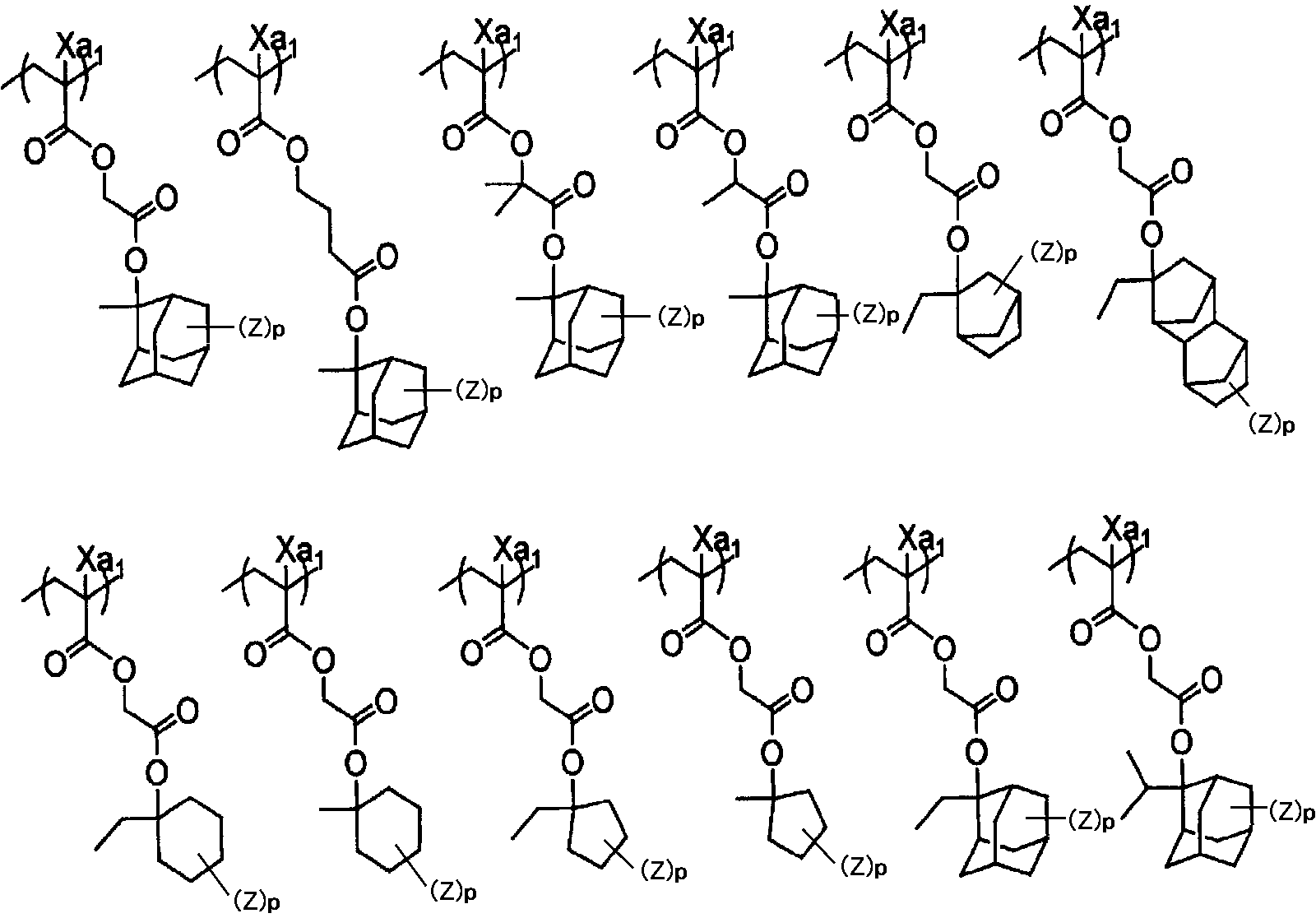
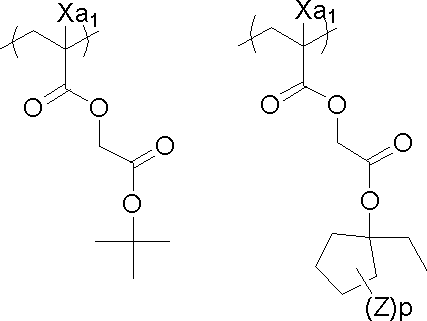
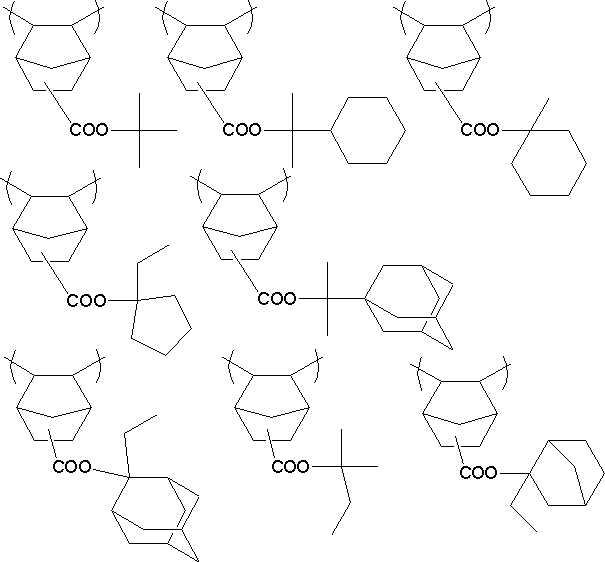
また、樹脂(A)は、酸分解性基を有する繰り返し単位として、下記一般式(IV)で表される繰り返し単位を有することも好ましい。
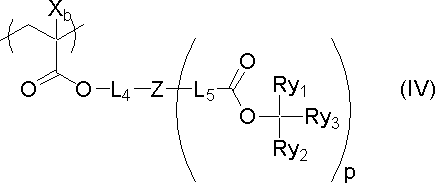
上記一般式(IV)中、Xbは、水素原子、アルキル基、シアノ基又はハロゲン原子を表す。
Ry1~Ry3は、各々独立に、アルキル基又はシクロアルキル基を表す。Ry1~Ry3の内の2つが連結して環を形成していてもよい。
Zは、(p+1)価の、環員としてヘテロ原子を有していてもよい多環式炭化水素構造を有する連結基を表す。Zは、多環を構成する原子団として、エステル結合は含有しないことが好ましい(換言すれば、Zは、多環を構成している環として、ラクトン環を含有しないことが好ましい)。
L4及びL5は、各々独立に、単結合又は2価の連結基を表す。
pは1~3の整数を表す。
pが2又は3のとき、複数のL5、複数のRy1、複数のRy2、及び、複数のRy3は、各々、同一であっても異なっていてもよい。
Ry1~Ry3は、各々独立に、アルキル基又はシクロアルキル基を表す。Ry1~Ry3の内の2つが連結して環を形成していてもよい。
Zは、(p+1)価の、環員としてヘテロ原子を有していてもよい多環式炭化水素構造を有する連結基を表す。Zは、多環を構成する原子団として、エステル結合は含有しないことが好ましい(換言すれば、Zは、多環を構成している環として、ラクトン環を含有しないことが好ましい)。
L4及びL5は、各々独立に、単結合又は2価の連結基を表す。
pは1~3の整数を表す。
pが2又は3のとき、複数のL5、複数のRy1、複数のRy2、及び、複数のRy3は、各々、同一であっても異なっていてもよい。
Xbのアルキル基は、置換基を有していてもよく、置換基としては、例えば、水酸基、ハロゲン原子(好ましくは、フッ素原子)が挙げられる。
Xbのアルキル基は、炭素数1~4のものが好ましく、メチル基、エチル基、プロピル基、ヒドロキシメチル基又はトリフルオロメチル基等が挙げられるが、メチル基であることが好ましい。
Xbは、水素原子又はメチル基であることが好ましい。
Xbのアルキル基は、炭素数1~4のものが好ましく、メチル基、エチル基、プロピル基、ヒドロキシメチル基又はトリフルオロメチル基等が挙げられるが、メチル基であることが好ましい。
Xbは、水素原子又はメチル基であることが好ましい。
Ry1~Ry3のアルキル基及びシクロアルキル基の具体例及び好ましい例は、上記一般式(AI)におけるRx1~Rx3のアルキル基及びシクロアルキル基の具体例及び好ましい例と同様である。
Ry1~Ry3の2つが結合して形成する環構造の具体例及び好ましい例は、上記一般式(AI)におけるRx1~Rx3の2つが結合して形成する環構造の具体例及び好ましい例と同様である。
Ry1~Ry3は、各々独立に、アルキル基であることが好ましく、炭素数1~4の鎖状又は分岐状のアルキル基であることがより好ましい。また、Ry1~Ry3としての鎖状又は分岐状のアルキル基の炭素数の合計は、5以下であることが好ましい。
Ry1~Ry3の2つが結合して形成する環構造の具体例及び好ましい例は、上記一般式(AI)におけるRx1~Rx3の2つが結合して形成する環構造の具体例及び好ましい例と同様である。
Ry1~Ry3は、各々独立に、アルキル基であることが好ましく、炭素数1~4の鎖状又は分岐状のアルキル基であることがより好ましい。また、Ry1~Ry3としての鎖状又は分岐状のアルキル基の炭素数の合計は、5以下であることが好ましい。
Ry1~Ry3は、更に、置換基を有してもよく、このような置換基としては、上記一般式(AI)におけるRx1~Rx3が更に有していてもよい置換基として挙げたものと同様である。
Zの多環式炭化水素構造を有する連結基としては環集合炭化水素環基、架橋環式炭化水素環基が含まれ、それぞれ、環集合炭化水素環から(p+1)個の任意の水素原子を除してなる基、及び、架橋環式炭化水素環から(p+1)個の任意の水素原子を除してなる基を挙げることができる。
Zで表される多環式炭化水素構造を有する連結基は置換基を有していてもよい。Zが有していてもよい置換基としては、例えば、アルキル基、ヒドロキシル基、シアノ基、ケト基(アルキルカルボニル基等)、アシルオキシ基、―COOR、―CON(R)2、―SO2R、-SO3R、―SO2N(R)2等の置換基が挙げられる。ここでRは水素原子、アルキル基、シクロアルキル基又はアリール基を表す。
Zが有していてもよい置換基としてのアルキル基、アルキルカルボニル基、アシルオキシ基、―COOR、―CON(R)2、―SO2R、-SO3R、―SO2N(R)2は、更に置換基を有していてもよく、そのような置換基としては、ハロゲン原子(好ましくは、フッ素原子)が挙げられる。
Zが有していてもよい置換基としてのアルキル基、アルキルカルボニル基、アシルオキシ基、―COOR、―CON(R)2、―SO2R、-SO3R、―SO2N(R)2は、更に置換基を有していてもよく、そのような置換基としては、ハロゲン原子(好ましくは、フッ素原子)が挙げられる。
Zで表される多環式炭化水素構造を有する連結基において、多環を構成する炭素(環形成に寄与する炭素)は、カルボニル炭素であっても良い。また、該多環は、上記したように、環員として、酸素原子、硫黄原子等のヘテロ原子を有していてもよい。ただし、上記したように、Zは、多環を構成する原子団としてのエステル結合を含有しない。
L4及びL5で表される連結基としては、-COO-、-OCO-、-CONH-、-NHCO-、-CO-、-O-、-S-、-SO-、-SO2-、アルキレン基(好ましくは炭素数1~6)、シクロアルキレン基(好ましくは炭素数3~10)、アルケニレン基(好ましくは炭素数2~6)又はこれらの複数が組合された連結基などが挙げられ、総炭素数12以下の連結基が好ましい。
L4は、単結合、アルキレン基、-COO-、-OCO-、-CONH-、-NHCO-、-アルキレン基-COO-、-アルキレン基-OCO-、-アルキレン基-CONH-、-アルキレン基-NHCO-、-CO-、-O-、-SO2-、-アルキレン基-O-が好ましく、単結合、アルキレン基、-アルキレン基-COO-、又は、-アルキレン基-O-がより好ましい。
L5は、単結合、アルキレン基、-COO-、-OCO-、-CONH-、-NHCO-、-COO-アルキレン基-、-OCO-アルキレン基-、-CONH-アルキレン基-、-NHCO-アルキレン基-、-CO-、-O-、-SO2-、-O-アルキレン基-、-O-シクロアルキレン基-が好ましく、単結合、アルキレン基、-COO-アルキレン基-、-O-アルキレン基-、又は、-O-シクロアルキレン基-がより好ましい。
L4は、単結合、アルキレン基、-COO-、-OCO-、-CONH-、-NHCO-、-アルキレン基-COO-、-アルキレン基-OCO-、-アルキレン基-CONH-、-アルキレン基-NHCO-、-CO-、-O-、-SO2-、-アルキレン基-O-が好ましく、単結合、アルキレン基、-アルキレン基-COO-、又は、-アルキレン基-O-がより好ましい。
L5は、単結合、アルキレン基、-COO-、-OCO-、-CONH-、-NHCO-、-COO-アルキレン基-、-OCO-アルキレン基-、-CONH-アルキレン基-、-NHCO-アルキレン基-、-CO-、-O-、-SO2-、-O-アルキレン基-、-O-シクロアルキレン基-が好ましく、単結合、アルキレン基、-COO-アルキレン基-、-O-アルキレン基-、又は、-O-シクロアルキレン基-がより好ましい。
上記の記載方法において、左端の結合手“-”は、L4においては主鎖側のエステル結合に、L5においてはZに接続することを意味し、右端の結合手“-”は、L4においてはZに、L5においては(Ry1)(Ry2)(Ry3)C-で表される基に接続するエステル結合に結合することを意味する。
なお、L4及びL5は、Zにおける多環を構成する同一の原子に結合してもよい。
pは1又は2であることが好ましく、1であることがより好ましい。
以下に一般式(IV)で表される繰り返し単位の具体例を挙げるが本発明はこれに限定されるものではない。下記具体例において、Xaは、水素原子、アルキル基、シアノ基又はハロゲン原子を表す。
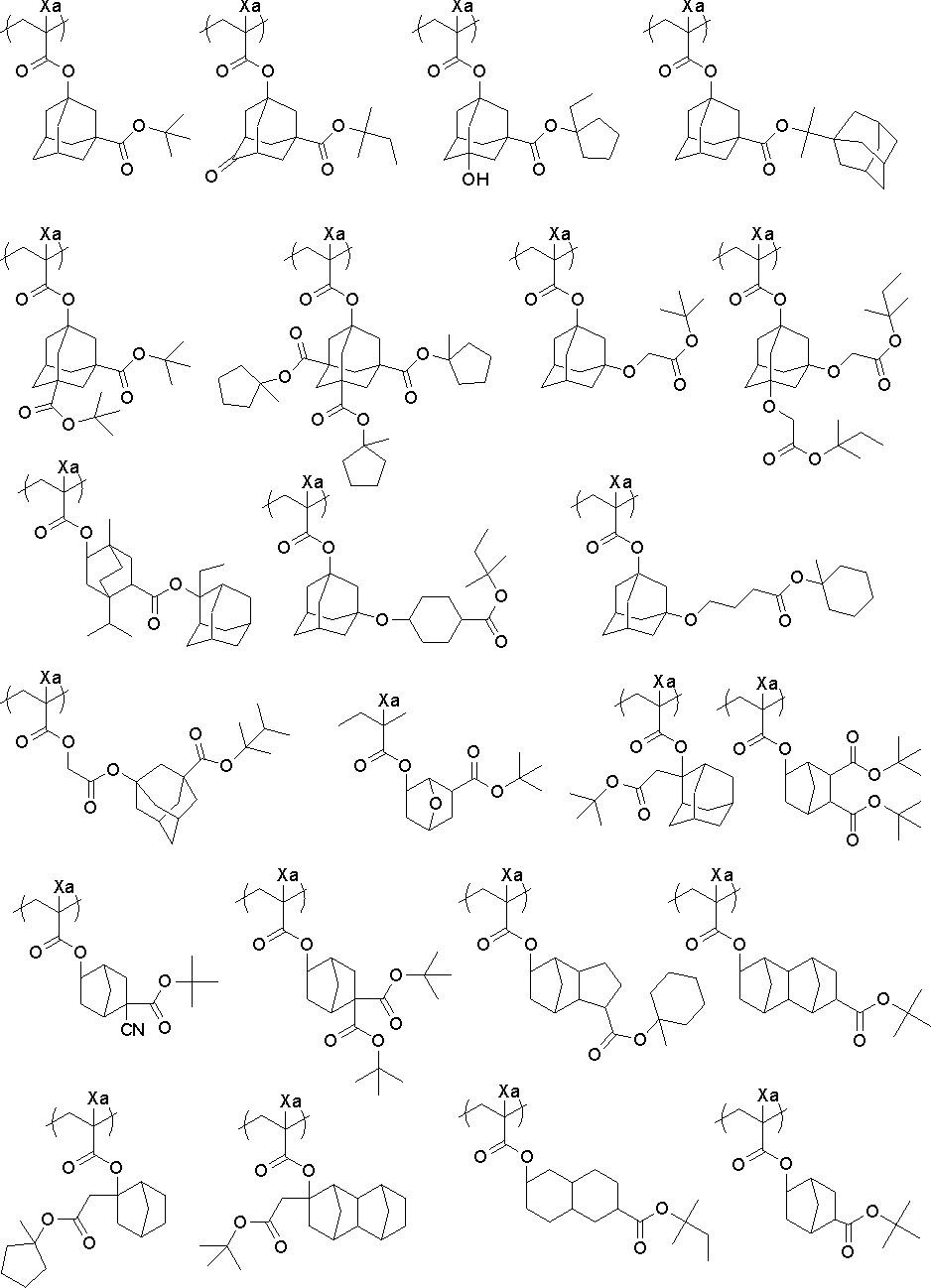
また、樹脂(A)は、酸分解性基を有する繰り返し単位として、以下で表されるような、酸の作用により分解し、アルコール性水酸基を生じる繰り返し単位を有していてもよい。
下記具体例中、Xa1は、水素原子、CH3、CF3、又はCH2OHを表す。
下記具体例中、Xa1は、水素原子、CH3、CF3、又はCH2OHを表す。

酸分解性基を有する繰り返し単位は、1種類であってもよいし、2種以上を併用してもよい。
樹脂(A)が酸分解性基を有する繰り返し単位を2種含む場合の組合せは、特に限定されないが、例えば以下が挙げられる。
下記具体例中、Rは、水素原子、CH3、CF3、又はCH2OHを表す。
樹脂(A)が酸分解性基を有する繰り返し単位を2種含む場合の組合せは、特に限定されないが、例えば以下が挙げられる。
下記具体例中、Rは、水素原子、CH3、CF3、又はCH2OHを表す。

樹脂(A)に含まれる酸分解性基を有する繰り返し単位の含有量(酸分解性基を有する繰り返し単位が複数存在する場合はその合計)は、樹脂(A)の全繰り返し単位に対して、15モル%以上であることが好ましく、20モル%以上であることがより好ましく、25モル%以上であることが更に好ましく、40モル%以上であることが特に好ましい。中でも、樹脂(A)が上記一般式(AI)で表される繰り返し単位を有するとともに、上記一般式(AI)で表される繰り返し単位の樹脂(A)の全繰り返し単位に対する含有量が40モル%以上であることが好ましい。
また、酸分解性基を有する繰り返し単位の含有量は、樹脂(A)の全繰り返し単位に対して、80モル%以下であることが好ましく、70モル%以下であることが好ましく、65モル%以下であることがより好ましい。
また、酸分解性基を有する繰り返し単位の含有量は、樹脂(A)の全繰り返し単位に対して、80モル%以下であることが好ましく、70モル%以下であることが好ましく、65モル%以下であることがより好ましい。
〔酸基を有する繰り返し単位(P2)〕
本発明の第1の実施態様は、上述のように、樹脂(A)が酸基を有する繰り返し単位(P2)を含有することが好ましい。
酸基としてはカルボキシル基、スルホン酸基、スルホンアミド基、スルホニルイミド基、ビススルホニルイミド基、ナフトール構造、α位が電子求引性基で置換された脂肪族アルコール基(例えばヘキサフロロイソプロパノール基)が挙げられ、カルボキシル基又はスルホン酸基を有する繰り返し単位を有することがより好ましく、カルボキシル基を有する繰り返し単位を有することが更に好ましい。酸基を有する繰り返し単位としては、アクリル酸、メタクリル酸による繰り返し単位のような樹脂の主鎖に直接酸基が結合している繰り返し単位、あるいは連結基を介して樹脂の主鎖に酸基が結合している繰り返し単位、更には酸基を有する重合開始剤や連鎖移動剤を重合時に用いてポリマー鎖の末端に導入のいずれも好ましく、連結基は単環又は多環の環状炭化水素構造を有していてもよい。特に好ましくはアクリル酸、メタクリル酸による繰り返し単位である。
また、酸基を有する繰り返し単位(P2)を、イオン性化合物(S)で処理することにより、上述のように、現像液に対する溶解度を減少し得る塩を形成した酸基を有する繰り返し単位(P3)を有する樹脂(A)を好ましく製造することができる。
酸基を有する繰り返し単位(P2)のpKaは0.0~10.0であることが好ましく、pKa2.0~9.0であることがより好ましく、pKa3.0~8.0であることが更に好ましい。
このpKa範囲であると、繰り返し単位(P2)の酸基が有するプロトンと、イオン性化合物(S)のカチオン部分との交換(中和)に好適であり、酸基が塩を形成してなるイオン性基の形成に好適であるからである。
本発明において、繰り返し単位(P2)のpKaは、繰り返し単位(P2)に対応する単量体(モノマー)について算出したpKaを意味する。
本発明において、酸基としては特に制限はないが、カルボン酸基、スルホン酸基等が挙げられ、カルボン酸基であることが好ましい。
酸基を有する繰り返し単位(P2)の含有量は、樹脂(A)中の全繰り返し単位に対し、25モル%以下であることが好ましく、20モル%以下であることがより好ましく、15モル%以下であることが更に好ましい。樹脂(A)が酸基を有する繰り返し単位を含有する場合、樹脂(A)における酸基を有する繰り返し単位の含有量は、1モル%以上であることが好ましく、3モル%以上であることがより好ましく、5モル%以上であることが更に好ましい。
本発明の第1の実施態様は、上述のように、樹脂(A)が酸基を有する繰り返し単位(P2)を含有することが好ましい。
酸基としてはカルボキシル基、スルホン酸基、スルホンアミド基、スルホニルイミド基、ビススルホニルイミド基、ナフトール構造、α位が電子求引性基で置換された脂肪族アルコール基(例えばヘキサフロロイソプロパノール基)が挙げられ、カルボキシル基又はスルホン酸基を有する繰り返し単位を有することがより好ましく、カルボキシル基を有する繰り返し単位を有することが更に好ましい。酸基を有する繰り返し単位としては、アクリル酸、メタクリル酸による繰り返し単位のような樹脂の主鎖に直接酸基が結合している繰り返し単位、あるいは連結基を介して樹脂の主鎖に酸基が結合している繰り返し単位、更には酸基を有する重合開始剤や連鎖移動剤を重合時に用いてポリマー鎖の末端に導入のいずれも好ましく、連結基は単環又は多環の環状炭化水素構造を有していてもよい。特に好ましくはアクリル酸、メタクリル酸による繰り返し単位である。
また、酸基を有する繰り返し単位(P2)を、イオン性化合物(S)で処理することにより、上述のように、現像液に対する溶解度を減少し得る塩を形成した酸基を有する繰り返し単位(P3)を有する樹脂(A)を好ましく製造することができる。
酸基を有する繰り返し単位(P2)のpKaは0.0~10.0であることが好ましく、pKa2.0~9.0であることがより好ましく、pKa3.0~8.0であることが更に好ましい。
このpKa範囲であると、繰り返し単位(P2)の酸基が有するプロトンと、イオン性化合物(S)のカチオン部分との交換(中和)に好適であり、酸基が塩を形成してなるイオン性基の形成に好適であるからである。
本発明において、繰り返し単位(P2)のpKaは、繰り返し単位(P2)に対応する単量体(モノマー)について算出したpKaを意味する。
本発明において、酸基としては特に制限はないが、カルボン酸基、スルホン酸基等が挙げられ、カルボン酸基であることが好ましい。
酸基を有する繰り返し単位(P2)の含有量は、樹脂(A)中の全繰り返し単位に対し、25モル%以下であることが好ましく、20モル%以下であることがより好ましく、15モル%以下であることが更に好ましい。樹脂(A)が酸基を有する繰り返し単位を含有する場合、樹脂(A)における酸基を有する繰り返し単位の含有量は、1モル%以上であることが好ましく、3モル%以上であることがより好ましく、5モル%以上であることが更に好ましい。
酸基を有する繰り返し単位(P2)の具体例を以下に示すが、本発明は、これらに限定されるものではない。下記具体例中のpKaは、対応するモノマーで算出した値である。
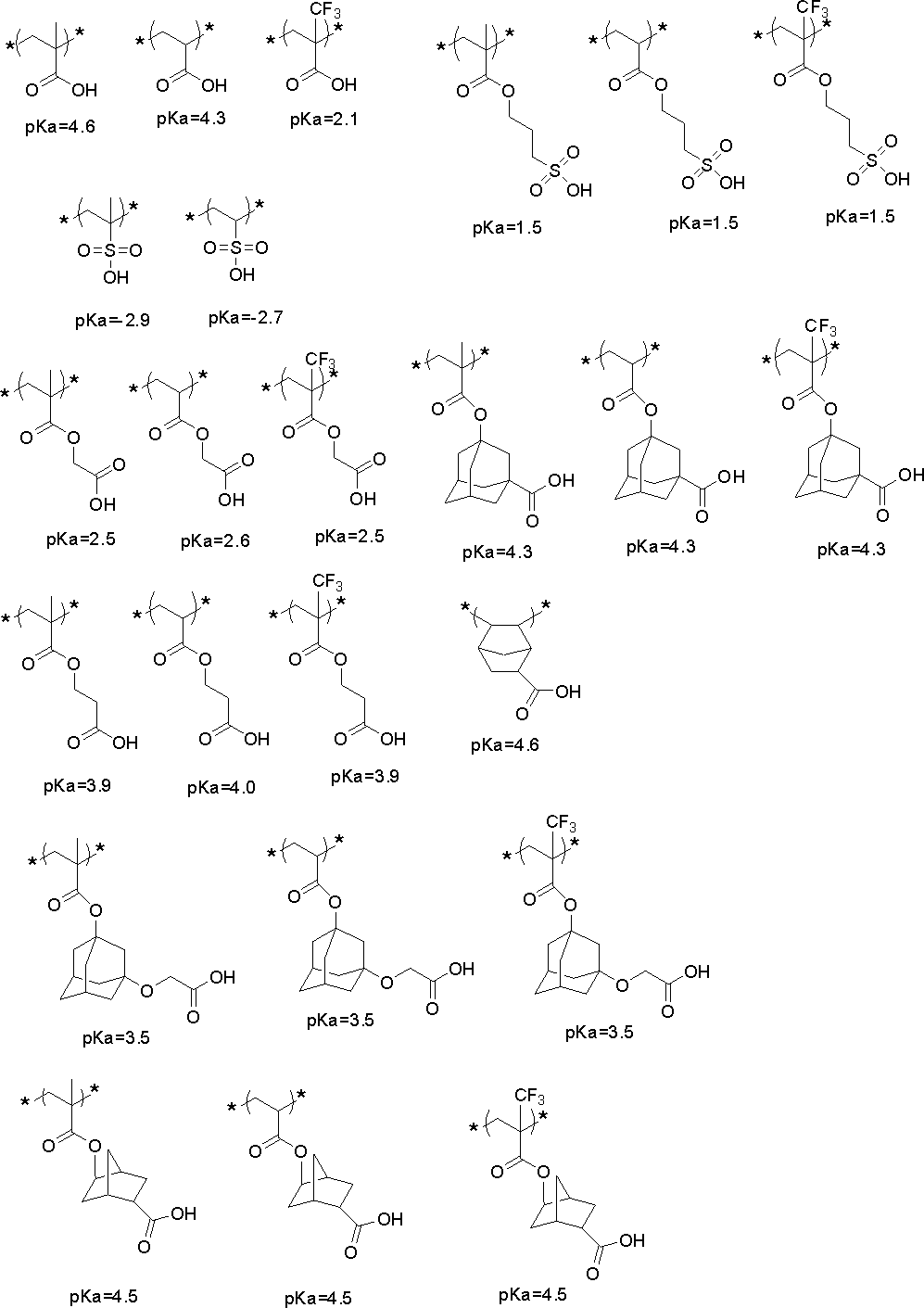
〔酸基が塩を形成してなるイオン性基を有する繰り返し単位(P3)〕
本発明の第2の実施態様は、上述のように、樹脂(A)が、酸基が塩を形成してなるイオン性基を有する繰り返し単位(P3)を含有することが好ましい。
繰り返し単位(P3)における酸基が塩を形成してなるイオン性基としては、前述の繰り返し単位(P2)の酸基に由来するアニオン(共役塩基)と、前述のイオン性化合物(S)におけるカチオン部分とからなる塩であることがより好ましい。
酸基が塩を形成してなるイオン性基を有する繰り返し単位(P3)の含有量は、樹脂(A)中の全繰り返し単位に対し、25モル%以下であることが好ましく、20モル%以下であることがより好ましく、15モル%以下であることが更に好ましい。樹脂(A)が酸基を有する繰り返し単位を含有する場合、樹脂(A)における繰り返し単位(P3)の含有量は、1モル%以上であることが好ましく、3モル%以上であることがより好ましく、5モル%以上であることが更に好ましい。
本発明の第2の実施態様は、上述のように、樹脂(A)が、酸基が塩を形成してなるイオン性基を有する繰り返し単位(P3)を含有することが好ましい。
繰り返し単位(P3)における酸基が塩を形成してなるイオン性基としては、前述の繰り返し単位(P2)の酸基に由来するアニオン(共役塩基)と、前述のイオン性化合物(S)におけるカチオン部分とからなる塩であることがより好ましい。
酸基が塩を形成してなるイオン性基を有する繰り返し単位(P3)の含有量は、樹脂(A)中の全繰り返し単位に対し、25モル%以下であることが好ましく、20モル%以下であることがより好ましく、15モル%以下であることが更に好ましい。樹脂(A)が酸基を有する繰り返し単位を含有する場合、樹脂(A)における繰り返し単位(P3)の含有量は、1モル%以上であることが好ましく、3モル%以上であることがより好ましく、5モル%以上であることが更に好ましい。
酸基が塩を形成してなるイオン性基を有する繰り返し単位(P3)の具体例を以下に示すが、本発明は、これらに限定されるものではない。
具体例中、RxはH、CH3、CH2OH又はCF3を表す。
具体例中、RxはH、CH3、CH2OH又はCF3を表す。

〔その他繰り返し単位〕
樹脂(A)は、ラクトン構造又はスルトン構造を有する繰り返し単位を含有していてもよい。
ラクトン構造又はスルトン構造としては、ラクトン構造又はスルトン構造を有していればいずれでも用いることができるが、好ましくは5~7員環ラクトン構造又は5~7員環スルトン構造であり、5~7員環ラクトン構造にビシクロ構造、スピロ構造を形成する形で他の環構造が縮環しているもの、又は、5~7員環スルトン構造にビシクロ構造、スピロ構造を形成する形で他の環構造が縮環しているもの、がより好ましい。下記一般式(LC1-1)~(LC1-21)のいずれかで表されるラクトン構造、又は、下記一般式(SL1-1)~(SL1-3)のいずれかで表されるスルトン構造、を有する繰り返し単位を有することが更に好ましい。また、ラクトン構造又はスルトン構造が主鎖に直接結合していてもよい。好ましいラクトン構造としては(LC1-1)、(LC1-4)、(LC1-5)、(LC1-6)、(LC1-13)、(LC1-14)、(LC1-17)であり、特に好ましいラクトン構造は(LC1-4)である。このような特定のラクトン構造を用いることでLER、現像欠陥が良好になる。
樹脂(A)は、ラクトン構造又はスルトン構造を有する繰り返し単位を含有していてもよい。
ラクトン構造又はスルトン構造としては、ラクトン構造又はスルトン構造を有していればいずれでも用いることができるが、好ましくは5~7員環ラクトン構造又は5~7員環スルトン構造であり、5~7員環ラクトン構造にビシクロ構造、スピロ構造を形成する形で他の環構造が縮環しているもの、又は、5~7員環スルトン構造にビシクロ構造、スピロ構造を形成する形で他の環構造が縮環しているもの、がより好ましい。下記一般式(LC1-1)~(LC1-21)のいずれかで表されるラクトン構造、又は、下記一般式(SL1-1)~(SL1-3)のいずれかで表されるスルトン構造、を有する繰り返し単位を有することが更に好ましい。また、ラクトン構造又はスルトン構造が主鎖に直接結合していてもよい。好ましいラクトン構造としては(LC1-1)、(LC1-4)、(LC1-5)、(LC1-6)、(LC1-13)、(LC1-14)、(LC1-17)であり、特に好ましいラクトン構造は(LC1-4)である。このような特定のラクトン構造を用いることでLER、現像欠陥が良好になる。

ラクトン構造部分又はスルトン構造部分は、置換基(Rb2)を有していても有していなくてもよい。好ましい置換基(Rb2)としては、炭素数1~8のアルキル基、炭素数4~7のシクロアルキル基、炭素数1~8のアルコキシ基、炭素数2~8のアルコキシカルボニル基、カルボキシル基、ハロゲン原子、水酸基、シアノ基、酸分解性基などが挙げられる。より好ましくは炭素数1~4のアルキル基、シアノ基、酸分解性基である。n2は、0~4の整数を表す。n2が2以上の時、複数存在する置換基(Rb2)は、同一でも異なっていてもよい。また、複数存在する置換基(Rb2)同士が結合して環を形成してもよい。
ラクトン構造又はスルトン構造を有する繰り返し単位は、通常、光学異性体が存在するが、いずれの光学異性体を用いてもよい。また、1種の光学異性体を単独で用いても、複数の光学異性体を混合して用いてもよい。1種の光学異性体を主に用いる場合、その光学純度(ee)が90%以上のものが好ましく、より好ましくは95%以上である。
ラクトン構造又はスルトン構造を有する繰り返し単位は、下記一般式(III)で表される繰り返し単位であることが好ましい。

上記一般式(III)中、
Aは、エステル結合(-COO-で表される基)又はアミド結合(-CONH-で表される基)を表す。
R0は、複数個ある場合にはそれぞれ独立にアルキレン基、シクロアルキレン基、又はその組み合わせを表す。
Zは、複数個ある場合にはそれぞれ独立に、単結合、エーテル結合、エステル結合、アミド結合、ウレタン結合
Aは、エステル結合(-COO-で表される基)又はアミド結合(-CONH-で表される基)を表す。
R0は、複数個ある場合にはそれぞれ独立にアルキレン基、シクロアルキレン基、又はその組み合わせを表す。
Zは、複数個ある場合にはそれぞれ独立に、単結合、エーテル結合、エステル結合、アミド結合、ウレタン結合

又はウレア結合

を表す。ここで、Rは、各々独立して、水素原子、アルキル基、シクロアルキル基、又はアリール基を表す。
R8は、ラクトン構造又はスルトン構造を有する1価の有機基を表す。
nは、-R0-Z-で表される構造の繰り返し数であり、0~5の整数を表し、0又は1であることが好ましく、0であることがより好ましい。nが0である場合、-R0-Z-は存在せず、単結合となる。
R7は、水素原子、ハロゲン原子又はアルキル基を表す。
R8は、ラクトン構造又はスルトン構造を有する1価の有機基を表す。
nは、-R0-Z-で表される構造の繰り返し数であり、0~5の整数を表し、0又は1であることが好ましく、0であることがより好ましい。nが0である場合、-R0-Z-は存在せず、単結合となる。
R7は、水素原子、ハロゲン原子又はアルキル基を表す。
R0のアルキレン基、シクロアルキレン基は置換基を有してよい。
Zは好ましくは、エーテル結合、エステル結合であり、特に好ましくはエステル結合である。
Zは好ましくは、エーテル結合、エステル結合であり、特に好ましくはエステル結合である。
R7のアルキル基は、炭素数1~4のアルキル基が好ましく、メチル基、エチル基がより好ましく、メチル基が特に好ましい。
R0のアルキレン基、シクロアルキレン基、R7におけるアルキル基は、各々置換されていてもよく、置換基としては、例えば、フッ素原子、塩素原子、臭素原子等のハロゲン原子やメルカプト基、水酸基、アルコキシ基、アシルオキシ基が挙げられる。
R7は、水素原子、メチル基、トリフルオロメチル基、ヒドロキシメチル基が好ましい。
R0のアルキレン基、シクロアルキレン基、R7におけるアルキル基は、各々置換されていてもよく、置換基としては、例えば、フッ素原子、塩素原子、臭素原子等のハロゲン原子やメルカプト基、水酸基、アルコキシ基、アシルオキシ基が挙げられる。
R7は、水素原子、メチル基、トリフルオロメチル基、ヒドロキシメチル基が好ましい。
R0における好ましい鎖状アルキレン基としては炭素数が1~10の鎖状のアルキレンが好ましく、より好ましくは炭素数1~5である。好ましいシクロアルキレン基としては、炭素数3~20のシクロアルキレン基である。本発明の効果を発現するためには鎖状アルキレン基がより好ましく、メチレン基が特に好ましい。
R8で表されるラクトン構造又はスルトン構造を有する1価の有機基は、ラクトン構造又はスルトン構造を有していれば限定されるものではなく、具体例として一般式(LC1-1)~(LC1-21)及び、(SL1-1)~(SL1-3)の内のいずれかで表されるラクトン構造又はスルトン構造が挙げられ、これらのうち(LC1-4)で表される構造が特に好ましい。また、(LC1-1)~(LC1-21)におけるn2は2以下のものがより好ましい。
また、R8は無置換のラクトン構造又はスルトン構造を有する1価の有機基、或いはメチル基、シアノ基又はアルコキシカルボニル基を置換基として有するラクトン構造又はスルトン構造を有する1価の有機基が好ましく、シアノ基を置換基として有するラクトン構造(シアノラクトン)を有する1価の有機基がより好ましい。
また、R8は無置換のラクトン構造又はスルトン構造を有する1価の有機基、或いはメチル基、シアノ基又はアルコキシカルボニル基を置換基として有するラクトン構造又はスルトン構造を有する1価の有機基が好ましく、シアノ基を置換基として有するラクトン構造(シアノラクトン)を有する1価の有機基がより好ましい。
以下にラクトン構造又はスルトン構造を有する基を有する繰り返し単位の具体例を示すが、本発明はこれに限定されるものではない。
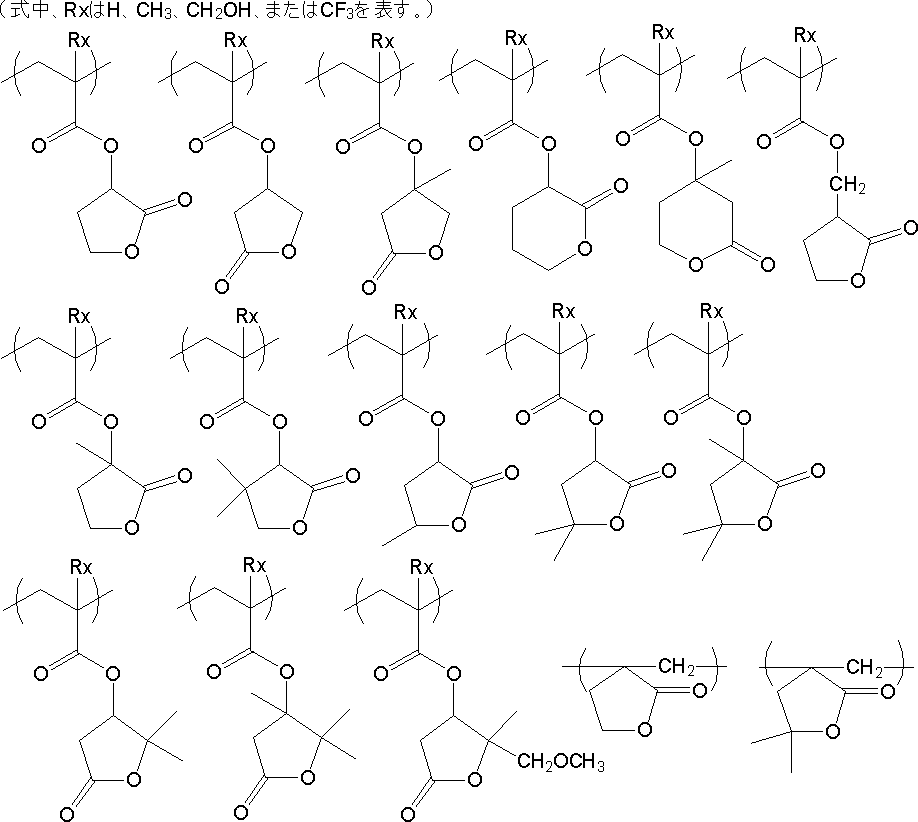

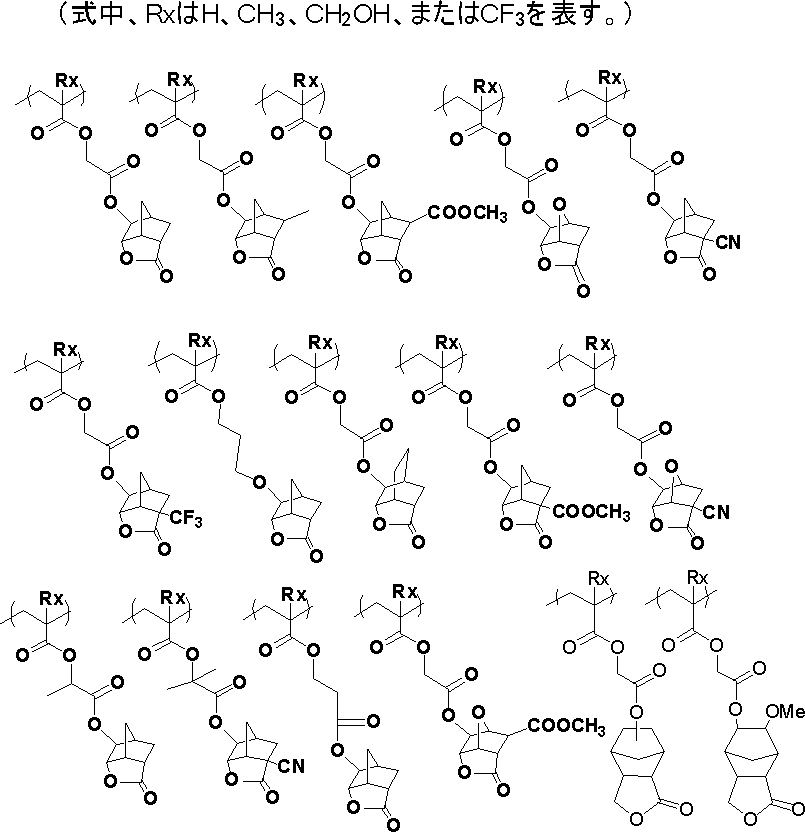
本発明の効果を高めるために、2種以上のラクトン構造又はスルトン構造を有する繰り返し単位を併用することも可能である。
樹脂(A)がラクトン構造又はスルトン構造を有する繰り返し単位を含有する場合、ラクトン構造又はスルトン構造を有する繰り返し単位の含有量は、樹脂(A)中の全繰り返し単位に対し、5~60モル%が好ましく、より好ましくは5~55モル%、更に好ましくは10~50モル%である。
また、樹脂(A)は、環状炭酸エステル構造を有する繰り返し単位を有していてもよい。
環状炭酸エステル構造を有する繰り返し単位は、下記一般式(A-1)で表される繰り返し単位であることが好ましい。
環状炭酸エステル構造を有する繰り返し単位は、下記一般式(A-1)で表される繰り返し単位であることが好ましい。

一般式(A-1)中、RA
1は、水素原子又はアルキル基を表す。
RA 2は、nが2以上の場合は各々独立して、置換基を表す。
Aは、単結合、又は2価の連結基を表す。
Zは、式中の-O-C(=O)-O-で表される基と共に単環又は多環構造を形成する原子団を表す。
nは0以上の整数を表す。
RA 2は、nが2以上の場合は各々独立して、置換基を表す。
Aは、単結合、又は2価の連結基を表す。
Zは、式中の-O-C(=O)-O-で表される基と共に単環又は多環構造を形成する原子団を表す。
nは0以上の整数を表す。
一般式(A-1)について詳細に説明する。
RA 1で表されるアルキル基は、フッ素原子等の置換基を有していてもよい。RA 1は、水素原子、メチル基又はトリフルオロメチル基を表すことが好ましく、メチル基を表すことがより好ましい。
RA 2で表される置換基は、例えば、アルキル基、シクロアルキル基、ヒドロキシル基、アルコキシ基、アミノ基、アルコキシカルボニルアミノ基である。好ましくは炭素数1~5のアルキル基である。アルキル基はヒドロキシル基等の置換基を有していてもよい。
nは置換基数を表す0以上の整数である。nは、例えば、好ましくは0~4であり、より好ましくは0である。
RA 1で表されるアルキル基は、フッ素原子等の置換基を有していてもよい。RA 1は、水素原子、メチル基又はトリフルオロメチル基を表すことが好ましく、メチル基を表すことがより好ましい。
RA 2で表される置換基は、例えば、アルキル基、シクロアルキル基、ヒドロキシル基、アルコキシ基、アミノ基、アルコキシカルボニルアミノ基である。好ましくは炭素数1~5のアルキル基である。アルキル基はヒドロキシル基等の置換基を有していてもよい。
nは置換基数を表す0以上の整数である。nは、例えば、好ましくは0~4であり、より好ましくは0である。
Aにより表される2価の連結基としては、例えば、アルキレン基、シクロアルキレン基、エステル結合、アミド結合、エーテル結合、ウレタン結合、ウレア結合、又はその組み合わせ等が挙げられる。アルキレン基としては、炭素数1~10のアルキレン基が好ましく、炭素数1~5のアルキレン基がより好ましく、例えば、メチレン基、エチレン基、プロピレン基等が挙げられる。
本発明の一形態において、Aは、単結合、アルキレン基であることが好ましい。
本発明の一形態において、Aは、単結合、アルキレン基であることが好ましい。
Zにより表される、-O-C(=O)-O-を含む単環としては、例えば、下記一般式(a)で表される環状炭酸エステルにおいて、nA=2~4である5~7員環が挙げられ、5員環又は6員環(nA=2又は3)であることが好ましく、5員環(nA=2)であることがより好ましい。
Zにより表される、-O-C(=O)-O-を含む多環としては、例えば、下記一般式(a)で表される環状炭酸エステルが1又は2以上の他の環構造と共に縮合環を形成している構造や、スピロ環を形成している構造が挙げられる。縮合環又はスピロ環を形成し得る「他の環構造」としては、脂環式炭化水素基であってもよいし、芳香族炭化水素基であってもよいし、複素環であってもよい。
Zにより表される、-O-C(=O)-O-を含む多環としては、例えば、下記一般式(a)で表される環状炭酸エステルが1又は2以上の他の環構造と共に縮合環を形成している構造や、スピロ環を形成している構造が挙げられる。縮合環又はスピロ環を形成し得る「他の環構造」としては、脂環式炭化水素基であってもよいし、芳香族炭化水素基であってもよいし、複素環であってもよい。

前記一般式(A-1)で表される繰り返し単位に対応する単量体は、例えば、Tetrahedron Letters,Vol.27,No.32 p.3741(1986)、Organic Letters,Vol.4,No.15 p.2561(2002)等に記載された、従来公知の方法により、合成することができる。
樹脂(A)には、一般式(A-1)で表される繰り返し単位のうちの1種が単独で含まれていてもよいし、2種以上が含まれていてもよい。
樹脂(A)において、環状炭酸エステル構造を有する繰り返し単位(好ましくは、一般式(A-1)で表される繰り返し単位)の含有率は、樹脂(A)を構成する全繰り返し単位に対して、3~80モル%であることが好ましく、3~60モル%であることが更に好ましく、3~30モル%であることが特に好ましく、10~15モル%であることが最も好ましい。このような含有率とすることによって、レジストとしての現像性、低欠陥性、低LWR、低PEB温度依存性、プロファイル等を向上させることができる。
樹脂(A)において、環状炭酸エステル構造を有する繰り返し単位(好ましくは、一般式(A-1)で表される繰り返し単位)の含有率は、樹脂(A)を構成する全繰り返し単位に対して、3~80モル%であることが好ましく、3~60モル%であることが更に好ましく、3~30モル%であることが特に好ましく、10~15モル%であることが最も好ましい。このような含有率とすることによって、レジストとしての現像性、低欠陥性、低LWR、低PEB温度依存性、プロファイル等を向上させることができる。
以下に、一般式(A-1)で表される繰り返し単位の具体例(繰り返し単位(A-1a)~(A-1w))を挙げるが、本発明はこれらに限定されない。
なお、以下の具体例中のRA 1は、一般式(A-1)におけるRA 1と同義である。
なお、以下の具体例中のRA 1は、一般式(A-1)におけるRA 1と同義である。

樹脂(A)は、水酸基又はシアノ基を有する繰り返し単位を有していても良い。これにより基板密着性、現像液親和性が向上する。水酸基又はシアノ基を有する繰り返し単位は、水酸基又はシアノ基で置換された脂環炭化水素構造を有する繰り返し単位であることが好ましく、酸分解性基を有さないことが好ましい。
また、水酸基又はシアノ基で置換された脂環炭化水素構造を有する繰り返し単位は、酸分解性基を有する繰り返し単位とは異なることが好ましい(すなわち、酸に対して安定な繰り返し単位であることが好ましい)。
水酸基又はシアノ基で置換された脂環炭化水素構造に於ける、脂環炭化水素構造としては、アダマンチル基、ジアマンチル基、ノルボルナン基が好ましい。
より好ましくは、下記一般式(AIIa)~(AIIc)のいずれかで表される繰り返し単位を挙げることができる。
また、水酸基又はシアノ基で置換された脂環炭化水素構造を有する繰り返し単位は、酸分解性基を有する繰り返し単位とは異なることが好ましい(すなわち、酸に対して安定な繰り返し単位であることが好ましい)。
水酸基又はシアノ基で置換された脂環炭化水素構造に於ける、脂環炭化水素構造としては、アダマンチル基、ジアマンチル基、ノルボルナン基が好ましい。
より好ましくは、下記一般式(AIIa)~(AIIc)のいずれかで表される繰り返し単位を挙げることができる。

式中、RXは、水素原子、メチル基、ヒドロキシメチル基、又は、トリフルオロメチル基を表す。
Abは、単結合、又は2価の連結基を表す。
Abにより表される2価の連結基としては、例えば、アルキレン基、シクロアルキレン基、エステル結合、アミド結合、エーテル結合、ウレタン結合、ウレア結合、又はその組み合わせ等が挙げられる。アルキレン基としては、炭素数1~10のアルキレン基が好ましく、炭素数1~5のアルキレン基がより好ましく、例えば、メチレン基、エチレン基、プロピレン基等が挙げられる。
本発明の一形態において、Abは、単結合、又は、アルキレン基であることが好ましい。
Rpは、水素原子、ヒドロキシル基、又は、ヒドロキシアルキル基を表す。複数のRpは、同一でも異なっていても良いが、複数のRpの内の少なくとも1つは、ヒドロキシル基又はヒドロキシアルキル基を表す。
Abは、単結合、又は2価の連結基を表す。
Abにより表される2価の連結基としては、例えば、アルキレン基、シクロアルキレン基、エステル結合、アミド結合、エーテル結合、ウレタン結合、ウレア結合、又はその組み合わせ等が挙げられる。アルキレン基としては、炭素数1~10のアルキレン基が好ましく、炭素数1~5のアルキレン基がより好ましく、例えば、メチレン基、エチレン基、プロピレン基等が挙げられる。
本発明の一形態において、Abは、単結合、又は、アルキレン基であることが好ましい。
Rpは、水素原子、ヒドロキシル基、又は、ヒドロキシアルキル基を表す。複数のRpは、同一でも異なっていても良いが、複数のRpの内の少なくとも1つは、ヒドロキシル基又はヒドロキシアルキル基を表す。
樹脂(A)は、水酸基又はシアノ基を有する繰り返し単位を含有していても、含有していなくてもよいが、樹脂(A)が水酸基又はシアノ基を有する繰り返し単位を含有する場合、水酸基又はシアノ基を有する繰り返し単位の含有量は、樹脂(A)中の全繰り返し単位に対し、1~40モル%が好ましく、より好ましくは3~30モル%、更に好ましくは5~25モル%である。
水酸基又はシアノ基を有する繰り返し単位の具体例を以下に挙げるが、本発明はこれらに限定されない。

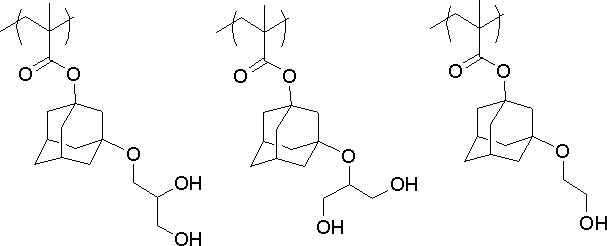
その他、国際公開2011/122336号明細書の〔0011〕以降に記載のモノマー又はこれに対応する繰り返し単位なども適宜使用可能である。
本発明における樹脂(A)は、更に極性基(例えば、前記酸基、ヒドロキシル基、シアノ基)を持たない脂環炭化水素構造を有し、酸分解性を示さない繰り返し単位を有することができる。これにより、液浸露光時にレジスト膜から液浸液への低分子成分の溶出が低減できるとともに、有機溶剤を含む現像液を用いた現像の際に樹脂の溶解性を適切に調整することができる。このような繰り返し単位としては、一般式(IV)で表される繰り返し単位が挙げられる。

一般式(IV)中、R5は少なくとも1つの環状構造を有し、極性基を有さない炭化水素基を表す。
Raは水素原子、アルキル基又は-CH2-O-Ra2基を表す。式中、Ra2は、水素原子、アルキル基又はアシル基を表す。Raは、水素原子、メチル基、ヒドロキシメチル基、トリフルオロメチル基が好ましく、水素原子、メチル基が特に好ましい。
Raは水素原子、アルキル基又は-CH2-O-Ra2基を表す。式中、Ra2は、水素原子、アルキル基又はアシル基を表す。Raは、水素原子、メチル基、ヒドロキシメチル基、トリフルオロメチル基が好ましく、水素原子、メチル基が特に好ましい。
R5が有する環状構造には、単環式炭化水素基及び多環式炭化水素基が含まれる。単環式炭化水素基として、好ましくは、シクロペンチル基、シクロヘキシル基が挙げられる。
多環式炭化水素基には環集合炭化水素基、架橋環式炭化水素基が含まれ、環集合炭化水素基の例としては、ビシクロヘキシル基、パーヒドロナフタレニル基などが含まれる。架橋環式炭化水素環として、例えば、ピナン、ボルナン、ノルピナン、ノルボルナン、ビシクロオクタン環(ビシクロ[2.2.2]オクタン環、ビシクロ[3.2.1]オクタン環等)などの2環式炭化水素環及び、ホモブレダン、アダマンタン、トリシクロ[5.2.1.02,6]デカン、トリシクロ[4.3.1.12,5]ウンデカン環などの3環式炭化水素環、テトラシクロ[4.4.0.12,5.17,10]ドデカン、パーヒドロ-1,4-メタノ-5,8-メタノナフタレン環などの4環式炭化水素環などが挙げられる。また、架橋環式炭化水素環には、縮合環式炭化水素環、例えば、パーヒドロナフタレン(デカリン)、パーヒドロアントラセン、パーヒドロフェナントレン、パーヒドロアセナフテン、パーヒドロフルオレン、パーヒドロインデン、パーヒドロフェナレン環などの5~8員シクロアルカン環が複数個縮合した縮合環も含まれる。
好ましい架橋環式炭化水素環として、ノルボルニル基、アダマンチル基、ビシクロオクタニル基、トリシクロ[5、2、1、02,6]デカニル基、などが挙げられる。より好ましい架橋環式炭化水素環としてノルボニル基、アダマンチル基が挙げられる。
これらの脂環式炭化水素基は置換基を有していても良く、好ましい置換基としてはハロゲン原子、アルキル基、水素原子が置換されたヒドロキシル基、水素原子が置換されたアミノ基などが挙げられる。
樹脂(A)は、極性基を持たない脂環炭化水素構造を有し、酸分解性を示さない繰り返し単位を含有してもしなくてもよいが、含有する場合、この繰り返し単位の含有量は、樹脂(A)中の全繰り返し単位に対し、1~50モル%が好ましく、より好ましくは5~50モル%である。
極性基を持たない脂環炭化水素構造を有し、酸分解性を示さない繰り返し単位の具体例を以下に挙げるが、本発明はこれらに限定されない。式中、Raは、H、CH3、CH2OH、又はCF3を表す。
極性基を持たない脂環炭化水素構造を有し、酸分解性を示さない繰り返し単位の具体例を以下に挙げるが、本発明はこれらに限定されない。式中、Raは、H、CH3、CH2OH、又はCF3を表す。

本発明の組成物に用いられる樹脂(A)は、上記の繰り返し構造単位以外に、ドライエッチング耐性や標準現像液適性、基板密着性、レジストプロファイル、更に感活性光線性又は感放射線性樹脂組成物の一般的な必要な特性である解像力、耐熱性、感度等を調節する目的で様々な繰り返し構造単位を有することができる。
このような繰り返し構造単位としては、下記の単量体に相当する繰り返し構造単位を挙げることができるが、これらに限定されるものではない。
これにより、本発明に係る組成物に用いられる樹脂に要求される性能、特に、
(1)塗布溶剤に対する溶解性、
(2)製膜性(ガラス転移点)、
(3)アルカリ現像性、
(4)膜べり(親疎水性、アルカリ可溶性基選択)、
(5)未露光部の基板への密着性、
(6)ドライエッチング耐性、等の微調整が可能となる。
(1)塗布溶剤に対する溶解性、
(2)製膜性(ガラス転移点)、
(3)アルカリ現像性、
(4)膜べり(親疎水性、アルカリ可溶性基選択)、
(5)未露光部の基板への密着性、
(6)ドライエッチング耐性、等の微調整が可能となる。
このような単量体として、例えばアクリル酸エステル類、メタクリル酸エステル類、アクリルアミド類、メタクリルアミド類、アリル化合物、ビニルエーテル類、ビニルエステル類等から選ばれる付加重合性不飽和結合を1個有する化合物等を挙げることができる。
その他にも、上記種々の繰り返し構造単位に相当する単量体と共重合可能である付加重合性の不飽和化合物であれば、共重合されていてもよい。
本発明の組成物に用いられる樹脂(A)において、各繰り返し構造単位の含有モル比は感活性光線性又は感放射線性樹脂組成物のドライエッチング耐性や標準現像液適性、基板密着性、レジストプロファイル、更には感活性光線性又は感放射線性樹脂組成物の一般的な必要性能である解像力、耐熱性、感度等を調節するために適宜設定される。
本発明における樹脂(A)の形態としては、ランダム型、ブロック型、クシ型、スター型のいずれの形態でもよい。樹脂(A)は、例えば、各構造に対応する不飽和モノマーのラジカル、カチオン、又はアニオン重合により合成することができる。また各構造の前駆体に相当する不飽和モノマーを用いて重合した後に、高分子反応を行うことにより目的とする樹脂を得ることも可能である。
本発明の組成物が、ArF露光用であるとき、ArF光への透明性の点から本発明の組成物に用いられる樹脂(A)は実質的には芳香環を有さない(具体的には、樹脂中、芳香族基を有する繰り返し単位の比率が好ましくは5モル%以下、より好ましくは3モル%以下、理想的には0モル%、すなわち、芳香族基を有さない)ことが好ましく、樹脂(A)は単環又は多環の脂環炭化水素構造を有することが好ましい。
本発明の組成物が、後述する樹脂(D)を含んでいる場合、樹脂(A)は、樹脂(D)との相溶性の観点から、フッ素原子及びケイ素原子を含有しない(具体的には、樹脂中、フッ素原子又はケイ素原子を含有する繰り返し単位の比率が好ましくは5モル%以下、より好ましくは3モル%以下、理想的には0モル%)ことが好ましい。
本発明の組成物が、ArF露光用であるとき、ArF光への透明性の点から本発明の組成物に用いられる樹脂(A)は実質的には芳香環を有さない(具体的には、樹脂中、芳香族基を有する繰り返し単位の比率が好ましくは5モル%以下、より好ましくは3モル%以下、理想的には0モル%、すなわち、芳香族基を有さない)ことが好ましく、樹脂(A)は単環又は多環の脂環炭化水素構造を有することが好ましい。
本発明の組成物が、後述する樹脂(D)を含んでいる場合、樹脂(A)は、樹脂(D)との相溶性の観点から、フッ素原子及びケイ素原子を含有しない(具体的には、樹脂中、フッ素原子又はケイ素原子を含有する繰り返し単位の比率が好ましくは5モル%以下、より好ましくは3モル%以下、理想的には0モル%)ことが好ましい。
本発明の組成物に用いられる樹脂(A)として好ましくは、繰り返し単位のすべてが(メタ)アクリレート系繰り返し単位で構成されたものである。この場合、繰り返し単位のすべてがメタクリレート系繰り返し単位であるもの、繰り返し単位のすべてがアクリレート系繰り返し単位であるもの、繰り返し単位のすべてがメタクリレート系繰り返し単位とアクリレート系繰り返し単位とによるもののいずれのものでも用いることができるが、アクリレート系繰り返し単位が全繰り返し単位の50モル%以下であることが好ましい。
本発明の組成物にKrFエキシマレーザー光、電子線、X線、波長50nm以下の高エネルギー光線(EUVなど)を照射する場合には、樹脂(A)は、更に、ヒドロキシスチレン系繰り返し単位を有することが好ましい。更に好ましくはヒドロキシスチレン系繰り返し単位と、酸分解性基で保護されたヒドロキシスチレン系繰り返し単位、(メタ)アクリル酸3級アルキルエステル等の酸分解性繰り返し単位を有するが好ましい。
ヒドロキシスチレン系の好ましい酸分解性基を有する繰り返し単位としては、例えば、t-ブトキシカルボニルオキシスチレン、1-アルコキシエトキシスチレン、(メタ)アクリル酸3級アルキルエステルによる繰り返し単位等を挙げることができ、2-アルキル-2-アダマンチル(メタ)アクリレート及びジアルキル(1-アダマンチル)メチル(メタ)アクリレートによる繰り返し単位がより好ましい。
このような樹脂としては、具体的には、下記一般式(A)で表される繰り返し単位を有する樹脂が挙げられる。
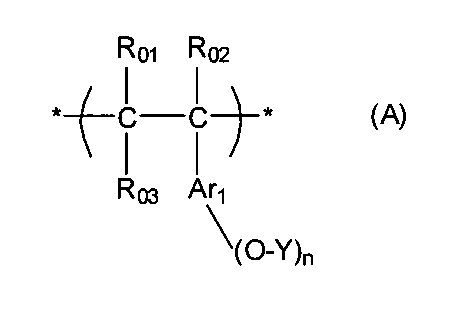
式中、R01、R02及びR03は、各々独立に、水素原子、アルキル基、シクロアルキル基、ハロゲン原子、シアノ基又はアルコキシカルボニル基を表す。Ar1は、芳香環基を表す。なお、R03とAr1とがアルキレン基であり、両者が互いに結合することにより、-C-C-鎖と共に、5員又は6員環を形成していてもよい。
n個のYは、各々独立に、水素原子又は酸の作用により脱離する基を表す。但し、Yの少なくとも1つは、酸の作用により脱離する基を表す。
nは、1~4の整数を表し、1~2が好ましく、1がより好ましい。
n個のYは、各々独立に、水素原子又は酸の作用により脱離する基を表す。但し、Yの少なくとも1つは、酸の作用により脱離する基を表す。
nは、1~4の整数を表し、1~2が好ましく、1がより好ましい。
R01~R03としてのアルキル基は、例えば、炭素数20以下のアルキル基であり、好ましくは、メチル基、エチル基、プロピル基、イソプロピル基、n-ブチル基、sec-ブチル基、ヘキシル基、2-エチルヘキシル基、オクチル基又はドデシル基である。より好ましくは、これらアルキル基は、炭素数8以下のアルキル基である。なお、これらアルキル基は、置換基を有していてもよい。
アルコキシカルボニル基に含まれるアルキル基としては、上記R01~R03におけるアルキル基と同様のものが好ましい。
シクロアルキル基は、単環のシクロアルキル基であってもよく、多環のシクロアルキル基であってもよい。好ましくは、シクロプロピル基、シクロペンチル基及びシクロヘキシル基等の炭素数3~8の単環のシクロアルキル基が挙げられる。なお、これらシクロアルキル基は、置換基を有していてもよい。
ハロゲン原子としては、フッ素原子、塩素原子、臭素原子及びヨウ素原子が挙げられ、フッ素原子がより好ましい。
R03がアルキレン基を表す場合、このアルキレン基としては、好ましくは、メチレン基、エチレン基、プロピレン基、ブチレン基、ヘキシレン基及びオクチレン基等の炭素数1~8のものが挙げられる。
Ar1としての芳香環基は、炭素数6~14のものが好ましく、例えば、ベンゼン環、トルエン環及びナフタレン環が挙げられる。なお、これら芳香環基は、置換基を有していてもよい。
酸の作用により脱離する基Yとしては、例えば、-C(R36)(R37)(R38)、-C(=O)-O-C(R36)(R37)(R38)、-C(R01)(R02)(OR39)、-C(R01)(R02)-C(=O)-O-C(R36)(R37)(R38)及び-CH(R36)(Ar)により表される基が挙げられる。
酸の作用により脱離する基Yとしては、例えば、-C(R36)(R37)(R38)、-C(=O)-O-C(R36)(R37)(R38)、-C(R01)(R02)(OR39)、-C(R01)(R02)-C(=O)-O-C(R36)(R37)(R38)及び-CH(R36)(Ar)により表される基が挙げられる。
式中、R36~R39は、各々独立に、アルキル基、シクロアルキル基、アリール基、アラルキル基又はアルケニル基を表す。R36とR37とは、互いに結合して、環構造を形成していてもよい。
R01及びR02は、各々独立に、水素原子、アルキル基、シクロアルキル基、アリール基、アラルキル基又はアルケニル基を表す。
Arは、アリール基を表す。
R36~R39、R01又はR02としてのアルキル基は、炭素数1~8のアルキル基であることが好ましく、例えば、メチル基、エチル基、プロピル基、n-ブチル基、sec-ブチル基、へキシル基及びオクチル基が挙げられる。
R36~R39、R01、又はR02としてのシクロアルキル基は、単環のシクロアルキル基であってもよく、多環のシクロアルキル基であってもよい。単環のシクロアルキル基としては、炭素数3~8のシクロアルキル基が好ましい。多環のシクロアルキル基としては、炭素数6~20のシクロアルキル基が好ましい。なお、シクロアルキル基中の炭素原子の一部は、酸素原子等のヘテロ原子によって置換されていてもよい。
R36~R39、R01、R02、又はArとしてのアリール基は、炭素数6~10のアリール基であることが好ましく、例えば、フェニル基、ナフチル基及びアントリル基が挙げられる。
R36~R39、R01、又はR02としてのアラルキル基は、炭素数7~12のアラルキル基であることが好ましく、例えば、ベンジル基、フェネチル基及びナフチルメチル基が好ましい。
R36~R39、R01、又はR02としてのアラルキル基は、炭素数7~12のアラルキル基であることが好ましく、例えば、ベンジル基、フェネチル基及びナフチルメチル基が好ましい。
R36~R39、R01、又はR02としてのアルケニル基は、炭素数2~8のアルケニル基であることが好ましく、例えば、ビニル基、アリル基、ブテニル基及びシクロへキセニル基が挙げられる。
R36とR37とが互いに結合して形成し得る環は、単環型であってもよく、多環型であってもよい。単環型としては、炭素数3~8のシクロアルカン構造が好ましい。多環型としては、炭素数6~20のシクロアルカン構造が好ましい。なお、環構造中の炭素原子の一部は、酸素原子等のヘテロ原子によって置換されていてもよい。
上記各基は、置換基を有していてもよい。この置換基としては、例えば、アルキル基、シクロアルキル基、アリール基、アミノ基、アミド基、ウレイド基、ウレタン基、ヒドロキシル基、カルボキシル基、ハロゲン原子、アルコキシ基、チオエーテル基、アシル基、アシロキシ基、アルコキシカルボニル基、シアノ基及びニトロ基が挙げられる。これら置換基は、炭素数が8以下であることが好ましい。
酸の作用により脱離する基Yとしては、下記一般式(B)で表される構造がより好ましい。

式中、L1及びL2は、各々独立に、水素原子、アルキル基、シクロアルキル基、アリール基又はアラルキル基を表す。
Mは、単結合又は2価の連結基を表す。
Qは、アルキル基、シクロアルキル基、環状脂肪族基、芳香環基、アミノ基、アンモニウム基、メルカプト基、シアノ基又はアルデヒド基を表す。なお、これら環状脂肪族基及び芳香環基は、ヘテロ原子を含んでいてもよい。
なお、Q、M、L1の少なくとも2つが互いに結合して、5員又は6員環を形成していてもよい。
Mは、単結合又は2価の連結基を表す。
Qは、アルキル基、シクロアルキル基、環状脂肪族基、芳香環基、アミノ基、アンモニウム基、メルカプト基、シアノ基又はアルデヒド基を表す。なお、これら環状脂肪族基及び芳香環基は、ヘテロ原子を含んでいてもよい。
なお、Q、M、L1の少なくとも2つが互いに結合して、5員又は6員環を形成していてもよい。
L1及びL2としてのアルキル基は、例えば炭素数1~8のアルキル基である。
L1及びL2としてのシクロアルキル基は、例えば炭素数3~15のシクロアルキル基である。
L1及びL2としてのアリール基は、例えば炭素数6~15のアリール基である。
L1及びL2としてのアラルキル基は、例えば炭素数6~20のアラルキル基である。
L1及びL2としてのシクロアルキル基は、例えば炭素数3~15のシクロアルキル基である。
L1及びL2としてのアリール基は、例えば炭素数6~15のアリール基である。
L1及びL2としてのアラルキル基は、例えば炭素数6~20のアラルキル基である。
Mとしての2価の連結基は、例えば、アルキレン基、シクロアルキレン基、アルケニレン基、アリーレン基、-S-、-O-、-CO-、-SO2-、-N(R0)-、又は、これらの2以上の組み合わせである。ここで、R0は、水素原子又はアルキル基である。
Qとしてのアルキル基及びシクロアルキル基は、上述したL1及びL2としての各基と同様である。
Qとしての環状脂肪族基又は芳香環基としては、例えば、上述したL1及びL2としてのシクロアルキル基及びアリール基が挙げられる。これらシクロアルキル基及びアリール基は、好ましくは、炭素数3~15の基である。
Qとしてのヘテロ原子を含んだ環状脂肪族基又は芳香環基としては、例えば、チイラン、シクロチオラン、チオフェン、フラン、ピロール、ベンゾチオフェン、ベンゾフラン、ベンゾピロール、トリアジン、イミダゾール、ベンゾイミダゾール、トリアゾール、チアジアゾール、チアゾール及びピロリドン等の複素環構造を有した基が挙げられる。但し、炭素とヘテロ原子とで形成される環、又は、ヘテロ原子のみによって形成される環であれば、これらに限定されない。
Q、M及びL1の少なくとも2つが互いに結合して形成し得る環構造としては、例えば、これらがプロピレン基又はブチレン基を形成してなる5員又は6員環構造が挙げられる。なお、この5員又は6員環構造は、酸素原子を含有している。
一般式(2)におけるL1、L2、M及びQで表される各基は、置換基を有していてもよい。この置換基としては、例えば、アルキル基、シクロアルキル基、アリール基、アミノ基、アミド基、ウレイド基、ウレタン基、ヒドロキシル基、カルボキシル基、ハロゲン原子、アルコキシ基、チオエーテル基、アシル基、アシロキシ基、アルコキシカルボニル基、シアノ基及びニトロ基が挙げられる。これら置換基は、炭素数が8以下であることが好ましい。
-(M-Q)で表される基としては、炭素数1~20の基が好ましく、炭素数1~10の基がより好ましく、炭素数1~8が更に好ましい。
以下にヒドロキシスチレン繰り返し単位を有する樹脂の具体例を示すが、本発明はこれらに限定されない。


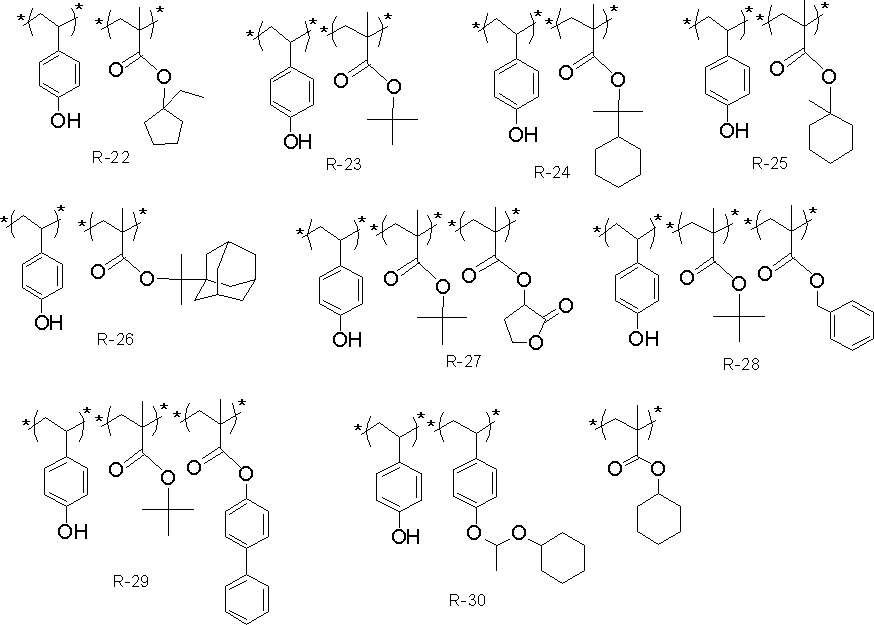

上記具体例において、tBuはt-ブチル基を表す。
本発明における樹脂(A)は、常法に従って(例えばラジカル重合、リビングラジカル重合、アニオン重合)合成することができる。例えば、一般的合成方法としては、モノマー種及び開始剤を溶剤に溶解させ、加熱することにより重合を行う一括重合法、加熱溶剤にモノマー種と開始剤の溶液を1~10時間かけて滴下して加える滴下重合法などが挙げられ、滴下重合法が好ましい。反応溶媒としては、例えばテトラヒドロフラン、1,4-ジオキサン、ジイソプロピルエーテルなどのエーテル類やメチルエチルケトン、メチルイソブチルケトンのようなケトン類、酢酸エチルのようなエステル溶媒、ジメチルホルムアミド、ジメチルアセトアミドなどのアミド溶剤、更には後述のプロピレングリコールモノメチルエーテルアセテート、プロピレングリコールモノメチルエーテル、シクロヘキサノンのような本発明の組成物を溶解する溶媒が挙げられる。より好ましくは本発明の感光性組成物に用いられる溶剤と同一の溶剤を用いて重合することが好ましい。これにより保存時のパーティクルの発生が抑制できる。
重合反応は窒素やアルゴンなど不活性ガス雰囲気下で行われることが好ましい。重合開始剤としては市販のラジカル開始剤(アゾ系開始剤、パーオキサイドなど)を用いて重合を開始させる。ラジカル開始剤としてはアゾ系開始剤が好ましく、エステル基、シアノ基、カルボキシル基を有するアゾ系開始剤が好ましい。好ましい開始剤としては、アゾビスイソブチロニトリル、アゾビスジメチルバレロニトリル、ジメチル2,2’-アゾビス(2-メチルプロピオネート)などが挙げられる。所望により開始剤を追加、あるいは分割で添加し、反応終了後、溶剤に投入して粉体あるいは固形回収等の方法で所望のポリマーを回収する。反応の濃度は5~50質量%であり、好ましくは10~30質量%である。反応温度は、通常10℃~150℃であり、好ましくは30℃~120℃、更に好ましくは60~100℃である。
反応終了後、室温まで放冷し、精製する。精製は、水洗や適切な溶媒を組み合わせることにより残留単量体やオリゴマー成分を除去する液々抽出法、特定の分子量以下のもののみを抽出除去する限外ろ過等の溶液状態での精製方法や、樹脂溶液を貧溶媒へ滴下することで樹脂を貧溶媒中に凝固させることにより残留単量体等を除去する再沈澱法やろ別した樹脂スラリーを貧溶媒で洗浄する等の固体状態での精製方法等の通常の方法を適用できる。
例えば、上記樹脂が難溶或いは不溶の溶媒(貧溶媒)を、該反応溶液の10倍以下の体積量、好ましくは10~5倍の体積量で、接触させることにより樹脂を固体として析出させる。
例えば、上記樹脂が難溶或いは不溶の溶媒(貧溶媒)を、該反応溶液の10倍以下の体積量、好ましくは10~5倍の体積量で、接触させることにより樹脂を固体として析出させる。
ポリマー溶液からの沈殿又は再沈殿操作の際に用いる溶媒(沈殿又は再沈殿溶媒)としては、該ポリマーの貧溶媒であればよく、ポリマーの種類に応じて、炭化水素、ハロゲン化炭化水素、ニトロ化合物、エーテル、ケトン、エステル、カーボネート、アルコール、カルボン酸、水、これらの溶媒を含む混合溶媒等の中から適宜選択して使用できる。これらの中でも、沈殿又は再沈殿溶媒として、少なくともアルコール(特に、メタノールなど)又は水を含む溶媒が好ましい。
沈殿又は再沈殿溶媒の使用量は、効率や収率等を考慮して適宜選択できるが、一般には、ポリマー溶液100質量部に対して、100~10000質量部、好ましくは200~2000質量部、更に好ましくは300~1000質量部である。
沈殿又は再沈殿する際の温度としては、効率や操作性を考慮して適宜選択できるが、通常0~50℃程度、好ましくは室温付近(例えば20~35℃程度)である。沈殿又は再沈殿操作は、攪拌槽などの慣用の混合容器を用い、バッチ式、連続式等の公知の方法により行うことができる。
沈殿又は再沈殿したポリマーは、通常、濾過、遠心分離等の慣用の固液分離に付し、乾燥して使用に供される。濾過は、耐溶剤性の濾材を用い、好ましくは加圧下で行われる。乾燥は、常圧又は減圧下(好ましくは減圧下)、30~100℃程度、好ましくは30~50℃程度の温度で行われる。
なお、本発明においては、一度、樹脂を析出させて、分離した後に、この樹脂を上記したように、上記溶剤(C1)に溶解し、フィルターを用いて濾過し、この濾液を、該樹脂が難溶或いは不溶の溶媒(貧溶媒)と接触させて、再沈させることが好ましい。即ち、上記ラジカル重合反応終了後、該ポリマーが難溶或いは不溶の溶媒を接触させ、樹脂を析出させ(工程a)、樹脂を溶液から分離し(工程b)、改めて、この樹脂を上記溶剤(C1)に溶解させて樹脂溶液Aを調製し(工程c)、該樹脂溶液Aをフィルターを用いて濾過し(工程d)、その後、工程dにおける濾液に、該樹脂が難溶或いは不溶の溶媒を、樹脂溶液Aの10倍未満の体積量(好ましくは5倍以下の体積量)で、接触させることにより樹脂固体を析出させ(工程d)、析出した樹脂を分離する(工程e)ことを含む方法でもよい。
また、上記したように、組成物の調製後に樹脂が凝集することなどを抑制する為に、工程(d)に供される前の樹脂溶液Aを、例えば、特開2009-037108号公報に記載のように、30℃~90℃程度で30分~12時間程度加熱するような工程を加えてもよい。
また、上記したように、組成物の調製後に樹脂が凝集することなどを抑制する為に、工程(d)に供される前の樹脂溶液Aを、例えば、特開2009-037108号公報に記載のように、30℃~90℃程度で30分~12時間程度加熱するような工程を加えてもよい。
本発明における樹脂(A)の重量平均分子量は、GPC法によりポリスチレン換算値として、上記のように7,000以上であり、好ましくは7,000~200,000であり、より好ましくは7,000~50,000、更により好ましくは7,000~40,000、特に好ましくは7,000~30,000である。重量平均分子量が7000より小さいと、有機系現像液に対する溶解性が高くなりすぎ、精密なパターンを形成できなくなる懸念が生じる。
分散度(分子量分布)は、通常1.0~3.0であり、好ましくは1.0~2.6、更に好ましくは1.0~2.0、特に好ましくは1.4~2.0の範囲のものが使用される。分子量分布の小さいものほど、解像度、レジスト形状が優れ、かつ、レジストパターンの側壁がスムーズであり、ラフネス性に優れる。
本発明の感活性光線性又は感放射線性樹脂組成物において、樹脂(A)の組成物全体中の配合率は、全固形分中30~99質量%が好ましく、より好ましくは60~95質量%である。
また、本発明において、樹脂(A)は、1種で使用してもよいし、複数併用してもよい。ここで、樹脂(A)を複数併用する場合、複数の樹脂(A)の少なくとも1つは、樹脂(A)と上記溶剤(C1)とを含有する樹脂溶液を、フィルターを用いて濾過する工程を行い、この工程における濾液から得られるものである。
本発明で好ましく用いられる樹脂(A)は、例えば後述の実施例にて用いられているものが挙げられる。そのほかに、以下のような樹脂も例示的に挙げることができる。構造、組成比(モル比)、重量平均分子量(Mw)、分散度(Mw/Mn)を示す。なお、これらの例示的樹脂は、上述の(第1の実施態様)(第2の実施態様)(第3の実施態様)のうち、1つの実施態様にのみ適用可能なものと、複数の実施態様に適用可能なものの両方を含んでいる。
また、本発明において、樹脂(A)は、1種で使用してもよいし、複数併用してもよい。ここで、樹脂(A)を複数併用する場合、複数の樹脂(A)の少なくとも1つは、樹脂(A)と上記溶剤(C1)とを含有する樹脂溶液を、フィルターを用いて濾過する工程を行い、この工程における濾液から得られるものである。
本発明で好ましく用いられる樹脂(A)は、例えば後述の実施例にて用いられているものが挙げられる。そのほかに、以下のような樹脂も例示的に挙げることができる。構造、組成比(モル比)、重量平均分子量(Mw)、分散度(Mw/Mn)を示す。なお、これらの例示的樹脂は、上述の(第1の実施態様)(第2の実施態様)(第3の実施態様)のうち、1つの実施態様にのみ適用可能なものと、複数の実施態様に適用可能なものの両方を含んでいる。
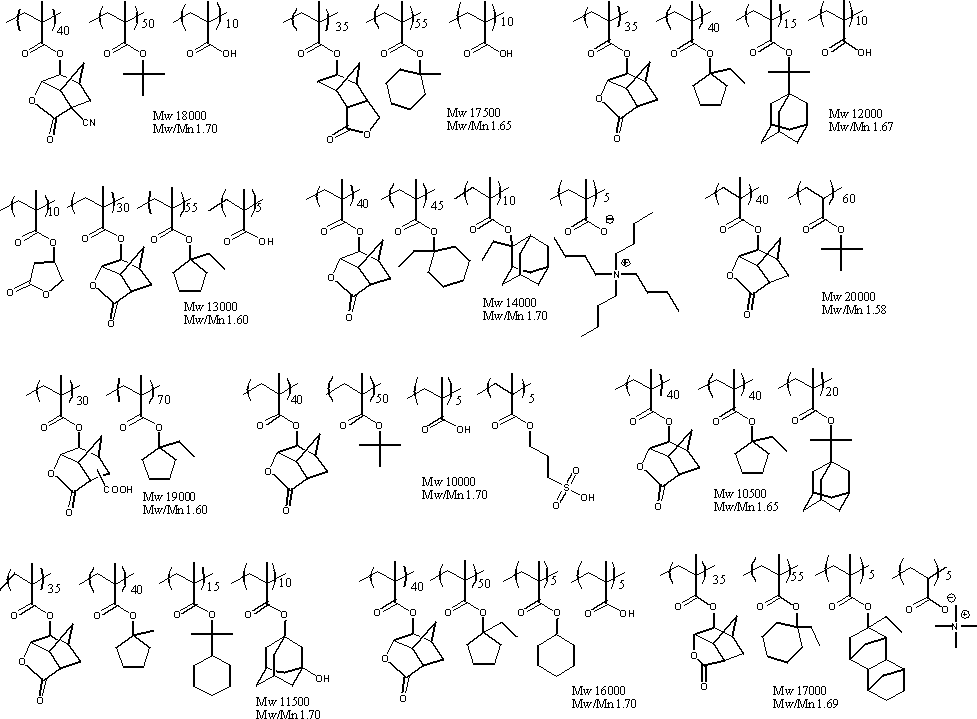
[3](B)活性光線又は放射線の照射により酸を発生する化合物
本発明における組成物は、更に、活性光線又は放射線の照射により酸を発生する化合物(B)(以下、「酸発生剤」ともいう)を含有することが好ましい。活性光線又は放射線の照射により酸を発生する化合物(B)としては、活性光線又は放射線の照射により有機酸を発生する化合物であることが好ましい。
活性光線又は放射線の照射により発生する酸のpKaは-12~0の範囲であることが好ましく、-10~-1の範囲であることが更に好ましく、-8~-1の範囲であることが特に好ましい。
活性光線又は放射線の照射により酸を発生する化合物(B)は、フッ素原子又はフッ素原子を有する基を有する酸を発生することが好ましい。
活性光線又は放射線の照射により酸を発生する化合物(B)は、前述のイオン性化合物(S)とは異なる化合物である。
活性光線又は放射線の照射により酸を発生する化合物(B)は、低分子化合物の形態であっても良く、重合体の一部に組み込まれた形態であっても良い。また、低分子化合物の形態と重合体の一部に組み込まれた形態を併用しても良い。
重合体の一部に組み込まれた形態であっても、活性光線又は放射線の照射により酸を発生する化合物(B)は前述の繰り返し単位(P3)とは異なる。
活性光線又は放射線の照射により酸を発生する化合物(B)が、低分子化合物の形態である場合、分子量が3000以下であることが好ましく、2000以下であることがより好ましく、1000以下であることが更に好ましい。
活性光線又は放射線の照射により酸を発生する化合物(B)が、重合体の一部に組み込まれた形態である場合、前述した酸分解性樹脂の一部に組み込まれても良く、酸分解性樹脂とは異なる樹脂に組み込まれても良い。
本発明において、活性光線又は放射線の照射により酸を発生する化合物(B)が、低分子化合物の形態であることが好ましい。
酸発生剤としては、光カチオン重合の光開始剤、光ラジカル重合の光開始剤、色素類の光消色剤、光変色剤、あるいはマイクロレジスト等に使用されている、活性光線又は放射線の照射により酸を発生する公知の化合物及びそれらの混合物を適宜に選択して使用することができる。
本発明における組成物は、更に、活性光線又は放射線の照射により酸を発生する化合物(B)(以下、「酸発生剤」ともいう)を含有することが好ましい。活性光線又は放射線の照射により酸を発生する化合物(B)としては、活性光線又は放射線の照射により有機酸を発生する化合物であることが好ましい。
活性光線又は放射線の照射により発生する酸のpKaは-12~0の範囲であることが好ましく、-10~-1の範囲であることが更に好ましく、-8~-1の範囲であることが特に好ましい。
活性光線又は放射線の照射により酸を発生する化合物(B)は、フッ素原子又はフッ素原子を有する基を有する酸を発生することが好ましい。
活性光線又は放射線の照射により酸を発生する化合物(B)は、前述のイオン性化合物(S)とは異なる化合物である。
活性光線又は放射線の照射により酸を発生する化合物(B)は、低分子化合物の形態であっても良く、重合体の一部に組み込まれた形態であっても良い。また、低分子化合物の形態と重合体の一部に組み込まれた形態を併用しても良い。
重合体の一部に組み込まれた形態であっても、活性光線又は放射線の照射により酸を発生する化合物(B)は前述の繰り返し単位(P3)とは異なる。
活性光線又は放射線の照射により酸を発生する化合物(B)が、低分子化合物の形態である場合、分子量が3000以下であることが好ましく、2000以下であることがより好ましく、1000以下であることが更に好ましい。
活性光線又は放射線の照射により酸を発生する化合物(B)が、重合体の一部に組み込まれた形態である場合、前述した酸分解性樹脂の一部に組み込まれても良く、酸分解性樹脂とは異なる樹脂に組み込まれても良い。
本発明において、活性光線又は放射線の照射により酸を発生する化合物(B)が、低分子化合物の形態であることが好ましい。
酸発生剤としては、光カチオン重合の光開始剤、光ラジカル重合の光開始剤、色素類の光消色剤、光変色剤、あるいはマイクロレジスト等に使用されている、活性光線又は放射線の照射により酸を発生する公知の化合物及びそれらの混合物を適宜に選択して使用することができる。
たとえば、ジアゾニウム塩、ホスホニウム塩、スルホニウム塩、ヨードニウム塩、イミドスルホネート、オキシムスルホネート、ジアゾジスルホン、ジスルホン、o-ニトロベンジルスルホネートを挙げることができる。
酸発生剤の内で好ましい化合物として、下記一般式(ZI)、(ZII)、(ZIII)で表される化合物を挙げることができる。

上記一般式(ZI)において、
R201、R202及びR203は、各々独立に、有機基を表す。
R201、R202及びR203としての有機基の炭素数は、一般的に1~30、好ましくは1~20である。
また、R201~R203のうち2つが結合して環構造を形成してもよく、環内に酸素原子、硫黄原子、エステル結合、アミド結合、カルボニル基を含んでいてもよい。R201~R203の内の2つが結合して形成する基としては、アルキレン基(例えば、ブチレン基、ペンチレン基)を挙げることができる。
Z-は、非求核性アニオンを表す。
R201、R202及びR203は、各々独立に、有機基を表す。
R201、R202及びR203としての有機基の炭素数は、一般的に1~30、好ましくは1~20である。
また、R201~R203のうち2つが結合して環構造を形成してもよく、環内に酸素原子、硫黄原子、エステル結合、アミド結合、カルボニル基を含んでいてもよい。R201~R203の内の2つが結合して形成する基としては、アルキレン基(例えば、ブチレン基、ペンチレン基)を挙げることができる。
Z-は、非求核性アニオンを表す。
Z-としての非求核性アニオンとしては、例えば、スルホン酸アニオン、カルボン酸アニオン、スルホニルイミドアニオン、ビス(アルキルスルホニル)イミドアニオン、トリス(アルキルスルホニル)メチルアニオン等を挙げることができる。
非求核性アニオンとは、求核反応を起こす能力が著しく低いアニオンであり、分子内求核反応による経時分解を抑制することができるアニオンである。これにより感活性光線性又は感放射線性樹脂組成物の経時安定性が向上する。
スルホン酸アニオンとしては、例えば、脂肪族スルホン酸アニオン、芳香族スルホン酸アニオン、カンファースルホン酸アニオンなどが挙げられる。
カルボン酸アニオンとしては、例えば、脂肪族カルボン酸アニオン、芳香族カルボン酸アニオン、アラルキルカルボン酸アニオンなどが挙げられる。
脂肪族スルホン酸アニオン及び脂肪族カルボン酸アニオンにおける脂肪族部位は、アルキル基であってもシクロアルキル基であってもよく、好ましくは炭素数1~30のアルキル基及び炭素数3~30のシクロアルキル基を挙げることができる。
芳香族スルホン酸アニオン及び芳香族カルボン酸アニオンにおける芳香族基としては、好ましくは炭素数6~14のアリール基、例えば、フェニル基、トリル基、ナフチル基等を挙げることができる。
脂肪族スルホン酸アニオン及び芳香族スルホン酸アニオンにおけるアルキル基、シクロアルキル基及びアリール基は、置換基を有していてもよい。脂肪族スルホン酸アニオン及び芳香族スルホン酸アニオンにおけるアルキル基、シクロアルキル基及びアリール基の置換基としては、例えば、ニトロ基、ハロゲン原子(フッ素原子、塩素原子、臭素原子、沃素原子)、カルボキシル基、水酸基、アミノ基、シアノ基、アルコキシ基(好ましくは炭素数1~15)、シクロアルキル基(好ましくは炭素数3~15)、アリール基(好ましくは炭素数6~14)、アルコキシカルボニル基(好ましくは炭素数2~7)、アシル基(好ましくは炭素数2~12)、アルコキシカルボニルオキシ基(好ましくは炭素数2~7)、アルキルチオ基(好ましくは炭素数1~15)、アルキルスルホニル基(好ましくは炭素数1~15)、アルキルイミノスルホニル基(好ましくは炭素数1~15)、アリールオキシスルホニル基(好ましくは炭素数6~20)、アルキルアリールオキシスルホニル基(好ましくは炭素数7~20)、シクロアルキルアリールオキシスルホニル基(好ましくは炭素数10~20)、アルキルオキシアルキルオキシ基(好ましくは炭素数5~20)、シクロアルキルアルキルオキシアルキルオキシ基(好ましくは炭素数8~20)等を挙げることができる。各基が有するアリール基及び環構造については、置換基として更にアルキル基(好ましくは炭素数1~15)、シクロアルキル基(好ましくは炭素数3~15)を挙げることができる。
アラルキルカルボン酸アニオンにおけるアラルキル基としては、好ましくは炭素数7~12のアラルキル基、例えば、ベンジル基、フェネチル基、ナフチルメチル基、ナフチルエチル基、ナフチルブチル基等を挙げることができる。
脂肪族カルボン酸アニオン、芳香族カルボン酸アニオン及びアラルキルカルボン酸アニオンにおけるアルキル基、シクロアルキル基、アリール基及びアラルキル基は、置換基を有していてもよい。この置換基としては、例えば、芳香族スルホン酸アニオンにおけるものと同様のハロゲン原子、アルキル基、シクロアルキル基、アルコキシ基、アルキルチオ基等を挙げることができる。
スルホニルイミドアニオンとしては、例えば、サッカリンアニオンを挙げることができる。
ビス(アルキルスルホニル)イミドアニオン、トリス(アルキルスルホニル)メチドアニオンにおけるアルキル基は、炭素数1~5のアルキル基が好ましく、例えば、メチル基、エチル基、プロピル基、イソプロピル基、n-ブチル基、イソブチル基、sec-ブチル基、ペンチル基、ネオペンチル基等を挙げることができる。
ビス(アルキルスルホニル)イミドアニオンにおける2つのアルキル基が互いに連結してアルキレン基(好ましくは炭素数2~4)を成し、イミド基及び2つのスルホニル基とともに環を形成していてもよい。これらのアルキル基及びビス(アルキルスルホニル)イミドアニオンにおける2つのアルキル基が互いに連結して成すアルキレン基が有し得る置換基としてはハロゲン原子、ハロゲン原子で置換されたアルキル基、アルコキシ基、アルキルチオ基、アルキルオキシスルホニル基、アリールオキシスルホニル基、シクロアルキルアリールオキシスルホニル基等を挙げることができ、フッ素原子で置換されたアルキル基が好ましい。
その他の非求核性アニオンとしては、例えば、フッ素化燐(例えば、PF6 -)、フッ素化硼素(例えば、BF4 -)、フッ素化アンチモン等(例えば、SbF6 -)を挙げることができる。
ビス(アルキルスルホニル)イミドアニオンにおける2つのアルキル基が互いに連結してアルキレン基(好ましくは炭素数2~4)を成し、イミド基及び2つのスルホニル基とともに環を形成していてもよい。これらのアルキル基及びビス(アルキルスルホニル)イミドアニオンにおける2つのアルキル基が互いに連結して成すアルキレン基が有し得る置換基としてはハロゲン原子、ハロゲン原子で置換されたアルキル基、アルコキシ基、アルキルチオ基、アルキルオキシスルホニル基、アリールオキシスルホニル基、シクロアルキルアリールオキシスルホニル基等を挙げることができ、フッ素原子で置換されたアルキル基が好ましい。
その他の非求核性アニオンとしては、例えば、フッ素化燐(例えば、PF6 -)、フッ素化硼素(例えば、BF4 -)、フッ素化アンチモン等(例えば、SbF6 -)を挙げることができる。
Z-の非求核性アニオンとしては、スルホン酸の少なくともα位がフッ素原子で置換された脂肪族スルホン酸アニオン、フッ素原子又はフッ素原子を有する基で置換された芳香族スルホン酸アニオン、アルキル基がフッ素原子で置換されたビス(アルキルスルホニル)イミドアニオン、アルキル基がフッ素原子で置換されたトリス(アルキルスルホニル)メチドアニオンが好ましい。非求核性アニオンとして、より好ましくは炭素数4~8のパーフロロ脂肪族スルホン酸アニオン、フッ素原子を有するベンゼンスルホン酸アニオン、更により好ましくはノナフロロブタンスルホン酸アニオン、パーフロロオクタンスルホン酸アニオン、ペンタフロロベンゼンスルホン酸アニオン、3,5-ビス(トリフロロメチル)ベンゼンスルホン酸アニオンである。
酸発生剤は、活性光線又は放射線の照射により下記一般式(V)又は(VI)で表される酸を発生する化合物であることが好ましい。下記一般式(V)又は(VI)で表される酸を発生する化合物であることにより環状の有機基を有するので、解像性、及び、ラフネス性能をより優れたものにできる。
前記非求核性アニオンとしては、下記一般式(V)又は(VI)で表される有機酸を生じるアニオンとすることができる。
前記非求核性アニオンとしては、下記一般式(V)又は(VI)で表される有機酸を生じるアニオンとすることができる。
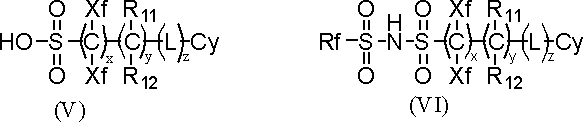
上記一般式中、
Xfは、各々独立に、フッ素原子、又は、少なくとも1つのフッ素原子で置換されたアルキル基を表す。
R11及びR12は、各々独立に、水素原子、フッ素原子、又は、アルキル基を表す。
Lは、各々独立に、2価の連結基を表す。
Cyは、環状の有機基を表す。
Rfは、フッ素原子を含んだ基である。
xは、1~20の整数を表す。
yは、0~10の整数を表す。
zは、0~10の整数を表す。
Xfは、各々独立に、フッ素原子、又は、少なくとも1つのフッ素原子で置換されたアルキル基を表す。
R11及びR12は、各々独立に、水素原子、フッ素原子、又は、アルキル基を表す。
Lは、各々独立に、2価の連結基を表す。
Cyは、環状の有機基を表す。
Rfは、フッ素原子を含んだ基である。
xは、1~20の整数を表す。
yは、0~10の整数を表す。
zは、0~10の整数を表す。
Xfは、フッ素原子、又は、少なくとも1つのフッ素原子で置換されたアルキル基を表す。このアルキル基の炭素数は、1~10であることが好ましく、1~4であることがより好ましい。また、少なくとも1つのフッ素原子で置換されたアルキル基は、パーフルオロアルキル基であることが好ましい。
Xfは、好ましくは、フッ素原子又は炭素数1~4のパーフルオロアルキル基である。より具体的には、フッ素原子又はCF3であることがより好ましい。特に、双方のXfがフッ素原子であることが好ましい。
Xfは、好ましくは、フッ素原子又は炭素数1~4のパーフルオロアルキル基である。より具体的には、フッ素原子又はCF3であることがより好ましい。特に、双方のXfがフッ素原子であることが好ましい。
R11及びR12は、各々独立に、水素原子、フッ素原子、又は、アルキル基である。このアルキル基は、置換基(好ましくはフッ素原子)を有していてもよく、炭素数1~4のものが好ましい。更に好ましくは炭素数1~4のパーフルオロアルキル基である。R11及びR12の置換基を有するアルキル基の具体例としては、CF3が好ましい。
Lは、2価の連結基を表す。この2価の連結基としては、例えば、-COO-、-OCO-、-CONH-、-NHCO-、-CO-、-O-、-S-、-SO-、-SO2-、アルキレン基(好ましくは炭素数1~6)、シクロアルキレン基(好ましくは炭素数3~10)、アルケニレン基(好ましくは炭素数2~6)又はこれらの複数を組み合わせた2価の連結基などが挙げられる。これらの中でも、-COO-、-OCO-、-CONH-、-NHCO-、-CO-、-O-、-SO2-、-COO-アルキレン基-、-OCO-アルキレン基-、-CONH-アルキレン基-又は-NHCO-アルキレン基-が好ましく、-COO-、-OCO-、-CONH-、-SO2-、-COO-アルキレン基-又は-OCO-アルキレン基-がより好ましい。
Cyは、環状の有機基を表す。環状の有機基としては、例えば、脂環基、アリール基、及び複素環基が挙げられる。
脂環基は、単環式であってもよく、多環式であってもよい。中でも、ノルボルニル基、トリシクロデカニル基、テトラシクロデカニル基、テトラシクロドデカニル基、及びアダマンチル基などの炭素数7以上のかさ高い構造を有する脂環基が、PEB(露光後加熱)工程での膜中拡散性の抑制及びMEEF(Mask Error Enhancement Factor)の向上の観点から好ましい。
アリール基は、単環式であってもよく、多環式であってもよい。このアリール基としては、例えば、フェニル基、ナフチル基、フェナントリル基及びアントリル基が挙げられる。中でも、193nmにおける光吸光度が比較的低いナフチル基が好ましい。
複素環基は、単環式であってもよく、多環式であってもよいが、多環式の方がより酸の拡散を抑制可能である。また、複素環基は、芳香族性を有していてもよく、芳香族性を有していなくてもよい。芳香族性を有している複素環としては、例えば、フラン環、チオフェン環、ベンゾフラン環、ベンゾチオフェン環、ジベンゾフラン環、ジベンゾチオフェン環、及びピリジン環が挙げられる。芳香族性を有していない複素環としては、例えば、テトラヒドロピラン環、ラクトン環又はスルトン環、及びデカヒドロイソキノリン環が挙げられる。複素環基における複素環としては、フラン環、チオフェン環、ピリジン環、又はデカヒドロイソキノリン環が特に好ましい。また、ラクトン環又はスルトン環の例としては、前述の樹脂(A)において例示したラクトン構造又はスルトンが挙げられる。
上記環状の有機基は、置換基を有していてもよい。この置換基としては、例えば、アルキル基(直鎖、分岐のいずれであっても良く、炭素数1~12が好ましい)、シクロアルキル基(単環、多環、スピロ環のいずれであっても良く、炭素数3~20が好ましい)、アリール基(炭素数6~14が好ましい)、水酸基、アルコキシ基、エステル基、アミド基、ウレタン基、ウレイド基、チオエーテル基、スルホンアミド基、及びスルホン酸エステル基が挙げられる。なお、環状の有機基を構成する炭素(環形成に寄与する炭素)はカルボニル炭素であっても良い。
xは1~8が好ましく、中でも1~4が好ましく、1が特に好ましい。yは0~4が好ましく、0がより好ましい。zは0~8が好ましく、中でも0~4が好ましい。
Rfで表されるフッ素原子を含んだ基としては、例えば、少なくとも1つのフッ素原子を有するアルキル基、少なくとも1つのフッ素原子を有するシクロアルキル基、及び少なくとも1つのフッ素原子を有するアリール基が挙げられる。
これらアルキル基、シクロアルキル基及びアリール基は、フッ素原子により置換されていてもよく、フッ素原子を含んだ他の置換基により置換されていてもよい。Rfが少なくとも1つのフッ素原子を有するシクロアルキル基又は少なくとも1つのフッ素原子を有するアリール基である場合、フッ素原子を含んだ他の置換基としては、例えば、少なくとも1つのフッ素原子で置換されたアルキル基が挙げられる。
また、これらアルキル基、シクロアルキル基及びアリール基は、フッ素原子を含んでいない置換基によって更に置換されていてもよい。この置換基としては、例えば、先にCyについて説明したもののうち、フッ素原子を含んでいないものを挙げることができる。
Rfにより表される少なくとも1つのフッ素原子を有するアルキル基としては、例えば、Xfにより表される少なくとも1つのフッ素原子で置換されたアルキル基として先に説明したのと同様のものが挙げられる。Rfにより表される少なくとも1つのフッ素原子を有するシクロアルキル基としては、例えば、パーフルオロシクロペンチル基、及びパーフルオロシクロヘキシル基が挙げられる。Rfにより表される少なくとも1つのフッ素原子を有するアリール基としては、例えば、パーフルオロフェニル基が挙げられる。
Rfで表されるフッ素原子を含んだ基としては、例えば、少なくとも1つのフッ素原子を有するアルキル基、少なくとも1つのフッ素原子を有するシクロアルキル基、及び少なくとも1つのフッ素原子を有するアリール基が挙げられる。
これらアルキル基、シクロアルキル基及びアリール基は、フッ素原子により置換されていてもよく、フッ素原子を含んだ他の置換基により置換されていてもよい。Rfが少なくとも1つのフッ素原子を有するシクロアルキル基又は少なくとも1つのフッ素原子を有するアリール基である場合、フッ素原子を含んだ他の置換基としては、例えば、少なくとも1つのフッ素原子で置換されたアルキル基が挙げられる。
また、これらアルキル基、シクロアルキル基及びアリール基は、フッ素原子を含んでいない置換基によって更に置換されていてもよい。この置換基としては、例えば、先にCyについて説明したもののうち、フッ素原子を含んでいないものを挙げることができる。
Rfにより表される少なくとも1つのフッ素原子を有するアルキル基としては、例えば、Xfにより表される少なくとも1つのフッ素原子で置換されたアルキル基として先に説明したのと同様のものが挙げられる。Rfにより表される少なくとも1つのフッ素原子を有するシクロアルキル基としては、例えば、パーフルオロシクロペンチル基、及びパーフルオロシクロヘキシル基が挙げられる。Rfにより表される少なくとも1つのフッ素原子を有するアリール基としては、例えば、パーフルオロフェニル基が挙げられる。
また前記非求核性アニオンは、下記一般式(B-1)~(B-3)のいずれかで表されるアニオンであることも好ましい。
まず、下記一般式(B-1)で表されるアニオンについて説明する。
まず、下記一般式(B-1)で表されるアニオンについて説明する。
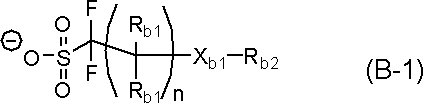
上記一般式(B-1)中、
Rb1は、各々独立に、水素原子、フッ素原子又はトリフルオロメチル基(CF3)を表す。
nは1~4の整数を表す。
nは1~3の整数であることが好ましく、1又は2であることがより好ましい。
Xb1は単結合、エーテル結合、エステル結合(-OCO-若しくは-COO-)又はスルホン酸エステル結合(-OSO2-若しくは-SO3-)を表す。
Xb1はエステル結合(-OCO-若しくは-COO-)又はスルホン酸エステル結合(-OSO2-若しくは-SO3-)であることが好ましい。
Rb2は炭素数6以上の置換基を表す。
Rb2についての炭素数6以上の置換基としては、嵩高い基であることが好ましく、炭素数6以上の、アルキル基、脂環基、アリール基、及び複素環基などが挙げられる。
Rb2についての炭素数6以上のアルキル基としては、直鎖状であっても分岐状であってもよく、炭素数6~20の直鎖又は分岐のアルキル基であることが好ましく、例えば、直鎖又は分岐ヘキシル基、直鎖又は分岐ヘプチル基、直鎖又は分岐オクチル基などが挙げられる。嵩高さに観点から分岐アルキル基であることが好ましい。
Rb1は、各々独立に、水素原子、フッ素原子又はトリフルオロメチル基(CF3)を表す。
nは1~4の整数を表す。
nは1~3の整数であることが好ましく、1又は2であることがより好ましい。
Xb1は単結合、エーテル結合、エステル結合(-OCO-若しくは-COO-)又はスルホン酸エステル結合(-OSO2-若しくは-SO3-)を表す。
Xb1はエステル結合(-OCO-若しくは-COO-)又はスルホン酸エステル結合(-OSO2-若しくは-SO3-)であることが好ましい。
Rb2は炭素数6以上の置換基を表す。
Rb2についての炭素数6以上の置換基としては、嵩高い基であることが好ましく、炭素数6以上の、アルキル基、脂環基、アリール基、及び複素環基などが挙げられる。
Rb2についての炭素数6以上のアルキル基としては、直鎖状であっても分岐状であってもよく、炭素数6~20の直鎖又は分岐のアルキル基であることが好ましく、例えば、直鎖又は分岐ヘキシル基、直鎖又は分岐ヘプチル基、直鎖又は分岐オクチル基などが挙げられる。嵩高さに観点から分岐アルキル基であることが好ましい。
Rb2についての炭素数6以上の脂環基としては、単環式であってもよく、多環式であってもよい。単環式の脂環基としては、例えば、シクロヘキシル基、及びシクロオクチル基などの単環のシクロアルキル基が挙げられる。多環式の脂環基としては、例えば、ノルボルニル基、トリシクロデカニル基、テトラシクロデカニル基、テトラシクロドデカニル基、及びアダマンチル基などの多環のシクロアルキル基が挙げられる。中でも、ノルボルニル基、トリシクロデカニル基、テトラシクロデカニル基、テトラシクロドデカニル基、及びアダマンチル基などの炭素数7以上のかさ高い構造を有する脂環基が、PEB(露光後加熱)工程での膜中拡散性の抑制及びMEEF(Mask Error Enhancement Factor)の向上の観点から好ましい。
Rb2についての炭素数6以上のアリール基は、単環式であってもよく、多環式であってもよい。このアリール基としては、例えば、フェニル基、ナフチル基、フェナントリル基及びアントリル基が挙げられる。中でも、193nmにおける光吸光度が比較的低いナフチル基が好ましい。
Rb2についての炭素数6以上の複素環基は、単環式であってもよく、多環式であってもよいが、多環式の方がより酸の拡散を抑制可能である。また、複素環基は、芳香族性を有していてもよく、芳香族性を有していなくてもよい。芳香族性を有している複素環としては、例えば、ベンゾフラン環、ベンゾチオフェン環、ジベンゾフラン環、及びジベンゾチオフェン環が挙げられる。芳香族性を有していない複素環としては、例えば、テトラヒドロピラン環、ラクトン環、及びデカヒドロイソキノリン環が挙げられる。複素環基における複素環としては、ベンゾフラン環又はデカヒドロイソキノリン環が特に好ましい。また、ラクトン環の例としては、前述の樹脂(P)において例示したラクトン構造が挙げられる。
上記Rb2についての炭素数6以上の置換基は、更に置換基を有していてもよい。この更なる置換基としては、例えば、アルキル基(直鎖、分岐のいずれであっても良く、炭素数1~12が好ましい)、シクロアルキル基(単環、多環、スピロ環のいずれであっても良く、炭素数3~20が好ましい)、アリール基(炭素数6~14が好ましい)、ヒドロキシ基、アルコキシ基、エステル基、アミド基、ウレタン基、ウレイド基、チオエーテル基、スルホンアミド基、及びスルホン酸エステル基が挙げられる。なお、上述の脂環基、アリール基、又は複素環基を構成する炭素(環形成に寄与する炭素)はカルボニル炭素であっても良い。
一般式(B-1)で表されるアニオンの具体例を以下に挙げるが、本発明はこれらに限定されない。
一般式(B-1)で表されるアニオンの具体例を以下に挙げるが、本発明はこれらに限定されない。
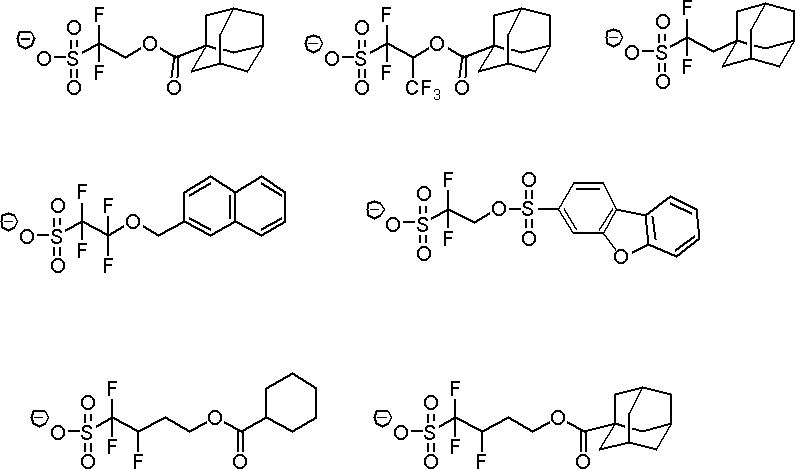
次に、下記一般式(B-2)で表されるアニオンについて説明する。
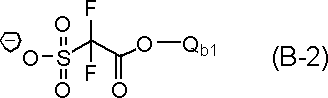
上記一般式(B-2)中、
Qb1はラクトン構造を有する基、スルトン構造を有する基又は環状カーボネート構造を有する基を表す。
Qb1についてのラクトン構造及びスルトン構造としては、例えば、先に樹脂(P)の項で説明したラクトン構造及びスルトン構造を有する繰り返し単位におけるラクトン構造及びスルトン構造と同様のものが挙げられる。具体的には、上記一般式(LC1-1)~(LC1-17)のいずれかで表されるラクトン構造又は上記一般式(SL1-1)~(SL1-3)のいずれかで表されるスルトン構造が挙げられる。
前記ラクトン構造又はスルトン構造が直接、上記一般式(B-2)中のエステル基の酸素原子と結合していてもよいが、前記ラクトン構造又はスルトン構造がアルキレン基(例えば、メチレン基、エチレン基)を介してエステル基の酸素原子と結合していてもよい。その場合、前記ラクトン構造又はスルトン構造を有する基としては、前記ラクトン構造又はスルトン構造を置換基として有するアルキル基ということができる。
Qb1についての環状カーボネート構造としては5~7員環の環状カーボネート構造であることが好ましく、1,3-ジオキソラン-2-オン、1,3-ジオキサン-2-オンなどが挙げられる。
前記環状カーボネート構造が直接、上記一般式(B-2)中のエステル基の酸素原子と結合していてもよいが、前記環状カーボネート構造がアルキレン基(例えば、メチレン基、エチレン基)を介してエステル基の酸素原子と結合していてもよい。その場合、前記環状カーボネート構造を有する基としては、環状カーボネート構造を置換基として有するアルキル基ということができる。
一般式(B-2)で表されるアニオンの具体例を以下に挙げるが、本発明はこれらに限定されない。
Qb1はラクトン構造を有する基、スルトン構造を有する基又は環状カーボネート構造を有する基を表す。
Qb1についてのラクトン構造及びスルトン構造としては、例えば、先に樹脂(P)の項で説明したラクトン構造及びスルトン構造を有する繰り返し単位におけるラクトン構造及びスルトン構造と同様のものが挙げられる。具体的には、上記一般式(LC1-1)~(LC1-17)のいずれかで表されるラクトン構造又は上記一般式(SL1-1)~(SL1-3)のいずれかで表されるスルトン構造が挙げられる。
前記ラクトン構造又はスルトン構造が直接、上記一般式(B-2)中のエステル基の酸素原子と結合していてもよいが、前記ラクトン構造又はスルトン構造がアルキレン基(例えば、メチレン基、エチレン基)を介してエステル基の酸素原子と結合していてもよい。その場合、前記ラクトン構造又はスルトン構造を有する基としては、前記ラクトン構造又はスルトン構造を置換基として有するアルキル基ということができる。
Qb1についての環状カーボネート構造としては5~7員環の環状カーボネート構造であることが好ましく、1,3-ジオキソラン-2-オン、1,3-ジオキサン-2-オンなどが挙げられる。
前記環状カーボネート構造が直接、上記一般式(B-2)中のエステル基の酸素原子と結合していてもよいが、前記環状カーボネート構造がアルキレン基(例えば、メチレン基、エチレン基)を介してエステル基の酸素原子と結合していてもよい。その場合、前記環状カーボネート構造を有する基としては、環状カーボネート構造を置換基として有するアルキル基ということができる。
一般式(B-2)で表されるアニオンの具体例を以下に挙げるが、本発明はこれらに限定されない。

次に、下記一般式(B-3)で表されるアニオンについて説明する。
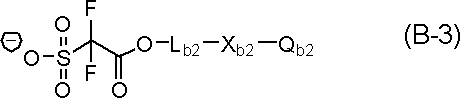
上記一般式(B-3)中、
Lb2は炭素数1~6のアルキレン基を表し、例えば、メチレン基、エチレン基、プロピレン基、ブチレン基などが挙げられ、炭素数1~4のアルキレン基であることが好ましい。
Xb2はエーテル結合又はエステル結合(-OCO-若しくは-COO-)を表す。
Qb2は脂環基又は芳香環を含有する基を表す。
Qb2についての脂環基としては、単環式であってもよく、多環式であってもよい。ノルボルニル基、トリシクロデカニル基、テトラシクロデカニル基、テトラシクロドデカニル基、及びアダマンチル基などの炭素数7以上のかさ高い構造を有する脂環基が好ましい。
Qb2についての芳香環を含有する基における芳香環としては、炭素数6~20の芳香環であることが好ましく、ベンゼン環、ナフタレン環、フェナントレン環、アントラセン環などが挙げられ、ベンゼン環又はナフタレン環であることがより好ましい。前記芳香環としては、少なくとも1つのフッ素原子により置換されていてもよく、少なくとも1つのフッ素原子で置換された芳香環としては、パーフルオロフェニル基などが挙げられる。
前記芳香環がXb2と直接結合していてもよいが、前記芳香環がアルキレン基(例えば、メチレン基、エチレン基)を介してXb2と結合していてもよい。その場合、前記芳香環を含有する基としては、前記芳香環を置換基として有するアルキル基ということができる。
一般式(B-3)で表されるアニオン構造の具体例を以下に挙げるが、本発明はこれらに限定されない。
Lb2は炭素数1~6のアルキレン基を表し、例えば、メチレン基、エチレン基、プロピレン基、ブチレン基などが挙げられ、炭素数1~4のアルキレン基であることが好ましい。
Xb2はエーテル結合又はエステル結合(-OCO-若しくは-COO-)を表す。
Qb2は脂環基又は芳香環を含有する基を表す。
Qb2についての脂環基としては、単環式であってもよく、多環式であってもよい。ノルボルニル基、トリシクロデカニル基、テトラシクロデカニル基、テトラシクロドデカニル基、及びアダマンチル基などの炭素数7以上のかさ高い構造を有する脂環基が好ましい。
Qb2についての芳香環を含有する基における芳香環としては、炭素数6~20の芳香環であることが好ましく、ベンゼン環、ナフタレン環、フェナントレン環、アントラセン環などが挙げられ、ベンゼン環又はナフタレン環であることがより好ましい。前記芳香環としては、少なくとも1つのフッ素原子により置換されていてもよく、少なくとも1つのフッ素原子で置換された芳香環としては、パーフルオロフェニル基などが挙げられる。
前記芳香環がXb2と直接結合していてもよいが、前記芳香環がアルキレン基(例えば、メチレン基、エチレン基)を介してXb2と結合していてもよい。その場合、前記芳香環を含有する基としては、前記芳香環を置換基として有するアルキル基ということができる。
一般式(B-3)で表されるアニオン構造の具体例を以下に挙げるが、本発明はこれらに限定されない。

R201、R202及びR203により表される有機基としては、例えば、後述する化合物(ZI-1)、(ZI-2)、(ZI-3)及び(ZI-4)における対応する基を挙げることができる。
なお、一般式(ZI)で表される構造を複数有する化合物であってもよい。例えば、一般式(ZI)で表される化合物のR201~R203の少なくとも1つが、一般式(ZI)で表されるもうひとつの化合物のR201~R203の少なくとも一つと、単結合又は連結基を介して結合した構造を有する化合物であってもよい。
更に好ましい(ZI)成分として、以下に説明する化合物(ZI-1)、(ZI-2)、及び(ZI-3)及び(ZI-4)を挙げることができる。
化合物(ZI-1)は、上記一般式(ZI)のR201~R203の少なくとも1つがアリール基である、アリールスルホニウム化合物、即ち、アリールスルホニウムをカチオンとする化合物である。
アリールスルホニウム化合物は、R201~R203の全てがアリール基でもよいし、R201~R203の一部がアリール基で、残りがアルキル基又はシクロアルキル基でもよい。
アリールスルホニウム化合物としては、例えば、トリアリールスルホニウム化合物、ジアリールアルキルスルホニウム化合物、アリールジアルキルスルホニウム化合物、ジアリールシクロアルキルスルホニウム化合物、アリールジシクロアルキルスルホニウム化合物を挙げることができる。
アリールスルホニウム化合物のアリール基としてはフェニル基、ナフチル基が好ましく、更に好ましくはフェニル基である。アリール基は、酸素原子、窒素原子、硫黄原子等を有する複素環構造を有するアリール基であってもよい。複素環構造としては、ピロール残基、フラン残基、チオフェン残基、インドール残基、ベンゾフラン残基、ベンゾチオフェン残基等が挙げられる。アリールスルホニウム化合物が2つ以上のアリール基を有する場合に、2つ以上あるアリール基は同一であっても異なっていてもよい。
アリールスルホニウム化合物が必要に応じて有しているアルキル基又はシクロアルキル基は、炭素数1~15の直鎖又は分岐アルキル基及び炭素数3~15のシクロアルキル基が好ましい。
R201~R203のアリール基、アルキル基、シクロアルキル基は、アルキル基(例えば炭素数1~15)、シクロアルキル基(例えば炭素数3~15)、アリール基(例えば炭素数6~14)、アルコキシ基(例えば炭素数1~15)、ハロゲン原子、水酸基、フェニルチオ基を置換基として有してもよい。好ましい置換基としては炭素数1~12の直鎖又は分岐アルキル基、炭素数3~12のシクロアルキル基、炭素数1~12の直鎖、分岐又は環状のアルコキシ基であり、より好ましくは炭素数1~4のアルキル基、炭素数1~4のアルコキシ基である。置換基は、3つのR201~R203のうちのいずれか1つに置換していてもよいし、3つ全てに置換していてもよい。また、R201~R203がアリール基の場合に、置換基はアリール基のp-位に置換していることが好ましい。
次に、化合物(ZI-2)について説明する。
化合物(ZI-2)は、式(ZI)におけるR201~R203が、各々独立に、芳香環を有さない有機基を表す化合物である。ここで芳香環とは、ヘテロ原子を含有する芳香族環も包含するものである。
化合物(ZI-2)は、式(ZI)におけるR201~R203が、各々独立に、芳香環を有さない有機基を表す化合物である。ここで芳香環とは、ヘテロ原子を含有する芳香族環も包含するものである。
R201~R203としての芳香環を含有しない有機基は、一般的に炭素数1~30、好ましくは炭素数1~20である。
R201~R203は、各々独立に、好ましくはアルキル基、シクロアルキル基、アリル基、ビニル基であり、更に好ましくは直鎖又は分岐の2-オキソアルキル基、2-オキソシクロアルキル基、アルコキシカルボニルメチル基、特に好ましくは直鎖又は分岐2-オキソアルキル基である。
R201~R203のアルキル基及びシクロアルキル基としては、好ましくは、炭素数1~10の直鎖又は分岐アルキル基、炭素数3~10のシクロアルキル基を挙げることができる。アルキル基として、より好ましくは2-オキソアルキル基、アルコキシカルボニルメチル基を挙げることができる。シクロアルキル基として、より好ましくは、2-オキソシクロアルキル基を挙げることができる。
2-オキソアルキル基は、直鎖又は分岐のいずれであってもよく、好ましくは、上記のアルキル基の2位に>C=Oを有する基を挙げることができる。
2-オキソシクロアルキル基は、好ましくは、上記のシクロアルキル基の2位に>C=Oを有する基を挙げることができる。
2-オキソシクロアルキル基は、好ましくは、上記のシクロアルキル基の2位に>C=Oを有する基を挙げることができる。
アルコキシカルボニルメチル基におけるアルコキシ基としては、好ましくは炭素数1~5のアルコキシ基(メトキシ基、エトキシ基、プロポキシ基、ブトキシ基、ペントキシ基)を挙げることができる。
R201~R203は、ハロゲン原子、アルコキシ基(例えば炭素数1~5)、水酸基、シアノ基、ニトロ基によって更に置換されていてもよい。
次に、化合物(ZI-3)について説明する。
化合物(ZI-3)とは、以下の一般式(ZI-3)で表される化合物であり、フェナシルスルフォニウム塩構造を有する化合物である。
化合物(ZI-3)とは、以下の一般式(ZI-3)で表される化合物であり、フェナシルスルフォニウム塩構造を有する化合物である。
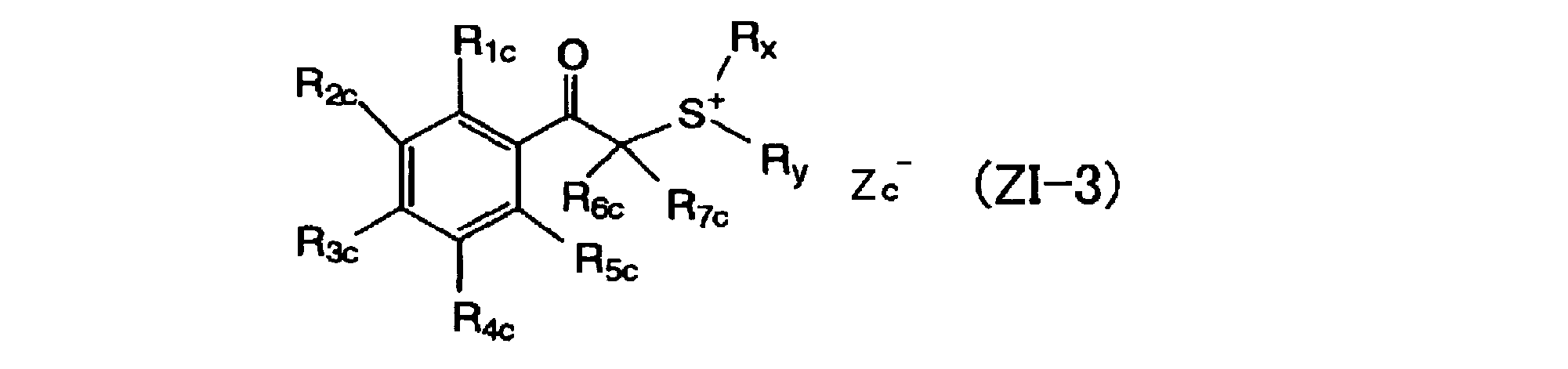
一般式(ZI-3)に於いて、
R1c~R5cは、各々独立に、水素原子、アルキル基、シクロアルキル基、アリール基、アルコキシ基、アリールオキシ基、アルコキシカルボニル基、アルキルカルボニルオキシ基、シクロアルキルカルボニルオキシ基、ハロゲン原子、水酸基、ニトロ基、アルキルチオ基又はアリールチオ基を表す。
R6c及びR7cは、各々独立に、水素原子、アルキル基、シクロアルキル基、ハロゲン原子、シアノ基又はアリール基を表す。
Rx及びRyは、各々独立に、アルキル基、シクロアルキル基、2-オキソアルキル基、2-オキソシクロアルキル基、アルコキシカルボニルアルキル基、アリル基又はビニル基を表す。
R1c~R5cは、各々独立に、水素原子、アルキル基、シクロアルキル基、アリール基、アルコキシ基、アリールオキシ基、アルコキシカルボニル基、アルキルカルボニルオキシ基、シクロアルキルカルボニルオキシ基、ハロゲン原子、水酸基、ニトロ基、アルキルチオ基又はアリールチオ基を表す。
R6c及びR7cは、各々独立に、水素原子、アルキル基、シクロアルキル基、ハロゲン原子、シアノ基又はアリール基を表す。
Rx及びRyは、各々独立に、アルキル基、シクロアルキル基、2-オキソアルキル基、2-オキソシクロアルキル基、アルコキシカルボニルアルキル基、アリル基又はビニル基を表す。
R1c~R5c中のいずれか2つ以上、R5cとR6c、R6cとR7c、R5cとRx、及びRxとRyは、それぞれ結合して環構造を形成しても良く、この環構造は、酸素原子、硫黄原子、ケトン基、エステル結合、アミド結合を含んでいてもよい。
上記環構造としては、芳香族若しくは非芳香族の炭化水素環、芳香族若しくは非芳香族の複素環、又は、これらの環が2つ以上組み合わされてなる多環縮合環を挙げることができる。環構造としては、3~10員環を挙げることができ、4~8員環であることが好ましく、5又は6員環であることがより好ましい。
R1c~R5c中のいずれか2つ以上、R6cとR7c、及びRxとRyが結合して形成する基としては、ブチレン基、ペンチレン基等を挙げることができる。
R5cとR6c、及び、R5cとRxが結合して形成する基としては、単結合又はアルキレン基であることが好ましく、アルキレン基としては、メチレン基、エチレン基等を挙げることができる。
上記環構造としては、芳香族若しくは非芳香族の炭化水素環、芳香族若しくは非芳香族の複素環、又は、これらの環が2つ以上組み合わされてなる多環縮合環を挙げることができる。環構造としては、3~10員環を挙げることができ、4~8員環であることが好ましく、5又は6員環であることがより好ましい。
R1c~R5c中のいずれか2つ以上、R6cとR7c、及びRxとRyが結合して形成する基としては、ブチレン基、ペンチレン基等を挙げることができる。
R5cとR6c、及び、R5cとRxが結合して形成する基としては、単結合又はアルキレン基であることが好ましく、アルキレン基としては、メチレン基、エチレン基等を挙げることができる。
Zc-は、非求核性アニオンを表し、一般式(ZI)に於けるZ-と同様の非求核性アニオンを挙げることができる。
R1c~R7cとしてのアルキル基は、直鎖又は分岐のいずれであってもよく、例えば炭素数1~20個のアルキル基、好ましくは炭素数1~12個の直鎖又は分岐アルキル基を挙げることができ、シクロアルキル基としては、例えば炭素数3~10個のシクロアルキル基を挙げることができる。
R1c~R5cとしてのアリール基は、好ましくは炭素数5~15であり、例えば、フェニル基、ナフチル基を挙げることができる。
R1c~R5cとしてのアルコキシ基は、直鎖、分岐、環状のいずれであってもよく、例えば炭素数1~10のアルコキシ基、好ましくは、炭素数1~5の直鎖及び分岐アルコキシ基、炭素数3~10の環状アルコキシ基を挙げることができる。
R1c~R5cとしてのアルコキシカルボニル基におけるアルコキシ基の具体例は、前記R1c~R5cとしてのアルコキシ基の具体例と同様である。
R1c~R5cとしてのアルキルカルボニルオキシ基及びアルキルチオ基におけるアルキル基の具体例は、前記R1c~R5cとしてのアルキル基の具体例と同様である。
R1c~R5cとしてのシクロアルキルカルボニルオキシ基におけるシクロアルキル基の具体例は、前記R1c~R5cとしてのシクロアルキル基の具体例と同様である。
R1c~R5cとしてのアリールオキシ基及びアリールチオ基におけるアリール基の具体例は、前記R1c~R5cとしてのアリール基の具体例と同様である。
好ましくは、R1c~R5cの内のいずれかが直鎖又は分岐アルキル基、シクロアルキル基又は直鎖、分岐若しくは環状アルコキシ基であり、更に好ましくは、R1c~R5cの炭素数の和が2~15である。これにより、より溶剤溶解性が向上し、保存時にパーティクルの発生が抑制される。
好ましくは、R1c~R5cの内のいずれかが直鎖又は分岐アルキル基、シクロアルキル基又は直鎖、分岐若しくは環状アルコキシ基であり、更に好ましくは、R1c~R5cの炭素数の和が2~15である。これにより、より溶剤溶解性が向上し、保存時にパーティクルの発生が抑制される。
R1c~R5cのいずれか2つ以上が互いに結合して形成してもよい環構造としては、好ましくは5員又は6員の環、特に好ましくは6員の環(例えばフェニル環)が挙げられる。
R5c及びR6cが互いに結合して形成してもよい環構造としては、R5c及びR6cが互いに結合して単結合又はアルキレン基(メチレン基、エチレン基等)を構成することにより、一般式(ZI-3)中のカルボニル炭素原子及び炭素原子と共に形成する4員以上の環(特に好ましくは5~6員の環)が挙げられる。
R6c及びR7cとしてのアリール基としては、好ましくは炭素数5~15であり、例えば、フェニル基、ナフチル基を挙げることができる。
R6c及びR7cの態様としては、その両方がアルキル基である場合が好ましい。特に、R6c及びR7cが各々炭素数1~4の直鎖又は分岐状アルキル基である場合が好ましく、とりわけ、両方がメチル基である場合が好ましい。
R6c及びR7cの態様としては、その両方がアルキル基である場合が好ましい。特に、R6c及びR7cが各々炭素数1~4の直鎖又は分岐状アルキル基である場合が好ましく、とりわけ、両方がメチル基である場合が好ましい。
また、R6cとR7cとが結合して環を形成する場合に、R6cとR7cとが結合して形成する基としては、炭素数2~10のアルキレン基が好ましく、例えば、エチレン基、プロピレン基、ブチレン基、ペンチレン基、ヘキシレン基などを挙げることができる。また、R6cとR7cとが結合して形成する環は、環内に酸素原子等のヘテロ原子を有していてもよい。
Rx及びRyとしてのアルキル基及びシクロアルキル基は、R1c~R7cにおけると同様のアルキル基及びシクロアルキル基を挙げることができる。
Rx及びRyとしての2-オキソアルキル基及び2-オキソシクロアルキル基は、R1c~R7cとしてのアルキル基及びシクロアルキル基の2位に>C=Oを有する基を挙げることができる。
Rx及びRyとしてのアルコキシカルボニルアルキル基におけるアルコキシ基については、R1c~R5cおけると同様のアルコキシ基を挙げることができ、アルキル基については、例えば、炭素数1~12のアルキル基、好ましくは、炭素数1~5の直鎖のアルキル基(例えば、メチル基、エチル基)を挙げることができる。
Rx及びRyとしてのアリル基としては、特に制限は無いが、無置換のアリル基、又は、単環若しくは多環のシクロアルキル基(好ましくは炭素数3~10のシクロアルキル基)で置換されたアリル基であることが好ましい。
Rx及びRyとしてのビニル基としては特に制限は無いが、無置換のビニル基、又は、単環若しくは多環のシクロアルキル基(好ましくは炭素数3~10のシクロアルキル基)で置換されたビニル基であることが好ましい。
R5c及びRxが互いに結合して形成してもよい環構造としては、R5c及びRxが互いに結合して単結合又はアルキレン基(メチレン基、エチレン基等)を構成することにより、一般式(ZI-3)中の硫黄原子とカルボニル炭素原子と共に形成する5員以上の環(特に好ましくは5員の環)が挙げられる。
Rx及びRyが互いに結合して形成してもよい環構造としては、2価のRx及びRy(例えば、メチレン基、エチレン基、プロピレン基等)が一般式(ZI-3)中の硫黄原子と共に形成する5員又は6員の環、特に好ましくは5員の環(即ち、テトラヒドロチオフェン環)が挙げられる。
Rx及びRyは、好ましくは炭素数4個以上のアルキル基又はシクロアルキル基であり、より好ましくは6個以上、更に好ましくは8個以上のアルキル基又はシクロアルキル基である。
R1c~R7c、Rx及びRyは、更に置換基を有していてもよく、そのような置換基としては、ハロゲン原子(例えば、フッ素原子)、水酸基、カルボキシル基、シアノ基、ニトロ基、アルキル基、シクロアルキル基、アリール基、アルコキシ基、アリールオキシ基、アシル基、アリールカルボニル基、アルコキシアルキル基、アリールオシキアルキル基、アルコキシカルボニル基、アリールオキシカルボニル基、アルコキシカルボニルオキシ基、アリールオキシカルボニルオキシ基等を挙げることができる。
上記一般式(ZI-3)中、R1c、R2c、R4c及びR5cが、各々独立に、水素原子を表し、R3cが水素原子以外の基、すなわち、アルキル基、シクロアルキル基、アリール基、アルコキシ基、アリールオキシ基、アルコキシカルボニル基、アルキルカルボニルオキシ基、シクロアルキルカルボニルオキシ基、ハロゲン原子、水酸基、ニトロ基、アルキルチオ基又はアリールチオ基を表すことがより好ましい。
本発明における一般式(ZI-2)又は(ZI-3)で表される化合物のカチオンとしては、以下の具体例が挙げられる。
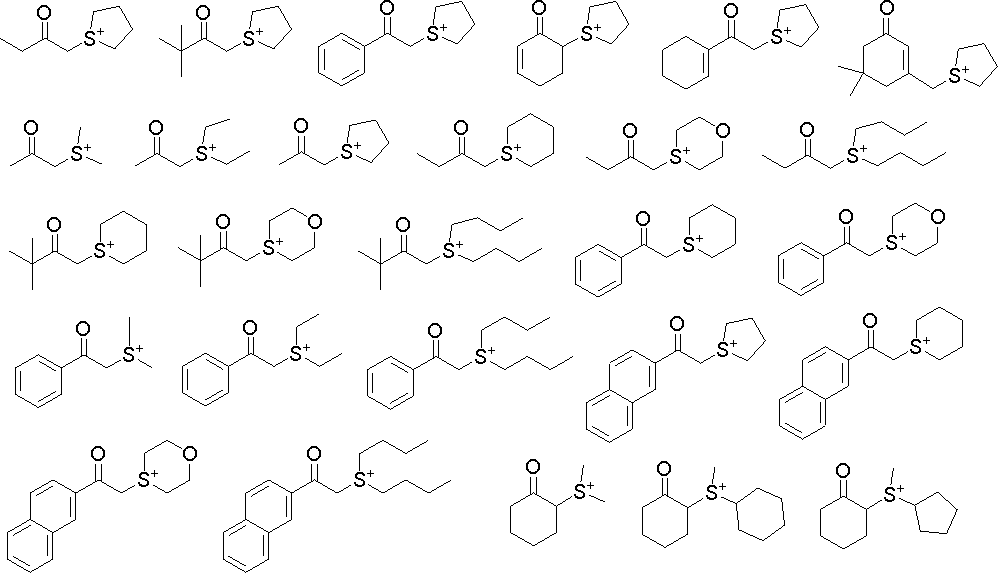

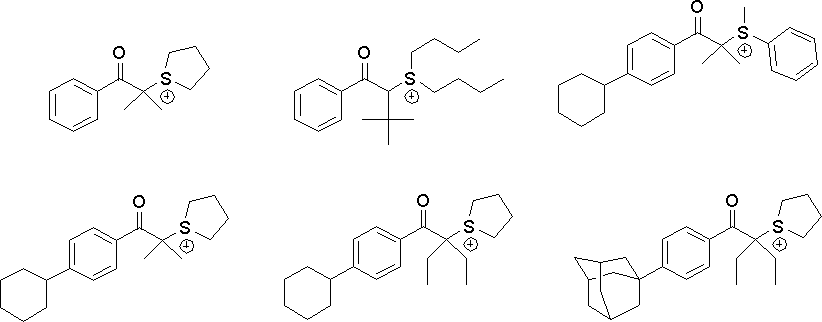
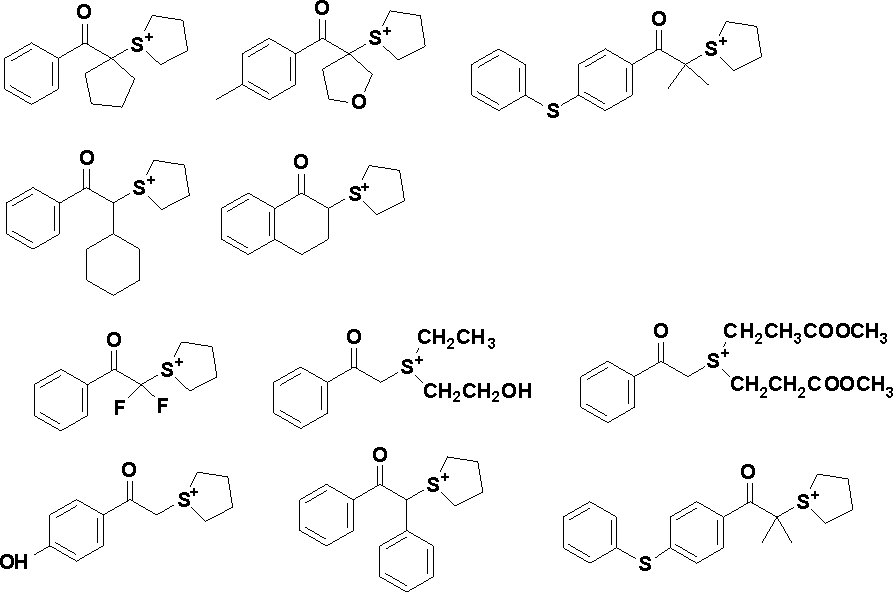

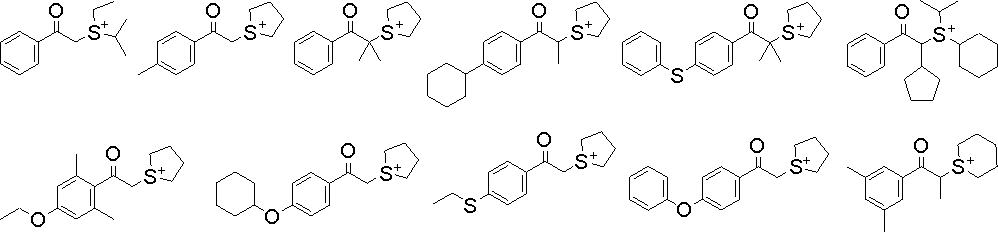
次に、化合物(ZI-4)について説明する。
化合物(ZI-4)は、下記一般式(ZI-4)で表される。
化合物(ZI-4)は、下記一般式(ZI-4)で表される。

一般式(ZI-4)中、
R13は水素原子、フッ素原子、水酸基、アルキル基、シクロアルキル基、アルコキシ基、アルコキシカルボニル基、又はシクロアルキル基を有する基を表す。これらの基は置換基を有してもよい。
R14は複数存在する場合は各々独立して、水酸基、アルキル基、シクロアルキル基、アルコキシ基、アルコキシカルボニル基、アルキルカルボニル基、アルキルスルホニル基、シクロアルキルスルホニル基、又はシクロアルキル基を有する基を表す。これらの基は置換基を有してもよい。
R15は各々独立して、アルキル基、シクロアルキル基又はナフチル基を表す。2個のR15が互いに結合して環を形成してもよい。これらの基は置換基を有してもよい。
lは0~2の整数を表す。
rは0~8の整数を表す。
Z-は、非求核性アニオンを表し、一般式(ZI)に於けるZ-と同様の非求核性アニオンを挙げることができる。
R13は水素原子、フッ素原子、水酸基、アルキル基、シクロアルキル基、アルコキシ基、アルコキシカルボニル基、又はシクロアルキル基を有する基を表す。これらの基は置換基を有してもよい。
R14は複数存在する場合は各々独立して、水酸基、アルキル基、シクロアルキル基、アルコキシ基、アルコキシカルボニル基、アルキルカルボニル基、アルキルスルホニル基、シクロアルキルスルホニル基、又はシクロアルキル基を有する基を表す。これらの基は置換基を有してもよい。
R15は各々独立して、アルキル基、シクロアルキル基又はナフチル基を表す。2個のR15が互いに結合して環を形成してもよい。これらの基は置換基を有してもよい。
lは0~2の整数を表す。
rは0~8の整数を表す。
Z-は、非求核性アニオンを表し、一般式(ZI)に於けるZ-と同様の非求核性アニオンを挙げることができる。
一般式(ZI-4)において、R13、R14及びR15のアルキル基としては、直鎖状若しくは分岐状であり、炭素原子数1~10のものが好ましい。
R13、R14及びR15のシクロアルキル基としては、単環若しくは多環のシクロアルキル基(好ましくは炭素原子数3~20のシクロアルキル基)が挙げられ、特にシクロプロピル、シクロペンチル、シクロヘキシル、シクロヘプチル、シクロオクチルが好ましい。
R13及びR14のアルコキシ基としては、直鎖状若しくは分岐状であり、炭素原子数1~10のものが好ましい。
R13及びR14のアルコキシカルボニル基としては、直鎖状若しくは分岐状であり、炭素原子数2~11のものが好ましく、メトキシカルボニル基、エトキシカルボニル基、n-ブトキシカルボニル基等が好ましい。
R13及びR14のシクロアルキル基を有する基としては、単環若しくは多環のシクロアルキル基(好ましくは炭素原子数3~20のシクロアルキル基)が挙げられ、例えば、単環若しくは多環のシクロアルキルオキシ基、及び、単環若しくは多環のシクロアルキル基を有するアルコキシ基が挙げられる。これら基は、置換基を更に有していてもよい。
R13及びR14の単環若しくは多環のシクロアルキルオキシ基としては、総炭素数が7以上であることが好ましく、総炭素数が7以上15以下であることがより好ましく、また、単環のシクロアルキル基を有することが好ましい。総炭素数7以上の単環のシクロアルキルオキシ基とは、シクロプロピルオキシ基、シクロブチルオキシ基、シクロペンチルオキシ基、シクロヘキシルオキシ基、シクロヘプチルオキシ基、シクロオクチルオキシ基、シクロドデカニルオキシ基等のシクロアルキルオキシ基に、任意にアルキル基、水酸基、ハロゲン原子(フッ素、塩素、臭素、ヨウ素)、ニトロ基、シアノ基、アミド基、スルホンアミド基、アルコキシ基、アルコキシカルボニル基、ホルミル基、アセチル基、ベンゾイル基等のアシル基、アシルオキシ基、カルボキシ基等の置換基を有する単環のシクロアルキルオキシ基であって、該シクロアルキル基上の任意の置換基と合わせた総炭素数が7以上のものを表す。
また、総炭素数が7以上の多環のシクロアルキルオキシ基としては、ノルボルニルオキシ基、トリシクロデカニルオキシ基、テトラシクロデカニルオキシ基、アダマンチルオキシ基等が挙げられる。
また、総炭素数が7以上の多環のシクロアルキルオキシ基としては、ノルボルニルオキシ基、トリシクロデカニルオキシ基、テトラシクロデカニルオキシ基、アダマンチルオキシ基等が挙げられる。
R13及びR14の単環若しくは多環のシクロアルキル基を有するアルコキシ基としては、総炭素数が7以上であることが好ましく、総炭素数が7以上15以下であることがより好ましく、また、単環のシクロアルキル基を有するアルコキシ基であることが好ましい。総炭素数7以上の、単環のシクロアルキル基を有するアルコキシ基とは、メトキシ、エトキシ、プロポキシ、ブトキシ、ペンチルオキシ、ヘキシルオキシ、ヘプトキシ、オクチルオキシ、ドデシルオキシ、2-エチルヘキシルオキシ、イソプロポキシ、sec-ブトキシ、t-ブトキシ、iso-アミルオキシ等のアルコキシ基に上述の置換基を有していてもよい単環シクロアルキル基が置換したものであり、置換基も含めた総炭素数が7以上のものを表す。たとえば、シクロヘキシルメトキシ基、シクロペンチルエトキシ基、シクロヘキシルエトキシ基等が挙げられ、シクロヘキシルメトキシ基が好ましい。
また、総炭素数が7以上の多環のシクロアルキル基を有するアルコキシ基としては、ノルボルニルメトキシ基、ノルボルニルエトキシ基、トリシクロデカニルメトキシ基、トリシクロデカニルエトキシ基、テトラシクロデカニルメトキシ基、テトラシクロデカニルエトキシ基、アダマンチルメトキシ基、アダマンチルエトキシ基等が挙げられ、ノルボルニルメトキシ基、ノルボルニルエトキシ基等が好ましい。
R14のアルキルカルボニル基のアルキル基としては、上述したR13~R15としてのアルキル基と同様の具体例が挙げられる。
R14のアルキルスルホニル基及びシクロアルキルスルホニル基としては、直鎖状、分岐状、環状であり、炭素原子数1~10のものが好ましく、例えば、メタンスルホニル基、エタンスルホニル基、n-プロパンスルホニル基、n-ブタンスルホニル基、シクロペンタンスルホニル基、シクロヘキサンスルホニル基等が好ましい。
上記各基が有していてもよい置換基としては、ハロゲン原子(例えば、フッ素原子)、水酸基、カルボキシル基、シアノ基、ニトロ基、アルコキシ基、アルコキシアルキル基、アルコキシカルボニル基、アルコキシカルボニルオキシ基等を挙げることができる。
前記アルコキシ基としては、例えば、炭素原子数1~20の直鎖状、分岐状若しくは環状のアルコキシ基等を挙げることができる。
前記アルコキシアルキル基としては、例えば、炭素原子数2~21の直鎖状、分岐状若しくは環状のアルコキシアルキル基等を挙げることができる。
前記アルコキシカルボニル基としては、例えば炭素原子数2~21の直鎖状、分岐状若しくは環状のアルコキシカルボニル基等を挙げることができる。
前記アルコキシカルボニルオキシ基としては、例えば、炭素原子数2~21の直鎖状、分岐状若しくは環状のアルコキシカルボニルオキシ基等を挙げることができる。
2個のR15が互いに結合して形成してもよい環構造としては、2個のR15が一般式(ZI-4)中の硫黄原子と共に形成する5員又は6員の環、特に好ましくは5員の環(即ち、テトラヒドロチオフェン環)が挙げられ、アリール基又はシクロアルキル基と縮環していてもよい。この2価のR15は置換基を有してもよく、置換基としては、例えば、水酸基、カルボキシル基、シアノ基、ニトロ基、アルキル基、シクロアルキル基、アルコキシ基、アルコキアルキル基、アルコキシカルボニル基、アルコキシカルボニルオキシ基等を挙げることができる。前記環構造に対する置換基は、複数個存在しても良く、また、それらが互いに結合して環(芳香族若しくは非芳香族の炭化水素環、芳香族若しくは非芳香族の複素環、又はこれらの環が2つ以上組み合わされてなる多環縮合環など)を形成しても良い。
一般式(ZI-4)におけるR15としては、メチル基、エチル基、ナフチル基、2個のR15が互いに結合して硫黄原子と共にテトラヒドロチオフェン環構造を形成する2価の基等が好ましい。
一般式(ZI-4)におけるR15としては、メチル基、エチル基、ナフチル基、2個のR15が互いに結合して硫黄原子と共にテトラヒドロチオフェン環構造を形成する2価の基等が好ましい。
R13及びR14が有し得る置換基としては、水酸基、アルコキシ基、又はアルコキシカルボニル基、ハロゲン原子(特に、フッ素原子)が好ましい。
lとしては、0又は1が好ましく、1がより好ましい。
rとしては、0~2が好ましい。
rとしては、0~2が好ましい。
本発明における一般式(ZI-4)で表される化合物のカチオンとしては以下の具体例が挙げられる。
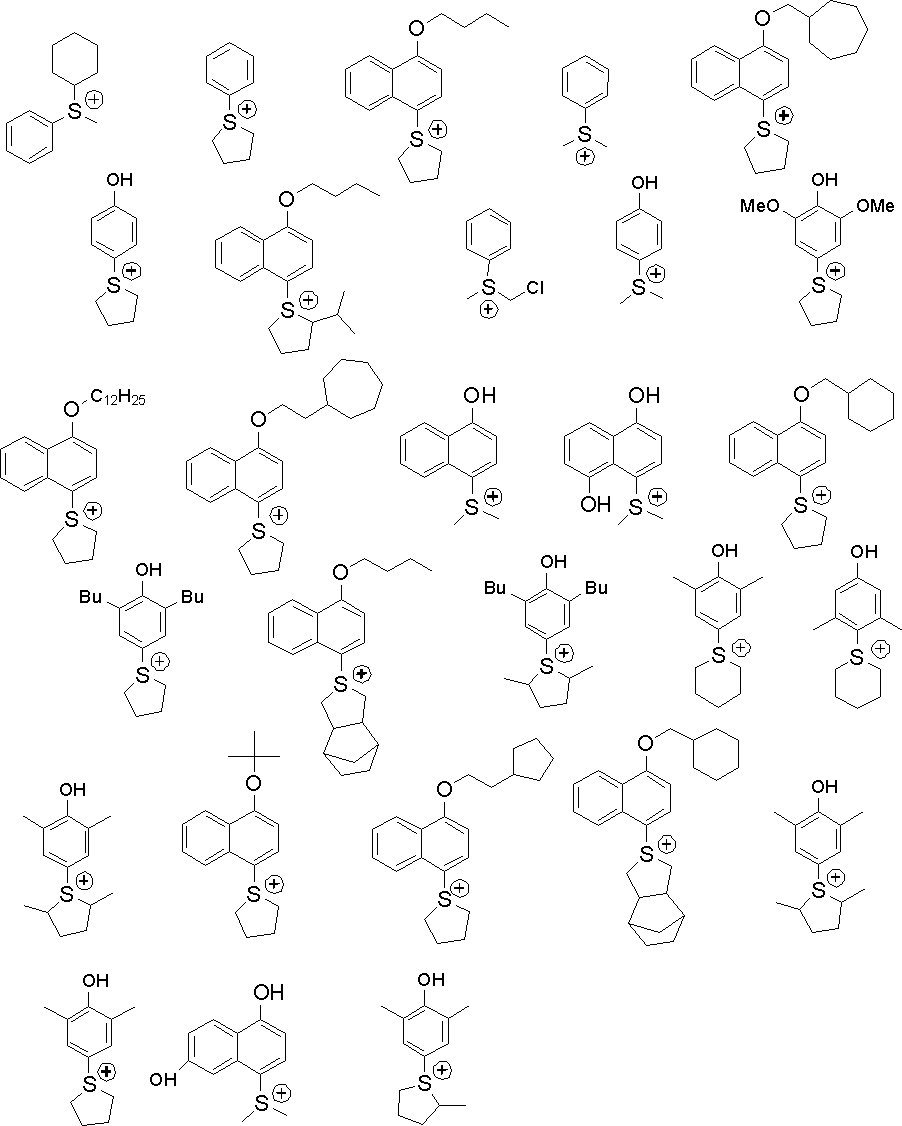
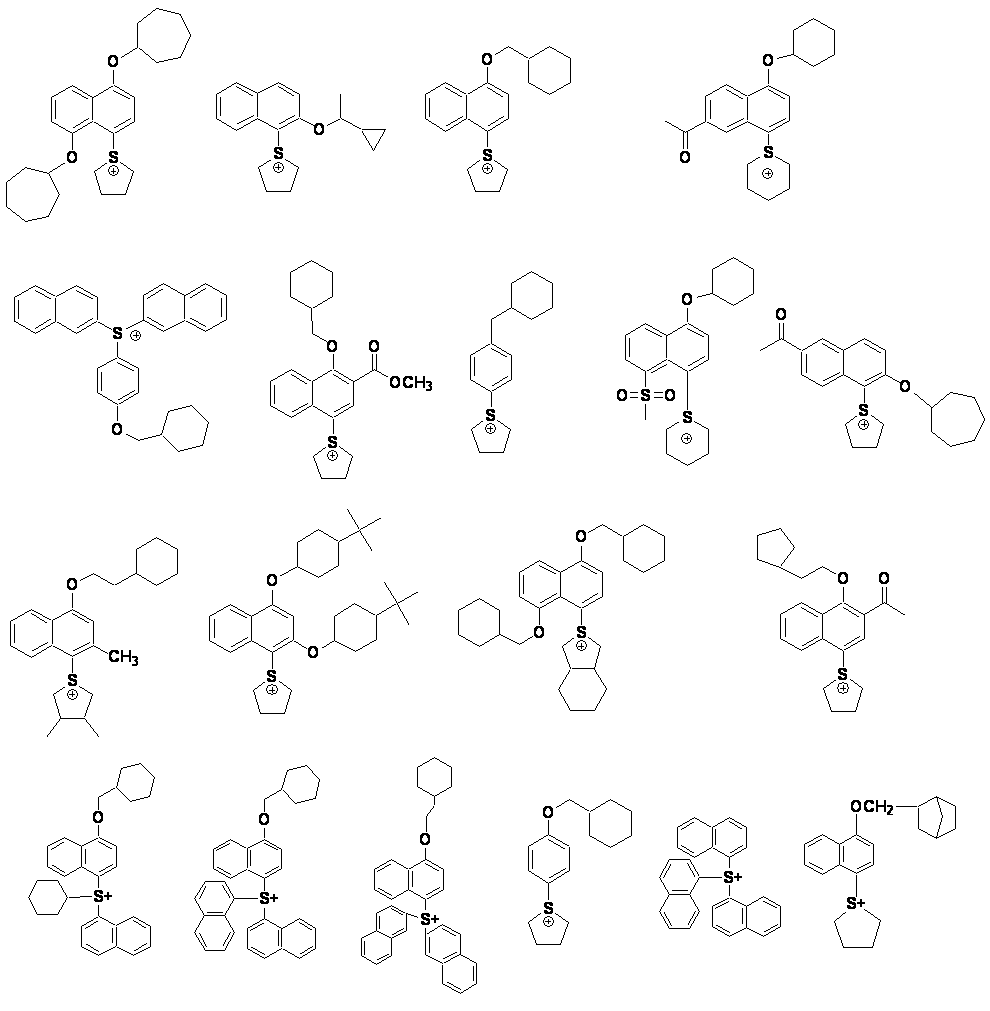
次に、一般式(ZII)、(ZIII)について説明する。
一般式(ZII)、(ZIII)中、
R204~R207は、各々独立に、アリール基、アルキル基又はシクロアルキル基を表す。
R204~R207のアリール基としてはフェニル基、ナフチル基が好ましく、更に好ましくはフェニル基である。R204~R207のアリール基は、酸素原子、窒素原子、硫黄原子等を有する複素環構造を有するアリール基であってもよい。複素環構造を有するアリール基の骨格としては、例えば、ピロール、フラン、チオフェン、インドール、ベンゾフラン、ベンゾチオフェン等を挙げることができる。
R204~R207におけるアルキル基及びシクロアルキル基としては、好ましくは、炭素数1~10の直鎖又は分岐アルキル基(例えば、メチル基、エチル基、プロピル基、ブチル基、ペンチル基)、炭素数3~10のシクロアルキル基(シクロペンチル基、シクロヘキシル基、ノルボニル基)を挙げることができる。
R204~R207のアリール基、アルキル基、シクロアルキル基は、置換基を有していてもよい。R204~R207のアリール基、アルキル基、シクロアルキル基が有していてもよい置換基としては、例えば、アルキル基(例えば炭素数1~15)、シクロアルキル基(例えば炭素数3~15)、アリール基(例えば炭素数6~15)、アルコキシ基(例えば炭素数1~15)、ハロゲン原子、水酸基、フェニルチオ基等を挙げることができる。
Z-は、非求核性アニオンを表し、一般式(ZI)に於けるZ-の非求核性アニオンと同様のものを挙げることができる。
一般式(ZII)、(ZIII)中、
R204~R207は、各々独立に、アリール基、アルキル基又はシクロアルキル基を表す。
R204~R207のアリール基としてはフェニル基、ナフチル基が好ましく、更に好ましくはフェニル基である。R204~R207のアリール基は、酸素原子、窒素原子、硫黄原子等を有する複素環構造を有するアリール基であってもよい。複素環構造を有するアリール基の骨格としては、例えば、ピロール、フラン、チオフェン、インドール、ベンゾフラン、ベンゾチオフェン等を挙げることができる。
R204~R207におけるアルキル基及びシクロアルキル基としては、好ましくは、炭素数1~10の直鎖又は分岐アルキル基(例えば、メチル基、エチル基、プロピル基、ブチル基、ペンチル基)、炭素数3~10のシクロアルキル基(シクロペンチル基、シクロヘキシル基、ノルボニル基)を挙げることができる。
R204~R207のアリール基、アルキル基、シクロアルキル基は、置換基を有していてもよい。R204~R207のアリール基、アルキル基、シクロアルキル基が有していてもよい置換基としては、例えば、アルキル基(例えば炭素数1~15)、シクロアルキル基(例えば炭素数3~15)、アリール基(例えば炭素数6~15)、アルコキシ基(例えば炭素数1~15)、ハロゲン原子、水酸基、フェニルチオ基等を挙げることができる。
Z-は、非求核性アニオンを表し、一般式(ZI)に於けるZ-の非求核性アニオンと同様のものを挙げることができる。
酸発生剤として、更に、下記一般式(ZIV)、(ZV)、(ZVI)で表される化合物も挙げられる。
一般式(ZIV)~(ZVI)中、
Ar3及びAr4は、各々独立に、アリール基を表す。
R208、R209及びR210は、各々独立に、アルキル基、シクロアルキル基又はアリール基を表す。
Aは、アルキレン基、アルケニレン基又はアリーレン基を表す。
Ar3、Ar4、R208、R209及びR210のアリール基の具体例としては、上記一般式(ZI-1)におけるR201、R202及びR203としてのアリール基の具体例と同様のものを挙げることができる。
R208、R209及びR210のアルキル基及びシクロアルキル基の具体例としては、それぞれ、上記一般式(ZI-2)におけるR201、R202及びR203としてのアルキル基及びシクロアルキル基の具体例と同様のものを挙げることができる。
Aのアルキレン基としては、炭素数1~12のアルキレン(例えば、メチレン基、エチレン基、プロピレン基、イソプロピレン基、ブチレン基、イソブチレン基など)を、Aのアルケニレン基としては、炭素数2~12のアルケニレン基(例えば、エテニレン基、プロペニレン基、ブテニレン基など)を、Aのアリーレン基としては、炭素数6~10のアリーレン基(例えば、フェニレン基、トリレン基、ナフチレン基など)を、それぞれ挙げることができる。
Ar3及びAr4は、各々独立に、アリール基を表す。
R208、R209及びR210は、各々独立に、アルキル基、シクロアルキル基又はアリール基を表す。
Aは、アルキレン基、アルケニレン基又はアリーレン基を表す。
Ar3、Ar4、R208、R209及びR210のアリール基の具体例としては、上記一般式(ZI-1)におけるR201、R202及びR203としてのアリール基の具体例と同様のものを挙げることができる。
R208、R209及びR210のアルキル基及びシクロアルキル基の具体例としては、それぞれ、上記一般式(ZI-2)におけるR201、R202及びR203としてのアルキル基及びシクロアルキル基の具体例と同様のものを挙げることができる。
Aのアルキレン基としては、炭素数1~12のアルキレン(例えば、メチレン基、エチレン基、プロピレン基、イソプロピレン基、ブチレン基、イソブチレン基など)を、Aのアルケニレン基としては、炭素数2~12のアルケニレン基(例えば、エテニレン基、プロペニレン基、ブテニレン基など)を、Aのアリーレン基としては、炭素数6~10のアリーレン基(例えば、フェニレン基、トリレン基、ナフチレン基など)を、それぞれ挙げることができる。
酸発生剤の内でより好ましくは、一般式(ZI)~(ZIII)で表される化合物である。
また、酸発生剤として、スルホン酸基又はイミド基を1つ有する酸を発生する化合物が好ましく、更に好ましくは1価のパーフルオロアルカンスルホン酸を発生する化合物、又は1価のフッ素原子若しくはフッ素原子を含有する基で置換された芳香族スルホン酸を発生する化合物、又は1価のフッ素原子若しくはフッ素原子を含有する基で置換されたイミド酸を発生する化合物であり、更により好ましくは、フッ化置換アルカンスルホン酸、フッ素置換ベンゼンスルホン酸、フッ素置換イミド酸又はフッ素置換メチド酸のスルホニウム塩である。使用可能な酸発生剤は、発生した酸のpKaが-1以下のフッ化置換アルカンスルホン酸、フッ化置換ベンゼンスルホン酸、フッ化置換イミド酸であることが特に好ましく、感度が向上する。
また、酸発生剤として、スルホン酸基又はイミド基を1つ有する酸を発生する化合物が好ましく、更に好ましくは1価のパーフルオロアルカンスルホン酸を発生する化合物、又は1価のフッ素原子若しくはフッ素原子を含有する基で置換された芳香族スルホン酸を発生する化合物、又は1価のフッ素原子若しくはフッ素原子を含有する基で置換されたイミド酸を発生する化合物であり、更により好ましくは、フッ化置換アルカンスルホン酸、フッ素置換ベンゼンスルホン酸、フッ素置換イミド酸又はフッ素置換メチド酸のスルホニウム塩である。使用可能な酸発生剤は、発生した酸のpKaが-1以下のフッ化置換アルカンスルホン酸、フッ化置換ベンゼンスルホン酸、フッ化置換イミド酸であることが特に好ましく、感度が向上する。
酸発生剤の中で、特に好ましい例を以下に挙げる。

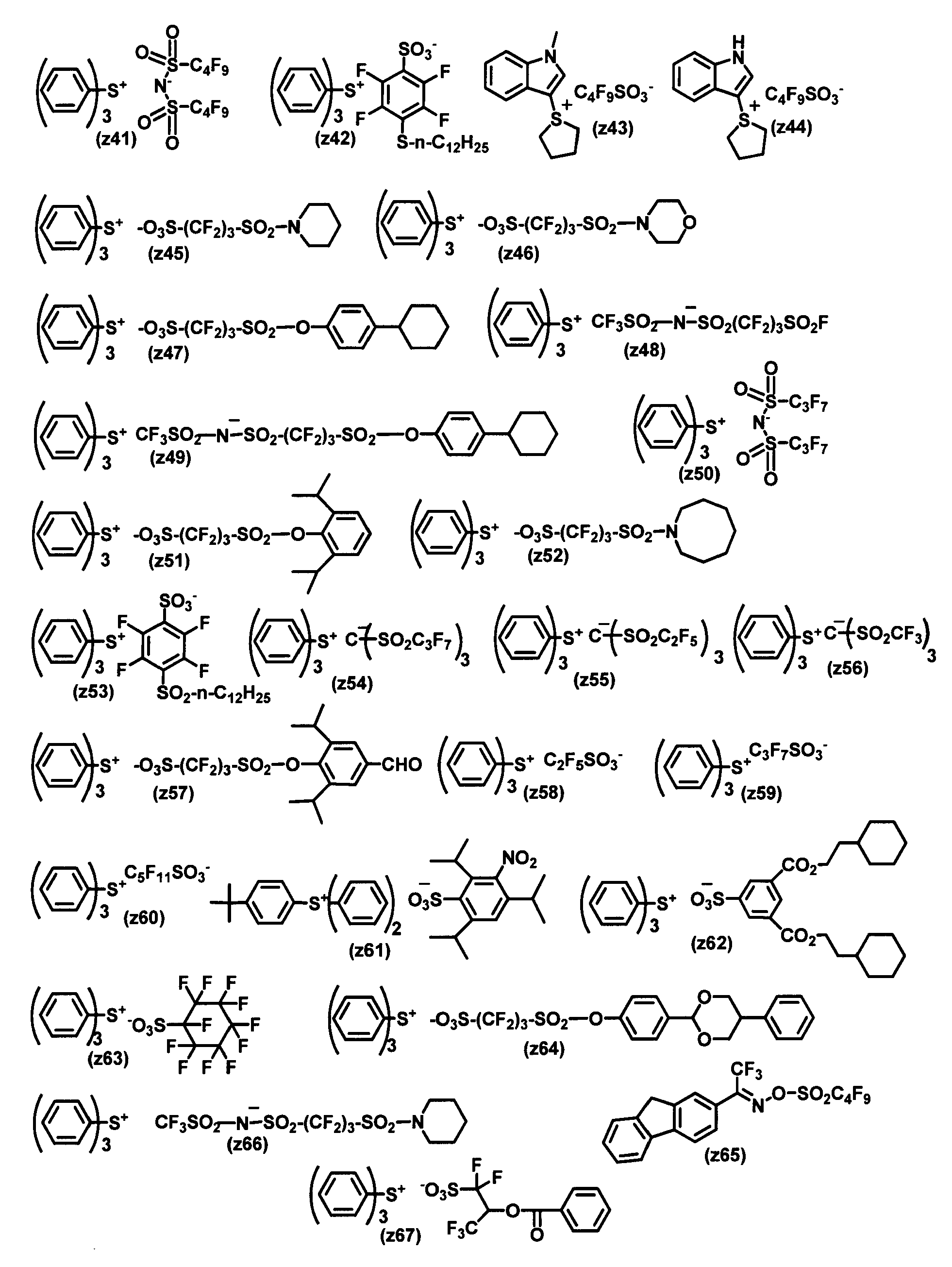


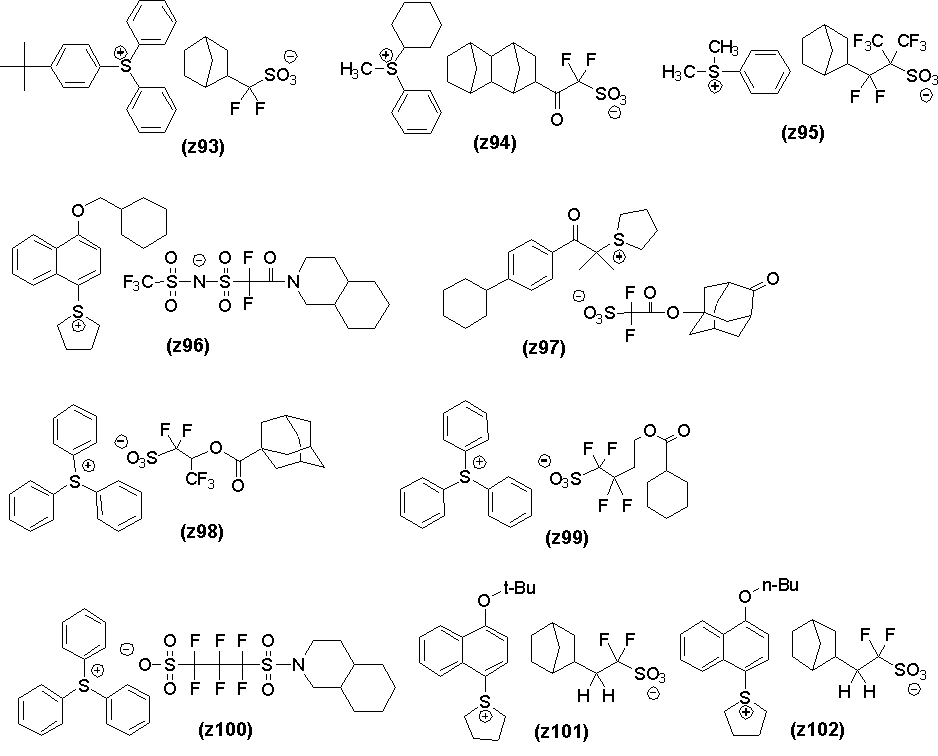


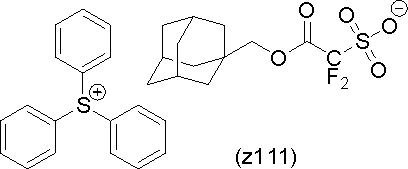
また、化合物(B)の内、上記一般式(B-1)~(B-3)のいずれかで表されるアニオンを有するものとして、特に好ましい例を以下に挙げるが、本発明はこれらに限定されるものではない。
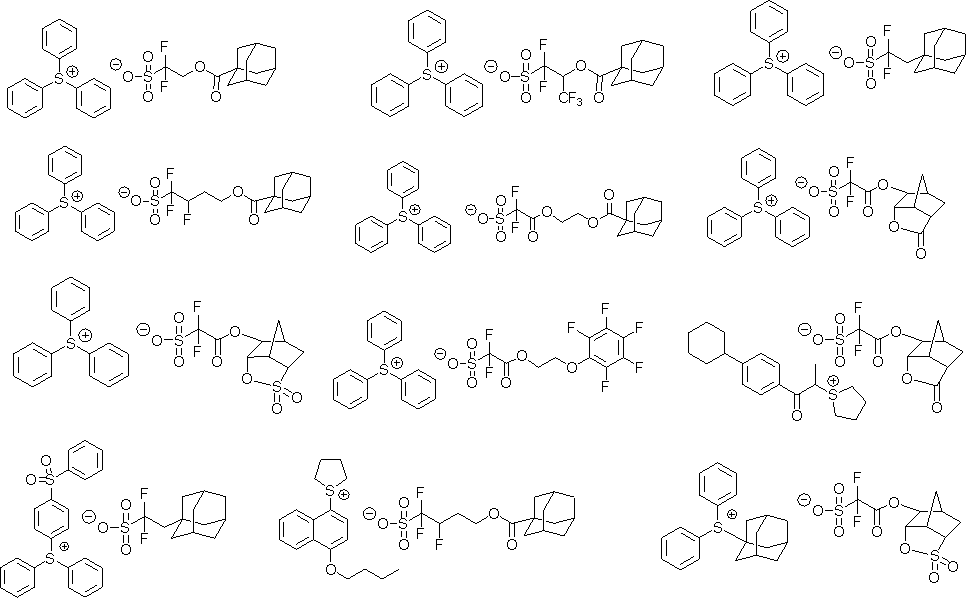

酸発生剤は、公知の方法で合成することができ、例えば、特開2007-161707号公報、特開2010-100595号公報の[0200]~[0210]、国際公開第2011/093280号の[0051]~[0058]、国際公開第2008/153110号の[0382]~[0385]、特開2007-161707号公報等に記載の方法に準じて合成することができる。
酸発生剤は、1種類単独又は2種類以上を組み合わせて使用することができる。
活性光線又は放射線の照射により酸を発生する化合物(上記一般式(ZI-3)又は(ZI-4)で表される場合は除く。)の組成物中の含有量は、感活性光線性又は感放射線性樹脂組成物の全固形分を基準として、0.1~30質量%が好ましく、より好ましくは0.5~25質量%、更に好ましくは3~20質量%、特に好ましくは3~15質量%である。
また、酸発生剤が上記一般式(ZI-3)又は(ZI-4)により表される場合には、その含有量は、組成物の全固形分を基準として、5~35質量%が好ましく、6~30質量%がより好ましく、6~30質量%が更に好ましく、6~25質量%が特に好ましい。
酸発生剤は、1種類単独又は2種類以上を組み合わせて使用することができる。
活性光線又は放射線の照射により酸を発生する化合物(上記一般式(ZI-3)又は(ZI-4)で表される場合は除く。)の組成物中の含有量は、感活性光線性又は感放射線性樹脂組成物の全固形分を基準として、0.1~30質量%が好ましく、より好ましくは0.5~25質量%、更に好ましくは3~20質量%、特に好ましくは3~15質量%である。
また、酸発生剤が上記一般式(ZI-3)又は(ZI-4)により表される場合には、その含有量は、組成物の全固形分を基準として、5~35質量%が好ましく、6~30質量%がより好ましく、6~30質量%が更に好ましく、6~25質量%が特に好ましい。
[4]溶剤(C)
本発明における感活性光線性又は感放射線性樹脂組成物を調製する際に使用することができる溶剤としては、例えば、アルキレングリコールモノアルキルエーテルカルボキシレート、アルキレングリコールモノアルキルエーテル、乳酸アルキルエステル、アルコキシプロピオン酸アルキル、環状ラクトン(好ましくは炭素数4~10)、環を有しても良いモノケトン化合物(好ましくは炭素数4~10)、アルキレンカーボネート、アルコキシ酢酸アルキル、ピルビン酸アルキル等の有機溶剤を挙げることができる。
これらの溶剤の具体例は、米国特許出願公開2008/0187860号明細書[0441]~[0455]に記載のものを挙げることができる。
本発明における感活性光線性又は感放射線性樹脂組成物を調製する際に使用することができる溶剤としては、例えば、アルキレングリコールモノアルキルエーテルカルボキシレート、アルキレングリコールモノアルキルエーテル、乳酸アルキルエステル、アルコキシプロピオン酸アルキル、環状ラクトン(好ましくは炭素数4~10)、環を有しても良いモノケトン化合物(好ましくは炭素数4~10)、アルキレンカーボネート、アルコキシ酢酸アルキル、ピルビン酸アルキル等の有機溶剤を挙げることができる。
これらの溶剤の具体例は、米国特許出願公開2008/0187860号明細書[0441]~[0455]に記載のものを挙げることができる。
本発明においては、有機溶剤として構造中に水酸基を含有する溶剤と、水酸基を含有しない溶剤とを混合した混合溶剤を使用してもよい。
水酸基を含有する溶剤、水酸基を含有しない溶剤としては前述の例示化合物が適宜選択可能であるが、水酸基を含有する溶剤としては、アルキレングリコールモノアルキルエーテル、乳酸アルキル等が好ましく、プロピレングリコールモノメチルエーテル(PGME、別名1-メトキシ-2-プロパノール)、乳酸エチルがより好ましい。また、水酸基を含有しない溶剤としては、アルキレングリコールモノアルキルエーテルアセテート、アルキルアルコキシプロピオネート、環を含有しても良いモノケトン化合物、環状ラクトン、酢酸アルキルなどが好ましく、これらの内でもプロピレングリコールモノメチルエーテルアセテート(PGMEA、別名1-メトキシ-2-アセトキシプロパン)、エチルエトキシプロピオネート、2-ヘプタノン、γ-ブチロラクトン、シクロヘキサノン、酢酸ブチルが特に好ましく、プロピレングリコールモノメチルエーテルアセテート、エチルエトキシプロピオネート、2-ヘプタノンが最も好ましい。
水酸基を含有する溶剤と水酸基を含有しない溶剤との混合比(質量)は、1/99~99/1、好ましくは10/90~90/10、更に好ましくは20/80~60/40である。水酸基を含有しない溶剤を50質量%以上含有する混合溶剤が塗布均一性の点で特に好ましい。
溶剤は、プロピレングリコールモノメチルエーテルアセテートを含むことが好ましく、プロピレングリコールモノメチルエーテルアセテート単独溶媒又はプロピレングリコールモノメチルエーテルアセテートを含有する2種類以上の混合溶剤であることが好ましい。
水酸基を含有する溶剤、水酸基を含有しない溶剤としては前述の例示化合物が適宜選択可能であるが、水酸基を含有する溶剤としては、アルキレングリコールモノアルキルエーテル、乳酸アルキル等が好ましく、プロピレングリコールモノメチルエーテル(PGME、別名1-メトキシ-2-プロパノール)、乳酸エチルがより好ましい。また、水酸基を含有しない溶剤としては、アルキレングリコールモノアルキルエーテルアセテート、アルキルアルコキシプロピオネート、環を含有しても良いモノケトン化合物、環状ラクトン、酢酸アルキルなどが好ましく、これらの内でもプロピレングリコールモノメチルエーテルアセテート(PGMEA、別名1-メトキシ-2-アセトキシプロパン)、エチルエトキシプロピオネート、2-ヘプタノン、γ-ブチロラクトン、シクロヘキサノン、酢酸ブチルが特に好ましく、プロピレングリコールモノメチルエーテルアセテート、エチルエトキシプロピオネート、2-ヘプタノンが最も好ましい。
水酸基を含有する溶剤と水酸基を含有しない溶剤との混合比(質量)は、1/99~99/1、好ましくは10/90~90/10、更に好ましくは20/80~60/40である。水酸基を含有しない溶剤を50質量%以上含有する混合溶剤が塗布均一性の点で特に好ましい。
溶剤は、プロピレングリコールモノメチルエーテルアセテートを含むことが好ましく、プロピレングリコールモノメチルエーテルアセテート単独溶媒又はプロピレングリコールモノメチルエーテルアセテートを含有する2種類以上の混合溶剤であることが好ましい。
[5]疎水性樹脂(D)
本発明に係る感活性光線性又は感放射線性樹脂組成物は、特に液浸露光に適用する際、疎水性樹脂(以下、「疎水性樹脂(D)」又は単に「樹脂(D)」ともいう)を含有してもよい。なお、疎水性樹脂(D)は前記樹脂(A)とは異なることが好ましい。
これにより、膜表層に疎水性樹脂(D)が偏在化し、液浸媒体が水の場合、水に対するレジスト膜表面の静的/動的な接触角を向上させ、液浸液追随性を向上させることができる。また、本発明のパターン形成方法をEUV露光で行う場合、いわゆるアウトガス抑制等を期待して疎水性樹脂(D)を適用することも可能である。
疎水性樹脂(D)は前述のように界面に偏在するように設計されることが好ましいが、界面活性剤とは異なり、必ずしも分子内に親水基を有する必要はなく、極性/非極性物質を均一に混合することに寄与しなくても良い。
本発明に係る感活性光線性又は感放射線性樹脂組成物は、特に液浸露光に適用する際、疎水性樹脂(以下、「疎水性樹脂(D)」又は単に「樹脂(D)」ともいう)を含有してもよい。なお、疎水性樹脂(D)は前記樹脂(A)とは異なることが好ましい。
これにより、膜表層に疎水性樹脂(D)が偏在化し、液浸媒体が水の場合、水に対するレジスト膜表面の静的/動的な接触角を向上させ、液浸液追随性を向上させることができる。また、本発明のパターン形成方法をEUV露光で行う場合、いわゆるアウトガス抑制等を期待して疎水性樹脂(D)を適用することも可能である。
疎水性樹脂(D)は前述のように界面に偏在するように設計されることが好ましいが、界面活性剤とは異なり、必ずしも分子内に親水基を有する必要はなく、極性/非極性物質を均一に混合することに寄与しなくても良い。
疎水性樹脂(D)は、膜表層への偏在化の観点から、“フッ素原子”、“珪素原子”、及び、“樹脂の側鎖部分に含有されたCH3部分構造”のいずれか1種以上を有することが好ましく、2種以上を有することが更に好ましい。
疎水性樹脂(D)が、フッ素原子及び/又は珪素原子を含む場合、疎水性樹脂(D)に於ける上記フッ素原子及び/又は珪素原子は、樹脂の主鎖中に含まれていてもよく、側鎖中に含まれていてもよい。
疎水性樹脂(D)がフッ素原子を含んでいる場合、フッ素原子を有する部分構造として、フッ素原子を有するアルキル基、フッ素原子を有するシクロアルキル基、又は、フッ素原子を有するアリール基を有する樹脂であることが好ましい。
フッ素原子を有するアルキル基(好ましくは炭素数1~10、より好ましくは炭素数1~4)は、少なくとも1つの水素原子がフッ素原子で置換された直鎖又は分岐アルキル基であり、更にフッ素原子以外の置換基を有していてもよい。
フッ素原子を有するシクロアルキル基は、少なくとも1つの水素原子がフッ素原子で置換された単環又は多環のシクロアルキル基であり、更にフッ素原子以外の置換基を有していてもよい。
フッ素原子を有するアリール基としては、フェニル基、ナフチル基などのアリール基の少なくとも1つの水素原子がフッ素原子で置換されたものが挙げられ、更にフッ素原子以外の置換基を有していてもよい。
フッ素原子を有するアルキル基(好ましくは炭素数1~10、より好ましくは炭素数1~4)は、少なくとも1つの水素原子がフッ素原子で置換された直鎖又は分岐アルキル基であり、更にフッ素原子以外の置換基を有していてもよい。
フッ素原子を有するシクロアルキル基は、少なくとも1つの水素原子がフッ素原子で置換された単環又は多環のシクロアルキル基であり、更にフッ素原子以外の置換基を有していてもよい。
フッ素原子を有するアリール基としては、フェニル基、ナフチル基などのアリール基の少なくとも1つの水素原子がフッ素原子で置換されたものが挙げられ、更にフッ素原子以外の置換基を有していてもよい。
フッ素原子を有するアルキル基、フッ素原子を有するシクロアルキル基、及びフッ素原子を有するアリール基として、好ましくは、下記一般式(F2)~(F4)で表される基を挙げることができるが、本発明は、これに限定されるものではない。
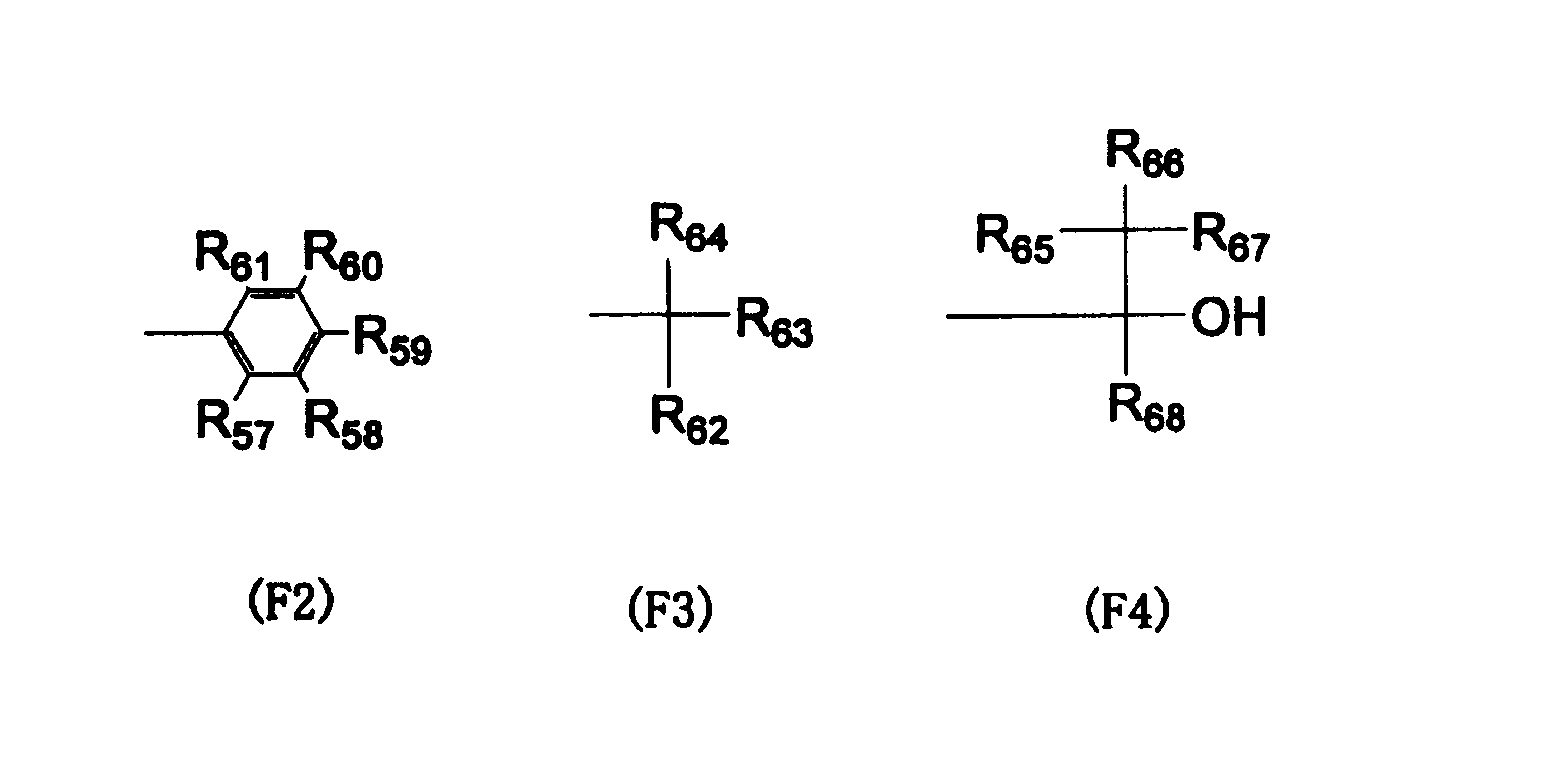
一般式(F2)~(F4)中、
R57~R68は、それぞれ独立に、水素原子、フッ素原子又はアルキル基(直鎖若しくは分岐)を表す。但し、R57~R61少なくとも1つ、R62~R64の少なくとも1つ、及びR65~R68の少なくとも1つは、それぞれ独立に、フッ素原子又は少なくとも1つの水素原子がフッ素原子で置換されたアルキル基(好ましくは炭素数1~4)を表す。
R57~R61及びR65~R67は、全てがフッ素原子であることが好ましい。R62、R63及びR68は、少なくとも1つの水素原子がフッ素原子で置換されたアルキル基(好ましくは炭素数1~4)が好ましく、炭素数1~4のパーフルオロアルキル基であることが更に好ましい。R62とR63は、互いに連結して環を形成してもよい。
R57~R68は、それぞれ独立に、水素原子、フッ素原子又はアルキル基(直鎖若しくは分岐)を表す。但し、R57~R61少なくとも1つ、R62~R64の少なくとも1つ、及びR65~R68の少なくとも1つは、それぞれ独立に、フッ素原子又は少なくとも1つの水素原子がフッ素原子で置換されたアルキル基(好ましくは炭素数1~4)を表す。
R57~R61及びR65~R67は、全てがフッ素原子であることが好ましい。R62、R63及びR68は、少なくとも1つの水素原子がフッ素原子で置換されたアルキル基(好ましくは炭素数1~4)が好ましく、炭素数1~4のパーフルオロアルキル基であることが更に好ましい。R62とR63は、互いに連結して環を形成してもよい。
一般式(F2)で表される基の具体例としては、例えば、p-フルオロフェニル基、ペンタフルオロフェニル基、3,5-ジ(トリフルオロメチル)フェニル基等が挙げられる。
一般式(F3)で表される基の具体例としては、トリフルオロメチル基、ペンタフルオロプロピル基、ペンタフルオロエチル基、ヘプタフルオロブチル基、ヘキサフルオロイソプロピル基、ヘプタフルオロイソプロピル基、ヘキサフルオロ(2-メチル)イソプロピル基、ノナフルオロブチル基、オクタフルオロイソブチル基、ノナフルオロヘキシル基、ノナフルオロ-t-ブチル基、パーフルオロイソペンチル基、パーフルオロオクチル基、パーフルオロ(トリメチル)ヘキシル基、2,2,3,3-テトラフルオロシクロブチル基、パーフルオロシクロヘキシル基などが挙げられる。ヘキサフルオロイソプロピル基、ヘプタフルオロイソプロピル基、ヘキサフルオロ(2-メチル)イソプロピル基、オクタフルオロイソブチル基、ノナフルオロ-t-ブチル基、パーフルオロイソペンチル基が好ましく、ヘキサフルオロイソプロピル基、ヘプタフルオロイソプロピル基が更に好ましい。
一般式(F4)で表される基の具体例としては、例えば、-C(CF3)2OH、-C(C2F5)2OH、-C(CF3)(CH3)OH、-CH(CF3)OH等が挙げられ、-C(CF3)2OHが好ましい。
一般式(F3)で表される基の具体例としては、トリフルオロメチル基、ペンタフルオロプロピル基、ペンタフルオロエチル基、ヘプタフルオロブチル基、ヘキサフルオロイソプロピル基、ヘプタフルオロイソプロピル基、ヘキサフルオロ(2-メチル)イソプロピル基、ノナフルオロブチル基、オクタフルオロイソブチル基、ノナフルオロヘキシル基、ノナフルオロ-t-ブチル基、パーフルオロイソペンチル基、パーフルオロオクチル基、パーフルオロ(トリメチル)ヘキシル基、2,2,3,3-テトラフルオロシクロブチル基、パーフルオロシクロヘキシル基などが挙げられる。ヘキサフルオロイソプロピル基、ヘプタフルオロイソプロピル基、ヘキサフルオロ(2-メチル)イソプロピル基、オクタフルオロイソブチル基、ノナフルオロ-t-ブチル基、パーフルオロイソペンチル基が好ましく、ヘキサフルオロイソプロピル基、ヘプタフルオロイソプロピル基が更に好ましい。
一般式(F4)で表される基の具体例としては、例えば、-C(CF3)2OH、-C(C2F5)2OH、-C(CF3)(CH3)OH、-CH(CF3)OH等が挙げられ、-C(CF3)2OHが好ましい。
フッ素原子を含む部分構造は、主鎖に直接結合しても良く、更に、アルキレン基、フェニレン基、エーテル結合、チオエーテル結合、カルボニル基、エステル結合、アミド結合、ウレタン結合及びウレイレン結合よりなる群から選択される基、或いはこれらの2つ以上を組み合わせた基を介して主鎖に結合しても良い。
以下、フッ素原子を有する繰り返し単位の具体例を示すが、本発明は、これに限定されるものではない。
具体例中、X1は、水素原子、-CH3、-F又は-CF3を表す。X2は、-F又は-CF3を表す。
具体例中、X1は、水素原子、-CH3、-F又は-CF3を表す。X2は、-F又は-CF3を表す。

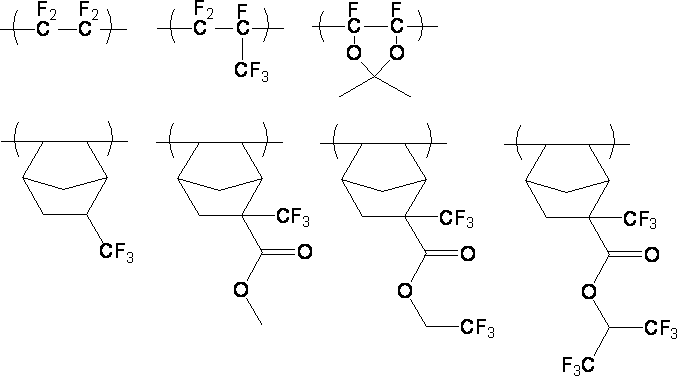
疎水性樹脂(D)は、珪素原子を含有してもよい。珪素原子を有する部分構造として、アルキルシリル構造(好ましくはトリアルキルシリル基)、又は環状シロキサン構造を有する樹脂であることが好ましい。
アルキルシリル構造、又は環状シロキサン構造としては、具体的には、下記一般式(CS-1)~(CS-3)で表される基などが挙げられる。
アルキルシリル構造、又は環状シロキサン構造としては、具体的には、下記一般式(CS-1)~(CS-3)で表される基などが挙げられる。
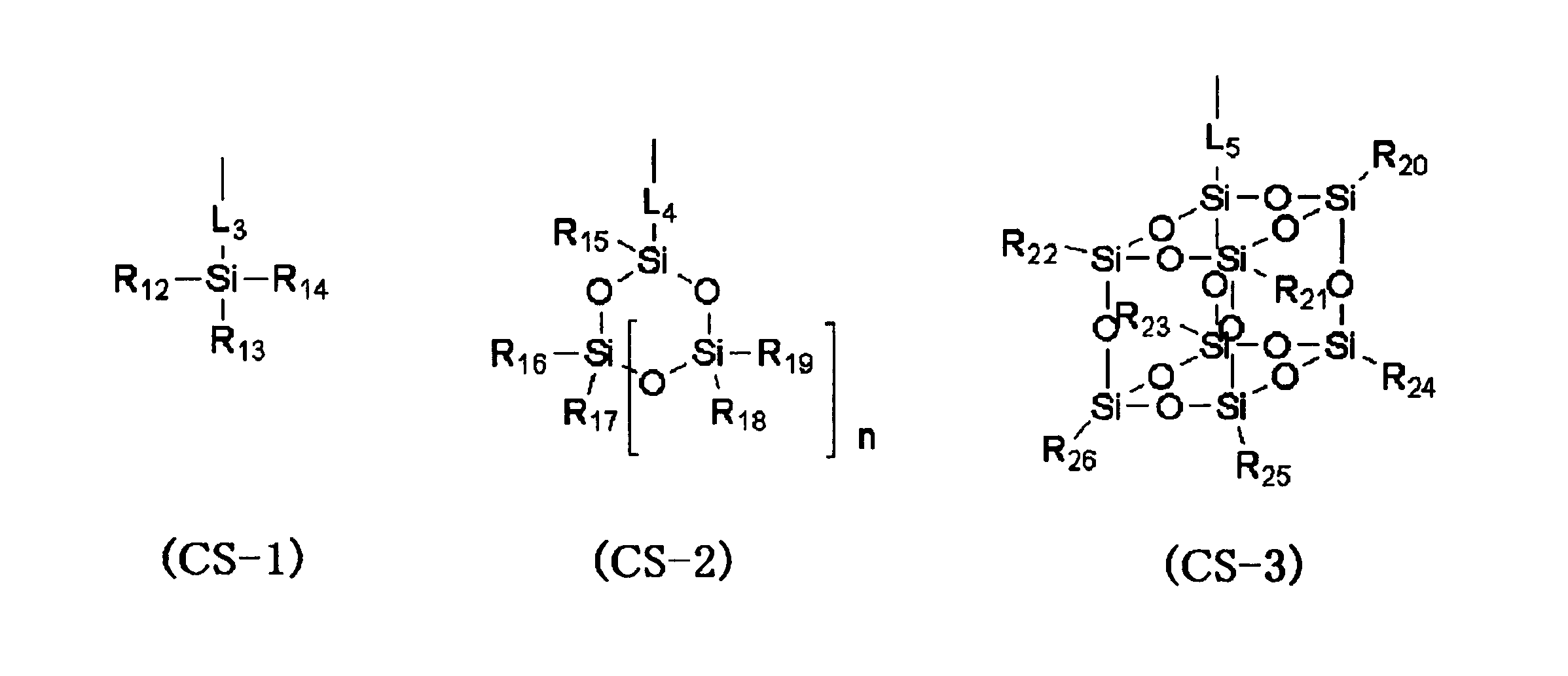
一般式(CS-1)~(CS-3)に於いて、
R12~R26は、各々独立に、直鎖若しくは分岐アルキル基(好ましくは炭素数1~20)又はシクロアルキル基(好ましくは炭素数3~20)を表す。
L3~L5は、単結合又は2価の連結基を表す。2価の連結基としては、アルキレン基、フェニレン基、エーテル結合、チオエーテル結合、カルボニル基、エステル結合、アミド結合、ウレタン結合、及びウレア結合よりなる群から選択される単独或いは2つ以上の組み合わせ(好ましくは総炭素数12以下)が挙げられる。
nは、1~5の整数を表す。nは、好ましくは、2~4の整数である。
R12~R26は、各々独立に、直鎖若しくは分岐アルキル基(好ましくは炭素数1~20)又はシクロアルキル基(好ましくは炭素数3~20)を表す。
L3~L5は、単結合又は2価の連結基を表す。2価の連結基としては、アルキレン基、フェニレン基、エーテル結合、チオエーテル結合、カルボニル基、エステル結合、アミド結合、ウレタン結合、及びウレア結合よりなる群から選択される単独或いは2つ以上の組み合わせ(好ましくは総炭素数12以下)が挙げられる。
nは、1~5の整数を表す。nは、好ましくは、2~4の整数である。
以下、一般式(CS-1)~(CS-3)で表される基を有する繰り返し単位の具体例を挙げるが、本発明は、これに限定されるものではない。なお、具体例中、X1は、水素原子、-CH3、-F又は-CF3を表す。

また、上記したように、疎水性樹脂(D)は、側鎖部分にCH3部分構造を含むことも好ましい。
ここで、前記樹脂(D)中の側鎖部分が有するCH3部分構造(以下、単に「側鎖CH3部分構造」ともいう)には、エチル基、プロピル基等が有するCH3部分構造を包含するものである。
一方、樹脂(D)の主鎖に直接結合しているメチル基(例えば、メタクリル酸構造を有する繰り返し単位のα-メチル基)は、主鎖の影響により樹脂(D)の表面偏在化への寄与が小さいため、本発明におけるCH3部分構造に包含されないものとする。
ここで、前記樹脂(D)中の側鎖部分が有するCH3部分構造(以下、単に「側鎖CH3部分構造」ともいう)には、エチル基、プロピル基等が有するCH3部分構造を包含するものである。
一方、樹脂(D)の主鎖に直接結合しているメチル基(例えば、メタクリル酸構造を有する繰り返し単位のα-メチル基)は、主鎖の影響により樹脂(D)の表面偏在化への寄与が小さいため、本発明におけるCH3部分構造に包含されないものとする。
より具体的には、樹脂(D)が、例えば、下記一般式(M)で表される繰り返し単位などの、炭素-炭素二重結合を有する重合性部位を有するモノマーに由来する繰り返し単位を含む場合であって、R11~R14がCH3「そのもの」である場合、そのCH3は、本発明における側鎖部分が有するCH3部分構造には包含されない。
一方、C-C主鎖から何らかの原子を介して存在するCH3部分構造は、本発明におけるCH3部分構造に該当するものとする。例えば、R11がエチル基(CH2CH3)である場合、本発明におけるCH3部分構造を「1つ」有するものとする。
一方、C-C主鎖から何らかの原子を介して存在するCH3部分構造は、本発明におけるCH3部分構造に該当するものとする。例えば、R11がエチル基(CH2CH3)である場合、本発明におけるCH3部分構造を「1つ」有するものとする。
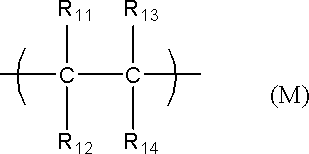
上記一般式(M)中、
R11~R14は、各々独立に、側鎖部分を表す。
側鎖部分のR11~R14としては、水素原子、1価の有機基などが挙げられる。
R11~R14についての1価の有機基としては、アルキル基、シクロアルキル基、アリール基、アルキルオキシカルボニル基、シクロアルキルオキシカルボニル基、アリールオキシカルボニル基、アルキルアミノカルボニル基、シクロアルキルアミノカルボニル基、アリールアミノカルボニル基などが挙げられ、これらの基は、更に置換基を有していてもよい。
R11~R14は、各々独立に、側鎖部分を表す。
側鎖部分のR11~R14としては、水素原子、1価の有機基などが挙げられる。
R11~R14についての1価の有機基としては、アルキル基、シクロアルキル基、アリール基、アルキルオキシカルボニル基、シクロアルキルオキシカルボニル基、アリールオキシカルボニル基、アルキルアミノカルボニル基、シクロアルキルアミノカルボニル基、アリールアミノカルボニル基などが挙げられ、これらの基は、更に置換基を有していてもよい。
疎水性樹脂(D)は、側鎖部分にCH3部分構造を有する繰り返し単位を有する樹脂であることが好ましく、このような繰り返し単位として、下記一般式(II)で表される繰り返し単位、及び、下記一般式(III)で表される繰り返し単位のうち少なくとも一種の繰り返し単位(x)を有していることがより好ましい。
以下、一般式(II)で表される繰り返し単位について詳細に説明する。
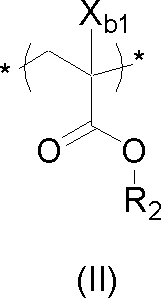
上記一般式(II)中、Xb1は水素原子、アルキル基、シアノ基又はハロゲン原子を表し、R2は1つ以上のCH3部分構造を有する、酸に対して安定な有機基を表す。ここで、酸に対して安定な有機基は、より具体的には、前記樹脂(A)において説明した“酸の作用により分解して極性基を生じる基”を有さない有機基であることが好ましい。
Xb1のアルキル基は、炭素数1~4のものが好ましく、メチル基、エチル基、プロピル基、ヒドロキシメチル基又はトリフルオロメチル基等が挙げられるが、メチル基であることが好ましい。
Xb1は、水素原子又はメチル基であることが好ましい。
Xb1は、水素原子又はメチル基であることが好ましい。
R2としては、1つ以上のCH3部分構造を有する、アルキル基、シクロアルキル基、アルケニル基、シクロアルケニル基、アリール基、及び、アラルキル基が挙げられる。上記のシクロアルキル基、アルケニル基、シクロアルケニル基、アリール基、及び、アラルキル基は、更に、置換基としてアルキル基を有していても良い。
R2は、1つ以上のCH3部分構造を有する、アルキル基又はアルキル置換シクロアルキル基が好ましい。
R2としての1つ以上のCH3部分構造を有する酸に安定な有機基は、CH3部分構造を2個以上10個以下有することが好ましく、2個以上8個以下有することがより好ましい。
R2は、1つ以上のCH3部分構造を有する、アルキル基又はアルキル置換シクロアルキル基が好ましい。
R2としての1つ以上のCH3部分構造を有する酸に安定な有機基は、CH3部分構造を2個以上10個以下有することが好ましく、2個以上8個以下有することがより好ましい。
R2に於ける、1つ以上のCH3部分構造を有するアルキル基としては、炭素数3~20の分岐のアルキル基が好ましい。
R2に於ける、1つ以上のCH3部分構造を有するシクロアルキル基は、単環式でも、多環式でもよい。具体的には、炭素数5以上のモノシクロ、ビシクロ、トリシクロ、テトラシクロ構造等を有する基を挙げることができる。その炭素数は6~30個が好ましく、特に炭素数7~25個が好ましい。
R2に於ける、1つ以上のCH3部分構造を有するアルケニル基としては、炭素数1~20の直鎖又は分岐のアルケニル基が好ましく、分岐のアルケニル基がより好ましい。
R2に於ける、1つ以上のCH3部分構造を有するアリール基としては、炭素数6~20のアリール基が好ましく、例えば、フェニル基、ナフチル基を挙げることができ、好ましくはフェニル基である。
R2に於ける、1つ以上のCH3部分構造を有するアラルキル基としては、炭素数7~12のアラルキル基が好ましく、例えば、ベンジル基、フェネチル基、ナフチルメチル基等を挙げることができる。
R2に於ける、1つ以上のCH3部分構造を有するアルケニル基としては、炭素数1~20の直鎖又は分岐のアルケニル基が好ましく、分岐のアルケニル基がより好ましい。
R2に於ける、1つ以上のCH3部分構造を有するアリール基としては、炭素数6~20のアリール基が好ましく、例えば、フェニル基、ナフチル基を挙げることができ、好ましくはフェニル基である。
R2に於ける、1つ以上のCH3部分構造を有するアラルキル基としては、炭素数7~12のアラルキル基が好ましく、例えば、ベンジル基、フェネチル基、ナフチルメチル基等を挙げることができる。
一般式(II)で表される繰り返し単位の好ましい具体例を以下に挙げる。なお、本発明はこれに限定されるものではない。
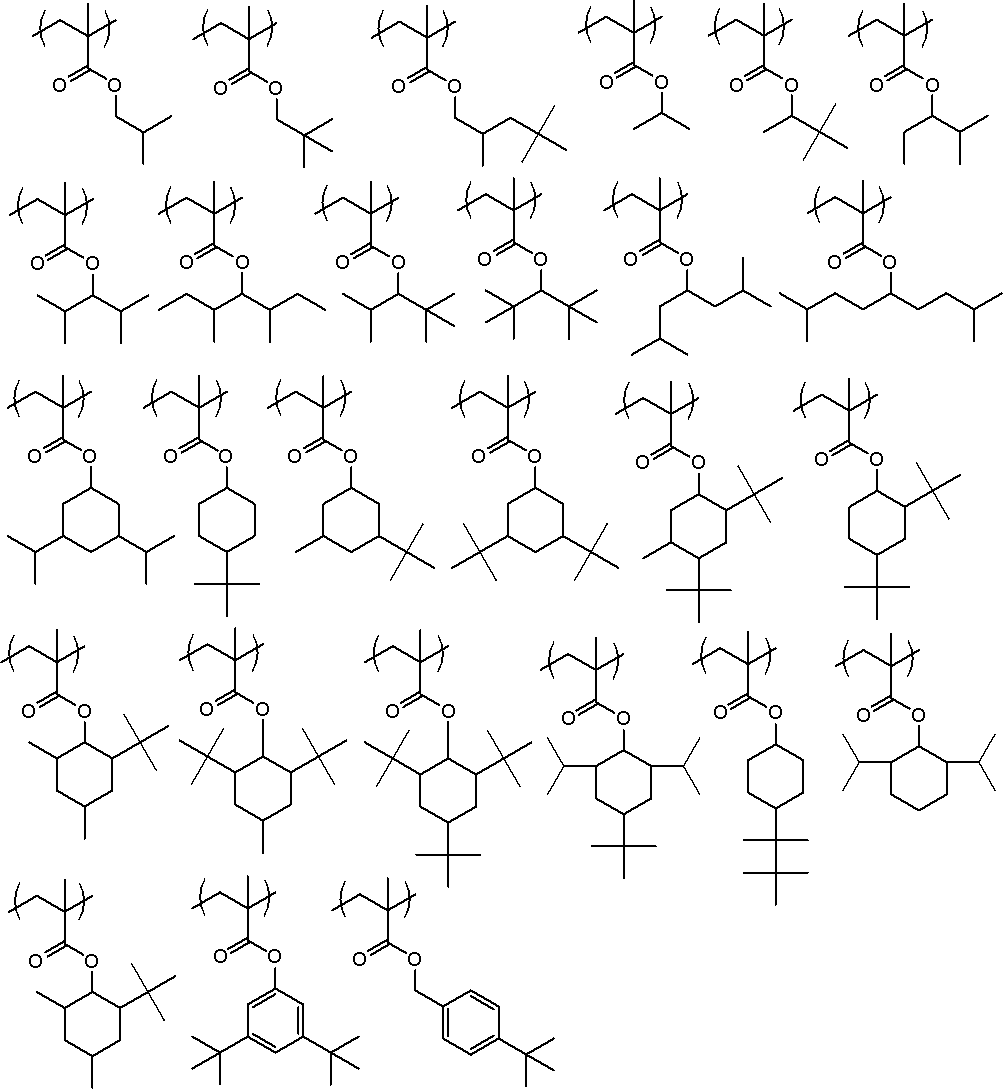
一般式(II)で表される繰り返し単位は、酸に安定な(非酸分解性の)繰り返し単位であることが好ましく、具体的には、酸の作用により分解して、極性基を生じる基を有さない繰り返し単位であることが好ましい。
以下、一般式(III)で表される繰り返し単位について詳細に説明する。
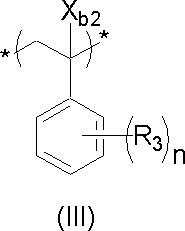
上記一般式(III)中、Xb2は水素原子、アルキル基、シアノ基又はハロゲン原子を表し、R3は1つ以上のCH3部分構造を有する、酸に対して安定な有機基を表し、nは1から5の整数を表す。
Xb2のアルキル基は、炭素数1~4のものが好ましく、メチル基、エチル基、プロピル基、ヒドロキシメチル基又はトリフルオロメチル基等が挙げられるが、水素原子である事が好ましい。
Xb2は、水素原子であることが好ましい。
Xb2は、水素原子であることが好ましい。
R3は、酸に対して安定な有機基であるため、より具体的には、記樹脂(A)において説明した“酸の作用により分解して極性基を生じる基”を有さない有機基であることが好ましい。
R3としては、1つ以上のCH3部分構造を有する、アルキル基が挙げられる。
R3としての1つ以上のCH3部分構造を有する酸に安定な有機基は、CH3部分構造を1個以上10個以下有することが好ましく、1個以上8個以下有することがより好ましく、1個以上4個以下有することが更に好ましい。
R3としての1つ以上のCH3部分構造を有する酸に安定な有機基は、CH3部分構造を1個以上10個以下有することが好ましく、1個以上8個以下有することがより好ましく、1個以上4個以下有することが更に好ましい。
R3に於ける、1つ以上のCH3部分構造を有するアルキル基としては、炭素数3~20の分岐のアルキル基が好ましい。
nは1から5の整数を表し、1~3の整数を表すことがより好ましく、1又は2を表すことが更に好ましい。
一般式(III)で表される繰り返し単位の好ましい具体例を以下に挙げる。なお、本発明はこれに限定されるものではない。

一般式(III)で表される繰り返し単位は、酸に安定な(非酸分解性の)繰り返し単位であることが好ましく、具体的には、酸の作用により分解して、極性基を生じる基を有さない繰り返し単位であることが好ましい。
樹脂(D)が、側鎖部分にCH3部分構造を含む場合であり、更に、特にフッ素原子及び珪素原子を有さない場合、一般式(II)で表される繰り返し単位、及び、一般式(III)で表される繰り返し単位のうち少なくとも一種の繰り返し単位(x)の含有量は、樹脂(D)の全繰り返し単位に対して、90モル%以上であることが好ましく、95モル%以上であることがより好ましい。前記含有量は、樹脂(D)の全繰り返し単位に対して、通常、100モル%以下である。
樹脂(D)が、一般式(II)で表される繰り返し単位、及び、一般式(III)で表される繰り返し単位のうち少なくとも一種の繰り返し単位(x)を、樹脂(D)の全繰り返し単位に対し、90モル%以上で含有することにより、樹脂(D)の表面自由エネルギーが増加する。その結果として、樹脂(D)がレジスト膜の表面に偏在しにくくなり、水に対するレジスト膜の静的/動的接触角を確実に向上させて、液浸液追随性を向上させることができる。
また、疎水性樹脂(D)は、(i)フッ素原子及び/又は珪素原子を含む場合においても、(ii)側鎖部分にCH3部分構造を含む場合においても、下記(x)~(z)の群から選ばれる基を少なくとも1つを有していてもよい。
(x)酸基、
(y)ラクトン構造を有する基、酸無水物基、又は酸イミド基、
(z)酸の作用により分解する基
(x)酸基、
(y)ラクトン構造を有する基、酸無水物基、又は酸イミド基、
(z)酸の作用により分解する基
酸基(x)としては、フェノール性水酸基、カルボン酸基、フッ素化アルコール基、スルホン酸基、スルホンアミド基、スルホニルイミド基、(アルキルスルホニル)(アルキルカルボニル)メチレン基、(アルキルスルホニル)(アルキルカルボニル)イミド基、ビス(アルキルカルボニル)メチレン基、ビス(アルキルカルボニル)イミド基、ビス(アルキルスルホニル)メチレン基、ビス(アルキルスルホニル)イミド基、トリス(アルキルカルボニル)メチレン基、トリス(アルキルスルホニル)メチレン基等が挙げられる。
好ましい酸基としては、フッ素化アルコール基(好ましくはヘキサフルオロイソプロパノール)、スルホンイミド基、ビス(アルキルカルボニル)メチレン基が挙げられる。
好ましい酸基としては、フッ素化アルコール基(好ましくはヘキサフルオロイソプロパノール)、スルホンイミド基、ビス(アルキルカルボニル)メチレン基が挙げられる。
酸基(x)を有する繰り返し単位としては、アクリル酸、メタクリル酸による繰り返し単位のような樹脂の主鎖に、直接、酸基が結合している繰り返し単位、或いは、連結基を介して樹脂の主鎖に酸基が結合している繰り返し単位などが挙げられ、更には酸基を有する重合開始剤や連鎖移動剤を重合時に用いてポリマー鎖の末端に導入することもでき、いずれの場合も好ましい。酸基(x)を有する繰り返し単位が、フッ素原子及び珪素原子の少なくともいずれかを有していても良い。
酸基(x)を有する繰り返し単位の含有量は、疎水性樹脂(D)中の全繰り返し単位に対し、1~50モル%が好ましく、より好ましくは3~35モル%、更に好ましくは5~20モル%である。
酸基(x)を有する繰り返し単位の含有量は、疎水性樹脂(D)中の全繰り返し単位に対し、1~50モル%が好ましく、より好ましくは3~35モル%、更に好ましくは5~20モル%である。
酸基(x)を有する繰り返し単位の具体例を以下に示すが、本発明は、これに限定されるものではない。式中、Rxは水素原子、CH3、CF3、又は、CH2OHを表す。

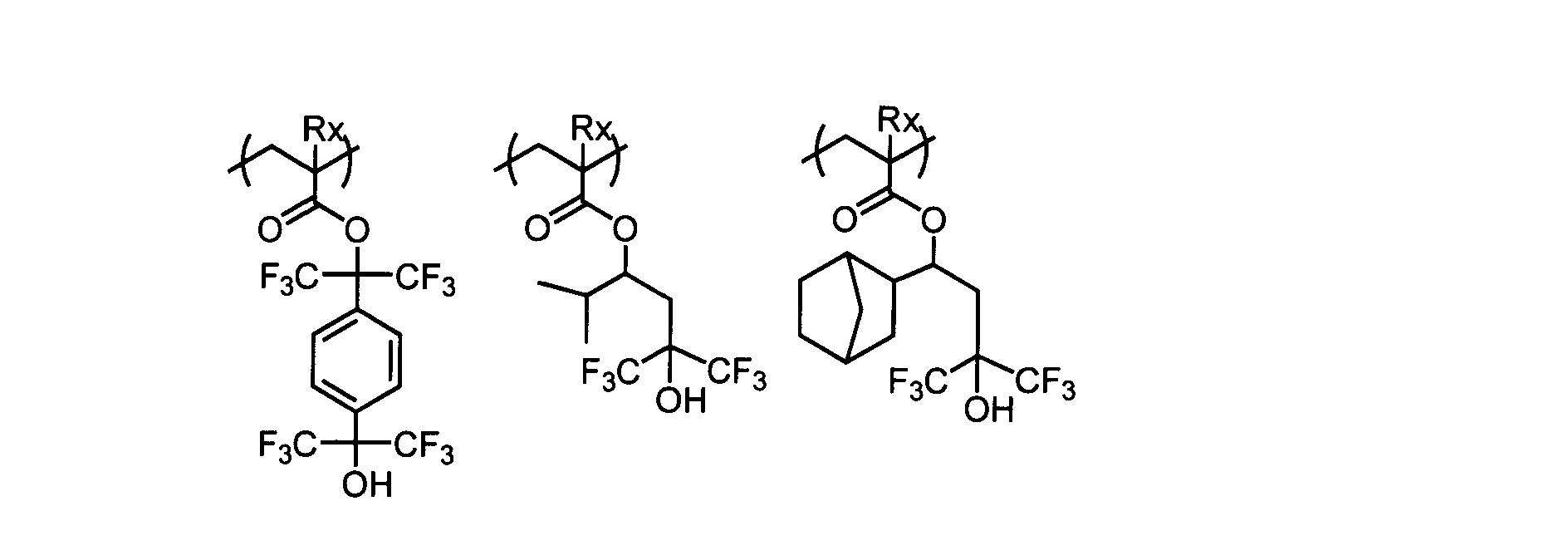
ラクトン構造を有する基、酸無水物基、又は酸イミド基(y)としては、ラクトン構造を有する基が特に好ましい。
これらの基を含んだ繰り返し単位は、例えば、アクリル酸エステル及びメタクリル酸エステルによる繰り返し単位等の、樹脂の主鎖に直接この基が結合している繰り返し単位である。或いは、この繰り返し単位は、この基が連結基を介して樹脂の主鎖に結合している繰り返し単位であってもよい。或いは、この繰り返し単位は、この基を有する重合開始剤又は連鎖移動剤を重合時に用いて、樹脂の末端に導入されていてもよい。
これらの基を含んだ繰り返し単位は、例えば、アクリル酸エステル及びメタクリル酸エステルによる繰り返し単位等の、樹脂の主鎖に直接この基が結合している繰り返し単位である。或いは、この繰り返し単位は、この基が連結基を介して樹脂の主鎖に結合している繰り返し単位であってもよい。或いは、この繰り返し単位は、この基を有する重合開始剤又は連鎖移動剤を重合時に用いて、樹脂の末端に導入されていてもよい。
ラクトン構造を有する基を有する繰り返し単位としては、例えば、先に酸分解性樹脂(A)の項で説明したラクトン構造を有する繰り返し単位と同様のものが挙げられる。
ラクトン構造を有する基、酸無水物基、又は酸イミド基を有する繰り返し単位の含有量は、疎水性樹脂(D)中の全繰り返し単位を基準として、1~100モル%であることが好ましく、3~98モル%であることがより好ましく、5~95モル%であることが更に好ましい。
疎水性樹脂(D)に於ける、酸の作用により分解する基(z)を有する繰り返し単位は、樹脂(A)で挙げた酸分解性基を有する繰り返し単位と同様のものが挙げられる。酸の作用により分解する基(z)を有する繰り返し単位が、フッ素原子及び珪素原子の少なくともいずれかを有していても良い。疎水性樹脂(D)に於ける、酸の作用により分解する基(z)を有する繰り返し単位の含有量は、樹脂(D)中の全繰り返し単位に対し、1~80モル%が好ましく、より好ましくは10~80モル%、更に好ましくは20~60モル%である。
疎水性樹脂(D)は、更に、下記一般式(III)で表される繰り返し単位を有していてもよい。
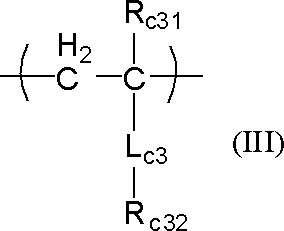
一般式(III)に於いて、
Rc31は、水素原子、アルキル基(フッ素原子等で置換されていても良い)、シアノ基又は-CH2-O-Rac2基を表す。式中、Rac2は、水素原子、アルキル基又はアシル基を表す。Rc31は、水素原子、メチル基、ヒドロキシメチル基、トリフルオロメチル基が好ましく、水素原子、メチル基が特に好ましい。
Rc32は、アルキル基、シクロアルキル基、アルケニル基、シクロアルケニル基又はアリール基を有する基を表す。これら基はフッ素原子、珪素原子を含む基で置換されていても良い。
Lc3は、単結合又は2価の連結基を表す。
Rc31は、水素原子、アルキル基(フッ素原子等で置換されていても良い)、シアノ基又は-CH2-O-Rac2基を表す。式中、Rac2は、水素原子、アルキル基又はアシル基を表す。Rc31は、水素原子、メチル基、ヒドロキシメチル基、トリフルオロメチル基が好ましく、水素原子、メチル基が特に好ましい。
Rc32は、アルキル基、シクロアルキル基、アルケニル基、シクロアルケニル基又はアリール基を有する基を表す。これら基はフッ素原子、珪素原子を含む基で置換されていても良い。
Lc3は、単結合又は2価の連結基を表す。
一般式(III)に於ける、Rc32のアルキル基は、炭素数3~20の直鎖若しくは分岐状アルキル基が好ましい。
シクロアルキル基は、炭素数3~20のシクロアルキル基が好ましい。
アルケニル基は、炭素数3~20のアルケニル基が好ましい。
シクロアルケニル基は、炭素数3~20のシクロアルケニル基が好ましい。
アリール基は、炭素数6~20のアリール基が好ましく、フェニル基、ナフチル基がより好ましく、これらは置換基を有していてもよい。
Rc32は無置換のアルキル基又はフッ素原子で置換されたアルキル基が好ましい。
Lc3の2価の連結基は、アルキレン基(好ましくは炭素数1~5)、エーテル結合、フェニレン基、エステル結合(-COO-で表される基)が好ましい。
一般式(III)により表される繰り返し単位の含有量は、疎水性樹脂中の全繰り返し単位を基準として、1~100モル%であることが好ましく、10~90モル%であることがより好ましく、30~70モル%であることが更に好ましい。
シクロアルキル基は、炭素数3~20のシクロアルキル基が好ましい。
アルケニル基は、炭素数3~20のアルケニル基が好ましい。
シクロアルケニル基は、炭素数3~20のシクロアルケニル基が好ましい。
アリール基は、炭素数6~20のアリール基が好ましく、フェニル基、ナフチル基がより好ましく、これらは置換基を有していてもよい。
Rc32は無置換のアルキル基又はフッ素原子で置換されたアルキル基が好ましい。
Lc3の2価の連結基は、アルキレン基(好ましくは炭素数1~5)、エーテル結合、フェニレン基、エステル結合(-COO-で表される基)が好ましい。
一般式(III)により表される繰り返し単位の含有量は、疎水性樹脂中の全繰り返し単位を基準として、1~100モル%であることが好ましく、10~90モル%であることがより好ましく、30~70モル%であることが更に好ましい。
疎水性樹脂(D)は、更に、下記一般式(CII-AB)で表される繰り返し単位を有することも好ましい。
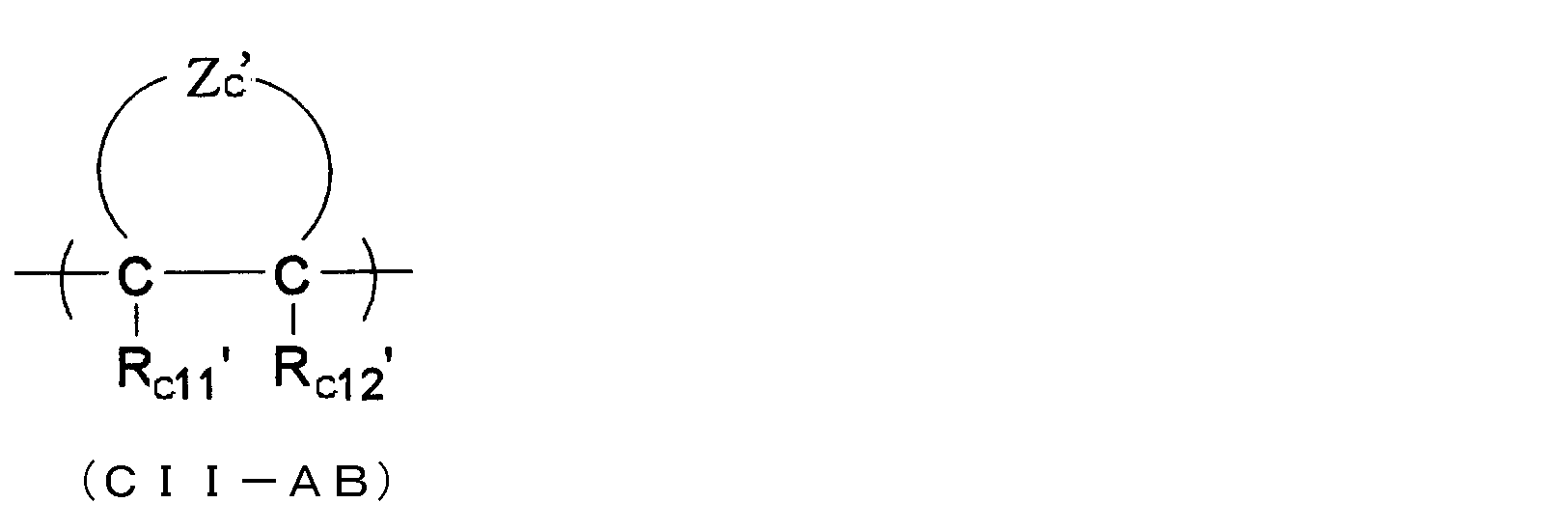
式(CII-AB)中、
Rc11’及びRc12’は、各々独立に、水素原子、シアノ基、ハロゲン原子又はアルキル基を表す。
Zc’は、結合した2つの炭素原子(C-C)を含み、脂環式構造を形成するための原子団を表す。
一般式(CII-AB)により表される繰り返し単位の含有量は、疎水性樹脂中の全繰り返し単位を基準として、1~100モル%であることが好ましく、10~90モル%であることがより好ましく、30~70モル%であることが更に好ましい。
Rc11’及びRc12’は、各々独立に、水素原子、シアノ基、ハロゲン原子又はアルキル基を表す。
Zc’は、結合した2つの炭素原子(C-C)を含み、脂環式構造を形成するための原子団を表す。
一般式(CII-AB)により表される繰り返し単位の含有量は、疎水性樹脂中の全繰り返し単位を基準として、1~100モル%であることが好ましく、10~90モル%であることがより好ましく、30~70モル%であることが更に好ましい。
以下に一般式(III)、(CII-AB)で表される繰り返し単位の具体例を以下に挙げるが、本発明はこれらに限定されない。式中、Raは、H、CH3、CH2OH、CF3又はCNを表す。
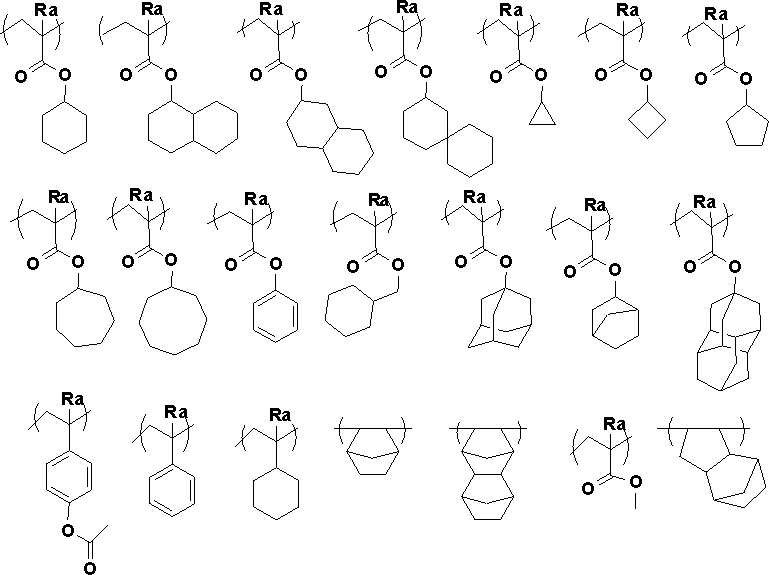
疎水性樹脂(D)がフッ素原子を有する場合、フッ素原子の含有量は、疎水性樹脂(D)の重量平均分子量に対し、5~80質量%であることが好ましく、10~80質量%であることがより好ましい。また、フッ素原子を含む繰り返し単位は、疎水性樹脂(D)に含まれる全繰り返し単位中10~100モル%であることが好ましく、30~100モル%であることがより好ましい。
疎水性樹脂(D)が珪素原子を有する場合、珪素原子の含有量は、疎水性樹脂(D)の重量平均分子量に対し、2~50質量%であることが好ましく、2~30質量%であることがより好ましい。また、珪素原子を含む繰り返し単位は、疎水性樹脂(D)に含まれる全繰り返し単位中、10~100モル%であることが好ましく、20~100モル%であることがより好ましい。
疎水性樹脂(D)が珪素原子を有する場合、珪素原子の含有量は、疎水性樹脂(D)の重量平均分子量に対し、2~50質量%であることが好ましく、2~30質量%であることがより好ましい。また、珪素原子を含む繰り返し単位は、疎水性樹脂(D)に含まれる全繰り返し単位中、10~100モル%であることが好ましく、20~100モル%であることがより好ましい。
一方、特に樹脂(D)が側鎖部分にCH3部分構造を含む場合においては、樹脂(D)が、フッ素原子及び珪素原子を実質的に含有しない形態も好ましく、この場合、具体的には、フッ素原子又は珪素原子を有する繰り返し単位の含有量が、樹脂(D)中の全繰り返し単位に対して5モル%以下であることが好ましく、3モル%以下であることがより好ましく、1モル%以下であることが更に好ましく、理想的には0モル%、すなわち、フッ素原子及び珪素原子を含有しない。また、樹脂(D)は、炭素原子、酸素原子、水素原子、窒素原子及び硫黄原子から選ばれる原子のみによって構成された繰り返し単位のみで実質的に構成されることが好ましい。より具体的には、炭素原子、酸素原子、水素原子、窒素原子及び硫黄原子から選ばれる原子のみによって構成された繰り返し単位が、樹脂(D)の全繰り返し単位中95モル%以上であることが好ましく、97モル%以上であることがより好ましく、99モル%以上であることが更に好ましく、理想的には100モル%である。
疎水性樹脂(D)の標準ポリスチレン換算の重量平均分子量は、好ましくは1,000~100,000で、より好ましくは1,000~50,000、更により好ましくは2,000~15,000である。
また、疎水性樹脂(D)は、1種で使用してもよいし、複数併用してもよい。
疎水性樹脂(D)の組成物中の含有量は、本発明の組成物中の全固形分に対し、0.01~10質量%が好ましく、0.05~8質量%がより好ましく、0.1~7質量%が更に好ましい。
また、疎水性樹脂(D)は、1種で使用してもよいし、複数併用してもよい。
疎水性樹脂(D)の組成物中の含有量は、本発明の組成物中の全固形分に対し、0.01~10質量%が好ましく、0.05~8質量%がより好ましく、0.1~7質量%が更に好ましい。
疎水性樹脂(D)は、樹脂(A)同様、金属等の不純物が少ないのは当然のことながら、残留単量体やオリゴマー成分が0.01~5質量%であることが好ましく、より好ましくは0.01~3質量%、0.05~1質量%が更により好ましい。それにより、液中異物や感度等の経時変化のない感活性光線性又は感放射線性樹脂組成物が得られる。また、解像度、レジスト形状、レジストパターンの側壁、ラフネスなどの点から、分子量分布(Mw/Mn、分散度ともいう)は、1~5の範囲が好ましく、より好ましくは1~3、更に好ましくは1~2の範囲である。
疎水性樹脂(D)は、各種市販品を利用することもできるし、常法に従って(例えばラジカル重合)合成することができる。例えば、一般的合成方法としては、モノマー種及び開始剤を溶剤に溶解させ、加熱することにより重合を行う一括重合法、加熱溶剤にモノマー種と開始剤の溶液を1~10時間かけて滴下して加える滴下重合法などが挙げられ、滴下重合法が好ましい。
反応溶媒、重合開始剤、反応条件(温度、濃度等)、及び、反応後の精製方法は、樹脂(A)で説明した内容と同様であるが、疎水性樹脂(D)の合成においては、反応の濃度が30~50質量%であることが好ましい。
反応溶媒、重合開始剤、反応条件(温度、濃度等)、及び、反応後の精製方法は、樹脂(A)で説明した内容と同様であるが、疎水性樹脂(D)の合成においては、反応の濃度が30~50質量%であることが好ましい。
以下に疎水性樹脂(D)の具体例を示す。また、下記表に、各樹脂における繰り返し単位のモル比(各繰り返し単位と左から順に対応)、重量平均分子量、分散度を示す。

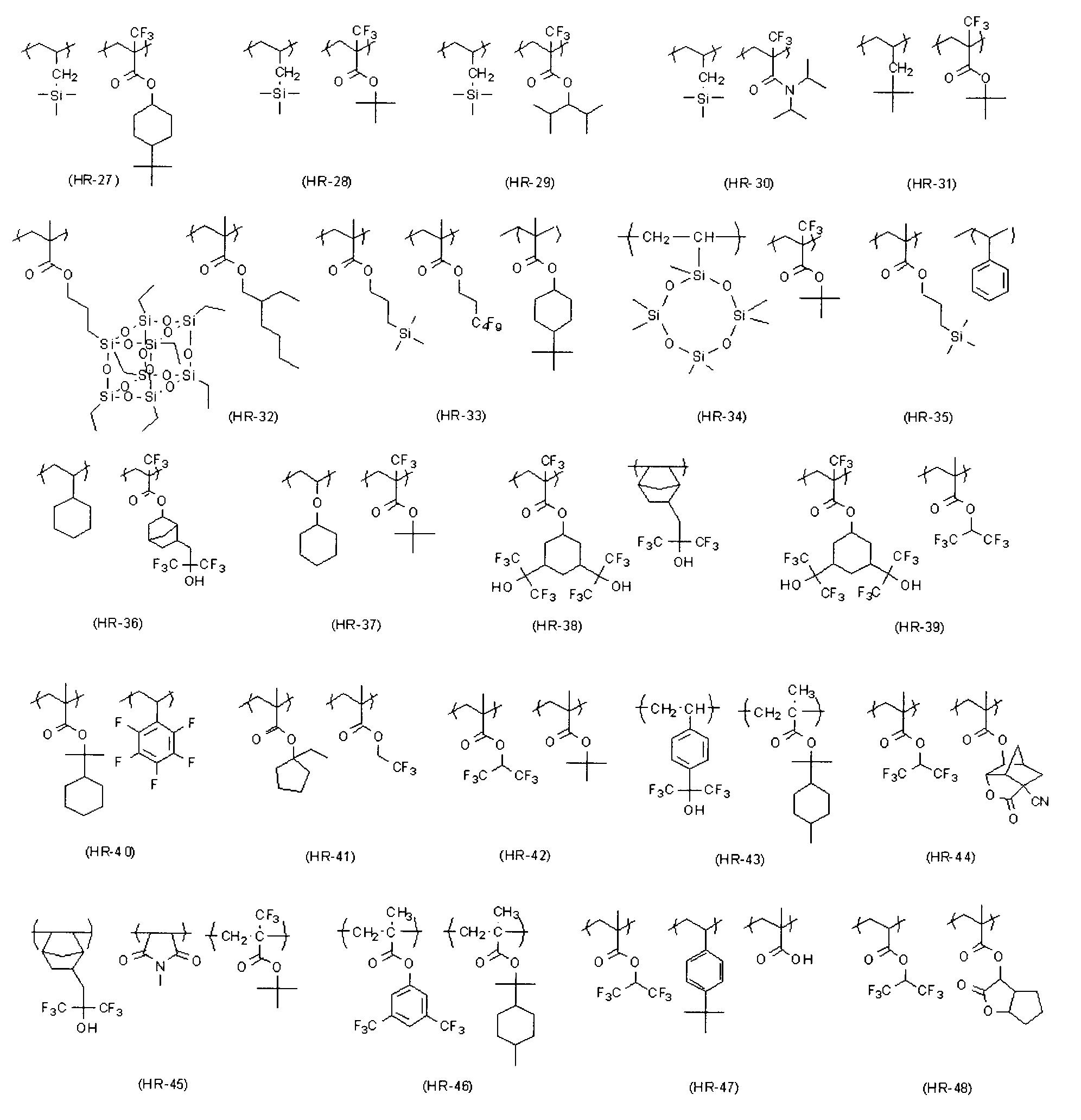
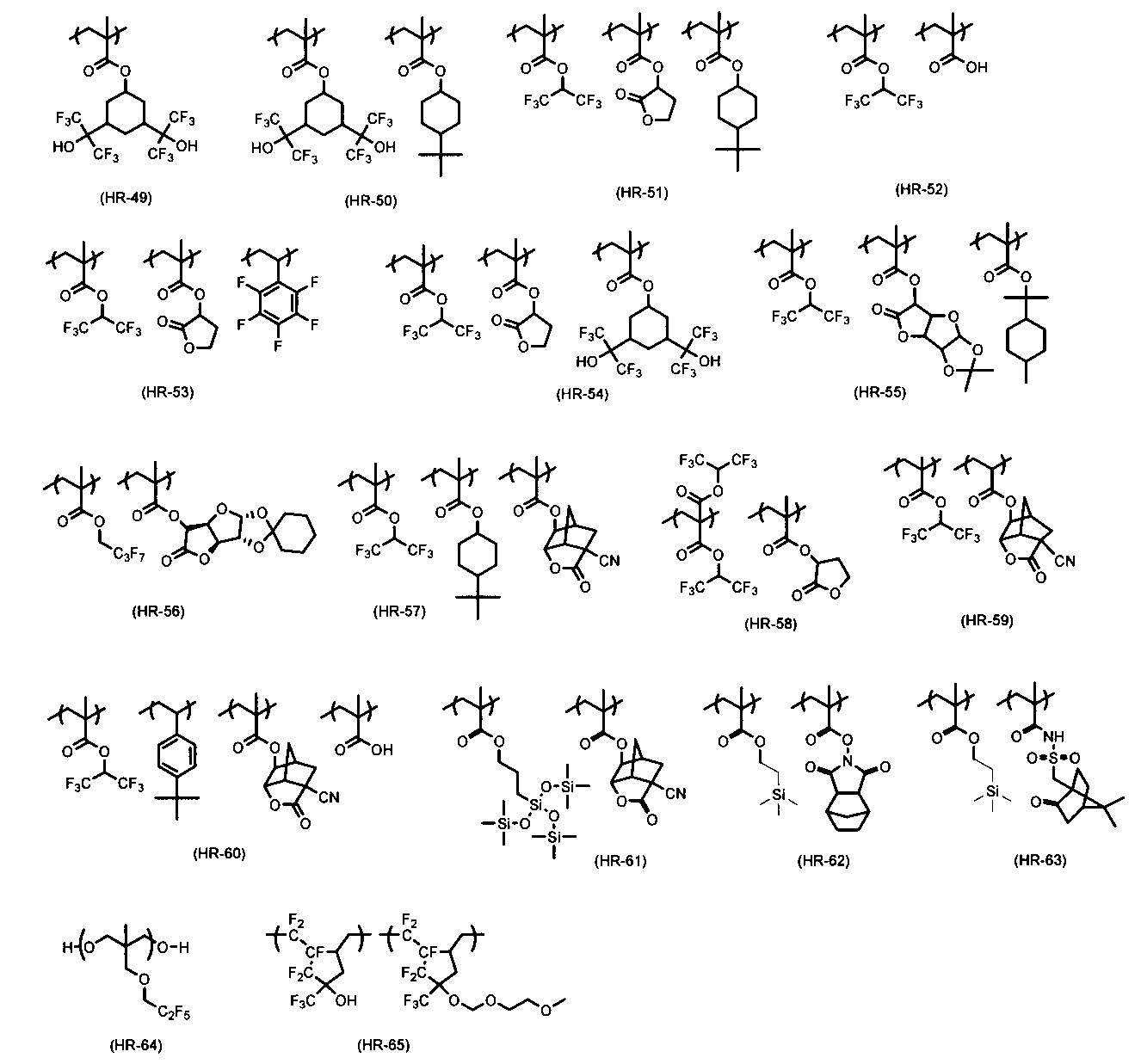
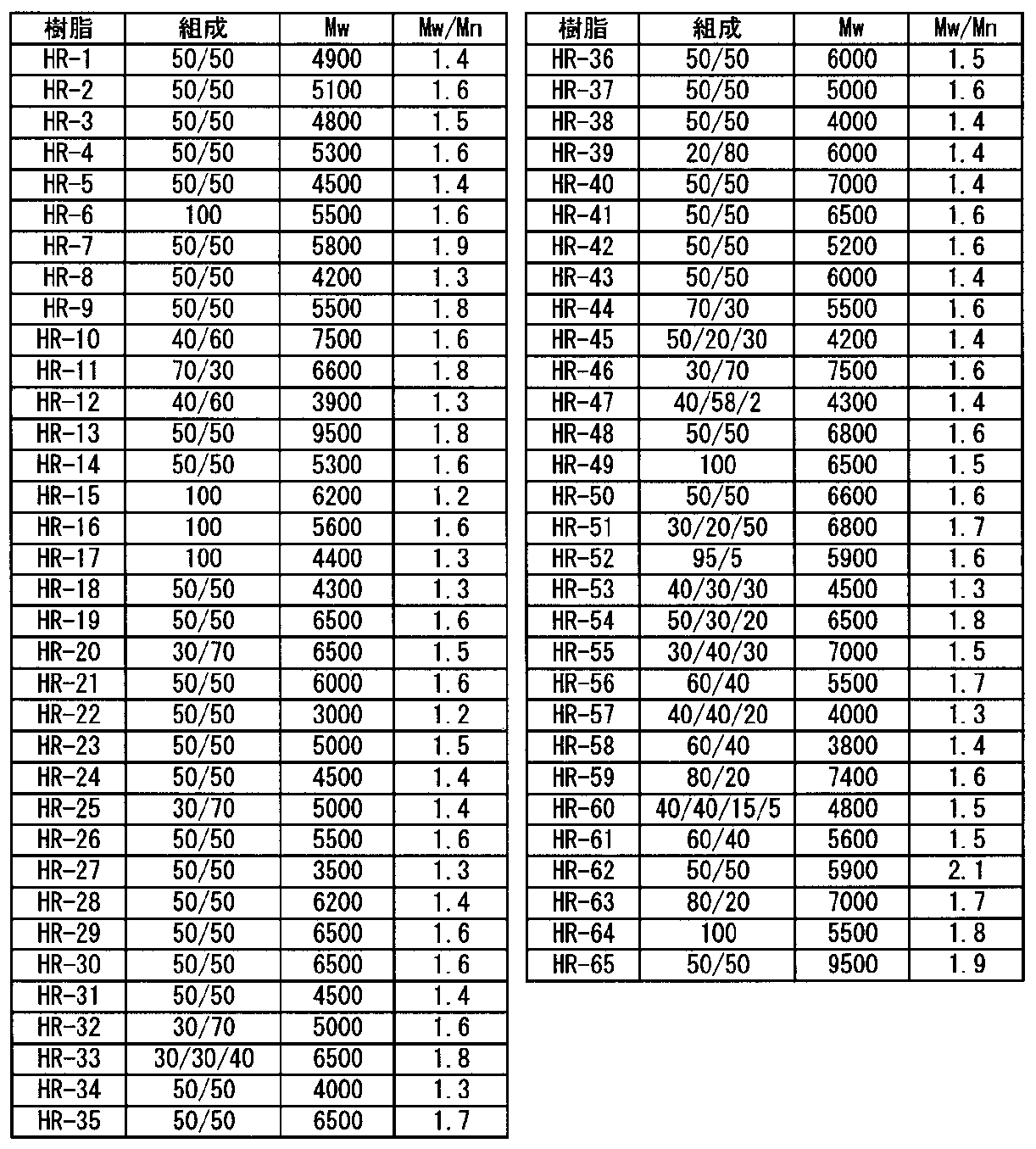
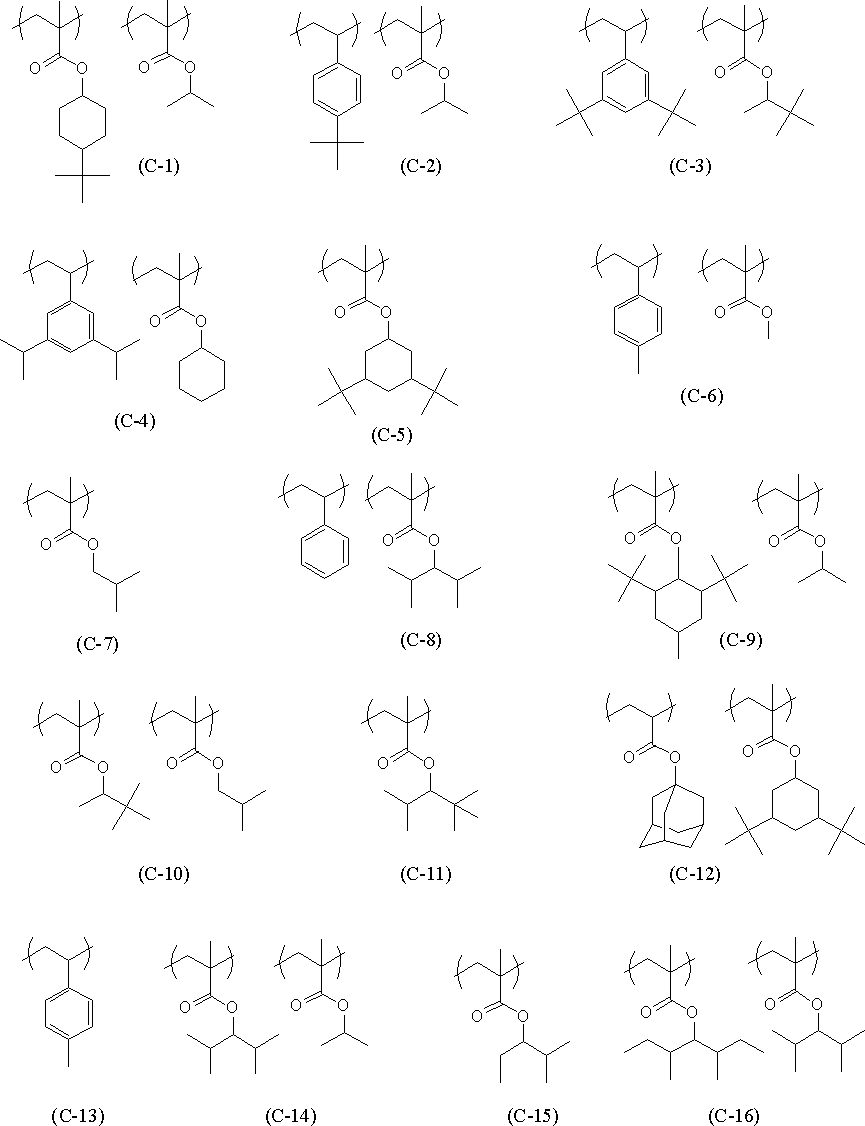
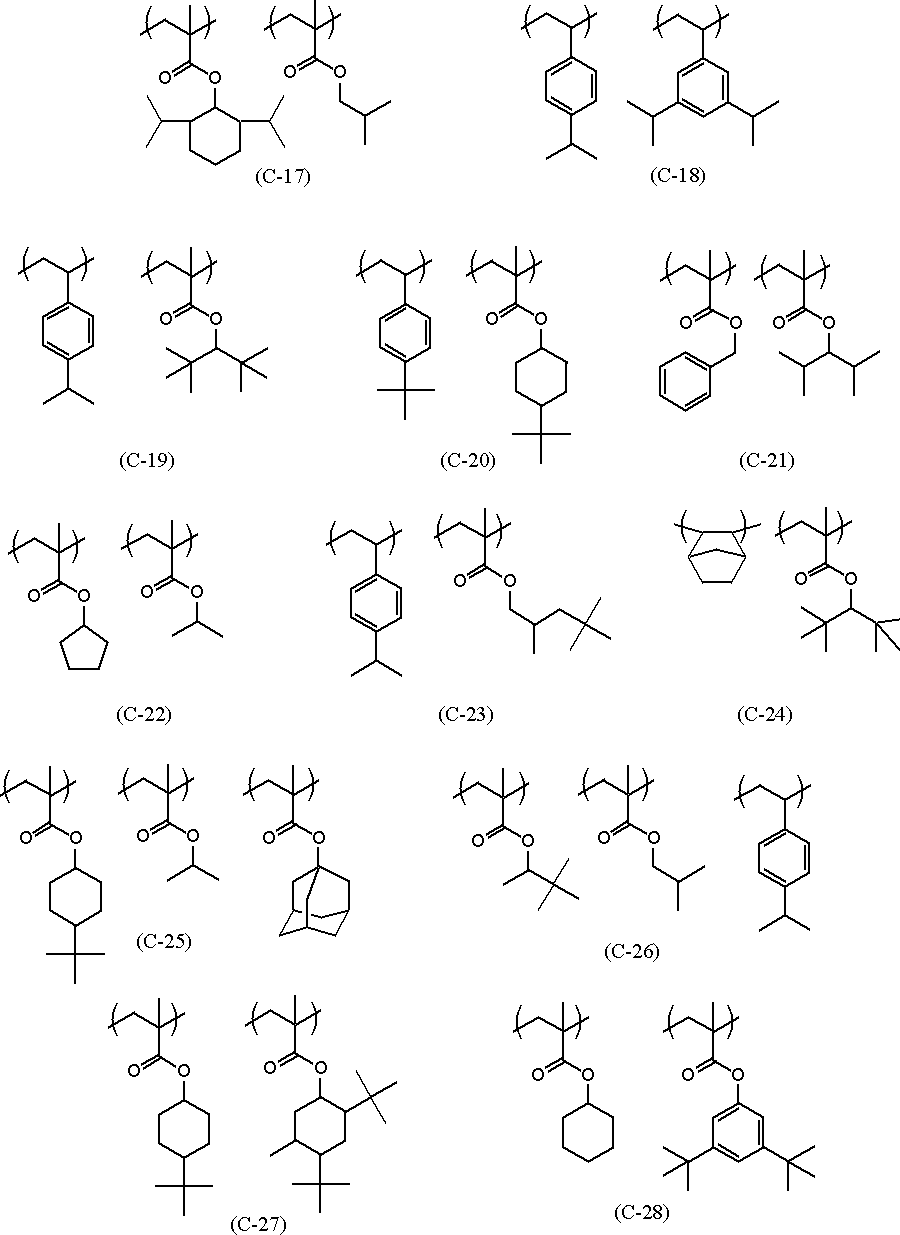
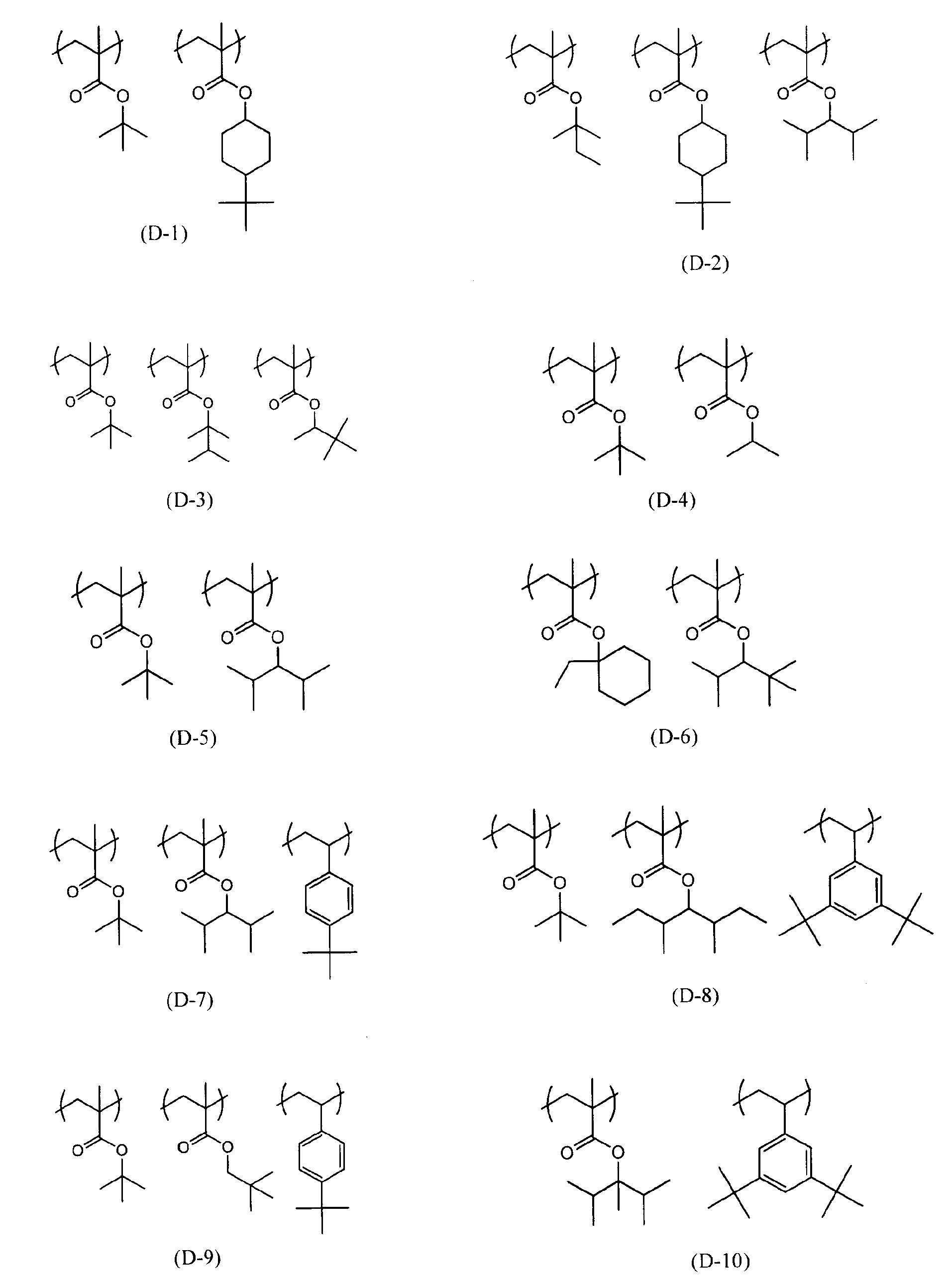


[6]塩基性化合物(N)
本発明における感活性光線性又は感放射線性樹脂組成物は、露光から加熱までの経時による性能変化を低減するために、塩基性化合物(N)を含有していてもよい。
塩基性化合物(N)としては、好ましくは、下記式(A’)~(E’)で示される構造を有する化合物を挙げることができる。
本発明における感活性光線性又は感放射線性樹脂組成物は、露光から加熱までの経時による性能変化を低減するために、塩基性化合物(N)を含有していてもよい。
塩基性化合物(N)としては、好ましくは、下記式(A’)~(E’)で示される構造を有する化合物を挙げることができる。

一般式(A’)と(E’)において、
RA200、RA201及びRA202は、同一でも異なってもよく、水素原子、アルキル基(好ましくは炭素数1~20)、シクロアルキル基(好ましくは炭素数3~20)又はアリール基(炭素数6~20)を表し、ここで、RA201とRA202は、互いに結合して環を形成してもよい。RA203、RA204、RA205及びRA206は、同一でも異なってもよく、アルキル基(好ましくは炭素数1~20)を表す。
上記アルキル基は、置換基を有していてもよく、置換基を有するアルキル基としては、炭素数1~20のアミノアルキル基、炭素数1~20のヒドロキシアルキル基又は炭素数1~20のシアノアルキル基が好ましい。
これら一般式(A’)と(E’)中のアルキル基は、無置換であることがより好ましい。
RA200、RA201及びRA202は、同一でも異なってもよく、水素原子、アルキル基(好ましくは炭素数1~20)、シクロアルキル基(好ましくは炭素数3~20)又はアリール基(炭素数6~20)を表し、ここで、RA201とRA202は、互いに結合して環を形成してもよい。RA203、RA204、RA205及びRA206は、同一でも異なってもよく、アルキル基(好ましくは炭素数1~20)を表す。
上記アルキル基は、置換基を有していてもよく、置換基を有するアルキル基としては、炭素数1~20のアミノアルキル基、炭素数1~20のヒドロキシアルキル基又は炭素数1~20のシアノアルキル基が好ましい。
これら一般式(A’)と(E’)中のアルキル基は、無置換であることがより好ましい。
塩基性化合物(N)の好ましい具体例としては、グアニジン、アミノピロリジン、ピラゾール、ピラゾリン、ピペラジン、アミノモルホリン、アミノアルキルモルフォリン、ピペリジン等を挙げることができ、更に好ましい具体例としては、イミダゾール構造、ジアザビシクロ構造、オニウムヒドロキシド構造、オニウムカルボキシレート構造、トリアルキルアミン構造、アニリン構造又はピリジン構造を有する化合物、水酸基及び/又はエーテル結合を有するアルキルアミン誘導体、水酸基及び/又はエーテル結合を有するアニリン誘導体等を挙げることができる。
イミダゾール構造を有する化合物としては、イミダゾール、2、4、5-トリフェニルイミダゾール、ベンズイミダゾール等が挙げられる。ジアザビシクロ構造を有する化合物としては、1、4-ジアザビシクロ[2,2,2]オクタン、1、5-ジアザビシクロ[4,3,0]ノナ-5-エン、1、8-ジアザビシクロ[5,4,0]ウンデカー7-エン等が挙げられる。オニウムヒドロキシド構造を有する化合物としては、トリアリールスルホニウムヒドロキシド、フェナシルスルホニウムヒドロキシド、2-オキソアルキル基を有するスルホニウムヒドロキシド、具体的にはトリフェニルスルホニウムヒドロキシド、トリス(t-ブチルフェニル)スルホニウムヒドロキシド、ビス(t-ブチルフェニル)ヨードニウムヒドロキシド、フェナシルチオフェニウムヒドロキシド、2-オキソプロピルチオフェニウムヒドロキシド等が挙げられる。オニウムカルボキシレート構造を有する化合物としては、オニウムヒドロキシド構造を有する化合物のアニオン部がカルボキシレートになったものであり、例えばアセテート、アダマンタンー1-カルボキシレート、パーフロロアルキルカルボキシレート等が挙げられる。トリアルキルアミン構造を有する化合物としては、トリ(n-ブチル)アミン、トリ(n-オクチル)アミン等を挙げることができる。アニリン構造を有する化合物としては、2,6-ジイソプロピルアニリン、N,N-ジメチルアニリン、N,N-ジブチルアニリン、N,N-ジヘキシルアニリン等を挙げることができる。水酸基及び/又はエーテル結合を有するアルキルアミン誘導体としては、エタノールアミン、ジエタノールアミン、トリエタノールアミン、トリス(メトキシエトキシエチル)アミン等を挙げることができる。水酸基及び/又はエーテル結合を有するアニリン誘導体としては、N,N-ビス(ヒドロキシエチル)アニリン等を挙げることができる。
好ましい塩基性化合物として、更に、フェノキシ基を有するアミン化合物、フェノキシ基を有するアンモニウム塩化合物、スルホン酸エステル基を有するアミン化合物及びスルホン酸エステル基を有するアンモニウム塩化合物を挙げることができる。
前記フェノキシ基を有するアミン化合物、フェノキシ基を有するアンモニウム塩化合物、スルホン酸エステル基を有するアミン化合物及びスルホン酸エステル基を有するアンモニウム塩化合物は、少なくとも1つのアルキル基が窒素原子に結合していることが好ましい。また、前記アルキル鎖中に、酸素原子を有し、オキシアルキレン基が形成されていることが好ましい。オキシアルキレン基の数は、分子内に1つ以上、好ましくは3~9個、更に好ましくは4~6個である。オキシアルキレン基の中でも-CH2CH2O-、-CH(CH3)CH2O-若しくは-CH2CH2CH2O-の構造が好ましい。
前記フェノキシ基を有するアミン化合物、フェノキシ基を有するアンモニウム塩化合物、スルホン酸エステル基を有するアミン化合物及びスルホン酸エステル基を有するアンモニウム塩化合物の具体例としては、米国特許出願公開2007/0224539号明細書の[0066]に例示されている化合物(C1-1)~(C3-3)が挙げられるが、これらに限定されるものではない。
前記フェノキシ基を有するアミン化合物、フェノキシ基を有するアンモニウム塩化合物、スルホン酸エステル基を有するアミン化合物及びスルホン酸エステル基を有するアンモニウム塩化合物は、少なくとも1つのアルキル基が窒素原子に結合していることが好ましい。また、前記アルキル鎖中に、酸素原子を有し、オキシアルキレン基が形成されていることが好ましい。オキシアルキレン基の数は、分子内に1つ以上、好ましくは3~9個、更に好ましくは4~6個である。オキシアルキレン基の中でも-CH2CH2O-、-CH(CH3)CH2O-若しくは-CH2CH2CH2O-の構造が好ましい。
前記フェノキシ基を有するアミン化合物、フェノキシ基を有するアンモニウム塩化合物、スルホン酸エステル基を有するアミン化合物及びスルホン酸エステル基を有するアンモニウム塩化合物の具体例としては、米国特許出願公開2007/0224539号明細書の[0066]に例示されている化合物(C1-1)~(C3-3)が挙げられるが、これらに限定されるものではない。
また、塩基性化合物の1種として、酸の作用により脱離する基を有する含窒素有機化合物を用いることもできる。この化合物の例として、例えば、下記一般式(F)で表される化合物を挙げることができる。なお、下記一般式(F)で表される化合物は、酸の作用により脱離する基が脱離することによって、系中での実効的な塩基性を発現する。

一般式(F)において、Raは、独立に、水素原子、アルキル基、シクロアルキル基、アリール基又はアラルキル基を示す。また、n=2のとき、2つのRaは同じでも異なっていてもよく、2つのRaは相互に結合して、2価の複素環式炭化水素基(好ましくは炭素数20以下)若しくはその誘導体を形成していてもよい。
Rbは、独立に水素原子、アルキル基、シクロアルキル基、アリール基又はアラルキル基を示す。但し、-C(Rb)(Rb)(Rb)において、1つ以上のRbが水素原子のとき、残りのRbの少なくとも1つはシクロプロピル基又は1-アルコキシアルキル基である。
少なくとも2つのRbは結合して脂環式炭化水素基、芳香族炭化水素基、複素環式炭化水素基若しくはその誘導体を形成していてもよい。
nは0~2の整数を表し、mは1~3の整数をそれぞれ表し、n+m=3である。
Rbは、独立に水素原子、アルキル基、シクロアルキル基、アリール基又はアラルキル基を示す。但し、-C(Rb)(Rb)(Rb)において、1つ以上のRbが水素原子のとき、残りのRbの少なくとも1つはシクロプロピル基又は1-アルコキシアルキル基である。
少なくとも2つのRbは結合して脂環式炭化水素基、芳香族炭化水素基、複素環式炭化水素基若しくはその誘導体を形成していてもよい。
nは0~2の整数を表し、mは1~3の整数をそれぞれ表し、n+m=3である。
一般式(F)で表される化合物の具体例を以下に示す。

上記一般式(F)で表される化合物は、例えば、特開2009-199021号公報に記載の方法に準じて合成することができる。
また、塩基性化合物(N)としては、アミンオキシド構造を有する化合物も用いることもできる。この化合物の具体例としては、トリエチルアミンピリジン N-オキシド、トリブチルアミン N-オキシド、トリエタノールアミン N-オキシド、トリス(メトキシエチル)アミン N-オキシド、トリス(2-(メトキシメトキシ)エチル)アミン=オキシド、2,2’,2”-ニトリロトリエチルプロピオネート N-オキシド、N-2-(2-メトキシエトキシ)メトキシエチルモルホリン N-オキシド、その他特開2008-102383に例示されたアミンオキシド化合物が使用可能である。
また、塩基性化合物(N)としては、US2010/0233629A号公報の(A-1)~(A-44)の化合物や、US2012/0156617A号公報の(A-1)~(A-23)の化合物のような、活性光線又は放射線の照射により分解して、分子中に塩基性構造と有する酸アニオンを発生する化合物も用いることができる。これらの化合物中、とりわけ好ましく用いられる化合物を以下に挙げる。
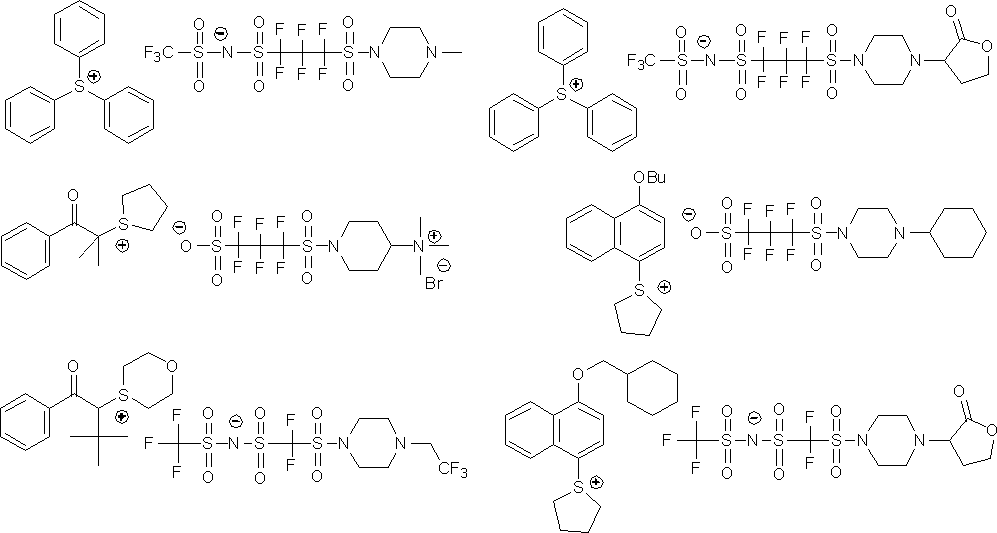
塩基性化合物(N)の分子量は、250~2000であることが好ましく、更に好ましくは400~1000である。LWRのさらなる低減及び局所的なパターン寸法の均一性の観点からは、塩基性化合物の分子量は、400以上であることが好ましく、500以上であることがより好ましく、600以上であることが更に好ましい。
塩基性化合物(N)は、単独であるいは2種以上一緒に用いられる。
本発明における感活性光線性又は感放射線性樹脂組成物は塩基性化合物(N)を含有してもしていなくてもよいが、含有する場合、塩基性化合物(N)の使用量は、感活性光線性又は感放射線性樹脂組成物の固形分を基準として、通常、0.001~10質量%、好ましくは0.01~5質量%である。
[7]界面活性剤(F)
本発明における感活性光線性又は感放射線性樹脂組成物は、更に界面活性剤を含有してもしなくても良く、含有する場合、フッ素及び/又はシリコン系界面活性剤(フッ素系界面活性剤、シリコン系界面活性剤、フッ素原子とケイ素原子の両方を有する界面活性剤)のいずれか、あるいは2種以上を含有することがより好ましい。
本発明における感活性光線性又は感放射線性樹脂組成物は、更に界面活性剤を含有してもしなくても良く、含有する場合、フッ素及び/又はシリコン系界面活性剤(フッ素系界面活性剤、シリコン系界面活性剤、フッ素原子とケイ素原子の両方を有する界面活性剤)のいずれか、あるいは2種以上を含有することがより好ましい。
本発明における感活性光線性又は感放射線性樹脂組成物が界面活性剤を含有することにより、250nm以下、特に220nm以下の露光光源の使用時に、良好な感度及び解像度で、密着性及び現像欠陥の少ないレジストパターンを与えることが可能となる。
フッ素系及び/又はシリコン系界面活性剤として、米国特許出願公開第2008/0248425号明細書の[0276]に記載の界面活性剤が挙げられ、例えばエフトップEF301、EF303、(新秋田化成(株)製)、フロラードFC430、431、4430(住友スリーエム(株)製)、メガファックF171、F173、F176、F189、F113、F110、F177、F120、R08(DIC(株)製)、サーフロンS-382、SC101、102、103、104、105、106、KH-20(旭硝子(株)製)、トロイゾルS-366(トロイケミカル(株)製)、GF-300、GF-150(東亜合成化学(株)製)、サーフロンS-393(セイミケミカル(株)製)、エフトップEF121、EF122A、EF122B、RF122C、EF125M、EF135M、EF351、EF352、EF801、EF802、EF601((株)ジェムコ製)、PF636、PF656、PF6320、PF6520(OMNOVA社製)、FTX-204G、208G、218G、230G、204D、208D、212D、218D、222D((株)ネオス製)等である。またポリシロキサンポリマーKP-341(信越化学工業(株)製)もシリコン系界面活性剤として用いることができる。
フッ素系及び/又はシリコン系界面活性剤として、米国特許出願公開第2008/0248425号明細書の[0276]に記載の界面活性剤が挙げられ、例えばエフトップEF301、EF303、(新秋田化成(株)製)、フロラードFC430、431、4430(住友スリーエム(株)製)、メガファックF171、F173、F176、F189、F113、F110、F177、F120、R08(DIC(株)製)、サーフロンS-382、SC101、102、103、104、105、106、KH-20(旭硝子(株)製)、トロイゾルS-366(トロイケミカル(株)製)、GF-300、GF-150(東亜合成化学(株)製)、サーフロンS-393(セイミケミカル(株)製)、エフトップEF121、EF122A、EF122B、RF122C、EF125M、EF135M、EF351、EF352、EF801、EF802、EF601((株)ジェムコ製)、PF636、PF656、PF6320、PF6520(OMNOVA社製)、FTX-204G、208G、218G、230G、204D、208D、212D、218D、222D((株)ネオス製)等である。またポリシロキサンポリマーKP-341(信越化学工業(株)製)もシリコン系界面活性剤として用いることができる。
また、界面活性剤としては、上記に示すような公知のものの他に、テロメリゼーション法(テロマー法ともいわれる)若しくはオリゴメリゼーション法(オリゴマー法ともいわれる)により製造されたフルオロ脂肪族化合物から導かれたフルオロ脂肪族基を有する重合体を用いた界面活性剤を用いることが出来る。フルオロ脂肪族化合物は、特開2002-90991号公報に記載された方法によって合成することが出来る。
上記に該当する界面活性剤として、メガファックF178、F-470、F-473、F-475、F-476、F-472(DIC(株)製)、C6F13基を有するアクリレート(又はメタクリレート)と(ポリ(オキシアルキレン))アクリレート(又はメタクリレート)との共重合体、C3F7基を有するアクリレート(又はメタクリレート)と(ポリ(オキシエチレン))アクリレート(又はメタクリレート)と(ポリ(オキシプロピレン))アクリレート(又はメタクリレート)との共重合体等を挙げることができる。
上記に該当する界面活性剤として、メガファックF178、F-470、F-473、F-475、F-476、F-472(DIC(株)製)、C6F13基を有するアクリレート(又はメタクリレート)と(ポリ(オキシアルキレン))アクリレート(又はメタクリレート)との共重合体、C3F7基を有するアクリレート(又はメタクリレート)と(ポリ(オキシエチレン))アクリレート(又はメタクリレート)と(ポリ(オキシプロピレン))アクリレート(又はメタクリレート)との共重合体等を挙げることができる。
また、本発明では、米国特許出願公開第2008/0248425号明細書の[0280]に記載の、フッ素系及び/又はシリコン系界面活性剤以外の他の界面活性剤を使用することもできる。
これらの界面活性剤は単独で使用してもよいし、また、いくつかの組み合わせで使用してもよい。
感活性光線性又は感放射線性樹脂組成物が界面活性剤を含有する場合、界面活性剤の使用量は、感活性光線性又は感放射線性樹脂組成物の全量(溶剤を除く)に対して、好ましくは0.0001~2質量%、より好ましくは0.0005~1質量%である。
一方、界面活性剤の添加量を、感活性光線性又は感放射線性樹脂組成物の全量(溶剤を除く)に対して、10ppm以下とすることで、疎水性樹脂の表面偏在性があがり、それにより、レジスト膜表面をより疎水的にすることができ、液浸露光時の水追随性を向上させることが出来る。
一方、界面活性剤の添加量を、感活性光線性又は感放射線性樹脂組成物の全量(溶剤を除く)に対して、10ppm以下とすることで、疎水性樹脂の表面偏在性があがり、それにより、レジスト膜表面をより疎水的にすることができ、液浸露光時の水追随性を向上させることが出来る。
[8]その他添加剤(G)
本発明における感活性光線性又は感放射線性樹脂組成物は、カルボン酸オニウム塩を含有してもしなくても良い。このようなカルボン酸オニウム塩は、米国特許出願公開2008/0187860号明細書[0605]~[0606]に記載のものを挙げることができる。
本発明における感活性光線性又は感放射線性樹脂組成物は、カルボン酸オニウム塩を含有してもしなくても良い。このようなカルボン酸オニウム塩は、米国特許出願公開2008/0187860号明細書[0605]~[0606]に記載のものを挙げることができる。
これらのカルボン酸オニウム塩は、スルホニウムヒドロキシド、ヨードニウムヒドロキシド、アンモニウムヒドロキシドとカルボン酸を適当な溶剤中酸化銀と反応させることによって合成できる。
感活性光線性又は感放射線性樹脂組成物がカルボン酸オニウム塩を含有する場合、その含有量は、組成物の全固形分に対し、一般的には0.1~20質量%、好ましくは0.5~10質量%、更に好ましくは1~7質量%である。
本発明の感活性光線性又は感放射線性樹脂組成物には、必要に応じて更に、酸増殖剤、染料、可塑剤、光増感剤、光吸収剤、アルカリ可溶性樹脂、溶解阻止剤及び現像液に対する溶解性を促進させる化合物(例えば、分子量1000以下のフェノール化合物、カルボキシル基を有する脂環族、又は脂肪族化合物)等を含有させることができる。
本発明の感活性光線性又は感放射線性樹脂組成物には、必要に応じて更に、酸増殖剤、染料、可塑剤、光増感剤、光吸収剤、アルカリ可溶性樹脂、溶解阻止剤及び現像液に対する溶解性を促進させる化合物(例えば、分子量1000以下のフェノール化合物、カルボキシル基を有する脂環族、又は脂肪族化合物)等を含有させることができる。
このような分子量1000以下のフェノール化合物は、例えば、特開平4-122938号、特開平2-28531号、米国特許第4,916,210、欧州特許第219294等に記載の方法を参考にして、当業者において容易に合成することができる。
カルボキシル基を有する脂環族、又は脂肪族化合物の具体例としてはコール酸、デオキシコール酸、リトコール酸などのステロイド構造を有するカルボン酸誘導体、アダマンタンカルボン酸誘導体、アダマンタンジカルボン酸、シクロヘキサンカルボン酸、シクロヘキサンジカルボン酸などが挙げられるがこれらに限定されるものではない。
カルボキシル基を有する脂環族、又は脂肪族化合物の具体例としてはコール酸、デオキシコール酸、リトコール酸などのステロイド構造を有するカルボン酸誘導体、アダマンタンカルボン酸誘導体、アダマンタンジカルボン酸、シクロヘキサンカルボン酸、シクロヘキサンジカルボン酸などが挙げられるがこれらに限定されるものではない。
本発明における感活性光線性又は感放射線性樹脂組成物は、解像力向上の観点から、膜厚30~250nmで使用されることが好ましく、より好ましくは、膜厚30~200nmで使用されることが好ましい。組成物中の固形分濃度を適切な範囲に設定して適度な粘度をもたせ、塗布性、製膜性を向上させることにより、このような膜厚とすることができる。
本発明における感活性光線性又は感放射線性樹脂組成物の固形分濃度は、通常1.0~10質量%であり、好ましくは、2.0~5.7質量%、更に好ましくは2.0~5.3質量%である。固形分濃度を前記範囲とすることで、レジスト溶液を基板上に均一に塗布することができ、更にはラインウィズスラフネスに優れたレジストパターンを形成することが可能になる。その理由は明らかではないが、恐らく、固形分濃度を10質量%以下、好ましくは5.7質量%以下とすることで、レジスト溶液中での素材、特には光酸発生剤の凝集が抑制され、その結果として、均一なレジスト膜が形成できたものと考えられる。
固形分濃度とは、感活性光線性又は感放射線性樹脂組成物の総重量に対する、溶剤を除く他のレジスト成分の重量の重量百分率である。
本発明における感活性光線性又は感放射線性樹脂組成物の固形分濃度は、通常1.0~10質量%であり、好ましくは、2.0~5.7質量%、更に好ましくは2.0~5.3質量%である。固形分濃度を前記範囲とすることで、レジスト溶液を基板上に均一に塗布することができ、更にはラインウィズスラフネスに優れたレジストパターンを形成することが可能になる。その理由は明らかではないが、恐らく、固形分濃度を10質量%以下、好ましくは5.7質量%以下とすることで、レジスト溶液中での素材、特には光酸発生剤の凝集が抑制され、その結果として、均一なレジスト膜が形成できたものと考えられる。
固形分濃度とは、感活性光線性又は感放射線性樹脂組成物の総重量に対する、溶剤を除く他のレジスト成分の重量の重量百分率である。
本発明における感活性光線性又は感放射線性樹脂組成物は、上記の成分を所定の有機溶剤、好ましくは前記混合溶剤に溶解して調製する。
なお、調製の際、イオン交換膜を用いて組成物中のメタル不純物をppbレベルに低減させる工程、適当なフィルターを用いて各種パーティクルなどの不純物をろ過する工程、脱気工程などを行ってもよい。これらの工程の具体的なことについては、特開2012-88574号公報、特開2010-189563号公報、特開2001-12529号公報、特開2001-350266号公報、特開2002-99076号公報、特開平5-307263号公報、特開2010-164980号公報、WO2006/121162A、特開2010-243866号公報、特開2010-020297号公報などに記載されている。
特に、ろ過する工程で用いる適当なフィルターについては、ポアサイズは0.1μm以下、より好ましくは0.05μm以下、更に好ましくは0.03μm以下のポリテトラフロロエチレン製、ポリエチレン製、ナイロン製のものが好ましい。
また、本発明の組成物は、含水率が低いことが好ましい。具体的には、含水率は組成物の全重量中2.5質量%以下が好ましく、1.0質量%以下がより好ましく、0.3質量%以下であることが更に好ましい。
なお、調製の際、イオン交換膜を用いて組成物中のメタル不純物をppbレベルに低減させる工程、適当なフィルターを用いて各種パーティクルなどの不純物をろ過する工程、脱気工程などを行ってもよい。これらの工程の具体的なことについては、特開2012-88574号公報、特開2010-189563号公報、特開2001-12529号公報、特開2001-350266号公報、特開2002-99076号公報、特開平5-307263号公報、特開2010-164980号公報、WO2006/121162A、特開2010-243866号公報、特開2010-020297号公報などに記載されている。
特に、ろ過する工程で用いる適当なフィルターについては、ポアサイズは0.1μm以下、より好ましくは0.05μm以下、更に好ましくは0.03μm以下のポリテトラフロロエチレン製、ポリエチレン製、ナイロン製のものが好ましい。
また、本発明の組成物は、含水率が低いことが好ましい。具体的には、含水率は組成物の全重量中2.5質量%以下が好ましく、1.0質量%以下がより好ましく、0.3質量%以下であることが更に好ましい。
<本発明のパターン形成方法における他の工程>
本発明における露光装置に用いられる光源波長に制限は無いが、赤外光、可視光、紫外光、遠紫外光、極紫外光、X線、電子線等を挙げることができ、好ましくは250nm以下、より好ましくは220nm以下、特に好ましくは1~200nmの波長の遠紫外光、具体的には、KrFエキシマレーザー(248nm)、ArFエキシマレーザー(193nm)、F2エキシマレーザー(157nm)、X線、EUV(13nm)、電子線等であり、KrFエキシマレーザー、ArFエキシマレーザー、EUV又は電子線が好ましく、ArFエキシマレーザーであることがより好ましい。
本発明における露光装置に用いられる光源波長に制限は無いが、赤外光、可視光、紫外光、遠紫外光、極紫外光、X線、電子線等を挙げることができ、好ましくは250nm以下、より好ましくは220nm以下、特に好ましくは1~200nmの波長の遠紫外光、具体的には、KrFエキシマレーザー(248nm)、ArFエキシマレーザー(193nm)、F2エキシマレーザー(157nm)、X線、EUV(13nm)、電子線等であり、KrFエキシマレーザー、ArFエキシマレーザー、EUV又は電子線が好ましく、ArFエキシマレーザーであることがより好ましい。
本発明のパターン形成方法は、(イ)露光工程の後に、(オ)加熱工程を有することが好ましい。
本発明のパターン形成方法は、(イ)露光工程を、複数回有することができる。
本発明のパターン形成方法は、(オ)加熱工程を、複数回有することができる。
本発明のパターン形成方法は、(イ)露光工程を、複数回有することができる。
本発明のパターン形成方法は、(オ)加熱工程を、複数回有することができる。
製膜後、露光工程の前に、前加熱工程(PB;Prebake)を含むことも好ましい。
また、露光工程の後かつ現像工程の前に、露光後加熱工程(PEB;Post Exposure Bake)を含むことも好ましい。
加熱温度はPB、PEB共に70~130℃で行うことが好ましく、80~120℃で行うことがより好ましい。
加熱時間は30~300秒が好ましく、30~180秒がより好ましく、30~90秒が更に好ましい。
加熱は通常の露光・現像機に備わっている手段で行うことができ、ホットプレート等を用いて行っても良い。
ベークにより露光部の反応が促進され、感度やパターンプロファイルが改善する。
また、露光工程の後かつ現像工程の前に、露光後加熱工程(PEB;Post Exposure Bake)を含むことも好ましい。
加熱温度はPB、PEB共に70~130℃で行うことが好ましく、80~120℃で行うことがより好ましい。
加熱時間は30~300秒が好ましく、30~180秒がより好ましく、30~90秒が更に好ましい。
加熱は通常の露光・現像機に備わっている手段で行うことができ、ホットプレート等を用いて行っても良い。
ベークにより露光部の反応が促進され、感度やパターンプロファイルが改善する。
また、露光工程においては液浸露光方法を適用することができる。液浸露光方法は、位相シフト法、変形照明法などの超解像技術と組み合わせることが可能である。
液浸露光を行う場合には、(1)基板上に膜を形成した後、露光する工程の前に、及び/又は(2)液浸液を介して膜に露光する工程の後、膜を加熱する工程の前に、膜の表面を水系の薬液で洗浄する工程を実施してもよい。
液浸液は、露光波長に対して透明であり、かつ膜上に投影される光学像の歪みを最小限に留めるよう、屈折率の温度係数ができる限り小さい液体が好ましいが、特に露光光源がArFエキシマレーザー(波長;193nm)である場合には、上述の観点に加えて、入手の容易さ、取り扱いのし易さといった点から水を用いるのが好ましい。
液浸露光を行う場合には、(1)基板上に膜を形成した後、露光する工程の前に、及び/又は(2)液浸液を介して膜に露光する工程の後、膜を加熱する工程の前に、膜の表面を水系の薬液で洗浄する工程を実施してもよい。
液浸液は、露光波長に対して透明であり、かつ膜上に投影される光学像の歪みを最小限に留めるよう、屈折率の温度係数ができる限り小さい液体が好ましいが、特に露光光源がArFエキシマレーザー(波長;193nm)である場合には、上述の観点に加えて、入手の容易さ、取り扱いのし易さといった点から水を用いるのが好ましい。
水を用いる場合、水の表面張力を減少させるとともに、界面活性力を増大させる添加剤(液体)を僅かな割合で添加しても良い。この添加剤はウエハ上のレジスト層を溶解させず、かつレンズ素子の下面の光学コートに対する影響が無視できるものが好ましい。
このような添加剤としては、例えば、水とほぼ等しい屈折率を有する脂肪族系のアルコールが好ましく、具体的にはメチルアルコール、エチルアルコール、イソプロピルアルコール等が挙げられる。水とほぼ等しい屈折率を有するアルコールを添加することにより、水中のアルコール成分が蒸発して含有濃度が変化しても、液体全体としての屈折率変化を極めて小さくできるといった利点が得られる。
このような添加剤としては、例えば、水とほぼ等しい屈折率を有する脂肪族系のアルコールが好ましく、具体的にはメチルアルコール、エチルアルコール、イソプロピルアルコール等が挙げられる。水とほぼ等しい屈折率を有するアルコールを添加することにより、水中のアルコール成分が蒸発して含有濃度が変化しても、液体全体としての屈折率変化を極めて小さくできるといった利点が得られる。
一方で、193nm光に対して不透明な物質や屈折率が水と大きく異なる不純物が混入した場合、レジスト上に投影される光学像の歪みを招くため、使用する水としては、蒸留水が好ましい。更にイオン交換フィルター等を通して濾過を行った純水を用いてもよい。
液浸液として用いる水の電気抵抗は、18.3MΩcm以上であることが望ましく、TOC(有機物濃度)は20ppb以下であることが望ましく、脱気処理をしていることが望ましい。
また、液浸液の屈折率を高めることにより、リソグラフィー性能を高めることが可能である。このような観点から、屈折率を高めるような添加剤を水に加えたり、水の代わりに重水(D2O)を用いたりしてもよい。
液浸液として用いる水の電気抵抗は、18.3MΩcm以上であることが望ましく、TOC(有機物濃度)は20ppb以下であることが望ましく、脱気処理をしていることが望ましい。
また、液浸液の屈折率を高めることにより、リソグラフィー性能を高めることが可能である。このような観点から、屈折率を高めるような添加剤を水に加えたり、水の代わりに重水(D2O)を用いたりしてもよい。
本発明における感活性光線性又は感放射線性樹脂組成物を用いて形成したレジスト膜の後退接触角は温度23±3℃、湿度45±5%において70°以上であり、液浸媒体を介して露光する場合に好適であり、75°以上であることが好ましく、75~85°であることがより好ましい。
前記後退接触角が小さすぎると、液浸媒体を介して露光する場合に好適に用いることができない。好ましい後退接触角を実現する為には、前記の疎水性樹脂(D)を前記感活性光線性又は放射線性組成物に含ませることが好ましい。あるいは、レジスト膜の上に、疎水性の樹脂組成物によるコーティング層(いわゆる「トップコート」)を形成することにより後退接触角を向上させてもよい。適用可能なトップコートは特に限定されず、本技術分野で公知のものを適宜用いることができる。また、特開2013-61647号公報、特にその実施例表3のOC-5~OC-11に記載されているような、樹脂だけで無く塩基性化合物(クエンチャー)も含むトップコートを適用し、パターンの形状調整などに補助的機能を与えることも考えられる。
液浸露光工程に於いては、露光ヘッドが高速でウエハ上をスキャンし露光パターンを形成していく動きに追随して、液浸液がウエハ上を動く必要があるので、動的な状態に於けるレジスト膜に対する液浸液の接触角が重要になり、液滴が残存することなく、露光ヘッドの高速なスキャンに追随する性能がレジストには求められる。
前記後退接触角が小さすぎると、液浸媒体を介して露光する場合に好適に用いることができない。好ましい後退接触角を実現する為には、前記の疎水性樹脂(D)を前記感活性光線性又は放射線性組成物に含ませることが好ましい。あるいは、レジスト膜の上に、疎水性の樹脂組成物によるコーティング層(いわゆる「トップコート」)を形成することにより後退接触角を向上させてもよい。適用可能なトップコートは特に限定されず、本技術分野で公知のものを適宜用いることができる。また、特開2013-61647号公報、特にその実施例表3のOC-5~OC-11に記載されているような、樹脂だけで無く塩基性化合物(クエンチャー)も含むトップコートを適用し、パターンの形状調整などに補助的機能を与えることも考えられる。
液浸露光工程に於いては、露光ヘッドが高速でウエハ上をスキャンし露光パターンを形成していく動きに追随して、液浸液がウエハ上を動く必要があるので、動的な状態に於けるレジスト膜に対する液浸液の接触角が重要になり、液滴が残存することなく、露光ヘッドの高速なスキャンに追随する性能がレジストには求められる。
本発明のパターン形成方法における現像液は現像液全量に対して有機溶剤を80質量%以上含む有機系現像液である。
特に、有機系現像液は、ケトン系溶剤、エステル系溶剤、アルコール系溶剤、アミド系溶剤及びエーテル系溶剤からなる群より選択される少なくとも1種類の有機溶剤を含有する現像液であるのが好ましく、ケトン系溶剤及びエステル系溶剤からなる群より選択される少なくとも1種類の有機溶剤を含有する現像液であるのがより好ましく、とりわけ、エステル系溶剤としての酢酸ブチル又はケトン系溶剤としてのメチルアミルケトン(2-ヘプタノン)を含む現像液であることが好ましい。
有機系現像液は、単独の溶剤からなってもよいし、2種以上の溶剤からなっていてもよい。また、有機系現像液は、有機溶剤以外に水を含有しても良い。
但し、本発明の効果を十二分に奏するためには、現像液全体としての含水率が10質量%未満であることが好ましく、実質的に水分を含有しないことがより好ましい。
すなわち、有機系現像液に対する有機溶剤の使用量は、現像液の全量に対して、90質量%以上100質量%以下であることが好ましく、95質量%以上100質量%以下であることが好ましい。
但し、本発明の効果を十二分に奏するためには、現像液全体としての含水率が10質量%未満であることが好ましく、実質的に水分を含有しないことがより好ましい。
すなわち、有機系現像液に対する有機溶剤の使用量は、現像液の全量に対して、90質量%以上100質量%以下であることが好ましく、95質量%以上100質量%以下であることが好ましい。
有機系現像液の蒸気圧は、20℃に於いて、5kPa以下が好ましく、3kPa以下が更に好ましく、2kPa以下が特に好ましい。有機系現像液の蒸気圧を5kPa以下にすることにより、現像液の基板上あるいは現像カップ内での蒸発が抑制され、ウエハ面内の温度均一性が向上し、結果としてウエハ面内の寸法均一性が良化する。
有機系現像液には、必要に応じて界面活性剤を適当量添加することができる。
界面活性剤としては特に限定されないが、例えば、イオン性や非イオン性のフッ素系及び/又はシリコン系界面活性剤等を用いることができる。これらのフッ素及び/又はシリコン系界面活性剤として、例えば特開昭62-36663号公報、特開昭61-226746号公報、特開昭61-226745号公報、特開昭62-170950号公報、特開昭63-34540号公報、特開平7-230165号公報、特開平8-62834号公報、特開平9-54432号公報、特開平9-5988号公報、米国特許第5405720号明細書、同5360692号明細書、同5529881号明細書、同5296330号明細書、同5436098号明細書、同5576143号明細書、同5294511号明細書、同5824451号明細書記載の界面活性剤を挙げることができ、好ましくは、非イオン性の界面活性剤である。非イオン性の界面活性剤としては特に限定されないが、フッ素系界面活性剤又はシリコン系界面活性剤を用いることが更に好ましい。
界面活性剤の使用量は現像液の全量に対して、通常0.001~5質量%、好ましくは0.005~2質量%、更に好ましくは0.01~0.5質量%である。
また、有機系現像液は、特許第5056974号の0041段落~0063段落に例示されているような、含窒素化合物を含む態様であってもよい。
界面活性剤としては特に限定されないが、例えば、イオン性や非イオン性のフッ素系及び/又はシリコン系界面活性剤等を用いることができる。これらのフッ素及び/又はシリコン系界面活性剤として、例えば特開昭62-36663号公報、特開昭61-226746号公報、特開昭61-226745号公報、特開昭62-170950号公報、特開昭63-34540号公報、特開平7-230165号公報、特開平8-62834号公報、特開平9-54432号公報、特開平9-5988号公報、米国特許第5405720号明細書、同5360692号明細書、同5529881号明細書、同5296330号明細書、同5436098号明細書、同5576143号明細書、同5294511号明細書、同5824451号明細書記載の界面活性剤を挙げることができ、好ましくは、非イオン性の界面活性剤である。非イオン性の界面活性剤としては特に限定されないが、フッ素系界面活性剤又はシリコン系界面活性剤を用いることが更に好ましい。
界面活性剤の使用量は現像液の全量に対して、通常0.001~5質量%、好ましくは0.005~2質量%、更に好ましくは0.01~0.5質量%である。
また、有機系現像液は、特許第5056974号の0041段落~0063段落に例示されているような、含窒素化合物を含む態様であってもよい。
現像方法としては、たとえば、現像液が満たされた槽中に基板を一定時間浸漬する方法(ディップ法)、基板表面に現像液を表面張力によって盛り上げて一定時間静止することで現像する方法(パドル法)、基板表面に現像液を噴霧する方法(スプレー法)、一定速度で回転している基板上に一定速度で現像液吐出ノズルをスキャンしながら現像液を吐出しつづける方法(ダイナミックディスペンス法)などを適用することができる。
上記各種の現像方法が、現像装置の現像ノズルから現像液をレジスト膜に向けて吐出する工程を含む場合、吐出される現像液の吐出圧(吐出される現像液の単位面積あたりの流速)は、一例として、好ましくは2mL/sec/mm2以下、より好ましくは1.5mL/sec/mm2以下、更に好ましくは1mL/sec/mm2以下である。流速の下限は特に無いが、スループットを考慮すると0.2mL/sec/mm2以上が好ましい。この詳細については、特開2010-232550号公報の特に0022段落~0029段落等に記載されている。
また、有機溶剤を含む現像液を用いて現像する工程の後に、他の溶媒に置換しながら、現像を停止する工程を実施してもよい。
上記各種の現像方法が、現像装置の現像ノズルから現像液をレジスト膜に向けて吐出する工程を含む場合、吐出される現像液の吐出圧(吐出される現像液の単位面積あたりの流速)は、一例として、好ましくは2mL/sec/mm2以下、より好ましくは1.5mL/sec/mm2以下、更に好ましくは1mL/sec/mm2以下である。流速の下限は特に無いが、スループットを考慮すると0.2mL/sec/mm2以上が好ましい。この詳細については、特開2010-232550号公報の特に0022段落~0029段落等に記載されている。
また、有機溶剤を含む現像液を用いて現像する工程の後に、他の溶媒に置換しながら、現像を停止する工程を実施してもよい。
本発明のパターン形成方法は、(カ)アルカリ現像液を用いて現像する工程を更に有していてもよい。
アルカリ現像液としては、一般的には、テトラメチルアンモニウムヒドロキシドの2.38質量%の水溶液が用いられるが、これ以外の濃度(例えば、より薄い濃度)のものも使用可能である。また、アルカリ性水溶液にアルコール類、界面活性剤を適当量添加して使用することもできる。
アルカリ現像液のアルカリ濃度は、通常0.1~20質量%である。
アルカリ現像の後に行うリンス処理におけるリンス液としては、好ましくは純水を使用し、界面活性剤を適当量添加して使用することもできる。
また、現像処理又はリンス処理の後に、パターン上に付着している現像液又はリンス液を超臨界流体により除去する処理を行うことができる。
アルカリ現像液としては、一般的には、テトラメチルアンモニウムヒドロキシドの2.38質量%の水溶液が用いられるが、これ以外の濃度(例えば、より薄い濃度)のものも使用可能である。また、アルカリ性水溶液にアルコール類、界面活性剤を適当量添加して使用することもできる。
アルカリ現像液のアルカリ濃度は、通常0.1~20質量%である。
アルカリ現像の後に行うリンス処理におけるリンス液としては、好ましくは純水を使用し、界面活性剤を適当量添加して使用することもできる。
また、現像処理又はリンス処理の後に、パターン上に付着している現像液又はリンス液を超臨界流体により除去する処理を行うことができる。
本発明のレジスト膜は、上記感活性光線性又は感放射線性樹脂組成物によって形成される膜であり、例えば、基材に、感活性光線性又は感放射線性樹脂組成物を塗布することにより形成される膜である。本発明のパターン形成方法に於いて、感活性光線性又は感放射線性樹脂組成物による膜を基板上に形成する工程、膜を露光する工程、及び現像工程は、一般的に知られている方法により行うことができる。
本発明において膜を形成する基板は特に限定されるものではなく、シリコン、SiN、SiO2やSiN等の無機基板、SOG等の塗布系無機基板等、IC等の半導体製造工程、液晶、サーマルヘッド等の回路基板の製造工程、更にはその他のフォトファブリケーションのリソグラフィー工程で一般的に用いられる基板を用いることができる。更に、必要に応じて、レジスト膜と基板の間に反射防止膜を形成させてもよい。反射防止膜としては、公知の有機系、無機系の反射防止膜を適宜用いることができる。
有機溶剤を含む現像液を用いて現像する工程の後には、(エ)リンス液を用いて洗浄する工程を含むことが好ましい。このリンス液としては、レジストパターンを溶解しなければ特に制限はなく、一般的な有機溶剤を含む溶液を使用することができる。前記リンス液としては、炭化水素系溶剤、ケトン系溶剤、エステル系溶剤、アルコール系溶剤、アミド系溶剤及びエーテル系溶剤からなる群より選択される少なくとも1種類の有機溶剤を含有するリンス液を用いることが好ましい。
炭化水素系溶剤、ケトン系溶剤、エステル系溶剤、アルコール系溶剤、アミド系溶剤及びエーテル系溶剤の具体例としては、有機溶剤を含む現像液において説明したものと同様のものを挙げることができる。
炭化水素系溶剤、ケトン系溶剤、エステル系溶剤、アルコール系溶剤、アミド系溶剤及びエーテル系溶剤の具体例としては、有機溶剤を含む現像液において説明したものと同様のものを挙げることができる。
有機溶剤を含む現像液を用いて現像する工程の後に、より好ましくは、ケトン系溶剤、エステル系溶剤、アルコール系溶剤、アミド系溶剤からなる群より選択される少なくとも1種類の有機溶剤を含有するリンス液を用いて洗浄する工程を行い、更に好ましくは、アルコール系溶剤又はエステル系溶剤を含有するリンス液を用いて洗浄する工程を行い、特に好ましくは、1価アルコールを含有するリンス液を用いて洗浄する工程を行い、最も好ましくは、炭素数5以上の1価アルコールを含有するリンス液を用いて洗浄する工程を行う。
ここで、リンス工程で用いられる1価アルコールとしては、直鎖状、分岐状、環状の1価アルコールが挙げられ、具体的には、1-ヘキサノール、2-ヘキサノール、4-メチル-2-ペンタノール、1-ペンタノール、3-メチル-1-ブタノールなどを用いることができる。
ここで、リンス工程で用いられる1価アルコールとしては、直鎖状、分岐状、環状の1価アルコールが挙げられ、具体的には、1-ヘキサノール、2-ヘキサノール、4-メチル-2-ペンタノール、1-ペンタノール、3-メチル-1-ブタノールなどを用いることができる。
前記各成分は、複数混合してもよいし、上記以外の有機溶剤と混合し使用してもよい。
リンス液中の含水率は、10質量%以下が好ましく、より好ましくは5質量%以下、特に好ましくは3質量%以下である。含水率を10質量%以下にすることで、良好な現像特性を得ることができる。
有機溶剤を含む現像液を用いて現像する工程の後に用いるリンス液の蒸気圧は、20℃に於いて0.05kPa以上、5kPa以下が好ましく、0.1kPa以上、5kPa以下が更に好ましく、0.12kPa以上、3kPa以下が最も好ましい。リンス液の蒸気圧を0.05kPa以上、5kPa以下にすることにより、ウエハ面内の温度均一性が向上し、更にはリンス液の浸透に起因した膨潤が抑制され、ウエハ面内の寸法均一性が良化する。
リンス液には、界面活性剤を適当量添加して使用することもできる。
リンス工程においては、有機溶剤を含む現像液を用いる現像を行ったウエハを前記の有機溶剤を含むリンス液を用いて洗浄処理する。洗浄処理の方法は特に限定されないが、たとえば、一定速度で回転している基板上にリンス液を吐出しつづける方法(回転塗布法)、リンス液が満たされた槽中に基板を一定時間浸漬する方法(ディップ法)、基板表面にリンス液を噴霧する方法(スプレー法)、などを適用することができ、この中でも回転塗布方法で洗浄処理を行い、洗浄後に基板を2000rpm~4000rpmの回転数で回転させ、リンス液を基板上から除去することが好ましい。また、リンス工程の後に加熱工程(Post Bake)を含むことも好ましい。ベークによりパターン間及びパターン内部に残留した現像液及びリンス液が除去される。リンス工程の後の加熱工程は、通常40~160℃、好ましくは70~95℃で、通常10秒~3分、好ましくは30秒から90秒間行う。
本発明のパターン形成方法で最終的に得られたパターンは、通常、いわゆるエッチングプロセスやイオンインプランテーションプロセスでの「マスク」用途に用いられる。しかし、その他の用途への適用を排除するものではない。その他の用途としては、例えば、DSA(Directed Self-Assembly)におけるガイドパターン形成(例えば、ACS Nano Vol.4 No.8 Page4815-4823参照)、いわゆるスペーサープロセスの芯材(コア)としての使用(例えば特開平3-270227号公報、特開2013-164509号公報など参照)などがある。
また、本発明は、上記した本発明のパターン形成方法を含む、電子デバイスの製造方法、及び、この製造方法により製造された電子デバイスにも関する。
本発明の電子デバイスは、電気電子機器(家電、OA・メディア関連機器、光学用機器及び通信機器等)に、好適に、搭載されるものである。
また、本発明は、上記した本発明のパターン形成方法を含む、電子デバイスの製造方法、及び、この製造方法により製造された電子デバイスにも関する。
本発明の電子デバイスは、電気電子機器(家電、OA・メディア関連機器、光学用機器及び通信機器等)に、好適に、搭載されるものである。
<合成例(樹脂A-1の合成)>
シクロヘキサノン 102.3質量部を窒素気流下、80℃に加熱した。この液を攪拌しながら、下記構造式M-1で表されるモノマー 22.2質量部、下記構造式M-2で表されるモノマー 19.7質量部、下記構造式M-3で表されるモノマー 2.4質量部、シクロヘキサノン 189.9質量部、2,2’-アゾビスイソ酪酸ジメチル〔V-601、和光純薬工業(株)製〕0.9質量部の混合溶液を5時間かけて滴下した。滴下終了後、80℃で更に2時間攪拌した。反応液を放冷後、多量のヘキサン/酢酸エチル(質量比9:1)で再沈殿、ろ過し、得られた固体を真空乾燥することで、本発明の樹脂(A-1)を40.1質量部得た。
シクロヘキサノン 102.3質量部を窒素気流下、80℃に加熱した。この液を攪拌しながら、下記構造式M-1で表されるモノマー 22.2質量部、下記構造式M-2で表されるモノマー 19.7質量部、下記構造式M-3で表されるモノマー 2.4質量部、シクロヘキサノン 189.9質量部、2,2’-アゾビスイソ酪酸ジメチル〔V-601、和光純薬工業(株)製〕0.9質量部の混合溶液を5時間かけて滴下した。滴下終了後、80℃で更に2時間攪拌した。反応液を放冷後、多量のヘキサン/酢酸エチル(質量比9:1)で再沈殿、ろ過し、得られた固体を真空乾燥することで、本発明の樹脂(A-1)を40.1質量部得た。
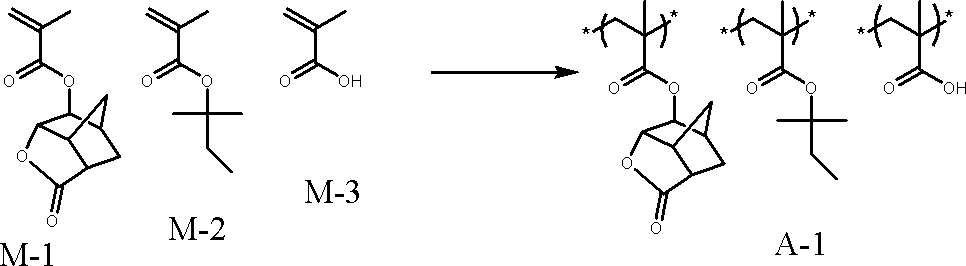
得られた樹脂のGPC(キャリア:テトラヒドロフラン(THF))から求めた重量平均分子量(Mw:ポリスチレン換算)は、Mw=19558、分散度はMw/Mn=1.90であった。13C-NMRにより測定した組成比(モル比)は40/50/10であった。
<合成例(樹脂A-5の合成)>
シクロヘキサノン 102.3質量部を窒素気流下、80℃に加熱した。この液を攪拌しながら、下記構造式M-1で表されるモノマー 22.2質量部、下記構造式M-4で表されるモノマー 21.6質量部、下記構造式M-3で表されるモノマー 1.2質量部、シクロヘキサノン 189.9質量部、2,2’-アゾビスイソ酪酸ジメチル〔V-601、和光純薬工業(株)製〕1.3質量部の混合溶液を5時間かけて滴下した。滴下終了後、80℃で更に2時間攪拌した。反応液を放冷後、1000質量部のヘキサン/酢酸エチル(質量比9:1)で再沈殿、ろ過し、得られた固体を真空乾燥することで、樹脂を41.3質量部得た。この得られた樹脂に対し、シクロヘキサノン 62質量部、純水62質量部を窒素気流下で加えた。この液を攪拌しながら、NaHCO3(TCI社製)を5.1質量部、テトラブチルアンモニウムブロミド(アルドリッチ社製)を5.1質量部を加え、混合液を4時間攪拌した。反応液を1000質量部の水で再沈殿、ろ過し、得られた固体を真空乾燥することで本発明の樹脂(A-5)を41.7質量部得た。
得られた樹脂のGPC(キャリア:テトラヒドロフラン(THF))から求めた重量平均分子量(Mw:ポリスチレン換算)は、Mw=12344、分散度はMw/Mn=1.97であった。13C-NMRにより測定した組成比(モル比)は40/55/5であった。
シクロヘキサノン 102.3質量部を窒素気流下、80℃に加熱した。この液を攪拌しながら、下記構造式M-1で表されるモノマー 22.2質量部、下記構造式M-4で表されるモノマー 21.6質量部、下記構造式M-3で表されるモノマー 1.2質量部、シクロヘキサノン 189.9質量部、2,2’-アゾビスイソ酪酸ジメチル〔V-601、和光純薬工業(株)製〕1.3質量部の混合溶液を5時間かけて滴下した。滴下終了後、80℃で更に2時間攪拌した。反応液を放冷後、1000質量部のヘキサン/酢酸エチル(質量比9:1)で再沈殿、ろ過し、得られた固体を真空乾燥することで、樹脂を41.3質量部得た。この得られた樹脂に対し、シクロヘキサノン 62質量部、純水62質量部を窒素気流下で加えた。この液を攪拌しながら、NaHCO3(TCI社製)を5.1質量部、テトラブチルアンモニウムブロミド(アルドリッチ社製)を5.1質量部を加え、混合液を4時間攪拌した。反応液を1000質量部の水で再沈殿、ろ過し、得られた固体を真空乾燥することで本発明の樹脂(A-5)を41.7質量部得た。
得られた樹脂のGPC(キャリア:テトラヒドロフラン(THF))から求めた重量平均分子量(Mw:ポリスチレン換算)は、Mw=12344、分散度はMw/Mn=1.97であった。13C-NMRにより測定した組成比(モル比)は40/55/5であった。

<樹脂(A)>
以下、同様にして、樹脂A-2~A-4及びA-6~A-8を合成した。以下、樹脂A-1及びA-5も含めて、合成した樹脂A-2~A-4、A-6~A-8を以下に記す。
以下、同様にして、樹脂A-2~A-4及びA-6~A-8を合成した。以下、樹脂A-1及びA-5も含めて、合成した樹脂A-2~A-4、A-6~A-8を以下に記す。

また、各繰り返し単位の組成比(モル比;左から順に対応)、重量平均分子量(Mw)、分散度(Mw/Mn)を下表に示す。
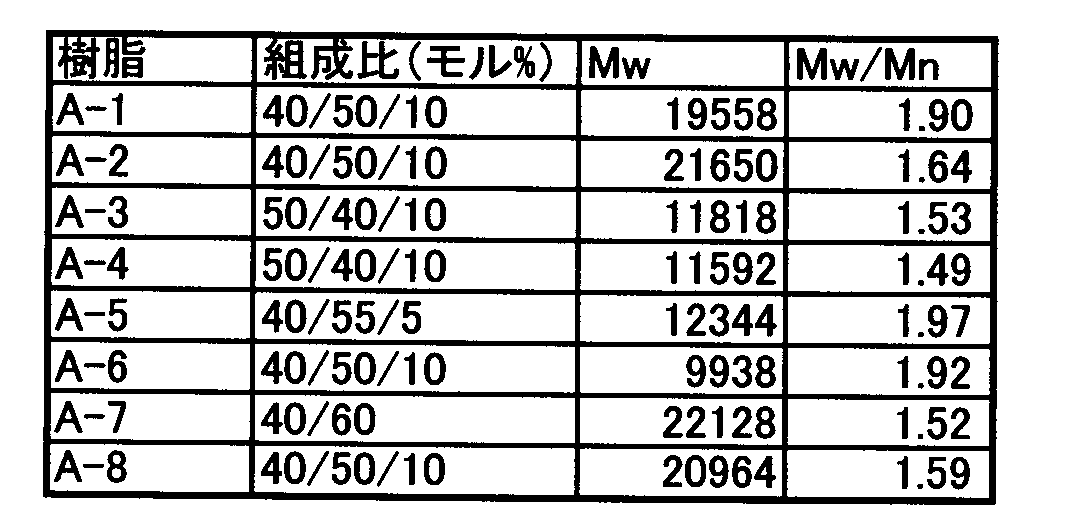
<疎水性樹脂>
以下、同様にして、樹脂D-1及びD-2を合成した。合成した樹脂D-1及びD-2を以下に記す。
以下、同様にして、樹脂D-1及びD-2を合成した。合成した樹脂D-1及びD-2を以下に記す。

樹脂D-1及びD-2における繰り返し単位の組成比(モル比;左から順に対応)、重量平均分子量(Mw)、分散度(Mw/Mn)を以下に示す。
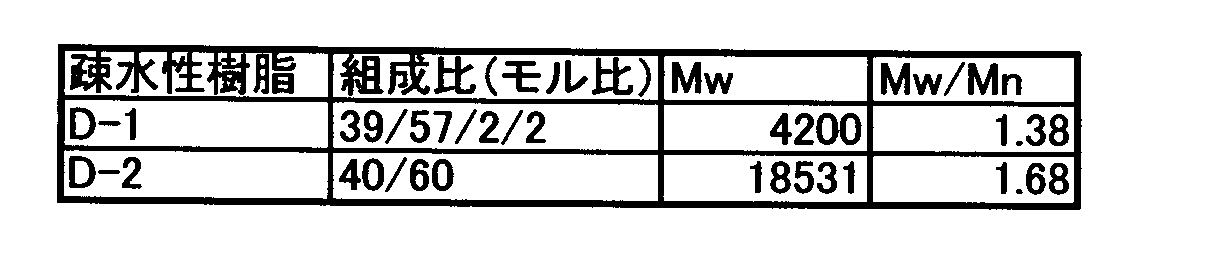
<アニオン部分のpKaが0.0~10.0のイオン性化合物(S)>
アニオン部分のpKaが0.0~10.0のイオン性化合物(S)としては、前掲のS-1~S-4を使用した。
また、比較例用の化合物としては、下記S-a~S-cを使用した。
アニオン部分のpKaが0.0~10.0のイオン性化合物(S)としては、前掲のS-1~S-4を使用した。
また、比較例用の化合物としては、下記S-a~S-cを使用した。
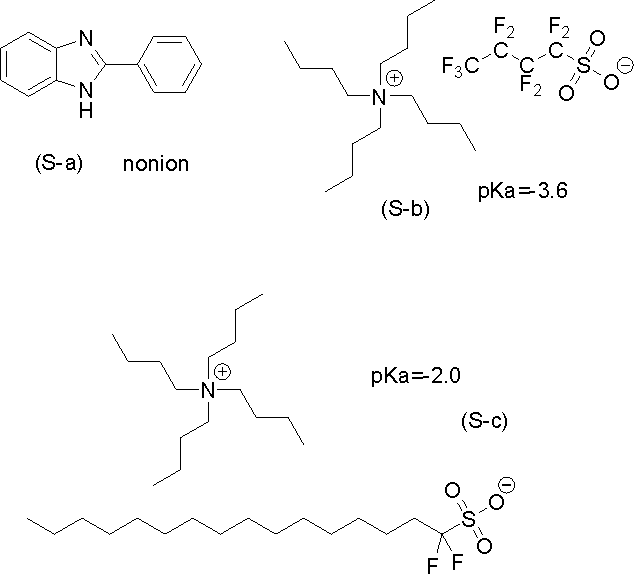
<酸発生剤>
酸発生剤としては、以下の化合物を用いた。
酸発生剤としては、以下の化合物を用いた。

<溶剤>
溶剤としては、以下のものを用いた。
PGMEA:プロピレングリコールモノメチルエーテルアセテート
PGME:プロピレングリコールモノメチルエーテル
CyHx:シクロヘキサノン
γBL:γ-ブチロラクトン
溶剤としては、以下のものを用いた。
PGMEA:プロピレングリコールモノメチルエーテルアセテート
PGME:プロピレングリコールモノメチルエーテル
CyHx:シクロヘキサノン
γBL:γ-ブチロラクトン
〔実施例1~30及び比較例1~3〕
<1.レジスト組成物の調製>
後掲の表6に示す成分を同表に示す溶剤に溶解させ、それぞれについて溶液を調製し、これを0.03μmのポアサイズを有するポリエチレンフィルターで濾過して感活性光線性又は感放射性樹脂組成物(レジスト組成物)を調製した。
<1.レジスト組成物の調製>
後掲の表6に示す成分を同表に示す溶剤に溶解させ、それぞれについて溶液を調製し、これを0.03μmのポアサイズを有するポリエチレンフィルターで濾過して感活性光線性又は感放射性樹脂組成物(レジスト組成物)を調製した。

(表中のpKaの算出)
ACD/ChemSketch(Advanced Chemistry Development Inc製, ACD/Labs ver.8.08)を使用して計算を行った。また、樹脂(A)中の酸基を有する繰り返し単位に関しては繰り返し単位に対応するモノマーについてpKa計算を行った値である。
ACD/ChemSketch(Advanced Chemistry Development Inc製, ACD/Labs ver.8.08)を使用して計算を行った。また、樹脂(A)中の酸基を有する繰り返し単位に関しては繰り返し単位に対応するモノマーについてpKa計算を行った値である。
<2.レジスト膜の残膜試験及びその評価>
シリコンウエハ上に有機反射防止膜ARC29A(日産化学社製)を塗布し、205℃で60秒間ベークを行い膜厚86nmの反射防止膜を形成した。その上に感活性光線性又は感放射線性樹脂組成物を塗布(回転数はレジストの粘度により適宜調整)し、100℃で60秒間に亘ってベーク(Prebake:PB)を行い、膜厚65nmのレジスト膜を形成した。
得られたウエハをArFエキシマレーザースキャナー(ASML社製 PAS5500/1100, NA=0.75, Conventional, σo=0.89)を用いてマスクを介さず、ウエハ上の露光位置を変化させながら露光量を1~30.4mJまで0.3mJのステップで露光を行った。その後、95℃で60秒間加熱(Post Exposure Bake:PEB)した。次いで、現像液(酢酸ブチル)で30秒間パドルして現像した。続いて、2000rpmの回転数で5秒間ウエハを回転させた後、4000rpmの回転数で20秒間ウエハを回転させ現像液の振り切りを行った。そして、90℃で60秒間加熱(Post Bake)することで現像液を完全に乾燥させた。露光された部分の膜厚を測定し、横軸に露光量、縦軸にレジスト膜厚のグラフを作成し、各露光量(mJ/cm2)におけるレジスト膜の残膜(nm)を試験し評価した。
シリコンウエハ上に有機反射防止膜ARC29A(日産化学社製)を塗布し、205℃で60秒間ベークを行い膜厚86nmの反射防止膜を形成した。その上に感活性光線性又は感放射線性樹脂組成物を塗布(回転数はレジストの粘度により適宜調整)し、100℃で60秒間に亘ってベーク(Prebake:PB)を行い、膜厚65nmのレジスト膜を形成した。
得られたウエハをArFエキシマレーザースキャナー(ASML社製 PAS5500/1100, NA=0.75, Conventional, σo=0.89)を用いてマスクを介さず、ウエハ上の露光位置を変化させながら露光量を1~30.4mJまで0.3mJのステップで露光を行った。その後、95℃で60秒間加熱(Post Exposure Bake:PEB)した。次いで、現像液(酢酸ブチル)で30秒間パドルして現像した。続いて、2000rpmの回転数で5秒間ウエハを回転させた後、4000rpmの回転数で20秒間ウエハを回転させ現像液の振り切りを行った。そして、90℃で60秒間加熱(Post Bake)することで現像液を完全に乾燥させた。露光された部分の膜厚を測定し、横軸に露光量、縦軸にレジスト膜厚のグラフを作成し、各露光量(mJ/cm2)におけるレジスト膜の残膜(nm)を試験し評価した。
(評価)
図2は、前述の第1の実施態様に相当する実施例3のレジスト組成物を用いたレジスト膜の残膜試験結果のグラフを示す図面である。図3は、前述の第1の実施態様に相当する実施例3のレジスト組成物を用いたレジスト膜の露光量に対する溶解速度(nm/秒、溶解度)のグラフを示す図面である。
図2及び3から明らかなように、露光量0~5mJ/cm2付近において、未露光状態で有機系現像液に対する溶解度が減少している膜が形成されていることがわかる。これは、図1に示した未露光部のレジスト膜2に相当するといえる。
次に、露光量5~10mJ/cm2付近において、露光量が増えるにつれ前記溶解度が増大していき、ある露光量(6mJ/cm2付近)で前記溶解度が変曲点に至っている膜になっていることがわかる。この溶解度が変曲点の膜及びその付近の膜は、図1に示した、現像液により現像除去される、半露光部のレジスト膜4に相当するといえる。
そして、露光量10mJ/cm2付近以上においては、酸発生剤によるプロトンの発生が増大により、樹脂(A)が有する酸分解性基の酸分解が進行し、また、上記酸分解により酸の発生が化学増幅され、前記溶解度の減少が加速されていることが分かる。これは、図1における露光部3のレジスト膜に相当するといえる。
第1の実施態様に相当する実施例1、2、4~17、19~24及び26~30のレジスト組成物を用いた残膜試験においても実施例3と同様なグラフが得られ、未露光状態から露光量が増えるにつれ現像液に対する溶解度が増大していくが、ある露光量以上になると前記溶解度が減少していくレジスト膜が得られた。
第2の実施態様に相当する実施例18のレジスト組成物を用いた残膜試験においても実施例3と同様なグラフが得られ、未露光状態から露光量が増えるにつれ現像液に対する溶解度が増大していくが、ある露光量以上になると前記溶解度が減少していくレジスト膜が得られた。
図2は、前述の第1の実施態様に相当する実施例3のレジスト組成物を用いたレジスト膜の残膜試験結果のグラフを示す図面である。図3は、前述の第1の実施態様に相当する実施例3のレジスト組成物を用いたレジスト膜の露光量に対する溶解速度(nm/秒、溶解度)のグラフを示す図面である。
図2及び3から明らかなように、露光量0~5mJ/cm2付近において、未露光状態で有機系現像液に対する溶解度が減少している膜が形成されていることがわかる。これは、図1に示した未露光部のレジスト膜2に相当するといえる。
次に、露光量5~10mJ/cm2付近において、露光量が増えるにつれ前記溶解度が増大していき、ある露光量(6mJ/cm2付近)で前記溶解度が変曲点に至っている膜になっていることがわかる。この溶解度が変曲点の膜及びその付近の膜は、図1に示した、現像液により現像除去される、半露光部のレジスト膜4に相当するといえる。
そして、露光量10mJ/cm2付近以上においては、酸発生剤によるプロトンの発生が増大により、樹脂(A)が有する酸分解性基の酸分解が進行し、また、上記酸分解により酸の発生が化学増幅され、前記溶解度の減少が加速されていることが分かる。これは、図1における露光部3のレジスト膜に相当するといえる。
第1の実施態様に相当する実施例1、2、4~17、19~24及び26~30のレジスト組成物を用いた残膜試験においても実施例3と同様なグラフが得られ、未露光状態から露光量が増えるにつれ現像液に対する溶解度が増大していくが、ある露光量以上になると前記溶解度が減少していくレジスト膜が得られた。
第2の実施態様に相当する実施例18のレジスト組成物を用いた残膜試験においても実施例3と同様なグラフが得られ、未露光状態から露光量が増えるにつれ現像液に対する溶解度が増大していくが、ある露光量以上になると前記溶解度が減少していくレジスト膜が得られた。
図4は、前述の第3の実施態様に相当する実施例25のレジスト組成物を用いたレジスト膜の残膜試験結果のグラフを示す図面である。図5は、前述の第3の実施態様に相当する実施例25のレジスト組成物を用いたレジスト膜の露光量に対する溶解速度(nm/秒、溶解度)のグラフを示す図面である。
図4及び5から明らかなように、露光量0~3mJ/cm2付近において、図2を参照して説明した実施例3よりも残膜は小さいものの、未露光状態では現像液に対する溶解度が減少している膜が形成されていることがわかる。これは、図1に示した未露光部のレジスト膜2に相当するといえ、また、条件を検討することにより、実施例3のように残膜を大きくすることも可能であるものと考えられる。
次に、露光量3~6mJ/cm2付近において、露光量が増えるにつれ有機系現像液に対する溶解度が増大していき、ある露光量(5mJ/cm2付近)で前記溶解度が変曲点に至っている膜になっていることがわかる。この溶解度が変曲点の膜及びその付近の膜は、図1に示した、現像液により現像除去される、半露光部のレジスト膜4に相当するといえる。
そして、露光量6mJ/cm2付近以上においては、酸発生剤によるプロトンの発生が増大により、樹脂(A)が有する酸分解性基の酸分解が進行し、また、上記酸分解により酸の発生が化学増幅され、前記溶解度の減少が加速されていることが分かる。これは、図1における露光部3のレジスト膜に相当するといえる。
図4及び5から明らかなように、露光量0~3mJ/cm2付近において、図2を参照して説明した実施例3よりも残膜は小さいものの、未露光状態では現像液に対する溶解度が減少している膜が形成されていることがわかる。これは、図1に示した未露光部のレジスト膜2に相当するといえ、また、条件を検討することにより、実施例3のように残膜を大きくすることも可能であるものと考えられる。
次に、露光量3~6mJ/cm2付近において、露光量が増えるにつれ有機系現像液に対する溶解度が増大していき、ある露光量(5mJ/cm2付近)で前記溶解度が変曲点に至っている膜になっていることがわかる。この溶解度が変曲点の膜及びその付近の膜は、図1に示した、現像液により現像除去される、半露光部のレジスト膜4に相当するといえる。
そして、露光量6mJ/cm2付近以上においては、酸発生剤によるプロトンの発生が増大により、樹脂(A)が有する酸分解性基の酸分解が進行し、また、上記酸分解により酸の発生が化学増幅され、前記溶解度の減少が加速されていることが分かる。これは、図1における露光部3のレジスト膜に相当するといえる。
図6は、比較例1のレジスト組成物を用いたレジスト膜の残膜試験結果のグラフを示す図面である。図7は、比較例1のレジスト組成物を用いたレジスト膜の露光量に対する溶解速度(nm/秒、溶解度)のグラフを示す図面である。
図6及び7から明らかなように、露光量0~7mJ/cm2付近まで、レジスト膜残膜が0nmであり、溶解速度も2.2nm/秒付近と高く、未露光状態では前記溶解度が減少している膜は形成されていないことがわかる。また、未露光状態から露光量が増えるにつれ有機系現像液に対する溶解度が増大していくこともなく、上述した未露光部のレジスト膜と、半露光部のレジスト膜の区別は存在しないことがわかる。ただし、露光量8mJ/cm2付近以上においては、露光部のレジスト膜が形成されているといえる。
したがって、比較例1のレジスト組成物を用いても、未露光状態から露光量が増えるにつれ現像液に対する溶解度が増大していき、ある露光量以上になると前記溶解度が減少していくレジスト膜が得られないことが分かる。
比較例2及び3についても比較例1と同様なグラフが得られ、比較例2及び3についても未露光状態から露光量が増えるにつれ現像液に対する溶解度が増大していくが、ある露光量以上になると前記溶解度が減少していくレジスト膜が得られなかった。
図6及び7から明らかなように、露光量0~7mJ/cm2付近まで、レジスト膜残膜が0nmであり、溶解速度も2.2nm/秒付近と高く、未露光状態では前記溶解度が減少している膜は形成されていないことがわかる。また、未露光状態から露光量が増えるにつれ有機系現像液に対する溶解度が増大していくこともなく、上述した未露光部のレジスト膜と、半露光部のレジスト膜の区別は存在しないことがわかる。ただし、露光量8mJ/cm2付近以上においては、露光部のレジスト膜が形成されているといえる。
したがって、比較例1のレジスト組成物を用いても、未露光状態から露光量が増えるにつれ現像液に対する溶解度が増大していき、ある露光量以上になると前記溶解度が減少していくレジスト膜が得られないことが分かる。
比較例2及び3についても比較例1と同様なグラフが得られ、比較例2及び3についても未露光状態から露光量が増えるにつれ現像液に対する溶解度が増大していくが、ある露光量以上になると前記溶解度が減少していくレジスト膜が得られなかった。
<3.レジストパターン形成試験及びその評価>
シリコンウエハ上に有機反射防止膜ARC29A(日産化学社製)を塗布し、205℃で60秒間ベークを行い膜厚86nmの反射防止膜を形成した。その上に感活性光線性又は感放射線性樹脂組成物を塗布(回転数はレジストの粘度により適宜調整)し、100℃で60秒間に亘ってベーク(Prebake:PB)を行い、膜厚65nmのレジスト膜を形成した。
得られたウエハをArFエキシマレーザースキャナー(ASML社製 PAS5500/1100, NA=0.75, DiPole, σo/σi=0.89/0.65)を用い、ピッチが240nmでありライン:スペースの線幅比が1:1である6%ハーフトーンマスクを介して、ラインアンドスペースのパターン露光を行った。その後、95℃で60秒間加熱(Post Exposure Bake:PEB)した。次いで、現像液(酢酸ブチル)で30秒間パドルして現像した。続いて、2000rpmの回転数で5秒間ウエハを回転させた後、4000rpmの回転数で20秒間ウエハを回転させ現像液の振り切りを行った。そして、90℃で60秒間加熱(Post Bake)することで現像液を完全に乾燥させた。
シリコンウエハ上に有機反射防止膜ARC29A(日産化学社製)を塗布し、205℃で60秒間ベークを行い膜厚86nmの反射防止膜を形成した。その上に感活性光線性又は感放射線性樹脂組成物を塗布(回転数はレジストの粘度により適宜調整)し、100℃で60秒間に亘ってベーク(Prebake:PB)を行い、膜厚65nmのレジスト膜を形成した。
得られたウエハをArFエキシマレーザースキャナー(ASML社製 PAS5500/1100, NA=0.75, DiPole, σo/σi=0.89/0.65)を用い、ピッチが240nmでありライン:スペースの線幅比が1:1である6%ハーフトーンマスクを介して、ラインアンドスペースのパターン露光を行った。その後、95℃で60秒間加熱(Post Exposure Bake:PEB)した。次いで、現像液(酢酸ブチル)で30秒間パドルして現像した。続いて、2000rpmの回転数で5秒間ウエハを回転させた後、4000rpmの回転数で20秒間ウエハを回転させ現像液の振り切りを行った。そして、90℃で60秒間加熱(Post Bake)することで現像液を完全に乾燥させた。
(評価)
図8は前述の第1の実施態様に相当する実施例3のレジスト組成物を用いたパターンの走査型電子顕微鏡(SEM)写真による観察の結果を示す図である。図9は図8における白実線で示される枠内の部分拡大図である。
図8及び9から明らかなように、未露光部2に相当するラインと、露光部3に相当するラインと、半露光部4に相当するスペース(溝)とからなるパターンが形成されていることがわかる。
特に、図9中のスケールバーを参照すると分かるように、パターンピッチが120nmでライン幅60nmのパターンが形成されていることがわかる。
以上のように、従来のパターン形成方法ではなし得ない1回の露光と1回の現像により、マスクのピッチ(240nm)の半分の120nmのピッチのパターンが形成されていることがわかる。また、1回の露光と1回の現像による線幅60nmは従来のパターン形成方法ではなし得ないものと考えられる。
図8は前述の第1の実施態様に相当する実施例3のレジスト組成物を用いたパターンの走査型電子顕微鏡(SEM)写真による観察の結果を示す図である。図9は図8における白実線で示される枠内の部分拡大図である。
図8及び9から明らかなように、未露光部2に相当するラインと、露光部3に相当するラインと、半露光部4に相当するスペース(溝)とからなるパターンが形成されていることがわかる。
特に、図9中のスケールバーを参照すると分かるように、パターンピッチが120nmでライン幅60nmのパターンが形成されていることがわかる。
以上のように、従来のパターン形成方法ではなし得ない1回の露光と1回の現像により、マスクのピッチ(240nm)の半分の120nmのピッチのパターンが形成されていることがわかる。また、1回の露光と1回の現像による線幅60nmは従来のパターン形成方法ではなし得ないものと考えられる。
第1の実施態様に相当する実施例1、2、4~17、19~24及び26~30のレジスト組成物を用いたレジストパターン形成試験においても実施例3と同様なレジストパターンが得られた。
第2の実施態様に相当する実施例18、第3の実施態様に相当する実施例25のレジスト組成物を用いたレジストパターン形成試験においても実施例3と同様なレジストパターンが得られた。
以上のように、実施例1~30の全ての組成物について、1回の露光と1回の現像により、露光したマスクのピッチの半分である、ピッチ120nmでスペース幅60nmのラインアンドスペースパターンを得ることができることがわかる。
第2の実施態様に相当する実施例18、第3の実施態様に相当する実施例25のレジスト組成物を用いたレジストパターン形成試験においても実施例3と同様なレジストパターンが得られた。
以上のように、実施例1~30の全ての組成物について、1回の露光と1回の現像により、露光したマスクのピッチの半分である、ピッチ120nmでスペース幅60nmのラインアンドスペースパターンを得ることができることがわかる。
<ドットパターン形成>
シリコンウエハ上に有機反射防止膜ARC29A(日産化学社製)を塗布し、205℃で60秒間ベークを行い膜厚86nmの反射防止膜を形成した。その上に前述の実施例3で使用した感活性光線性又は感放射線性樹脂組成物を塗布(回転数はレジストの粘度により適宜調整)し、100℃で60秒間に亘ってベーク(Prebake:PB)を行い、膜厚65nmのレジスト膜を形成した。
得られたウエハをArFエキシマレーザースキャナー(ASML社製PAS5500/1100,NA=0.75,Annular,σo/σi=0.89/0.60)を用い、図10(a)に示したように、マスク1のピッチ5が240nmであり、透光パターン7のドットパターンの直径が120nmである6%ハーフトーンマスクを介して、ドットのパターン露光を行った。その後、95℃で60秒間加熱(Post Exposure Bake:PEB)した。次いで、現像液(酢酸ブチル)で30秒間パドルして現像した。続いて、2000rpmの回転数で5秒間ウエハを回転させた後、4000rpmの回転数で20秒間ウエハを回転させ現像液の振り切りを行った。そして、90℃で60秒間加熱(Post Bake)することで現像液を完全に乾燥させた。これにより、半露光部のみが現像除去され、図10(b)に示したように、未露光部2のレジスト膜に由来するドットパターンと、露光部3のレジスト膜に由来するドットパターンとからなるドットパターンを得た。パターンピッチ6が170nmでドットパターンの直径が85nmのパターンを得た。
マスク1におけるドットパターンの直径よりも約0.7倍小さなドットパターンが形成され、マスク1のピッチ5よりも約0.7倍に狭いパターンピッチ6が形成されていることが分かる。
シリコンウエハ上に有機反射防止膜ARC29A(日産化学社製)を塗布し、205℃で60秒間ベークを行い膜厚86nmの反射防止膜を形成した。その上に前述の実施例3で使用した感活性光線性又は感放射線性樹脂組成物を塗布(回転数はレジストの粘度により適宜調整)し、100℃で60秒間に亘ってベーク(Prebake:PB)を行い、膜厚65nmのレジスト膜を形成した。
得られたウエハをArFエキシマレーザースキャナー(ASML社製PAS5500/1100,NA=0.75,Annular,σo/σi=0.89/0.60)を用い、図10(a)に示したように、マスク1のピッチ5が240nmであり、透光パターン7のドットパターンの直径が120nmである6%ハーフトーンマスクを介して、ドットのパターン露光を行った。その後、95℃で60秒間加熱(Post Exposure Bake:PEB)した。次いで、現像液(酢酸ブチル)で30秒間パドルして現像した。続いて、2000rpmの回転数で5秒間ウエハを回転させた後、4000rpmの回転数で20秒間ウエハを回転させ現像液の振り切りを行った。そして、90℃で60秒間加熱(Post Bake)することで現像液を完全に乾燥させた。これにより、半露光部のみが現像除去され、図10(b)に示したように、未露光部2のレジスト膜に由来するドットパターンと、露光部3のレジスト膜に由来するドットパターンとからなるドットパターンを得た。パターンピッチ6が170nmでドットパターンの直径が85nmのパターンを得た。
マスク1におけるドットパターンの直径よりも約0.7倍小さなドットパターンが形成され、マスク1のピッチ5よりも約0.7倍に狭いパターンピッチ6が形成されていることが分かる。
本発明によれば、従来のダブルパターニング法とは全く異なる新規なパターン形成方法であって、1回の露光及び1回の現像で、パターンのピッチを微細化し得るパターン形成方法、これに用いられる感活性光線性又は感放射線性樹脂組成物、レジスト膜、電子デバイスの製造方法、及び電子デバイスを提供することができる。特に、マスクを用いた場合、マスクのピッチの半分以下のピッチのパターンを形成し得るパターン形成方法、これに用いられる感活性光線性又は感放射線性樹脂組成物、レジスト膜、電子デバイスの製造方法、及び電子デバイスを提供することができる。
本発明を詳細にまた特定の実施態様を参照して説明したが、本発明の精神と範囲を逸脱することなく様々な変更や修正を加えることができることは当業者にとって明らかである。
本出願は、2013年8月2日出願の日本特許出願(特願2013-161643)に基づくものであり、その内容はここに参照として取り込まれる。
本出願は、2013年8月2日出願の日本特許出願(特願2013-161643)に基づくものであり、その内容はここに参照として取り込まれる。
1 マスク
2 未露光部
3 露光部
4 半露光部
5 マスクのピッチ
6 パターンピッチ
2 未露光部
3 露光部
4 半露光部
5 マスクのピッチ
6 パターンピッチ
Claims (20)
- 下記工程(ア)~(ウ)を有するパターン形成方法。
(ア)未露光状態から露光量が増えるにつれ現像液に対する溶解度が増大していくが、ある露光量以上になると前記溶解度が減少していく膜を感活性光線性又は感放射線性樹脂組成物を用いて形成する工程、
(イ)上記膜を露光する工程、及び
(ウ)現像液全量に対して有機溶剤を80質量%以上含む現像液を用いて、上記露光された膜を現像する工程。 - 前記露光がマスクを介して行われ、前記マスクのピッチよりも狭いピッチのパターンを形成する、請求項1に記載のパターン形成方法。
- 前記パターンのピッチが前記マスクのピッチの半分以下である、請求項2に記載のパターン形成方法。
- 前記感活性光線性又は感放射線性樹脂組成物が、酸の作用により分解して極性基を生じる基を有する繰り返し単位(P1)を有する樹脂(A)、及び活性光線又は放射線の照射により酸を発生する化合物(B)を含有する、請求項1~3のいずれか1項に記載のパターン形成方法。
- 前記感活性光線性又は感放射線性樹脂組成物が、アニオン部分のpKaが0.0~10.0のイオン性化合物(S)を更に含有する、請求項4に記載のパターン形成方法。
- 前記樹脂(A)が、酸基を有する繰り返し単位(P2)を更に有する樹脂である、請求項5に記載のパターン形成方法。
- 前記繰り返し単位(P2)のpKaが0.0~10.0であり、前記繰り返し単位(P2)のpKaが前記イオン性化合物(S)のアニオン部分のpKaよりも高いとき、前記繰り返し単位(P2)のpKaと、前記イオン性化合物(S)のアニオン部分のpKaとの差が2.0以下である、請求項6に記載のパターン形成方法。
- 前記樹脂(A)が、酸基が塩を形成してなるイオン性基を有する繰り返し単位(P3)を更に有する樹脂である、請求項4に記載のパターン形成方法。
- 前記アニオン部分が、下記一般式(a1)~(a5)のいずれかで表される、請求項5に記載のパターン形成方法。

上記一般式中、
R1、R2、R3、R4及びR5は、各々独立に水素原子又は有機基を表す。
複数存在するR3は同一であっても異なっていてもよく、R3同士が連結して環を形成していてもよい。
複数存在するR4は同一であっても異なっていてもよく、R4同士が連結して環を形成していてもよい。
複数存在するR5は同一であっても異なっていてもよく、R5同士が連結して環を形成していてもよい。 - 前記イオン性化合物(S)が有するカチオン部分が、下記一般式(b1)~(b7)のいずれかで表される、請求項5に記載のパターン形成方法。

上記一般式中、
R11、R21、R31、R41、R51、R61、R62、R71及びR72は、各々独立に水素原子又は有機基を表す。
複数存在するR11は同一であっても異なっていてもよく、R11同士が連結して環を形成していてもよい。
複数存在するR21は同一であっても異なっていてもよく、R21同士が連結して環を形成していてもよい。
複数存在するR31は同一であっても異なっていてもよく、R31同士が連結して環を形成していてもよい。
複数存在するR41は同一であっても異なっていてもよく、R41同士が連結して環を形成していてもよい。
複数存在するR51は同一であっても異なっていてもよく、R51同士が連結して環を形成していてもよい。
複数存在するR61は同一であっても異なっていてもよく、R61同士が連結して環を形成していてもよい。 - 前記露光が液浸露光である、請求項1~10のいずれか1項に記載のパターン形成方法。
- 未露光状態から露光量が増えるにつれ現像液に対する溶解度が増大していくが、ある露光量以上になると前記溶解度が減少していく膜を形成する感活性光線性又は感放射線性樹脂組成物。
- 酸の作用により分解して極性基を生じる基を有する繰り返し単位(P1)を有する樹脂(A)、及び活性光線又は放射線の照射により酸を発生する化合物(B)を含有する、請求項12に記載の感活性光線性又は感放射線性樹脂組成物。
- アニオン部分のpKaが0.0~10.0のイオン性化合物(S)を更に含有する請求項13に記載の感活性光線性又は感放射線性樹脂組成物。
- 前記樹脂(A)が、酸基を有する繰り返し単位(P2)を更に有する樹脂である、請求項13又は14に記載の感活性光線性又は感放射線性樹脂組成物。
- 前記繰り返し単位(P2)のpKaが0.0~10.0であり、繰り返し単位(P2)のpKaがイオン性化合物(S)のアニオン部分のpKaよりも高いとき、前記繰り返し単位(P2)のpKaと、前記イオン性化合物(S)のアニオン部分のpKaとの差が2.0以下である、請求項15に記載の感活性光線性又は感放射線性樹脂組成物。
- 前記樹脂(A)が、酸基が塩を形成してなるイオン性基を有する繰り返し単位(P3)を更に有する樹脂である、請求項13に記載の感活性光線性又は感放射線性樹脂組成物。
- 請求項12~17のいずれか1項に記載の感活性光線性又は感放射線性樹脂組成物を用いて形成されたレジスト膜。
- 請求項1~11のいずれか1項に記載のパターン形成方法を含む、電子デバイスの製造方法。
- 請求項19に記載の電子デバイスの製造方法により製造された電子デバイス。
Priority Applications (2)
| Application Number | Priority Date | Filing Date | Title |
|---|---|---|---|
| KR1020167002771A KR101857979B1 (ko) | 2013-08-02 | 2014-07-28 | 패턴 형성 방법, 감활성 광선성 또는 감방사선성 수지 조성물, 레지스트막, 전자 디바이스의 제조 방법, 및 전자 디바이스 |
| US15/011,870 US20160147156A1 (en) | 2013-08-02 | 2016-02-01 | Pattern formation method, active-light-sensitive or radiation-sensitive resin composition, resist film, method for manufacturing electronic device, and electronic device |
Applications Claiming Priority (2)
| Application Number | Priority Date | Filing Date | Title |
|---|---|---|---|
| JP2013161643A JP6244134B2 (ja) | 2013-08-02 | 2013-08-02 | パターン形成方法、及び、電子デバイスの製造方法 |
| JP2013-161643 | 2013-08-02 |
Related Child Applications (1)
| Application Number | Title | Priority Date | Filing Date |
|---|---|---|---|
| US15/011,870 Continuation US20160147156A1 (en) | 2013-08-02 | 2016-02-01 | Pattern formation method, active-light-sensitive or radiation-sensitive resin composition, resist film, method for manufacturing electronic device, and electronic device |
Publications (1)
| Publication Number | Publication Date |
|---|---|
| WO2015016194A1 true WO2015016194A1 (ja) | 2015-02-05 |
Family
ID=52431727
Family Applications (1)
| Application Number | Title | Priority Date | Filing Date |
|---|---|---|---|
| PCT/JP2014/069867 Ceased WO2015016194A1 (ja) | 2013-08-02 | 2014-07-28 | パターン形成方法、感活性光線性又は感放射線性樹脂組成物、レジスト膜、電子デバイスの製造方法、及び電子デバイス |
Country Status (5)
| Country | Link |
|---|---|
| US (1) | US20160147156A1 (ja) |
| JP (1) | JP6244134B2 (ja) |
| KR (1) | KR101857979B1 (ja) |
| TW (1) | TWI628509B (ja) |
| WO (1) | WO2015016194A1 (ja) |
Cited By (2)
| Publication number | Priority date | Publication date | Assignee | Title |
|---|---|---|---|---|
| US9702851B1 (en) | 2016-06-17 | 2017-07-11 | Woodham Biotechnology Holdings, LLC | Gel electrophoresis and transfer combination using conductive polymers and method of use |
| US9983168B2 (en) | 2015-11-10 | 2018-05-29 | Woodham Biotechnology Holdings, LLC | Gel electrophoresis and transfer combination using conductive polymers and method of use |
Families Citing this family (2)
| Publication number | Priority date | Publication date | Assignee | Title |
|---|---|---|---|---|
| TWI772327B (zh) * | 2016-10-05 | 2022-08-01 | 日商迪愛生股份有限公司 | 含酚性羥基之樹脂及抗蝕劑材料 |
| US20240419069A1 (en) * | 2023-06-15 | 2024-12-19 | Taiwan Semiconductor Manufacturing Co., Ltd. | Photo ligand design for euv or e-beam metallic photoresists |
Citations (9)
| Publication number | Priority date | Publication date | Assignee | Title |
|---|---|---|---|---|
| JPS561934A (en) * | 1979-06-21 | 1981-01-10 | Chiyou Lsi Gijutsu Kenkyu Kumiai | Manufacture of resist image |
| JPH02161436A (ja) * | 1988-12-15 | 1990-06-21 | Oki Electric Ind Co Ltd | フォトレジスト組成物及びその使用方法 |
| JPH08250395A (ja) * | 1995-03-13 | 1996-09-27 | Toshiba Corp | レジストパターン形成方法 |
| JP2010181857A (ja) * | 2008-08-13 | 2010-08-19 | Tokyo Ohka Kogyo Co Ltd | ポジ型レジスト組成物及びレジストパターン形成方法、並びに高分子化合物 |
| JP2011014835A (ja) * | 2009-07-06 | 2011-01-20 | Sony Corp | 半導体デバイスの製造方法,パターン形成方法 |
| JP2011102974A (ja) * | 2009-10-16 | 2011-05-26 | Shin-Etsu Chemical Co Ltd | パターン形成方法及びレジスト材料 |
| WO2012053527A1 (ja) * | 2010-10-22 | 2012-04-26 | Jsr株式会社 | パターン形成方法及び感放射線性組成物 |
| JP2013068779A (ja) * | 2011-09-22 | 2013-04-18 | Fujifilm Corp | 感活性光線性又は感放射線性樹脂組成物、並びに、これを用いたレジスト膜、パターン形成方法、電子デバイスの製造方法、及び、電子デバイス |
| JP2013105165A (ja) * | 2011-11-17 | 2013-05-30 | Shin Etsu Chem Co Ltd | ネガ型パターン形成方法 |
Family Cites Families (5)
| Publication number | Priority date | Publication date | Assignee | Title |
|---|---|---|---|---|
| JP4554665B2 (ja) | 2006-12-25 | 2010-09-29 | 富士フイルム株式会社 | パターン形成方法、該パターン形成方法に用いられる多重現像用ポジ型レジスト組成物、該パターン形成方法に用いられるネガ現像用現像液及び該パターン形成方法に用いられるネガ現像用リンス液 |
| JP5075706B2 (ja) * | 2007-03-27 | 2012-11-21 | 富士フイルム株式会社 | ポジ型感光性樹脂組成物及びそれを用いた硬化膜形成方法 |
| TWI830077B (zh) * | 2009-08-07 | 2024-01-21 | 日商半導體能源研究所股份有限公司 | 半導體裝置 |
| JP5501318B2 (ja) * | 2011-09-22 | 2014-05-21 | 富士フイルム株式会社 | 感活性光線性又は感放射線性樹脂組成物、並びに、これを用いたレジスト膜、パターン形成方法、電子デバイスの製造方法、及び、電子デバイス |
| WO2013055354A1 (en) * | 2011-10-14 | 2013-04-18 | Intel Corporation | Speculative system start-up to improve initial end-user interaction responsiveness |
-
2013
- 2013-08-02 JP JP2013161643A patent/JP6244134B2/ja active Active
-
2014
- 2014-07-28 KR KR1020167002771A patent/KR101857979B1/ko active Active
- 2014-07-28 WO PCT/JP2014/069867 patent/WO2015016194A1/ja not_active Ceased
- 2014-07-31 TW TW103126118A patent/TWI628509B/zh active
-
2016
- 2016-02-01 US US15/011,870 patent/US20160147156A1/en not_active Abandoned
Patent Citations (9)
| Publication number | Priority date | Publication date | Assignee | Title |
|---|---|---|---|---|
| JPS561934A (en) * | 1979-06-21 | 1981-01-10 | Chiyou Lsi Gijutsu Kenkyu Kumiai | Manufacture of resist image |
| JPH02161436A (ja) * | 1988-12-15 | 1990-06-21 | Oki Electric Ind Co Ltd | フォトレジスト組成物及びその使用方法 |
| JPH08250395A (ja) * | 1995-03-13 | 1996-09-27 | Toshiba Corp | レジストパターン形成方法 |
| JP2010181857A (ja) * | 2008-08-13 | 2010-08-19 | Tokyo Ohka Kogyo Co Ltd | ポジ型レジスト組成物及びレジストパターン形成方法、並びに高分子化合物 |
| JP2011014835A (ja) * | 2009-07-06 | 2011-01-20 | Sony Corp | 半導体デバイスの製造方法,パターン形成方法 |
| JP2011102974A (ja) * | 2009-10-16 | 2011-05-26 | Shin-Etsu Chemical Co Ltd | パターン形成方法及びレジスト材料 |
| WO2012053527A1 (ja) * | 2010-10-22 | 2012-04-26 | Jsr株式会社 | パターン形成方法及び感放射線性組成物 |
| JP2013068779A (ja) * | 2011-09-22 | 2013-04-18 | Fujifilm Corp | 感活性光線性又は感放射線性樹脂組成物、並びに、これを用いたレジスト膜、パターン形成方法、電子デバイスの製造方法、及び、電子デバイス |
| JP2013105165A (ja) * | 2011-11-17 | 2013-05-30 | Shin Etsu Chem Co Ltd | ネガ型パターン形成方法 |
Cited By (3)
| Publication number | Priority date | Publication date | Assignee | Title |
|---|---|---|---|---|
| US9983168B2 (en) | 2015-11-10 | 2018-05-29 | Woodham Biotechnology Holdings, LLC | Gel electrophoresis and transfer combination using conductive polymers and method of use |
| US9702851B1 (en) | 2016-06-17 | 2017-07-11 | Woodham Biotechnology Holdings, LLC | Gel electrophoresis and transfer combination using conductive polymers and method of use |
| US10203304B2 (en) | 2016-06-17 | 2019-02-12 | Woodham Biotechnology Holdings, LLC | Gel electrophoresis and transfer combination using conductive polymers and method of use |
Also Published As
| Publication number | Publication date |
|---|---|
| TWI628509B (zh) | 2018-07-01 |
| KR101857979B1 (ko) | 2018-05-15 |
| US20160147156A1 (en) | 2016-05-26 |
| TW201512772A (zh) | 2015-04-01 |
| JP2015031836A (ja) | 2015-02-16 |
| KR20160027150A (ko) | 2016-03-09 |
| JP6244134B2 (ja) | 2017-12-06 |
Similar Documents
| Publication | Publication Date | Title |
|---|---|---|
| JP6086620B2 (ja) | パターン形成方法、及び電子デバイスの製造方法 | |
| JP5572375B2 (ja) | ネガ型現像用レジスト組成物、これを用いたパターン形成方法、レジスト膜、及び、パターン | |
| JP5624906B2 (ja) | パターン形成方法、化学増幅型レジスト組成物、及び、レジスト膜 | |
| JP5560115B2 (ja) | パターン形成方法、化学増幅型レジスト組成物、及び、レジスト膜 | |
| JP6012289B2 (ja) | パターン形成方法、感活性光線性又は感放射線性樹脂組成物、レジスト膜、及び電子デバイスの製造方法 | |
| JP5879218B2 (ja) | パターン形成方法、電子デバイスの製造方法、感活性光線性又は感放射線性樹脂組成物、並びに、感活性光線性又は感放射線性膜 | |
| JP5723744B2 (ja) | パターン形成方法、積層レジストパターン、有機溶剤現像用の積層膜、レジスト組成物、電子デバイスの製造方法及び電子デバイス | |
| JP6205399B2 (ja) | パターン形成方法、及び電子デバイスの製造方法 | |
| JP6060012B2 (ja) | パターン形成方法、及び、電子デバイスの製造方法 | |
| JP6140487B2 (ja) | パターン形成方法、及び電子デバイスの製造方法 | |
| JP5953158B2 (ja) | パターン形成方法及び該方法に使用するための感活性光線性又は感放射線性樹脂組成物 | |
| JP5914196B2 (ja) | パターン形成方法、感活性光線性又は感放射線性樹脂組成物、及び、レジスト膜、並びに、これらを用いる電子デバイスの製造方法 | |
| JP5990367B2 (ja) | パターン形成方法、及び、これを用いた電子デバイスの製造方法 | |
| JP6097652B2 (ja) | パターン形成方法、パターン、並びに、これらを用いたエッチング方法、及び、電子デバイスの製造方法 | |
| JP5948187B2 (ja) | パターン形成方法、並びに、これを用いた電子デバイスの製造方法 | |
| KR20150135392A (ko) | 패턴 형성 방법, 전자 디바이스 및 그 제조 방법, 현상액 | |
| JP6244134B2 (ja) | パターン形成方法、及び、電子デバイスの製造方法 | |
| JP5298217B2 (ja) | パターン形成方法、これを用いた電子デバイスの製造方法、及び、電子デバイス | |
| WO2016017346A1 (ja) | パターン形成方法、及び、これを用いた電子デバイスの製造方法 | |
| JP2013190784A (ja) | パターン形成方法、感活性光線性又は感放射線性樹脂組成物、レジスト膜、電子デバイスの製造方法及び電子デバイス | |
| JP2013020090A (ja) | パターン形成方法、感活性光線性又は感放射線性樹脂組成物、レジスト膜、電子デバイスの製造方法及び電子デバイス |
Legal Events
| Date | Code | Title | Description |
|---|---|---|---|
| 121 | Ep: the epo has been informed by wipo that ep was designated in this application |
Ref document number: 14831710 Country of ref document: EP Kind code of ref document: A1 |
|
| ENP | Entry into the national phase |
Ref document number: 20167002771 Country of ref document: KR Kind code of ref document: A |
|
| NENP | Non-entry into the national phase |
Ref country code: DE |
|
| 122 | Ep: pct application non-entry in european phase |
Ref document number: 14831710 Country of ref document: EP Kind code of ref document: A1 |