WO2014192880A1 - 表示素子用封止剤 - Google Patents
表示素子用封止剤 Download PDFInfo
- Publication number
- WO2014192880A1 WO2014192880A1 PCT/JP2014/064292 JP2014064292W WO2014192880A1 WO 2014192880 A1 WO2014192880 A1 WO 2014192880A1 JP 2014064292 W JP2014064292 W JP 2014064292W WO 2014192880 A1 WO2014192880 A1 WO 2014192880A1
- Authority
- WO
- WIPO (PCT)
- Prior art keywords
- sealant
- monomer
- weight
- compound
- display element
- Prior art date
- Legal status (The legal status is an assumption and is not a legal conclusion. Google has not performed a legal analysis and makes no representation as to the accuracy of the status listed.)
- Ceased
Links
Classifications
-
- C—CHEMISTRY; METALLURGY
- C08—ORGANIC MACROMOLECULAR COMPOUNDS; THEIR PREPARATION OR CHEMICAL WORKING-UP; COMPOSITIONS BASED THEREON
- C08G—MACROMOLECULAR COMPOUNDS OBTAINED OTHERWISE THAN BY REACTIONS ONLY INVOLVING UNSATURATED CARBON-TO-CARBON BONDS
- C08G75/00—Macromolecular compounds obtained by reactions forming a linkage containing sulfur with or without nitrogen, oxygen, or carbon in the main chain of the macromolecule
- C08G75/02—Polythioethers
- C08G75/04—Polythioethers from mercapto compounds or metallic derivatives thereof
- C08G75/045—Polythioethers from mercapto compounds or metallic derivatives thereof from mercapto compounds and unsaturated compounds
-
- G—PHYSICS
- G02—OPTICS
- G02F—OPTICAL DEVICES OR ARRANGEMENTS FOR THE CONTROL OF LIGHT BY MODIFICATION OF THE OPTICAL PROPERTIES OF THE MEDIA OF THE ELEMENTS INVOLVED THEREIN; NON-LINEAR OPTICS; FREQUENCY-CHANGING OF LIGHT; OPTICAL LOGIC ELEMENTS; OPTICAL ANALOGUE/DIGITAL CONVERTERS
- G02F1/00—Devices or arrangements for the control of the intensity, colour, phase, polarisation or direction of light arriving from an independent light source, e.g. switching, gating or modulating; Non-linear optics
- G02F1/01—Devices or arrangements for the control of the intensity, colour, phase, polarisation or direction of light arriving from an independent light source, e.g. switching, gating or modulating; Non-linear optics for the control of the intensity, phase, polarisation or colour
- G02F1/13—Devices or arrangements for the control of the intensity, colour, phase, polarisation or direction of light arriving from an independent light source, e.g. switching, gating or modulating; Non-linear optics for the control of the intensity, phase, polarisation or colour based on liquid crystals, e.g. single liquid crystal display cells
- G02F1/133—Constructional arrangements; Operation of liquid crystal cells; Circuit arrangements
- G02F1/1333—Constructional arrangements; Manufacturing methods
- G02F1/1339—Gaskets; Spacers; Sealing of cells
Definitions
- the present invention relates to a sealant for a display element that can suppress the generation of outgas and is excellent in adhesiveness and transparency of a cured product.
- liquid crystal display elements In recent years, liquid crystal display elements, organic EL display elements, and the like are widely used as display elements having features such as thinness, light weight, and low power consumption.
- a photocurable resin composition is usually used for sealing a liquid crystal or a light emitting layer.
- a liquid crystal display element usually has two transparent substrates with electrodes facing each other at a predetermined interval, and the periphery thereof is sealed with a sealant to form a cell, and a liquid crystal injection port provided in a part thereof Then, the liquid crystal is injected into the cell, and the liquid crystal inlet is sealed by using a liquid crystal inlet sealing agent.
- a sealing agent for liquid crystal inlets a one-component or two-component curable epoxy resin composition, a photocurable acrylic resin composition as described in Patent Document 1, and the like have been widely used. Has been used.
- the one-pack type curable epoxy resin composition generally requires a long period of heating at a high temperature, so the productivity is inferior.
- the two-pack type curable epoxy resin composition is a mixture of a main agent and a curing agent. It takes time and effort to do this, and after mixing, it must be used within the pot life (pot life).
- the photo-curable acrylic resin composition is excellent in workability and productivity, but because of its strong interaction with the liquid crystal, it contaminates the liquid crystal and causes color unevenness. There existed a problem that a large amount of outgas was generated by the remaining acrylic resin, or the adhesiveness and transparency of the cured product were inferior.
- Patent Document 2 discloses a method of forming a resin film made of an acrylic resin composition on an inorganic material film.
- Patent Document 3 also discloses a method based on photocationic polymerization.
- An object of the present invention is to provide a sealant for a display element that can suppress the generation of outgas and is excellent in adhesiveness and transparency of a cured product.
- the present invention relates to a polythiol monomer having two or more thiol groups in one molecule, a polyene monomer having two or more carbon-carbon double bonds in one molecule, and a reaction between the polythiol monomer and the polyene monomer.
- the sealing compound for display elements containing the polymeric compound containing the thioether oligomer formed by, and a polymerization initiator. The present invention is described in detail below.
- the present inventor has proposed a polythiol monomer having two or more thiol groups in one molecule as a polymerizable compound used for a sealant for display elements, and a polyene having two or more carbon-carbon double bonds in one molecule.
- a monomer and a thioether oligomer formed by the reaction of the polythiol monomer and the polyene monomer the generation of outgas can be suppressed, and the display device has excellent adhesion and transparency of the cured product.
- the present inventors have found that a sealant can be obtained and have completed the present invention.
- the sealant for display element of the present invention can further prevent the occurrence of liquid crystal contamination and damage to the organic light emitting material layer.
- the “display element” represents a liquid crystal display element and an organic EL display element.
- the sealant for display elements of the present invention is a polymerizable compound having a polythiol monomer having two or more thiol groups in one molecule (hereinafter also simply referred to as “polythiol monomer”), and having two or more in one molecule.
- a polyene monomer having a carbon-carbon double bond hereinafter also simply referred to as “polyene monomer”
- thioether oligomer hereinafter also simply referred to as “thioether oligomer”.
- the sealant for display elements of the present invention containing these components can suppress the generation of outgas, and is excellent in adhesiveness and transparency of the cured product.
- polythiol monomer examples include aliphatic polythiols such as ethanedithiol, propanedithiol, hexamethylenedithiol and decamethylenedithiol, aromatic polythiols such as tolylene-2,4-dithiol and xylenedithiol, and the following formula (1) Cyclic sulfide compounds such as 1,4-dithiane ring-containing polythiol compounds, ester bond-containing polythiol compounds, diglycol dimercaptan, triglycol dimercaptan, tetraglycol dimercaptan, thiodiglycol dimercaptan, thiotril Glycol dimercaptan, thiotetraglycol dimercaptan, tris- (3-mercaptopropionyloxy) -ethyl isocyanurate, tetraethylene glycol-bis (3-mercaptop) Pionate), trimethylolpropan
- l represents an integer of 1 to 5.
- 1,4-dithiane ring-containing polythiol compound represented by the above formula (1) examples include 2,5-dimercaptomethyl-1,4-dithiane and 2,5-dimercaptoethyl-1 , 4-dithiane, 2,5-dimercaptopropyl-1,4-dithiane, 2,5-dimercaptobutyl-1,4-dithiane and the like.
- an ester bond-containing polythiol monomer is preferable because the obtained sealant for display elements is excellent in transparency.
- ester bond-containing polythiol monomer examples include trimethylolpropane tris (3-mercaptopropionate), tris-[(3-mercaptopropionyloxy) -ethyl] -isocyanurate, pentaerythritol tetrakisthioglycol. Rate, pentaerythritol tetrakis (3-mercaptopropionate), tetraethylene glycol bis (3-mercaptopropionate), and the like.
- trimethylolpropane tris (3-mercaptopropionate), pentaerythritol-tetrakis (3-mercaptopropionate), dipentaerythritol-hexakis (3-mercaptopropionate), 1,4-dithiane ring included Polythiol compounds are preferred, and trimethylolpropane tris (3-mercaptopropionate), dipentaerythritol-hexakis (3-mercaptopropionate), and 2,5-dimercaptomethyl-1,4-dithiane are more preferred.
- the said polythiol monomer contains the monomer (trifunctional or more polythiol monomer) which has a 3 or more thiol group in 1 molecule.
- the tri- or higher functional polythiol monomer is preferably a monomer having 3 to 20 thiol groups in one molecule, and more preferably a monomer having 3 to 8 thiol groups in one molecule.
- the minimum with preferable content of the said polythiol monomer in 100 weight part of the said whole polymeric compound is 5 weight part, and a preferable upper limit is 40 weight part.
- a preferable upper limit is 40 weight part.
- the content of the polythiol monomer is less than 5 parts by weight, coatability may be deteriorated.
- the content of the polythiol monomer exceeds 40 parts by weight, generation of outgas may not be sufficiently suppressed.
- the minimum with more preferable content of the said polythiol monomer is 10 weight part, and a more preferable upper limit is 35 weight part.
- polyene monomer examples include (meth) allyl compounds, (meth) acrylic compounds, divinylbenzene, and the like. These polyene monomers may be used alone or in combination of two or more.
- the “(meth) allyl” means allyl or methallyl
- the “(meth) acryl” means acryl or methacryl.
- Examples of the (meth) allyl compound include triallyl cyanurate, triallyl isocyanurate, trimethallyl isocyanurate, diallyl maleate, diallyl adipate, diallyl phthalate, triallyl trimellitate, tetraallyl pyromellitate, glyceryl diallyl.
- Ether trimethylolpropane diallyl ether, pentaerythritol, diallyl ether, 1,3-diallyl-5-glycidyl isocyanurate, 1,3,4,6-tetraallylglycoluril, 1,3,4,6-tetraallyl-3a -Methyl glycoluril, 1,3,4,6-tetraallyl-3a, 6a-dimethylglycoluril and the like.
- triallyl cyanurate, triallyl isocyanurate, and 1,3,4,6-tetraallylglycoluril are preferable.
- the (meth) acrylic compound is not particularly limited as long as it is a compound having two or more acryloyl groups or methacryloyl groups in one molecule.
- the “(meth) acrylate” means acrylate or methacrylate
- the “epoxy (meth) acrylate” refers to all the epoxy groups in the epoxy compound and (meth) acrylic acid. It represents the reacted compound.
- the epoxy (meth) acrylate is not particularly limited, and examples thereof include those obtained by reacting (meth) acrylic acid and an epoxy compound in the presence of a basic catalyst according to a conventional method.
- examples of the epoxy compound used as the raw material for the epoxy (meth) acrylate include bisphenol A type epoxy compound, bisphenol F type epoxy compound, bisphenol S type epoxy compound, 2,2′-diallyl bisphenol A type epoxy compound, and hydrogenated bisphenol.
- Type epoxy compound propylene oxide-added bisphenol A type epoxy compound, resorcinol type epoxy compound, biphenyl type epoxy compound, sulfide type epoxy compound, diphenyl ether type epoxy compound, dicyclopentadiene type epoxy compound, naphthalene type epoxy compound, phenol novolac type epoxy compound , Orthocresol novolac type epoxy compound, dicyclopentadiene novolac type epoxy compound, biphenyl novolac type epoxy Xyl compounds, naphthalene phenol novolac type epoxy compounds, glycidyl amine type epoxy compounds, alkyl polyol type epoxy compounds, rubber-modified epoxy compounds, glycidyl ester compounds, bisphenol A type episulfide compounds, and the like.
- ester compounds obtained by reacting the (meth) acrylic acid with a compound having a hydroxyl group examples of the bifunctional compounds include 1,4-butanediol di (meth) acrylate and 1,3-butanediol.
- those having three or more functions include, for example, pentaerythritol tri (meth) acrylate, trimethylolpropane tri (meth) acrylate, propylene oxide-added trimethylolpropane tri (meth) acrylate, ethylene oxide-added tri Methylolpropane tri (meth) acrylate, caprolactone-modified trimethylolpropane tri (meth) acrylate, ethylene oxide-added isocyanuric acid tri (meth) acrylate, dipentaerythritol penta (meth) acrylate, dipentaerythritol hexa (meth) acrylate, ditrimethylolpropane Tetra (meth) acrylate, pentaerythritol tetra (meth) acrylate, glycerin tri (meth) acrylate, propylene N'okishido added glycerin
- the polyene monomer preferably contains a monomer having three or more carbon-carbon double bonds in one molecule (a polyene monomer having three or more functions).
- the trifunctional or higher polyene monomer is preferably a monomer having 3 to 20 carbon-carbon double bonds in one molecule, and a monomer having 3 to 8 carbon-carbon double bonds in one molecule. More preferred.
- the minimum with preferable content of the said polyene monomer in 100 weight part of the said whole polymeric compound is 5 weight part, and a preferable upper limit is 40 weight part.
- a preferable upper limit is 40 weight part.
- the content of the polyene monomer is less than 5 parts by weight, coatability may be deteriorated.
- the content of the polyene monomer exceeds 40 parts by weight unreacted polyene monomer may remain and outgas may be generated.
- the minimum with more preferable content of the said polyene monomer is 10 weight part, and a more preferable upper limit is 35 weight part.
- the sealing agent for display elements of this invention contains a polyene oligomer as said polymeric compound in addition to the said polyene monomer.
- a polyene oligomer as said polymeric compound in addition to the said polyene monomer.
- polyene monomer derived from the polyene oligomer examples include the (meth) allyl compound (meth) acrylic compound and divinylbenzene described above.
- Examples of the method for producing the polyene oligomer include a method of reacting the polyene monomer in the presence of a polymerization initiator and the like described later.
- Examples of the polymerization initiator include a photopolymerization initiator and a thermal polymerization initiator, and a thermal polymerization initiator is preferably used.
- the minimum with a preferable weight average molecular weight of the said polyene oligomer is 300, and a preferable upper limit is 20,000. If the weight average molecular weight of the polyene oligomer is less than 300, the effect of suppressing the generation of outgas may not be sufficiently improved. When the weight average molecular weight of the polyene oligomer is more than 20,000, the viscosity of the obtained sealant for a display element may be too high and the coatability may be deteriorated.
- the minimum with a more preferable weight average molecular weight of the said polyene oligomer is 400, and a more preferable upper limit is 4000.
- the “weight average molecular weight” is a value determined by polystyrene conversion after measurement by gel permeation chromatography (GPC).
- GPC gel permeation chromatography
- Examples of the column used when measuring the weight average molecular weight in terms of polystyrene by GPC include Shodex LF-804 (manufactured by Showa Denko).
- the minimum with preferable content of the said polyene oligomer in 100 weight part of the said whole polymeric compound is 30 weight part, and a preferable upper limit is 90 weight part. If the content of the polyene oligomer is less than 30 parts by weight, the effect of further suppressing the generation of outgas may not be exhibited sufficiently. When content of the said polyene oligomer exceeds 90 weight part, the viscosity of the sealing agent for display elements obtained will become high too much, and coating property may deteriorate.
- the minimum with more preferable content of the said thioether oligomer is 35 weight part, and a more preferable upper limit is 80 weight part.
- the sealing agent for display elements of the present invention contains the thioether oligomer, the viscosity of the sealing agent for display elements becomes moderately high, and unevenness is less likely to occur during coating.
- the thioether oligomer is an addition polymerization reaction of the polythiol monomer and the polyene monomer in the range of 3: 1 to 1: 3 with respect to the polythiol monomer by light irradiation or heating in the presence of a polymerization initiator. Can be obtained as a polymer in the reaction mixture.
- the polymerization initiator include a photopolymerization initiator and a thermal polymerization initiator, and a thermal polymerization initiator is preferably used.
- the thioether oligomer may contain an unreacted thiol group or an unreacted carbon-carbon double bond or may not contain an unreacted thiol group or an unreacted carbon-carbon double bond.
- it may be a thioether oligomer that does not contain a thiol group or an unreacted carbon-carbon double bond obtained by sufficiently proceeding an addition polymerization reaction between the polythiol monomer and the polyene monomer, or during the addition polymerization reaction. It may be a thioether oligomer containing an unreacted thiol group or an unreacted carbon-carbon double bond obtained by stopping the reaction.
- the thermal polymerization initiator is not particularly limited, but a thermal radical polymerization initiator is preferably used.
- a thermal radical polymerization initiator what consists of an azo compound, an organic peroxide, etc. is mentioned, for example.
- the azo compound include 2,2′-azobis (2,4-dimethylvaleronitrile), azobisisobutyronitrile, and the like.
- the organic peroxide include benzoyl peroxide, ketone peroxide, peroxyketal, hydroperoxide, dialkyl peroxide, peroxyester, diacyl peroxide, and peroxydicarbonate.
- the photoinitiator the thing similar to the photoinitiator mentioned as a polymerization initiator contained in the sealing agent for display elements of this invention mentioned later can be used.
- the number of moles of thiol group of polythiol monomer to the number of moles of carbon-carbon double bond of polyene monomer (number of moles of thiol group / mol of carbon-carbon double bond)
- the number is 0.15 or less, the polyene monomer usually remains as an unreacted component in the resulting reaction mixture.
- the sealing agent for display elements of the present invention includes a polythiol monomer, a polyene monomer, and a thioether oligomer obtained by stopping the reaction during the addition polymerization reaction in the addition polymerization reaction of the polythiol monomer and the polyene monomer described above.
- the mixture may contain a polymerization initiator.
- the thioether oligomer may be prepared in advance with a polythiol monomer and a polyene monomer.
- the polythiol monomer and polyene monomer that are the raw materials of the thioether oligomer are the same as the polythiol monomer and polyene monomer contained in the display element sealing agent of the present invention described above. It may be different or different.
- a preferable lower limit of the weight average molecular weight of the thioether oligomer is 500.
- the weight average molecular weight of the thioether oligomer is less than 500, the effect of preventing unevenness during application of the obtained sealant for display element may not be sufficiently exhibited.
- the weight average molecular weight of the said thioether oligomer it is more preferable to exceed 1500, and it is still more preferable that it is 2000 or more.
- the preferable upper limit of the weight average molecular weight of the thioether oligomer is 40,000.
- the weight average molecular weight of the thioether oligomer is more than 40,000, the resulting sealant for a display element is too high in viscosity and inferior in coatability.
- a more preferable upper limit of the weight average molecular weight of the thioether oligomer is 10,000, and a more preferable upper limit is 8,000.
- the minimum with preferable content of the said thioether oligomer in 100 weight part of the said whole polymeric compound is 30 weight part.
- the minimum with more preferable content of the said thioether oligomer is 35 weight part, and a still more preferable minimum is 40 weight part.
- the upper limit with preferable content of the said thioether oligomer in 100 weight part of the said whole polymeric compound is 90 weight part.
- the upper limit with more preferable content of the said thioether oligomer is 80 weight part.
- the content of the polythiol monomer is 5 to 40% by weight, the content of the polyene monomer is 5 to 40% by weight, and the content of the thioether oligomer is 30 to 90% in the whole sealant for display elements of the present invention. It is preferable that it is weight%.
- the sealing agent for display elements of the present invention may contain other polymerizable compounds other than the polythiol monomer, the polyene monomer, the polyene oligomer, and the thioether oligomer, as long as the object of the present invention is not impaired. Good.
- the other polymerizable compound is not particularly limited as long as it undergoes a curing reaction with light or heat.
- an epoxy compound or a partially (meth) acryl-modified epoxy compound that is a raw material for the above-described epoxy (meth) acrylate. Etc.
- the “partially (meth) acryl-modified epoxy compound” means a compound having one or more epoxy groups and one (meth) acryloyl group in one molecule.
- the “(meth) acryloyl group” means an acryloyl group or a methacryloyl group.
- the partial (meth) acryl-modified epoxy compound can be obtained, for example, by reacting one epoxy group of an epoxy compound having two or more epoxy groups in one molecule with (meth) acrylic acid.
- the sealant for display elements of the present invention contains a polymerization initiator.
- a polymerization initiator a photoinitiator and the thermal polymerization initiator mentioned above are mentioned, A photoinitiator is used suitably.
- the polymerization initiator has a preferred lower limit of molecular weight of 250 and a preferred upper limit of 1500.
- the sealant for display element of the present invention is further excellent in the effect of suppressing the generation of outgas.
- the molecular weight of the polymerization initiator is less than 250, outgas generation may occur.
- the molecular weight of the polymerization initiator exceeds 1500, curing may be insufficient.
- the more preferable lower limit of the molecular weight of the polymerization initiator is 300, the more preferable upper limit is 1050, the still more preferable lower limit is 348, and the further preferable upper limit is 790.
- the photopolymerization initiator examples include a compound having an acylphosphine oxide skeleton, a heavy compound having an ⁇ -aminoacetophenone skeleton, a compound having a benzyl ketal skeleton, a compound having an ⁇ -hydroxyacetophenone skeleton, a compound having a benzoin skeleton, Examples thereof include a compound having an oxime ester skeleton, a compound having a titanocene skeleton, an organic peroxide, an azo compound, and an oligomer compound. These photopolymerization initiators may be used alone or in combination of two or more.
- a compound having an acylphosphine oxide skeleton, a heavy compound having an ⁇ -aminoacetophenone skeleton, a compound having a benzyl ketal skeleton, a compound having an ⁇ -hydroxyacetophenone skeleton, a compound having a benzoin skeleton It is preferably at least one selected from the group consisting of a compound having an oxime ester skeleton, a compound having a titanocene skeleton, and an oligomer compound, and may be a compound having an acylphosphine oxide skeleton and / or an oligomer compound. More preferred.
- the compound having an acylphosphine oxide skeleton means a compound in which a part of the acylphosphine oxide is substituted with another group.
- the compound having the ⁇ -aminoacetophenone skeleton means a compound in which a part of ⁇ -aminoacetophenone is substituted with another group.
- the compound having a benzyl ketal skeleton means a compound in which a part of ⁇ -dihydroxyacetophenone is substituted with another group.
- the compound having the ⁇ -hydroxyacetophenone skeleton means a compound in which a part other than the hydroxyl group of ⁇ -monohydroxyacetophenone is substituted with another group.
- the compound having the benzoin skeleton means a compound in which a part of benzoin is substituted with another group.
- the compound having an oxime ester skeleton means a compound in which a part of N-acetyldimethyloxime is substituted with another group.
- the compound having a titanocene skeleton means a compound in which a part of titanocene is substituted with another group.
- the organic peroxide means a compound having a peroxy group.
- the azo compound means a compound having an azo group.
- Examples of the compound having an acylphosphine oxide skeleton include 2,4,6-trimethylbenzoyldiphenylphosphine oxide (manufactured by BASF Japan, “LUCILIN TPO”), bis (2,4,6-trimethylbenzoyl) phenylphosphine oxide. ("BASF Japan,” IRGACURE 819 ").
- Examples of the compound having an ⁇ -aminoacetophenone skeleton include 2-methyl-1- (4-methylthiophenyl) -2-morpholinopropan-1-one (manufactured by BASF Japan, “IRGACURE 907”), 2- Benzyl-2-dimethylamino-1- (4-morpholinophenyl) butanone (BASF manufactured by Japan, “IRGACURE 369”), 1,2- (dimethylamino) -2-((4-methylphenyl) methyl)- 1- (4- (4-morpholinyl) phenyl) -1-butanone (BASF Japan, “IRGACURE 379”) and the like.
- Examples of the compound having a benzyl ketal skeleton include 2,2-dimethoxy-1,2-diphenylethane-1-one (manufactured by BASF Japan, “IRGACURE 651”).
- Examples of the compound having an ⁇ -hydroxyacetophenone skeleton include 2-hydroxy-1- (4- (4- (2-hydroxy-2-methyl-propionyl) -benzyl) phenyl) -2-methyl-propane-1 -ON (BASF Japan, “IRGACURE 127”) and the like.
- Examples of the compound having the oxime ester skeleton include 1- (4- (phenylthio) phenyl) -1,2-octanedione 2- (O-benzoyloxime) (manufactured by BASF Japan, “IRGACURE OXE 01”), And O-acetyl-1- (6- (2-methylbenzoyl) -9-ethyl-9H-carbazol-3-yl) ethanone oxime (BASF Japan, “IRGACURE OXE 02”).
- Examples of the compound having a titanocene skeleton include bis ( ⁇ 5-2,4-cyclopentadien-1-yl) -bis (2,6-difluoro-3- (1H-pyrrol-1-yl) -phenyl) titanium. (BASF Japan, “IRGACURE 784”).
- the oligomer compound mentioned as the photopolymerization initiator preferably has a degree of polymerization of 2 to 10 from the viewpoint of reducing the outgas generation, and moreover, it is difficult to generate outgas. It preferably has a binding functional group.
- oligo (2-hydroxy-2-methyl-1- (4- (1-methylvinyl) phenyl) propane) (manufactured by Lamberti, “ESACURE KIP 150”, “ESACURE1”), polyethylene glycol 200 Di ( ⁇ -4 (4- (2-dimethylamino-2-benzyl) butanonylphenyl) piperazine) (IGM, “Omnipol 910”), (2-carboxymethoxythioxanthone)-(polytetramethylene glycol 250 ) Diesters (IGM, “Omnipol TX”), (carboxymethoxymethoxybenzophenone)-(polyethylene glycol 250) diester (IGM, “Omnipol
- the content of the polymerization initiator is preferably 0.1 parts by weight and preferably 5 parts by weight with respect to 100 parts by weight of the entire polymerizable compound.
- the content of the polymerization initiator is less than 0.1 part by weight, the curing reaction of the obtained sealant for display element may not sufficiently proceed.
- the content of the polymerization initiator exceeds 5 parts by weight, the curing reaction becomes too fast, the workability may decrease, and the cured product of the obtained sealant for display elements may become non-uniform. is there.
- the minimum with more preferable content of the said polymerization initiator is 0.5 weight part, and a more preferable upper limit is 4 weight part.
- the sealant for display elements of the present invention may contain a thermosetting agent.
- the thermosetting agent preferably has a cured product that is transparent, and examples thereof include thiol compounds, imidazole derivatives, amine compounds, polyhydric phenol compounds, and acid anhydrides.
- examples of commercially available thermosetting agents include HN-2200, HN-2000, HN-5500, MHAC-P (all manufactured by Hitachi Chemical Co., Ltd.), Fuji Cure 7000, Fuji Cure 7001, Fuji Cure 7002, and Tomide.
- the sealant for display elements of the present invention may contain an adhesion promoter.
- the adhesion-imparting agent include 3-methacryloxypropyltrimethoxysilane, 3-glycidoxypropyltrimethoxysilane, 3-glycidoxypropylmethyldiethoxysilane, N- (aminoethyl) aminopropyltrimethoxy
- silane coupling agents such as silane and mercaptopropyltrimethoxysilane, titanium coupling agents, and aluminum coupling agents. These adhesiveness imparting agents may be used alone or in combination of two or more.
- the sealing agent for display elements of the present invention may contain a stabilizer for the purpose of preventing oxidation or the like.
- the stabilizer include 2,2′-methylenebis- (4-methyl-6-tert-butylphenol), 4,4′-butylidenebis- (6-tert-butyl-3-methylphenol), 2,2 Examples include '-methylenebis- (4-ethyl-6-t-butylphenol). These stabilizers may be used independently and 2 or more types may be used together.
- the sealant for display element of the present invention further includes a filler, a curing accelerator, a plasticizer, a surfactant, a flame retardant, an antistatic agent, an antifoaming agent, and a leveling agent as long as the object of the present invention is not impaired. Further, additives such as an ultraviolet absorber and an organic solvent may be contained.
- Examples of the method for producing the sealant for display elements of the present invention include, for example, a polythiol monomer, a polyene monomer, a thioether oligomer, a polymerization initiator, a polyene oligomer, and an adhesiveness imparting agent added as necessary. Examples thereof include a method of uniformly mixing using a stirrer.
- the sealing agent for display elements of the present invention has a preferred lower limit of viscosity of 0.4 Pa ⁇ s and a preferred upper limit of 40 Pa ⁇ s measured using a cone rotor viscometer under the conditions of 20 ° C. and 20 rpm.
- the viscosity is less than 0.4 Pa ⁇ s, compositional unevenness occurs in the obtained sealant for display element, coating becomes difficult, or display characteristics of the obtained display element are deteriorated. There is.
- the viscosity exceeds 40 Pa ⁇ s, coating may be difficult.
- the more preferable lower limit of the viscosity is 0.5 Pa ⁇ s
- the more preferable upper limit is 35 Pa ⁇ s
- the still more preferable lower limit is 1 Pa ⁇ s
- the still more preferable upper limit is 25 Pa ⁇ s.
- the sealant for display element of the present invention preferably has an average visible light transmittance of 80% or more in a region of a cured product having a wavelength of 380 to 780 nm.
- the average transmittance of visible light is 80% or more, it can be suitably used for applications requiring transparency.
- the average transmittance of the visible light is more preferably 95% or more.
- permeability of the said visible light can be obtained by the method of irradiating a 2000mJ / cm ⁇ 2 > ultraviolet-ray with respect to the sealing agent for display elements of this invention.
- the sealant for a display element of the present invention preferably has a weight reduction rate of 0.15% or less when a 100 ⁇ m thick cured product is heated to 130 ° C. at a temperature rising rate of 10 ° C./min. Since the weight reduction rate can be regarded as an outgas generation amount, an adverse effect on the display element can be suppressed by being 0.15% or less.
- the weight reduction rate is more preferably 0.1% or less.
- cured material which measures the said weight decreasing rate can be obtained by the method of irradiating 2000 mJ / cm ⁇ 2 > of ultraviolet-rays with respect to the sealing agent for display elements of this invention apply
- Examples of the curing method in the case of curing the sealant for display element of the present invention by light irradiation include a method of irradiating light with a wavelength of 300 to 400 nm and an integrated light amount of 300 to 3000 mJ / cm 2 .
- Examples of the light source for irradiating the sealant for display element of the present invention with light include a low pressure mercury lamp, a medium pressure mercury lamp, a high pressure mercury lamp, an ultrahigh pressure mercury lamp, an excimer laser, a chemical lamp, a black light lamp, and a microwave excitation mercury lamp. , Metal halide lamps, sodium lamps, halogen lamps, xenon lamps, LED lamps, fluorescent lamps, sunlight, electron beam irradiation devices, and the like. These light sources may be used independently and 2 or more types may be used together.
- Examples of light irradiation means for the sealant for display elements of the present invention include simultaneous irradiation of various light sources, sequential irradiation with a time difference, combined irradiation of simultaneous irradiation and sequential irradiation, etc. Irradiation means may be used.
- the sealant for a display element of the present invention seals the surface, the entire surface, the front surface, the rear surface, or the periphery of the display element, a sealant, or an opening provided in the display element. It can be used as a sealing agent for stopping, and is particularly preferably used for sealing the entire surface of the display element.
- the “entire surface” does not necessarily mean 100% of the surface having the display element, but means a necessary sealing surface required for the display element.
- the “front surface” means a surface from which light is extracted, that is, a surface on the viewing side.
- the sealant for display elements of the present invention includes, for example, a sealant for organic EL display elements, a sealant for organic EL display elements, a sealant for liquid crystal display elements, a sealant for liquid crystal display elements, and a seal for electrochromic substrates It can be used as an agent, an electrochromic substrate sealant, an electronic paper sealant, an electronic paper sealant, and the like.
- Examples 1 to 11, Comparative Examples 1 to 5 According to the blending ratios described in Tables 2 and 3, each material was mixed using a stirrer (manufactured by Shinto Kagaku Co., Ltd., “Three-One Motor HEIDON BLH300”), whereby Examples 1 to 11 and Comparative Examples 1 to 5 was prepared.
- a stirrer manufactured by Shinto Kagaku Co., Ltd., “Three-One Motor HEIDON BLH300”
- Adhesive 0.05 g of each display element sealant obtained in Examples and Comparative Examples was coated on a glass substrate using a micropipette. This substrate was bonded to another glass substrate on which a spacer was disposed so as to have a thickness of 50 ⁇ m, and irradiated with 2000 mJ / cm 2 of ultraviolet rays using a high-pressure mercury lamp, to prepare a sample for adhesion test.
- the obtained adhesion test sample was subjected to a peel test using EZ GRAPH (manufactured by Shimadzu Corporation) at a peel rate of 5 mm / min to measure the adhesive force.
- the adhesiveness was evaluated as “ ⁇ ” when the adhesive strength was 1.0 N / cm or more, and “X” when the adhesive strength was less than 1.0 N / cm.
- Display performance of display element (6-1) Display performance of liquid crystal display element (production of liquid crystal display element) Prepare two glass substrates (length 25mm, width 25mm, thickness 0.7mm) on which an ITO electrode with a thickness of 1000mm is formed on the surface and then an orientation film with a thickness of 800mm is applied on the surface by spin coating. Then, using a thermosetting epoxy resin (peripheral sealant) on one substrate, printing of a pattern in which a liquid crystal injection port was provided was performed by screen printing. Next, the substrate on which the pattern was printed was kept at 80 ° C. for 3 minutes to perform preliminary drying and fusion of the peripheral sealant to the substrate, and then returned to room temperature.
- a thermosetting epoxy resin peripheral sealant
- each substrate was bonded, and the peripheral sealant was cured by hot pressing heated to 130 ° C. for 2 hours to obtain an empty cell. .
- the obtained empty cell was vacuum-sucked, and then liquid crystal (“ZLI-4792”, manufactured by Merck & Co., Inc.) was injected from the injection port.
- the injection port was a sealing agent for each display element obtained in Examples and Comparative Examples.
- the sealant was cured by irradiating with 3000 mJ / cm 2 ultraviolet rays using a high pressure mercury lamp. Thereafter, the liquid crystal was annealed at 120 ° C. for 1 hour to produce a liquid crystal display element.
- the obtained liquid crystal display element was driven in a halftone display state at a voltage of AC 3.5 V, and the alignment disorder of the liquid crystal near the inlet was observed with a polarizing microscope.
- the case where no alignment disorder is confirmed is indicated by “ ⁇ ”
- the case where an alignment disorder less than 1 mm is confirmed is “ ⁇ ”
- the case where there is a clear alignment disorder (dark color unevenness) of 1 mm or more is indicated by “X”.
- the display performance of the liquid crystal display element was evaluated.
- this substrate is fixed to the substrate folder of the vacuum deposition apparatus, and 200 mg of N, N′-di (1-naphthyl) -N, N′-diphenylbenzidine ( ⁇ -NPD) is put into an unglazed crucible and other different types.
- 200 mg of tris (8-hydroxyquinola) aluminum (Alq 3 ) was put in an unglazed crucible, and the pressure in the vacuum chamber was reduced to 1 ⁇ 10 ⁇ 4 Pa. Thereafter, the crucible containing ⁇ -NPD was heated, and ⁇ -NPD was deposited on the substrate at a deposition rate of 15 s / s to form a 600 ⁇ ⁇ hole transport layer.
- the crucible containing Alq 3 was heated to form an organic light emitting material layer having a thickness of 600 ⁇ at a deposition rate of 15 ⁇ / s. Thereafter, the substrate on which the hole transport layer and the organic light emitting material layer are formed is transferred to another vacuum vapor deposition apparatus, and 200 mg of lithium fluoride is added to a tungsten resistance heating boat in the vacuum vapor deposition apparatus, and aluminum is added to another tungsten boat. 1.0 g of wire was added.
- the inside of the vapor deposition unit of the vacuum vapor deposition apparatus is depressurized to 2 ⁇ 10 ⁇ 4 Pa to form a lithium fluoride film with a thickness of 5 mm at a deposition rate of 0.2 kg / s, and then aluminum with a film thickness of 1000 mm at a rate of 20 kg / s. did.
- the inside of the vapor deposition apparatus was returned to normal pressure with nitrogen, and the substrate on which the laminate including the organic light emitting material layer of 10 mm ⁇ 10 mm was arranged was taken out.
- a mask having an opening of 13 mm ⁇ 13 mm is installed so as to cover the entire laminate of the substrate on which the laminate including the obtained organic light emitting material layer is disposed, and the inorganic material film A is formed by plasma CVD. Formed.
- SiH 4 gas and nitrogen gas are used as source gases, the flow rates are 10 sccm and 200 sccm, RF power is 10 W (frequency: 2.45 GHz), chamber temperature is 100 ° C., and chamber pressure is 0.
- the test was performed at 9 Torr.
- the thickness of the formed inorganic material film A of silicon nitride was about 0.2 ⁇ m.
- ultraviolet rays having a wavelength of 365 nm were irradiated using a high-pressure mercury lamp in a vacuum environment so that the irradiation amount was 3000 mJ / cm 2 to cure the sealant for display elements to form a resin protective film.
- a mask having an opening of 12 mm ⁇ 12 mm is installed so as to cover the entire 11 mm ⁇ 11 mm resin protective film of the substrate on which the resin protective film is formed, and an inorganic material film B is formed by plasma CVD and displayed.
- An element organic EL display element
- SiH 4 gas and nitrogen gas are used as source gases, the flow rates of each are SiH 4 gas 10 sccm, nitrogen gas 200 sccm, RF power 10 W (frequency 2.45 GHz), chamber temperature 100 ° C., chamber The test was performed under the condition that the internal pressure was 0.9 Torr.
- the thickness of the formed inorganic material film B of silicon nitride was about 1 ⁇ m.
Landscapes
- Chemical & Material Sciences (AREA)
- Physics & Mathematics (AREA)
- Nonlinear Science (AREA)
- Organic Chemistry (AREA)
- Chemical Kinetics & Catalysis (AREA)
- Medicinal Chemistry (AREA)
- Polymers & Plastics (AREA)
- Health & Medical Sciences (AREA)
- General Physics & Mathematics (AREA)
- Crystallography & Structural Chemistry (AREA)
- Mathematical Physics (AREA)
- Optics & Photonics (AREA)
- Polymers With Sulfur, Phosphorus Or Metals In The Main Chain (AREA)
- Electroluminescent Light Sources (AREA)
- Sealing Material Composition (AREA)
- Liquid Crystal (AREA)
- Engineering & Computer Science (AREA)
- Theoretical Computer Science (AREA)
- Materials Engineering (AREA)
Abstract
Description
以下に本発明を詳述する。
本発明の表示素子用封止剤は、更に、液晶汚染の発生や有機発光材料層へのダメージを防止することができる。
なお、本明細書において上記「表示素子」とは、液晶表示素子と有機EL表示素子とを表す。

なかでも、トリメチロールプロパントリス(3-メルカプトプロピオネート)、ペンタエリスリトール-テトラキス(3-メルカプトプロピオネート)、ジペンタエリスリトール-ヘキサキス(3-メルカプトプロピオネート)、1,4-ジチアン環含有ポリチオール化合物が好ましく、トリメチロールプロパントリス(3-メルカプトプロピオネート)、ジペンタエリスリトール-ヘキサキス(3-メルカプトプロピオネート)、2,5-ジメルカプトメチル-1,4-ジチアンがより好ましい。
上記3官能以上のポリチオールモノマーとしては、1分子中に3~20個のチオール基を有するモノマーが好ましく、1分子中に3~8個のチオール基を有するモノマーを含有がより好ましい。
なお、本明細書において、上記「(メタ)アリル」とはアリル又はメタリルを意味し、上記「(メタ)アクリル」とは、アクリル又はメタクリル意味する。
なお、本明細書において、上記「(メタ)アクリレート」とは、アクリレート又はメタクリレートを意味し、上記「エポキシ(メタ)アクリレート」とは、エポキシ化合物中の全てのエポキシ基を(メタ)アクリル酸と反応させた化合物のことを表す。
上記エポキシ(メタ)アクリレートの原料となるエポキシ化合物としては、例えば、ビスフェノールA型エポキシ化合物、ビスフェノールF型エポキシ化合物、ビスフェノールS型エポキシ化合物、2,2’-ジアリルビスフェノールA型エポキシ化合物、水添ビスフェノール型エポキシ化合物、プロピレンオキシド付加ビスフェノールA型エポキシ化合物、レゾルシノール型エポキシ化合物、ビフェニル型エポキシ化合物、スルフィド型エポキシ化合物、ジフェニルエーテル型エポキシ化合物、ジシクロペンタジエン型エポキシ化合物、ナフタレン型エポキシ化合物、フェノールノボラック型エポキシ化合物、オルトクレゾールノボラック型エポキシ化合物、ジシクロペンタジエンノボラック型エポキシ化合物、ビフェニルノボラック型エポキシ化合物、ナフタレンフェノールノボラック型エポキシ化合物、グリシジルアミン型エポキシ化合物、アルキルポリオール型エポキシ化合物、ゴム変性型エポキシ化合物、グリシジルエステル化合物、ビスフェノールA型エピスルフィド化合物等が挙げられる。
上記3官能以上のポリエンモノマーとしては、1分子中に3~20個の炭素-炭素二重結合を有するモノマーが好ましく、1分子中に3~8個の炭素-炭素二重結合を有するモノマーがより好ましい。
なお、本明細書において、上記「ポリエンオリゴマー」は、上記「ポリエンモノマー」には含まれない。
なお、本明細書において、上記「重量平均分子量」は、ゲルパーミエーションクロマトグラフィー(GPC)で測定を行い、ポリスチレン換算により求められる値である。GPCによってポリスチレン換算による重量平均分子量を測定する際に用いるカラムとしては、例えば、Shodex LF-804(昭和電工社製)等が挙げられる。
なお、上記チオエーテルオリゴマーは、未反応チオール基や未反応炭素-炭素二重結合を含んでいてもよいし、未反応チオール基や未反応炭素-炭素二重結合を含んでいなくてもよい。即ち、上記ポリチオールモノマーと上記ポリエンモノマーとの付加重合反応を充分に進めて得られるチオール基や未反応炭素-炭素二重結合を含まないチオエーテルオリゴマーであってもよいし、該付加重合反応の途中で反応を停止させることにより得られる未反応チオール基や未反応炭素-炭素二重結合を含むチオエーテルオリゴマーであってもよい。
上記熱ラジカル重合開始剤としては、例えば、アゾ化合物、有機過酸化物等からなるものが挙げられる。
上記アゾ化合物としては、例えば、2,2’-アゾビス(2,4-ジメチルバレロニトリル)、アゾビスイソブチロニトリル等が挙げられる。
上記有機過酸化物としては、例えば、過酸化ベンゾイル、ケトンパーオキサイド、パーオキシケタール、ハイドロパーオキサイド、ジアルキルパーオキサイド、パーオキシエステル、ジアシルパーオキサイド、パーオキシジカーボネート等が挙げられる。
また、上記光重合開始剤としては、後述する本発明の表示素子用封止剤に含有される重合開始剤として挙げる光重合開始剤と同様のものを用いることができる。
また、上記チオエーテルオリゴマーは、予め作製したものをポリチオールモノマー及びポリエンモノマーと混合してもよい。
上記チオエーテルオリゴマーを予め作製する場合、上記チオエーテルオリゴマーの原料となるポリチオールモノマー及びポリエンモノマーは、上述した、本発明の表示素子用封止剤に含有されるポリチオールモノマー及びポリエンモノマーと同一のものであってもよいし、異なるものであってもよい。
また、上記チオエーテルオリゴマーの重量平均分子量の好ましい上限は4万である。上記チオエーテルオリゴマーの重量平均分子量が4万を超えると、得られる表示素子用封止剤が、粘度が高くなりすぎて塗工性に劣るものとなる。上記チオエーテルオリゴマーの重量平均分子量のより好ましい上限は1万、更に好ましい上限は8000である。
また、上記重合性化合物全体100重量部中における上記チオエーテルオリゴマーの含有量の好ましい上限は90重量部である。上記チオエーテルオリゴマーの含有量が90重量部を超えると、得られる表示素子用封止剤の粘度が高くなりすぎて塗工性が悪化することがある。上記チオエーテルオリゴマーの含有量のより好ましい上限は80重量部である。
上記その他の重合性化合物としては、光又は熱で硬化反応するものであれば特に限定されず、例えば、上述したエポキシ(メタ)アクリレートの原料となるエポキシ化合物や、部分(メタ)アクリル変性エポキシ化合物等が挙げられる。
なお、本明細書において上記「部分(メタ)アクリル変性エポキシ化合物」とは、1分子中に1個以上のエポキシ基と1個の(メタ)アクリロイル基とを有する化合物を意味する。また、本明細書において上記「(メタ)アクリロイル基」とは、アクリロイル基又はメタクリロイル基を意味する。
上記部分(メタ)アクリル変性エポキシ化合物は、例えば、1分子中に2個以上のエポキシ基を有するエポキシ化合物の1個のエポキシ基を(メタ)アクリル酸と反応させることによって得ることができる。
上記重合開始剤としては、光重合開始剤や上述した熱重合開始剤が挙げられ、光重合開始剤が好適に用いられる。
上記重合開始剤は、分子量の好ましい下限が250、好ましい上限が1500である。分子量が250~1500の重合開始剤を用いることにより、本発明の表示素子用封止剤は、アウトガスの発生を抑制する効果に更に優れるものとなる。上記重合開始剤の分子量が250未満であると、アウトガス発生の原因となることがある。上記重合開始剤の分子量が1500を超えると、硬化が不充分となることがある。なかでも、アウトガスの発生を低減する等の観点から、上記重合開始剤の分子量のより好ましい下限は300、より好ましい上限は1050、更に好ましい下限は348、更に好ましい上限は790である。
ここで、上記アシルホスフィンオキサイド骨格を有する化合物とは、アシルホスフィンオキサイドの一部が別の基に置換した化合物を意味する。上記α-アミノアセトフェノン骨格を有する化合物とは、α-アミノアセトフェノンの一部が別の基に置換した化合物を意味する。上記ベンジルケタール骨格を有する化合物とは、α-ジヒドロキシアセトフェノンの一部が別の基に置換した化合物を意味する。上記α-ヒドロキシアセトフェノン骨格を有する化合物とは、α-モノヒドロキシアセトフェノンの水酸基以外の一部が別の基に置換した化合物を意味する。上記ベンゾイン骨格を有する化合物とは、ベンゾインの一部が別の基に置換した化合物を意味する。上記オキシムエステル骨格を有する化合物とは、N-アセチルジメチルオキシムの一部が別の基に置換した化合物を意味する。上記チタノセン骨格を有する化合物とは、チタノセンの一部が別の基に置換した化合物を意味する。上記有機過酸化物とは、ペルオキシ基を有する化合物を意味する。上記アゾ化合物とは、アゾ基を有する化合物を意味する。
具体的には例えば、オリゴ(2-ヒドロキシ-2-メチル-1-(4-(1-メチルビニル)フェニル)プロパン)(Lamberti社製、「ESACURE KIP 150」、「ESACURE1」)、ポリエチレングリコール200-ジ(β-4(4-(2-ジメチルアミノ-2-ベンジル)ブタノニルフェニル)ピペラジン)(IGM社製、「Omnipol 910」)、(2-カルボキシメトキシチオキサントン)-(ポリテトラメチレングリコール250)ジエステル(IGM社製、「Omnipol TX」)、(カルボキシメトキシメトキシベンゾフェノン)-(ポリエチレングリコール250)ジエステル(IGM社製、「Omnipol BP」)等が挙げられる。
上記熱硬化剤は、硬化後の硬化物が透明となるものが好ましく、例えば、チオール化合物、イミダゾール誘導体、アミン化合物、多価フェノール系化合物、酸無水物等が挙げられる。上記熱硬化剤のうち市販されているものとしては、例えば、HN-2200、HN-2000、HN-5500、MHAC-P(いずれも日立化成社製)、フジキュアー7000、フジキュアー7001、フジキュアー7002、トーマイド410-N、トーマイド215-70X、トーマイド423、トーマイド437、トーマイドTXC-636-A(いずれもT&K TOKA社製)、MEH-8000H、MEH-8005(いずれも明和化成社製)等が挙げられる。
上記接着性付与剤としては、例えば、3-メタクリロキシプロピルトリメトキシシラン、3-グリシドキシプロピルトリメトキシシラン、3-グリシドキシプロピルメチルジエトキシシラン、N-(アミノエチル)アミノプロピルトリメトキシシラン、メルカプトプロピルトリメトキシシラン等のシランカップリング剤や、チタンカップリング剤や、アルミニウムカップリング剤等が挙げられる。これらの接着性付与剤は単独で用いられてもよいし、2種以上が併用されてもよい。
上記安定剤としては、例えば、2,2’-メチレンビス-(4-メチル-6-t-ブチルフェノール)、4,4’-ブチリデンビス-(6-t-ブチル-3-メチルフェノール)、2,2’-メチレンビス-(4-エチル-6-t-ブチルフェノール)等が挙げられる。これらの安定剤は単独で用いられてもよいし、2種以上が併用されてもよい。
なお、上記可視光の平均透過率を測定する硬化物は、本発明の表示素子用封止剤に対して、2000mJ/cm2の紫外線を照射する方法により得ることができる。
なお、上記重量減少率を測定する硬化物は、厚さ100μmとなるように塗布した本発明の表示素子用封止剤に対して、2000mJ/cm2の紫外線を照射する方法により得ることができる。
なお、本明細書において上記「全面」とは、表示素子を有する面の必ずしも100%を意味するものではなく、表示素子に求められる必要な封止面を意味する。また、上記「前面」とは、光線を取り出す側、即ち、視認側の面を意味する。
表1に示したように、ポリチオール化合物としてトリメチロールプロパントリス(3-メルカプトプロピオネート)と、ポリエン化合物としてトリアリルイソシアヌレートと、熱重合開始剤として2,2’-アゾビス(2,4-ジメチルバレロニトリル)とを、表1に示した配合比にて撹拌機(新東科学社製、「スリーワンモーター HEIDON BLH300」)を用いて混合し、反応混合物を得た。得られた反応混合物を貧溶媒に流し、沈殿したオリゴマーを集め、溶媒を真空下で除去することにより、チオエーテルオリゴマーA~Cを得た。
得られたチオエーテルオリゴマーA~Cについて、カラムとしてShodex LF-804(昭和電工社製)を用いたゲルパーミエーションクロマトグラフィー(GPC)にてポリスチレン換算による重量平均分子量を測定した。結果を表1に示した。
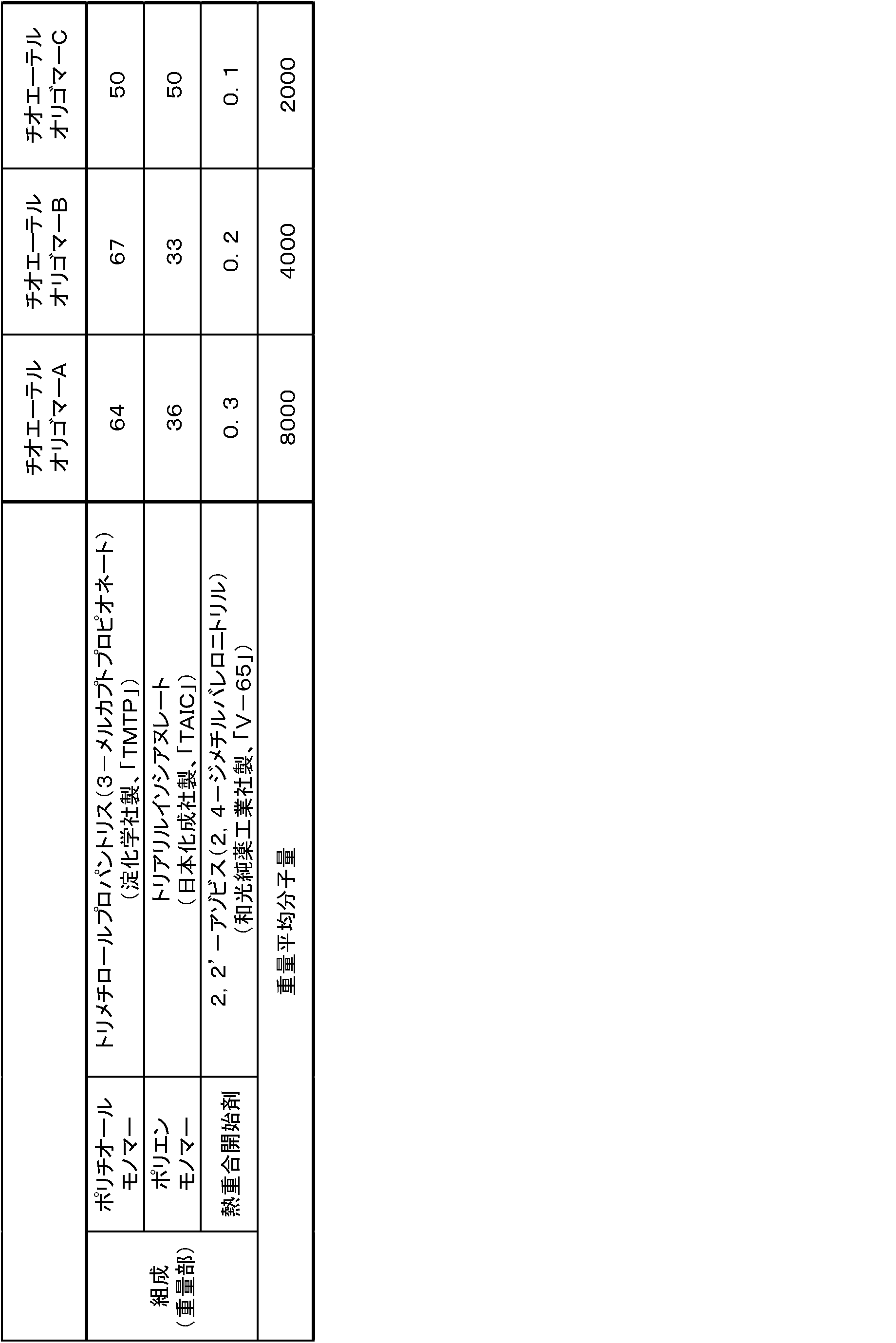
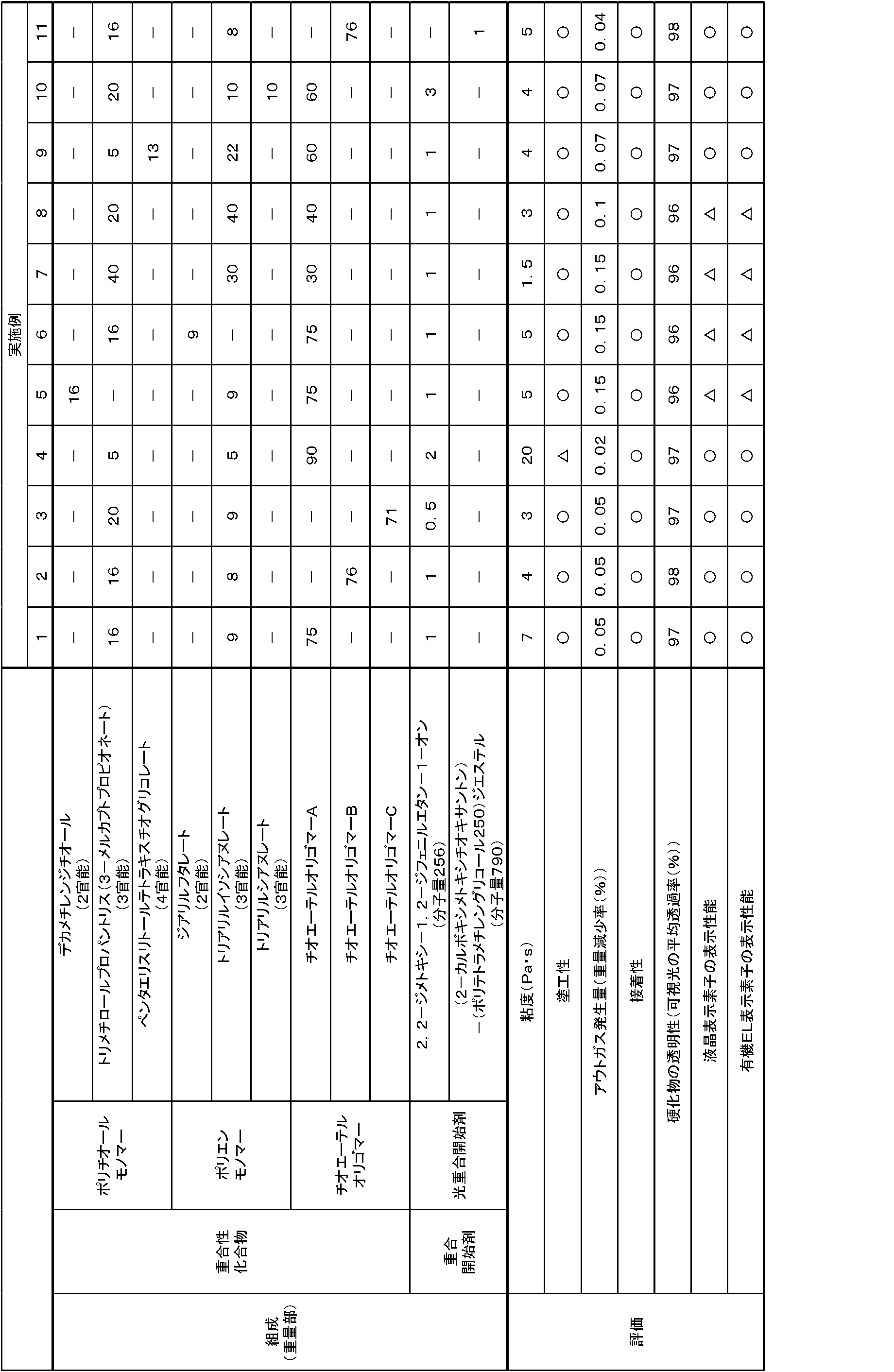
表2、3に記載された配合比に従い、各材料を、撹拌機(新東科学社製、「スリーワンモーター HEIDON BLH300」)を用いて混合することにより、実施例1~11及び比較例1~5の表示素子用封止剤を調製した。
実施例及び比較例で得られた各表示素子用封止剤について、以下の方法により評価を行った。結果を表2、3に示した。
コーンローター式粘度計(東機産業社製、「TV-22型」)を用いて、20℃、20rpmの条件で実施例及び比較例で得られた各表示素子用封止剤の粘度を測定した。
ディスペンサー(武蔵エンジニアリング社製、「SHOTMASTER300」)を用いて、ガラス基板上に実施例及び比較例で得られた各表示素子用封止剤を塗工した際の塗工性を評価した。ディスペンスノズルを400μm、ノズルギャップを30μm、塗出圧を300kPaに固定して塗工したとき、かすれやダレがなく塗工できた場合「○」、かすれやダレが生じた場合「△」、大きな塗工切れや塗工ムラが生じたり、全く塗工できなかったりした場合「×」として評価した。
実施例及び比較例で得られた各表示素子用封止剤を、バーコーターを用いて塗工後の厚さが100μmとなるように塗工し、超高圧水銀灯を用いて2000mJ/cm2の紫外線を照射してフィルムを形成した。
得られたフィルムを熱分析装置(Seiko Instruments社製、「TG/DTA6200」)を用いて、昇温速度10℃/minで130℃まで加熱したときの重量減少率を測定し、これをアウトガス発生量とした。
実施例及び比較例で得られた各表示素子用封止剤をマイクロピペットを用いてガラス基板上に0.05g塗工した。この基板を、スペーサーを配置した別のガラス基板と50μmの厚みとなるように貼り合わせ、高圧水銀灯を用いて2000mJ/cm2の紫外線を照射して、接着力試験用試料を作製した。得られた接着力試験用試料について、EZ GRAPH(島津製作所社製)を用いて、剥離速度5mm/minの条件で剥離試験を行い、接着力を測定した。接着力が1.0N/cm以上であったものを「○」、接着力が1.0N/cm未満であったものを「×」として接着性を評価した。
実施例及び比較例で得られた各表示素子用封止剤を、PET樹脂フィルムに挟み、2000mJ/cm2の紫外線を照射して、厚さ100μmの透過率測定用サンプルを作製した。得られた透過率測定用サンプルについて、分光光度計(日立製作所社製、「U-3000」、条件300~800nm)を用いて、波長380~780nmにおける可視光の平均透過率を測定した。
(6-1)液晶表示素子の表示性能
(液晶表示素子の作製)
厚さ1000ÅのITO電極を表面に成膜した後、更にスピンコートにて厚さ800Åの配向膜を表面に塗布したガラス基板(長さ25mm、幅25mm、厚さ0.7mm)を2枚用意し、一方の基板に熱硬化性エポキシ樹脂(周辺シール剤)を用いて、液晶注入口部を設けるようにしたパターンの印刷をスクリーン印刷にて行った。次に、パターンの印刷を行った基板を80℃で3分間保持することにより予備乾燥と基板への周辺シール剤の融着とを行った後、室温に戻した。次いで、もう一方の基板に5μmのスペーサーを散布した後、それぞれの基板を貼り合わせ、130℃に加熱した熱プレスで2時間の圧着を行って周辺シール剤を硬化させ、空のセルを得た。得られた空のセルを真空吸引した後、注入口より液晶(メルク社製、「ZLI-4792」)を注入し、注入口を実施例及び比較例で得られた各表示素子用封止剤を用いて封止し、高圧水銀灯を用いて3000mJ/cm2の紫外線を照射して封止剤を硬化させた。その後、120℃で1時間液晶のアニールを行い、液晶表示素子を作製した。
得られた液晶表示素子を、AC3.5Vの電圧にて中間調の表示状態で駆動させ、注入口近傍の液晶の配向乱れを偏光顕微鏡で観察した。配向乱れが確認されなかった場合を「○」、1mm未満の配向乱れが確認された場合を「△」、1mm以上のはっきりとした配向乱れ(濃い色むら)があった場合を「×」として液晶表示素子の表示性能を評価した。
(有機発光材料層を含む積層体が配置された基板の作製)
ガラス基板(長さ25mm、幅25mm、厚さ0.7mm)にITO電極を1000Åの厚さで成膜したものを基板とした。上記基板をアセトン、アルカリ水溶液、イオン交換水、イソプロピルアルコールにてそれぞれ15分間超音波洗浄した後、煮沸させたイソプロピルアルコールにて10分間洗浄し、更に、UV-オゾンクリーナ(日本レーザー電子社製、「NL-UV253」)にて直前処理を行った。
次に、この基板を真空蒸着装置の基板フォルダに固定し、素焼きの坩堝にN,N’-ジ(1-ナフチル)-N,N’-ジフェニルベンジジン(α-NPD)を200mg、他の異なる素焼き坩堝にトリス(8-ヒドロキシキノリラ)アルミニウム(Alq3)を200mg入れ、真空チャンバー内を、1×10⁻⁴Paまで減圧した。その後、α-NPDの入った坩堝を加熱し、α-NPDを蒸着速度15Å/sで基板に堆積させ、膜厚600Åの正孔輸送層を成膜した。次いで、Alq3の入った坩堝を加熱し、15Å/sの蒸着速度で膜厚600Åの有機発光材料層を成膜した。その後、正孔輸送層及び有機発光材料層が形成された基板を別の真空蒸着装置に移し、この真空蒸着装置内のタングステン製抵抗加熱ボートにフッ化リチウム200mgを、別のタングステン製ボートにアルミニウム線1.0gを入れた。その後、真空蒸着装置の蒸着器内を2×10-4Paまで減圧してフッ化リチウムを0.2Å/sの蒸着速度で5Å成膜した後、アルミニウムを20Å/sの速度で1000Å成膜した。窒素により蒸着器内を常圧に戻し、10mm×10mmの有機発光材料層を含む積層体が配置された基板を取り出した。
得られた有機発光材料層を含む積層体が配置された基板の、該積層体の全体を覆うように、13mm×13mmの開口部を有するマスクを設置し、プラズマCVD法にて無機材料膜Aを形成した。
プラズマCVD法は、原料ガスとしてSiH4ガス及び窒素ガスを用い、各々の流量を10sccm及び200sccmとし、RFパワーを10W(周波数2.45GHz)、チャンバー内温度を100℃、チャンバー内圧力を0.9Torrとする条件で行った。
形成されたシリコンナイトライドの無機材料膜Aの厚さは、約0.2μmであった。
真空装置内に、無機材料膜Aで被覆された積層体が配置された基板を設置し、真空装置の中に設置された加熱ボートに実施例及び比較例で得られた各表示素子用封止剤を0.5g入れ、10Paに減圧して、積層体を含む11mm×11mmの四角形の部分に、表示素子用封止剤を200℃にて加熱し、厚さが0.5μmになるように真空蒸着を行った。その後、真空環境下で高圧水銀灯を用いて波長365nmの紫外線を照射量が3000mJ/cm2となるように照射して、表示素子用封止剤を硬化させて樹脂保護膜を形成した。
樹脂保護膜が形成された基板の11mm×11mmの樹脂保護膜の全体を覆うように、12mm×12mmの開口部を有するマスクを設置し、プラズマCVD法にて無機材料膜Bを形成して表示素子(有機EL表示素子)を得た。
プラズマCVD法は、原料ガスとしてSiH4ガス及び窒素ガスを用い、各々の流量をSiH4ガス10sccm、窒素ガス200sccmとし、RFパワーを10W(周波数2.45GHz)、チャンバー内温度を100℃、チャンバー内圧力を0.9Torrとする条件で行った。
形成されたシリコンナイトライドの無機材料膜Bの厚さは、約1μmであった。
作製した有機EL表示素子をそれぞれ60℃、90%RHの条件下に100時間暴露した後、3Vの電圧を印加し、発光状態(発光及びダークスポット、画素周辺消光の有無)を目視で観察し、ダークスポットや周辺消光が無く均一に発光した場合を「○」、ダークスポットや周辺消光が認められた場合を「△」、非発光部が著しく拡大した場合を「×」として有機EL表示素子の表示性能を評価した。

Claims (11)
- 1分子中に2個以上のチオール基を有するポリチオールモノマー、
1分子中に2個以上の炭素-炭素二重結合を有するポリエンモノマー、及び、
該ポリチオールモノマーと該ポリエンモノマーとの反応により形成されるチオエーテルオリゴマーを含有する重合性化合物、並びに、
重合開始剤を含有する
ことを特徴とする表示素子用封止剤。 - ポリチオールモノマーは、1分子中に3個以上のチオール基を有するモノマーを含有することを特徴とする請求項1記載の表示素子用封止剤。
- ポリエンモノマーは、1分子中に3個以上の炭素-炭素二重結合を有するモノマーを含有することを特徴とする請求項1又は2記載の表示素子用封止剤。
- ポリエンオリゴマーを含有することを特徴とする請求項1、2又は3記載の表示素子用封止剤。
- チオエーテルオリゴマーの重量平均分子量が500~4万であることを特徴とする請求項1、2、3又は4記載の表示素子用封止剤。
- 重合性化合物全体100重量部中におけるチオエーテルオリゴマーの含有量が30重量部以上であることを特徴とする請求項1、2、3、4又は5記載の表示素子用封止剤。
- 表示素子用封止剤全体中における、ポリチオールモノマーの含有量が5~40重量%であり、ポリエンモノマーの含有量が5~40重量%であり、チオエーテルオリゴマーの含有量が30~90重量%であることを特徴とする請求項1、2、3、4、5又は6記載の表示素子用封止剤。
- 重合開始剤は、分子量が250~1500であることを特徴とする請求項1、2、3、4、5、6又は7記載の表示素子用封止剤。
- コーンローター式粘度計を用いて、20℃、20rpmの条件で測定した粘度が0.4~40Pa・sであることを特徴とする請求項1、2、3、4、5、6、7又は8記載の表示素子用封止剤。
- 硬化物の波長380~780nmの領域での可視光の平均透過率が80%以上であることを特徴とする請求項1、2、3、4、5、6、7、8又は9記載の表示素子用封止剤。
- 厚さ100μmの硬化物を、昇温速度10℃/minで130℃まで加熱したときの重量減少率が0.15%以下であることを特徴とする請求項1、2、3、4、5、6、7、8、9又は10記載の表示素子用封止剤。
Priority Applications (3)
| Application Number | Priority Date | Filing Date | Title |
|---|---|---|---|
| CN201480030689.0A CN105309043A (zh) | 2013-05-31 | 2014-05-29 | 显示元件用密封剂 |
| JP2014528730A JP5785331B2 (ja) | 2013-05-31 | 2014-05-29 | 表示素子用封止剤 |
| KR1020157032273A KR20160015207A (ko) | 2013-05-31 | 2014-05-29 | 표시 소자용 밀봉제 |
Applications Claiming Priority (8)
| Application Number | Priority Date | Filing Date | Title |
|---|---|---|---|
| JP2013115380 | 2013-05-31 | ||
| JP2013-115381 | 2013-05-31 | ||
| JP2013-115382 | 2013-05-31 | ||
| JP2013115382 | 2013-05-31 | ||
| JP2013115381 | 2013-05-31 | ||
| JP2013-115380 | 2013-05-31 | ||
| JP2014-024517 | 2014-02-12 | ||
| JP2014024517 | 2014-02-12 |
Publications (1)
| Publication Number | Publication Date |
|---|---|
| WO2014192880A1 true WO2014192880A1 (ja) | 2014-12-04 |
Family
ID=51988903
Family Applications (1)
| Application Number | Title | Priority Date | Filing Date |
|---|---|---|---|
| PCT/JP2014/064292 Ceased WO2014192880A1 (ja) | 2013-05-31 | 2014-05-29 | 表示素子用封止剤 |
Country Status (5)
| Country | Link |
|---|---|
| JP (2) | JP5785331B2 (ja) |
| KR (1) | KR20160015207A (ja) |
| CN (1) | CN105309043A (ja) |
| TW (1) | TW201504346A (ja) |
| WO (1) | WO2014192880A1 (ja) |
Cited By (8)
| Publication number | Priority date | Publication date | Assignee | Title |
|---|---|---|---|---|
| WO2015072415A1 (ja) * | 2013-11-13 | 2015-05-21 | 積水化学工業株式会社 | 液晶表示素子用シール剤、上下導通材料、及び、液晶表示素子 |
| JP2016183231A (ja) * | 2015-03-26 | 2016-10-20 | 四国化成工業株式会社 | グリコールウリル化合物を含む樹脂組成物 |
| JP2017040763A (ja) * | 2015-08-19 | 2017-02-23 | 積水化学工業株式会社 | 表示素子用封止剤 |
| JP2017044969A (ja) * | 2015-08-28 | 2017-03-02 | 積水化学工業株式会社 | 表示素子用封止剤 |
| JP2017155232A (ja) * | 2016-03-01 | 2017-09-07 | 積水化学工業株式会社 | 硬化性樹脂組成物及び表示素子用封止剤 |
| KR20180015106A (ko) * | 2015-06-02 | 2018-02-12 | 세키스이가가쿠 고교가부시키가이샤 | 액정 표시 소자용 시일제, 상하 도통 재료 및 액정 표시 소자 |
| CN110168442A (zh) * | 2017-07-14 | 2019-08-23 | 积水化学工业株式会社 | 液晶显示元件用密封剂、上下导通材料和液晶显示元件 |
| JPWO2024090339A1 (ja) * | 2022-10-25 | 2024-05-02 |
Citations (4)
| Publication number | Priority date | Publication date | Assignee | Title |
|---|---|---|---|---|
| JP2002285156A (ja) * | 2001-03-26 | 2002-10-03 | Sharp Corp | 液晶表示セル、液晶注入口封止剤及び液晶組成物 |
| JP2004107450A (ja) * | 2002-09-17 | 2004-04-08 | Sekisui Chem Co Ltd | シール剤用光硬化性樹脂および液晶表示素子または有機el素子 |
| JP2005336404A (ja) * | 2004-05-28 | 2005-12-08 | Sekisui Chem Co Ltd | 光硬化性樹脂組成物及び液晶注入口封止剤並びに液晶表示セル |
| JP2007065349A (ja) * | 2005-08-31 | 2007-03-15 | Sekisui Chem Co Ltd | 液晶注入口封止剤および液晶表示セル |
Family Cites Families (6)
| Publication number | Priority date | Publication date | Assignee | Title |
|---|---|---|---|---|
| JP2627598B2 (ja) | 1992-06-12 | 1997-07-09 | 新豊 劉 | カメラ |
| JP2001307873A (ja) | 2000-04-21 | 2001-11-02 | Toppan Printing Co Ltd | 有機エレクトロルミネッセンス表示素子およびその製造方法 |
| JP2005336314A (ja) | 2004-05-26 | 2005-12-08 | Sekisui Chem Co Ltd | 光硬化性樹脂組成物 |
| US8440736B2 (en) * | 2008-04-07 | 2013-05-14 | University Of Southern Mississippi | Photocuable thiol-ene low gas permeability membranes |
| JP5682062B2 (ja) * | 2008-10-30 | 2015-03-11 | ナガセケムテックス株式会社 | 硬化性組成物 |
| US8823154B2 (en) * | 2009-05-08 | 2014-09-02 | The Regents Of The University Of California | Encapsulation architectures for utilizing flexible barrier films |
-
2014
- 2014-05-29 JP JP2014528730A patent/JP5785331B2/ja active Active
- 2014-05-29 CN CN201480030689.0A patent/CN105309043A/zh active Pending
- 2014-05-29 KR KR1020157032273A patent/KR20160015207A/ko not_active Withdrawn
- 2014-05-29 WO PCT/JP2014/064292 patent/WO2014192880A1/ja not_active Ceased
- 2014-05-30 TW TW103118910A patent/TW201504346A/zh unknown
-
2015
- 2015-05-29 JP JP2015110064A patent/JP6427070B2/ja active Active
Patent Citations (4)
| Publication number | Priority date | Publication date | Assignee | Title |
|---|---|---|---|---|
| JP2002285156A (ja) * | 2001-03-26 | 2002-10-03 | Sharp Corp | 液晶表示セル、液晶注入口封止剤及び液晶組成物 |
| JP2004107450A (ja) * | 2002-09-17 | 2004-04-08 | Sekisui Chem Co Ltd | シール剤用光硬化性樹脂および液晶表示素子または有機el素子 |
| JP2005336404A (ja) * | 2004-05-28 | 2005-12-08 | Sekisui Chem Co Ltd | 光硬化性樹脂組成物及び液晶注入口封止剤並びに液晶表示セル |
| JP2007065349A (ja) * | 2005-08-31 | 2007-03-15 | Sekisui Chem Co Ltd | 液晶注入口封止剤および液晶表示セル |
Cited By (12)
| Publication number | Priority date | Publication date | Assignee | Title |
|---|---|---|---|---|
| WO2015072415A1 (ja) * | 2013-11-13 | 2015-05-21 | 積水化学工業株式会社 | 液晶表示素子用シール剤、上下導通材料、及び、液晶表示素子 |
| JP5759638B1 (ja) * | 2013-11-13 | 2015-08-05 | 積水化学工業株式会社 | 液晶表示素子用シール剤、上下導通材料、及び、液晶表示素子 |
| JP2016183231A (ja) * | 2015-03-26 | 2016-10-20 | 四国化成工業株式会社 | グリコールウリル化合物を含む樹脂組成物 |
| KR20180015106A (ko) * | 2015-06-02 | 2018-02-12 | 세키스이가가쿠 고교가부시키가이샤 | 액정 표시 소자용 시일제, 상하 도통 재료 및 액정 표시 소자 |
| TWI689578B (zh) * | 2015-06-02 | 2020-04-01 | 日商積水化學工業股份有限公司 | 液晶顯示元件用密封劑、上下導通材料、及液晶顯示元件 |
| KR102588717B1 (ko) * | 2015-06-02 | 2023-10-12 | 세키스이가가쿠 고교가부시키가이샤 | 액정 표시 소자용 시일제, 상하 도통 재료 및 액정 표시 소자 |
| JP2017040763A (ja) * | 2015-08-19 | 2017-02-23 | 積水化学工業株式会社 | 表示素子用封止剤 |
| JP2017044969A (ja) * | 2015-08-28 | 2017-03-02 | 積水化学工業株式会社 | 表示素子用封止剤 |
| JP2017155232A (ja) * | 2016-03-01 | 2017-09-07 | 積水化学工業株式会社 | 硬化性樹脂組成物及び表示素子用封止剤 |
| CN110168442A (zh) * | 2017-07-14 | 2019-08-23 | 积水化学工业株式会社 | 液晶显示元件用密封剂、上下导通材料和液晶显示元件 |
| JPWO2024090339A1 (ja) * | 2022-10-25 | 2024-05-02 | ||
| WO2024090339A1 (ja) * | 2022-10-25 | 2024-05-02 | デンカ株式会社 | 表示装置用光硬化性樹脂組成物及び表示装置 |
Also Published As
| Publication number | Publication date |
|---|---|
| JP6427070B2 (ja) | 2018-11-21 |
| TW201504346A (zh) | 2015-02-01 |
| JP5785331B2 (ja) | 2015-09-30 |
| JPWO2014192880A1 (ja) | 2017-02-23 |
| KR20160015207A (ko) | 2016-02-12 |
| JP2015187993A (ja) | 2015-10-29 |
| CN105309043A (zh) | 2016-02-03 |
Similar Documents
| Publication | Publication Date | Title |
|---|---|---|
| JP5785331B2 (ja) | 表示素子用封止剤 | |
| JP2016066605A (ja) | 表示素子用封止剤 | |
| JP5798259B1 (ja) | 表示素子用封止剤 | |
| JP5957148B1 (ja) | 表示素子用封止剤 | |
| JP2017054084A (ja) | 表示素子用封止剤 | |
| JP2016110788A (ja) | 表示素子用封止剤 | |
| JPWO2016021531A1 (ja) | 表示素子用封止剤 | |
| JP2017103154A (ja) | 表示素子用封止剤 | |
| WO2015029846A1 (ja) | 表示素子用封止剤及びオキシムエステル開始剤 | |
| JP2016169298A (ja) | 表示素子用封止剤 | |
| JP2016074784A (ja) | 表示素子用封止剤 | |
| JP2017117651A (ja) | 表示素子用封止剤 | |
| WO2016063825A1 (ja) | 表示素子用封止剤及び表示素子用封止剤硬化体 | |
| JP2017045646A (ja) | 表示素子用封止剤 | |
| JP6496214B2 (ja) | 表示素子用封止剤 | |
| JP2017079113A (ja) | 表示素子用封止剤 | |
| JP2016164236A (ja) | 表示素子用封止剤 | |
| JP6595848B2 (ja) | 表示素子用封止剤 | |
| JP6769894B2 (ja) | 硬化性樹脂組成物及び表示素子用封止剤 | |
| JP2017002131A (ja) | 表示素子用封止剤 | |
| JP2015218303A (ja) | 表示素子用透明封止剤 | |
| WO2015137245A1 (ja) | 表示素子用透明封止剤 | |
| JP2015045838A (ja) | 表示素子用透明封止剤 |
Legal Events
| Date | Code | Title | Description |
|---|---|---|---|
| WWE | Wipo information: entry into national phase |
Ref document number: 201480030689.0 Country of ref document: CN |
|
| ENP | Entry into the national phase |
Ref document number: 2014528730 Country of ref document: JP Kind code of ref document: A |
|
| 121 | Ep: the epo has been informed by wipo that ep was designated in this application |
Ref document number: 14804525 Country of ref document: EP Kind code of ref document: A1 |
|
| ENP | Entry into the national phase |
Ref document number: 20157032273 Country of ref document: KR Kind code of ref document: A |
|
| NENP | Non-entry into the national phase |
Ref country code: DE |
|
| 122 | Ep: pct application non-entry in european phase |
Ref document number: 14804525 Country of ref document: EP Kind code of ref document: A1 |