WO2014190673A1 - 取向膜及其制备方法、含所述取向膜的液晶显示装置 - Google Patents
取向膜及其制备方法、含所述取向膜的液晶显示装置 Download PDFInfo
- Publication number
- WO2014190673A1 WO2014190673A1 PCT/CN2013/086970 CN2013086970W WO2014190673A1 WO 2014190673 A1 WO2014190673 A1 WO 2014190673A1 CN 2013086970 W CN2013086970 W CN 2013086970W WO 2014190673 A1 WO2014190673 A1 WO 2014190673A1
- Authority
- WO
- WIPO (PCT)
- Prior art keywords
- formula
- polyimide
- alignment film
- alignment layer
- crystal display
- Prior art date
- Legal status (The legal status is an assumption and is not a legal conclusion. Google has not performed a legal analysis and makes no representation as to the accuracy of the status listed.)
- Ceased
Links
Classifications
-
- C—CHEMISTRY; METALLURGY
- C08—ORGANIC MACROMOLECULAR COMPOUNDS; THEIR PREPARATION OR CHEMICAL WORKING-UP; COMPOSITIONS BASED THEREON
- C08G—MACROMOLECULAR COMPOUNDS OBTAINED OTHERWISE THAN BY REACTIONS ONLY INVOLVING UNSATURATED CARBON-TO-CARBON BONDS
- C08G73/00—Macromolecular compounds obtained by reactions forming a linkage containing nitrogen with or without oxygen or carbon in the main chain of the macromolecule, not provided for in groups C08G12/00 - C08G71/00
- C08G73/06—Polycondensates having nitrogen-containing heterocyclic rings in the main chain of the macromolecule
- C08G73/10—Polyimides; Polyester-imides; Polyamide-imides; Polyamide acids or similar polyimide precursors
- C08G73/1067—Wholly aromatic polyimides, i.e. having both tetracarboxylic and diamino moieties aromatically bound
-
- C—CHEMISTRY; METALLURGY
- C08—ORGANIC MACROMOLECULAR COMPOUNDS; THEIR PREPARATION OR CHEMICAL WORKING-UP; COMPOSITIONS BASED THEREON
- C08G—MACROMOLECULAR COMPOUNDS OBTAINED OTHERWISE THAN BY REACTIONS ONLY INVOLVING UNSATURATED CARBON-TO-CARBON BONDS
- C08G73/00—Macromolecular compounds obtained by reactions forming a linkage containing nitrogen with or without oxygen or carbon in the main chain of the macromolecule, not provided for in groups C08G12/00 - C08G71/00
- C08G73/06—Polycondensates having nitrogen-containing heterocyclic rings in the main chain of the macromolecule
- C08G73/10—Polyimides; Polyester-imides; Polyamide-imides; Polyamide acids or similar polyimide precursors
- C08G73/1039—Polyimides; Polyester-imides; Polyamide-imides; Polyamide acids or similar polyimide precursors comprising halogen-containing substituents
-
- C—CHEMISTRY; METALLURGY
- C08—ORGANIC MACROMOLECULAR COMPOUNDS; THEIR PREPARATION OR CHEMICAL WORKING-UP; COMPOSITIONS BASED THEREON
- C08G—MACROMOLECULAR COMPOUNDS OBTAINED OTHERWISE THAN BY REACTIONS ONLY INVOLVING UNSATURATED CARBON-TO-CARBON BONDS
- C08G73/00—Macromolecular compounds obtained by reactions forming a linkage containing nitrogen with or without oxygen or carbon in the main chain of the macromolecule, not provided for in groups C08G12/00 - C08G71/00
- C08G73/06—Polycondensates having nitrogen-containing heterocyclic rings in the main chain of the macromolecule
- C08G73/10—Polyimides; Polyester-imides; Polyamide-imides; Polyamide acids or similar polyimide precursors
- C08G73/1046—Polyimides containing oxygen in the form of ether bonds in the main chain
- C08G73/105—Polyimides containing oxygen in the form of ether bonds in the main chain with oxygen only in the diamino moiety
-
- C—CHEMISTRY; METALLURGY
- C08—ORGANIC MACROMOLECULAR COMPOUNDS; THEIR PREPARATION OR CHEMICAL WORKING-UP; COMPOSITIONS BASED THEREON
- C08G—MACROMOLECULAR COMPOUNDS OBTAINED OTHERWISE THAN BY REACTIONS ONLY INVOLVING UNSATURATED CARBON-TO-CARBON BONDS
- C08G73/00—Macromolecular compounds obtained by reactions forming a linkage containing nitrogen with or without oxygen or carbon in the main chain of the macromolecule, not provided for in groups C08G12/00 - C08G71/00
- C08G73/06—Polycondensates having nitrogen-containing heterocyclic rings in the main chain of the macromolecule
- C08G73/10—Polyimides; Polyester-imides; Polyamide-imides; Polyamide acids or similar polyimide precursors
- C08G73/1057—Polyimides containing other atoms than carbon, hydrogen, nitrogen or oxygen in the main chain
- C08G73/1064—Polyimides containing other atoms than carbon, hydrogen, nitrogen or oxygen in the main chain containing sulfur
-
- C—CHEMISTRY; METALLURGY
- C08—ORGANIC MACROMOLECULAR COMPOUNDS; THEIR PREPARATION OR CHEMICAL WORKING-UP; COMPOSITIONS BASED THEREON
- C08G—MACROMOLECULAR COMPOUNDS OBTAINED OTHERWISE THAN BY REACTIONS ONLY INVOLVING UNSATURATED CARBON-TO-CARBON BONDS
- C08G73/00—Macromolecular compounds obtained by reactions forming a linkage containing nitrogen with or without oxygen or carbon in the main chain of the macromolecule, not provided for in groups C08G12/00 - C08G71/00
- C08G73/06—Polycondensates having nitrogen-containing heterocyclic rings in the main chain of the macromolecule
- C08G73/10—Polyimides; Polyester-imides; Polyamide-imides; Polyamide acids or similar polyimide precursors
- C08G73/1067—Wholly aromatic polyimides, i.e. having both tetracarboxylic and diamino moieties aromatically bound
- C08G73/1071—Wholly aromatic polyimides containing oxygen in the form of ether bonds in the main chain
-
- C—CHEMISTRY; METALLURGY
- C09—DYES; PAINTS; POLISHES; NATURAL RESINS; ADHESIVES; COMPOSITIONS NOT OTHERWISE PROVIDED FOR; APPLICATIONS OF MATERIALS NOT OTHERWISE PROVIDED FOR
- C09D—COATING COMPOSITIONS, e.g. PAINTS, VARNISHES OR LACQUERS; FILLING PASTES; CHEMICAL PAINT OR INK REMOVERS; INKS; CORRECTING FLUIDS; WOODSTAINS; PASTES OR SOLIDS FOR COLOURING OR PRINTING; USE OF MATERIALS THEREFOR
- C09D179/00—Coating compositions based on macromolecular compounds obtained by reactions forming in the main chain of the macromolecule a linkage containing nitrogen, with or without oxygen, or carbon only, not provided for in groups C09D161/00 - C09D177/00
- C09D179/04—Polycondensates having nitrogen-containing heterocyclic rings in the main chain; Polyhydrazides; Polyamide acids or similar polyimide precursors
- C09D179/08—Polyimides; Polyester-imides; Polyamide-imides; Polyamide acids or similar polyimide precursors
-
- C—CHEMISTRY; METALLURGY
- C09—DYES; PAINTS; POLISHES; NATURAL RESINS; ADHESIVES; COMPOSITIONS NOT OTHERWISE PROVIDED FOR; APPLICATIONS OF MATERIALS NOT OTHERWISE PROVIDED FOR
- C09K—MATERIALS FOR MISCELLANEOUS APPLICATIONS, NOT PROVIDED FOR ELSEWHERE
- C09K19/00—Liquid crystal materials
- C09K19/52—Liquid crystal materials characterised by components which are not liquid crystals, e.g. additives with special physical aspect: solvents, solid particles
- C09K19/54—Additives having no specific mesophase characterised by their chemical composition
- C09K19/56—Aligning agents
-
- G—PHYSICS
- G02—OPTICS
- G02F—OPTICAL DEVICES OR ARRANGEMENTS FOR THE CONTROL OF LIGHT BY MODIFICATION OF THE OPTICAL PROPERTIES OF THE MEDIA OF THE ELEMENTS INVOLVED THEREIN; NON-LINEAR OPTICS; FREQUENCY-CHANGING OF LIGHT; OPTICAL LOGIC ELEMENTS; OPTICAL ANALOGUE/DIGITAL CONVERTERS
- G02F1/00—Devices or arrangements for the control of the intensity, colour, phase, polarisation or direction of light arriving from an independent light source, e.g. switching, gating or modulating; Non-linear optics
- G02F1/01—Devices or arrangements for the control of the intensity, colour, phase, polarisation or direction of light arriving from an independent light source, e.g. switching, gating or modulating; Non-linear optics for the control of the intensity, phase, polarisation or colour
- G02F1/13—Devices or arrangements for the control of the intensity, colour, phase, polarisation or direction of light arriving from an independent light source, e.g. switching, gating or modulating; Non-linear optics for the control of the intensity, phase, polarisation or colour based on liquid crystals, e.g. single liquid crystal display cells
- G02F1/133—Constructional arrangements; Operation of liquid crystal cells; Circuit arrangements
- G02F1/1333—Constructional arrangements; Manufacturing methods
- G02F1/1337—Surface-induced orientation of the liquid crystal molecules, e.g. by alignment layers
- G02F1/133711—Surface-induced orientation of the liquid crystal molecules, e.g. by alignment layers by organic films, e.g. polymeric films
- G02F1/133723—Polyimide, polyamide-imide
-
- C—CHEMISTRY; METALLURGY
- C09—DYES; PAINTS; POLISHES; NATURAL RESINS; ADHESIVES; COMPOSITIONS NOT OTHERWISE PROVIDED FOR; APPLICATIONS OF MATERIALS NOT OTHERWISE PROVIDED FOR
- C09K—MATERIALS FOR MISCELLANEOUS APPLICATIONS, NOT PROVIDED FOR ELSEWHERE
- C09K2323/00—Functional layers of liquid crystal optical display excluding electroactive liquid crystal layer characterised by chemical composition
- C09K2323/02—Alignment layer characterised by chemical composition
-
- C—CHEMISTRY; METALLURGY
- C09—DYES; PAINTS; POLISHES; NATURAL RESINS; ADHESIVES; COMPOSITIONS NOT OTHERWISE PROVIDED FOR; APPLICATIONS OF MATERIALS NOT OTHERWISE PROVIDED FOR
- C09K—MATERIALS FOR MISCELLANEOUS APPLICATIONS, NOT PROVIDED FOR ELSEWHERE
- C09K2323/00—Functional layers of liquid crystal optical display excluding electroactive liquid crystal layer characterised by chemical composition
- C09K2323/02—Alignment layer characterised by chemical composition
- C09K2323/027—Polyimide
Definitions
- Embodiments of the present invention relate to an alignment film, a method of fabricating the same, and a liquid crystal display including the alignment film
- TFT-LCD Thin Film Transistor Liquid
- an alignment film i.e., an oriented polyimide film
- an alignment film is usually used to cause the liquid crystal molecules to be aligned in a uniform direction on the surface of the film, thereby achieving alignment of the liquid crystal molecules. Since light is partially absorbed by the polyimide film as it passes through the polyimide film, the high transmittance polyimide film plays an important role in producing a liquid crystal display panel with low power consumption and high contrast.
- Ar may be a phenyl group, a tea group, a benzophenone group, a dibenzoyl group, a diphenyl ether group or a diphenylsulfonyl group.
- the optical transmittance of the conventional polyimide film is generally about 70% to 75%.
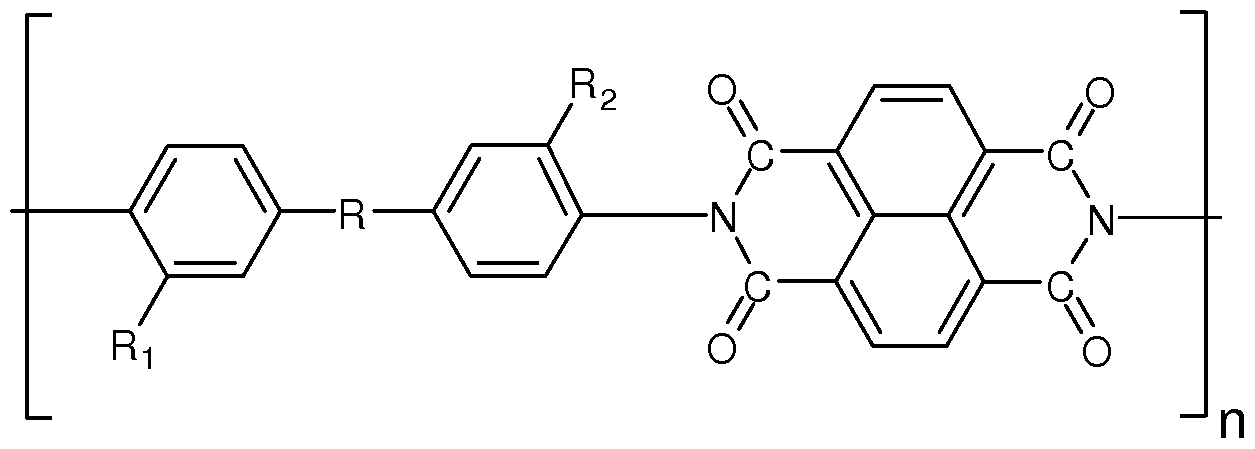
- An embodiment of the present invention provides an alignment film, wherein the alignment film is composed of polyimide, and the polyimide 4 shows:
- R is a strong electron withdrawing group
- R 2 is each independently methyl, ethyl, propyl, isopropyl, methyl tt, ethoxy, propyl or isopropoxy.
- the 1 is 8, 0, S0 2 , CC1 2 or CF 2 .
- the polyimide is obtained by reacting 1,4,5,8-naphthalenetetracarboxylic dianhydride represented by the formula -1 with the bridged diphenylenediamine represented by the formula -2,
- a method for preparing an oriented film comprising:
- the R in the formula -2 is a strong electron withdrawing group, and each independently is a methyl group, an ethyl group, a propyl group, an isopropyl group, a methyl group, an ethoxy group, a propyl group or an isopropyl group;
- the 1 is 8, 0, S0 2 , CC1 2 or CF 2 .
- the step (1) can be carried out at room temperature.
- the heating process in the step (2) comprises: first heating at 90-100 ° C for 3-6 min, Heat at 220-250 ° C for another 40-80 min.
- the orientation process in the step (3) is a rubbing alignment process.
- a liquid crystal display device having an alignment film as described above on an array substrate or a color filter substrate of the liquid crystal display device.
- the polyimide film of the embodiment of the present invention is composed of polyimide, and the polyimide is represented by 1,4,5,8-naphthalenetetracarboxylic dianhydride represented by Formula-1 and Formula-2.
- R may be a strong electron withdrawing group such as S, 0, S0 2 , CC1 2 or CF 2 ; and may be a methyl group, an ethyl group, a propyl group or an isopropyl group.
- R 2 may be methyl, ethyl, propyl, isopropyl, tt, tt, tt, isopropyloxy base.
- Step 1 adding bridged diphenylenediamine to N-methylpyrrolidone (NMP), and then adding 1,4,5,8-naphthalenetetracarboxylic dianhydride to carry out a reaction, and filtering the reaction liquid to obtain a liquid polyamic acid;
- NMP N-methylpyrrolidone
- Step 2 Dissolving the liquid polyamic acid in NMP to obtain a solution, applying the solution to the surface of the substrate and heating to obtain a polyimide film. Thereafter, an orientation process was performed on the polyimide film to obtain an oriented polyimide film, that is, an alignment film.
- the orientation process employed may be an orientation process commonly used in the art, such as a rubbing alignment process, in which the polyimide film is oriented in the rubbing direction under the action of a high speed rotating friction roller.
- the molar ratio of the reaction raw material bridged diphenylenediamine to 1,4,5,8-naphthalenetetracarboxylic dianhydride may be 1:1, but in actual operation, one of them may be excessive, for example, the ratio of the two may be It is 1:1 - 1:1.1, or 1:1 - 1.1:1.
- the bridge R in the diamine is a strong electron withdrawing group, so that the CH bond length on the diamine aromatic ring can be reduced, thereby reducing Harmonic vibration absorption of CH, ultimately reducing the absorption rate of light by polyimide film, and increasing polyimide Optical transmission of the film.
- the oriented film of the embodiment of the present invention is prepared according to the above-described method for preparing an oriented film, and the specific steps are as follows: Step S1: 0.05 mol of bridged diphenylenediamine is added to 200 ml of dry N-methylpyrrolidone (NMP) at room temperature. In the solvent, 0.05 mol of 1,4,5,8-naphthalenetetracarboxylic dianhydride was slowly added thereto while stirring well, and after stirring for 24 hours, it was allowed to stand and filtered to obtain a liquid polyamic acid.
- the liquid polyamic acid has a number average molecular weight of from 4000 to 6000, and the structural formula and IR spectrum data are as follows:
- the bridged diphenylenediamine may be 3,3,-dimethyl-4,4,-diphenyl sulfoxide, that is, R in the formula-2 is S0 2 , and both are methyl groups.
- R, and the bridged diphenylenediamine of other groups listed in the present invention may also be prepared according to the steps described in the step S2 of the present invention: Dissolving the liquid polyamic acid obtained in the step 1 In N-methylpyrrolidone, a clear liquid is obtained, and the obtained clear liquid is uniformly applied to the surface of the transparent glass substrate to have a film thickness of about 100 nm, and heated at 100 ° C for 5 minutes to remove a part of the residual solvent (ie, N).
- the number average molecular weight of the polyimide is from 4000 to 6000, and the structural formula of the polyimide and the IR optical data are as follows: (form-4);
- the temperature during the initial heating may be 90-110 ° C, and the heating time may be 3-6 min, in order to remove a small portion of the solvent (ie N-decyl pyrrolidone), so that the surface of the polyimide (PI) film is flat .
- the temperature for subsequent heating may be 220-250 ° C, and the heating time may be 40-80 min as long as the heating completely removes the solvent and forms a polyimide film. Thereafter, an orientation process commonly used in the art is carried out on the polyimide film to obtain an oriented polyimide film.
- Examples 1-15 were prepared by the above preparation methods, and then optical transmittances of these examples and comparative examples at different wavelengths were measured by an EZ-COM optical measuring system, and the results are shown in Table 1.
- the structure of the comparative example is as shown in the formula -A in the background art, wherein Ar is a tea group.
- Example 12 83.6 83.8 84.2 basis 0 isopropyl methoxy
- Example 15 82.0 81.1 82.1 Base « - Comparative Example CH 2 HH 72.8 74.9 74.2 From the measurement results shown in Table 1, it is understood that the optical transmittance of the polyimide film of the embodiment of the present invention at each wavelength is higher than that of the comparative example. It is about 7%-16% higher.
- the reason why the polyimide film of the embodiment of the present invention has a relatively good optical transmittance is that the light absorption rate of the polyimide film mainly depends on the density of the CH bond in the structure of the polyimide film and the bridge in the diamine.
- the action of the bond R when R is a strong electron withdrawing group, reduces the CH bond length on the diamine aromatic ring, thereby reducing the harmonic vibration absorption of the CH, ultimately reducing the absorption rate of the film and increasing the optical transmittance of the film.
- the embodiment of the present invention further provides a liquid crystal display device having an alignment film as described above, that is, the polyimide film after orientation, on the array substrate or the color filter substrate of the liquid crystal display device.
- polyimide is obtained by the method described above.
Landscapes
- Chemical & Material Sciences (AREA)
- Organic Chemistry (AREA)
- Chemical Kinetics & Catalysis (AREA)
- Health & Medical Sciences (AREA)
- Polymers & Plastics (AREA)
- Medicinal Chemistry (AREA)
- Physics & Mathematics (AREA)
- Materials Engineering (AREA)
- Engineering & Computer Science (AREA)
- Crystallography & Structural Chemistry (AREA)
- Nonlinear Science (AREA)
- Wood Science & Technology (AREA)
- Life Sciences & Earth Sciences (AREA)
- Spectroscopy & Molecular Physics (AREA)
- Mathematical Physics (AREA)
- General Physics & Mathematics (AREA)
- Optics & Photonics (AREA)
- Liquid Crystal (AREA)
- Macromolecular Compounds Obtained By Forming Nitrogen-Containing Linkages In General (AREA)
Abstract
Description




Claims


Priority Applications (1)
| Application Number | Priority Date | Filing Date | Title |
|---|---|---|---|
| US14/387,029 US9701793B2 (en) | 2013-05-31 | 2013-11-12 | Alignment film, method for preparing the same and liquid crystal display device comprising the same |
Applications Claiming Priority (2)
| Application Number | Priority Date | Filing Date | Title |
|---|---|---|---|
| CN201310215295.X | 2013-05-31 | ||
| CN201310215295.XA CN104212462B (zh) | 2013-05-31 | 2013-05-31 | 取向膜及其制备方法、液晶显示装置 |
Publications (1)
| Publication Number | Publication Date |
|---|---|
| WO2014190673A1 true WO2014190673A1 (zh) | 2014-12-04 |
Family
ID=51987930
Family Applications (1)
| Application Number | Title | Priority Date | Filing Date |
|---|---|---|---|
| PCT/CN2013/086970 Ceased WO2014190673A1 (zh) | 2013-05-31 | 2013-11-12 | 取向膜及其制备方法、含所述取向膜的液晶显示装置 |
Country Status (3)
| Country | Link |
|---|---|
| US (1) | US9701793B2 (zh) |
| CN (1) | CN104212462B (zh) |
| WO (1) | WO2014190673A1 (zh) |
Families Citing this family (1)
| Publication number | Priority date | Publication date | Assignee | Title |
|---|---|---|---|---|
| CN106292076B (zh) * | 2016-11-01 | 2019-06-04 | 京东方科技集团股份有限公司 | 一种配向膜的制作方法、制作装置及配向膜 |
Citations (4)
| Publication number | Priority date | Publication date | Assignee | Title |
|---|---|---|---|---|
| JPH05281551A (ja) * | 1992-04-01 | 1993-10-29 | Fuji Photo Film Co Ltd | 液晶配向膜 |
| CN1690164A (zh) * | 2004-04-20 | 2005-11-02 | Jsr株式会社 | 垂直取向型液晶取向剂以及液晶显示元件 |
| CN102643424A (zh) * | 2011-08-25 | 2012-08-22 | 北京京东方光电科技有限公司 | 聚酰亚胺及其制备方法和应用 |
| CN103059298A (zh) * | 2013-01-07 | 2013-04-24 | 北京京东方光电科技有限公司 | 聚酰胺酸、聚酰亚胺及其制备方法和应用 |
Family Cites Families (4)
| Publication number | Priority date | Publication date | Assignee | Title |
|---|---|---|---|---|
| US5276132A (en) * | 1991-03-11 | 1994-01-04 | Japan Synthetic Rubber Co., Ltd. | Liquid crystal aligning agent and aligning agent-applied liquid crystal display device |
| JP5088561B2 (ja) * | 2007-02-23 | 2012-12-05 | Jsr株式会社 | 液晶配向剤 |
| CN100580529C (zh) * | 2008-12-17 | 2010-01-13 | 黄山市英赛特实业有限公司 | 一种液晶定向膜材料的生产方法 |
| CN102504310B (zh) * | 2011-10-19 | 2013-07-17 | 西南科技大学 | 一种磺化聚酰亚胺/壳聚糖复合质子导电膜的制备方法 |
-
2013
- 2013-05-31 CN CN201310215295.XA patent/CN104212462B/zh not_active Expired - Fee Related
- 2013-11-12 WO PCT/CN2013/086970 patent/WO2014190673A1/zh not_active Ceased
- 2013-11-12 US US14/387,029 patent/US9701793B2/en not_active Expired - Fee Related
Patent Citations (4)
| Publication number | Priority date | Publication date | Assignee | Title |
|---|---|---|---|---|
| JPH05281551A (ja) * | 1992-04-01 | 1993-10-29 | Fuji Photo Film Co Ltd | 液晶配向膜 |
| CN1690164A (zh) * | 2004-04-20 | 2005-11-02 | Jsr株式会社 | 垂直取向型液晶取向剂以及液晶显示元件 |
| CN102643424A (zh) * | 2011-08-25 | 2012-08-22 | 北京京东方光电科技有限公司 | 聚酰亚胺及其制备方法和应用 |
| CN103059298A (zh) * | 2013-01-07 | 2013-04-24 | 北京京东方光电科技有限公司 | 聚酰胺酸、聚酰亚胺及其制备方法和应用 |
Also Published As
| Publication number | Publication date |
|---|---|
| CN104212462A (zh) | 2014-12-17 |
| US20160152772A1 (en) | 2016-06-02 |
| US9701793B2 (en) | 2017-07-11 |
| CN104212462B (zh) | 2016-02-24 |
Similar Documents
| Publication | Publication Date | Title |
|---|---|---|
| CN104114532B (zh) | 二胺、聚酰亚胺、以及聚酰亚胺膜及其利用 | |
| TW201302859A (zh) | 聚醯胺酸、聚醯亞胺、聚醯胺酸溶液、聚醯亞胺溶液、由此等溶液所得之聚醯亞胺膜及聚醯亞胺膜之利用 | |
| TW200900389A (en) | 3, 4-Dicarboxy-1, 2, 3, 4-tetrahydro-6-t-butyl-1-naphthalene-succinic dianhydride and liquid crystal aligning agent comprising polyimide resin prepared from the dianhydride | |
| TW201226444A (en) | Polyimide polymer, method for manufacturing the same and display device | |
| WO2013041017A1 (zh) | 预聚物、取向膜及其制备方法、液晶显示装置 | |
| CN105612441A (zh) | 聚酰亚胺组合物、使用上述聚酰亚胺组合物形成的取向膜及光学元件 | |
| US9023440B2 (en) | Liquid crystal alignment film, method for preparing same and liquid crystal display device comprising same | |
| TWI575041B (zh) | 接著劑、疊層體及前述二者之製造方法 | |
| CN102959461A (zh) | 液晶取向剂、液晶取向膜及液晶显示元件 | |
| CN101885967A (zh) | 液晶配向液 | |
| KR101938923B1 (ko) | 액정 배향 처리제, 액정 배향막 및 액정 표시 소자 | |
| JPH11335461A (ja) | 液晶配向剤 | |
| TW201122025A (en) | Polyimide polymers for flexible electrical device substrate material and flexible electrical devices comprising the same | |
| TW201030058A (en) | Liquid crystal aligning agent and liquid crystal element using same | |
| US9701793B2 (en) | Alignment film, method for preparing the same and liquid crystal display device comprising the same | |
| CN109476951A (zh) | 剥离层形成用组合物和剥离层 | |
| CN102858850B (zh) | 二胺化合物、液晶取向剂以及液晶显示元件 | |
| JP3681083B2 (ja) | 液晶配向剤 | |
| TWI477479B (zh) | 二胺苯化合物、聚合物、配向膜用組成物、配向膜以及液晶顯示元件 | |
| TW201922926A (zh) | 液晶配向劑組成物、使用此組成物製備液晶配向膜的方法、使用此組成物的液晶配向膜以及液晶顯示裝置 | |
| JP5298398B2 (ja) | 液晶配向処理剤およびこれを用いた液晶表示素子 | |
| CN110739397B (zh) | 一种柔性显示器基板、其制备方法及其应用 | |
| CN102993750A (zh) | 一种聚酰亚胺薄膜及其制备方法 | |
| JP2618557B2 (ja) | 液晶表示素子用配向剤および液晶表示素子 | |
| CN111410741B (zh) | 配向膜材料、配向膜的制备方法、显示面板及其制备方法 |
Legal Events
| Date | Code | Title | Description |
|---|---|---|---|
| WWE | Wipo information: entry into national phase |
Ref document number: 14387029 Country of ref document: US |
|
| 121 | Ep: the epo has been informed by wipo that ep was designated in this application |
Ref document number: 13885736 Country of ref document: EP Kind code of ref document: A1 |
|
| NENP | Non-entry into the national phase |
Ref country code: DE |
|
| 32PN | Ep: public notification in the ep bulletin as address of the adressee cannot be established |
Free format text: NOTING OF LOSS OF RIGHTS PURSUANT TO RULE 112(1) EPC (EPO FORM 1205A DATED 11-04-2016 ) |
|
| 122 | Ep: pct application non-entry in european phase |
Ref document number: 13885736 Country of ref document: EP Kind code of ref document: A1 |