WO2014175035A1 - 石灰泥の脱水助剤、及びそれを用いた石灰泥の脱水方法 - Google Patents
石灰泥の脱水助剤、及びそれを用いた石灰泥の脱水方法 Download PDFInfo
- Publication number
- WO2014175035A1 WO2014175035A1 PCT/JP2014/059850 JP2014059850W WO2014175035A1 WO 2014175035 A1 WO2014175035 A1 WO 2014175035A1 JP 2014059850 W JP2014059850 W JP 2014059850W WO 2014175035 A1 WO2014175035 A1 WO 2014175035A1
- Authority
- WO
- WIPO (PCT)
- Prior art keywords
- lime mud
- dehydration
- aid
- dehydrating
- lime
- Prior art date
- Legal status (The legal status is an assumption and is not a legal conclusion. Google has not performed a legal analysis and makes no representation as to the accuracy of the status listed.)
- Ceased
Links
Classifications
-
- D—TEXTILES; PAPER
- D21—PAPER-MAKING; PRODUCTION OF CELLULOSE
- D21C—PRODUCTION OF CELLULOSE BY REMOVING NON-CELLULOSE SUBSTANCES FROM CELLULOSE-CONTAINING MATERIALS; REGENERATION OF PULPING LIQUORS; APPARATUS THEREFOR
- D21C11/00—Regeneration of pulp liquors or effluent waste waters
- D21C11/04—Regeneration of pulp liquors or effluent waste waters of alkali lye
-
- C—CHEMISTRY; METALLURGY
- C02—TREATMENT OF WATER, WASTE WATER, SEWAGE, OR SLUDGE
- C02F—TREATMENT OF WATER, WASTE WATER, SEWAGE, OR SLUDGE
- C02F11/00—Treatment of sludge; Devices therefor
- C02F11/12—Treatment of sludge; Devices therefor by de-watering, drying or thickening
- C02F11/14—Treatment of sludge; Devices therefor by de-watering, drying or thickening with addition of chemical agents
- C02F11/147—Treatment of sludge; Devices therefor by de-watering, drying or thickening with addition of chemical agents using organic substances
-
- C—CHEMISTRY; METALLURGY
- C02—TREATMENT OF WATER, WASTE WATER, SEWAGE, OR SLUDGE
- C02F—TREATMENT OF WATER, WASTE WATER, SEWAGE, OR SLUDGE
- C02F2103/00—Nature of the water, waste water, sewage or sludge to be treated
- C02F2103/26—Nature of the water, waste water, sewage or sludge to be treated from the processing of plants or parts thereof
- C02F2103/28—Nature of the water, waste water, sewage or sludge to be treated from the processing of plants or parts thereof from the paper or cellulose industry
-
- Y—GENERAL TAGGING OF NEW TECHNOLOGICAL DEVELOPMENTS; GENERAL TAGGING OF CROSS-SECTIONAL TECHNOLOGIES SPANNING OVER SEVERAL SECTIONS OF THE IPC; TECHNICAL SUBJECTS COVERED BY FORMER USPC CROSS-REFERENCE ART COLLECTIONS [XRACs] AND DIGESTS
- Y02—TECHNOLOGIES OR APPLICATIONS FOR MITIGATION OR ADAPTATION AGAINST CLIMATE CHANGE
- Y02P—CLIMATE CHANGE MITIGATION TECHNOLOGIES IN THE PRODUCTION OR PROCESSING OF GOODS
- Y02P40/00—Technologies relating to the processing of minerals
- Y02P40/40—Production or processing of lime, e.g. limestone regeneration of lime in pulp and sugar mills
Definitions
- the causticizing process in paper and / or pulp production dissolves smelt obtained by burning black liquor recovered by digestion of wood chips in a boiler, and turns it into a green liquor that is the supernatant.
- quick lime is added to convert sodium carbonate in the green liquor into sodium hydroxide, and the resulting calcium carbonate is removed to prepare a white liquor as a cooking solution for wood chips.
- Green liquor is usually a strong alkaline aqueous solution mainly composed of sodium carbonate and sodium sulfide.
- quick lime is added to this green liquor, the quick lime reacts with water to form calcium hydroxide, and sodium carbonate in the green liquor. Exchange reaction with water to produce water-insoluble calcium carbonate.
- the green liquor contains water-soluble sodium hydroxide, mud containing sodium sulfide and water-insoluble calcium carbonate (hereinafter sometimes referred to as “lime mud”).
- the lime mud is solid-liquid separated by a filter, the filtrate is sent to the pulp cooking process as white liquor containing sodium hydroxide and sodium sulfide, and the dehydrated cake separated on the filter surface is peeled off and baked in a kiln. It is regenerated into quicklime and used again in the causticizing process.
- the filter used for the solid-liquid separation includes an Oliver filter, a Young filter, a precoat filter, and the like.
- the water content of the separated dehydrated cake is usually 30% by mass to 40% by mass.
- the filter becomes clogged, the moisture content of the dehydrated cake increases, which not only hinders the dehydration process, but also requires a lot of fuel when firing in the kiln. Therefore, the operation of the apparatus is stopped and the filter cloth surface is washed. However, if the washing frequency is high, the operation is hindered.
- the present invention has been made under such circumstances, and lime mud can be efficiently removed using the dehydration aid for lime mud that can efficiently dehydrate sludge containing calcium carbonate, and the dehydration aid.
- the object is to provide a method of dehydration.
- the dehydration aid by using the dehydration aid and changing its structure, it can be used for low-temperature dehydration or high-temperature dehydration, and it becomes difficult for bubbles to enter the lime mud, and the water content of the lime mud is sufficiently reduced. I found out.
- the present invention has been completed based on such findings.
- R 1 O [CH 2 CH (CH 3 ) O] m [CH 2 CH 2 O] n H (1)
- R 1 is a linear and / or branched alkyl group having 10 to 18 carbon atoms
- m is an integer of 1 to 10
- n is an integer of 1 to 10.
- a dehydration aid for lime mud comprising polyoxyethylene polyoxypropylene alkyl ether represented by: (2)
- R 1 is a linear and / or branched alkyl group having 12 to 16 carbon atoms
- m is an integer of 7 to 9
- n is an integer of 1 to 4
- Dehydration aid for lime mud as described in 1.
- R 1 is a linear and / or branched alkyl group having 10 to 18 carbon atoms
- m is an integer of 1 to 3
- n is an integer of 6 to 9,
- a method for dewatering lime mud comprising a step of adding the lime mud dewatering aid according to any one of (1) to (3) to lime mud.
- Lime mud comprising a step of adding the dewatering aid for lime mud described in (2) above to lime mud of 20 ° C. or higher and 60 ° C. or lower, which is generated in a causticizing step in paper and / or pulp production. Dehydration method.
- Lime mud including the step of adding the dewatering aid for lime mud described in (3) above to lime mud of 50 ° C. or higher and 85 ° C. or lower generated in the causticizing step in paper and / or pulp production. Dehydration method. (7) A temperature measurement step for measuring the temperature of the lime mud produced in the causticizing step in paper and / or pulp production, and the dehydration as described in (2) above when the temperature of the lime mud is 20 ° C. or higher and lower than 50 ° C. When an auxiliary agent is selected and the temperature of the lime mud is 50 ° C. or higher and 60 ° C.
- the dehydrating auxiliary agent according to (2) above and the dehydrating auxiliary agent according to (3) above are selected, When the temperature of the lime mud exceeds 60 ° C. and is 85 ° C. or lower, the dehydrating aid selection step for selecting the dehydrating aid described in (3) above is added, and the selected dehydrating aid is added to the lime mud.
- a dehydration method of lime mud comprising: a step; and a dehydration step of dehydrating the lime mud to which the dehydration aid has been added to obtain a dehydrated cake.
- the method for dewatering lime mud according to any one of (4) to (7) above comprising a step of adding the pump suction in the sludge filter feed pipe or the shower water of the sludge filter.
- assistance of the lime mud which can dehydrate efficiently the sludge (lime mud) containing calcium carbonate, and the method of dehydrating lime mud efficiently using this dehydration auxiliary
- the dehydration aid of the present invention has the following general formula (1) R 1 O [CH 2 CH (CH 3 ) O] m [CH 2 CH 2 O] n H (1) (In the formula, R 1 is a linear and / or branched alkyl group having 10 to 18 carbon atoms, m is an integer of 1 to 10, and n is an integer of 1 to 10.)
- R 1 is a linear and / or branched alkyl group having 10 to 18 carbon atoms, m is an integer of 1 to 10, and n is an integer of 1 to 10.
- the polyoxyethylene polyoxypropylene alkyl ether represented by these is included.
- the dehydration aid having this structure is excellent in dehydration efficiency.
- the above-mentioned numerical values of the carbon number of R 1 , m, and n are average values, and may actually include components larger and / or smaller than this numerical range. However, it is preferable that the carbon number, m, and n of R 1 are within the above range and do not include those outside the above range.
- the dehydration aid may be a mixture of a plurality of types of polyoxyethylene polyoxypropylene alkyl ethers that satisfy the conditions of the above general formula (1), R 1 , m, and n. It may be ethylene polyoxypropylene alkyl ether.
- a linear and / or branched alkyl group having 10 to 18 carbon atoms means “at least one of a linear alkyl group having 10 to 18 carbon atoms and a branched alkyl group having 10 to 18 carbon atoms”. It means “species”. That is, dehydrating aid of the invention, the component is R 1 in the general formula (1) is a linear alkyl group having 10 to 18 carbon atoms, R 1 in the general formula (1) having 10 to 18 carbon atoms branched Either one of the components which are an alkyl group may be included, and both may be included.
- the polyoxyethylene polyoxypropylene alkyl ether represented by the general formula (1) can be produced by adding propylene oxide or ethylene oxide to a higher alcohol. Addition of ethylene oxide and propylene oxide to a higher alcohol may be random or block, and ethylene oxide may be added first or propylene oxide may be added first. A block adduct in which propylene oxide is added first and then ethylene oxide is preferably used.
- the method of adding propylene oxide or ethylene oxide to a higher alcohol is not particularly limited, and can be produced by a general method.
- higher alcohol is put in a pressure vessel, and a predetermined amount of alkali metal hydroxide, preferably sodium hydroxide, is added as a catalyst and dissolved.
- a predetermined amount of propylene oxide is blown with stirring at a temperature of 150 to 160 ° C. and a pressure of about 2 to 4 kg / cm 2 to react the predetermined amount.
- ethylene oxide is blown in and reacted. Thereafter, it is cooled, neutralized with a mineral acid, preferably sulfuric acid, and then filtered.
- the polyoxyethylene polyoxypropylene alkyl ether represented by the general formula (1) can be obtained.
- higher alcohols include decyl alcohol, undecyl alcohol, isodecyl alcohol, lauryl alcohol (dodecyl alcohol), tridecyl alcohol, isotridecyl alcohol, myristyl alcohol, pentadecyl alcohol, cetyl alcohol, isocetyl alcohol, and oleyl alcohol.
- species or 2 or more types is mentioned.
- the dehydration aid according to the first aspect is a polyoxyethylene polyoxypropylene alkyl ether represented by the general formula (1), wherein R 1 is a linear and / or branched alkyl group having 12 to 16 carbon atoms, Polyoxyethylene polyoxypropylene alkyl ether, wherein m is an integer of 7 to 9, and n is an integer of 1 to 4.
- the dehydrating aid is excellent in dewatering efficiency of lime mud at a low temperature of preferably 20 ° C. or higher and 60 ° C. or lower, more preferably 20 ° C. or higher and lower than 55 ° C.
- m is preferably an integer of 7 to 9 and n is an integer of 2 to 4 from the viewpoint of improving the dehydration efficiency of the lime mud at low temperatures.
- the total of m and n (m + n) is preferably 9 to 13.
- the ratio of m to n (m / m + n) is preferably 0.55 to 0.95, more preferably 0.60 to 0.90, and still more preferably 0.8. It is 60 to 0.85, more preferably 0.65 to 0.80.
- R 1 is preferably a branched alkyl group having 12 to 16 carbon atoms.
- the dehydration aid according to the second aspect is a polyoxyethylene polyoxypropylene alkyl ether represented by the above general formula (1), wherein R 1 is a linear and / or branched alkyl group having 10 to 18 carbon atoms, Polyoxyethylene polyoxypropylene alkyl ether in which m is an integer of 1 to 3 and n is an integer of 6 to 9.
- the dehydration aid is excellent in dehydration efficiency of lime mud at a high temperature of preferably about 50 ° C. to 85 ° C., more preferably about 55 ° C. to 85 ° C.
- m is preferably an integer of 1 to 2 and n is an integer of 7 to 8 from the viewpoint of improving the dewatering efficiency of lime mud at high temperatures.
- the total of m and n (m + n) is preferably 8 to 11, and more preferably 9 to 11.
- the ratio of m to n (m / m + n) is preferably 0.05 to 0.40, more preferably 0.08 to 0.35, and still more preferably 0.00. It is 10 to 0.30, more preferably 0.11 to 0.23.
- the method for dehydrating lime mud according to the present invention includes a step of adding the aforementioned lime mud dewatering aid to lime mud.
- the lime mud dewatering method includes a step of adding the above-described lime mud dewatering aid to the lime mud produced in the causticizing step in paper and / or pulp production.
- the causticizing step in the paper and / or pulp production is preferably a causticizing step in kraft pulp production.
- the dehydration aid is added to the lime mud provided in the middle of the pump suction, pump delivery, and sludge filter feed pipe in the sludge filter feed pipe that sends the lime mud slurry formed by adding quick lime to the green liquor to the sludge filter.
- a lime mud tank for storing slurry, a sludge filter slurry receiving bat, and one or more of the sludge filter shower water are preferred.
- One or both of the pump suction in the sludge filter feed pipe and the shower water of the sludge filter More preferably, it is added to the pump suction in the sludge filter feed pipe or the shower water of the sludge filter.
- the dehydration aid it is more preferable to add the dehydration aid to at least the shower water of the sludge filter. For example, it is preferable to add the entire amount of the dehydration aid to the shower water of the sludge filter.
- paper and / or pulp production means “one or both of paper production and pulp production”.
- the addition amount of the dehydration aid is influenced by the solid content concentration and particle diameter of the lime mud, but is preferably 10 to 1000 mg / L, more preferably 50 to 500 mg / L, more preferably lime mud slurry.
- the amount is preferably 50 to 300 mg / L, and more preferably 50 to 200 mg / L.
- the addition amount of the dehydrating aid is preferably 30 to 10,000 mg / kg, more preferably 30 to 6000 mg / kg, still more preferably 30 to 2800 mg / kg based on the solid content of the lime mud slurry.
- the dehydrating aid can be added as a stock solution as necessary, or can be added after diluting with a solvent. When diluted with a solvent and added, the solvent is preferably water.
- the content of the dehydration aid in the diluted solution obtained by diluting the dehydration aid with a solvent is preferably 1000 to 50000 mg / L, more preferably 3000 to 20000 mg / L, and still more preferably 5000 to 10,000 mg / L.
- the solid content concentration of lime mud produced in the causticizing step is usually about 250 to 450 g / L, and the average particle size is usually about 1 to 5 ⁇ m in number distribution.
- the lime mud dehydration aid according to the first aspect described above is preferably added to the lime mud of 20 ° C. or higher and 60 ° C. or lower generated in the causticizing step in paper and / or pulp production. Thereby, the dehydration efficiency of such a low temperature lime mud improves.
- the moisture content of a dewatering cake can be reduced favorably by selecting the optimal dehydrating aid for each site where the temperature conditions are different.
- One aspect of the method for dehydrating lime mud is a temperature measuring step for measuring the temperature of lime mud produced in the causticizing step in paper and / or pulp production, and when the temperature of the lime mud is 20 ° C. or higher and lower than 50 ° C.
- the dehydration aid according to the first aspect and the dehydration aid according to the second aspect are selected.
- a step of adding the selected dehydration aid and a dehydration step of dehydrating the lime mud to which the dehydration aid has been added to obtain a dehydrated cake a step of adding the selected dehydration aid and a dehydration step of dehydrating the lime mud to which the dehydration aid has been added to obtain a dehydrated cake.
- the moisture content of a dewatering cake can be reduced favorably by selecting the optimal dehydrating aid for each site where the temperature conditions are different.
- dehydration aid As the dehydration aid, dehydration aids having the compositions shown in Tables 1, 2 and 3 were used. That is, as the dehydration aid, the dehydration aid having the composition shown in Tables 1, 2 and 3 in R 1 , m and n in the above general formula (1) was used.
- lime mud slurry As the lime mud slurry, a chemical-free lime mud slurry collected from the causticizing process of a paper mill was used. The solid content concentration was adjusted to 36 g / L, which is the concentration flowing into the receiving bat of the actual lime mud filter using pure water.
- Example 1-1 50 mL of the lime mud slurry was collected in a plastic bottle and heated to a predetermined temperature (30 ° C.). A predetermined amount (200 mg / L) of a dehydrating aid was added to this and mixed well so as to be uniform. The entire amount of the mixed slurry was subjected to suction filtration with a suction filter (maximum suction pressure: -0.095 MPa) for 60 seconds. The whole amount of the dehydrated cake after filtration was taken out and loosened in a bag with a chuck so as to be uniform. About 5 g was collected from the sample and the wet mass was measured (Ww).
- Example 1-2 to 1-4 In Examples 1-2, 1-3, and 1-4, the lime mud slurry collected in the plastic bottle was 50 ° C. (Example 1-2), 60 ° C. (Example 1-3), and 80 ° C., respectively. The same operation as in Example 1-1 was performed except that heating was performed up to (Example 1-4). Table 4 shows the water content in the dehydrated cake. [Examples 2-1 to 14-4] In Examples 2-1 to 14-4, the same operation as in Example 1-1 was performed except that the type of dehydrating agent and the heating temperature were as shown in Table 4. Table 4 shows the water content in the dehydrated cake. [Comparative Examples 1-1 to 1-4] In Comparative Examples 1-1 to 1-4, the same operations as in Examples 1-1 to 1-4 were performed, respectively, except that the dehydrating agent was not used. Table 4 shows the water content in the dehydrated cake.
- the dehydrating agent No. By adding 1 to 14, a suitable dehydrating effect is exhibited.
- Dehydrating agent No. Nos. 1 to 3 exhibit a more suitable dehydrating effect in the low temperature range, and the dehydrating agent No. Nos. 4 to 7 exhibit a more suitable dehydration effect at high temperatures.
- Example 15 and 16 and Comparative Example 2 Next, in order to evaluate the difference in the dehydrating effect depending on the place where the dehydrating agent was added, the following test was performed. As a dehydrating agent, the dehydrating agent NO. 3 was added at 100 mg / L-slurry weight to the pump suction in the sludge filter feed pipe (Example 15) or to the shower water of the sludge filter (Example 16). As Comparative Example 2, the same test was performed when no dehydrating agent was added. The results are shown in Table 5.
- the dehydrating agent of the present invention has an excellent dewatering effect when added to any of the pump suction (Example 15) and the sludge filter shower water (Example 16) in the sludge filter feed pipe. It was revealed that In addition, it has been clarified that a superior dehydration effect is exhibited when adding shower water to which a dehydrating agent is added to the slurry rather than adding it directly to the slurry.
- the dehydration aid of the present invention and the method for dehydrating lime mud using the same can be suitably applied as a dehydration aid in a causticizing step in paper and / or pulp production because lime mud can be efficiently dehydrated. be able to.
Landscapes
- Chemical & Material Sciences (AREA)
- Environmental & Geological Engineering (AREA)
- General Chemical & Material Sciences (AREA)
- Life Sciences & Earth Sciences (AREA)
- Hydrology & Water Resources (AREA)
- Engineering & Computer Science (AREA)
- Chemical Kinetics & Catalysis (AREA)
- Water Supply & Treatment (AREA)
- Organic Chemistry (AREA)
- Treatment Of Sludge (AREA)
- Paper (AREA)
- Compounds Of Alkaline-Earth Elements, Aluminum Or Rare-Earth Metals (AREA)
- Polyethers (AREA)
Abstract
Description
特定の構造(組成)を有するポリオキシエチレンポリオキシプロピレンアルキルエーテルを含む石灰泥脱水助剤を、苛性化工程で生成した炭酸カルシウムを主体とする石灰泥スラリーに添加することで、該石灰泥の表面が疎水化され、吸引脱水では除去できない吸着水の大部分が除去できるようになり、スラッジフィルターで真空吸引脱水する際に、脱水性が促進され、脱水ケーキ中の含水率を低減させることができる。さらに、当該脱水助剤を用い、その構造を変化させることで、低温脱水用、あるいは高温脱水用として使い分けることができると共に、石灰泥に気泡が入り込みにくくなり、石灰泥の含水率が十分に低下することを見出した。
本発明は、かかる知見に基づいて完成したものである。
(1)下記一般式(1)
R1O〔CH2CH(CH3)O〕m〔CH2CH2O〕nH…(1)
(式中のR1は炭素数10~18の直鎖及び/又は分岐アルキル基、mは1~10の整数、nは1~10の整数を示す。)
で表されるポリオキシエチレンポリオキシプロピレンアルキルエーテルを含む、石灰泥の脱水助剤。
(2)一般式(1)において、R1は炭素数12~16の直鎖及び/又は分岐アルキル基、mは7~9の整数、nは1~4の整数である、上記(1)に記載の石灰泥の脱水助剤。
(3)一般式(1)において、R1は炭素数10~18の直鎖及び/又は分岐アルキル基、mは1~3の整数、nは6~9の整数である、上記(1)に記載の石灰泥の脱水助剤。
(4)上記(1)~(3)のいずれか一項に記載の石灰泥の脱水助剤を石灰泥に添加する工程を含む、石灰泥の脱水方法。
(5)紙及び/又はパルプ製造における苛性化工程において生成する、20℃以上60℃以下の石灰泥に、上記(2)に記載の石灰泥の脱水助剤を添加する工程を含む、石灰泥の脱水方法。
(6)紙及び/又はパルプ製造における苛性化工程において生成する、50℃以上85℃以下の石灰泥に、上記(3)に記載の石灰泥の脱水助剤を添加する工程を含む、石灰泥の脱水方法。
(7)紙及び/又はパルプ製造における苛性化工程において生成する石灰泥の温度を測定する温度測定工程と、前記石灰泥の温度が20℃以上50℃未満のときには上記(2)に記載の脱水助剤を選択し、前記石灰泥の温度が50℃以上60℃以下のときには上記(2)に記載の脱水助剤及び上記(3)に記載の脱水助剤の少なくとも1種を選択し、前記石灰泥の温度が60℃を超え85℃以下のときには上記(3)に記載の脱水助剤を選択する、脱水助剤の選択工程と、前記石灰泥に、選択された脱水助剤を添加する工程と、前記脱水助剤が添加された石灰泥を脱水して脱水ケーキを得る脱水工程と、を含む、石灰泥の脱水方法。
(8)紙及び/又はパルプ製造における苛性化工程において生成する石灰泥を脱水する方法であって、上記(1)~(3)のいずれか一項に記載の石灰泥の脱水助剤を、スラッジフィルター送り配管中のポンプサクション又はスラッジフィルターのシャワー水中に添加する工程を含む、上記(4)~(7)のいずれか一項に記載の石灰泥の脱水方法。
(9)紙及び/又はパルプ製造における苛性化工程において生成する石灰泥を脱水する方法であって、上記(1)~(3)のいずれか一項に記載の石灰泥の脱水助剤を、スラッジフィルターのシャワー水中に添加する工程を含む、上記(4)~(7)のいずれか一項に記載の石灰泥の脱水方法。
(10)紙及び/又はパルプ製造における苛性化工程が、クラフトパルプ製造における苛性化工程である、上記(4)~(9)のいずれか一項に記載の石灰泥の脱水方法。
[脱水助剤]
本発明の脱水助剤は、下記一般式(1)
R1O〔CH2CH(CH3)O〕m〔CH2CH2O〕nH…(1)
(式中のR1は炭素数10~18の直鎖及び/又は分岐アルキル基、mは1~10の整数、nは1~10の整数を示す。)
で表されるポリオキシエチレンポリオキシプロピレンアルキルエーテルを含むことを特徴とする。当該構造の脱水助剤は、脱水効率に優れる。
ここで、R1の炭素数、m及びnの上記数値は、平均値であり、実際にはこの数値範囲よりも大きい成分及び/又は小さい成分を含んでいてもよい。ただし、R1の炭素数、m及びnは、上記範囲内であり、上記範囲外のものを含まないことが好ましい。
ここで、脱水助剤は、上記一般式(1)、R1、m及びnの条件を満たす複数種類のポリオキシエチレンポリオキシプロピレンアルキルエーテルの混合物であってもよく、単一種類のポリオキシエチレンポリオキシプロピレンアルキルエーテルであってもよい。
なお、本明細書において、「炭素数10~18の直鎖及び/又は分岐アルキル基」とは、「炭素数10~18の直鎖アルキル基及び炭素数10~18の分岐アルキル基の少なくとも1種」を意味する。すなわち、本発明の脱水助剤は、一般式(1)におけるR1が炭素数10~18の直鎖アルキル基である成分と、一般式(1)におけるR1が炭素数10~18の分岐アルキル基である成分のいずれか一方を含んでいてもよく、双方を含んでいてもよい。
ただし、脱水効率の向上の観点から、脱水助剤中における一般式(1)で表されるポリオキシエチレンポリオキシプロピレンアルキルエーテルの含有量は、好ましくは90質量%以上、より好ましくは95質量%以上、更に好ましくは99質量%以上、更に好ましくは100質量%である。
一般式(1)で表されるポリオキシエチレンポリオキシプロピレンアルキルエーテルは、高級アルコールにプロピレンオキシド、エチレンオキシドを付加することにより製造することができる。
高級アルコールへのエチレンオキシドの付加とプロピレンオキシドの付加はランダムでもブロックでも良く、また、エチレンオキシドを先に付加しても、プロピレンオキシドを先に付加してもよい。好ましくはプロピレンオキシドを先に付加し、次いでエチレンオキシドを付加したブロック付加体である。
高級アルコールとしては、デシルアルコール、ウンデシルアルコール、イソデシルアルコール、ラウリルアルコール(ドデシルアルコール)、トリデシルアルコール、イソトリデシルアルコール、ミリスチルアルコール、ペンタデシルアルコール、セチルアルコール、イソセチルアルコール及びオレイルアルコールの1種又は2種以上が挙げられる。
第1の態様に係る脱水助剤は、前述の一般式(1)で表されるポリオキシエチレンポリオキシプロピレンアルキルエーテルが、R1が炭素数12~16の直鎖及び/又は分岐アルキル基、mが7~9の整数、nが1~4の整数である、ポリオキシエチレンポリオキシプロピレンアルキルエーテルである。
当該脱水助剤は、好ましくは20℃以上60℃以下、より好ましくは20℃以上55℃未満の低温における石灰泥の脱水効率に優れている。
第2の態様に係る脱水助剤は、前述の一般式(1)で表されるポリオキシエチレンポリオキシプロピレンアルキルエーテルが、R1が炭素数10~18の直鎖及び/又は分岐アルキル基、mが1~3の整数、nが6~9の整数であるポリオキシエチレンポリオキシプロピレンアルキルエーテルである。
当該脱水助剤は、好ましくは50℃以上85℃以下、より好ましくは55℃以上85℃以下程度の高温における石灰泥の脱水効率に優れている。
次に、前述する脱水助剤を用いた石灰泥の脱水方法について説明する。
本発明に係る石灰泥の脱水方法は、前述の石灰泥の脱水助剤を石灰泥に添加する工程を含む。
以下に、本発明に係る石灰泥の脱水方法の好適な態様について説明する。
<脱水助剤の添加工程>
当該石灰泥の脱水方法は、紙及び/又はパルプ製造における苛性化工程において生成する石灰泥に、前述の石灰泥の脱水助剤を添加する工程を含む。
この紙及び/又はパルプ製造における苛性化工程は、クラフトパルプ製造における苛性化工程であることが好ましい。
脱水助剤の添加場所としては、緑液に生石灰を投入してなる石灰泥スラリーをスラッジフィルターに送るスラッジフィルター送り配管中のポンプサクション、ポンプデリバリー、スラッジフィルター送り配管の途中に設けられた石灰泥スラリーを貯蔵するための石灰泥タンク、スラッジフィルターのスラリー受けバット、スラッジフィルターのシャワー水の1箇所又は2箇所以上が好ましく、スラッジフィルター送り配管中のポンプサクション及びスラッジフィルターのシャワー水の一方又は双方に添加するのがより好ましく、スラッジフィルター送り配管中のポンプサクションまたはスラッジフィルターのシャワー水に添加するのが更に好ましい。また、より効率的に脱水する観点から、脱水助剤を少なくともスラッジフィルターのシャワー水に添加するのがより更に好ましく、例えば脱水助剤の全量をスラッジフィルターのシャワー水に添加するのが好ましい。
なお、本明細書において、「紙及び/又はパルプ製造」とは「紙製造及びパルプ製造のいずれか一方又は双方」のことを意味する。
また、脱水助剤の添加量は、石灰泥スラリーの固形分に対して、好ましくは30~10000mg/kg、より好ましくは30~6000mg/kg、さらに好ましくは30~2800mg/kgである。
脱水助剤は、必要に応じて原液添加することができ、また、溶媒で希釈して添加することもできる。溶媒で希釈して添加する場合、溶媒は、水が好ましい。また、脱水助剤を溶媒で希釈してなる希釈液中における脱水助剤の含有量は、好ましくは1000~50000mg/Lであり、より好ましくは3000~20000mg/Lであり、更に好ましくは5000~10000mg/Lである。
なお、苛性化工程で生成される石灰泥の固形分濃度は、通常250~450g/L程度であり、また平均粒子径は個数分布で通常1~5μm程度である。
紙及び/又はパルプ製造における苛性化工程において生成する、20℃以上60℃以下の石灰泥には、前述した第1の態様に係る石灰泥の脱水助剤を添加することが好ましい。これにより、このような低温の石灰泥の脱水効率が向上する。
また、紙及び/又はパルプ製造における苛性化工程において生成する、50℃以上85℃以下の石灰泥に、前述した第2の態様に係る石灰泥の脱水助剤を添加することが好ましい。これにより、このような高温の石灰泥の脱水効率が向上する。
このように、温度条件の異なる現場ごとに最適な脱水助剤を選定することにより、脱水ケーキの含水率を良好に低減することができる。
本脱水工程では、前記添加工程で脱水助剤の添加された石灰泥スラリーを脱水して、脱水ケーキを得る。
このようにして得られた脱水ケーキは含水率が低い。そのため、当該脱水ケーキを絶乾状態にするために必要な熱量が減少し、従来方法より石灰キルンの重油使用量を削減できる。また、脱水ケーキからの持ち込み水分の減少により、石灰キルンの温度が上昇するため、石灰焼成度を改善できる。更に、持ち込み水分の減少によりアルカリの持ち込みが減るため、キルンのダムリングを軽減することができる。また、脱水ケーキの水分が減少するため、設備閉塞のリスクが軽減され、清掃の回数も減少する。
石灰泥の脱水方法の一態様は、紙及び/又はパルプ製造における苛性化工程において生成する石灰泥の温度を測定する温度測定工程と、前記石灰泥の温度が20℃以上50℃未満のときには前述の第1の態様に係る脱水助剤を選択し、前記石灰泥の温度が50℃以上60℃以下のときには前述の第1の態様に係る脱水助剤及び前述の第2の態様に係る脱水助剤の少なくとも1種を選択し、前記灰泥の温度が60℃を超え85℃以下のときには前述の第2の態様に係る脱水助剤を選択する、脱水助剤の選択工程と、前記石灰泥に、選択された脱水助剤を添加する工程と、前記脱水助剤が添加された石灰泥を脱水して脱水ケーキを得る脱水工程と、を含む。
このように、温度条件の異なる現場ごとに最適な脱水助剤を選定することにより、脱水ケーキの含水率を良好に低減することができる。
[脱水助剤]
脱水助剤として、第1表、第2表及び第3表に示す組成の脱水助剤を用いた。すなわち、脱水助剤として、前述の一般式(1)において、R1、m及びnが第1表、第2表及び第3表に示す組成である脱水助剤を用いた。

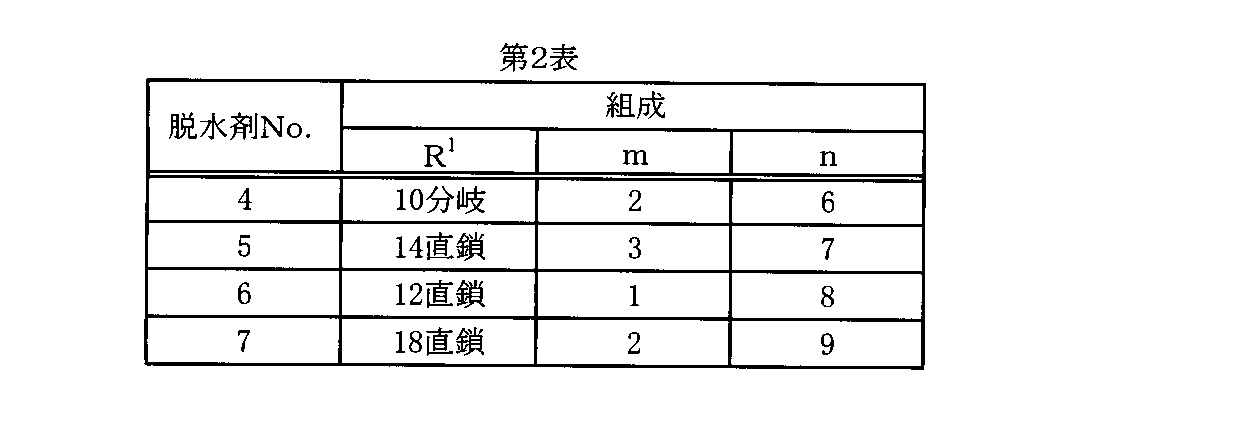
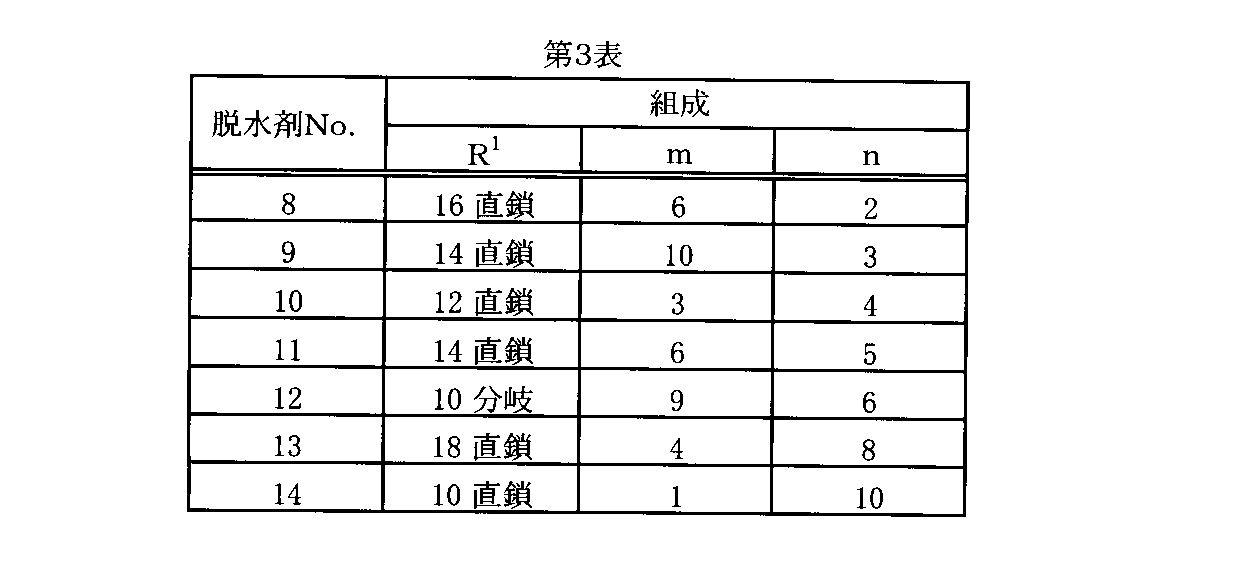
石灰泥スラリーとして、某製紙工場の苛性化工程から採取した薬剤無添加の石灰泥スラリーを用いた。固形分濃度は、純水を用いて、実機ライムマッドフィルターの受けバットに流入する濃度である36g/Lに調整した。
石灰泥スラリーをポリ瓶に50mL採取し、所定温度(30℃)まで加熱した。これに所定量(200mg/L)の脱水助剤を添加し、均一になるよう十分混合した。混合したスラリー全量を吸引濾過器(最大吸引圧力:-0.095MPa)で60秒間吸引濾過した。
濾過後の脱水ケーキ全量を取り出し、チャック付きの袋の中で均一になるようほぐした。その中から約5gを採取し湿潤質量を測定した(Ww)。
その後、105℃の乾燥器内で12時間以上乾燥し、放冷後に乾燥質量を測定した(Wd)。脱水ケーキ中の含水率を次式より求めた。
脱水ケーキ中の含水率(質量%)=[(Ww-Wd)/Ww]×100
脱水ケーキ中の含水率を第4表に示す。
実施例1-2,1-3及び1-4では、ポリ瓶に採取された石灰泥スラリーを、それぞれ、50℃(実施例1-2)、60℃(実施例1-3)及び80℃(実施例1-4)まで加熱したこと以外は、実施例1-1と同様の操作を行った。脱水ケーキ中の含水率を第4表に示す。
[実施例2-1~14-4]
実施例2-1~14-4では、脱水剤の種類及び加熱温度を第4表に示すとおりとしたこと以外は実施例1-1と同様の操作を行った。脱水ケーキ中の含水率を第4表に示す。
[比較例1-1~1-4]
比較例1-1~1-4では、脱水剤を用いなかったこと以外は、それぞれ実施例1-1~1-4と同様の操作を行った。脱水ケーキ中の含水率を第4表に示す。

脱水剤No.1~3は、低温域でより好適な脱水効果を発現すると共に、脱水剤No.4~7は、高温域でより好適な脱水効果を発現する。
次に、脱水剤の添加場所による脱水効果の違いを評価するために、下記の試験を行った。脱水剤として表1の脱水剤NO.3を100mg/L-スラリー重量で、スラッジフィルター送り配管中のポンプサクション(実施例15)又はスラッジフィルターのシャワー水(実施例16)に添加した。比較例2として、脱水剤を添加しない場合についても同様に試験を行った。結果を第5表に示す。

Claims (10)
- 下記一般式(1)
R1O〔CH2CH(CH3)O〕m〔CH2CH2O〕nH…(1)
(式中のR1は炭素数10~18の直鎖及び/又は分岐アルキル基、mは1~10の整数、nは1~10の整数を示す。)
で表されるポリオキシエチレンポリオキシプロピレンアルキルエーテルを含む、石灰泥の脱水助剤。 - 一般式(1)において、R1は炭素数12~16の直鎖及び/又は分岐アルキル基、mは7~9の整数、nは1~4の整数である、請求項1に記載の石灰泥の脱水助剤。
- 一般式(1)において、R1は炭素数10~18の直鎖及び/又は分岐アルキル基、mは1~3の整数、nは6~9の整数である、請求項1に記載の石灰泥の脱水助剤。
- 請求項1~3のいずれか一項に記載の石灰泥の脱水助剤を石灰泥に添加する工程を含む、石灰泥の脱水方法。
- 紙及び/又はパルプ製造における苛性化工程において生成する、20℃以上60℃以下の石灰泥に、請求項2に記載の石灰泥の脱水助剤を添加する工程を含む、石灰泥の脱水方法。
- 紙及び/又はパルプ製造における苛性化工程において生成する、50℃以上85℃以下の石灰泥に、請求項3に記載の石灰泥の脱水助剤を添加する工程を含む、石灰泥の脱水方法。
- 紙及び/又はパルプ製造における苛性化工程において生成する石灰泥の温度を測定する温度測定工程と、
前記石灰泥の温度が20℃以上50℃未満のときには請求項2に記載の脱水助剤を選択し、前記石灰泥の温度が50℃以上60℃以下のときには請求項2に記載の脱水助剤及び請求項3に記載の脱水助剤の少なくとも1種を選択し、前記石灰泥の温度が60℃を超え85℃以下のときには請求項3に記載の脱水助剤を選択する、脱水助剤の選択工程と、
前記石灰泥に、選択された脱水助剤を添加する工程と、
前記脱水助剤が添加された石灰泥を脱水して脱水ケーキを得る脱水工程と、
を含む、石灰泥の脱水方法。 - 紙及び/又はパルプ製造における苛性化工程において生成する石灰泥を脱水する方法であって、請求項1~3のいずれか一項に記載の石灰泥の脱水助剤を、スラッジフィルター送り配管中のポンプサクション又はスラッジフィルターのシャワー水中に添加する工程を含む、請求項4~7のいずれか一項に記載の石灰泥の脱水方法。
- 紙及び/又はパルプ製造における苛性化工程において生成する石灰泥を脱水する方法であって、請求項1~3のいずれか一項に記載の石灰泥の脱水助剤を、スラッジフィルターのシャワー水中に添加する工程を含む、請求項4~7のいずれか一項に記載の石灰泥の脱水方法。
- 紙及び/又はパルプ製造における苛性化工程が、クラフトパルプ製造における苛性化工程である、請求項4~9のいずれか一項に記載の石灰泥の脱水方法。
Priority Applications (1)
| Application Number | Priority Date | Filing Date | Title |
|---|---|---|---|
| CN201480023030.2A CN105143116B (zh) | 2013-04-25 | 2014-04-03 | 苛化泥的脱水助剂、以及使用其的苛化泥的脱水方法 |
Applications Claiming Priority (4)
| Application Number | Priority Date | Filing Date | Title |
|---|---|---|---|
| JP2013-092777 | 2013-04-25 | ||
| JP2013092777 | 2013-04-25 | ||
| JP2014044751A JP5846234B2 (ja) | 2013-04-25 | 2014-03-07 | 石灰泥の脱水助剤、及びそれを用いた石灰泥の脱水方法 |
| JP2014-044751 | 2014-03-07 |
Publications (1)
| Publication Number | Publication Date |
|---|---|
| WO2014175035A1 true WO2014175035A1 (ja) | 2014-10-30 |
Family
ID=51791616
Family Applications (1)
| Application Number | Title | Priority Date | Filing Date |
|---|---|---|---|
| PCT/JP2014/059850 Ceased WO2014175035A1 (ja) | 2013-04-25 | 2014-04-03 | 石灰泥の脱水助剤、及びそれを用いた石灰泥の脱水方法 |
Country Status (3)
| Country | Link |
|---|---|
| JP (1) | JP5846234B2 (ja) |
| CN (1) | CN105143116B (ja) |
| WO (1) | WO2014175035A1 (ja) |
Cited By (1)
| Publication number | Priority date | Publication date | Assignee | Title |
|---|---|---|---|---|
| US12330988B2 (en) | 2020-05-11 | 2025-06-17 | Solenis Technologies, L.P. | Composition and method for the dewatering of aqueous suspensions |
Families Citing this family (1)
| Publication number | Priority date | Publication date | Assignee | Title |
|---|---|---|---|---|
| CN112939418B (zh) * | 2021-01-27 | 2022-11-01 | 重庆四季金标科技有限公司 | 污泥脱水添加物及其使用方法 |
Citations (6)
| Publication number | Priority date | Publication date | Assignee | Title |
|---|---|---|---|---|
| JP2002266273A (ja) * | 2001-03-08 | 2002-09-18 | Hakuto Co Ltd | ライムマッドの脱水方法 |
| JP2003340500A (ja) * | 2002-05-29 | 2003-12-02 | Katayama Chem Works Co Ltd | 炭酸カルシウムスラリーの脱水促進剤 |
| JP2004211020A (ja) * | 2003-01-08 | 2004-07-29 | Katayama Chem Works Co Ltd | 炭酸カルシウムスラリーの脱水促進剤 |
| WO2008018358A1 (en) * | 2006-08-07 | 2008-02-14 | Taihokohzai Co., Ltd. | Agent for accelerating dehydration of lime mud |
| JP2010058072A (ja) * | 2008-09-05 | 2010-03-18 | Hakuto Co Ltd | 石灰泥脱水促進剤及びこれを用いた石灰泥脱水促進方法。 |
| JP2012091072A (ja) * | 2010-10-22 | 2012-05-17 | Hakuto Co Ltd | 石灰泥脱水促進剤 |
Family Cites Families (3)
| Publication number | Priority date | Publication date | Assignee | Title |
|---|---|---|---|---|
| CN1037319A (zh) * | 1988-05-07 | 1989-11-22 | 山西省师范大学 | 天然碱的综合利用方法 |
| CN1063664A (zh) * | 1991-04-11 | 1992-08-19 | 青岛碱厂 | 一种洗涤重碱滤饼的方法 |
| WO2009155539A2 (en) * | 2008-06-20 | 2009-12-23 | 1446881 Alberta Ltd. | Carbon dioxide capture |
-
2014
- 2014-03-07 JP JP2014044751A patent/JP5846234B2/ja active Active
- 2014-04-03 WO PCT/JP2014/059850 patent/WO2014175035A1/ja not_active Ceased
- 2014-04-03 CN CN201480023030.2A patent/CN105143116B/zh active Active
Patent Citations (6)
| Publication number | Priority date | Publication date | Assignee | Title |
|---|---|---|---|---|
| JP2002266273A (ja) * | 2001-03-08 | 2002-09-18 | Hakuto Co Ltd | ライムマッドの脱水方法 |
| JP2003340500A (ja) * | 2002-05-29 | 2003-12-02 | Katayama Chem Works Co Ltd | 炭酸カルシウムスラリーの脱水促進剤 |
| JP2004211020A (ja) * | 2003-01-08 | 2004-07-29 | Katayama Chem Works Co Ltd | 炭酸カルシウムスラリーの脱水促進剤 |
| WO2008018358A1 (en) * | 2006-08-07 | 2008-02-14 | Taihokohzai Co., Ltd. | Agent for accelerating dehydration of lime mud |
| JP2010058072A (ja) * | 2008-09-05 | 2010-03-18 | Hakuto Co Ltd | 石灰泥脱水促進剤及びこれを用いた石灰泥脱水促進方法。 |
| JP2012091072A (ja) * | 2010-10-22 | 2012-05-17 | Hakuto Co Ltd | 石灰泥脱水促進剤 |
Cited By (1)
| Publication number | Priority date | Publication date | Assignee | Title |
|---|---|---|---|---|
| US12330988B2 (en) | 2020-05-11 | 2025-06-17 | Solenis Technologies, L.P. | Composition and method for the dewatering of aqueous suspensions |
Also Published As
| Publication number | Publication date |
|---|---|
| CN105143116B (zh) | 2016-08-31 |
| CN105143116A (zh) | 2015-12-09 |
| JP5846234B2 (ja) | 2016-01-20 |
| JP2014224029A (ja) | 2014-12-04 |
Similar Documents
| Publication | Publication Date | Title |
|---|---|---|
| CN101695649B (zh) | 改性粉煤灰在城市污泥调理中的应用 | |
| CA2866991C (en) | Method for lignin separation from black liquor | |
| JP6161116B2 (ja) | セメント添加剤 | |
| JP2010058072A (ja) | 石灰泥脱水促進剤及びこれを用いた石灰泥脱水促進方法。 | |
| JPS6325115B2 (ja) | ||
| US10017421B2 (en) | Method for preparing active calcium silicate | |
| JP5846234B2 (ja) | 石灰泥の脱水助剤、及びそれを用いた石灰泥の脱水方法 | |
| CN103242454A (zh) | 混合强酸法制取高取代度羧甲基纤维素铵的方法 | |
| CN101474543A (zh) | 一种复合分散剂的制备方法 | |
| CN109879579A (zh) | 一种污泥资源化再利用处理工艺 | |
| CN113247894A (zh) | 一种纸浆-电容炭联合生产的方法 | |
| JP4562159B2 (ja) | ライムマッドの脱水方法 | |
| JP4168156B2 (ja) | 炭酸カルシウムスラリーの脱水促進剤 | |
| CN115916711A (zh) | 用于水性悬浮液脱水的组合物和方法 | |
| CN113045769A (zh) | 利用硫酸盐制浆废液制备木质素磺酸盐的方法及应用 | |
| JP2012091072A (ja) | 石灰泥脱水促進剤 | |
| JP4998982B2 (ja) | 石灰泥の脱水促進剤 | |
| JP4575615B2 (ja) | 石灰泥の脱水促進剤 | |
| KR101495765B1 (ko) | 알루미늄 브레이징용 플럭스 조성물의 제조방법 | |
| CN101962416A (zh) | 一种蔗渣木聚糖磷酸酯的合成方法 | |
| CN103086384A (zh) | 一种利用赤泥制备白炭黑的方法 | |
| CN101857229B (zh) | 一种硅晶切割废液的处理方法及碳化硅漂洗装置 | |
| CN108910887A (zh) | 一种单晶硅切割渣及切割废液的回收处理方法 | |
| CN103664710B (zh) | 一种无喹啉分散剂的制备方法 | |
| JP2003340500A (ja) | 炭酸カルシウムスラリーの脱水促進剤 |
Legal Events
| Date | Code | Title | Description |
|---|---|---|---|
| WWE | Wipo information: entry into national phase |
Ref document number: 201480023030.2 Country of ref document: CN |
|
| 121 | Ep: the epo has been informed by wipo that ep was designated in this application |
Ref document number: 14788959 Country of ref document: EP Kind code of ref document: A1 |
|
| DPE1 | Request for preliminary examination filed after expiration of 19th month from priority date (pct application filed from 20040101) | ||
| WWE | Wipo information: entry into national phase |
Ref document number: IDP00201506867 Country of ref document: ID |
|
| NENP | Non-entry into the national phase |
Ref country code: DE |
|
| 122 | Ep: pct application non-entry in european phase |
Ref document number: 14788959 Country of ref document: EP Kind code of ref document: A1 |