WO2014167993A1 - 熱伝導性樹脂組成物およびそれを使用した熱伝導性封止体 - Google Patents
熱伝導性樹脂組成物およびそれを使用した熱伝導性封止体 Download PDFInfo
- Publication number
- WO2014167993A1 WO2014167993A1 PCT/JP2014/058224 JP2014058224W WO2014167993A1 WO 2014167993 A1 WO2014167993 A1 WO 2014167993A1 JP 2014058224 W JP2014058224 W JP 2014058224W WO 2014167993 A1 WO2014167993 A1 WO 2014167993A1
- Authority
- WO
- WIPO (PCT)
- Prior art keywords
- resin
- resin composition
- heat conductive
- thermally conductive
- volume
- Prior art date
- Legal status (The legal status is an assumption and is not a legal conclusion. Google has not performed a legal analysis and makes no representation as to the accuracy of the status listed.)
- Ceased
Links
Classifications
-
- C—CHEMISTRY; METALLURGY
- C08—ORGANIC MACROMOLECULAR COMPOUNDS; THEIR PREPARATION OR CHEMICAL WORKING-UP; COMPOSITIONS BASED THEREON
- C08L—COMPOSITIONS OF MACROMOLECULAR COMPOUNDS
- C08L67/00—Compositions of polyesters obtained by reactions forming a carboxylic ester link in the main chain; Compositions of derivatives of such polymers
-
- C—CHEMISTRY; METALLURGY
- C08—ORGANIC MACROMOLECULAR COMPOUNDS; THEIR PREPARATION OR CHEMICAL WORKING-UP; COMPOSITIONS BASED THEREON
- C08K—Use of inorganic or non-macromolecular organic substances as compounding ingredients
- C08K3/00—Use of inorganic substances as compounding ingredients
- C08K3/01—Use of inorganic substances as compounding ingredients characterized by their specific function
- C08K3/013—Fillers, pigments or reinforcing additives
-
- C—CHEMISTRY; METALLURGY
- C08—ORGANIC MACROMOLECULAR COMPOUNDS; THEIR PREPARATION OR CHEMICAL WORKING-UP; COMPOSITIONS BASED THEREON
- C08L—COMPOSITIONS OF MACROMOLECULAR COMPOUNDS
- C08L63/00—Compositions of epoxy resins; Compositions of derivatives of epoxy resins
-
- C—CHEMISTRY; METALLURGY
- C09—DYES; PAINTS; POLISHES; NATURAL RESINS; ADHESIVES; COMPOSITIONS NOT OTHERWISE PROVIDED FOR; APPLICATIONS OF MATERIALS NOT OTHERWISE PROVIDED FOR
- C09D—COATING COMPOSITIONS, e.g. PAINTS, VARNISHES OR LACQUERS; FILLING PASTES; CHEMICAL PAINT OR INK REMOVERS; INKS; CORRECTING FLUIDS; WOODSTAINS; PASTES OR SOLIDS FOR COLOURING OR PRINTING; USE OF MATERIALS THEREFOR
- C09D5/00—Coating compositions, e.g. paints, varnishes or lacquers, characterised by their physical nature or the effects produced; Filling pastes
- C09D5/34—Filling pastes
-
- C—CHEMISTRY; METALLURGY
- C08—ORGANIC MACROMOLECULAR COMPOUNDS; THEIR PREPARATION OR CHEMICAL WORKING-UP; COMPOSITIONS BASED THEREON
- C08L—COMPOSITIONS OF MACROMOLECULAR COMPOUNDS
- C08L61/00—Compositions of condensation polymers of aldehydes or ketones; Compositions of derivatives of such polymers
- C08L61/04—Condensation polymers of aldehydes or ketones with phenols only
- C08L61/06—Condensation polymers of aldehydes or ketones with phenols only of aldehydes with phenols
-
- C—CHEMISTRY; METALLURGY
- C08—ORGANIC MACROMOLECULAR COMPOUNDS; THEIR PREPARATION OR CHEMICAL WORKING-UP; COMPOSITIONS BASED THEREON
- C08L—COMPOSITIONS OF MACROMOLECULAR COMPOUNDS
- C08L61/00—Compositions of condensation polymers of aldehydes or ketones; Compositions of derivatives of such polymers
- C08L61/34—Condensation polymers of aldehydes or ketones with monomers covered by at least two of the groups C08L61/04, C08L61/18 and C08L61/20
-
- C—CHEMISTRY; METALLURGY
- C08—ORGANIC MACROMOLECULAR COMPOUNDS; THEIR PREPARATION OR CHEMICAL WORKING-UP; COMPOSITIONS BASED THEREON
- C08L—COMPOSITIONS OF MACROMOLECULAR COMPOUNDS
- C08L65/00—Compositions of macromolecular compounds obtained by reactions forming a carbon-to-carbon link in the main chain; Compositions of derivatives of such polymers
Definitions
- the present invention relates to a thermally conductive resin composition, an electrical / electronic component sealed body sealed with a thermally conductive resin composition, and a method for producing the same.
- thermoplastic resin composition When using a thermoplastic resin composition for these uses, plastics have a lower thermal conductivity than inorganic materials such as metal materials, and it may be difficult to release the generated heat. In order to solve such problems, attempts have been widely made to obtain a highly thermally conductive resin composition by highly filling an inorganic compound having high thermal conductivity into a thermoplastic resin.
- thermoplastic resin when trying to mold a high thermal conductivity thermoplastic resin by a commonly used injection molding method, the resin flowing into the mold rapidly cools and solidifies due to its high thermal conductivity, and special conditions of high speed and high pressure There is a problem that it can only be molded. This has a problem that it cannot be used as a sealing material for delicate electronic components. In addition, these high thermal conductivity thermoplastic resins have a problem that adhesiveness is insufficient and necessary airtightness cannot be ensured.
- Patent Documents 1 and 2 propose a hot melt resin composition for sealing having a melt viscosity that enables sealing at low pressure without damaging electrical and electronic parts.
- this resin composition With this resin composition, a molded product having good initial adhesiveness can be obtained, and the polyester resin composition can be applied to general electric and electronic parts.
- the adhesive strength may be greatly reduced and the sealed state may not be maintained.
- Patent Document 3 shows that a hot-melt adhesive composition containing a specific polyester resin and a phenol-modified alkylbenzene resin exhibits good adhesion to tin-plated copper and PET.
- This adhesive composition also has a problem that the durability of adhesion in a cooling / heating cycle such as ⁇ 40 ° C. for 30 minutes and 80 ° C. for 30 minutes as in an automobile application is insufficient.
- Patent Document 4 exemplifies a method of adding a liquid organic compound at room temperature in order to improve the injection moldability of a thermoplastic resin highly filled with a filler.
- a liquid organic compound bleeds out during injection molding and contaminates the mold.
- it is more difficult to achieve both heat resistance and adhesiveness.
- Patent Document 5 has invented an invention that improves molding fluidity and improves injection moldability by using a resin that can significantly delay the solidification rate during cooling in the mold.
- this invention is improved in terms of molding fluidity at the time of injection molding, the filler filling rate is limited to 60% by volume, and it is possible to achieve high thermal conductivity without sufficiently filling the filler. It is a problem in that it is not done. The reason why such a problem occurs is that the wettability between the resin and the filler is not sufficient, so that it is difficult to achieve a high filler filling due to problems such as strand breakage during kneading. Moreover, it is mentioned that injection molding becomes difficult because the melt viscosity of the resin composition is remarkably increased due to the high filler content of 60% by volume or more.
- the conventional technology has proposed a resin composition for encapsulating electrical and electronic parts having a complicated shape that sufficiently satisfies all the required performance of heat dissipation, good injection moldability, and adhesiveness. There wasn't. Further, in the conventional technique, the adhesiveness is significantly lowered after a 1000 cycle load at -40 ° C. for 30 minutes and 150 ° C. for 30 minutes and a high temperature long time load at 150 ° C. for 1000 hours. That is, a resin composition for sealing electrical and electronic parts that can cope with an environment that requires high durability and heat dissipation against a cold cycle load and a high temperature long time load such as in an automobile engine room has not been realized.
- An object of the present invention is to provide an electrical / electronic component sealing body that has heat dissipation and is excellent in adhesion durability and injection moldability with respect to a cooling / heating cycle load. Moreover, it is providing the manufacturing method and heat conductive resin composition of an electrical / electronic component sealing body suitable for it.
- the present invention relates to 100 parts by volume of the crystalline polyester resin (A), and one or more kinds of resins selected from the group consisting of the phenol-modified alkylbenzene resin (B1), the phenol resin (B2), and the epoxy resin (B3).
- the total is 0.1 to 100 parts by volume
- the heat conductive filler (D) having a single thermal conductivity of 10 W / m ⁇ K or more contains 10 to 10,000 parts by volume, and the thermal conductivity as a resin composition is 0.5 W / m ⁇ K or more.
- the heat conductive resin composition characterized.
- At least one component selected from the group consisting of a polycarbonate component, a polyalkylene ether glycol component and a polylactone component is copolymerized in the crystalline polyester resin (A) in an amount of 25 to 75% by weight.
- the hydroxyl value of the phenol-modified alkylbenzene resin (B1) is preferably 100 equivalents / 10 6 g or more.
- the said phenol resin (B2) is a novolak-type phenol resin, and a hydroxyl value is 100 equivalent / 10 ⁇ 6 > g or more.
- the particle frequency with a particle diameter of 1 to 10 ⁇ m is 100 to 0%.
- the particle frequency with a particle size of 10 to 100 ⁇ m is preferably 0 to 100%.
- the thermal conductive resin composition preferably has a shear adhesive strength retention of 20% or more after 1000 cycles of a cooling cycle of ⁇ 40 ° C. for 30 minutes and 150 ° C. for 30 minutes with respect to the glass epoxy plate.
- the thermal conductive resin composition preferably has a shear adhesive strength to the glass epoxy plate of 0.1 MPa or more.
- the resin composition After the heat conductive resin composition is heated and kneaded, the resin composition is injected at a temperature of 130 ° C. or higher and 300 ° C. or lower and a resin composition pressure of 0.1 MPa or higher and 100 MPa or lower into a mold in which an electric / electronic component is inserted.
- a method for producing a thermally conductive encapsulant is a method for producing a thermally conductive encapsulant.
- thermally conductive sealing body that is sealed with the thermal conductive resin composition.
- an automobile equipped with a part containing the heat conductive resin composition.
- the heat conductive resin composition of the present invention (hereinafter also simply referred to as “resin composition”) is excellent in all of heat dissipation, injection moldability, and adhesiveness, it is used as a sealing material for electrical and electronic component sealing bodies. It can be used suitably.
- the encapsulated body for electric and electronic parts of the present invention comprises a resin or a resin composition that is heated and kneaded in a mold in which the electric and electronic parts are set inside the mold to provide fluidity, and is 0.1 MPa or more and less than 40 MPa. It can be manufactured by injecting and sealing an electric / electronic component with a resin or a resin composition. In other words, compared to injection molding at a high pressure of 40 MPa or higher, which is conventionally used for plastic molding, it is performed at a very low pressure. It is possible to seal a limited electric / electronic component without breaking it.
- the thermally conductive resin composition according to the present invention is selected from the group consisting of a phenol-modified alkylbenzene resin (B1), a phenol resin (B2), and an epoxy resin (B3) with respect to 100 parts by volume of the crystalline polyester resin (A).
- the total of one or more kinds of resins is 0.1 to 100 parts by volume
- the thermal conductivity filler (D) having a single thermal conductivity of 10 W / m ⁇ K or more is 10 to 500 parts by volume.
- the crystalline polyester resin (A) of the present invention has a chemical structure in which a hard segment mainly composed of a polyester segment and a soft segment mainly composed of a polycarbonate and / or polyalkylene ether glycol and / or a polylactone segment are ester-bonded. Is preferred.
- the polycarbonate segment can be formed by copolymerizing a polycarbonate component, typically polycarbonate diol. Due to the copolymerization of the polycarbonate component, it exhibits characteristics such as low melt viscosity, high flexibility and high adhesion.
- the copolymerization ratio of the polycarbonate component is preferably 25% by weight or more, more preferably 30% by weight or more when the entire soft segment component constituting the crystalline polyester resin (A) is 100% by weight. 35% by weight or more is particularly preferable. Further, it is preferably 75% by weight or less, more preferably 70% by weight or less, and particularly preferably 65% by weight or less.
- the said polycarbonate component is an aliphatic polycarbonate component which has a poly (alkylene carbonate) component as a main component.
- the main component is that the poly (alkylene carbonate) component occupies 50% by weight or more of the aliphatic polycarbonate component, more preferably 75% by weight or more, and 90% by weight or more. Further preferred.
- the alkylene group constituting the poly (alkylene carbonate) is preferably a linear alkylene group having 4 to 16 carbon atoms, and a longer chain alkylene group tends to be excellent in durability to cold cycle load. Considering availability, it is preferably a tetramethylene group, a pentamethylene group, a hexamethylene group, an octamethylene group, or a nonamethylene group.
- the copolymer type polycarbonate in which the alkylene group which comprises poly (alkylene carbonate) is 2 or more types of mixtures may be sufficient.
- the polyalkylene ether glycol segment is preferably a polyalkylene ether glycol component, for example, polyethylene glycol (hereinafter also referred to as PEG), polytrimethylene glycol (hereinafter also referred to as PPG), polytetramethylene glycol (hereinafter referred to as PTMG). But is not limited to these. Among these, PTMG is preferable from the viewpoint of heat resistance.
- the number average molecular weight is preferably 230 or more, more preferably 400 or more, and still more preferably 800 or more. Moreover, it is preferable that it is 5000 or less, and it is more preferable that it is 3000 or less.
- the copolymerization ratio of the polyalkylene ether glycol component is preferably 25% by weight or more, preferably 30% by weight or more when the entire soft segment component constituting the crystalline polyester resin (A) is 100% by weight. More preferably, it is particularly preferably 35% by weight or more. Further, it is preferably 75% by weight or less, more preferably 70% by weight or less, and particularly preferably 65% by weight or less.
- the copolymerization ratio of the polyalkylene ether glycol component is too low, the melt viscosity becomes high and high pressure is required for molding, the crystallization speed is high, and short shots are likely to occur. Moreover, when the copolymerization ratio of the polyalkylene ether glycol component is too high, the heat resistance tends to be insufficient.
- the polylactone segment is preferably a polylactone component, and examples thereof include polycaprolactone, polyvalerolactone, polypropiolactone, polyundecalactone, poly (1,5-oxepan-2-one), and the like. It is not limited to.
- the copolymerization ratio of the polylactone component is preferably 25% by weight or more, more preferably 30% by weight or more when the total soft segment component constituting the crystalline polyester resin (A) is 100% by weight, It is particularly preferable that the amount be 35% by weight or more. Further, it is preferably 75% by weight or less, more preferably 70% by weight or less, and particularly preferably 65% by weight or less.
- the copolymerization ratio of the polylactone component is too low, the melt viscosity becomes high and high pressure is required for molding, the crystallization speed is high, and short shots are likely to occur. Moreover, when the copolymerization ratio of the polylactone component is too high, the heat resistance tends to be insufficient.
- the soft segment of the crystalline polyester resin (A) used in the present invention includes one or more kinds of segments selected from the group consisting of the polycarbonate segment, the polyalkylene ether glycol segment, and the polylactone segment, and the total is 25. It is preferred that it is copolymerized at ⁇ 75% by weight.
- heat-resistant crystals such as polyethylene terephthalate (PET), polybutylene terephthalate (PBT), polyethylene naphthalate (PEN), polybutylene naphthalate (PBN), etc.
- PET polyethylene terephthalate
- PBT polybutylene terephthalate
- PEN polyethylene naphthalate
- PBN polybutylene naphthalate
- Preferred is a polyester segment. More preferred are PBT and PBN. When other crystalline polyesters are used, heat resistance may be insufficient, durability, and low temperature characteristics may deteriorate.
- These hard segments can be used alone or in combination of two or more.
- an aromatic copolymer component in the crystalline polyester resin (A) used in the present invention, a small amount of an aromatic copolymer component can be used as long as the low melt viscosity is maintained.
- Preferred examples of the aromatic copolymer component include aromatic dicarboxylic acids such as isophthalic acid and orthophthalic acid, and aromatic glycols such as ethylene oxide adduct and propylene oxide adduct of bisphenol A.
- aromatic dicarboxylic acids such as isophthalic acid and orthophthalic acid
- aromatic glycols such as ethylene oxide adduct and propylene oxide adduct of bisphenol A.
- an aliphatic component having a relatively high molecular weight such as dimer acid or dimer diol
- the amount of copolymerization is preferably 2 mol% or more, more preferably 5 mol% or more, more preferably, when the total of all acid components and all glycol components of the crystalline polyester resin (A) is 200 mol%. It is 10 mol% or more, most preferably 20 mol% or more.
- the upper limit is 70 mol% or less, preferably 60 mol% or less, more preferably 50 mol% or less in consideration of handling properties such as heat resistance and blocking.
- the number average molecular weight of the crystalline polyester resin (A) of the present invention is preferably 3000 or more, more preferably 5000 or more, and further preferably 7000 or more.
- the upper limit of the number average molecular weight is preferably 50000 or less, more preferably 40000 or less, and still more preferably 30000 or less.
- the number average molecular weight is less than 3,000, the hydrolysis resistance of the thermally conductive resin composition and the retention of strong elongation under high temperature and high humidity may be insufficient.
- the number average molecular weight exceeds 50,000, the melt viscosity at 220 ° C. May be higher.
- the crystalline polyester resin (A) of the present invention is preferably a saturated polyester resin not containing an unsaturated group. If it is an unsaturated polyester, there is a possibility that crosslinking occurs at the time of melting, and the melt stability may be inferior.
- the crystalline polyester resin (A) of the present invention may be a polyester having a branch by copolymerizing a trifunctional or higher polycarboxylic acid or polyol such as trimellitic anhydride or trimethylolpropane as necessary. .
- crystalstallinity means that a temperature is raised from ⁇ 150 ° C. to 250 ° C. at 20 ° C./min using a differential scanning calorimeter (DSC) and shows a clear melting peak in the temperature raising process. .
- the phenol-modified alkylbenzene resin (B1) used in the heat conductive resin composition of the present invention is not particularly limited, but is preferably a phenol-modified xylene resin, more preferably an alkylphenol-modified alkylbenzene resin.
- the xylene resin is a multimer composition having a basic structure in which xylene is cross-linked by a methylene group or an ether bond, and can be typically obtained by heating meta-xylene and formaldehyde in the presence of sulfuric acid.
- the phenol-modified alkylbenzene resin (B1) of the present invention preferably has a number average molecular weight in the range of 450 to 40,000.
- the hydroxyl value is preferably 100 equivalents / 10 6 g or more, more preferably 1000 equivalents / 10 6 g or more, and still more preferably 5000 equivalents / 10 6 g or more. Also, preferably not more than 20000 equivalents / 10 6 g, more preferably 15000 or less equivalent / 10 6 g. If the hydroxyl value is too low, the adhesion to the glass epoxy material tends to be poor, and if the hydroxyl value is too high, the water absorption tends to increase and the insulating property tends to be lowered.
- the hydroxyl value referred to here is measured by the JIS K1557-1: 2007A method.
- phenol resin (B2) used for the resin composition of this invention is not specifically limited, It is preferable that it is resin obtained by reaction of phenols and aldehydes.
- a novolac type phenol resin or a cresol type phenol resin may be used, but a novolac type phenol resin is more preferable. Those having a number average molecular weight in the range of 450 to 40,000 are preferred.
- Examples of phenols that can be used as starting materials for phenolic resins include bifunctional compounds such as o-cresol, p-cresol, p-tert-butylphenol, p-ethylphenol, 2,3-xylenol or 2,5-xylenol.
- Trifunctional phenols such as phenol, phenol, m-cresol, m-ethylphenol, 3,5-xylenol or m-methoxyphenol, tetrafunctional phenols such as bisphenol A or bisphenol F, or one of these various phenols Species or two or more can be used in combination.
- formaldehyde used for manufacture of a phenol resin 1 type (s) or 2 or more types, such as formaldehyde, paraformaldehyde, a trioxane, can be used together.
- Other examples include phenol-modified resins such as phenol aralkyl and phenol-modified alkylbenzene resins.
- the phenol resin (B2) used in the present invention preferably has a hydroxyl value of 100 equivalents / 10 6 g or more, more preferably 500 equivalents / 10 6 g or more, and 1000 equivalents / 10 6 g or more. More preferably. Further, preferably 10000 or less equivalent / 10 6 g, more preferably not more than 5000 equivalents / 10 6 g.
- the hydroxyl value referred to here is measured by the JIS K1557-1: 2007A method.
- epoxy resin (B3) used for the resin composition of this invention is not specifically limited, It is preferable that it is an epoxy resin which has an average of at least 1.1 or more glycidyl groups in a molecule
- glycidyl ether type such as bisphenol A diglycidyl ether, bisphenol S diglycidyl ether, novolak glycidyl ether, brominated bisphenol A diglycidyl ether, glycidyl ester type such as hexahydrophthalic acid glycidyl ester, dimer acid glycidyl ester, triglycidyl isocyanate Nurate, glycidylhindantoin, tetraglycidyldiaminodiphenylmethane, triglycidylparaaminophenol, triglycidylmetaaminophenol, diglycidylaniline, diglycidyltoluidine, tetraglycidylmetaxylenediamine, diglycidyltribromoaniline, tetraglycidylbisaminomethylcyclohexane, etc.
- Glycidylamine or 3,4-epoxy B hexyl methyl carboxylate, epoxidized polybutadiene include an alicyclic or aliphatic epoxides such as epoxidized soybean oil, it can be used in combination of these by itself or two or more kinds. Of these, those having good compatibility with the crystalline polyester resin (A) are particularly preferable in order to exhibit high adhesion.
- the preferred number average molecular weight of the epoxy resin (B3) is 450 to 40,000. If the number average molecular weight is less than 450, the resin composition is very easy to soften and the mechanical properties may be inferior. If it exceeds 40,000, the compatibility with the crystalline polyester resin (A) is lowered, and the adhesion may be impaired.
- One or more kinds of resins selected from the group consisting of phenol-modified alkylbenzene resin (B1), phenol resin (B2) and epoxy resin (B3) are stress relaxation effects due to crystallization delay of crystalline polyester resin (A), crystals It is considered that the effect as a dispersion aid of the water-soluble polyester resin (A) and the polyolefin resin (C) and the effect of improving the wettability to the base material by introducing a functional group are exhibited.
- the total blending amount of at least one resin selected from the group consisting of the phenol-modified alkylbenzene resin (B1), the phenol resin (B2) and the epoxy resin (B3) in the present invention is 100 volume of the crystalline polyester resin (A).
- the amount is preferably 0.1 part by volume or more, more preferably 1 part by volume or more, and still more preferably 3 parts by volume or more. Moreover, it is preferable that it is 100 volume parts or less, It is more preferable that it is 50 volume parts or less, It is still more preferable that it is 40 volume parts or less. If the blending ratio of at least one resin selected from the group consisting of phenol-modified alkylbenzene resin (B1), phenol resin (B2) and epoxy resin (B3) is too low, stress relaxation effect due to crystallization delay cannot be exhibited. In addition, the function of the polyolefin resin (C) and the crystalline polyester resin (A) as a dispersion aid may not be exhibited.
- the blending ratio of one or more resins selected from the group consisting of the phenol-modified alkylbenzene resin (B1), the phenol resin (B2), and the epoxy resin (B3) is too high, the productivity of the heat conductive resin composition is increased. In addition, the flexibility characteristics as a sealing body may be inferior.
- the resin composition of the present invention may contain a polyolefin resin (C). Adhesion can be improved by including polyolefin (C). Moreover, it is preferable to use a low crystalline polyolefin resin. Low crystalline polyolefin resin density than ordinary polyolefin resin is in a low tendency, ones density is less than 0.75 g / cm 3 or more 0.91 g / cm 3 are preferred. By using such a low crystallinity and low density polyolefin resin as the polyolefin resin (C), the polyolefin resin (C) can be easily finely divided with respect to the originally incompatible crystalline polyester resin (A).
- a homogeneous resin composition can be obtained with a general twin screw extruder.
- a polyolefin resin (C) having a low density and low crystallinity it appropriately acts on the temporal relaxation of the residual stress generated in the crystalline polyester resin (A) during the injection molding, and is sealed.
- As a stopping resin it exhibits desirable characteristics such as long-term adhesion durability and reduction of stress generated by environmental load.
- polyethylene and ethylene copolymers are particularly preferable because they are easily available and inexpensive and do not adversely affect the adhesion to metals and films.
- More specific examples include low density polyethylene, ultra-low density polyethylene, linear low density polyethylene, ethylene- ⁇ -olefin copolymer, ethylene propylene elastomer, ethylene-butene copolymer, and the like. Or two or more types can be used in combination.
- the polyolefin resin (C) preferably does not contain a polar group such as a carboxyl group or a glycidyl group. If a polar group is present, the compatibility with the crystalline polyester resin (A) changes, and the strain energy during crystallization of the crystalline polyester resin (A) may not be relaxed. Generally, a polyolefin having a polar group tends to have a higher compatibility with a polyester resin than a polyolefin having no polar group. However, in the present invention, when the compatibility is increased, the adhesive deterioration with time tends to increase. .
- a polar group such as a carboxyl group or a glycidyl group.
- the polyolefin resin (C) of the present invention has a melt mass flow rate (hereinafter sometimes abbreviated as MFR) measured according to JIS K 7210-1999, Condition D (test temperature 190 ° C., nominal load 2.16 kg). It is preferably ⁇ 20 g / 10 min. If the MFR is less than 5, the melt viscosity is too high, the compatibility with the crystalline polyester resin (A) may decrease, and the adhesion may be impaired. If the MFR is 20 or more, the viscosity is low and the resin composition is extremely low. It tends to soften and may have poor mechanical properties.
- MFR melt mass flow rate
- blending the polyolefin resin (C) with the heat conductive resin composition has excellent characteristics such as good initial adhesiveness and adhesive durability against environmental load such as a thermal cycle when encapsulating electrical and electronic parts.
- the polyolefin resin (C) is considered to exhibit a strain energy relaxation effect due to crystallization and enthalpy relaxation of the crystalline polyester resin (A).
- a preferred blending amount of the polyolefin resin (C) is 0 to 100 parts by volume, more preferably 0.1 to 90 parts by volume, and still more preferably 3 to 100 parts by volume of the crystalline polyester resin (A). It is ⁇ 80 parts by volume, particularly preferably 5 to 70 parts by volume.
- the resin composition of the present invention does not correspond to any of the crystalline polyester resin (A), the phenol-modified alkylbenzene resin (B1), the phenol resin (B2), the epoxy resin (B3), and the polyolefin resin (C).
- Other resins such as polyester, polyamide, polyolefin, polycarbonate, acrylic, ethylene vinyl acetate, isocyanate compounds, curing agents such as melamine, fillers such as talc and mica, pigments such as carbon black and titanium oxide, antimony trioxide, A flame retardant such as brominated polystyrene may be blended at all. By blending these components, adhesiveness, flexibility, durability and the like may be improved.
- the crystalline polyester resin (A) at that time is preferably contained in an amount of 1% by volume or more, more preferably 5% by volume or more, and further preferably 7% by volume with respect to the entire heat conductive resin composition according to the present invention. That's it.
- the content of the crystalline polyester resin (A) is less than 1% by volume, the crystalline polyester resin (A) itself has excellent molding fluidity, adhesion, adhesion durability and elongation retention for electrical and electronic parts. May decrease.
- an antioxidant for example, as a hindered phenol, 1,3,5-tris (3,5-di-t-butyl-4-hydroxybenzyl) isocyanurate, 1,1,3-tri (4-hydroxy-2-methyl- 5-t-butylphenyl) butane, 1,1-bis (3-t-butyl-6-methyl-4-hydroxyphenyl) butane, 3,5-bis (1,1-dimethylethyl) -4-hydroxy- Benzenepropanoic acid, pentaerythrityltetrakis (3,5-di-t-butyl-4-hydroxyphenyl) propionate, 3- (1,1-dimethylethyl) -4-hydroxy-5-methyl-benzenepropano Icic acid, 3,9-bis [1,1-dimethyl-2-[(3-tert-but) isocyanurate, 1,1,3-tri (4-hydroxy-2-methyl- 5-t-butylphenyl) butane, 1,1-bis (3-t
- the addition amount is preferably 0.1% by volume or more and 5% by volume or less with respect to the whole sealing resin composition. If it is less than 0.1% by volume, the effect of preventing thermal deterioration may be poor. If it exceeds 5% by volume, the adhesiveness and the like may be adversely affected.
- Examples of a method for determining the composition and composition ratio of the crystalline polyester resin (A) include 1 H-NMR and 13 C-NMR in which the polyester resin is dissolved in a solvent such as deuterated chloroform, and measurement after methanolysis of the polyester resin. Examples include quantification by gas chromatography (hereinafter sometimes abbreviated as methanolysis-GC method) and the like.
- methanolysis-GC method gas chromatography
- the composition and composition ratio are determined by 1 H-NMR.
- 13 C-NMR or methanolysis-GC method is adopted or used in combination.
- the dicarboxylic acid and the diol component are esterified at 150 to 250 ° C.
- the target polyester resin can be obtained by polycondensation at ⁇ 300 ° C.
- the target polyester resin is obtained by performing a transesterification reaction at 150 ° C. to 250 ° C. using a derivative such as dimethyl ester of the above dicarboxylic acid and a diol component, and then performing polycondensation at 230 ° C. to 300 ° C. under reduced pressure. be able to.
- the upper limit of the melting point of the crystalline polyester resin (A) is 210. ° C is desirable.
- the lower limit is preferably 5 to 10 ° C. higher than the heat-resistant temperature required for the corresponding application.
- the heat conductive filler (D) is composed of one kind or two or more kinds of fillers, and when the total particle frequency of all fillers is defined as 100%, the particle frequency with a particle diameter of 1 to 10 ⁇ m is 100 to 0%, and The particle frequency with a particle size of 10-100 ⁇ m is preferably 0-100%, more preferably the particle frequency with a particle size of 1-10 ⁇ m is 90-10% and the particle frequency with a particle size of 10-100 ⁇ m. 10 to 90%, more preferably the particle frequency of 1 to 10 ⁇ m is 80 to 20%, and the particle frequency of 10 to 100 ⁇ m is 20 to 80%, particularly preferably 1 to 10 ⁇ m.
- the particle frequency of 70 to 30%, the particle frequency of 10 to 100 ⁇ m is 30 to 70%, most preferably the particle frequency of 1 to 10 ⁇ m is 60 to 40%, and 10-100 ⁇ m grains Particles frequency of 40-60%.
- the preferable blending amount of the heat conductive filler (D) is 10 to 1000 parts by volume, more preferably 50 to 800 parts by volume, and still more preferably 100 parts by volume of the crystalline polyester resin (A). 100 to 600 parts by volume, particularly preferably 150 to 500 parts by volume. If it is less than 10 parts by volume, the thermal conductivity may not be exhibited. If it exceeds 1000 parts by volume, the adhesiveness and the resin physical properties may be deteriorated.
- the particle frequency of the filler will be described below.
- the heat conductive filler (D) to be blended in the heat conductive resin composition of the present invention preferably has electrical insulation and has a single heat conductivity of 10 W / m ⁇ K or more. If it is less than 10 W / m ⁇ K, the effect of improving the thermal conductivity of the thermally conductive resin composition is inferior.
- the thermal conductivity of the single substance is preferably 12 W / m ⁇ K or more, more preferably 15 W / m ⁇ K or more, still more preferably 20 W / m ⁇ K or more, particularly preferably 30 W / m ⁇ K or more. It is done.
- the upper limit of the thermal conductivity of the heat conductive filler (D) alone is not particularly limited, and it is preferably as high as possible. Generally, it is preferably 3000 W / m ⁇ K or less, more preferably 2500 W / m ⁇ K or less. Used.
- the heat conductive filler (D) can contain one kind or two or more kinds of fillers.
- the term “two or more types of fillers” means that two or more types of fillers differ in material type, shape, average particle size, particle size distribution, surface treatment agent, and the like.
- heat conductive filler (D) As the shape of the heat conductive filler (D), various shapes can be applied. For example, particles, fine particles, nanoparticles, aggregated particles, tubes, nanotubes, wires, rods, needles, plates, irregular shapes, rugby balls, hexahedrons, large particles and fine particles are combined Various shapes such as a composite particle shape can be exemplified.
- These heat conductive fillers (D) may be natural products or synthesized ones. In the case of a natural product, there are no particular limitations on the production area and the like, which can be selected as appropriate.
- a heat conductive filler (D) can be suitably selected with the following calculation formulas. For example, when n types of heat conductive fillers (D) are used, each filler is D 1 , D 2 , D 3 ,... D n , the total weight of these is 100% by weight, and the total particle frequency is 100 %.
- the particle frequency with a particle size of 1 to 10 ⁇ m is determined by (Equation 1)
- the particle frequency with a particle size of 10 to 100 ⁇ m is determined by (Equation 2)
- the particle frequency by (Equation 1) is 100 to 0%.
- the particle frequency according to (Equation 2) is preferably 0 to 100%.
- the particle frequency according to (Equation 1) is 90 to 10%
- the particle frequency according to (Equation 2) is 10 to 90%
- more preferably the particle frequency according to (Equation 1) is 80 to 20%
- ( The particle frequency according to formula 2) is 20 to 80%, particularly preferably the particle frequency according to (formula 1) is 70 to 30%, and the particle frequency according to (formula 2) is 30 to 70%, most preferably ( The particle frequency according to equation 1) is 70 to 30%, and the particle frequency according to equation (2) is 30 to 70%.
- the particle frequency of the filler satisfies these ranges, so that the filler filling rate and the thermal conductivity can be improved more efficiently than the case where these ranges are not satisfied even with the same blending amount.
- the particle diameter range is as described above, but more preferably 1 ⁇ m or more and less than 10 ⁇ m and 10 ⁇ m or more and 100 ⁇ m or less.
- the average value of the major axis and the minor axis is used.
- the average particle size per particle and the particle frequency are targeted.
- the average particle diameter and particle frequency in this invention shall be measured using particle size distribution measuring apparatuses, such as a laser scattering particle size distribution analyzer.
- thermally conductive filler (D) exhibiting electrical insulation include metal oxides such as glass oxide epoxy, magnesium oxide, silicon oxide, beryllium oxide, copper oxide, cuprous oxide, boron nitride, and glass nitride epoxy.
- Metal nitride such as silicon nitride, metal carbide such as silicon carbide and zinc oxide, metal carbonate such as magnesium carbonate, insulating carbon material such as diamond, metal hydroxide such as epoxy glass hydroxide and magnesium hydroxide An oxide can be illustrated.
- metal nitrides such as boron nitride, glass nitride epoxy, silicon nitride, metal oxides such as glass oxide epoxy, magnesium oxide, beryllium oxide, and zinc oxide, metal carbonates such as magnesium carbonate Insulating carbon materials such as metal hydroxides such as glass hydroxide epoxy and magnesium hydroxide, and diamond can be more preferably used. These can be used alone or in combination.
- These heat conductive fillers (D) have been surface-treated with various surface treatment agents such as a silane treatment agent in order to enhance the adhesion at the interface between the resin and the inorganic compound or to facilitate workability. May be.
- a surface treating agent For example, conventionally well-known things, such as a silane coupling agent and a titanate coupling agent, can be used.
- an epoxy group-containing silane coupling agent such as epoxy silane
- an amino group-containing silane coupling agent such as aminosilane, polyoxyethylene silane, and the like are preferable because they hardly reduce the physical properties of the resin.
- the surface treatment method of the inorganic compound is not particularly limited, and a normal treatment method can be used.
- the heat conductive resin composition of the present invention optimizes the particle size of the heat conductive filler (D) in order to achieve both high heat conductivity and high flow.
- the idea is that by inserting small particles between large particles, the filling rate is increased and the contact area is increased, so that the amount of filler is reduced with respect to the target thermal conductivity, and as a result, high flow is achieved. .
- the thermal conductivity of the thermally conductive resin composition according to the present invention is preferably 0.5 W / m ⁇ K or more, more preferably 1.0 W / m ⁇ K or more, and 1.5 W / m. -It is more preferable that it is K or more, and it is especially preferable that it is 2.0 W / m.K or more. Less than 0.5 W / m ⁇ K is not preferable because the thermal conductivity effect is poor.
- an upper limit is not specifically limited, Since it depends on the heat conductivity of a heat conductive filler (D), it is generally 3000 W / m * K or less, Furthermore, it is 2500 W / m * K or less.
- the adhesive strength between the specific member and the heat conductive resin composition is obtained by preparing a measurement sample piece in which the heat conductive resin composition is bonded by molding between two plate-like members. Determination is made by measuring the shear peel strength.
- the method for preparing the test specimen for measurement and the method for measuring the shear peel strength are performed according to the methods described in the examples described later.
- the thermally conductive resin composition of the present invention is molded by pouring it into a mold in which electric and electronic parts are set. More specifically, in the case of using a screw type hot melt molding process applicator, it is heated and melted at around 200 to 280 ° C., injected into a mold through an injection nozzle, and after a certain cooling time, it is molded. A molded object can be obtained by removing the object from the mold.
- the type of the applicator for hot melt molding is not particularly limited, and examples thereof include a vertical extrusion molding machine IMC-18F9 manufactured by Imoto Seisakusho.
- Adhesive strength test> (Evaluation of initial adhesiveness and thermal cycle durability) Method for producing adhesive strength test piece A 1.6 mm thick glass epoxy plate (FR-4 manufactured by Nikkan Kogyo Co., Ltd.) is cut into a size of 25 mm wide ⁇ 70 mm long and 25 mm wide ⁇ 40 mm long, and the surface is wiped with acetone. The oil was removed. Next, this glass epoxy plate was fixed inside a mold for preparing a shear adhesion test sample (FIG. 1). Next, the resin composition was injected from the gate using a screw type hot melt applicator (Imoto Seisakusho type low pressure extrusion molding machine IMC-18F9) to perform molding.
- a screw type hot melt applicator Imoto Seisakusho type low pressure extrusion molding machine IMC-18F9
- the molding conditions were a molding resin temperature of 250 ° C., a molding pressure of 5 MPa, a holding pressure of 5 MPa, a cooling time of 15 seconds, and a discharge rotation set to 100% (maximum discharge was 100% and about 3 cc / second).
- the molded product was released to obtain an adhesive strength test piece.
- Thermal cycle test Adhesive strength test piece prepared in the same manner as the initial adhesiveness was evaluated. 1000 cycles with 1 cycle of being placed in an environment of ⁇ 40 ° C. for 30 minutes and then 150 ° C. for 30 minutes. Then, the shear bond strength was measured, and the shear adhesion retention rate was calculated.
- the shear adhesion retention rate is a value defined by the following mathematical formula (3).
- Shear bond strength retention 80% or more Shear bond strength retention 80% less than 50%
- Crystalline polyester resins (A1), (A2), and (A4) were produced in the same manner as the crystalline polyester resin (A3).
- the composition and physical property values are shown in Table 1.
- Example 1 100 parts by volume of crystalline polyester resin (A3), 40 parts by volume of phenol resin (B2-1), 160 parts by volume of thermally conductive filler (D1), 100 parts by volume of thermally conductive filler (D2), uniformly After mixing, a heat conductive resin composition was obtained by melt kneading at a die temperature of 220 ° C. to 240 ° C. using a twin screw extruder. The thermal conductive resin composition was evaluated for initial shear adhesion, cold cycle durability and low-pressure moldability by the method described separately. In ⁇ shear bond strength test>, the initial bond strength was 1.2 MPa, after the thermal cycle test, 1.2 MPa, and the shear bond strength retention was 100%. The evaluation results are shown in Table 2.
- the polyolefin resin, phenol resin, phenol-modified alkylbenzene resin, epoxy resin, and heat conductive filler used in Tables 2 and 3 are as follows.
- Phenol-modified alkylbenzene resin (B1-1) Nikanol (registered trademark) HP-150, manufactured by Fudou Co., Ltd., phenol-modified alkylbenzene resin.
- D2 Alumina powder (LS-110F manufactured by Nippon Light Metal Co., Ltd., single body thermal conductivity 20 to 40 W / m ⁇ K, average particle size 1.1 ⁇ m, volume resistivity 10 12 to 10 14 ⁇ ⁇ cm, Specific gravity 3.98, Particle frequency: [1-10 ⁇ m] 60%, [10-100
- Comparative Example 1 the initial adhesion to the glass epoxy plate was ⁇ 0.05 MPa in the ⁇ Shear Adhesion Strength Test>, and 0 MPa after the thermal cycle test, indicating that both initial adhesion and thermal cycle durability were NG. In ⁇ Low Pressure Molding Evaluation>, good results were obtained. The evaluation results are shown in Table 3.
- the resin composition of the present invention has excellent initial adhesive strength to a glass epoxy material, exhibits high adhesion durability even after being subjected to a thermal cycle load, and is also excellent in maintaining elongation at 150 ° C. atmosphere. Therefore, it is useful as a heat conductive resin composition.
- the thermally conductive electrical and electronic component encapsulant of the present invention exhibits durability against severe environmental loads at high temperatures (150 ° C.) and cooling cycles, and is useful for heat dissipation applications.
- the electrical and electronic component sealing body of the present invention is useful as, for example, automobiles, communications, computers, various connectors for household appliances, harnesses or electronic components, switches having a printed circuit board, and molded products of sensors.
Landscapes
- Chemical & Material Sciences (AREA)
- Organic Chemistry (AREA)
- Health & Medical Sciences (AREA)
- Chemical Kinetics & Catalysis (AREA)
- Medicinal Chemistry (AREA)
- Polymers & Plastics (AREA)
- Life Sciences & Earth Sciences (AREA)
- Engineering & Computer Science (AREA)
- Materials Engineering (AREA)
- Wood Science & Technology (AREA)
- Compositions Of Macromolecular Compounds (AREA)
- Structures Or Materials For Encapsulating Or Coating Semiconductor Devices Or Solid State Devices (AREA)
- Cooling Or The Like Of Semiconductors Or Solid State Devices (AREA)
- Sealing Material Composition (AREA)
Abstract
0.5W/m・K以上の熱伝導性を有し、ガラスエポキシ板への初期接着強度に優れ、冷熱サイクル負荷等の環境負荷に対する耐久性に優れる樹脂組成物、およびこれを用いた電気電子部品封止体を提供する。 結晶性ポリエステル樹脂(A)100体積部に対し、 フェノール変性アルキルベンゼン樹脂(B1)、フェノール樹脂(B2)およびエポキシ樹脂(B3)からなる群より選ばれた1種以上の樹脂の合計が0.1~100体積部、 単体の熱伝導率が10W/m・K以上の熱伝導フィラー(D)が10~10000体積部を含有し、樹脂組成物としての熱伝導率が0.5W/m・K以上であることを特徴とする熱伝導性樹脂組成物。
Description
本発明は熱伝導性樹脂組成物および熱伝導性樹脂組成物によって封止された電気電子部品封止体およびその製造方法に関する。
自動車・電化製品に広汎に使用されている電気電子部品は、その使用目的を達成する為に、外部との電気絶縁性が必須とされる。例えば、電線は電気絶縁性を有する樹脂で被覆されている。昨今、携帯電話等、小さい容量の中に複雑な形状の電気電子部品を詰め込む必要がある用途が激増している中で、その電気絶縁には種々の方法が採用されている。その小型化に合わせて、パソコンやディスプレーの筐体、電子デバイス材料、自動車の内外装などの発熱の問題がクローズアップされており、熱伝導率の高い材料が求められている。これらの発熱対策にはガラスエポキシ製の放熱板を置く等の対策が一般的であるが、現在、自動車の軽量化要望に伴って、このガラスエポキシ板から放熱性の封止材への代替が求められている。
これらの用途に熱可塑性樹脂組成物を使用する際、プラスチックは金属材料など無機物と比較して熱伝導性が低いため、発生する熱を逃がしづらいことが問題になることがある。このような課題を解決するため、熱伝導性の高い無機化合物を熱可塑性樹脂中に高充填することで、高熱伝導性樹脂組成物を得ようとする試みが広くなされている。
しかしながら、高熱伝導性熱可塑性樹脂を通常良く用いられる射出成形法で成形しようとすると、その高熱伝導性が故に金型内に流入した樹脂が急速に冷却固化してしまい、高速、高圧という特殊条件でしか成型できないという課題がある。これでは、繊細な電子部品の封止材としては使用できないという課題があった。また、これらの高熱伝導性の熱可塑性樹脂では、接着性が不足し、必要な気密性を確保できないという課題があった。
特許文献1、2には、電気電子部品を破損しない低圧での封止が可能となる溶融粘度を有する封止用ホットメルト樹脂組成物が提案されている。この樹脂組成物により、初期接着性の良好な成型品が得られるようになり、一般電気電子部品へのポリエステル系樹脂組成物の適用が可能となった。しかしながら、例えば-40℃と80℃の冷熱サイクルの多数回繰り返し等に長期間さらされると、接着強度の大幅低下が起こると共に封止状態が保てなくなることがあった。
特許文献3には、特定のポリエステル樹脂とフェノール変性アルキルベンゼン樹脂が配合されたホットメルト接着剤組成物が、スズメッキ銅およびPETに対して良好な接着性を示すことが示されている。この接着剤組成物も、自動車用途のような-40℃30分と80℃30分のような冷熱サイクルでの接着耐久性が不足するという問題点があった。
特許文献4ではフィラーを高充填した熱可塑性樹脂の射出成形性を向上させるため、室温で液体の有機化合物を添加する方法が例示されている。しかしながらこのような方法では、射出成形時に液体の有機化合物がブリードアウトし、金型を汚染するなどの課題がある。更には、耐熱性、接着性の両立がより難しくなるという問題点もあった。
特許文献5では金型内冷却時の固化速度を大幅に遅延しうる樹脂の使用により、成形流動性を改良し、射出成形性を改善するという発明がなされた。しかし、かかる発明は射出成形時の成形流動性という点では改良されたものの、フィラー充填率は60体積%を上限としており、フィラーを十分に高充填化できずに高熱伝導性を達成することができていないという点で問題である。このような問題が生じる理由としては、樹脂とフィラーの濡れ性が十分でないために、混練の際にストランドが切れるなどの問題に起因してフィラー高充填化が困難となることが挙げられる。また、60体積%以上のフィラー高充填化により、樹脂組成物の溶融粘度が著しく上昇するために射出成形が困難になることが挙げられる。
以上のように従来の技術では、複雑な形状を有する電気電子部品封止用樹脂組成物として、放熱性と良好な射出成形性、接着性の全ての要求性能を充分満足するものは提案されていなかった。また、従来の技術では、-40℃30分と150℃30分の冷熱サイクル1000サイクル負荷や150℃1000時間の高温長時間負荷の後には接着性が大幅に低下してしまう。すなわち、自動車エンジンルーム内等の冷熱サイクル負荷や高温長時間負荷に対する高度な耐久性や放熱性が要求される環境に対応できる電気電子部品封止用樹脂組成物は実現されていなかった。
本発明の課題は、放熱性を持ち、かつ冷熱サイクル負荷に対する接着耐久性および射出成形性に優れる電気電子部品封止体を提供することである。また、それに適した電気電子部品封止体の製造方法および熱伝導性樹脂組成物を提供することである。
上記目的を達成する為、本発明者等は鋭意検討し、以下の発明を提案するに至った。即ち本発明は、結晶性ポリエステル樹脂(A)100体積部に対し、フェノール変性アルキルベンゼン樹脂(B1)、フェノール樹脂(B2)およびエポキシ樹脂(B3)からなる群より選ばれた1種以上の樹脂の合計が0.1~100体積部、
単体の熱伝導率が10W/m・K以上の熱伝導フィラー(D)が10~10000体積部を含有し、樹脂組成物としての熱伝導率が0.5W/m・K以上であることを特徴とする熱伝導性樹脂組成物。
単体の熱伝導率が10W/m・K以上の熱伝導フィラー(D)が10~10000体積部を含有し、樹脂組成物としての熱伝導率が0.5W/m・K以上であることを特徴とする熱伝導性樹脂組成物。
また、前記結晶性ポリエステル樹脂(A)中にポリカーボネート成分、ポリアルキレンエーテルグリコール成分およびポリラクトン成分からなる群より選ばれた1種以上の成分が25~75重量%共重合されていることが好ましい。
また、前記フェノール変性アルキルベンゼン樹脂(B1)の水酸基価が100当量/106g以上であることが好ましい。
また、前記フェノール樹脂(B2)がノボラック型フェノール樹脂であり、水酸基価が100当量/106g以上であることが好ましい。
また、前記熱伝導フィラー(D)が1種類、または2種類以上のフィラーからなり、全フィラーの粒子頻度の合計を100%としたとき、1~10μmの粒径の粒子頻度が100~0%、かつ、10~100μmの粒径の粒子頻度が0~100%であることが好ましい。
また、前記熱伝導性樹脂組成物は、ガラスエポキシ板に対する、-40℃30分と150℃30分の冷熱サイクルを1000サイクル負荷後のせん断接着強度保持率が20%以上であることが好ましい。
また、前記熱伝導性樹脂組成物は、ガラスエポキシ板に対するせん断接着強度が0.1MPa以上であることが好ましい。
前記熱伝導性樹脂組成物を、加熱して混練した後、電気電子部品を挿入した金型に樹脂組成物温度130℃以上300℃以下かつ樹脂組成物圧力0.1MPa以上100MPa以下で注入する、熱伝導性封止体の製造方法。
また、前記熱伝導性樹脂組成物で封止されている熱伝導性封止体。
また、前記熱伝導性樹脂組成物を含有する部品を搭載した自動車。
本発明の熱伝導性樹脂組成物(以下、単に「樹脂組成物」ともいう。)は、放熱性、射出成形性、接着性のいずれも優れるため、電気電子部品封止体の封止材として好適に用いることができる。
本発明の電気電子部品封止体は、電気電子部品を金型内部にセットした金型の中に、加熱し混練して流動性を与えた樹脂または樹脂組成物を、0.1MPa以上40MPa未満の低圧で射出して、樹脂または樹脂組成物によって電気電子部品を包み込み封止することによって製造することができる。すなわち、従来一般的にプラスチックの成型に用いられている40MPa以上の高圧での射出成形に比べて、非常に低圧で行われるため、射出成形法による封止でありながら、耐熱性及び耐圧性に制限のある電気電子部品を破壊することなく封止することができるものである。封止樹脂または樹脂組成物を適切に選択することにより、ガラスエポキシ板に対して、放熱性かつ環境負荷に耐える接着耐久性を有する封止体を得ることができるものである。以下に、発明実施の形態の詳細を順次説明していく。
本発明に係る熱伝導性樹脂組成物は、結晶性ポリエステル樹脂(A)100体積部に対し、フェノール変性アルキルベンゼン樹脂(B1)、フェノール樹脂(B2)およびエポキシ樹脂(B3)からなる群より選ばれた1種以上の樹脂の合計が0.1~100体積部、単体の熱伝導率が10W/m・K以上の熱伝導フィラー(D)が10~500体積部を含有し、樹脂組成物としての熱伝導率が0.5W/m・K以上である。
<結晶性ポリエステル樹脂(A)>
本発明の結晶性ポリエステル樹脂(A)は、主としてポリエステルセグメントからなるハードセグメントと主としてポリカーボネートおよび/またはポリアルキレンエーテルグリコールおよび/またはポリラクトンセグメントからなるソフトセグメントとがエステル結合された化学構造からなることが好ましい。
本発明の結晶性ポリエステル樹脂(A)は、主としてポリエステルセグメントからなるハードセグメントと主としてポリカーボネートおよび/またはポリアルキレンエーテルグリコールおよび/またはポリラクトンセグメントからなるソフトセグメントとがエステル結合された化学構造からなることが好ましい。
本発明の結晶性ポリエステル樹脂(A)のソフトセグメント例として、ポリカーボネートセグメントは、ポリカーボネート成分、典型的にはポリカーボネートジオールを共重合することにより形成することができる。ポリカーボネート成分が共重合されていることによって、低溶融粘度や高柔軟性、高接着性といった特徴を発揮する。前記ポリカーボネート成分の共重合比率は前記結晶性ポリエステル樹脂(A)を構成するソフトセグメント成分全体を100重量%としたとき25重量%以上であることが好ましく、30重量%以上であることが更に好ましく、35重量%以上であることが特に好ましい。また、75重量%以下であることが好ましく、70重量%以下であることが更に好ましく、65重量%以下であることが特に好ましい。前記ポリカーボネート成分の共重合比率が低すぎると溶融粘度が高くなり成形に高圧を要するようになったり、結晶化速度が速く、ショートショットが発生しやすくなる。また、前記ポリカーボネート成分の共重合比率が高すぎると耐熱性が不足する傾向にある。また、前記ポリカーボネート成分はポリ(アルキレンカーボネート)成分を主成分とする脂肪族ポリカーボネート成分であることが好ましい。ここで、主成分とは、ポリ(アルキレンカーボネート)成分が脂肪族ポリカーボネート成分の50重量%以上を占めることであるが、75重量%以上を占めるものがより好ましく、90重量%以上を占めるものが更に好ましい。また、ポリ(アルキレンカーボネート)を構成するアルキレン基としては炭素数4~16の直鎖アルキレン基が好ましく、より長鎖のアルキレン基のほうが冷熱サイクル負荷耐久性に優れる傾向にある。入手容易性を考慮すると、テトラメチレン基、ペンタメチレン基、ヘキサメチレン基、オクタメチレン基、ノナメチレン基であることが好ましい。また、ポリ(アルキレンカーボネート)を構成するアルキレン基が2種以上の混合物である共重合タイプのポリカーボネートであっても良い。
ポリアルキレンエーテルグリコールセグメントとしては、ポリアルキレンエーテルグリコール成分が好ましく、例えば、ポリエチレングリコール(以下、PEGともいう。)、ポリトリメチレングリコール(以下、PPGともいう。)、ポリテトラメチレングリコール(以下、PTMGともいう。)等を挙げることができるが、これらに限定されない。この中でも、耐熱性の観点からPTMGが好ましい。数平均分子量としては、230以上であることが好ましく、400以上であることがより好ましく、800以上であることがさらに好ましい。また、5000以下であることが好ましく、3000以下であることがより好ましい。数平均分子量が230未満であると柔軟性が付与できず、耐屈曲性が発現できないことがあり、一方、5000を超えると他の共重合成分との相溶性が悪く共重合できなくなることがある。ポリアルキレンエーテルグリコール成分の共重合比率は前記結晶性ポリエステル樹脂(A)を構成するソフトセグメント成分全体を100重量%としたとき25重量%以上であることが好ましく、30重量%以上であることが更に好ましく、35重量%以上であることが特に好ましい。また、75重量%以下であることが好ましく、70重量%以下であることが更に好ましく、65重量%以下であることが特に好ましい。ポリアルキレンエーテルグリコール成分の共重合比率が低すぎると溶融粘度が高くなり成形に高圧を要するようになったり、結晶化速度が速く、ショートショットが発生しやすくなる。また、ポリアルキレンエーテルグリコール成分の共重合比率が高すぎると耐熱性が不足する傾向にある。
ポリラクトンセグメントとしては、ポリラクトン成分が好ましく、例えば、ポリカプロラクトン、ポリバレロラクトン、ポリプロピオラクトン、ポリウンデカラクトン、ポリ(1,5-オキセパン-2-オン)等を挙げることができるが、これらに限定されない。ポリラクトン成分の共重合比率は前記結晶性ポリエステル樹脂(A)を構成するソフトセグメント成分全体を100重量%としたとき25重量%以上であることが好ましく、30重量%以上であることが更に好ましく、35重量%以上であることが特に好ましい。また、75重量%以下であることが好ましく、70重量%以下であることが更に好ましく、65重量%以下であることが特に好ましい。ポリラクトン成分の共重合比率が低すぎると溶融粘度が高くなり成形に高圧を要するようになったり、結晶化速度が速く、ショートショットが発生しやすくなる。また、ポリラクトン成分の共重合比率が高すぎると耐熱性が不足する傾向にある。
本発明に用いる結晶性ポリエステル樹脂(A)のソフトセグメントは、前記ポリカーボネートセグメント、前記ポリアルキレンエーテルグリコールセグメントおよび前記ポリラクトンセグメントからなる群より選ばれた1種以上のセグメントを含み、その合計が25~75重量%共重合されていることが好ましい。
また、本発明に用いる結晶性ポリエステル樹脂(A)のハードセグメントとして、ポリエチレンテレフタレート(PET)、ポリブチレンテレフタレート(PBT)、ポリエチレンナフタレート(PEN)、ポリブチレンナフタレート(PBN)等の耐熱性結晶性ポリエステルセグメントが好ましい。より好ましくは、PBT、PBNである。その他の結晶性ポリエステルを使用すると、耐熱性の不足や、耐久性、低温特性が悪化する場合がある。これらハードセグメントを単独で、または2種類以上併用することができる。
一方、本発明に用いる結晶性ポリエステル樹脂(A)において、低い溶融粘度を保持する範囲内であれば、少量の芳香族系共重合成分も使用できる。好ましい芳香族系共重合成分としては、例えば、イソフタル酸、オルソフタル酸等の芳香族ジカルボン酸、ビスフェノールAのエチレンオキサイド付加物およびプロピレンオキサイド付加物等の芳香族系グリコールが挙げられる。特に、ダイマー酸や、ダイマージオールの様な分子量の比較的高い脂肪族系成分を導入することにより、モールド後の素早い結晶固化による良好な金型離型性が得られる場合がある。
ダイマー酸、水添ダイマー酸、ダイマージオール、水添ダイマージオールのような炭素数10以上の脂肪族もしくは脂環族ジカルボン酸および/または炭素数10以上の脂肪族もしくは脂環族ジオールを共重合することができる。これにより、ブロック的なセグメントを本発明の結晶性ポリエステル樹脂(A)に導入することができる。共重合量は、結晶性ポリエステル樹脂(A)の全酸成分と全グリコール成分の合計を200モル%としたとき2モル%以上であることが好ましく、さら好ましくは5モル%以上、より好ましくは10モル%以上、最も好ましくは20モル%以上である。上限は耐熱性やブロッキング等の取り扱い性を考慮すると70モル%以下、好ましくは60モル%以下、より好ましくは50モル%以下である。
本発明の結晶性ポリエステル樹脂(A)の数平均分子量は3000以上であることが好ましく、より好ましくは5000以上、さらに好ましくは7000以上である。また、数平均分子量の上限は好ましくは50000以下、より好ましくは40000以下、さらに好ましくは30000以下である。数平均分子量が3000未満であると、熱伝導性樹脂組成物の耐加水分解性や高温高湿下での強伸度保持が不足することがあり、50000を超えると、220℃での溶融粘度が高くなることがある。
本発明の結晶性ポリエステル樹脂(A)は、不飽和基を含有していない飽和ポリエステル樹脂であることが望ましい。不飽和ポリエステルであれば、溶融時に架橋が起こる等の可能性があり、溶融安定性に劣る場合がある。
また、本発明の結晶性ポリエステル樹脂(A)は、必要に応じて無水トリメリット酸、トリメチロールプロパン等の三官能以上のポリカルボン酸やポリオールを共重合し、分岐を有するポリエステルとしても差し支えない。
本発明で結晶性とは、示差走査型熱量計(DSC)を用いて、-150℃から250℃まで20℃/minで昇温し、該昇温過程に明確な融解ピークを示すものをいう。
<フェノール変性アルキルベンゼン樹脂(B1)>
本発明の熱伝導性樹脂組成物に用いるフェノール変性アルキルベンゼン樹脂(B1)は、特に限定されないが、キシレン樹脂をフェノール変性したものであることが好ましく、アルキルフェノール変性アルキルベンゼン樹脂であることがより好ましい。キシレン樹脂とは、キシレンがメチレン基やエーテル結合で架橋した基本構造の多量体組成物であり、典型的にはメタキシレンとホルムアルデヒドを硫酸の存在下に加熱することによって得ることができる。また、本発明のフェノール変性アルキルベンゼン樹脂(B1)は、数平均分子量が450~40,000の範囲にあるものが好ましい。また、水酸基価が100当量/106g以上であることが好ましく、1000当量/106g以上であることがより好ましく、5000当量/106g以上が更に好ましい。また、20000当量/106g以下であることが好ましく、15000当量/106g以下であることがより好ましい。水酸基価が低すぎるとガラスエポキシ材に対する接着性が悪くなる傾向があり、水酸基価が高すぎると吸水性が高くなり絶縁性が低下する傾向がある。なお、ここで言う水酸基価とは、JIS K 1557-1:2007A法にて測定されたものである。
本発明の熱伝導性樹脂組成物に用いるフェノール変性アルキルベンゼン樹脂(B1)は、特に限定されないが、キシレン樹脂をフェノール変性したものであることが好ましく、アルキルフェノール変性アルキルベンゼン樹脂であることがより好ましい。キシレン樹脂とは、キシレンがメチレン基やエーテル結合で架橋した基本構造の多量体組成物であり、典型的にはメタキシレンとホルムアルデヒドを硫酸の存在下に加熱することによって得ることができる。また、本発明のフェノール変性アルキルベンゼン樹脂(B1)は、数平均分子量が450~40,000の範囲にあるものが好ましい。また、水酸基価が100当量/106g以上であることが好ましく、1000当量/106g以上であることがより好ましく、5000当量/106g以上が更に好ましい。また、20000当量/106g以下であることが好ましく、15000当量/106g以下であることがより好ましい。水酸基価が低すぎるとガラスエポキシ材に対する接着性が悪くなる傾向があり、水酸基価が高すぎると吸水性が高くなり絶縁性が低下する傾向がある。なお、ここで言う水酸基価とは、JIS K 1557-1:2007A法にて測定されたものである。
<フェノール樹脂(B2))>
本発明の樹脂組成物に用いるフェノール樹脂(B2)は、特に限定されないが、フェノール類とアルデヒド類の反応により得られる樹脂であることが好ましい。ノボラック型フェノール樹脂でもクレゾール型フェノール樹脂でもよいが、ノボラック型フェノール樹脂がより好ましい。また数平均分子量が450~40,000の範囲にあるものが好ましい。フェノール樹脂の出発原料として用いることのできるフェノール類としては、o-クレゾール、p-クレゾール、p-tert-ブチルフェノール、p-エチルフェノール、2,3-キシレノールまたは2,5-キシレノール等の2官能性フェノール、フェノール、m-クレゾール、m-エチルフェノール、3,5-キシレノールまたはm-メトキシフェノール等の3官能性フェノール、ビスフェノールAまたはビスフェノールF等の4官能性フェノール、またはこれら各種のフェノール類の1種または2種以上を併用することができる。また、フェノール樹脂の製造に使用されるホルムアルデヒド類としては、ホルムアルデヒド、パラホルムアルデヒド、トリオキサン等の1種または2種以上を併用することができる。その他、フェノールアラルキルやフェノール変性アルキルベンゼン樹脂等のフェノール変性樹脂が挙げられる。これらのうち、特に、高い接着力を発揮させるためには結晶性ポリエステル樹脂(A)に対して相溶性が良いものが好ましい。結晶性ポリエステル樹脂(A)に対して相溶性が良いフェノール樹脂を得るには、溶融粘度が近く、水酸基を有することが好ましい。また、本発明に用いるフェノール樹脂(B2)は水酸基価が100当量/106g以上であることが好ましく、500当量/106g以上あることがより好ましく、1000当量/106g以上であることが更に好ましい。また、10000当量/106g以下であることが好ましく、5000当量/106g以下であることがより好ましい。水酸基価が低すぎるとガラスエポキシ材に対する接着性が悪くなる傾向があり、水酸基価が高すぎると吸水性が高くなり絶縁性が低下する傾向がある。なお、ここで言う水酸基価とは、JIS K 1557-1:2007A法にて測定されたものである。
本発明の樹脂組成物に用いるフェノール樹脂(B2)は、特に限定されないが、フェノール類とアルデヒド類の反応により得られる樹脂であることが好ましい。ノボラック型フェノール樹脂でもクレゾール型フェノール樹脂でもよいが、ノボラック型フェノール樹脂がより好ましい。また数平均分子量が450~40,000の範囲にあるものが好ましい。フェノール樹脂の出発原料として用いることのできるフェノール類としては、o-クレゾール、p-クレゾール、p-tert-ブチルフェノール、p-エチルフェノール、2,3-キシレノールまたは2,5-キシレノール等の2官能性フェノール、フェノール、m-クレゾール、m-エチルフェノール、3,5-キシレノールまたはm-メトキシフェノール等の3官能性フェノール、ビスフェノールAまたはビスフェノールF等の4官能性フェノール、またはこれら各種のフェノール類の1種または2種以上を併用することができる。また、フェノール樹脂の製造に使用されるホルムアルデヒド類としては、ホルムアルデヒド、パラホルムアルデヒド、トリオキサン等の1種または2種以上を併用することができる。その他、フェノールアラルキルやフェノール変性アルキルベンゼン樹脂等のフェノール変性樹脂が挙げられる。これらのうち、特に、高い接着力を発揮させるためには結晶性ポリエステル樹脂(A)に対して相溶性が良いものが好ましい。結晶性ポリエステル樹脂(A)に対して相溶性が良いフェノール樹脂を得るには、溶融粘度が近く、水酸基を有することが好ましい。また、本発明に用いるフェノール樹脂(B2)は水酸基価が100当量/106g以上であることが好ましく、500当量/106g以上あることがより好ましく、1000当量/106g以上であることが更に好ましい。また、10000当量/106g以下であることが好ましく、5000当量/106g以下であることがより好ましい。水酸基価が低すぎるとガラスエポキシ材に対する接着性が悪くなる傾向があり、水酸基価が高すぎると吸水性が高くなり絶縁性が低下する傾向がある。なお、ここで言う水酸基価とは、JIS K 1557-1:2007A法にて測定されたものである。
<エポキシ樹脂(B3)>
本発明の樹脂組成物に用いるエポキシ樹脂(B3)は、特に限定されないが、分子中に平均で少なくとも1.1個以上のグリシジル基を有するエポキシ樹脂であることが好ましい。例えばビスフェノールAジグリシジルエーテル、ビスフェノールSジグリシジルエーテル、ノボラックグリシジルエーテル、ブロム化ビスフェノールAジグリシジルエーテル等のグリシジルエーテルタイプ、ヘキサヒドロフタル酸グリシジルエステル、ダイマー酸グリシジルエステル等のグリシジルエステルタイプ、トリグリシジルイソシアヌレート、グリシジルヒンダントイン、テトラグリシジルジアミノジフェニルメタン、トリグリシジルパラアミノフェノール、トリグリシジルメタアミノフェノール、ジグリシジルアニリン、ジグリシジルトルイジン、テトラグリシジルメタキシレンジアミン、ジグリシジルトリブロムアニリン、テトラグリシジルビスアミノメチルシクロヘキサン等のグリシジルアミン、あるいは3,4-エポキシシクロヘキシルメチルカルボキシレート、エポキシ化ポリブタジエン、エポキシ化大豆油等の脂環族あるいは脂肪族エポキサイドなどが挙げられ、これらを単独で、または2種類以上を併用して使用することができる。これらのうち、特に、高い密着力を発揮させるためには結晶性ポリエステル樹脂(A)に対して相溶性が良いものが好ましい。エポキシ樹脂(B3)の好ましい数平均分子量は450~40000である。数平均分子量が450未満では樹脂組成物が極めて軟化し易く、機械的物性が劣ることがある。40000を超えると、結晶性ポリエステル樹脂(A)との相溶性が低下し、密着性が損なわれるおそれがある。
本発明の樹脂組成物に用いるエポキシ樹脂(B3)は、特に限定されないが、分子中に平均で少なくとも1.1個以上のグリシジル基を有するエポキシ樹脂であることが好ましい。例えばビスフェノールAジグリシジルエーテル、ビスフェノールSジグリシジルエーテル、ノボラックグリシジルエーテル、ブロム化ビスフェノールAジグリシジルエーテル等のグリシジルエーテルタイプ、ヘキサヒドロフタル酸グリシジルエステル、ダイマー酸グリシジルエステル等のグリシジルエステルタイプ、トリグリシジルイソシアヌレート、グリシジルヒンダントイン、テトラグリシジルジアミノジフェニルメタン、トリグリシジルパラアミノフェノール、トリグリシジルメタアミノフェノール、ジグリシジルアニリン、ジグリシジルトルイジン、テトラグリシジルメタキシレンジアミン、ジグリシジルトリブロムアニリン、テトラグリシジルビスアミノメチルシクロヘキサン等のグリシジルアミン、あるいは3,4-エポキシシクロヘキシルメチルカルボキシレート、エポキシ化ポリブタジエン、エポキシ化大豆油等の脂環族あるいは脂肪族エポキサイドなどが挙げられ、これらを単独で、または2種類以上を併用して使用することができる。これらのうち、特に、高い密着力を発揮させるためには結晶性ポリエステル樹脂(A)に対して相溶性が良いものが好ましい。エポキシ樹脂(B3)の好ましい数平均分子量は450~40000である。数平均分子量が450未満では樹脂組成物が極めて軟化し易く、機械的物性が劣ることがある。40000を超えると、結晶性ポリエステル樹脂(A)との相溶性が低下し、密着性が損なわれるおそれがある。
本発明において、フェノール変性アルキルベンゼン樹脂(B1)、フェノール樹脂(B2)およびエポキシ樹脂(B3)からなる群より選ばれた1種以上の樹脂を熱伝導性樹脂組成物に配合することにより、電気電子部品の封止に際し、良好な初期接着性と冷熱サイクルに対する接着耐久性といった優れた特性を付与することができる。フェノール変性アルキルベンゼン樹脂(B1)、フェノール樹脂(B2)およびエポキシ樹脂(B3)からなる群より選ばれた1種以上の樹脂は、結晶性ポリエステル樹脂(A)の結晶化遅延による応力緩和効果、結晶性ポリエステル樹脂(A)とポリオレフィン樹脂(C)の分散助剤としての効果、さらには官能基導入による基材への濡れ性向上の効果を発揮するものと考えられる。本発明におけるフェノール変性アルキルベンゼン樹脂(B1)、フェノール樹脂(B2)およびエポキシ樹脂(B3)からなる群より選ばれた1種以上の樹脂の合計の配合量は、結晶性ポリエステル樹脂(A)100体積部に対して0.1体積部以上であることが好ましく、1体積部以上であることがより好ましく、3体積部以上であることが更に好ましい。また、100体積部以下であることが好ましく、50体積部以下であることがより好ましく、40体積部以下であることが更に好ましい。フェノール変性アルキルベンゼン樹脂(B1)、フェノール樹脂(B2)およびエポキシ樹脂(B3)からなる群より選ばれた1種以上の樹脂の配合比率が低すぎると、結晶化遅延による応力緩和効果が発現されないことがあり、またポリオレフィン樹脂(C)と結晶性ポリエステル樹脂(A)の分散助剤としての働きも発現されないことがある。また、フェノール変性アルキルベンゼン樹脂(B1)、フェノール樹脂(B2)およびエポキシ樹脂(B3)からなる群より選ばれた1種以上の樹脂の配合比率が高すぎると、熱伝導性樹脂組成物の生産性に劣り、さらには封止体としての柔軟性特性が劣ることがある。
<ポリオレフィン樹脂(C)>
本発明の樹脂組成物は、ポリオレフィン樹脂(C)を含んでも良い。ポリオレフィン(C)を含むことで、接着性を向上させることが出来る。また、低結晶性のポリオレフィン樹脂を用いることが好ましい。低結晶性ポリオレフィン樹脂は一般のポリオレフィン樹脂よりも密度が低い傾向にあり、密度が0.75g/cm3以上0.91g/cm3未満であるものが好ましい。このような低結晶性で低密度のポリオレフィン樹脂をポリオレフィン樹脂(C)として使用することによって、元来非相溶の結晶性ポリエステル樹脂(A)に対して、ポリオレフィン樹脂(C)を容易に微分散・混合することができ、一般的な二軸押出機にて、均質な樹脂組成物を得ることができる。また、ポリオレフィン樹脂(C)として低密度で結晶性も低いものを用いることにより、結晶性ポリエステル樹脂(A)に生じた射出成形時の残存応力の経時的な緩和にも適切に作用し、封止樹脂として長期接着耐久性付与や環境負荷による発生応力の軽減といった好ましい特性を発揮する。このような特性を有するポリオレフィン樹脂(C)としては、ポリエチレンおよびエチレン共重合体が、入手容易かつ安価であり、更に金属やフィルムへの接着性に悪影響を与えない点で、特に好ましい。更に具体的には低密度ポリエチレン、超低密度ポリエチレン、直鎖状低密度ポリエチレン、エチレン‐α‐オレフィン共重合体、エチレンプロピレンエラストマー、エチレン‐ブテン共重合体等を挙げることができ、これらを単独で、または2種類以上を併用して使用することができる。
本発明の樹脂組成物は、ポリオレフィン樹脂(C)を含んでも良い。ポリオレフィン(C)を含むことで、接着性を向上させることが出来る。また、低結晶性のポリオレフィン樹脂を用いることが好ましい。低結晶性ポリオレフィン樹脂は一般のポリオレフィン樹脂よりも密度が低い傾向にあり、密度が0.75g/cm3以上0.91g/cm3未満であるものが好ましい。このような低結晶性で低密度のポリオレフィン樹脂をポリオレフィン樹脂(C)として使用することによって、元来非相溶の結晶性ポリエステル樹脂(A)に対して、ポリオレフィン樹脂(C)を容易に微分散・混合することができ、一般的な二軸押出機にて、均質な樹脂組成物を得ることができる。また、ポリオレフィン樹脂(C)として低密度で結晶性も低いものを用いることにより、結晶性ポリエステル樹脂(A)に生じた射出成形時の残存応力の経時的な緩和にも適切に作用し、封止樹脂として長期接着耐久性付与や環境負荷による発生応力の軽減といった好ましい特性を発揮する。このような特性を有するポリオレフィン樹脂(C)としては、ポリエチレンおよびエチレン共重合体が、入手容易かつ安価であり、更に金属やフィルムへの接着性に悪影響を与えない点で、特に好ましい。更に具体的には低密度ポリエチレン、超低密度ポリエチレン、直鎖状低密度ポリエチレン、エチレン‐α‐オレフィン共重合体、エチレンプロピレンエラストマー、エチレン‐ブテン共重合体等を挙げることができ、これらを単独で、または2種類以上を併用して使用することができる。
また、ポリオレフィン樹脂(C)にはカルボキシル基、グリシジル基等の極性基を含まないものが好ましい。極性基が存在すると、結晶性ポリエステル樹脂(A)との相溶性が変化し、結晶性ポリエステル樹脂(A)の結晶化時のひずみエネルギーを緩和できないことがある。一般に極性基を有するポリオレフィンは、極性基を有しないポリオレフィンに比べてポリエステル樹脂に対する相溶性が高い傾向にあるが、本発明では相溶性が高くなるとかえって経時的な接着性低下が大きくなる傾向にある。
さらに本発明のポリオレフィン樹脂(C)は、JIS K 7210-1999の条件D(試験温度190℃、公称荷重2.16kg)により測定したメルトマスフローレイト(以下MFRと略記することがある)が、3~20g/10分であることが好ましい。MFRが5未満では溶融粘度が高すぎることで結晶性ポリエステル樹脂(A)との相溶性が低下し、接着性が損なわれるおそれがあり、MFRが20以上では、粘度が低く樹脂組成物として極めて軟化し易く、機械的物性が劣るおそれがある。
本発明において、ポリオレフィン樹脂(C)を熱伝導性樹脂組成物に配合することは、電気電子部品の封止に際し、良好な初期接着性と冷熱サイクル等の環境負荷に対する接着耐久性といった優れた特性を発揮する。ポリオレフィン樹脂(C)は結晶性ポリエステル樹脂(A)の結晶化やエンタルピー緩和によるひずみエネルギーの緩和効果を発揮するものと考えられる。ポリオレフィン樹脂(C)の好ましい配合量は、結晶性ポリエステル樹脂(A)100体積部に対して、0~100体積部であり、より好ましくは0.1~90体積部であり、さらに好ましくは3~80体積部であり、特に好ましくは5~70体積部である。100体積部を超えると、接着性や樹脂物性を低下させてしまうことがあり、結晶性ポリエステル樹脂(A)とポリオレフィン樹脂(C)がマクロな相分離を起こして破断伸度が低下し、また平滑な表面を得られないなど成形性に悪影響を及ぼすことがある。
本発明の樹脂組成物には、前記結晶性ポリエステル樹脂(A)、フェノール変性アルキルベンゼン樹脂(B1)、フェノール樹脂(B2)、エポキシ樹脂(B3)、およびポリオレフィン樹脂(C)のいずれにも該当しない、ポリエステル、ポリアミド、ポリオレフィン、ポリカーボネート、アクリル、エチレンビニルアセテート等の他の樹脂、イソシアネート化合物、メラミン等の硬化剤、タルクや雲母等の充填材、カーボンブラック、酸化チタン等の顔料、三酸化アンチモン、臭素化ポリスチレン等の難燃剤を配合しても全く差し支えない。これらの成分を配合することにより、接着性、柔軟性、耐久性等が改良される場合がある。その際の結晶性ポリエステル樹脂(A)は、本発明に係る熱伝導性樹脂組成物全体に対して1体積%以上含有することが好ましく、より好ましくは5体積%以上、さらに好ましくは7体積%以上である。結晶性ポリエステル樹脂(A)の含有量が1体積%未満であると結晶性ポリエステル樹脂(A)自身が有する、優れた電気電子部品に対する成型流動性、接着性、接着耐久性、伸度保持性が低下する場合がある。
さらには本発明に係る熱伝導性樹脂組成物が高温高湿度環境に長期間曝される場合には、酸化防止剤を添加することが好ましい。例えば、ヒンダードフェノール系として、1,3,5-トリス(3,5-ジ-t-ブチル-4-ヒドロキシベンジル)イソシアヌレート、1,1,3-トリ(4-ヒドロキシ-2-メチル-5-t-ブチルフェニル)ブタン、1,1-ビス(3-t-ブチル-6-メチル-4-ヒドロキシフェニル)ブタン、3,5-ビス(1,1-ジメチルエチル)-4-ヒドロキシ-ベンゼンプロパノイック酸、ペンタエリトリチルテトラキス(3,5-ジ-t-ブチル-4-ヒドロキシフェニル)プロピオネート、3-(1,1-ジメチルエチル)-4-ヒドロキシ-5-メチル-ベンゼンプロパノイック酸、3,9-ビス[1,1-ジメチル-2-[(3-t-ブチル-4-ヒドロキシ-5-メチルフェニル)プロピオニロキシ]エチル]-2,4,8,10-テトラオキサスピロ[5.5]ウンデカン、1,3,5-トリメチル-2,4,6-トリス(3’,5’-ジ-t-ブチル-4’-ヒドロキシベンジル)ベンゼン、リン系として、3,9-ビス(p-ノニルフェノキシ)-2,4,8,10-テトラオキサ-3,9-ジフォスファスピロ[5.5]ウンデカン、3,9-ビス(オクタデシロキシ)-2,4,8,10-テトラオキサ-3,9-ジフォスファスピロ[5.5]ウンデカン、トリ(モノノニルフェニル)フォスファイト、トリフェノキシフォスフィン、イソデシルフォスファイト、イソデシルフェニルフォスファイト、ジフェニル2-エチルヘキシルフォスファイト、ジノニルフェニルビス(ノニルフェニル)エステルフォスフォラス酸、1,1,3-トリス(2-メチル-4-ジトリデシルフォスファイト-5-t-ブチルフェニル)ブタン、トリス(2,4-ジ-t-ブチルフェニル)フォスファイト、ペンタエリスリトールビス(2,4-ジ-t-ブチルフェニルフォスファイト)、2,2’-メチレンビス(4,6-ジ-t-ブチルフェニル)2-エチルヘキシルフォスファイト、ビス(2,6-ジ-t-ブチル-4-メチルフェニル)ペンタエリスリトールジフォスファイト、チオエーテル系として4,4’-チオビス[2-t-ブチル-5-メチルフェノール]ビス[3-(ドデシルチオ)プロピオネート]、チオビス[2-(1,1-ジメチルエチル)-5-メチル-4,1-フェニレン]ビス[3-(テトラデシルチオ)-プロピオネート]、ペンタエリスリトールテトラキス(3-n-ドデシルチオプロピオネート)、ビス(トリデシル)チオジプロピオネートが挙げられ、これらを単独で、または2種以上を併用して使用できる。添加量は封止用樹脂組成物全体に対して0.1体積%以上5体積%以下が好ましい。0.1体積%未満だと熱劣化防止効果に乏しくなることがある。5体積%を超えると、接着性等に悪影響を与える場合がある。
結晶性ポリエステル樹脂(A)の組成及び組成比を決定する方法としては例えばポリエステル樹脂を重クロロホルム等の溶媒に溶解して測定する1H-NMRや13C-NMR、ポリエステル樹脂のメタノリシス後に測定するガスクロマトグラフィーによる定量(以下、メタノリシス-GC法と略記する場合がある)等が挙げられる。本発明においては、結晶性ポリエステル樹脂(A)を溶解でき、なおかつ1H-NMR測定に適する溶剤がある場合には、1H-NMRで組成及び組成比を決定することとする。適当な溶剤がない場合や1H-NMR測定だけでは組成比が特定できない場合には、13C-NMRやメタノリシス-GC法を採用または併用することとする。
本発明の結晶性ポリエステル樹脂(A)の製造方法としては、公知の方法をとることができるが、例えば、上記のジカルボン酸及びジオール成分を150~250℃でエステル化反応後、減圧しながら230~300℃で重縮合することにより、目的のポリエステル樹脂を得ることができる。あるいは、上記のジカルボン酸のジメチルエステル等の誘導体とジオール成分を用いて150℃~250℃でエステル交換反応後、減圧しながら230℃~300℃で重縮合することにより、目的のポリエステル樹脂を得ることができる。
また、結晶性ポリエステル樹脂(A)の熱劣化を生じさせずにモールドするためには、210~240℃での速やかな溶融が求められるため、結晶性ポリエステル樹脂(A)の融点の上限は210℃が望ましい。下限は、該当する用途で求められる耐熱温度より5~10℃以上高くすると良い。
<熱伝導フィラー(D)>
熱伝導フィラー(D)は1種類、または2種類以上のフィラーからなり、全フィラーの粒子頻度の合計を100%としたとき、1~10μmの粒径の粒子頻度が100~0%、かつ、10~100μmの粒径の粒子頻度が0~100%であることが好ましく、より好ましくは1~10μmの粒径の粒子頻度が90~10%、かつ、10~100μmの粒径の粒子頻度が10~90%であり、さらに好ましくは1~10μmの粒径の粒子頻度が80~20%、かつ、10~100μmの粒径の粒子頻度が20~80%であり、特に好ましくは1~10μmの粒径の粒子頻度が70~30%、かつ、10~100μmの粒径の粒子頻度が30~70%であり、最も好ましくは1~10μmの粒径の粒子頻度が60~40%、かつ、10~100μmの粒径の粒子頻度が40~60%である。また、熱伝導フィラー(D)の好ましい配合量は、結晶性ポリエステル樹脂(A)100体積部に対して、10~1000体積部であり、より好ましくは50~800体積部であり、さらに好ましくは100~600体積部であり、特に好ましくは150~500体積部である。10体積部未満であると、熱伝導性が発揮されないことがあり、1000体積部を超えると、接着性や樹脂物性を低下させてしまうことがある。
フィラーの粒子頻度については、下記で説明する。
熱伝導フィラー(D)は1種類、または2種類以上のフィラーからなり、全フィラーの粒子頻度の合計を100%としたとき、1~10μmの粒径の粒子頻度が100~0%、かつ、10~100μmの粒径の粒子頻度が0~100%であることが好ましく、より好ましくは1~10μmの粒径の粒子頻度が90~10%、かつ、10~100μmの粒径の粒子頻度が10~90%であり、さらに好ましくは1~10μmの粒径の粒子頻度が80~20%、かつ、10~100μmの粒径の粒子頻度が20~80%であり、特に好ましくは1~10μmの粒径の粒子頻度が70~30%、かつ、10~100μmの粒径の粒子頻度が30~70%であり、最も好ましくは1~10μmの粒径の粒子頻度が60~40%、かつ、10~100μmの粒径の粒子頻度が40~60%である。また、熱伝導フィラー(D)の好ましい配合量は、結晶性ポリエステル樹脂(A)100体積部に対して、10~1000体積部であり、より好ましくは50~800体積部であり、さらに好ましくは100~600体積部であり、特に好ましくは150~500体積部である。10体積部未満であると、熱伝導性が発揮されないことがあり、1000体積部を超えると、接着性や樹脂物性を低下させてしまうことがある。
フィラーの粒子頻度については、下記で説明する。
本発明の熱伝導性樹脂組成物に配合する熱伝導フィラー(D)は、電気絶縁性を有し、単体での熱伝導率が10W/m・K以上のものを用いることが好ましい。10W/m・K未満では、熱伝導性樹脂組成物の熱伝導率を向上させる効果に劣るため好ましくない。単体での熱伝導率は、好ましくは12W/m・K以上、より好ましくは15W/m・K以上、さらに好ましくは20W/m・K以上、特に好ましくは30W/m・K以上のものが用いられる。熱伝導フィラー(D)単体での熱伝導率の上限は特に制限されず、高ければ高いほど好ましいが、一般的には3000W/m・K以下、さらには2500W/m・K以下のものが好ましく用いられる。
該熱伝導フィラー(D)は1種類、または2種類以上のフィラーを含有することができる。フィラーが2種類以上とは、フィラーの物質種、形状、平均粒径、粒度分布、表面処理剤などが異なる2種以上という意味である。
熱伝導フィラー(D)の形状については、種々の形状のものを適応可能である。例えば粒子状、微粒子状、ナノ粒子、凝集粒子状、チューブ状、ナノチューブ状、ワイヤ状、ロッド状、針状、板状、不定形、ラグビーボール状、六面体状、大粒子と微小粒子とが複合化した複合粒子状、など種々の形状を例示することができる。またこれら熱伝導フィラー(D)は天然物であってもよいし、合成されたものであってもよい。天然物の場合、産地などには特に限定はなく、適宜選択することができる。
熱伝導性フィラー(D)は、以下の計算式により適宜選択できる。例えば、n種類の熱伝導フィラー(D)を使用する場合は、各フィラーをD1、D2、D3、・・・Dnとし、これらの合計重量を100重量%、合計粒子頻度を100%とする。粒径が1~10μmの粒子頻度を(式1)により求め、さらに粒径が10~100μmの粒子頻度を(式2)により求めたとき、(式1)による粒子頻度が100~0%であり、かつ(式2)による粒子頻度が0~100%であることが好ましい。より好ましくは(式1)による粒子頻度が90~10%、かつ(式2)による粒子頻度が10~90%であり、さらに好ましくは(式1)による粒子頻度が80~20%、かつ(式2)による粒子頻度が20~80%であり、特に好ましくは(式1)による粒子頻度が70~30%、かつ(式2)による粒子頻度が30~70%であり、最も好ましくは(式1)による粒子頻度が70~30%、かつ(式2)による粒子頻度が30~70%である。フィラーの粒子頻度がこれらの範囲を満足することで、同じ配合量でも、これらの範囲を満足しない場合に比べてフィラー充填率ならびに熱伝導率が、効率よく向上して好ましい。粒子径範囲については、前述の通りであるが、より好ましくは、1μm以上10μm未満と10μm以上100μm以下である。
使用フィラーが1種類の場合は(式1)、(式2)のD1の項まで、同様に2種類の場合はD2まで、3種類の場合はD3までというように、種類数に対応した項までの粒子頻度の和を考慮するものとする。ただし、これら(式1)、(式2)で扱う粒径、及び粒子頻度とは、樹脂と配合する前の熱伝導フィラー単独での粒径、及び粒子頻度を示す。すなわち、熱伝導フィラー(D)の形状に関わらず、凝集体である場合は、凝集体の粒径、及び粒子頻度を対象とする。また、チューブ状、ナノチューブ状、ワイヤ状、ロッド状、針状、板状、ラグビーボール状、六面体状などフィラーのアスペクト比が異なる場合は、長径と短径の平均値を対象とする。ただし、凝集体である場合はこの限りでない。これらのいずれにも該当しない場合は、1粒子あたりの平均粒径、及び粒子頻度を対象とする。なお、本発明での平均粒径、及び粒子頻度はレーザー散乱粒度分布計などの粒度分布測定装置を用いて測定したものとする。
(式1)
{(熱伝導フィラーD1の混合割合[質量%])/100×(熱伝導フィラーD1の1~10μmの粒子頻度[%])/100
+(熱伝導フィラーD2の混合割合[質量%])/100×(熱伝導フィラーD2の1~10μmの粒子頻度[%])/100
+(熱伝導フィラーD3の混合割合[質量%])/100×(熱伝導フィラーD3の1~10μmの粒子頻度[%])/100
+・・・
+(熱伝導フィラーDnの混合割合[重量%])/100×(熱伝導フィラーDnの1~10μmの粒子頻度[%])/100}×100}×100
(式2)
{(熱伝導フィラーD1の混合割合[質量%])/100×(熱伝導フィラーD1の10~100μmの粒子頻度[%])/100
+(熱伝導フィラーD2の混合割合[質量%])/100×(熱伝導フィラーD2の10~100μmの粒子頻度[%])/100
+(熱伝導フィラーD3の混合割合[質量%])/100×(熱伝導フィラーD3の10~100μmの粒子頻度[%])/100
+・・・
+(熱伝導フィラーDnの混合割合[重量%])/100×(熱伝導フィラーDnの10~100μmの粒子頻度[%])/100}×100}×100
{(熱伝導フィラーD1の混合割合[質量%])/100×(熱伝導フィラーD1の1~10μmの粒子頻度[%])/100
+(熱伝導フィラーD2の混合割合[質量%])/100×(熱伝導フィラーD2の1~10μmの粒子頻度[%])/100
+(熱伝導フィラーD3の混合割合[質量%])/100×(熱伝導フィラーD3の1~10μmの粒子頻度[%])/100
+・・・
+(熱伝導フィラーDnの混合割合[重量%])/100×(熱伝導フィラーDnの1~10μmの粒子頻度[%])/100}×100}×100
(式2)
{(熱伝導フィラーD1の混合割合[質量%])/100×(熱伝導フィラーD1の10~100μmの粒子頻度[%])/100
+(熱伝導フィラーD2の混合割合[質量%])/100×(熱伝導フィラーD2の10~100μmの粒子頻度[%])/100
+(熱伝導フィラーD3の混合割合[質量%])/100×(熱伝導フィラーD3の10~100μmの粒子頻度[%])/100
+・・・
+(熱伝導フィラーDnの混合割合[重量%])/100×(熱伝導フィラーDnの10~100μmの粒子頻度[%])/100}×100}×100
電気絶縁性を示す熱伝導フィラー(D)としては具体的には、酸化ガラスエポキシ、酸化マグネシウム、酸化ケイ素、酸化ベリリウム、酸化銅、亜酸化銅、などの金属酸化物、窒化ホウ素、窒化ガラスエポキシ、窒化ケイ素、などの金属窒化物、炭化ケイ素、酸化亜鉛などの金属炭化物、炭酸マグネシウムなどの金属炭酸塩、ダイヤモンド、などの絶縁性炭素材料、水酸化ガラスエポキシ、水酸化マグネシウム、などの金属水酸化物、を例示することができる。
中でも電気絶縁性に優れることから、窒化ホウ素、窒化ガラスエポキシ、窒化ケイ素、などの金属窒化物、酸化ガラスエポキシ、酸化マグネシウム、酸化ベリリウム、酸化亜鉛などの金属酸化物、炭酸マグネシウムなどの金属炭酸塩、水酸化ガラスエポキシ、水酸化マグネシウム、などの金属水酸化物、ダイヤモンド、などの絶縁性炭素材料をより好ましく用いることができる。これらは単独あるいは複数種類を組み合わせて用いることができる。
これら熱伝導フィラー(D)は、樹脂と無機化合物との界面の接着性を高めたり、作業性を容易にしたりするため、シラン処理剤などの各種表面処理剤で表面処理がなされたものであってもよい。表面処理剤としては特に限定されず、例えばシランカップリング剤、チタネートカップリング剤、など従来公知のものを使用することができる。中でもエポキシシランなどのエポキシ基含有シランカップリング剤、及び、アミノシランなどのアミノ基含有シランカップリング剤、ポリオキシエチレンシラン、などが樹脂の物性を低下させることが少ないため好ましい。無機化合物の表面処理方法としては特に限定されず、通常の処理方法を利用できる。
本発明の熱伝導性樹脂組成物は高熱伝導と高流動を両立するために、熱伝導性フィラー(D)の粒子径を最適化している。考え方としては、大きい粒子間に小さい粒子を入れることで充填率を上げ接触面積を増やすことで目標の熱伝導性に対し、フィラー量ダウンを実現し、その結果高流動の達成にもつながっている。
本発明に係る熱伝導性樹脂組成物の熱伝導率は、0.5W/m・K以上であることが好ましく、1.0W/m・K以上であることがより好ましく、1.5W/m・K以上であることがさらに好ましく、2.0W/m・K以上であることが特に好ましい。0.5W/m・K未満では、熱伝導性効果に劣るため好ましくない。上限は特に限定されないが、熱伝導フィラー(D)の熱伝導性に依存するため、一般的には3000W/m・K以下、さらには2500W/m・K以下である。
本発明において、特定の部材と熱伝導性樹脂組成物の接着強度は、2枚の板状部材の間に熱伝導性樹脂組成物を成形にて接着した測定用試料片を作製し、これのせん断剥離強度を測定することにより判定する。測定用試験片の作成方法やせん断剥離強度の測定方法は、後述する実施例に記載の方法に従って行うものとする。
本発明の熱伝導性樹脂組成物は、電気電子部品をセットした金型に注入することで成型される。より具体的には、スクリュータイプのホットメルト成型加工用アプリケーターを用いた場合において、200~280℃前後で加熱溶融し、射出ノズルを通じて金型へ注入され、その後一定の冷却時間を経た後、成型物を金型から取り外して成型物を得ることが出来る。
ホットメルト成型加工用アプリケーターの型式は特に限定されないが、例えば井元製作所製竪型押し出し成型機IMC-18F9等が挙げられる。
本発明をさらに詳細に説明するために以下に実施例、比較例を挙げるが、本発明は実施例によってなんら限定されるものではない。尚、実施例、比較例に記載された各測定値は次の方法によって測定したものである。
<融点、ガラス転移温度の測定>
セイコー電子工業株式会社製の示差走査熱量分析計「DSC220型」にて、測定試料5mgをガラスエポキシパンに入れ、蓋を押さえて密封し、一度250℃で5分ホールドした後、液体窒素で急冷して、その後-150℃から250℃まで、20℃/minの昇温速度で測定した。得られた曲線の変曲点をガラス転移温度、吸熱ピークを融点とした。
セイコー電子工業株式会社製の示差走査熱量分析計「DSC220型」にて、測定試料5mgをガラスエポキシパンに入れ、蓋を押さえて密封し、一度250℃で5分ホールドした後、液体窒素で急冷して、その後-150℃から250℃まで、20℃/minの昇温速度で測定した。得られた曲線の変曲点をガラス転移温度、吸熱ピークを融点とした。
<接着強度試験>(初期接着性および冷熱サイクル耐久性の評価)
接着強度試験片の作製方法
1.6mm厚のガラスエポキシ板(ニッカン工業株式会社製FR-4)を幅25mm×長さ70mmの大きさと幅25mm×長さ40mmに切断し、表面をアセトンで拭いて油分を取り除いた。次いでこのガラスエポキシ板をせん断接着試験サンプル作製用金型(図1)内部に固定した。次いでスクリュー型ホットメルト成型加工用アプリケーター(井元製作所製竪型低圧押し出し成型機IMC-18F9)を用いてゲートより樹脂組成物を注入し、成型を行った。成型条件は、成型樹脂温度250℃、成型圧力5MPa、保圧圧力5MPa、冷却時間15秒、吐出回転を100%設定(最大吐出を100%で約3cc/秒)とした。成型物を離型し接着強度試験片を得た。
接着強度試験片の作製方法
1.6mm厚のガラスエポキシ板(ニッカン工業株式会社製FR-4)を幅25mm×長さ70mmの大きさと幅25mm×長さ40mmに切断し、表面をアセトンで拭いて油分を取り除いた。次いでこのガラスエポキシ板をせん断接着試験サンプル作製用金型(図1)内部に固定した。次いでスクリュー型ホットメルト成型加工用アプリケーター(井元製作所製竪型低圧押し出し成型機IMC-18F9)を用いてゲートより樹脂組成物を注入し、成型を行った。成型条件は、成型樹脂温度250℃、成型圧力5MPa、保圧圧力5MPa、冷却時間15秒、吐出回転を100%設定(最大吐出を100%で約3cc/秒)とした。成型物を離型し接着強度試験片を得た。
初期接着性の評価
前記接着試験片を23℃、相対湿度50%の雰囲気下にて3時間以上100時間以内保管した。次いで、せん断接着強度を測定した。引張速度は500mm/分とした。
評価基準 ◎:せん断接着強度2.0MPa以上
○:せん断接着強度2.0MPa未満1.0MPa以上
△:せん断接着強度1.0MPa未満0.1MPa以上
×:せん断接着強度0.1MPa未満
前記接着試験片を23℃、相対湿度50%の雰囲気下にて3時間以上100時間以内保管した。次いで、せん断接着強度を測定した。引張速度は500mm/分とした。
評価基準 ◎:せん断接着強度2.0MPa以上
○:せん断接着強度2.0MPa未満1.0MPa以上
△:せん断接着強度1.0MPa未満0.1MPa以上
×:せん断接着強度0.1MPa未満
冷熱サイクル試験
初期接着性を評価したのと同様にして作製した接着強度試験片に対して、-40℃で30分、次いで150℃で30分の環境下におくことを1サイクルとする1000サイクルの環境負荷を与え、次いでせん断接着強度を測定し、せん断接着度保持率を算出した。なお、せん断接着度保持率は下記数式(3)で定義される値である。
初期接着性を評価したのと同様にして作製した接着強度試験片に対して、-40℃で30分、次いで150℃で30分の環境下におくことを1サイクルとする1000サイクルの環境負荷を与え、次いでせん断接着強度を測定し、せん断接着度保持率を算出した。なお、せん断接着度保持率は下記数式(3)で定義される値である。

評価基準 ◎:せん断接着強度保持率80%以上
○:せん断接着強度保持率80%未満50%以上
△:せん断接着強度保持率50%未満20%以上
×:せん断接着強度保持率20%未満
○:せん断接着強度保持率80%未満50%以上
△:せん断接着強度保持率50%未満20%以上
×:せん断接着強度保持率20%未満
低圧成型性評価方法
平板成型用金型を使用し、ホットメルト成型加工用アプリケーターとして井元製作所製低圧成型アプリケーターIMC-18F9を用いて樹脂組成物からなる平板(100mm×100mm×10mm)を成型した。なお、ゲート位置は100mm×100mmの面の中心とした。
成型条件:成型樹脂温度250℃、成型圧力5MPa、保圧圧力5MPa、冷却時間15秒、吐出回転100%設定
評価基準 ◎:完全に充填され、バリもヒケもなし。
○:完全に充填されるが、若干のバリが発生する。
△:ショートショット無く充填されるが、ヒケ有り。
×:ショートショット有り。
平板成型用金型を使用し、ホットメルト成型加工用アプリケーターとして井元製作所製低圧成型アプリケーターIMC-18F9を用いて樹脂組成物からなる平板(100mm×100mm×10mm)を成型した。なお、ゲート位置は100mm×100mmの面の中心とした。
成型条件:成型樹脂温度250℃、成型圧力5MPa、保圧圧力5MPa、冷却時間15秒、吐出回転100%設定
評価基準 ◎:完全に充填され、バリもヒケもなし。
○:完全に充填されるが、若干のバリが発生する。
△:ショートショット無く充填されるが、ヒケ有り。
×:ショートショット有り。
結晶性ポリエステル樹脂(A3)の製造例
撹拌機、温度計、溜出用冷却器を装備した反応缶内にテレフタル酸100モル部1,4-ブタンジオール75モル部、テレフタル酸と1,4-ブタンジオールの合計重量に対して0.25重量%のテトラブチルチタネートを仕込み170~220℃で2時間エステル化反応を行った。エステル化反応終了後、数平均分子量1000のポリテトラメチレングリコール「PTMG1000」(三菱化学社製)を25モル部、ヒンダードフェノール系酸化防止剤「イルガノックス1330」(チバガイギー社製)を0.5重量%投入し、250℃まで昇温する一方、系内をゆっくり減圧にしてゆき、60分かけて250℃で665Paとした。そしてさらに133Pa以下で30分間重縮合反応を行い、結晶性ポリエステル樹脂(A3)を得た。この結晶性ポリエステル樹脂(A3)の融点は190℃で、溶融粘度は500dPa・sであった。結果を表1に示す。
撹拌機、温度計、溜出用冷却器を装備した反応缶内にテレフタル酸100モル部1,4-ブタンジオール75モル部、テレフタル酸と1,4-ブタンジオールの合計重量に対して0.25重量%のテトラブチルチタネートを仕込み170~220℃で2時間エステル化反応を行った。エステル化反応終了後、数平均分子量1000のポリテトラメチレングリコール「PTMG1000」(三菱化学社製)を25モル部、ヒンダードフェノール系酸化防止剤「イルガノックス1330」(チバガイギー社製)を0.5重量%投入し、250℃まで昇温する一方、系内をゆっくり減圧にしてゆき、60分かけて250℃で665Paとした。そしてさらに133Pa以下で30分間重縮合反応を行い、結晶性ポリエステル樹脂(A3)を得た。この結晶性ポリエステル樹脂(A3)の融点は190℃で、溶融粘度は500dPa・sであった。結果を表1に示す。
結晶性ポリエステル樹脂(A1)、(A2)、(A4)を結晶性ポリエステル樹脂(A3)と同様に製造した。組成および物性値を表1に示す。
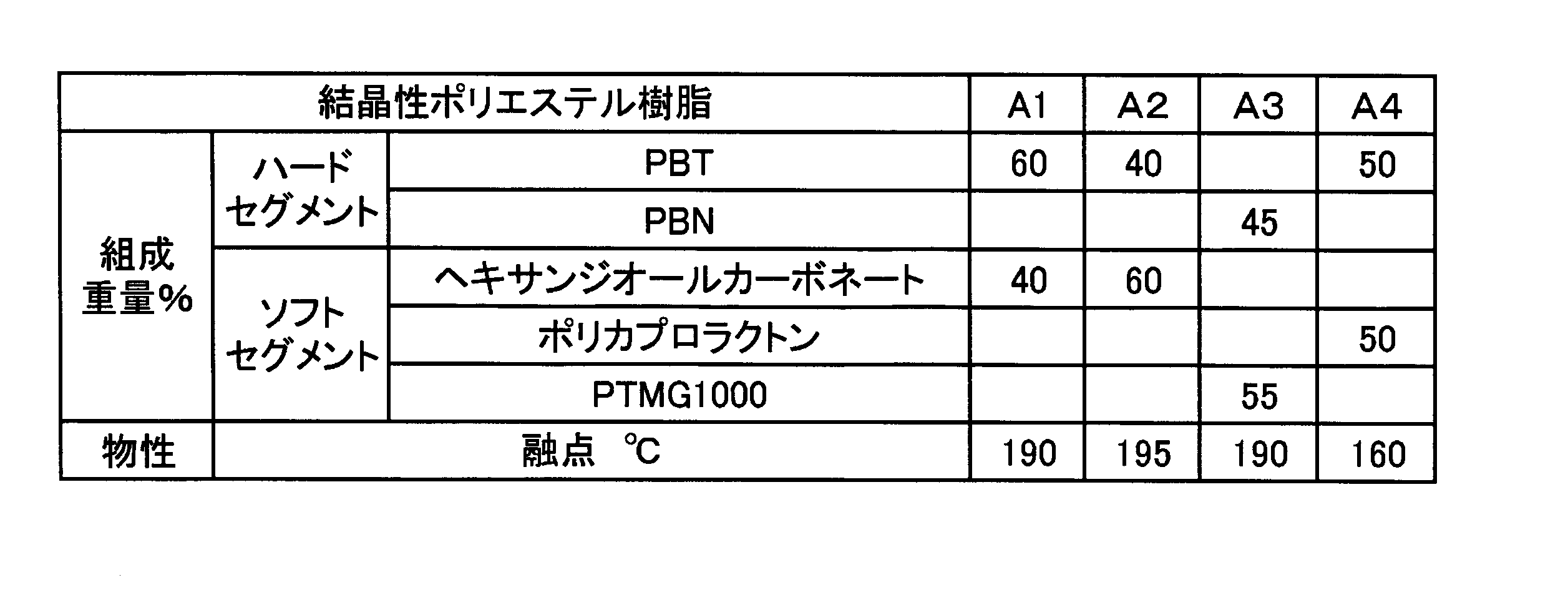
表中の略号は以下の通りである。
PBT:ポリブチレンテレフタレート
PBN:ポリブチレンナフタレート
PCD:ポリカーボネートジオール
PTMG1000:ポリテトラメチレングリコール、数平均分子量1000
PBT:ポリブチレンテレフタレート
PBN:ポリブチレンナフタレート
PCD:ポリカーボネートジオール
PTMG1000:ポリテトラメチレングリコール、数平均分子量1000
実施例1
結晶性ポリエステル樹脂(A3)を100体積部、フェノール樹脂(B2-1)を40体積部、熱伝導性フィラー(D1)を160体積部、熱伝導性フィラー(D2)を100体積部、均一に混合した後、二軸押し出し機を用いてダイ温度220℃~240℃において溶融混練することによって熱伝導性樹脂組成物を得た。別記した方法により、熱伝導性樹脂組成物を初期せん断接着性、冷熱サイクル耐久性および低圧成型性を評価した。<せん断接着強度試験>において、初期接着強度は1.2MPa、冷熱サイクル試験後は1.2MPa、せん断接着強度保持率は100%となった。評価結果を表2に示した。
結晶性ポリエステル樹脂(A3)を100体積部、フェノール樹脂(B2-1)を40体積部、熱伝導性フィラー(D1)を160体積部、熱伝導性フィラー(D2)を100体積部、均一に混合した後、二軸押し出し機を用いてダイ温度220℃~240℃において溶融混練することによって熱伝導性樹脂組成物を得た。別記した方法により、熱伝導性樹脂組成物を初期せん断接着性、冷熱サイクル耐久性および低圧成型性を評価した。<せん断接着強度試験>において、初期接着強度は1.2MPa、冷熱サイクル試験後は1.2MPa、せん断接着強度保持率は100%となった。評価結果を表2に示した。
実施例2~6、比較例1~5
実施例1と同様にして、但し配合を表2~表3のように変更し、熱伝導性樹脂組成物を製造し、評価した。評価結果を表2~表3に示した。
実施例1と同様にして、但し配合を表2~表3のように変更し、熱伝導性樹脂組成物を製造し、評価した。評価結果を表2~表3に示した。
表2および表3で用いたポリオレフィン樹脂、フェノール樹脂、フェノール変性アルキルベンゼン樹脂、エポキシ樹脂、および熱伝導フィラーは以下のものである。
フェノール変性アルキルベンゼン樹脂(B1-1):ニカノール(登録商標)HP-150、フドー(株)製、フェノール変性アルキルベンゼン樹脂。
フェノール変性アルキルベンゼン樹脂(B1-2):ニカノール(登録商標)HP-100、フドー(株)製、フェノール変性アルキルベンゼン樹脂。
フェノール樹脂(B2-1):CKM2400 昭和高分子(株)製、ノボラック型フェノール樹脂、水酸基価9000当量/106g。
エポキシ樹脂(B3-1):JER1007K 三菱化学(株)製、ビスフェノールA型エポキシ樹脂 数平均分子量2900
エポキシ樹脂(B3-2):JER1010K 三菱化学(株)製、ビスフェノールA型エポキシ樹脂 数平均分子量5500
ポリオレフィン(C1):エクセレン(登録商標)VL EUL731、住友化学(株)製、エチレン-α-オレフィン共重合体、密度0.90、MFR10g/10分。
ポリオレフィン(C2):アドマー(登録商標)SF-600、三井化学(株)製、接着性ポリオレフィン、密度0.88、MFR3.3g/10分。
熱伝導フィラー(D)
(D1):アルミナ粉末(日本軽金属(株)製LS-210B、単体での熱伝導率20~40W/m・K、平均粒径3.2μm、体積固有抵抗1012~1014Ω・cm、比重3.98、
粒子頻度:[1~10μm]95%、[10~100μm]0%、[その他]5%)
(D2):アルミナ粉末(日本軽金属(株)製LS-110F、単体での熱伝導率20~40W/m・K、平均粒径1.1μm、体積固有抵抗1012~1014Ω・cm、比重3.98、
粒子頻度:[1~10μm]60%、[10~100μm]0%、[その他]40%)
(D3):アルミナ粉末(日本軽金属(株)製V325F、単体での熱伝導率20~40W/m・K、平均粒径12μm、体積固有抵抗1012~1014Ω・cm、比重3.98、
粒子頻度:[1~10μm]35%、[10~100μm]55%、[その他]10%)
(D4):マグネシア粉末(宇部マテリアルズ(株)製RF-50-C、単体での熱伝導率42~60W/m・K、平均粒径56.6μm、体積固有抵抗1017Ω・cm、比重3.58、
粒子頻度:[1~10μm]0%、[10~100μm]95%、[その他]5%)
(D5):マグネシア粉末(宇部マテリアルズ(株)製RF-10C-C、単体での熱伝導率42~60W/m・K、平均粒径6.6μm、体積固有抵抗1017Ω・cm、比重3.58、
粒子頻度:[1~10μm]60%、[10~100μm]35%、[その他]5%)
フェノール変性アルキルベンゼン樹脂(B1-1):ニカノール(登録商標)HP-150、フドー(株)製、フェノール変性アルキルベンゼン樹脂。
フェノール変性アルキルベンゼン樹脂(B1-2):ニカノール(登録商標)HP-100、フドー(株)製、フェノール変性アルキルベンゼン樹脂。
フェノール樹脂(B2-1):CKM2400 昭和高分子(株)製、ノボラック型フェノール樹脂、水酸基価9000当量/106g。
エポキシ樹脂(B3-1):JER1007K 三菱化学(株)製、ビスフェノールA型エポキシ樹脂 数平均分子量2900
エポキシ樹脂(B3-2):JER1010K 三菱化学(株)製、ビスフェノールA型エポキシ樹脂 数平均分子量5500
ポリオレフィン(C1):エクセレン(登録商標)VL EUL731、住友化学(株)製、エチレン-α-オレフィン共重合体、密度0.90、MFR10g/10分。
ポリオレフィン(C2):アドマー(登録商標)SF-600、三井化学(株)製、接着性ポリオレフィン、密度0.88、MFR3.3g/10分。
熱伝導フィラー(D)
(D1):アルミナ粉末(日本軽金属(株)製LS-210B、単体での熱伝導率20~40W/m・K、平均粒径3.2μm、体積固有抵抗1012~1014Ω・cm、比重3.98、
粒子頻度:[1~10μm]95%、[10~100μm]0%、[その他]5%)
(D2):アルミナ粉末(日本軽金属(株)製LS-110F、単体での熱伝導率20~40W/m・K、平均粒径1.1μm、体積固有抵抗1012~1014Ω・cm、比重3.98、
粒子頻度:[1~10μm]60%、[10~100μm]0%、[その他]40%)
(D3):アルミナ粉末(日本軽金属(株)製V325F、単体での熱伝導率20~40W/m・K、平均粒径12μm、体積固有抵抗1012~1014Ω・cm、比重3.98、
粒子頻度:[1~10μm]35%、[10~100μm]55%、[その他]10%)
(D4):マグネシア粉末(宇部マテリアルズ(株)製RF-50-C、単体での熱伝導率42~60W/m・K、平均粒径56.6μm、体積固有抵抗1017Ω・cm、比重3.58、
粒子頻度:[1~10μm]0%、[10~100μm]95%、[その他]5%)
(D5):マグネシア粉末(宇部マテリアルズ(株)製RF-10C-C、単体での熱伝導率42~60W/m・K、平均粒径6.6μm、体積固有抵抗1017Ω・cm、比重3.58、
粒子頻度:[1~10μm]60%、[10~100μm]35%、[その他]5%)
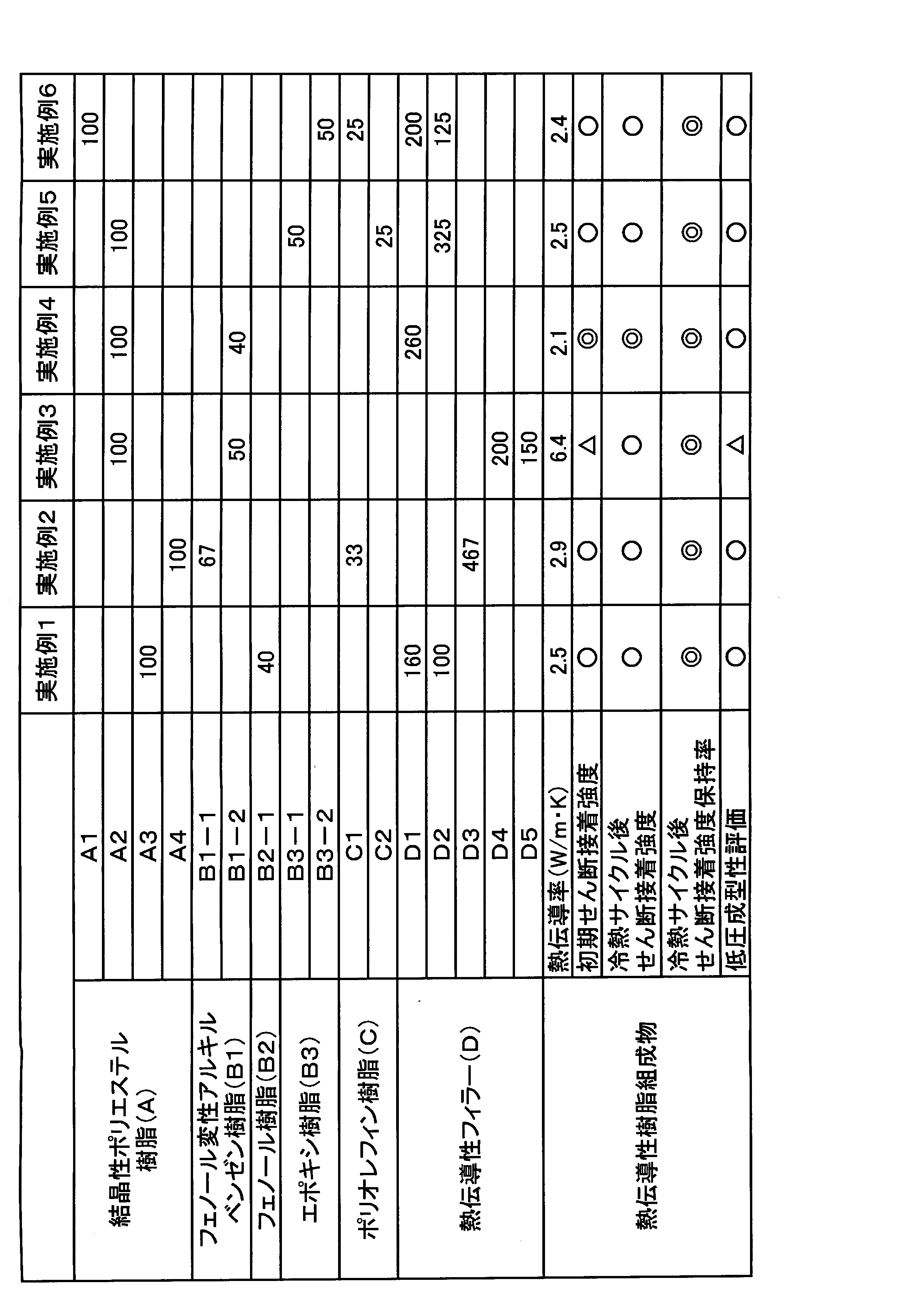

比較例1では、<せん断接着強度試験>においてガラスエポキシ板への初期接着は0.05MPa、冷熱サイクル試験後は0MPaと初期接着性および冷熱サイクル耐久性共にNGとなった。<低圧成型評価>では、良好な結果となった。評価結果を表3に示した。
本発明の樹脂組成物は、ガラスエポキシ材への初期接着強度に優れ、なおかつ冷熱サイクル負荷を経た後も高度な接着耐久性を発揮し、更には150℃雰囲気下での伸度保持にも優れていることから、熱伝導性樹脂組成物として有用である。また、本発明の熱伝導性電気電子部品封止体は、高温下(150℃)や冷熱サイクルの過酷な環境負荷に対する耐久性が発揮され、かつ、放熱性にの用途に有用である。本発明の電気電子部品封止体は、例えば自動車、通信、コンピュータ、家電用途各種のコネクター、ハーネスやあるいは電子部品、プリント基板を有するスイッチ、センサーのモールド成型品として有用である。
Claims (10)
- 結晶性ポリエステル樹脂(A)100体積部に対し、
フェノールル変性アルキルベンゼン樹脂(B1)、フェノール樹脂(B2)およびエポキシ樹脂(B3)からなる群より選ばれた1種以上の樹脂の合計が0.1~100体積部、
単体の熱伝導率が10W/m・K以上の熱伝導フィラー(D)が10~10000体積部を含有し、樹脂組成物としての熱伝導率が0.5W/m・K以上であることを特徴とする熱伝導性樹脂組成物。 - 前記結晶性ポリエステル樹脂(A)中にポリカーボネート成分、ポリアルキレンエーテルグリコール成分およびポリラクトン成分からなる群より選ばれた1種以上の成分が25~75重量%共重合されていることを特徴とする請求項1記載の熱伝導性樹脂組成物。
- 前記フェノール変性アルキルベンゼン樹脂(B1)の水酸基価が100当量/106g以上である請求項1または2に記載の熱伝導性樹脂組成物。
- 前記フェノール樹脂(B2)が、ノボラック型フェノール樹脂であり、水酸基価が100当量/106g以上である請求項1~3のいずれかに記載の熱伝導性樹脂組成物。
- 前記熱伝導フィラー(D)が1種類、または2種類以上のフィラーからなり、全フィラーの粒子頻度の合計を100%としたとき、1~10μmの粒径の粒子頻度が100~0%、かつ、10~100μmの粒径の粒子頻度が0~100%であることを特徴とする請求項1~4のいずれかに記載の熱伝導性樹脂組成物。
- ガラスエポキシ板に対する、-40℃30分と150℃30分の冷熱サイクルを1000サイクル負荷後のせん断接着強度保持率が20%以上である請求項1~5のいずれかに記載の熱伝導性樹脂組成物。
- ガラスエポキシ板に対するせん断接着強度が0.1MPa以上である、請求項1~6のいずれかに記載の熱伝導性樹脂組成物。
- 請求項1~7のいずれかに記載の熱伝導性樹脂組成物を、加熱して混練した後、電気電子部品を挿入した金型に樹脂組成物温度130℃以上300℃以下かつ樹脂組成物圧力0.1MPa以上100MPa以下で注入する、熱伝導性封止体の製造方法。
- 請求項1~7のいずれかに記載の熱伝導性樹脂組成物で封止されている熱伝導性封止体。
- 請求項1~7のいずれかに記載の熱伝導性樹脂組成物を含有する部品を搭載した自動車。
Priority Applications (1)
| Application Number | Priority Date | Filing Date | Title |
|---|---|---|---|
| JP2014530982A JPWO2014167993A1 (ja) | 2013-04-11 | 2014-03-25 | 熱伝導性樹脂組成物およびそれを使用した熱伝導性封止体 |
Applications Claiming Priority (2)
| Application Number | Priority Date | Filing Date | Title |
|---|---|---|---|
| JP2013082933 | 2013-04-11 | ||
| JP2013-082933 | 2013-04-11 |
Publications (1)
| Publication Number | Publication Date |
|---|---|
| WO2014167993A1 true WO2014167993A1 (ja) | 2014-10-16 |
Family
ID=51689405
Family Applications (1)
| Application Number | Title | Priority Date | Filing Date |
|---|---|---|---|
| PCT/JP2014/058224 Ceased WO2014167993A1 (ja) | 2013-04-11 | 2014-03-25 | 熱伝導性樹脂組成物およびそれを使用した熱伝導性封止体 |
Country Status (3)
| Country | Link |
|---|---|
| JP (1) | JPWO2014167993A1 (ja) |
| TW (1) | TW201504328A (ja) |
| WO (1) | WO2014167993A1 (ja) |
Cited By (3)
| Publication number | Priority date | Publication date | Assignee | Title |
|---|---|---|---|---|
| WO2021065248A1 (ja) * | 2019-10-02 | 2021-04-08 | 株式会社オートネットワーク技術研究所 | 熱伝導性フィラー、熱伝導性複合材料、ワイヤーハーネス、および熱伝導性フィラーの製造方法 |
| CN112701054A (zh) * | 2019-02-22 | 2021-04-23 | 西安航思半导体有限公司 | 电子产品用半导体器件的制造方法 |
| CN116948408A (zh) * | 2023-08-24 | 2023-10-27 | 广州市文逸通讯设备有限公司 | 一种耐磨散热手机防护壳材料及其制备工艺 |
Citations (5)
| Publication number | Priority date | Publication date | Assignee | Title |
|---|---|---|---|---|
| JP2005146124A (ja) * | 2003-11-14 | 2005-06-09 | Toray Ind Inc | フィラー高充填樹脂組成物およびそれから得られる成形品 |
| JP2006225648A (ja) * | 2005-01-21 | 2006-08-31 | Showa Denko Kk | 導電性樹脂組成物、その製造方法及び用途 |
| JP2009091440A (ja) * | 2007-10-05 | 2009-04-30 | Kaneka Corp | 高熱伝導性熱可塑性樹脂組成物 |
| WO2011132655A1 (ja) * | 2010-04-19 | 2011-10-27 | ウィンテックポリマー株式会社 | ポリブチレンテレフタレート樹脂組成物及びポリブチレンテレフタレート樹脂組成物の製造方法 |
| JP2012207205A (ja) * | 2011-03-15 | 2012-10-25 | Toyo Ink Sc Holdings Co Ltd | 熱伝導性絶縁樹脂組成物および熱伝導性接着シ−ト |
-
2014
- 2014-03-25 WO PCT/JP2014/058224 patent/WO2014167993A1/ja not_active Ceased
- 2014-03-25 JP JP2014530982A patent/JPWO2014167993A1/ja active Pending
- 2014-04-10 TW TW103113300A patent/TW201504328A/zh unknown
Patent Citations (5)
| Publication number | Priority date | Publication date | Assignee | Title |
|---|---|---|---|---|
| JP2005146124A (ja) * | 2003-11-14 | 2005-06-09 | Toray Ind Inc | フィラー高充填樹脂組成物およびそれから得られる成形品 |
| JP2006225648A (ja) * | 2005-01-21 | 2006-08-31 | Showa Denko Kk | 導電性樹脂組成物、その製造方法及び用途 |
| JP2009091440A (ja) * | 2007-10-05 | 2009-04-30 | Kaneka Corp | 高熱伝導性熱可塑性樹脂組成物 |
| WO2011132655A1 (ja) * | 2010-04-19 | 2011-10-27 | ウィンテックポリマー株式会社 | ポリブチレンテレフタレート樹脂組成物及びポリブチレンテレフタレート樹脂組成物の製造方法 |
| JP2012207205A (ja) * | 2011-03-15 | 2012-10-25 | Toyo Ink Sc Holdings Co Ltd | 熱伝導性絶縁樹脂組成物および熱伝導性接着シ−ト |
Cited By (4)
| Publication number | Priority date | Publication date | Assignee | Title |
|---|---|---|---|---|
| CN112701054A (zh) * | 2019-02-22 | 2021-04-23 | 西安航思半导体有限公司 | 电子产品用半导体器件的制造方法 |
| CN112701054B (zh) * | 2019-02-22 | 2022-07-19 | 西安航思半导体有限公司 | 电子产品用dfn半导体器件的制造方法 |
| WO2021065248A1 (ja) * | 2019-10-02 | 2021-04-08 | 株式会社オートネットワーク技術研究所 | 熱伝導性フィラー、熱伝導性複合材料、ワイヤーハーネス、および熱伝導性フィラーの製造方法 |
| CN116948408A (zh) * | 2023-08-24 | 2023-10-27 | 广州市文逸通讯设备有限公司 | 一种耐磨散热手机防护壳材料及其制备工艺 |
Also Published As
| Publication number | Publication date |
|---|---|
| TW201504328A (zh) | 2015-02-01 |
| JPWO2014167993A1 (ja) | 2017-02-16 |
Similar Documents
| Publication | Publication Date | Title |
|---|---|---|
| JP5077502B2 (ja) | 電気電子部品封止用樹脂組成物、電気電子部品の製造方法および電気電子部品封止体 | |
| JP6269783B2 (ja) | 電気電子部品封止用樹脂組成物、電気電子部品封止体の製造方法および電気電子部品封止体 | |
| JP5359263B2 (ja) | 電気電子部品封止用樹脂組成物、電気電子部品封止体の製造方法および電気電子部品封止体 | |
| CN105324434A (zh) | 注塑成形性优良的高热传导性热塑性树脂组合物 | |
| WO2014167993A1 (ja) | 熱伝導性樹脂組成物およびそれを使用した熱伝導性封止体 | |
| JP6098521B2 (ja) | 電気電子部品封止用樹脂組成物、電気電子部品封止体の製造方法および電気電子部品封止体 | |
| WO2013031593A1 (ja) | 電気電子部品封止用樹脂組成物、電気電子部品封止体の製造方法および電気電子部品封止体 | |
| JP2013112771A (ja) | 電気電子部品封止用樹脂組成物、電気電子部品封止体の製造方法および電気電子部品封止体 | |
| TWI627228B (zh) | 電氣電子零件封裝用樹脂組成物、電氣電子零件封裝體之製造方法及電氣電子零件封裝體 | |
| WO2012165206A1 (ja) | 電気電子部品封止用樹脂組成物、電気電子部品の製造方法および電気電子部品封止体 | |
| JP5293754B2 (ja) | モールディング用ポリエステル樹脂、樹脂組成物及びそれを用いた成型品 | |
| JP2013112772A (ja) | 電気電子部品封止用樹脂組成物、電気電子部品封止体の製造方法および電気電子部品封止体 | |
| HK1191666A (en) | Resin composition for sealing electrical electronic components, method of producing electrical electronic component, and sealed electrical electronic component |
Legal Events
| Date | Code | Title | Description |
|---|---|---|---|
| ENP | Entry into the national phase |
Ref document number: 2014530982 Country of ref document: JP Kind code of ref document: A |
|
| 121 | Ep: the epo has been informed by wipo that ep was designated in this application |
Ref document number: 14782805 Country of ref document: EP Kind code of ref document: A1 |
|
| NENP | Non-entry into the national phase |
Ref country code: DE |
|
| 122 | Ep: pct application non-entry in european phase |
Ref document number: 14782805 Country of ref document: EP Kind code of ref document: A1 |