WO2014157350A1 - 封止剤組成物および該組成物から得られる封止用シート - Google Patents
封止剤組成物および該組成物から得られる封止用シート Download PDFInfo
- Publication number
- WO2014157350A1 WO2014157350A1 PCT/JP2014/058564 JP2014058564W WO2014157350A1 WO 2014157350 A1 WO2014157350 A1 WO 2014157350A1 JP 2014058564 W JP2014058564 W JP 2014058564W WO 2014157350 A1 WO2014157350 A1 WO 2014157350A1
- Authority
- WO
- WIPO (PCT)
- Prior art keywords
- sealant composition
- ethylene
- sealing
- mass
- tackifier
- Prior art date
- Legal status (The legal status is an assumption and is not a legal conclusion. Google has not performed a legal analysis and makes no representation as to the accuracy of the status listed.)
- Ceased
Links
Images

Classifications
-
- C—CHEMISTRY; METALLURGY
- C09—DYES; PAINTS; POLISHES; NATURAL RESINS; ADHESIVES; COMPOSITIONS NOT OTHERWISE PROVIDED FOR; APPLICATIONS OF MATERIALS NOT OTHERWISE PROVIDED FOR
- C09J—ADHESIVES; NON-MECHANICAL ASPECTS OF ADHESIVE PROCESSES IN GENERAL; ADHESIVE PROCESSES NOT PROVIDED FOR ELSEWHERE; USE OF MATERIALS AS ADHESIVES
- C09J123/00—Adhesives based on homopolymers or copolymers of unsaturated aliphatic hydrocarbons having only one carbon-to-carbon double bond; Adhesives based on derivatives of such polymers
- C09J123/02—Adhesives based on homopolymers or copolymers of unsaturated aliphatic hydrocarbons having only one carbon-to-carbon double bond; Adhesives based on derivatives of such polymers not modified by chemical after-treatment
- C09J123/04—Homopolymers or copolymers of ethene
- C09J123/08—Copolymers of ethene
- C09J123/0807—Copolymers of ethene with unsaturated hydrocarbons only containing more than three carbon atoms
- C09J123/0815—Copolymers of ethene with aliphatic 1-olefins
-
- C—CHEMISTRY; METALLURGY
- C08—ORGANIC MACROMOLECULAR COMPOUNDS; THEIR PREPARATION OR CHEMICAL WORKING-UP; COMPOSITIONS BASED THEREON
- C08L—COMPOSITIONS OF MACROMOLECULAR COMPOUNDS
- C08L23/00—Compositions of homopolymers or copolymers of unsaturated aliphatic hydrocarbons having only one carbon-to-carbon double bond; Compositions of derivatives of such polymers
- C08L23/02—Compositions of homopolymers or copolymers of unsaturated aliphatic hydrocarbons having only one carbon-to-carbon double bond; Compositions of derivatives of such polymers not modified by chemical after-treatment
- C08L23/18—Homopolymers or copolymers of hydrocarbons having four or more carbon atoms
- C08L23/20—Homopolymers or copolymers of hydrocarbons having four or more carbon atoms having four to nine carbon atoms
- C08L23/22—Copolymers of isobutene; Butyl rubber; Homopolymers or copolymers of other iso-olefins
-
- C—CHEMISTRY; METALLURGY
- C09—DYES; PAINTS; POLISHES; NATURAL RESINS; ADHESIVES; COMPOSITIONS NOT OTHERWISE PROVIDED FOR; APPLICATIONS OF MATERIALS NOT OTHERWISE PROVIDED FOR
- C09J—ADHESIVES; NON-MECHANICAL ASPECTS OF ADHESIVE PROCESSES IN GENERAL; ADHESIVE PROCESSES NOT PROVIDED FOR ELSEWHERE; USE OF MATERIALS AS ADHESIVES
- C09J123/00—Adhesives based on homopolymers or copolymers of unsaturated aliphatic hydrocarbons having only one carbon-to-carbon double bond; Adhesives based on derivatives of such polymers
- C09J123/02—Adhesives based on homopolymers or copolymers of unsaturated aliphatic hydrocarbons having only one carbon-to-carbon double bond; Adhesives based on derivatives of such polymers not modified by chemical after-treatment
- C09J123/04—Homopolymers or copolymers of ethene
- C09J123/08—Copolymers of ethene
- C09J123/0807—Copolymers of ethene with unsaturated hydrocarbons only containing more than three carbon atoms
- C09J123/083—Copolymers of ethene with aliphatic polyenes, i.e. containing more than one unsaturated bond
-
- C—CHEMISTRY; METALLURGY
- C09—DYES; PAINTS; POLISHES; NATURAL RESINS; ADHESIVES; COMPOSITIONS NOT OTHERWISE PROVIDED FOR; APPLICATIONS OF MATERIALS NOT OTHERWISE PROVIDED FOR
- C09J—ADHESIVES; NON-MECHANICAL ASPECTS OF ADHESIVE PROCESSES IN GENERAL; ADHESIVE PROCESSES NOT PROVIDED FOR ELSEWHERE; USE OF MATERIALS AS ADHESIVES
- C09J123/00—Adhesives based on homopolymers or copolymers of unsaturated aliphatic hydrocarbons having only one carbon-to-carbon double bond; Adhesives based on derivatives of such polymers
- C09J123/02—Adhesives based on homopolymers or copolymers of unsaturated aliphatic hydrocarbons having only one carbon-to-carbon double bond; Adhesives based on derivatives of such polymers not modified by chemical after-treatment
- C09J123/16—Elastomeric ethylene-propylene or ethylene-propylene-diene copolymers, e.g. EPR and EPDM rubbers
-
- H—ELECTRICITY
- H10—SEMICONDUCTOR DEVICES; ELECTRIC SOLID-STATE DEVICES NOT OTHERWISE PROVIDED FOR
- H10K—ORGANIC ELECTRIC SOLID-STATE DEVICES
- H10K50/00—Organic light-emitting devices
- H10K50/80—Constructional details
- H10K50/84—Passivation; Containers; Encapsulations
- H10K50/842—Containers
- H10K50/8426—Peripheral sealing arrangements, e.g. adhesives, sealants
-
- H—ELECTRICITY
- H10—SEMICONDUCTOR DEVICES; ELECTRIC SOLID-STATE DEVICES NOT OTHERWISE PROVIDED FOR
- H10K—ORGANIC ELECTRIC SOLID-STATE DEVICES
- H10K85/00—Organic materials used in the body or electrodes of devices covered by this subclass
- H10K85/10—Organic polymers or oligomers
- H10K85/141—Organic polymers or oligomers comprising aliphatic or olefinic chains, e.g. poly N-vinylcarbazol, PVC or PTFE
-
- C—CHEMISTRY; METALLURGY
- C08—ORGANIC MACROMOLECULAR COMPOUNDS; THEIR PREPARATION OR CHEMICAL WORKING-UP; COMPOSITIONS BASED THEREON
- C08L—COMPOSITIONS OF MACROMOLECULAR COMPOUNDS
- C08L2203/00—Applications
- C08L2203/20—Applications use in electrical or conductive gadgets
- C08L2203/206—Applications use in electrical or conductive gadgets use in coating or encapsulating of electronic parts
-
- H—ELECTRICITY
- H10—SEMICONDUCTOR DEVICES; ELECTRIC SOLID-STATE DEVICES NOT OTHERWISE PROVIDED FOR
- H10K—ORGANIC ELECTRIC SOLID-STATE DEVICES
- H10K50/00—Organic light-emitting devices
- H10K50/80—Constructional details
- H10K50/84—Passivation; Containers; Encapsulations
- H10K50/844—Encapsulations
Definitions
- the present invention relates to a sealant composition and a sealing sheet obtained from the composition.
- the organic EL element basically has a configuration in which an anode layer, a light emitting layer, and a cathode layer are sequentially formed on a substrate made of glass or the like. In order to improve performance, a functional layer may be provided between each layer.
- the organic EL element having the above-described configuration can emit light by energizing between the anode layer and the cathode layer. However, if moisture, impurities, etc.
- the material constituting the element is eroded, leading to deterioration.
- a light emission defect that is, a dark spot is generated, leading to deterioration of visibility.
- a transparent sealing substrate (sometimes a sealing can) made of glass or the like is provided, and the organic EL element is interposed between the organic EL element and the sealing substrate.
- a transparent sealing substrate sometimes a sealing can
- Patent Document 1 an organic EL device in which a viscous material containing a dehydrating agent is filled in the generated space is disclosed (for example, see Patent Document 1), it is necessary to use a dam material so that the viscous material does not overflow at the time of filling. An organic EL device could not be obtained.
- Patent Document 2 discloses a method of sealing with a transparent sealing material made of a thermoplastic resin.
- an electroluminescence display panel including a light emitting element sequentially including a substrate, an anode layer, a light emitting layer, and a cathode layer, and a sealing member disposed on the light emitting surface side of the light emitting element.
- a transparent encapsulant for an organic EL device which is formed from a flexible polymer composition, and is disposed between a light emitting surface of the light emitting device and the sealing member. Transparent sealing materials for elements have been proposed.
- JP 2012-038660 A Japanese Patent No. 4475084
- the transparent sealing material made of the thermoplastic resin described in Patent Document 2 described above has a low adhesive force to the substrate or sealing substrate on which the organic EL element is formed in the combination of the base polymer and the softening agent.
- the adhesive strength to the substrate is low, the substrate may be displaced or peeled off due to an impact received in the manufacturing process.
- external water vapor enters through the peeled portion between the substrate and the sealing material, thereby inducing the generation of dark spots. Therefore, this invention makes it a subject to provide the sealing agent composition which is excellent in not only a filling property but the adhesive performance when it is set as a sealing material, and holding power, and a film or sheet
- An adhesive sealant composition used for an electronic device comprising an olefin polymer and a tackifier, wherein the olefin polymer comprises an ethylene / ⁇ -olefin copolymer and an ethylene / It is at least one selected from ⁇ -olefin / non-conjugated diene copolymers, and the content of the tackifier is 10% by mass or more and 70% by mass or less in the resin composition constituting the sealant composition.
- the sealing agent composition characterized by the above-mentioned.
- An encapsulant composition having adhesiveness used in an electronic device comprising an olefin polymer and a tackifier, wherein the olefin polymer is an ethylene / ⁇ -olefin copolymer and ethylene -It is at least one selected from ⁇ -olefin / non-conjugated diene copolymers, and the content of the tackifier is 40% by mass or more and 70% by mass or less in the resin composition constituting the sealant composition.
- the ethylene / ⁇ -olefin copolymer and the ethylene / ⁇ -olefin / non-conjugated diene copolymer are a carboxyl group, a hydroxyl group, an epoxy group, an amino group, an alkoxysilyl group, a sulfonic acid group, and a nitrile group.
- the sealant composition according to any one of (1) to (4) which has a functional group selected from: (6)
- the sealant composition according to any one of (1) to (5) further comprising a softening agent.
- (7) In the total mass of the resin composition constituting the sealant composition, (A) 10 to 35% by mass of the olefin polymer, (B) 50 to 75% by mass of the tackifier, (C) 10-30% by weight of the softener,
- the sealant composition according to any one of (1) to (6) comprising: (8)
- a sealing film comprising the sealing agent composition according to any one of (1) to (12), or a sealing sheet in which a release film is laminated on one side or both sides of the sealing film.
- a light emitting unit having a pair of opposing electrode layers and an organic light emitting layer disposed between the electrode layers and / or around the light emitting unit.
- An organic light-emitting device comprising the sealant composition according to item.
- the sealing film and the sealing sheet may be collectively referred to as a sealing sheet.
- a compound containing an isobutylene skeleton as a main component refers to a compound having an isobutylene component of 50% by mass or more, preferably 80% by mass or more, out of 100% by mass of the whole compound.
- the encapsulant composition of the present invention has a high adhesive force to a substrate or an encapsulating substrate on which an organic EL element is formed, and is excellent not only in interlayer filling properties but also in holding power. Therefore, the sealing film formed using this does not cause displacement of the substrate due to an impact during the process of forming the organic EL element, and the assembled organic EL element has high sealing performance and causes peeling. In terms of preventing moisture from entering, the generation of dark spots in the organic EL element can be suppressed.
- FIG. 1 is a schematic cross-sectional view of an organic light emitting device 1 according to an embodiment of the present invention.
- the olefin polymer used in the sealant composition of the present invention is an ethylene / ⁇ -olefin copolymer or an ethylene / ⁇ -olefin / non-conjugated diene copolymer.
- the ⁇ -olefin in the ethylene / ⁇ -olefin copolymer and the ethylene / ⁇ -olefin / non-conjugated diene copolymer is an ⁇ -olefin excluding ethylene.
- Examples of the ⁇ -olefin include propylene, 1-butene, 1-pentene, 3-methyl-1-butene, 1-hexene, 3-methyl-1-pentene, 4-methyl-1-pentene, and 3-ethyl-1.
- -Pentene, 1-octene, 1-decene, 1-undecene and the like are mentioned, ⁇ -olefins having 3 to 12 carbon atoms are preferred, and propylene and 1-butene are particularly preferred.
- the ⁇ -olefins exemplified above can be used singly or in combination of two or more.
- Examples of the ethylene / ⁇ -olefin copolymer include an ethylene / propylene copolymer, an ethylene / 1-butene copolymer, an ethylene / 1-pentene copolymer, an ethylene / 3-methyl-1-butene copolymer, Ethylene / 1-hexene copolymer, ethylene-3-methyl-1-pentene copolymer, ethylene-4-methyl-1-pentene copolymer, ethylene / 3-ethyl-1-pentene copolymer, ethylene Examples thereof include 1-octene copolymer, ethylene / 1-decene copolymer, and ethylene / 1-undecene copolymer.
- ethylene / propylene copolymers and ethylene / 1-butene copolymers are preferred.
- the ethylene / ⁇ -olefin copolymers exemplified above can be used singly or in combination of two or more.
- the blending amount of the olefin polymer is preferably 10 to 90% by mass and more preferably 10 to 80% by mass with respect to the total mass of the sealant composition.
- the amount of the olefin polymer is preferably 10 to 35% by mass with respect to the total mass of the sealant composition.
- ethylene / ⁇ -olefin / non-conjugated diene copolymer examples include ethylene / propylene / dicyclopentadiene copolymer, ethylene / propylene / 5-ethylidene-2-norbornene copolymer, ethylene / 1-butene / dicyclohexane. Examples thereof include a pentadiene copolymer and an ethylene / 1-butene / 5-ethylidene-2-norbornene copolymer. These can be used alone or in combination of two or more.
- the ethylene / ⁇ -olefin copolymer and the ethylene / ⁇ -olefin / non-conjugated diene copolymer contain a structural unit derived from the other monomer (i) in each polymer. It may be a polymer.
- the other monomer (i) is preferably an unsaturated compound having a functional group such as a carboxyl group, a hydroxyl group, an epoxy group, an amino group, an alkoxysilyl group, a sulfonic acid group, or a nitrile group. Such unsaturated compounds can be used singly or in combination of two or more.
- the amount of the unsaturated compound used is preferably 0.01 to 10% by mass, more preferably 0.1 to 5% by mass, based on all monomers used for polymerization.
- unsaturated compound having a carboxyl group maleic anhydride, (meth) acrylic acid, a cyclic compound represented by the following general formula (1), or the like can be used.
- R 1 is a hydrogen atom or a hydrocarbon group having 1 to 10 carbon atoms
- Y 1 , Y 2 and Y 3 are each independently a hydrogen atom, 10 hydrocarbon groups or —COOH
- at least one of Y 1 , Y 2 and Y 3 is —COOH
- two or more of Y 1 , Y 2 and Y 3 are —COOH.
- they may be acid anhydrides (—CO— (O) —CO—) formed by linking each other, p is an integer of 0 to 2, and q is an integer of 0 to 5. is there.)
- Examples of the cyclic compound represented by the general formula (1) include 5,6-dimethyl-5,6-dicarboxy-bicyclo [2.2.1] -2-heptene, 5,6-diethyl-5, 6-dicarboxy-bicyclo [2.2.1] -2-heptene, 5,6-dimethyl-5,6-bis (carboxymethyl) -bicyclo [2.2.1] -2-heptene, 5,6 -Diethyl-5,6-bis (carboxymethyl) -bicyclo [2.2.1] -2-heptene, 5-methyl-5-carboxy-bicyclo [2.2.1] -2-heptene, 5-ethyl -5-carboxy-bicyclo [2.2.1] -2-heptene, 5-carboxy-5-carboxymethyl-bicyclo [2.2.1] -2-heptene, 5-methyl-5-carboxymethyl-bicyclo [2.2.1] -2-heptene, 5 Ethyl-5-carboxy
- the amount used is preferably 0.01 to 15% by mass, more preferably 0.1 to 10% by mass, based on the total monomers. It is.
- the ethylene / ⁇ -olefin copolymer or ethylene / ⁇ -olefin / non-conjugated diene copolymer obtained by copolymerizing the cyclic compound represented by the general formula (1) is preferably a random copolymer.
- the random copolymer obtained by copolymerization has a weight average molecular weight Mw in terms of polystyrene by GPC of preferably 1,000 to 3,000,000, more preferably 3,000 to 1,000,000, More preferably, it is 5,000 to 700,000.
- the above-exemplified ethylene / ⁇ -olefin copolymer and ethylene / ⁇ -olefin / nonconjugated diene copolymer may be used alone or in combination of two or more. Can do.
- an ethylene / 1-butene / 5-ethylidene-2-norbornene copolymer or an ethylene / propylene / 5-ethylidene-2-norbornene copolymer it is particularly excellent in heat resistance, insulation and light weight.
- a sealing material is obtained, and it is preferable because it can cope with stricter required characteristics such as an in-vehicle organic EL device.
- ⁇ Tackifier> In the present invention, by adding a tackifier to the olefin polymer, not only lowers the viscosity, but also provides adhesiveness, and wettability and adhesive strength of the sealing material (sealing film). To improve.
- tackifiers include rosin, rosin derivatives (hydrogenated rosin, disproportionated rosin, polymerized rosin, rosin ester (such as esterified rosin such as alcohol, glycerin and pentaerythritol), hydrogenated rosin ester), terpene resin ( ⁇ -Pinene, ⁇ -pinene), terpene derivatives (terpene phenol resin, aromatic modified terpene resin, hydrogenated terpene resin, hydrogenated terpene phenol resin), aliphatic petroleum resin, aromatic petroleum resin, copolymer petroleum resin Alicyclic petroleum resin, coumarone-indene resin, phenol resin, xylene resin and the like.
- At least one selected from the group consisting of hydrogenated petroleum resins, hydrogenated rosin resins, and hydrogenated terpene resins has a good compatibility with the olefin polymer and has excellent transparency. It is preferably used because it can form a material.
- hydrogenated petroleum resins include water, which is a C5-based hydrogenated petroleum resin obtained by copolymerizing C5 fractions such as pentene, isoprene, piperine, and 1.3-pentadiene produced by thermal decomposition of petroleum naphtha.
- Dicyclopentadiene-based resin (Tonex Co., Ltd .: Escoretz 5300, 5400 series, Eastman Co., Ltd .: Eastotac H series, etc.), partially hydrogenated aromatic modified dicyclopentadiene-based resin (Tonex Co., Ltd .: Escorez 5600) Series), C9 hydrogenated petroleum resin (manufactured by Arakawa Chemical Industries, Ltd.) obtained by copolymerizing C9 fractions such as indene, vinyltoluene, ⁇ - or ⁇ -methylstyrene produced by thermal decomposition of petroleum naphtha: Alcon P or M series), C5 / C9 copolymer hydrogenated petroleum of C5 fraction and C9 fraction described above Resin (made by Idemitsu Kosan Co., Ltd .: Imabe series).
- a resin obtained by hydrogenating a petroleum resin containing a cyclic structure particularly a resin obtained by hydrogenating a petroleum resin containing a dicyclopentadiene structure, is preferably used from the viewpoint of good compatibility with the olefin polymer. .
- the compounding amount of the tackifier is 10 to 70% by mass with respect to the total mass of the sealant composition, preferably 40 to 70% by mass.
- the amount of the tackifier is preferably 50 to 70% by mass with respect to the total mass of the sealant composition. If it is less than 10% by mass, the tack force is insufficient and the adhesive force cannot be improved. When it exceeds 70% by mass, the effect of lowering the viscosity by the softening agent is hindered, so that flexibility is insufficient.
- the sealing material of this invention can contain arbitrary additives in addition to the said olefin polymer and tackifier in the range which does not impair the effect and transparency of this invention.
- additives include softeners, desiccants, fillers, ultraviolet absorbers, ultraviolet stabilizers, oxidation inhibitors, and resin stabilizers. This additive will be further described below.
- Softeners include fatty oil-based stearic acid, castor oil, palm oil, rosin-based rosin, pine tar, petroleum-based saturated olefinic aromatics (mineral oil, naphthenic oil, etc.), unsaturated olefinic aromatics ( Naphtholene oil, etc.), paraffin, chlorinated paraffin, coal tar tar, synthetic resin low polymerization phenol formaldehyde resin, low melting point styrene resin, low molecular polyisobutylene, polybutene, tert-butylphenol acetylene condensate and the like.
- one or more types selected from the group consisting of naphthenic oil, paraffin, and saturated synthetic resin softener, in which saturated hydrocarbon chain carbon number occupies 50% or more of the total carbon number, is excellent in weather resistance. It is preferably used because it can form a material.
- low molecular weight polyisobutylene having a degree of polymerization of about 10 to several hundreds of products produced by polymerizing isobutylene alone or C4 gas containing the same under a Lewis acid catalyst (manufactured by BASF: Grissopal series, etc.), polybutenes with a long-chain hydrocarbon molecular structure obtained by cationic polymerization of normal butene, mainly consisting of isobutene (manufactured by JX Nippon Oil & Energy Corporation: Nisseki Polybutene Series, manufactured by NOF Corporation) : Emmawet series, etc.), polybutene hydrogenated resin (manufactured by NOF Corporation: Pearl Ream series), isoprene hydrogenated resin (Kuraray Co., Ltd .: LIR200 series), and the like.
- polybutene having an isobutylene skeleton is preferably used because it has a high viscosity reducing effect and also has a good water vapor barrier property.
- the number average molecular weight of the softener is preferably 300 or more and 2000 or less. When the number average molecular weight of the softening agent is too small, the softening agent is transferred to the organic EL element, dark spots are generated, and visibility is deteriorated. If the number average molecular weight of the softening agent is too large, the effect of reducing the viscosity is small and not effective.
- the content of the softener is preferably 10 to 30% by mass with respect to the total mass of the sealant composition.
- the encapsulant of the present invention preferably contains a desiccant for the purpose of capturing moisture that permeates the encapsulant composition. By capturing moisture, it is possible to suppress deterioration of the organic EL element due to moisture.
- the desiccant may be either a metal oxide desiccant or an organic desiccant, and is not particularly limited.
- organic compounds known as transparent moisture getter agents can be used. It is. These moisture scavengers can be used alone or in combination of two or more.
- Metal oxide desiccant is usually added in powder form.
- the average particle diameter is usually in the range of less than 20 ⁇ m, preferably 10 ⁇ m or less, more preferably 1 ⁇ m or less.
- the metal oxide-based desiccant when the sealant composition is formed into a film, the metal oxide-based desiccant must be sufficiently smaller than the film thickness.
- the average particle size is less than 0.01 ⁇ m, the production cost may increase to prevent the desiccant particles from scattering. Therefore, the lower limit of the particle size is appropriately adjusted in consideration of this point.
- the organic compound as the moisture getter agent may be any material that takes in water by a chemical reaction and does not become opaque before and after the reaction.
- organometallic compounds are preferred because of their drying ability.
- the organometallic compound in the present invention means a compound having a metal-carbon bond, a metal-oxygen bond, a metal-nitrogen bond and the like. When water reacts with the organometallic compound, the aforementioned bond is broken by the hydrolysis reaction to form a metal hydroxide. Depending on the metal, hydrolytic polycondensation may be performed after the reaction with the metal hydroxide to increase the molecular weight.
- Preferred organometallic compounds include metal alkoxides, metal carboxylates, and metal chelates.
- an organic metal compound that has good reactivity with water that is, a metal atom that easily breaks various bonds with water
- specific examples include aluminum, silicon, titanium, zirconium, silicon, bismuth, strontium, calcium, copper, sodium, and lithium.
- cesium, magnesium, barium, vanadium, niobium, chromium, tantalum, tungsten, chromium, indium, iron, and the like can be given.
- a desiccant of an organometallic compound having aluminum as a central metal is preferable in terms of dispersibility in a resin and reactivity with water.
- Organic groups include unsaturated hydrocarbons such as methoxy group, ethoxy group, propoxy group, butoxy group, 2-ethylhexyl group, octyl group, decyl group, hexyl group, octadecyl group, stearyl group, saturated hydrocarbon, branched unsaturated carbon Examples include ⁇ -diketonato groups such as alkoxy groups, carboxyl groups, aceethylacetonato groups, and dipivaloylmethanato groups containing hydrogen, branched saturated hydrocarbons, and cyclic hydrocarbons.
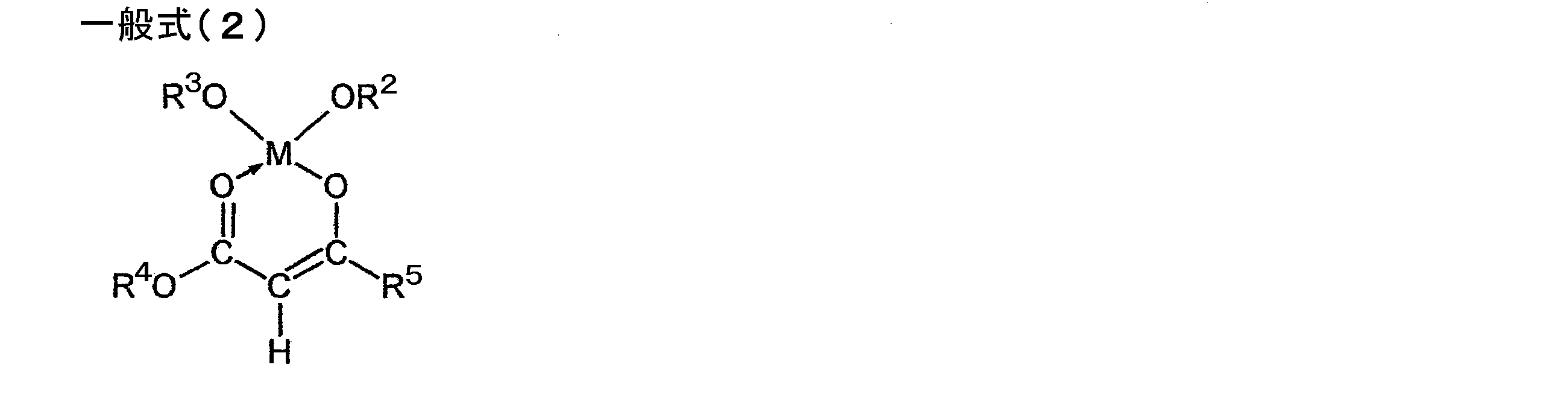
- aluminum ethyl acetoacetates having 1 to 8 carbon atoms are preferably used because they can form a sealing composition having excellent transparency.
- R 2 to R 5 represent an organic group including an alkyl group, an aryl group, an alkoxy group, a cycloalkyl group, and an acyl group
- M represents a trivalent metal atom (preferably a metal of the above organometallic compound).
- R 2 to R 5 may be the same or different organic groups.
- R 2 to R 5 is excellent in compatibility with the olefin polymer as the base polymer when the carbon number is small, and when it is large, the stability of the product after hydrolysis is good and the organic EL device is deteriorated. Hateful. Therefore, in consideration of the above balance while ensuring transparency, R 2 and R 3 are organic groups having 1 to 8 carbon atoms, and organic groups having a total number of carbon atoms of R 4 and R 5 of 5 or less. It is preferable that
- the addition amount of the desiccant is preferably 0.05 to 10 parts by mass, more preferably 1 to 5 parts by mass in 100 parts by mass of the sealant composition.
- the amount of the desiccant added is too large, not only the moisture that permeates the sealant composition is trapped but also the water is actively absorbed, so that the water vapor barrier property is lowered.
- filler examples include calcium carbonate such as calcium carbonate, magnesium carbonate, and dolomite, magnesium carbonate, kaolin, calcined clay, pyrophyllite, pentite, sericite, zeolite, talc, attapulgite, wollastonite, and the like.
- Silicates such as silicate, diatomaceous earth, and silica powder, barium sulfate such as aluminum hydroxide, pearlite, and precipitated barium sulfate, calcium sulfate such as gypsum, calcium sulfite, carbon black, zinc oxide, and titanium dioxide.
- the average primary particle diameter of the filler is preferably 1 to 100 nm, and more preferably 5 to 50 nm.
- the average primary particle size is preferably 0.1 to 5 ⁇ m.
- a hydrophilic filler whose surface is subjected to a hydrophobic treatment is preferably used.
- Hydrophobic fillers can be prepared by treating the surface of normal hydrophilic fillers with silylating agents such as n-octyltrialkoxysilane, etc., hydrophobic alkyl, aryl, aralkyl silane coupling agents, dimethyldichlorosilane, hexamethyldisilazane, etc. And polydimethylsiloxane having a hydroxyl group at the terminal, or higher alcohols such as stearyl alcohol, and those obtained by treatment with higher fatty acids such as stearic acid.
- silylating agents such as n-octyltrialkoxysilane, etc., hydrophobic alkyl, aryl, aralkyl silane coupling agents, dimethyldichlorosilane, hexamethyldisilazane, etc.
- polydimethylsiloxane having a hydroxyl group at the terminal, or higher alcohols such as stearyl alcohol, and those obtained
- the filler may be used alone or in combination of two or more.
- the amount of filler added is preferably 0.01 to 20% by mass with respect to the total amount of the sealing agent composition or the sealing material.
- ultraviolet absorbers examples include benzotriazole compounds, oxazolic acid amide compounds, and benzophenone compounds. When added, the added amount of the ultraviolet absorber is usually within a range of about 0.01 to 3% by mass with respect to the total amount of the encapsulant composition or the encapsulant.
- UV stabilizers include hindered amine compounds. When added, the addition amount of the ultraviolet stabilizer is usually within a range of about 0.01 to 3% by mass relative to the total amount of the encapsulant composition or encapsulant.
- the oxidation inhibitor examples include hindered phenol compounds and phosphate ester compounds.
- the addition amount of the oxidation inhibitor is usually in the range of about 0.01 to 2% by mass with respect to the total amount of the sealing agent composition or the sealing material.
- the resin stabilizer examples include a phenol resin stabilizer, a hindered amine resin stabilizer, an imidazole resin stabilizer, a dithiocarbamate resin stabilizer, a phosphorus resin stabilizer, and a sulfur ester resin stabilizer. Can do.
- the sealing agent composition of the present invention preferably has a water vapor transmission rate of 40 g and 90% RH (relative humidity) of 50 g / m 2 ⁇ day or less by a test method described later. More preferably, it is 20 g / m 2 ⁇ day or less, and particularly preferably 15 g / m 2 ⁇ day or less.
- the lower limit is not particularly limited, and the lower the value, the more moisture can be prevented from entering from the outside. In the case of a sealing material based on resin, it is considered to be about 1 g / m 2 ⁇ day.
- the water vapor transmission rate is 50 g / m 2 ⁇ day or less, moisture ingress from the outside can be prevented and dark spots of the organic EL element can be suppressed. On the other hand, if the water vapor transmission rate is too large, moisture intrusion cannot be prevented and a dark spot of the organic EL element is induced.
- the addition amount of the tackifier can be increased, and the tackifier can be improved by hydrogenation.
- the sealing agent composition of this invention has the adhesive force of 10 N / 25mm or more by the below-mentioned test method. More preferably, it is 20 N / 25 mm or more, and particularly preferably 30 N / 25 mm or more. Since it has an adhesive force of 10 N / 25 mm or more, it does not peel off from the substrate or the sealing plate, so that moisture permeation from the interface can be prevented. On the other hand, if the adhesive force is too small, the substrate is displaced or peeled off from the substrate or the sealing substrate, so that water intrusion from the interface cannot be prevented and a dark spot of the organic EL element is induced.
- Adhesive force is affected by tack force, fluidity and cohesive force, tack force is improved by increasing the amount of tackifier, flowability is softening agent, and cohesive force is increased by adding olefin polymer. It can be controlled by adjusting the blending ratio.
- the sealing agent composition of this invention can be used for the upper part of the light emission unit of an organic light emitting device (organic EL element) and / or the circumference
- the sealing agent composition of this invention is formed as a sealing film on a protective film by a conventionally well-known method, and is supplied as a sheet
- the protective film may be a release film that is easily peeled off with silicone or the like, or may be a general polyethylene terephthalate (PET) film, an oriented polypropylene (OPP) film, or the like.
- PET polyethylene terephthalate
- OPP oriented polypropylene
- the thickness of the sealing film is not particularly limited and can be appropriately selected depending on the application. Usually, it is 10 to 100 ⁇ m, preferably 10 to 40 ⁇ m. If the sealing film is too thin, the adhesion to the substrate or the sealing substrate is insufficient, so that moisture may enter from the interface.
- a sealing film-forming coating liquid is obtained by dissolving and dispersing the sealing agent composition in an organic solvent.
- the coating liquid is applied on the entire surface of the release treatment surface of the peelable protective film with an applicator or the like to form a sealing film.
- the sealing film is dried, and a protective film (peeling film) that can be peeled is laminated to form a sealing sheet.
- the organic solvent is not particularly limited, but for example, toluene, methyl ethyl ketone (MEK), ethyl acetate, dimethylacetamide, N-methyl-2-pyrrolidone, a mixed solution thereof and the like can be preferably used.
- the method for coating the coating liquid on the peelable protective film layer is not particularly limited, and a conventionally known method can be used. Examples thereof include a roll coating method, a gravure coating method, a reverse coating method, a spray coating method, an air knife coating method, a curtain coating method, a die coating method, and a comma coating method.
- Various modes of supplying the sealing sheet manufactured as described above are conceivable.
- the embodiment may be a release film / sealing film / release film, a gas barrier film, or a glass / sealing film / release film.
- a desiccant such as silica gel, calcium oxide or calcium chloride and store it.
- the sealing sheet of the present invention is obtained by, for example, laminating a release film on one or both sides of a sealing film made of a filmed sealing agent composition.
- a release film is laminated only on one side
- a form in which a gas barrier film or glass, a metal plate, a foil, or the like is bonded to the opposite side of the release film is also included.
- Such a form is obtained, for example, by stacking and sealing a sealing sheet in which a release film is laminated only on one side so that the sealing film and a gas barrier film or glass, a metal plate or a foil are in contact with each other. .
- FIG. 1 is a schematic cross-sectional view of an organic light emitting device 1 according to an embodiment of the present invention.
- the organic light-emitting device 1 includes an organic light-emitting unit 3 formed on a substrate glass 2, a sealing film 5 disposed on and around the organic light-emitting unit 3, and a sealing glass 6.
- the organic light emitting unit 3 is formed on the substrate glass 2 so as to be disposed between the pair of electrodes 7. After the organic light emitting unit 3 and the electrode 7 are formed, when the organic and inorganic thin films having gas barrier properties are formed so as to cover them, the effect of the sealing film 5 is combined to prevent the deterioration of the organic light emitting device. Is more effective. In the organic light emitting device 1, the sealing end face is exposed, and no further sealing treatment with a glass frit or the like is performed. As described above, since the sealing composition of the present invention has both high water vapor barrier properties and adhesion, when applied to a display or a lighting device, the structure can be simplified and the cost can be reduced.
- Ethylene / propylene / 5-ethylidene-2-norbornene copolymer (manufactured by Mitsui Chemicals, “Mitsui EPT X-3012P”, ethylene content: 73 mass%, propylene content: 23 mass%, 5-ethylidene-2 -Norbornene content: 4% by mass, water vapor transmission rate: 0.6 g ⁇ mm / m 2 ⁇ day)
- tackifier 60 parts by mass of Escorez 5600 manufactured by Tonex Co., Ltd .: partially hydrogenated aromatic modified dicyclopentadiene resin
- MEK is further adjusted to a solid content of 30% by mass, and mixed and stirred until uniform.
- a resin mixed solution was obtained.
- a release-treated polyester film having a thickness of 50 ⁇ m as a base sheet (Purex A-314, manufactured by Teijin DuPont Films), the thickness was 50 ⁇ m.
- a sealing layer was formed by heating and drying at 130 ° C. for 3 minutes. The surface of the sealing layer after drying is laminated with a release surface of a 25 ⁇ m release-treated polyester film (Toyobo Co., Ltd., Toyobo Ester Film E7006) as a release film, and the organic EL device is sealed according to Example 1 having a uniform thickness.
- a transparent resin sheet for sealing was produced.
- Example 2 to 11 Transparent resin sheets for sealing organic EL elements according to Examples 2 to 11 were produced in the same manner as in Example 1 except that the composition shown in Table 1 was used.
- Comparative Examples 1 to 5 Transparent resin sheets for sealing organic EL elements according to Comparative Examples 1 to 5 were produced in the same manner as in Example 1 except that the composition shown in Table 2 was used.
- A1 Ethylene / propylene / 5-ethylidene-2-norbornene copolymer (Mitsui Chemicals, EPT X-3012P, ethylene content: 73 mass%, propylene content: 23 mass%, 5-ethylidene-2-norbornene content: 4% by mass)
- A2 Ethylene / propylene / dicyclopentadiene copolymer (Mitsui Chemicals, EPT1070, ethylene content: 57%, propylene content: 39%, dicyclopentadiene content: 4% by mass)
- A3 ethylene butene copolymer (Mitsui Chemicals, Toughmer A4085)
- B1 Escorez 5600 (manufactured by Tonex Co., Ltd .: partially hydrogenated aromatic modified dicyclopentadiene resin)
- B2 Imabe P100 (Idemitsu Kosan Co., Ltd .: C5 / C9 hydrogenated petroleum resin)
- B3 Pine Crystal KE311 (Arakawa Chemical Industries, Ltd .: hydrogenated rosin ester)
- B4 Clearon P-115 (Yasuhara Chemical Co., Ltd .: hydrogenated terpene)
- B5 Escoretz 1310 (manufactured by Tonex Corp .: C5 petroleum resin)
- the light transmittance of the transparent resin composition for sealing an organic EL device was determined using a spectrophotometer (Spectrophotometer U-4100 solid sample measurement system manufactured by Hitachi High-Technologies Corporation). Specifically, a transparent resin sheet for sealing an organic EL element prepared by bonding at 80 ° C. to a thickness of 0.1 mm was prepared, and the amount of transmitted light at 550 nm at 25 ° C. was determined.
- ⁇ Moisture permeability> The prepared transparent resin sheet for sealing an organic EL element was peeled from the 25 ⁇ m release polyester film and the 50 ⁇ m release polyester film, and was mounted between the low humidity chamber and the high humidity chamber so that there was no wrinkle or sagging.
- a differential pressure type gas / vapor permeability measuring device GTR Tech, GTR-10XAWT
- a gas chromatograph Yanaco, G2700T
- ⁇ Adhesive strength> The 25 ⁇ m release-treated polyester film of the prepared transparent resin sheet for sealing an organic EL element was peeled off, and a 38 ⁇ m easy-adhesion-treated polyester film (G2-C, manufactured by Teijin DuPont Films) was bonded at 80 ° C., and then 50 ⁇ m The peel-treated polyester film was peeled to obtain a test piece. On the surface of the sealing layer of the obtained test piece, glass based on JISR3202 is bonded as an adherend at a bonding temperature of 80 ° C., and the test piece is peeled off from the adherend by a 180 ° peeling method in accordance with JISZ0237. Was peeled to evaluate the adhesive strength.
- a test piece was prepared in the same manner as in the above adhesive strength evaluation, and the glass in accordance with JIS R3202 was bonded to the surface of the sealing layer of the obtained test piece as an adherend at a bonding temperature of 80 ° C., in accordance with JISZ0237. Then, a specified weight was attached, and the shifted distance after 24 hours at 100 ° C. was evaluated as the holding force. In addition, when the test piece peeled off within 24 hours, “> 25” was set.
- An organic EL device having an anode on an element substrate made of insulating transparent glass, an organic layer on the upper surface, and a cathode on the upper surface was prepared.
- the 25 ⁇ m release-treated polyester film of the prepared transparent resin sheet for sealing an organic EL element was peeled and placed on the upper surface of the cathode of the organic EL element.
- the 50 ⁇ m release polyester film of the organic EL element sealing transparent resin sheet is peeled off, and an insulating transparent glass is disposed on the upper surface of the sealing layer of the organic EL element sealing transparent resin sheet as a sealing substrate.
- a model of an organic EL display was produced by applying pressure at a pressure of 0.6 MPa for 1 minute at 80 ° C.
- the model was treated at 80 ° C. and 85% RH for 500 hours, and then cooled to room temperature (25 ° C.). Then, the organic EL element was activated, and dark spots (non-light emitting portions) were observed.
- dark spots non-light emitting portions
- the area of the dark spot is less than 2% of the whole, “AA” is particularly excellent for suppressing the occurrence of the dark spot, and when it is less than 5%, “A” is less than 10% as being excellent for suppressing the occurrence of the dark spot.
- the case was evaluated as “B” as being excellent in suppressing the occurrence of dark spots, and “C” was determined as being inferior in suppressing the generation of dark spots when 10% or more.
- Examples 1 to 6, 8 to 11, and 13 to 15 are an ethylene / ⁇ -olefin copolymer or an ethylene / ⁇ -olefin / non-conjugated diene copolymer and hydrogenation of 40% by mass to 70% by mass.
- the water vapor permeability at 40 ° C. and 90% RH was 20 g / m 2 ⁇ day or less, the adhesive strength was 20 N / 25 mm or more, and particularly good results were obtained in the dark spot evaluation.
- Example 7 contains 40% by mass of an ethylene / ⁇ -olefin / non-conjugated diene copolymer and 60% by mass of a tackifier, and the water vapor transmission rate at 40 ° C. and 90% RH is 50 g / m 2 ⁇ day or less. Yes, it showed an adhesive strength of 20 N / 25 mm or more, and gave good results in holding power and dark spot evaluation.
- Example 12 contains 80% by mass of an ethylene / ⁇ -olefin / non-conjugated diene copolymer and 20% by mass of a tackifier, and the water vapor transmission rate at 40 ° C. and 90% RH is 50 g / m 2 ⁇ day or less. Yes, 10N / 25mm or more adhesive force was exhibited, and good results were obtained in holding power and dark spot evaluation.
- Comparative Example 1 contains only 5% by mass of a tackifier, the adhesive strength was small and the test piece peeled off in the holding power test, and dark spots were generated. Since Comparative Examples 2 and 3 did not contain a tackifier, the adhesive strength was small, and in the holding power test, the test piece was peeled off and dark spots were generated. Since Comparative Examples 4 and 5 did not contain a tackifier and contained 30% by mass or more of a softening agent, the film could not be a film and moisture permeability could not be measured. Although other evaluations were performed by applying to the substrate, the adhesive strength was small, and the test piece peeled off in the holding power test, and dark spots were generated. Since Comparative Examples 6 and 7 contain 75% by mass of a tackifier, the flexibility of the film is insufficient and the test piece cannot be bonded to the glass, and the adhesive strength and retention strength dark spot test can be performed. There wasn't.
Landscapes
- Chemical & Material Sciences (AREA)
- Organic Chemistry (AREA)
- Health & Medical Sciences (AREA)
- Chemical Kinetics & Catalysis (AREA)
- Medicinal Chemistry (AREA)
- Polymers & Plastics (AREA)
- Optics & Photonics (AREA)
- Physics & Mathematics (AREA)
- Materials Engineering (AREA)
- Engineering & Computer Science (AREA)
- Electroluminescent Light Sources (AREA)
- Compositions Of Macromolecular Compounds (AREA)
- Sealing Material Composition (AREA)
Abstract
電子デバイスに用いられる接着性の封止剤組成物であって、オレフィン系重合体と粘着付与剤を含有し、前記オレフィン系重合体は、エチレン・α-オレフィン共重合体及びエチレン・α-オレフィン・非共役ジエン共重合体から選ばれる少なくとも1種であり、前記粘着付与剤の含有量は封止剤組成物を構成する樹脂組成物中の10質量%以上70質量%以下であることを特徴とする封止剤組成物。
Description
本発明は封止剤組成物および該組成物から得られる封止用シートに関する。
EL素子は、自己発光するため、これを備える表示装置は視認性が高い。このような性質を利用し、無機EL素子に比べて印加電圧を低下させることのできる有機EL素子を備えた高性能の表示装置、即ち、有機ELディスプレイが検討されている。
有機EL素子は、ガラス等からなる基板の上に陽極層、発光層及び陰極層が順次形成された構成が基本である。性能を向上させるために各層の間に機能層を設ける場合もある。
前記のような構成の有機EL素子は、陽極層と陰極層の間に通電することによって発光させることができる。しかし、素子の周囲に水分、不純物等が存在すると、素子を構成する材料が侵され、劣化を招くこととなる。劣化した有機EL素子を備える表示装置を用いると、発光欠陥、即ち、ダークスポットが発生し、視認性の悪化につながることとなる。
有機EL素子は、ガラス等からなる基板の上に陽極層、発光層及び陰極層が順次形成された構成が基本である。性能を向上させるために各層の間に機能層を設ける場合もある。
前記のような構成の有機EL素子は、陽極層と陰極層の間に通電することによって発光させることができる。しかし、素子の周囲に水分、不純物等が存在すると、素子を構成する材料が侵され、劣化を招くこととなる。劣化した有機EL素子を備える表示装置を用いると、発光欠陥、即ち、ダークスポットが発生し、視認性の悪化につながることとなる。
そこで、有機EL素子を水分や不純物等から遮断するために、ガラス等からなる透明な封止基板(封止缶の場合もある)等が備えられ、有機EL素子と封止基板との間に生じる空間に脱水剤を含む粘性体を充填した有機ELデバイスが開示されているが(例えば、特許文献1参照)、粘性体が充填時にあふれ出さないようにダム材を用いる必要があり、フレキシブルな有機ELデバイスを得ることは出来なかった。
また、フレキシブルな有機ELデバイスを得る為に、特許文献2に熱可塑性樹脂からなる透明封止材で封止する方法が開示されている。この文献には、基板と、陽極層と、発光層と、陰極層と、を順次含む発光素子及び該発光素子の発光面側に配設される封止部材を備えるエレクトロルミネッセンスディスプレイパネルに用いられる有機EL素子用透明封止材であって、柔軟性重合体組成物から形成され、且つ、上記発光素子の発光面と上記封止部材との間に配設されることを特徴とする有機EL素子用透明封止材が提案されている。
また、フレキシブルな有機ELデバイスを得る為に、特許文献2に熱可塑性樹脂からなる透明封止材で封止する方法が開示されている。この文献には、基板と、陽極層と、発光層と、陰極層と、を順次含む発光素子及び該発光素子の発光面側に配設される封止部材を備えるエレクトロルミネッセンスディスプレイパネルに用いられる有機EL素子用透明封止材であって、柔軟性重合体組成物から形成され、且つ、上記発光素子の発光面と上記封止部材との間に配設されることを特徴とする有機EL素子用透明封止材が提案されている。
しかし、上記の特許文献2に記載の熱可塑性樹脂からなる透明封止材は、ベースポリマーと軟化剤の組合せでは、有機EL素子を形成する基板や封止基板に対しての接着力が低い、という問題があった。基板に対しての接着力が低いと、製造工程で受ける衝撃などで基板のズレや剥離が生じる可能性がある。また、基板と封止材との剥離部分を介して外部水蒸気が入りこみ、ダークスポットの発生を誘発することになる。従って、本発明は、充填性だけでなく、封止材としたときの接着性能、保持力に優れる封止剤組成物と、それからなるフィルムないしシートを提供することを課題とする。
本発明の課題は下記の手段により解決された。
(1)電子デバイスに用いられる接着性の封止剤組成物であって、オレフィン系重合体と粘着付与剤を含有し、前記オレフィン系重合体は、エチレン・α-オレフィン共重合体及びエチレン・α-オレフィン・非共役ジエン共重合体から選ばれる少なくとも1種であり、前記粘着付与剤の含有量は封止剤組成物を構成する樹脂組成物中の10質量%以上70質量%以下であることを特徴とする封止剤組成物。
(2)電子デバイスに用いられる接着性を有する封止剤組成物であって、オレフィン系重合体と粘着付与剤を含有し、前記オレフィン系重合体は、エチレン・α-オレフィン共重合体及びエチレン・α-オレフィン・非共役ジエン共重合体から選ばれる少なくとも1種であり、前記粘着付与剤の含有量は封止剤組成物を構成する樹脂組成物中の、40質量%以上70質量%以下であることを特徴とする封止剤組成物。
(3)前記粘着付与剤が水素化されていることを特徴とする(1)又は(2)に記載の封止剤組成物。
(4)前記粘着付与剤として、水素化された粘着付与剤が環状構造を含む石油樹脂を水添した樹脂であることを特徴とする(1)~(3)のいずれか1項に記載の封止剤組成物。
(5)上記エチレン・α-オレフィン共重合体及び上記エチレン・α-オレフィン・非共役ジエン共重合体は、カルボキシル基、ヒドロキシル基、エポキシ基、アミノ基、アルコキシシリル基、スルホン酸基及びニトリル基から選ばれる官能基を有する(1)~(4)のいずれか1項に記載の封止剤組成物。
(6)さらに軟化剤を含むことを特徴とする(1)~(5)のいずれか1項に記載の封止剤組成物。
(7)前記封止剤組成物を構成する樹脂組成物全質量中、
(a)10~35質量%の前記オレフィン系重合体と、
(b)50~75質量%の前記粘着付与剤と、
(c)10~30質量%の前記軟化剤と、
を含む、(1)~(6)のいずれか1項に記載の封止剤組成物。
(8)前記軟化剤は飽和炭化水素鎖の炭素数が全炭素数の50%以上を占める化合物からなることを特徴とする(7)に記載の封止剤組成物。
(9)前記飽和炭化水素鎖炭素数が全炭素数の50%以上を占める化合物がイソブチレン骨格を主成分に含有する化合物である(8)に記載の封止剤組成物。
(10)前記軟化剤の数平均分子量が300以上2000以下である(1)~(9)のいずれか1項に記載の封止剤組成物。
(11)さらに、乾燥剤を含むことを特徴とする(1)~(10)のいずれか1項に記載の封止剤組成物。
(12)400~800nmの可視領域で透明である、(1)~(11)のいずれか1項に記載の封止剤組成物。
(13)(1)~(12)のいずれか1項に記載の封止剤組成物からなる封止フィルム、又は封止フィルムの片面または両面に剥離フィルムが積層されている封止用シート。
(14)一対の対向する電極層、及び電極層の間に配置される有機発光層を有する発光ユニットの上部、及び/又は前記発光ユニットの周囲に、(1)~(13)のいずれか1項に記載の封止剤組成物を具備する有機発光デバイス。
本明細書において、上記の封止フィルム及び封止用シートを合せて、封止シートということがある。
また、本明細書において、「イソブチレン骨格を主成分に含有する化合物」とは、化合物全体100質量%のうち、イソブチレン成分が50質量%以上好ましくは80質量%以上である化合物をいう。
(1)電子デバイスに用いられる接着性の封止剤組成物であって、オレフィン系重合体と粘着付与剤を含有し、前記オレフィン系重合体は、エチレン・α-オレフィン共重合体及びエチレン・α-オレフィン・非共役ジエン共重合体から選ばれる少なくとも1種であり、前記粘着付与剤の含有量は封止剤組成物を構成する樹脂組成物中の10質量%以上70質量%以下であることを特徴とする封止剤組成物。
(2)電子デバイスに用いられる接着性を有する封止剤組成物であって、オレフィン系重合体と粘着付与剤を含有し、前記オレフィン系重合体は、エチレン・α-オレフィン共重合体及びエチレン・α-オレフィン・非共役ジエン共重合体から選ばれる少なくとも1種であり、前記粘着付与剤の含有量は封止剤組成物を構成する樹脂組成物中の、40質量%以上70質量%以下であることを特徴とする封止剤組成物。
(3)前記粘着付与剤が水素化されていることを特徴とする(1)又は(2)に記載の封止剤組成物。
(4)前記粘着付与剤として、水素化された粘着付与剤が環状構造を含む石油樹脂を水添した樹脂であることを特徴とする(1)~(3)のいずれか1項に記載の封止剤組成物。
(5)上記エチレン・α-オレフィン共重合体及び上記エチレン・α-オレフィン・非共役ジエン共重合体は、カルボキシル基、ヒドロキシル基、エポキシ基、アミノ基、アルコキシシリル基、スルホン酸基及びニトリル基から選ばれる官能基を有する(1)~(4)のいずれか1項に記載の封止剤組成物。
(6)さらに軟化剤を含むことを特徴とする(1)~(5)のいずれか1項に記載の封止剤組成物。
(7)前記封止剤組成物を構成する樹脂組成物全質量中、
(a)10~35質量%の前記オレフィン系重合体と、
(b)50~75質量%の前記粘着付与剤と、
(c)10~30質量%の前記軟化剤と、
を含む、(1)~(6)のいずれか1項に記載の封止剤組成物。
(8)前記軟化剤は飽和炭化水素鎖の炭素数が全炭素数の50%以上を占める化合物からなることを特徴とする(7)に記載の封止剤組成物。
(9)前記飽和炭化水素鎖炭素数が全炭素数の50%以上を占める化合物がイソブチレン骨格を主成分に含有する化合物である(8)に記載の封止剤組成物。
(10)前記軟化剤の数平均分子量が300以上2000以下である(1)~(9)のいずれか1項に記載の封止剤組成物。
(11)さらに、乾燥剤を含むことを特徴とする(1)~(10)のいずれか1項に記載の封止剤組成物。
(12)400~800nmの可視領域で透明である、(1)~(11)のいずれか1項に記載の封止剤組成物。
(13)(1)~(12)のいずれか1項に記載の封止剤組成物からなる封止フィルム、又は封止フィルムの片面または両面に剥離フィルムが積層されている封止用シート。
(14)一対の対向する電極層、及び電極層の間に配置される有機発光層を有する発光ユニットの上部、及び/又は前記発光ユニットの周囲に、(1)~(13)のいずれか1項に記載の封止剤組成物を具備する有機発光デバイス。
本明細書において、上記の封止フィルム及び封止用シートを合せて、封止シートということがある。
また、本明細書において、「イソブチレン骨格を主成分に含有する化合物」とは、化合物全体100質量%のうち、イソブチレン成分が50質量%以上好ましくは80質量%以上である化合物をいう。
本発明の封止剤組成物は、有機EL素子を形成する基板や封止基板に対しての接着力が高く、層間の充填性だけでなく、保持力に優れる。したがって、これを用いて形成した封止フィルムは、有機EL素子を形成する工程途中の衝撃での基板のずれを起こさず、組み立てた有機EL素子は、封止性能が高く、剥離を生じることや、水分の侵入防止の点で優れ、有機EL素子のダークスポットの発生を抑制することができる。
本発明の上記及び他の特徴及び利点は、適宜添付の図面を参照して、下記の記載からより明らかになるであろう。
<オレフィン系重合体>
本発明の封止剤組成物に用いる前記オレフィン系重合体は、エチレン・α-オレフィン共重合体、エチレン・α-オレフィン・非共役ジエン共重合体である。但し、前記エチレン・α-オレフィン共重合体及びエチレン・α-オレフィン・非共役ジエン共重合体におけるα-オレフィンは、エチレンを除くα-オレフィンであるものとする。このα-オレフィンとしては、プロピレン、1-ブテン、1-ペンテン、3-メチル-1-ブテン、1-ヘキセン、3-メチル-1-ペンテン、4-メチル-1-ペンテン、3-エチル-1-ペンテン、1-オクテン、1-デセン、1-ウンデセン等が挙げられ、炭素数が3~12であるα-オレフィンが好ましく、特に、プロピレン及び1-ブテンが好ましい。尚、前記例示したα-オレフィンは、1種単独であるいは2種以上を組み合わせて用いることができる。 前記エチレン・α-オレフィン共重合体としては、エチレン・プロピレン共重合体、エチレン・1-ブテン共重合体、エチレン・1-ペンテン共重合体、エチレン・3-メチル-1-ブテン共重合体、エチレン・1-ヘキセン共重合体、エチレン・3-メチル-1-ペンテン共重合体、エチレン・4-メチル-1-ペンテン共重合体、エチレン・3-エチル-1-ペンテン共重合体、エチレン・1-オクテン共重合体、エチレン・1-デセン共重合体、エチレン・1-ウンデセン共重合体等が挙げられる。これらのうち、エチレン・プロピレン共重合体及びエチレン・1-ブテン共重合体が好ましい。尚、前記例示したエチレン・α-オレフィン共重合体は、1種単独であるいは2種以上を組み合わせて用いることができる。
本発明の封止剤組成物に用いる前記オレフィン系重合体は、エチレン・α-オレフィン共重合体、エチレン・α-オレフィン・非共役ジエン共重合体である。但し、前記エチレン・α-オレフィン共重合体及びエチレン・α-オレフィン・非共役ジエン共重合体におけるα-オレフィンは、エチレンを除くα-オレフィンであるものとする。このα-オレフィンとしては、プロピレン、1-ブテン、1-ペンテン、3-メチル-1-ブテン、1-ヘキセン、3-メチル-1-ペンテン、4-メチル-1-ペンテン、3-エチル-1-ペンテン、1-オクテン、1-デセン、1-ウンデセン等が挙げられ、炭素数が3~12であるα-オレフィンが好ましく、特に、プロピレン及び1-ブテンが好ましい。尚、前記例示したα-オレフィンは、1種単独であるいは2種以上を組み合わせて用いることができる。 前記エチレン・α-オレフィン共重合体としては、エチレン・プロピレン共重合体、エチレン・1-ブテン共重合体、エチレン・1-ペンテン共重合体、エチレン・3-メチル-1-ブテン共重合体、エチレン・1-ヘキセン共重合体、エチレン・3-メチル-1-ペンテン共重合体、エチレン・4-メチル-1-ペンテン共重合体、エチレン・3-エチル-1-ペンテン共重合体、エチレン・1-オクテン共重合体、エチレン・1-デセン共重合体、エチレン・1-ウンデセン共重合体等が挙げられる。これらのうち、エチレン・プロピレン共重合体及びエチレン・1-ブテン共重合体が好ましい。尚、前記例示したエチレン・α-オレフィン共重合体は、1種単独であるいは2種以上を組み合わせて用いることができる。
オレフィン系重合体の配合量は、封止剤組成物全質量に対して10~90質量%が好ましく、10~80質量%がより好ましい。また、封止剤組成物が軟化剤を含有する場合、オレフィン系重合体の配合量は、封止剤組成物全質量に対して10~35質量%が好ましい。
また、エチレン・α-オレフィン・非共役ジエン共重合体とする場合の前記非共役ジエンとしては、1,4-ペンタジエン、1,4-ヘキサジエン、1,5-ヘキサジエン、1,7-オクタジエン、1,9-デカジエン、3,6-ジメチル-1,7-オクタジエン、4,5-ジメチル-1,7-オクタジエン、5-メチル-1,8-ノナジエン、ジシクロペンタジエン、5-エチリデン-2-ノルボルネン、5-ビニル-2-ノルボルネン、2,5-ノルボルナジエン等が挙げられる。これらは、1種単独であるいは2種以上を組み合わせて用いることができる。
前記エチレン・α-オレフィン・非共役ジエン共重合体としては、エチレン・プロピレン・ジシクロペンタジエン共重合体、エチレン・プロピレン・5-エチリデン-2-ノルボルネン共重合体、エチレン・1-ブテン・ジシクロペンタジエン共重合体、エチレン・1-ブテン・5-エチリデン-2-ノルボルネン共重合体等が挙げられる。これらは、1種単独であるいは2種以上を組み合わせて用いることができる。
前記エチレン・α-オレフィン・非共役ジエン共重合体としては、エチレン・プロピレン・ジシクロペンタジエン共重合体、エチレン・プロピレン・5-エチリデン-2-ノルボルネン共重合体、エチレン・1-ブテン・ジシクロペンタジエン共重合体、エチレン・1-ブテン・5-エチリデン-2-ノルボルネン共重合体等が挙げられる。これらは、1種単独であるいは2種以上を組み合わせて用いることができる。
尚、前記エチレン・α-オレフィン共重合体及び前記エチレン・α-オレフィン・非共役ジエン共重合体は、各重合体中に、他の単量体(i)から導かれた構成単位を含有する重合体であってもよい。この他の単量体(i)としては、カルボキシル基、ヒドロキシル基、エポキシ基、アミノ基、アルコキシシリル基、スルホン酸基、ニトリル基等の官能基を有する不飽和化合物が好ましい。このような不飽和化合物は、1種単独であるいは2種以上を組み合わせて用いることができる。また、前記不飽和化合物の使用量は、重合に用いる全単量体中、好ましくは0.01~10質量%、より好ましくは0.1~5質量%である。
カルボキシル基を有する不飽和化合物としては、無水マレイン酸、(メタ)アクリル酸、下記一般式(1)で表される環式化合物等を用いることができる。

(前記一般式(1)において、R1は、水素原子又は炭素数1~10の炭化水素基であり、Y1、Y2及びY3は、それぞれ独立して、水素原子、炭素数1~10の炭化水素基又は-COOHであり、Y1、Y2及びY3のうち少なくとも1つは-COOHであり、また、Y1、Y2及びY3のうち2つ以上が-COOHである場合は、それらは互いに連結して形成された酸無水物(-CO-(O)-CO-)であってもよい。pは0~2の整数であり、qは0~5の整数である。)
前記一般式(1)で表される環式化合物としては、5,6-ジメチル-5,6-ジカルボキシ-ビシクロ[2.2.1]-2-ヘプテン、5,6-ジエチル-5,6-ジカルボキシ-ビシクロ[2.2.1]-2-ヘプテン、5,6-ジメチル-5,6-ビス(カルボキシメチル)-ビシクロ[2.2.1]-2-ヘプテン、5,6-ジエチル-5,6-ビス(カルボキシメチル)-ビシクロ[2.2.1]-2-ヘプテン、5-メチル-5-カルボキシ-ビシクロ[2.2.1]-2-ヘプテン、5-エチル-5-カルボキシ-ビシクロ[2.2.1]-2-ヘプテン、5-カルボキシ-5-カルボキシメチル-ビシクロ[2.2.1]-2-ヘプテン、5-メチル-5-カルボキシメチル-ビシクロ[2.2.1]-2-ヘプテン、5-エチル-5-カルボキシメチル-ビシクロ[2.2.1]-2-ヘプテン、8,9-ジメチル-8,9-ジカルボキシ-テトラシクロ[4.4.0.12,5.17,10]-3-ドデセン、8,9-ジエチル-8,9-ジカルボキシ-テトラシクロ[4.4.0.12,5.17,10]-3-ドデセン、8-メチル-8-カルボキシ-テトラシクロ[4.4.0.12,5.17,10]-3-ドデセン、8-エチル-8-カルボキシ-テトラシクロ[4.4.0.12,5.17,10]-3-ドデセン等が挙げられる。これらは、1種単独であるいは2種以上を組み合わせて用いることができる。
前記一般式(1)で表される環式化合物を用いる場合のその使用量は、全単量体に対して、好ましくは0.01~15質量%、より好ましくは0.1~10質量%である。
前記一般式(1)で表される環式化合物を共重合させたエチレン・α-オレフィン共重合体又はエチレン・α-オレフィン・非共役ジエン共重合体は、ランダム共重合体であることが好ましい。また、共重合により得られたランダム共重合体の、GPCによるポリスチレン換算の質量平均分子量Mwは、好ましくは1,000~3,000,000、より好ましくは3,000~1,000,000、更に好ましくは5,000~700,000である。
前記一般式(1)で表される環式化合物を共重合させたエチレン・α-オレフィン共重合体又はエチレン・α-オレフィン・非共役ジエン共重合体は、ランダム共重合体であることが好ましい。また、共重合により得られたランダム共重合体の、GPCによるポリスチレン換算の質量平均分子量Mwは、好ましくは1,000~3,000,000、より好ましくは3,000~1,000,000、更に好ましくは5,000~700,000である。
本発明に関わるオレフィン系重合体としては、前記例示したエチレン・α-オレフィン共重合体及びエチレン・α-オレフィン・非共役ジエン共重合体をそれぞれ1種単独であるいは2種以上を組み合わせて用いることができる。
好ましくはエチレン・α-オレフィン・非共役ジエン共重合体であり、より好ましくはエチレン・プロピレン・ジシクロペンタジエン共重合体である。また、エチレン・1-ブテン・5-エチリデン-2-ノルボルネン共重合体またはエチレン・プロピレン・5-エチリデン-2-ノルボルネン共重合体を用いることで、特に耐熱性、絶縁性、軽量性に優れた封止材が得られ、車載用有機ELデバイスのようなより厳しい要求特性にも対応することができ好ましい。
<粘着付与剤>
本発明において、前記オレフィン系重合体に対して、粘着付与剤を添加することで、粘度を低下させるだけでなく、接着性を付与し、封止材(封止フイルム)の濡れ性や接着力を向上させる。
本発明において、前記オレフィン系重合体に対して、粘着付与剤を添加することで、粘度を低下させるだけでなく、接着性を付与し、封止材(封止フイルム)の濡れ性や接着力を向上させる。
粘着付与剤としては、ロジン、ロジン誘導体(水素化ロジン、不均化ロジン、重合ロジン、ロジンエステル(アルコール、グリセリン、ペンタエリスリトールなどのエステル化ロジンなど)、水素化ロジンエステル)、テルペン樹脂(α-ピネン、β-ピネン)、テルペン誘導体(テルペンフェノール樹脂、芳香族変性テルペン樹脂、水素化テルペン樹脂、水素化テルペンフェノール樹脂)、脂肪族系石油樹脂、芳香族系石油樹脂、共重合系石油樹脂、脂環族石油樹脂、クマロン-インデン樹脂、フェノール樹脂、キシレン樹脂などが挙げられる。
中でも、水素化石油樹脂、水素化ロジン系樹脂、及び水素化テルペン系樹脂よりなる群から選択される1種以上が、前記オレフィン系重合体と相溶性が良好で、透明性に優れた封止材を形成できる点から好適に用いられる。このような水素化石油樹脂としては、石油ナフサの熱分解で生成するペンテン、イソプレン、ピペリン、1.3-ペンタジエンなどのC5留分を共重合して得られるC5系水素化石油樹脂である水添ジシクロペンタジエン系樹脂(トーネックス(株)製:エスコレッツ5300、5400シリーズ、イーストマン社製:Eastotac Hシリーズ等)、部分水添芳香族変性ジシクロペンタジエン系樹脂(トーネックス(株)製:エスコレッツ5600シリーズ等)、石油ナフサの熱分解で生成するインデン、ビニルトルエン、α-又はβ-メチルスチレンなどのC9留分を共重合して得られるC9系水素化石油樹脂(荒川化学工業株式会社製:アルコンP又はMシリーズ)、前記したC5留分とC9留分のC5/C9系共重合系水素化石油樹脂(出光興産株式会社製:アイマーブシリーズ)等が挙げられる。これらの中でも、環状構造を含む石油樹脂を水素化した樹脂、特にジシクロペンタジエン構造を含む石油樹脂を水素化した樹脂が、前記オレフィン系重合体と相溶性が良好な点から、好適に用いられる。
粘着付与剤の配合量は、封止剤組成物全質量に対して10~70質量%であり、好ましくは40~70質量%の範囲内で配合するのがよい。また、封止剤組成物が軟化剤を含有する場合には、粘着付与剤の配合量は、封止剤組成物全質量に対して50~70質量%が好ましい。10質量%未満だとタック力が不足し、接着力を向上させることができない。70質量%を超えると、軟化剤による粘度の低下の効果を妨げるため、柔軟性が不足する。
<添加剤>
本発明の封止材は、本発明の効果及び透明性を損なわない範囲で、前記オレフィン系重合体及び粘着付与剤に加え、任意の添加剤を含有することができる。このような添加剤としては、軟化剤、乾燥剤、フィラー、紫外線吸収剤、紫外線安定剤、酸化抑制剤、樹脂安定剤などが挙げられる。以下にさらにこの添加剤について説明する。
本発明の封止材は、本発明の効果及び透明性を損なわない範囲で、前記オレフィン系重合体及び粘着付与剤に加え、任意の添加剤を含有することができる。このような添加剤としては、軟化剤、乾燥剤、フィラー、紫外線吸収剤、紫外線安定剤、酸化抑制剤、樹脂安定剤などが挙げられる。以下にさらにこの添加剤について説明する。
(軟化剤)
軟化剤としては、脂肪油系のステアリン酸、ヒマシ油、パーム油、松脂系のロジン、パインタール、石油系の飽和オレフィンアロマチック物(ミネラルオイル、ナフテニック油など)、不飽和オレフィンアロマチック物(ナフトーレン油など)、パラフィン、塩化パラフィン、コールタール系のタール、合成樹脂系の低重合フェノールホルムアルデヒド樹脂、低融点スチレン樹脂、低分子ポリイソブチレン、ポリブテン、tert-ブチルフェノールアセチレン縮合物などがあげられる。
軟化剤としては、脂肪油系のステアリン酸、ヒマシ油、パーム油、松脂系のロジン、パインタール、石油系の飽和オレフィンアロマチック物(ミネラルオイル、ナフテニック油など)、不飽和オレフィンアロマチック物(ナフトーレン油など)、パラフィン、塩化パラフィン、コールタール系のタール、合成樹脂系の低重合フェノールホルムアルデヒド樹脂、低融点スチレン樹脂、低分子ポリイソブチレン、ポリブテン、tert-ブチルフェノールアセチレン縮合物などがあげられる。
中でも、飽和炭化水素鎖炭素数が全炭素数の50%以上を占める、ナフテニック油、パラフィン、飽和合成樹脂系の軟化剤よりなる群から選択される1種以上が、耐候性に優れた封止材を形成できる点から好適に用いられる。特に飽和合成樹脂系の軟化剤としては、イソブチレン単独またはこれを含むC4ガスをルイス酸触媒下で重合して生成されたうち重合度が10~数100程度の低分子ポリイソブチレン(BASF社製:Glissopalシリーズ等)、イソブテンを主体として一部ノルマルブテンをカチオン重合して得られる長鎖状炭化水素の分子構造を持ったポリブテン(JX日鉱日石エネルギー社製:日石ポリブテンシリーズ、日油社製:エマウエットシリーズ等)、ポリブテンを水添した樹脂(日油社製:パールリームシリーズ)、イソプレンを水添した樹脂(クラレ社製:LIR200シリーズ)等が挙げられる。これらの中でも、イソブチレン骨格を持ったポリブテンが粘度の低下効果が高く、また水蒸気バリア性も良好な点から、好適に用いられる。
また、軟化剤の数平均分子量は300以上2000以下が好適に用いられる。軟化剤の数平均分子量が小さすぎると、有機EL素子へ軟化剤が移行して、ダークスポットが発生し、視認性の悪化につながることとなる。軟化剤の数平均分子量が大きすぎると、粘度を低下させる効果が小さく有効でない。
また、軟化剤の数平均分子量は300以上2000以下が好適に用いられる。軟化剤の数平均分子量が小さすぎると、有機EL素子へ軟化剤が移行して、ダークスポットが発生し、視認性の悪化につながることとなる。軟化剤の数平均分子量が大きすぎると、粘度を低下させる効果が小さく有効でない。
軟化剤の含有量は、封止剤組成物全質量に対して10~30質量%が好ましい。
(乾燥剤)
本発明の封止材は、好ましくは、乾燥剤を、封止剤組成物を透過する水分を捕獲する目的で含有する。水分を捕獲することで有機EL素子の水分による劣化を抑制することができる。
乾燥剤としては、金属酸化物乾燥剤又は有機系乾燥剤のいずれでも良く、特に限定されるものではない。例えば、酸化バリウム(BaO)、酸化カルシウム(CaO)、酸化ストロンチウム(SrO)、酸化マグネシウム(MgO)等の粉末状無機酸化物のほか、透明な水分ゲッター剤として知られている有機化合物が使用可能である。また、これらの水分捕捉剤は1種又は2種以上を配合して使用することができる。
本発明の封止材は、好ましくは、乾燥剤を、封止剤組成物を透過する水分を捕獲する目的で含有する。水分を捕獲することで有機EL素子の水分による劣化を抑制することができる。
乾燥剤としては、金属酸化物乾燥剤又は有機系乾燥剤のいずれでも良く、特に限定されるものではない。例えば、酸化バリウム(BaO)、酸化カルシウム(CaO)、酸化ストロンチウム(SrO)、酸化マグネシウム(MgO)等の粉末状無機酸化物のほか、透明な水分ゲッター剤として知られている有機化合物が使用可能である。また、これらの水分捕捉剤は1種又は2種以上を配合して使用することができる。
金属酸化物系乾燥剤は通常粉末で添加される。その平均粒子径は通常20μm未満の範囲とすれば良く、好ましくは10μm以下、より好ましくは1μm以下、である。後述するように、封止剤組成物をフィルム化する場合には、金属酸化物系乾燥剤はそのフィルム厚よりも十分小さくしなければならない。このように粒子径を調整することで、有機EL素子にダメージを与える可能性が低くなり、乾燥剤粒子が画像認識を妨げる事を防止できる。しかし、平均粒子径が0.01μm未満となると、乾燥剤粒子の飛散を防止するために製造コストが高くなることがあるので、この点を考慮して粒径の下限を適宜調整する。
水分ゲッター剤としての有機化合物としては、化学反応により水を取り込み、その反応前後で不透明化しない材料であれば良い。特に有機金属化合物はその乾燥能力から好適である。本発明における有機金属化合物は、金属-炭素結合や金属-酸素結合、金属-窒素結合等を有する化合物を意味する。水と有機金属化合物とが反応すると加水分解反応により、前述の結合が切れて金属水酸化物になる。金属によっては金属水酸化物に反応後に加水分解重縮合を行い高分子量化してもよい。
好ましい有機金属化合物としては、金属アルコキシドや金属カルボキシレート、金属キレートが挙げられる。
金属としては、有機金属化合物として水との反応性が良いもの、すなわち、水により各種結合と切れやすい金属原子を用いればよい。具体的には、アルミニウム、ケイ素、チタン、ジルコニウム、ケイ素、ビスマス、ストロンチウム、カルシウム、銅、ナトリウム、リチウムが挙げられる。また、セシウム、マグネシウム、バリウム、バナジウム、ニオブ、クロム、タンタル、タングステン、クロム、インジウム、鉄などが挙げられる。特にアルミニウムを中心金属として持つ有機金属化合物の乾燥剤が樹脂中への分散性や水との反応性の点で好適である。
有機基は、メトキシ基、エトキシ基、プロポキシ基、ブトキシ基、2-エチルヘキシル基、オクチル基、デシル基、ヘキシル基、オクタデシル基、ステアリル基などの不飽和炭化水素、飽和炭化水素、分岐不飽和炭化水素、分岐飽和炭化水素、環状炭化水素を含有したアルコキシ基やカルボキシル基、アセエチルアセトナト基、ジピバロイルメタナト基などのβ-ジケトナト基が挙げられる。
好ましい有機金属化合物としては、金属アルコキシドや金属カルボキシレート、金属キレートが挙げられる。
金属としては、有機金属化合物として水との反応性が良いもの、すなわち、水により各種結合と切れやすい金属原子を用いればよい。具体的には、アルミニウム、ケイ素、チタン、ジルコニウム、ケイ素、ビスマス、ストロンチウム、カルシウム、銅、ナトリウム、リチウムが挙げられる。また、セシウム、マグネシウム、バリウム、バナジウム、ニオブ、クロム、タンタル、タングステン、クロム、インジウム、鉄などが挙げられる。特にアルミニウムを中心金属として持つ有機金属化合物の乾燥剤が樹脂中への分散性や水との反応性の点で好適である。
有機基は、メトキシ基、エトキシ基、プロポキシ基、ブトキシ基、2-エチルヘキシル基、オクチル基、デシル基、ヘキシル基、オクタデシル基、ステアリル基などの不飽和炭化水素、飽和炭化水素、分岐不飽和炭化水素、分岐飽和炭化水素、環状炭化水素を含有したアルコキシ基やカルボキシル基、アセエチルアセトナト基、ジピバロイルメタナト基などのβ-ジケトナト基が挙げられる。
中でも、下記一般式(2)に示す化合物のうち、炭素数が1~8のアルミニウムエチルアセトアセテート類が、透明性に優れた封止剤組成物を形成できる点から好適に用いられる。
(式中、R2~R5は、アルキル基、アリール基、アルコキシ基、シクロアルキル基、アシル基を含む有機基を示し、Mは3価の金属原子(好ましくは上記の有機金属化合物の金属としてあげたもののうち、3価をとるもの)を示す。なお、R2~R5は互いに同じ有機基でも異なる有機基でも良い。)
R2~R5が示す有機基は、炭素数が小さいとベースポリマーであるオレフィン系重合体との相溶性に優れ、大きいと加水分解後の生成物の安定性がよく有機EL素子を劣化させにくい。したがって、透明性を確保したうえで、上記のバランスを考えると、R2及びR3は炭素数1~8の有機基、また、R4とR5の炭素数の合計が5以下の有機基であることが好ましい。
上記一般式(2)において、R2~R5における炭素数が1~8のアルミニウムエチルアセトアセテート類は、例えば、川研ファインケミカル株式会社、ホープ製薬株式会社から上市されており、入手可能である。
乾燥剤の添加量は、封止剤組成物100質量部中0.05~10質量部が好ましく、1~5質量部がより好ましい。乾燥材の添加量が多すぎると、封止剤組成物を透過する水分を捕獲するだけでなく、能動的に水分を吸収してしまうため、水蒸気バリア性が低下する。
(フィラー、紫外線吸収剤、紫外線安定剤など)
また、フィラーとしては、例えば、炭酸カルシウム、炭酸マグネシウム、ドロマイトなどのカルシウム炭酸塩やマグネシウム炭酸塩、カオリン、焼成クレー、パイロフィライト、ペントナイト、セリサイト、ゼオライト、タルク、アタパルジャイト、ワラストナイトなどの珪酸塩、珪藻土、珪石粉などの珪酸、水酸化アルミニウム、パライト、沈降硫酸バリウムなどの硫酸バリウム、石膏などの硫酸カルシウム、亜硫酸カルシウム、カーボンブラック、酸化亜鉛、二酸化チタンなどを挙げることができる。
また、フィラーとしては、例えば、炭酸カルシウム、炭酸マグネシウム、ドロマイトなどのカルシウム炭酸塩やマグネシウム炭酸塩、カオリン、焼成クレー、パイロフィライト、ペントナイト、セリサイト、ゼオライト、タルク、アタパルジャイト、ワラストナイトなどの珪酸塩、珪藻土、珪石粉などの珪酸、水酸化アルミニウム、パライト、沈降硫酸バリウムなどの硫酸バリウム、石膏などの硫酸カルシウム、亜硫酸カルシウム、カーボンブラック、酸化亜鉛、二酸化チタンなどを挙げることができる。
これらのフィラーは、例えば光の散乱による封止材の透明性の低下を考慮した場合、充填剤の平均一次粒子径は、1~100nmが好ましく、更に5~50nmが好ましい。また、低透湿性をさらに向上させるために板状あるいは燐片状のフィラーを用いる場合、平均一次粒子径は0.1~5μmが好ましい。さらに、樹脂に対する分散性の点から、親水性フィラーの表面を疎水処理したものが好適に用いられる。疎水性フィラーは、通常の親水性フィラーの表面を、n-オクチルトリアルコキシシラン等、疎水基を有するアルキル、アリール、アラルキル系シランカップリング剤、ジメチルジクロロシラン、ヘキサメチルジシラザン等のシリル化剤、末端に水酸基を有するポリジメチルシロキサン等、あるいはステアリルアルコールのような高級アルコール、ステアリン酸のような高級脂肪酸で処理して得られるものが挙げられる。
フィラーは、単独で使用してもよく、2種類以上を混合して使用してもよい。添加する場合のフィラーの添加量は、封止剤組成物または封止材の全量に対し0.01~20質量%であることが好ましい。
紫外線吸収剤としては、例えば、ベンゾトリアゾール系化合物、オキサゾリックアシッドアミド系化合物、ベンゾフェノン系化合物などを挙げることができる。添加する場合の紫外線吸収剤の添加量は、通常、封止剤組成物または封止材の全量に対し約0.01~3質量%の範囲で使用できる。
紫外線安定剤としては、例えば、ヒンダードアミン系化合物などを挙げることができる。添加する場合の紫外線安定剤の添加量は、通常、封止剤組成物または封止材の全量に対し約0.01~3質量%の範囲で使用できる。
酸化抑制剤としては、例えば、ヒンダードフェノール系化合物、リン酸エステル系化合物などを挙げることができる。添加する場合の酸化抑制剤の添加量は、通常、封止剤組成物または封止材の全量に対し約0.01~2質量%の範囲で使用できる。
樹脂安定剤としては、例えば、フェノール系樹脂安定剤、ヒンダードアミン系樹脂安定剤、イミダゾール系樹脂安定剤、ジチオカルバミン酸塩系樹脂安定剤、リン系樹脂安定剤、硫黄エステル系樹脂安定剤などを挙げることができる。
<透湿度>
本発明の封止剤組成物は、後述の試験法により、40℃、90%RH(相対湿度)の透湿度が50g/m2・day以下が好ましい。
より好ましくは、20g/m2・day以下であり、特に好ましくは15g/m2・day以下である。下限値は特に制限されず、低ければ低いほど外部からの水分浸入を防ぐことができる。樹脂を基本とした封止材の場合、1g/m2・day程度であると考えられる。透湿度が50g/m2・day以下であると外部からの水分浸入を防止して有機EL素子のダークスポットを抑制することができる。一方、透湿度が大きすぎると、水分浸入を防ぐことができず有機EL素子のダークスポットを誘発させてしまう。一般に透湿度は飽和性が高い樹脂ほど優れているため、本発明では粘着付与剤の添加量を増やす、また粘着付与剤を水素化することで向上させることができる。
本発明の封止剤組成物は、後述の試験法により、40℃、90%RH(相対湿度)の透湿度が50g/m2・day以下が好ましい。
より好ましくは、20g/m2・day以下であり、特に好ましくは15g/m2・day以下である。下限値は特に制限されず、低ければ低いほど外部からの水分浸入を防ぐことができる。樹脂を基本とした封止材の場合、1g/m2・day程度であると考えられる。透湿度が50g/m2・day以下であると外部からの水分浸入を防止して有機EL素子のダークスポットを抑制することができる。一方、透湿度が大きすぎると、水分浸入を防ぐことができず有機EL素子のダークスポットを誘発させてしまう。一般に透湿度は飽和性が高い樹脂ほど優れているため、本発明では粘着付与剤の添加量を増やす、また粘着付与剤を水素化することで向上させることができる。
<接着力>
本発明の封止剤組成物は、後述の試験法により、10N/25mm以上の接着力を有することが好ましい。より好ましくは、20N/25mm以上であり、特に好ましくは30N/25mm以上である。10N/25mm以上の接着力を有することで、基板や封止板からの剥離することがないため、界面からの水分浸入を防止することができる。一方、接着力が小さすぎると、基板がズレたり、基板や封止基板から剥離して界面からの水分浸入を防止できなくなり有機EL素子のダークスポットを誘発させてしまう。接着力は、タック力と流動性と凝集力に影響され、タック力は粘着付与剤、流動性は軟化剤、凝集力はオレフィン系重合体の添加量を増やすことで向上するので、各組成の配合比率を調整することで、制御することができる。
本発明の封止剤組成物は、有機発光デバイス(有機EL素子)の発光ユニットの上部、及び/又は周囲に用いられて有機EL素子の一部を形成することができる。また、本発明の封止剤組成物はフィルムないしはシートに成形でき、これを用い有機発光デバイスを組み立てることができる。その方法について以下に述べる。
本発明の封止剤組成物は、後述の試験法により、10N/25mm以上の接着力を有することが好ましい。より好ましくは、20N/25mm以上であり、特に好ましくは30N/25mm以上である。10N/25mm以上の接着力を有することで、基板や封止板からの剥離することがないため、界面からの水分浸入を防止することができる。一方、接着力が小さすぎると、基板がズレたり、基板や封止基板から剥離して界面からの水分浸入を防止できなくなり有機EL素子のダークスポットを誘発させてしまう。接着力は、タック力と流動性と凝集力に影響され、タック力は粘着付与剤、流動性は軟化剤、凝集力はオレフィン系重合体の添加量を増やすことで向上するので、各組成の配合比率を調整することで、制御することができる。
本発明の封止剤組成物は、有機発光デバイス(有機EL素子)の発光ユニットの上部、及び/又は周囲に用いられて有機EL素子の一部を形成することができる。また、本発明の封止剤組成物はフィルムないしはシートに成形でき、これを用い有機発光デバイスを組み立てることができる。その方法について以下に述べる。
<封止フィルム>
本発明の封止剤組成物は、従来公知の方法で保護フィルム上に封止フィルムとして形成され、封止用シートとして供給されることが好ましい。保護フィルムは、シリコーン等で易剥離処理された剥離フィルムであってもよいし、一般的なポリエチレンテレフタレート(PET)フィルムや延伸ポリプロピレン(OPP)フィルム等であってもよい。
封止フィルムの厚みは、特に限定されるものではなく、用途に応じて、適宜選択することができる。通常、10~100μmであり、好ましくは10~40μmである。封止フィルムが薄すぎると、基板や封止基板に対する密着力が不足するため、界面から水分が浸入する場合がある。封止フィルムが厚すぎると、封止後に空気暴露される封止フィルムの端面が広くなるので、端面からの吸水量が増えてしまい、水蒸気バリア性が低下する。
封止フィルムの形成方法は、特に限定されるものではなく、従来公知の方法を用いることができる。例えば、封止剤組成物を有機溶剤に溶解、分散させることにより、封止フィルム形成用塗工液を得る。次いで、該塗工液を、剥離可能な保護フィルムの剥離処理面上にアプリケータ等により全面塗工し、封止フィルムを形成する。その後、該封止フィルムを乾燥させ、剥離可能な保護フィルム(剥離フィルム)をラミネートすることにより、封止用シートを形成することができる。有機溶剤としては、特に限定されるものではないが、例えば、トルエン、メチルエチルケトン(MEK)、酢酸エチル、ジメチルアセトアミド、N-メチル-2-ピロリドン、これらの混合溶液等を好適に使用することができる。上記塗工液を、剥離可能な保護フィルム層上に塗工する方法は、特に限定されるものではなく、従来公知の方法を用いることができる。例えば、ロールコート法、グラビアコート法、リバースコート法、スプレーコート法、エアーナイフコート法、カーテンコート法、ダイコート法、コンマコート法等が挙げられる。
上記のようにして製造される封止用シートの供給形態は種々の態様が考えられる。例えば、剥離フィルム/封止フィルム/剥離フィルムの態様であってもよいし、ガスバリアフィルム、またはガラス/封止フィルム/剥離フィルムの態様であってもよい。なお、封止フィルムの封止性能を保つためには、これをシリカゲルや酸化カルシウムや塩化カルシウムなどの乾燥剤と共に密閉し、保管することが好ましい。具体的には封止フィルムの、カールフィッシャー法による含水量が0~0.2質量%であることを保つことにより、封止フィルムで封止された有機発光デバイスの劣化を遅らせることが可能となる。
本発明の封止剤組成物は、従来公知の方法で保護フィルム上に封止フィルムとして形成され、封止用シートとして供給されることが好ましい。保護フィルムは、シリコーン等で易剥離処理された剥離フィルムであってもよいし、一般的なポリエチレンテレフタレート(PET)フィルムや延伸ポリプロピレン(OPP)フィルム等であってもよい。
封止フィルムの厚みは、特に限定されるものではなく、用途に応じて、適宜選択することができる。通常、10~100μmであり、好ましくは10~40μmである。封止フィルムが薄すぎると、基板や封止基板に対する密着力が不足するため、界面から水分が浸入する場合がある。封止フィルムが厚すぎると、封止後に空気暴露される封止フィルムの端面が広くなるので、端面からの吸水量が増えてしまい、水蒸気バリア性が低下する。
封止フィルムの形成方法は、特に限定されるものではなく、従来公知の方法を用いることができる。例えば、封止剤組成物を有機溶剤に溶解、分散させることにより、封止フィルム形成用塗工液を得る。次いで、該塗工液を、剥離可能な保護フィルムの剥離処理面上にアプリケータ等により全面塗工し、封止フィルムを形成する。その後、該封止フィルムを乾燥させ、剥離可能な保護フィルム(剥離フィルム)をラミネートすることにより、封止用シートを形成することができる。有機溶剤としては、特に限定されるものではないが、例えば、トルエン、メチルエチルケトン(MEK)、酢酸エチル、ジメチルアセトアミド、N-メチル-2-ピロリドン、これらの混合溶液等を好適に使用することができる。上記塗工液を、剥離可能な保護フィルム層上に塗工する方法は、特に限定されるものではなく、従来公知の方法を用いることができる。例えば、ロールコート法、グラビアコート法、リバースコート法、スプレーコート法、エアーナイフコート法、カーテンコート法、ダイコート法、コンマコート法等が挙げられる。
上記のようにして製造される封止用シートの供給形態は種々の態様が考えられる。例えば、剥離フィルム/封止フィルム/剥離フィルムの態様であってもよいし、ガスバリアフィルム、またはガラス/封止フィルム/剥離フィルムの態様であってもよい。なお、封止フィルムの封止性能を保つためには、これをシリカゲルや酸化カルシウムや塩化カルシウムなどの乾燥剤と共に密閉し、保管することが好ましい。具体的には封止フィルムの、カールフィッシャー法による含水量が0~0.2質量%であることを保つことにより、封止フィルムで封止された有機発光デバイスの劣化を遅らせることが可能となる。
<封止用シート>
本発明の封止用シートは、上述のように例えば、フィルム化された封止剤組成物からなる封止フィルムの片面、あるいは両面に剥離フィルムが積層されたものである。片面だけに剥離フィルムが積層された場合、剥離フィルムの反対面にはガスバリアフィルムまたはガラス、金属板または箔などが貼り合わされているような形態も含む。
このような形態は、例えば、片面だけに剥離フィルムが積層された封止用シートを、封止フィルムとガスバリアフィルムまたはガラス、金属板または箔などを接触するように重ねて圧着させることで得られる。
本発明の封止用シートは、上述のように例えば、フィルム化された封止剤組成物からなる封止フィルムの片面、あるいは両面に剥離フィルムが積層されたものである。片面だけに剥離フィルムが積層された場合、剥離フィルムの反対面にはガスバリアフィルムまたはガラス、金属板または箔などが貼り合わされているような形態も含む。
このような形態は、例えば、片面だけに剥離フィルムが積層された封止用シートを、封止フィルムとガスバリアフィルムまたはガラス、金属板または箔などを接触するように重ねて圧着させることで得られる。
<有機発光デバイス>
本発明の封止剤組成物を用いた封止フィルムは、高い水蒸気バリア性と接着性を兼ね備えているので、封止端面からの水蒸気透過度を低く抑えることができ、有機発光ユニットの周囲をガラスフリットなどでさらに密閉することなく、ディスプレイや照明装置の封止に適用できる。
図1は、本発明の一実施形態に係る有機発光デバイス1の概略断面図である。この有機発光デバイス1は、基板ガラス2上に形成された有機発光ユニット3と、この有機発光ユニット3の上部、及び周囲に配置される封止フィルム5、及び封止ガラス6から構成される。
有機発光ユニット3は基板ガラス2上に一対の電極7の間に配置されるようにして形成される。この有機発光ユニット3および電極7が形成された後に、これらを覆うようにしてガスバリア性の有機及び無機の薄膜が形成されると、封止フィルム5の効果とあいまって、有機発光デバイスの劣化防止にはより効果的となる。
この有機発光デバイス1ではその封止端面が露出しており、ガラスフリットなどによるさらなる密閉処理が行なわれていない。
このように、本発明の封止用組成物は、高い水蒸気バリア性と密着性を兼ね備えているため、ディスプレイや照明装置に適用した場合、その構造を簡略化し、低コスト化することができる。
本発明の封止剤組成物を用いた封止フィルムは、高い水蒸気バリア性と接着性を兼ね備えているので、封止端面からの水蒸気透過度を低く抑えることができ、有機発光ユニットの周囲をガラスフリットなどでさらに密閉することなく、ディスプレイや照明装置の封止に適用できる。
図1は、本発明の一実施形態に係る有機発光デバイス1の概略断面図である。この有機発光デバイス1は、基板ガラス2上に形成された有機発光ユニット3と、この有機発光ユニット3の上部、及び周囲に配置される封止フィルム5、及び封止ガラス6から構成される。
有機発光ユニット3は基板ガラス2上に一対の電極7の間に配置されるようにして形成される。この有機発光ユニット3および電極7が形成された後に、これらを覆うようにしてガスバリア性の有機及び無機の薄膜が形成されると、封止フィルム5の効果とあいまって、有機発光デバイスの劣化防止にはより効果的となる。
この有機発光デバイス1ではその封止端面が露出しており、ガラスフリットなどによるさらなる密閉処理が行なわれていない。
このように、本発明の封止用組成物は、高い水蒸気バリア性と密着性を兼ね備えているため、ディスプレイや照明装置に適用した場合、その構造を簡略化し、低コスト化することができる。
以下、実施例に基づき本発明をさらに詳細に説明するが、本発明はこれらに限定されるものではない。
(実施例1)
エチレン・プロピレン・5-エチリデン-2-ノルボルネン共重合体(EPDM)(三井化学社製、「三井EPT X-3012P」、エチレン含量:73質量%、プロピレン含量:23質量%、5-エチリデン-2-ノルボルネン含量:4質量%、水蒸気透過率:0.6g・mm/m2・day)40質量部をMEKに固形分20質量%となるように調整し攪拌、溶解させたのち、粘着付与剤としてエスコレッツ5600(トーネックス社製:部分水添芳香族変性ジシクロペンタジエン系樹脂)60質量部を添加し、さらにMEKを固形分30質量%となるように調整し、均一な状態になるまで混合攪拌して樹脂混合溶液を得た。
エチレン・プロピレン・5-エチリデン-2-ノルボルネン共重合体(EPDM)(三井化学社製、「三井EPT X-3012P」、エチレン含量:73質量%、プロピレン含量:23質量%、5-エチリデン-2-ノルボルネン含量:4質量%、水蒸気透過率:0.6g・mm/m2・day)40質量部をMEKに固形分20質量%となるように調整し攪拌、溶解させたのち、粘着付与剤としてエスコレッツ5600(トーネックス社製:部分水添芳香族変性ジシクロペンタジエン系樹脂)60質量部を添加し、さらにMEKを固形分30質量%となるように調整し、均一な状態になるまで混合攪拌して樹脂混合溶液を得た。
基材シートとしての厚み50μmの剥離処理ポリエステルフィルム(帝人デュポンフィルム社製、ピューレックスA-314)の剥離面に、上記で得られた樹脂混合溶液を、厚み50μmになるように塗布した後、130℃にて3分間加熱乾燥して封止層を形成した。乾燥後の封止層表面を離型フィルムとしての25μmの剥離処理ポリエステルフィルム(東洋紡績社製、東洋紡エステルフィルムE7006)の剥離面でラミネートし、厚みが均一な実施例1に係る有機EL素子封止用透明樹脂シート(封止用シート)を作製した。
(実施例2~11)
表1に示す配合組成にした以外は実施例1と同様にして、実施例2~11に係る有機EL素子封止用透明樹脂シートを作製した。
表1に示す配合組成にした以外は実施例1と同様にして、実施例2~11に係る有機EL素子封止用透明樹脂シートを作製した。
(比較例1~5)
表2に示す配合組成にした以外は実施例1と同様にして、比較例1~5に係る有機EL素子封止用透明樹脂シートを作製した。
表2に示す配合組成にした以外は実施例1と同様にして、比較例1~5に係る有機EL素子封止用透明樹脂シートを作製した。
(原材料)
<オレフィン系重合体>
A1:エチレン・プロピレン・5-エチリデン-2-ノルボルネン共重合体(三井化学社製、EPT X-3012P、エチレン含量:73質量%、プロピレン含量:23質量%、5-エチリデン-2-ノルボルネン含量:4質量%)
A2:エチレン・プロピレン・ジシクロペンタジエン共重合体(三井化学社製、EPT1070、エチレン含量:57%、プロピレン含量:39%、ジシクロペンタジエン含量:4質量%)
A3:エチレン・ブテン共重合体(三井化学社製、タフマーA4085)
<オレフィン系重合体>
A1:エチレン・プロピレン・5-エチリデン-2-ノルボルネン共重合体(三井化学社製、EPT X-3012P、エチレン含量:73質量%、プロピレン含量:23質量%、5-エチリデン-2-ノルボルネン含量:4質量%)
A2:エチレン・プロピレン・ジシクロペンタジエン共重合体(三井化学社製、EPT1070、エチレン含量:57%、プロピレン含量:39%、ジシクロペンタジエン含量:4質量%)
A3:エチレン・ブテン共重合体(三井化学社製、タフマーA4085)
<粘着付与剤>
B1:エスコレッツ5600(トーネックス社製:部分水添芳香族変性ジシクロペンタジエン系樹脂)
B2:アイマーブP100(出光興産社製:C5/C9系水素化石油樹脂)
B3:パインクリスタルKE311(荒川化学工業社製:水素化ロジンエステル)
B4:クリアロンP-115(ヤスハラケミカル社製:水素化テルペン)
B5:エスコレッツ 1310(トーネックス社製:C5系石油樹脂)
B1:エスコレッツ5600(トーネックス社製:部分水添芳香族変性ジシクロペンタジエン系樹脂)
B2:アイマーブP100(出光興産社製:C5/C9系水素化石油樹脂)
B3:パインクリスタルKE311(荒川化学工業社製:水素化ロジンエステル)
B4:クリアロンP-115(ヤスハラケミカル社製:水素化テルペン)
B5:エスコレッツ 1310(トーネックス社製:C5系石油樹脂)
<軟化剤>
C1:ニッサンポリブテン200N(日油社製:ポリブテン(イソブチレン成分98質量%以上)、数平均分子量2650)
C2:ニッサンポリブテン0N(日油社製:ポリブテン(イソブチレン成分98質量%以上)、数平均分子量370)
C1:ニッサンポリブテン200N(日油社製:ポリブテン(イソブチレン成分98質量%以上)、数平均分子量2650)
C2:ニッサンポリブテン0N(日油社製:ポリブテン(イソブチレン成分98質量%以上)、数平均分子量370)
<乾燥剤>
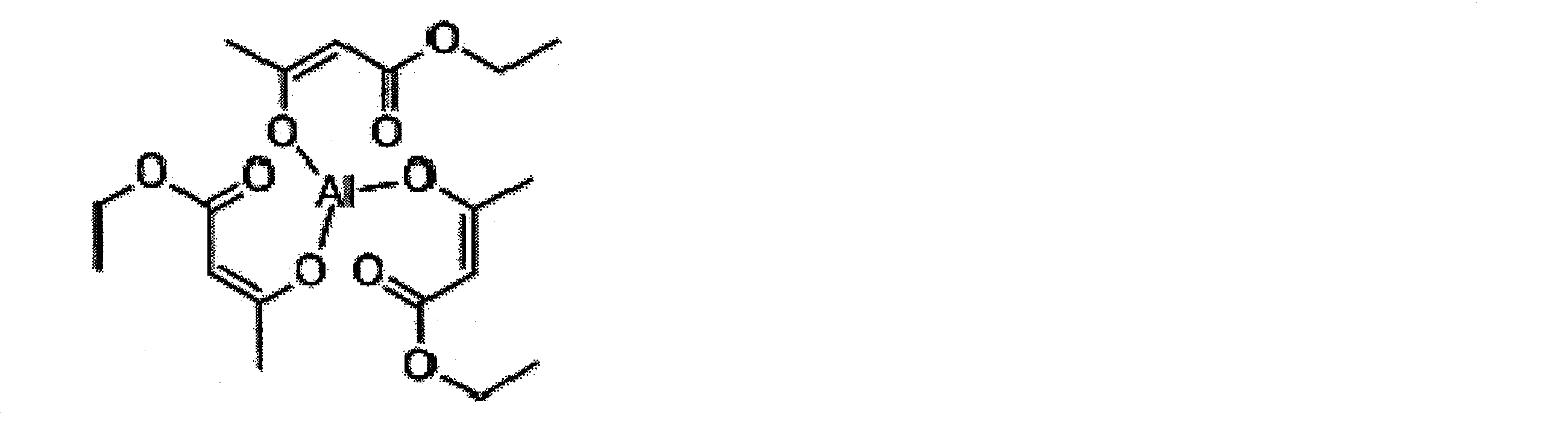
D1:アルミニウムトリスエチルアセトアセテートALCH-TR(川研ファインケミカル社製:下記化学式(化3)に示す化合物、分子量414)
D1:アルミニウムトリスエチルアセトアセテートALCH-TR(川研ファインケミカル社製:下記化学式(化3)に示す化合物、分子量414)
(試験方法)
以下の試験方法に従い評価を行った。その結果を表1、表2に示す。
以下の試験方法に従い評価を行った。その結果を表1、表2に示す。
<光透過率>
有機EL素子封止用透明樹脂組成物の光透過率を、分光光度計(日立ハイテクノロジーズ社製 分光光度計U-4100型 固体試料測定システム)を用いて求めた。具体的には、0.1mm厚みまで80℃で貼り合せて調整した有機EL素子封止用透明樹脂シートを作製し、25℃での550nmの透過光量を求めた。
有機EL素子封止用透明樹脂組成物の光透過率を、分光光度計(日立ハイテクノロジーズ社製 分光光度計U-4100型 固体試料測定システム)を用いて求めた。具体的には、0.1mm厚みまで80℃で貼り合せて調整した有機EL素子封止用透明樹脂シートを作製し、25℃での550nmの透過光量を求めた。
<透湿度>
調製した有機EL素子封止用透明樹脂シートの25μmの剥離処理ポリエステルフィルムと50μmの剥離処理ポリエステルフィルムを剥離し、しわやたるみがないよう低湿度チャンバと高湿度チャンバの間に装着した。差圧式ガス・蒸気透過率測定装置(GTRテック社製、GTR-10XAWT)、ガスクロマトグラフ(ヤナコ社製、G2700T)を用いて、JISK7129Cに準拠し、40℃、90%RHの透湿度を求めた。
調製した有機EL素子封止用透明樹脂シートの25μmの剥離処理ポリエステルフィルムと50μmの剥離処理ポリエステルフィルムを剥離し、しわやたるみがないよう低湿度チャンバと高湿度チャンバの間に装着した。差圧式ガス・蒸気透過率測定装置(GTRテック社製、GTR-10XAWT)、ガスクロマトグラフ(ヤナコ社製、G2700T)を用いて、JISK7129Cに準拠し、40℃、90%RHの透湿度を求めた。
<接着力>
調製した有機EL素子封止用透明樹脂シートの25μmの剥離処理ポリエステルフィルムを剥離し、38μmの易接着処理ポリエステルフィルム(帝人デュポンフィルム社製、G2-C)を80℃で貼合した後、50μmの剥離処理ポリエステルフィルムを剥離して試験片とした。得られた試験片の封止層の表面に、JISR3202に準拠したガラスを被着体として貼合温度80℃で貼合し、JISZ0237に準拠し180°引き剥がし法にて被着体から試験片を剥離して接着力を評価した。
調製した有機EL素子封止用透明樹脂シートの25μmの剥離処理ポリエステルフィルムを剥離し、38μmの易接着処理ポリエステルフィルム(帝人デュポンフィルム社製、G2-C)を80℃で貼合した後、50μmの剥離処理ポリエステルフィルムを剥離して試験片とした。得られた試験片の封止層の表面に、JISR3202に準拠したガラスを被着体として貼合温度80℃で貼合し、JISZ0237に準拠し180°引き剥がし法にて被着体から試験片を剥離して接着力を評価した。
<保持力>
上記接着力評価と同様に試験片を作製し、得られた試験片の封止層の表面に、JISR3202に準拠したガラスを被着体として貼合温度80℃で貼合して、JISZ0237に準拠し、規定されたおもりを取り付け、100℃における24時間経過後のずれた距離を保持力として評価した。なお、24時間以内に試験片が剥がれ落ちてしまった場合は、「>25」とした。
上記接着力評価と同様に試験片を作製し、得られた試験片の封止層の表面に、JISR3202に準拠したガラスを被着体として貼合温度80℃で貼合して、JISZ0237に準拠し、規定されたおもりを取り付け、100℃における24時間経過後のずれた距離を保持力として評価した。なお、24時間以内に試験片が剥がれ落ちてしまった場合は、「>25」とした。
<ダークスポット>
絶縁性透明ガラスからなる素子基板の上に、陽極を有し、その上面に有機層、更にその上面に陰極を有する有機EL素子を作製した。次いで、調製した有機EL素子封止用透明樹脂シートの25μmの剥離処理ポリエステルフィルムを剥離し、上記有機EL素子の上記陰極の上面に配置した。その後、有機EL素子封止用透明樹脂シートの50μmの剥離処理ポリエステルフィルムを剥離し、封止基板として絶縁性透明ガラスを有機EL素子封止用透明樹脂シートの封止層の上面に配置して減圧下80℃において0.6MPaの圧力で1分間加圧し、有機ELディスプレイのモデルを作製した。
次に、上記モデルを、80℃85%RHで500時間処理し、その後、室温(25℃)まで冷却した後、有機EL素子を起動させ、ダークスポット(非発光箇所)を観察した。ダークスポットの面積が全体に対して2%未満の場合をダークスポットの発生抑制に特に優れるとして「AA」、5%未満の場合をダークスポットの発生抑制に優れるとして「A」、10%未満の場合をダークスポットの発生抑制に優れるとして「B」、10%以上の場合をダークスポットの発生抑制に劣るとして「C」とした。
絶縁性透明ガラスからなる素子基板の上に、陽極を有し、その上面に有機層、更にその上面に陰極を有する有機EL素子を作製した。次いで、調製した有機EL素子封止用透明樹脂シートの25μmの剥離処理ポリエステルフィルムを剥離し、上記有機EL素子の上記陰極の上面に配置した。その後、有機EL素子封止用透明樹脂シートの50μmの剥離処理ポリエステルフィルムを剥離し、封止基板として絶縁性透明ガラスを有機EL素子封止用透明樹脂シートの封止層の上面に配置して減圧下80℃において0.6MPaの圧力で1分間加圧し、有機ELディスプレイのモデルを作製した。
次に、上記モデルを、80℃85%RHで500時間処理し、その後、室温(25℃)まで冷却した後、有機EL素子を起動させ、ダークスポット(非発光箇所)を観察した。ダークスポットの面積が全体に対して2%未満の場合をダークスポットの発生抑制に特に優れるとして「AA」、5%未満の場合をダークスポットの発生抑制に優れるとして「A」、10%未満の場合をダークスポットの発生抑制に優れるとして「B」、10%以上の場合をダークスポットの発生抑制に劣るとして「C」とした。
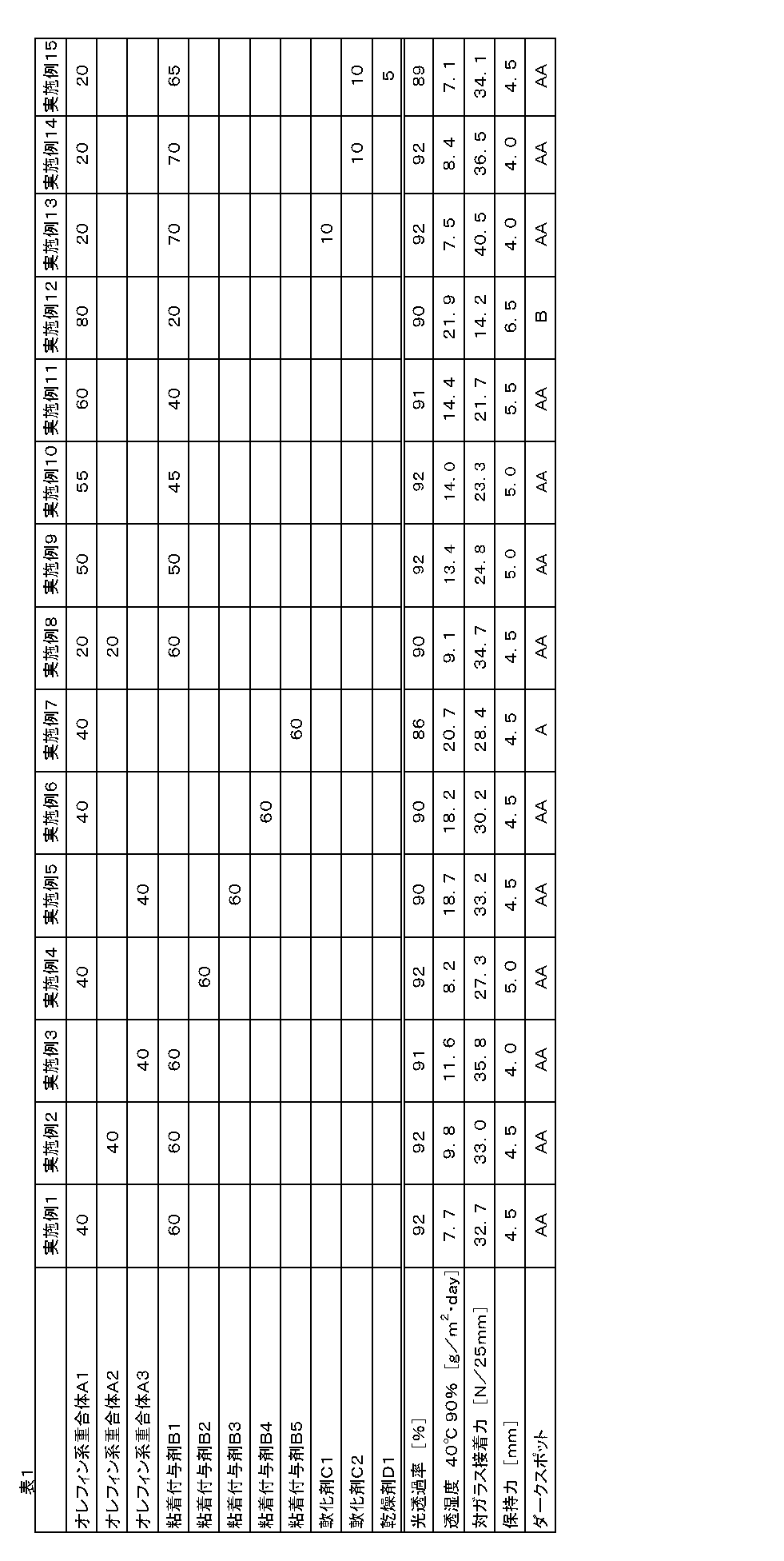

実施例1~6、8~11、13~15は、エチレン・α-オレフィン共重合体、またはエチレン・α-オレフィン・非共役ジエン共重合体と、40質量%以上70質量%以下の水素化された粘着付与剤を含み、40℃、90%RHの透湿度が20g/m2・day以下であり、20N/25mm以上接着力を示し、ダークスポット評価において特に良好な結果となった。
実施例7は、エチレン・α-オレフィン・非共役ジエン共重合体40質量%と、60質量%の粘着付与剤を含み、40℃、90%RHの透湿度が50g/m2・day以下であり、20N/25mm以上接着力を示し、保持力、ダークスポット評価において良好な結果となった。
実施例12は、エチレン・α-オレフィン・非共役ジエン共重合体80質量%と、20質量%の粘着付与剤を含み、40℃、90%RHの透湿度が50g/m2・day以下であり、10N/25mm以上接着力を示し、保持力、ダークスポット評価において良好な結果となった。
これに対して、比較例1は、粘着付与剤を5質量%しか含まないため、接着力が小さく保持力テストでは試験片が剥がれ落ちてしまい、ダークスポットが発生した。比較例2、3は粘着付与剤を含まないため、接着力が小さく保持力テストでは試験片が剥がれ落ちてしまい、ダークスポットが発生した。比較例4、5は粘着付与剤を含まず、軟化剤を30質量%以上含むため、フィルムにならず透湿度は測定できなかった。基板に塗布することで、その他の評価を行ったが、接着力が小さく保持力テストでは試験片が剥がれ落ちてしまい、ダークスポットが発生した。比較例6、7は粘着付与剤を75質量%含むため、フィルムの柔軟性が不足して試験片をガラスに貼りあわせることができず、接着力、保持力ダークスポットのテストを行うことができなかった。
本発明をその実施態様とともに説明したが、我々は特に指定しない限り我々の発明を説明のどの細部においても限定しようとするものではなく、添付の請求の範囲に示した発明の精神と範囲に反することなく幅広く解釈されるべきであると考える。
本願は、2013年3月29日に日本国で特許出願された特願2013-075037に基づく優先権を主張するものであり、これらはここに参照してその内容を本明細書の記載の一部として取り込む。
1 有機発光デバイス
2 基板ガラス
3 有機発光ユニット
4 蒸着薄膜
5 封止フィルム
6 封止ガラス
7 電極
2 基板ガラス
3 有機発光ユニット
4 蒸着薄膜
5 封止フィルム
6 封止ガラス
7 電極
Claims (14)
- 電子デバイスに用いられる接着性の封止剤組成物であって、オレフィン系重合体と粘着付与剤を含有し、前記オレフィン系重合体は、エチレン・α-オレフィン共重合体及びエチレン・α-オレフィン・非共役ジエン共重合体から選ばれる少なくとも1種であり、前記粘着付与剤の含有量は封止剤組成物を構成する樹脂組成物中の10質量%以上70質量%以下であることを特徴とする封止剤組成物。
- 電子デバイスに用いられる接着性を有する封止剤組成物であって、オレフィン系重合体と粘着付与剤を含有し、前記オレフィン系重合体は、エチレン・α-オレフィン共重合体及びエチレン・α-オレフィン・非共役ジエン共重合体から選ばれる少なくとも1種であり、前記粘着付与剤の含有量は封止剤組成物を構成する樹脂組成物中の、40質量%以上70質量%以下であることを特徴とする封止剤組成物。
- 前記粘着付与剤が水素化されていることを特徴とする請求項1又は2に記載の封止剤組成物。
- 前記粘着付与剤として、水素化された粘着付与剤が環状構造を含む石油樹脂を水添した樹脂であることを特徴とする請求項1~3のいずれか1項に記載の封止剤組成物。
- 上記エチレン・α-オレフィン共重合体及び上記エチレン・α-オレフィン・非共役ジエン共重合体は、カルボキシル基、ヒドロキシル基、エポキシ基、アミノ基、アルコキシシリル基、スルホン酸基及びニトリル基から選ばれる官能基を有する請求項1~4のいずれか1項に記載の封止剤組成物。
- さらに軟化剤を含むことを特徴とする請求項1~5のいずれか1項に記載の封止剤組成物。
- 前記封止剤組成物を構成する樹脂組成物全質量中、
(a)10~35質量%の前記オレフィン系重合体と、
(b)50~75質量%の前記粘着付与剤と、
(c)10~30質量%の前記軟化剤と、
を含む、請求項1~6のいずれか1項に記載の封止剤組成物。 - 前記軟化剤は飽和炭化水素鎖の炭素数が全炭素数の50%以上を占める化合物からなることを特徴とする請求項7に記載の封止剤組成物。
- 前記飽和炭化水素鎖炭素数が全炭素数の50%以上を占める化合物がイソブチレン骨格を主成分に含有する化合物である請求項8に記載の封止剤組成物。
- 前記軟化剤の数平均分子量が300以上2000以下である請求項1~9のいずれか1項に記載の封止剤組成物。
- さらに、乾燥剤を含むことを特徴とする請求項1~10のいずれか1項に記載の封止剤組成物。
- 400~800nmの可視領域で透明である、請求項1~11のいずれか1項に記載の封止剤組成物。
- 請求項1~12のいずれか1項に記載の封止剤組成物からなる封止フィルム、又は封止フィルムの片面または両面に剥離フィルムが積層されている封止用シート。
- 一対の対向する電極層、及び電極層の間に配置される有機発光層を有する発光ユニットの上部、及び/又は前記発光ユニットの周囲に、請求項1~13のいずれか1項に記載の封止剤組成物を具備する有機発光デバイス。
Priority Applications (3)
| Application Number | Priority Date | Filing Date | Title |
|---|---|---|---|
| KR1020157011122A KR101807376B1 (ko) | 2013-03-29 | 2014-03-26 | 밀봉제 조성물 및 상기 조성물로부터 얻어지는 밀봉용 시트 |
| CN201480002773.1A CN104737623B (zh) | 2013-03-29 | 2014-03-26 | 密封剂组合物及由该组合物获得的密封用片 |
| US14/867,790 US20160017186A1 (en) | 2013-03-29 | 2015-09-28 | Sealant composition and sealing sheet obtained from the composition |
Applications Claiming Priority (2)
| Application Number | Priority Date | Filing Date | Title |
|---|---|---|---|
| JP2013075037A JP5503770B1 (ja) | 2013-03-29 | 2013-03-29 | 封止剤組成物および該組成物から得られる封止用シート |
| JP2013-075037 | 2013-03-29 |
Related Child Applications (1)
| Application Number | Title | Priority Date | Filing Date |
|---|---|---|---|
| US14/867,790 Continuation US20160017186A1 (en) | 2013-03-29 | 2015-09-28 | Sealant composition and sealing sheet obtained from the composition |
Publications (1)
| Publication Number | Publication Date |
|---|---|
| WO2014157350A1 true WO2014157350A1 (ja) | 2014-10-02 |
Family
ID=50941821
Family Applications (1)
| Application Number | Title | Priority Date | Filing Date |
|---|---|---|---|
| PCT/JP2014/058564 Ceased WO2014157350A1 (ja) | 2013-03-29 | 2014-03-26 | 封止剤組成物および該組成物から得られる封止用シート |
Country Status (6)
| Country | Link |
|---|---|
| US (1) | US20160017186A1 (ja) |
| JP (1) | JP5503770B1 (ja) |
| KR (1) | KR101807376B1 (ja) |
| CN (1) | CN104737623B (ja) |
| TW (1) | TWI535833B (ja) |
| WO (1) | WO2014157350A1 (ja) |
Cited By (1)
| Publication number | Priority date | Publication date | Assignee | Title |
|---|---|---|---|---|
| JPWO2019189723A1 (ja) * | 2018-03-30 | 2021-05-13 | 味の素株式会社 | 封止用組成物 |
Families Citing this family (8)
| Publication number | Priority date | Publication date | Assignee | Title |
|---|---|---|---|---|
| JP6507523B2 (ja) * | 2014-08-22 | 2019-05-08 | コニカミノルタ株式会社 | 有機エレクトロルミネッセンス素子 |
| JP2016143606A (ja) * | 2015-02-04 | 2016-08-08 | セイコーエプソン株式会社 | 有機el装置、及び電子機器 |
| JP6825825B2 (ja) * | 2015-05-27 | 2021-02-03 | デクセリアルズ株式会社 | 積層薄膜、及び積層薄膜の製造方法 |
| JP2017004642A (ja) * | 2015-06-05 | 2017-01-05 | 双葉電子工業株式会社 | 可撓性有機elディバイス |
| CN106384788A (zh) * | 2016-10-21 | 2017-02-08 | 纳晶科技股份有限公司 | 一种电致发光器件及用于电致发光器件的液态干燥剂 |
| KR101936600B1 (ko) * | 2017-07-06 | 2019-01-09 | (주)이녹스첨단소재 | 유기전자장치용 접착필름 및 이를 포함하는 유기전자장치용 봉지재 |
| KR101962745B1 (ko) * | 2017-08-22 | 2019-03-27 | (주)이녹스첨단소재 | 유기전자장치 봉지재용 폴리올레핀계 혼합수지, 이를 포함하는 유기전자장치 봉지재용 접착조성물 및 이를 포함하는 유기전자장치 봉지재용 접착필름 |
| JP2023545933A (ja) * | 2020-10-14 | 2023-11-01 | アランセオ・ネザーランズ・ベー・フェー | 熱安定性エチレンコポリマーゴムブレンド |
Citations (7)
| Publication number | Priority date | Publication date | Assignee | Title |
|---|---|---|---|---|
| JP2005129520A (ja) * | 2003-10-03 | 2005-05-19 | Jsr Corp | 有機el素子用透明封止材 |
| JP2006272190A (ja) * | 2005-03-29 | 2006-10-12 | Jsr Corp | 透明吸湿組成物、成形体、並びにフィルム及びその製造方法 |
| JP2007197517A (ja) * | 2006-01-24 | 2007-08-09 | Three M Innovative Properties Co | 接着性封止組成物、封止フィルム及び有機el素子 |
| JP2008056967A (ja) * | 2006-08-30 | 2008-03-13 | Konica Minolta Holdings Inc | ガスバリア性樹脂基材および有機エレクトロルミネッセンスデバイス |
| JP2010080293A (ja) * | 2008-09-26 | 2010-04-08 | Dainippon Printing Co Ltd | 有機エレクトロルミネッセンス素子封止用粘着フィルム |
| JP2011230452A (ja) * | 2010-04-30 | 2011-11-17 | Dainippon Printing Co Ltd | ガスバリア性積層体、及びそれを含む封入表示デバイス |
| JP2012012035A (ja) * | 2010-06-29 | 2012-01-19 | Asahi Kasei Chemicals Corp | カバーテープ、カバーテープの製造方法及び電子部品梱包体 |
Family Cites Families (11)
| Publication number | Priority date | Publication date | Assignee | Title |
|---|---|---|---|---|
| US3505259A (en) * | 1967-08-08 | 1970-04-07 | Union Oil Co | Composition and process for reclaiming blends of wax and ethylene vinyl acetate copolymers |
| DD300443A5 (de) * | 1989-09-13 | 1992-06-11 | Exxon Chemical Patents Inc | Heissschmelzklebstoff |
| US5677382A (en) * | 1994-12-19 | 1997-10-14 | Japan Synthetic Rubber Co., Ltd. | Ethylene-α-olefin-non-conjugated diene copolymer rubber composition |
| WO2005034583A1 (ja) * | 2003-10-03 | 2005-04-14 | Jsr Corporation | 有機el素子用透明封止材 |
| US7342356B2 (en) * | 2004-09-23 | 2008-03-11 | 3M Innovative Properties Company | Organic electroluminescent device having protective structure with boron oxide layer and inorganic barrier layer |
| JP5307552B2 (ja) * | 2005-12-29 | 2013-10-02 | ダウ グローバル テクノロジーズ エルエルシー | 低分子量エチレンインターポリマー、その製造法および使用 |
| ES2400224T3 (es) * | 2006-06-15 | 2013-04-08 | Dow Global Technologies Llc | Interpolímeros de olefina funcionalizados, composiciones y artículos preparados con ellos y métodos para producir los mismos |
| WO2008063907A1 (en) * | 2006-11-13 | 2008-05-29 | Adherent Laboratories, Inc. | Disposable article hot melt adhesive |
| US9200103B2 (en) * | 2006-12-21 | 2015-12-01 | Dow Global Technologies Llc | Functionalized olefin polymers, compositions and articles prepared therefrom, and methods for making the same |
| MY155405A (en) * | 2009-08-31 | 2015-10-15 | Asahi Kasei Chemicals Corp | Cover tape, method for manufacturing cover tape, and electronic part package |
| KR101436759B1 (ko) * | 2012-12-24 | 2014-09-03 | 주식회사 엘지화학 | 올레핀 수지 조성물 |
-
2013
- 2013-03-29 JP JP2013075037A patent/JP5503770B1/ja active Active
-
2014
- 2014-03-26 KR KR1020157011122A patent/KR101807376B1/ko active Active
- 2014-03-26 WO PCT/JP2014/058564 patent/WO2014157350A1/ja not_active Ceased
- 2014-03-26 CN CN201480002773.1A patent/CN104737623B/zh active Active
- 2014-03-28 TW TW103111602A patent/TWI535833B/zh not_active IP Right Cessation
-
2015
- 2015-09-28 US US14/867,790 patent/US20160017186A1/en not_active Abandoned
Patent Citations (7)
| Publication number | Priority date | Publication date | Assignee | Title |
|---|---|---|---|---|
| JP2005129520A (ja) * | 2003-10-03 | 2005-05-19 | Jsr Corp | 有機el素子用透明封止材 |
| JP2006272190A (ja) * | 2005-03-29 | 2006-10-12 | Jsr Corp | 透明吸湿組成物、成形体、並びにフィルム及びその製造方法 |
| JP2007197517A (ja) * | 2006-01-24 | 2007-08-09 | Three M Innovative Properties Co | 接着性封止組成物、封止フィルム及び有機el素子 |
| JP2008056967A (ja) * | 2006-08-30 | 2008-03-13 | Konica Minolta Holdings Inc | ガスバリア性樹脂基材および有機エレクトロルミネッセンスデバイス |
| JP2010080293A (ja) * | 2008-09-26 | 2010-04-08 | Dainippon Printing Co Ltd | 有機エレクトロルミネッセンス素子封止用粘着フィルム |
| JP2011230452A (ja) * | 2010-04-30 | 2011-11-17 | Dainippon Printing Co Ltd | ガスバリア性積層体、及びそれを含む封入表示デバイス |
| JP2012012035A (ja) * | 2010-06-29 | 2012-01-19 | Asahi Kasei Chemicals Corp | カバーテープ、カバーテープの製造方法及び電子部品梱包体 |
Cited By (2)
| Publication number | Priority date | Publication date | Assignee | Title |
|---|---|---|---|---|
| JPWO2019189723A1 (ja) * | 2018-03-30 | 2021-05-13 | 味の素株式会社 | 封止用組成物 |
| JP7334731B2 (ja) | 2018-03-30 | 2023-08-29 | 味の素株式会社 | 封止用組成物 |
Also Published As
| Publication number | Publication date |
|---|---|
| TWI535833B (zh) | 2016-06-01 |
| JP5503770B1 (ja) | 2014-05-28 |
| JP2014199768A (ja) | 2014-10-23 |
| US20160017186A1 (en) | 2016-01-21 |
| CN104737623A (zh) | 2015-06-24 |
| KR20150135192A (ko) | 2015-12-02 |
| CN104737623B (zh) | 2017-05-10 |
| TW201443211A (zh) | 2014-11-16 |
| KR101807376B1 (ko) | 2017-12-08 |
Similar Documents
| Publication | Publication Date | Title |
|---|---|---|
| JP5503770B1 (ja) | 封止剤組成物および該組成物から得られる封止用シート | |
| CN101752276B (zh) | 封装电子装置的方法 | |
| JP5435520B1 (ja) | 有機電子デバイス用素子封止用樹脂組成物、有機電子デバイス用素子封止用樹脂シート、有機エレクトロルミネッセンス素子、及び画像表示装置 | |
| JP6680295B2 (ja) | 封止用樹脂組成物 | |
| CN102576821B (zh) | 封装电子装置的方法 | |
| US8771459B2 (en) | Method of encapsulating an electronic arrangement | |
| KR101876112B1 (ko) | 유기 전자 디바이스 소자 밀봉용 수지 조성물, 유기 전자 디바이스 소자 밀봉용 수지 시트, 유기 일렉트로루미네센스 소자, 및 화상 표시장치 | |
| CN103347970B (zh) | 用于封装电子装置的粘合剂和方法 | |
| JP2007197517A (ja) | 接着性封止組成物、封止フィルム及び有機el素子 | |
| JP7643359B2 (ja) | 封止用組成物およびその製造方法、並びに封止用シート | |
| JPWO2014156324A1 (ja) | 有機電子デバイス用素子封止用樹脂組成物、有機電子デバイス用素子封止用樹脂シート、有機エレクトロルミネッセンス素子、及び画像表示装置 | |
| JP7528605B2 (ja) | 封止用シートおよびポリマー組成物層 |
Legal Events
| Date | Code | Title | Description |
|---|---|---|---|
| 121 | Ep: the epo has been informed by wipo that ep was designated in this application |
Ref document number: 14774123 Country of ref document: EP Kind code of ref document: A1 |
|
| ENP | Entry into the national phase |
Ref document number: 20157011122 Country of ref document: KR Kind code of ref document: A |
|
| NENP | Non-entry into the national phase |
Ref country code: DE |
|
| 122 | Ep: pct application non-entry in european phase |
Ref document number: 14774123 Country of ref document: EP Kind code of ref document: A1 |