WO2014157213A1 - 液晶組成物およびそれを使用した液晶表示素子 - Google Patents
液晶組成物およびそれを使用した液晶表示素子 Download PDFInfo
- Publication number
- WO2014157213A1 WO2014157213A1 PCT/JP2014/058306 JP2014058306W WO2014157213A1 WO 2014157213 A1 WO2014157213 A1 WO 2014157213A1 JP 2014058306 W JP2014058306 W JP 2014058306W WO 2014157213 A1 WO2014157213 A1 WO 2014157213A1
- Authority
- WO
- WIPO (PCT)
- Prior art keywords
- group
- general formula
- liquid crystal
- carbon atoms
- present
- Prior art date
- Legal status (The legal status is an assumption and is not a legal conclusion. Google has not performed a legal analysis and makes no representation as to the accuracy of the status listed.)
- Ceased
Links
- GVWTXXPVEJZSAA-CDJQDVQCSA-N CCC/C=C/C(CC1)CCC1/C=C/CC Chemical compound CCC/C=C/C(CC1)CCC1/C=C/CC GVWTXXPVEJZSAA-CDJQDVQCSA-N 0.000 description 1
- PNMKQRJBAAXQSC-FIFLTTCUSA-N CCC/C=C/C(CC1)CCC1/C=C/CCC Chemical compound CCC/C=C/C(CC1)CCC1/C=C/CCC PNMKQRJBAAXQSC-FIFLTTCUSA-N 0.000 description 1
- FFBXWRVTBPCQAK-KWRXBJJZSA-N CCC/C=C/C1CCC(CC/C=C/C)CC1 Chemical compound CCC/C=C/C1CCC(CC/C=C/C)CC1 FFBXWRVTBPCQAK-KWRXBJJZSA-N 0.000 description 1
- NXIBFCYMCWTNLZ-VQHVLOKHSA-N CCC/C=C/C1CCC(CCC=C)CC1 Chemical compound CCC/C=C/C1CCC(CCC=C)CC1 NXIBFCYMCWTNLZ-VQHVLOKHSA-N 0.000 description 1
- HQCFEHPLEDSJIT-MFDVASPDSA-N CCC/C=C/CCC(CC1)CCC1/C=C/CCC Chemical compound CCC/C=C/CCC(CC1)CCC1/C=C/CCC HQCFEHPLEDSJIT-MFDVASPDSA-N 0.000 description 1
- JBUJJMVIXAEIOO-GFULKKFKSA-N CCCC/C=C/C(CC1)CCC1/C=C/CCC Chemical compound CCCC/C=C/C(CC1)CCC1/C=C/CCC JBUJJMVIXAEIOO-GFULKKFKSA-N 0.000 description 1
- MEDYDJQASUAPPJ-CDKJVOIVSA-N CCCC/C=C/CCC(CC1)CCC1/C=C/CCC Chemical compound CCCC/C=C/CCC(CC1)CCC1/C=C/CCC MEDYDJQASUAPPJ-CDKJVOIVSA-N 0.000 description 1
- 0 CCCC=CC(CC1)CCC1C(*)CC=CCC Chemical compound CCCC=CC(CC1)CCC1C(*)CC=CCC 0.000 description 1
- PYFQRLHIFNWIHF-WGDLNXRISA-N CCCCC/C=C/C(CC1)CCC1/C=C/CCC Chemical compound CCCCC/C=C/C(CC1)CCC1/C=C/CCC PYFQRLHIFNWIHF-WGDLNXRISA-N 0.000 description 1
- XNCWZWOKRWKKKD-SNMPHBPQSA-N CCCCC/C=C/CCC(CC1)CCC1/C=C/CCC Chemical compound CCCCC/C=C/CCC(CC1)CCC1/C=C/CCC XNCWZWOKRWKKKD-SNMPHBPQSA-N 0.000 description 1
- KRTMZMRDWYMJKF-DCIPZJNNSA-N CCCCCC/C=C/C(CC1)CCC1/C=C/CCC Chemical compound CCCCCC/C=C/C(CC1)CCC1/C=C/CCC KRTMZMRDWYMJKF-DCIPZJNNSA-N 0.000 description 1
- BXTLPXOQZSICMK-CYZWUHAYSA-N CCCCCC/C=C/CCC(CC1)CCC1/C=C/CCC Chemical compound CCCCCC/C=C/CCC(CC1)CCC1/C=C/CCC BXTLPXOQZSICMK-CYZWUHAYSA-N 0.000 description 1
- XJVHLWKIXJFPCK-PHEQNACWSA-N CCCCCCC/C=C/C(CC1)CCC1/C=C/CCC Chemical compound CCCCCCC/C=C/C(CC1)CCC1/C=C/CCC XJVHLWKIXJFPCK-PHEQNACWSA-N 0.000 description 1
- YKUZSRVXIKTMTO-QUMQEAAQSA-N CCCCCCCC/C=C/C(CC1)CCC1/C=C/CCC Chemical compound CCCCCCCC/C=C/C(CC1)CCC1/C=C/CCC YKUZSRVXIKTMTO-QUMQEAAQSA-N 0.000 description 1
Images

Classifications
-
- C—CHEMISTRY; METALLURGY
- C09—DYES; PAINTS; POLISHES; NATURAL RESINS; ADHESIVES; COMPOSITIONS NOT OTHERWISE PROVIDED FOR; APPLICATIONS OF MATERIALS NOT OTHERWISE PROVIDED FOR
- C09K—MATERIALS FOR MISCELLANEOUS APPLICATIONS, NOT PROVIDED FOR ELSEWHERE
- C09K19/00—Liquid crystal materials
- C09K19/04—Liquid crystal materials characterised by the chemical structure of the liquid crystal components, e.g. by a specific unit
- C09K19/06—Non-steroidal liquid crystal compounds
- C09K19/08—Non-steroidal liquid crystal compounds containing at least two non-condensed rings
- C09K19/30—Non-steroidal liquid crystal compounds containing at least two non-condensed rings containing saturated or unsaturated non-aromatic rings, e.g. cyclohexane rings
- C09K19/3001—Cyclohexane rings
- C09K19/3066—Cyclohexane rings in which the rings are linked by a chain containing carbon and oxygen atoms, e.g. esters or ethers
-
- C—CHEMISTRY; METALLURGY
- C09—DYES; PAINTS; POLISHES; NATURAL RESINS; ADHESIVES; COMPOSITIONS NOT OTHERWISE PROVIDED FOR; APPLICATIONS OF MATERIALS NOT OTHERWISE PROVIDED FOR
- C09K—MATERIALS FOR MISCELLANEOUS APPLICATIONS, NOT PROVIDED FOR ELSEWHERE
- C09K19/00—Liquid crystal materials
- C09K19/04—Liquid crystal materials characterised by the chemical structure of the liquid crystal components, e.g. by a specific unit
- C09K19/06—Non-steroidal liquid crystal compounds
- C09K19/08—Non-steroidal liquid crystal compounds containing at least two non-condensed rings
- C09K19/30—Non-steroidal liquid crystal compounds containing at least two non-condensed rings containing saturated or unsaturated non-aromatic rings, e.g. cyclohexane rings
- C09K19/3001—Cyclohexane rings
- C09K19/3066—Cyclohexane rings in which the rings are linked by a chain containing carbon and oxygen atoms, e.g. esters or ethers
- C09K19/3068—Cyclohexane rings in which the rings are linked by a chain containing carbon and oxygen atoms, e.g. esters or ethers chain containing -COO- or -OCO- groups
-
- C—CHEMISTRY; METALLURGY
- C09—DYES; PAINTS; POLISHES; NATURAL RESINS; ADHESIVES; COMPOSITIONS NOT OTHERWISE PROVIDED FOR; APPLICATIONS OF MATERIALS NOT OTHERWISE PROVIDED FOR
- C09K—MATERIALS FOR MISCELLANEOUS APPLICATIONS, NOT PROVIDED FOR ELSEWHERE
- C09K19/00—Liquid crystal materials
- C09K19/04—Liquid crystal materials characterised by the chemical structure of the liquid crystal components, e.g. by a specific unit
- C09K19/42—Mixtures of liquid crystal compounds covered by two or more of the preceding groups C09K19/06 - C09K19/40
- C09K19/46—Mixtures of liquid crystal compounds covered by two or more of the preceding groups C09K19/06 - C09K19/40 containing esters
-
- C—CHEMISTRY; METALLURGY
- C09—DYES; PAINTS; POLISHES; NATURAL RESINS; ADHESIVES; COMPOSITIONS NOT OTHERWISE PROVIDED FOR; APPLICATIONS OF MATERIALS NOT OTHERWISE PROVIDED FOR
- C09K—MATERIALS FOR MISCELLANEOUS APPLICATIONS, NOT PROVIDED FOR ELSEWHERE
- C09K19/00—Liquid crystal materials
- C09K19/04—Liquid crystal materials characterised by the chemical structure of the liquid crystal components, e.g. by a specific unit
- C09K19/06—Non-steroidal liquid crystal compounds
- C09K19/08—Non-steroidal liquid crystal compounds containing at least two non-condensed rings
- C09K19/30—Non-steroidal liquid crystal compounds containing at least two non-condensed rings containing saturated or unsaturated non-aromatic rings, e.g. cyclohexane rings
- C09K19/3001—Cyclohexane rings
- C09K19/3003—Compounds containing at least two rings in which the different rings are directly linked (covalent bond)
- C09K2019/3004—Cy-Cy
-
- C—CHEMISTRY; METALLURGY
- C09—DYES; PAINTS; POLISHES; NATURAL RESINS; ADHESIVES; COMPOSITIONS NOT OTHERWISE PROVIDED FOR; APPLICATIONS OF MATERIALS NOT OTHERWISE PROVIDED FOR
- C09K—MATERIALS FOR MISCELLANEOUS APPLICATIONS, NOT PROVIDED FOR ELSEWHERE
- C09K19/00—Liquid crystal materials
- C09K19/04—Liquid crystal materials characterised by the chemical structure of the liquid crystal components, e.g. by a specific unit
- C09K19/06—Non-steroidal liquid crystal compounds
- C09K19/08—Non-steroidal liquid crystal compounds containing at least two non-condensed rings
- C09K19/30—Non-steroidal liquid crystal compounds containing at least two non-condensed rings containing saturated or unsaturated non-aromatic rings, e.g. cyclohexane rings
- C09K19/3001—Cyclohexane rings
- C09K19/3003—Compounds containing at least two rings in which the different rings are directly linked (covalent bond)
- C09K2019/3021—Cy-Ph-Ph-Cy
-
- C—CHEMISTRY; METALLURGY
- C09—DYES; PAINTS; POLISHES; NATURAL RESINS; ADHESIVES; COMPOSITIONS NOT OTHERWISE PROVIDED FOR; APPLICATIONS OF MATERIALS NOT OTHERWISE PROVIDED FOR
- C09K—MATERIALS FOR MISCELLANEOUS APPLICATIONS, NOT PROVIDED FOR ELSEWHERE
- C09K19/00—Liquid crystal materials
- C09K19/04—Liquid crystal materials characterised by the chemical structure of the liquid crystal components, e.g. by a specific unit
- C09K19/06—Non-steroidal liquid crystal compounds
- C09K19/08—Non-steroidal liquid crystal compounds containing at least two non-condensed rings
- C09K19/30—Non-steroidal liquid crystal compounds containing at least two non-condensed rings containing saturated or unsaturated non-aromatic rings, e.g. cyclohexane rings
- C09K19/3001—Cyclohexane rings
- C09K19/3003—Compounds containing at least two rings in which the different rings are directly linked (covalent bond)
- C09K2019/3025—Cy-Ph-Ph-Ph
-
- C—CHEMISTRY; METALLURGY
- C09—DYES; PAINTS; POLISHES; NATURAL RESINS; ADHESIVES; COMPOSITIONS NOT OTHERWISE PROVIDED FOR; APPLICATIONS OF MATERIALS NOT OTHERWISE PROVIDED FOR
- C09K—MATERIALS FOR MISCELLANEOUS APPLICATIONS, NOT PROVIDED FOR ELSEWHERE
- C09K19/00—Liquid crystal materials
- C09K19/04—Liquid crystal materials characterised by the chemical structure of the liquid crystal components, e.g. by a specific unit
- C09K19/06—Non-steroidal liquid crystal compounds
- C09K19/08—Non-steroidal liquid crystal compounds containing at least two non-condensed rings
- C09K19/30—Non-steroidal liquid crystal compounds containing at least two non-condensed rings containing saturated or unsaturated non-aromatic rings, e.g. cyclohexane rings
- C09K19/3001—Cyclohexane rings
- C09K19/3066—Cyclohexane rings in which the rings are linked by a chain containing carbon and oxygen atoms, e.g. esters or ethers
- C09K19/3068—Cyclohexane rings in which the rings are linked by a chain containing carbon and oxygen atoms, e.g. esters or ethers chain containing -COO- or -OCO- groups
- C09K2019/3075—Cy-COO-Ph
-
- C—CHEMISTRY; METALLURGY
- C09—DYES; PAINTS; POLISHES; NATURAL RESINS; ADHESIVES; COMPOSITIONS NOT OTHERWISE PROVIDED FOR; APPLICATIONS OF MATERIALS NOT OTHERWISE PROVIDED FOR
- C09K—MATERIALS FOR MISCELLANEOUS APPLICATIONS, NOT PROVIDED FOR ELSEWHERE
- C09K19/00—Liquid crystal materials
- C09K19/04—Liquid crystal materials characterised by the chemical structure of the liquid crystal components, e.g. by a specific unit
- C09K19/06—Non-steroidal liquid crystal compounds
- C09K19/34—Non-steroidal liquid crystal compounds containing at least one heterocyclic ring
- C09K19/3402—Non-steroidal liquid crystal compounds containing at least one heterocyclic ring having oxygen as hetero atom
- C09K2019/3422—Non-steroidal liquid crystal compounds containing at least one heterocyclic ring having oxygen as hetero atom the heterocyclic ring being a six-membered ring
Definitions
- the present invention relates to a liquid crystal composition and further to a liquid crystal display device using the liquid crystal composition.
- Liquid crystal display elements are used in various measuring instruments, automobile panels, word processors, electronic notebooks, printers, computers, televisions, watches, advertisement display boards, etc., including clocks and calculators.
- the liquid crystal display device has a structure in which a liquid crystal composition is filled between a pair of substrates on which opposed transparent electrodes are formed, and a voltage passing between the electrodes changes the alignment state of the liquid crystal to pass light. The pattern that appears due to the difference in the amount of light passing therethrough is displayed.
- Typical liquid crystal display methods include TN (twisted nematic) type, STN (super twisted nematic) type, VA (hereinafter also referred to as vertical alignment) type using TFT (thin film transistor), and IPS ( In-plane switching) type.
- the liquid crystal composition used in these liquid crystal display elements is stable against external factors such as moisture, air, heat, light, etc., and exhibits a liquid crystal phase in the widest possible temperature range centering on room temperature, and has low viscosity. And a low driving voltage is required.
- the VA type widely used for a liquid crystal TV or the like generally uses a liquid crystal composition having a negative ⁇ , and is widely used for a TN type or a touch panel used for a PC monitor or the like.
- a liquid crystal composition mainly having a positive ⁇ is used for the IPS type.
- ⁇ dielectric anisotropy difference
- ⁇ n refractive index anisotropy difference
- ⁇ small viscosity
- Tni high nematic phase-isotropic liquid phase transition temperature
- ⁇ n ⁇ d which is the product of ⁇ n and the cell gap (d)
- ⁇ n of the liquid crystal composition it is necessary to adjust ⁇ n of the liquid crystal composition to an appropriate range according to the cell gap.
- a liquid crystal display element is applied to a television or the like, high-speed response is important, and therefore a liquid crystal composition having a small rotational viscosity coefficient ( ⁇ 1) is required.
- Patent Document 1 discloses a liquid crystal composition having a difluorophenylcyclohexane skeleton compound having an alkyl group or an alkenyl group at the terminal as an essential component.
- Patent Document 2 discloses a composition of polar liquid crystal compounds represented by formulas I to IV and nonpolar liquid crystal compounds represented by formulas V to VIII. And it is said that it is possible to remarkably widen the parameter range which can be utilized by this composition (patent document 2, paragraph "0028").
- Patent Documents 1 and 2 are compositions composed only of a liquid crystal compound in which two to three cyclohexane rings and benzene rings are connected, low viscosity ( ⁇ ) can be expected with certainty.
- the liquid crystal composition according to the present invention aims to solve such a problem by combining a low-viscosity bicyclohexyl alkenyl compound having a specific chemical structure with a high Tni straight-ring tetracyclic compound having a specific chemical structure. To do.
- the present inventor is able to achieve both high Tni and low viscosity by using the liquid crystal compositions of the general formula (1) and the general formula (2).
- the present invention has been completed.
- liquid crystal composition according to the present invention has the formula (1) as the first component:
- R 1 is a hydrogen atom or an alkyl group having 1 to 15 carbon atoms.
- each of R 2 and R 3 independently represents an alkyl group having 1 to 15 carbon atoms, an alkoxy group having 1 to 15 carbon atoms, and 2 to 15 carbon atoms.
- At least one selected from the group consisting of: A 1 to A 4 are each independently the following formulas (A) to (E):
- the liquid crystal composition according to the present invention can exhibit high Tni and low viscosity.
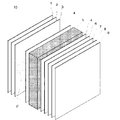
- FIG. 1 is a diagram schematically showing a configuration of a liquid crystal display element according to the present invention.
- FIG. 2 is an enlarged plan view of the electrode layer 3 including the thin film transistor formed on the substrate in FIG.
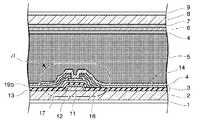
- FIG. 3 is a cross-sectional view of the liquid crystal display element shown in FIG. 1 cut along the line I-I ′ in FIG.
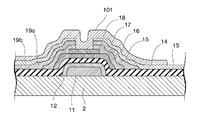
- FIG. 4 is an enlarged view of the thin film transistor in FIG.
- the first of the present invention is the general formula (1) as the first component:
- R 1 is a hydrogen atom or an alkyl group having 1 to 15 carbon atoms.
- each of R 2 and R 3 independently represents an alkyl group having 1 to 15 carbon atoms, an alkoxy group having 1 to 15 carbon atoms, and 2 to 15 carbon atoms.
- At least one selected from the group consisting of: A 1 to A 4 are each independently the following formulas (A) to (E):
- * represents a binding site. At least one selected from the group of compounds represented by formula (I), and having a negative dielectric anisotropy.
- the low-viscosity characteristics are borne by the bicyclic compound represented by the general formula (1), and the high transition temperature (Tni) characteristics are borne by the tetracyclic compound represented by the general formula (2). Both of these effects can be achieved without interfering with each other because of the difference between the above, and the liquid crystal is compared with the other compositions of Patent Documents 1 and 2 having the same Tni, ⁇ n, or ⁇ characteristics. It is considered that a composition having excellent viscosity characteristics and transition temperature of the entire composition can be provided.
- the liquid crystal composition contains the first component represented by the general formula (1) and the second component represented by the general formula (2) as essential components.
- the liquid crystal composition according to the present invention may further include at least one selected from the group consisting of the fourth component and other components such as a polymerizable monomer and an additive.
- the liquid crystal composition according to the present invention includes the compounds represented by the general formula (1) and the general formula (2) as essential components, and further includes a general formula (described later) if necessary. 3) to general formula (4) and at least one selected from the group consisting of compounds represented by the following general formula (VA) and general formula (VB) can be contained.
- the total content of the compound is preferably 60% by mass, preferably 65% by mass, preferably 70% by mass, preferably 75% by mass, preferably 80% by mass, preferably 85% by mass, and 90% by mass as the lower limit.
- 92 mass% is preferable, 95 mass% is preferable, 98 mass% is preferable, 99 mass% is preferable, and 100 mass% is preferable as an upper limit, and 99.5 mass% is preferable.
- the additive (antioxidant, UV absorber, etc.) in the liquid crystal composition according to the present invention is preferably 100 ppm to 1% by mass.
- the polymerizable monomer in the liquid crystal composition according to the present invention is preferably 500 ppm to 10% by mass.
- the value of the dielectric anisotropy ⁇ of the liquid crystal composition according to the present invention is preferably ⁇ 2.0 to ⁇ 6.0 at 25 ° C., and preferably ⁇ 2.5 to ⁇ 5.0. More preferably, it is particularly preferably from ⁇ 2.5 to ⁇ 4.0, but more specifically, when the response speed is important, the value of the dielectric anisotropy ⁇ is ⁇ 2.5 to ⁇ 3.
- the range of .4 is preferable from the viewpoint of response speed, and when the driving voltage is important, it is preferably -3.4 to -4.0.
- the value of the refractive index anisotropy ⁇ n of the liquid crystal composition according to the present invention is preferably 0.08 to 0.160 at 25 ° C., more preferably 0.090 to 0.130. More specifically, when it corresponds to a thin cell gap (cell gap of 3.4 ⁇ m or less), it is preferably 0.100 to 0.130, and when it corresponds to a thick cell gap (cell gap of 3.5 ⁇ m or more). It is preferably 0.080 to 0.100.
- the upper limit of the rotational viscosity ( ⁇ 1 ) of the liquid crystal composition according to the present invention is preferably 165 (mPa ⁇ s) or less, more preferably 130 (mPa ⁇ s) or less, and particularly preferably 120 (mPa ⁇ s) or less.
- the lower limit of the rotational viscosity ( ⁇ 1 ) is preferably 20 (mPa ⁇ s) or more, more preferably 30 (mPa ⁇ s) or more, still more preferably 40 (mPa ⁇ s) or more, and 50 (mPa ⁇ s). s) or more is more preferable, 60 (mPa ⁇ s) or more is further more preferable, and 70 (mPa ⁇ s) or more is particularly preferable.
- Z as a function of rotational viscosity and refractive index anisotropy shows a specific value.
- ⁇ 1 represents rotational viscosity and ⁇ n represents refractive index anisotropy.
- Z is preferably 13000 or less, more preferably 12000 or less, and particularly preferably 11000 or less.
- the liquid crystal composition according to the present invention in the case of using the active matrix display device, preferably has a 10 11 ( ⁇ ⁇ m) or more in specific resistance, 10 12 ( ⁇ ⁇ m) and more preferably, 10 13 ( ⁇ ⁇ m) or more is more preferable, and 10 14 ( ⁇ ⁇ m) or more is more preferable.
- the liquid crystal composition according to the present invention can use a nematic phase-isotropic liquid phase transition temperature (T NI ) in a wide range, and the phase transition temperature (T NI ) is 60 to 120 ° C. It is preferably 70 to 110 ° C, particularly preferably 75 to 100 ° C.
- the first component according to the present invention is represented by the general formula (1):
- R 1 is a hydrogen atom or an alkyl group having 1 to 15 carbon atoms).
- the compound represented by the general formula (1) has a relatively high solubility in relation to the other components according to the present invention, it can be present in a large amount in the liquid crystal composition according to the present invention, and a low viscosity liquid crystal composition. Things can be provided.
- R 1 is a hydrogen atom or an alkyl group having 1 to 15 carbon atoms, preferably a hydrogen atom or an alkyl group having 1 to 10 carbon atoms, An alkyl group having 1 to 5 carbon atoms is more preferable, a hydrogen atom or an alkyl group having 1 to 3 carbon atoms is more preferable, and a hydrogen atom or a methyl group is particularly preferable. Among these, it is particularly preferable to use a compound in which R 1 is a hydrogen atom and a compound in which R 1 is a methyl group.
- alkyl group having 1 to 15 carbon atoms examples include methyl group, ethyl group, propyl group, butyl group, isopropyl group, isobutyl group, t-butyl group, 3-pentyl group, isopentyl group. Group, neopentyl group, pentyl group, hexyl group, heptyl group, octyl group, nonyl group, decyl group, dodecyl group, pentadecyl group and the like.
- examples of alkyl groups are common and are appropriately selected from the above examples depending on the number of carbon atoms of each alkyl group.
- the alkyl group having 1 to 15 carbon atoms according to the present invention is preferably linear or branched, and more preferably linear.
- the content of the first component in the liquid crystal composition according to the present invention is appropriately selected not only in the usage mode / purpose of use of the liquid crystal composition but also in relation to other components. It is preferable that the suitable range of content of the 1st component contained is each independently independent by embodiment.
- the lower limit of the content of the first component is, for example, 3% by mass as one embodiment of the present invention with respect to the total amount (100% by mass) of the liquid crystal composition of the present invention. It is. Moreover, in another embodiment of this invention, it is 5 mass%. Or in another embodiment of the present invention, it is 7 mass%. Alternatively, in another embodiment of the present invention, it is 110% by mass.
- it is 12 mass%. Furthermore, in another embodiment of this invention, it is 15 mass%. Furthermore, in another embodiment of this invention, it is 18 mass%. Furthermore, in another embodiment of this invention, it is 20 mass%. Furthermore, in another embodiment of this invention, it is 23 mass%. Furthermore, in another embodiment of this invention, it is 25 mass%. Furthermore, in another embodiment of this invention, it is 28 mass%. Furthermore, in another embodiment of this invention, it is 30 mass%. Furthermore, in another embodiment of this invention, it is 35 mass%. Furthermore, in another embodiment of this invention, it is 38 mass%. Furthermore, in another embodiment of this invention, it is 40 mass%. Furthermore, in another embodiment of this invention, it is 35 mass%.
- it is 40 mass%. Furthermore, in another embodiment of this invention, it is 42 mass%. Furthermore, in another embodiment of this invention, it is 45 mass%. Furthermore, in another embodiment of this invention, it is 47 mass%. Furthermore, in another embodiment of this invention, it is 50 mass%. Furthermore, in another embodiment of this invention, it is 60 mass%. Furthermore, in another embodiment of this invention, it is 70 mass%. Furthermore, in another embodiment of this invention, it is 80 mass%.
- the upper limit of the content of the first component is, for example, 95% by mass in one form of the present invention with respect to the total amount of the liquid crystal composition of the present invention.
- it is 85 mass%.
- it is 75 mass%.
- it is 65 mass%.
- it is 55 mass%.
- it is 45 mass%.
- it is 35 mass%.
- it is 25 mass%.
- the content of the compound represented by the general formula (1) includes solubility at low temperatures, transition temperature, electrical reliability, birefringence, process suitability and drop marks described later. Therefore, it is necessary to adjust appropriately according to required performance such as image sticking and dielectric anisotropy.
- the above lower limit value is preferably high and the upper limit value is preferably high.
- the above lower limit value is preferably high and the upper limit value is high.
- the above lower limit value is lowered and the upper limit value is low.
- the types that can be combined with each other represented by the general formula (1) are not particularly limited, and desired properties such as solubility at low temperatures, transition temperature, electrical reliability, and birefringence. It is used in combination as appropriate according to the performance.
- the type of the compound of the general formula (1) used as the first component is, for example, as one embodiment of the present invention, a compound in which the first component is represented by one type of the general formula (1).
- the first component is a compound represented by two types of general formula (1).
- the first component is a compound represented by three types of general formula (1).
- a 1st component is a compound represented by four types of General formula (1). Furthermore, in another embodiment of the present invention, the first component is a compound represented by five types of general formula (1). Furthermore, in another embodiment of this invention, a 1st component is a compound represented by six types of General formula (1). Furthermore, in another embodiment of this invention, a 1st component is a compound represented by seven types of General formula (1). Furthermore, in another embodiment of the present invention, the first component is a compound represented by eight types of general formula (1). Furthermore, in another embodiment of the present invention, the first component is a compound represented by nine types of general formula (1). Furthermore, in another embodiment of the present invention, the first component is a system containing 10 or more types of compounds represented by the general formula (1).
- the lower limit value of the dielectric anisotropy ( ⁇ ) of the compound represented by the general formula (1) according to the present invention is ⁇ 1.5 in one embodiment, and ⁇ 1 in another embodiment. In yet another embodiment it is -0.5 and in yet another embodiment it is 0.
- the upper limit value of the dielectric anisotropy ( ⁇ ) of the liquid crystal composition composed of the compound represented by the general formula (1) is 0 in one embodiment and +1 in another embodiment. In yet another embodiment it is -1, and in yet another embodiment it is 0.5. In yet another embodiment it is 1.5, and in yet another embodiment it is -0.5.
- a preferred form of the first component according to the present invention is a compound represented by the general formula (1) (the general formula (1) (R 1 is a hydrogen atom or an alkyl group having 1 to 3 carbon atoms)).
- the total mass ratio of the first component according to the present invention is 5% by mass or more and 45% by mass with respect to the entire liquid crystal composition.
- the preferred form of the first component according to the present invention is particularly preferably a combination of a compound in which R 1 is a hydrogen atom and a compound in which R 1 is a methyl group.
- a compound having R 1 as a hydrogen atom when used alone as the first component according to the present invention, 20 to 45% by mass is preferable.
- R 1 as the first component according to the present invention is preferable.
- a compound having a methyl group is used alone as a first component, 5 to 15% by mass is preferable.
- the proportion of the first component in the whole liquid crystal composition is more preferably 25 to 60% by mass.
- the second component according to the present invention is represented by the general formula (2):
- each of R 2 and R 3 independently represents an alkyl group having 1 to 15 carbon atoms, an alkoxy group having 1 to 15 carbon atoms, and 2 to 15 carbon atoms.
- At least one selected from the group consisting of: A 1 to A 4 are each independently the following formulas (A) to (E):
- R 2 and R 3 each independently represents an alkyl group having 1 to 15 carbon atoms, an alkoxy group having 1 to 15 carbon atoms, and an alkenyl having 2 to 15 carbon atoms.
- it is at least one selected from the group consisting of a group, an alkyl group having 1 to 10 carbon atoms, an alkoxy group having 1 to 10 carbon atoms, and an alkenyl having 2 to 10 carbon atoms
- it is at least one selected from the group consisting of groups, from alkyl groups having 1 to 5 carbon atoms, alkoxy groups having 1 to 5 carbon atoms and alkenyl groups having 2 to 5 carbon atoms. More preferably, it is at least one selected from the group consisting of:
- the alkenyl group bonded to the above formula (A) preferably has 2 to 5 carbon atoms, for example, the above formulas (B) to (E)
- the alkenyl group bonded to has preferably 4 to 5 carbon atoms.
- the alkyl group, alkoxy group and alkenyl group are preferably linear or branched, and more preferably linear.
- alkyl group having 1 to 15 carbon atoms examples are as described above, and are omitted here.
- Examples of the “alkoxy group having 1 to 15 carbon atoms” according to the present invention are preferably present at a position where at least one oxygen atom in the substituent is directly bonded to the ring structure.
- Group, propoxy group (n-propoxy group, i-propoxy group), butoxy group, pentyloxy group, octyloxy group and decyloxy group are more preferable.
- the example of an alkoxy group is common and is suitably selected from the said illustration according to the number of carbon atoms of each alkoxy group.
- alkenyl group having 2 to 15 carbon atoms examples include vinyl group, allyl group, 1-propenyl group, isopropenyl group, 2-butenyl group, 3-butenyl group, 1,3-butadienyl. Group, 2-pentenyl group, 3-pentenyl group, 2-hexenyl group and the like. More preferable alkenyl groups according to the present invention include the following formula (i) (vinyl group), formula (ii) (1-propenyl group), formula (iii) (3-butenyl group) and formula (iv) ) (3-pentenyl group):
- the alkenyl group is particularly preferably the formula (i) or the formula (ii), and the formulas (i) to (iv) In the case where the ring to which () is bonded is formula (B) to formula (E), the alkenyl group is particularly preferably formula (iii) or formula (iv).
- examples of the alkenyl group are common and are appropriately selected from the above examples depending on the number of carbon atoms of each alkenyl group.
- the second component according to the present invention is, in the general formula (2), A 2 and A 3 are each independently at least one selected from the group consisting of the above formulas (B) to (E). It is preferable.
- the general formula (2) as the second component is represented by the following general formulas (2a) to (2i):
- R 2 and R 3 are each independently an alkyl group having 1 to 15 carbon atoms, an alkoxy group having 1 to 15 carbon atoms, and 2 carbon atoms.
- at least one selected from the group consisting of compounds represented by the following formulas (2a) It is more preferable to include at least one selected from the group consisting of compounds represented by 2i), (2c), (2d) and (2g), and represented by the general formulas (2a), (2i), (2d) and More preferably, it contains at least one selected from the group consisting of compounds represented by (2g).
- the second component contains at least one compound selected from the group consisting of general formulas (2a), (2i), (2d) and (2g), a high Tni liquid crystal composition is prepared. be able to.
- the content of the second component in the liquid crystal composition according to the present invention is appropriately selected not only in the usage mode and purpose of the liquid crystal composition but also in relation to other components. It is preferable that the suitable range of content of the 2nd component contained is each independently independent by embodiment.
- the lower limit of the content of the second component is, for example, 1% by mass as one embodiment of the present invention with respect to the total amount (100% by mass) of the liquid crystal composition of the present invention. It is. Moreover, in another embodiment of this invention, it is 2 mass%. Or in another embodiment of the present invention, it is 3 mass%. Moreover, in another embodiment of this invention, it is 4 mass%. Furthermore, in another embodiment of this invention, it is 5 mass%.
- it is 10 mass%. Furthermore, in another embodiment of this invention, it is 15 mass%. Furthermore, in another embodiment of this invention, it is 20 mass%. Furthermore, in another embodiment of this invention, it is 25 mass%. Furthermore, in another embodiment of this invention, it is 30 mass%. Furthermore, in another embodiment of this invention, it is 40 mass%. Furthermore, in another embodiment of this invention, it is 50 mass%. Furthermore, in another embodiment of this invention, it is 60 mass%.
- the upper limit value of the content of the second component is, for example, 65% by mass in one form of the present invention with respect to the total amount of the liquid crystal composition of the present invention. Moreover, in another embodiment of this invention, it is 55 mass%. Furthermore, in another embodiment of this invention, it is 45 mass%. Furthermore, in another embodiment of this invention, it is 65 mass%. Furthermore, in another embodiment of this invention, it is 35 mass%. Furthermore, in another embodiment of this invention, it is 45 mass%. Furthermore, in another embodiment of this invention, it is 25 mass%. Furthermore, in another embodiment of this invention, it is 20 mass%.
- the content of the compound represented by the general formula (2) includes solubility at low temperatures, transition temperature, electrical reliability, birefringence, process suitability and dropping marks described later. Therefore, it is necessary to adjust appropriately according to required performance such as image sticking and dielectric anisotropy.
- the above lower limit value is preferably high and the upper limit value is preferably high.
- the above lower limit value is preferably high and the upper limit value is high.
- the above lower limit value is lowered and the upper limit value is low.
- the second component there are no particular limitations on the types of the compounds represented by the general formula (2) that can be combined, and desired properties such as solubility at low temperatures, transition temperature, electrical reliability, and birefringence. It is used in combination as appropriate according to the performance.
- the type of the compound of the general formula (2) used as the second component is, for example, as one embodiment of the present invention, a compound in which the second component is represented by one type of the general formula (2).
- the second component is a compound represented by two types of general formula (2).
- a 2nd component is a compound represented by three types of General formula (2).
- a 2nd component is a compound represented by four types of General formula (2). Furthermore, in another embodiment of this invention, a 2nd component is a compound represented by five types of General formula (2). Furthermore, in another embodiment of the present invention, the second component is a compound represented by six types of general formula (2). Furthermore, in another embodiment of the present invention, the second component is a compound represented by seven types of general formula (2). Furthermore, in another embodiment of the present invention, the second component is a compound represented by eight types of general formula (2). Furthermore, in another embodiment of the present invention, the second component is a compound represented by nine types of general formula (2). Furthermore, in another embodiment of the present invention, the second component is a system containing 10 or more types of compounds represented by the general formula (2).
- the lower limit of the dielectric anisotropy ( ⁇ ) of the compound represented by the general formula (2) according to the present invention is ⁇ 15 in one embodiment, and ⁇ 11 in another embodiment. In still another embodiment, it is ⁇ 6, and in another embodiment, it is ⁇ 2.
- the upper limit of the dielectric anisotropy ( ⁇ ) of the liquid crystal composition comprising the compound represented by the general formula (1) The value is -1 in one embodiment and 0 in another embodiment. In yet another embodiment, -0.5, and in yet another embodiment, -2. In yet another embodiment, it is -1.5.
- the preferred form of the second component according to the present invention is preferably the general formula (2a), (2i), (2d) and (2g) among the compounds represented by the general formula (2).
- the content is 2 to 15% by mass.
- the total amount is more preferably 6 to 15% by mass.
- each type of compound is preferably contained in an amount of about 2 to 5%.
- the liquid crystal composition of the present invention has the following general formula (3) as a third component:
- R L1 and R L2 each independently represent an alkyl group having 1 to 8 carbon atoms, and one or non-adjacent two or more —CH 2 in the alkyl group. Each — may be independently substituted by —CH ⁇ CH—, —C ⁇ C—, —O—, —CO—, —COO— or —OCO—, OL represents 0, 1, 2 or 3;
- B L1 , B L2 and B L3 are each independently a group selected from the group consisting of (a) and (b) below: (A) 1,4-cyclohexylene group (this is present in the group one -CH 2 - or nonadjacent two or more -CH 2 - may be replaced by -O-.) (B) 1,4-phenylene group (one —CH ⁇ present in this group or two or more non-adjacent —CH ⁇ may be replaced by —N ⁇ )
- R L1 and R L2 are each a linear alkyl group having 1 to 5 carbon atoms or a linear carbon atom having 1 to 4 carbon atoms when the ring structure to which R L1 is bonded is a phenyl group (aromatic). (Or more) alkoxy groups and alkenyl groups having 4 to 5 carbon atoms are preferred, and when the ring structure to which they are bonded is a saturated ring structure such as cyclohexane, pyran and dioxane, linear carbon atoms An alkyl group having 1 to 5 carbon atoms, a linear alkoxy group having 1 to 4 (or more) carbon atoms, and a linear alkenyl group having 2 to 5 carbon atoms are preferable.
- the compound represented by the general formula (3) according to the present invention preferably has no chlorine atom in the molecule when the chemical stability of the liquid crystal composition is required.
- the viscosity, ⁇ n, and transition point of the liquid crystal composition can be arbitrarily changed while minimizing the change in the driving voltage of the liquid crystal display element. This is preferable.
- the content of the third component in the liquid crystal composition according to the present invention is appropriately selected not only for the use mode / purpose of the liquid crystal composition but also for other components as in the case of the optional component such as the third component described above. Therefore, it is preferable that the preferred range of the content of the third component contained in the liquid crystal composition is independently independent depending on the embodiment.
- the lower limit of the content of the third component is, for example, 1% by mass as one embodiment of the present invention with respect to the total amount (100% by mass) of the liquid crystal composition of the present invention. It is preferable that Or in another embodiment of this invention, it is preferable that it is 10 mass%. Moreover, in another embodiment of this invention, it is preferable that it is 20 mass%. Furthermore, in another embodiment of this invention, it is preferable that it is 30 mass%. Furthermore, in another embodiment of this invention, it is preferable that it is 40 mass%. Furthermore, in another embodiment of this invention, it is preferable that it is 50 mass%. Furthermore, in another embodiment of this invention, it is preferable that it is 55 mass%.
- the upper limit of the content of the third component is, for example, 95% by mass in one form of the present invention with respect to the total amount (100% by mass) of the liquid crystal composition of the present invention. It is preferable that Moreover, in another embodiment of this invention, it is preferable that it is 85 mass%. Furthermore, in another embodiment of this invention, it is preferable that it is 75 mass%. Furthermore, in another embodiment of this invention, it is preferable that it is 65 mass%. Furthermore, in another embodiment of this invention, it is preferable that it is 55 mass%. Furthermore, in another embodiment of this invention, it is preferable that it is 45 mass%. Furthermore, in another embodiment of this invention, it is preferable that it is 35 mass%. Furthermore, in another embodiment of this invention, it is preferable that it is 25 mass%.
- the content of the compound represented by the general formula (3) includes solubility at low temperature, transition temperature, electrical reliability, birefringence, process suitability and drop marks described later. Therefore, it is necessary to adjust appropriately according to required performance such as image sticking and dielectric anisotropy.
- the above lower limit value is preferably high and the upper limit value is preferably high.
- the above lower limit value is preferably high and the upper limit value is high.
- the above lower limit value is lowered and the upper limit value is low.
- the third component there are no particular limitations on the types of compounds that can be combined with each other represented by the general formula (3), and desired properties such as low-temperature solubility, transition temperature, electrical reliability, and birefringence are desired. It is used in combination as appropriate according to the performance.
- the kind of the compound of the general formula (3) used as the third component is, for example, as one embodiment of the present invention, a compound in which the third component is represented by one kind of the general formula (3).
- the third component is a compound represented by two types of general formula (3).
- the third component is a compound represented by three types of general formula (3).
- a 3rd component is a compound represented by four types of General formula (3). Furthermore, in another embodiment of this invention, a 3rd component is a compound represented by five types of General formula (3). Furthermore, in another embodiment of this invention, a 3rd component is a compound represented by six types of General formula (3). Furthermore, in another embodiment of the present invention, the third component is a compound represented by seven types of general formula (3). Furthermore, in another embodiment of the present invention, the third component is a compound represented by eight types of general formula (3). Furthermore, in another embodiment of this invention, a 3rd component is a compound represented by nine types of General formula (3). Furthermore, in another embodiment of the present invention, the third component is a system containing 10 or more types of compounds represented by the general formula (3).
- the lower limit value of the dielectric anisotropy ( ⁇ ) of the compound represented by the general formula (3) according to the present invention is ⁇ 1 in one embodiment and ⁇ 0.5 in another embodiment. In yet another embodiment it is 0 and in yet another embodiment it is 0.5. In yet another embodiment it is 1 and in yet another embodiment it is -0.3.
- the upper limit of the dielectric anisotropy ( ⁇ ) of the liquid crystal composition composed of the compound represented by the general formula (3) is +1 in one embodiment, and +0.5 in another embodiment. is there. In yet another embodiment it is 0 and in yet another embodiment it is -0.5. In yet another embodiment it is +0.3, and in yet another embodiment it is -0.7.
- the compound represented by the general formula (3) according to the present invention is further at least one compound selected from the group of compounds represented by the general formula (III-a) to the general formula (III-g). Is preferred.
- R 300 to R 311 are each independently an alkyl group having 1 to 10 carbon atoms, an alkoxy group having 1 to 10 carbon atoms, or a carbon atom. Represents an alkenyl group of 2 to 10, L is a divalent linking group,
- R 31 and R 32 are each independently an alkyl group having 1 to 5 carbon atoms, an alkenyl group having 2 to 5 carbon atoms, or an alkoxy group having 1 to 4 carbon atoms.
- a 31 and A 32 each independently represents a 1,4-cyclohexylene group or a 1,4-phenylene group, Q 3 represents a single bond or COO—, and X 31 and X 32 each independently represent Represents a fluorine atom or a hydrogen atom, and m 30 is an integer of 0 or 1.
- R 300 to R 311 are each independently an alkyl group having 1 to 10 carbon atoms, an alkenyl group having 2 to 10 carbon atoms, or It preferably represents an alkoxy group having 1 to 10 carbon atoms, more preferably an alkyl group having 1 to 5 carbon atoms, an alkenyl group having 2 to 5 carbon atoms, or an alkoxy group having 2 to 5 carbon atoms.
- the divalent linking group (L) preferably represents a single bond, —CF 2 O— or COO—.
- alkenyl group in the general formula (III-a) to the general formula (III-g) examples of the alkenyl group similar to the above are preferable, and the formulas (i) to (iv) are more preferable. .
- R 300 and R 309 may be the same or different, but preferably represent different substituents.
- the third component When a compound selected from the seven compound groups represented by the general formulas (III-a) to (III-g) is used as the third component, 1 to 10 compounds are contained in the third component.
- 1 to 8 compounds are contained in the third component, more preferably 1 to 5 compounds are contained in the third component, more preferably 2
- seed to four kinds of compounds are contained in the third component.
- the total content of the third component in the liquid crystal composition according to the present invention is preferably 5 to 50%, more preferably 5 to 40% by mass, and 5 to 35% by mass. More preferably, the content is 7 to 30% by mass.
- the compound represented by the general formula (III-a) according to the present invention is preferably a compound selected from the group of compounds represented by the general formula (III-a-1).
- R 3a and R 3b each independently represents an alkyl group having 1 to 5 carbon atoms.
- the compound represented by the general formula (III-a-1) is preferably a compound described below.
- the compound represented by the general formula (III-a) according to the present invention is a compound selected from the group of compounds represented by the general formula (III-a-2). It is preferable that
- each R 3c independently represents an alkyl group having 1 to 5 carbon atoms, an alkenyl group having 2 to 5 carbon atoms, or an alkoxy group having 1 to 5 carbon atoms. (However, when it overlaps with the chemical formula of the formula (1), the compound represented by the general formula (III-a-2) is excluded.) More specifically, the compound represented by the general formula (III-a-2) is preferably a compound described below.
- a compound represented by the above formula (3.6) is preferable.
- the compound represented by the general formula (III-a) is preferably a compound selected from the group of compounds represented by the general formula (III-a-3).
- R 3d represents an alkyl group having 1 to 5 carbon atoms
- R 5e represents an alkoxy group having 1 to 4 carbon atoms.
- the compound represented by the general formula (III-a-3) is preferably a compound described below.
- the liquid crystal composition of the present invention may further contain a compound represented by the formula (3.19) having a structure similar to that of the compound represented by the general formula (III-a).
- the compound represented by the general formula (III-a) is preferably a compound selected from the group of compounds represented by the general formula (III-a-4).
- R 3f and R 3g each independently represents an alkenyl group having 2 to 5 carbon atoms.
- the compound represented by the general formula (III-a-4) is preferably a compound selected from the group of compounds represented by formula (3.20) to formula (3.29). It is preferable that it is a compound represented by 3.21), Formula (3.23), and Formula (3.26).
- the compound represented by the general formula (III-b) is preferably a compound selected from the group of compounds represented by the general formula (III-b-1).
- R 3h represents an alkyl group having 1 to 5 carbon atoms, an alkenyl group having 2 to 5 carbon atoms, or an alkoxy group having 1 to 4 carbon atoms
- R 3i represents an alkyl group having 1 to 5 carbon atoms, an alkenyl group having 4 to 5 carbon atoms, or an alkoxy group having 1 to 4 carbon atoms.
- the compound represented by the general formula (III-b-1) is preferably a compound described below.
- liquid crystal composition of the present invention comprises a compound selected from the group of compounds represented by formula (III-b-2) having a structure similar to that of the compound represented by formula (III-b-1). It may be contained.
- R 3j and R 3k each independently represents an alkyl group having 1 to 5 carbon atoms, an alkenyl group having 2 to 5 carbon atoms, or an alkyl group having 1 to 4 carbon atoms. Represents an alkoxy group, and X 30 each independently represents a fluorine atom or a chlorine atom.
- the compound represented by the general formula (III-b-2) is preferably a compound represented by the formula (3.44).
- the compound represented by the general formula (III-c) is preferably a compound selected from the group of compounds represented by the general formula (III-c-1).
- R 3l and R 3m are each independently an alkyl group having 1 to 5 carbon atoms, an alkenyl group having 4 to 5 carbon atoms, or an alkyl group having 1 to 4 carbon atoms. Represents an alkoxy group.
- the compound represented by the general formula (III-c-1) is preferably a compound described below.
- R 3n and R 3o are each independently an alkyl group having 1 to 5 carbon atoms, an alkenyl group having 4 to 5 carbon atoms, or an alkyl group having 1 to 4 carbon atoms.
- X 31 and X 32 each independently represent a fluorine atom or a hydrogen atom, and either X 31 or X 32 is a fluorine atom.
- the compound represented by the general formula (III-c-2) is preferably a compound represented by the formula (3.54).
- the compound represented by the general formula (III-d) is preferably a compound selected from the group of compounds represented by the general formula (III-d-1), for example.
- R 3p represents an alkyl group having 1 to 5 carbon atoms
- R 3q represents an alkyl group having 1 to 5 carbon atoms or an alkoxy group having 1 to 4 carbon atoms. Represents.
- the compound represented by the general formula (III-d-1) is preferably a compound described below.
- the compound represented by the general formula (III-d-1) is more preferably a compound represented by the formula (3.55).
- the compound represented by the general formula (III-d) is preferably a compound selected from the group of compounds represented by the general formula (III-d-2), for example.
- R 5r represents an alkyl group having 1 to 5 carbon atoms
- R 5s represents an alkoxy group having 1 to 4 carbon atoms.
- the compound represented by the general formula (III-d-1) is also preferably a compound represented by, for example, the formula (3.57) to the formula (3.60), and among them, the formula (3.60). It is more preferable that it is a compound represented by.
- the compound represented by the general formula (III-d) according to the present invention is preferably a compound selected from the group of compounds represented by the general formula (III-d-3), for example.
- R 3t represents an alkenyl group having 2 to 5 carbon atoms
- R 3u represents an alkyl group having 1 to 5 carbon atoms or an alkoxy group having 1 to 4 carbon atoms. Represents.
- the compound represented by general formula (III-d-3) is preferably a compound represented by, for example, formula (3.61) to formula (3.63).
- the compound represented by the general formula (III-e) according to the present invention is preferably a compound selected from the group of compounds represented by the general formula (III-e-1).
- R 3v and R 3w each independently represents an alkenyl group having 2 to 5 carbon atoms, an alkyl group having 1 to 5 carbon atoms, or 1 to 4 carbon atoms. Represents an alkoxy group of More specifically, the compound represented by the general formula (III-e-1) is preferably a compound described below.
- the compound represented by the general formula (III-e) according to the present invention is more preferably a compound selected from the group of compounds represented by the general formula (III-e-2).
- R 5x represents an alkenyl group having 2 to 5 carbon atoms.
- R 5y each independently represents an alkyl group having 1 to 5 carbon atoms or 1 to 5 carbon atoms.
- 4 represents an alkoxy group.
- the compound represented by the general formula (III-e-2) is preferably, for example, a compound represented by the formula (3.67) or the formula (3.68).
- the compound represented by the general formula (III-e) according to the present invention is preferably a compound selected from the group of compounds represented by the general formula (III-e-3).
- R a1 represents an alkyl group having 1 to 5 carbon atoms
- R b1 represents an alkoxy group having 1 to 4 carbon atoms.
- the compound represented by the general formula (III-e-3) is preferably a compound selected from the group of compounds represented by, for example, the formulas (3.69) to (3.71).
- the compound represented by (3.71) is preferable.
- the compound represented by general formula (III-f) according to the present invention is preferably a compound selected from the group of compounds represented by general formula (III-f-1), for example.
- R c1 and R d1 each independently represents an alkenyl group having 2 to 5 carbon atoms, an alkyl group having 1 to 5 carbon atoms, or 1 to 4 carbon atoms. Represents an alkoxy group of Further, the compound represented by the general formula (III-f-1) is preferably a compound represented by the formula (5.72), for example.
- the compound represented by the general formula (III-f) according to the present invention is preferably, for example, a compound selected from the compound group represented by the general formula (III-f-2).
- R e1 and R f1 each independently represents an alkenyl group having 2 to 5 carbon atoms, an alkyl group having 1 to 5 carbon atoms, or an alkyl group having 1 to 4 carbon atoms. Represents an alkoxy group.
- the compound represented by the general formula (III-f-2) is preferably, for example, a compound represented by the formula (3.73) to the formula (3.77), in particular, the formula (3. 74) or / and a compound represented by the formula (3.77) is preferable.
- the compound represented by the general formula (III-g) according to the present invention is preferably a compound represented by the general formula (III-g-8).
- R 31 and R 32 are each independently an alkyl group having 1 to 5 carbon atoms, an alkenyl group having 2 to 5 carbon atoms, or an alkoxy group having 1 to 4 carbon atoms. Represents.
- the compound represented by the general formula (III-g-8) is preferably a compound represented by the formula (3.96) to the formula (3.98).
- the compound represented by the general formula (III-g) according to the present invention is preferably a compound represented by the general formula (III-g-9).
- R 31 and R 32 each independently represents an alkyl group having 1 to 5 carbon atoms, an alkenyl group having 2 to 5 carbon atoms, or 1 to 4 carbon atoms.
- X 31 to X 36 each independently represents a fluorine atom or a hydrogen atom.
- the compound represented by the general formula (III-g) according to the present invention is further preferably a compound represented by the general formulas (III-g-10) to (III-g-13).
- R 31 and R 32 are each independently an alkyl group having 1 to 5 carbon atoms or an alkenyl group having 2 to 5 carbon atoms. Or an alkoxy group having 1 to 4 carbon atoms.
- the compound represented by the general formula (III-g) is preferably a compound represented by the general formula (III-g-10).
- Preferable examples of the compound represented by the general formula (III-g-10) include compounds of the following formulas (3.100) to (3.116).
- the general formula (III-a) and the general formula (III-b) and the above formulas (3.1) to (3.116) are preferable, Among the formulas (3.1) to (3.116), the formulas (3.1), (3.3), (3.4), (3.11), (3.13) ), Formula (3.21), formula (3.31), formula (3.35), formula (3.33), formula (3.37), formula (3.48) (3.49) (3) .53), formula (3.61), formula (3.62), formula (3.65), formula (3.100), formula (3.101), formula (3.102), formula (3.
- formula (3.104), formula (3.105), formula (3.106), formula (3.109), formula (3.110) (3.113), formula (3.114), Formula (3.111), Formula (3.112), Formula 3.115) and the compound represented by the formula (3.116) are more preferable, the formula (3.1), the formula (3.11), the formula (3.13), the formula (3.21), the formula ( 3.31), formula (3.49), formula (3.53), formula (3.61), formula (3.62), formula (3.65), formula (3.10), formula (3) .101), formula (3.103), formula (3.104), formula (3.105), formula (3.106), formula (3.109), formula (3.110), formula (3.10). 111), Formula (3.112), Formula (3.113), Formula (3.114), Formula (3.115) and Formula (3.116) are more preferable.
- the lower limit of the content of the third component represented by the general formula (III-a) and the general formula (III-b) is 20% by mass, 25% by mass, 30% by mass, 35% by mass, 40% It is preferable in order of mass%, 45 mass%, and 50 mass%.
- the upper limit of the content of the third component represented by the general formula (III-a) and the general formula (III-b) is 70 mass%, 65 mass%, 60 mass%, 55 mass%, 50 mass% %, 45% by mass, 40% by mass, 35% by mass, and 30% by mass in this order.
- Particularly preferred embodiments of the third component according to the present invention include formula (3.11), formula (3.31), formula (3.53), formula (3.61), formula (3.62), formula ( 3.109), formula (3.110), formula (3.111), and compound represented by at least one selected from the group consisting of formula (3.112) are 1 to 3 different types It is a mixture of compounds.
- the mass ratio of the entire third component according to the present invention is particularly preferably 25 to 70 mass% with respect to the entire liquid crystal composition.
- the liquid crystal composition according to the present invention has the following general formula (4) as a fourth component:
- each of R X1 and R X2 independently represents an alkyl group having 1 to 10 carbon atoms, an alkoxy group having 1 to 10 carbon atoms, or an alkenyl group having 2 to 10 carbon atoms.
- M X1 , M X2 and M X3 are each independently selected from the group consisting of (a) and (b) below: (A) trans-1,4-cyclohexylene group (one methylene group present in this group or two or more methylene groups not adjacent to each other may be replaced by —O— or —S—) ), (B) 1,4-phenylene group (one —CH ⁇ present in this group or two or more non-adjacent —CH ⁇ may be replaced by —N ⁇ )
- the hydrogen atom contained in the group shown in (a) or (b) may be substituted with a group selected from the group consisting of (a) and (b) below: (A) trans-1,4-cyclohexylene group (one methylene group present in this group or two or more methylene groups not adjacent to each other may be replaced by —O— or —S—) ), (B) 1,4-phenylene group (one —CH ⁇ present in this group or two or more non-
- L X1 , L X2 and L X3 are each independently a single bond, —COO—, —OCO—, —CH 2 CH 2 —, — (CH 2 ) 4 —, —OCH 2 —, —CH 2 O—, —OCF 2 —, —CF 2 O—, —CH ⁇ CH— or —C ⁇ C—, and when there are a plurality of L X1 and / or L X3 , they may be the same or different, X X1 and X X2 each independently represent a trifluoromethyl group, a trifluoromethoxy group, or a fluorine atom, and any one of X x1 and X x2 represents a fluorine atom.
- the compounds represented by the general formulas (1) to (3) are excluded. It is preferable that at least one is further included
- the ring structure to which R X1 and R X2 are bonded is a phenyl group (aromatic)
- it is preferably a linear or branched alkyl group having 1 to 10 carbon atoms, linear or branched An alkoxy group having 1 to 10 (or more) carbon atoms and an alkenyl group having 2 to 10 carbon atoms, more preferably a linear alkyl group having 1 to 5 carbon atoms, a linear An alkoxy group having 1 to 4 (or more) carbon atoms and an alkenyl group having 4 to 5 carbon atoms.
- the ring structure to which R X1 and R X2 are bonded is a saturated ring structure such as cyclohexane, pyran and dioxane, it is preferably a linear or branched alkyl group having 1 to 10 carbon atoms.
- an alkenyl group is preferable when importance is placed on improving the response speed of the display element, and an alkyl group is preferred when importance is placed on reliability such as voltage holding ratio.
- the alkyl group and alkoxy group in the general formula (4) are preferably the same alkyl group and / or alkoxy group as those in the first to third components. Further, the alkenyl group in the general formula (4) is preferably the same alkenyl group as in the third component, and the above formulas (i) to (iv) are more preferable.
- the compound represented by the general formula (4) preferably has no chlorine atom in the molecule when the liquid crystal composition is required to have chemical stability.
- the content of the fourth component in the liquid crystal composition according to the present invention is not limited to the usage and purpose of use of the liquid crystal composition, as with the first component and the second component, which are essential components described above. Therefore, it is preferable that the preferred range of the content of the fourth component contained in the liquid crystal composition is independent from each other depending on the embodiment.
- the lower limit value of the content of the fourth component is, for example, 1% by mass as one embodiment of the present invention with respect to the total amount (100% by mass) of the liquid crystal composition of the present invention. It is preferable that Or as one embodiment of this invention, it is preferable that it is 5 mass%. Or in another embodiment of this invention, it is preferable that it is 10 mass%. Moreover, in another embodiment of this invention, it is preferable that it is 20 mass%. Furthermore, in another embodiment of this invention, it is preferable that it is 30 mass%. Furthermore, in another embodiment of this invention, it is preferable that it is 40 mass%. Furthermore, in another embodiment of this invention, it is preferable that it is 50 mass%.
- the upper limit value of the content of the fourth component is, for example, 95% by mass in one form of the present invention with respect to the total amount (100% by mass) of the liquid crystal composition of the present invention. It is preferable that Moreover, in another embodiment of this invention, it is preferable that it is 85 mass%. Furthermore, in another embodiment of this invention, it is preferable that it is 75 mass%. Furthermore, in another embodiment of this invention, it is preferable that it is 65 mass%. Furthermore, in another embodiment of this invention, it is preferable that it is 55 mass%. Furthermore, in another embodiment of this invention, it is preferable that it is 45 mass%. Furthermore, in another embodiment of this invention, it is preferable that it is 35 mass%. Furthermore, in another embodiment of this invention, it is preferable that it is 25 mass%.
- the content of the compound represented by the general formula (4) includes solubility at low temperatures, transition temperature, electrical reliability, birefringence, process suitability and drop marks described later. Therefore, it is necessary to adjust appropriately according to required performance such as image sticking and dielectric anisotropy.
- the above lower limit value is preferably high and the upper limit value is preferably high.
- the above lower limit value is preferably high and the upper limit value is high.
- the above lower limit value is lowered and the upper limit value is low.
- the fourth component there are no particular limitations on the types of the compounds represented by the general formula (4) that can be combined with each other. Desirable properties such as solubility at low temperatures, transition temperature, electrical reliability, and birefringence It is used in combination as appropriate according to the performance.
- the kind of the compound of the general formula (4) used as the fourth component is, for example, as one embodiment of the present invention, a compound in which the fourth component is represented by one kind of the general formula (4).
- the fourth component is a compound represented by two types of general formula (4).
- a 4th component is a compound represented by three types of General formula (4).
- a 4th component is a compound represented by four types of General formula (4). Furthermore, in another embodiment of this invention, a 4th component is a compound represented by five types of General formula (4). Furthermore, in another embodiment of this invention, a 4th component is a compound represented by six types of General formula (4). Furthermore, in another embodiment of this invention, a 4th component is a compound represented by seven types of General formula (4). Furthermore, in another embodiment of the present invention, the fourth component is a compound represented by eight types of general formula (4). Furthermore, in another embodiment of this invention, a 4th component is a compound represented by nine types of General formula (4). Furthermore, in another embodiment of the present invention, the fourth component is a system containing 10 or more types of compounds represented by the general formula (4).
- the lower limit value of the dielectric anisotropy ( ⁇ ) of the compound represented by the general formula (4) according to the present invention is ⁇ 20 in one embodiment, and ⁇ 15 in another embodiment. In yet another embodiment it is -13 and in yet another embodiment it is -12. In yet another embodiment it is -10, and in yet another embodiment it is -8.
- the upper limit value of the dielectric anisotropy ( ⁇ ) of the liquid crystal composition composed of the compound represented by the general formula (4) is 0 in one embodiment and ⁇ 1 in another embodiment. . In yet another embodiment it is -2 and in yet another embodiment it is -3. In yet another embodiment, it is -4, and in yet another embodiment, it is -5.
- the compound represented by the general formula (4) according to the present invention is represented by the following general formula (IV-a), general formula (IV-b), general formula (IV-c) and general formula (IV-d):
- the compound represented by the general formula (4) according to the present invention is preferably a compound represented by the general formula (IV-a).
- each of R 4a and R 4b independently represents an alkyl group having 1 to 8 carbon atoms, an alkenyl group having 2 to 8 carbon atoms, or an alkoxy group having 1 to 8 carbon atoms.
- the methylene group in the alkyl group, alkenyl group, alkoxy group and / or alkenyloxy group may be substituted with an oxygen atom unless the oxygen atom is continuously bonded.
- a 1 represents a 1,4-cyclohexylene group, a 1,4-phenylene group or a tetrahydropyran-2,5-diyl group, and when A 1 represents a 1,4-phenylene group, One or more hydrogen atoms in the group may be substituted with fluorine atoms.
- R 4a represents an alkyl group having 1 to 8 carbon atoms, an alkenyl group having 2 to 8 carbon atoms, an alkoxy group having 1 to 8 carbon atoms, or 2 to 8 carbon atoms.
- alkyl group having 1 to 8 carbon atoms preferably represents an alkyl group having 1 to 8 carbon atoms, an alkenyl group having 2 to 8 carbon atoms, and further represents an alkyl group having 1 to 8 carbon atoms. It is more preferable to represent an alkyl group having 3 to 5 carbon atoms.
- R 4b represents an alkyl group having 1 to 8 carbon atoms, an alkenyl group having 2 to 8 carbon atoms, an alkoxy group having 1 to 8 carbon atoms, or 2 to 8 carbon atoms. And preferably represents an alkyl group having 1 to 8 carbon atoms or an alkoxy group having 1 to 8 carbon atoms, and an alkyl group having 3 to 5 carbon atoms or 2 carbon atoms. It is further preferable to represent an alkoxy group having 4 to 4, more preferably an alkyl group having 3 or 5 carbon atoms or an alkoxy group having 2 or 4 carbon atoms.
- a 1 represents a 1,4-cyclohexylene group, a 1,4-phenylene group or a tetrahydropyran-2,5-diyl group, but A 1 represents a 1,4-phenylene group.
- one or more hydrogen atoms in the 1,4-phenylene group may be substituted with a fluorine atom
- a 1,4-cyclohexylene group or a 1,4-phenylene group is preferred, Specifically, in the case of emphasizing response speed in a display device and a liquid crystal display produced using the liquid crystal composition of the present invention, it is preferable to represent a 1,4-phenylene group, and the operating temperature range is emphasized.
- T ni preferably represents 1,4-cyclohexylene group, to represent a 1,4-phenylene group, in the benzene ring
- One or more hydrogen atoms may be substituted with fluorine, but unsubstituted, preferably monosubstituted or disubstituted, unsubstituted is preferred. In the case of disubstitution, it preferably represents a 2,3-difluoro-1,4-phenylene group.
- the compound represented by the general formula (IV-a) is specifically the following general formula (IV-a-1) and / or general formula (IV-b-1):
- R 4a and R 4b each independently represents an alkyl group having 1 to 5 carbon atoms
- 2 to 5 represents an alkenyl group having 5 carbon atoms
- an alkoxy group having 1 to 5 carbon atoms or an alkenyloxy group having 2 to 5 carbon atoms
- the number of carbon atoms is preferably 4 to 5.
- each R 4b independently represents an alkyl group having 1 to 5 carbon atoms, an alkenyl group having 4 to 5 carbon atoms, or an alkoxy group having 1 to 4 carbon atoms. It is preferable that it is a compound chosen from the group represented by these.
- R 4c and R 4d are each independently an alkyl group having 1 to 8 carbon atoms, an alkenyl group having 2 to 8 carbon atoms, or an alkoxy group having 1 to 8 carbon atoms.
- the methylene group in the alkyl group, alkenyl group, alkoxy group and / or alkenyloxy group is substituted with an oxygen atom unless the oxygen atom is continuously bonded, or is substituted with a carbonyl group unless the carbonyl group is bonded continuously. It is preferably a compound selected from the group represented by:
- R 4C represents an alkyl group having 1 to 8 carbon atoms, an alkenyl group having 2 to 8 carbon atoms, an alkoxy group having 1 to 8 carbon atoms, or 2 to 8 carbon atoms. And preferably represents an alkyl group having 1 to 8 carbon atoms, an alkenyl group having 2 to 8 carbon atoms, and further represents an alkyl group having 1 to 8 carbon atoms. It is more preferable to represent an alkyl group having 3 to 5 carbon atoms.
- R 4d represents an alkyl group having 1 to 8 carbon atoms, an alkenyl group having 2 to 8 carbon atoms, an alkoxy group having 1 to 8 carbon atoms, or 2 to 8 carbon atoms. And preferably represents an alkyl group having 1 to 8 carbon atoms or an alkoxy group having 1 to 8 carbon atoms, and an alkyl group having 3 to 5 carbon atoms or 2 carbon atoms. It is further preferable to represent an alkoxy group having 4 to 4, more preferably an alkyl group having 3 or 5 carbon atoms or an alkoxy group having 2 or 4 carbon atoms.
- the compound represented by the general formula (IV-b) is specifically a compound represented by the following formulas (4.28) to (4.33):
- R 4b represents an alkyl group having 1 to 5 carbon atoms, an alkenyl group having 4 to 5 carbon atoms, or an alkoxy group having 1 to 4 carbon atoms).
- the compound represented by the general formula (4) according to the present invention is preferably a compound represented by the general formula (IV-c).
- R 4e and R 4f are each independently an alkyl group having 1 to 15 carbon atoms, an alkenyl group having 2 to 15 carbon atoms, or an alkoxy group having 1 to 15 carbon atoms. It is preferably a compound selected from the group represented by:
- R 4e is an alkyl group having 1 to 10 carbon atoms
- R 4f is an alkoxy group having 1 to 10 carbon atoms
- R 4e is an alkyl group having 1 to 5 carbon atoms
- R 4f is an alkoxy group having 1 to 5 carbon atoms.
- the compound represented by the general formula (4) according to the present invention is preferably a compound represented by the general formula (IV-d).
- R 4g and R 4h are each independently an alkyl group having 1 to 8 carbon atoms, an alkenyl group having 2 to 8 carbon atoms, or an alkoxy group having 1 to 8 carbon atoms.
- the methylene group in the alkyl group, alkenyl group, alkoxy group and / or alkenyloxy group is substituted with an oxygen atom unless the oxygen atom is continuously bonded, or is substituted with a carbonyl group unless the carbonyl group is bonded continuously.
- a 2 represents a 1,4-cyclohexylene group, a 1,4-phenylene group or a tetrahydropyran-2,5-diyl group, and when A represents a 1,4-phenylene group, the 1,4-phenylene group
- One or more hydrogen atoms in it may be substituted with fluorine
- Z 1 represents a single bond, —OCH 2 —, —OCF 2 —, —CH 2 O—, or CF 2 O—
- n is 0 or 1
- X 41 to X 46 each independently represents a hydrogen atom or a fluorine atom, but at least two of X 41 to X 46 represent a fluorine atom and do not overlap with the general formula (II). It is preferable that it is a compound chosen from the group represented by this.
- the 1,4-cyclohexyl group in the present application is preferably a trans-1,4-cyclohexyl group.
- the compound represented by the general formula (2) as the second component is included as a liquid crystal composition according to the present invention, and the compound represented by the general formula (IV-d) and the general formula When the compound represented by (2) is the same, the compound represented by the general formula (IV-d) is preferably not included in the fourth component.
- R 4g represents an alkyl group having 1 to 8 carbon atoms, an alkenyl group having 2 to 8 carbon atoms, an alkoxy group having 1 to 8 carbon atoms, or 2 to 8 carbon atoms. And preferably represents an alkyl group having 1 to 8 carbon atoms, an alkenyl group having 2 to 8 carbon atoms, and further represents an alkyl group having 1 to 8 carbon atoms. It is more preferable to represent an alkyl group having 3 to 5 carbon atoms.
- R 4h is an alkyl group having 1 to 8 carbon atoms, an alkenyl group having 2 to 8 carbon atoms, an alkoxy group having 1 to 8 carbon atoms, or an alkyl group having 2 to 8 carbon atoms. It is preferably an alkenyloxy group, more preferably an alkyl group having 1 to 8 carbon atoms or an alkoxy group having 1 to 8 carbon atoms, and an alkyl group having 3 to 5 carbon atoms or 2 to 2 carbon atoms. More preferably, it represents an alkoxy group of 4, more preferably an alkyl group having 3 or 5 carbon atoms. Furthermore, the number of carbon atoms of R 4e and R 4f is preferably different from each other.
- X 41 to X 46 each independently preferably represents a hydrogen atom or a fluorine atom, but preferably 1 to 5 represent a fluorine atom. More preferably, 4 represents a fluorine atom, more preferably 1 to 3 represents a fluorine atom, more preferably 1 to 2 represents a fluorine atom, and most preferably 2 represents a fluorine atom. .
- any one of X 43 to X 46 preferably represents a fluorine atom, and more preferably X 43 or X 44 represents a fluorine atom.
- any two of X 43 to X 46 preferably represent a fluorine atom, and X 43 and X 44 represent a fluorine atom or X 45 and X 46 represent a fluorine atom. More preferably, X 43 and X 44 more preferably represent a fluorine atom.
- At least X 43 and X 44 preferably represent a fluorine atom, or at least X 45 and X 46 preferably represent a fluorine atom, and at least X 43 and X 44 represent a fluorine atom. Is more preferable.
- a 2 preferably represents a 1,4-cyclohexylene group, a 1,4-phenylene group or a tetrahydropyran-2,5-diyl group, but the liquid crystal composition is used.
- it preferably represents a 1,4-phenylene group or a tetrahydropyran-2,5-diyl group, and preferably represents a 1,4-phenylene group Is more preferable.
- the driving voltage When the driving voltage is considered important, it preferably represents a 1,4-phenylene group or a tetrahydropyran-2,5-diyl group, and more preferably represents a tetrahydropyran-2,5-diyl group.
- the operating temperature range is important, that is, when a high operating temperature range is required, it preferably represents a 1,4-cyclohexylene group or a tetrahydropyran-2,5-diyl group, and the 1,4-cyclohexylene group It is more preferable to represent.
- one or more hydrogen atoms in the benzene ring may be substituted with a fluorine atom, but unsubstituted, mono- or di-substituted are preferred, and in the case of di-substituted Preferably represents 2,3-difluorobenzene.
- Z 1 is a single bond, -OCH 2 -, - OCF 2 -, - CH 2 O-, or represents a -CF 2 O-, a single bond, -OCF 2 - or It preferably represents —CF 2 O—, and more preferably represents a single bond.
- n 0 or 1, but preferably 0 when the response speed is important.
- the operating temperature range is important, that is, when a high operating temperature range is required. 1 is preferably represented.
- R 4a to R 4h correspond to R X1 and R X2 in the general formula (4), so that an alkyl group, an alkenyl group, Needless to say, the alkoxy group or alkenyloxy group is preferably linear or branched, and more preferably linear.
- R 4g represents the same meaning as R 4g in the general formula (IV-d)
- R 4h the general formula (. Represents the same meaning as R 4h in IV-d)
- a compound represented by Preferable are the general formula (IV-d-1), the general formula (IV-d-3) to the general formula (IV-d-9), and the general formula (IV-d-12) to the general formula (IV-d- 15) is more preferable, and the general formula (IV-d-1), the general formula (IV-d-3), the general formula (IV-d-5), the general formula (IV-d-6), and the general formula (IV -D-9), general formula (IV-d-12), general formula (IV-d-13) and general formula (IV-d-15) are more preferred, and general formula (IV-d-1), Formula (IV-d-5) and general formula (IV-d-6) are more preferable, and general formula (IV-d-1) and general formula (IV-d-6) are particularly preferable.
- R 4g and R 4h in the general formula (IV-d) are each independently selected from 1 to Represents an alkyl group having 8 carbon atoms, an alkenyl group having 2 to 8 carbon atoms, an alkoxy group having 1 to 8 carbon atoms, or an alkenyloxy group having 2 to 8 carbon atoms, but an alkyl group having 1 to 8 carbon atoms or carbon It preferably represents an alkenyl group having 2 to 8 atoms, more preferably an alkyl group having 2 to 5 carbon atoms or an alkenyl group having 2 to 5 carbon atoms, and an alkyl group having 2 to 5 carbon atoms. More preferably, it is preferably linear, and when R 4g and R 4h are both alkyl groups, the number of carbon atoms is preferably different.
- compound R 4h represents a compound or R 4g is a butyl group
- R 4g represents R 4h ethyl group represents a propyl group represents an ethyl group are preferred.
- the compound represented by the general formula (IV-d-1) according to the present invention is preferably a compound represented by the formula (4.44) to the formula (4.55).
- Particularly preferred embodiments of the fourth component according to the present invention include the above formula (4.28), formula (4.29), formula (4.30), formula (4.31), formula (4.38), formula (4.39), Formula (4.40), Formula (4.43), Formula (4.44), Formula (4.46), Formula (4.47), Formula (4.49), Formula ( 4.50), a compound selected from the group consisting of compounds represented by formula (4.51) and formula (4.52), and a mixture of 1 to 3 different compounds.
- the mass ratio of the entire fourth component according to the present invention is particularly preferably 15 to 45 mass% with respect to the entire liquid crystal composition.
- the liquid crystal composition of the present invention may further contain at least one compound represented by the following general formula (VA) and general formula (VB) as a fifth component.
- VA general formula
- VB general formula
- R 51 and R 52 are each independently a linear alkyl group having 1 to 10 carbon atoms, a linear alkoxy group having 1 to 10 carbon atoms, or 2 to 10 carbon atoms. Represents a straight-chain alkenyl group of
- R 51 and R 52 are each independently a straight-chain alkyl group having 1 to 10 carbon atoms, as in the general formula (VA), Represents a straight-chain alkoxy group having 10 or a straight-chain alkenyl group having 4 to 10 carbon atoms.) Therefore, the fifth component is an optional component.
- the content of the fifth component in the liquid crystal composition according to the present invention is not limited to the usage and purpose of use of the liquid crystal composition, as with the first component and the second component which are the essential components described above. Therefore, it is preferable that the preferred range of the content of the fourth component contained in the liquid crystal composition is independent from each other depending on the embodiment.
- the lower limit of the content of the fifth component is, for example, 1% by mass as one embodiment of the present invention with respect to the total amount (100% by mass) of the liquid crystal composition of the present invention. It is preferable that Or in another embodiment of this invention, it is preferable that it is 10 mass%. Moreover, in another embodiment of this invention, it is preferable that it is 20 mass%. Furthermore, in another embodiment of this invention, it is preferable that it is 30 mass%. Furthermore, in another embodiment of this invention, it is preferable that it is 40 mass%. Furthermore, in another embodiment of this invention, it is preferable that it is 50 mass%. Furthermore, in another embodiment of this invention, it is preferable that it is 55 mass%.
- the upper limit of the content of the fifth component is, for example, 95% by mass in one form of the present invention with respect to the total amount (100% by mass) of the liquid crystal composition of the present invention. It is preferable that Moreover, in another embodiment of this invention, it is preferable that it is 85 mass%. Furthermore, in another embodiment of this invention, it is preferable that it is 75 mass%. Furthermore, in another embodiment of this invention, it is preferable that it is 65 mass%. Furthermore, in another embodiment of this invention, it is preferable that it is 55 mass%. Furthermore, in another embodiment of this invention, it is preferable that it is 45 mass%. Furthermore, in another embodiment of this invention, it is preferable that it is 35 mass%. Furthermore, in another embodiment of this invention, it is preferable that it is 25 mass%.
- the content of the compound represented by the general formula (VA) or (VB) is low temperature solubility, transition temperature, electrical reliability, birefringence, It is necessary to adjust appropriately according to the required performance such as process suitability described later, dripping marks, image sticking, dielectric anisotropy and the like.
- the above lower limit value is preferably high and the upper limit value is preferably high.
- the above lower limit value is preferably high and the upper limit value is high.
- the above lower limit value is lowered and the upper limit value is low.
- the fifth component there are no particular restrictions on the types of compounds represented by the general formula (VA) or (VB) that can be combined with each other, and solubility at low temperatures, transition temperature, and electrical reliability are not limited. Are used in appropriate combinations according to desired performance such as property and birefringence.
- the kind of the compound of the general formula (VA) or (VB) used as the fifth component is, for example, as one embodiment of the present invention, the general formula (VA) in which the fifth component is one kind. Or a compound represented by (VB).
- the fifth component is a compound represented by two general formulas (VA) or (VB).
- the fifth component is a compound represented by three general formulas (VA) or (VB). Furthermore, in another embodiment of the present invention, the fifth component is a compound represented by four types of general formulas (VA) or (VB). Furthermore, in another embodiment of the present invention, the fifth component is a compound represented by five types of general formulas (VA) or (VB). Furthermore, in another embodiment of the present invention, the fifth component is a compound represented by six general formulas (VA) or (VB). Furthermore, in another embodiment of the present invention, the fifth component is a compound represented by seven general formulas (VA) or (VB). Furthermore, in another embodiment of the present invention, the fifth component is a compound represented by eight types of general formulas (VA) or (VB).
- the fifth component is a compound represented by nine types of general formulas (VA) or (VB). Furthermore, in another embodiment of the present invention, the fifth component is a system containing 10 or more compounds represented by the general formula (VA) or (VB).
- the lower limit value of the dielectric anisotropy ( ⁇ ) of the compound represented by the general formula (VA) or (VB) according to the present invention is ⁇ 1 in one embodiment, and another embodiment. Then, it is -0.9. In yet another embodiment, -0.8, and in yet another embodiment, -0.7. In yet another embodiment, -0.5, and in yet another embodiment, -0.4.
- the upper limit value of the dielectric anisotropy ( ⁇ ) of the liquid crystal composition comprising the compound represented by the general formula (VA) or (VB) is +1 in one embodiment. In this embodiment, it is +0.9. In yet another embodiment it is +0.8 and in yet another embodiment it is +0.7. In yet another embodiment, it is +0.6, and in yet another embodiment, it is +0.5.
- the compound represented by the general formula (VA) according to the present invention is preferably a compound represented by the following formula (5.1) to formula (5.60).
- the compound represented by the general formula (VB) according to the present invention is more preferably at least one selected from the group consisting of formulas (5.71) to (5.85).
- the liquid crystal composition according to the present invention can be prepared by using a normal nematic liquid crystal, smectic liquid crystal, cholesteric liquid crystal, chiral agent, antioxidant, You may contain other components, such as an absorber and a polymerizable monomer. Of these other components, the antioxidant and the ultraviolet absorber are not particularly limited, and known ones can be used.
- the liquid crystal composition according to the present invention preferably further contains a polymerizable monomer. That is, the polymerizable monomer according to the present invention has the general formula (6):
- X 61 and X 62 each independently represent a hydrogen atom or a methyl group
- Sp 1 and Sp 2 each independently represent a single bond or an alkylene group having 1 to 8 carbon atoms.
- Z 2 represents —OCH 2 —, —CH 2 O—, —COO—, —OCO—, —CF 2 O—, —OCF 2 —, —CH 2 CH 2 —, —CF 2 CF 2 —, —CH ⁇ CH—COO—, —CH ⁇ CH—OCO—, —COO—CH ⁇ CH—, —OCO—CH ⁇ CH—, —COO—CH 2 CH 2 —, —OCO—CH 2 CH 2 —, —CH 2 CH 2 —COO—, —CH 2 CH 2 —OCO—, —COO—CH 2 CH 2 —, —OCO—CH 2 CH 2 —, —CH 2 CH 2 —COO—, —CH 2 CH 2 —OCO—,
- X 61 and X 62 are both preferably diacrylate derivatives each representing a hydrogen atom and both dimethacrylate derivatives having a methyl group, one representing a hydrogen atom and the other representing a methyl group.
- a compound representing is also preferred.
- diacrylate derivatives are the fastest, dimethacrylate derivatives are slow, asymmetric compounds are in the middle, and a preferred embodiment can be used depending on the application.
- a dimethacrylate derivative is particularly preferable.
- Sp 1 and Sp 2 each independently represent a single bond, an alkylene group having 1 to 8 carbon atoms, or —O— (CH 2 ) s —.
- the PSA display element It is preferable that at least one is a single bond, and a compound in which both represent a single bond or an embodiment in which one represents a single bond and the other represents an alkylene group having 1 to 8 carbon atoms or —O— (CH 2 ) s — is preferable. .
- 1 to 4 alkyl groups are preferable, and s is preferably 1 to 4.
- Z 2 represents —OCH 2 —, —CH 2 O—, —COO—, —OCO—, —CF 2 O—, —OCF 2 —, —CH 2 CH 2 —, — CF 2 CF 2 — or a single bond is preferable, —COO—, —OCO— or a single bond is more preferable, and a single bond is particularly preferable.
- B represents a 1,4-phenylene group, a trans-1,4-cyclohexylene group or a single bond in which any hydrogen atom may be substituted with a fluorine atom.
- -A phenylene group or a single bond is preferred.
- Z 2 is preferably a linking group other than a single bond.
- Z 2 is preferably a single bond.
- the content of the polymerizable monomer represented by the general formula (6) is 0.05 to 1% by mass with respect to the total amount (100% by mass) of the liquid crystal composition. Is preferable, 0.1 to 0.5% by mass is more preferable, 0.1 to 0.4% by mass is further preferable, 0.1 to 0.3% by mass is particularly preferable, and 0.15 to 0.3% by mass is preferable. % Is most preferred.
- the content of the polymerizable monomer is preferably 0.1 to 0.3% by mass from the viewpoint of a balance between display characteristics and reliability of the liquid crystal display element.
- the ring structure between Sp 1 and Sp 2 is specifically preferably the structure described below.
- the polymerizable monomer containing these skeletons is optimal for PSA type liquid crystal display elements because of its alignment regulating power after polymerization, and a good alignment state is obtained, so that display unevenness is suppressed or does not occur at all.
- the formula (6.1) to the formula (6.4) are particularly preferable, and the formula (6.2) is most preferable.
- Sp 2 represents an alkylene group having 2 to 5 carbon atoms.
- the polymerization proceeds even when no polymerization initiator is present, but may contain a polymerization initiator in order to accelerate the polymerization.
- the polymerization initiator include benzoin ethers, benzophenones, acetophenones, benzyl ketals, acylphosphine oxides, and the like.
- a stabilizer may be added in order to improve storage stability.
- Examples of the stabilizer that can be used include hydroquinones, hydroquinone monoalkyl ethers, tert-butylcatechols, pyrogallols, thiophenols, nitro compounds, ⁇ -naphthylamines, ⁇ -naphthols, nitroso compounds, and the like. It is done.
- the liquid crystal composition according to the present invention and / or the liquid crystal composition containing the polymerizable monomer is effective in suppressing the dropping marks.
- the “drop mark” is defined as a phenomenon in which a mark in which a liquid crystal composition is dropped appears in white when black is displayed.
- the dropping marks will be briefly described.
- PS liquid crystal display elements polymer stabilized, polymer stabilized
- PSA liquid crystal display elements polymer sustained alignment, polymer sustaining alignment
- the PS or PSA display element is characterized by adding a monomer to the liquid crystal composition and curing the monomer in the composition.
- usable compounds are specified because of the necessity of maintaining a high voltage holding ratio, and use of compounds having an ester bond in the compound is limited.
- Monomers used for PSA liquid crystal display elements are mainly acrylates, and those having an ester bond in the compound are generally used, and such compounds are not normally used as liquid crystal compounds for active matrix (special features). No. 2002-357830).
- Such foreign matter induces the generation of dripping marks, and the deterioration of the yield of the liquid crystal display element due to display failure is a problem.
- additives such as antioxidants and light absorbers
- the drop mark generated in relation to the alignment control film is suppressed by forming a polymer layer in the liquid crystal phase layer by polymerization of a polymerizable monomer mixed in the liquid crystal composition.
- a method is disclosed (see JP 2006-58755 A).
- this method there is a problem of display burn-in caused by the polymerizable monomer added to the liquid crystal, and the effect is not sufficient for suppressing dripping marks, and the basic characteristics as a liquid crystal display element are maintained.
- a liquid crystal composition containing a polymerizable monomer according to the present invention (hereinafter also referred to as a polymerizable monomer-containing liquid crystal composition) is useful for a liquid crystal display element, particularly useful for a liquid crystal display element for active matrix driving, It can be used for a liquid crystal display element for PSA mode, PSVA mode, VA mode, IPS mode or ECB mode.
- the polymerizable monomer-containing liquid crystal composition of the present invention is provided with a liquid crystal alignment ability by polymerizing the polymerizable monomer contained therein by ultraviolet irradiation, and controls the amount of light transmitted using the birefringence of the liquid crystal composition.
- used for liquid crystal display elements used for liquid crystal display elements.
- AM-LCD active matrix liquid crystal display element
- TN nematic liquid crystal display element
- STN-LCD super twisted nematic liquid crystal display element
- OCB-LCD and IPS-LCD in-plane switching liquid crystal display element
- the two substrates 2 and 8 of the liquid crystal cell used in the liquid crystal display element are made of a transparent material having flexibility such as glass or plastic.
- a transparent material having flexibility such as glass or plastic.
- the transparent substrates 2 and 8 having the transparent electrodes (layers) 6 and 14 can be obtained, for example, by sputtering indium tin oxide (ITO) on the transparent substrates 2 and 8 such as glass plates.
- ITO indium tin oxide
- the substrates 2 and 8 on which the transparent electrodes (layers) and TFTs are formed are opposed so that the transparent electrodes (layers) 6 and 14 are on the inside. In that case, you may adjust the space
- the product of the refractive index anisotropy ⁇ n of the liquid crystal and the cell thickness d it is preferable to adjust the product of the refractive index anisotropy ⁇ n of the liquid crystal and the cell thickness d so that the contrast is maximized.
- the polarizing axis of each polarizing plate can be adjusted so that the viewing angle and contrast are good (see FIGS. 1 to 4).
- a retardation film for widening the viewing angle can also be used.
- the spacer include glass particles, plastic particles, alumina particles, and a photoresist material.
- a sealant such as an epoxy thermosetting composition is screen-printed on the substrates with a liquid crystal inlet provided, the substrates are bonded together, and heated to thermally cure the sealant.
- the method of introducing the polymerizable monomer-containing liquid crystal composition into the liquid crystal composition containing space containing the liquid crystal composition formed by bonding the two substrates facing each other as described above is a normal vacuum injection method.
- an ODF method or the like can be used.
- the ODF method is used in the method of introducing the polymerizable monomer-containing liquid crystal composition by the vacuum injection method.
- the display element can be suitably used.
- an appropriate polymerization rate is desirable. Therefore, active energy rays such as ultraviolet rays or electron beams are used singly or in combination or in sequence.
- a method of polymerizing by irradiating is preferable.
- ultraviolet rays When ultraviolet rays are used, a polarized light source or a non-polarized light source may be used.
- the polymerization is performed in a state where the polymerizable monomer-containing liquid crystal composition is sandwiched between two substrates, at least the substrate on the irradiation surface side must be given appropriate transparency to the active energy rays. I must.
- the orientation state of the unpolymerized part is changed by changing conditions such as an electric field, a magnetic field, or temperature, and further irradiation with active energy rays is performed. Then, it is possible to use a means for polymerization.
- a means for polymerization In particular, when ultraviolet exposure is performed, it is preferable to perform ultraviolet exposure while applying an alternating electric field to the polymerizable monomer-containing liquid crystal composition.
- the alternating electric field to be applied is preferably an alternating current having a frequency of 10 Hz to 10 kHz, more preferably a frequency of 60 Hz to 10 kHz, and the voltage is selected depending on a desired pretilt angle of the liquid crystal display element. That is, the pretilt angle of the liquid crystal display element can be controlled by the applied voltage. In the MVA mode liquid crystal display element, it is preferable to control the pretilt angle from 80 degrees to 89.9 degrees from the viewpoint of alignment stability and contrast.
- the temperature when irradiating active energy rays such as ultraviolet rays or electron beams is preferably within the temperature range in which the liquid crystal state of the liquid crystal composition of the present invention is maintained. Polymerization is preferably performed at a temperature close to room temperature, that is, typically at a temperature of 15 to 35 ° C.
- a lamp for generating ultraviolet rays a metal halide lamp, a high-pressure mercury lamp, an ultra-high pressure mercury lamp, or the like can be used.
- a wavelength of the ultraviolet-rays to irradiate it is preferable to irradiate the ultraviolet-ray of the wavelength range which is not the absorption wavelength range of a liquid crystal composition, and it is preferable to cut and use an ultraviolet-ray as needed.
- Intensity of ultraviolet irradiation is preferably from 0.1mW / cm 2 ⁇ 100W / cm 2, 2mW / cm 2 ⁇ 50W / cm 2 is more preferable.
- the amount of energy of ultraviolet rays to be irradiated can be adjusted as appropriate, but is preferably 10 mJ / cm 2 to 500 J / cm 2, and more preferably 100 mJ / cm 2 to 200 J / cm 2 .
- the intensity may be changed.
- the time for irradiating with ultraviolet rays is appropriately selected depending on the intensity of the irradiated ultraviolet rays, but is preferably from 10 seconds to 3600 seconds, and more preferably from 10 seconds to 600 seconds.
- the liquid crystal composition in the present invention essentially comprises the compounds of the general formula (1) and the general formula (2).
- the general formula (3), the general formula (4), the general formula ( 3) containing at least one selected from the group consisting of polymerizable monomers represented by general formula (4), general formula (VA), general formula (VB), and general formula (6) be able to.
- the content described below is preferable.
- the total content of these compounds is preferably 20 to 70% by mass, 25 Is more preferably from 65 to 65% by weight, further preferably from 30 to 60% by weight, particularly preferably from 35 to 55% by weight, most preferably from 40 to 50% by weight.
- the total content of these compounds is 20 to 90. % By weight, more preferably 25 to 85% by weight, still more preferably 30 to 80% by weight, particularly preferably 35 to 75% by weight, and most preferably 40 to 70% by weight.
- the total content of these compounds is 40 to 100 mass. %, More preferably 50 to 100% by mass, still more preferably 60 to 100% by mass, particularly preferably 70 to 100% by mass, and most preferably 80 to 100% by mass.
- the total content of these compounds is 20 to 75 masses. %, More preferably 25 to 70% by mass, still more preferably 30 to 65% by mass, particularly preferably 35 to 60% by mass, and most preferably 40 to 55% by mass.
- the liquid crystal composition according to the present invention contains compounds represented by general formula (1), general formula (2), general formula (3), and general formula (4), the total content of these compounds is included.
- the amount is preferably 70 to 100% by mass, more preferably 80 to 100% by mass, still more preferably 90 to 100% by mass, particularly preferably 95 to 100% by mass, and most preferably 98 to 100% by mass.
- the liquid crystal composition according to the present invention contains the compounds represented by the general formula (1), the general formula (2), the general formula (3), and the general formula (6), the total content of these compounds is included.
- the amount is preferably 20 to 95% by mass, more preferably 25 to 90% by mass, still more preferably 30 to 85% by mass, particularly preferably 35 to 80% by mass, and most preferably 40 to 75% by mass.
- each compound constituting the liquid crystal composition in the present invention a compound having 2 or more fluorine atoms in one molecule, specifically, in the general formulas (1), (2), (4), and (6)
- the proportion of the compound represented is preferably 40 to 90% by mass, more preferably 45 to 85% by mass, and further preferably 50 to 80% by mass in the liquid crystal composition. In this case, 50% by mass to 60% by mass is preferable, and when the driving voltage is important, 60% by mass to 80% by mass is preferable.
- FIG. 1 is a diagram schematically showing a configuration of a liquid crystal display element. Further, in FIG. 1, for convenience of explanation, each component is illustrated separately.
- FIG. 2 is an enlarged plan view of a region surrounded by II line of an electrode layer 3 (or also referred to as a thin film transistor layer 3) including a thin film transistor formed on the substrate in FIG.
- FIG. 3 is a cross-sectional view of the liquid crystal display element shown in FIG. 1 cut along the line III-III in FIG.
- FIG. 4 is an enlarged view of a thin film transistor which is a region IV in FIG.
- a liquid crystal display device according to the present invention will be described with reference to FIGS.
- the configuration of the liquid crystal display element 10 according to the present invention includes a first substrate 8 provided with a transparent electrode (layer) 6 (also referred to as a common electrode 6) made of a transparent conductive material, as shown in FIG.
- a liquid crystal display element having a liquid crystal composition (or liquid crystal layer 5) sandwiched therebetween, wherein the alignment of liquid crystal molecules in the liquid crystal composition when no voltage is applied is substantially perpendicular to the substrates 2 and 8;
- the liquid crystal composition of the present invention is used as the liquid crystal composition.
- the second substrate 2 and the first substrate 8 may be sandwiched between a pair of polarizing plates 1 and 9. Further, in FIG. 1, a color filter 7 is provided between the first substrate 8 and the common electrode 6. Further, a pair of alignment films 4 may be formed on the surfaces of the transparent electrodes (layers) 6 and 14 so as to be adjacent to the liquid crystal layer 5 according to the present invention and to directly contact the liquid crystal composition constituting the liquid crystal layer 5. Good.
- the liquid crystal display element 10 includes a second polarizing plate 1, a second substrate 2, an electrode layer (also referred to as a thin film transistor layer) 3 including a thin film transistor, an alignment film 4, and a liquid crystal composition.
- the layer 5 including the alignment layer 4, the common electrode 6, the color filter 7, the first substrate 8, and the first polarizing plate 9 are sequentially stacked.
- the electrode layer 3 including the thin film transistor formed on the surface of the second substrate 2 has a gate wiring 25 for supplying a scanning signal and data for supplying a display signal.
- Pixel electrodes 21 are formed in a matrix in a region that intersects with the wirings 24 and is surrounded by the plurality of gate wirings 25 and the plurality of data wirings 24.
- a switching element for supplying a display signal to the pixel electrode 21 a thin film transistor including a source electrode 26, a drain electrode 23, and a gate electrode 27 is provided in the vicinity of the intersection where the gate line 25 and the data line 24 intersect each other. It is connected to the pixel electrode 21.
- a storage capacitor 22 for storing a display signal supplied through the data wiring 24 is provided in a region surrounded by the plurality of gate wirings 25 and the plurality of data wirings 24.
- the thin film transistor can be suitably used for a liquid crystal display element having an inverted staggered type, and the gate wiring 25 and the data wiring 24 are preferably metal films, and an aluminum wiring is used. Is particularly preferred. Further, the gate wiring 25 and the data wiring 24 overlap with each other through a gate insulating film.
- the color filter 7 is preferably formed with a black matrix (not shown) in a portion corresponding to the thin film transistor and the storage capacitor 22 from the viewpoint of preventing light leakage.
- a preferred embodiment of the structure of the thin film transistor of the liquid crystal display element according to the present invention includes, for example, a gate electrode 11 formed on the surface of the substrate 2 as shown in FIGS.
- a gate insulating layer 13 provided so as to cover substantially the entire surface of the substrate 2; a semiconductor layer 17 formed on the surface of the gate insulating layer 13 so as to face the gate electrode 11; and a surface of the surface of the semiconductor layer 17.
- a protective film 18 provided so as to cover a part of the protective film 18, covers one side edge of the protective layer 18 and the semiconductor layer 17, and contacts the gate insulating layer 13 formed on the surface of the substrate 2.
- the drain electrode 15 provided on the substrate, the other end of the protective film 18 and the semiconductor layer 17 are covered, and the drain electrode 15 is provided in contact with the gate insulating layer 13 formed on the surface of the substrate 2.
- the anodic oxide coating 12 may be formed on the surface of the gate electrode 11 for the purpose of eliminating a step with the gate electrode. Furthermore, an ohmic contact layer 16 may be provided between the semiconductor layer 17 and the drain electrode 15 for the purpose of reducing the width and height of the Schottky barrier.
- the occurrence of dripping marks is greatly affected by the liquid crystal material to be injected, but the influence is unavoidable depending on the configuration of the liquid crystal display element.
- the color filter 7 or the thin film transistor formed in the liquid crystal display element is a member in which only the thin alignment film 4 and the transparent electrodes 6 and 14 are separated from the liquid crystal composition as shown in FIG.
- the generation of dripping marks is affected.
- the drain electrode 15 is formed so as to cover the gate electrode 11, so that the area of the drain electrode 15 tends to increase. It is in.
- the drain electrode is usually formed of a metal material such as copper, aluminum, chromium, titanium, molybdenum, and tantalum and subjected to passivation treatment.
- the protective film 18 is generally thin, the alignment film 4 is also thin, and there is a high possibility that the ionic substance is not blocked. Therefore, the dropping is caused by the interaction between the metal material and the liquid crystal composition. The generation of scars could not be avoided.
- liquid crystal display element including the liquid crystal composition according to the present invention
- the liquid crystal display element member for example, from the viewpoint of a delicate balance between the liquid crystal display element member and the surface free energy or adsorption energy of the liquid crystal composition according to the present invention. It is considered that the problem of generation of marks can be reduced.
- the liquid crystal display device using the liquid crystal composition according to the present invention is useful for achieving both high-speed response and suppression of display failure, and is particularly useful for a liquid crystal display device for driving an active matrix, and includes a VA mode and a PSVA mode. , PSA mode, IPS mode, FFS mode or ECB mode.
- the measured characteristics are as follows.
- Example 2 A liquid crystal composition having the following composition was prepared and measured for physical properties. The results are shown in the following table.
- Example 1 was prepared using the liquid crystal compositions of Examples 1 to 6 and the comparative example.
- This liquid crystal display element has an inverted staggered thin film transistor as an active element.
- the liquid crystal composition was injected by a dropping method, and image sticking, dropping marks, process suitability, solubility at low temperatures, and volatility were evaluated.
- Tables 1 to 6 The compositions of Examples 1 to 6 and Comparative Examples and the experimental results of the evaluation are shown in Tables 1 to 6 below.
- Example 2 When the experimental results of Example 2 and Comparative Examples 1 and 2 are compared, for example, “3-Cy-CyV0 / 3-Cy-Cy-V1”, which is the composition of Example 2, has the same molecular weight. Replacing “3Cy-Cy-2, 3-Cy-Cy-4, 3-Cy-Cy-5” with a non-alkenyl group at the end significantly increased the rotational viscosity from 82 to 122 It can be confirmed that the response speed is greatly deteriorated. In addition, “3-Cy-CyV0 / 3-Cy-Cy-V1” is superior in solubility to “3-Cy-Cy-2” and the like having a non-alkenyl group at the end thereof.
- Example 4 and Comparative Example 3 When the experimental results of Example 4 and Comparative Example 3 are compared, for example, when the physical properties equivalent to those of Example 4 are obtained using the compounds (1 *) and (2 *), viscosity and It can be confirmed that the rotational viscosity greatly increases and the response speed deteriorates. At this time, since the number of straight ring tetracyclic compounds represented by the general formula (2) is reduced from four to three, the number of such straight ring four rings is reduced to the above (1 *) and (2 *). Using this compound is not preferable in that the response speed is deteriorated.
- Example 5 When the experimental results of Example 5 and Comparative Example 3 are compared, for example, in Example 5, instead of the three types of straight-ring tetracyclic compounds represented by the general formula (2), (2 *) to (2 **) and (3 **) to (3 **) are used to obtain the same physical properties as in the examples, it is confirmed that the viscosity and rotational viscosity increase significantly and the response speed deteriorates. .
- Example 7 The composition of the comparative example was prepared by mixing the following compound groups.
- Comparative Example 5 The composition of the comparative example was prepared by mixing the following compound groups.
- the liquid crystal composition according to the present invention is widely applicable in the fields of liquid crystal display elements and liquid crystal displays.
Landscapes
- Chemical & Material Sciences (AREA)
- Crystallography & Structural Chemistry (AREA)
- Engineering & Computer Science (AREA)
- Materials Engineering (AREA)
- Organic Chemistry (AREA)
- Liquid Crystal Substances (AREA)
- Liquid Crystal (AREA)
Abstract
Description

で表される化合物と、
第二成分として下記一般式(2):

A1~A4はそれぞれ独立して、以下の式(A)~(E):
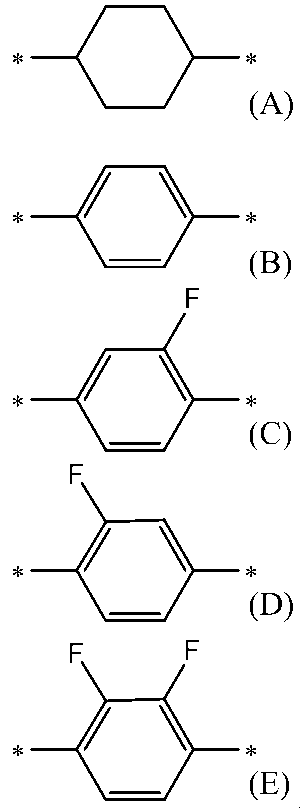

で表される化合物と、
第二成分として下記一般式(2):

A1~A4はそれぞれ独立して、以下の式(A)~(E):


Zは、13000以下が好ましく、12000以下がより好ましく、11000以下が特に好ましい。


A1~A4はそれぞれ独立して、以下の式(A)~(E):


で表されるが、本願発明の液晶組成物が重合性モノマーを含有する場合は、式(ii)および式(iv)で表される構造が好ましく、式(ii)で表される構造がより好ましい。まさらに、前記式(i)~(iv)の結合する環が式(A)の場合は、アルケニル基としては式(i)または式(ii)が特に好ましく、前記式(i)~(iv)の結合する環が式(B)~式(E)の場合は、アルケニル基としては式(iii)または式(iv)が特に好ましい。なお、本明細書中において、アルケニル基の例は共通であり、各々のアルケニル基の炭素原子数の数によって適宜上記例示から選択される。


OLは0、1、2又は3を表し、
BL1、BL2およびBL3はそれぞれ独立して、以下の(a)および(b)からなる群から選択される基であり、
(a)1,4-シクロヘキシレン基(この基中に存在する1個の-CH2-又は隣接していない2個以上の-CH2-は-O-に置き換えられてもよい。)
(b)1,4-フェニレン基(この基中に存在する1個の-CH=又は隣接していない2個以上の-CH=は-N=に置き換えられてもよい。)
前記(a)および前記(b)に表される基に含まれる水素原子は、それぞれ独立してシアノ基、塩素原子又はフッ素原子で置換されても良く、
LL1およびLL2はそれぞれ独立して、単結合、-CH2CH2-、-(CH2)4-、-OCH2-、-CH2O-、-COO-、-OCO-、-OCF2-、-CF2O-、-CH=N-N=CH-、-CH=CH-、-CF=CF-又は-C≡C-を表し、
OLが2又は3であってLL2が複数存在する場合は、それらは同一であっても異なっていても良く、OLが2又は3であってBL3が複数存在する場合は、それらは同一であっても異なっていても良いが、一般式(1)で表される化合物および一般式(2)で表される化合物および一般式(3)で表される化合物を除く。)
で表される化合物の群から少なくとも一つをさらに含むことが好ましい。したがって、当該第三成分は任意成分である。

上記一般式(III-g)中、R31およびR32はそれぞれ独立して、炭素原子数1~5のアルキル基、炭素原子数2~5のアルケニル基又は炭素原子数1~4のアルコキシ基を表し、A31およびA32はそれぞれ独立して1,4-シクロヘキシレン基又は1,4-フェニレン基を表し、Q3は単結合又はCOO-を表し、X31およびX32はそれぞれ独立してフッ素原子又は水素原子を表し、m30は0又は1の整数である。)
上記一般式(III-a)~一般式(III-f)中において、R300からR311はそれぞれ独立しては炭素原子数1~10のアルキル基、炭素原子数2~10のアルケニル基又は炭素原子数1~10のアルコキシ基を表すことが好ましく、炭素原子数1~5のアルキル基、炭素原子数2~5のアルケニル基又は炭素原子数2~5のアルコキシ基を表すことがより好ましくい。また、上記一般式(III-f)中における二価の連結基(L)は、単結合、-CF2O-又はCOO-を表すことが好ましい。

前記一般式(III-a-1)で表される化合物は、より具体的には次に記載する化合物が好ましい。
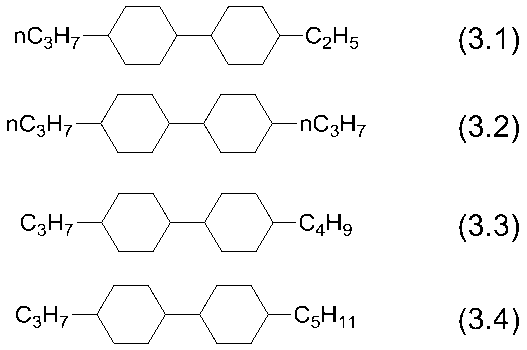

前記一般式(III-a-2)で表される化合物は、より具体的には次に記載する化合物が好ましい。


前記一般式(III-a-3)で表される化合物は、より具体的には次に記載する化合物が好ましい。


さらに、前記一般式(III-a-4)で表される化合物は、式(3.20)から式(3.29)で表される化合物群から選ばれる化合物であることが好ましく、式(3.21)、式(3.23)および式(3.26)で表される化合物であることが好ましい。


前記一般式(III-b-1)で表される化合物は、より具体的には次に記載する化合物が好ましい。


さらに、一般式(III-b-2)で表される化合物は、式(3.44)で表される化合物であることが好ましい。


前記一般式(III-c-1)で表される化合物は、より具体的には次に記載する化合物が好ましい。
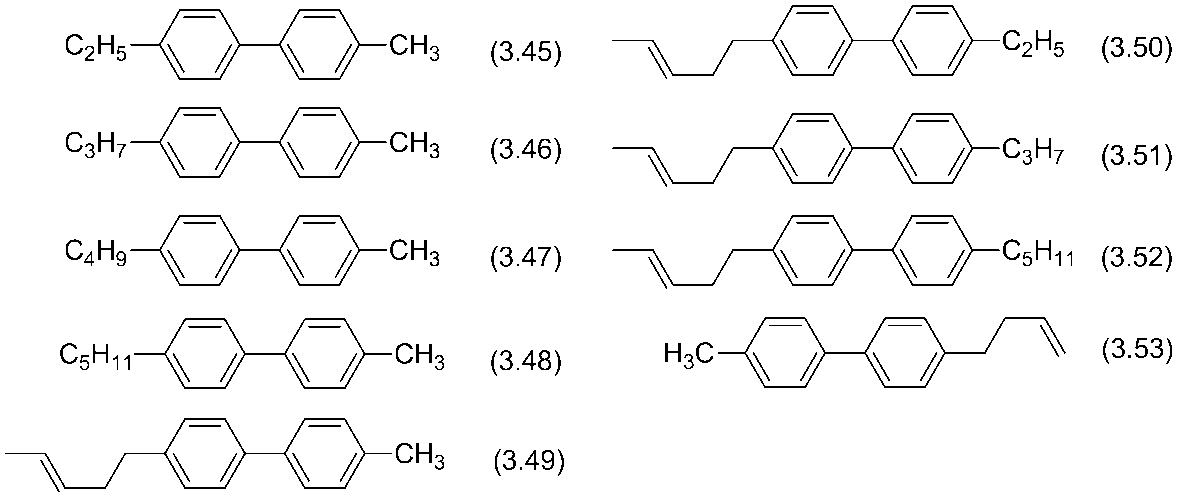

さらに、一般式(III-c-2)で表される化合物は、式(3.54)で表される化合物であることが好ましい。


前記一般式(III-d-1)で表される化合物は、より具体的には次に記載する化合物が好ましい。


さらに、一般式(III-d-1)で表される化合物は、例えば式(3.57)~式(3.60)で表される化合物であることも好ましく、その中でも式(3.60)で表される化合物であることがより好ましい。
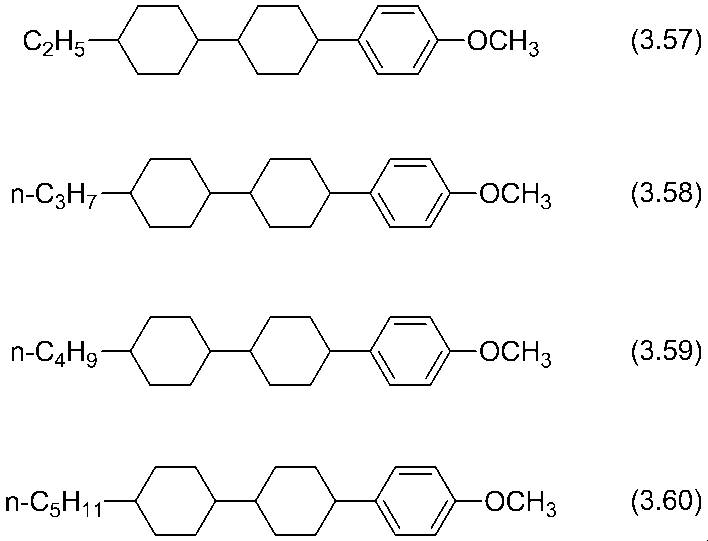

さらに、一般式(III-d-3)で表される化合物は、例えば式(3.61)~式(3.63)で表される化合物であることが好ましい。


前記一般式(III-e-1)で表される化合物は、より具体的には次に記載する化合物が好ましい。


前記一般式(III-e-2)で表される化合物は、例えば式(3.67)又は式(3.68)で表される化合物であることが好ましい。
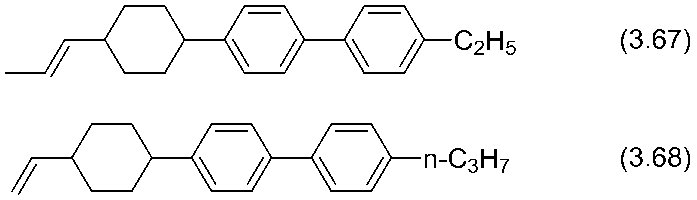

さらに、一般式(III-e-3)で表される化合物は、たとえば式(3.69)~式(3.71)で表される化合物群から選ばれる化合物であることが好ましく、特に式(3.71)で表される化合物であることが好ましい。
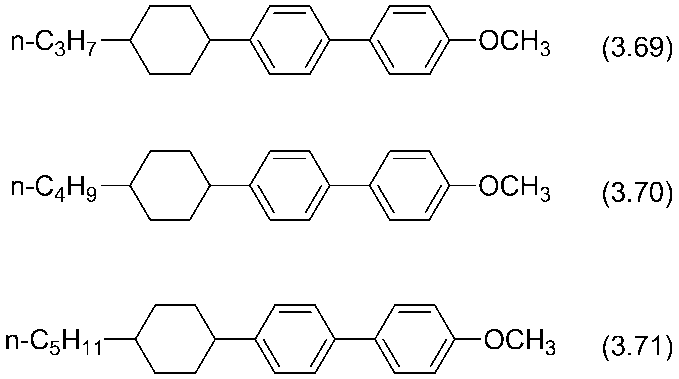

さらに、前記一般式(III-f-1)で表される化合物は、例えば式(5.72)で表される化合物であることが好ましい。


さらに、前記一般式(III-f-2)で表される化合物は、例えば式(3.73)~式(3.77)で表される化合物であることが好ましく、特に、式(3.74)又は/および式(3.77)で表される化合物であることが好ましい。


さらに、前記一般式(III-g-8)で表される化合物は、式(3.96)~式(3.98)で表される化合物であることが好ましい。


また、当該一般式(III-g-9)において、X31およびX32、X33およびX34ならびにX35およびX36の組み合わせのうち、片方の置換基1つがフッ素原子であることが好ましい。
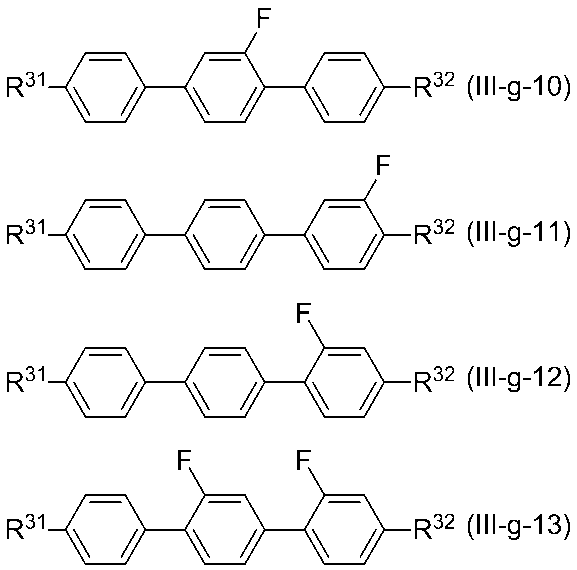
さらに、前記一般式(III-g)で表される化合物は、一般式(III-g-10)で表される化合物であることが好ましい。当該一般式(III-g-10)で表される化合物の好適な例としては、以下の式(3.100)~(3.116)の化合物が好ましい。
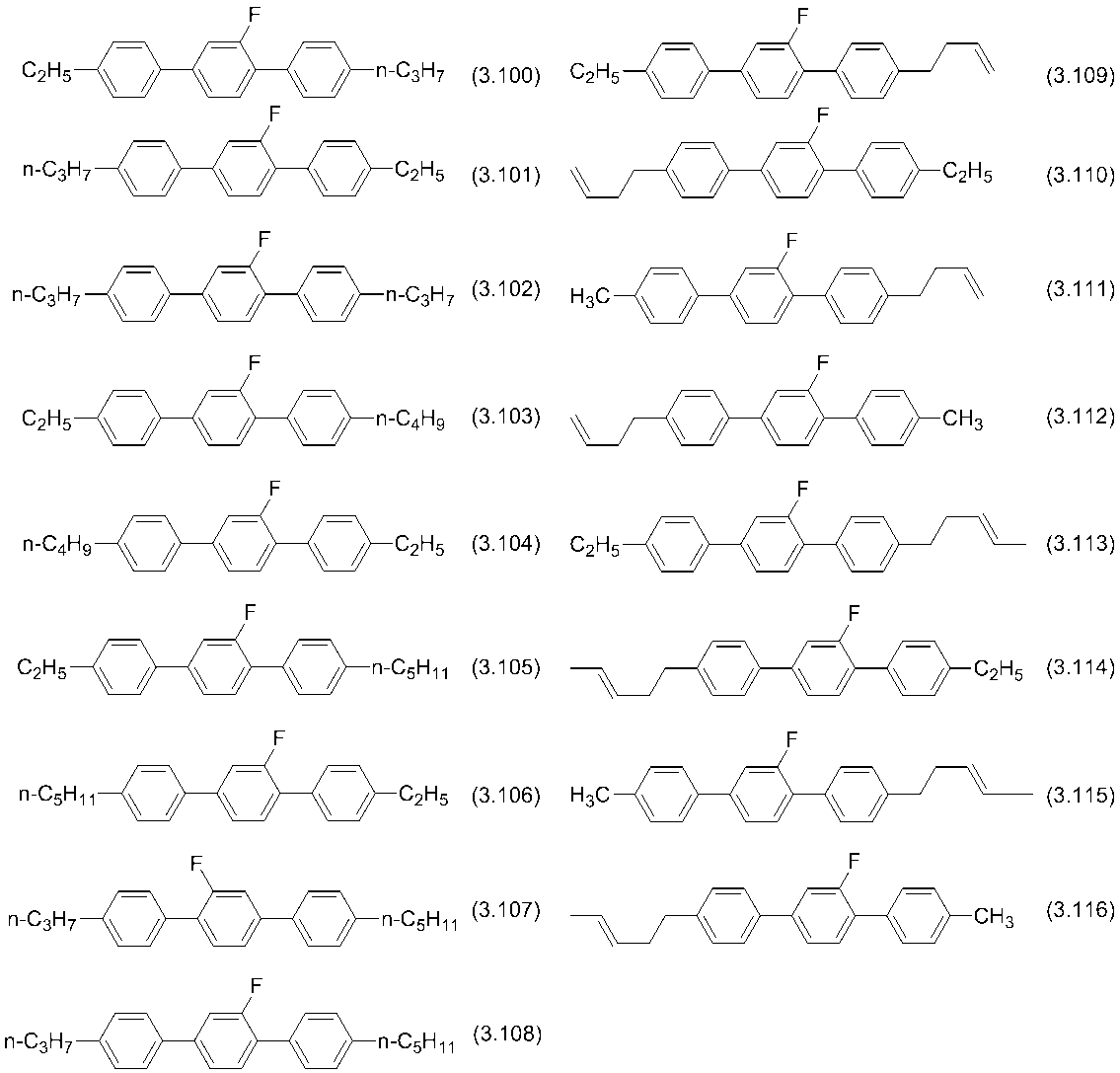
本発明係る液晶組成物は、第四成分として下記一般式(4):

uおよびvはそれぞれ独立して、0、1又は2を表すが、u+vは2以下であり、
MX1、MX2およびMX3はそれぞれ独立して、以下の(a)および(b)からなる群から選択され、
(a)トランス-1,4-シクロへキシレン基(この基中に存在する1個のメチレン基又は隣接していない2個以上のメチレン基は-O-又は-S-に置き換えられてもよい)、
(b)1,4-フェニレン基(この基中に存在する1個の-CH=又は隣接していない2個以上の-CH=は-N=に置き換えられてもよい。)
前記(a)又は前記(b)に示す基に含まれる水素原子は、それぞれシアノ基、フッ素原子、トリフルオロメチル基およびトリフルオロメトキシ基からなる群から選択される基により置換されていても良いが、MX2および/又はMX3が複数存在する場合は、それらは同一でも良く異なっていても良く、
LX1、LX2およびLX3はそれぞれ独立して単結合、-COO-、-OCO-、-CH2CH2-、-(CH2)4-、-OCH2-、-CH2O-、-OCF2-、-CF2O-,-CH=CH-又は-C≡C-を表し、LX1および/又はLX3が複数存在する場合は、それらは同一でも良く異なっていても良く、
XX1およびXX2はそれぞれ独立してトリフルオロメチル基、トリフルオロメトキシ基又はフッ素原子を表すが、Xx1およびXx2の何れか一つはフッ素原子を表す。ただし、前記一般式(1)~一般式(3)で表される化合物を除く。)で表される化合物の群から少なくとも一つをさらに含むことが好ましい。したがって、当該第四成分は任意成分である。


A1は1,4-シクロヘキシレン基、1,4-フェニレン基又はテトラヒドロピラン-2,5-ジイル基を表すが、A1が1,4-フェニレン基を表す場合、該1,4-フェニレン基中の1つ以上の水素原子はフッ素原子に置換されていてもよい。)
上記一般式(IV-a)において、R4aは、炭素原子数1~8のアルキル基、炭素原子数2~8のアルケニル基、炭素原子数1~8のアルコキシ基又は炭素原子数2~8のアルケニルオキシ基を表すことが好ましく、炭素原子数1~8のアルキル基、炭素原子数2~8のアルケニル基を表すことがより好ましく、炭素原子数1~8のアルキル基を表すことが更に好ましく、炭素原子数3~5のアルキル基を表すことがより更に好ましい。
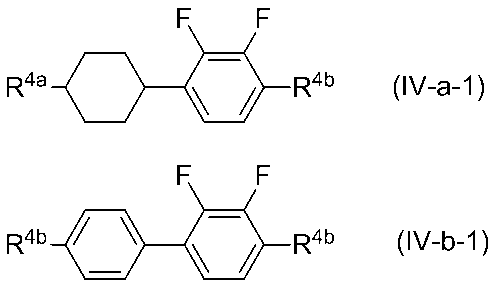
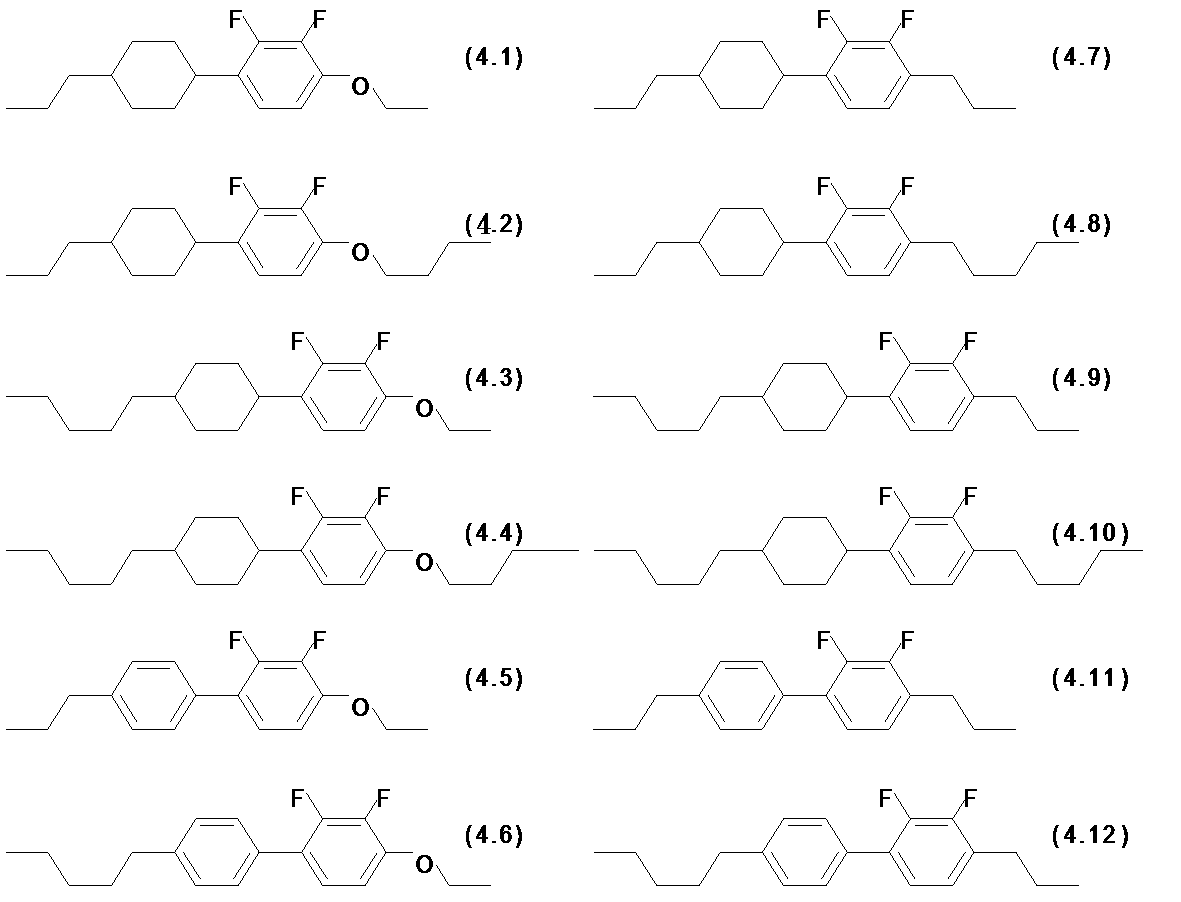
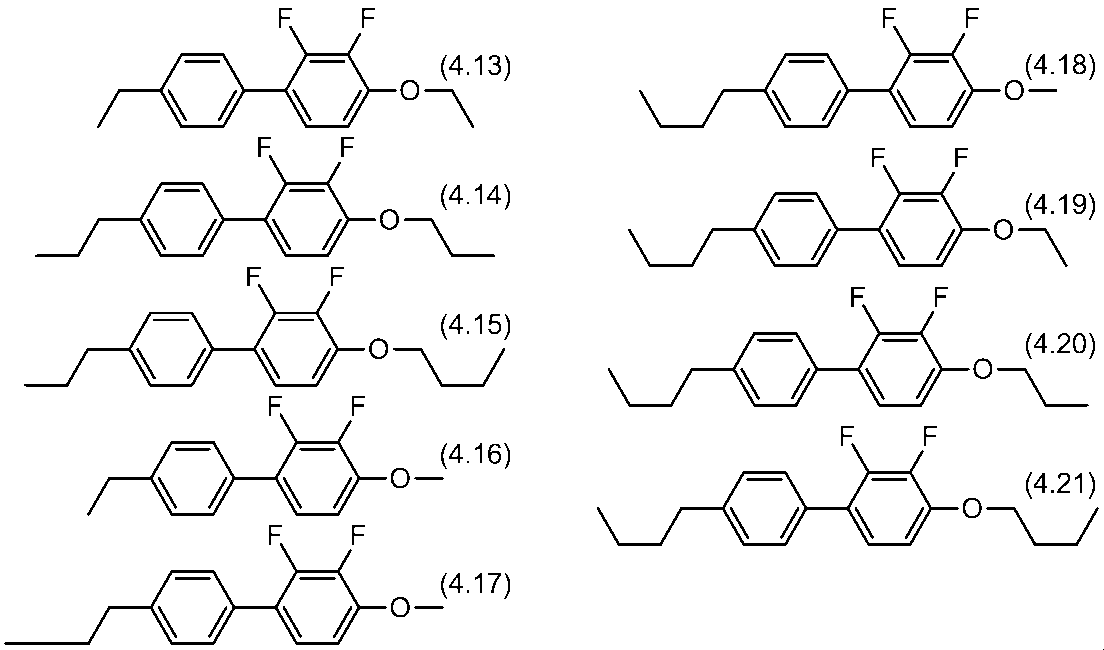

(上記式中、R4bはそれぞれ独立して、炭素原子数1~5のアルキル基、炭素原子数4~5のアルケニル基、炭素原子数1~4のアルコキシ基を表す。)
で表される群から選ばれる化合物であること好ましい。


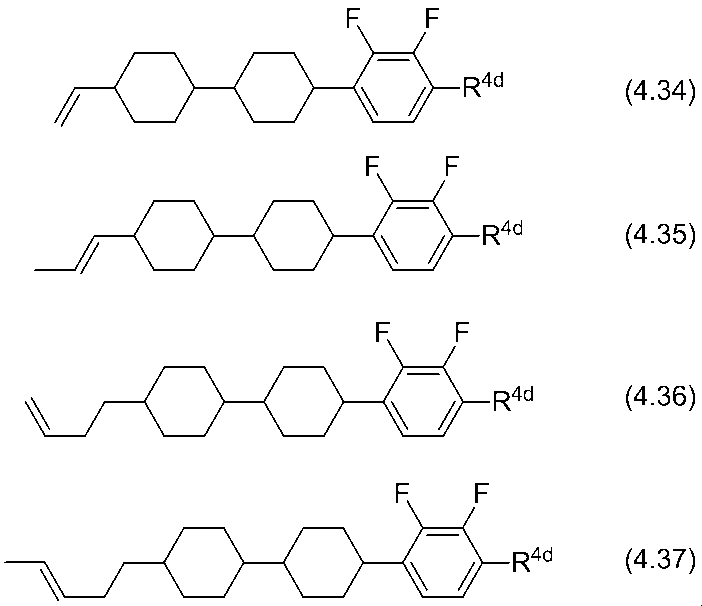


A2は1,4-シクロヘキシレン基、1,4-フェニレン基又はテトラヒドロピラン-2,5-ジイル基を表すが、Aが1,4-フェニレン基を表す場合、該1,4-フェニレン基中の1つ以上の水素原子はフッ素に置換されていてもよく、
Z1は単結合、-OCH2-、-OCF2-、-CH2O-、又はCF2O-を表し、
nは0又は1であり、
X41~X46はそれぞれ独立して水素原子、又はフッ素原子を表すが、X41~X46の少なくとも2つはフッ素原子を表し、前記一般式(II)と重複しない。)で表される群から選ばれる化合物であることが好ましい。また、本願における1,4-シクロヘキシル基はトランス-1,4-シクロヘキシル基であることが好ましい。
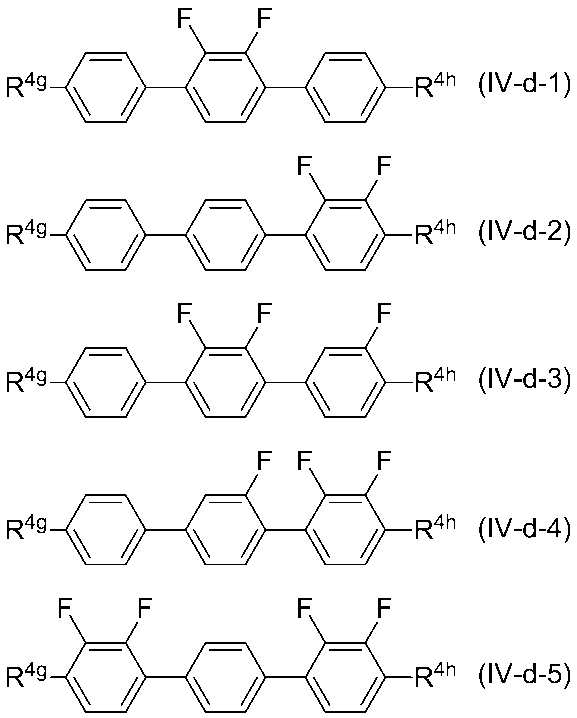

本発明に係る一般式(IV-d)(一般式(IV-d-1)~(IV-d-12)も含む。)におけるR4gおよびR4hはそれぞれ独立して、炭素原子数1~8のアルキル基、炭素原子数2~8のアルケニル基、炭素原子数1~8のアルコキシ基又は炭素原子数2~8のアルケニルオキシ基を表すが、炭素原子数1~8のアルキル基又は炭素原子数2~8のアルケニル基を表すことが好ましく、炭素原子数2~5のアルキル基又は炭素原子数2~5のアルケニル基を表すことがより好ましく、炭素原子数2~5のアルキル基を表すことが更に好ましく、直鎖であることが好ましく、R4gおよびR4hが共にアルキル基である場合には、それぞれの炭素原子数は異なっている方が好ましい。
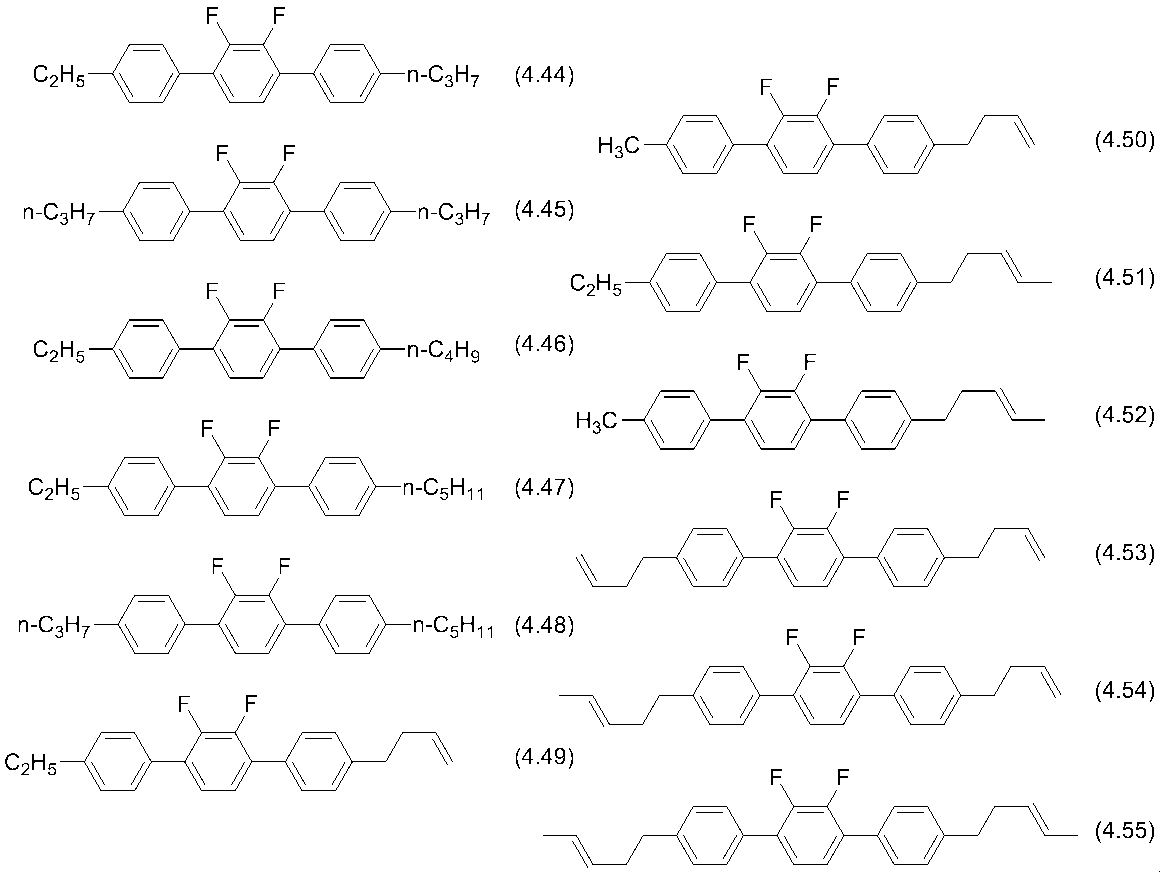


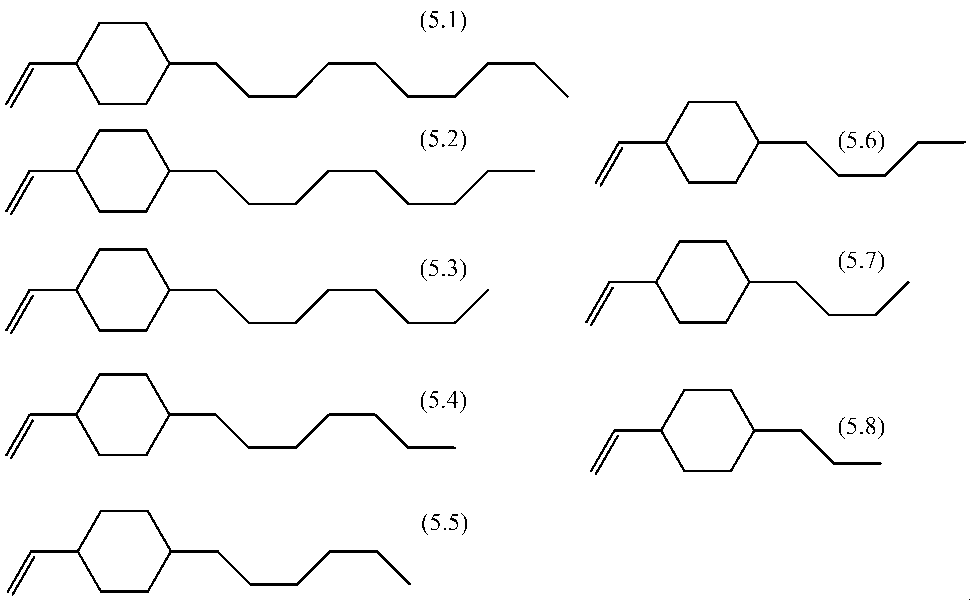


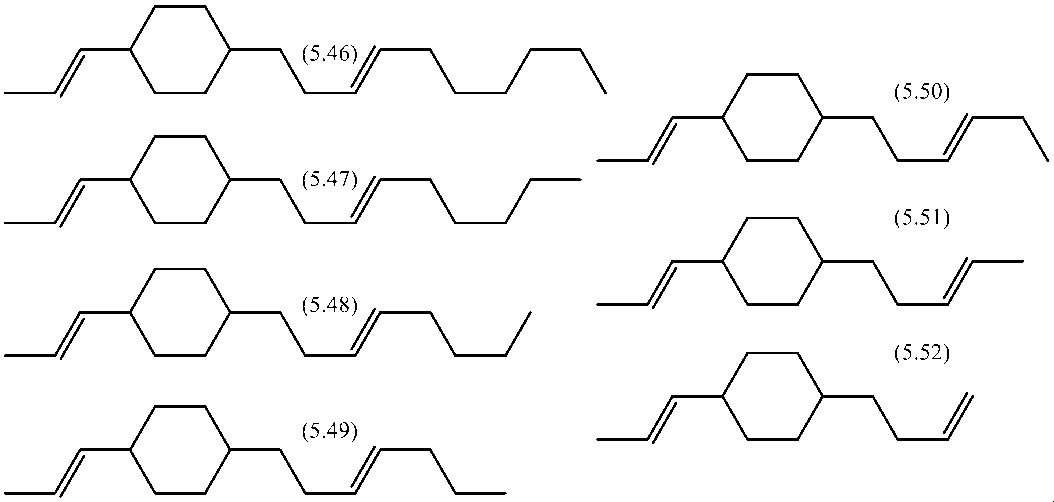
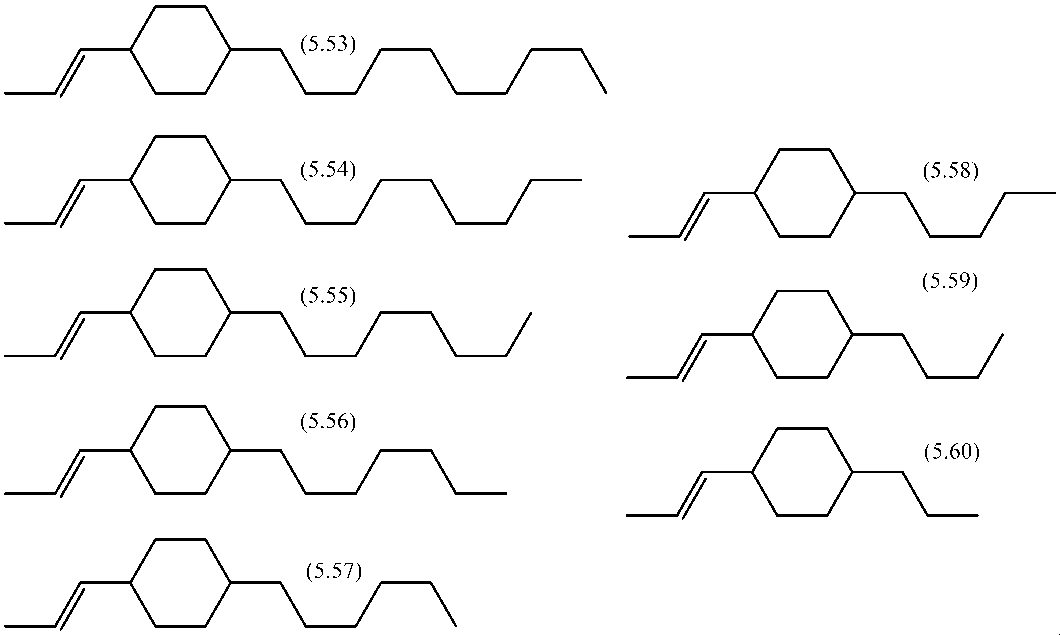



Z2は-OCH2-、-CH2O-、-COO-、-OCO-、-CF2O-、-OCF2-、-CH2CH2-、-CF2CF2-、-CH=CH-COO-、-CH=CH-OCO-、-COO-CH=CH-、-OCO-CH=CH-、-COO-CH2CH2-、-OCO-CH2CH2-、-CH2CH2-COO-、-CH2CH2-OCO-、-COO-CH2-、-OCO-CH2-、-CH2-COO-、-CH2-OCO-、-CY1=CY2-(式中、Y1およびY2はそれぞれ独立して、フッ素原子又は水素原子を表す。)、-C≡C-又は単結合を表し、
Bは1,4-フェニレン基、トランス-1,4-シクロヘキシレン基又は単結合を表し、式中の全ての1,4-フェニレン基は、任意の水素原子がフッ素原子により置換されていても良い。)
で表されるニ官能モノマーが好ましい。


本発明の液晶組成物にモノマーを添加する場合において、重合開始剤が存在しない場合でも重合は進行するが、重合を促進するために重合開始剤を含有していてもよい。重合開始剤としては、ベンゾインエーテル類、ベンゾフェノン類、アセトフェノン類、ベンジルケタール類、アシルフォスフィンオキサイド類等が挙げられる。また、保存安定性を向上させるために、安定剤を添加しても良い。使用できる安定剤としては、例えば、ヒドロキノン類、ヒドロキノンモノアルキルエーテル類、第三ブチルカテコール類、ピロガロール類、チオフェノール類、ニトロ化合物類、β-ナフチルアミン類、β-ナフトール類、ニトロソ化合物等が挙げられる。
の場合に含有量は次に記載する含有量が好ましい。
(Δn):293Kにおける屈折率異方性
(Δε):293Kにおける誘電率異方性
(η):293Kにおける粘度(mPa・s)
(γ1):293Kにおける回転粘度(mPa・s)
(VHR):周波数50Hz,印加電圧4.5Vの条件下で333Kにおける電圧保持率(%)
耐熱試験後VHR:液晶組成物サンプルを封入した電気光学特性評価用TEG(テスト・エレメント・グループ)を120℃の恒温槽中に1.5時間保持した後、上述のVHR測定方法と同条件で測定した。
(側鎖)
-n -CnH2n+1 炭素原子数nの直鎖状アルキル基
-On -OCnH2n+1 炭素原子数nの直鎖状アルコキシ基
-V0 -C=CH2 ビニル基
-Vn -C=CH-CnH2n+1 ビニル基
(環構造)

次に示す組成を有する液晶組成物を調製し、その物性値を測定した。この結果を次の表に示す。

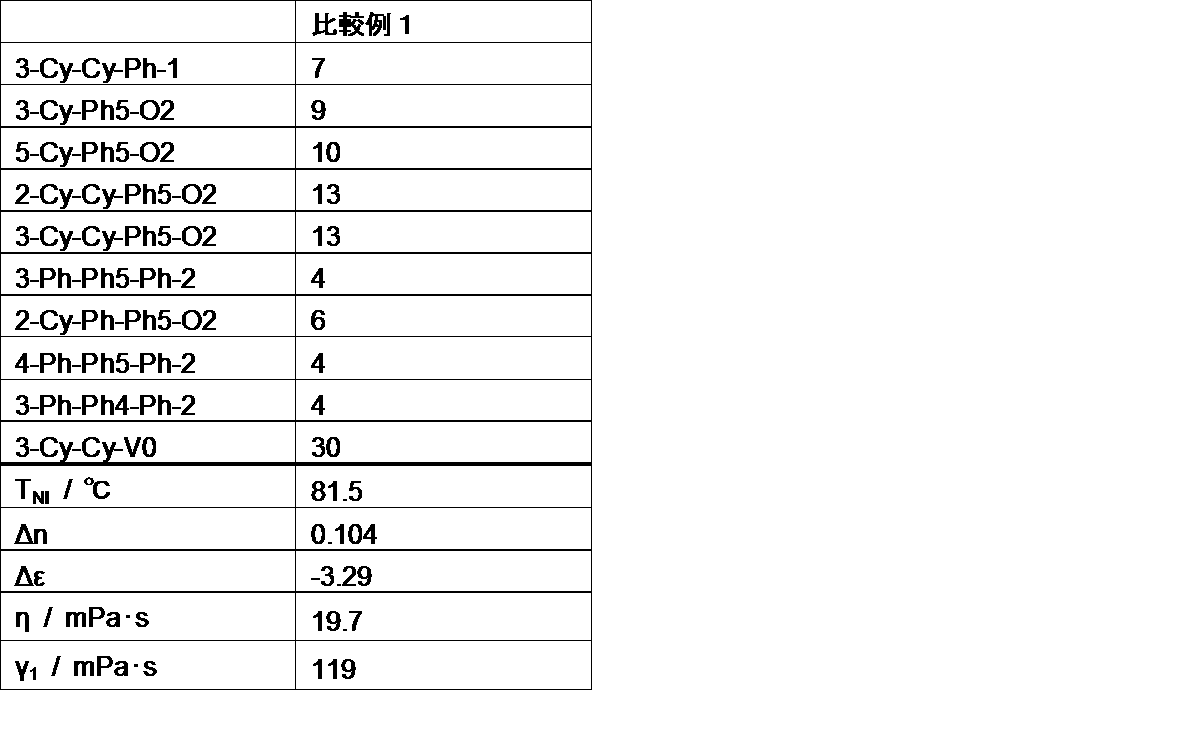
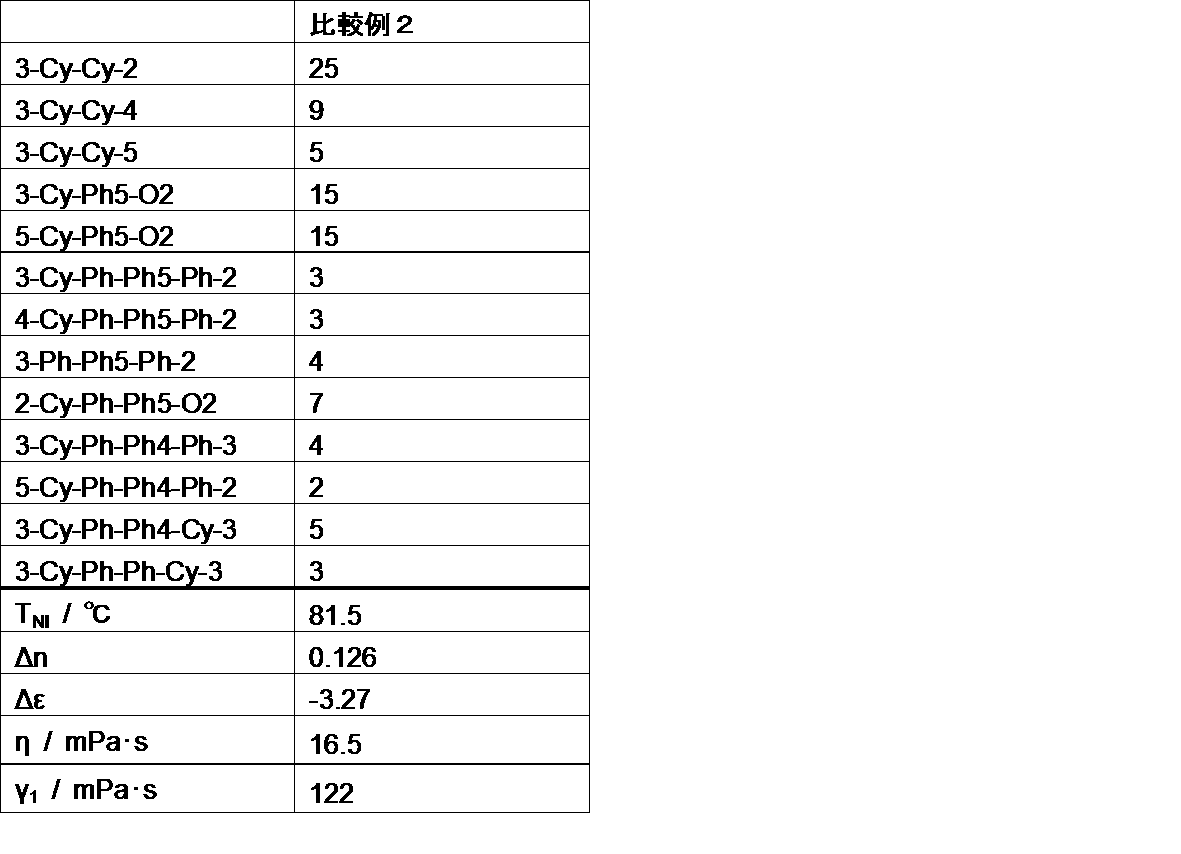
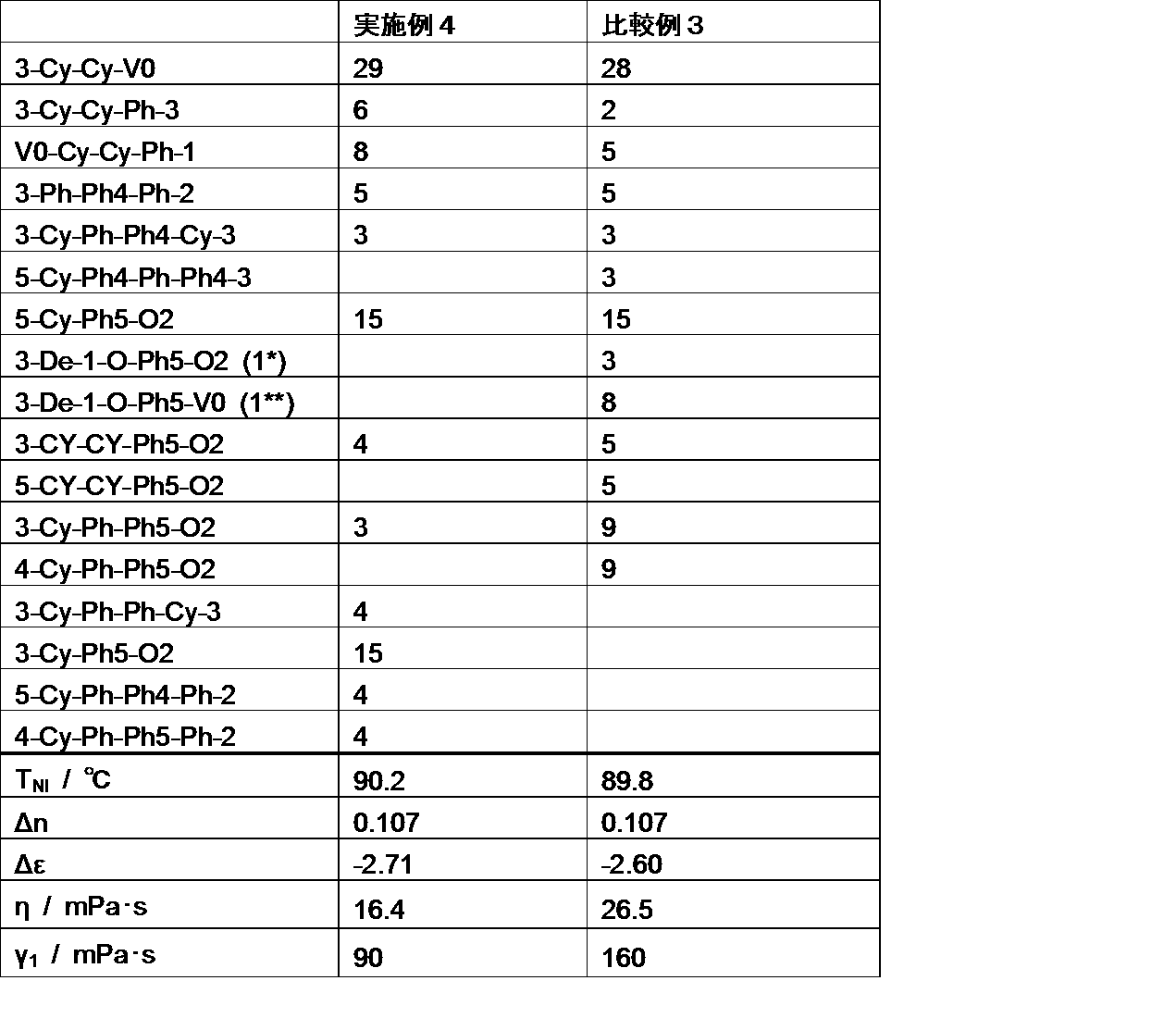
(1*) 3-De-1-O-Ph5-O2:
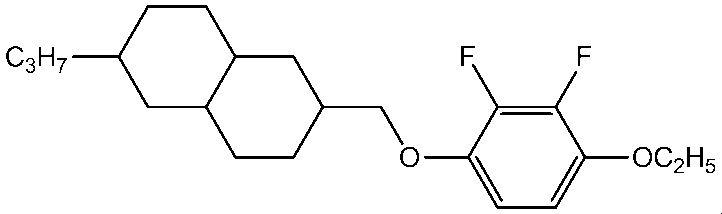
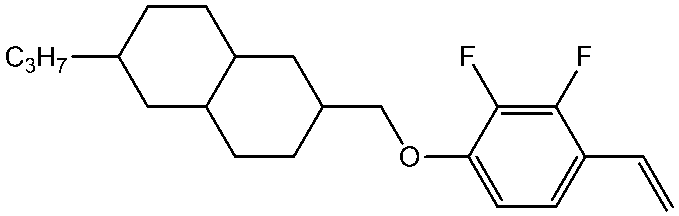

(2*)3-Cy-Ph(FFMe)-O2
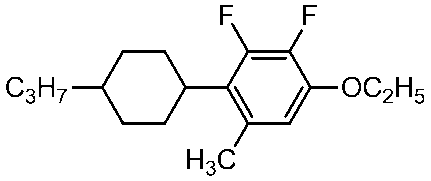

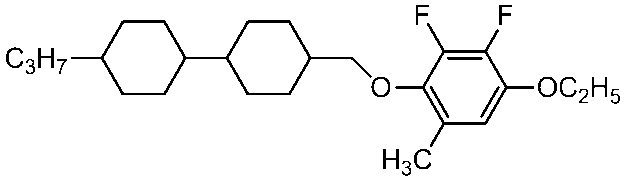
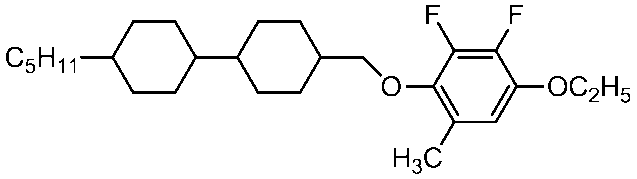
以下の化合物群を混合して比較例の組成物を調製した。
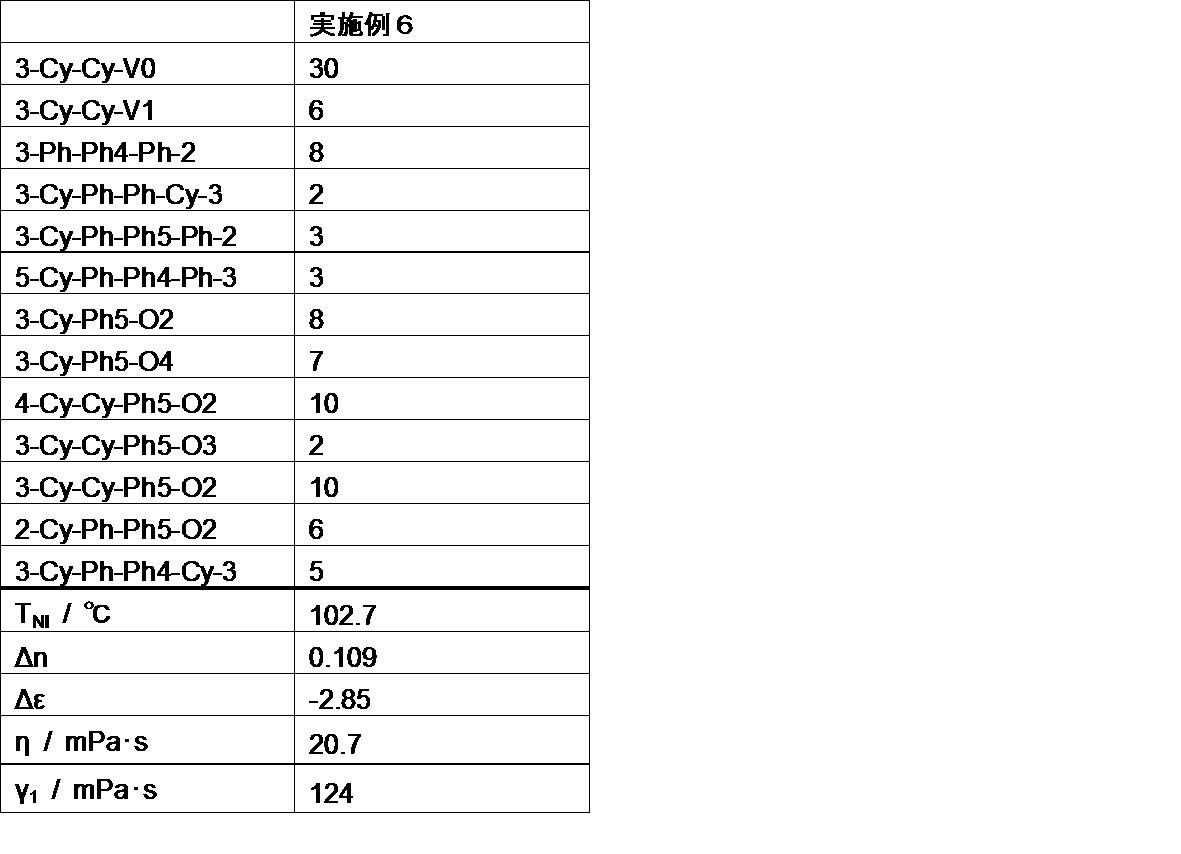
以下の化合物群を混合して比較例の組成物を調製した。
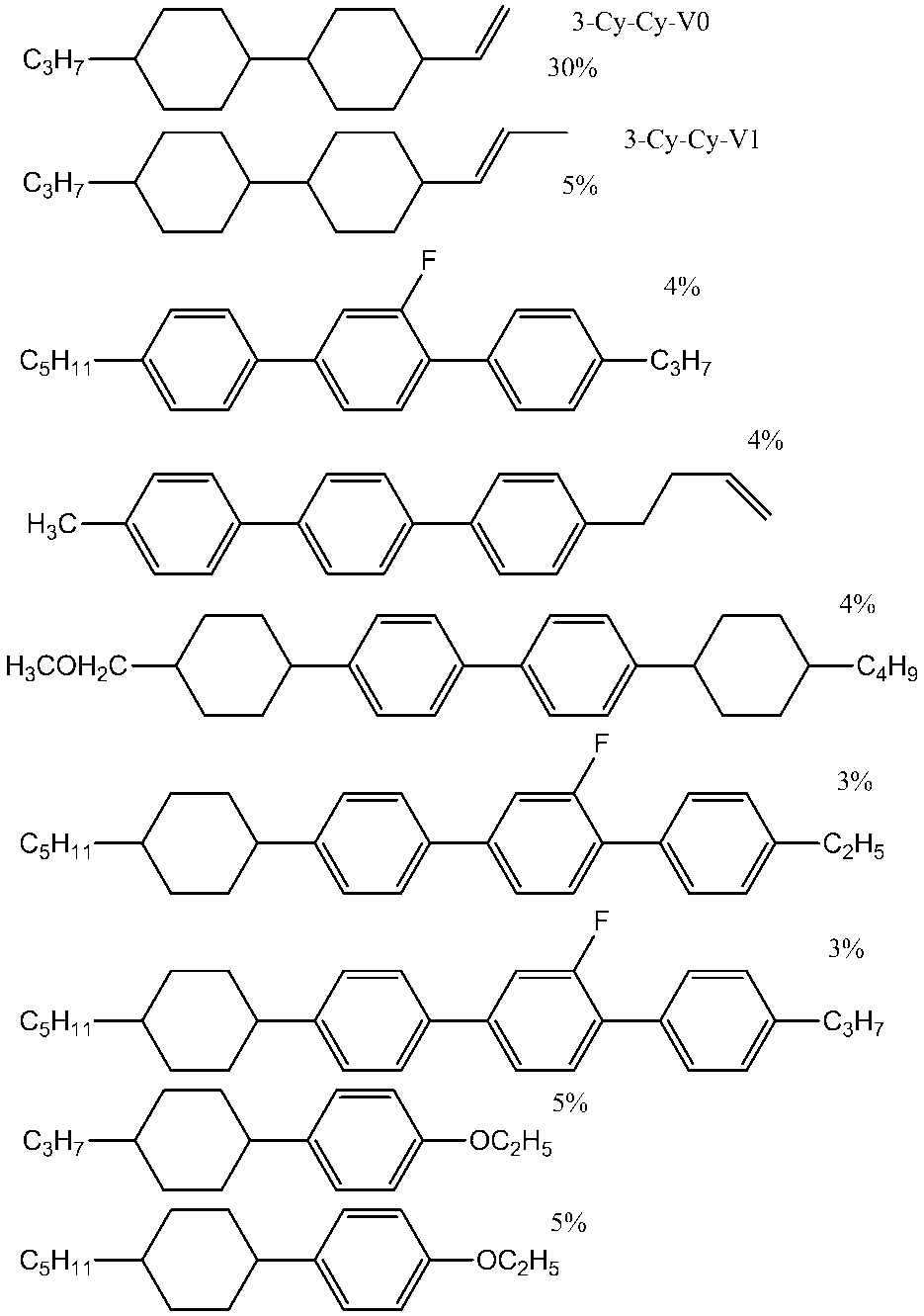

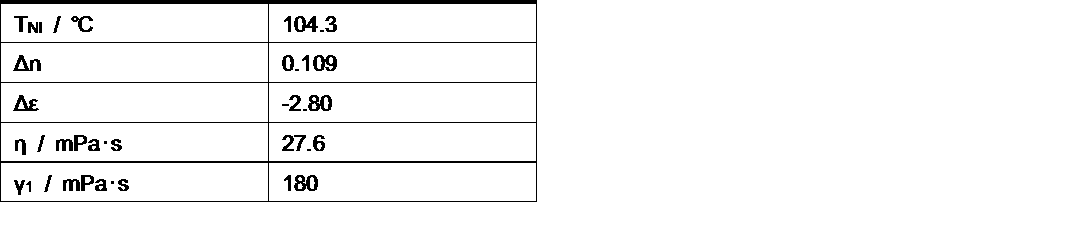
1 第二の偏光板
2 第二の基板
3 薄膜トランジスタ層または薄膜トランジスタを含む電極層
4 配向膜
5 液晶層
6 画素電極(共通電極)
7 カラーフィルタ
8 第一の基板
9 第一の偏光板
10 液晶表示素子
11 ゲート電極
12 陽極酸化被膜
13 ゲート絶縁層
14 透明電極(層)
15 ドレイン電極
16 オーミック接触層
17 半導体層
18 保護膜
19a,19b ソース電極
21 画素電極
22 ストレイジキャパシタ
23 ドレイン電極
24 データ配線
25 ゲート配線
26 ソース電極
27 ゲート電極
101 保護層
Claims (8)
- 第一成分として一般式(1):

で表される化合物と、
第二成分として下記一般式(2):

A1~A4はそれぞれ独立して、以下の式(A)~(E):

- 前記第二成分として前記一般式(2)は、下記の一般式(2a)~(2i):
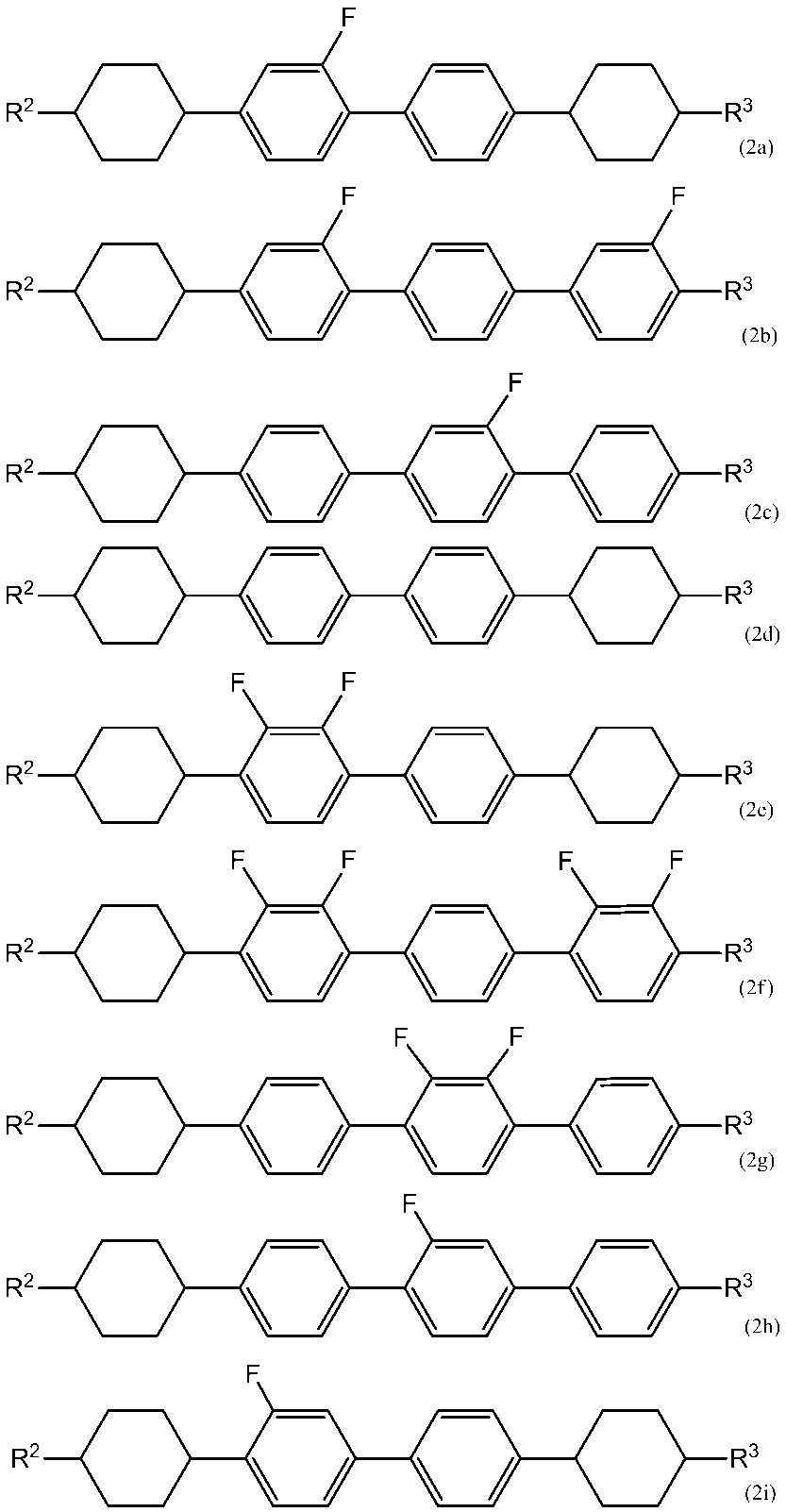
からなる群から選択される少なくとも1種を含む、請求項1に記載の液晶組成物。 - 前記一般式(2)で表される化合物を5~35質量%含有する請求項1または2に記載の液晶組成物。
- 第三成分として下記一般式(3):

OLは0、1、2又は3を表し、
BL1、BL2及びBL3はそれぞれ独立して、以下の(a)および(b)からなる群から選択される基であり、
(a)1,4-シクロヘキシレン基(この基中に存在する1個の-CH2-又は隣接していない2個以上の-CH2-は-O-に置き換えられてもよい。)
(b)1,4-フェニレン基(この基中に存在する1個の-CH=又は隣接していない2個以上の-CH=は-N=に置き換えられてもよい。)
前記(a)および前記(b)に表される基に含まれる水素原子は、それぞれ独立してシアノ基、塩素原子またはフッ素原子で置換されても良く、
LL1及びLL2はそれぞれ独立して、単結合、-CH2CH2-、-(CH2)4-、-OCH2-、-CH2O-、-COO-、-OCO-、-OCF2-、-CF2O-、-CH=N-N=CH-、-CH=CH-、-CF=CF-又は-C≡C-を表し、
OLが2又は3であってLL2が複数存在する場合は、それらは同一であっても異なっていても良く、OLが2又は3であってBL3が複数存在する場合は、それらは同一であっても異なっていても良いが、一般式(1)で表される化合物及び一般式(2)で表される化合物を除く。)
で表される化合物の群から少なくとも一つをさらに含む、請求項1~3のいずれか1項に記載の液晶組成物。 - 第四成分として下記一般式(4):

u及びIIIはお互い独立して、0、1又は2を表すが、u+IIIは2以下であり、
MX1、MX2及びMX3はそれぞれ独立して、以下の(a)および(b)からなる群から選択され、
(a)トランス-1,4-シクロへキシレン基(この基中に存在する1個のメチレン基又は隣接していない2個以上のメチレン基は-O-又は-S-に置き換えられてもよい)、
(b)1,4-フェニレン基(この基中に存在する1個の-CH=又は隣接していない2個以上の-CH=は-N=に置き換えられてもよい。)
前記(a)又は前記(b)に表される基に含まれる水素原子は、それぞれシアノ基、フッ素原子、トリフルオロメチル基およびトリフルオロメトキシ基からなる群から選択される基により置換されていても良いが、MX2及び/又はMX3が複数存在する場合は、それらは同一でも良く異なっていても良く、
LX1、LX2及びLX3はお互い独立して単結合、-COO-、-OCO-、-CH2CH2-、-(CH2)4-、-OCH2-、-CH2O-、-OCF2-、-CF2O-,-CH=CH-又は-C≡C-を表し、LX1及び/又はLX3が複数存在する場合は、それらは同一でも良く異なっていても良く、
XX1及びXX2はお互い独立してトリフルオロメチル基、トリフルオロメトキシ基又はフッ素原子を表すが、X31及びX32の何れか一つはフッ素原子を表す。ただし、一般式(2)および一般式(3)で表される化合物を除く。)
で表される化合物の群から少なくとも一つをさらに含む、請求項1~4のいずれか1項に記載の液晶組成物。 - 反応性モノマーをさらに含有する、請求項1~4のいずれか1項に記載の液晶組成物。
- 請求項1~6のいずれか1項に記載の液晶組成物を用いた液晶表示素子。
- 請求項7に記載の液晶表示素子を用いた液晶ディスプレイ。
Priority Applications (2)
| Application Number | Priority Date | Filing Date | Title |
|---|---|---|---|
| CN201480017669.XA CN105051156A (zh) | 2013-03-26 | 2014-03-25 | 液晶组合物和使用其的液晶显示元件 |
| JP2015508549A JP6226209B2 (ja) | 2013-03-26 | 2014-03-25 | 液晶組成物およびそれを使用した液晶表示素子 |
Applications Claiming Priority (2)
| Application Number | Priority Date | Filing Date | Title |
|---|---|---|---|
| JP2013-064118 | 2013-03-26 | ||
| JP2013064118 | 2013-03-26 |
Publications (1)
| Publication Number | Publication Date |
|---|---|
| WO2014157213A1 true WO2014157213A1 (ja) | 2014-10-02 |
Family
ID=51624182
Family Applications (1)
| Application Number | Title | Priority Date | Filing Date |
|---|---|---|---|
| PCT/JP2014/058306 Ceased WO2014157213A1 (ja) | 2013-03-26 | 2014-03-25 | 液晶組成物およびそれを使用した液晶表示素子 |
Country Status (4)
| Country | Link |
|---|---|
| JP (1) | JP6226209B2 (ja) |
| CN (1) | CN105051156A (ja) |
| TW (1) | TWI629342B (ja) |
| WO (1) | WO2014157213A1 (ja) |
Citations (11)
| Publication number | Priority date | Publication date | Assignee | Title |
|---|---|---|---|---|
| JP2006328395A (ja) * | 2005-05-21 | 2006-12-07 | Merck Patent Gmbh | 液晶媒体 |
| WO2008145297A1 (en) * | 2007-05-25 | 2008-12-04 | Merck Patent Gmbh | Liquid crystalline medium |
| WO2010084823A1 (ja) * | 2009-01-22 | 2010-07-29 | チッソ株式会社 | 液晶組成物および液晶表示素子 |
| JP2011144274A (ja) * | 2010-01-15 | 2011-07-28 | Jnc Corp | 液晶組成物および液晶表示素子 |
| WO2011142302A1 (ja) * | 2010-05-12 | 2011-11-17 | Jnc株式会社 | 液晶組成物および液晶表示素子 |
| WO2011148928A1 (ja) * | 2010-05-28 | 2011-12-01 | Jnc株式会社 | 液晶組成物および液晶表示素子 |
| WO2011152494A1 (ja) * | 2010-06-03 | 2011-12-08 | Jnc株式会社 | 液晶組成物および液晶表示素子 |
| WO2012046590A1 (ja) * | 2010-10-04 | 2012-04-12 | Jnc株式会社 | 液晶組成物および液晶表示素子 |
| WO2012053323A1 (ja) * | 2010-10-20 | 2012-04-26 | Jnc株式会社 | 液晶組成物および液晶表示素子 |
| WO2012066933A1 (ja) * | 2010-11-15 | 2012-05-24 | Jnc株式会社 | 液晶組成物および液晶表示素子 |
| JP2013047327A (ja) * | 2011-07-27 | 2013-03-07 | Jnc Corp | 液晶組成物および液晶表示素子 |
Family Cites Families (4)
| Publication number | Priority date | Publication date | Assignee | Title |
|---|---|---|---|---|
| CN102112580A (zh) * | 2008-08-07 | 2011-06-29 | 智索株式会社 | 液晶组成物以及液晶显示元件 |
| CN102834487B (zh) * | 2010-04-22 | 2015-04-22 | 捷恩智株式会社 | 液晶组成物及液晶显示元件 |
| DE102012003796A1 (de) * | 2011-03-18 | 2012-09-20 | Merck Patent Gmbh | Flüssigkristallines Medium |
| DE102011075483A1 (de) * | 2011-05-09 | 2012-11-15 | Robert Bosch Gmbh | Verbundfolie für Verpackungsbehälter sowie Schlauchbeutelpackung |
-
2014
- 2014-03-24 TW TW103110860A patent/TWI629342B/zh active
- 2014-03-25 JP JP2015508549A patent/JP6226209B2/ja active Active
- 2014-03-25 CN CN201480017669.XA patent/CN105051156A/zh active Pending
- 2014-03-25 WO PCT/JP2014/058306 patent/WO2014157213A1/ja not_active Ceased
Patent Citations (11)
| Publication number | Priority date | Publication date | Assignee | Title |
|---|---|---|---|---|
| JP2006328395A (ja) * | 2005-05-21 | 2006-12-07 | Merck Patent Gmbh | 液晶媒体 |
| WO2008145297A1 (en) * | 2007-05-25 | 2008-12-04 | Merck Patent Gmbh | Liquid crystalline medium |
| WO2010084823A1 (ja) * | 2009-01-22 | 2010-07-29 | チッソ株式会社 | 液晶組成物および液晶表示素子 |
| JP2011144274A (ja) * | 2010-01-15 | 2011-07-28 | Jnc Corp | 液晶組成物および液晶表示素子 |
| WO2011142302A1 (ja) * | 2010-05-12 | 2011-11-17 | Jnc株式会社 | 液晶組成物および液晶表示素子 |
| WO2011148928A1 (ja) * | 2010-05-28 | 2011-12-01 | Jnc株式会社 | 液晶組成物および液晶表示素子 |
| WO2011152494A1 (ja) * | 2010-06-03 | 2011-12-08 | Jnc株式会社 | 液晶組成物および液晶表示素子 |
| WO2012046590A1 (ja) * | 2010-10-04 | 2012-04-12 | Jnc株式会社 | 液晶組成物および液晶表示素子 |
| WO2012053323A1 (ja) * | 2010-10-20 | 2012-04-26 | Jnc株式会社 | 液晶組成物および液晶表示素子 |
| WO2012066933A1 (ja) * | 2010-11-15 | 2012-05-24 | Jnc株式会社 | 液晶組成物および液晶表示素子 |
| JP2013047327A (ja) * | 2011-07-27 | 2013-03-07 | Jnc Corp | 液晶組成物および液晶表示素子 |
Also Published As
| Publication number | Publication date |
|---|---|
| JP6226209B2 (ja) | 2017-11-08 |
| JPWO2014157213A1 (ja) | 2017-02-16 |
| CN105051156A (zh) | 2015-11-11 |
| TW201504401A (zh) | 2015-02-01 |
| TWI629342B (zh) | 2018-07-11 |
Similar Documents
| Publication | Publication Date | Title |
|---|---|---|
| JP6202309B2 (ja) | 液晶組成物およびそれを使用した液晶表示素子 | |
| JP5327414B1 (ja) | 液晶組成物及びそれを使用した液晶表示素子 | |
| JP5510617B1 (ja) | 液晶組成物およびそれを使用した液晶表示素子 | |
| JP5459451B1 (ja) | 液晶組成物及びそれを使用した液晶表示素子 | |
| JP5630587B1 (ja) | 液晶組成物及びそれを使用した液晶表示素子 | |
| JP5574055B1 (ja) | 液晶組成物及びそれを使用した液晶表示素子 | |
| JP5679096B1 (ja) | 液晶組成物及びそれを使用した液晶表示素子 | |
| JPWO2014123057A1 (ja) | 液晶組成物及びそれを使用した液晶表示素子 | |
| JP5459450B1 (ja) | 液晶組成物及びそれを使用した液晶表示素子 | |
| JP5598742B1 (ja) | 液晶組成物及びそれを使用した液晶表示素子 | |
| JP5582263B1 (ja) | 液晶組成物及びそれを使用した液晶表示素子 | |
| JP6226209B2 (ja) | 液晶組成物およびそれを使用した液晶表示素子 | |
| JP2014208852A (ja) | 液晶組成物及びそれを使用した液晶表示素子 | |
| WO2016013690A1 (ja) | 液晶組成物及びそれを使用した液晶表示素子 | |
| JP6361105B2 (ja) | 液晶組成物及びそれを使用した液晶表示素子 | |
| JP6255622B2 (ja) | 液晶組成物及びそれを使用した液晶表示素子 | |
| JP6128394B2 (ja) | 液晶組成物及びそれを使用した液晶表示素子 | |
| JP2015199961A (ja) | 液晶組成物及びそれを使用した液晶表示素子 | |
| JP2015180731A (ja) | 液晶組成物及びそれを使用した液晶表示素子 | |
| JP2015180732A (ja) | 液晶組成物及びそれを使用した液晶表示素子 | |
| JP2015180730A (ja) | 液晶組成物及びそれを使用した液晶表示素子 | |
| JPWO2014125616A1 (ja) | 液晶組成物及びそれを使用した液晶表示素子 | |
| JP2015025129A (ja) | 液晶組成物及びそれを使用した液晶表示素子 |
Legal Events
| Date | Code | Title | Description |
|---|---|---|---|
| WWE | Wipo information: entry into national phase |
Ref document number: 201480017669.X Country of ref document: CN |
|
| 121 | Ep: the epo has been informed by wipo that ep was designated in this application |
Ref document number: 14775619 Country of ref document: EP Kind code of ref document: A1 |
|
| ENP | Entry into the national phase |
Ref document number: 2015508549 Country of ref document: JP Kind code of ref document: A |
|
| NENP | Non-entry into the national phase |
Ref country code: DE |
|
| 122 | Ep: pct application non-entry in european phase |
Ref document number: 14775619 Country of ref document: EP Kind code of ref document: A1 |