WO2014157131A1 - 硬化性樹脂組成物、硬化物および光学物品 - Google Patents
硬化性樹脂組成物、硬化物および光学物品 Download PDFInfo
- Publication number
- WO2014157131A1 WO2014157131A1 PCT/JP2014/058173 JP2014058173W WO2014157131A1 WO 2014157131 A1 WO2014157131 A1 WO 2014157131A1 JP 2014058173 W JP2014058173 W JP 2014058173W WO 2014157131 A1 WO2014157131 A1 WO 2014157131A1
- Authority
- WO
- WIPO (PCT)
- Prior art keywords
- meth
- component
- acrylate
- resin composition
- curable resin
- Prior art date
- Legal status (The legal status is an assumption and is not a legal conclusion. Google has not performed a legal analysis and makes no representation as to the accuracy of the status listed.)
- Ceased
Links
- 0 *C(C(*)=O)=NN Chemical compound *C(C(*)=O)=NN 0.000 description 2
Classifications
-
- C—CHEMISTRY; METALLURGY
- C08—ORGANIC MACROMOLECULAR COMPOUNDS; THEIR PREPARATION OR CHEMICAL WORKING-UP; COMPOSITIONS BASED THEREON
- C08F—MACROMOLECULAR COMPOUNDS OBTAINED BY REACTIONS ONLY INVOLVING CARBON-TO-CARBON UNSATURATED BONDS
- C08F290/00—Macromolecular compounds obtained by polymerising monomers on to polymers modified by introduction of aliphatic unsaturated end or side groups
- C08F290/08—Macromolecular compounds obtained by polymerising monomers on to polymers modified by introduction of aliphatic unsaturated end or side groups on to polymers modified by introduction of unsaturated side groups
- C08F290/12—Polymers provided for in subclasses C08C or C08F
- C08F290/126—Polymers of unsaturated carboxylic acids or derivatives thereof
-
- C—CHEMISTRY; METALLURGY
- C08—ORGANIC MACROMOLECULAR COMPOUNDS; THEIR PREPARATION OR CHEMICAL WORKING-UP; COMPOSITIONS BASED THEREON
- C08F—MACROMOLECULAR COMPOUNDS OBTAINED BY REACTIONS ONLY INVOLVING CARBON-TO-CARBON UNSATURATED BONDS
- C08F220/00—Copolymers of compounds having one or more unsaturated aliphatic radicals, each having only one carbon-to-carbon double bond, and only one being terminated by only one carboxyl radical or a salt, anhydride ester, amide, imide or nitrile thereof
- C08F220/02—Monocarboxylic acids having less than ten carbon atoms; Derivatives thereof
- C08F220/10—Esters
- C08F220/12—Esters of monohydric alcohols or phenols
- C08F220/16—Esters of monohydric alcohols or phenols of phenols or of alcohols containing two or more carbon atoms
- C08F220/18—Esters of monohydric alcohols or phenols of phenols or of alcohols containing two or more carbon atoms with acrylic or methacrylic acids
- C08F220/1811—C10or C11-(Meth)acrylate, e.g. isodecyl (meth)acrylate, isobornyl (meth)acrylate or 2-naphthyl (meth)acrylate
-
- C—CHEMISTRY; METALLURGY
- C08—ORGANIC MACROMOLECULAR COMPOUNDS; THEIR PREPARATION OR CHEMICAL WORKING-UP; COMPOSITIONS BASED THEREON
- C08F—MACROMOLECULAR COMPOUNDS OBTAINED BY REACTIONS ONLY INVOLVING CARBON-TO-CARBON UNSATURATED BONDS
- C08F222/00—Copolymers of compounds having one or more unsaturated aliphatic radicals, each having only one carbon-to-carbon double bond, and at least one being terminated by a carboxyl radical and containing at least one other carboxyl radical in the molecule; Salts, anhydrides, esters, amides, imides, or nitriles thereof
- C08F222/10—Esters
- C08F222/1006—Esters of polyhydric alcohols or polyhydric phenols
- C08F222/102—Esters of polyhydric alcohols or polyhydric phenols of dialcohols, e.g. ethylene glycol di(meth)acrylate or 1,4-butanediol dimethacrylate
-
- G—PHYSICS
- G02—OPTICS
- G02B—OPTICAL ELEMENTS, SYSTEMS OR APPARATUS
- G02B1/00—Optical elements characterised by the material of which they are made; Optical coatings for optical elements
- G02B1/04—Optical elements characterised by the material of which they are made; Optical coatings for optical elements made of organic materials, e.g. plastics
- G02B1/041—Lenses
Definitions
- the present invention relates to a curable resin composition, a cured product, and an optical article having excellent optical characteristics, heat resistance, and processability.
- thermoplastic resins such as polycarbonate resin, methacrylic resin, and alicyclic olefin polymer have been used.
- these thermoplastic resins have low heat resistance temperature and surface hardness, and have hardly been used in the advanced technical fields of optical and electronic materials that require high heat resistance, surface hardness and fine workability.
- Patent Document 1 is obtained by copolymerizing a monovinyl aromatic compound and a divinyl aromatic compound, and a reactive vinyl group derived from a divinyl aromatic compound is added to the side chain.
- a soluble polyfunctional copolymer having a structural unit is disclosed.
- the soluble polyfunctional copolymer obtained by the technology disclosed therein has excellent heat resistance against heat history at high temperature, it has high workability required for the advanced field. It was difficult to achieve both refractive indexes.
- bisphenol fluorene derivatives have a high refractive index and high heat resistance because they have a large number of aromatic rings, and also have features of low birefringence and low cure shrinkage because they form surfaces with different ring structures. have.
- these features are very excellent for use as an optical molding material, they are not sufficient in terms of the accuracy and strength of the optical surface shape in optical lens applications. Therefore, it has excellent optical properties, has a good balance of properties such as low water absorption, moldability, heat resistance, and surface hardness. In addition, it adheres to optical properties and inorganic materials under severe actual use conditions such as wet heat conditions. So far, there has been no soluble polyfunctional copolymer with improved moldability and precise transfer of mold shape, and a curable resin composition using the copolymer.
- JP 2008-247978 A Japanese Patent No. 4558643 JP 2009-109579 A
- the present invention has excellent optical properties such as high refractive index and high light transmittance, heat resistance, and processability, in addition, optical properties under severe actual use conditions such as wet heat conditions, and low water absorption.
- the present invention comprises the component (A): a plurality of reactive unsaturated groups, a weight average molecular weight of 2,000 to 100,000, and further soluble in toluene, xylene, tetrahydrofuran, dichloroethane, or chloroform.
- R 1 and R 2 independently represent H or CH 3 —
- R 3 and R 4 independently represent —CH 2 O—, —CH 2 CH 2 O—, —CH 2 CH (CH 3 ) O—, —CH 2 CH 2 CH 2 O—, —CH 2 CH (OH) CH 2 O—, or CH 2 CH (OR 5 ) CH 2 O—, wherein R 5 is a meta (acryloyl) group.
- K and l are each independently 0 or a number of 1 or more
- k + l is a number of 1 or more
- m and n independently represent a number of 0 to 4.
- the polyfunctional copolymer of the component (A) is a monofunctional (meth) acrylic acid ester (a) having an aromatic ring or alicyclic structure, and one or more types of bifunctional (meth) acrylic acid.
- a copolymer obtained by copolymerizing a component containing an ester (b), 2,4-diphenyl-4-methyl-1-pentene (c) and a thiol compound (d), and having bifunctional A structural unit derived from 2,4-diphenyl-4-methyl-1-pentene (c) and a thiol compound (d) having a reactive (meth) acrylic group derived from (meth) acrylic acid ester (b) It is a polyfunctional copolymer having the above-mentioned curable resin composition.
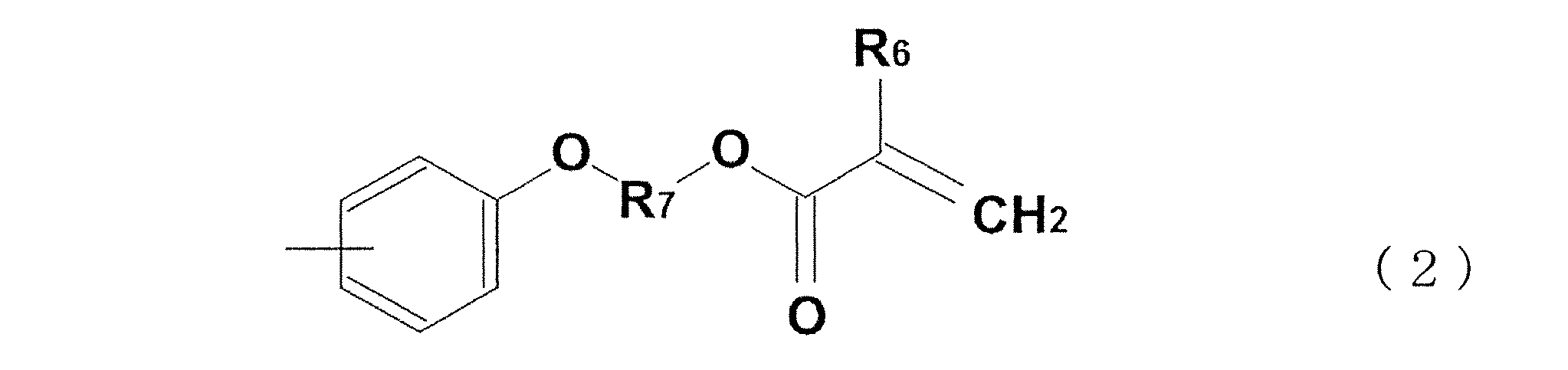
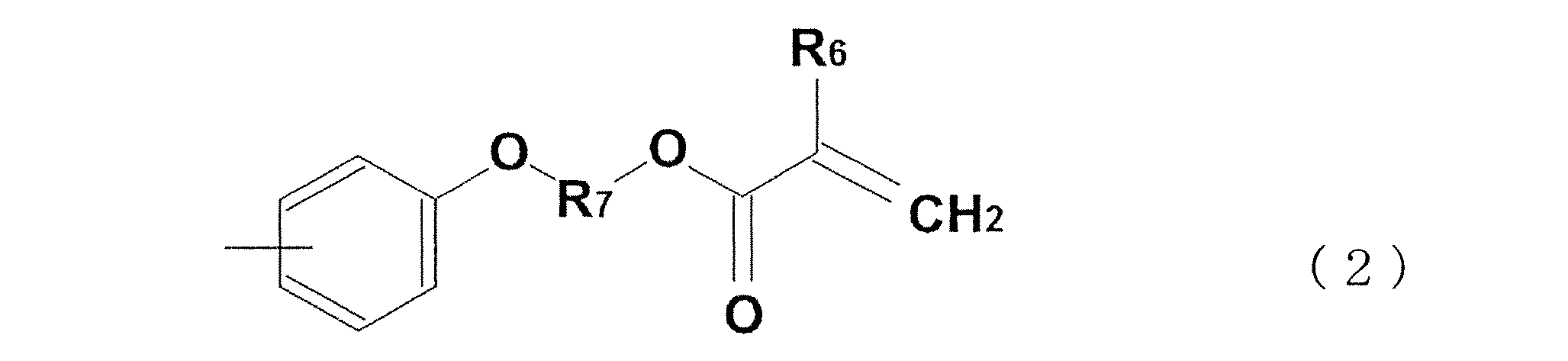
- the polyfunctional copolymer of the component (A) is obtained by copolymerizing the monovinyl aromatic compound (e), the divinyl aromatic compound (f) and the aromatic ether compound, and has a side chain.
- R 6 represents H or CH 3
- R 7 represents a hydrocarbon group having 1 to 18 carbon atoms which may contain an oxygen atom or a sulfur atom.
- the present invention provides a (meth) acrylate having 1 to 8 (meth) acryloyl groups in the molecule as the component (D) in addition to the components (A), (B) and (C) (provided that And (A) and (B) except for the above case), and the content of component (A) with respect to the total of components (A) to (D) is 5.0 to 84 wt%, and component (B)
- the content of the component (C) is 0.1 to 10 wt%
- the content of the component (D) is 10 to 70 wt%
- the components (A) to (D) The curable resin composition described above, wherein the total amount of the component (A) and the component (B) is 30 to 90 wt% with respect to 100 parts by weight in total.
- the present invention is a cured resin obtained by curing the curable resin composition, and an optical article formed from the cured resin.
- optical articles include optical lenses, microlens arrays, and imaging devices.
- the curable resin composition of the present invention or a cured resin obtained by curing this has excellent optical properties such as high refractive index, low birefringence, and high transparency, heat resistance, and processability, In addition, optical properties under severe actual use conditions such as reflow conditions, low water absorption and good mold release during molding, scratch resistance, toughness, surface hardness, and precise mold transfer are improved. .
- the cured resin of the present invention is excellent as an optical lens / prism material.
- the component (A) of the present invention has a plurality of reactive unsaturated bonds, has a weight average molecular weight of 2,000 to 100,000, and is further soluble in toluene, xylene, tetrahydrofuran, dichloroethane or chloroform. Is used.
- the polyfunctional copolymer as the component (A) may be abbreviated as a copolymer.
- the component (A) is a soluble polyfunctional copolymer, but the term “soluble” means soluble in toluene, xylene, tetrahydrofuran, dichloroethane or chloroform. Preferably it is soluble in all of the above solvents.
- the solubility test is performed under the conditions shown in the examples.
- the copolymer (A) is composed of a monomer having one polymerizable reactive unsaturated group such as a monovinyl compound (monofunctional component) and a monomer having two polymerizable reactive unsaturated groups such as a divinyl compound (2 It is advantageously obtained by copolymerizing a monomer component mainly composed of a functional component).
- the bifunctional component provides a branched structure or a crosslinked structure, but the abundance of such a crosslinked structure is limited to the extent that it is soluble.
- the terminal of the branched structure contains an unreacted unsaturated group derived from a bifunctional component such as a divinyl compound.
- the copolymer having an unreacted (meth) acryl group derived from a bifunctional component or an unsaturated group such as a vinyl group in the side chain.
- This unreacted unsaturated group is also referred to as a pendant (meth) acryl group or a pendant vinyl group, and since it exhibits polymerizability, it can be polymerized by further polymerization treatment to give a solvent-insoluble resin cured product.
- the average number of unreacted unsaturated groups needs to be 2 or more per molecule, but is preferably 3 or more. In order to increase the ratio of the unreacted unsaturated group, it is possible to increase the amount of the bifunctional component used for polymerization using a chain transfer agent.
- Preferred copolymers include monofunctional (meth) acrylic acid ester (a) having an aromatic ring or alicyclic structure as a monomer having one unsaturated group, and one kind of monomer having two unsaturated groups.
- the above bifunctional (meth) acrylic acid ester (b) is used, and 2,4-diphenyl-4-methyl-1-pentene (c) and thiol compound (d) are used as subcomponents and polymerized.
- A-1 obtained as above.
- Monofunctional monomer (meth) acrylic acid ester (a-1) having an aromatic ring structure constituting copolymer (A-1) includes benzyl acrylate, phenyl acrylate, phenoxyethyl acrylate, 2-naphthyl acrylate, thiophenol Examples thereof include one or more monofunctional (meth) acrylic acid esters selected from the group consisting of acrylates such as acrylate and benzyl mercaptan acrylate, and methacrylates thereof.
- monofunctional monomer (meth) acrylic acid ester (a-2) having an alicyclic structure from acrylates such as cyclohexyl acrylate, dicyclopentanyl acrylate, dicyclopentenyl acrylate, isobornyl acrylate, and these methacrylates
- monofunctional (meth) acrylic acid esters selected from the group consisting of can be mentioned, but the invention is not limited thereto.
- Examples of the bifunctional (meth) acrylic acid ester (b) constituting the copolymer (A-1) include ethylene glycol di (meth) acrylate, propylene glycol di (meth) acrylate, 1,4-butanediol di (meth) ) Acrylate, 1,6-hexanediol di (meth) acrylate, diethylene glycol di (meth) acrylate cyclohexane dimethanol di (meth) acrylate, dimethylol tricyclodecane di (meth) acrylate, EO modified bisphenol A diacrylate,
- Use bifunctional (meth) acrylic esters such as PO-modified bisphenol A diacrylate, 2,4-di (meth) acryloyloxynaphthalene, 9,9-bis [4-2 (-acryloyloxyethoxy) phenyl] fluorene
- EO and PO mean ethylene oxide and propylene oxide.
- (meth) acrylic acid esters include dicyclopentanyl (meth) acrylate, isobornyl (meth) acrylate having an alicyclic structure in terms of cost, ease of polymerization control and heat resistance of the obtained polymer, Cyclohexane dimethanol di (meth) acrylate and dimethylol tricyclodecane di (meth) acrylate are preferably used.
- n-butyl acrylate, n-hexyl acrylate, ethylene glycol di (meth) acrylate, propylene glycol di (meth) acrylate, which do not have an alicyclic structure, in terms of moldability such as toughness and releasability of the cured product 1,4-butanediol di (meth) acrylate, hexanediol di (meth) acrylate, and diethylene glycol di (meth) acrylate are preferably used.
- 2,4-diphenyl-4-methyl-1-pentene (c) and thiol compound (d) function as a chain transfer agent and control the molecular weight of the copolymer.
- the molecular weight of the copolymer of the present invention is in the range of 2,000 to 100,000 as the weight average molecular weight Mw (where Mw is the weight average molecular weight in terms of standard polystyrene measured using gel permeation chromatography), preferably Is in the range of 2,500-60,000, more preferably 3,000-50,000.
- the thiol compound (d) may be any thiol compound known to act as a chain transfer agent, preferably t-dodecyl mercaptan, n-dodecyl mercaptan, t-octyl mercaptan, n-octyl mercaptan, Trimethylolpropane tris-3-mercaptopropionate, pentaerythritol tetrakis-3-mercaptopropionate, dipentaerythritol hex-3-mercaptopropionate and (tris-[(3-mercaptopropionyloxy) -ethyl ] -Isocyanurate).
- t-dodecyl mercaptan, n-dodecyl mercaptan, t-octyl mercaptan, n-octyl mercaptan, etc. are particularly preferably used from the viewpoint of ease of polymerization control and toughness of the produced copolymer.
- a monovinyl aromatic compound (e) is used as a monomer having one unsaturated group
- a divinyl aromatic compound (f) is used as a monomer having two unsaturated groups
- A-2 a copolymer obtained by using an aromatic ether compound as an accessory component.
- the copolymer (A-2) includes the structural unit derived from the monovinyl aromatic compound (e) and the structural unit derived from the divinyl aromatic compound (f), as well as the above formula (2) derived from the aromatic ether compound. ) (Hereinafter also referred to as structural unit (g)). And the terminal group represented by the said Formula (2) is called terminal group (g). In general, it is desirable that the polymer chain (main chain and side chain) of the copolymer is generated from a divinyl aromatic compound and a monovinyl aromatic compound, and a part of the terminal is generated from an aromatic ether compound.
- Preferred examples of the aromatic ether compound that gives the structural unit (g) or the terminal group (g) include 2-phenoxyethyl (meth) acrylate and alkoxylated 2-phenoxyethyl (meth) acrylate. However, it is not limited to these. In view of reactivity, heat resistance of the cured product, and availability, 2-phenoxyethyl (meth) acrylate is more preferable.
- 2-phenoxyethyl (meth) acrylate has a polymerizable group, it can be copolymerized with other monomers, but in order to become a terminal group (g), the polymerizable group has low reactivity, Most of them remain unreacted, and the benzene ring preferably has a structure in which the vinyl group of the divinyl aromatic compound (f) is reacted.
- R 6 represents H or CH 3, which depends on the aromatic ether compound used.
- R 7 represents a hydrocarbon group having 1 to 18 carbon atoms which may contain an oxygen atom or a sulfur atom between carbon chains, preferably a hydrocarbon group having 1 to 6 carbon atoms, more preferably —CnH 2n An alkylene group represented by-.
- n is more preferably in the range of 1 to 4.
- one or more vinyl aromatic compounds selected from the group consisting of styrene, ethyl vinyl benzene, vinyl biphenyl and vinyl naphthalene are 50 mol% or more, preferably 70 mol% or more, more preferably A monovinyl aromatic compound containing 85 mol% or more is preferably used.
- the monovinyl aromatic compound (e) may contain a monovinyl aromatic compound other than those described above, and may preferably contain a small amount of less than 50 mol%.
- these monovinyl aromatic compounds include nuclear alkyl substituted monovinyl aromatic compounds, ⁇ -alkyl substituted monovinyl aromatic compounds, ⁇ -alkyl substituted styrenes, alkoxy substituted styrenes and the like.
- Styrene, ethyl vinyl benzene (both isomers of m- and p-), ethyl vinyl biphenyl (including each isomer) to prevent copolymer gelation and improve solubility in solvents and processability ) Is suitable from the viewpoint of cost and availability.
- divinyl aromatic compounds (f) examples include divinylbenzene (m- and p-isomers), divinylnaphthalene (including isomers), divinylbiphenyl (including isomers), etc. Although it can, it is not limited to these. Moreover, these can be used individually or in combination of 2 or more types. In particular, divinylbenzene (both isomers of m- and p-) is required from the viewpoint of cost and availability. When higher heat resistance is required, divinylnaphthalene (including each isomer), divinylbiphenyl (Including each isomer) is preferably used.
- the Mw of the copolymer used in the present invention is in the range of 2,000 to 100,000, preferably 2,500 to 60,000, more preferably 3,000 to 50,000. If the Mw is less than 2,000, the copolymer is too low in viscosity, so that the processability is lowered. On the other hand, if the Mw exceeds 100,000, gel is easily formed and compatibility cannot be expected.
- the value of the molecular weight distribution (Mw / Mn) is 50.0 or less, preferably 20.0 or less, more preferably 1.5 to 3.0. When Mw / Mn exceeds 50.0, problems such as deterioration of the processing properties of the copolymer and generation of gel occur.
- the copolymer used in the present invention has a (meth) acrylate group at the side chain or terminal, copolymerization with the (meth) acrylate compound can proceed well, and the (meth) acrylate compound and Very compatible with resin. Therefore, when it is copolymerized with a (meth) acrylate compound and cured, it is excellent in uniform curability and transparency.
- copolymer of component (A) used in the present invention is in accordance with the methods described in Patent Document 1, Japanese Patent Application Laid-Open No. 2004-123873, Japanese Patent Application Laid-Open No. 2005-213443, Japanese Patent Application Laid-Open No. 2010-229263, and the like. Obtainable.
- the component (B) is a (meth) acrylate represented by the general formula (1) and having a fluorene skeleton.
- R 1 and R 2 are independently H or CH 3
- R 3 and R 4 are independently CH 2 O, CH 2 CH 2 O, CH 2 CH (CH 3 ) O, CH 2 CH 2 CH 2 O, CH 2 CH (OH) CH 2 O, or CH 2 CH (OR 5 ) CH 2 O.
- R 5 is a meta (acryloyl) group
- k and l are each independently 0 or a number of 1 or more, but both cannot be 0.
- k + 1 is 0-4.
- m and n independently represent a number from 0 to 4.
- R 3 and R 4 are CH 2 CH 2 O, CH 2 CH (OH) CH 2 O, or CH 2 CH (OR 5 in order to balance the properties such as high refractive index, compatibility, and reactivity in a balanced manner.
- CH 2 O is preferred, and m and n are preferably 1 to 2.
- the number of (meth) acryloyl groups possessed by this (meth) acrylate is preferably 1 to 4, more preferably 2 to 4.
- Examples of the (meth) acrylate of the component B include, as a specific compound, a diacryl monomer having a bisphenolfluorene skeleton, a dimethacryl monomer, or a monomer having an acrylic group and a methacryl group.
- Component initiator includes photopolymerization initiator or thermal polymerization initiator.
- photopolymerization initiator compounds such as acetophenone-based, benzoin-based, benzophenone-based, thioxanthone-based, and acylphosphine oxide-based compounds can be suitably used.
- the photoinitiator adjuvant and the sharpening agent which show an effect in combination with a photoinitiator can also be used together. These photopolymerization initiators may be used alone or in combination of two or more.
- thermal polymerization initiator various organic peroxides such as ketone peroxide, peroxyketal, hydroperoxide, dialkyl peroxide, diacyl peroxide, peroxydicarbonate, peroxyester, etc.
- ketone peroxide peroxyketal
- hydroperoxide dialkyl peroxide
- diacyl peroxide peroxydicarbonate
- peroxyester etc.
- thermal polymerization initiators may be used alone or in combination of two or more.
- a (meth) acrylate having 1 to 8 (meth) acryloyl groups in the molecule (provided that the above (A), (B ) Except for cases corresponding to ingredients.
- the content of the curable resin composition is such that the content of the component (A) is 5.0 to 84 wt% with respect to the total of the components (A) to (D), the content of the component (B) is 5.0 to 84 wt%, And (C) component 0.1 to 10 wt%, (D) component content 10 to 70 wt%, and (A) component to (A) component (A) to 100 parts by weight of component (A) And (B) the total blending amount is preferably 30 to 90 wt%.
- the component (D) 1 to 8 functional (meth) acrylate is used.
- those having two or more (meth) acryloyl groups in the molecule are called polyfunctional (meth) acrylates, and preferably one or more of polyfunctional (meth) acrylates are used.
- the component (D) should have an average of 2 to 5 (meth) acryloyl groups per molecule.
- the average number of (meth) acryloyl groups per molecule is calculated by the total number of (meth) acryloyl groups / total number of molecules, and the total number of molecules of (meth) acrylate having one or more (meth) acrylate groups.
- the components (A) and (B) and the (meth) acryloyl groups contained in them are excluded from the calculation.
- These polyfunctional acrylates used as the component (D) are synergistically combined with the component (A) and the component (B), such as low color dispersion and high light transmittance, in addition to heat resistance and surface hardness. The optical properties are improved at the same time.
- the polyfunctional (meth) acrylate is preferably copolymerizable with the component (A) and the component (B), such as 1,4-butanediol di (meth) acrylate, 1,6-hexanediol diester.
- one or more monofunctional (meth) acrylates having one (meth) acryloyl group in the molecule can be used, but these monofunctional (meth) acrylates are (
- the optical properties such as high color dispersion, low color dispersion, and high light transmittance are improved synergistically, and fluidity is improved. By raising, moldability can be improved.
- monofunctional (meth) acrylate monofunctional (meth) acrylic acid ester (a) having an alicyclic structure used for producing the copolymer as component (A) is preferably used.
- acryloylmorpholine 2-hydroxyethyl (meth) acrylate, 2-hydroxypropyl (meth) acrylate, 4-hydroxybutyl (meth) acrylate, polyethylene glycol mono (meth) acrylate, polypropylene glycol mono (meth) acrylate , Cyclohexane-1,4-dimethanol mono (meth) acrylate, tetrahydrofurfuryl (meth) acrylate, phenoxyethyl (meth) acrylate, phenyl polyethoxy (meth) acrylate, 2-hydroxy-3-phenyloxypropyl ( (Meth) acrylate, o- Phenylphenol polyethoxy (meth) acrylate, p-cumylphenoxyethyl (meth) acrylate, isobornyl (meth) acrylate, tribromophenyloxyethyl (meth) acrylate, dicyclopentanyl (
- the preferred blending composition of the curable resin composition of the present invention is as follows.
- the blending amount of component (A) is 5.0 to 80 wt%, preferably 5.0 to 60 wt%
- the blending amount of component (B) is 5.0 to 80 wt%, preferably 10 to 60 wt%
- the blending amount of component (C) is 0.1 ⁇ 10wt%, preferably 0.1-5wt%.
- the amount of the component (D) is 10 to 70 wt%, preferably 20 to 60 wt%, based on the blending amount of the components (A) to (C).
- the content of component (A) + component (B) is 30 to 90 wt%, preferably 40 to 80 wt%.
- the blending amount of the component (A) is lower than 5.0 wt%, it is not preferable because the accuracy of the optical surface shape of the molded product is lowered, and when the blending amount of the component (A) is too large, the viscosity increases. In association with this, the moldability and handling properties are remarkably lowered, which is not preferable.
- the blending amount of the component (B) is lower than 5.0 wt%, the refractive index of the cured product is lowered, which is not preferable. If it is too large, the cured product has low elasticity and the heat resistance of the molded product is lowered. It is not preferable.
- the blending amount is calculated by excluding this.
- the curable resin composition of the present invention includes a polymerization inhibitor, an antioxidant, a release agent, a photosensitizer, an organic solvent, a silane coupling agent, a leveling agent, an antifoaming agent, and an antistatic agent as necessary.
- ultraviolet absorbers, light stabilizers, various inorganic and organic fillers, fungicides, antibacterial agents, and the like can be added to the curable resin composition of the present invention to impart desired functionality, respectively. is there.
- the curable resin composition of the present invention can be obtained by mixing the component (A), the component (B), the component (C), and the component (D), if necessary, and other components in any order. .
- the curable resin composition of the present invention is stable over time.
- the curable resin composition of the present invention can be cured by heating or light irradiation.
- the molding temperature can be selected from a wide range from room temperature to around 200 ° C., depending on the selection of the thermal polymerization initiator.
- a cured product can be obtained by irradiating active energy rays such as ultraviolet rays.
- active energy rays such as ultraviolet rays.
- specific examples of the light source used for curing by irradiating with active energy rays include, for example, a xenon lamp, a carbon arc, a germicidal lamp, a fluorescent lamp for ultraviolet rays, a high pressure mercury lamp for copying, a medium pressure mercury lamp, and a high pressure mercury lamp.
- an ultra high pressure mercury lamp, an electrodeless lamp, a metal halide lamp, or an electron beam using a scanning type or curtain type electron beam acceleration path can be used.
- the ultraviolet irradiation amount necessary for curing may be about 300 to 20,000 mJ / cm 2 .
- a resin composition can be hardened more efficiently by hardening in inert gas atmosphere, such as nitrogen gas.
- the curable resin composition of the present invention can be used for castings such as plastic lenses.
- a mold made of a gasket made of polyvinyl chloride, an ethylene vinyl acetate copolymer or the like and two glass molds having a desired shape is prepared.
- the resin composition of the present invention is injected, the resin composition is cured by irradiating active energy rays such as ultraviolet rays, and the cured product is peeled off from the mold.
- a method for applying the curable resin composition of the present invention to a film-like substrate as a resin composition for a prism lens sheet various methods known in the industry can be used.
- a resin composition is coated on a mold having a prism lens shape on the surface, a resin composition layer is provided, and a colorless and transparent film-like substrate is formed on the resin composition layer.
- a material for example, polyvinyl chloride, polystyrene, polycarbonate, poly (meth) acrylate, polyester, polyethylene terephthalate, etc.
- the film-like base material on which the prism lens-like resin layer is formed can be peeled off from the mold after curing the resin composition layer.
- the cured resin obtained by molding and curing the curable resin composition of the present invention is excellent as an optical material or an optical article.
- it is useful as a material for optical plastic lenses such as Fresnel lenses, lenticular lenses, spectacle lenses, and aspheric lenses. And such a lens is used advantageously for an imaging device.
- the curable resin composition or the cured resin can also be used for optical electronics, optical fiber, optical waveguide and other optoelectronic applications, printing inks, paints, clear coating agents, glossy varnishes, and the like.
- the solvent resistance was measured by immersing a sample plate prepared by vacuum press-molding the copolymer at 200 ° C for 1 hour in toluene at room temperature for 10 minutes. The change of the sample was visually confirmed, and the solvent resistance was evaluated by classifying it as ⁇ : no change, ⁇ : swelling, ⁇ : deformation, and swelling.
- the solvent solubility was measured by adding 5 g of the copolymer to 100 ml of solvent and observing the dissolution state after stirring for 10 minutes at 25 ° C. When it was dissolved uniformly and the presence of undissolved matter and gel was not recognized, it was determined to be soluble.
- Pencil Hardness According to JISK5400, the pencil hardness of a test piece cured on a flat plate having a thickness of 1.0 mm, a width of 40 mm, and a length of 40 mm was measured using a pencil scratch tester. A pencil was applied at a 45 degree angle and a 1 kg load was applied from the top, and scratched about 5 mm to confirm the degree of scratches. The measurement was performed 5 times, and the pencil hardness of one rank below where 2 or more outbreaks were observed in 5 times was described as the pencil hardness test result.
- Synthesis example 1 1.6 mol (463.2 mL) of dimethylol tricyclodecane diacrylate, 1.2 mol (254.2 mL) of dicyclopentanyl methacrylate, 1.2 mol (226.3 mL) of 1,4-butanediol diacrylate, 0.4 mol (95.5 mL) of 2,4-diphenyl-4-methyl-1-pentene, t- Charge 2.4 mol (564.8 mL) of dodecyl mercaptan and 600 mL of toluene into a 3.0 L reactor, add 40 mmol (11.5 g) of t-butyl peroxy-2-ethylhexanoate at 90 ° C, and react for 2 hours 45 minutes I let you.
- Copolymer A has a total structural unit (1) derived from dimethylol tricyclodecane diacrylate of 39.6 mol% and a structural unit derived from dicyclopentanyl methacrylate (2 31.1 mol% in total, and 29.3 mol% of structural units (3) derived from 1,4-butanediol diacrylate.
- the terminal group (4) of the structure derived from 2,4-diphenyl-4-methyl-1-pentene ( ⁇ MSD) includes the structural units (1), (2) and (3), the terminal group (4) and
- the total amount of terminal groups (5) derived from t-dodecyl mercaptan (TDM) (hereinafter referred to as the total amount of all structural units) was 1.8 mol%.
- the end group (5) was present in an amount of 7.2 mol% based on the total amount of all the structural units.
- copolymer A when copolymer A was subjected to a solvent solubility test in toluene, xylene, THF, dichloroethane, dichloromethane, or chloroform, no insoluble matter or gel was observed in any of the solvents.
- Synthesis example 4 Reactor of 0.66 mol (94.0 mL) divinylbenzene, 0.0275 mol (3.9 mL) ethyl vinylbenzene, 1.56 mol (281.1 g) 4-vinylbiphenyl, 0.88 mol (167.1 mL) 2-phenoxyethyl methacrylate, 610 mL toluene Then, 50 mmol of boron trifluoride diethyl ether complex was added at 50 ° C. and reacted for 4 hours 30 minutes.
- Synthesis example 5 A 3.0L reactor containing 0.44 mol (62.7 mL) of divinylbenzene, 0.0183 mol (2.6 mL) of ethylvinylbenzene, 1.76 mol (317.2 g) of 4-vinylbiphenyl, 0.66 mol (125.3 mL) of 2-phenoxyethyl methacrylate, and 610 mL of toluene Then, 50 mmol of boron trifluoride diethyl ether complex was added at 50 ° C. and reacted for 4 hours 30 minutes.
- BZ benzyl methacrylate (monofunctional)
- BPEF 9,9-bis [4-2 (-acryloyloxyethoxy) phenyl] fluorene
- BPFEA 9,9-bis [4-3 (-acryloyloxypropoxy, 2-hydroxy) phenyl] fluorene
- BPA BPA-2EO-dimethacrylate 19NDA: 1,9-nonanediol diacrylate (bifunctional)
- TMP Trimethylolpropane trimethacrylate (trifunctional)
- DPHA Dipentaerythritol hexaacrylate (hexafunctional)
- Perbutyl O t-butyl peroxy-2-ethyl hexanate (Nippon Yushi Co., Ltd.)
- Irgacure 184 1-hydroxy-cyclohexyl-phenyl-ketone (BASF)
Landscapes
- Chemical & Material Sciences (AREA)
- Health & Medical Sciences (AREA)
- Chemical Kinetics & Catalysis (AREA)
- Medicinal Chemistry (AREA)
- Polymers & Plastics (AREA)
- Organic Chemistry (AREA)
- Physics & Mathematics (AREA)
- General Physics & Mathematics (AREA)
- Optics & Photonics (AREA)
- Addition Polymer Or Copolymer, Post-Treatments, Or Chemical Modifications (AREA)
- Graft Or Block Polymers (AREA)
Abstract
Description
(B)成分:一般式(1)で表されるフルオレン骨格を有する(メタ)アクリレート、及び
(C)成分:開始剤
を含有する硬化性樹脂組成物であって、(A)~(C)成分の合計に対する(A)成分の含有量が5.0~94wt%、(B)成分の含有量が5.0~94wt%、及び(C)成分の含有量が0.1~10wt%であることを特徴とする硬化性樹脂組成物である。
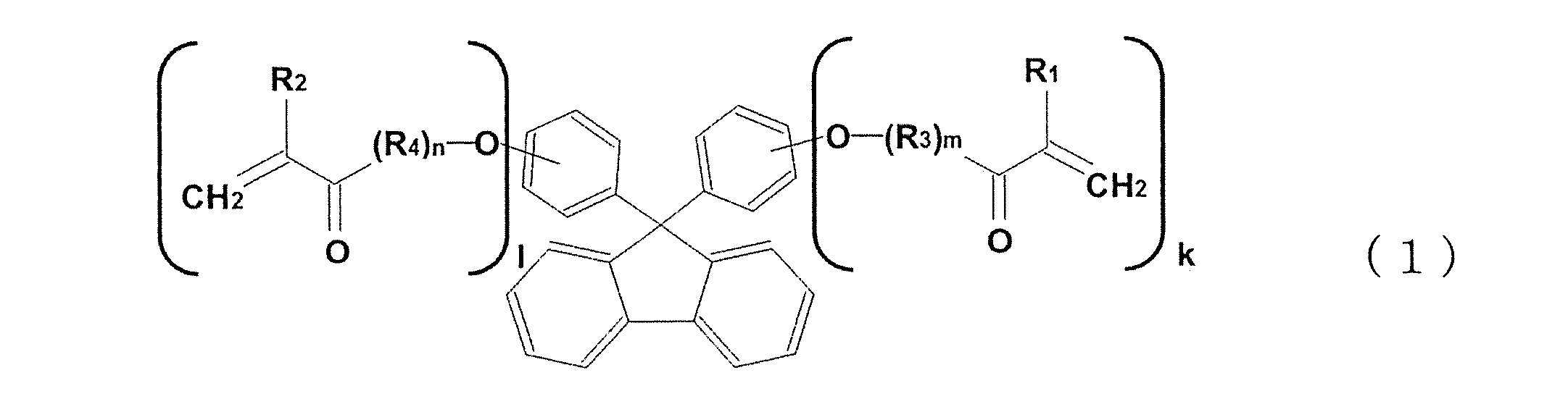
R1およびR2は独立してH又はCH3であり、
R3及びR4は独立してCH2O、CH2CH2O、CH2CH(CH3)O、CH2CH2CH2O、CH2CH(OH)CH2O、又はCH2CH(OR5)CH2Oである。
R5はメタ(アクリロイル)基、k及びlは独立して0か1以上の数であるが、両方ともに0となることはない。好ましくは、k+lは0~4である。
m及びnは独立して0~4の数を表す。
高い屈折率、相溶性、反応性等の特性をバランス良く両立する上で、R3及びR4は、CH2CH2O、CH2CH(OH)CH2O、又はCH2CH(OR5)CH2Oが好ましく、m及びnは1~2が好ましい。また、この(メタ)アクリレートが持つ(メタ)アクリロイル基の数は、好ましくは1~4であり、より好ましくは2~4である。
これらの(D)成分として用いられる多官能アクリレートは、(A)成分及び(B)成分と併用することによって相乗的に、耐熱性及び表面硬度に加えて、低色分散、高光線透過率といった光学特性が同時に向上する。
一方光学面の形状精度の観点から、好ましいのは、シクロヘキサンジメタノールジ(メタ)アクリレート、ジメチロールトリシクロデカンジ(メタ)アクリレートを挙げることができる。
光照射によって成型させる場合は、紫外線等の活性エネルギー線を照射することにより硬化物を得ることができる。ここで、活性エネルギー線を照射して硬化する場合に用いられる光源の具体例としては、例えば、キセノンランプ、カーボンアーク、殺菌灯、紫外線用蛍光灯、複写用高圧水銀灯、中圧水銀灯、高圧水銀灯、超高圧水銀灯、無電極ランプ、メタルハライドランプ、あるいは走査型、カーテン型電子線加速路による電子線等を挙げることができる。また、本発明の硬化性樹脂組成物を紫外線照射により硬化する場合、硬化に必要な紫外線照射量は300~20,000mJ/cm2程度でよい。なお、窒素ガス等の不活性ガス雰囲気中で硬化することで、樹脂組成物をより効率よく硬化させることができる。
1)ポリマーの分子量及び分子量分布
可溶性多官能共重合体の分子量及び分子量分布測定はGPC(東ソー製、HLC-8120GPC)を使用し、溶媒:テトラヒドロフラン(THF)、流量:1.0ml/min、カラム温度:40℃で行った。共重合体の分子量は単分散ポリスチレンによる検量線を用い、ポリスチレン換算分子量として測定を行った。
日本電子製JNM-LA600型核磁気共鳴分光装置を用い、13C-NMR及び1H-NMR分析により決定した。溶媒としてクロロホルム-d1を使用し、テトラメチルシランの共鳴線を内部標準として使用した。
耐溶剤性の測定は、共重合体を200℃一時間真空プレス成形して作製した試料板をトルエンに室温で10分間浸漬し、浸漬後の試料の変化を目視にて確認し、○:変化無し、△:膨潤、×:変形、膨れ有りに分類することにより耐溶剤性の評価を行った。
溶剤溶解性の測定は、共重合体5gを、100mlの溶媒に加え、25℃で10分間撹拝後の溶解状況を観察した。均一に溶解し、未溶解物及びゲルの存在が認められない場合を、可溶性と判定した。
(1)屈折率の測定
樹脂組成物の屈折率測定のため、幅50mm、長さ50mm、厚み1.0mmの2枚のガラス板の間に厚さ1.0mmの隙間を開けて外周をポリイミドテープで巻き固定したガラス型に組成物を注入し、1)このガラス型の片面から前述の高圧水銀ランプにより、数秒問紫外線を照射する、或いは、2)このガラス型の代わりにSUS製の金属板を用いて同様の試験片作成用型を作成し、窒素ガス気流下のイナートガスオーブンに入れ、180℃で1時間加熱することによって硬化させた。ガラス型又は金型から硬化した樹脂板を脱型して、サンプルとした。アッベ屈折率計(アタゴ(株)製)でサンプルの屈折率及びアッベ数を測定した。
厚さ1.0mm、幅40mm、長さ40mmの平板を色彩色差計(商品名「MODELTC_8600」、東京電色(株)製)で測定し、そのYI値を示した。
厚さ1.0mm、幅40mm、長さ40mmの平板に硬化させた試験片を作成し、これのHaze(濁り度)と全光線透過率を、積分球式光線透過率測定装置(日本電色社製、SZ-Σ90)を用い測定した。
厚さ1.0mm、幅40mm、長さ40mmの平板に硬化した樹脂を金型より離型させた時の難易度により評価した。
○・・・金型からの離型性が良好。
△・・・離型がやや困難、
×・・・離型が困難或は型のこりがある
厚さ0.6mm、直径3.0mmの球面レンズ形状に硬化した樹脂層の表面形状と金型のクリアランスへの樹脂の洩れ込みにより評価した。
○・・・再現性が良好
×・・・再現性が不良
厚さ0.6mm、直径3.0mmの球面レンズ形状に硬化した樹脂を金型より離型させた時に、製品部分以外に生じたバリの大きさ及び金型のクリアランスへの樹脂の洩れこみの度合いにより評価した。
○・・・バリの生成量が0.05mm未満、金型クリアランスへの樹脂の洩れこみが1.0mm未満
△・・・バリの生成量が0.05mm以上、0.2mm未満。金型クリアランスへの樹脂の洩れこみが1.0mm以上、3.0mm未満
×・・・バリの生成量が0.2mm以上、金型クリアランスへの樹脂の洩れこみが3.0mm以上。
厚さ0.6mm、直径3.0mmの球面レンズ形状に硬化した樹脂を金型より離型させた時に、成形品部分に生じた気泡の有無及び大きさの度合いにより評価した。
○・・・気泡の生成が観察されない
△・・・気泡の生成が観察され、気泡の大ききが成形品の体積に対し2%未満
×・・・気泡の生成が観察きれ、気泡の大ききが成形品の体積に対し2%以上
厚さ0.6mm、直径3.0mmの球面レンズ形状に硬化した樹脂を金型より離型させた時に、成形品の製品部分に生じたワレの有無及び大きさの度合により評価した。
○・・・ワレの生成が観察されない
△・・・ワレの生成が観察されるが、成形品の外周部のコーナー部分にのみ観察される。
×・・・ワレの生成が観察され、成形品の外周部のコーナ部分以外にも観察される。
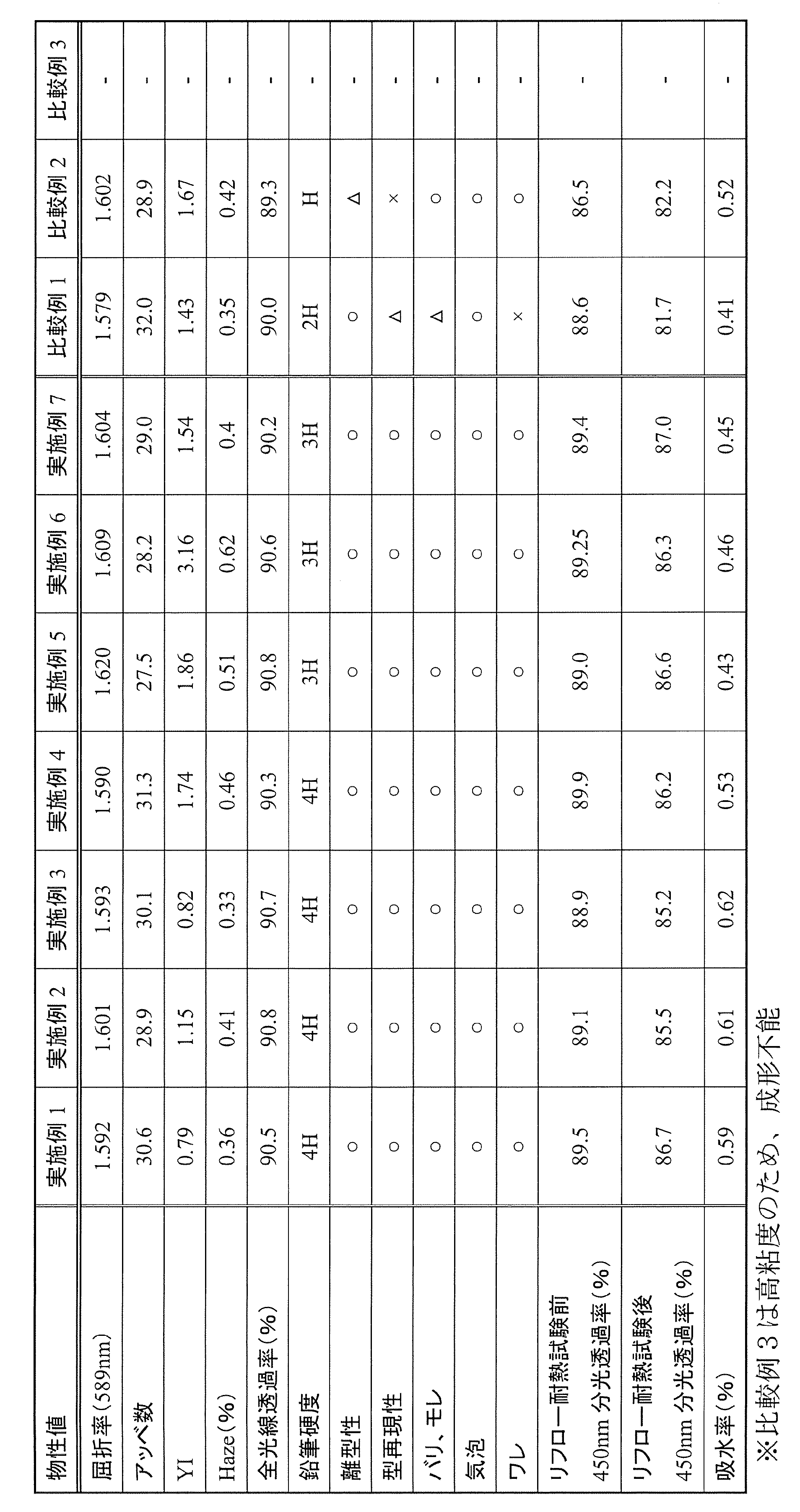
厚さ1.0mm、幅40mm、長さ40mmの平板をテストピースとして、分光測色計CM-3700d(コニカミノルタ社製)にて波長:400nmの分光透過率を測定した。測定タイミングは、200℃60分でのポストキュアを行った耐熱試験前と、エアーオーブン中、250℃、7分間の耐熱試験後とした。これらの測定により得られた分光透過率変化の結果を以下の表3に示す。
60℃で24時間真空乾燥した厚さ1.0mm、幅40mm、長さ40mmの平板の試験片の重さをWoとし、それを±0.1mgまで測定可能な秤で秤量し、温度:85℃、相対湿度:85%の恒温恒湿槽内で1週間、加湿を行った。加湿後、テストサンプルについた水気をふき取り、サンプルを±0.1mgまで測定可能な秤で秤量し、Wとした。下記の式(3)で給水率を算出した。同じテストサンプルを3つ準備し、同様に試験を行った。
Wo/W×100=吸水率(%) (3)
JISK5400に従い、鉛筆引っかき試験機を用いて、厚さ1.0mm、幅40mm、長さ40mmの平板に硬化させた試験片の鉛筆硬度を測定した。鉛筆を45度の角度で、上から1kgの荷重を掛け5mm程度引っかき、傷の付き具合を確認した。5回測定を行い、5回中2回以上の傷発生が見られた1ランク下の鉛筆硬度を鉛筆硬度試験結果として記載した。
ジメチロールトリシクロデカンジアクリレート1.6モル(463.2mL)、
ジシクロペンタニルメタクリレート1.2モル(254.2mL)、1,4-ブタンジオールジアクリレート1.2モル(226.3mL)、2,4-ジフェニル-4-メチル-1-1ペンテン0.4モル(95.5mL)、t-ドデシルメルカプタン2.4モル(564.8mL)、トルエン600mLを3.0Lの反応器内に投入し90℃で40mmol(11.5g)のt-ブチルパ-オキシ-2-エチルへキサノエートを添加し、2時間45分反応させた。重合反応を冷却により停止させた後、室温で反応混合液を大量のへキサンに投入し、共重合体を析出させた。得られた共重合体をヘキサンで洗浄し、濾別、乾燥、秤量して、共重合体A691.0gを得た。
一方、末端基(5)は、全構成単位の総量に対し、7.2モル%存在していた。
また、共重合体Aについて、トルエン、キシレン、THF、ジクロロエタン、ジクロロメタン、又はクロロホルムに対する溶剤溶解性試験を行ったところ、いずれの溶剤の場合も、不溶物やゲルの生成は認められなかった。
ジメチロールトリシクロデカンジアクリレート2.64モル(764.3mL)、ジシクロペンタニルアクリレート0.24モル(47.2mL)、1,4-ブタンジオールジアクリレート0.96モル(181.0mL)、2-ヒドロキシプロピルアクリレート0.96モル(118.5mL)、2,4-ジフェニル-4-メチル-1-ペンテン0.48モル(114.6mL)、t-ドデシルメルカプタン3.12モル(734.3mL)、トルエン720mLを3.0Lの反応器内に投入し、90℃で62mmol(13.9g)のt-ブチルパ-オキシ-2-エチルへキサノエートを添加し、2時間30分反応させた。重合反応を冷却により停止させた後、室温で反応混合液を大量のへキサンに投入し、重合体を析出きせた。得られた重合体をヘキサンで洗浄し、濾別、乾燥、秤量して、共重合体B782.2gを得た。
共重合体Aと同様に共重合体Bの試験を行った結果を表1に記載した。
ジメチロールトリシクロデカンジアクリレート0.8モル(231.5mL)、ジシクロペンタニルメタクリレート2.0モル(393.4ml)、1,4-ブタンジオールジアクリレート1.2モル(226.3mL)、2,4-ジフェニル-4-メチル-1-ペンテン0.4モル(95.5mL)、t-ドデシルメルカプタン1.6モル(376.45mL)、トルエン600mLを3.0Lの反応器内に投入し90℃で40mmol(11.5g)のt-ブチルパ-オキシ-2-エチルへキサノエートを添加し、2時間45分反応させた。重合反応を冷却により停止させた後、室温で反応混合液を大量のへキサンに投入し、共重合体を析出させた。得られた共重合体をヘキサンで洗浄し、濾別、乾燥、秤量して、共重合体C536.4g(収率:73.2wt%)を得た。
共重合体Aと同様に共重合体Cの試験を行った結果を表1に記載した。
ジビニルベンゼン0.66モル(94.0mL)、エチルビニルベンゼン0.0275モル(3.9mL)、4-ビニルビフェニル1.56モル(281.1g)、2-フェノキシエチルメタクリレート0.88モル(167.1mL)、トルエン610mLを3.0Lの反応器内に投入し、50℃で50mmolの三フッ化ホウ素のジエチルエーテル錯体を添加し、4時間30分反応させた。重合溶液を炭酸水素ナトリウム水溶液で停止させた後、純水で5回油層を洗浄し、室温で反応混合液を大量のメタノールに投入し、重合体を析出させた。得られた重合体をトルエンに溶解させた後、メタノールで再沈を行うという操作を3回繰り返した後、パウダー状の固体ポリマーをメタノールで洗浄し、濾別、乾燥、秤量して、共重合体D258.3gを得た。
共重合体Aと同様に共重合体Dの試験を行った結果を表1に記載した。
ジビニルベンゼン0.44モル(62.7mL)、エチルビニルベンゼン0.0183モル(2.6mL)、4-ビニルビフェニル1.76モル(317.2g)、2-フェノキシエチルメタクリレート0.66モル(125.3mL)、トルエン610mLを3.0Lの反応器内に投入し、50℃で50mmolの三フッ化ホウ素のジエチルエーテル錯体を添加し、4時間30分反応させた。重合溶液を炭酸水素ナトリウム水溶液で停止させた後、純水で5回油層を洗浄し、室温で反応混合液を大量のメタノールに投入し、重合体を析出させた。得られた重合体をトルエンに溶解させた後、メタノールで再沈を行うという操作を3回繰り返した後、パウダー状の固体ポリマーをメタノールで洗浄し、濾別、乾燥、秤量して、共重合体E250.6gを得た。
共重合体Aと同様に共重合体Eの試験を行った結果を表1に記載した。
ジビニルベンゼン0.27モル(38.5mL)、エチルビニルベンゼン0.063モル(9.0mL)、2-ビニルナフタレン0.567モル(87.4g)、2-フェノキシエチルメタクリレート0.36モル(68.4mL)、トルエン250mLを1.0Lの反応器内に投入し、50℃で18mmolの三フッ化ホウ素のジエチルエーテル錯体を添加し、4時間00分反応させた。重合溶液を炭酸水素ナトリウム水溶液で停止させた後、純水で5回油層を洗浄し、室温で反応混合液を大量のメタノールに投入し、重合体を析出させた。得られた重合体をトルエンに溶解させた後、メタノールで再沈を行うという操作を3回繰り返した後、パウダー状の固体ポリマーをメタノールで洗浄し、濾別、乾燥、秤量して、共重合体F85.3gを得た。
共重合体Aと同様に共重合体Fの試験を行った結果を表1に記載した。
表2に示す割合で各成分を配合し(数字は重量部)、安定剤として株式会社アデカ製のアデカスタブAO-60 0.1重量部を加えて硬化性樹脂組成物を得た。次にこの硬化性樹脂組成物を、上記の各種試験方法により硬化し、性能評価を行った。性能評価結果を表3に示す。
BZ:ベンジルメタクリレート(単官能)
BPEF:9,9-ビス[4-2(-アクリロイルオキシエトキシ)フェニル]フルオレン(2官能)
BPFEA:9,9-ビス[4-3(-アクリロイルオキシプロポキシ,2-ヒドロキシ)フェニル]フルオレン(2官能)
BPA:BPA-2EO-ジメタクリレート
19NDA:1,9-ノナンジオールジアクリレート(2官能)
TMP:トリメチロールプロパントリメタクリレート(3官能)
DPHA:ジペンタエリスリトールヘキサアクリレート(6官能)
パーブチルO:t-ブチルパーオキシ-2-エチルヘキサネート(日本油脂株式会社製)
イルガキュア184:1-ヒドロキシ-シクロヘキシル-フェニル-ケトン(BASF社製)


Claims (7)
- (A)成分:反応性の不飽和基を複数有し、重量平均分子量が2,000~100,000であり、更にトルエン、キシレン、テトラヒドロフラン、ジクロロエタン又はクロロホルムに可溶であり、反応性の不飽和基を2つ有するモノマーと1つ有するモノマーを共重合させて得られる多官能共重合体、
(B)成分:一般式(1)で表されるフルオレン骨格を有する(メタ)アクリレート、

(C)成分:開始剤
を含有する硬化性樹脂組成物であって、(A)~(C)成分の合計に対する(A)成分の含有量が5.0~94wt%、(B)成分の含有量が5.0~94wt%、及び(C)成分の含有量が0.1~10wt%であることを特徴とする硬化性樹脂組成物。 - (A)成分の多官能共重合体が、芳香環、又は脂環構造を有する単官能(メタ)アクリル酸エステル(a)、1種以上の2官能(メタ)アクリル酸エステル(b)、2,4-ジフェニル-4-メチル-1-ペンテン(c)とチオール化合物(d)を含む成分を共重合して得られる共重合体であって、側鎖に2官能(メタ)アクリル酸エステル(b)由来の反応性の(メタ)アクリル基を有し、末端に2,4-ジフェニル-4-メチル-1-ペンテン(c)及びチオール化合物(d)由来の構造単位を有する多官能共重合体であることを特徴とする請求項1記載の硬化性樹脂組成物。
- (A)成分の多官能共重合体が、モノビニル芳香族化合物(e)、ジビニル芳香族化合物(f)及び芳香族系エーテル化合物を共重合して得られ、側鎖にジビニル芳香族化合物(f)由来の反応性ビニル基を有し、その末端に平均して1分子あたり1個以上の下記式(2)で表される芳香族系エーテル化合物に由来の構造単位を有する多官能共重合体であることを特徴とする請求項1記載の硬化性樹脂組成物。
- 上記(A)、(B)、(C)成分に加えて、(D)成分として、分子中に1~8個の(メタ)アクリロイル基を有する(メタ)アクリレート(但し、上記(A)、(B)成分に該当する場合を除く。)を含有し、(A)~(D)成分の合計に対する(A)成分の含有量が5.0~84wt%、(B)成分の含有量が5.0~84wt%、及び(C)成分の含有量が0.1~10wt%、(D)成分の含有量が10~70wt%であって、かつ、(A)~(D)成分の合計100重量部に対する(A)成分と(B)成分の合計の配合量が30~90wt%であることを特徴とする請求項1~3記載の硬化性樹脂組成物。
- 請求項1~4のいずれかに記載の硬化性樹脂組成物を硬化して得られることを特徴とする樹脂硬化物。
- 請求項5に記載の樹脂硬化物が形成されたことを特徴とする光学物品。
- 光学物品が、光学レンズであることを特徴とする請求項6記載の光学物品。
Priority Applications (3)
| Application Number | Priority Date | Filing Date | Title |
|---|---|---|---|
| CN201480018087.3A CN105073807A (zh) | 2013-03-25 | 2014-03-25 | 固化性树脂组合物、固化物及光学物品 |
| JP2015508507A JP6525867B2 (ja) | 2013-03-25 | 2014-03-25 | 硬化性樹脂組成物、硬化物および光学物品 |
| KR1020157030472A KR20150134398A (ko) | 2013-03-25 | 2014-03-25 | 경화성 수지 조성물, 경화물 및 광학 물품 |
Applications Claiming Priority (2)
| Application Number | Priority Date | Filing Date | Title |
|---|---|---|---|
| JP2013061709 | 2013-03-25 | ||
| JP2013-061709 | 2013-03-25 |
Publications (1)
| Publication Number | Publication Date |
|---|---|
| WO2014157131A1 true WO2014157131A1 (ja) | 2014-10-02 |
Family
ID=51624102
Family Applications (1)
| Application Number | Title | Priority Date | Filing Date |
|---|---|---|---|
| PCT/JP2014/058173 Ceased WO2014157131A1 (ja) | 2013-03-25 | 2014-03-25 | 硬化性樹脂組成物、硬化物および光学物品 |
Country Status (4)
| Country | Link |
|---|---|
| JP (1) | JP6525867B2 (ja) |
| KR (1) | KR20150134398A (ja) |
| CN (1) | CN105073807A (ja) |
| WO (1) | WO2014157131A1 (ja) |
Cited By (3)
| Publication number | Priority date | Publication date | Assignee | Title |
|---|---|---|---|---|
| JP2015155533A (ja) * | 2014-01-16 | 2015-08-27 | 株式会社菱晃 | 硬化性樹脂組成物、硬化物、光学部材及び光学デバイス |
| US20170166528A1 (en) * | 2014-07-22 | 2017-06-15 | Sabic Global Technologies B.V. | High heat monomers and methods of use thereof |
| JP2022121884A (ja) * | 2021-02-09 | 2022-08-22 | 帝人株式会社 | ジヒドロキシ化合物およびその製造方法 |
Families Citing this family (4)
| Publication number | Priority date | Publication date | Assignee | Title |
|---|---|---|---|---|
| JP6833723B2 (ja) * | 2015-12-28 | 2021-02-24 | 日鉄ケミカル&マテリアル株式会社 | 可溶性多官能ビニル芳香族共重合体、その製造方法及び硬化性組成物 |
| CN108690166B (zh) * | 2017-04-05 | 2020-09-29 | 宁波激智科技股份有限公司 | 一种高折射率的柔性扩散微粒及其制备方法、及一种光学薄膜 |
| CN112745463B (zh) * | 2019-10-31 | 2023-11-03 | 威斯坦(厦门)实业有限公司 | 一种光固化树脂及其制备方法 |
| TWI782688B (zh) * | 2021-09-02 | 2022-11-01 | 財團法人工業技術研究院 | 聚合物、聚合物組成物、與太陽能電池模組 |
Citations (6)
| Publication number | Priority date | Publication date | Assignee | Title |
|---|---|---|---|---|
| JP2000136220A (ja) * | 1998-10-30 | 2000-05-16 | Kureha Chem Ind Co Ltd | 合成樹脂製光学材料およびその製造方法 |
| WO2005033061A1 (ja) * | 2003-10-01 | 2005-04-14 | Osaka Gas Co., Ltd. | 多官能性(メタ)アクリレートおよびその製造方法 |
| JP2011039165A (ja) * | 2009-08-07 | 2011-02-24 | Hitachi Chem Co Ltd | アルカリ可溶性光硬化型組成物、該組成物を使用した硬化塗膜及び透明部材 |
| JP2012184349A (ja) * | 2011-03-07 | 2012-09-27 | Teijin Chem Ltd | 光硬化性樹脂組成物及びその硬化皮膜を有する物品、その製造方法 |
| WO2013022065A1 (ja) * | 2011-08-11 | 2013-02-14 | 大阪ガスケミカル株式会社 | フルオレン骨格を有する多官能性(メタ)アクリレートおよびその硬化性組成物 |
| JP2013204034A (ja) * | 2012-03-29 | 2013-10-07 | Fujifilm Corp | 半硬化物、硬化物およびそれらの製造方法、光学部品、硬化樹脂組成物 |
Family Cites Families (3)
| Publication number | Priority date | Publication date | Assignee | Title |
|---|---|---|---|---|
| JP2008094987A (ja) * | 2006-10-13 | 2008-04-24 | Nippon Kayaku Co Ltd | 光学材料用高屈折率樹脂組成物およびその硬化物 |
| KR101640855B1 (ko) * | 2008-03-04 | 2016-07-19 | 신닛테츠 수미킨 가가쿠 가부시키가이샤 | 다관능 비닐 방향족 공중합체, 그 제조방법 및 수지 조성물 |
| CN102822217B (zh) * | 2010-02-26 | 2014-04-02 | 新日铁住金化学株式会社 | 固化性树脂组合物、其固化物以及光学材料 |
-
2014
- 2014-03-25 WO PCT/JP2014/058173 patent/WO2014157131A1/ja not_active Ceased
- 2014-03-25 CN CN201480018087.3A patent/CN105073807A/zh active Pending
- 2014-03-25 KR KR1020157030472A patent/KR20150134398A/ko not_active Ceased
- 2014-03-25 JP JP2015508507A patent/JP6525867B2/ja active Active
Patent Citations (6)
| Publication number | Priority date | Publication date | Assignee | Title |
|---|---|---|---|---|
| JP2000136220A (ja) * | 1998-10-30 | 2000-05-16 | Kureha Chem Ind Co Ltd | 合成樹脂製光学材料およびその製造方法 |
| WO2005033061A1 (ja) * | 2003-10-01 | 2005-04-14 | Osaka Gas Co., Ltd. | 多官能性(メタ)アクリレートおよびその製造方法 |
| JP2011039165A (ja) * | 2009-08-07 | 2011-02-24 | Hitachi Chem Co Ltd | アルカリ可溶性光硬化型組成物、該組成物を使用した硬化塗膜及び透明部材 |
| JP2012184349A (ja) * | 2011-03-07 | 2012-09-27 | Teijin Chem Ltd | 光硬化性樹脂組成物及びその硬化皮膜を有する物品、その製造方法 |
| WO2013022065A1 (ja) * | 2011-08-11 | 2013-02-14 | 大阪ガスケミカル株式会社 | フルオレン骨格を有する多官能性(メタ)アクリレートおよびその硬化性組成物 |
| JP2013204034A (ja) * | 2012-03-29 | 2013-10-07 | Fujifilm Corp | 半硬化物、硬化物およびそれらの製造方法、光学部品、硬化樹脂組成物 |
Cited By (5)
| Publication number | Priority date | Publication date | Assignee | Title |
|---|---|---|---|---|
| JP2015155533A (ja) * | 2014-01-16 | 2015-08-27 | 株式会社菱晃 | 硬化性樹脂組成物、硬化物、光学部材及び光学デバイス |
| US20170166528A1 (en) * | 2014-07-22 | 2017-06-15 | Sabic Global Technologies B.V. | High heat monomers and methods of use thereof |
| US10435368B2 (en) * | 2014-07-22 | 2019-10-08 | Sabic Global Technologies B.V. | High heat monomers and methods of use thereof |
| JP2022121884A (ja) * | 2021-02-09 | 2022-08-22 | 帝人株式会社 | ジヒドロキシ化合物およびその製造方法 |
| JP7636193B2 (ja) | 2021-02-09 | 2025-02-26 | 帝人株式会社 | ジヒドロキシ化合物およびその製造方法 |
Also Published As
| Publication number | Publication date |
|---|---|
| JPWO2014157131A1 (ja) | 2017-02-16 |
| JP6525867B2 (ja) | 2019-06-05 |
| KR20150134398A (ko) | 2015-12-01 |
| CN105073807A (zh) | 2015-11-18 |
Similar Documents
| Publication | Publication Date | Title |
|---|---|---|
| JP5841835B2 (ja) | 硬化性樹脂組成物、硬化物および光学物品 | |
| JP5281710B2 (ja) | 硬化性樹脂組成物、その硬化物並びに光学材料 | |
| JP5781384B2 (ja) | 硬化性樹脂組成物及びその硬化物 | |
| JP6525867B2 (ja) | 硬化性樹脂組成物、硬化物および光学物品 | |
| KR101640855B1 (ko) | 다관능 비닐 방향족 공중합체, 그 제조방법 및 수지 조성물 | |
| KR101790646B1 (ko) | 가용성 다관능 (메타)아크릴산에스테르 공중합체 및 그 제조방법, 경화성 수지 조성물 및 경화물 | |
| JP5502791B2 (ja) | 硬化性樹脂組成物、その硬化物並びに光学材料 | |
| CN105102493B (zh) | 多官能(甲基)丙烯酸酯共聚物、固化性树脂组合物及其固化物 | |
| KR101841595B1 (ko) | 지환식 구조를 가지는 가용성 다관능 (메타)아크릴산에스테르 공중합체, 경화성 수지 조성물, 및 경화물 | |
| JP5485205B2 (ja) | 脂環式構造を有する可溶性多官能(メタ)アクリル酸エステル共重合体、硬化性樹脂組成物、硬化物及び光学材料 | |
| JP5596390B2 (ja) | アルコール性水酸基を有する可溶性多官能(メタ)アクリル酸エステル共重合体及びその製造方法 |
Legal Events
| Date | Code | Title | Description |
|---|---|---|---|
| WWE | Wipo information: entry into national phase |
Ref document number: 201480018087.3 Country of ref document: CN |
|
| 121 | Ep: the epo has been informed by wipo that ep was designated in this application |
Ref document number: 14773521 Country of ref document: EP Kind code of ref document: A1 |
|
| ENP | Entry into the national phase |
Ref document number: 2015508507 Country of ref document: JP Kind code of ref document: A |
|
| NENP | Non-entry into the national phase |
Ref country code: DE |
|
| ENP | Entry into the national phase |
Ref document number: 20157030472 Country of ref document: KR Kind code of ref document: A |
|
| 122 | Ep: pct application non-entry in european phase |
Ref document number: 14773521 Country of ref document: EP Kind code of ref document: A1 |