WO2014156196A1 - 2型糖尿病治療剤 - Google Patents
2型糖尿病治療剤 Download PDFInfo
- Publication number
- WO2014156196A1 WO2014156196A1 PCT/JP2014/001853 JP2014001853W WO2014156196A1 WO 2014156196 A1 WO2014156196 A1 WO 2014156196A1 JP 2014001853 W JP2014001853 W JP 2014001853W WO 2014156196 A1 WO2014156196 A1 WO 2014156196A1
- Authority
- WO
- WIPO (PCT)
- Prior art keywords
- group
- substituted
- carbon atoms
- unsubstituted
- branched
- Prior art date
- Legal status (The legal status is an assumption and is not a legal conclusion. Google has not performed a legal analysis and makes no representation as to the accuracy of the status listed.)
- Ceased
Links
- 0 *C(*)N(C=C1C(O)=O)c2cc(*(*)c(c(*)c3*)c(*4)c(F)c3Cl)c4cc2C1=O Chemical compound *C(*)N(C=C1C(O)=O)c2cc(*(*)c(c(*)c3*)c(*4)c(F)c3Cl)c4cc2C1=O 0.000 description 1
Images




Classifications
-
- C—CHEMISTRY; METALLURGY
- C07—ORGANIC CHEMISTRY
- C07D—HETEROCYCLIC COMPOUNDS
- C07D295/00—Heterocyclic compounds containing polymethylene-imine rings with at least five ring members, 3-azabicyclo [3.2.2] nonane, piperazine, morpholine or thiomorpholine rings, having only hydrogen atoms directly attached to the ring carbon atoms
- C07D295/04—Heterocyclic compounds containing polymethylene-imine rings with at least five ring members, 3-azabicyclo [3.2.2] nonane, piperazine, morpholine or thiomorpholine rings, having only hydrogen atoms directly attached to the ring carbon atoms with substituted hydrocarbon radicals attached to ring nitrogen atoms
- C07D295/10—Heterocyclic compounds containing polymethylene-imine rings with at least five ring members, 3-azabicyclo [3.2.2] nonane, piperazine, morpholine or thiomorpholine rings, having only hydrogen atoms directly attached to the ring carbon atoms with substituted hydrocarbon radicals attached to ring nitrogen atoms substituted by doubly bound oxygen or sulphur atoms
- C07D295/104—Heterocyclic compounds containing polymethylene-imine rings with at least five ring members, 3-azabicyclo [3.2.2] nonane, piperazine, morpholine or thiomorpholine rings, having only hydrogen atoms directly attached to the ring carbon atoms with substituted hydrocarbon radicals attached to ring nitrogen atoms substituted by doubly bound oxygen or sulphur atoms with the ring nitrogen atoms and the doubly bound oxygen or sulfur atoms attached to the same carbon chain, which is not interrupted by carbocyclic rings
- C07D295/108—Heterocyclic compounds containing polymethylene-imine rings with at least five ring members, 3-azabicyclo [3.2.2] nonane, piperazine, morpholine or thiomorpholine rings, having only hydrogen atoms directly attached to the ring carbon atoms with substituted hydrocarbon radicals attached to ring nitrogen atoms substituted by doubly bound oxygen or sulphur atoms with the ring nitrogen atoms and the doubly bound oxygen or sulfur atoms attached to the same carbon chain, which is not interrupted by carbocyclic rings to an acyclic saturated chain
-
- A—HUMAN NECESSITIES
- A61—MEDICAL OR VETERINARY SCIENCE; HYGIENE
- A61K—PREPARATIONS FOR MEDICAL, DENTAL OR TOILETRY PURPOSES
- A61K31/00—Medicinal preparations containing organic active ingredients
- A61K31/185—Acids; Anhydrides, halides or salts thereof, e.g. sulfur acids, imidic, hydrazonic or hydroximic acids
- A61K31/19—Carboxylic acids, e.g. valproic acid
- A61K31/192—Carboxylic acids, e.g. valproic acid having aromatic groups, e.g. sulindac, 2-aryl-propionic acids, ethacrynic acid
-
- A—HUMAN NECESSITIES
- A61—MEDICAL OR VETERINARY SCIENCE; HYGIENE
- A61K—PREPARATIONS FOR MEDICAL, DENTAL OR TOILETRY PURPOSES
- A61K31/00—Medicinal preparations containing organic active ingredients
- A61K31/185—Acids; Anhydrides, halides or salts thereof, e.g. sulfur acids, imidic, hydrazonic or hydroximic acids
- A61K31/19—Carboxylic acids, e.g. valproic acid
- A61K31/195—Carboxylic acids, e.g. valproic acid having an amino group
- A61K31/197—Carboxylic acids, e.g. valproic acid having an amino group the amino and the carboxyl groups being attached to the same acyclic carbon chain, e.g. gamma-aminobutyric acid [GABA], beta-alanine, epsilon-aminocaproic acid or pantothenic acid
-
- A—HUMAN NECESSITIES
- A61—MEDICAL OR VETERINARY SCIENCE; HYGIENE
- A61K—PREPARATIONS FOR MEDICAL, DENTAL OR TOILETRY PURPOSES
- A61K31/00—Medicinal preparations containing organic active ingredients
- A61K31/33—Heterocyclic compounds
- A61K31/395—Heterocyclic compounds having nitrogen as a ring hetero atom, e.g. guanethidine or rifamycins
- A61K31/435—Heterocyclic compounds having nitrogen as a ring hetero atom, e.g. guanethidine or rifamycins having six-membered rings with one nitrogen as the only ring hetero atom
- A61K31/44—Non condensed pyridines; Hydrogenated derivatives thereof
- A61K31/445—Non condensed piperidines, e.g. piperocaine
- A61K31/4523—Non condensed piperidines, e.g. piperocaine containing further heterocyclic ring systems
- A61K31/4545—Non condensed piperidines, e.g. piperocaine containing further heterocyclic ring systems containing a six-membered ring with nitrogen as a ring hetero atom, e.g. pipamperone, anabasine
-
- A—HUMAN NECESSITIES
- A61—MEDICAL OR VETERINARY SCIENCE; HYGIENE
- A61K—PREPARATIONS FOR MEDICAL, DENTAL OR TOILETRY PURPOSES
- A61K31/00—Medicinal preparations containing organic active ingredients
- A61K31/33—Heterocyclic compounds
- A61K31/395—Heterocyclic compounds having nitrogen as a ring hetero atom, e.g. guanethidine or rifamycins
- A61K31/495—Heterocyclic compounds having nitrogen as a ring hetero atom, e.g. guanethidine or rifamycins having six-membered rings with two or more nitrogen atoms as the only ring heteroatoms, e.g. piperazine or tetrazines
-
- A—HUMAN NECESSITIES
- A61—MEDICAL OR VETERINARY SCIENCE; HYGIENE
- A61K—PREPARATIONS FOR MEDICAL, DENTAL OR TOILETRY PURPOSES
- A61K31/00—Medicinal preparations containing organic active ingredients
- A61K31/33—Heterocyclic compounds
- A61K31/395—Heterocyclic compounds having nitrogen as a ring hetero atom, e.g. guanethidine or rifamycins
- A61K31/495—Heterocyclic compounds having nitrogen as a ring hetero atom, e.g. guanethidine or rifamycins having six-membered rings with two or more nitrogen atoms as the only ring heteroatoms, e.g. piperazine or tetrazines
- A61K31/496—Non-condensed piperazines containing further heterocyclic rings, e.g. rifampin, thiothixene or sparfloxacin
-
- A—HUMAN NECESSITIES
- A61—MEDICAL OR VETERINARY SCIENCE; HYGIENE
- A61K—PREPARATIONS FOR MEDICAL, DENTAL OR TOILETRY PURPOSES
- A61K45/00—Medicinal preparations containing active ingredients not provided for in groups A61K31/00 - A61K41/00
- A61K45/06—Mixtures of active ingredients without chemical characterisation, e.g. antiphlogistics and cardiaca
-
- A—HUMAN NECESSITIES
- A61—MEDICAL OR VETERINARY SCIENCE; HYGIENE
- A61P—SPECIFIC THERAPEUTIC ACTIVITY OF CHEMICAL COMPOUNDS OR MEDICINAL PREPARATIONS
- A61P3/00—Drugs for disorders of the metabolism
- A61P3/08—Drugs for disorders of the metabolism for glucose homeostasis
- A61P3/10—Drugs for disorders of the metabolism for glucose homeostasis for hyperglycaemia, e.g. antidiabetics
-
- C—CHEMISTRY; METALLURGY
- C07—ORGANIC CHEMISTRY
- C07D—HETEROCYCLIC COMPOUNDS
- C07D211/00—Heterocyclic compounds containing hydrogenated pyridine rings, not condensed with other rings
- C07D211/04—Heterocyclic compounds containing hydrogenated pyridine rings, not condensed with other rings with only hydrogen or carbon atoms directly attached to the ring nitrogen atom
- C07D211/06—Heterocyclic compounds containing hydrogenated pyridine rings, not condensed with other rings with only hydrogen or carbon atoms directly attached to the ring nitrogen atom having no double bonds between ring members or between ring members and non-ring members
- C07D211/36—Heterocyclic compounds containing hydrogenated pyridine rings, not condensed with other rings with only hydrogen or carbon atoms directly attached to the ring nitrogen atom having no double bonds between ring members or between ring members and non-ring members with hetero atoms or with carbon atoms having three bonds to hetero atoms with at the most one bond to halogen, e.g. ester or nitrile radicals, directly attached to ring carbon atoms
- C07D211/56—Nitrogen atoms
- C07D211/58—Nitrogen atoms attached in position 4
-
- C—CHEMISTRY; METALLURGY
- C07—ORGANIC CHEMISTRY
- C07D—HETEROCYCLIC COMPOUNDS
- C07D215/00—Heterocyclic compounds containing quinoline or hydrogenated quinoline ring systems
- C07D215/02—Heterocyclic compounds containing quinoline or hydrogenated quinoline ring systems having no bond between the ring nitrogen atom and a non-ring member or having only hydrogen atoms or carbon atoms directly attached to the ring nitrogen atom
- C07D215/16—Heterocyclic compounds containing quinoline or hydrogenated quinoline ring systems having no bond between the ring nitrogen atom and a non-ring member or having only hydrogen atoms or carbon atoms directly attached to the ring nitrogen atom with hetero atoms or with carbon atoms having three bonds to hetero atoms with at the most one bond to halogen, e.g. ester or nitrile radicals, directly attached to ring carbon atoms
- C07D215/48—Carbon atoms having three bonds to hetero atoms with at the most one bond to halogen
-
- C—CHEMISTRY; METALLURGY
- C07—ORGANIC CHEMISTRY
- C07D—HETEROCYCLIC COMPOUNDS
- C07D295/00—Heterocyclic compounds containing polymethylene-imine rings with at least five ring members, 3-azabicyclo [3.2.2] nonane, piperazine, morpholine or thiomorpholine rings, having only hydrogen atoms directly attached to the ring carbon atoms
- C07D295/04—Heterocyclic compounds containing polymethylene-imine rings with at least five ring members, 3-azabicyclo [3.2.2] nonane, piperazine, morpholine or thiomorpholine rings, having only hydrogen atoms directly attached to the ring carbon atoms with substituted hydrocarbon radicals attached to ring nitrogen atoms
- C07D295/14—Heterocyclic compounds containing polymethylene-imine rings with at least five ring members, 3-azabicyclo [3.2.2] nonane, piperazine, morpholine or thiomorpholine rings, having only hydrogen atoms directly attached to the ring carbon atoms with substituted hydrocarbon radicals attached to ring nitrogen atoms substituted by carbon atoms having three bonds to hetero atoms with at the most one bond to halogen, e.g. ester or nitrile radicals
- C07D295/145—Heterocyclic compounds containing polymethylene-imine rings with at least five ring members, 3-azabicyclo [3.2.2] nonane, piperazine, morpholine or thiomorpholine rings, having only hydrogen atoms directly attached to the ring carbon atoms with substituted hydrocarbon radicals attached to ring nitrogen atoms substituted by carbon atoms having three bonds to hetero atoms with at the most one bond to halogen, e.g. ester or nitrile radicals with the ring nitrogen atoms and the carbon atoms with three bonds to hetero atoms attached to the same carbon chain, which is not interrupted by carbocyclic rings
- C07D295/15—Heterocyclic compounds containing polymethylene-imine rings with at least five ring members, 3-azabicyclo [3.2.2] nonane, piperazine, morpholine or thiomorpholine rings, having only hydrogen atoms directly attached to the ring carbon atoms with substituted hydrocarbon radicals attached to ring nitrogen atoms substituted by carbon atoms having three bonds to hetero atoms with at the most one bond to halogen, e.g. ester or nitrile radicals with the ring nitrogen atoms and the carbon atoms with three bonds to hetero atoms attached to the same carbon chain, which is not interrupted by carbocyclic rings to an acyclic saturated chain
-
- C—CHEMISTRY; METALLURGY
- C07—ORGANIC CHEMISTRY
- C07D—HETEROCYCLIC COMPOUNDS
- C07D295/00—Heterocyclic compounds containing polymethylene-imine rings with at least five ring members, 3-azabicyclo [3.2.2] nonane, piperazine, morpholine or thiomorpholine rings, having only hydrogen atoms directly attached to the ring carbon atoms
- C07D295/16—Heterocyclic compounds containing polymethylene-imine rings with at least five ring members, 3-azabicyclo [3.2.2] nonane, piperazine, morpholine or thiomorpholine rings, having only hydrogen atoms directly attached to the ring carbon atoms acylated on ring nitrogen atoms
- C07D295/18—Heterocyclic compounds containing polymethylene-imine rings with at least five ring members, 3-azabicyclo [3.2.2] nonane, piperazine, morpholine or thiomorpholine rings, having only hydrogen atoms directly attached to the ring carbon atoms acylated on ring nitrogen atoms by radicals derived from carboxylic acids, or sulfur or nitrogen analogues thereof
- C07D295/182—Radicals derived from carboxylic acids
- C07D295/185—Radicals derived from carboxylic acids from aliphatic carboxylic acids
-
- C—CHEMISTRY; METALLURGY
- C07—ORGANIC CHEMISTRY
- C07D—HETEROCYCLIC COMPOUNDS
- C07D333/00—Heterocyclic compounds containing five-membered rings having one sulfur atom as the only ring hetero atom
- C07D333/02—Heterocyclic compounds containing five-membered rings having one sulfur atom as the only ring hetero atom not condensed with other rings
- C07D333/04—Heterocyclic compounds containing five-membered rings having one sulfur atom as the only ring hetero atom not condensed with other rings not substituted on the ring sulphur atom
- C07D333/06—Heterocyclic compounds containing five-membered rings having one sulfur atom as the only ring hetero atom not condensed with other rings not substituted on the ring sulphur atom with only hydrogen atoms, hydrocarbon or substituted hydrocarbon radicals, directly attached to the ring carbon atoms
- C07D333/14—Radicals substituted by singly bound hetero atoms other than halogen
- C07D333/20—Radicals substituted by singly bound hetero atoms other than halogen by nitrogen atoms
-
- Y—GENERAL TAGGING OF NEW TECHNOLOGICAL DEVELOPMENTS; GENERAL TAGGING OF CROSS-SECTIONAL TECHNOLOGIES SPANNING OVER SEVERAL SECTIONS OF THE IPC; TECHNICAL SUBJECTS COVERED BY FORMER USPC CROSS-REFERENCE ART COLLECTIONS [XRACs] AND DIGESTS
- Y02—TECHNOLOGIES OR APPLICATIONS FOR MITIGATION OR ADAPTATION AGAINST CLIMATE CHANGE
- Y02A—TECHNOLOGIES FOR ADAPTATION TO CLIMATE CHANGE
- Y02A50/00—TECHNOLOGIES FOR ADAPTATION TO CLIMATE CHANGE in human health protection, e.g. against extreme weather
- Y02A50/30—Against vector-borne diseases, e.g. mosquito-borne, fly-borne, tick-borne or waterborne diseases whose impact is exacerbated by climate change
Definitions
- the present invention relates to a therapeutic agent for patients with type 2 diabetes whose insulin secretion ability is reduced by mutating the Cdkal1 gene.
- Type 2 diabetes is one of the most common lifestyle-related diseases since middle age, and its incidence is increasing in many countries including Japan. Many patients with type 2 diabetes are thought to develop by adding genetic factors to environmental factors (such as obesity, lack of exercise, and a fatty diet). Therefore, it is possible to prevent the onset of diabetes by diagnosing genetic factors related to diabetes in advance and paying attention to diet and exercise for those who are found to have a high possibility of suffering from diabetes before onset. It becomes possible.
- SNPs single nucleotide polymorphisms
- Cdkal1 gene SNPs are associated with type 2 diabetes regardless of race.
- Asian races have more risk alleles than European races (non-patent literature). 9-10). Therefore, it was suggested that mutations in the Cdkal1 gene may be involved in the development of Japanese type diabetes.
- Insulin is first synthesized as preproinsulin in pancreatic ⁇ cells.
- Preproinsulin consists of a signal peptide, B chain, C-peptide, and A chain.
- Proinsulin is obtained by folding the preproinsulin with two disulfide bonds and cleaving the signal peptide. Furthermore, the C-peptide portion is cleaved from proinsulin, and the remaining portion becomes insulin. A lysine residue is present at the cleavage site of the C-peptide and the A chain.
- Cdkal1 specifically recognizes tRNA Lys (UUU), which is a tRNA corresponding to lysine codons AAA and AAG, thiomethylates 37th adenine near the anticodon, and thiomethylation of tRNA Lys (UUU) by Cdkal1 It has been reported that mistranslation of AAA and AAG codons is prevented (Non-patent Document 11). Therefore, in pancreatic ⁇ cells deficient in Cdkal1, abnormal insulin that cannot be processed was produced due to mistranslation of the lysine residue of proinsulin. From the above, it is considered that abnormal insulin synthesis due to abnormal modification of tRNA Lys (UUU) contributes to an increased risk of developing type 2 diabetes.
- Non-Patent Documents 12 to 13 GLP1 agonistic antidiabetic drugs act on receptors present on the surface of pancreatic ⁇ -cells and indirectly promote insulin secretion, but the effects and safety of long-term administration have not been established yet.
- the burden on patients is high.
- Antidiabetic drugs represented by biguanite and the like mainly improve the symptoms of diabetes by assisting the blood glucose inhibitory action of insulin, but do not fundamentally improve the secretory function of insulin in pancreatic ⁇ cells ( Non-patent document 14).
- An object of the present invention is to provide a novel therapeutic agent for type 2 diabetic patients whose cause is an insulin synthesis abnormality caused by an abnormal modification of tRNA Lys (UUU) in pancreatic ⁇ cells in which Cdkal1 gene is mutated. is there.
- the compound that became positive in the primary screening was administered to pancreatic islets of Langerhans isolated from pancreatic ⁇ cell-specific Cdkal1-deficient mice, and compounds that increase the insulin secretory ability of pancreatic ⁇ cells were screened (secondary screening). ). Furthermore, the compound that became positive in the secondary screening was administered to pancreatic ⁇ cell-specific Cdkal1-deficient mice, and then glucose solution was injected, and glucose tolerance was measured by measuring blood glucose level and blood insulin concentration over time. Considered (tertiary screening). Through these screenings, it was discovered that the compound of the present invention can be a therapeutic agent for improving a decrease in insulin secretion ability caused by a mutation in the Cdkal1 gene. The present invention has been completed based on the above findings.
- R 1 is hydrogen, a substituted or unsubstituted linear or branched alkyl group having 1 to 4 carbon atoms, a substituted or unsubstituted linear or branched alkenyl group having 2 to 4 carbon atoms, and substituted or unsubstituted A group selected from any one of linear or branched alkynyl groups having 2 to 4 carbon atoms
- R 2 is hydrogen, halogen, hydroxyl group, substituted or unsubstituted straight chain or branched alkyl group having 1 to 10 carbon atoms, substituted or unsubstituted straight chain or branched chain alkenyl group having 2 to 10 carbon atoms, substituted Or an unsubstituted linear or branched alkynyl group having 2 to 10 carbon atoms, a substituted or unsubstituted alicyclic group having 3 to 10 carbon atoms, a substituted or unsubstituted aryl group having 6 to 10 carbon atoms,
- R 8 is hydrogen, halogen, a substituted or unsubstituted straight chain or branched alkyl group having 1 to 6 carbon atoms, a substituted or unsubstituted straight chain or branched chain alkenyl group having 2 to 6 carbon atoms, substituted or unsubstituted Unsubstituted straight or branched alkynyl group having 2 to 6 carbon atoms, substituted or unsubstituted alicyclic group having 3 to 6 carbon atoms, substituted or unsubstituted straight chain or branched chain having 1 to 4 carbon atoms
- R 21 is any one of hydrogen, a substituted or unsubstituted linear or branched aryl group having 6 to 10 carbon atoms, and a substituted or unsubstituted linear or branched deuterated aryl group having 6 to 10 carbon atoms.
- R 22 represents a substituted or unsubstituted linear or branched alkyl group having 1 to 4 carbon atoms, a substituted or unsubstituted linear or branched deuterated alkyl group having 1 to 4 carbon atoms, substituted or unsubstituted A straight or branched alkenyl group having 2 to 4 carbon atoms, a substituted or unsubstituted straight chain or branched deuterated alkenyl group having 2 to 4 carbon atoms, a substituted or unsubstituted straight chain or branched A group selected from any one of a alkynyl group having 2 to 4 carbon atoms and a substituted or unsubstituted straight chain or branched deuterated alkynyl group having 2 to 4 carbon atoms;
- R 23 represents hydrogen, a substituted or unsubstituted linear or branched alkyl group having 1 to 4 carbon atoms, a substituted or unsubstituted linear or branche
- R 31 represents a substituted or unsubstituted linear or branched alkyl group having 1 to 4 carbon atoms, a substituted or unsubstituted linear or branched deuterated alkyl group having 1 to 4 carbon atoms, substituted or unsubstituted A straight or branched alkenyl group having 2 to 4 carbon atoms, a substituted or unsubstituted straight chain or branched deuterated alkenyl group having 2 to 4 carbon atoms, a substituted or unsubstituted straight chain or branched An alkynyl group having 2 to 4 carbon atoms, a substituted or unsubstituted straight chain or branched deuterated alkynyl group having 2 to 4 carbon atoms, a substituted or unsubstituted 5- to 6-membered heterocyclic group, substituted or unsubstituted A group selected from any one of a substituted aromatic group having 6 to 10 carbon atoms, a substituted
- the present invention also provides: (2) The compounds are represented by the following formulas (I-1) to (I-6), formula (II-1), formula (II-2), and formula (III-1), and The therapeutic agent for type 2 diabetes according to the above (1), which is a pharmaceutically acceptable salt of
- a pharmaceutically acceptable salt is hydrochloric acid, nitric acid, sulfuric acid, a sulfonic acid having 1 to 10 carbon atoms, a substituted or unsubstituted alkyl carboxylic acid having 1 to 6 carbon atoms, and a substituted or unsubstituted carbon number.
- the therapeutic agent for type 2 diabetes according to the above (1) or (2) which is a salt with an acid selected from any one of 4 to 8 dicarboxylic acids, (4) a salt with an acid wherein the pharmaceutically acceptable salt is selected from any one of hydrochloric acid, nitric acid, methanesulfonic acid, acetic acid, levulinic acid, lactic acid, flurbiprofen, ketoprofen, fumaric acid and maleic acid
- R 41 represents hydrogen, halogen, hydroxyl group, a substituted or unsubstituted linear or branched alkyl group having 1 to 4 carbon atoms, a substituted or unsubstituted linear or branched carbon group having 2 to 4 carbon atoms, Selected from any one of an alkenyl group, a substituted or unsubstituted linear or branched alkynyl group having 2 to 4 carbon atoms, and a substituted or unsubstituted linear or branched alkoxy group having 1 to 4 carbon atoms Group
- R 42 is hydrogen, halogen, hydroxyl group, substituted or unsubstituted straight chain or branched alkyl group having 1 to 4 carbon atoms, substituted or unsubstituted straight chain or branched chain alkenyl group having 2 to 4 carbon atoms, substituted Or a group selected from any one of an unsubstituted linear or branched alkynyl group having 2 to 4 carbon atom
- R 43 is hydrogen, halogen, hydroxyl group, substituted or unsubstituted straight chain or branched alkyl group having 1 to 4 carbon atoms, substituted or unsubstituted straight chain or branched chain alkenyl group having 2 to 4 carbon atoms, substituted Or a group selected from any one of an unsubstituted linear or branched alkynyl group having 2 to 4 carbon atoms and a substituted or unsubstituted linear or branched alkoxy group having 1 to 4 carbon atoms.
- R 44 is selected from any one of hydrogen, a carboxyl group, a substituted or unsubstituted linear or branched alkyl group having 1 to 4 carbon atoms, and a substituted or unsubstituted aryl group having 6 to 10 carbon atoms.
- R 45 represents hydrogen, a substituted or unsubstituted straight chain or branched alkyl group having 1 to 4 carbon atoms, a substituted or unsubstituted straight chain or branched chain alkenyl group having 2 to 4 carbon atoms, and substituted or unsubstituted A group selected from any one of linear or branched alkynyl groups having 2 to 4 carbon atoms
- R 46 represents hydrogen, a substituted or unsubstituted straight chain or branched alkyl group having 1 to 4 carbon atoms, a substituted or unsubstituted straight chain or branched chain alkenyl group having 2 to 4 carbon atoms, substituted or unsubstituted A linear or branched alkynyl group having 2 to 4 carbon atoms, a substituted or unsubstituted aryl group having 5 to 10 carbon atoms, and a substituted or unsubstituted linear or branched alkyl group having 1 to 4 carbon atom
- a method for treating type 2 diabetes comprising administering to a subject a therapeutically effective amount of a compound represented by the above formulas (I) to (III) or a pharmacologically acceptable salt thereof. Or the use of the compounds represented by the above formulas (I) to (III) or pharmacologically acceptable salts thereof for the manufacture of a therapeutic agent for type 2 diabetes, or for the treatment of type 2 diabetes. And the compounds represented by the above formulas (I) to (III) or pharmacologically acceptable salts thereof.
- a novel therapeutic drug is provided for type 2 diabetic patients whose insulin secretory ability is reduced by mutation of the Cdkal1 gene.
- Conventional therapeutic agents that promote only insulin secretion without improving the accuracy of translation in patients with type 2 diabetes with a mutated Cdkal1 gene cause exhaustion of pancreatic ⁇ cells, leading to worsening of the pathology of type 2 diabetes There is a possibility.
- the compounds represented by the formulas (I) to (III) or pharmaceutically acceptable salts thereof provided in the present invention improve mistranslation caused by mutations in the Cdkal1 gene in pancreatic ⁇ cells. Result: Fundamental treatment that increases insulin secretion ability is possible.
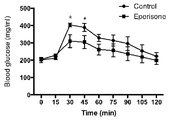
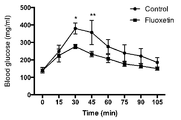
- FIG. The results of examining glucose tolerance by administering eperisone to pancreatic ⁇ -cell specific Cdkal1-deficient mice for a long period (14 days), injecting glucose solution, and measuring blood glucose level and blood insulin concentration over time. It is a figure.
- R 1 in the above general formula (I) is hydrogen, a substituted or unsubstituted linear or branched alkyl group having 1 to 4 carbon atoms, a substituted or unsubstituted linear or branched carbon group having 2 to 4 carbon atoms. It is a group selected from any one of an alkenyl group and a substituted or unsubstituted linear or branched alkynyl group having 2 to 4 carbon atoms.
- linear or branched alkyl group having 1 to 4 carbon atoms represented by R 1 include a methyl group, an ethyl group, a propyl group, an isopropyl group, an n-butyl group, an isobutyl group, Mention may be made of a sec-butyl group and a tert-butyl group.
- linear or branched alkenyl group having 2 to 4 carbon atoms represented by R 1 include a vinyl group, a 1-propenyl group, an allyl group, an isopropenyl group, and a 1-butenyl group.
- 2-butenyl group, 3-butenyl group, 1,3-dibutenyl group, 1-ethylvinyl group, 1-methyl-1-propenyl group, 2-methyl-1-propenyl group, and 2-methyl-2-propenyl group Can be mentioned.
- linear or branched alkynyl group having 2 to 4 carbon atoms represented by R 1 include ethynyl group, 1-propynyl group, 2-propynyl group, 1-butynyl group, 2- Mention may be made of a butynyl group, a 3-butynyl group, a 1,3-dibutynyl group and a 1-methyl-2-propynyl group.
- the linear or branched alkyl group having 1 to 4 carbon atoms, the linear or branched alkenyl group having 2 to 4 carbon atoms, and the linear or branched alkynyl group having 2 to 4 carbon atoms are substituted.
- the substituent include halogen such as fluorine, chlorine, bromine and iodine, and a hydroxyl group.
- R 1 may be any of the aforementioned groups, but is preferably hydrogen, a methyl group, an ethyl group, a vinyl group, and an ethynyl group, more preferably a hydrogen, a methyl group, and an ethynyl group. Yes, most preferably hydrogen.
- R 2 in the above general formula (I) is hydrogen, halogen, hydroxyl group, substituted or unsubstituted linear or branched alkyl group having 1 to 10 carbon atoms, substituted or unsubstituted linear or branched carbon number
- linear or branched alkyl group having 1 to 10 carbon atoms represented by R 2 include a methyl group, an ethyl group, a propyl group, an isopropyl group, an n-butyl group, an isobutyl group, sec-butyl group, tert-butyl group, n-pentyl group, 1-methylbutyl group, 2-methylbutyl group, 3-methylbutyl group, 1,1-dimethylpropyl group, 1,2-dimethylpropyl group, 2,2- Dimethylpropyl group, 3-pentyl group, n-hexyl group, 1-methylheptyl group, 2-methylheptyl group, 3-methylheptyl group, 4-methylheptyl group, 1,1-dimethylbutyl group, 1,2- Dimethylbutyl group, 1,3-dimethylbutyl group, 2,2-dimethylbutyl group, 2,3-dimethylbutyl group, 3,3-dimethylbut
- linear or branched alkenyl group having 2 to 10 carbon atoms represented by R 2 include a vinyl group, a 1-propenyl group, an allyl group, an isopropenyl group, and a 1-butenyl group.
- straight chain or branched alkynyl group having 2 to 10 carbon atoms represented by R 2 include ethynyl group, 1-propynyl group, 2-propynyl group, 1-butynyl group, 2- Butynyl group, 3-butynyl group, 1,3-butanediynyl group, 1-methyl-2-propynyl group, pentynyl group, pentadiynyl group, hexynyl group, hexadiynyl group, hexatriynyl group, heptynyl group, heptadiynyl group, heptatriinyl group, Examples include octynyl group, octadiynyl group, octatriynyl group, octatetrinyl group, noninyl group, nonadiynyl group, nonatriynyl
- the linear or branched alkyl group having 1 to 10 carbon atoms, the linear or branched alkenyl group having 2 to 10 carbon atoms, and the linear or branched alkynyl group having 2 to 10 carbon atoms are substituted.
- the substituent include halogens such as fluorine, chlorine, bromine and iodine, hydroxyl groups, carboxyl groups or ester derivatives thereof, cyano groups, and alicyclic groups described later.
- alicyclic group having 3 to 10 carbon atoms represented by R 2 include a cyclopropyl group, a cyclopropenyl group, a cyclobutyl group, a cyclobutenyl group, a cyclobutadienyl group, a cyclopentyl group, a cyclopentyl group, and the like.
- the alicyclic group having 3 to 10 carbon atoms may be substituted.
- the substituent include halogens such as fluorine, chlorine, bromine and iodine, hydroxyl groups, and the aforementioned linear or branched carbon atoms having 1 to 4 carbon atoms.
- examples thereof include an alkyl group, a linear or branched alkenyl group having 2 to 4 carbon atoms, and a linear or branched alkynyl group having 2 to 4 carbon atoms.
- the alicyclic group having 3 to 10 carbon atoms may be condensed with an aryl group, a nitrogen-containing aromatic group, or a heterocyclic group.
- aryl group having 6 to 10 carbon atoms represented by R 2 include a phenyl group and a naphthyl group. These aryl groups may be substituted, and the substituent may be fluorine.
- Halogen such as chlorine, bromine, iodine, etc., a hydroxyl group, a linear or branched alkyl group having 1 to 4 carbon atoms, a linear or branched alkenyl group having 2 to 4 carbon atoms, a linear or branched group, Examples thereof include alkynyl groups having 2 to 4 carbon atoms.
- the aryl group having 6 to 10 carbon atoms may be condensed with an alicyclic group, a nitrogen-containing aromatic group or a heterocyclic group.
- the alkoxy group having 1 to 10 carbon atoms represented by R 2 is a linear or branched alkyl group having 1 to 10 carbon atoms, a linear or branched alkenyl group having 2 to 10 carbon atoms, Examples thereof include a straight chain or branched alkynyl group having 2 to 10 carbon atoms, an alicyclic group having 3 to 10 carbon atoms, an aryl group having 6 to 10 carbon atoms and the like bonded via an oxygen atom.
- the alkoxy group having 1 to 10 carbon atoms may be substituted with a halogen such as fluorine, chlorine, bromine or iodine, a hydroxyl group or the like.
- the acyl group having 1 to 11 carbon atoms represented by R 2 is hydrogen, the above-mentioned linear or branched alkyl group having 1 to 10 carbon atoms, or the linear or branched alkenyl group having 2 to 10 carbon atoms. And groups in which a straight-chain or branched alkynyl group having 2 to 10 carbon atoms, an alicyclic group having 3 to 10 carbon atoms, an aryl group having 6 to 10 carbon atoms and the like are bonded via a carbonyl group. .
- the acyl group having 1 to 11 carbon atoms may be substituted with a halogen such as fluorine, chlorine, bromine or iodine, a hydroxyl group or the like.
- the hydrogen of the carboxyl group is the aforementioned linear or branched alkyl group having 1 to 10 carbon atoms, linear or branched carbon number of 2 to 10 And a straight or branched alkynyl group having 2 to 10 carbon atoms, an alicyclic group having 3 to 10 carbon atoms, an aryl group having 6 to 10 carbon atoms, and the like.
- the ester derivative may be substituted, and examples of the substituent include halogens such as fluorine, chlorine, bromine and iodine, and hydroxyl groups.
- Examples of the amide derivative of the carboxyl group represented by R 2 include the above-described linear or branched alkyl group having 1 to 10 carbon atoms, linear or branched carbon, wherein the hydroxyl group of the carboxyl group is 1 or 2. Substituted with nitrogen bonded to an alkenyl group having 2 to 10 carbon atoms, a linear or branched alkynyl group having 2 to 10 carbon atoms, an alicyclic group having 3 to 10 carbon atoms, or an aryl group having 6 to 10 carbon atoms Can be mentioned.
- the amide derivative may be substituted, and examples of the substituent include halogen such as fluorine, chlorine, bromine and iodine, and a hydroxyl group.
- the sulfonyl group having 1 to 10 carbon atoms represented by R 2 is the above-mentioned linear or branched alkyl group having 1 to 10 carbon atoms, linear or branched alkenyl group having 2 to 10 carbon atoms, A group in which a linear or branched alkynyl group having 2 to 10 carbon atoms, an alicyclic group having 3 to 10 carbon atoms, an aryl group having 6 to 10 carbon atoms, or the like is bonded via a sulfonyl group (—SO 2 —) Can be mentioned.
- the sulfonyl group having 1 to 10 carbon atoms may be substituted with a halogen such as fluorine, chlorine, bromine or iodine, a hydroxyl group or the like.
- the sulfide group having 1 to 10 carbon atoms represented by R 2 is a linear or branched alkyl group having 1 to 10 carbon atoms, a linear or branched alkenyl group having 2 to 10 carbon atoms, Examples thereof include a straight chain or branched alkynyl group having 2 to 10 carbon atoms, an alicyclic group having 3 to 10 carbon atoms, an aryl group having 6 to 10 carbon atoms and the like bonded via a sulfur atom.
- the sulfide group having 1 to 10 carbon atoms may be substituted with a halogen such as fluorine, chlorine, bromine or iodine, a hydroxyl group or the like.
- R 2 may be any of the aforementioned groups, but is preferably hydrogen, fluorine, chlorine, bromine, hydroxyl group, ethyl group, vinyl group, ethynyl group, n-propyl group, isopropyl group, n-butyl.
- R 3 in the above general formula (I) is hydrogen, halogen, a substituted or unsubstituted straight chain or branched alkyl group having 1 to 4 carbon atoms, a substituted or unsubstituted straight chain or branched carbon number 2 to 4 alkenyl groups, substituted or unsubstituted linear or branched alkynyl groups having 2 to 4 carbon atoms, substituted or unsubstituted aryl groups having 6 to 10 carbon atoms, and substituted or unsubstituted linear or branched groups A group selected from any one of alkoxy groups having 1 to 4 carbon atoms.
- linear or branched alkyl group having 1 to 4 carbon atoms represented by R 3 include a methyl group, an ethyl group, a propyl group, an isopropyl group, an n-butyl group, an isobutyl group, Mention may be made of a sec-butyl group and a tert-butyl group.
- linear or branched alkenyl group having 2 to 4 carbon atoms represented by R 3 include a vinyl group, a 1-propenyl group, an allyl group, an isopropenyl group, and a 1-butenyl group.
- 2-butenyl group, 3-butenyl group, 1,3-dibutenyl group, 1-ethylvinyl group, 1-methyl-1-propenyl group, 2-methyl-1-propenyl group, and 2-methyl-2-propenyl group Can be mentioned.
- linear or branched alkynyl group having 2 to 4 carbon atoms represented by R 3 include ethynyl group, 1-propynyl group, 2-propynyl group, 1-butynyl group, 2- Mention may be made of a butynyl group, a 3-butynyl group, a 1,3-dibutynyl group, and a 1-methyl-2-propynyl group.
- the straight chain or branched alkyl group having 1 to 4 carbon atoms, the straight chain or branched chain alkenyl group having 2 to 4 carbon atoms, or the straight chain or branched chain alkyl group having 2 to 4 carbon atoms is substituted.
- the substituent include halogen such as fluorine, chlorine, bromine and iodine, and a hydroxyl group.
- aryl group having 6 to 10 carbon atoms represented by R 3 include a phenyl group and a naphthyl group. These aryl groups may be substituted, and the substituent may be fluorine. Halogen, hydroxyl group such as chlorine, bromine, iodine, etc., linear or branched alkyl group having 1 to 4 carbon atoms, linear or branched alkenyl group having 2 to 4 carbon atoms, linear or branched Examples thereof include an alkynyl group having 2 to 4 carbon atoms.
- the aryl group having 6 to 10 carbon atoms may be condensed with an alicyclic group, a nitrogen-containing aromatic group or a heterocyclic group.
- the linear or branched alkoxy group having 1 to 4 carbon atoms represented by R 3 is the above-mentioned linear or branched alkyl group having 1 to 4 carbon atoms, linear or branched carbon number 2 And a group in which a straight chain or branched alkynyl group having 2 to 4 carbon atoms or the like is bonded through an oxygen atom.
- These alkoxy groups may be substituted with a halogen such as fluorine, chlorine, bromine or iodine, a hydroxyl group or the like.
- R 3 may be any of the groups described above, but is preferably hydrogen, fluorine, chlorine, methyl group, ethyl group, vinyl group, ethynyl group, phenyl group, naphthyl group, methoxy group, and ethoxy group. More preferably, they are hydrogen, a fluorine, an ethyl group, a phenyl group, and a methoxy group, More preferably, they are a hydrogen, a fluorine, and a methoxy group.
- R 4 in the general formula (I) is selected from any one of hydrogen, a substituted or unsubstituted aryl group having 6 to 10 carbon atoms, and a substituted or unsubstituted aryloxy group having 6 to 10 carbon atoms. It is a group selected from any one of the groups, or a group that becomes a carbonyl group together with R 5 and the bonded carbon.
- aryl group having 6 to 10 carbon atoms represented by R 4 include a phenyl group and a naphthyl group. These aryl groups may be substituted, and the substituent may be fluorine. And a halogen such as chlorine, bromine and iodine, a hydroxyl group, and a linear or branched alkyl group having 1 to 4 carbon atoms which may be substituted with a halogen, a hydroxyl group, an amino group, a carboxyl group or the like. .
- the aryl group having 6 to 10 carbon atoms may be condensed with an alicyclic group, a nitrogen-containing aromatic group or a heterocyclic group.
- Examples of the aryloxy group having 6 to 10 carbon atoms represented by R 4 include a group in which the substituted or unsubstituted aryl group having 6 to 10 carbon atoms is bonded through an oxygen atom.
- R 4 may be any of the groups described above, but is preferably hydrogen, phenyl group, methylphenyl group, trifluoromethylphenyl group, phenoxy group, methylphenoxy group, or trifluoromethylphenoxy group. More preferably hydrogen, a methylphenoxy group, and a trifluoromethylphenoxy group, and still more preferably hydrogen and a trifluoromethylphenoxy group.
- R 4 may be a carbonyl group together with R 5 and bonded carbon.
- R 5 in the general formula (I) is hydrogen or a group that forms a carbonyl group together with R 4 and bonded carbon.
- R 6 in the above general formula (I) is hydrogen, halogen, a substituted or unsubstituted linear or branched alkyl group having 1 to 6 carbon atoms, a substituted or unsubstituted linear or branched carbon number of 2 to 6 alkenyl groups, substituted or unsubstituted linear or branched alkynyl groups having 2 to 6 carbon atoms, substituted or unsubstituted alicyclic groups having 3 to 6 carbon atoms, substituted or unsubstituted linear or branched Branched alkyloxycarbonyl group having 1 to 4 carbon atoms, substituted or unsubstituted straight chain or branched alkenyloxycarbonyl group having 2 to 4 carbon atoms, substituted or unsubstituted straight chain or branched carbon number 2 to 4 alkynyloxycarbonyl groups, substituted or unsubstituted aryl groups having 6 to 10 carbon atoms, carboxyl groups, ester derivative
- linear or branched alkyl group having 1 to 6 carbon atoms represented by R 6 include a methyl group, an ethyl group, a propyl group, an isopropyl group, an n-butyl group, an isobutyl group, sec-butyl group, tert-butyl group, n-pentyl group, 1-methylbutyl group, 2-methylbutyl group, 3-methylbutyl group, 1,1-dimethylpropyl group, 1,2-dimethylpropyl group, 2,2- Dimethylpropyl group, 3-pentyl group, n-hexyl group, 1-methylheptyl group, 2-methylheptyl group, 3-methylheptyl group, 4-methylheptyl group, 1,1-dimethylbutyl group, 1,2- Dimethylbutyl group, 1,3-dimethylbutyl group, 2,2-dimethylbutyl group, 2,3-dimethylbutyl group, 3,3-dimethylbut
- linear or branched alkenyl group having 2 to 6 carbon atoms represented by R 6 include a vinyl group, a 1-propenyl group, an allyl group, an isopropenyl group, and a 1-butenyl group.
- straight chain or branched alkynyl group having 2 to 6 carbon atoms represented by R 6 include ethynyl group, 1-propynyl group, 2-propynyl group, 1-butynyl group, 2- Examples thereof include a butynyl group, a 3-butynyl group, a 1,3-butanediynyl group, a 1-methyl-2-propynyl group, a pentynyl group, a pentadiynyl group, a hexynyl group, a hexadiynyl group, and a hexatriynyl group.
- the linear or branched alkyl group having 1 to 6 carbon atoms, the linear or branched alkenyl group having 2 to 6 carbon atoms, and the linear or branched alkynyl group having 2 to 6 carbon atoms are substituted.
- the substituent include halogens such as fluorine, chlorine, bromine and iodine, hydroxyl groups, carboxyl groups or ester derivatives thereof, cyano groups, alicyclic groups, nitrogen-containing heterocyclic groups, and the like.
- alicyclic group having 3 to 6 carbon atoms represented by R 6 include a cyclopropyl group, a cyclopropenyl group, a cyclobutyl group, a cyclobutenyl group, a cyclobutadienyl group, a cyclopentyl group, a cyclopentyl group, and the like. Examples thereof include a pentenyl group, a cyclopentadienyl group, a cyclohexyl group, a cyclohexenyl group, and a cyclohexadienyl group. These alicyclic groups may be substituted.
- substituents include halogens such as fluorine, chlorine, bromine and iodine, hydroxyl groups, linear or branched alkyl groups having 1 to 4 carbon atoms, linear or branched groups. Examples thereof include a branched alkenyl group having 2 to 4 carbon atoms and a straight chain or branched alkynyl group having 2 to 4 carbon atoms.
- the alicyclic group may be condensed with an aryl group, a nitrogen-containing aromatic group, or a heterocyclic group.
- linear or branched alkyloxycarbonyl group having 1 to 4 carbon atoms represented by R 6 include a methoxycarbonyl group, an ethoxycarbonyl group, a propyloxycarbonyl group, an isopropyloxycarbonyl group, Examples thereof include n-butoxycarbonyl group, isobutoxycarbonyl group, sec-butoxycarbonyl group, and tert-butoxycarbonyl group.
- straight-chain or branched alkenyloxycarbonyl group represented by R 6 include a vinyloxycarbonyl group, 1-propenyloxycarbonyl group, allyloxycarbonyl group, isopropyl Penyloxycarbonyl group, 1-butenyloxycarbonyl group, 2-butenyloxycarbonyl group, 3-butenyloxycarbonyl group, 1,3-dibutenyloxycarbonyl group, 1-ethylvinyloxycarbonyl group, 1- Mention may be made of a methyl-1-propenyloxycarbonyl group, a 2-methyl-1-propenyloxycarbonyl group and a 2-methyl-2-propenyloxycarbonyl group.
- linear or branched alkynyloxycarbonyl group represented by R 6 having 2 to 4 carbon atoms include ethynyloxycarbonyl group, 1-propynyloxycarbonyl group, and 2-propynyloxycarbonyl group.
- 1-butynyloxycarbonyl group, 2-butynyloxycarbonyl group, 3-butynyloxycarbonyl group, 1,3-butanediynyloxycarbonyl group, and 1-methyl-2-propynyloxycarbonyl group Can do.
- the linear or branched alkyloxycarbonyl group, the linear or branched alkenyloxycarbonyl group, and the linear or branched alkynyloxycarbonyl group may be substituted, and examples of the substituent include fluorine, chlorine, Examples thereof include halogens such as bromine and iodine, hydroxyl groups, and cyano groups.
- aryl group having 6 to 10 carbon atoms represented by R 6 include a phenyl group and a naphthyl group. These aryl groups may be substituted, and the substituent may be fluorine.
- Halogen such as chlorine, bromine, iodine, etc., a hydroxyl group, a linear or branched alkyl group having 1 to 4 carbon atoms, a linear or branched alkenyl group having 2 to 4 carbon atoms, a linear or branched group, Examples thereof include alkynyl groups having 2 to 4 carbon atoms.
- the aryl group may be condensed with an alicyclic group, a nitrogen-containing aromatic group, or a heterocyclic group.
- ester derivative of the carboxyl group represented by R 6 examples include those in which hydrogen of the carboxyl group is substituted with an alicyclic group having 3 to 6 carbon atoms, an aryl group having 6 to 10 carbon atoms, or the like. it can. These ester derivatives may be substituted, and examples of the substituent include halogens such as fluorine, chlorine, bromine and iodine, and hydroxyl groups.
- Examples of the amide derivative of the carboxyl group represented by R 6 include the above-described linear or branched alkyl group having 1 to 6 carbon atoms, linear or branched carbon, wherein the hydroxyl group of the carboxyl group is 1 or 2. Examples thereof include those substituted with nitrogen bonded to an alkenyl group having 2 to 6 carbon atoms, a linear or branched alkynyl group having 2 to 6 carbon atoms, and an alicyclic group having 3 to 6 carbon atoms. These amide derivatives may be substituted, and examples of the substituent include halogens such as fluorine, chlorine, bromine and iodine, hydroxyl groups and the like.
- the amino group represented by R 6 includes an amino group, and 1 or 2 hydrogens on the amino group are 1 or 2 linear or branched alkyl groups having 1 to 6 carbon atoms, Examples thereof include a chain or branched alkenyl group having 2 to 6 carbon atoms and a straight chain or branched alkynyl group having 2 to 6 carbon atoms.
- These substituted amino groups may be further substituted, and examples of the substituent include halogens such as fluorine, chlorine, bromine and iodine, hydroxyl groups and the like.
- R 6 may be any of the aforementioned groups, but is preferably hydrogen, fluorine, chlorine, bromine, iodine, methyl group, ethyl group, vinyl group, ethynyl group, n-propyl group, isopropyl group.
- N-butyl group isobutyl group, sec-butyl group, tert-butyl group, n-pentyl group, n-hexyl group, hydroxymethyl group, carboxylmethyl group, cyclopentylmethyl group, cyclohexylmethyl group, piperidinomethyl group, methylpi Peridinomethyl group, methoxycarbonyl group, ethoxycarbonyl group, phenyl group, tolyl group, hydroxyphenyl group, naphthyl group, carboxyl group, cyano group, amino group, dimethylamino group, and diethylamino group, more preferably hydrogen, Fluorine, methyl group, ethyl group, n-propyl group, isopropyl Group, n-butyl group, n-pentyl group, n-hexyl group, hydroxymethyl group, carboxylmethyl group, cyclopentylmethyl group, piperidinomethyl group,
- R 7 in the above general formula (I) is hydrogen, a substituted or unsubstituted straight chain or branched alkyl group having 1 to 4 carbon atoms, a substituted or unsubstituted straight chain or branched chain alkenyl having 2 to 4 carbon atoms. And a group selected from any one of a group and a substituted or unsubstituted linear or branched alkynyl group having 2 to 4 carbon atoms.
- linear or branched alkyl group having 1 to 4 carbon atoms represented by R 7 include a methyl group, an ethyl group, a propyl group, an isopropyl group, an n-butyl group, an isobutyl group, Mention may be made of sec-butyl group and tert-butyl group.
- linear or branched alkenyl group having 2 to 4 carbon atoms represented by R 7 include a vinyl group, a 1-propenyl group, an allyl group, an isopropenyl group, and a 1-butenyl group.
- 2-butenyl group, 3-butenyl group, 1,3-dibutenyl group, 1-ethylvinyl group, 1-methyl-1-propenyl group, 2-methyl-1-propenyl group, and 2-methyl-2-propenyl group Can be mentioned.
- linear or branched alkynyl group having 2 to 4 carbon atoms represented by R 7 include ethynyl group, 1-propynyl group, 2-propynyl group, 1-butynyl group, 2- Mention may be made of a butynyl group, a 3-butynyl group, a 1,3-dibutynyl group and a 1-methyl-2-propynyl group.
- the linear or branched alkyl group having 1 to 4 carbon atoms, the linear or branched alkenyl group having 2 to 4 carbon atoms, and the linear or branched alkynyl group having 2 to 4 carbon atoms are substituted.
- the substituent include halogen such as fluorine, chlorine, bromine and iodine, and a hydroxyl group.
- R 7 may be any of the aforementioned groups, but is preferably hydrogen, a methyl group, an ethyl group, a vinyl group, and an ethynyl group, more preferably a hydrogen, a methyl group, and an ethynyl group. Yes, most preferably hydrogen.
- R 8 in the above general formula (I) is hydrogen, halogen, a substituted or unsubstituted straight chain or branched alkyl group having 1 to 6 carbon atoms, a substituted or unsubstituted straight chain or branched carbon number 2 to 6 alkenyl groups, substituted or unsubstituted linear or branched alkynyl groups having 2 to 6 carbon atoms, substituted or unsubstituted alicyclic groups having 3 to 6 carbon atoms, substituted or unsubstituted linear or branched Branched alkyloxycarbonyl group having 1 to 4 carbon atoms, substituted or unsubstituted straight chain or branched alkenyloxycarbonyl group having 2 to 4 carbon atoms, substituted or unsubstituted straight chain or branched carbon number 2 to 4 alkynyloxycarbonyl groups, substituted or unsubstituted aryl groups having 6 to 10 carbon atoms, carboxyl groups, ester
- linear or branched alkyl group having 1 to 6 carbon atoms represented by R 8 include a methyl group, an ethyl group, a propyl group, an isopropyl group, an n-butyl group, an isobutyl group, sec-butyl group, tert-butyl group, n-pentyl group, 1-methylbutyl group, 2-methylbutyl group, 3-methylbutyl group, 1,1-dimethylpropyl group, 1,2-dimethylpropyl group, 2,2- Dimethylpropyl group, 3-pentyl group, n-hexyl group, 1-methylheptyl group, 2-methylheptyl group, 3-methylheptyl group, 4-methylheptyl group, 1,1-dimethylbutyl group, 1,2- Dimethylbutyl group, 1,3-dimethylbutyl group, 2,2-dimethylbutyl group, 2,3-dimethylbutyl group, 3,3-dimethylbut
- linear or branched alkenyl group having 2 to 6 carbon atoms represented by R 8 include a vinyl group, a 1-propenyl group, an allyl group, an isopropenyl group, and a 1-butenyl group.
- linear or branched alkynyl group having 2 to 6 carbon atoms represented by R 8 include ethynyl group, 1-propynyl group, 2-propynyl group, 1-butynyl group, 2- Examples thereof include a butynyl group, a 3-butynyl group, a 1,3-butanediynyl group, a 1-methyl-2-propynyl group, a pentynyl group, a pentadiynyl group, a hexynyl group, a hexadiynyl group, and a hexatriynyl group.
- the linear or branched alkyl group having 1 to 6 carbon atoms, the linear or branched alkenyl group having 2 to 6 carbon atoms, and the linear or branched alkynyl group having 2 to 6 carbon atoms are substituted.
- the substituent include halogens such as fluorine, chlorine, bromine and iodine, hydroxyl groups, carboxyl groups or ester derivatives thereof, cyano groups, alicyclic groups, nitrogen-containing heterocyclic groups, and the like.
- alicyclic group having 3 to 6 carbon atoms represented by R 8 include a cyclopropyl group, a cyclopropenyl group, a cyclobutyl group, a cyclobutenyl group, a cyclobutadienyl group, a cyclopentyl group, a cyclopentyl group, and the like. Examples thereof include a pentenyl group, a cyclopentadienyl group, a cyclohexyl group, a cyclohexenyl group, and a cyclohexadienyl group. These alicyclic groups may be substituted.
- substituents include halogens such as fluorine, chlorine, bromine and iodine, hydroxyl groups, linear or branched alkyl groups having 1 to 4 carbon atoms, linear or branched groups. Examples thereof include a branched alkenyl group having 2 to 4 carbon atoms and a straight chain or branched alkynyl group having 2 to 4 carbon atoms.
- the alicyclic group may be condensed with an aryl group, a nitrogen-containing aromatic group, or a heterocyclic group.
- linear or branched alkyloxycarbonyl group having 1 to 4 carbon atoms represented by R 8 include a methoxycarbonyl group, an ethoxycarbonyl group, a propyloxycarbonyl group, an isopropyloxycarbonyl group, Examples thereof include an n-butoxycarbonyl group, an isobutoxycarbonyl group, a sec-butoxycarbonyl group, and a tert-butoxycarbonyl group.
- straight-chain or branched alkenyloxycarbonyl group represented by R 8 include a vinyloxycarbonyl group, 1-propenyloxycarbonyl group, allyloxycarbonyl group, isopropyl Penyloxycarbonyl group, 1-butenyloxycarbonyl group, 2-butenyloxycarbonyl group, 3-butenyloxycarbonyl group, 1,3-dibutenyloxycarbonyl group, 1-ethylvinyloxycarbonyl group, 1- Mention may be made of a methyl-1-propenyloxycarbonyl group, a 2-methyl-1-propenyloxycarbonyl group and a 2-methyl-2-propenyloxycarbonyl group.
- linear or branched alkynyloxycarbonyl group represented by R 8 having 2 to 4 carbon atoms include ethynyloxycarbonyl group, 1-propynyloxycarbonyl group, and 2-propynyloxycarbonyl group.
- 1-butynyloxycarbonyl group, 2-butynyloxycarbonyl group, 3-butynyloxycarbonyl group, 1,3-butanediynyloxycarbonyl group, and 1-methyl-2-propynyloxycarbonyl group Can do.
- the linear or branched alkyloxycarbonyl group, the linear or branched alkenyloxycarbonyl group, and the linear or branched alkynyloxycarbonyl group may be substituted, and examples of the substituent include fluorine, chlorine, Examples thereof include halogens such as bromine and iodine, hydroxyl groups, and cyano groups.
- aryl group having 6 to 10 carbon atoms represented by R 8 include a phenyl group and a naphthyl group. These aryl groups may be substituted, and the substituent may be fluorine.
- Halogen such as chlorine, bromine, iodine, etc., a hydroxyl group, a linear or branched alkyl group having 1 to 4 carbon atoms, a linear or branched alkenyl group having 2 to 4 carbon atoms, a linear or branched group, An alkynyl group having 2 to 4 carbon atoms, an alkoxy group in which the above linear or branched alkyl group having 1 to 4 carbon atoms is substituted via an oxygen atom, and the above linear or branched carbon group having 1 to 4 carbon atoms Examples thereof include a sulfide group in which an alkyl group is substituted via a sulfur atom.
- the aryl group may be condensed with an alicyclic group, a nitrogen-containing aromatic
- ester derivative of the carboxyl group represented by R 8 examples include those in which hydrogen of the carboxyl group is substituted with an alicyclic group having 3 to 6 carbon atoms, an aryl group having 6 to 10 carbon atoms, or the like. it can. These ester derivatives may be substituted, and examples of the substituent include halogens such as fluorine, chlorine, bromine and iodine, and hydroxyl groups.
- Examples of the amide derivative of the carboxyl group represented by R 8 include the above-described linear or branched alkyl group having 1 to 6 carbon atoms, linear or branched carbon, wherein the hydroxyl group of the carboxyl group is 1 or 2. Substitution with nitrogen bonded to alkenyl group of 2-6, straight chain or branched alkynyl group of 2-6 carbon atoms, alicyclic group of 3-6 carbon atoms, aryl group of 6-10 carbon atoms, etc. Things can be mentioned. These amide derivatives may be substituted, and examples of the substituent include halogens such as fluorine, chlorine, bromine and iodine, hydroxyl groups and the like.
- the amino group represented by R 8 includes an amino group and 1 or 2 hydrogen on the amino group, 1 or 2 of the above-mentioned linear or branched alkyl group having 1 to 6 carbon atoms, Examples thereof include those substituted with a chain or branched alkenyl group having 2 to 6 carbon atoms and a linear or branched alkynyl group having 2 to 6 carbon atoms. These substituted amino groups may be further substituted, and examples of the substituent include halogens such as fluorine, chlorine, bromine and iodine, hydroxyl groups and the like.
- R 8 may be any of the aforementioned groups, but is preferably hydrogen, fluorine, chlorine, bromine, iodine, methyl group, ethyl group, vinyl group, ethynyl group, hydroxymethyl group, carboxylmethyl group , Cyclopentylmethyl group, cyclohexylmethyl group, piperidinomethyl group, methylpiperidinomethyl group, methoxycarbonyl group, ethoxycarbonyl group, phenyl group, tolyl group, ethylphenyl group, hydroxyphenyl group, methoxyphenyl group, dimethoxyphenyl group, ethoxy Phenyl group, fluorophenyl group, chlorophenyl group, methylthiophenyl group, ethylthiophenyl group, naphthyl group, carboxyl group, cyano group, amino group, dimethylamino group, and diethylamino group, more preferably hydrogen, fluor
- R 9 in the general formula (I) is hydrogen or a group that forms a carbonyl group together with R 8 and bonded carbon.
- R 10 in the general formula (I) is hydrogen, a substituted or unsubstituted straight chain or branched alkyl group having 1 to 6 carbon atoms, a substituted or unsubstituted straight chain or branched chain group having 2 to 6 carbon atoms.
- linear or branched alkyl group having 1 to 6 carbon atoms represented by R 10 include a methyl group, an ethyl group, a propyl group, an isopropyl group, an n-butyl group, an isobutyl group, sec-butyl group, tert-butyl group, n-pentyl group, 1-methylbutyl group, 2-methylbutyl group, 3-methylbutyl group, 1,1-dimethylpropyl group, 1,2-dimethylpropyl group, 2,2- Dimethylpropyl group, 3-pentyl group, n-hexyl group, 1-methylheptyl group, 2-methylheptyl group, 3-methylheptyl group, 4-methylheptyl group, 1,1-dimethylbutyl group, 1,2- Dimethylbutyl group, 1,3-dimethylbutyl group, 2,2-dimethylbutyl group, 2,3-dimethylbutyl group, 3,3-dimethylbut
- linear or branched alkenyl group having 2 to 6 carbon atoms represented by R 10 include a vinyl group, a 1-propenyl group, an allyl group, an isopropenyl group, and a 1-butenyl group.
- linear or branched alkynyl group having 2 to 6 carbon atoms represented by R 10 include ethynyl group, 1-propynyl group, 2-propynyl group, 1-butynyl group, 2- Examples thereof include a butynyl group, a 3-butynyl group, a 1,3-butanediynyl group, a 1-methyl-2-propynyl group, a pentynyl group, a pentadiynyl group, a hexynyl group, a hexadiynyl group, and a hexatriynyl group.
- the linear or branched alkyl group having 1 to 6 carbon atoms, the linear or branched alkenyl group having 2 to 6 carbon atoms, and the linear or branched alkynyl group having 2 to 6 carbon atoms are substituted.
- the substituent may be a halogen such as fluorine, chlorine, bromine or iodine, a hydroxyl group, a substituted or unsubstituted aryl group having 5 to 10 carbon atoms described later, a carboxyl group or an ester derivative thereof, a cyano group, an alicyclic group. Groups, nitrogen-containing heterocyclic groups, and the like.
- alicyclic group having 3 to 6 carbon atoms represented by R 10 include a cyclopropyl group, a cyclopropenyl group, a cyclobutyl group, a cyclobutenyl group, a cyclobutadienyl group, a cyclopentyl group, a cyclopentyl group, and the like. Examples thereof include a pentenyl group, a cyclopentadienyl group, a cyclohexyl group, a cyclohexenyl group, and a cyclohexadienyl group. These alicyclic groups may be substituted.
- substituents include halogens such as fluorine, chlorine, bromine and iodine, hydroxyl groups, linear or branched alkyl groups having 1 to 4 carbon atoms, linear or branched groups. Examples thereof include a branched alkenyl group having 2 to 4 carbon atoms and a straight chain or branched alkynyl group having 2 to 4 carbon atoms.
- the alicyclic group may be condensed with an aryl group, a nitrogen-containing aromatic group, or a heterocyclic group.
- linear or branched alkyloxycarbonyl group having 1 to 6 carbon atoms represented by R 10 include a methoxycarbonyl group, an ethoxycarbonyl group, a propyloxycarbonyl group, an isopropyloxycarbonyl group, Examples thereof include an n-butoxycarbonyl group, an isobutoxycarbonyl group, a sec-butoxycarbonyl group, and a tert-butoxycarbonyl group.
- straight-chain or branched alkenyloxycarbonyl group represented by R 10 include a vinyloxycarbonyl group, 1-propenyloxycarbonyl group, allyloxycarbonyl group, isopropyl Penyloxycarbonyl group, 1-butenyloxycarbonyl group, 2-butenyloxycarbonyl group, 3-butenyloxycarbonyl group, 1,3-dibutenyloxycarbonyl group, 1-ethylvinyloxycarbonyl group, 1- Examples thereof include a methyl-1-propenyloxycarbonyl group, a 2-methyl-1-propenyloxycarbonyl group, and a 2-methyl-2-propenyloxycarbonyl group.
- straight-chain or branched alkynyloxycarbonyl group represented by R 10 include ethynyloxycarbonyl group, 1-propynyloxycarbonyl group, and 2-propynyloxycarbonyl group.
- the carbonic acid amide structure may be substituted, and examples of the substituent include halogens such as fluorine, chlorine, bromine, and iodine, hydroxyl groups, and cyano groups.
- aryl group having 5 to 10 carbon atoms represented by R 10 include a phenyl group, a pyridyl group, an indolyl group, a quinolyl group, an isoquinolyl group, a naphthyl group, and the like.
- the substituent may be a halogen such as fluorine, chlorine, bromine or iodine, a hydroxyl group, the aforementioned linear or branched alkyl group having 1 to 6 carbon atoms, a linear or branched carbon number of 2 -6 alkenyl group, linear or branched alkynyl group having 2 to 6 carbon atoms, alkoxy group in which the above linear or branched alkyl group having 1 to 6 carbon atoms is substituted via an oxygen atom, Examples thereof include a straight-chain or branched alkyloxycarbonyl group having 1 to 6 carbon atoms and a sulfide group in which the above-mentioned straight or branched alkyl group having 1 to 6 carbon atoms is substituted via a sulfur atom.
- the aryl group may be condensed with an alicyclic group or a heterocyclic group.
- ester derivative of the carboxyl group represented by R 10 examples include those substituted with an alicyclic group having 3 to 6 carbon atoms, an aryl group having 5 to 10 carbon atoms and the like. These ester derivatives form a carbonic acid amide structure with the bonded nitrogen atom.
- the carbonic acid amide structure may be substituted, and examples of the substituent include halogens such as fluorine, chlorine, bromine and iodine, and hydroxyl groups.
- Examples of the amide derivative of the carboxyl group represented by R 10 include a hydroxyl group of the carboxyl group having 1 or 2 of the above-mentioned linear or branched alkyl group having 1 to 6 carbon atoms, linear or branched carbon. Substituted with nitrogen bonded to an alkenyl group having 2 to 6 carbon atoms, a linear or branched alkynyl group having 2 to 6 carbon atoms, an alicyclic group having 3 to 6 carbon atoms, an aryl group having 5 to 10 carbon atoms, or the like. Things can be mentioned. These amide derivatives form a urea structure with the bonded nitrogen atom. The urea structure may be substituted, and examples of the substituent include halogens such as fluorine, chlorine, bromine and iodine, and hydroxyl groups.
- the amino group represented by R 10 includes an amino group and 1 or 2 hydrogens on the amino group, 1 or 2 of the above-mentioned linear or branched alkyl group having 1 to 6 carbon atoms, Examples thereof include a chain or branched alkenyl group having 2 to 6 carbon atoms and a straight chain or branched alkynyl group having 2 to 6 carbon atoms.
- These substituted amino groups may be further substituted, and examples of the substituent include halogens such as fluorine, chlorine, bromine and iodine, hydroxyl groups and the like.
- R 10 may be any of the aforementioned groups, but is preferably hydrogen, methyl group, ethyl group, n-propyl group, isopropyl group, cyclopentyl group, cyclohexyl group, phenyl group, phenylmethyl group, Fluorophenyl group, chlorophenyl group, bromophenyl group, difluorophenyl group, dichlorophenyl group, dibromophenyl group, methylphenyl group, ethylphenyl group, n-propylphenyl group, isopropylphenyl group, methoxyphenyl group, ethoxyphenyl group, n- Propylphenyl group, isopropylphenyl group, fluorophenylmethyl group, chlorophenylmethyl group, bromophenylmethyl group, methoxyphenylmethyl group, ethoxyphenylmethyl group, n-propylphenylmethyl
- R 10 may be a substituted or unsubstituted nitrogen-containing heterocycle together with R 11 and the bonded nitrogen atom.
- R 11 in the general formula (I) is hydrogen, a substituted or unsubstituted straight chain or branched alkyl group having 1 to 6 carbon atoms, a substituted or unsubstituted straight chain or branched chain having 2 to 6 carbon atoms. Any one selected from an alkenyl group, a substituted or unsubstituted linear or branched alkynyl group having 2 to 6 carbon atoms, and a substituted or unsubstituted alicyclic group having 3 to 6 carbon atoms Or a group that forms a substituted or unsubstituted nitrogen-containing heterocycle together with R 10 and the bonded nitrogen atom.
- linear or branched alkyl group having 1 to 6 carbon atoms represented by R 11 include a methyl group, an ethyl group, a propyl group, an isopropyl group, an n-butyl group, an isobutyl group, sec-butyl group, tert-butyl group, n-pentyl group, 1-methylbutyl group, 2-methylbutyl group, 3-methylbutyl group, 1,1-dimethylpropyl group, 1,2-dimethylpropyl group, 2,2- Dimethylpropyl group, 3-pentyl group, n-hexyl group, 1-methylheptyl group, 2-methylheptyl group, 3-methylheptyl group, 4-methylheptyl group, 1,1-dimethylbutyl group, 1,2- Dimethylbutyl group, 1,3-dimethylbutyl group, 2,2-dimethylbutyl group, 2,3-dimethylbutyl group, 3,3-dimethylbut
- linear or branched alkenyl group having 2 to 6 carbon atoms represented by R 11 include a vinyl group, a 1-propenyl group, an allyl group, an isopropenyl group, and a 1-butenyl group.
- linear or branched alkynyl group having 2 to 6 carbon atoms represented by R 11 include ethynyl group, 1-propynyl group, 2-propynyl group, 1-butynyl group, 2- Examples thereof include a butynyl group, a 3-butynyl group, a 1,3-butanediynyl group, a 1-methyl-2-propynyl group, a pentynyl group, a pentadiynyl group, a hexynyl group, a hexadiynyl group, and a hexatriynyl group.
- the linear or branched alkyl group having 1 to 6 carbon atoms, the linear or branched alkenyl group having 2 to 6 carbon atoms, and the linear or branched alkynyl group having 2 to 6 carbon atoms are substituted.
- the substituent include halogens such as fluorine, chlorine, bromine and iodine, hydroxyl groups, carboxyl groups or ester derivatives thereof, cyano groups, alicyclic groups, nitrogen-containing heterocyclic groups, and the like.
- alicyclic group having 3 to 6 carbon atoms represented by R 11 include a cyclopropyl group, a cyclopropenyl group, a cyclobutyl group, a cyclobutenyl group, a cyclobutadienyl group, a cyclopentyl group, a cyclopentyl group, and the like. Examples thereof include a pentenyl group, a cyclopentadienyl group, a cyclohexyl group, a cyclohexenyl group, and a cyclohexadienyl group. These alicyclic groups may be substituted.
- substituents include halogens such as fluorine, chlorine, bromine and iodine, hydroxyl groups, linear or branched alkyl groups having 1 to 4 carbon atoms, linear or branched groups. Examples thereof include a branched alkenyl group having 2 to 4 carbon atoms and a straight chain or branched alkynyl group having 2 to 4 carbon atoms.
- the alicyclic group may be condensed with an aryl group, a nitrogen-containing aromatic group, or a heterocyclic group.
- R 11 may be any of the aforementioned groups, but is preferably hydrogen, methyl group, ethyl group, n-propyl group, isopropyl group, vinyl group, 1-propenyl group, allyl group, ethynyl group.
- R 10 may be a substituted or unsubstituted nitrogen-containing heterocycle together with R 11 and the bonded nitrogen atom.
- nitrogen-containing heterocyclic ring formed together with the nitrogen atom to which R 10 and R 11 are bonded include pyrrolidine, pyrazolidine, imidazolidine, pyrrole, pyrazole, imidazole, oxazole, isoxazole, thiazole, and isothiazole.
- nitrogen-containing heterocycles may be substituted.
- substituents include halogens such as fluorine, chlorine, bromine and iodine, hydroxyl groups, linear or branched alkyl groups having 1 to 6 carbon atoms, linear or branched groups. Branched alkenyl group having 2 to 6 carbon atoms, straight chain or branched alkynyl group having 2 to 6 carbon atoms, substituted or unsubstituted aryl group having 6 to 10 carbon atoms, carboxyl group, and ester or amide derivatives thereof Or a cyano group, an amino group, and the like.
- the nitrogen-containing heterocycle may be further substituted with a nitrogen-containing heterocycle.
- the nitrogen-containing heterocyclic ring formed together with the nitrogen atom to which R 10 and R 11 are bonded may be any of the aforementioned groups, but preferably pyrrolidine, imidazolidine, pyrrole, imidazole, piperidine, 4-position And piperidine having a substituent at the 4-position, piperazine having a substituent at the 4-position, and morpholine, more preferably pyrrolidine, imidazole, piperidine, 4-position substituted with a substituted or unsubstituted alkyl group having 1 to 6 carbon atoms.
- the compound represented by the general formula (I) may be any compound as long as it satisfies the above-mentioned conditions. Specifically, the following compounds (I-1) to (I-61) Can be mentioned.
- the compound represented by the general formula (I) may be a compound represented by the following formula (IV).
- R 41 in the general formula (IV) is hydrogen, halogen, hydroxyl group, substituted or unsubstituted straight chain or branched alkyl group having 1 to 4 carbon atoms, substituted or unsubstituted straight chain or branched carbon number. Any of a 2 to 4 alkenyl group, a substituted or unsubstituted linear or branched alkynyl group having 2 to 4 carbon atoms, and a substituted or unsubstituted linear or branched alkoxy group having 1 to 4 carbon atoms It is a group selected from one.
- linear or branched alkyl group having 1 to 4 carbon atoms represented by R 41 include a methyl group, an ethyl group, a propyl group, an isopropyl group, an n-butyl group, an isobutyl group, Mention may be made of a sec-butyl group and a tert-butyl group.
- linear or branched alkenyl group having 2 to 4 carbon atoms represented by R 41 include a vinyl group, a 1-propenyl group, an allyl group, an isopropenyl group, and a 1-butenyl group.
- 2-butenyl group, 3-butenyl group, 1,3-dibutenyl group, 1-ethylvinyl group, 1-methyl-1-propenyl group, 2-methyl-1-propenyl group, and 2-methyl-2-propenyl group Can be mentioned.
- linear or branched alkynyl group having 2 to 4 carbon atoms represented by R 41 include ethynyl group, 1-propynyl group, 2-propynyl group, 1-butynyl group, 2- Mention may be made of a butynyl group, a 3-butynyl group, a 1,3-dibutynyl group and a 1-methyl-2-propynyl group.
- the linear or branched alkyl group having 1 to 4 carbon atoms, the linear or branched alkenyl group having 2 to 4 carbon atoms, and the linear or branched alkynyl group having 2 to 4 carbon atoms are substituted.
- the substituent include halogen such as fluorine, chlorine, bromine and iodine, and a hydroxyl group.
- Examples of the substituted or unsubstituted linear or branched alkoxy group having 1 to 4 carbon atoms represented by R 41 include the aforementioned substituted or unsubstituted linear or branched alkyl group having 1 to 4 carbon atoms.
- a group, a substituted or unsubstituted linear or branched alkenyl group having 2 to 4 carbon atoms, and a substituted or unsubstituted linear or branched alkynyl group having 2 to 4 carbon atoms are bonded via an oxygen atom. The group can be mentioned.
- R 41 may be any of the aforementioned groups, but is preferably hydrogen, fluorine, chlorine, methyl group, ethyl group, vinyl group, ethynyl group, methoxy group, and ethoxy group, more preferably Hydrogen, fluorine, ethyl group, and methoxy group are more preferable, and hydrogen, fluorine, and methoxy group are more preferable.
- R 42 in the general formula (IV) is hydrogen, halogen, hydroxyl group, substituted or unsubstituted straight chain or branched alkyl group having 1 to 4 carbon atoms, substituted or unsubstituted straight chain or branched carbon number. Any of a 2 to 4 alkenyl group, a substituted or unsubstituted linear or branched alkynyl group having 2 to 4 carbon atoms, and a substituted or unsubstituted linear or branched alkoxy group having 1 to 4 carbon atoms It is a group selected from one, and specific examples thereof include the same groups as R 41 described above.
- R 43 in the general formula (IV) is hydrogen, halogen, hydroxyl group, substituted or unsubstituted straight chain or branched alkyl group having 1 to 4 carbon atoms, substituted or unsubstituted straight chain or branched carbon number. Any of a 2 to 4 alkenyl group, a substituted or unsubstituted linear or branched alkynyl group having 2 to 4 carbon atoms, and a substituted or unsubstituted linear or branched alkoxy group having 1 to 4 carbon atoms It is a group selected from one, and specific examples thereof include the same groups as R 41 described above.
- R 44 in the general formula (IV) represents hydrogen, a carboxyl group, a substituted or unsubstituted linear or branched alkyl group having 1 to 4 carbon atoms, and a substituted or unsubstituted aryl group having 6 to 10 carbon atoms. It is group chosen from any one of these.
- linear or branched alkyl group having 1 to 4 carbon atoms represented by R 44 include a methyl group, an ethyl group, a propyl group, an isopropyl group, an n-butyl group, an isobutyl group, Mention may be made of a sec-butyl group and a tert-butyl group.
- These alkyl groups may be substituted, such as halogens such as fluorine, chlorine, bromine and iodine, hydroxyl groups, carboxyl groups or ester derivatives thereof, cyano groups, alicyclic groups, nitrogen-containing heterocyclic groups, etc. Can be mentioned.
- aryl group having 6 to 10 carbon atoms represented by R 44 include a phenyl group, a naphthyl group, and the like. These aryl groups may be substituted. Halogen, hydroxyl group such as chlorine, bromine, iodine, etc., linear or branched alkyl group having 1 to 4 carbon atoms, linear or branched alkenyl group having 2 to 4 carbon atoms, linear or branched An alkynyl group having 2 to 4 carbon atoms, an alkoxy group in which the above linear or branched alkyl group having 1 to 4 carbon atoms is substituted via an oxygen atom, and the above linear or branched carbon group having 1 to 4 carbon atoms Examples thereof include a sulfide group in which an alkyl group is substituted via a sulfur atom.
- the aryl group may be condensed with an alicyclic group, a nitrogen-containing aromatic group, or a heterocyclic group.
- R 44 may be any of the aforementioned groups, but is preferably hydrogen, fluorine, chlorine, bromine, iodine, methyl group, ethyl group, phenyl group, tolyl group, ethylphenyl group, hydroxyphenyl group.
- Methoxyphenyl group, dimethoxyphenyl group, ethoxyphenyl group, fluorophenyl group, chlorophenyl group, methylthiophenyl group, ethylthiophenyl group, naphthyl group, and carboxyl group more preferably hydrogen, fluorine, methyl group, ethyl group , Phenyl group, tolyl group, ethylphenyl group, hydroxyphenyl group, methoxyphenyl group, dimethoxyphenyl group, ethoxyphenyl group, fluorophenyl group, chlorophenyl group, methylthiophenyl group, ethylthiophenyl group, naphthyl group, and carboxyl group Yes, further Preferred are hydrogen, fluorine, phenyl group, ethylphenyl group, methoxyphenyl group, dimethoxyphenyl group, chlorophenyl group, methylthiol
- R 45 in the general formula (IV) is hydrogen, a substituted or unsubstituted straight chain or branched alkyl group having 1 to 4 carbon atoms, a substituted or unsubstituted straight chain or branched chain group having 2 to 4 carbon atoms. It is a group selected from any one of an alkenyl group and a substituted or unsubstituted linear or branched alkynyl group having 2 to 4 carbon atoms.
- linear or branched alkyl group having 1 to 4 carbon atoms represented by R 45 include a methyl group, an ethyl group, a propyl group, an isopropyl group, an n-butyl group, an isobutyl group, Mention may be made of a sec-butyl group and a tert-butyl group.
- linear or branched alkenyl group having 2 to 4 carbon atoms represented by R 45 include a vinyl group, a 1-propenyl group, an allyl group, an isopropenyl group, and a 1-butenyl group.
- 2-butenyl group, 3-butenyl group, 1,3-dibutenyl group, 1-ethylvinyl group, 1-methyl-1-propenyl group, 2-methyl-1-propenyl group, and 2-methyl-2-propenyl group Can be mentioned.
- linear or branched alkynyl group having 2 to 4 carbon atoms represented by R 45 include ethynyl group, 1-propynyl group, 2-propynyl group, 1-butynyl group, 2- Mention may be made of a butynyl group, a 3-butynyl group, a 1,3-dibutynyl group, and a 1-methyl-2-propynyl group.
- the straight chain or branched alkyl group having 1 to 4 carbon atoms, the straight chain or branched chain alkenyl group having 2 to 4 carbon atoms, or the straight chain or branched chain alkyl group having 2 to 4 carbon atoms is substituted.
- the substituent include halogen such as fluorine, chlorine, bromine and iodine, and a hydroxyl group.
- R 45 may be any of the aforementioned groups, but is preferably hydrogen, a methyl group, an ethyl group, a vinyl group, and an ethynyl group, and more preferably a hydrogen, a methyl group, and an ethyl group. .
- R 45 may be a substituted or unsubstituted nitrogen-containing heterocycle together with R 46 and the bonded nitrogen atom.
- R 46 in the general formula (IV) is hydrogen, a substituted or unsubstituted straight chain or branched alkyl group having 1 to 4 carbon atoms, a substituted or unsubstituted straight chain or branched chain having 2 to 4 carbon atoms.
- Alkenyl groups substituted or unsubstituted linear or branched alkynyl groups having 2 to 4 carbon atoms, substituted or unsubstituted aryl groups having 5 to 10 carbon atoms, and substituted or unsubstituted linear or branched carbons It is a group selected from any one of an alkyl group having 1 to 4 alkyl groups and a substituted or unsubstituted arylalkyl group having 5 to 10 carbon atoms.
- linear or branched alkyl group having 1 to 4 carbon atoms represented by R 46 include a methyl group, an ethyl group, a propyl group, an isopropyl group, an n-butyl group, an isobutyl group, Mention may be made of a sec-butyl group and a tert-butyl group.
- linear or branched alkenyl group having 2 to 4 carbon atoms represented by R 46 include a vinyl group, a 1-propenyl group, an allyl group, an isopropenyl group, and a 1-butenyl group.
- 2-butenyl group, 3-butenyl group, 1,3-dibutenyl group, 1-ethylvinyl group, 1-methyl-1-propenyl group, 2-methyl-1-propenyl group, and 2-methyl-2-propenyl group Can be mentioned.
- R 46 Specific examples of the straight chain or branched alkynyl group having 2 to 4 carbon atoms represented by R 46 include ethynyl group, 1-propynyl group, 2-propynyl group, 1-butynyl group, 2- Mention may be made of a butynyl group, a 3-butynyl group, a 1,3-dibutynyl group, and a 1-methyl-2-propynyl group.
- the straight chain or branched alkyl group having 1 to 4 carbon atoms, the straight chain or branched chain alkenyl group having 2 to 4 carbon atoms, or the straight chain or branched chain alkyl group having 2 to 4 carbon atoms is substituted.
- the substituent include halogen such as fluorine, chlorine, bromine and iodine, a hydroxyl group, and a carboxyl group.
- aryl group having 5 to 10 carbon atoms represented by R 46 include a phenyl group, a pyridyl group, a naphthyl group, and the like. These aryl groups may be substituted. As fluorine, chlorine, bromine, iodine and other halogens, hydroxyl groups, linear or branched alkyl groups having 1 to 4 carbon atoms, linear or branched alkenyl groups having 2 to 4 carbon atoms, linear or A branched alkynyl group having 2 to 4 carbon atoms, an alkoxy group in which the aforementioned linear or branched alkyl group having 1 to 4 carbon atoms is substituted via an oxygen atom, and the aforementioned linear or branched carbon number 1 And a sulfide group in which an alkyl group of 1 to 4 is substituted via a sulfur atom.
- the aryl group may be condensed with an alicyclic group, a nitrogen-containing aromatic group, or
- the arylalkyl group consisting of a substituted or unsubstituted linear or branched alkyl group having 1 to 4 carbon atoms and a substituted or unsubstituted aryl group having 5 to 10 carbon atoms represented by R 46 is as described above.
- R 46 may be any of the aforementioned groups, but is preferably hydrogen, methyl group, ethyl group, n-propyl group, phenyl group, fluorophenyl group, chlorophenyl group, bromophenyl group, difluorophenyl.
- nitrogen-containing heterocyclic ring formed together with the nitrogen atom to which R 45 and R 46 are bonded include pyrrolidine, pyrazolidine, imidazolidine, pyrrole, pyrazole, imidazole, oxazole, isoxazole, thiazole, and isothiazole.
- nitrogen-containing heterocycles may be substituted.
- substituents include halogens such as fluorine, chlorine, bromine and iodine, hydroxyl groups, linear or branched alkyl groups having 1 to 6 carbon atoms, linear or branched groups. Branched alkenyl group having 2 to 6 carbon atoms, straight chain or branched alkynyl group having 2 to 6 carbon atoms, substituted or unsubstituted aryl group having 6 to 10 carbon atoms, carboxyl group, and ester or amide derivatives thereof Or a cyano group, an amino group, and the like.
- the nitrogen-containing heterocycle may be further substituted with a nitrogen-containing heterocycle.
- the nitrogen-containing heterocyclic ring formed together with the nitrogen atom to which R 45 and R 46 are bonded may be any of the aforementioned groups, but preferably pyrrolidine, imidazolidine, pyrrole, imidazole, piperidine, 4-position And piperidine having a substituent at the 4-position, piperazine having a substituent at the 4-position, and morpholine, more preferably pyrrolidine, imidazole, piperidine, and 4-position substituted with a substituted or unsubstituted alkyl group having 1 to 6 carbon atoms.
- Piperidine 4-position piperidine substituted with the nitrogen-containing heterocycle, 4-hydroxypiperidine, 4-acylpiperazine, 4-position piperazine substituted with a substituted or unsubstituted alkyl group having 1 to 6 carbon atoms, Piperazine substituted with a substituted or unsubstituted phenyl group at the 4-position, and morpholine, more preferably Pyrrolidine, piperidine, 4- (2-hydroxyethyl) piperidine, 4- (piperidin-1-yl) piperidine, 4- [4- (4-methylpiperazin-1-yl) -piperidin-1-yl] piperidine, 4-hydroxypiperidine, 4-acetylpiperazine, 4-benzoylpiperazine, 4-methylpiperazine, 4-ethylpiperazine, 4-n-propylpiperazine, 4-isopropylpiperazine, 4- (2-methoxyethyl) piperazine, 4-diphenyl Methylpiperazine, 4-di
- the compound represented by the general formula (IV) may be any compound as long as it satisfies the above conditions. Specifically, the following compounds (IV-1) to (IV-4) are represented by Can be mentioned.
- R 21 in the general formula (II) is hydrogen, a substituted or unsubstituted aryl group having 6 to 10 carbon atoms, or a substituted or unsubstituted deuterated aryl group having 6 to 10 carbon atoms.
- aryl groups include a phenyl group and a naphthyl group.
- the deuterated aryl group includes one or more hydrogen atoms on carbon such as the phenyl group and naphthyl group. Replaced with hydrogen.
- Substituents for these aryl groups and deuterated aryl groups include halogens such as fluorine, chlorine, bromine and iodine, substituted or unsubstituted linear or branched alkyl groups having 1 to 4 carbon atoms, substituted or unsubstituted Straight or branched alkenyl group having 2 to 4 carbon atoms, substituted or unsubstituted straight chain or branched alkynyl group having 2 to 4 carbon atoms, substituted or unsubstituted straight chain or branched carbon number 1 to 4 alkoxy groups, substituted or unsubstituted linear or branched alkenyloxy groups having 2 to 4 carbon atoms, substituted or unsubstituted linear or branched alkynyloxy groups having 2 to 4 carbon atoms, etc. Can do. These substituents may be further substituted with one or more deuterium, halogen, hydroxyl group and the like.
- R 21 may be any of the aforementioned groups, but is preferably hydrogen, a phenyl group, a pentadeuterated phenyl group, a p-tolyl group, a 1-naphthyl group, or a 2-naphthyl group. More preferred are hydrogen, a phenyl group, and a pentadeuterated phenyl group, and most preferred are hydrogen and a phenyl group.
- R 22 in the general formula (II) represents a substituted or unsubstituted linear or branched alkyl group having 1 to 4 carbon atoms, a substituted or unsubstituted linear or branched deuterium atom having 1 to 4 carbon atoms.
- Alkyl group substituted or unsubstituted linear or branched alkenyl group having 2 to 4 carbon atoms, substituted or unsubstituted linear or branched deuterated alkenyl group having 2 to 4 carbon atoms, substituted or non-substituted
- linear or branched alkyl group having 1 to 4 carbon atoms represented by R 22 include a methyl group, an ethyl group, a propyl group, an isopropyl group, an n-butyl group, an isobutyl group, Mention may be made of a sec-butyl group and a tert-butyl group.
- linear or branched alkenyl group having 2 to 4 carbon atoms represented by R 22 include a vinyl group, a 1-propenyl group, an allyl group, an isopropenyl group, and a 1-butenyl group.
- 2-butenyl group, 3-butenyl group, 1,3-dibutenyl group, 1-ethylvinyl group, 1-methyl-1-propenyl group, 2-methyl-1-propenyl group, and 2-methyl-2-propenyl group Can be mentioned.
- R 22 Specific examples of the straight chain or branched alkynyl group having 2 to 4 carbon atoms represented by R 22 include ethynyl group, 1-propynyl group, 2-propynyl group, 1-butynyl group, 2- Mention may be made of a butynyl group, a 3-butynyl group, a 1,3-dibutynyl group, and a 1-methyl-2-propynyl group.
- the linear or branched deuterated alkyl group having 1 to 4 carbon atoms, the linear or branched deuterated alkenyl group having 2 to 4 carbon atoms, and the linear or branched group represented by R 22 As the deuterated alkynyl group having 2 to 4 carbon atoms, the straight chain or branched alkyl group having 1 to 4 carbon atoms, the straight chain or branched chain alkenyl group having 2 to 4 carbon atoms, and the straight chain or Examples thereof include one in which one or more hydrogen atoms on the carbon of a branched alkynyl group having 2 to 4 carbon atoms is substituted with deuterium.
- the branched deuterated alkynyl group having 2 to 4 carbon atoms may be substituted, and examples of the substituent include halogen such as fluorine, chlorine, bromine and iodine, and a hydroxyl group.
- R 22 may be any of the above-mentioned groups, but preferably, specifically, a methyl group, a trideuterated methyl group, an ethyl group, a pentadeuterated ethyl group, a vinyl group, and An ethynyl group, more preferably a methyl group and a trideuterated methyl group, and most preferably a methyl group.
- R 23 in the general formula (II) is hydrogen, a substituted or unsubstituted straight chain or branched alkyl group having 1 to 4 carbon atoms, a substituted or unsubstituted straight chain or branched chain having 1 to 4 carbon atoms.
- Deuterated alkyl group substituted or unsubstituted straight chain or branched alkenyl group having 2 to 4 carbon atoms, substituted or unsubstituted straight chain or branched deuterated alkenyl group having 2 to 4 carbon atoms, substituted Or an unsubstituted straight chain or branched alkynyl group having 2 to 4 carbon atoms and a substituted or unsubstituted straight chain or branched deuterated alkynyl group having 2 to 4 carbon atoms. It is a group.
- linear or branched alkyl group having 1 to 4 carbon atoms represented by R 23 include a methyl group, an ethyl group, a propyl group, an isopropyl group, an n-butyl group, an isobutyl group, Mention may be made of sec-butyl group and tert-butyl group.
- Examples of the linear or branched alkenyl group having 2 to 4 carbon atoms represented by R 23 include a vinyl group, a 1-propenyl group, an allyl group, an isopropenyl group, a 1-butenyl group, and a 2-butenyl group. , 3-butenyl group, 1,3-dibutenyl group, 1-ethylvinyl group, 1-methyl-1-propenyl group, 2-methyl-1-propenyl group, and 2-methyl-2-propenyl group. .
- linear or branched alkynyl group having 2 to 4 carbon atoms represented by R 23 include ethynyl group, 1-propynyl group, 2-propynyl group, 1-butynyl group, 2- Mention may be made of a butynyl group, a 3-butynyl group, a 1,3-dibutynyl group, and a 1-methyl-2-propynyl group.
- R 23 substituted or unsubstituted straight or branched deuterated alkyl group of 1 to 4 carbon atoms, a substituted or unsubstituted straight or branched deuterium containing 2 to 4 carbon atoms
- alkenyl group and the substituted or unsubstituted straight chain or branched deuterated alkynyl group having 2 to 4 carbon atoms include the straight chain or branched alkyl group having 1 to 4 carbon atoms, straight chain or branched.
- Examples thereof include one in which one or more hydrogen atoms on the carbon of a branched alkenyl group having 2 to 4 carbon atoms and a straight chain or branched alkynyl group having 2 to 4 carbon atoms is substituted with deuterium.
- the alkynyl group having 2 to 4 and the substituted or unsubstituted straight chain or branched deuterated alkynyl group having 2 to 4 carbon atoms may be substituted, and examples of the substituent include fluorine, chlorine, bromine, iodine, etc. And halogens, hydroxyl groups and the like.
- R 23 may be any of the aforementioned groups, but is preferably hydrogen, a methyl group, a trideuterated methyl group, an ethyl group, a pentadeuterated ethyl group, a vinyl group, or an ethynyl group. More preferably hydrogen, methyl group, and trideuterated methyl group, and most preferably hydrogen and methyl group.
- X in the general formula (II) is methylene or deuterated methylene, and deuterated methylene is one in which one or two hydrogens on methylene carbon are substituted with deuterium. Of these, X is preferably methylene.
- the compound represented by the general formula (IV) may be any compound as long as it satisfies the above conditions. Specifically, the following compounds (II-1) and (II-2) Can be mentioned.
- R 31 in the above general formula (III) is a substituted or unsubstituted linear or branched alkyl group having 1 to 4 carbon atoms, a substituted or unsubstituted linear or branched deuterium having 1 to 4 carbon atoms.
- Alkyl group substituted or unsubstituted linear or branched alkenyl group having 2 to 4 carbon atoms, substituted or unsubstituted linear or branched deuterated alkenyl group having 2 to 4 carbon atoms, substituted or non-substituted Substituted straight or branched alkynyl group having 2 to 4 carbon atoms, substituted or unsubstituted straight chain or branched deuterated alkynyl group having 2 to 4 carbon atoms, substituted or unsubstituted 5- to 6-membered ring Any one of a heterocyclic group, a substituted or unsubstituted aromatic group having 6 to 10 carbon atoms, a substituted or unsubstituted nitrogen-containing aromatic group having 2 to 10 carbon atoms, a sulfonic acid group, and a sulfonyl group.
- linear or branched alkyl group having 1 to 4 carbon atoms represented by R 31 include a methyl group, an ethyl group, a propyl group, an isopropyl group, an n-butyl group, an isobutyl group, Mention may be made of sec-butyl group and tert-butyl group.
- linear or branched alkenyl group having 2 to 4 carbon atoms represented by R 31 include a vinyl group, a 1-propenyl group, an allyl group, an isopropenyl group, and a 1-butenyl group.
- 2-butenyl group, 3-butenyl group, 1,3-dibutenyl group, 1-ethylvinyl group, 1-methyl-1-propenyl group, 2-methyl-1-propenyl group, and 2-methyl-2-propenyl group Can be mentioned.
- linear or branched alkynyl group having 2 to 4 carbon atoms represented by R 31 include ethynyl group, 1-propynyl group, 2-propynyl group, 1-butynyl group, 2- Mention may be made of a butynyl group, a 3-butynyl group, a 1,3-dibutynyl group, and a 1-methyl-2-propynyl group.
- the linear or branched alkyl group having 1 to 4 carbon atoms, the linear or branched alkenyl group having 2 to 4 carbon atoms, and the linear or branched alkynyl group having 2 to 4 carbon atoms are substituted.
- the substituent include halogens such as fluorine, chlorine, bromine and iodine, hydroxyl groups, carboxyl groups, phenyl groups, pyridyl groups, 5- to 6-membered heterocyclic groups, and the like.
- substituents further include the above-mentioned linear or branched alkyl group having 1 to 4 carbon atoms, a substituted or unsubstituted amino group, the above-mentioned linear or branched alkyl group having 1 to 4 carbon atoms, the above-mentioned linear chain or It may be substituted with a branched sulfonyl group having 1 to 4 carbon atoms.
- Examples of the substituted alkenyl group and the substituted or unsubstituted straight chain or branched deuterated alkynyl group having 2 to 4 carbon atoms include the substituted or unsubstituted straight chain or branched alkyl group having 1 to 4 carbon atoms.
- Specific examples of the 5- to 6-membered heterocyclic group represented by R 31 include pyrrolidinyl group, pyrrolyl group, tetrahydrofuranyl group, furanyl group, tetrahydrothiophenyl group, thiophenyl group, imidazolyl group, and pyrazolyl group.
- the heterocyclic group may be substituted.
- substituents include halogen such as fluorine, chlorine, bromine and iodine, a hydroxyl group, an amino group, a carboxyl group, and the aforementioned linear or branched alkyl having 1 to 4 carbon atoms.
- Group, the above-mentioned linear or branched alkenyl group having 2 to 4 carbon atoms, alkynyl group having 2 to 4 carbon atoms, sulfonyl group and the like may be substituted.
- 1 or 2 carbons in the ring may be carbonylated or may be condensed with 1 or 2 benzene rings.
- the carbonylation means that CH 2 is replaced by C ⁇ O.
- aromatic group having 6 to 10 carbon atoms represented by R 31 include a phenyl group and a naphthyl group. These aromatic groups may be substituted, and examples of the substituent include halogen such as fluorine, chlorine, bromine and iodine, a hydroxyl group, a nitro group, an aminocarbonyl group, an acetyl group and a cyano group.
- nitrogen-containing aromatic group having 2 to 10 carbon atoms represented by R 31 include pyrrolyl, pyrazolyl, imidazolyl, isoxazolyl, oxazolyl, oxadiazolyl, isothiazolyl, thiazolyl, Thiadiazolyl group, pyridinyl group, pyridazinyl group, pyrimidinyl group, pyrazinyl group, triazinyl group, indolyl group, isoindolyl group, benzoxazolyl group, benzothiazolyl group, benzisoxazolyl group, benzoisothiazolyl group, benzooxadiazolyl group Group, benzothiadiazolyl group, pyrrolopyridinyl group, pyrrolopyrazinyl group, purinyl group, quinolinyl group, isoquinolinyl group, cinolinyl group, quinazolinyl group
- the nitrogen-containing aromatic group having 2 to 10 carbon atoms may be substituted, and examples of the substituent include halogen such as fluorine, chlorine, bromine and iodine, hydroxyl group, nitro group, aminocarbonyl group, acetyl group, cyano group and the like. Can be mentioned.
- sulfonyl group represented by R 31 examples include a methanesulfonyl group, a trifluoromethanesulfonyl group, an ethanesulfonyl group, a butanesulfonyl group, a benzenesulfonyl group, a toluenesulfonyl group, a mesitylenesulfonyl group, a naphthalenesulfonyl group, A camphorsulfonyl group etc. can be mentioned.
- the sulfonyl group may be substituted, and examples of the substituent include halogen such as fluorine, chlorine, bromine and iodine, a hydroxyl group, a nitro group and a cyano group.
- R 31 may be any of the aforementioned groups, but is preferably a methyl group, an ethyl group, a vinyl group, an ethynyl group, an isopropyl group, an isopropenyl group, a trideuterated methyl group, or a pentadeuterium group.
- Ethyl hydride group hepta deuterated isopropyl group, 1,1,1,3,3,3-hexa deuterated isopropyl group, trifluoromethyl group, benzyl group, hydroxybenzyl group, pyridylmethyl group, pyrrolidinyl Methyl group, piperidinylmethyl group, morpholinomethyl group, piperazinylmethyl group, (N-methyl-piperazinyl) methyl group, acetamidomethyl group, 2-pyrrolidinylethyl group, 2-piperidinylethyl group, 2 -Morpholinoethyl group, 2-piperazinylethyl group, 2- (N-methyl-piperazinyl) ethyl group, 2-acetamidoethyl group, Pyrrolidinyl, piperidyl, hydroxypiperidyl, N-methylpiperidyl, N-acetylpiperidyl, N-methyls
- R 32 in the general formula (III) is hydrogen, a hydroxymethyl group, or a hydroxymethyl group in which hydrogen on carbon is substituted with deuterium. Of these, R 32 is preferably a hydroxymethyl group.
- R 33 in the general formula (III) is a substituted or unsubstituted linear or branched alkyl group having 1 to 6 carbon atoms, a substituted or unsubstituted linear or branched alkenyl group having 2 to 6 carbon atoms, A substituted or unsubstituted linear or branched alkynyl group having 2 to 6 carbon atoms, the deuterated alkyl group, the alkenyl group, the alkynyl group, and a substituted or unsubstituted fatty acid having 3 to 6 carbon atoms. It is a group selected from any one of cyclic groups.
- linear or branched alkyl group having 1 to 6 carbon atoms represented by R 33 include a methyl group, an ethyl group, a propyl group, an isopropyl group, an n-butyl group, an isobutyl group, sec-butyl group, tert-butyl group, n-pentyl group, 1-methylbutyl group, 2-methylbutyl group, 3-methylbutyl group, 1,1-dimethylpropyl group, 1,2-dimethylpropyl group, 2,2- Examples thereof include a dimethylpropyl group, a 3-pentyl group, and an n-hexyl group.
- linear or branched alkenyl group having 2 to 6 carbon atoms represented by R 33 include a vinyl group, a 1-propenyl group, an allyl group, an isopropenyl group, and a 1-butenyl group.
- linear or branched alkynyl group having 2 to 6 carbon atoms represented by R 33 include ethynyl group, 1-propynyl group, 2-propynyl group, 1-butynyl group, 2- Examples thereof include a butynyl group, a 3-butynyl group, a 1,3-butanediynyl group, a 1-methyl-2-propynyl group, a pentynyl group, a pentadiynyl group, a hexynyl group, a hexadiynyl group, and a hexatriynyl group.
- the linear or branched alkyl group having 1 to 6 carbon atoms, the linear or branched alkenyl group having 2 to 6 carbon atoms, and the linear or branched alkynyl group having 2 to 6 carbon atoms are substituted.
- the substituent may be a halogen such as fluorine, chlorine, bromine or iodine, a hydroxyl group, a linear or branched alkyloxy group having 1 to 4 carbon atoms, a linear or branched carbon atom having 2 to 4 carbon atoms.
- Examples thereof include an alkenyloxy group, a linear or branched alkynyloxy group having 2 to 4 carbon atoms, a cyano group, and a linear or branched sulfonyl group having 2 to 4 carbon atoms.
- Examples of the substituted alkenyl group and the substituted or unsubstituted straight chain or branched deuterated alkynyl group having 2 to 6 carbon atoms include the substituted or unsubstituted straight chain or branched alkyl group having 1 to 6 carbon atoms.
- Specific examples of the alicyclic group having 3 to 6 carbon atoms represented by R 33 include a cyclopropyl group, a cyclopropenyl group, a cyclobutyl group, a cyclobutenyl group, a cyclobutadienyl group, a cyclopentyl group, a cyclopentyl group, and the like. Examples thereof include a pentenyl group, a cyclopentadienyl group, a cyclohexyl group, a cyclohexenyl group, and a cyclohexadienyl group.
- the alicyclic group may be substituted, and examples of the substituent include halogens such as fluorine, chlorine, bromine and iodine, hydroxyl groups, linear or branched alkyloxy groups having 1 to 4 carbon atoms, linear or branched groups. Examples include branched alkenyloxy groups having 2 to 4 carbon atoms, straight-chain or branched alkynyloxy groups having 2 to 4 carbon atoms, cyano groups, and straight-chain or branched sulfonyl groups having 1 to 4 carbon atoms. .
- R 31 may be any of the aforementioned groups, but is preferably a methyl group, an ethyl group, a vinyl group, an ethynyl group, an isopropyl group, an isopropenyl group, an n-butyl group, or a sec-butyl group.
- R 34 in the general formula (III) is hydrogen, a hydroxymethyl group, or a hydroxymethyl group in which hydrogen on carbon is substituted with deuterium. Of these, R 34 is preferably hydrogen.
- R 35 in the general formula (III) is any of hydrogen, a hydroxyl group, a substituted or unsubstituted 5- to 6-membered nitrogen-containing heterocyclic group, and a substituted or unsubstituted nitrogen-containing aromatic group having 2 to 10 carbon atoms. Or a group selected from one of them.
- Specific examples of the 5- to 6-membered nitrogen-containing heterocyclic group represented by R 35 include a pyrrolidinyl group, a pyrazolidinyl group, an imidazolidinyl group, an isoxazolidinyl group, an oxazolidinyl group, and an isothiazolidinyl group.
- one or two carbons in the ring may be carbonylated, and one or two or more nitrogen atoms or sulfur atoms contained in the heterocyclic ring are oxidized. Also good. Carbonylation refers to the replacement of CH 2 with C ⁇ O. When a sulfur atom is oxidized, the sulfur atom can be oxidized with 1 or 2 oxygens. These nitrogen-containing heterocyclic groups may be condensed with 1 or 2 benzene rings. These nitrogen-containing heterocyclic groups may be substituted.
- substituents examples include halogen such as fluorine, chlorine, bromine and iodine, a hydroxyl group, a linear or branched alkyl group having 1 to 4 carbon atoms, a linear or branched group. It may be substituted with a branched alkenyl group having 2 to 4 carbon atoms, a straight or branched alkynyl group having 2 to 4 carbon atoms, an acetyl group, a straight or branched sulfonyl group having 1 to 4 carbon atoms, or the like. Good.
- halogen such as fluorine, chlorine, bromine and iodine
- a hydroxyl group such as fluorine, chlorine, bromine and iodine
- a hydroxyl group such as fluorine, chlorine, bromine and iodine
- a hydroxyl group such as fluorine, chlorine, bromine and iodine
- a hydroxyl group such as fluorine, chlorine
- nitrogen-containing aromatic group having 2 to 10 carbon atoms represented by R 35 include pyrrolyl, pyrazolyl, imidazolyl, isoxazolyl, oxazolyl, oxadiazolyl, isothiazolyl, thiazolyl, Thiadiazolyl group, pyridinyl group, pyridazinyl group, pyrimidinyl group, pyrazinyl group, triazinyl group, indolyl group, isoindolyl group, benzoxazolyl group, benzothiazolyl group, benzisoxazolyl group, benzoisothiazolyl group, benzooxadiazolyl group Group, benzothiadiazolyl group, pyrrolopyridinyl group, pyrrolopyrazinyl group, purinyl group, quinolinyl group, isoquinolinyl group, cinolinyl group, quinazolinyl group
- the nitrogen-containing aromatic group having 2 to 10 carbon atoms may be substituted, and examples of the substituent include halogen such as fluorine, chlorine, bromine and iodine, hydroxyl group, linear or branched alkyl having 1 to 4 carbon atoms.
- halogen such as fluorine, chlorine, bromine and iodine
- hydroxyl group linear or branched alkyl having 1 to 4 carbon atoms.
- R 35 may be any of the aforementioned groups, but is preferably hydrogen, hydroxyl group, pyrrolidinyl group, hydroxypyrrolidinyl group, fluoropyrrolidinyl group, difluoropyrrolidinyl group, oxopyrrolidinyl group.
- R 36 in the general formula (III) is a group selected from any one of hydrogen, a hydroxyl group, and halogen.
- the halogen include fluorine, chlorine, bromine and iodine.
- a preferred group for R 16 is hydrogen.
- Y in the general formula (III) is selected from any one of methylene, deuterated methylene, and hydroxymethylene.
- Deuterated methylene is one in which one or two hydrogens on methylene are replaced with deuterium
- hydroxymethylene is one in which one hydrogen on methylene is substituted with a hydroxyl group.
- Y is most preferably methylene.
- the compound represented by the general formula (III) may be any compound as long as it satisfies the above-mentioned conditions, and specific examples thereof include the following compound (III-1).
- an optically active compound can be used as an enantiomer, a racemate, or a mixture of enantiomers in any proportion, and when a plurality of asymmetric points are present, it may be used in a mixture of diastereomers in any proportion.
- Examples of the pharmacologically acceptable salts of the above general formulas (I) to (IV) include acid addition salts, metal salts, ammonium salts, organic amine addition salts and the like.
- acid addition salts include inorganic acid salts such as hydrochloric acid, hydrobromic acid, sulfuric acid, nitric acid, phosphoric acid, and boric acid, and carboxylic acids, sulfonic acids, and amino acids as organic acids.
- As the metal salt each alkali metal salt such as lithium, sodium, potassium, etc., each alkaline earth metal salt such as magnesium, calcium, etc., each metal salt such as aluminum, zinc, etc., as the ammonium salt, ammonium, tetramethylammonium, etc.
- the organic amine salt include salts of triethylamine, piperidine, morpholine, toluidine and the like.
- carboxylic acids examples include substituted or unsubstituted alkyl carboxylic acids having 1 to 6 carbon atoms and substituted or unsubstituted dicarboxylic acids having 4 to 8 carbon atoms.
- Specific examples of the substituted or unsubstituted alkyl carboxylic acid having 1 to 6 carbon atoms include formic acid, acetic acid, propionic acid, isopropionic acid, butyric acid, isobutyric acid, valeric acid, isovaleric acid, caproic acid, lactic acid, glycol Acid, levulinic acid, oxahexanoic acid and the like can be mentioned.
- alkylcarboxylic acids may be substituted, and examples of the substituent include halogens such as fluorine, chlorine, bromine and iodine, cyano groups, nitro groups, and aromatics.
- aromatic substituted propionic acid is preferably used.
- the substituted or unsubstituted dicarboxylic acid having 4 to 8 carbon atoms include succinic acid, malic acid, fumaric acid, maleic acid, glutaric acid, oxoglutaric acid, adipic acid, oxoadipic acid, pimelic acid, suberic acid, and cyclohexanedicarboxylic acid. Oxalic acid, phthalic acid, terephthalic acid and the like.
- dicarboxylic acids may be substituted, and examples of the substituent include halogen such as fluorine, chlorine, bromine and iodine, cyano group, nitro group and the like.
- the preferred carboxylic acids are most preferably acetic acid, levulinic acid, lactic acid, flurbiprofen, ketoprofen, oxalic acid, fumaric acid, and maleic acid.
- sulfonic acids examples include sulfonic acids having 1 to 10 carbon atoms. Specifically, methanesulfonic acid, trifluoromethanesulfonic acid, ethanesulfonic acid, butanesulfonic acid, benzenesulfonic acid, toluenesulfonic acid, mesitylene. Examples thereof include sulfonic acid, naphthalene sulfonic acid, camphor sulfonic acid, and the like, preferably methane sulfonic acid, trifluoromethane sulfonic acid, and ethane sulfonic acid, and most preferably methane sulfonic acid.
- organic amines carboxylic acids, sulfonic acids, and amino acids have asymmetric carbon atoms
- such compounds include all possible optical isomers, which can be used in any ratio. it can.
- an optically active compound can be used as an enantiomer, a racemate, or a mixture of enantiomers in any proportion, and when a plurality of asymmetric points are present, it may be used in a mixture of diastereomers in any proportion.
- the compounds represented by the above general formulas (I) and (IV) can be synthesized using a Mannich reaction.
- a Mannich condensation product can be obtained by reacting an acetophenone derivative, a ketone or an aldehyde, and a piperidine derivative under Mannich reaction conditions.
- proline or the like as a catalyst, the compounds represented by the general formulas (I) and (IV) can be enantioselectively synthesized.
- the compound represented by formula (I-1) can be synthesized using 4-ethylphenylethylketone, formaldehyde and piperidine as starting materials.
- R 8 and R 9 are carbonyl groups together with the carbon to which they are bonded, a cinnamic acid derivative is used as a starting material, and R 10 and R 9 After forming an amide and an amide having 11 , R 5 can be introduced by a Michael reaction, and then R 7 can be introduced by an electrophilic reaction using enol ether as a nucleophile.
- the compound represented by the above general formula (II) can be synthesized using, for example, 3-aminopropanol in which an amino group is protected as a starting material.
- the protecting group (PG) include amide-based protecting groups such as tert-butoxycarbonyl (Boc) group and benzyloxycarbonyl (Cbz) group, benzyl (Bz) group and 4-methoxybenzyl (PMB) group.
- Benzylic protecting groups such as phthalimide and the like can be used.
- R 21 is hydrogen
- 3-aminopropanol in which the amino group is protected can be subjected to the Mitsunobu reaction described later.
- R 21 is not hydrogen
- the alcohol moiety of 3-aminopropanol in which the amino group is protected is oxidized to an aldehyde, and then R 21 is introduced.
- the oxidation conditions any conditions may be used.
- an oxidation reaction using dimethyl sulfoxide such as Sweren oxidation or SO 3 pyridine oxidation, or a super atom such as iodosobenzenediacetic acid or Dess-Martin periodinane.
- An oxidation reaction using valent iodine, TEMPO oxidation, or the like can be used.
- a secondary alcohol introduced with R 21 can be synthesized by nucleophilic reaction of R 21 with the obtained aldehyde.
- R 21 - a halogen compound, using an organolithium reagent halogen - or a method of reacting an aldehyde after generation of R 1 anion performs lithium exchange, R 21 - and a halogen compound to Grignard reagent
- the method of making it react with an aldehyde after converting can be mentioned.
- the secondary alcohol introduced with the target R 21 can also be synthesized using the Nozaki-Kashiyama-Kishi (NHK) reaction.
- NHK Nozaki-Kashiyama-Kishi
- the basic skeleton of the compound represented by the formula (II) can be obtained by coupling the secondary alcohol thus obtained or 3-aminopropanol having a protected amino group and a phenol derivative by Mitsunobu reaction. Thereafter, the protecting group of the amino group is obtained by an appropriate method, for example, in the case of a Boc group and a Cbz group under acidic conditions, and the Bz group and 4-methoxybenzyl PMB group are reacted with a hydrogenation reaction using zerovalent palladium as a phthalimide. Then, after removing by adding hydrazine, R 22 is introduced onto the amino group to synthesize the compound represented by the formula (II).
- N-tert-butoxycarbonyl-3-aminopropanol is used as a starting material, and 3-phenyl-3- (4-trifluoro) represented by the formula (II-1) is used.
- Methylphenyl) -N-methylpropylamine can be synthesized.
- the compound represented by the formula (II) can be synthesized using the Mannich reaction. After reducing the carbonyl compound obtained by the Mannich reaction to lead to a secondary alcohol, the compound represented by the formula (II) can be obtained by the same method as described above. Moreover, the enantiomer of the compound represented by the formula (II) can also be obtained by using an asymmetric reduction reaction such as Noyori reaction for the reduction reaction.
- the compound represented by the general formula (III) can be synthesized with reference to the method described in JP-A-2006-1927.
- an acid chloride of 2,4-difluoro-5-iodobenzoic acid can be synthesized as a starting material.
- This acid chloride is reacted under basic conditions with, for example, a 2-N, N-dialkylaminoacrylate such as ethyl 2-N, N-dimethylaminoacrylate, followed by the addition of a primary amine, Amine exchange reaction was carried out.
- a 4-quinolinone skeleton of the right segment of the compound represented by the general formula (III) was constructed by allowing a base to act.
- the right segment and the left segment were connected by Negishi coupling to construct a skeleton of the compound represented by the general formula (III).
- the zinc reagent derived from the left segment can be prepared from the corresponding benzyl bromide derivative and activated zinc such as Rieke zinc.
- the compound represented by the general formula (III) can be synthesized by hydrolyzing the carboxylic acid moiety and subsequently conducting the SN aryl reaction using the alkoxide anion as a nucleophile.
- the compound represented by the formula (III-1) can be synthesized by using 2,4-difluoro-5-iodobenzoic acid chloride as a starting material as shown by the following formula. .
- a protecting group can be appropriately used in accordance with the structure of the compound.
- Such protecting groups are, Green & Wuts, "PROTECTIVE GROUPS in ORGANIC SYNTHESIS” 3 rd ed.John Wiley & Sons, referring to Inc., can be used.
- the Cdkal1 gene is mutated means that one or more nucleotides of the Cdkal1 gene DNA or RNA are substituted with another base, or one or more nucleotides are inserted into the Cdkal1 gene DNA or RNA. Or the deletion of one or more nucleotides of the DNA or RNA of the Cdkal1 gene. These nucleotide substitutions, insertions, or deletions may occur at multiple sites in the DNA or RNA of the Cdkal1 gene, and different mutations may occur simultaneously.
- the therapeutic agent for type 2 diabetes of the present invention particularly the therapeutic agent for type 2 diabetes whose insulin secretion ability is reduced by mutation of the Cdkal1 gene, a therapeutic kit, an activator for conversion from proinsulin to insulin,
- an activator for conversion from proinsulin to insulin In addition to activation kits for conversion of proinsulin to insulin, various sulfonylureas, various phenylalanine derivatives, various biguanides, various ⁇ -glucosidase inhibitors, various thiazoline derivatives, various GLP-1 receptor agonists, etc.
- One or more antidiabetic drugs can be used in combination.
- the therapeutic agent for type 2 diabetes, the therapeutic kit, the activator for conversion from proinsulin to insulin, and the activation kit for conversion from proinsulin to insulin of the present invention are these existing therapeutic agents for diabetes. Since the mechanism of action is different, using a combination with a therapeutic agent for type 2 diabetes can be expected to have an additive and sometimes synergistic effect.
- the therapeutic agent for type 2 diabetes of the present invention particularly the therapeutic agent for type 2 diabetes whose insulin secretion ability is reduced by mutating the Cdkal1 gene, each component of a therapeutic kit, each component of a combination of therapeutic agents, or
- the administration route of each component of the activation agent for the conversion of proinsulin to insulin and the activation kit for the conversion of proinsulin to insulin includes oral administration including sublingual administration, nasal administration, inhalation administration
- Parenteral administration such as intravenous administration including infusion, transdermal administration with cataplasms, suppositories, or nasogastric tube, nasointestinal tract, gastric leak tube or enteral feeding method using enteral leak tube And so on.
- the therapeutic agent for type 2 diabetes of the present invention particularly the therapeutic agent for type 2 diabetes whose insulin secretion ability is reduced by mutating the Cdkal1 gene, the dosage form of each component of the therapeutic kit, or the conversion from proinsulin to insulin
- the dosage form of each component of the activator and proinsulin to insulin conversion activation kit can be appropriately determined according to the administration route described above, but injections, nasal drops, drops, A liquid agent, a poultice, a suppository, etc. dissolved in tablets, capsules, fine granules, scattered powders, liquids, syrups and the like can be mentioned.
- each component of the treatment kit, the activator for converting proinsulin to insulin, and each component of the activation kit for converting proinsulin to insulin are pharmaceuticals.
- it may be in the form of supplements for tablets and capsules.
- the form of a disintegrating tablet that exhibits rapid disintegration in the mouth or the form of a liquid suitable for nasogastric tube administration is preferred.
- the therapeutic agent for type 2 diabetes of the present invention particularly the therapeutic agent for type 2 diabetes whose insulin secretion ability is reduced by mutation of the Cdkal1 gene, a therapeutic kit, an activator for conversion from proinsulin to insulin,
- a therapeutic kit an activator for conversion from proinsulin to insulin
- a pharmacologically acceptable carrier excipient, diluent, additive, disintegrant, binder, coating agent, if necessary, Lubricants, lubricants, lubricants, flavors, sweeteners, solubilizers, solvents, gelling agents, nutrients, etc.
- the therapeutic agent for type 2 diabetes of the present invention particularly the therapeutic agent for type 2 diabetes whose insulin secretion ability is reduced by mutation of the Cdkal1 gene, a therapeutic kit, an activator for conversion from proinsulin to insulin,
- the activation kit for conversion of proinsulin to insulin can be used not only for humans but also in veterinary fields such as livestock, poultry and pets.
- the amount, frequency, and duration of administration of such therapeutic agents vary depending on the age, weight, symptoms, etc.
- the dosage of the pharmaceutically acceptable salt thereof is 0.01 mmol to 25 mmol / day, preferably 0.025 mmol to 7.5 mmol / day, more preferably 0, per adult in terms of each compound. 0.075 mmol to 5.5 mmol / day, more preferably 0.2 mmol to 2 mmol / day, more preferably 0.45 mmol to 1.3 mmol / day, and the administration frequency may be from once to several times a day. Or continuous administration by drip etc. can be illustrated.
- the administration period can be determined by a pharmacologist or clinician in the technical field by a known method, and at that time, the blood glucose level and the blood insulin amount can also be used as an index.
- a plasmid pACYCDuet-1 (manufactured by Novagen) was introduced with a base sequence of Firefly luciferase (SEQ ID NO: 2), a base sequence of Renilla luciferase (SEQ ID NO: 3), and a sequence for detecting mistranslation (SEQ ID NO: 4), and pACYCDuet -1-Phe (SEQ ID NO: 1) was prepared.
- the obtained pACYCDuet-1-Phe was transformed into Escherichia coli DH5 ⁇ (Takara Bio Inc.), mass culture was performed, and then the plasmid was extracted and purified using Plasmid Maxi prep kit (Qiagen).
- the resulting pACYCDuet-1-Phe was confirmed for its nucleotide sequence using ABI Prism 310 genetic analysis (Applied Biosystems).
- the activities of Firefly luciferase and Renilla luciferase were measured using Dual-Lucifierase Reporter Assay System (Promega). After measuring and adding 50 ⁇ L of the measurement solution for Firefly luciferase to 5 ⁇ L of the dissolved E. coli solution, 50 ⁇ L of the measurement solution for Renilla luciferase was added for measurement. As a control, an E. coli lysate added with DMSO alone was prepared. The emission intensity of Firefly luciferase was corrected for Renilla luciferase using the following formula. FIG. 1 illustrates these series of experimental methods.
- Relative light intensity Firefly luciferase / Renilla luciferase
- Relative translation accuracy Relative emission intensity (when only DMSO is added) / Relative emission intensity (when compound is added)
- the results of examining the effect of the obtained compound on translation accuracy by the primary screening are shown in FIG.
- the upper part of the table shown below the graph is the relative light emission intensity value corrected by the above formula.
- the numerical value is smaller than 1, it means that the translation accuracy is improved.
- the lower value is the total number of compounds used in the primary screening.
- FIG. 4 shows the results of screening eperisone (Compound I-1) using the above screening method.
- the vertical axis shows the relative translation accuracy with 1 as the control.
- fluoxetine was shown to improve translation accuracy by about 1.5 times.
- FIG. 1 The results of screening fluoxetine (Compound II-1) using the above screening method are shown in FIG.
- the vertical axis shows the relative translation accuracy with 1 as the control. Compared to the control, fluoxetine was shown to improve translation accuracy by about 1.5 times.
- FIG. 6 shows the results of screening Elvite gravure (Compound III-1) using the above screening method.
- the vertical axis shows the relative translation accuracy with 1 as the control. Compared to the control, Elvite gravure has been shown to improve translation accuracy about 8 times.
- FIG. 8 shows the results of screening glibenclamide, which is a type 2 diabetes therapeutic drug classified as a sulfonylurea drug, and eperisone that was positive in the primary screening using the above screening method.
- the vertical axis represents the relative insulin secretion amount, where the insulin secretion amount of glibenclamide under high-concentration glucose stimulation is 1.
- Eperisone has been shown to promote insulin secretion only under high glucose stimulation.
- eperisone promotes insulin secretion more than glibenclamide under high-concentration glucose stimulation.
- the results of screening for fluoxetine using the above screening method are shown in FIG.
- the vertical axis represents the concentration of insulin secreted into the Ringer's solution. Fluoxetine has been shown to significantly improve insulin secretion under low glucose stimulation.
- pancreatic ⁇ cell-specific Cdkal1-deficient mice and wild-type mice were fasted overnight, eperisone was injected intraperitoneally to 1 mg / kg.
- pancreatic ⁇ cell-specific Cdkal1-deficient mice and wild-type mice were prepared by transperitoneal injection of physiological saline. Thirty minutes later, all mice were injected intraperitoneally with glucose at 1 g / kg. Blood was sampled at 5 ⁇ L every 15 minutes immediately after glucose administration, and the blood glucose level in the mouse blood was measured using Accu-Check AVIVA Nano (Roche). The test was performed by a repeated measure of two-way ANOVA.
- the results of screening for eperisone using the above screening method are shown in FIG.
- the vertical axis represents blood glucose concentration
- the horizontal axis represents elapsed time after glucose administration.
- pancreatic ⁇ cell-specific Cdkal1-deficient mice to which eperisone was administered the blood glucose level was significantly decreased as compared with the physiological saline-administered group.
- Pancreatic ⁇ cell-specific Cdkal1-deficient mice were intraperitoneally injected once a day for 14 days with a low molecular weight compound that showed a positive result in the above screening so as to be 1 mg / kg.
- a Cdkal1-deficient mouse injected with physiological saline containing DMSO was prepared. 36 hours after the last administration of the low molecular weight compound, all mice were injected intraperitoneally at a glucose of 1 g / kg. Blood samples were collected from the tail vein every 15 minutes immediately after glucose administration, and the blood glucose level in the mouse blood was measured using Accu-Check AVIVA Nano (Roche). The test was performed by a repeated measure of two-way ANOVA.
- the results of screening for eperisone using the above screening method are shown in FIG.
- the vertical axis represents blood glucose concentration
- the horizontal axis represents elapsed time after glucose administration.
- the blood glucose level was significantly decreased as compared with the group to which DMSO was administered.
- the results of screening fluoxetine using the above screening method are shown in FIG.
- the vertical axis represents blood glucose concentration
- the horizontal axis represents elapsed time after glucose administration.
- the blood glucose level was shown to be significantly lower than in the group administered with DMSO.
- the present invention it is possible to provide a novel therapeutic agent for type 2 diabetic patients whose insulin secretory ability is reduced by mutating the Cdkal1 gene of pancreatic ⁇ cells. This is useful in the medical and pharmaceutical industries.
Landscapes
- Chemical & Material Sciences (AREA)
- Health & Medical Sciences (AREA)
- Organic Chemistry (AREA)
- Medicinal Chemistry (AREA)
- Pharmacology & Pharmacy (AREA)
- Life Sciences & Earth Sciences (AREA)
- Animal Behavior & Ethology (AREA)
- General Health & Medical Sciences (AREA)
- Public Health (AREA)
- Veterinary Medicine (AREA)
- Epidemiology (AREA)
- Diabetes (AREA)
- Emergency Medicine (AREA)
- Endocrinology (AREA)
- Engineering & Computer Science (AREA)
- Bioinformatics & Cheminformatics (AREA)
- Hematology (AREA)
- Obesity (AREA)
- Chemical Kinetics & Catalysis (AREA)
- General Chemical & Material Sciences (AREA)
- Nuclear Medicine, Radiotherapy & Molecular Imaging (AREA)
- Acyclic And Carbocyclic Compounds In Medicinal Compositions (AREA)
- Pharmaceuticals Containing Other Organic And Inorganic Compounds (AREA)
- Hydrogenated Pyridines (AREA)
- Peptides Or Proteins (AREA)
Abstract
Description
(1)以下の一般式(I)で表される化合物;

R1は水素、置換若しくは非置換の直鎖又は分枝の炭素数1~4のアルキル基、置換若しくは非置換の直鎖又は分枝の炭素数2~4のアルケニル基、及び置換若しくは非置換の直鎖又は分枝の炭素数2~4のアルキニル基のいずれか一つから選ばれる基であり、
R2は水素、ハロゲン、水酸基、置換若しくは非置換の直鎖又は分枝の炭素数1~10のアルキル基、置換若しくは非置換の直鎖又は分枝の炭素数2~10のアルケニル基、置換若しくは非置換の直鎖又は分枝の炭素数2~10のアルキニル基、置換若しくは非置換の炭素数3~10の脂環式基、置換若しくは非置換の炭素数6~10のアリール基、置換又は非置換の炭素数1~10のアルコキシ基、置換又は非置換の炭素数1~11のアシル基、カルボキシル基、及びそのエステル誘導体又はアミド誘導体、置換又は非置換の炭素数1~10のスルホニル基、並びに置換又は非置換の炭素数1~10のスルフィド基のいずれか一つから選ばれる基であり、
R3は水素、ハロゲン、置換若しくは非置換の直鎖又は分枝の炭素数1~4のアルキル基、置換若しくは非置換の直鎖又は分枝の炭素数2~4のアルケニル基、置換若しくは非置換の直鎖又は分枝の炭素数2~4のアルキニル基、置換若しくは非置換の炭素数6~10のアリール基、及び置換若しくは非置換の直鎖又は分枝の炭素数1~4のアルコキシ基のいずれか一つから選ばれる基であり、
R4は水素、置換若しくは非置換の炭素数6~10のアリール基、及び置換若しくは非置換の炭素数6~10のアリールオキシ基のいずれか一つから選ばれる基であるか、R5及び結合した炭素と一緒にカルボニル基となってもよく、
R5は水素又はR4及び結合した炭素と一緒にカルボニル基となってもよく、
R6は水素、ハロゲン、置換若しくは非置換の直鎖又は分枝の炭素数1~6のアルキル基、置換若しくは非置換の直鎖又は分枝の炭素数2~6のアルケニル基、置換若しくは非置換の直鎖又は分枝の炭素数2~6のアルキニル基、置換若しくは非置換の炭素数3~6の脂環式基、置換若しくは非置換の直鎖又は分枝の炭素数1~4のアルキルオキシカルボニル基、置換若しくは非置換の直鎖又は分枝の炭素数2~4のアルケニルオキシカルボニル基、置換若しくは非置換の直鎖又は分枝の炭素数2~4のアルキニルオキシカルボニル基、置換若しくは非置換の炭素数6~10のアリール基、カルボキシル基、及びそのエステル誘導体又はアミド誘導体、並びにシアノ基、アミノ基のいずれか一つから選ばれる基であり、
R7は、水素、置換若しくは非置換の直鎖又は分枝の炭素数1~4のアルキル基、置換若しくは非置換の直鎖又は分枝の炭素数2~4のアルケニル基、及び置換若しくは非置換の直鎖又は分枝の炭素数2~4のアルキニル基のいずれか一つから選ばれる基であり、
R8は、水素、ハロゲン、置換若しくは非置換の直鎖又は分枝の炭素数1~6のアルキル基、置換若しくは非置換の直鎖又は分枝の炭素数2~6のアルケニル基、置換若しくは非置換の直鎖又は分枝の炭素数2~6のアルキニル基、置換若しくは非置換の炭素数3~6の脂環式基、置換若しくは非置換の炭素数1~4の直鎖又は分枝のアルキルオキシカルボニル基、置換若しくは非置換の直鎖又は分枝の炭素数2~4のアルケニルオキシカルボニル基、置換若しくは非置換の直鎖又は分枝の炭素数2~4のアルキニルオキシカルボニル基、置換若しくは非置換の炭素数6~10のアリール基、カルボキシル基、及びそのエステル誘導体又はアミド誘導体、並びにシアノ基、アミノ基のいずれか一つから選ばれる基であるか、R9及び結合した炭素と一緒にカルボニル基となってもよく、
R9は水素、又はR8及び結合した炭素と一緒にカルボニル基となってもよく、
R10は水素、置換若しくは非置換の直鎖又は分枝の炭素数1~6のアルキル基、置換若しくは非置換の直鎖又は分枝の炭素数2~6のアルケニル基、置換若しくは非置換の直鎖又は分枝の炭素数2~6のアルキニル基、置換若しくは非置換の炭素数3~6の脂環式基、置換若しくは非置換の直鎖又は分枝の炭素数1~6のアルキルオキシカルボニル基、置換若しくは非置換の直鎖又は分枝の炭素数2~6のアルケニルオキシカルボニル基、置換若しくは非置換の直鎖又は分枝の炭素数2~6のアルキニルオキシカルボニル基、置換若しくは非置換の炭素数5~10のアリール基、カルボキシル基、及びそのエステル誘導体又はアミド誘導体、並びにシアノ基、アミノ基のいずれか一つから選ばれる基であり、
R11は水素、置換若しくは非置換の直鎖又は分枝の炭素数1~6のアルキル基、置換若しくは非置換の直鎖又は分枝の炭素数2~6のアルケニル基、置換若しくは非置換の直鎖又は分枝の炭素数2~6のアルキニル基、及び置換若しくは非置換の炭素数3~6の脂環式基のいずれか一つから選ばれる基であり、
また、R10とR11は、これらが結合した窒素原子と共に、置換若しくは非置換の含窒素複素環を構成していてもよい。]や、
一般式(II)で表される化合物;
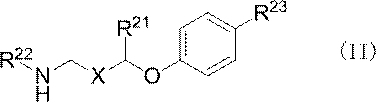
R21は水素、置換若しくは非置換の直鎖又は分枝の炭素数6~10のアリール基、及び置換若しくは非置換の直鎖又は分枝の炭素数6~10の重水素化アリール基のいずれか一つから選ばれる基であり、
R22は置換若しくは非置換の直鎖又は分枝の炭素数1~4のアルキル基、置換若しくは非置換の直鎖又は分枝の炭素数1~4の重水素化アルキル基、置換若しくは非置換の直鎖又は分枝の炭素数2~4のアルケニル基、置換若しくは非置換の直鎖又は分枝の炭素数2~4の重水素化アルケニル基、置換若しくは非置換の直鎖又は分枝の炭素数2~4のアルキニル基、及び置換若しくは非置換の直鎖又は分枝の炭素数2~4の重水素化アルキニル基のいずれか一つから選ばれる基であり、
R23は水素、置換若しくは非置換の直鎖又は分枝の炭素数1~4のアルキル基、置換若しくは非置換の直鎖又は分枝の炭素数1~4の重水素化アルキル基、置換若しくは非置換の直鎖又は分枝の炭素数2~4のアルケニル基、置換若しくは非置換の直鎖又は分枝の炭素数2~4の重水素化アルケニル基、置換若しくは非置換の直鎖又は分枝の炭素数2~4のアルキニル基、及び置換若しくは非置換の直鎖又は分枝の炭素数2~4の重水素化アルキニル基のいずれか一つから選ばれる基であり、
Xはメチレン又は重水素化メチレンである。]、
及び、一般式(III)で表される化合物;
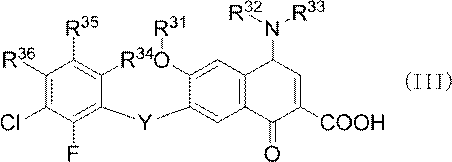
R31は置換若しくは非置換の直鎖又は分枝の炭素数1~4のアルキル基、置換若しくは非置換の直鎖又は分枝の炭素数1~4の重水素化アルキル基、置換若しくは非置換の直鎖又は分枝の炭素数2~4のアルケニル基、置換若しくは非置換の直鎖又は分枝の炭素数2~4の重水素化アルケニル基、置換若しくは非置換の直鎖又は分枝の炭素数2~4のアルキニル基、置換若しくは非置換の直鎖又は分枝の炭素数2~4の重水素化アルキニル基、置換若しくは非置換の5~6員環の複素環基、置換若しくは非置換の炭素数6~10の芳香族基、置換若しくは非置換の炭素数2~10の含窒素芳香族基、スルホン酸基、及びスルホニル基のいずれか一つから選ばれる基であり、
R32は水素、ヒドロキシメチル基、及び炭素上の水素が重水素に置換されたヒドロキシメチル基のいずれか一つから選ばれる基であり、
R33は置換若しくは非置換の直鎖又は分枝の炭素数1~6のアルキル基、置換若しくは非置換の直鎖又は分枝の炭素数1~6の重水素化アルキル基、置換若しくは非置換の直鎖又は分枝の炭素数2~6のアルケニル基、置換若しくは非置換の炭直鎖又は分枝の素数2~6の重水素化アルケニル基、置換若しくは非置換の直鎖又は分枝の炭素数2~6のアルキニル基、置換若しくは非置換の直鎖又は分枝の炭素数2~6の重水素化アルキニル基、及び置換若しくは非置換の炭素数3~6の脂環式基のいずれか一つから選ばれる基であり、
R34は水素、ヒドロキシメチル基又は炭素上の水素が重水素に置換されたヒドロキシメチル基であり、
R35は水素、水酸基、置換若しくは非置換の5~6員環の含窒素複素環基、及び置換若しくは非置換の炭素数2~10の含窒素芳香族基のいずれか一つから選ばれる基であり、
R36は水素、水酸基、及びハロゲンのいずれか一つから選ばれる基であり、Yはメチレン、重水素化メチレン、及びヒドロキシメチレンのいずれか一つから選ばれる。]、
並びに、それらの医薬的に許容される塩からなる群から選択される1種又は2種以上の化合物を含む、2型糖尿病治療剤に関する。
(2)化合物が、以下の式(I-1)~(I-6)、式(II-1)、式(II-2)、及び式(III-1)で表される化合物、並びにそれらの医薬的に許容される塩であることを特徴とする上記(1)記載の2型糖尿病治療剤。
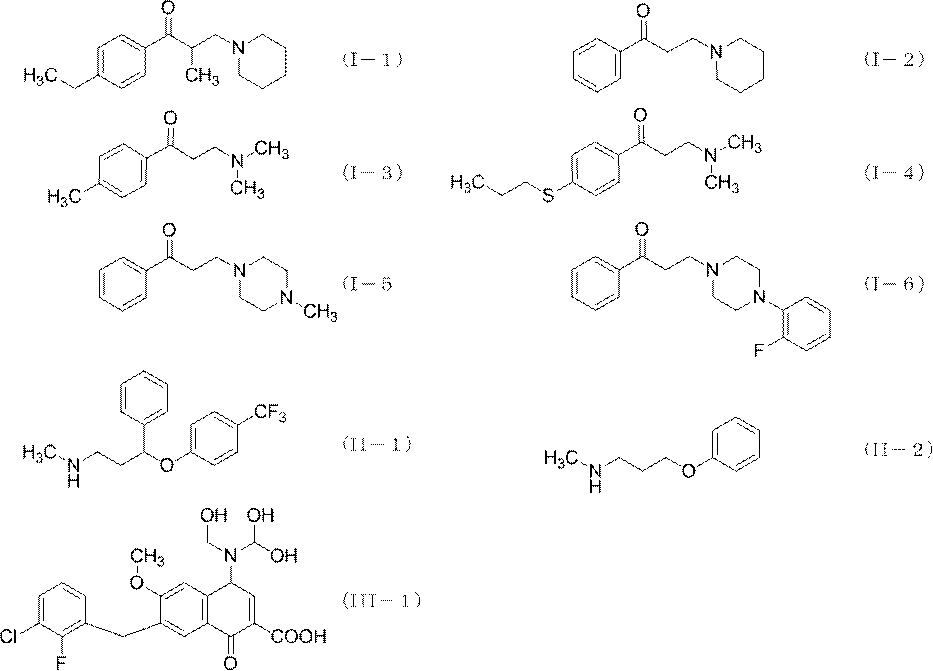
(4)医薬的に許容される塩が、塩酸、硝酸、メタンスルホン酸、酢酸、レブリン酸、乳酸、フルビプロフェン、ケトプロフェン、フマル酸、マレイン酸のいずれか一つから選ばれる酸との塩である上記(3)記載の2型糖尿病治療剤や、
(5)2型糖尿病が、Cdkal1遺伝子が変異することによりインスリン分泌能が低下した2型糖尿病である上記(1)~(4)のいずれか記載の2型糖尿病治療剤や、
(6)プロインスリンからインスリンへの変換を活性化することを特徴とする上記(1)~(5)のいずれか記載の2型糖尿病治療剤に関する。
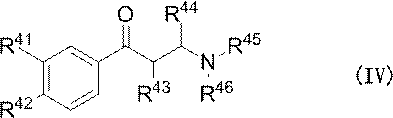
R42は水素、ハロゲン、水酸基、置換若しくは非置換の直鎖又は分枝の炭素数1~4のアルキル基、置換若しくは非置換の直鎖又は分枝の炭素数2~4のアルケニル基、置換若しくは非置換の直鎖又は分枝の炭素数2~4のアルキニル基、及び置換若しくは非置換の直鎖又は分枝の炭素数1~4のアルコキシ基のいずれか一つから選ばれる基であり、
R43は水素、ハロゲン、水酸基、置換若しくは非置換の直鎖又は分枝の炭素数1~4のアルキル基、置換若しくは非置換の直鎖又は分枝の炭素数2~4のアルケニル基、置換若しくは非置換の直鎖又は分枝の炭素数2~4のアルキニル基、及び置換若しくは非置換の直鎖又は分枝の炭素数1~4のアルコキシ基のいずれか一つから選ばれる基であり、
R44は水素、カルボキシル基、置換若しくは非置換の直鎖又は分枝の炭素数1~4のアルキル基、及び置換若しくは非置換の炭素数6~10のアリール基のいずれか一つから選ばれる基であり、
R45は水素、置換若しくは非置換の直鎖又は分枝の炭素数1~4のアルキル基、置換若しくは非置換の直鎖又は分枝の炭素数2~4のアルケニル基、及び置換若しくは非置換の直鎖又は分枝の炭素数2~4のアルキニル基のいずれか一つから選ばれる基であり、
R46は水素、置換若しくは非置換の直鎖又は分枝の炭素数1~4のアルキル基、置換若しくは非置換の直鎖又は分枝の炭素数2~4のアルケニル基、置換若しくは非置換の直鎖又は分枝の炭素数2~4のアルキニル基、置換若しくは非置換の炭素数5~10のアリール基、並びに置換若しくは非置換の直鎖又は分枝の炭素数1~4のアルキル基、及び置換若しくは非置換の炭素数5~10のアリール基からなるアリールアルキル基のいずれか一つから選ばれる基であり、
また、R45とR46は、これらが結合した窒素原子と共に、置換若しくは非置換の含窒素複素環を構成していてもよい。]や、
(8)一般式(IV)で表される化合物が、以下の式(IV-1)~(IV-4)であることを特徴とする上記(7)に記載の化合物、
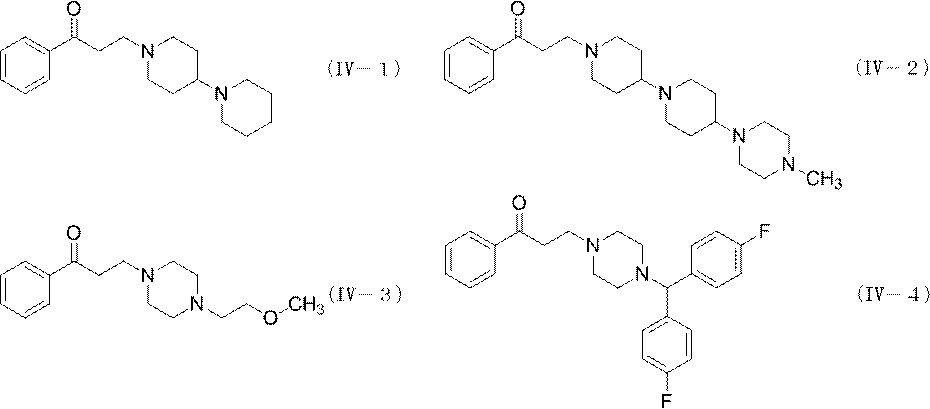
また、前記R4は、R5及び結合した炭素と一緒にカルボニル基となってもよい。
また、前記R8は、R9及び結合した炭素と一緒にカルボニル基となってもよい。
また、前記R10は、R11及び結合した窒素原子と一緒に置換若しくは非置換の含窒素複素環となってもよい。
また、前記R10は、R11及び結合した窒素原子と一緒に置換若しくは非置換の含窒素複素環となってもよい。
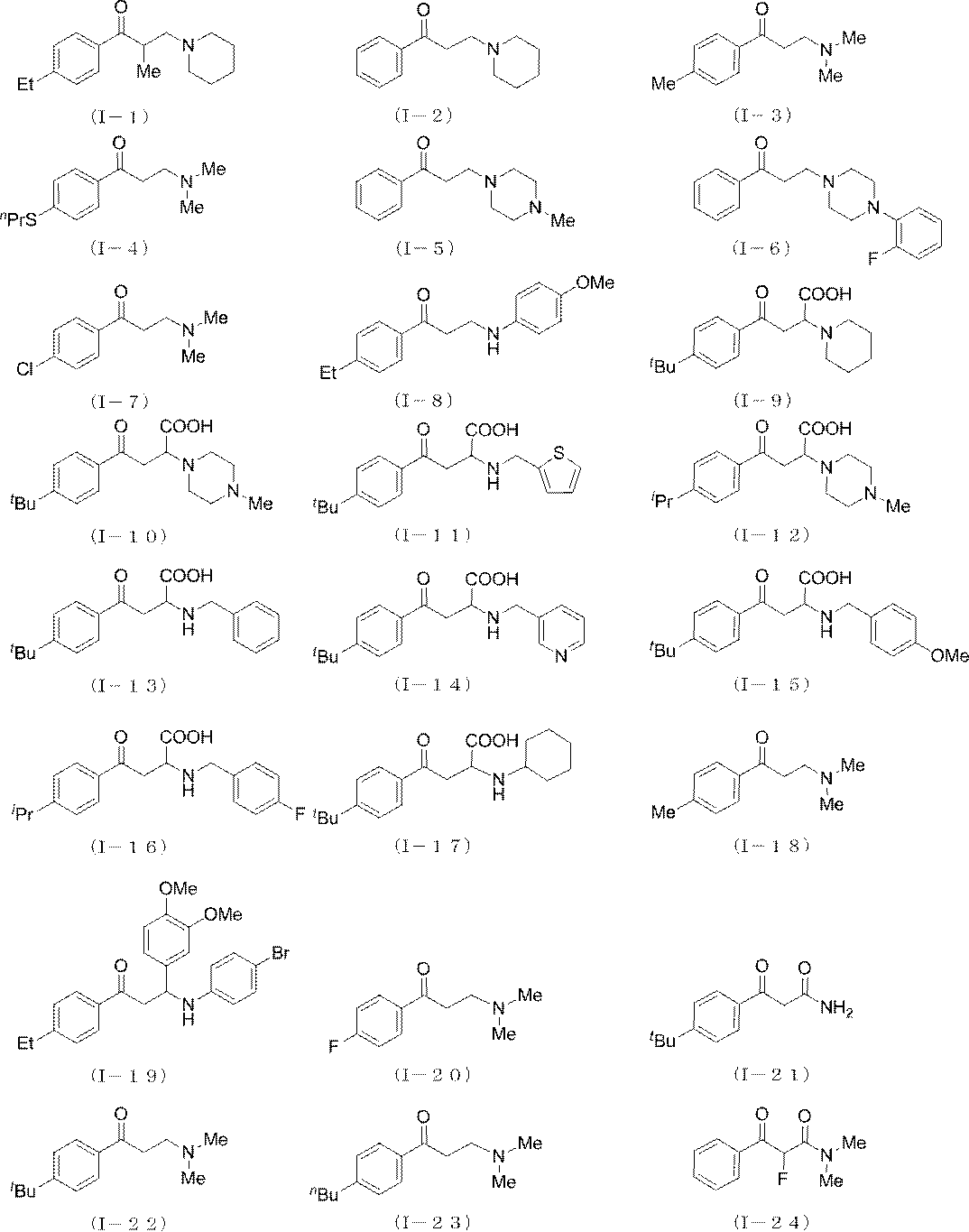


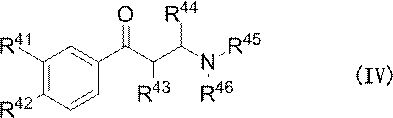
また、前記R45は、R46及び結合した窒素原子と一緒に置換若しくは非置換の含窒素複素環となってもよい。
また、前記R46は、R45及び結合した窒素原子と一緒に置換若しくは非置換の含窒素複素環となってもよい。
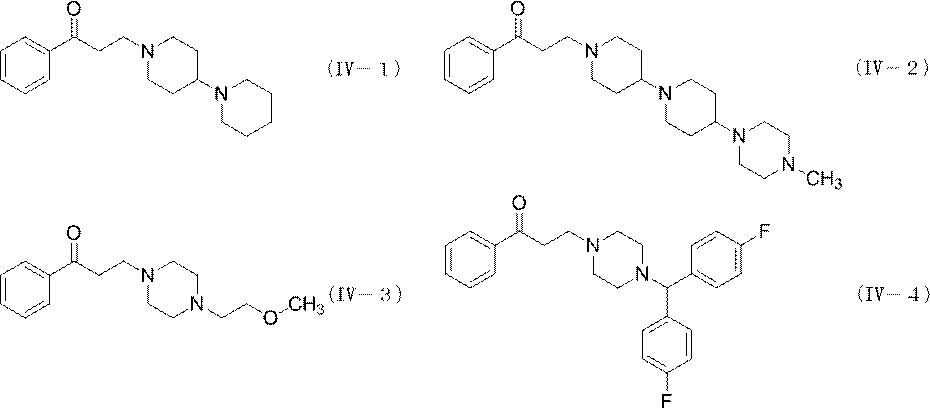

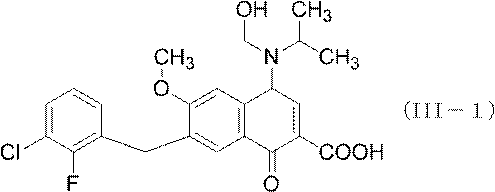



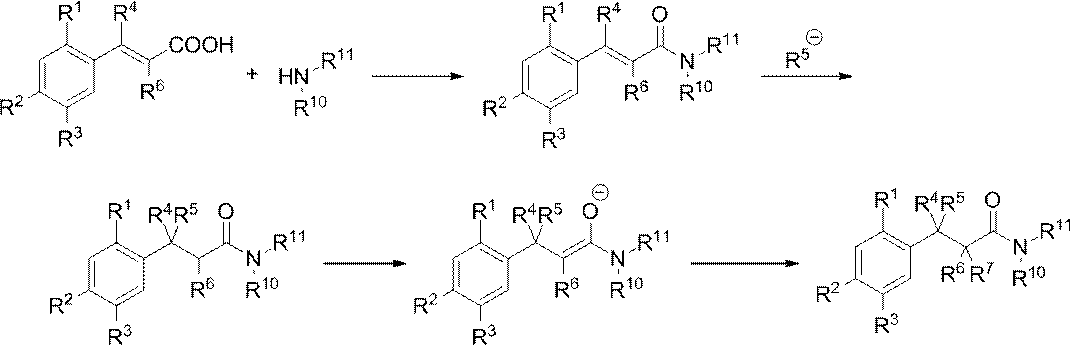
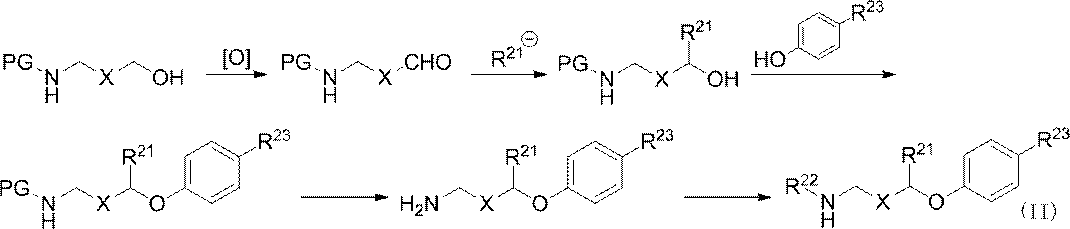
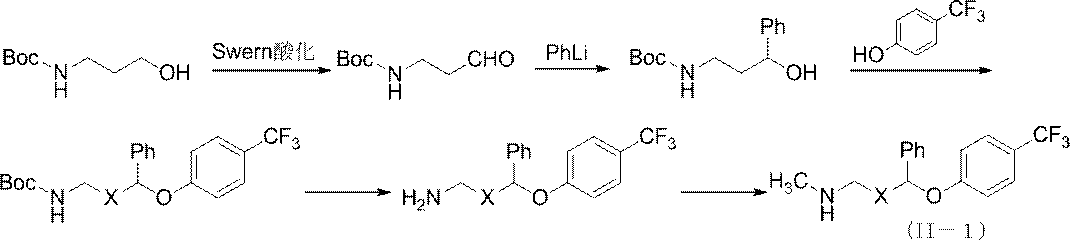

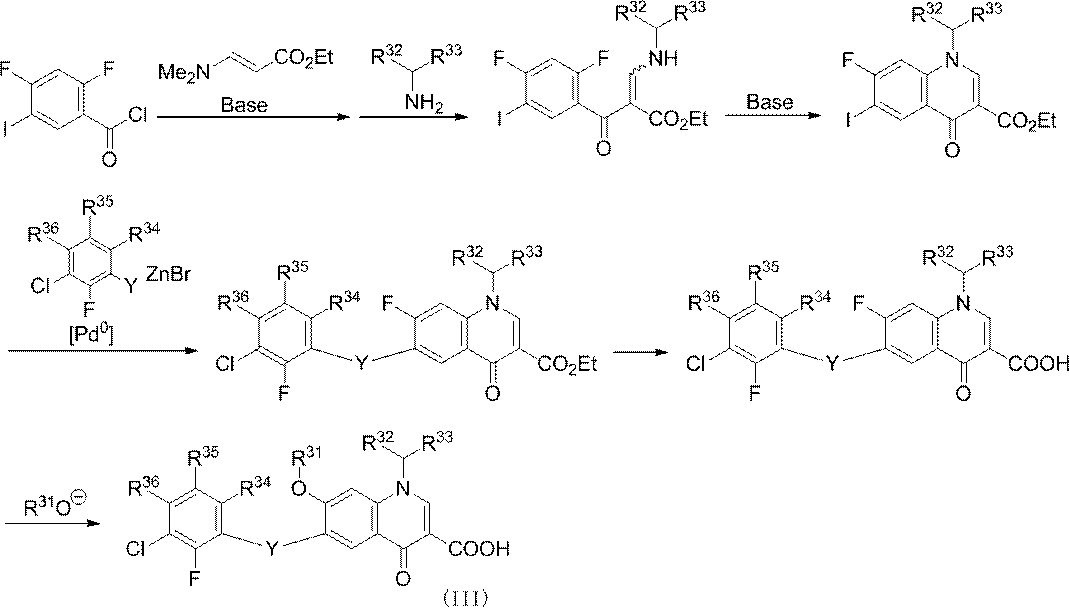

本願明細書に記載されている化合物は、公知の方法で調製することもでき、又市販品を用いることもできる。化合物(I-1)~(I-61)、(II-1)、(II-2)、及び(III-1)は、ナミキ商事(東京、日本)から購入した。
以下に、新規化合物である化合物(IV-1)~(IV-4)の合成例を示す。
化合物(IV-1)の合成
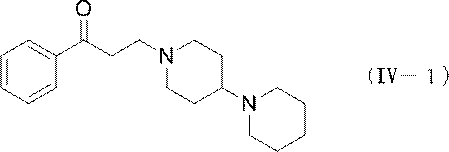
1H NMR(300MHz,CDCl3)δ2.24-2.33(m,5H),2.50-2.61(m,10H),2.82-2.92(m,2H),3.16-3.26(m,2H),7.44-7.62(m,3H),7.94-8.03(m,2H)
MS(TOF Mass):m/z calcd for C19H28N2O(M+1)301.22;found:301.23.
化合物(IV-2)の合成

1H NMR(300MHz,CDCl3)δ1.59-1.63(m,5H),1.76-1.86(m,4H),2.03(t,J=12Hz,2H),2.27(s,3H),2.47-2.62(m,11H),2.80(t,J=12Hz,3H),2.90(t,15Hz,3H),3.19(t,J=13Hz,2H),7.47(t,J=8.0Hz,2H),7.57(t,J=7.2Hz,1H),7.96(d,J=7.3Hz,2H)
MS(TOF Mass):m/z calcd for C24H38N4O(M+1)399.31;found:399.31.
化合物(IV-3)の合成
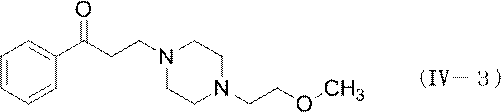
1H NMR(300MHz,CDCl3)δ2.12-2.15(m,10H),2.81-2.83(m,2H),3.30(s,3H),3.45-3.50(m,2H),7.31-7.48(m,2H)
MS(TOF Mass):m/z calcd for C16H24N2O2(M+1)277.19;found:277.18.
化合物(IV-4)の合成
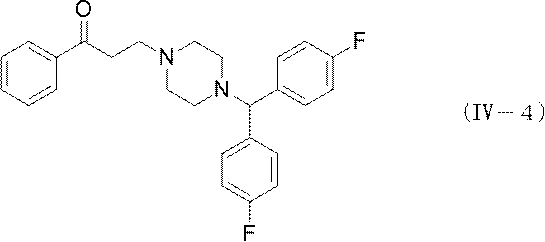
1H NMR(300MHz,CDCl3)δ2.41-2.55(m,10H),2.82-2.88(m,2H),3.16-3.22(m,2H),4.21(s,1H),6.92-7.01(m,4H),7.31-7.38(m,2H),7.42-7.58(m,4H),7.92-7.98(m,2H)
MS(TOF Mass):m/z calcd for C26H26F2N2O(M+1)421.20;found:421.23.
(1)プラスミドpACYCDuet-1-Pheの作製
作製したプラスミドpACYCDuet-1-Phe(配列番号1)のベクターマップを図1左に示す。NNNには、フェニルアラニンコドンであるTTTを設計した。正常の読み枠に従って翻訳すると、TTTの直後に終止コドンであるTAAが出現し、Firefly luciferaseが翻訳されない。一方、TTTにおいて誤翻訳が生じTをひとつ読み飛ばすと、終止コドンを回避し、Firefly luciferaseが正しく翻訳されるようになる。すなわち、翻訳の正確性が高いほど、Firefly luciferaseの蛍光強度は下がることとなる。
一方、対照として、同プラスミドにRenilla luciferaseもクローニングした。
得られたpACYCDuet-1-Pheは、ABI Prism 310 genetic analysis(Applied Biosystems社製)を用いて塩基配列を確認した。
pACYCDuet-1-Pheを導入した大腸菌を培地100mLを用いて、37℃、一晩培養した。OD550=0.4~1に達していることを確認した後、培地を1mLずつ分注し、低分子化合物を最終濃度10μMになるように添加した。1時間振とう培養した後、大腸菌を回収し、10mM Tris-HCl(pH7.4)、1mM 塩化マグネシウム、0.1mg/mL lysozyme(和光純薬社製)に懸濁し溶解した。
Firefly luciferase及びRenilla luciferaseの活性は、Dual-Lucifierase Reporter Assay System(Promega社製)を用いて測定した。溶解した大腸菌液5μLに対して、Firefly luciferase用測定液を50μL加え測定した後、Renilla luciferase用測定液を50μL加え測定した。対照として、DMSOのみを添加した大腸菌溶解液を用意した。
下記式を用いて、Firefly luciferaseの発光強度をRenilla luciferaseに対して補正した。これら一連の実験手法を図解したのが図1である。
相対翻訳精度=相対発光強度(DMSOのみ添加時)/相対発光強度(化合物添加時)
(1)ランゲルハンス島の調整
文献(Gotoh M., et al. Transplantion, 1987, 43(5), p725-730)に従い、膵臓β細胞特異的Cdkal1欠損マウス(非特許文献11参照)よりランゲルハンス島を単離した。マウスをエーテル麻酔下で開胸し、總胆管を剥離してコラゲナーゼ溶液(320U/mL、シグマ社製)をゆっくり注入し、膨らんだ膵臓を摘出した。コラゲナーゼを含んだ膵臓を37℃のウォーターバスにて30分間消化した後、ピペットで分散し、Ficoll溶液(Amersham Pharmacia社製)の濃度勾配を用いてランゲルハンス島を単離した。ランゲルハンス島を、95%O2および5%CO2の混合ガスで飽和させたリンガー液(119mM 塩化ナトリウム、4.74mM 塩化カリウム、1.19mM リン酸二水素一ナトリウム、25mM 炭酸水素ナトリウム、10mM HEPES、2.54mM 塩化カルシウム、1.19mM 塩化マグネシウム、0.2% BSA)中、37℃に保ちながら30分インキュベーションした。
一次スクリーニングにて陽性を示した低分子化合物をそれぞれDMSOに溶解し、終濃度10mMとなるように、グルコースを含むリンガー液に添加したリンガー液を準備した。対照として、DMSOのみを添加したリンガー液を準備した。
単離したマウスランゲルハンス島をまず、低濃度(2.8mM)グルコースリンガー液で30分培養した。その後リンガー液を、低分子化合物を含む低濃度グルコースリンガー液と交換した。30分後リンガー液を回収し、続いて、低分子化合物を含む高濃度(16.7mM)グルコースリンガー液を加えた。30分後、リンガー液を回収した。リンガー液中に放出されたインスリン量は、インスリン検出キット(レビス インスリン-マウス(Sタイプ)、シバヤギ社製)を用いて、該キットのプロトコールにしたがって検出した。
膵臓β細胞特異的Cdkal1欠損マウス、及び野生型マウスを一晩絶食させた後、1mg/kgとなるようにエペリゾンを経腹注射した。対照として、膵臓β細胞特異的Cdkal1欠損マウス、及び野生型マウスに生理食塩水を経腹注射した個体をそれぞれ用意した。30分後、全てのマウスに対し、グルコースを1g/kgとなるように経腹注射した。グルコース投与直後から15分置きに5μLずつ採血を行い、Accu-Check AVIVA Nano(Roche社製)を用いてマウス血中の血糖値を測定した。検定は、repeated measure of two-way ANOVAにより行った。
膵臓β細胞特異的Cdkal1欠損マウスに対し、1日1回、14日間に渡り、1mg/kgとなるように、上記スクリーニングにて陽性を示した低分子化合物を経腹注射した。対照として、DMSOを含む生理食塩水を注射したCdkal1欠損マウスを用意した。最後に低分子化合物を投与してから36時間後に、全てのマウスに対し、グルコースを1g/kgとなるように経腹注射した。グルコース投与直後から15分置きに5μLずつ尾静脈から採血を行い、Accu-Check AVIVA Nano(Roche社製)を用いてマウス血中の血糖値を測定した。検定は、repeated measure of two-way ANOVAにより行った。
Claims (8)
- 以下の一般式一般式(I);

[式中、
R1は水素、置換若しくは非置換の直鎖又は分枝の炭素数1~4のアルキル基、置換若しくは非置換の直鎖又は分枝の炭素数2~4のアルケニル基、及び置換若しくは非置換の直鎖又は分枝の炭素数2~4のアルキニル基のいずれか一つから選ばれる基であり、
R2は水素、ハロゲン、水酸基、置換若しくは非置換の直鎖又は分枝の炭素数1~10のアルキル基、置換若しくは非置換の直鎖又は分枝の炭素数2~10のアルケニル基、置換若しくは非置換の直鎖又は分枝の炭素数2~10のアルキニル基、置換若しくは非置換の炭素数3~10の脂環式基、置換若しくは非置換の炭素数6~10のアリール基、置換又は非置換の炭素数1~10のアルコキシ基、置換又は非置換の炭素数1~11のアシル基、カルボキシル基、及びそのエステル誘導体又はアミド誘導体、置換又は非置換の炭素数1~10のスルホニル基、並びに置換又は非置換の炭素数1~10のスルフィド基のいずれか一つから選ばれる基であり、
R3は水素、ハロゲン、置換若しくは非置換の直鎖又は分枝の炭素数1~4のアルキル基、置換若しくは非置換の直鎖又は分枝の炭素数2~4のアルケニル基、置換若しくは非置換の直鎖又は分枝の炭素数2~4のアルキニル基、置換若しくは非置換の炭素数6~10のアリール基、及び置換若しくは非置換の直鎖又は分枝の炭素数1~4のアルコキシ基のいずれか一つから選ばれる基であり、
R4は水素、置換若しくは非置換の炭素数6~10のアリール基、及び置換若しくは非置換の炭素数6~10のアリールオキシ基のいずれか一つから選ばれる基であるか、R5及び結合した炭素と一緒にカルボニル基となってもよく、
R5は水素又はR4及び結合した炭素と一緒にカルボニル基となってもよく、
R6は水素、ハロゲン、置換若しくは非置換の直鎖又は分枝の炭素数1~6のアルキル基、置換若しくは非置換の直鎖又は分枝の炭素数2~6のアルケニル基、置換若しくは非置換の直鎖又は分枝の炭素数2~6のアルキニル基、置換若しくは非置換の炭素数3~6の脂環式基、置換若しくは非置換の直鎖又は分枝の炭素数1~4のアルキルオキシカルボニル基、置換若しくは非置換の直鎖又は分枝の炭素数2~4のアルケニルオキシカルボニル基、置換若しくは非置換の直鎖又は分枝の炭素数2~4のアルキニルオキシカルボニル基、置換若しくは非置換の炭素数6~10のアリール基、カルボキシル基、及びそのエステル誘導体又はアミド誘導体、並びにシアノ基、アミノ基のいずれか一つから選ばれる基であり、
R7は、水素、置換若しくは非置換の直鎖又は分枝の炭素数1~4のアルキル基、置換若しくは非置換の直鎖又は分枝の炭素数2~4のアルケニル基、及び置換若しくは非置換の直鎖又は分枝の炭素数2~4のアルキニル基のいずれか一つから選ばれる基であり、
R8は、水素、ハロゲン、置換若しくは非置換の直鎖又は分枝の炭素数1~6のアルキル基、置換若しくは非置換の直鎖又は分枝の炭素数2~6のアルケニル基、置換若しくは非置換の直鎖又は分枝の炭素数2~6のアルキニル基、置換若しくは非置換の炭素数3~6の脂環式基、置換若しくは非置換の炭素数1~4の直鎖又は分枝のアルキルオキシカルボニル基、置換若しくは非置換の直鎖又は分枝の炭素数2~4のアルケニルオキシカルボニル基、置換若しくは非置換の直鎖又は分枝の炭素数2~4のアルキニルオキシカルボニル基、置換若しくは非置換の炭素数6~10のアリール基、カルボキシル基、及びそのエステル誘導体又はアミド誘導体、並びにシアノ基、アミノ基のいずれか一つから選ばれる基であるか、R9及び結合した炭素と一緒にカルボニル基となってもよく、
R9は水素、又はR8及び結合した炭素と一緒にカルボニル基となってもよく、
R10は水素、置換若しくは非置換の直鎖又は分枝の炭素数1~6のアルキル基、置換若しくは非置換の直鎖又は分枝の炭素数2~6のアルケニル基、置換若しくは非置換の直鎖又は分枝の炭素数2~6のアルキニル基、置換若しくは非置換の炭素数3~6の脂環式基、置換若しくは非置換の直鎖又は分枝の炭素数1~6のアルキルオキシカルボニル基、置換若しくは非置換の直鎖又は分枝の炭素数2~6のアルケニルオキシカルボニル基、置換若しくは非置換の直鎖又は分枝の炭素数2~6のアルキニルオキシカルボニル基、置換若しくは非置換の炭素数5~10のアリール基、カルボキシル基、及びそのエステル誘導体又はアミド誘導体、並びにシアノ基、アミノ基のいずれか一つから選ばれる基であり、
R11は水素、置換若しくは非置換の直鎖又は分枝の炭素数1~6のアルキル基、置換若しくは非置換の直鎖又は分枝の炭素数2~6のアルケニル基、置換若しくは非置換の直鎖又は分枝の炭素数2~6のアルキニル基、及び置換若しくは非置換の炭素数3~6の脂環式基のいずれか一つから選ばれる基であり、
また、R10とR11は、これらが結合した窒素原子と共に、置換若しくは非置換の含窒素複素環を構成していてもよい。]、
一般式(II);

[式中、
R21は水素、置換又は非置換の炭素数6~10のアリール基、及び置換又は非置換の炭素数6~10の重水素化アリール基のいずれか一つから選ばれる基であり、
R22は置換若しくは非置換の直鎖又は分枝の炭素数1~4のアルキル基、置換若しくは非置換の直鎖又は分枝の炭素数1~4の重水素化アルキル基、置換若しくは非置換の直鎖又は分枝の炭素数2~4のアルケニル基、置換若しくは非置換の直鎖又は分枝の炭素数2~4の重水素化アルケニル基、置換若しくは非置換の直鎖又は分枝の炭素数2~4のアルキニル基、及び置換若しくは非置換の直鎖又は分枝の炭素数2~4の重水素化アルキニル基のいずれか一つから選ばれる基であり、
R23は水素、置換若しくは非置換の直鎖又は分枝の炭素数1~4のアルキル基、置換若しくは非置換の直鎖又は分枝の炭素数1~4の重水素化アルキル基、置換若しくは非置換の直鎖又は分枝の炭素数2~4のアルケニル基、置換若しくは非置換の直鎖又は分枝の炭素数2~4の重水素化アルケニル基、置換若しくは非置換の直鎖又は分枝の炭素数2~4のアルキニル基、及び置換若しくは非置換の直鎖又は分枝の炭素数2~4の重水素化アルキニル基のいずれか一つから選ばれる基であり、
Xはメチレン又は重水素化メチレンである。]、
及び、一般式(III);


[式中、
R31は置換若しくは非置換の直鎖又は分枝の炭素数1~4のアルキル基、置換若しくは非置換の直鎖又は分枝の炭素数1~4の重水素化アルキル基、置換若しくは非置換の直鎖又は分枝の炭素数2~4のアルケニル基、置換若しくは非置換の直鎖又は分枝の炭素数2~4の重水素化アルケニル基、置換若しくは非置換の直鎖又は分枝の炭素数2~4のアルキニル基、置換若しくは非置換の直鎖又は分枝の炭素数2~4の重水素化アルキニル基、置換若しくは非置換の5~6員環の複素環基、置換若しくは非置換の炭素数6~10の芳香族基、置換若しくは非置換の炭素数2~10の含窒素芳香族基、スルホン酸基、及びスルホニル基のいずれか一つから選ばれる基であり、
R32は水素、ヒドロキシメチル基、及び炭素上の水素が重水素に置換されたヒドロキシメチル基のいずれか一つから選ばれる基であり、
R33は置換若しくは非置換の直鎖又は分枝の炭素数1~6のアルキル基、置換若しくは非置換の直鎖又は分枝の炭素数1~6の重水素化アルキル基、置換若しくは非置換の直鎖又は分枝の炭素数2~6のアルケニル基、置換若しくは非置換の炭直鎖又は分枝の素数2~6の重水素化アルケニル基、置換若しくは非置換の直鎖又は分枝の炭素数2~6のアルキニル基、置換若しくは非置換の直鎖又は分枝の炭素数2~6の重水素化アルキニル基、及び置換若しくは非置換の炭素数3~6の脂環式基のいずれか一つから選ばれる基であり、
R34は水素、ヒドロキシメチル基又は炭素上の水素が重水素に置換されたヒドロキシメチル基であり、
R35は水素、水酸基、置換若しくは非置換の5~6員環の含窒素複素環基、及び置換若しくは非置換の炭素数2~10の含窒素芳香族基のいずれか一つから選ばれる基であり、
R36は水素、水酸基、及びハロゲンのいずれか一つから選ばれる基であり、Yはメチレン、重水素化メチレン、及びヒドロキシメチレンのいずれか一つから選ばれる。]
で表される化合物、並びに、それらの医薬的に許容される塩からなる群から選択される1種又は2種以上の化合物を含む、2型糖尿病治療剤。 - 化合物が、以下の式(I-1)~(I-6)、式(II-1)、式(II-2)及び式(III-1)で表される化合物、並びにそれらの医薬的に許容される塩であることを特徴とする請求項1記載の2型糖尿病治療剤。
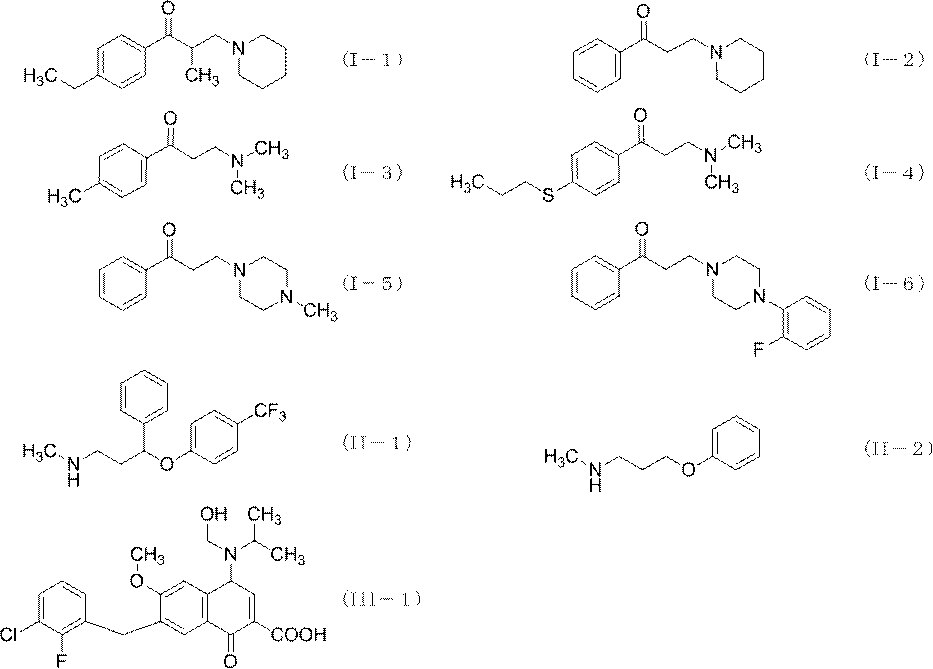
- 医薬的に許容される塩が、塩酸、硝酸、硫酸、炭素数1~10のスルホン酸、置換若しくは非置換の炭素数1~6のアルキルカルボン酸、及び置換若しくは非置換の炭素数4~8のジカルボン酸のいずれか一つから選ばれる酸との塩である請求項1又は2記載の2型糖尿病治療剤。
- 医薬的に許容される塩が、塩酸、硝酸、メタンスルホン酸、酢酸、レブリン酸、乳酸、フルビプロフェン、ケトプロフェン、シュウ酸、フマル酸、及びマレイン酸のいずれか一つから選ばれる酸との塩である請求項3記載の2型糖尿病治療剤。
- 2型糖尿病が、Cdkal1遺伝子が変異することによりインスリン分泌能が低下した2型糖尿病である請求項1~4のいずれか記載の2型糖尿病治療剤。
- プロインスリンからインスリンへの変換を活性化することを特徴とする請求項1~5のいずれか記載の2型糖尿病治療剤。
- 以下の一般式(IV)で表されることを特徴とする化合物。
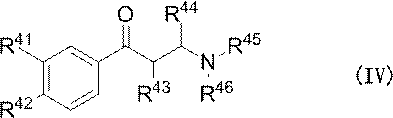
[式中、
R41は水素、ハロゲン、水酸基、置換若しくは非置換の直鎖又は分枝の炭素数1~4のアルキル基、置換若しくは非置換の直鎖又は分枝の炭素数2~4のアルケニル基、置換若しくは非置換の直鎖又は分枝の炭素数2~4のアルキニル基、及び置換若しくは非置換の直鎖又は分枝の炭素数1~4のアルコキシ基のいずれか一つから選ばれる基であり、
R42は水素、ハロゲン、水酸基、置換若しくは非置換の直鎖又は分枝の炭素数1~4のアルキル基、置換若しくは非置換の直鎖又は分枝の炭素数2~4のアルケニル基、置換若しくは非置換の直鎖又は分枝の炭素数2~4のアルキニル基、及び置換若しくは非置換の直鎖又は分枝の炭素数1~4のアルコキシ基のいずれか一つから選ばれる基であり、
R43は水素、ハロゲン、水酸基、置換若しくは非置換の直鎖又は分枝の炭素数1~4のアルキル基、置換若しくは非置換の直鎖又は分枝の炭素数2~4のアルケニル基、置換若しくは非置換の直鎖又は分枝の炭素数2~4のアルキニル基、及び置換若しくは非置換の直鎖又は分枝の炭素数1~4のアルコキシ基のいずれか一つから選ばれる基であり、
R44は水素、カルボキシル基、置換若しくは非置換の直鎖又は分枝の炭素数1~4のアルキル基、及び置換若しくは非置換の炭素数6~10のアリール基のいずれか一つから選ばれる基であり、
R45は水素、置換若しくは非置換の直鎖又は分枝の炭素数1~4のアルキル基、置換若しくは非置換の直鎖又は分枝の炭素数2~4のアルケニル基、及び置換若しくは非置換の直鎖又は分枝の炭素数2~4のアルキニル基のいずれか一つから選ばれる基であり、
R46は水素、置換若しくは非置換の直鎖又は分枝の炭素数1~4のアルキル基、置換若しくは非置換の直鎖又は分枝の炭素数2~4のアルケニル基、置換若しくは非置換の直鎖又は分枝の炭素数2~4のアルキニル基、置換若しくは非置換の炭素数5~10のアリール基、並びに置換若しくは非置換の直鎖又は分枝の炭素数1~4のアルキル基及び置換若しくは非置換の炭素数5~10のアリール基からなるアリールアルキル基のいずれか一つから選ばれる基であり、
また、R45とR46は、これらが結合した窒素原子と共に、置換若しくは非置換の含窒素複素環を構成していてもよい。] - 一般式(IV)で表される化合物が、以下の式(IV-1)~(IV-4)であることを特徴とする請求項7に記載の化合物。
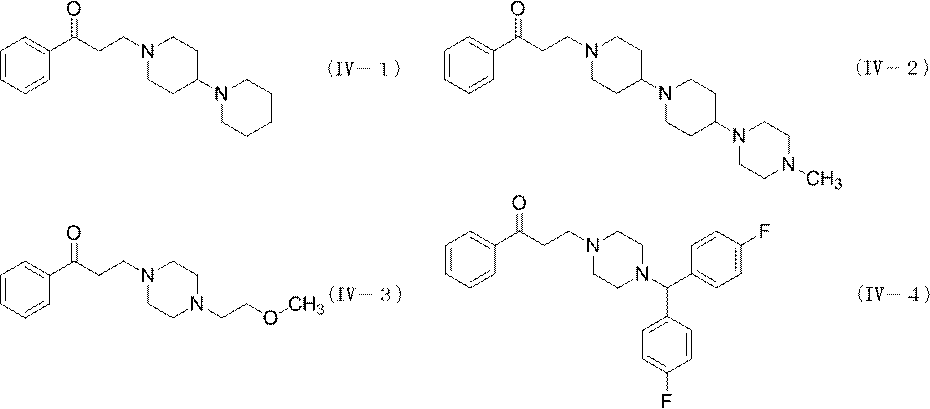
Priority Applications (3)
| Application Number | Priority Date | Filing Date | Title |
|---|---|---|---|
| CN201480018572.0A CN105188692A (zh) | 2013-03-29 | 2014-03-28 | 2型糖尿病治疗剂 |
| US14/780,052 US20160060235A1 (en) | 2013-03-29 | 2014-03-28 | Therapeutic Agent for Type 2 Diabetes |
| JP2015508096A JP6540505B2 (ja) | 2013-03-29 | 2014-03-28 | 2型糖尿病治療剤 |
Applications Claiming Priority (2)
| Application Number | Priority Date | Filing Date | Title |
|---|---|---|---|
| JP2013-072391 | 2013-03-29 | ||
| JP2013072391 | 2013-03-29 |
Publications (1)
| Publication Number | Publication Date |
|---|---|
| WO2014156196A1 true WO2014156196A1 (ja) | 2014-10-02 |
Family
ID=51623206
Family Applications (1)
| Application Number | Title | Priority Date | Filing Date |
|---|---|---|---|
| PCT/JP2014/001853 Ceased WO2014156196A1 (ja) | 2013-03-29 | 2014-03-28 | 2型糖尿病治療剤 |
Country Status (4)
| Country | Link |
|---|---|
| US (1) | US20160060235A1 (ja) |
| JP (1) | JP6540505B2 (ja) |
| CN (1) | CN105188692A (ja) |
| WO (1) | WO2014156196A1 (ja) |
Families Citing this family (1)
| Publication number | Priority date | Publication date | Assignee | Title |
|---|---|---|---|---|
| US10749970B1 (en) | 2016-12-28 | 2020-08-18 | Wells Fargo Bank, N.A. | Continuous task-based communication sessions |
Citations (10)
| Publication number | Priority date | Publication date | Assignee | Title |
|---|---|---|---|---|
| US3041344A (en) * | 1960-12-01 | 1962-06-26 | Res Lab Dr C Janssen | 1-(aroylalkyl)-4-piperidinecarboxamides |
| GB1097572A (en) * | 1965-03-09 | 1968-01-03 | Mauvernay Roland Yves | Novel piperazines for pharmaceutical use |
| JPS5052078A (ja) * | 1973-09-11 | 1975-05-09 | ||
| WO1990013539A1 (fr) * | 1989-04-28 | 1990-11-15 | Meiji Seika Kaisha, Ltd. | Nouveaux derives de piperazine a substitution n et medicament de traitement des troubles fonctionnels du cerveau |
| JPH0836182A (ja) * | 1994-05-17 | 1996-02-06 | Canon Inc | 液晶素子及びそれを用いた液晶装置 |
| WO2001079188A1 (en) * | 2000-04-17 | 2001-10-25 | Cipla Limited | Antihistaminic compounds |
| JP2007505088A (ja) * | 2003-09-12 | 2007-03-08 | アプライド リサーチ システムズ エーアールエス ホールディング ナームロゼ フェンノートシャップ | 糖尿病の治療のためのスルホンアミド誘導体 |
| WO2009051119A1 (ja) * | 2007-10-16 | 2009-04-23 | Daiichi Sankyo Company, Limited | ピリミジルインドリン化合物 |
| JP2010529022A (ja) * | 2007-05-29 | 2010-08-26 | ヴェロサイエンス・エルエルシー | メタボリックシンドローム、2型糖尿病、肥満又は糖尿病前症の治療的処置方法 |
| WO2011058994A1 (ja) * | 2009-11-11 | 2011-05-19 | 国立大学法人熊本大学 | 2型糖尿病モデル非ヒト動物 |
Family Cites Families (12)
| Publication number | Priority date | Publication date | Assignee | Title |
|---|---|---|---|---|
| FR2154493B1 (ja) * | 1971-09-13 | 1975-10-31 | Kali Chemie Ag | |
| US3995047A (en) * | 1973-12-14 | 1976-11-30 | Eisai Co., Ltd. | Propiophenone derivatives in the treatment of pathological muscular conditions |
| FR2642972B1 (fr) * | 1989-02-14 | 1994-08-05 | Inst Nat Sante Rech Med | Agents pour le diagnostic et le traitement des melanomes, derives halogenes aromatiques utilisables comme de tels agents et leur preparation |
| US4931473A (en) * | 1989-02-15 | 1990-06-05 | Richardson-Vicks Inc. | Anesthetic oral compositions |
| US5705501A (en) * | 1994-11-17 | 1998-01-06 | Molecular Geriatrics Corporation | Certain substituted 1-aryl-3-morpholinopropanones to treat Alzheimer's Disease |
| JPH115771A (ja) * | 1997-06-16 | 1999-01-12 | Kuraray Co Ltd | アミン誘導体の製造方法 |
| CN1869002A (zh) * | 2005-05-27 | 2006-11-29 | 中国科学院上海药物研究所 | 一类非甾体雄激素受体调节剂、其制备方法和用途 |
| DE102006031813B4 (de) * | 2006-07-07 | 2011-04-28 | Christian-Albrechts-Universität Zu Kiel | Verwendung basischer Acetophenone als Hemmstoffe von NO-Synthasen |
| SG177148A1 (en) * | 2006-11-30 | 2012-01-30 | Decode Genetics Ehf | Genetic susceptibility variants of type 2 diabetes mellitus |
| US8440658B2 (en) * | 2007-12-11 | 2013-05-14 | Vitae Pharmaceuticals, Inc. | Cyclic urea inhibitors of 11β-hydroxysteroid dehydrogenase 1 |
| CN101768149B (zh) * | 2008-12-30 | 2013-10-30 | 成都地奥制药集团有限公司 | 一类β-氨基酮(醇)衍生物及其用途 |
| EP2727587A1 (en) * | 2012-10-30 | 2014-05-07 | Pharnext | Compositions, methods and uses for the treatment of diabetes and related conditions by controlling blood glucose level |
-
2014
- 2014-03-28 JP JP2015508096A patent/JP6540505B2/ja not_active Expired - Fee Related
- 2014-03-28 WO PCT/JP2014/001853 patent/WO2014156196A1/ja not_active Ceased
- 2014-03-28 CN CN201480018572.0A patent/CN105188692A/zh active Pending
- 2014-03-28 US US14/780,052 patent/US20160060235A1/en not_active Abandoned
Patent Citations (10)
| Publication number | Priority date | Publication date | Assignee | Title |
|---|---|---|---|---|
| US3041344A (en) * | 1960-12-01 | 1962-06-26 | Res Lab Dr C Janssen | 1-(aroylalkyl)-4-piperidinecarboxamides |
| GB1097572A (en) * | 1965-03-09 | 1968-01-03 | Mauvernay Roland Yves | Novel piperazines for pharmaceutical use |
| JPS5052078A (ja) * | 1973-09-11 | 1975-05-09 | ||
| WO1990013539A1 (fr) * | 1989-04-28 | 1990-11-15 | Meiji Seika Kaisha, Ltd. | Nouveaux derives de piperazine a substitution n et medicament de traitement des troubles fonctionnels du cerveau |
| JPH0836182A (ja) * | 1994-05-17 | 1996-02-06 | Canon Inc | 液晶素子及びそれを用いた液晶装置 |
| WO2001079188A1 (en) * | 2000-04-17 | 2001-10-25 | Cipla Limited | Antihistaminic compounds |
| JP2007505088A (ja) * | 2003-09-12 | 2007-03-08 | アプライド リサーチ システムズ エーアールエス ホールディング ナームロゼ フェンノートシャップ | 糖尿病の治療のためのスルホンアミド誘導体 |
| JP2010529022A (ja) * | 2007-05-29 | 2010-08-26 | ヴェロサイエンス・エルエルシー | メタボリックシンドローム、2型糖尿病、肥満又は糖尿病前症の治療的処置方法 |
| WO2009051119A1 (ja) * | 2007-10-16 | 2009-04-23 | Daiichi Sankyo Company, Limited | ピリミジルインドリン化合物 |
| WO2011058994A1 (ja) * | 2009-11-11 | 2011-05-19 | 国立大学法人熊本大学 | 2型糖尿病モデル非ヒト動物 |
Non-Patent Citations (4)
Also Published As
| Publication number | Publication date |
|---|---|
| CN105188692A (zh) | 2015-12-23 |
| JP6540505B2 (ja) | 2019-07-10 |
| JPWO2014156196A1 (ja) | 2017-02-16 |
| US20160060235A1 (en) | 2016-03-03 |
Similar Documents
| Publication | Publication Date | Title |
|---|---|---|
| JP7399110B2 (ja) | 非縮合チオフェン誘導体及びそれらの使用 | |
| TWI744723B (zh) | 多環型胺甲醯基吡啶酮化合物之合成 | |
| TWI381837B (zh) | 2-芳基-6-苯并咪唑〔1,2-a〕吡啶衍生物,其製備及其治療用途 | |
| WO2019144835A1 (zh) | 取代的哒嗪酮化合物 | |
| US20070281922A1 (en) | 1-Sulfonylindazolylamine and - amide derivatives as 5-hydroxytryptamine-6 ligands | |
| EP3029024A1 (en) | 2-(2-aminophenoxy)-3-chloronaphthalene-1,4-dione compounds having orexin 2 receptor agonist activity | |
| CN102076663B (zh) | 作为趋化因子受体活性的调节剂的哌啶衍生物 | |
| Glossop et al. | Inhalation by design: novel tertiary amine muscarinic M3 receptor antagonists with slow off-rate binding kinetics for inhaled once-daily treatment of chronic obstructive pulmonary disease | |
| JP6540505B2 (ja) | 2型糖尿病治療剤 | |
| KR20250008539A (ko) | 방향족 고리계 화합물 및 이의 용도 | |
| US20090176798A1 (en) | New compounds III | |
| US10329296B2 (en) | Indole derivatives | |
| WO2023016249A1 (zh) | 3-芳氧基-3-五元杂芳基-丙胺类化合物的制备方法 | |
| KR20120049943A (ko) | α₄β₂ 니코틴성 아세틸콜린 수용체 리간드로서 비시클릭 화합물 | |
| US9993465B2 (en) | 2,5-disubstituted-pyridyl nicotinic ligands, and methods of use thereof | |
| JP7175878B2 (ja) | 新規ベンズイミダゾロン化合物およびその医薬用途 | |
| JPWO2006132192A1 (ja) | 新規2−キノロン誘導体 | |
| CN112826821B (zh) | 别嘌呤醇类衍生物在制备预防和/或治疗糖尿病的药物中的用途 | |
| WO2021070957A1 (ja) | ベンゼン縮合環化合物、およびそれを含有する医薬組成物 | |
| CN108218861B (zh) | 一种预防和治疗糖尿病的药物及其制备方法 | |
| JP2018154562A (ja) | 新規二環式複素環化合物およびその医薬用途 | |
| JP2824086B2 (ja) | カルボン酸アミド誘導体 | |
| US9907766B2 (en) | Sweetness receptor antagonist | |
| WO2024235167A1 (zh) | 一种吡唑并吡嗪类化合物及其晶型的制备方法 | |
| JP2017193505A (ja) | 2型糖尿病治療剤 |
Legal Events
| Date | Code | Title | Description |
|---|---|---|---|
| WWE | Wipo information: entry into national phase |
Ref document number: 201480018572.0 Country of ref document: CN |
|
| 121 | Ep: the epo has been informed by wipo that ep was designated in this application |
Ref document number: 14773484 Country of ref document: EP Kind code of ref document: A1 |
|
| DPE2 | Request for preliminary examination filed before expiration of 19th month from priority date (pct application filed from 20040101) | ||
| ENP | Entry into the national phase |
Ref document number: 2015508096 Country of ref document: JP Kind code of ref document: A |
|
| WWE | Wipo information: entry into national phase |
Ref document number: 14780052 Country of ref document: US |
|
| NENP | Non-entry into the national phase |
Ref country code: DE |