WO2014148002A1 - 歯科用硬化性組成物 - Google Patents
歯科用硬化性組成物 Download PDFInfo
- Publication number
- WO2014148002A1 WO2014148002A1 PCT/JP2014/001384 JP2014001384W WO2014148002A1 WO 2014148002 A1 WO2014148002 A1 WO 2014148002A1 JP 2014001384 W JP2014001384 W JP 2014001384W WO 2014148002 A1 WO2014148002 A1 WO 2014148002A1
- Authority
- WO
- WIPO (PCT)
- Prior art keywords
- weight
- particles
- parts
- calcium
- curable composition
- Prior art date
- Legal status (The legal status is an assumption and is not a legal conclusion. Google has not performed a legal analysis and makes no representation as to the accuracy of the status listed.)
- Ceased
Links
Classifications
-
- A—HUMAN NECESSITIES
- A61—MEDICAL OR VETERINARY SCIENCE; HYGIENE
- A61K—PREPARATIONS FOR MEDICAL, DENTAL OR TOILETRY PURPOSES
- A61K6/00—Preparations for dentistry
- A61K6/70—Preparations for dentistry comprising inorganic additives
- A61K6/71—Fillers
- A61K6/74—Fillers comprising phosphorus-containing compounds
-
- A—HUMAN NECESSITIES
- A61—MEDICAL OR VETERINARY SCIENCE; HYGIENE
- A61K—PREPARATIONS FOR MEDICAL, DENTAL OR TOILETRY PURPOSES
- A61K6/00—Preparations for dentistry
- A61K6/15—Compositions characterised by their physical properties
- A61K6/17—Particle size
-
- A—HUMAN NECESSITIES
- A61—MEDICAL OR VETERINARY SCIENCE; HYGIENE
- A61K—PREPARATIONS FOR MEDICAL, DENTAL OR TOILETRY PURPOSES
- A61K6/00—Preparations for dentistry
- A61K6/70—Preparations for dentistry comprising inorganic additives
- A61K6/71—Fillers
- A61K6/77—Glass
-
- A—HUMAN NECESSITIES
- A61—MEDICAL OR VETERINARY SCIENCE; HYGIENE
- A61K—PREPARATIONS FOR MEDICAL, DENTAL OR TOILETRY PURPOSES
- A61K6/00—Preparations for dentistry
- A61K6/80—Preparations for artificial teeth, for filling teeth or for capping teeth
- A61K6/831—Preparations for artificial teeth, for filling teeth or for capping teeth comprising non-metallic elements or compounds thereof, e.g. carbon
- A61K6/838—Phosphorus compounds, e.g. apatite
-
- A—HUMAN NECESSITIES
- A61—MEDICAL OR VETERINARY SCIENCE; HYGIENE
- A61K—PREPARATIONS FOR MEDICAL, DENTAL OR TOILETRY PURPOSES
- A61K6/00—Preparations for dentistry
- A61K6/80—Preparations for artificial teeth, for filling teeth or for capping teeth
- A61K6/884—Preparations for artificial teeth, for filling teeth or for capping teeth comprising natural or synthetic resins
- A61K6/887—Compounds obtained by reactions only involving carbon-to-carbon unsaturated bonds
- A61K6/889—Polycarboxylate cements; Glass ionomer cements
Definitions
- the present invention relates to a dental curable composition. More specifically, the present invention relates to a dental curable composition that is excellent in sustained release of calcium ions and fluorine ions, which are known as active ingredients for remineralization, and can be suitably used particularly as a dental resin-reinforced glass ionomer cement.
- Amalgam, glass ionomer cement, resin-reinforced glass ionomer cement, composite resin filler, and the like are widely used as materials for filling and repairing the defective part of the tooth affected part.
- zinc phosphate cement, glass ionomer cement, resin reinforced glass ionomer cement, composite resin cement, etc. are widely used as a material for attaching prosthetics such as crowns, inlays, and bridges to the damaged part of the tooth. It has been. As described above, a wide variety of materials are used in the restoration of the affected part of the tooth.
- glass ionomer cement and resin reinforced glass ionomer cement (an improved version of glass ionomer cement that incorporates a curing mechanism by polymerization reaction by incorporating a polymerizable monomer and a polymerization initiator into glass ionomer cement) Is a material using a glass ionomer reaction in which a polymer acid mainly composed of an acid such as polyalkenoic acid and a basic fluoroaluminosilicate glass are cured in the presence of water, and has a feature of high biocompatibility.
- cement and resin-reinforced glass ionomer cements are widely recognized as restorative materials that can be expected to have a remineralization action because they gradually release fluorine ions, which are known as active ingredients for remineralization.
- fluorine ions which are known as active ingredients for remineralization.
- hydroxyapatite which is a major component of enamel and dentin teeth, is one of calcium phosphates composed of calcium and phosphorus. Supplying only ions is not sufficiently promoted.
- Patent Document 1 proposes a glass powder for glass ionomer cement containing apatite, and describes that it can be configured as a resin-reinforced glass ionomer cement.
- apatite improves the mechanical strength, particularly bending strength, tensile strength, and fracture toughness of the resin-reinforced glass ionomer cement.
- it since it contains apatite, it has not only fluorine ions but also sustained release of calcium ions.
- the resin-reinforced glass ionomer cement described in Patent Document 1 has insufficient calcium ion sustained release.
- Patent Document 2 describes a dental cement containing a calcium ion source, a phosphate ion source, a resin monomer component, and a polymerization initiator. Furthermore, it is described that the dental cement includes a source of fluoride ions, and it is described that fluoride-containing glass can be used as the source of fluoride ions. Patent Document 2 uses a calcium phosphate compound such as anhydrous dicalcium phosphate as a source of both calcium ions and phosphate ions, or a calcium ion source such as calcium chloride, and a phosphate ion source. Are separately used. However, Patent Document 2 relates to a resin cement rather than a resin-reinforced glass ionomer cement.
- the present invention provides a dental curable composition that can be suitably used for a resin-reinforced glass ionomer cement, and is excellent in sustained release of not only fluorine ions but also calcium ions. With the goal.
- a dental curable composition incorporating compounds relating to three types of curing modes, ie, a hydration reaction with a mixture of water and water, and a polymerization reaction with a polymerizable monomer and a polymerization initiator, in a specific ratio, respectively. It has been found that it has properties suitable for reinforced glass ionomer cement and is excellent in the sustained release of calcium ions and fluorine ions, which are known as active ingredients for remineralization, and has led to the completion of the present invention.
- the present invention relates to fluoroaluminosilicate glass particles (A), acidic calcium phosphate particles (B1) and basic calcium phosphate particles (B2) or a mixture of phosphorous-free calcium compound particles (B3) (B), polyalkenoic acid (C)
- a dental curable composition containing a polymerizable monomer having no acidic group (D), water (E), and a polymerization initiator (F), the fluoroaluminosilicate glass particles (A) and 30 to 99 parts by weight of the fluoroaluminosilicate glass particles (A), 1 to 70 parts by weight of the mixture (B), and 100 to 100 parts by weight of the mixture (B), and the polyalkenoic acid (C) 1 to 60 parts by weight, 5 to 90 parts by weight of the polymerizable monomer (D) having no acidic group, 1 to 40 parts by weight of water (E), Agent (F) is a dental curable composition comprising 0.01 to 20 parts by weight.
- the acidic group-containing polymerizable monomer (G) is further added to 100 parts by weight of the fluoroaluminosilicate glass particles (A) and the mixture (B). Contain 0.1 to 30 parts by weight.
- the present invention is also a dental resin-reinforced glass ionomer cement using a dental curable composition.
- a dental curable composition excellent in sustained release of calcium ions and fluorine ions which is known as an active ingredient of remineralization.
- the dental curable composition of the present invention is useful for filling and repairing a defective part of a tooth affected part, and for joining a defective part of a tooth affected part and a prosthesis, and particularly suitably used as a dental resin-reinforced glass ionomer cement. be able to.
- the fluoroaluminosilicate glass particles (A) used in the present invention contain Si 2+ , Al 3+ , O 2 ⁇ , F ⁇ as basic ion components constituting the glass, and further contain other metal ions as necessary.
- fluoroaluminosilicate glass examples thereof include fluoroaluminosilicate glass, calcium fluoroaluminosilicate glass, strontium fluoroaluminosilicate glass, barium fluoroaluminosilicate glass, and strontium calcium fluoroaluminosilicate glass.
- fluoroaluminosilicate glass and barium fluoroaluminosilicate glass are preferable.
- the fluoroaluminosilicate glass particles (A) may be used in combination of not only one type but also a plurality of types as appropriate.
- the method for producing the fluoroaluminosilicate glass particles (A) used in the present invention is not particularly limited.
- the raw materials are weighed at a predetermined weight ratio and thoroughly mixed, and then melted at a high temperature of 1100 ° C. or higher, and the melt that has been melted homogeneously is rapidly cooled to form a glass frit. It can be produced by pulverization using a machine, a jet mill or the like.
- a commercially available fluoroaluminosilicate glass powder may be used as it is, or a commercially available product may be further pulverized.
- the average particle diameter of the fluoroaluminosilicate glass particles (A) is preferably 0.02 to 35 ⁇ m.
- the average particle size of the fluoroaluminosilicate glass particles (A) is more preferably 0.5 ⁇ m or more, and most preferably 1 ⁇ m or more.
- the surface of the resulting dental curable composition may be rough and rough, or the operability may be reduced.
- the average particle size of the fluoroaluminosilicate glass particles (A) is more preferably 20 ⁇ m or less, and most preferably 10 ⁇ m or less.
- the average particle diameter of the fluoroaluminosilicate glass particles (A) used in the present invention is determined as a median diameter (d50) measured using a laser diffraction particle size distribution analyzer.
- the fluoroaluminosilicate glass particles (A) may be used after surface treatment with a known surface treatment agent such as a silane coupling agent as necessary.
- a known surface treatment agent such as a silane coupling agent
- surface treatment agents include vinyltrimethoxysilane, vinyltriethoxysilane, vinyltrichlorosilane, vinyltri ( ⁇ -methoxyethoxy) silane, ⁇ -methacryloyloxypropyltrimethoxysilane, and ⁇ -glycidoxypropyltrimethoxysilane. , ⁇ -mercaptopropyltrimethoxysilane, ⁇ -aminopropyltriethoxysilane, and the like.
- the dental curable composition of the present invention contains 30 to 99 parts by weight of fluoroaluminosilicate glass particles (A) with respect to 100 parts by weight of the total of fluoroaluminosilicate glass particles (A) and mixture (B). is required.
- the content of the fluoroaluminosilicate glass particles (A) is less than 30 parts by weight, sufficient sustained release of fluorine ions cannot be obtained.
- the content of the fluoroaluminosilicate glass particles (A) exceeds 99 parts by weight, the hydration reaction by the mixture (B) and water is inhibited, and sufficient release of calcium ions and phosphate ions cannot be obtained. .
- the content of the fluoroaluminosilicate glass particles (A) is preferably in the range of 50 to 98 parts by weight, and more preferably in the range of 75 to 97 parts by weight. .
- the release amount of fluorine ions is maximized, which is most preferable. .
- the acidic calcium phosphate particles (B1) used in the present invention are not particularly limited, and anhydrous calcium monohydrogen phosphate [CaHPO 4 ] particles, tricalcium phosphate [Ca 3 (PO 4 ) 2 ] particles, anhydrous dihydrogen phosphate Calcium [Ca (H 2 PO 4 ) 2 ] particles, amorphous calcium phosphate [Ca 3 (PO 4 ) 2 .xH 2 O] particles, acidic calcium pyrophosphate [CaH 2 P 2 O 7 ] particles, calcium monohydrogen phosphate At least one selected from the group consisting of dihydrate [CaHPO 4 ⁇ 2H 2 O] particles and calcium dihydrogen phosphate monohydrate [Ca (H 2 PO 4 ) 2 ⁇ H 2 O] particles.
- the average particle diameter of the acidic calcium phosphate particles (B1) used in the present invention is preferably 0.3 to 10 ⁇ m.
- the average particle size is less than 0.3 ⁇ m, the acidic calcium phosphate particles (B1) are excessively dissolved in water (E), so that calcium ions and phosphate ions released from the dental curable composition of the present invention are used. In addition to the loss of balance, the operability of the paste may be reduced.
- the average particle diameter of the acidic calcium phosphate particles (B1) is more preferably 0.4 ⁇ m or more, and most preferably 0.5 ⁇ m or more.
- the average particle size of the acidic calcium phosphate particles (B1) is more preferably 5 ⁇ m or less, and most preferably 3 ⁇ m or less.
- the average particle diameter of the acidic calcium phosphate particles (B1) is determined in the same manner as the average particle diameter of the fluoroaluminosilicate glass particles (A).
- the method for producing acidic calcium phosphate particles (B1) used in the present invention is not particularly limited. Commercial products may be used as they are, or may be used by appropriately pulverizing and adjusting the particle diameter. In that case, a pulverizing apparatus such as a ball mill, a likai machine, or a jet mill can be used. Moreover, acidic calcium phosphate raw material powder is pulverized with a liquid medium such as alcohol using a lykai machine, a ball mill or the like to prepare a slurry, and the resulting slurry is dried to obtain acidic calcium phosphate particles (B1). it can. A ball mill is preferably used as the pulverizer at this time, and alumina or zirconia is preferably used as the material of the pot and ball.
- the basic calcium phosphate particles (B2) used in the present invention are not particularly limited, and tetracalcium phosphate [Ca 4 (PO 4 ) 2 O] particles and octacalcium phosphate pentahydrate [Ca 8 H 2 (PO 4 ) At least one selected from the group consisting of 6 ⁇ 5H 2 O] particles is preferred.
- tetracalcium phosphate [Ca 4 (PO 4 ) 2 O] particles are particularly preferably used from the viewpoint of calcium ion release.
- the average particle diameter of the basic calcium phosphate particles (B2) used in the present invention is preferably 0.6 to 35 ⁇ m.
- the average particle size is less than 0.6 ⁇ m, the basic calcium phosphate particles (B2) are excessively dissolved in water (E), so that calcium ions and phosphoric acid released from the dental curable composition of the present invention are used. Not only is the ion balance lost, the operability of the paste may be reduced.
- the average particle diameter of the basic calcium phosphate particles (B2) is more preferably 1 ⁇ m or more, and most preferably 3 ⁇ m or more. On the other hand, when the average particle size exceeds 35 ⁇ m, the operability of the obtained paste may be lowered.
- the average particle diameter of the basic calcium phosphate particles (B2) is more preferably 20 ⁇ m or less, and most preferably 10 ⁇ m or less.
- the average particle diameter of the basic calcium phosphate particles (B2) is determined in the same manner as the average particle diameter of the fluoroaluminosilicate glass particles (A).
- the method for producing the basic calcium phosphate particles (B2) used in the present invention is not particularly limited. Commercially available basic calcium phosphate particles may be used as they are, or may be appropriately pulverized to adjust the particle size. As the pulverization method, a method similar to the pulverization method of the acidic calcium phosphate particles (B1) can be employed.
- the phosphorus-free calcium compound (B3) used in the present invention is not particularly limited, and calcium hydroxide [Ca (OH) 2 ], calcium oxide [CaO], calcium chloride [CaCl 2 ], calcium nitrate [Ca ( NO 3 ) 2 ⁇ nH 2 O], calcium acetate [Ca (CH 3 CO 2 ) 2 ⁇ nH 2 O], calcium lactate [C 6 H 10 CaO 6 ], calcium citrate [Ca 3 (C 6 H 5 O) 7 ) 2 ⁇ nH 2 O], calcium metasilicate [CaSiO 3 ], dicalcium silicate (Ca 2 SiO 4 ), tricalcium silicate (Ca 3 SiO 5 ), calcium carbonate [CaCO 3 ] and the like.
- calcium hydroxide, calcium oxide, calcium metasilicate, dicalcium silicate, and tricalcium silicate are preferable and calcium hydroxide is more preferable from the viewpoint of the precipitation ability of the hydroxyapatite component.
- the average particle size of the phosphorus-free calcium compound (B3) used in the present invention is preferably 0.3 to 12 ⁇ m.
- the average particle size of the calcium compound (B3) not containing phosphorus is more preferably 0.5 ⁇ m or more, and most preferably 1 ⁇ m or more.
- the average particle size of the calcium compound (B3) containing no phosphorus is more preferably 9.0 ⁇ m or less, and most preferably 5 ⁇ m or less.
- the average particle diameter of the calcium compound (B3) not containing phosphorus is determined in the same manner as the average particle diameter of the fluoroaluminosilicate glass particles (A).
- the method for producing the phosphorus-free calcium compound (B3) used in the present invention is not particularly limited. Commercial products may be used as they are, or may be used by appropriately pulverizing and adjusting the particle diameter. As the pulverization method, a method similar to the pulverization method of the acidic calcium phosphate particles (B1) can be employed.
- the acidic calcium phosphate particles (B1), the basic calcium phosphate particles (B2), and the calcium compound (B3) not containing phosphorus are the acidic calcium phosphate particles (B1) and the basic calcium phosphate particles. Used as a mixture (B) with (B2) or calcium compound particles (B3) not containing phosphorus.
- the blending ratio of the acidic calcium phosphate particles (B1) and the basic calcium phosphate particles (B2) and the blending ratio of the acidic calcium phosphate particles (B1) and the calcium compound not containing phosphorus (B3) are not particularly limited.
- the total Ca / P ratio of the acidic calcium phosphate particles (B1) and the basic calcium phosphate particles (B2), and the acidic calcium phosphate particles (B1) and phosphorus are included.
- the total Ca / P ratio of the calcium compound (B3) is preferably 1.10 to 1.95, more preferably 1.30 to 1.80, most preferably Is used at a blending ratio of 1.50 to 1.70.
- the blending ratio (B1 / B2) of the acidic calcium phosphate particles (B1) and the basic calcium phosphate particles (B2), and the blending ratio of the acidic calcium phosphate particles (B1) and the calcium compound (B3) not containing phosphorus (B1 / B3). ) are preferably 40/60 to 60/40 in molar ratios.
- the dental curable composition of the present invention it is necessary to contain 1 to 70 parts by weight of the mixture (B) with respect to 100 parts by weight of the total of the fluoroaluminosilicate glass particles (A) and the mixture (B). .
- the mixture (B) is less than 1 part by weight, the release amount of calcium ions and phosphate ions becomes insufficient.
- the content of the mixture (B) is preferably 2 parts by weight or more, and particularly preferably 3 parts by weight or more.
- the mixture (B) exceeds 70 parts by weight, the hydration reaction with the mixture (B) and water becomes predominant, and the reaction for producing thermodynamically stable hydroxyapatite proceeds rapidly.
- the release amount of calcium ions and phosphate ions released from the dental curable composition of the present invention is lowered. Further, since the glass ionomer reaction derived from the fluoroaluminosilicate glass particles (A) is inhibited, sufficient sustained release of fluorine ions cannot be obtained. From the viewpoint of achieving both the release of fluorine ions and calcium ions released from the dental curable composition of the present invention, the content of the mixture (B) is preferably 50 parts by weight or less, and 25 parts by weight or less. More preferably, the amount is 10 parts by weight or less.
- the polyalkenoic acid (C) used in the present invention is a carboxylic group or other group capable of reacting with a cation eluted from the fluoroaluminosilicate glass particles (A) as a constituent of the glass ionomer reaction to form a poly salt. It is an organic polymer having an acidic group, and contributes to the expression of adhesiveness to tooth and dental prosthesis.
- the polyalkenoic acid (C) is preferably a (co) polymer of an unsaturated carboxylic acid such as an unsaturated monocarboxylic acid or unsaturated dicarboxylic acid. Examples of these (co) polymers include acrylic acid, methacrylic acid, and the like.
- the copolymerizable monomer is preferably an ethylenically unsaturated polymerizable monomer such as styrene, acrylamide, acrylonitrile, methyl methacrylate, acrylates, vinyl chloride, allyl chloride, vinyl acetate, 1,1,6. -Trimethylhexamethylene dimethacrylate ester and the like.
- polyalkenoic acids acrylic acid, maleic acid and itaconic acid homopolymers, acrylic acid and maleic acid copolymers, and acrylic acid and itaconic acid At least one selected from the group consisting of polymers is preferable, and a copolymer of acrylic acid and itaconic acid is particularly preferable.
- a polymer having a weight average molecular weight of 5,000 to 50,000, which does not contain a polymerizable ethylenically unsaturated double bond is preferable.
- the weight average molecular weight is less than 5,000, the strength of the cured product tends to be low, and there is a possibility that the adhesive force to the tooth will be lowered, more preferably 10,000 or more, and more than 35,000. Most preferred. Further, when the weight average molecular weight exceeds 50,000, the operability may be lowered, more preferably 45,000 or less, and most preferably 40,000 or less.
- the production method of the polyalkenoic acid (C) used in the present invention is not particularly limited, and may be used as long as a commercially available product is available. In particular, when blended as a powder, it is often preferable to further grind commercial products. In that case, a pulverizing apparatus such as a ball mill, a likai machine, or a jet mill can be used.
- the polyalkenoic acid powder (C) can be obtained by pulverizing the polyalkenoic acid powder together with a liquid medium such as alcohol using a lykai machine, a ball mill or the like to prepare a slurry, and drying the obtained slurry. As a drying device at this time, it is preferable to use a spray dryer.
- the dental curable composition of the present invention it is necessary to contain 1 to 60 parts by weight of the polyalkenoic acid (C) with respect to 100 parts by weight of the total of the fluoroaluminosilicate glass particles (A) and the mixture (B). is there.
- content of polyalkenoic acid (C) is less than 1 weight part, the adhesiveness with respect to a dentine and a dental prosthesis becomes low.
- the content of polyalkenoic acid (C) is preferably 3 parts by weight or more, and more preferably 5 parts by weight or more.
- content of polyalkenoic acid (C) exceeds 60 weight part, operativity falls or mechanical strength falls.
- the blending amount of the polyalkenoic acid (C) is preferably 40 parts by weight or less, and more preferably 25 parts by weight or less.
- the polymerizable monomer (D) having no acidic group used in the present invention is a polymerizable monomer that undergoes radical polymerization reaction to be polymerized by a polymerization initiator (F) described later, for example, ⁇ -cyanoacrylic acid ester, (meth) acrylic acid ester, ⁇ -halogenated acrylic acid ester, crotonic acid ester, cinnamic acid ester, sorbic acid ester, maleic acid ester, itaconic acid ester, (meth) acrylamide And derivatives thereof, vinyl esters, vinyl ethers, mono-N-vinyl derivatives, styrene derivatives and the like.
- (meth) acrylic acid esters, (meth) acrylamide and derivatives thereof are preferably used. In this specification, both methacryl and acryl are comprehensively expressed with (meth) acryl.
- a monomer having one olefinic double bond is defined as a monofunctional monomer, and is expressed as a bifunctional monomer, a trifunctional monomer, or the like depending on the number of olefinic double bonds.
- Monofunctional monomers methyl (meth) acrylate, ethyl (meth) acrylate, propyl (meth) acrylate, isopropyl (meth) acrylate, butyl (meth) acrylate, isobutyl (meth) acrylate, benzyl (meth) acrylate, lauryl (Meth) acrylate, 2,3-dibromopropyl (meth) acrylate, 2-hydroxyethyl (meth) acrylate, 2-hydroxypropyl (meth) acrylate, 3-hydroxypropyl (meth) acrylate, 1,3-dihydroxypropyl ( (Meth) acrylate, 2,3-dihydroxypropyl (meth) acrylate, N-2-hydroxyethyl (meth) acrylamide, 3-methacryloyloxypropyltrimethoxysilane, 11-methacryloyloxyounde Le trimethoxysilane, (meth) acrylamide
- Bifunctional monomer ethylene glycol di (meth) acrylate, triethylene glycol di (meth) acrylate, propylene glycol di (meth) acrylate, polyethylene glycol di (meth) acrylate (the number of oxyethylene groups is 9 or more ), Glycerol di (meth) acrylate, neopentyl glycol di (meth) acrylate, 1,6-hexanediol di (meth) acrylate, 1,10-decanediol di (meth) acrylate, dipentaerythritol di (meth) Acrylate, bisphenol A diglycidyl (meth) acrylate (2,2-bis [4- [3- (meth) acryloyloxy-2-hydroxypropoxy] phenyl] propane), 2,2-bis [4- (meth) acryloyloxy Ethoxypheny ] Propane, 2,2-bis [4- (meth) acryloyloxypolyethoxy
- Trifunctional or higher monomers trimethylolpropane tri (meth) acrylate, trimethylolethane tri (meth) acrylate, tetramethylolmethane tri (meth) acrylate, pentaerythritol tetra (meth) acrylate, N, N '-( 2,2,4-trimethylhexamethylene) bis [2- (aminocarboxy) propane-1,3-diol] tetramethacrylate, 1,7-diacryloyloxy-2,2,6,6-tetraacryloyloxymethyl- 4-oxyheptane and the like.
- any of the above polymerizable monomers (D) having no acidic group may be used alone or in combination of two or more.
- the compounding amount of the polymerizable monomer (D) having no acidic group is in the range of 5 to 90 parts by weight with respect to 100 parts by weight of the total of the fluoroaluminosilicate glass particles (A) and the mixture (B). . From the viewpoint of operability and mechanical strength, the range of 20 to 80 parts by weight is preferable, and the range of 40 to 70 parts by weight is more preferable.
- the dental curable composition of the present invention preferably further contains a polymerizable monomer (G) having an acidic group as a polymerizable monomer.
- the polymerizable monomer (G) having an acidic group contributes to further improvement in adhesion to a tooth and a dental prosthesis.
- Examples of the polymerizable monomer include at least one acidic group such as a phosphoric acid group, a phosphonic acid group, a pyrophosphoric acid group, a carboxylic acid group, a sulfonic acid group, and thiophosphoric acid, and an acryloyl group, Examples thereof include polymerizable monomers having a polymerizable unsaturated group such as a methacryloyl group, a vinyl group, and a styrene group. Specific examples of the compound include the following.
- Examples of phosphoric acid group-containing polymerizable monomers include 2- (meth) acryloyloxyethyl dihydrogen phosphate, 3- (meth) acryloyloxypropyl dihydrogen phosphate, and 4- (meth) acryloyloxybutyl dihydrophosphate.
- Examples of the phosphonic acid group-containing polymerizable monomer include 2- (meth) acryloyloxyethylphenylphosphonate, 5- (meth) acryloyloxypentyl-3-phosphonopropionate, and 6- (meth) acryloyloxyhexyl-3. -Phosphonopropionate, 10- (meth) acryloyloxydecyl-3-phosphonopropionate, 6- (meth) acryloyloxyhexyl-3-phosphonoacetate, 10- (meth) acryloyloxydecyl-3- Examples thereof include polymerizable monomers such as phosphonoacetate and acid chlorides thereof.
- Examples of the pyrophosphate group-containing polymerizable monomer include bis [2- (meth) acryloyloxyethyl pyrophosphate], bis [4- (meth) acryloyloxybutyl pyrophosphate], and bis [6- (meth) pyrophosphate. ) Acryloyloxyhexyl], bis [8- (meth) acryloyloxyoctyl] pyrophosphate, polymerizable monomers such as bis [10- (meth) acryloyloxydecyl pyrophosphate], and acid chlorides thereof It is done.
- carboxylic acid group-containing polymerizable monomer examples include maleic acid, methacrylic acid, 4- (meth) acryloyloxyethoxycarbonylphthalic acid, 4- (meth) acryloyloxybutyloxycarbonylphthalic acid, 4- (meth) Acryloyloxyhexyloxycarbonylphthalic acid, 4- (meth) acryloyloxyoctyloxycarbonylphthalic acid, 4- (meth) acryloyloxydecyloxycarbonylphthalic acid, and acid anhydrides thereof; 5- (meth) acryloylaminopentylcarboxylic acid Acid, 6- (meth) acryloyloxy-1,1-hexanedicarboxylic acid, 8- (meth) acryloyloxy-1,1-octanedicarboxylic acid, 10- (meth) acryloyloxy-1,1-decanedicarboxylic acid, 11- (Meth)
- sulfonic acid group-containing polymerizable monomer examples include polymerizable monomers such as 2- (meth) acrylamide-2-methylpropanesulfonic acid, styrenesulfonic acid, 2-sulfoethyl (meth) acrylate, and the like. Examples thereof include acid chlorides.
- thiophosphate group-containing polymerizable monomer examples include polymerizable monomers such as 10- (meth) acryloyloxydecyl dihydrogendithiophosphate, and acid chlorides thereof.
- a polymerizable monomer having a phosphoric acid group or a thiophosphoric acid group is used because of its excellent adhesiveness to a tooth and a dental prosthesis.
- a divalent phosphate group-containing polymerizable monomer having an alkyl group or alkylene group having 6 to 20 carbon atoms in the main chain in the molecule is more preferable, such as 10-methacryloyloxydecyl dihydrogen phosphate.
- the polymerizable monomer (G) having an acidic group may be used alone or in combination of two or more.
- the blending amount of the polymerizable monomer having an acidic group is preferably in the range of 0.1 to 30 parts by weight with respect to 100 parts by weight of the total of the fluoroaluminosilicate glass particles (A) and the mixture (B).
- the range of 1 to 10 parts by weight is more preferable, and the range of 0.1 to 5 parts by weight is most preferable.
- the water (E) used in the present invention is preferably one that does not contain impurities that adversely affect the curing of the composition and the development of adhesive strength with the teeth. Water and ion exchange water are preferred.
- the content of water (E) is 1 to 40 parts by weight with respect to a total of 100 parts by weight of the fluoroaluminosilicate glass particles (A) and the mixture (B) in the dental curable composition of the present invention.
- the content of water (E) is preferably 2 parts by weight or more.
- content of water (E) exceeds 40 weight part, the mechanical strength of hardened
- the content of water (E) is preferably 30 parts by weight or less, more preferably 25 parts by weight or less, and most preferably 10 parts by weight or less from the viewpoint of the mechanical strength of the cured product. .
- the polymerization initiator (F) used in the present invention can be selected from known chemical polymerization initiators and / or photopolymerization initiators used in the general industry.
- a peroxide, an aromatic secondary amine and / or an aromatic tertiary amine, and an aromatic sulfinate are used.
- a ternary chemical polymerization initiator is included as a preferred specific example.
- peroxide used for the chemical polymerization initiator examples include inorganic peroxides such as peroxodisulfate, diacyl peroxides, peroxyesters, peroxycarbonates, dialkyl peroxides, and peroxyketals. And organic peroxides such as ketone peroxides and hydroperoxides.
- peroxodisulfate examples include sodium peroxodisulfate, potassium peroxodisulfate, aluminum peroxodisulfate, and ammonium peroxodisulfate.
- diacyl peroxides examples include benzoyl peroxide, 2,4-dichlorobenzoyl peroxide, m-toluoyl peroxide, lauroyl peroxide, and the like.
- peroxyesters examples include t-butyl peroxybenzoate, bis-t-butyl peroxyisophthalate, t-butyl peroxy-2-ethylhexanoate, and the like.
- peroxycarbonates examples include t-butyl peroxyisopropyl carbonate.
- dialkyl peroxides examples include dicumyl peroxide, di-t-butyl peroxide, 2,5-dimethyl-2,5-bis (benzoylperoxy) hexane, and the like.
- peroxyketals examples include 1,1-bis (t-butylperoxy) 3,3,5-trimethylcyclohexane, 1,1-bis (t-butylperoxy) cyclohexane, 1,1-bis ( t-hexylperoxy) cyclohexane and the like.
- ketone peroxides examples include methyl ethyl ketone peroxide, cyclohexanone peroxide, and methyl acetoacetate peroxide.
- hydroperoxides examples include t-butyl hydroperoxide, cumene hydroperoxide, p-diisopropylbenzene peroxide, and the like.
- aromatic sulfinate used for the chemical polymerization initiator examples include benzenesulfinic acid, p-toluenesulfinic acid, o-trienesulfinic acid, ethylbenzenesulfinic acid, decylbenzenesulfinic acid, dodecylbenzenesulfinic acid, 2,4 , 6-trimethylbenzenesulfinic acid, 2,4,6-triisopropylbenzenesulfinic acid, chlorobenzenesulfinic acid, naphthalenesulfinic acid, lithium salt, sodium salt, potassium salt, rubidium salt, cesium salt, magnesium salt, calcium salt Strontium salt, iron salt, copper salt, zinc salt, ammonium salt, tetramethylammonium salt, tetraethylammonium salt and the like.
- aromatic secondary amine and / or aromatic tertiary amine used for the chemical polymerization initiator examples include N-methylaniline, N-methyl-p-toluidine, N-methyl-m-toluidine, N- Methyl-o-toluidine, N-ethanol-p-toluidine, N-ethanol-m-toluidine, N-ethanol-o-toluidine, ethyl p-methylaminobenzoate, ethyl m-methylaminobenzoate, o-methylamino Ethyl benzoate, p-methylaminoanisole, m-methylaminoanisole, o-methylaminoanisole, 1-methylaminonaphthalene, 2-methylaminonaphthalene, N, N-dimethylaniline, N, N-dimethyl-p-toluidine N, N-dimethyl-m-toluidine, N, N-dimethyl-o-toluidine,
- Examples of the photopolymerization initiator in the polymerization initiator (F) include ⁇ -diketones, ketals, thioxanthones, acylphosphine oxides, and ⁇ -aminoacetophenones.
- Specific examples of ⁇ -diketones include camphorquinone, benzyl, and 2,3-pentanedione.
- Specific examples of ketals include benzyl dimethyl ketal and benzyl diethyl ketal.
- Specific examples of thioxanthones include 2-chlorothioxanthone and 2,4-diethylthioxanthone.
- acylphosphine oxides include 2,4,6-trimethylbenzoyldiphenylphosphine oxide, bis (2,4,6-trimethylbenzoyl) phenylphosphine oxide, dibenzoylphenylphosphine oxide, bis (2,6-dimethoxy).
- Benzoyl) phenylphosphine oxide tris (2,4-dimethylbenzoyl) phosphine oxide, tris (2-methoxybenzoyl) phosphine oxide, 2,6-dimethoxybenzoyldiphenylphosphine oxide, 2,6-dichlorobenzoyldiphenylphosphine oxide, 2, 3,5,6-tetramethylbenzoyldiphenylphosphine oxide, benzoyl-bis (2,6-dimethylphenyl) phosphine oxide, 2,4,6- Water-soluble acylphosphine oxide compounds trimethyl benzoyl ethoxyphenyl phosphine oxide and KOKOKU 3-57916 Patent Publication discloses the like.
- ⁇ -aminoacetophenones include 2-benzyl-2-dimethylamino-1- (4-morpholinophenyl) -butanone-1,2-benzyl-2-diethylamino-1- (4-morpholinophenyl) ) -Butanone-1,2-benzyl-2-dimethylamino-1- (4-morpholinophenyl) -propanone-1,2-benzyl-2-diethylamino-1- (4-morpholinophenyl) -propanone-1 2-benzyl-2-dimethylamino-1- (4-morpholinophenyl) -pentanone-1, 2-benzyl-2-diethylamino-1- (4-morpholinophenyl) -pentanone-1.
- the polymerization initiator (F) one type may be used alone, or a plurality of types may be used in combination.
- the blending amount of the polymerization initiator (F) (total amount of compounds contained as the polymerization initiator) is 0.01 to 20 with respect to 100 parts by weight of the total of the fluoroaluminosilicate glass particles (A) and the mixture (B).
- the range is parts by weight, preferably 0.1 to 10 parts by weight, and more preferably 0.5 to 5 parts by weight.
- aliphatic amines and aromatic amines are further added.
- Polymerization accelerators such as aldehydes, aldehydes, and thiol compounds may be used in combination.
- the dental curable composition of the present invention may contain an X-ray contrast agent as necessary. This is because monitoring of the filling operation and changes after filling can be tracked.
- the X-ray contrast agent include one selected from barium sulfate, bismuth carbonate, bismuth oxide, zirconium oxide, ytterbium fluoride, iodoform, barium apatite, barium titanate, lanthanum glass, barium glass, strontium glass, and the like. Or two or more are mentioned.
- the dental curable composition of the present invention may further contain a filler for the purpose of improving fluidity and improving the mechanical strength of the cured product.
- a filler for the purpose of improving fluidity and improving the mechanical strength of the cured product.
- One type of filler may be blended, or a plurality of types may be blended in combination.
- minerals based on silica such as kaolin, clay, mica, mica; silica based, Al 2 O 3 , B 2 O 3 , TiO 2 , ZrO 2 , BaO, La 2 O 3 , Examples thereof include ceramics and glasses containing SrO, ZnO, CaO, P 2 O 5 , Li 2 O, Na 2 O and the like.
- soda glass, lithium borosilicate glass, zinc glass, borosilicate glass, and bioglass are preferably used. Crystal quartz, alumina, titanium oxide, yttrium oxide, and aluminum hydroxide are also preferably used.
- the above X-ray contrast agent and filler may be used after surface treatment with a known surface treatment agent such as a silane coupling agent as necessary.
- a known surface treatment agent such as a silane coupling agent
- surface treatment agents include vinyltrimethoxysilane, vinyltriethoxysilane, vinyltrichlorosilane, vinyltri ( ⁇ -methoxyethoxy) silane, ⁇ -methacryloyloxypropyltrimethoxysilane, and ⁇ -glycidoxypropyltrimethoxysilane. , ⁇ -mercaptopropyltrimethoxysilane, ⁇ -aminopropyltriethoxysilane, and the like.
- the blending amount is 100 weights in total of the fluoroaluminosilicate glass particles (A) and the mixture (B). It is preferably used in the range of 50 parts by weight or less with respect to parts.
- a known water-soluble fluorinated compound can be further blended within a range that does not adversely affect the adhesiveness in order to increase the amount of released fluorine ions.
- the dental curable composition of the present invention may contain a known stabilizer, dye, pigment or the like, if necessary.
- the dental curable composition of the present invention can be a kit in which the components of the dental curable composition are packaged as a product form.
- various forms are conceivable, and examples thereof include two-material forms such as powder / liquid, paste / liquid, and paste / paste.
- fluoroaluminosilicate glass powder (A), polyalkenoic acid (C) and water (E) in one material from the viewpoint of storage stability.
- Packaging form (1) Fluoroaluminosilicate glass particles (A), mixture (B), powder material containing polyalkenoic acid (C) and polymerization initiator (F), polymerizable monomer having no acidic group ( D) A powder-type dental curable composition kit packaged in a liquid material containing water (E) and a polymerization initiator (F).
- Packaging form (2) powder material containing fluoroaluminosilicate glass particles (A), mixture (B) and polymerization initiator (F), polyalkenoic acid (C), polymerizable monomer having no acidic group ( D)
- Packaging form (3) powder containing fluoroaluminosilicate glass particles (A), mixture (B), polyalkenoic acid (C) and polymerization initiator (F), polyalkenoic acid (C), no acidic groups
- Packaging form (4) Fluoroaluminosilicate glass particles (A), mixture (B), powder containing polyalkenoic acid (C) and polymerization initiator (F), polymerizable monomer having no acidic group ( D)
- Packaging form (5) powder material containing fluoroaluminosilicate glass particles (A), mixture (B) and polymerization initiator (F), polyalkenoic acid (C), polymerizable monomer having no acidic group ( D)
- Packaged form (6) Fluoroaluminosilicate glass particles (A), mixture (B), powder material containing polyalkenoic acid (C) and polymerization initiator (F), polyalkenoic acid (C), no acidic group Powder type dental use packaged in a polymerizable material (D), a polymerizable monomer (G) having an acidic group, water (E) and a liquid material containing a polymerization initiator (F) Curable composition kit.
- the powder liquid type dental curable composition kit shown in the packaging forms (1) and (4) in which the polyalkenoic acid (C) is blended only in the powder material is more preferable because of its excellent adhesion to the tooth and the dental prosthesis.
- the weight ratio (X / Y) of the powder material (X) to the liquid material (Y) is 1.0 to 5.0. Preferably, this makes it possible to develop performances such as powder liquid kneadability and mechanical strength sufficient as a dental curable composition.
- the weight ratio (X / Y) of the powder material (X) to the liquid material (Y) is more preferably 1.2 to 3.6, and most preferably 1.4 to 3.0.
- the dental curable composition of the present invention is excellent in sustained release of calcium ions and fluorine ions, which are known as active ingredients for remineralization. Moreover, the dental curable composition of this invention has the favorable adhesiveness with respect to prosthetics, such as a zirconia, and the favorable adhesiveness with respect to a tooth
- the dental curable composition of the present invention is specifically used as follows, for example. That is, in the case of filling restoration, the dental curable composition of the present invention in the form of a single paste is filled into the dental cavity after a conventional dental cavity cleaning. When a prosthesis such as a crown or inlay is used for bonding, the book is made into a single paste after the surface of the tooth cavity or abutment is cleaned and the surface of the prosthesis is cleaned.
- the dental curable composition of the invention is applied to the tooth cavity and the abutment tooth surface and / or the prosthesis surface. As described above, by using the dental curable composition of the present invention, it is possible to repair a tooth defect portion having a high degree of completion.
- the average particle size of fluoroaluminosilicate glass particles (A), acidic calcium phosphate particles (B1), basic calcium phosphate particles (B2), calcium compounds not containing phosphorus (B3) and polyalkenoic acid (C) was measured using a laser diffraction particle size distribution measuring apparatus (“SALD-2100 type” manufactured by Shimadzu Corporation), and the median diameter calculated from the measurement result was taken as the average particle diameter.
- SALD-2100 type manufactured by Shimadzu Corporation
- fluoroaluminosilicate glass particles Preparation of fluoroaluminosilicate glass particles (A)] ⁇ Fluoroaluminosilicate glass particles> A commercially available fluoroaluminosilicate glass (G018-117, manufactured by SCHOTT, average particle size 40.0 ⁇ m) and 200 g of zirconia balls having a diameter of 20 mm were mixed with 400 ml of an alumina grinding pot (“Type A-3HD Pot Mill” manufactured by Nikkato Co., Ltd.) ) And pulverization for 15 hours at a rotational speed of 150 rpm, to obtain fluoroaluminosilicate glass particles having an average particle diameter of 4 ⁇ m.
- anhydrous calcium monohydrogen phosphate particles having an average particle diameter of 1.0 ⁇ m. Obtained.
- ⁇ Tricalcium phosphate particles> Commercially available ⁇ -tricalcium phosphate (manufactured by Taihei Chemical Industrial Co., Ltd., average particle size 1 ⁇ m) was used as it was.
- ⁇ Anhydrous calcium dihydrogen phosphate particles> Commercially available anhydrous calcium dihydrogen phosphate (manufactured by Taihei Chemical Industrial Co., Ltd., average particle size 1 ⁇ m) was used as it was.
- the mixture was roughly crushed in a mortar and then subjected to scoring to adjust the particle size within a range of 0.5 to 3 mm, excluding fine powder and tetracalcium phosphate lump, to obtain crude tetracalcium phosphate.
- the obtained crude tetracalcium phosphate was crushed with a NanoJet Mizer (NJ-100 type, manufactured by Aisin Nano Technologies Co., Ltd.). / Hr was processed once to obtain tetracalcium phosphate particles having an average particle diameter of 5.0 ⁇ m.
- Water (E) used commercially available Japanese Pharmacopoeia purified water (manufactured by Takasugi Pharmaceutical Co., Ltd.) as it was.
- Examples 1 to 24 0.1 g of the powder material having the composition shown in Tables 1 and 2 is precisely weighed, and the liquid material having the composition shown in Tables 1 and 2 is added thereto so that the weight ratio of the powder solution shown in Tables 1 and 2 is reached.
- a paste was prepared by kneading on (85 ⁇ 115 mm) for 30 seconds, and fluorine ion release properties, calcium ion release properties, bending strength, and adhesion to zirconia were evaluated by the test methods described below. The evaluation results obtained are summarized in Tables 1 and 2.
- Each dental curable composition of Examples and Comparative Examples is one end surface of a stainless steel cylindrical rod (diameter 7 mm, length 2.5 cm) ( The end surface on the side where the dental curable composition was built is placed so that the center of the round hole and the center of the stainless steel cylindrical rod substantially coincide with each other.
- a stainless steel cylindrical rod was pressed and adhered perpendicularly to the smooth surface to prepare a sample for testing. Seven test samples were prepared. After removing the excess dental curable composition that protruded from the periphery of the stainless steel cylindrical rod when pressed, the test sample was allowed to stand at room temperature for 30 minutes and immersed in distilled water.
- test sample immersed in distilled water was allowed to stand for 24 hours in a thermostat maintained at 37 ° C., and then the tensile adhesive strength was examined.
- the tensile bond strength was measured with a universal testing machine (manufactured by Shimadzu Corporation) with the crosshead speed set to 2 mm / min.
- the tensile bond strength with respect to zirconia is an average value of the measured values of seven test samples.
- the dental curable compositions of the present invention prepared in Examples 1 to 24 exhibit high fluorine ion release properties and calcium ion release properties, and also have high bending strength, which is higher than that of zirconia. Even high adhesion was exhibited.
- the dental curable composition not containing the mixture (B) prepared in Comparative Example 1 had extremely low calcium ion release properties.
- the dental curable composition not containing the mixture (B) prepared in Comparative Example 2 and containing hydroxyapatite also had extremely low calcium ion release properties.
- the dental curable composition containing no fluoroaluminosilicate glass particles and polyalkenoic acid produced in Comparative Example 3 Had low calcium ion release and fluorine ion release.
- the excessively mixed dental curable composition of polyalkenoic acid prepared in Comparative Example 6 and the excessively water-borne dental curable composition prepared in Comparative Example 7 had low bending strength.
- the dental curable composition containing no polyalkenoic acid prepared in Comparative Example 8 had a low calcium ion releasing property and did not exhibit adhesion to zirconia.
- the dental curable composition not containing polyalkenoic acid prepared in Comparative Example 9 but containing the acidic group-containing polymerizable monomer (G) showed adhesion to zirconia, but low calcium ion release properties.
- the dental curable composition which does not contain polyalkenoic acid prepared in Comparative Example 10 but contains an acidic group-containing polymerizable monomer (G) and contains only the component (B1) of the mixture (B) has a calcium ion releasing property. Was low.
- the dental curable composition of the present invention is useful for filling and repairing a defective part of a tooth affected part, and for joining a defective part of a tooth affected part and a prosthesis, and particularly suitably used as a dental resin-reinforced glass ionomer cement. be able to.
Landscapes
- Health & Medical Sciences (AREA)
- Oral & Maxillofacial Surgery (AREA)
- Epidemiology (AREA)
- Life Sciences & Earth Sciences (AREA)
- Animal Behavior & Ethology (AREA)
- General Health & Medical Sciences (AREA)
- Public Health (AREA)
- Veterinary Medicine (AREA)
- Chemical & Material Sciences (AREA)
- Inorganic Chemistry (AREA)
- Plastic & Reconstructive Surgery (AREA)
- Dental Preparations (AREA)
Abstract
本発明は、レジン強化型グラスアイオノマーセメントに好適に使用可能な、フッ素イオンのみならずカルシウムイオンの徐放性にも優れる歯科用硬化性組成物を提供する。本発明は、フルオロアルミノシリケートガラス粒子(A)、酸性リン酸カルシウム粒子(B1)と塩基性リン酸カルシウム粒子(B2)又はリンを含まないカルシウム化合物粒子(B3)との混合物(B)、ポリアルケン酸(C)、酸性基を有しない重合性単量体(D)、水(E)、及び重合開始剤(F)を含有する歯科用硬化性組成物であって、ガラス粒子(A)及び混合物(B)の合計100重量部に対して、ガラス粒子(A)を30~99重量部、混合物(B)を1~70重量部、ポリアルケン酸(C)を1~60重量部、酸性基を有しない重合性単量体(D)を5~90重量部、水(E)を1~40重量部、重合開始剤(F)を0.01~20重量部含む歯科用硬化性組成物に関する。
Description
本発明は、歯科用硬化性組成物に関する。詳しくは、再石灰化の有効成分として知られるカルシウムイオンとフッ素イオンの徐放性に優れ、特に歯科用レジン強化型グラスアイオノマーセメントとして好適に使用可能な歯科用硬化性組成物に関する。
歯牙患部の欠損部に対して充填修復する材料としてアマルガム、グラスアイオノマーセメント、レジン強化型グラスアイオノマーセメント、コンポジットレジン充填材等が広く用いられている。一方、歯牙患部の欠損部に対してクラウン、インレー、ブリッジなどの補綴物を合着する材料として、リン酸亜鉛セメント、グラスアイオノマーセメント、レジン強化型グラスアイオノマーセメント、コンポジットレジン系セメント等が広く用いられている。このように歯牙患部の修復においては、多種多用な材料が用いられている。
これらの中で、グラスアイオノマーセメントとレジン強化型グラスアイオノマーセメント(グラスアイオノマーセメントに重合性モノマーと重合開始剤を配合することで重合反応による硬化機構を取り入れたグラスアイオノマーセメントの改良型)は、いずれもポリアルケン酸等の酸を主成分としたポリマー酸と塩基性のフルオロアルミノシリケートガラスとを水の存在下で硬化させるグラスアイオノマー反応を利用した材料であり、生体親和性が高いという特長を有する。
近年、う蝕に罹患した部位を極力削らず、切削後の残存歯質に対して材料からミネラルを補給することによって再石灰化を促進する、いわゆる再石灰化治療が脚光を浴びる中、グラスアイオノマーセメント及びレジン強化型グラスアイオノマーセメントは、再石灰化の有効成分として知られるフッ素イオンを徐放するため、再石灰化作用が期待できる修復材料として広く認知されるようになっている。しかしながら、エナメル質及び象牙質の歯質の主要構成成分であるハイドロキシアパタイトは、カルシウム及びリンから成るリン酸カルシウムの一つであり、う蝕罹患部位の効率的な再石灰化は、歯質へのフッ素イオンのみの供給では十分に促進されない。
これに対し、特許文献1には、アパタイトを含有させたグラスアイオノマーセメント用ガラス粉末が提案されており、レジン強化型グラスアイオノマーセメントとして構成できることが記載されている。特許文献1によれば、アパタイトを含有させることで、レジン強化型グラスアイオノマーセメントの機械的強度、特に曲げ強さ、引張り強さ及び破壊靱性が向上するとされている。また、アパタイトを含有しているため、フッ素イオンのみならずカルシウムイオンの徐放性をも有するものである。しかしながら、本発明者らが検討した結果、特許文献1に記載のレジン強化型グラスアイオノマーセメントは、カルシウムイオンの徐放性が不十分であることがわかった。
一方、特許文献2には、カルシウムイオン供給源、リン酸イオン供給源、レジンモノマー成分、及び重合開始剤を含有する歯科用セメントが記載されている。さらに、歯科用セメントは、フッ素イオンの供給源を含むことが記載されており、フッ素イオンの供給源として、フルオライド含有ガラスを使用可能であることが記載されている。また、特許文献2には、カルシウムイオンとリン酸イオンの両方の供給源として、無水リン酸二カルシウムなどのリン酸カルシウム化合物を用いること、又は塩化カルシウムなどのカルシウムイオン供給源と、リン酸イオン供給源とを別々に用いることが開示されている。しかしながら、特許文献2は、レジン強化型グラスアイオノマーセメントではなくレジンセメントに関するものであり、グラスアイオノマー反応による硬化機構がないために生体親和性に疑問が残るばかりでなく、本発明者らが検討したところ、特許文献2に記載のレジンセメントでも、カルシウムイオンの徐放性が低いことがわかった。
本発明は、レジン強化型グラスアイオノマーセメントに好適に使用可能な歯科用硬化性組成物であって、フッ素イオンのみならずカルシウムイオンの徐放性にも優れる歯科用硬化性組成物を提供することを目的とする。
本発明者らは、上記課題を解決すべく鋭意研究を続けた結果、フルオロアルミノシリケートガラス、ポリアルケン酸及び水によるグラスアイオノマー反応、酸性リン酸カルシウム粒子と塩基性リン酸カルシウム粒子又はリンを含まないカルシウム化合物粒子との混合物及び水による水和反応、並びに重合性単量体及び重合開始剤による重合反応の3種類の硬化様式に関わる化合物をそれぞれ特定の比率で取り入れた歯科用硬化性組成物が、歯科用レジン強化型グラスアイオノマーセメントに適した特性を有するとともに、再石灰化の有効成分として知られるカルシウムイオンとフッ素イオンの徐放性に優れることを見出し、本発明を完成するに至った。
本発明は、フルオロアルミノシリケートガラス粒子(A)、酸性リン酸カルシウム粒子(B1)と塩基性リン酸カルシウム粒子(B2)又はリンを含まないカルシウム化合物粒子(B3)との混合物(B)、ポリアルケン酸(C)、酸性基を有しない重合性単量体(D)、水(E)、及び重合開始剤(F)を含有する歯科用硬化性組成物であって、前記フルオロアルミノシリケートガラス粒子(A)及び前記混合物(B)の合計100重量部に対して、前記フルオロアルミノシリケートガラス粒子(A)を30~99重量部含み、前記混合物(B)を1~70重量部含み、前記ポリアルケン酸(C)を1~60重量部含み、前記酸性基を有しない重合性単量体(D)を5~90重量部含み、前記水(E)を1~40重量部含み、前記重合開始剤(F)を0.01~20重量部含む歯科用硬化性組成物である。
本発明の歯科用硬化性組成物の一実施形態では、さらに酸性基含有重合性単量体(G)を、前記フルオロアルミノシリケートガラス粒子(A)及び前記混合物(B)の合計100重量部に対して0.1~30重量部含む。
本発明はまた、歯科用硬化性組成物を用いた歯科用レジン強化型グラスアイオノマーセメントである。
本発明によれば、再石灰化の有効成分として知られるカルシウムイオンとフッ素イオンの徐放性に優れた歯科用硬化性組成物が提供される。本発明の歯科用硬化性組成物は、歯牙患部の欠損部に対する充填修復、及び歯牙患部の欠損部と補綴物の合着に有用であり、特に歯科用レジン強化型グラスアイオノマーセメントとして好適に用いることができる。
以下、本発明を具体的に説明する。本発明に使用されるフルオロアルミノシリケートガラス粒子(A)とは、ガラスを構成する基本イオン成分としてSi2+、Al3+、O2-、F-を含み、さらに必要に応じその他の金属イオンを含むガラスにより構成された粒子であって、後述するポリアルケン酸粉末(C)と反応しうる2価以上の原子価をもつ陽イオン、例えば、ストロンチウム、カルシウム、亜鉛、アルミニウム、鉄、ジルコニウムなどのイオンを溶出する性質を有するガラス粒子のことをいう。ポリアルケン酸(C)と反応してイオン架橋により硬化する作用を有するとともに、フッ素イオンの徐放性に寄与する。その具体例としては、フルオロアルミノシリケートガラス、カルシウムフルオロアルミノシリケートガラス、スロトンチウムフルオロアルミノシリケートガラス、バリウムフルオロアルミノシリケートガラス、ストロンチウムカルシウムフルオロアルミノシリケートガラスなどを挙げることができる。これらの中でも、フルオロアルミノシリケートガラス、バリウムフルオロアルミノシリケートガラスが好ましい。フルオロアルミノシリケートガラス粒子(A)は、1種類のみならず複数種類を適宜併用してもよい。
本発明で用いられるフルオロアルミノシリケートガラス粒子(A)の製造方法は特に限定されない。通例は、原料を所定の重量比で秤量し十分に混合した後、1100℃以上の高温で熔融し、均質に溶けた融体を急冷してガラスフリットとし、通常の粉砕方法、例えばボールミル、ライカイ機、ジェットミルなどを使用して粉砕することによって製造することができる。あるいは、市販されているフルオロアルミノシリケートガラス粉末をそのまま用いてもよいし、市販品を更に粉砕してもよい。フルオロアルミノシリケートガラス粒子(A)の平均粒径は、0.02~35μmであることが好ましい。フルオロアルミノシリケートガラス粒子(A)の平均粒径が0.02μm未満である場合、平均粒径が小さすぎて製造が困難であり、更には、得られる歯科用硬化性組成物の粘度が高くなり過ぎるおそれがある。フルオロアルミノシリケートガラス粒子(A)の平均粒径は、0.5μm以上であることがより好ましく、1μm以上であることが最も好ましい。一方、フルオロアルミノシリケートガラス粒子(A)の平均粒径が35μmを超える場合、得られる歯科用硬化性組成物の表面にざらつき・粗造感が生じたり、操作性が低下する場合がある。フルオロアルミノシリケートガラス粒子(A)の平均粒径は、20μm以下であることがより好ましく、10μm以下であることが最も好ましい。ここで、本発明で用いられるフルオロアルミノシリケートガラス粒子(A)の平均粒径は、レーザー回折式粒度分布測定装置を用いて測定される、メディアン径(d50)として求められる。
フルオロアルミノシリケートガラス粒子(A)は、必要に応じてシランカップリング剤等の公知の表面処理剤で予め表面処理してから用いてもよい。かかる表面処理剤としては、例えば、ビニルトリメトキシシラン、ビニルトリエトキシシラン、ビニルトリクロロシラン、ビニルトリ(β-メトキシエトキシ)シラン、γ-メタクリロイルオキシプロピルトリメトキシシラン、γ-グリシドキシプロピルトリメトキシシラン、γ-メルカプトプロピルトリメトキシシラン、γ-アミノプロピルトリエトキシシラン等が挙げられる。
本発明の歯科用硬化性組成物において、フルオロアルミノシリケートガラス粒子(A)及び混合物(B)の合計100重量部に対して、フルオロアルミノシリケートガラス粒子(A)を30~99重量部含有することが必要である。フルオロアルミノシリケートガラス粒子(A)の含有量が30重量部未満の場合、十分なフッ素イオンの徐放性が得られない。一方、フルオロアルミノシリケートガラス粒子(A)の含有量が99重量部を超える場合、混合物(B)及び水による水和反応が阻害され、カルシウムイオン及びリン酸イオンの十分な放出性が得られない。カルシウムイオン及びフッ素イオンの放出性の観点から、フルオロアルミノシリケートガラス粒子(A)の含有量は50~98重量部の範囲であることが好ましく、75~97重量部の範囲であることがより好ましい。特に、本発明の歯科用硬化性組成物においては、フルオロアルミノシリケートガラス粒子(A)の含有量が90~97重量部の範囲である場合に、フッ素イオンの放出量が最大となるため最も好ましい。
本発明で用いられる酸性リン酸カルシウム粒子(B1)としては特に限定されず、無水リン酸一水素カルシウム[CaHPO4]粒子、リン酸三カルシウム[Ca3(PO4)2]粒子、無水リン酸二水素カルシウム[Ca(H2PO4)2]粒子、非晶質リン酸カルシウム[Ca3(PO4)2・xH2O]粒子、酸性ピロリン酸カルシウム[CaH2P2O7]粒子、リン酸一水素カルシウム2水和物[CaHPO4・2H2O]粒子、及びリン酸二水素カルシウム1水和物[Ca(H2PO4)2・H2O]粒子からなる群から選択される少なくとも1種であることが好ましい。これらの中でも、無水リン酸一水素カルシウム[CaHPO4]粒子、リン酸三カルシウム[Ca3(PO4)2]粒子、無水リン酸二水素カルシウム[Ca(H2PO4)2]粒子、及びリン酸一水素カルシウム2水和物[CaHPO4・2H2O]粒子からなる群から選択される少なくとも1種がより好適に使用され、無水リン酸一水素カルシウム[CaHPO4]粒子及びリン酸一水素カルシウム2水和物[CaHPO4・2H2O]粒子からなる群から選択される少なくとも1種が更に好適に使用され、特にカルシウムイオンの放出性の観点から無水リン酸一水素カルシウム[CaHPO4]粒子が好適に使用される。
本発明で用いられる酸性リン酸カルシウム粒子(B1)の平均粒径は、0.3~10μmであることが好ましい。平均粒径が0.3μm未満の場合、酸性リン酸カルシウム粒子(B1)の水(E)への溶解が過多となるため、本発明の歯科用硬化性組成物から放出されるカルシウムイオンとリン酸イオンのバランスが崩れるだけでなく、ペーストの操作性が低下するおそれがある。酸性リン酸カルシウム粒子(B1)の平均粒径は、0.4μm以上がより好ましく、0.5μm以上が最も好ましい。一方、平均粒径が10μmを超える場合、酸性リン酸カルシウム粒子(B1)が水(E)へ溶解しにくくなり、本発明の歯科用硬化性組成物から放出されるカルシウムイオンとリン酸イオンのバランスが崩れるおそれがある。酸性リン酸カルシウム粒子(B1)の平均粒径は、5μm以下がより好ましく、3μm以下が最も好ましい。酸性リン酸カルシウム粒子(B1)の平均粒径は、上記フルオロアルミノシリケートガラス粒子(A)の平均粒径と同様にして求められる。
本発明で使用される酸性リン酸カルシウム粒子(B1)の製造方法は特に限定されない。市販品をそのまま用いてもよいし、適宜粉砕して粒径を整えて使用してもよい。その場合、ボールミル、ライカイ機、ジェットミルなどの粉砕装置を使用することができる。また、酸性リン酸カルシウム原料粉体をアルコールなどの液体の媒体と共にライカイ機、ボールミル等を用いて粉砕してスラリーを調製し、得られたスラリーを乾燥させることにより酸性リン酸カルシウム粒子(B1)を得ることもできる。このときの粉砕装置としては、ボールミルを用いることが好ましく、そのポット及びボールの材質としては、好適にはアルミナやジルコニアが採用される。
本発明で用いられる塩基性リン酸カルシウム粒子(B2)としては特に限定されず、リン酸四カルシウム[Ca4(PO4)2O]粒子及びリン酸八カルシウム5水和物[Ca8H2(PO4)6・5H2O]粒子からなる群から選択される少なくとも1種であることが好ましい。これらの中でも、特にカルシウムイオンの放出性の観点からリン酸四カルシウム[Ca4(PO4)2O]粒子がより好適に使用される。
本発明で用いられる塩基性リン酸カルシウム粒子(B2)の平均粒径は、0.6~35μmであることが好ましい。平均粒径が0.6μm未満の場合、塩基性リン酸カルシウム粒子(B2)の水(E)への溶解が過多になるため、本発明の歯科用硬化性組成物から放出されるカルシウムイオンとリン酸イオンのバランスが崩れるだけでなく、ペーストの操作性が低下するおそれがある。塩基性リン酸カルシウム粒子(B2)の平均粒径は、1μm以上がより好ましく、3μm以上が最も好ましい。一方、平均粒径が35μmを超える場合、得られるペーストの操作性が低下するおそれがある。また、水(E)に溶解しにくくなり、本発明の歯科用硬化性組成物から放出されるカルシウムイオンとリン酸イオンのバランスが崩れるおそれがある。塩基性リン酸カルシウム粒子(B2)の平均粒径は、20μm以下がより好ましく、10μm以下が最も好ましい。塩基性リン酸カルシウム粒子(B2)の平均粒径は、上記フルオロアルミノシリケートガラス粒子(A)の平均粒径と同様にして求められる。
本発明で使用される塩基性リン酸カルシウム粒子(B2)の製造方法は特に限定されない。市販されている塩基性リン酸カルシウム粒子をそのまま用いてもよいし、適宜粉砕して粒径を整えて使用してもよい。粉砕方法としては、上記の酸性リン酸カルシウム粒子(B1)の粉砕方法と同様の方法を採用できる。
本発明で用いられるリンを含まないカルシウム化合物(B3)としては特に限定されず、水酸化カルシウム[Ca(OH)2]、酸化カルシウム[CaO]、塩化カルシウム[CaCl2]、硝酸カルシウム[Ca(NO3)2・nH2O]、酢酸カルシウム[Ca(CH3CO2)2・nH2O]、乳酸カルシウム[C6H10CaO6]、クエン酸カルシウム[Ca3(C6H5O7)2・nH2O]、メタケイ酸カルシウム[CaSiO3]、ケイ酸二カルシウム(Ca2SiO4)、ケイ酸三カルシウム(Ca3SiO5)、及び炭酸カルシウム[CaCO3]等が挙げられ、これらのうちの1種又は2種以上が用いられる。中でも、ハイドロキシアパタイトの成分の析出能の観点より、水酸化カルシウム、酸化カルシウム、メタケイ酸カルシウム、ケイ酸二カルシウム、ケイ酸三カルシウムが好ましく、水酸化カルシウムがより好ましい。
本発明で用いられるリンを含まないカルシウム化合物(B3)の平均粒径は、0.3~12μmであることが好ましい。平均粒径が0.3μm未満の場合、水(E)への溶解が過多となるため、本発明の歯科用硬化性組成物から放出されるカルシウムイオンとリン酸イオンのバランスが崩れるだけでなく、ペーストの操作性が低下するおそれがある。リンを含まないカルシウム化合物(B3)の平均粒径は、0.5μm以上がより好ましく、1μm以上が最も好ましい。一方、リンを含まないカルシウム化合物(B3)の平均粒径が12μmを超える場合、リンを含まないカルシウム化合物(B3)が、水(E)へ溶解しにくくなり、本発明の歯科用硬化性組成物から放出されるカルシウムイオンとリン酸イオンのバランスが崩れるおそれがある。リンを含まないカルシウム化合物(B3)の平均粒径は、9.0μm以下がより好ましく、5μm以下が最も好ましい。リンを含まないカルシウム化合物(B3)の平均粒径は、上記フルオロアルミノシリケートガラス粒子(A)の平均粒径と同様にして求められる。
本発明で使用されるリンを含まないカルシウム化合物(B3)の製造方法は特に限定されない。市販品をそのまま用いてもよいし、適宜粉砕して粒径を整えて使用してもよい。粉砕方法としては、上記の酸性リン酸カルシウム粒子(B1)の粉砕方法と同様の方法を採用できる。
本発明の歯科用硬化性組成物において、上記の酸性リン酸カルシウム粒子(B1)、塩基性リン酸カルシウム粒子(B2)及びリンを含まないカルシウム化合物(B3)は、酸性リン酸カルシウム粒子(B1)と塩基性リン酸カルシウム粒子(B2)又はリンを含まないカルシウム化合物粒子(B3)との混合物(B)として用いられる。それぞれの混合物において、酸性リン酸カルシウム粒子(B1)と塩基性リン酸カルシウム粒子(B2)の配合割合、及び酸性リン酸カルシウム粒子(B1)とリンを含まないカルシウム化合物(B3)の配合割合は特に限定されないが、放出されるカルシウムイオン量とリン酸イオン量のバランスの観点から、酸性リン酸カルシウム粒子(B1)と塩基性リン酸カルシウム粒子(B2)との総和のCa/P比、及び酸性リン酸カルシウム粒子(B1)とリンを含まないカルシウム化合物(B3)の総和のCa/P比が、それぞれ1.10~1.95となるような配合割合で使用されることが好ましく、より好ましくは1.30~1.80、最も好ましくは1.50~1.70となるような配合割合で使用される。また、酸性リン酸カルシウム粒子(B1)と塩基性リン酸カルシウム粒子(B2)との配合割合(B1/B2)、及び酸性リン酸カルシウム粒子(B1)とリンを含まないカルシウム化合物(B3)の配合割合(B1/B3)は、それぞれモル比で40/60~60/40であることが好ましい。
本発明の歯科用硬化性組成物において、フルオロアルミノシリケートガラス粒子(A)及び混合物(B)の合計100重量部に対して、混合物(B)を1~70重量部含有することが必要である。混合物(B)が1重量部未満の場合、カルシウムイオンやリン酸イオンの放出量が不十分となる。混合物(B)の含有量は、2重量部以上であることが好ましく、特に3重量部以上であることが好ましい。一方、混合物(B)が70重量部を超える場合、混合物(B)及び水による水和反応が主体的となり、熱力学的に安定なハイドロキシアパタイトが生成する反応が急速に進行してしまうため、本発明の歯科用硬化性組成物から放出されるカルシウムイオンやリン酸イオンの放出量が却って低下する。また、フルオロアルミノシリケートガラス粒子(A)に由来するグラスアイオノマー反応が阻害されるため、十分なフッ素イオンの徐放性が得られない。本発明の歯科用硬化性組成物から放出されるフッ素イオンとカルシウムイオンの放出性を両立する観点で、混合物(B)の含有量は、50重量部以下であることが好ましく、25重量部以下であることがより好ましく、10重量部以下であることが最も好ましい。
本発明で使用されるポリアルケン酸(C)は、グラスアイオノマー反応の構成成分として前記のフルオロアルミノシリケートガラス粒子(A)から溶出する陽イオンと反応してポリ塩を形成し得るカルボシキル基又は他の酸性基を有する有機重合体であり、歯質及び歯科用補綴物に対する接着性の発現に寄与する。ポリアルケン酸(C)は、好ましくは不飽和モノカルボン酸、不飽和ジカルボン酸などの不飽和カルボン酸の(共)重合体であり、これらの(共)重合体としては、例えば、アクリル酸、メタクリル酸、2-クロロアクリル酸、2-シアノアクリル酸、アコニチン酸、メサコン酸、マレイン酸、イタコン酸、フマル酸、グルタコン酸、シトラコン酸等の単独重合体;これら不飽和カルボン酸の共重合体;及びこれら不飽和カルボン酸と共重合可能な単量体との共重合体が挙げられ、これらは、単独で又は2種以上組み合わせて用いることができる。共重合可能な単量体との共重合体の場合には、不飽和カルボン酸単位の割合は、全構造単位に対して50モル%以上であることが好ましい。共重合可能な単量体としてはエチレン性不飽和重合性単量体が好ましく、例えばスチレン、アクリルアミド、アクリロニトリル、メタクリル酸メチル、アクリル酸塩類,塩化ビニル,塩化アリル,酢酸ビニル、1,1,6-トリメチルヘキサメチレンジメタクリレートエステルなどを挙げることができる。これらポリアルケン酸の中でも、歯質接着強さ及び機械的強度向上の観点から、アクリル酸、マレイン酸及びイタコン酸の単独重合体、アクリル酸とマレイン酸の共重合体、アクリル酸とイタコン酸の共重合体からなる群から選択される少なくとも1種が好ましく、特にアクリル酸とイタコン酸の共重合体であることが好ましい。更に、重合可能なエチレン性不飽和二重結合を含まない重量平均分子量5,000~50,000の重合体であるものが好ましい。重量平均分子量が5,000未満の場合は硬化体の強度が低くなり易く、また歯質への接着力も低下するおそれがあり、10,000以上であることがより好ましく、35,000以上であることが最も好ましい。また、重量平均分子量が50,000を超える場合には、操作性が低下するおそれがあり、45,000以下であることがより好ましく、40,000以下であることが最も好ましい。
本発明で用いられるポリアルケン酸(C)の製造方法は特に限定されず、市販品を入手できるのであればそれを使用してもよい。特に、粉体として配合する場合については市販品を更に粉砕することが好ましい場合が多い。その場合、ボールミル、ライカイ機、ジェットミルなどの粉砕装置を使用することができる。また、ポリアルケン酸粉体をアルコールなどの液体の媒体と共にライカイ機、ボールミル等を用いて粉砕してスラリーを調製し、得られたスラリーを乾燥させることによりポリアルケン酸(C)を得ることもできる。このときの乾燥装置としては、スプレードライヤーを用いることが好ましい。
本発明の歯科用硬化性組成物において、フルオロアルミノシリケートガラス粒子(A)及び混合物(B)の合計100重量部に対して、ポリアルケン酸(C)を1~60重量部含有することが必要である。ポリアルケン酸(C)の含有量が1重量部未満の場合、歯質及び歯科用補綴物に対する接着性が低くなる。ポリアルケン酸(C)の含有量は、3重量部以上であることが好ましく、5重量部以上であることがより好ましい。一方、ポリアルケン酸(C)の含有量が60重量部を超える場合、操作性が低下したり、機械的強度が低下したりする。ポリアルケン酸(C)の配合量は、40重量部以下であることが好ましく、25重量部以下であることがより好ましい。
本発明において使用される酸性基を有しない重合性単量体(D)は、後述する重合開始剤(F)によりラジカル重合反応が進行して高分子化する重合性単量体であり、例えばα-シアノアクリル酸エステル、(メタ)アクリル酸エステル、α-ハロゲン化アクリル酸エステル、クロトン酸エステル、桂皮酸エステル、ソルビン酸エステル、マレイン酸エステル、イタコン酸エステル等のエステル類、(メタ)アクリルアミド及びその誘導体、ビニルエステル類、ビニルエーテル類、モノ-N-ビニル誘導体、スチレン誘導体等が挙げられる。これらの中でも(メタ)アクリル酸エステル、並びに(メタ)アクリルアミド及びその誘導体が好適に用いられる。なお本明細書においては、(メタ)アクリルをもってメタクリルとアクリルの両者を包括的に表現する。
本発明において使用される酸性基を有しない重合性単量体(D)の具体例を以下に示す。一つのオレフィン性二重結合を有する単量体を一官能性単量体とし、オレフィン性二重結合の数に応じて、二官能性単量体、三官能性単量体等と表現する。
一官能性単量体:メチル(メタ)アクリレート、エチル(メタ)アクリレート、プロピル(メタ)アクリレート、イソプロピル(メタ)アクリレート、ブチル(メタ)アクリレート、イソブチル(メタ)アクリレート、ベンジル(メタ)アクリレート、ラウリル(メタ)アクリレート、2,3-ジブロモプロピル(メタ)アクリレート、2-ヒドロキシエチル(メタ)アクリレート、2-ヒドロキシプロピル(メタ)アクリレート、3-ヒドロキシプロピル(メタ)アクリレート、1,3-ジヒドロキシプロピル(メタ)アクリレート、2,3-ジヒドロキシプロピル(メタ)アクリレート、N-2-ヒドロキシエチル(メタ)アクリルアミド、3-メタクリロイルオキシプロピルトリメトキシシラン、11-メタクリロイルオキシウンデシルトリメトキシシラン、(メタ)アクリルアミド等。
二官能性単量体:エチレングリコールジ(メタ)アクリレート、トリエチレングリコールジ(メタ)アクリレート、プロピレングリコールジ(メタ)アクリレート、ポリエチレングルコールジ(メタ)アクリレート(オキシエチレン基の数が9以上のもの)、グリセロールジ(メタ)アクリレート、ネオペンチルグリコールジ(メタ)アクリレート、1,6-ヘキサンジオールジ(メタ)アクリレート、1,10-デカンジオールジ(メタ)アクリレート、ジペンタエリスリトールジ(メタ)アクリレート、ビスフェノールAジグリシジル(メタ)アクリレート(2,2-ビス[4-〔3-(メタ)アクリロイルオキシ-2-ヒドロキシプロポキシ〕フェニル]プロパン)、2,2-ビス〔4-(メタ)アクリロイルオキシエトキシフェニル〕プロパン、2,2-ビス〔4-(メタ)アクリロイルオキシポリエトキシフェニル〕プロパン、1,2-ビス〔3-(メタ)アクリロイルオキシ-2-ヒドロキシプロポキシ〕エタン、ペンタエリトリトールジ(メタ)アクリレート、[2,2,4-トリメチルヘキサメチレンビス(2-カルバモイルオキシエチル)]ジメタクリレート、1,3-ジ(メタ)アクリロリルオキシ-2-ヒドロキシプロパン等。
三官能性以上の単量体:トリメチロールプロパントリ(メタ)アクリレート、トリメチロールエタントリ(メタ)アクリレート、テトラメチロールメタントリ(メタ)アクリレート、ペンタエリスリトールテトラ(メタ)アクリレート、N,N’-(2,2,4-トリメチルヘキサメチレン)ビス〔2-(アミノカルボキシ)プロパン-1,3-ジオール〕テトラメタクリレート、1,7-ジアクリロイルオキシ-2,2,6,6-テトラアクリロイルオキシメチル-4-オキシヘプタン等。
上記の酸性基を有しない重合性単量体(D)は、いずれも1種単独を配合してもよく、複数種類を組み合わせて配合してもよい。酸性基を有しない重合性単量体(D)の配合量は、フルオロアルミノシリケートガラス粒子(A)及び混合物(B)の合計100重量部に対して、5~90重量部の範囲で用いられる。操作性及び機械的強度の観点で、20~80重量部の範囲が好ましく、40~70重量部の範囲がより好ましい。
本発明の歯科用硬化性組成物は、重合性単量体として更に酸性基を有する重合性単量体(G)を含有することが好ましい。酸性基を有する重合性単量体(G)は、歯質及び歯科用補綴物に対する更なる接着性向上に寄与する。かかる重合性単量体としては、例えば、リン酸基、ホスホン酸基、ピロリン酸基、カルボン酸基、スルホン酸基、チオリン酸等の酸性基を少なくとも一つ以上有し、かつ、アクリロイル基、メタクリロイル基、ビニル基、スチレン基等の重合可能な不飽和基を有する重合性単量体が挙げられ、該化合物の具体例として、以下のものが挙げられる。
リン酸基含有重合性単量体としては、例えば、2-(メタ)アクリロイルオキシエチルジハイドロジェンホスフェート、3-(メタ)アクリロイルオキシプロピルジハイドロジェンホスフェート、4-(メタ)アクリロイルオキシブチルジハイドロジェンホスフェート、5-(メタ)アクリロイルオキシペンチルジハイドロジェンホスフェート、6-(メタ)アクリロイルオキシヘキシルジハイドロジェンホスフェート、7-(メタ)アクリロイルオキシヘプチルジハイドロジェンホスフェート、8-(メタ)アクリロイルオキシオクチルジハイドロジェンホスフェート、9-(メタ)アクリロイルオキシノニルジハイドロジェンホスフェート、10-(メタ)アクリロイルオキシデシルジハイドロジェンホスフェート、11-(メタ)アクリロイルオキシウンデシルジハイドロジェンホスフェート、12-(メタ)アクリロイルオキシドデシルジハイドロジェンホスフェート、16-(メタ)アクリロイルオキシヘキサデシルジハイドロジェンホスフェート、20-(メタ)アクリロイルオキシエイコシルジハイドロジェンホスフェート、ビス〔2-(メタ)アクリロイルオキシエチル〕ハイドロジェンホスフェート、ビス〔4-(メタ)アクリロイルオキシブチル〕ハイドロジェンホスフェート、ビス〔6-(メタ)アクリロイルオキシヘキシル〕ハイドロジェンホスフェート、ビス〔8-(メタ)アクリロイルオキシオクチル〕ハイドロジェンホスフェート、ビス〔9-(メタ)アクリロイルオキシノニル〕ハイドロジェンホスフェート、ビス〔10-(メタ)アクリロイルオキシデシル〕ハイドロジェンホスフェート、1,3-ジ(メタ)アクリロイルオキシプロピル-2-ジハイドロジェンホスフェート、2-(メタ)アクリロイルオキシエチルフェニルハイドロジェンホスフェート、2-(メタ)アクリロイルオキシエチル-2’-ブロモエチルハイドロジェンホスフェート、2-メタクリロイルオキシエチル(4-メトキシフェニル)ハイドロジェンホスフェート、2-メタクリロイルオキシプロピル(4-メトキシフェニル)ハイドロジェンホスフェート、グリセロールホスフェートジ(メタ)アクリレート、ジペンタエリトリトールホスフェートペンタ(メタ)アクリレート等の重合性単量体、及びこれらの酸塩化物等が挙げられる。
ホスホン酸基含有重合性単量体としては、2-(メタ)アクリロイルオキシエチルフェニルホスホネート、5-(メタ)アクリロイルオキシペンチル-3-ホスホノプロピオネート、6-(メタ)アクリロイルオキシヘキシル-3-ホスホノプロピオネート、10-(メタ)アクリロイルオキシデシル-3-ホスホノプロピオネート、6-(メタ)アクリロイルオキシヘキシル-3-ホスホノアセテート、10-(メタ)アクリロイルオキシデシル-3-ホスホノアセテート等の重合性単量体、及びこれらの酸塩化物等が挙げられる。
ピロリン酸基含有重合性単量体としては、例えば、ピロリン酸ビス〔2-(メタ)アクリロイルオキシエチル〕、ピロリン酸ビス〔4-(メタ)アクリロイルオキシブチル〕、ピロリン酸ビス〔6-(メタ)アクリロイルオキシヘキシル〕、ピロリン酸ビス〔8-(メタ)アクリロイルオキシオクチル〕、ピロリン酸ビス〔10-(メタ)アクリロイルオキシデシル〕等の重合性単量体、及びこれらの酸塩化物等が挙げられる。
カルボン酸基含有重合性単量体としては、例えば、マレイン酸、メタクリル酸、4-(メタ)アクリロイルオキシエトキシカルボニルフタル酸、4-(メタ)アクリロイルオキシブチルオキシカルボニルフタル酸、4-(メタ)アクリロイルオキシヘキシルオキシカルボニルフタル酸、4-(メタ)アクリロイルオキシオクチルオキシカルボニルフタル酸、4-(メタ)アクリロイルオキシデシルオキシカルボニルフタル酸、及びこれらの酸無水物;5-(メタ)アクリロイルアミノペンチルカルボン酸、6-(メタ)アクリロイルオキシ-1,1-ヘキサンジカルボン酸、8-(メタ)アクリロイルオキシ-1,1-オクタンジカルボン酸、10-(メタ)アクリロイルオキシ-1,1-デカンジカルボン酸、11-(メタ)アクリロイルオキシ-1,1-ウンデカンジカルボン酸等の重合性単量体、及びこれらの酸塩化物等が挙げられる。
スルホン酸基含有重合性単量体としては、例えば、2-(メタ)アクリルアミド-2-メチルプロパンスルホン酸、スチレンスルホン酸、2-スルホエチル(メタ)アクリレート等の重合性単量体、及びこれらの酸塩化物等が挙げられる。
チオリン酸基含有重合性単量体としては、例えば、10-(メタ)アクリロイルオキシデシルジハイドロジェンジチオホスフェート等の重合性単量体、及びこれらの酸塩化物等が挙げられる。
これらの酸性基を有する重合性単量体(G)の中でも、歯質及び歯科用補綴物への接着性が優れることから、リン酸基又はチオリン酸基を有する重合性単量体を用いるのが好ましい。その中でも、分子内に主鎖の炭素数が6~20のアルキル基又はアルキレン基を有する2価のリン酸基含有重合性単量体がより好ましく、10-メタクリロイルオキシデシルジハイドロジェンホスフェート等の分子内に主鎖の炭素数が8~12のアルキレン基を有する2価のリン酸基含有重合性単量体が最も好ましい。
酸性基を有する重合性単量体(G)は、1種単独を配合してもよく、複数種類を組み合わせて配合してもよい。酸性基を有する重合性単量体の配合量は、フルオロアルミノシリケートガラス粒子(A)及び混合物(B)の合計100重量部に対して、0.1~30重量部の範囲が好ましく、0.1~10重量部の範囲がより好ましく、0.1~5重量部の範囲が最も好ましい。
本発明で使用される水(E)は、本組成物の硬化や、歯牙との接着強度の発現に対して悪影響を及ぼすような不純物を含有していないものが好ましく、具体的には、蒸留水及びイオン交換水が好ましい。
水(E)の含有量は、本発明の歯科用硬化性組成物において、フルオロアルミノシリケートガラス粒子(A)及び混合物(B)の合計100重量部に対して、1~40重量部である。水(E)の含有量が1重量部未満の場合、フルオロアルミノシリケートガラス粒子(A)及びポリアルケン酸(C)と水(E)によるグラスアイオノマー反応、混合物(B)と水(E)による水和反応が十分に起こらない。水(E)の含有量は、2重量部以上であることが好ましい。一方、水(E)の含有量が40重量部を超える場合、硬化物の機械的強度が低下する。水(E)の含有量は、硬化物の機械的強度の観点で、30重量部以下であることが好ましく、25重量部以下であることがより好ましく、10重量部以下であることが最も好ましい。
本発明に用いられる重合開始剤(F)としては、一般工業界で使用されている公知の化学重合開始剤及び/又は光重合開始剤から選択して使用できる。
重合開始剤(F)における化学重合開始剤に関し、接着性と保存安定性の観点から、過酸化物、芳香族第2級アミン及び/又は芳香族第3級アミン、及び芳香族スルフィン酸塩を含む3元系化学重合開始剤が好ましい具体例として挙げられる。
化学重合開始剤に用いられる過酸化物としては、例えば、ペルオキソ二硫酸塩などの無機過酸化物や、ジアシルパーオキサイド類、パーオキシエステル類、パーオキシカーボネート類、ジアルキルパーオキサイド類、パーオキシケタール類、ケトンパーオキサイド類、ハイドロパーオキサイド類などの有機過酸化物が挙げられる。具体的には、ペルオキソ二硫酸塩としては、ペルオキソ二硫酸ナトリウム、ペルオキソ二硫酸カリウム、ペルオキソ二硫酸アルミニウム、ペルオキソ二硫酸アンモニウム等が挙げられる。ジアシルパーオキサイド類としては、ベンゾイルパーオキサイド、2,4-ジクロロベンゾイルパーオキサイド、m-トルオイルパーオキサイド、ラウロイルパーオキサイド等が挙げられる。パーオキシエステル類としては、例えば、t-ブチルパーオキシベンゾエート、ビス-t-ブチルパーオキシイソフタレート、t-ブチルパーオキシ-2-エチルヘキサノエート等が挙げられる。パーオキシカーボネート類としては、例えば、t-ブチルパーオキシイソプロピルカーボネート等が挙げられる。ジアルキルパーオキサイド類としては、例えば、ジクミルパーオキサイド、ジ-t-ブチルパーオキサイド、2,5-ジメチル-2,5-ビス(ベンゾイルパーオキシ)ヘキサン等が挙げられる。パーオキシケタール類としては、例えば、1,1-ビス(t-ブチルパーオキシ)3,3,5-トリメチルシクロヘキサン、1,1-ビス(t-ブチルパーオキシ)シクロヘキサン、1,1-ビス(t-ヘキシルパーオキシ)シクロヘキサン等が挙げられる。ケトンパーオキサイド類としては、例えば、メチルエチルケトンパーオキサイド、シクロヘキサノンパーオキサイド、メチルアセトアセテートパーオキサイド等が挙げられる。ハイドロパーオキサイド類としては、例えば、t-ブチルハイドロパーオキサイド、クメンヒドロパーオキサイド、p-ジイソプロピルベンゼンパーオキサイド等が挙げられる。
化学重合開始剤に用いられる芳香族スルフィン酸塩としては、例えば、ベンゼンスルフィン酸、p-トルエンスルフィン酸、o-トリエンスルフィン酸、エチルベンゼンスルフィン酸、デシルベンゼンスルフィン酸、ドデシルベンゼンスルフィン酸、2,4,6-トリメチルベンゼンスルフィン酸、2,4,6-トリイソプロピルベンゼンスルフィン酸、クロルベンゼンスルフィン酸、ナフタリンスルフィン酸などのリチウム塩、ナトリウム塩、カリウム塩、ルビジウム塩、セシウム塩、マグネシウム塩、カルシウム塩、ストロンチウム塩、鉄塩、銅塩、亜鉛塩、アンモニウム塩、テトラメチルアンモニウム塩、テトラエチルアンモニウム塩等を挙げることができる。
化学重合開始剤に用いられる芳香族第2級アミン及び/又は芳香族第3級アミンとしては、例えば、N-メチルアニリン、N-メチル-p-トルイジン、N-メチル-m-トルイジン、N-メチル-o-トルイジン、N-エタノール-p-トルイジン、N-エタノール-m-トルイジン、N-エタノール-o-トルイジン、p-メチルアミノ安息香酸エチル、m-メチルアミノ安息香酸エチル、o-メチルアミノ安息香酸エチル、p-メチルアミノアニソール、m-メチルアミノアニソール、o-メチルアミノアニソール、1-メチルアミノナフタレン、2-メチルアミノナフタレン、N,N-ジメチルアニリン、N,N-ジメチル-p-トルイジン、N,N-ジメチル-m-トルイジン、N,N-ジメチル-o-トルイジン、N,N-ジエタノール-p-トルイジン、N,N-ジエタノール-m-トルイジン、N,N-ジエタノール-o-トルイジン、p-ジメチルアミノ安息香酸エチル、m-ジメチルアミノ安息香酸エチル、o-ジメチルアミノ安息香酸エチル、p-ジメチルアミノアニソール、m-ジメチルアミノアニソール、o-ジメチルアミノアニソール、1-ジメチルアミノナフタレン、2-ジメチルアミノナフタレンなどを挙げることができる。
重合開始剤(F)における光重合開始剤としては、α-ジケトン類、ケタール類、チオキサントン類、アシルホスフィンオキサイド類、α-アミノアセトフェノン類が例示される。α-ジケトン類の具体例としては、カンファーキノン、ベンジル、2,3-ペンタンジオンが挙げられる。ケタール類の具体例としては、ベンジルジメチルケタール、ベンジルジエチルケタールが挙げられる。チオキサントン類の具体例としては、2-クロロチオキサントン、2,4-ジエチルチオキサントンが挙げられる。アシルホスフィンオキサイド類の具体例としては、2,4,6-トリメチルベンゾイルジフェニルホスフィンオキサイド、ビス(2,4,6-トリメチルベンゾイル)フェニルホスフィンオキサイド、ジベンゾイルフェニルホスフィンオキサイド、ビス(2,6-ジメトキシベンゾイル)フェニルホスフィンオキサイド、トリス(2,4-ジメチルベンゾイル)ホスフィンオキサイド、トリス(2-メトキシベンゾイル)ホスフィンオキサイド、2,6-ジメトキシベンゾイルジフェニルホスフィンオキサイド、2,6-ジクロロベンゾイルジフェニルホスフィンオキサイド、2,3,5,6-テトラメチルベンゾイルジフェニルホスフィンオキサイド、ベンゾイル-ビス(2,6-ジメチルフェニル)ホスフィンオキサイド、2,4,6-トリメチルベンゾイルエトキシフェニルホスフィンオキサイド及び特公平3-57916号公報に開示の水溶性のアシルホスフィンオキサイド化合物が挙げられる。α-アミノアセトフェノン類の具体例としては、2-ベンジル-2-ジメチルアミノ-1-(4-モルフォリノフェニル)-ブタノン-1、2-ベンジル-2-ジエチルアミノ-1-(4-モルフォリノフェニル)-ブタノン-1、2-ベンジル-2-ジメチルアミノ-1-(4-モルフォリノフェニル)-プロパノン-1、2-ベンジル-2-ジエチルアミノ-1-(4-モルフォリノフェニル)-プロパノン-1、2-ベンジル-2-ジメチルアミノ-1-(4-モルフォリノフェニル)-ペンタノン-1、2-ベンジル-2-ジエチルアミノ-1-(4-モルフォリノフェニル)-ペンタノン-1が挙げられる。
重合開始剤(F)は、1種類単独を用いてもよく、複数種類を併用してもよい。重合開始剤(F)の配合量(重合開始剤として含まれる化合物の合計量)は、フルオロアルミノシリケートガラス粒子(A)及び混合物(B)の合計100重量部に対して、0.01~20重量部の範囲であり、0.1~10重量部の範囲が好ましく、0.5~5重量部の範囲がより好ましい。なお、本発明の歯科用硬化性組成物を製造するためのキットとするためには、保存安定性を考慮し、重合開始剤(F)として用いる成分を適宜分包することが好ましい。
本発明の歯科用硬化性組成物において、上記の重合開始剤(F)(化学重合開始剤及び/又は光重合開始剤)の重合開始能を高めるために、更に脂肪族アミン類、芳香族アミン類、アルデヒド類、チオール化合物等の重合促進剤を併用してもよい。
本発明の歯科用硬化性組成物は、必要に応じてX線造影剤を含んでもよい。これは充填操作のモニタリングや充填後の変化を追跡することができるからである。X線造影剤としては、例えば、硫酸バリウム、次炭酸ビスマス、酸化ビスマス、酸化ジルコニウム、フッ化イッテルビウム、ヨードホルム、バリウムアパタイト、チタン酸バリウム、ランタンガラス、バリウムガラス、ストロンチウムガラス等から選択される1つ又は2つ以上が挙げられる。
本発明の歯科用硬化性組成物は、更に流動性改質や硬化物の機械的強度の向上を目的として、フィラーを配合してもよい。フィラーは、1種単独を配合してもよく、複数種類を組み合わせて配合してもよい。フィラーとしては、カオリン、クレー、雲母、マイカ等のシリカを基材とする鉱物;シリカを基材とし、Al2O3、B2O3、TiO2、ZrO2、BaO、La2O3、SrO、ZnO、CaO、P2O5、Li2O、Na2Oなどを含有するセラミックス及びガラス類が例示される。ガラス類としては、ソーダガラス、リチウムボロシリケートガラス、亜鉛ガラス、ホウ珪酸ガラス、バイオガラスが好適に用いられる。結晶石英、アルミナ、酸化チタン、酸化イットリウム、水酸化アルミニウムも好適に用いられる。
上記のX線造影剤及びフィラーは、必要に応じてシランカップリング剤等の公知の表面処理剤で予め表面処理してから用いてもよい。かかる表面処理剤としては、例えば、ビニルトリメトキシシラン、ビニルトリエトキシシラン、ビニルトリクロロシラン、ビニルトリ(β-メトキシエトキシ)シラン、γ-メタクリロイルオキシプロピルトリメトキシシラン、γ-グリシドキシプロピルトリメトキシシラン、γ-メルカプトプロピルトリメトキシシラン、γ-アミノプロピルトリエトキシシラン等が挙げられる。
本発明の歯科用硬化性組成物に更に上記のX線造影剤及び/又はフィラーを配合する場合には、その配合量は、フルオロアルミノシリケートガラス粒子(A)及び混合物(B)の合計100重量部に対して、50重量部以下の範囲で用いることが好ましい。
本発明の歯科用硬化性組成物には、フッ素イオン放出量を高めるために、接着性に悪影響を及ぼさない範囲内で、さらに公知の水溶性フッ化化合物を配合することができる。例えば、フッ化リチウム、フッ化ナトリウム、フッ化カリウム、フッ化ルビジウム、フッ化セシウム、フッ化ベリリウム、フッ化マグネシウム、フッ化カルシウム、フッ化ストロンチウム、フッ化バリウム、フッ化亜鉛、フッ化アルミニウム、フッ化マンガン、フッ化銅、フッ化鉛、フッ化銀、フッ化アンチモン、フッ化コバルト、フッ化ビスマス、フッ化スズ、フッ化ジアンミン銀、モノフルオロリン酸ナトリウム、フッ化チタンカリウム、フッ化スズ酸塩、フルオロ珪酸塩等の水溶性の金属フッ化物を挙げることができ、これらのうち1種又は2種以上を用いることができる。配合に際しては、例えば金属フッ化物を微粒子化する方法、又は金属フッ化物をポリシロキサンで被覆する方法などを使用することが好ましい。
さらに、本発明の歯科用硬化性組成物は、必要に応じて、公知の安定剤、染料、顔料等を含んでいてもよい。
本発明の歯科用硬化性組成物は、製品形態として、歯科用硬化性組成物の成分を分包したキットとすることができる。製品形態のキットとするためには、各種の形態が考えられ、例えば、粉末・液、ペースト・液、ペースト・ペーストなどの2材形態が挙げられる。何れの形態においても一方の材にフルオロアルミノシリケートガラス粉末(A)、ポリアルケン酸(C)及び水(E)の3成分を共存させることは保存安定性の観点から難しい。同様に、混合物(B)及び水(E)を一方の材に共存させることも保存安定性の観点から難しい。保存安定性の観点からは、以下の(1)~(6)のような粉末・液の分包形態を取ることが好ましい。
分包形態(1):フルオロアルミノシリケートガラス粒子(A)、混合物(B)、ポリアルケン酸(C)及び重合開始剤(F)を含む粉材と、酸性基を有しない重合性単量体(D)、水(E)及び重合開始剤(F)を含む液材とに分包されている粉液型の歯科用硬化性組成物キット。
分包形態(2):フルオロアルミノシリケートガラス粒子(A)、混合物(B)及び重合開始剤(F)を含む粉材と、ポリアルケン酸(C)、酸性基を有しない重合性単量体(D)、水(E)及び重合開始剤(F)を含む液材とに分包されている粉液型の歯科用硬化性組成物キット。
分包形態(3):フルオロアルミノシリケートガラス粒子(A)、混合物(B)、ポリアルケン酸(C)及び重合開始剤(F)を含む粉材と、ポリアルケン酸(C)、酸性基を有しない重合性単量体(D)、水(E)及び重合開始剤(F)を含む液材とに分包されている粉液型の歯科用硬化性組成物キット。
分包形態(4):フルオロアルミノシリケートガラス粒子(A)、混合物(B)、ポリアルケン酸(C)及び重合開始剤(F)を含む粉材と、酸性基を有しない重合性単量体(D)、酸性基を有する重合性単量体(G)、水(E)及び重合開始剤(F)を含む液材とに分包されている粉液型の歯科用硬化性組成物キット。
分包形態(5):フルオロアルミノシリケートガラス粒子(A)、混合物(B)及び重合開始剤(F)を含む粉材と、ポリアルケン酸(C)、酸性基を有しない重合性単量体(D)、酸性基を有する重合性単量体(G)、水(E)及び重合開始剤(F)を含む液材とに分包されている粉液型の歯科用硬化性組成物キット。
分包形態(6):フルオロアルミノシリケートガラス粒子(A)、混合物(B)、ポリアルケン酸(C)及び重合開始剤(F)を含む粉材と、ポリアルケン酸(C)、酸性基を有しない重合性単量体(D)、酸性基を有する重合性単量体(G)、水(E)及び重合開始剤(F)を含む液材とに分包されている粉液型の歯科用硬化性組成物キット。
上記の形態の中でも、保存安定性の観点で、ポリアルケン酸(C)が粉材のみに配合される分包形態(1)及び(4)に示される粉液型の歯科用硬化性組成物キットが好ましく、歯質及び歯科用補綴物に対する接着性に優れることから、分包形態(4)に示される粉液型の歯科用硬化性組成物キットがより好ましい。
ここで、本発明の歯科用硬化性組成物の製品形態のキットにおいて、粉材(X)と液材(Y)の重量比(X/Y)が1.0~5.0であることが好ましく、このことにより、歯科用硬化性組成物として十分な粉液練和性及び機械的強度などの性能を発現させることができる。粉材(X)と液材(Y)の重量比(X/Y)は、1.2~3.6であることがより好ましく、1.4~3.0であることが最も好ましい。
本発明の歯科用硬化性組成物は、再石灰化の有効成分として知られるカルシウムイオンとフッ素イオンの徐放性に優れる。また、本発明の歯科用硬化性組成物は、歯質に対する良好な接着性と、ジルコニア等の補綴物に対する良好な接着性を有する。そして、本発明の歯科用硬化性組成物の硬化物は、良好な機械的強度(曲げ強度等)を有する。よって、本発明の歯科用硬化性組成物は、歯牙患部の欠損部に対する充填修復、及び歯牙患部の欠損部と補綴物の合着に用いられる歯科材料として好適に用いることができ、特に、歯科用レジン強化型グラスアイオノマーセメントとして好適に用いることができる。
本発明の歯科用硬化性組成物は、具体的には、例えば以下のようにして使用される。すなわち、充填修復の場合は、通法の歯牙窩洞清掃の後、単一のペースト状とした本発明の歯科用硬化性組成物を歯牙窩洞へ充填する。クラウン、インレーなどの補綴物を合着に使用する場合は、歯牙窩洞又は支台歯の被着面の清掃及び補綴物の被着面の清掃がなされた後、単一のペースト状とした本発明の歯科用硬化性組成物を歯牙窩洞、支台歯の被着面及び/又は補綴物の被着面に塗布し合着する。このように本発明の歯科用硬化性組成物を用いることにより、完成度の高い歯牙欠損部の修復が可能となる。
以下、実施例により本発明をさらに詳細に説明するが、本発明はこれらの実施例に何ら限定されるものではない。
本実施例において、フルオロアルミノシリケートガラス粒子(A)、酸性リン酸カルシウム粒子(B1)、塩基性リン酸カルシウム粒子(B2)、リンを含まないカルシウム化合物(B3)及びポリアルケン酸(C)の平均粒径については、レーザー回折式粒度分布測定装置(株式会社島津製作所製「SALD-2100型」)を用いて粒度分布を測定し、測定の結果から算出されるメディアン径を平均粒径とした。
〔フルオロアルミノシリケートガラス粒子(A)の調製〕
<フルオロアルミノシリケートガラス粒子>
市販のフルオロアルミノシリケートガラス(G018-117、SCHOTT社製、平均粒径40.0μm)100g、及び直径が20mmのジルコニアボール200gを400mlのアルミナ製粉砕ポット(株式会社ニッカトー製「TypeA-3HDポットミル」)中に加え、150rpmの回転速度で15時間粉砕することにより、平均粒径4μmのフルオロアルミノシリケートガラス粒子を得た。
<フルオロアルミノシリケートガラス粒子>
市販のフルオロアルミノシリケートガラス(G018-117、SCHOTT社製、平均粒径40.0μm)100g、及び直径が20mmのジルコニアボール200gを400mlのアルミナ製粉砕ポット(株式会社ニッカトー製「TypeA-3HDポットミル」)中に加え、150rpmの回転速度で15時間粉砕することにより、平均粒径4μmのフルオロアルミノシリケートガラス粒子を得た。
〔酸性リン酸カルシウム粒子(B1)の調製〕
<無水リン酸一水素カルシウム粒子>
市販の無水リン酸一水素カルシウム粒子(太平化学産業株式会社製、平均粒径15.0μm)50g、95%エタノール(和光純薬工業株式会社製「Ethanol(95)」)120g、及び直径が10mmのジルコニアボール240gを400mlのアルミナ製粉砕ポット(株式会社ニッカトー製「Type A-3 HDポットミル」)中に加え、120rpmの回転速度で24時間湿式粉砕を行った。得られたスラリーを、ロータリーエバポレータでエタノールを留去した後、60℃で6時間乾燥させ、更に60℃で24時間真空乾燥することで平均粒径1.0μmの無水リン酸一水素カルシウム粒子を得た。
<リン酸三カルシウム粒子>
市販のα-リン酸三カルシウム(太平化学産業株式会社製、平均粒径1μm)をそのまま使用した。
<無水リン酸二水素カルシウム粒子>
市販の無水リン酸二水素カルシウム(太平化学産業株式会社製、平均粒径1μm)をそのまま使用した。
<無水リン酸一水素カルシウム粒子>
市販の無水リン酸一水素カルシウム粒子(太平化学産業株式会社製、平均粒径15.0μm)50g、95%エタノール(和光純薬工業株式会社製「Ethanol(95)」)120g、及び直径が10mmのジルコニアボール240gを400mlのアルミナ製粉砕ポット(株式会社ニッカトー製「Type A-3 HDポットミル」)中に加え、120rpmの回転速度で24時間湿式粉砕を行った。得られたスラリーを、ロータリーエバポレータでエタノールを留去した後、60℃で6時間乾燥させ、更に60℃で24時間真空乾燥することで平均粒径1.0μmの無水リン酸一水素カルシウム粒子を得た。
<リン酸三カルシウム粒子>
市販のα-リン酸三カルシウム(太平化学産業株式会社製、平均粒径1μm)をそのまま使用した。
<無水リン酸二水素カルシウム粒子>
市販の無水リン酸二水素カルシウム(太平化学産業株式会社製、平均粒径1μm)をそのまま使用した。
〔塩基性リン酸カルシウム粒子(B2)の調製〕
<リン酸四カルシウム粒子>
市販の無水リン酸一水素カルシウム粒子(Product No.1430,J.T.Baker Chemical Co.,NJ)及び炭酸カルシウム(Product No.1288,J.T.Baker Chemical Co.,NJ)を等モルとなるように水中に加え、1時間攪拌した後、ろ過・乾燥した。得られたケーキ状の等モル混合物を電気炉(FUS732PB,アドバンテック東洋株式会社製)中で1500℃、24時間加熱し、その後デシケータ中で室温まで冷却することでリン酸四カルシウム塊を調製した。更に、乳鉢中で荒く砕き、その後箭がけを行うことで微粉及びリン酸四カルシウム塊を除いて0.5~3mmの範囲に粒度を整え、粗リン酸四カルシウムを得た。得られた粗リン酸四カルシウムをナノジェットマイザー(NJ-100型、アイシンナノテクノロジーズ社製)で、粉砕圧力条件を原料供給圧:0.7MPa/粉砕圧:0.7MPa、処理量条件を8kg/hrとし、1回処理することにより、平均粒径5.0μmのリン酸四カルシウム粒子を得た。
<リン酸四カルシウム粒子>
市販の無水リン酸一水素カルシウム粒子(Product No.1430,J.T.Baker Chemical Co.,NJ)及び炭酸カルシウム(Product No.1288,J.T.Baker Chemical Co.,NJ)を等モルとなるように水中に加え、1時間攪拌した後、ろ過・乾燥した。得られたケーキ状の等モル混合物を電気炉(FUS732PB,アドバンテック東洋株式会社製)中で1500℃、24時間加熱し、その後デシケータ中で室温まで冷却することでリン酸四カルシウム塊を調製した。更に、乳鉢中で荒く砕き、その後箭がけを行うことで微粉及びリン酸四カルシウム塊を除いて0.5~3mmの範囲に粒度を整え、粗リン酸四カルシウムを得た。得られた粗リン酸四カルシウムをナノジェットマイザー(NJ-100型、アイシンナノテクノロジーズ社製)で、粉砕圧力条件を原料供給圧:0.7MPa/粉砕圧:0.7MPa、処理量条件を8kg/hrとし、1回処理することにより、平均粒径5.0μmのリン酸四カルシウム粒子を得た。
〔リンを含まないカルシウム化合物(B3)の調製〕
<水酸化カルシウム>
市販の水酸化カルシウム(河合石灰工業株式会社製、平均粒径14.5μm)50g、99.5%エタノール(和光純薬工業株式会社製「Ethanol,Dehydrated(99.5)」)240g、及び直径が10mmのジルコニアボール480gを1000mlのアルミナ製粉砕ポット(株式会社ニッカトー製「HD-B-104ポットミル」)中に加え、1500rpmの回転速度で15時間湿式振動粉砕を行った。得られたスラリーを、ロータリーエバポレータでエタノールを留去した後、60℃で6時間乾燥させることで平均粒径1.0μmの水酸化カルシウムを得た。
<メタケイ酸カルシウム>
市販のメタケイ酸カルシウム(和光純薬工業社製)50g、99.5%エタノール(和光純薬工業株式会社製「Ethanol,Dehydrated(99.5)」)240g、及び直径が10mmのジルコニアボール480gを1000mlのアルミナ製粉砕ポット(株式会社ニッカトー製「HD-B-104ポットミル」)中に加え、1500rpmの回転速度で15時間湿式振動粉砕を行った。得られたスラリーを、ロータリーエバポレータでエタノールを留去した後、60℃で6時間真空乾燥することで平均粒径5.0μmのケイ酸カルシウムを得た。
<水酸化カルシウム>
市販の水酸化カルシウム(河合石灰工業株式会社製、平均粒径14.5μm)50g、99.5%エタノール(和光純薬工業株式会社製「Ethanol,Dehydrated(99.5)」)240g、及び直径が10mmのジルコニアボール480gを1000mlのアルミナ製粉砕ポット(株式会社ニッカトー製「HD-B-104ポットミル」)中に加え、1500rpmの回転速度で15時間湿式振動粉砕を行った。得られたスラリーを、ロータリーエバポレータでエタノールを留去した後、60℃で6時間乾燥させることで平均粒径1.0μmの水酸化カルシウムを得た。
<メタケイ酸カルシウム>
市販のメタケイ酸カルシウム(和光純薬工業社製)50g、99.5%エタノール(和光純薬工業株式会社製「Ethanol,Dehydrated(99.5)」)240g、及び直径が10mmのジルコニアボール480gを1000mlのアルミナ製粉砕ポット(株式会社ニッカトー製「HD-B-104ポットミル」)中に加え、1500rpmの回転速度で15時間湿式振動粉砕を行った。得られたスラリーを、ロータリーエバポレータでエタノールを留去した後、60℃で6時間真空乾燥することで平均粒径5.0μmのケイ酸カルシウムを得た。
〔ポリアルケン酸(C)の調製〕
<ポリアルケン酸>
ポリアルケン酸は、液材に加える場合には市販のポリアルケン酸(日生化学工業社製)をそのまま使用した。また、粉材に加える場合には、市販のポリアルケン酸(日生化学工業社製)をナノジェットマイザー(NJ-100型、アイシンナノテクノロジーズ社製)で、粉砕圧力条件を原料供給圧:0.7MPa/粉砕圧:0.7MPa、処理量条件を8kg/hrとし、1回処理することにより得た。得られたポリアルケン酸粉末の平均粒径は3μmであった。
<ポリアルケン酸>
ポリアルケン酸は、液材に加える場合には市販のポリアルケン酸(日生化学工業社製)をそのまま使用した。また、粉材に加える場合には、市販のポリアルケン酸(日生化学工業社製)をナノジェットマイザー(NJ-100型、アイシンナノテクノロジーズ社製)で、粉砕圧力条件を原料供給圧:0.7MPa/粉砕圧:0.7MPa、処理量条件を8kg/hrとし、1回処理することにより得た。得られたポリアルケン酸粉末の平均粒径は3μmであった。
〔酸性基を有しない重合性単量体(D)〕
以下の略記号で示される化合物を使用した。
HEMA:2-ヒドロキシエチルメタクリレート
Bis-GMA:2,2-ビス〔4-(3-メタクリロイルオキシ-2-ヒドロキシプロポキシ)フェニル〕プロパン
#801:1,2-ビス(3-メタクリロイルオキシ-2-ヒドロキシプロピルオキシ)エタン
GDMA:グリセロールジメタクリレート
以下の略記号で示される化合物を使用した。
HEMA:2-ヒドロキシエチルメタクリレート
Bis-GMA:2,2-ビス〔4-(3-メタクリロイルオキシ-2-ヒドロキシプロポキシ)フェニル〕プロパン
#801:1,2-ビス(3-メタクリロイルオキシ-2-ヒドロキシプロピルオキシ)エタン
GDMA:グリセロールジメタクリレート
〔水(E)〕
水(E)は市販の日本薬局方精製水(高杉製薬株式会社製)をそのまま使用した。
水(E)は市販の日本薬局方精製水(高杉製薬株式会社製)をそのまま使用した。
〔重合開始剤(F)〕
以下の略記号で示される化合物を使用した。
<過酸化物>
KPS:ペルオキソ二硫酸カリウム(平均粒子径:2.5μm)
<芳香族第3級アミン>
DEPT:N,N-ビス(2-ヒドロキシエチル)-p-トルイジン
<芳香族スルフィン酸塩>
TPSS:2,4,6-トリイソプロピルベンゼンスルフィン酸ナトリウム
以下の略記号で示される化合物を使用した。
<過酸化物>
KPS:ペルオキソ二硫酸カリウム(平均粒子径:2.5μm)
<芳香族第3級アミン>
DEPT:N,N-ビス(2-ヒドロキシエチル)-p-トルイジン
<芳香族スルフィン酸塩>
TPSS:2,4,6-トリイソプロピルベンゼンスルフィン酸ナトリウム
〔酸性基を有する重合性単量体(G)〕
以下の略記号で示される化合物を使用した。
MDP:10-メタクリロリルオキシデシルジハイドロジェンホスフェート
以下の略記号で示される化合物を使用した。
MDP:10-メタクリロリルオキシデシルジハイドロジェンホスフェート
〔その他〕
<ハイドロキシアパタイト>
市販のハイドロキシアパタイト(HAP-100、太平化学産業株式会社製)をそのまま用いた。
<重合禁止剤>
BHT:2,6-ジ-t-ブチル-4-メチルフェノール
<ハイドロキシアパタイト>
市販のハイドロキシアパタイト(HAP-100、太平化学産業株式会社製)をそのまま用いた。
<重合禁止剤>
BHT:2,6-ジ-t-ブチル-4-メチルフェノール
〔粉材の調製〕
表1~3に示す組成で秤量したフルオロアルミノシリケートガラス粒子(A);酸性リン酸カルシウム粒子(B1)及び塩基性リン酸カルシウム粒子(B2)、又は酸性リン酸カルシウム粒子(B1)及びリンを含まないカルシウム化合物(B3)、又はハイドロキシアパタイト;重合開始剤(F);並びに必要に応じてポリアルケン酸粉末(C)を高速回転ミル(アズワン株式会社製「SM-1」)中に加え、1000rpmの回転速度で3分間混合することで粉材を得た。
表1~3に示す組成で秤量したフルオロアルミノシリケートガラス粒子(A);酸性リン酸カルシウム粒子(B1)及び塩基性リン酸カルシウム粒子(B2)、又は酸性リン酸カルシウム粒子(B1)及びリンを含まないカルシウム化合物(B3)、又はハイドロキシアパタイト;重合開始剤(F);並びに必要に応じてポリアルケン酸粉末(C)を高速回転ミル(アズワン株式会社製「SM-1」)中に加え、1000rpmの回転速度で3分間混合することで粉材を得た。
〔液材の調製〕
表1~3に示す組成で秤量した酸性基を有しない重合性単量体(D)、水(E)、重合開始剤(F)、並びに必要に応じてポリアルケン酸粉末(C)及び酸性基を有する重合性単量体(G)を24時間マグネティックスターラーにて攪拌することで、液材を調製した。
表1~3に示す組成で秤量した酸性基を有しない重合性単量体(D)、水(E)、重合開始剤(F)、並びに必要に応じてポリアルケン酸粉末(C)及び酸性基を有する重合性単量体(G)を24時間マグネティックスターラーにて攪拌することで、液材を調製した。
〔実施例1~24〕
表1~2に示す組成からなる粉材0.1gを精秤し、これに表1~2に示す組成からなる液材を表1~2に示す粉液重量比になるよう加え、練和紙(85×115mm)上で30秒間練和することでペーストを調製し、以下に記載する試験方法によりフッ素イオン放出性、カルシウムイオン放出性、曲げ強さ及びジルコニアに対する接着性を評価した。得られた評価結果を表1~2にまとめて示す。
表1~2に示す組成からなる粉材0.1gを精秤し、これに表1~2に示す組成からなる液材を表1~2に示す粉液重量比になるよう加え、練和紙(85×115mm)上で30秒間練和することでペーストを調製し、以下に記載する試験方法によりフッ素イオン放出性、カルシウムイオン放出性、曲げ強さ及びジルコニアに対する接着性を評価した。得られた評価結果を表1~2にまとめて示す。
〔比較例1~10〕
表3に示す組成からなる粉材0.1gを精秤し、これに表3に示す組成からなる液材を表3に示す粉液重量比になるよう加え、練和紙(85×115mm)上で30秒間練和することでペーストを調製し、以下に記載する測定方法によりフッ素イオン放出性、カルシウムイオン放出性、曲げ強さ及びジルコニアに対する接着性を評価した。得られた評価結果を表3にまとめて示す。
表3に示す組成からなる粉材0.1gを精秤し、これに表3に示す組成からなる液材を表3に示す粉液重量比になるよう加え、練和紙(85×115mm)上で30秒間練和することでペーストを調製し、以下に記載する測定方法によりフッ素イオン放出性、カルシウムイオン放出性、曲げ強さ及びジルコニアに対する接着性を評価した。得られた評価結果を表3にまとめて示す。
〔フッ素イオン放出性の測定方法〕
実施例及び比較例の各歯科用硬化性組成物(粉材と液材を練和して得られたペースト)を直径15mm、厚さ1mmの金型内に填入し、37℃の恒温器内に1時間静置して硬化させた後、硬化物を金型から取り出して0.2Mリン酸緩衝液(pH7、37℃)4mlに浸漬した。28日間浸漬させた後、TISAB溶液2mlを加え、フッ素イオン電極(Thermo SCIENTIFIC製)を用いて、リン酸緩衝液中に溶出したフッ素イオンを定量した。
実施例及び比較例の各歯科用硬化性組成物(粉材と液材を練和して得られたペースト)を直径15mm、厚さ1mmの金型内に填入し、37℃の恒温器内に1時間静置して硬化させた後、硬化物を金型から取り出して0.2Mリン酸緩衝液(pH7、37℃)4mlに浸漬した。28日間浸漬させた後、TISAB溶液2mlを加え、フッ素イオン電極(Thermo SCIENTIFIC製)を用いて、リン酸緩衝液中に溶出したフッ素イオンを定量した。
〔カルシウムイオン放出性の測定方法〕
実施例及び比較例の各歯科用硬化性組成物(粉材と液材を練和して得られたペースト)を直径15mm、厚さ1mmの金型内に填入し、37℃の恒温器内に1時間静置して硬化させた後、硬化物を金型から取り出してイオン交換水(37℃)5mlに浸漬した。28日間浸漬させた後、KCl水溶液(15g/l)5mlを加え、カルシウムイオン電極(HORIBA製)を用いて、イオン交換水中に溶出したカルシウムイオンを定量した。
実施例及び比較例の各歯科用硬化性組成物(粉材と液材を練和して得られたペースト)を直径15mm、厚さ1mmの金型内に填入し、37℃の恒温器内に1時間静置して硬化させた後、硬化物を金型から取り出してイオン交換水(37℃)5mlに浸漬した。28日間浸漬させた後、KCl水溶液(15g/l)5mlを加え、カルシウムイオン電極(HORIBA製)を用いて、イオン交換水中に溶出したカルシウムイオンを定量した。
〔曲げ強さの測定方法〕
実施例及び比較例の各歯科用硬化性組成物(粉材と液材を練和して得られたペースト)を金型(2mm×2mm×25mm)に充填し、上下をスライドガラスで圧接した後、37℃の恒温器内に1時間静置して硬化させた。硬化物を金型から取り出して得られた試験片を37℃の水中に24時間浸漬した後、万能試験機(島津製作所社製)を用いて、クロスヘッドスピード1mm/minで、3点曲げ試験法により、曲げ強さを測定した。曲げ強さは5個の試験片についての測定値の平均値である。
実施例及び比較例の各歯科用硬化性組成物(粉材と液材を練和して得られたペースト)を金型(2mm×2mm×25mm)に充填し、上下をスライドガラスで圧接した後、37℃の恒温器内に1時間静置して硬化させた。硬化物を金型から取り出して得られた試験片を37℃の水中に24時間浸漬した後、万能試験機(島津製作所社製)を用いて、クロスヘッドスピード1mm/minで、3点曲げ試験法により、曲げ強さを測定した。曲げ強さは5個の試験片についての測定値の平均値である。
〔ジルコニアに対する引張り接着強さの測定方法〕
直方体形状(1cm×1cm×5mm)のジルコニア焼結体(クラレノリタケデンタル製、商品名「刀」)の表面をそれぞれ流水下で#1000のシリコン・カーバイド紙で研磨して平滑面とした後、表面の水をエアブローして、乾燥した。乾燥後の平滑面に、直径5mmの丸穴を有する厚さ約150μmの粘着テープを貼着し、接着面積を規制した。実施例及び比較例の各歯科用硬化性組成物(粉材と液材を練和して得られたペースト)をステンレス製の円柱棒(直径7mm、長さ2.5cm)の一方の端面(円形端面)に築盛し、丸穴の中心とステンレス製の円柱棒の中心とが略一致するように、歯科用硬化性組成物を築盛した側の端面を丸穴内の平滑面(被着面)に載置し、その平滑面に対して垂直にステンレス製の円柱棒を押し付けて接着して、供試サンプルを作製した。供試サンプルは、7個作製した。押し付けた際にステンレス製の円柱棒の周囲からはみ出た余剰の歯科用硬化性組成物を除去した後、供試サンプルを、30分間室温で静置し、蒸留水に浸漬した。蒸留水に浸漬した供試サンプルを、37℃に保持した恒温器内に24時間静置した後、引張接着強さを調べた。引張接着強さは、万能試験機(島津製作所社製)にてクロスヘッドスピードを2mm/分に設定して測定した。ジルコニアに対する引張接着強さは、7個の供試サンプルについての測定値の平均値である。
直方体形状(1cm×1cm×5mm)のジルコニア焼結体(クラレノリタケデンタル製、商品名「刀」)の表面をそれぞれ流水下で#1000のシリコン・カーバイド紙で研磨して平滑面とした後、表面の水をエアブローして、乾燥した。乾燥後の平滑面に、直径5mmの丸穴を有する厚さ約150μmの粘着テープを貼着し、接着面積を規制した。実施例及び比較例の各歯科用硬化性組成物(粉材と液材を練和して得られたペースト)をステンレス製の円柱棒(直径7mm、長さ2.5cm)の一方の端面(円形端面)に築盛し、丸穴の中心とステンレス製の円柱棒の中心とが略一致するように、歯科用硬化性組成物を築盛した側の端面を丸穴内の平滑面(被着面)に載置し、その平滑面に対して垂直にステンレス製の円柱棒を押し付けて接着して、供試サンプルを作製した。供試サンプルは、7個作製した。押し付けた際にステンレス製の円柱棒の周囲からはみ出た余剰の歯科用硬化性組成物を除去した後、供試サンプルを、30分間室温で静置し、蒸留水に浸漬した。蒸留水に浸漬した供試サンプルを、37℃に保持した恒温器内に24時間静置した後、引張接着強さを調べた。引張接着強さは、万能試験機(島津製作所社製)にてクロスヘッドスピードを2mm/分に設定して測定した。ジルコニアに対する引張接着強さは、7個の供試サンプルについての測定値の平均値である。

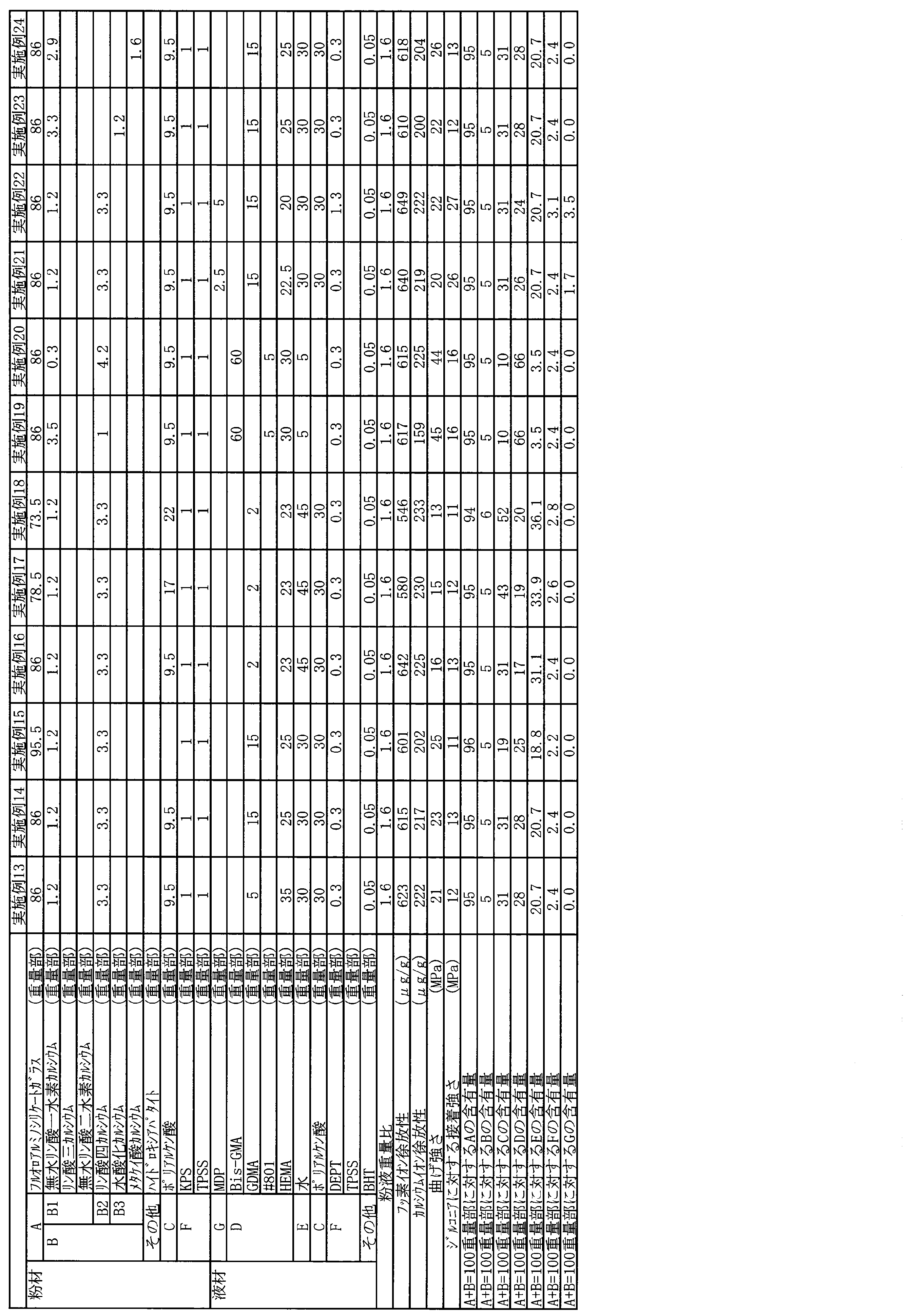
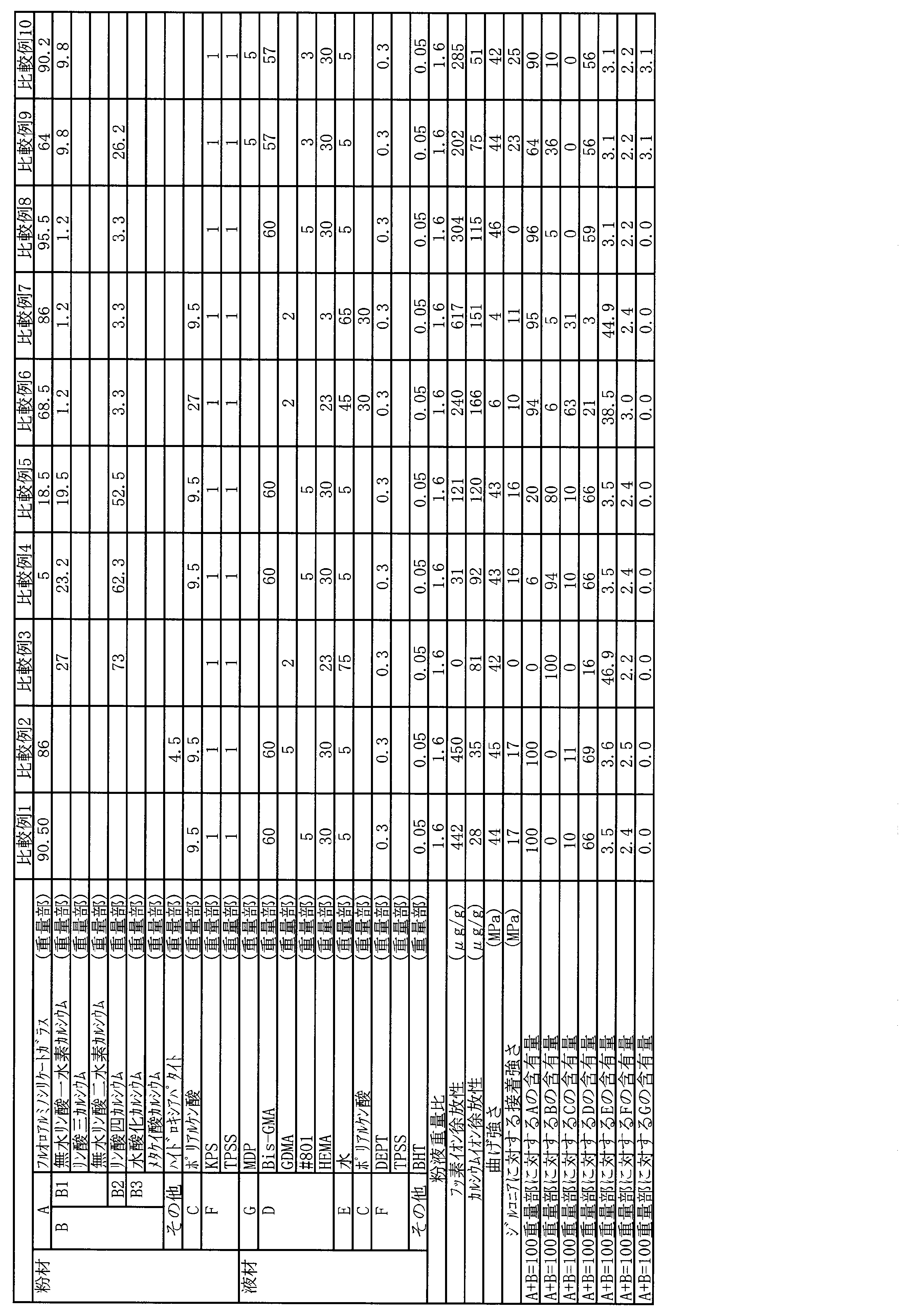
表1~2に示すように、実施例1~24で作製した本発明の歯科用硬化性組成物は、高いフッ素イオン放出性及びカルシウムイオン放出性を示すとともに、曲げ強さも高く、ジルコニアに対しても高い接着性を示した。一方、表3に示すように、比較例1で作製した混合物(B)を含まない歯科用硬化性組成物は、カルシウムイオン放出性が著しく低かった。同様に、比較例2で作製した混合物(B)を含まず、ハイドロキシアパタイトを含む歯科用硬化性組成物もカルシウムイオン放出性が著しく低かった。また、比較例3で作製したフルオロアルミノシリケートガラス粒子及びポリアルケン酸を含まない歯科用硬化性組成物、並びに比較例4及び5で作製したフルオロアルミノシリケートガラス粒子の配合過少の歯科用硬化性組成物は、カルシウムイオン放出性及びフッ素イオン放出性がともに低かった。また、比較例6で作製したポリアルケン酸の配合過多の歯科用硬化性組成物及び比較例7で作製した水過多の歯科用硬化性組成物は、曲げ強さが低かった。比較例8で作製したポリアルケン酸を含まない歯科用硬化性組成物は、カルシウムイオン放出性が低く、ジルコニアに対して接着性を示さなかった。比較例9で作製したポリアルケン酸を含まないが酸性基含有重合性単量体(G)を含む歯科用硬化性組成物では、ジルコニアに対する接着性を示したが、カルシウムイオン放出性が低かった。比較例10で作製したポリアルケン酸を含まないが酸性基含有重合性単量体(G)を含み、混合物(B)の(B1)成分のみを含む歯科用硬化性組成物は、カルシウムイオン放出性が低かった。
本発明の歯科用硬化性組成物は、歯牙患部の欠損部に対する充填修復、及び歯牙患部の欠損部と補綴物の合着に有用であり、特に歯科用レジン強化型グラスアイオノマーセメントとして好適に用いることができる。
Claims (3)
- フルオロアルミノシリケートガラス粒子(A)、酸性リン酸カルシウム粒子(B1)と塩基性リン酸カルシウム粒子(B2)又はリンを含まないカルシウム化合物粒子(B3)との混合物(B)、ポリアルケン酸(C)、酸性基を有しない重合性単量体(D)、水(E)、及び重合開始剤(F)を含有する歯科用硬化性組成物であって、前記フルオロアルミノシリケートガラス粒子(A)及び前記混合物(B)の合計100重量部に対して、前記フルオロアルミノシリケートガラス粒子(A)を30~99重量部含み、前記混合物(B)を1~70重量部含み、前記ポリアルケン酸(C)を1~60重量部含み、前記酸性基を有しない重合性単量体(D)を5~90重量部含み、前記水(E)を1~40重量部含み、前記重合開始剤(F)を0.01~20重量部含む歯科用硬化性組成物。
- さらに酸性基含有重合性単量体(G)を、前記フルオロアルミノシリケートガラス粒子(A)及び前記混合物(B)の合計100重量部に対して0.1~30重量部含む請求項1に記載の歯科用硬化性組成物。
- 請求項1又は2に記載の歯科用硬化性組成物を用いた歯科用レジン強化型グラスアイオノマーセメント。
Priority Applications (1)
| Application Number | Priority Date | Filing Date | Title |
|---|---|---|---|
| JP2015506593A JP6348106B2 (ja) | 2013-03-18 | 2014-03-11 | 歯科用硬化性組成物 |
Applications Claiming Priority (2)
| Application Number | Priority Date | Filing Date | Title |
|---|---|---|---|
| JP2013-055178 | 2013-03-18 | ||
| JP2013055178 | 2013-03-18 |
Publications (1)
| Publication Number | Publication Date |
|---|---|
| WO2014148002A1 true WO2014148002A1 (ja) | 2014-09-25 |
Family
ID=51579700
Family Applications (1)
| Application Number | Title | Priority Date | Filing Date |
|---|---|---|---|
| PCT/JP2014/001384 Ceased WO2014148002A1 (ja) | 2013-03-18 | 2014-03-11 | 歯科用硬化性組成物 |
Country Status (2)
| Country | Link |
|---|---|
| JP (1) | JP6348106B2 (ja) |
| WO (1) | WO2014148002A1 (ja) |
Cited By (4)
| Publication number | Priority date | Publication date | Assignee | Title |
|---|---|---|---|---|
| CN111743783A (zh) * | 2019-03-26 | 2020-10-09 | 株式会社松风 | 双膏型牙科用树脂加强型玻璃离子水门汀组合物 |
| WO2022229739A1 (en) | 2021-04-29 | 2022-11-03 | 3M Innovative Properties Company | Calcium and fluorine ions releasing dental composition |
| JP2023095555A (ja) * | 2021-12-24 | 2023-07-06 | クラレノリタケデンタル株式会社 | 歯科用接着キット |
| JP2023097144A (ja) * | 2021-12-27 | 2023-07-07 | 国立大学法人大阪大学 | ガラス粉末複合体、及びガラス粉末複合体の製造方法 |
Citations (3)
| Publication number | Priority date | Publication date | Assignee | Title |
|---|---|---|---|---|
| JPH06172008A (ja) * | 1992-12-04 | 1994-06-21 | Mitsuo Kondo | 硬化性組成物 |
| JP2001354509A (ja) * | 2000-06-13 | 2001-12-25 | Gc Corp | グラスアイオノマーセメント用ガラス粉末 |
| JP2013040137A (ja) * | 2011-08-17 | 2013-02-28 | Gc Corp | 歯科用グラスアイオノマーセメント |
Family Cites Families (1)
| Publication number | Priority date | Publication date | Assignee | Title |
|---|---|---|---|---|
| JP4794201B2 (ja) * | 2005-04-25 | 2011-10-19 | 株式会社松風 | 2ペースト型グラスアイオノマー系セメント |
-
2014
- 2014-03-11 JP JP2015506593A patent/JP6348106B2/ja active Active
- 2014-03-11 WO PCT/JP2014/001384 patent/WO2014148002A1/ja not_active Ceased
Patent Citations (3)
| Publication number | Priority date | Publication date | Assignee | Title |
|---|---|---|---|---|
| JPH06172008A (ja) * | 1992-12-04 | 1994-06-21 | Mitsuo Kondo | 硬化性組成物 |
| JP2001354509A (ja) * | 2000-06-13 | 2001-12-25 | Gc Corp | グラスアイオノマーセメント用ガラス粉末 |
| JP2013040137A (ja) * | 2011-08-17 | 2013-02-28 | Gc Corp | 歯科用グラスアイオノマーセメント |
Non-Patent Citations (1)
| Title |
|---|
| NAKAGAWA AKINARI ET AL.: "Comparison of the Effects of Added a- and beta-Tricalcium Phosphate on the Basic Properties of Apatite", DENT MATER J, vol. 26, no. 3, 2007, pages 342 - 347 * |
Cited By (6)
| Publication number | Priority date | Publication date | Assignee | Title |
|---|---|---|---|---|
| CN111743783A (zh) * | 2019-03-26 | 2020-10-09 | 株式会社松风 | 双膏型牙科用树脂加强型玻璃离子水门汀组合物 |
| CN111743783B (zh) * | 2019-03-26 | 2024-04-16 | 株式会社松风 | 双膏型牙科用树脂加强型玻璃离子水门汀组合物 |
| WO2022229739A1 (en) | 2021-04-29 | 2022-11-03 | 3M Innovative Properties Company | Calcium and fluorine ions releasing dental composition |
| JP2023095555A (ja) * | 2021-12-24 | 2023-07-06 | クラレノリタケデンタル株式会社 | 歯科用接着キット |
| JP7840682B2 (ja) | 2021-12-24 | 2026-04-06 | クラレノリタケデンタル株式会社 | 歯科用接着キット |
| JP2023097144A (ja) * | 2021-12-27 | 2023-07-07 | 国立大学法人大阪大学 | ガラス粉末複合体、及びガラス粉末複合体の製造方法 |
Also Published As
| Publication number | Publication date |
|---|---|
| JPWO2014148002A1 (ja) | 2017-02-16 |
| JP6348106B2 (ja) | 2018-06-27 |
Similar Documents
| Publication | Publication Date | Title |
|---|---|---|
| JP6062295B2 (ja) | 粉液型の歯科用レジン強化型グラスアイオノマーセメント | |
| JP4822617B2 (ja) | 歯科用セメント組成物 | |
| JP4759170B2 (ja) | 歯科用組成物キット | |
| US8545225B2 (en) | Redox-curing type composition | |
| CN101102741B (zh) | 具有释放钙和磷的玻璃的牙科组合物 | |
| US20230203224A1 (en) | Sulfate-containing or phosphate-containing, self-adhesive dental composite cement with good transparency | |
| JP4897124B2 (ja) | 歯科用接着材料キット | |
| JP2023098835A (ja) | 酸処理充填材をベースにした良好な透明度を持つ自己接着型歯科用コンポジットセメント | |
| JP3497508B2 (ja) | フッ素イオン徐放性プレフォームドグラスアイオノマーフィラーおよびこれを含有する歯科用組成物 | |
| JP2013151545A (ja) | リン酸塩を含む歯科用充填剤および組成物 | |
| JP6232671B2 (ja) | 歯科用硬化性組成物及びその製造方法 | |
| WO2019004391A1 (ja) | 2ペースト型歯科用硬化性組成物 | |
| JP2014070050A (ja) | 重合性組成物 | |
| JP6348106B2 (ja) | 歯科用硬化性組成物 | |
| JP2009522279A (ja) | 水スカベンジャーを有する歯科用組成物 | |
| JP2008019183A (ja) | 歯科用セメント | |
| US8932060B2 (en) | Dental treatment method | |
| JP2010184997A (ja) | 二成分系開始剤及びそれを利用した重合性組成物 | |
| JP7712116B2 (ja) | 2ペースト型歯科用硬化性組成物 | |
| JP6501189B2 (ja) | 歯科用硬化性組成物及びその製造方法 | |
| JP7464359B2 (ja) | 歯科用硬化性組成物 | |
| US20250017827A1 (en) | Acid-Stable Glass Fillers And Self-Adhesive Dental Composite Cements With Good Transparency Containing Them | |
| JP2025177595A (ja) | 歯科用レジン強化型グラスアイオノマーセメント組成物 | |
| JP2025058784A (ja) | 歯科用レジン強化型グラスアイオノマーセメント組成物 |
Legal Events
| Date | Code | Title | Description |
|---|---|---|---|
| 121 | Ep: the epo has been informed by wipo that ep was designated in this application |
Ref document number: 14768990 Country of ref document: EP Kind code of ref document: A1 |
|
| ENP | Entry into the national phase |
Ref document number: 2015506593 Country of ref document: JP Kind code of ref document: A |
|
| NENP | Non-entry into the national phase |
Ref country code: DE |
|
| 122 | Ep: pct application non-entry in european phase |
Ref document number: 14768990 Country of ref document: EP Kind code of ref document: A1 |