WO2014129384A1 - 水酸化脂肪酸を含む腸管保護剤 - Google Patents
水酸化脂肪酸を含む腸管保護剤 Download PDFInfo
- Publication number
- WO2014129384A1 WO2014129384A1 PCT/JP2014/053383 JP2014053383W WO2014129384A1 WO 2014129384 A1 WO2014129384 A1 WO 2014129384A1 JP 2014053383 W JP2014053383 W JP 2014053383W WO 2014129384 A1 WO2014129384 A1 WO 2014129384A1
- Authority
- WO
- WIPO (PCT)
- Prior art keywords
- fatty acid
- acid
- intestinal
- hydroxylated
- cis
- Prior art date
- Legal status (The legal status is an assumption and is not a legal conclusion. Google has not performed a legal analysis and makes no representation as to the accuracy of the status listed.)
- Ceased
Links
Images
Classifications
-
- A—HUMAN NECESSITIES
- A61—MEDICAL OR VETERINARY SCIENCE; HYGIENE
- A61K—PREPARATIONS FOR MEDICAL, DENTAL OR TOILETRY PURPOSES
- A61K31/00—Medicinal preparations containing organic active ingredients
- A61K31/185—Acids; Anhydrides, halides or salts thereof, e.g. sulfur acids, imidic, hydrazonic or hydroximic acids
- A61K31/19—Carboxylic acids, e.g. valproic acid
- A61K31/20—Carboxylic acids, e.g. valproic acid having a carboxyl group bound to a chain of seven or more carbon atoms, e.g. stearic, palmitic, arachidic acids
- A61K31/201—Carboxylic acids, e.g. valproic acid having a carboxyl group bound to a chain of seven or more carbon atoms, e.g. stearic, palmitic, arachidic acids having one or two double bonds, e.g. oleic, linoleic acids
-
- A—HUMAN NECESSITIES
- A23—FOODS OR FOODSTUFFS; TREATMENT THEREOF, NOT COVERED BY OTHER CLASSES
- A23K—FODDER
- A23K20/00—Accessory food factors for animal feeding-stuffs
- A23K20/10—Organic substances
- A23K20/158—Fatty acids; Fats; Products containing oils or fats
-
- A—HUMAN NECESSITIES
- A23—FOODS OR FOODSTUFFS; TREATMENT THEREOF, NOT COVERED BY OTHER CLASSES
- A23L—FOODS, FOODSTUFFS OR NON-ALCOHOLIC BEVERAGES, NOT OTHERWISE PROVIDED FOR; PREPARATION OR TREATMENT THEREOF
- A23L33/00—Modifying nutritive qualities of foods; Dietetic products; Preparation or treatment thereof
- A23L33/10—Modifying nutritive qualities of foods; Dietetic products; Preparation or treatment thereof using additives
- A23L33/115—Fatty acids or derivatives thereof; Fats or oils
- A23L33/12—Fatty acids or derivatives thereof
-
- A—HUMAN NECESSITIES
- A61—MEDICAL OR VETERINARY SCIENCE; HYGIENE
- A61P—SPECIFIC THERAPEUTIC ACTIVITY OF CHEMICAL COMPOUNDS OR MEDICINAL PREPARATIONS
- A61P1/00—Drugs for disorders of the alimentary tract or the digestive system
-
- A—HUMAN NECESSITIES
- A61—MEDICAL OR VETERINARY SCIENCE; HYGIENE
- A61P—SPECIFIC THERAPEUTIC ACTIVITY OF CHEMICAL COMPOUNDS OR MEDICINAL PREPARATIONS
- A61P1/00—Drugs for disorders of the alimentary tract or the digestive system
- A61P1/04—Drugs for disorders of the alimentary tract or the digestive system for ulcers, gastritis or reflux esophagitis, e.g. antacids, inhibitors of acid secretion, mucosal protectants
-
- C—CHEMISTRY; METALLURGY
- C07—ORGANIC CHEMISTRY
- C07C—ACYCLIC OR CARBOCYCLIC COMPOUNDS
- C07C59/00—Compounds having carboxyl groups bound to acyclic carbon atoms and containing any of the groups OH, O—metal, —CHO, keto, ether, groups, groups, or groups
- C07C59/40—Unsaturated compounds
- C07C59/42—Unsaturated compounds containing hydroxy or O-metal groups
-
- A—HUMAN NECESSITIES
- A23—FOODS OR FOODSTUFFS; TREATMENT THEREOF, NOT COVERED BY OTHER CLASSES
- A23V—INDEXING SCHEME RELATING TO FOODS, FOODSTUFFS OR NON-ALCOHOLIC BEVERAGES AND LACTIC OR PROPIONIC ACID BACTERIA USED IN FOODSTUFFS OR FOOD PREPARATION
- A23V2002/00—Food compositions, function of food ingredients or processes for food or foodstuffs
Definitions
- the present invention relates to an intestinal protective agent containing a hydroxylated fatty acid.
- it relates to an intestinal protective agent containing a hydroxy unsaturated fatty acid.
- the present invention relates to improvement of intestinal barrier function by 10-hydroxy-cis-12-octadecenoic acid or the like.
- Intestinal epithelial cells are cells that come into direct contact with food, enteric bacteria, pathogens, etc., and not only function as physical barriers but also play an important role in inducing and directing immune responses in the intestinal tract. is there. Intestinal epithelial cells form a structure in which cell gaps are tightly adhered by a plurality of tight junction-related factors such as ZO-1, Occludin, and Claudin.
- the intestinal epithelial cells when the expression of the related factor is decreased by IL-6, TNF- ⁇ , insulin or the like, the intestinal barrier function may be damaged (Non-patent Document 1). Further, when the intestinal epithelial cell layer is damaged by pathogenic bacteria or the like, the surrounding immune cells are activated, and the epithelial layer is repaired or foreign substances are eliminated.
- Patent Document 1 a therapeutic agent for suppressing such inflammation
- Patent Document 2 a therapeutic agent for inflammatory bowel disease including Lactobacillus bacteria
- Patent Document 2 intestinal protective agents containing whey protein, casein, serum albumin and the like as active ingredients, etc.
- conjugated fatty acids represented by conjugated linoleic acid have been reported to have various physiological activities such as lipid metabolism improving action, anti-arteriosclerotic action, body fat reducing action, etc.
- Patent Documents 2-4 are functional lipids that are attracting attention for use in various fields including pharmaceutical and functional foods.
- conjugated linoleic acid has been reported to have improved symptoms in patients with Crohn's disease and other ulcerative colitis (http://www.nimml.org/838/), and its effects on intestinal protection are also attracting attention. .
- Conjugated linoleic acid is produced as an intermediate in the saturated metabolism of unsaturated fatty acids by lactic acid bacteria.
- Other intermediates in this metabolism include, for example, 10-hydroxy-cis-12-octadecenoic acid and 10-hydroxy-octadecane.
- hydroxylated fatty acids such as acids, for example, oxo fatty acids such as 10-oxo-12-octadecenoic acid, 10-oxooctadecanoic acid, 10-oxo-11-octadecenoic acid, and the like.
- oxo fatty acids such as 10-oxo-12-octadecenoic acid, 10-oxooctadecanoic acid, 10-oxo-11-octadecenoic acid, and the like.
- An object of the present invention is to provide a novel intestinal protective agent that can be used for the prevention or treatment of intestinal barrier function damage or a disease caused thereby.
- an intermediate of unsaturated fatty acid metabolism by lactic acid bacteria such as 10-hydroxy-cis-12-octadecenoic acid
- lactic acid bacteria such as 10-hydroxy-cis-12-octadecenoic acid
- a hydroxylated fatty acid having 18 carbon atoms particularly a hydroxylated unsaturated fatty acid, exhibits an intestinal barrier protecting action, an inhibitory action on the expression of inflammatory cytokine IL-8, and a pathological condition reducing action in an enteritis model.
- the present invention is as follows: [1] An intestinal tract protecting agent comprising a hydroxylated fatty acid having 18 carbon atoms having a hydroxyl group at the 10th and / or 12th position. [2] The agent according to [1], wherein the hydroxylated fatty acid is a hydroxylated unsaturated fatty acid. [3] The agent according to [2], wherein the hydroxylated unsaturated fatty acid has a cis-type double bond at the 12-position. [4] The agent according to [2], wherein the hydroxy unsaturated fatty acid is 10-hydroxy-cis-12-octadecenoic acid.
- [5] The agent according to any one of [1] to [4], which is used for prevention or amelioration of a disease caused by damage to an intestinal barrier function.
- the disease caused by impaired intestinal barrier function is used for the prevention or amelioration of at least one disease selected from the group consisting of inflammatory bowel disease, ulcer and intestinal hypersensitivity syndrome, [5] The agent described.
- the agent according to any one of [1] to [6] which is a feed or a feed additive.
- a method for preventing or treating damage to the intestinal barrier function in warm-blooded animals or a disease resulting therefrom comprising an effective amount of a hydroxylated fatty acid having 18 carbon atoms having a hydroxyl group at the 10th and / or 12th position, Administering to said mammal.
- a hydroxylated fatty acid having 18 carbon atoms having a hydroxyl group at the 10-position and / or 12-position such as 10-hydroxy-cis-12-octadecenoic acid (hereinafter also referred to as HYA), particularly a hydroxylated unsaturated fatty acid.
- HYA 10-hydroxy-cis-12-octadecenoic acid
- the present invention can provide an intestinal protective agent containing the fatty acid. Since the agent can be used in various fields such as pharmaceuticals, foods, and feeds, the present invention is extremely useful industrially.
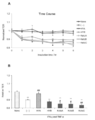
- FIG. 2 shows the intestinal barrier protective effect of test fatty acids HYA, HYB, KetoA, KetoB, and KetoC using transepithelial electrical resistance (hereinafter also referred to as TER) in human colon cancer-derived cell line Caco-2 as an index. Results are shown.
- the vertical axis in FIG. 2A represents the TER value ( ⁇ ⁇ cm 2 ), and the horizontal axis represents the culture time.
- FIG. 2B shows the relative value of the TER value when the value of the control (None) group at 1 hour of culture in FIG. In the figure, * vs None, # vs (-), $ vs HYA are shown, two marks indicate P ⁇ 0.01, and one mark indicates P ⁇ 0.05 (the same applies to FIGS. 3 to 8 and 10).
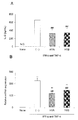
- FIG. 3 shows the results of performing the intestinal barrier protective effect of HYA and HYB using IL-8 production (measurement of both protein and gene levels) in Caco-2 cells as an index.
- shaft of FIG. 3A shows IL-8 production amount (pg / mL).
- the vertical axis of FIG. 3B shows the expression of IL-8 mRNA.
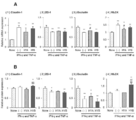
- FIG. 4 shows the effect of HYA and HYB on gene expression of tight junction-related factors.
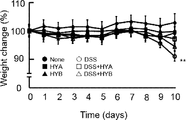
- FIG. 5 shows the effect of HYA or HYB administration on changes in body weight over time in DSS-induced enteritis model mice (shown as% change with the body weight at the start of HYA or HYB administration as 100%).
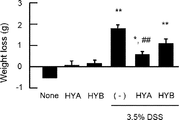
- FIG. 6 shows the effect of HYA or HYB administration on weight loss (reduction amount (g) from the start of HYA or HYB administration to the end of DSS 5-day administration) in DSS-induced enteritis model mice.
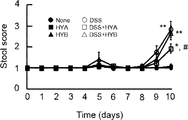
- FIG. 7 shows the effect of HYA or HYB administration on stool score changes over time in DSS-induced enteritis model mice.
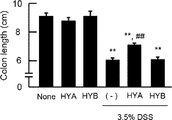
- FIG. 8 shows the effect of HYA or HYB administration on the colon length in DSS-induced enteritis model mice.
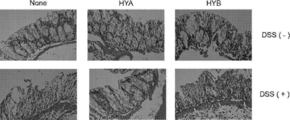
- FIG. 9 shows the effect of HYA or HYB administration on epithelial cell damage in the large intestine of DSS-induced enteritis model mice.
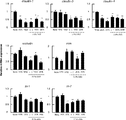
- FIG. 10 shows the effects of HYA and HYB on gene expression of tight junction-related factors in the colon tissue of DSS-induced enteritis model mice.
- the present invention is a hydroxylated fatty acid having 18 carbon atoms having a hydroxyl group at the 10-position and / or 12-position, such as 10-hydroxy-cis-12-octadecenoic acid (hereinafter also referred to as “the hydroxylated fatty acid of the present invention”).
- An intestinal protective agent is provided.
- intestinal tract protection refers to restoring damaged intestinal barrier function and / or enhancing intestinal barrier function.
- Injury can include anything from severe to mild, regardless of extent.
- Restoring a function means returning an abnormal state to the original state and / or bringing it close to the original state.
- the suppression of the function deterioration is also included.
- intestinal barrier means that a substance other than a low molecule is not permeated by physically forming a structure in which the gap between intestinal epithelial cells is tightly adhered by a tight junction-related factor.
- IgA intestinal mucosal defense by IgA secreted to the intestinal mucosa by excretion of foreign substances through the transporter or the like present in the intestinal epithelial cells.
- the intestinal barrier function can be evaluated by a method known per se.
- stool changes, body weight changes, and the like can be confirmed when a hydroxylated fatty acid of the present invention is administered to a T cell transfer enterocolitis animal (model animal such as Crohn's disease).
- human gastrointestinal epithelial cell line Caco-2 cells widely used as a small intestinal epithelial model were subjected to external stimulation with cytokines such as TNF- ⁇ and / or IFN- ⁇ .
- Tight junction-related factors include known and / or unknown factors such as ZO-1, Occludin, Claudin, MLCK (myosin light chain kinase).
- the expression level of the factor can be measured by a method known per se, such as real-time PCR and ELISA.
- “preventing or improving intestinal barrier function damage” having an “intestinal tract protecting” effect means that the evaluation of the intestinal barrier function by at least one of the above methods is administration of a test hydroxylated fatty acid. Means that it is significantly improved.
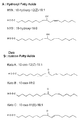
- the “hydroxylated fatty acid of the present invention” means a hydroxylated fatty acid having 18 hydroxyl groups at the 10-position (hereinafter sometimes abbreviated as “10-hydroxy fatty acid”), or a carbon number having hydroxyl groups at the 12-position. This refers to 18 hydroxylated fatty acids (hereinafter sometimes abbreviated as “12-hydroxy fatty acids”).
- 10-hydroxy fatty acid having 18 hydroxyl groups at the 10-position and the 12-position
- “12-hydroxy fatty acid” is also included as one embodiment of the “10-hydroxy fatty acid” and “12-hydroxy fatty acid”.
- a hydroxyl group at the 10th position and a hydroxylated fatty acid of 18 carbon atoms having a cis-type double bond at the 12th position (hereinafter sometimes abbreviated as “10-hydroxy, cis-12 fatty acid”), 18-hydroxylated fatty acid having a hydroxyl group and a trans double bond at the 11-position (hereinafter sometimes abbreviated as “10-hydroxy, trans-11 fatty acid”), and having a hydroxyl group at the 10-position
- a hydroxylated fatty acid having 18 carbon atoms that does not have a double bond at the 12-position hereinafter sometimes abbreviated as “10-hydroxy, 11,12-saturated fatty acid”).
- HYA 10-hydroxy-cis-12-octadecenoic acid
- ⁇ HYA 10-hydroxy-cis-12, cis-15-octadecadienoic acid
- ⁇ HYA 10-hydroxy- Cis-6, cis-12-octadecadienoic acid
- sHYA 10-hydroxy-cis-6, cis-12, cis-15-octadecatrienoic acid
- rHYA 10,12-dihydroxyoctadecanoic acid
- HYB 10-hydroxyoctadecanoic acid
- ⁇ HYB 10-hydroxy-cis-15-octadecenoic acid
- ⁇ HYB 10-hydroxy-cis-6-octadecenoic acid
- the “hydroxy unsaturated fatty acid of the present invention” is not particularly limited as long as it has one or more unsaturated bonds among the “hydroxylated fatty acids of the present invention”, but preferably 1 to 3 at a specific position. And those having three double bonds (for example, HYA, ⁇ HYA, ⁇ HYA, sHYA, ⁇ HYB, ⁇ HYB, sHYB, RA, HYC, ⁇ HYC, ⁇ HYC, sHYC, etc.). More preferred are those having a cis-type double bond at the 12-position (for example, HYA, ⁇ HYA, ⁇ HYA, sHYA, etc.), and particularly preferred is HYA.
- the “hydroxylated fatty acids of the present invention” can be obtained using oxo fatty acids as raw materials or intermediates.
- the oxo fatty acid is an oxo fatty acid having 18 carbon atoms having a carbonyl group at the 10-position or the 12-position (hereinafter sometimes abbreviated as “10-oxo fatty acid” or “12-oxo fatty acid”).
- the 10-hydroxy, trans-11 fatty acid and 10-hydroxy, 11,12-saturated fatty acid each have a carbonyl group at the 10-position and a transcarbon double bond at the 11-position.
- 10-oxo, trans-11 fatty acid an oxo fatty acid having 18 carbon atoms having a carbonyl group at the 10-position and no double bond at the 11- and 12-positions
- 10-oxo, trans-11 fatty acid is an 18-carbon hydroxylated fatty acid (hereinafter referred to as “10-oxo, cis-12 fatty acid”) having a carbonyl group at the 10-position and a cis-type double bond at the 12-position.
- the hydroxylated fatty acid of the present invention can be prepared by the method described in Japanese Patent Application No. 2012-108928, and HYA can be prepared with reference to Biochemical and Biophysical Research Communications 416 (2011) p.188-193. .
- commercially available products such as RA and rHYB can be used.
- 10-oxo fatty acid is produced by a two-step reaction from an unsaturated fatty acid having 18 carbon atoms with a cis-type double bond at the 9-position (hereinafter sometimes abbreviated as “cis-9 unsaturated fatty acid”).
- cis-9 unsaturated fatty acid an unsaturated fatty acid having 18 carbon atoms with a cis-type double bond at the 9-position
- 10-hydroxy fatty acid is produced from cis-9 unsaturated fatty acid by hydrase reaction.
- the “substrate” in Reaction 1 is not particularly limited as long as it is an unsaturated fatty acid having 18 carbon atoms having a cis-type double bond at the 9-position.
- fatty acid includes not only free acids but also esters and salts with basic compounds.
- Examples of monoenoic acid include oleic acid and ricinoleic acid.
- Examples of dienoic acid include linoleic acid and cis-9, trans-11-octadecadienoic acid.
- Examples of the trienoic acids include ⁇ -linolenic acid and ⁇ -linolenic acid.
- Examples of tetraenoic acid include stearidonic acid and the like.
- the hydrase that catalyzes reaction 1 is not particularly limited as long as it is an enzyme that can convert the above-mentioned cis-9 unsaturated fatty acid as a substrate and convert it into 10-hydroxy fatty acid.
- Hydratase CLA-HY
- CLA-HY CLA-HY derived from Lactobacillus plantarum, particularly preferably L.
- CLA-HY can be obtained by the method described in JP-A-2007-259712.
- the amount of hydrating enzyme added is, for example, 0.001 to 10 mg / mL, preferably 0.1 to 5 mg / mL, more preferably 0.2 to 2 mg / mL.
- a “cofactor” may be used for the reaction 1, and for example, NADH, NADPH, FADH 2 and the like can be used.
- the addition concentration may be a concentration at which the hydration reaction proceeds efficiently. Preferably it is 0.001 to 20 mM, more preferably 0.01 to 10 mM.
- an “activator” may be used in the enzymatic reaction, for example, potassium molybdate, disodium molybdenum (VI) acid disodium, disodium molybdenum (VI) acid dihydrate, orthovanadate (V) acid.
- the addition concentration may be a concentration at which the hydration reaction proceeds efficiently. It is preferably 0.1 to 20 mM, more preferably 1 to 10 mM.
- rHYA contains hydrase (wet cell weight 0.7 g) expressed in E. coli in RA, NADH (33 mg), FAD (0.8 mg), ricinoleic acid (1 g), BSA (0.2 g) It can be obtained by making the total volume 10 ml with 100 mM potassium phosphate buffer (pH 6.5) and anaerobically shaking reaction at 37 ° C. for 63 hours at 225 rpm.
- 12-hydroxy fatty acid can be obtained, for example, from a natural oil mainly composed of triglyceride ester containing it as a constituent fatty acid by hydrolysis.
- RA can be obtained by hydrolysis of castor oil and rHYB can be obtained by hydrolysis of hydrogenated castor oil.
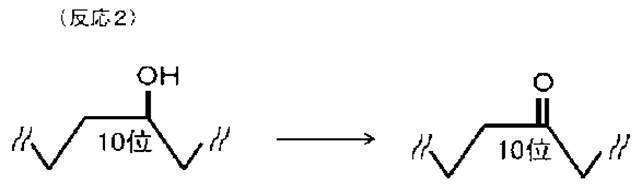
- reaction 2 10-oxo fatty acid is produced from 10-hydroxy fatty acid by dehydrogenase reaction or chemical oxidation using chromic acid.
- the dehydrogenase that catalyzes reaction 2 is not particularly limited as long as it is an enzyme that uses 10-hydroxy fatty acid as a substrate and can be converted to 10-oxo fatty acid.
- hydroxylated fatty acid-dehydrogenase derived from lactic acid bacteria is preferred. More preferred is CLA-DH derived from Lactobacillus plantarum. CLA-DH derived from plantarum FERM BP-10549 strain. CLA-DH can be obtained by the method described in JP-A-2007-259712.
- the amount of dehydrogenase added is, for example, 0.001 to 10 mg / mL, preferably 0.1 to 5 mg / mL, more preferably 0.2 to 2 mg / mL.
- a “cofactor” may be used, and for example, NAD, NADP, FAD and the like can be used.
- the addition concentration may be a concentration at which the oxidation reaction proceeds efficiently. Preferably it is 0.001 to 20 mM, more preferably 0.01 to 10 mM.
- an “activator” may be used for the enzyme reaction.
- the same compounds exemplified in the above reaction 1 can be used at the same added concentration.
- the second reaction can be performed by chemical oxidation.
- chemical oxidation include methods known per se, such as chromic acid oxidation, preferably Jones oxidation.
- chromic acid salts and complexes of compounds such as chromic anhydride CrO 3 , chromic acid H 2 CrO 4 , and dichromic acid H 2 Cr 2 O 7 can be used.
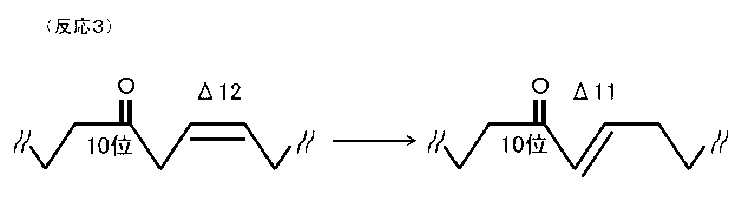
- a 10-oxo, trans-11 fatty acid is produced from an oxo fatty acid having 18 carbon atoms having a carbonyl group at the 10-position and a cis-type double bond at the 12-position by an isomerase reaction (reaction 3).
- the “substrate” of Reaction 3 may be a 10-oxo, cis-12 fatty acid derived from an unsaturated fatty acid having 18 carbon atoms having a cis-type double bond at positions 9 and 12 according to Reactions 1 and 2 above.
- KetoA derived from linoleic acid examples thereof include KetoA derived from linoleic acid, ⁇ KetoA derived from ⁇ -linolenic acid, ⁇ KetoA derived from ⁇ -linolenic acid, and sKetoA derived from stearidonic acid.
- the substrate may be obtained by a method other than Reactions 1 and 2.
- the isomerase that catalyzes reaction 3 is not particularly limited as long as it is an enzyme that uses the 10-oxo, cis-12 fatty acid as a substrate and can be converted to 10-oxo, trans-11 fatty acid.
- Oxo fatty acid isomerase (CLA-DC) derived from lactic acid bacteria is preferred. More preferred is CLA-DC derived from Lactobacillus plantarum.
- CLA-DC can be obtained by the method described in JP-A-2007-259712.
- the amount of isomerase added is, for example, 0.001 to 10 mg / mL, preferably 0.1 to 5 mg / mL, more preferably 0.2 to 2 mg / mL.
- an “activator” may be used for the isomerase reaction.
- the same compounds exemplified in the above reaction 1 can be used at the same addition concentration.
- the “substrate” of reaction 4 is not particularly limited as long as it is a 10-oxo, trans-11 fatty acid that can be produced by the above reaction 3, and is derived from KetoC derived from KetoA, ⁇ KetoC derived from ⁇ KetoA, and ⁇ KetoA. ⁇ KetoC, sKetoC derived from sKetoA, and the like.
- the substrate may be obtained by a method other than Reaction 3.
- the saturation enzyme that catalyzes reaction 4 is not particularly limited as long as it is an enzyme that uses the above 10-oxo, trans-11 fatty acid as a substrate and can be converted to 10-oxo, 11,12-saturated fatty acid.
- oxo fatty acid-enone reductase CLA-ER
- CLA-ER oxo fatty acid-enone reductase
- More preferred is CLA-ER derived from Lactobacillus plantarum.
- the enzyme ⁇ CLA-ER '' (A) an enzyme protein consisting of the amino acid sequence shown in SEQ ID NO: 2, (B) an enzyme activity comprising an amino acid sequence in which one or more amino acids are deleted and / or substituted and / or inserted and / or added in the amino acid sequence shown in SEQ ID NO: 2 and catalyzing the above reaction 4 Or (c) an enzyme activity that is encoded by a base sequence that hybridizes under stringent conditions with a nucleic acid comprising a complementary strand sequence of the base sequence shown in SEQ ID NO: 1 and catalyzes the above reaction 4. It has a protein.
- amino acid sequence in which the amino acid is replaced with another amino acid or (v) a protein comprising an amino acid sequence combining them And the like.
- amino acids of similar properties for example, glycine and alanine, valine and leucine and isoleucine, serine and threonine, aspartic acid and glutamic acid, asparagine and glutamine, lysine and arginine, cysteine and methionine, phenylalanine and tyrosine, etc.
- amino acids of similar properties for example, glycine and alanine, valine and leucine and isoleucine, serine and threonine, aspartic acid and glutamic acid, asparagine and glutamine, lysine and arginine, cysteine and methionine, phenylalanine and tyrosine, etc.
- substitutions for example, there can be a greater number of substitutions.
- stringent conditions means that nucleotide sequences having high identity, for example, nucleotide sequences having 70, 80, 90, 95, or 99% identity or more hybridize to each other and are identical to each other.
- washing conditions for normal Southern hybridization 60 ° C., 1 ⁇ SSC, 0.1% SDS, preferably 0.1 ⁇ SSC, 0.1% SDS, more preferably 68 Examples include conditions of washing once, more preferably 2 to 3 times at a salt concentration and temperature corresponding to 0 ° C., 0.1 ⁇ SSC, and 0.1% SDS.
- CLA-ER is an example of L.
- the enzyme activity that catalyzes the above reaction 4 can be used as an index for isolation from plant cells of FERM BP-10549 strain or culture broth.
- a primer that can synthesize the entire nucleotide sequence of the coding region of CLA-ER or amplify the CLA-ER gene fragment containing the coding region is designed. Recombinant production by performing PCR using cDNA or genomic DNA prepared from the above strain as a template, cloning the amplified fragment into an appropriate expression vector, introducing it into a host cell, and culturing the cell You can also
- the vector containing a nucleic acid encoding CLA-ER can be appropriately selected and used for a host cell into which the vector is introduced according to the purpose (for example, protein expression).
- the vector can also contain an appropriate promoter, transcription termination signal, selectable marker gene (drug resistance gene, gene complementing an auxotrophic mutation, etc.). Further, it may contain a sequence encoding a tag sequence useful for separation and purification of the expressed protein.
- the vector may be one that is integrated into the genome of the subject host cell.
- the vector can be introduced into the target host cell by a transformation method known per se, such as a competent cell method, a protoplast method, a calcium phosphate coprecipitation method, or the like.
- the “host cell” may be any cell as long as it can express a vector containing the nucleic acid encoding CLA-ER, and examples thereof include bacteria, yeast, fungi, and higher eukaryotic cells. Examples of bacteria include gram positive bacteria such as Bacillus or Streptomyces or gram negative bacteria such as E. coli. Recombinant cells into which a vector containing a nucleic acid encoding CLA-ER has been introduced can be cultured by a method known per se suitable for host cells.
- the above-mentioned “purification” of CLA-ER is a method known per se, for example, after crushing bacterial cells collected by centrifugation or the like with ultrasonic waves or glass beads, etc., and then solid matter such as cell debris by centrifugation or the like.
- Prepare a crude enzyme solution and use a salting-out method with ammonium sulfate, sodium sulfate, etc., ion exchange chromatography, gel filtration chromatography, chromatographic methods such as affinity chromatography, gel electrophoresis, etc. Can do.
- the amount of saturating enzyme added is, for example, 0.001 to 10 mg / mL, preferably 0.1 to 5 mg / mL, more preferably 0.2 to 2 mg / mL.
- a “cofactor” may be used for the reaction 4, for example, NADH or the like can be used.
- the addition concentration may be a concentration at which the oxidation reaction proceeds efficiently. Preferably it is 0.001 to 20 mM, more preferably 0.01 to 10 mM.
- an “activator” may be used for the enzyme reaction.
- the same compounds exemplified in the above reaction 1 can be used at the same added concentration.
- oxo fatty acid (10-oxo, trans-11 fatty acid) having a carbonyl group at the 10-position and a trans-type double bond at the 11-position
- a 10-hydroxy Manufactures trans-11 fatty acids, or dehydrates them from oxo fatty acids of 18 carbon atoms (10-oxo, 11,12-saturated fatty acids) that have a carbonyl group at the 10-position and no double bond at the 11- and 12-positions.
- 10-hydroxy, 11,12-saturated fatty acid is produced by elementary enzyme reaction (reaction 6).
- the “substrate” in Reaction 5 is not particularly limited as long as it is a 10-oxo, trans-11 fatty acid that can be produced by Reaction 3 above, and is derived from KetoC derived from KetoA, ⁇ KetoC derived from ⁇ KetoA, and ⁇ KetoA. ⁇ KetoC, sKetoC derived from sKetoA, and the like.
- the substrate may be obtained by a method other than Reaction 3.
- the “substrate” of reaction 6 is not particularly limited as long as it is a 10-oxo, 11,12-saturated fatty acid that can be produced by reaction 4, and KetoB derived from KetoC and ⁇ KetoB derived from ⁇ KetoC. , ⁇ KetoB derived from ⁇ KetoC, sKetoB derived from sKetoC, and the like.
- the substrate may be obtained by a method other than Reaction 4.
- CLA-DH hydroxylated fatty acid-dehydrogenase
- CLA-DH hydroxylated fatty acid-dehydrogenase
- More preferred is CLA-DH derived from Lactobacillus plantarum.
- CLA-DH catalyzes the oxidation reaction in Reaction 2 above, but can also catalyze the reduction reaction of Reaction 5 or Reaction 6 as the reverse reaction.
- the amount of dehydrogenase added is, for example, 0.001 to 10 mg / mL, preferably 0.1 to 5 mg / mL, more preferably 0.2 to 2 mg / mL.
- Cofactor may be used for Reaction 5 and Reaction 6, and for example, NADH, NADPH, FADH 2 and the like can be used.
- the addition concentration may be a concentration at which the reduction reaction proceeds efficiently. Preferably it is 0.001 to 20 mM, more preferably 0.01 to 10 mM.
- an “activator” may be used for the enzyme reaction.
- the same compounds exemplified in the above reaction 1 can be used at the same added concentration.
- the enzyme (hydrase, dehydrogenase, isomerase, saturation enzyme) is a recombinant cell (for example, Escherichia coli, Bacillus subtilis, yeast, etc.) into which an expression vector containing the nucleic acid encoding it is introduced. , Insect cells, animal cells, etc.).
- the reaction can also be carried out by adding the substrate and, if necessary, a cofactor or an activator to a liquid medium suitable for culturing the cell and culturing the cell.
- any of the above enzymes may be purified or roughly purified. Alternatively, it may be expressed in bacterial cells such as Escherichia coli, and the bacterial cells themselves may be used, or a culture solution may be used.
- the enzyme may be free or immobilized by various carriers.
- the intestinal protective agent containing the hydroxylated fatty acid of the present invention can be applied to damage of the intestinal barrier function or a disease caused thereby.
- diseases caused by damage to the intestinal barrier function include, but are not limited to, inflammatory bowel diseases (representative examples are Crohn's disease and ulcerative colitis), ulcers, and intestinal irritable syndrome.
- causes of intestinal barrier function damage include, but are not limited to, stress, surgical factors such as surgery, drugs, toxins, and the like.
- the intestinal protective agent of the present invention is human or non-human warm-blooded animals (for example, dogs, cats, mice, rats, hamsters, guinea pigs, rabbits, pigs, cows, chickens, parakeets, nine-birds, goats, horses, sheep, And can be used to prevent or treat diseases caused by impaired intestinal barrier function.
- human or non-human warm-blooded animals for example, dogs, cats, mice, rats, hamsters, guinea pigs, rabbits, pigs, cows, chickens, parakeets, nine-birds, goats, horses, sheep, And can be used to prevent or treat diseases caused by impaired intestinal barrier function.
- the intestinal protective agent containing the hydroxylated fatty acid of the present invention can be used, for example, as a pharmaceutical, food, feed, or the like, or blended in them.
- the pharmaceutical dosage forms include powders, granules, pills, soft capsules, hard capsules, tablets, chewable tablets, quick-disintegrating tablets, syrups, solutions, suspensions, suppositories, ointments, creams, gels, and stickies. Agents, inhalants, injections and the like.
- hydroxylated fatty acids and the like are hardly soluble in water, they can be dissolved in non-hydrophilic organic solvents such as vegetable oils and animal oils, or emulsifiers, dispersants or Along with a surfactant and the like, a homogenizer (high pressure homogenizer) is used to disperse and emulsify in an aqueous solution.
- a homogenizer high pressure homogenizer
- Additives that can be used for formulation include animal and vegetable oils such as soybean oil, safflower oil, olive oil, germ oil, sunflower oil, beef tallow, sardine oil, polyethylene glycol, propylene glycol, glycerin, sorbitol, etc.
- Surfactant such as polyhydric alcohol, sorbitan fatty acid ester, sucrose fatty acid ester, glycerin fatty acid ester, polyglycerin fatty acid ester, purified water, lactose, starch, crystalline cellulose, D-mannitol, lecithin, gum arabic, sorbitol solution, sugar Excipients such as liquids, sweeteners, colorants, pH adjusters, fragrances, various amino acids and the like can be mentioned.
- the liquid preparation may be dissolved or suspended in water or other suitable medium at the time of taking. Tablets and granules may be coated by a known method.
- Intravenous administration When administered in the form of an injection, it can be administered intravenously, intraperitoneally, intramuscularly, subcutaneously, transdermally, intraarticularly, within the bursa, intravesicular, intraperiosteally, sublingually, orally.
- intravenous administration or intraperitoneal administration is preferred.
- Intravenous administration may be either drip administration or bolus administration.
- the food is not particularly limited as long as it is a form that can be ingested, such as a solution, suspension, powder, or solid molded product.
- Specific examples include supplements (powder, granules, soft capsules, hard capsules, tablets, chewable tablets, quick-disintegrating tablets, syrups, liquids, etc.), beverages (carbonated beverages, lactic acid beverages, sports beverages, fruit juice beverages, vegetable beverages, soy milk beverages) , Coffee beverages, tea beverages, powdered beverages, concentrated beverages, nutritional beverages, alcoholic beverages, etc.), confectionery (gummy, jelly, gum, chocolate, cookies, candy, caramel, Japanese confectionery, snacks, etc.), instant foods (immediate noodles, Retort food, Canned food, Microwave food, Instant soup / Miso soup, Freeze-dried food, etc.) Oil, Fat food (Mayonnaise, Dressing, Butter, Cream, Margarine, etc.), Flour products (Bread, Past
- the above foods include various nutrients, various vitamins (vitamin A, vitamin B1, vitamin B2, vitamin B6, vitamin C, vitamin D, vitamin E, vitamin K, etc.) and various minerals (magnesium, zinc, Iron, sodium, potassium, selenium, etc.), dietary fiber, dispersants, emulsifiers and other stabilizers, sweeteners, taste ingredients (citric acid, malic acid, etc.), flavors, royal jelly, propolis, agarics, etc. it can.
- examples of the feed include pet food, animals or aquaculture feed additives.
- the hydroxylated fatty acid of the present invention blended in the pharmaceutical, food, feed, etc. of the present invention may be only one type, or may be used in combination of two or more types.
- the dose of the pharmaceutical of the present invention or the intake of the food of the present invention can be appropriately determined depending on the age and weight of the patient or the user, symptoms, administration time, dosage form, administration method, combination of drugs, and the like.
- the total amount of the hydroxylated fatty acid of the present invention as the active ingredient is 0.02 to 100 mg / kg body weight per day for an adult, preferably 0.2 to 50 mg / kg body weight
- the total amount of the hydroxylated fatty acid of the present invention as an active ingredient is in the range of 1 to 6000 mg, preferably 10 to 3000 mg per day per adult.
- the intake of the feed of the present invention can also be appropriately determined according to the intake of the food and the dose of the pharmaceutical.
- Caco-2 cells ATCC accession number HTB-37, passaged 40-60, was used.
- Medium Dulbecco's modified Eagle medium containing 10% fetal bovine serum, 1% non-essential amino acids, 100 IU / mL penicillin, 100 ⁇ g / mL streptomycin, and 50 ⁇ g / mL gentamicin (both medium and additives are from Life Technologies)
- Preparation of Caco-2 cells Caco-2 cells were placed in a 75 cm 2 tissue culture flask and cultured at 37 ° C. until approximately 80% confluence.
- the cells are inoculated into a 12-well Transwell (registered trademark) cell culture chamber (permeable membrane; diameter 12 mm, pore diameter 0.4 ⁇ m) at a cell concentration of 2 ⁇ 10 5 cells / cm 2 and 5% CO 2.
- Caco-2 monolayer cells were obtained.
- Caco-2 monolayer cells having a transepithelial electrical resistance (TER) of about 900 to 1,000 ⁇ ⁇ cm 2 or more were used in the assay.
- Each well was placed on a cluster plate and filled with an outer culture (basal side, 1.5 mL) and an inner culture (luminal side, 0.5 mL). Caco-2 monolayer cells were cultured every 48 hours with a fresh medium.
- a well containing only IFN- ⁇ and TNF- ⁇ without the addition of the test fatty acid solution, or a well not containing any of the test fatty acid solution, IFN- ⁇ and TNF- ⁇ (hereinafter also referred to as control) Also provided.
- Comparison of intestinal barrier protective effect Comparison of the intestinal barrier protective effect of the test fatty acid solution was performed using transepithelial electrical resistance (TER) value ( ⁇ ⁇ cm 2 ) and IL-8 production (pg / mL) as indices. Using a resistance measurement system (Millicell-ERS, Millipore) using an Ag / AgCl electrode, each TER value was measured at 0, 1, 2, 3, 4, 5, 6 hours after adding TNF- ⁇ . . Further, the TER relative value (Relative TER) was calculated by dividing the TER value of each well by the TER value of the control. Each IL-8 production amount was measured for 6 hours after addition of TNF- ⁇ by subjecting the outer culture solution collected after culture to ELISA.
- TER transepithelial electrical resistance
- IL-8 production pg / mL
- TER relative value measurement results are shown in FIGS.
- the figure shows the mean ⁇ standard error (SE) (the same applies to the following measurement results).
- SE standard error
- Addition of IFN- ⁇ and TNF- ⁇ to the Caco-2 monolayer cell culture system decreased the TER relative value.
- YA decreased suppression of TER relative value.
- the measurement result of IL-8 is shown in FIG. 3A.
- the addition of IFN- ⁇ and TNF- ⁇ to the Caco-2 monolayer cell culture system increased the IL-8 concentration in the culture. However, when HYA and HYB were added, IL-8 production was suppressed. It was.
- RNA was extracted using Life Technologies.
- the RNA was reverse-transcribed using high-capacity cDNA reverse transcription kit (Life Technologies) to obtain cDNA, and real-time PCR analysis was performed using KAPA SYBR FAST ABI PRISM qPCR kit (Kapa Biosystems).
- Primers are SEQ ID NOS: 3 and 4 for IL-8, SEQ ID NOS: 5 and 6 for Claudin-1, SEQ ID NOS: 7 and 8 for ZO-1, SEQ ID NOS: 9 and 10 for Occludin, SEQ ID NOS: for MLCK Oligo DNA pairs consisting of nucleotide sequences represented by 11 and 12, respectively, were used.
- FIG. 3B The results of gene expression analysis are shown in FIG. Addition of IFN- ⁇ and TNF- ⁇ to the Caco-2 monolayer cell culture system increased myosin light chain kinase (MLCK) mRNA expression and decreased occludin mRNA expression. In the cells to which HYA was added, both the increase in MLCK mRNA expression and the decrease in occludin mRNA expression were suppressed. As shown in FIG. 3B, the addition of IFN- ⁇ and TNF- ⁇ also increased IL-8 mRNA expression, but the addition of HYA and HYB suppressed the increase in expression.
- MLCK myosin light chain kinase
- mice mice ( ⁇ , 6 weeks old) were purchased from Charles River Japan (Kanagawa, Japan), and all experiments were conducted according to the regulations of animal experiments such as Hiroshima University ( No. C10-17).
- Acute colitis was induced by free drinking of 3.5% (w / v) DSS (molecular weight 36000-50000; MP Biomedicals, Aurora, OH, USA) for 5 days.
- mice were orally administered 100 ⁇ L of a suspension of HYA or HYB (100 nmol each).
- Primers are SEQ ID NOS: 5 and 6 for Claudin-1, SEQ ID NOS: 13 and 14 for Claudin-3, SEQ ID NOS: 15 and 16 for Claudin-4, SEQ ID NOS: 7 and 8, ZO-2
- SEQ ID NOS: 9 and 10 for Claudin-1
- SEQ ID NOS: 13 and 14 for Claudin-3
- SEQ ID NOS: 15 and 16 for Claudin-4 SEQ ID NOS: 7 and 8
- ZO-2 ZO-2
- FIG. 5 shows the change in body weight over time
- FIG. 6 shows the weight loss
- FIG. 7 shows the stool score
- FIG. HYA administration was effective in suppressing weight loss, restoring fecal score, and protecting the large intestine.
- staining) of a large intestine section is shown in FIG. DSS treatment significantly induced colonic epithelial cell damage and crypt loss, but tissue damage was restored in mice treated with HYA.
- the mRNA expression of claudin-1, -3, -4, occludin, MLCK, ZO-1 and ZO-2 is shown in FIG.
- DSS mice significantly induced abnormal mRNA expression of claudin-1, 3, 4, occludin, ZO-1 and ZO-2 (MLCK tended to increase).
- MLCK tended to increase.
- occludin and MLCK mRNA expression was significantly recovered in mice orally administered with HYA compared to DSS mice.
- HYB did not recover the abnormal expression of all TJ-related factors.
- the present invention has clarified that it has an intestinal barrier effect that has not been conventionally known as a physiological function of hydroxylated fatty acid, particularly unsaturated hydroxylated fatty acid.
- the intestinal protective agent containing the hydroxylated fatty acid and the like can be applied to various fields such as pharmaceuticals, foods and feeds, and the present invention is extremely useful industrially.
Landscapes
- Chemical & Material Sciences (AREA)
- Health & Medical Sciences (AREA)
- Life Sciences & Earth Sciences (AREA)
- Organic Chemistry (AREA)
- Polymers & Plastics (AREA)
- Engineering & Computer Science (AREA)
- General Health & Medical Sciences (AREA)
- Veterinary Medicine (AREA)
- Medicinal Chemistry (AREA)
- Pharmacology & Pharmacy (AREA)
- Animal Behavior & Ethology (AREA)
- Food Science & Technology (AREA)
- Public Health (AREA)
- Epidemiology (AREA)
- Zoology (AREA)
- Oil, Petroleum & Natural Gas (AREA)
- Mycology (AREA)
- Nutrition Science (AREA)
- Animal Husbandry (AREA)
- Chemical Kinetics & Catalysis (AREA)
- Bioinformatics & Cheminformatics (AREA)
- General Chemical & Material Sciences (AREA)
- Nuclear Medicine, Radiotherapy & Molecular Imaging (AREA)
- Coloring Foods And Improving Nutritive Qualities (AREA)
- Acyclic And Carbocyclic Compounds In Medicinal Compositions (AREA)
- Fodder In General (AREA)
- Preparation Of Compounds By Using Micro-Organisms (AREA)
Abstract
Description
上記のような腸管保護剤は報告されているものの、腸管バリア機能の損傷又はそれに起因する疾患の予防又は治療に用いることのできる、新たな腸管保護剤の開発が望まれている。
[1]10位及び/又は12位に水酸基を有する炭素数18の水酸化脂肪酸を含む、腸管保護剤。
[2]水酸化脂肪酸が、水酸化不飽和脂肪酸である、[1]に記載の剤。
[3]水酸化不飽和脂肪酸が、12位にシス型二重結合を有する、[2]に記載の剤。
[4]水酸化不飽和脂肪酸が、10-ヒドロキシ-シス-12-オクタデセン酸である、[2]に記載の剤。
[5]腸管バリア機能の損傷に起因する疾患の予防又は改善に使用される[1]-[4]のいずれかに記載の剤。
[6]腸管バリア機能の損傷に起因する疾患が、炎症性腸疾患、潰瘍及び腸過敏性症候群からなる群から選択される少なくとも1種の疾患の予防又は改善に使用される、[5]に記載の剤。
[7]食品もしくは食品添加物である、[1]-[6]のいずれかに記載の剤。
[8]医薬品である、[1]-[6]のいずれかに記載の剤。
[9]飼料もしくは飼料添加物である、[1]-[6]のいずれかに記載の剤。
[10]温血動物における腸管バリア機能の損傷又はそれに起因する疾患を予防又は治療する方法であって、有効量の10位及び/又は12位に水酸基を有する炭素数18の水酸化脂肪酸を、該哺乳動物に投与することを含む、方法。
[11]腸管保護剤として使用するための、10位及び/又は12位に水酸基を有する炭素数18の水酸化脂肪酸。
[12]腸管保護剤の製造のための、10位及び/又は12位に水酸基を有する炭素数18の水酸化脂肪酸の使用。
本発明において「腸管保護」効果を有する、「腸管バリア機能の損傷を予防又は改善する」とは、上記いずれかの手法の少なくとも1つによる腸管バリア機能の評価が、被検水酸化脂肪酸の投与により有意に改善されることを意味する。
より具体的には、10-ヒドロキシ-シス-12-オクタデセン酸(HYA)、10-ヒドロキシ-シス-12,シス-15-オクタデカジエン酸(以下、「αHYA」ともいう)、10-ヒドロキシ-シス-6,シス-12-オクタデカジエン酸(以下、「γHYA」ともいう)、10-ヒドロキシ-シス-6,シス-12,シス-15-オクタデカトリエン酸(以下、「sHYA」ともいう)、10,12-ジヒドロキシオクタデカン酸(以下、「rHYA」ともいう)、10-ヒドロキシオクタデカン酸(以下、「HYB」ともいう)、10-ヒドロキシ-シス-15-オクタデセン酸(以下、「αHYB」ともいう)、10-ヒドロキシ-シス-6-オクタデセン酸(以下、「γHYB」ともいう)、10-ヒドロキシ-シス-6,シス-15-オクタデカジエン酸(以下、「sHYB」ともいう)、12-ヒドロキシオクタデカン酸(以下、「rHYB」ともいう)、リシノール酸(以下、「RA」ともいう)、10-ヒドロキシ-トランス-11-オクタデセン酸(以下、「HYC」ともいう)、10-ヒドロキシ-トランス-11,シス-15-オクタデカジエン酸(以下、「αHYC」ともいう)、10-ヒドロキシ-シス-6,トランス-11-オクタデカジエン酸(以下、「γHYC」ともいう)、10-ヒドロキシ-シス-6,トランス-11,シス-15-オクタデカトリエン酸(以下、「sHYC」ともいう)等が挙げられるが、これらに限定されない。
より具体的には、本発明の水酸化脂肪酸の製造原料もしくは中間体として、10-オキソ-シス-12-オクタデセン酸(「KetoA」ともいう)、10-オキソ-シス-12,シス-15-オクタデカジエン酸(以下、「αKetoA」ともいう)、10-オキソ-シス-6,シス-12-オクタデカジエン酸(以下、「γKetoA」ともいう)、10-オキソ-シス-6,シス-12,シス-15-オクタデカトリエン酸(以下、「sKetoA」ともいう)等の10-oxo,cis-12脂肪酸、10-オキソオクタデカン酸(「KetoB」ともいう)、10-オキソ-シス-6-オクタデセン酸(以下、「γKetoB」ともいう)、10-オキソ-シス-15-オクタデセン酸(以下、「αKetoB」ともいう)、10-オキソ-シス-6,シス-15-オクタデカジエン酸(以下、「sKetoB」ともいう)等の10-oxo,11,12-飽和化脂肪酸、10-オキソ-トランス-11-オクタデセン酸(「KetoC」ともいう)、10-オキソ-シス-6,トランス-11-オクタデカジエン酸(以下、「γKetoC」ともいう)、10-オキソ-トランス-11,シス-15-オクタデカジエン酸(以下、「αKetoC」ともいう)、10-オキソ-シス-6,トランス-11,シス-15-オクタデカトリエン酸(以下、「sKetoC」ともいう)等の10-oxo,trans-11脂肪酸などが使用され得る。

反応1の「基質」は、9位にシス型二重結合を有する炭素数18の不飽和脂肪酸であれば特に制限されず、例えばモノエン酸(18:1)、ジエン酸(18:2)、トリエン酸(18:3)、テトラエン酸(18:4)、ペンタエン酸(18:5)等が挙げられる。ジエン酸、トリエン酸、又はテトラエン酸がより好ましく、ジエン酸類、又はトリエン酸類が特に好ましい。尚、本明細書において「脂肪酸」という場合、遊離の酸のみならず、エステル体、塩基性化合物との塩等をも包含する。
ジエン酸としては、例えば、リノール酸、シス-9,トランス-11-オクタデカジエン酸等が挙げられる。
トリエン酸類としては、例えば、α-リノレン酸、γ-リノレン酸等が挙げられる。
テトラエン酸としては、例えば、ステアリドン酸等が挙げられる。
さらに、酵素反応に「活性化剤」を用いてよく、例えば、モリブデン酸カリウム、モリブデン(VI)酸二ナトリウム無水和物、モリブデン(VI)酸二ナトリウム二水和物、オルトバナジン(V)酸ナトリウム、メタバナジン(V)酸ナトリウム、タングステン(VI)酸カリウム、タングステン(VI)酸ナトリウム無水和物、及びタングステン(VI)酸ナトリウム二水和物からなる群から選ばれる1又は2以上の化合物が挙げられる。その添加濃度は水和反応が効率良く進む濃度であればよい。好ましくは0.1~20 mM、より好ましくは1~10 mMである。
一方、12-hydroxy脂肪酸は、例えば、それを構成脂肪酸として含むトリグリセリドエステルを主成分とする天然油から、加水分解により得ることができる。例えば、RAはヒマシ油、rHYBは硬化ヒマシ油の加水分解により得ることができる。
さらに、酵素反応に「活性化剤」を用いてよく、例えば、上記反応1で例示されたのと同様の化合物を、同様の添加濃度で使用することができる。
化学的酸化としては、自体公知の方法、例えばクロム酸酸化、好ましくはジョーンズ酸化等が挙げられる。クロム酸としては、無水クロム酸CrO3、クロム酸H2CrO4、二クロム酸H2Cr2O7といった化合物の塩や錯体を使用することができる。
反応3の「基質」としては、上記反応1及び2により、9位及び12位にシス型二重結合を有する炭素数18の不飽和脂肪酸から誘導される10-oxo,cis-12脂肪酸であれば特に制限されず、リノール酸から誘導されるKetoA、α-リノレン酸から誘導されるαKetoA、γ-リノレン酸から誘導されるγKetoA、ステアリドン酸から誘導されるsKetoA等が挙げられる。当該基質は反応1及び2以外の方法により得られたものであってもよい。
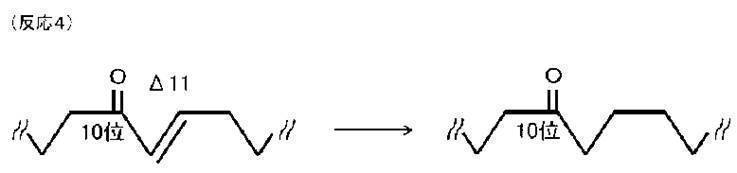
反応4の「基質」としては、上記反応3により生成し得る10-oxo,trans-11脂肪酸であれば特に制限されず、KetoAから誘導されるKetoC、αKetoAから誘導されるαKetoC、γKetoAから誘導されるγKetoC、sKetoAから誘導されるsKetoC等が挙げられる。当該基質は反応3以外の方法により得られたものであってもよい。
(a)配列番号2に示されるアミノ酸配列からなる酵素タンパク質、
(b)配列番号2に示されるアミノ酸配列において、1又は複数個のアミノ酸が欠失及び/又は置換及び/又は挿入及び/又は付加されたアミノ酸配列を含み、かつ上記反応4を触媒する酵素活性を有するタンパク質、あるいは
(c)配列番号1に示される塩基配列の相補鎖配列からなる核酸と、ストリンジェントな条件下でハイブリダイズする塩基配列によってコードされ、かつ上記反応4を触媒する酵素活性を有するタンパク質である。
上記のようにアミノ酸が欠失、置換又は挿入されている場合、その欠失、置換、挿入の位置は、上記酵素活性が保持される限り、特に限定されない。
さらに、酵素反応に「活性化剤」を用いてよく、例えば、上記反応1で例示されたのと同様の化合物を、同様の添加濃度で使用することができる。
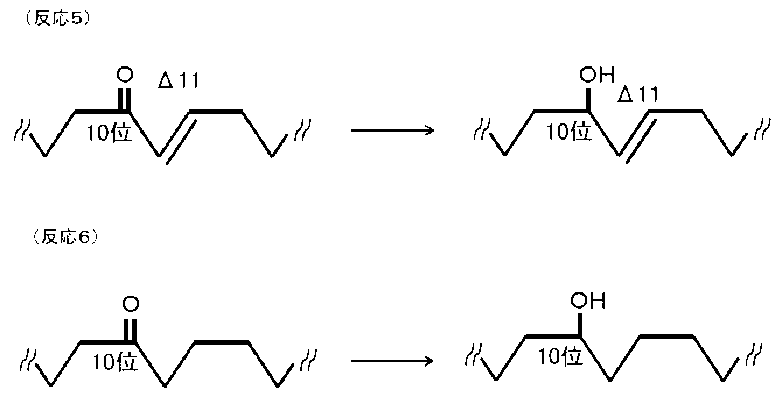
反応5の「基質」としては、上記反応3により生成し得る10-oxo,trans-11脂肪酸であれば特に制限されず、KetoAから誘導されるKetoC、αKetoAから誘導されるαKetoC、γKetoAから誘導されるγKetoC、sKetoAから誘導されるsKetoC等が挙げられる。当該基質は反応3以外の方法により得られたものであってもよい。
一方、反応6の「基質」としては、上記反応4により生成し得る10-oxo,11,12-飽和化脂肪酸であれば特に制限されず、KetoCから誘導されるKetoB、αKetoCから誘導されるαKetoB、γKetoCから誘導されるγKetoB、sKetoCから誘導されるsKetoB等が挙げられる。当該基質は反応4以外の方法により得られたものであってもよい。
さらに、酵素反応に「活性化剤」を用いてよく、例えば、上記反応1で例示されたのと同様の化合物を、同様の添加濃度で使用することができる。
腸管バリア機能の損傷を起こす原因は、例えば、ストレス、手術等の外科的要因、薬物、毒素などが挙げられるが、これらに限定されない。
当該医薬品の剤型としては、散剤、顆粒剤、丸剤、ソフトカプセル、ハードカプセル、錠剤、チュアブル錠、速崩錠、シロップ、液剤、懸濁剤、座剤、軟膏、クリーム剤、ゲル剤、粘付剤、吸入剤、注射剤等が挙げられる。これらの製剤は常法に従って調製されるが、水酸化脂肪酸等は水に難溶性であるため、植物性油、動物性油等の非親水性有機溶媒に溶解するか又は、乳化剤、分散剤もしくは界面活性剤等とともに、ホモジナイザー(高圧ホモジナイザー)を用いて水溶液中に分散、乳化させて用いる。
本発明の医薬品の投与量又は本発明の食品の摂取量は、患者又は摂取者の年齢及び体重、症状、投与時間、剤型、投与方法、薬剤の組み合わせ等に依存して適宜決定できる。例えば、本発明の医薬品を経口投与する場合、有効成分である本発明の水酸化脂肪酸の総量として、成人1日当たり0.02~100mg/kg体重、好ましくは0.2~50mg/kg体重の範囲で、また、非経口的に投与する場合は0.002mg~50mg/kg体重、好ましくは0.02~50mg/kg体重の範囲で、一日1回もしくは数回(2~5回)に分けて投与することができる。また、食品として摂取する場合には、有効成分である本発明の水酸化脂肪酸の総量が、成人1人1日当たり1~6000mgの範囲、好ましくは10~3000mgの範囲の摂取量となるように、食品に配合することができる。本発明の飼料の摂取量についても、それぞれ上記食品の摂取量及び上記医薬品の投与量に準じて適宜決定することができる。
Caco-2細胞:ATCCでの受託番号HTB-37、40~60代継代したものを使用した。
培地:10%牛胎子血清、1%非必須アミノ酸、100 IU/mLペニシリン、100 μg/mLストレプトマイシン、及び50 μg/mLゲンタマイシン含有ダルベッコ改変イーグル培地(培地及び添加物はいずれもLife Technologies製)
Caco-2細胞の調製
75 cm2の組織培養フラスコにCaco-2細胞を入れ、約80%のコンフルエンスになるまで、37℃で培養した。当該細胞を、12穴トランズウェル(Transwell(登録商標))細胞培養チャンバー(透過性膜;直径12mm、孔径0.4μm)に、2×10⁵ cells/cm2の細胞濃度で接種し、5% CO2雰囲気下、37℃にて14日間培養しCaco-2単層細胞を得た。さらに、タイトジャンクションが充分に形成されているか否かを検証するため、経上皮電気抵抗(TER)が約900~1,000Ω・cm2以上のCaco-2単層細胞をアッセイに用いた。各ウェルはクラスタープレート上に設置し、外側培養液(基底側、1.5 mL)及び内側培養液(管腔側、0.5 mL)を満たした。48時間毎に新鮮な培地に交換してCaco-2単層細胞を培養した。
上述の方法で調製したCaco-2単層細胞の各ウェルの内側培養液に、HYA、HYB、KetoA、KetoBまたはKetoC、各々50 μM濃度の溶液を500 μL添加して24時間培養した。次に、外側培養液に、最終濃度が50 ng/mLになるようにIFN-γを添加して24時間培養後、外側培地を一旦取り除き、50 ng/mLになるようにTNF-αを加え、さらに6時間培養した後、後述の腸管バリア保護効果の評価を行った。その際、被検脂肪酸液無添加でIFN-γ及びTNF-αのみを添加したウェル、若しくは、被検脂肪酸液、IFN-γ及びTNF-αのいずれも添加しないウェル(以下、コントロールともいう)も設けた。
被検脂肪酸液による腸管バリア保護効果の比較は、経上皮電気抵抗(TER)値(Ω・cm2)及びIL-8産生(pg/mL)を指標に行なった。Ag/AgCl電極を用いた抵抗値測定システム(Millicell-ERS、Millipore)を用いて、TNF-αを添加後0、1、2、3、4、5、6時間での各TER値を測定した。さらに、各ウェルのTER値をコントロールのTER値で除してTER相対値(Relative TER)を算出した。各IL-8産生量は、培養後に採取した外側培養液をELISA法に供し、TNF-α添加後6時間の値を測定した。
上述の実施例同様、HYAを添加して6時間後に、Caco-2単層細胞をPBSで3回洗浄した後、当該細胞からTRIzol(登録商標)(Life Technologies社製)を用いてRNAを抽出した。当該RNAをhigh-capacity cDNA reverse transcription kit (Life Technologies)を用いて逆転写させcDNAを得、KAPA SYBR FAST ABI PRISM qPCR kit (Kapa Biosystems)を用いて、リアルタイムPCR解析を行った。プライマーは、IL-8については配列番号3及び4、Claudin-1については配列番号5及び6、ZO-1については配列番号7及び8、Occludinについては配列番号9及び10、MLCKについては配列番号11及び12でそれぞれ表されるヌクレオチド配列からなるオリゴDNA対を使用した。
BALB/cマウス (♀, 6週齢)はCharles River Japan (Kanagawa, Japan)から購入し、全ての実験計画は広島大学動物実験等規則に従って行った (No. C10-17)。急性大腸炎は3.5 % (w/v) DSS (分子量36000-50000; MP Biomedicals, Aurora, OH, USA)を5日間、自由飲水させることにより誘導した。HYAおよびHYBの大腸に対する効果を評価するために、マウスにHYAあるいはHYB (各100 nmol)の懸濁液100 μLを経口投与した。この投与はDSS投与前5日間と投与開始後5日間の全10日間、毎日行った。大腸炎の症状評価は、体重減少、糞便の状態および肛門からの出血によって毎日評価した 。5日間のDSS投与後、マウスを屠殺し、大腸長を測定した。その後、大腸組織からRNeasy Mini Kit (Qiagen, Maryland, MD, USA)を用いてRNA抽出を行った。また、大腸組織のパラフィン切片 (7 μm)を作製し、ヘマトキシリン-エオシンによって染色して、組織化学的評価を行った。また、抽出したRNAはhigh-capacity cDNA reverse transcription kit (Life Technologies)を用いて逆転写させcDNAを得、KAPA SYBR FAST ABI PRISM qPCR kit (Kapa Biosystems)を用いて、リアルタイムPCR解析を行った。プライマーは、Claudin-1については配列番号5及び 6、Claudin-3については配列番号13及び14、Claudin-4については配列番号15及び16、ZO-1については配列番号7及び8、ZO-2については配列番号17及び18、Occludinについては配列番号9及び10、MLCKについては、配列番号11及び12でそれぞれ表されるヌクレオチド配列からなるオリゴDNA対を使用した。
また、大腸切片の組織化学的評価(H&E染色)の結果を図9に示す。DSS処理は大腸の上皮細胞の損傷とクリプトの減少を顕著に誘導したが、HYAを投与したマウスでは組織損傷が回復した。
claudin-1, -3, -4, occludin, MLCK, ZO-1およびZO-2のmRNA発現を図10に示す。DSSマウスは、claudin-1, 3, 4, occludin, ZO-1およびZO-2のmRNA発現異常を有意に誘導した(MLCKは増加傾向であった)。しかし、HYAを経口投与したマウスでは、DSSマウスと比較して、occludinとMLCKのmRNA発現が有意に回復していた。一方、HYBは全てのTJ関連因子の発現異常を回復しなかった。
ここで述べられた特許及び特許出願明細書を含む全ての刊行物に記載された内容は、ここに引用されたことによって、その全てが明示されたと同程度に本明細書に組み込まれるものである。
Claims (12)
Priority Applications (6)
| Application Number | Priority Date | Filing Date | Title |
|---|---|---|---|
| ES14754333T ES2738496T3 (es) | 2013-02-21 | 2014-02-13 | Agente protector del tracto intestinal que comprende un ácido graso hidroxilado |
| CN201480009983.3A CN104994846B (zh) | 2013-02-21 | 2014-02-13 | 含有羟基化脂肪酸的肠道保护剂 |
| US14/768,183 US9539229B2 (en) | 2013-02-21 | 2014-02-13 | Intestinal tract-protecting agent containing hydroxylated fatty acid |
| EP14754333.4A EP2959897B1 (en) | 2013-02-21 | 2014-02-13 | Intestinal tract-protecting agent containing hydroxylated fatty acid |
| DK14754333.4T DK2959897T3 (da) | 2013-02-21 | 2014-02-13 | Tarmkanal-beskyttelsesmiddel indeholdende hydroxyleret fedtsyre |
| JP2015501420A JP6241681B2 (ja) | 2013-02-21 | 2014-02-13 | 水酸化脂肪酸を含む腸管保護剤 |
Applications Claiming Priority (2)
| Application Number | Priority Date | Filing Date | Title |
|---|---|---|---|
| JP2013031769 | 2013-02-21 | ||
| JP2013-031769 | 2013-02-21 |
Publications (1)
| Publication Number | Publication Date |
|---|---|
| WO2014129384A1 true WO2014129384A1 (ja) | 2014-08-28 |
Family
ID=51391178
Family Applications (1)
| Application Number | Title | Priority Date | Filing Date |
|---|---|---|---|
| PCT/JP2014/053383 Ceased WO2014129384A1 (ja) | 2013-02-21 | 2014-02-13 | 水酸化脂肪酸を含む腸管保護剤 |
Country Status (7)
| Country | Link |
|---|---|
| US (1) | US9539229B2 (ja) |
| EP (1) | EP2959897B1 (ja) |
| JP (1) | JP6241681B2 (ja) |
| CN (1) | CN104994846B (ja) |
| DK (1) | DK2959897T3 (ja) |
| ES (1) | ES2738496T3 (ja) |
| WO (1) | WO2014129384A1 (ja) |
Cited By (10)
| Publication number | Priority date | Publication date | Assignee | Title |
|---|---|---|---|---|
| WO2015111700A1 (ja) | 2014-01-24 | 2015-07-30 | 国立大学法人京都大学 | 希少脂肪酸を含む代謝改善剤 |
| WO2015111699A1 (ja) | 2014-01-24 | 2015-07-30 | 国立大学法人京都大学 | 新規酵素を用いた希少脂肪酸の製造法ならびに新規希少脂肪酸 |
| WO2015111701A1 (ja) | 2014-01-24 | 2015-07-30 | 国立大学法人京都大学 | 希少脂肪酸を含む抗炎症剤 |
| WO2019045011A1 (ja) | 2017-08-31 | 2019-03-07 | 国立大学法人京都大学 | 水酸化脂肪酸のホモポリマーとその製造方法 |
| US10285966B2 (en) | 2015-06-02 | 2019-05-14 | Nitto Pharmaceutical Industries, Ltd. | 10-hydroxy-cis-12-octadecenoic acid alkyl ester and use thereof |
| US10287234B2 (en) | 2015-06-02 | 2019-05-14 | Nitto Pharmaceutical Industries, Ltd. | Triglyceride and use thereof |
| JPWO2018168407A1 (ja) * | 2017-03-17 | 2020-01-16 | 日東薬品工業株式会社 | フタロシンまたはフタロシン誘導体を経由するメナキノン合成経路を備える細菌の増殖抑制用組成物 |
| JP2020191831A (ja) * | 2019-05-29 | 2020-12-03 | 株式会社萌芽プランツ | 腸管バリア機能回復用食品組成物 |
| WO2025013799A1 (ja) * | 2023-07-07 | 2025-01-16 | Noster株式会社 | 整腸剤 |
| US12391968B2 (en) | 2019-03-29 | 2025-08-19 | Noster Inc. | Production method for rare fatty acid using novel enzyme, and novel rare fatty acid |
Citations (6)
| Publication number | Priority date | Publication date | Assignee | Title |
|---|---|---|---|---|
| JPH09241177A (ja) | 1996-03-05 | 1997-09-16 | Snow Brand Milk Prod Co Ltd | 腸管保護剤 |
| WO1999016435A1 (en) * | 1997-09-29 | 1999-04-08 | Menarini Ricerche S.P.A. | Pharmaceutical compositions containing ricinoleic acid and their use in anti-inflammatory and analgesic therapy |
| JP2003073286A (ja) | 2001-09-04 | 2003-03-12 | Yakult Honsha Co Ltd | 炎症性腸疾患予防治療剤 |
| JP2007259712A (ja) | 2006-03-27 | 2007-10-11 | Asahi Kasei Pharma Kk | 共役脂肪酸の製造方法 |
| WO2010117194A2 (ko) * | 2009-04-06 | 2010-10-14 | 대원제약주식회사 | 지방산 계열 화합물을 유효성분으로 함유하는 위장 질환 예방 또는 치료용 조성물 |
| JP2012108928A (ja) | 2000-09-07 | 2012-06-07 | Nokia Corp | 携帯無線電話機の管理システム |
Family Cites Families (2)
| Publication number | Priority date | Publication date | Assignee | Title |
|---|---|---|---|---|
| US20050032892A1 (en) * | 2003-08-07 | 2005-02-10 | The Procter & Gamble Company | Compositions, kits, and methods for treating gastrointestinal conditions |
| EP2913051B1 (en) * | 2012-10-29 | 2018-09-19 | Kyoto University | Metabolism-improving agent comprising rare fatty acid |
-
2014
- 2014-02-13 DK DK14754333.4T patent/DK2959897T3/da active
- 2014-02-13 ES ES14754333T patent/ES2738496T3/es active Active
- 2014-02-13 US US14/768,183 patent/US9539229B2/en active Active
- 2014-02-13 EP EP14754333.4A patent/EP2959897B1/en active Active
- 2014-02-13 JP JP2015501420A patent/JP6241681B2/ja active Active
- 2014-02-13 WO PCT/JP2014/053383 patent/WO2014129384A1/ja not_active Ceased
- 2014-02-13 CN CN201480009983.3A patent/CN104994846B/zh active Active
Patent Citations (6)
| Publication number | Priority date | Publication date | Assignee | Title |
|---|---|---|---|---|
| JPH09241177A (ja) | 1996-03-05 | 1997-09-16 | Snow Brand Milk Prod Co Ltd | 腸管保護剤 |
| WO1999016435A1 (en) * | 1997-09-29 | 1999-04-08 | Menarini Ricerche S.P.A. | Pharmaceutical compositions containing ricinoleic acid and their use in anti-inflammatory and analgesic therapy |
| JP2012108928A (ja) | 2000-09-07 | 2012-06-07 | Nokia Corp | 携帯無線電話機の管理システム |
| JP2003073286A (ja) | 2001-09-04 | 2003-03-12 | Yakult Honsha Co Ltd | 炎症性腸疾患予防治療剤 |
| JP2007259712A (ja) | 2006-03-27 | 2007-10-11 | Asahi Kasei Pharma Kk | 共役脂肪酸の製造方法 |
| WO2010117194A2 (ko) * | 2009-04-06 | 2010-10-14 | 대원제약주식회사 | 지방산 계열 화합물을 유효성분으로 함유하는 위장 질환 예방 또는 치료용 조성물 |
Non-Patent Citations (6)
| Title |
|---|
| BIOCHEMICAL AND BIOPHYSICAL RESEARCH COMMUNICATIONS, vol. 416, 2011, pages 188 - 193 |
| CLEMENT IP, CANCER RES., vol. 51, 1991, pages 6118 - 6124 |
| HA YL, CARCINOGENESIS, vol. 8, no. 12, 1987, pages 1881 - 1887 |
| KISUN NL, ATHEROSCLEROSIS, vol. 108, 1994, pages 19 - 25 |
| NUSRAT A, AM J PHYSIOL GASTROINTEST LIVER PHYSIOL., vol. 279, no. 5, 2000, pages G851 - G857 |
| See also references of EP2959897A4 * |
Cited By (18)
| Publication number | Priority date | Publication date | Assignee | Title |
|---|---|---|---|---|
| WO2015111700A1 (ja) | 2014-01-24 | 2015-07-30 | 国立大学法人京都大学 | 希少脂肪酸を含む代謝改善剤 |
| WO2015111699A1 (ja) | 2014-01-24 | 2015-07-30 | 国立大学法人京都大学 | 新規酵素を用いた希少脂肪酸の製造法ならびに新規希少脂肪酸 |
| WO2015111701A1 (ja) | 2014-01-24 | 2015-07-30 | 国立大学法人京都大学 | 希少脂肪酸を含む抗炎症剤 |
| US12697318B2 (en) | 2014-01-24 | 2026-08-04 | Noster Inc. | Anti-inflammatory agent containing rare fatty acid |
| US12491173B2 (en) | 2014-01-24 | 2025-12-09 | Noster Inc. | Metabolism-improving agent comprising rare fatty acid |
| US10548868B2 (en) | 2014-01-24 | 2020-02-04 | Kyoto University | Metabolism-improving agent comprising rare fatty acid |
| EP4060040A1 (en) | 2014-01-24 | 2022-09-21 | Kyoto University | Method for producing rare fatty acid using novel enzyme, and novel rare fatty acid |
| US10952983B2 (en) | 2014-01-24 | 2021-03-23 | Kyoto University | Metabolism-improving agent comprising rare fatty acid |
| US11046980B2 (en) | 2014-01-24 | 2021-06-29 | Kyoto University | Method for producing rare fatty acid using novel enzyme, and novel rare fatty acid |
| US10285966B2 (en) | 2015-06-02 | 2019-05-14 | Nitto Pharmaceutical Industries, Ltd. | 10-hydroxy-cis-12-octadecenoic acid alkyl ester and use thereof |
| US10287234B2 (en) | 2015-06-02 | 2019-05-14 | Nitto Pharmaceutical Industries, Ltd. | Triglyceride and use thereof |
| JP7046378B2 (ja) | 2017-03-17 | 2022-04-04 | Noster株式会社 | フタロシンまたはフタロシン誘導体を経由するメナキノン合成経路を備える細菌の増殖抑制用組成物 |
| JPWO2018168407A1 (ja) * | 2017-03-17 | 2020-01-16 | 日東薬品工業株式会社 | フタロシンまたはフタロシン誘導体を経由するメナキノン合成経路を備える細菌の増殖抑制用組成物 |
| US11130974B2 (en) | 2017-08-31 | 2021-09-28 | Kyoto University | Hydroxylated fatty acid homopolymer and production method thereof |
| WO2019045011A1 (ja) | 2017-08-31 | 2019-03-07 | 国立大学法人京都大学 | 水酸化脂肪酸のホモポリマーとその製造方法 |
| US12391968B2 (en) | 2019-03-29 | 2025-08-19 | Noster Inc. | Production method for rare fatty acid using novel enzyme, and novel rare fatty acid |
| JP2020191831A (ja) * | 2019-05-29 | 2020-12-03 | 株式会社萌芽プランツ | 腸管バリア機能回復用食品組成物 |
| WO2025013799A1 (ja) * | 2023-07-07 | 2025-01-16 | Noster株式会社 | 整腸剤 |
Also Published As
| Publication number | Publication date |
|---|---|
| US20160000739A1 (en) | 2016-01-07 |
| US9539229B2 (en) | 2017-01-10 |
| JP6241681B2 (ja) | 2017-12-06 |
| CN104994846B (zh) | 2018-01-19 |
| EP2959897A1 (en) | 2015-12-30 |
| ES2738496T3 (es) | 2020-01-23 |
| EP2959897B1 (en) | 2019-05-22 |
| JPWO2014129384A1 (ja) | 2017-02-02 |
| CN104994846A (zh) | 2015-10-21 |
| EP2959897A4 (en) | 2016-08-24 |
| DK2959897T3 (da) | 2019-08-12 |
Similar Documents
| Publication | Publication Date | Title |
|---|---|---|
| JP6241681B2 (ja) | 水酸化脂肪酸を含む腸管保護剤 | |
| JP6340523B2 (ja) | 希少脂肪酸を含む代謝改善剤 | |
| US20130039889A1 (en) | Recombinant microorganisms | |
| US20210069141A1 (en) | Anti-inflammatory agent containing rare fatty acid | |
| JP5688376B2 (ja) | 経口用のdna損傷修復促進剤及びエラスターゼ活性抑制剤 | |
| US12491173B2 (en) | Metabolism-improving agent comprising rare fatty acid | |
| JP6762855B2 (ja) | 筋肉の分解抑制剤 | |
| JP4498924B2 (ja) | ラクトバシラス・カゼイ亜種カゼイ増殖促進用組成物 | |
| IL260181A (en) | Compositions and methods of use of novel strains of lactobacillus fermentum | |
| CN105899090A (zh) | 包含乳酸菌的肠道屏障功能促进剂 | |
| JP6374656B2 (ja) | 乳酸菌のカロテノイド生産促進および酸化ストレス耐性向上技術 | |
| KR102618432B1 (ko) | 파라코커스 아미노보란스 bm109 균주 및 이의 용도 | |
| JP2025115705A (ja) | 炎症性サイトカイン抑制剤 | |
| JP2024176004A (ja) | 小胞体ストレス抑制剤、慢性腎臓病疾患予防改善剤および食品 |
Legal Events
| Date | Code | Title | Description |
|---|---|---|---|
| 121 | Ep: the epo has been informed by wipo that ep was designated in this application |
Ref document number: 14754333 Country of ref document: EP Kind code of ref document: A1 |
|
| ENP | Entry into the national phase |
Ref document number: 2015501420 Country of ref document: JP Kind code of ref document: A |
|
| WWE | Wipo information: entry into national phase |
Ref document number: 14768183 Country of ref document: US |
|
| NENP | Non-entry into the national phase |
Ref country code: DE |
|
| WWE | Wipo information: entry into national phase |
Ref document number: 2014754333 Country of ref document: EP |